This month marks the 190th anniversary of one of the most devastating disasters in New York City history — The Great Fire of 1835.
This massive fire, among the worst in American history in terms of its economic impact, devastated the city during one freezing December evening, destroying hundreds of shops and warehouses and changing the face of Manhattan forever.
It also underscored the city’s need for a functioning water system and permanent fire department.
So why were there so many people drinking champagne in the street? And how did the son of Alexander Hamilton save the day?
FEATURING Such Old New York sites as the Tontine Coffee House, Stone Street, Hanover Square and Delmonico’s.
PLUS: We give you a another reason to check out the Stone Street Historic District
To mark this special anniversary, we have newly remastered and edited our classic Bowery Boys podcast on this subject which was originally released on March 13, 2009
LISTEN HERE: THE GREAT FIRE THAT TRANSFORMED NEW YORK
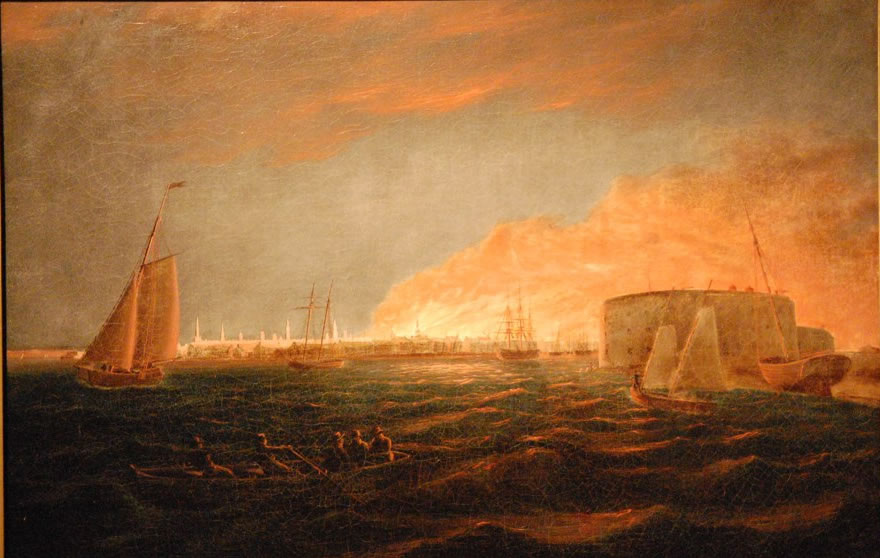
At top: Nicolino Calyo captured the terrible sight of the blaze as it might have looked from Red Hook, Brooklyn
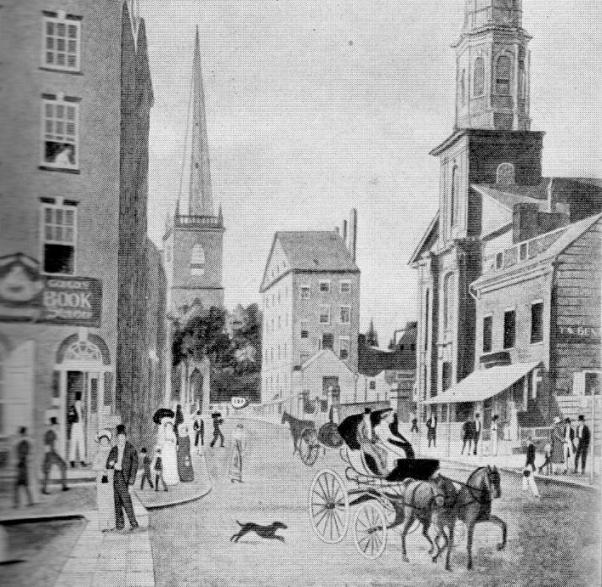
Before the blaze: Charming Wall Street in 1825, from a 1920s guide book. Prosperity from the Erie Canal was just around the bend. (Courtesy Ephemeral New York)
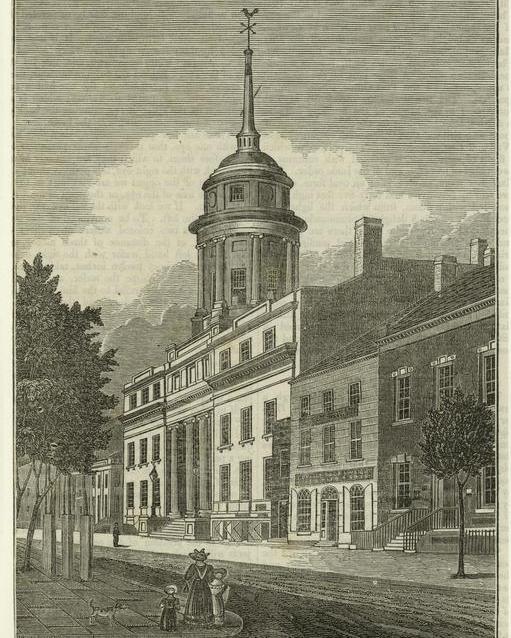
The original Merchant’s Exchange building, one of New York’s more ornate building, featuring a statue of Alexander Hamilton standing nobly in its rotunda. (Illustration courtesy the New York Public Library image gallery)
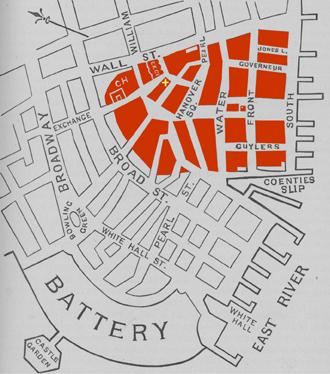
What’s the damage?: the red areas below indicate the blocks destroyed by the swift moving conflagration (map courtesy CUNY)
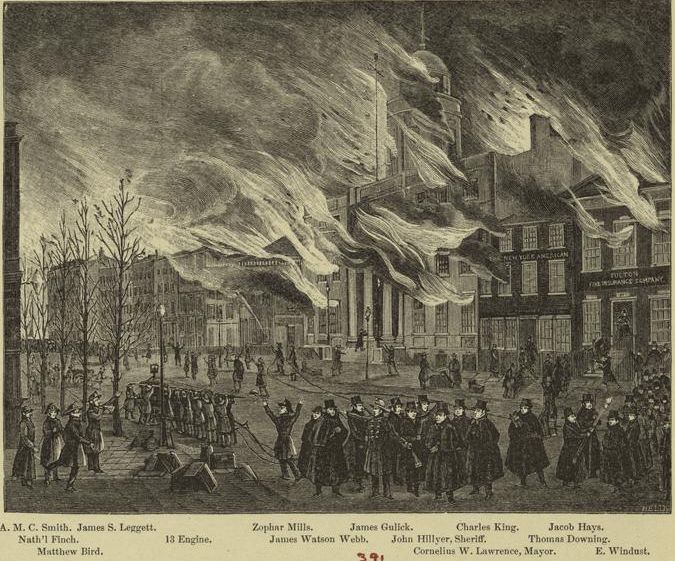
City officials, including mayor Cornelius Lawrence, could only watch and stare as the blaze over takes a stretch of prominent buildings. Also included below is Charles King, who watches as his newspaper the New York American is overcome by the fire.
Calyo’s painted depiction of the “Burning of the Merchant’s Exchange”
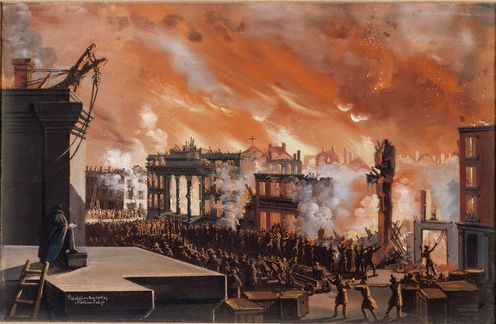
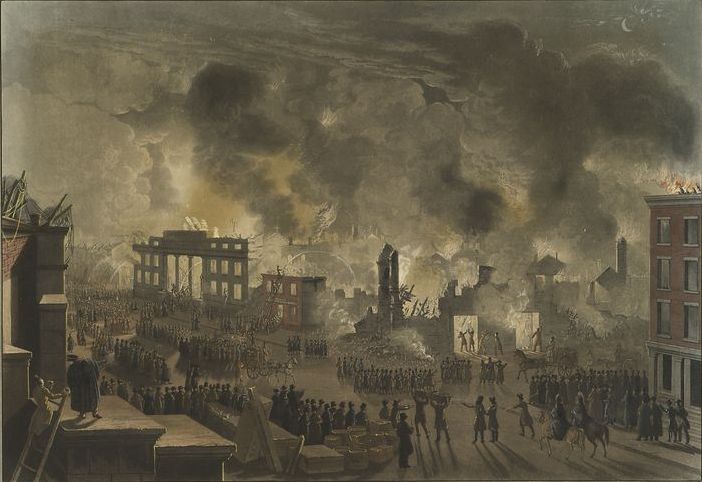
Another interpretation from the same angle — the futility of battling the blaze was chillingly illustrated from the corner Wall and William streets, where winds carried the flames from building to building, high above the heads of fighters below.
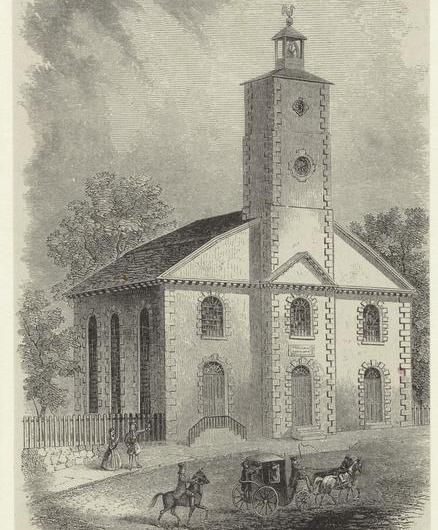
As the old Dutch Church on Garden Street caught fire, a morose parishioner mounted the organ and began playing a dirge. (Where’s Garden Street? According to Forgotten New York, Garden Street was “between William Street and Broadway, just south of Wall Street” and is now part of Exchange Place today.)
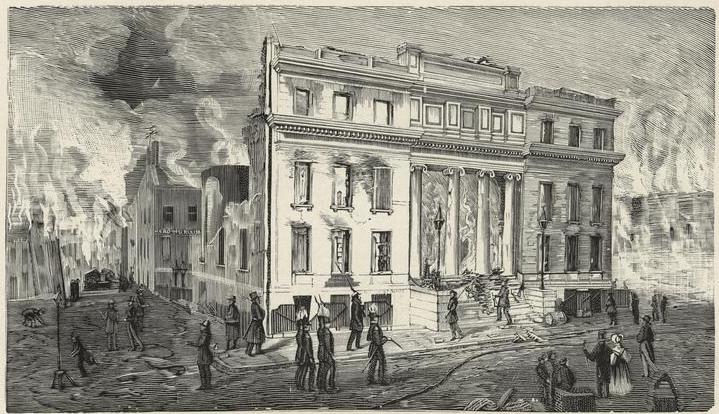
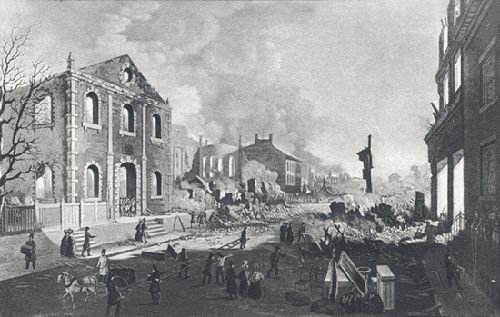
Aftermath at the Merchant’s Exchange. Many business owners actually tranferred their stock to the Exchange building, unfortunately thinking it would be impervious to the encroaching flames.
The devastation that met New Yorkers the following day led most to believe the city would never recover.
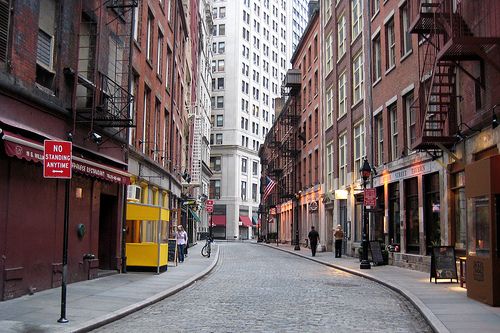
Most of the buildings on today’s Stone Street were built in the immediate years following the fire, Greek Revival-style countinghouses that are refitted for modern times as taverns and restaurants. It’s also one of the few cobblestone streets still around in the Financial District area.
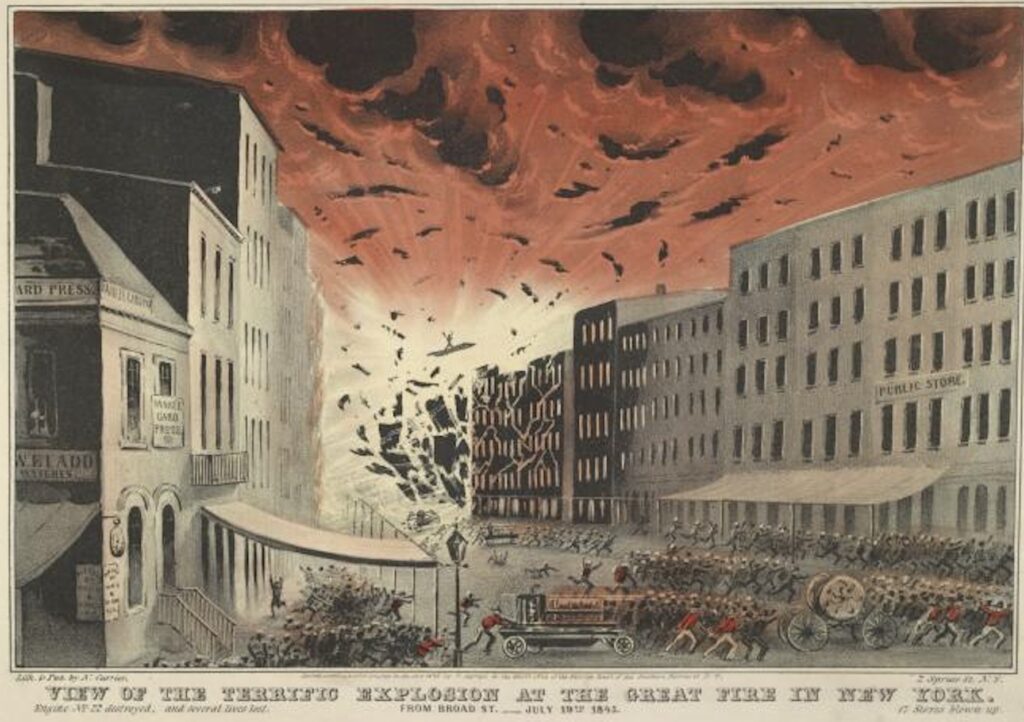
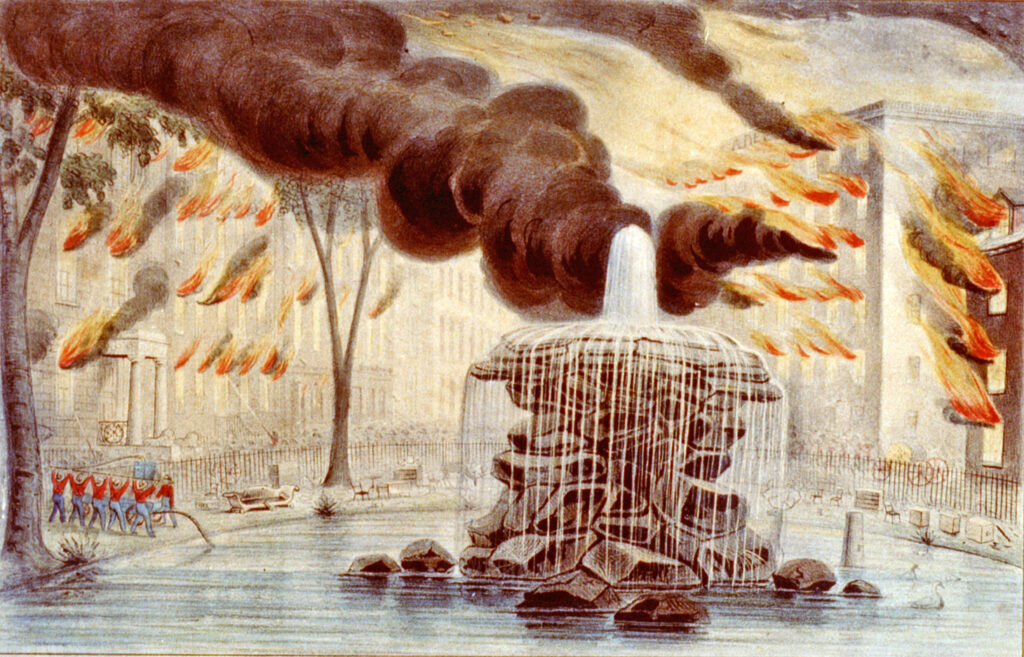
And did you know there was also a terrible fire ten years later — in almost the same location? Check out my article on the Great Fire of 1845 — and these captivating illustrations by Currier and Ives:
Who exactly was Nicolino Calyo, the man who painted so many vivid pictures of the Great Fire?
Nicolino Vicomte de Calyo was a political dissenter who fled Italy in the 1830s and settled in Baltimore, becoming entranced by the new American landscape.
Although his most famous depictions of New York are of the city in flame, he also painted a few serene views (like the one below, a vantage of the harbor from Brooklyn Heights).
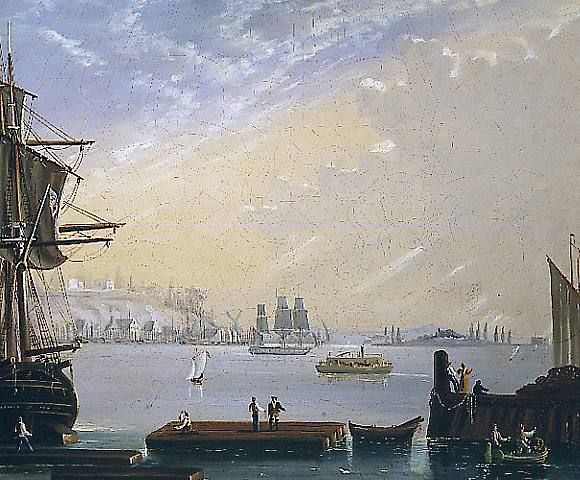
His works are in many New York museums, including the Burning of the Merchant’s Exchange which is at the Museum of the City of New York.
Another cool resource on the Great Fire is up at the CUNY website, with more pictures and more backstory as to New York’s capacity to fight blazes in the early 19th century.
FURTHER LISTENING
Other podcasts in our back catalog that relate to this week’s show:
The Bowery Boys: New York City History podcast is brought to you …. by you!
We’re also looking to improve and expand the show in other ways — publishing, social media, live events and other forms of media. But we can only do this with your help!
We are now a creator on Patreon, a patronage platform where you can support your favorite content creators.
Please visit our page on Patreon and watch a short video of us recording the show and talking about our expansion plans.
If you’d like to help out, there are six different pledge levels.Check them out and consider being a sponsor.
We greatly appreciate our listeners and readers and thank you for joining us on this journey so far.