Categories
American History Podcasts

The Great Fire That Transformed New York

This month marks the 190th anniversary of one of the most devastating disasters in New York City history — The Great Fire of 1835.

This massive fire, among the worst in American history in terms of its economic impact, devastated the city during one freezing December evening, destroying hundreds of shops and warehouses and changing the face of Manhattan forever.

It also underscored the city’s need for a functioning water system and permanent fire department.

So why were there so many people drinking champagne in the street? And how did the son of Alexander Hamilton save the day?

FEATURING Such Old New York sites as the Tontine Coffee House, Stone Street, Hanover Square and Delmonico’s.

PLUS: We give you a another reason to check out the Stone Street Historic District

To mark this special anniversary, we have newly remastered and edited our classic Bowery Boys podcast on this subject which was originally released on March 13, 2009

LISTEN HERE: THE GREAT FIRE THAT TRANSFORMED NEW YORK


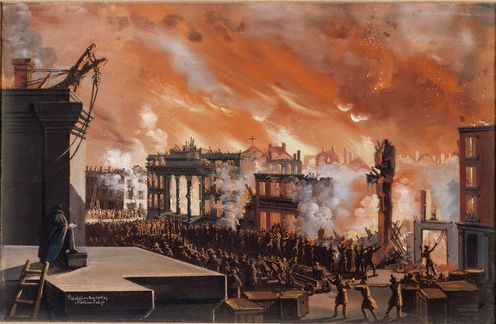
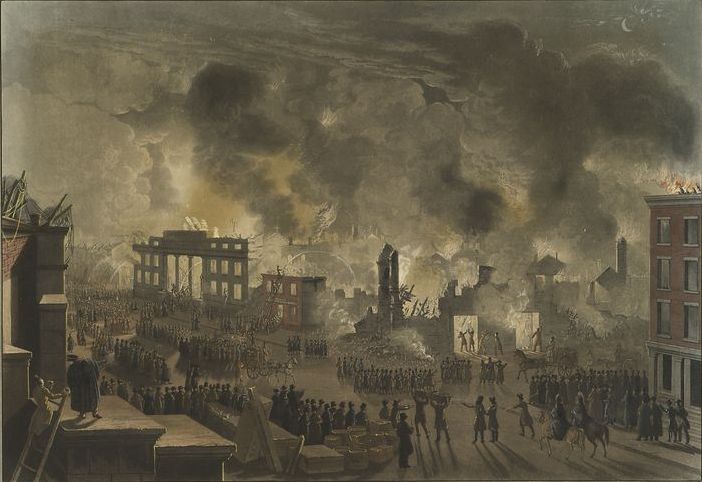
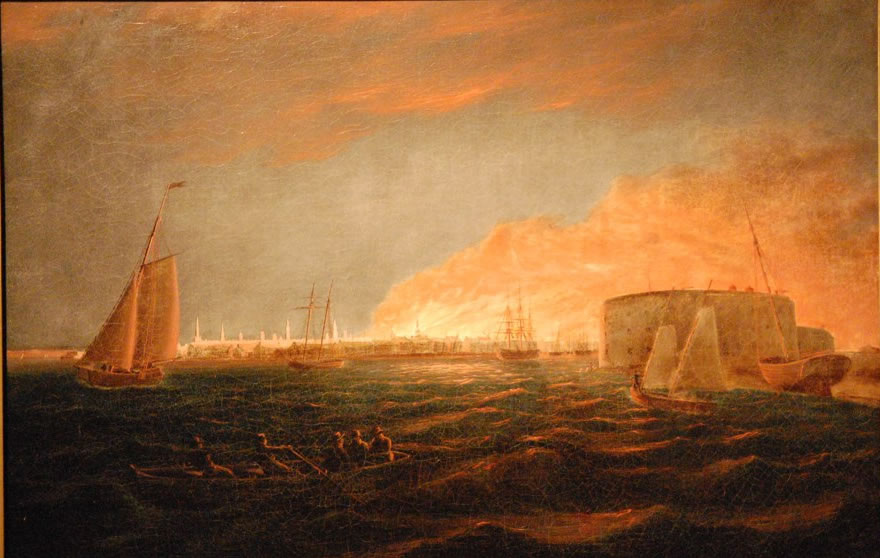
At top: Nicolino Calyo captured the terrible sight of the blaze as it might have looked from Red Hook, Brooklyn

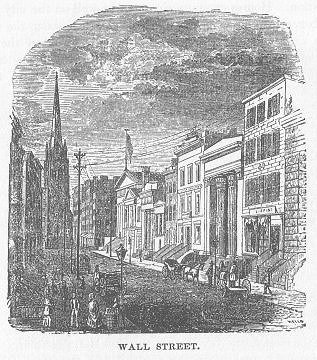
Before the blaze: Charming Wall Street in 1825, from a 1920s guide book. Prosperity from the Erie Canal was just around the bend. (Courtesy Ephemeral New York)

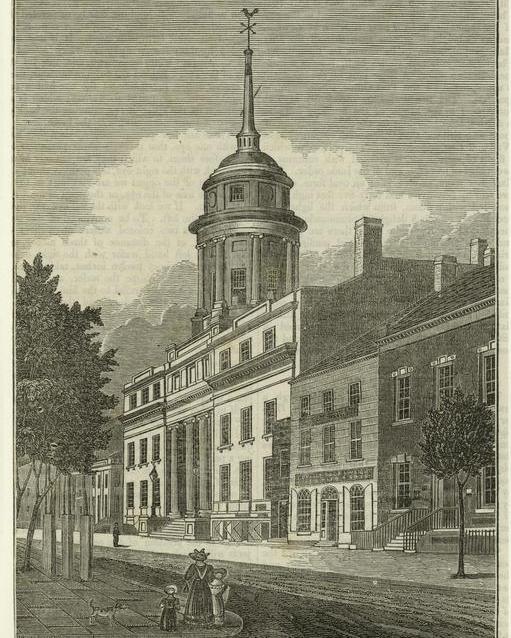
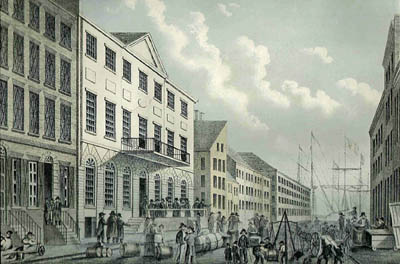
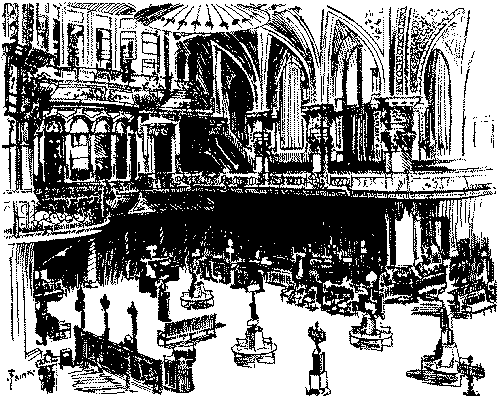
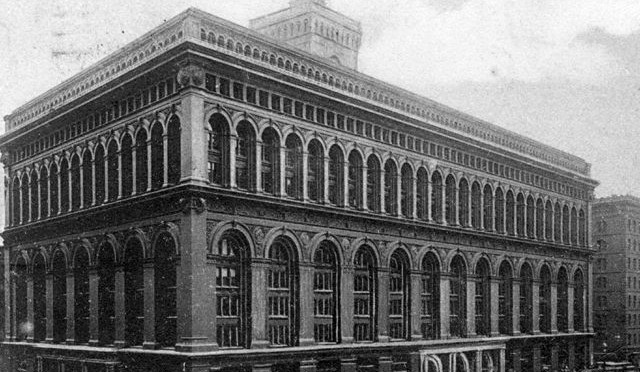
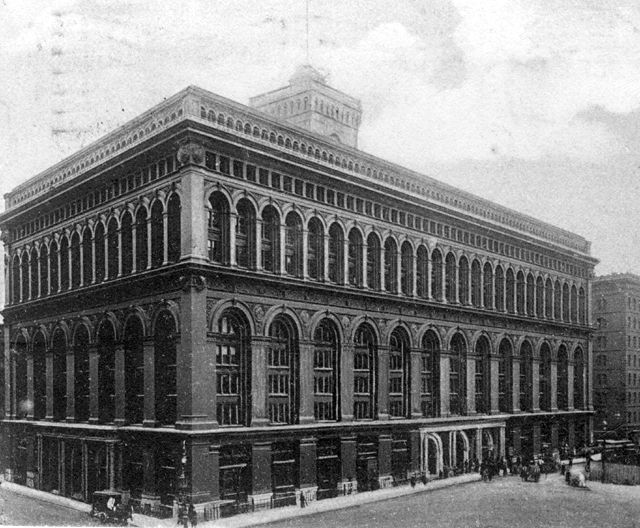
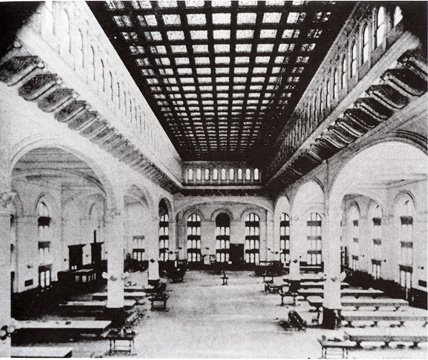
The original Merchant’s Exchange building, one of New York’s more ornate building, featuring a statue of Alexander Hamilton standing nobly in its rotunda. (Illustration courtesy the New York Public Library image gallery)

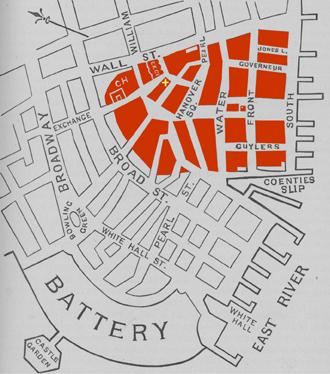
What’s the damage?: the red areas below indicate the blocks destroyed by the swift moving conflagration (map courtesy CUNY)

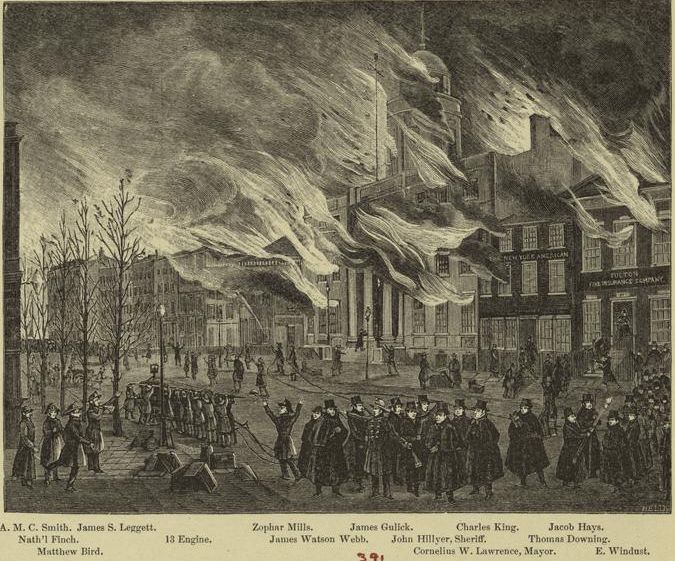
City officials, including mayor Cornelius Lawrence, could only watch and stare as the blaze over takes a stretch of prominent buildings. Also included below is Charles King, who watches as his newspaper the New York American is overcome by the fire.

Calyo’s painted depiction of the “Burning of the Merchant’s Exchange”

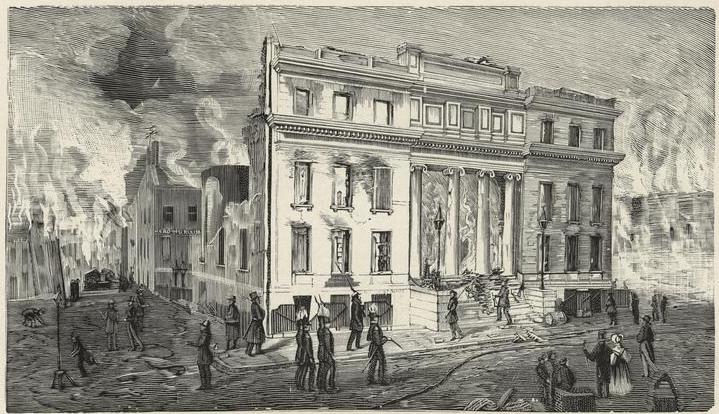
Another interpretation from the same angle — the futility of battling the blaze was chillingly illustrated from the corner Wall and William streets, where winds carried the flames from building to building, high above the heads of fighters below.

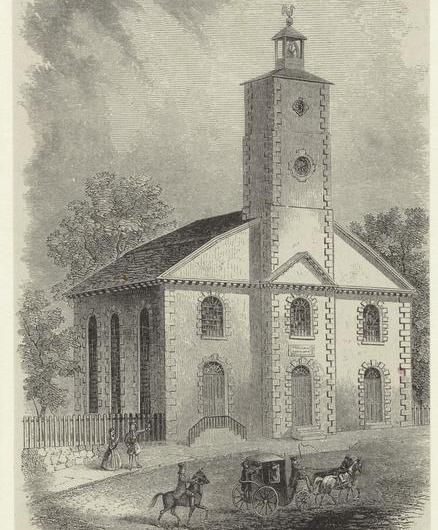
As the old Dutch Church on Garden Street caught fire, a morose parishioner mounted the organ and began playing a dirge. (Where’s Garden Street? According to Forgotten New York, Garden Street was “between William Street and Broadway, just south of Wall Street” and is now part of Exchange Place today.)

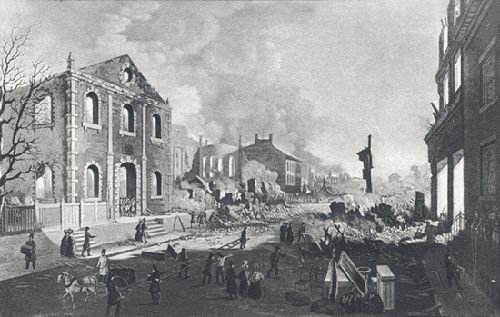
Aftermath at the Merchant’s Exchange. Many business owners actually tranferred their stock to the Exchange building, unfortunately thinking it would be impervious to the encroaching flames.

The devastation that met New Yorkers the following day led most to believe the city would never recover.

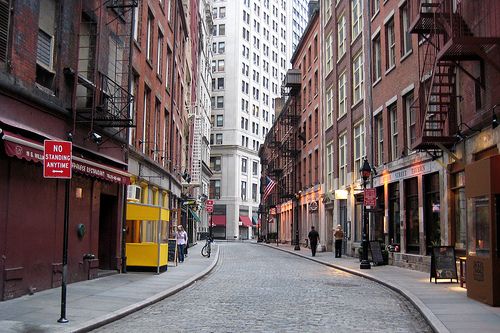
Most of the buildings on today’s Stone Street were built in the immediate years following the fire, Greek Revival-style countinghouses that are refitted for modern times as taverns and restaurants. It’s also one of the few cobblestone streets still around in the Financial District area.


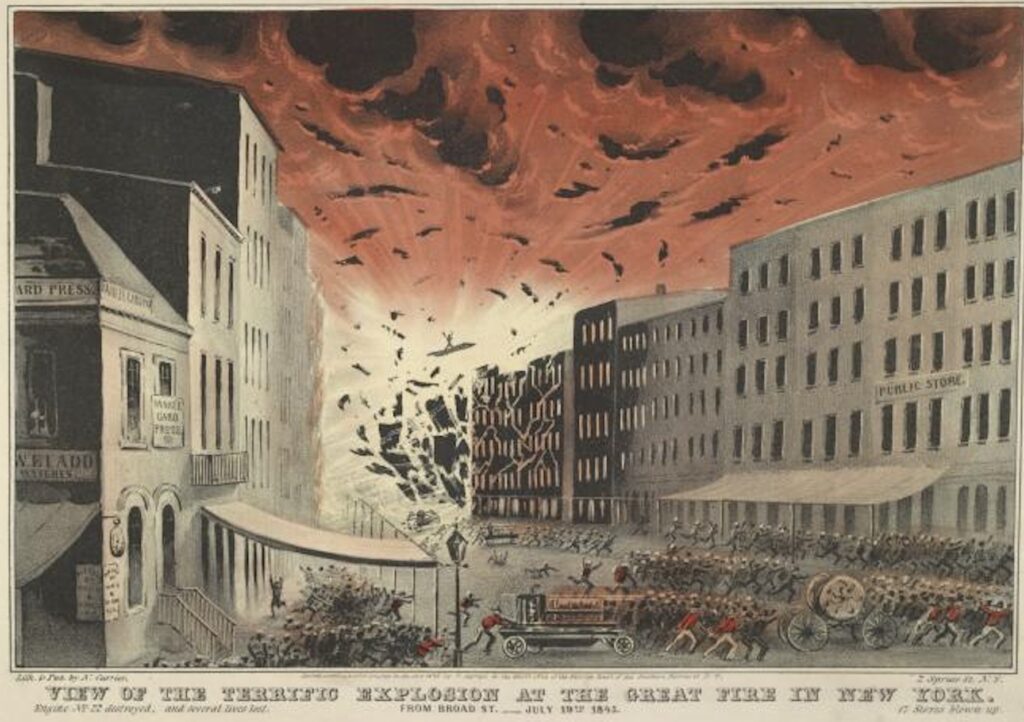
And did you know there was also a terrible fire ten years later — in almost the same location? Check out my article on the Great Fire of 1845 — and these captivating illustrations by Currier and Ives:

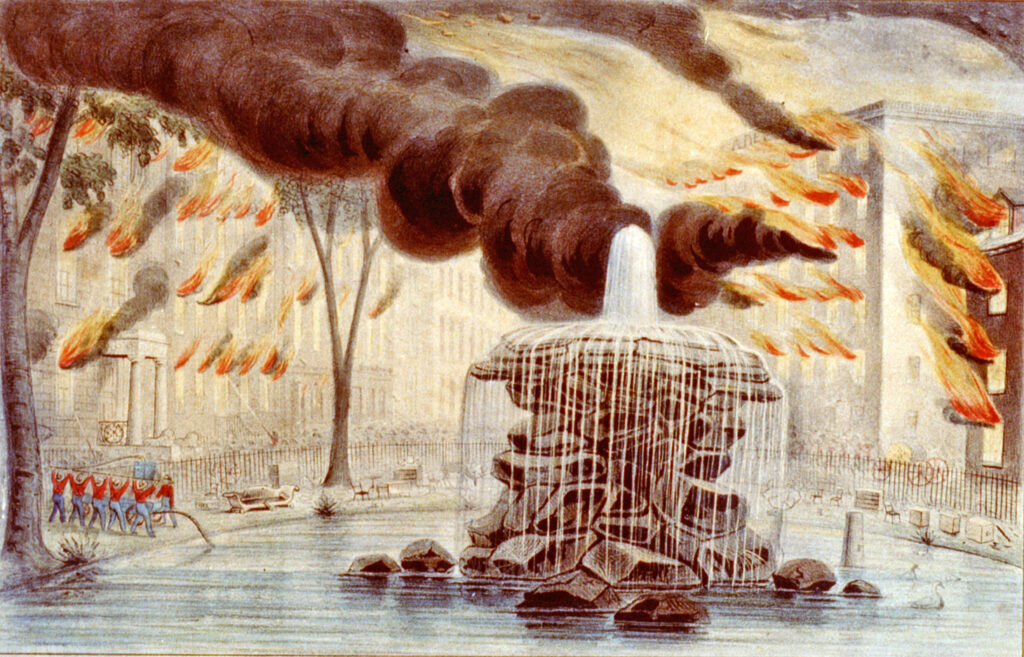
In this Currier & Ives lithograph, the serene fountain in Bowling Green as flames consume buildings all around it.

Who exactly was Nicolino Calyo, the man who painted so many vivid pictures of the Great Fire?

Nicolino Vicomte de Calyo was a political dissenter who fled Italy in the 1830s and settled in Baltimore, becoming entranced by the new American landscape.

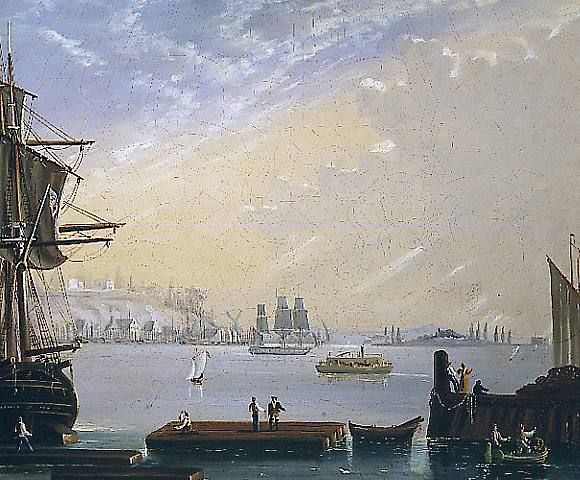
Although his most famous depictions of New York are of the city in flame, he also painted a few serene views (like the one below, a vantage of the harbor from Brooklyn Heights).

His works are in many New York museums, including the Burning of the Merchant’s Exchange which is at the Museum of the City of New York.

Another cool resource on the Great Fire is up at the CUNY website, with more pictures and more backstory as to New York’s capacity to fight blazes in the early 19th century.


FURTHER LISTENING

Other podcasts in our back catalog that relate to this week’s show:


The Bowery Boys: New York City History podcast is brought to you …. by you!

We’re also looking to improve and expand the show in other ways — publishing, social media, live events and other forms of media. But we can only do this with your help!

We are now a creator on Patreon, a patronage platform where you can support your favorite content creators.

Please visit our page on Patreon and watch a short video of us recording the show and talking about our expansion plans.

If you’d like to help out, there are six different pledge levels.Check them out and consider being a sponsor.

We greatly appreciate our listeners and readers and thank you for joining us on this journey so far.

Categories
Bowery Boys

Every Bowery Boys History podcast in chronological order by subject

Eighteen years ago (officially on June 19, 2007) we recorded the very first Bowery Boys podcast, appropriately about Canal Street, the street just outside the window of Tom’s apartment on the Lower East Side.

That’s right! If our podcast were a person, it would be able to vote in this year’s mayoral election.

(For more information, check out our 15th anniversary show from two years ago.)

We cannot have possibly imagined on that hot June night, wielding only a bad microphone, a new laptop and some reasonably interesting information about a terribly polluted water soure, that would still be doing this, stronger than ever.

Thank you, listeners and readers, for helping us celebrate almost four hundred years of history in the past seventeen.

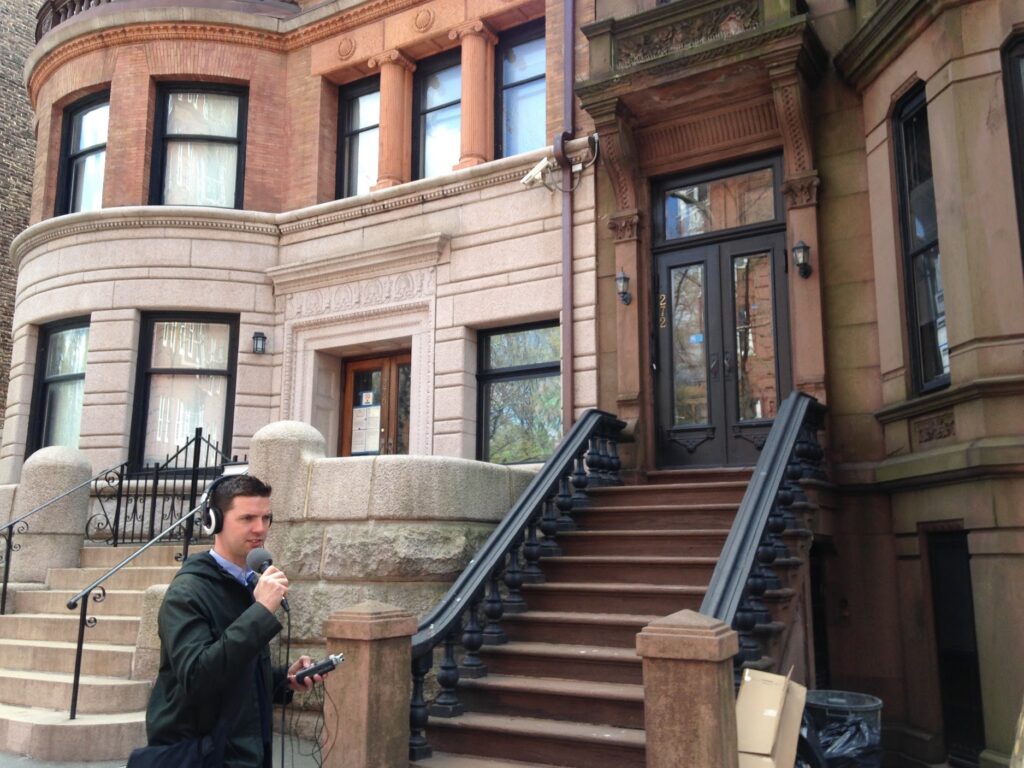
Tom Meyers in Park Slope, recording our first ever ‘on location’ show in 2015.
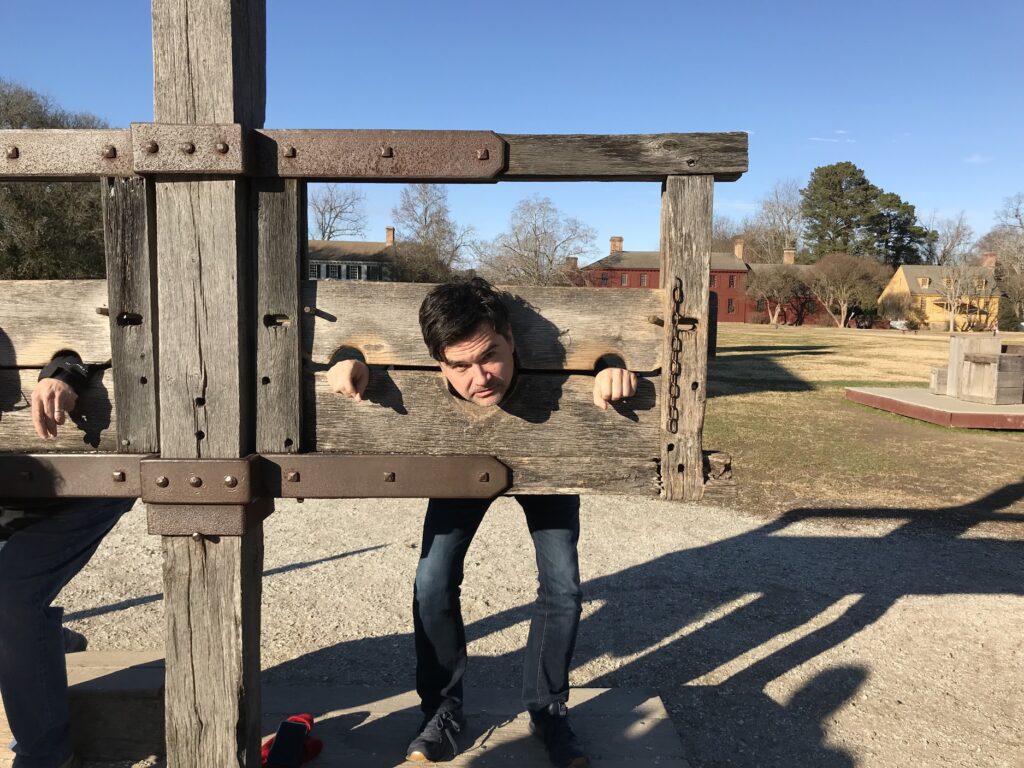
Greg in the stocks at Colonial Williamsburg, 2017. (Okay, not really a Bowery Boys thing, but history related.)
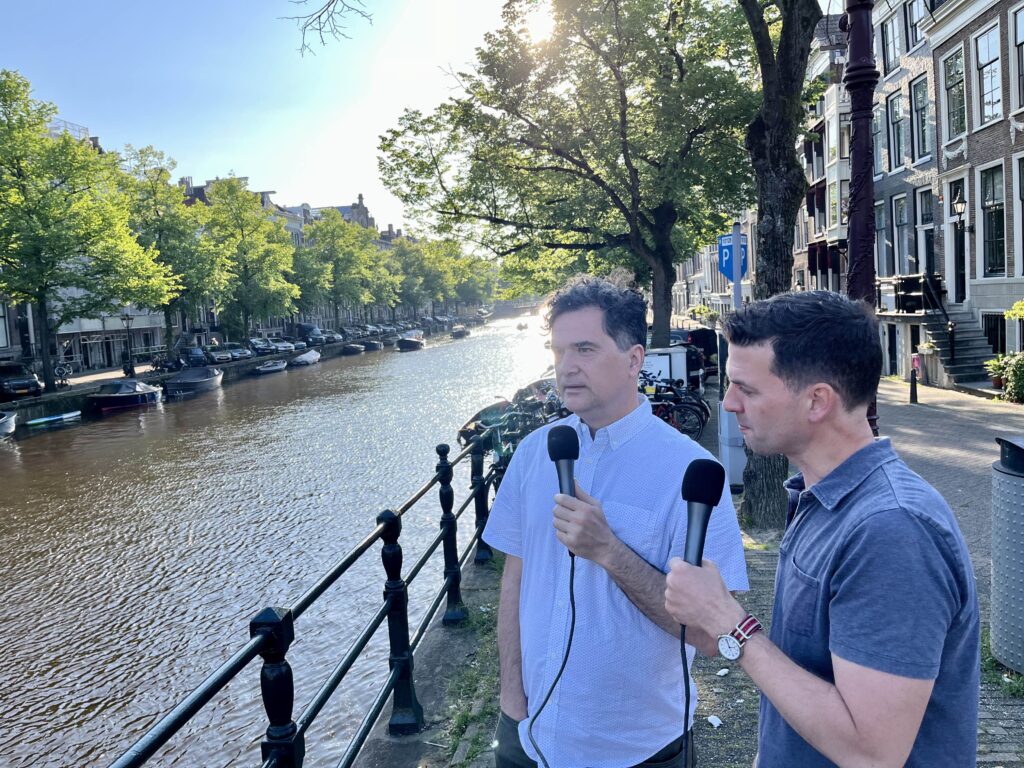
Greg and Tom in Amsterdam, 2024

Here’s a new way to experience our old podcasts.

Below is our entire list* of shows, placed in a particular chronological order, based on a critical date in that subject’s history.

Viewing our back catalog of podcasts in this fashion, we hope that you can really start seeing the entire history of New York City emerging. To this day, there are some blatant holes in our historical coverage that we hope to close up in future shows.

So enjoy! And thank you all again.

*In the rare case where we revisited a subject (Flatiron Building, Canal Street) we only included the most recent show. For ‘rewind’ episodes with updates, they have been included over the original. And the first four episodes are not available (but those who support us on Patreon have access to episodes #2-4).

You can find our podcasts anyplace. Read here for more information on where you can find our shows.

And finally — we can continue recording the Bowery Boys podcast thanks to the generous support of those on Patreon. Supporters receive bonus audio, free merchandise and first access to tickets for upcoming live shows.
Courtesy Museum of the City of New York

DUTCH AND ENGLISH PERIOD

Land of the Lenape and #432 The Lenape Nation: Past, Present and Future (Pre 1609 inhabitants)

#83 Henry Hudson and the European Discovery of Mannahatta (1609 – Hudson sails into the harbor)

#272 Life in New Amsterdam (1624 First permanent European on Manhattan Island)

#433 New Amsterdam Man: An Interview with Russell Shorto

#434 Amsterdam/New Amsterdam: Empire of the Seas

#435 Amsterdam/New Amsterdam: The Radical Walloons

#436 Amsterdam/New Amsterdam: Finding Peter Stuyvesant

#437 Haarlem, Breukelen, Utrecht: Exploring New York’s Dutch Roots

#212 Bronx Trilogy: The Bronx Is Born(1639 Jonas Bronck sets up a farm on what would be called the Bronx River)

#267 Broadway: The Story of a Street (1642 First mention of the street in Dutch documents)

#273 Peter Stuyvesant and the Fall of New Amsterdam (1647 Stuyvesant arrives)

#390 The Story of Flatbush: Brooklyn Old And New (1651 The village of Flatbush chartered)

#430 The Story of Flushing: Queens History, Old and New (1661 John Bowne House is constructed)

#452 How New York Got Its Name (1664 England takes over New York)

#454 Special Delivery: A History of the Post Office (1670s Construction of the Boston Post Road)

#301 Haunted Houses of Old New York (1680 Conference House built)

#228 The Pirate of Pearl Street: The New York Adventures of Captain Kidd (1690 Kidd moves to New York)

#97 Trinity Church (1698 First Trinity Church opens)

#406 How Wall Street Got Its Name (1711 Wall Street slave market opened)

#149 John Peter Zenger and the Power of the Press (1735 Zenger trial)

#379 How Chelsea Became a Neighborhood (1750 The original Chelsea Manor is completed)

#90 Columbia University (1754 King’s College established)

#115 African Burial Ground (Mid 18th century — Burials begin in the area south of Collect Pond)
Museum of the City of New York

REVOLUTION

The Revolutionary Tavern of Samuel Fraunces (1762 Samuel Fraunces opens tavern)

#266 New York City During the Revolutionary War (1776-1783)

#333 Tearing Down King George: The Monumental Summer of 1776

#201 GOWANUS! Brooklyn’s Troubled Waters (1776 Battle of Brooklyn)

#191 The Great Fire of 1776 (1776 Fire at the Fighting Cocks Tavern)

#298 The Story of Brooklyn Heights (1776 Washington’s meeting at the House of the Four Chimneys)

#157 Early Ghost Stories of Old New York (1778 Mohican tribe fighting for the Continental Army slaughtered)

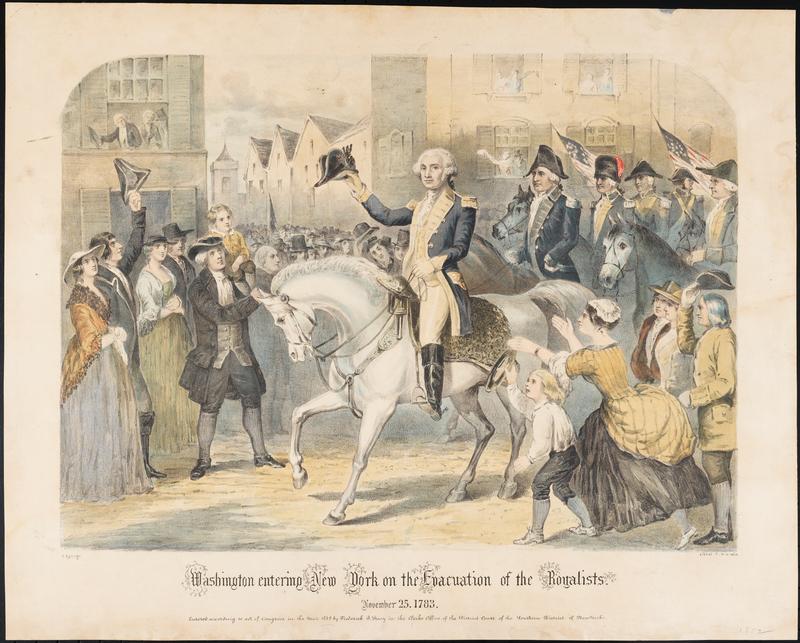
#421 Evacuation Day: Forgotten Holiday of the American Revolution (1783 British leave New York for good)
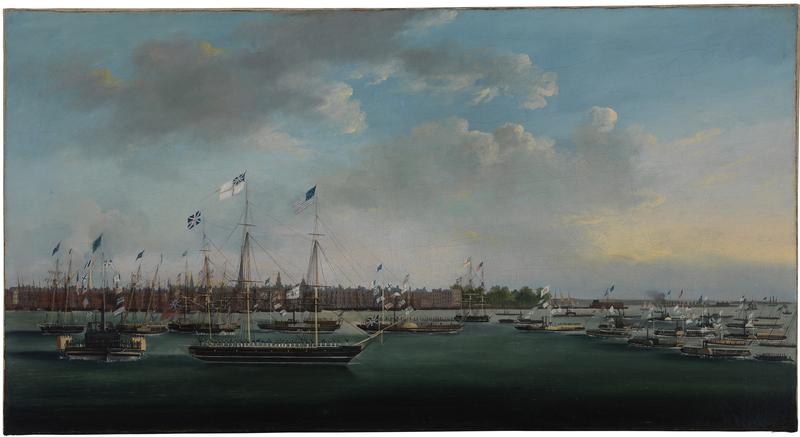
Painting by Anthony Imbert

NEW YORK IN THE NEW NATION

#373 New York Underground: The Story of Cemeteries (1788 The Doctors Riot)

#220 George Washington’s New York Inauguration (1789)

#221 New York: Capital City of the United States (1789-1790)

#63 New York Stock Exchange (1792 Buttonwood Agreement)

#354 Who Wrote The First American Cookbook? (1796 Amelia Simmons publishes American Cookery)

#240 Ghosts of Greenwich Village (1797 The area of today’s Washington Square becomes a potter’s field)

#112 Archibald Gracie and His Mansion (1799 Mansion constructed)

#138 St. Mark’s-in-the-Bowery (1799 Chapel opens)

#239 Murder at the Manhattan Well (1799 Elma Sands is murdered)

#65 Spooky Stories of New York (1799 Featuring the ‘ghost story’ version of the tale above, among other tales)

#41 New York Post (1801 Alexander Hamilton establishes the paper)

#297 Dr. Hosack’s Enchanted Garden (1801 Hosack opens Elgin Botanic Garden)

#414 The Brooklyn Navy Yard and Vinegar Hill (1810 Navy Yard opens)

#19 Washington Irving (1802 Irving begins writing)

#169 DUEL! Aaron Burr vs. Alexander Hamilton (1804 The infamous duel between Burr and Hamilton)

#367 The Ice Craze: How the Ice Business Transformed New York (1806 The first American ice business is formed)

#185 Adventures in Governors Island (1807 Castle Williams constructed)

#258 Tales from Tribeca History (1807 St. John’s Chapel and the first ‘upscale’ neighborhood are created)

#31 Battery Park and Castle Clinton (1808 Castle Clinton constructed)

#9 St. Patrick’s Old Cathedral (1809 Cathedral begins construction)

#422 Grace Church: A Most Fashionable History (Grace’s original congregation forms)

#50 Canal Street and Collect Pond (1811 Collect Pond is filled)

#163 South Street Seaport (1811 Schermerhorn Row counting houses constructed)

#93 City Hall and City Hall Park (1811 City Hall constructed)

#40 Union Square (1815 Union Place opened)

#343 Literary Horrors of New York City (1819 The Legend of Sleepy Hollow is published)

#145 Bicycle Mania! From Velocipede to Ten-Speed (1819 First bicycle on the streets of New York)
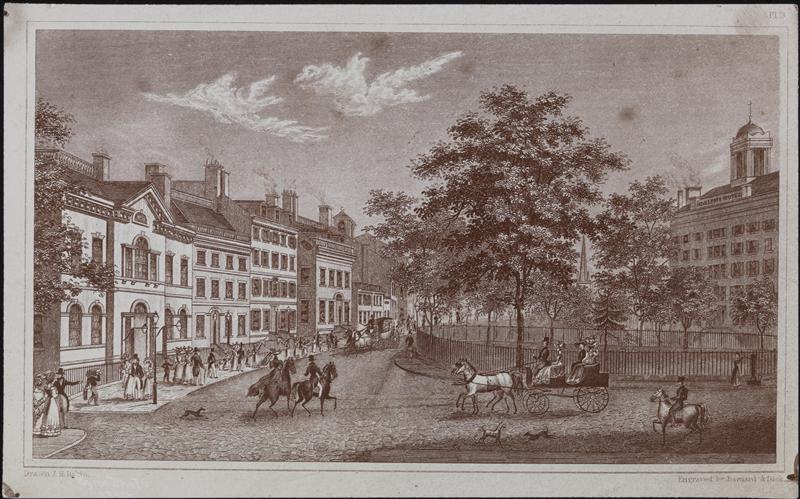
MNY29834

NEW YORK, NEW WEALTH

#152 Bellevue Hospital (1821 Hospital opens)

#403 The Fulton Fish Market: History at the Seaport (1822 Market opens)

#407 New York By Gaslight (1823 New York gets its first gas company)

#52 DeWitt Clinton and the Erie Canal (1825 Canal opens)

Seneca Village and New York’s Forgotten Black Communities (1825 Seneca Village founded)

#388 The Hudson River School: An American Art Revolution (1825 Thomas Cole moves to Catskill, New York)

#460 The Brooklyn Museum and the Birth of a New City (1825 Brooklyn Apprentices Library opens)

#7 Washington Square Park (1826 City buys potter’s field to create a military parade ground)

#70 The Bowery Files (1826 – Bowery Theatre opens)

#252 The Underground Railroad: Escape Through New York (1826 David Ruggles moves to New York)

#58 Delmonico’s Restaurant (1827 First restaurant opens)

#142 New York University (NYU) (1831 College founded on Washington Square)

#193 St. Mark’s Place: Party In The East Village (1831 Hamilton-Holly house constructed)

#241 Edgar Allan Poe in New York (1831 Poe moves to New York)

#91 Haunted Tales of New York (1832 Merchant’s House built)

#171 The Keys to Gramercy Park(1833 Gramercy Park enclosed with a private fence)

#94 Corlear’s Hook and the Pirates of the East River (1833 First tenement built in the Hook)

#140 Rockaway Beach (1833 Marine Pavilion opens)

#224 The Arrival of the Irish: An Immigrant Story (1830s)

#113 Niblo’s Garden (1834 William Niblo opens the theater)

Strange Hoaxes of the 19th Century (1835 The Moon Hoax runs in the New York Sun)

City in Flames: The Great Fire of 1835

#211 The Notorious Madame Restell: The Abortionist of Fifth Avenue (1836 Ann Lohman begins work)

#222 Who Killed Helen Jewett? A Mystery By Gaslight (1836 Jewett murdered that Spring)

#59 Five Points: Wicked Slum (1837 Old Brewery becomes a slum)

#38 Tiffany & Co. (1837 Tiffany’s first opens)

#64 Green-Wood Cemetery (1838 Cemetery opens in Brooklyn)

#291 The Tombs: Five Points’ Notorious House of Detention (1838 Prison opens)

#82 Roosevelt Island (1839 – Lunatic asylum opens)

#242 New York and the Dawn of Photography and The First Woman Ever Photographed (1839 John Draper and his sister Dorothy Catherine first work on the photographic process at NYU)

#425 It Happened at Madison Square Park (1839 Madison Cottage opens)

#130 Haunted Histories of New York (1841 – Most Holy Trinity in Bushwick constructed)

#46 Barnum’s American Museum (1841 Museum opens)

#66 Who Killed Mary Rogers? (1841 Rogers is murdered)

#143 Water for New York: Croton Aqueduct (1842 Croton Aqueduct opens)

#386 On the Trail of the Old Croton Aqueduct (1842 Croton Aqueduct opens)

#428 The New York Game: Baseball in the Early Years (1842 First baseball game in Madison Square area)
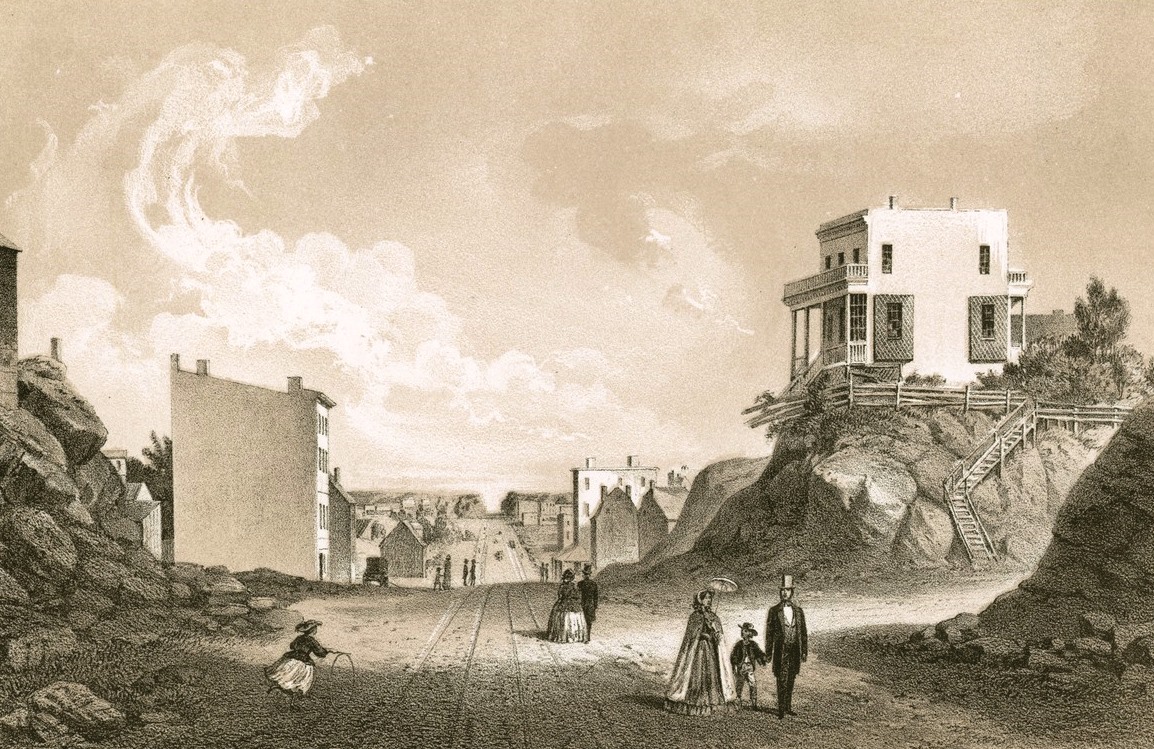
Second_Avenue_Manhattan_1861

NEW YORK: THE GROWING CITY

#324 Moving Day: Mayhem and Madness in Old New York (Essentially Every May)

#133 Red Hook: Brooklyn on the Waterfront (1847 Atlantic Basin constructed)

#37 Henry Ward Beecher and Plymouth Church (1847 Beecher moves to Brooklyn)

#281 The Treasures of Downtown Brooklyn (1848 Brooklyn City Hall constructed)

#293 Secrets of Upper Manhattan (1848 High Bridge constructed)

#289 Blood and Shakespeare: The Astor Place Riot (1849 Riot erupts outside Astor Place Opera House)

#356 Pfizer: A Brooklyn Origin Story (1849 Charles Pfizer begins selling worm medication)

#394 New York Calling: A History of the Telephone (1849 Antonio Meucci invents a version of the telephone in Staten Island)

#160 Tompkins Square Park (1850 Park opens)

#316 Jenny Lind at Castle Garden (1850 Lind performs at the Garden)

#181 Park Slope and the Story of Brownstone Brooklyn (1850s Edwin Litchfield purchases parcels of land in South Brooklyn)

#75 Williamsburg(h), Brooklyn (1852 City of Williamsburgh)

#178 The Crystal Palace: America’s First World’s Fair (1853 Crystal Palace opens)

#92 Steinway: the Piano Man (1853 Henry Steinway opens first shop in Manhattan)

#117 Mark Twain’s New York (1853 Young Mark Twain first visits New York)

#60 Five Points Part Two: The Fate of Five Points (1853 New Mission replaces the Old Brewery)

#51 McSorley’s Old Ale House (1854 Tavern opens)

#419 Ghost Stories by Gaslight (1854 Astor Library opens)

#25 The Original Bowery Boys (1855 Death of Bowery Boys leader Bill the Butcher)

#283 Walt Whitman in New York and Brooklyn (1855 Whitman first publishes Leaves of Grass)

#389 The Ruins of Roosevelt Island (1856 Smallpox Hospital built on Blackwell’s Island)

#103 Case Files of the NYPD (1857 Infamous police riot between Municipals and Metropolitans)

#382 Architect of the Gilded Age (1857 Hunt opens the Tenth Street Studios building)

#232 The Story of SoHo (1857 E.V. Haugtwout’s emporium opens)

#276 Murder on Bond Street (1857 Harvey Burdell is murdered)

#300 The Forgotten Father of New York City (1857 Andrew Haswell Green becomes involved with the Central Park Commission)

#385 Frederick Law Olmsted and the Plan for Central Park (1858 Olmsted and Vaux win the Central Park design competition)

#54 The Creation of Central Park (1857 Park opens)

#415 The Early Years of Central Park (1858 Park opens for ice skating)

#418 Theodore Roosevelt’s Wild Kingdom (1858 Theodore Roosevelt born)

#134 St. Patrick’s Cathedral (1858 Cornerstone laid)

#30 Peter Cooper and Cooper Union (1858 Cooper Union begins construction)

#23 Macy’s: the Man, the Store, the Parade (1858 Rowland Macy opens first store)

#129 Chinatown (1858 First Chinese resident of New York documented)

#325 The Staten Island Quarantine War (1858 Residents burn the hospital)

#268 The Astonishing Saga of the Atlantic Cable (1858 First communications made)

#126 Fernando Wood: The Scoundrel Mayor (1860 Wood becomes mayor of New York)

#139 Brooklyn Academy of Music (1861 Academy opens)

#285 Boss Tweed’s House of Corruption (1861 Construction begins on the courthouse)

#286 Uncovering Hudson Yards (1861 Abraham Lincoln first arrives in New York via the Hudson River Railroad)

The Real Mrs. Astor: Ruler or Rebel? (1862 The Astors move to 34th and Fifth Avenue)

#357 Edith Wharton’s New York (1862 Wharton is born on 23rd Street)

#348 Cheers! The Stories of Four Fabulous Cocktails (1862 Jerry Thomas publishes his bartending guide)

#340 The Real Life Adventures of Tom Thumb (1863 Stratton marries Lavinia Warren)

#183 Orchard Street: Life On The Lower East Side (1863 Construction of 97 Orchard Street)

#127 The Civil War Draft Riots (1863 Summer of Draft Riots)

#10 Central Park Zoo (1864 Menagerie opens)

#128 Hoaxes and Conspiracies of 1864 (1864 Confederate fires set in November)

#320 The History of Hart Island (1864 The island becomes a potter’s field)
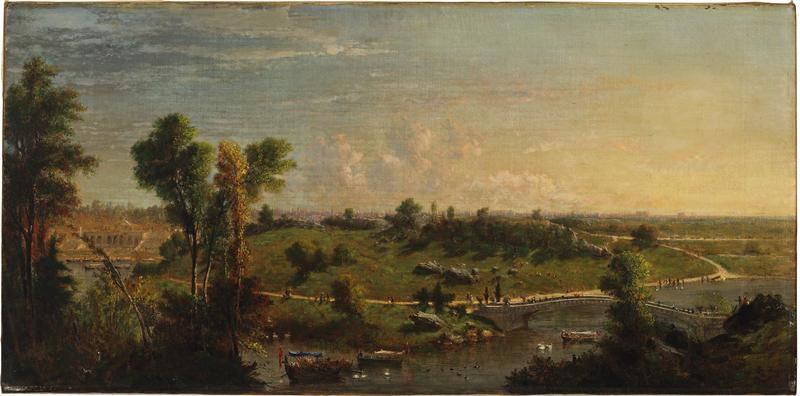
Painting George Loring Brown, courtesy Museum of the City of New York

NEW YORK: BEGINNINGS OF A GILDED AGE

The Bowery Boys Presents: The First Broadway Musical (1866 The Black Crook debuts)

#368 Henry Bergh’s Fight for Animal Rights in Gilded Age New York (1866 Bergh founds the ASPCA)

#84 Prospect Park (1867 Park opens to the public)

#141 New York Beer History (1867 George Ehret opens brewery)

#102 Brighton Beach and Manhattan Beach (1868 – First resort in Brighton Beach)

#274 Ghost Stories of Hell’s Kitchen (1868 Landmark Tavern opens)

#114 Supernatural Stories of New York (1869 – Hart Island first used as a potter’s field)

#131 The First Apartment Building (1869 Stuyvesant Apartments constructed)

#207 The First Subway: Beach’s Pneumatic Marvel  (1869 Alfred Ely Beach builds under Broadway)

#329 The First Ambulance: The Humans (And Horses) Who Saved New York (1869 Bellevue debuts its ambulance service)

#366 North Brother Island: New York’s Forbidden Place (1869 The lighthouse is constructed)

#331 The East Side Elevateds: Life Under the Tracks (1870 First elevated railroad for passengers)

#161 Fire Department of New York (FDNY) (1870 City-funded fire team founded)

#341 The Metropolitan Museum of Art (1870 Museum is founded)

#238 Astoria and Long Island City (1870 Long Island City becomes an official municipality)

#177 The Big History of Little Italy (1870s Italian immigrants began arriving in large numbers)

#429 The Moores: A Black Family in 1860s New York (1970 The Moores move to their Lauren Street tenement)

#86 Boss Tweed and Tammany Hall (1871 Boss Tweed arrested)

#45 Grand Central and #431 Park Avenue: History with a Penthouse View (1871 Grand Central Depot opens)

#198 Greenpoint, Brooklyn: An Industrial Strength History (1874 Faber Pencil Factory opens)

#458 Parkways and the Transformation of Brooklyn (1874 Eastern Parkway opens)

#270 Heaven on the Hudson: A History of Riverside Park (1875 Riverside Park first opens)

#323 The Bowery Wizards: A History of Tattooed New York (1876 Edison invents the tattoo machine)

#396 Samuel Tilden and the Presidential Election of 1876 (1876 Americans go to the polls and make an indecisive choice)

Dinosaurs and Diamonds: The American Museum of Natural History (1877 First portion of museum opens)

#215 Ghosts of the Gilded Age (1877 Mysterious body found in an abandoned Queens farmhouse)

#395 Jefferson Market and the Women’s House of Detention (1877 Jefferson Market Courthouse opens)

#339 James H. Williams and the Red Caps of Grand Central (1878 James Williams born)

#107 New York’s Elevated Railroads (1878 First regular elevated railroad in service)

#375 The Great Bank Robbery of 1878

#172 Ghost Stories of Brooklyn (1878 Reports of a ghostly doorbell in Clinton Hill)
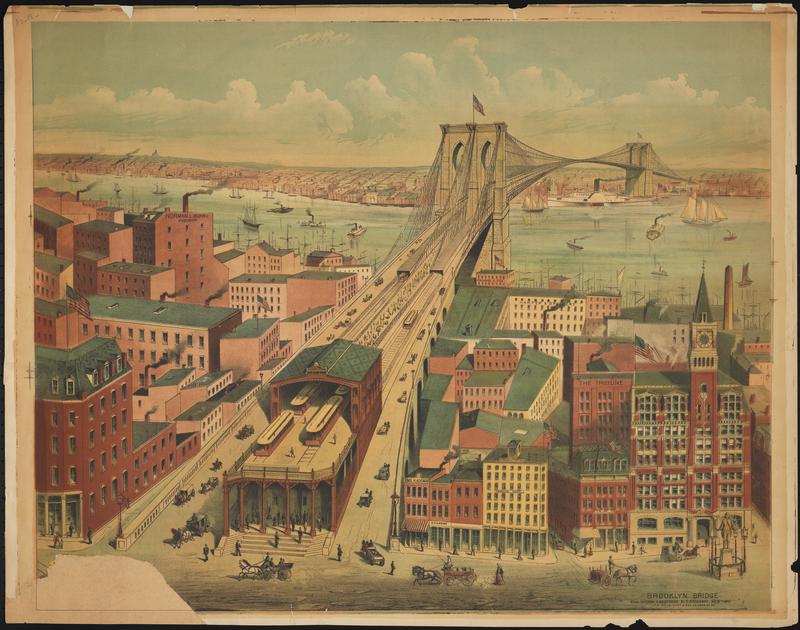
Art by Charles Hart. Courtesy Museum City of New York

NEW YORK: CITY OF INNOVATION

#99 Madison Square Garden (1879 First Madison Square Garden opens)

#376 Skid Row: The Bowery of the Forgotten (1879 The Bowery Mission opens)

#8 Dakota Apartments and ‘Rosemary’s Baby’ (1880 Dakota begins construction)

#449 Italian Harlem: New York’s Forgotten Little Italy (1880s Italians move uptown)

The Mystery of the Central Park Obelisk (1881 Obelisk erected in Central Park)

#186 Hell’s Kitchen: New York’s Wild West  (1881 Incident at Hell’s Kitchen tenement)

#225 P. T. Barnum and the Greatest Show on Earth (1881 Barnum and Bailey Circus formed)

#132 Electric New York: Edison and the City Lights (1882 Pearl Street Station opened)

#347 Steam Heat! A Gilded Age Miracle (1882 Steam system constructed)

#387 Hyde Park: The Roosevelts on the Hudson (1882 Franklin D. Roosevelt born in Hyde Park)

#426 Behind the Domino Sign: Brooklyn’s Bittersweet Empire (1882 The Brooklyn sugar plant opens)

#108 Cable Cars, Trolleys and Monorails (1883 New York’s first cable car system)

#29 Brooklyn Bridge and #410 The Roeblings: The Family Who Built The Bridge (1883 Bridge completed)

#261 The Huddled Masses: Emma Lazarus and the Statue of Liberty (1883 Lazarus writes poem)

#89 Chelsea Hotel (1883-5 Hotel is constructed as a cooperative)

#79 The Whyos: Gang of New York (1884 Whyos list of ‘killing prices’ published)

#179 The Fight for Bryant Park (1884 Park renamed for William Cullen Bryant)

#275 Return to Tin Pan Alley: Saving American Music History (1885 First music publishers move to West 28th Street)

#81 The Puck Building: “What Fools These Mortals Be!” (1885 Puck Building constructed)

#34 Katz Delicatessen (1886 Deli opens as the Iceland Brothers)

#73 Webster Hall “The Devil’s Playhouse” (1886 Webster Hall completed)

#16 Statue of Liberty (1886 Statue dedicated)

#439 The Ticker-Tape Parade: A Very New York Celebration

#294 That Daredevil Steve Brodie (1886 Brodie jumps of the Brooklyn Bridge — or does he?)

#308 Andrew Carnegie and New York’s Public Libraries (1886 Carnegie donates money for his first library in the United States)

#194 Nellie Bly – Undercover In the Madhouse (1887 Nellie goes to the asylum)

#304 The Miracle at Eldridge Street (1887 Synagogue opens)

#269 Harry Houdini and the Golden Age of Magic in New York (1887 The future Harry Houdini moves to New York)

#148 Frozen In Time: The Great Blizzard of 1888 (1888 The blizzard hits)

TESLA: The Inventor in Old New York (1888 Westinghouse licenses Tesla patents)

#216 Edwin Booth and the Players Club (1888 Booth forms the Players Club in Gramercy Park)

#400 Jacob Riis: ‘The Other Half’ of the Gilded Age (1888 Riis begins the lectures which will culminate in his landmark book)

#169 The Tallest Building In New York: A Short History (1890 Construction of the New York World Building)

#213 Bronx Trilogy: The Bronx Is Building (1890 Construction begins on the Grand Concourse)

#256 DUMBO: Life on Brooklyn’s Waterfront (1890 Robert Gair invents the cardboard box)

#371 A Visit to Little Syria: An Immigrant Story (1890 Sahadi’s opens on the Lower West Side)

#312 Has Jack the Ripper Come To Town? (1891 Carrie Brown is brutally murdered)

#57 Carnegie Hall (1891 Hall opens)

#360 The Botanical Gardens of New York City (1891 The New York Botanical Garden is established)

Nickelodeons and Movie Palaces: New York and the Film Industry (1892 First Kinetoscope parlor)

#88 Ellis Island(1892 Immigration station opens)

#237 Columbus Circle: A Century of Controversy (1892 Columbus Circle opens)

#262 Secrets of the Cathedral of St. John the Divine (1892 Work begins on the cathedral)
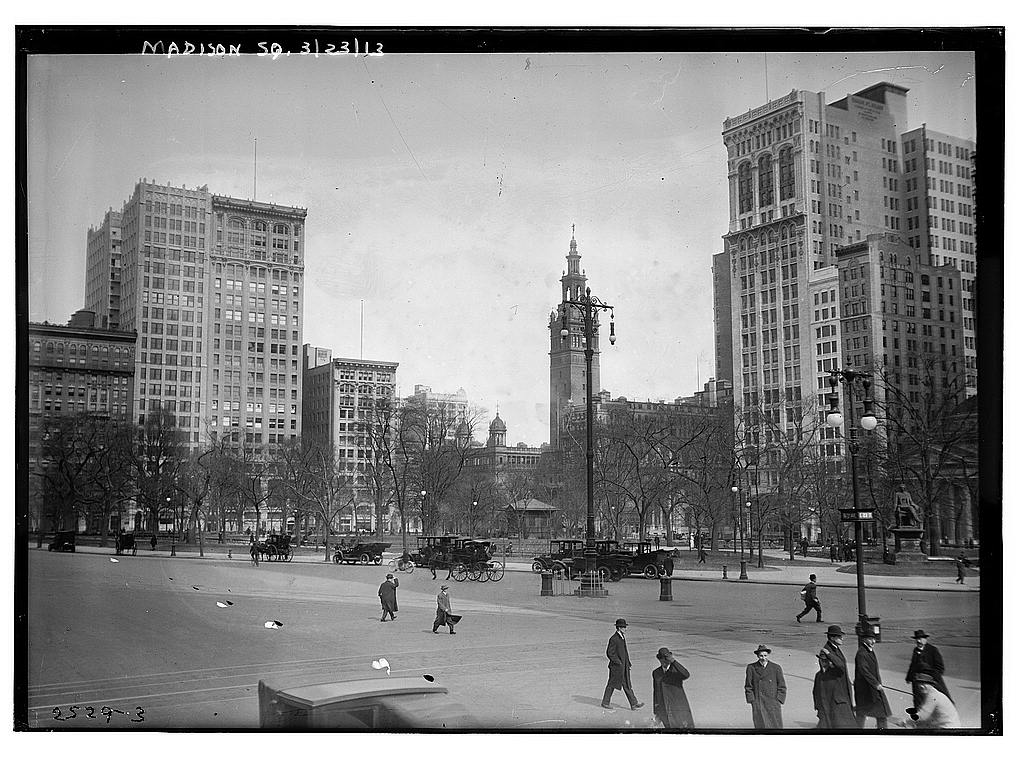
Courtesy Library of Congress

NEW YORK: CITY OF SCANDALS

#21 The Astors and the Waldorf-Astoria 

#244 The Rise of the Fifth Avenue Mansions (1893 Waldorf Hotel Opens)

#295 Saving The City: Women Of The Progressive Era (1893 Lilian Wald opens the Henry Street Settlement)

#296 Talking Trash: A History of New York City Sanitation (1894 George E. Waring Jr becomes commissioner)

#335 Pulitzer vs Hearst: The Rise of Yellow Journalism (1895 Hearst buys the New York Morning Journal)

#146 Herald Square (1894 New offices for the New York Herald)

#355 The Midnight Adventures of Doctor Parkhurst (1894 Parkhurst goes on his trip to the ‘underworld’)

#409 The Great New York City Pizza Tour (1894 New evidence of the first pizza sold in America)

#165 Ladies’ Mile (1896 Siegel-Cooper Department Store opens)

#305 Christmas in New York: The Lights of Dyker Heights (1896 Dyker Heights Club opens)

#359 The Magic of the Movie Theater (1896 The Vitascope debuts at Koster and Bial’s vaudeville house)

#378 The Ansonia: Only Scandals In The Building (1897 The Ansonia is completed)

#87 The Kings of New York Pizza (1897 Lombardi’s Pizza opens)

#47 Grants Tomb (1897 Tomb completed)

#189 TAXI: History of the New York City taxicab (1897 first electric taxis)

#71 Saks Fifth Avenue (1898 Store founded)

#150 Consolidation! Five Boroughs, One Big City (1898 Five boroughs created)

#443 Ghost Stories of the Five Boroughs

#336 The War on Newspaper Row (1898 The Spanish American War)

#101 The Bronx Zoo (1899 Zoo opens)

#251 McGurk’s Suicide Hall (1899 – McGurk’s earns its grim nickname)

#219 Newsies on Strike! (1899 Strike freezes newspaper delivery)

#290 Bagels: A New York Story (1900s First bagel unions established)

#315 Abandoned Pantheon: The Hall of Fame For Great Americans (1900 Pantheon established in the Bronx)

#159 The Broadway Musical: Setting the Stage (1901 Florodora opens)

#328: Chop Suey City: A History of Chinese Food in New York (1901 Chinese Tuxedo opens in Chinatown)

#397 Ghost Stories of the Hudson River (1901 Construction begins on Bannerman Castle)

#184 The Flatiron Building: A Story from Three Sides (1902 Flatiron constructed)

#446 Mr. Morgan and His Magnificent Library (1902 Construction begins on the Morgan Library)

#259 Crossing to Brooklyn: How the Williamsburg Bridge Changed New York (1903 Bridge opens)

#166 General Slocum Disaster 1904 

#12 Coney Island: The Golden Age (1904 Dreamland opens)

#109 New York City Subway, Part 1: Birth of the IRT

#253 Opening Day of the New York Subway (1904 — First subway opens)

#28 One Times Square (1904 New York Times opens new headquarters)

#118 Times Square (1904 – New York Times opens new headquarters)

#440 When Longacre Square Became Times Square

#352 The Birth of Black Harlem (1904 — Philip A. Payton incorporates Afro-American Realty Company)

#332 Welcome to Yorkville: German Life on the Upper East Side (19o4 Yorkville Casino Opens)

#106 Staten Island Ferry (1905 – New York takes over private ferry service)

#188 The Murder of Stanford White (1906 White is killed at MSG)

The Curious Case of Typhoid Mary (1906 Mary gets a job in Oyster Bay)
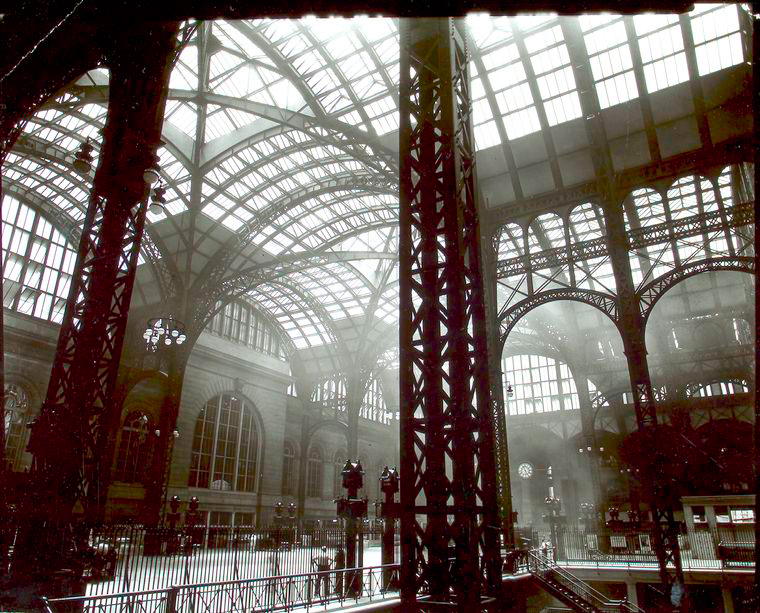
3110609116_51ac91044d_o

NEW YORK IN TRANSITION

#245 The Fall of the Fifth Avenue Mansions (1906 B. Altman’s department store opens on Fifth Avenue)

#69 The Plaza Hotel (1907 Hotel opens)

#74 The Ziegfeld Follies (1907 The first Follies)

#284 Scott Joplin in New York: A Ragtime Mystery (1907 Joplin moves to New York)

#441 The Recluse of Herald Square: The Ida Wood Mystery (1907 Ida Wood withdraws her money)

#279 A New Year in Old New York: From Times Square to Chinatown (1907 – first Times Square ball drop)

#98 Manhattan Bridge (1909 Bridge opens)

#349 The Queensboro Bridge and the Rise of a Borough (1909 Bridge opens)

#370 Tragic Muse: The Life of Audrey Munson (1909 Munson moves to New York)

#311 Uprising: The Shirtwaist Strike of 1909

#280 House of Mystery: The Story of the Collyer Brothers (1909 The Collyer family moves to Harlem)

#180 The Chelsea Piers and the Age of the Ocean Liner (1910 – Chelsea Piers constructed)

#205 The Disappearance of Dorothy Arnold (1910 – Dorothy Disappears)

The Construction of Penn Station (1910 – Penn Station opens)

#42 The Triangle Factory Fire (1911 Disaster occurs in March)

#372 The Shuberts: The Brothers Who Built Broadway (1911 The Shubert open the Winter Garden)

#17 New York Public Library (1911 Main branch opens)

#271 Counter Culture: Diners, Automats and Luncheonettes in New York (1912 — The first automat opens in NYC)

#408 The Titanic and the Fate of Pier 54 (1912 The Titanic sinks)

#399 The Changing Lower East Side: A View From Seward Park (1912 The Forward Building opens)

#147 Art Insanity: The Armory Show of 1913 (1913 — Exhibition debuts)

#110 New York City Subway, Part 2: By the Numbers (and Letters) (1913 — The Dual Contracts agreement inspired subway growth)

Harlem Nights at the Hotel Theresa (1913 — Hotel constructed)

#156 The Boy Mayor of New York (1913 – Mitchel elected mayor)

#76 Woolworth Building (1913 — Woolworth Building completed)

#249 Madam C.J. Walker: Harlem’s Hair Care Millionaire (1913 Walker opens her first salon in Harlem)

#39 New York Yankees (1913 Highlanders renamed the Yankees)

#263 Ebbets Field and the Glory Days of the Brooklyn Dodgers (1913 Ebbets Field opens)

#401: The World Before Wordle: A History of Puzzles (1913 The first crossword puzzle)

#202 The Lower East Side: A Culinary History (1914 – Russ & Daughters opens)

#226 Beauty Bosses of Fifth Avenue (1915 – Rubinstein opens her first shop)

#353 Harlem Before the Renaissance (1916 Marcus Garvey moves to Harlem)

#199 Battle For The Skyline: How High Can It Go (1916 – Zoning Law)

#197 Danger In The Harbor: The Black Tom Explosion (1916 – Explosion Occurs)

#384 Nuyorican: The Great Puerto Rican Migration (Puerto Ricans receive American citizenship)

#330 The Silent Parade of 1917: Black Unity in a Time of Crisis

#310 1918: The Story of the Harlem Hellfighters (1918 Hellfighters in France)
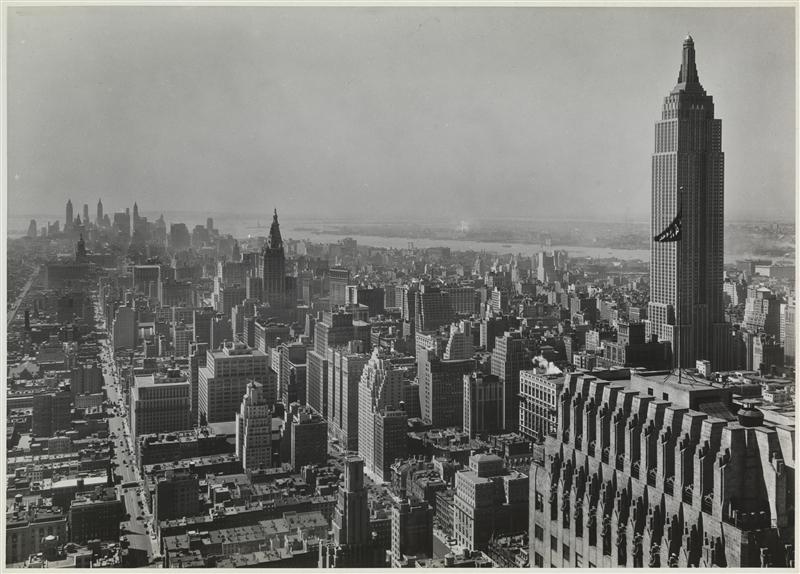
Samuel H. Gottscho, courtesy Museum of the City of New York

NEW YORK IN THE JAZZ AGE

#223 The Algonquin Round Table (1919)

#369 Last Dance at the Hotel Pennsylvania (1919 The Hotel Pennsylvania opens)

The Landmarks of Coney Island (1920 Wonder Wheel opens)

#144 Mysteries and Magicians of New York (1920 – Joseph Rinn debunks spiritualists at Carnegie Hall)

On the Radio: A History of the Airwaves (1920 – First radio station)

#18 Ghost Stories of New York City (1920 Showgirl Olive Thomas commits suicide)

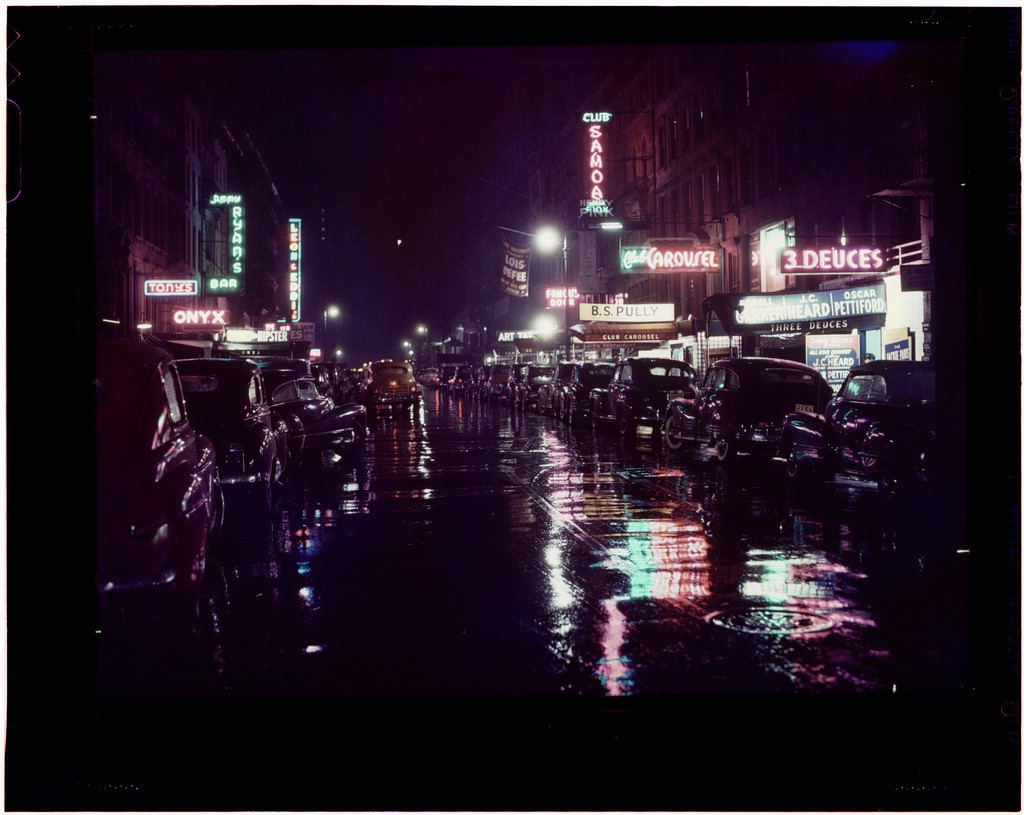
#243 New York In Neon: Signs of the City (1920s The first neon signs in NYC)

#265 Absolutely Flawless: A History of Drag in New York (1920s Harlem drag balls draw thousands of spectators)

#125 Sardi’s Restaurant (1921 – Sardi’s opens for business)

#196 Ready to Wear: A History of the Garment District (1920s – Moves from LES to Midtown)

#100 Robert Moses (1922 Robert Moses begins work on New York City parks)

#362 Gatsby and the Mansions of the Gold Coast (1922 The year The Great Gatsby is set)

#313 The Straw Hat Riots of 1922

#192 Haunted Landmarks of New York (1923 – John Campbell leases his Apartment in Grand Central)

#260 Journey to Grey Gardens: A Tale of Two Edies (1924 — The Beales move to the Grey Gardens estate)

#321 Lauren Bacall: At Home at the Dakota Apartments (1924 Betty Joan Perske is born)

#445 The Macy’s Thanksgiving Day Parade: A Century of Cheer (1924 The first parade)

#153 NYC and the Birth of Television (1925 – First television broadcast from Roosevelt Hotel)

#450 Harlem in the Jazz Age: A Renaissance in New York (1925 Unofficial start of the Harlem Renaissance)

#451 The New Yorker Magazine: Talk of the Town for 100 Years (1925 Magazine begins publication)

#174 American Kicks: A History of the Rockettes (1925 – Dance troupe founded in St. Louis)

#420 Garbo Walks: Old Hollywood in New York (1925 Greta Garbo comes to America)

#233 The Roaring ’20s: King of the Jazz Age (1926 Jimmy Walker becomes Mayor of New York

#170 The Life and Death of Rudolph Valentino (1926 – Rudolph Valentino dies)

#182 Mae West, “Sex” on Broadway (1926 – The play ‘Sex’ opens)

#307 The Holland Tunnel: The Wonder of the Jazz Age (1927 — The Tunnel opens for traffic)

#204 The Cotton Club: Aristocrat of Harlem (1927 – Duke Ellington debuts)

#234 Queen of the Speakeasies: A Tale of Prohibition New York (1928 Texas Guinan arrested for operating a speakeasy)

#363 The Sunny Saga of Jones Beach (1929 Jones Beach is built)

#278 Newark vs. LaGuardia: A Tale of Two Airports (1929 Newark Airport opens)

#314 Tillie Hart: The Holdout of London Terrace (1929 Tillie holds out!)

#383 The Temple on Fifth Avenue (1929 The new Temple Emanu-El opens near Central Park)

#235 The Crash of ’29: New York In Crisis (1929 stock market crashes)

#427 The Chrysler Building and the Great Skyscraper Race (1930 Building completed)

#162 George Washington Bridge (1931 – GWB opened)

#209 The Waldorf-Astoria’s Complicated History (1931 Hotel opens)

#250 The Empire State Building: Story of an Icon (1931 Empire State Building opens)

#377 The Rockefeller Center Christmas Tree (1931 The first Rockefeller Center Christmas tree)
5268914553_ca77a01af0_o

NEW YORK DURING THE DEPRESSION

#44 Rikers Island (1932 Jail opens)

#27 Radio City Music Hall (1932 Opening night)

#337 Robert Moses and the Art of the New Deal (1933 The first programs of the New Deal enacted)

#55 The Evolution of Central Park (1934 New York Parks Department created)

#15 The Apollo Theater (1934 Vaudeville house becomes the Apollo)

#53 Glamour and Gore: The Meatpacking District (1934 Elevated railway opens)

#135 The High Line (1934 Elevated railway opens)

#136 High Line Walking Tour (1934 Elevated railway opens)

#442 Urban Legends of New York City (1935 First alligator seen in the sewer)

#455 House of Beauty: The Story of the Frick Collection (1935 Frick Collection opens to the public)

#56 Randall’s Island (1936 Jesse Owens wins the Olympic trials)

#338 A New Deal For New York: Murals, Music and Theatrical Mayhem (1936 Orson Welles stages ‘Voodoo Macbeth’)

#227 The Hindenburg Over New York (1937 The zeppelin crashes in New Jersey)

The Secret Origin of Comic Books (1938 – Action Comics debuts)

#96 The Cloisters and Fort Tryon Park (1938 – Cloisters Museum opens)

#364 The Very Gay History of Fire Island (1938 – The Great Hurricane of 1938 prompts rebuilding)

#459 Moses vs. Bard: The Battle for Castle Clinton (1939 Moses proposes a bridge)

#49 LaGuardia Airport and Early New York Flight (1939 New York Municipal Airport opens)

#288 The World of Tomorrow: The New York World’s Fair of 1939

#72 Rockefeller Center (1939 Opens to the public)

#176 Billie Holiday’s New York (1939 – Billie Holiday sings “Strange Fruit”)

#424 Kosciuszko! The Man. The Bridge. The Legend. (1939 The original bridge opens)

#24 The Copacabana (1940 Club opens)

#345 LaGuardia’s War on Pushcarts (1940 Essex Street Market opens)

#411 Miss Subways: Queens of the New York Commute (1941 First winner announced)

#404 Nighthawks and Automats: The World of Edward Hopper (1942 Hopper paints Nighthawks)

#247 Rodgers and Hammerstein: The Golden Age of Broadway (1943 Oklahoma! opens on Broadway)

#381 The Wonderful Home of Louis Armstrong (1943 The Armstrongs move to Corona, Queens)

#423 Leonard Bernstein’s New York, New York (1943 Bernstein conducts with the New York Philharmonic for the first time)

NEW YORK POST-WAR

#13 Coney Island: 20th Century Sideshow (1944 Luna Park damaged in fire)

#154 New York in the Golden Age of Television (1947 – Howdy Doody first broadcast

#303 Building Stuyvesant Town (1947 First apartments opened)

#124 Idlewild/JFK Airport (1948 — New York International Airport opens)

#246 Tales from a Tenement: Three Families on the Lower East Side (1950s — The Epsteins move to Orchard Street)

#412 The New York Parking Wars (1950 Street parking legalized with alternate-side parking rules)

#299 The Promenade and Preservation of Brooklyn Heights (1950 Promenade opens)

#306 Just Desserts: The Origins of New York Cheesecake, Cannoli and More (1950 Junior’s opens for business)

#20 United Nations Headquarters (1952 Building Completed)

Two Stories of Historic Vaccines: The End of Polio and Smallpox (1953 Salk discovers the polio vaccine)

#85 Shakespeare in the Park (1954 — Festival founded by Joe Papp)

#398 Marilyn Monroe in New York (1954 Monroe moves to New York)

#416 Creating the East Village 1955-1975 (1955 Third Avenue El comes down in the Lower East Side)

#67 Guggenheim Museum (1959 — Upper East Side museum opens its doors)

#218 LincolnCenter and West Side Story (1959 — Groundbreaking and construction begins)

#77 Freedomland U.S.A.: New York’s Weirdest Theme Park (1960 – Park opens in the Bronx)

#61 Pan Am Building (1960 Construction begins)
RADICAL NEW YORK

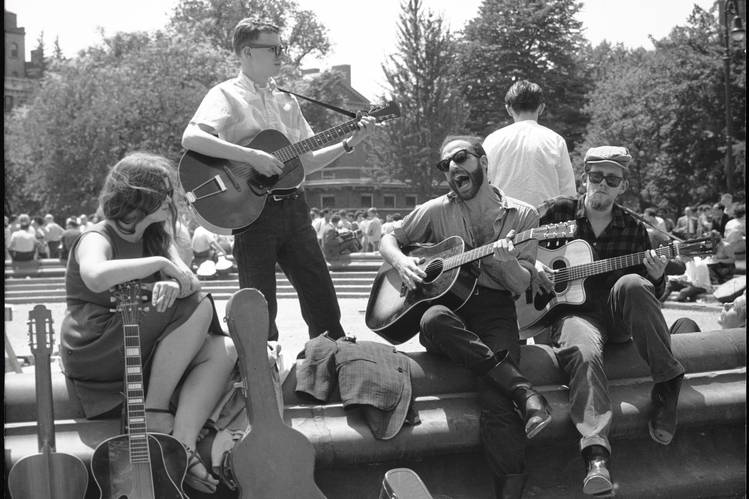
#287 Greenwich Village in the 1960s

#200 Jane Jacobs: Saving the Village (1961 – The Death and Life of Great American Cities)

#447 Bob Dylan’s Greenwich Village (1961 Dylan arrives in New York)

#405 Mona Lisa at the Metropolitan Museum (1962 Mona Lisa visits New York)

 The Destruction of Penn Station (1963 — Penn Station demolished)

#277 The New York Comedy Scene: A Marvelous History (1963 — Budd Friedman opens The Improv)

#33 The World’s Fair of 1964-65 (1964 World’s Fair opens)

#402 Treasures from the Worlds Fairs (1964 World’s Fair opens)

#346 The Beatles Invade New York (1964 Beatles arrive at JFK Airport)

#119 The Verrazano-Narrows Bridge (1964 – Bridge opens)

#173 Ruins of the World’s Fair: New York State Pavilion (1964 – World’s Fair opens)

#62 Shea Stadium (1964 – Stadium opens)

#309 What Gets Saved? Landmarks and Historic Districts Explained (1965 New York’s landmark law is enacted)

#292 Sip-In At Julius’: Gay New York in the 1960s (1966 Mattachine Society engages in the ‘sip in’)

#217 Truman Capote’s Black And White Ball (1967 Ball is held at the Plaza Hotel)

#380 Dorothy Parker’s Last Party (1967 Dorothy Parker dies)

#155 Sesame Street to Seinfeld: NYC TV 1969-2013 (1969 – Sesame Street on the air)

#231 The Stonewall Riots (1969 Riots erupt in the early morning hours)

#236 Times Square in the 1970s (1970)
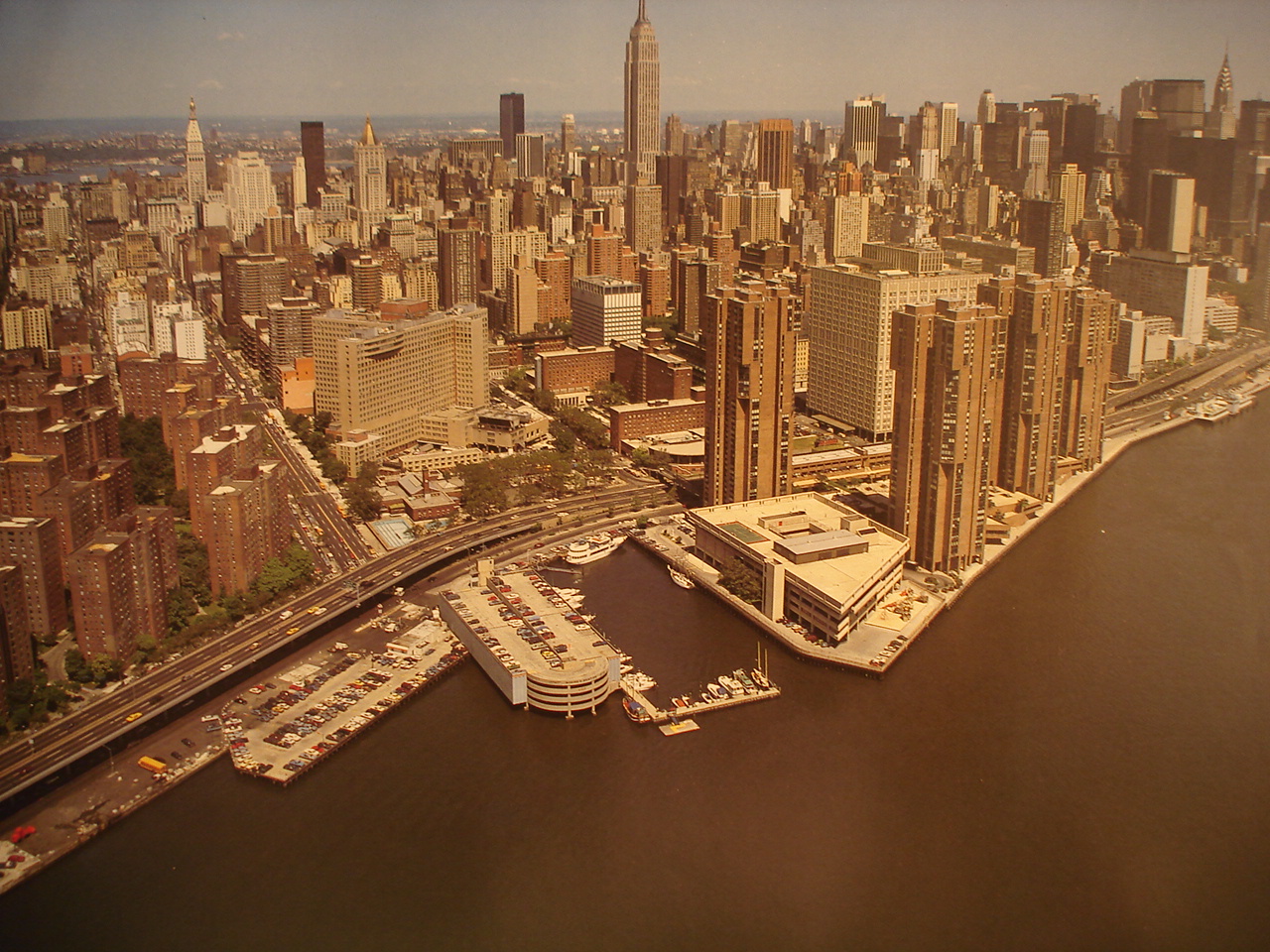
Waterside Plaza, 1974.

NEW YORK IN THE MODERN ERA

#68 New York City Marathon (1970 The first marathon)

#350 The World Trade Center in the 1970s (1973 Both towers open)

#104 CBGB & OMFUG (1973 Hilly Kristal opens club)

#438 The Ramones at CBGB: Revolution on the Bowery

#457 FORD TO CITY: DROP DEAD (1975 Infamous New York Daily News headline)

#43 Studio 54 (1977 Disco opens)

#5 Blackout (1977 Blackout occurs)

#214 Bronx Trilogy: The Bronx Was Burning (1977 Game 2 of the World Series at Yankee Stadium)

#255 The Rescue of Grand Central (1978 The fate of Grand Central heads to the Supreme Court)

#248 Sitting Down with Roz Chast (1978 Chast begins working at the New Yorker)

#417 Walking the East Village 1976-1996 (1978 Club 57 opens)

#123 TRUMP (1978 — Trump develops Grand Hyatt Hotel)

#210 Digital City: New York and the World of Video Games (1978 Space Invaders takes New York by storm)

#111 Subway Graffiti 1970-1989 (1980s – Koch cracks down on subway graffiti)

#151 The Limelight: Church, Nightclub and Mall (1983 Limelight Club opens)

#319 The Tale of Charging Bull and Fearless Girl (1987 Charging Bull created)

#393 Capturing History: An Interview With Ric Burns and James Sanders (1999 New York: A Documentary Film debuts)

Hurricane Sandy Update (2012)

#175 Bowery Boys 2014 Year In Review (2014)

#229 LIVE IN BROOKLYN! The Bowery Boys: Ten Years of Podcasting (2017)

#391 A Walk Through Little Caribbean

#413 The New Storytellers: Landmarks, Diners and Everyday New Yorkers

#444 New York’s Classic Mom-and-Pop Shops (with New York Nico)

#448 Inside the Memory Palace with Nate DiMeo

#453 All The Beauty In The World: Guarding the Met with Patrick Bringley

#456 Walking New York: Manhattan History on Foot with Keith Taillon
Categories
American History New Amsterdam Podcasts

How Wall Street Got Its Name: Stories from New Amsterdam and Early New York

Wall Street, today a canyon of tall buildings in New York’s historic Financial District, is not only one of the most famous streets in the United States, it’s also a stand-in for the entire American financial system.
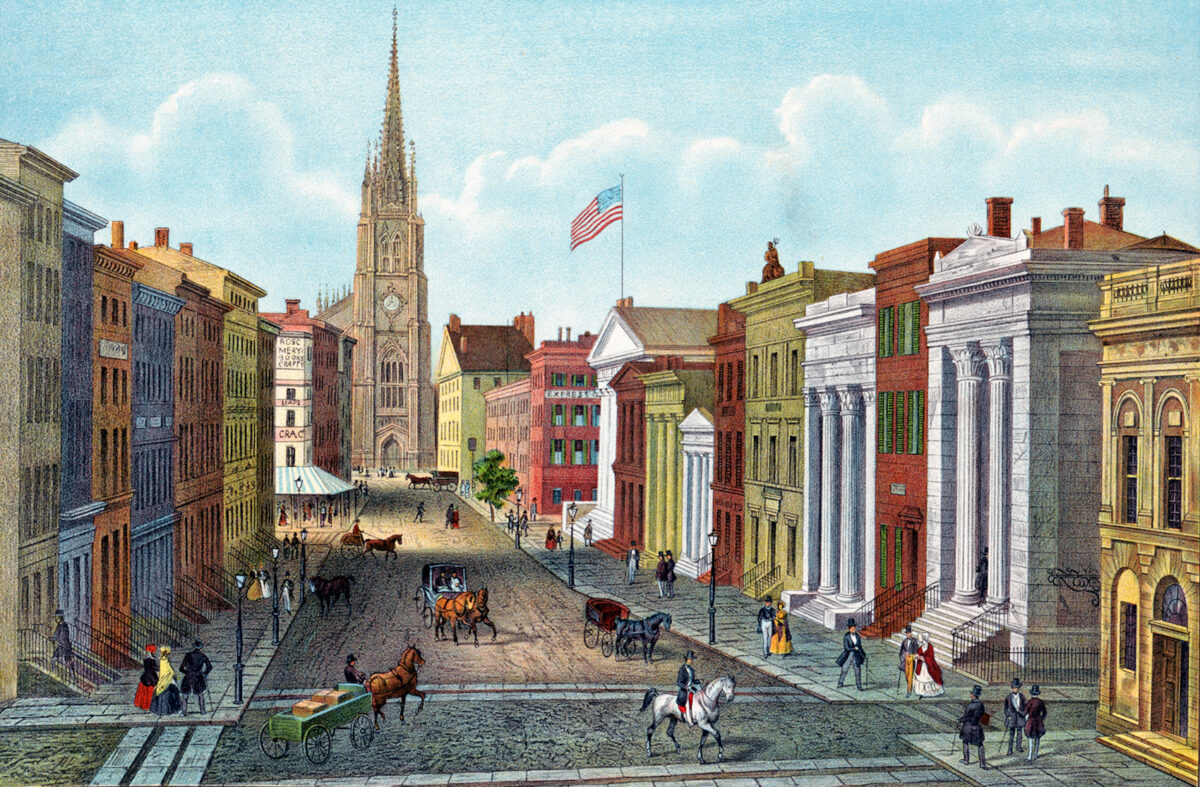
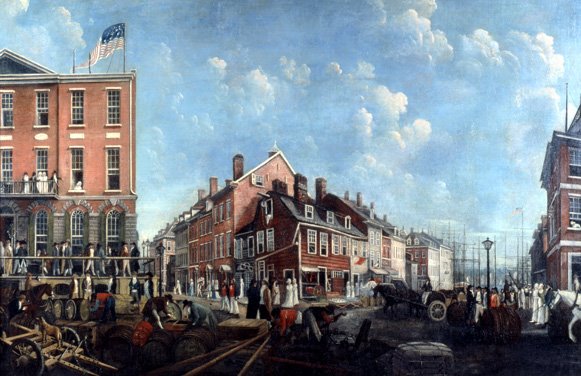
Wall Street in 1847, German artist Augustus Köllner, from lithograph by Laurent Deroy

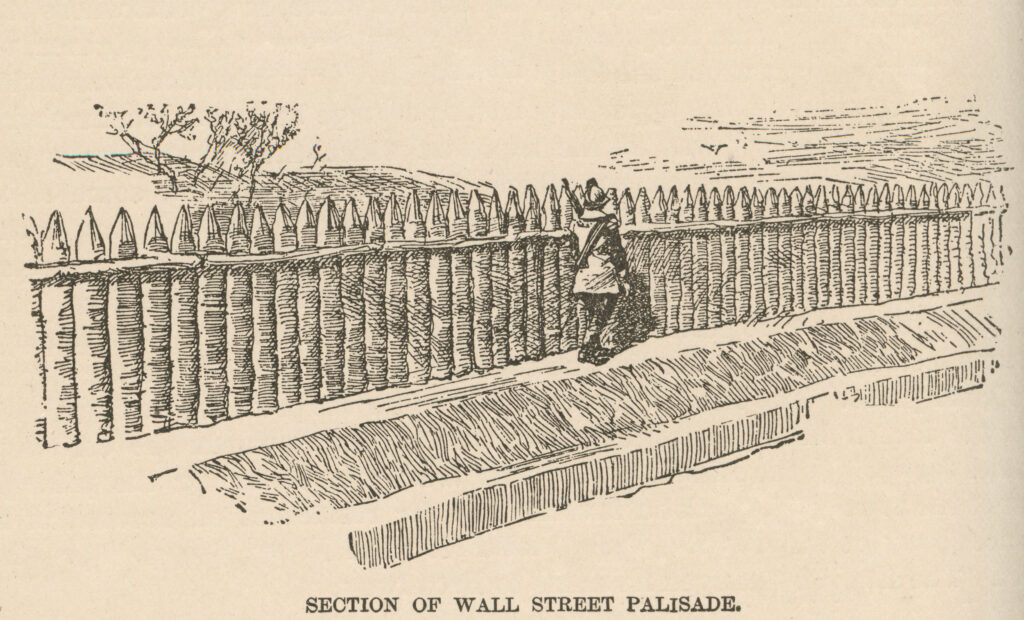
One of the first facts you learn as a student of New York City history is that Wall Street is named for an actual wall that once stretched along this very spot during the days of the Dutch when New York was known as New Amsterdam.

The particulars of the story, however, are far more intriguing. Because the Dutch called the street alongside the wall something very different.

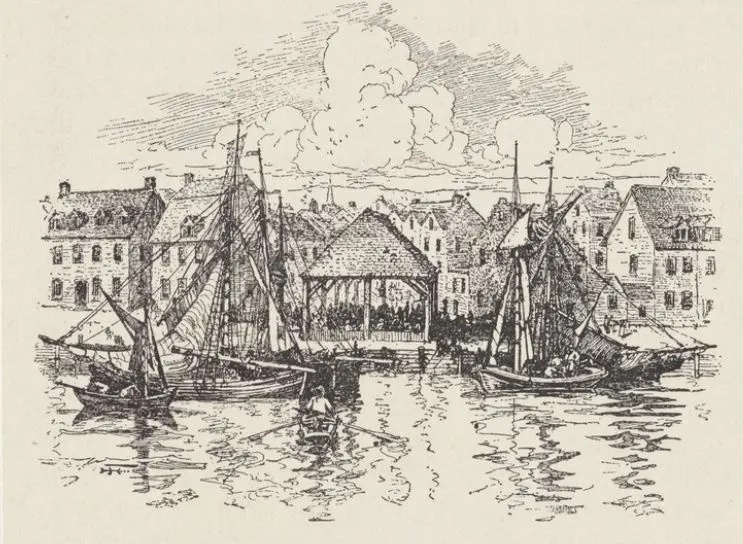
During the colonial era, the wall was torn down and turned into the center of New York life, complete with Trinity Church, City Hall and a shoreline market with a disturbing connection to one New York’s financial livelihoods — slavery.
So how did this street become so associated with American finance? The story involves Alexander Hamilton, a busy coffee house and a very important tree.
LISTEN NOW: HOW WALL STREET GOT ITS NAME


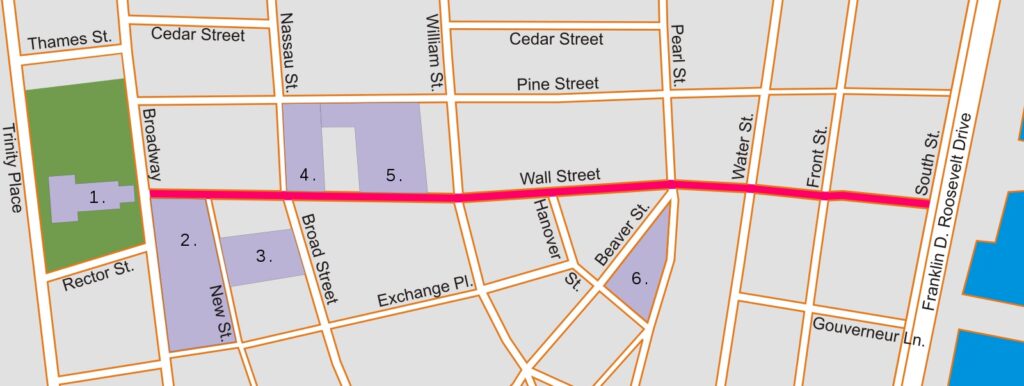
Map courtesy Wikimedia Commons: Featured on the map 1) Trinity Church 2) Bank of New York Building 3) NY Stock Exchange 4) Federal Hall 5) Trump Building 6) Cocoa Exchange
The slave market was where the “Meal Market” is marked on the map.
From Our Firemen: A History of the New York Fire Departments. Augustine E. Costello, 1887
The Wall Street market which featured a slave market in 1711

FURTHER LISTENING:

After listening to the show about Wall Street, check back into these prior episodes for further adventures relating to this story.


Other great things to read: Start with this excellent five-part deep dive by Michael Lorenzini from the NYC Department of Records & Information Services about New Amsterdam streets and the origin of the name. The brilliant James Nevius wrote about the history of Wall Street for Curbed. Mapping the African American Past holds excellent resources about the 1711 slave market. And a visit to the New Netherland Institute is always a worthy use of your time.

On this website you can read articles about Federal Hall, Charlie Chaplin on Wall Street, the Wall Street bombing of 1920 and this rather interesting article about Peter Stuyvesant and drinking alcohol.


This podcast is inspired by the article below, which ran in 2017 (and was itself based on an earlier article on this website).

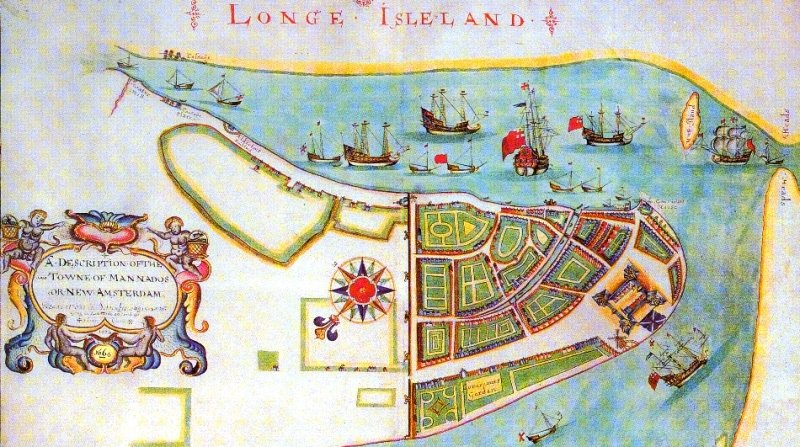
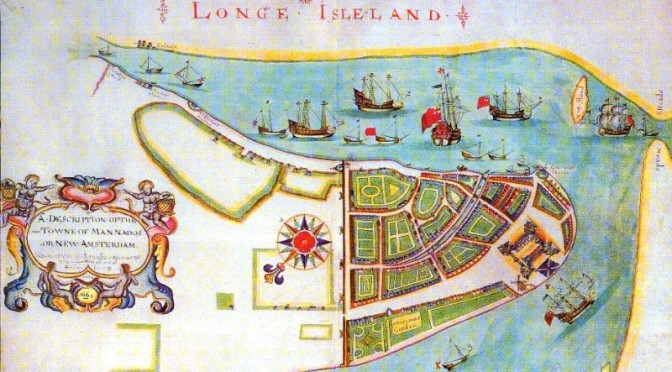
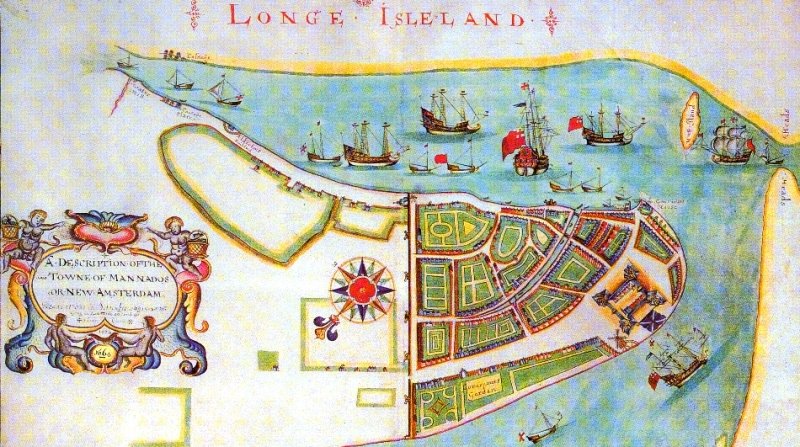
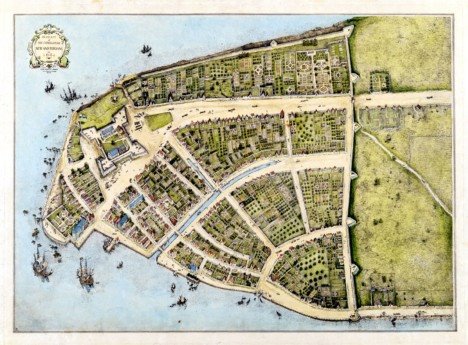
A simplistic but colorful view of “Man Mados” or “New Amsterdam” in 1664 (click in to inspect the detail)

There was most definitely a walled fortification nearby on New Amsterdam’s northern boundary, and it certainly did stretch along about the same area as Wall Street does today.

But the present name seems to be a formation of mixed meanings that only a tangle of languages and hundreds of years of history can create. The Dutch themselves referred to an actual street alongside the waterfront that ran up to and alongside the wall as the ‘Cingel’ — according to old history, meaning “exterior, or encircling, street.”

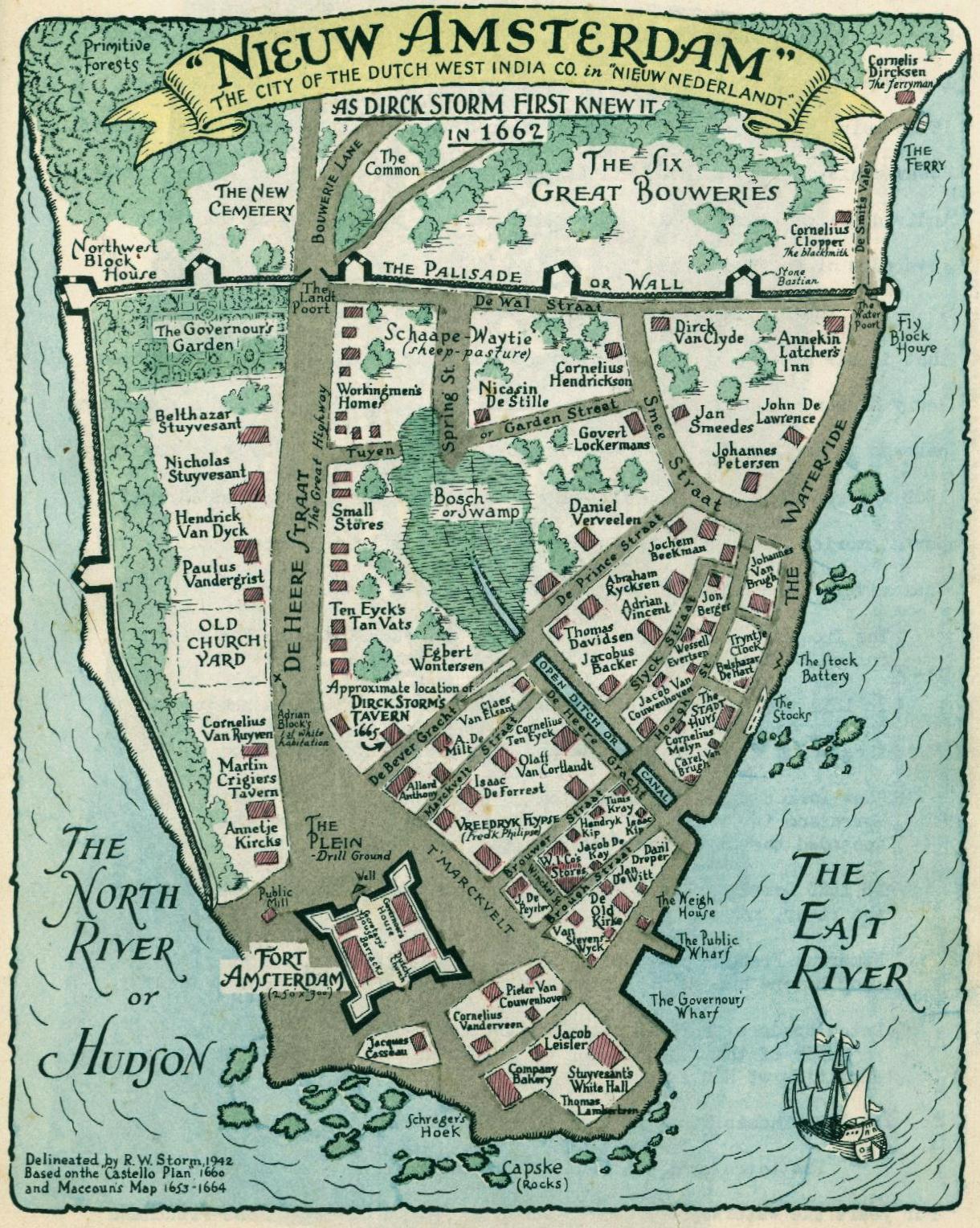
This festive illustration from 1949, created for Old Dirck Storm’s Book, takes some liberties with the names and streets of New Amsterdam. For instance it applies De Wal Straat as the name of the street next to the wall. See this week’s show for how this confusion came to be.

But ‘De Waal Straat’, as it was also known, was also the center of a small Walloon community in New Amsterdam, and some believe the name comes from them. The Walloons were French-speaking Belgians who were among the first European settlers, arriving in the New World as part of a contingent hired by the Dutch West India Company.

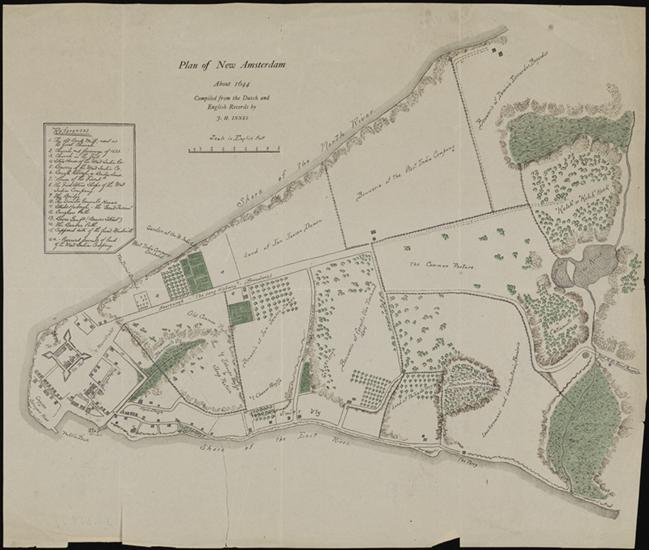
A map of New Amsterdam, indicating the layout from about 1644, well before a wall was constructed.

MCNY

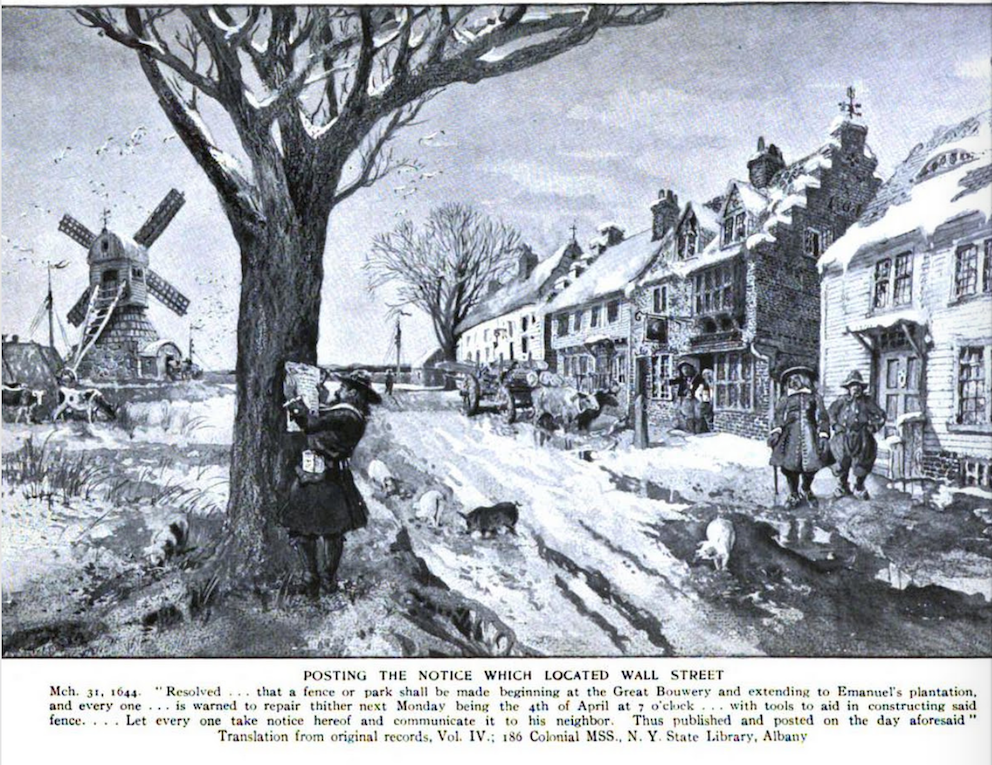
The real reasons for New Amsterdam building its famous wall are also up for grabs. It’s commonly held that an original wooden palisade was erected in 1644 in defense of Indian attacks, and certainly, the residents of New Amsterdam did their part to rile the anger of the native landowners.

Below: A fanciful illustration from Harper’s Magazine, 1908, imagining New Amsterdam and the construction of the original ‘wall’.

But the Dutch had been living at the tip of Manhattan for over 25 years by the time the sturdier wall was built in 1653. In truth, it was commissioned to keep out a different sort of enemy.

You’ll be pleased to know that director-general Peter Stuyvesant was the man who ordered the construction of the wall — in his words, “to surround the greater part of the city with a high stockade and small breastwork” — to replace the inadequate wooden barrier that had previously marked the city’s northern border.

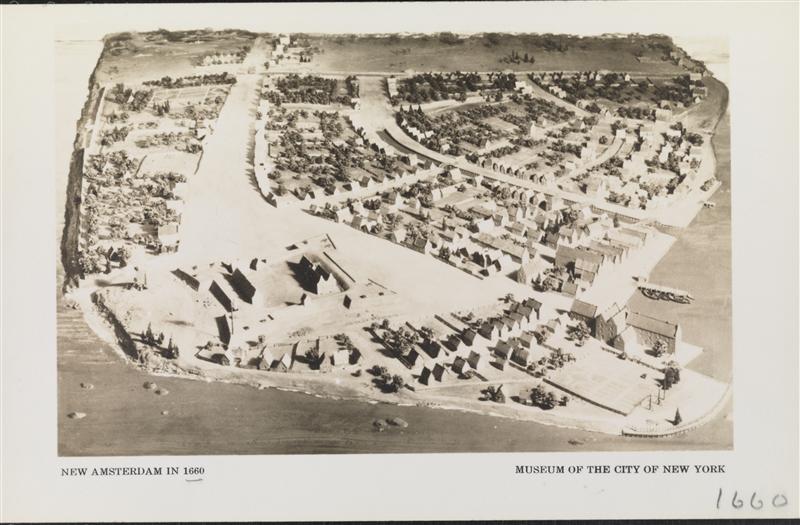
A model of New Amsterdam made in 1933, clearly showing how sudden the city borders stopped thanks to the wall.

MCNY

This was an incredibly important year for New Amsterdam in two respects. In February 1653, New Amsterdam was chartered as an official Dutch city.

Although Stuyvesant was quite against the outpost receiving such official recognition, he eventually took advantage of it, appointing the first town council himself rather than putting it up to such trivial inconveniences as elections.

But in 1653, the tides of the motherland spilled onto their shores as the war between England and the Netherlands threatened the remote and undefended new city.

The Dutch intended to launch ships from New Amsterdam harbor in a battle against the English.

As a result, the English colonies up north were sure to retaliate, either by sea or, feared Stuyvesant, over land, possibly teaming with hostile Indian forces, down through undefended Manhattan island.

Essentially, the wall that helped give us Wall Street was built because Stuyvesant feared attacks not just from Indian tribes, but from the European colonies of Connecticut, Massachusetts and New Haven!

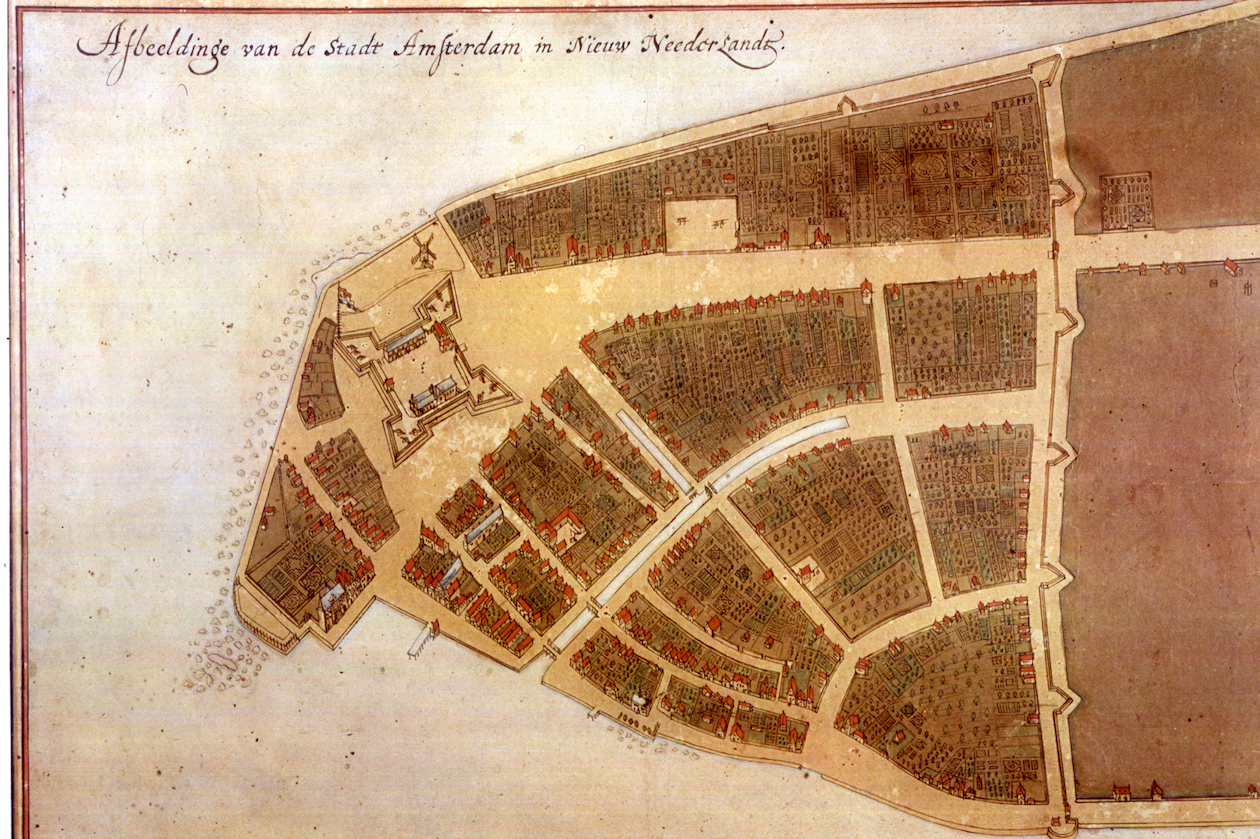
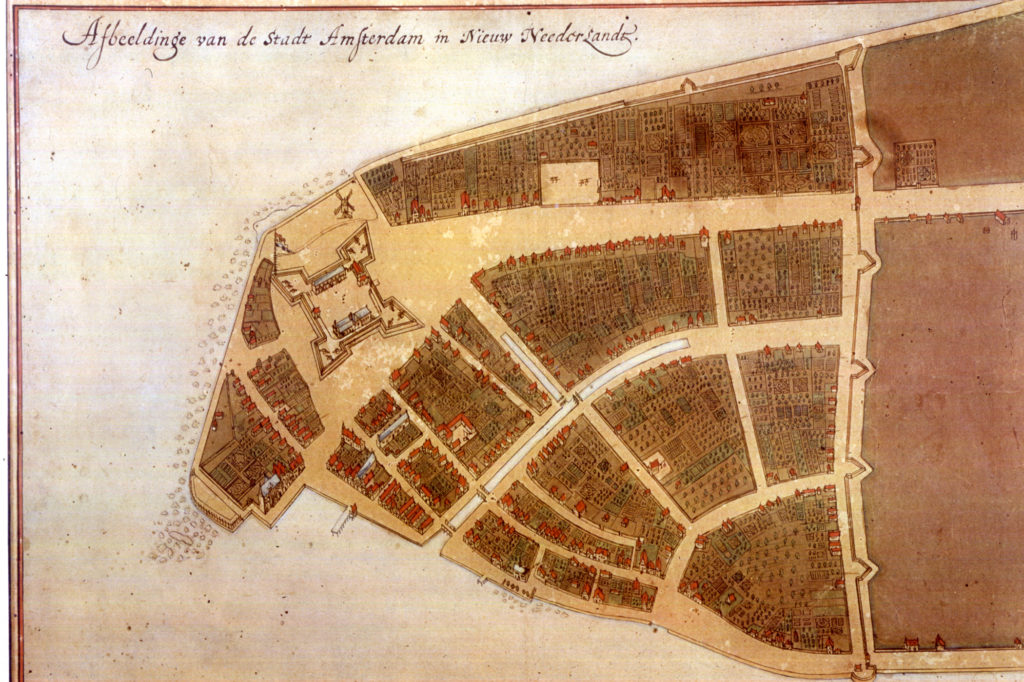
Looking at this more well-known map of New Amsterdam – the Costello Plan of 1660 — one can see the two gates very clearly.

Stuyvesant called upon the 43 richest residents of New Amsterdam to provide funding to fix up the ailing Fort Amsterdam and to construct a stockade across the island to prevent attacks from the north, while it took New Amsterdam’s most oppressed inhabitants — slave labor from the Dutch West India Company — to actually build the wall.

The barrier was constructed out of earth, rock, and 15 feet timber planks sold to the Dutch, ironically enough, by the “notorious“ Englishman Thomas Baxter. In a turnabout that one would expect from hiring your enemy, Baxter later led a group of “Rhode Island marauders“ and pirated Dutch fishing ships.

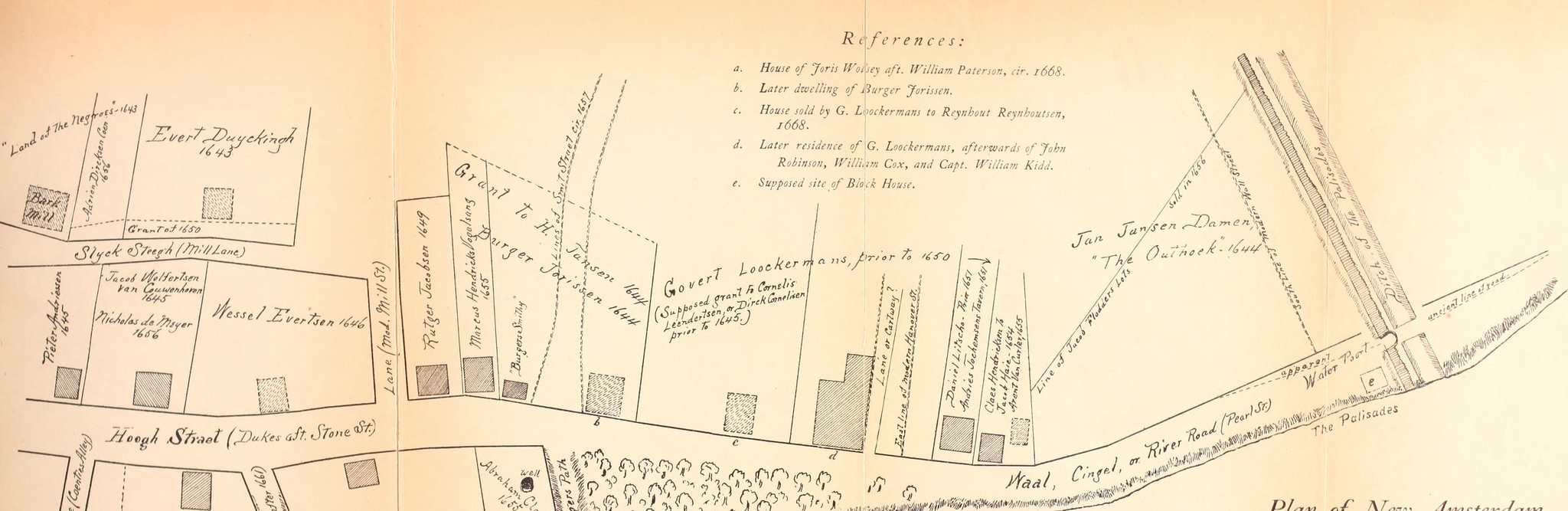
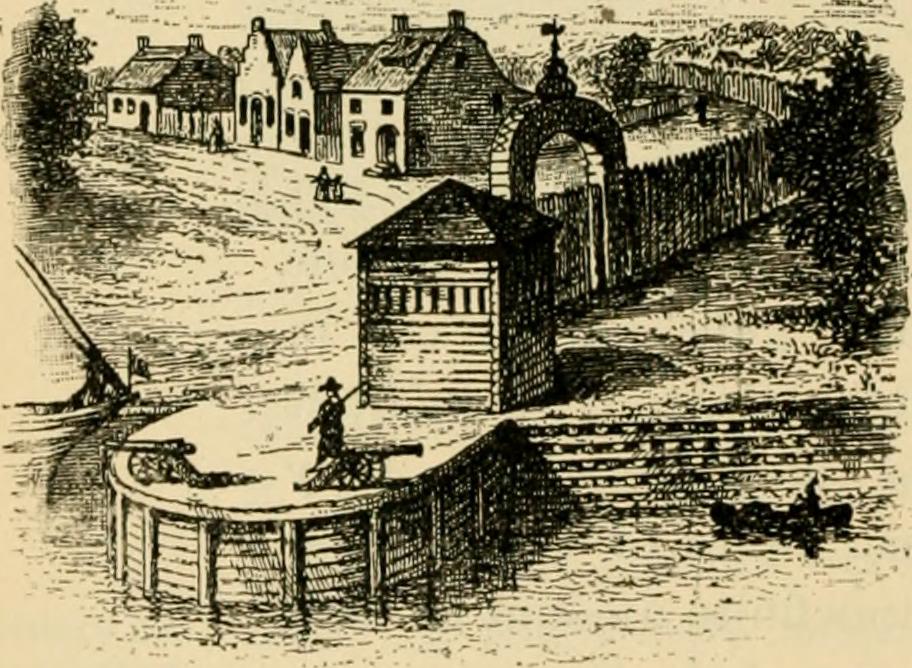
Early in the 1660s, the Dutch upgraded its wall to include brass cannons and two sturdy gates — one at today’s intersection of Wall and Broadway (for land), the other at Wall and Pearl Street (according to an early account, a water gate and access to a ‘river road’).

Below: A detail from a map of New Amsterdam’s eastern side, clearly showing the water gate, and an illustration from 1908 of that eastern gate:

Internet Archives Book Images

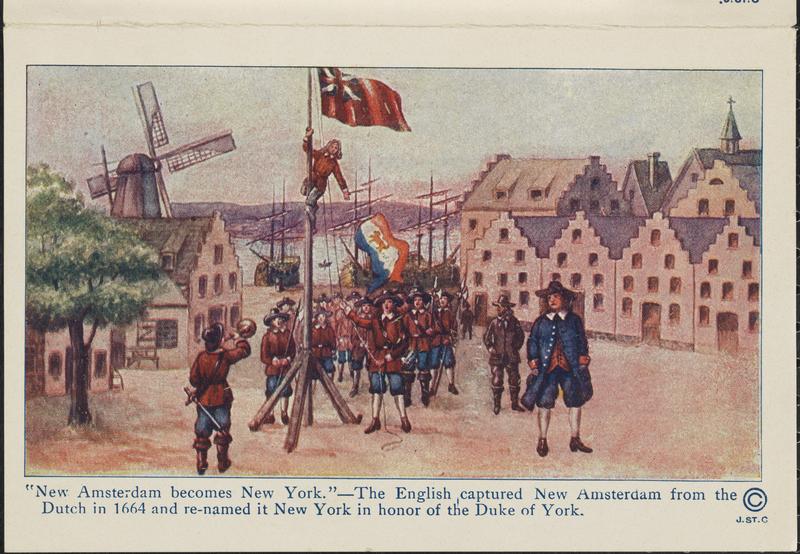
The British took over New Amsterdam in 1664 and renamed it New York, but the wall still remained, becoming more a relic than a serious defense.

By the turn of the century, the fear of land attacks had almost completely subsided and the city was beginning to feel crowded. So in 1699, the wall was torn down with some of the material salvaged to help construct a new City Hall at the corner of Nassau Street and the newly christened Wall Street.

In 1711 a slave market was built on Wall Street along the eastern shore, remaining there until 1762.

When the British were forced out in 1783 by the Americans, the City Hall building was finally renamed Federal Hall — the first official center of American government.

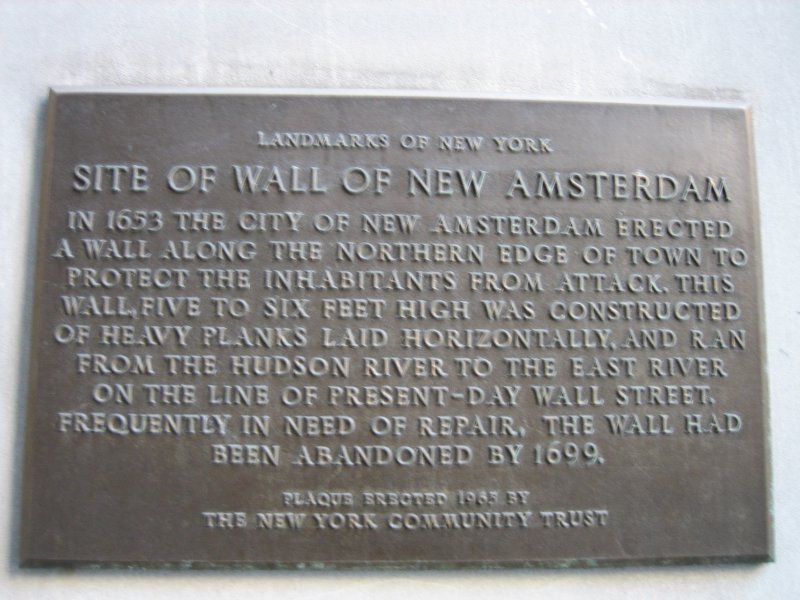
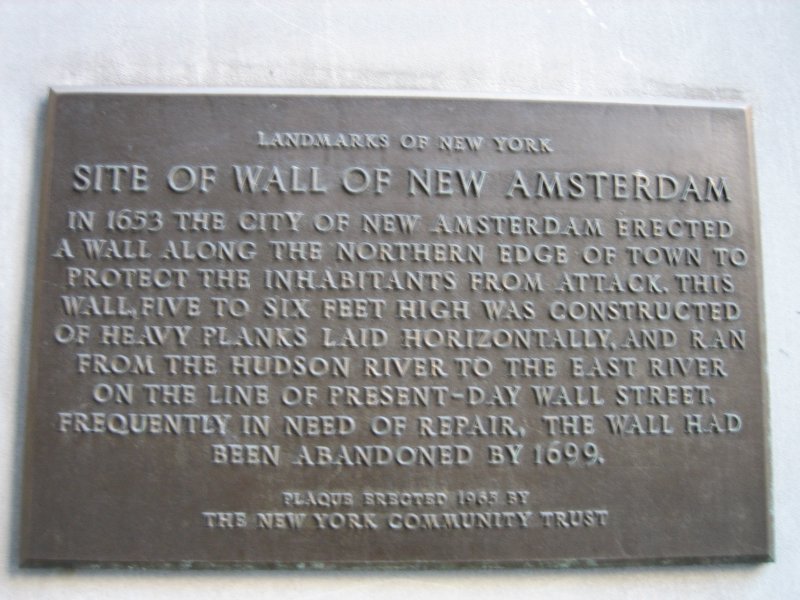
A plaque honoring the old wall sits today at the corner of Wall and Broadway, where the gate to the city once opened:

Categories
American History

Remembering the Wall Street bombing of 1920

On a usual day, lunchtime down on Wall Street today is chaotic mess of brokers and bankers on cell phones, tour groups, messengers on bikes, police officers, construction workers, people delivering lunch and perhaps a stray older lady walking her dog.

One hundred years ago today, in 1920, it would have practically been the same, sans the cell phones.

So it’s particularly disturbing how easy it is to imagine the noontime scene on September 16, 1920.

In fact, most of the surroundings — the Stock Exchange, the Sub-Treasury building (today’s Federal Hall), and most importantly J.P. Morgan‘s headquarters on 23 Wall Street — are still very much active.

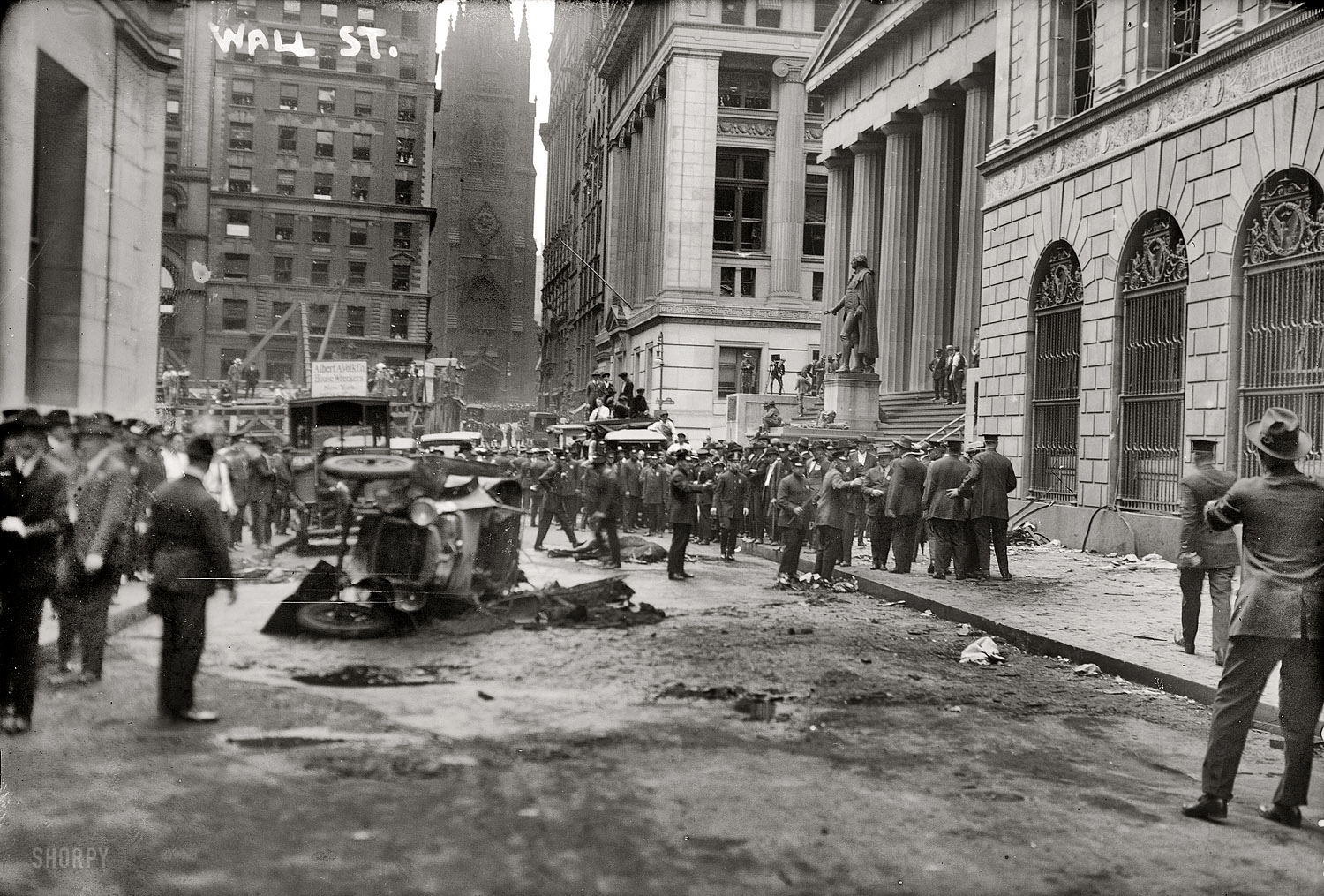
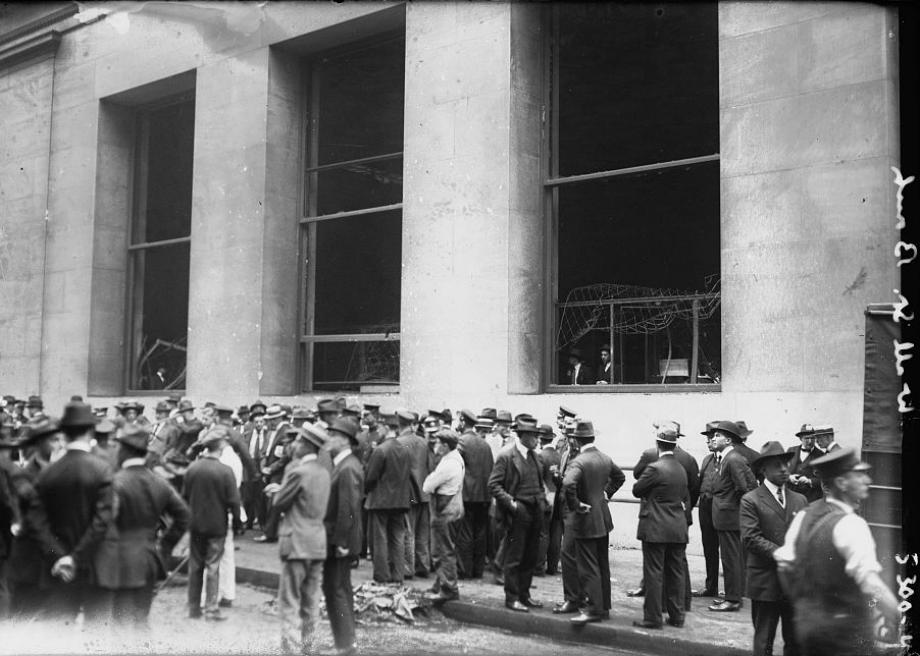
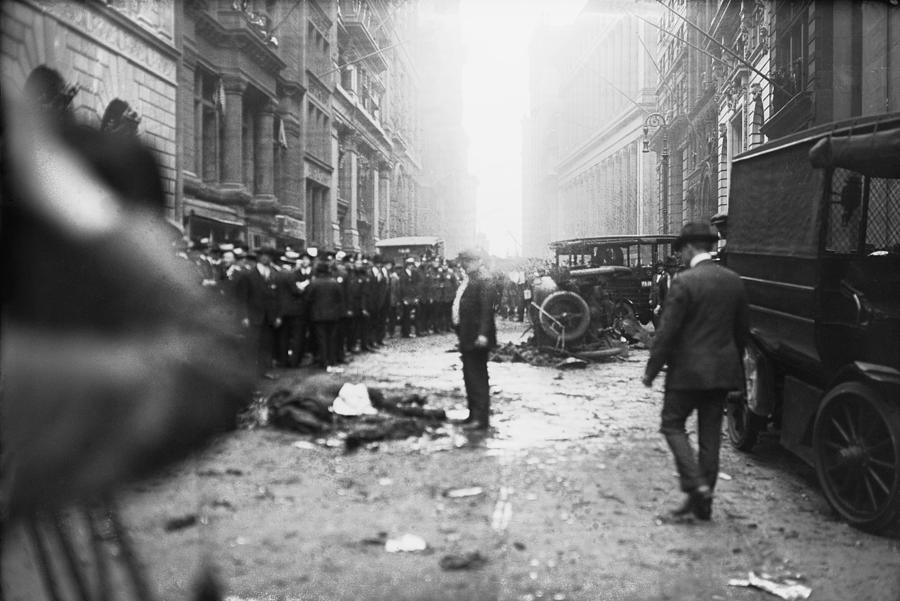
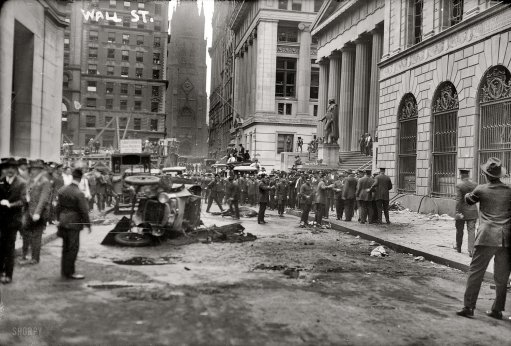
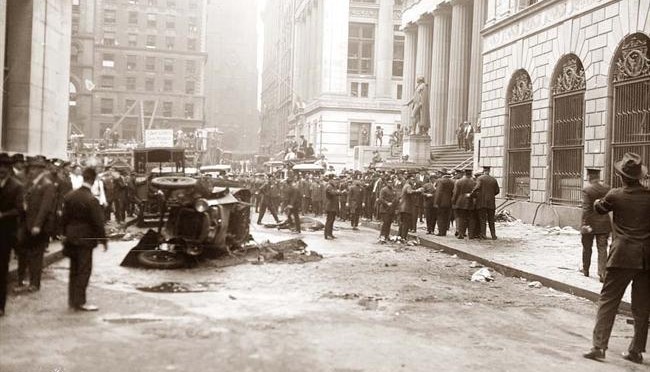
Courtesy Shorpy
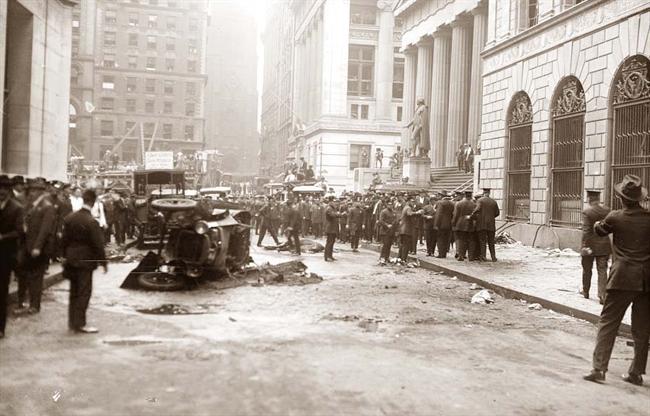
Courtesy Shorpy

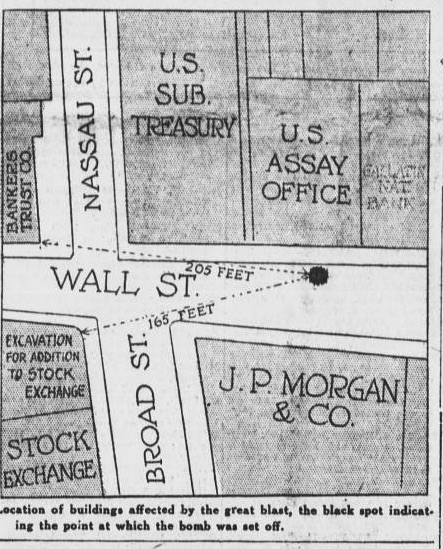
An unidentified man led a horse and carriage down the congested street, fighting to get past crowds, until it rested at the corner about 100 feet east of Broad Street. As the Trinity Church bells rang, the man dropped the reins and fled, never to be seen again.

One minute later, the wagon exploded with 100 pounds of dynamite, eradicating everything in its sphere, then sending dozens of iron slugs through the air to create a horrific scene of carnage.

From the Sun and New York Herald

The best way to really tell this story is to quote a few contemporary accounts from the New York newspapers. NOTE: Some of the accounts are quite graphic.

A 22-year-old woman named Ella Parry survived and was interviewed by the Evening World:

“The glass of our windows fell into the office and the ceiling fell all about us. Where I had just been sitting was covered with heavy plaster. I did not wait to get my hat, but with others rushed into the street.

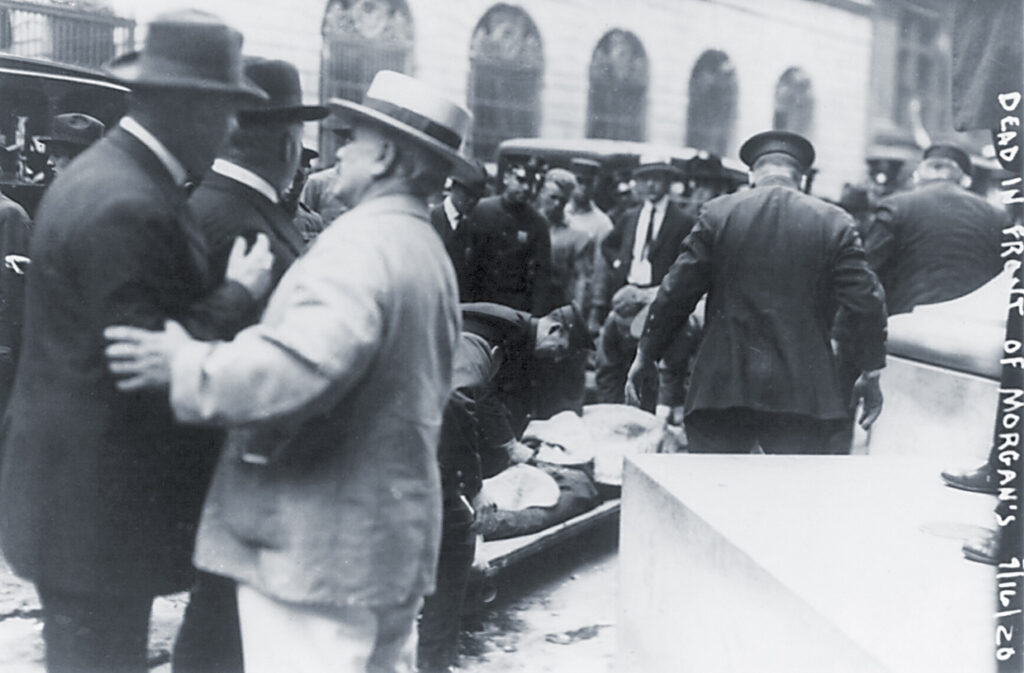
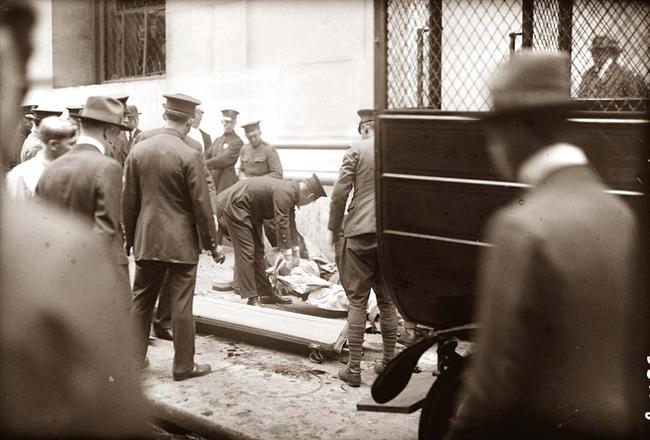
There were not less than a dozen dead persons on the sidewalk in front of tour building and the Sub-Treasury. Some of them had their faces almost completely blown off and their clothing had either been blown from their bodies or burned off. The police threw sheets over the bodies as fast as they could get them.”

Courtesy Museum of the City of New York

From a lawyer named Daniel Nugent who was standing near the site of the explosion:

“I was just about to enter the Morgan Building when the concussion knocked me down on the sidewalk. I arose after I had collected my thoughts and saw broken glass covering the street. All about me men and women were lying bleeding.

Above fifty feet down Wall Street there was an auto in a mass of flames. Across the street from it there was a shattered wagon and a horse lying dead. I saw several men cut almost in half from the large plate glass which fell from the building.”

Courtesy Library of Congress

From the New York Tribune:

“Not a sound pane of glass remained in the Morgan Building. Screens of copper mesh which were set inside the windows were bent and twisted but had fulfilled their mission of protecting those within.

Fragments of the glass dome above the main office lay on the floor, and one of these, or some similar bit of falling debris, is believed to be responsible for the single death that occurred there. The streets were covered with broken glass, some of it finely powdered, like sugar.

The heroic statue of Washington on the steps of the Sub-Treasury was not so much as scratched by the explosion, and stood firmly, with hand outstretched in a quelling gesture.”

the-wall-street-bombing-a-man-stands-everett

One unusual story of bravery emerged the following day. A teenage office boy named James Saul grabbed a random automobile and began driving injured victims to the local hospital. Fearing the owner of the automobile was among the injured, he then drove the car to a police station.

By the end of the day, 38 people would be dead from the attack, many while sitting at their desks. (An additional man with a “nervous condition” would take his own life due to the event, making the total 39.) And over 400 more would be injured.

According to the New York Times: “The scene at the Morgue last night [located] resembled in many respects the night of the [General] Slocum disaster.

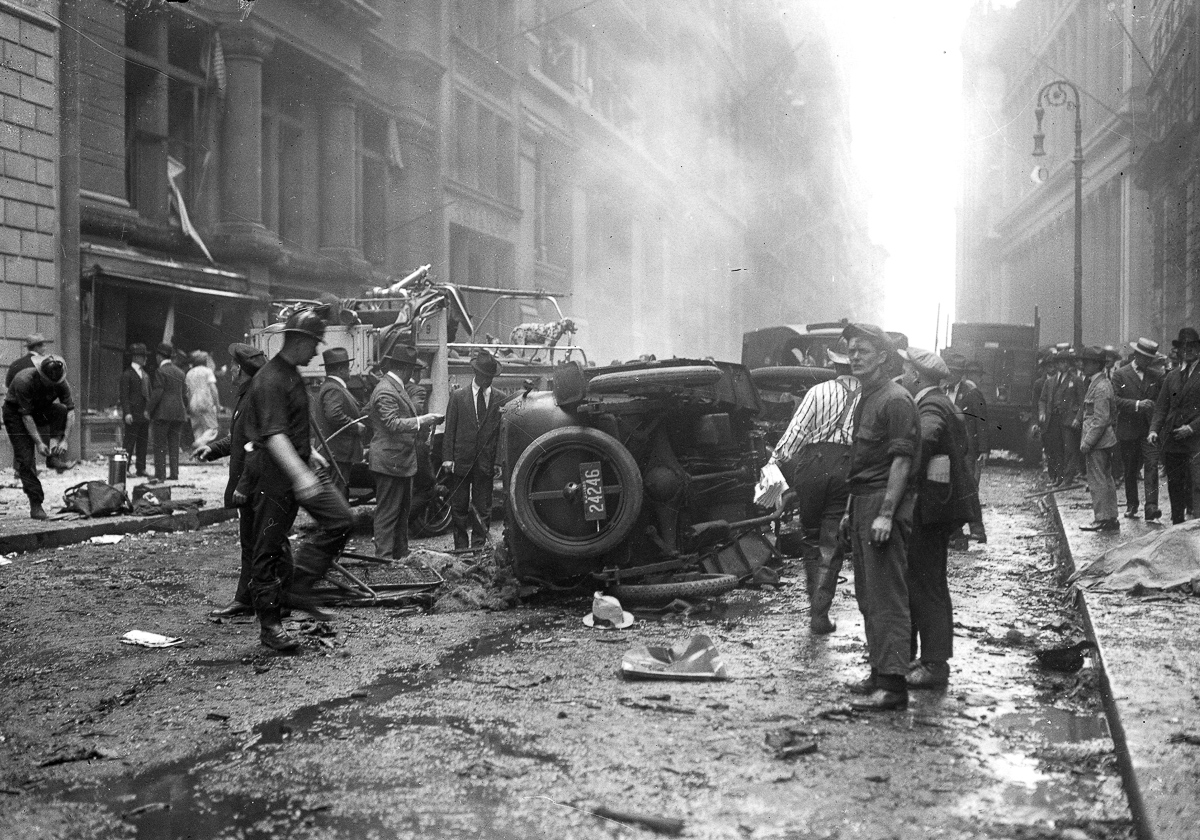
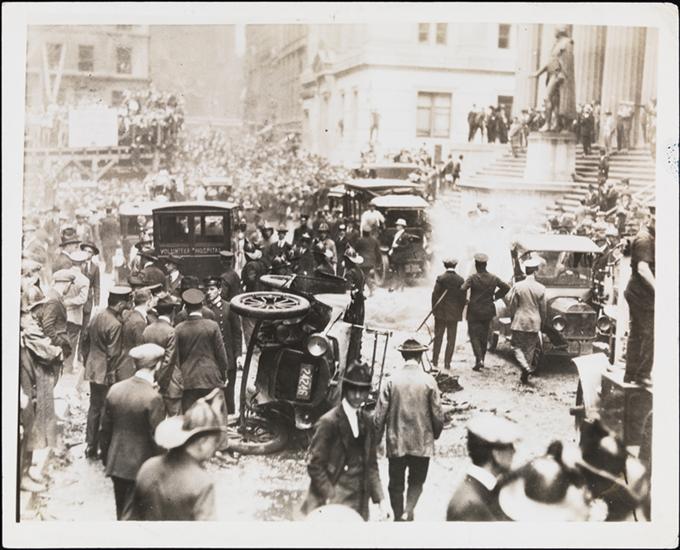
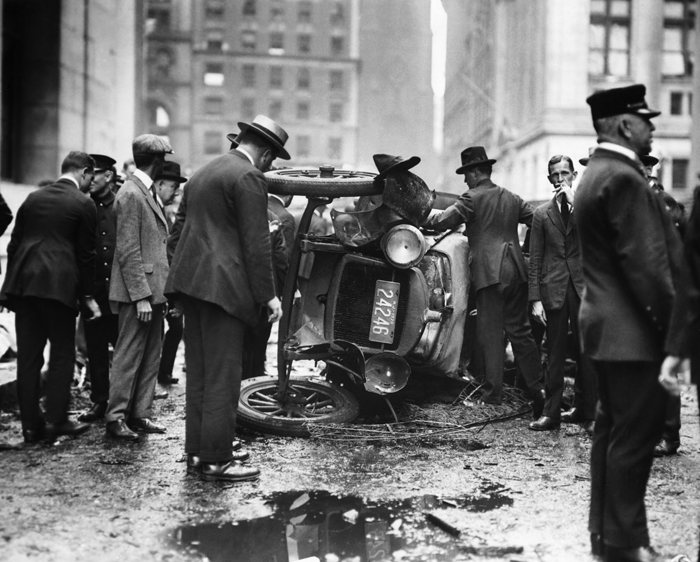
16 Sep 1920, Manhattan, New York, New York, USA --- New York, NY: Demolished automobile at sene of Wall Street Explosion of September 16th, 1920. Photograph. BPA2# 4804 --- Image by © Bettmann/CORBIS
16 Sep 1920, Manhattan, New York, New York, USA — New York, NY: Demolished automobile at sene of Wall Street Explosion of September 16th, 1920. Photograph. BPA2# 4804 — Image by © Bettmann/CORBIS

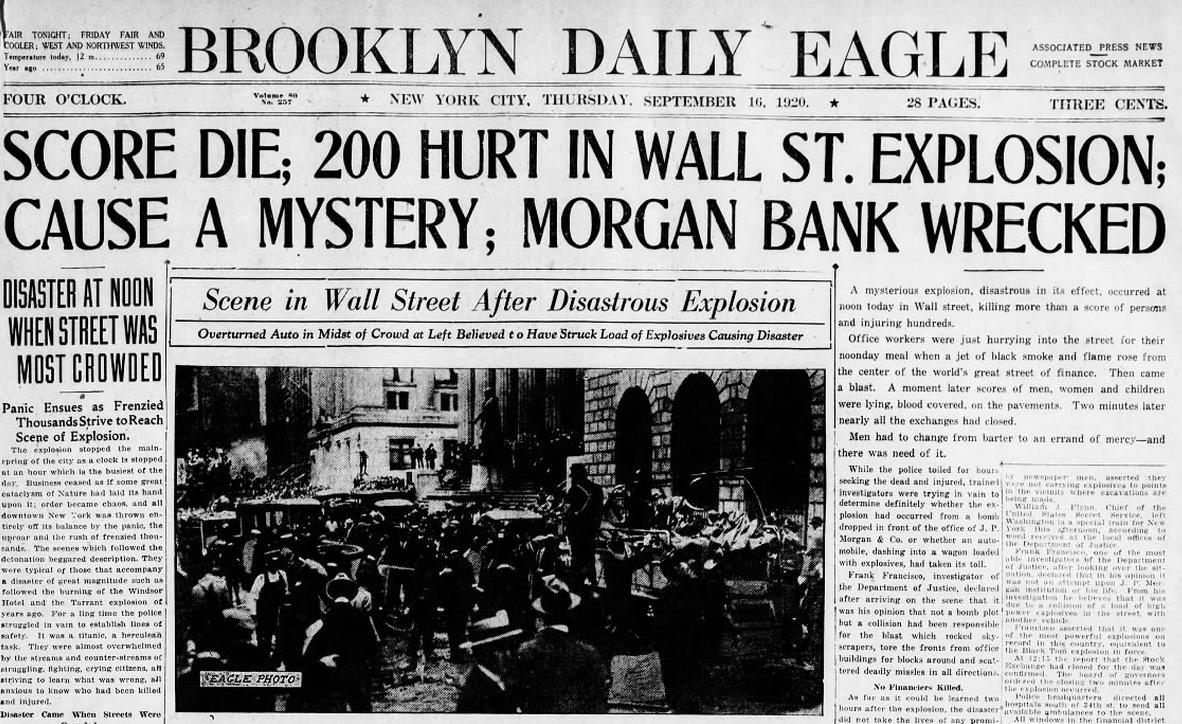
Below: The late edition of the Brooklyn Daily Eagle: “A mysterious explosion, disastrous in its effect, occurred at noon today on Wall Street, killing more than a score of persons and injuring hundreds.”

1

Following the attack, the Madison Avenue mansion of J.P. Morgan (site of the Morgan Library and Museum) was heavily guarded. Morgan himself was actually in England, enjoying a relaxing vacation.

Believe it or not, evidence of this attack can easily be seen from the street today. The banking mogul famously rejected repairs of his bank, preferring to leave the dents and pockmarks on the side of his building in a sign of defiance.

With a little morbid imagination and some amateur CSI work, one can probably trace the trajectory of wall’s injuries to the very spot where the poor horse and wagon exploded.

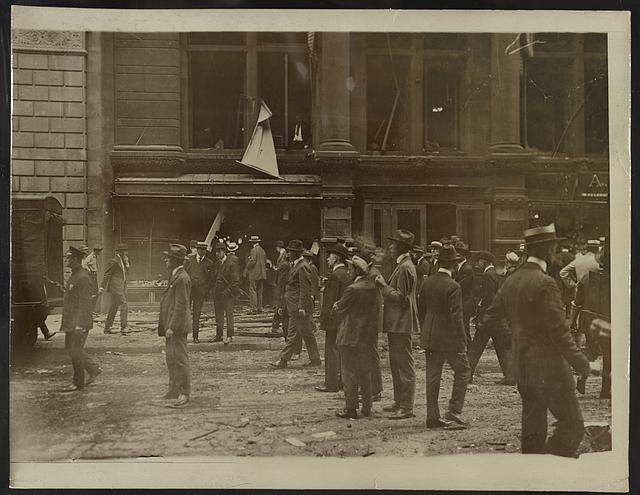
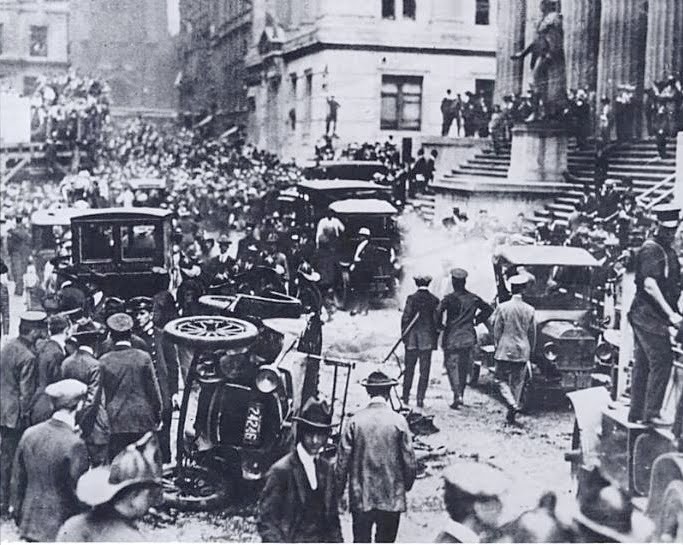
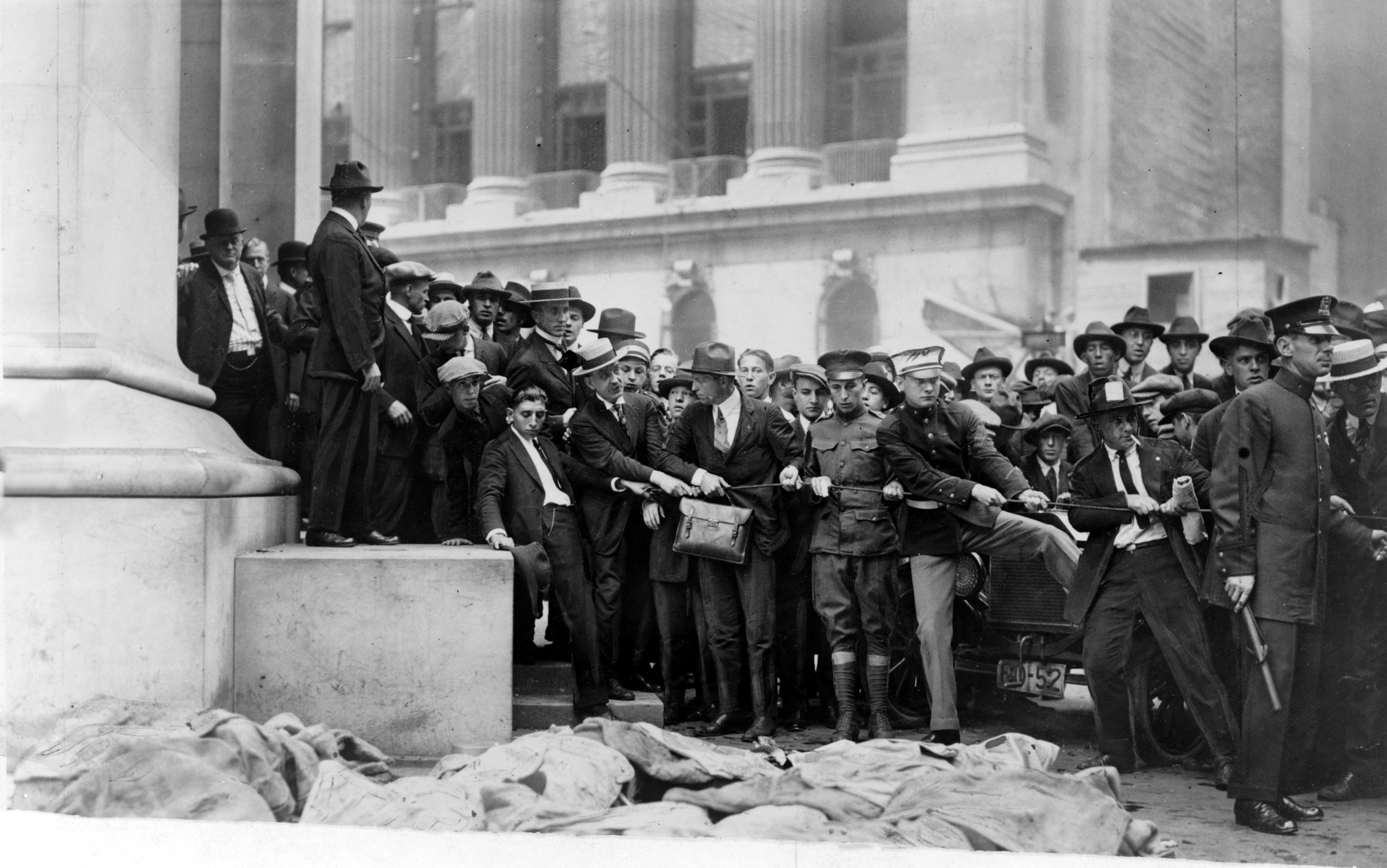
Below: Crowds gather to witness the destruction.

WallStexplosion1920

Despite a federal investigation which led to dozens of arrests, in fact the culprits were never caught.

Largely assumed to be Italian anarchists, any evidence was unfortunately lost when, in an effort to appear unfazed, the city cleaned the street and kept Wall Street open for business the next day, even seeing a rally of thousands pour into the street that Friday.

07047r
Library of Congress
Library of Congress
Categories
New Amsterdam Podcasts

Peter Stuyvesant and the Fall of New Amsterdam: Where did the Dutch roots of New York City go?

PODCAST There would be no New York City without Peter Stuyvesant, the stern, authoritarian director-general of New Amsterdam, the Dutch port town that predates the Big Apple. 

The willpower of this complicated leader took an endangered ramshackle settlement and transformed it into a functioning city. But Mr. Stuyvesant was no angel.

In part two in the Bowery Boys’ look into the history of New Amsterdam, we launch into the tale of Stuyvesant from the moment he steps foot (or peg leg, as it were) onto the shores of Manhattan in 1647.

Stuyvesant immediately set to work reforming the government, cleaning up New Amsterdam’s filth and even planning new streets. He authorized the construction of a new market, a commercial canal and a defense wall — on the spot of today’s Wall Street. But Peter would act very un-Dutch-like in his intolerance of varied religious beliefs, and the institution of slavery would flourish in New Amsterdam under his unwavering direction.

And yet the story of New York City’s Dutch roots does not end with the city’s occupation by the English in 1664 — or even in 1673 (when the city was briefly retaken by a Dutch fleet). The Dutch spirit remained alive in the New York countryside, becoming part of regional customs and dialect.

And yet the story of New Amsterdam might otherwise be ignored if not for a determined group of translators who began work on a critical project in the 1970s……

Listen Now: Peter Stuyvesant Podcast

___________________________________________________________

The Bowery Boys: New York City History podcast is brought to you …. by you!

We are now producing a new Bowery Boys podcast every other week. We’re also looking to improve the show in other ways and expand in other ways as well — through publishing, social media, live events and other forms of media. But we can only do this with your help!

We are now a member of Patreon, a patronage platform where you can support your favorite content creators for as little as a $1 a month.

Please visit our page on Patreon and watch a short video of us recording the show and talking about our expansion plans. If you’d like to help out, there are five different pledge levels (and with clever names too — Mannahatta, New Amsterdam, Five Points, Gilded Age, Jazz Age and Empire State). Check them out and consider being a sponsor.

And join us for the first ever Bowery Boys Movie Club, an exclusive podcast provided to our supporters on Patreon. This month’s selection — Taxi Driver.

We greatly appreciate our listeners and readers and thank you for joining us on this journey so far.

__________________________________________________________

The Costello Plan, New Amsterdam 1660. Surveyed by Jacque Cortelyou. Full size photograph of manuscript map in the Biblioteca Medicea-Laurenziana of Florence, Italy. The Castello plan is the earliest known plan of New Amsterdam, and the only one dating from the Dutch period. Wikicommons.

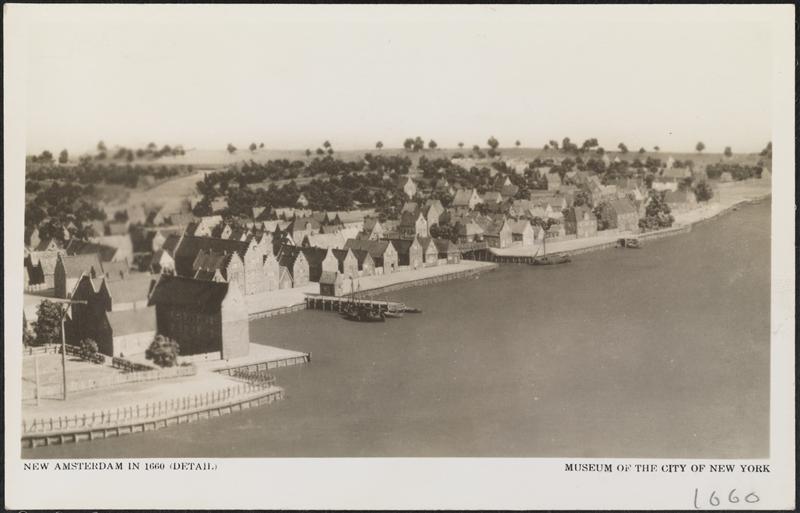
New Amsterdam in miniature at the Museum of the City of New York, photographed in 1932

Museum of the City of New York
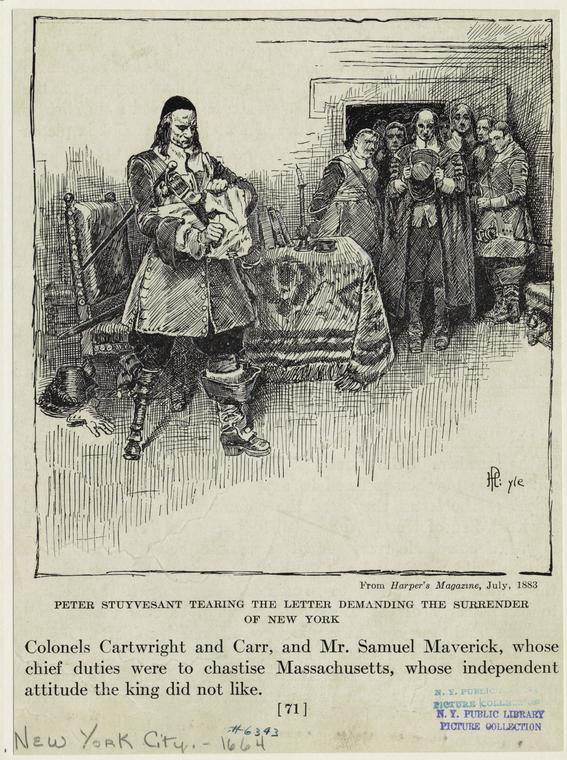
Peter Stuyvesant tearing the letter demanding the surrender of New York. Artist Howard Pyle, 1923. New York Public Library

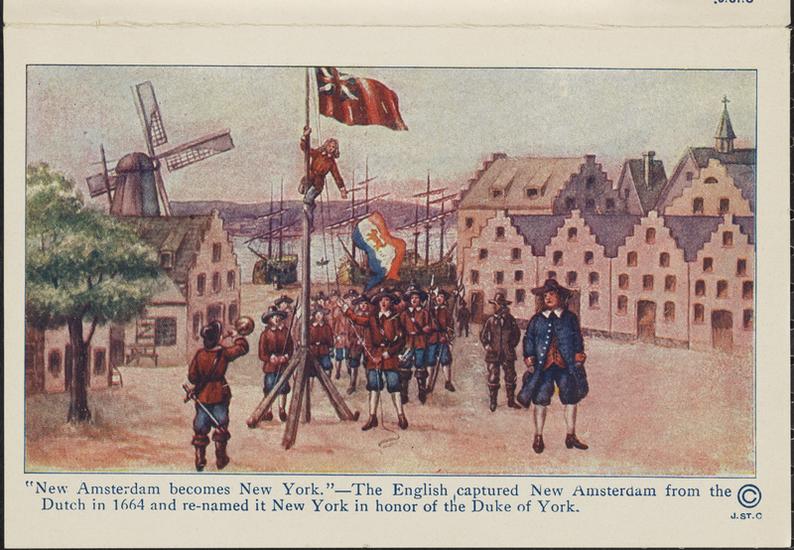
The moment when New Amsterdam became New York, depicted in a 1914 picture book.

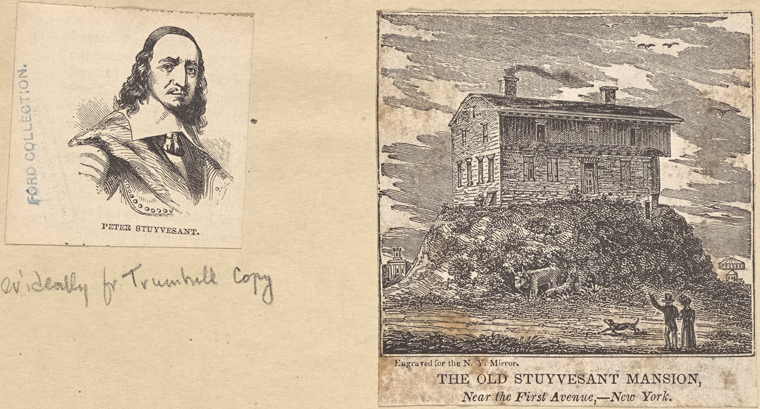
The old Stuyvesant mansion, near First Avenue, engraved for the N.Y. Mirror newspaper. Courtesy NYPL

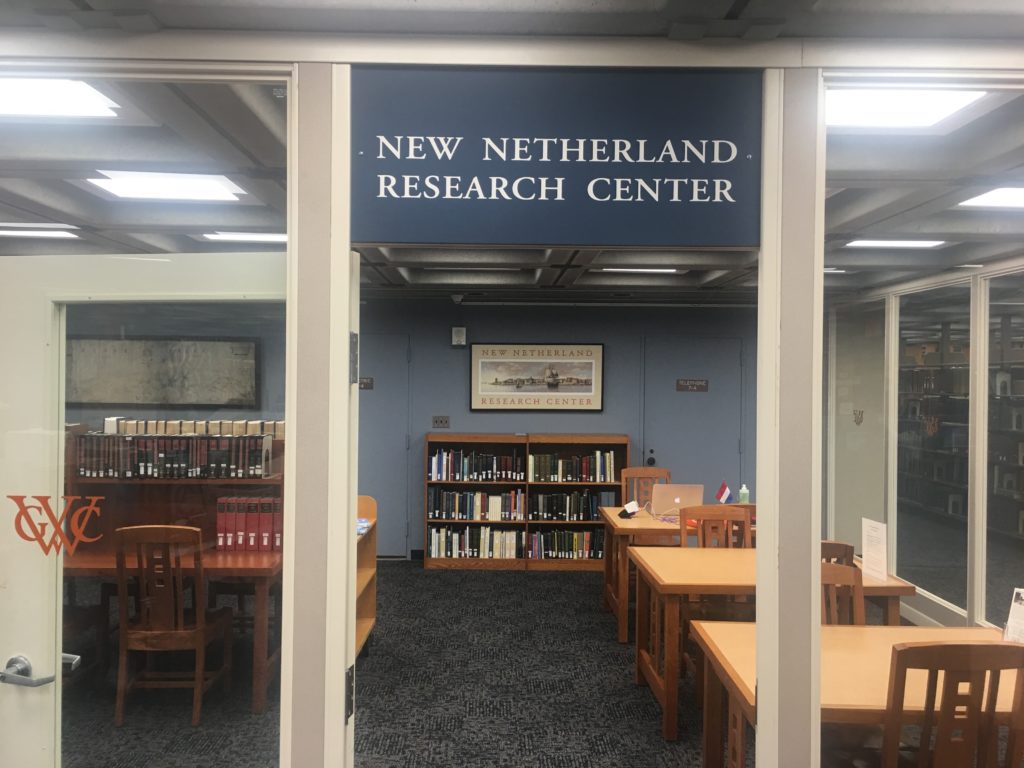
The New Netherland Research Center, located on the seventh floor of the New York State Library.  For more information, visit the New Netherland Institute website.

Greg Young

FURTHER LISTENING

We didn’t go too deeply into it in our latest show, but the Bronx also has a very rich Dutch history. The name even comes from a (unfortunately doomed) Dutch settler.

The early history of Broadway begins in New Amsterdam.

We also spoke about the ‘rattle watch’ in our show on the New York Fire Department.

Categories
Podcasts The Jazz Age

The Wall Street Crash of 1929: The sobering end of New York’s Jazz Age

This is the final part of our three-part NEW YORK IN THE JAZZ AGE podcast series. Check out our two prior episode #233 The Roaring ’20s: The King of the Jazz Age and #234 Queen of the Speakeasies: A Tale of Prohibition New York


Something so giddy and wild as New York City in the Jazz Age would have to burn out at some point. But nobody expected the double catastrophe of a paralyzing financial crash and a wide-ranging government corruption scandal.

Mayor Jimmy Walker, in a race for a second term against a rising congressman named Fiorello La Guardia, might have had a few cocktails at the Central Park Casino after hearing of the pandemonium on Wall Street in late October 1929.

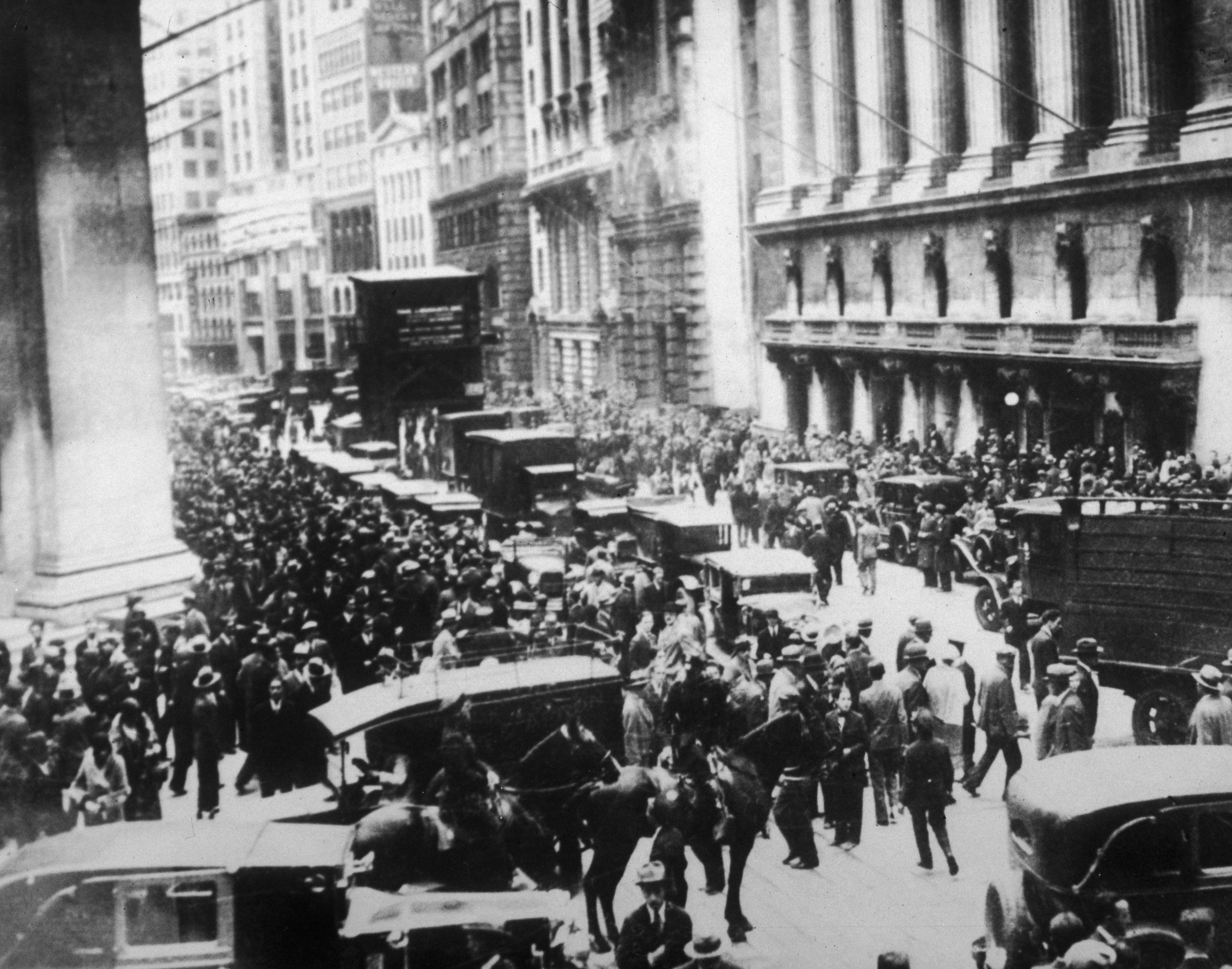
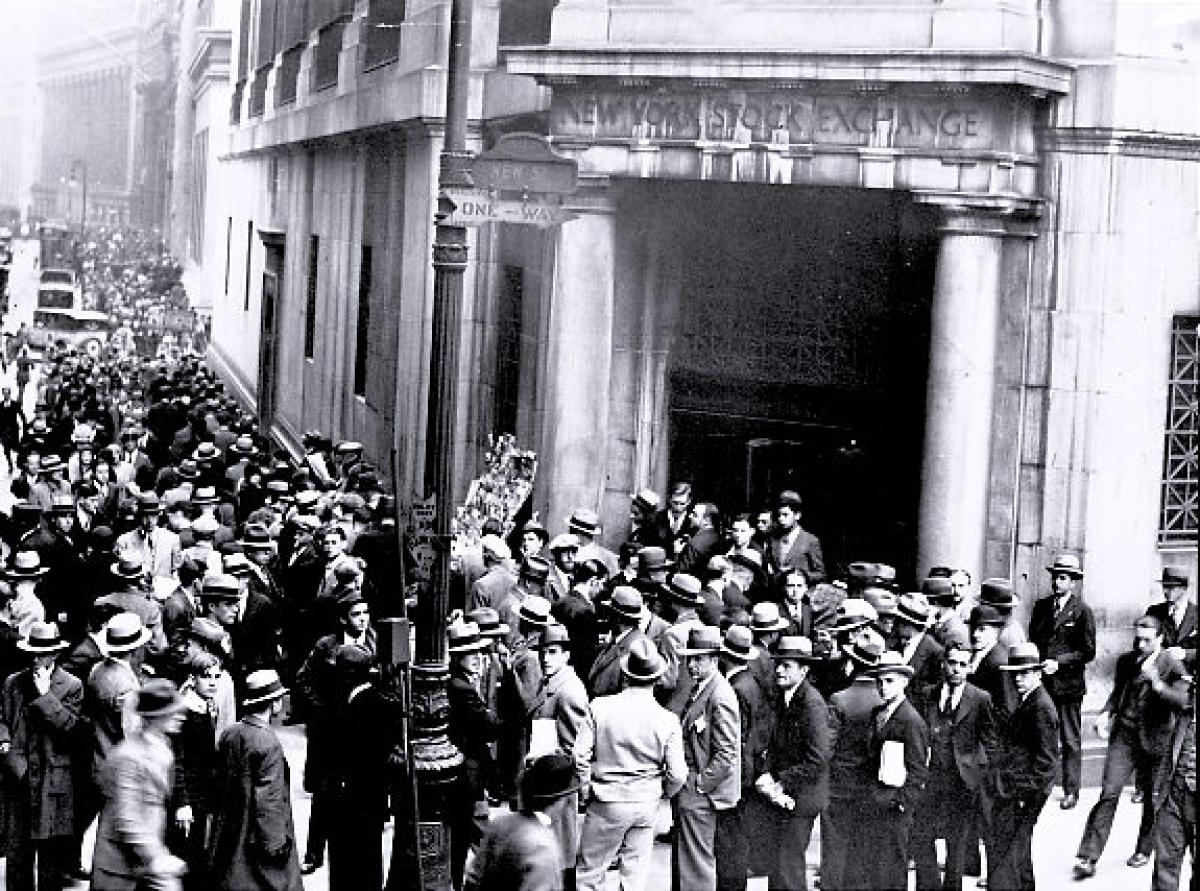
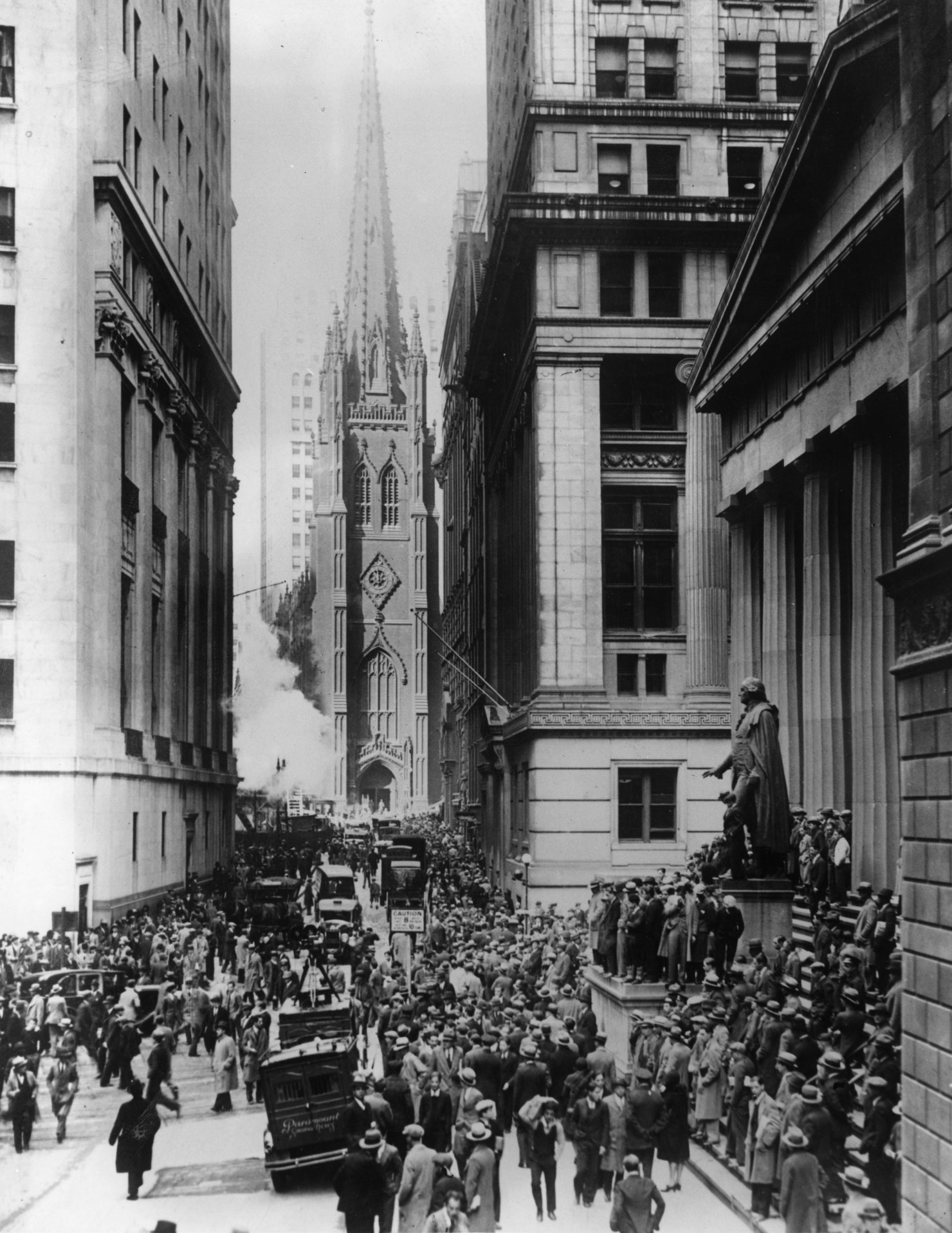
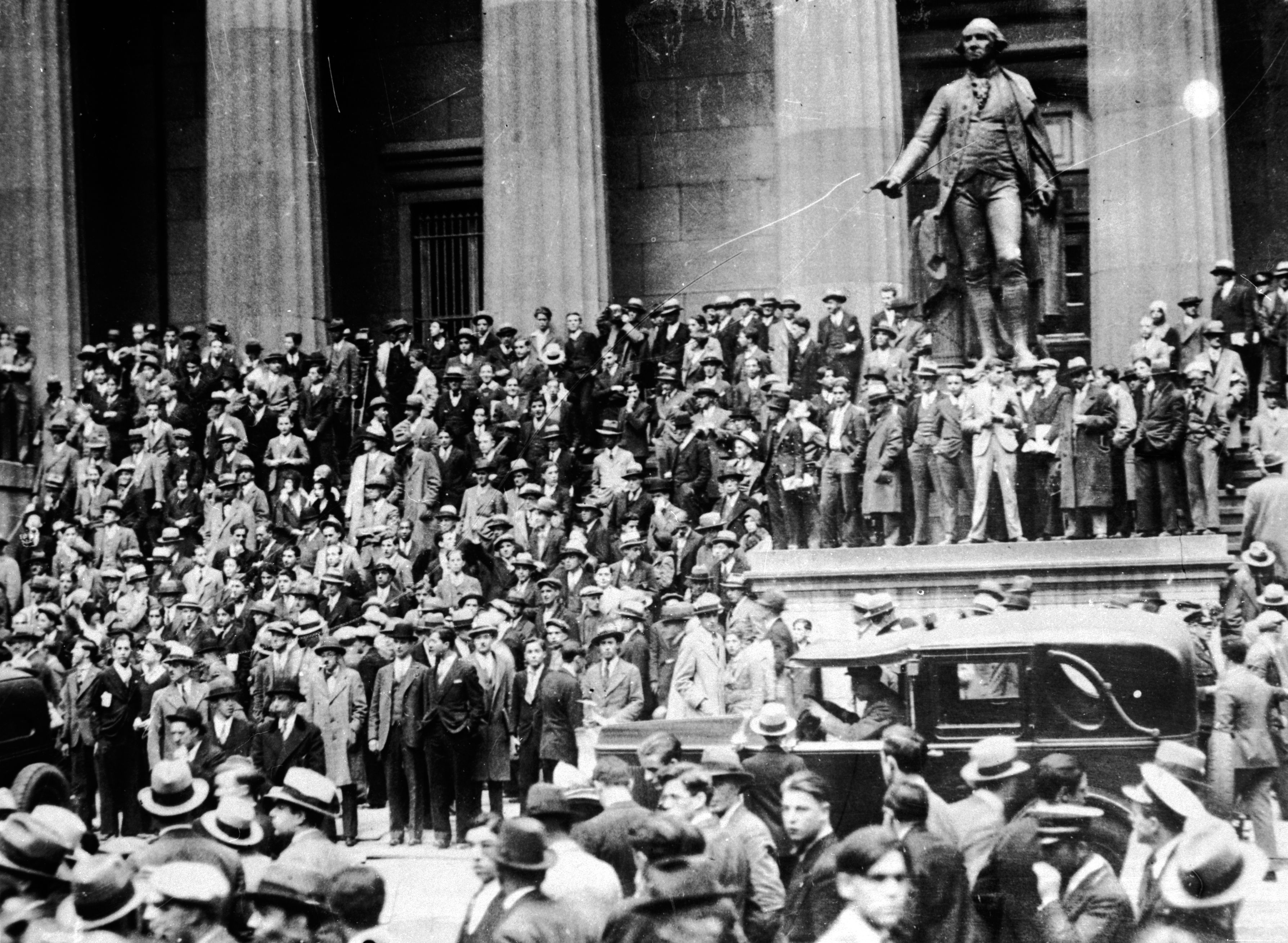
The irresponsible speculation fueling the stock market of the Roaring 20’s suddenly fell apart, turning princes into paupers overnight. Rumors spread among gathering crowds in front of the New York Stock Exchange of distraught traders throwing themselves out windows.

And yet a more immediate crisis was awaiting the Night Mayor of New York — the investigations of Judge Samuel Seabury, steering a crackdown authorized by governor Franklin Delano Roosevelt to rid New York City of its deeply embedded, Tammany Hall-fueled corruption.

With the American economy in free fall and hundreds of New York politicians, police officers and judges falling to corruption revelations, the world needed a drink! Counting down to the last days of Prohibition….

PLUS: The fate of Texas Guinan, the movie star turned Prohibition hostess who hit the road with a bawdy new burlesque — that led to a tragic end.

The song featured in this week’s episode was Bessie Smith’s “Nobody Knows You When You’re Down and Out”


The Bowery Boys: New York City History podcast is brought to you …. by you!

We are now producing a new Bowery Boys podcast every two weeks. We’re also looking to improve the show in other ways and expand in other ways as well — through publishing, social media, live events and other forms of media. But we can only do this with your help!

We are now a member of Patreon, a patronage platform where you can support your favorite content creators for as little as a $1 a month.

Please visit our page on Patreon and watch a short video of us recording the show and talking about our expansion plans.If you’d like to help out, there are five different pledge levels (and with clever names too — Mannahatta, New Amsterdam, Five Points, Gilded Age, Jazz Age and Empire State). Check them out and consider being a sponsor.

We greatly appreciate our listeners and readers and thank you for joining us on this journey so far. And the best is yet to come!


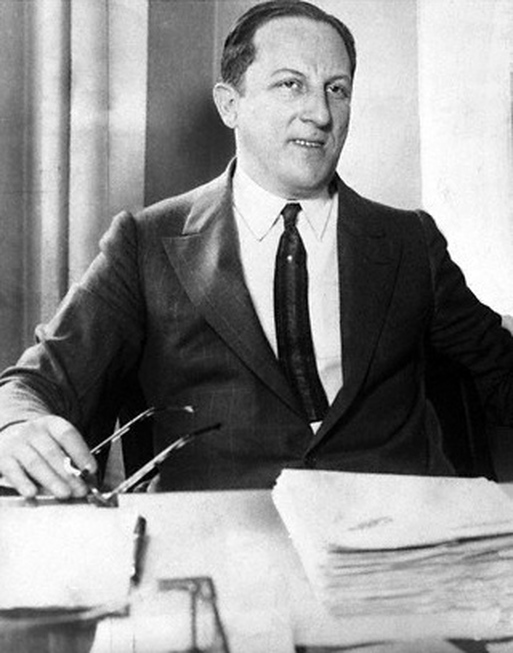
Arnold Rothstein — His murder would kick off a frenzy in New York’s organized crime syndicates and lead to an in-depth investigation into the police and local government

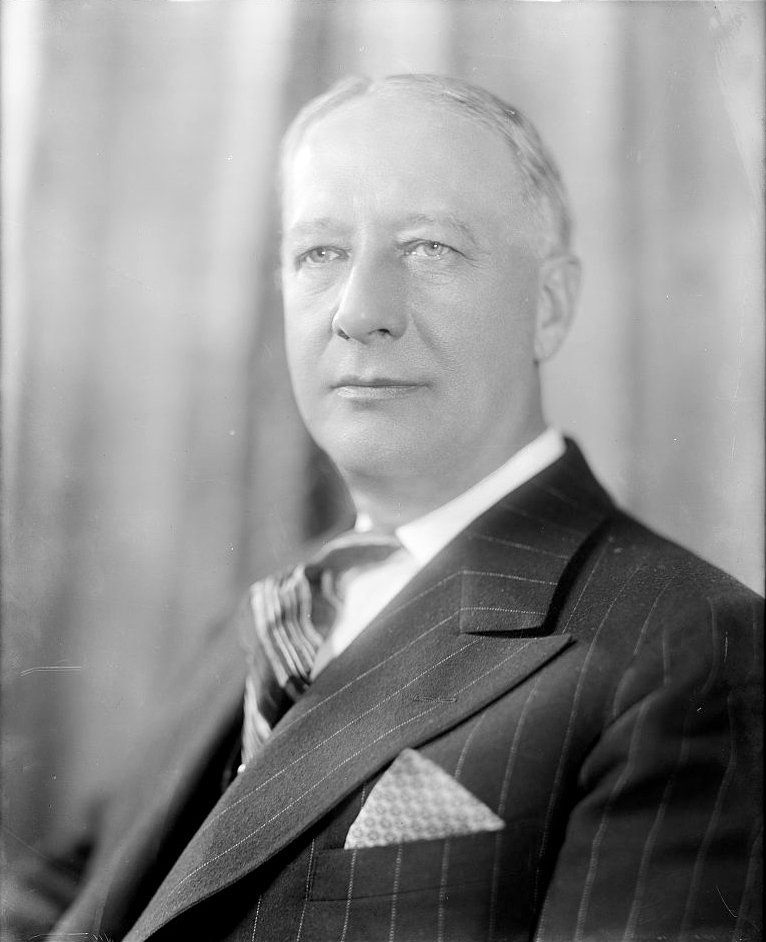
Al Smith — His unsuccessful bid for the presidency in 1928 led him to pursue more business-related projects, including the construction of the Empire State Building.

Harris & Ewing collection at the Library of Congress.

Mayor Jimmy Walker felt invincible at the start of his second term

Texas Guinan eventually left the nightclub scene and returned to film and stage work. She’s pictured here in 1931 in Paris. She would later be denied entry into the country for her bawdy performances (at least, that’s what she claimed).

Getty Images

Betty Compton waited patiently for Walker from the sidelines, watching as his political fortunes collapsed in 1932.

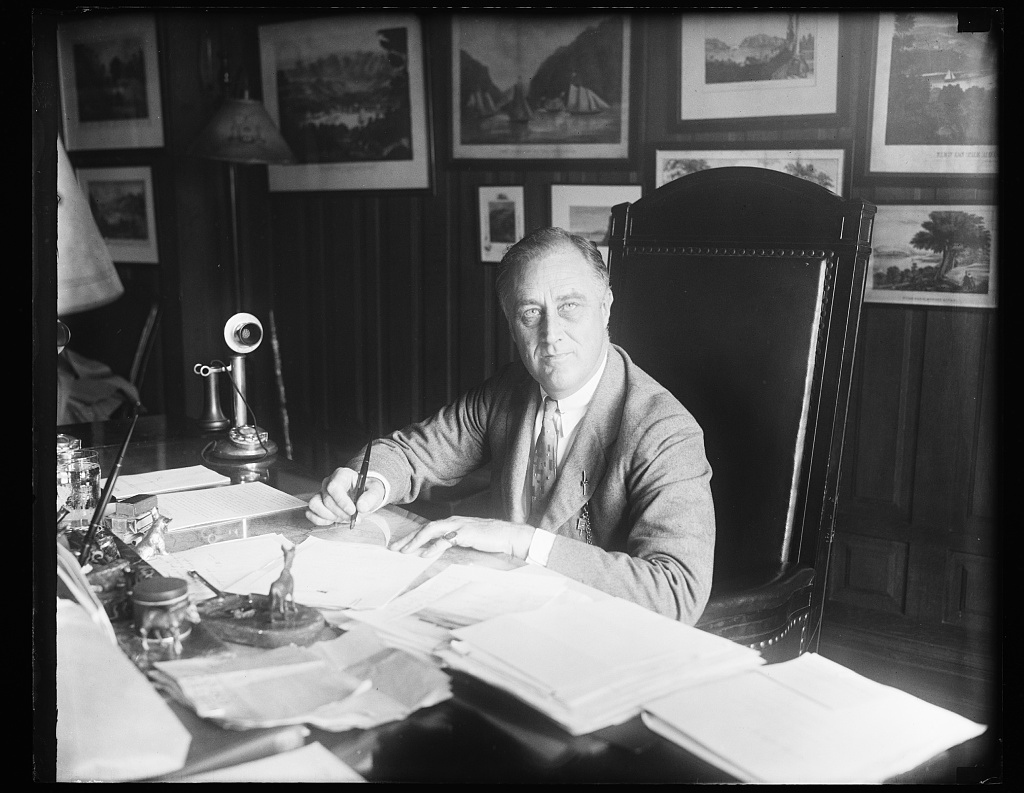
Franklin Delano Roosevelt — The governor of New York (and soon president of the United States) went after corruption during a busy campaign season.

Library of Congress

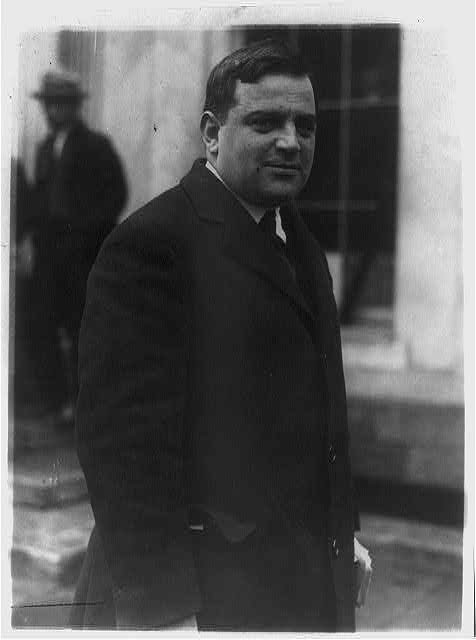
Fiorello La Guardia (pictured here in 1929) was an early supporter of Prohibition repeal and ran for mayor in 1929, losing to Walker.

Library of Congress

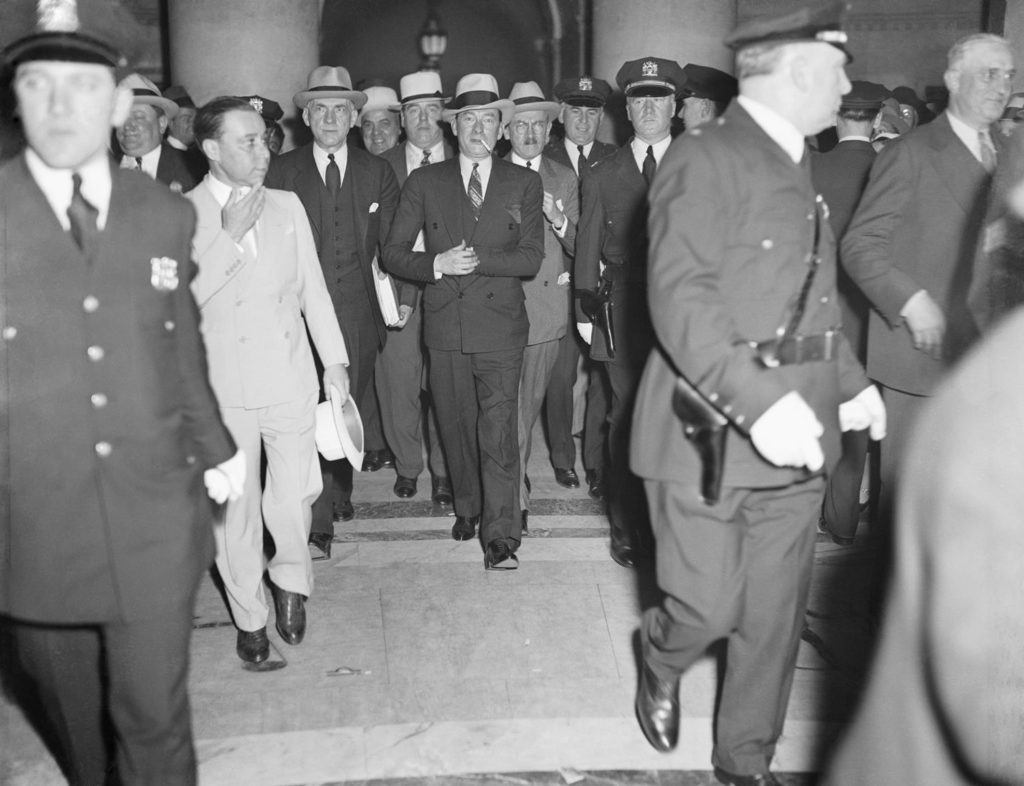
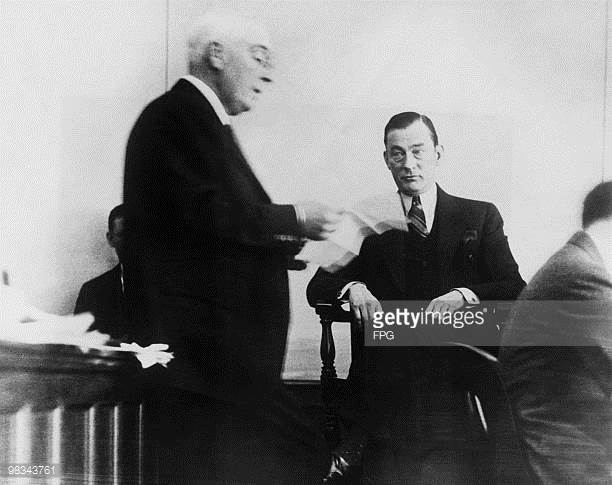
Samuel Seabury, questioning a nonplussed Jimmy Walker on the stand, succeeded in rooting out corrupt officials in public offices. With Roosevelt’s help, he even brought down the Night Mayor himself.

Getty Images

The Central Park Casino transformed into a swanky nightclub in 1929, a favored spot for Jimmy Walker

Courtesy New York Times

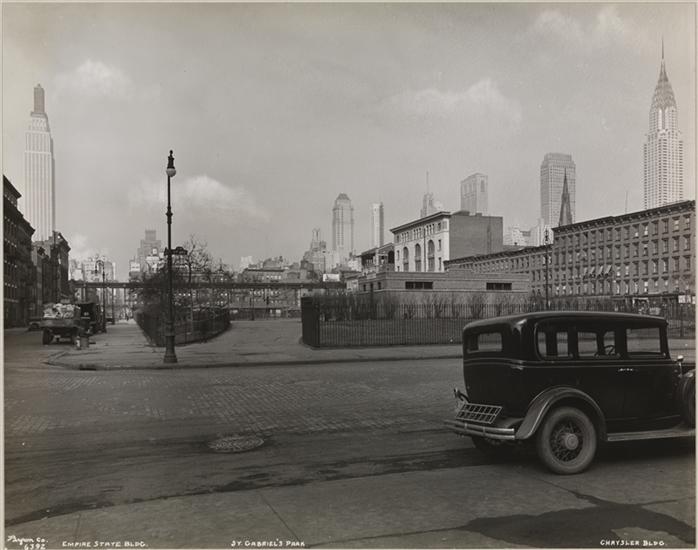
An interesting view of mid-Manhattan in 1931 (from St. Gabriel’s Park at First Avenue and 35th Street) with the newly completed Chrysler Building and the Empire State Building nearly completed.

MCNY/Byron Company

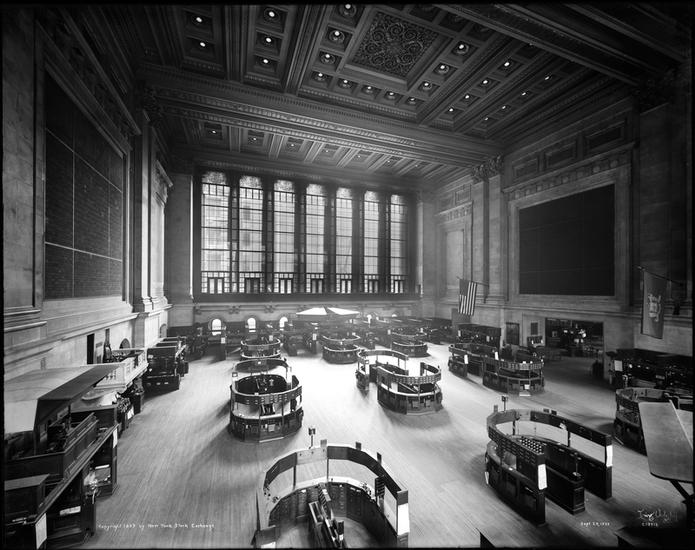
An ominous image of the New York Stock Exchange from September 1929, weeks before the crash.

Irving Underhill/MCNY

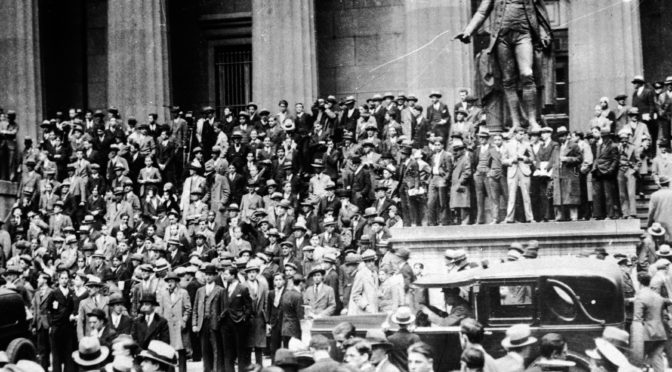
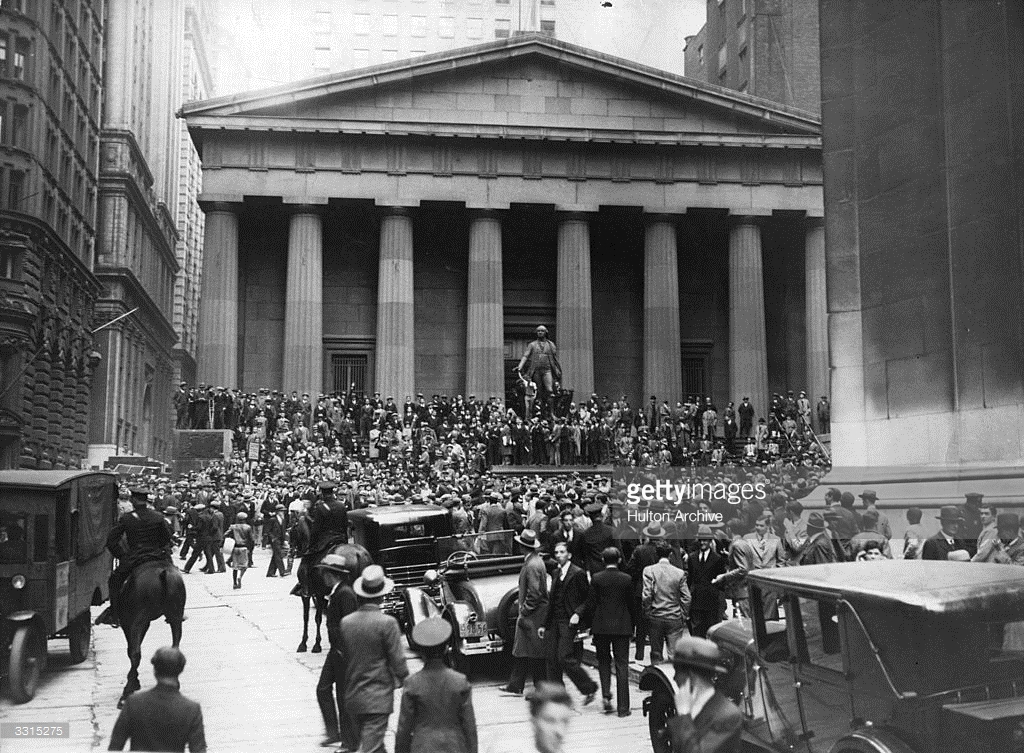
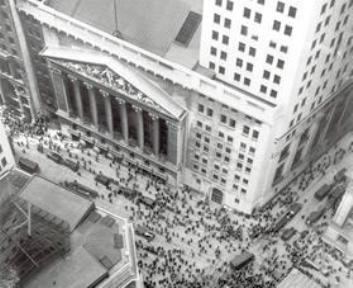
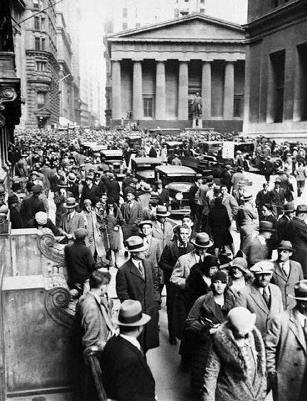
The streets outside the New York Stock Exchange were clogged with people for days, frantic scenes of anger, panic and heartbreak.

29th October 1929. (Photo by Hulton Archive/Getty Images)
New York Daily News
(Photo by Keystone/Getty Images)

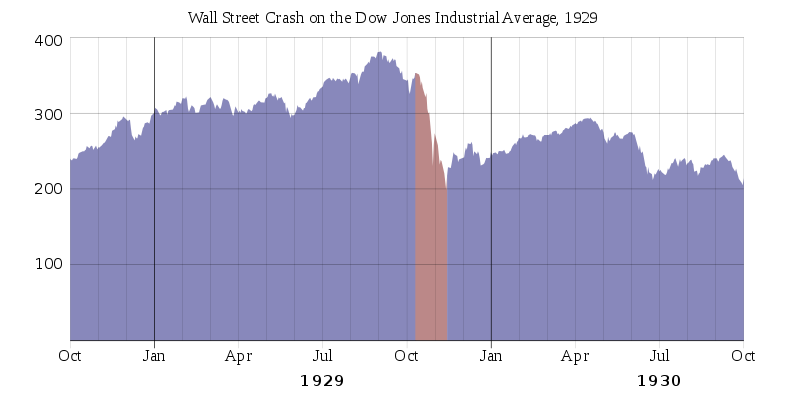
A graphic look at the Wall Street Crash of 1929.

Wikicommons

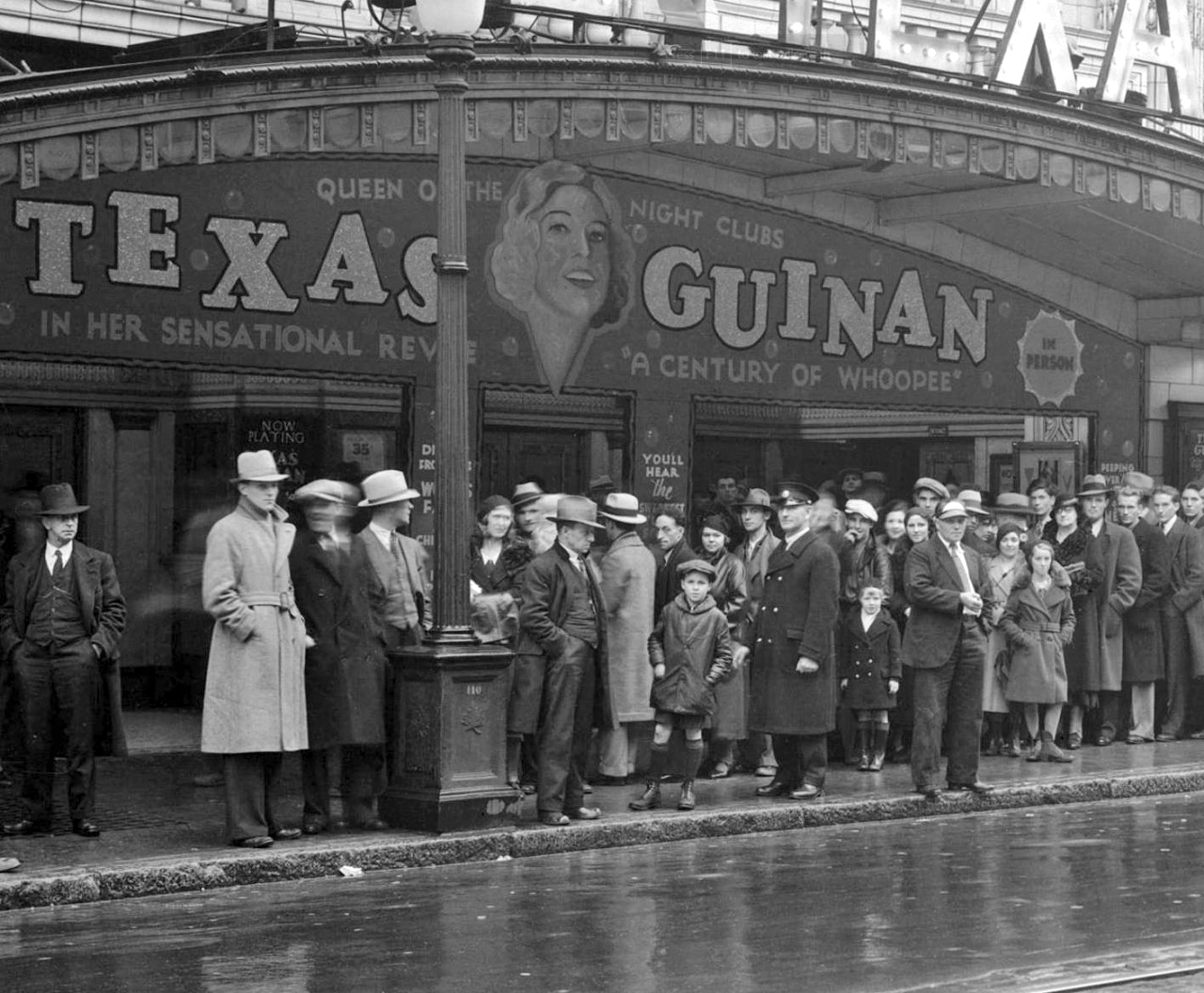
Outside Vancouver’s Beacon Theatre on October 28, 1933, just a week before her death here in this city.


CORRECTION: Jimmy Walker’s second term began on January 1, not January 3.

For more information, check out the following books:

Dry Manhattan: Prohibition in New York City by Michael A. Lerner

The Great Crash by John Kenneth Galbraith

Once Upon A Time In New York by Herbert Mitgang

The Man Who Rode The Tiger: The Life and Times of Judge Samuel Seabury by Herbert Mitgang

Rothstein: The Life, Times, and Murder of the Criminal Genius Who Fixed the 1919 World Series by David Pietrusza

Other Bowery Boys podcasts related to this one:

The Tallest Building In New York: A Short History (#169)

Battle For The Skyline: How High Can It Go? (#199)

The Chrysler Building (#11)

Robert Moses (#100)

Categories
Wartime New York

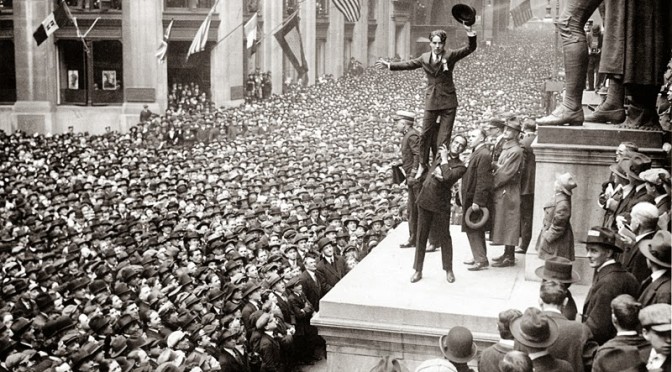
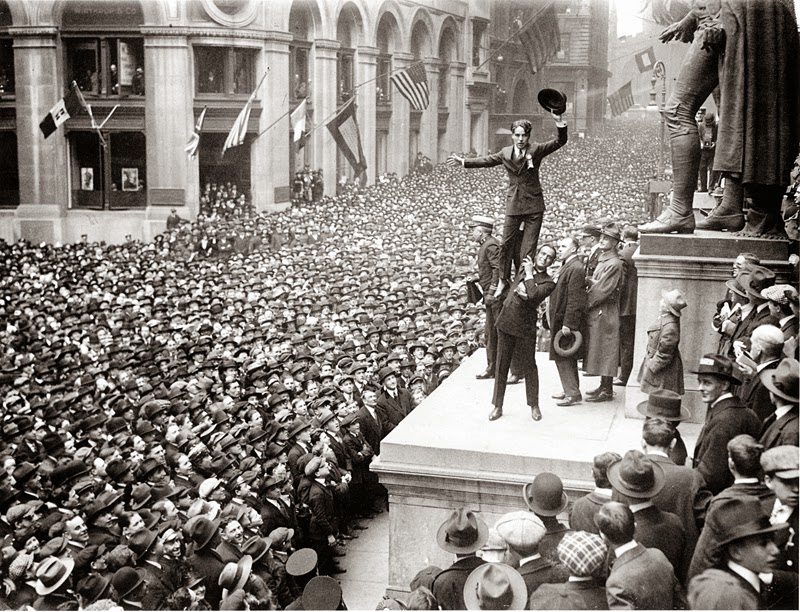
Charlie Chaplin on Wall Street: The tale behind the 1918 photo

The comedy legend Charlie Chaplin was born 125 years ago today in London, so I thought I’d use the opportunity to re-post one of my favorite photographs of Wall Street.

 
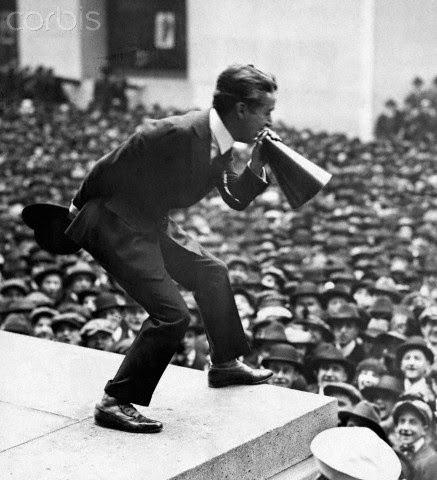
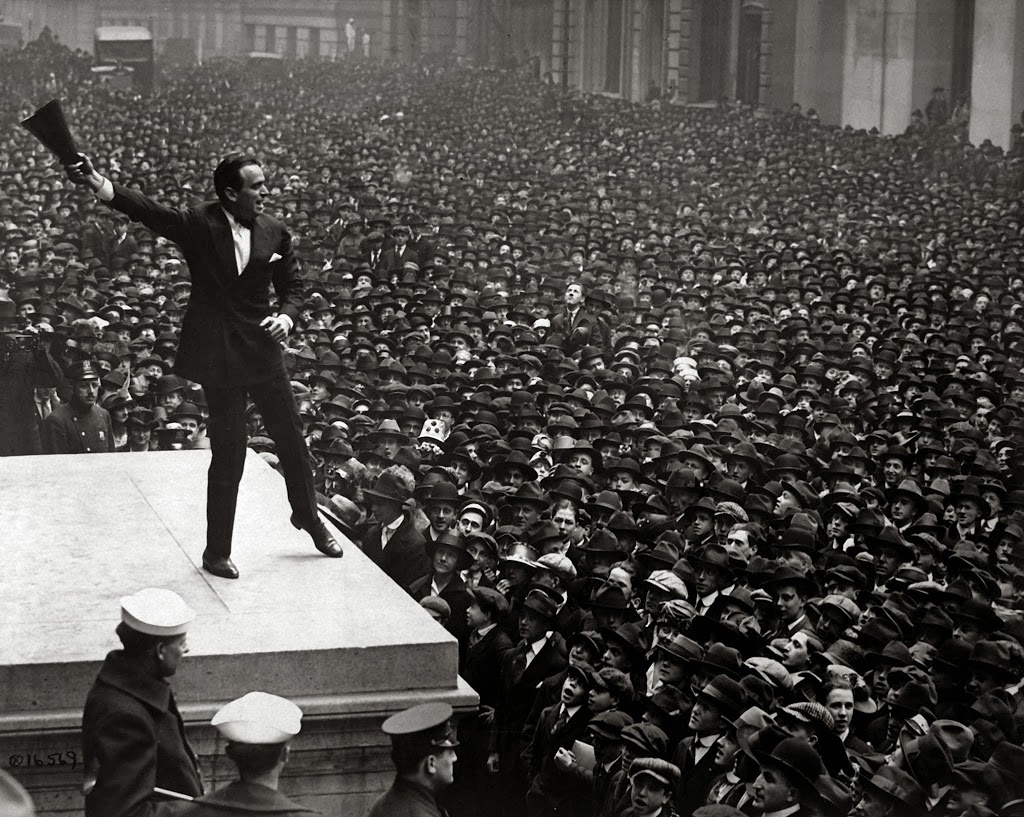
In the 1918 photo above, Charlie Chaplin and Douglas Fairbanks draw tens of thousands to Wall Street and the foot of the United States Sub Treasury building (i.e. today’s Federal Hall) to drum up support for World War I war bonds (or, more precisely, Liberty Bonds).
 
The United States had entered the conflict the prior year, on April 6, 1917, and began selling bonds to raise funds for the war effort.  Although many Americans were caught up in a patriot fervor, war bond sales were initially quite weak.  Most Americans in the late 1910s had never bought a bond of any kind.
 

To promote sales, the government began enlisting celebrities from several fields of entertainment, most notably motion pictures.  Since the New York area was filled with film stars — Hollywood not yet being the center of the film business — its streets were soon filled with dutiful movie stars, extolling the patriotic and moral virtues of supporting their county through bond sales.

 
My favorite instance of this was the sale of doughnuts — considered a symbol of wartime — on the street by glamorous movie stars like Martha Mansfield.  The Sub Treasury building, New York’s largest bond repository, was often the center of such rallies and fund drives.  (There were even doughnut auctions held on the steps here.)  It made sense to bring the biggest stars to the Sub Treasury to drum up the most publicity.
 
And so, on April 9, 1918, as the New York Tribune headline goes, “20,000 Throng Wall Street to Hear Movie Stars Tell How To Win War.”
Chaplin threw himself into the war effort, embarking on a nationwide tour to promote the sale of bonds.  That year he would make a propaganda film called The Bond:
 
 
But there may have been a bit of self-promotion in his appearance at the Sub Treasury.  His film A Dog’s Life would conveniently open in movie theaters five days later.


People weren’t used to hearing their movie stars speak in 1918.  “I never made a speech before in my life,” he proclaimed through a megaphone that noon, standing in front of the statue of George Washington. “But I believe I can make one now.”

The dashing Fairbanks — known for swashbucklers and romances — happily broke character, goofing around with Chaplin to the delight of the crowd.  “Folks, I’m so hoarse from urging people to buy Liberty bonds that I can hardly speak.”

As eager as audiences were to hear their matinee idols, it was their horseplay that caused the greatest satisfaction:

“It was difficult for the lay ear to determine whether Chaplin or Fairbanks got the most enthusiastic reception.   But there one was feature that got more than either. That was the combination of Chaplin and Fairbanks.   The later carried the former around on his shoulders, and the 20,000-odd crowd howled with delight.”

Afterwards, Fairbanks and vocalist Harvey Hindemeyer led the crowd in a rendition of “Over There,” the American war anthem written by Broadway impresario George M. Cohan the previous year. (The story behind that song was featured in our podcast on the birth of the Broadway musical.)

Mary Pickford was also on a war bonds tour through America at this time.  The following year, Pickford, her secret lover Fairbanks, Chaplin and the film director D.W. Griffith would start the film studio United Artists.


Categories
Those Were The Days

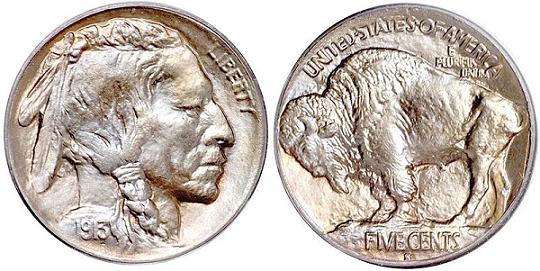
Fun money: The Buffalo nickel, 100 years old this month, makes Wall Street messenger boys rich (for a couple hours)


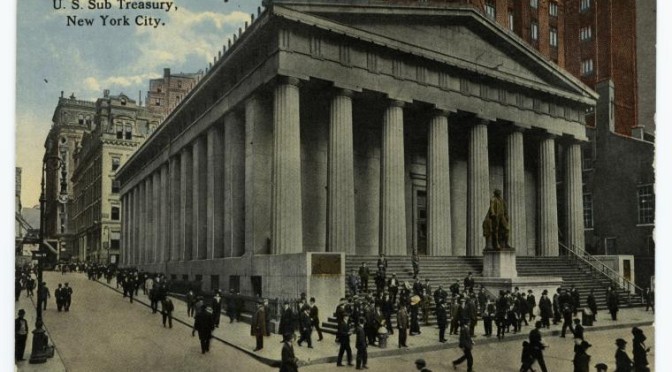
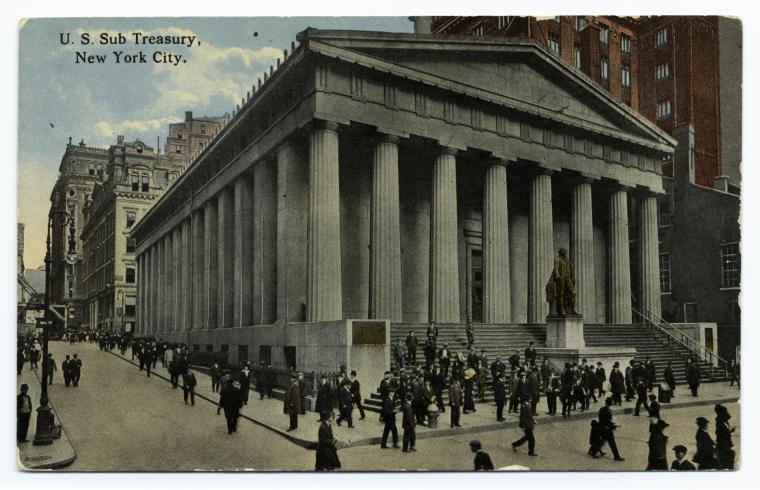
The U.S. Sub Treasury Building — today’s Federal Hall — as it appeared in a colorized postcard in the 1900s (courtesy NYPL)


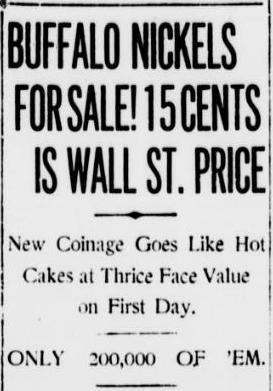
“Hey! Getcha buffalo nickels here. Only 15 cents!”

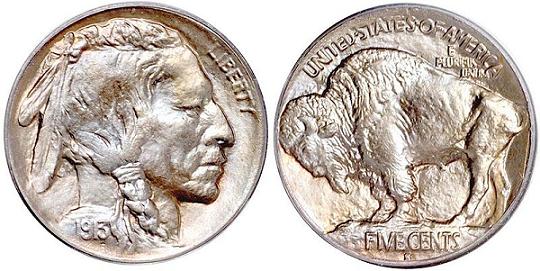
On March 1, 1913, the usual bustle of Wall Street was enlivened with the voices of young men — mostly messenger boys, bank runners and peddlers, according the Evening World — with handfuls of shiny new nickels, the first run of what would become known as the Indian Head nickel or the Buffalo nickel.  And in these heady morning hours, many managed to sell the five-cent piece for triple its value.

“The down-at-the-heels men, who sell picture postcards and neckties from pushcarts on Ann Street, scented a bargain and hurried to the Pine Street El Dorado to sink their little capital in nickels.”   The “Pine Street El Dorado” in that quote refers the New York Sub Treasury building, later referred to as Federal Hall.  (It’s second entrance is on Pine Street.)  The Sub Treasury received $10,000 worth of new nickels in ten wooden kegs.

Unfortunately for these budding young nickel entrepreneurs, the novelty wore off by noon and the Buffalo nickel sunk back down to its original face-value cost.

The new nickels were designed by the sculptor James Earle Fraser, a former assistant of the estimable Augustus Saint-Gaudens and best known in New York perhaps for his equestrian statue of Theodore Roosevelt outside the American Museum of Natural History.

Fraser, a professor at the Art Students League, designed the new coin from a studio at 3 MacDougal Alley, off of Washington Square Park.  An admirer of Western and Native American imagery, Fraser used a series of models for the noble Indian profile on the front of the coin.  For the buffalo on the reverse side, Fraser reportedly went to Central Park Zoo and used their old buffalo Black Diamond for a model.

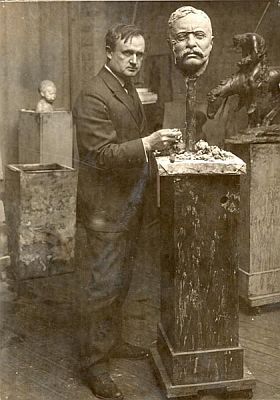
At right: James Earle Fraser in 1912 with a clay model of a Theodore Roosevelt bust (courtesy National Cowboy Museum)

Or at least, Black Diamond has always been considered the model for the buffalo nickel.  In fact, Fraser may also have used specimens from the Bronx Zoo including a fiesty beast named, appropriately, Bronx.  Given the renown of the Bronx Zoo collection — the institution essentially saved the buffalo from extinction — it might have made more sense to use their animals as models.

Despite outcries from manufacturers of coin operated devices — who claimed the new five-cent piece would not fit in their machines — the buffalo nickel was minted in February 1913, replacing the Liberty Head nickel that year.  (A small handful of Liberty Heads were made in 1913, becoming some of the most prized coinage among the numismatic set.)  Americans got a preview of the new coin when a small number were distributed by President William Howard Taft at the groundbreaking for the National American Indian Memorial in Staten Island, a monument that was ultimately never built.

A week later, on the first day of March, rolls of the new buffalo nickels were distributed to New Yorkers on Wall Street, and millions more sent across the country for distribution.

Perhaps Fraser’s design was a tad too whimsical for some.  The term ‘buffalo nickel’ soon became slang for something nearly worthless.  Just a month later, the New York Sun reported, “[T]he $1,500 mathematical job didn’t mean anymore to him yesterday afternoon than a buffalo nickel.”

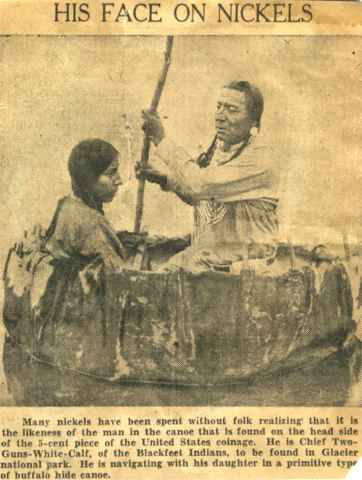
In 1921, one of Fraser’s human models, the chieftain Two Guns White Calf, pitched his teepee atop the luxury Hotel Commodore next door to Grand Central Terminal in a publicity stunt.

The buffalo nickel was replaced in 1938 by the more familiar Thomas Jefferson model.

Below: A news clipping featuring an image of Two Guns White Calf with his daughter. (Courtesy Flickr/sharknose)

Coin image courtesy Coin Collecting For Beginners

Captain Kidd and his swanky New York waterfront home

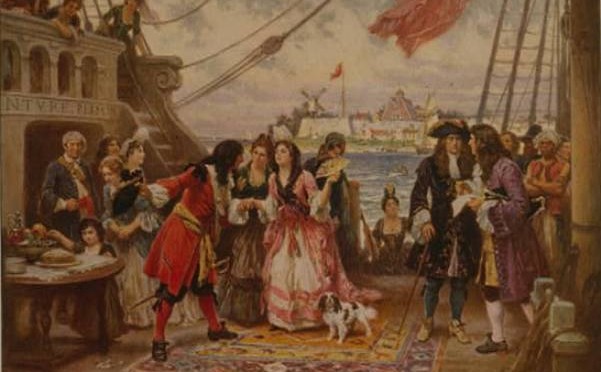
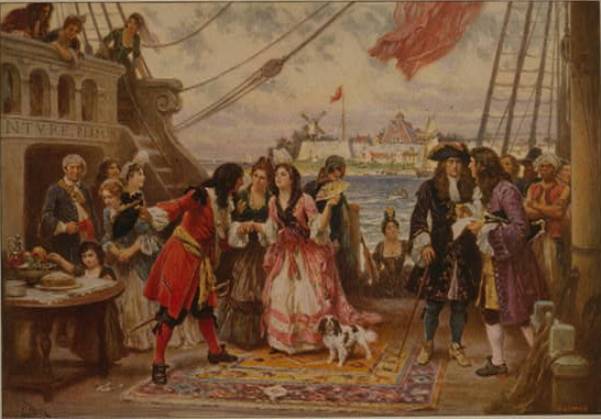
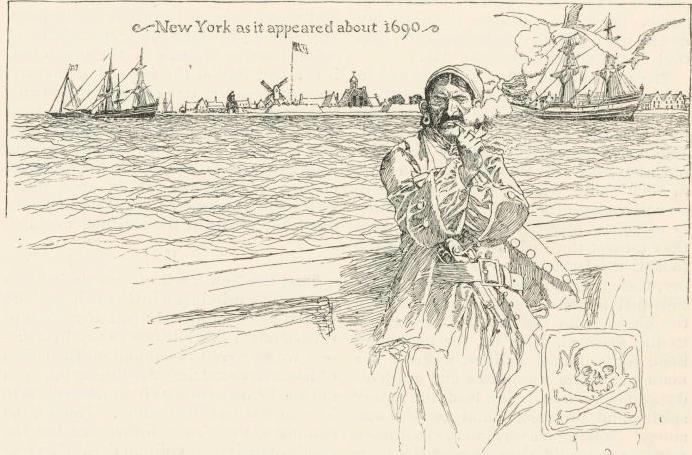
Above: A fanciful painting of Captain Kidd in New York Harbor, by Jean-Leon Gerome Ferris, 1911. Notice Fort James (former Fort Amsterdam) and the adjoining windmill in the background

In this week’s podcast, I refer to New Yorker and Trinity Church benefactor William Kidd as one of the most notorious pirates of the Atlantic Ocean. Now I feel that might have been a bit of slander.

It is true that Kidd, forever known to generations of seafarers as Captain Kidd, was vilified by the British for illicit profiteering and eventually hanged in London on May 23, 1701. But Kidd himself fought off the charges voraciously, and today historians believe Kidd was scapegoated and was himself following orders of the governor of the New York colony himself — Richard Coote, the Earl of Bellomont. Yes, the man who tried to annul the charter of Trinity Church!

I’ll save the details of Kidd’s exploits for various pirate-themed blogs. Kidd may have been prosecuted unfairly, but the legend that arose around his real or imagined exploits makes him one of New York City’s most notorious residents of the 17th century. Not only was Kidd one of early New York’s most wealthy residents, but almost without question he had one of the best views in the city from his bedroom.

According to historian Richard Zacks, New York was “the pirate port of choice in the English colonies in North America” in 1690s, with its rich harbor and its relatively multi-cultural port. Still a volatile colony amongst England’s land possessions, it was easy to walk around without harassment and recruit other like minded scallywags for upcoming jobs.

Below: A fanciful sketch by artist Howard Pile (dated Nov. 1894) for Harpers Magazine, with fort and windmill also in background [source NYPL]

Kidd was an employee of the Crown, a privateer essentially hired to capture pirates and any foreign vessels that got in England’s way. He was based in New York for many of the same reasons more illicit sea captains were here — opportunities, money and a suitable harbor for his vessel (Kidd’s was called the Adventure Galley).

He came to New York in 1691 and soon married Sarah Oort, a woman with extraordinary bad luck. Her first two husbands had died, one at sea, and after Kidd’s execution, she would then marry a fourth time. William and Sarah would have two daughters who would marry well into New York society despite their father’s notoriety.

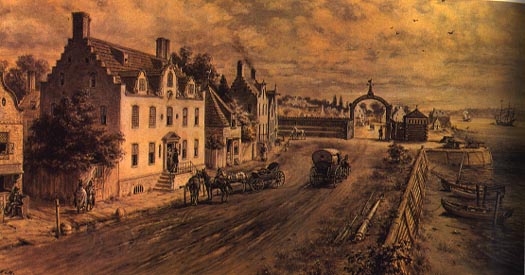
Despite his career, Kidd was considered a respectable New York gentleman — much, I imagine, because of his wife’s standing from her prior two marriages. Also, their digs weren’t bad. Although the Kidds owned several properties (again, thanks to Sarah), their primary residence was at the 119 Pearl Street, at the corner of Hanover and Pearl streets, a location which would have been waterfront property back in the day. It was also closely situated to Hanover Square, New York’s retail district and later home of the colony’s first newspapers.

The sizable home was located next to New York’s old wall, a fortification that would be ripped down within the decade and replaced with the street named after it. Kidd’s home is pictured below (i.e. the big white one):

The Kidds home was especially lavish for the time, with “104 ounces of silverware,” a healthy wine cellar and the biggest Turkish carpet in the city. Their wealth would have made them candidates for a pew at the newly built Trinity Church in 1696. Although Kidd provided equipment to help build the church, it appears Kidd himself never worshipped there. (His wife Sarah most likely did.)

Virtually no traces of this era exist in downtown Manhattan today, and the land extension east and the skyscrapers built there eradicate the view the Kidds would have had from their home.

Over a hundred years later, at the same address lived a man named Jean Victor Marie Moreau who would also influence world history: he’s best known as one-time right-hand-man of Napoleon Bonaparte, banished for betrayal in 1804 and sent to America, where he lived for a time at 119 Pearl.

You can read a nice, lengthy piece about Kidd and his New York connections here at Maritime History.

Categories
Podcasts

Trinity Church: anchor of Wall Street, New York’s landlord

Above: The seemingly unchanged Trinity in 1916, already dwarfed by skyscrapers

PODCAST Trinity Church, with its distinctive spire staring down upon the west end of Wall Street, is more than just a house of worship. Over three different church buildings have sat at this site, and the current one by architect Richard Upjohn is one of America’s finest examples of Gothic Revival architecture.

The church collected Manhattan’s upper crust for decades and functions as one of the city’s most powerful landowners. Listen to our short history on the New York institution and find out who’s buried in their famous churchyards — Founding Fathers, inventors and a whole lotta Astors.

___________________________________
Clarification: In discussing the religious make-up of late 17th century New York, we failed to clarify that there were many Anglicans that already lived in the city but were not associated with the Church of England. These “English dissenters” belief systems were similar to the Anglicans but they disagreed with state meddling into religious affairs.
___________________________________

Fire Walk With Me: Below is a 19th century illustration of the ruins of the first Trinity Church, gutted in the fire of 1776 which subsequently destroyed one quarter of the entire city. The remains sat for many years undisturbed, and a second church would only be rebuilt after the British were expelled from New York. [NYPL]

___________________________________

Snowed In: The second Trinity church, built on the same spot as the first, sat for over four decades until weight from massive snows during the winter of 1836 weakened the roof to such an extent that the entire structure had to be demolished. [NYPL]

Another view of the second one (dated 1830), looking down Broadway. Trinity’s distinctive spire was already considered the city’s most recognizable landmark.

___________________________________

Third Times A Charm: Richard Upjohn’s Gothic Revival masterpiece was the tallest building in New York from the time it opened in 1847 (the date of this lithograph) until 1890, when it was finally usurped by the New York World building. [NYPL]

The same view, from 1903, as the city morphs rapidly around Trinity.

Witness to the September 16, 1920, terrorist bombing in front of JP Morgan’s….

…and the World Trade Center attack on September 11, 2001. [courtesy Sacred Destinations]
___________________________________

Looking good from all sides. [Courtesy Sound Mind]

___________________________________

Below is the Trinity Building from 1911. This is the replacement of a building that once stood here that is commonly considered New York’s very first office building. That five-story building, also designed by Upjohn, stood here for about fifty years and was demolished in 1904 to make way for the Beaux-Arts beauty standing there today.

For more information, visitin the Trinity Wall Street website for information on tours and afternoon concerts. And as always, thanks to the New York Public Library for use of some of the images above.

True fear on Wall Street: the terror bombing of 1920

Lunchtime down on Wall Street today is chaotic mess of brokers and bankers on cell phones, tour groups, messengers on bikes, police, construction workers, people delivering lunch and the stray old lady walking her dog.

Eighty-eight years ago, in 1920, it would have practically been the same, sans the cell phones. So it’s particularly disturbing how easy it is to imagine the noontime scene on September 16, 1920. In fact, most of the surroundings — the Stock Exchange, the Sub-Treasury building (today’s Federal Hall), and most importantly J.P. Morgan’s headquarters on 23 Wall Street — are still very much active.

An unidentified man led a horse and carriage down the congested street, fighting to get past crowds, until it rested at the corner about 100 feet east of Broad. As the Trinity Church bells rang, the man dropped the reins and fled, never to be seen again.

One minute later, the wagon exploded with 100 pounds of dynamite, eradicating everything in its sphere, then sending dozens of iron slugs through the air to create a horrific scene of carnage.  I’ll let other sites outline some of the grimmer details, but by the end of the day, 38 people would be dead from the attack, many while sitting at their desks.  And over 400 more would be injured.

Believe it or not, evidence of this attack can easily be seen from the street today.  Morgan famously rejected repairs of his bank, preferring to leave the dents and pockmarks on the side of his building in a sign of defiance. With a little morbid imagination and some amateur CSI work, one can probably trace the trajectory of wall’s injuries to the very spot where the poor horse and wagon exploded.

Despite a federal investigation which led to dozens of arrests, in fact the culprits were never caught.  Largely assumed to be Italian anarchists, any evidence was unfortunately lost when, in an effort to appear unfazed, the city cleaned the street and kept Wall Street open for business the next day, even seeing a rally of thousands pour into the street that Friday.

I’ve just touched on the event, but there are several resources online that look into the potential perpetrators, the street scene and the tragic aftermath.

Photos courtesy Old Picture

Categories
Podcasts

PODCAST: New York Stock Exchange

We steal this week’s topic straight for today’s headlines! We look at the early days of New York finance and the creation of the New York Stock Exchange, beginning with Alexander Hamilton, some pushy auctioneers, a coffee house and a sycamore tree.

And find how this seminal financial institution ended up in its latest home — that beautiful, classically designed George Post building, with a marble goddess on top who was almost too heavy for her own good.

Listen to it for free on iTunes or other podcasting services. Or you can download or listen to it HERE

The streets and ports of New York in 1790s, setting for America’s first financial crisis and the birth of the New York stock trading system. At the far left is the Tontine Coffee House.

This slight little man is William Duer, former assistant secretary of the treasury, whose shiftless manipulation of the early American financial system got him thrown in debtors prison for life

An illustration of the Buttonwood Agreement, which formed the loose collection of brokers who would form the New York Stock Exchange

The Tontine Coffee House (that building with the balcony) where the stock market meets a good coffee bean

A sketch of Wall Street in the mid 19th century. (You can see Trinity Church and a hint of Federal Hall to your left.) The Stock Exchange headquarters floated around from place to place during this period until an elegant Italian Renaissance style building was built for it in 1863

A kind of rough drawing to be sure, but this supposedly depicts the inside of the trading floor from the 1863 building. Sorry to say I couldn’t find any images of the outside, but the John Kellum designed building sounds like it was a beauty.

Another illustration of the new Exchange itself, taken from a membership note

George Post’s masterful Stock Exchange building, mustering up his finest Beaux-Arts instincts in ways that created a solid, powerful structure for an institution sometimes without such stability

Looking down Wall Street in 1911. By this time a “financial district” was firmly in place as bank offices, brokerage firms and other moneyed interests flock around the Stock Exchange. (This awesome picture is courtesy Shorpy, quite possibly my favorite website in the world.)

Looking down at the Stock Market as it was crashing in 1929.

Crowds outside the Stock Exchange, with George Washington looking down from the steps of Federal Hall

The trading floor from the 1950s

Crazed traders in 1963 (from photographer Thomas O’Halleran)

One of the most powerful street corners in the world

Due to the crush of monstrous buildings all around it, the Stock Exchange sits in a virtual canyon

All sorts of people have rang the opening bell at the Stock Exchange, including P Diddy….

…Emeril and Snoopy

Where are you, George Post?

Who knew a produce exchange could look so elegant?

One of New York’s most important architects was George B. Post, but you would barely know it today.

Only a handful of his most important buildings — the New York Stock Exchange being the most famous — still stand, the victim of a rapidly changing city sweeping away the former glories of the Beaux-Arts style.

Post wasn’t your typical purveyor of the sometimes gaudy excesses of Beaux-Arts, that amalgam of classical and formal styles that dictated American architecture from the 1880s into the 1920s. He was known for making its particular beauty climb, refitting its graceful symmetry literally to new heights. Post proved that the merely traditional needn’t be staid and uninspiring. My two favorites of long-gone works:

New York World Building

His best known building during his life was the New York World building on Newspaper Row, more appropriate referred to as the Pulitzer building after the paper’s imperious publisher Joseph Pulitzer. It was the tallest building in the world when it was completed in 1890 and was the first building to rise above the spire of Trinity Church.

This was demolished to make way for a car ramp for the Brooklyn Bridge:

(New York Architecture has some more beautiful pictures of this building)

New York Produce Exchange

You wouldn’t expect a building made to hold produce to be an architectural marvel, but Post graceful talent at creating lively open spaces made this one, at 2 Broadway down at Bowling Green, a stunner and certainly must have recommended him as the ideal candidate to design the trading room floor at the New York Stock Exchange. The Produce Exchange was wiped out in 1957. (The exterior is shown up top.)

(Picture above, and others of Post’s work, can be found at City Review, reviewing a book of Post’s work by Sarah Bradford Landau.)

Go to New York Architecture to see a sampling of lost Post buildings.

If you’d rather see one of his few existing ones, simply cross the Williamsburg Bridge over to the Brooklyn side, turn left and look for that beautifully domed and very out-of-place beauty that’s now an HSBC bank branch. That’s the Williamsburgh Savings Bank, the little brother of the Williamsburgh Savings Bank Tower and one of Brooklyn’s most beautiful buildings, built in 1875, many years before the bridge sprouted up in front of it:

Name That Neighborhood: Wall Street Blues

A simplistic but colorful view of “Man Mados” or “New Amsterdam” in 1664 (click in to inspect the detail)

One of the first facts you learn as a student of New York City history is that Wall Street, that canyon of tall buildings and center of the American financial world, is named for an actual wall that once stretched along this very spot during the days of the Dutch. The real story is rather fuzzied by the presence of a small community of French-speaking Belgians known as the Walloons.

The original ‘De Waal Straat’ was the center of a small Walloon community in New Amsterdam. There was most definitely a walled fortification nearby on New Amsterdam’s northern boundary, and it certainly did stretch along about the same area as Wall Street does today.

But the present name seems to be a formation of mixed meanings that only a tangle of languages and hundreds of years of history can create. The Dutch themselves referred to an actual street alongside the wall as the ‘Cingel’ — according to an old history, meaning “exterior, or encircling, street.”

The real reasons for New Amsterdam building its famous wall are also up for grabs. It’s commonly held that the wooden palisade was erected in defense of Indian attacks, and certainly the residents of New Amsterdam did their part to rile the anger of the native landowners. But the Dutch had been living at the tip of Manhattan for over 25 years by the time the wall was built in 1653. In truth, it was commissioned to keep out a different sort of enemy.

You’ll be pleased to know that one-legged director-general Peter Stuyvesant was the man who ordered the construction of the “high stockade and small breastwork” that cleaved the Dutch community from the natural wilds beyond.

This was an incredibly important year for New Amsterdam in two respects. In February 1653, New Amsterdam was chartered as a official Dutch city. Although Stuyvesant was quite against the outpost receiving such official recognition, he eventually took advantage of it, appointing the first town council himself rather than putting it up to such trivial inconveniences as elections.

But in 1653 the tides of the motherland spilled onto their shores, as the war between England and the Netherlands threatened the remote and undefended new city. The Dutch intended to launch ships from New Amsterdam harbor in battle against the English.

As a result, the English colonies up north were sure to retaliate, either by sea or, feared Stuyvesant, over land, possibly teaming with hostile Indian forces, down through undefended Manhattan island. Essentially, the wall that helped give us Wall Street was built because Stuyvesant feared attacks not just from Indian tribes, but from the European colonies of Connecticut, Massachusetts and New Haven!

Above: looking at this more well known map of New Amsterdam, once can see the two gates very clearly

Stuyvesant called upon the 43 richest residents of New Amsterdam to provide funding to fix up the ailing Fort Amsterdam and to construct a stockade across the island to prevent attacks from the north, while it took New Amsterdam’s most oppressed inhabitants — slave labor from the Dutch West India Company — to actually build the wall.

The barrier was constructed out of earth, rock, and 15 feet timber planks sold to the Dutch, ironically enough, by the “notorious” Englishman Thomas Baxter. In a turnabout that one would expect from hiring your enemy, Baxter later led a group of “Rhode Island marauders” and pirated Dutch fishing ships.

Early in the 1660s, the Dutch upgraded its wall to include brass cannons and two sturdy gates — one at today’s intersection of Wall and Broadway (for land), the other at Wall and Pearl Street (according to an early account, a water gate and access to a ‘river road’).

The British took over New Amsterdam in 1664 and renamed it New York, but the wall still remained, becoming more a relic than a serious defense.

By the turn of the century, the fear of land attacks had almost completely subsided and the city was beginning to feel crowded. So in 1699 the wall was torn down with some of the material salvaged to help construct a new City Hall at the corner of Nassau Street and the newly cristened Wall Street. When the British were forced out in 1783 by the Americans, the City Hall building was renamed Federal Hall — the first official center of American government.

A plaque honoring the old wall sits today at the corner of Wall and Broadway, where the gate to the city once opened:

Financial District’s little piece of heaven


Of all the people who lived in New York City during the Revolutionary War, of all the great Americans who helped shaped history here in the city, [cue deep-voiced announcer] only one can be called America’s first U.S.-born saint.

Commuters who zip on and off the Staten Island ferry and tourists gallivanting through Battery Park probably skip past the red brick Federal Style structure across the street, which serves as a church on Sundays and a rare reminder of early history on other days. Frankly, even been an unusually geeky history buff like myself, I have rushed by this building at least a hundred times before realizing what it was.

But it was here that Elizabeth Ann Seton, the charitable Catholic woman who became New York (and America’s) first saint, in honored in a shrine whose presence has helped save a spectacularly unique building.

Seton’s actually from Staten Island (born August 28, 1774) but lived in the house here for a few years. Whether or not you believe in the holy powers of the sainthood, you can definitely say that Seton’s former presence here saved this extraordinarily out-of-place home from the wrecking ball.

This home, originally built in 1794 by wealthy merchant James Watson, once stood with a row of similar Federal Style buildings facing a harbor clogged with shipping vessels.

NYC Architecture has some fantastic photos of the the Watson home’s former neighbors. Seriously, how this place somehow remained standing over the years is a testament to the sometimes random choices of the flippant New York real estate world.

Seton, born a protestant, became Catholicized at the former St. Peter’s Church on Barclay Street but made her name in Maryland by founding the Sisters of Charity, America’s first congregation of nuns. Seton’s strong draw to religious fate is attributed to living in New York City during its yellow fever epidemic of the late 19th century.

She was canonized on September 14, 1975. Seton Hall University, among many schools, is named in her honor.

Elizabeth Ann Seton fun facts:

— Like the cast of Gossip Girl, Elizabeth Seton was born into a prominent New York family and hobnobbed with the elite — which, in Revolutionary era New York, was centered at Trinity Church

Seton and her family lived upstairs at 61 Stone Street, where her husband ran a business into the ground, and they were evicted. Although the original building was destroyed in the Great Fire of 1835, today the space is occupied by the cute Wall Street Inn on one of the most picturesque streets in downtown Manhattan.

— After confirmation, she slapped a Mary in front of her name thus Seton would later sign everything merely with the initials M.E.A.S.

— In her final days, she drank only port wine