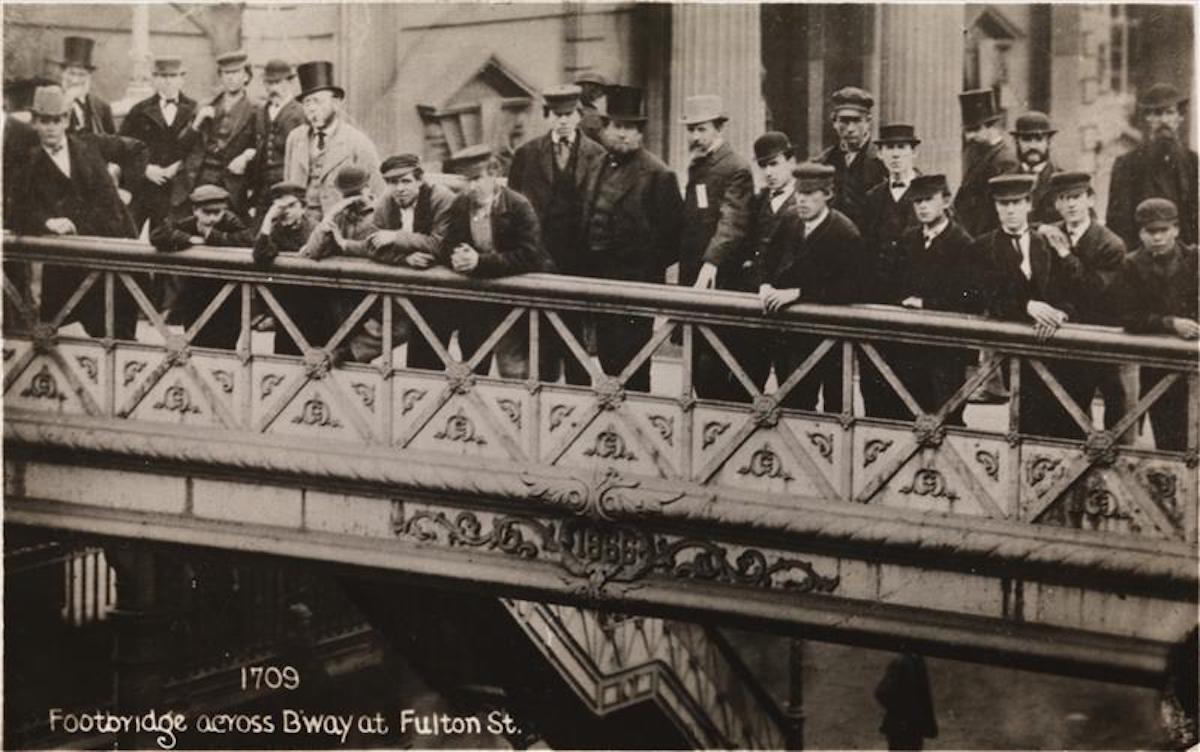
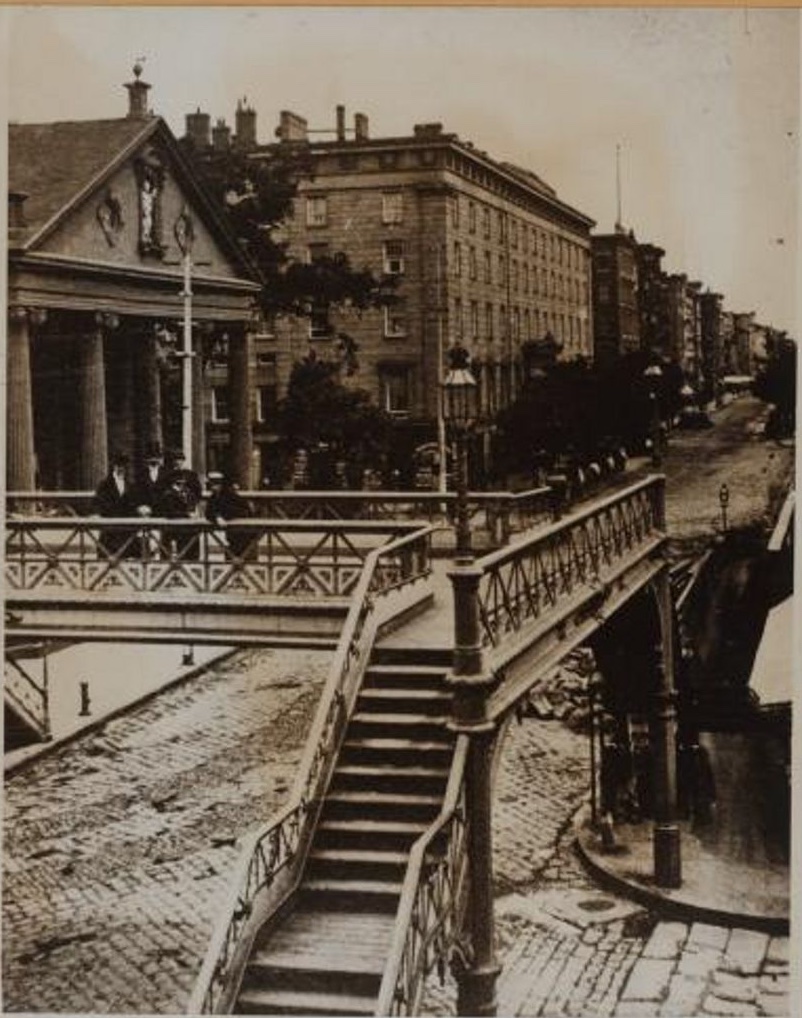
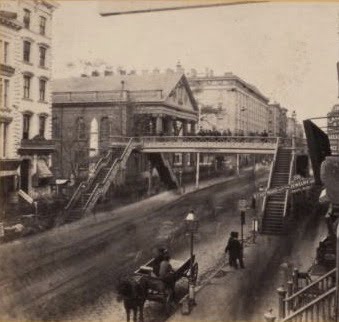
The bulky and yet somewhat elegant contraption above is the short-lived Loew Bridge, which once hung over Broadway at Fulton Street back in 1867 and 1868, an early cast-iron pedestrian bridge at one of the busiest intersections in the city.
It was named not for its architect, but for the comptroller of New York at the time, Charles E. Loew.
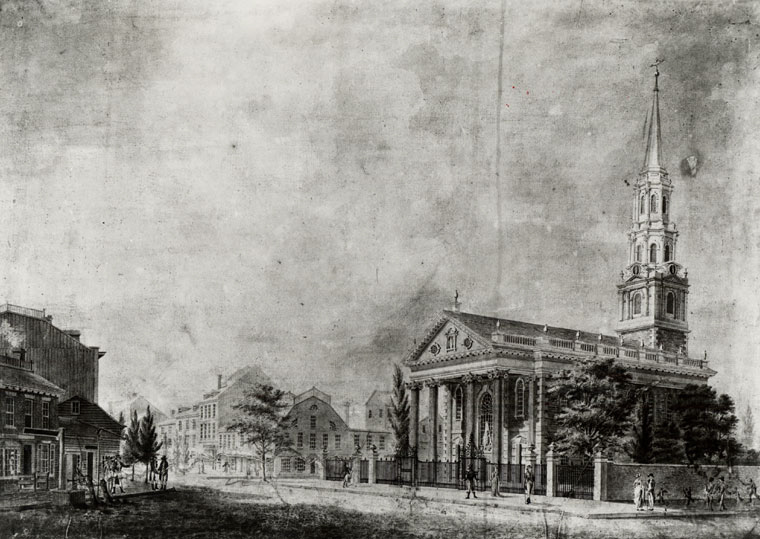
Crossing the street was indeed a challenge then, in an era of no traffic lights and conveyances operated by horses. A couple blocks to the north lay the heart of city government and the publishing industry, not to mention St. Paul’s Church and the Astor House, New York’s finest early hotel. (Both are seen in the photo below.)
New York Public Library
The bridge, which opened in April 1867, provided a respite to New Yorkers frustrated with dirty streets and impossible crossing options for pedestrians. One fanatic was even inspired to pen a lengthy poem to its honor.
Unfortunately, it was not popular with surrounding business owners, particularly the one at 212 Broadway. That storefront, the hatter of one Charles Knox, was obscured by the bridge’s latticework and decreased business opportunities, he alleged.
It seems unusual that one businessman would be able to effectively crumble a new bridge to the ground, but Mr. Knox had the city’s sympathies.
Two years earlier, his original shop had been destroyed in the same fire that incinerated Barnum’s American Museum. However he managed to unite some business owners of the area and eventually “brought suit against the city for $25,000 damages.” [source]
Most likely, Knox was more concerned with the belief that he was losing business to a rival hat shop across the street. (After all, to paraphrase a popular cliche, the hats are always cleaner on the other side.) Thanks to his efforts, the city ripped the bridge down less than two years after first erecting it, and citizens went back to their filthy and treacherous street crossings.
Back to square one, it seems. I think the situation is very well summarized in this letter from ‘B.’ to the New York Times, published on December 20, 1868:
“Taking down the Broadway Bridge appears to cause few remarks from the press, and when they have spoken they have rather been in favor of the removal.
“It appears to me the bridge, at certain periods was a great convenience, notwithstanding its needless height. When the snow slush is a foot thick, and the street blocked up with stages and trucks in a dead lock, it is a great accommodation to have a bridge to cross. It is almost impossible for women and children to cross Broadway, near Fulton Street, at such times; and if men get over it is at the risk of being covered with filth.
“Before the bridge was built, the writer has walked from Liberty Street to near Wall before getting across. At that time the papers were continually talking about ‘relief to Broadway”; but since the bridge was built, that has ceased. I think we shall hear it again on the first thaw after a heavy snowstorm, when crowds will be seen standing at the corners wondering how they will be able to get over the street.
“If the bridge is an injury to private property, the owners should be remunerated for the damage; not that a few shopkeepers, because their business is injured, or they think it is, should be the means of inconveniencing the whole public by having it removed.
“If that were the case with railroads, every farmer would have the power of stopping the road going over its land, because he thought it injured it — and there would not be a railroad in this country.”
Images above from the New York Public Library digital collection
The monumental events of America’s founding would be immortalized by the fair in some rather unusual ways 150 years later. Both April 30th events were occasions of great patriotic ceremony (and both even slightly kitschy) in their own ways.
Courtesy New York Public Library
April 1789 It took George seven entire days to get to New York from his home in Mount Vernon, as his procession was met every step of the way with throngs of patriotic crowds and flamboyant celebratory displays.
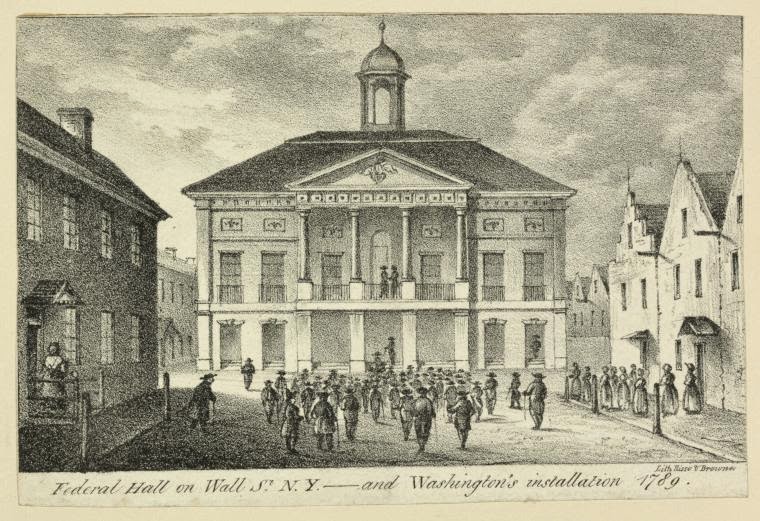
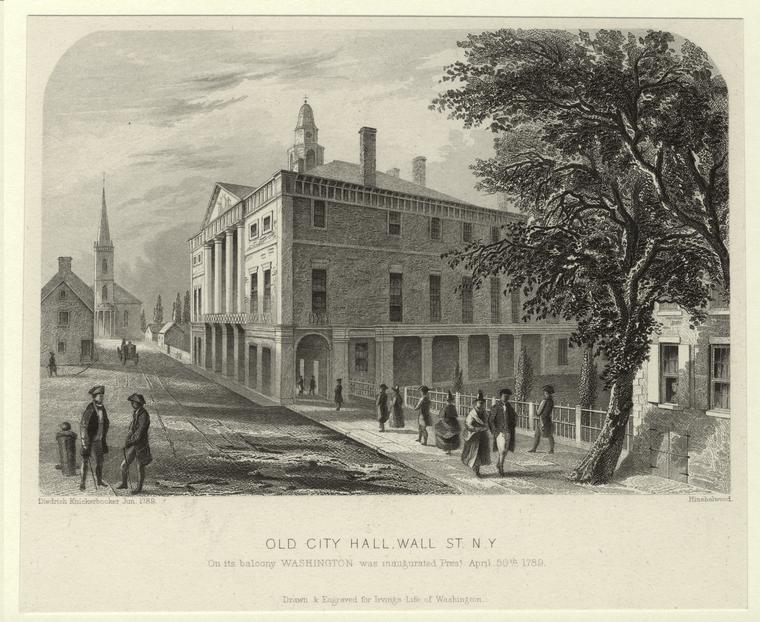
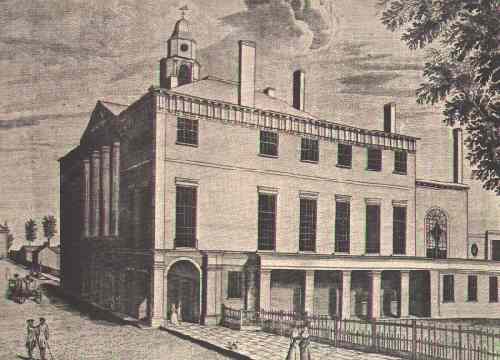
Washington’s vice president John Adams had already arrived in New York, on April 21st. The building which greeted him, the former City Hall building on Wall Street, had been the center of city’s government since 1699, when the British used materials from the city’s demolished north defense wall to construct it.
Courtesy New York Public Library
The heavily remodeled building which now stood in its place, later to be calledFederal Hall, was designed by successful city contractor and former Continental Army engineer Pierre Charles L’Enfant. According to author David McCullough, “it was the first building in America designed to exalt the national spirit, in what would come to be known as the Federal style.” (Sadly, this building was ripped down in 1812; the ‘Federal Hall’ which stands in the same spot today was built as a customs house in 1842.)
L’Enfant would later work on the creation of Washington DC out of Maryland swampland. He would ultimately be fired from that project — by George Washington.
George finally arrived in New York two days after Adams, April 23, via a barge from Elizabeth, New Jersey, and was met at the Wall Street pier by the current mayor of New YorkJames Duaneand the state’s governor George Clinton.
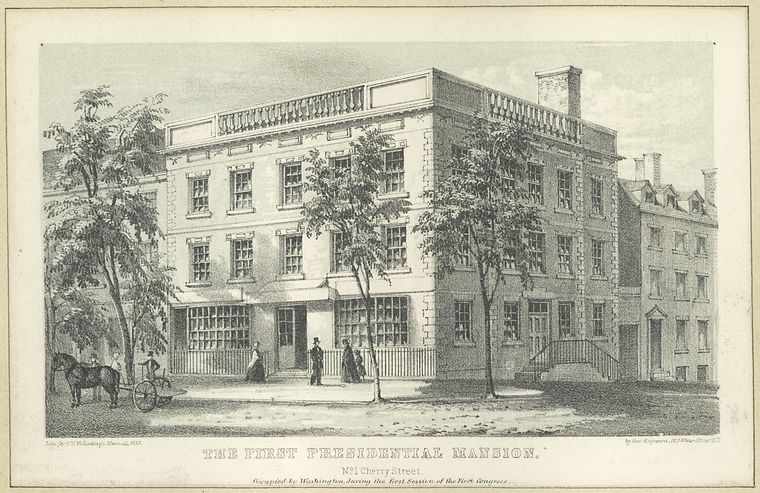
From there, he was taken to his new home on Cherry Street (long demolished, around near the Brooklyn Bridge anchorage today) and spent the day greeting dozens of well-wishers. That night, Governor Clinton hosted an elaborate dinner in his honor; the pomp and extravagance by this time were probably getting tiresome to the stately Virginian farmer.
Meanwhile Adams spent the week at Federal Hall in Senate chambers, hashing out such things we take for granted — such as how to even address the new president — until at last they were ready for the ceremony to begin, on April 30.
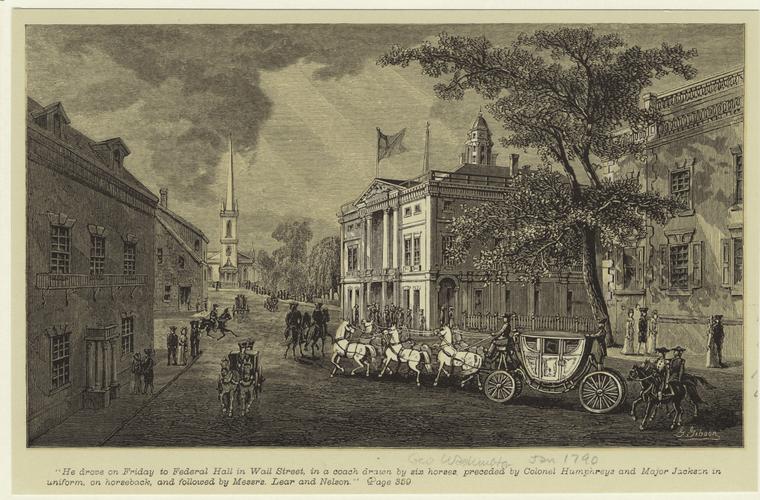
According to Ron Chernow: “Washington rose early, sprinkled powder in his hair, and prepared for his great day.” Like some detail from a fairy tale, Washington left his Cherry Street home at noon in a yellow carriage driven by white horses, legions of soldiers marching proudly behind him.
The streets of Manhattan were clogged with people, over ten thousand cramming Broad and Wall streets, as far as the eye could see both ways. Sitting on the balcony of his own home on Wall Street was Washington’s closest confidante Alexander Hamilton, certainly reveling in the moment.
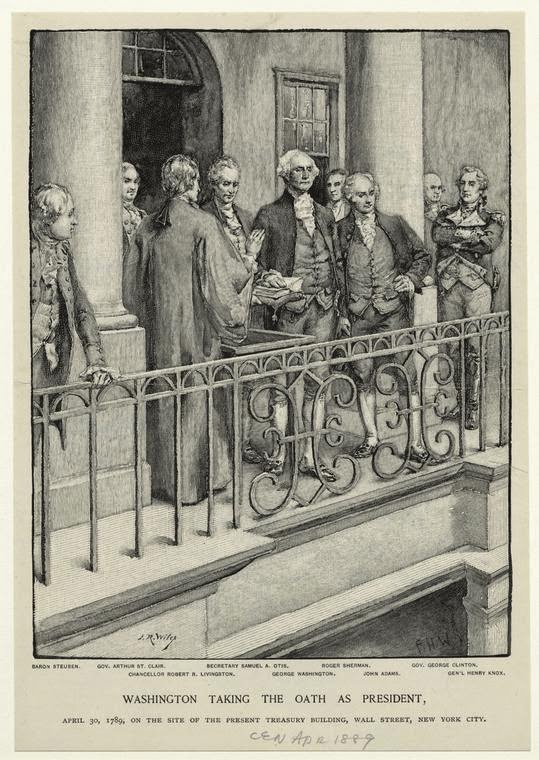
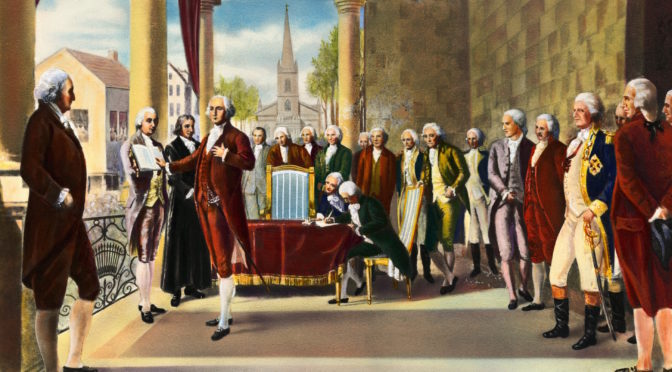
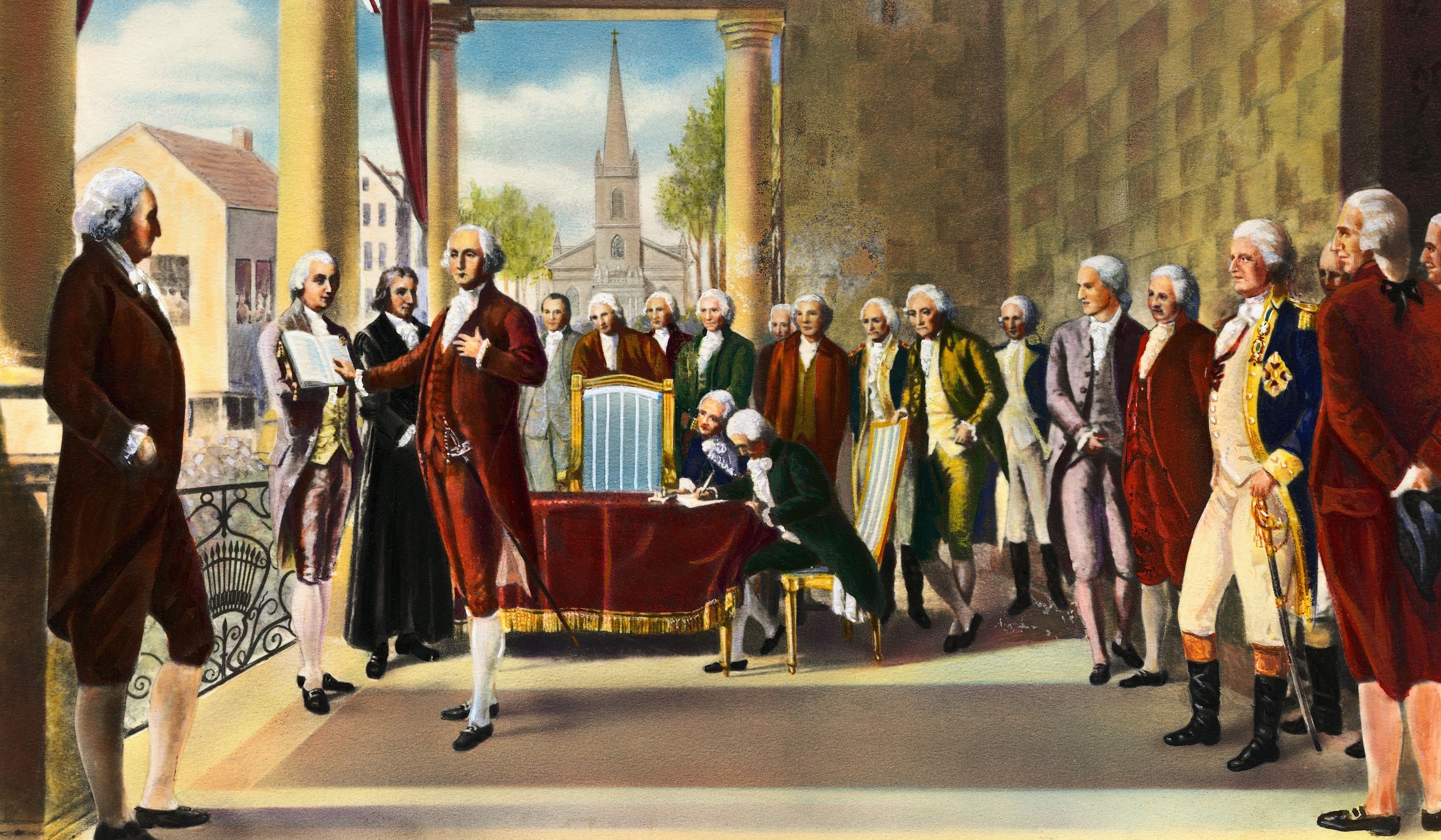
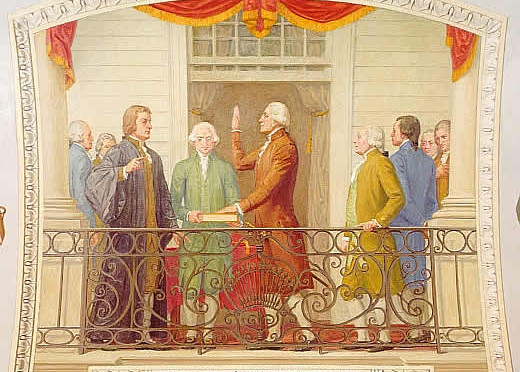
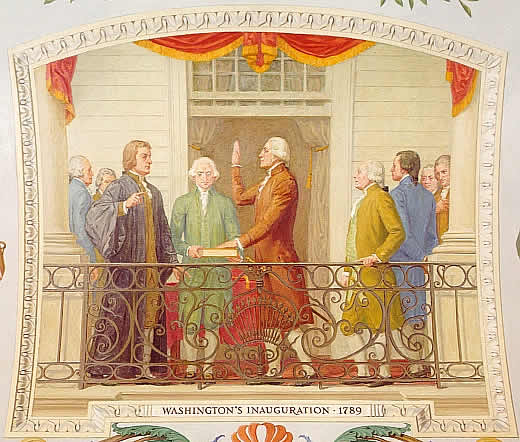
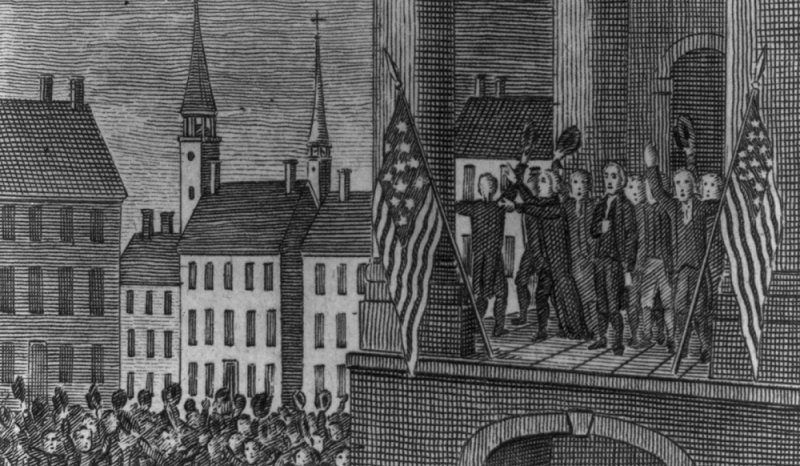
After greeting the Congress, Adams led Washington to the second floor balcony along with Robert Livingston, the Chancellor of New York (the highest judicial office in the state), who held out a bible owned by the St. John’s Lodge Freemasons and delivered the oath of office, probably not loud enough for anybody in the street to actually hear.
Washington, even less audibly than Livingston, swore to “faithfully execute the office of President of the United States, and will to the best of my ability, preserve, protect and defend the Constitution of the United States.” He then possibly threw in a ‘so help me God’ for good measure (although there are many doubts that this occurred).
Courtesy New York Public Library
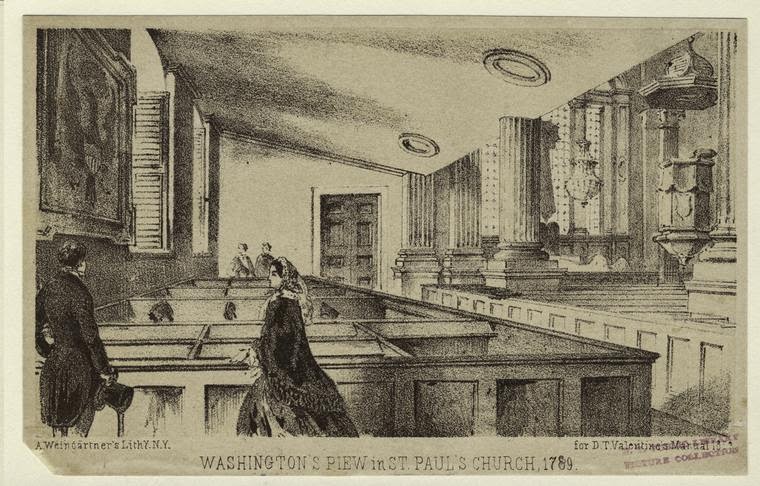
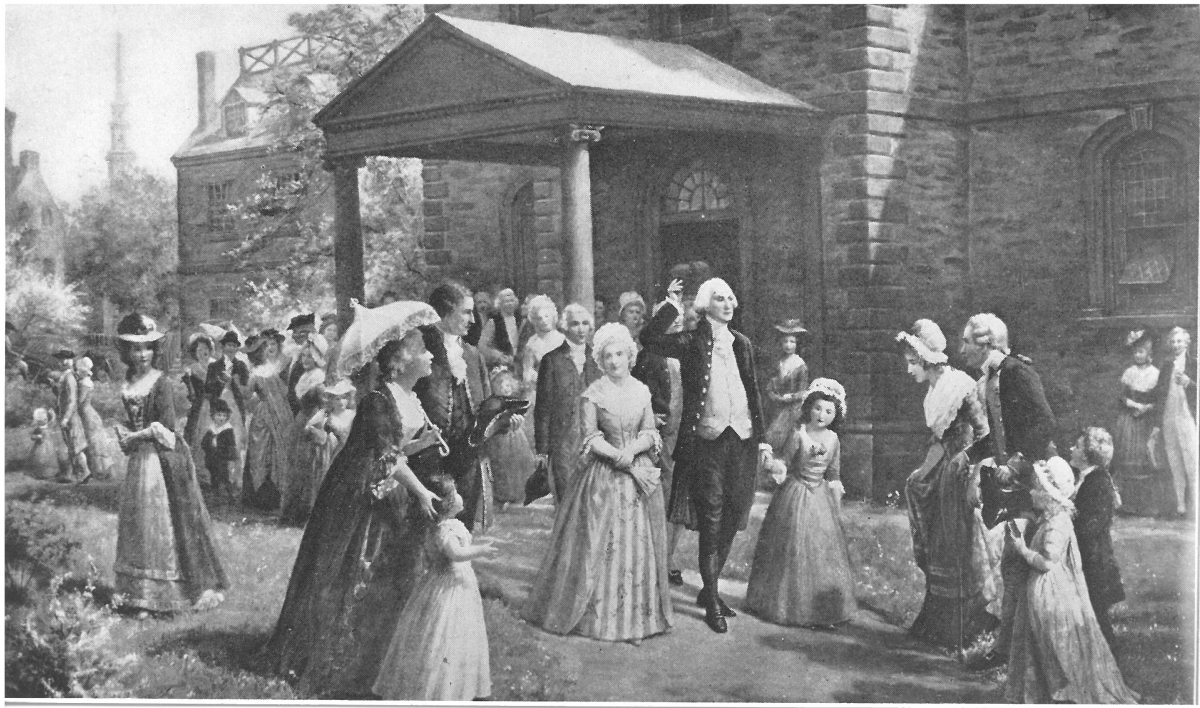
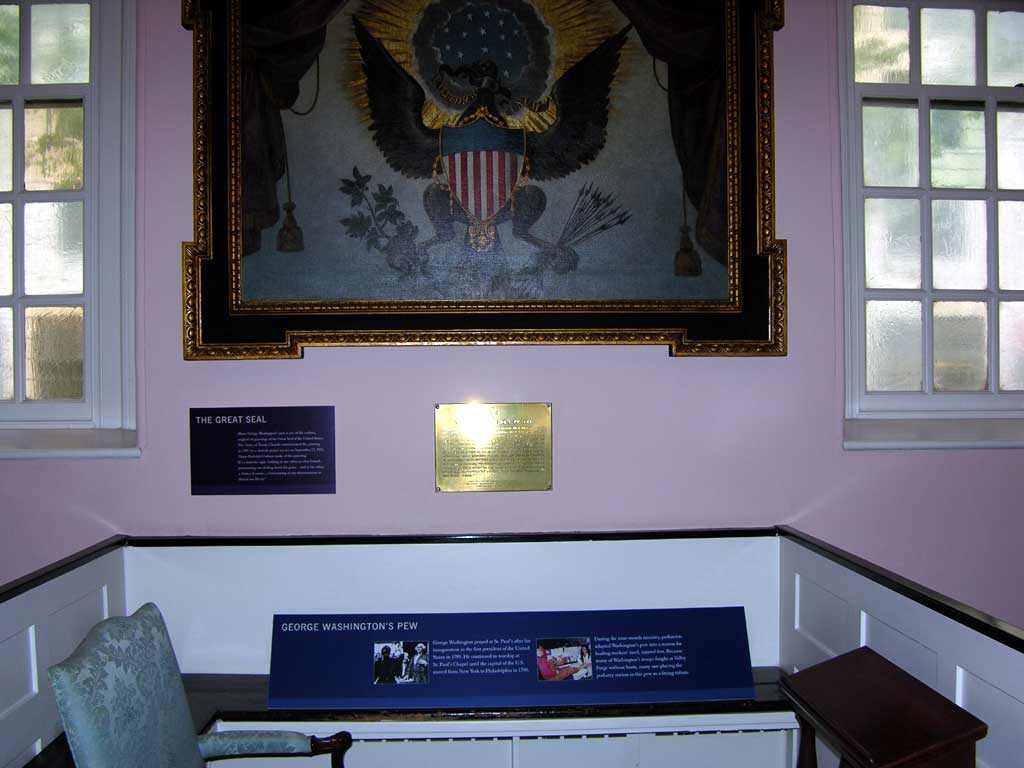
New Yorkers went crazy then, firing cannons, screaming and waving flags, playing music and dancing in the streets. After returning inside to address the new Congress — by this time with tears in his eyes — Washington and his entourage went up Broadway to receive on invocation at St. Paul’s Church, the scrappy survivor of the great fire the destroyed much of the city in 1776. Washington would be a regular here for his entire stay in New York; the pew where he planted himself for two years is still on display there (illustrated above).
Martha Washington would not arrive in town for another month, but that didn’t stop the parties. The official inauguration ball took place a week later, on May 7th, at the Assembly Rooms at 115 Broadway.
Although a bit stiff and silent, George was still popular with the ladies and danced “two cotillions and a minuet,” often seen with Alexander Hamilton’s young bride Eliza. When Martha arrived on May 17, landing at Peck Slip, she was greeted with similarly grand fanfare, and yet another ball was held in her honor.
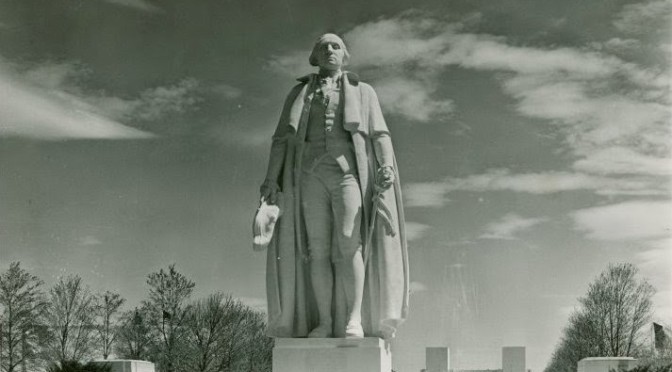
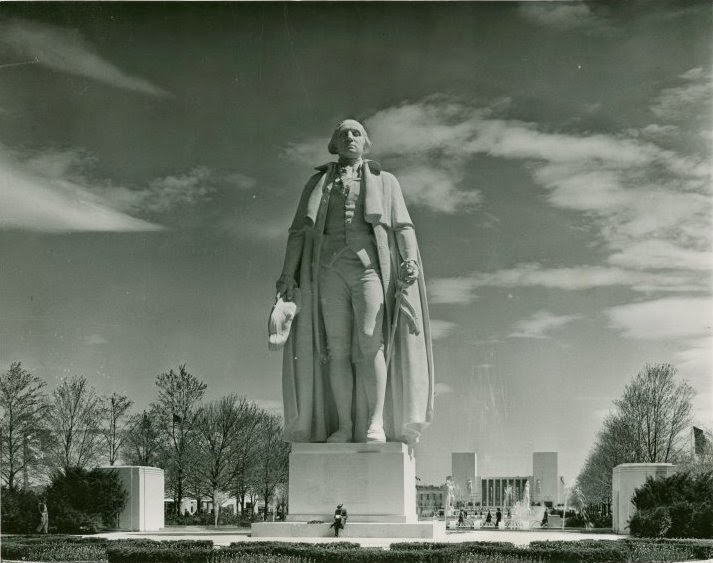
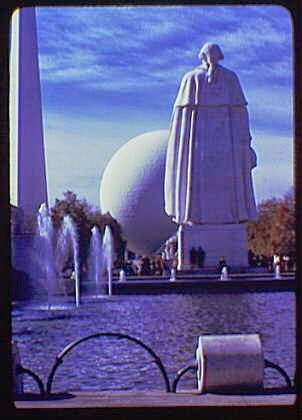
James Earle Fraser’s colossal Washington statue out in Queens. (NYPL)
April 1939 One hundred and fifty years later, the 1939 New York World’s Fair opened in Flushing Meadows-Corona Park, the second largest American fair up to that time (only St. Louis’ 1904 event was larger).
This celebration of human advancement — as demonstrated through miles of utopian kitsch and strikingly bizarre architecture — was a reason for Robert Moses to turn the unsightly Corona Ash Dumps into a Queens super-park. The fair was advertisement as entertainment, with hundreds of modern gadgets displayed as novelties and staples of the future.
Courtesy the Museum of the City of New York
But the celebration was planned with the past in mind as well. It opened on April 30, 1939, coinciding with another great day in New York City history — Washington’s inauguration. That’s how important the city thought the opening of the fair was. (Life Magazine was a little more cynical; in 1939, they refer to Washington as “the excuse” for the fair. The purpose, of course, was profits.)
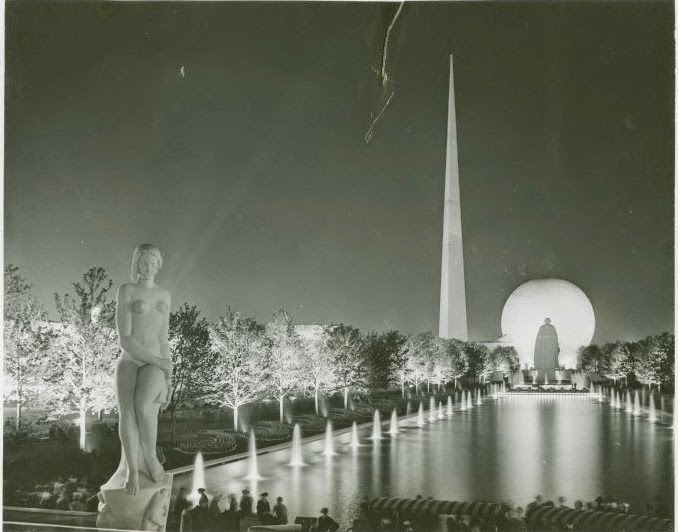
A 61-foot-tall statue of Washington by James Earle Fraser stood mightily over the fair’s Constitution Mall, peering perhaps quizzically at Paul Manship’s massive sundial sculpture. A cluster of buildings called the Court of States recalled the Colonial architecture of Washington’s day. Even Federal Hall was recreated.
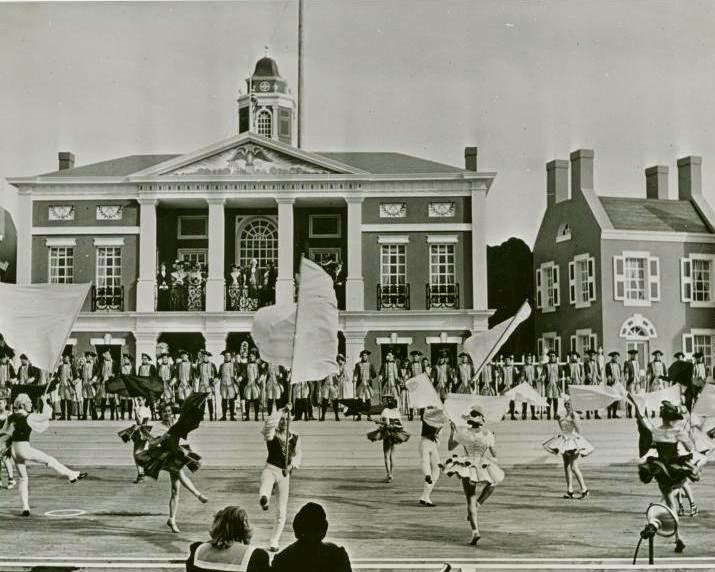
Below: The World’s Fair presented a recreation of Washington’s inauguration, except with lots of flag dancing. (NYPL)
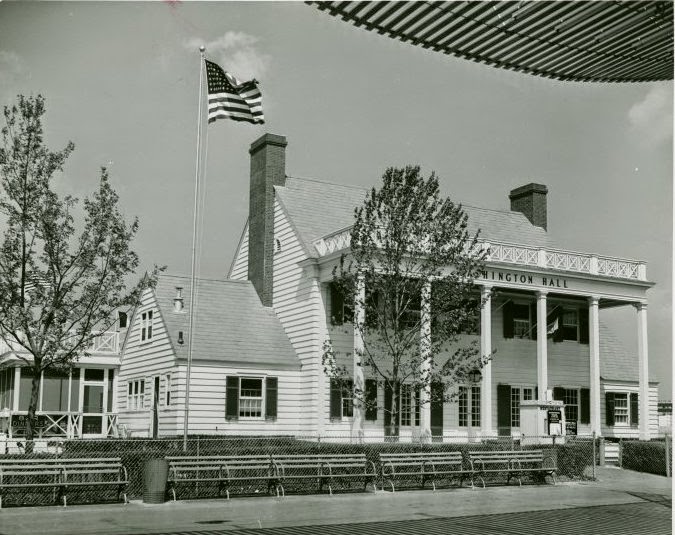
A replica of Mount Vernon (sort of) called Washington Hall was the pet project of a New Yorker with presidential ties.
Museum of the City of New York
According to the New Yorker, “Mr. Messmore Kendall, is responsible for the Hall. Mr. Kendall, president of Sons of the American Revolution and owner of the Capitol Theatre, [developed] plans for erecting, entirely at his own expense, a $28,000 building to house a collection of Washington relics. Before the Fair closes, he expects the whole thing will have cost him more than $50,000. He has given more than money to the project; he has given the family cook, so that whenever he wants a home-cooked meal, he has to go all the hell out to Flushing.”
The Hall received a host of reenactors who had made their way up from Mount Vernon in emulation of Washington’s own footsteps. On May 6th, a child named Robert E, Lee Williamson opened Washington Hall in a grand ceremony, bringing “three consecutive weeks of neo-Federal quaintness to a close.” [source]
The president also sits (sometimes awkwardly) upon a variety of World’s Fair merchandise. Light shows and fireworks unheard of in Washington’s time were dedicated in his honor throughout the fair. He even starred in a popular musical pageant at the fair called American Jubilee, with books and lyrics by Oscar Hammerstein.
It was another great president who kicked off the fair 75 years ago. With 200,000 people in attendance, Franklin Delano Roosevelt gave an opening speech extolling the virtues of American ingenuity as he became the first president to be broadcast to television audiences. Few had televisions in their homes at the time. But NBC founder David Sarnoff helpfully scattered a few dozen of them throughout the city in a clever publicity stunt.
Roosevelt starts off his speech referencing Washington. “[T]here have been preserved for us many generations later, accounts of his taking of the oath of office on April thirtieth on the balcony of the old Federal Hall. ….. And so we, in New York, have a very personal connection with that thirtieth of April, one hundred and fifty years ago.” [Read the whole speech here.]
Defined by the odd Trylon and Perisphere buildings, the fair seems like something truly dreamlike. The land where the fair once stood now contains the ruins of a New York’s other World’s Fair, the event from 1964-65.
TODAY
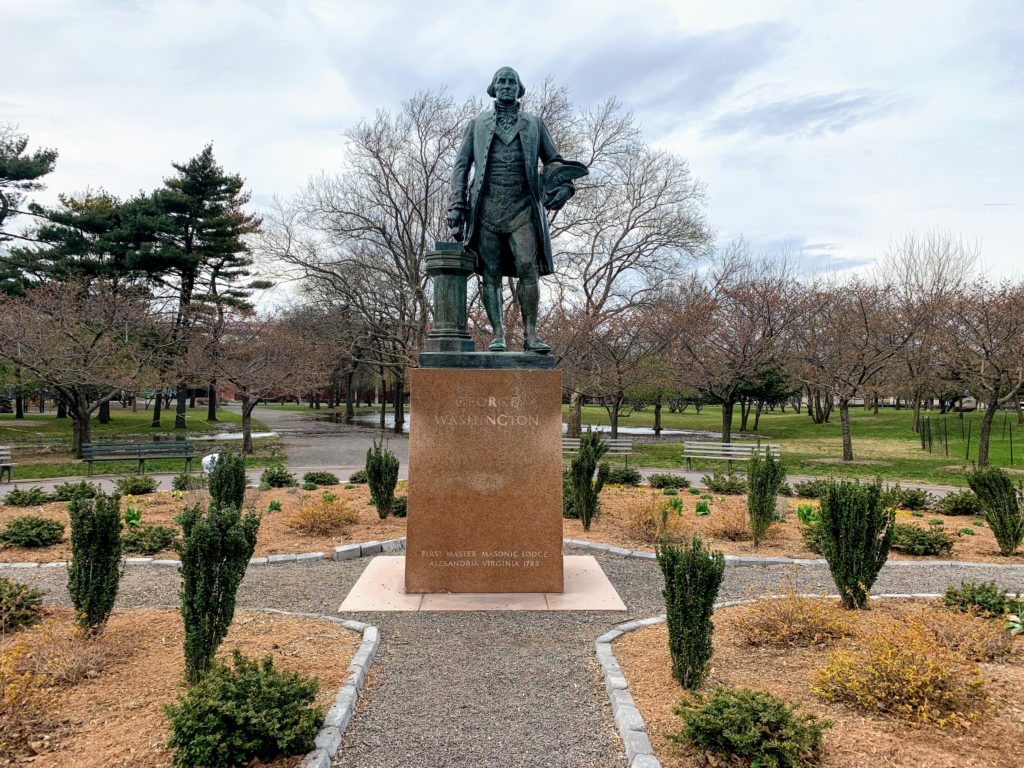
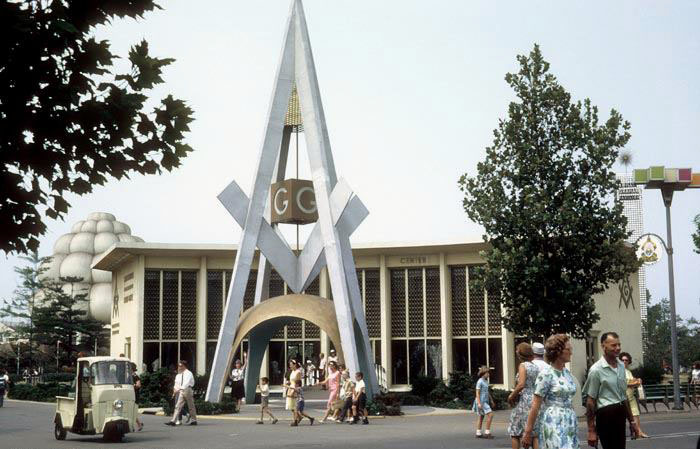
You can still find a tribute to George Washington in Flushing Meadow Corona Park today. George Washington as Master Mason by Donald De Lue was installed here in 1967, a replica of a much larger Washington statute, made of plaster, that stood at the New York World’s Fair of 1964-65 within the Masonic Pavilion. (That’s right; the Freemasons had a World’s Fair pavilion).
That 11-foot plaster statue of Washington stood next to the actual Masonic Bible on which Washington took his oath of office. Today the bible is on display — at Federal Hall.
For this article, I’ve re-purposed a couple pieces of writing I did on these events a few years ago. The original pieces can be found here and here.
PODCAST Part One of our two-part series on New York City in the years following the Revolutionary War.
The story of New York City’s role in the birth of American government is sometimes forgotten. Most of the buildings important to the first U.S. Congress, which met here from the spring of 1789 to the late summer of 1790, have long been demolished. There’s little to remind us that our modern form of government was, in part, invented here on these city streets.
Riding high on the victories of the Revolutionary War, the Founding Fathers organized a makeshift Congress under the Articles of Confederation. After an unfortunate crisis in Philadelphia, that early group of politicians from the 13 states eventually drifted up to New York (specifically to New York’s City Hall, to be called Federal Hall) to meet. But they were an organization without much power or respect.
The fate of the young nation lay on the shoulders of George Washington who arrived in New York in the spring of 1789 to be inaugurated as the first president of the United States. His swearing-in would finally unite Americans around their government and would imbue the port city of New York with a new urgency.
This is Part One of a two part celebration of these years, featuring cantankerous vice presidents, festive cannonades, and burning plumage! (Part Two arrives in two weeks.)
FEATURING Washington, Adams, Madison, Livingston and, of course, HAMILTON!
The Bowery Boys: New York City History podcast is brought to you …. by you!
We are now producing a new Bowery Boys podcast every two weeks. We’re also looking to improve the show in other ways and expand in other ways as well — through publishing, social media, live events and other forms of media. But we can only do this with your help!
We are now a member of Patreon, a patronage platform where you can support your favorite content creators for as little as a $1 a month.
Please visitour page on Patreon and watch a short video of us recording the show and talking about our expansion plans. If you’d like to help out, there are five different pledge levels (and with clever names too — Mannahatta, New Amsterdam, Five Points, Gilded Age, Jazz Age and Empire State). Check them out and consider being a sponsor.
We greatly appreciate our listeners and readers and thank you for joining us on this journey so far. And the best is yet to come!
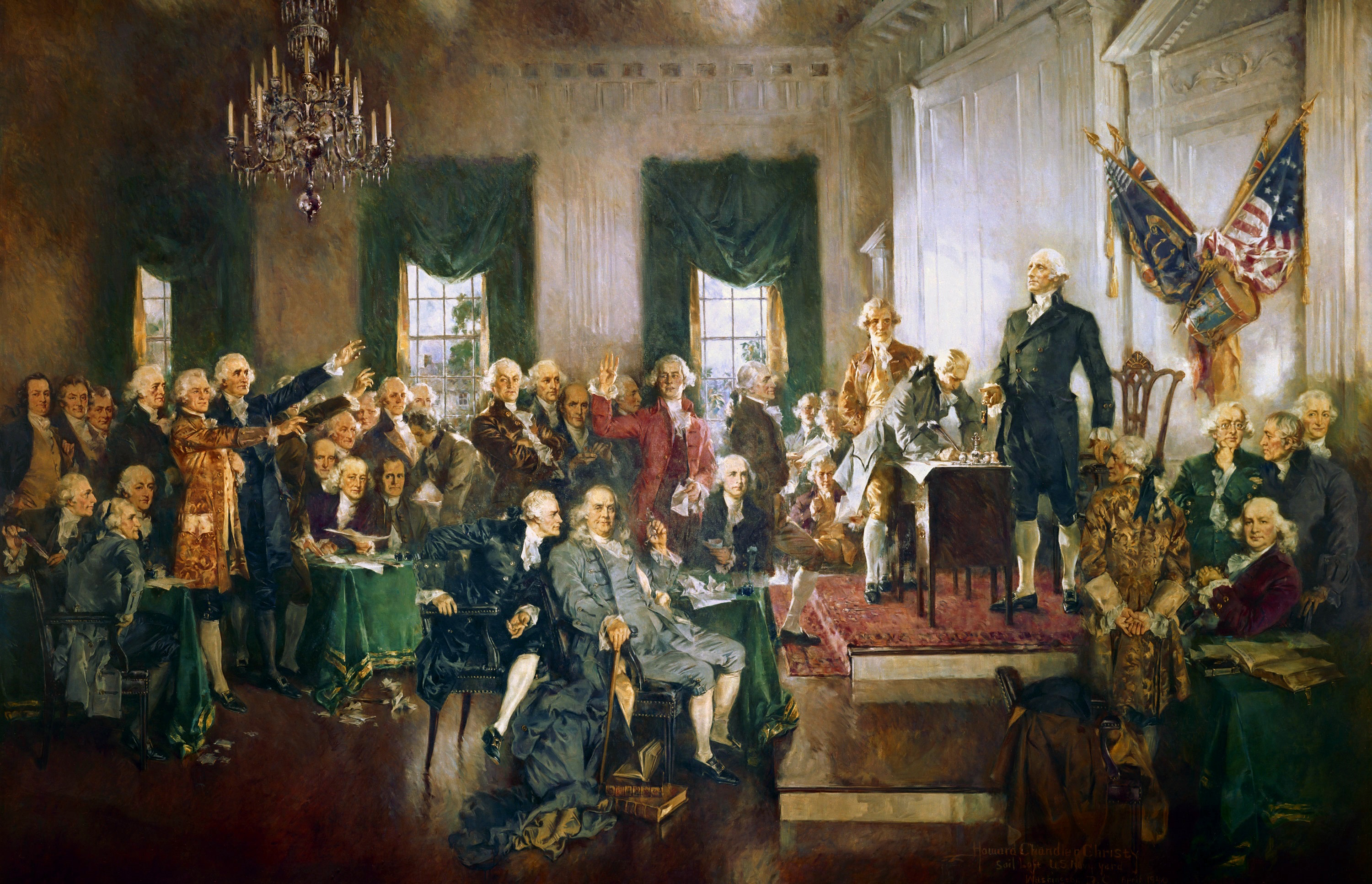
The signing of the Constitution, September 17, 1787.
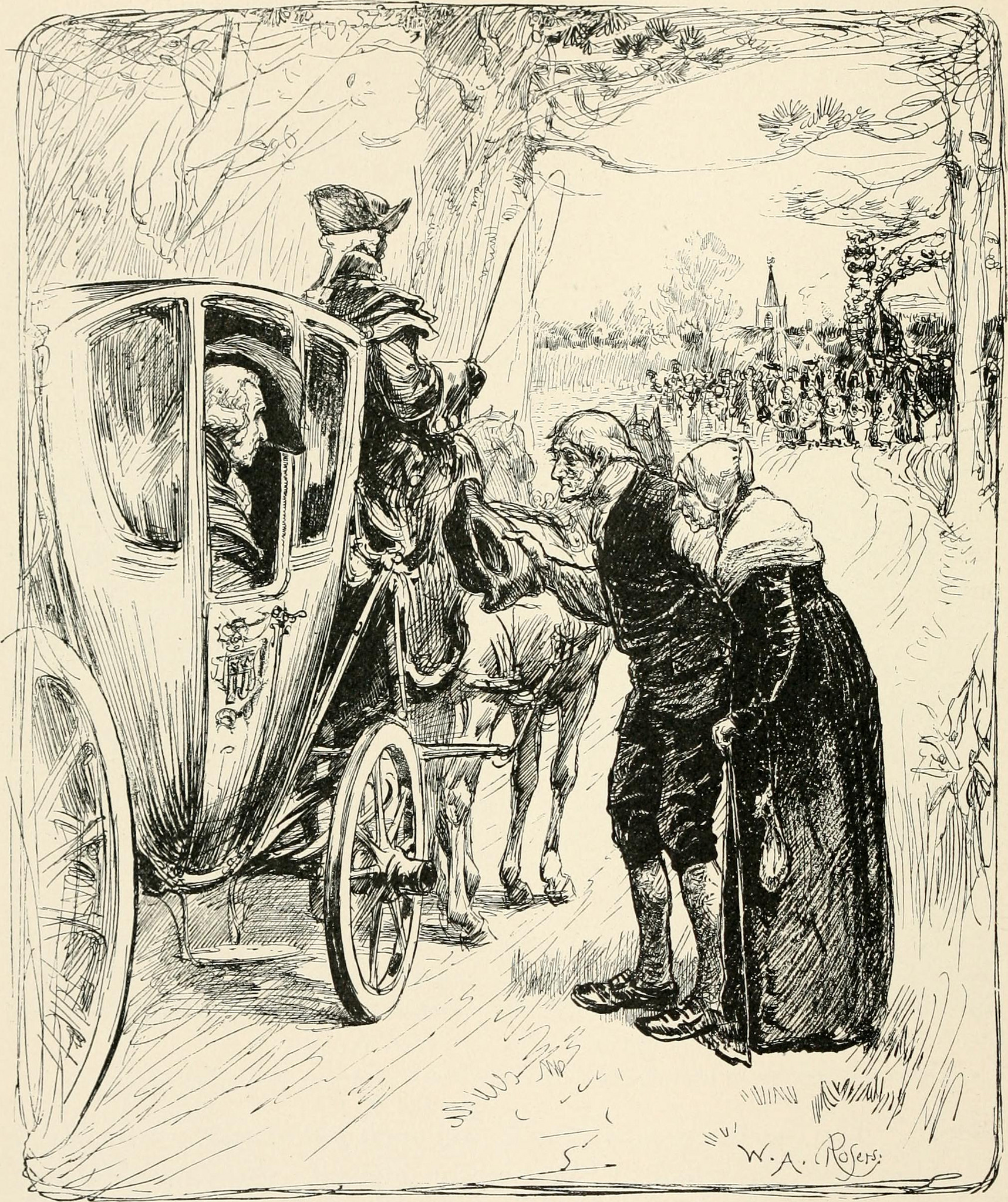
George traveling to his inauguration, as depicted in the 1896 book “The Century book of famous Americans : the story of a young people’s pilgrimage to historic homes”
Internet Archive Book Images
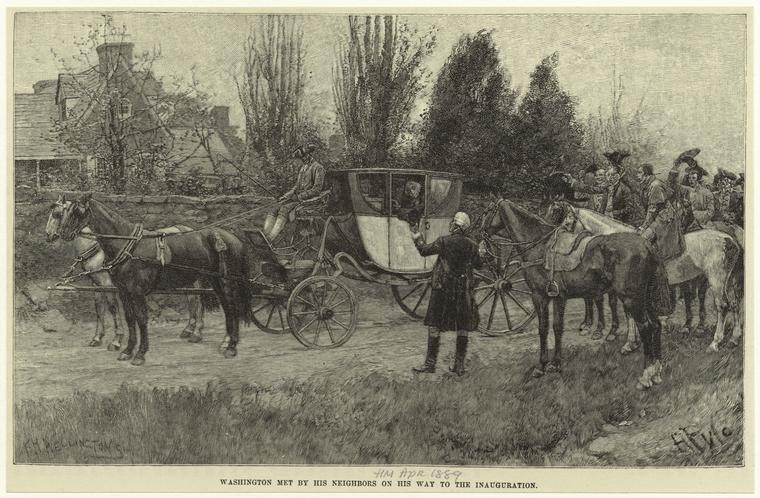
And from an 1889 illustration:
Courtesy NYPL
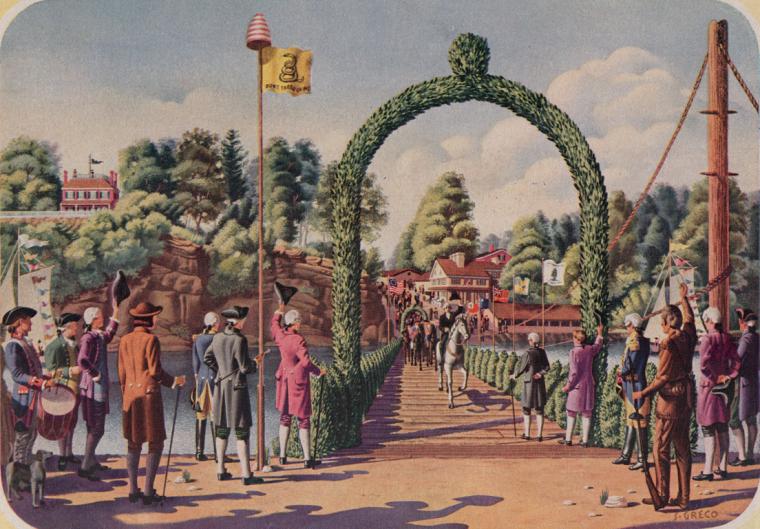
President-Elect Washington crosses floating bridge (Gray’s Ferry) — and through one of many triumphal arches — on his inaugural journey, Philadelphia, April 20, 1789
NYPL
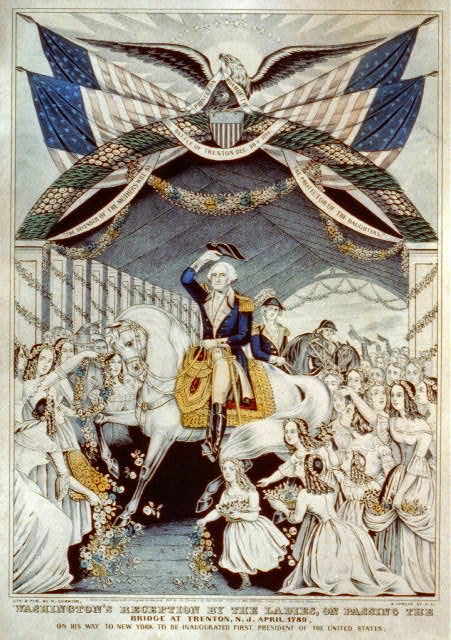
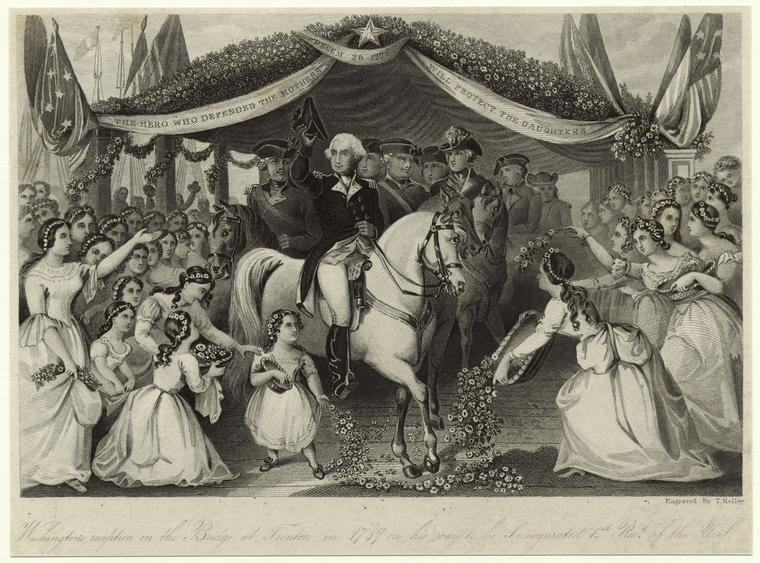
Washington’s reception on the bridge of Trenton in 1789 on his way to be inaugurated 1st president of the U. S.
NYPL
An illustration from 1855 depicts Old City Hall before it was renovated to house the new federal government.
Another view, with Washington’s six-horse coach in the foreground.
NYPL
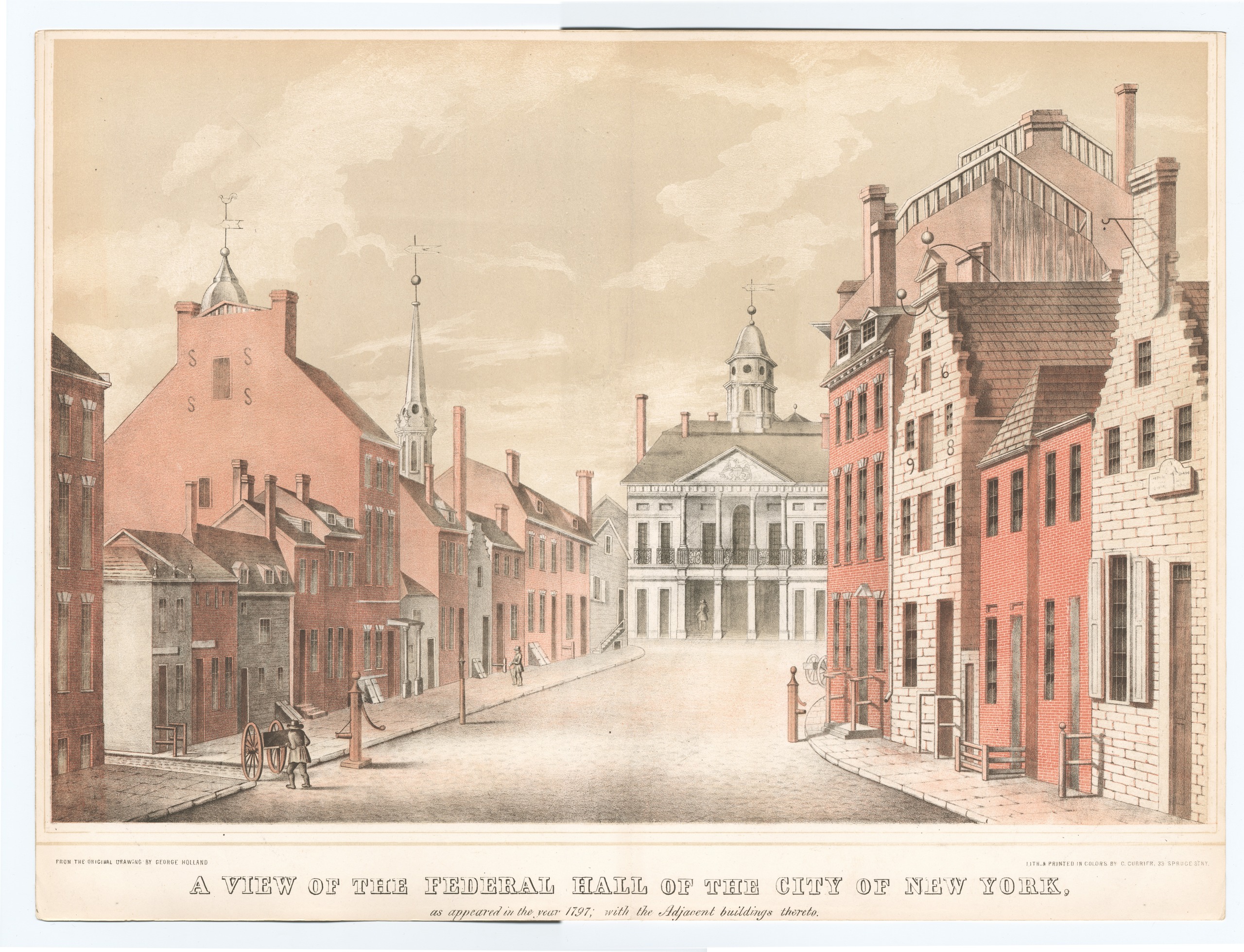
A depiction of Broad Street and Federal Hall as it looked in 1797, but you can easily picture how filled the streets would have been on Washington’s inauguration just eight years earlier.
NYPL
Here’s how it looked on the 2008 HBO mini-series John Adams:
From an 1899 oil painting (artist unknown)
The presidential mansion on Cherry Street:
NYPL
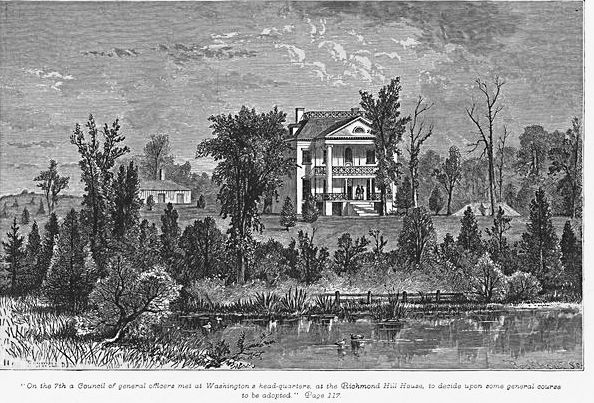
The lovely Richmond Hill, the vice presidential mansion home of John and Abigail Adams
St. Paul’s Chapel, where Washington worshipped in New York. Â More information at Trinity’s website.
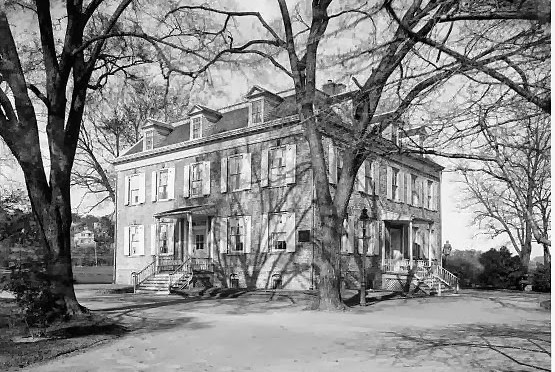
The Van Cortlandt House, 1906 PODCAST This is the Bowery Boys 7th annual Halloween podcast, with four new scary stories to chill your bones and keep you up at night, generously doused with strange and fascinating facts about New York City.
For this episode, we’ve decided to go truly old-school, reaching back to old legends and tales from the years of the Revolutionary War and early 19th century. These ghosts have two things in common — George Washington (directly or indirectly) and ghosts! Although no ghosts of George Washington.
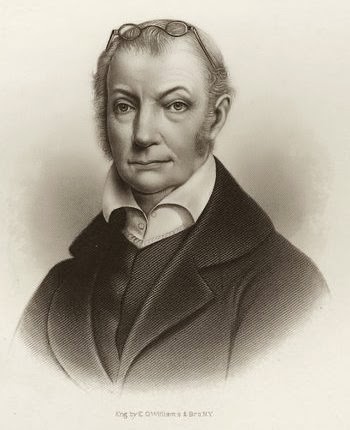
We venture to the haunted woods of Van Cortlandt Park for the tale of an Indian massacre and a forlorn servant girl, looking for her master’s silver. From there, we head to the early days of Greenwich Village and tormented vice president Aaron Burr (at right), waiting for his daughter’s return.
Meanwhile, over in Brooklyn, the ruins of an old Revolutionary War fort in the future neighborhood of Cobble Hill provide the setting for a horrific tale of a late-night booze run gone wrong. And, finally, no Bowery Boys Halloween podcast would be complete without an historic cemetery (in this case, the burial ground at St. Paul’s Chapel) and the ghost of a dramatic actor — in this case, one without his head!
PLUS: How did Westchester County become so rocky? The Devil did it!
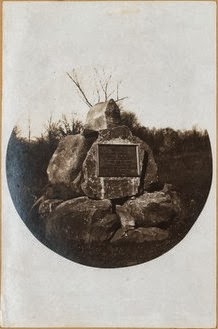
A cairn of stones memorializing Danial Nimham at Indian Field in Van Cortlandt Park, in 1906, the year it was placed here by the Daughters of the American Revolution. The original plaque states that 17 members of the Stockbridge Militia lost their lives, though it’s now believed that up to 40 men may have died during the massacre of August 1778. (NYPL)
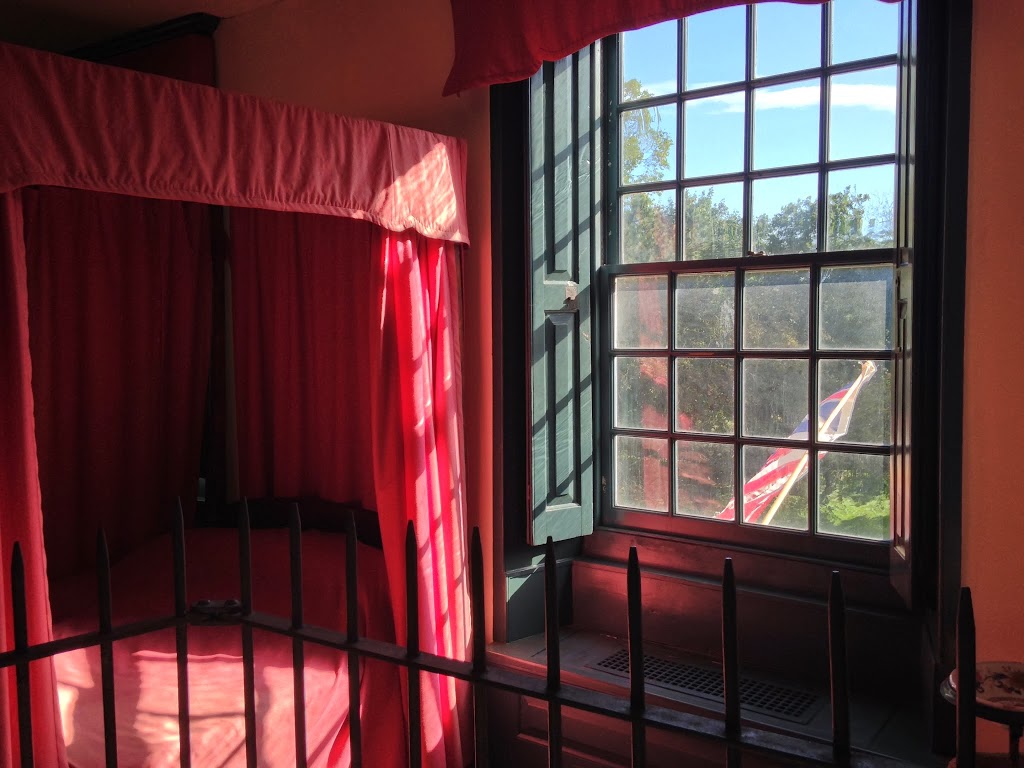
Looking out the upstairs window of the Van Cortlandt House, looking out in the park. The house has seen its share of strife and, if legends can be believed, more than a few spirits.
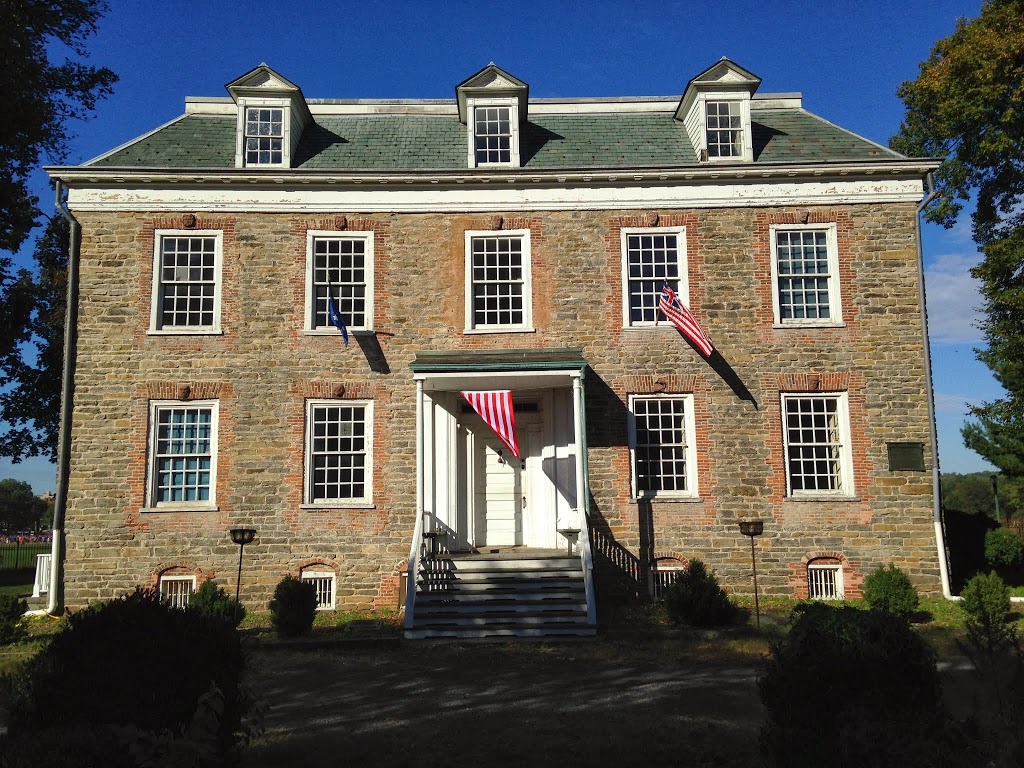
Van Cortlandt House as it looked last weekend. What’s that in the window?
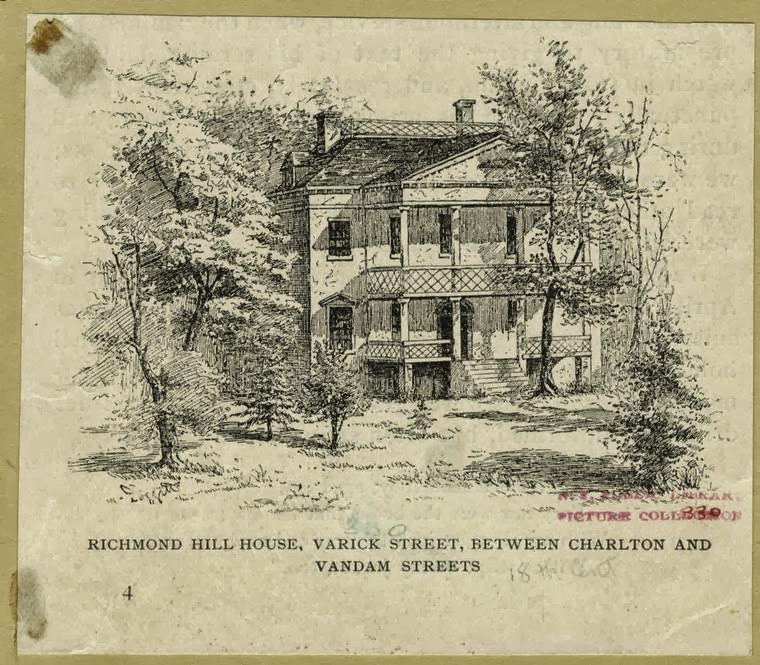
Richmond Hill, the beautiful mansion home of both John Adams and Aaron Burr. The carriage house from this old manor was moved to Barrow Street and is today the restaurant One If By Land, Two If By Sea. (NYPL)
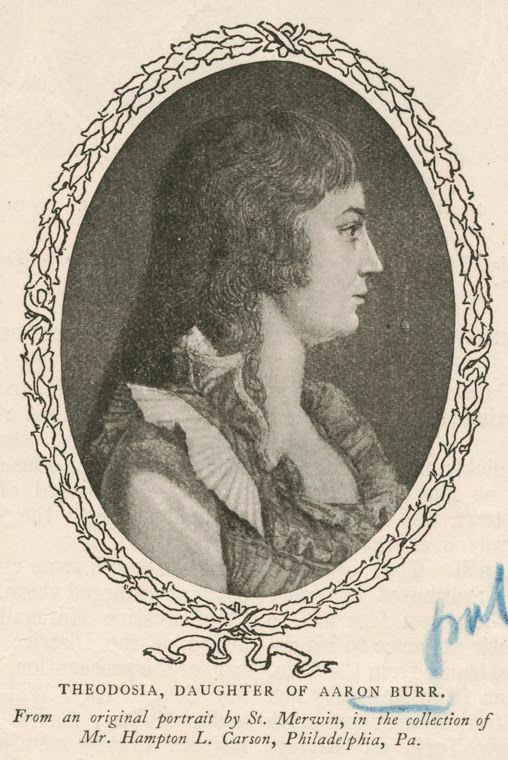
Theodosia Burr, the daughter of Vice President Aaron Burr, who was mysteriously lost at sea. Was she shipwrecked, rescued by an Indian prince, or forced to walk the plank? (Courtesy NYPL)
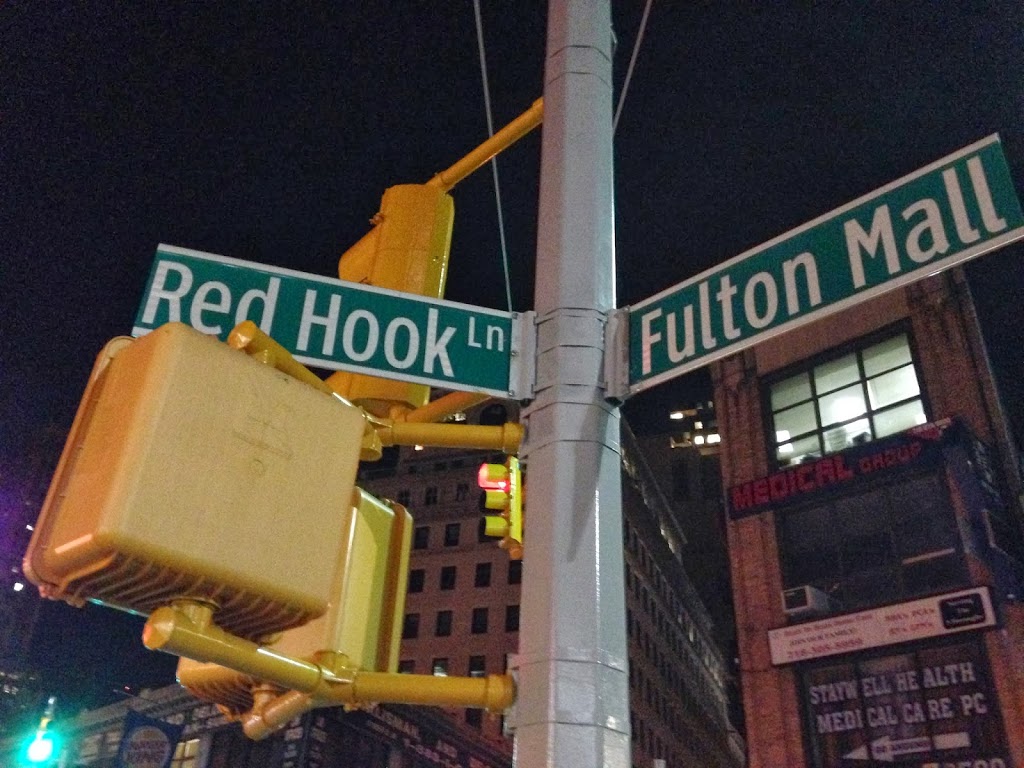
A short remnant of Red Hook Lane still exists in downtown Brooklyn. You are unlikely to find anything too scary at this street corner however.
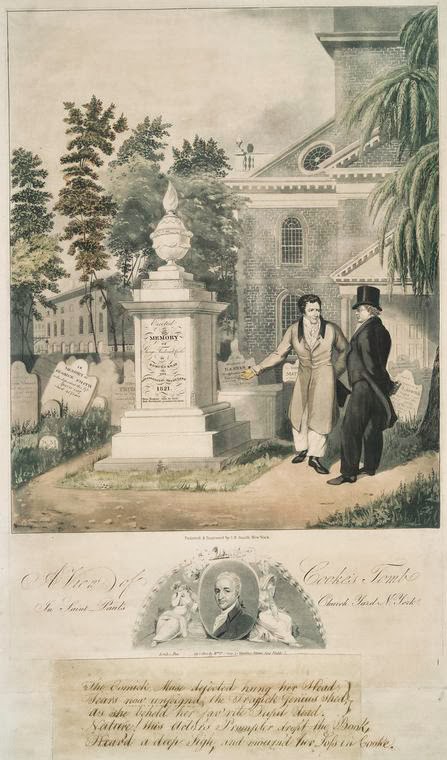
A 1822 illustration of the George Frederick Cooke monument and the man who paid for it, actor Edmund Kean. Kean so admired the late actor that he actually took a very odd portion of his body back with him to England.
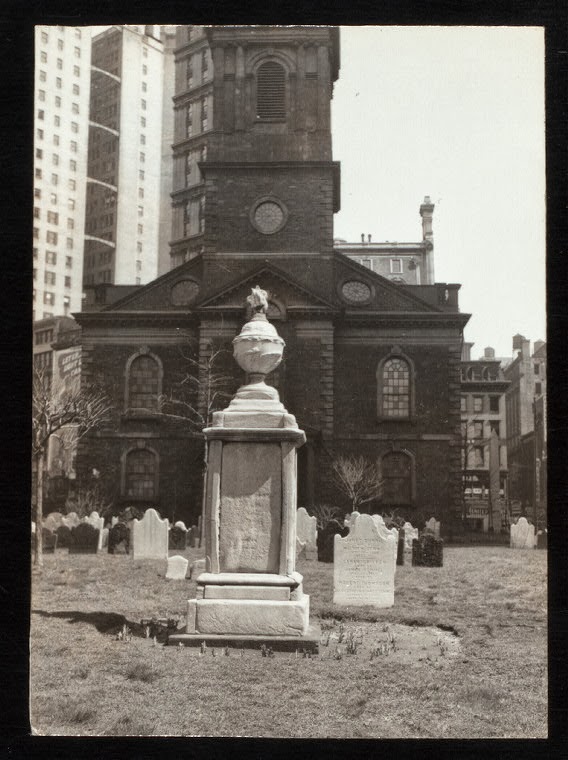
The monument to George Frederick Cooke in the graveyard at St. Paul’s Chapel, pictured here sometime in the 1940s. Does his ghost still linger here? [NYPL]
We had a very chilling event occur as we were recording last weekend. Just as I began to launch into the ghosts of the Stockbridge Militia, our recording equipment went all insane, spewing out a distorted and very disturbing version of our voices. It went on for about 20 minutes. Below is a sampling of the audio. What do you think — otherworldly interference or a faulty mixing board?
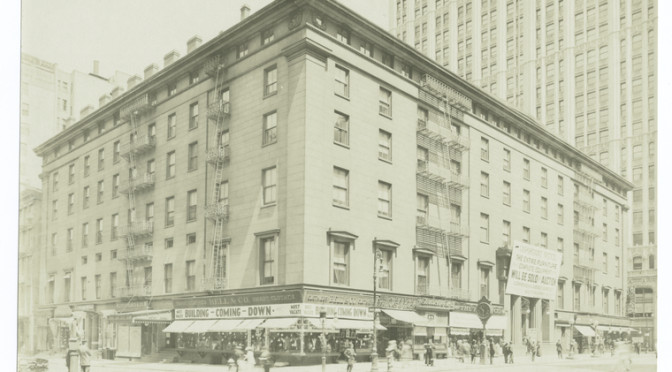
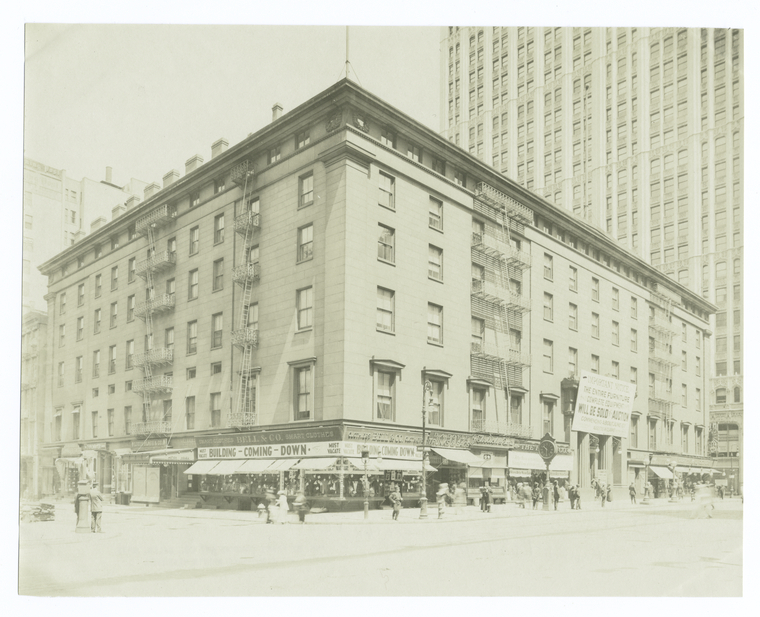
The Astor House was New York City’s first great hotel, opened in 1836 by John Jacob Astor himself, a premier accommodation for the city throughout the 19th century. But by 1913, it was time to tear it down.
It was a symbolic moment for many older New Yorkers. As you can tell from the image above, the ancient hotel had a new neighbor: the Woolworth Building, a symbol of the ‘new’ New York City. As dozens of more modern hotels opened uptown, the old Astor was greatly reduced, with whole sections partitioned for other uses.
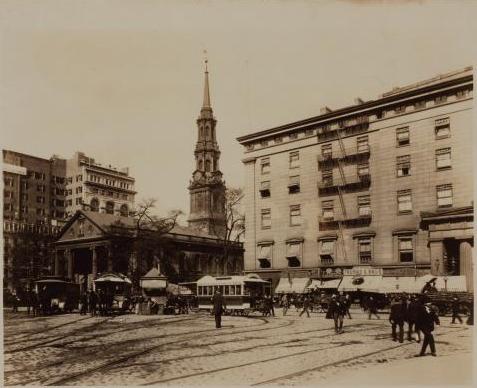
For a little comparison, here’s how the building looked in the 1890s, already minimized in its appearance:
Hotels were now flocking to the Times Square area. In fact, so to did the Astor name, with the beautiful Hotel Astoropening there in 1904.
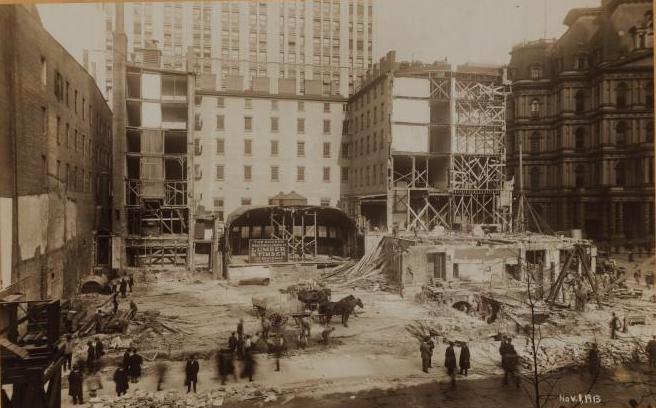
The hotel might have survived a little longer if not for new subway construction in the area, endangering the foundation of the old building. On May 29, 1913, the hotel closed its doors, and over the next few weeks, the southern section of the Astor House was torn down. But not without a bevy of reminiscences from old New Yorkers, and a little teeth-gnashing too of a colder, modern city overtaking the gentle comforts of the old.
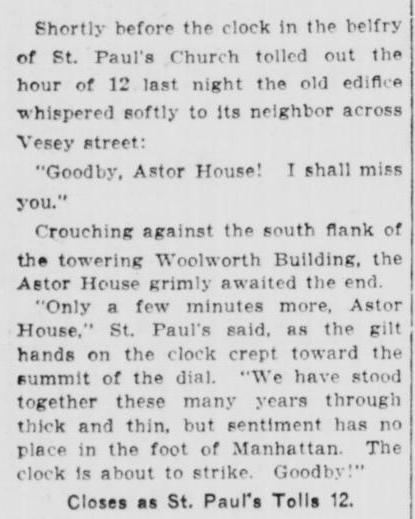
And then, there’s this dramatic article from the New York Tribune, depicting a literal farewell between the Astor and its neighbor to the south, St. Paul’s Church:
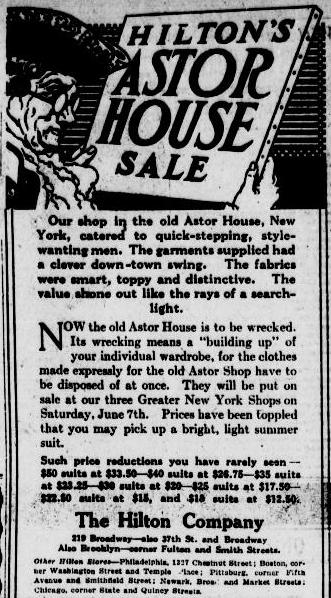
While this spelled doom for a certain memory of New York, those who liked firesales of sorts could take comfort in liquidation sales from famous shops which operated from the old Astor Hotel, such as the Hilton Company:
This is what the space looked like within a couple months. By the way, that’s the old Post Office to the right of the picture, a structure that would last another quarter century before it too was demolished in 1939:
In 1915, it was replaced with the Astor House Building, a small suite of office spaces that remains on that street corner to this day. It’s where the Staples store is
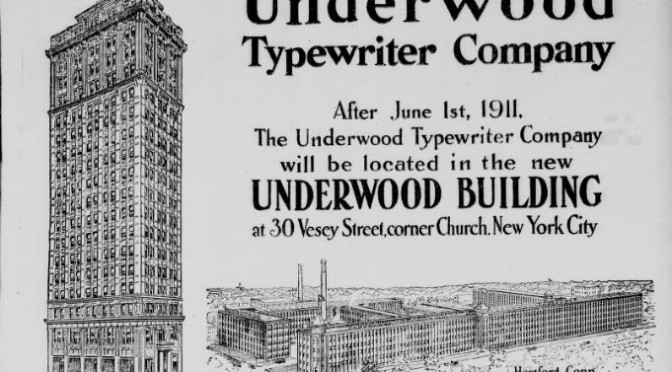
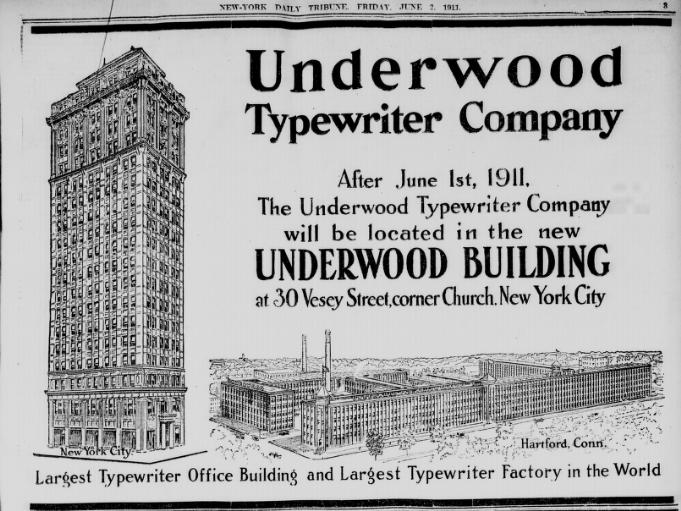
I found this advertisement in an issue of the New York Tribune from one hundred years ago:
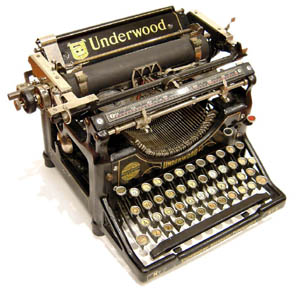
Although the famous Underwood Typewriter Company had principal manufacturing plants in Hartford, it was a New York company through and through. Its founder John Thomas Underwood became so wealthy that he built a stately home in the neighborhood of Clinton Hill, Brooklyn. Following his death in 1937, the estate was donated to the city and transformed into Underwood Park nearby Pratt Institute.
He desired a great skyscraper for his booming company, emulating those great towers built by industrialists like Frederick Bourne (of the Singer Sewing Machine Company and its companion Singer Building), and newspaper men like Joseph Pulitzer (who, after all, now used Underwood typewriters in their newsrooms at the mightt World Building on Park Row).
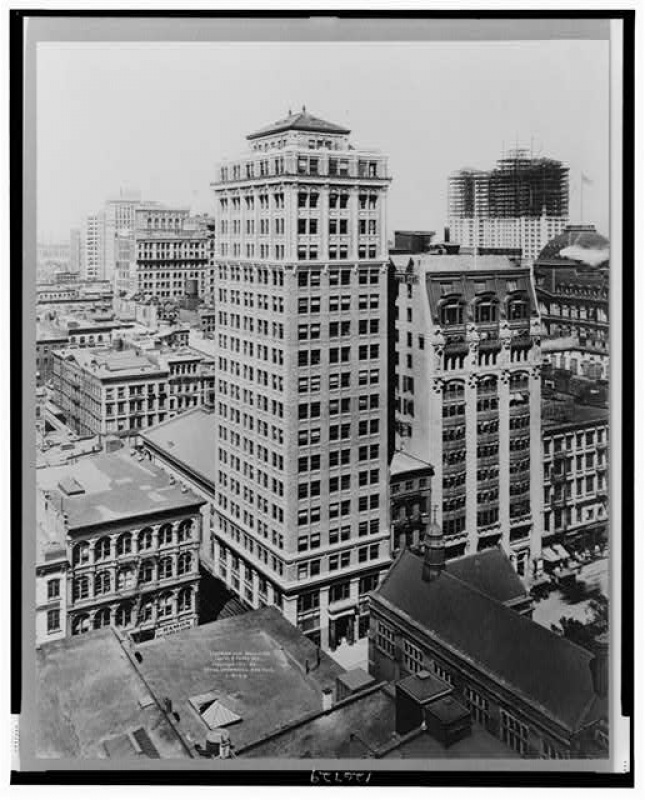
The Underwood building, at 30 Vesey Street, was designed by the firm of Starrett & Van Vleck, better known for their department stores than their skyscrapers. Their roster includes the flagship locations of Saks Fifth Avenue, Bloomingdale’s and Lord & Taylors. Looking up at all 17 floors of the Underwood Building, one can see some of its touches imitated in those more famous, accessible buildings.
The office building was quickly overshadowed just two years later by another skyscraper rising one block away, over three times larger than the Underwood and another great monument to industry — the Woolworth Building.
Ladies, you’ll be happy to know that a rest room facility has been placed on the ground floor of the Underwood, as of this 1918 trade-journal news clipping, where you can enjoy your lunch:
The article refers to “both buildings” of the Underwood Typewriter Company. By that time, they had expanded into a second office at Vesey and Greenwich streets. (That building no longer exists. I’m pretty sure it stood where 7 World Trade Center is today.)
The Underwood sustained serious damage during the attack upon the World Trade Center in 2001. But it still stands today, hovering over its old neighbor, St. Paul’s Chapel, and greeting a new one, One World Trade Center, rising to its west.
Given that it stands on a heavily trafficked corner surrounded by greater tourist sites, most don’t bother to give the Underwood its due. [Here’s the Underwood on Google Maps.]
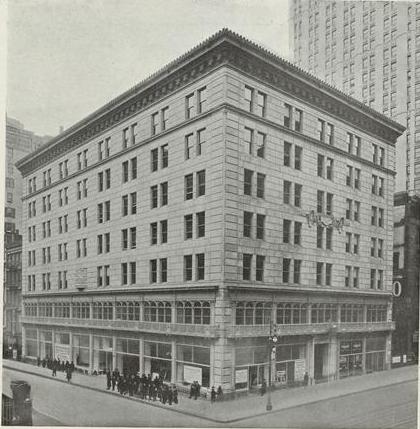
Below: the Underwood in 1911, photographed by noted city photographer Irving Underhill
MYSTERY! In the picture above, we see the south and west faces of the Underwood Building, the corner of Vesey and Church streets. (In the background you can see the Manhattan Municipal Building being constructed.) Today, across the street from the Underwood on the south side, is the famous St. Paul’s Chapel cemetery. However, in the picture above, there is clearly a building sitting there, the one with the odd little turret! Any idea as to what that is?
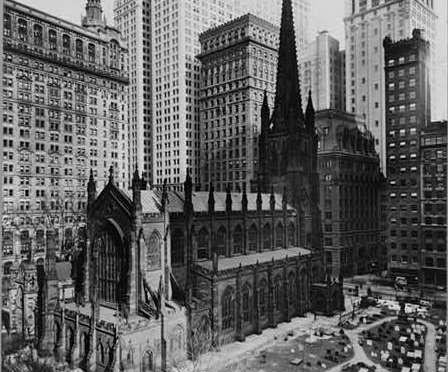
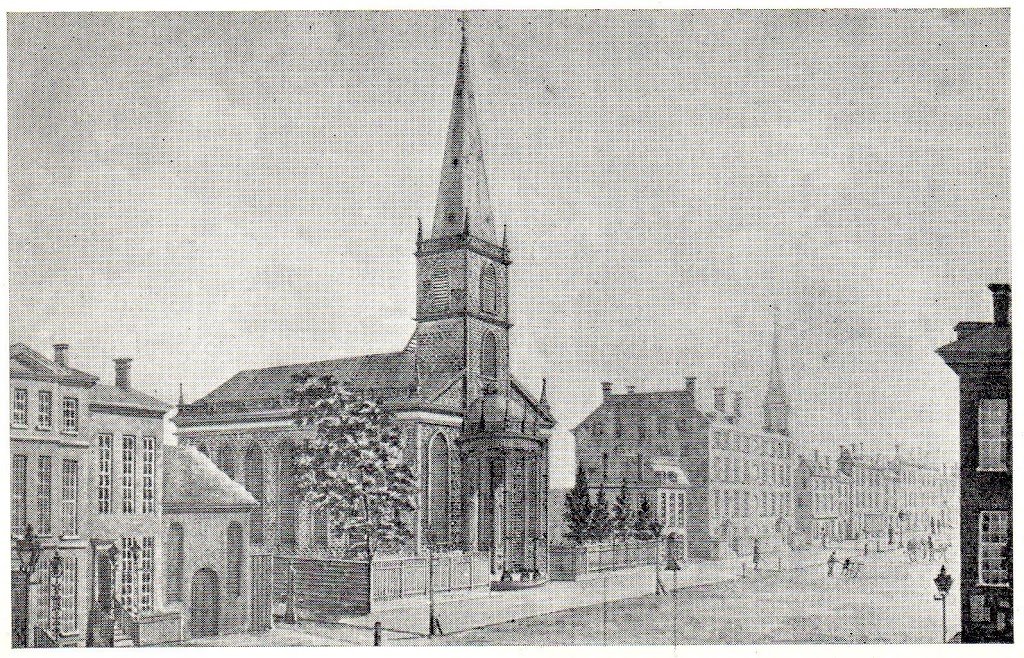
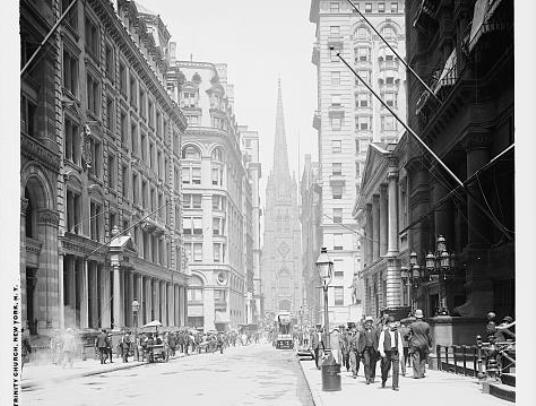
Above: The seemingly unchanged Trinity in 1916, already dwarfed by skyscrapers
PODCASTTrinity Church, with its distinctive spire staring down upon the west end of Wall Street, is more than just a house of worship. Over three different church buildings have sat at this site, and the current one by architect Richard Upjohn is one of America’s finest examples of Gothic Revival architecture.
The church collected Manhattan’s upper crust for decades and functions as one of the city’s most powerful landowners. Listen to our short history on the New York institution and find out who’s buried in their famous churchyards — Founding Fathers, inventors and a whole lotta Astors.
___________________________________ Clarification: In discussing the religious make-up of late 17th century New York, we failed to clarify that there were many Anglicans that already lived in the city but were not associated with the Church of England. These “English dissenters” belief systems were similar to the Anglicans but they disagreed with state meddling into religious affairs. ___________________________________
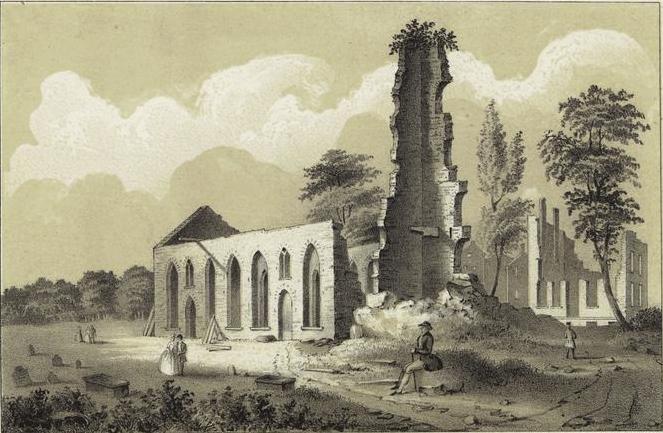
Fire Walk With Me: Below is a 19th century illustration of the ruins of the first Trinity Church, gutted in the fire of 1776 which subsequently destroyed one quarter of the entire city. The remains sat for many years undisturbed, and a second church would only be rebuilt after the British were expelled from New York. [NYPL]
___________________________________
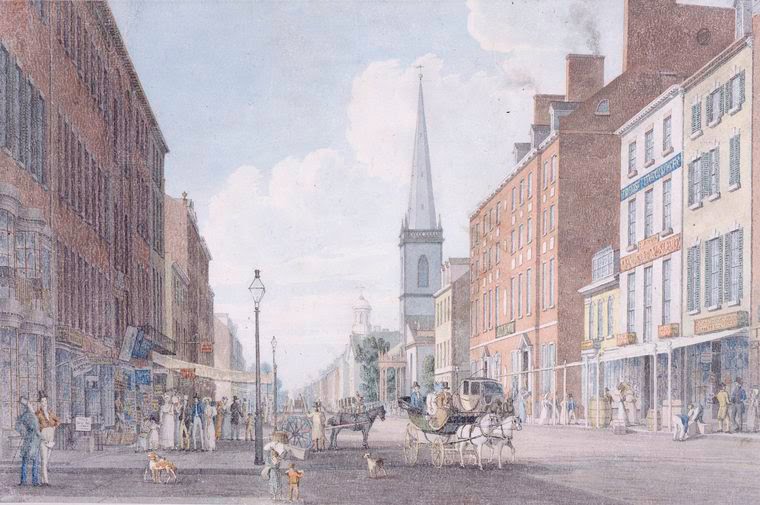
Snowed In: The second Trinity church, built on the same spot as the first, sat for over four decades until weight from massive snows during the winter of 1836 weakened the roof to such an extent that the entire structure had to be demolished. [NYPL]
Another view of the second one (dated 1830), looking down Broadway. Trinity’s distinctive spire was already considered the city’s most recognizable landmark.
___________________________________
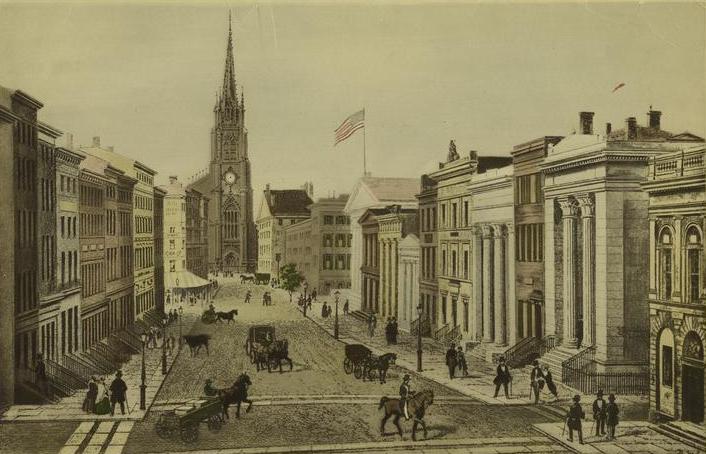
Third Times A Charm: Richard Upjohn’s Gothic Revival masterpiece was the tallest building in New York from the time it opened in 1847 (the date of this lithograph) until 1890, when it was finally usurped by the New York World building. [NYPL]
The same view, from 1903, as the city morphs rapidly around Trinity.
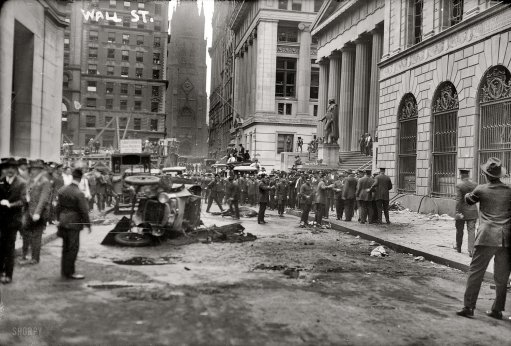
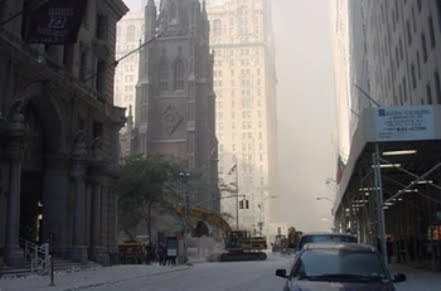
Witness to the September 16, 1920, terrorist bombing in front of JP Morgan’s….
…and the World Trade Center attack on September 11, 2001. [courtesy Sacred Destinations] ___________________________________
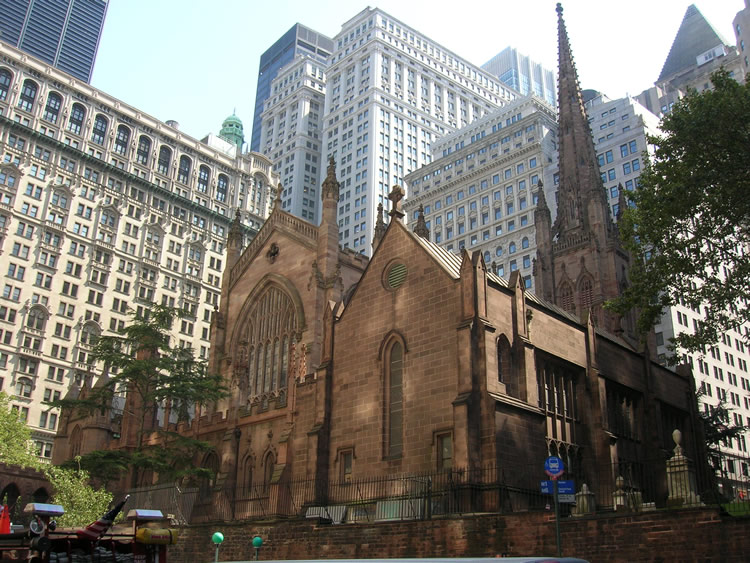
Looking good from all sides. [Courtesy Sound Mind]
___________________________________
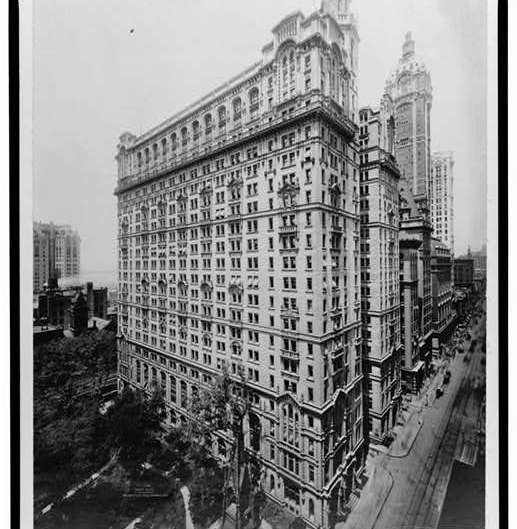
Below is the Trinity Building from 1911. This is the replacement of a building that once stood here that is commonly considered New York’s very first office building. That five-story building, also designed by Upjohn, stood here for about fifty years and was demolished in 1904 to make way for the Beaux-Arts beauty standing there today.
Obama’s inauguration next Tuesday will closely adhere to the traditions of many presidents past, but with some serious leanings towards that other Illinois president Abraham Lincoln. But as ostentasious as some his plans seem — even eating foods that Abe might have noshed on — it can’t possibly top the ‘hope and change’ of the original celebration for George Washington, America’s first president and the only inauguration ceremony to take place in New York City, on April 30, 1789.
It took George seven entire days to get to New York from his home in Mount Vernon as his procession was met every step of the way with throngs of patriotic crowds and flamboyant celebratory displays. Meanwhile, on Tuesday April 21, Washington’s vice president John Adams arrived in the city, two days ahead of the president-elect.
The building which greeted him, the former City Hall building on Wall Street, had been the center of city’s government since 1699, when the British used materials from the city’s demolished north defense wall to construct it. The heavily remodeled building which now stood in its place, later to be called Federal Hall, was designed by successful city contractor and former Continental Army engineer Pierre Charles L’Enfant. According to David McCullough, “it was the first building in America designed to exalt the national spirit, in what would come to be known as the Federal style.” (Sadly, this building was ripped down in 1812; the ‘Federal Hall’ which stands in the same spot today was built as a customs house in 1842) L’Enfant would later work on the creation of Washington DC from Maryland swampland and be fired from that project — by George Washington.
Below: a look at ‘old City Hall’ well before the thorough developments up and down Wall Street
George finally arrived in New York two days later, April 23, via a barge from Elizabeth, New Jersey, and was met at the Wall Street pier by the current mayor of New York James Duane and the state’s governor and DeWitt Clinton’s uncle George Clinton. From there, he was taken to his new home on Cherry Street (long demolished, around near the Brooklyn Bridge anchorage today) and spent the day greeting dozens of well-wishers. That night, Clinton hosted an elaborate dinner in his honor; the pomp and extravagance by this time were probably getting tiresome to the stately Virginian farmer.
Meanwhile Adams spent the week at Federal Hall in Senate chambers, hashing out such things we take for granted, such as how to even address the new president, until at last they were ready for the ceremony to begin, on April 30. According to Ron Chernow, “Washington rose early, sprinkled powder in his hair, and prepared for his great day.” Like some fairy tale detail, Washington left his Cherry Street home at noon in a yellow carriage driven by white horses, legions of soldiers marching proudly behind him. The streets of Manhattan were clogged with people, over ten thousand cramming Broad and Wall streets, as far as the eye could see both ways. Sitting on the balcony of his own home on Wall Street was Washington’s closest confidante Alexander Hamilton, certainly reveling in the moment.
After greeting the Congress inside, Adams led Washington to the second floor balcony along with Robert Livingston, the Chancellor of New York (the highest judicial office in the state) who held out the a bible owned by St. John’s Lodge freemasons and delivered the oath of office, probably not loud enough for anybody in the street to actually hear.
Washington, possibly even less audible than Livingston, swore to “faithfully execute the office of President of the United States, and will to the best of my ability, preserve, protect and defend the Constitution of the United States” and then possibly threw in a ‘so help me God’ for good measure (although there are some doubts).
New Yorkers went crazy then, firing cannons, screaming and waving flags, playing music and dancing in the streets. After returning inside to address the new Congress — by this time with tears in his eyes — Washington and his entourage went up Broadway to receive on invocation at St. Paul’s Church, the scrappy survivor of the great fire the destroyed much of the city in 1776. Washington would be a regular here for his entire stay in New York; the pew where he planted himself for two years is still on display there (below).
Martha Washington would not arrive in town for another month, but that didn’t stop the parties. The official inauguration ball took place a week later, on May 7th, at the Assembly Rooms at 115 Broadway. Although a bit stiff and silent, George was still popular with the ladies and danced “two cotillions and a minuet,” often seen with Alexander Hamilton’s young bride Eliza. When Martha arrived on May 17, landing at Peck Slip, she was greeted with similarly grand fanfare, and yet another ball was held in her honor.
Believe it or not, there are some remnants of this unique event still in the city. Starting January 20th, the New York Historical Society will exhibit artifacts from that day, including a balustrade saved from old Federal Hall before it was demolished and George’s ‘inauguration chair’. And down at Federal Hall you can find other artifacts, including Washington’s bible, on permanent loan from St. John’s Lodge.