Categories
The First

The Rebel — Benjamin Franklin: America’s Founding Inventor

THE FIRST PODCAST The story of Benjamin Franklin at the end of his life — at the birth of a new nation.

Part Three of The Invention of Benjamin Franklin. Check Part One (Franklin Gothic) and Part Two (Lightning Strikes) to catch up on his extraordinary story!

Benjamin Franklin was the most famous American in the world by the time of the Revolutionary War, known as a writer, inventor and philosopher. But as an old man, he would earn another title — rebel.

By the time of the Boston Massacre, Dr. Franklin was already an elderly man, watching the early days of American unrest from his comfy home in London. His scientific experiments were eventually put on hold as he rushed back to the colonies to help set up the mechanism of independence.

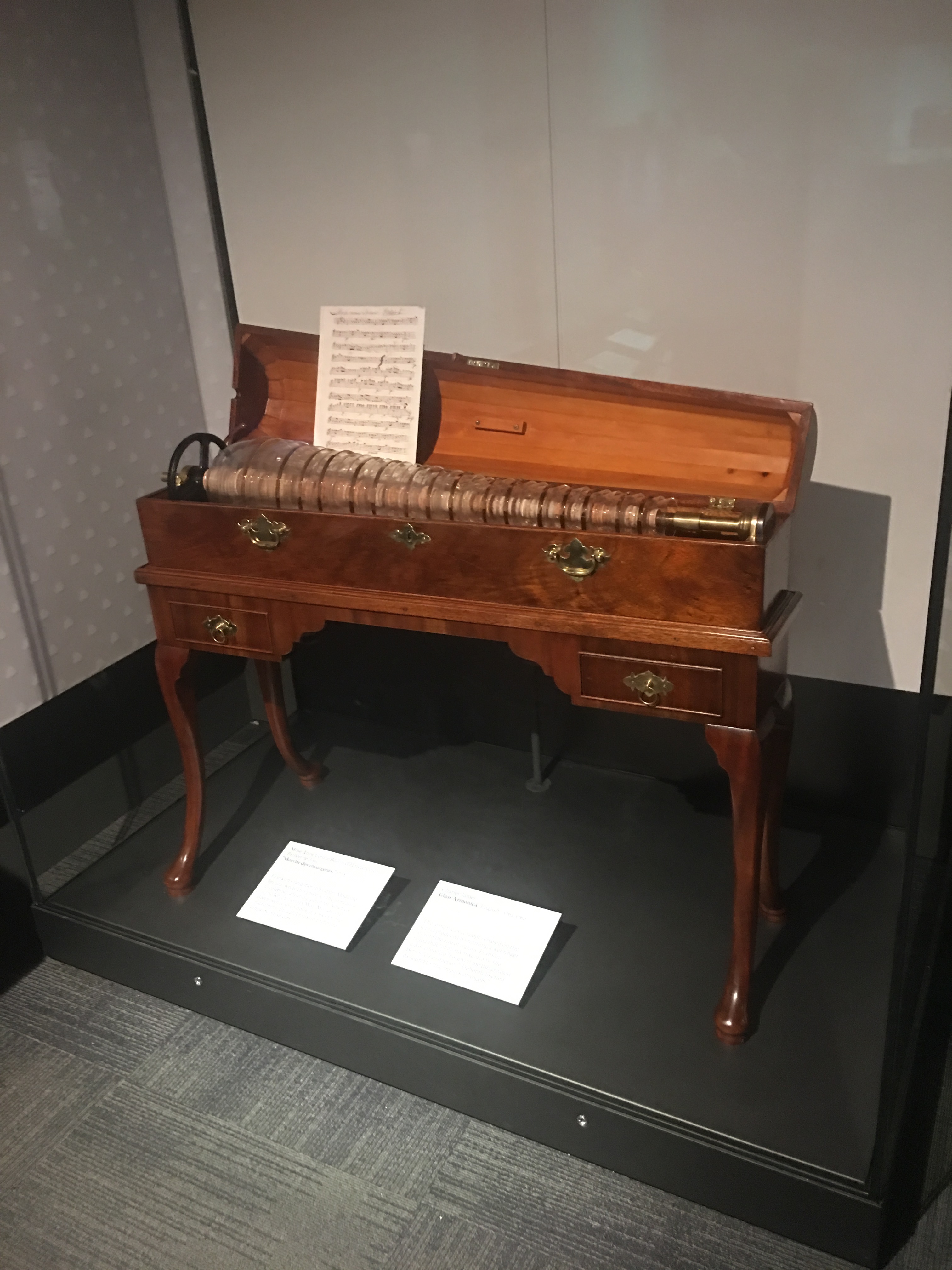
But while others went to war, Franklin went — to France? It was because of his great celebrity that he was deployed on an unusual mission to court an important ally for George Washington and his Continental Army. And it was in the banquet halls and libraries of Paris that Franklin would actually invent one of his useful creations.

STARRING: Mesmer, Marie Antoinette, Voltaire and all the Founding Fathers!


To get this episode, simply download it for FREE from iTunes or other podcasting services. Check here for other ways to get the show.

Subscribe to The First here so that you don’t miss future episodes!

You can also listen to the show on Stitcher streaming radio from your mobile device.

Or listen to it straight from here:
THE REBEL: AMERICA’S FOUNDING INVENTOR


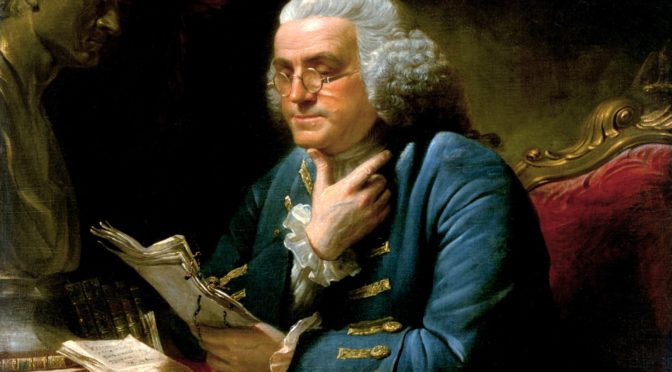
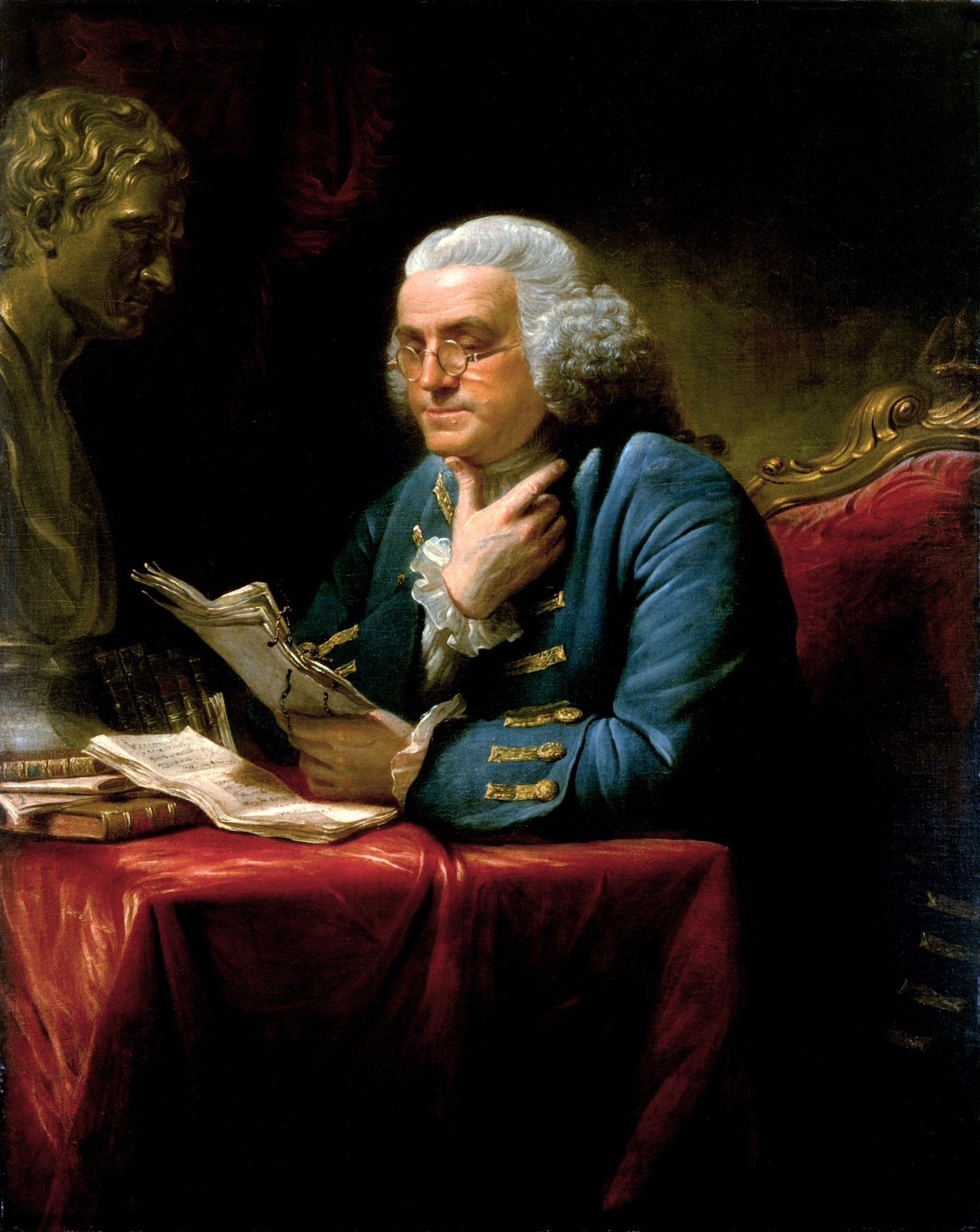
This painting is by David Martin, made of Benjamin Franklin in 1767

From my trip this week to Philadelphia for the eclipse:

On the steps of the Franklin Institute in Philadelphia. Everyone is very enthusiastic about the eclipse. #boweryboys

A post shared by Gregory Young (@boweryboysnyc) on

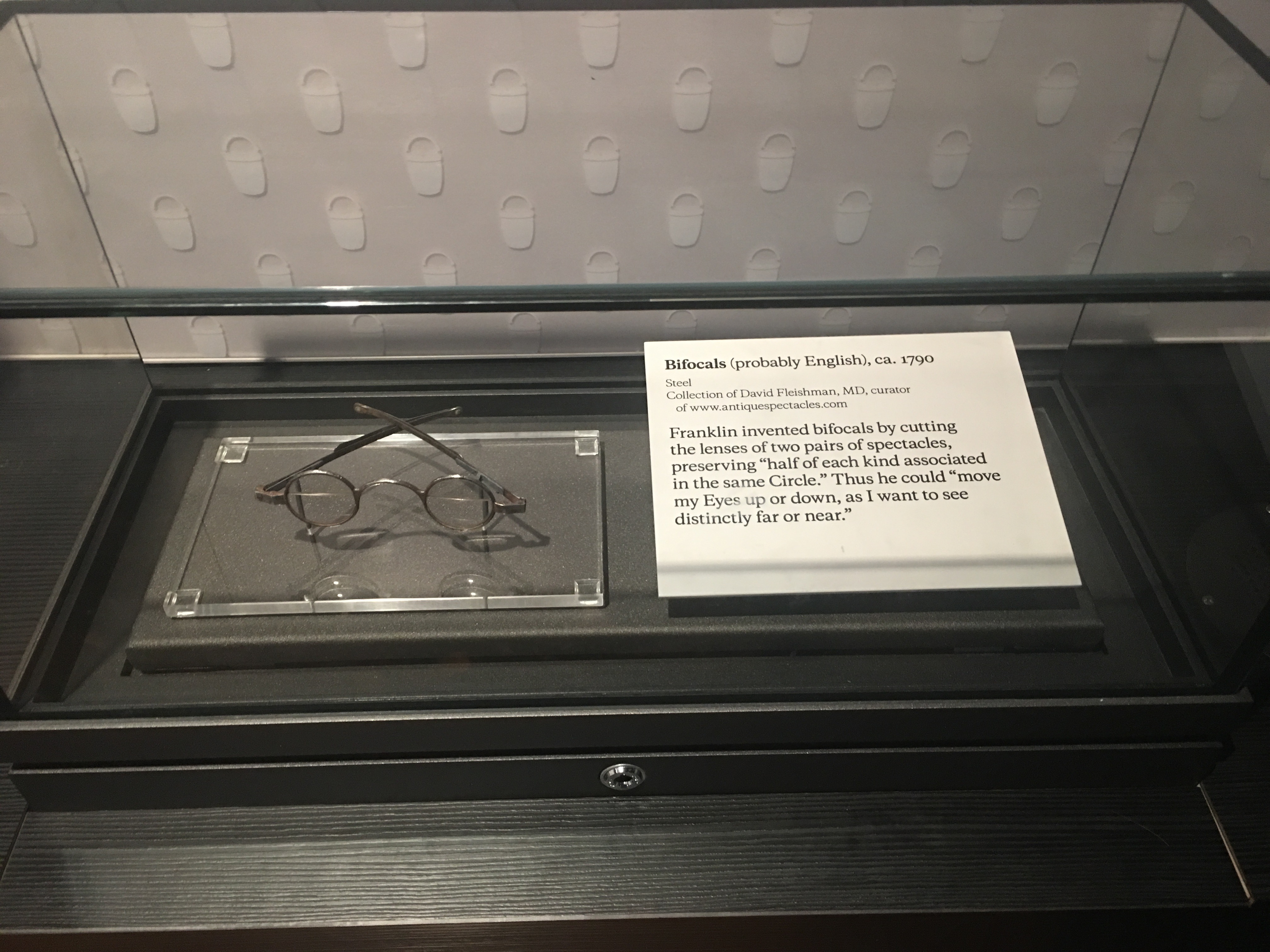
From the Benjamin Franklin Museum:


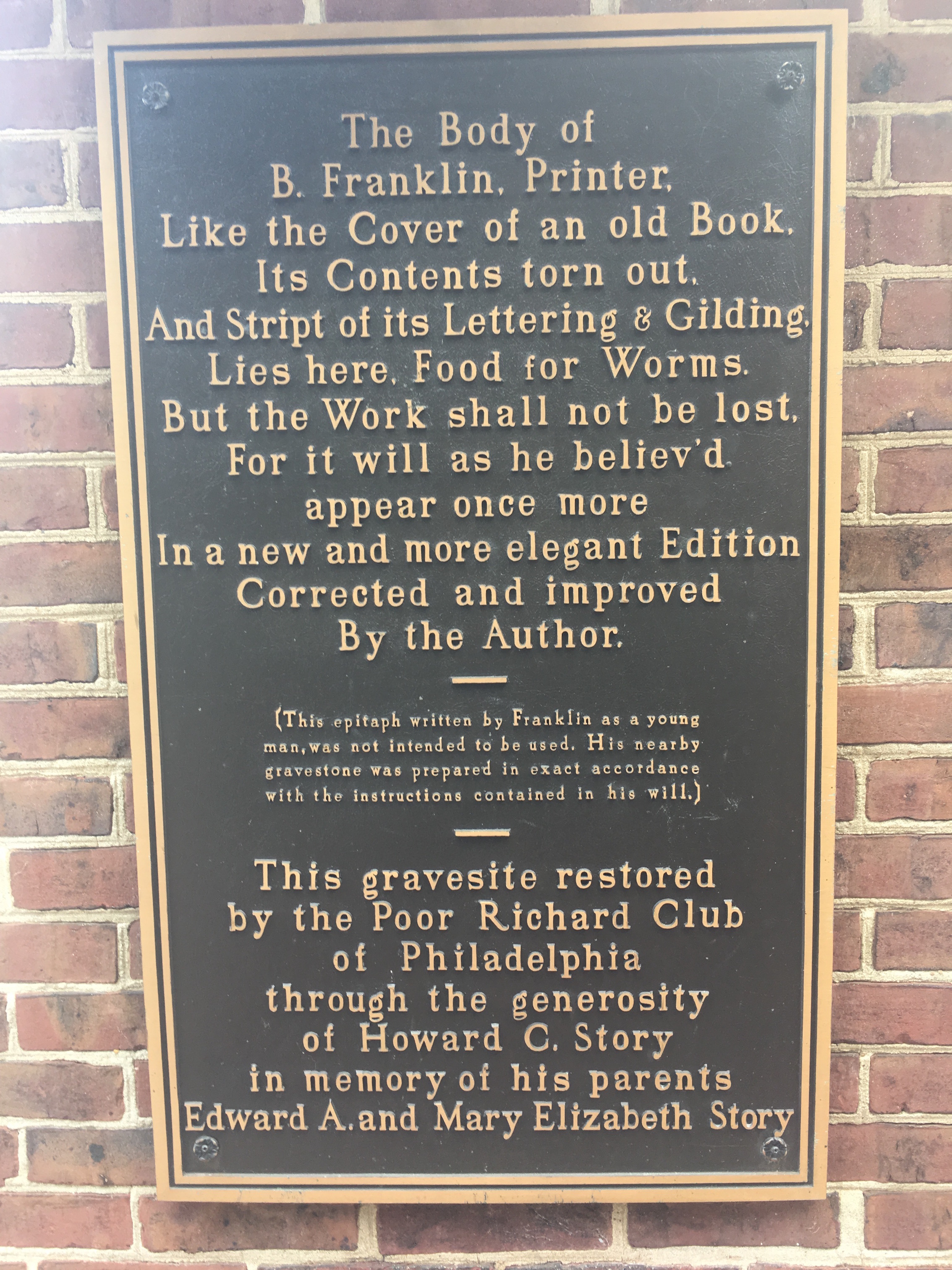
Next to the gravesite of Ben and Deborah Franklin:

Categories
The First

The Invention of Benjamin Franklin Part One: Franklin Gothic (1706-1748)

THE FIRST PODCAST   Benjamin Franklin did more in his first forty years than most people do in an entire lifetime. Had he not played a pivotal role in the creation of the United States of America, he still would have been considered an icon in the fields of publishing, science and urban planning.

How much do you know about Benjamin Franklin the inventor? In this podcast (the first of three parts), Greg takes a dive into his early years as a precocious young inventor and writer, a witty and determined publisher, and a great mind in search of the natural world’s great mysteries.

FEATURING: The origins of the lending library, the Franklin stove, swim fins and even kite-surfing!

To get this episode, simply download it for FREE from iTunes or other podcasting services. Check here for other ways to get the show.

Subscribe to The First here so that you don’t miss future episodes!

You can also listen to the show on Stitcher streaming radio from your mobile device.

Or listen to it straight from here:
THE SECRET HISTORY OF SOFT DRINKS: A TALE IN FOUR FLAVORS


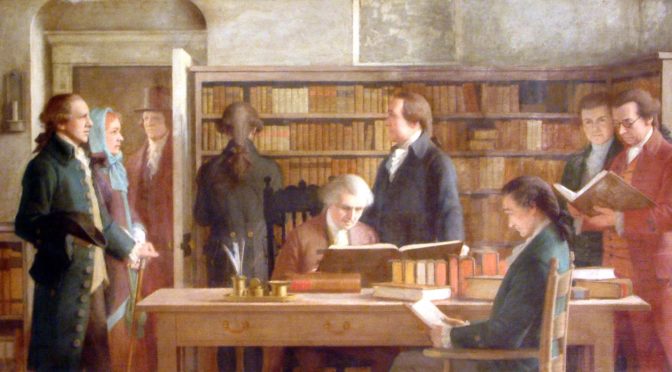
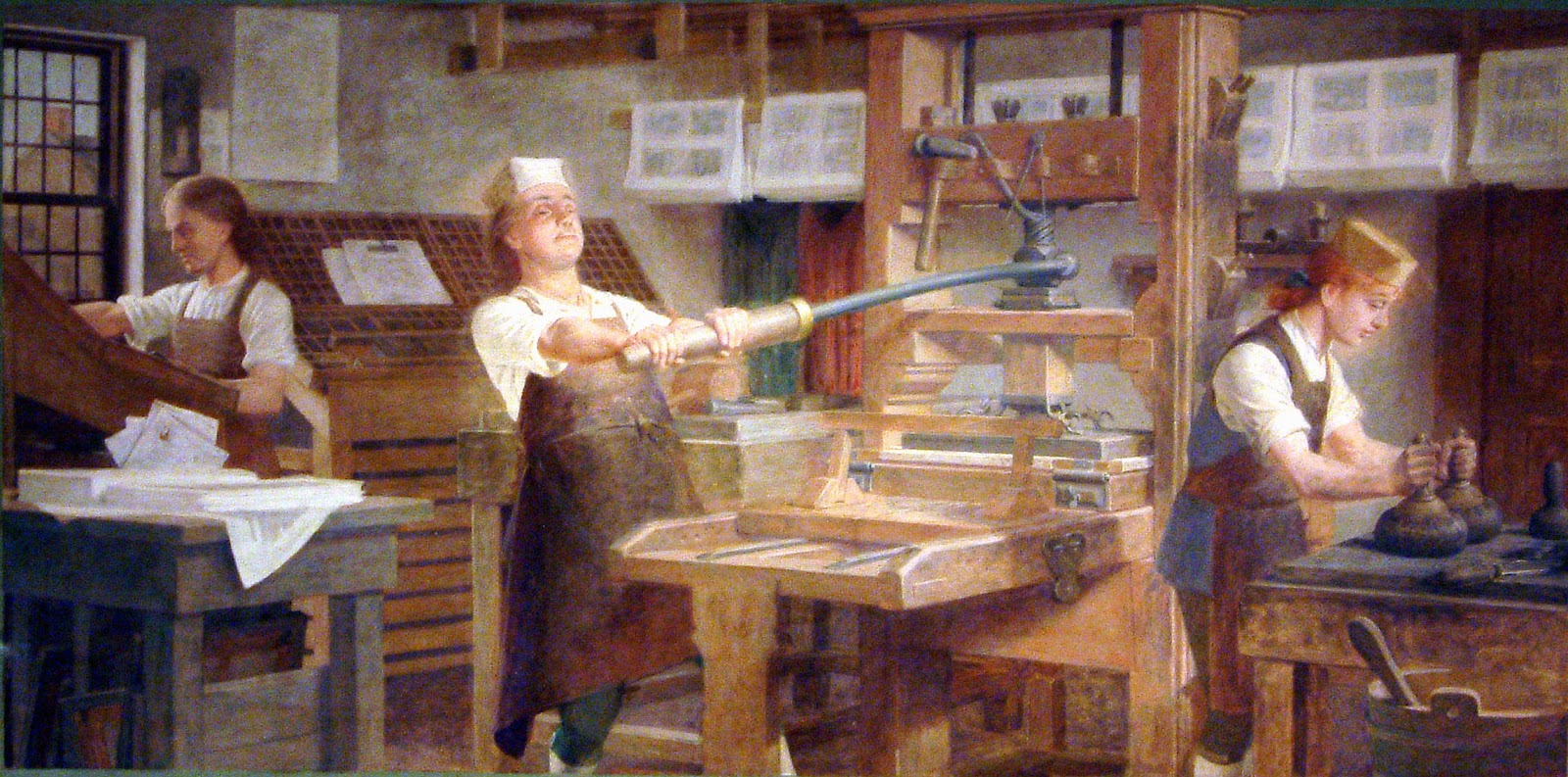
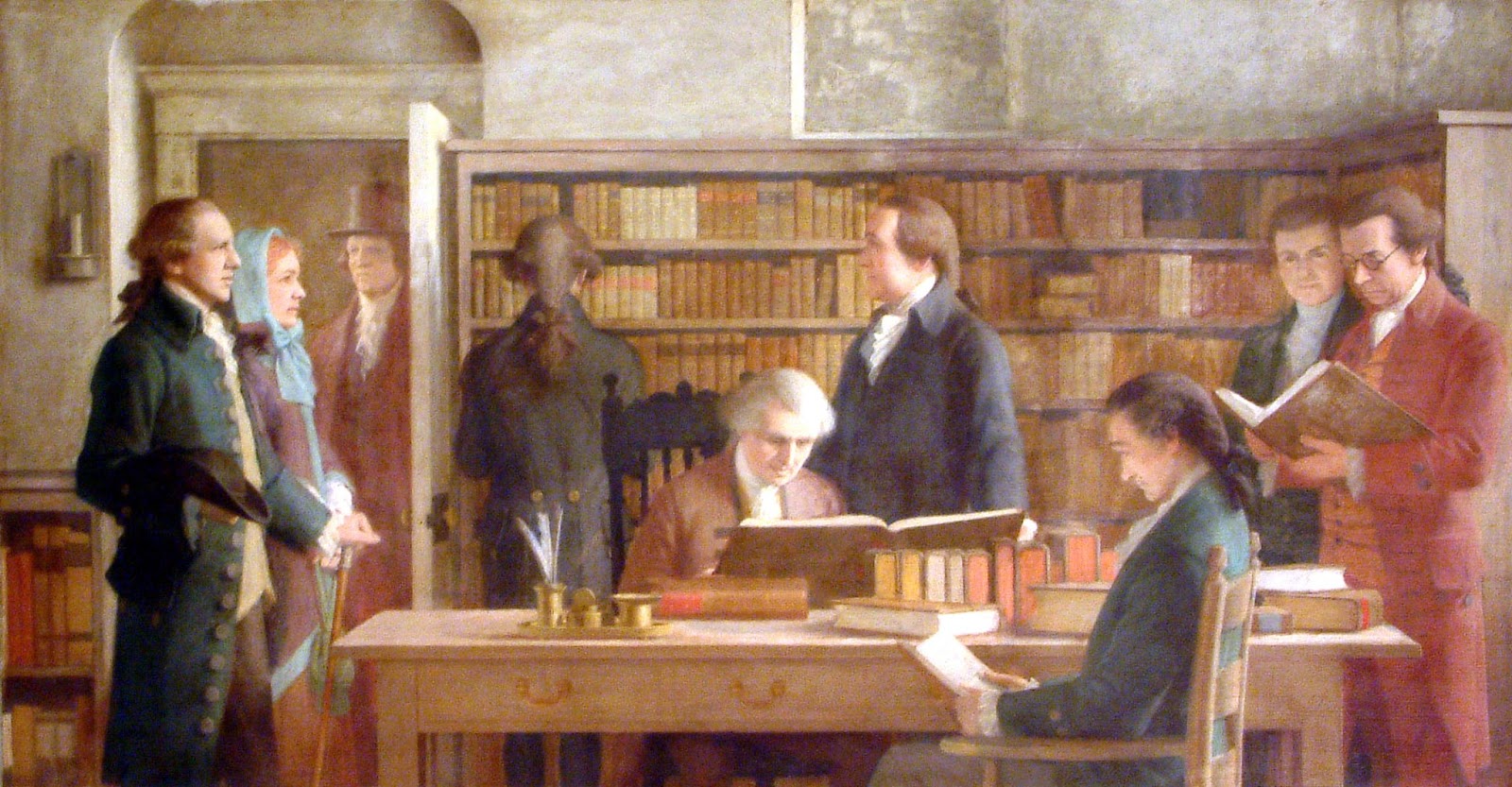
In a couple murals by Charles E. Mills, Benjamin Franklin 1) working hard at the printing press and  2) oversees the opening of the Library Company of Philadelphia.


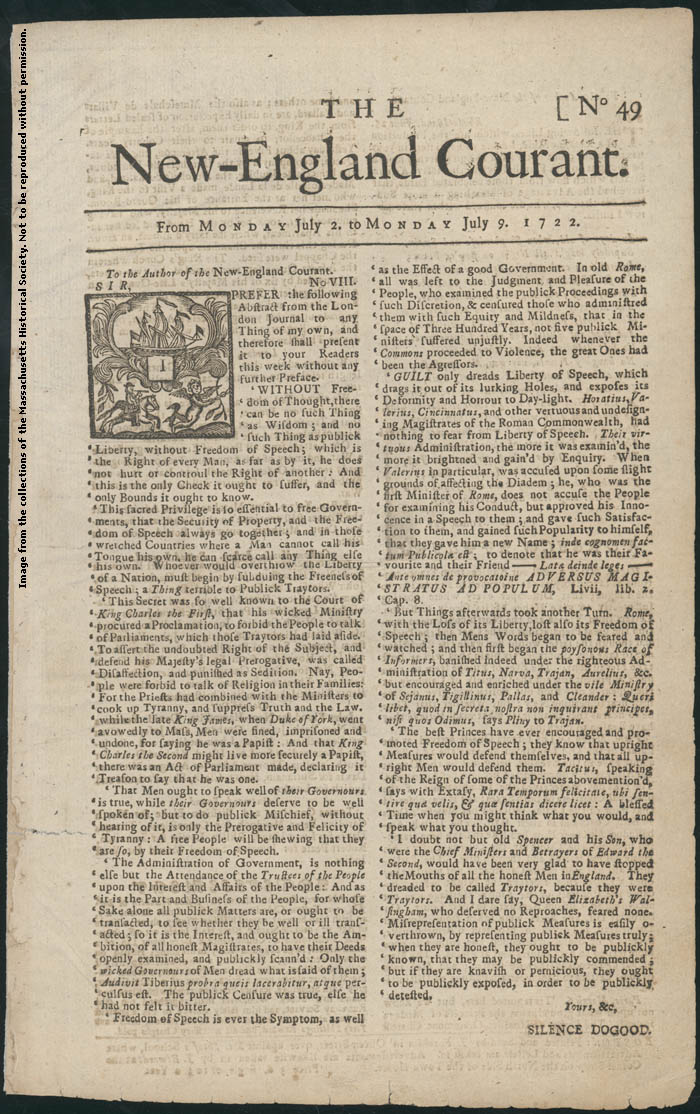
The New-England Courant, where Franklin wrote as a teenager under the name Silence Do-Good:

From the Massachusetts Historical Society. Not to be reproduced without permission.


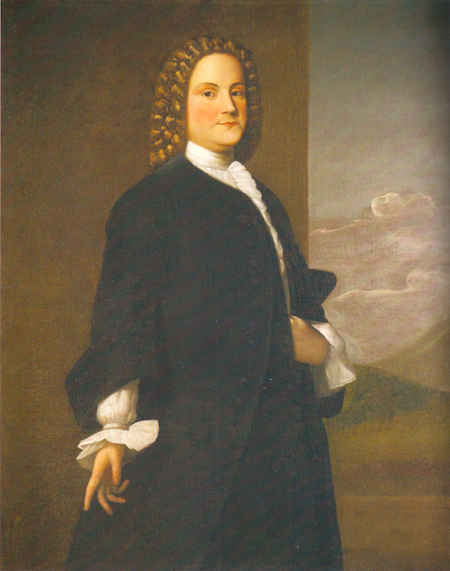
Ben Franklin in 1746 in a painting by Robert Feke. He’s very much emulating the style of a proper English gentleman in this image. He would later shed the finery and define his more personal, unwigged style.

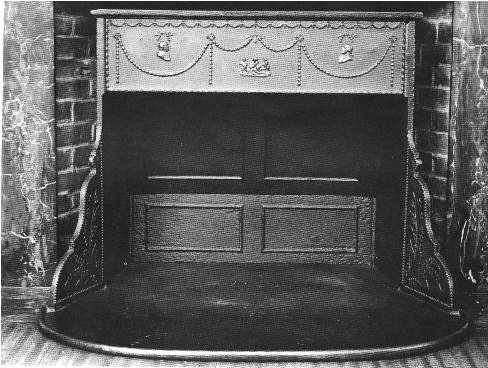
A large Franklin stove although they would develop into different shapes and sizes in the hands of other inventors.

Categories
American History Podcasts

New York City and the Inauguration of George Washington

PODCAST Part One of our two-part series on New York City in the years following the Revolutionary War.

The story of New York City’s role in the birth of American government is sometimes forgotten. Most of the buildings important to the first U.S. Congress, which met here from the spring of 1789 to the late summer of 1790, have long been demolished. There’s little to remind us that our modern form of government was, in part, invented here on these city streets.

Related: Listen to Part Two of the series here.

Riding high on the victories of the Revolutionary War, the Founding Fathers organized a makeshift Congress under the Articles of Confederation. After an unfortunate crisis in Philadelphia, that early group of politicians from the 13 states eventually drifted up to New York (specifically to New York’s City Hall, to be called Federal Hall) to meet. But they were an organization without much power or respect.

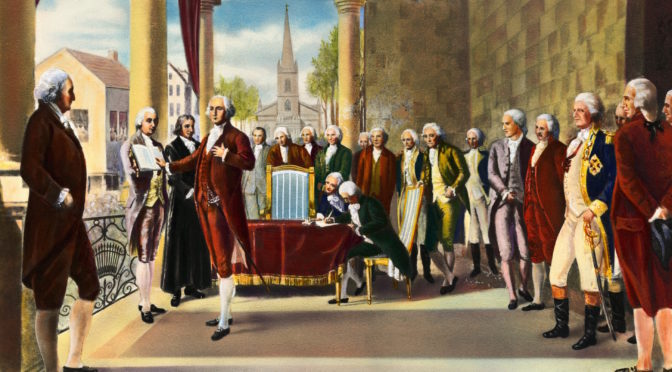
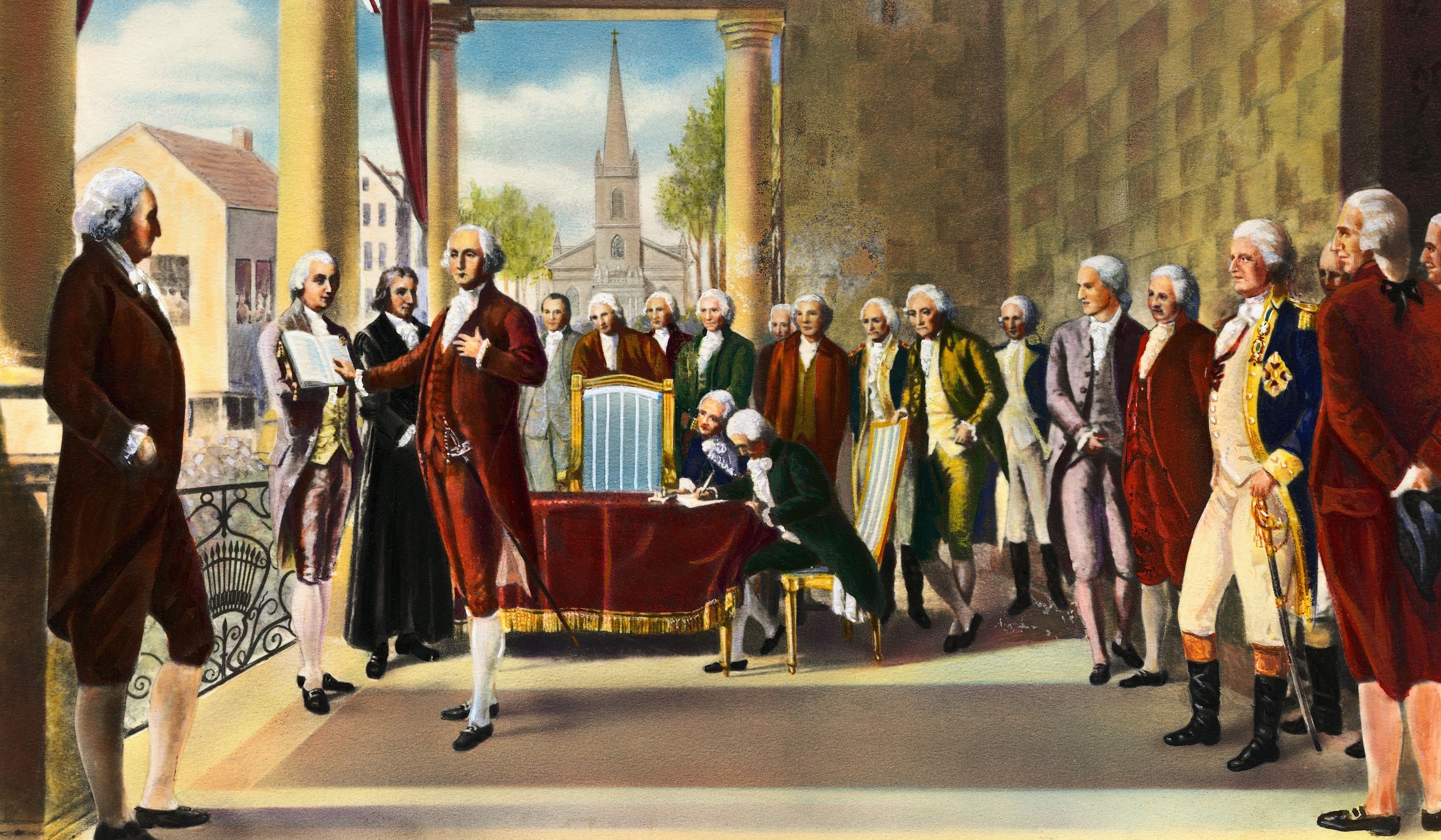
The fate of the young nation lay on the shoulders of George Washington who arrived in New York in the spring of 1789 to be inaugurated as the first president of the United States. His swearing-in would finally unite Americans around their government and would imbue the port city of New York with a new urgency.

This is Part One of a two part celebration of these years, featuring cantankerous vice presidents, festive cannonades, and burning plumage! (Part Two arrives in two weeks.)

FEATURING Washington, Adams, Madison, Livingston and, of course, HAMILTON!


The Bowery Boys: New York City History podcast is brought to you …. by you!

We are now producing a new Bowery Boys podcast every two weeks. We’re also looking to improve the show in other ways and expand in other ways as well — through publishing, social media, live events and other forms of media. But we can only do this with your help!

We are now a member of Patreon, a patronage platform where you can support your favorite content creators for as little as a $1 a month.

Please visit our page on Patreon and watch a short video of us recording the show and talking about our expansion plans. If you’d like to help out, there are five different pledge levels (and with clever names too — Mannahatta, New Amsterdam, Five Points, Gilded Age, Jazz Age and Empire State). Check them out and consider being a sponsor.

We greatly appreciate our listeners and readers and thank you for joining us on this journey so far. And the best is yet to come!


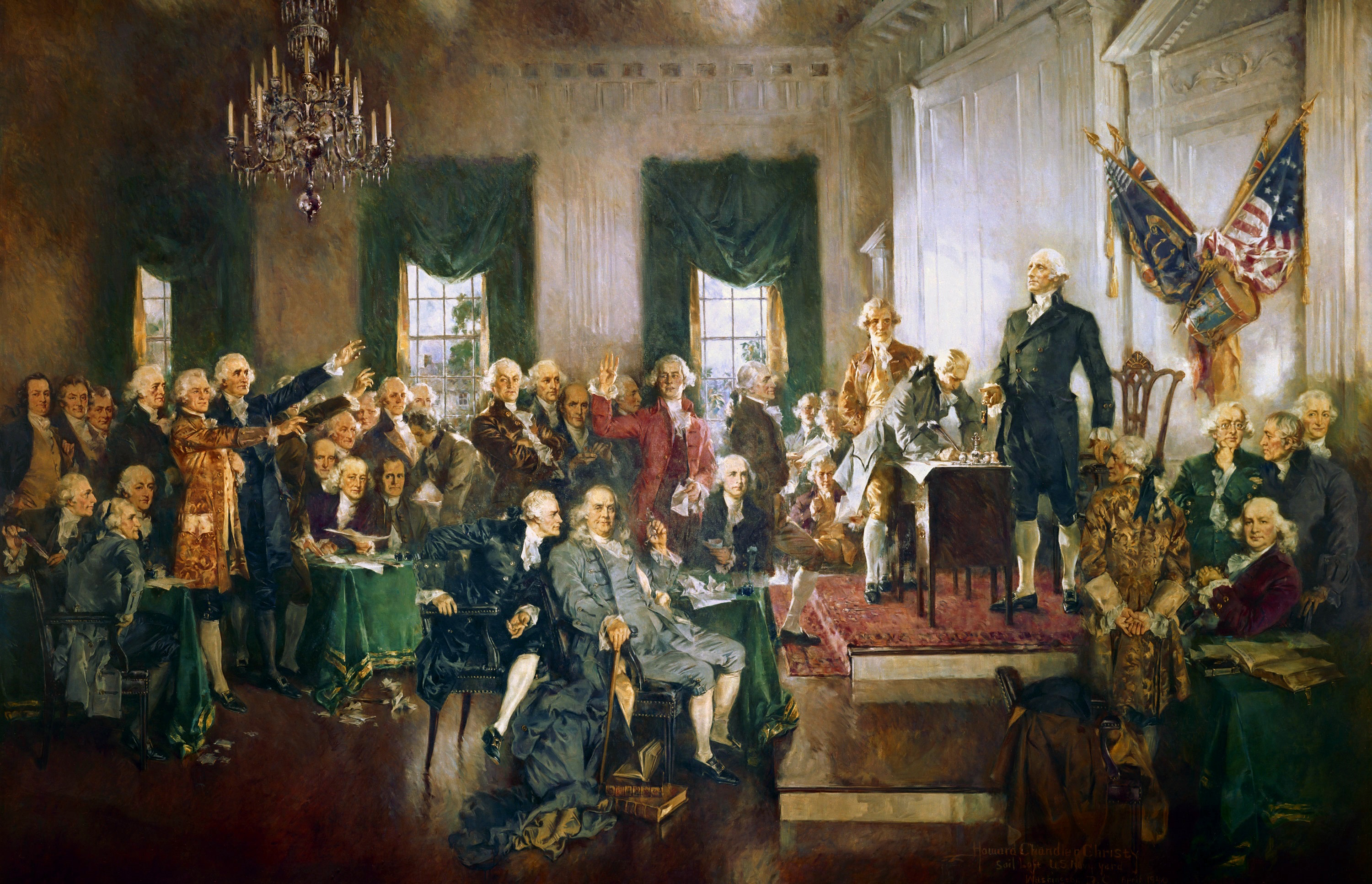
The signing of the Constitution, September 17, 1787.

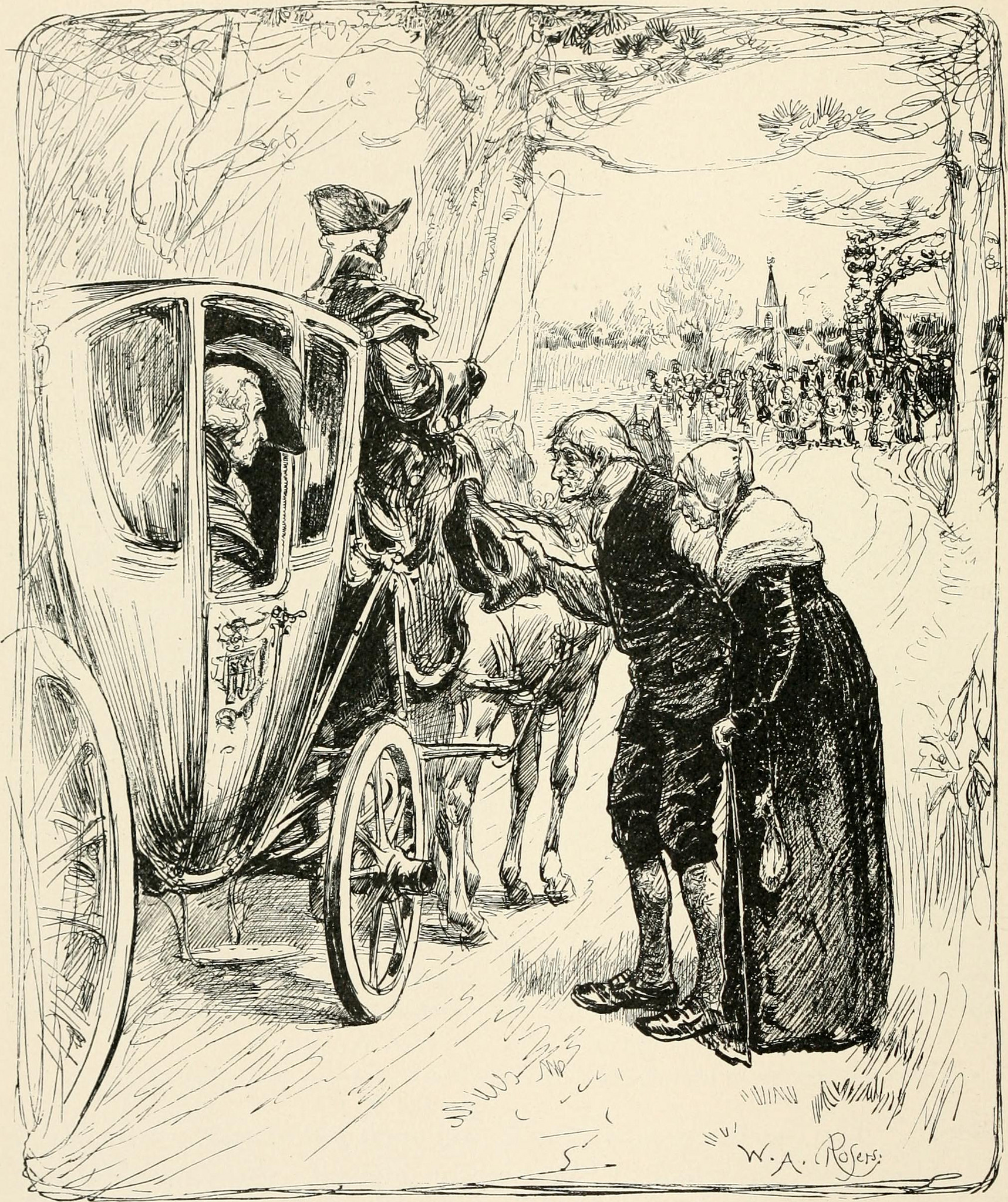
George traveling to his inauguration, as depicted in the 1896 book “The Century book of famous Americans : the story of a young people’s pilgrimage to historic homes”

Internet Archive Book Images

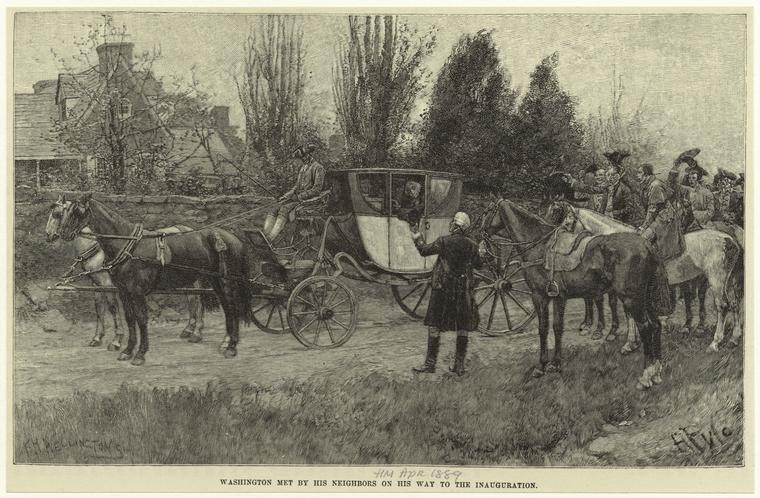
And from an 1889 illustration:

Courtesy NYPL

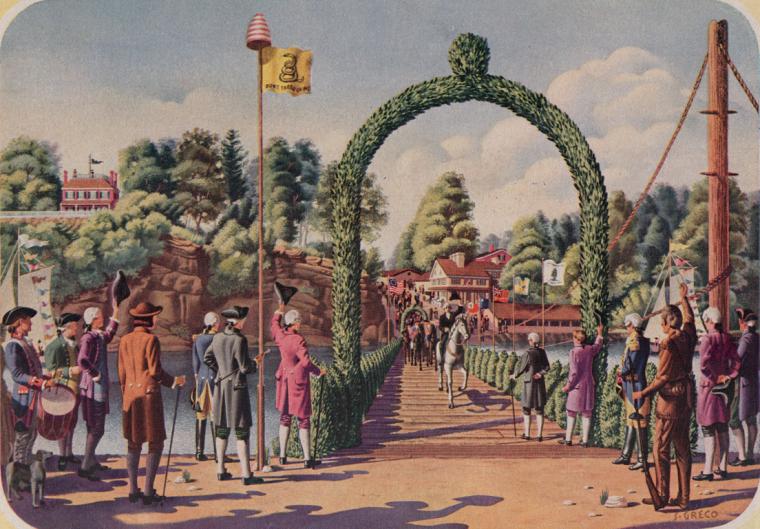
President-Elect Washington crosses floating bridge (Gray’s Ferry) — and through one of many triumphal arches — on his inaugural journey, Philadelphia, April 20, 1789

NYPL

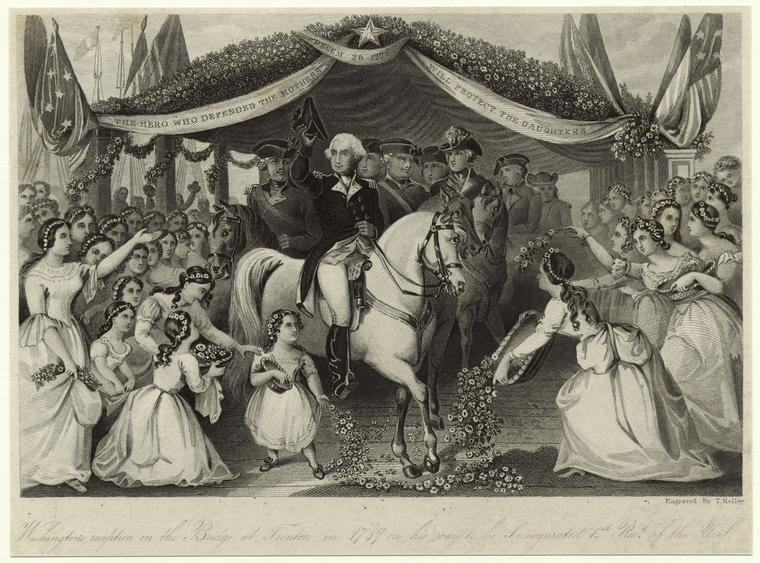
Washington’s reception on the bridge of Trenton in 1789 on his way to be inaugurated 1st president of the U. S.

NYPL

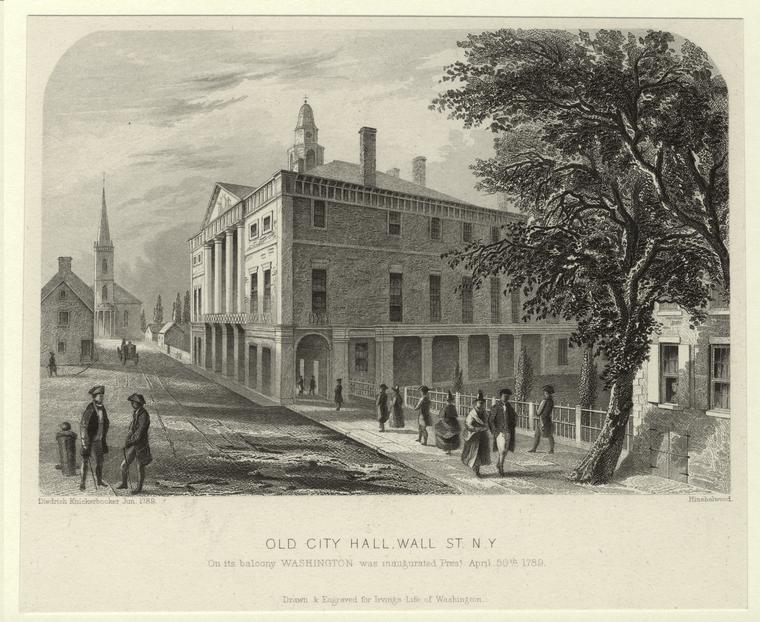
An illustration from 1855 depicts Old City Hall before it was renovated to house the new federal government.

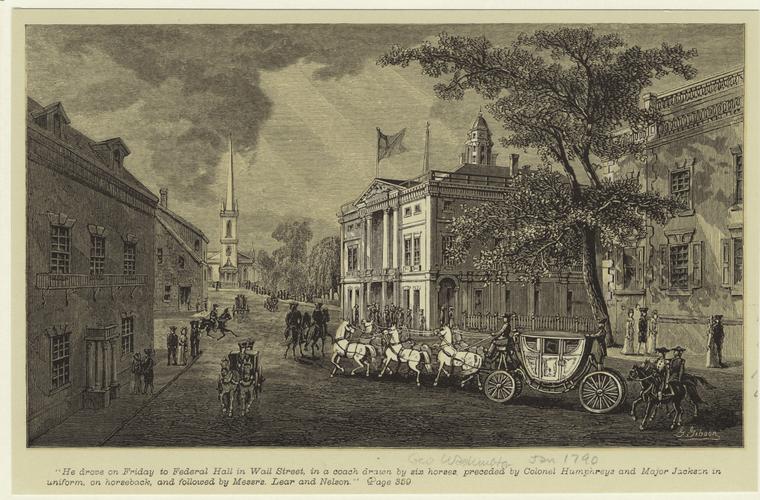
Another view, with Washington’s six-horse coach in the foreground.

NYPL

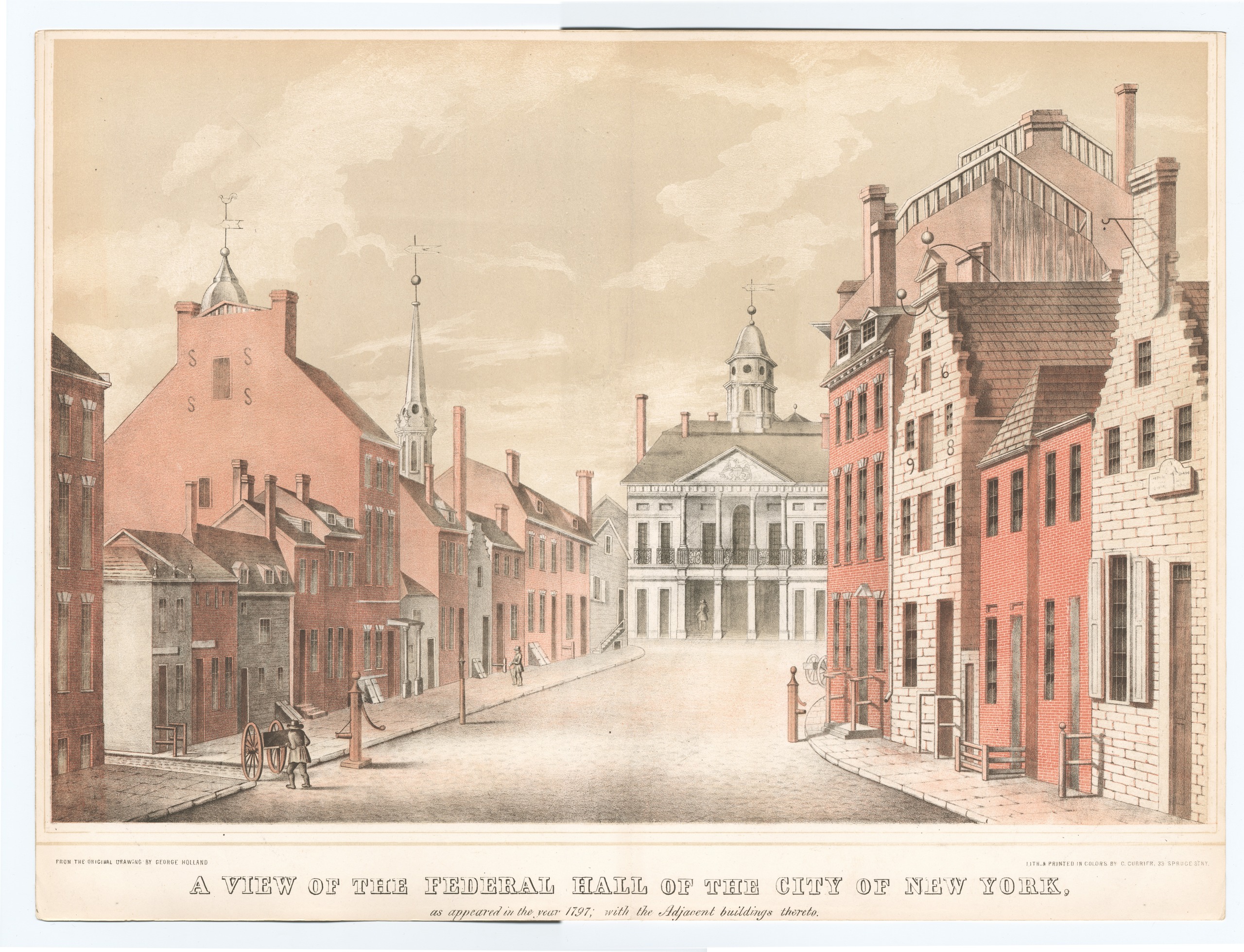
A depiction of Broad Street and Federal Hall as it looked in 1797, but you can easily picture how filled the streets would have been on Washington’s inauguration just eight years earlier.

NYPL

Here’s how it looked on the 2008 HBO mini-series John Adams:

From an 1899 oil painting (artist unknown)

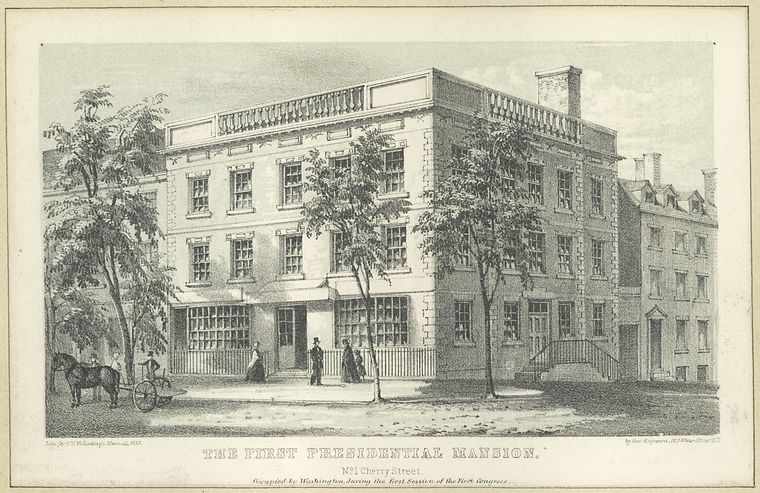
The presidential mansion on Cherry Street:

NYPL

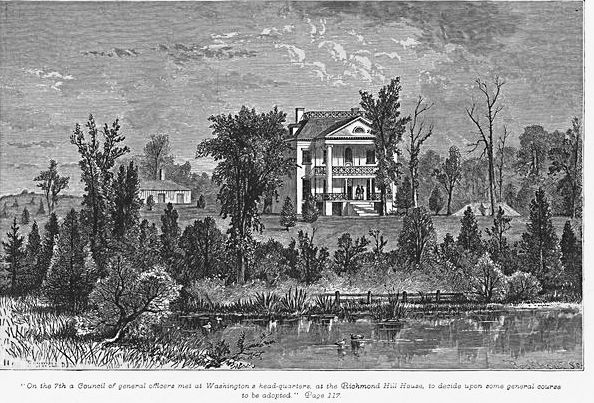
The lovely Richmond Hill, the vice presidential mansion home of John and Abigail Adams

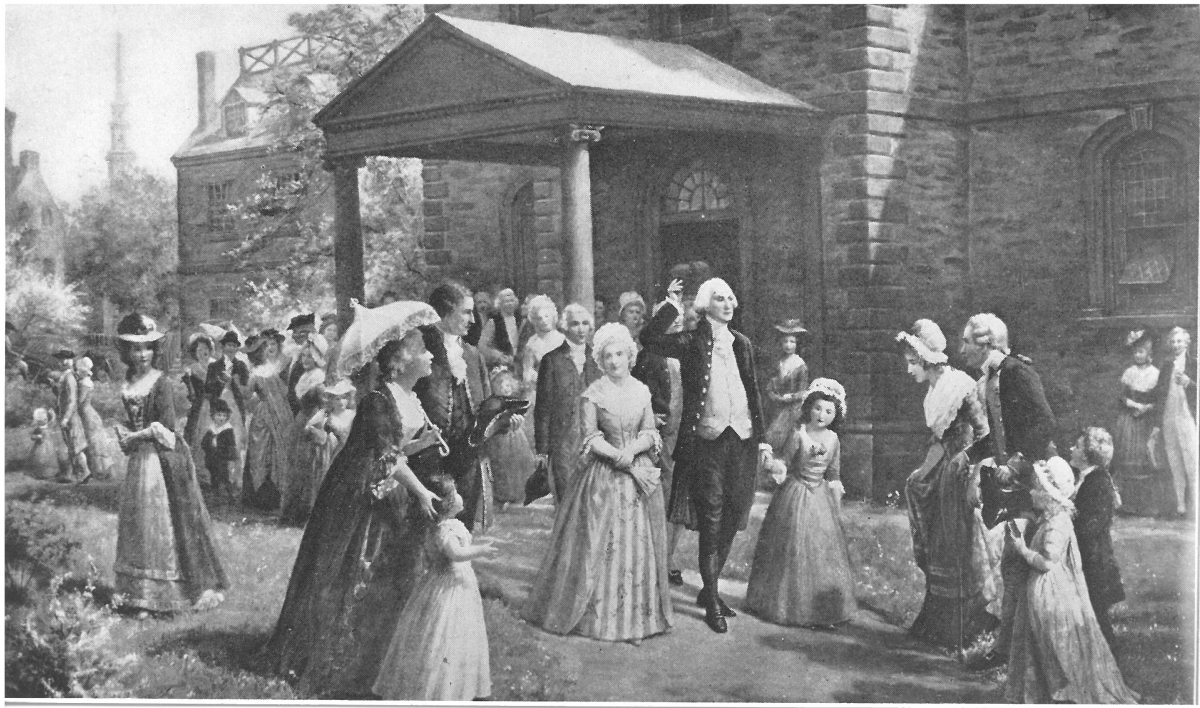
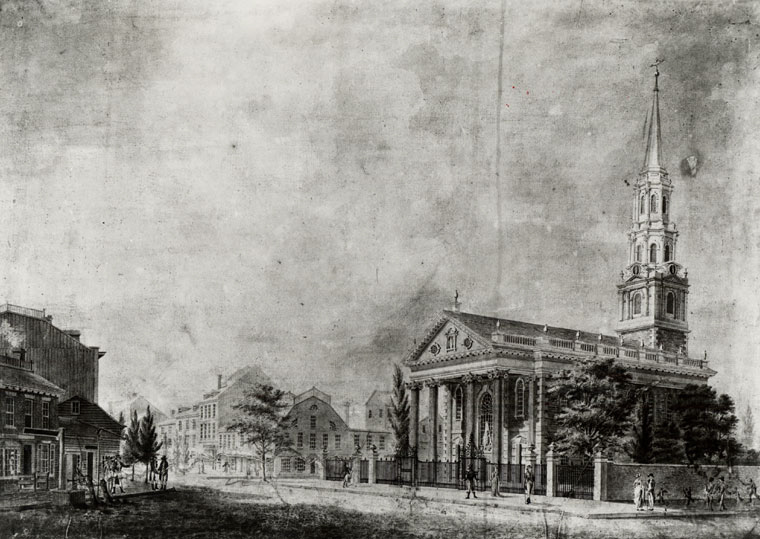
St. Paul’s Chapel, where Washington worshipped in New York.  More information at Trinity’s website.

Categories
Amusements and Thrills

Wanamaker’s Airship: That one time in 1911 they launched a hydrogen balloon from Astor Place

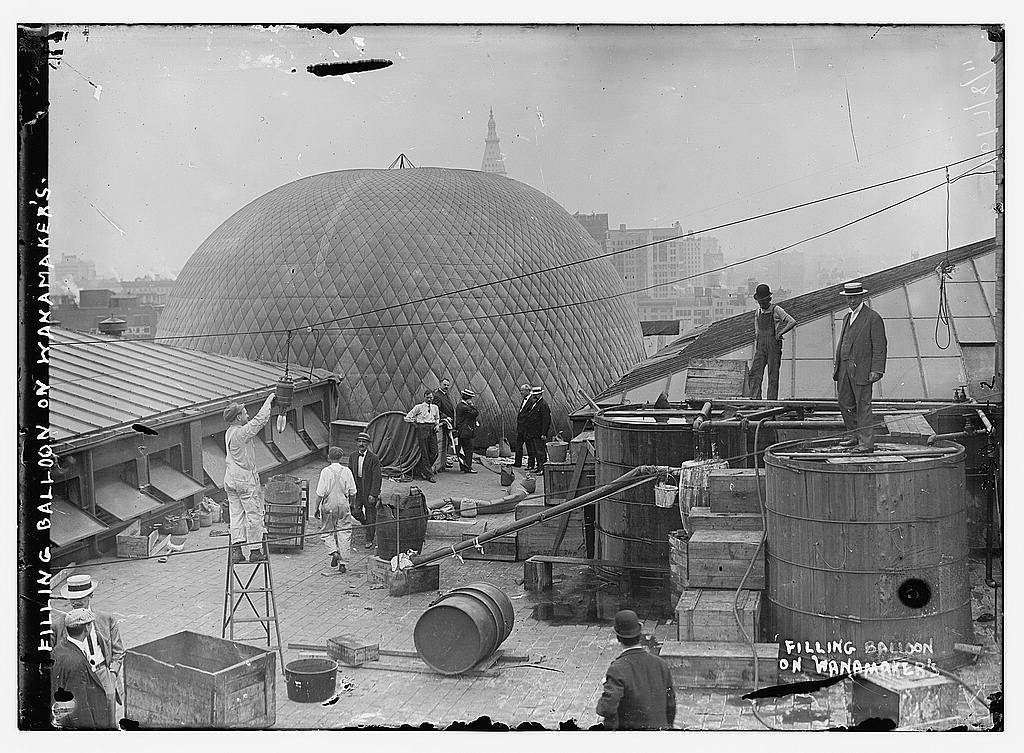
A view of the balloon launch, looking north towards the Metropolitan Life Tower, which can be seen jutting up in the background. The Met Tower was the world’s tallest building in 1911.

Philadelphia retailer John Wanamaker turned an abandoned train station in Philadelphia into the lavish department bearing his name in 1876, just in time for America’s 100th anniversary.  He would become one of Philadelphia’s largest employers, with 5,000 people working in the store, “the most valuable piece of property of its size in the city.” [source]

Meanwhile, in New York City, when shoppers weren’t flocking to Ladies Mile, they headed to A.T Stewart‘s equally grand ‘Iron Palace’ department store in Astor Place, with over thirty departments specializing in every sort of modern necessity, making it one of the largest stores of any kind in America.

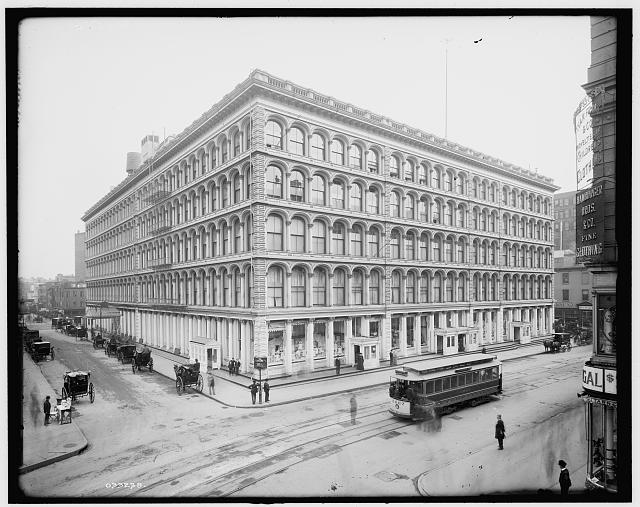
Stewart’s store was located on Fourth Avenue between 9th and 10th Streets and was called the ‘Iron Palace’ as it was New York’s largest cast-iron building at the time.  (But not the first; that title goes to its neighbor, the American Bible Society building, at 51 Astor Place.)

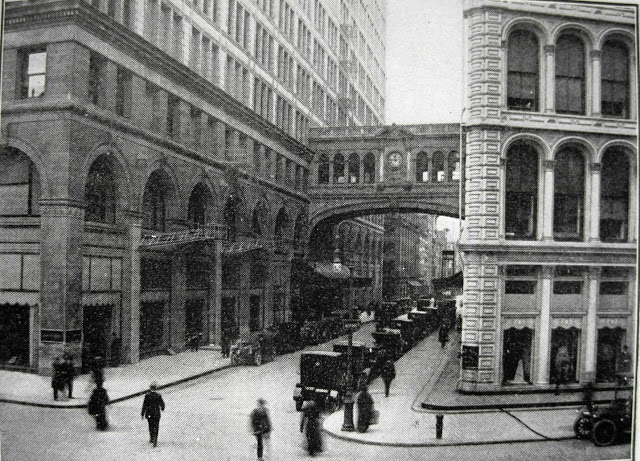
Below: The original Wanamaker’s between 9th and 10th Streets. The building no longer exists.

It would take two decades for Wanamaker to make his way to New York, eventually buying up an old Iron Palace in 1896 and reopening it as New York’s first Wanamakers.

But a man who had filled an entire train station in Philadelphia would not simply be content with one lavish store; across the street, between 8th and 9th, he built another in 1902, using one of the world’s most revered architects — Daniel Burnham, who had just completed work on the Flatiron Building.  Customers could go between the buildings using a fanciful ‘bridge of progress’.

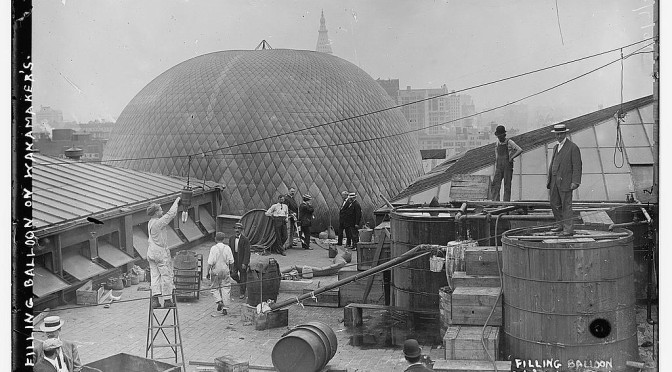
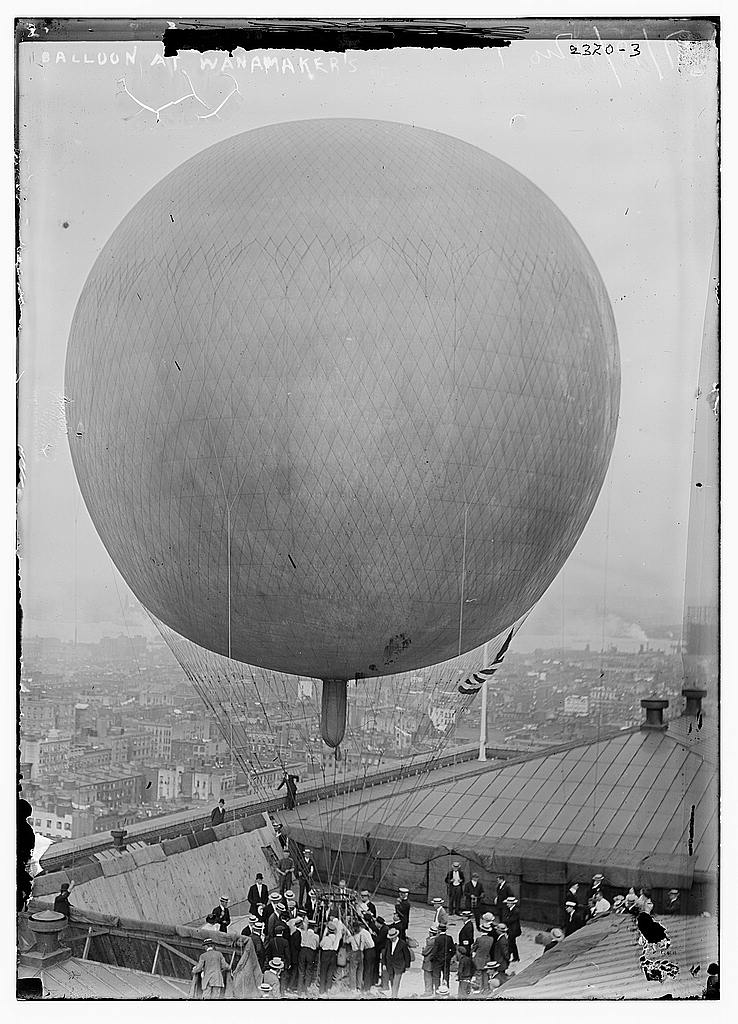
That is all, of course, to set this scene for the curious publicity stunt which occurred on the rooftop of Wanamaker’s on July 8, 1911.  For three days, a large hydrogen balloon (48 feet in diameter) sat tethered upon the rooftop of the new building, filling up with copious amounts of gas for a journey to Philadelphia — with a planned landing near Wanamaker’s other store.

In 1911, that old train-station store would be replaced with a new Wanamaker’s in Philadelphia’s Center City, also built by Burnham.  No better way to grab headlines for his new store in Philadelphia than to float a gigantic eye-catching object from one store to the other!

The balloon (called the Wanamaker No. 1), imported from Paris, was launched at 6 pm and gracefully floated over the city, across the Hudson, fadeing into the mists of Weehawken.

Unfortunately for the balloon’s two pilots, things went immediately awry, the balloon being a tricky one to control.  Instead of floating southwest, it headed due north.  After an hour and a half of wandering blindly through the clouds, the balloon ungraciously came down — in Nyack, New York.

But it wasn’t considered a failure by any means. Wanamaker’s wanted a publicity stunt and got one.  The launch made the front page of newspapers.  For a moment, the whole region seemed transfixed.  “Crowds turned out to gaze at the big airship as it passed over the Hudson River villages,” crowed the New York Times.

Some even claimed this was the beginning of a new phase in New York travel.  Rooftops could regularly be used to launch airships of all sorts.  “This is the first step towards making the roofs of the Wanamaker buildings in New York and Philadelphia into permanent aerial stations,” claimed the Evening World.  “Landing platforms and hangars for balloons and aeroplanes are to be built on the roofs of the department stores in both cities.”

Not to be outdone, the following month, Gimbels Department Store would stage a marvelous airplane race over the streets of Manhattan.

By the way, Mr. Wanamaker wasn’t even in the country when all this happened.  He rolled into town the following week aboard the White Star liner Oceanic, having celebrated his 73rd birthday in style by traveling to England and meeting King George and Queen Mary.

The original Wanamaker’s building is no longer there, but the south building, the one designed by Burnham and the one from which the balloon was launched, still exists today as the home of K-Mart.

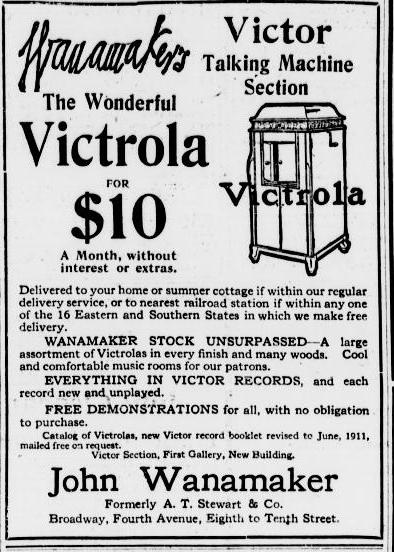
Below: That same week, one could run into the store below the balloon and purchase this swell Victrola. This ad is from the July 10, 1911 issue of the Evening World

Pictures courtesy the Library of Congress.

Categories
Sports

‘Arctic blasts’, union rousers and hunchbacks: Ten bits of trivia about Ebbets Field’s opening day, 100 years ago today


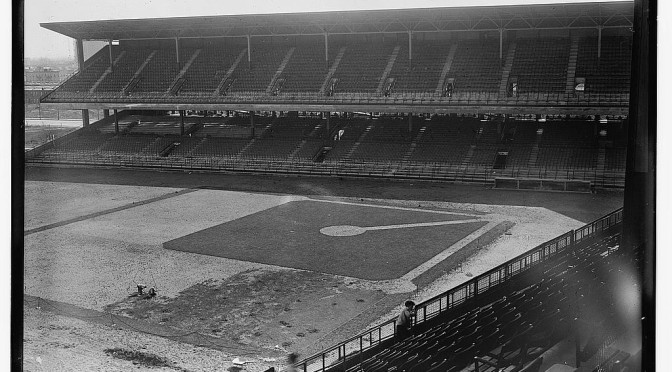
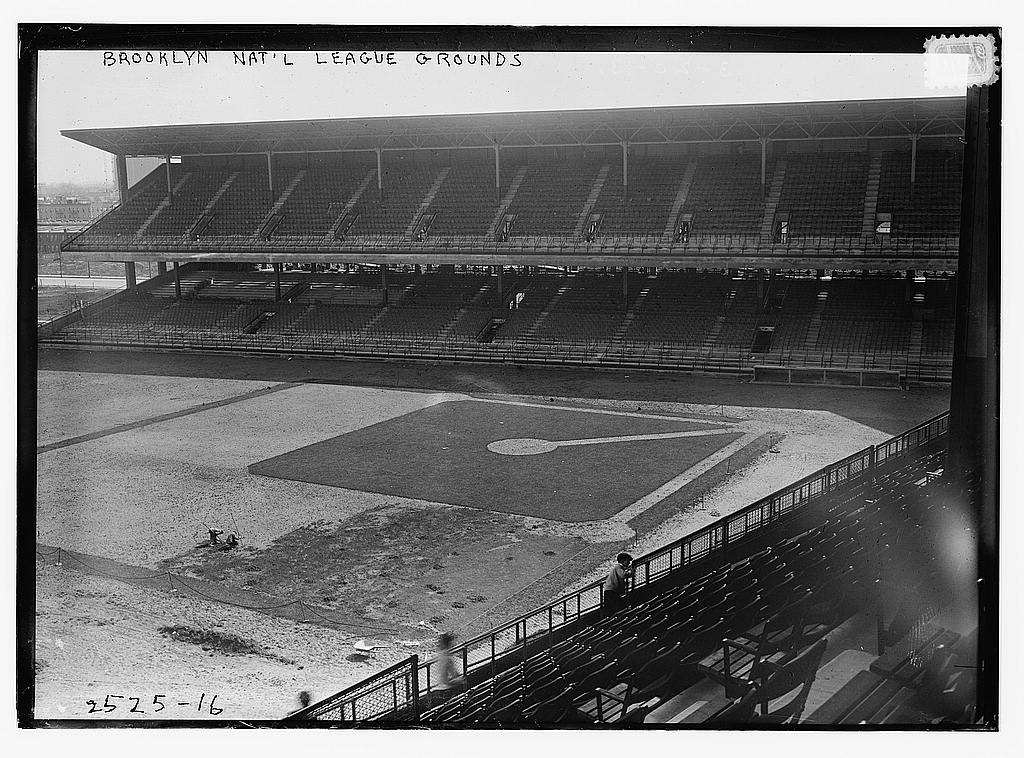
Inside Ebbets Field, 1913, Library of Congress

The first-ever regular season baseball game at Ebbets Field was played 100 years ago today.  The legendary field, once located in the Flatbush neighborhood of Brooklyn, was home to the Brooklyn Dodgers from 1913 until the team left for Los Angeles in 1958.

Here are ten interesting facts about the opening game, played on April 9, 1913:

1)  The Dodgers were thirty years old by the time their lavish new field opened. The team was originally formed under the name the Brooklyn Grays in 1883 by real estate speculator Charles Byrne.  Like many early ball fields, their first home, Washington Park in today’s Park Slope neighborhood, was frozen over during the winter to become Brooklyn’s leading skating rink.

2)  They were originally nicknamed the Brooklyn Trolley Dodgers, for the treacherous skill exhibited by their fans crossing rail-covered streets to get to the ball field.  There were still a great many streetcar lines near their new home of Ebbets Field, but by 1913 the team was more affectionately known as just ‘the Dodgers’.
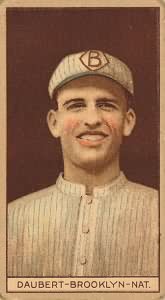
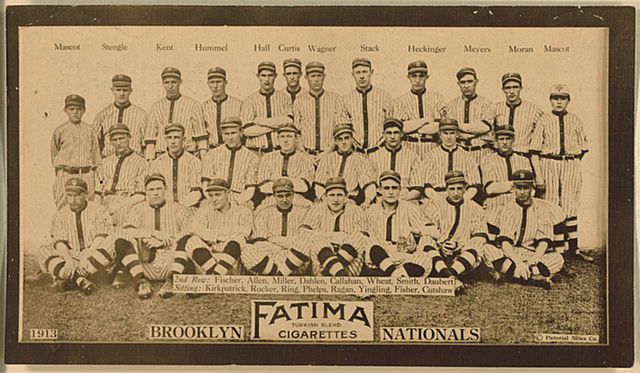
However several names would be casually attached to the team by fans and local journalists — the picture above calls them the Brooklyn Nationals — until 1933, when the name DODGERS would finally be added to both their home and road uniforms.

3)  As a nod to its first-ever day, Ebbets Field was allowed to open one day before everybody else in the National League.  One of their most popular players, first baseman Jake Daubert (at right), was presented with a golden bat and a floral horseshoe in a ceremony before the game and would, by season’s end, go on to win the league’s Most Valuable Player honor.

“Gentleman Jake,” as he was called, is better known today as being one of the founders of the baseball’s unionization movement.   This did not make him popular with the namesake of Ebbets Field, owner Charles Ebbet, who traded Daubert in 1917 after a salary dispute.   His union connection may also explain why this unique, well-liked and exemplary ballplayer is not currently listed within National Baseball’s Hall of Fame.

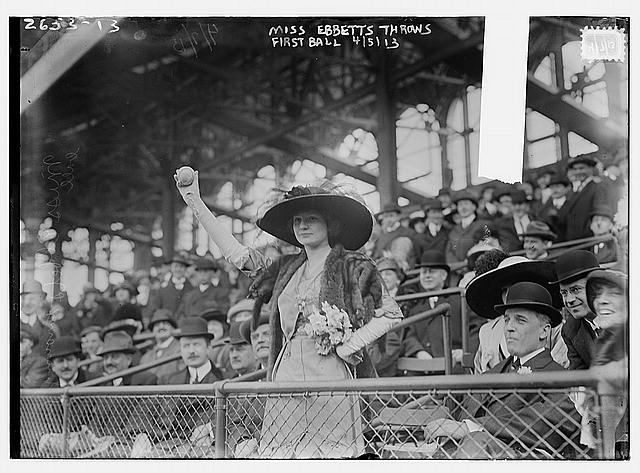
4)  The ceremonial first ball was thrown in by Brooklyn Borough President Alfred E. Steers, a resident of the neighborhood Ebbets Field made its home — Flatbush.   However, at an exhibition game played just a few days earlier, Ebbets’ lovely daughter Genevieve Ebbets tossed out the first pitch.


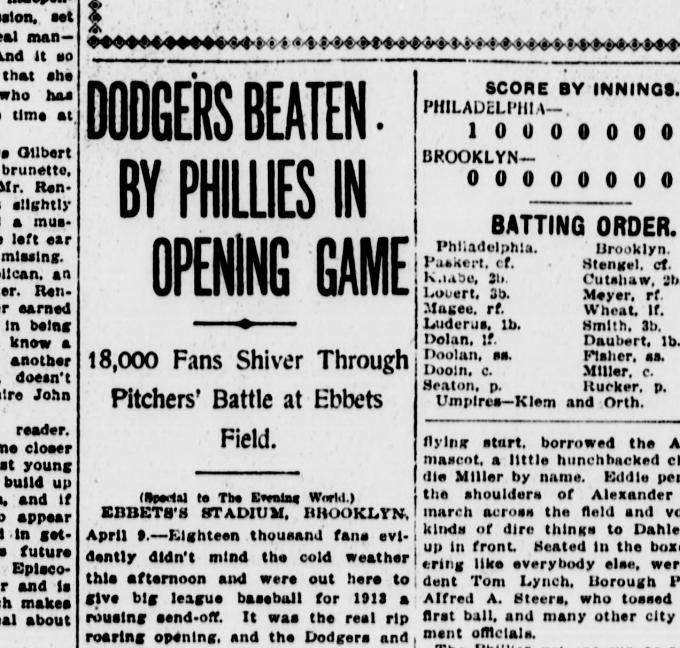
5) The Brooklyn Dodgers played the Philadelphia Phillies that day, which should have boded well for the team in their new home. The Phillies weren’t yet considered a formidable team and were more associated with constant injury. Despite this, the Phillies beat the Dodgers that day, 1-0.

6) Why did the Dodgers lose? Uh, it was unseasonably cold? The Tribune reported that the frightful chill kept the brand-new grandstand partially empty. From the New York Times, April 10, 1913: “It was so cold that the attendance was seriously affected, about 10,000 spectators braving the arctic blasts to see the Phillies win a well-played game by a score of 1 to 0.” [source]

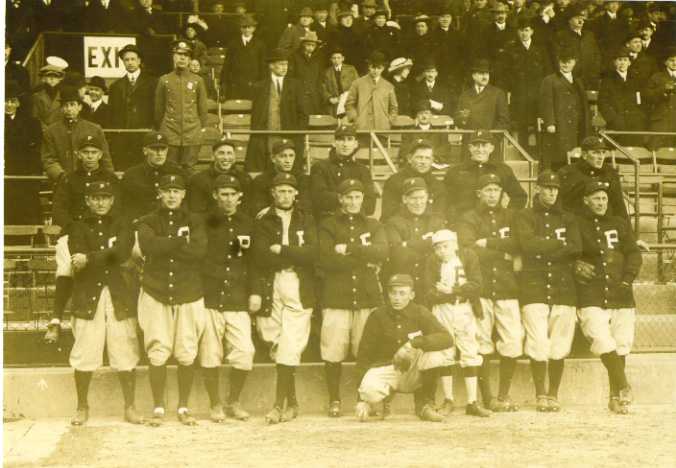
7) The Phillies also had with them an unusual mascot — a hunchback teenage dwarf.  The Phillies home rival the Philadelphia Athletics had a hunchback mascot of their own named Louis Van Zelst, and owner Connie Mack wanted to emulate their success. By, apparently, finding his own young man with a hunchback. Unfortunately, this boy’s name is unknown, but he appears in a 1913 picture with the team:

NOTE: The Tribune infers that this may have been Mr. Van Zelst himself and not another teenager. As the name of the boy in the picture above has not been reported, it’s quite likely that this is the Athletics ‘mascot’.  Note that in the article, the Dodgers are called by yet another name — the Superbas.  

Courtesy the Philadelphia Athletics Historical Society

8) As you could imagine with a 1-0 game, the first-day crowds at Ebbets Field were hardly cheerful.  One might even described them as bored.  The upper seats were barely filled, and the crowd didn’t exactly “wax enthusiastic until the eighth inning” when the Dodgers finally got somebody on base.

9) The first Dodger to ever score a hit in the new field was second baseman George Cutshaw who had only been with the team one year when he scored a single in the first inning.  Ironically, the second basemen was called out when he was caught trying to steal second base.

10) The Dodgers would fare poorly in their first season at Ebbets Field, eventually placing sixth out of eight teams. The winning team that season were their rivals across the East River — the New York Giants.  They would finally bring Ebbets its first pennant victory in 1916.