Categories
Amusements and Thrills Sports Those Were The Days

The New York Game: Baseball in the Early Years

Baseball, as American as apple pie, really is “the New York game.” While its precursors come from many places – from Jamestown to Prague – the rules of American baseball and the modern ways of enjoying it were born from the urban experience and, in particular, the 19th-century New York region.

The sport (in the form that we know it today) developed in the early 1800s, played in Manhattan’s many open lots or New Jersey public parklands and soon organized into regular teams and eventually leagues. The way that New Yorkers played baseball was soon the way most Americans played by the late 19th century.

But it wasn’t until the invention of regular ball fields – catering to paying customers – that baseball became truly an urban recreational experience. And that too was revolutionized in New York.

Just in time for spring and the new Major League baseball season, Tom and Greg are joined by the acclaimed Kevin Baker, author of The New York Game: Baseball and the Rise of a New City to discuss the early history of the sport and its unique connections to New York City.

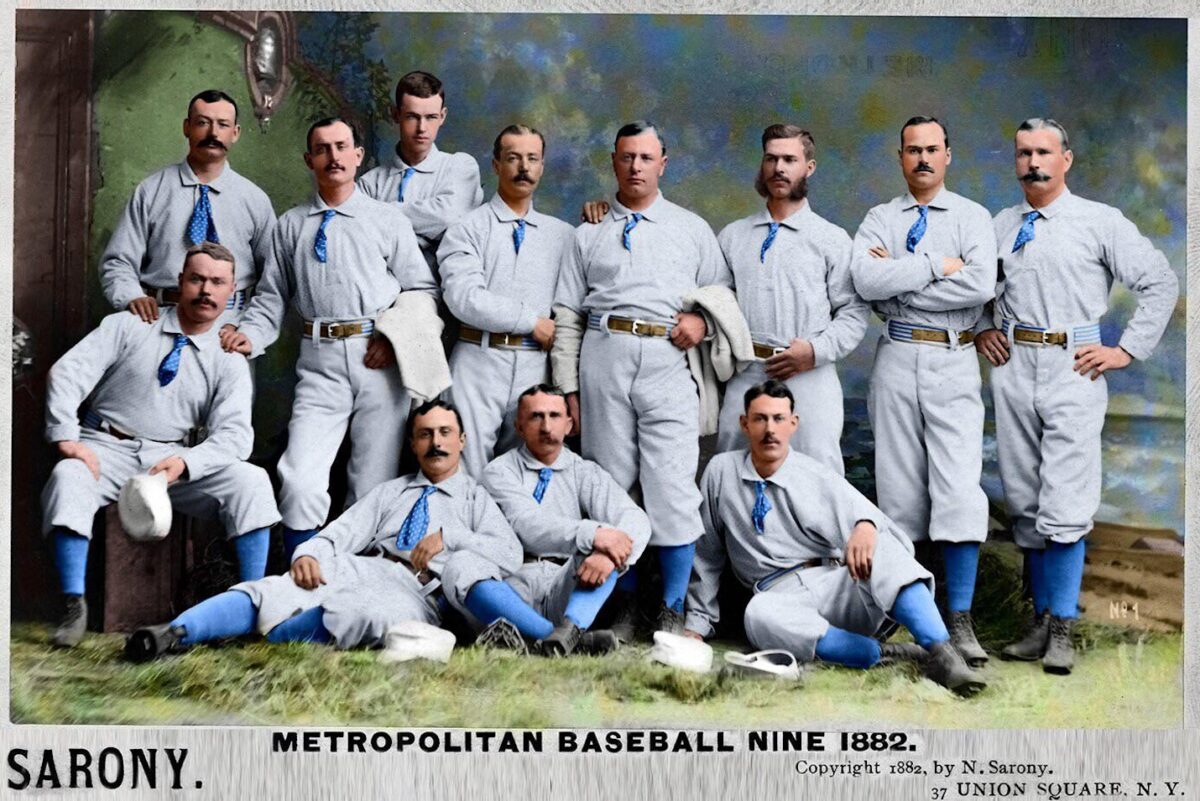
This show is truly the ultimate origin story of New York baseball, featuring tales of the city’s oldest and most legendary sports teams – the Yankees, the Dodgers, and the Giants. AND the New York Metropolitans – a different team than today’s Mets located in Queens.

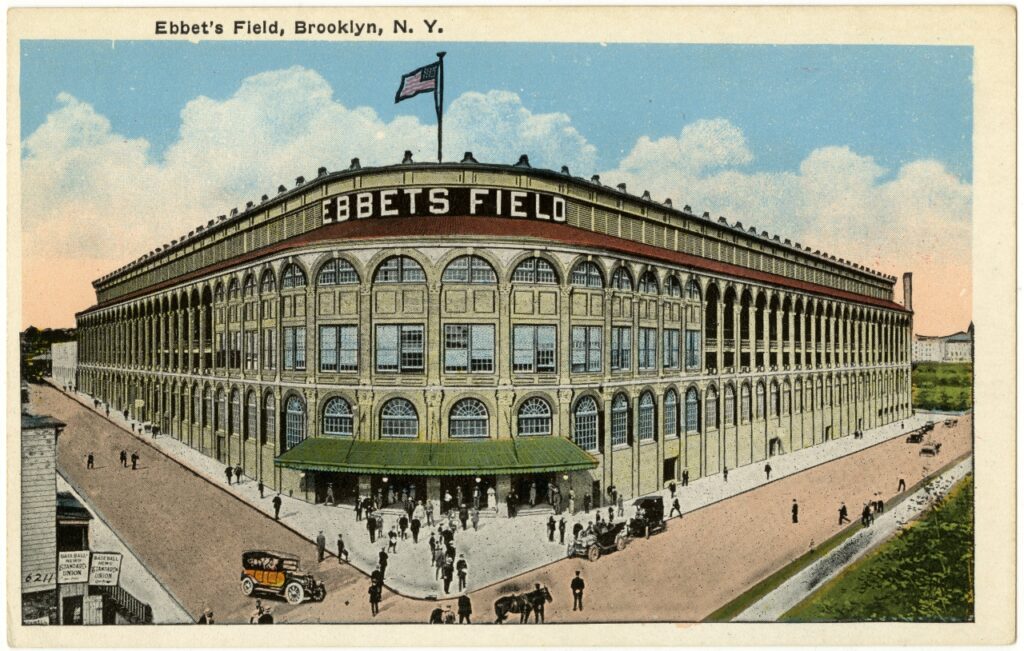
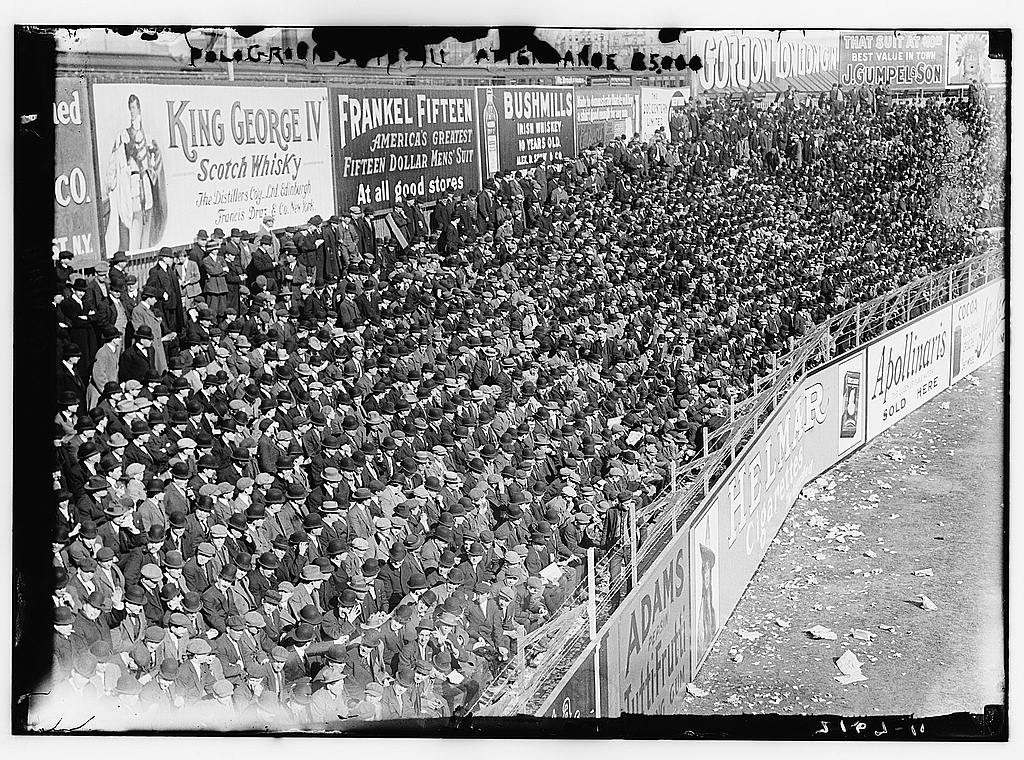
Where was baseball played? Kevin shares the secrets of New York baseball’s earliest venues – from the many Polo Grounds in upper Manhattan to Ebbets Field in Brooklyn

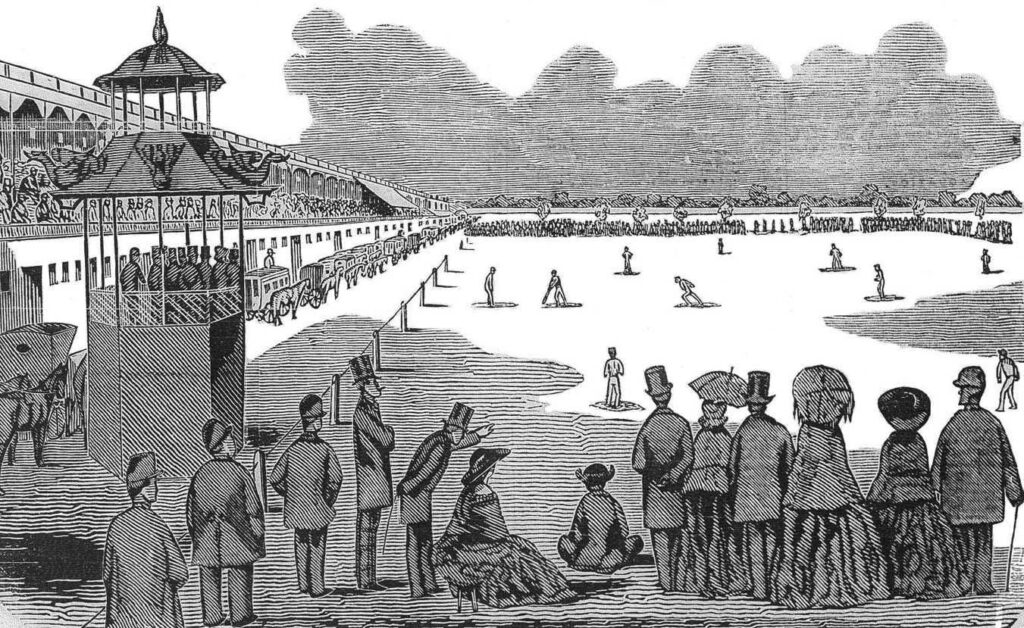
This is a true five-borough origin story! With stops at Hilltop Park (Manhattan), Yankee Stadium (Bronx), Fashion Race Course (Queens), Washington Park (Brooklyn), and St. George Cricket Grounds (Staten Island) among many other sites.

FEATURING the surprising link between baseball and Boss Tweed and his notorious political machine Tammany Hall

PLUS How did segregation distort the game and where did Black ballplayers play the sport? What was baseball like before Jackie Robinson?

LISTEN NOW: THE NEW YORK GAME


Fashion Race Course in Flushing, Queens, from The Clipper of July 24, 1858 (and via John Thorn/Our Game)
Many hatted men at the Polo Grounds, 1911 (Library of Congress)
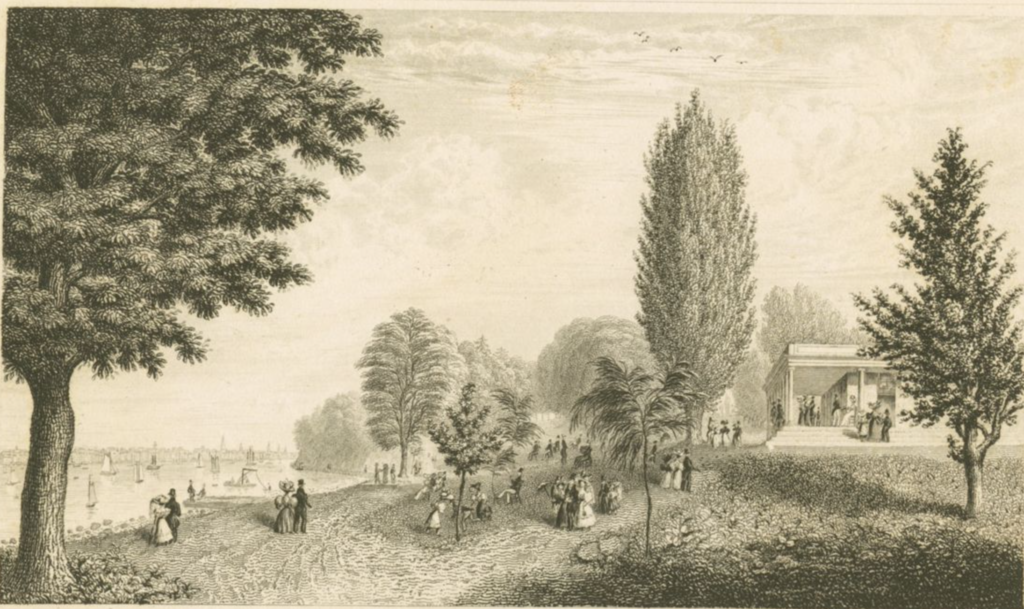
Elysian Fields in Hoboken, the site of America’s first baseball games (NYPL, image from Booth’s History of New York)
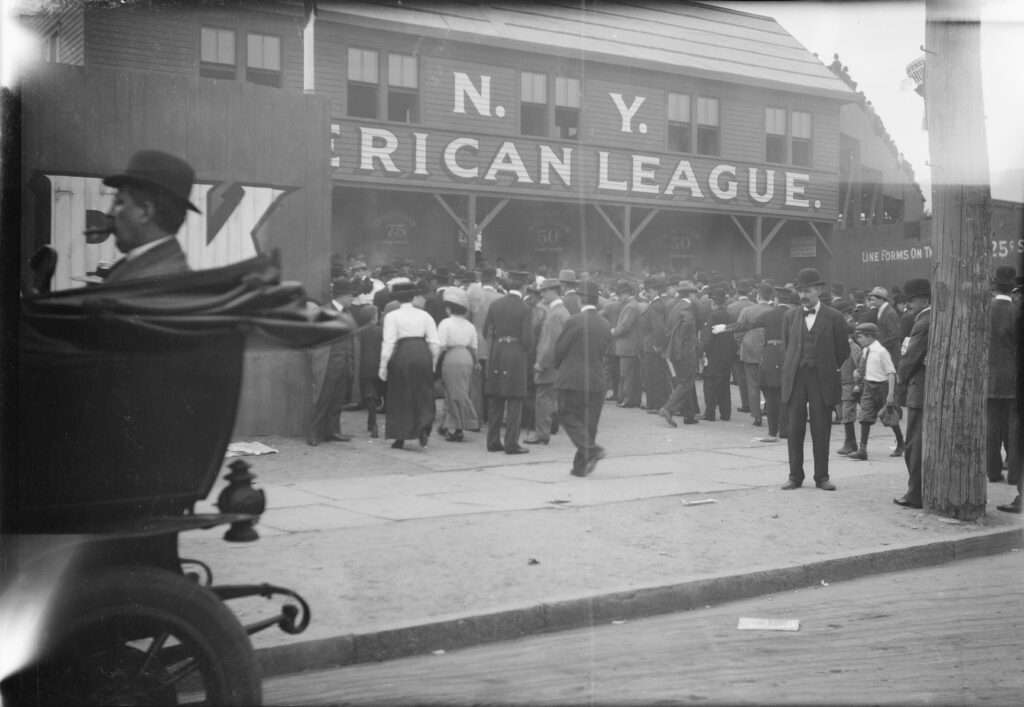
The entrance to Hilltop Park, 1912 (Library of Congress)
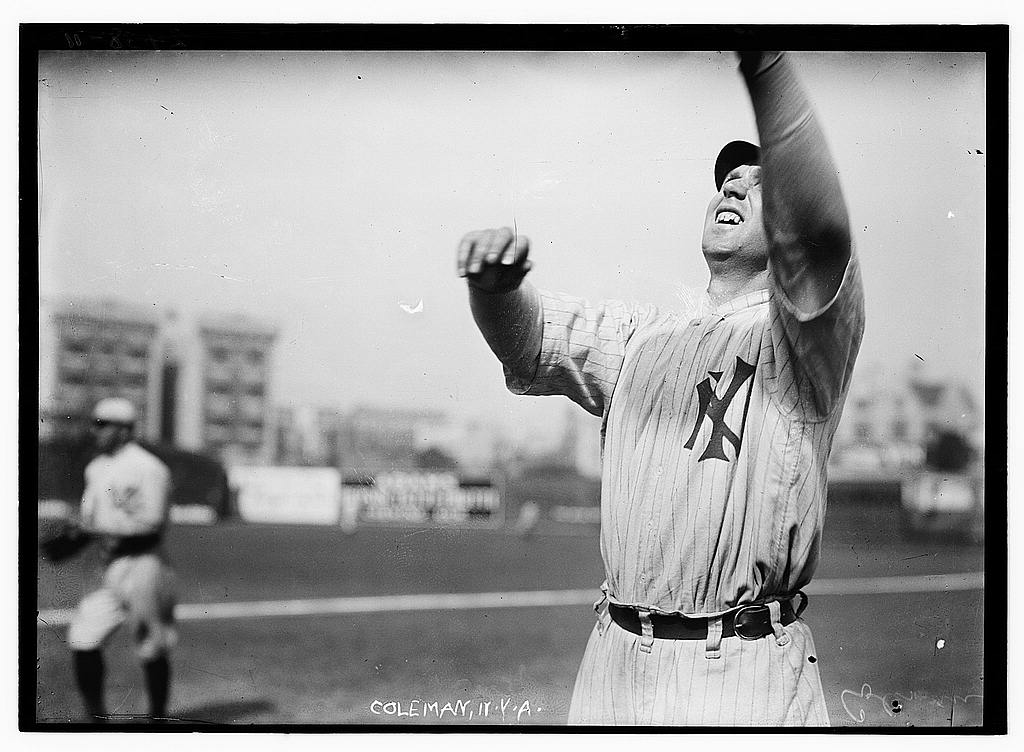
Curt Coleman at Hilltop Park, 1912
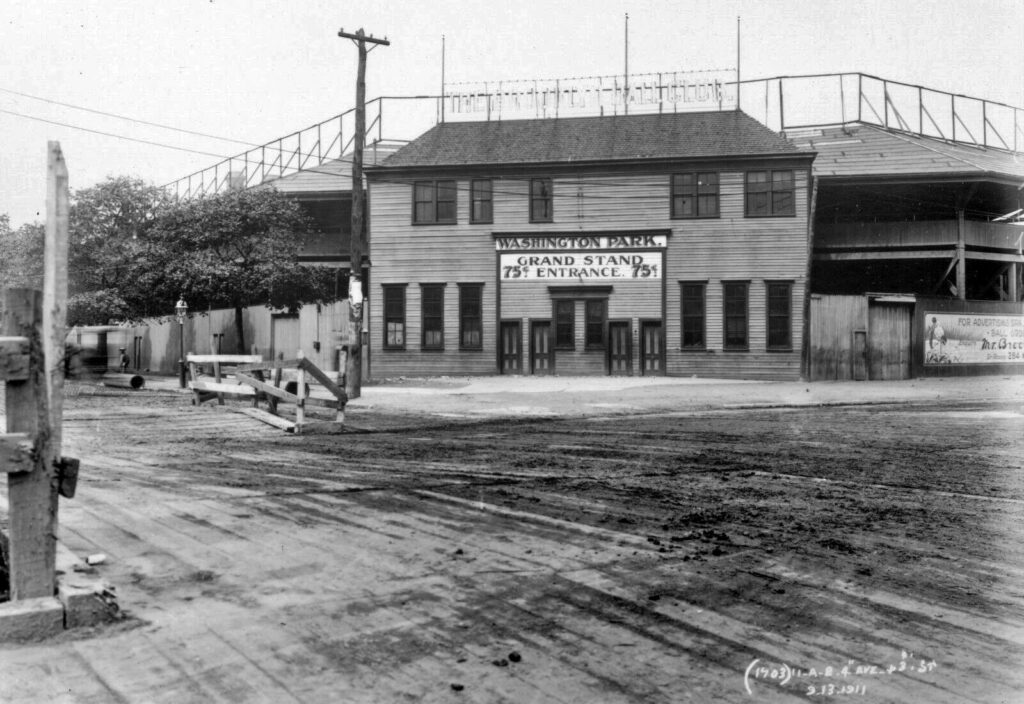
Washington Park taken September 13, 1911 from the intersection of 4th Avenue and 3rd Street in Park Slope, Brooklyn.
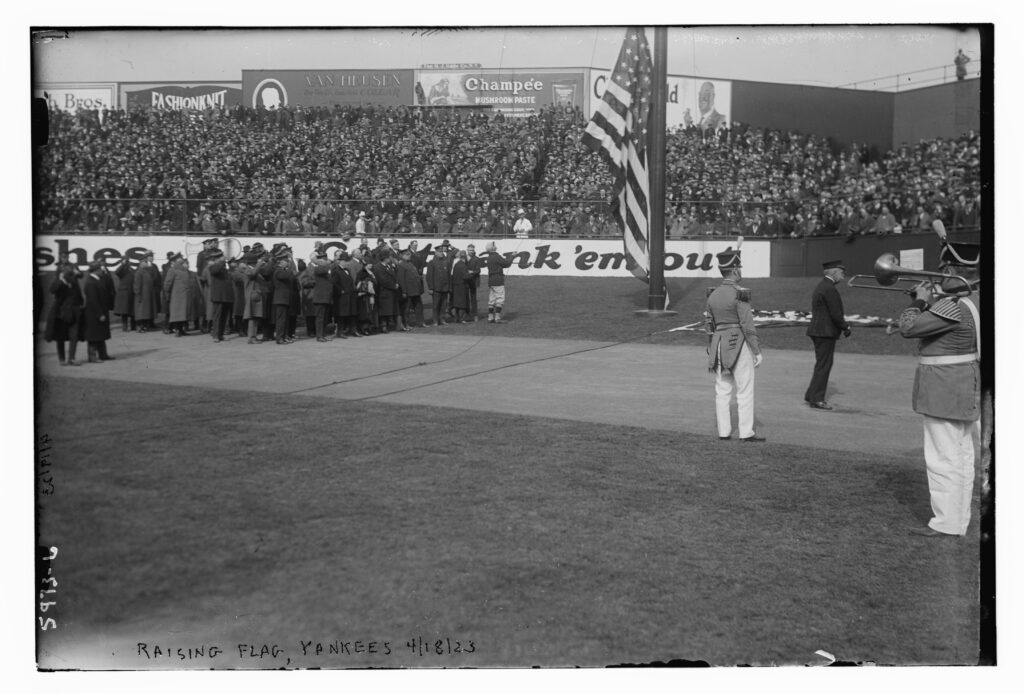
Opening Day at Yankee Stadium, 1923 (Library of Congress)
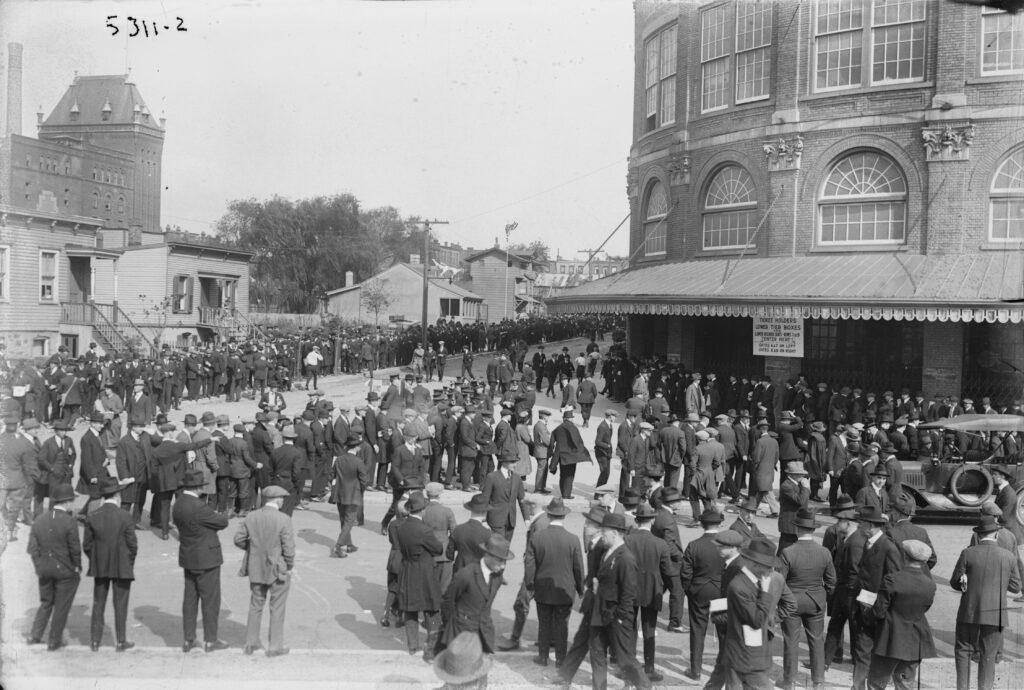
The crowd outside Ebbets Field for Game 1 of the 1920 World Series, the Brooklyn Dodgers against the Cleveland Indians.

FURTHER LISTENING

FURTHER READING

Brooklyn baseball: the Superbas and the worst batter ever

Brooklyn Dodgers vs. Cincinnati Reds at Ebbets Field — in the first Major League baseball game ever broadcast on television

Hilltop Park: home base for NYC’s premier baseball team

Meet the Mets! The Metropolitans, that is, an early NY baseball team

The short shelf life of the Tip-Tops, the Brooklyn baseball team situated near the Gowanus River and named for bread

Union Grounds: Baseball history in Williamsburg

The Wise Guy of Baseball: Getting To Know Leo ‘The Lip’ Durocher

100 years ago today, the Yankees played their first game at Yankee Stadium

Categories
Brooklyn History Sports

Brooklyn Dodgers vs. Cincinnati Reds at Ebbets Field — in the first Major League baseball game ever broadcast on television

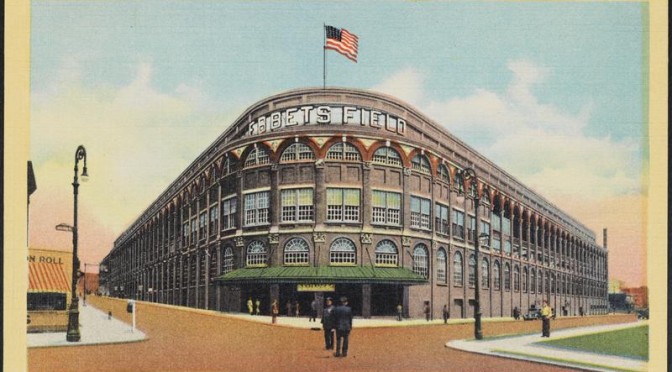
Ebbets Field, Brooklyn, N. Y.

Seventy five years ago today, an extraordinary tradition began — televised Major League baseball!

The location was appropriately Ebbets Field, one of baseball’s legendary ‘field of dreams’. The home team, the Brooklyn Dodgers, was pitted against the Cincinnati Reds in a key National League match-up. Both teams were quite strong that year, although it was Cincinnati at the top of the standings.

Fans who packed the stands at Ebbets that steamy Saturday afternoon noticed some rather unusual contraptions had invaded the field — bulky television cameras.  “One ‘eye’ or camera was placed near the visiting players’ dugout,” reported the New York Times. “The other was in a second-tier box back of the catcher’s box and commanded an extensive view of the field when outfield plays were made.”

The experiment was inspired by the technological marvels at the 1939 World’s Fair in Flushing-Meadows.  In fact, since few people actually owned TVs then, it was in David Sarnoff’s RCA exhibition hall where most people saw the broadcast, courtesy W2XBS (a precursor to WNBC-TV).

Below: A view of one of the cameras broadcasting the game.  Ads for GEM Razor Blades and Calvert Whiskey can be seen across the field. They became the first sponsor of a televised baseball game, although it was purely accidental!

Up until that point, the 400-odd receivers throughout the city — owned mostly by RCA executives and technicians — received broadcasts from a studio in Rockefeller Center. (For more information, check our our New York and the Birth of Television podcast.)

This was not the first baseball game ever broadcast;  a college game between Columbia and Princeton was beamed out to the handful of received that May, near the opening of the World’s Fair.  But it attempting to broadcast a game with broader appeal, like the Dodgers-Reds face off, Sarnoff and his engineers invented a new way of interacting with major sport.

Sports of mass appeal had been heard on the radio for over 15 years by this point. Interestingly, New York teams originally blanched at the idea of radio broadcasts, thinking they would reduce stadium attendance.  Broadcasters were even banned from the field for a few years. [source]

Adding a live visual element was crucial not only in popularizing the game of baseball — uniting fans of a certain team beyond the borders of a stadium or a city — but in popularizing the idea of television itself.  Televised sports, invented here in 1939, had the unique potential of bringing together masses across the globe, as anybody caught up in this year’s World Cup hysteria or last year’s Summer Olympics fandom can attest.**

It’s to the credit of the television engineers that their feat seems not to have disrupted the game.  Coverage in the Brooklyn Daily Eagle neglects to mention the cameras*, and the New York Times mentions it only in a small article.

In the end, the teams split the two-game event — the Reds one the first (5-2), the Dodgers the second (6-1).  The Reds would eventually win the National League pendant and return to the New York for the World Series, facing (and eventually losing quite badly to) the New York Yankees.

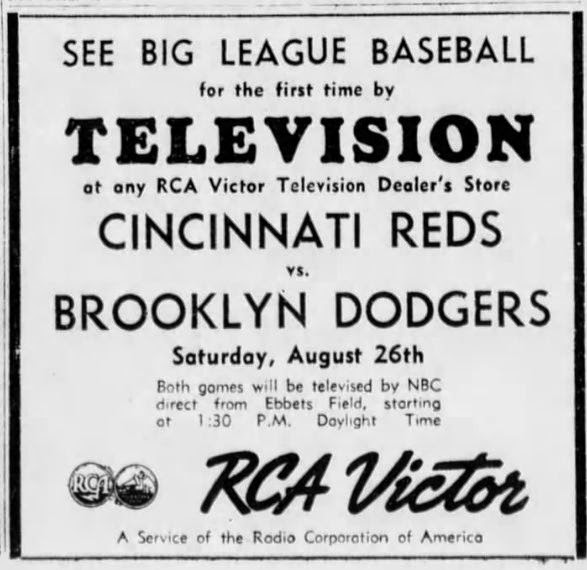
*However, RCA ran an advertisement in the Brooklyn paper on August 24, 1939, to drum up a big crowd for their inaugural broadcast:


**As commenter Andrew points out, portions of the 1936 Olympics in Berlin were also broadcast live to several countries.
Top picture of Ebbets Field courtesy Museum of City of New York

Categories
Brooklyn History Sports

The short shelf life of the Tip-Tops, the Brooklyn baseball team situated near the Gowanus River and named for bread

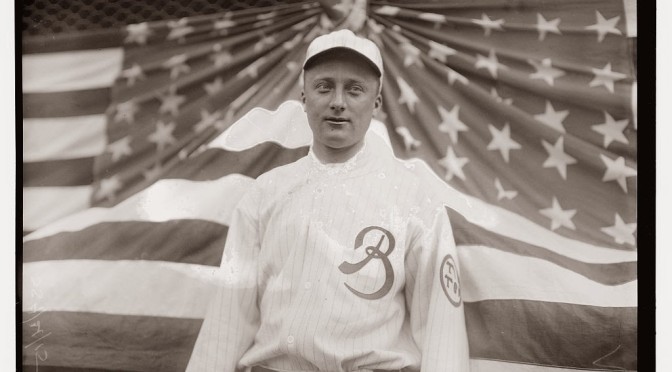
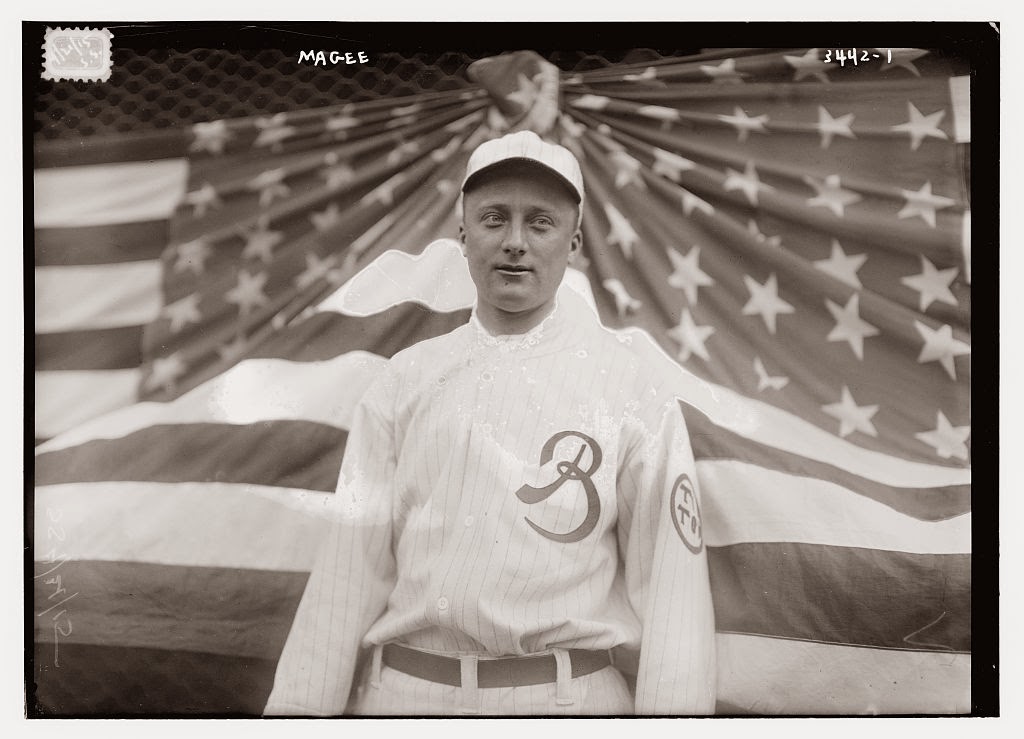
The piping hot uniforms of the Brooklyn Tip-Tops, worn by baby-faced manager Lee Magee

For a brief shining moment between 1914 and 1915, Brooklyn had two major league baseball teams — the legendary Brooklyn Dodgers and the not-so-legendary Brooklyn Tip-Tops.

Baseball has long been a sport of two parallel sports leagues — the National League and the American League — which have gotten together at season’s end to play the World Series since 1903.  But for an unusual moment in 1914 and 1915, there was a third baseball league called the Federal League.

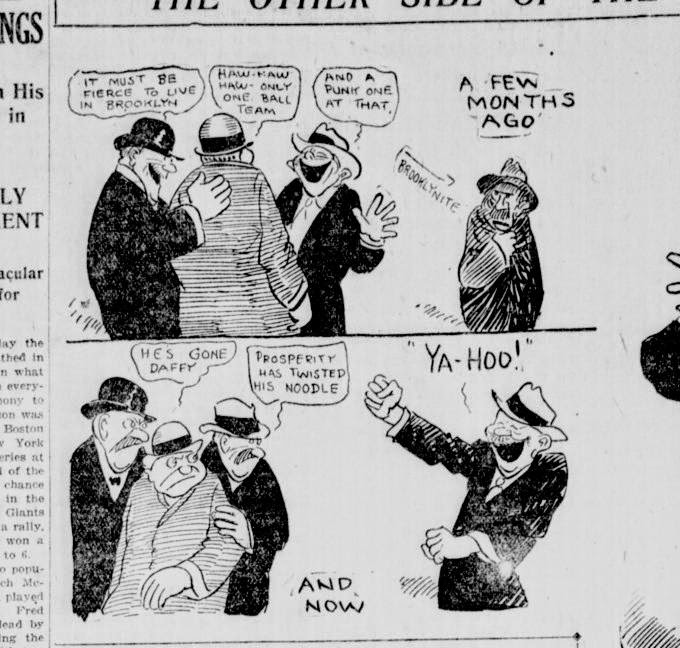
A cartoon from the May 12, 1914 New York Tribune:


The Federal League was formed specifically in protest to the signing practices of the two dominant leagues, doing away with pesky reserve clauses (binding players to certain teams for almost their entire careers) and offering higher salaries.  For a second, it seemed possible that the Federal League might provide a new way to organize a major sport.

There were eight teams in the Federal league which such unusual names as the Chicago Whales, the Newark Peppers and the Baltimore Terrapins. (Yes, somebody named a ball team after a turtle.)

Within the New York area, one franchise was awarded to Brooklyn, owned by a baker named Robert Ward.  His bakery for Tip-Top Bread (centered at 800 Pacific Street in today’s Prospect Heights) was obviously so lucrative that he eventually sank one million dollars in funding the team that eventually took the name of his baking enterprise — the Brooklyn Tip-Tops.

Brooklyn’s other team, the Dodgers, had conveniently vacated their old wooden field, Washington Park, for their brand new home Ebbets Field in Flatbush.  Ward hastily prepared to move the Tip-Tops into the Dodgers’ old home by paying for a spectacular upgrade to the dilapidated Gowanus park.  It was located between 1st and 3rd Streets at Fourth Avenue.

The baker, with his brother George S. Ward, sunk more than $250,000 into the new concrete-and-steel ballpark, situated so near the Gowanus that fans got a good whiff of its toxic odors on summer days.

The new park itself was rather flawed with bleachers extremely close to the field.  According to author Daniel Levitt: “[T]he tiny foul territory caused nearly all foul balls to end up with the spectators.  At the time fans were not allowed to keep foul balls … leading to a tacky atmosphere as team officials constantly wrestled balls away from fans.”

Another set of cheap sets, derisively called ‘sun bleachers’, which provided an unpleasant scorching experience during the summer, were quickly closed after some bad publicity.

Below: Inside the refurbished Washington Park on opening day of their second (and final) season

Construction equipment still darted the grounds when they opened on May 11, 1914.  “The Federal League opened here with a bang,” said the Evening World.  “Bands, horns, sirens and vocal assistance from 16,000 fans gave New York’s fourth baseball club a noisy welcome.” (The other three being the New York Giants, the New York Yankees, and, of course, the Dodgers.)

At first, Brooklynites emphatically supported their new team, quickly nicknamed the BrookFeds.  But it soon became obvious that the team was nothing to write home about.

They finished their inaugural season with an unimpressive record of 77 wins, 77 losses.  In comparison, the Giants, located at the Polo Grounds, made it to the World Series.  However, the young team did finish better than the Yankees (57-94). And even managed to best the Dodgers (65-84)!

Given Ward’s religious beliefs, he instructed that no Sunday games be played at the park, a serious blow given that it was the only day off for many potential working-class fans.

Another strike against the team occurred during the winter when the team was unable to sign away more successful players from the other two leagues.  The one exception was the outstanding Lee Magee (pictured above in a Tip-Top uniform) who was hired away from the St. Louis Cardinals and even managed the team during the 1915 season.  He would later join the Yankees.

“If hustling, hard work and ambition among the players make a winning team, the Brooklyn fans will see one in Washington park this year,” Magee claimed.

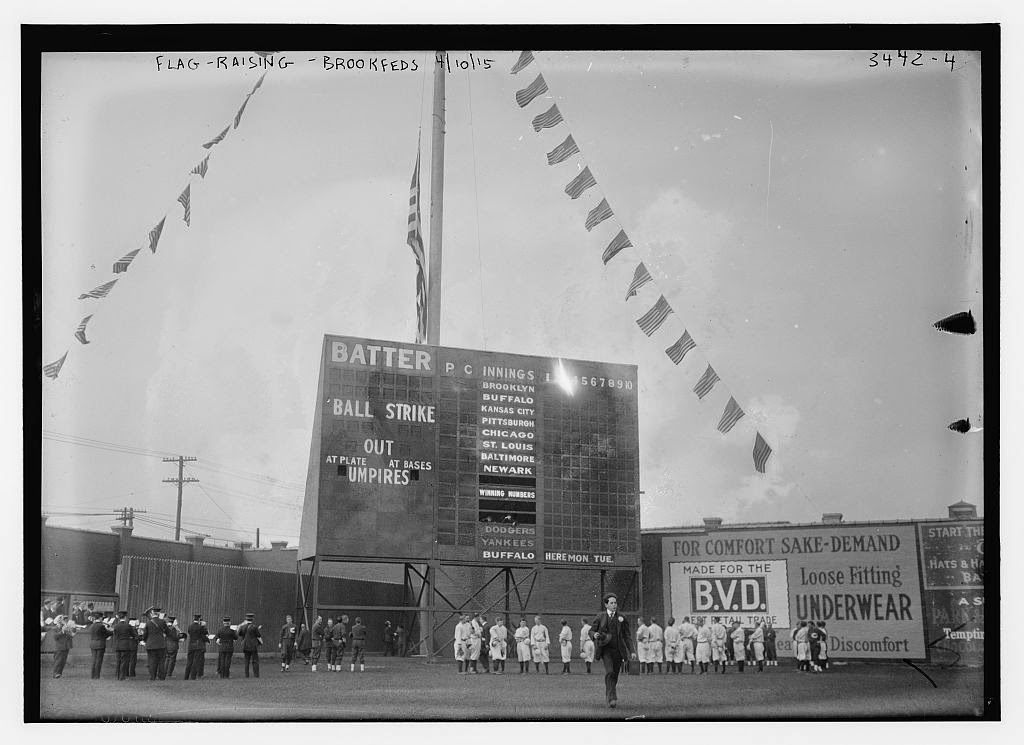
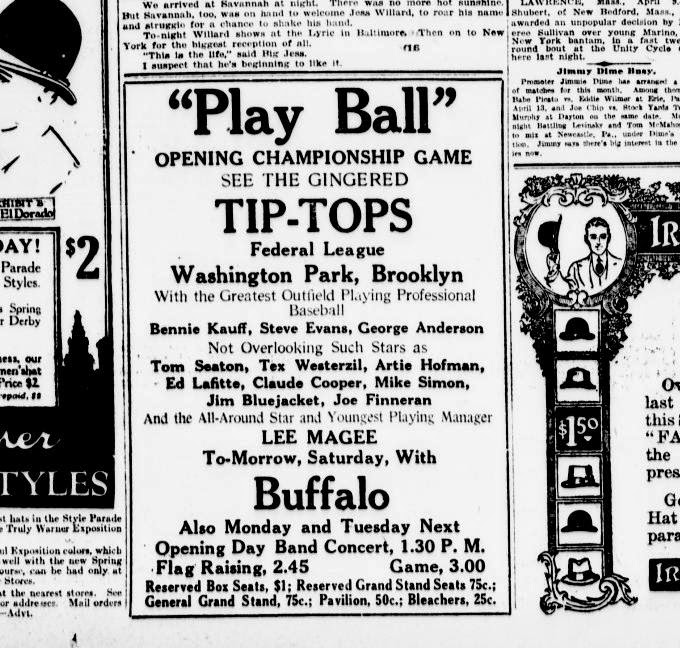
An ad for second season opening day, from the Evening World.  The flag raising mentioned below is pictured above:

The fans showed up for the beginning of season two, but enthusiasm quickly ebbed.  In fact, that first game against the Buffalo Buffeds (yes, that’s their name!) seemed to auger a host of frustrations for the rest of the season;  it went unusually long almost into night — the park was not lit — with “three hours of errors and wrangling.”

Behind the scenes, the two other leagues were busy trying to dismantle the Federal League who had filed an anti-trust suit in January.  It did not help the mood in New York that the Tip-Tops were doing worse under Magee.  They completed their season 70-82, second to last behind the scathingly terrible Baltimore Terripins.

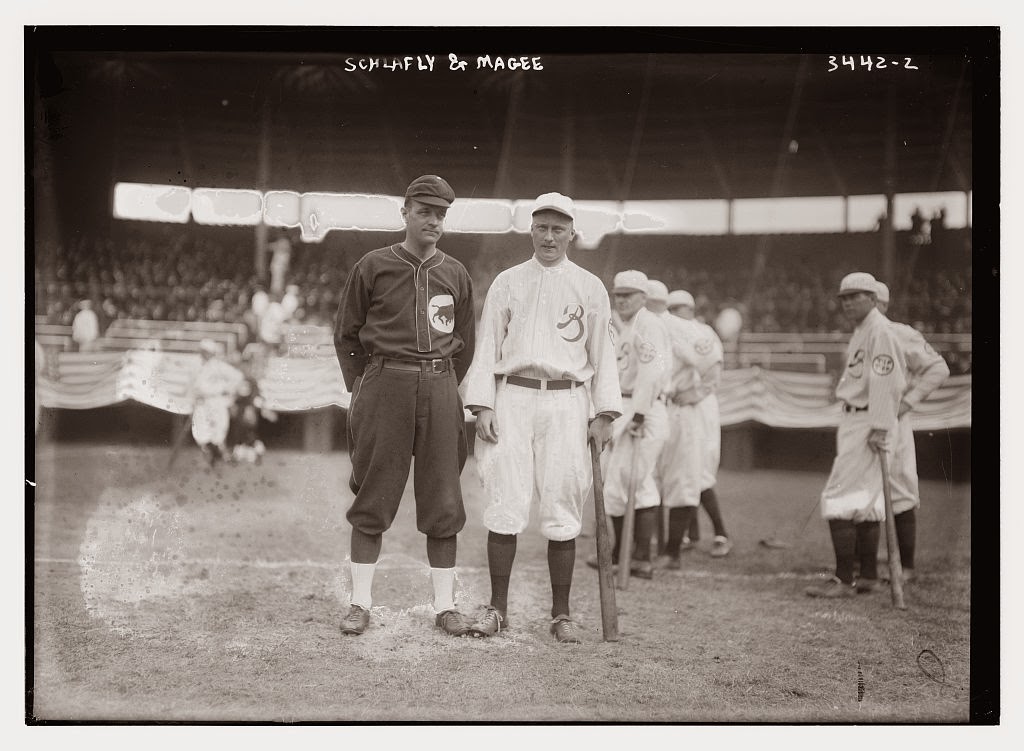
Below: Magee with the manager from the Buffalo Buffeds:


Machinations outside New York doomed the team.  The National and American Leagues managed to eradicate its rival through series of brokered deals and buyouts.  One of these deals changed the face of American baseball, when the owner of the Chicago Whales was allowed to buy the Chicago Cubs and move them into the Whales’ new stadium — Wrigley Field.

The only team that remained to battle back against the two leagues was the Federal League’s least successful team — the Baltimore Terrapins.  They sued the leagues saying it was a violation of the Sherman Antitrust Act.  The case went all the way to the Supreme Court who, in the landmark case Federal Baseball Club vs. National League, handed Baltimore something they were very familiar with — defeat.

On December 18, 1915, the Tribune revealed the fate of Brooklyn’s second baseball team:

“The Brooklyn Tip-Tops will withdraw from Washington Park, leaving the site barren of baseball and the city in the hands of the Superbas [Dodgers].  Organized baseball will reimburse George S. Ward annually with 5 percent of the assessed value of Washington Park for twenty years.”

By 1916, Tip-Top went back to meaning fresh white bread.

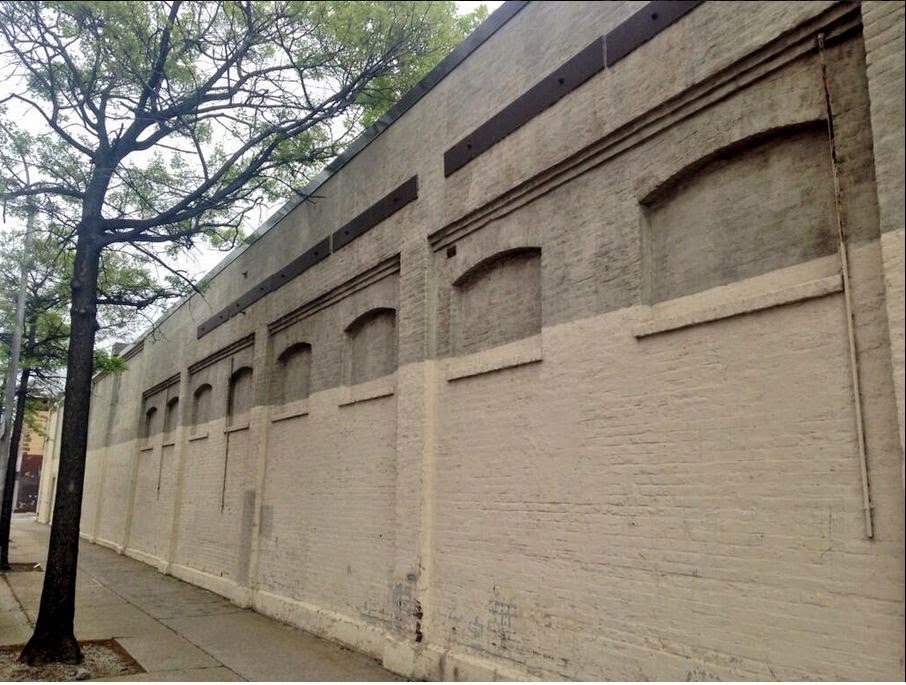
While Washington Park was eventually dismantled, a part of it still exists.  Today on the site is a yard for Con Edison.  The western wall along Third Avenue was once part of the ball park.  Perhaps if you go over to the Gowanus Whole Foods, you can walk over a block or two and check out this incredible piece of sports history!

 

Categories
Sports

‘Arctic blasts’, union rousers and hunchbacks: Ten bits of trivia about Ebbets Field’s opening day, 100 years ago today


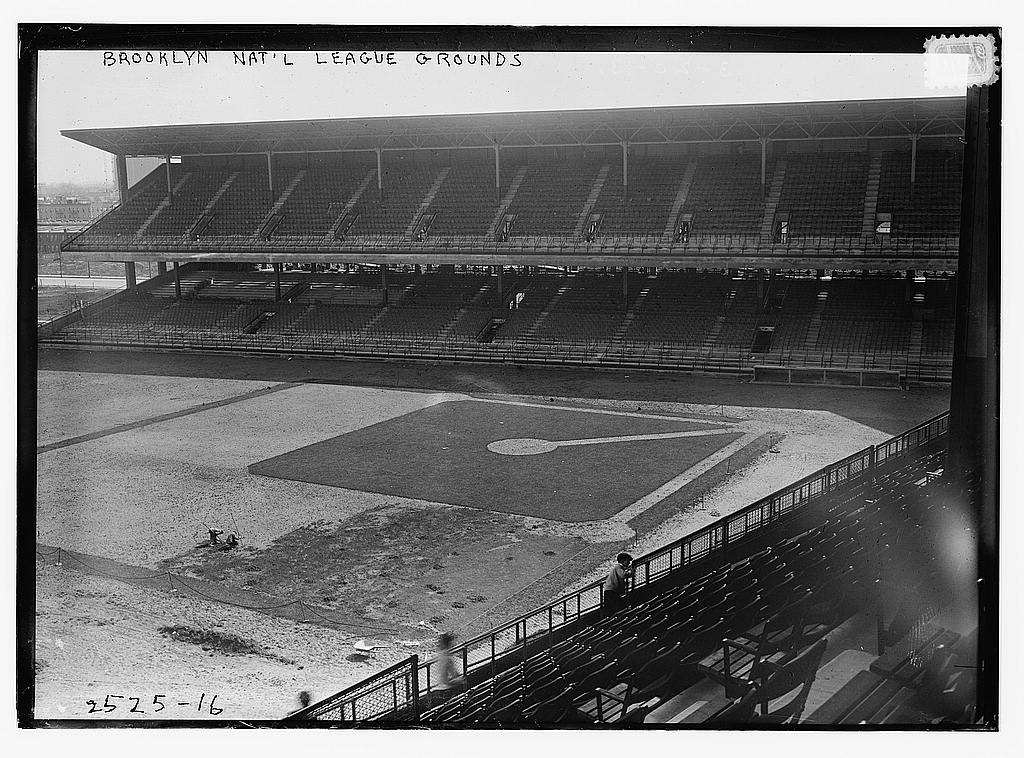
Inside Ebbets Field, 1913, Library of Congress

The first-ever regular season baseball game at Ebbets Field was played 100 years ago today.  The legendary field, once located in the Flatbush neighborhood of Brooklyn, was home to the Brooklyn Dodgers from 1913 until the team left for Los Angeles in 1958.

Here are ten interesting facts about the opening game, played on April 9, 1913:

1)  The Dodgers were thirty years old by the time their lavish new field opened. The team was originally formed under the name the Brooklyn Grays in 1883 by real estate speculator Charles Byrne.  Like many early ball fields, their first home, Washington Park in today’s Park Slope neighborhood, was frozen over during the winter to become Brooklyn’s leading skating rink.

2)  They were originally nicknamed the Brooklyn Trolley Dodgers, for the treacherous skill exhibited by their fans crossing rail-covered streets to get to the ball field.  There were still a great many streetcar lines near their new home of Ebbets Field, but by 1913 the team was more affectionately known as just ‘the Dodgers’.

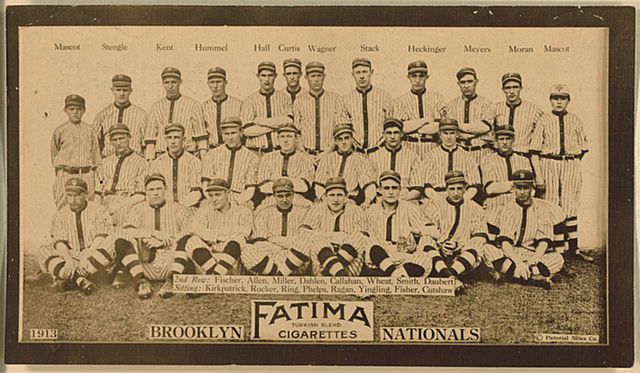
However several names would be casually attached to the team by fans and local journalists — the picture above calls them the Brooklyn Nationals — until 1933, when the name DODGERS would finally be added to both their home and road uniforms.

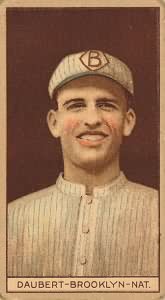
3)  As a nod to its first-ever day, Ebbets Field was allowed to open one day before everybody else in the National League.  One of their most popular players, first baseman Jake Daubert (at right), was presented with a golden bat and a floral horseshoe in a ceremony before the game and would, by season’s end, go on to win the league’s Most Valuable Player honor.

“Gentleman Jake,” as he was called, is better known today as being one of the founders of the baseball’s unionization movement.   This did not make him popular with the namesake of Ebbets Field, owner Charles Ebbet, who traded Daubert in 1917 after a salary dispute.   His union connection may also explain why this unique, well-liked and exemplary ballplayer is not currently listed within National Baseball’s Hall of Fame.

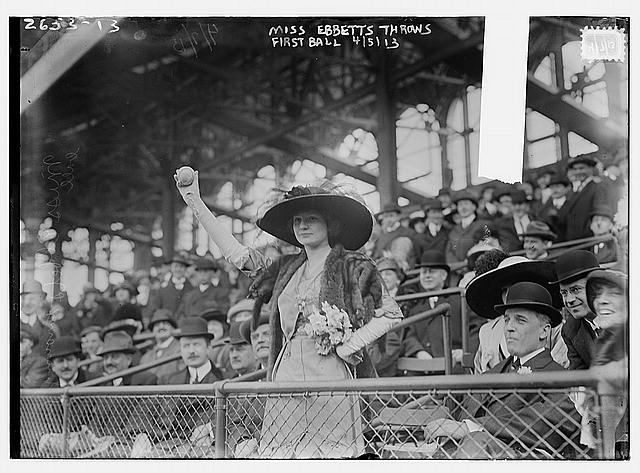
4)  The ceremonial first ball was thrown in by Brooklyn Borough President Alfred E. Steers, a resident of the neighborhood Ebbets Field made its home — Flatbush.   However, at an exhibition game played just a few days earlier, Ebbets’ lovely daughter Genevieve Ebbets tossed out the first pitch.


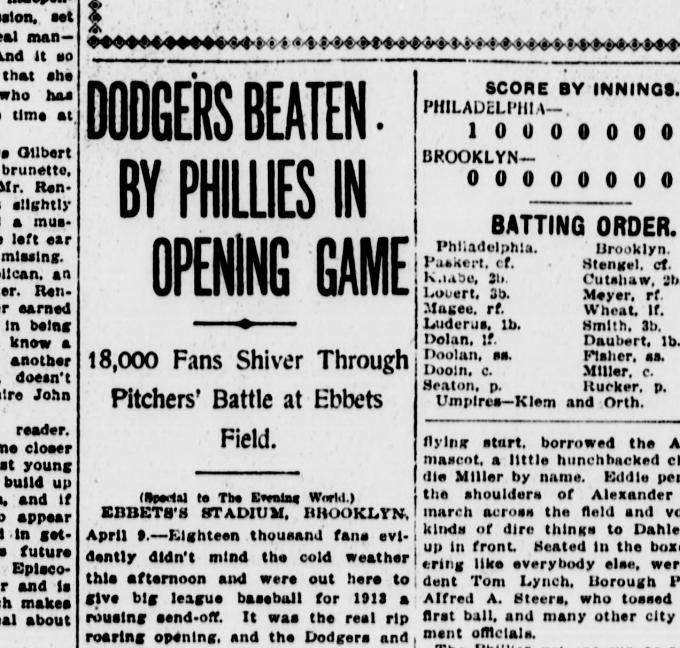
5) The Brooklyn Dodgers played the Philadelphia Phillies that day, which should have boded well for the team in their new home. The Phillies weren’t yet considered a formidable team and were more associated with constant injury. Despite this, the Phillies beat the Dodgers that day, 1-0.

6) Why did the Dodgers lose? Uh, it was unseasonably cold? The Tribune reported that the frightful chill kept the brand-new grandstand partially empty. From the New York Times, April 10, 1913: “It was so cold that the attendance was seriously affected, about 10,000 spectators braving the arctic blasts to see the Phillies win a well-played game by a score of 1 to 0.” [source]

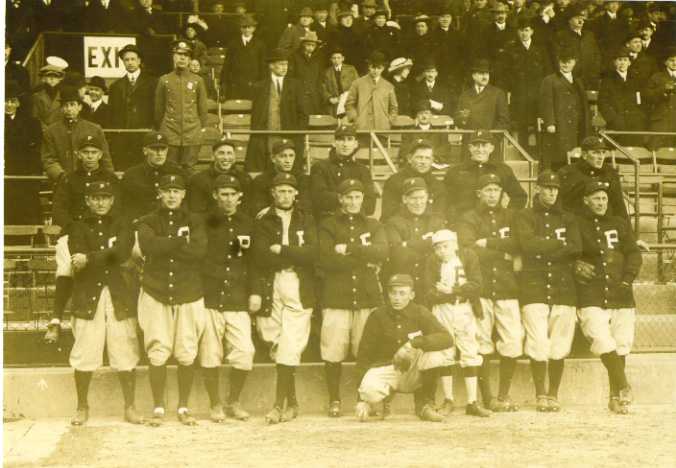
7) The Phillies also had with them an unusual mascot — a hunchback teenage dwarf.  The Phillies home rival the Philadelphia Athletics had a hunchback mascot of their own named Louis Van Zelst, and owner Connie Mack wanted to emulate their success. By, apparently, finding his own young man with a hunchback. Unfortunately, this boy’s name is unknown, but he appears in a 1913 picture with the team:

NOTE: The Tribune infers that this may have been Mr. Van Zelst himself and not another teenager. As the name of the boy in the picture above has not been reported, it’s quite likely that this is the Athletics ‘mascot’.  Note that in the article, the Dodgers are called by yet another name — the Superbas.  

Courtesy the Philadelphia Athletics Historical Society

8) As you could imagine with a 1-0 game, the first-day crowds at Ebbets Field were hardly cheerful.  One might even described them as bored.  The upper seats were barely filled, and the crowd didn’t exactly “wax enthusiastic until the eighth inning” when the Dodgers finally got somebody on base.

9) The first Dodger to ever score a hit in the new field was second baseman George Cutshaw who had only been with the team one year when he scored a single in the first inning.  Ironically, the second basemen was called out when he was caught trying to steal second base.

10) The Dodgers would fare poorly in their first season at Ebbets Field, eventually placing sixth out of eight teams. The winning team that season were their rivals across the East River — the New York Giants.  They would finally bring Ebbets its first pennant victory in 1916.

Categories
Sports

The New York Giants, before they were giants


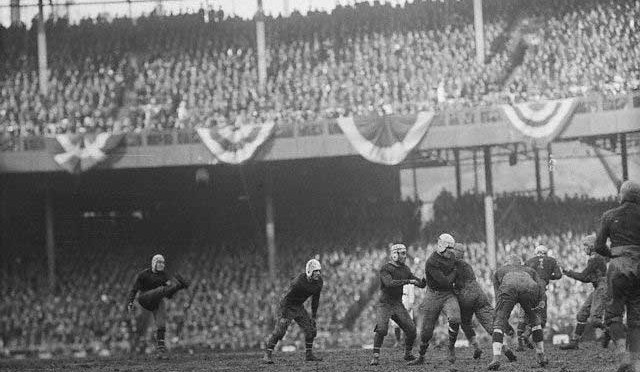
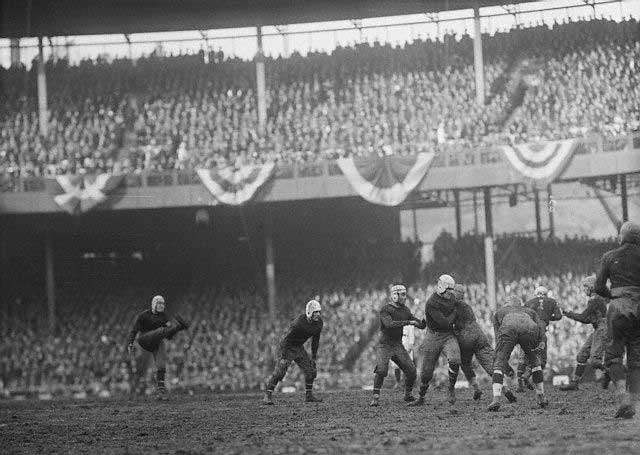
At the legendary Polo Grounds 1925, where the Giants football team (after a couple false starts) finally make their mark on the sport.


The New York Giants, currently in the playoffs and on their way to tackle the formidable Green Bay Packers this Sunday, are football’s oldest existing NFL team, and among its greatest — with seven total championship victories since their debut in 1925.  But that original team, dazzling with such stars as Jim Thorpe at their original home at the Polo Grounds, was not New York’s first professional football team. It wasn’t even New York’s first football team called the Giants!

The first try at a New York Giants football club came in 1919. They were a spin-off of the New York Giants baseball team*, a club considered the best of its day, dominating the sport from the late 19th century and into the 1910s.  Like the baseball franchise, the young Giants football team was to have played at the Polo Grounds as well, the location for many college football contests of the day. But those college games were played on Saturday, and on the month of October 1919, all Saturdays were fully booked.

So the Giants were scheduled to debut on a Sunday, against an Ohio team called the Massillon Tigers. This seemed possible, as team organizers understood that New York’s blue law, prohibiting Sunday play, had been removed from the books. But the city quickly clarified: the law had made way for Sunday baseball, not Sunday football.

Since football was more popularly considered a college pastime — many still questioned the validity of so-called ‘professional’ teams — nobody budged for the football Giants. And thus, the game was cancelled, and the team disbanded before they even hit the field.

The team’s coach, Harvard football star Charles Brickley, tried again two years later, managing to cobble together twenty-four players, a squad that is sometimes referred to as ‘Brickley’s Giants’ to distinguish them from the 1925 team. And people often choose to distinguish them, because Brickley’s Giants were a utter disaster. As one of 21 teams with the American Professional Football Association during its second season, Brickley’s team lost both its regular-season games. The Buffalo team actually destroyed them, 55-0.

During a bout with Jim Thorpe‘s Cleveland team, The New York Times noted, “The game was lopsided and had little to excite even the most rabid of rooters….[L]ittle can be said for the brand of football displayed.”

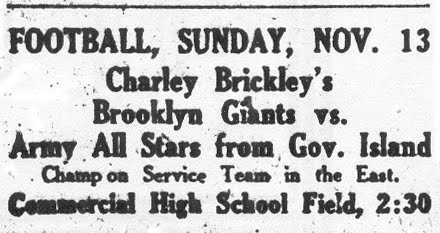
They were more successful at some exhibition games, such as the one advertised below in the Brooklyn Daily Eagle, Brickley’s ‘Brooklyn Giants’ (as they played at Ebbets Field by this time) against the Governors Island ‘Army All Stars’, whom they defeated. (Thanks to Paul Luchter for this image.) 

The following year, the American Professional Football Association changed its name to the National Football League, but Brickley’s team never made it that far, dropping out for good before the new season. They did continue to play exhibition games, but eventually disbanded by 1923. After these two disastrous attempts, nobody would attempt another Giants franchise for another couple years, when former newsie-turned-bookmaker Tim Mara joined the ascendant NFL with a third go at a New York team. And you know what they say about the third time.

By the way, the Maras have kept the Giants in the family since its 1925 debut. Tim’s grandson John Mara is an owner along Steve Tisch (whose last name should be familiar to any students at NYU’s Tisch School of the Arts).

*The original Giants baseball team now haunts and torments New York sports fans today in the form of the San Francisco Giants. The franchise moved to the West Coast in 1958.