Categories
Sports

And now, the New York Female Giants: (Briefly) A League Of Their Own

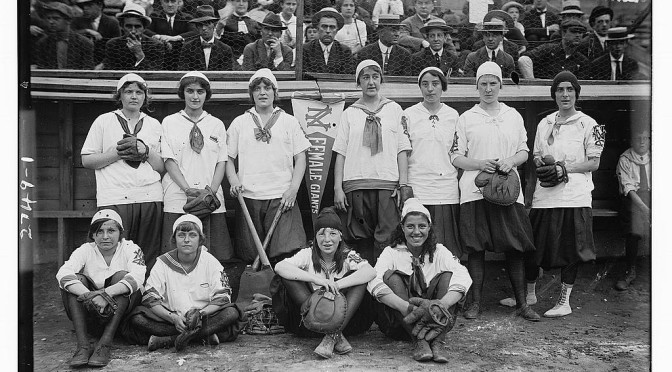
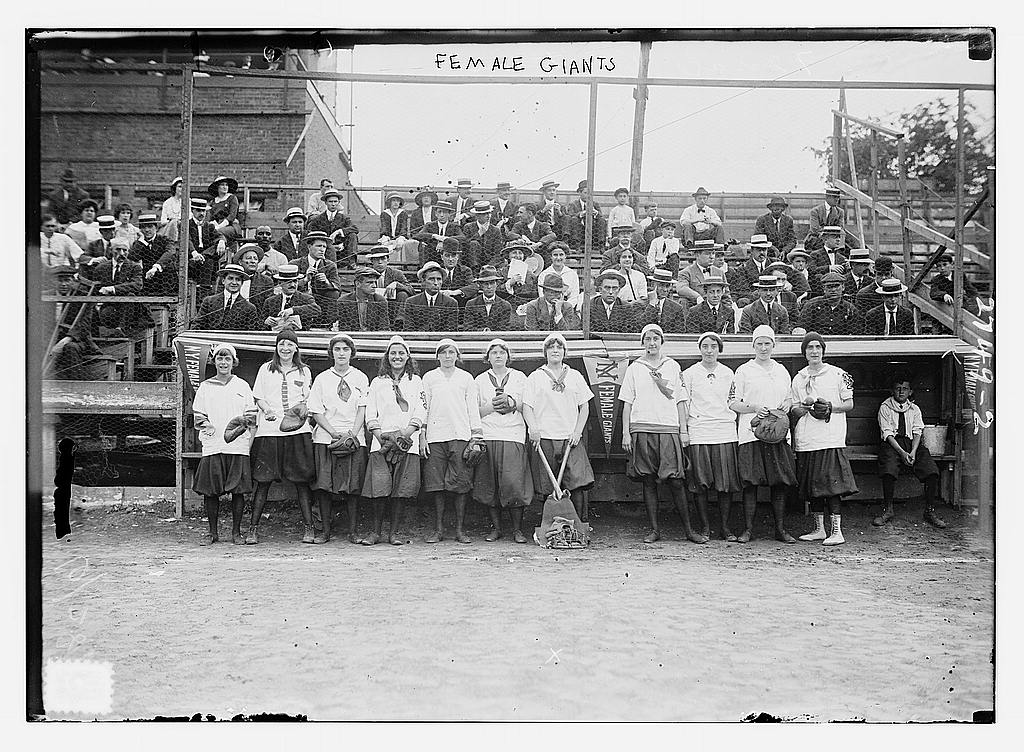
For a very brief period — likely just a single year — there was a female counterpart to the New York (Male) Giants.

The New York Female Giants seem to have an unofficial affiliation with the better known Giants, the city’s most popular baseball team.  Author Michael Carlebach speculates the team was probably formed by Giants manager John McGraw.
2

Early women’s teams — called ‘Bloomer Girls’ — often had a few men playing alongside them. Occasionally those men even disguised themselves as women as in a revealing case in the summer of 1913 in Washington DC: “Four thousand angry fans surged on the diamond in the old Union League baseball park this afternoon when they learned that the “Bloomer Girls,” who were playing against a team of young men, were not girls. The deception was suspected when the “girl” playing in centre field threw the ball from deep centre to the home plate.” [source]

(The All-American Girls Professional Baseball League, featured in the movie A League Of Their Own, would not be formed until the 1940s.)

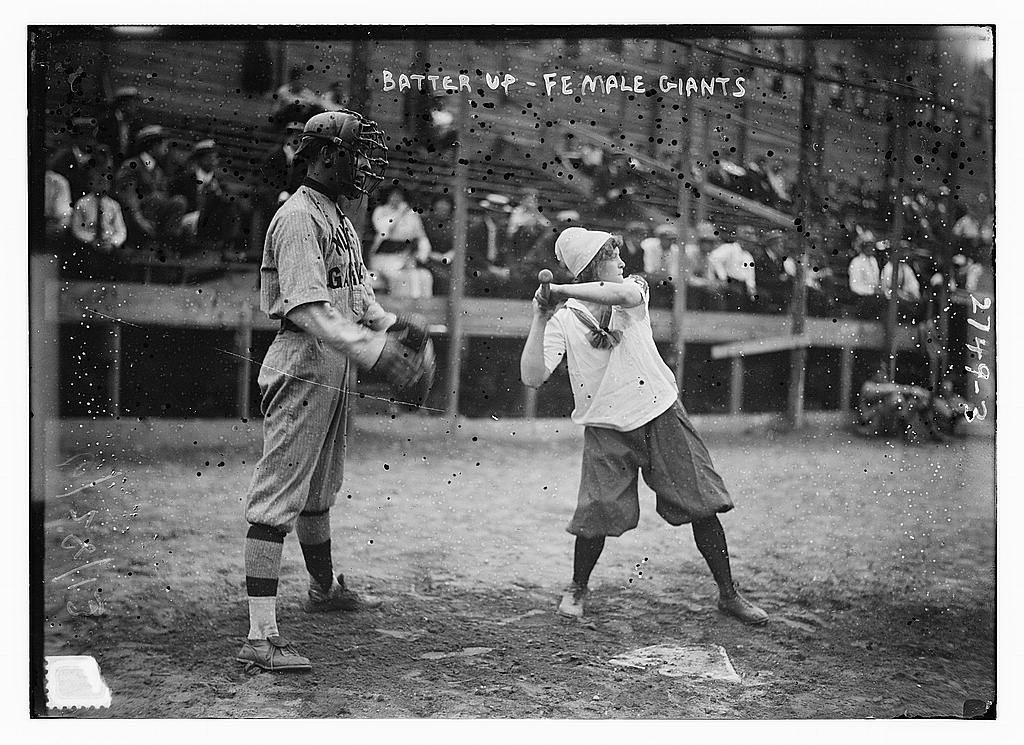
The Female Giants don’t appear to be all women players either, although there are no disguises at least. The men featured in these pictures played with the New York Giants.

The female players were mostly girls from local high schools and women athletes from other fields of sports.

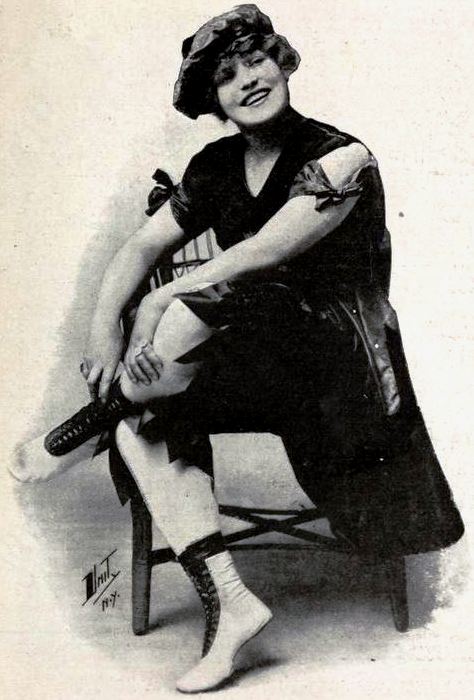
Following her stint with the Female Giants, their captain Ida Schnall would head to Hollywood and become a silent film actress. She would later become an accomplished swimmer and an advocate for women’s sports, petitioning the National Olympics Committee to expand their offerings for women. Below: Ida in a glamorous pose
ida


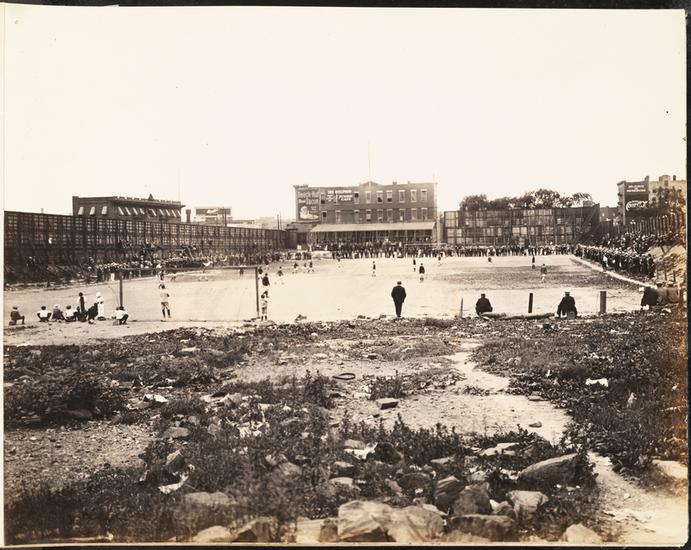
They broke up into two teams — the ‘Red Stockings’ and the ‘Blue Stockings’– and played a notable exhibition game for almost 1,500 people on Sunday, May 25, 1913 at the Lenox Oval, a sports field at Lenox Avenue and 145th Street.

Below: A 1919 soccer game being played at the Lenox Oval
Courtesy Museum of the City of New York

It seems their typical game schedule went unnoticed by the press which is probably a good thing. That May 25th game was written about by the New York Tribune in the following fashion : “The batter hitched up her skirt. The pitcher nervously adjusted a side comb. Girls will be boys, and the Reds and the Blues of the New York Female Giants were playing an exhibition game at Lenox Oval, 145th Street and Lenox Avenue.” [source]

Below: A catcher from the New York Giants, playing alongside a diminutive young player
3

We know about this particular game because it got shut down by the cops. In the ninth inning, a detective stepped out onto the field and handed the third baseman — a 17-year-old teenager named Helen Zenker– a subpoena to appear in Harlem court.

Due to New York’s ” blue laws, ” teams were not supposed to legally sell tickets to a baseball game on Sundays. While the women were indeed playing a practice game, Helen had been caught selling programs. She claimed that no such sales activity had taken place; people were just giving her money, including the detective. [More details in this amusing New York Times article from 1913.]

Fortunately, the young Zenker (“seventeen, pretty, active, intelligent, and has the easy gait and springy step of the athlete”) easily charmed the judge, and the case was dismissed. [source]

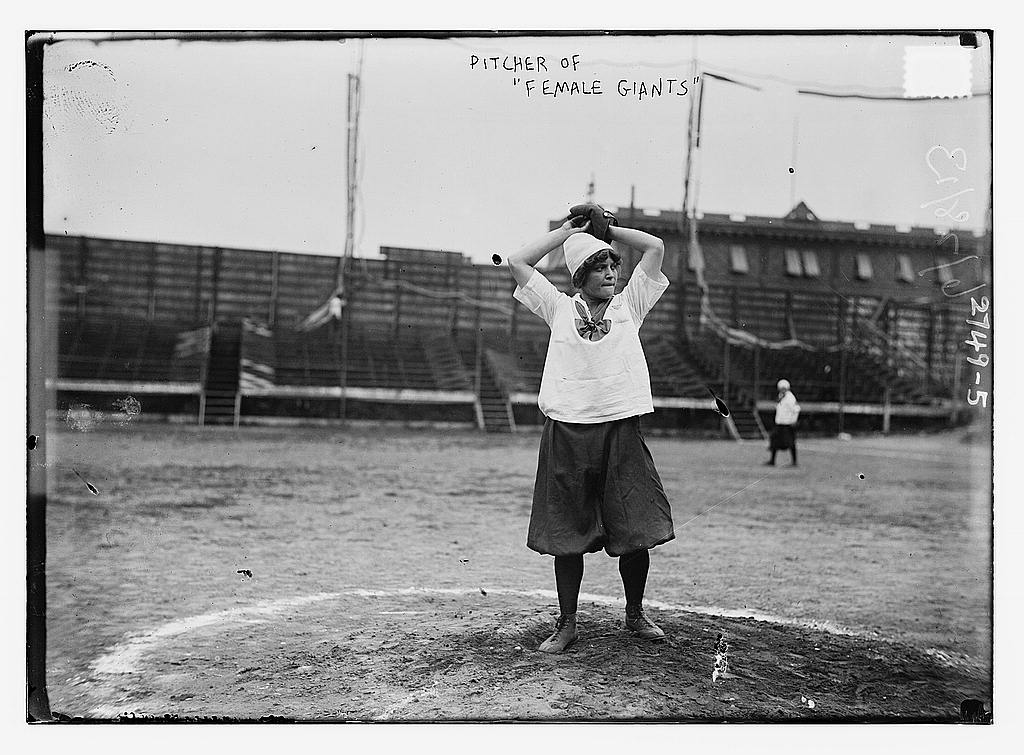
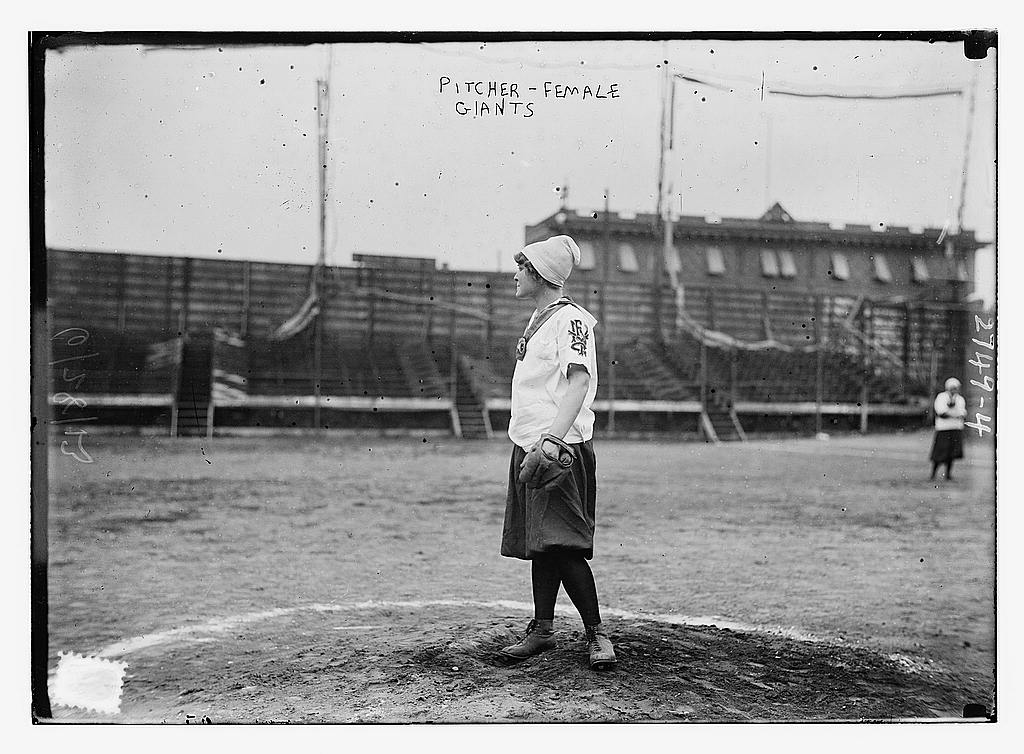
The photos in this post obviously take place on another date, as they’re wearing uniforms, which they were not allowed to do on a Sunday.
4


5


EDIT: After going live, I later included the line about the All-American Girls Professional Baseball League and clarified that the team featured adult women playing alongside high schoolers. For instance, Ida Schnall, who went on to greater athletic fame, was 24 or 25 at the time of the game described above.
Categories
Sports

Panic at the Polo Grounds: The first Boston-New York World Series sparks an insane stampede 100 years ago

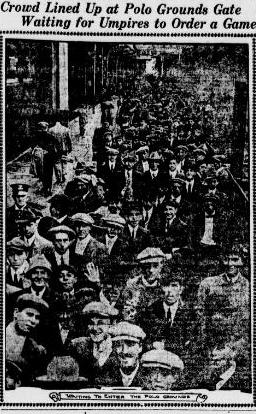
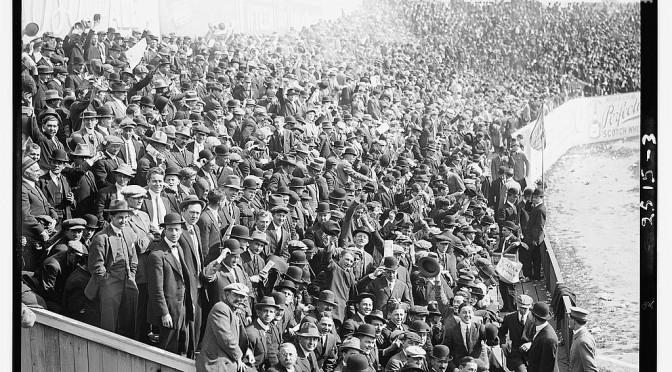
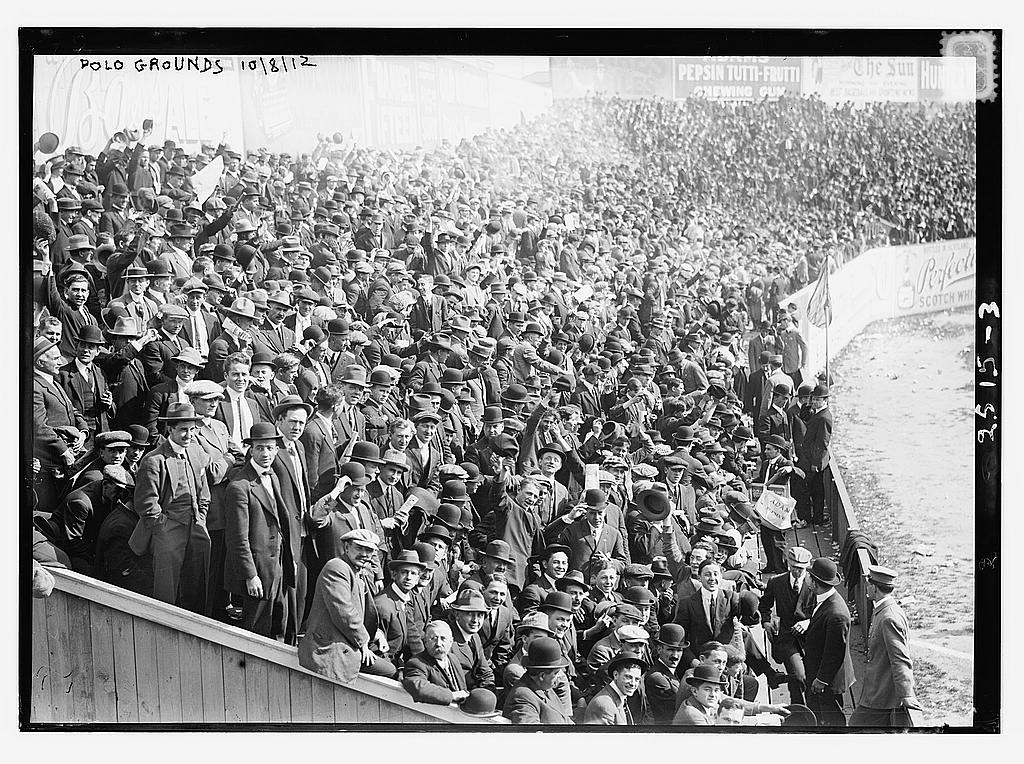
Above: the crowds at the Polo Ground for Game One. Many of these same people were certainly on hand for the fateful Game Four.

One hundred years ago today, in the frantic fall of 1912, even as the nation was in the midst of an intense three-way race to elect a new president, New Yorkers and Bostonians were overwhelmingly — perhaps even unnaturally — distracted.  For the first time ever — since the introduction of the World Series baseball championship in 1903 — a New York club was finally battling for ultimate victory against a Boston team.

The two cities had been in perpetual competition for most of their history; organized sport merely provided a formalized outlet to rally regional pride. [For more information, check out my article on the roots of the Boston-New York rivalry.]

The two cities should have already met on the diamond for the 1904 World Series, as the New York Giants were victors of the National League, while the Boston Americans led the American League.  Boston clutched that particular victory by defeating another team from New York, the upstart New York Highlanders (who later became the Yankees).

However, the Giants refused to play the Americans in the World Series, a tantrum thrown by managers aimed at the ‘inferior’ American League (originally the junior circuit). Rules were changed the following year to make championship play between the leagues compulsory.

Eight years later, in 1912, the New York Giants were matched against the same Boston team under their new name — the Boston Red Sox.  No hesitation this time around.  They were undeniably the two best terms in America, and both clubs were determined to win the title for their home cities.

For this Series, teams shuttled back and forth between Boston’s Fenway Park and New York’s premier baseball venue of the day, the Polo Grounds.

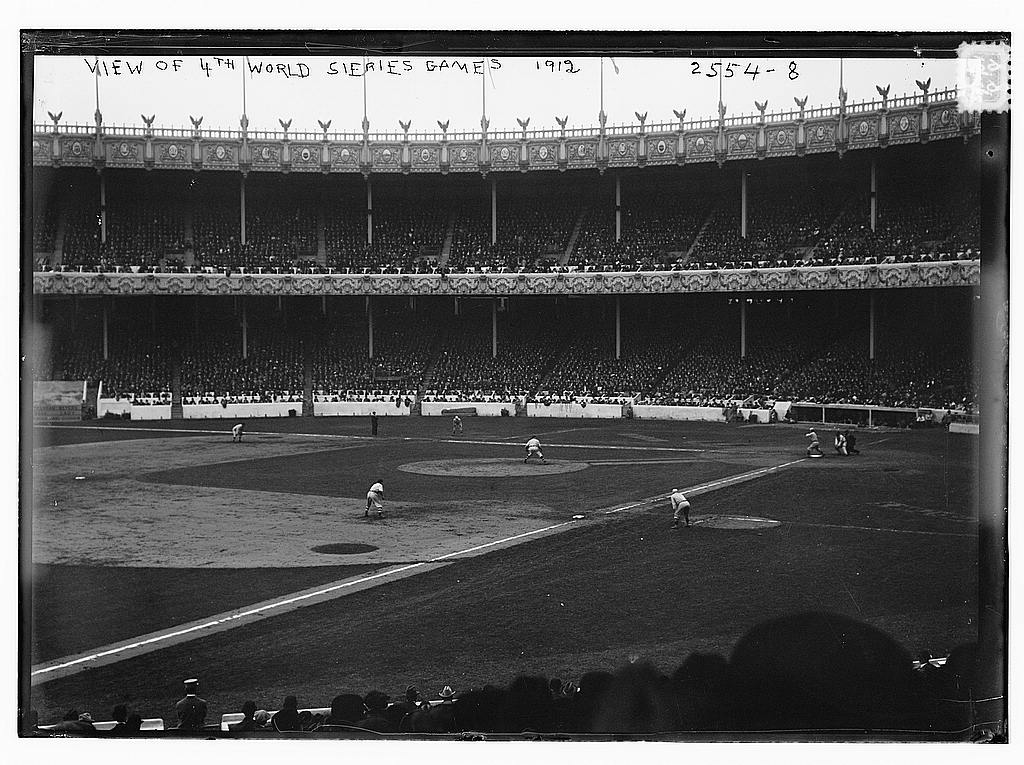
Above: A view of the Polo Grounds during Game Four, absolutely packed to the rafters

Game One, played at Polo Grounds, went to Boston.  Game 2, at Fenway, lasted so long — eleven innings — that the game was declared a tie on account of darkness. (Night baseball wouldn’t be played at Fenway until 1947!)  New York then won the second game at Fenway the following day, tying up the match.

For a fourth consecutive day of baseball, the teams were to return to the Polo Grounds (located at W. 157th Street and 8th Avenue). New Yorkers had the momentum, anxious to build upon their triumph in Game Three.  Both teams, already exhausted, packed into trains and headed back down to New York, arriving that evening at Grand Central. The Giants headed to their respective homes in the city, the Red Sox to their accommodations at Bretton Hall on Broadway and 86th Street.

Fans were already so excited for Game Four the next day that some were already lined up at Polo Grounds before the players even arrived in New York.

Unfortunately, one curious obstacle threatened to ruin everybody’s good time: mud.

The Polo Grounds were an uncovered grass field and throughout most of that evening it was pelted with rain, turning this fairly new ballfield (re-built in 1911 after a fire) into what the Evening World called “a mysty mystery” of gray and yellow-brown fog.  The infield was protected by a tarp, but the outfield was battered by the elements. Was it in any condition for a major baseball game?

Commissioners failed to decide that morning whether the game could commence, and baseball fans grew restless. Well, that’s an understatement. Giants fans were enraged. “[T]he lynching-hungry scream of an infuriated mob” filled the air around the stadium, as thousands more joined the brave few  still in line from the night before should the field reopen.

An Evening World reporter followed a groundskeeper along the soggy field who lamented, “They can play on it, all right … Sure, they can play, but oh, me poor grass!”

Umpires were given a police escort into the Polo Grounds at 11 a.m. to inspect the condition of the field. By that time, the mob was practically foaming at the mouth, with “a blood-curdling shriek of 10,000 fans stretch[ing] from 157th Street to 140th Street, thousands and thousands of them.” [source]

At left: Photo from the Evening World, 10/11/12

Precisely at noon, the commission, located at the Waldorf-Astoria, telephoned to announce that the baseball game could be played, and the throng thundered into the stadium. The Evening World compared it to the Spanish running of the bulls. “[N]o man of this generation ever saw such racing and pounding along the sloping approaches of the Polo Grounds and began slamming down seats at one minute past twelve o’clock today.”

According to New York Post columnist Mike Vaccaro in his book on the 1912 World Series ‘The First Fall Classic’, the stadium filled to capacity with thousands more watching from various nooks and crannies, over 40,000 people, “officially…the third largest in this history of this stadium (and, thus, the history of the sport) but unofficially shattered that record to smithereens.” Many thousands more listened in to an announcer in Herald Square.

And so, here’s the punchline: after all that madness, the New York Giants lost the game, on the muddy and thoroughly distressed Polo Grounds, to the Boston Red Sox, 3-2! The New York Times intoned, “Nine Grim Innings To Red Sox Victory.”

In fact, they went on to lose the entire series to Red Sox.

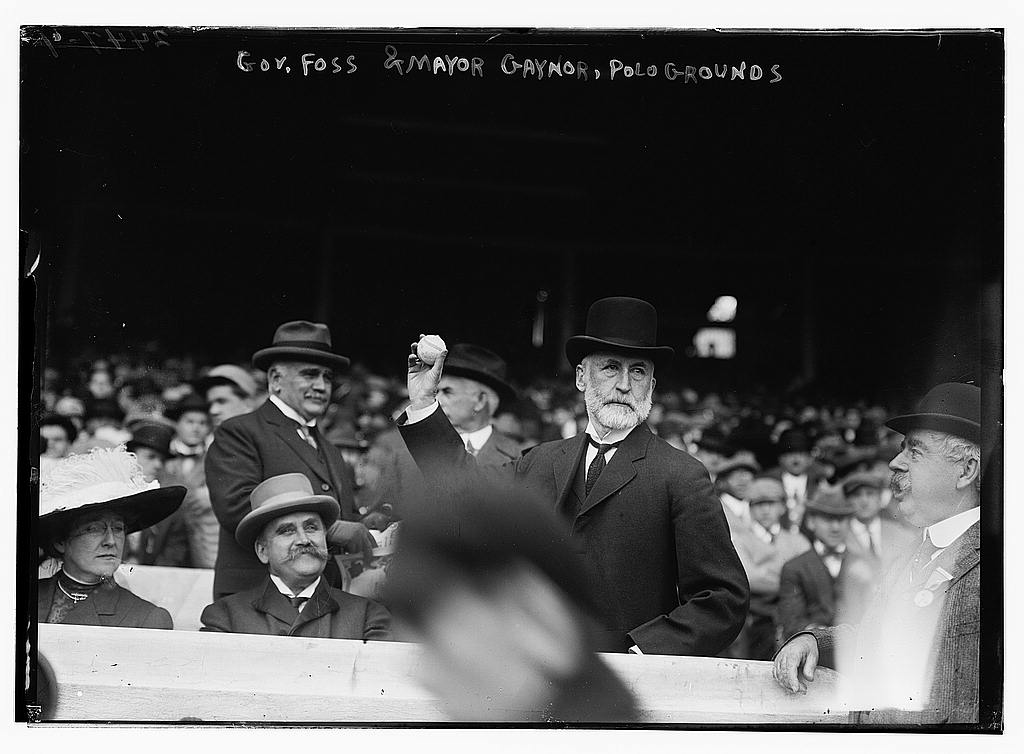
Below: For Game One, Mayor William Jay Gaynor threw out the first pitch, sitting alongside the mustachioed Massachusetts governor Eugene Foss. Less than a year later, Gaynor would succumb to injuries brought on by a bullet lodged in his throat, the unlucky souvenir of an 1910 assassination attempt. [Read more about Gaynor here.]

Categories
Amusements and Thrills Sports Those Were The Days

The New York Game: Baseball in the Early Years

Baseball, as American as apple pie, really is “the New York game.” While its precursors come from many places – from Jamestown to Prague – the rules of American baseball and the modern ways of enjoying it were born from the urban experience and, in particular, the 19th-century New York region.

The sport (in the form that we know it today) developed in the early 1800s, played in Manhattan’s many open lots or New Jersey public parklands and soon organized into regular teams and eventually leagues. The way that New Yorkers played baseball was soon the way most Americans played by the late 19th century.

But it wasn’t until the invention of regular ball fields – catering to paying customers – that baseball became truly an urban recreational experience. And that too was revolutionized in New York.

Just in time for spring and the new Major League baseball season, Tom and Greg are joined by the acclaimed Kevin Baker, author of The New York Game: Baseball and the Rise of a New City to discuss the early history of the sport and its unique connections to New York City.

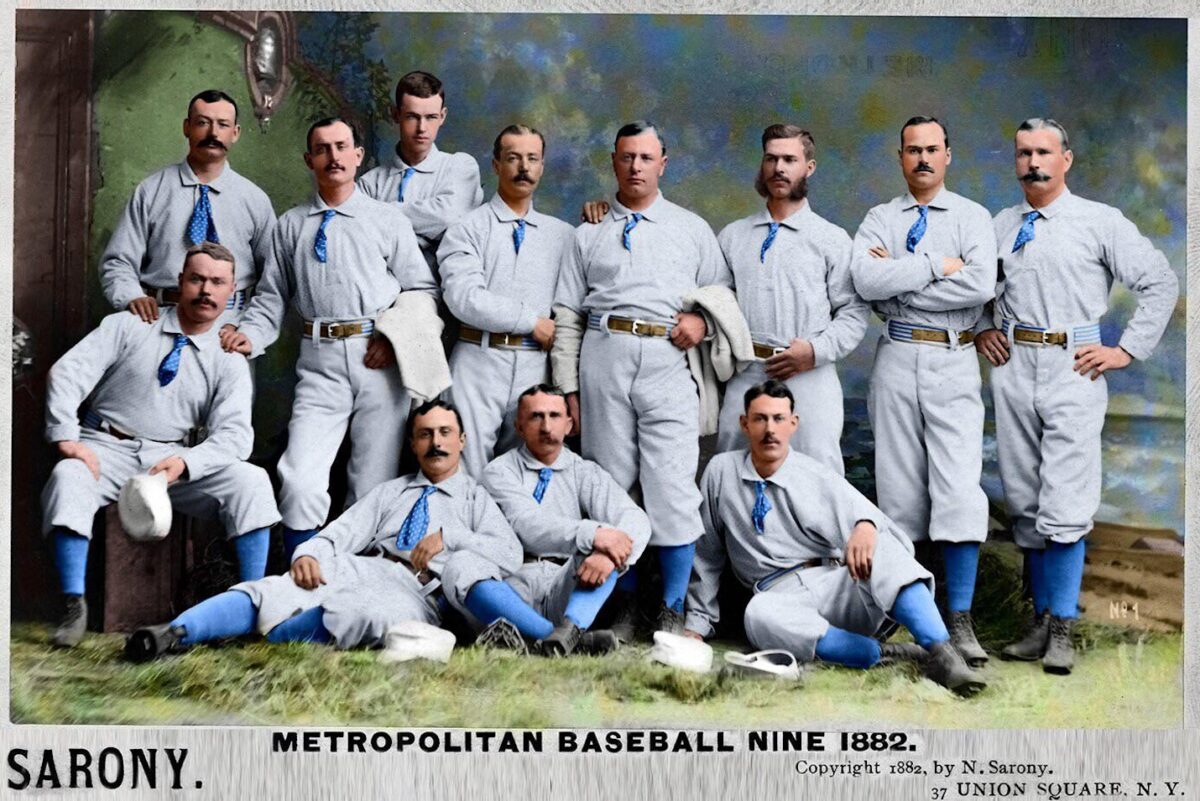
This show is truly the ultimate origin story of New York baseball, featuring tales of the city’s oldest and most legendary sports teams – the Yankees, the Dodgers, and the Giants. AND the New York Metropolitans – a different team than today’s Mets located in Queens.

Where was baseball played? Kevin shares the secrets of New York baseball’s earliest venues – from the many Polo Grounds in upper Manhattan to Ebbets Field in Brooklyn

This is a true five-borough origin story! With stops at Hilltop Park (Manhattan), Yankee Stadium (Bronx), Fashion Race Course (Queens), Washington Park (Brooklyn), and St. George Cricket Grounds (Staten Island) among many other sites.

FEATURING the surprising link between baseball and Boss Tweed and his notorious political machine Tammany Hall

PLUS How did segregation distort the game and where did Black ballplayers play the sport? What was baseball like before Jackie Robinson?

LISTEN NOW: THE NEW YORK GAME


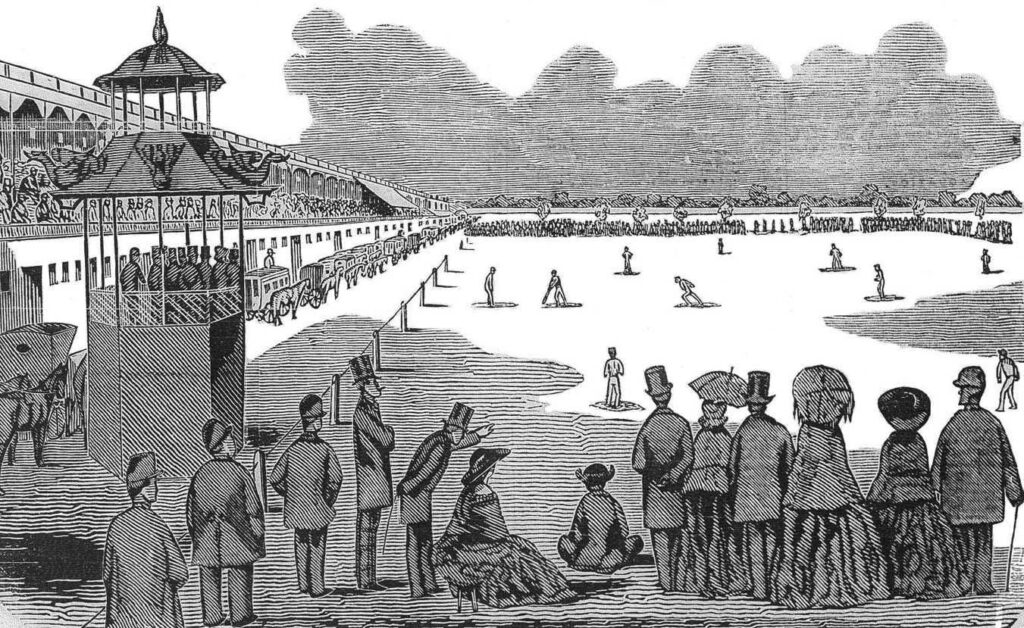
Fashion Race Course in Flushing, Queens, from The Clipper of July 24, 1858 (and via John Thorn/Our Game)
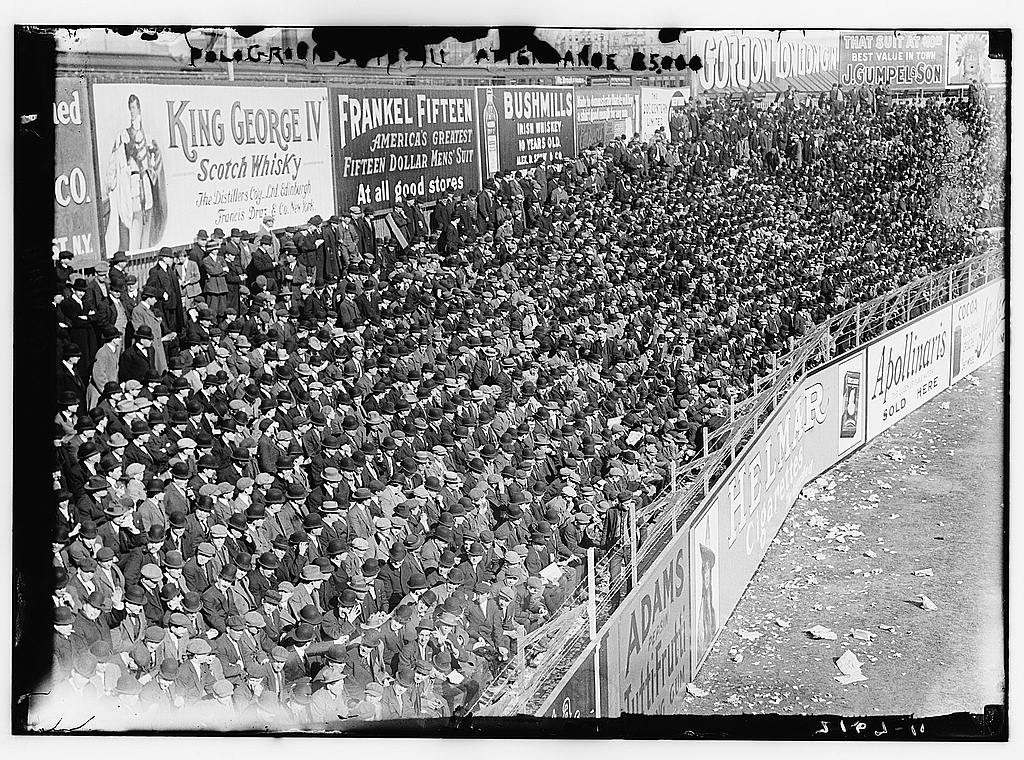
Many hatted men at the Polo Grounds, 1911 (Library of Congress)
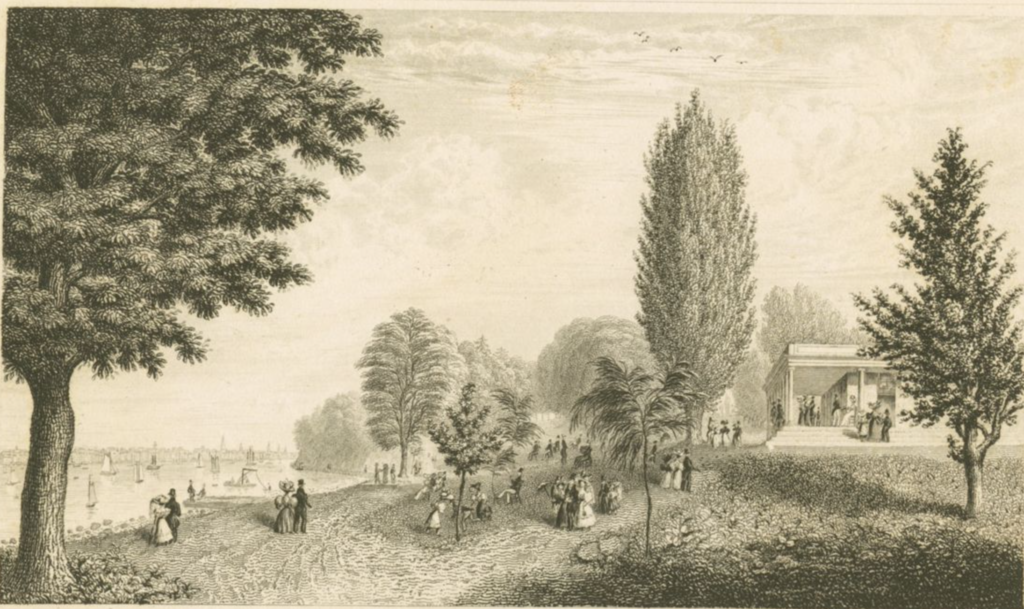
Elysian Fields in Hoboken, the site of America’s first baseball games (NYPL, image from Booth’s History of New York)
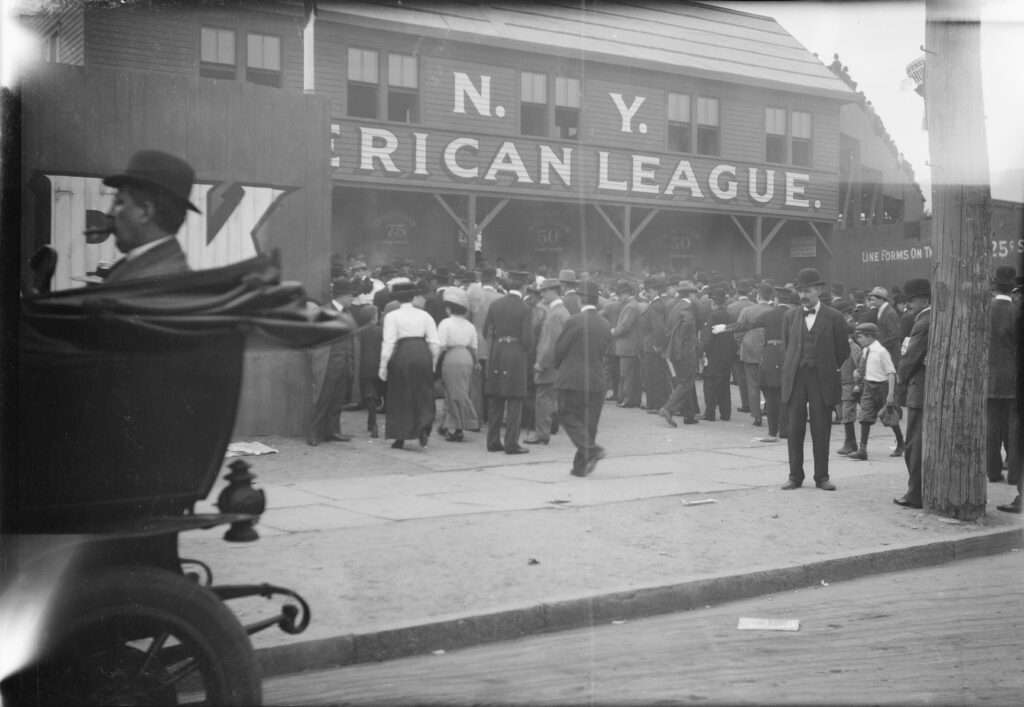
The entrance to Hilltop Park, 1912 (Library of Congress)
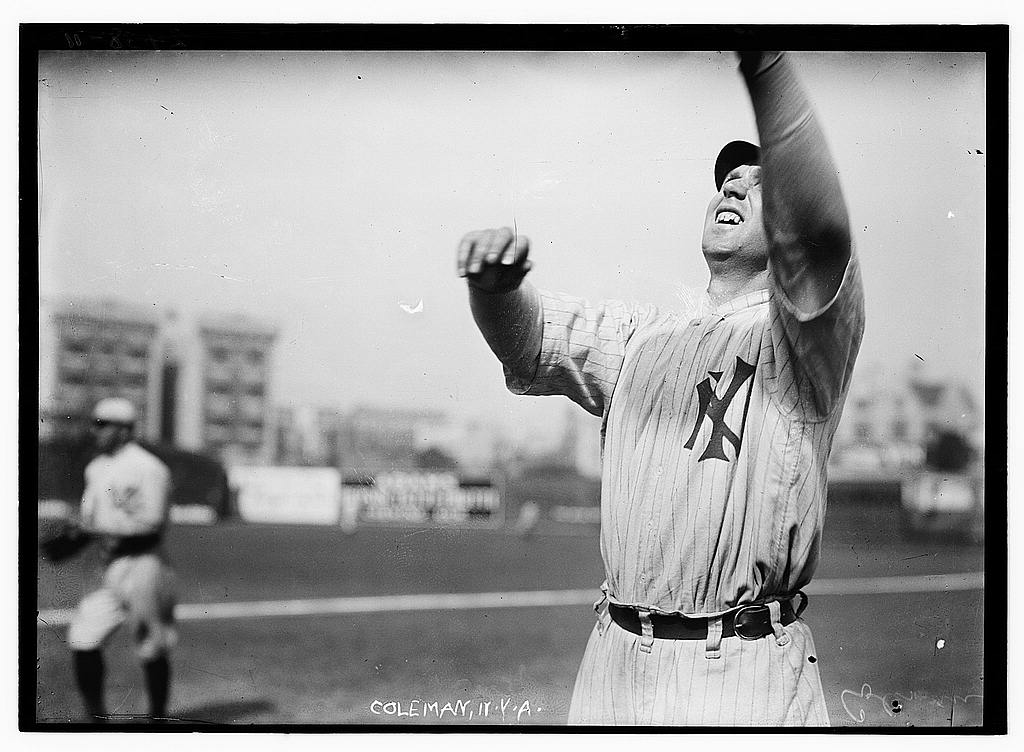
Curt Coleman at Hilltop Park, 1912
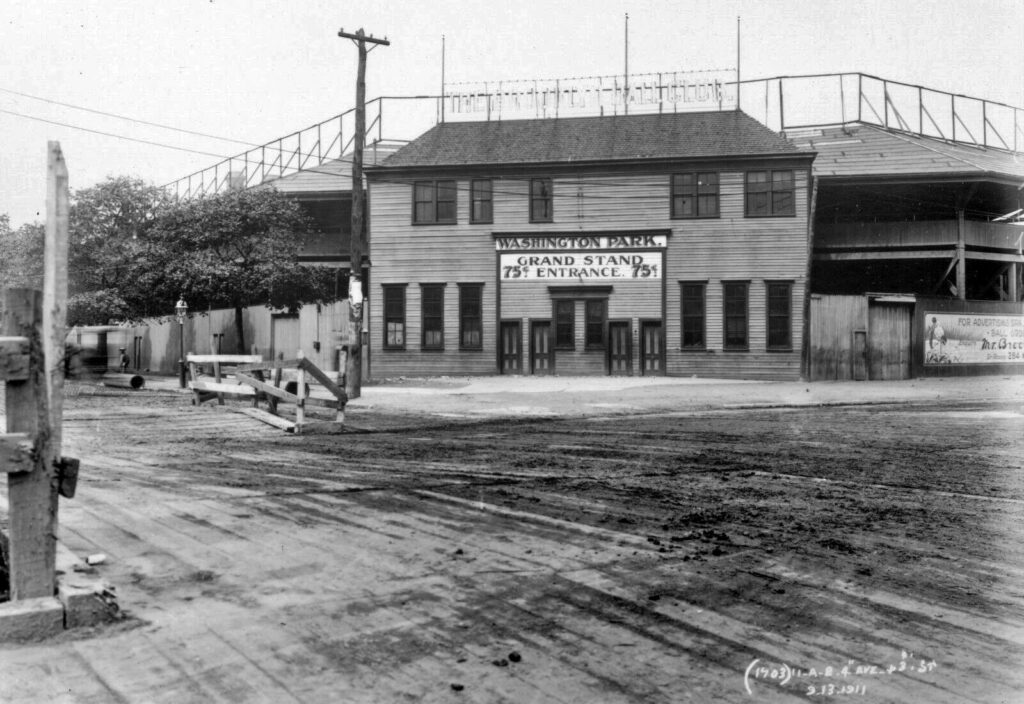
Washington Park taken September 13, 1911 from the intersection of 4th Avenue and 3rd Street in Park Slope, Brooklyn.
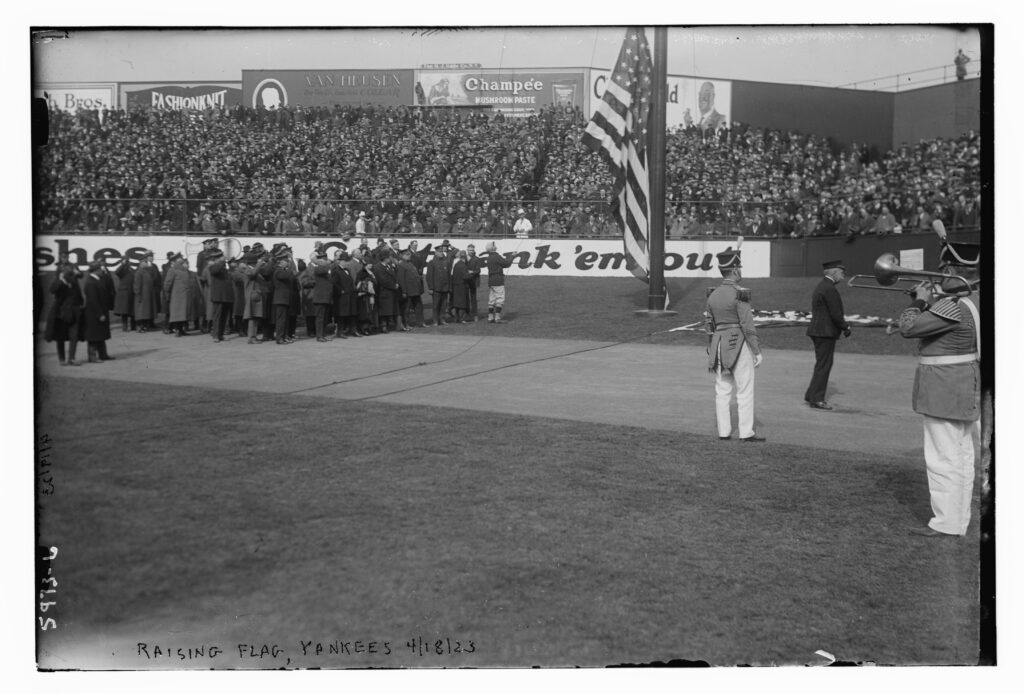
Opening Day at Yankee Stadium, 1923 (Library of Congress)
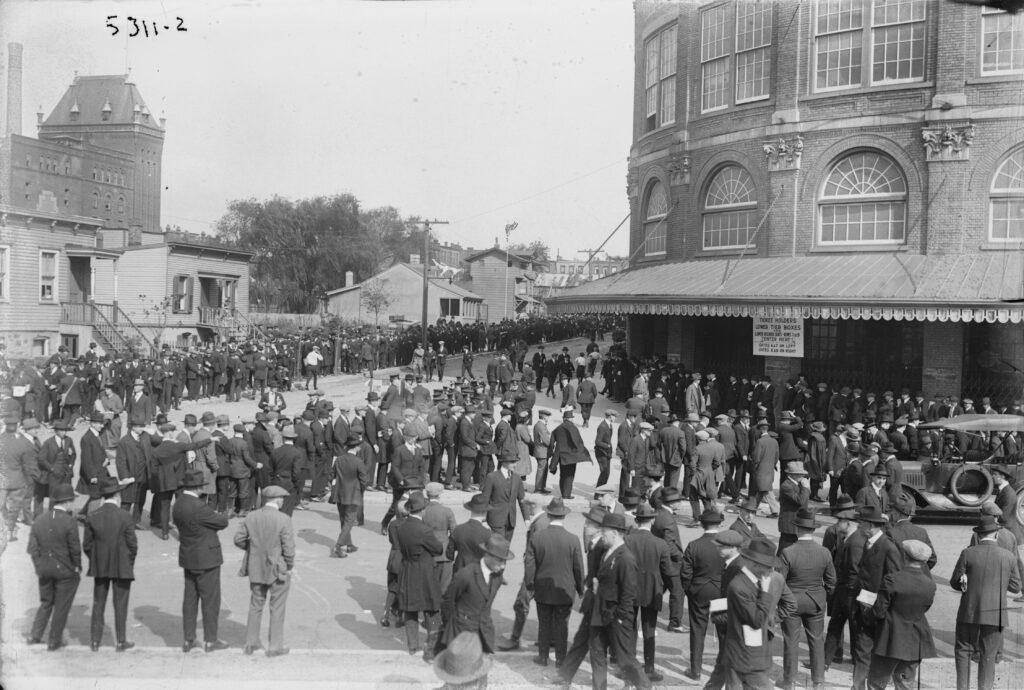
The crowd outside Ebbets Field for Game 1 of the 1920 World Series, the Brooklyn Dodgers against the Cleveland Indians.

FURTHER LISTENING

FURTHER READING

Brooklyn baseball: the Superbas and the worst batter ever

Brooklyn Dodgers vs. Cincinnati Reds at Ebbets Field — in the first Major League baseball game ever broadcast on television

Hilltop Park: home base for NYC’s premier baseball team

Meet the Mets! The Metropolitans, that is, an early NY baseball team

The short shelf life of the Tip-Tops, the Brooklyn baseball team situated near the Gowanus River and named for bread

Union Grounds: Baseball history in Williamsburg

The Wise Guy of Baseball: Getting To Know Leo ‘The Lip’ Durocher

100 years ago today, the Yankees played their first game at Yankee Stadium

Categories
Amusements and Thrills The Gilded Gentleman

How The Gilded Age Played: A Sweet Summertime Show With Esther Crain

On the latest episode of The Gilded Gentleman, returning guest Esther Crain, author and creator of Ephemeral New York, joins Carl for a look at how New Yorkers stayed cool on summer days in the Gilded Age. 

As New York continued its march up the island of Manhattan, there were few places where New Yorkers that couldn’t escape to Newport could find somewhere to relax, play, stroll, and find some shade. 

The development of the Central Park provided some much-needed relief but it took some time for it to become a place that was accessible and viable for all of New York’s social classes. 

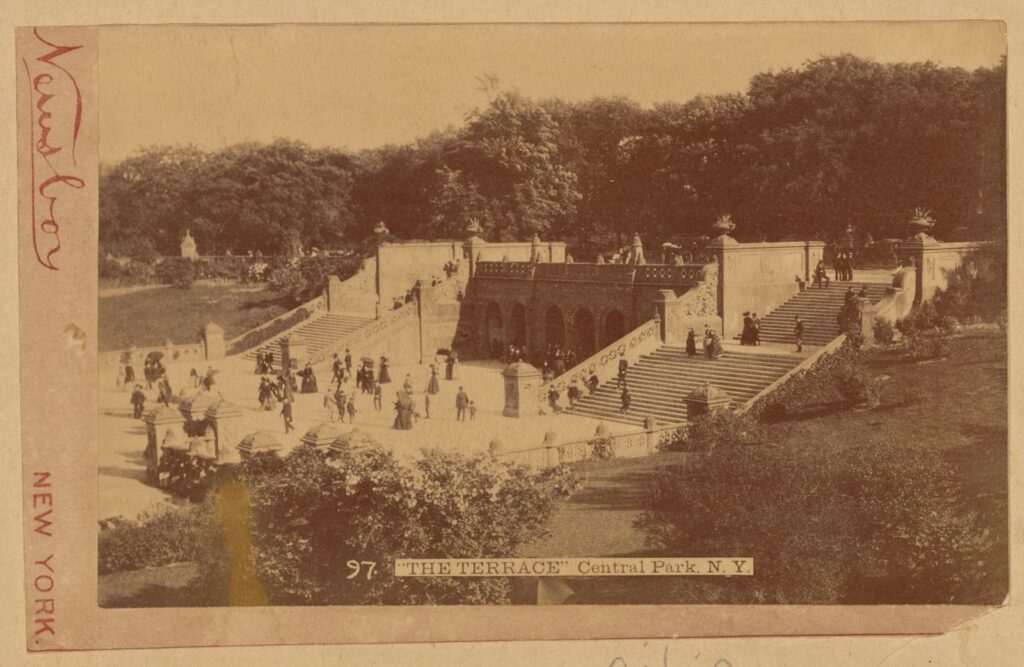
Bethesda Terrace, Central Park, 1890, courtesy the New York Public LIbrary, Irma and Paul Milstein Division of United States History, Local History and Genealogy

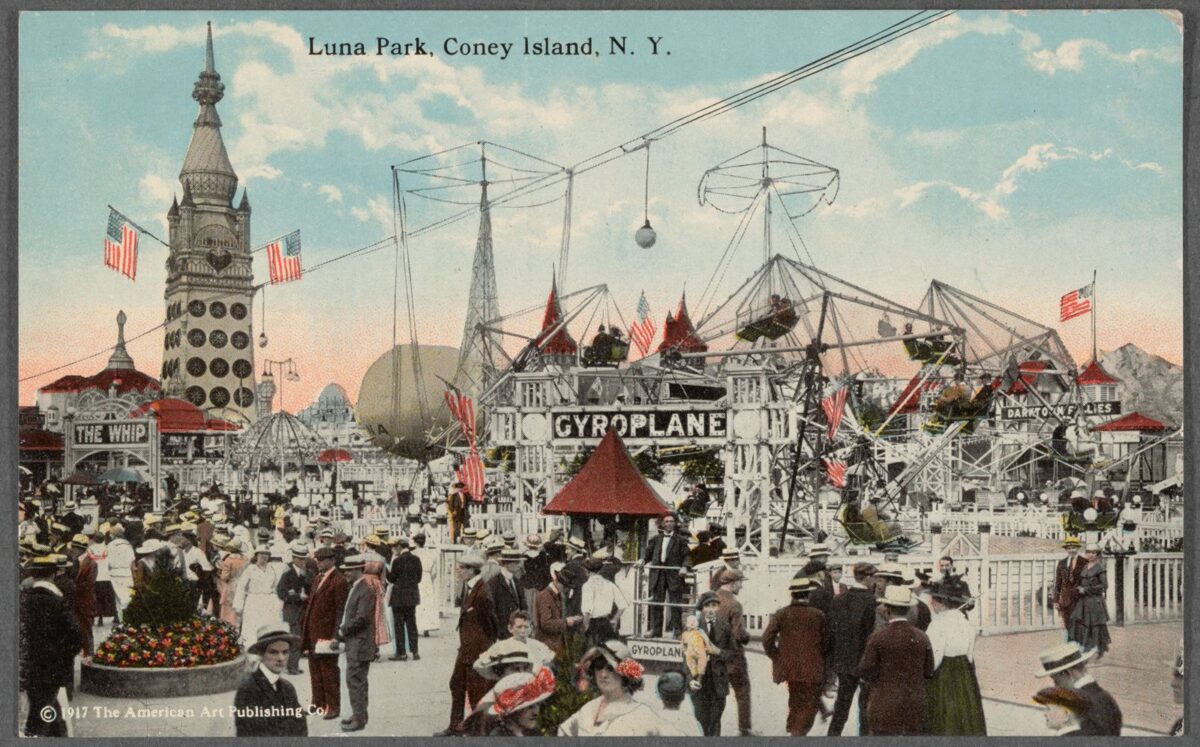
Meanwhile, out on the far coast of Brooklyn, the resort of Coney Island developed rapidly and became a truly great escape with its famous amusement parks where one could find adventure and perhaps a bit of romance. 

Esther takes us on a journey to visit these spots and spaces where Gilded Age New Yorkers could cool off, forget the realities of life for just a bit and have a really good time.  

LISTEN HERE OR ON YOUR FAVORITE PODCAST PLAYER:

And in two weeks on The Gilded Gentleman Podcast: Prepare for a history of the French Riviera

Categories
New York Islands Sports

The strange link between the New York Yankees and South Brother Island

This article is an excerpt of an entire mini-podcast on the history of South Brother Island, available to those who support the Bowery Boys Podcast on Patreon (at the Five Points level and above). Join us on Patreon to listen today!


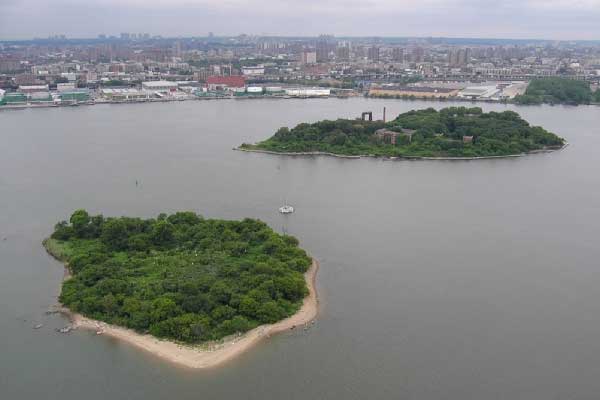
South Brother Island with North Brother Island behind it (Courtesy Harbor Lab)

This week’s latest podcast explores the dark and dramatic history of North Brother Island, the East River island home to the ruins of old Riverside Hospital.

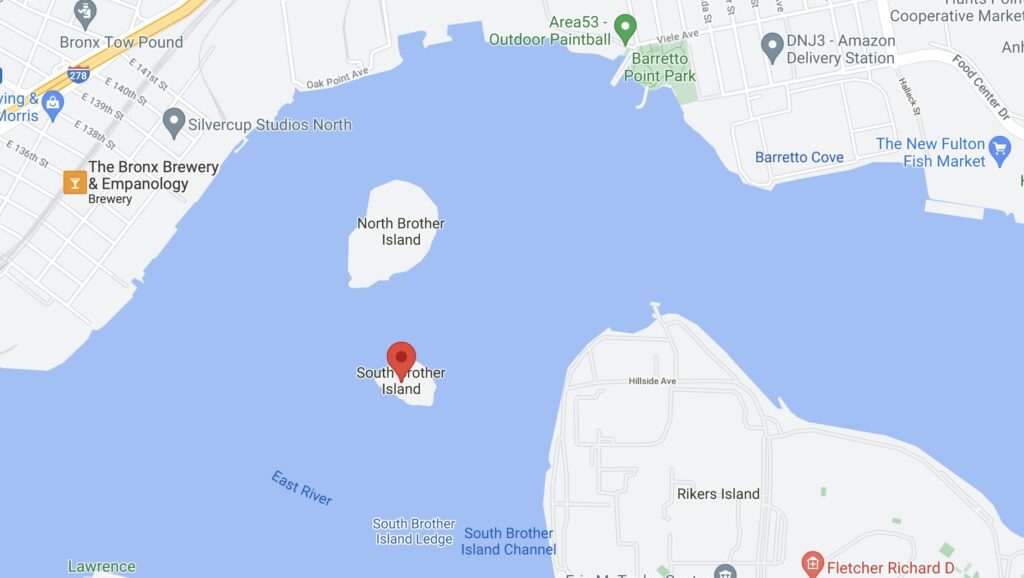
But that’s only one-half of the story. For of course there’s South Brother Island, less than 900 feet away, a smaller island separating its brother from Rikers Island.

South Brother Island wasn’t used in the same way as North Brother Island. But it isn’t entirely devoid of any human history; its just sort of odd history. 

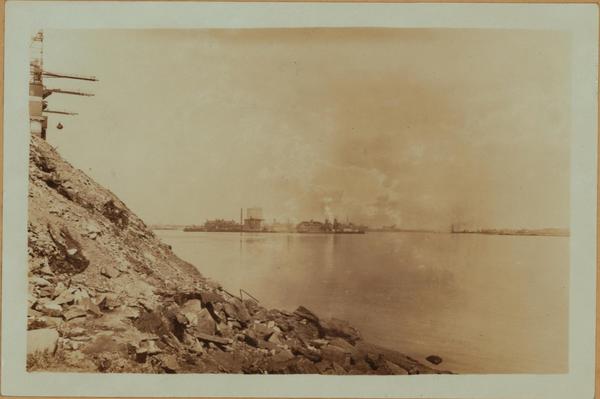
Looking east along the East River, from 132nd Street, Bronx, to South Brother Island. April 12, 1931. P. L. Sperr. Courtesy New York Public Library

During the Civil War it hosted military regiments and the island was often used in yachting competitions. There were small farm settlements here. And even a few bouts of river piracy.

But in the early 1890s something rather unusual came to this virtually abandoned place — baseball.

New ballfields would be constructed here for use by traveling ball teams, the opening innings of a true national baseball league. (For both white ball teams and those of the burgeoning Negro League.)

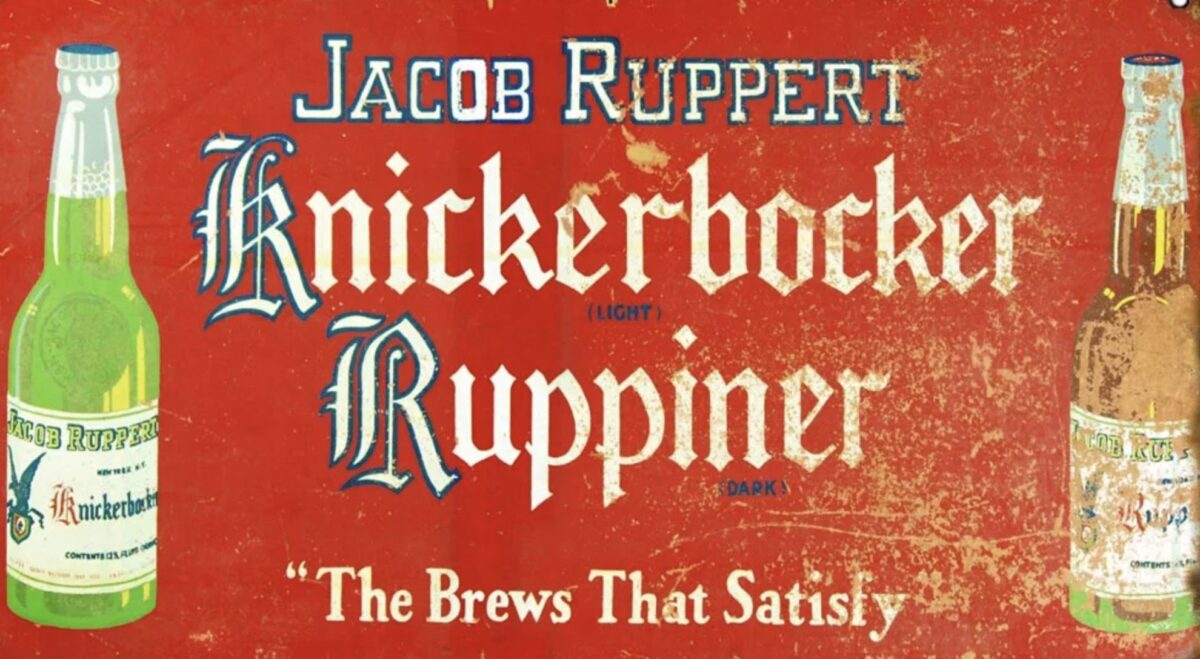
These fields would have a very fascinating pedigree for baseball historians for they were built by a man who would change the fate of the game forever — Jacob Ruppert Jr.

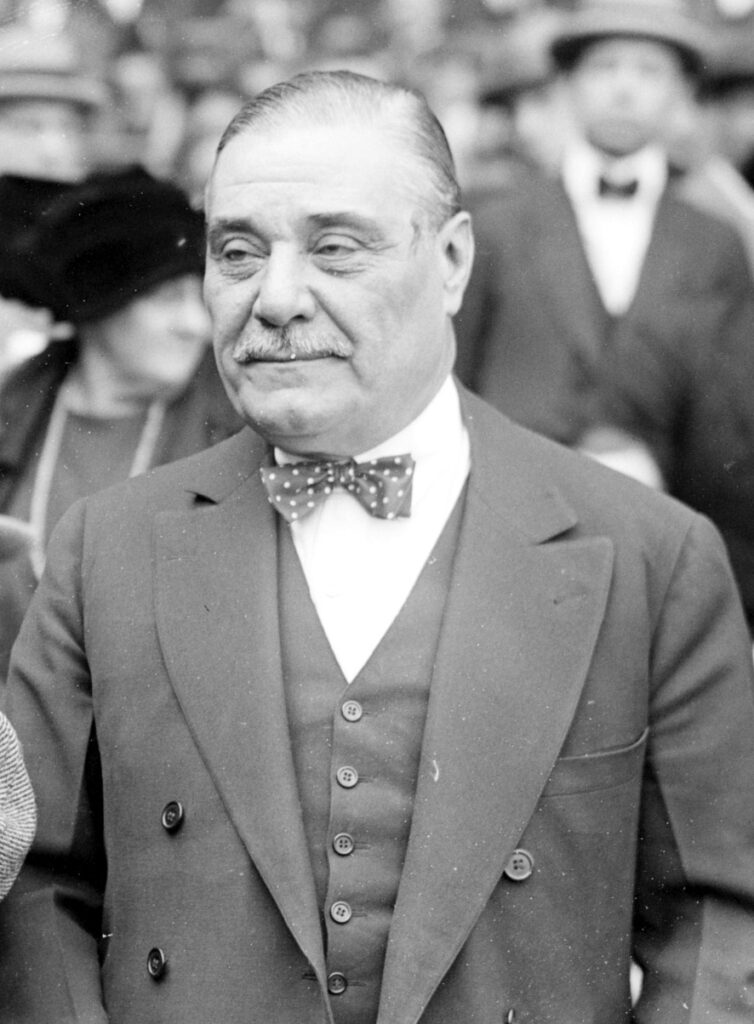
Ruppert, the son of a German brewer, was a decorated military man by this time and a prominent local politician, newly endorsed by Tammany Hall.

He had a lifelong obsession with baseball. In 1894 he purchased South Brother Island for the purposes of building baseball fields here. For many years Ruppert even lived on the island during the summer.

According to the New York Sun: “He intends to spend more than two million dollars on improvements on the island which is his property. He will have a trolly line running all over the island and a ferry of his own on 92nd Street. There will be a large building containing ballrooms and a German restaurant.”

Ruppert also reportedly wanted to build a brewery here. “He adds that everything on the island will be of a thoroughly German character.”

Now this is at the very same time — the 1890s — that neighboring North Brother Island was populated with epidemic patients afflicted with tuberculosis, smallpox, leprosy and more.

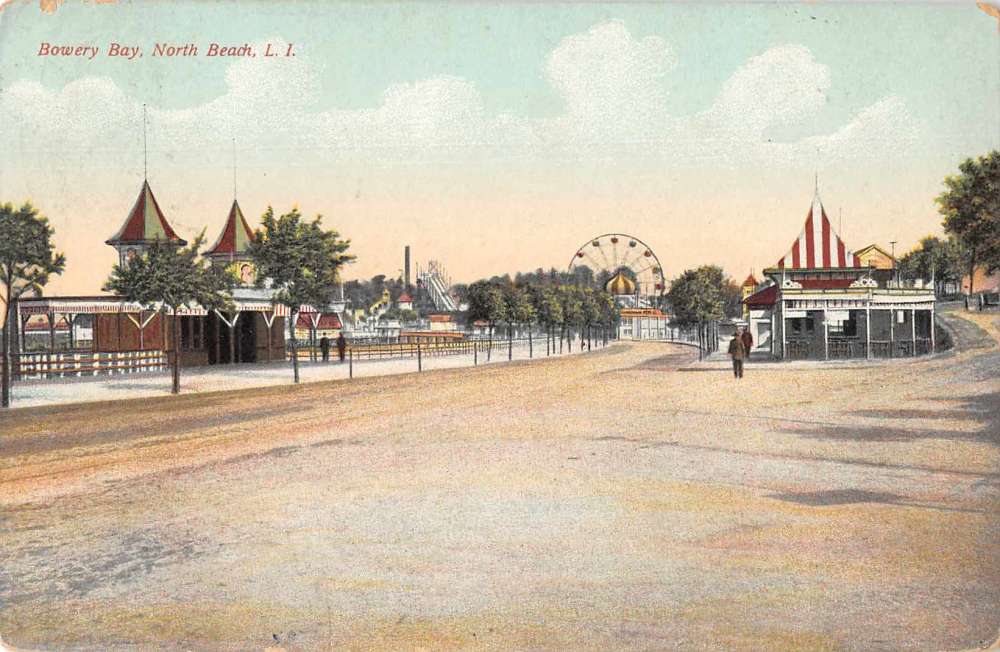
But the idea of an island sporting resort here would not actually be considered odd; in fact there were many such resorts along The Bronx and Queens waterfront back in the late 19th century, including College Point, Clason Point and Bowery Bay Beach (on the site of today’s LaGuardia Airport).

The amusement park at Bowery Bay/North Beach, on the site of today’s LaGuardia Airport.

So Ruppert had the right idea — although the project’s eventual execution was far less grandiose from his original designs. But by the early 1900s, Ruppert had turn South Brother into a sort of baseball fantasy island.

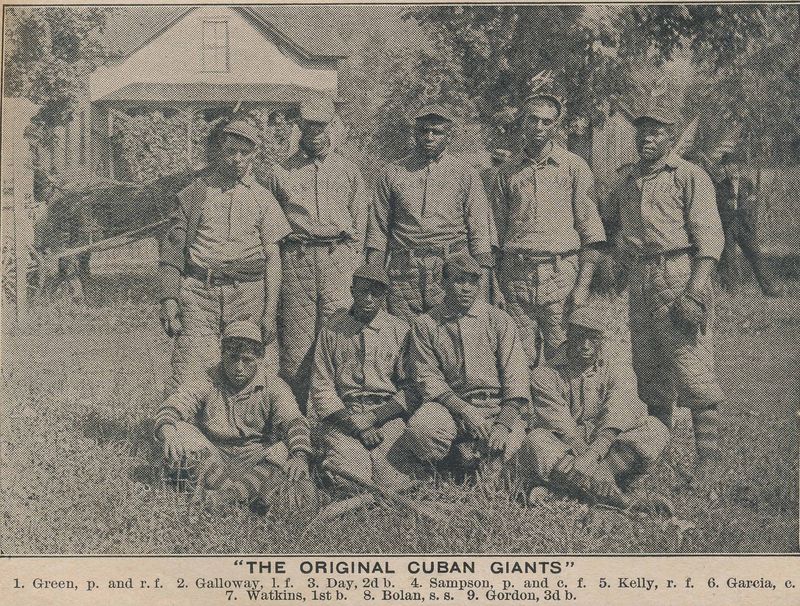
The baseball fields hosted a wide array of teams from several different leagues including one of the first and greatest black baseball teams: the Cuban Giants.

The Giants, one of the greatest African-American baseball teams from the era when the sport was highly segregated, first formed in 1885 in Babylon, Long Island.

An image of the team in 1902. The team played at several ballfields in the region, including South Brother Island.

They were a big draw in their day, so if they played out on South Brother Island, I assume facilities were substantial enough to cater to large crowds. (Sadly I have not been able to find any photographs of the island from this period.)

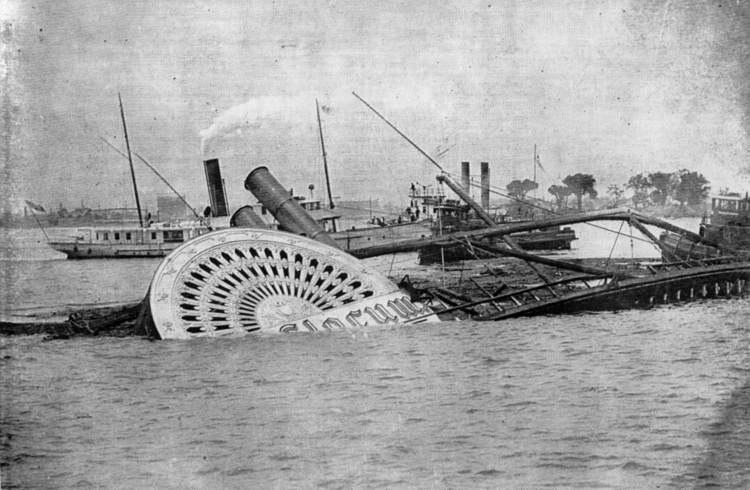
Since games were most likely played on the weekends, there were probably very few people on the island on June 15, 1904, to witness the disaster of the Gereral Slocum steamship fire, but the tragedy did comes to the shores of his island.

The sunken wreck of the General Slocum.

In fact there was so much calamity and chaos on North Brother island in the moments following the horrific tragedy that bodies of those who died and were found in the East River were taken to the shores of South Brother and from there transferred to the city morgue.

The captain of the General Slocum later said he considered running the ship aground at South Brother Island but decided against it due to its rocky shore. Thank goodness he did not, for it was the bravery of many nurses, doctors and patients on North Brother which saved so many that day.

In 1909 fire destroyed Jacob Ruppert’s summer house and it appears baseball moved off this island by this time. In fact, although the Ruppert estate would own the island for many decades, nobody would ever again LIVE on South Brother Island.

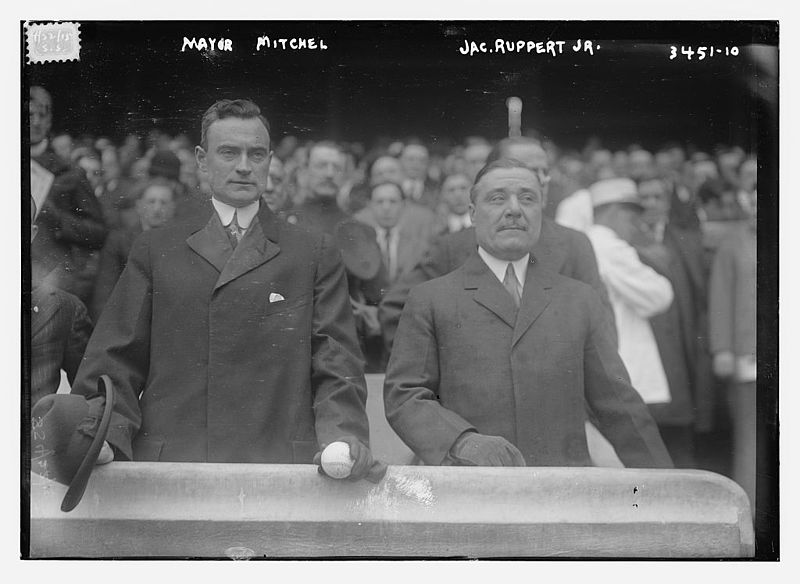
Ruppert with the mayor of New York — John Purroy Mitchel. April 1915. Library of Congress

In 1915, Ruppert became the president of his family’s beer empire. Then, partially to fuel beer sales but with a genuine love for the sport, he (and lifelong business partner Tillinghast Huston) purchased a failing baseball team named the New York Yankees.

Four years later he famously purchased the contract of Boston Red Sox player Babe Ruth. Some reports claim Ruth “spent his off days swatting balls into the East River from Ruppert’s island” however the island was mostly abandoned by the time Ruth was playing baseball. Perhaps it was a day excursion?

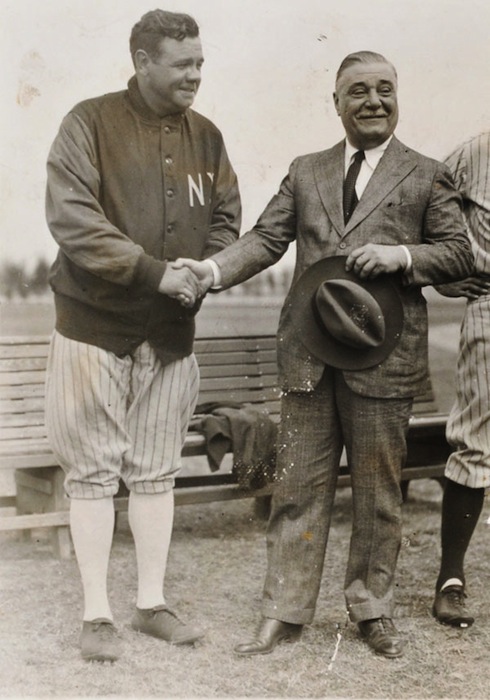
Babe Ruth and Jacob Ruppert, Jr., 1930. Photo via Legendary Auctions.

The island remained in the Ruppert family until it was sold in 1944 to a private businessman. Six decades later, a descendant of Ruppert visited the island, now an overgrown haven for wild birds. (The city officially purchased the island in 2007.)

According to Jacob Ruppert Jr’s great-great-grand nephew K. Jacob Ruppert, “There’s no beautiful lagoon. It’s a mound of bird poop. But there are beautiful birds. I never thought I could walk up to a swan on her nest. The ground is nothing but bird droppings and broken egg shells.”

Map of South Brother Island

Categories
Sports

The Wise Guy of Baseball: Getting To Know Leo ‘The Lip’ Durocher

BOOK REVIEW The history of sports is often written around its most revered role models, as though the noble character of the greatest players comes from the purest devotion to their game.

Leo Durocher, a sterling shortstop and manager for some of the greatest teams in baseball history, was no role model. In most ways, he was the very opposite, a combative player with a rock-star personality.  He’s famously attributed as saying “Nice guys finish last,” not because he actually said it, but because it seemed to be his life’s slogan.

In Paul Dickson‘s fast-paced and often amusing biography, Durocher’s extraordinary accomplishments on the field battle for prominence with the player’s indulgent and never-ending quest for the good life. Along the way, he became an iconic New York sports hero. As a player for the New York Yankees (1925, 1928-29), the Brooklyn Dodgers (1938-48) AND the New York Giants (1948-1955), his story plays out in New York’s greatest ballparks, as well as its most glamorous nightclubs and hotels.

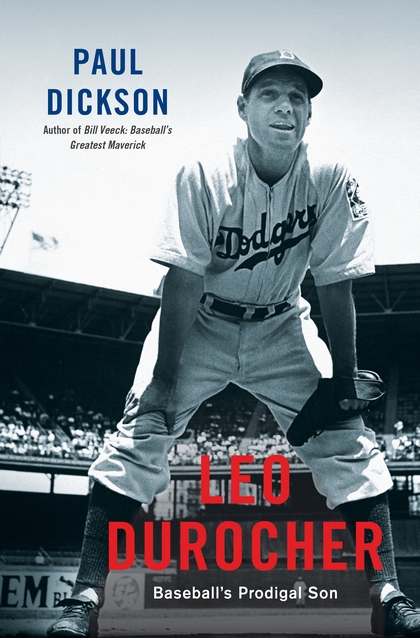
Leo Durocher: Baseball’s Prodigal Son
by Paul Dickson
Bloomsbury Publishing

Durocher, born in Massachusetts to French Canadian parents, has had many nicknames through his career — Frenchy, “the All-American Out,” and a great number of four-letter ones. But “Leo the Lip” seemed to fit him best. His quarrels with other players, umpires and sportswriters are the stuff of legends.

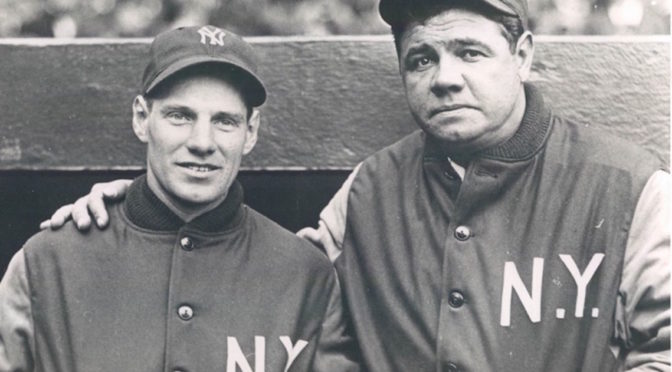
Babe Ruth famously couldn’t stand him. At one point, he accused Durocher of stealing his watch, an alleged theft that would follow the players from the Yankees to the Dodgers. Writes Dickson: “As Leo said, in a half-angry, half-mocking tone, ‘Jesus Christ, if I was going to steal anything from him I’d steal his god-damned Packard.”

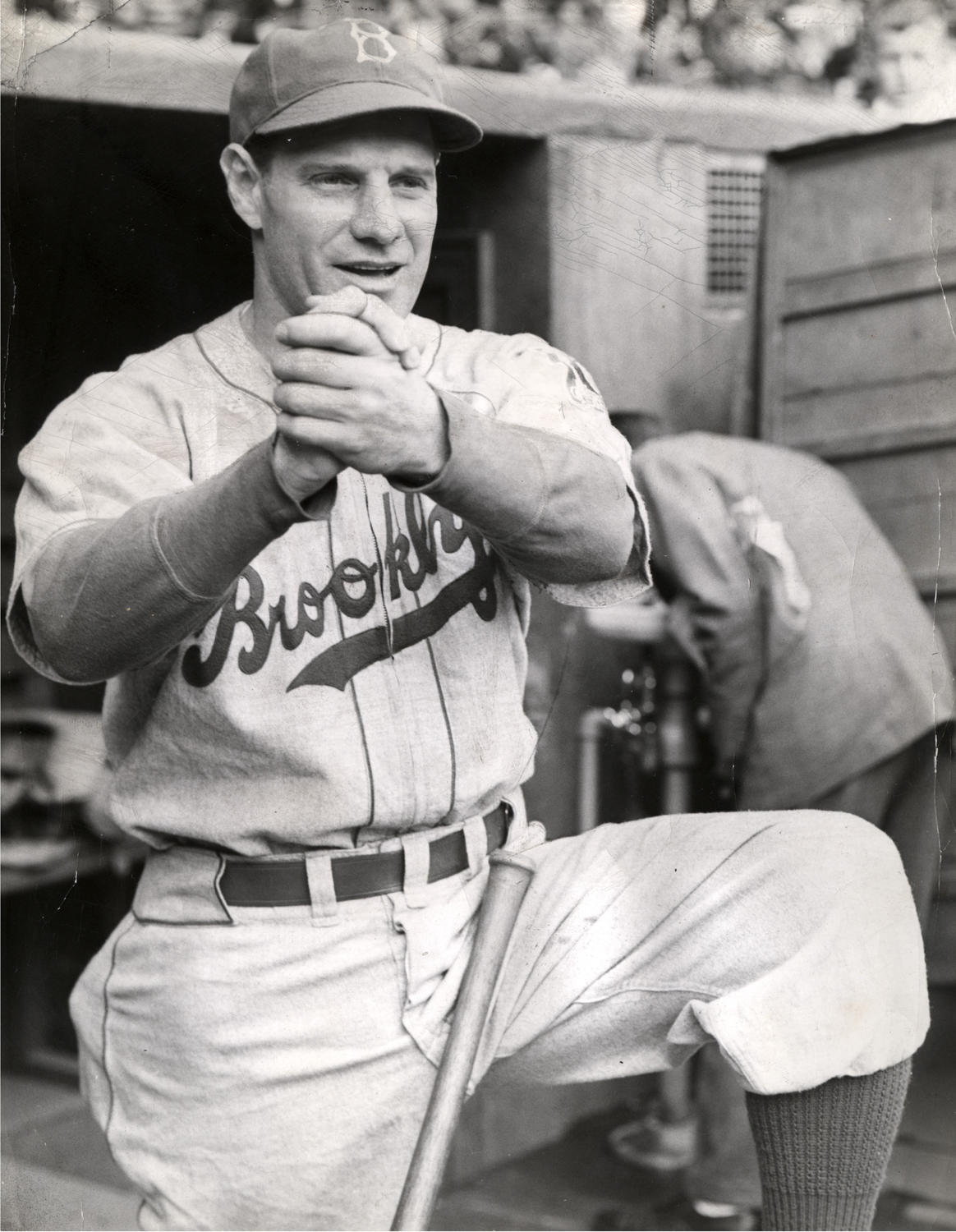
Brooklyn Dodgers Leo Durocher on dugout steps in 1939

His expletive-filled spats with teammates and managers tarred him early in his career; at one point, at age 24, Durocher was considered ‘washed out’, a toxic presence distracted by decadence and fame. As Dickson writes, “One rumored reason that all the teams in the American League passed on Durocher was that Babe Ruth let it be known he wanted Durocher out of the league.”

In New York, Durocher hops from the Cotton Club to the Stork Club in fancy suits, racking up debts at trendy hotels and acquiring a coterie of suspicious characters. His gambling addiction is now legendary; although many baseball players squandered their salaries this way, Durocher seemed to treat gambling as a second sport.

This led him into the circles of both mobsters and movie stars. And there, in the middle, was Durocher’s close friend George Raft, the Hollywood actor who frequently played gangsters on film. Durocher emulated Raft — often dressing and parting his hair in similar ways – and the actor, in turn, introduced the baseball player to the thrills of the entertainment world.

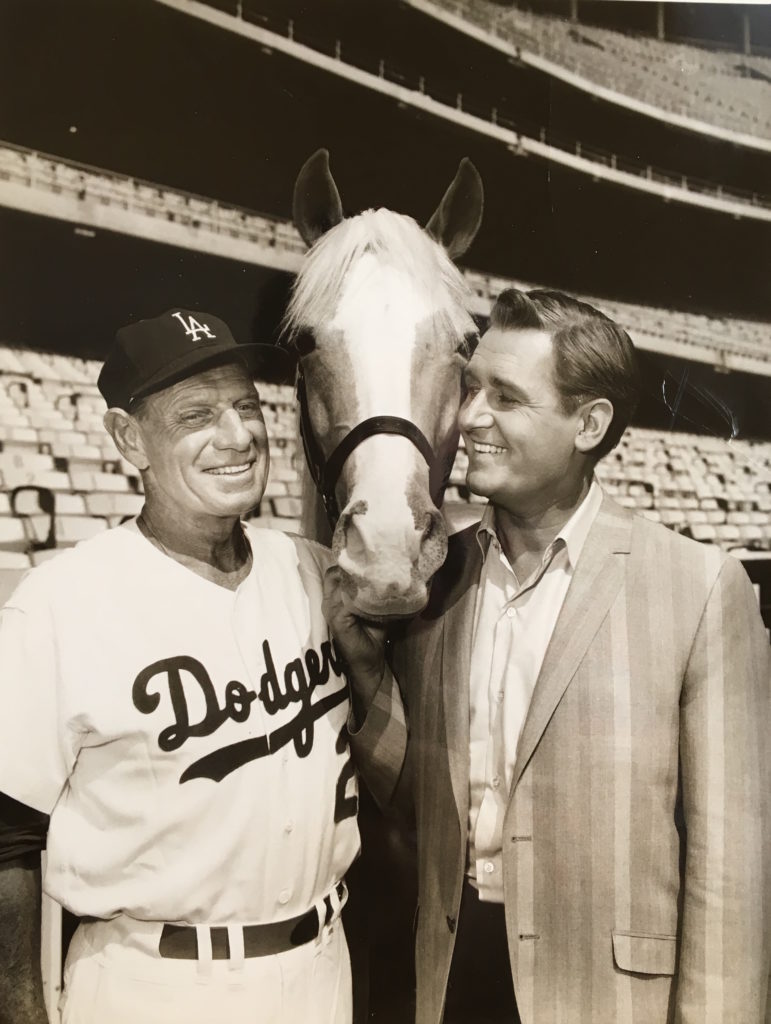
Below: Durocher with the stars of the TV show Mr. Ed

Courtesy Baseball Reliquary

Even during his greatest moments as a manager of the Dodgers, many believed Durocher might quit and become a radio comedian and actor. During World War II he even toured with the USO.

Yet he would always return to the game. With the Dodgers, he transitioned from player to manager, overseeing the team during some of its greatest moments. That included the years with Jackie Robinson, the first African-American player. (Of course, Robinson and Durocher would later public feud, almost a rite of passage for great baseball stars at this point.)

Dickson, a long-time chronicler of baseball history, finds a readable balance between Durocher’s on-field achievements and late-night scandals, revealing a charming and exceptionally scrappy, if not exactly likable, sportsman.

He’s harsh and mouthy to the end. But his talent was undeniable; the writer Bob Broeg, at Durocher’s death in 1991, said that “losing Leo Durocher was like losing either an old friend or an old enemy — you could take your pick.” Over the years, the writer had gotten into several fist-fights with Durocher.

Categories
Sports

Meet the Mets! The Metropolitans, that is, an early NY baseball team

The New York Mets, 2015 National League Champions and New York’s perpetual baseball underdogs, are only 53 years, formed in 1962 to fill the void after the departure of the Brooklyn Dodgers and the New  York Giants* to California. But in name, at least, they’re older than even the Yankees.

The first New York ball club to call themselves the Mets — or really, the Metropolitans, if we’re being fancy — made their first appearance 130 years ago.  They burned bright for many years, inaugurated New York’s first great sports venue, then faded away.

To be metropolitan in 1880 did not merely suggest a team representative of a city and its surrounding area.  It was code for the finest — from the Metropolitan Opera (which formed the same year) to the Metropolitan Museum (whose Central Park building also opened that year).

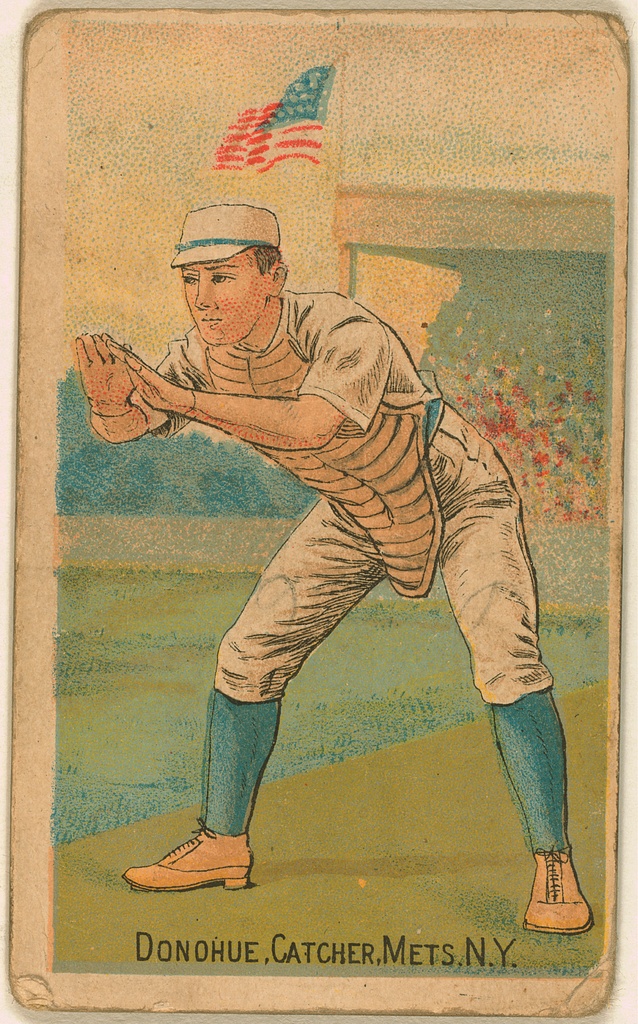
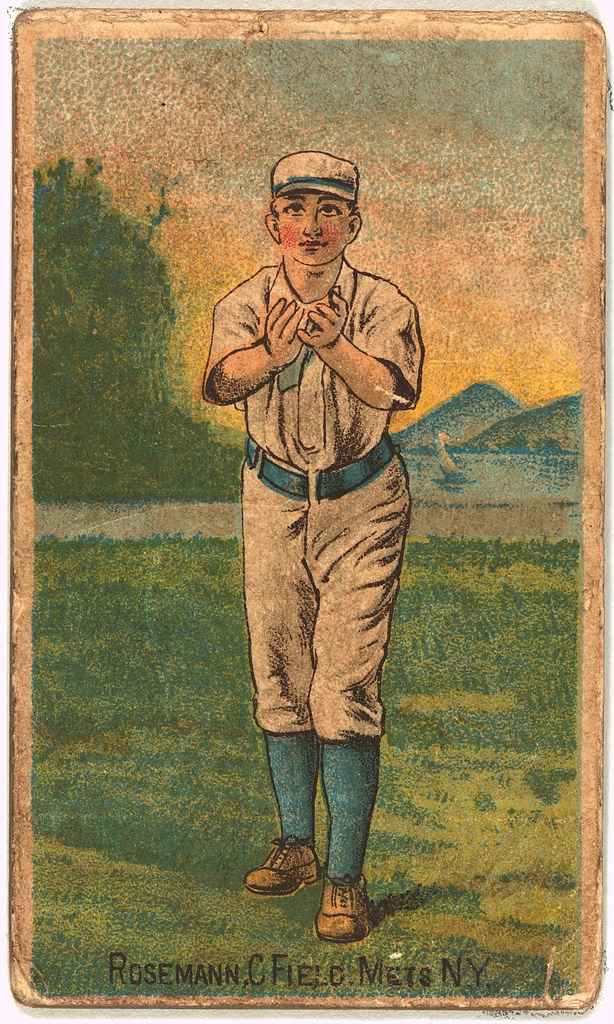
Jim Donahue, catcher

1

Baseball, however, was not a prestige sport by any means in 1880, but this did not matter to John Day, baseball fanatic and owner of a large tobacco plant on the Lower East Side. One day Day met Jim Mutrie, a shortstop from Boston, and agreed to fund a new team. In September, the New York Metropolitans made their debut on a field in Brooklyn.

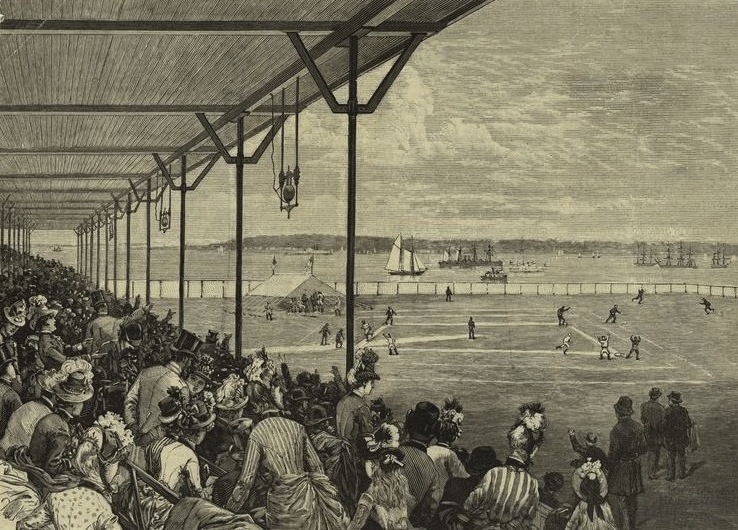
A few weeks later they would take over a playing field used mostly for polo matches, located at the northeast corner of Central Park. While it would later be known as the Polo Grounds, it would soon host a variety of sports. A larger version of the Polo Grounds, further north on 155th Street, would later be home to the modern Mets franchise.

James John ‘Chief’ Roseman

Courtesy Library of Congress

Day and Mutrie had also formed a second team — the New York Gothams — who proved to be more lucrative. In 1885 they sold the Metropolitans to  land developer Erasmus Wiman who then moved the team to Staten Island as a way to encourage growth for the underpopulated future borough. (Wiman also owned a ferry service.) The Metropolitans went from a polo grounds to a cricket’s ground — the St. George Cricket Grounds.
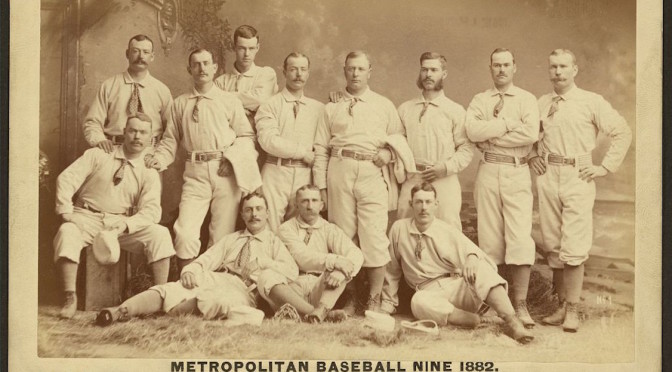
Below: The Metropolitans in Staten Island

mets

To no one’s surprise by Wiman’s, this idea didn’t work, and the Metropolitans were soon sold for $15,000 to their rivals the Brooklyn Dodgers who dismantled the team by recruiting its best players.  Their last game was 1887.

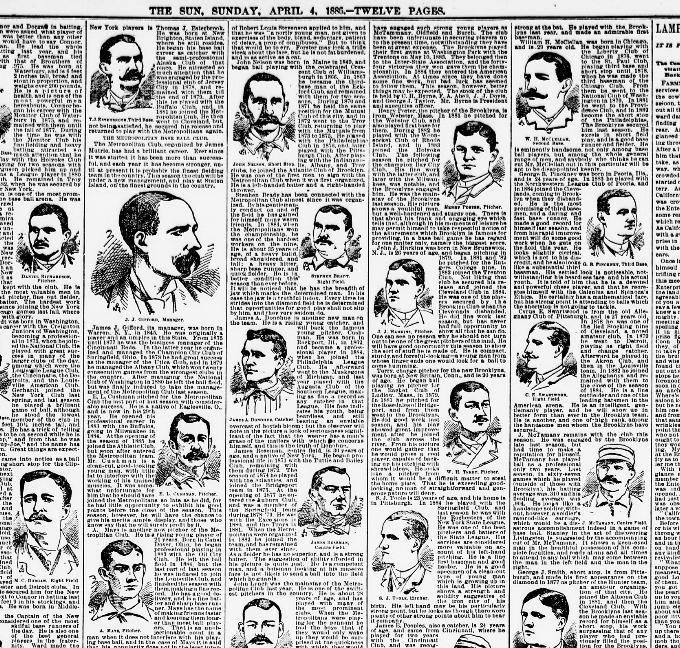
Below: At the pass off to Wiman, The New York Sun profiles all the players of the Metropolitans. You can read the entire article here.  “The Metropolitan Club, organized by James Mutrie, has had a brilliant career.  Ever since it was started it has been more than successful, and each year it has become stronger, until at present it is probably the finest fielding team in the country.”
1

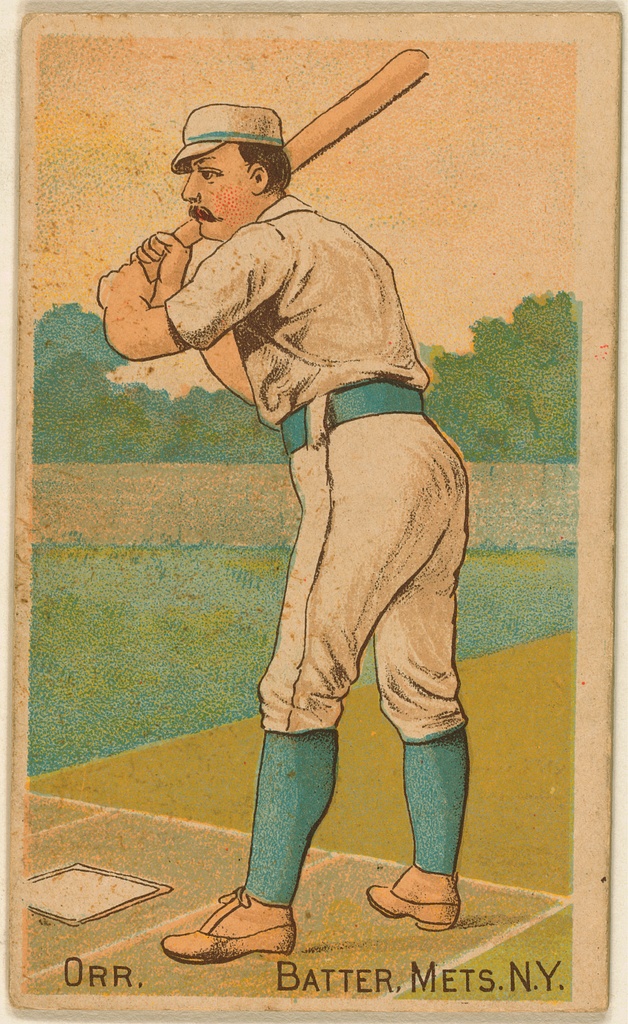
Another reason the Metropolitans may have disappeared — their weight. The New York Sun, reporting on one of their last games, played on October 30, 1887: “The old men of the Metropolitan have grown very stout. Troy, with his 195 pounds is running a close race with Orr for avoirdupois, while Brady and Kennedy have gained remarkably in weight.” [source]

Dave Orr, first baseman

orr
Courtesy Library of Congress


**The original article neglected to mention the Giants.

Categories
Brooklyn History Podcasts

Park Slope and the Story of Brownstone Brooklyn

PODCAST Park Slope — or simply the park slope, as they used to say — is best known for its spectacular Victorian-era mansions and brownstones, one of the most romantic neighborhoods in all of Brooklyn. It’s also a leading example of the gentrifying forces that are currently changing the make-up of the borough of Brooklyn to this day.

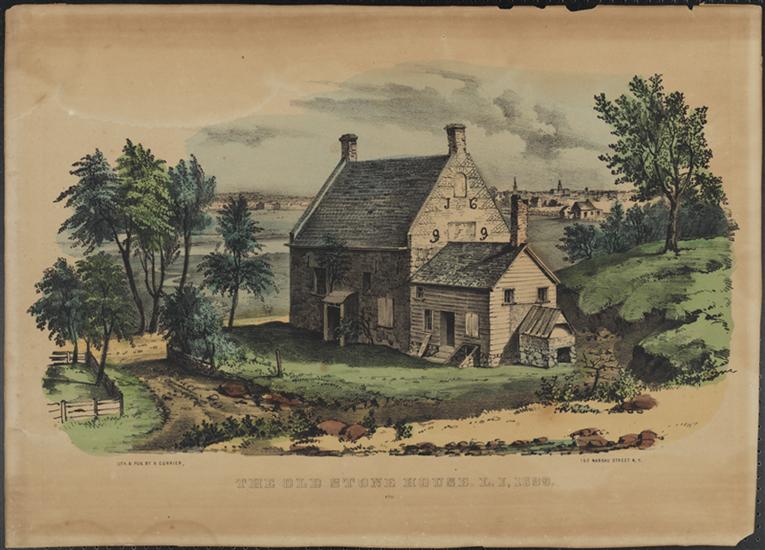
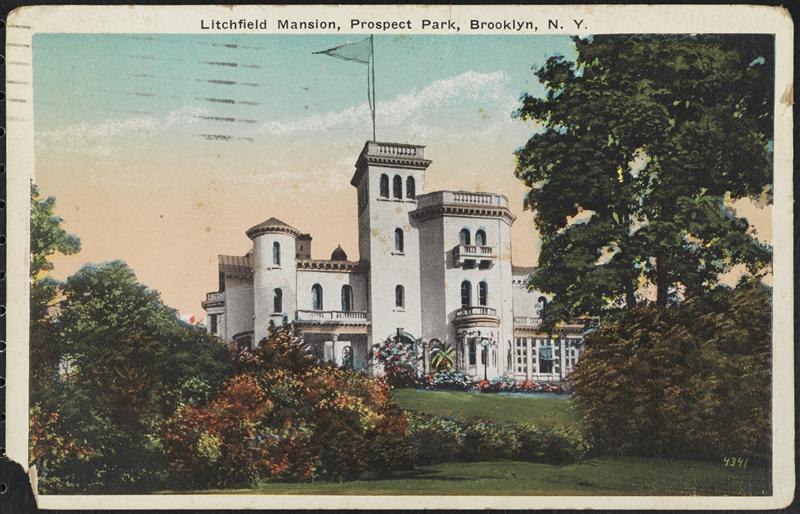
During the 18th century this sloping land was subject to one of the most demoralizing battles of the Revolutionary War, embodied today by the Old Stone House, an anchor of this changing neighborhood. In the 1850s, the railroad baron Edwin Clark Litchfield brought the first real estate development to this area in the form of his fabulous villa on the hill. By the 1890s the blocks were stacked with charming house, mostly for occupancy by wealthy families.

Circumstances during the Great Depression and World War II reconfigured most of these old (and old fashioned) homes into boarding houses and working-class housing. Then a funny thing happens, something of a surprising development in the 1960s: the arrival of the brownstoners, self-proclaimed — pioneers — who refurbished deteriorating homes.

The revitalization of Park Slope has been a mixed blessing as later waves of gentrification and rising prices threaten to push out both older residents and original gentrifiers alike.
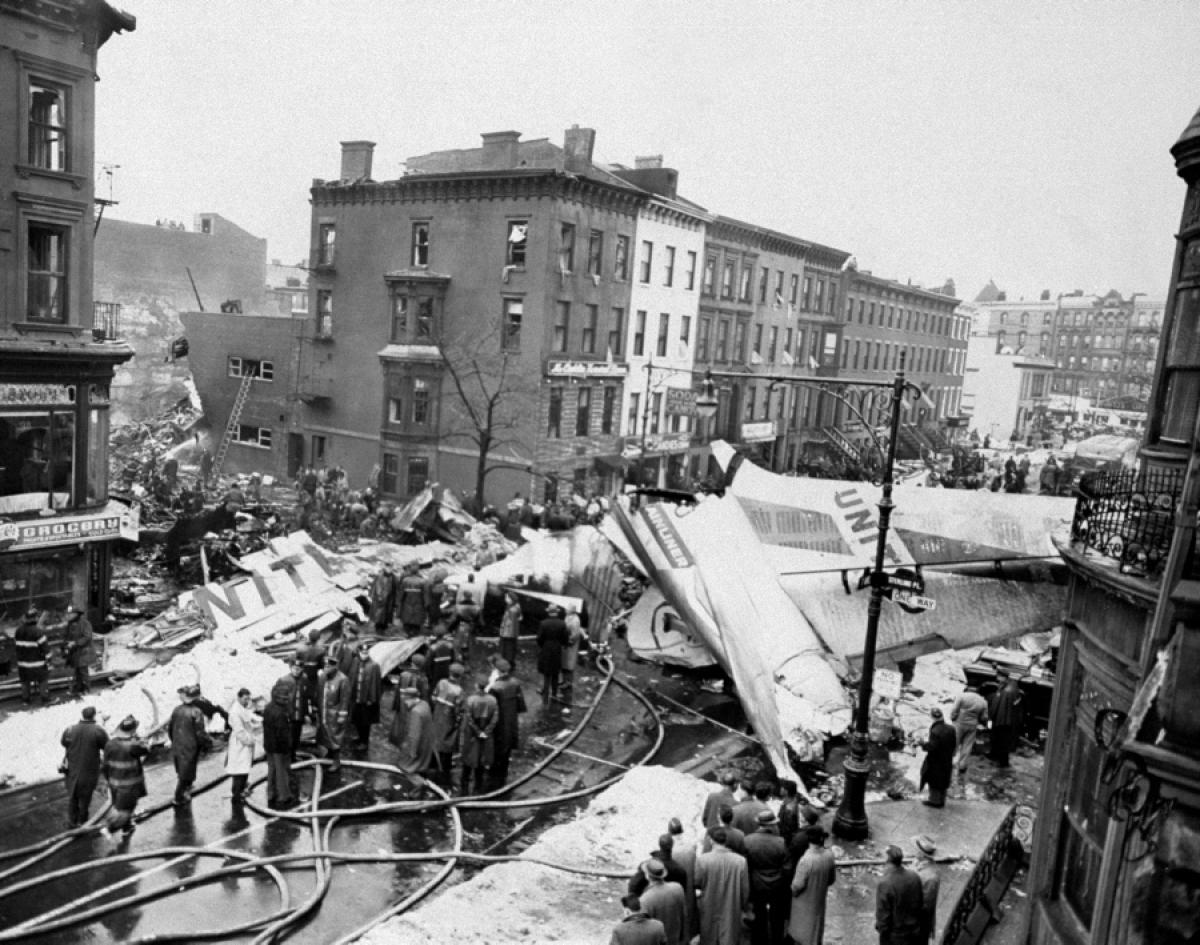
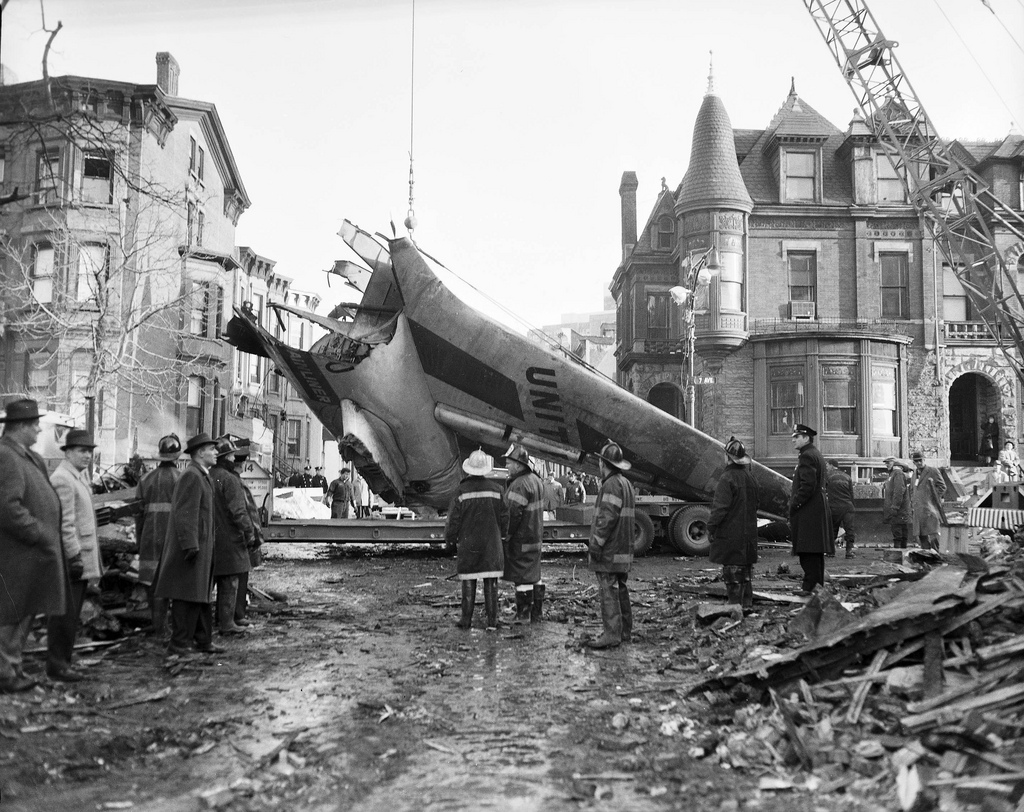
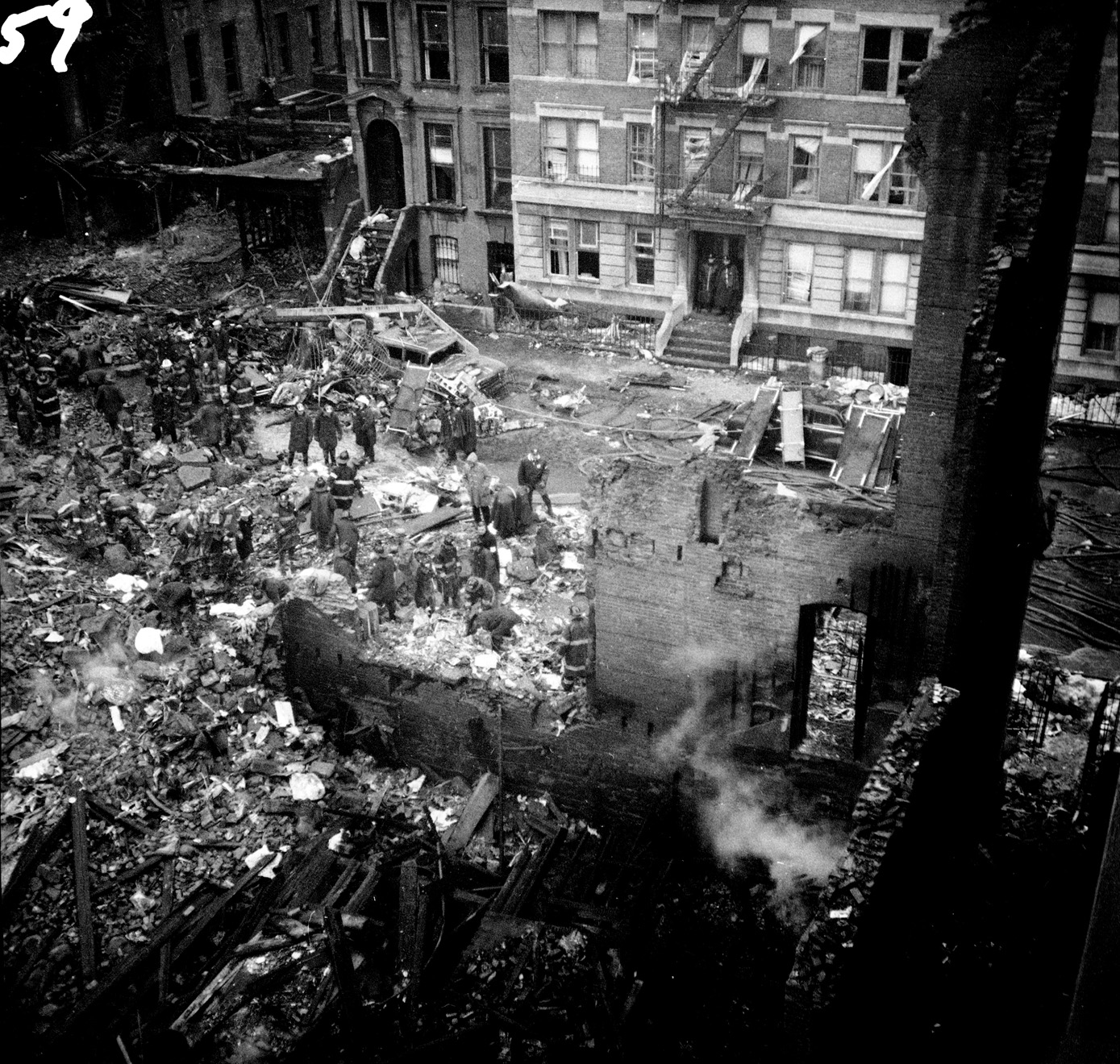
PLUS: The terrifying details of one of the worst plane crashes in American history, a disaster that almost took out one of the oldest corners of the neighborhood.
And a special thanks to our guests on this show — Kim Maier from the Old Stone House; Julie Golia, Director of Public History, Brooklyn Historical Society; and  John Casson and Michael Cairl, both of Park Slope Civic Council.


The Bowery Boys: New York City History podcast is brought to you …. by you!

Starting this month, we are doubling our number of episodes per month. Now you’ll hear a new Bowery Boys podcast every two weeks. We’re also looking to improve the show in other ways and expand in other ways as well — through publishing, social media, live events and other forms of media. But we can only do this with your help!

We are now a member of Patreon, a patronage platform where you can support your favorite content creators for as little as a $1 a month.

Please visit our page on Patreon and watch a short video of us recording the show and talking about our expansion plans. If you’d like to help out, there are five different pledge levels (and with clever names too — Mannahatta, New Amsterdam, Five Points, Gilded Age, Jazz Age and Empire State). Check them out and consider being a sponsor.

We greatly appreciate our listeners and readers and thank you for joining us on this journey so far. And the best is yet to come!


The Vechte Cortelyou House (aka the Old Stone House) depicted as it looked in 1699 (from a hand colored lithograph by the firm of Nathaniel Currier, MCNY)

MNY323785

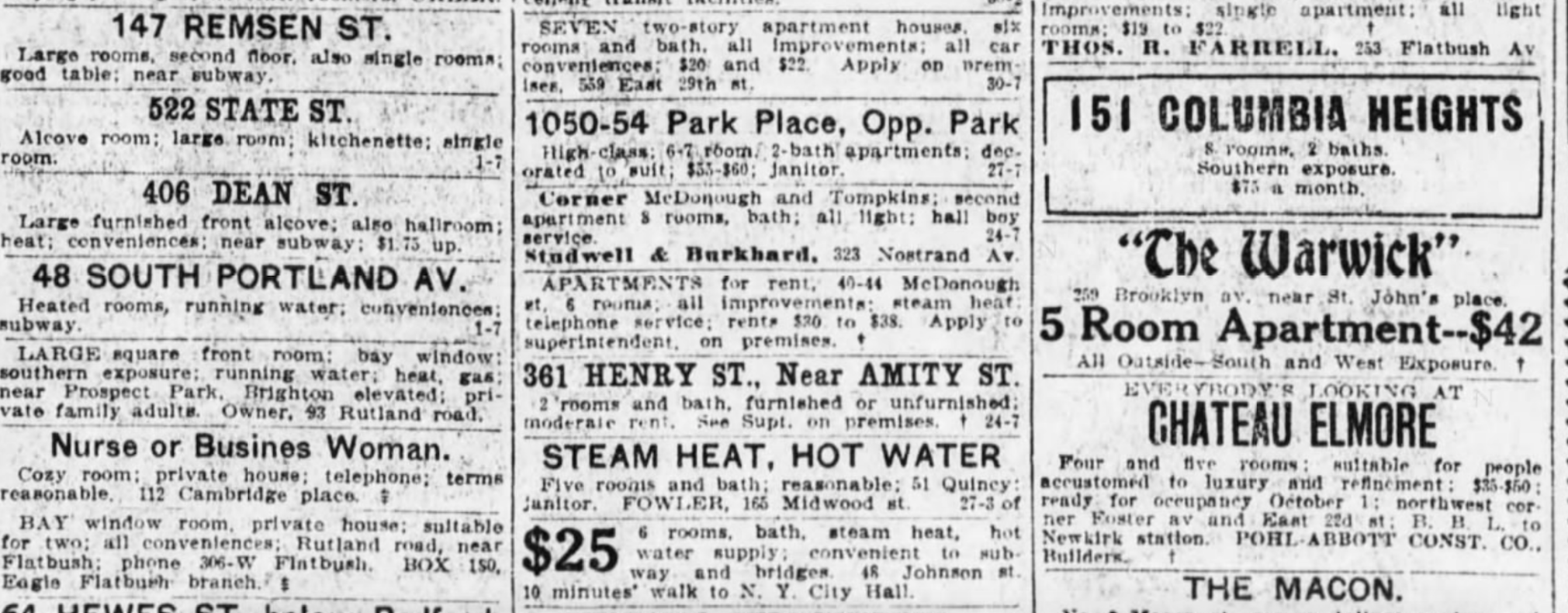
A collection of classified ads from the December 1, 1912 issue of the Brooklyn Daily Eagle, offering several living options in the park slope area.

Screen Shot 2015-05-01 at 9.03.50 AM
 
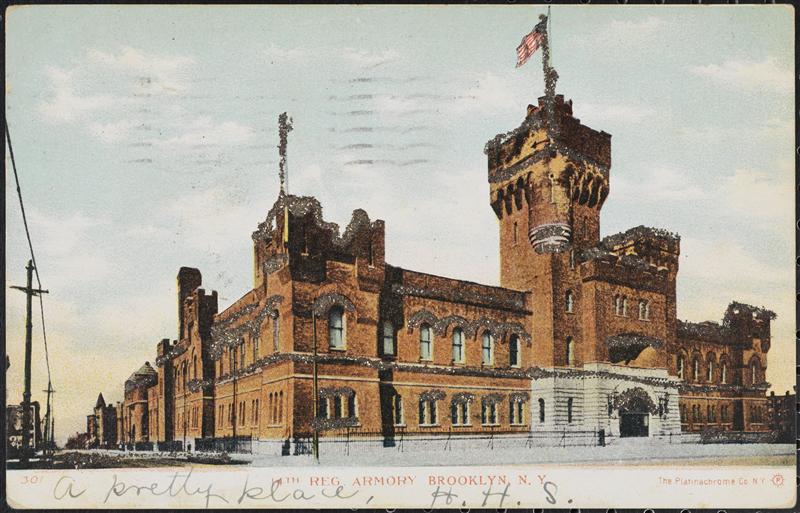
The stark Fourteenth Street Armory, located in the South Slope, depicted here as it looked in 1906 — “a pretty place” (MCNY)
M3Y44090
 
 
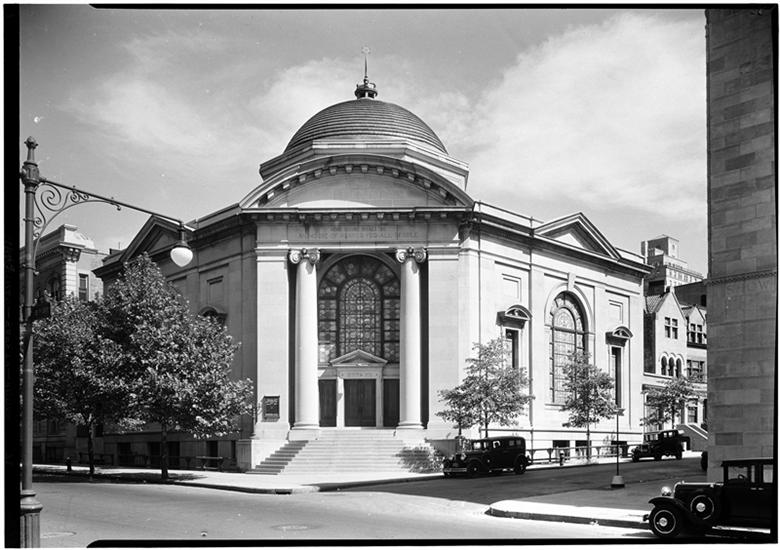
Congregation Beth Elohim, pictured here on September 16, 1929, located at Garfield Place and 8th Avenue. (MCNY)
MNY195546

The horrific place crash of December 16, 1960 — United Airlines Flight 826, bound for Idlewild Airport, colliding with Trans World Airlines Flight 266, heading to LaGuardia Airport. 128 passengers were killed, along with six people on the ground. (Top picture courtesy New York Daily News; the two after are from the New York Fire Deparment. You can find further images here)

park-slope-plane-crash-1960
6523090255_8a5f5ab891_b
6523086749_f7564b2665_o

Some images from 1961 by John Morrell from the archives of the Brooklyn Historical Society:

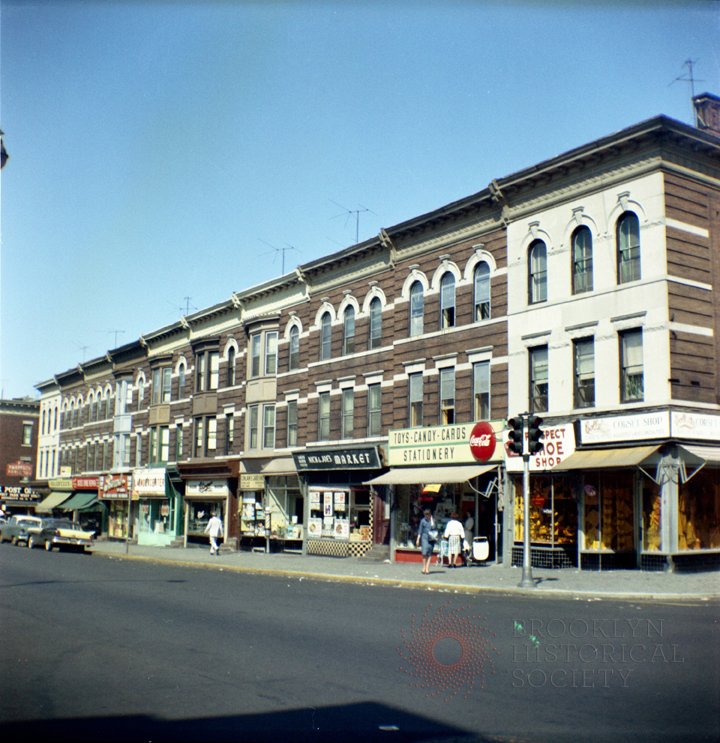
A view along Prospect Park West at and 16th Street and Windsor Place.

V19749246

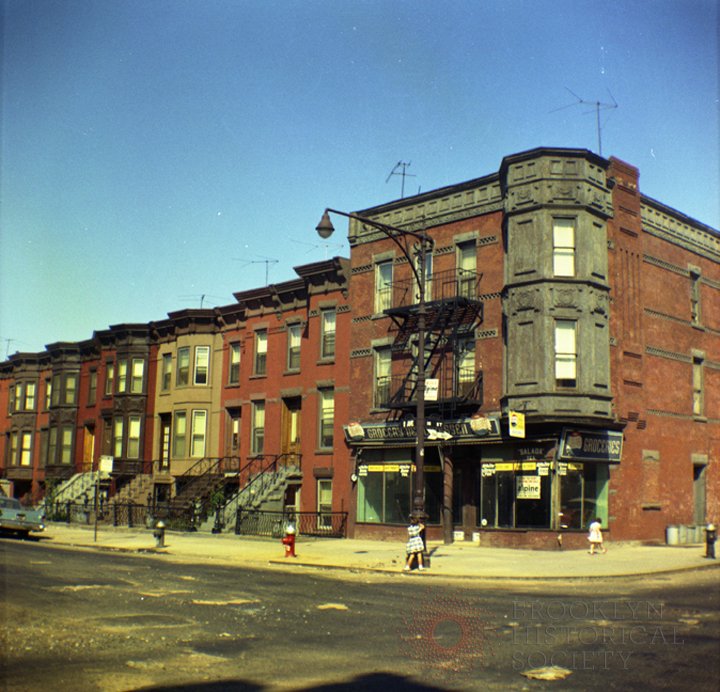
View of east side of 8th Avenue between 15th and 16th Streets looking north. n.e. cor. 16th Street (right) & 8th Avenue.

V19749250

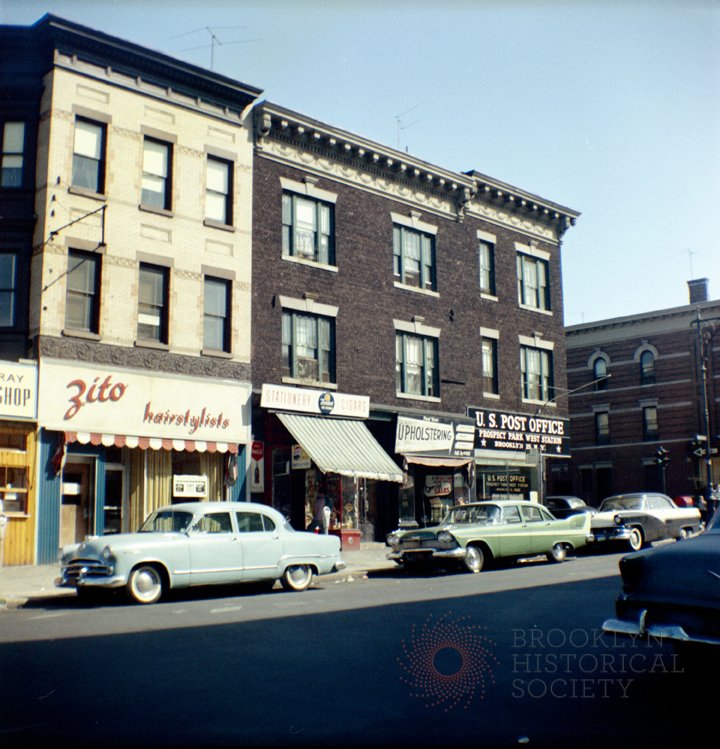
Prospect Park West looking south toward Prospect Park/branch, U.S. Post Office (at northeast corner of Prospect Park W. & 16th Street).

V19749245

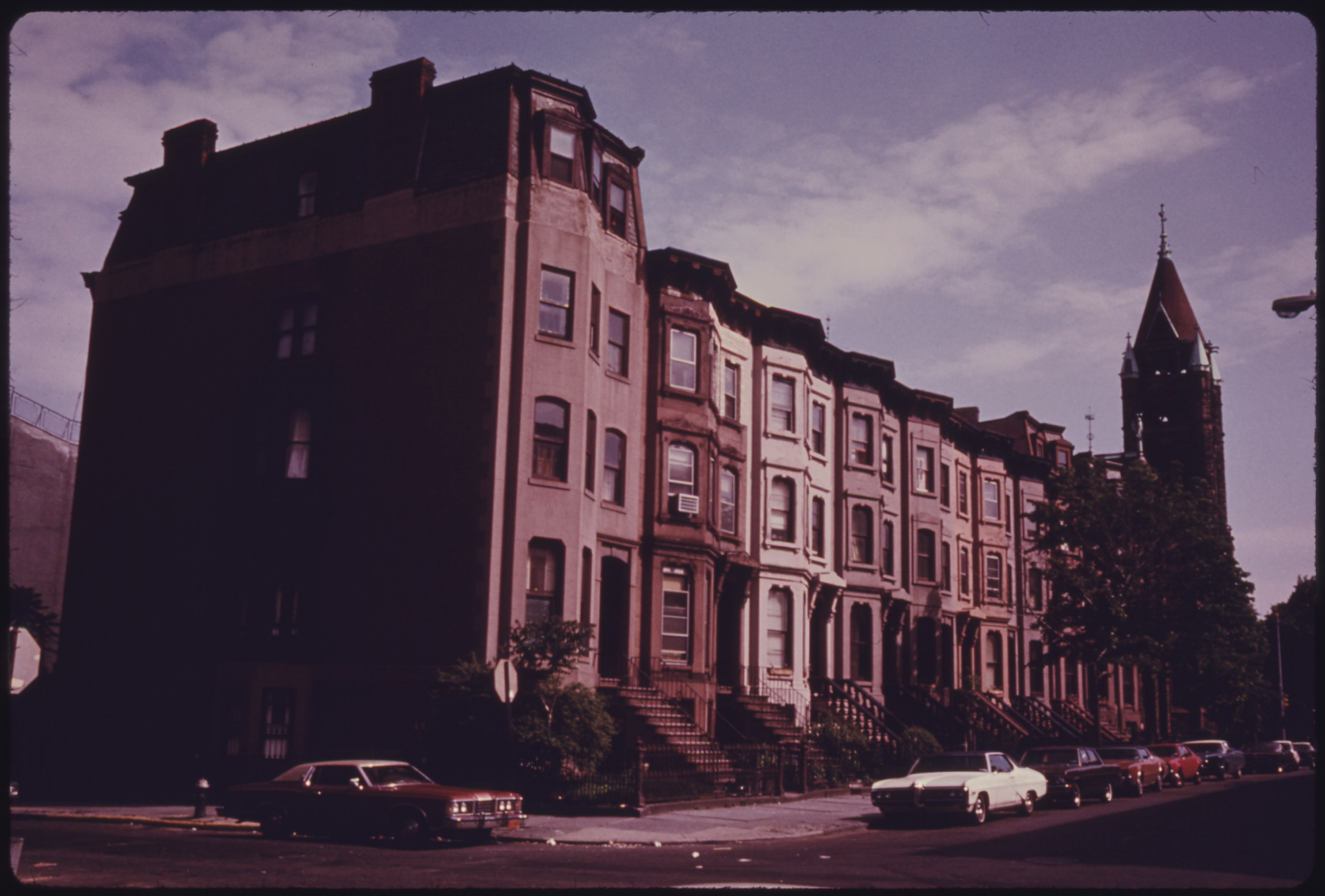
By the 1970s so mansions and brownstones close to the park were getting renovated by ‘pioneers’ with the means to restore these homes to their original splendor.

Landscape

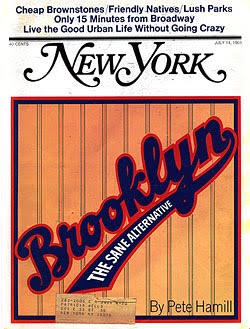
In 1969, New York Magazine touted the ‘radical’ alternative of moving to Brooklyn in an article by Pete Hamill:

1969-0714-cover-250

TOP PHOTOGRAPH by Luci West from Moving Postcard

Categories
Brooklyn History Sports

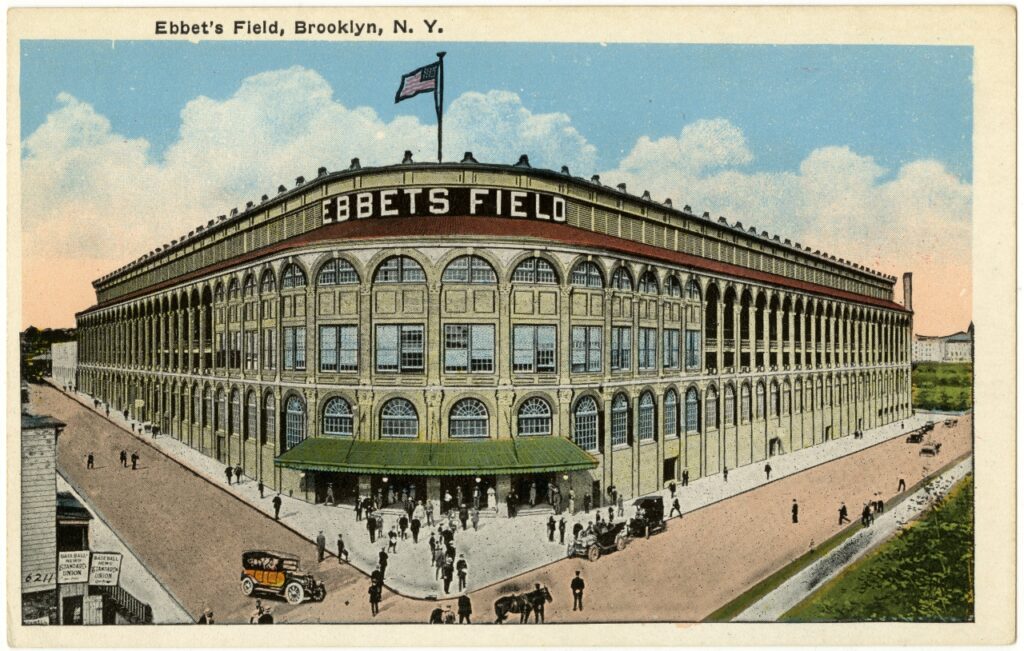
Brooklyn Dodgers vs. Cincinnati Reds at Ebbets Field — in the first Major League baseball game ever broadcast on television

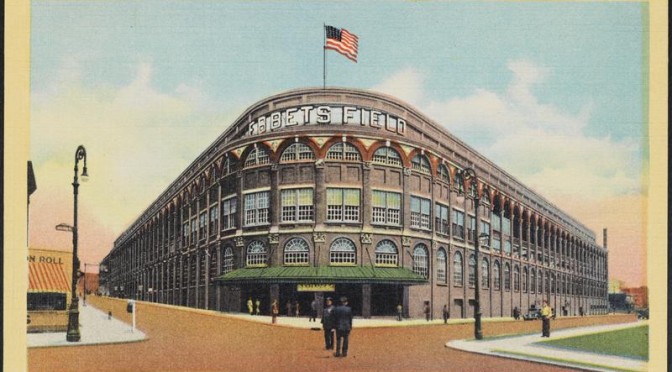
Ebbets Field, Brooklyn, N. Y.

Seventy five years ago today, an extraordinary tradition began — televised Major League baseball!

The location was appropriately Ebbets Field, one of baseball’s legendary ‘field of dreams’. The home team, the Brooklyn Dodgers, was pitted against the Cincinnati Reds in a key National League match-up. Both teams were quite strong that year, although it was Cincinnati at the top of the standings.

Fans who packed the stands at Ebbets that steamy Saturday afternoon noticed some rather unusual contraptions had invaded the field — bulky television cameras.  “One ‘eye’ or camera was placed near the visiting players’ dugout,” reported the New York Times. “The other was in a second-tier box back of the catcher’s box and commanded an extensive view of the field when outfield plays were made.”

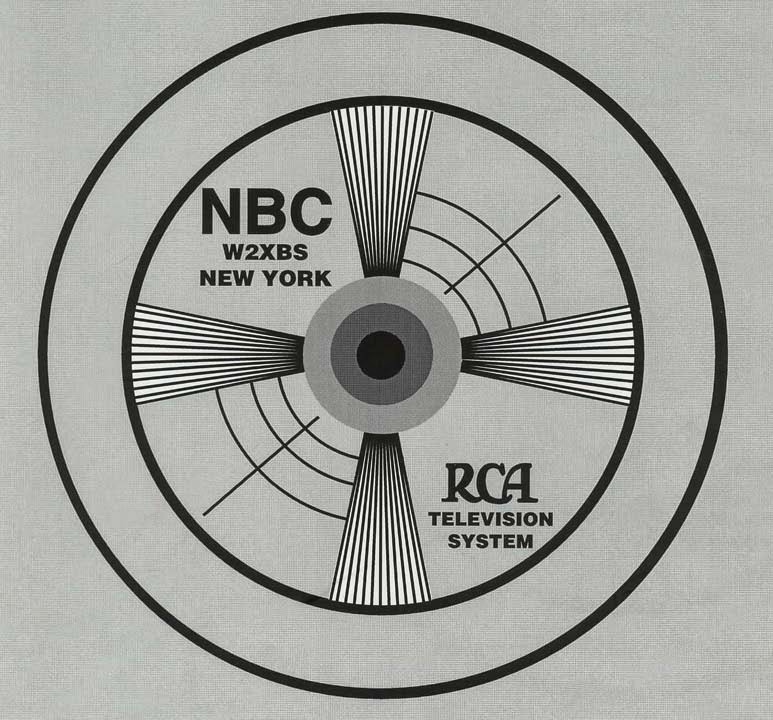
The experiment was inspired by the technological marvels at the 1939 World’s Fair in Flushing-Meadows.  In fact, since few people actually owned TVs then, it was in David Sarnoff’s RCA exhibition hall where most people saw the broadcast, courtesy W2XBS (a precursor to WNBC-TV).

Below: A view of one of the cameras broadcasting the game.  Ads for GEM Razor Blades and Calvert Whiskey can be seen across the field. They became the first sponsor of a televised baseball game, although it was purely accidental!

Up until that point, the 400-odd receivers throughout the city — owned mostly by RCA executives and technicians — received broadcasts from a studio in Rockefeller Center. (For more information, check our our New York and the Birth of Television podcast.)

This was not the first baseball game ever broadcast;  a college game between Columbia and Princeton was beamed out to the handful of received that May, near the opening of the World’s Fair.  But it attempting to broadcast a game with broader appeal, like the Dodgers-Reds face off, Sarnoff and his engineers invented a new way of interacting with major sport.

Sports of mass appeal had been heard on the radio for over 15 years by this point. Interestingly, New York teams originally blanched at the idea of radio broadcasts, thinking they would reduce stadium attendance.  Broadcasters were even banned from the field for a few years. [source]

Adding a live visual element was crucial not only in popularizing the game of baseball — uniting fans of a certain team beyond the borders of a stadium or a city — but in popularizing the idea of television itself.  Televised sports, invented here in 1939, had the unique potential of bringing together masses across the globe, as anybody caught up in this year’s World Cup hysteria or last year’s Summer Olympics fandom can attest.**

It’s to the credit of the television engineers that their feat seems not to have disrupted the game.  Coverage in the Brooklyn Daily Eagle neglects to mention the cameras*, and the New York Times mentions it only in a small article.

In the end, the teams split the two-game event — the Reds one the first (5-2), the Dodgers the second (6-1).  The Reds would eventually win the National League pendant and return to the New York for the World Series, facing (and eventually losing quite badly to) the New York Yankees.

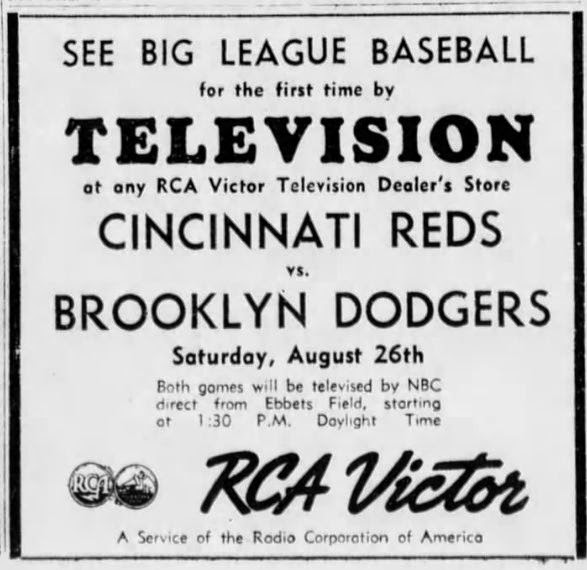
*However, RCA ran an advertisement in the Brooklyn paper on August 24, 1939, to drum up a big crowd for their inaugural broadcast:


**As commenter Andrew points out, portions of the 1936 Olympics in Berlin were also broadcast live to several countries.
Top picture of Ebbets Field courtesy Museum of City of New York

Categories
Brooklyn History Sports

The short shelf life of the Tip-Tops, the Brooklyn baseball team situated near the Gowanus River and named for bread

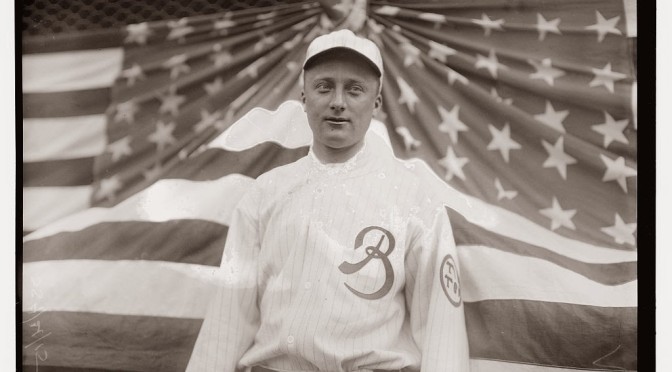
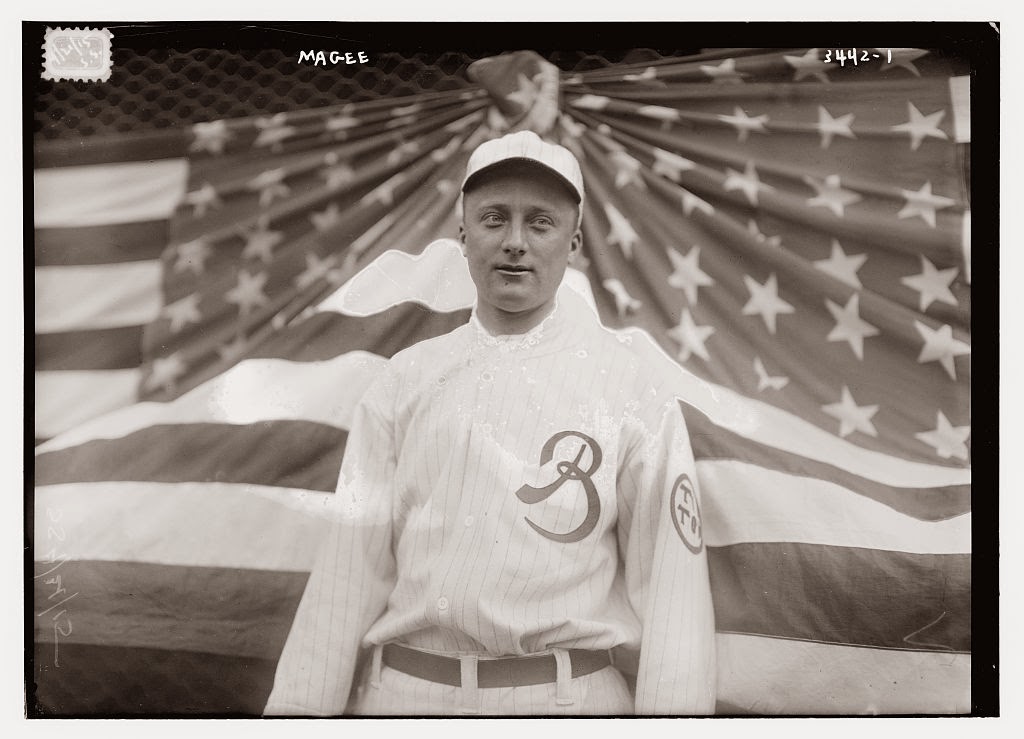
The piping hot uniforms of the Brooklyn Tip-Tops, worn by baby-faced manager Lee Magee

For a brief shining moment between 1914 and 1915, Brooklyn had two major league baseball teams — the legendary Brooklyn Dodgers and the not-so-legendary Brooklyn Tip-Tops.

Baseball has long been a sport of two parallel sports leagues — the National League and the American League — which have gotten together at season’s end to play the World Series since 1903.  But for an unusual moment in 1914 and 1915, there was a third baseball league called the Federal League.

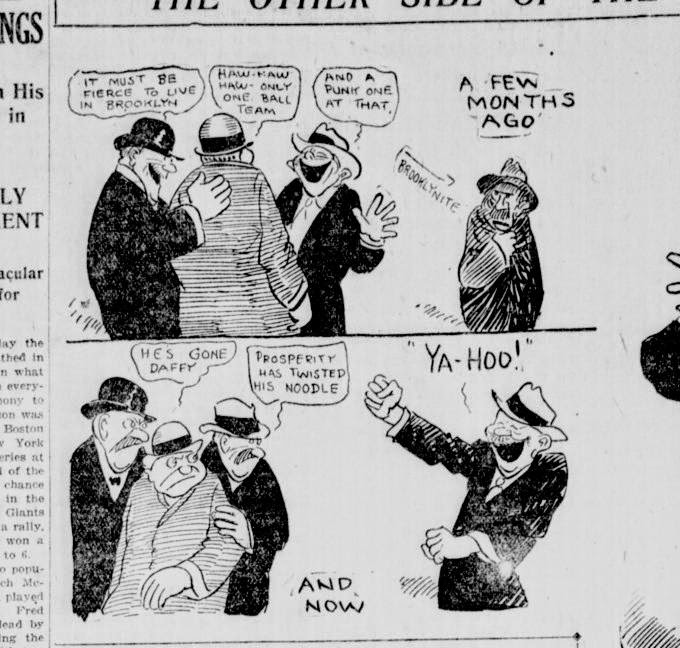
A cartoon from the May 12, 1914 New York Tribune:


The Federal League was formed specifically in protest to the signing practices of the two dominant leagues, doing away with pesky reserve clauses (binding players to certain teams for almost their entire careers) and offering higher salaries.  For a second, it seemed possible that the Federal League might provide a new way to organize a major sport.

There were eight teams in the Federal league which such unusual names as the Chicago Whales, the Newark Peppers and the Baltimore Terrapins. (Yes, somebody named a ball team after a turtle.)

Within the New York area, one franchise was awarded to Brooklyn, owned by a baker named Robert Ward.  His bakery for Tip-Top Bread (centered at 800 Pacific Street in today’s Prospect Heights) was obviously so lucrative that he eventually sank one million dollars in funding the team that eventually took the name of his baking enterprise — the Brooklyn Tip-Tops.

Brooklyn’s other team, the Dodgers, had conveniently vacated their old wooden field, Washington Park, for their brand new home Ebbets Field in Flatbush.  Ward hastily prepared to move the Tip-Tops into the Dodgers’ old home by paying for a spectacular upgrade to the dilapidated Gowanus park.  It was located between 1st and 3rd Streets at Fourth Avenue.

The baker, with his brother George S. Ward, sunk more than $250,000 into the new concrete-and-steel ballpark, situated so near the Gowanus that fans got a good whiff of its toxic odors on summer days.

The new park itself was rather flawed with bleachers extremely close to the field.  According to author Daniel Levitt: “[T]he tiny foul territory caused nearly all foul balls to end up with the spectators.  At the time fans were not allowed to keep foul balls … leading to a tacky atmosphere as team officials constantly wrestled balls away from fans.”

Another set of cheap sets, derisively called ‘sun bleachers’, which provided an unpleasant scorching experience during the summer, were quickly closed after some bad publicity.

Below: Inside the refurbished Washington Park on opening day of their second (and final) season

Construction equipment still darted the grounds when they opened on May 11, 1914.  “The Federal League opened here with a bang,” said the Evening World.  “Bands, horns, sirens and vocal assistance from 16,000 fans gave New York’s fourth baseball club a noisy welcome.” (The other three being the New York Giants, the New York Yankees, and, of course, the Dodgers.)

At first, Brooklynites emphatically supported their new team, quickly nicknamed the BrookFeds.  But it soon became obvious that the team was nothing to write home about.

They finished their inaugural season with an unimpressive record of 77 wins, 77 losses.  In comparison, the Giants, located at the Polo Grounds, made it to the World Series.  However, the young team did finish better than the Yankees (57-94). And even managed to best the Dodgers (65-84)!

Given Ward’s religious beliefs, he instructed that no Sunday games be played at the park, a serious blow given that it was the only day off for many potential working-class fans.

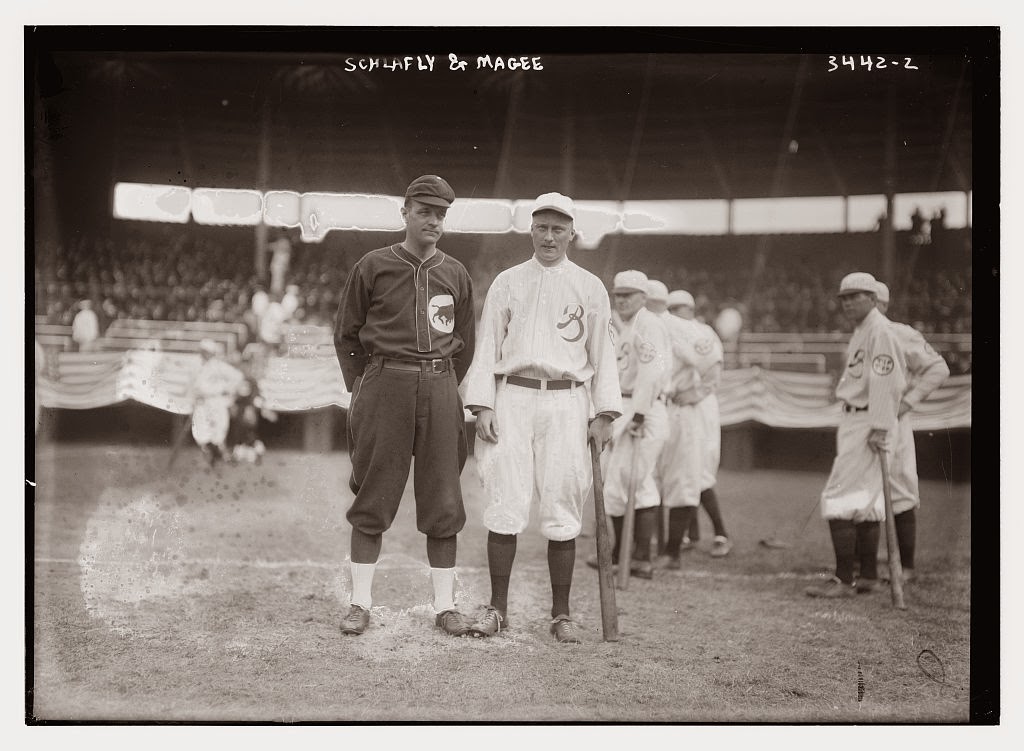
Another strike against the team occurred during the winter when the team was unable to sign away more successful players from the other two leagues.  The one exception was the outstanding Lee Magee (pictured above in a Tip-Top uniform) who was hired away from the St. Louis Cardinals and even managed the team during the 1915 season.  He would later join the Yankees.

“If hustling, hard work and ambition among the players make a winning team, the Brooklyn fans will see one in Washington park this year,” Magee claimed.

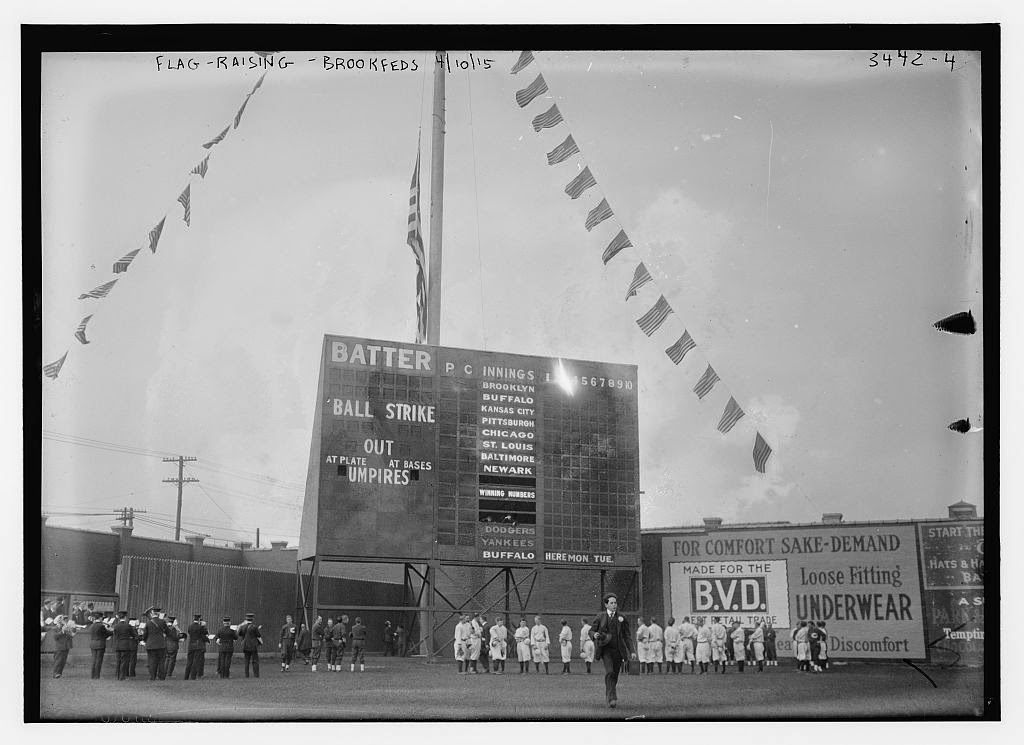
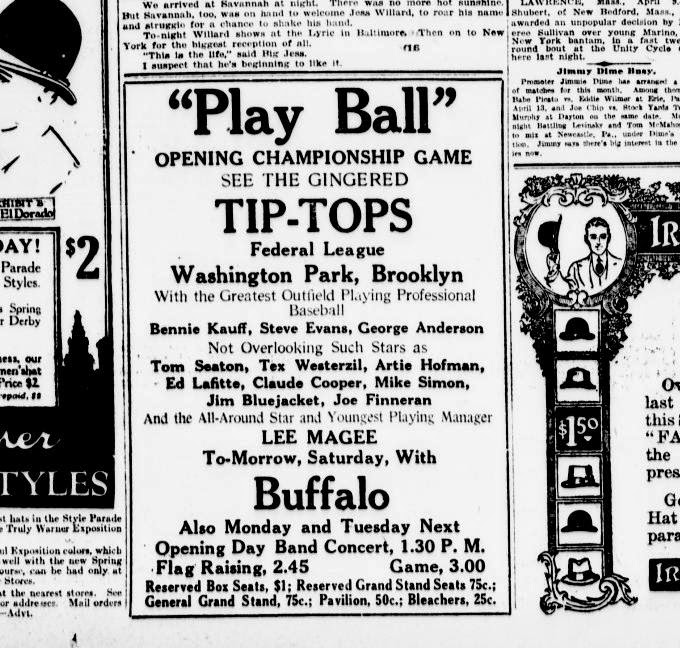
An ad for second season opening day, from the Evening World.  The flag raising mentioned below is pictured above:

The fans showed up for the beginning of season two, but enthusiasm quickly ebbed.  In fact, that first game against the Buffalo Buffeds (yes, that’s their name!) seemed to auger a host of frustrations for the rest of the season;  it went unusually long almost into night — the park was not lit — with “three hours of errors and wrangling.”

Behind the scenes, the two other leagues were busy trying to dismantle the Federal League who had filed an anti-trust suit in January.  It did not help the mood in New York that the Tip-Tops were doing worse under Magee.  They completed their season 70-82, second to last behind the scathingly terrible Baltimore Terripins.

Below: Magee with the manager from the Buffalo Buffeds:


Machinations outside New York doomed the team.  The National and American Leagues managed to eradicate its rival through series of brokered deals and buyouts.  One of these deals changed the face of American baseball, when the owner of the Chicago Whales was allowed to buy the Chicago Cubs and move them into the Whales’ new stadium — Wrigley Field.

The only team that remained to battle back against the two leagues was the Federal League’s least successful team — the Baltimore Terrapins.  They sued the leagues saying it was a violation of the Sherman Antitrust Act.  The case went all the way to the Supreme Court who, in the landmark case Federal Baseball Club vs. National League, handed Baltimore something they were very familiar with — defeat.

On December 18, 1915, the Tribune revealed the fate of Brooklyn’s second baseball team:

“The Brooklyn Tip-Tops will withdraw from Washington Park, leaving the site barren of baseball and the city in the hands of the Superbas [Dodgers].  Organized baseball will reimburse George S. Ward annually with 5 percent of the assessed value of Washington Park for twenty years.”

By 1916, Tip-Top went back to meaning fresh white bread.

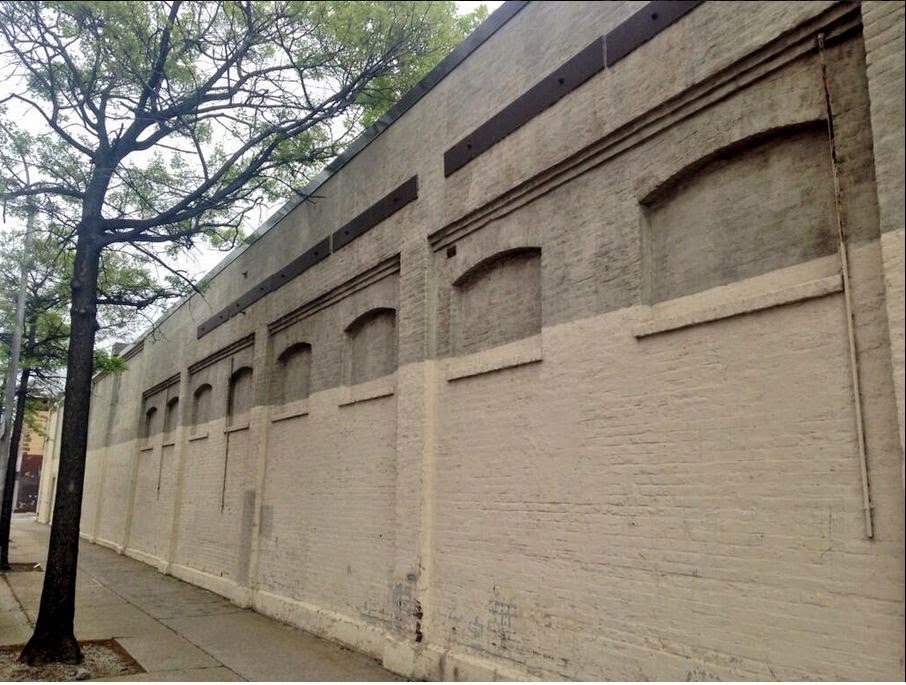
While Washington Park was eventually dismantled, a part of it still exists.  Today on the site is a yard for Con Edison.  The western wall along Third Avenue was once part of the ball park.  Perhaps if you go over to the Gowanus Whole Foods, you can walk over a block or two and check out this incredible piece of sports history!


Eleven breathtaking views of the New York Herald Building, one of midtown Manhattan’s earliest tourist attractions

Click into the images within this post for a more closeup view!

When the extravagant James Gordon Bennett Jr. decided to move the offices of the New York Herald from grimy, old Park Row to the frenzy of uptown Manhattan, he wanted something spectacular and eye-catching.  As we mentioned in our newest podcast on the history of Herald Square, Bennett went the opposite direction of newspaper publisher Joseph Pulitzer, who remained on on Park Row and put his publication in the tallest building in the world (the New York World tower, completed in 1890).

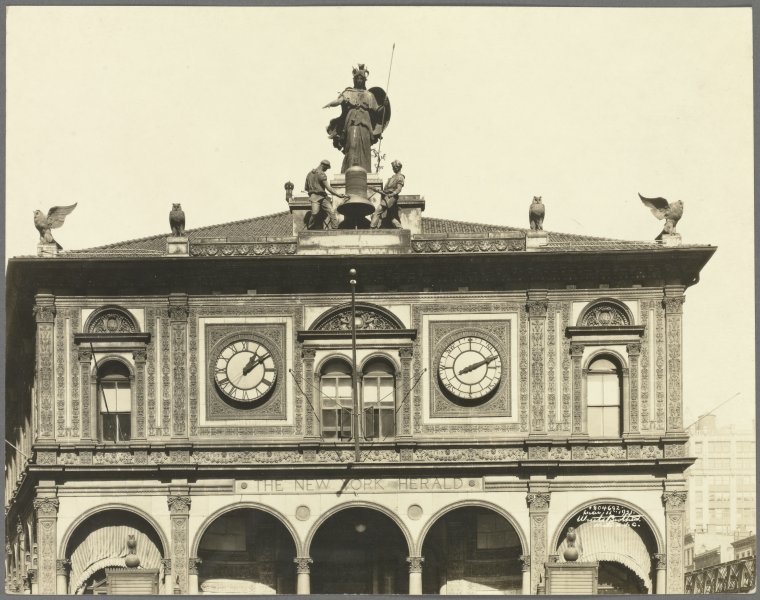
Bennett’s New York Herald Building, completed in 1894, sat at 35th Street between Sixth Avenue and Broadway, on the north side of the square his building would soon give its name. He wanted the structure to align with the theaters and hotels of the area; as designed by Stanford White, the New York Herald Building doesn’t tower over the neighborhood.

He wanted the newspaper to be essential to the rhythm and energy of this bustling intersection. It does so with its mysterious and fanciful ornamentation, its spooky owls, its ornate clock tower and its mechanical bell-ringers.

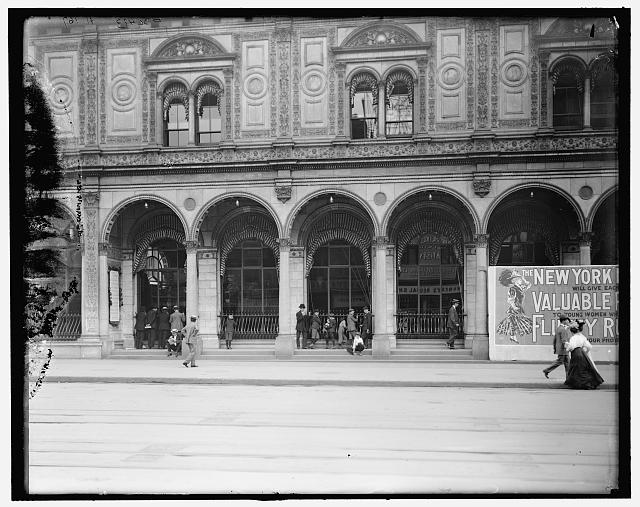
Below: the New York Herald Building, at 35th Street, between Sixth Avenue and Broadway, a frilly Italian-style structure at the nexus of a growing New York in the 1890s. [LOC]

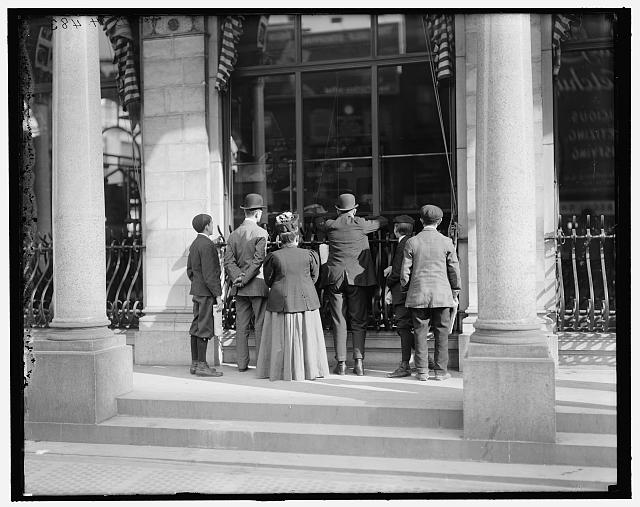
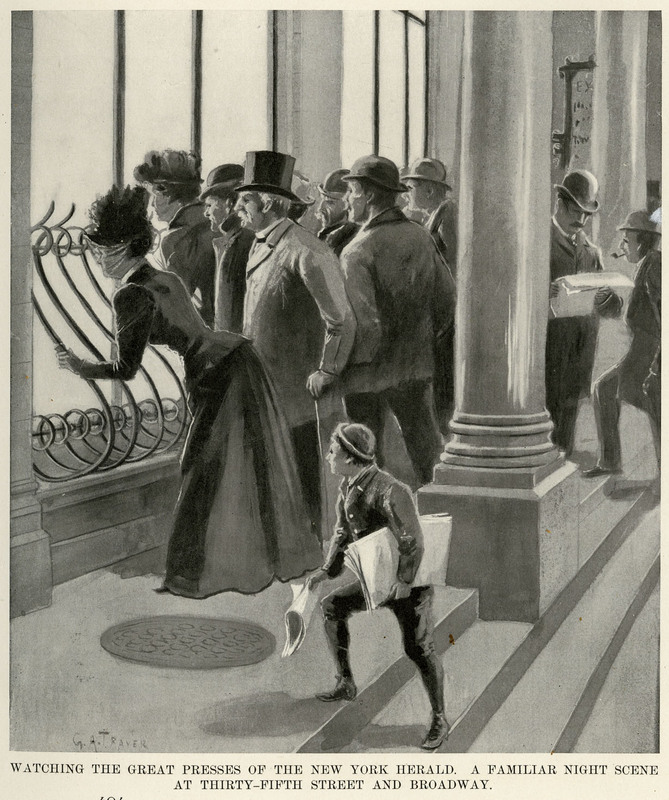
But the building became a component of the square with its open windows displaying the printing presses inside. Visitors would stand gawking as the presses furiously went about print the late-day editions. In the era before radio and television, the results of sporting events would be displayed on a billboard or “Play-o-Graph” that would attract thousands. It would be here that thousands of New Yorkers would gather to get the results of the World Series between the Red Sox and the Giants — occurring just uptown at the Polo Grounds!

The New York Herald Building became one of midtown Manhattan’s first big draws for regular New Yorkers and visitors to gather, get news, set their watches, dazzle at modern technology and ogle at the curious mix of high and low culture that sped through here. One decade later, Times Square would bring the same kind of excitement to another Broadway intersection.

Here are some additional views of the Herald Building, many romantic, most unbelievable, especially if you consider what sits there today:

Thousands of men gather to watch the results of the 1911 World Series — between the New York Giants and the Philadelphia Athletics — displayed on a “Play-o-Graph” at Herald Building. Sports results were telegraphed from inside the building, and a mini baseball diamond was regularly updated, mirroring the real time action. [LOC]

Spectators watch the Herald presses in action. {LOC}

From the Appleton publication The New Metropolis, 1899 (courtesy CUNY)

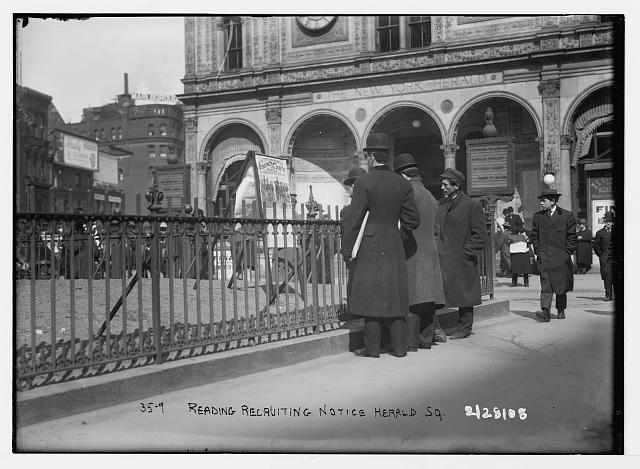
The square in front of the Herald Building would also be used for immediate announcement, often taken right from the telegraph. These men are reading a military recruitment advertisement. [LOC]

A closeup of the ornate clock, with the goddess Minerva, its two bell ringers Scruff and Guff, and the series of owls perched at various spots around the building. From March 1921 (Courtesy NYPL)

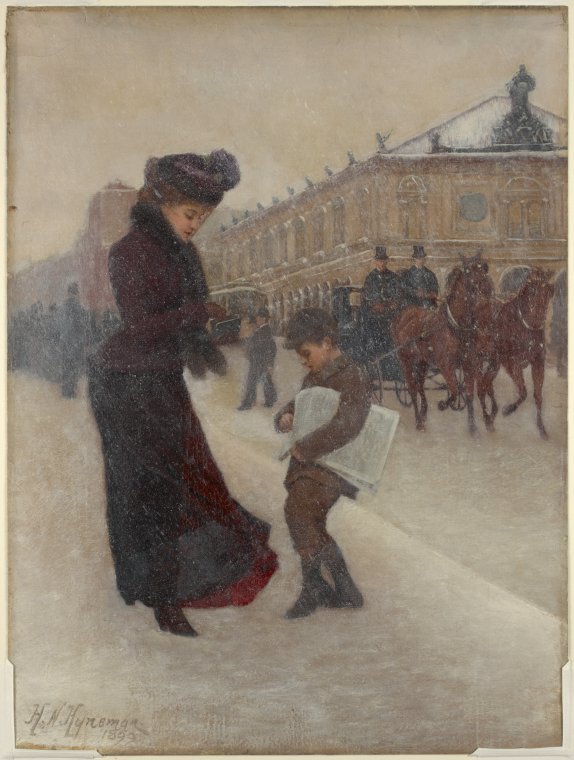
A painting by Herman Hyneman from 1899, depicting a Herald newsie and a customer in the snow. [NYPL]

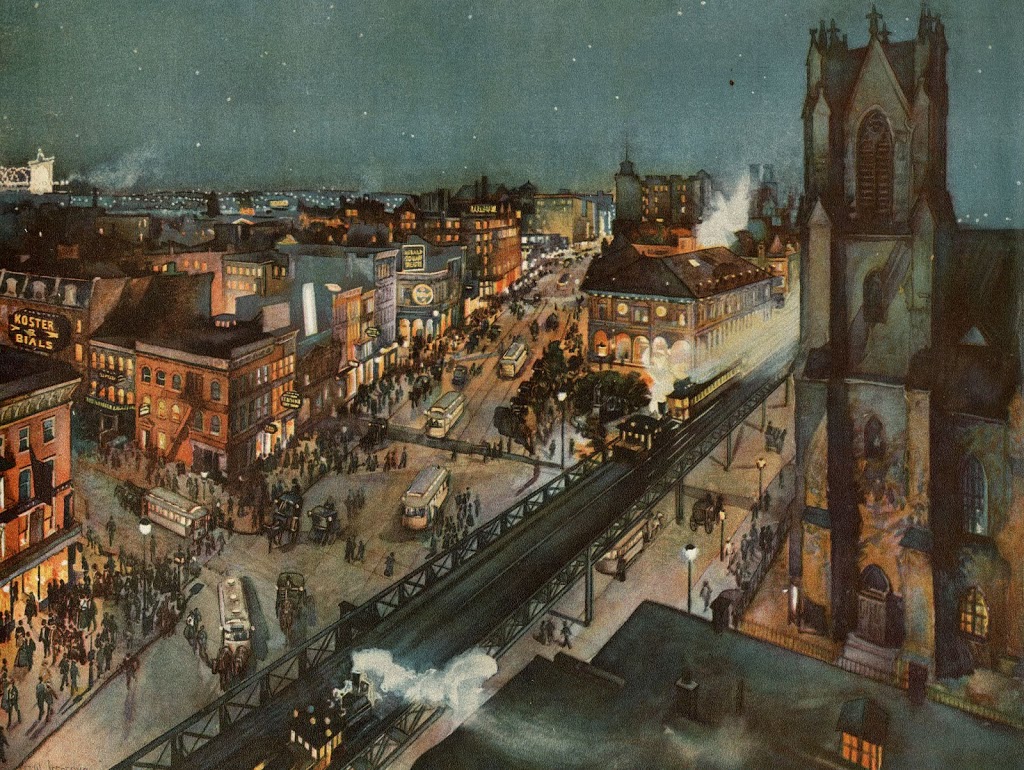
Also from The New Metropolis, an owl’s-eye view of Herald Square, from 1899.  The caption: “This is a vibrant reproduction of a color print by Canadian-born artist Charles William Jefferys (1869-1951) who once worked at the New York Herald. The Broadway Tabernacle Church, the 6th Avenue elevated train, the Herald Building and several theatres, including Koster and Bial’s, are depicted. The streets are teaming with cable cars, horse drawn vehicles and pedestrians.” Courtesy CUNY

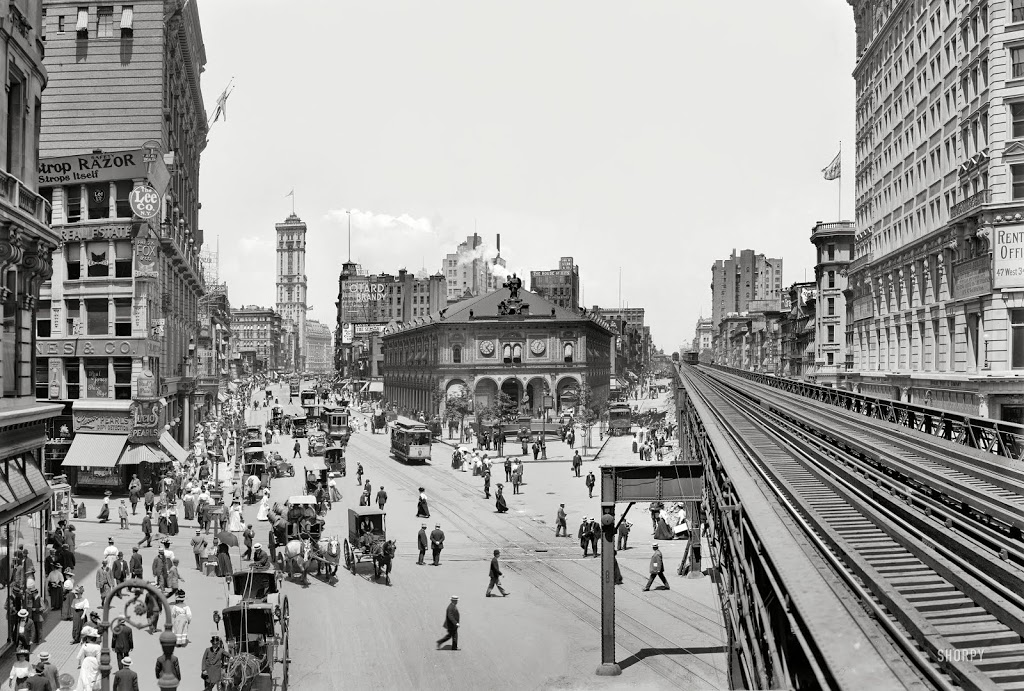
And finally, an overhead view of the entire square. This is an image that was cleaned up and published by the great photo blog Shorpy. Click into the picture to see a rather magnificent view of the surroundings. Trust me, you may waste five minutes just looking at this one….

Categories
Brooklyn History

Holidays on Ice 1861: Skaters flock to Brooklyn’s icy ponds

Williamsburg(h)’s Union Pond, one of the finest destinations for ice skating in the city, 1863. It later became America’s first enclosed baseball field.

The nation was at war one hundred and fifty years ago, but that didn’t stop the austere celebrations in the ‘borough of churches’. But while thousands of Brooklyn residents attended church that morning in 1861, many participated in a more whimsical holiday celebration — wild and uncontrollable ice skating.

So famous was the city of Brooklyn’s famed ponds — which reliably froze each winter — that New Yorkers by the boatloads crammed into ferries across the East River to join in the icy merriment. On really cold days, of course, it was often the East River itself that froze solid. But in 1861, an unseasonable warmth kept the river disappointingly liquid, forcing thousands of skaters upon Brooklyn’s small ponds where the ice quickly melted.

For instance, Washington Pond (at right), at 5th Avenue and 6th Street — then considered Gowanus, today it’s Park Slope — was normally ideal for skating. Horse-drawn streetcars took crowds right from the Fulton Ferry to the door of the nearby old stone house, built in 1699 and famous for its role in the Revolutionary War. (It’s why the pond is named for Washington, after all.) But on Christmas 1861, “the ice was unpleasantly rough” there.

Skaters may have found more success at other Brooklyn skating destinations. The Capitoline Skating Lake, near the train station in the former independent village of Bedford, was known as the “principle pond of the Western District.” In Williamsburg, the versatile ‘world-renown‘ Union Pond drew thousands during the winter and thousands more in the summer — as the nation’s first enclosed baseball field. On this particular day, the newly opened pond in its ‘gay and brilliant appearance’ was crammed with skaters laughing and caroling, in various states of sobriety.

By the afternoon of Christmas 1861, most of the closest ponds were mushy and nearly dangerous. At a pond on Third Avenue, “a gentlemen with two ladies fell trough the ice and took their Christmas immersion without any material damage save a very decided shivering,” according to the Brooklyn Eagle.

Urban ice enthusiasts were forced to follow the advice of horsecars festooned with the signs ‘Good Skating in East Brooklyn’. I’m not sure exactly where crowds went that day, but a New York Times article from a three years later lists several ‘free ponds’ that might have been available for ice skating that day, including Seller’s Pond “in Bedford, near the Jamaica Pond Road”, “Dumbleton’s Pond on Myrtle Avenue” and the Suydam’s Pond, “on Atlantic-avenue near the Hunters-Ferry road.”.

All that skating and merriment drove many to more intoxicating holiday spirits, preferring their drinks ‘on the rocks’, or as the 1861 Eagle reports, “the boys will insist that ‘Christmas comes but once a year’ and with it comes a large measure of ‘good cheer’ and so they must get cheerful.” The most serious altercation came with one reveler, tiring of throwing rocks at boys, attempted to pistol whip a police officer.

The more respectable Brooklynites traipsed home at dawn, as the gaslights meet the fading light, casting the wet snow in a bright glare. Many reformed again for choirs of caroling, or else to distribute presents at charity ‘Christmas tree exercises’, where children lined up outside downtown theaters hoping for presents and a gander at the gorgeously trimmed tree, sparkling with candles.

Top pic courtesy NYPL. Second pic courtesy the Old Stone House.

Notes from the podcast (#128): The Conspiracy of 1864

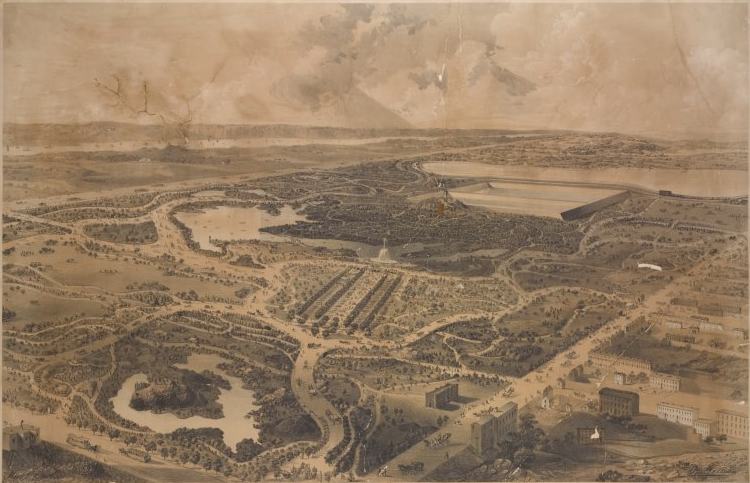
A depiction of Central Park from 1864. The conspirator’s cottage hideout would have been near the southeast corner. (Courtesy NYPL)

The year 1864 wasn’t as pivotal to New York City as 1863 (with the Draft Riots), but it is one of the stranger years I’ve ever come across in studying the city’s history, culminating in the failed attempt by Confederate spies to burn Manhattan’s hotels.

There is one important context about the attempted burning that we failed to mention. You couldn’t just walk around New York City in late fall 1864 if you were a Southerner. Because if intelligence claiming a potential attack on the city, any resident of the South had to register with the city. Our eight Confederate spies, of course, neglected to do this, and although they did indeed wear disguises and shuffle among different hotels to avoid detection, there is no evidence to suggest they disguised their voices.

A few other non-war events from 1864 that were not mentioned in the show:

Central Park was open to visitors but was far from completion. The new public space still felt remote to some New Yorkers — of the human kind, that is. People had begun abandoning unwieldy pets or livestock by securing them in one particular area of the park, in the southeast corner. In 1864, it became an officially chartered menagerie of animals, one of the first official American zoos.

Also that year — and quite against the original designs of Olmsted and Vaux — Central Park received its first statue. The honoree? William Shakespeare.

The area surrounding Gramercy Park was well established by Manhattan’s elite. Years after the disgrace of having a brother by the name of John Wilkes Booth, famed actor Edwin Booth would open his Player’s Club here. But further down on Irving Place, on 18th Street, a modest grog shop opened in 1864 on the ground floor of a building called the Portman Hotel. Drinkers there were certainly gossiping about the war and the Confederate attack on New York. The tavern has survived through various name changes and more than a few drunken artists and writers (including, most notably, O. Henry). You may know better today as Pete’s Tavern.

Some young men spend 1864 holding baseball bats, not rifles. The Brooklyn Atlantics were certainly one of the most well-known ball teams of the mid-19th century and one of the founding members of America’s first baseball league. And in 1864, the team played an undefeated season to capture national championship. (To be fair, to the team they bested was Eckford, also a Brooklyn team.)

For More Information: For a nice overview of New York City during the Civil War, seek out the out-of-print The Civil War and New York City by Ernest A. McKay. Nat Brandt’s The Man Who Tried To Burn New York takes a closer look at Robert Cobb Kennedy, one of the Evacuation Day conspirators. For a look at the conspiracy from the larger context of the war, check out Clint Johnson’s A Vast And Fiendish Plot. And of course, the excellent website Abraham Lincoln and New York, presented by the Lincoln Institute, is worth a look.

The Show Must Go On: And finally, in full, here is P.T. Barnum’s letter to the New York Times regarding the attempt by Robert Cobb Kennedy to burn down his American Museum.

“To the Editor of the New York Times:

In view of the announcement in the morning papers of the attempt to fire my Museum last night, as well as other public buildings, I wish to state the following facts:

Everyday from sunrise until ten o’clock P.M., I have eleven persons continually on the different floors of the Museum, looking to the comfort of visitors, and ready at a moment’s warning to extinguish any fire that might appear. From 10 o’clock at night until sunrise, I have from six to twelve persons in the Museum engaged as watchmen, sweepers, painters, &c.

I always have a large number of buckets filled with water on and under the stage, and a large firehose always screwed on to be used at a second’s notice. I never allow an uncovered light in the Museum, and I heat by steam from a furnace in the cellar.

As a proof of the efficiency against fire, I submit the fact that instead of “slight damage” being done to the Museum last night, as reported by a morning paper, so speedy was the extinguishment of the flames arising from the liquid ignited on the stairs, that not even a scorch is visible.

My own sense of security is proved by the fact that I never insure for one-third the value of the Museum property.

For the safety of visitors in the lecture-room, I long ago opened nine different places of egress, so that the lecture-room, if filled with visitors, could be emptied in from three to five minutes, and the spacious openings to the street in Broadway and Ann street, render mine, I think, as safe a place of amusement as can be found in the world. The Fire Marshal and insurance agents will corroborate this statement.

Very Respectfully,

P. T. BARNUM
AMERICAN MUSEUM, Nov. 26, 1864″

Brooklyn baseball: the Superbas and the worst batter ever

The New York Times this morning had an intriguing story about a unfortunate fellow who plays for the Chicago White Sox named Adam Dunn — nicknamed ‘the Big Donkey’.  This has been a banner year for Mr. Dunn as he is about to make the list as one of the worst players in the history of the sport.

It’s that list that brings the story back to New York. Dunn has a current batting average of .165. For you complete novices, that the number of hits Dunn has scored divided by the number of times he’s been at bat. (Ed.: I’m obviously one of those novices. Check the notes below for a clearer definition.) That is roughly my batting average when I played for my church softball team when I was nine years old.

According to writer Sam Borden, “a number like .165 will put his name in the record books for the lowest single-season batting average by an everyday player since 1909, when Bill Bergen, a catcher, hit .139 for the Brooklyn Superbas.” With a basic average of almost 9 outs for every 10 at-bats, who is this Bill Bergen and why was he allowed to play at all?

The history of baseball would be nothing without Brooklyn. Not only were some of the first leagues formed in the former independent city, but perhaps the sport’s most legendary team (the Brooklyn Dodgers) played here at Ebbets Field. The first enclosed ballfield, the Union Grounds, was built in 1862 in today’s Williamsburg.

Brooklyn’s first professional National League team in the 1890s went by many unofficial names. At one point, they were called the Brooklyn Bridegrooms — not the most rousing name — then the Brooklyn Robins. By the time Brooklyn consolidated with New York in 1898, the team received a new nickname, and from a surprising source.

A couple weeks ago I wrote about the daredevil vaudevillian acrobats the Hanlon Brothers, known for extraordinary feats of human agility mixed into theatrical extravaganzas. They made their debut at Niblo’s Garden in 1858, and fifty years later, their sons were still carrying on the tradition of thrilling audiences with their mix of fantasy, theater and gymnastics.

In the 1890s, the Hanlon sons focused their energies on two popular traveling variety shows, elaborate productions akin to a stadium rock show, often employing revolving stages, costumed casts, and sophisticated harnesses and props. The first, Fantasma!, would later be the subject of Thomas Edison’s early films. Their second, Superba!, would accidentally inspire the world of baseball.

In 1899, scrappy baseball superstar Ned Hanlon — who made his career in the 1880s in Cleveland and Pittsburgh — moved to Brooklyn to manage the then-named Brooklyn Bridegrooms.  Ned Hanlon was not related to the flamboyant Hanlon brothers in any way.  However, simply by confusion or a cheeky name-play by journalists, the team was soon called the Brooklyn Superbas, borrowing the title of the popular theatrical show. (You pronounce it the Su-PER-bas.)  The name stuck until the early 1910s, when the borough’s primary form of transportation inspired another nickname — the Trolley Dodgers, soon shortened to just the Brooklyn Dodgers.

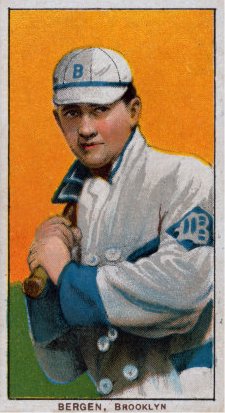
Bill Bergen (at left), the man with the lowest batting average in professional baseball history, was a catcher for the Brooklyn team during much of its Superbas era. Bill was a superb catcher — in fact, still considered one of the best by baseball historians — but a lousy batter. In 1909, he set that rather infamous batting average, and over the course of his entire eleven year career, he hit just two home runs.

Let us not criticize Bergen too harshly. Several years earlier, his big brother Marty Bergen, also a baseball star, suffered from devastating mental issues. In 1900, Marty murdered his own wife and kids with an axe, before taking his own life with a straight razor. That certainly makes a crappy batting average seem rather trivial.

And no, Brooklyn did not name its Bergen Street — which runs a dozen blocks north of Ebbets Field — after this early baseball star. The name of that lovely street has a far older history.

Categories
Podcasts

PODCAST: Williamsburg(h), Brooklyn

Williamsburg used to have an H at the end of its name, not to mention dozens of major industries that once made it the tenth wealthiest place in the world. How did Williamsburgh become a haven for New York’s most well-known factories and then become Williamsburg, home to such wildly diverse communities — Hispanic, Hasidic and hipster? Find out how its history connects with whalebones, baseball, beer, and medicine for intestinal worms.

Listen to it for FREE on iTunes or other podcasting services. Or click this link to listen to the show or download it directly from our satellite site.

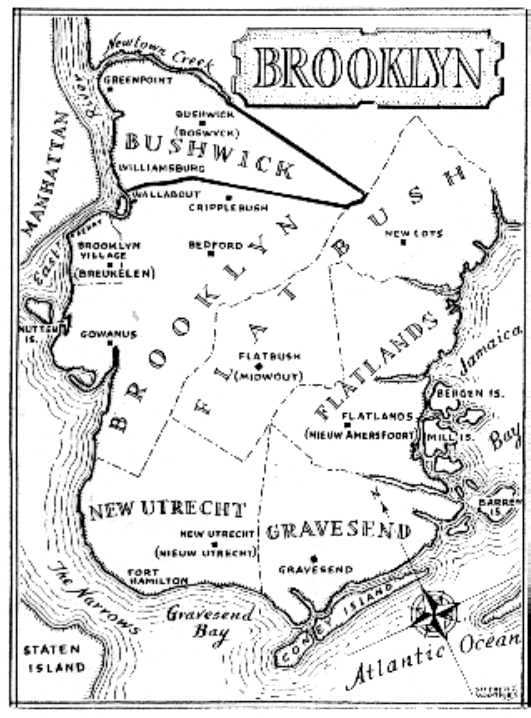
A modern map of the townships of Kings County. Cripplebush is listed here as a settlement in Brooklyn. The dense undergrowth that gave Cripplebush its name stretched well into the jurisdiction of Bushwick, which the Dutch actually called Boswijck.

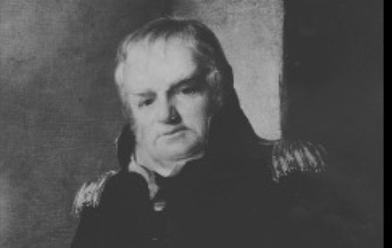
The esteemed Lt Col. Jonathan Williams, who surveyed the land along the Bushwick shore and eventually gave Williamsburg its name. You can also find his handywork at Castle Clinton and Castle Williams (also named after him).

Another father of Williamsburg, David Dunham, can still be found today on a very tiny street near the bridge called Dunham Place. (Forgotten New York has a great look at this odd little side street.)

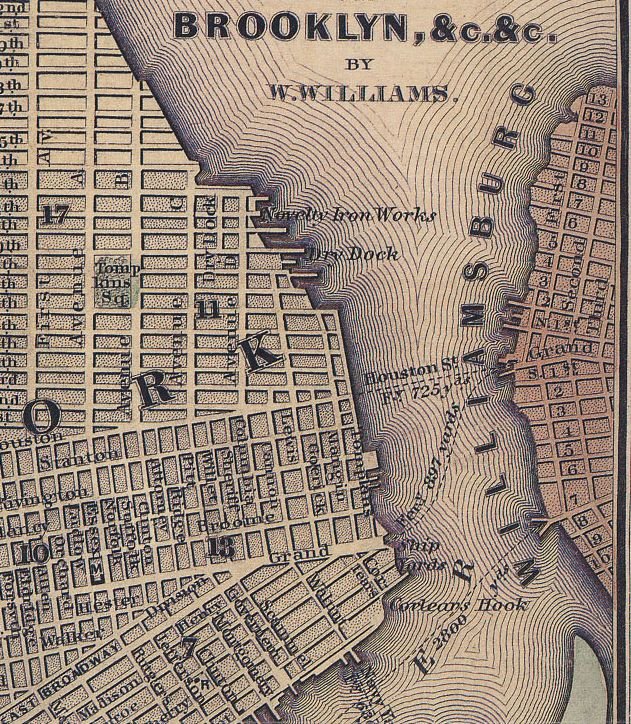
A detail from this mid-19th century map of New York and Brooklyn indicates the two ferry paths across the East River from the Grand Street dock in Williamsburg.

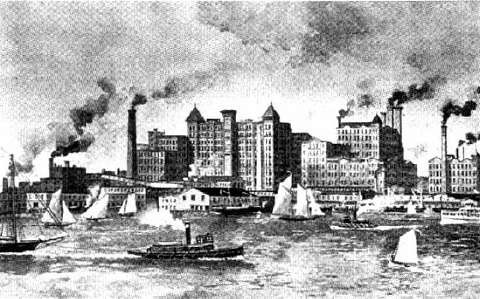
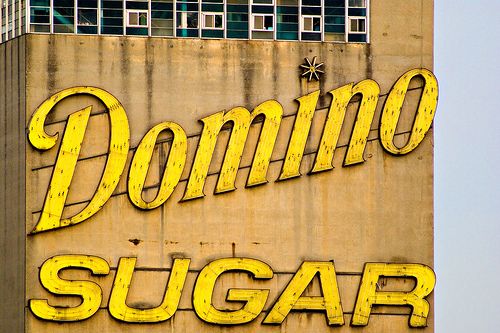
The Williamsburg waterfront during the 1880s. Havemeyer’s sugar refinery became one of the most profitable businesses along the East River. It became Domino Sugar in 1900.

While Havemeyer’s factory, closed in 2004, has been landmarked, its future could include a vast complex of condominiums — but with community opposition and a $1.3 billion dollar price tag, is it viable?

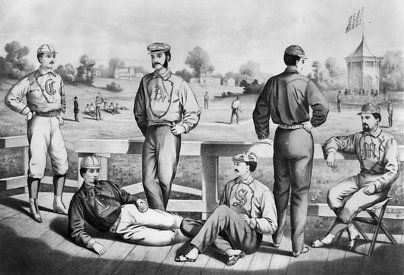
These fancy guys are relaxing after a vigorous game of baseball at the Union Grounds, the first to fence in the playing field and charge spectators. Check out our previous article on this historic place and where you can find its location today.

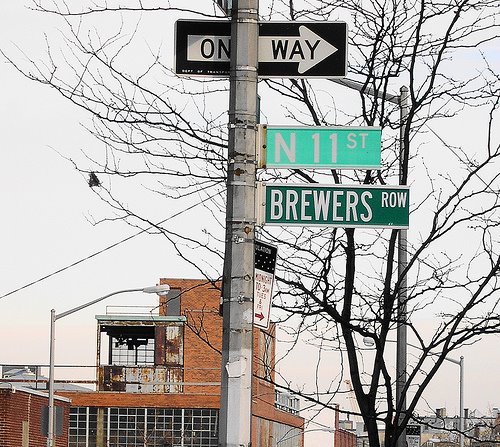
There are no more breweries along Brewer’s Row, but the once grand boulevard of beer makers that stretched from Williamsburg to Bushwick is still recognized on street signs.

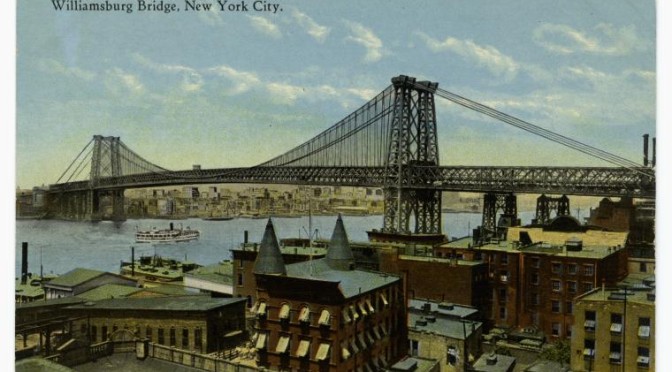
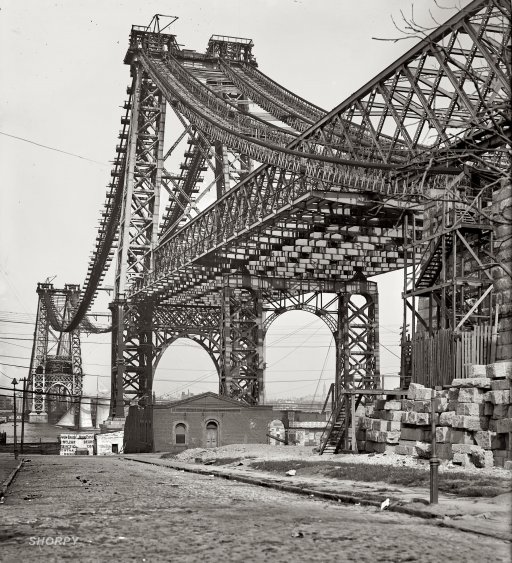
The East River Bridge (today the Williamsburg Bridge) in 1902. It would be opened a year later, opening the neighborhood to thousands of new residents fleeing overcrowded Lower East Side (pic courtesy Shorpy)

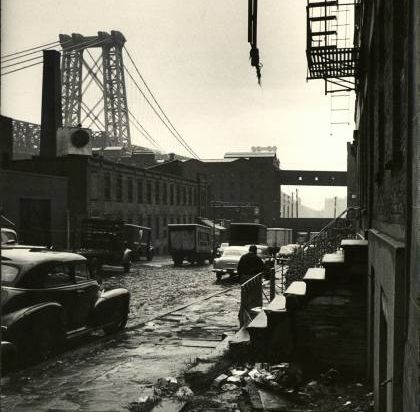
Williamsburg in 1954, not the sunniest place ever. Photo by Alfred Eisenstaedt (LIFE archives)

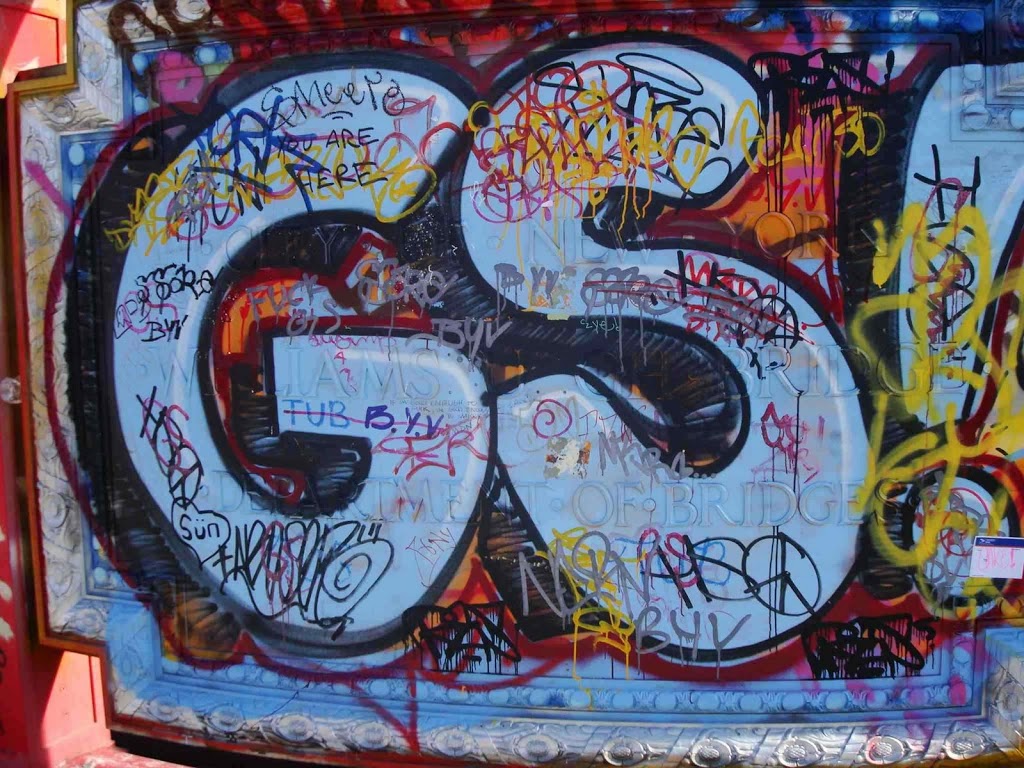
Look really closely at this dedication found at the pedestrian fork on the Williamsburg Bridge. If you scrape away the graffiti, you’ll see Williamsburg with an H on the end. (Click it to get a closer look.)

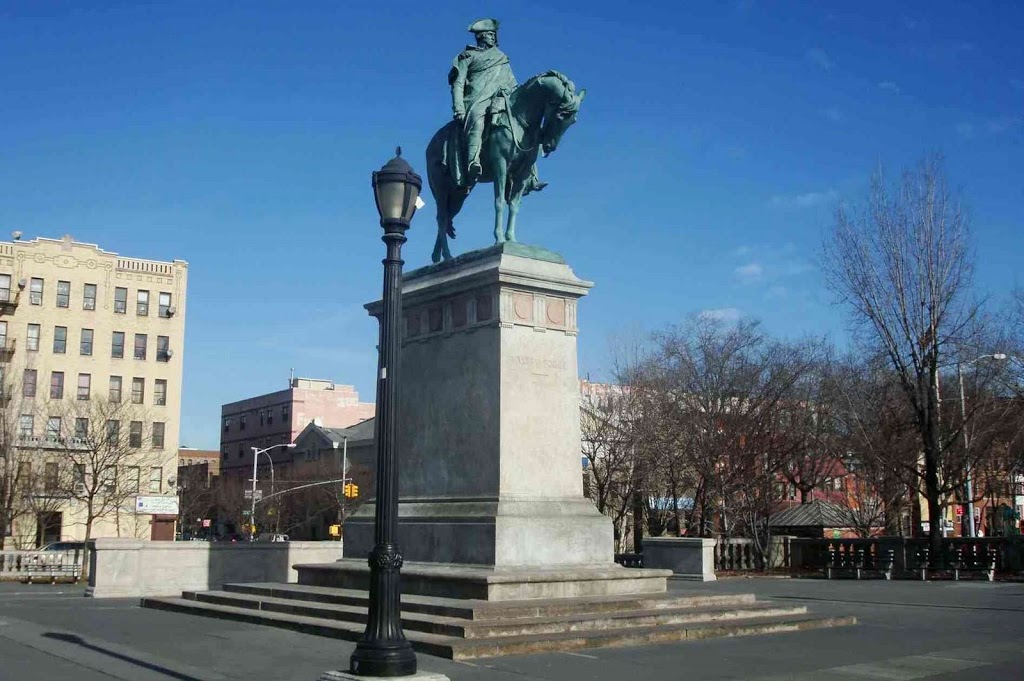
Continental Army Plaza, now overlooking the entrance and exit ramps of the Williamsburg Bridge. An engraving in the sidewalk points towards Valley Forge. The statue and the plaza were installed shortly after the opening of the bridge. So, in fact, this has pretty much always been George’s view.

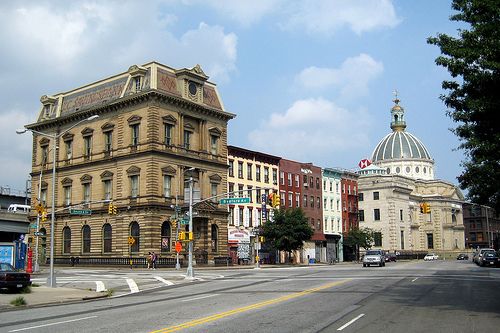
Two gorgeous examples of Williamsburg’s opulent past — the Kings County Savings Bank (built in 1868!) in the foreground, and the George Post’s domed Williamsburgh Savings Bank in the distance. (pic courtesy Flickr)

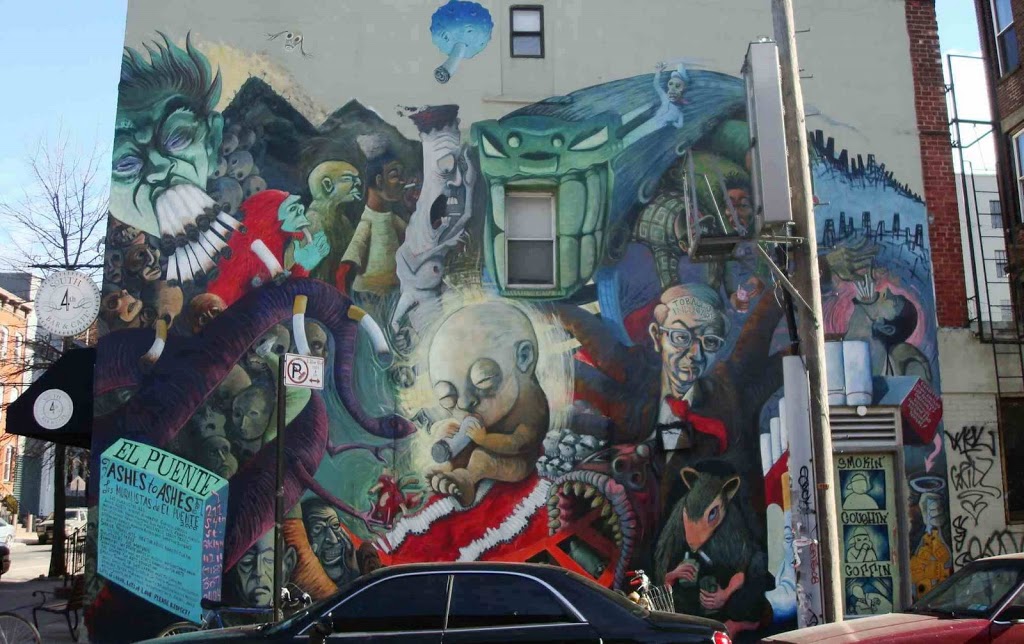
A mural just north of the bridge. Don’t smoke, kids!