Categories
Skyscrapers

The Big Wind of 1912: New York skyscrapers in peril, as monster gales hurl “men and women down city streets”

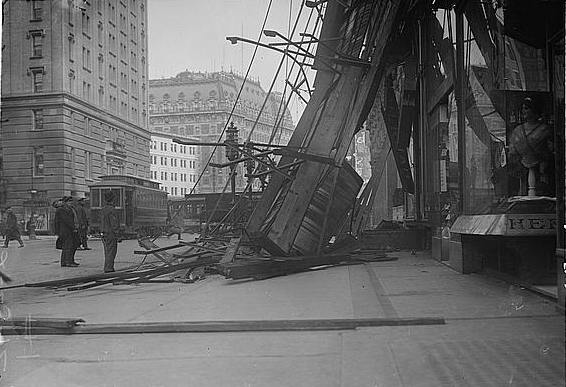
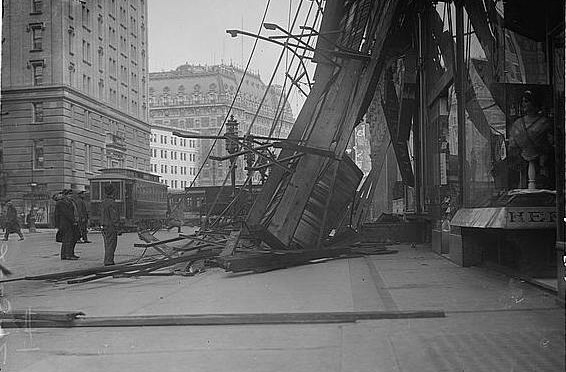
Trauma in Times Square: An electrical sign destroyed by the massive windstorm of February 22, 1912. One Times Square sits to the left, and the Hotel Astor is in the distance. [LOC] Shorpy has an another angle of this damaged storefront.

“The great gale that blew in with Washington’s birthday will not soon be forgotten. It was the biggest New York ever knew.” — New York Evening World, Feb. 23, 1912

 On February 22, 1912, a catastrophic weather anomaly occurred in New York City, an event the New York Times referred to as ‘The Big Wind’.

This particular day has also been called “a significant day in the history of tall buildings,” although I doubt anybody today will be celebrating this rather vicious and sudden test of architectural endurance.

New Yorkers thought it might be worse. The storm system began the previous day as a blinding Midwestern blizzard, paralyzing the railroad and killing cattle. St. Louis received its greatest snowfall ever up to that time from this churning storm, and Chicago reported winds of up to 50 miles per hour.

If it held this pattern by the time it hit the East, New Yorkers feared another storm of the level of the Blizzard of 1888, which buried the city in snow, rendered transportation useless, and killed more than 200 people.

In one respect, the city was fortunate that snowfall was relegated to upstate New York. The grim meteorological trade off, unfortunately, was a day of powerful, otherworldly wind gusts, almost double the strength of those during the infamous 1888 storm.

The worst of it came after midnight, when a terrifying frozen bluster “swooped down on the city with all its length and breadth” at speeds of 96 miles per hour.

At one point, devices in Central Park registered an unthinkable 110 miles per hour. By morning it had settled to 70 miles per hour and held that speed steady for much of the day. [source]

Some called this “giant among gales” a day-long cyclone, and it certainly acted like one — uprooting trees, destroying rooftops and even depositing whole houses into the river. People were blown off their feet, carts went flying and pedestrians dodged falling telephone poles in terror.

Most leaving home wearing hats ran back inside without them.  If any of those women from yesterday’s Astor Place post were trekking through the plaza with their home-work today, they most likely lost it to the wind.

Foremost on the minds of most New Yorkers was the fate of its skyline. In 1888, during the last harsh storm, there were no skyscrapers. In 1912, there were several over 30 floors, including the city’s tallest, the 50-floor Metropolitan Life Insurance Tower off Madison Square.

Although most buildings were designed to withstand significant wind trauma, none of them were prepared for winds above 70 miles per hour. And the building slated to become the next tallest in New York — the Woolworth Buildingwas still under construction, its metal skeleton now a potential arsenal of deadly debris.

Panes of glass shattered throughout the city, but it appears most of New York’s tallest structures survived without significant damage. In fact, it was the shorter, older structures that fared worst, many of them designed with little protection from powerful winds.

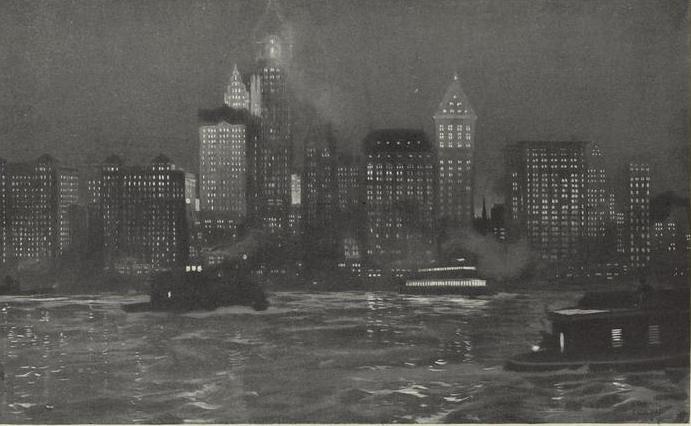
Below: the downtown Manhattan skyline in 1912. Most of these buildings survived the ‘Big Wind’ with only damage to their windows. [pic]

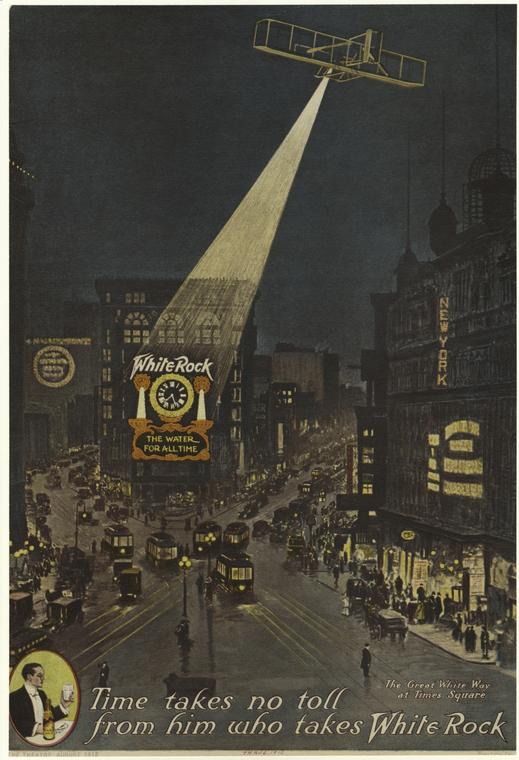
Not that modern invention came away unscathed that day. The electrical signs of Times Square, many no more than a few months old, were no match for the powerful gusts. Several were destroyed, including a one provocative sign at 47th Street, featuring “two scantily clad electric boys who box nightly in Summer underwear.” [source]

Next to the Hotel Knickerbocker, a 200-foot electric sign crumbled to the sidewalk below in front of Hepners Hair Emporium, a police officer racing into the establishment a minute before the sign crashed into the plate glass window of the railroad ticket office next door.

Across the street, at the Times Building, a drug store window exploded, and “many bottles of perfume and drugs” were hurled at passers-by.

Most boats all along the waterfront were either damaged or untethered. Predictably, beach houses on Rockaway Beach and other quieter locales fared the worst. The luckiest structures survived with nary a window remaining; those less fortunate were found floating offshore. In Astoria, Queens, the roof to the jail was taken off, to the fright of the occupants inside.

At right: Times Square in August 1912. The White Rock sign was probably not around for the February wind storm. The ‘electric boys’ sign described above sat at this intersection.

In Red Hook, Brooklyn, turbulent winds kept a raging fire alive at a brick manufacturing plant, distributing flaming pitch shrapnel to several buildings across the street, including a hay and horse feed dealership! (One of many reasons they don’t keep hay dealerships in crowded cities today.) The brick factory, which took several hours to control, was about three blocks from the location of today’s IKEA store.

February 22, 1912, happened to be the 180th anniversary of George Washington‘s birth, and hundreds of veterans tried marching from Jefferson Market to Union Square. Flags raised aloft in celebration were torn to ribbons. Nobody was injured, although the gusts caused major inconvenience, “Salvation Army object lessons and banner bearers bowled over by the wind.”  [source]

Others were not as fortunate. The Times attributed at least one death to the storm and over a dozen concussions from flying debris, messenger boys and seamstresses blown into windows or railings or hit by signs or dislodged cornices.

One man, waiting for his wife at St. Patrick’s Cathedral, had his neck slashed by flying glass. Where physical harm was avoided, humiliation took its place. A society woman on Riverside Drive, wearing “superabundantly costly furs,” was picked up and thrown into a horse.

Meanwhile, down at the Battery, Frank Coffyn was preparing for another takeoff off the water on his pontoon-equipped airplane. The wind had other plans, ripping the wings off the plane and spoiling Coffyn’s flight. Later that day, Coffyn wired his old boss Wilbur Wright for replacement parts. (See my previous post for more information of Coffyn’s harbor flights..)

By the late evening, winds had died down to a mere 44 miles per hour. (For comparison, New York City’s average wind speed today is just 12.2 miles per hour.) In the morning, things were back to normal — except for huge mess of metal and glass left scattered on the streets.

Categories
Gilded Age New York Podcasts

Frozen in time: The Blizzard of 1888 knocks New York City off its feet, creating the deadliest commute in history

PODCAST This year is the 125th anniversary of one of the worst storms to ever wreak havoc upon New York City, the now-legendary mix of wind and snow called the Great Blizzard of 1888.

Its memory was again conjured up a few months ago as people struggled to compare Hurricane Sandy with some devastating event in New York’s past. And indeed, the Blizzard and Sandy have several disturbing similarities. But the battering snow-hurricane of 1888, with freezing temperatures and drifts three stories high, was made worse by the condition of New York’s transportation and communication systems, all completely unprepared for 36 hours of continual snow.

The storm struck in the early hours of Monday, and many thousands attempted to make their way to work, not knowing how severe the storm would be. It would be the worst commute in New York City history! Fallen telephone and telegraph poles became a hidden threat under the quickly accumulating drifts.

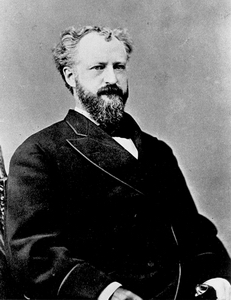
Elevated trains were frozen in place, their passengers unable to get out for hours. Many died simply trying to make their way back home on foot, including Roscoe Conkling (at right), a power broker of New York’s Republican Party.

But there were moments of amusement too. Saloons thrived, and actors trudged through to the snow in time for their performances, And for P.T. Barnum, the show must always go on!

STARRING: Hugh Grant (although maybe not the one you’re thinking)


NOTE: And, yes, we can’t believe the timing of this one, releasing on the same date of an ACTUAL blizzard. We really had this one planned for awhile, delayed it a bit because it seemed too eerie to do it so close after Hurricane Sandy.

So if you’re in New York or the northeast United States, stay inside, stay safe and let this podcast be the only dangerous snow drifts you experience this week!


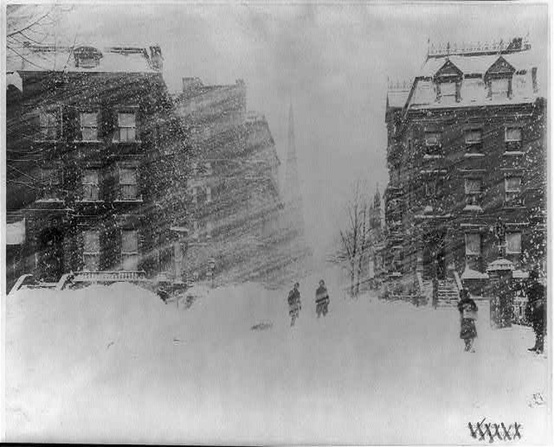
In the blizzard of 1888, the streets disappeared and the snow came down almost horizontally. Imagine being trapped at work, several miles from your home. This was the plight experienced by thousands of New Yorkers (and others throughout the northeast) that Monday. (Library of Congress)

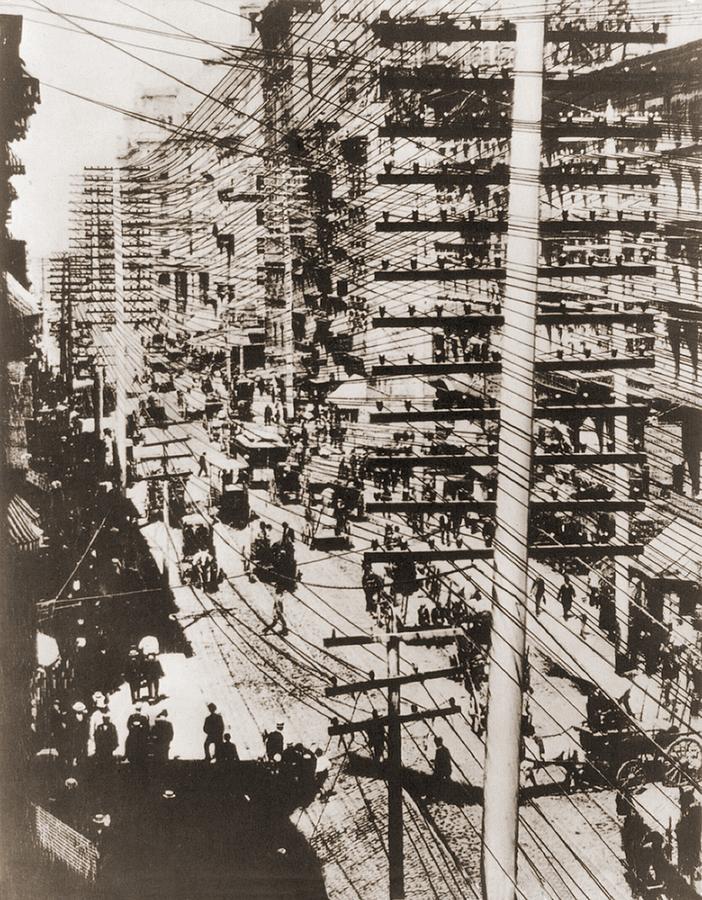
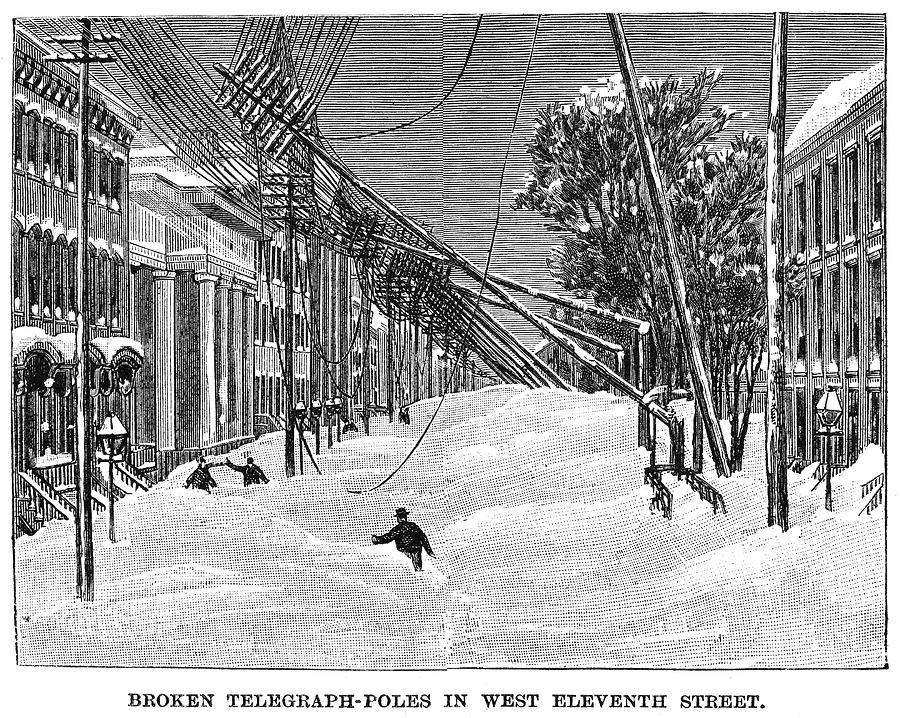
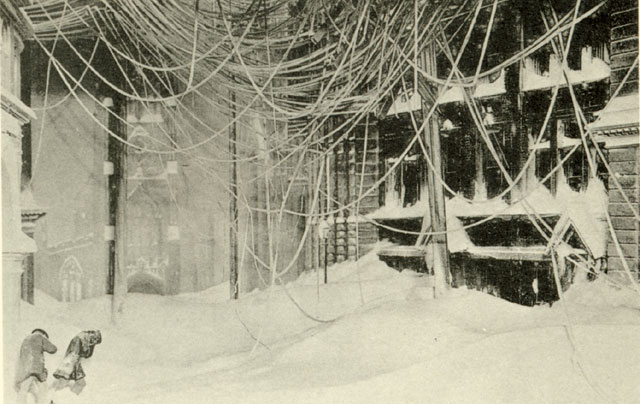
Why did the 1888 blizzard become such a hazard for New Yorkers? Let this picture be your first clue. The city was a cobweb of elevated telegraph, telephone and electric wires. This picture is from 1887. (LOC)


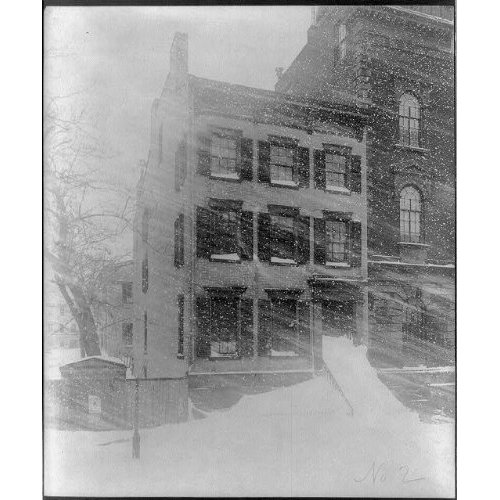
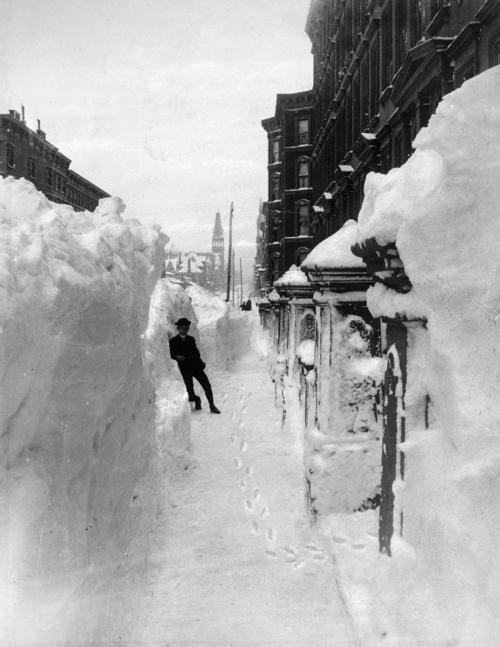
One example of a terrible (although minor) snow drift that might have kept this family in their home all day. Because of the unpredictable changes in wind, some houses might have been drift-free, while others close by completely locked in with snow. (LOC)

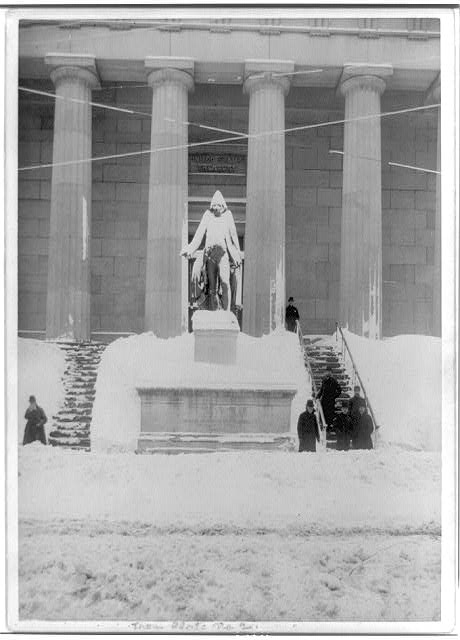
George Washington at the Sub-Treasury Building (today Federal Hall). I ran this photo a few weeks ago, but it’s so bizarre that I think it needs a second posting.

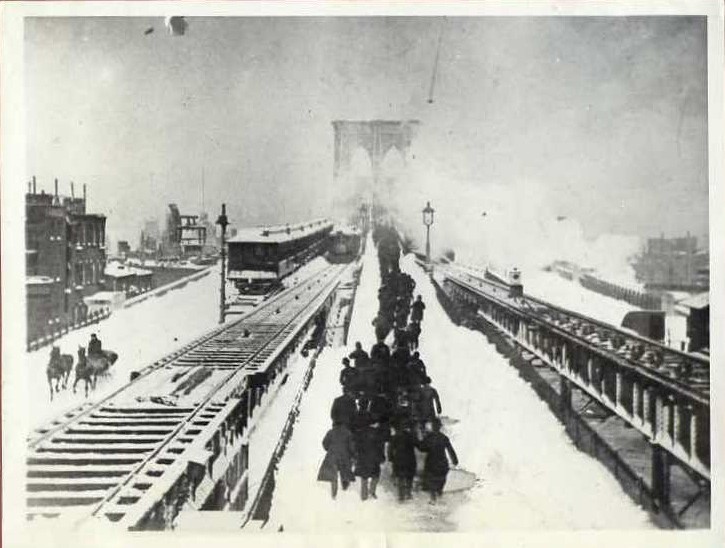
The Brooklyn Bridge, not even five years old, weathered the winds quite well, but became a hazard due to ice. In this picture, people are crossing over as there was no other way to get between Manhattan and Brooklyn. It’s not clear if any of the trains are operating in this picture.

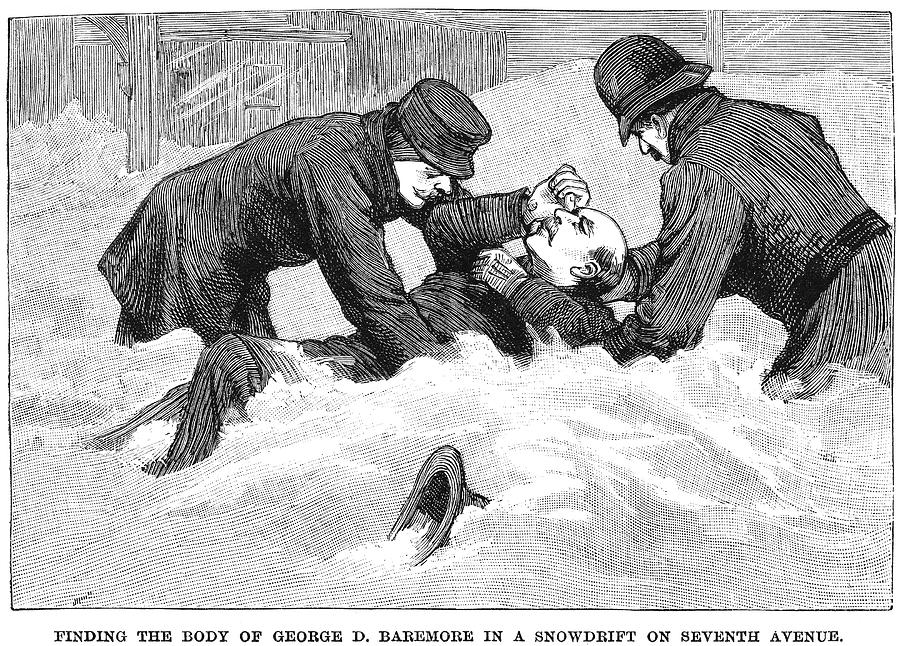
The biggest danger for those venturing outside were the hundreds of downed telegraph, telephone and electrical poles, no match for the intense gusts. The poles would quickly fall then get covered with snow, creating deadly hazards for people walking past. The snow would just as quickly cover over an unconscious individual; many New Yorkers froze to death when they fell and were instantly shrouded.


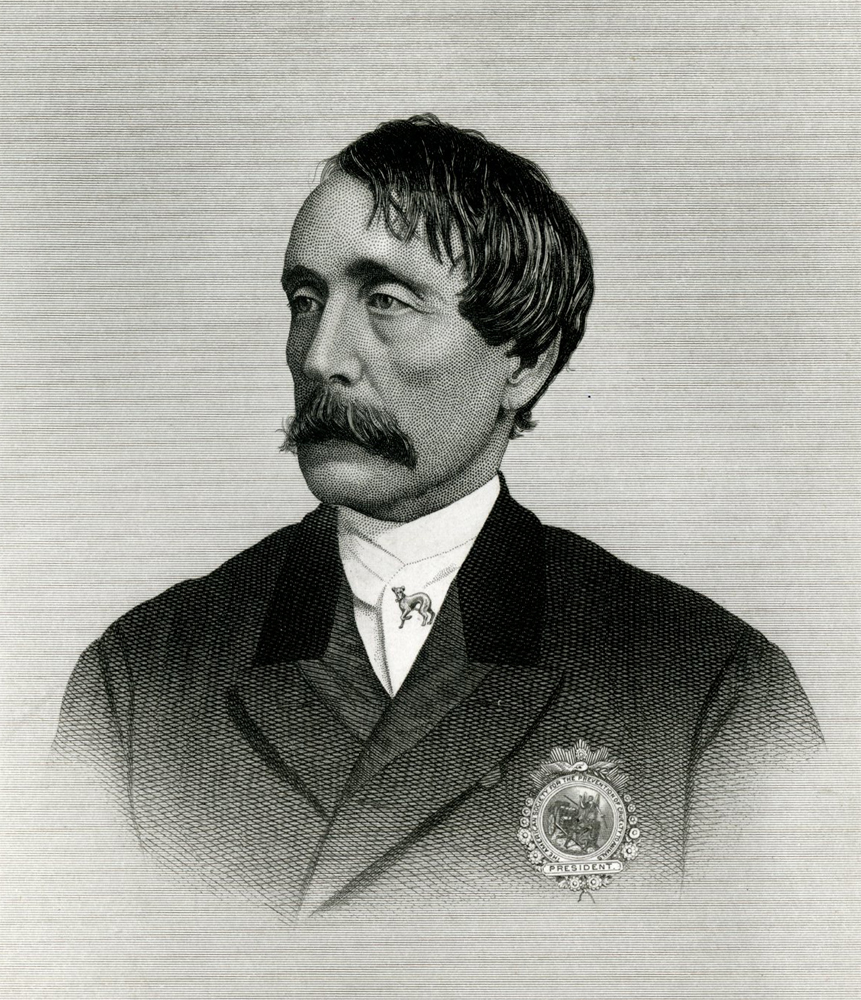
Henry Bergh, founder of the American Society for the Prevention of Cruelty to Animals. He did not survive the blizzard. (NYHS)

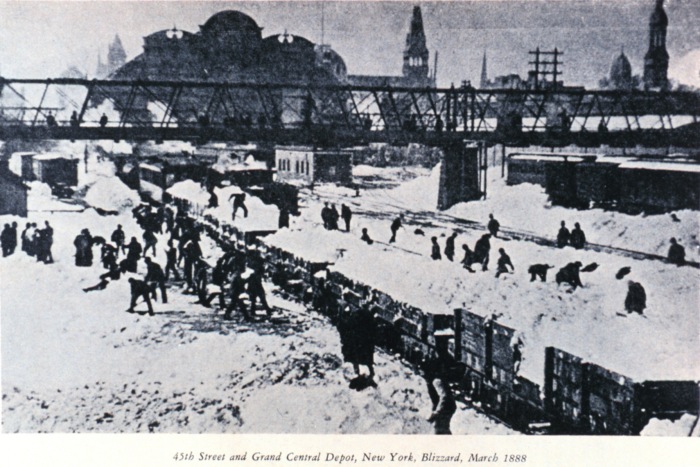
Transportation in and out of the city was at a complete standstill for half the week. Here workers frantically try to clear the way for trains going into Grand Central Depot.


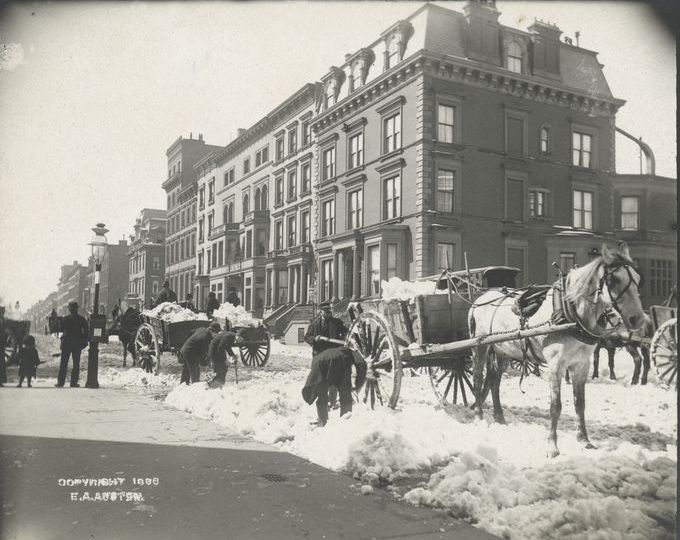
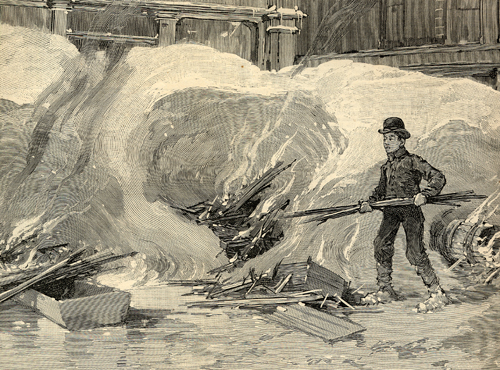
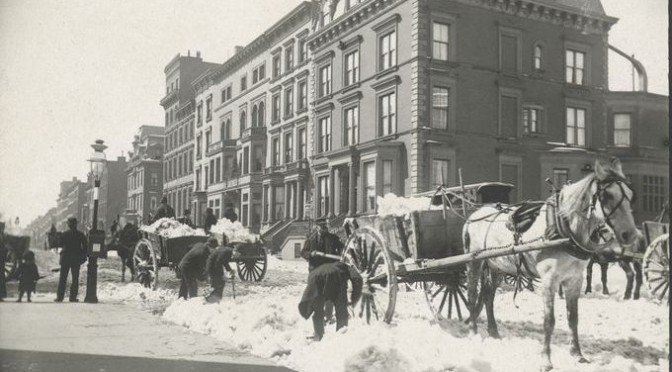
Clean-up was truly chaotic, a feeble effort by the city paired with private contractors with horses, shovels and carts. The piles of snow were taken to water’s edge and dumped, or, in a few less preferred cases, people just started bonfires and melted it away. (For a great picture of a snow dump in the river, see this photo at Shorpy of a blizzard from 1899.) Top pic courtesy LOC, at bottom Maggie Blanck.


The cover of Frank Leslie’s Illustrated Newspaper, usually one of the more sensational pieces of journalism people might have found at their newsstand.

Categories
Gilded Age New York

Before Al Roker and Sam Champion, there was Farmer Dunn, New York’s weather guru of the late 19th century

How did New Yorkers know to panic over the weather in the 19th century? How could they know to run through the streets in terror at the upcoming snowpocylpse/blizzardtastrophe if there was no brightly colored Accuweather radar or a friendly weather person with perfectly coiffed hair?

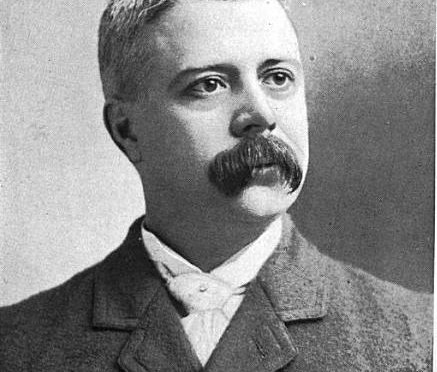
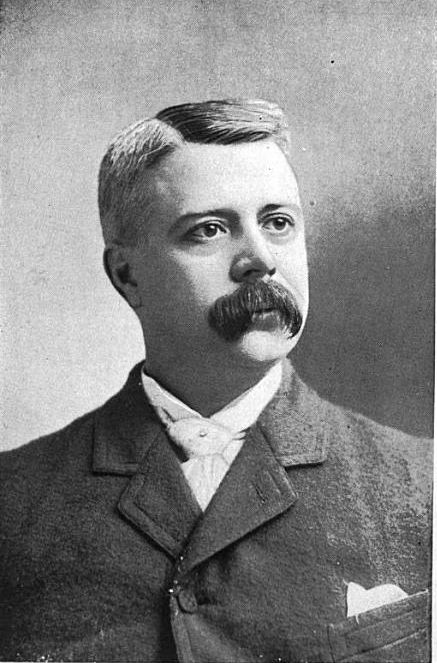
In the 1880s, New Yorkers turned to one man — the Brooklyn-born Sergeant Elias B. Dunn (at right, with his dashing moustache, 1902).  He was so trusted for his weather predictions — more accurate than an almanac! — that he was given the almost devout nickname of Farmer Dunn.

Nationwide weather forecasts had been steadily compiled by the federal government since 1814, but such  prognostications — or “probabilities” as there was sometimes called — were never taken very seriously until the late 19th century.

With the invention of the telegraph, a national signal office was established in 1870 and placed under the auspice of the Secretary of War as it was believed that “military discipline would probably secure the greatest promptness, regularity and accuracy in the required observations.”  Members of the military were enlisted throughout the United States to telegraph current weather conditions to the Washington D.C. signal office, where meteorologists could piece together the information and make more accurate predictions.  In 1890, this responsibility was moved to the Department of Agriculture.  (This is where Dunn got his unique nickname.)

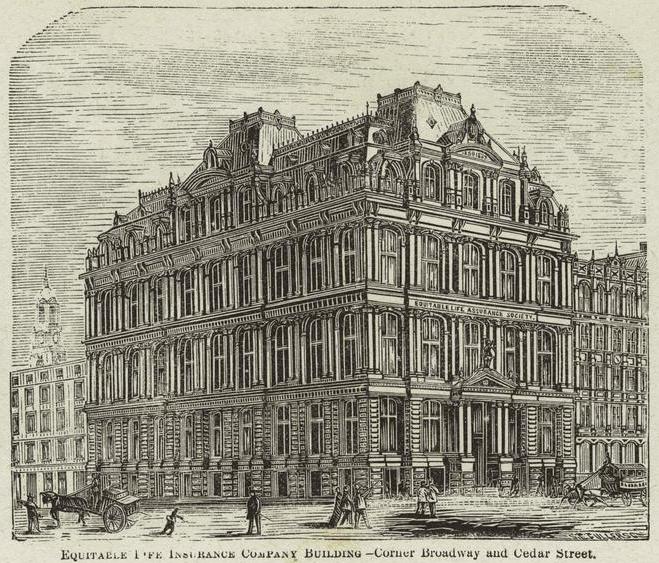
New York’s weather conditions were assigned to Dunn, a decorated sergeant, and a four-man team, set up in a telegraph office located in the 1880s at the old Equitable Building at 120 Broadway. (In 1894, they moved to the taller Manhattan Life Building at 64-66 Broadway.)  The team would telegraph present conditions by using barometric instruments located on the roof.  They would then report statements from the D.C. signal office to the press.

Below: the original Equitable Building, headquarters for Farmer Dunn and his telegraph crew. The ornate structure famous burnt down in 1912 during a frightfully chilly evening. (courtesy NYPL)

Dunn “is one of the very best known men in the city.” according to an 1894 New York Times article.  “His popularity, except with his legion of friends, is of a varying quality.”  Farmer Dunn would embody the weather for many New Yorkers;  his name would be cursed when it rained and praised on sunny days.

When his predictions failed, he was jovially mocked in the press. “ELIAS IS NOT A PROPHET,” declared the Times in 1895 after a sudden rain dampened spirits on Independence Day.

He was a man of science, eschewing folk traditions of predicting weather. “We made a list of all the farmers’ beliefs and the sailors’ beliefs, and we submitted them to investigation,” Dunn told the New York Sun.  “The result that we found was that they just don’t work out.  The study of weather is an exact science which cannot be left to squirrels and nuts.”

Dunn was on hand during one of the worst weather events in New York City history — the Blizzard of 1888, which struck the city just after midnight on Monday, March 12.  He and his team frantically sent telegraphs to DC and received no response, as most of the telegraph poles further south had been dismantled by the storm’s brutal winds.  In fact, it was only when he received a message from London — via the Atlantic Cable, buried under the ocean — that he realized the full impact of the blizzard.

Later in life, Farmer Dunn became a published author, spilling his meteorological secrets in books such as “The Weather and Practical Methods of Forecasting It.”  He must  have inspired an entire generation of buddy weather enthusiasts, describing technical terms in a plain manner and even recommending equipment.  For instance, if you were looking for a polymeter (it “gives the relative and absolute humidity”), Dunn recommends purchasing one from “Gall & Lemlike, 21 Union Square.”

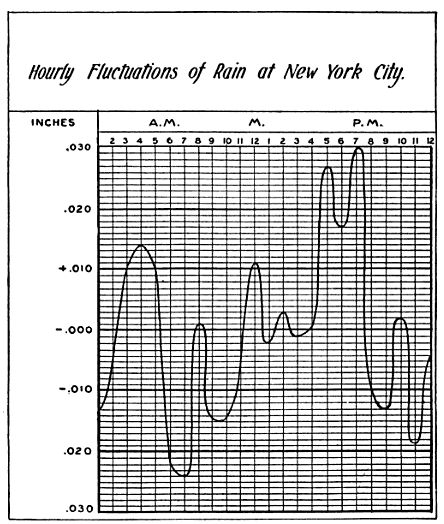
At right: An illustration from Dunn’s book, 1902

He also became a popular newspaper columnist, distributing such wisdoms in 1900 as “the popular idea that the spots on the sun produce excessive heat on the Earth is erroneous.” (source)

It seems he also got into the “moving picture” business, although I can find no other information on this other than the fact that he sued Thomas Edison in 1900!

Later in life, Farmer Dunn ran as a Republican for a seat in the U.S. Congress. He was touted for his six-word platform: “Americanism; local option; no entangling alliances.”  He lost, which he did not predict.  The weather guru died in 1943, enjoying many years of retirement in Miami.

Panic at the Polo Grounds: The first Boston-New York World Series sparks an insane stampede 100 years ago

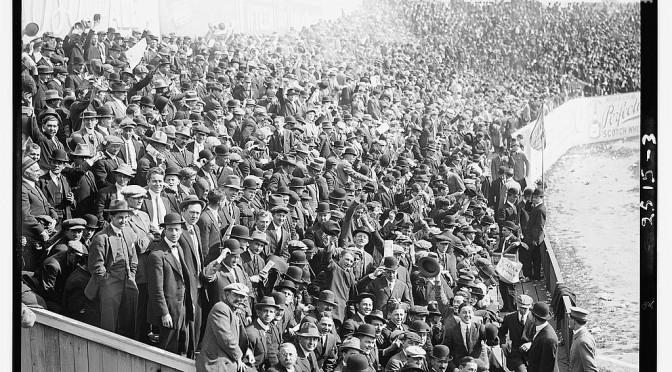
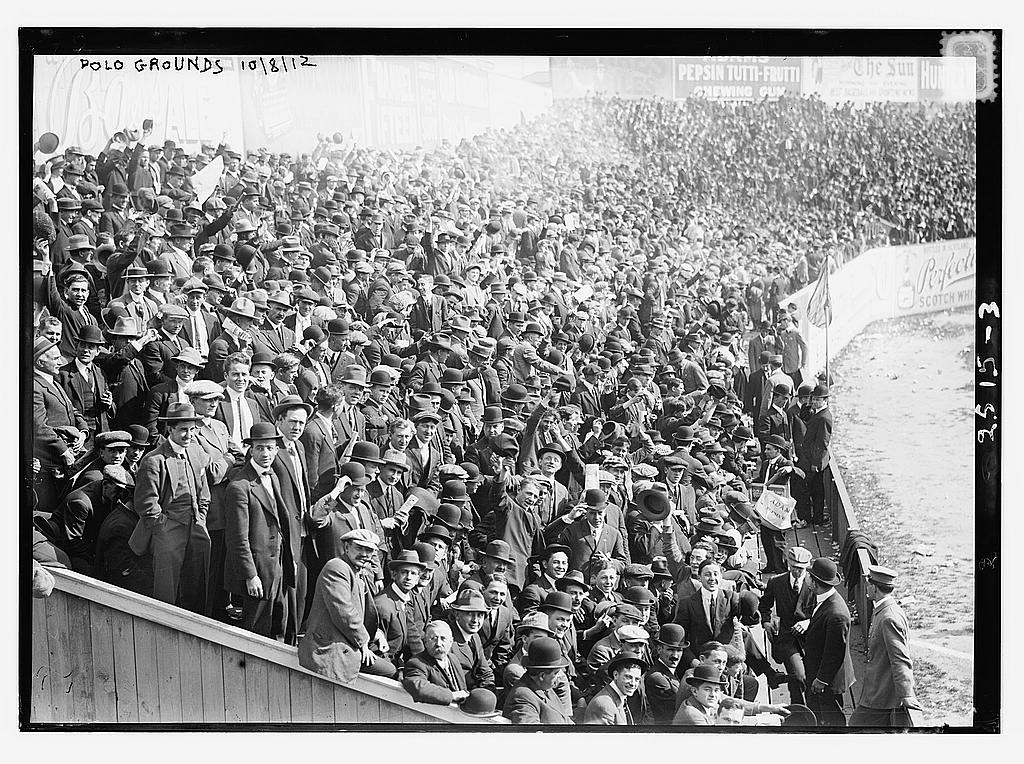
Above: the crowds at the Polo Ground for Game One. Many of these same people were certainly on hand for the fateful Game Four.

One hundred years ago today, in the frantic fall of 1912, even as the nation was in the midst of an intense three-way race to elect a new president, New Yorkers and Bostonians were overwhelmingly — perhaps even unnaturally — distracted.  For the first time ever — since the introduction of the World Series baseball championship in 1903 — a New York club was finally battling for ultimate victory against a Boston team.

The two cities had been in perpetual competition for most of their history; organized sport merely provided a formalized outlet to rally regional pride. [For more information, check out my article on the roots of the Boston-New York rivalry.]

The two cities should have already met on the diamond for the 1904 World Series, as the New York Giants were victors of the National League, while the Boston Americans led the American League.  Boston clutched that particular victory by defeating another team from New York, the upstart New York Highlanders (who later became the Yankees).

However, the Giants refused to play the Americans in the World Series, a tantrum thrown by managers aimed at the ‘inferior’ American League (originally the junior circuit). Rules were changed the following year to make championship play between the leagues compulsory.

Eight years later, in 1912, the New York Giants were matched against the same Boston team under their new name — the Boston Red Sox.  No hesitation this time around.  They were undeniably the two best terms in America, and both clubs were determined to win the title for their home cities.

For this Series, teams shuttled back and forth between Boston’s Fenway Park and New York’s premier baseball venue of the day, the Polo Grounds.
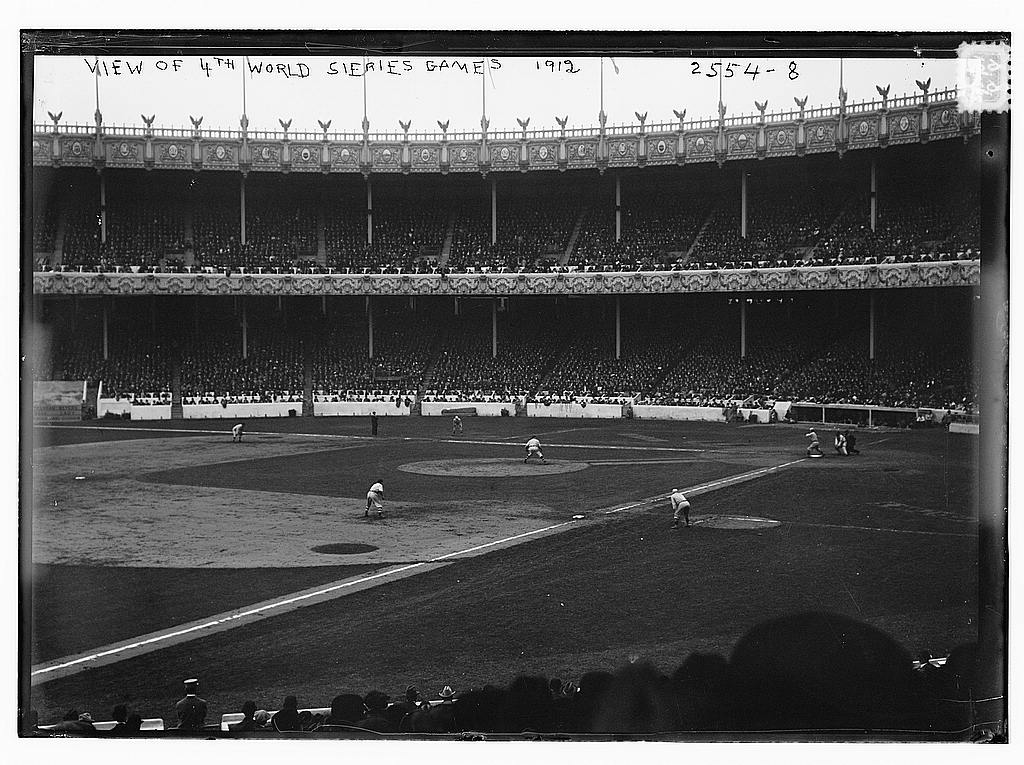
Above: A view of the Polo Grounds during Game Four, absolutely packed to the rafters

Game One, played at Polo Grounds, went to Boston.  Game 2, at Fenway, lasted so long — eleven innings — that the game was declared a tie on account of darkness. (Night baseball wouldn’t be played at Fenway until 1947!)  New York then won the second game at Fenway the following day, tying up the match.

For a fourth consecutive day of baseball, the teams were to return to the Polo Grounds (located at W. 157th Street and 8th Avenue). New Yorkers had the momentum, anxious to build upon their triumph in Game Three.  Both teams, already exhausted, packed into trains and headed back down to New York, arriving that evening at Grand Central. The Giants headed to their respective homes in the city, the Red Sox to their accommodations at Bretton Hall on Broadway and 86th Street.

Fans were already so excited for Game Four the next day that some were already lined up at Polo Grounds before the players even arrived in New York.

Unfortunately, one curious obstacle threatened to ruin everybody’s good time: mud.

The Polo Grounds were an uncovered grass field and throughout most of that evening it was pelted with rain, turning this fairly new ballfield (re-built in 1911 after a fire) into what the Evening World called “a mysty mystery” of gray and yellow-brown fog.  The infield was protected by a tarp, but the outfield was battered by the elements. Was it in any condition for a major baseball game?
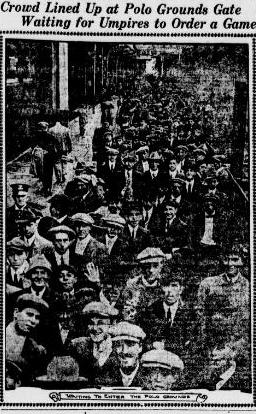
Commissioners failed to decide that morning whether the game could commence, and baseball fans grew restless. Well, that’s an understatement. Giants fans were enraged. “[T]he lynching-hungry scream of an infuriated mob” filled the air around the stadium, as thousands more joined the brave few  still in line from the night before should the field reopen.

An Evening World reporter followed a groundskeeper along the soggy field who lamented, “They can play on it, all right … Sure, they can play, but oh, me poor grass!”

Umpires were given a police escort into the Polo Grounds at 11 a.m. to inspect the condition of the field. By that time, the mob was practically foaming at the mouth, with “a blood-curdling shriek of 10,000 fans stretch[ing] from 157th Street to 140th Street, thousands and thousands of them.” [source]

At left: Photo from the Evening World, 10/11/12

Precisely at noon, the commission, located at the Waldorf-Astoria, telephoned to announce that the baseball game could be played, and the throng thundered into the stadium. The Evening World compared it to the Spanish running of the bulls. “[N]o man of this generation ever saw such racing and pounding along the sloping approaches of the Polo Grounds and began slamming down seats at one minute past twelve o’clock today.”

According to New York Post columnist Mike Vaccaro in his book on the 1912 World Series ‘The First Fall Classic’, the stadium filled to capacity with thousands more watching from various nooks and crannies, over 40,000 people, “officially…the third largest in this history of this stadium (and, thus, the history of the sport) but unofficially shattered that record to smithereens.” Many thousands more listened in to an announcer in Herald Square.

And so, here’s the punchline: after all that madness, the New York Giants lost the game, on the muddy and thoroughly distressed Polo Grounds, to the Boston Red Sox, 3-2! The New York Times intoned, “Nine Grim Innings To Red Sox Victory.”

In fact, they went on to lose the entire series to Red Sox.

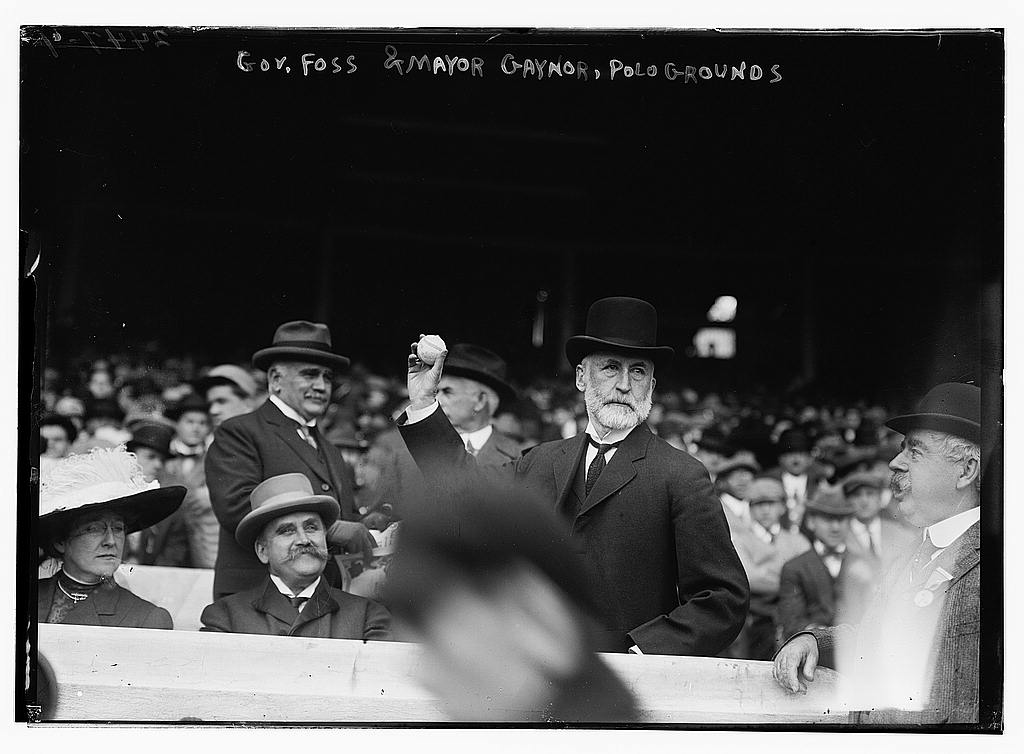
Below: For Game One, Mayor William Jay Gaynor threw out the first pitch, sitting alongside the mustachioed Massachusetts governor Eugene Foss. Less than a year later, Gaynor would succumb to injuries brought on by a bullet lodged in his throat, the unlucky souvenir of an 1910 assassination attempt. [Read more about Gaynor here.]
Scenes from a snowstorm: Clearing streets in old New York


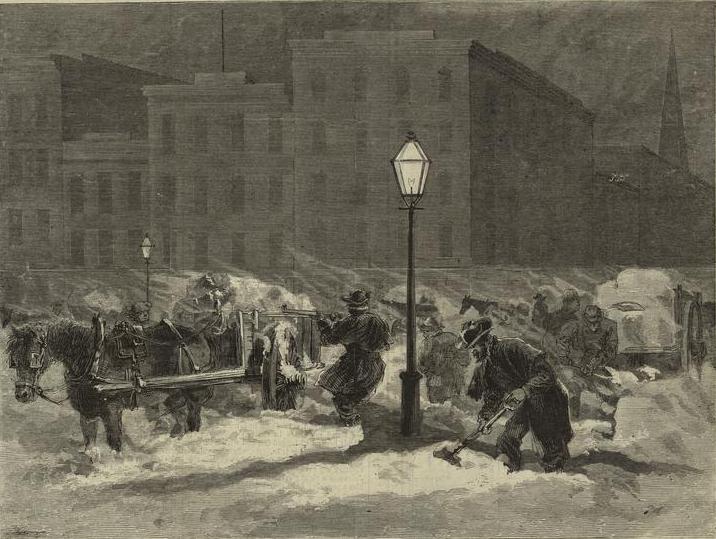
Above: The slow, bitterly aggravating work of clearing the streets of New York during the blizzard of 1888.

The second largest snow-filled month in New York City history! The snowiest January ever! The eighth biggest snowstorm ever! These are some of the records being thrown out this morning after last night’s wild thunder-filled snow apocalypse.

Most of New York’s big snow and cold weather records have actually happened in February and the infamous Great Blizzard of 1888 was even in March.

The biggest snowstorms of all time are all a part of recent history, including the largest on Feb. 11 and 12, 2006, with almost 27 inches of snow. Coming in a close second was the mess that fell upon New York the day after Christmas in 1947, delivering 26.4 inches of snow.

But I really think we need to factor in degree of difficulty when talking about horrible snowstorms. Would you rather endure the massive storm last night, or the 24 inches of snow that fell upon New York exactly 206 years ago today in 1805, over the course of three days? Can’t exactly clear the roads very well with a horse-drawn carriage, can you? Can’t salt a sidewalk that doesn’t exist!

Not for lack of trying. The Harper’s Weekly illustration below details a snow clearing effort from 1867, with men slowly making their way down an impassible road, shoveling the snow into carts pulled by beleaguered horses.

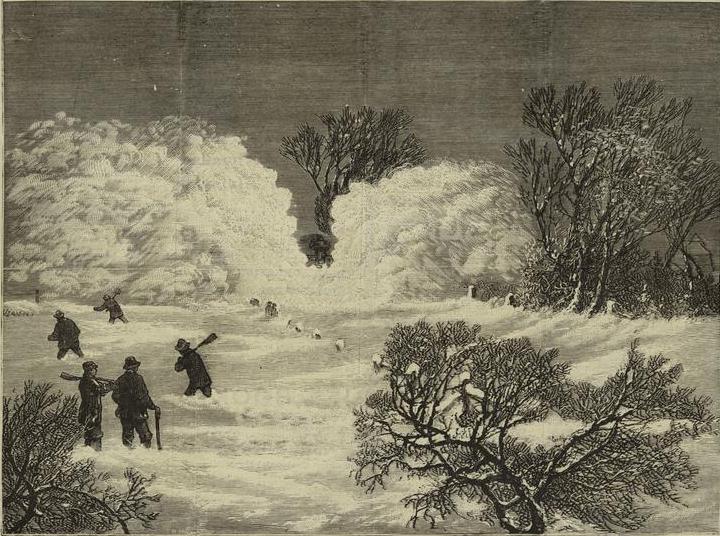
Early trains just pushed through the mush. During the storm of 1888, a train aiming for Grand Central Depot derailed while attempting to shove aside mounds of snow. In the picture below, from an 1877 “January snow blockade“, a Long Island Railroad locomotive hopefully has better luck:

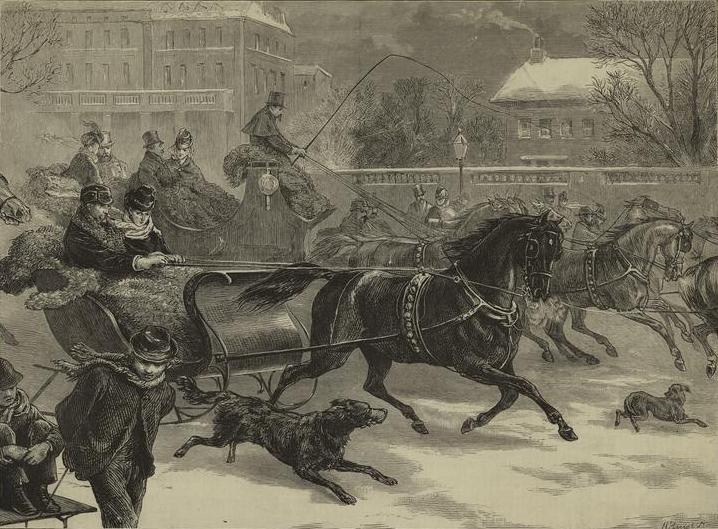
If you chose to go outside during a wretched 19th century storm, most likely you took a ferry — if you could get to one and the waters weren’t frozen — or you braved it on a sleigh, not exactly the safest form of transportation.

The illustration below, from 1872, depicts the street scene in Harlem, several years before the elevated railroad spurred on massive growth for the former village. It still would have been very remote; during the summer, horse-fancying businessmen would take their steeds to the streets in races. (This was a particular pastime of Cornelius Vanderbilt.) The sleighs below are clearly wealthier people from lower Manhattan, enjoying the village’s relatively untouched icy paths. (NYPL)

(Interestingly, it was the death of one of Boss Tweed’s bookkeepers in a sleigh accident in Harlem in December 1870 that set in motion the corrupt politician’s downfall. So watch yourself there, kids!)

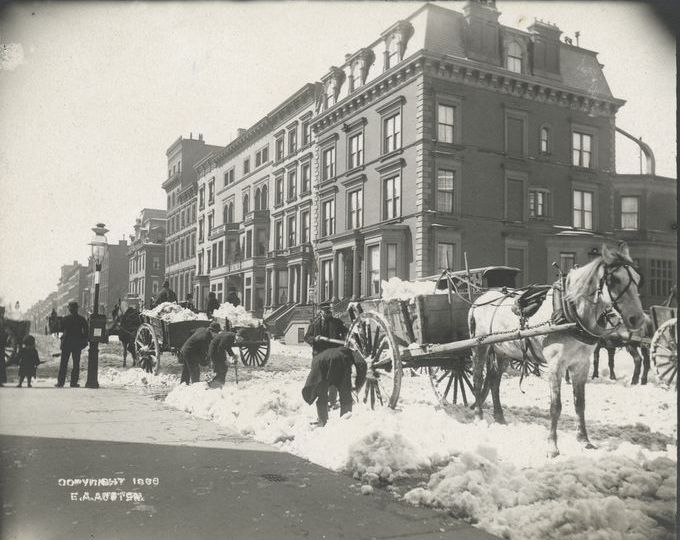
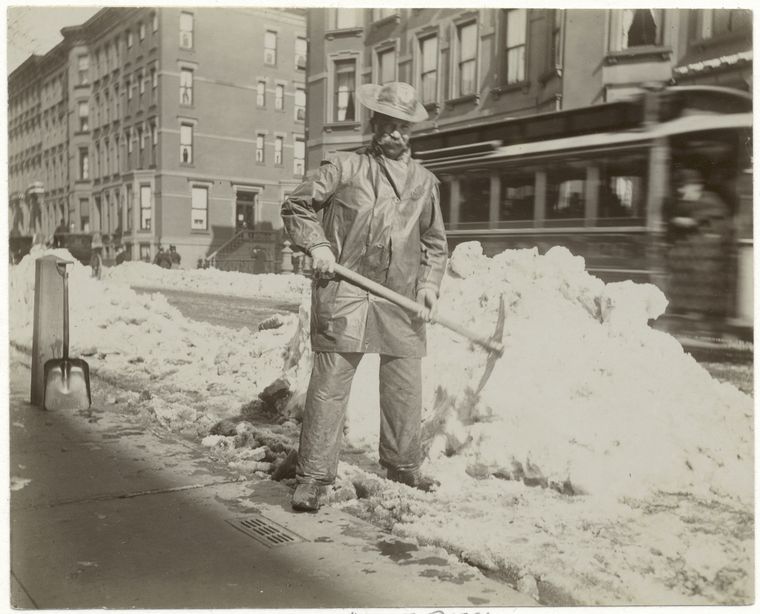
Clearing sidewalks hasn’t gotten easier over the years, although I suppose building owners have a greater responsibility now to clear the ways in front of their properties. The gentleman below, from an 1896 Alice Austen photo, tackles the frozen mush with a unique tool — is there gold in that there snow? — as a streetcar makes its way past. (source)
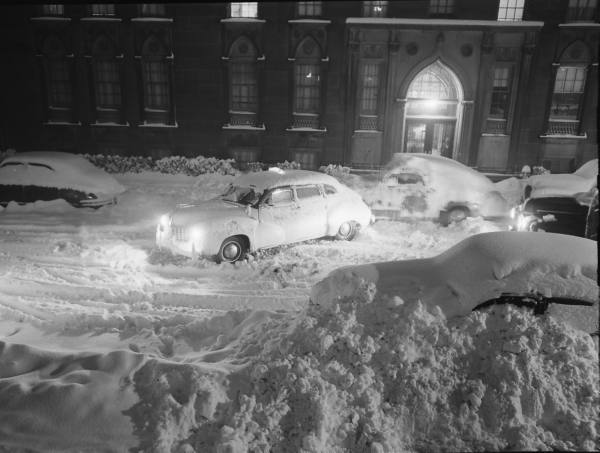
With the introduction of the automobile, the city has been able to clear streets more efficiently. But it creates another problem: pushing snow to the side creates small iceberg-like mountains that make it challenge to park and impossible to handle if you’re the unfortunate owner of a parked car in its wake. Below: A cab struggles to handle a messy street in 1948. (Photographer Cornell Capa, LIFE)

Most images above courtesy the New York Public Library digital collection, except for the last, from Life Google images..