Categories
Gilded Age New York Podcasts

Frozen In Time: The Great Blizzard of 1888

PODCAST The story of the devastating snowstorm that changed New York City forever.

Every winter, as forecasters gaze upon a gruesome impending storm, they always mention one of the worst storms to ever wreak havoc upon New York City, the now-legendary mix of wind and snow called the Great Blizzard of 1888.

The battering snow-hurricane of 1888, with its freezing temperatures and crazy drifts three stories high, was made worse by the condition of New York’s transportation and communication systems, all completely unprepared for 36 hours of continual snow.

The storm struck on Monday, March 12, 1888, but many thousands attempted to make their way to work anyway, not knowing how severe the storm would be. It would be the worst commute in New York City history. Fallen telephone and telegraph poles became a hidden threat under the quickly accumulating drifts.

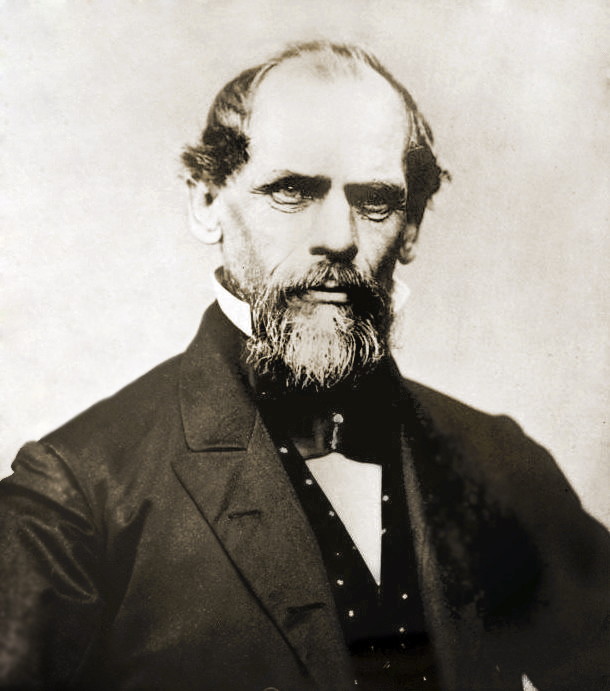
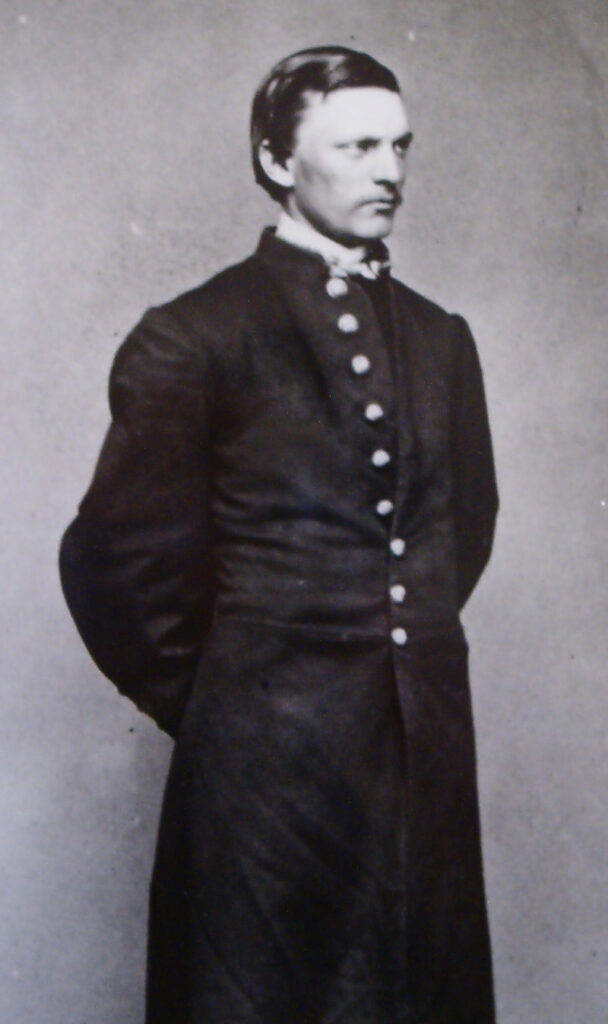
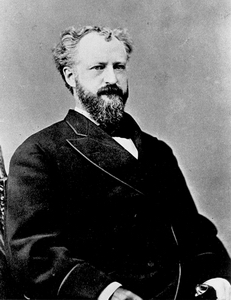
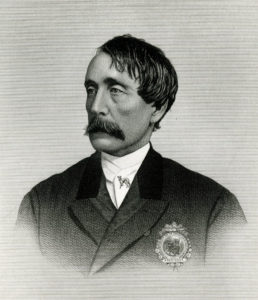
Elevated trains were frozen in place, their passengers unable to get out for hours. Many died simply trying to make their way back home on foot, including Roscoe Conkling (at right), a power broker of New York’s Republican Party.

But there were moments of amusement too. Saloons thrived, and actors trudged through to the snow in time for their performances, And for P.T. Barnum, the show must always go on!

This show was originally recorded back in 2013, just a few months after Hurricane Sandy. We think the comparisons to Sandy that were made in that show feel even more relevant today.

Listen Now: Blizzard of 1888 Podcast

__________________________________________________________

The Bowery Boys: New York City History podcast is brought to you …. by patrons of the Bowery Boys podcast over at Patreon.com.

And for 2026, we’ve added a bunch of new exclusive features to our membership levels — on top of our regular behind the scenes podcast called Side Streets, which we are also recording on video, we’re also releasing classic episodes of the Bowery Boys each week, ad-free. Patrons can now hear this show (The Blizzard of 1888) ad-free.

On top of that, of course, we have exclusive merchandise made just for patron, you also get first dibs on tickets for upcoming live appearances – and so much more!

So please join the fun over at Patreon.com/boweryboys and thank you for helping support the Bowery Boys podcast.

We greatly appreciate our listeners and readers and thank you for joining us on this journey so far. 

___________________________________________________________

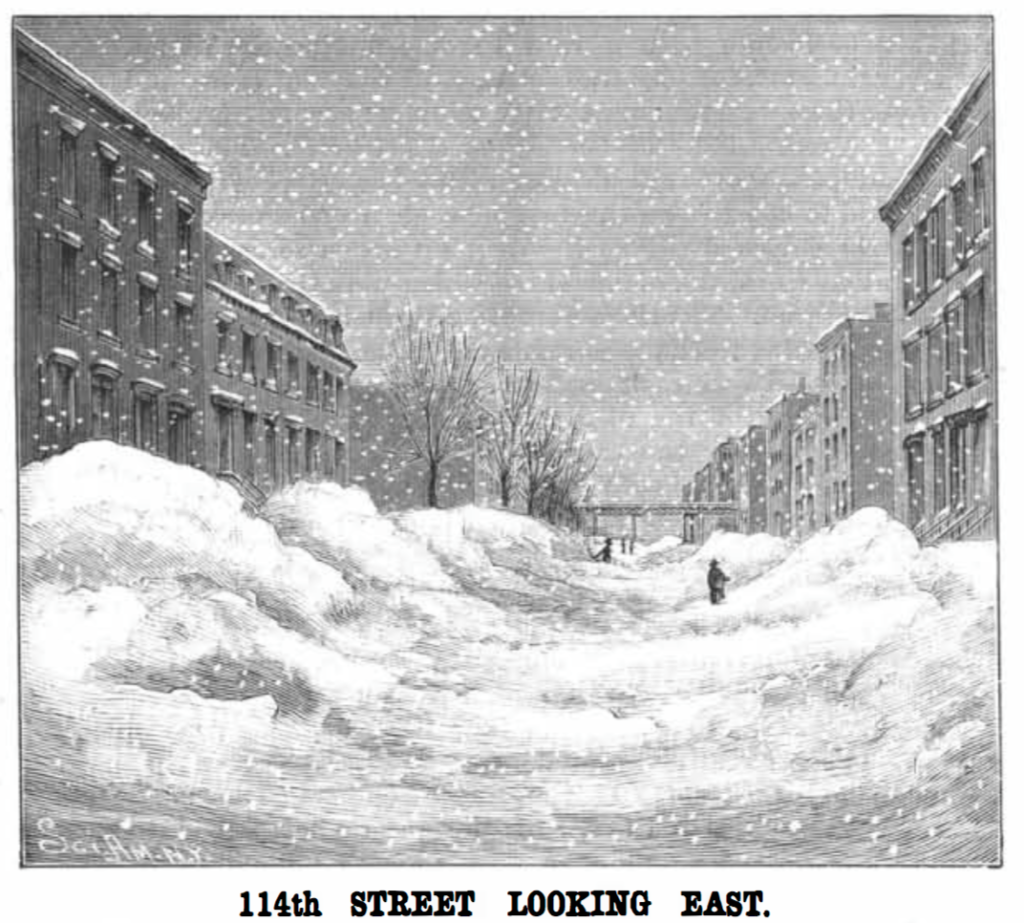
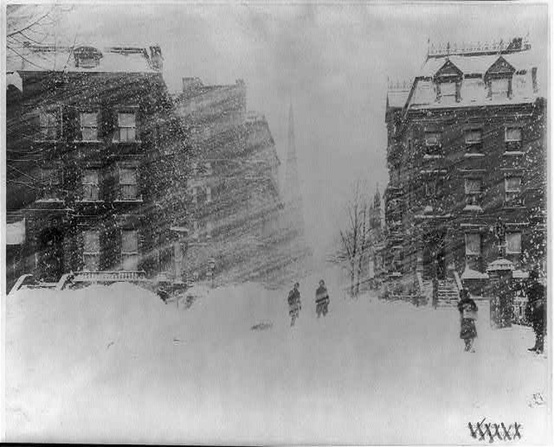
In the blizzard of 1888, the streets disappeared and the snow came down almost horizontally. Imagine being trapped at work, several miles from your home. This was the plight experienced by thousands of New Yorkers (and others throughout the northeast) that Monday. (Library of Congress)

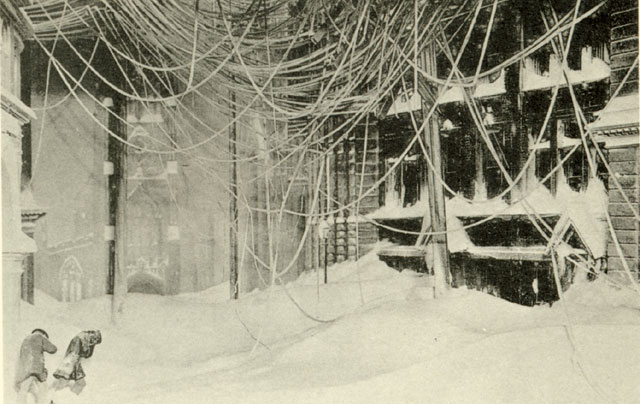
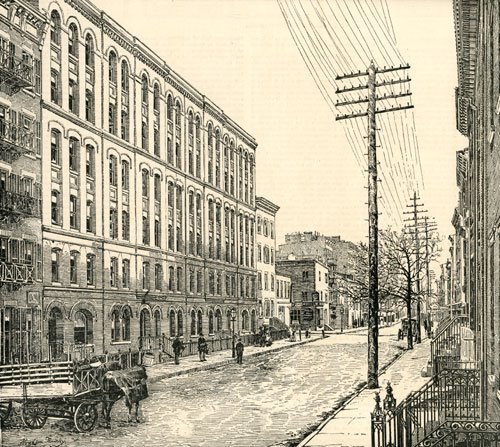
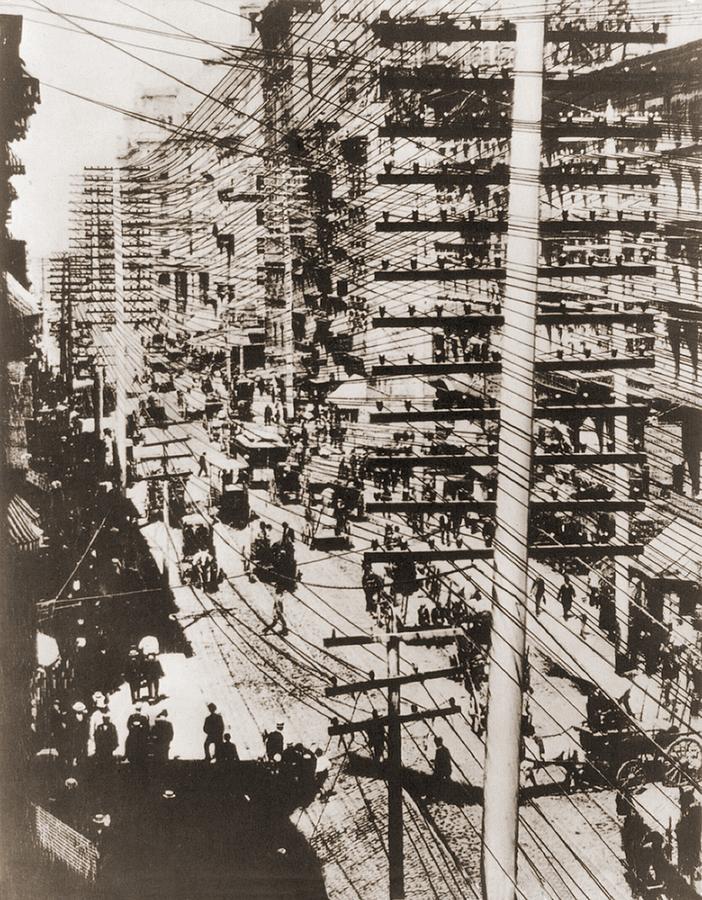
Why did the 1888 blizzard become such a hazard for New Yorkers? Let this picture be your first clue. The city was a cobweb of elevated telegraph, telephone and electric wires.  This picture is from 1887. (LOC)

Langill & Bodfish/Museum of the City of New York
Museum of City of New York

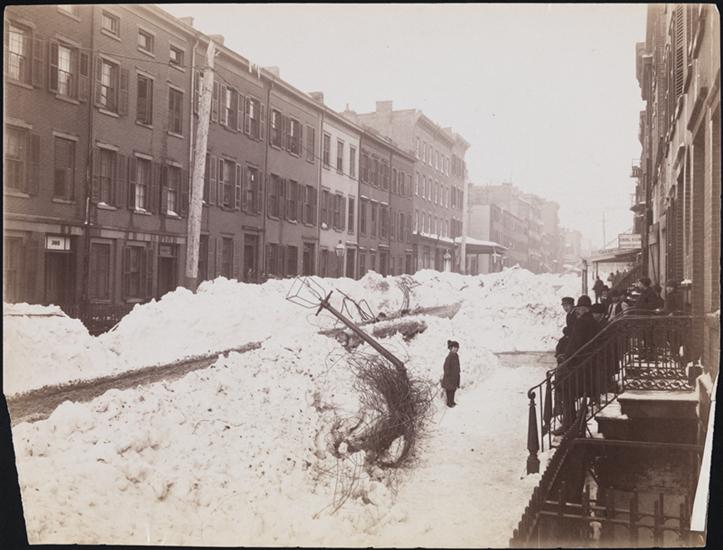
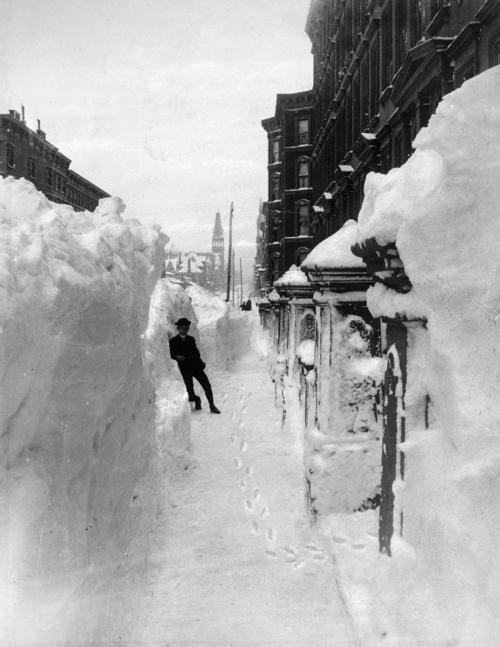
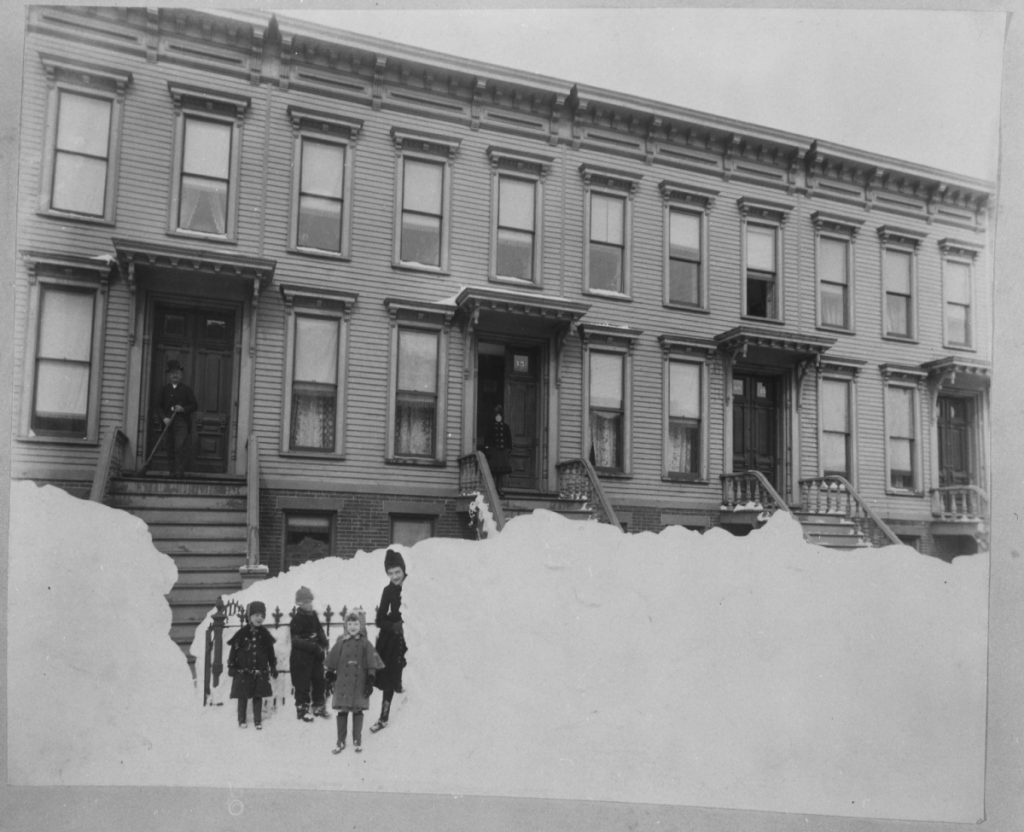
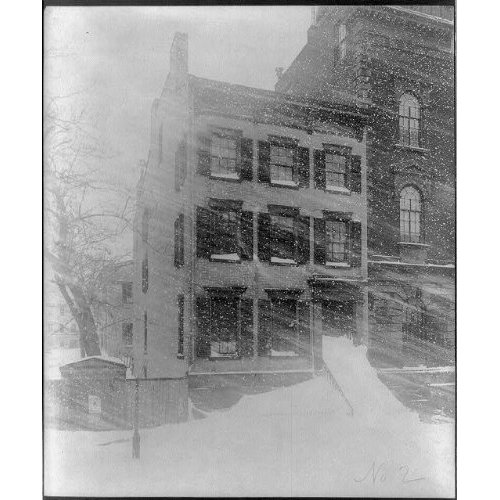
One example of a terrible (although minor) snow drift that might have kept this family in their home all day.  Because of the unpredictable changes in wind, some houses might have been drift-free, while others close by completely locked in with snow. (LOC)

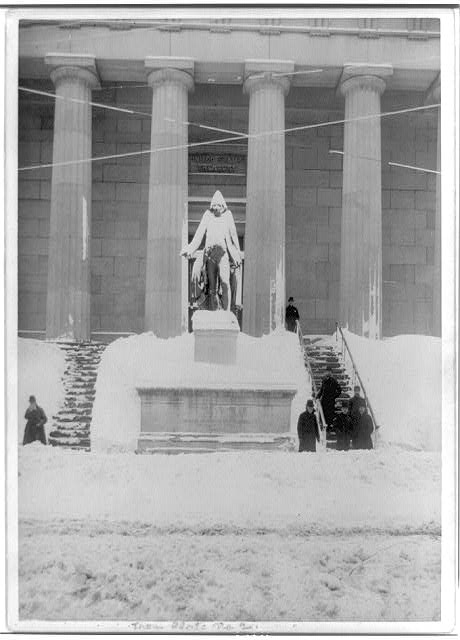
George Washington at the Sub-Treasury Building (today Federal Hall).

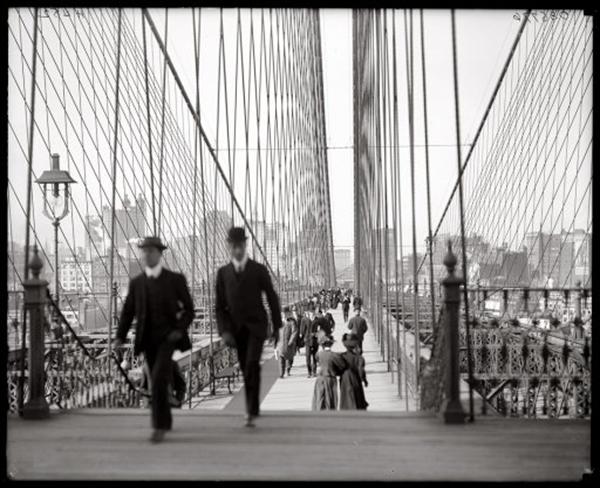
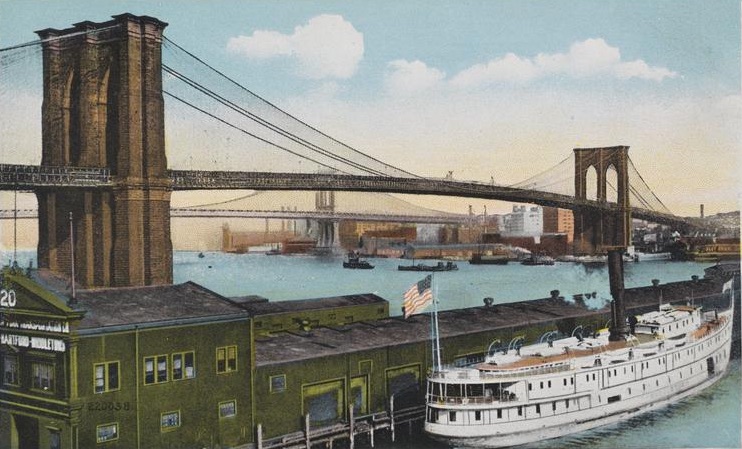
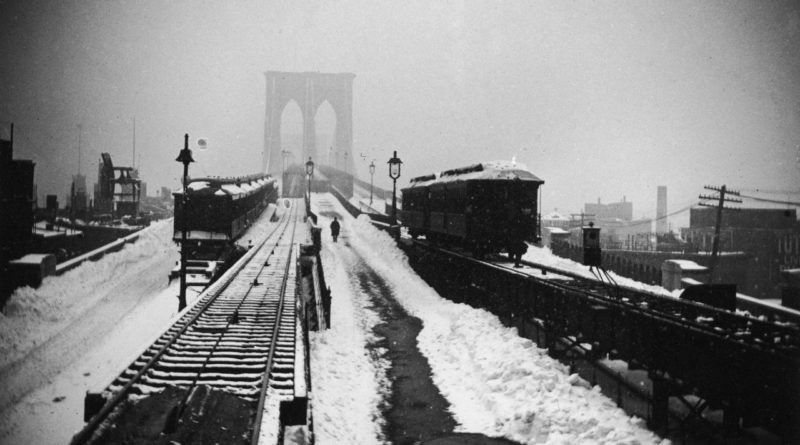
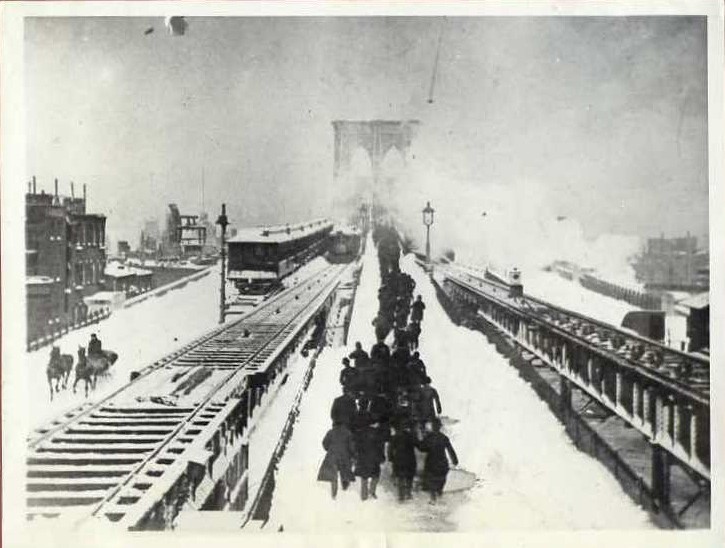
The Brooklyn Bridge, not even five years old, weathered the winds quite well, but became a hazard due to ice. In this picture, people are crossing over as there was no other way to get between Manhattan and Brooklyn.  It’s not clear if any of the trains are operating in this picture.

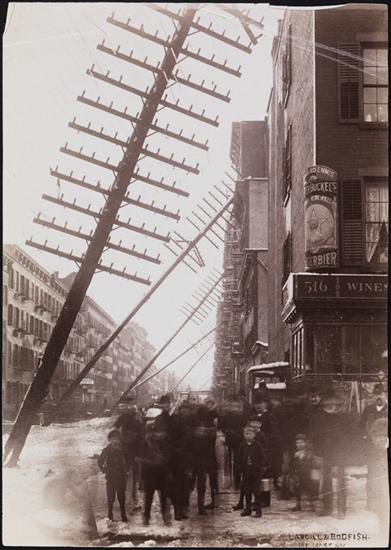
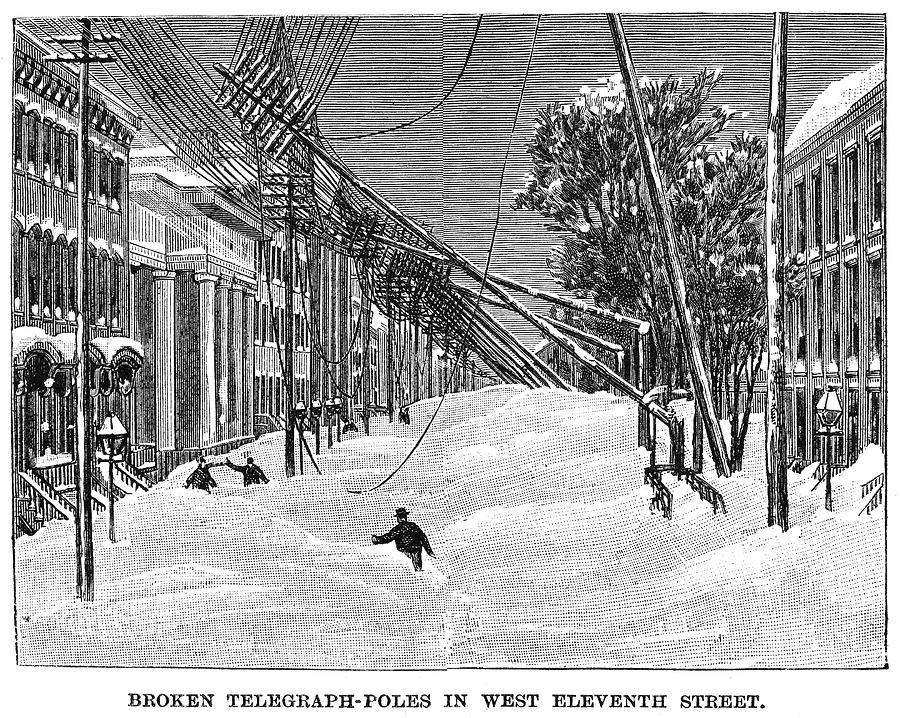
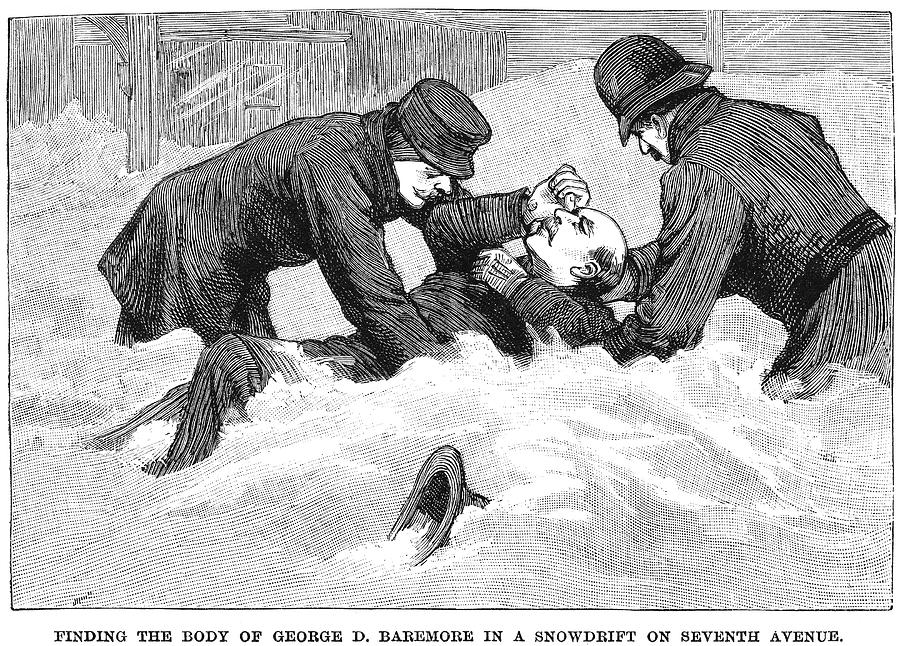
The biggest danger for those venturing outside were the hundreds of downed telegraph, telephone and electrical poles, no match for the intense gusts.  The poles would quickly fall then get covered with snow, creating deadly hazards for people walking past.  The snow would just as quickly cover over an unconscious individual; many New Yorkers froze to death when they fell and were instantly shrouded.

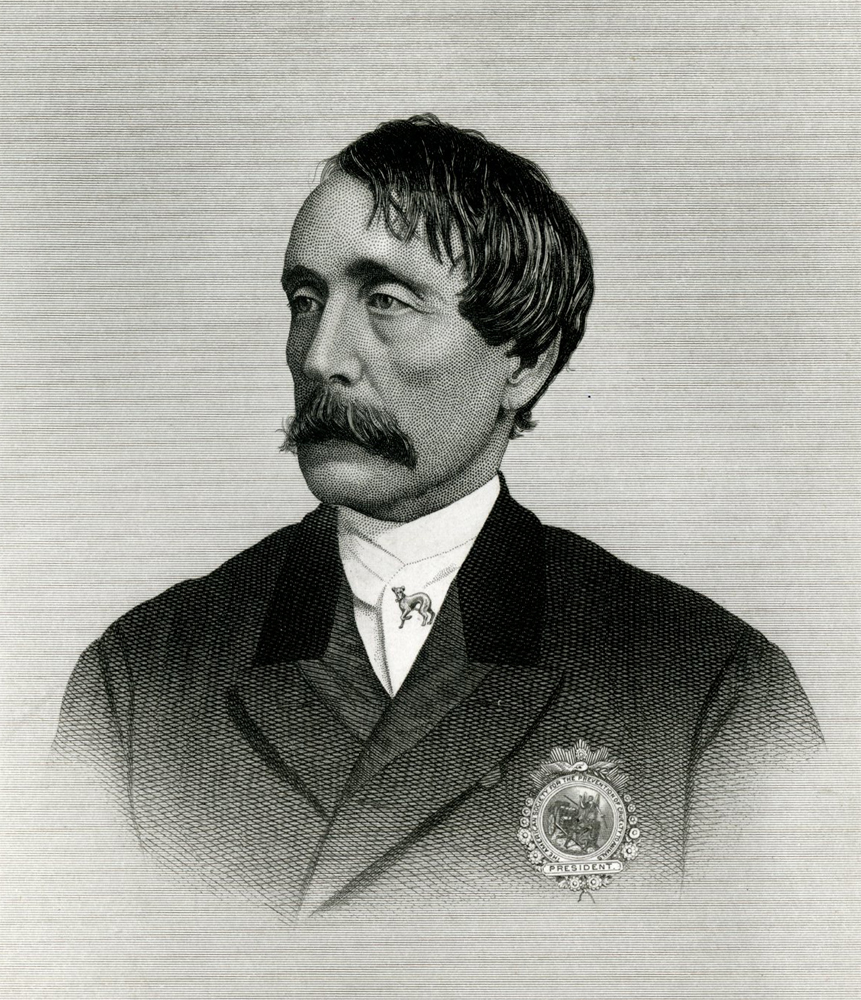
Henry Bergh, founder of the American Society for the Prevention of Cruelty to Animals. He did not survive the blizzard. (NYHS)

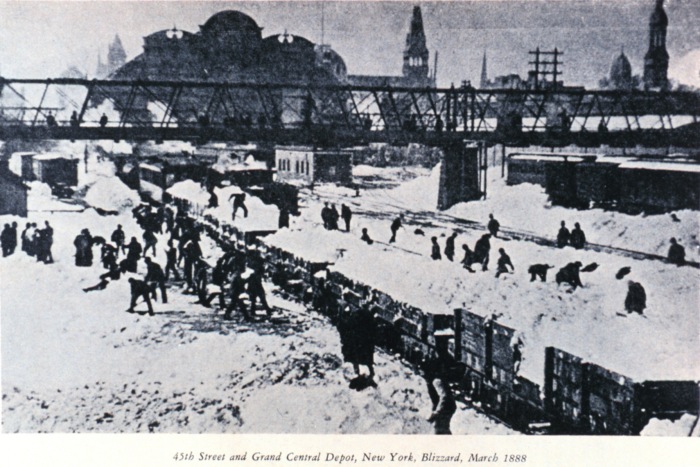
Transportation in and out of the city was at a complete standstill for half the week.  Here workers frantically try to clear the way for trains going into Grand Central Depot.

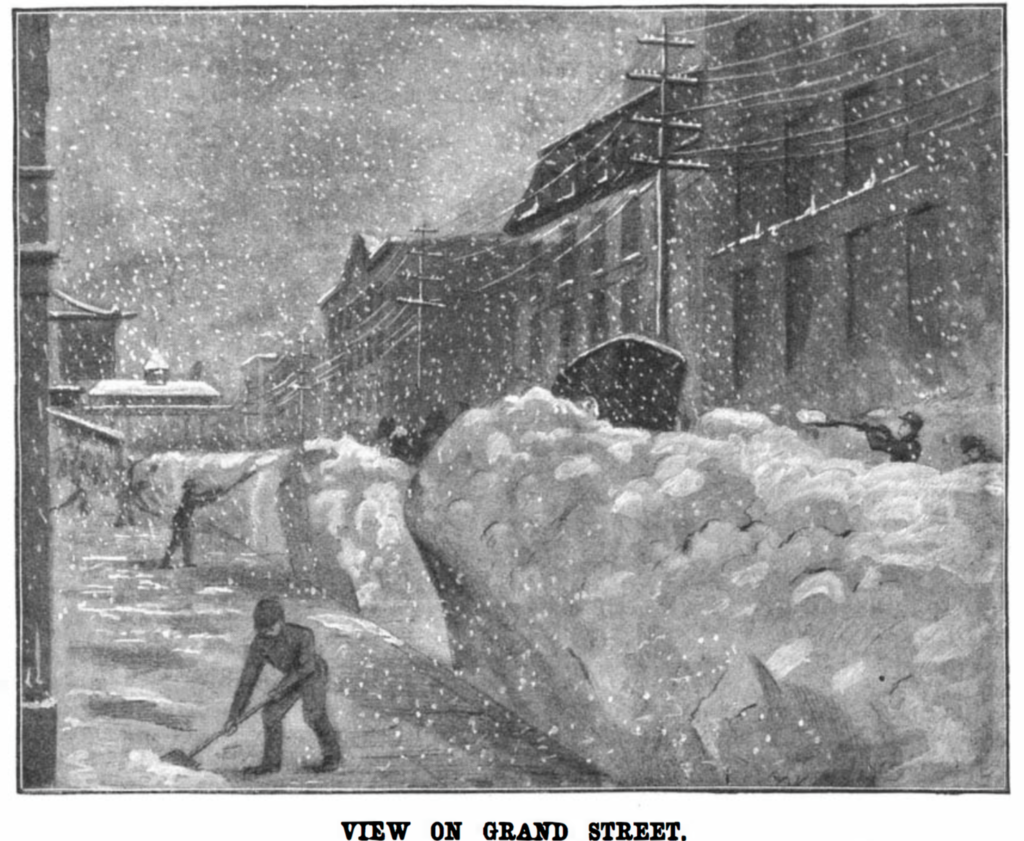
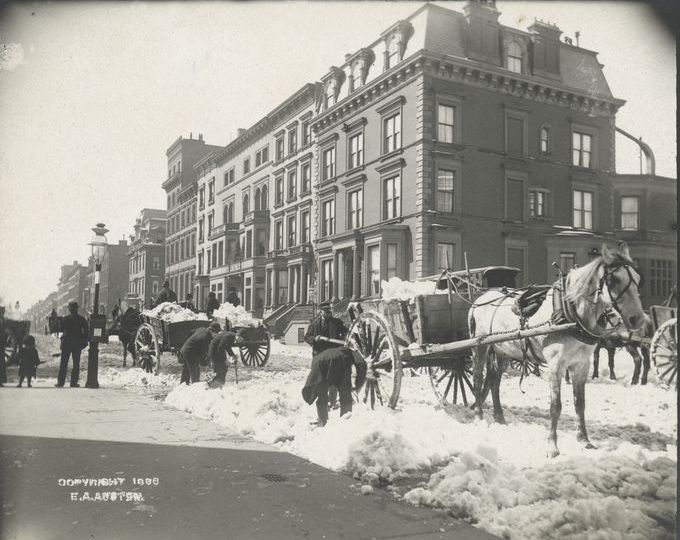
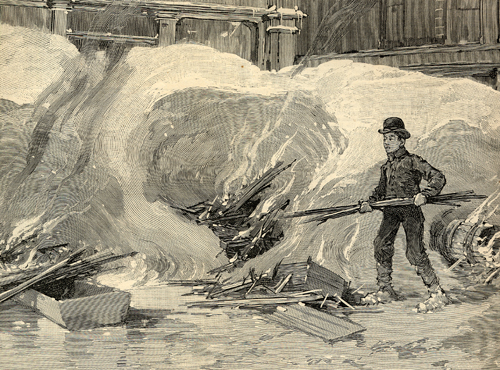
Clean-up was truly chaotic, a feeble effort by the city paired with private contractors with horses, shovels and carts. The piles of snow were taken to water’s edge and dumped, or, in a few less preferred cases, people just started bonfires and melted it away. (For a great picture of a snow dump in the river, see this photo at Shorpy of a blizzard from 1899.) Top pic courtesy LOC, at bottom Maggie Blanck.

The cover of Frank Leslie’s Illustrated Newspaper, usually one of the more sensational pieces of journalism people might have found at their newsstand.

Illustrations from Scientific American, March 24, 1888

Breading G. Way
Categories
Bridges Gilded Age New York Podcasts

The Roeblings: The Family Who Built The Brooklyn Bridge

The Brooklyn Bridge, which was officially opened to New Yorkers 140 years ago this year, is not only a symbol of the American Gilded Age, it’s a monument to the genius, perseverance and oversight of one family.

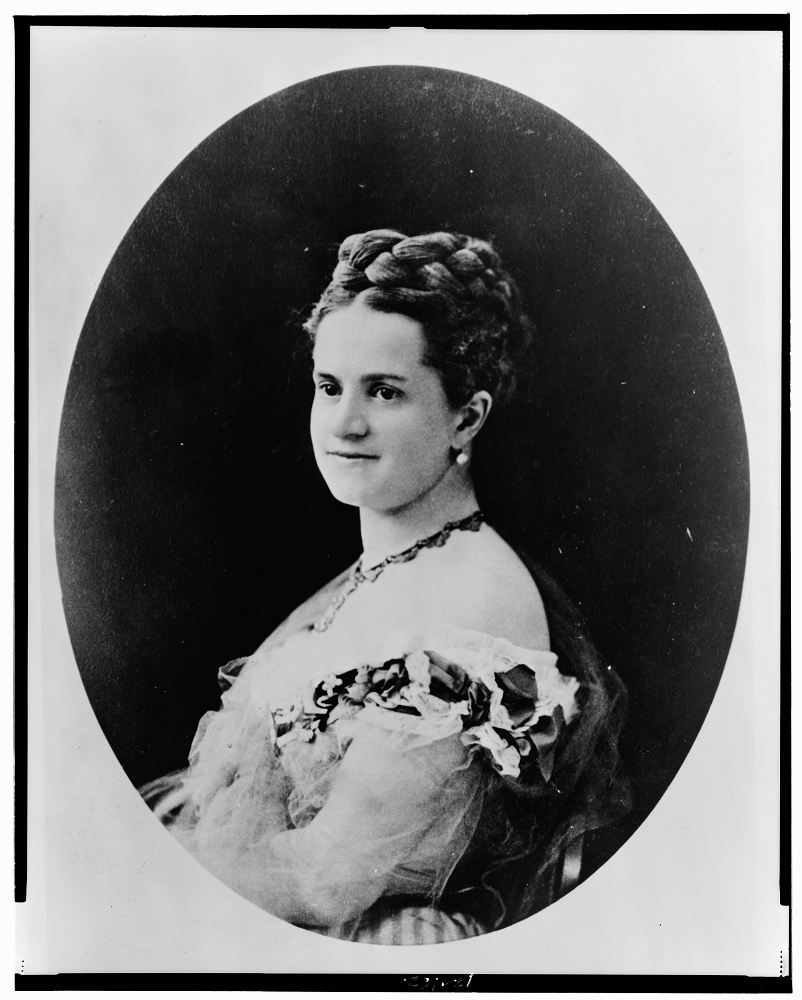
This episode is arranged as a series of three mini biographies of three family members — John Roebling, his son Washington Roebling and Washington’s wife Emily Warren Roebling Through their stories, we’ll watch as the Brooklyn Bridge is designed, built and opened in 1883.

John Roebling was one of America’s most successful engineers by the 1850s, a German immigrant and visionary who designed impressive suspension bridges and created an entire industry (wire rope) quite literally in his back yard.

His greatest achievement would be the East River Bridge, connecting the two great cities of New York and Brooklyn. But John would never see the bridge built — or even begun. A freak accident would put his son Washington in charge.

Washington Roebling was trained to follow in his father’s footsteps although their relationship was far from perfect. Roebling further excelled as an engineer for the Union Army during the Civil War.

Suddenly in charge of the East River Bridge project in 1869, Washington threw himself into the world, working aside his men within the sunken caissons that would secure the bridge to the river floor. But decompression illness would threaten his life and eventually prevent him from active work.

Emily Warren Roebling would step up on her husband’s behalf, becoming the bridge’s unofficial field engineer, maneuvering through a world of men with extraordinary intellect and grace, communicating her husband’s wishes and presumably making her OWN decisions on the spot.

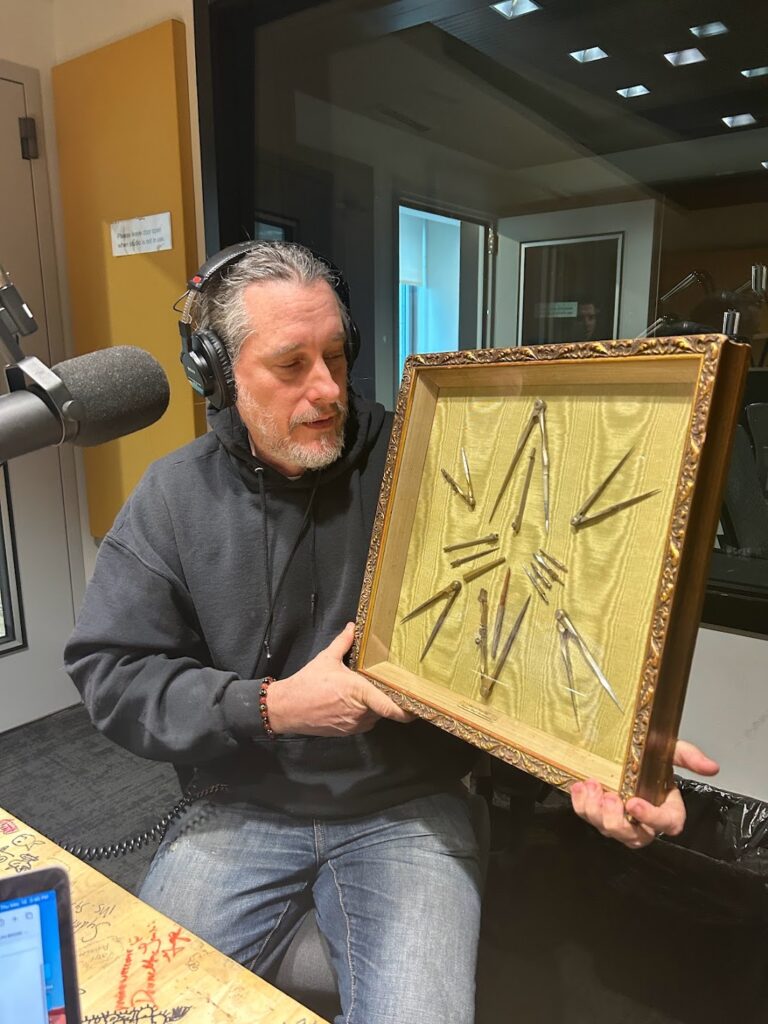
PLUS: One more Roebling! Greg and Tom are joined in the studio by Kriss Roebling, the great, great-grandson of Washington and Emily Roebling. He shares his own surprising family stories — and brings in some extraordinary artifacts from his family’s past!

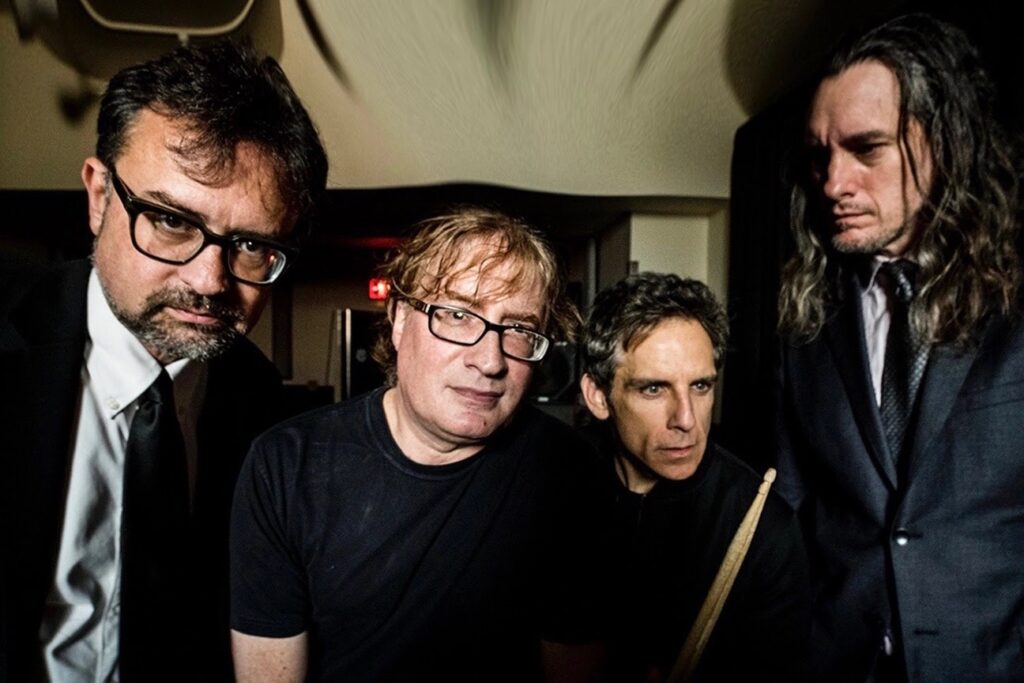
WITH: Stories of Slinky’s, 1980s Dumbo and Ben Stiller?

LISTEN HERE — THE ROEBLINGS: THE FAMILY WHO BUILT THE BROOKLYN BRIDGE

Kriss Roebling in the studio, showing off John Roebling’s surveying tools used to the draft the blueprints of the Brooklyn Bridge.

The band Capital Punishment featuring Kriss Roebling and bandmate Ben Stiller


For a marvelous on-the-bridge experience, follow filmmaker Ken Burns along with New York Times architectural critic Michael Kimmelman as they discuss the bridge’s history and majesty.

 Ken Burns UNUM


FURTHER READING

Building the Brooklyn Bridge 1869-1883An Illustrated History with Images in 3D — Jeffrey I. Richman
Chief Engineer: Washington Roebling, The Man Who Built the Brooklyn Bridge — Erica Wagner
Engineering America: The Life and Times of John A. Roebling — Richard Haw
The Great Bridge: The Epic Story of the Building of the Brooklyn Bridge — David McCullough
A Picture History of the Brooklyn BridgeWith 167 Prints and Photographs — Mary J. Shapiro

Emily Warren Roebling obituary in the New York Times (2018)
Emily Warren Roebling obituary in the Brooklyn Daily Eagle (1903)

FURTHER LISTENING

After listening to this show about the Roeblings and the Brooklyn Bridge, dive back into these past Bowery Boys podcasts with similar or related themes

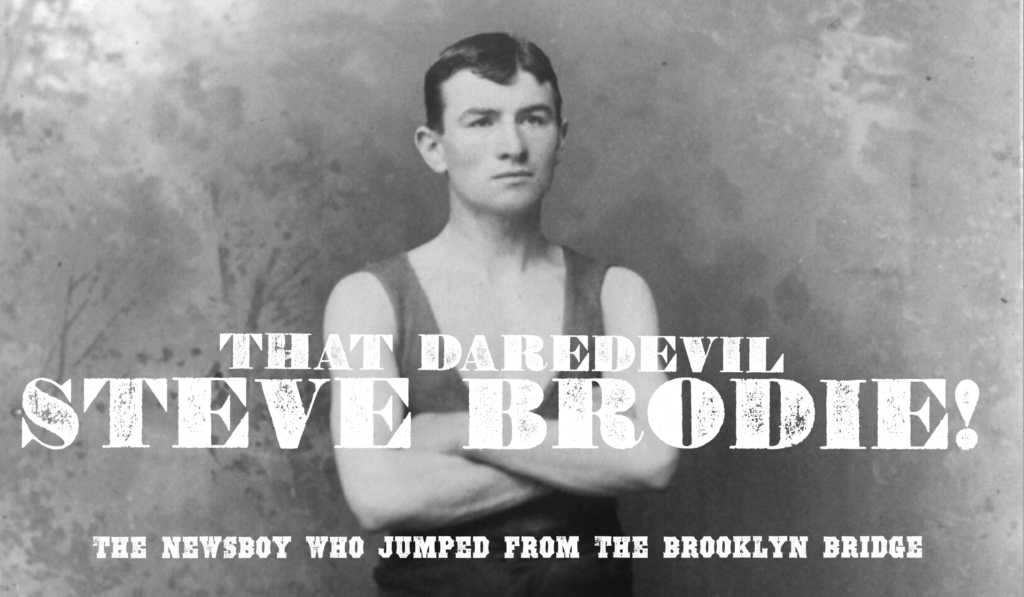
That Daredevil Steve Brodie
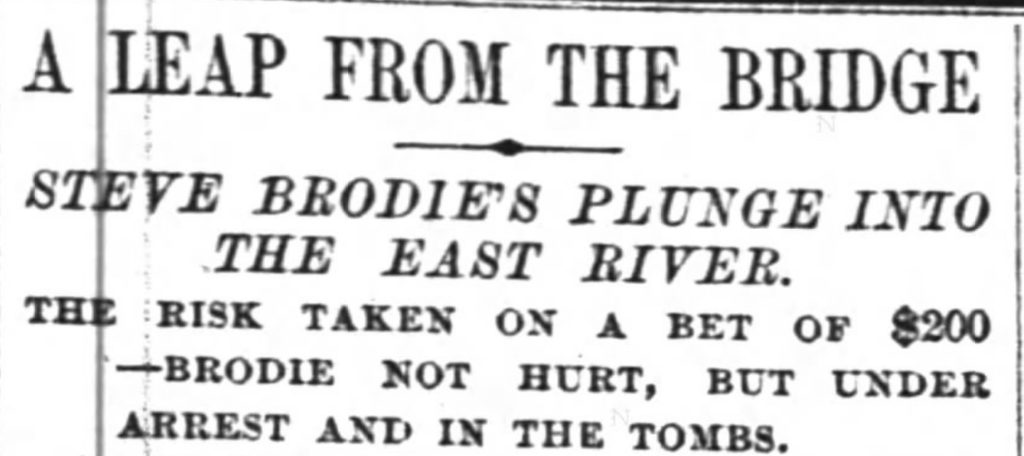
A tale of the ‘sporting life’ of the Bowery from the 1870s and 80s. A former newsboy named Steve Brodie grabs the country’s attention by leaping off the Brooklyn Bridge on July 23, 1886. Or did he?

Crossing to Brooklyn: How the Williamsburg Bridge Changed New York City
The story of the Williamsburg Bridge — poorly received when it was built but vital to the health of New York City.

The Manhattan Bridge: New York’s Dysfunctional Classic
We love the Manhattan Bridge, but there’s no doubt it’s had a rocky history. For one hundred years, it’s withstood more than just comparisons to its far more iconic neighbor, the Brooklyn Bridge.

The Bridge to Everywhere: The George Washington Bridge
The George Washington Bridge is best known for being surprisingly graceful, darting between Washington Heights and the Palisades, a vital connection in the interstate highway system. 

Categories
Landmarks Mysterious Stories Podcasts

Ghost Stories by Gaslight: Hauntings of Old New York

A brand new batch of haunted houses and spooky stories, all from the gaslight era of New York City, the illuminating glow of the 19th century revealing the spirits of another world.

Greg and Tom again dive into another batch of terrifying ghost stories, using actual newspaper reports and popular urban legends to reveal a different side to the city’s history.

If you just like a good scare, you’ll enjoy these historical frights. And if you truly believe in ghosts, then these stories should especially disturb you as they take place in actual locations throughout the city — from the Lower East Side to the Bronx. And even in cases where these 19th-century haunted houses have been demolished, who’s to say the spirits themselves aren’t still hanging around?

Featured in this year’s crop of scary stories:

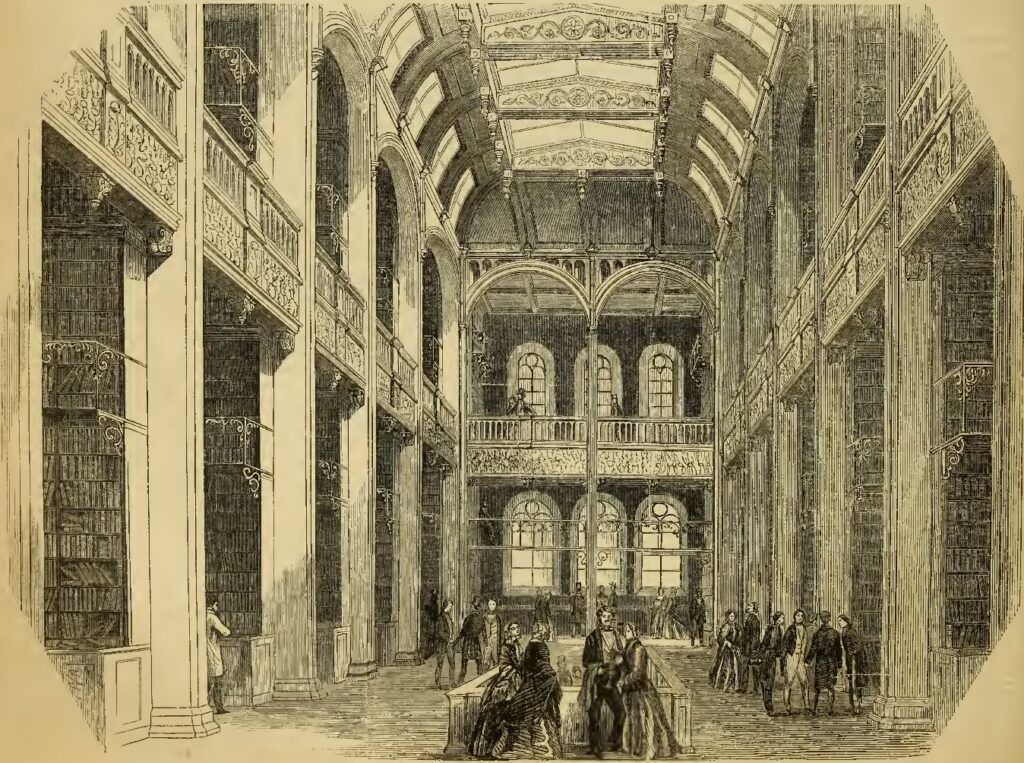
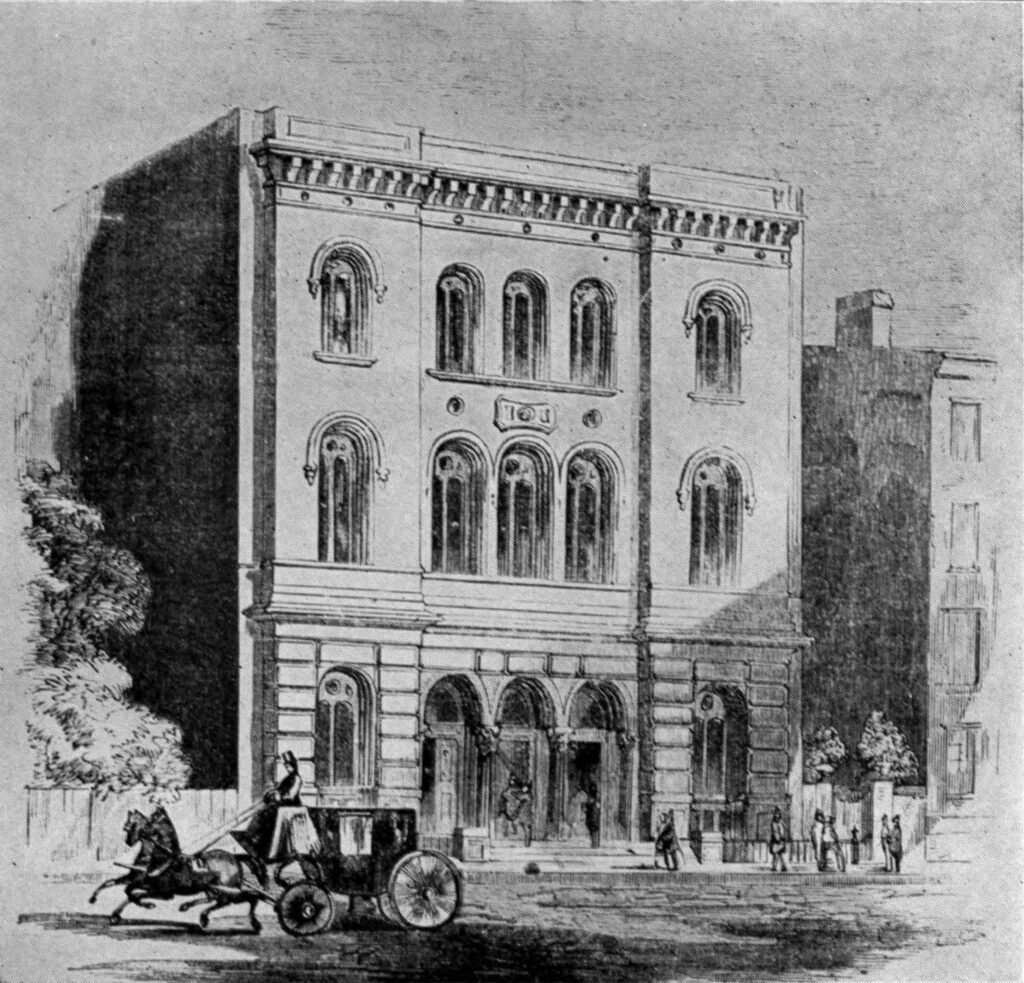
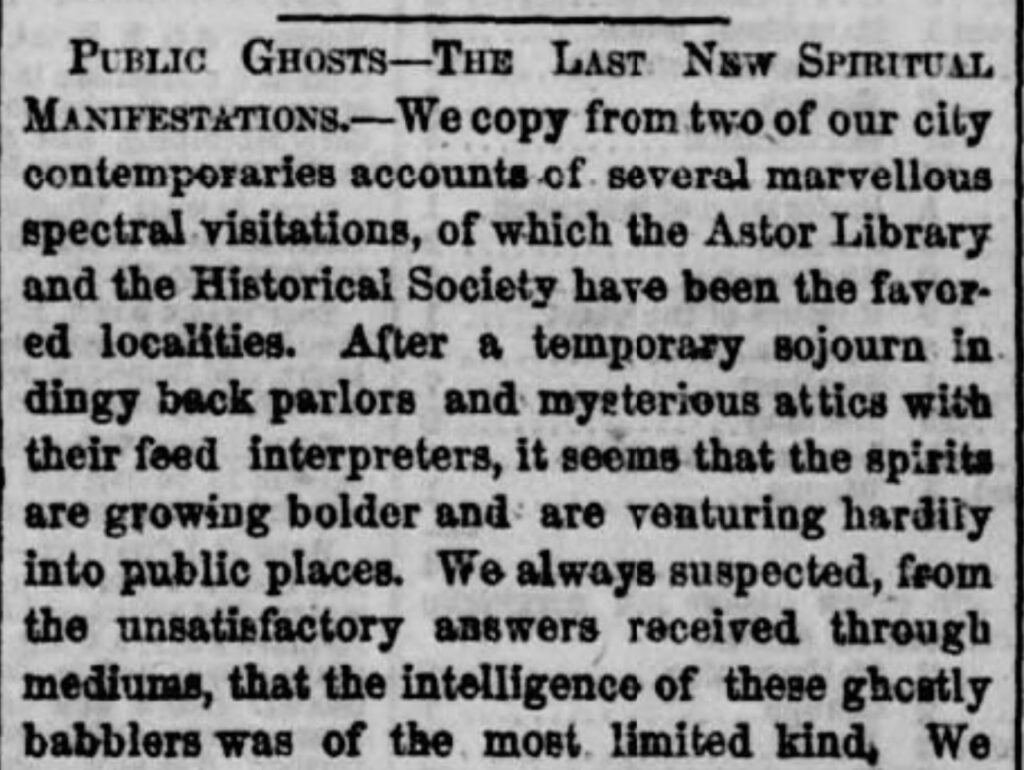
— A ghostly encounter at the Astor Library (today’s Public Theater) involving a most controversial set of mysterious books;

— A whole graduating class of ghosts stalks the campus of the Bronx’s Fordham University, and it may have something to do with either Edgar Allan Poe or the film The Exorcist;

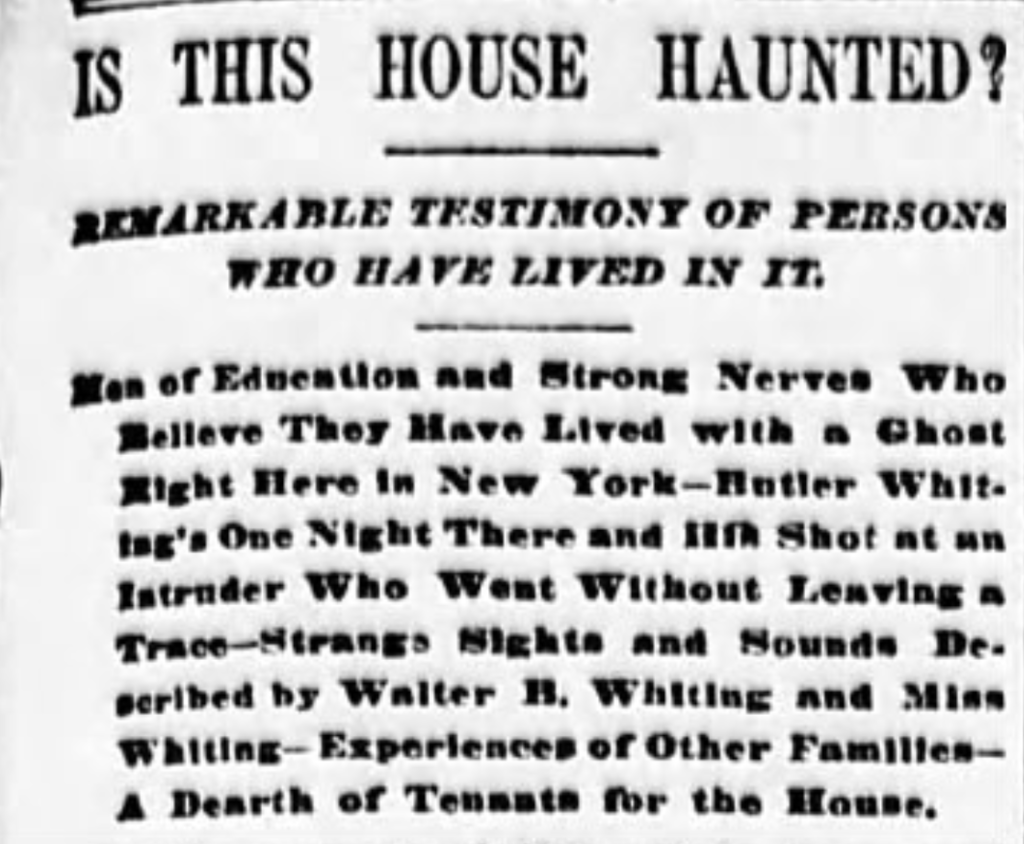
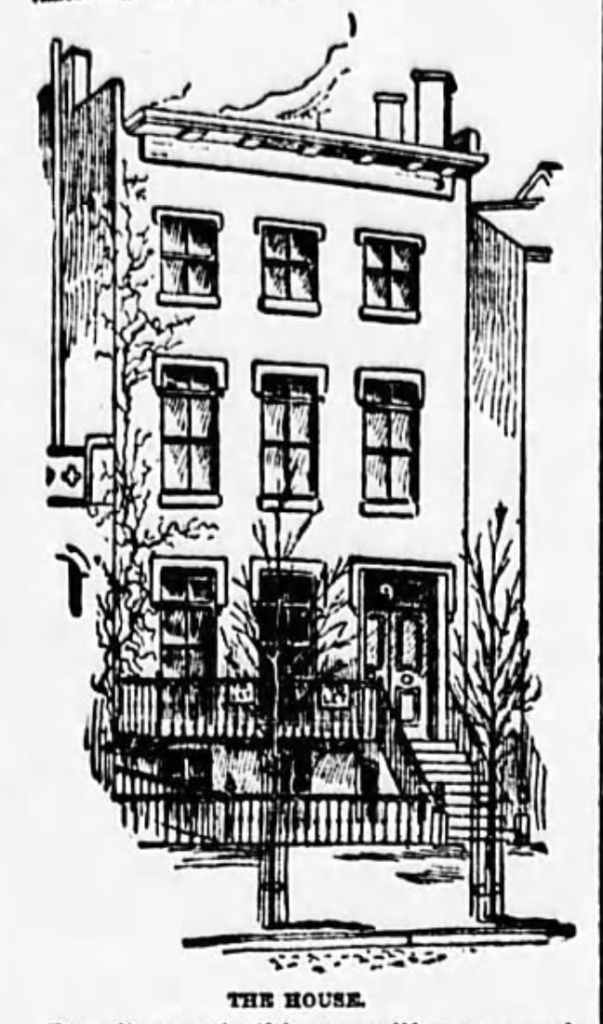
— Just north of Washington Square Park in Greenwich Village, a haunted townhouse vexes several tenants, the sight of a hunched-over man in a cap driving people insane;

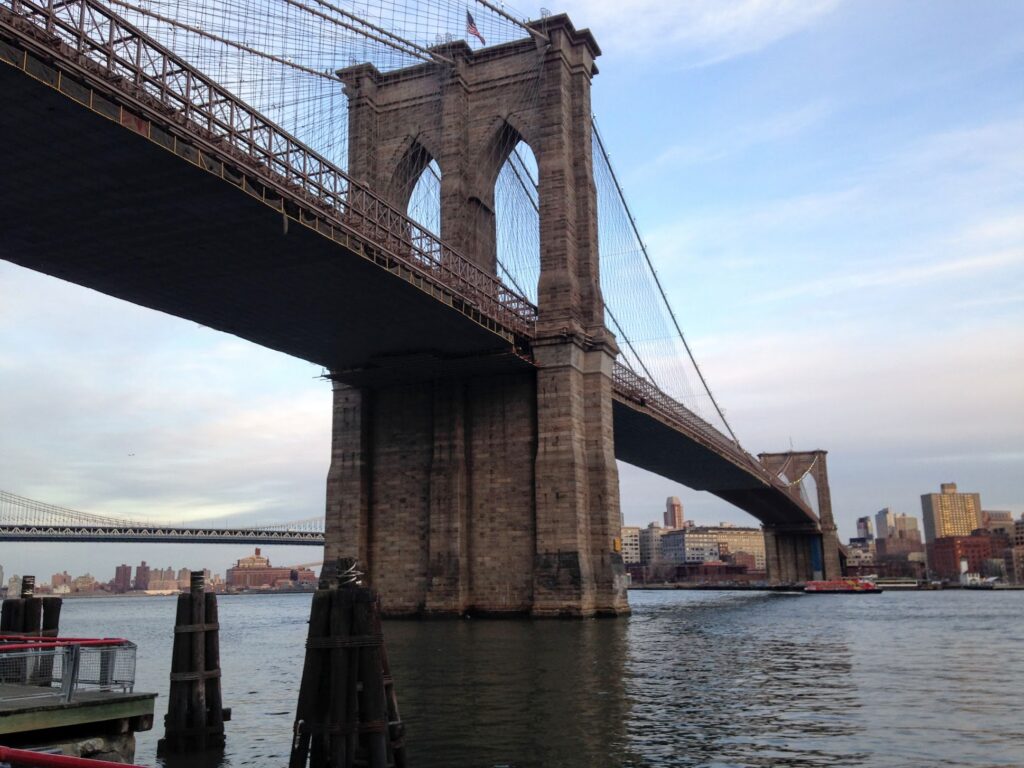
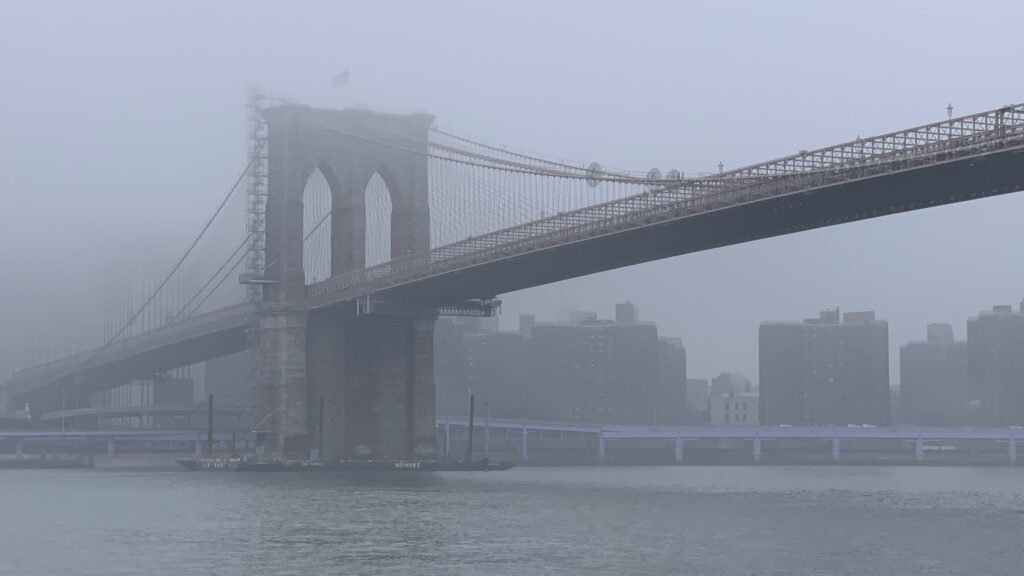
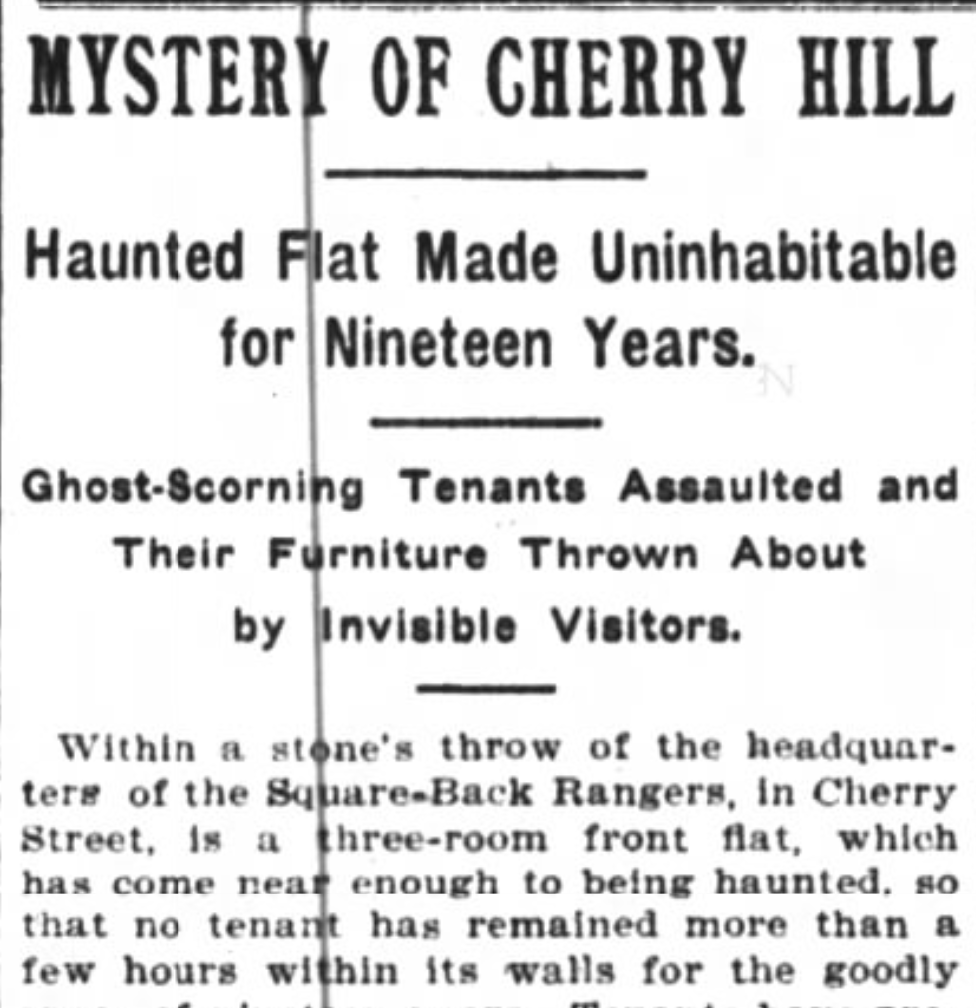
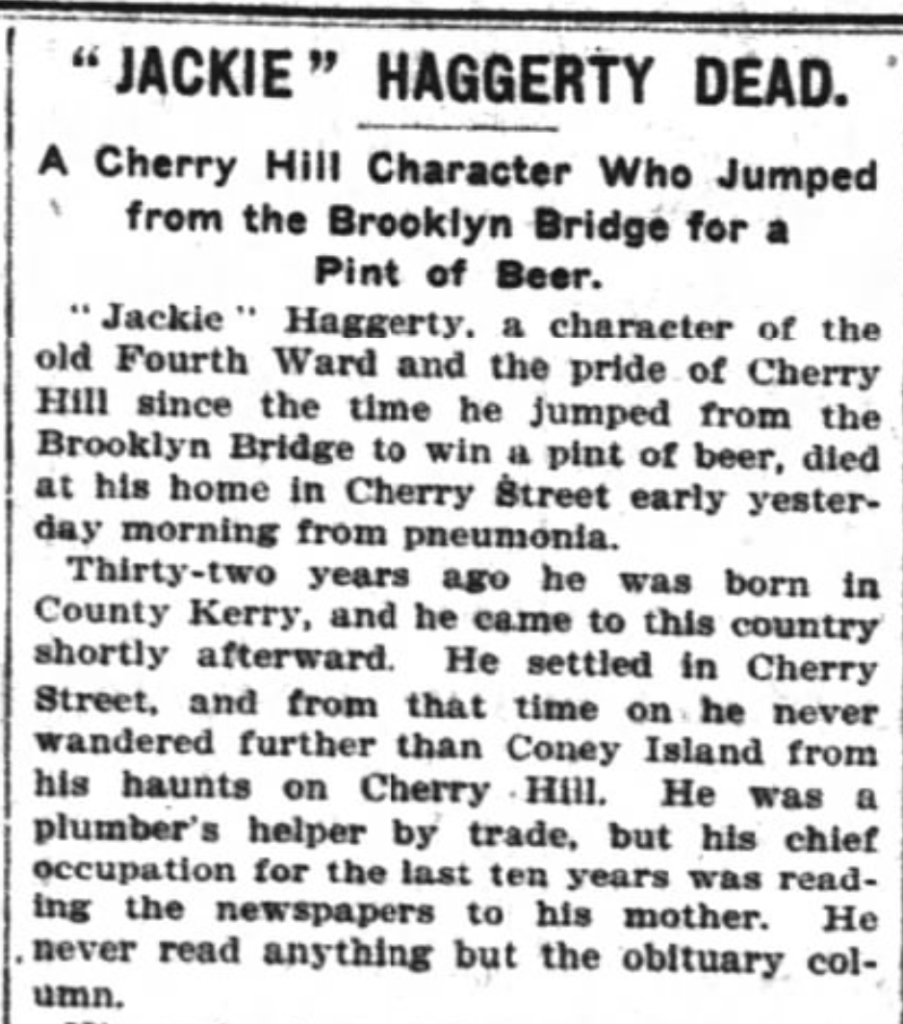
— In the shadow of the Brooklyn Bridge, a small apartment in today’s Two Bridges neighborhood becomes possessed by a poltergeist with a penchant for throwing furniture …. and punches. One vainglorious showoff named Jackie Hagerty learns the hard way;

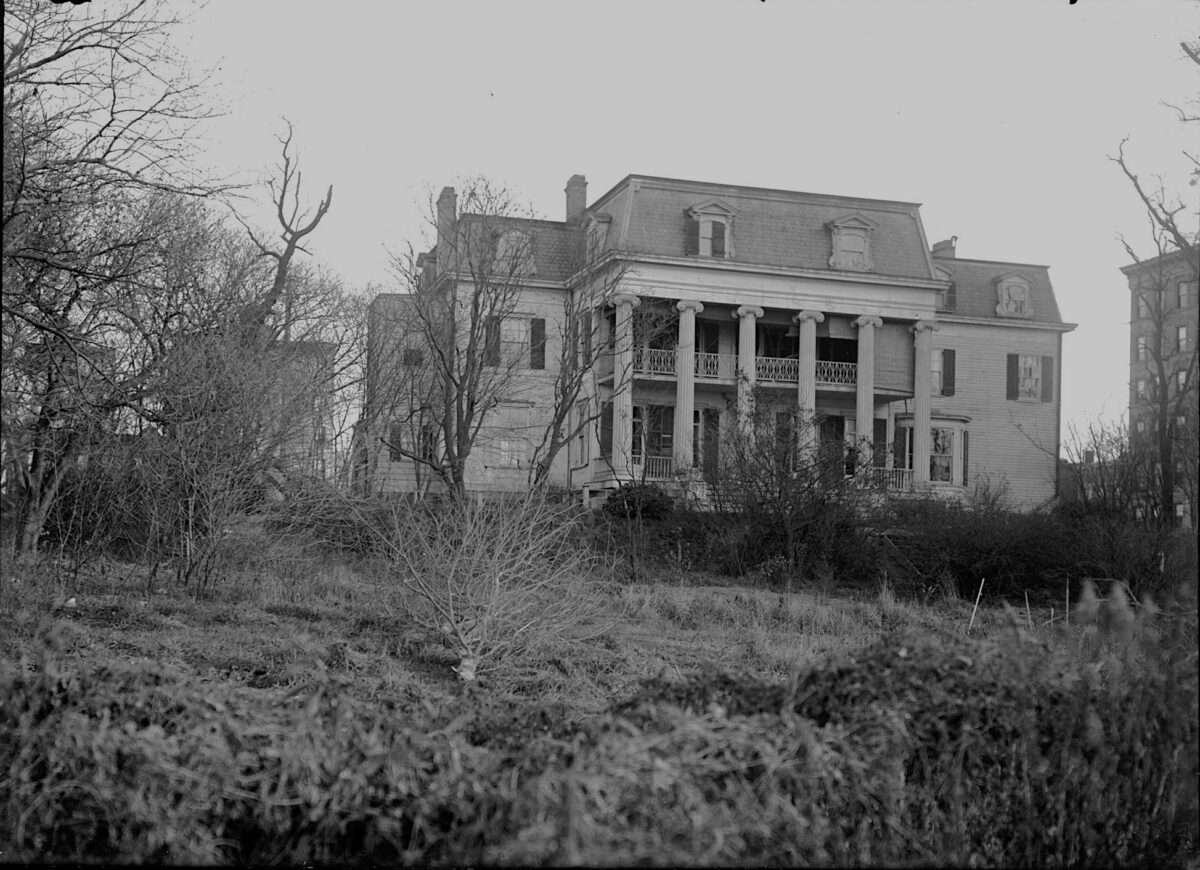
— And before the days of Riverside Drive, a rustic old mansion once sat on the banks of the Upper West Side, with a mysterious locked room that must never be opened.

LISTEN TODAY: GHOST STORIES BY GASLIGHT


And of course listen to the entire collection of Bowery Boys ghost stories podcast here and in this Spotify playlist:


Ghost of the Astor Library

Wikimedia Commons/Internet Archives. Gleason’s Pictorial Vol. 6 No. 8 (February 25, 1854), Boston:124
Astor Library 1954. Harry Miller Lydenberg (July 1916). “History of the New York Public Library”. Bulletin of the New York Public Library 20: 570-571.; first published in Gleason’s Pictorial Drawing-Room Companion/Wikimedia commons
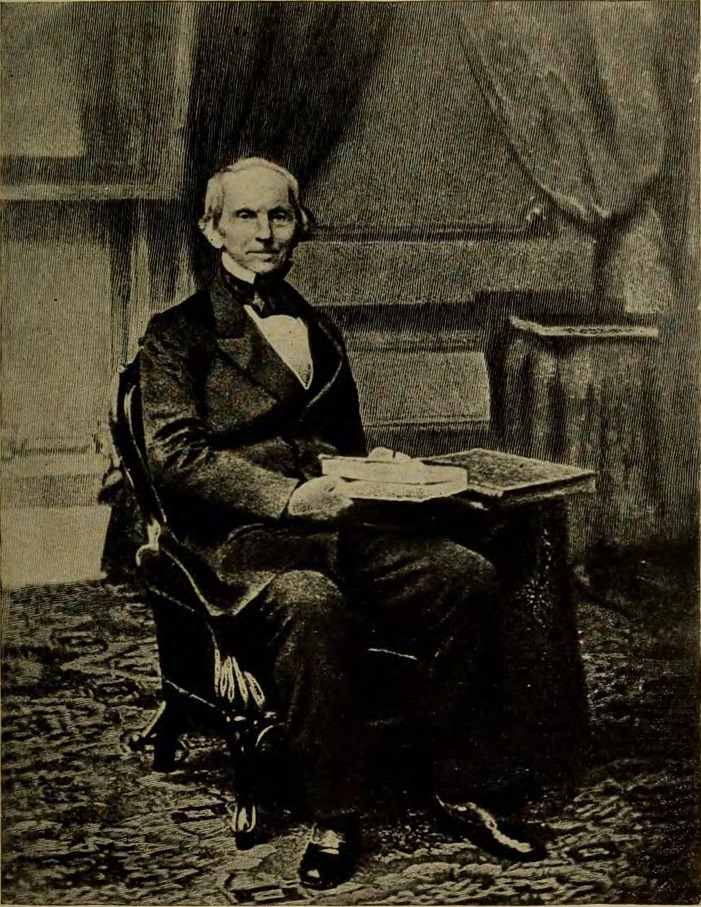
The librarian Joseph Cogswell

The Sorority of Ghosts

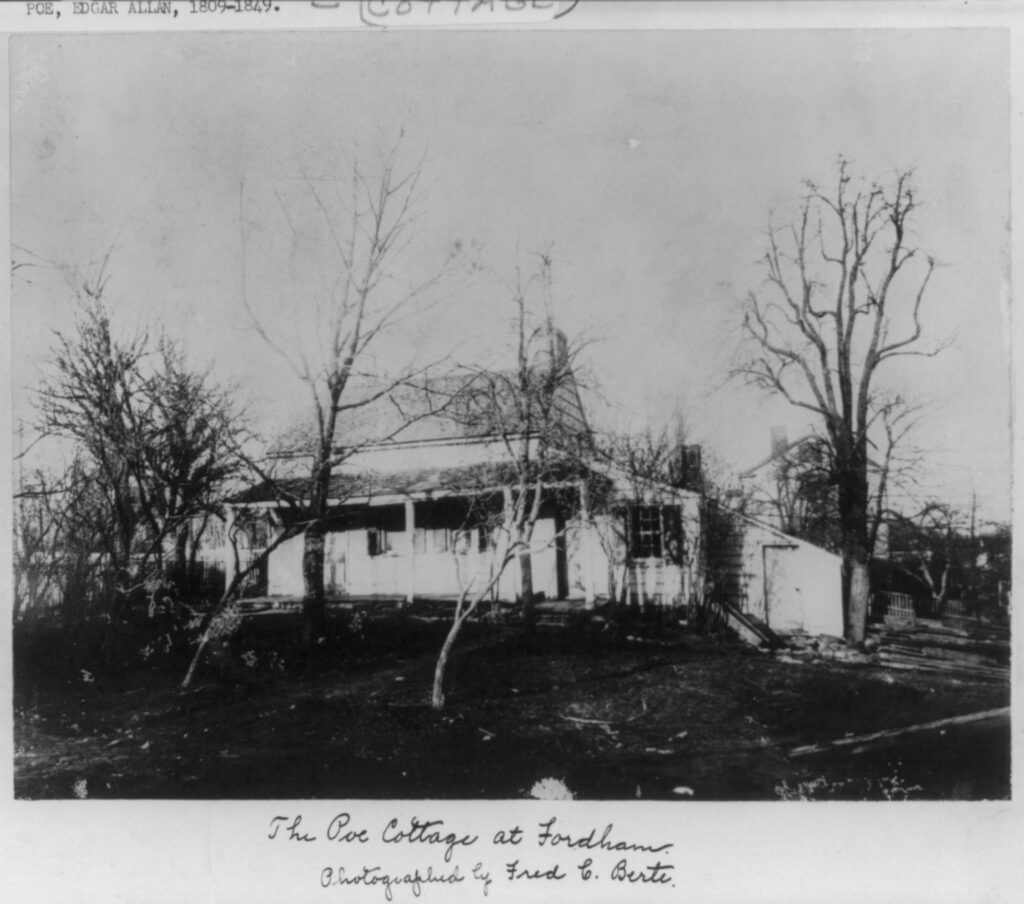
Poe Cottage, pictured 1900, Library of Congress
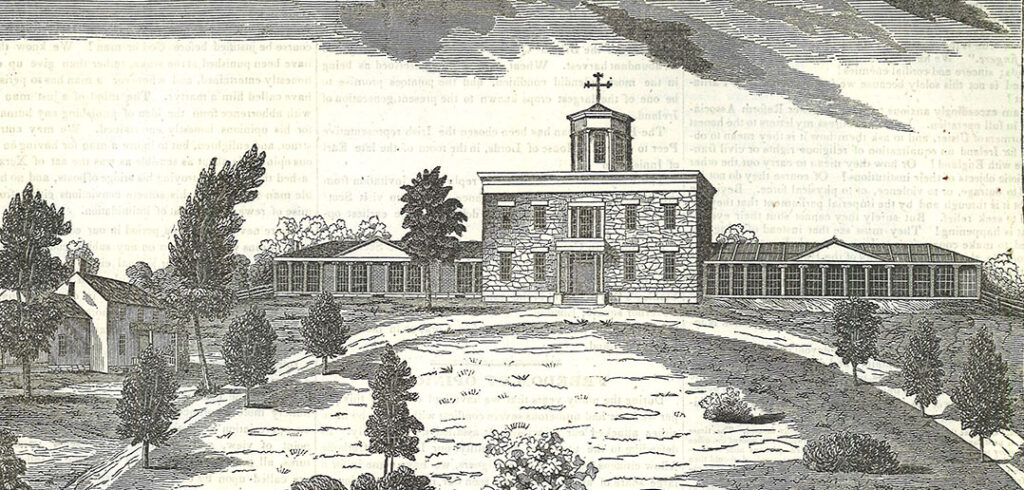
This 1840 image of Cunniffe House by engraver Benson J. Lossing, also includes the original Rose Hill Manor house, at left. (Image courtesy of Catholic Historical Research Center of the Archdiocese of Philadelphia via Fordham)
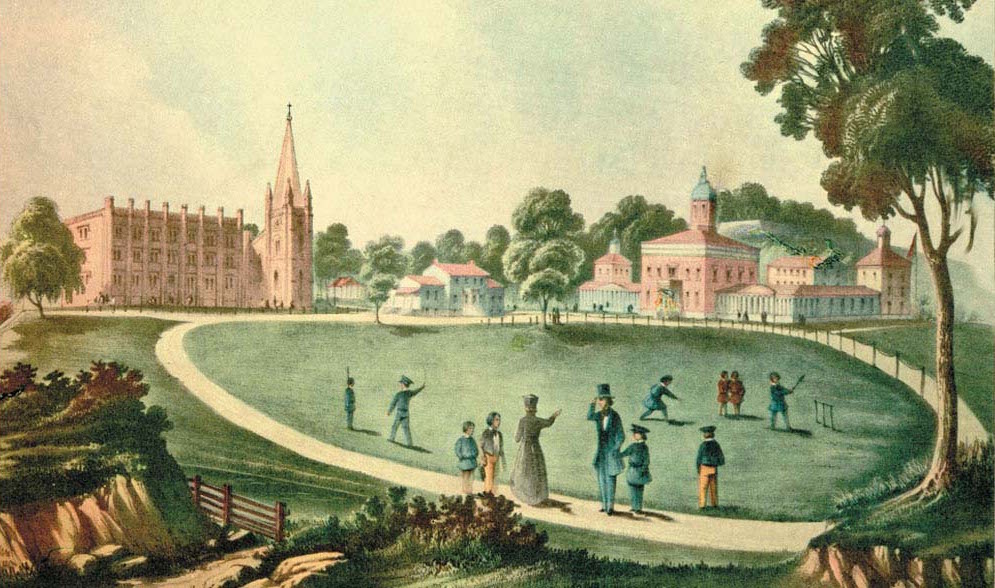
St. John’s Colllege, 1846, courtesy Fordham
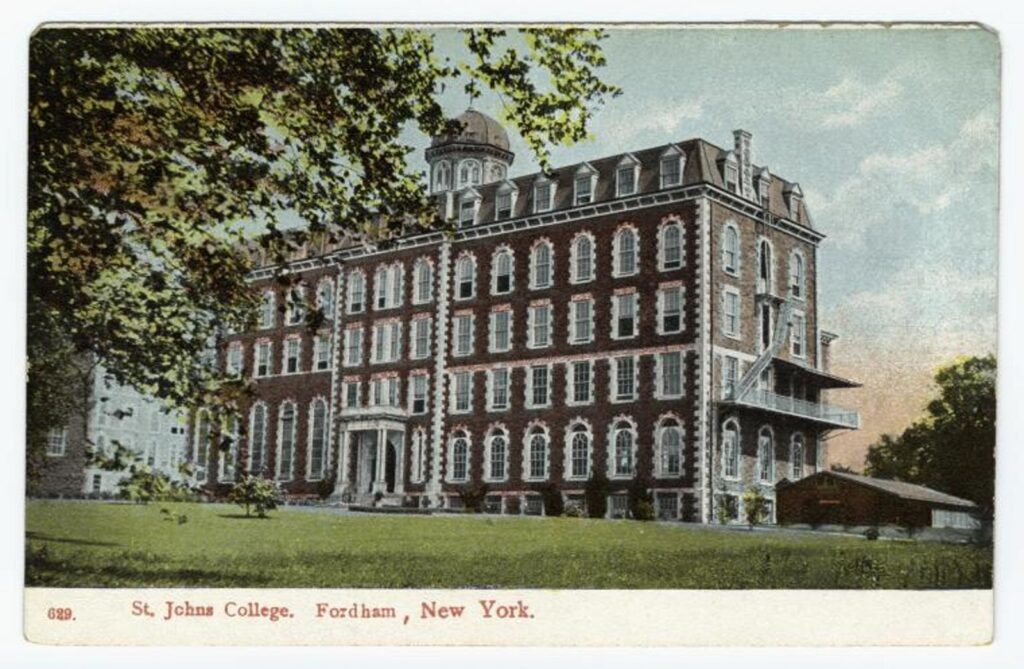
St John’s College aka Fordham University, New York Public Library

The New York Sun, February 1892

New York Times, March 25, 1900

New York Times, October 20, 1900

New York Times, 1905 — Furniss Mansion an Interesting Souvenir of Older New York; If Its Walls Could Talk the “Old Colonial White House,” Facing Riverside Drive, Could Tell the Story of a Century’s Progress on This Island — Tale of Its Gentle and Studious Ghost.

Furniss Mansion, image courtesy Ephemeral New York

FURTHER LISTENING

This episode features ghost stories from places in New York City that we have extensively covered over the years. Here’s a few places to start:

Categories
Bridges Brooklyn History Landmarks

Deadly Rumor: The Brooklyn Bridge Collapse That Didn’t Happen

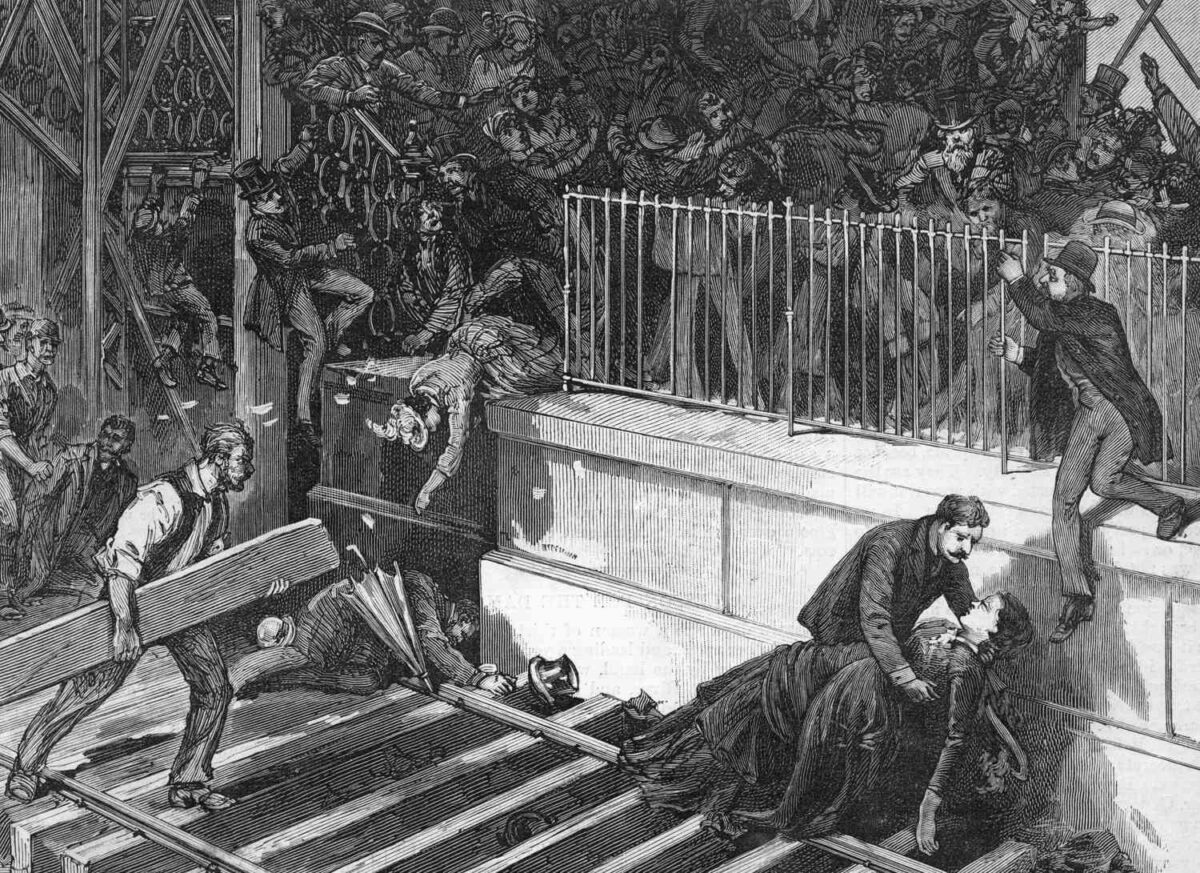
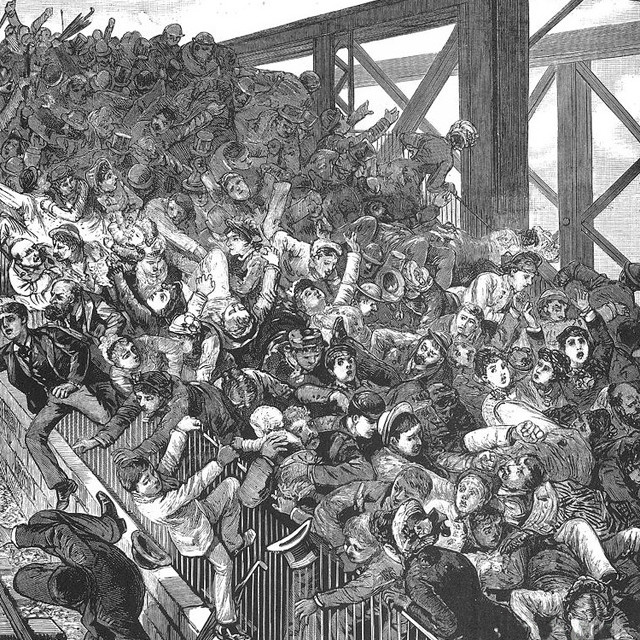
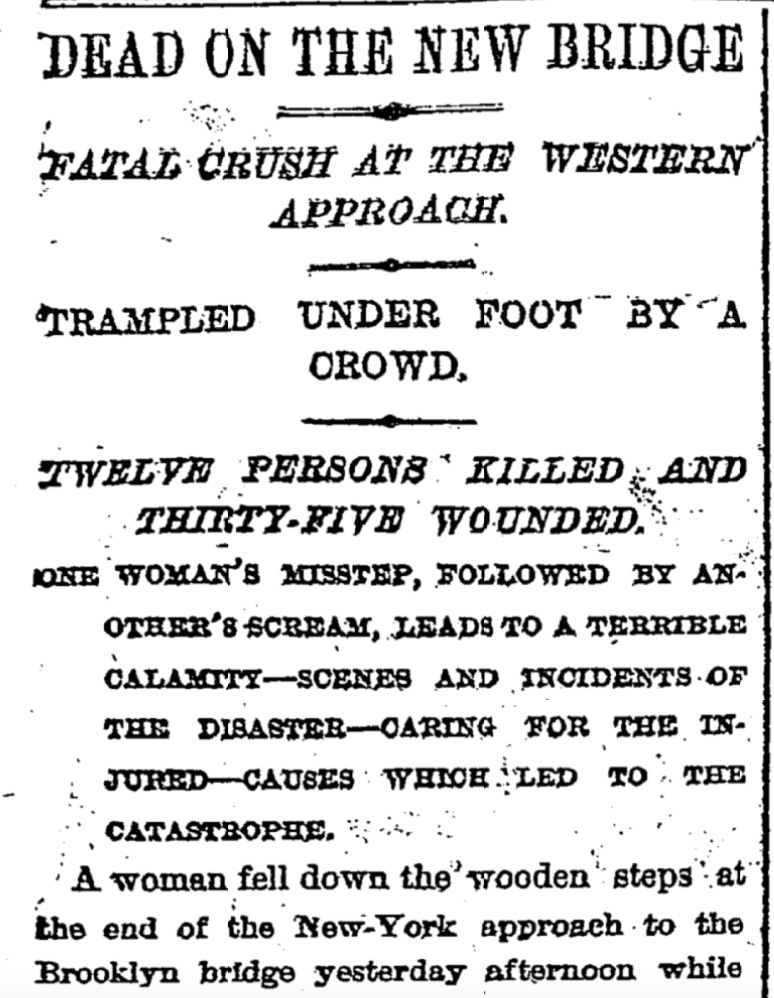
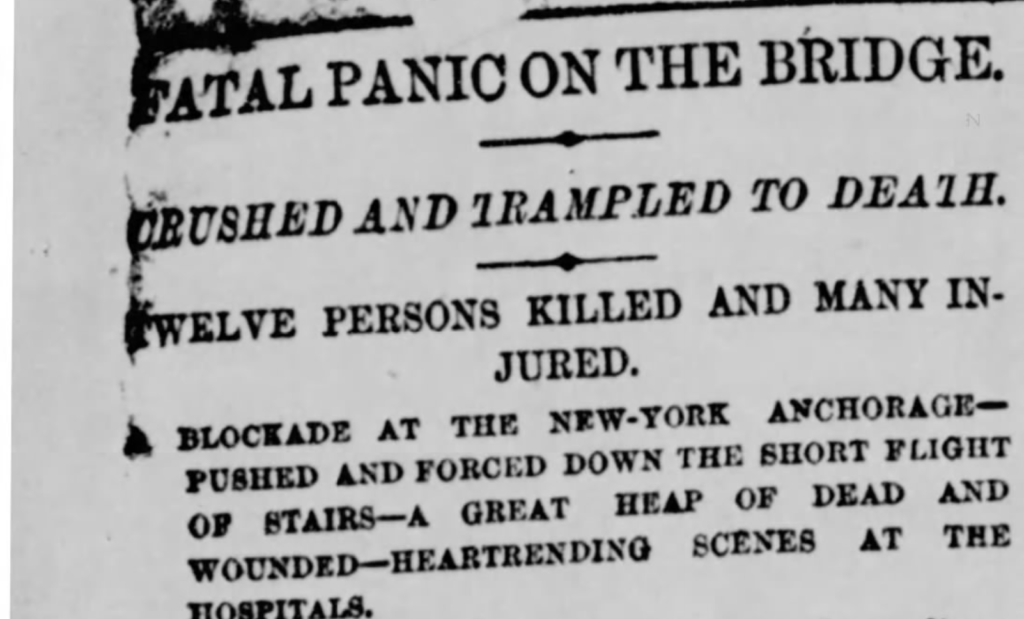
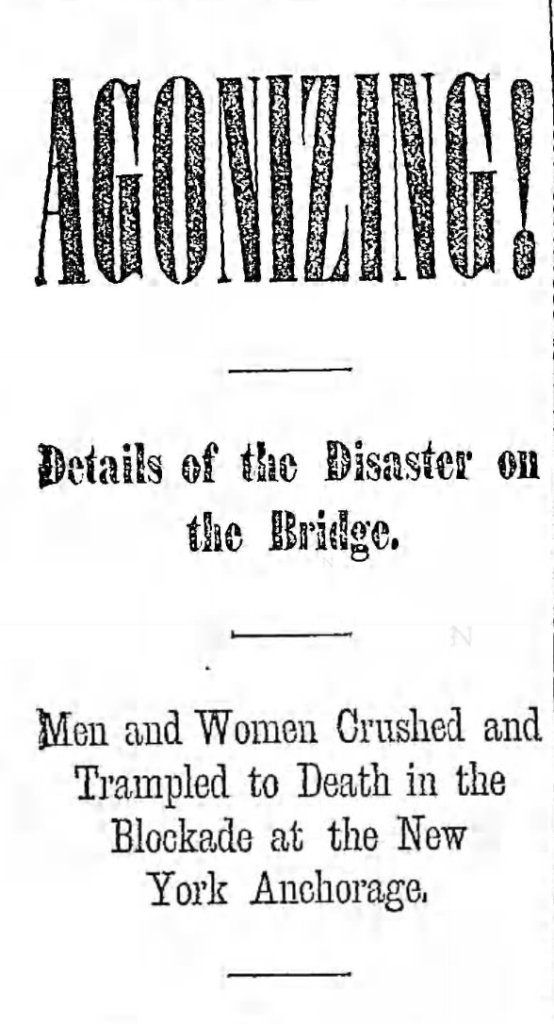
On May 30, 1883 — one week after it officially opened — 12 people were killed in a horrifying trample caused by the collapse of the Brooklyn Bridge.

Except of course, the Bridge didn’t actually collapse.

Photo_957

The prior week, the Brooklyn Bridge opened to terrific fanfare, with almost 14,000 people invited to cross this architectural behemoth which had sat in their harbor under construction for years.

The experience of crossing for the first time — to experience the sprawling city from a vantage in the harbor and at equal height of the tallest buildings of the time — must have been immense. And rather frightening.

One week later, on May 30th (Memorial Day that year), the path was still clogged with curiosity seekers.

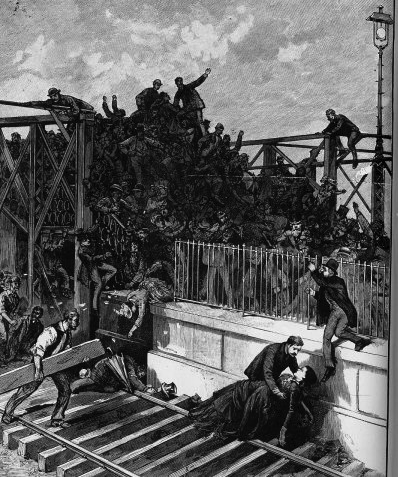
Suddenly a woman fell on the stairs walking up on the Manhattan side, and her friend screamed.

Just this unnerving act alone created a rumor that the new bridge was about to collapse, that it couldn’t take the weight of all these people.

Panic ensued and people stampeded in every means possible to escape off the bridge. I feel the editorial from the Brooklyn Daily Eagle says it best:

“Two men tried to raise the prostrate woman and were instantly trampled and paid forfeit with their lives. In a few seconds human beings were piled four deep at the foot of the steps, and the crowd was hurried over them.”

Top story of the New York Times, May 31, 1883

From the report of a police officer on the bridge:

I was just above the stairs, at the side of the promenade. There was a crowd going in each direction and I was trying to keep them moving. A woman stumbled on the stairway below the landing and fell. Another woman at the head of the stairway saw her fall, and she screamed. The whole thing was caused by that woman screaming.”

“Then came the rush and the panic. I succeeded in getting up the woman who had fallen, but my hands were stepped on and my head kicked. I tried to drive back the crowd but could do nothing. It seemed as though the people didn’t see the stairs till they were pushed headlong down them by the rushing crowd behind.

1

Under a grim heading ‘The Pile of Dead’ in the New York Sun sits some frightful descriptions by survivors:

I felt the pulse of a number of those who were taken out. The first was a woman, who lay on her back just below the steps, with one arm twisted under her and the other hand clenching the reman of a child’s shawl. She had gray hair. Her forehead had been cut by the fall and her face was stained with blood. I believe she died before they got her off the bridge.”

New York Tribune

In the bloody tussle, 12 people died and over 36 were seriously injured. The victims ranged in age from 15 to 60, according to the Tribune.

Brooklyn Daily Eagle, May 31, 1883

The bridge, of course, wasn’t in any danger of collapsing. But few who walked upon it had ever stepped upon such a thing and it must have been a disorienting experience for the uninitiated.

And newspapers were periodically filled with the news of collapsing bridges. Only a few years before, on December 28, 1879, seventy-five people were killed when Scotland’s Tay Bridge collapsed during a storm.

Closer to home, a railway accident upon a bridge in Little Silver, New Jersey, killed three and injured dozens. (One of the survivors was former president Ulysses S. Grant.)

Following this unfortunate disaster upon the bridge, Brooklyn beefed up the police presence upon the bridge. “The order had evidently gone forth to keep everything moving for officers were stationed on the broad platforms circling the middle pier of each tower — favorite resorts hitherto for loungers and for others who want a shady spot in which to rest.” [source]

A variation of this article originally ran in 2007.

Categories
Bridges

The story of ‘Painters On The Brooklyn Bridge’

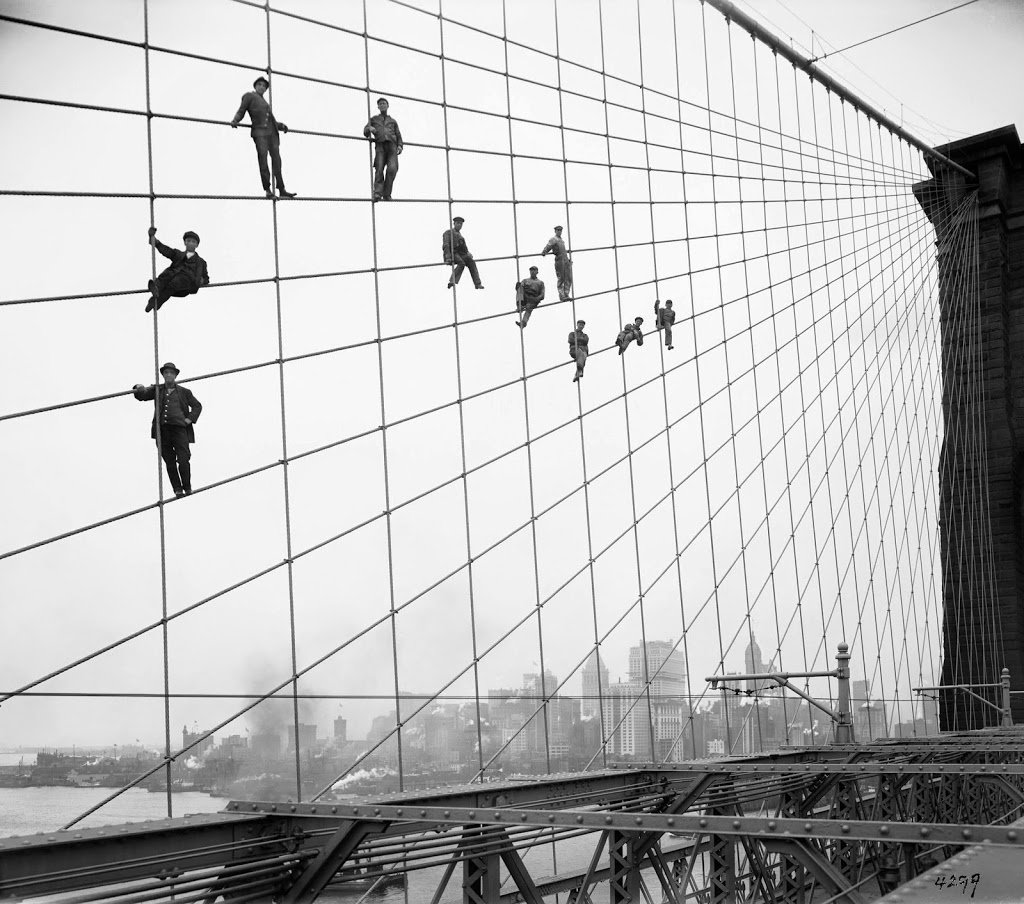
The photograph above (officially called “Brooklyn Bridge showing painters on suspenders”) is perhaps the best-known image taken by Eugene de Salignac, a city employee who took municipal photography of most major New York structures during the early 20th century.

His work had never appeared in a gallery until 2007, almost 65 years after his death.

His exquisite eye rendered otherwise ordinary shots with a captivating grandeur; this was certainly beyond the call of duty of his responsibilities for the Department of Bridges (later named the Department of Plant and Structures) for which he worked from 1906 to 1934.  

In all, it’s estimated the city owns about 20,000 glass-plate negatives taken by de Salignac.

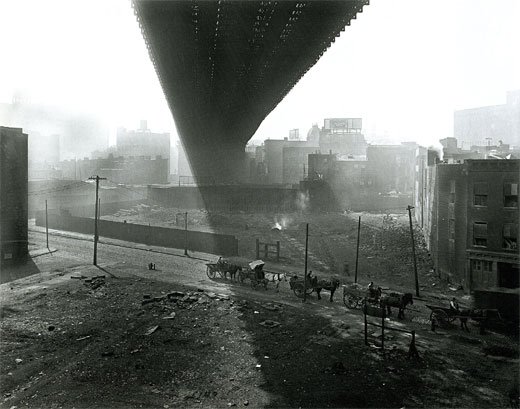
Another striking view of the Brooklyn Bridge, taken by de Salignac on May 6, 1918. / Municipal Archives of the City of New York

On September 22, 1914, de Salignac headed to the Brooklyn Bridge to observe workers painting the bridge’s steel-wire suspension. Perhaps a bit inspired by modern artistic photography of the day, the normally workaday photographer returned to the bridge a couple weeks later, on October 7.

To quote Aperture: “The image was obviously planned, as evidenced by the relaxed nature of these fearless men who appear without their equipment and are joined, uncustomarily, by their supervisor.”

It was, generally speaking, an unspectacular day for the 31-year-old bridge.

It’s believed that the original color of the Brooklyn Bridge was ‘Rawlins Red’ although by this time, the vibrant color might have been replaced with the less dramatic ‘Brooklyn Bridge Tan.’  

Can you imagine what this image would have looked like in color?

I would like to think de Salignac took some inspiration from photographers like Paul Strand who were beginning to see New York City as a set of geometric abstracts.  

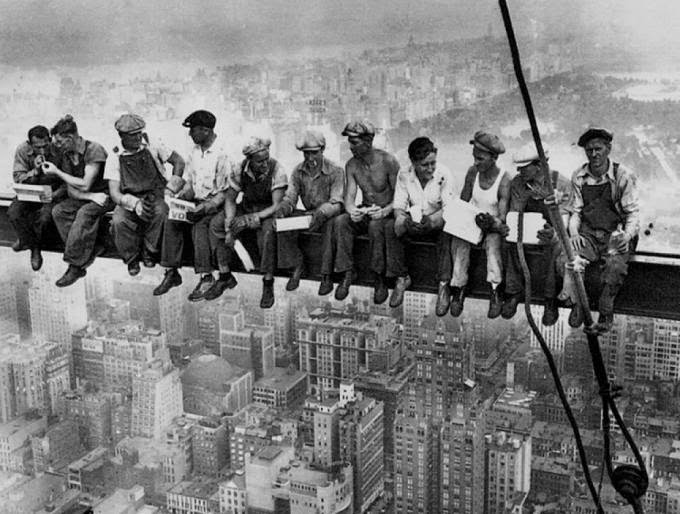
The spirit of this photograph echoes into the work of Berenice Abbott and especially Charles C Ebbets. In 1932, while de Salignac was still employed by the city, Ebbets was hired by Rockefeller Center to document the construction of the RCA Building.

In one photo, workers were posed in a way that eventually became quite iconic:

Most likely, none of those other photographers saw de Salignac’s Brooklyn Bridge picture.  It was essentially lost among the thousands of archives pictures until the 1980s.  

For his first film for PBS, Ken Burns used the photograph  in his Brooklyn Bridge documentary which went on to snag an Academy Award nomination.  In 2007, de Salignac was belatedly honored with an exhibition at the Museum of the City of New York.

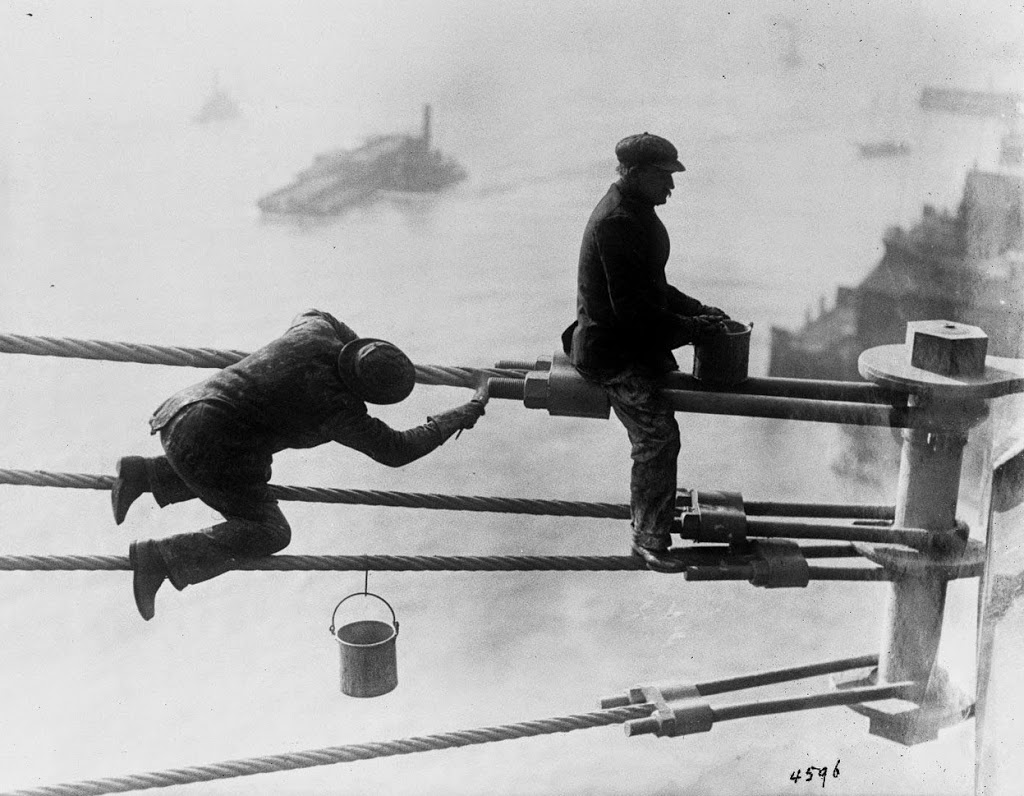
 De Salignac returned to the bridge to several times to catch more workers in the act of maintaining the bridge. Such as this photograph the following year:

Want to get lost for an hour or so? Check on the New York Municipal Archives vast trove of Eugene de Salignac photographs directly.

**This famous picture Lunch atop a Skyscraper was attributed first to Lewis Hine, then to Charles C Ebbets. Thank you to Michael Lorenzini for pointing this out!

Top photo courtesy New York Municipal Archives. Hine photo courtesy the George Eastman House

Categories
Planes Trains and Automobiles

New York City from the sky: The first aerial photographs

One hundred and nine years ago this month, a tiny airplane made history over the waterways of New York City.

These weren’t the first flights over the city — those had occured in the fall of 1909, during the Hudson-Fulton Celebration — or even the most daring or most publicized. (Aerial competitions like the Great Gimbels Air Race of 1911 might take those titles.)

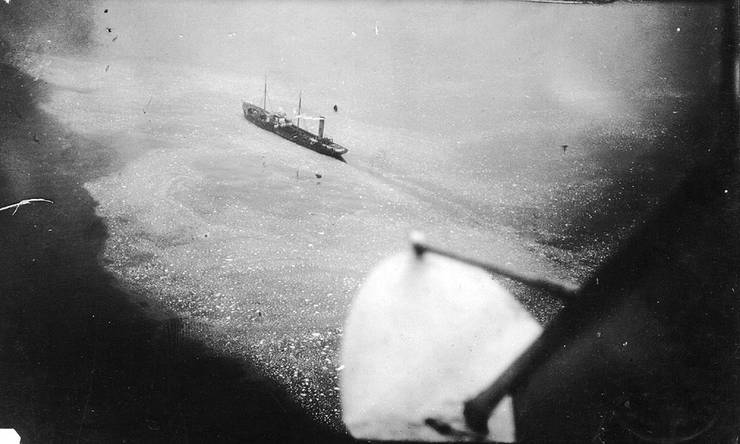
These flights, which took place in February and March of 1912, were important not only due to the bravery and braggadocio of the pilot, derring-do Frank Coffyn, but because of his companion — American Press Association photographer Adrien C. Duff.

Duff is responsible the very first photographs and the first ever film of New York City — from overhead, taken by an airplane.*

And in taking these photographs, this also makes Duff the very first airplane passenger over New York Harbor.

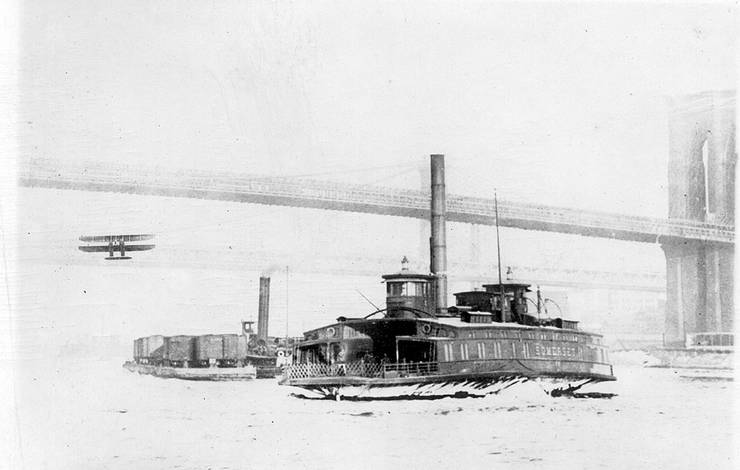
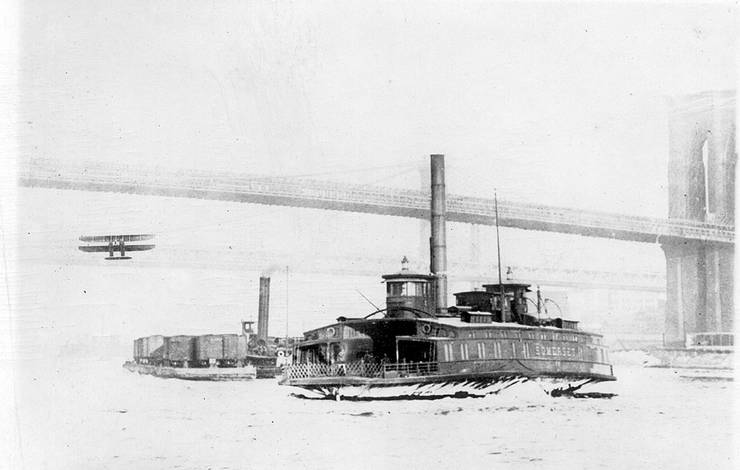
Frozen flight: Frank Coffyn sails underneath the Brooklyn Bridge and above the East River during the dead of winter. 

First In Flight

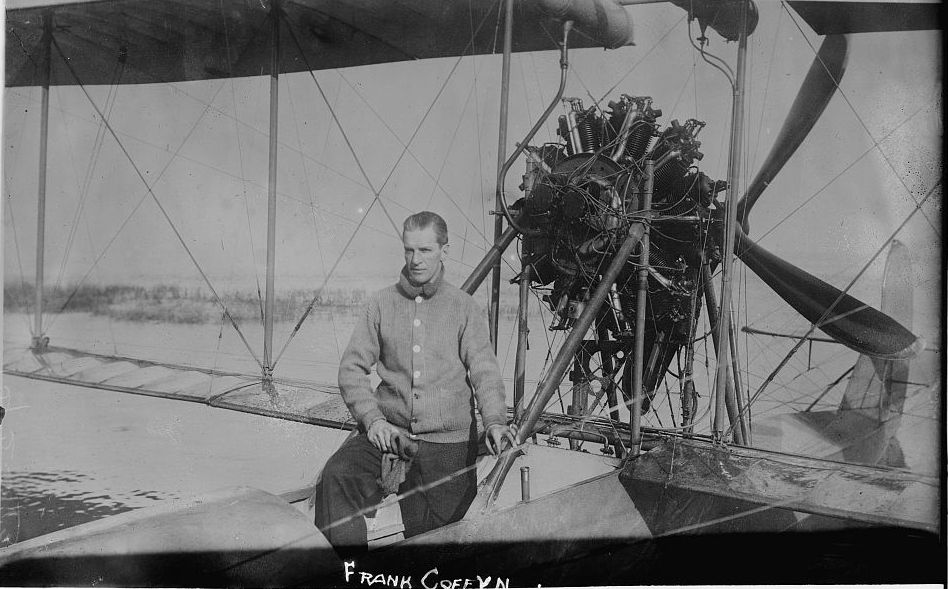
Coffyn, a former Wright Brothers employee, accepted the offer of Brooklyn film studio American Vitagraph to figure out a way of snapping images of New York from above.

This was a tricky task to be sure in 1912. Manned flights had only been invented by his former employers a few years previous. Planes had to be very light and until that moment could only carry the pilot and necessary equipment.

Below: Frank Coffyn, in a picture with a Wright Bros plane in 1911 (Photos courtesy Library of Congress)

Even trickier, Coffyn wanted to lift off from the harbor directly and not from the icy landing strip based on Governors Island. To that effect, he furnished his plane with pontoons, allowing it to float upon the unfrozen shoreline.

The Sky’s The Limit

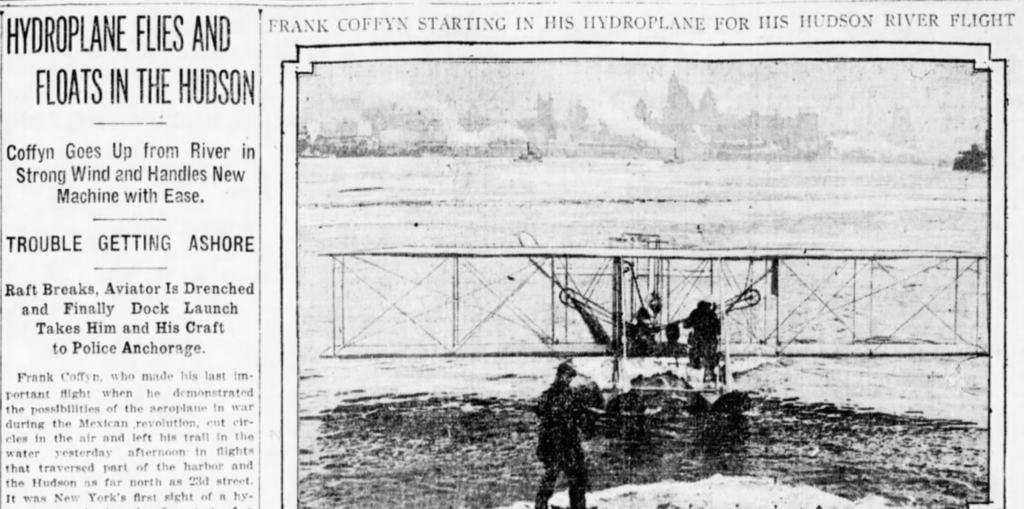
His first successful flight skimming off, and then above, the Hudson River was on February 6, 1912, “proving that the aeroplane …is also a near cousin of the mudhen or the duck,” according to the New York Times.

New York Tribune, Feb 7, 1912

He continued to make successive flights over the next few weeks, this time from the shore of the Battery and up the East River.

On February 13, 1912, he became the first pilot to fly underneath the Brooklyn Bridge, so low that he reportedly felt the smoke from a passing tugboat.

As a May 1912 edition of Metropolitan Magazine put it: “In February New Yorkers saw Frank T. Coffyn with his Wright hydro aero-plane travel over the surface of the half-frozen river, maneuvering in the water like a motor-boat, skating on the ice at top speed — then rise in the air over the ferryboats, under and over the bridges and around the Statue of Liberty.

Better Than A Postcard

But it was one particular flight on February 8th that is of historic significance.

For he was joined on this flight this time by Duff, the ‘swashbuckler of the camera’.

During the short flight, Coffyn took Duff from the Battery past Governors Island, over the ships of the harbor, around the Statue of Liberty, then back to Manhattan.

Duff was actually strapped onto the lower wing, with his legs dangling off the side of the plane! Both Coffyn and Duff were frozen to the bone by the time they landed.

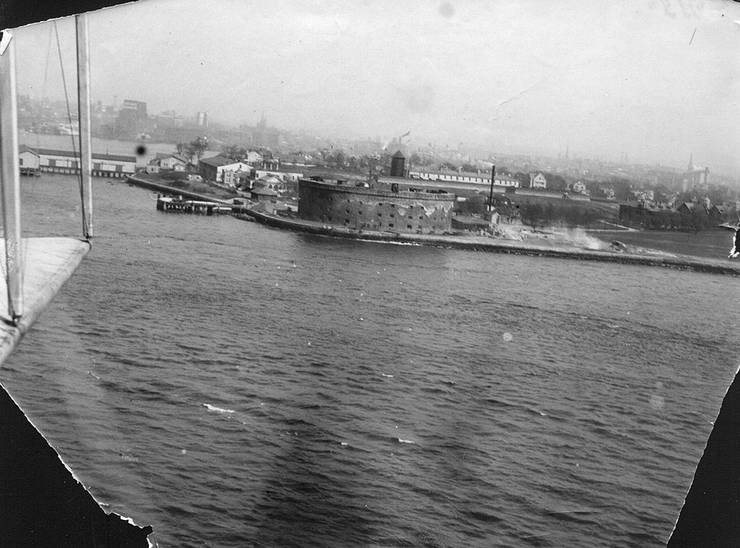
Duff took nine photographs in all, of which only a few were usable. This article features the best of Duff’s pictures, and the first ever taken of New York from the sky.

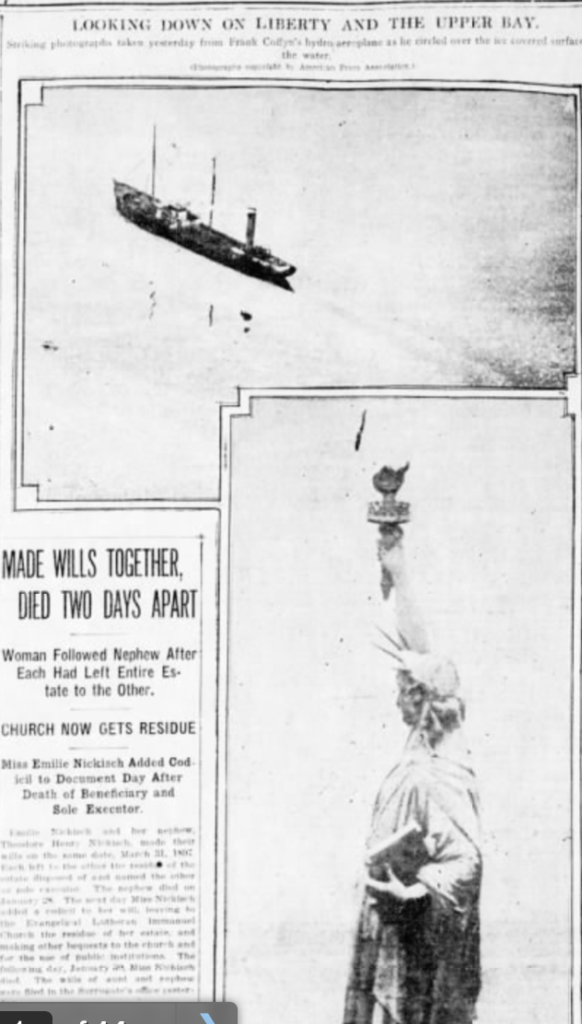
Below: The first appearance of the photo above in a newspaper, the New York Tribune, Feb 8, 1912. (courtesy Newspapers.com)

Coffyn eventually fulfilled his original mission with Vitagraph, bringing Duff back on his plane on February 12th to operate the moving-picture camera and making the very first film overhead New York.

The footage is not the most vivid, partially because Duff’s hands became so cold that he could barely operate the crank-operated camera.

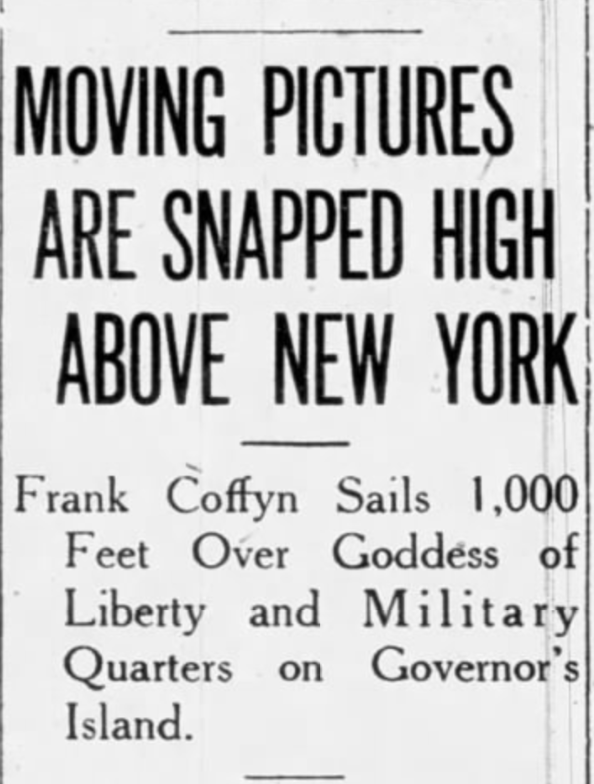
From the Buffalo Courier, Feb 13, 1912

Later on, Coffyn attempted to operate the camera himself. This proved to be less successful, as a couple days later, he dropped the camera into the East River. Vitagraph released the usable footage to theaters in April.

Here’s a newsreel incorporating some of Coffyn’s own footage and some great shots of him taking off from the Battery shore.

And whatever happened to Adrian C. Duff?

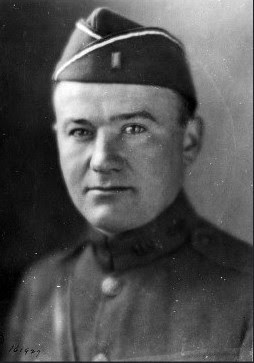
He took that sense of adventure, enlisted in the U.S. Army, and became a noted photographer during World War I. Here’s one of his more famous images.

Duff in 1918

He wrote of his exploits in a 1918 article for the Fulton Evening News. 

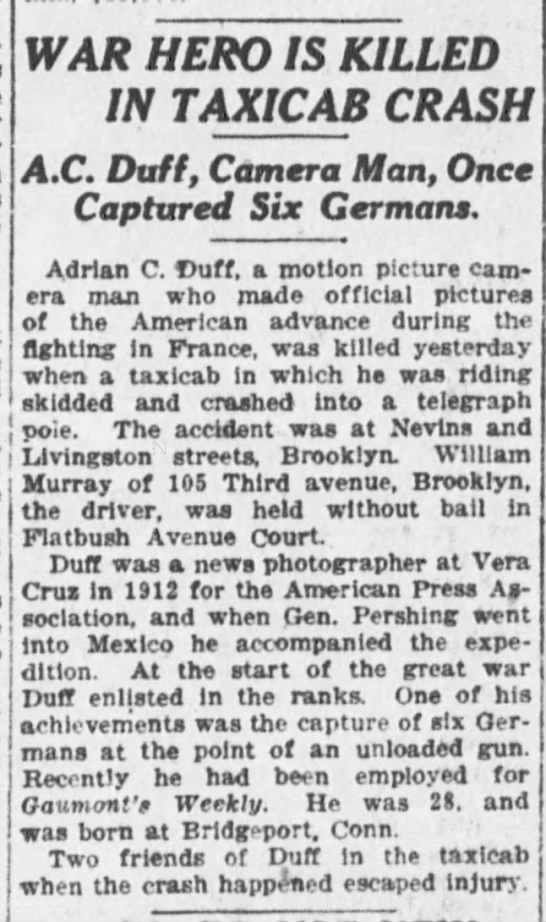
He survived the rigors of war only to die in a grim taxicab accident in Brooklyn on March 7, 1920. From the New York Times:

*There is actually ONE photograph older than 1912, taken from a hot air balloon in 1906. More about that here.

Read more about Duff’s life at Shooting The Great War. This article was originally published on this website on February 13, 2012.

Categories
Gilded Age New York Podcasts

That daredevil Steve Brodie! Did the former newsboy really jump off the Brooklyn Bridge?

PODCAST A tale of the ‘sporting life’ of the Bowery from the 1870s and 80s. A former newsboy named Steve Brodie grabs the country’s attention by leaping off the Brooklyn Bridge on July 23, 1886. Or did he?

The story of Steve Brodie has all the ingredients of a Horatio Alger story. He worked the streets as a newsboy when he was very young, fighting the bullies (often his own brothers) to become one of the most respected newsies in Manhattan.

He experienced his first taste of adulation and respect as a minor sports celebrity, participating in pedestrian competitions across the country. Back in New York, Brodie started a family and promptly lost most of his money at the race track. He yearned to do something athletic and attention grabbing again.

The Brooklyn Bridge, completed in 1883, was a crowning architectural jewel linking two major cities; Brodie witnessed much of its construction during afternoons diving from East River docks. He now proposed an outrageous stunt that would garner him instant fame and fortune.

He would jump off the Brooklyn Bridge!

Was Steve Brodie a hero or a fool? A daredevil or a con artist? His story provides a window into the ‘sporting men’ life of the Bowery and a look into what may possibly be the greatest hoax of the Gilded Age.

New York Times, July 24, 1886

Listen Now — That Daredevil Steve Brodie!

To get this week’s episode, simply download or stream it for FREE from iTunes, StitcherSpotify or other podcasting services. You can also get it straight from our satellite site.

Or listen to it straight from here:

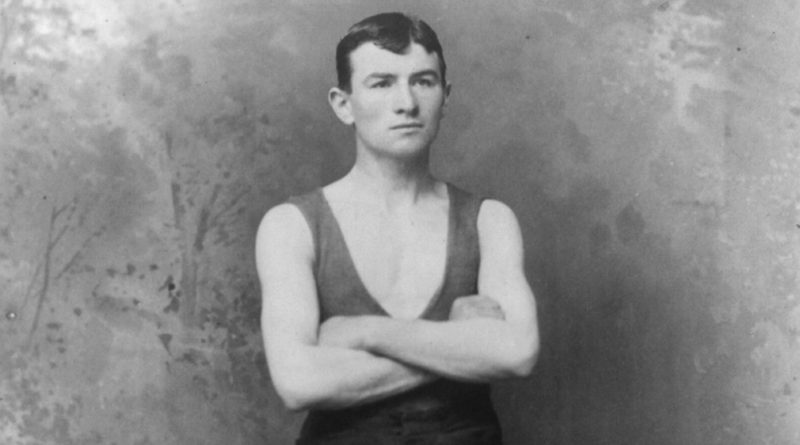
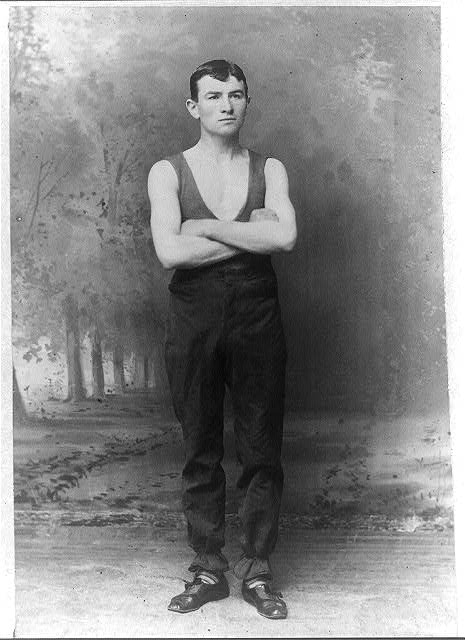
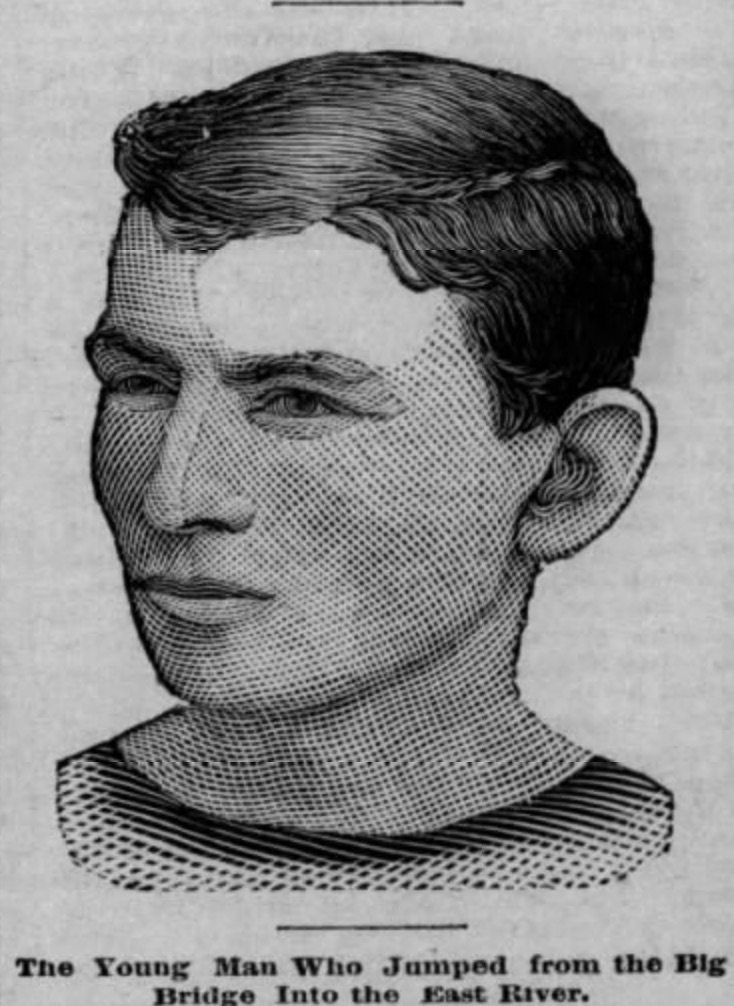
A photograph of Steve Brodie, taken on July 31, 1886, a week after his ‘jump’.
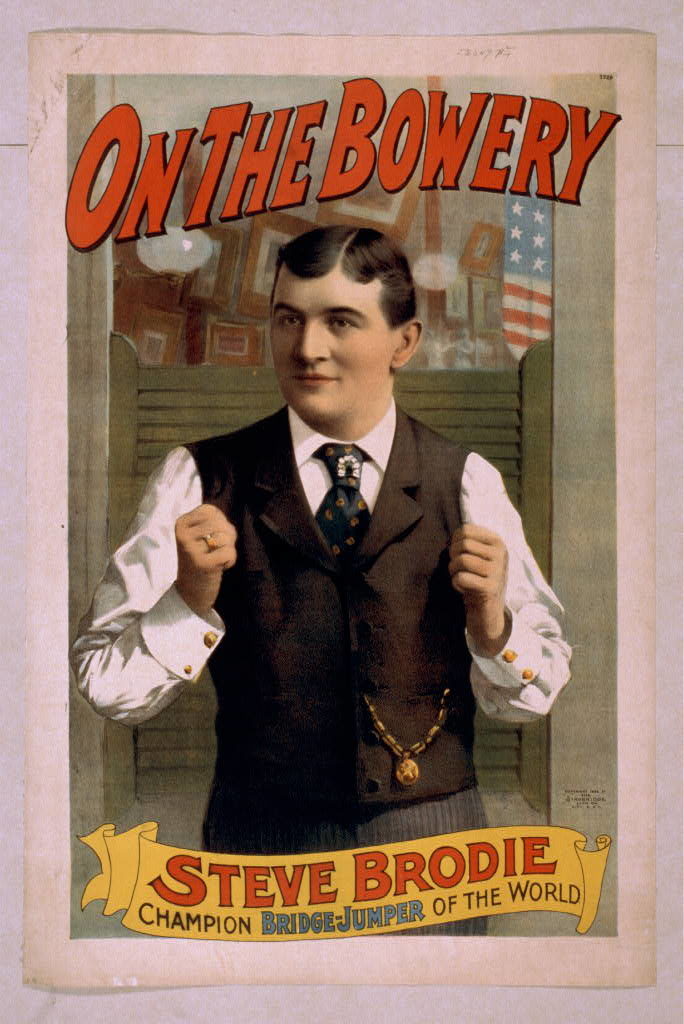
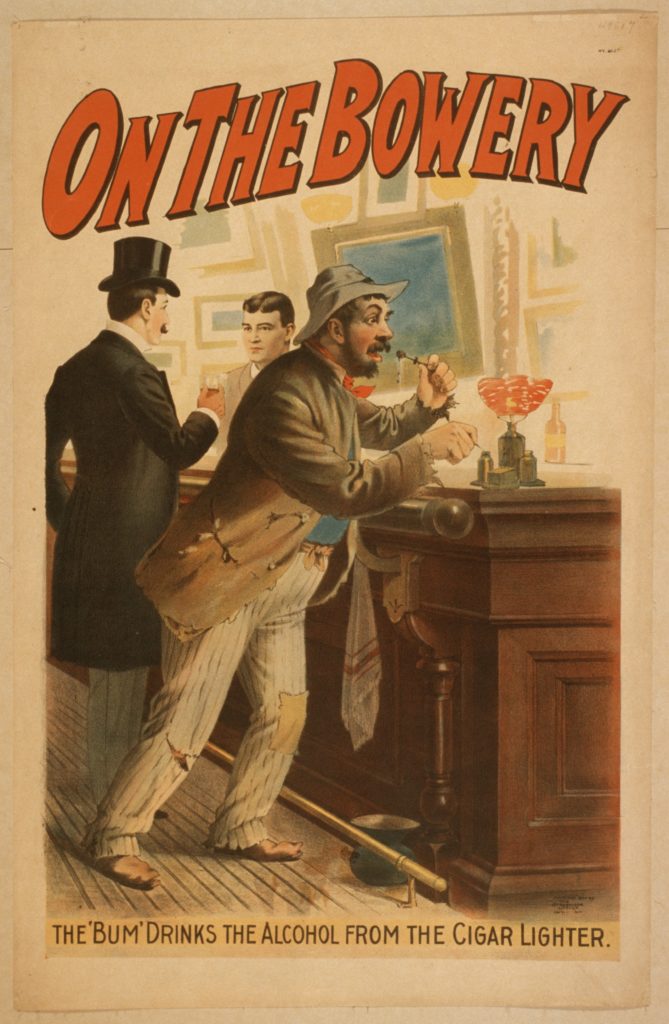
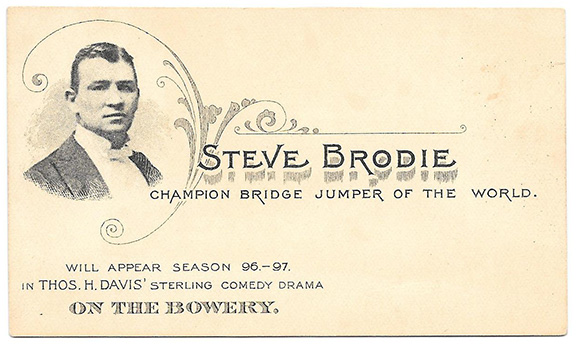
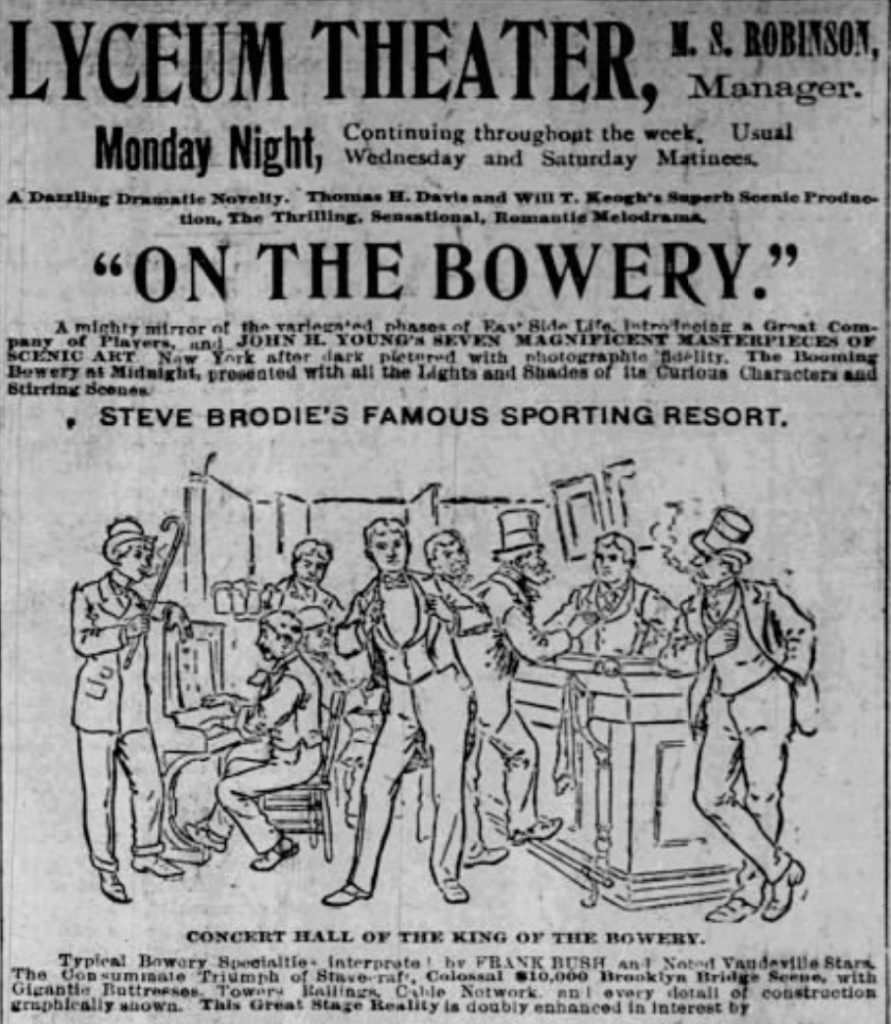
Advertisements for the show On The Bowery
Images courtesy Library of Congress
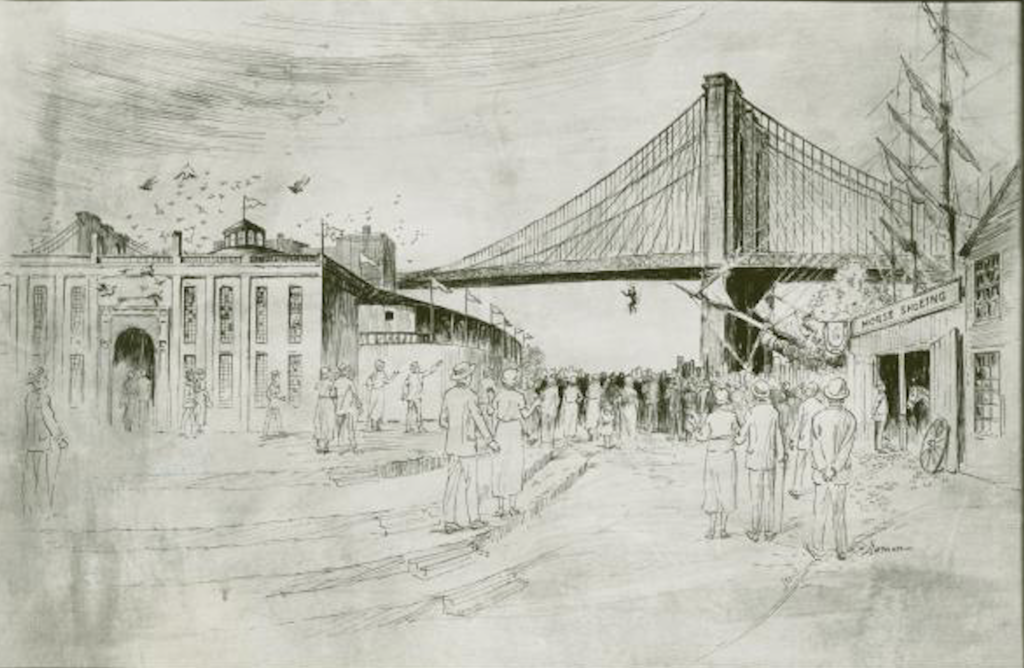
An illustration of Brodie’s jump made for the Old New York exhibition at the 1939 New York World’s Fair.

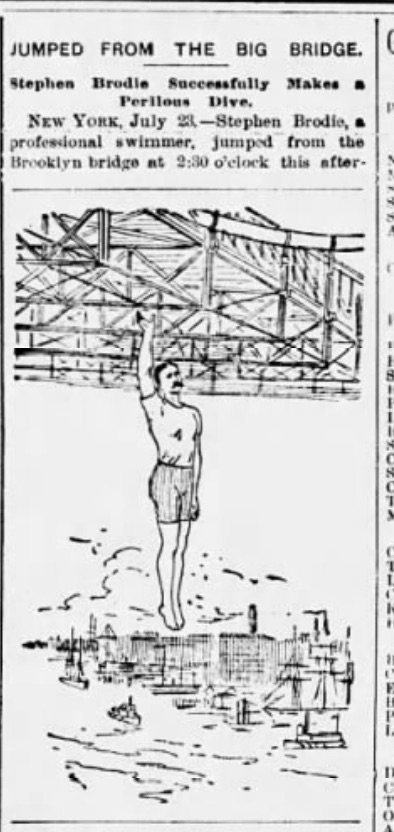
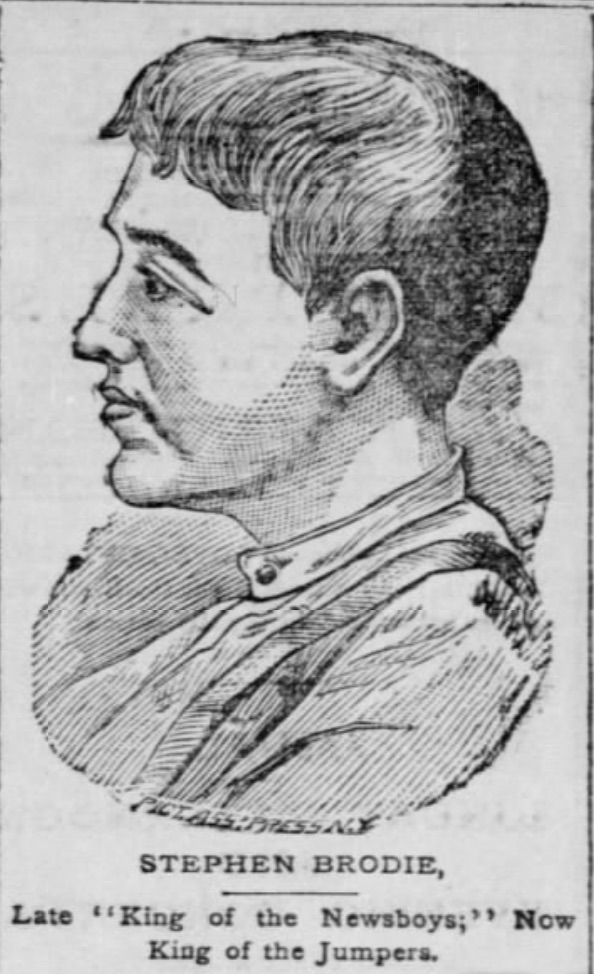
A few of the creative illustrations of Steve Brodie in the days and weeks following his stunt.

Here’s the Bugs Bunny cartoon Bowery Bugs (from 1949), courtesy the Internet Archive.

You can watch the 1933 film The Bowery on streaming services and even get the entire thing — in pieces — on YouTube. Here’s the section of the film featuring Brodie’s ‘brilliant idea’ (at around the 5:30 mark). By the way, this film is riddled with offensive stereotypes so be warned!

The actor Steve Brodie, who made his name in Western films and televisions shows, took his screen name from the Bowery’s Steve Brodie. You can also see Brodie in The Beast from 20,000 Fathoms!

My thanks to Grant Barrett for allowing me to use a clip from A Way With Words. Hopefully you’re all listeners of his excellent show with Martha Barnette about the history of language. Barrett and Barnette have been producing the show since 2007.


And here’s an article I wrote back in 2007 (!) about two saloons on the Bowery — including Brodie’s. This was written for our FRIDAY NIGHT FEVER series about the history of New York City nightlife. Past entries can be found here .

We’re going way, way, way back to New York’s seediest, filthiest and most notorious place — the Bowery in the late 19th century.

The nightlife of the old Bowery could have an entire blog in itself. It has been witness to some of the rowdiest, most shameless and debauched New Yorkers who have ever lived. They filled up dives and flophouses, brothels and saloons,  and catered to the poorest of immigrants and the richest of the upper class ‘slumming it’ for a real idea of fun unimagined in the drawing rooms of the elite.

The two saloons from the late 19th century featured here weren’t extraordinary places as we would consider today — they would both fit comfortably in the 20th century sin-den the Limelight — but they were run by extraordinary people, ‘heroes’ of the Bowery brawler set.

Geoghegan’s at 105 Bowery has been described as “a rendezvous for professional mendicants.” Often called the Bastille of the Bowery, it didn’t just spawn a few fisticuffs; it catered to them. Because this two-floor boiserie featured two boxing rings, and one of the men in the ring was often the bar’s owner.

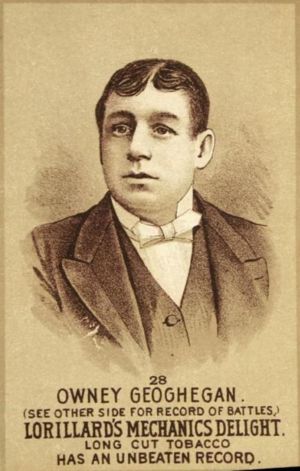
Owney’s boxing card.

Owney Geoghegan held the boxing distinction of Lightweight Champion of America from 1861 to 1964 when he retired to open his tavern/fight palace in the Bowery. His reputation naturally drew the crowds, and Geoghegan encouraged his patrons on to a little pugilism with the help of ample ales and whiskey. In 1891 the ‘Bastille’ even hosted a few rather fierce bouts of women’s wrestling, with the competitors required to cut their hair (to prevent pulling) and costume themselves wearing only tights.

Such a swarthy establishment was bound to attract the lowest elements and the most sinful gangs of New York. One journalist at the time describes it: “The faces around us are worse than those seen in a bench show of pugnacious dogs, and instinct teaches us to have a care for our nickels, for our pockets are in imminent danger.”

But perhaps the person the clientele should have feared the most was Geoghegan himself. A short but powerful Irish man, Geoghegan was known for his impressive, compact strength. And his penchant to cheat when needed.

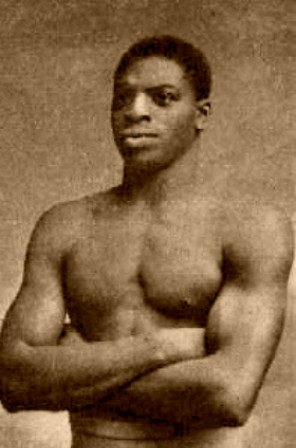
Viro Small, one of the Bowery’s most popular boxers.

Geoghegan was in the ring one night against Viro Small, a very popular black wrestler. Geoghegan was still in his prime but it was clear he was being bested in the ring by Small. The drunken crowd kept catcalling him, and he knew he couldn’t lose in his own establishment. So he had one of his henchmen hold a gun to the referee’s head and call the match for Geoghegan!

(Small didn’t hold a grudge. He later wrestled there again, with a man named Billy McCallum who afterward tried to murder him.)

As Geoghegan flexed his strength to his barflies, another Bowery saloon owner was busy displaying his gifts of agility. In 1886 Steve Brodie, on a bet, jumped off the Brooklyn Bridge, the bridge being only about three years old at the time. What was amazing was not the amount of stupidity that took, but the fact that he survived and claimed his $100 bet money.

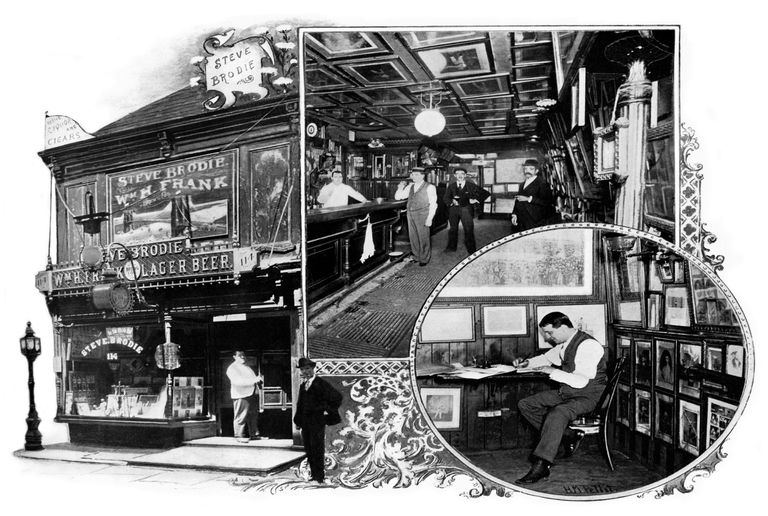
His feat was celebrated at the time and from the fame of this simple act, he was able to open Steve Brodie’s Saloon, 114 Bowery, at Bowery and Grand Street (a couple of doors down from Geoghegan’s place).

Brodie’s saloon. Note the Brooklyn Bridge mural above the bar entrance.

If Geoghegan’s dive was a celebration of his profession, Brodie’s was a celebration of his own personality. Behind the bar was an elaborate oil painting depicting Brodie bravely hurling off the bridge, along with a signed affidavit from the boat captain who fished him out of the water. The floor of the bar was inlaid with silver dollars to give it that wealthy feeling that money had been hurled to the floor.

For the cost of a drink, Brodie would gladly recount his tale. As silly as it seems today, he was able to pack in patrons, perhaps many from Geoghegan’s place, still drunk on booze and bloodletting.

Somehow he managed to turn his feat into a touring autobiographical performance entitled On The Bowery. Eventually, he tried to top his feat with a plunge down Niagara Falls in 1889. (It could never be proven that he actually went ahead with it!) He settled in Buffalo and opened another saloon there, but the enigma of his fame apparently didn’t carry that far. He moved to San Antonio and died at age 39.

Geoghegan had a similar short-lived fate. He lapsed into a severe depression at the death of his father and, traveling to Hot Springs, Ark., to try cure himself of his pain, actually died there, age 45.

As his obituary in the New York Times said: “There is mourning in the Bowery, sorrow on Houston and Bleecker streets, and desolation in the dance halls of the slums….. His career as a prizefighter, ward heeler and dive keeper was that of the typical New York rough, and is only interesting as it illustrates a phase of life little known to respectable people.”

Heirs to the vice of modern nightlife, take note.

_________________________________________________________

The Bowery Boys: New York City History podcast is brought to you …. by you!

We are now producing a new Bowery Boys podcast every other week. We’re also looking to improve and expand the show in other ways — publishing, social media, live events and other forms of media. But we can only do this with your help!

We are now a member of Patreon, a patronage platform where you can support your favorite content creators.

Please visit our page on Patreon and watch a short video of us recording the show and talking about our expansion plans. If you’d like to help out, there are six different pledge levels. Check them out and consider being a sponsor.

And join us for the next episode of the Bowery Boys Movie Club, an exclusive podcast provided to our supporters on Patreon.

We greatly appreciate our listeners and readers and thank you for joining us on this journey so far.

__________________________________________________________

Unable to load playlist: error

Not AvailableNot Available

 00:00 / 00:00

Sign up for our newsletter!

Email Address:

First Name:

Last Name:

Listen to the podcasts

Looking for the latest episode of our podcasts? Listen now on iTunes to “The Bowery Boys” and “The First”.

Find recent podcast episodes here, and click to read more about listening options here.

Read the book

Bowery-Boys-Book-Cover-R6--revised

Our first-ever Bowery Boys book, “Adventures in Old New York” is now out in bookstores! A time-traveling journey into a past that lives simultaneously besides the modern city.

Bowery Boys Walking Tours

Are you ready to walk through time? We’re excited to announce Bowery Boys Walks, our new walking tours developed around our podcast. Join us in the streets — beginning in October 2018!

Categories
Mysterious Stories Podcasts

Haunted Landmarks of New York : Tourist Terrors in the Big Apple

PODCAST It’s the ninth annual Bowery Boys ghost stories podcast, our seasonal twist on history, focusing on famous tales of the weird and the disturbing at some of New York’s most recognizable locations.

Don’t be frightened! We’re here to guide you through the back alleys … OF TERROR!

In this installment, we take a look at the spectral lore behind some of New York City’s most famous landmarks, buildings with great reputations as iconic architectural marvels and locations for great creativity.

But they’re also filled with ghost stories:

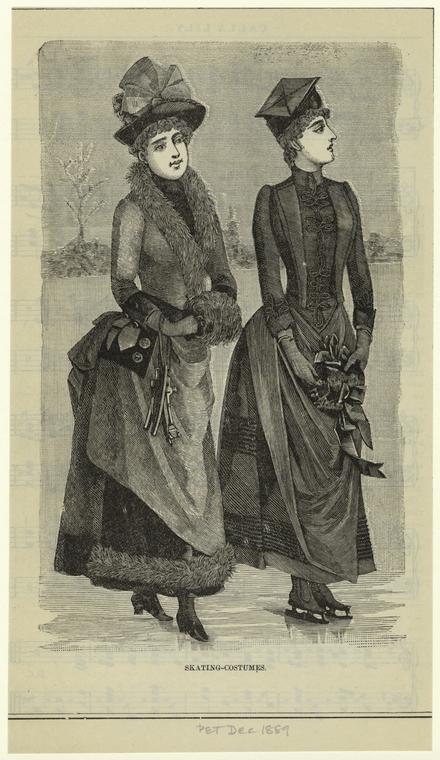
Who are the mysterious sisters in colorful outerwear skating on the icy pond in Central Park? And why are there so many uninvited guests at the Dakota Apartments, one of the first and finest buildings on the Upper West Side?

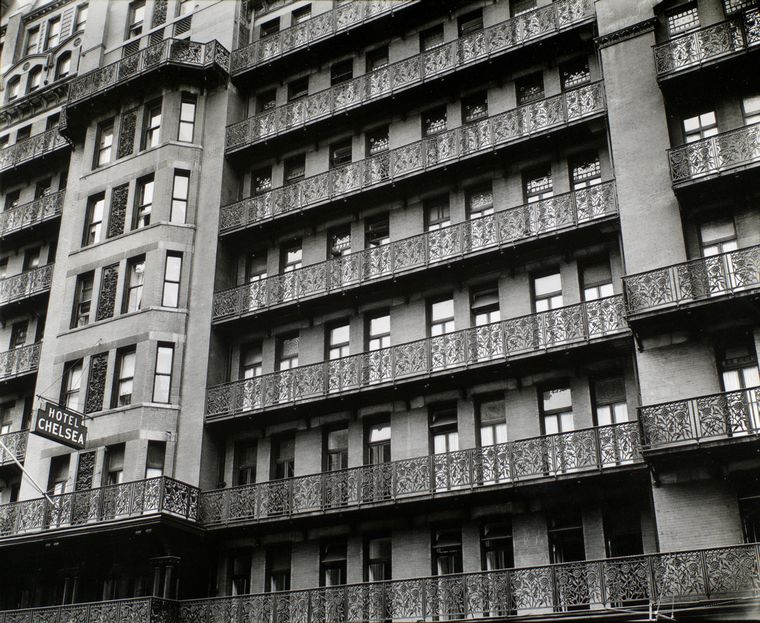
Meanwhile, at the Chelsea Hotel, all the intense creativity that is associated with this great and important location seems to have left an imprint of the afterworld upon its hallways.

Over at Grand Central Terminal, the Campbell Apartment serves up some cocktails — and a few unnatural encounters with Jazz Age spirits.

Finally, on the Brooklyn Bridge, a tragedy during its construction has left its shadow upon the modern tourist attraction. Who’s that up ahead on the pedestrian pathway?

A little spooky fun — mixed with a lot of interesting history — and a few cheesy sound effects!


The Bowery Boys: New York City History podcast is brought to you …. by you!

We are now producing a new Bowery Boys podcast every two weeks. We’re also looking to improve the show in other ways and expand in other ways as well — through publishing, social media, live events and other forms of media. But we can only do this with your help!

We are now a member of Patreon, a patronage platform where you can support your favorite content creators for as little as a $1 a month.

Please visit our page on Patreon and watch a short video of us recording the show and talking about our expansion plans. If you’d like to help out, there are five different pledge levels (and with clever names too — Mannahatta, New Amsterdam, Five Points, Gilded Age, Jazz Age and Empire State). Check them out and consider being a sponsor.

We greatly appreciate our listeners and readers and thank you for joining us on this journey so far. And the best is yet to come!


Two women in fashionable skating garments 1889. Perhaps similar to the ensembles worn by Janet and Rosette Van Der Voort during their ghostly figure eights in Central Park.

New York Public Library


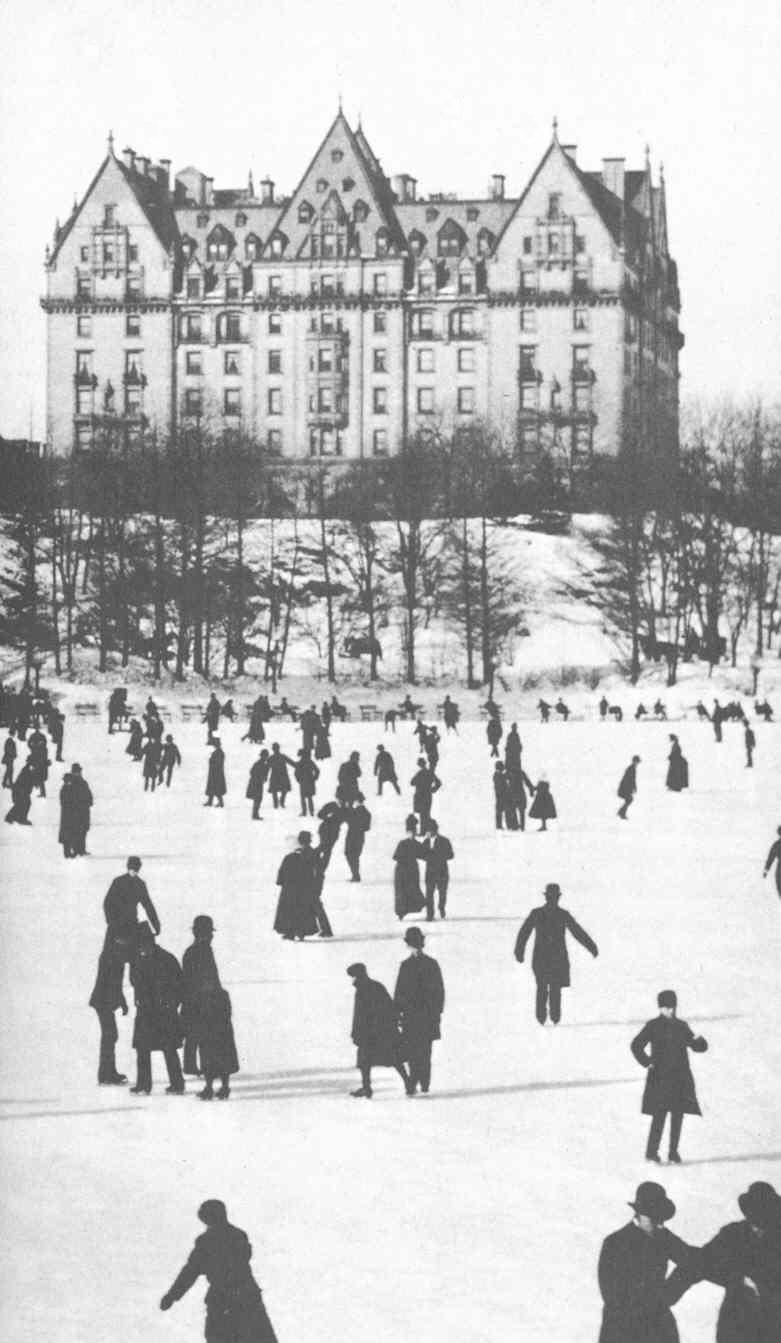
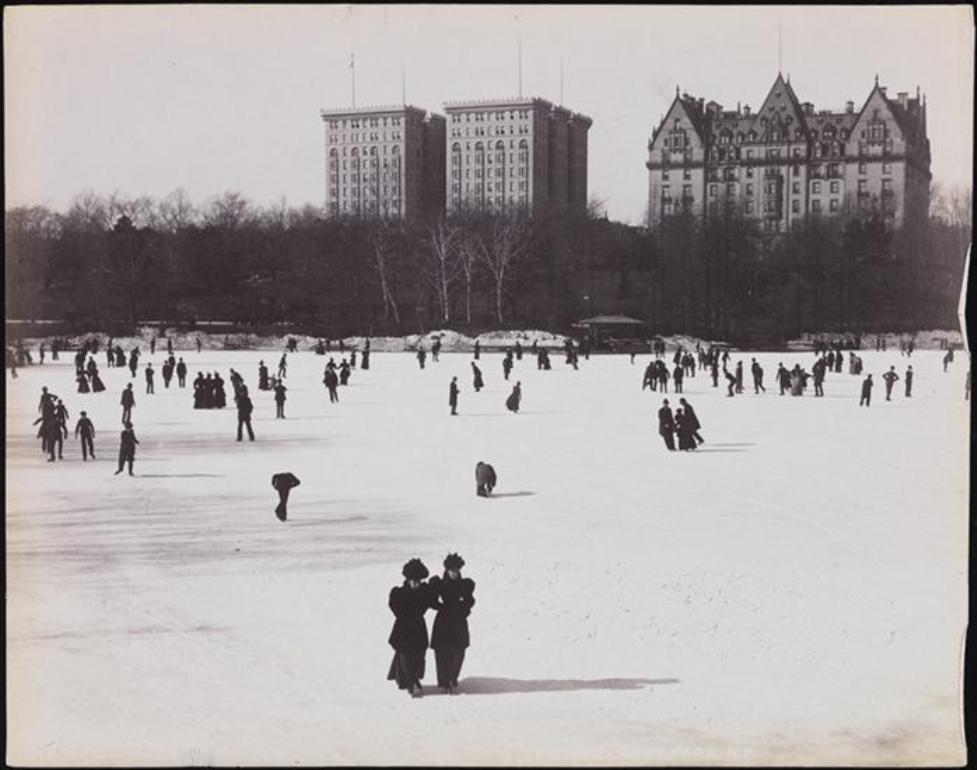
A famous image of the Dakota Apartment — all alone on the Upper West Side landscape — with skaters enjoying the frozen pond on a cold winter’s day.
The_Dakota_1880s

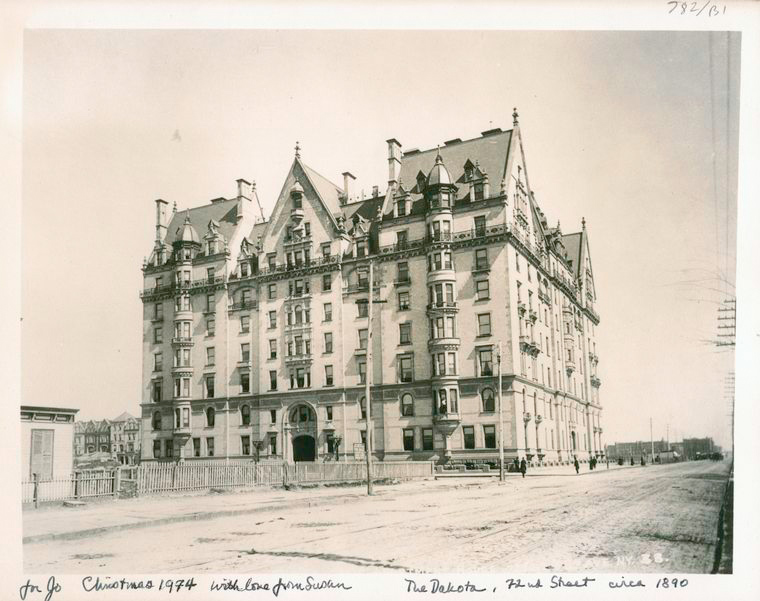
The Dakota photographed in 1890/

Courtesy New York Public Library


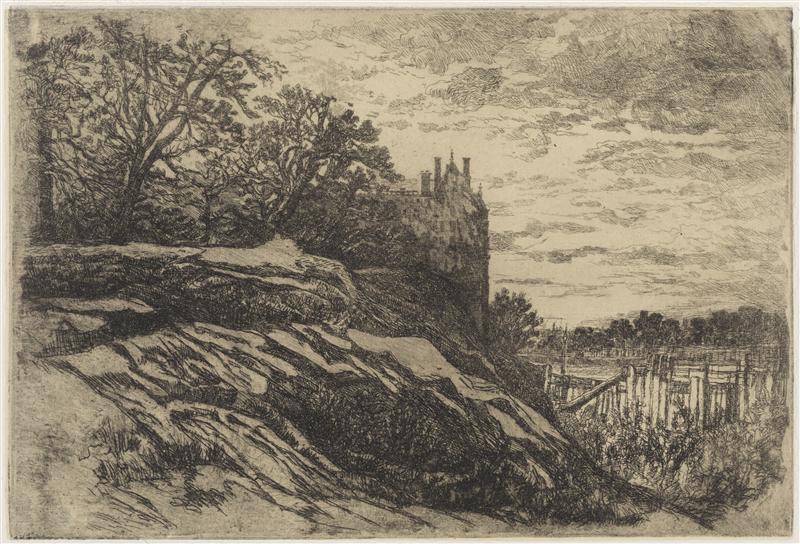
A haunting illustration by Eliza Greatorex from 1885 showing “The Dakota behind a rock at 72nd Street and Bloomingdale Road.”

1
Courtesy Museum of the City of New York


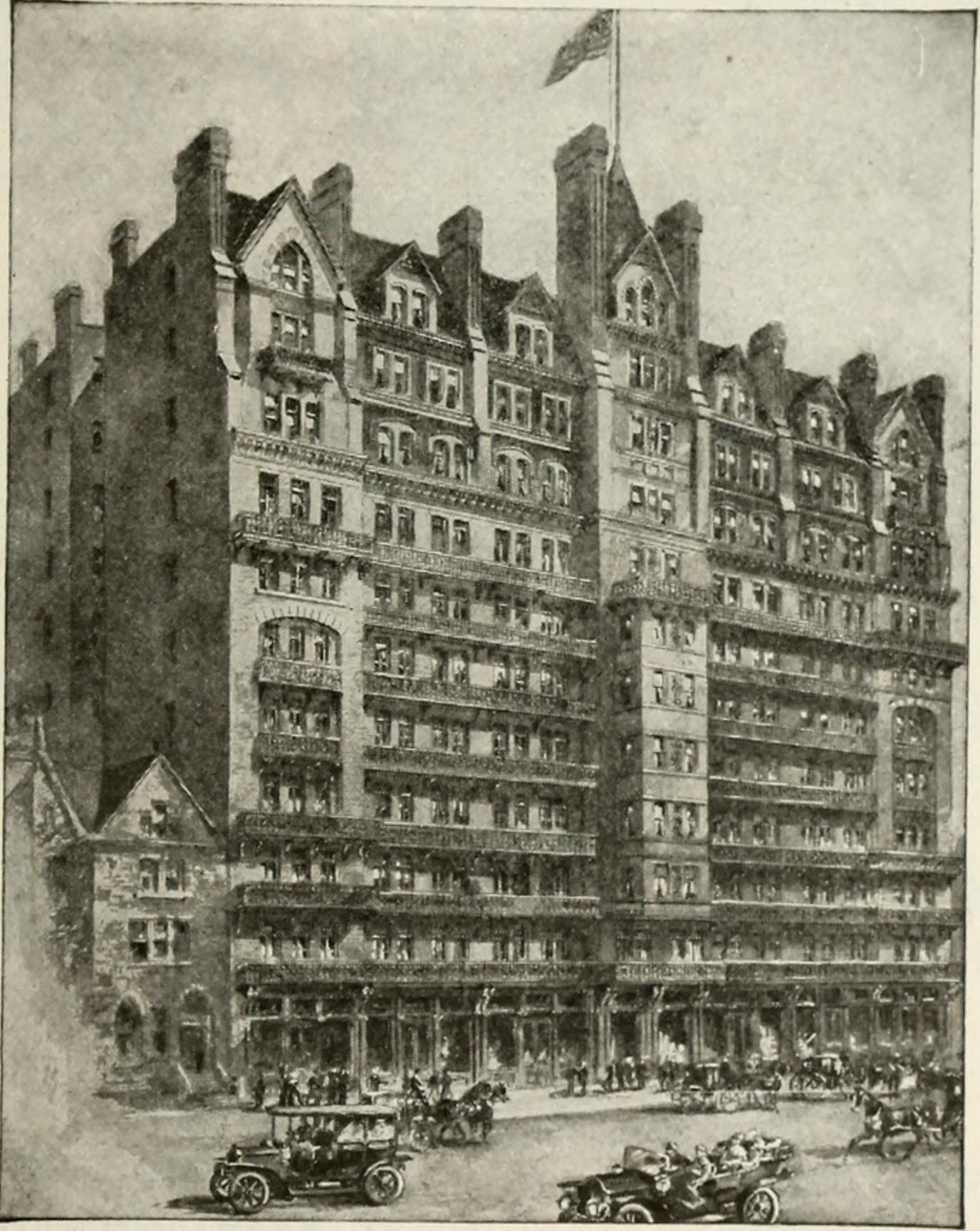
The Chelsea Hotel in 1903, one of the premier apartment houses in New York City which eventually became a destination (both short and long-term) for the city’s artistic circles. It also attracted its share of eccentric and even disturbed individuals over the decades.

Internet Book Archvies

Oh what these floors have seen! The Chelsea in 1936.

Courtesy Berenice Abbott

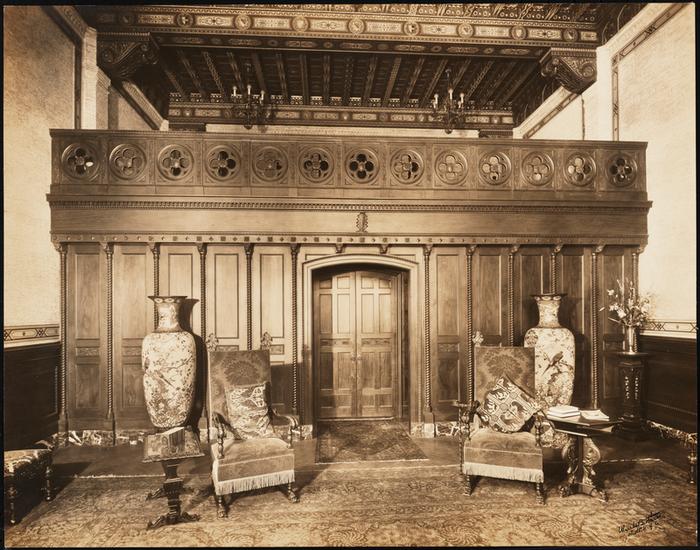
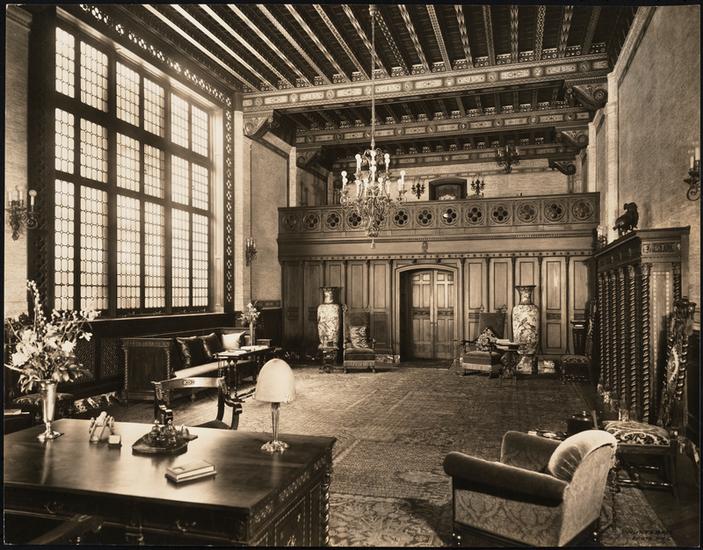
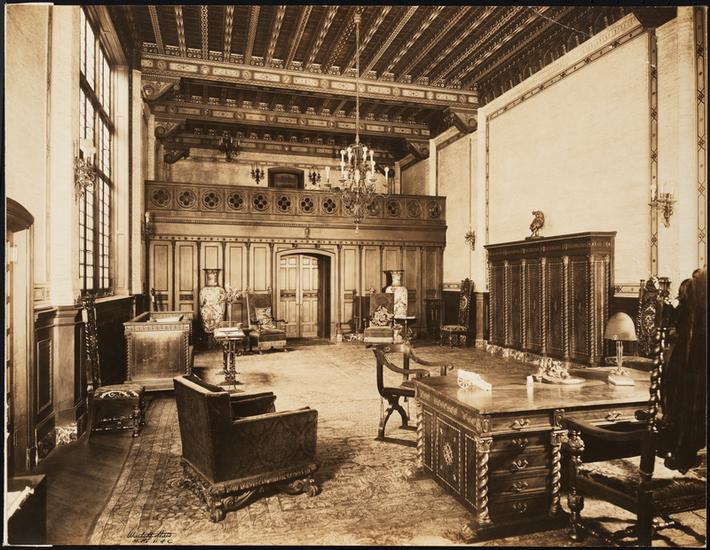
The interiors of the Campbell Apartment, back when it was an actual office. Are the ghosts of former party guests still enjoying the room’s luxurious trappings? More information at this blog post at the Museum of the City of New York. All photos, taking in 1923, by the Wurts Brothers.

Courtesy Museum of City of New York


2
Courtesy Museum of City of New York


Courtesy Museum of the City of New York

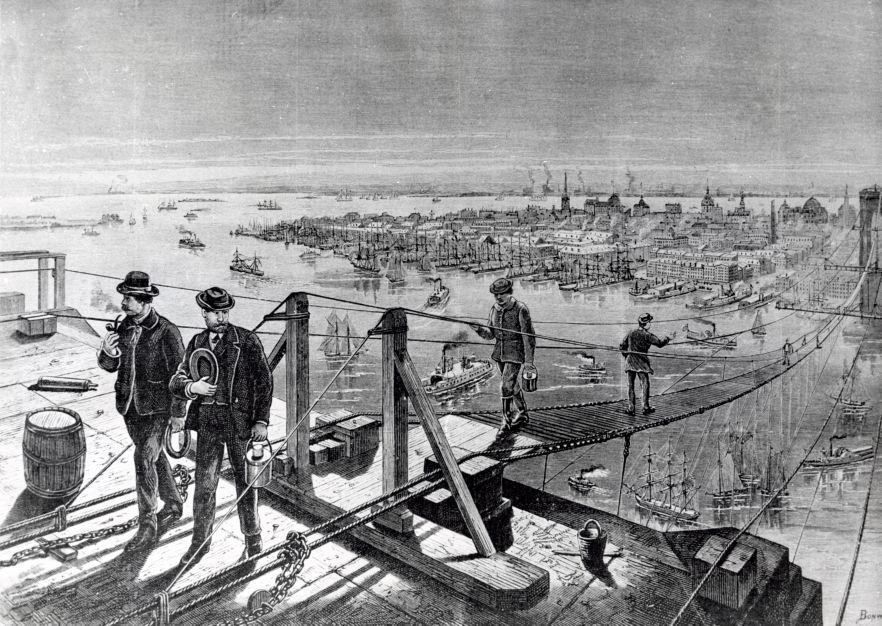
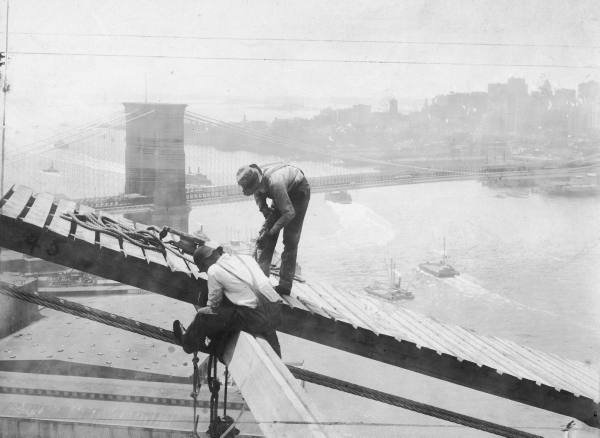
Workers upon the Brooklyn Bridge, a dangerous work environment where dozens of men were injured over the course of its construction.

1

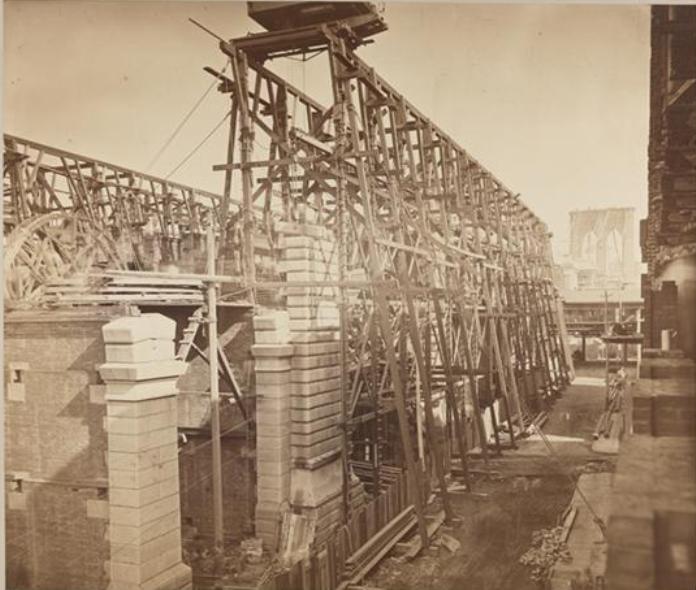
Construction of the approach to the bridge on the New  York side.

MNY146544
Courtesy Museum of the City of New York


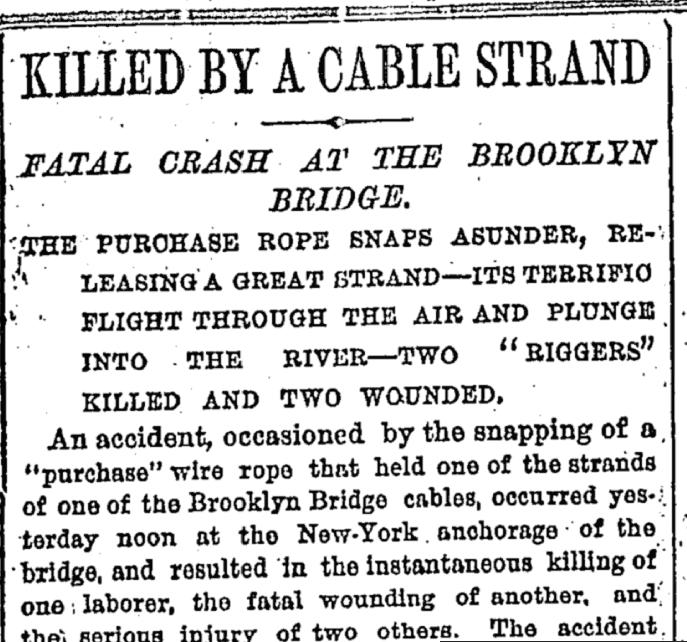
From the New York Times article regarding the unfortunate tragedy on the Brooklyn Bridge. Read the whole article here.

Courtesy New York Times

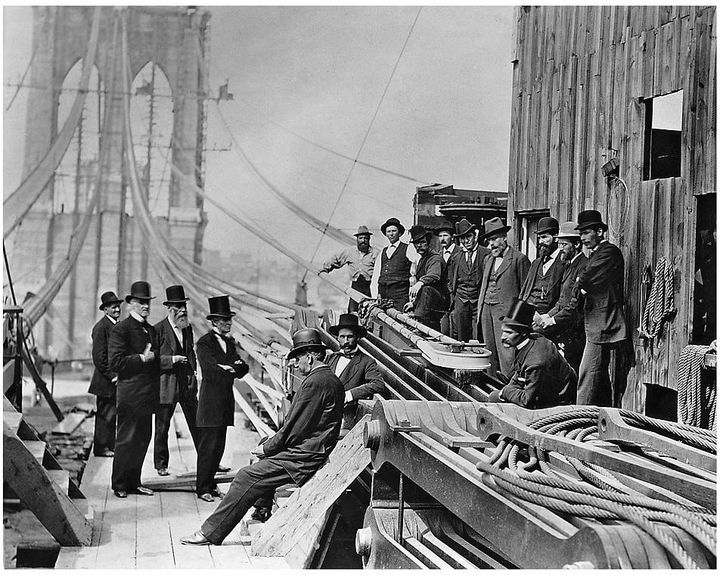
The scene at the bridge a few months after the accident — October 1878.

Courtesy New York Times


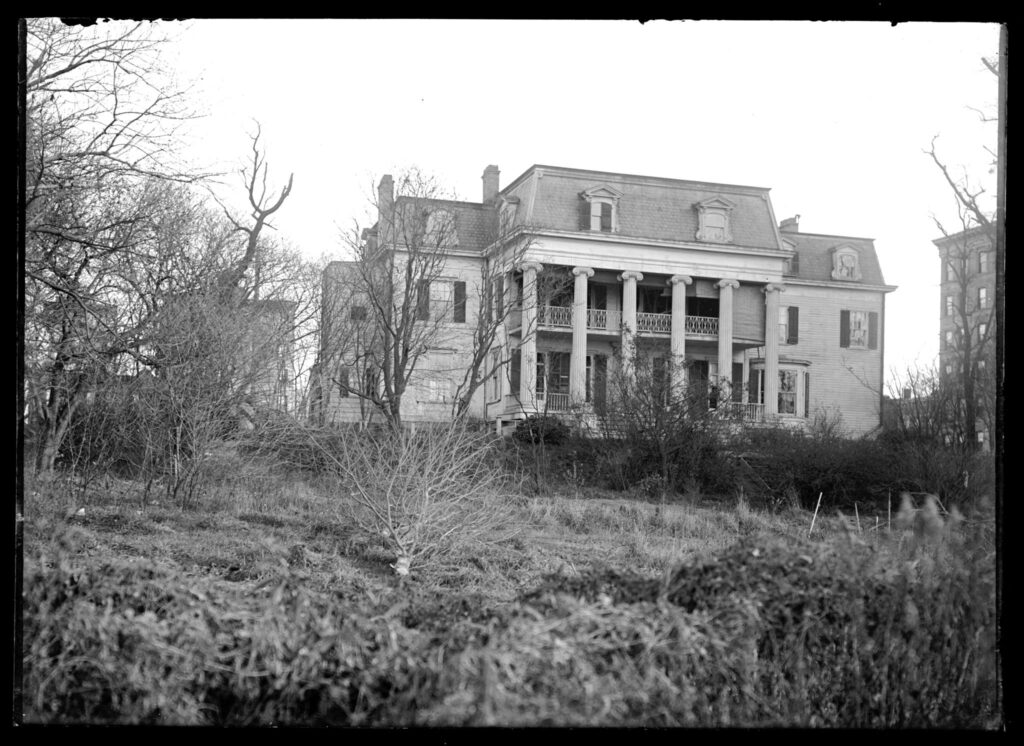
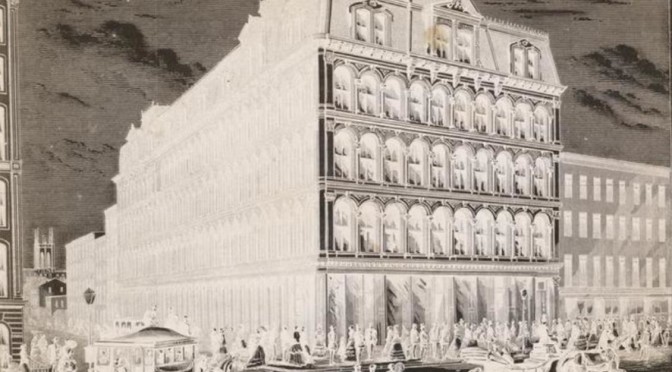
The picture at top is a reversed negative of the Methodist publishing and mission buildings, corner of Broadway and 11th Street, New York. [source]

Categories
Neighborhoods

Gotham Court and the lost neighborhood of Cherry Hill

Yesterday I went searching for remnants of the old Cherry Hill neighborhood. There are none, as far as I could tell.

It’s not the first New York City neighborhood to entirely vanish in the rush of progress — is it, Robert Moses ? — however it may be the one that began with the most impressive pedigree.

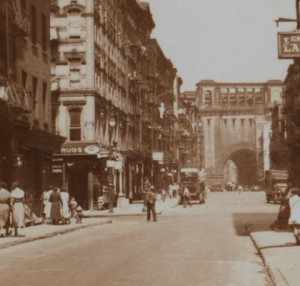
Cherry and Catherine streets, looking towards the Manhattan Bridge anchorage, in the once glorious Cherry Hill neighborhood. Pic courtesy Knickerbocker Village, who guesses photo to be from 1920s)

I’m not referring to the part of Central Park called Cherry Hill or even the upstate farm of Cherry Hill, best known for the prominent New York family the Van Rensselaers.

Downtown Manhattan’s Cherry Hill once lay near the waterfront in the area more literally called Two Bridges today, between the Brooklyn Bridge and the area just northeast of the Manhattan Bridge.

The Two Bridges Historical District was created in 2003, just to the north of the site of old Cherry Hill. Indeed there is nothing much left of the Cherry Hill neighborhood at all.

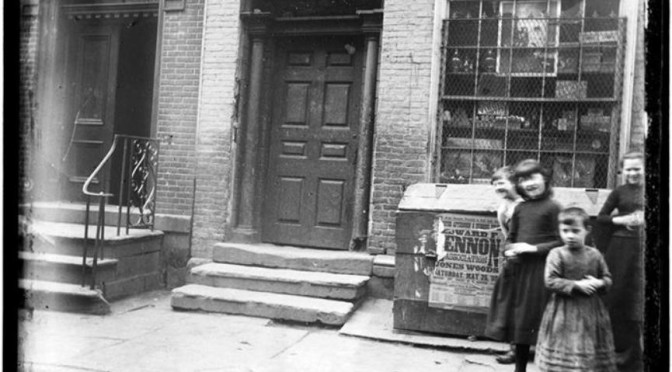
In 1890 Jacob Riis, in documenting what the neighborhood had become, referred to its early days as the “proud and fashionable Cherry Hill.” (pictured below)

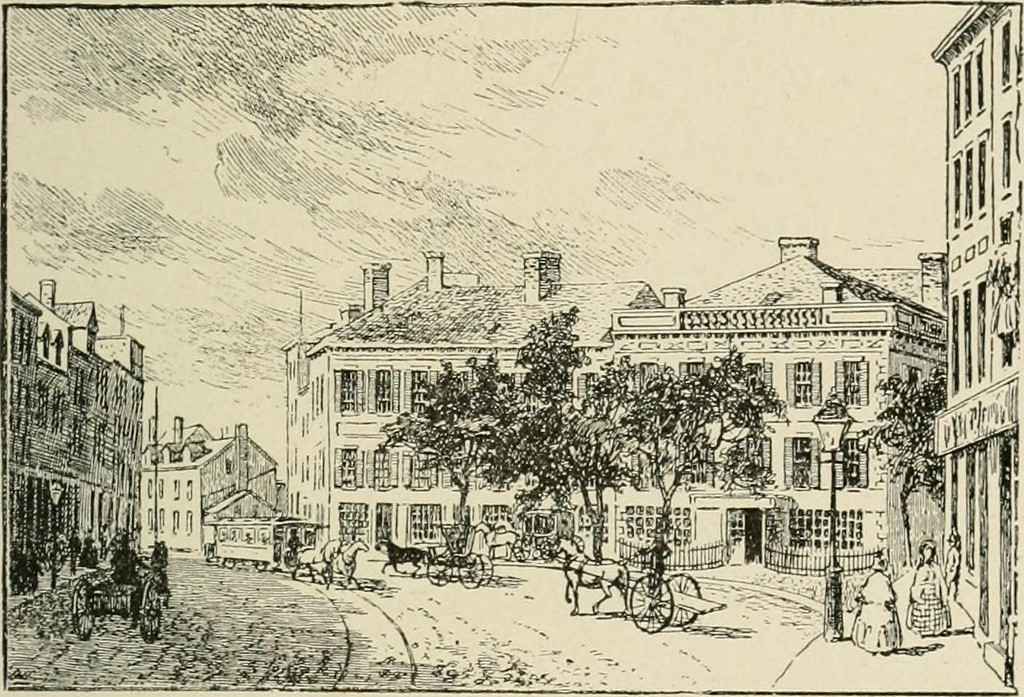
Named for a Dutch cherry orchard, Cherry Hill featured a row of homes with a beautiful vista of the East River and hosted no less than George Washington‘s during his first term as president, at 1 Cherry Street.

Although he later moved to 39 Broadway, the neighborhood remained high on the list of the rich and important, including John Hancock (at 5 Cherry Street) and DeWitt Clinton (who moved into Washington’s old home).

Below: An illustration of the more genteel days of Cherry Hill, taken from the book When Old New York Was Young (written in 1902)

Courtesy Internet Archives Book Images

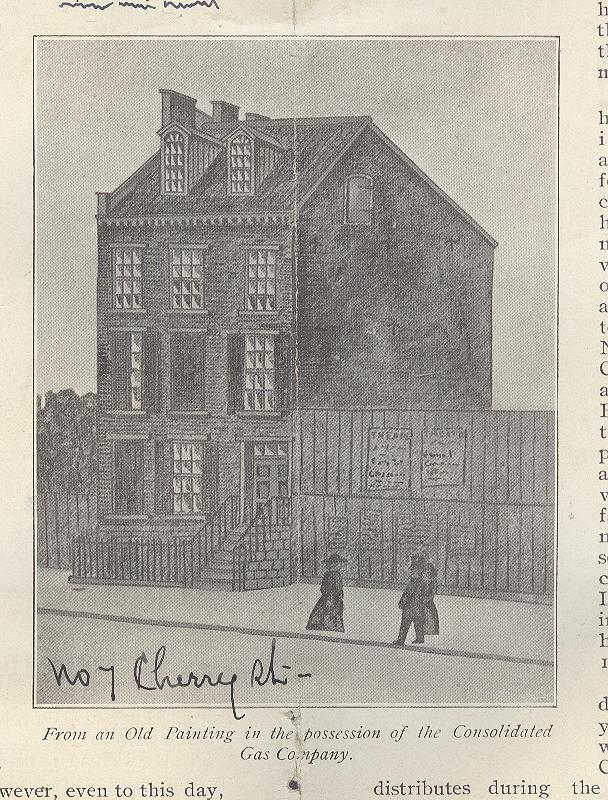
Even as late as the 1824, the area featured fine homes such as that of Samuel Leggett, founder of the New York Gas Light Company (later Con Edison), who enjoyed New York’s first interior gas lighting.

Here’s a picture of the first gas-lit home at 7 Cherry Street. (More information here)

louisa-leggett-001

If you’re looking for a symbolic date of Cherry Hill’s demise, look no further than April 3, 1823, birth date of William ‘Boss’ Tweed, who was born here and worked at a Cherry Hill chair shop in his early years.

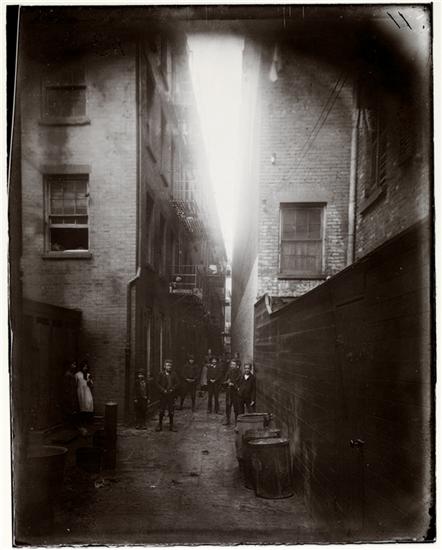
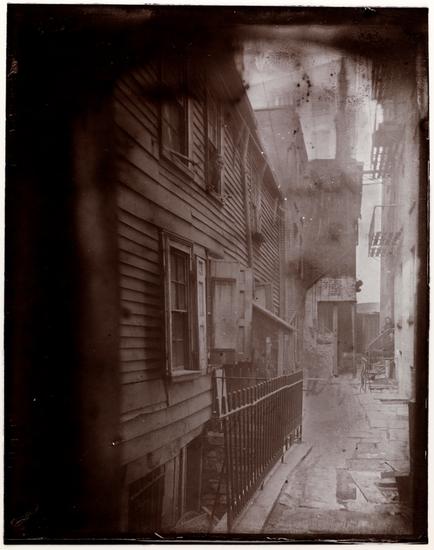
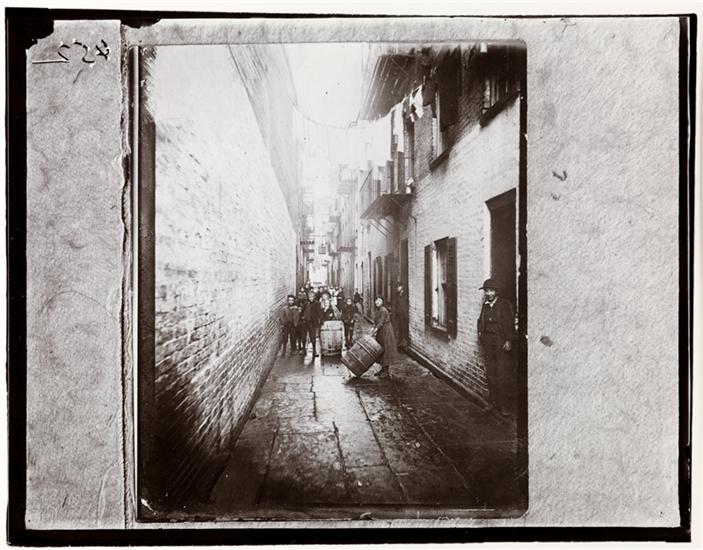
Below: Mullen’s Alley in Cherry Hill, picture taken by Jacob Riis in 1890. Courtesy the Museum of the City of New York

1

As many well-to-do neighborhoods would later do, Cherry Hill devolved into a slum, paralleling the decline of nearby Five Points. Its well-intentioned tenements soon became the worst in the city.

Located in the Fourth Ward, Cherry Hill abutted the saloons, boarding houses and brothels along Water Street, including the legendary Hole In The Wall (the former Bridge Cafe).

None of this would assist the neighborhood in escaping its fate.

Below: Blindman’s Alley at 22 Cherry Street, taken by Jacob Riis

Courtesy Museum of the City of New York

Cherry Hill is most unfortunately known for its most horrific slum — Gotham Court, “one of the worst tenements along the East River.”

It would later be made infamous in Jacob Riis’ renown 1890 blistering survey of How The Other Half Lives.  According to Riis:

“It is curious to find that this notorious block, whose name was so long synonymous with all that was desperately bad, was originally built (in 1851) by a benevolent Quaker for the express purpose of rescuing the poor people from the dreadful rookeries they were then living in.”

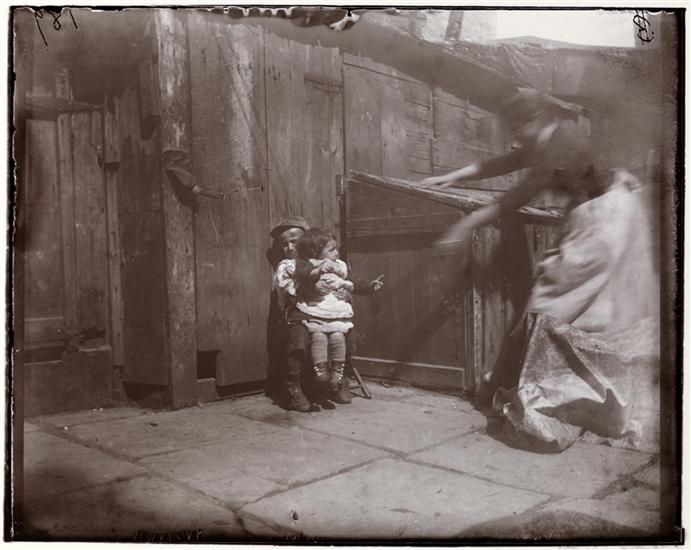
Below: photo from Gotham Court by Jacob Riis, 1890. “Minding the baby; Baby yells a Whirlwind Scream, Gotham Court.”

MNY200983

How long Gotham Court continued to be a so-called model tenement is not on record. It could not have been very long, for already in 1862, ten years after it was finished, a sanitary official counted 146 cases of sickness in the court, including “all kinds of infectious disease from small-pox down.”

Courtesy Museum of the City of New York

In 1894, the New York Tribune went as far as to make several attempts to describe Gotham Court as a prison. From the piece ‘Life in Gotham Court’:

The side alleys are narrower. They are not more than three or four feet wide. In order to enter either of these alleys one has to pass through an iron arch. The gate has been taken away, but enough remains to give unpleasant suggestions of a penitentiary..

The idea is not dissipated by the appearance of the houses inside the alley. The small windows with tiny panes of glass, the low, dark doors, through which iron gratings can be seen, and the bare brick walls are like those of a prison. The people move about free, as the prisoners do during exercise hour at the Tombs. All the doors are alike, all the windows are alike, and all are dilapidated, forlorn and forbidding.

Gotham Court and the rest of Cherry Hill were not long for this world. In the wake of Riis expose, Gotham Court was demolished in 1897.

By that time, efforts were made to construct more amenable tenements, including those built at 340, 342 and 344 Cherry Street in 1888. (See below, courtesy of Maggie Blanck)

By that time, the anchorage to the Brooklyn Bridge — and in 1909, with the Manhattan Bridge anchorage — would block in the neighborhood from the circulation of the city. The construction of traffic ramps to the Brooklyn Bridge and the downtown section of the FDR Drive (opened in 1942) obliterated much of what remained.

In its place would be more ambitious housing “super projects,” most notably one in the form of the Alfred E. Smith Houses, built in 1953 and named for the governor and saavy politico born very close by, at 25 Oliver Street.

His old street and a couple around it may give you the closest idea of what some areas of Cherry Hill may have looked like in earlier years.

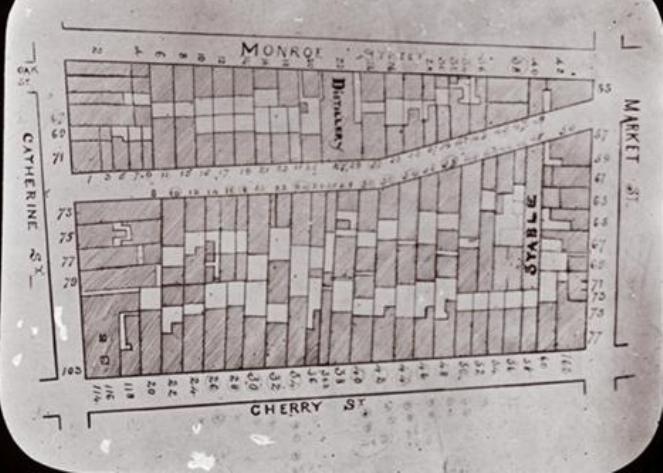
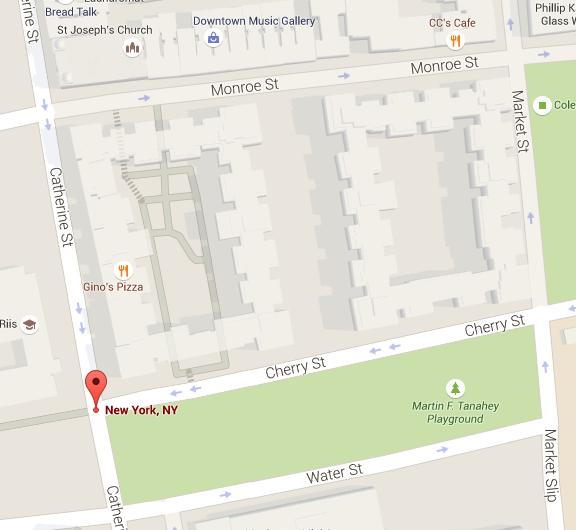
Two maps — one block of tenements in Cherry Hill in 1890 (from a map by Jacob Riis) and a Google map of the same block today:

2
1

Given its rather uniform appearance, I found it quite impossible to picture Cherry Hill’s early days here.

A shortened version of this article originally ran August 18, 2008. I’ve left the comments from that original run as they relate to the history.

Categories
Amusements and Thrills Bridges

The ten greatest fireworks displays in New York City history

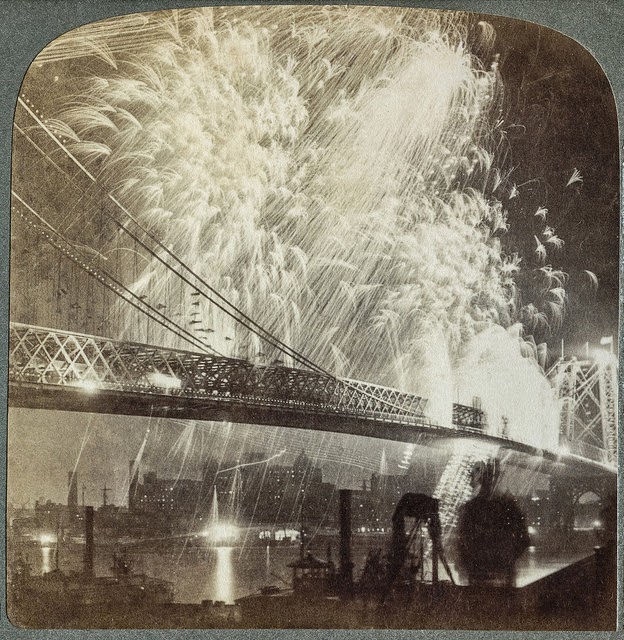
Above: One of my favorite pictures of the Williamsburg Bridge, at its opening in 1903
Nothing befits a fireworks display quite like a skyline to frame it, and no city has a skyline quite like New York City.  And so, despite the obvious dangers of setting off thousands of pounds of explosives in a crowded, flammable city, the city has been subject to some of the most beautiful feats of pyrotechnics in American history.
Here are ten of the greatest examples in the city’s history — celebrations not only of holidays, but vivid displays that highlighted the finest landmarks and accomplishments:

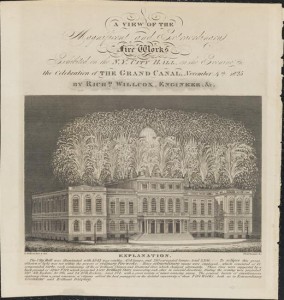
A View of the Magnificent and Extraordinary Fire Works Exhibited on the N.Y. City Hall

1. Opening of the Erie Canal — November 4, 1825
“On November 4, 1825, a spectacular extravaganza celebrated the just finished Erie Canal. City Hall, brilliantly illuminated, proudly overlooked a fireworks display in the park. There was good reason to celebrate:  the canal was the match that lit the fuse that detonated the boom of the 1830s” — Mark Caldwell, New York Night
(Illustration by John Francis Eugene Prod’Homme, Image courtesy MCNY)


2. Celebration for the Transatlantic Telegraph Cable — September 1-3, 1858
This called for a variety of elaborate pyrotechnic displays, including one 21-part program, which included “some new principles were attempted for the first time in the pyrotechnic art,” “two light houses connected by a line of rolling waters, on which the ships slowly moved towards their destination” and “all the splendor of the dazzling colors, assisted by all the mechanical contrivances of which the art is capable”. [source]

Incidentally, this fireworks festival caught City Hall on fire, burning down the cupola! (NYPL)


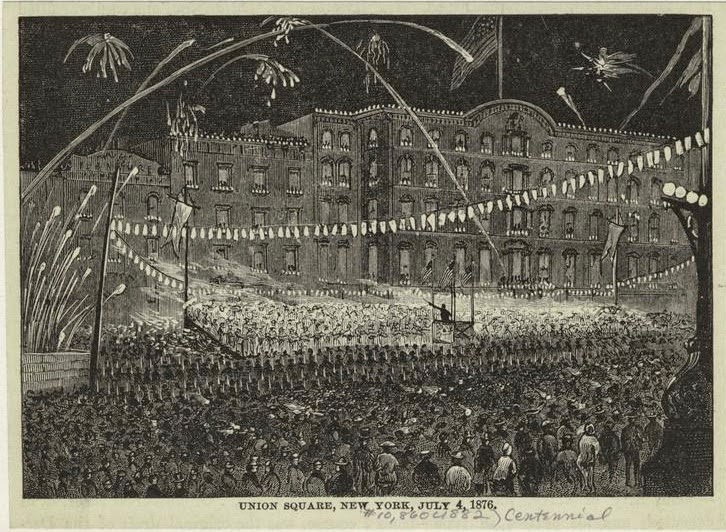
3. American Centennial — July 4, 1876
The all-day centennial celebration culminated in fireworks “representing the Goddess of Liberty sitting on a cloud in the act of greeting,” as well as several street-level “allegoric representations” illuminated in colorful fireworks. [source]


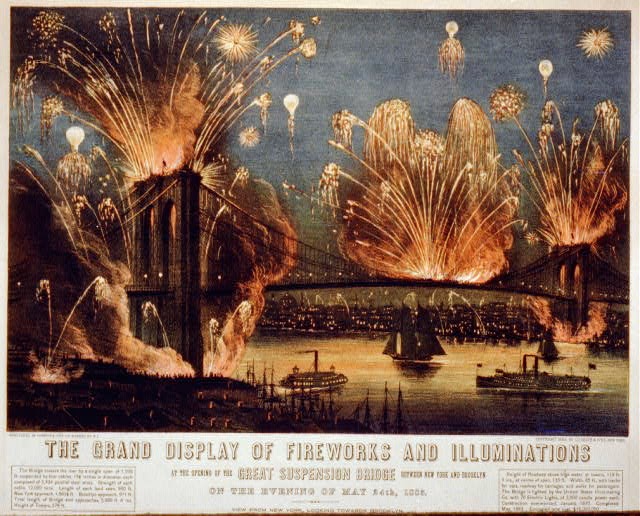
4. Opening of the Brooklyn Bridge — May 24, 1883
“Forty pyrotechnists superintended the display. There were 6,000 four-pound skyrockets, 400 bombshells and 125 fountains of colored lights.  Zinc bombshells of about ten inches in diameter were fired from mortars 500 feet in the air. Each bombshell held 600 stars of various colors.  A newly-invented rocket was displayed.  It held seven parachutes of cloth.  From these hung colored balls of fire.  The rockets burst, leaving the parachutes floating in the air. Five of these rockets were fired at once.  The result was thirty-five balls of colored fire floating in the air…..” [source]


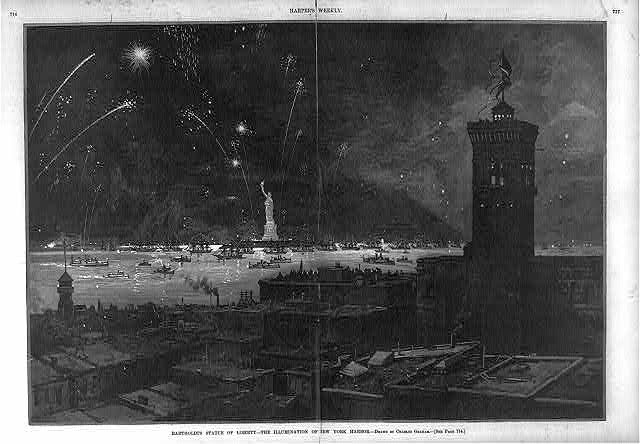
5. Dedication of the Statue of Liberty — October 28, 1886
Well, actually, three days later, on November 1.  A soggy day killed off the fireworks on the day of the statue’s dedication, but were finally launched the following Monday.

“At precisely the hour fixed there came a burst of kaleidoscopic lights from Bedlow’s and Governors Island, and in an instant the air was filled with flying fire balls of every color of the rainbow.”


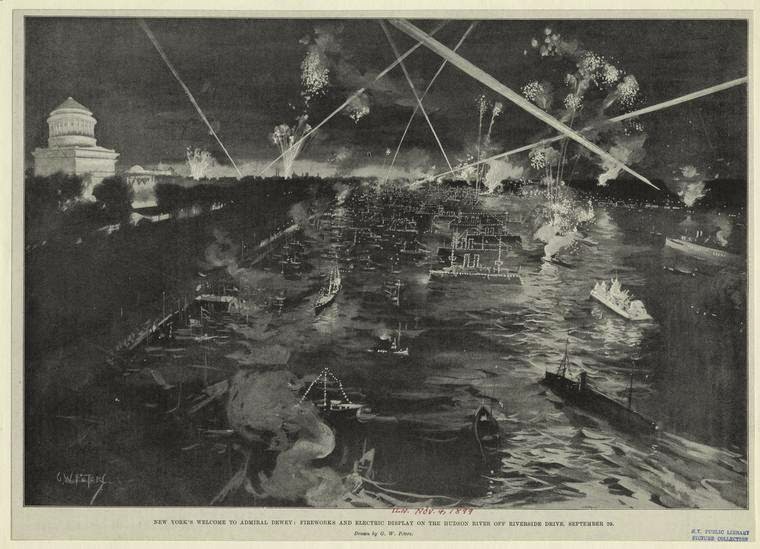
6. Hero’s Welcome for Admiral George Dewey — September 29, 1899
The arrival of Admiral Dewey, the face of the U.S.’s victory in the Spanish-American War,  inspired an exuberant celebration throughout the city.

“The day of Dewey celebration on the water ended in a roaring, popping, banging blaze of glory last night. Fireworks displays lit up the east side, the west side and all around the town. Not only did great boats loaded down with fireworks sweet down all the water-ways and circle about the lower Bay, but in the parks throughout the middle of the city the sky was painted red, white and blue and all the other shades of color known to the pyrotechnic art. ” [New York Sun]  (Illustration by GW Peters, courtesy NYPL)

7. Opening of the Williamsburg Bridge — December 19, 1903
“Then, without warning, the bridge was suddenly transformed into a sheet of flame.  From tower to tower the flames turned and writhed and flared high in the air, illuminating the waterfront for blocks.  Then came a kaleidoscopic medley of colors, red, green, purple, orange, violet — more colors than French ribbon dealer could enumerate — from huge rockets that sails two hundred feet above the bridge.” [source]

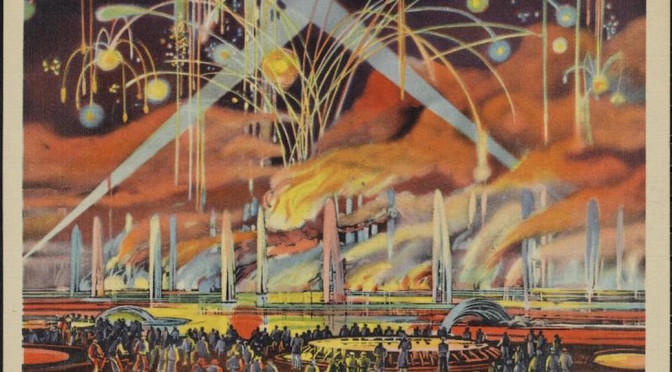
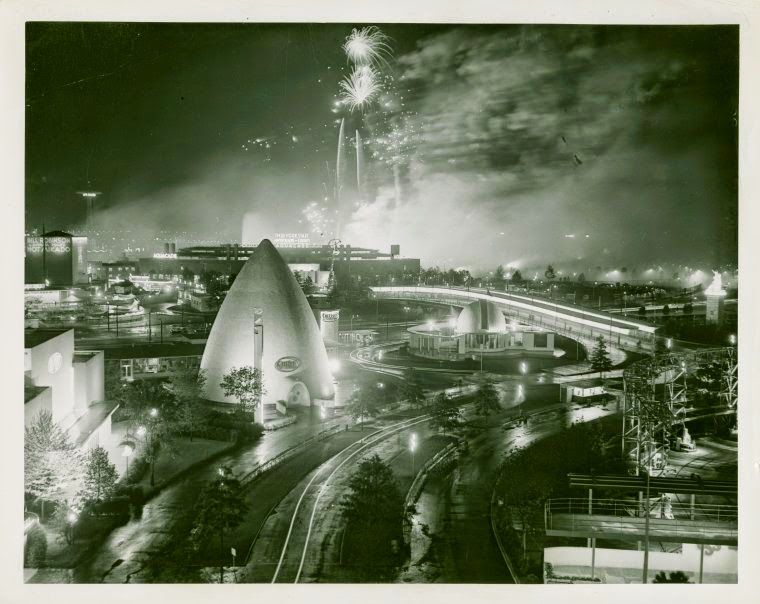
8. New York World’s Fair — July 4, 1939
“Fireworks colored the sky with the red, white and blue of the nation’s colors over the World’s Fair Grounds last night as two spectacular and elaborate displays of fire, water and music were set off, first from the Lagoon of Nations in the exhibit area and a short while later from Fountain Lake in the amusement area.”


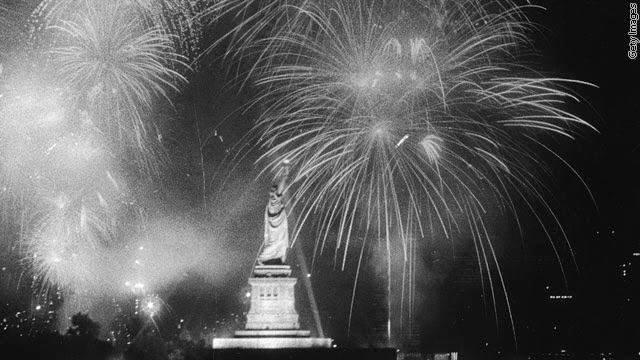
9. America’s Bicentennial — July 4, 1976
This event was notable not only for its visibility across the nation — thanks to a television special — but it was the first fireworks display sponsored by Macy’s.   “New York Harbor became more brilliant than Broadway last night as the biggest and most colorful fireworks display in the city’s history exploded for half an hour in celebration of the nation’s Bicentennial.” [NYT]


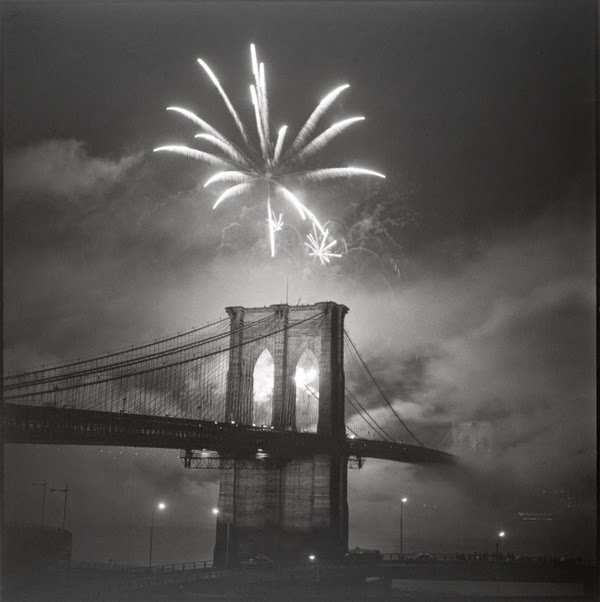
10. Brooklyn Bridge 100th Birthday — May 24, 1983
“Then the sky simply exploded with fireworks. Red, white and blue shells, golden comets changing to silver, crackling stars in red and green, appeared to fill the entire sky, while hundreds of thousands of people gasped at the sheer dazzle of it all.” [New York Times]
(Bruce Cratsley, courtesy Brooklyn Museum)

Categories
On The Waterfront Podcasts

The history of the South Street Seaport: A robust story of economic power, historic preservation, rat fights and fish guts

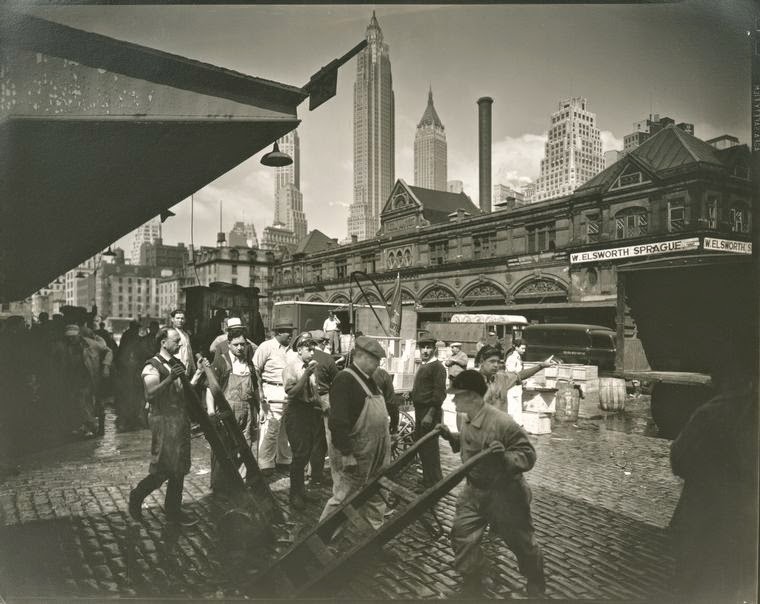
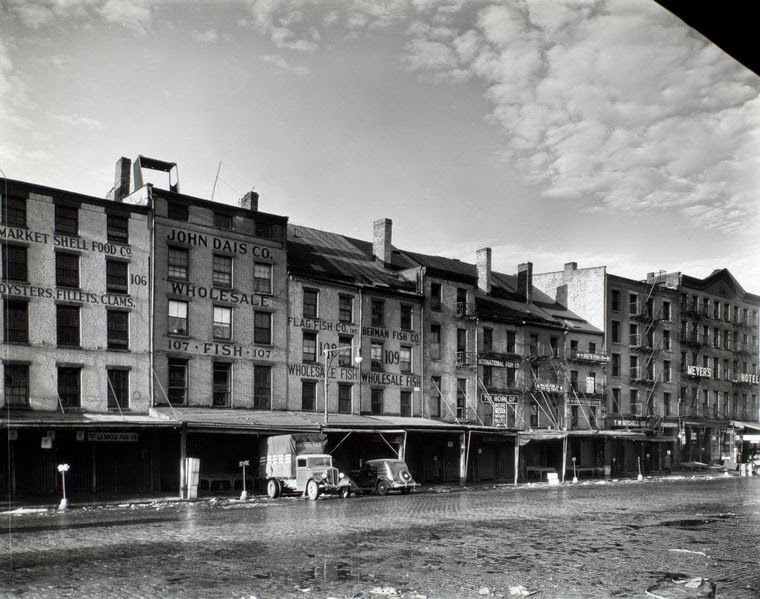
The daily bustle at the Fulton Fish Market, 1936, photographed by Berenice Abbott (NYPL)

PODCAST  The glory of early New York came from its role as one of the world’s great ports.  Today the South Street Seaport is a lasting tribute to that seafaring heritage, a historical district beneath the Brooklyn Bridge that contains some of New York City’s oldest buildings.

But there are many secrets here along the cobblestone streets.  Schermerhorn Row, the grand avenue of counting houses more than two centuries old, is built atop of landfill.  Historic Water Street once held a seedy concentration of brothels and saloons. Not to mention a very vibrant rat pit! And the Fulton Fish Market, the neighborhood’s oldest customer tradition, once fell into the river.

The modern South Street Seaport, a preservation construct of concerned citizens, become popular with tourists during the 1980s but saw severe damage during Hurricane Sandy.  It’s now the subject of some potentially dramatic changes.  How much of an adherence to the traditions of the past will determine the Seaport’s future?

ALSO: The FDR Drive — How it almost went below the Seaport!


A painting of the Empress of China, the vessel probably most responsible for the growth of New York’s trading power. (Courtesy nyhistorywalks)

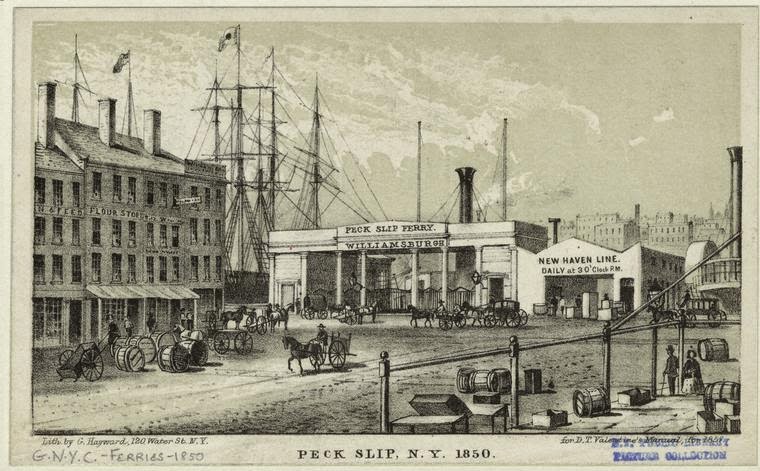
Peck Slip, providing ferry service to Brooklyn. The very first ferry service to Brooklyn was launched from this spot over two hundred years before the era depicted in this image. (NYPL)

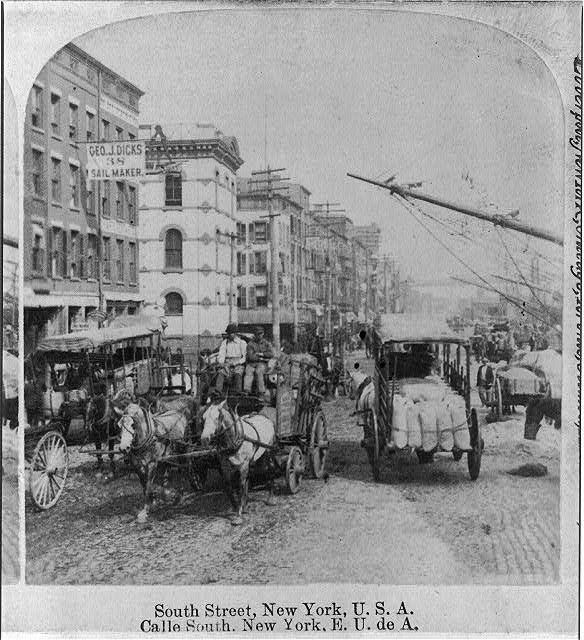
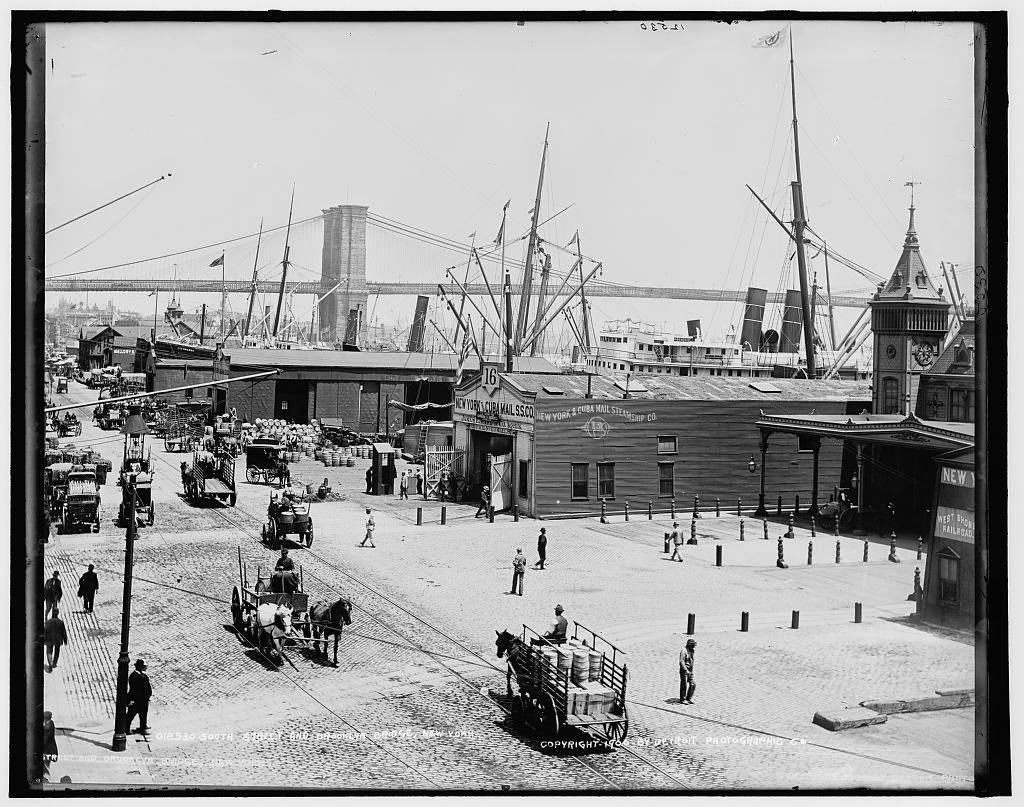
South Street, circa 1892, via stereograph (courtesy Library of Congress)

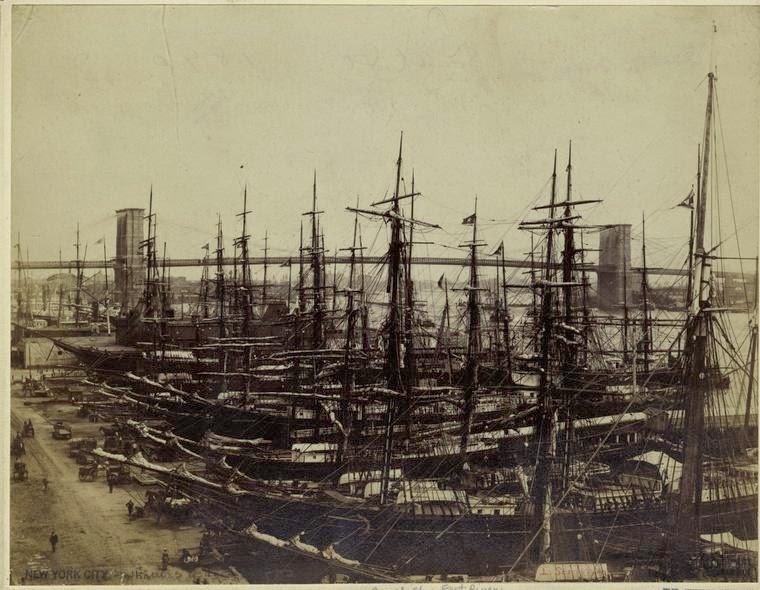
A different world: The glory of South Street in 1890 and 1900, respectively, still a non-stop churn of unloading, delivering and transport, even as the Brooklyn Bridge in the distance marks big changes to come for the neighborhood. (courtesy NYPL and Library of Congress)

The Fulton Fish Market, as photographed by Berenice Abbot, November 26, 1935 (NYPL)

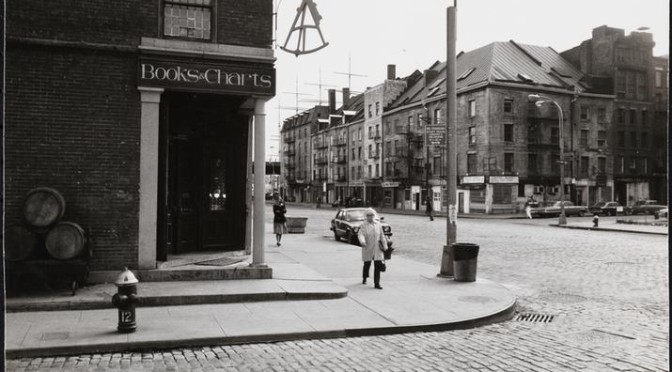
Fulton and Water Streets, 1975 (Courtesy the Museum of the City of New York)

[Fulton and Water Streets.]

Richard Haas’ trompe l’oeil excellently masking a Con Edision substation. (Museum of City of New York)

[Trompe l'oeil concealing a Con Ed substation at 237-257 Front Street, and the Jasper Ward house, 45 Peck Slip.]
 
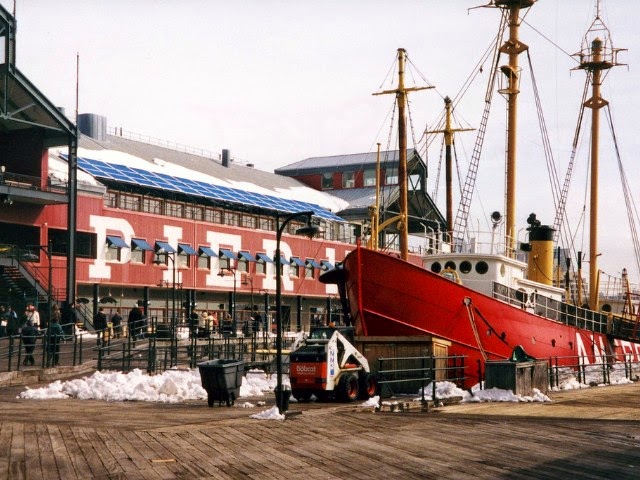
Pier 17, the ambitious 1980s project that transformed this once-vital economic center into a viable tourist attraction.  But it didn’t exactly appeal to large masses of regular New Yorkers. (Pic courtesy Wired New York)
 
 
Categories
Gilded Age New York Podcasts

Frozen in time: The Blizzard of 1888 knocks New York City off its feet, creating the deadliest commute in history

PODCAST This year is the 125th anniversary of one of the worst storms to ever wreak havoc upon New York City, the now-legendary mix of wind and snow called the Great Blizzard of 1888.

Its memory was again conjured up a few months ago as people struggled to compare Hurricane Sandy with some devastating event in New York’s past. And indeed, the Blizzard and Sandy have several disturbing similarities. But the battering snow-hurricane of 1888, with freezing temperatures and drifts three stories high, was made worse by the condition of New York’s transportation and communication systems, all completely unprepared for 36 hours of continual snow.

The storm struck in the early hours of Monday, and many thousands attempted to make their way to work, not knowing how severe the storm would be. It would be the worst commute in New York City history! Fallen telephone and telegraph poles became a hidden threat under the quickly accumulating drifts.

Elevated trains were frozen in place, their passengers unable to get out for hours. Many died simply trying to make their way back home on foot, including Roscoe Conkling (at right), a power broker of New York’s Republican Party.

But there were moments of amusement too. Saloons thrived, and actors trudged through to the snow in time for their performances, And for P.T. Barnum, the show must always go on!

STARRING: Hugh Grant (although maybe not the one you’re thinking)


NOTE: And, yes, we can’t believe the timing of this one, releasing on the same date of an ACTUAL blizzard. We really had this one planned for awhile, delayed it a bit because it seemed too eerie to do it so close after Hurricane Sandy.

So if you’re in New York or the northeast United States, stay inside, stay safe and let this podcast be the only dangerous snow drifts you experience this week!


In the blizzard of 1888, the streets disappeared and the snow came down almost horizontally. Imagine being trapped at work, several miles from your home. This was the plight experienced by thousands of New Yorkers (and others throughout the northeast) that Monday. (Library of Congress)
Why did the 1888 blizzard become such a hazard for New Yorkers? Let this picture be your first clue. The city was a cobweb of elevated telegraph, telephone and electric wires. This picture is from 1887. (LOC)
 

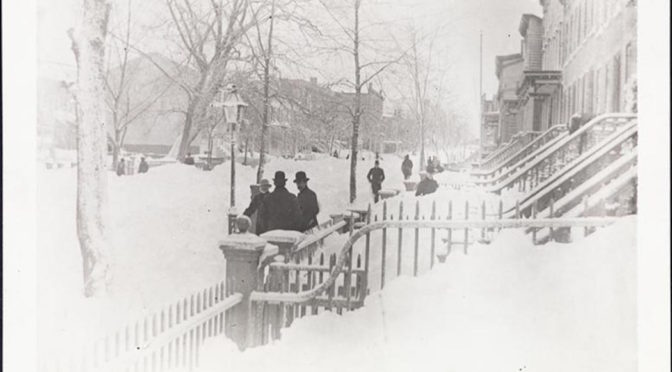
One example of a terrible (although minor) snow drift that might have kept this family in their home all day. Because of the unpredictable changes in wind, some houses might have been drift-free, while others close by completely locked in with snow. (LOC)
George Washington at the Sub-Treasury Building (today Federal Hall). I ran this photo a few weeks ago, but it’s so bizarre that I think it needs a second posting.
The Brooklyn Bridge, not even five years old, weathered the winds quite well, but became a hazard due to ice. In this picture, people are crossing over as there was no other way to get between Manhattan and Brooklyn. It’s not clear if any of the trains are operating in this picture.
The biggest danger for those venturing outside were the hundreds of downed telegraph, telephone and electrical poles, no match for the intense gusts. The poles would quickly fall then get covered with snow, creating deadly hazards for people walking past. The snow would just as quickly cover over an unconscious individual; many New Yorkers froze to death when they fell and were instantly shrouded.


Henry Bergh, founder of the American Society for the Prevention of Cruelty to Animals. He did not survive the blizzard. (NYHS)
Transportation in and out of the city was at a complete standstill for half the week. Here workers frantically try to clear the way for trains going into Grand Central Depot.


Clean-up was truly chaotic, a feeble effort by the city paired with private contractors with horses, shovels and carts. The piles of snow were taken to water’s edge and dumped, or, in a few less preferred cases, people just started bonfires and melted it away. (For a great picture of a snow dump in the river, see this photo at Shorpy of a blizzard from 1899.) Top pic courtesy LOC, at bottom Maggie Blanck.


The cover of Frank Leslie’s Illustrated Newspaper, usually one of the more sensational pieces of journalism people might have found at their newsstand.

Notes from the podcast: (#141) New York Beer History

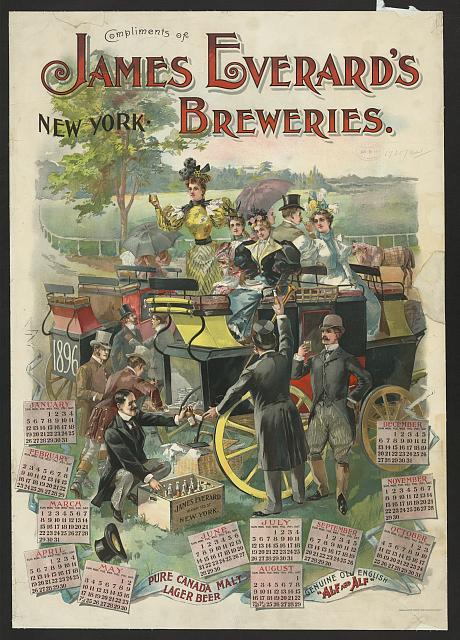
Year-Round Brews: This calendar from 1895 celebrates the Harlem breweries of James Everard. An older Everard brewery building on W. 28th Street was converted into a Turkish bathhouse in 1888. It became the location of a variety of notorious activities during the 20th century. Everard’s breweries became the plaintiff in a Prohibition-era Supreme Court case regarding the use of alcoholic beverages for medicinal purposes. (Pic courtesy the Library of Congress)

Piels:  We completely skipped one major New York brewer, one that still maintains a presence in New York, if in name only. Three German brothers opened the Piels Brewery in East New York, on the same day as the opening of the Brooklyn Bridge— May 24, 1883. They too had their own beer garden to enjoy the brews manufactured inside. Called the Summer Garden, this festive place adorned with electric lights and a shaded seating area was known for its determined wait staff.

From the Brooklyn Daily Eagle: “The waiters in the summer garden competed to see who could carry the most seidels of Piels Beer from the bar to their customers tables. In 1904 one waiter carried 16 seidels (eight in each hand).” [source]

Piels is still manufactured in Milwaukee by the Pabst Brewing Company.

Five-Borough Beer: In its heyday, you could find breweries in all five boroughs. Brewers were particularly attracted to Staten Island thanks to its spring water. In Stapleton, near the ferry piers, sat two of the largest — George Bechtel‘s brewery (which opened in 1853) and Rubsam & Hormann’s Atlantic Brewing Co.

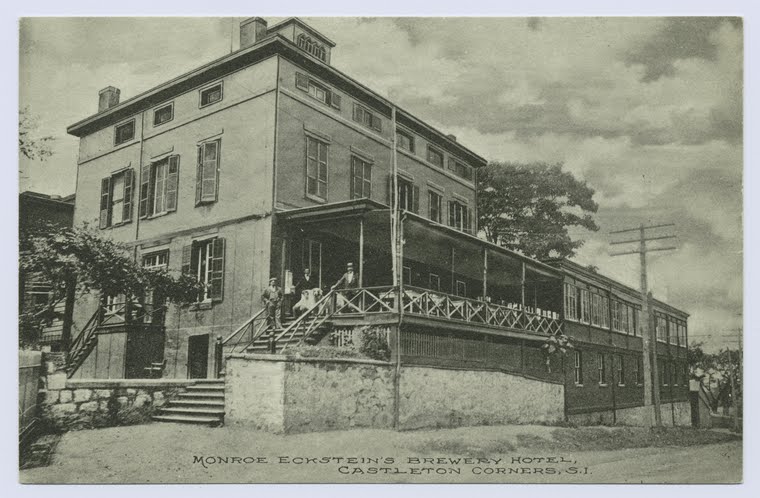
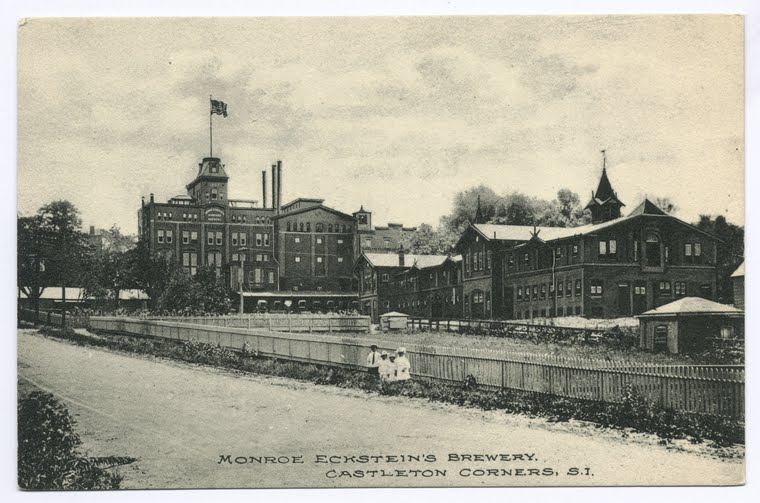
And then, of course, there’s a place we all want to stay — Monroe Echstein’s Brewery Hotel and adjoining brewery on Manor Road in Castleton Corners. (Pics courtesy NYPL)

College Point in Queens County attracted a large German population, thanks in part to rubber industrialist Conrad Poppenhausen, who set up his factories here in the 1850s. His workers and daytrippers to the region enjoyed a line of small breweries and beer gardens here. A couple decades later, Henry Steinway would set up his own factory town to the west and with it an assortment of beer gardens and even an outdoor amusement park called North Beach.

Today’s Bohemian Hall in Astoria is not far from Steinway’s factory. Read about the history of one of Queens’ oldest drinking establishments here.

For More Information: The New-York Historical Society exhibit ‘Beer Here: Brewing New York’s History is on display until September 2, 2012. I was particularly interested in the Society’s collection of ice carving equipment used by early brewers and the very cheeky collection of mid-20th century advertising and media.

For a general history on American beer, I recommend Maureen Ogle’s ‘Ambitious Brew: The Story of American Beer’ and also Gregg Smith’s ‘Beer In America: The Early Years’. And there is no shortage of History-Channel style documentaries on the subject. Also, for some general information on Bushwick, I highly recommend exploring the Bushwiki, with lots of history about the neighborhood.

There’s now a New York Beer and Brewery Tour with stops at brewers in three different boroughs. And it takes you down ‘Brewer’s Row’ after having a couple rounds of beer elsewhere. You can catch a tour of the Brooklyn Brewery of course; visit their website for more information.

Thanks again to Scott Nyerges for helping me out with this one! Please visit his website for more information on his upcoming gallery show in Bushwick. And also my thanks to the Bodega Bar in Bushwick where I was going to pull together the Bowery Boys’ very first real ‘on location’ recording at a bar. Unfortunately I was not able to work that out, but I thank them for opening their door to the show anyway.

Defying gravity: New York’s most famous daredevils

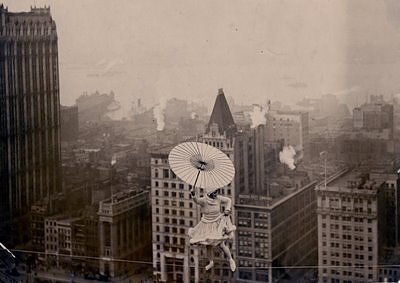
Bird in the sky: The delicate Ms. Millman makes it look easy

Last night on my walk home, I observed something you just don’t always see everyday — a renegade acrobat dangling from the top of the Williamsburg Bridge! The perilous pair, Seanna Sharpe and Savage Skinner, performed this foolhardy trapeze as traffic whizzed by below them, and the two were later apprehended by police. Will this stunt place them in the annals of great stuntwork performed by others who have used New York landmarks as their own personal stages?

1 Jules Leotard
This young French performer, renown in his home country, performed at New York’s Academy of Music in 1868 where he essentially debuted the art of the flying trapeze to startled New Yorkers. While we would not consider his feats particularly compelling today, audiences went wild, with local papers calling him a ‘dazzling, plumed bird’ and the Tribute referred to him as ‘tremendous, as a son of thunder’. He would return to Europe, where his tight, one-piece uniform would be mass produced and eventually bear his name.
2 Hanlon Brothers
The lofty endeavors of tightrope walking and trapeze acrobatics were forever changed on November 1, 1869, when an acrobatic troupe brought an aerial show to New York so ambitious for its time that it required one of its members to invent the aerial safety net! (William Hanlon eventually held the patent for it.) But here’s the odd part. The venue for that performance? Tammany Hall, at the time at 141 East 14th Street — and nearby the Academy of Music — making the block a sort of revolutionary spot for 19th century stuntwork.  [source]

Steve Brodie
A teenage newsie looked over at the Brooklyn Bridge as it slowly rose over the East River during its construction in the 1870s. He looked and thought, “I’m going to jump off that one day!” And so he did, on July 23, 1886 — or so he claimed — and the single event transformed him into a minor celebrity. He toured in a stage show recounting the event and opened a popular saloon at 114 Bowery (at Grand Street) in honor of his claim to fame. Today most people attempting such a ridiculous stunt are hardly considered heroic.

Harry Houdini
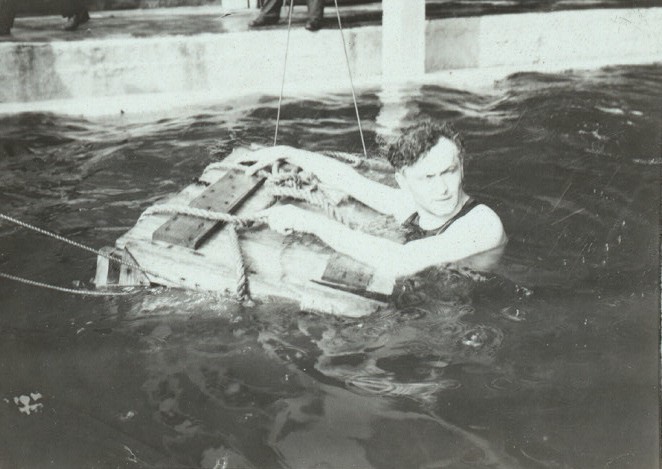
The legendary magician moved to New York at an early age  in the 1880s, and as he honed his crafts of illusion, he frequently used the city as a backdrop to heighten the drama. He was thrown into the East River on July 7, 1912, locked in a crate and bound in handcuffs and leg-irons. (Time it took him to escape: 57 seconds.) And in another rather famous trick in 1916, the escape artist, bound in a strait-jacket, hung precipitously from a crane over an excavation for the New York subway in the middle of Times Square. (Escape time: 2 minutes, 37 seconds.)

Below: Houdini, coming up for air (Pic courtesy NYPL)

Bird Millman
The lovely queen of the tightrope (pictured at top) was a favorite of the Ringling Brothers and Barnum & Bailey Circus, not to mention a featured performer for Florenz Ziegfeld. She performed hundreds of times within vaudeville theaters in New York well into the late 1920s, but occasionally she performed outside, dancing across tightropes stretched between buildings.

Evel Knievel
Garbed in his trademark patriotic colors, Knievel leapt over nine cars at Madison Square Garden during a series of shows in July of 1971 — his only major New York appearances. But the stuntman’s real dream never got off the ground:  the desire to jump his motorcycle from one great skyscraper to another. The city wouldn’t have approved of something so dangerous….

Philippe Petit

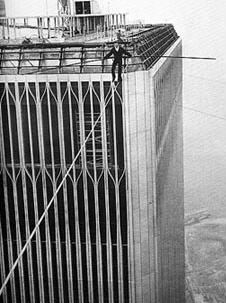
…which is why you don’t ask them. The eccentric French high-wire performer snuck into the World Trade Center several times to plan the specifics of an extraordinary display of daredevilry. And on August 13, 1974, this ‘Man on Wire’ walked a narrow cable from one tower to the other. A masterful display of personal courage, and a rather embarrassing on the Twin Towers’ lax security.

Alain Robert
This modern daredevil — the ‘modern Spider-man’ as the press has dubbed him — has scaled all sorts of tall surfaces throughout the world, including the Empire State Building in 1994. When the new New York Times headquarters was completed in 2008, it was like a red cape to a charging bull, and Robert took to the building on June 5, 2008, and unfurled a banner about global warming.

ALSO: Coney Island has been the site of a great many deathdefying performances over the decades. An August 14, 1904 issue of the New York Tribune marvels at the amazing stunts at the theme park Dreamland — “Men Must Do Much to Thrill The Public Now” — and notes one performer who fell off a rusty 725-foot sliding cable, tumbling into the ‘Shoot the Chutes’ ride!

Categories
Podcasts

Manhattan Bridge: New York City’s dysfunctional classic

[from Flickr, taken by ajagendorf25]

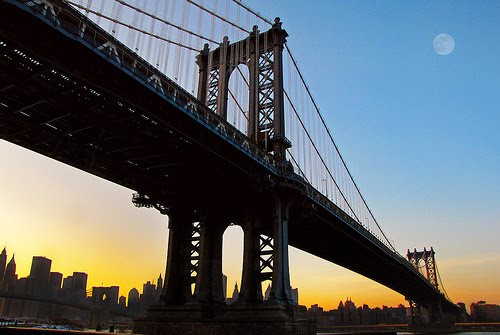
We love the Manhattan Bridge, but there’s no doubt it’s had a rocky history. For one hundred years, it’s withstood more than just comparisons to its far more iconic neighbor, the Brooklyn Bridge.

Built to relieve pressure on the East River’s best known bridge, the Manhattan Bridge went through two different engineers — and a couple different ambitious designs — before finally being completed by another architect, who then went on in 1940 to design one of the WORST bridges in America. And serious design flaw afflicts the bridge to this day?

Listen in and find something to appreciate in this seriously under appreciated marvel of the East River:


I mention many bridge engineers in this podcast — Leffert Lefferts Buck, Gustav Lindenthal and Leon Moisseiff — but due to time constraints on the show this week, the contributions of Henry Hornbostel were left out. Hornbostel was instrumental in the work with Buck on the Williamsburg Bridge and with Lindenthal on the Queensboro. When we do podcasts on those bridges, he will get his fair due.

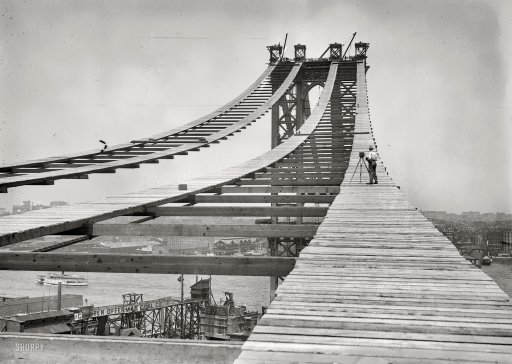
Preliminary work on the Manhattan Bridge began in 1901 under Buck, with Lindenthal taking reign of the project a year later. When Moisseiff was brought in to rework the bridge in 1904, construction kicked into high gear. Lindenthal’s innovative suggestion to use eyebars was discarded for a more conventional wire structure. [Pics courtesy Life Google images]

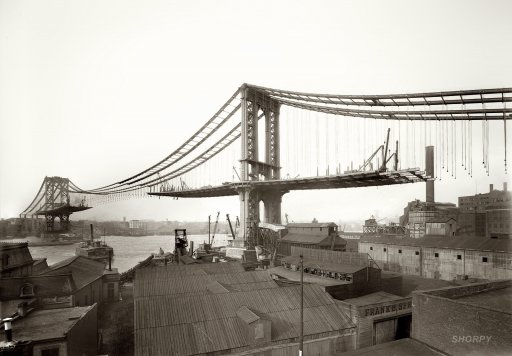
Stringing the cable across the East River took only four months in 1908. Indeed, the traffic snarls on the Brooklyn Bridge demanded them to work quickly. It was also mayor George McClellan’s intention to finish the bridge before he left office. [Photo by GG Bain and cleaned up by Shorpy, see a nifty close-up image here]

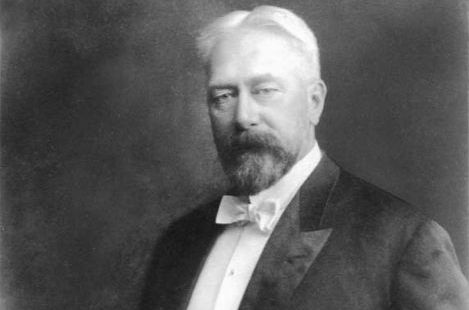
Gustav Lindenthal, born in Brno (now in the Czech Republic), came to the United States, built many bridges, and dreamt up many more that were never completed, like the North River Bridge, which would have spanned the Hudson River, and a monumental Manhattan Bridge designed with 14 lanes of traffic.

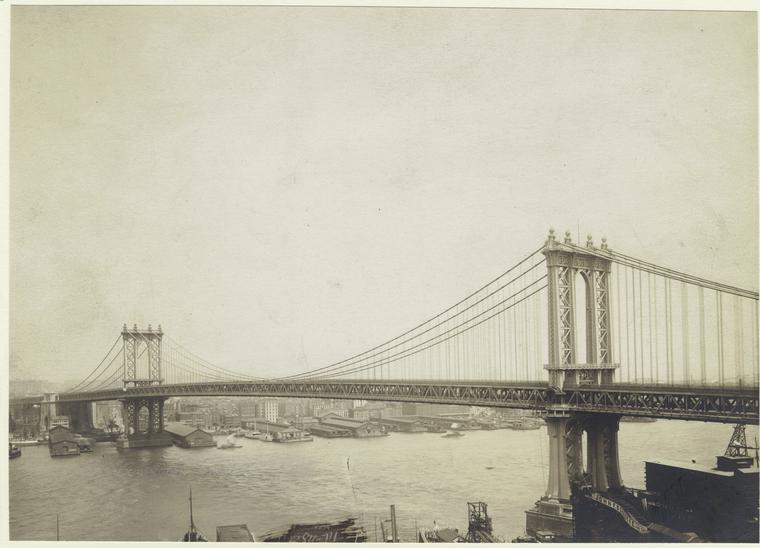
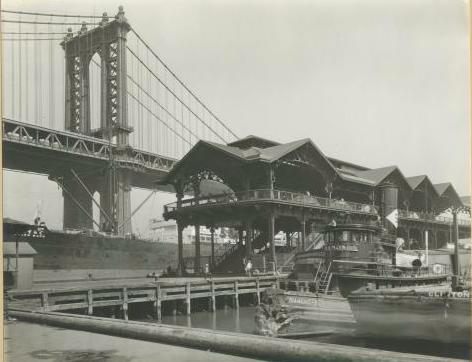
The bridge opened on December 31, 1909, although the pedestrian walkways were not completed and no trains were ready to go over it at that time. Setting it apart from its sister bridges was the flat, blue two-dimensional towers. As you can infer from this photo, facing both sides of the bridge were rows of docks and industrial ports. [Pic courtesy NYPL]

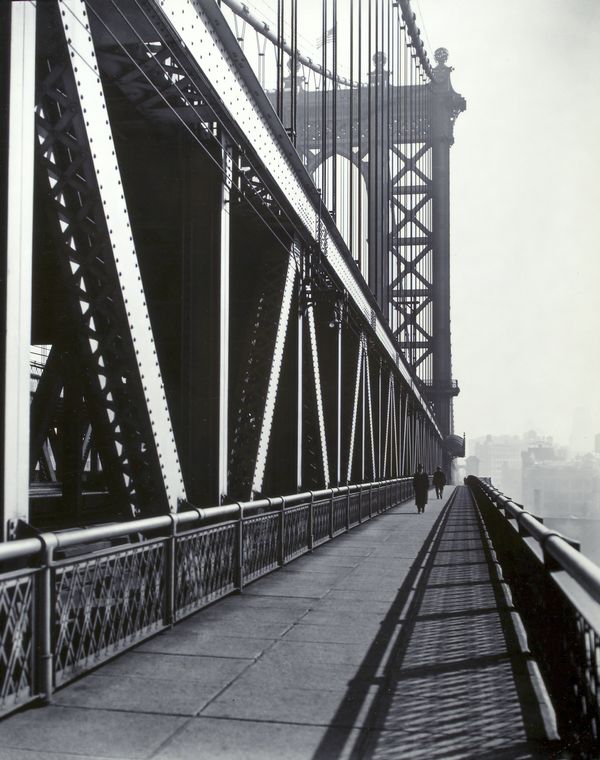
Berenice Abbott has some spectacular views of the Manhattan Bridge, taken in the 1930s. For crisp, dreamlike pictures of Manhattan, you can’t do better than Abbott. [courtesy NYPL]

Speaking of Berniece Abbott, Gothamist has some great shots taken by her of the area below the Manhattan Bridge on the Brooklyn side — today it’s DUMBO, known then as the strangely desolate Irishtown. [Flashback: Brooklyn 1936]