Categories
Brooklyn History Health and Living

The Brooklyn origin of Pfizer and the wild world of 19th century medicine

The origin of a true Brooklyn ‘start up’ — Charles Pfizer and Co, who went from developing intestinal worm medication in 1849 to being a leader in vaccine distribution in the 21st century.

This is story of Pfizer Pharmaceuticals before the 1950s, a tale of German immigration and of early medical practices and concoctions that might seem alien to us today. Patent medicines! Worm lozenges!

But this company’s biography is also a celebration of Brooklyn — the City of Brooklyn in the mid 19th century, developing into an economic force in the United States and in opposition to the city of New York across the East River. 

PLUS You can’t tell the Pfizer story without looking at the world of apothecaries and early drug stores in New York City in the 19th century.

Apothecaries were the first ‘natural’ medicine makers but their objectives were limited, seeking only to alleviate symptoms, not tend to the root cause of so many discomforts.

Later on, drugstores would stock up on manufactured medicines and questionable additions to the health regimen like soft drinks.

FEATURING Duane Reade, Kiehl’s, C.O. Bigelow, E. R. Squibb and Johnson & Johnson

ALSO: What important American figure today grew up delivering parcels for his family drugstore in Dyker Heights, Brooklyn?

LISTEN TODAY ON YOUR FAVORITE PODCAST PLAYER — PFIZER: A BROOKLYN ORIGIN STORY

FURTHER LISTENING

After listening to this show, take a dive in other episodes on similar or adjacent subjects.


The German biotechnology company Biopharmaceutical New Technologies (BioNTech) developed the COVID-19 vaccine injection with Pfizer, one of the world’s large pharmaceutical companies, who will manufacture and distribute it.

Let’s give our thanks to the scientists, researchers and physicians who helped get us to this moment. And yes, Brooklyn, you also get to share in a little bit of that pride today.

Because Charles Pfizer & Company — the originating business, founded in 1849 — first got its start in Brooklyn.

Or, to be more specific — the Brooklyn neighborhood of Williamsburg.

Or to be really, really specific — the independent Town (and later City) of Williamsburgh.
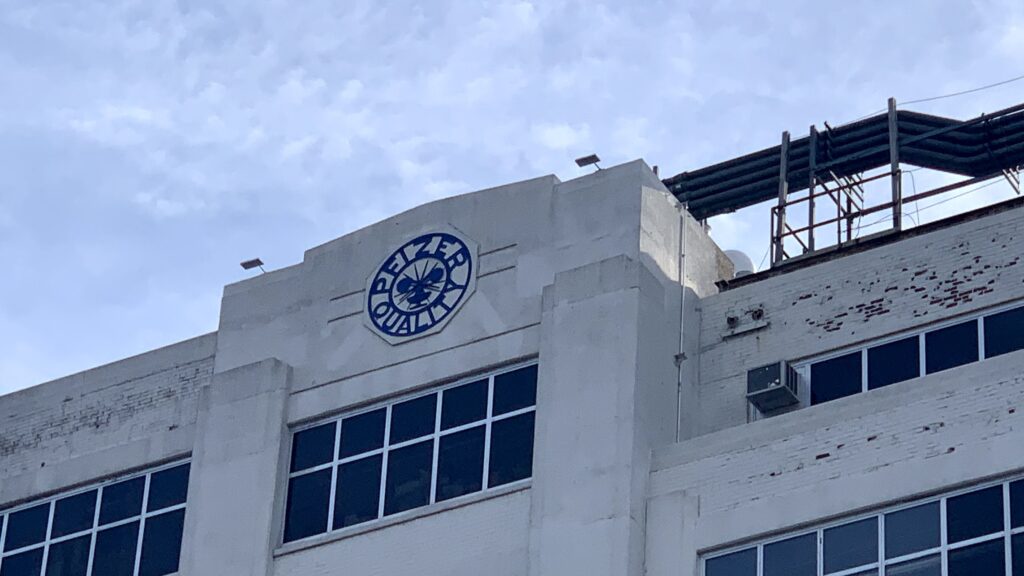
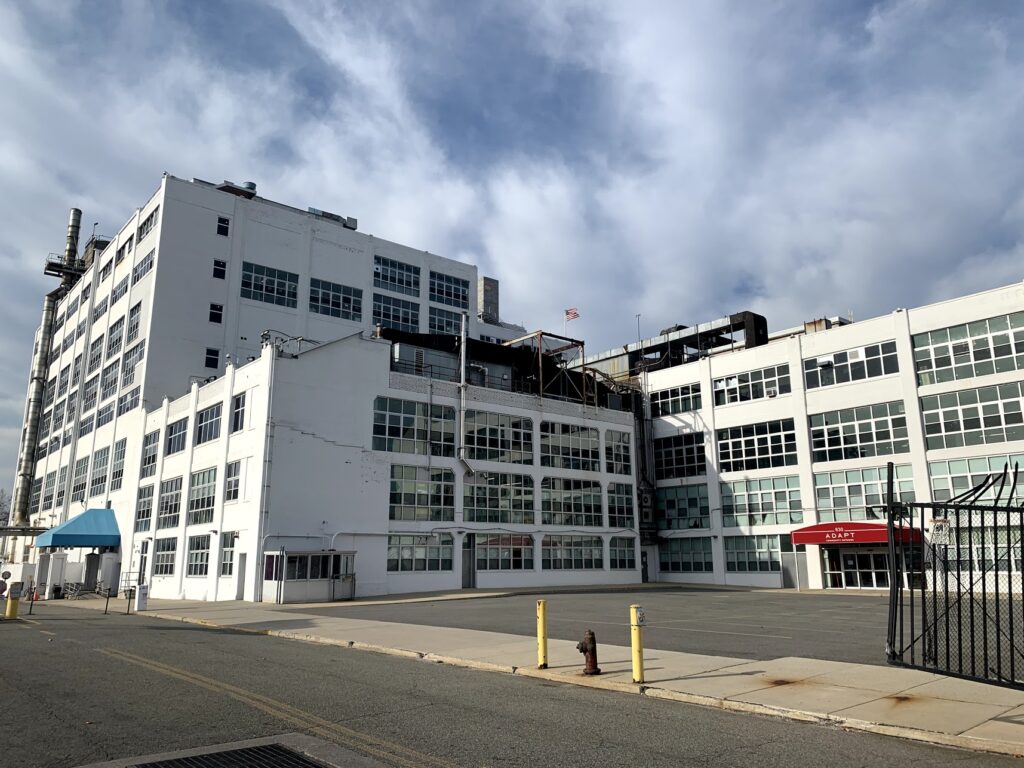
At their original Brooklyn location, the architectural details still gleam with ‘Pfizer Quality’.
A Company of Immigrants

Karl Christian Friedrich Pfizer (later Charles Pfizer), born in 1824 in the Kingdom of Württemberg, was one of the many thousands of Germans who would immigrate to the United States during the 1840s.

Pfizer came to America with his cousin Charles Erhart in the fall of 1848. Unlike the experiences of so many immigrants during this time, both Pfizer and Erhart came from wealthy families and were both highly educated — Pfizer as a chemist, Erhart in the grocery and confectionary trade.
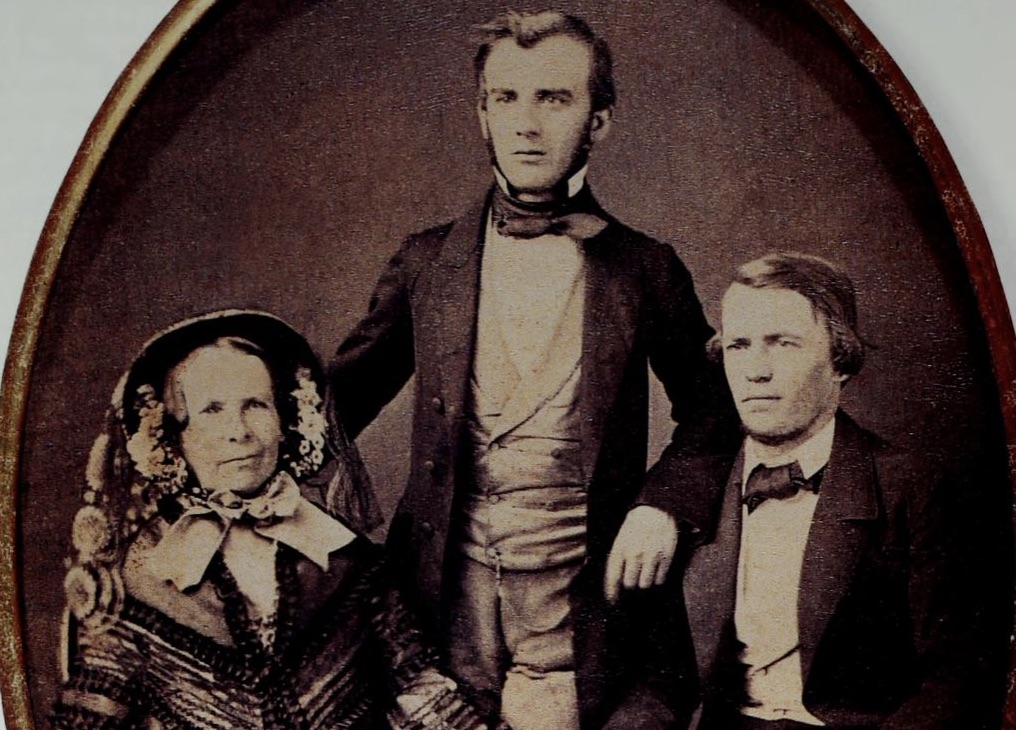
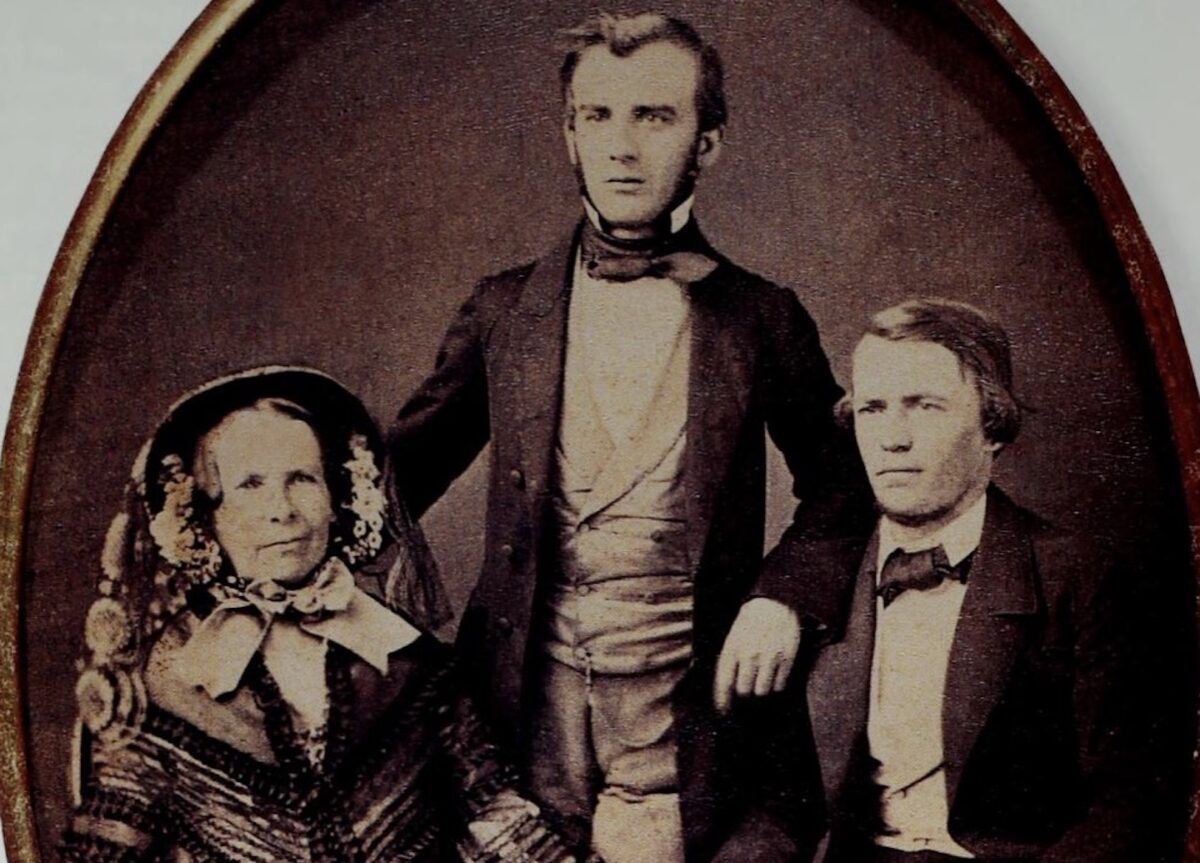
Wilhelmine Klotz Erhart, her son Charles Erhart, and her nephew Charles Pfizer standing. Photograph taken in 1855, courtesy the book The Legend of Pfizer

The practical applications of science to modern life were just beginning to be explored in the early 19th century. Pfizer was taking his training to a country not yet internationally known for scientific breakthrough.

According to author Jeffrey L. Rodengen, “Chemicals that once interested only scholars were becoming indispensable in manufacturing, agriculture and medicine. [Pfizer] also recognized that in the new nation of America, virtually no one was meeting the growing demand.”
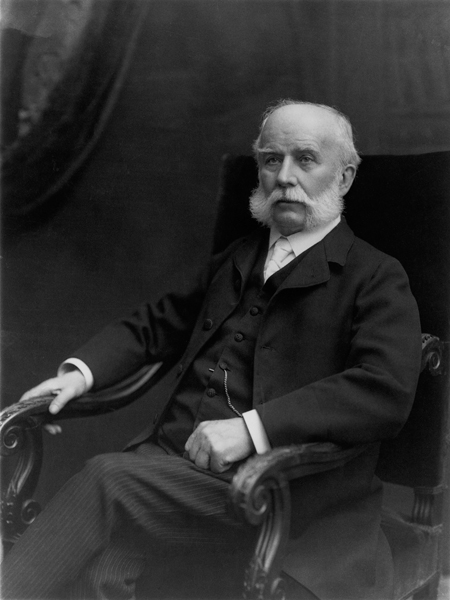
Charles Pfizer, photographed here in 1890
A Home Among The Factories

Pfizer and Erhart would form their new chemical operation in Long Island’s King County in 1849, shortly after their arrival in America.

But not in the thriving City of Brooklyn, located south of the Brooklyn Navy Yard. (No community on Long Island was a part of New York City until 1898.)

They had their eye on a spot near the Town of Williamsburgh, north of the burgeoning Brooklyn metropolis.
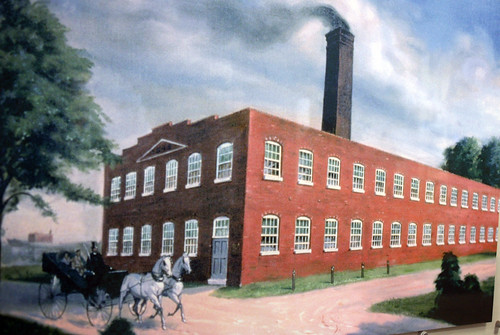
The first Pfizer building

Williamsburgh — a former village under the jurisdiction of the town of Bushwick — was a desirable destination for budding industrialists thanks to its proximity to a busy waterfront and the already busy waters of Newtown Creek. Chemical and oil plants were already home here when the cousins arrived.

Pfizer’s first headquarters was a bit far from the waterfront. They couldn’t quite afford to build a new factory.

Instead the cousins moved their operations into a pre-existing red brick building at Bartlett and Tompkins Streets thanks to a $2,500 loan from Pfizer’s father. (That’s about $78,000 today thanks to inflation.)
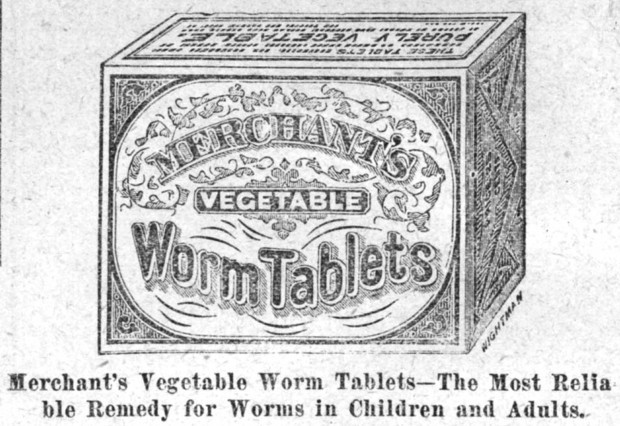
An example of 19th century medicine used to treat worms *shivers*.
How To Deal With Worms

A chemist and confectioner might seem like an odd couple today. But go to your medicine cabinet. How many of your medicines have flavor? Most pharmaceuticals would be hard to swallow without additives literally meant to make the medicine go down.

In 1849 the Pfizer company rolled out its first product — a product made from santonin. But this was santonin that tasted, well, not good exactly, but palatable enough to help relieve a very grotesque condition — intestinal worms.

Pfizer and Erhart produced santonin (made from the flower of Artemesia plants) with a relatively delicious almond-toffee taste.

Given that intestinal worms were a far bigger problem in the mid 19th century than they are today, the product flew off the shelves, allowing Pfizer to expand into other chemical remedies.
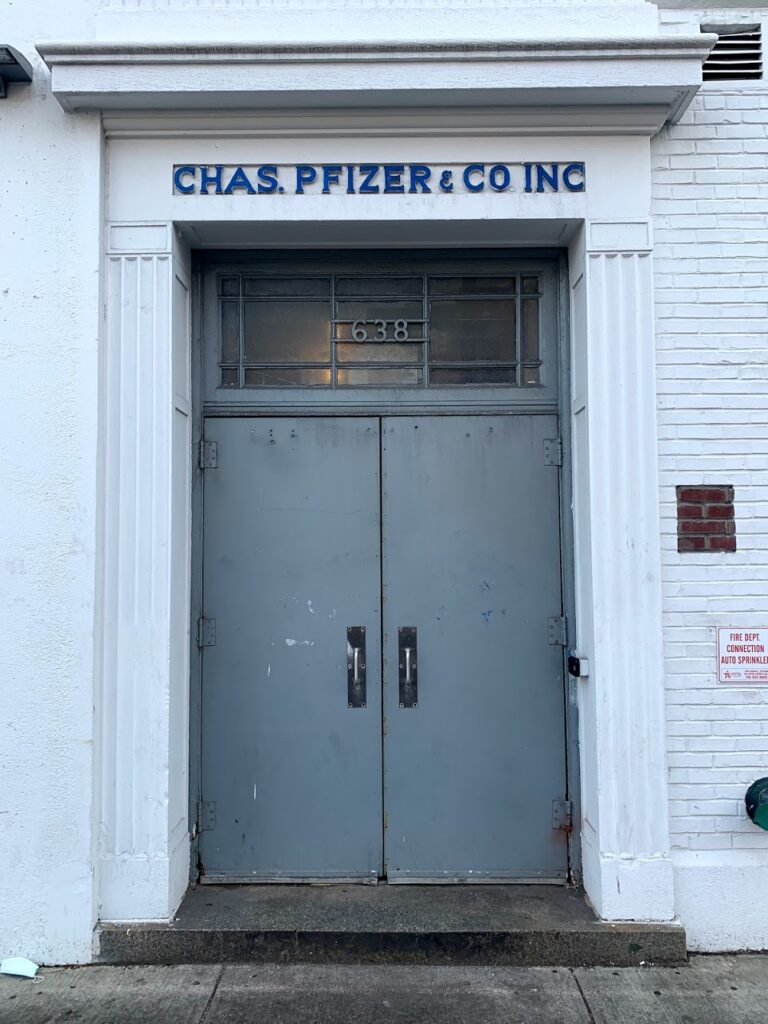
The original Brooklyn location of Pfizer still displays its history.
Room To Grow

As business was just getting off the ground, exciting things were happening in the neighborhood. In 1851, Williamsburgh briefly became its own incorporated city.

Less than four years later the city — along with the township of Bushwick and Greenpoint — would be incorporated into the expanding City of Brooklyn. It was collectively known as the Eastern District.

(At some point, the ‘h’ also disappeared from its name. For more information, listen to our shows on the history of Williamsburg and the Williamsburg Bridge.)

As the community was quickly growing, so too was business booming for the cousins who over the next three decades quickly expanded into the lots surrounding their original headquarters on Bartlett and Thompson.

Like many areas of the Eastern District by the late 19th century, the chemical aroma must have been remarkable.
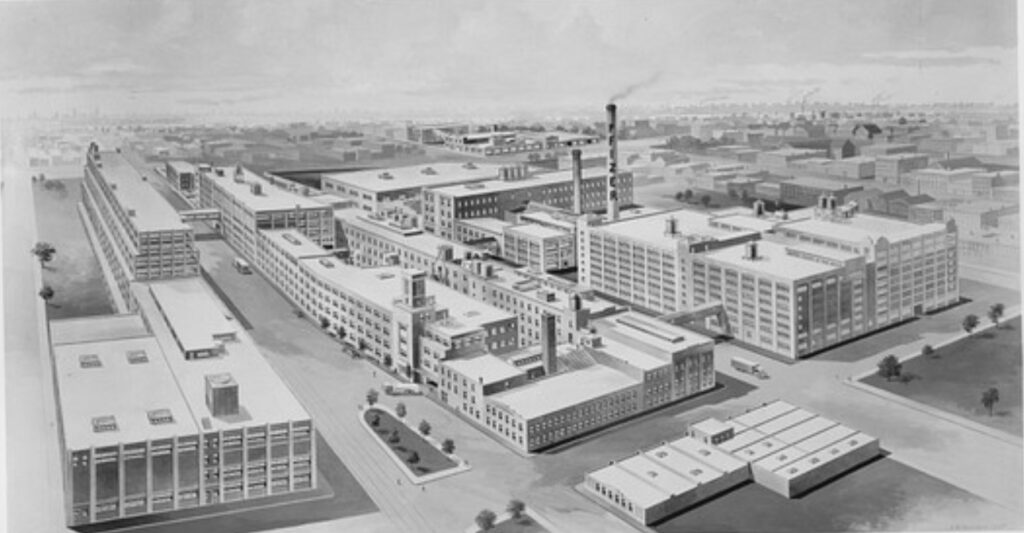
Brooklyn Public Library

Of course Pfizer also expanded outside of Brooklyn almost immediately. In 1868, they naturally moved their central headquarters closer to Wall Street — to 81 Maiden Lane.

Meanwhile their Brooklyn location was cranking out such products as iodine, chloroform, borax, camphor and even morphine. They also specialized in non-medicinal products like cream of tartar.
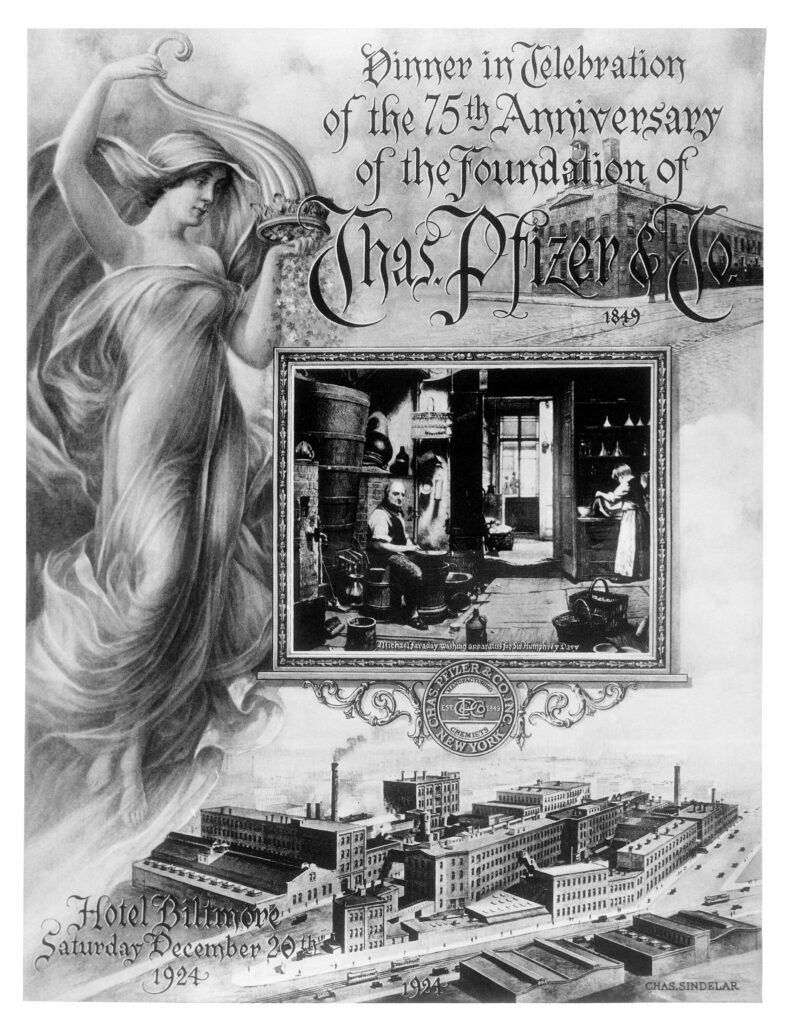
A celebration of their 75th anniversary featuring a depiction of their Brooklyn operation.

As Scott H. Podolsky writes in his journal article Antibiotics and the Social History of the Controlled Clinical Trial 1950-1970:

“For nearly a century of Pfizer’s existence, it did not market pharmaceuticals but rather had centered upon the production and refinement of chemicals such as citric acid, which Pfizer was the world’s largest producer by World War II.

“However the fermentation techniques used in the production of citric acid would render Pfizer a leader in the American World War II efforts to mass-produce penicillin and Pfizer soon followed as one of the largest producers of the equally nonexclusive streptomycin and dihydrostreptomycin (selling to other companies to distribute).”
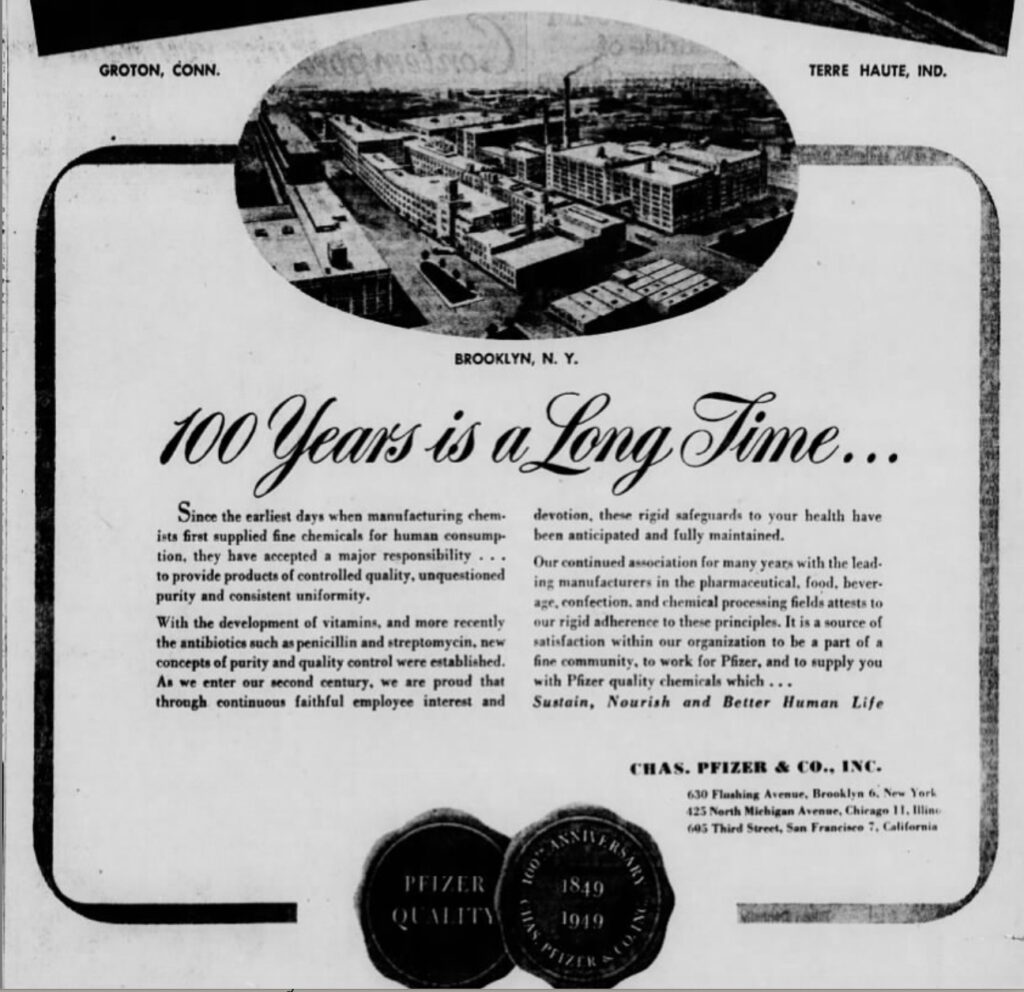
An advertisement touting their 100th anniversary

Penicillin would change the world — and significantly expand Pfizer’s profile by the second half of the 20th century through corporate mergers and expanded offices in several countries.

But Pfizer’s primary headquarters remain in Manhattan — on 42nd Street, across the street from the iconic Daily News Building.

But the company remained in their original Brooklyn location until 2008, when the aging plant was finally closed. Today many other businesses populate this historic spot:
Categories
It's Showtime Podcasts

Diamond Girl: How Mae West Brought ‘Sex’ and Scandal to Broadway

PODCAST Mae West (star of I’m No Angel and She Done Him Wrong) would come to revolutionize the idea of American sexuality, challenging and lampooning ideas of femininity while wielding a suggestive and vicious wit. But before she was America’s diamond girl, she was the pride of Brooklyn! In this podcast, we bring you the origin story of this icon and the wacky events of 1927 that brought her brand of swagger to the attention of the world.

1The Brooklyn girl started on the vaudeville stage early, inspired by the influences of performers like Eva Tanguay. She soon proved too smart for the small stuff and set her aim towards Broadway — but on her terms.

West’s play Sex introduced her devastating allure in the service of a shocking tale of prostitution. It immediately found an audience in 1926 even if the critics were less than enamored. But it’s when she devised an even more shocking play — The Drag — that city leaders became morally outraged and vowed to shut her down forever.

From Bushwick to Midtown, from the boards of Broadway to the workhouse of Welfare Island — this is the story of New York’s ultimate Sex scandal.


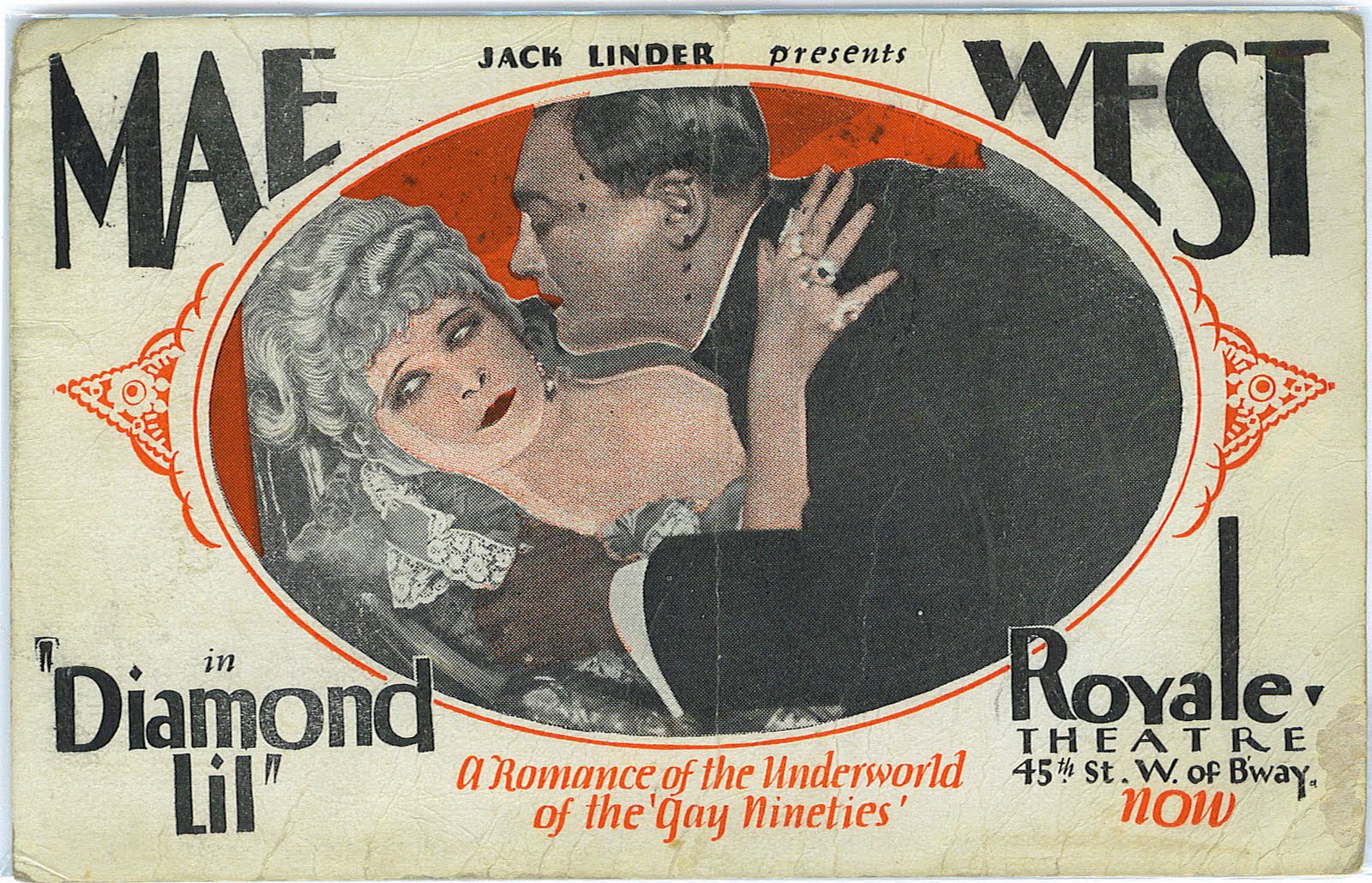
Picture at top: Mae West in a publicity still for her Broadway hit Diamond Lil. (Courtesy Museum of City of New York)

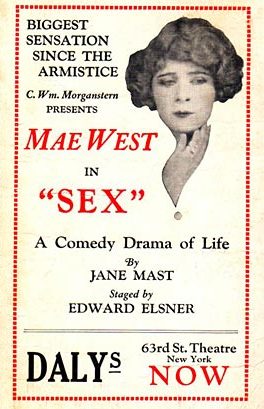
Inset: The poster for Sex by Jane Mast (aka Mae West)

Special thanks to Esther Belle from The West (a Mae West-inspired coffeehouse and bar in Williamsburg). We recorded an interview with her about the legacy of Mae West but weren’t able to use it. But it will be available for Patreon supporters!


The Bowery Boys: New York City History podcast is brought to you …. by you!

Starting this month, we are doubling our number of episodes per month. Now you’ll hear a new Bowery Boys podcast every two weeks. We’re also looking to improve the show in other ways and expand in other ways as well — through publishing, social media, live events and other forms of media. But we can only do this with your help!

We are now a member of Patreon, a patronage platform where you can support your favorite content creators for as little as a $1 a month.

Please visit our page on Patreon and watch a short video of us recording the show and talking about our expansion plans. If you’d like to help out, there are five different pledge levels (and with clever names too — Mannahatta, New Amsterdam, Five Points, Gilded Age, Jazz Age and Empire State). Check them out and consider being a sponsor.

We greatly appreciate our listeners and readers and thank you for joining us on this journey so far. And the best is yet to come!


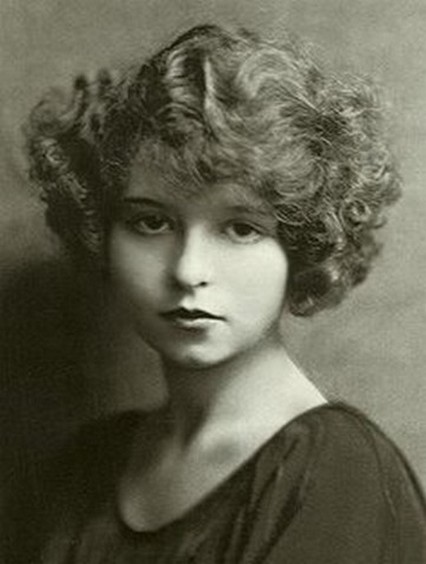
A young Mae West, already a seasoned performer by her teenage years.

Courtesy Notes On The Road

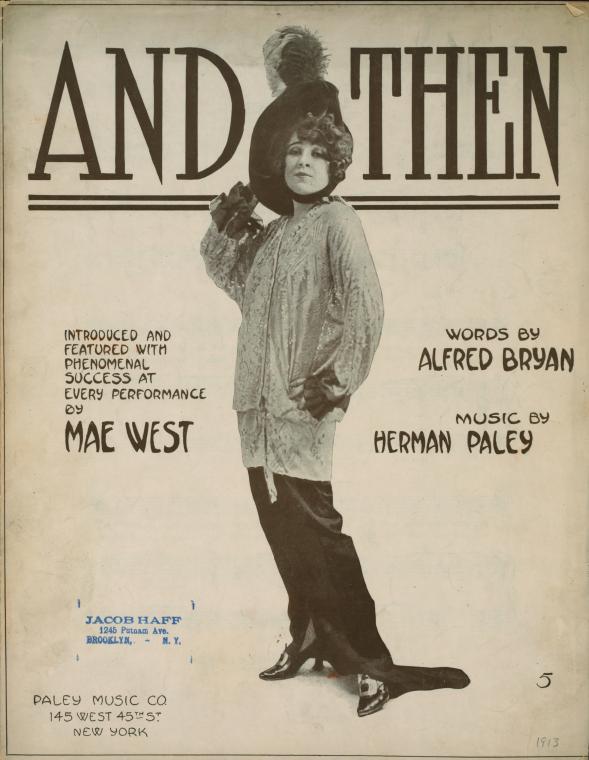
From Mae West’s vaudeville days, a piece of Tin Pan Alley sheet-music she performed in the stage:

Courtesy New York Public Library

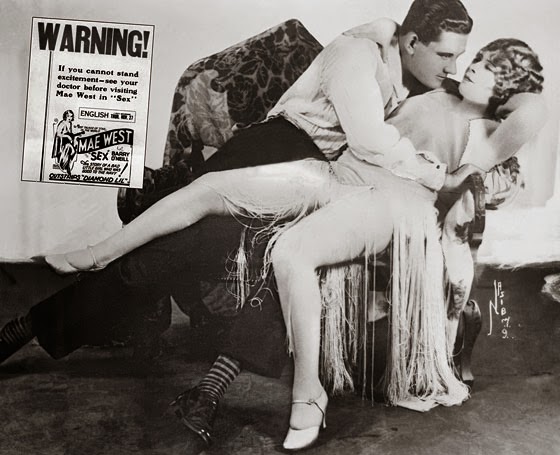
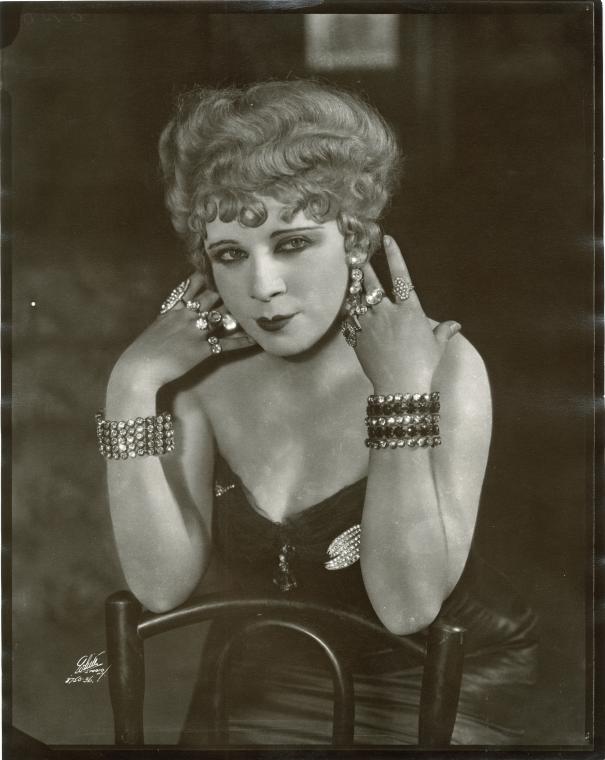
A saucy promotional still from Sex

4

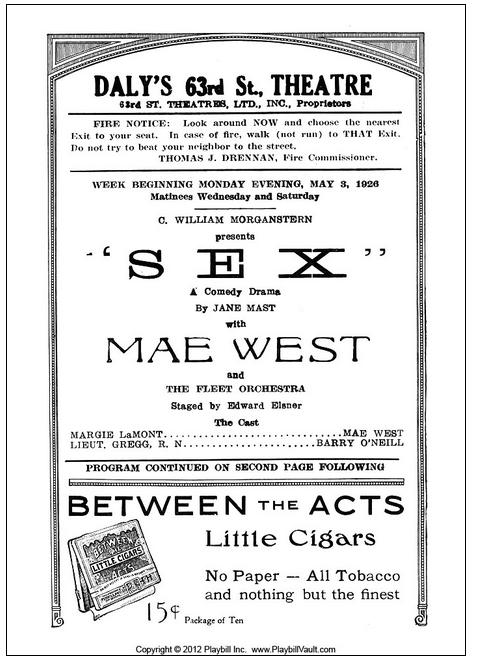
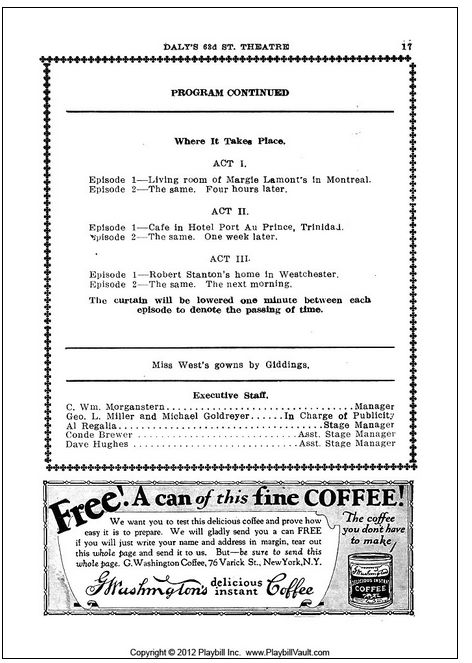
From the original program for Sex:

Courtesy Playbill Vault

1

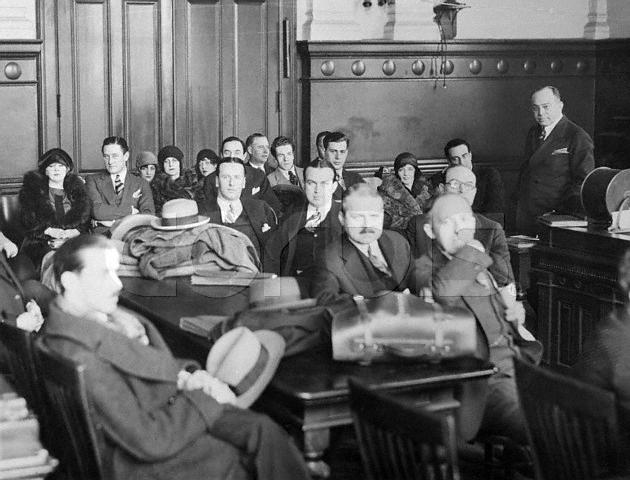
Mae West at the Jefferson Market courthouse:

Original caption: Cast of  Tried By Jury.  New York, New York:  Photo shows scene in courtroom of general sessions part II at start of members of  company.  Mae West and Barry O'Niel, in productions leading roles, can be seen at extreme left. March 28, 1927 New York, New York, USA
Original caption: Cast of Tried By Jury. New York, New York: Photo shows scene in courtroom of general sessions part II at start of members of company. Mae West and Barry O’Niel, in productions leading roles, can be seen at extreme left. March 28, 1927 New York, New York, USA

Mae West in the original photography for the 1928 production of Diamond Lil. She attempted during this period to open the controversial show The Pleasure Man but it was shut down after two days. (Courtesy New York Public Library)

1

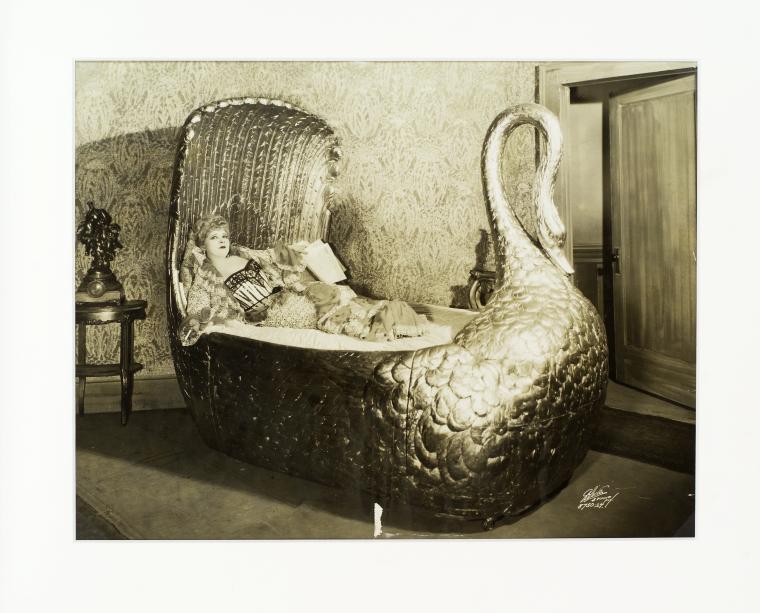
Another odd shot from Diamond Lil, of Mae reclining in a golden swan bed. (source)

Courtesy New York Public Library

5

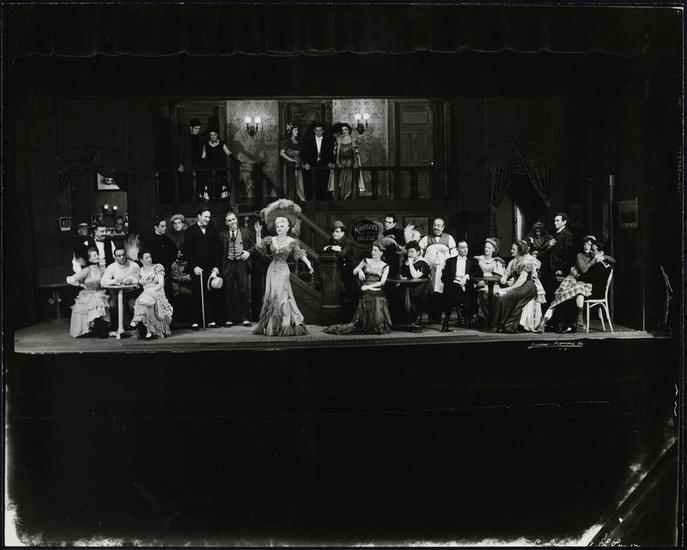
Mae West in the 1949 Broadway revival of Diamond Lil. Once a provocateur of the stage, she settled into her larger-than-life personae in later years, formed mostly from her successes in this role (and its film version She Done Him Wrong). (Courtesy Museum of the City of New York)

Courtesy the Museum of the City of New York

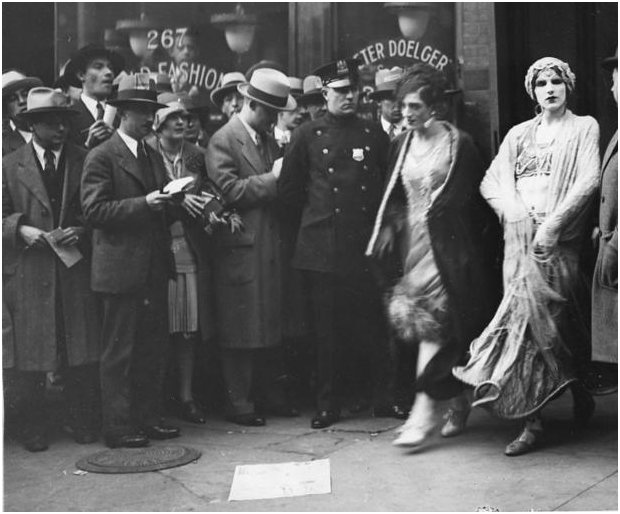
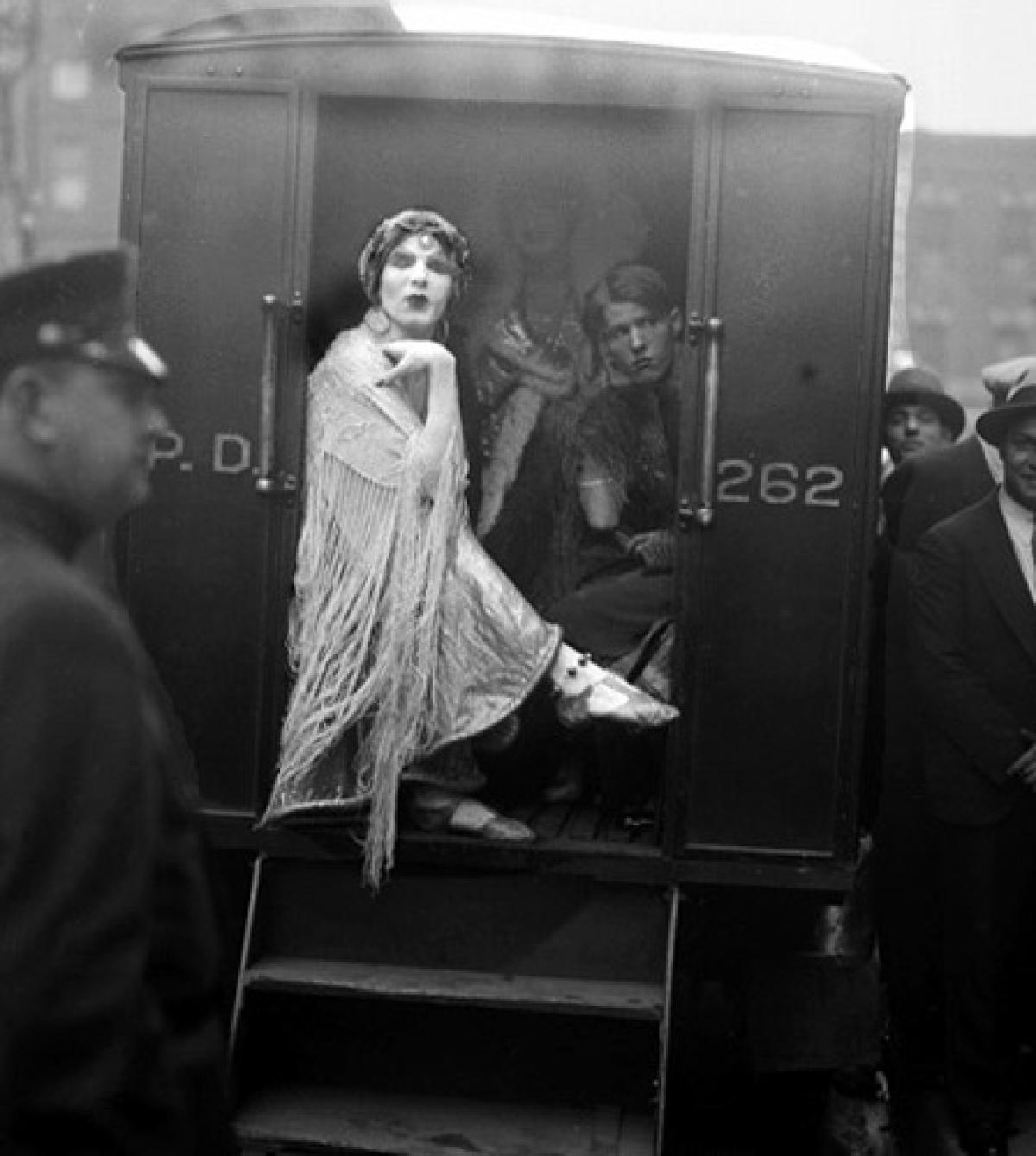
Members of the cast of The Pleasure Man being arrested by police, 1928.

Courtesy Queer Music Heritage -- http://queermusicheritage.com/fem-arts6.html
Courtesy Queer Music Heritage — http://queermusicheritage.com/fem-arts6.html

Courtesy New York Daily News

Mae West (and a young Cary Grant) in She Done Him Wrong

In the hilarious I’m No Angel:

Ladies and gentlemen, Mae West and Mr. Ed:

And her last film — the camp classic Sextette

Categories
Brooklyn History

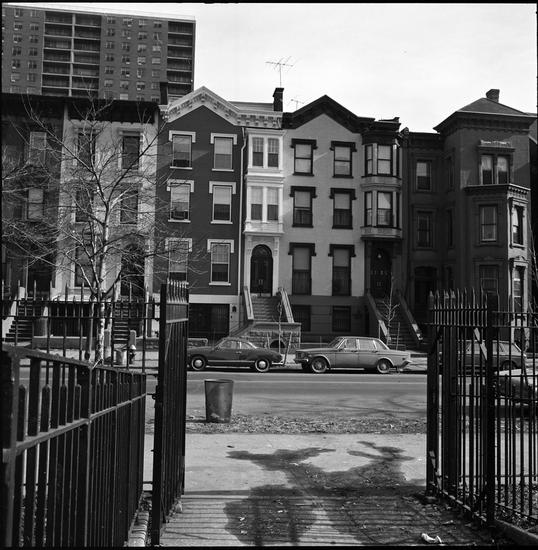
Ungentrified: Brooklyn in the 1970s

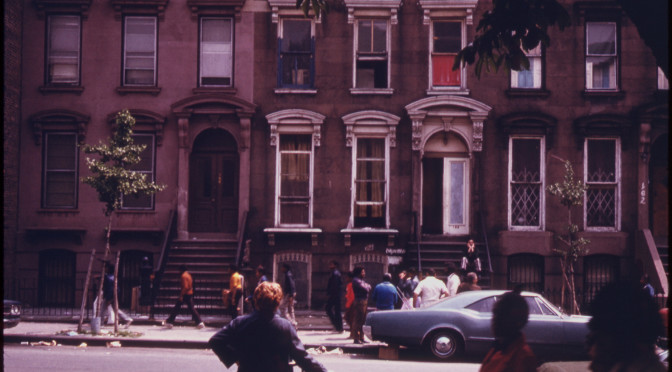
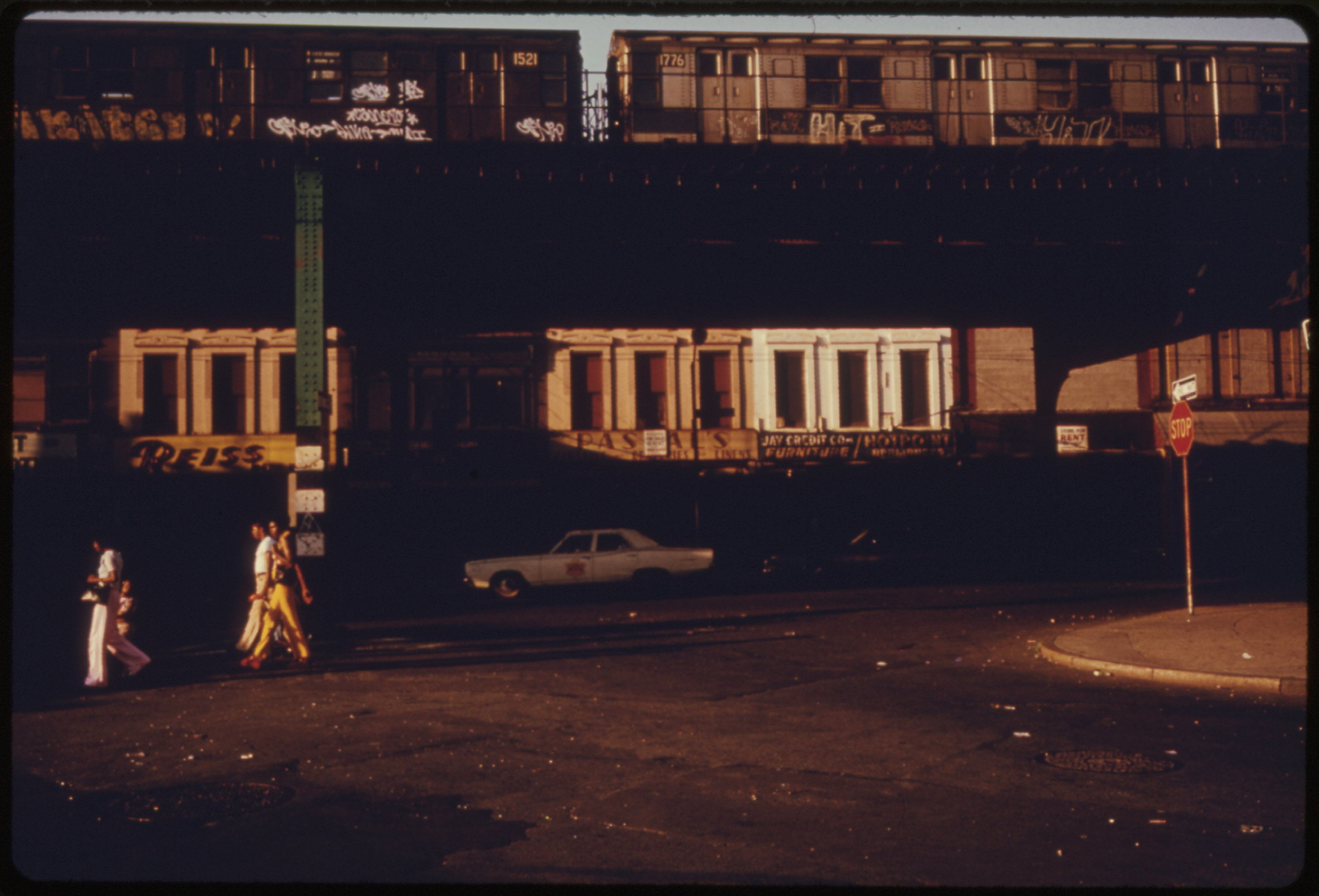
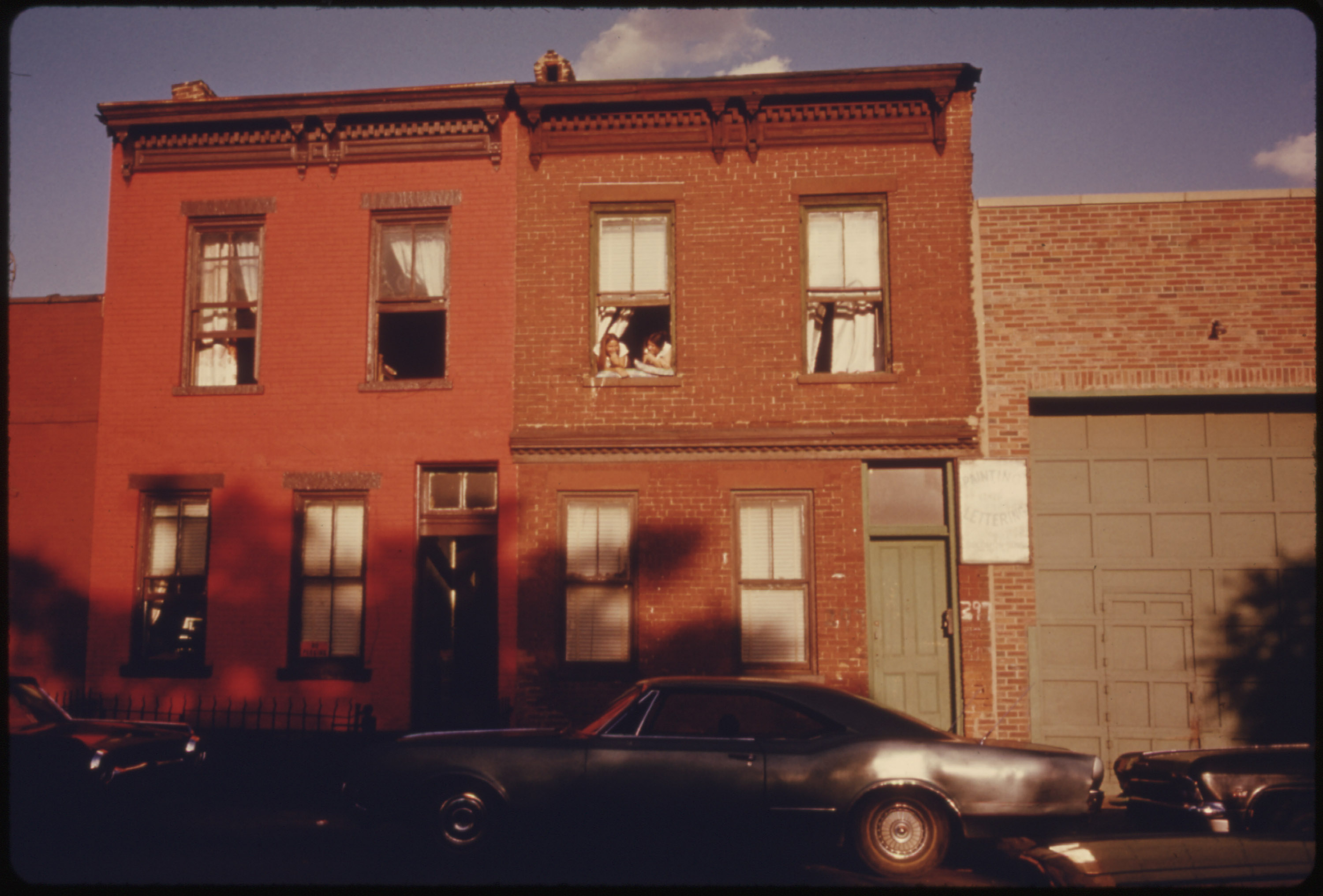
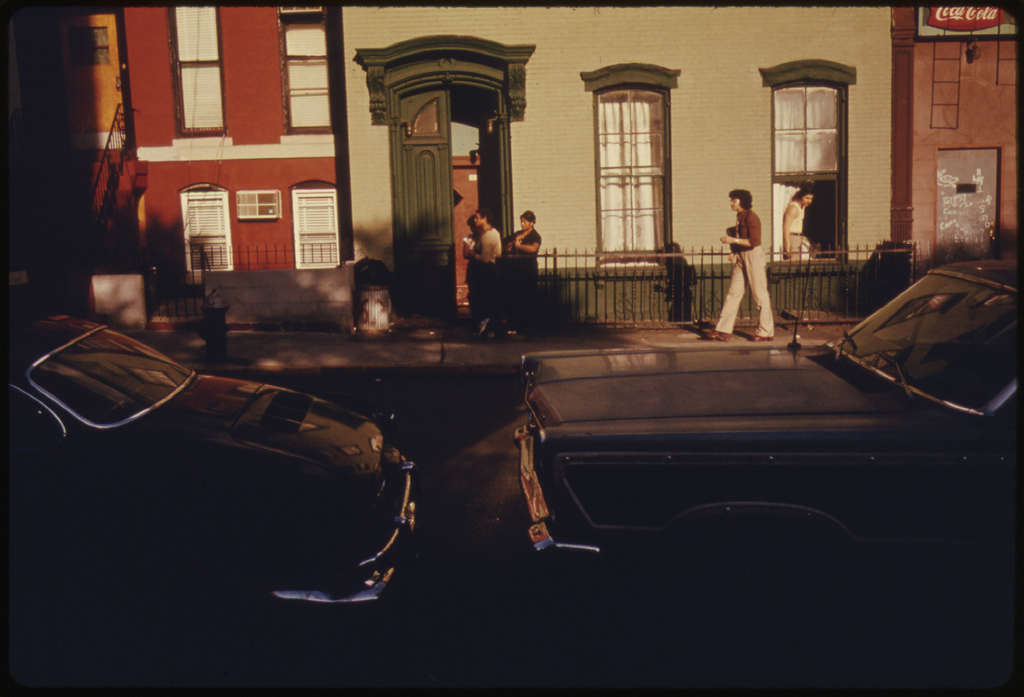
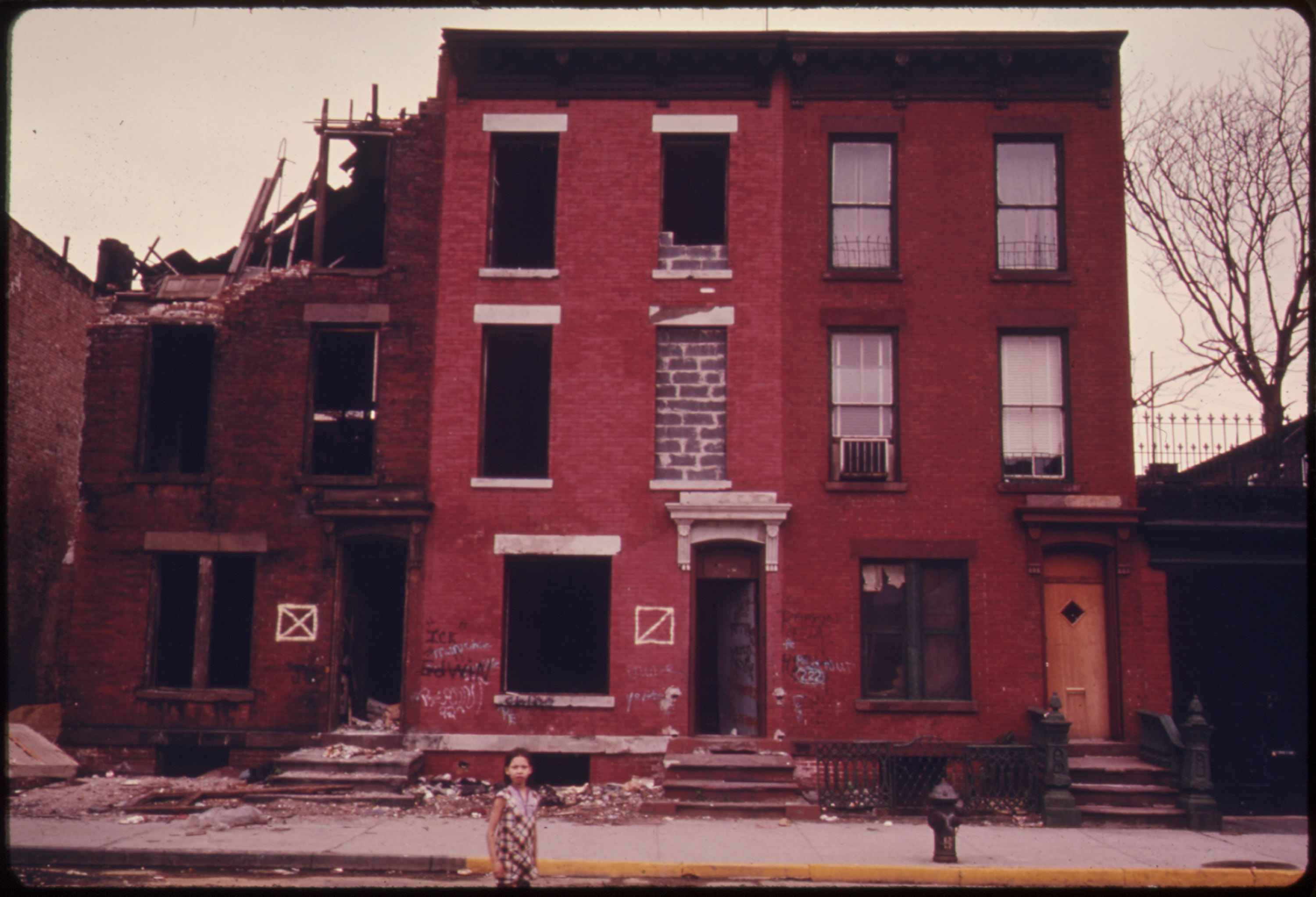
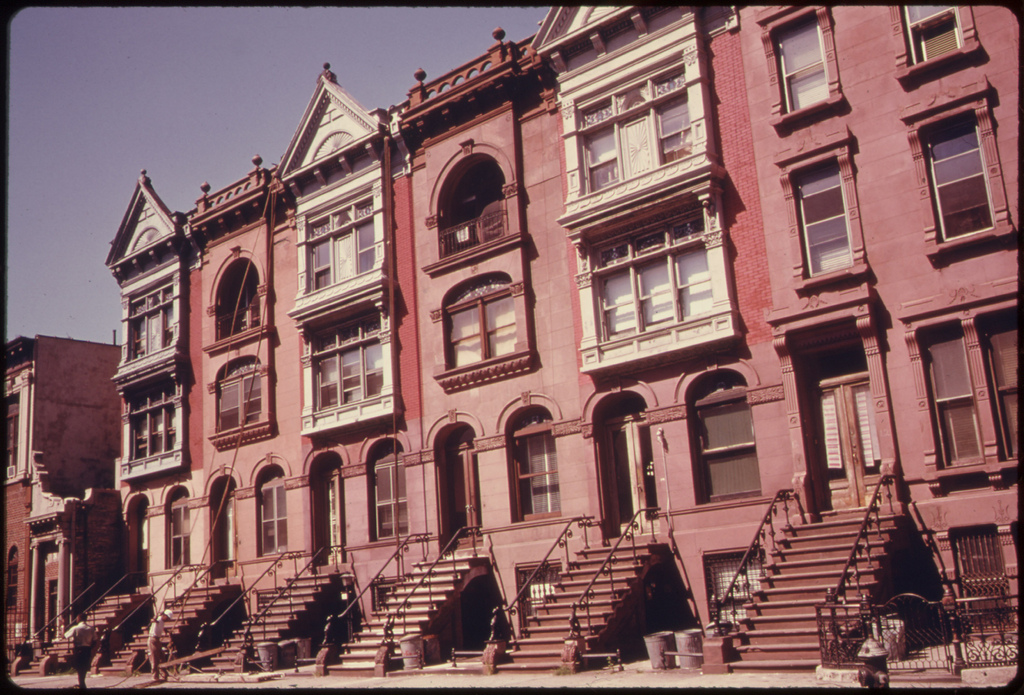
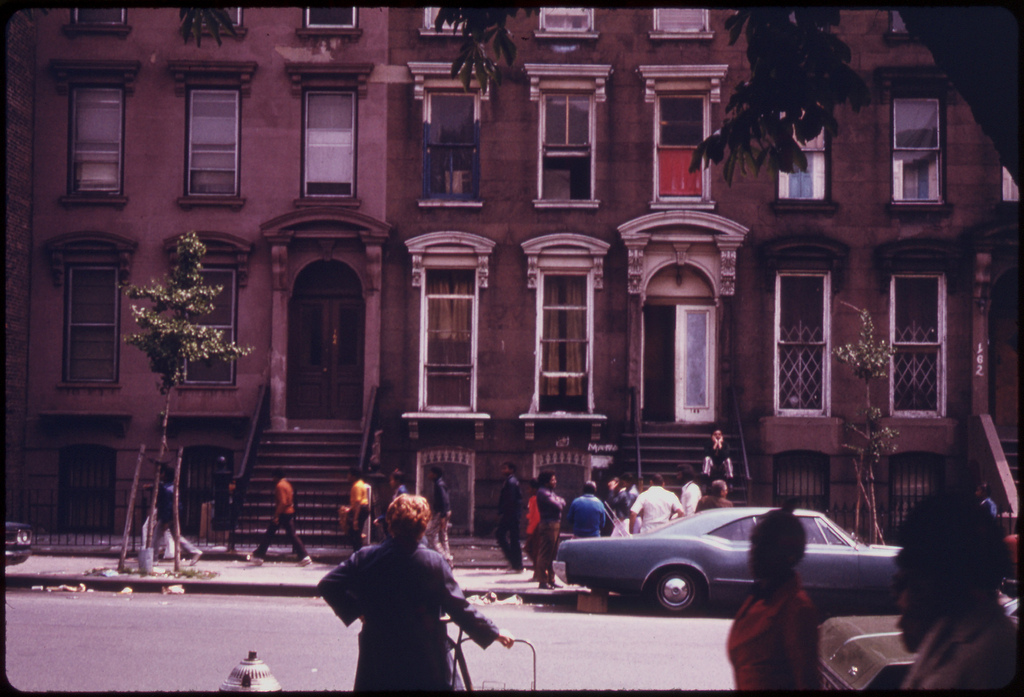
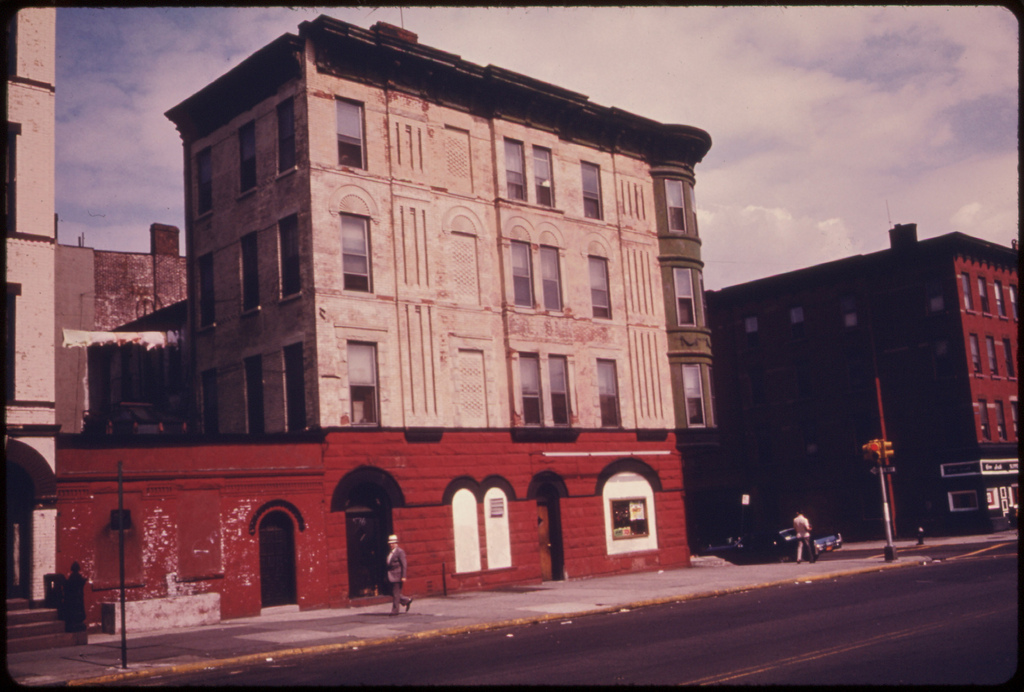
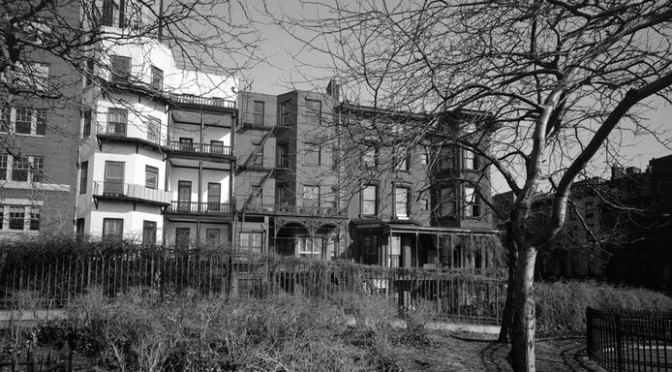
The new Bowery Boys podcast that comes out this Friday will be about Brooklyn. So let’s get in the mood with some pre-Instagram tinted photography from the U.S. National Archives, most of them taken in 1974 by Danny Lyon. followed by some black and white images by Edmund V Gillon.

You might have seen many of these photographs before (perhaps even here on this blog), but it’s striking to revisit them in context of Brooklyn current gentrification patterns.

The homes of Brooklyn Heights began seeing the arrival of ‘bohemians’ as early as the 1910s, and brownstone revivalists (the so-called ‘pioneers’) discovered the neighborhood after World War II.

But a noticeable trend of Brooklyn gentrification happened in earnest in the late 1950s, with wealthy escapees from Manhattan (fending off the urge to suburbanize) moving into South Brooklyn brownstones and row houses and giving enclaves attractive new names like Boerum Hill, Cobble Hill and Carroll Gardens.

The most successful example occurred up on the park slope as a movement of urban activists and historical preservations refurbished and brought to life one of Brooklyn’s original Gold Coasts. Its official name became, of course, Park Slope.

While the ‘brownstone Brooklyn’ movement was well at hand in 1974-5 — the date of most of these photographs — much of the borough was still facing blight and deterioration then.  Most of the neighborhoods pictured below are today considered ‘hot’, trendy places with incredibly high rents.

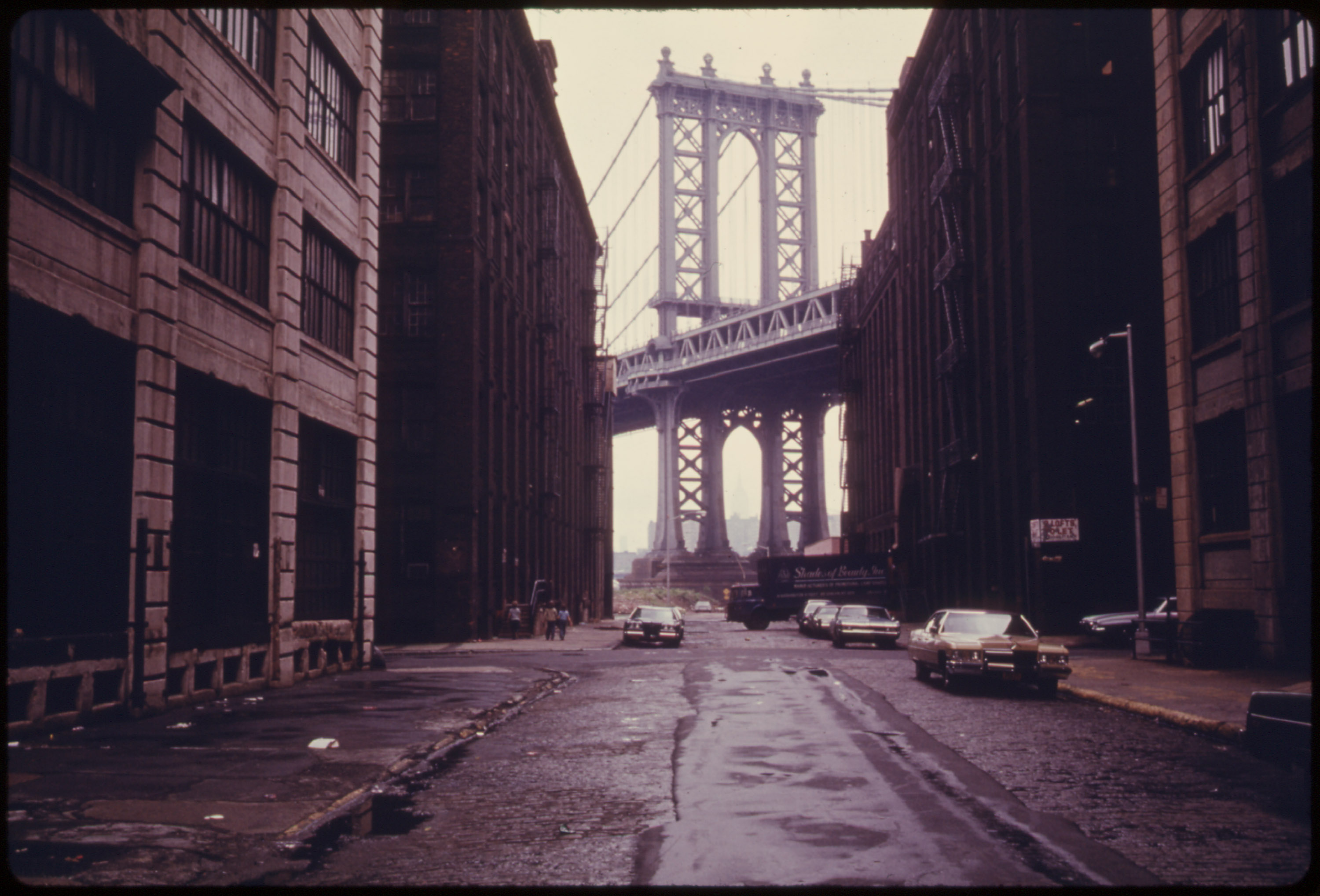
DUMBO, a name invented in the late 1970s, Down Under the Manhattan Bridge Overpass.

Landscape

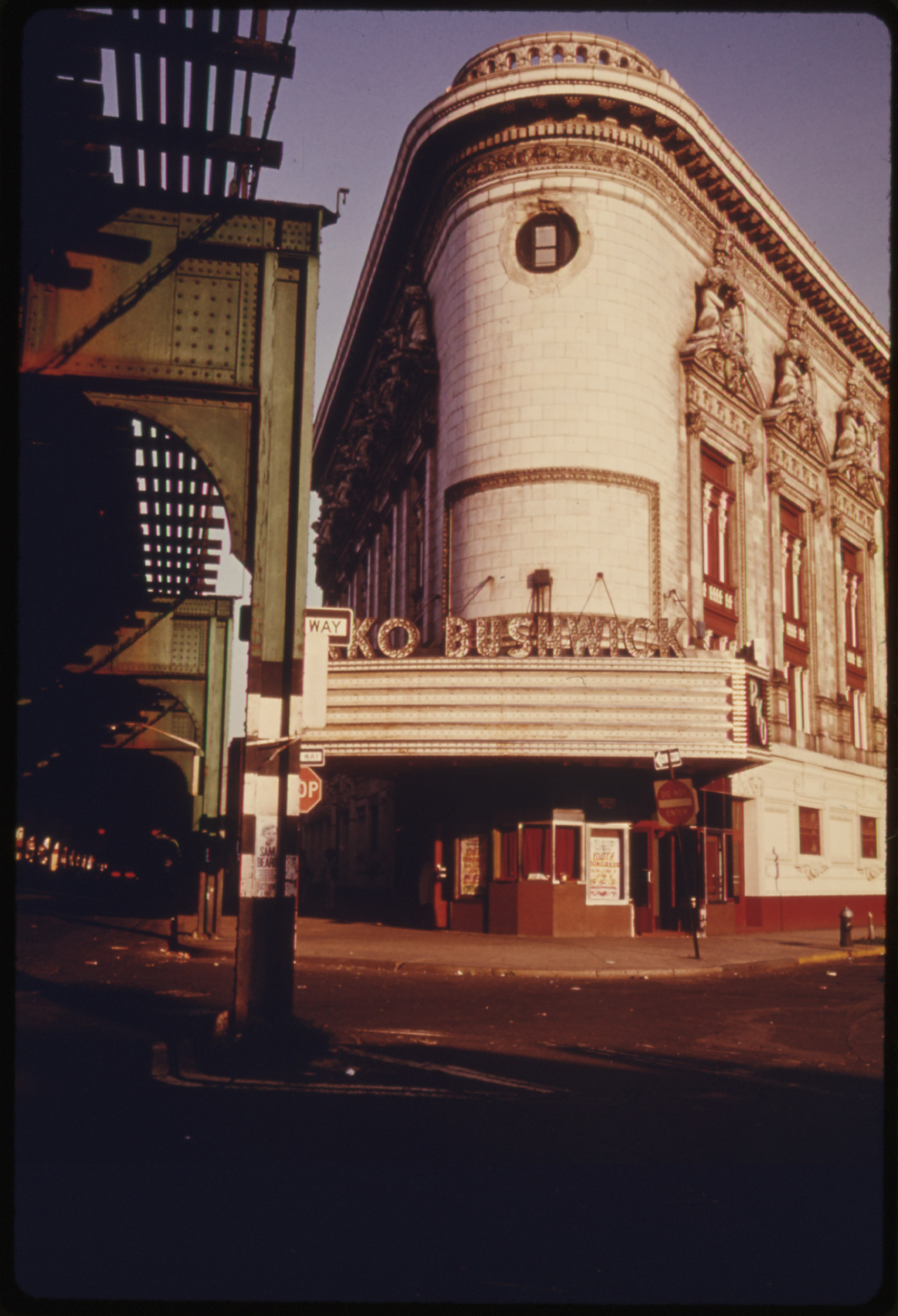
The RKO Bushwick Theater, at the Bushwick/Bed-Stuy border.

Portrait

Bushwick Avenue

Landscape

Two pictures of Bond Street

Landscape
Landscape

Across from Lynch Park, near the Brooklyn Navy Yard

Landscape

There’s no location listed in the caption but probably Park Slope?

Landscape
Landscape

Fort Greene, across from the park.

This is taken on Vanderbilt Avenue but I can’t ascertain exactly here. Perhaps today’s Prospect Heights area.

Landscape

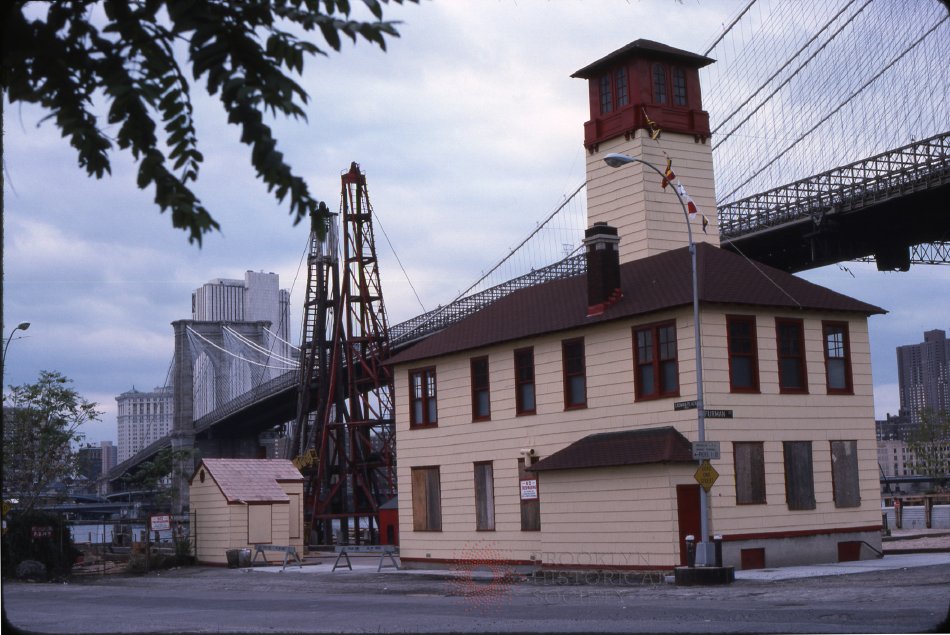
Images of the Fulton Ferry area in 1975 (courtesy the Brooklyn Historical Society)

V19891866
V19891847-1

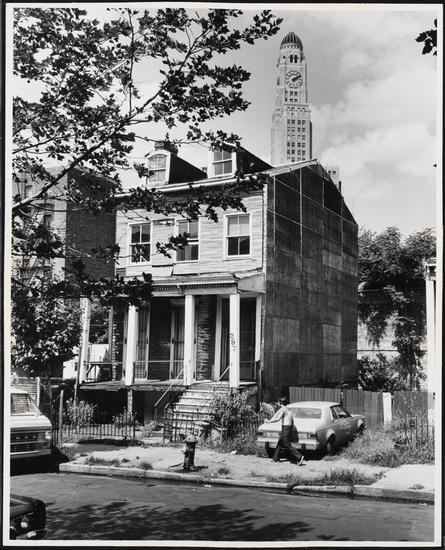
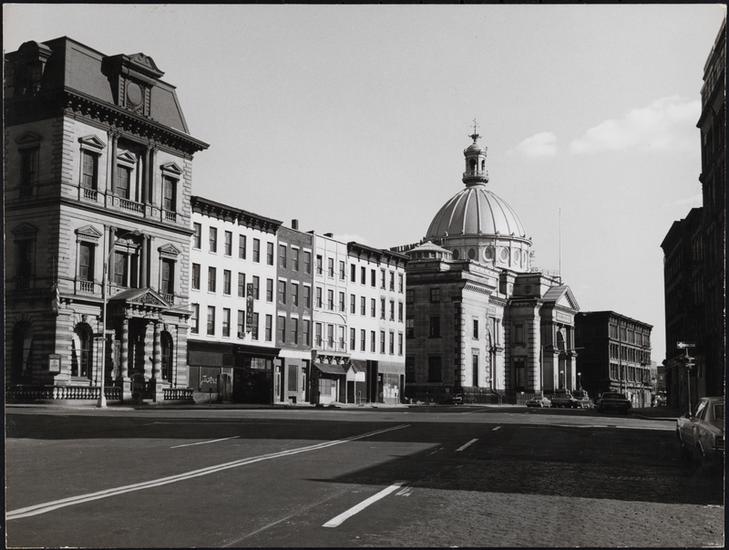
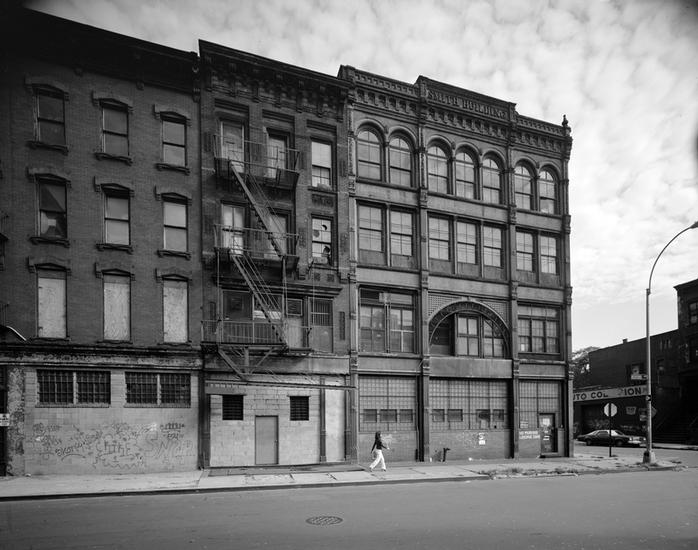
And a couple images from the Museum of the City of New York archives, all from 1975, taken by Edmund V Gillon. You can find many more of astounding photographs here:

397 Dean Street, considered part of Park Slope today

MN112866

Williamsburg, looking east on Broadway from Bedford Avenue and South 6th Street.

MN112215

Boarded-up buildings and the Bedford Avenue façade of the Smith Building, 123 South 8th Street

2013_3_2_ 546

Clinton Hill: Row houses on the eastern side of Washington Avenue between Dekalb and Lafayette Avenues

66cm_2013_3_2_ 025
Categories
Mysterious Stories Podcasts

Haunted Hipsters: Four Ghost Stories of Brooklyn

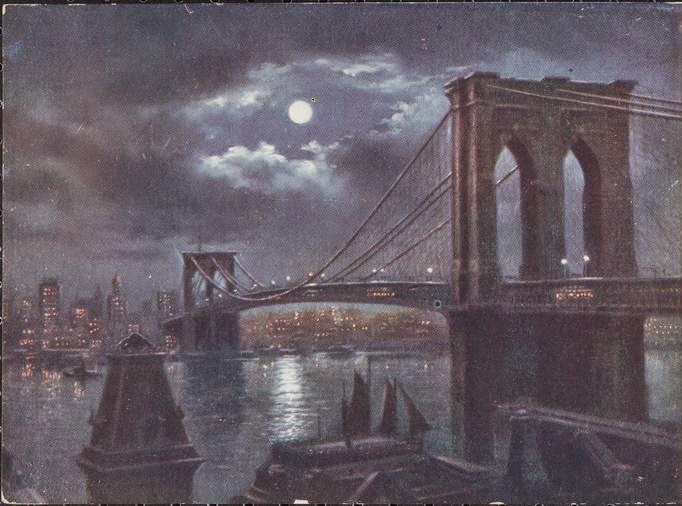
Dark skies over the Brooklyn Bridge, from a 1905 postcard (courtesy MCNY)

PODCAST  Brooklyn is the setting for this quartet of classic ghost stories, all set before the independent city was an official borough of New York City.  This is a Brooklyn of old stately mansions and farms, with railroad tracks laid through forests and large tracks of land carved up, awaiting development.  These stories also have another curious resemblance — they all come from local newspapers of the day, reporting on ghost stories with amusement and more than a little skepticism.

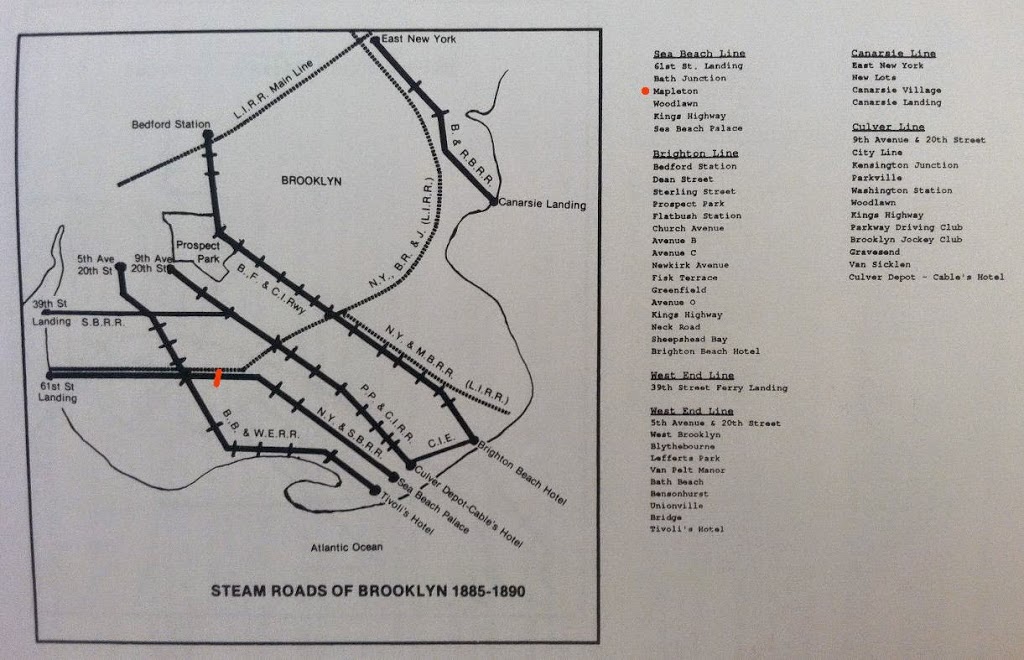
1)  The Coney Island and Sea Beach Railroad took passengers to and from Brooklyn’s amusement district.  But nobody was particularly amused one evening to be stopped by a horrific, gangly ghost upon the tracks near Mapleton.

2)  In Clinton Hill, a plantation-style house built in the early years of the Brooklyn Navy Yard has survived hundreds of unusual tenants over the years, but certainly the scariest days in this historic home occurred in 1878 with a relentless, invisible hand that would not stop knocking.

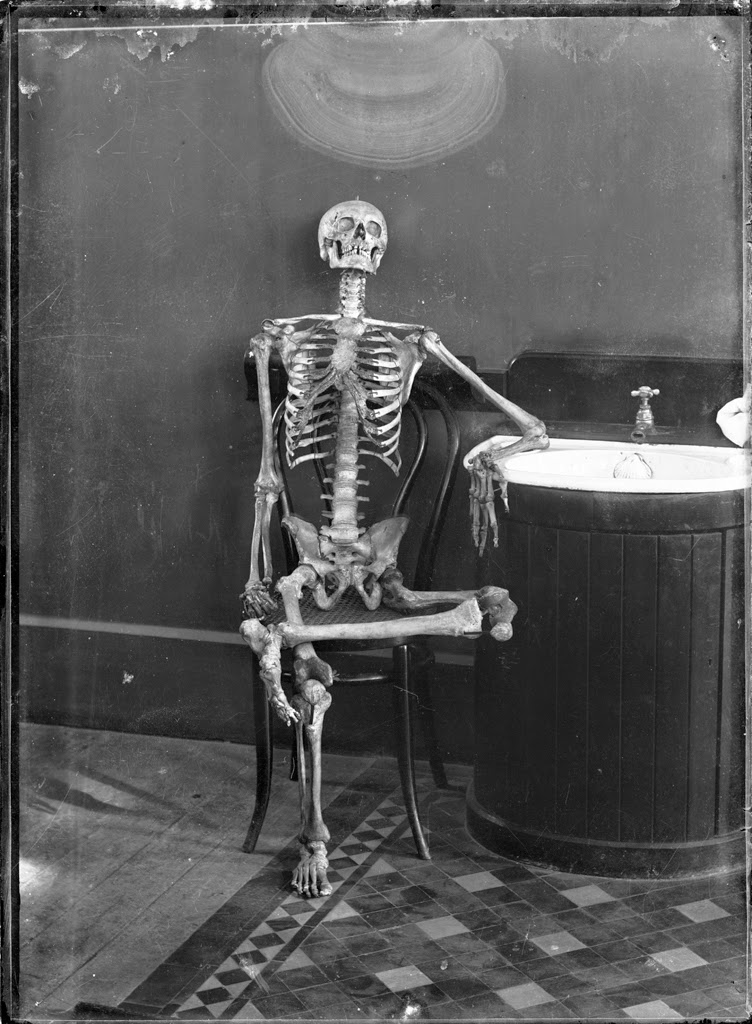
At right: Death will not deter this Brooklynite from ordering a great craft beer. (courtesy Powerhouse Museum)

3)  The Oceanic Hotel was one of Coney Island’s first great hotels, an accommodation for almost 500 near the increasingly popular beaches of Brighton Beach.  But in 1894, the hotel was virtually emptied out and reportedly haunted.  Did it have something to do with the murder upstairs in Room 30?

4) And finally, the area of Bushwick nearest the Queens border are populated with various burial grounds like the Evergreens Cemetery, borne of the rural cemetery movement which transplanted thousands of previously buried bodies from Manhattan to Brooklyn.

In 1894, with Bushwick prepared for a spate of new development, the sudden appearance of an oddly dressed spirit threatens to disrupt the entire neighborhood.  During one evening, a drunken party of 300 ghost hunters, brandishing swords and revolvers, come across one terror that proved to be very real indeed.

ALSO: Secrets of The Sentinel, a 1977 horror film set in an old house along the Brooklyn Promenade.


10 Montague Terrace, setting for the 1970s horror film The Sentinel, sits at the end of this elegant block on the Brooklyn Promenade.

[Looking west from Brooklyn Bridge Park to the houses on Montague Terrace.]

The theatrical trailer to The Sentinel

1) MIDNIGHT TRAIN TO TERROR
Phenomena reported August 1894 in several publications, including the New York Evening World

The incident in question occurred near the Mapleton station along the Coney Island and Sea Beach Railroad (Map of Brooklyn railroad lines courtesy The Weekly Nabe who has more information on the early days of Mapleton.)


2) WHO’S KNOCKING AT MY DOOR?
Phenomena reported December 1878 in several publications, including the New York Sun
 
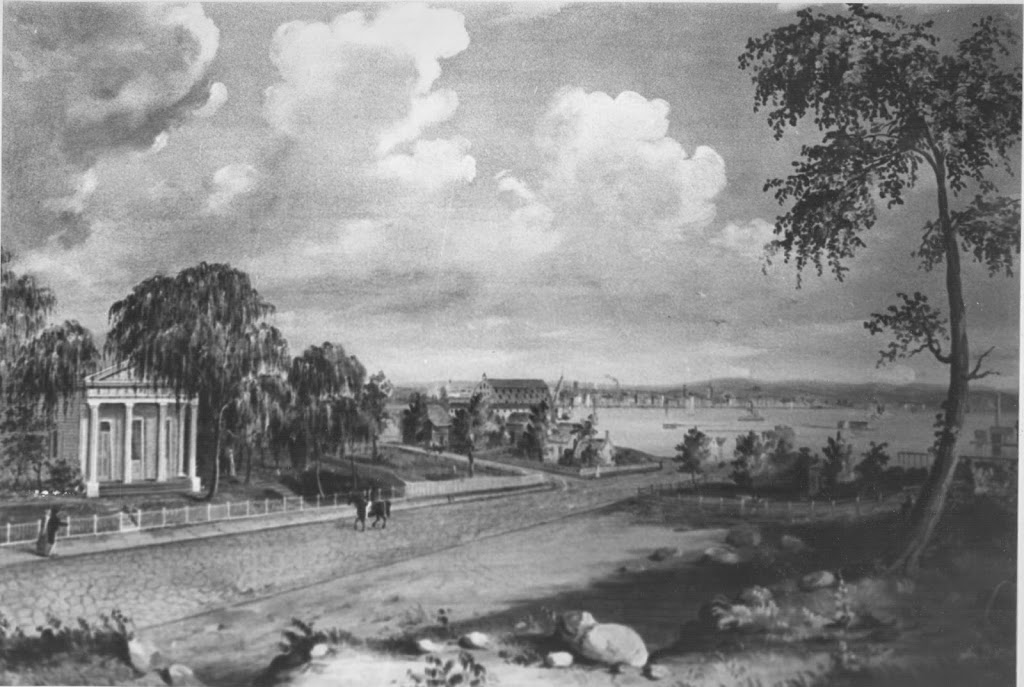
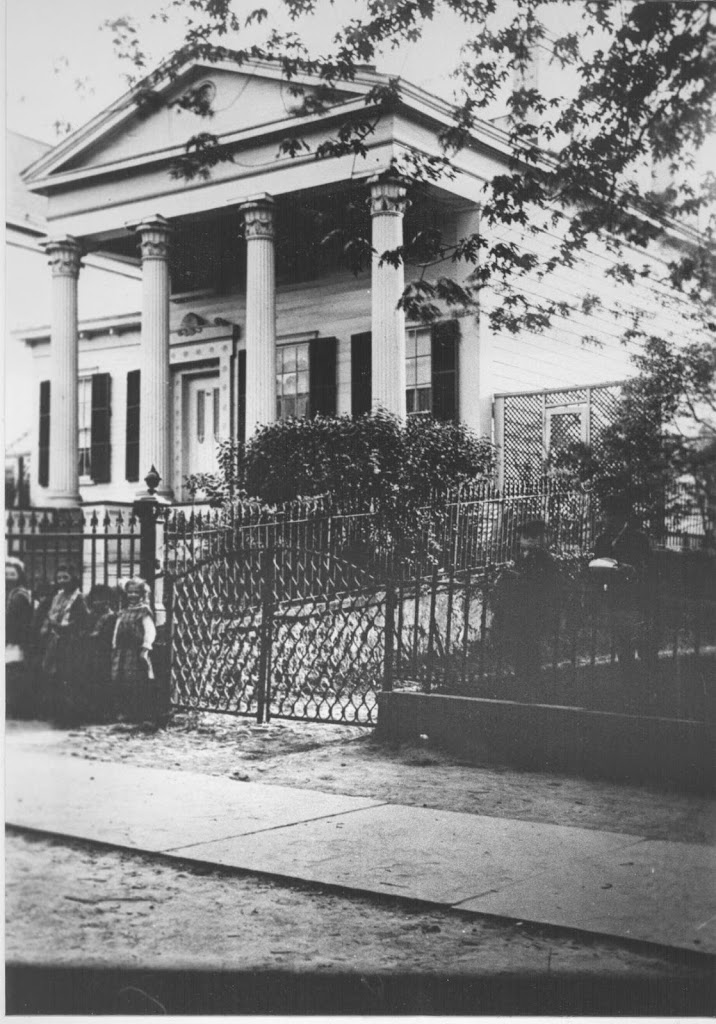
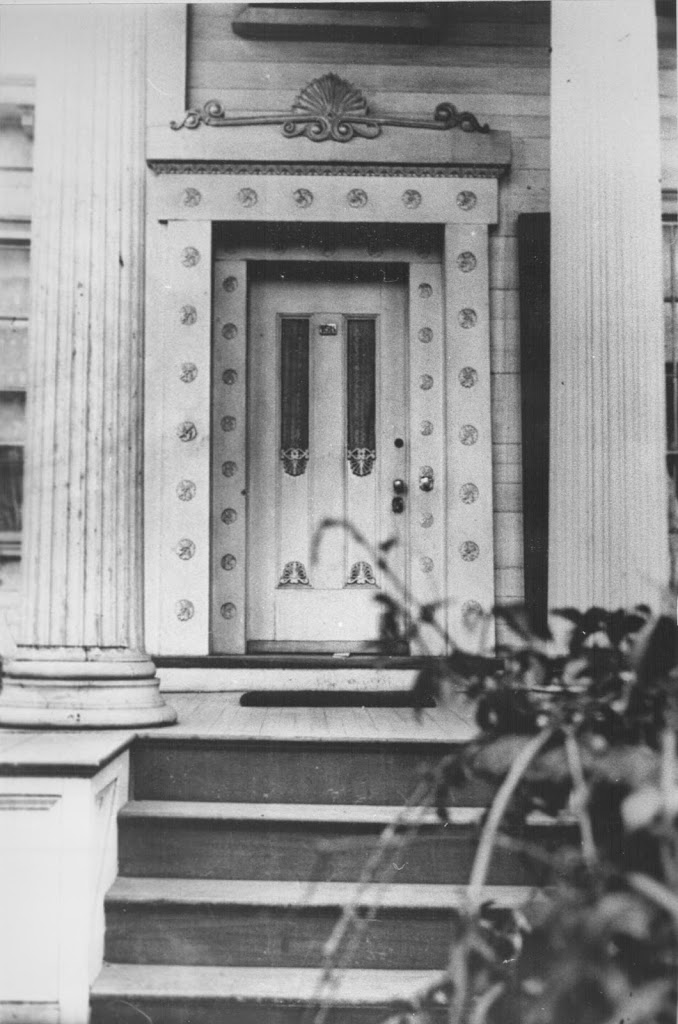
A view of Wallabout Bay and the land which became the Brooklyn Navy Yard, circa 1830s.  That would appear to 136 Clinton Avenue (the oldest house in the area) however the general proportion of the region looks a bit off.  Below it, two pictures of the house on Clinton Avenue, including a close-up of the infamous door. (Pics courtesy Flickr/sjcny and Long Island Historical Society)


3) THE GHOSTLY GUEST IN ROOM 30
Phenomena reported August 1892 in several publications, including the Brooklyn Daily Eagle

The haunted Oceanic Hotel, located at Neptune Avenue and W. 6th Street. Perhaps this looks surprising for a 500-room hotel, but out of frame are bungalows and other adjoined buildings.  But you can see how this sort of accommodation went out of fashion rather quickly.

[First hotel at Coney Island, Oceanic Hotel.]
http://timesmachine.nytimes.com/timesmachine/1930/07/01/98307449.html?pageNumber=18

4) THE GHOST OF KNICKERBOCKER AVENUE
Phenomena reported November 1894 in several publications, including the New York Times

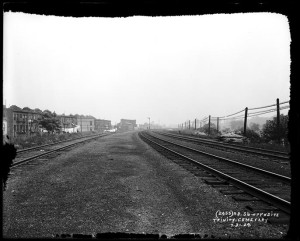
1924 — A view of the tracks which separate Bushwick from a cluster of cemeteries. Buildings to the left sit in the vacant lots which were mentioned in this story.  The cemetery nearest this photograph is Most Holy Trinity Cemetery.  You may remember the name Most Holy Trinity for it was this Bushwick congregation that was featured in a ghost story a couple years ago in the show ‘Haunted Histories of New York.’

Opposite Trinity Cemetery.


Notes from the podcast: (#141) New York Beer History

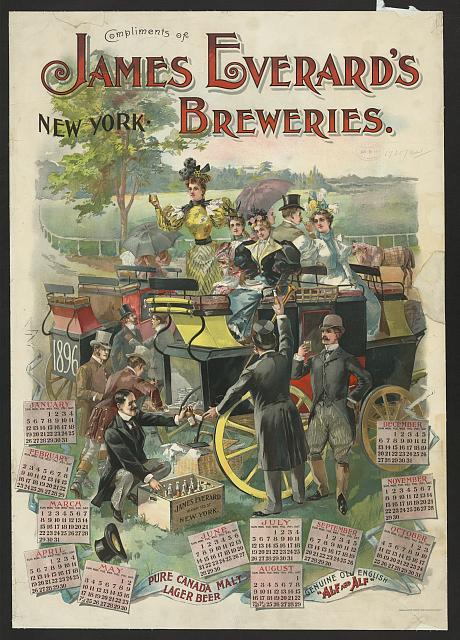
Year-Round Brews: This calendar from 1895 celebrates the Harlem breweries of James Everard. An older Everard brewery building on W. 28th Street was converted into a Turkish bathhouse in 1888. It became the location of a variety of notorious activities during the 20th century. Everard’s breweries became the plaintiff in a Prohibition-era Supreme Court case regarding the use of alcoholic beverages for medicinal purposes. (Pic courtesy the Library of Congress)

Piels:  We completely skipped one major New York brewer, one that still maintains a presence in New York, if in name only. Three German brothers opened the Piels Brewery in East New York, on the same day as the opening of the Brooklyn Bridge— May 24, 1883. They too had their own beer garden to enjoy the brews manufactured inside. Called the Summer Garden, this festive place adorned with electric lights and a shaded seating area was known for its determined wait staff.

From the Brooklyn Daily Eagle: “The waiters in the summer garden competed to see who could carry the most seidels of Piels Beer from the bar to their customers tables. In 1904 one waiter carried 16 seidels (eight in each hand).” [source]

Piels is still manufactured in Milwaukee by the Pabst Brewing Company.

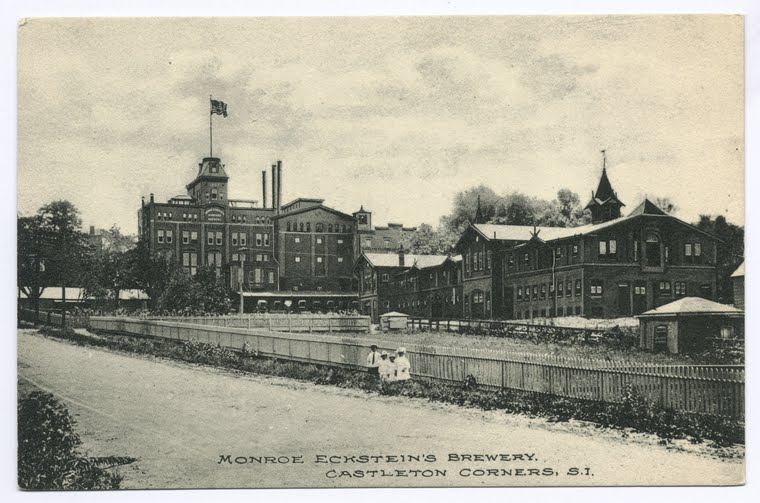
Five-Borough Beer: In its heyday, you could find breweries in all five boroughs. Brewers were particularly attracted to Staten Island thanks to its spring water. In Stapleton, near the ferry piers, sat two of the largest — George Bechtel‘s brewery (which opened in 1853) and Rubsam & Hormann’s Atlantic Brewing Co.

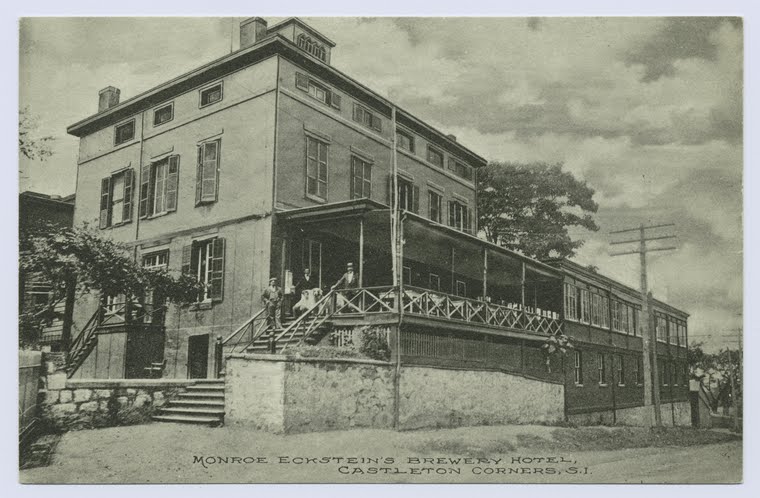
And then, of course, there’s a place we all want to stay — Monroe Echstein’s Brewery Hotel and adjoining brewery on Manor Road in Castleton Corners. (Pics courtesy NYPL)

College Point in Queens County attracted a large German population, thanks in part to rubber industrialist Conrad Poppenhausen, who set up his factories here in the 1850s. His workers and daytrippers to the region enjoyed a line of small breweries and beer gardens here. A couple decades later, Henry Steinway would set up his own factory town to the west and with it an assortment of beer gardens and even an outdoor amusement park called North Beach.

Today’s Bohemian Hall in Astoria is not far from Steinway’s factory. Read about the history of one of Queens’ oldest drinking establishments here.

For More Information: The New-York Historical Society exhibit ‘Beer Here: Brewing New York’s History is on display until September 2, 2012. I was particularly interested in the Society’s collection of ice carving equipment used by early brewers and the very cheeky collection of mid-20th century advertising and media.

For a general history on American beer, I recommend Maureen Ogle’s ‘Ambitious Brew: The Story of American Beer’ and also Gregg Smith’s ‘Beer In America: The Early Years’. And there is no shortage of History-Channel style documentaries on the subject. Also, for some general information on Bushwick, I highly recommend exploring the Bushwiki, with lots of history about the neighborhood.

There’s now a New York Beer and Brewery Tour with stops at brewers in three different boroughs. And it takes you down ‘Brewer’s Row’ after having a couple rounds of beer elsewhere. You can catch a tour of the Brooklyn Brewery of course; visit their website for more information.

Thanks again to Scott Nyerges for helping me out with this one! Please visit his website for more information on his upcoming gallery show in Bushwick. And also my thanks to the Bodega Bar in Bushwick where I was going to pull together the Bowery Boys’ very first real ‘on location’ recording at a bar. Unfortunately I was not able to work that out, but I thank them for opening their door to the show anyway.

Categories
Podcasts

On The House: A history of New York City beer brewing

Behold the lager: A German variety of beer revolutionized American drinking, inspiring a new kind of drinking establishment (Courtesy the New-York Historical Society

Inspired by ‘Beer Here: Brewing New York’s History‘, the terrific summer show at the New-York Historical Society, the latest Bowery Boys podcast explores the story of one of America’s greatest, most treasured products– beer.

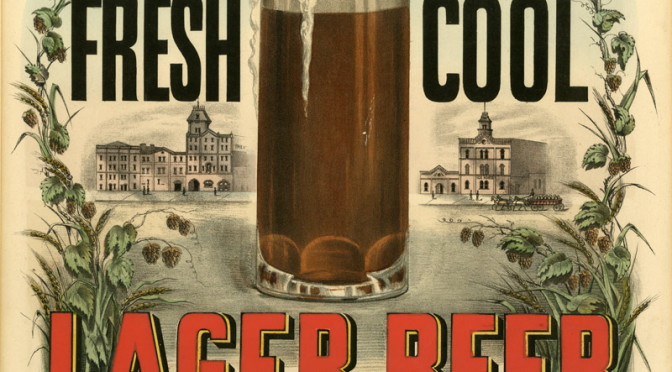
PODCAST New York City’s thriving craft brewing industry today hearkens to a time over a century ago when the city was one of America’s great beer-making capitals, the home to a robust industry of breweries and beer halls. In the 19th century, German immigrants introduced the lager to thirsty crowds, manufacturing thousands of barrels per year from breweries in Manhattan and Brooklyn’s ‘Eastern District’ (primarily Bushwick and Williamsburg). 

The top Manhattan brewers were Hell Gate Brewery and the Jacob Ruppert Brewing Company, situated right next to each other in the old German neighborhood of Yorkville. Both Ruppert and Hell Gate’s founder George Ehret rode the beer craze to become two of New York’s wealthiest businessmen. Meanwhile, out in Brooklyn, a phalanx of brewers clustered along Bushwick Avenue in fine red-brick factories.

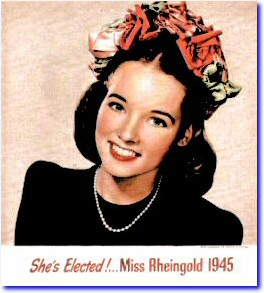
Following World War I and Prohibition, New York lost its hold over beer manufacturing to more savvy Midwestern beer makers. But a few local brands weathered the century with unusual marketing ploys — from sports sponsorships to the Miss Rheingold beauty pageant.

By the late 1970s, significant brewing had vanished from New York entirely. But somewhere in SoHo in the 1980s, a renaissance was about to begin…..

For a little extra ambiance, the show is recorded on location, live in Bushwick, Brooklyn, within a couple blocks of the original Brewers Row.


NOTE: It wouldn’t be a show without my vocal slipup o’ the month. Perhaps  I watched too much Buffy The Vampire Slayer when I was younger. I keep referring to Hell Gate as Hell’s Gate. Scott says it correctly. Both the turbulent confluence of waters and the brewery are called Hell Gate.  

Next Week: Some books, additional resources, a few more pictures and some more stories left out of this week’s podcast.

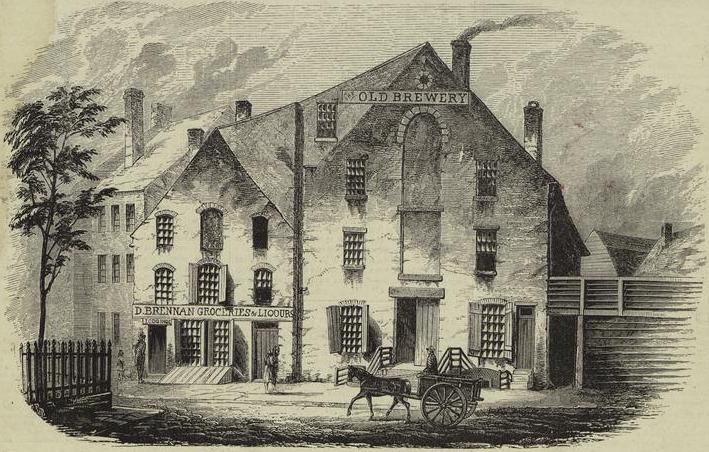
Perhaps the most notorious example of an early New York brewery was the Coulthard’s Brewery situated on the banks of Collect Pond. It survived the draining of that polluted body of water, only to survive as the center of the most disreputable elements of the Five Points neighborhood.  It was eventually demolished in 1853, replaced with a mission house.

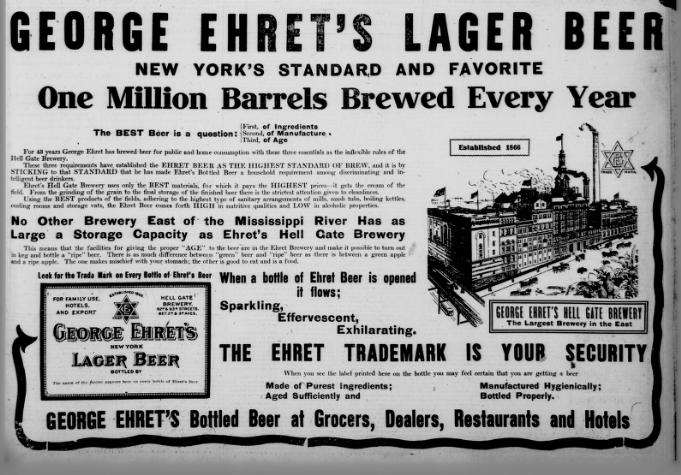
George Ehret was New York’s most successful brewer of the late 19th century. His assertion that ‘no other brewery east of the Mississippi River has as large a storage capacity as Ehret’s Hell Gate Brewery‘ was certainly accurate.  This ad from 1909 presents a company still at the top of its game. However Ehret would encounter serious opposition in the coming years, with both World War I and Prohibition cutting short the brewery’s meteoric success.

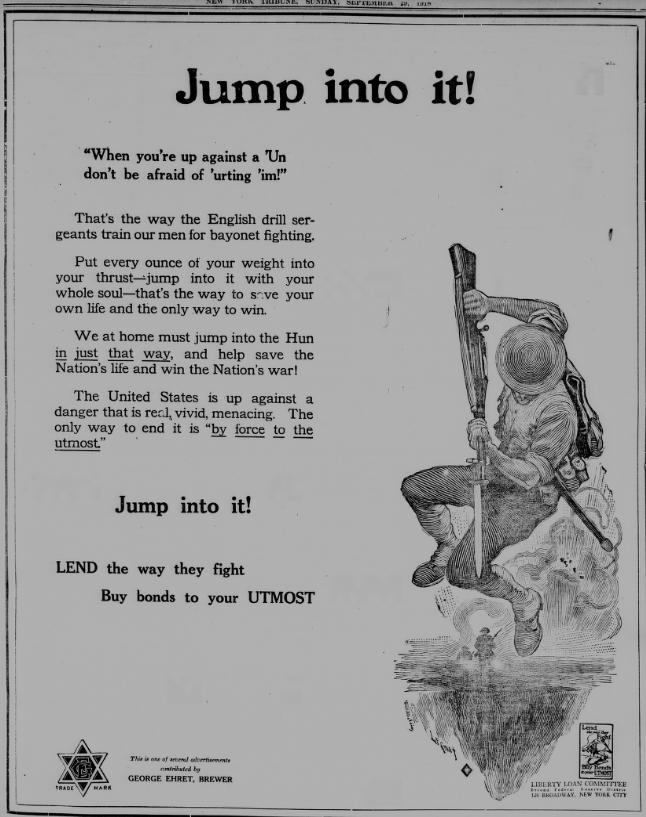
Ehret was stuck in Germany during World War I due to illness, not a great place to be during a war. His entire estate was seized by the government while he was away. When he finally returned, he threw his weight behind pro-American causes to banish any suspicions. This U.S bonds ad from 1918, the year Ehret returned to New York was one of many placed by the brewery.

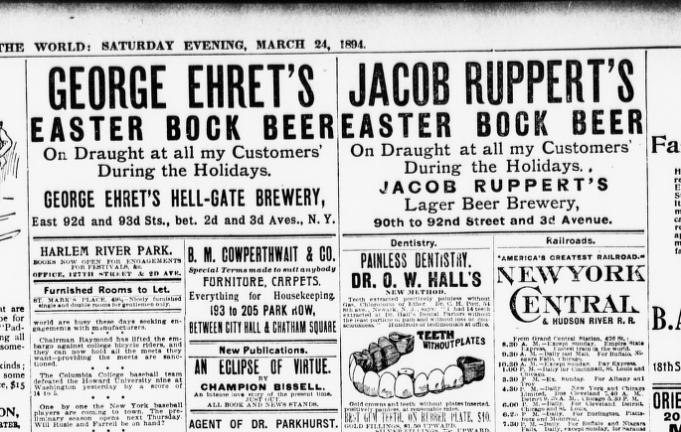
The brewery of Jacob Ruppert wasn’t just situated next to Ehret’s in this 1894 New York World newspaper; the buildings themselves were near one another, in the burgeoning neighborhood of Yorkville on the Upper East Side.  (Newspaper clippings courtesy the Library of Congress.)

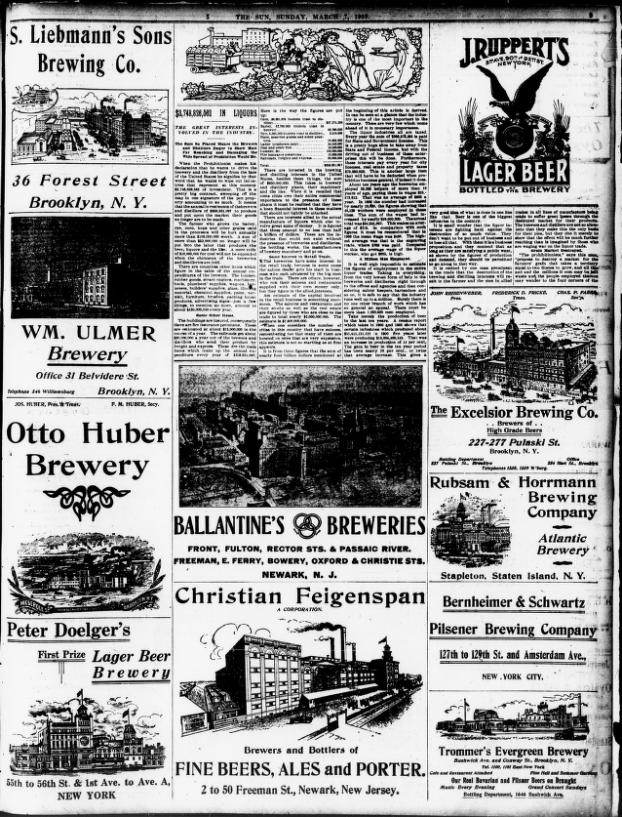
A sample page from a 1909 New York Sun newspaper illustrating some of the many breweries in the region.   Included here are the Liebmanns (who produced Rheingold Beer), the Otto Huber Brewery, William Ulmer, Trommer’s and the Excelsior Brewing Company — Brooklyn most prominent lager brewers.

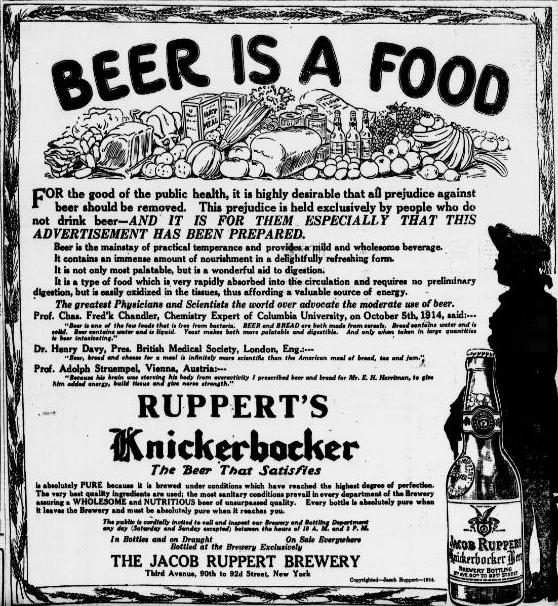
Temperance causes were greatly beginning to clamp down on the brewing industry, so beer makers attempted to market their product as true American beverages — with links to the Founding Fathers — or as products important to a person’s health. This Knickerbocker Beer ad from 1914 gamely attempts both.

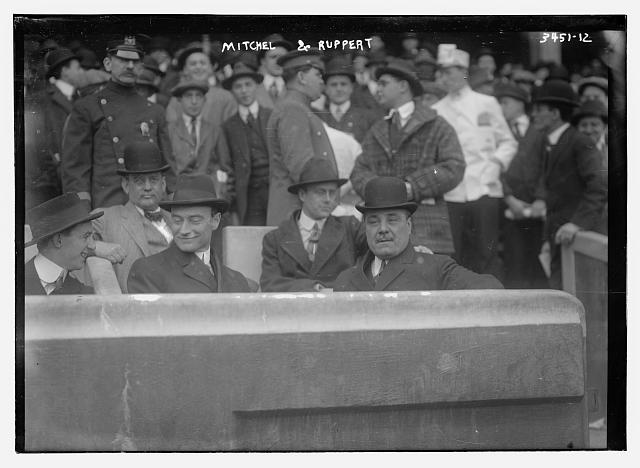
New York’s ‘boy mayor’ John Purroy Mitchell sits with Jacob Ruppert at the Polo Grounds in anticipation of a game by the team owned by the brew man, the New York Yankees. The Yankees would play at the Polo Grounds until 1923, when they moved to the newly built Yankee Stadium.

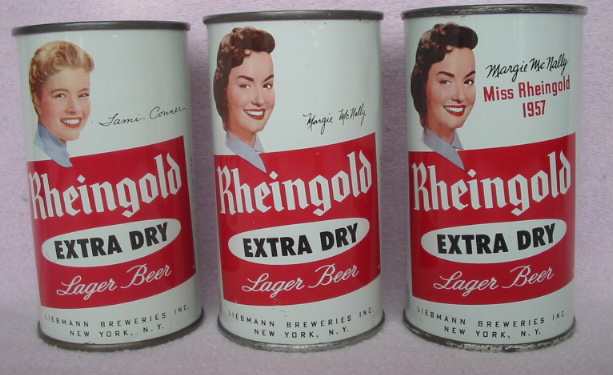
Rheingold Beer was one of the few remaining locally-based brewers to survive by the mid 20th Century, partially thanks to their annual Miss Rheingold beauty competition. [source]

This jingle, with true New York flavor, was featured in our podcast, but it really works better as a vintage television commercial!

And this Schaefer’s advertisement visualizes a world where robots are all-in-one bartenders.


I want to especially thank my guest host this week, Scott Nyerges, photographer, filmmaker and my old college friend! 

Oh, and do you need another reason to have a beer today? Well, it’s the birthday of Joseph Mitchell, born in 1908, the author of a great many profiles for The New Yorker. One of his best known collections is ‘McSorley’s Wonderful Saloon‘ from 1943, featuring a classic New York profile of the old ale house on East 7th Street.

Watch out for those naked Brooklyn lady ghosts!

Above: The unusual weather this weekend left my pumpkin with an unfortunate new hairstyle.

We hope you all have a fun and safe Halloween this year!  In this year’s ghost-story podcast, I talked about a haunted church in Bushwick, Brooklyn. Apparently, other spirits find the neighborhood desirable. I’m reprinting an article from three years ago about one such reported sighting. The original article is here
—-

While doing my ghost research this week, I came across an amusing article from an 1894 edition of the New York Times, back when ghost sightings might have merited a serious investigation. (Or, in this case, not so serious.)

The location of the haunting was Brooklyn’s 27th Ward in today’s Bushwick area.

After charting out the notion that Bushwick is an ideal place for ghost hauntings — a “rocky, bleak, lonesome district” loaded with cemeteries and empty houses — the article describes the ghost in strangely sensuous terms:

“The ghost which is at present disturbing the midnight rambles … is that of a woman, who goes about in the scantiest attire, with disheveled hair and bare feet, and falls into a fit of hysterics as soon as anyone approaches.”

The ghostly vixen spooked a set of women who ran home to tell their brothers, who then brandished revolvers and set out to, uh, do what? I’m not sure guns work too well with ghosts. The cocky search party came upon the apparition which “arose from the ground in front of them and waved its long, lean arms an uttered a weird cry that chilled their blood.” The brothers dropped their guns and ran home.

The next night a bolder party of 200 men reportedly went out to the ghost location, around the cemeteries on the Brooklyn/Queens border (between Knickerbocker and Irving avenues). Having no luck in locating the spirit with the posse, one man braved it alone the next night. He returned home “with a face white with terror.” He had not only glimpsed the spectre, but was privy to a “serpentine dance” and “moaning wail”.

They time, the locals did what anyone would do when faced with supernatural entities — they called the police. Apparently with nothing better to do, the precinct caption dispatched 300 officers, armed with everything from guns to rusty army swords, all in an effort to confront the spirit and, apparently challenge it to a duel. One officer even donned an ill-fitting suit of armor.

Given the dramatic response, it is no surprise that some officers remained skeptical. The theory of one officer Holliday: “I’ll tell you what I think it is. I think it’s whisky….it will make a man see anything — ghosts, snakes or anything else.”

The entire area was covered by dozens of armed ghost hunters. However, as the New York Times drolly states, “three or four times there were cries that [the ghost] was coming, but it didn’t come.”

It is then decided that police might has not only scared away this ghost, but has rid all of Brooklyn of any spectral activity.

“There used to be ghosts in Brooklyn but since Superintendent Campbell took charge of the police department they have all been driven away.” He fears Brooklyn’s impending consolidation with New York, for “anti-ghost orders would be rescinded and our streets would be haunted day and night.”

But it appears that didn’t happen when the consolidation with New York came in 1898. Really, when’s the last time you’ve seen a ghost in Brookyn? Hmmm?

You can read the entire article in all its glorious tongue-in-cheekness here.

The location of this scantily dressed spirit was right around here:


View Larger Map

Categories
Mysterious Stories

Notes from the Podcast (#130) Haunted Histories of NYC

We had a terrific time recording this year’s ghost-story show — Haunted Histories of New York. Here’s some extra details about our four subjects that were left out of this week’s show.

(By the way, if you wouldn’t mind, please vote for us in this year’s 2011 Podcast Awards. We’re in the Best Travel Podcast section. Thanks!)

Liberty Island and the Captain Kidd’s treasure
If indeed there was treasure buried on Bedloe’s Island (today’s Liberty Island), William Kidd and his motley crew would have concealed it there under the gaze of the island’s owner. In the 1690s, when Kidd would have lived in New York, the island was owned by a woman — Mary Bedlow Smith.

The small island property was originally owned by a Dutchman Isaack Bedloo, who remained in the harbor after New Amsterdam became New York in 1664. He even Anglicized his name, as evidenced by his daughter’s name. She sold the island in 1732 to one of the most wealthy and powerful men in all the British colony — Adolphe Philipse. From there, the island was often used as a quarantine station or ‘pest house’ to shelter those with communicative disease. Many hundreds of afflicted were thrown here in the mid-17th century, and many died here.

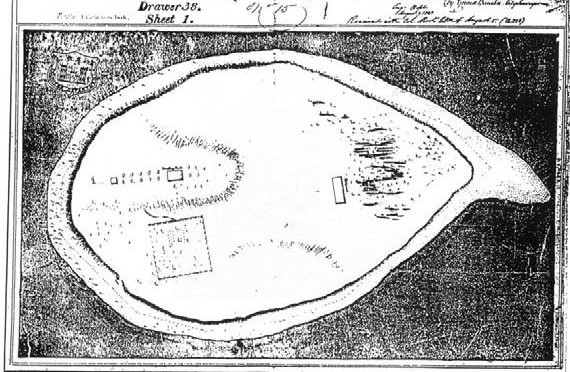
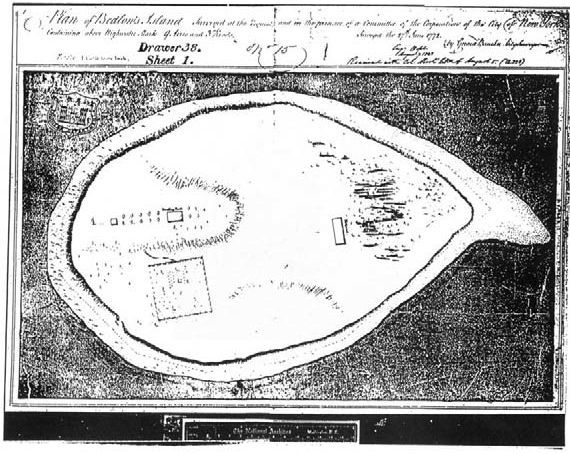
Below: A map of Bedloe’s Island in 1766, before the construction of Fort Wood. The map is strangely situated, but I believe that the stone where Kidd’s treasure was allegedly buried would have near the pointed end. (Courtesy the National Park Service.)

The Holy Ghost — Most Holy Trinity, Bushwick, Brooklyn
Some believe that Most Holy Trinity’s beloved Monsignor Michael May haunts the present halls of the church. On the occasion of May’s funeral in 1895 — he had died on the second floor of the adjoining rectory – the church nearly experienced a tragedy from which it would have surely never recovered.

A New York Times article from February 1895 reveals that a chronic weakness was discovered to the building’s architecture. As I mentioned in the podcast, vast, old passages exist underneath the church, extending to adjacent buildings. These passages had been used for safety during anti-Catholic attacks in the 1850s and even as safe havens for escaping Southern slaves on the Underground Railroad in the 1860s.

Monsignor May was so beloved that almost 5,000 people arrived for his funeral, the most the church had ever seen at one time. I’ll let the article reveal the potential horror of this situation: “Carpenters and masons at work on the vault in the basement discovered that the floor above them had sunk several inches in the centre, and that the cross beams had split, as had the big girders supporting the cross beams.”

The floor actually begin to sway in front of the masons. Within moments, the crowded church would have caved in, easily killing hundreds. What became one of the biggest gatherings in the church history would have instead become an unspeakable catastrophe.

The workmen advised the clergy to evacuate the center aisle and then worked briskly to create temporary braces. The crisis, thankfully, was averted.

The Lonely Acrobat — Ghosts At The Palace Theatre

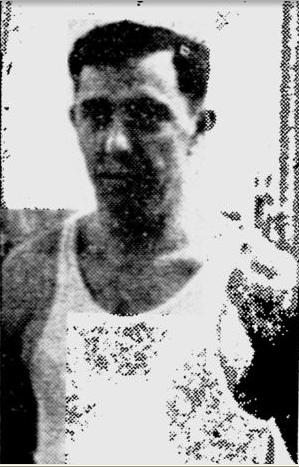
The tragic acrobatic act at the Palace Theatre that inspired the venue’s most famous ghost story is veiled in mystery and misunderstanding. There’s many falsehoods about the incident that Tom successfully dispelled, but there’s one he missed. Most modern retellings call the acrobat in question Louis Borsolino.  His actual name, according to local papers in the troupe’s hometown of Reading, PA, list hims as Louis Bossalina, pictured at right.By the way, the name of the particular trick that Bossolina was doing at the Palace Theatre that fateful day? It was called the Death Loop. He is popularly rumored to have died from the accident, an unsurprising assumption considering how many people saw the fall, knowing the name of the failed trick. In reality, Bassolina survived the ordeal and was released from the hospital nine days later. To be clear, he didn’t die at the Palace; he went on to perform with the troupe until they disbanded in 1937.

He lived a perfectly normal life outside the spotlight, for over three more decades, before dying at age 61, in August 1963. If he truly haunts the Palace today, then the torment must have possessed him so greatly during life that he continually returns for repeat performances!

As you heard in the podcast, joining Louis’ ghost at the Palace is an apparition of one of the theater’s greatest stars. Here’s a recording of Judy Garland’s curtain call from her very last performance at the Palace Theatre on August 26, 1967. Judy would be dead within two years of a drug overdose. I wonder if anybody has ever seen the ghosts of Louis and Judy on the same night?

The Tale of Two Houses — Kreischer Mansion
The famously haunted Kreischer Mansion was built for a son of brick mogul Balthazar Kreischer. He made his wealth using Staten Island clay to produce the building materials for a growing city, and he created a company town (appropriately called Kreischerville) near the Arthur Kill. But Kreischer got his start in the Lower East Side — on a street that is no longer there.

Balthazar arrived in New York in 1836 and quickly excelled in construction, in the years following the Great Fire which destroyed hundreds of structures in the heart of the old city. By 1845, Kreischer entered into the brick-making business with one Charles Mumpeson. Although they had already discovered the potential of Staten Island clay — their company was called New York and Staten Island Fire Brick and Clay Retort Works — their original factory was at 58 Goerck Street at Delancey Street.

The odd little street, which ran parallel to the East River from Grand Street to East 3rd, was a vestige of an abandoned city plan, well before the great Commissioners Plan of 1811. Casimir Goerck was the surveyor for the failed plan, working with renown designer Joseph-Francois Mangin, best known for working on New York’s new City Hall building. The plan was discarded, but two small Lower East Side streets from the plan were eventually used — Goerck Street and Mangin Street.
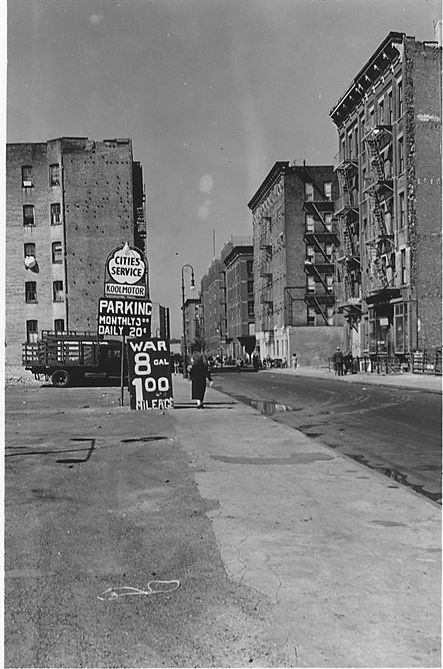
At right: The corner of Goerck Street and Rivington Street in 1939 (NYPL)

Kreischer maintained his brick factory here for years before moving the bulk of his operations to Staten Island. Goerck Street would disappear entirely with the construction of housing developments in the 1940s. A tiny vestige of Mangin Street, however, still hangs on, underneath the Williamsburg Bridge.