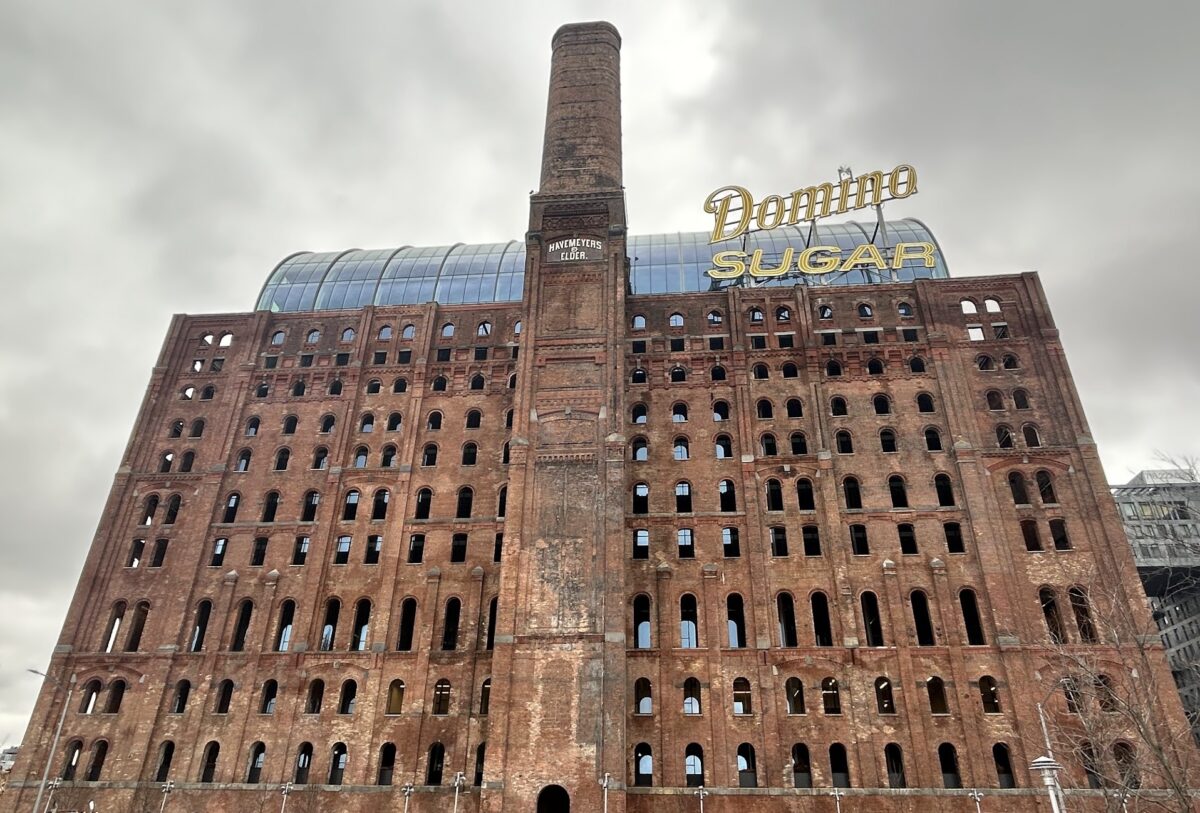
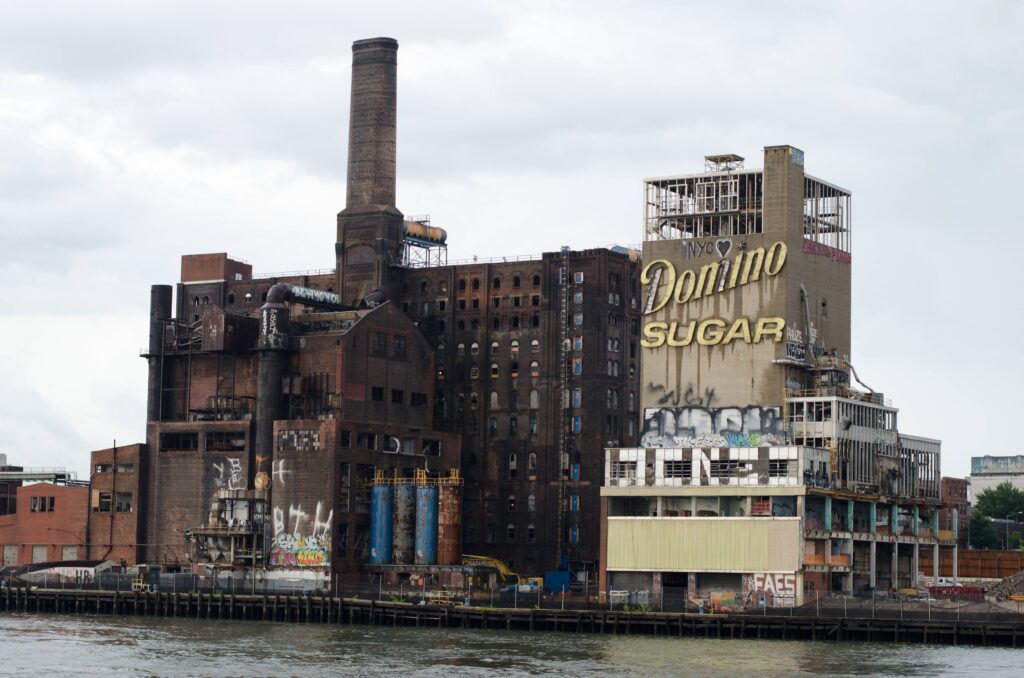
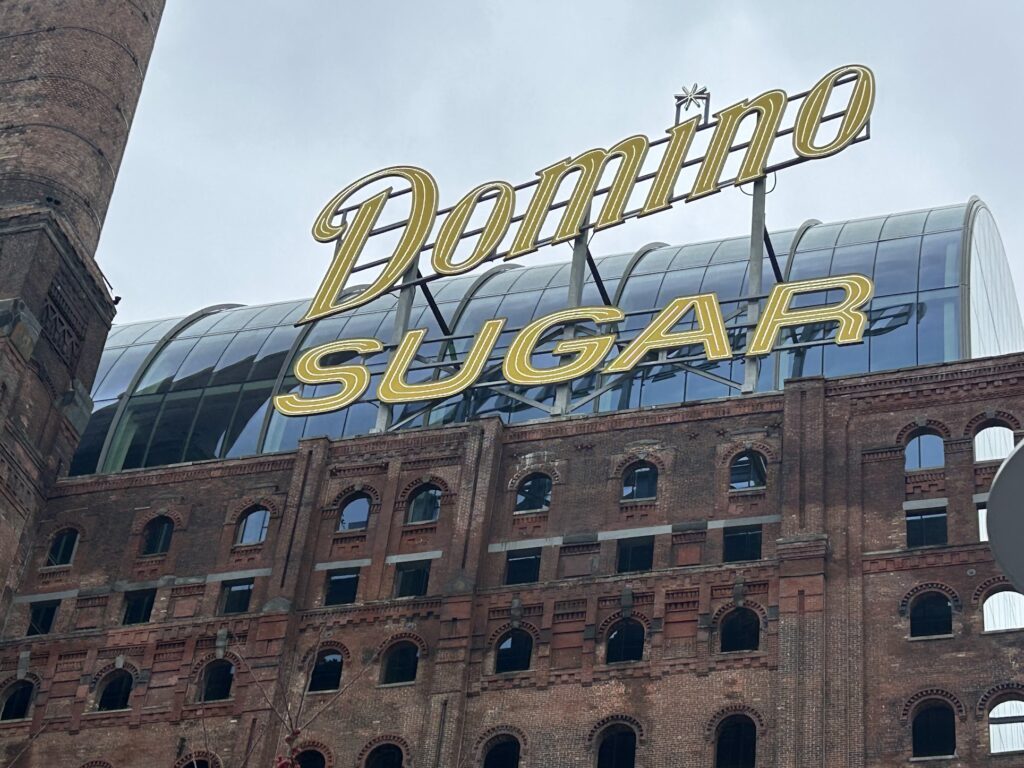
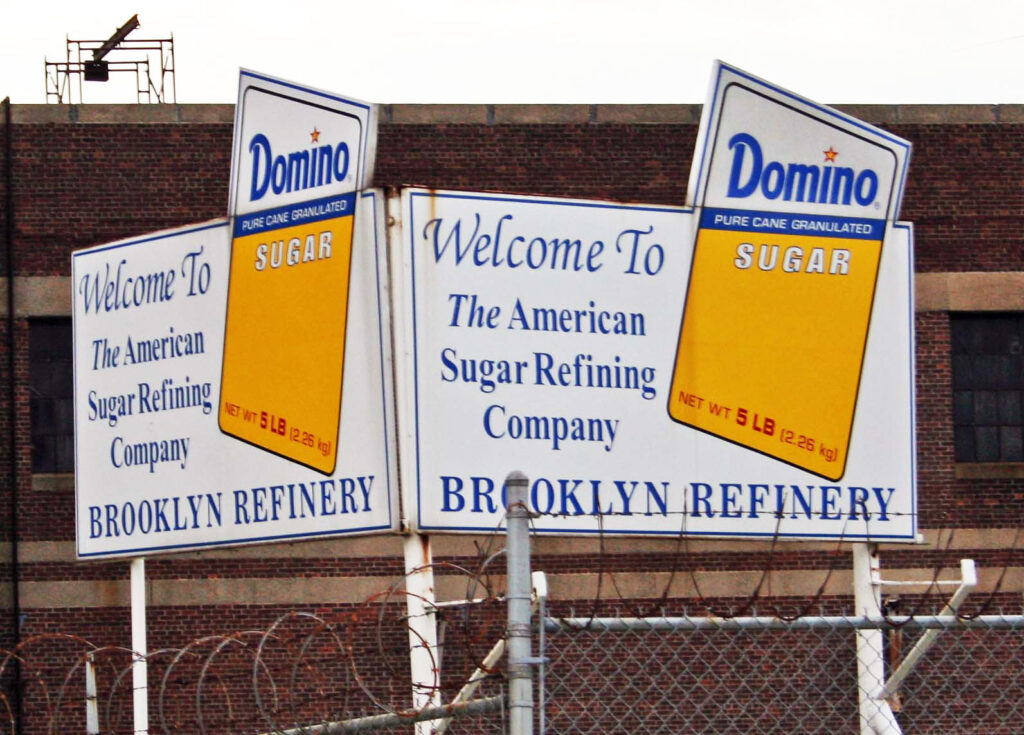
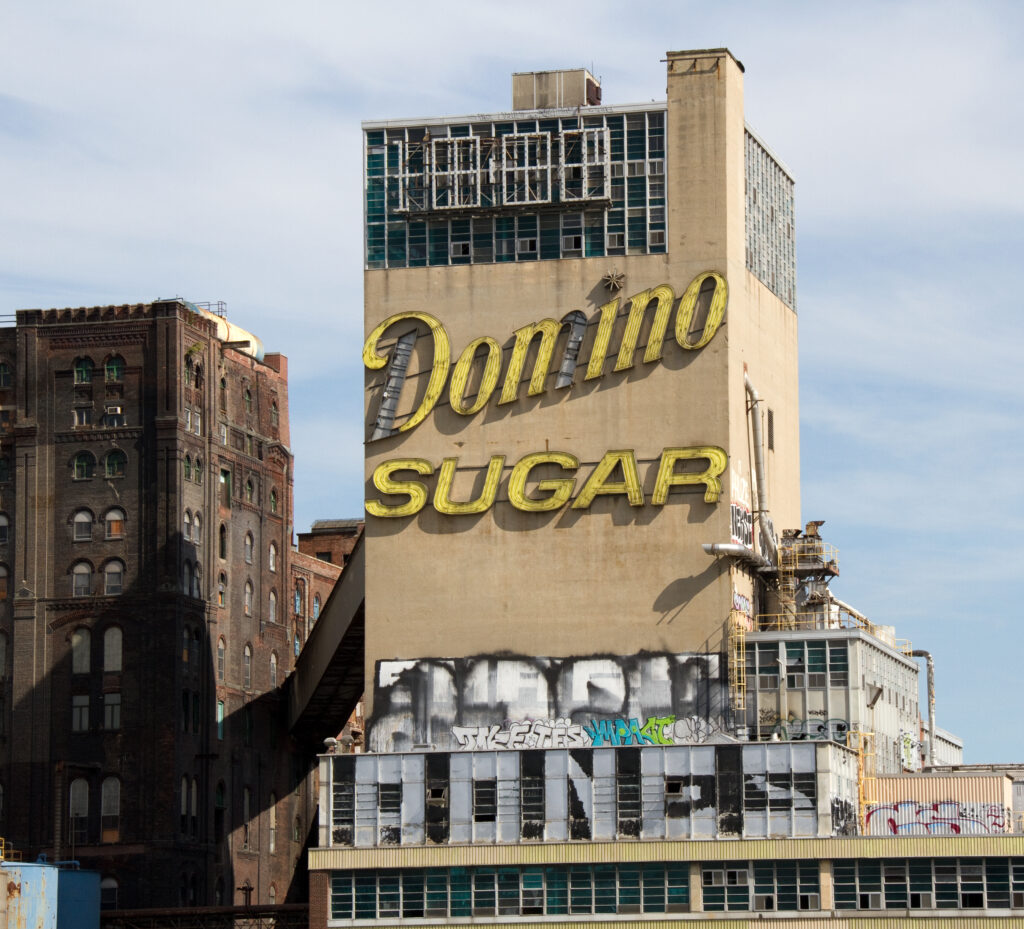
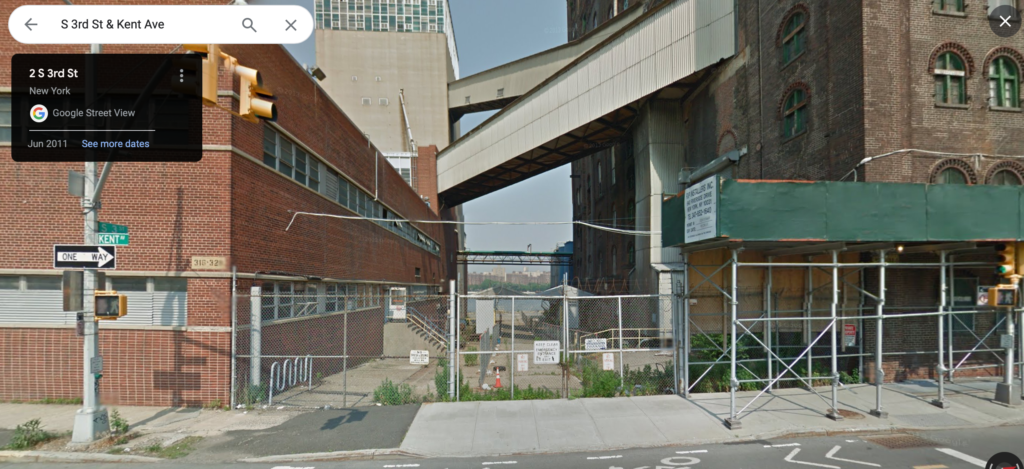
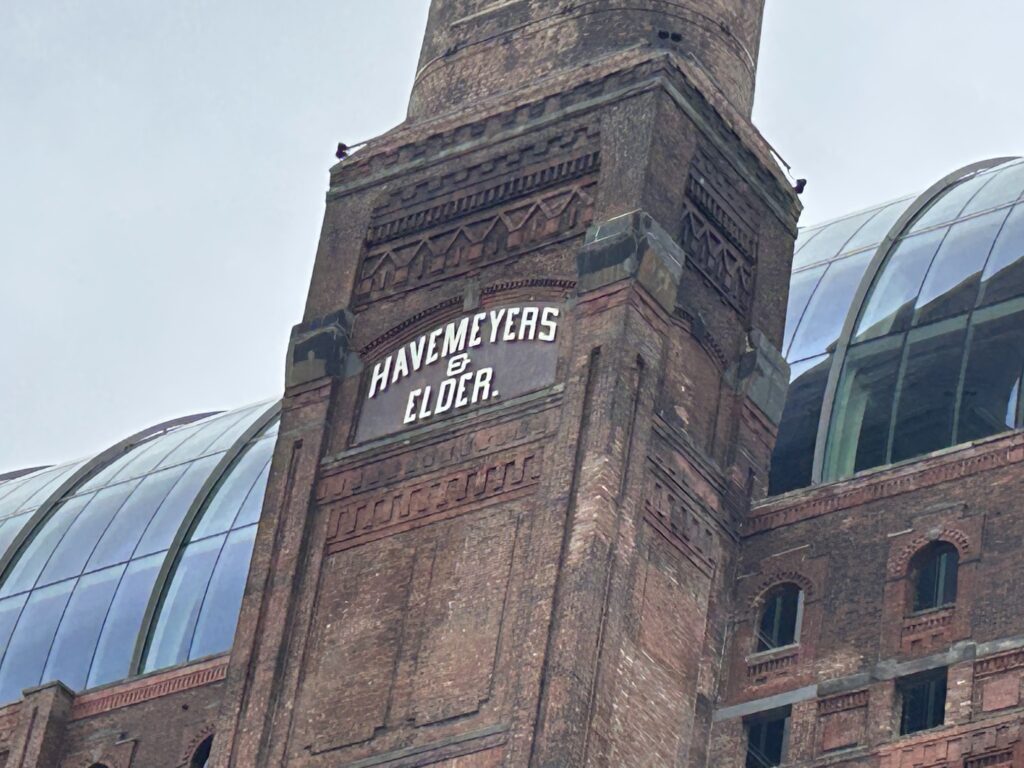
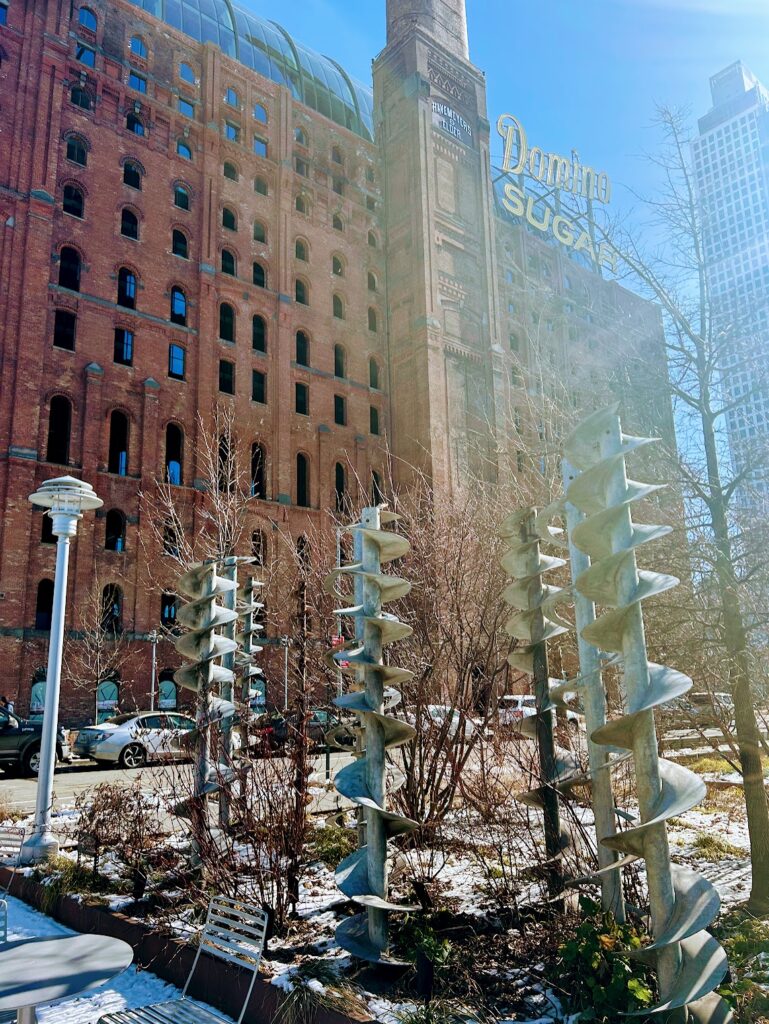
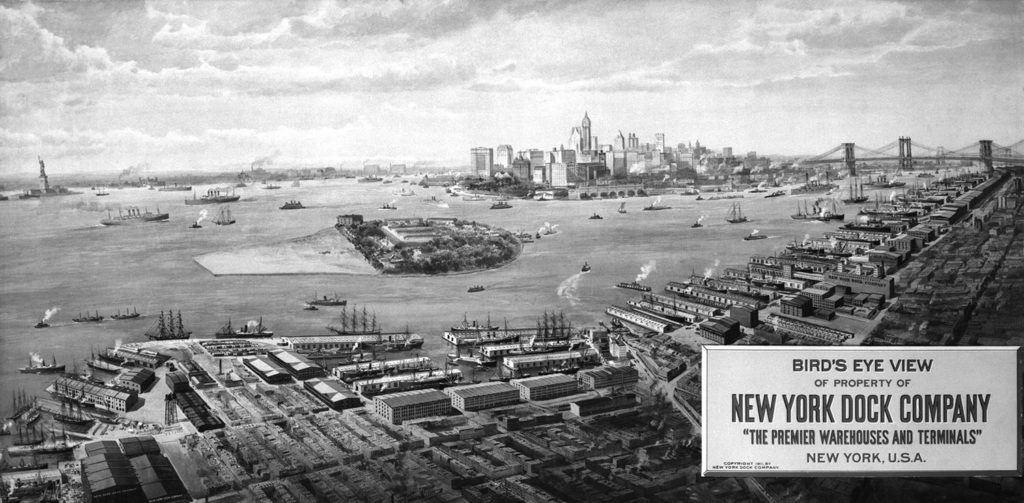
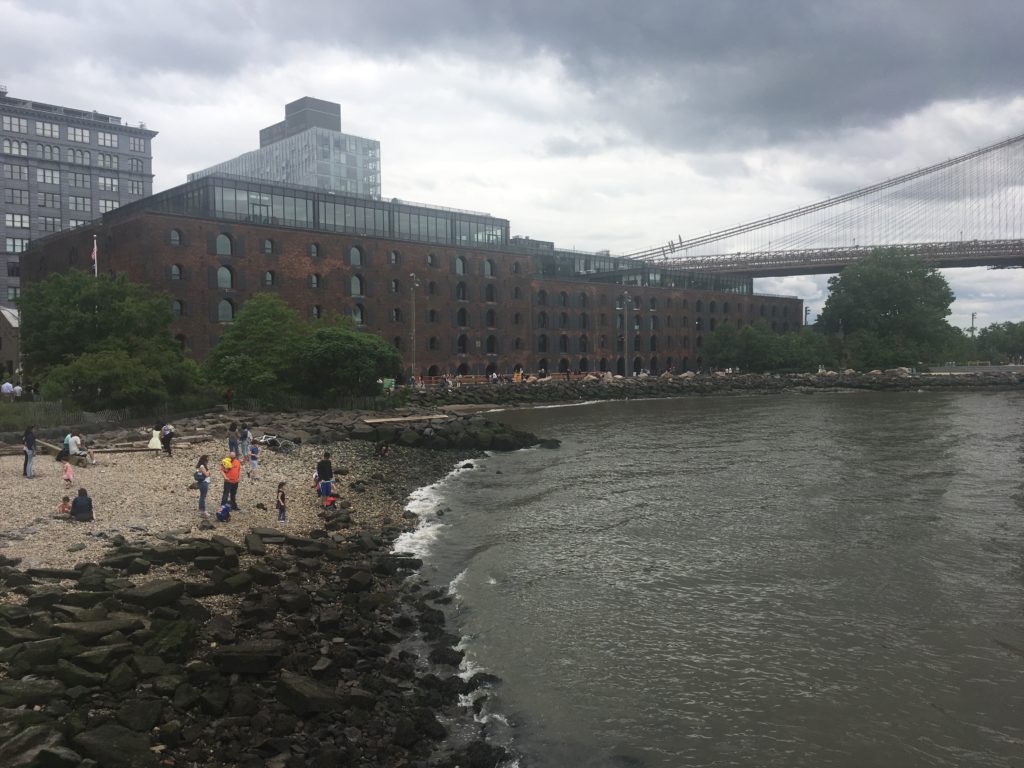
The Brooklyn waterfront was once decorated with a yellow Domino Sugar sign, affixed to an aging refinery along a row of deteriorating industrial structures facing the East River.
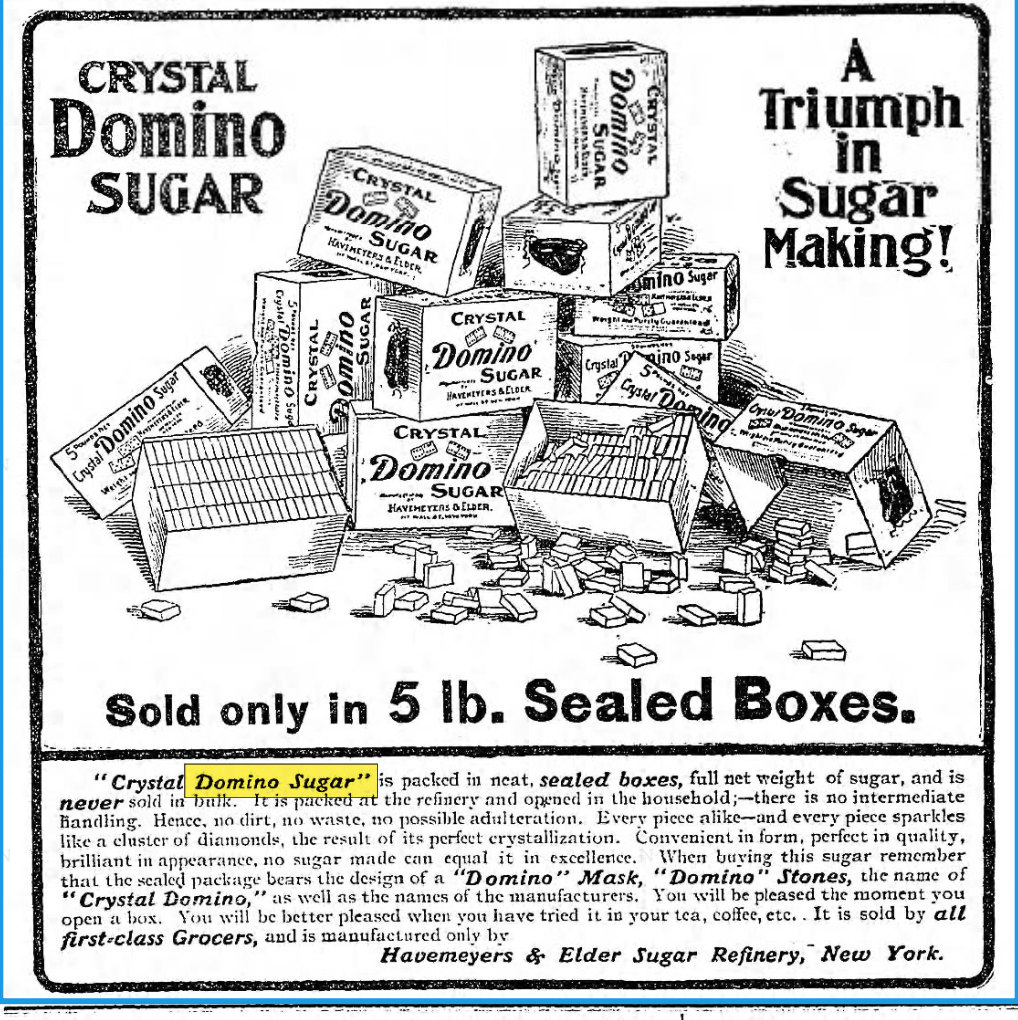
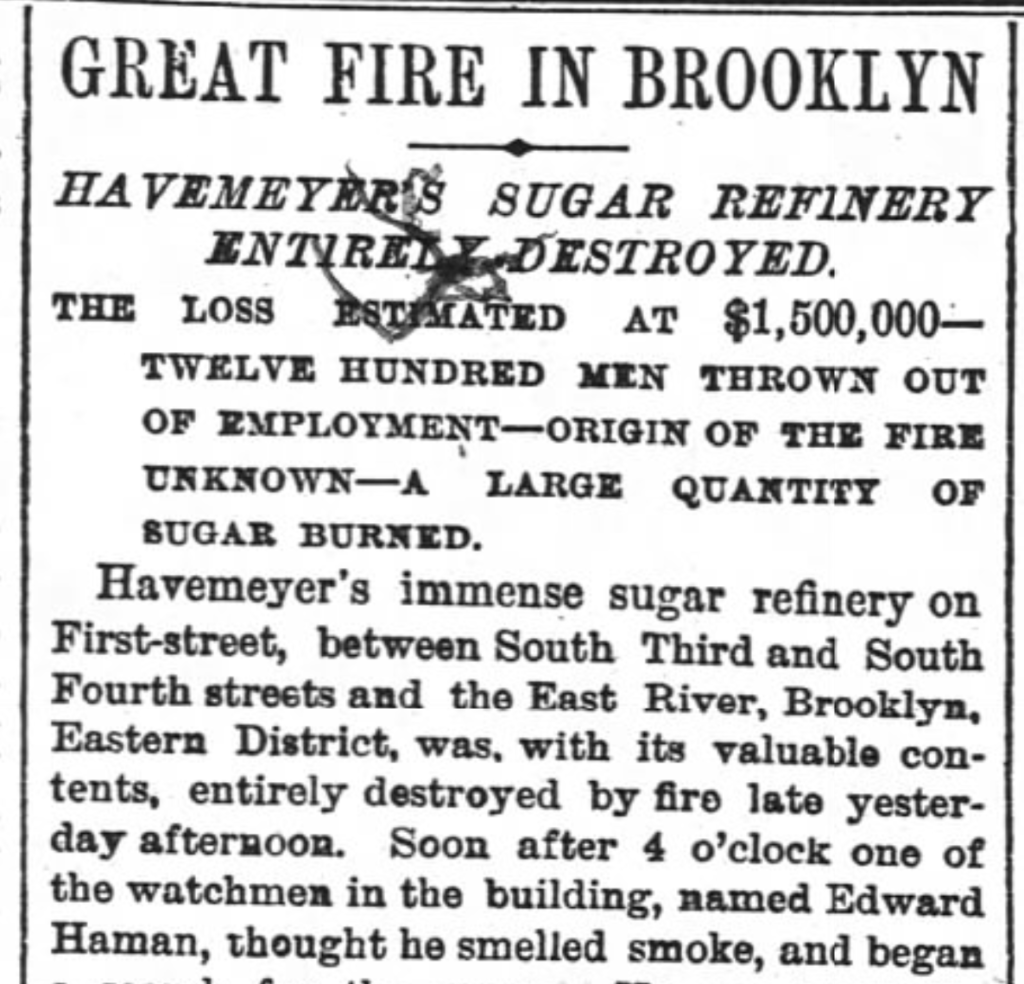
The Domino Sugar Refinery, completed in 1883 (after a devastating fire destroyed the original), was more than a factory. During the Gilded Age and into the 20th century, this Brooklyn industrial landmark was the center of America’s sugar manufacturing, helping to fuel the country’s hunger for sweet delights.
But the story goes further back in time — back hundreds of years in New York City history. The sugar trade was one of the most important industries in New York, and for many decades, if you used sugar to make anything, you were probably using sugar that had been refined in New York.
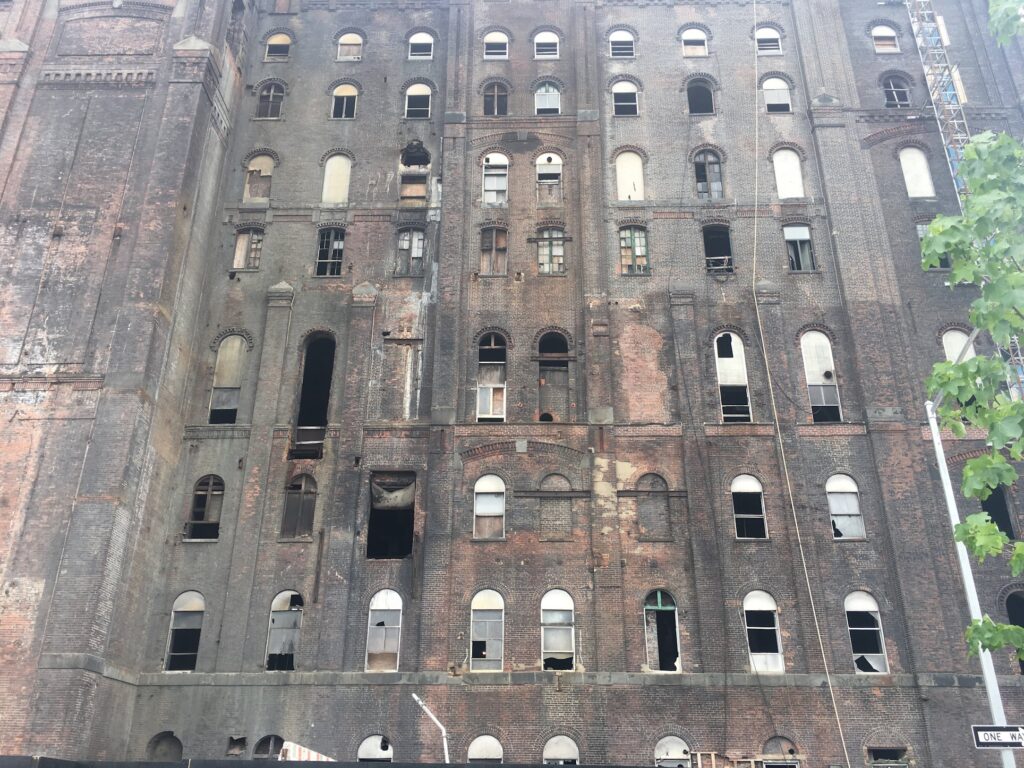
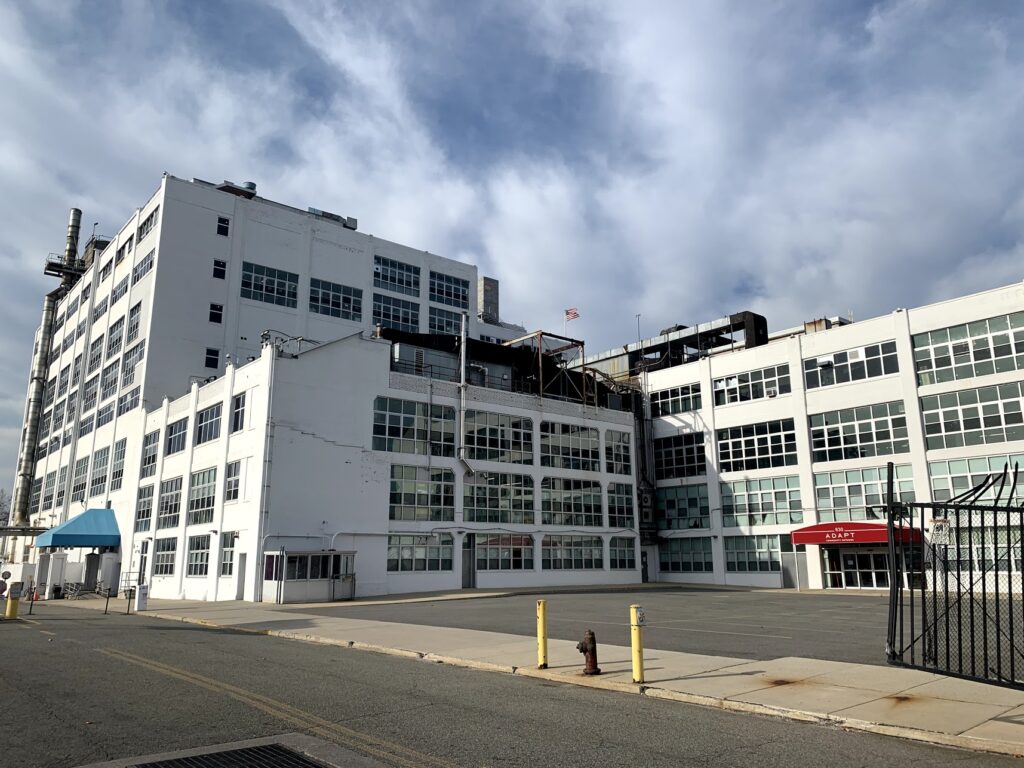
Domino Sugar Refinery in the 2010s/Photo mypene/reddit
Sugar helped to build New York. Thousands and thousands of New Yorkers were employed in sugarhouses and refineries. And of all the sugar makers, there was one name that stood above the rest — Havemeyer!
The Havemeyers were America’s leading sugar titans. By the 1850s they had moved their empire to the Brooklyn waterfront – and the neighborhood of Williamsburg.
Their massive refinery helped establish the industrial nature of Williamsburg, leading to a rush of sugar manufacturers to Brooklyn, most of which would then be absorbed into the Havemeyer’s operation.
Photo by Greg Young
But this story is even larger than New York, of course. It encompasses the transatlantic slave trade, political influence in the Caribbean, Cuba-United States relations, and the sorry working conditions faced by Hayemeyer’s underpaid employees.
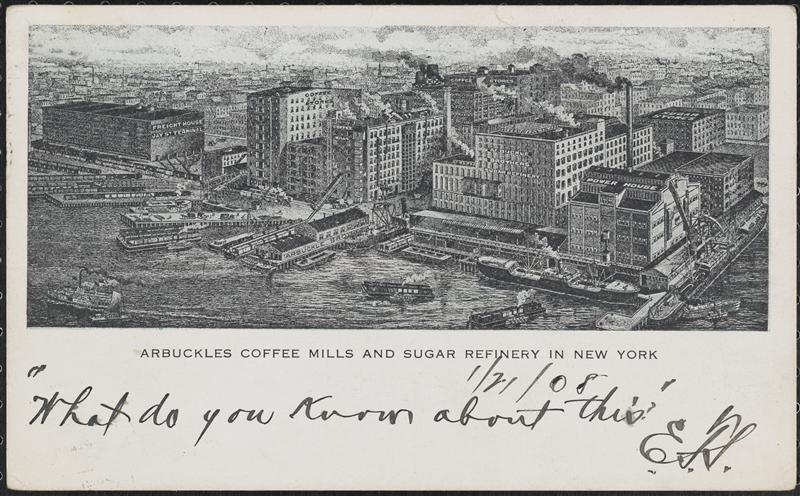
PLUS: It’s Dumbo vs Williamsburg in the Coffee and Sugar War of the 1890s!
LISTEN NOW: BEHIND THE DOMINO SIGN
Photo taken 2010, courtesy wburg/FlickrTony Hisgett from Birmingham, UK 2011
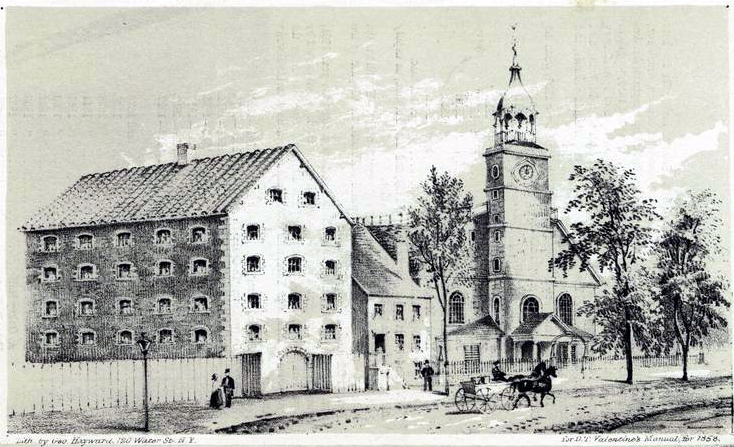
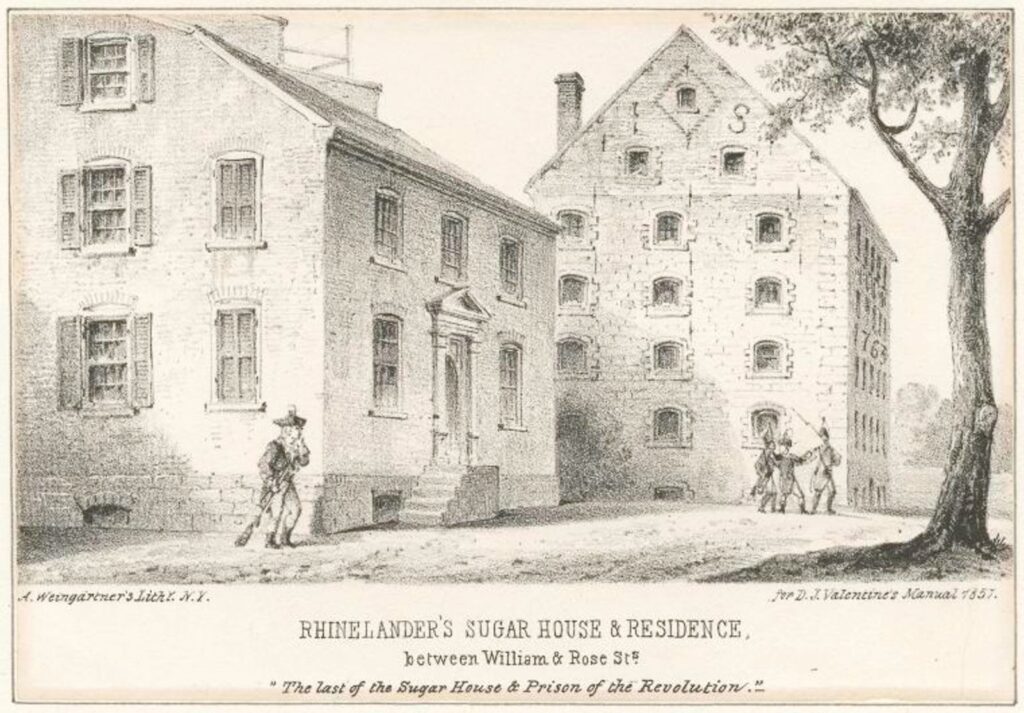
The Livingston Sugar House, on Liberty Street, and the Rhinelander Sugar House, between William & Duane Streets in New York. They were the city’s largest buildings which is why both were repurposed as prisons during the Revolutionary War.
NYPL
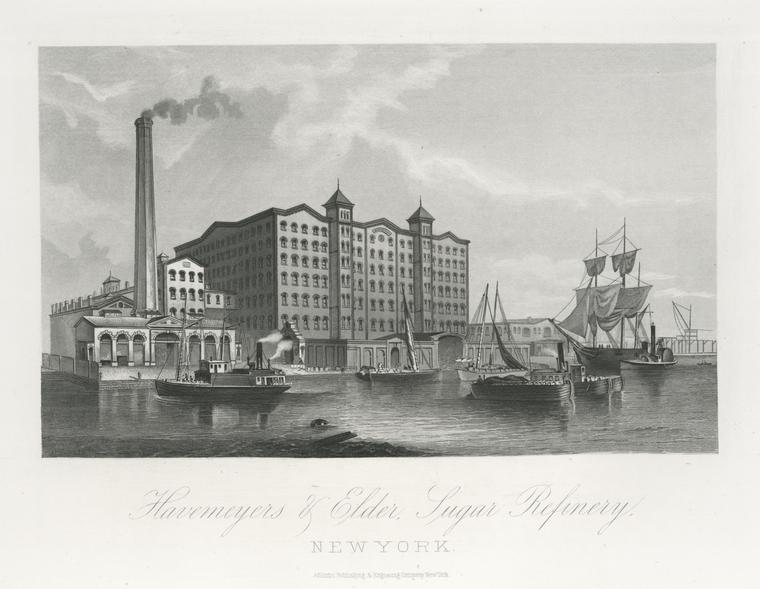
The original Havemeyer sugar refinery on the Brooklyn waterfront before the fire, 1876.
The original factory before the fire, 1876. New York Publc Library
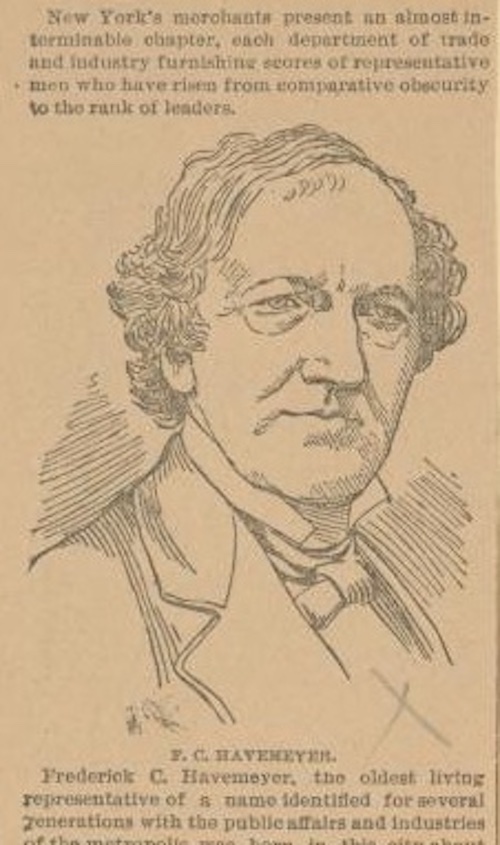
Frederick Havemeyer, NYPL
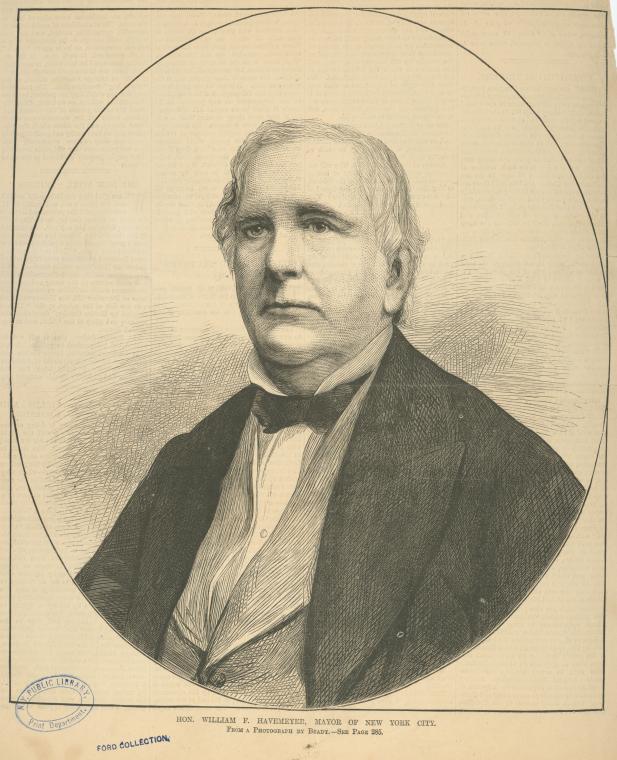
Frederick’s brother William, the mayor of New York for three separate terms (NYPL)
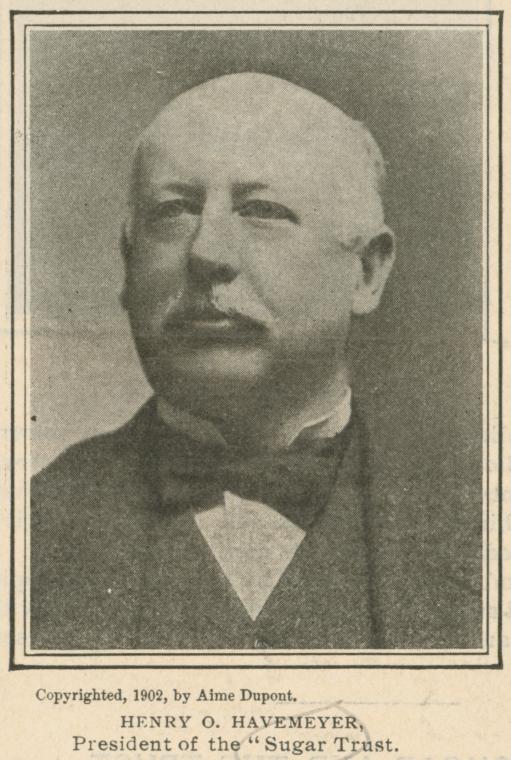
Henry (Harry) Havemeyer, “president of the Sugar Trust. Pic NYPL
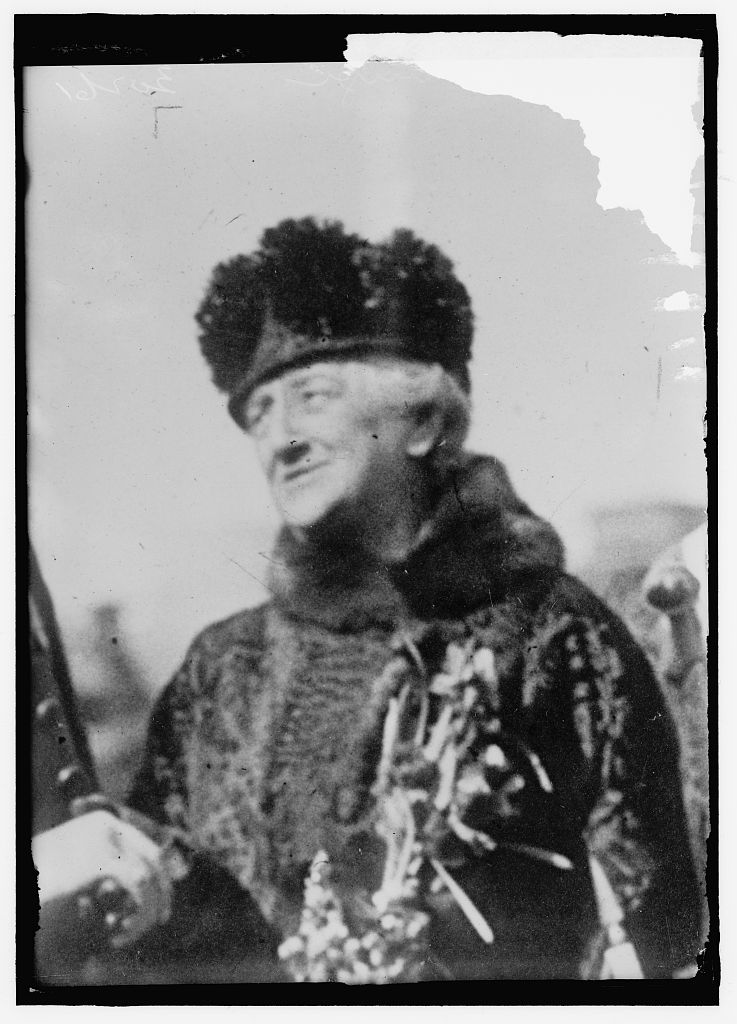
Louisine Havemeyer, 1919, in her suffragist phase (Library of Congress)
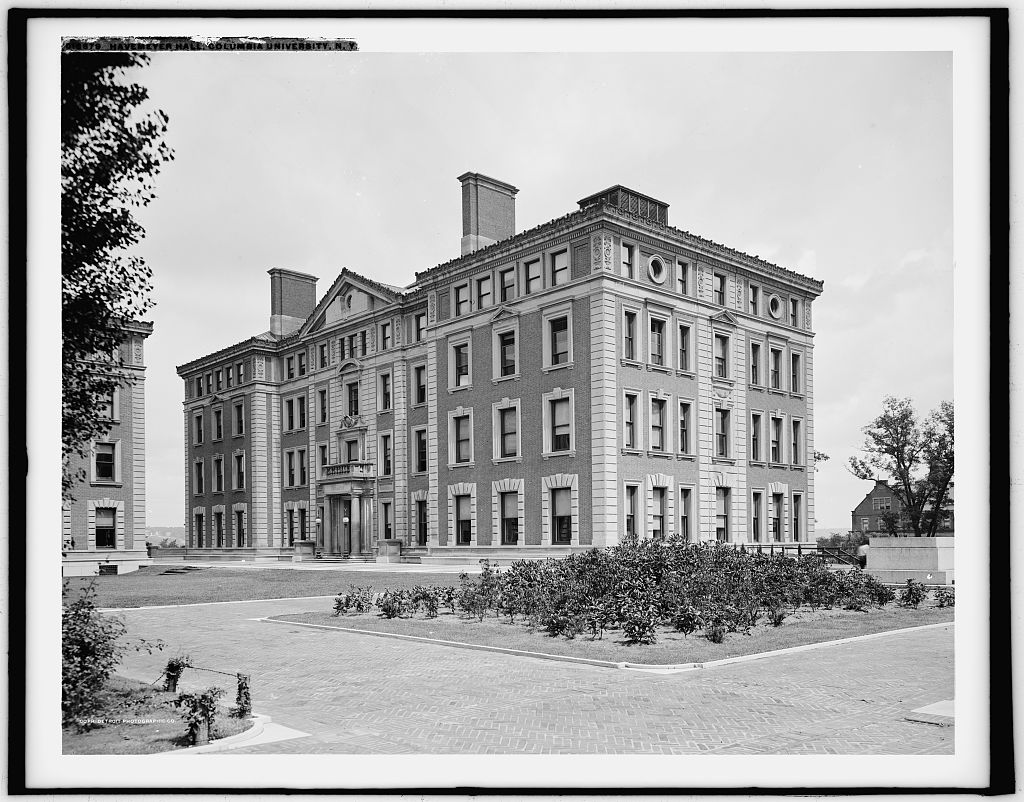
Havemeyer Hall on the Columbia University campus, built in 1897 and named for Frederick Havemeyer who moved the family’s sugar enterprise to Brooklyn. According to Untapped Cities, it happens to contain Hollywood’s favorite classroom.
Library of Congress
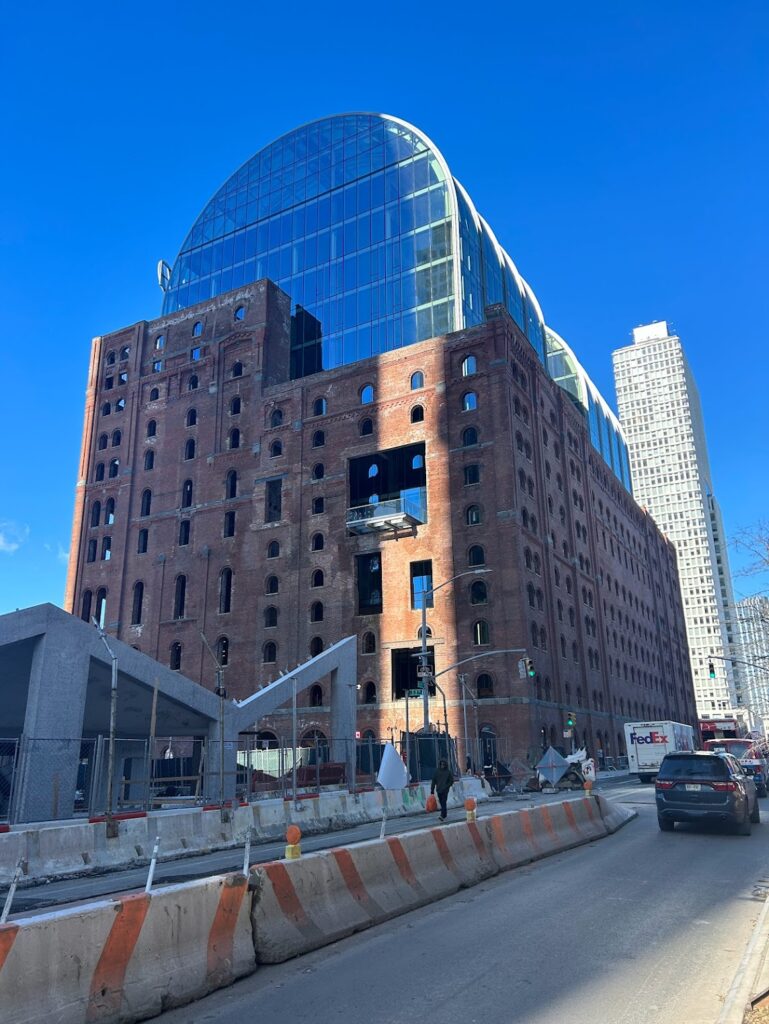
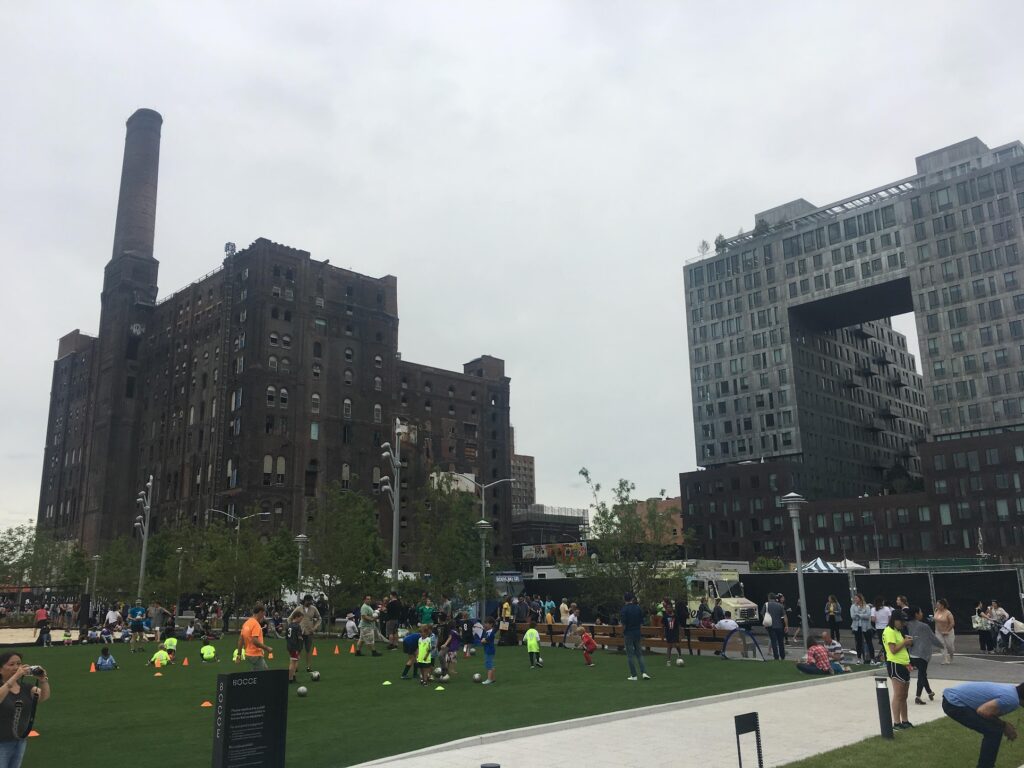
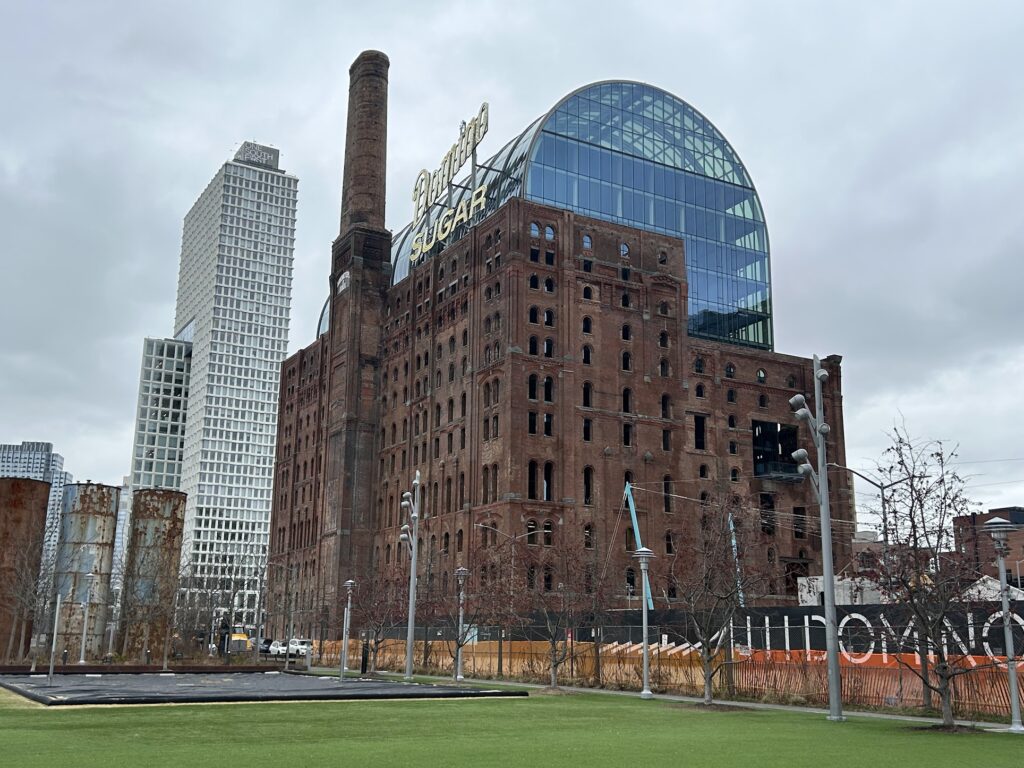
Taken by Greg June 2018, before the completion of The Refinery:
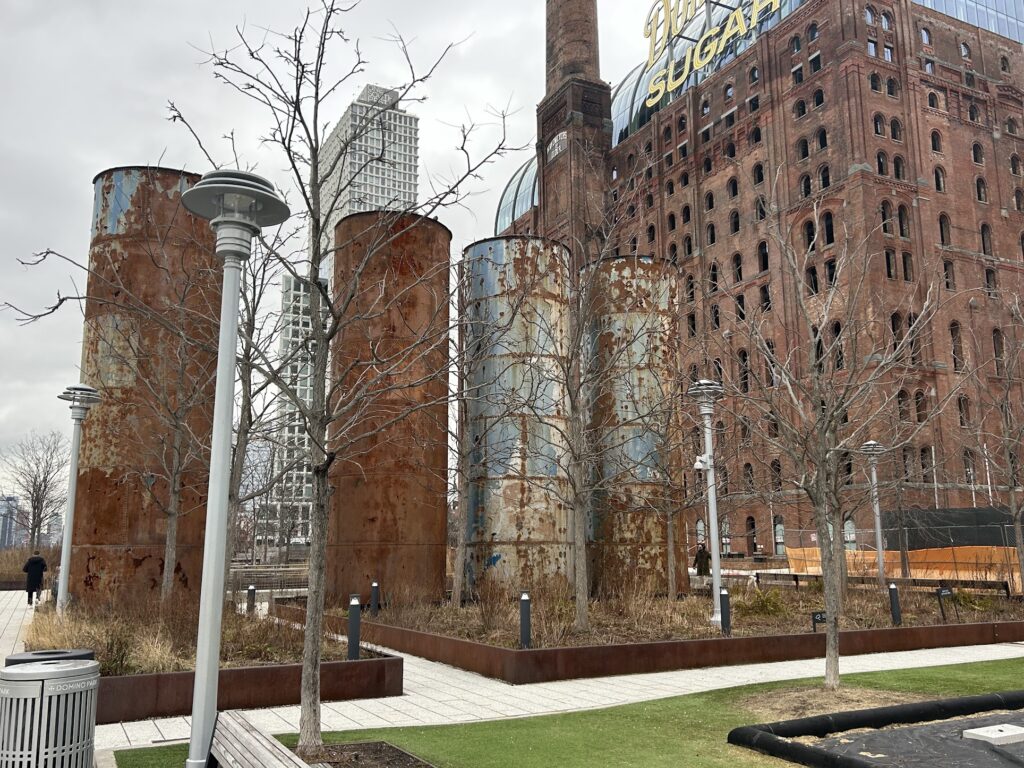
Current photos by Greg (circa January/February 2024)
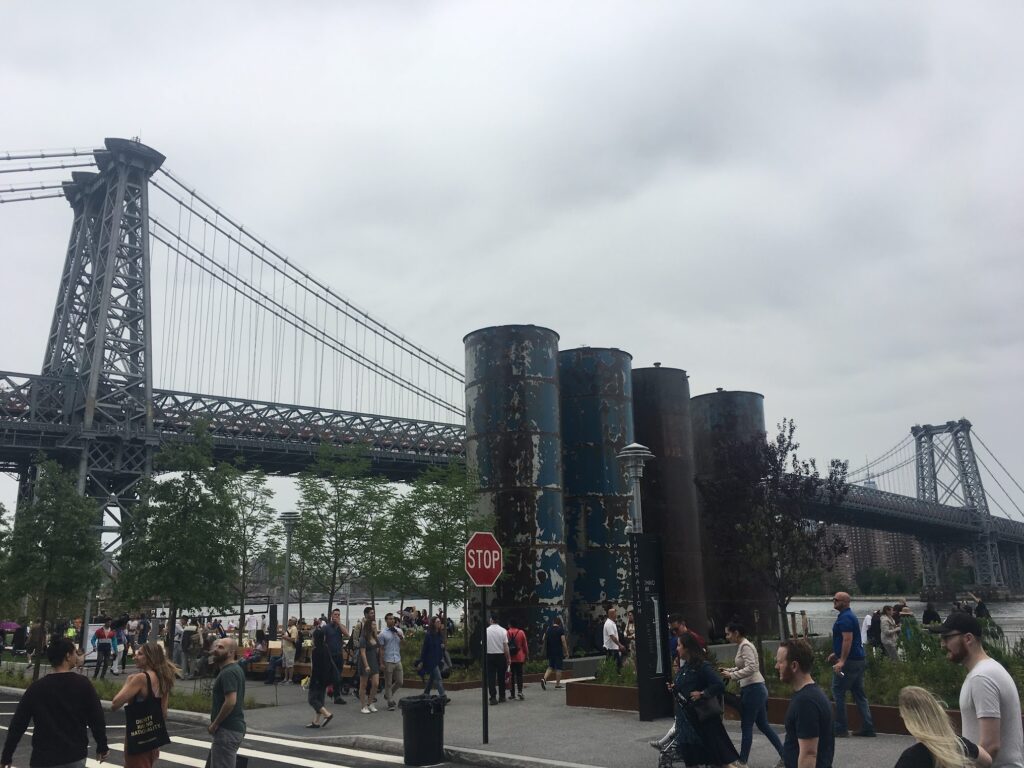
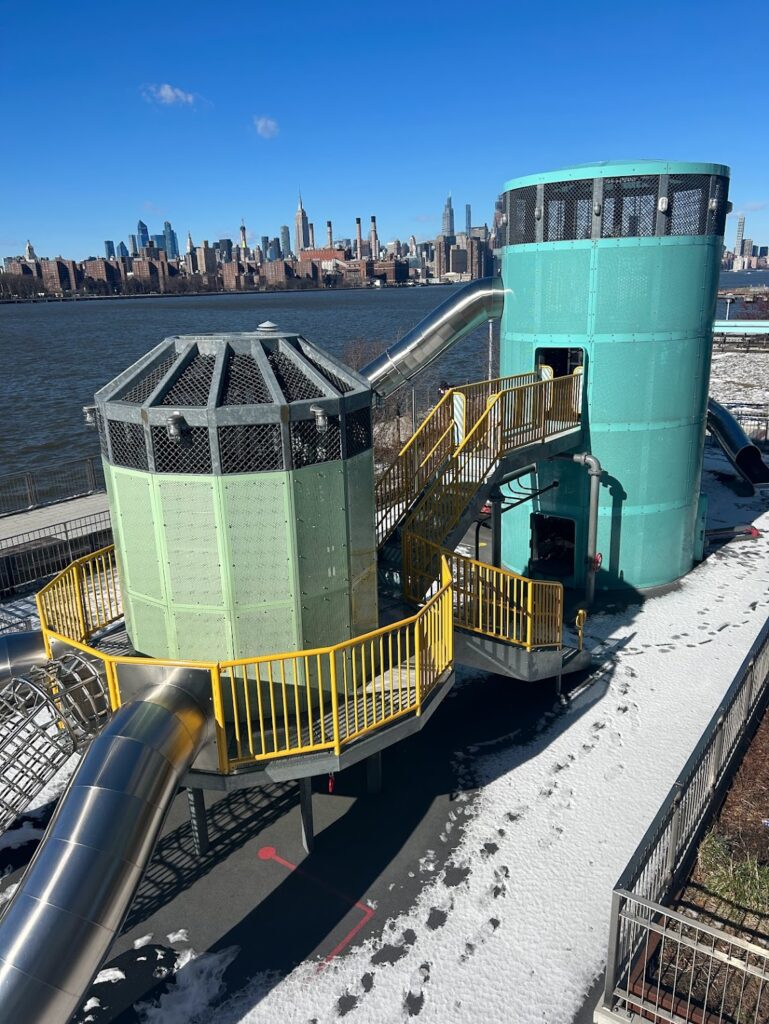
The playground pays homage to the sugar refining process.
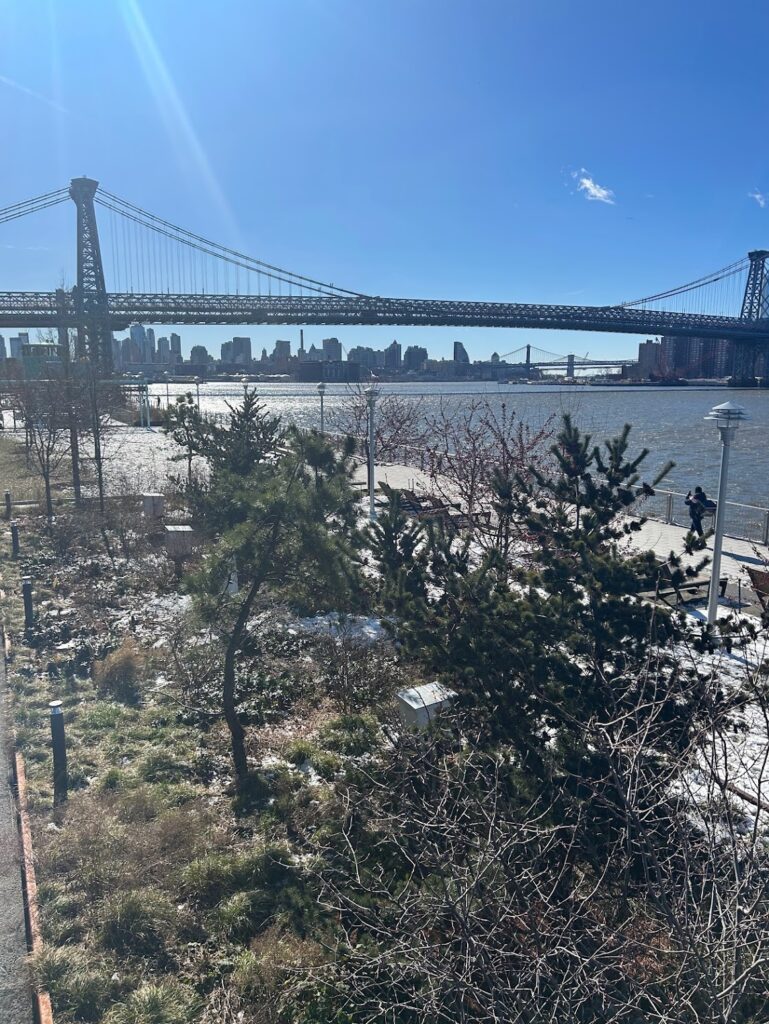
Site of the former wharves where ships docked with sugar cane product from destinations around the world.
Where does the name Domino come from? Most likely from a kind of factory cut — the domino cut — name for the sugar appearing like little dominos. The box today is also rectangular like these ‘domino’ lumps.
Brooklyn’s Sweet Ruin: Relics and Stories of the Domino Sugar Refinery / Paul Raphaelson Cuba: An American Story / Ada Ferrer Food City: Four Centuries of Food-Making in New York / Joy Santlofer Frederick Christian Havemeyer Jr: A Biography / Harry W. Havemeyer Henry Osbourne Havemeyer: The Most Independent Mind / Harry W. Havemeyer The Havemeyers: Impressionism Comes To America / Frances Weitzenhoffer The Rise and Fall of the Sugar King / Geoffrey Cobb Sugar: A Bittersweet History / Elizabeth Abbott White Gold: A Brief History of the Louisiana Sugar Industry / Glenn R Conrad, Ray F. Lucas The World of Sugar: How the Sweet Stuff Transformed Our Politics, Health, and Environment Over 2,000 Years / Ulbe Bosma
The origin of a true Brooklyn ‘start up’ — Charles Pfizer and Co, who went from developing intestinal worm medication in 1849 to being a leader in vaccine distribution in the 21st century.
This is story of Pfizer Pharmaceuticals before the 1950s, a tale of German immigration and of early medical practices and concoctions that might seem alien to us today. Patent medicines! Worm lozenges!
But this company’s biography is also a celebration of Brooklyn — the City of Brooklyn in the mid 19th century, developing into an economic force in the United States and in opposition to the city of New York across the East River.
PLUS You can’t tell the Pfizer story without looking at the world of apothecaries and early drug stores in New York City in the 19th century.
Apothecaries were the first ‘natural’ medicine makers but their objectives were limited, seeking only to alleviate symptoms, not tend to the root cause of so many discomforts.
Later on, drugstores would stock up on manufactured medicines and questionable additions to the health regimen like soft drinks.
FEATURING Duane Reade, Kiehl’s, C.O. Bigelow, E. R. Squibb and Johnson & Johnson
ALSO: What important American figure today grew up delivering parcels for his family drugstore in Dyker Heights, Brooklyn?
LISTEN TODAY ON YOUR FAVORITE PODCAST PLAYER — PFIZER: A BROOKLYN ORIGIN STORY
FURTHER LISTENING
After listening to this show, take a dive in other episodes on similar or adjacent subjects.
The German biotechnology company Biopharmaceutical New Technologies (BioNTech) developed the COVID-19 vaccine injection with Pfizer, one of the world’s large pharmaceutical companies, who will manufacture and distribute it.
Let’s give our thanks to the scientists, researchers and physicians who helped get us to this moment. And yes, Brooklyn, you also get to share in a little bit of that pride today.
Because Charles Pfizer & Company — the originating business, founded in 1849 — first got its start in Brooklyn.
Or, to be more specific — the Brooklyn neighborhood of Williamsburg.
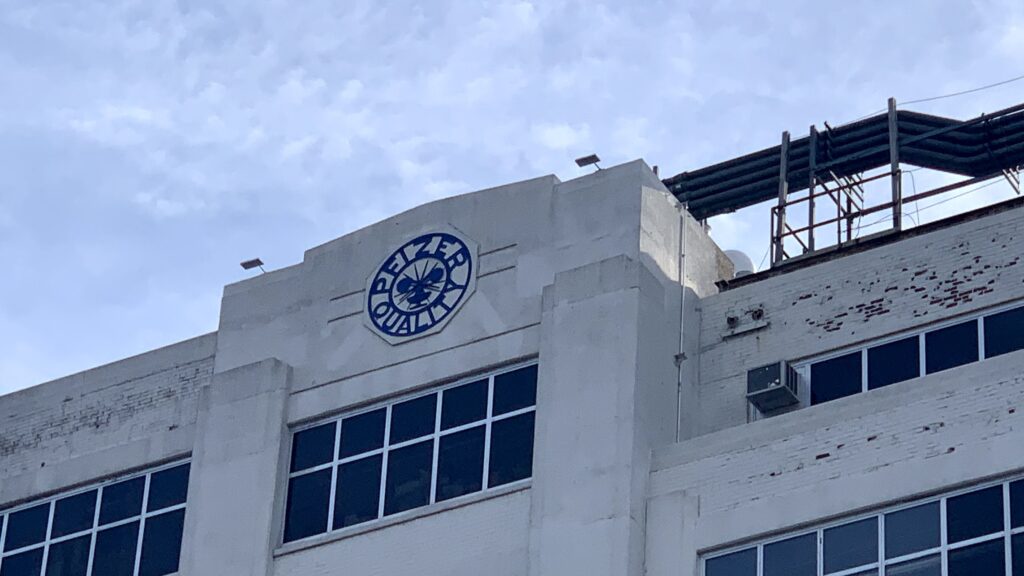
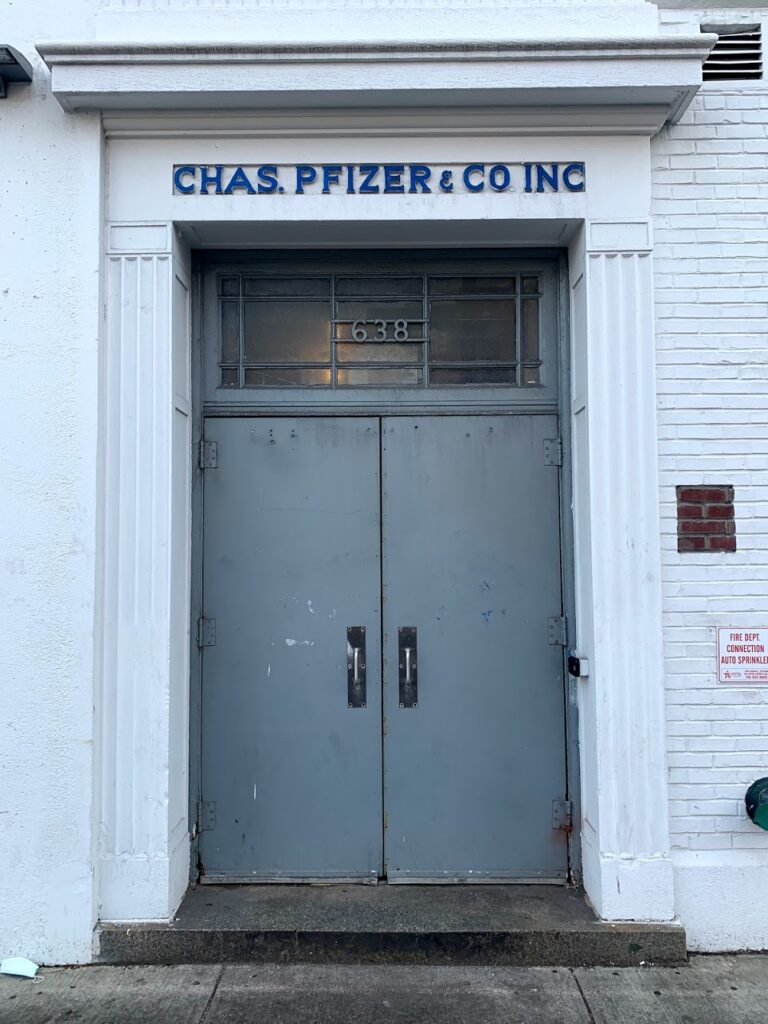
At their original Brooklyn location, the architectural details still gleam with ‘Pfizer Quality’.
A Company of Immigrants
Karl Christian Friedrich Pfizer (later Charles Pfizer), born in 1824 in the Kingdom of Württemberg, was one of the many thousands of Germans who would immigrate to the United States during the 1840s.
Pfizer came to America with his cousin Charles Erhart in the fall of 1848. Unlike the experiences of so many immigrants during this time, both Pfizer and Erhart came from wealthy families and were both highly educated — Pfizer as a chemist, Erhart in the grocery and confectionary trade.
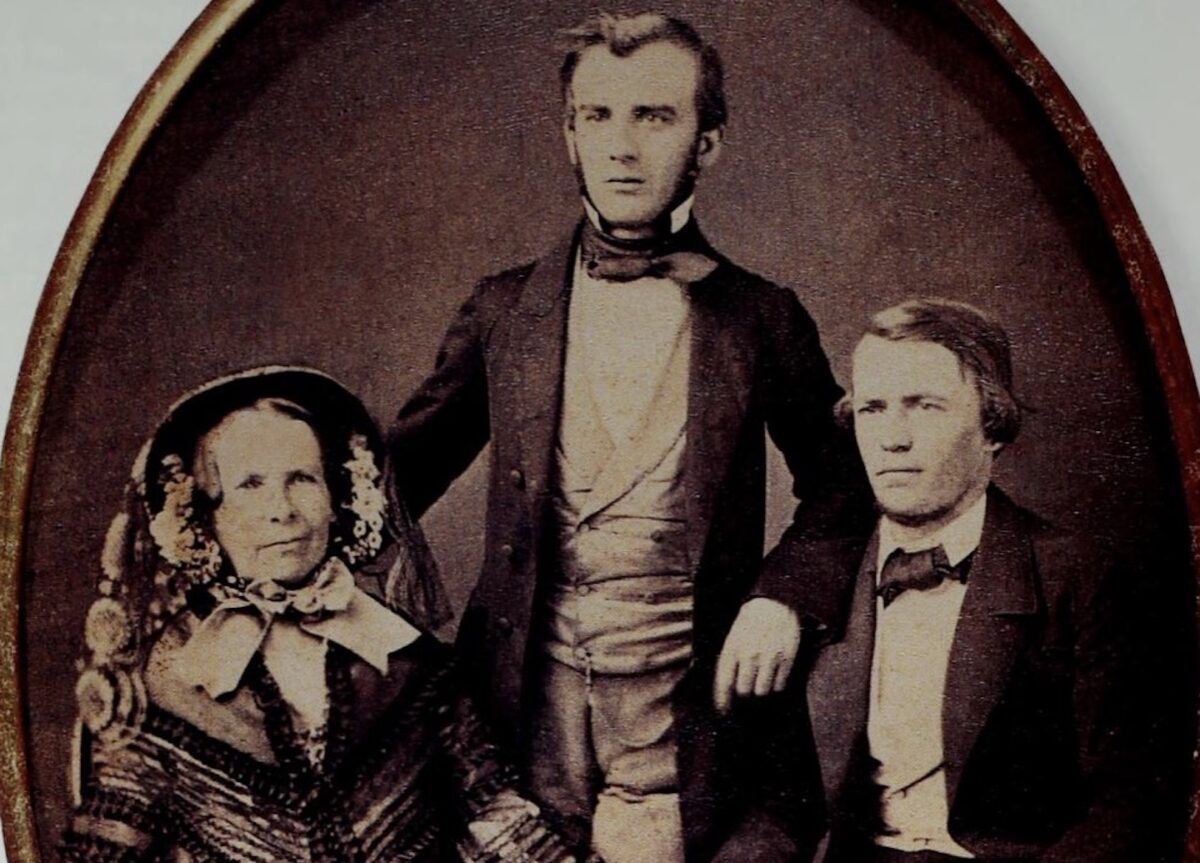
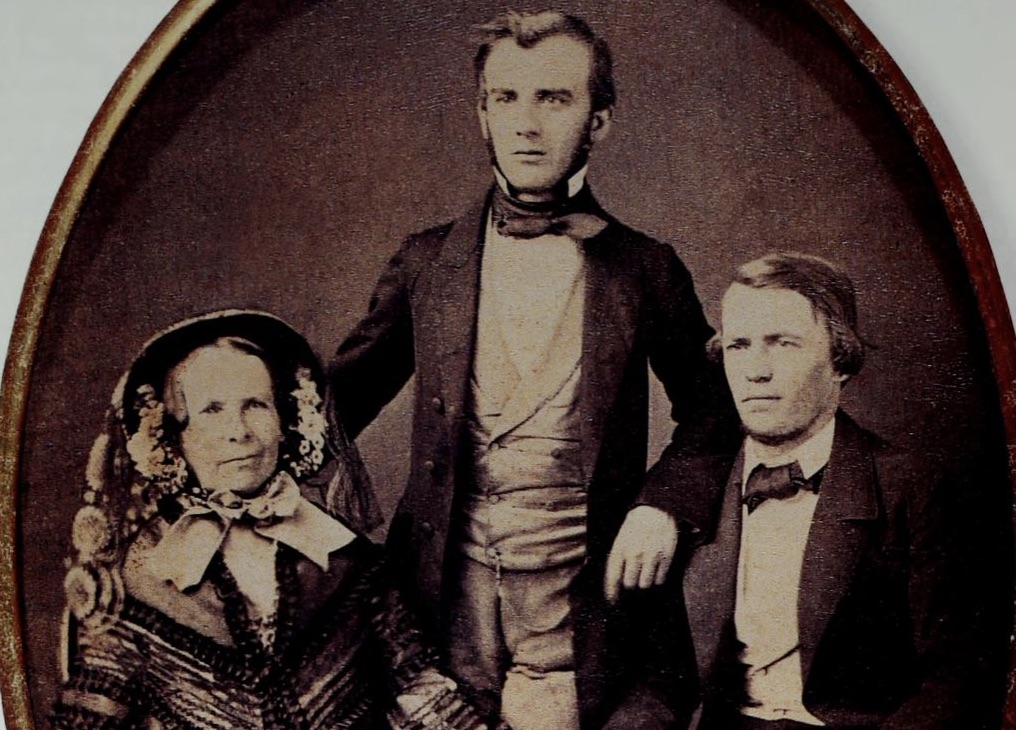
Wilhelmine Klotz Erhart, her son Charles Erhart, and her nephew Charles Pfizer standing. Photograph taken in 1855, courtesy the book The Legend of Pfizer
The practical applications of science to modern life were just beginning to be explored in the early 19th century. Pfizer was taking his training to a country not yet internationally known for scientific breakthrough.
According to author Jeffrey L. Rodengen, “Chemicals that once interested only scholars were becoming indispensable in manufacturing, agriculture and medicine. [Pfizer] also recognized that in the new nation of America, virtually no one was meeting the growing demand.”
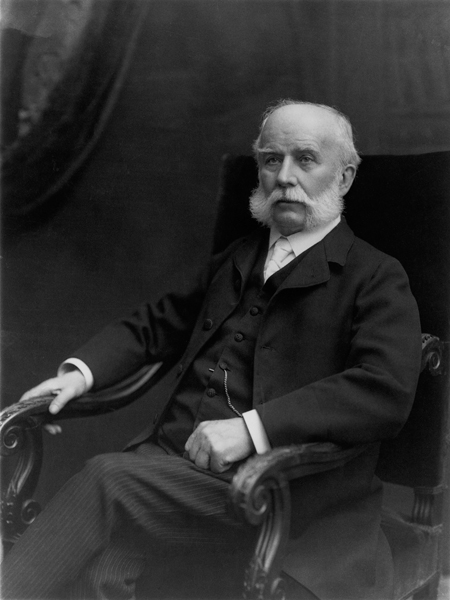
Charles Pfizer, photographed here in 1890
A Home Among The Factories
Pfizer and Erhart would form their new chemical operation in Long Island’s King County in 1849, shortly after their arrival in America.
They had their eye on a spot near the Town of Williamsburgh, north of the burgeoning Brooklyn metropolis.
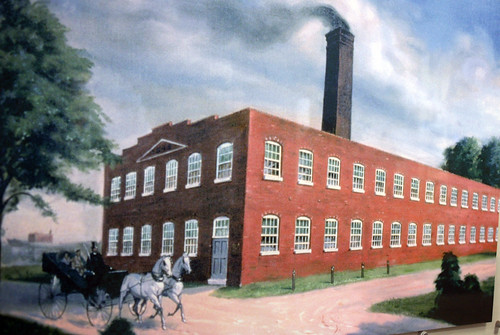
The first Pfizer building
Williamsburgh — a former village under the jurisdiction of the town of Bushwick — was a desirable destination for budding industrialists thanks to its proximity to a busy waterfront and the already busy waters of Newtown Creek. Chemical and oil plants were already home here when the cousins arrived.
Pfizer’s first headquarters was a bit far from the waterfront. They couldn’t quite afford to build a new factory.
Instead the cousins moved their operations into a pre-existing red brick building at Bartlett and Tompkins Streets thanks to a $2,500 loan from Pfizer’s father. (That’s about $78,000 today thanks to inflation.)
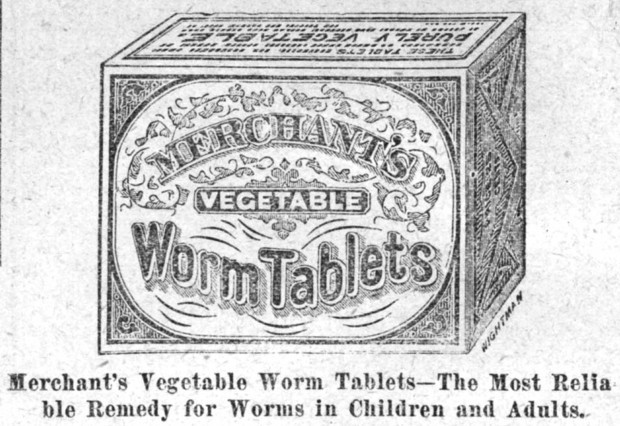
An example of 19th century medicine used to treat worms *shivers*.
How To Deal With Worms
A chemist and confectioner might seem like an odd couple today. But go to your medicine cabinet. How many of your medicines have flavor? Most pharmaceuticals would be hard to swallow without additives literally meant to make the medicine go down.
In 1849 the Pfizer company rolled out its first product — a product made from santonin. But this was santonin that tasted, well, not good exactly, but palatable enough to help relieve a very grotesque condition — intestinal worms.
Pfizer and Erhart produced santonin (made from the flower of Artemesia plants) with a relatively delicious almond-toffee taste.
Given that intestinal worms were a far bigger problem in the mid 19th century than they are today, the product flew off the shelves, allowing Pfizer to expand into other chemical remedies.
The original Brooklyn location of Pfizer still displays its history.
Room To Grow
As business was just getting off the ground, exciting things were happening in the neighborhood. In 1851, Williamsburgh briefly became its own incorporated city.
Less than four years later the city — along with the township of Bushwick and Greenpoint — would be incorporated into the expanding City of Brooklyn. It was collectively known as the Eastern District.
As the community was quickly growing, so too was business booming for the cousins who over the next three decades quickly expanded into the lots surrounding their original headquarters on Bartlett and Thompson.
Like many areas of the Eastern District by the late 19th century, the chemical aroma must have been remarkable.
Brooklyn Public Library
Of course Pfizer also expanded outside of Brooklyn almost immediately. In 1868, they naturally moved their central headquarters closer to Wall Street — to 81 Maiden Lane.
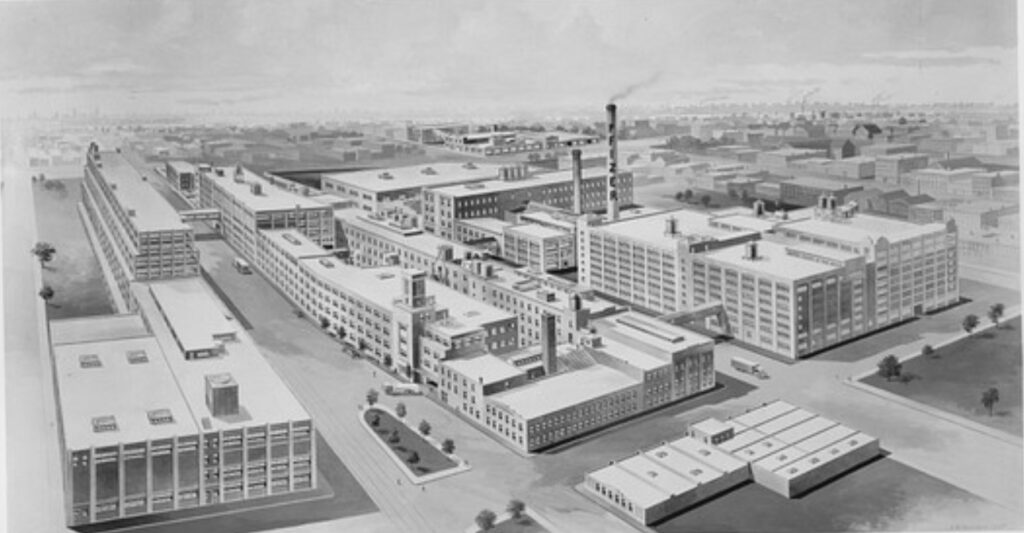
Meanwhile their Brooklyn location was cranking out such products as iodine, chloroform, borax, camphor and even morphine. They also specialized in non-medicinal products like cream of tartar.
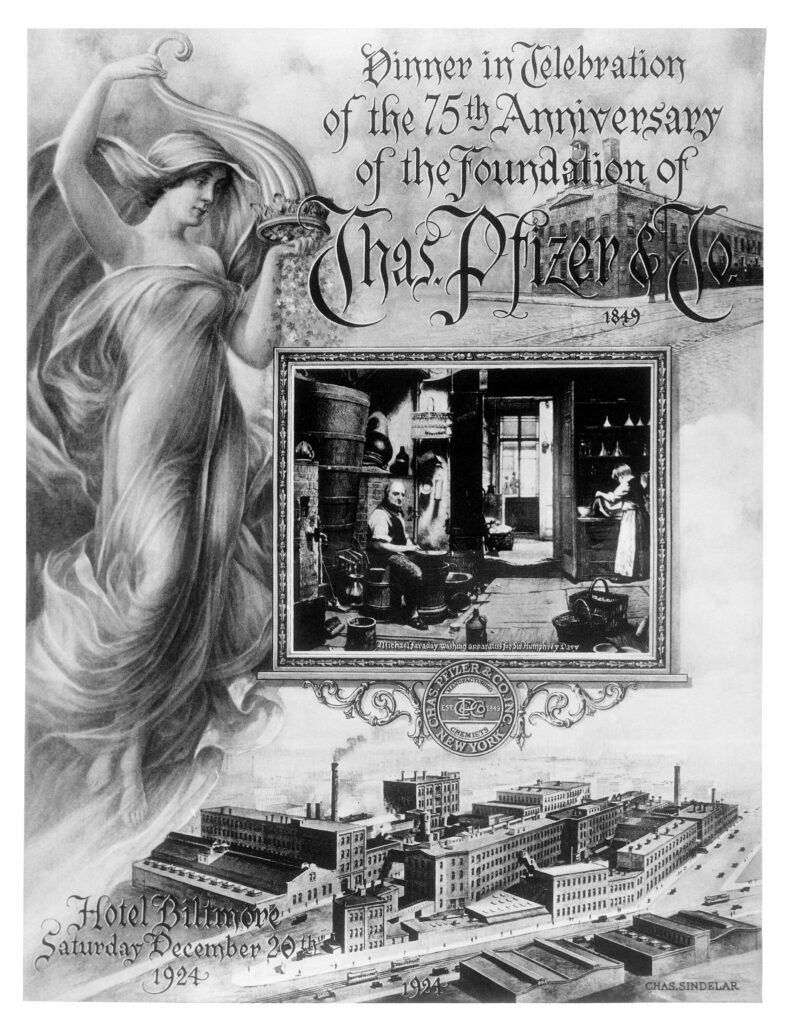
A celebration of their 75th anniversary featuring a depiction of their Brooklyn operation.
As Scott H. Podolsky writes in his journal article Antibiotics and the Social History of the Controlled Clinical Trial 1950-1970:
“For nearly a century of Pfizer’s existence, it did not market pharmaceuticals but rather had centered upon the production and refinement of chemicals such as citric acid, which Pfizer was the world’s largest producer by World War II.
“However the fermentation techniques used in the production of citric acid would render Pfizer a leader in the American World War II efforts to mass-produce penicillin and Pfizer soon followed as one of the largest producers of the equally nonexclusive streptomycin and dihydrostreptomycin (selling to other companies to distribute).”
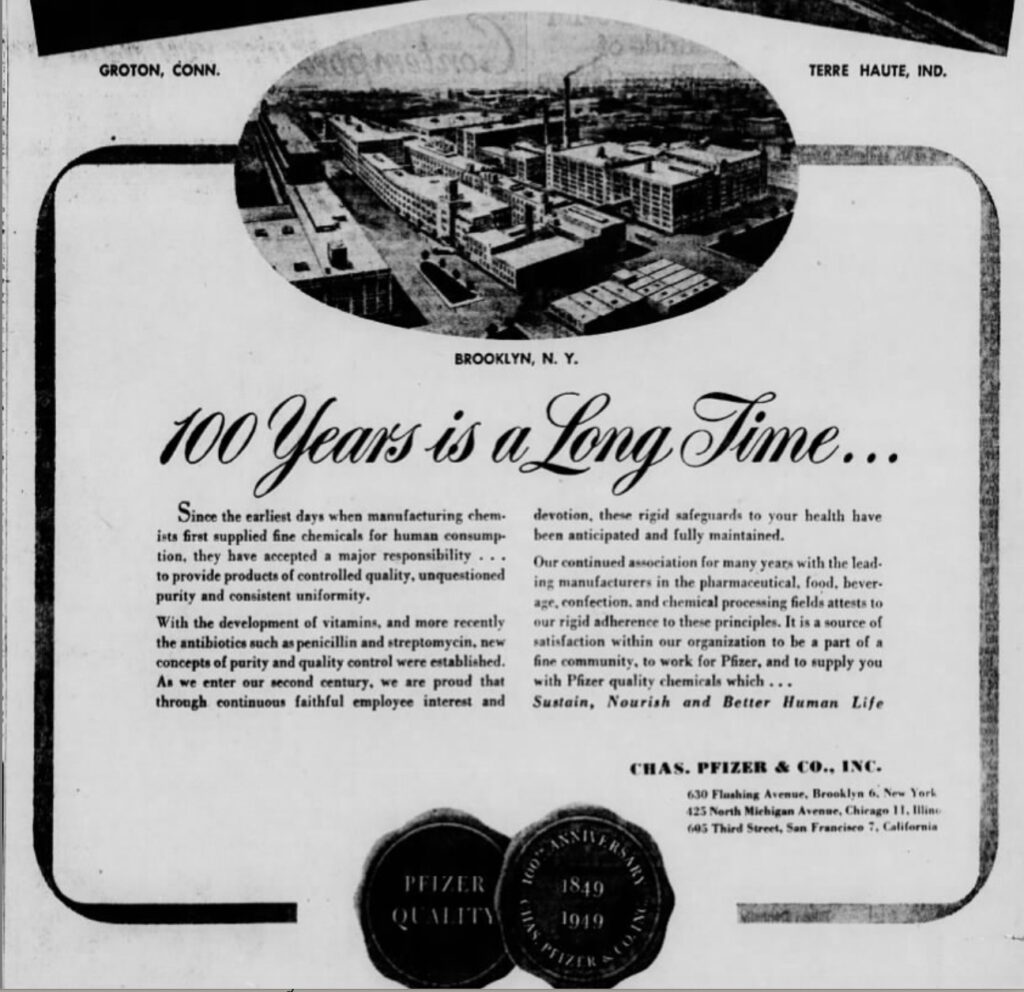
An advertisement touting their 100th anniversary
Penicillin would change the world — and significantly expand Pfizer’s profile by the second half of the 20th century through corporate mergers and expanded offices in several countries.
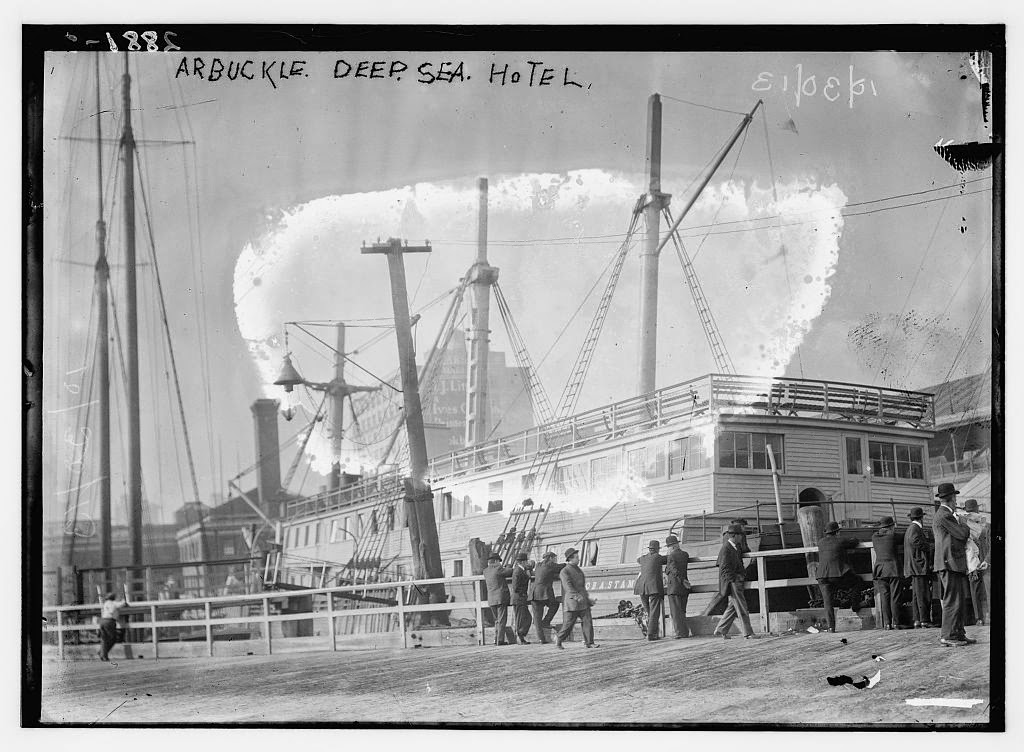
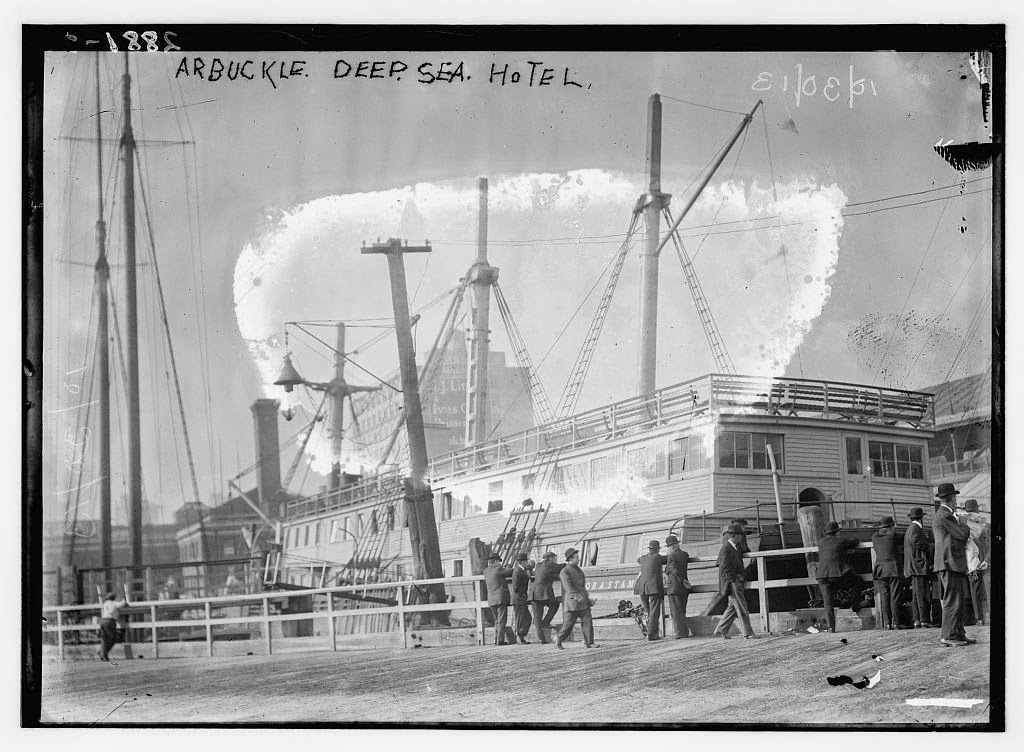
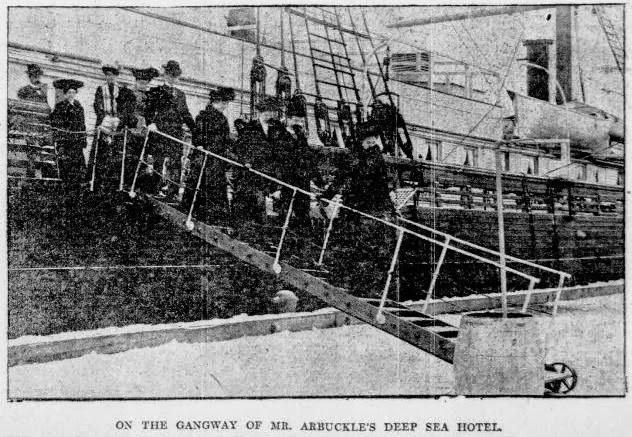
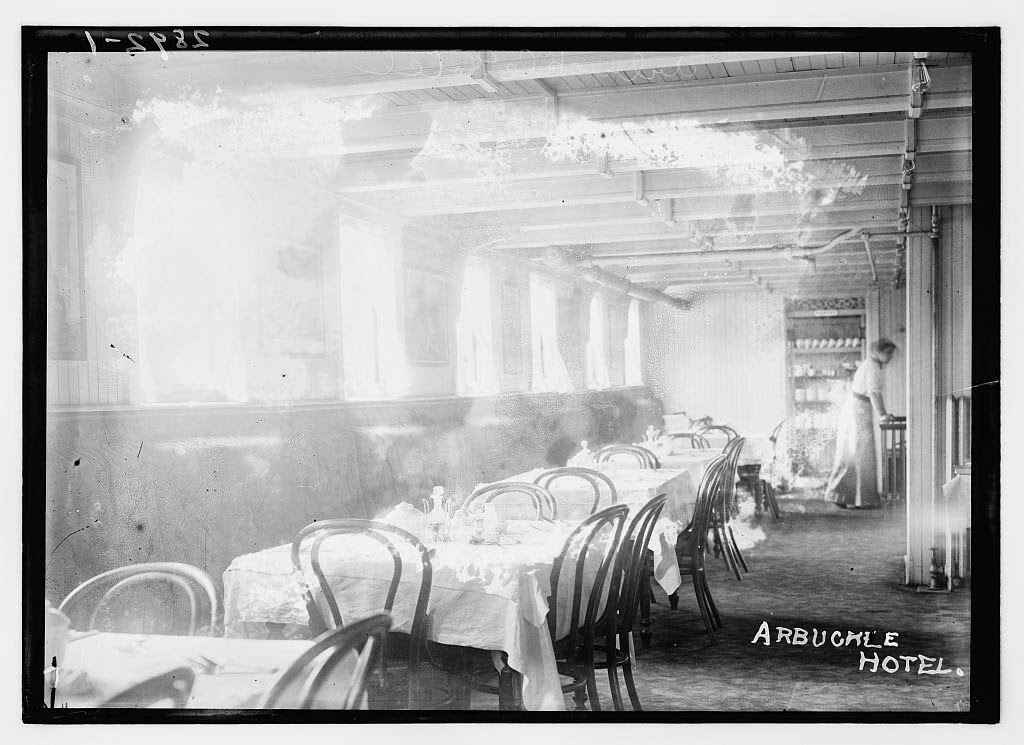
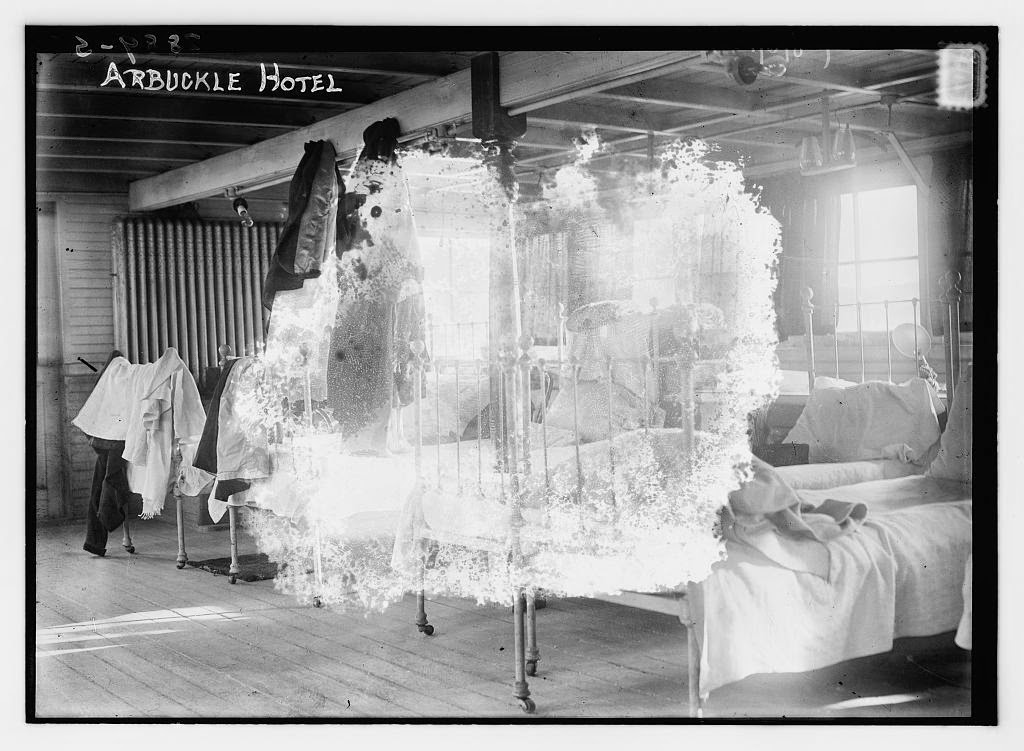
Arbuckle’s Deep Sea Hotel was neither in the deep sea, nor was it a hotel. But for hundreds of young, single women at the end of the Gilded Age, it was home.
The boat hotel built by a coffee manufacturer, photo from January 1913 (Library of Congress)
The Challenges of Living Single
Accommodations were indeed limited for the thousands of young single women who arrived in New York City at the start of the 20th century.
Wealthier single ladies could enjoy a degree of independence by indulging in fashionable apartment living. Affordable options like boarding houses were often socially binding.
For instance, the morality-minded YWCA housed hundreds of New York women by the 1890s. It was often too expensive to rent on your own place, even with roommates, and the neighborhoods where such housing was available would not have been too desirable.
Enter Brooklyn coffee millionaire John Arbuckle.
A Caffeine Jolt
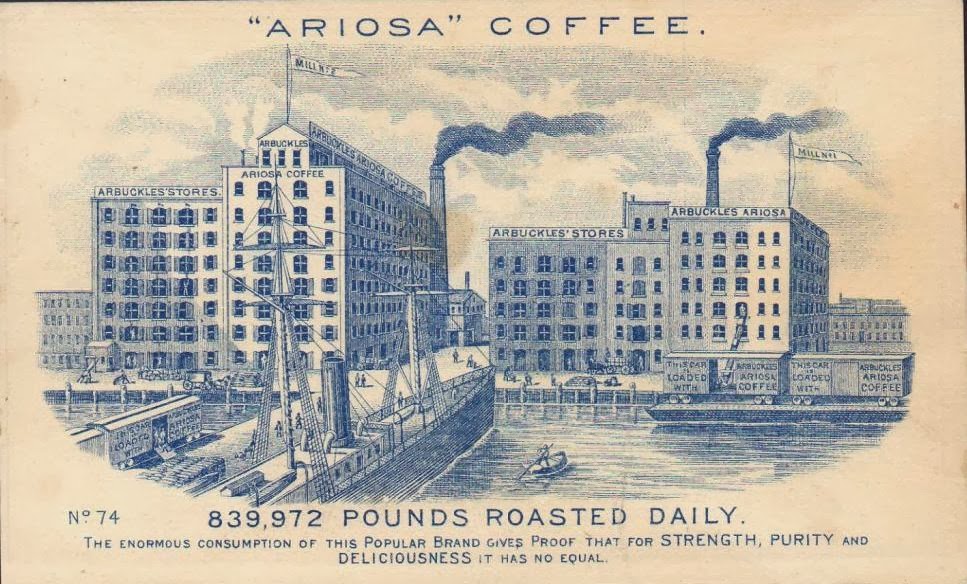
The sugar manufacturer, already a chief competitor of William Havemayer, innovated the mass production of coffee by the 1890s, making himself extremely wealthy and jumpstarting America’s love affair with coffee in the process.
In emulation of other progressive-minded New York philanthropists, Arbuckle commissioned free water-bound excursions for the overcrowded poor of the Lower East Side.
However, when a steamboat owned by another company — thePS General Slocum— exploded during one such excursion in 1904, killing over 1,000 people, such trips quickly went out of fashion.
Arbuckle then decided to use one of his ships in a more unconventional way — a long-term hotel for single women.
The Floating Hotel
His ship the Jacob A. Stampler was turned into a floating hotel for one hundred women, with a smaller ship nearby for young working men. It was docked at West 21 Street on the Hudson River, near the massive piers for passengers liners.
“The fundamental idea of this hotel scheme,” according the New York Tribune in 1905, “is to benefit young men and young women who are receiving low wages and are striving to live respectable lives.”
In 1905, its first year of operation, women paid “40 cents a day, or $2.80 a week, while the young men pay 50 cents a day or $3.50 a week.” [source]
While both genders benefited from the unusual hotel idea, Arbuckle’s focus was in the assistance of women.
“A young fellow can fight for himself and get along his own way,” said the millionaire, “but it is different with a woman or girl confronted with problem of keeping herself respectable while working for low wages.”
The women were fed well and provided a selection of magazines and newspapers, not to mention a piano for Sunday evening sing-alongs. They were also given sewing machines and laundry facilities.
The rocking of the boat and the relative bustle of a busy pier seems not to have bothered Arbuckle’s early tenants.
“It’s so quiet here. No rattle and roar from the streets,” said one young woman. [source] Ladies could receive gentlemen callers, but men had to vacate by 10 pm. As many women worked quite late in the day, this probably didn’t amount to much socializing.
A House and a Vacation Home
During the summer, the boat actually did take regular trips to various places in the region, from Coney Island to the shore of Staten Island.
At some point, perhaps due to overwhelming traffic at the Chelsea piers, the Stampler made the east side its home, regularly docking at East 23rd Street.
The floating hotel never really made a profit, and after Arbuckle died in 1912, his inheritors attempted to shut it down.
I should also note that the Stampler was a very, very old boat.
“[The] ship was beginning to rot and soon would be unsafe,” said theNew York Sun. The women who lived there, however, fought successfully to keep it open until 1915, when they were finally told to permanently disembark.
Interesting fact to note about its final days — both single men and women lived aboard the boat by 1915.
Its last documented population was 50 girls and 16 boys, according to the Sun. (Most likely teenagers or adults in their early twenties.) The ship rarely sailed to Coney Island in the summer, but had become a destination in itself.
“One of the five decks is fitted up as a dance hall,” “crowded every night with dancers” when music from a nearby pier begins to play.
The price of rent these days!
The last tenants finally left on September 1, 1915, with many unable to find further housing. “There isn’t a girl on this boat that makes $9 a week,” said one mournful tenant, “and you know how far that goes in this city.” [source]
By 1917, the Stampler was a rotted breakwater off of Bayville Beach in Oyster Bay. To this day, perhaps, some remnant of the ship still sits in the water off the coast of Long Island.
By the way, Arbuckle may no longer sponsor floating housing accommodations for working people, but they still make coffee.
For more information on Arbuckle and the New York coffee scene, check out our podcast on the history of DUMBO:
PODCAST The history of Brooklyn’s DUMBO neighborhood — from its industrial past to its hi-tech future.
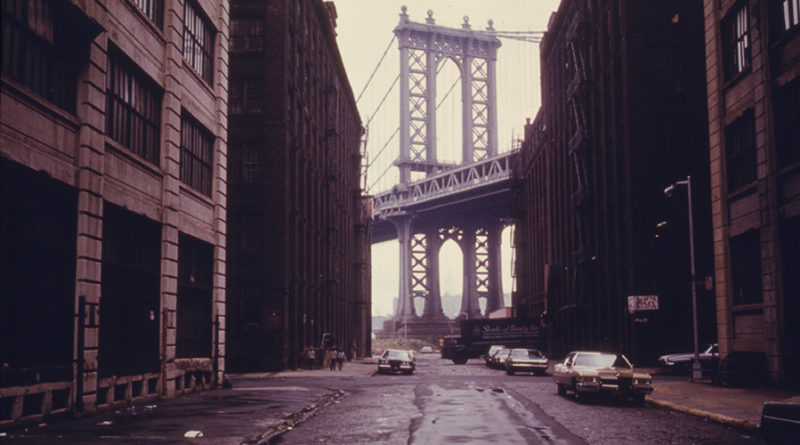
Down Under Manhattan Bridge Overpass (DUMBO) is, we think, a rather drab name for a historically significant place in Brooklyn where some of the daily habits of everyday Americans were invented.
This industrial area between the Brooklyn and Manhattan bridges traces its story to the birth of Brooklyn itself, to the vital ferry service that linked the first residents to the marketplaces of New York. Two early (lesser) Founding Fathers even attempted to build a utopian society here called Olympia.
Instead the coastline’s fate would turn to industrial and shipping concerns. Its waterfront was lined with brick warehouses, so impressive and uniform that Brooklyn received the nickname ‘the Walled City‘.
The industries based directly behind the warehouses were equally as important to the American economy. Most of their factories comprise the architecture of today’s DUMBO, grand industrial fortresses of brick and concrete, towering above cobbled streets etched with railroad tracks.
The cardboard-box titan Robert Gair was so dominant in this region that his many buildings were collectively referred to as Gairville. But coffee and tea traditions also came here — not just the manufacture, but the revolutionary ways in which people with buy and drink those beverages.
How did this early New York manufacturing district become a modern American tech hub, with luxury loft apartments and splendid coffee shops? This story of repurpose and gentrification is very different from those told in other neighborhoods.
The Bowery Boys: New York City History podcast is brought to you …. by you!
We are now producing a new Bowery Boys podcast every week. We’re also looking to improve the show in other ways and expand in other ways as well — through publishing, social media, live events and other forms of media. But we can only do this with your help!
We are now a member of Patreon, a patronage platform where you can support your favorite content creators for as little as a $1 a month.
Please visit our page on Patreon and watch a short video of us recording the show and talking about our expansion plans. If you’d like to help out, there are five different pledge levels (and with clever names too — Mannahatta, New Amsterdam, Five Points, Gilded Age, Jazz Age and Empire State). Check them out and consider being a sponsor.
We greatly appreciate our listeners and readers and thank you for joining us on this journey so far.
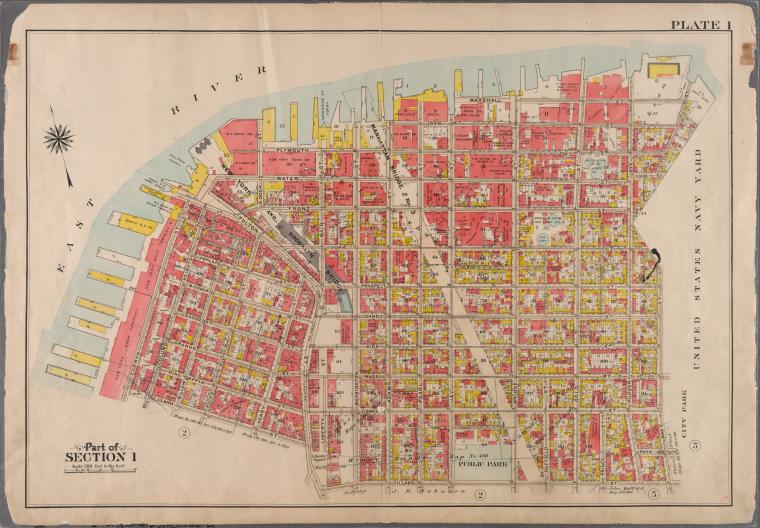
The DUMBO neighborhood, Brooklyn Heights and downtown Brooklyn on this 1908 survey map.
New York Public Library
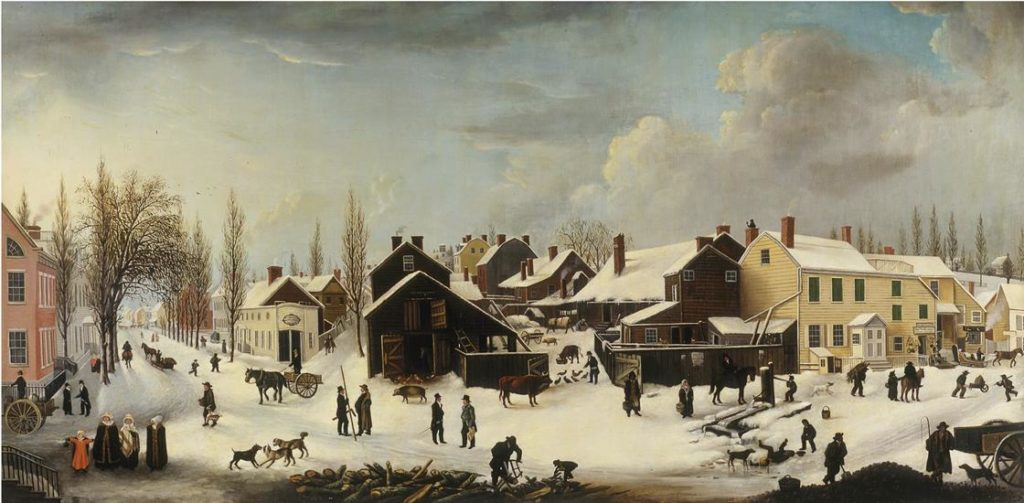
This painting by Francis Guy) actually depicts the area of downtown Brooklyn as it looked during the area’s ‘Olympia period’.
MCNY
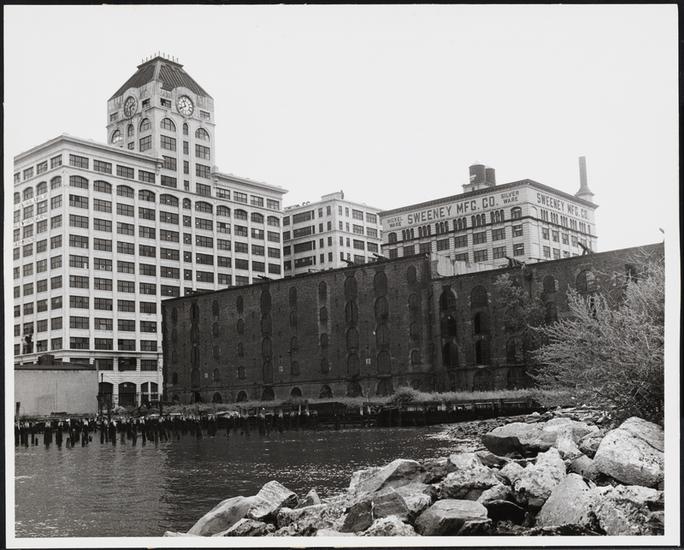
The waterfront in 1974 — the Empire Stores, the former Gair building (1 Main Street) and Sweeney Manufacturing (the kitchenware company)
MCNYMCNY
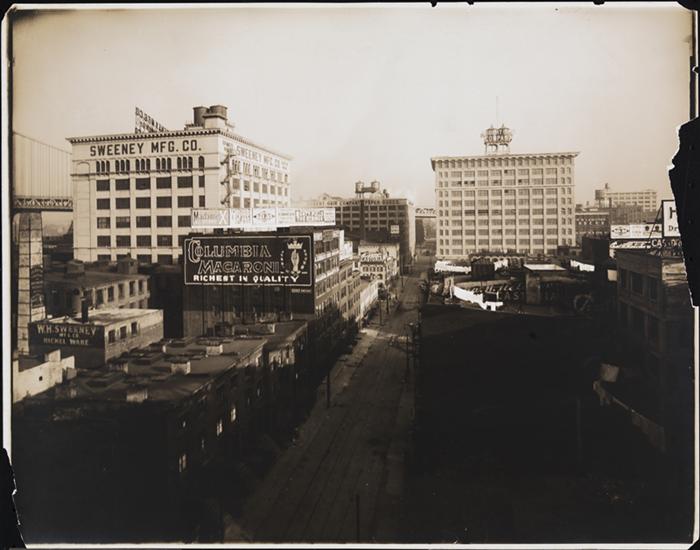
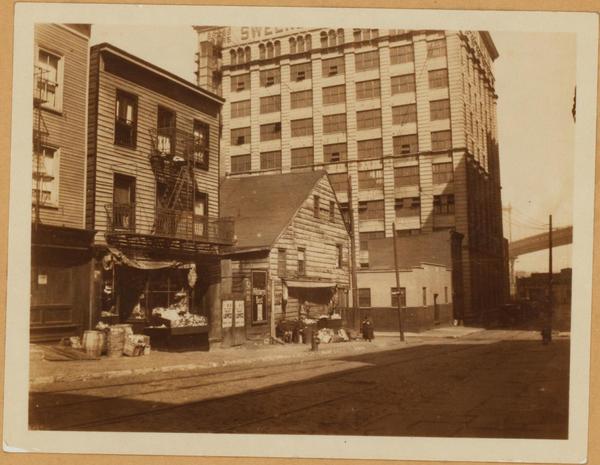
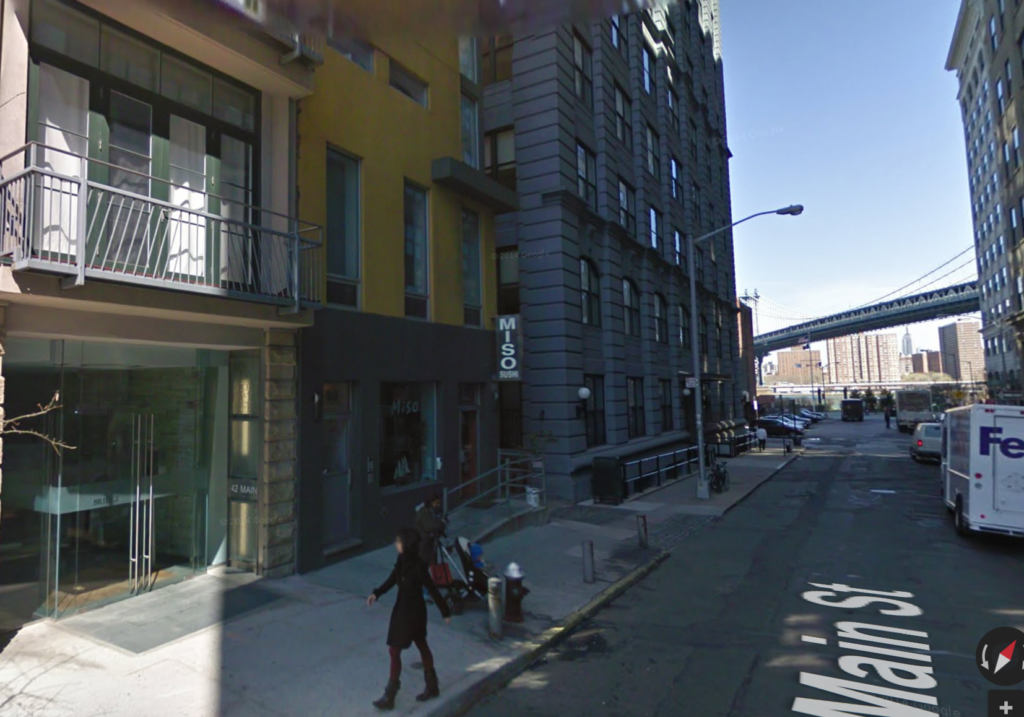
While the neighborhood is dominated by industrial architecture today, it wasn’t always so. This picture from 1924 (looking down Main Street with the wooden building sitting at Howard Alley) and the same view today
NYPL
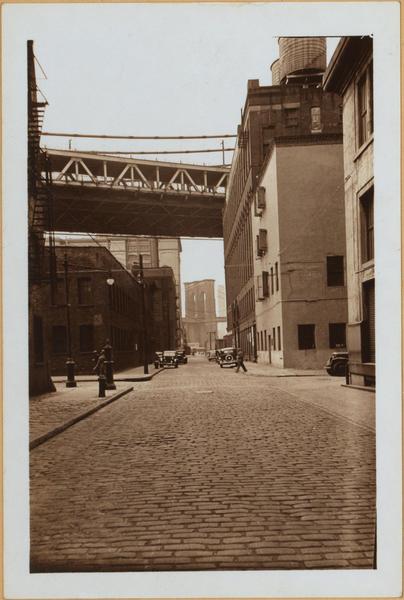
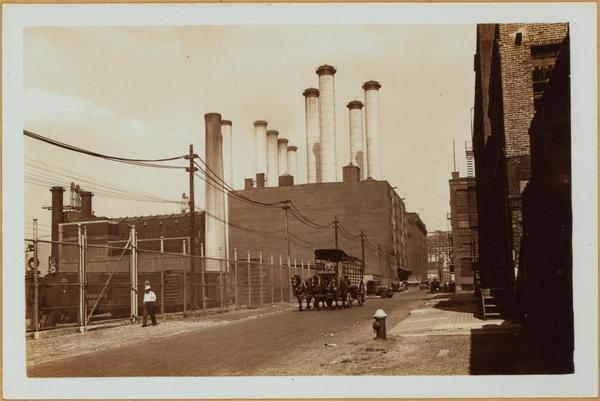
Plymouth Street, west from Pearl Street, showing at the right one of the Arbuckle Bros. Coffee Co. building. April 4, 1938.
NYPL
John Street, east from Jay Street, 1938
Brooklyn waterfront was lined with warehouses during the 20th century. Here’s a view of the coastline from the Fulton Ferry area down to Red Hook.
Brooklyn Historical Society
A 1908 view of waterfront properties from Jay Street to Washington Street (pre Manhattan Bridge of course)
MCNY
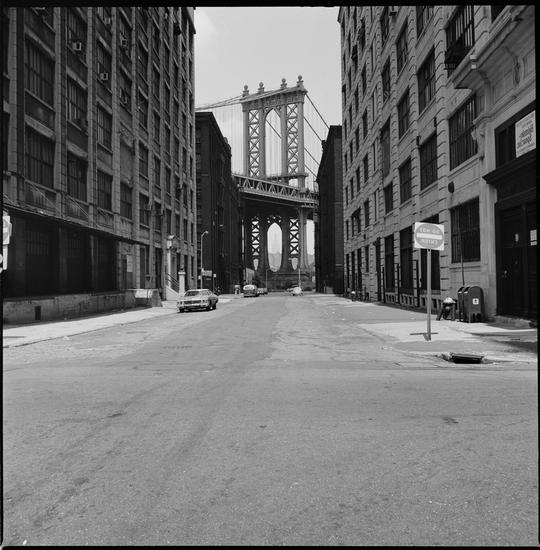
Today you’ll find dozens of people every day on the street, taking selfies in front of this view. But back in 1978, the district was virtually abandoned.
MCNY
Inside the repurposed Empire Stores, now the headquarters of West Elm and home of the Brooklyn Historical Society annex.
FURTHER LISTENING We mentioned these past Bowery Boys podcast on the show. After you’ve finished listening to our DUMBO: Life on the Brooklyn Waterfront show, give these a try!
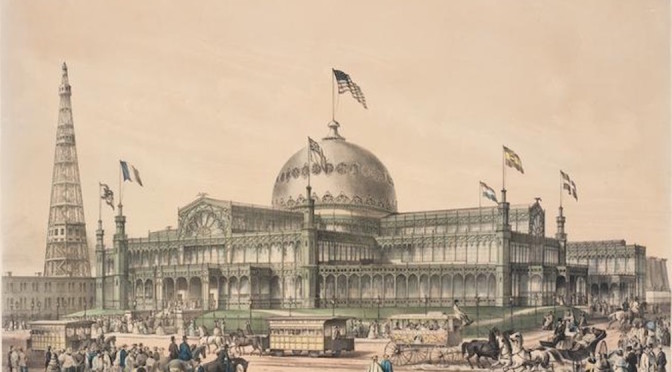
Crystal Palace, 1853, Palmer and Currier Courtesy Museum of the City of New York
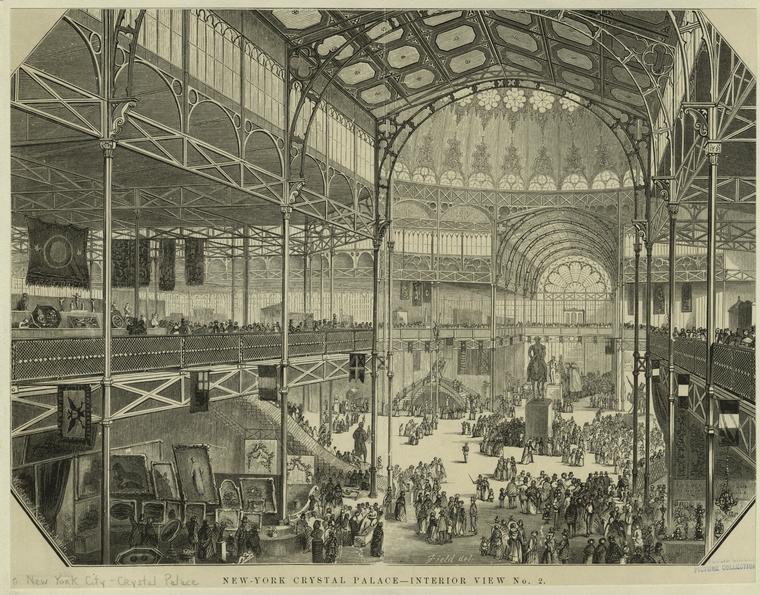
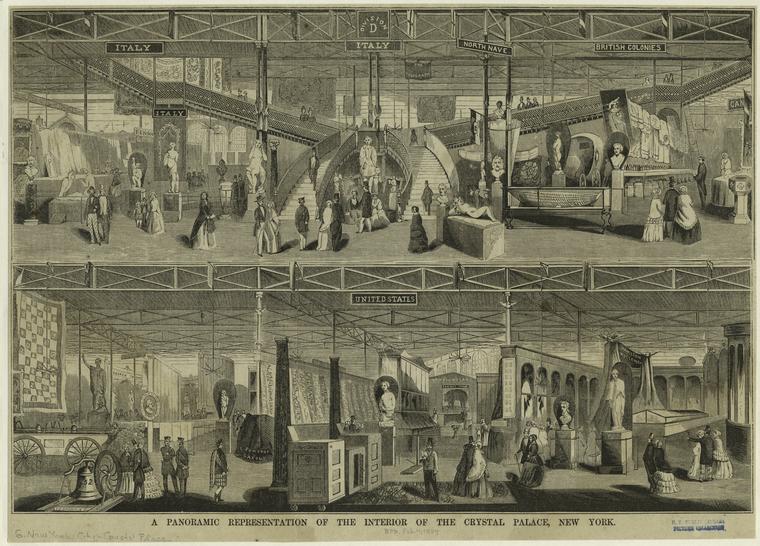
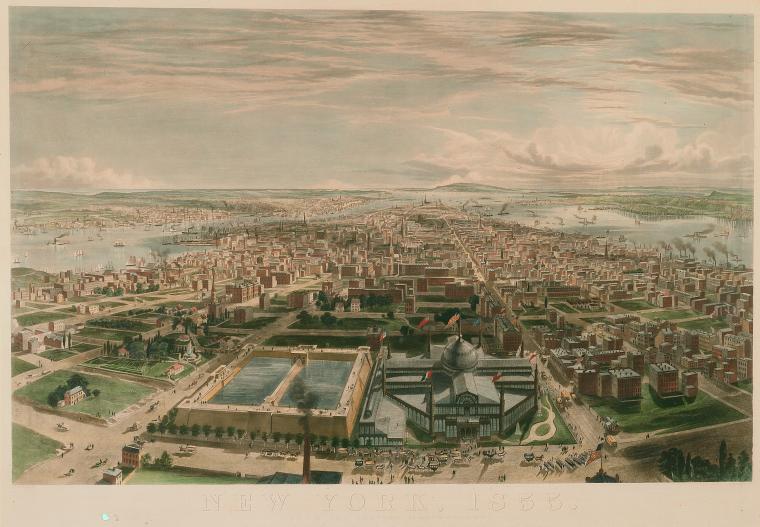
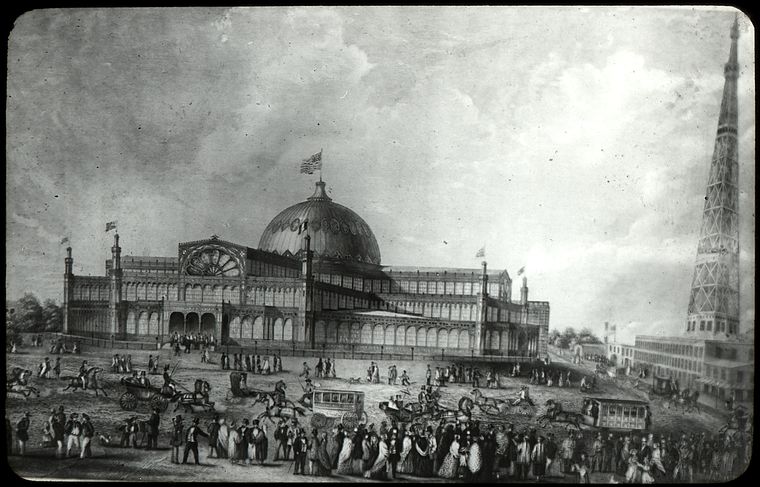
PODCAST New York’s Crystal Palace seems like something out of a dream, a shimmering and spectacular glass-and-steel structure — a gigantic greenhouse — which sat in the area of today’s Bryant Park. In 1853 this was the home to the Exhibition of the Industry of All Nations, a dizzying presentation of items, great and small, meant to exemplify mankind’s industrial might.
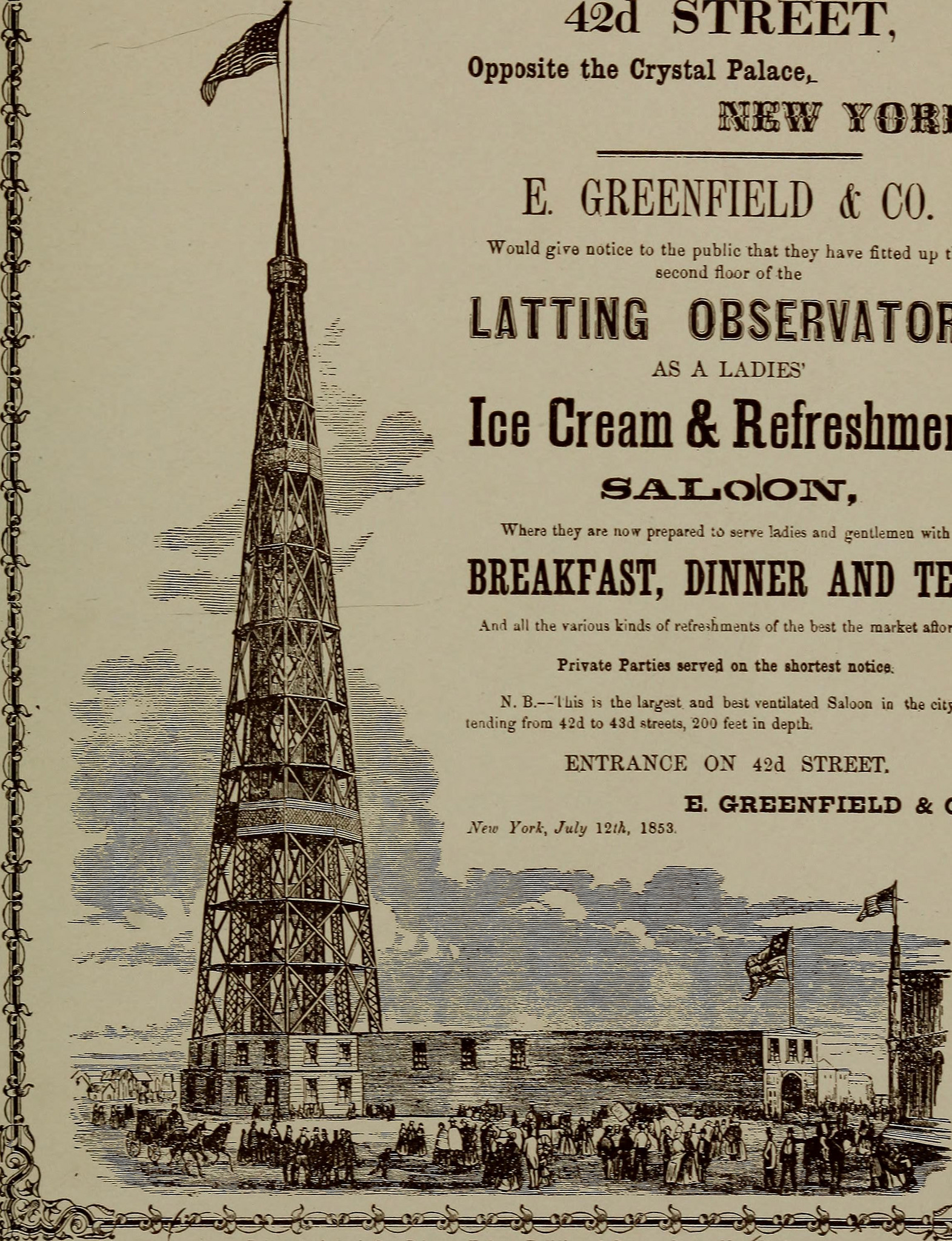
We take you on a breathtaking tour of the Palace and its legendary exhibition, including the Latting Observatory (the tallest building in New York!)
Whatever happened to the Crystal Palace? And what inventions contained within do we still benefit from today?
FEATURING: PT Barnum, Henry Ward Beecher, Elisha Otis and literally millions of items!
EDITOR’S NOTE – I mis-pronounced the name of the Fresnel light (actually pronounced fre-nell). Its modern ancestor is used in theatrical lighting today.
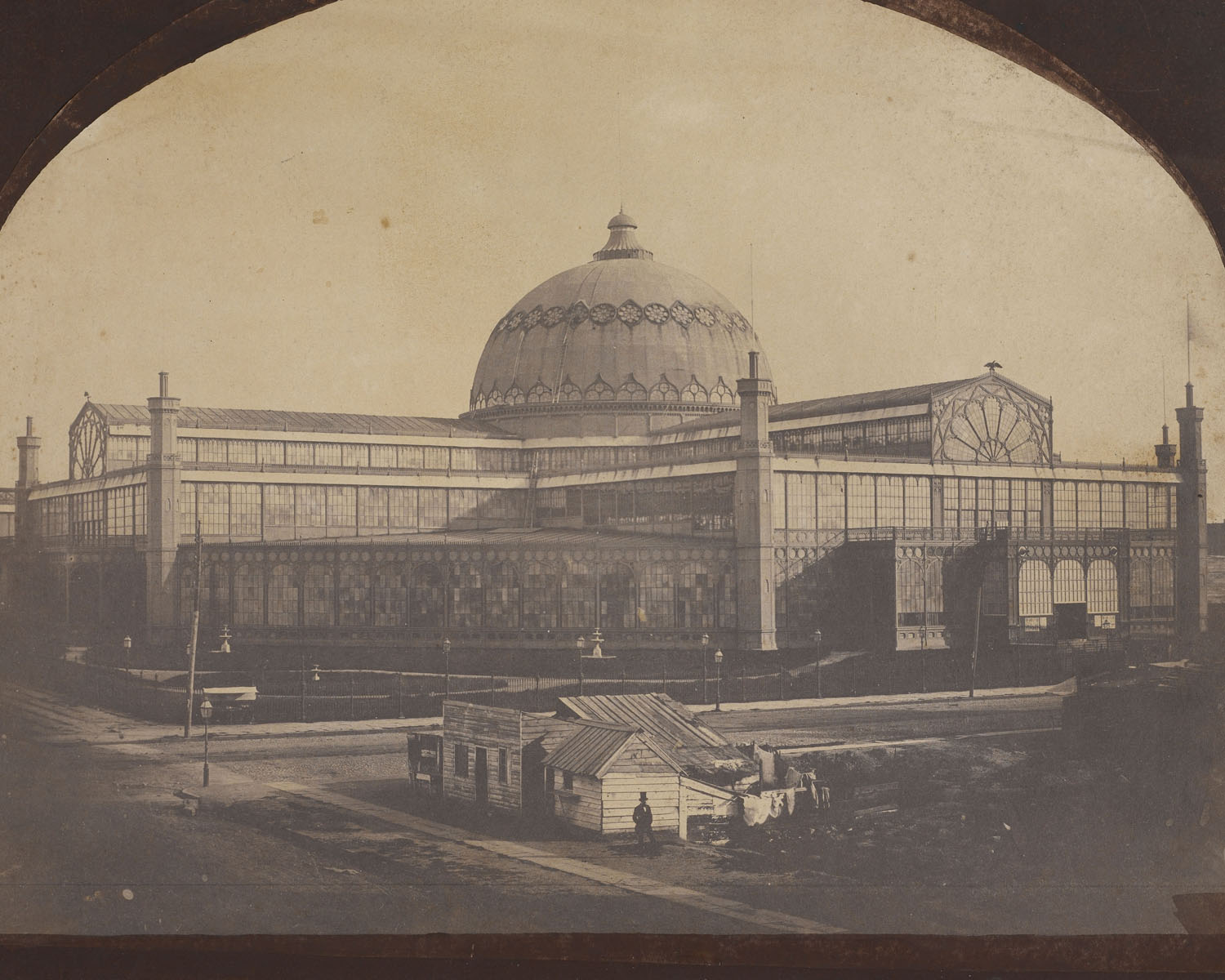
This is one of the earliest photographs of New York City ever taken. As the Crystal Palace hosted examples from the early days of photography, it’s no surprise that one of these early pictures is of the Crystal Palace itself.
A rare photograph of the New York Crystal Palace by Victor Prevost. Courtesy of the Avery Architectural & Fine Arts Library, Columbia University
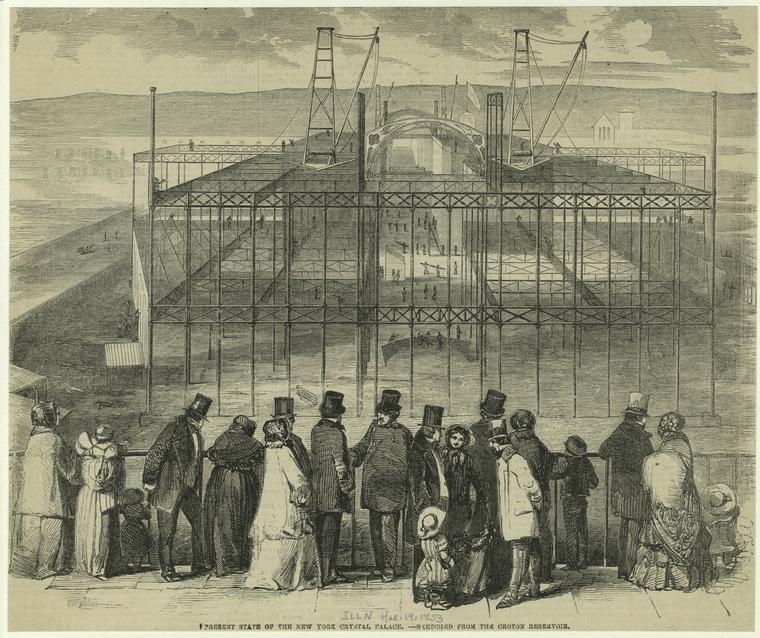
A look into the pit surrounding the Crystal Palace during construction. There were many delays, somewhat sullying the lofty ambitions of the project at the very start. Courtesy New York Public Library
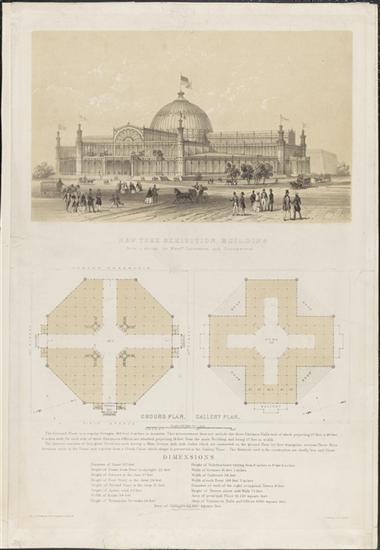
A very church-like plan of the Crystal Palace building by Petermann and Guildemeister. Courtesy Museum of the City of New York
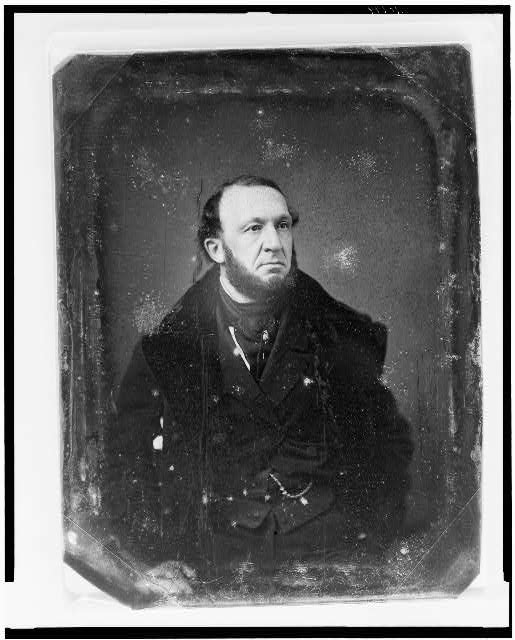
Theodore Sedgwick, who spearheaded the New York Crystal Palace — and bore some of the criticisms of the Exhibition’s rocky opening.
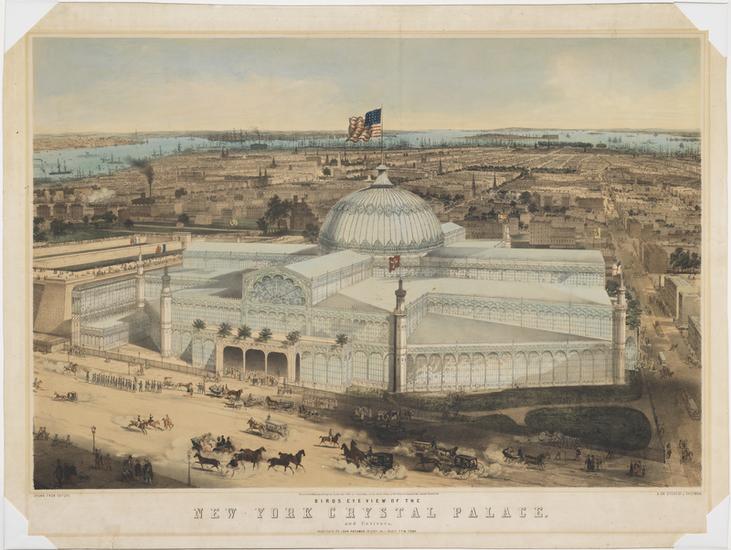
Birds Eye View of the New York Crystal Palace and Environs by John Bachmann. Courtesy the Museum of the City of New York
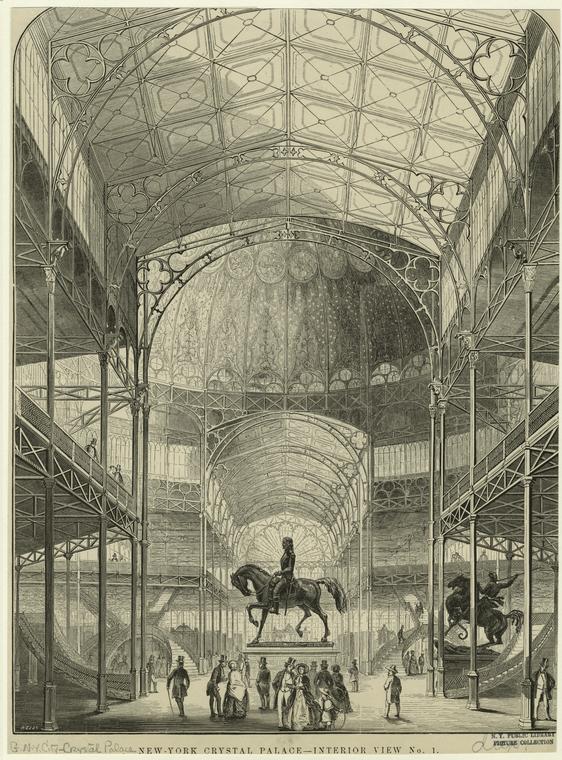
Illustration of the center of the Crystal Palace by J Wells. Courtesy New York Public Library
The view from one of the naves, looking towards the George Washington statue. Courtesy New York Public Library
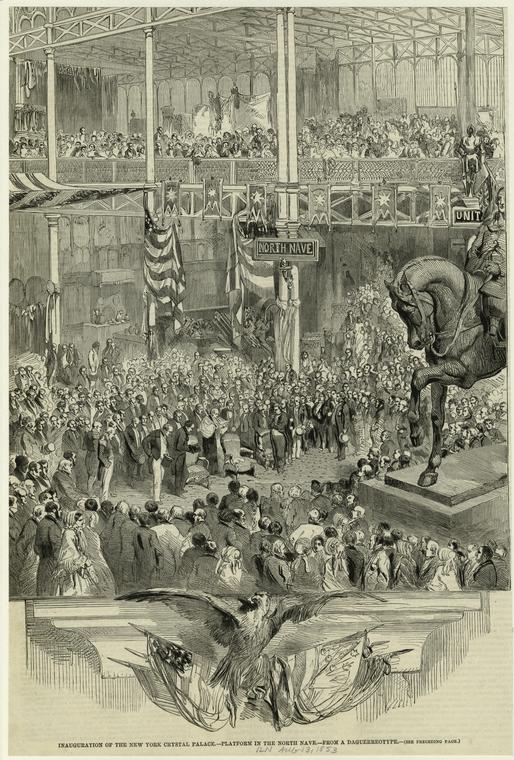
Another view of the inside, this time during the inauguration of the New York Crystal Palace in July 1853 — looking at a platform in the north nave. Courtesy New York Public Library
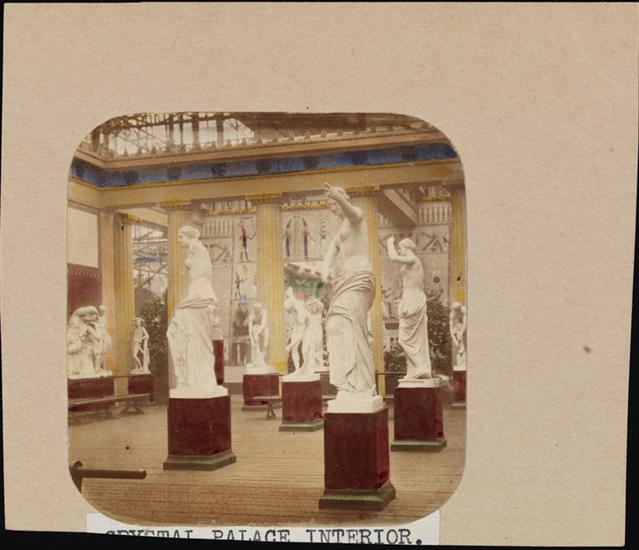
A hand-colored stereoscope of a selection of Crystal Palace statuary. There seems to be some kind of Egyptian thing going on in the background! Courtesy Museum of City of New York
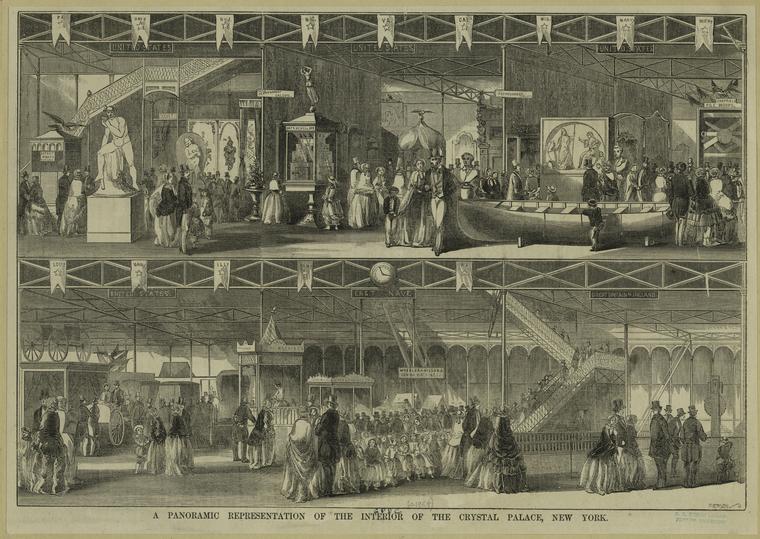
Busts, tapestries, machinery, weapons and various finery! A couple illustrations of the different divisions. Just rooms and rooms of items! Courtesy New York Public Library
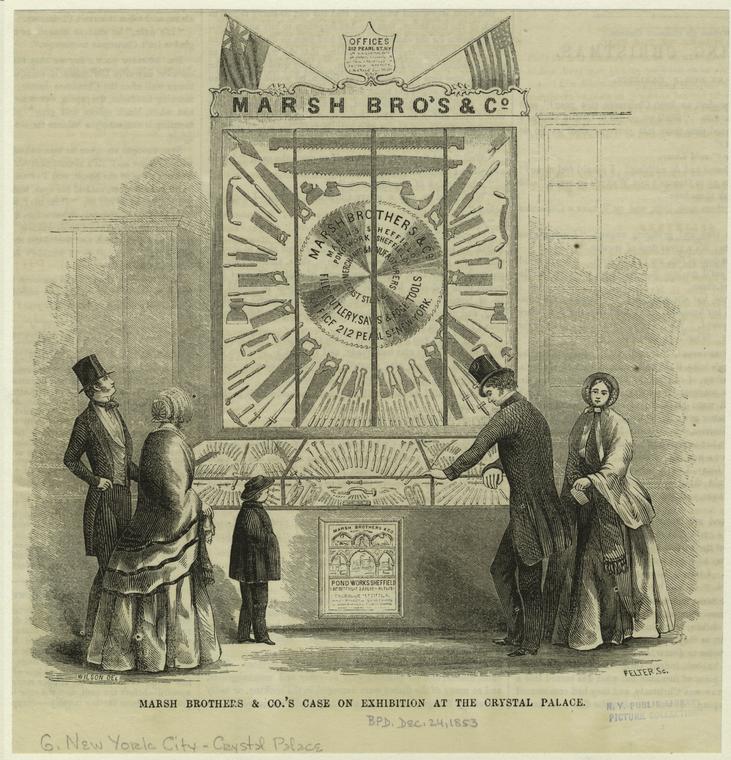
A selection of saws and tools from Marsh Brothers & Co. that one might have seen in the US section. Courtesy NYPL
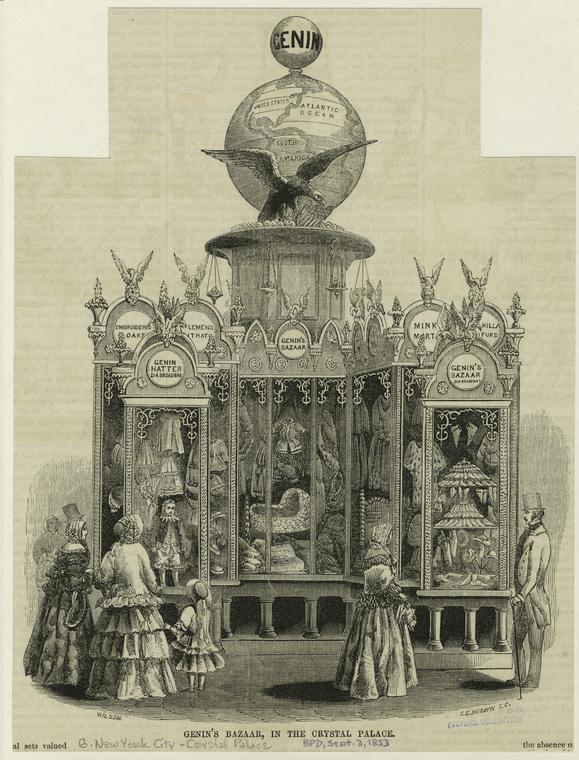
Genin’s Bazaar, containing items for the infant. Courtesy New York Public LIbrary
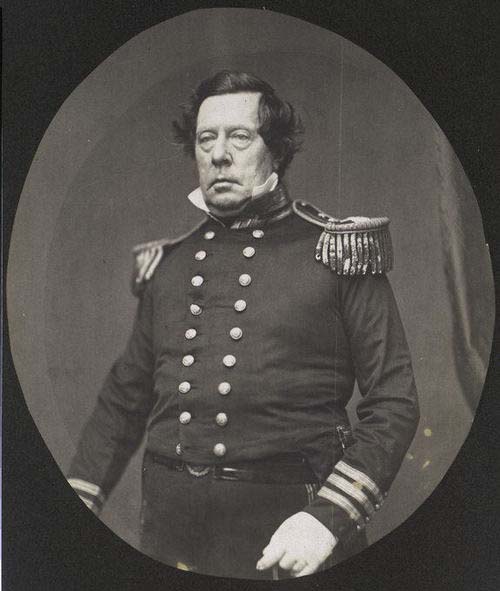
This photo of Commodore Matthew C. Perry was taken by Matthew Brady and displayed at the Crystal Palace, one of the first photographs many people may have seen!
A selection of saws and tools from Marsh Brothers & Co. that one might have seen in the US section. Courtesy New York Public LIbrary
This engraving shows the Latting Observatory in relation to the Crystal Palace, separated by 42nd Street.
A reprinted advertisement from Valentine’s Manual of old New York, outlining some of the charms of Latting Observatory
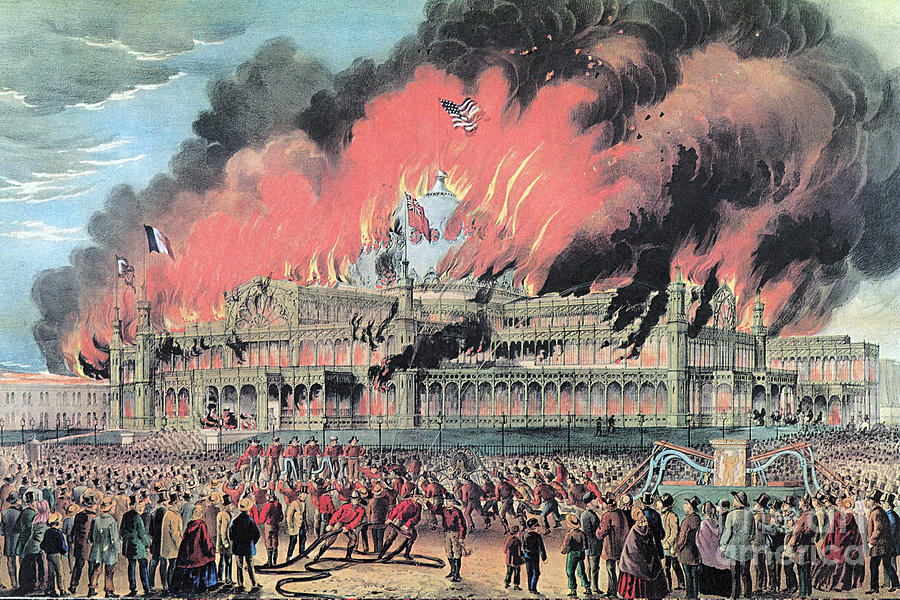
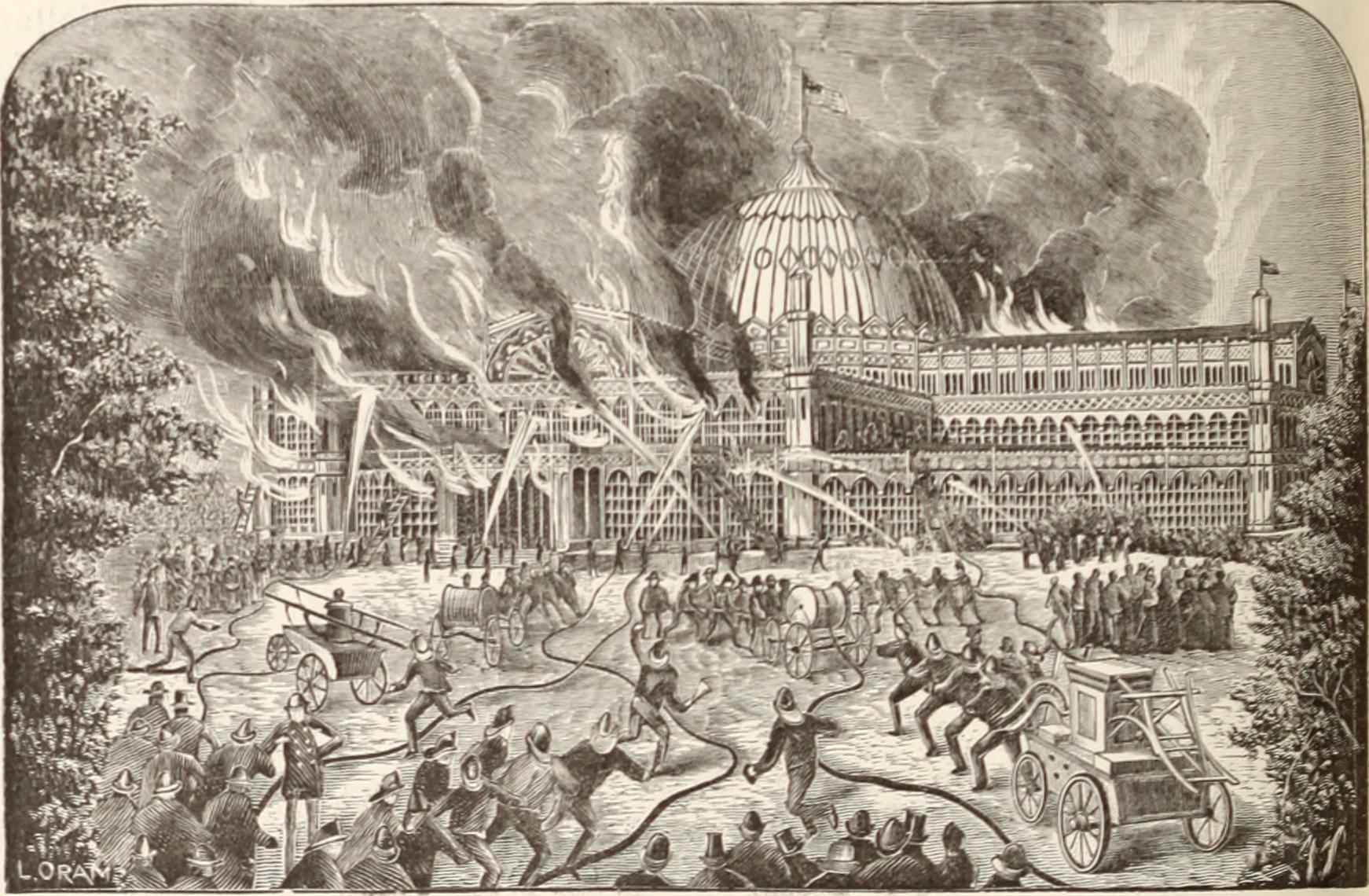
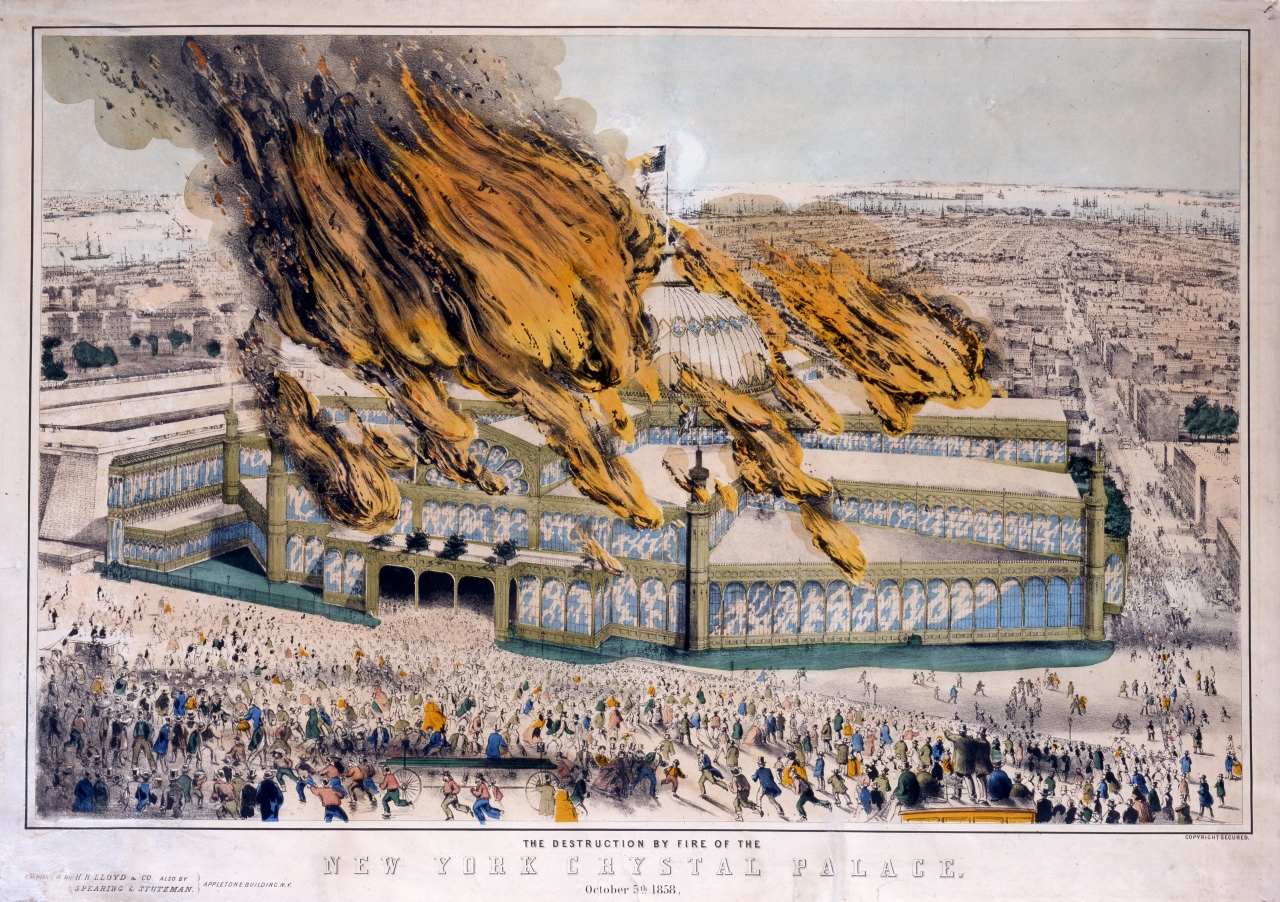
One of several illustrations of the Crystal Palace fire, a dramatic blaze that destroyed the building in under an hour.
An illustration from an 1887 book “Our firemen. A history of the New York fire department” Courtesy Internet Image Book Archives
Another view of the blaze, in perspective to the rest of New York to the south. Couirtesy New-York Historical Society
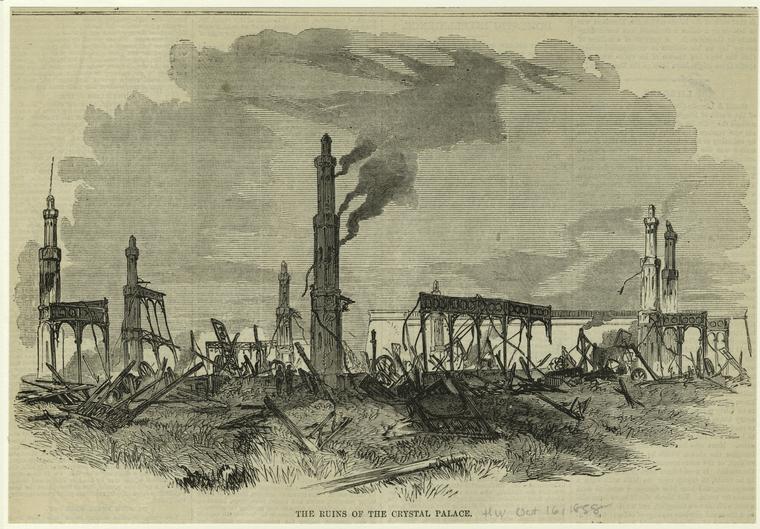
An illustration made in 1858, depicting the aftermath of the horrible fire that destroyed the Crystal Palace. NYPL
Some original documents that you may enjoy reading:
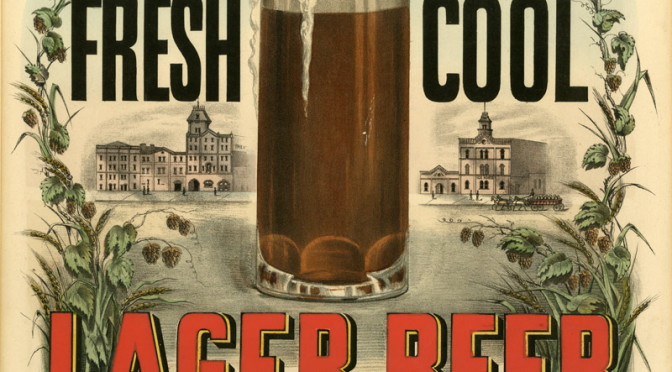
Behold the lager: A German variety of beer revolutionized American drinking, inspiring a new kind of drinking establishment (Courtesy the New-York Historical Society
Inspired by ‘Beer Here: Brewing New York’s History‘, the terrific summer show at the New-York Historical Society, the latest Bowery Boys podcast explores the story of one of America’s greatest, most treasured products– beer.
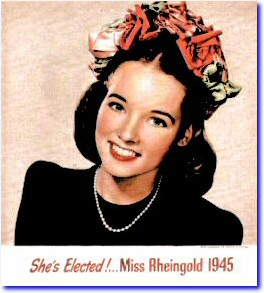
PODCAST New York City’s thriving craft brewing industry today hearkens to a time over a century ago when the city was one of America’s great beer-making capitals, the home to a robust industry of breweries and beer halls. In the 19th century, German immigrants introduced the lager to thirsty crowds, manufacturing thousands of barrels per year from breweries in Manhattan and Brooklyn’s ‘Eastern District’ (primarily Bushwick and Williamsburg). The top Manhattan brewers were Hell Gate Brewery and the Jacob Ruppert Brewing Company, situated right next to each other in the old German neighborhood of Yorkville. Both Ruppert and Hell Gate’s founder George Ehret rode the beer craze to become two of New York’s wealthiest businessmen. Meanwhile, out in Brooklyn, a phalanx of brewers clustered along Bushwick Avenue in fine red-brick factories. Following World War I and Prohibition, New York lost its hold over beer manufacturing to more savvy Midwestern beer makers. But a few local brands weathered the century with unusual marketing ploys — from sports sponsorships to the Miss Rheingold beauty pageant. By the late 1970s, significant brewing had vanished from New York entirely. But somewhere in SoHo in the 1980s, a renaissance was about to begin…..
For a little extra ambiance, the show is recorded on location, live in Bushwick, Brooklyn, within a couple blocks of the original Brewers Row.
NOTE: It wouldn’t be a show without my vocal slipup o’ the month. Perhaps I watched too much Buffy The Vampire Slayer when I was younger. I keep referring to Hell Gate as Hell’s Gate. Scott says it correctly. Both the turbulent confluence of waters and the brewery are called Hell Gate.
Next Week: Some books, additional resources, a few more pictures and some more stories left out of this week’s podcast.
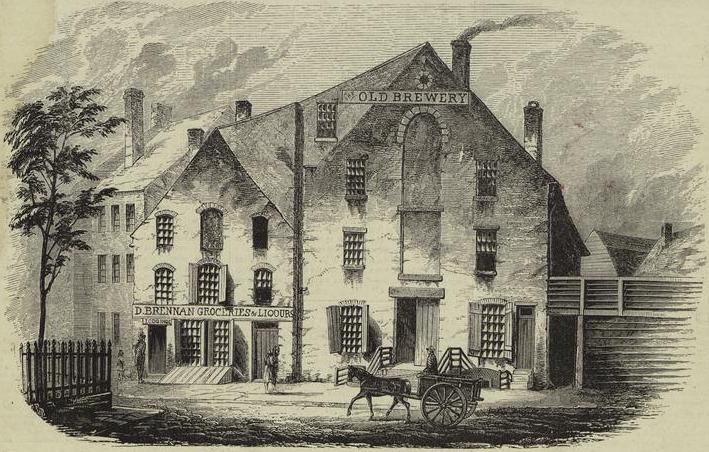
Perhaps the most notorious example of an early New York brewery was the Coulthard’s Brewery situated on the banks of Collect Pond. It survived the draining of that polluted body of water, only to survive as the center of the most disreputable elements of the Five Points neighborhood. It was eventually demolished in 1853, replaced with a mission house.
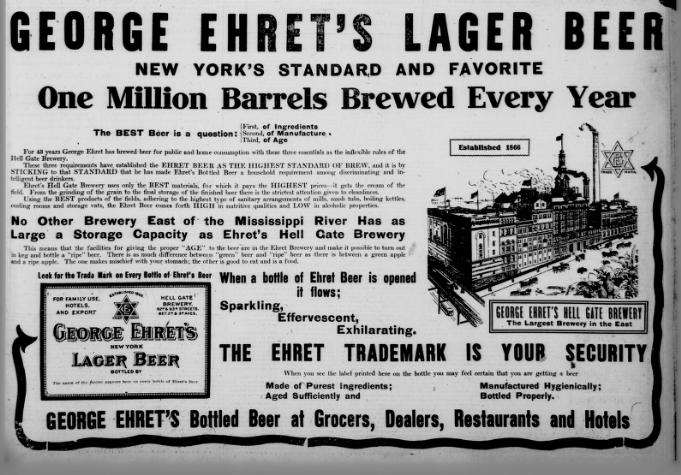
George Ehret was New York’s most successful brewer of the late 19th century. His assertion that ‘no other brewery east of the Mississippi River has as large a storage capacity as Ehret’s Hell Gate Brewery‘ was certainly accurate. This ad from 1909 presents a company still at the top of its game. However Ehret would encounter serious opposition in the coming years, with both World War I and Prohibition cutting short the brewery’s meteoric success.
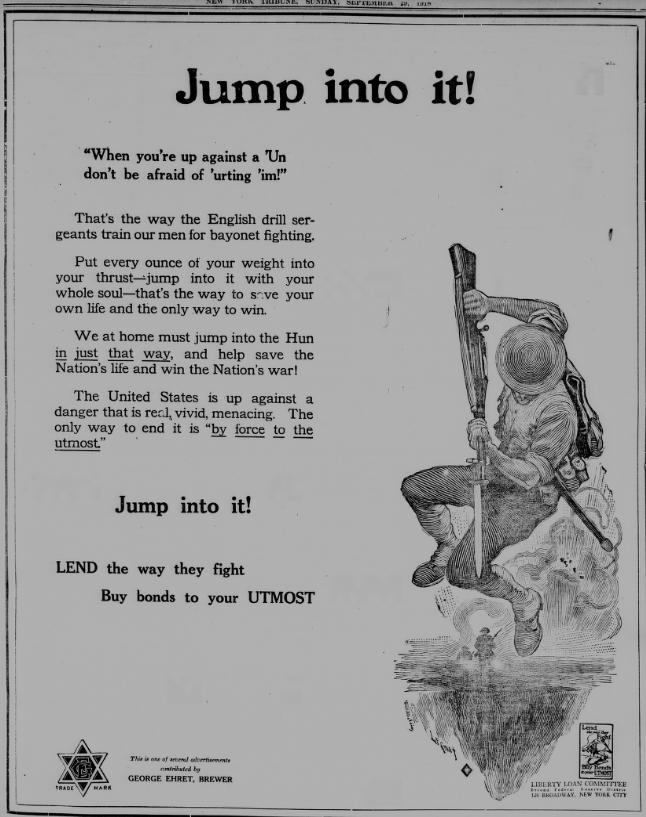
Ehret was stuck in Germany during World War I due to illness, not a great place to be during a war. His entire estate was seized by the government while he was away. When he finally returned, he threw his weight behind pro-American causes to banish any suspicions. This U.S bonds ad from 1918, the year Ehret returned to New York was one of many placed by the brewery.
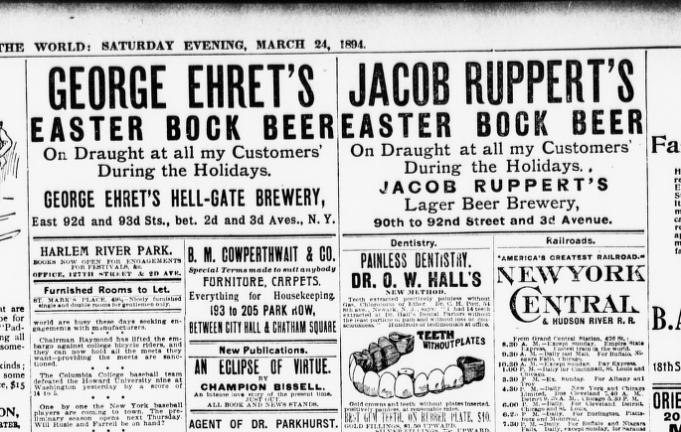
The brewery of Jacob Ruppert wasn’t just situated next to Ehret’s in this 1894 New York World newspaper; the buildings themselves were near one another, in the burgeoning neighborhood of Yorkville on the Upper East Side. (Newspaper clippings courtesy the Library of Congress.)
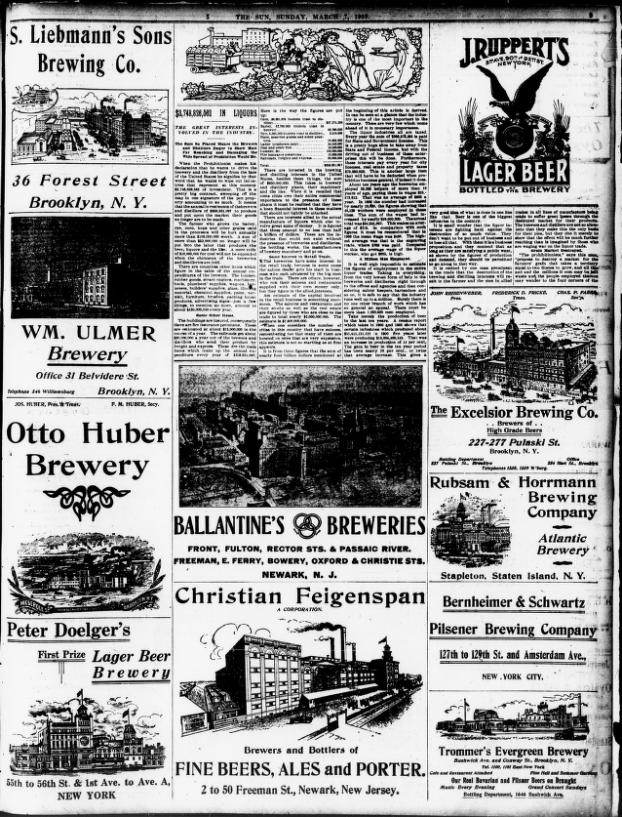
A sample page from a 1909 New York Sun newspaper illustrating some of the many breweries in the region. Included here are the Liebmanns (who produced Rheingold Beer), the Otto Huber Brewery, William Ulmer, Trommer’s and the Excelsior Brewing Company — Brooklyn most prominent lager brewers.
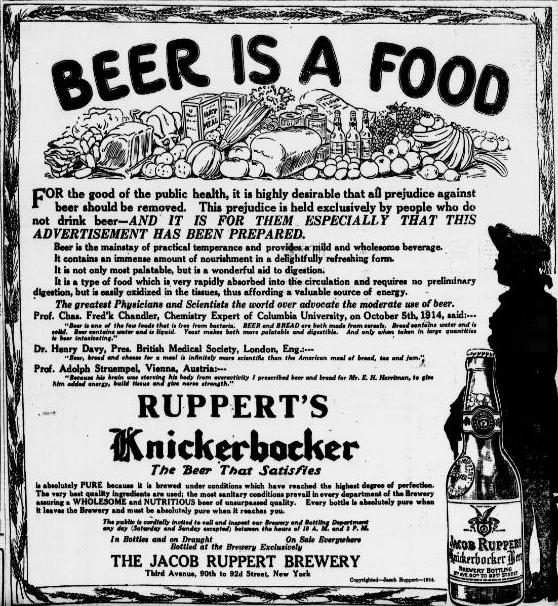
Temperance causes were greatly beginning to clamp down on the brewing industry, so beer makers attempted to market their product as true American beverages — with links to the Founding Fathers — or as products important to a person’s health. This Knickerbocker Beer ad from 1914 gamely attempts both.
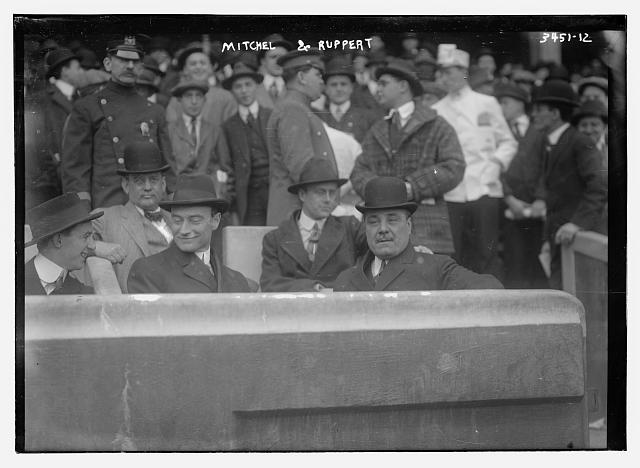
New York’s ‘boy mayor’ John Purroy Mitchell sits with Jacob Ruppert at the Polo Grounds in anticipation of a game by the team owned by the brew man, the New York Yankees. The Yankees would play at the Polo Grounds until 1923, when they moved to the newly built Yankee Stadium.
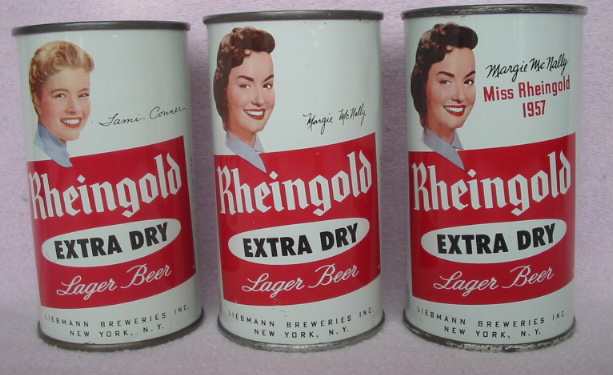
Rheingold Beer was one of the few remaining locally-based brewers to survive by the mid 20th Century, partially thanks to their annual Miss Rheingold beauty competition. [source]
This jingle, with true New York flavor, was featured in our podcast, but it really works better as a vintage television commercial!
And this Schaefer’s advertisement visualizes a world where robots are all-in-one bartenders.
I want to especially thank my guest host this week, Scott Nyerges, photographer, filmmaker and my old college friend!
Oh, and do you need another reason to have a beer today? Well, it’s the birthday of Joseph Mitchell, born in 1908, the author of a great many profiles for The New Yorker. One of his best known collections is ‘McSorley’s Wonderful Saloon‘ from 1943, featuring a classic New York profile of the old ale house on East 7th Street.
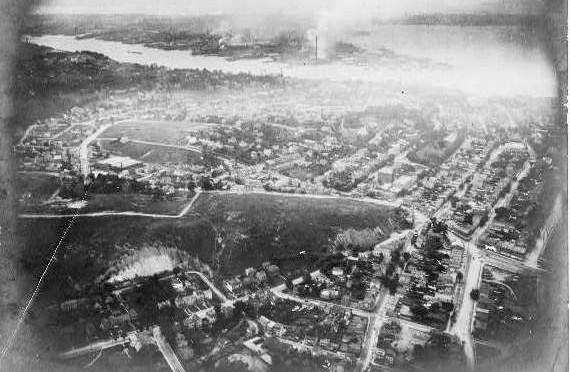
The sky’s the limit: Staten Island from the vantage of a hot air balloon, August 1906. (Courtesy LOC)
“God might have made a more beautiful place than Staten Island, but He never did.” — George William Curtis
If you’ve ever been slightly bemused by the newspaper profiles of trendy neighborhoods, presented as though the reporters were urban archaeologists ‘discovering’ heretofore hidden pockets of the city, then you’ll find amusement in this New York Tribune article from July 1912.
Hopefully to snag the attentions of Manhattan businessmen, the Tribune staff devoted an entire section in their Sunday section to extolling the many virtues of one of its more foreign corners — Staten Island.
The other island borough may have indeed been a mystery to many Tribune readers; the city had taken over ferry service just a few years previous, and there were no bridges yet linking Staten Island to Brooklyn. Many Manhattanites in 1912 harbored the impression that Staten Island, once known as a rural recreational getaway, was now a dull and uncivilized farmland with a few scattered industries.
But this Tribune article was inspired by a promise that would finally draw Staten Island into the fold — the subway.
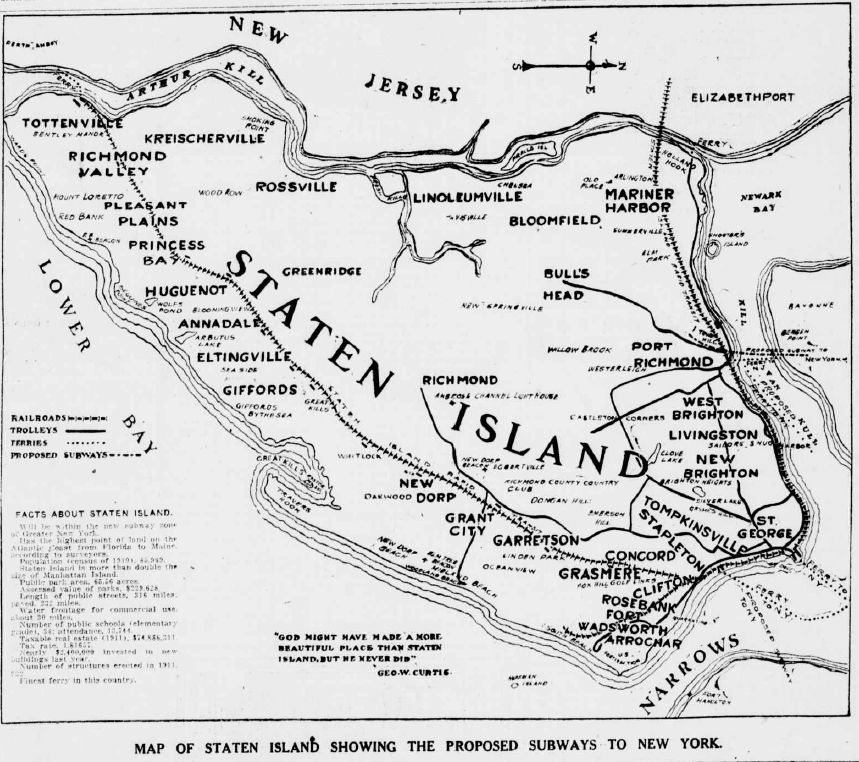
Below: A real estate map of Staten Island from the 1912 article. The dotted lines at the bottom denote where the proposed subway line would have been.
Manhattan’s Interborough Rapid Transit Company (IRT) and the Brooklyn Rapid Transit Company (BRT) were nearing an agreement with the city to expand the present subway system and create new lines throughout the city. This plan, called the Dual Contracts, helped lay out most of the current New York subway routes today. However there were many potential lines that were never built (despite the efforts of a few future mayors). Among the most ambitious was a subway link to Staten Island.
It was with the anticipation of this underwater track (linking Stapleton to Bensonhurst, see map abovve) that the Tribune hoped to regale readers with the unspoiled wonders of New York City’s least populated borough.
Forget the fact that Staten Island already had an intimate, but thriving old-money scene, the vestiges of a genteel society formed among the mansions of tycoons along the north shore. Fast-paced urbanites would have considered them stubbornly charming but boorish. Society and recreation were not the appeal.
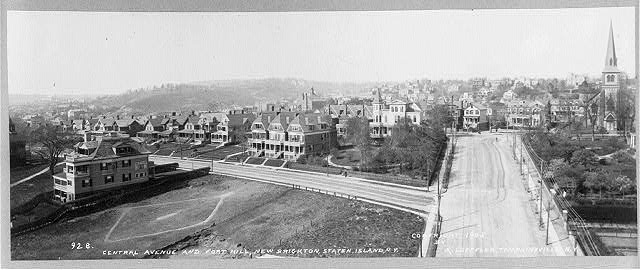
Below: New Brighton, at Central Avenue and Fort Hill, 1905 (LOC)
The Tribune focuses on Staten Island’s destiny as ‘one of the greatest shipping and manufacturing centres of the world’ and wonders deliriously at the delights of that great, underused waterfront. Some highlights from the article (which you may read in full here):
1) Staten Island’s terrific gas supply, the borough’s oldest public service supply, lives up to its motto to ‘Make Gas Service Good Service And Then Some’. Its most recent successes include a yard dyeing manufacturer, the gas engines of the Swift Beef Company, and soldiering furnaces for the U.S. Department of Lighthouses. And the price of gas is going down!, claim management.
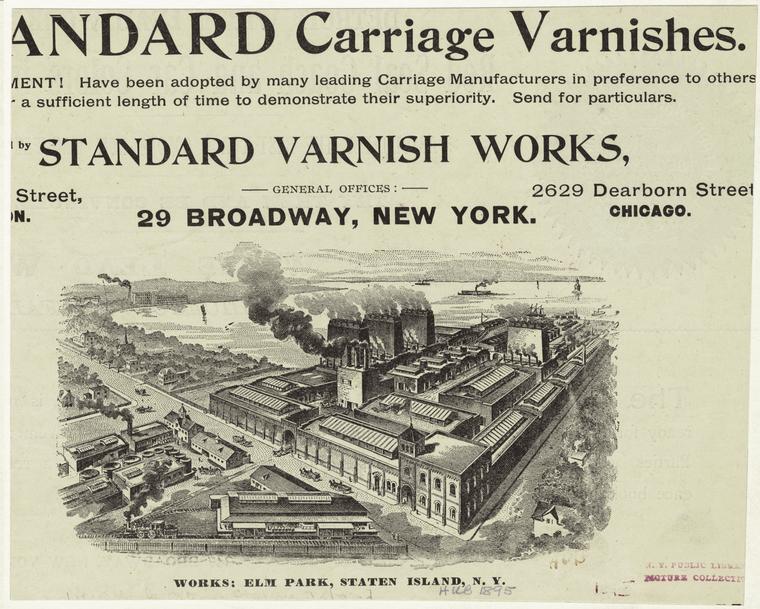
2) The Varnish Capital: One of Staten Island’s great success stories is its varnish industries, most notably Standard Varnish Works, which has miles of underground pipes that filter oil and turpentine from the docks to large storage tanks in the neighborhood of Elm Park. Sold around the globe, “the sun never sets on products manufactured by the Standard Varnish Works.”
3) ‘Country Life’, not ‘Lonely Life’: In New Dorp, homes upon a ‘noble ranges of hills’ have access to a fine beach, according to the article. “The loneliness that so many people fear as the bane of country life has had in no chance to make itself felt in New Dorp.” A resident describes it as ‘earthly paradise’.
4) Building Innovation: One of Staten Island’s most successful builders is W. H. C. Russell, ‘the pioneer … of the famous asbestos ‘Century’ shingles’, used in the construction of public schools and government buildings.’
Below: The glory of varnish, Standard Varnish Works in Elm Park, that is. (NYPL)
5) Hot Development Opportunities (But Not Too Hot): A St. George realtor admits, “Do not think for a moment that I have been tearing up the earth or anything of that sort, but … I have been doing very satisfactory business.”
6) Great Subway Expectations: The report speculates that the new subway link will get commuters from Stapleton to lower Manhattan in about thirty minutes, bringing the borough’s ‘most entrancing’ residential areas into the subway’s five-cent-fare zone.
7) Don’t Let The Factories Bother You! ‘The man who prefers to live in a place with superb country features, where are green fields, towering shade trees, winding roadways inviting to autoists and owners of harness horses … should not turn his step away from Staten Island because bigger factory zones are going to be built there soon.’
8) There’s Always South Beach: Staten Island’s southern amusement area, rivaling Coney Island, remained a vital recreation center for the city in the 1910s, thanks to Staten Island’s present train services. “Rapid transit has converted an unknown and unused beach into a gay and popular resort, and today South Beach rightly claims to be Coney Island’s only rival.”
9) ‘The Garden Spot of Greater City Of New York‘: ‘Verily, extremes meet here. Already quaint and prosperous little villages have begun to take on new life and expand ……. [E]very day adds to the list of those who through out-of-door life and sunshine are ‘finding themselves’ and adding measurably to the pleasures as well as to the number of their days.’
10) ‘Spotless Town‘: But if you need to be around wealth, the old Vanderbilt estate is being chopped up into ‘high class lots’, near the Fox Hills Golf Course, ‘the finest course in America’!