Categories
Holidays Newspapers and Newsies

How New York newspapers covered the first Labor Day — September 5, 1882

Clothing cutters, horseshoers, shoemakers, upholsterers, printers, house painters, freight handlers, cabinet makers, varnishers, cigar makers, bricklayers and piano makers.

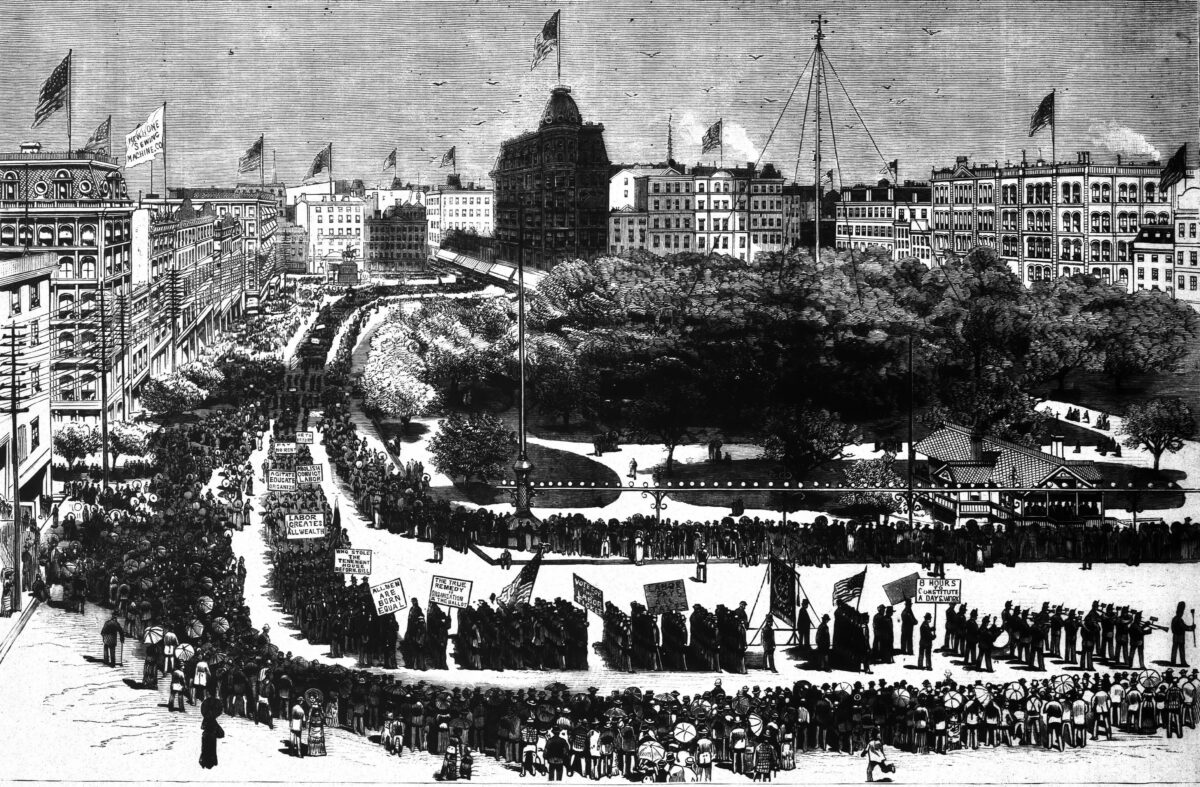
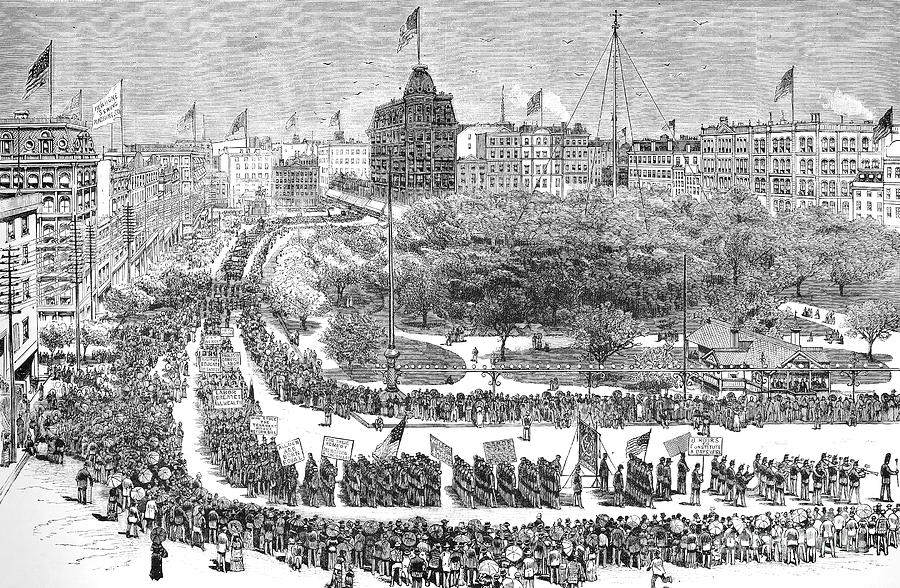
The first American Labor Day began on September 5, 1882, with 10,000 workers from a wide variety of occupations circling Union Square, then parading up to the area of today’s Bryant Park. (A picnic ‘after party’ of sorts took place at a park at today’s Columbus Avenue and 92nd Street.)

Individual workers organizations had taken to the street before, sometimes violently. But this peaceful protest, this public solidarity, took the issues of New York laborers to the heart of the city in a way that could not be ignored.*

*New Yorkers got the Labor Day idea from Canada. Read more about the differences between May Day and Labor Day in this article

Illustration of the first Labor Day parade around Union Square, 1882
We take it for granted today. Labor Day is no more than a day off for most people today.

But looking at the original press notices from newspapers of the day (from the following day, September 6, 1882) suggest an event certain New Yorkers recognized as monumental.

Others considered it trivial, a nuisance or even a dangerous gathering of malicious intent.

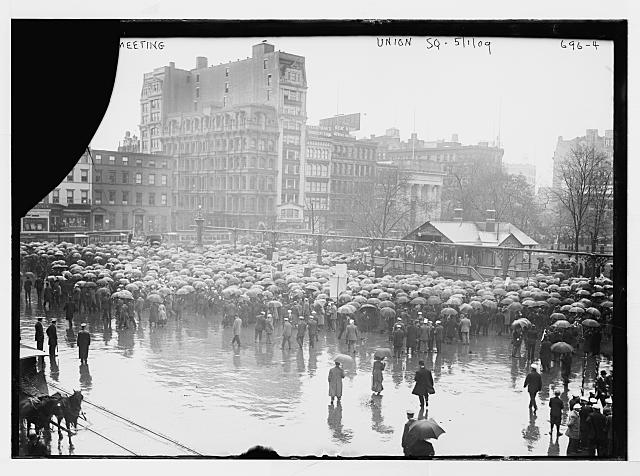
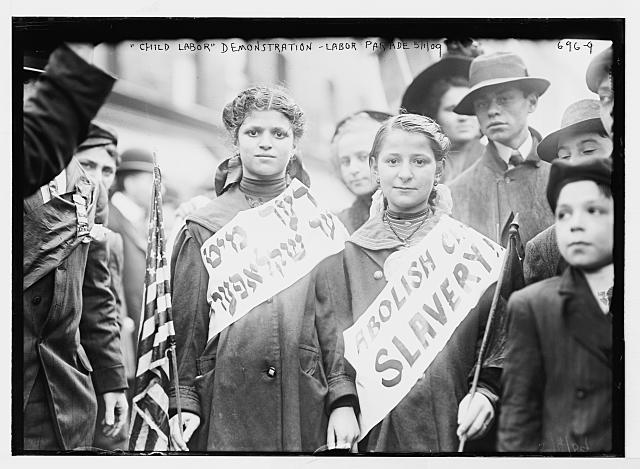
Union Square would continue to be the location of Labor Day festivities for decades afterwards. The image below is of a parade from 1909 (courtesy LOC):
The New York Tribune begins nice enough. “The men who took part in the labor parade generally appeared to be persons of no small intelligence.” The paper’s vitriol was saved for the leaders of the movement, in this case organizers from the Central Labor Union, “demagogues of the worst kind.”

“It is a pity that workingmen allow themselves to be so cheapened.” The Tribune accuse the organizers of an ulterior motive — political chest-thumping.

“But it is not at all unlikely that certain demagogues and dishonest leaders thought it a good time of year to show the two great political parties that there are ten thousand ballots in this city in the hands of men who … might be at the disposal of somebody — for a consideration.”

Indeed, there would be a statewide election exactly two months later, sweeping a host of Democrats into office, including Grover Cleveland into the governor’s office.

Even their reporting of the parade itself is tinged with a little condescension.

“The parade of workingmen yesterday morning was not nearly as large as was expected by the leaders.  This is probably due to the unwillingness of many workmen to lose a day’s work.”

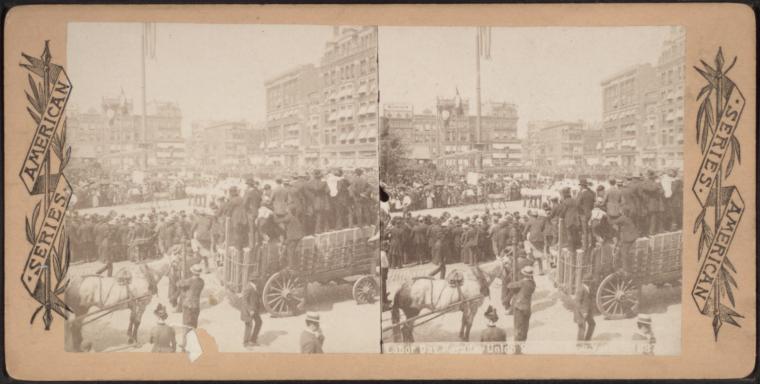
Labor Day parade in Union Square, 1887 (NYPL)
The New York Times seemed to find the parade slightly whimsical, almost superfluous. It echoed the disappointing turnout, but describes the event as calm, “conducted in an orderly and pleasant manner.”

The coverage focuses undue attention on the paraders’ fashionable attire.

“The great majority smoked cigars.” However they stress that the good behavior is attributable to the fact that organizers banned alcohol. This detail is mentioned in no other coverage that I read.

Where the Tribune attested the lower-than-expected turnout to men not leaving their posts, the Times found a different reason — “due to the fact that [laborers] preferred to enjoy the day in quiet excursions in Coney Island, Glen Island and elsewhere.”

Children at the Union Square Labor Day parade, 1909 (NYPL)
The enthusiastic New York Sun describes it as a dry and brutal day. “[T]he rays of sun even in the early morning were very hot, and not a breath of wind brought relief from the oppressive heat.”

The same parade considered disappointing by the Tribune and the Times was conversely described by the Sun as a mob scene.

“As far ahead as one could see and as far down the side streets as forms and faces could be distinguished, the windows and roofs and even the lamp posts and awning frames were occupied by people anxious to get a good view of the first parade in New York of workingmen of all trades united in one organization.”

Far from a nuisance, the Sun recognized the parade as an important banner moment in history. Its description of events is truly painstaking.

Many newspapers outside New York mentioned the parade the following day.  St. Paul’s Daily Globe in Minnesota said “the great labor demonstration today was a success,” quoting a number in attendance (20,000) almost double the actual projected number.

So did the Dallas Daily Herald, who put the event on their front page.

Meanwhile, it should be noted that most major New York newspapers neglected to put the labor parade on their front pages.
Categories
Amusements and Thrills

The Monster Tree: A California Sequoia Visits New York City 1855

The mighty Sequoia tree,  principally existing today in northern California, embodied the breathtaking diversity of the North American continent when it was first discovered by European explorers in the 1830s.  The Native American tribes of the west coast revered them.  Early European explorers too marveled at this display of nature’s great flourish, spinning fantastic tales of ‘monster trees’ that breached the sky.

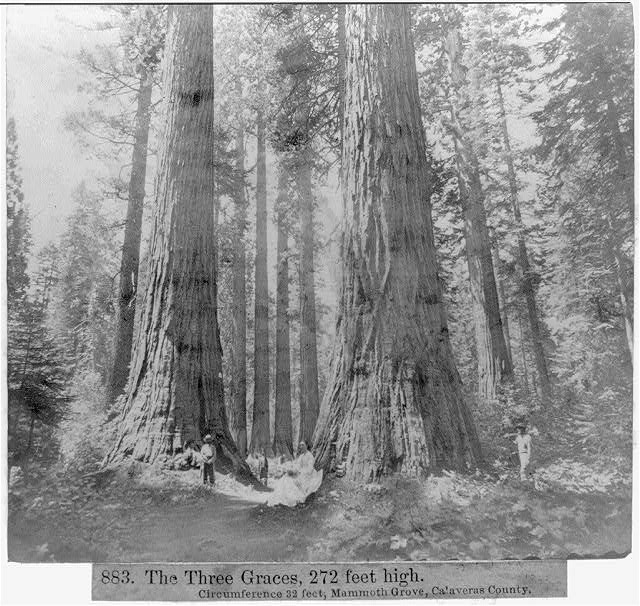
From a photograph in 1866 -- The Three Graces, 272 feet high, circumference 32 feet, Mammoth Grove, Calaveras County (Library of Congress)
From a photograph in 1866 — The Three Graces, 272 feet high, circumference 32 feet, Mammoth Grove, Calaveras County (Library of Congress)


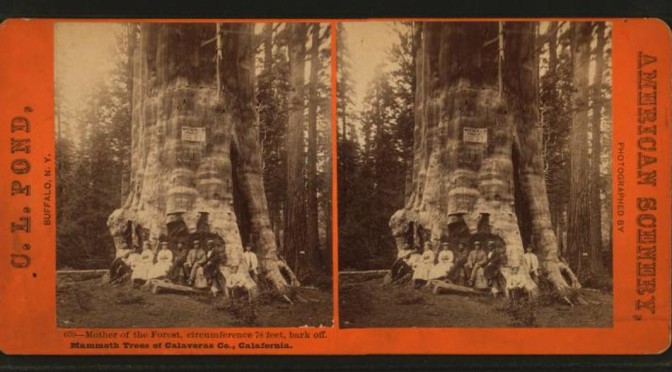
The legends were proven true in the 1840s at the start of what would become known as the California Gold Rush.  The first hotel, monopolizing on the wondrous discovery, was built near a Sequoia grove in Calaveras County. Each of the trees were given nicknames like ‘The Salem Witch’ and the ‘Old Bachelor’. **  But the grandest was ‘Mother of the Forest’, 363 feet tall and thousands of years old.

So naturally in 1854, the Mother of the Forest was stripped of much of its its bark and taken on a tour of the east, courtesy the entrepreneur George L Trask.

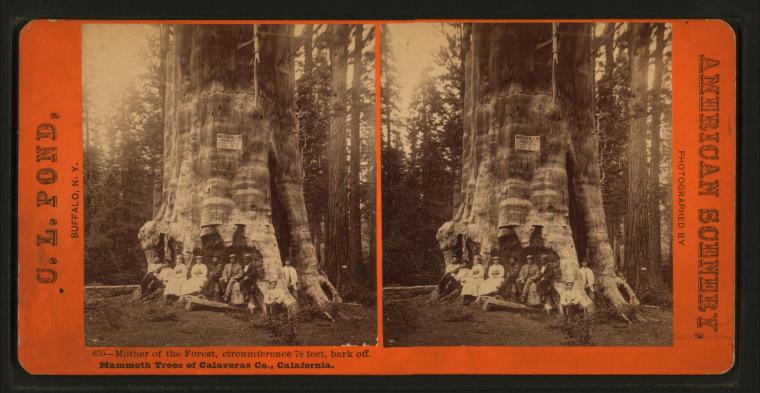
The Mother of the Forest, pictured with 78 feet of the tree’s bark already removed.

Courtesy New York Public LIbrary


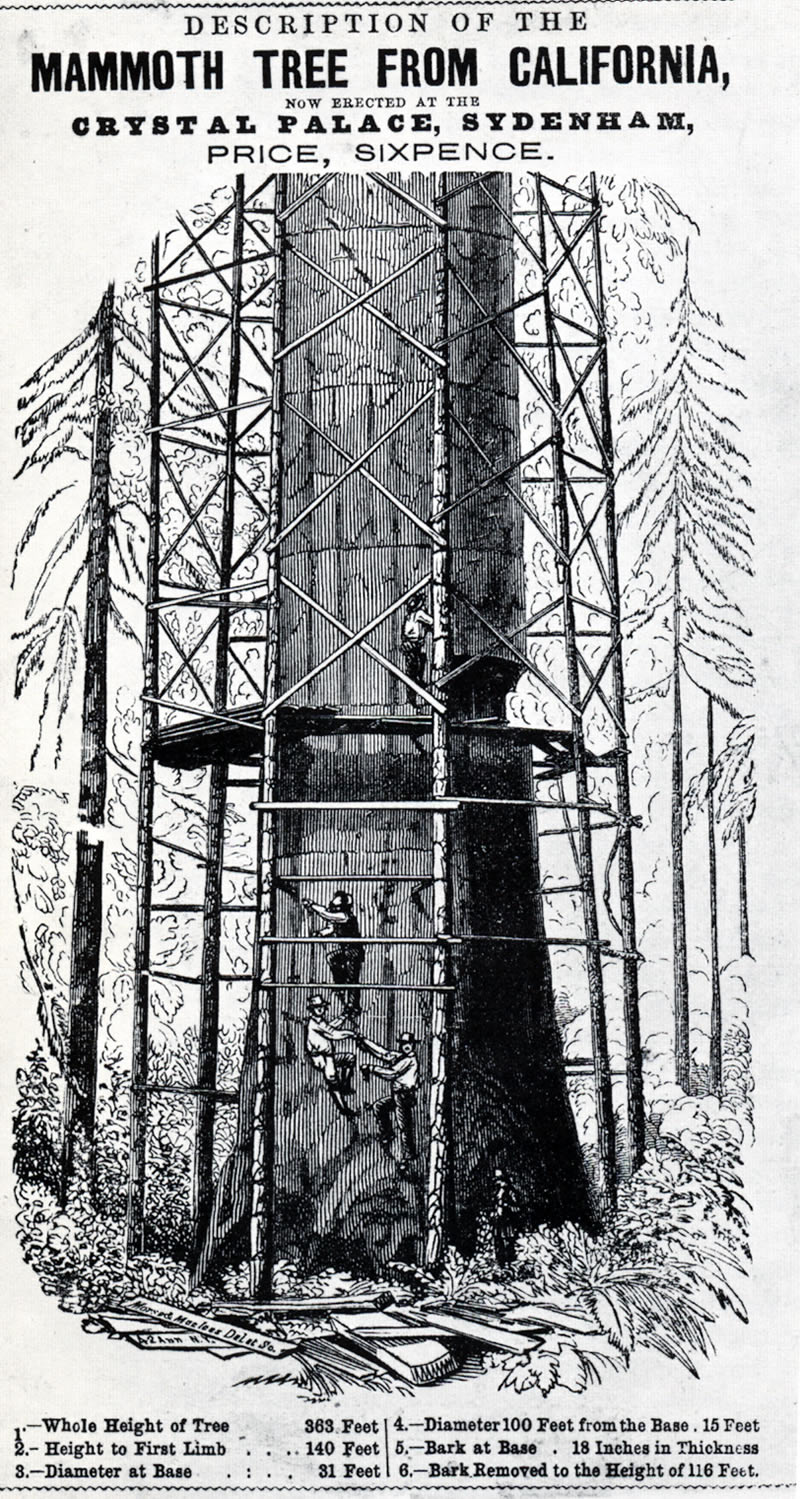
The  bark was carefully sheared from the tree, to a height over 110 feet. The disembodied bark was then “carted overland 80 miles to Stockton, whence it was shipped down the river to San Francisco, and then on a clipper vessel around Cape Horn to New  York.”  It arrived sometime in early 1855 for a grand display in the city.

tree2

But where in New York City in 1855 could you exhibit such a gigantic thing? Why, there was only one place — the Crystal Palace.

The famed Exhibition of the Industry of All Nations – detailed in our podcast on the Crystal Palace – had recently closed, a well-publicized financial failure. However the Palace structure remained open for visitors and the Latting Observatory across the street was still attracting audiences.  (It would not burn down until the following year.)

That summer, on July 4th, 1855, the tree bark, laid over a tall scaffolding, was carefully reconstructed in the Palace at the very spot where the George Washington equestrian statue once stood. An appropriate spot, as the exotic trees were originally given the scientific name of Washingtonea Gigantea.

Alongside the constructed tree were a display of daguerreotypes of the tree in context with the forest, well before she was stripped of bark.

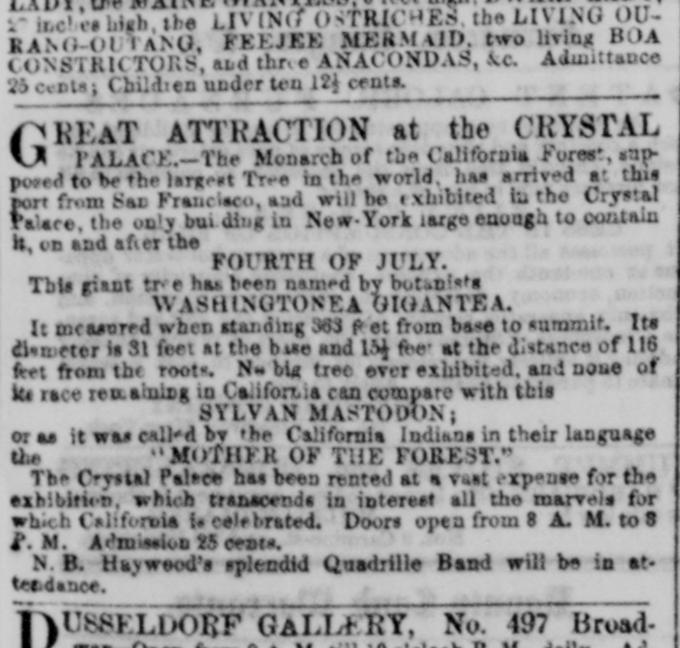
Below: From a listing in the New York Daily Tribune, July 6, 1855:

2

It was promoted with a certain Barnum-eque style although without Barnum of course. (His failed tenure as the Crystal Palace president has soured him to the spot immeasurably.)  According to the New York Sunday Courier, over 7,000 visitors came on the first day to admire the tree.

Even a few jaded journalists of the age were impressed by the tree. From a short-lived newspaper called the Leader, under the headline, “The Eighth Wonder of the World – the Mammoth Tree”:

“We have paid a visit to the Crystal Palace and have been gratified beyond our most sanguine expectations. We supposed that this concern was closed and that we should find nothing to please the eye beyond naked walls and vacant space; but, judge of our astonishment, when we found the space under the dome occupied by one of the greatest curiosities of the age….

Sebastapol has not been taken yet [a reference to a lengthy battle in the Crimean War] but this towering monarch of the forest has, and is now in exhibition at the Crystal Palace.”

Because the tree was so clearly cobbled together from parts, others rationally questioned its validity.  From the New York Times, August 8, 1855:

“We very much enjoyed [the tree] but so we did the Automaton Man and the Charmed Snake story … and several other things which a more curious examination of reveals as belonging to the department of questionables.

[W]e have no assurance, from seeing this clothed skeleton, that this tree was actually so large. A little skepticism is somewhat pardonable, taking into account the temptations held out to those who recollect the proverbial gullibility of New York site-seers.”

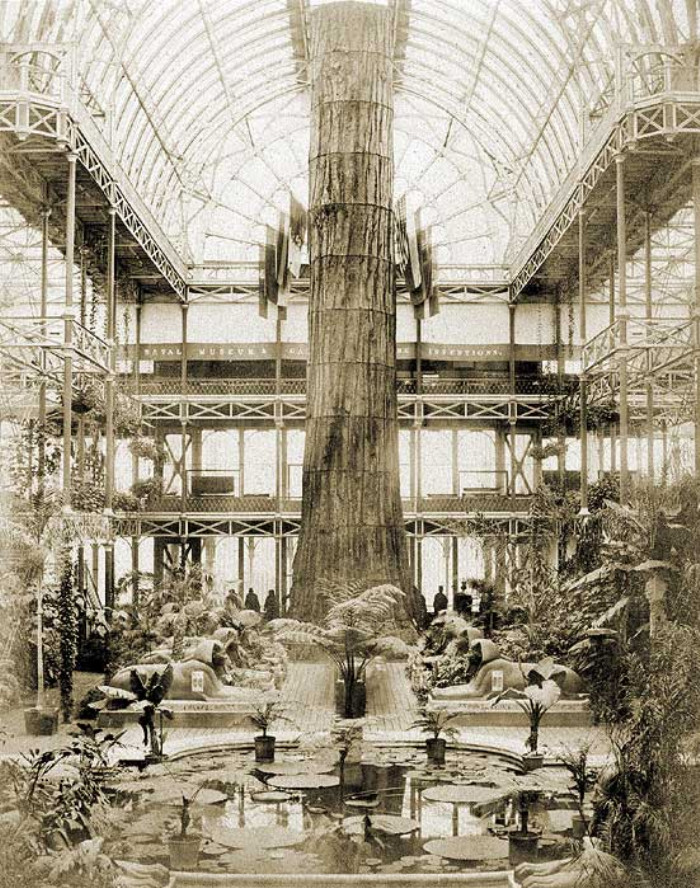
The journeys of this poor tree husk were not quite done.  After the New York display, the pieces were placed upon a ship and taken to London to be displayed at their Crystal Palace.  In 1866 a fire swept through London’s Crystal Palace, destroying this remainder of the Mother of the Forest.

The tree as it appeared at the London Crystal Palace, 1856

3


**By the 1860s most of the trees would be given names. There were even specimens named for Henry Ward Beecher, Daniel Webster and — William Cullen Bryant! (source)


Categories
Parks and Recreation Podcasts

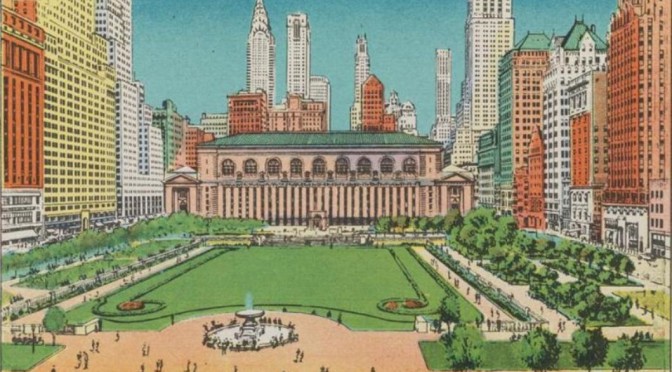
Bryant Park: The Fall and Rise of Midtown’s Most Elegant Public Space

NEW PODCAST  In our last show, we left the space that would become Bryant Park as a disaster area; its former inhabitant, the old Crystal Palace, had tragically burned to the ground in 1858. The area was called Reservoir Square for its proximity to the imposing Egyptian-like structure to its east, but it wouldn’t keep that name for long.

William Cullen Bryant was a key proponent to the creation of Central Park, but it would here that the poet and editor would receive a belated honor in the 1884. With the glorious addition of the New York Public Library in 1911, the park received some substantial upgrades, including its well-known fountain. Over twenty years later, it took on another curious present — a replica of Federal Hall as a tribute to George Washington.

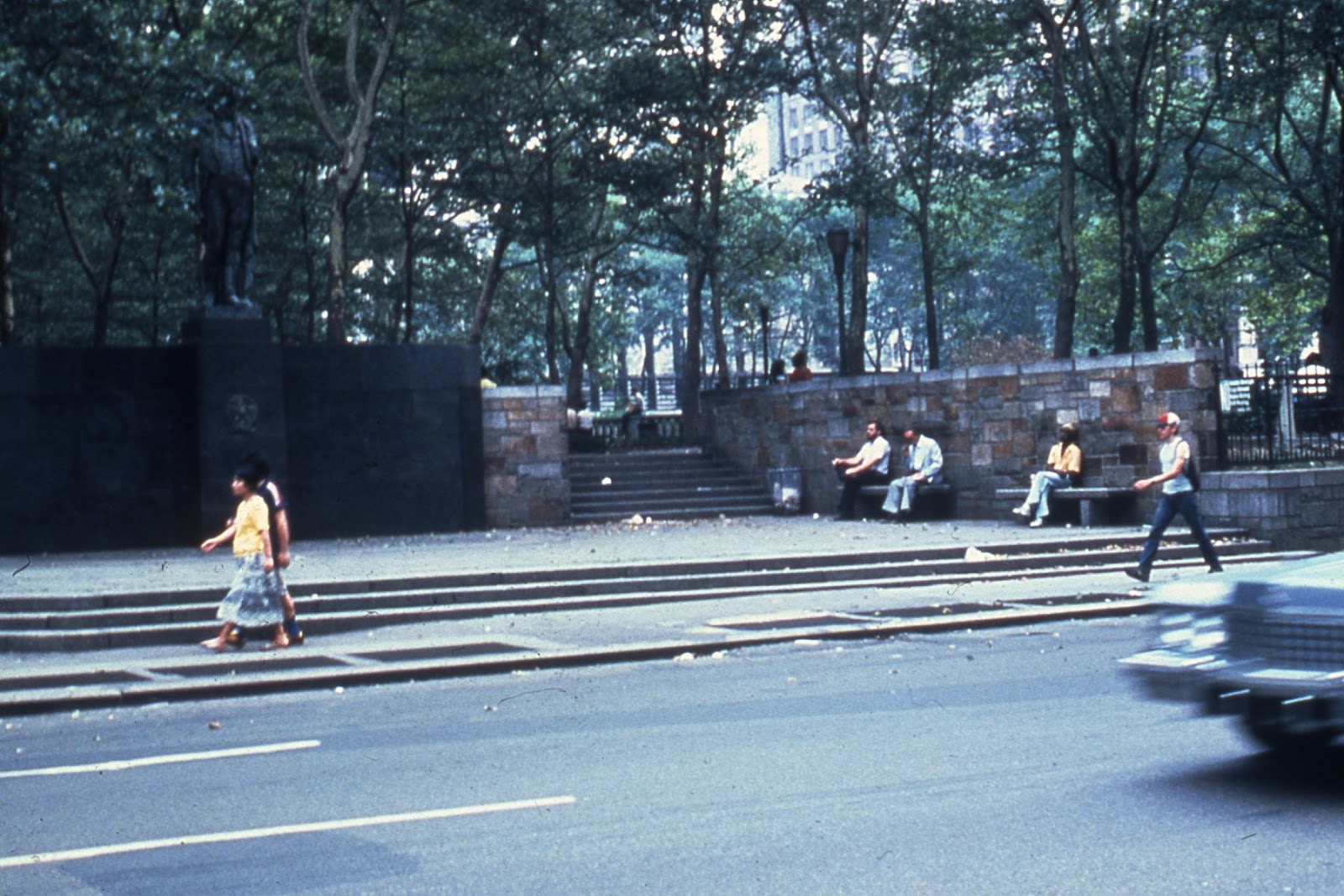
By the 1970s Bryant Park was well known as a destination for drug dealers and most people shied away from its shady paths, even during the day. It would take a unique plan to bring the park back to life and a little help from Hollywood and the fashion world to turn it into New York’s most elegant park.


The Bowery Boys: New York City History podcast is brought to you …. by you!

Starting with this episode, we are doubling our number of episodes per month. Now you’ll hear a new Bowery Boys podcast every two weeks. We’re also looking to improve the show in other ways and expand in other ways as well — through publishing, social media, live events and other forms of media. And we need your help to make these expansion plans happen.

We are now a member of Patreon, a patronage platform where you can support your favorite content creators for as little as a $1 a month.

Please visit our page on Patreon and watch a short video of us recording the show and talking about our expansion plans. If you’d like to help out, there are five different pledge levels (and with clever names too — Mannahatta, New Amsterdam, Five Points, Gilded Age, Jazz Age and Empire State). Check them out and consider being a sponsor.

We greatly appreciate our listeners and readers and thank you for joining us on this journey so far. And the best is yet to come!


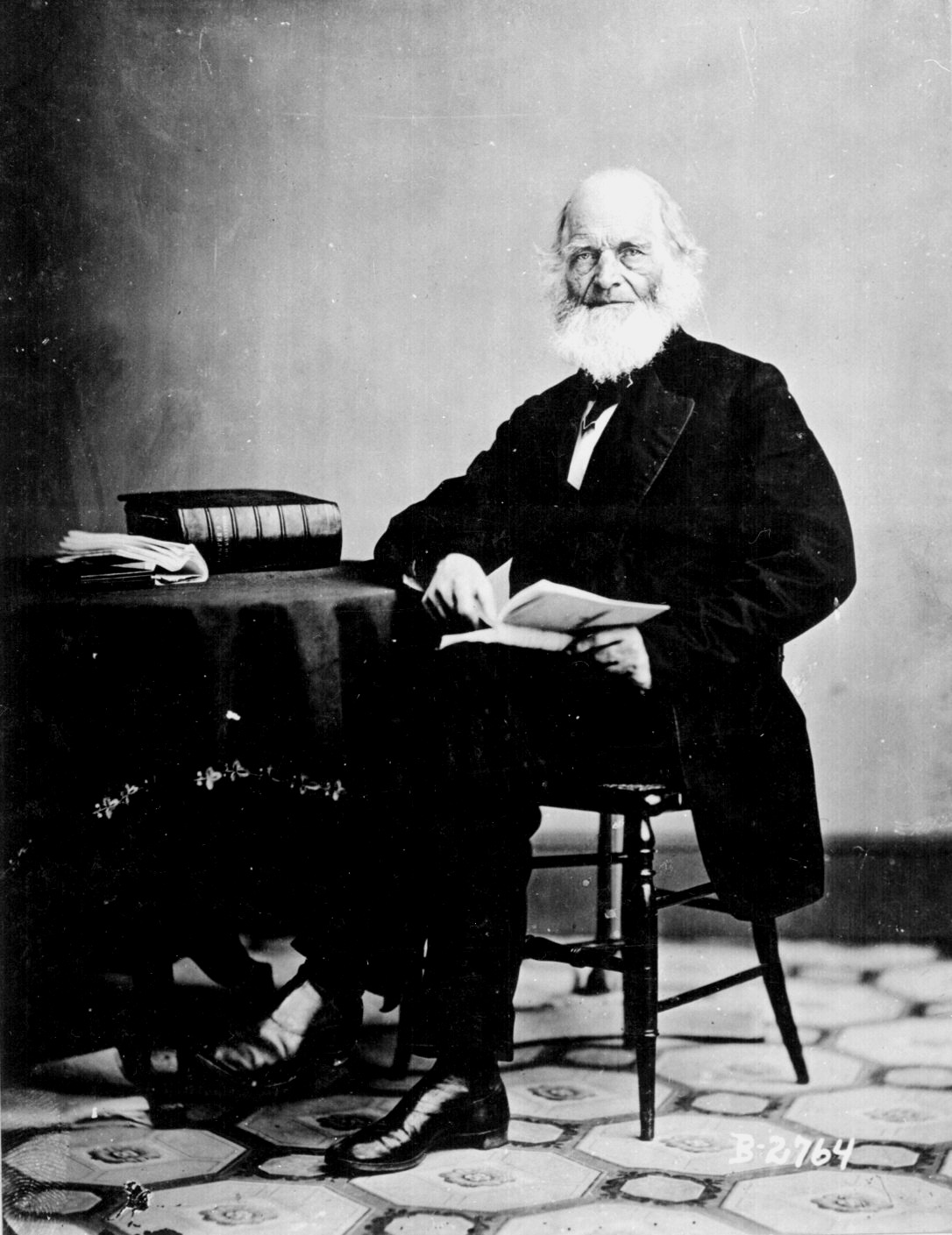
William Cullen Bryant, photo taken by Matthew Brady

2

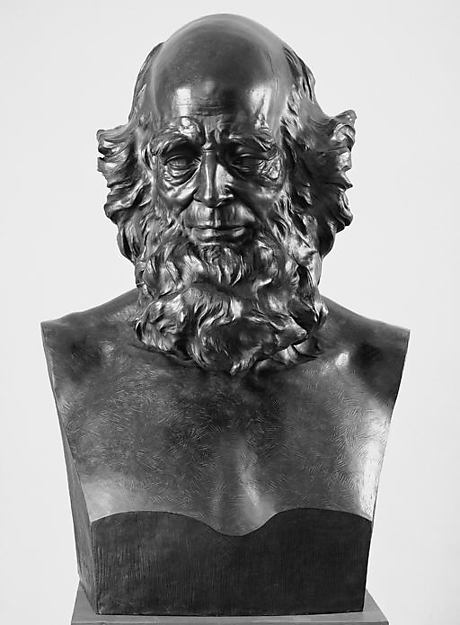
William Cullen Bryant in bust form, but Launt Thompson. It seems this bust has made its way back to the Metropolitan Museum of Art!

2

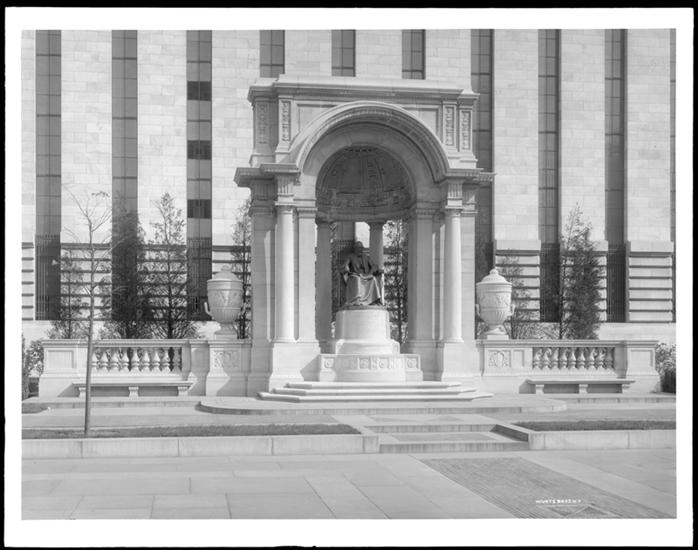
William Cullen Bryant installed in his marble niche behind the New York Public Library. This picture was taken in 1910, well before the radical redesign of the park in the 1930s. (Museum of the City of New York).

3

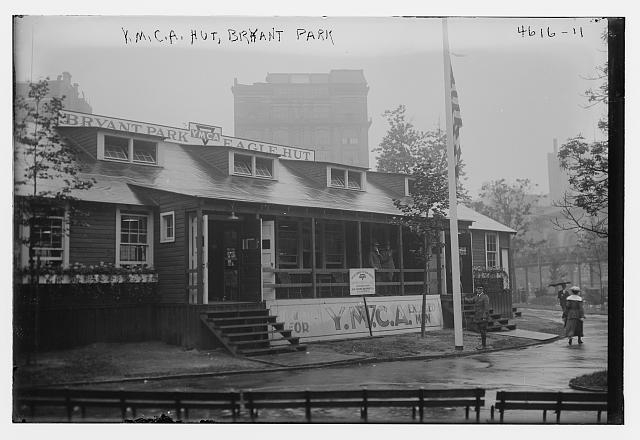
During World War I, the YMCA had a special ‘Eagle Hut’ built in the park for traveling servicemen. (Library of Congress)

2

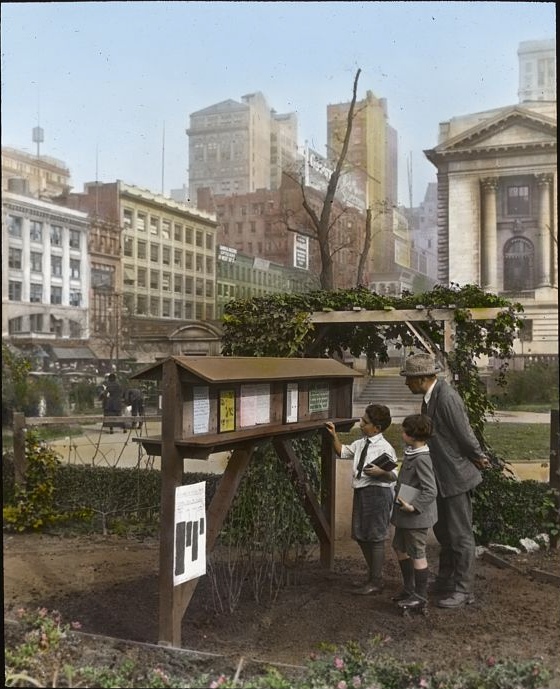
A colorful depiction of the Bryant Park ‘demonstration gardens’ that were planted during the war. (Library of Congress)

7096409143_3df8bc2aa4_b
2

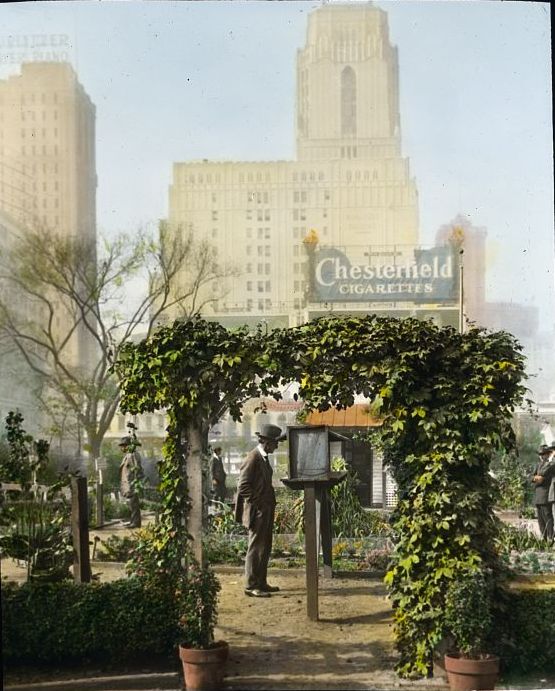
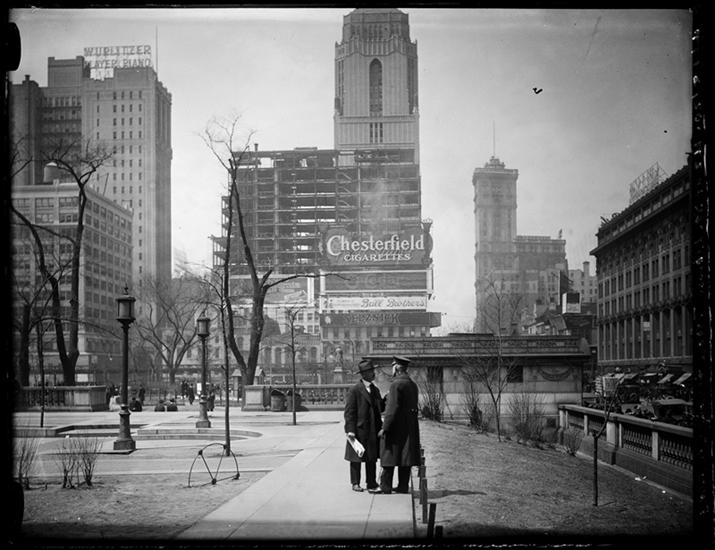
Bryant Park in 1920. Looking west on 42nd Street at 6th Avenue (you can see the elevated railroad!) In the distance is One Times Square. Note the reappearance of the Chesterfield Cigarettes billboard from the picture above. (Museum of the City of New York)

Bryant Park in 1920. Looking west on 42nd Street at 6th Avenue (you can see the elevated railroad!) In the distance is One Times Square. (Museum of the City of New York)

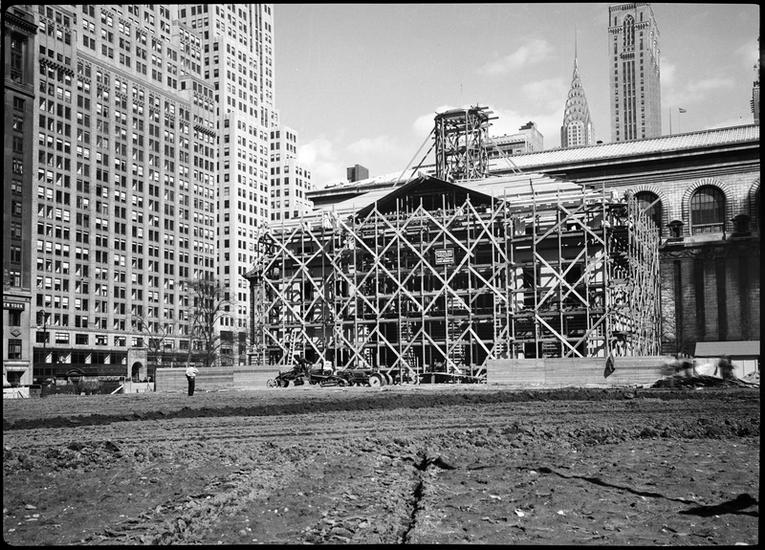
Constructing a replica of Federal Hall in a barren Bryant Park. (Picture taken by the Wurts Brothers, Museum of the City of New York)

8x11mm_X2010_7_1_ 703

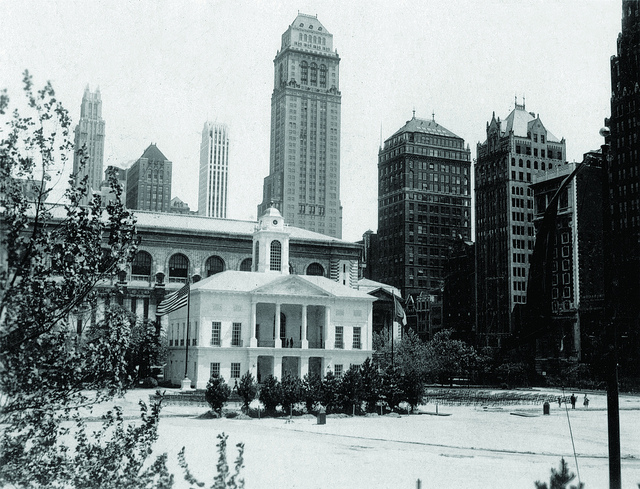
The Federal Hall reconstruction had a corporate sponsor — Sears Roebuck & Co. Here’s how it looked in better days. Believe it or not, the reproduction of Mount Vernon actually did get built in New York — in Prospect Park in Brooklyn! (Bryant Park Corporation)

2

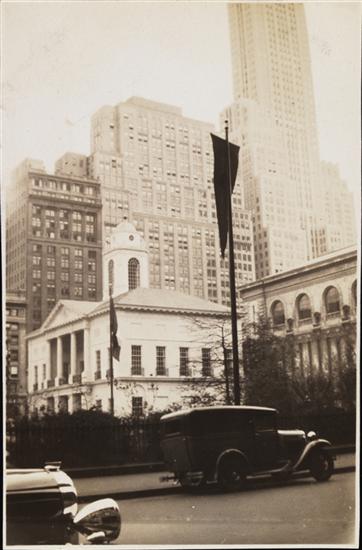
Bryant Park’s Federal Hall, May 1932. (Museum of the City of New York)

Bryant Park's Federal Hall, May 1932. Courtesy Museum of the City of New York

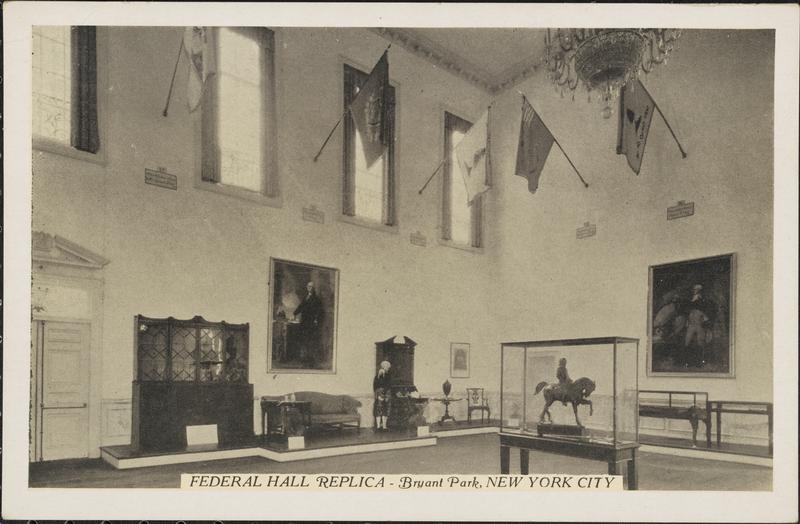
The interior of Bryant Park’s Federal Hall. (Museum of the City of New York)

The interior of Bryant Park's Federal Hall. (Museum of the City of New York)

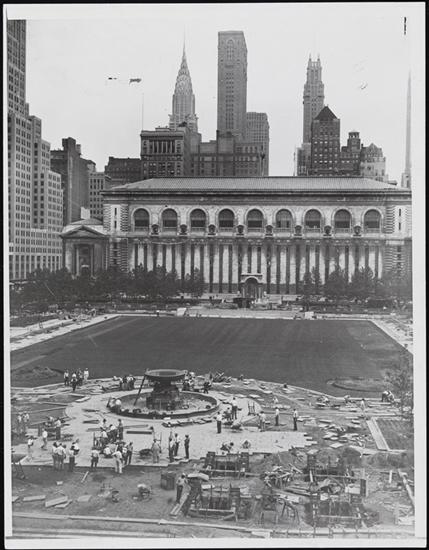
The reconstruction of Bryant Park in 1934, overseen by new Parks Commissioner Robert Moses

The reconstruction of Bryant Park in 1934, overseen by new Parks Commissioner Robert Moses

This photo was taken by Stanley Kubrick during his years as a photographer for Look Magazine. The caption reads “Park Bench Nuisance [Woman reading a newspaper, while a man reads over her shoulder.]” Courtesy Museum of the City of New York

This photo was taken by Stanley Kubrick during his years as a photographer for Look Magazine. The caption reads "Park Bench Nuisance [Woman reading a newspaper, while a man reads over her shoulder.]" Courtesy Museum of the City of New York

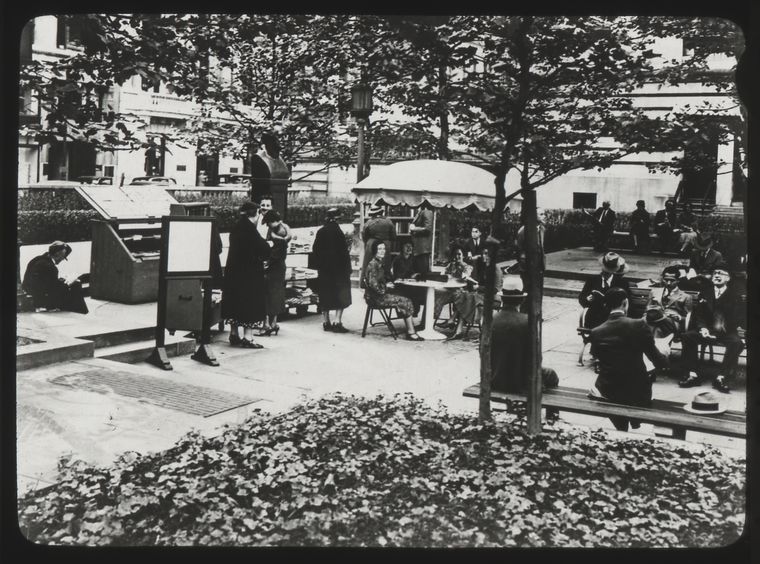
People enjoying the New York Public Library’s outdoor reading room, 1930s. (New York Public Library)

2

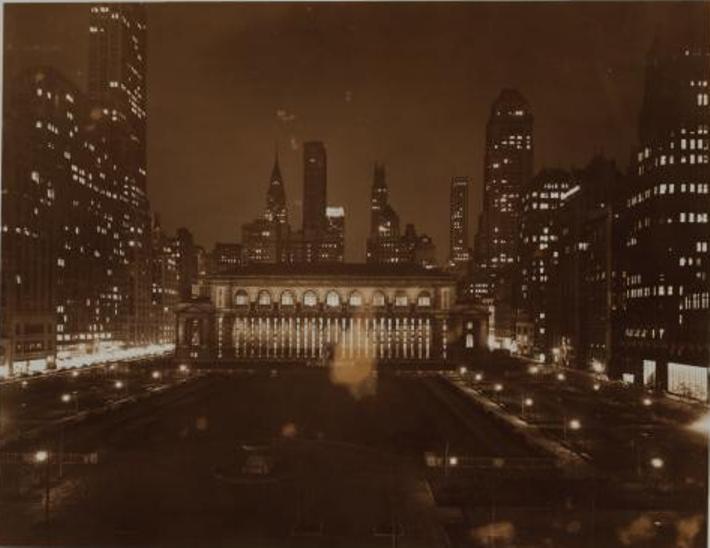
Bryant Park at night, photo by Nathan Schwartz, taken in 1938. (New York Public Library)

1a

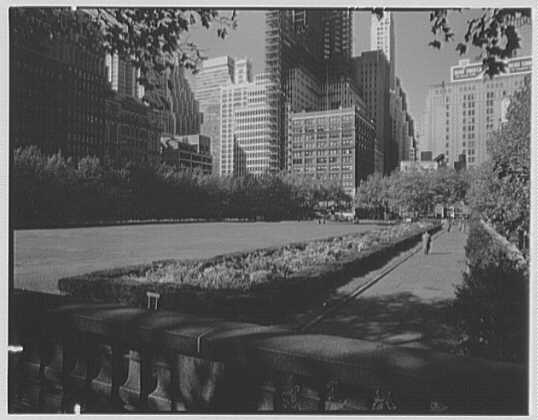
The hedges of the central lawn, photo taken in 1957. These were removed in the desperate effort to clean up the park in the late 1980s. (Library of Congress)

2

Bryant Park in the 1980s. High walls allowed for suspicious behavior to occur in the at all hours of the day. (Bryant Park Conservancy)

2

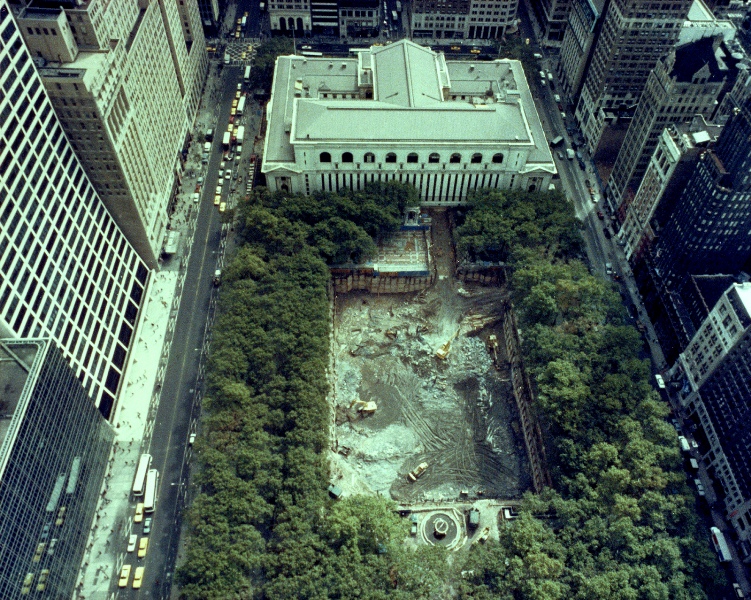
Overlooking the new renovations in the late 1980s (Bryant Park Corporation)

2

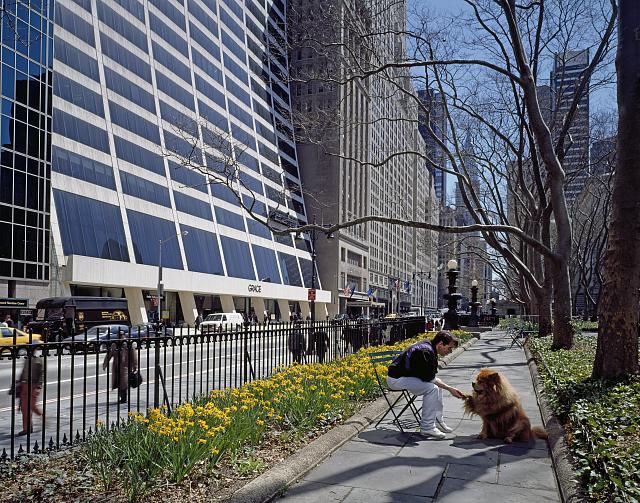
Bryant Park after the clean-up, taken sometime in the 1990s. Photo by Carol Highsmith (Library of Congress)

2

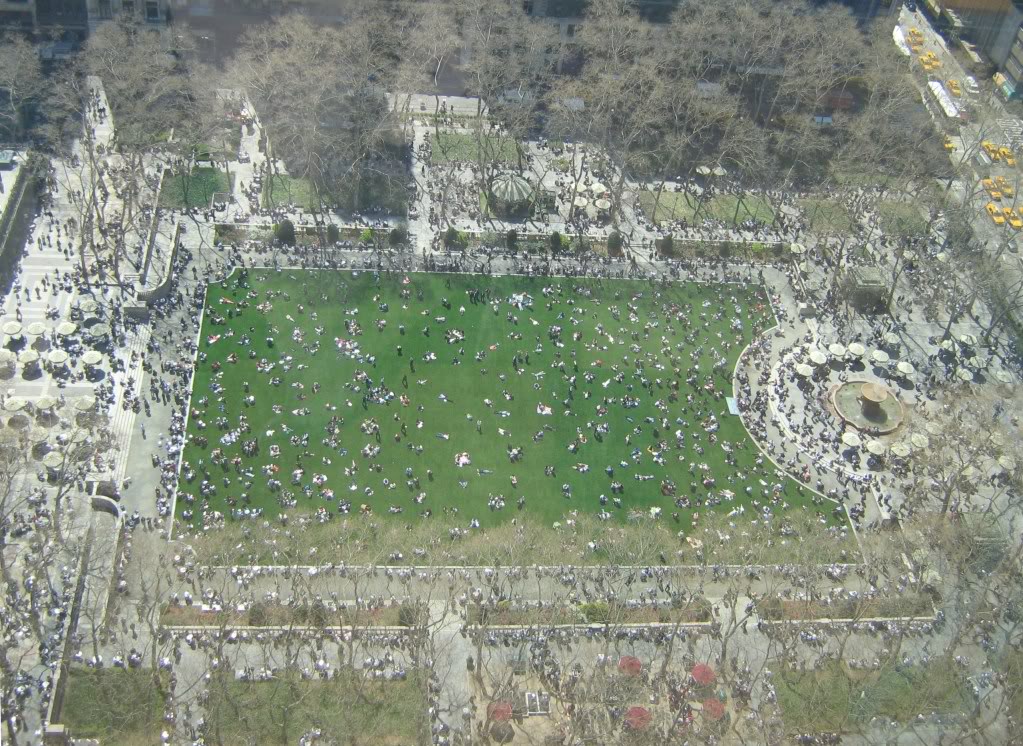
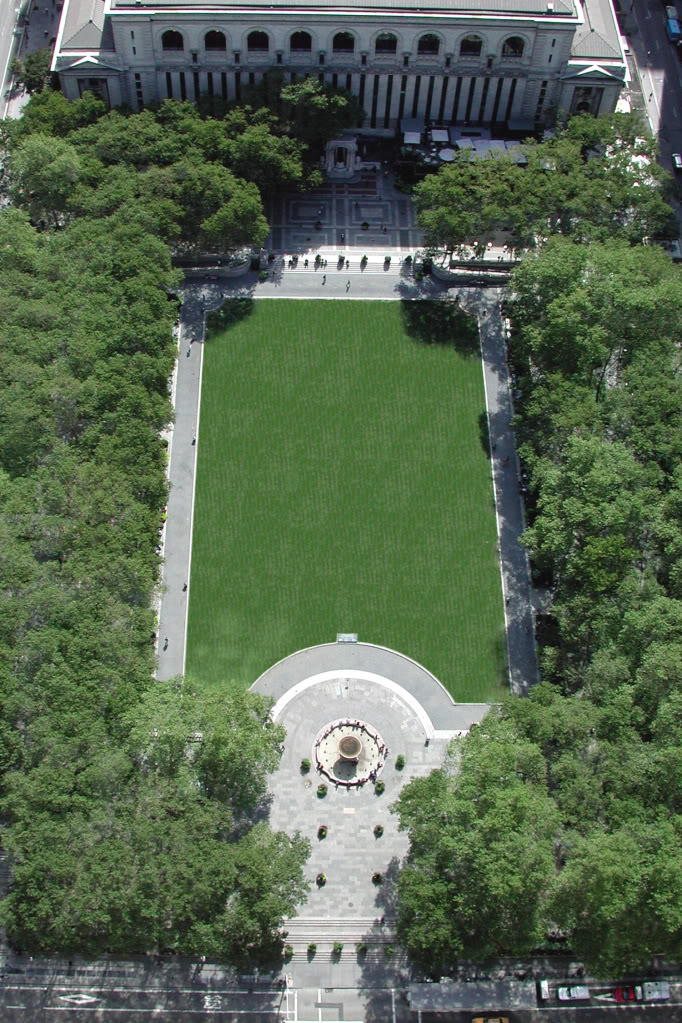
Great overhead shots directly from the Bryant Park Conservancy!

2
3
Categories
Amusements and Thrills Podcasts

The Crystal Palace, America’s first World’s Fair and bizarre treasury of the 19th century

PODCAST New York’s Crystal Palace seems like something out of a dream, a shimmering and spectacular glass-and-steel structure — a gigantic greenhouse — which sat in the area of today’s Bryant Park. In 1853 this was the home to the Exhibition of the Industry of All Nations, a dizzying presentation of items, great and small, meant to exemplify mankind’s industrial might.

We take you on a breathtaking tour of the Palace and its legendary exhibition, including the Latting Observatory (the tallest building in New York!)

Whatever happened to the Crystal Palace? And what inventions contained within do we still benefit from today?

FEATURING: PT Barnum, Henry Ward Beecher, Elisha Otis and literally millions of items!

EDITOR’S NOTE – I mis-pronounced the name of the Fresnel light (actually pronounced fre-nell). Its modern ancestor is used in theatrical lighting today.


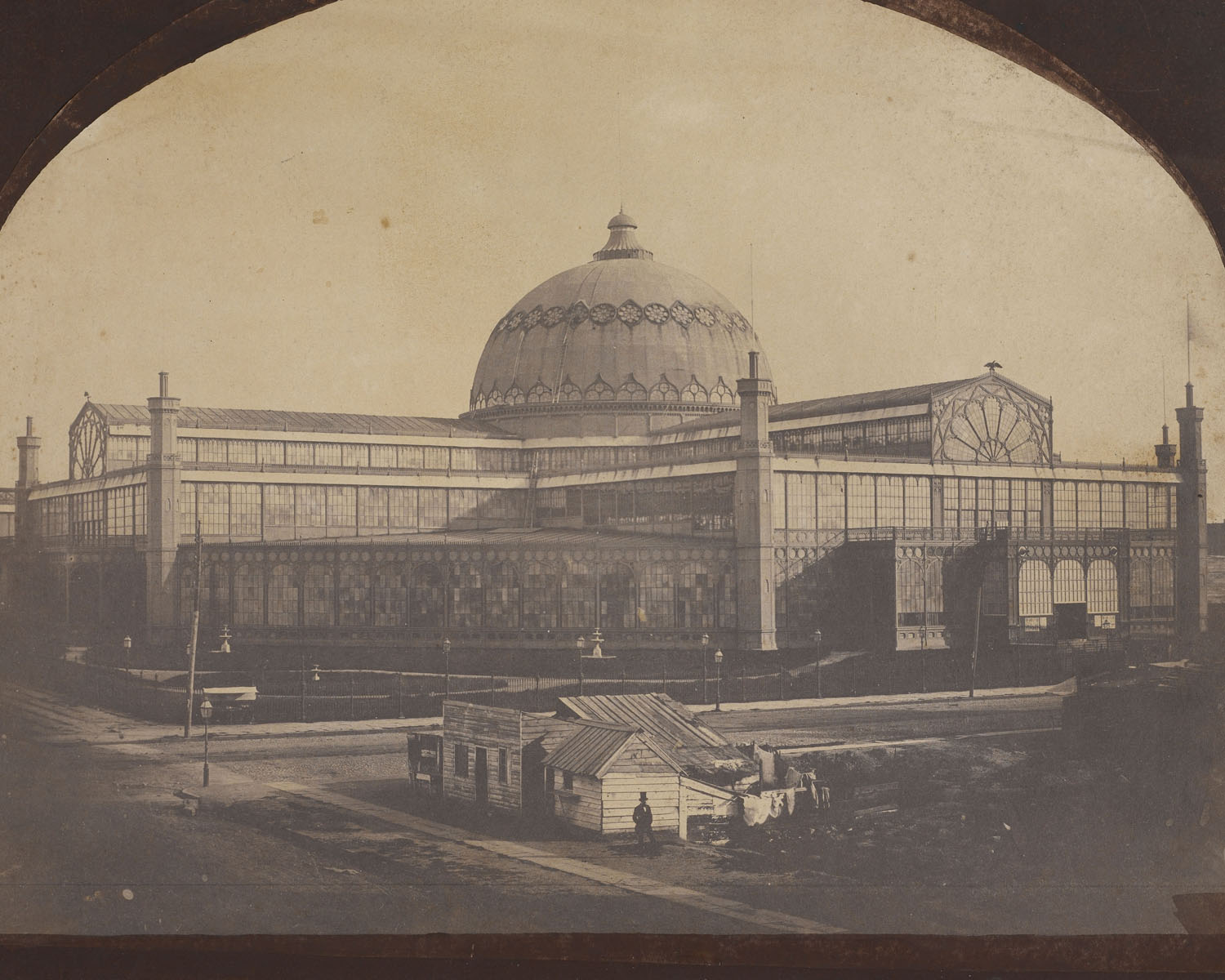
This is one of the earliest photographs of New York City ever taken. As the Crystal Palace hosted examples from the early days of photography, it’s no surprise that one of these early pictures is of the Crystal Palace itself.

A rare photograph of the New York Crystal Palace by Victor Prevost. Courtesy Avery Architectural & Fine Arts Library, Columbia University
A rare photograph of the New York Crystal Palace by Victor Prevost. Courtesy of the Avery Architectural & Fine Arts Library, Columbia University
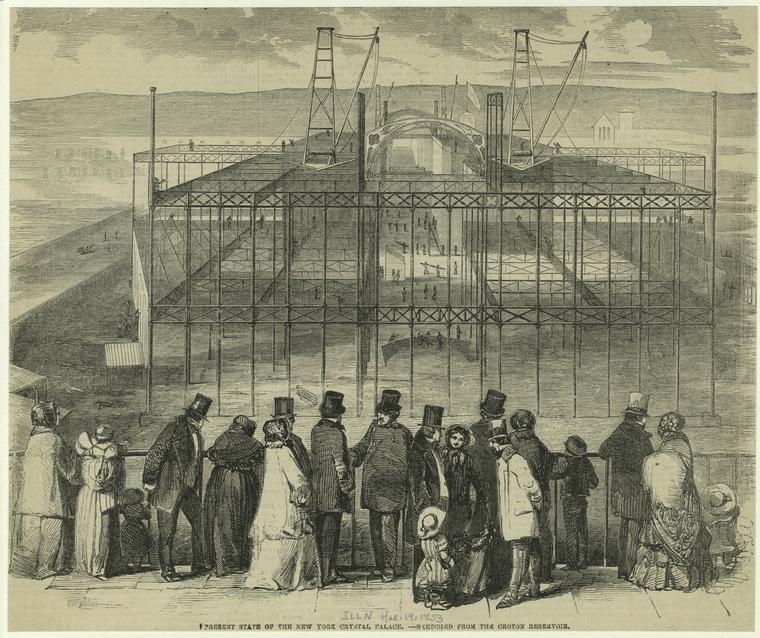
A look into the pit surrounding the Crystal Palace during construction. There were many delays, somewhat sullying the lofty ambitions of the project at the very start. Courtesy New York Public Library
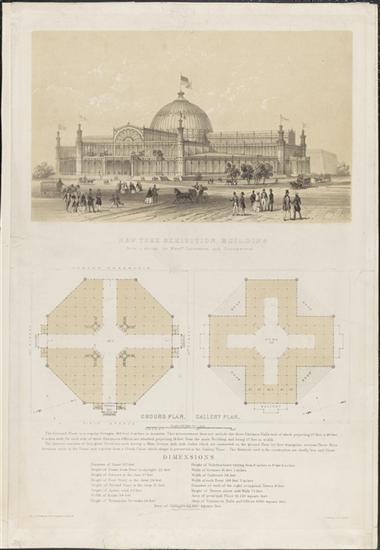
A very church-like plan of the Crystal Palace building by Petermann and Guildemeister. Courtesy Museum of the City of New York
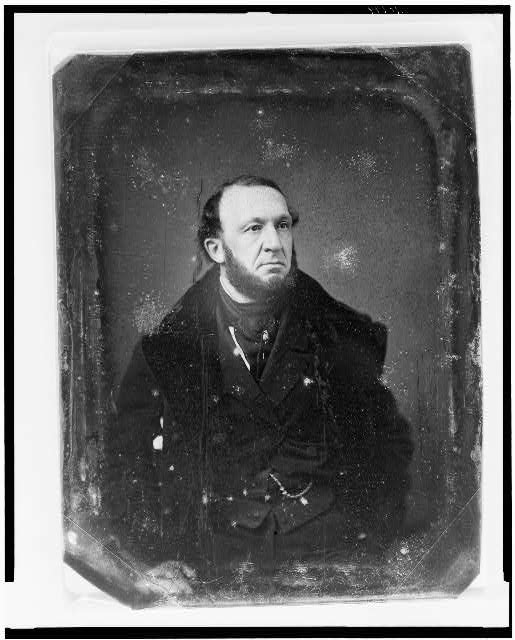
Theodore Sedgwick, who spearheaded the New York Crystal Palace -- and bore some of the criticisms of the Exhibition's rocky opening.
Theodore Sedgwick, who spearheaded the New York Crystal Palace — and bore some of the criticisms of the Exhibition’s rocky opening.
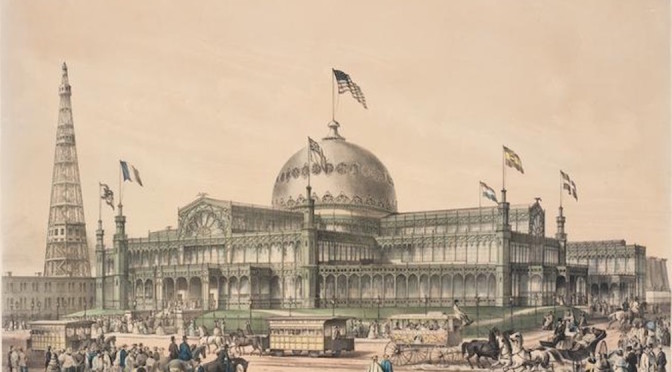
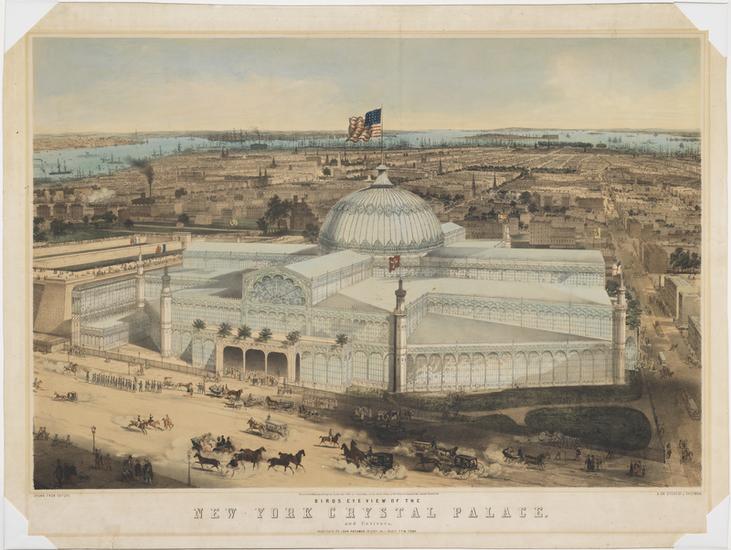
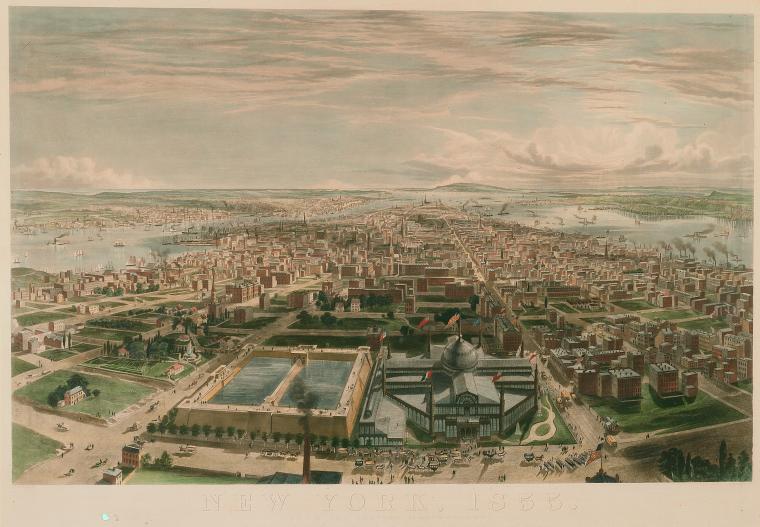
Birds Eye View of the New York Crystal Palace and Environs by John Bachmann. Courtesy the Museum of the City of New York
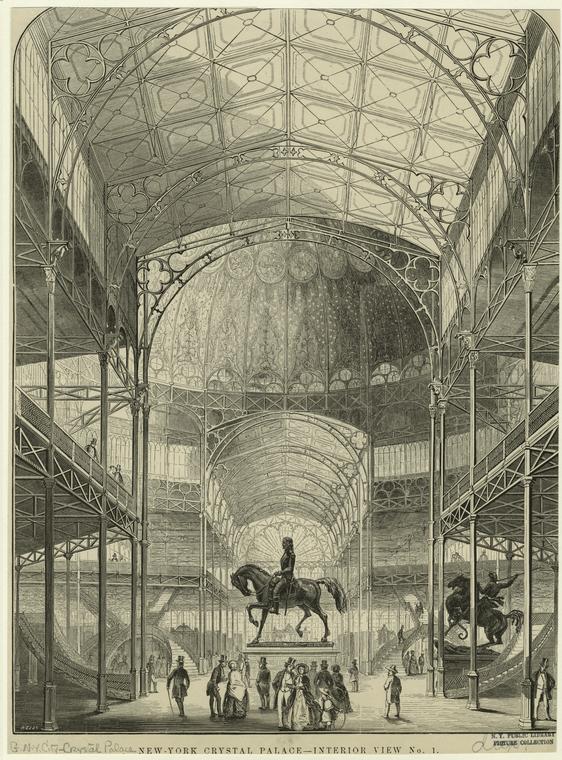
Illustration of the center of the Crystal Palace by J Wells. Courtesy New York Public Library
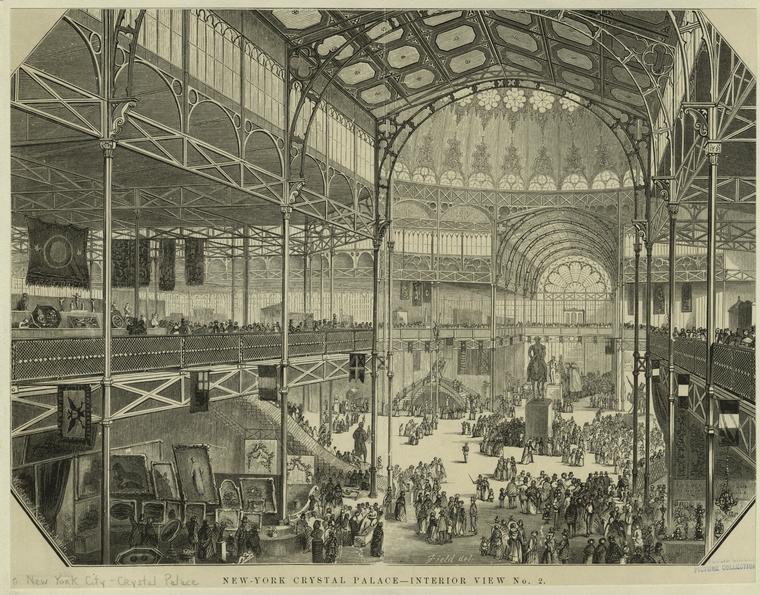
The view from one of the naves, looking towards the George Washington statue. Courtesy New York Public Library
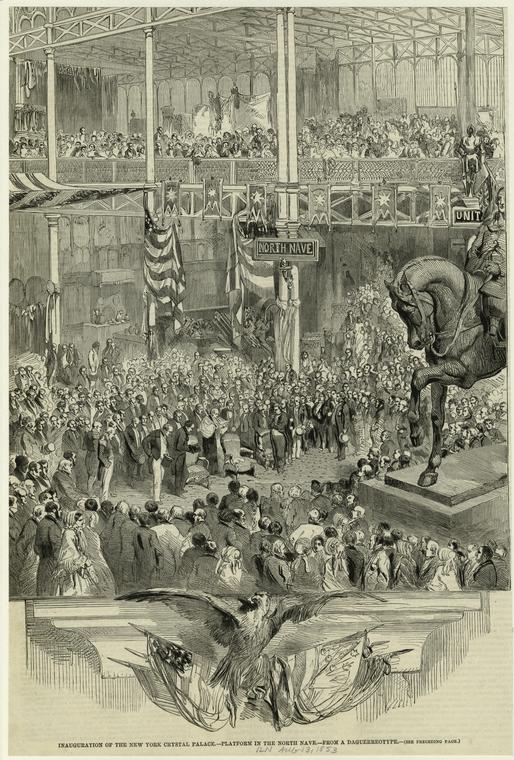
Another view of the inside, this time during the inauguration of the New York Crystal Palace in July 1853 -- looking at a platform in the north nave. Courtesy New York Public Library
Another view of the inside, this time during the inauguration of the New York Crystal Palace in July 1853 — looking at a platform in the north nave. Courtesy New York Public Library
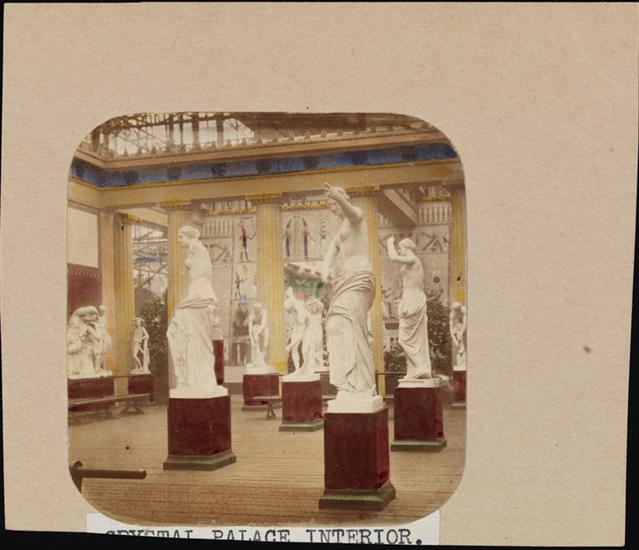
A hand-colored stereoscope of a selection of Crystal Palace statuary. There seems to be some kind of Egyptian thing going on in the background! Courtesy Museum of City of New York
e
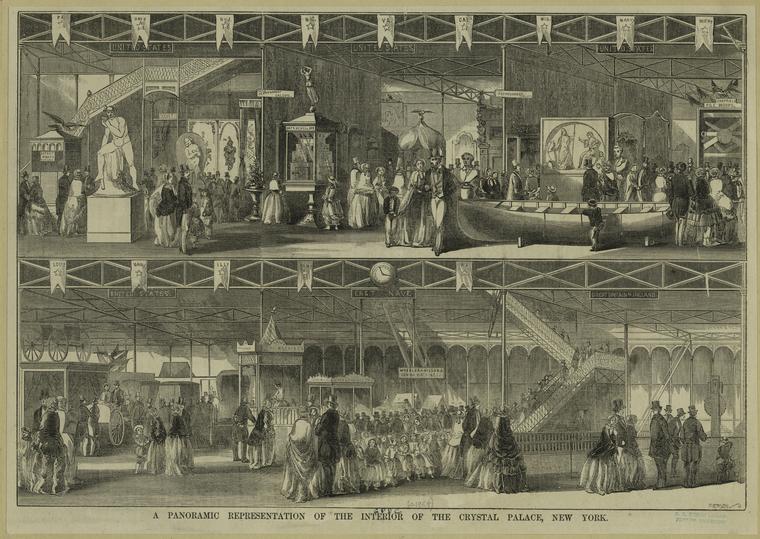
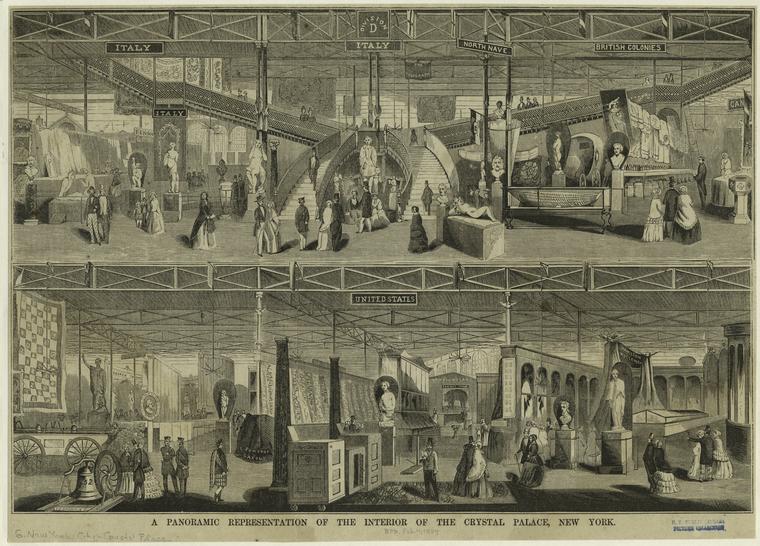
Busts, tapestries, machinery, weapons and various finery! A couple illustrations of the different divisions. Just rooms and rooms of items! Courtesy New York Public Library
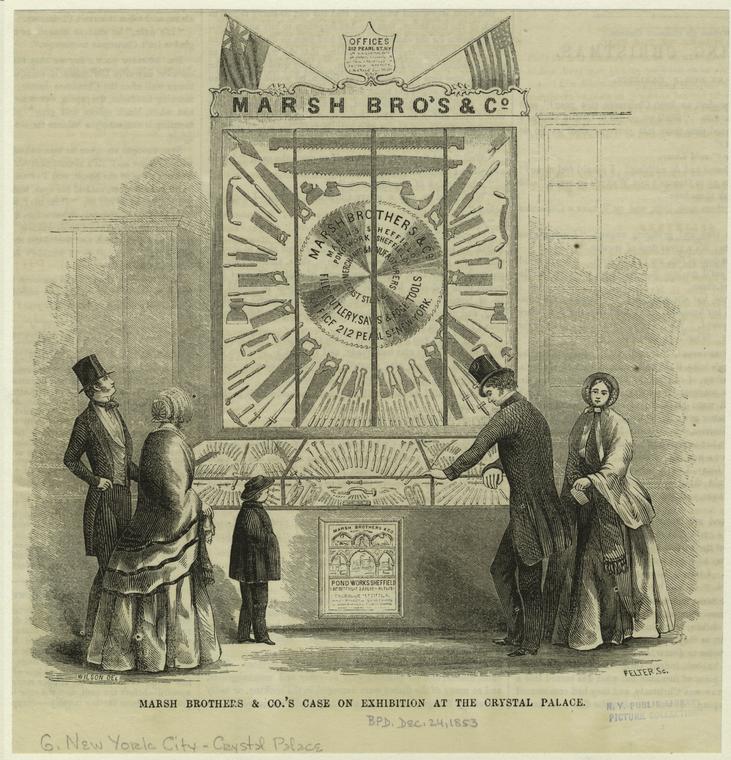
A selection of saws and tools from Marsh Brothers & Co. that one might have seen in the US section. Courtesy NYPL
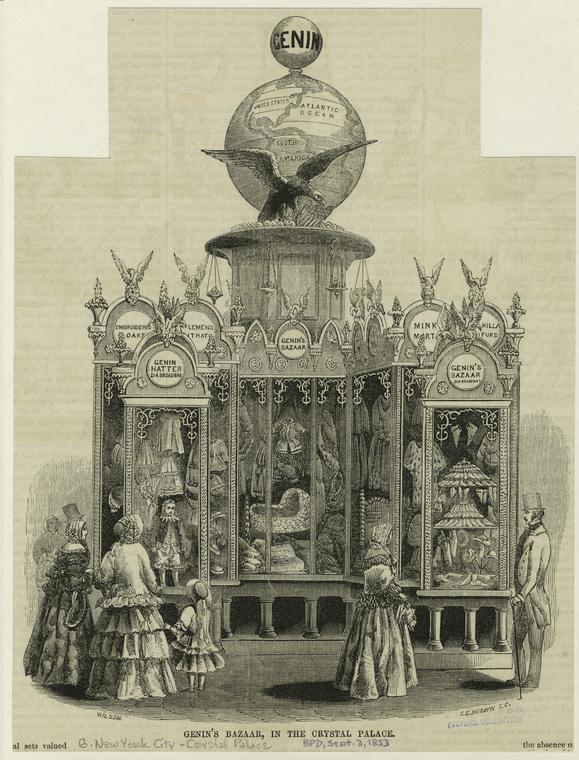
Genin's Bazaar, containing items for the infant. Courtesy New York Public LIbrary
Genin’s Bazaar, containing items for the infant. Courtesy New York Public LIbrary
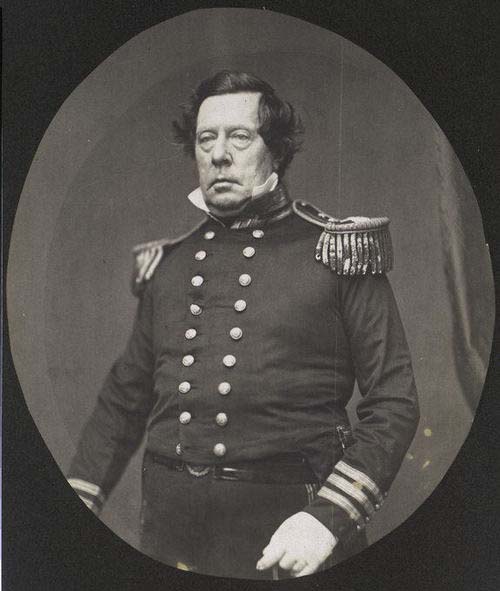
This photo of Commodore Matthew C. Perry was taken by Matthew Brady and displayed at the Crystal Palace, one of the first photographs many people may have seen!
A selection of saws and tools from Marsh Brothers & Co. that one might have seen in the US section. Courtesy New York Public LIbrary
f
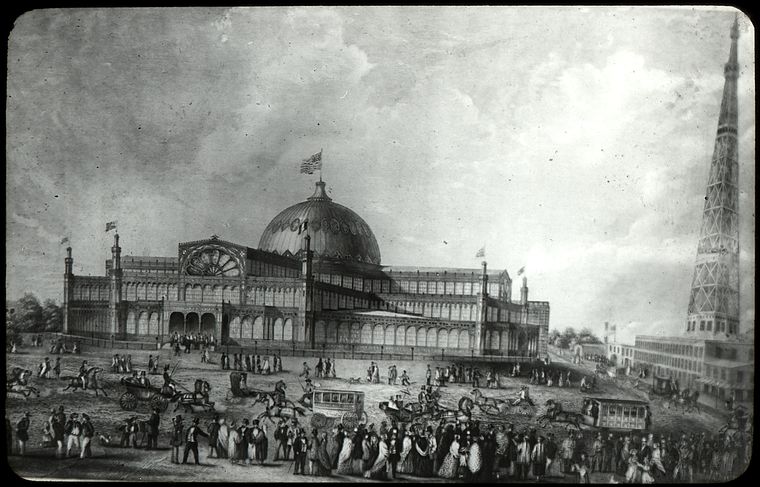
This engraving shows the Latting Observatory in relation to the Crystal Palace, separated by 42nd Street.
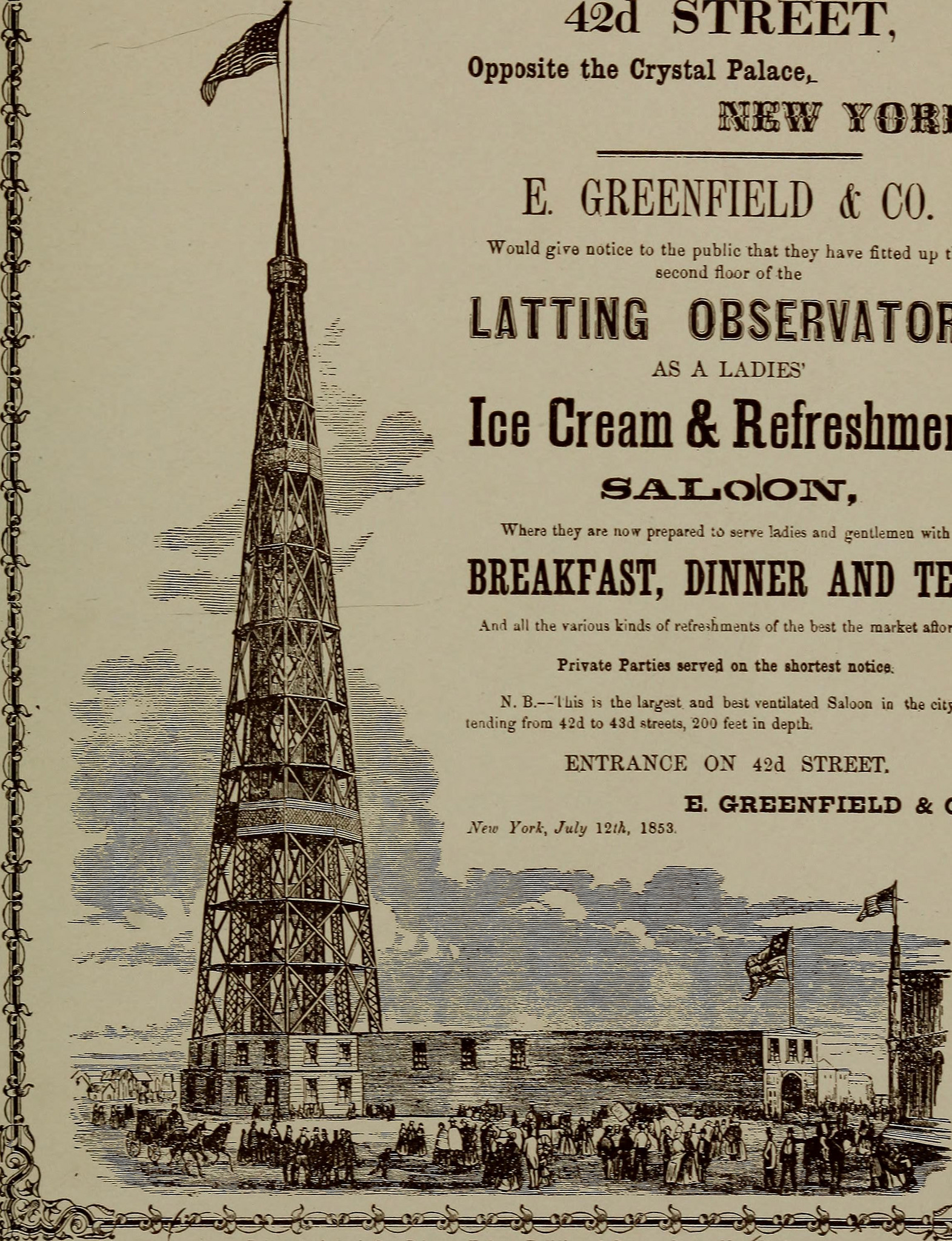
A reprinted advertisement from Valentine's Manual of old New York, outlining some of the charms of Latting Observatory
A reprinted advertisement from Valentine’s Manual of old New York, outlining some of the charms of Latting Observatory
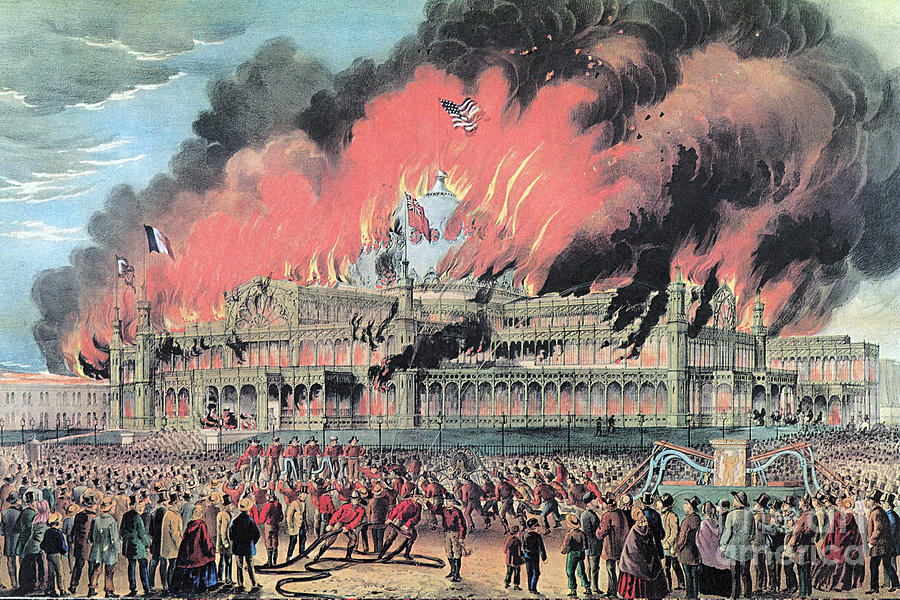
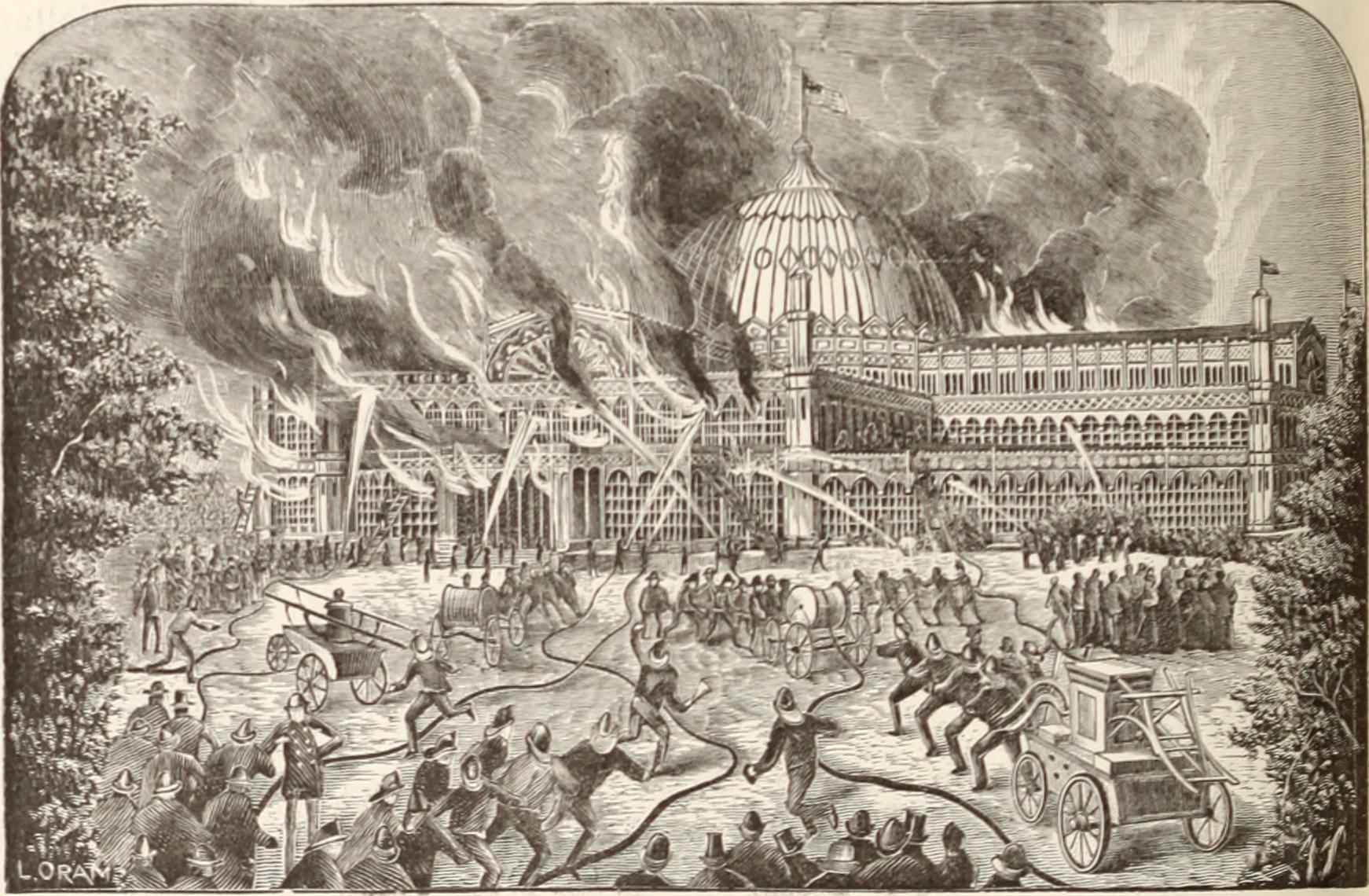
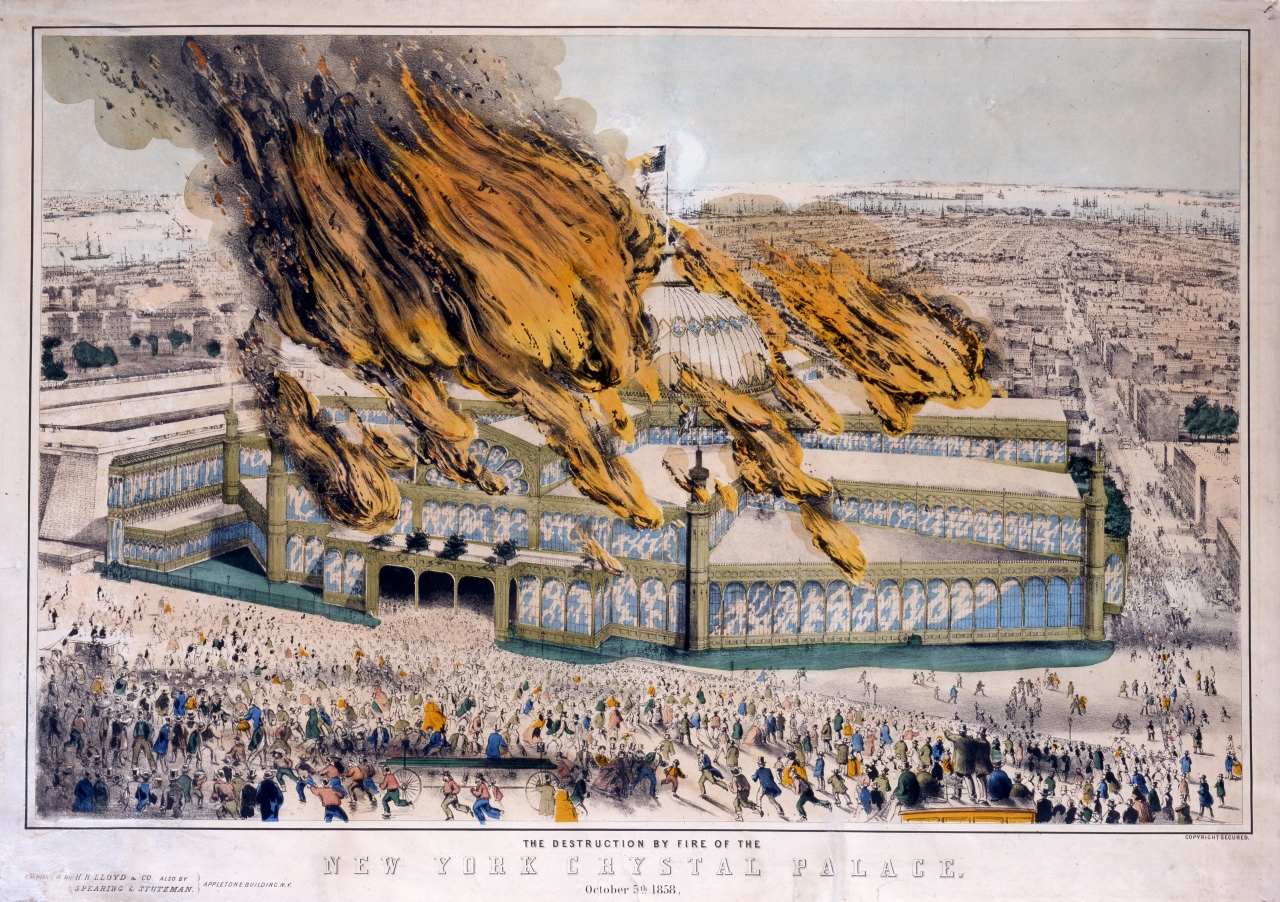
One of several illustrations of the Crystal Palace fire, a dramatic blaze that destroyed the building in under an hour.
An illustration from an 1887 book "Our firemen. A history of the New York fire department" Courtesy Internet Image Book Archives
An illustration from an 1887 book “Our firemen. A history of the New York fire department” Courtesy Internet Image Book Archives
Another view of the blaze, in perspective to the rest of New York to the south. Couirtesy New-York Historical Society
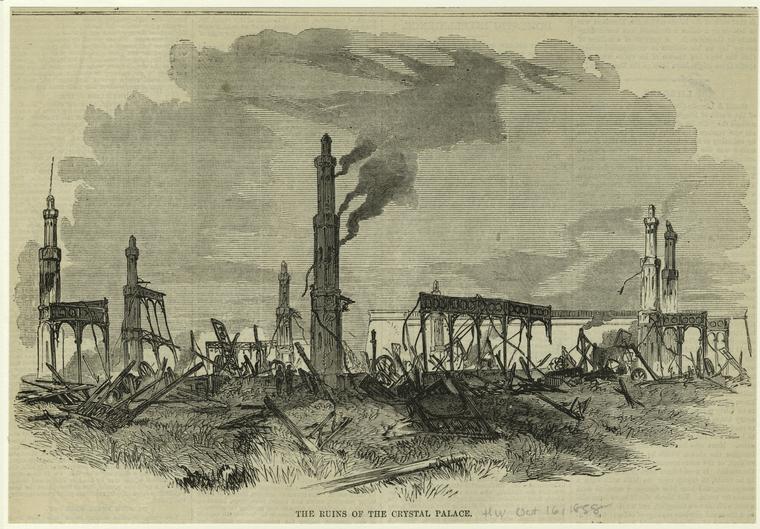
An illustration made in 1858, depicting the aftermath of the horrible fire that destroyed the Crystal Palace. NYPL

Some original documents that you may enjoy reading:

How To See the New York Crystal Palace: Being a Concise Guide to the Principal Objects in the Exhibiton

A Day in the New York Crystal Palace and how to Make the Most of It

And for some comparison, a guide to the London Crystal Palace can be found here.

Categories
Neighborhoods

The link between Ladies Mile and the New York Public Library

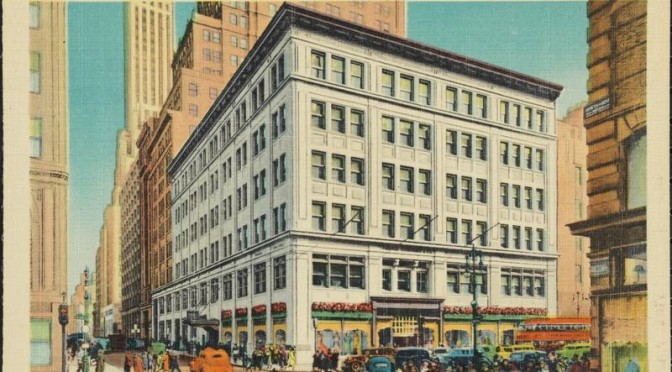
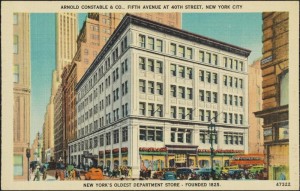
Arnold Constable & Co., Fifth Avenue at 40th Street, New York City, New York's Oldest Department Store -- Founded 1825.

Arnold, Constable and Co’s new Fifth Avenue store.  Today it house the lending library for the New York Public Library.

When did Ladies Mile — New York’s elegant Gilded Age shopping district — finally become un-fashionable?

Unlike the slow demise of so many neighborhoods in the city’s past, the end of Ladies Mile was closely observed by the press.  On October 4, 1914, the New York Sun ran the foreboding headline “Last Chapter in Fall of Old Department Store Zone Recorded Last Week By Arnold, Constable.”

“When Arnold, Constable and Co. move next September to the new building that Frederick W. Vanderbilt is to erect on the site of his home at Fifth Avenue and Fortieth Street, not a department store will remain on Broadway between 14th and 23rd streets, for nearly half a century the recognized high class shopping center of New York City.”

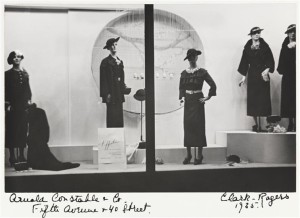
Below: Display windows at the 5th Ave location in 1935 (Pictures are courtesy MCNY)

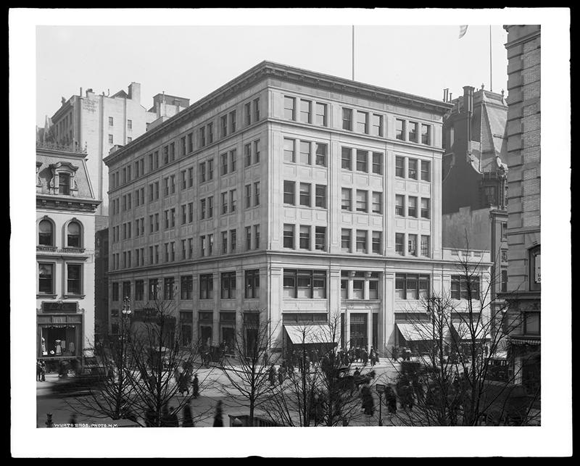
Arnold Constable & Company, Fifth Avenue and 40th Street.

B Altman, the first of the major department store owners to move to Fifth Avenue, was immediately seen as a visionary. “Every one can see today that this shrewd business man knew what he was doing, for Fifth Avenue is not only the greatest shopping street in New York, but is said to lead all others in the world.”

The B Altman department store building is still around, on the northeast corner of 34th Street and Fifth Avenue. It’s now the home for the City University of New York.

The building which contained the Fifth Avenue store of Arnold, Constable and Co. is still around as well.

The upper-crust store was one of Ladies’ Mile’s last holdouts, even as the other fine shops like Lord & Taylor had already moved uptown.  Their new department store, catty-corner to the New York Public Library main branch, finally opened in November 1915 and stayed open for sixty years, until 1975.  The structure was then bought and turned into the Mid-Manhattan Library.

Incidentally, just yesterday, the New York Public Library released its newest plans to refurbish this much distressed building.

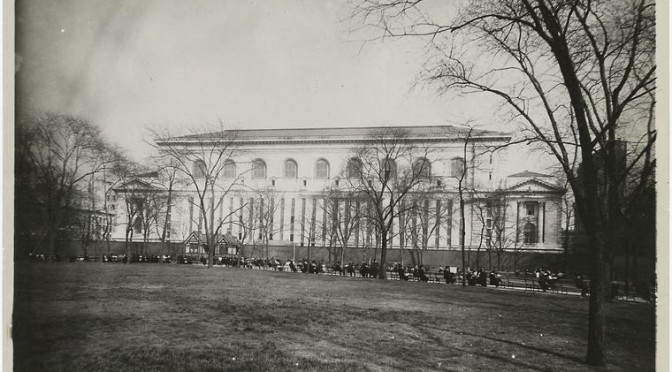
Compare this picture of Arnold Constable & Co., from 1915, with the one taken yesterday at the Mid-Manhattan Library:

Categories
Neighborhoods

What Lies Beneath: New York’s long-forgotten graveyards


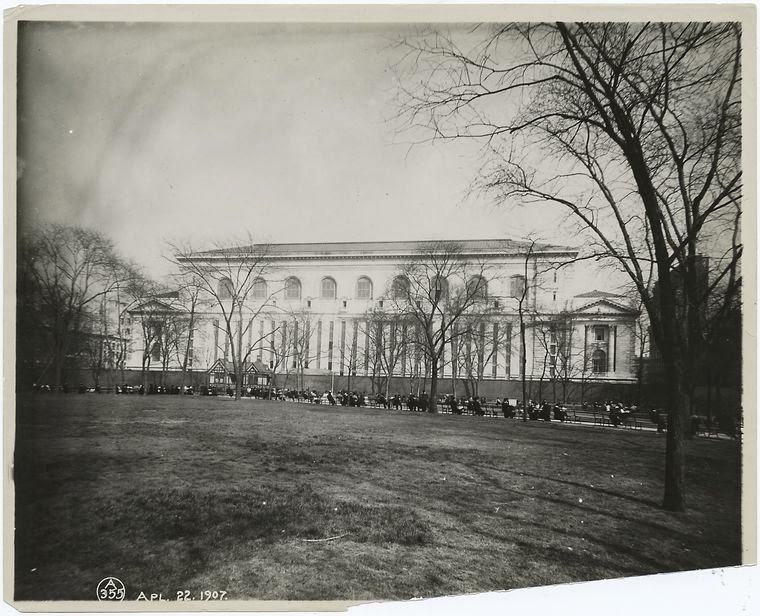
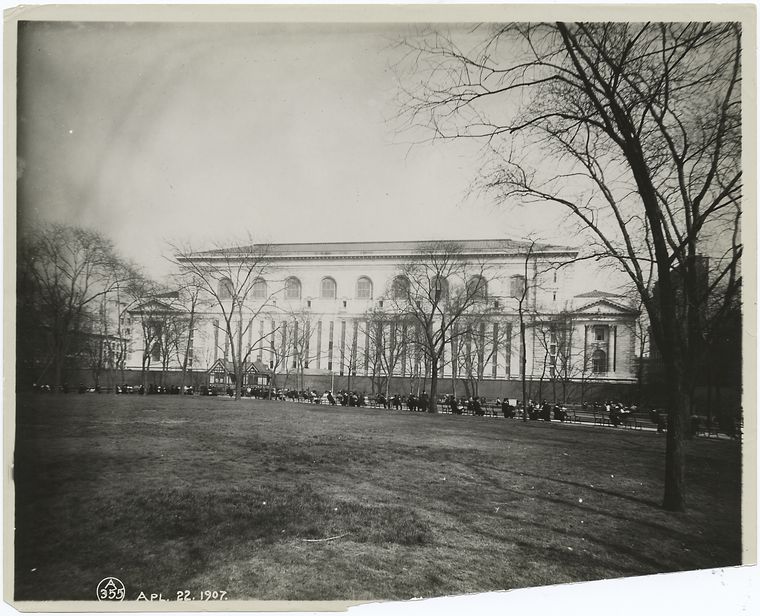
Bryant Park in 1907, with construction on the library well underway.  This was the site of one of the final official potter’s fields in Manhattan before they were moved to the islands of the East River. (Picture courtesy New York Public Library)

Happy Halloween!  To put you in the spirit of the season, take a look at my new article for the Huffington Post: Manhattan’s Forgotten Graveyards, Under Public Parks, Famous Hotels and Supermarkets

Will you ever visit the Houston Street Whole Foods the same way again?

And if you haven’t listened to our newest podcast Early Ghost Stories of Old New York, this is the perfect occasion.

Categories
Mysterious Stories

I Sit On Your Grave: New York’s Hidden Burial Plots

Here’s a chilling thought for the Halloween season: if you’re visiting one of New York’s many amazing parks and squares, most likely you’re standing on land that was formerly used as a cemetery or potter’s field. And in some cases they even left the bodies behind!

If you’re fluent in your New York history, you probably know a couple of these. Most of these burial plots date from before 1851, when the city passed an ordinance forbidding further burials (without explicit permission) below 86th Street. Historical cemeteries (like those at Trinity Church and Old St. Patrick’s) and land with private vaults (such as the East Village marble cemeteries) were allowed to remain, and unique exceptions have been made, such as the singular grave of William Jenkins Worth at Madison Square.


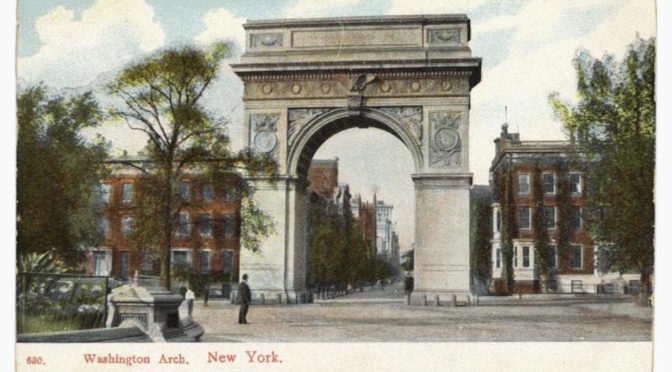
Washington Square Park, Manhattan
1797-1825
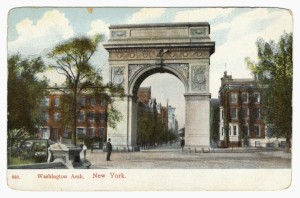
“Where now are asphalt walks, flowers, fountains, the Washington arch, and aristocratic homes, the poor were once buried by the thousands in nameless graves.” (Kings Handbook of New York, 1893) When fashionable New Yorkers moved from the confines of lower Manhattan to the area of Greenwich Village, the burial ground was closed for business and a lovely park placed on top of it.

While this might seem truly morbid, in fact the city considered this a preventative and sanitary option. According to city records, a recommendation was made that “the present burial ground might serve extremely well for plantations of grove and forest trees, and thereby, instead of remaining receptacles of putrefying matter and hot beds of miasmata.”

Today, that ‘hot bed of miasmata’ serves as one of New York’s most bustling and vibrant outdoor spaces. But the city simply built over the burial ground. It was claimed during the 19th century that a blue mist could be seen hanging over the park at night, the creepy vapor of the remains underground.

Are the bodies still here? Oh yes.
How many? Definitely over 20,000 (and they’re constantly turning up in excavation work). There were once as many as 125,000 people buried here

Leverish Street and 71st Street, Queens
1765-1818?
A private cemetery once used by the Leverish family, a prosperous Long Island clan descended from English minister, the Rev. William Leverich. According to a family genealogy site: “The contemporary location of the burial ground is a rectangular plot located immediately behind the rear yards of several private residences that face on Leverich Street, and on the other side immediately behind a parking lot behind several apartment buildings that face on 35th Avenue at the intersection of 71st Street.”

Are the bodies still there? According to author Carolee Inskeep, “there is no evidence to suggest that the bodies were removed.”
How many? Unknown

Liberty Place (at Maiden Lane), Manhattan
1700-1823
This burial ground served New York’s first Quaker congregation, formerly called the Little Green Street Burial Ground of the Society of Friends (Liberty Place was once known as Little Green Street). Its location is currently in the shadow of the New York Federal Reserve.

Are the bodies still there? Probably not, but the city gave them only six short months to move all the remains to a new location, so you never know what they might have left behind.

union
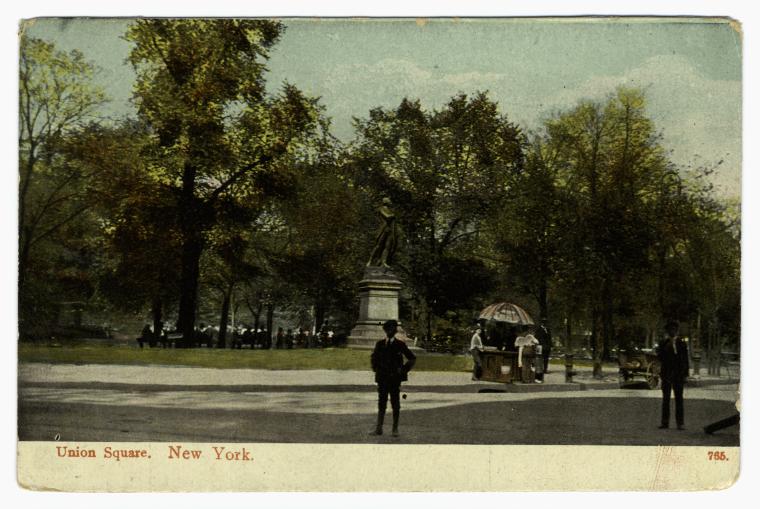
Union Square, Manhattan (above)
?-1807
Potter’s fields — where the poor or unclaimed were buried — moved frequently around the city as land values improved with the city’s growth. This particular area at 14th Street was once comfortably outside of town, but its proximity near Bloomingdale Road (the future Broadway) soon required its functions as a burial plot be transferred to other usable fields, like Washingon Square. The land here was transformed into the ellipse-shaped Union Place, a strolling park surrounded by an iron fence. By the 1830s, Samuel Ruggles would modify it further into New York’s toniest park Union Square, luring the wealthy who quickly built homes of ‘costly magnificence’ around it.

Are the bodies still there? Certainly not, given the park’s frequent renovations and the subway station right underneath.

Madison Square Cemetery, Manhattan
1794-1797
The short duration of this burial ground stems from the fact that it was used only to inter those who died at nearby Bellevue Hospital and the local almshouse during a devastating yellow fever epidemic. Later, with fears of a new war with England looming, the land was given to the U.S. Army as an arsenal, and the land that was later Washington Square became the official place to bury the dead.

Are the bodies still there? There’s some evidence to suggest that some of the remains were never moved.

How many? Unknown, although the epidemic took hundreds in the 1790s, and according to my estimation, there could be up to 1,000 buried here.

New York City Farm Colony Cemetery (Castleton Corners), Staten Island
1830-1910
This land served New York’s Farm Colony, an occupational asylum for the elderly and orphaned, and later a convalescent home for those with tuberculosis. The cemetery was once well kept, but today most of the tombstones are gone, and the land is virtually unmarked. Part of the farm colony has become part of the Greenbelt. The ruins of the Farm Colony are, frankly, unbelievable.

Are the bodies still there? Yes, the plots simply stopped being maintained
How many? Hundreds

Old Newtown Cemetery (92th Street and 56th Avenue), Queens
Off and on between 1652-1880
A family cemetery that became a horse pasture in the 19th century, cut through with cross streets, then designated a New York city park in 1932. Today, it’s the Newtown Playground.

Are the bodies still there? Many (notably from reputable families) were moved piecemeal to family plots or to Hart Island, but it’s not clear that the city ever methodically moved all the bodies. But something else is definitely there. A Queens Annual Report from 1927, as referenced by the parks department, claims “[a]ll the old headstones, which stuck up like eyesores, were laid flat and covered with soil.” So enjoy that swing set, kids!

bryant
Bryant Park, Manhattan (above, from 1907)
1823-40 but possibly used as late as 1847
Yet another burial plot for paupers, still further north of city center. Soon however the adjoining land became an ideal spot to put the Croton Reservoir, supplying the city with drinking water. And it wouldn’t do to have a bunch of gravaes next to it, right? Following a short time as the location of the Crystal Palace, the land was turned into a park, named after William Cullen Bryant.

Are the bodies still there? The only thing you’re going to find under Bryant Park are miles and miles of library books, in tunnels owned by the New York Public Library.

Park Avenue and 49th Street, Manhattan
1822-1859
In the early 18th century, the area soon to become known as the richest street in America was home to railroad tracks, cattle yards, various grim asylums and, yes, Manhattan’s last potter’s field. When Columbia University moved uptown, it sat near the shoddy field, so decrepitly maintained that “the ends of coffins still protruded from the ground,” according to Edward Sandford Martin “a malodorous neighbor much in evidence and disrepute.”

In the late 1850s, the city forced the potter’s field off the island entirely and the bodies were slated for removal to Ward’s Island. Given municipal corruption and delays, however, the project took years, with train passengers often greeted with the sight of coffin stacks and grisly open pits.

Today, that former burial plot is occupied by the Waldorf=Astoria Hotel, built on the property in 1929, long since transformed by the Central Railroad and burial of tracks into Grand Central Station.

Are the bodies still there? Given the deep excavations underneath Park Avenue to accommodate trains and skyscrapers, I don’t imagine anything remains.

NOTE: Some of the dates above are estimates as record keeping for these kinds of things were hit and miss. Many dates are from Carolee Inskeep’s exhaustive survey of old New York burial grounds The Graveyard Shift.

Pics courtesy New York Public Library [Union Square] [Washington Square] [Bryant Park]