Categories
Podcasts Queens History

The World of Tomorrow: Visiting the World’s Fair of 1939-40, the kitschy futurescape of Queens

PODCAST Visiting the first World’s Fair at Flushing Meadows Corona Park, the unimaginable playground of the future, planted inescapably within the reality of the day.

Flushing Meadows Corona Park, the fourth largest park in New York City and the pride of northern Queens, has twice been the doorway to the future.

Two world’s fairs have been held here, twenty-five years apart, both carefully guided by power broker Robert Moses. In this episode, we highlight the story of the first fair, held in 1939 and 1940, a visionary festival of patriotism and technological progress that earnestly sold a narrow view of American middle-class aspirations.

It was the World of Tomorrow! (Never mind the protests or the fact that many of the venues were incomplete.) A kitschy campus of themed zones and wacky architectural wonders, the fair provided visitors with speculative ideas of the future, governed by clean suburban landscapes, space-age appliances and flirtatious smoking robots.

The fair was a post-Depression excuse for corporations to rewrite the American lifestyle, introducing new inventions (television) and attractive new products (automobiles, refrigerators), all presented in dazzling venues along gleaming flag-lined avenues and courtyards.

But the year was 1939 and the world of tomorrow could not keep out the world of today. The Hall of Nations almost immediately bore evidence of the mounting war in Europe. Visitors who didn’t fit the white middle-American profile being sold at the fair found themselves excluded from the ‘future’ it was trying to sell.

And then, in July of 1940, there was a dreadful tragedy at the British Pavilion that proved the World of Tomorrow was still very much a part of the world of today.

PLUS: Where can you find traces of the fair in New York City today?

Listen Now: New York World’s Fair of 1939 Podcast


The Bowery Boys: New York City History podcast is brought to you …. by you!

We are now producing a new Bowery Boys podcast every other week. We’re also looking to improve the show in other ways and expand in other ways as well — through publishing, social media, live events and other forms of media. But we can only do this with your help!

We are now a member of Patreon, a patronage platform where you can support your favorite content creators.

Please visit our page on Patreon and watch a short video of us recording the show and talking about our expansion plans. If you’d like to help out, there are six different pledge levels (New Amsterdam, Five Points, Gilded Age, Jazz Age, Empire State and Greater New York). Check them out and consider being a sponsor.

And join us for the next episode of the Bowery Boys Movie Club, an exclusive podcast provided to our supporters on Patreon. This month’s movie — On The Town!

We greatly appreciate our listeners and readers and thank you for joining us on this journey so far.
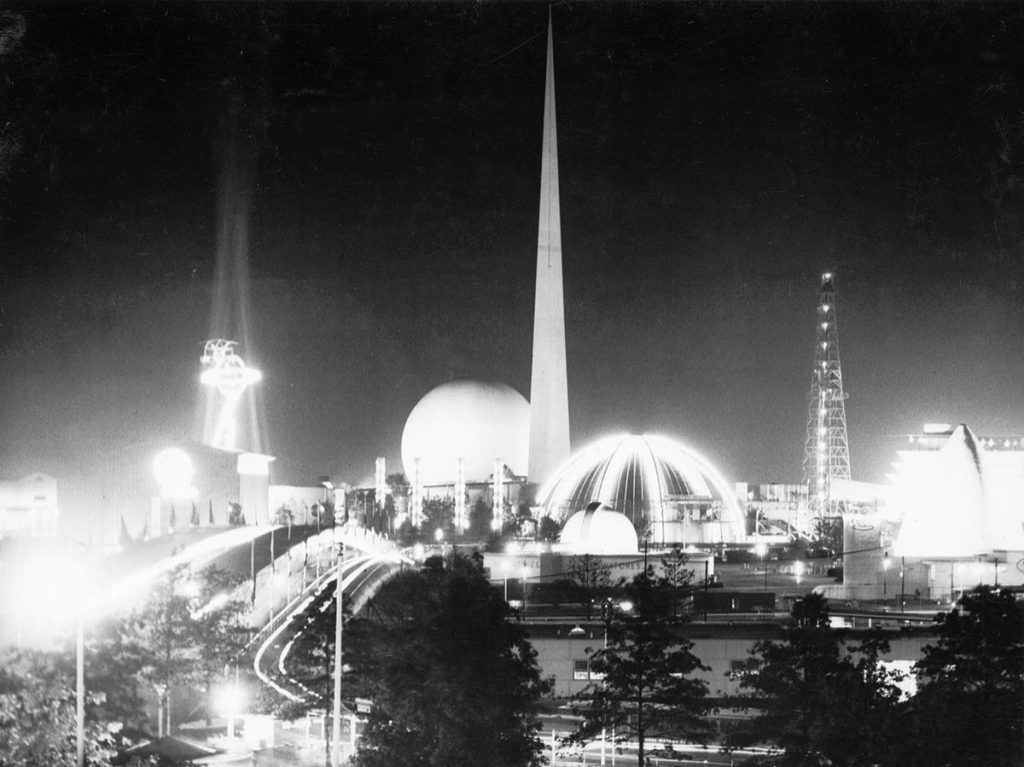

AP Photo

Silent color video of the 1939 World’s Fair

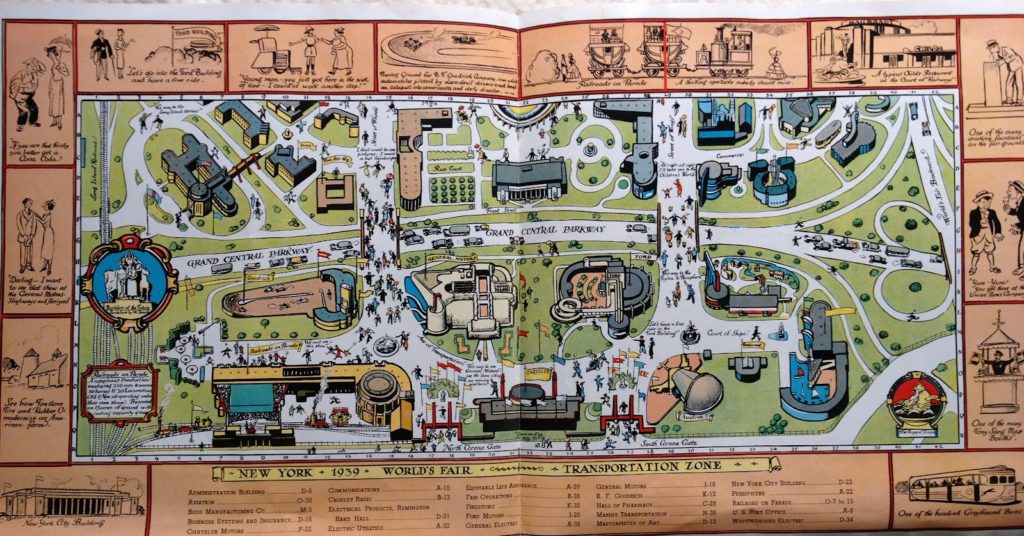
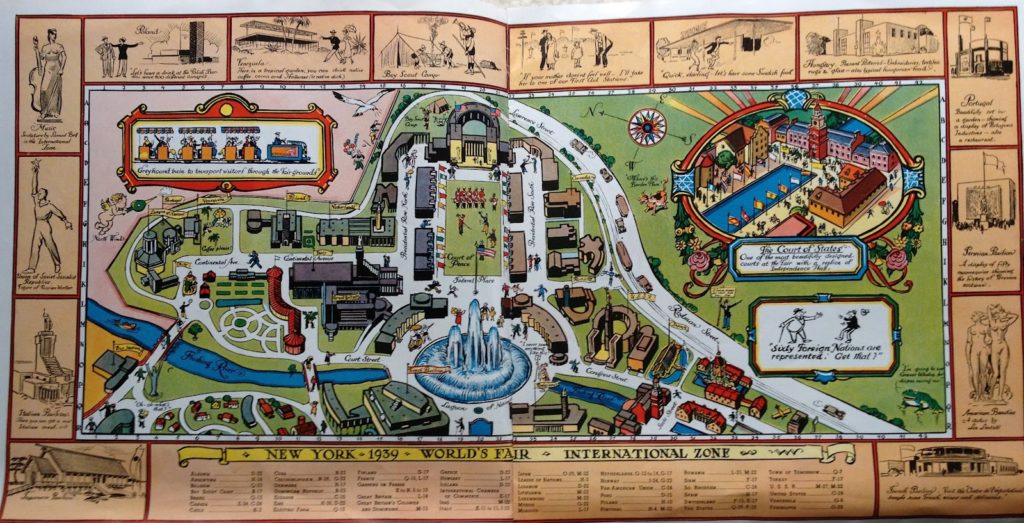
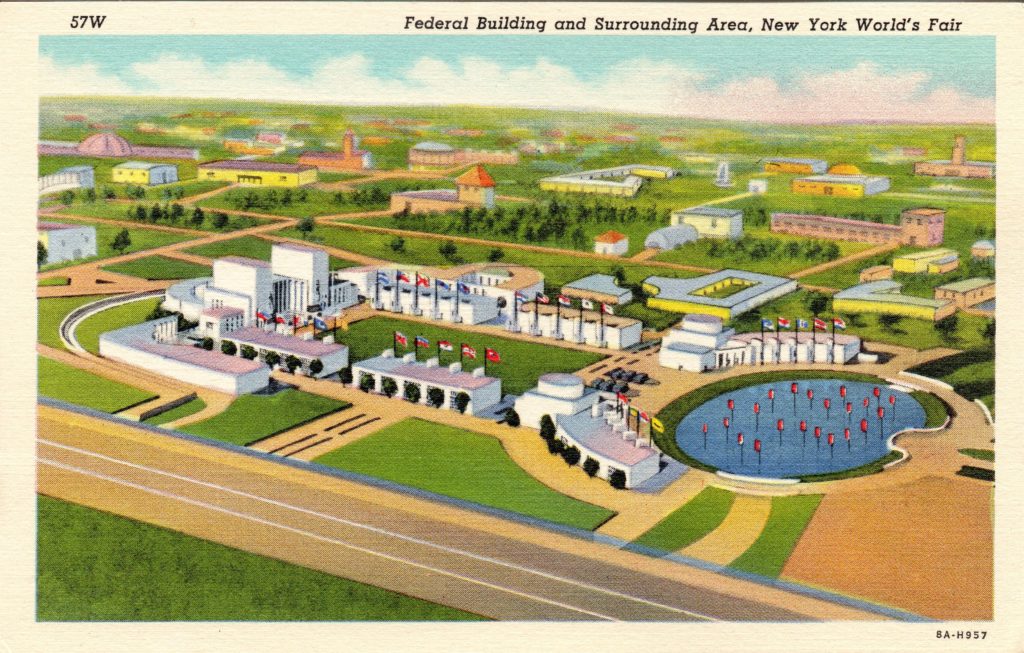
A map of the World’s Fair of 1939, courtesy the David Rumsey Map Collection. Click here to zoom in and get a closer look.
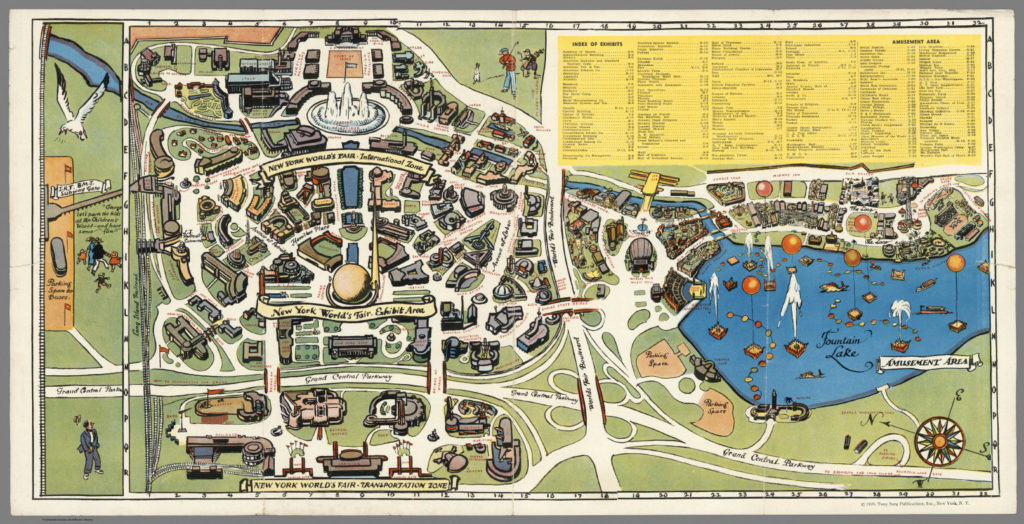
David Rumsey Map Collection
Renfusa/designer Tony Suga

A look at the park grounds before they became Flushing Meadows. Read this article on the ash dump for more information.
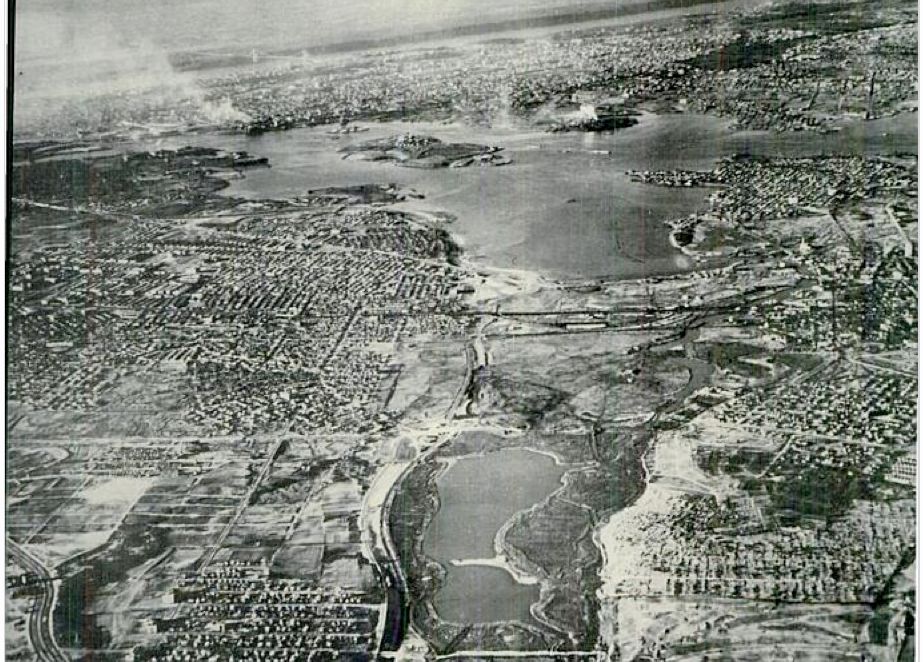
Courtesy CUNY

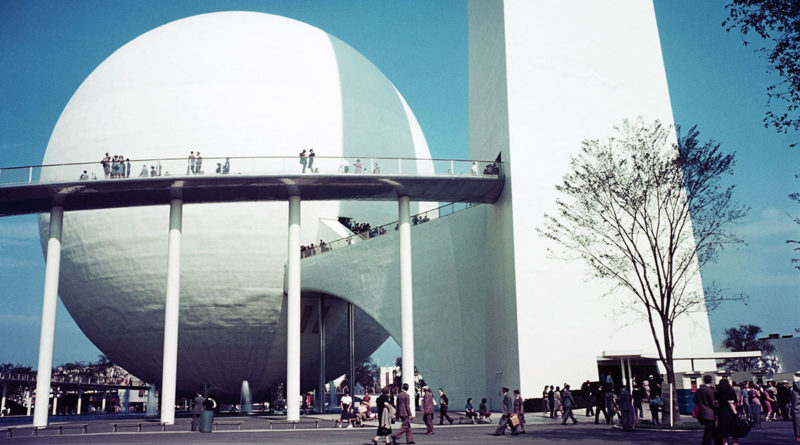
With the Trylon and Perisphere in the background, a statue of George Washington presides over the lagoon era and statues of the Four Freedoms. Read this for more information on the fair’s Washington inauguration connection.
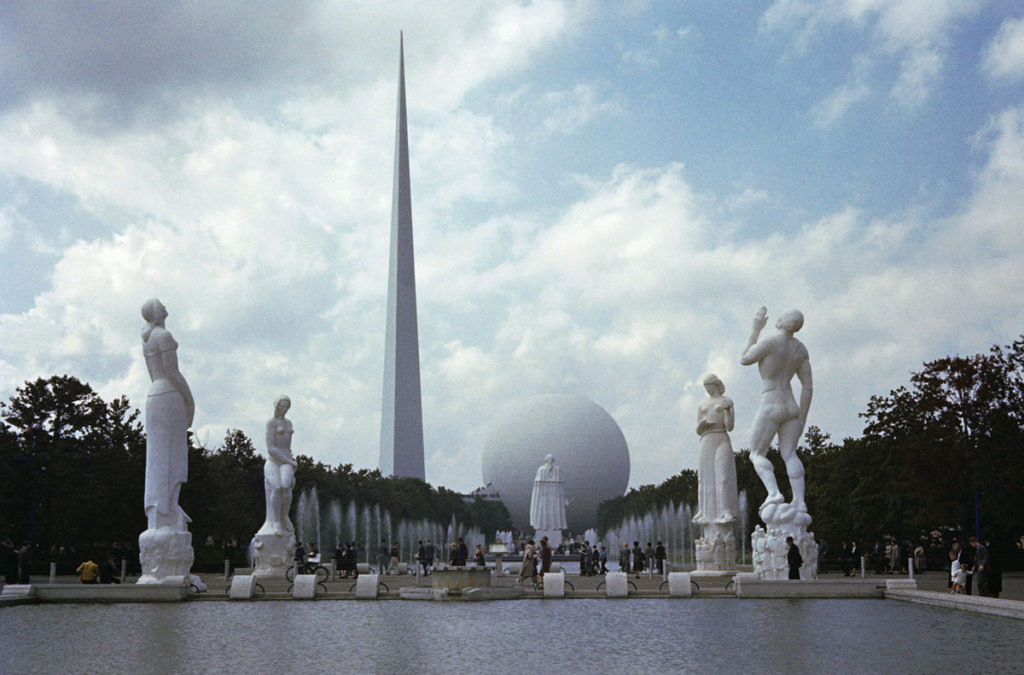
Peter Campbell/CORBIS/Corbis via Getty Images

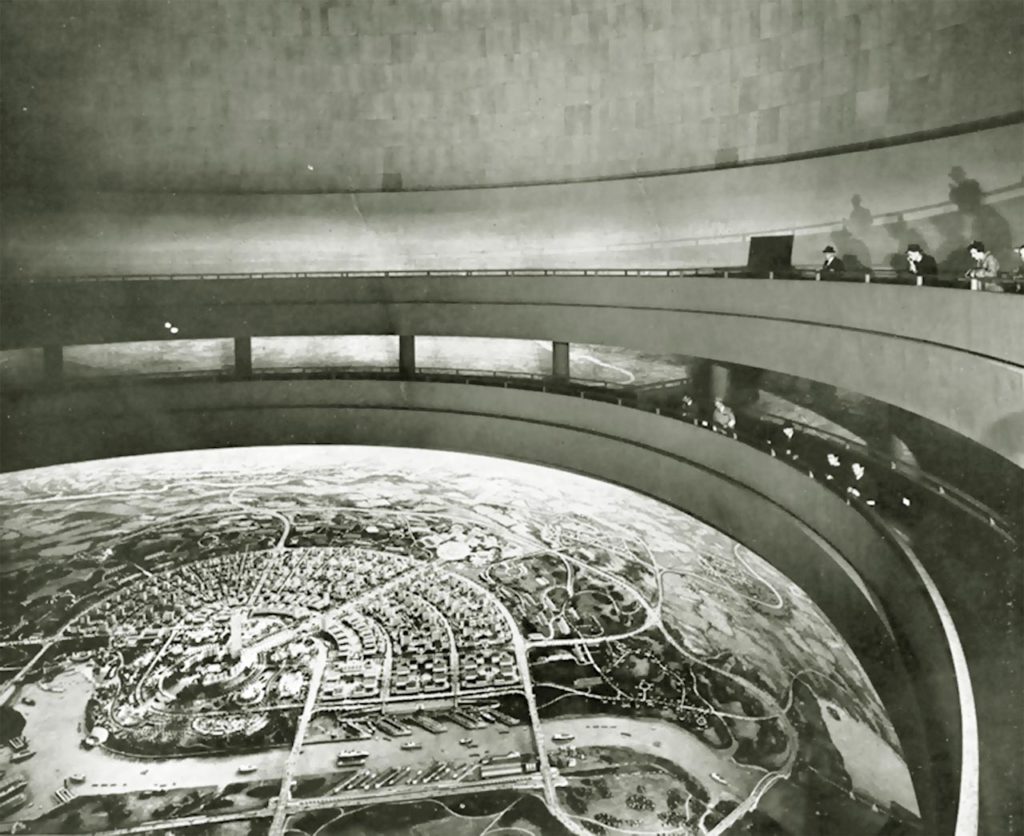
Gazing down at the wonder of Democracity within the Perisphere.
Worlds Fair Community

Starring into the gushing waters of the Lagoon of Nations with a view of the U.S. Federal Building.

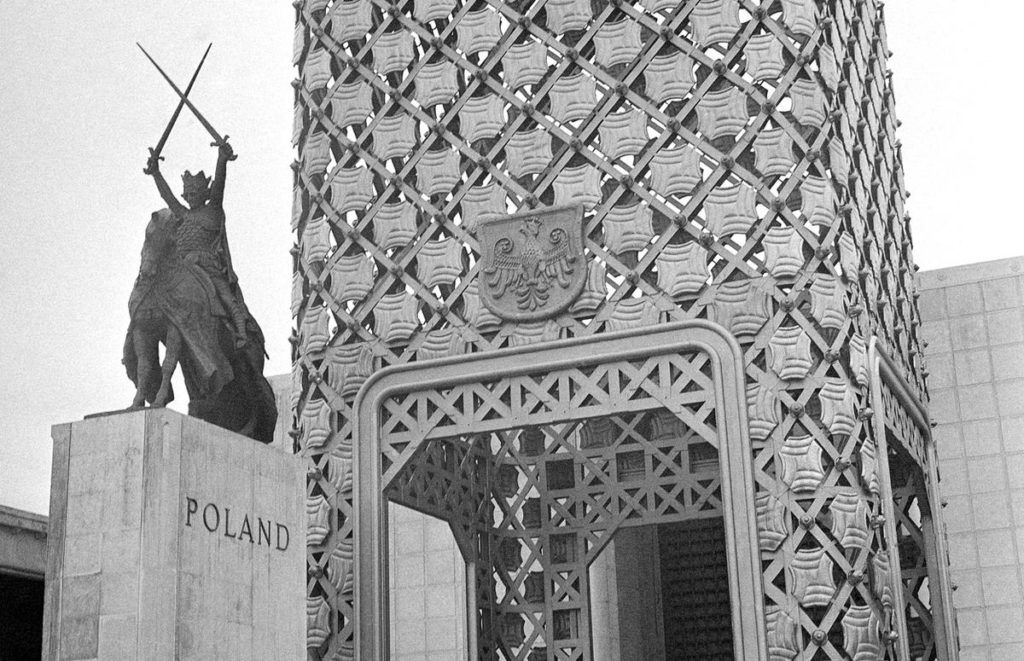
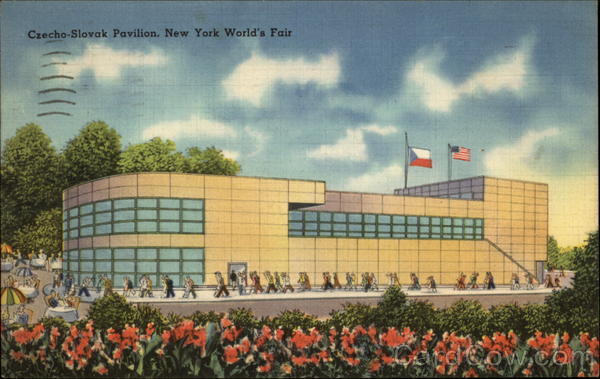
A few images of pavilions from the ‘Government Zone’ that were mentioned on the show:
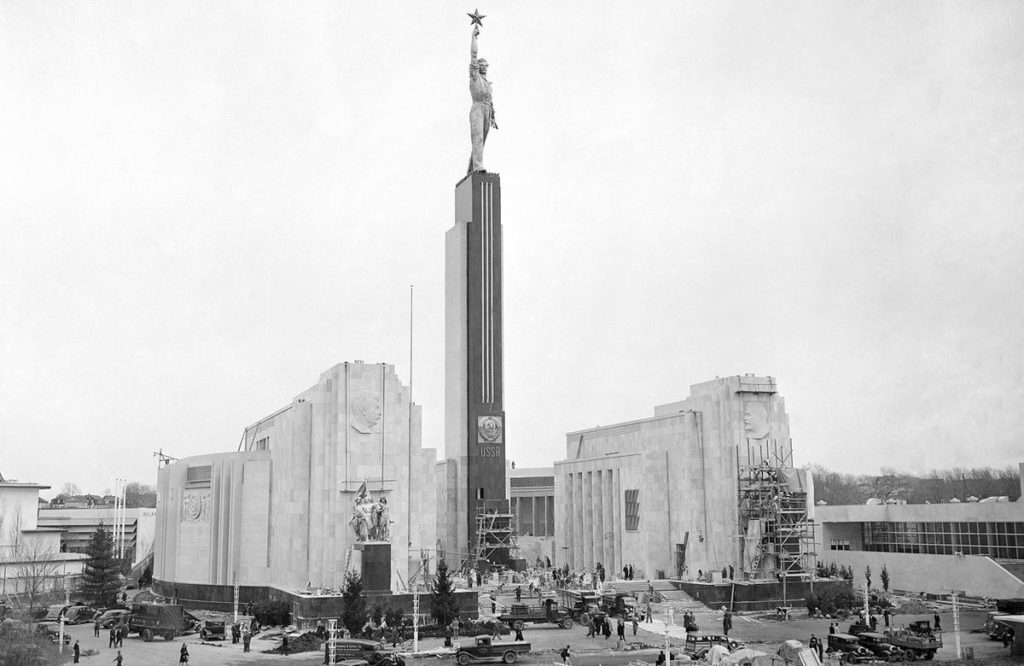
The Soviet Union pavilion/AP Photo
Poland pavilion/AP photo
Czech-Slovak Pavilion, New York World’s Fair New York City
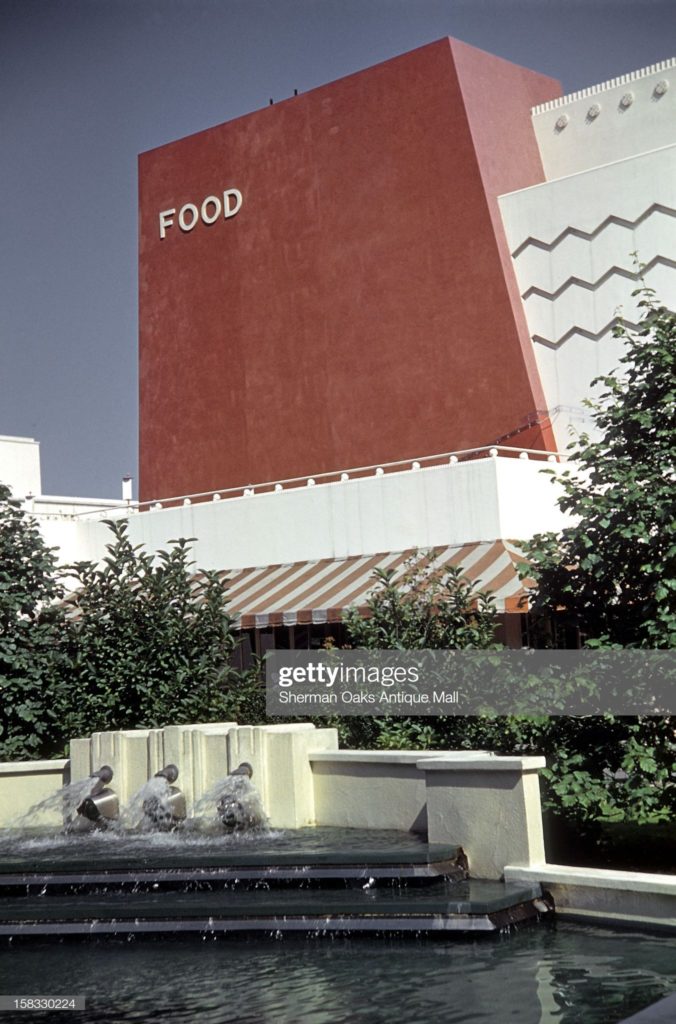
A view of the Food North Building at the 1939 New York World’s Fair in Flushing Meadows, Queens, New York City, New York. (Photo by Sherman Oaks Antique Mall/Getty Images)

The Mickey and Minnie Mouse cartoon which appeared at the National Biscuit Company (Nabisco) exhibition.
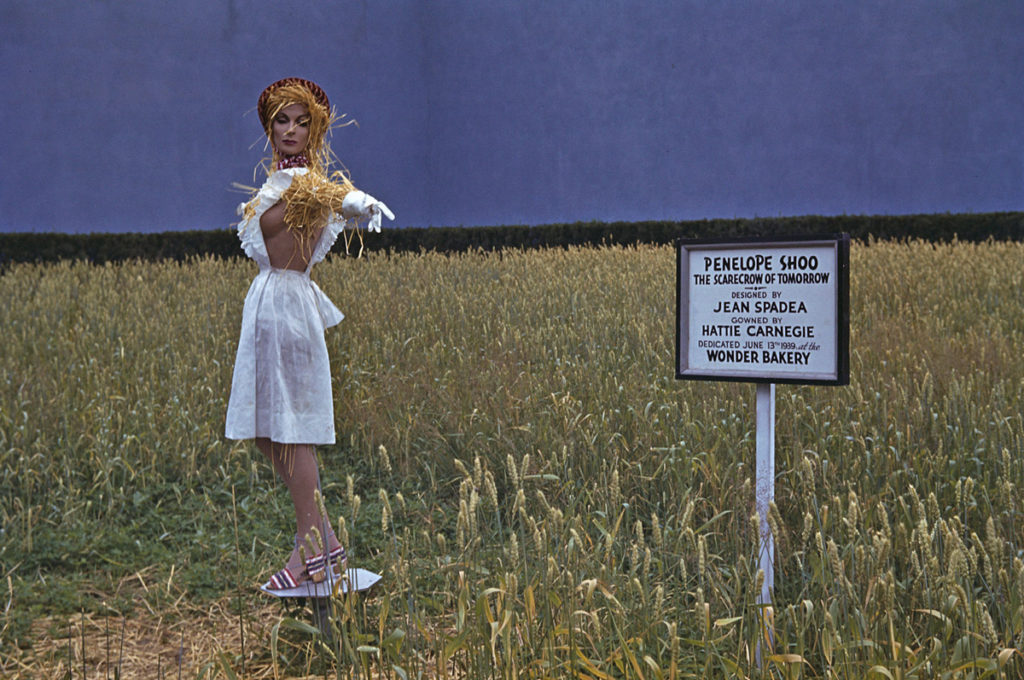
Wonder Bakery displays a wheat field exhibit at the 1939 World’s Fair. The model, Penelope Shoo, is wearing an outfit designed by Hattie Carnegie. The wheat field was billed as “the first planted in New York City since 1875.” (Peter Campbell//Corbis via Getty Images)

The ‘rotolactor’ in the Borden Company Exhibit
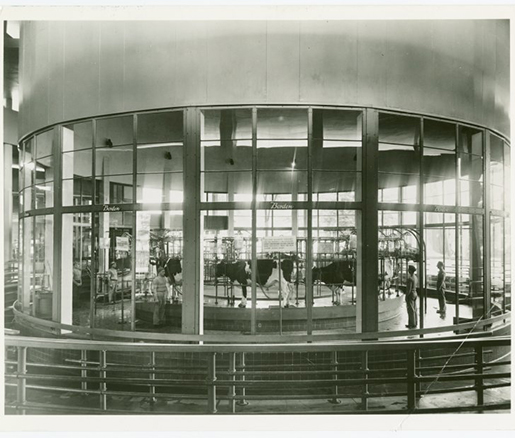
Courtesy James Beard

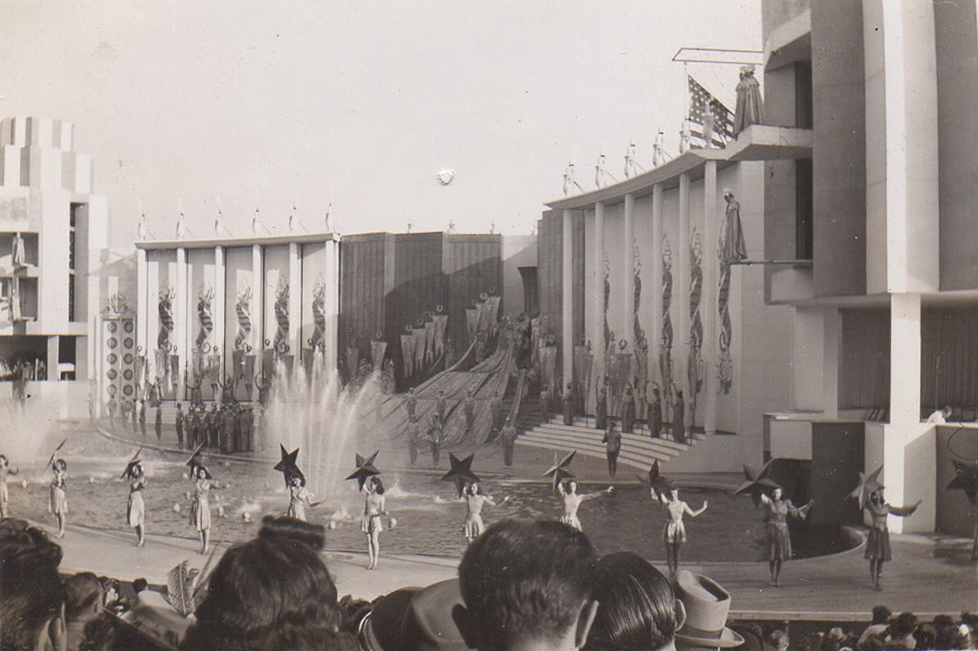
Billy Rose’s Aquacade — or if Aquaman were a musical!
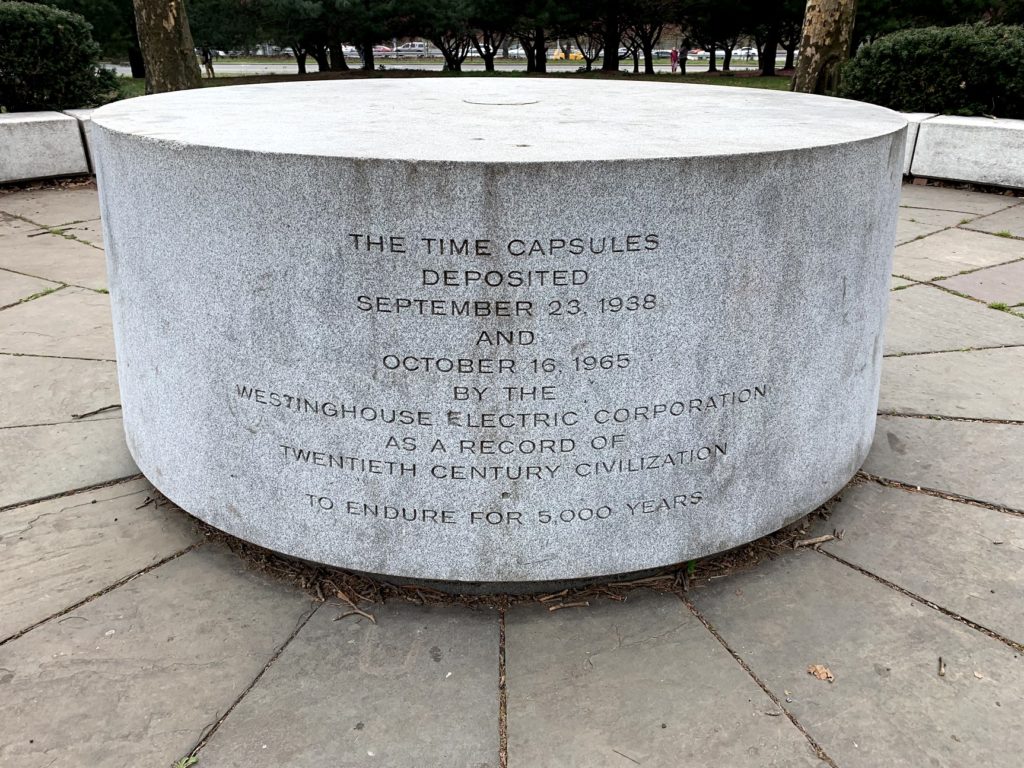
You can find evidence of the 1939 Worlds Fair all over the place in the park! Just a few examples (pictures by Greg Young):
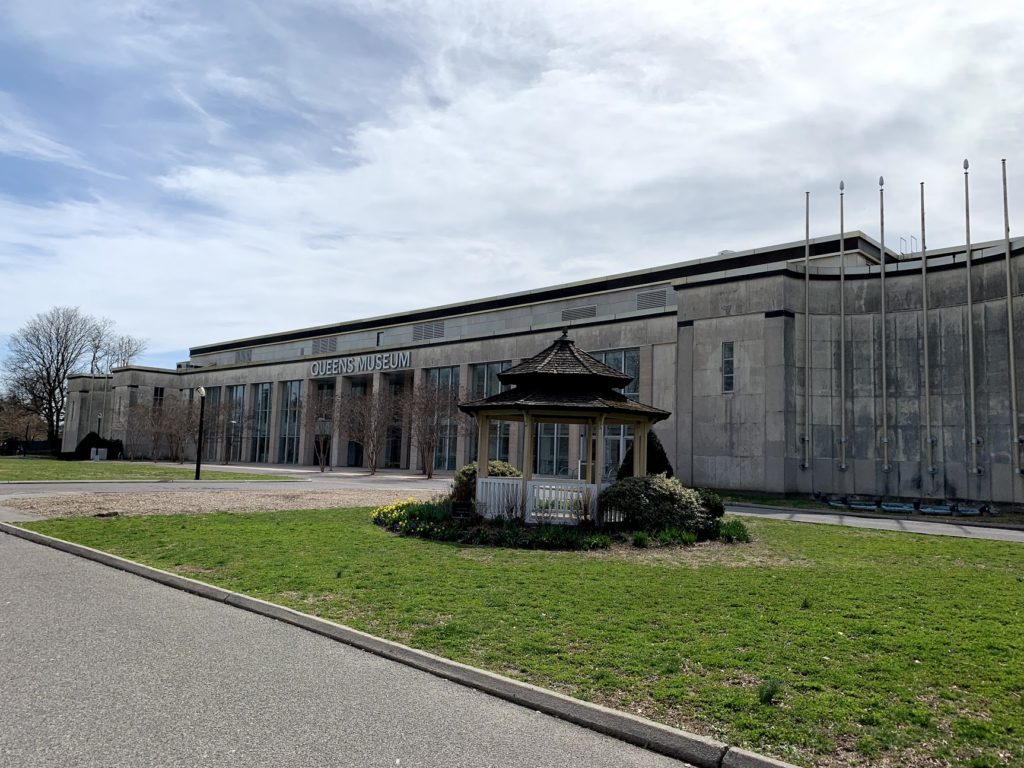
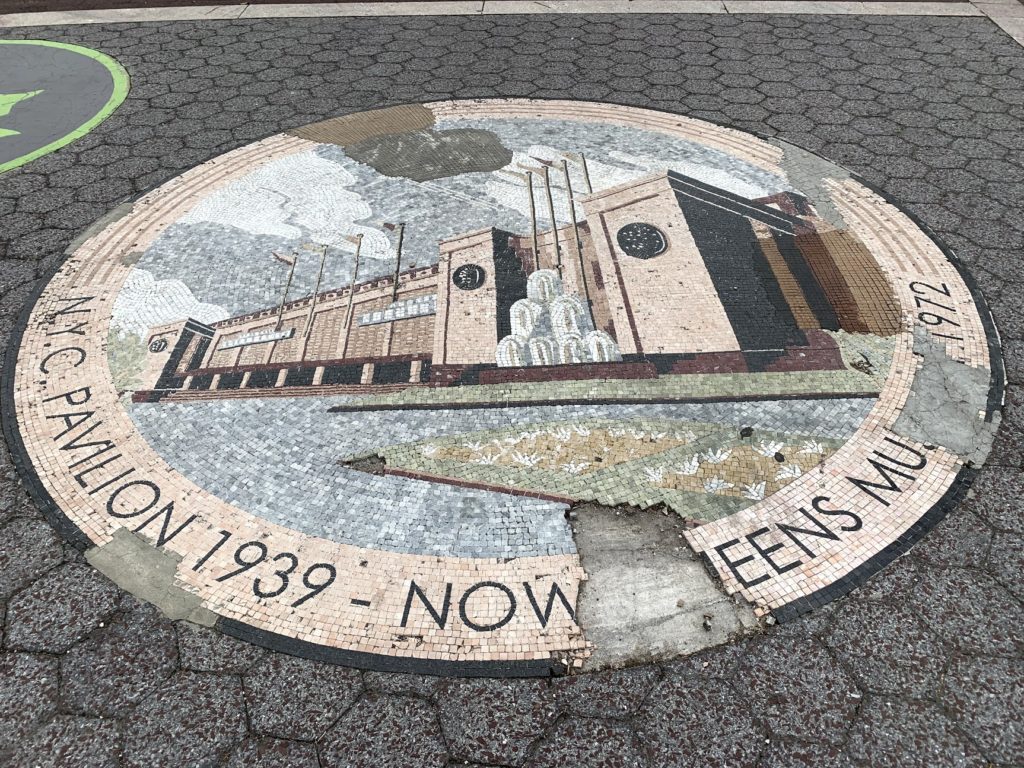
The former “New York City Building” which sat in the shadow of the Trylon and the Perisphere. Today it’s the Queens Museum….
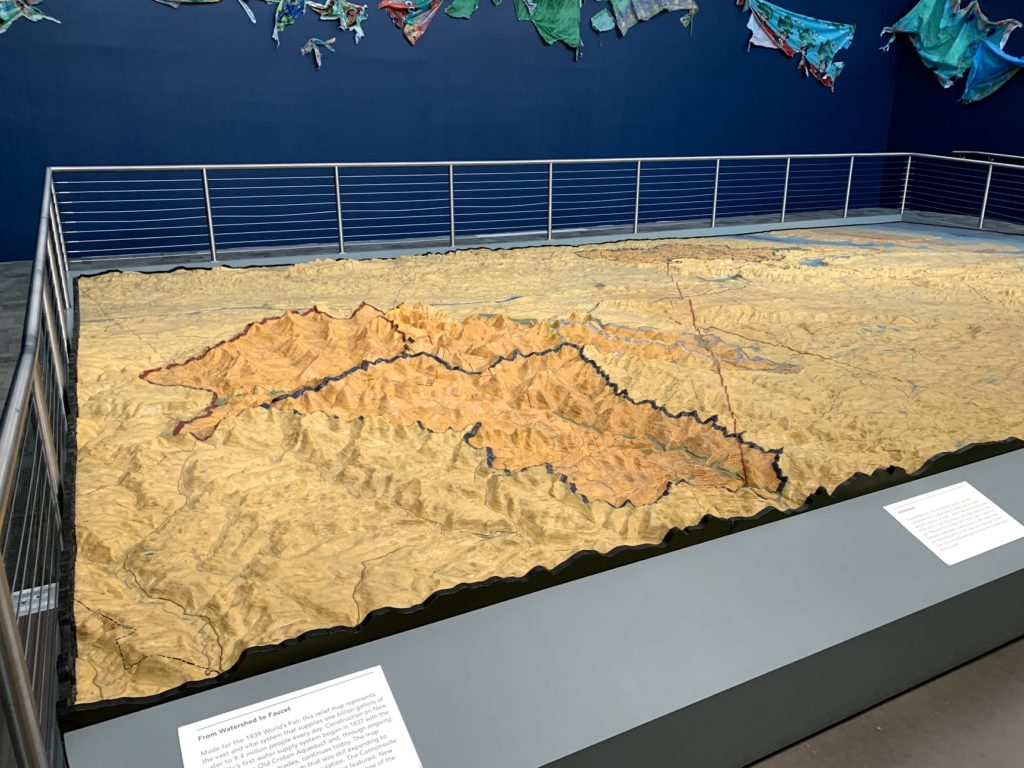
…where you can find the relief map of the New York City water supply, designed for the 1939 World’s Fair but never used.
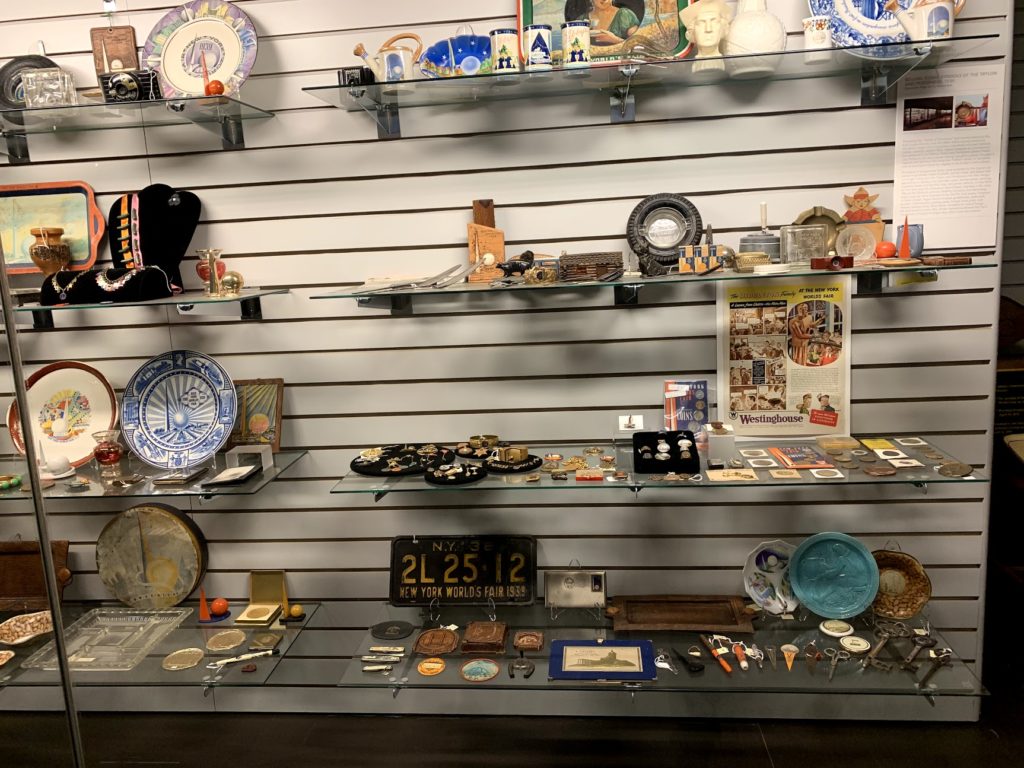
On the second floor, you’ll find a visible storage collection of World’s Fair memorabilia from both fairs.

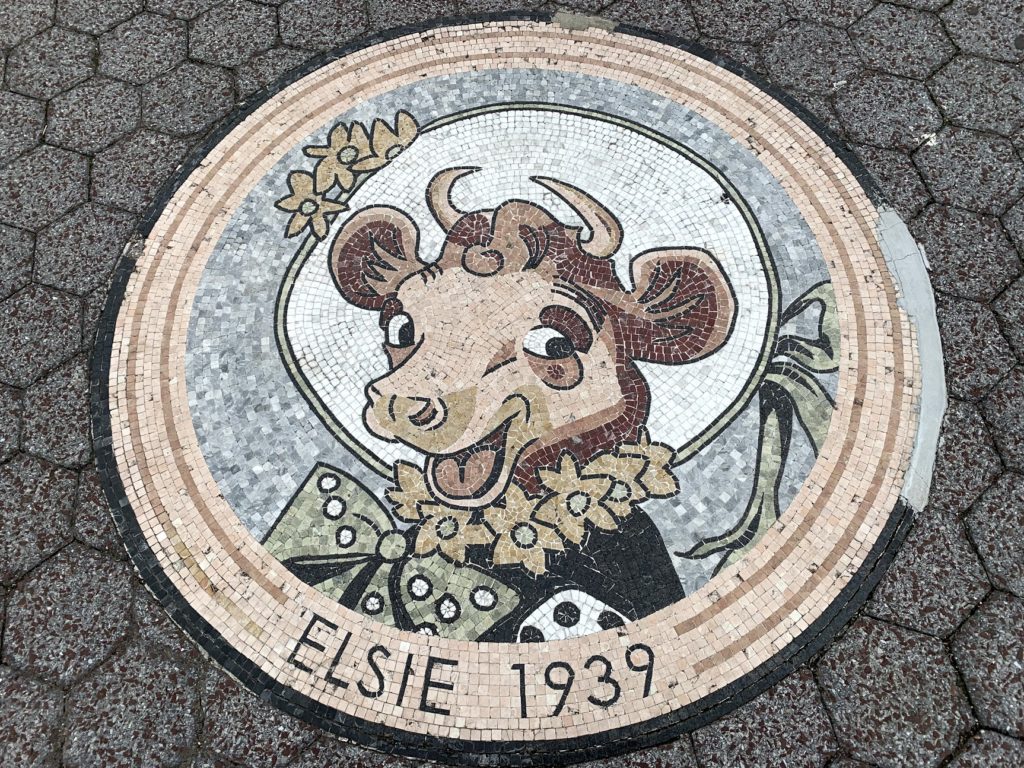
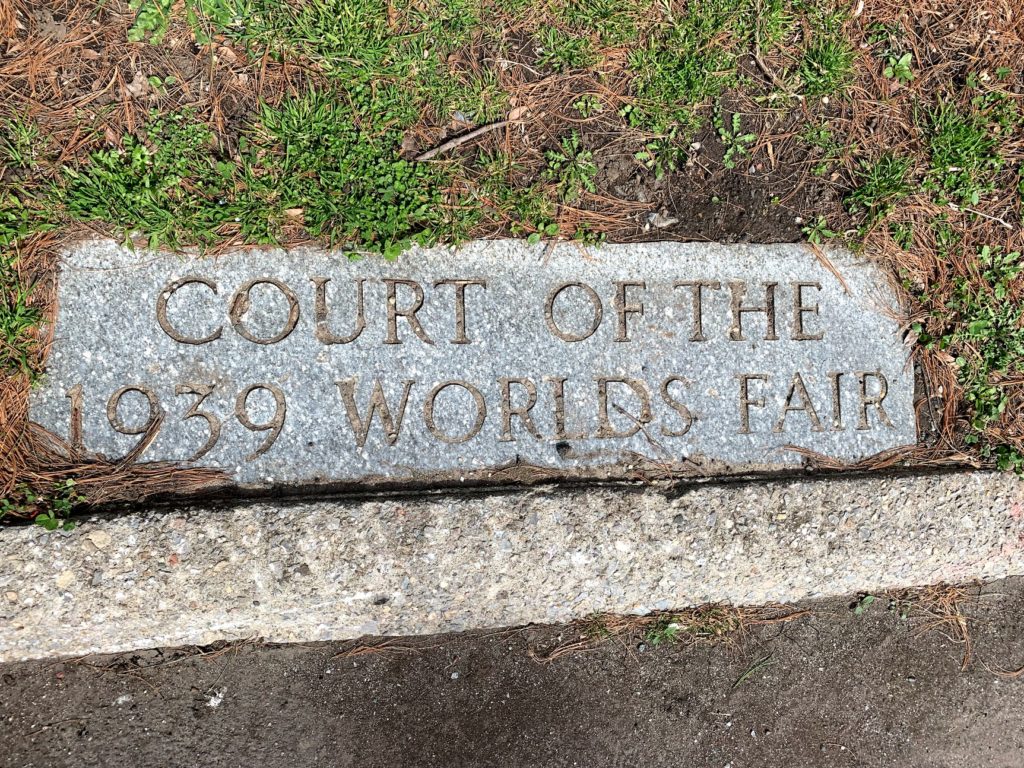
Don’t just look up! At your feet are also some tributes and traces to the World’s Fair.
FURTHER READING

The website 1939 New York World’s Fair is a wonderful resource, breaking down the specifics of most pavilions and even offering scans of brochures and programs from the fair.

The University of Virginia American Studies program also has a fine, older online look at the fair.

NYC Parks also has a page of vintage photographs, including one of the Westinghouse Time Capsule being installed.

FURTHER VIEWING

The Anthology Film Archives is hosting a film series in May called Films For The Fair: The World’s Fair and the Cinema  with some fascinatingly strange features scheduled throughout the month.

FURTHER LISTENING

Listen to these past Bowery Boys podcast episodes for tie-ins to this week’s show — two on the World’s Fair of 1964-65 (including one on the ruins of the New York State Pavilion) and one on the ‘first’ World’s Fair — the New York Crystal Palace Exposition. In addition, an episode on the birth of television featured the RCA Pavilion at the World’s Fair.

In addition, you may also like an episode of Greg’s spinoff podcast The First about the invention of robots (featuring Elektro).
Categories
Museums

The Crystal Palace: A new gallery show brings its marvels to life

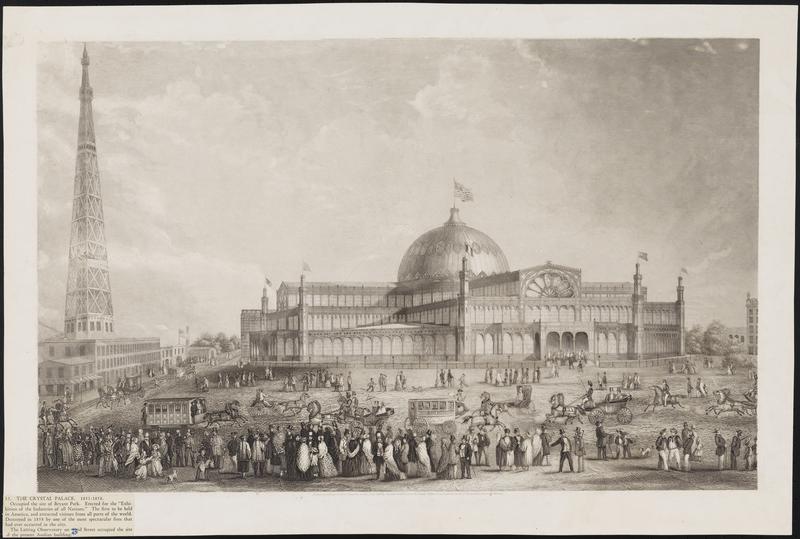
Bryant Park is a rather remarkable physical space. During the winter it becomes a skating rink and outdoor market, while in the summer, its lawn host hundreds of movie buffs every Monday for the park’s popular outdoor film festival. Its neighbor — the main branch of the New York Public Library — keeps millions of volumes within rooms below the park. And once, long ago, Americans came to this spot to witness the technological marvels of the age.

Courtesy Museum of the City of New York

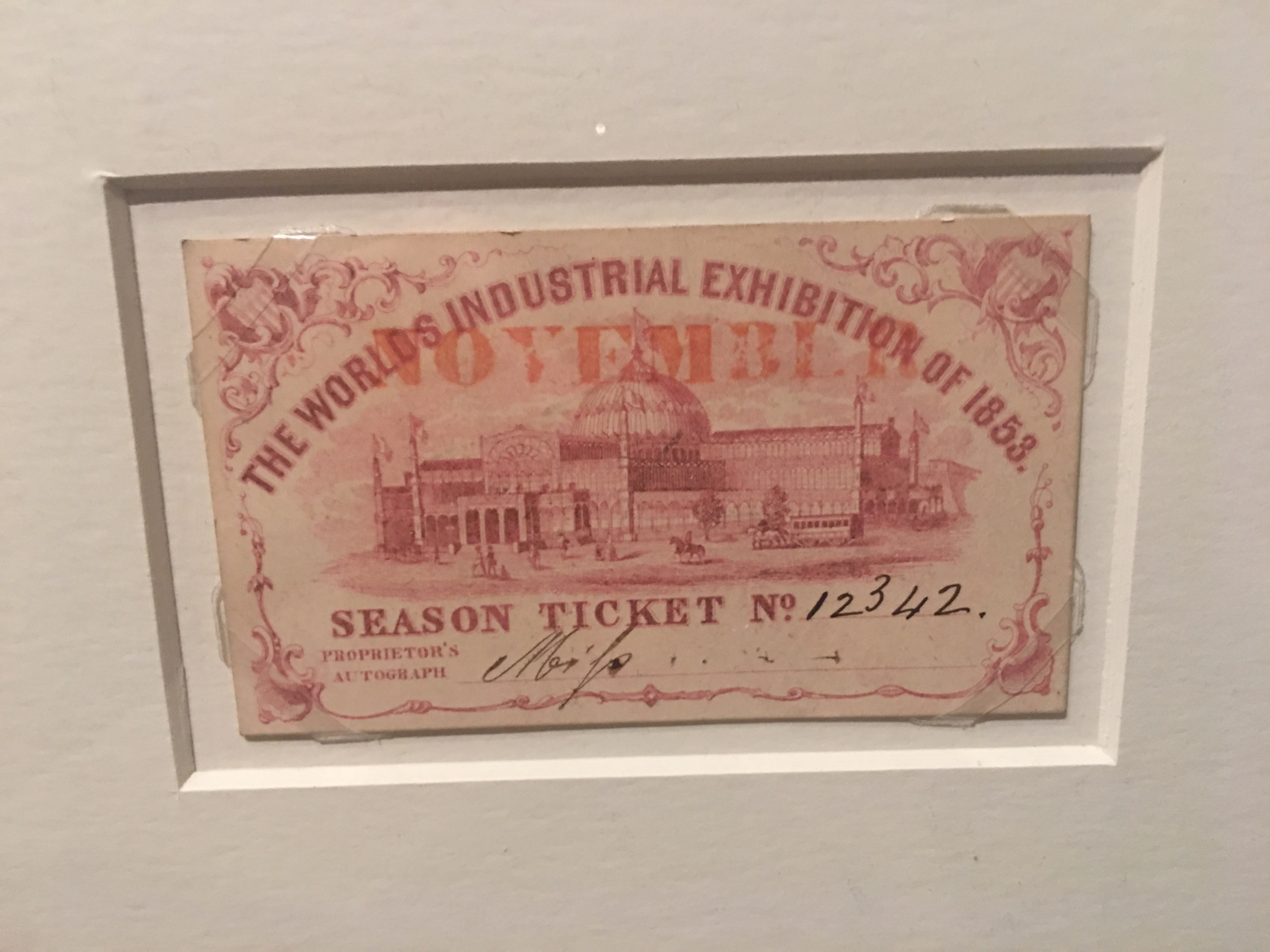
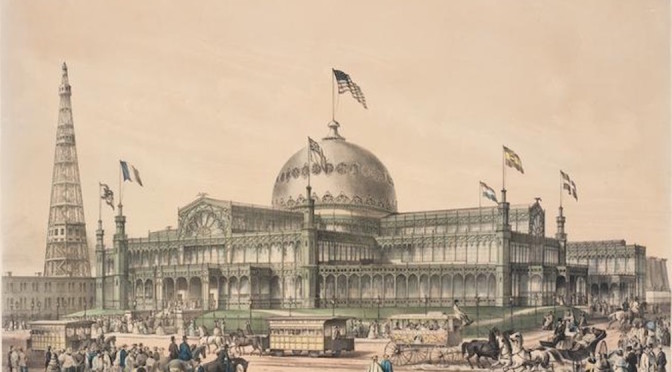
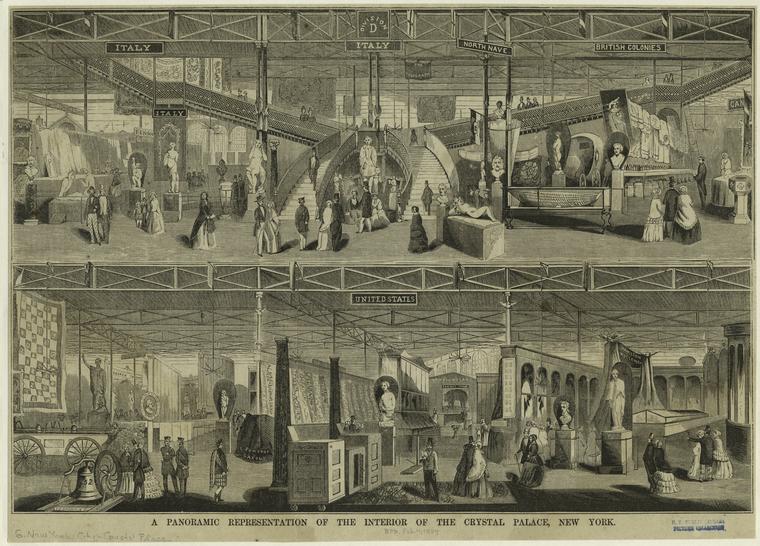
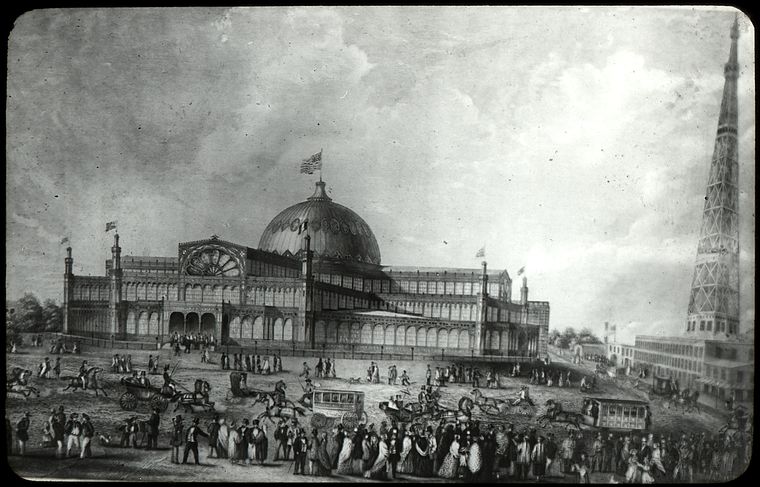
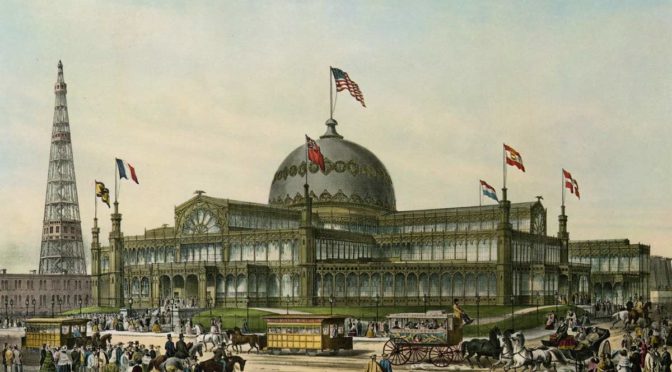
The Exhibition of the Industry of All Nations was the first major industrial fair in the United States, showcasing the rising manufacturing prowess of the young country. It was housed in a jewel box of an exhibition center, the extraordinary Crystal Palace, a wonder of glass and steel, modeled after a similar structure in London. When fire eventually took the building in 1858, New York City lost its most valued tourist attraction.

A new show at the Bard Graduate Center Gallery (18 West 86th Street,  just steps from Central Park) reanimates a bit of the Crystal Palace Exhibition, bringing the wonder of visiting this wondrous place to life with displays of original artifacts and an absolutely sensational interactive component.

The gallery features a selection of items both displayed at the fair and used to promote it. Americans were so enthralled by the exhibition that they decorated their homes with promotional items include one example featured in the gallery of an ornate parlor clock affixed with an image of the Crystal Palace. High end tchotchkes, indeed!

The fair displayed fine art and experimental technologies alongside examples of American craftsmanship.  Featured in the gallery are samples of American-made items from the 1850s proudly shown at the fair — porcelain, glassware, furniture, pottery and sculpture.

You’re perhaps used to seeing such items in a museum; the things you’re seeing here, however, weren’t originally displayed for their historical worth. At the opening of the Crystal Palace in 1853, they were literally the embodiment of a growing country.

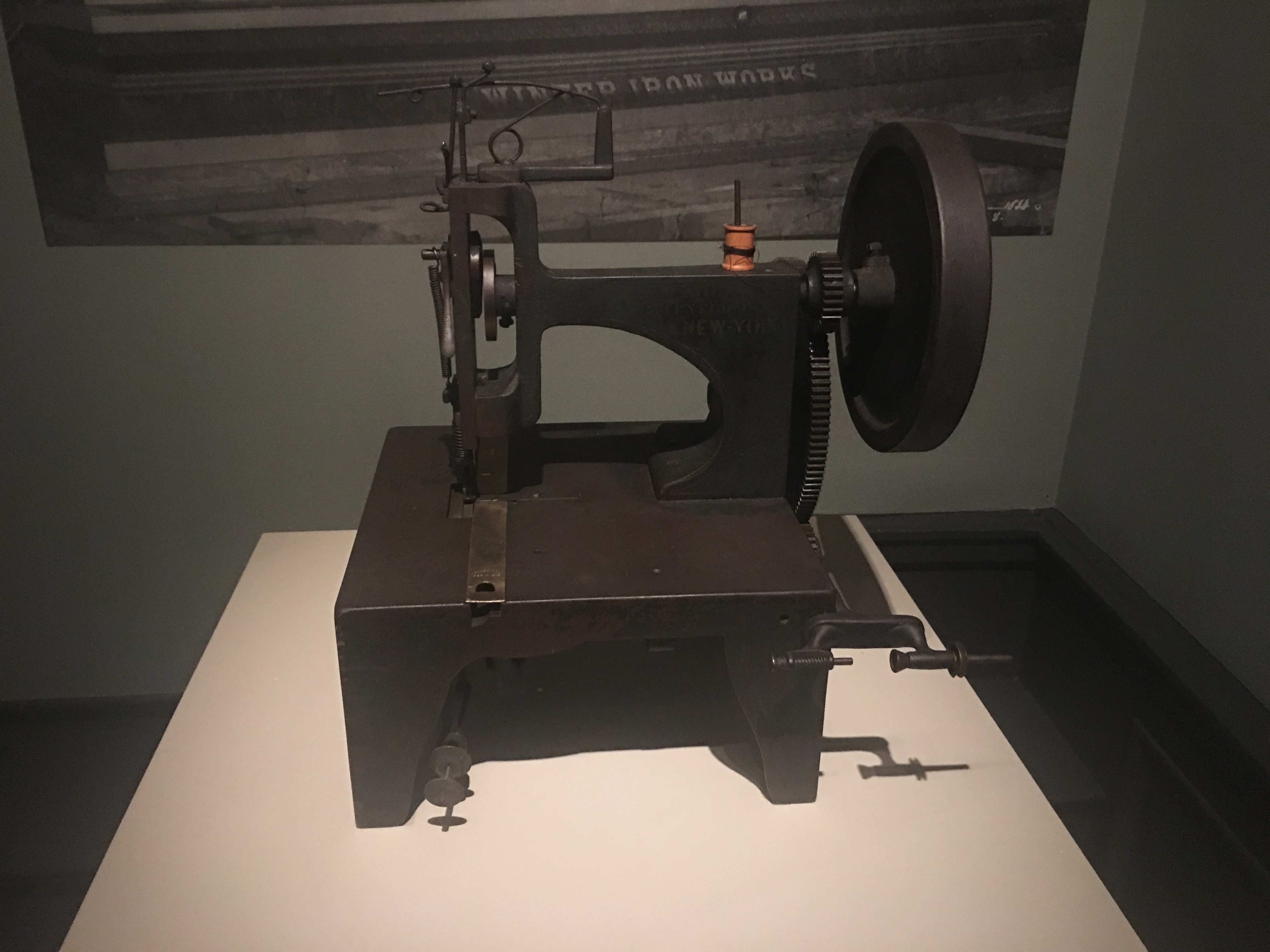
An early sewing machine from I.M. Singer, 1856. While perhaps it seems almost medieval today, this would have been considered a modern marvel in the 1850s.


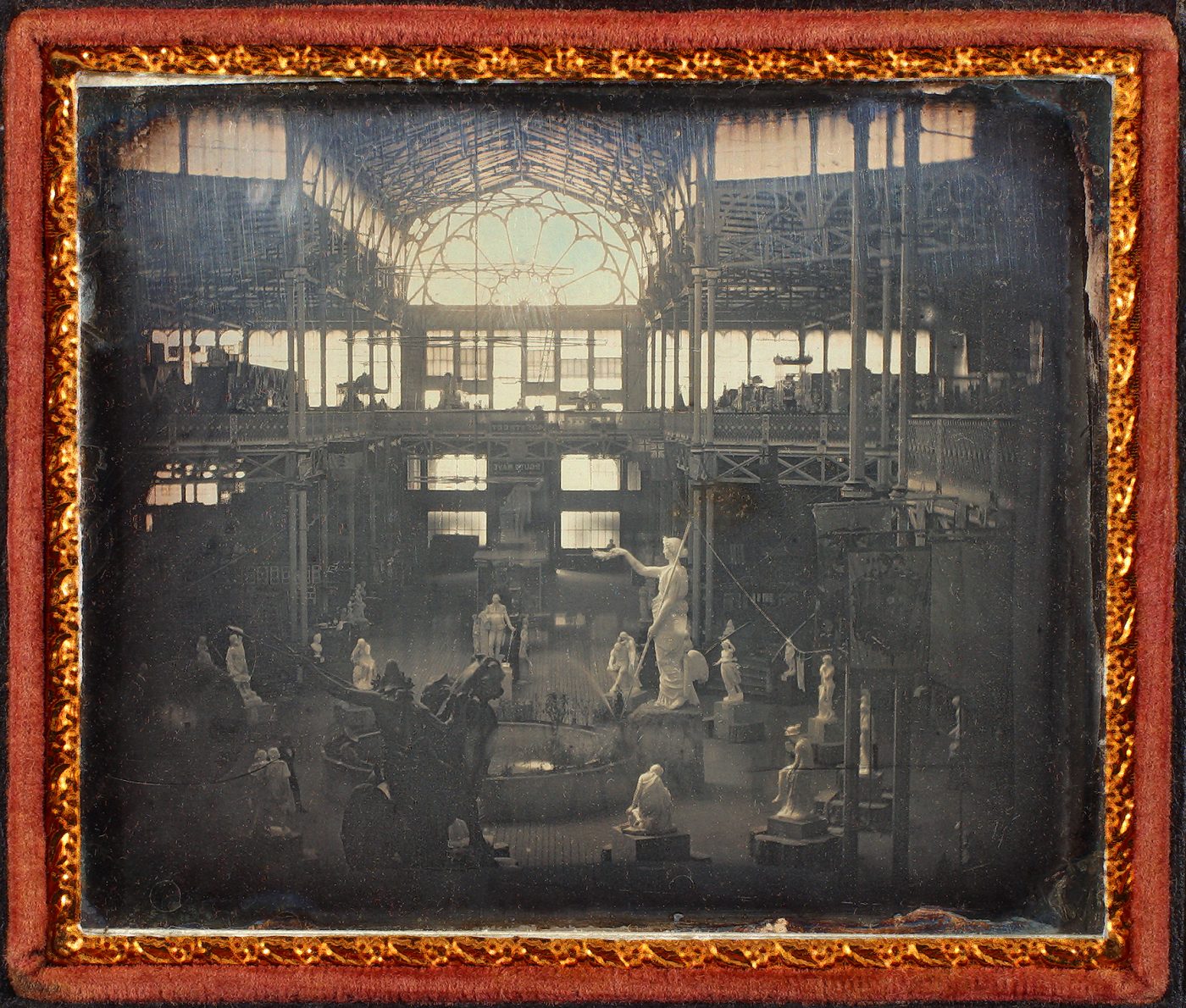
And here, in this intimate space, there are little delights behind tiny thick curtains — daguerreotypes and photographic salt prints from the fair itself, so delicate that they must be protected from even the gallery’s gentle light.

As always with Bard’s historical exhibitions, they accompany their physical displays with rich, detailed interactive displays and online material.  Take a stroll through the Crystal Palace along a meticulously labeled panorama or click through a replica of a tourist guide suggesting things to do around the city. 

In fact, I would highly suggest getting lost in their digital resources before heading over to see the physical objects. (You’ll be able to play around with them at interactive displays at the exhibit as well.) There are also some engaging audio ‘walking tours’ from three different perspectives of people visiting the fair.

(Personally, I would also recommend listening to our podcast on the Crystal Palace which we recorded exactly two years ago. Putting it all together with the gallery show will the closest thing to boarding a time machine!)

Categories
Amusements and Thrills

The Bronx World’s Fair of 1918: the failure which became a magical park

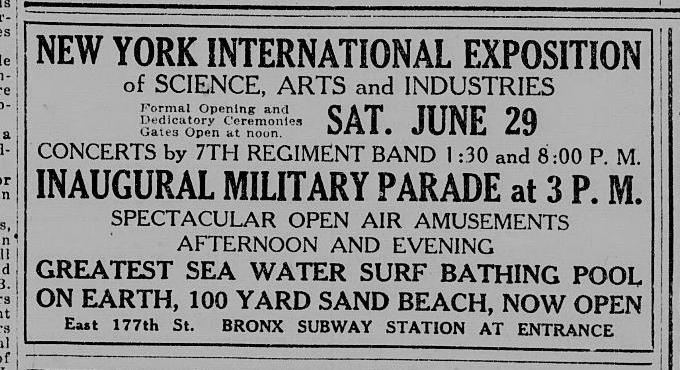
Nobody remembers the Bronx World’s Fair of 1918 or, more precisely, the Bronx International Exposition of Science, Arts and Industries. Nor should they really. Modest in scale and only partially completed, the exposition failed to bring the world marvels on the scale of the elevator (from the 1853 Crystal Palace exposition) or the television set (from the 1939-40 World’s Fair in Flushing-Meadows).
It was, in most aspects, a flop. But something very magical — and very nostalgic — arose in its place.
The fair was twenty years in the making, opening on June 29, 1918, two decades after the Bronx had become an official borough of New York. While many areas of the Bronx (as the Annexed District) were already part of New York as early as 1874, it wasn’t until consolidation that Bronx leaders began shaping a new character for this former section of Westchester County.

2

But in a sense, the fair was 300 years in the making. It was initially planned as a commemoration of the first European settlement in the Bronx. (NOTE: The park was supposed to open in 1917, although I’m still not sure which measure they’re using to get 1617 as a date of settlement; Jonas Bronck, considered the ‘first’ settler, arrived in 1638.)

The fair was developed on the old grounds of the William Waldorf Astor estate in the neighborhood of West Farms, just to the south of Bronx Park.

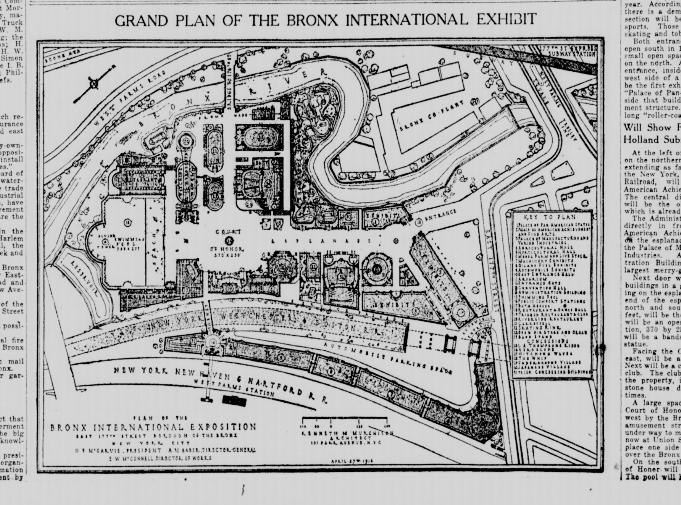
From the caption: “Bird’s-Eye View of the Bronx International Exposition Grounds showing the wonderful location in the heart of the great city, and transportation facilities, with railroads, subway and elevated lines, surfactelines and automobile boulevard at the very door.  The Bronx River, providing anchorage for small craft, forms the western boundary of the exposition grounds.”

Courtesy OutdoorAfro.com

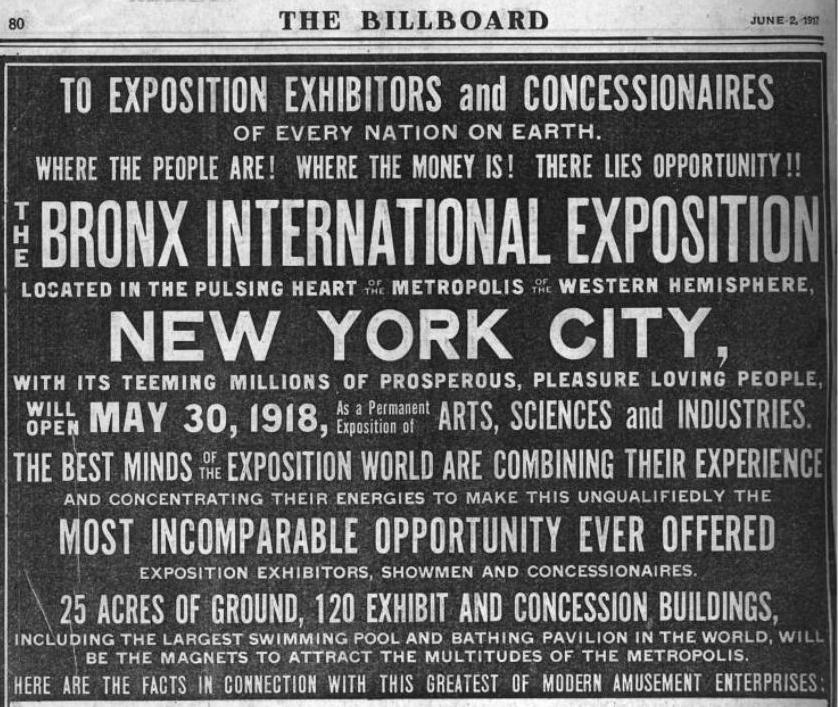
The fair was meant to attract foreign trade to this country after the war. It was to be a Bronx show-and-tell. “The exposition will bring hundreds of thousands of visitors, who will have the chance to see the Bronx at its very best. There is no reason, it is said, why a certain percentage of those newcomers might not become interested in real estate.” [source]

From a 1917 advertisement in Billboard Maazine attempting to drum up exhibitors.

1

Below: Grand plans indeed. What the Bronx fair was supposed to look like.

Courtesy New York Tribune

The fair opened almost one month late, having already been delayed a year due to the war. Even still, when it did open, most of its buildings were yet to be completed. Most would never be finished.  “[T]here are only a dozen buildings and a number of concessions including a restaurant, a roller coaster, a centrifugal swing and a nonsense house,” giving it “the impression of a mini-Coney Island.” [source] [source]

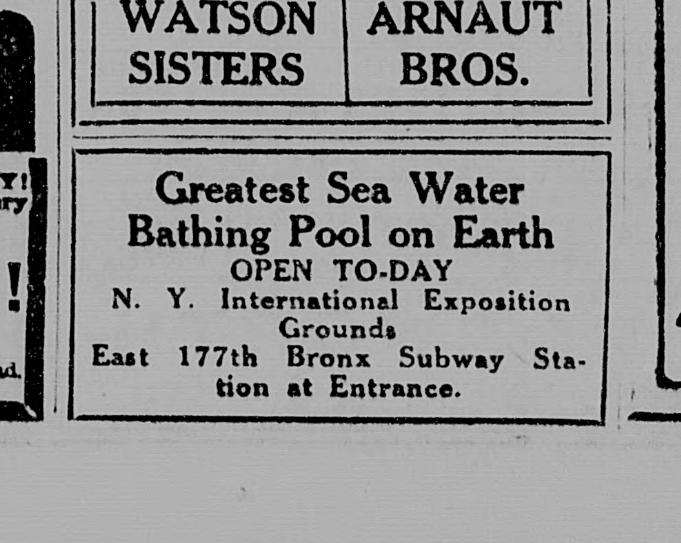
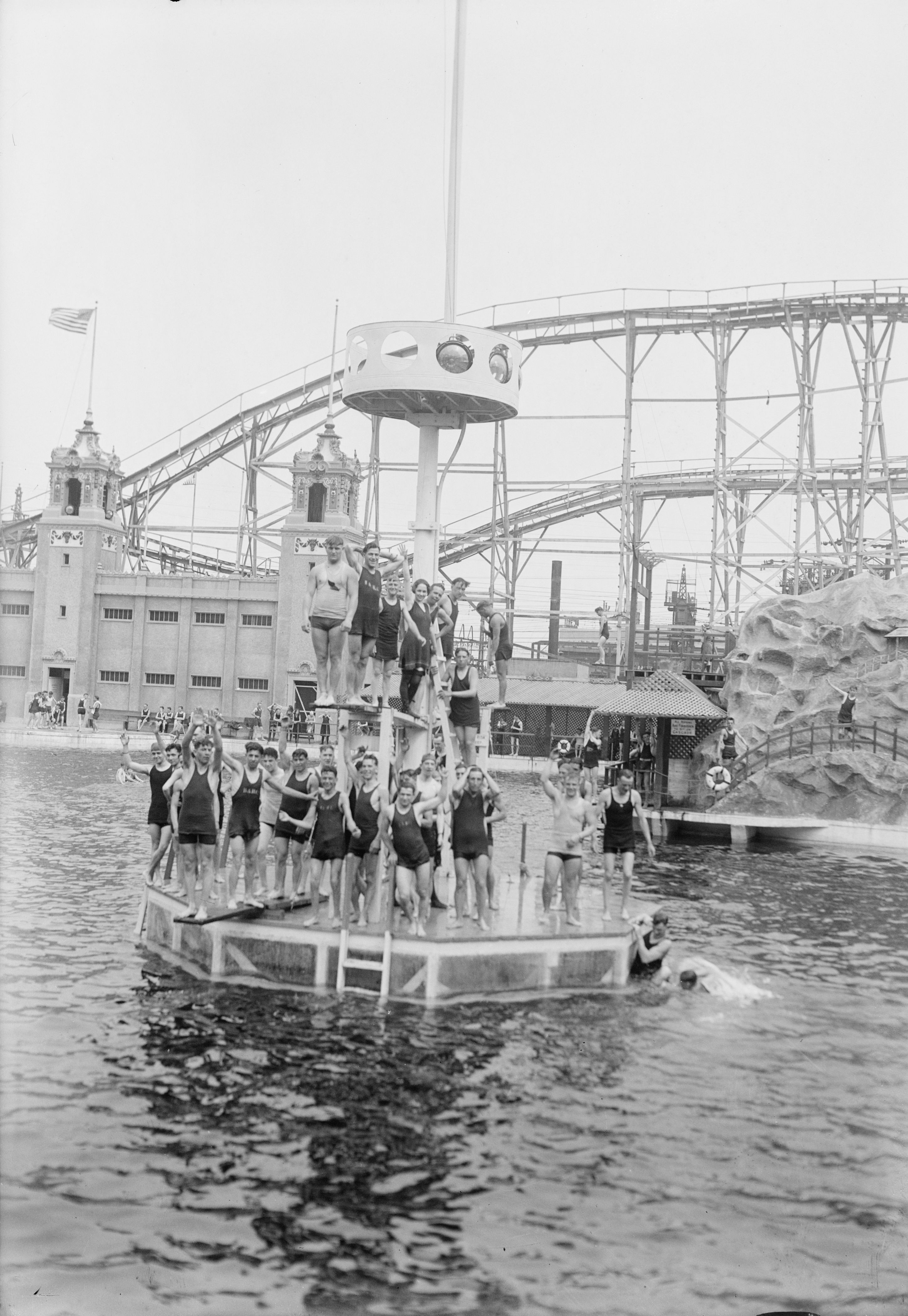
Perhaps the most notable structures at the opening were the bathing pavilion, a private club called Circle de Papellon, and “what is said to be the largest salt water surf swimming pool in the world.”

1

Over the coming weeks, fair attendees would attend such free attractions as Madame Torelli’s Comedy Circus, the Lunette Sisters aka “the whirling Geisha Girls,” and performances by the world’s greatest high-diver Kearney P. Speedy.  And there was some kind of “monkey cabaret” as well.

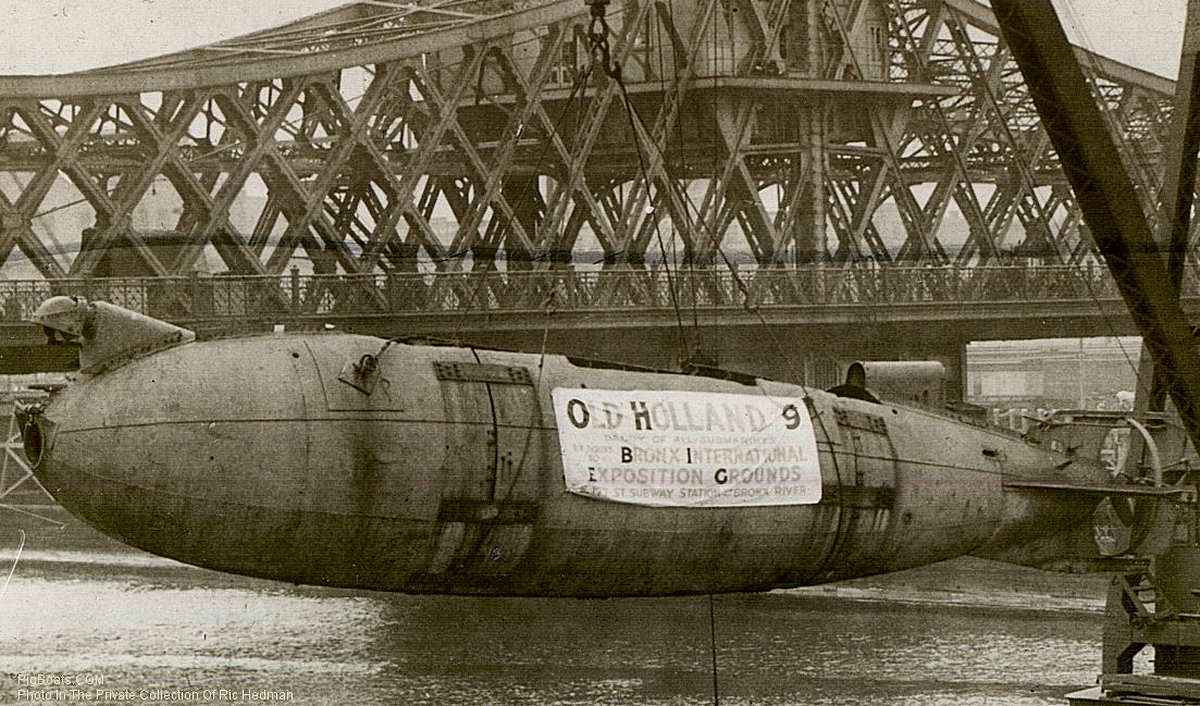
One of the Exposition’s most popular attractions was a small submarine called the Holland, the very first commissioned by the United States Navy.

From the Private Collection Of Ric Hedma
From the Private Collection Of Ric Hedman

The fair was ‘international’ in the sense that only one country (Brazil) actually showed up to exhibit anything.

After all, it was entirely unrealistic to expect exhibitors while a war was raging in Europe. By August, the only headlines coming out of the International Exposition were related to swimming and diving. (“HAWAIIANS REPEAT TRIUMPHS IN TANK.”)

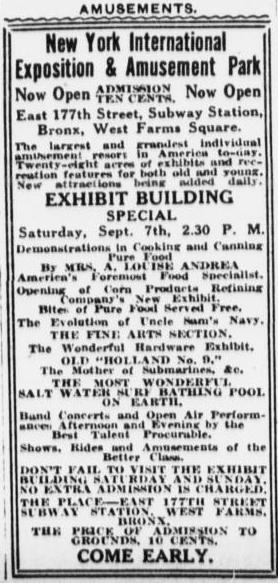
Most the fair’s more serious fare took a backseat to the amusements, as this advertisement from September 1918 indicates. The Exhibition Hall was eventually turned into a skating rink. Although one could enjoy cooking demonstrations and a fine exhibition of hardware:

1

By the following year, it was decided to just dispense with the serious stuff entirely. Well before the fair, there had been much talk of turning the Astor property into an amusement park. After the Exposition ended, that finally came to fruition — as Starlight Park.

Thousands of children descended upon Starlight Park during the summer, one of the popular attractions in the Bronx in the 1920s.

Starlight_Park

One of the park’s centerpieces was a giant stadium called the Coliseum which held up to 15,000 people, often there to cheer on New York’s premier soccer team, the New York Giants, who made Starlight their home from 1923 to 1930.

By the 1930s, most of the rides had closed, but the pool was still a popular draw. The park became a magnet for the area’s working class families, who enjoyed sunbathing, picnicking and, if they stayed after dark, moonlight dancing to live big band music. One of the very first Bronx radio stations WKBQ also made Starlight its broadcasting home in 1931.

Sadly, Starlight met with a rather ungracious fate. The park was slowly demolished over the years and by 1940 it was permanently closed, transformed into a city truck facility. Fire in the late 1940s destroyed any remaining vestiges of the park, and its memory was completely wiped away by expanses of the Cross Bronx Expressway.

Today there’s a children’s playground at around the spot of the old exposition called Starlight Park.

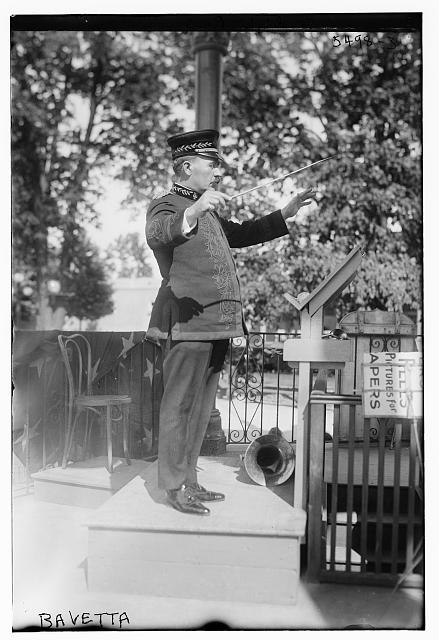
Below: Strike up the band! Conductor V. Bavetta provides musical accompaniment to the visitors of Starlight Park

Courtesy Library of Congress
NOTE: Clips of this article originally appeared in my old 2009 post about Starlight Park.
Categories
Amusements and Thrills

The 1965 New York World’s Fair: Opening Day

The New York World’s Fair opened for its second and last season on April 21, 1965.  The grand opening the previous year had been rocky indeed — protests, rain, even a parking lot riot.  Thankfully the second season was met with beautiful weather and abundant crowds.  In order to jazz it up a bit — not too much, just enough to increase ticket sales — Robert Moses authorized a host of changes, great and small.  Some of the exciting guest stars and new features that awaited entrants to the 1965 World’s Fair that day included:

1

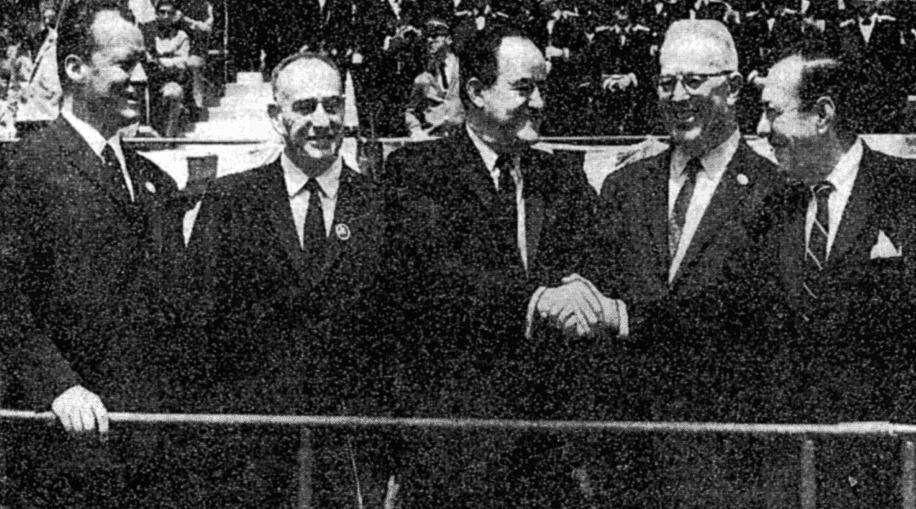
Opening the World’s Fair that day: Mayor Willie Brandt of West Berlin; Robert Moses naturally; Vice President Hubert Humphreys; Chief Justice Earl Warren and New York Mayor Robert Wagner (from NYT file photo)

Vice President Hubert Humphrey took a leisurely stroll through the fair, creating quite a stir. “He’s a walking pavilion,” cracked one observer. His entourage included Chief Justice Earl Warren.  During his visit to the New York State Pavilion, a riot almost ensued.  “Children cried out in terror, parents shouted, toes were trampled, cameras clicked.”

Courtesy Life Magazine

Hall of Presidents: Appropriately, Humphrey’s appearance coincided with the opening of some striking new exhibits within the United States Pavilion (which had opened the previous year) featuring memorabilia from over a dozen American presidents, including original copies of the Bill of Rights, Washington’s inaugural and farewell addresses and Lincoln’s Gettysburg Address.  Meanwhile, a crude Animatronic version of Lincoln continued to greet visitors.

Photo by Bill Cotter/NYT

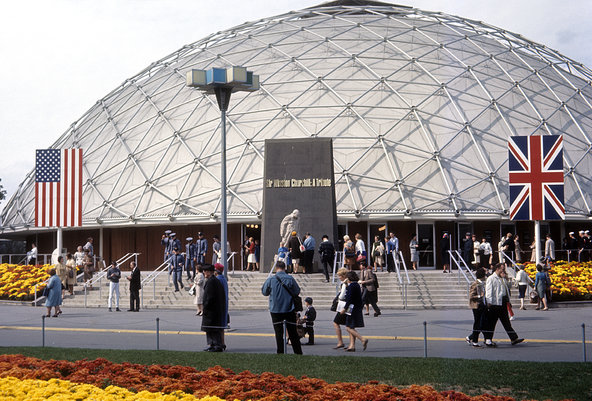
Under The Dome: One of the most anticipated new arrivals to the fair was the Winston Churchill Center, a tribute to the former British Prime Minister who had died in January.  “Included in exhibits documenting Sir Winston’s career are some of his own paintings, and photographs of him at various periods in his life. Also on display are a replica of Churchill’s study at Chartwell; models of Blenheim Palace, where he was born, and Bladon churchyard, where he lies buried; and an exhibit of his personal effects, including his desk, which once belonged to Disraeli.”

The dome of this dramatic pavilion would later be used as the Queens Zoo Aviary.

heinz

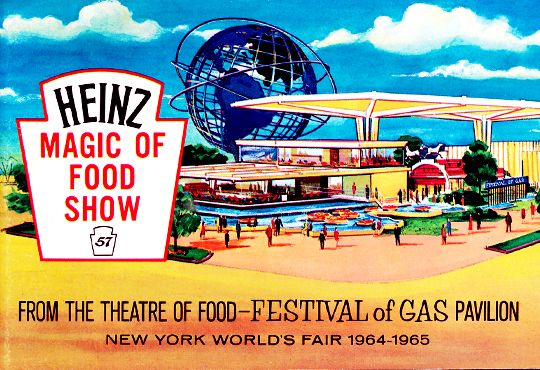
MORE FOOD: According to the New York Times, “the number of restaurants has been increased from 111 to 198. This means the fair can now serve more than 38,000  person simultaneously, or about 8,000 more than last year. ”  Certainly there was food to be found at the Theater of Food-Festival of Gas Pavilion?

The Gutenberg Bible: If you were craving a more spiritual exhibition, look no further than the latest resident of the Vatican Pavilion, one of six existing copies of the Gutenberg Bible. Also on site: The Pope’s jeweled tiara.  These two items were joining the Pieta, perhaps the most historically significant work of art at the fair.

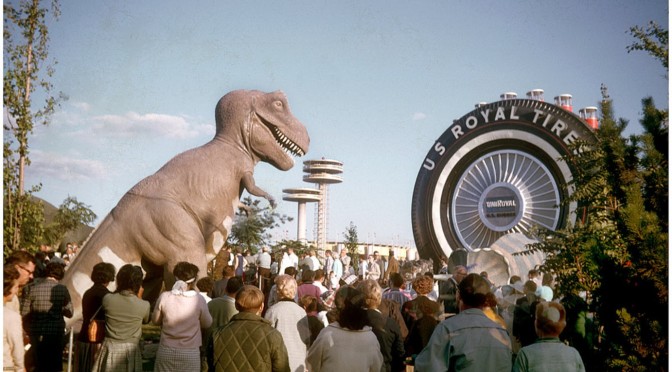
dino

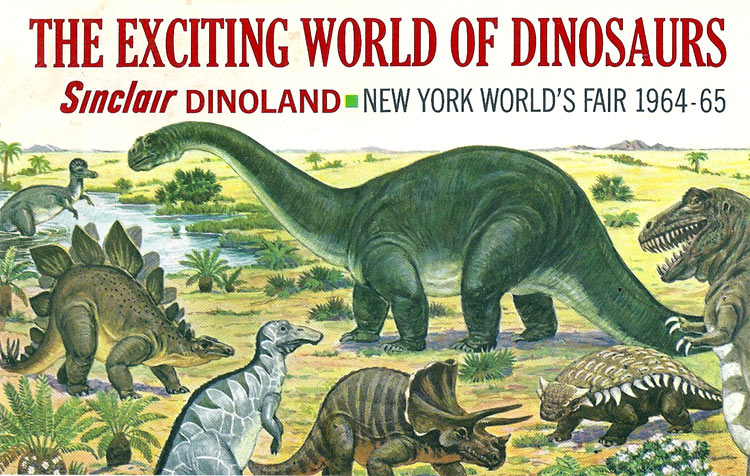
New Dinosaurs at Sinclair’s Dinoland : And not just any dinosaurs, but automated dinosaurs that could roar. “Last year we were of the school that dinosaurs had no vocal cords,” said the exhibit’s fuddyduddy spokesman. “This year we are in a new school.”

Kiddie Phone Center : As a way to get children excited about using the phone, Bell Telephone opened a Phone Fun Fair featuring a variety of wacky telephone games. “The center has three tot-sized phone booths where a youngster, by dialing, can get a pleasant message from one of six Disney characters, or a commercial message from an operator.” BONUS FUN:  “A voice Mirror lets you hear how you sound on the telephone. Weather-phones allow you to dial Weather Bureau information in selected cities. Quiz games, solar battery display — and much more!”

fiesta

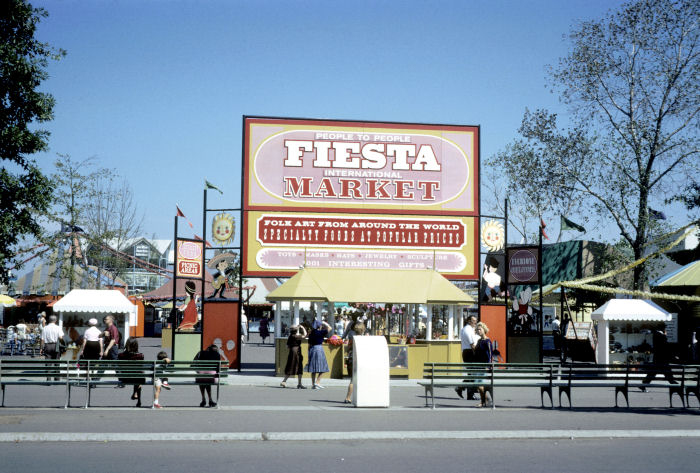
People To People Fiesta: The youth oriented People to People International is a youth outreach non-profit started by President Eisenhower in 1956. “Africa, Asia, Europe, as well as the Americas, are represented in a “village” of kiosks which display and sell a variety of folk art. Admission is charged; proceeds go to a center for world understanding.”   The ‘fiesta’ “will stress folk singing and dancing in the setting of colorful tents.”

Today PTPI takes the World’s Fair’s slogan — Peace Through Understanding — as its own.

(Image courtesy Worlds Fair Community forum.)

mars

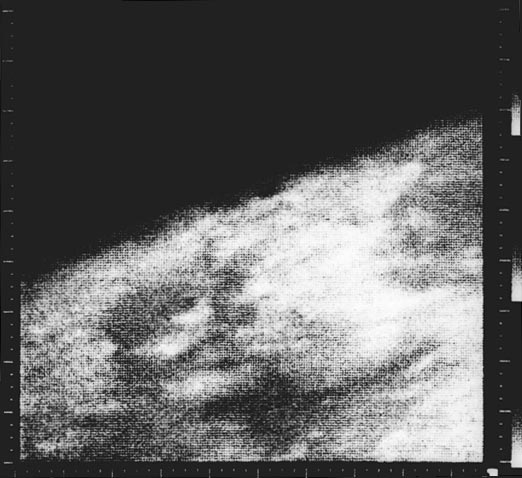
MARS! One of the more innovative new exhibits was located in Space Park with a focus on Mariner 4, a spacecraft launched the previous year that would successfully take the first images of Mars. Photos sent by Mariner 4 would be displayed here as they came in on July 14-15. Above: An image of Mars sent by the orbiting spacecraft.

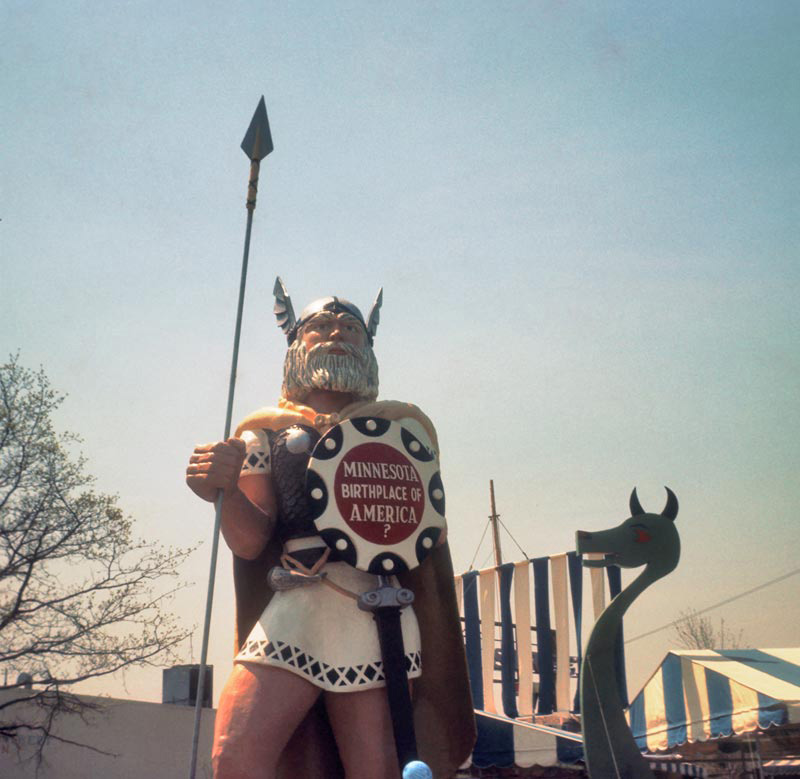
Kensington Runestone: And finally no trip to the fair in 1965 would be complete without a viewing of the mysterious Kensington Runestone, an ancient stone marking found in Minnesota in 1898.  Some believe this to be a link to 14th century Swedish explorers although how it got to Minnesota is anybody’s guess. It was debunked as a hoax in 1910, and yet here it is at the  World’s Fair! It was accompanied, naturally, by the 28-foot-tall Viking that you see below:

viking

Picture courtesy the World’s  Fair Community boards

Categories
Amusements and Thrills Podcasts

The Crystal Palace, America’s first World’s Fair and bizarre treasury of the 19th century

PODCAST New York’s Crystal Palace seems like something out of a dream, a shimmering and spectacular glass-and-steel structure — a gigantic greenhouse — which sat in the area of today’s Bryant Park. In 1853 this was the home to the Exhibition of the Industry of All Nations, a dizzying presentation of items, great and small, meant to exemplify mankind’s industrial might.

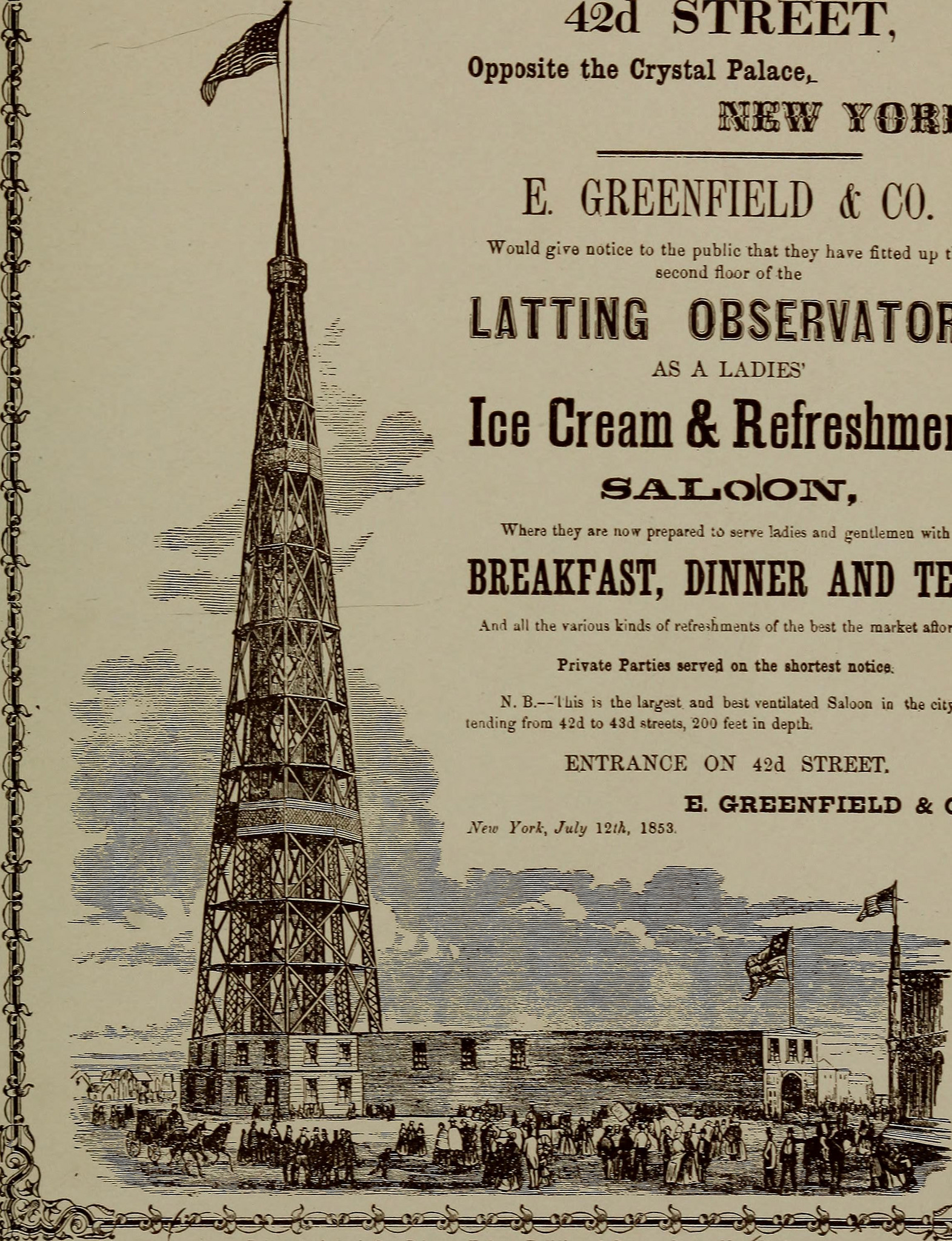
We take you on a breathtaking tour of the Palace and its legendary exhibition, including the Latting Observatory (the tallest building in New York!)

Whatever happened to the Crystal Palace? And what inventions contained within do we still benefit from today?

FEATURING: PT Barnum, Henry Ward Beecher, Elisha Otis and literally millions of items!

EDITOR’S NOTE – I mis-pronounced the name of the Fresnel light (actually pronounced fre-nell). Its modern ancestor is used in theatrical lighting today.


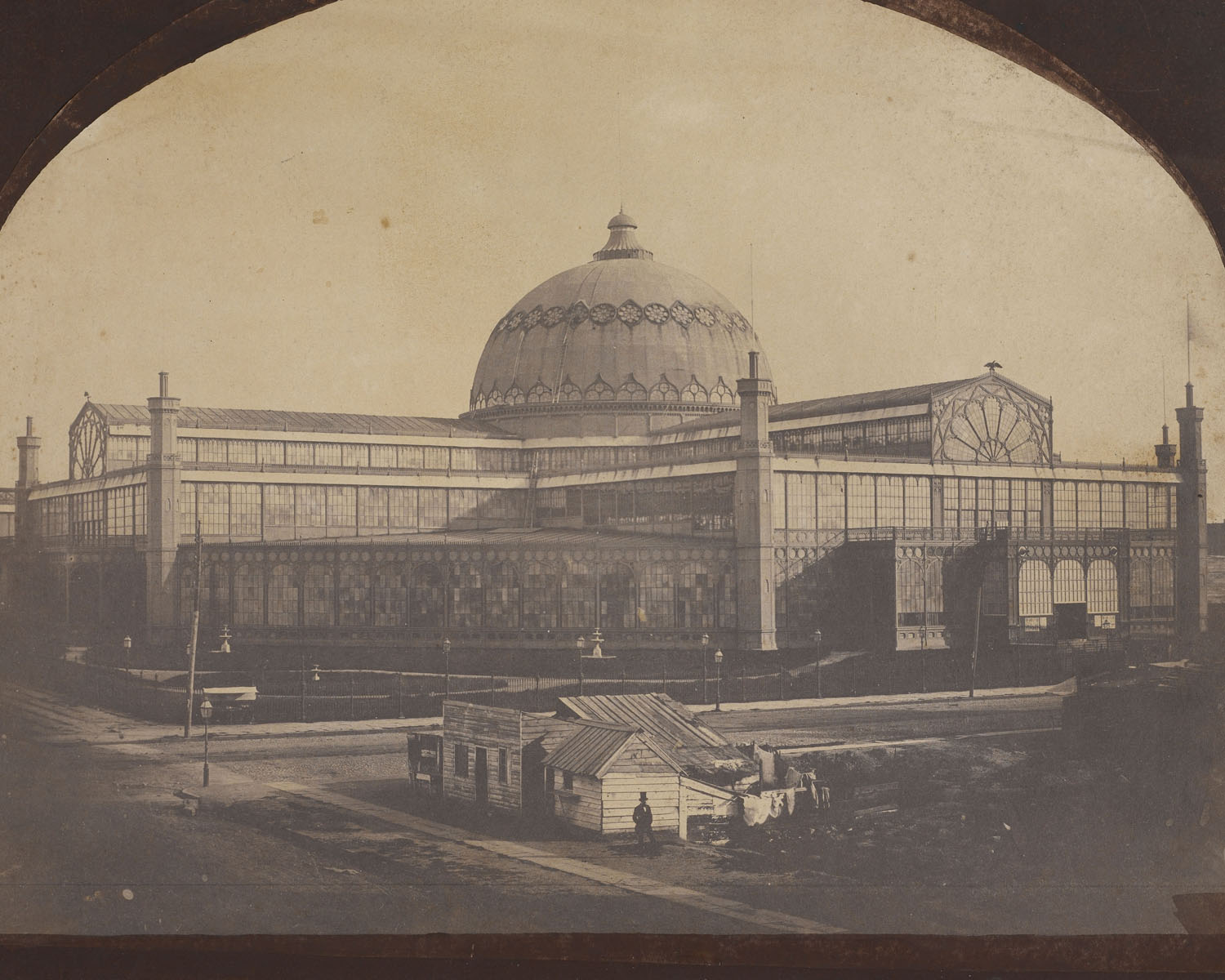
This is one of the earliest photographs of New York City ever taken. As the Crystal Palace hosted examples from the early days of photography, it’s no surprise that one of these early pictures is of the Crystal Palace itself.

A rare photograph of the New York Crystal Palace by Victor Prevost. Courtesy Avery Architectural & Fine Arts Library, Columbia University
A rare photograph of the New York Crystal Palace by Victor Prevost. Courtesy of the Avery Architectural & Fine Arts Library, Columbia University
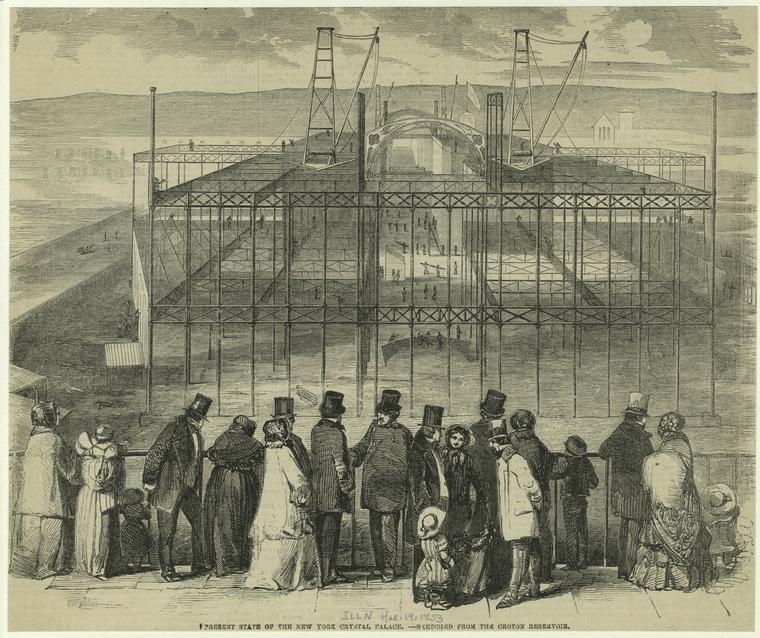
A look into the pit surrounding the Crystal Palace during construction. There were many delays, somewhat sullying the lofty ambitions of the project at the very start. Courtesy New York Public Library
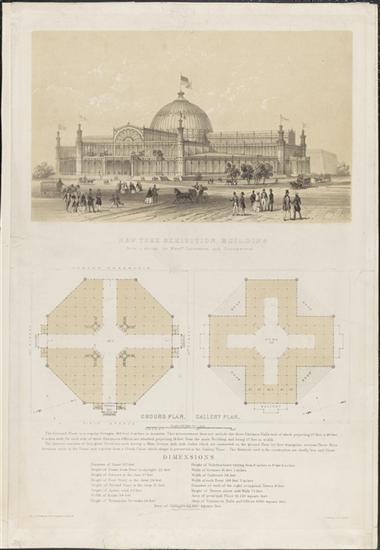
A very church-like plan of the Crystal Palace building by Petermann and Guildemeister. Courtesy Museum of the City of New York
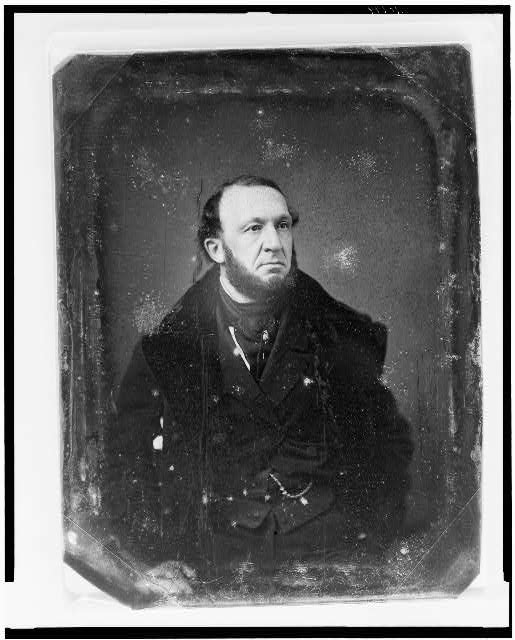
Theodore Sedgwick, who spearheaded the New York Crystal Palace -- and bore some of the criticisms of the Exhibition's rocky opening.
Theodore Sedgwick, who spearheaded the New York Crystal Palace — and bore some of the criticisms of the Exhibition’s rocky opening.
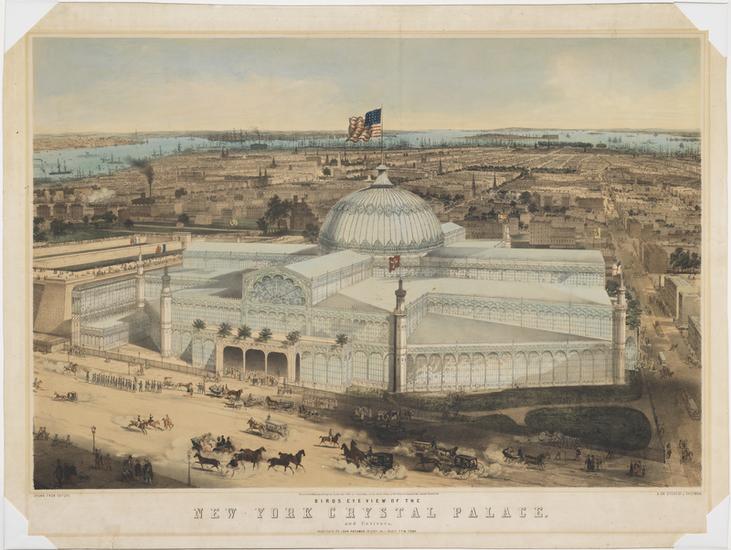
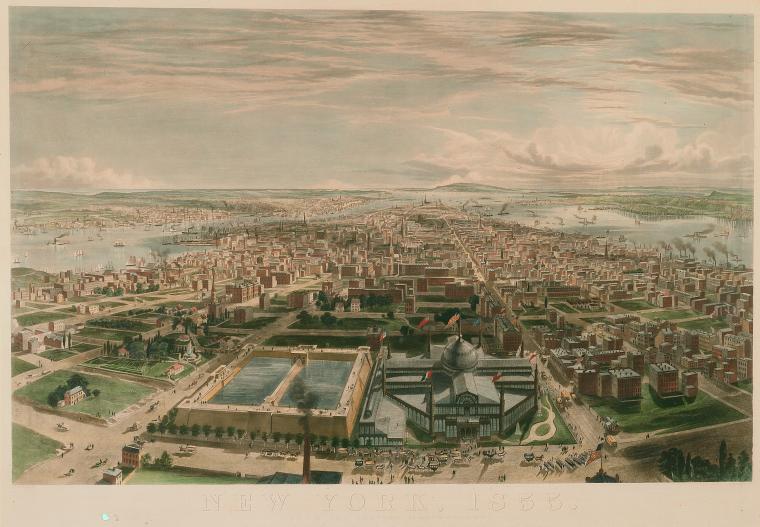
Birds Eye View of the New York Crystal Palace and Environs by John Bachmann. Courtesy the Museum of the City of New York
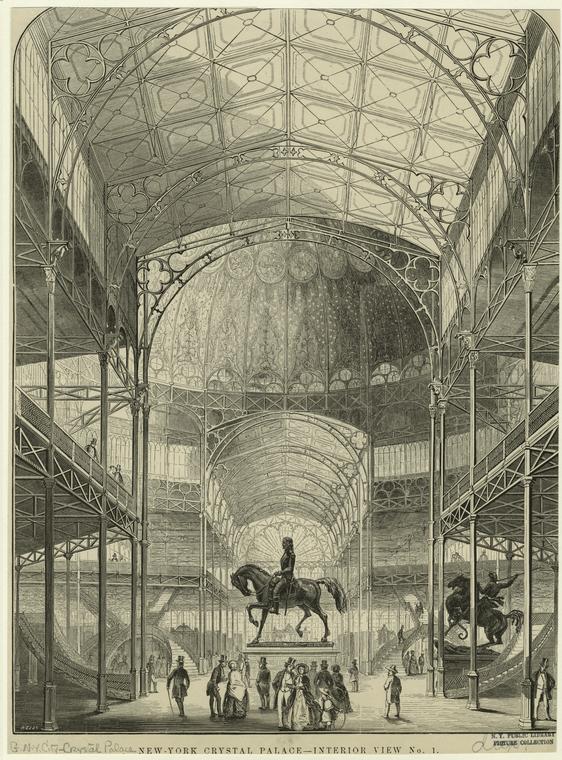
Illustration of the center of the Crystal Palace by J Wells. Courtesy New York Public Library
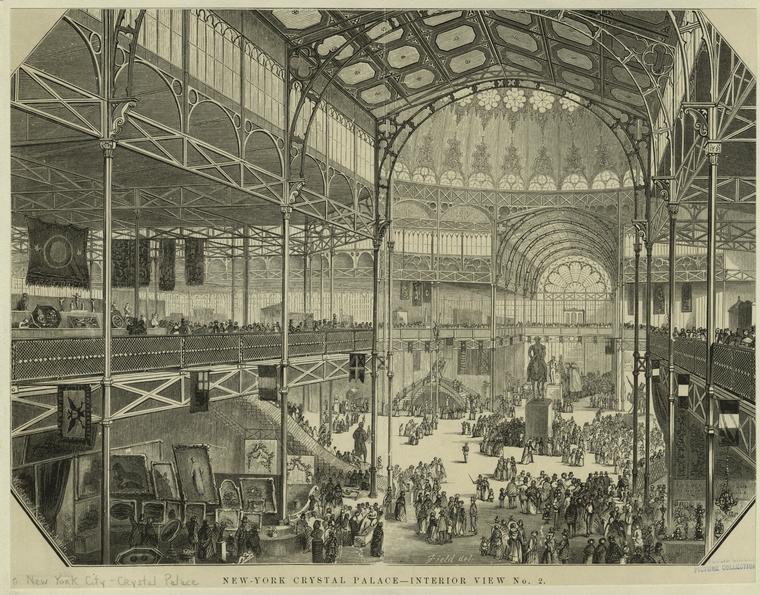
The view from one of the naves, looking towards the George Washington statue. Courtesy New York Public Library
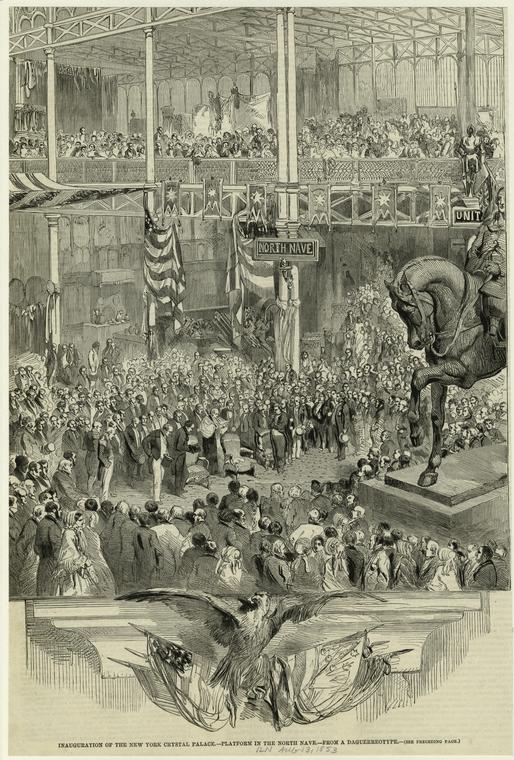
Another view of the inside, this time during the inauguration of the New York Crystal Palace in July 1853 -- looking at a platform in the north nave. Courtesy New York Public Library
Another view of the inside, this time during the inauguration of the New York Crystal Palace in July 1853 — looking at a platform in the north nave. Courtesy New York Public Library
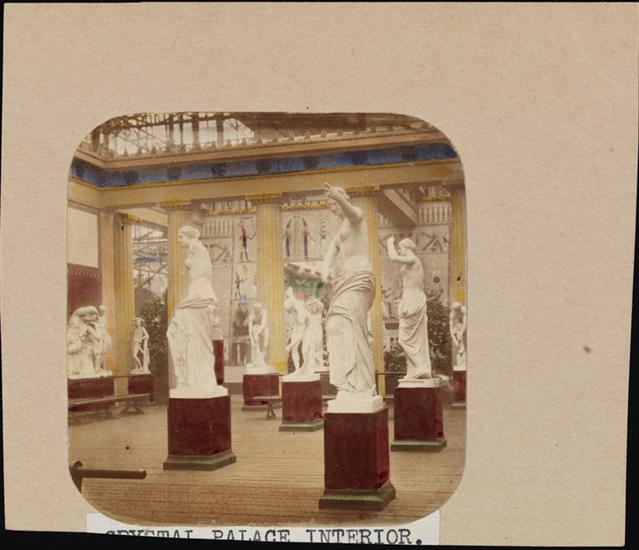
A hand-colored stereoscope of a selection of Crystal Palace statuary. There seems to be some kind of Egyptian thing going on in the background! Courtesy Museum of City of New York
e
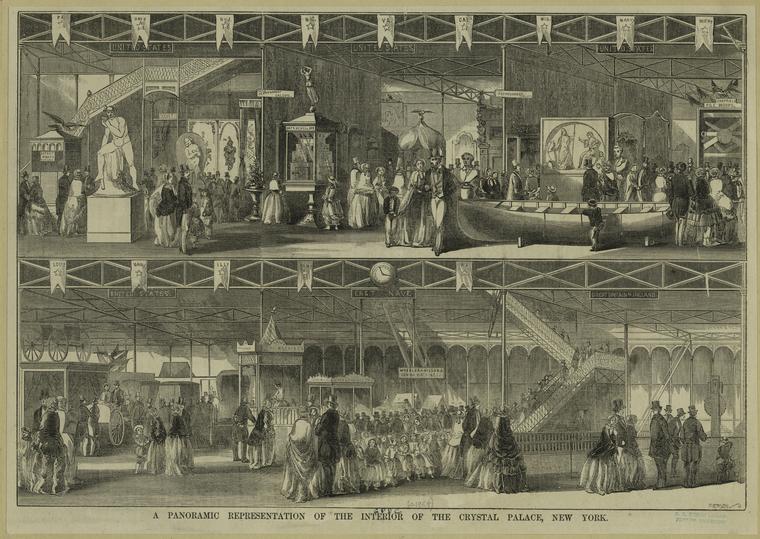
Busts, tapestries, machinery, weapons and various finery! A couple illustrations of the different divisions. Just rooms and rooms of items! Courtesy New York Public Library
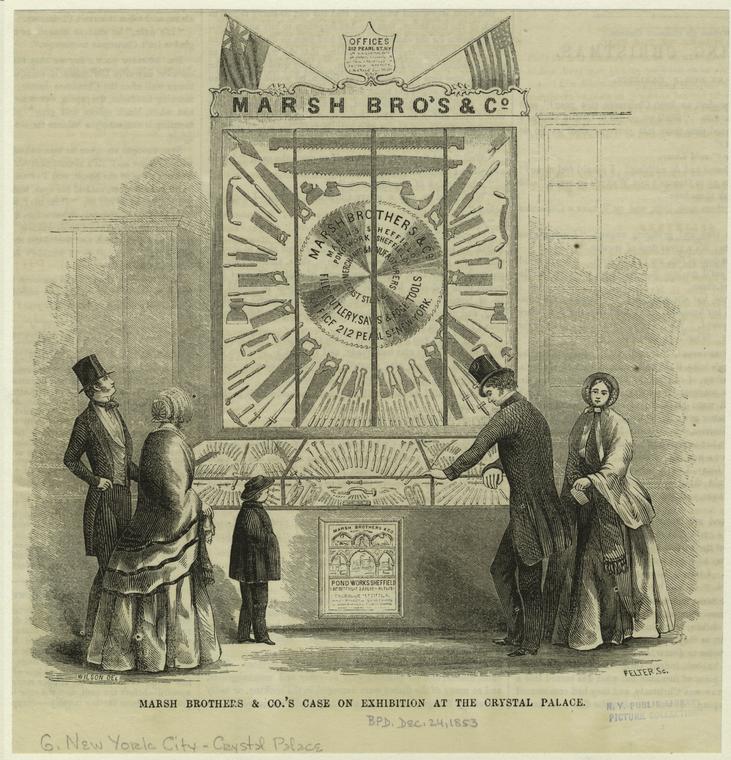
A selection of saws and tools from Marsh Brothers & Co. that one might have seen in the US section. Courtesy NYPL
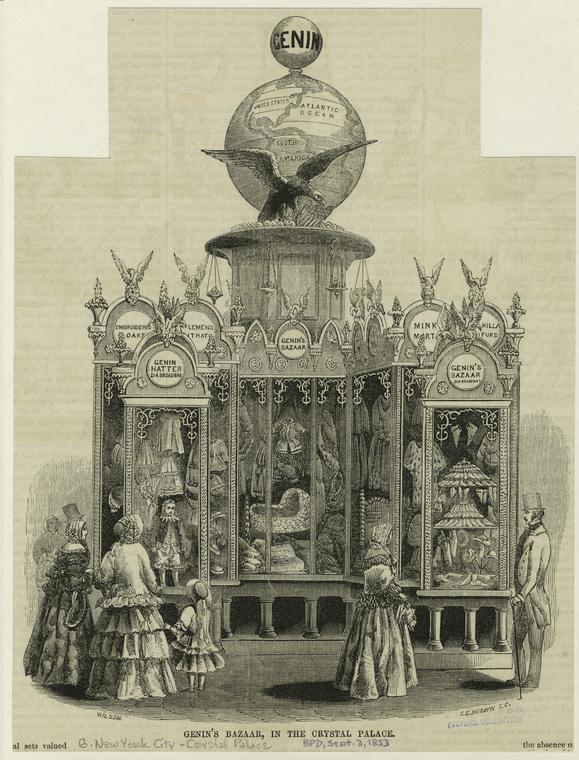
Genin's Bazaar, containing items for the infant. Courtesy New York Public LIbrary
Genin’s Bazaar, containing items for the infant. Courtesy New York Public LIbrary
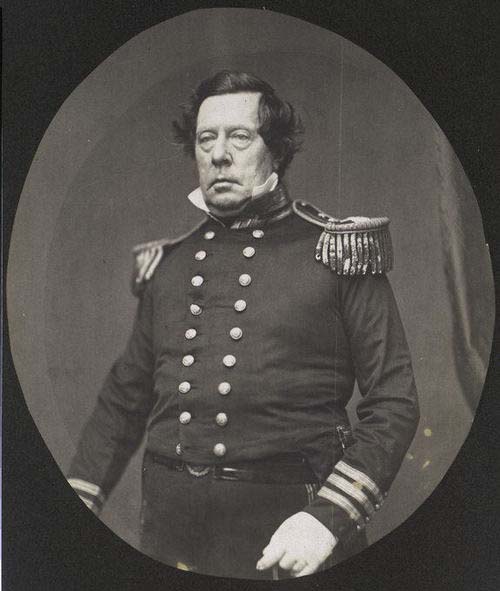
This photo of Commodore Matthew C. Perry was taken by Matthew Brady and displayed at the Crystal Palace, one of the first photographs many people may have seen!
A selection of saws and tools from Marsh Brothers & Co. that one might have seen in the US section. Courtesy New York Public LIbrary
f
This engraving shows the Latting Observatory in relation to the Crystal Palace, separated by 42nd Street.
A reprinted advertisement from Valentine's Manual of old New York, outlining some of the charms of Latting Observatory
A reprinted advertisement from Valentine’s Manual of old New York, outlining some of the charms of Latting Observatory
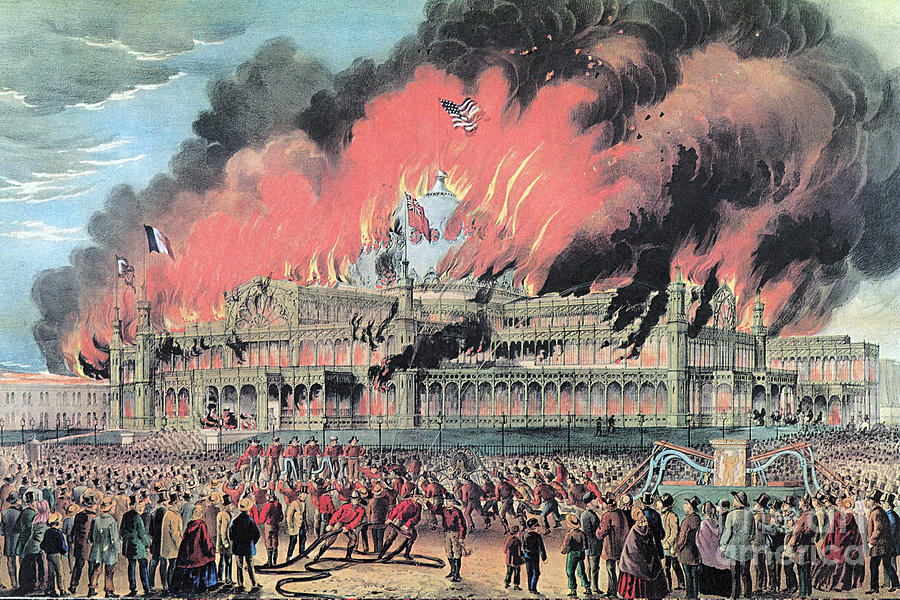
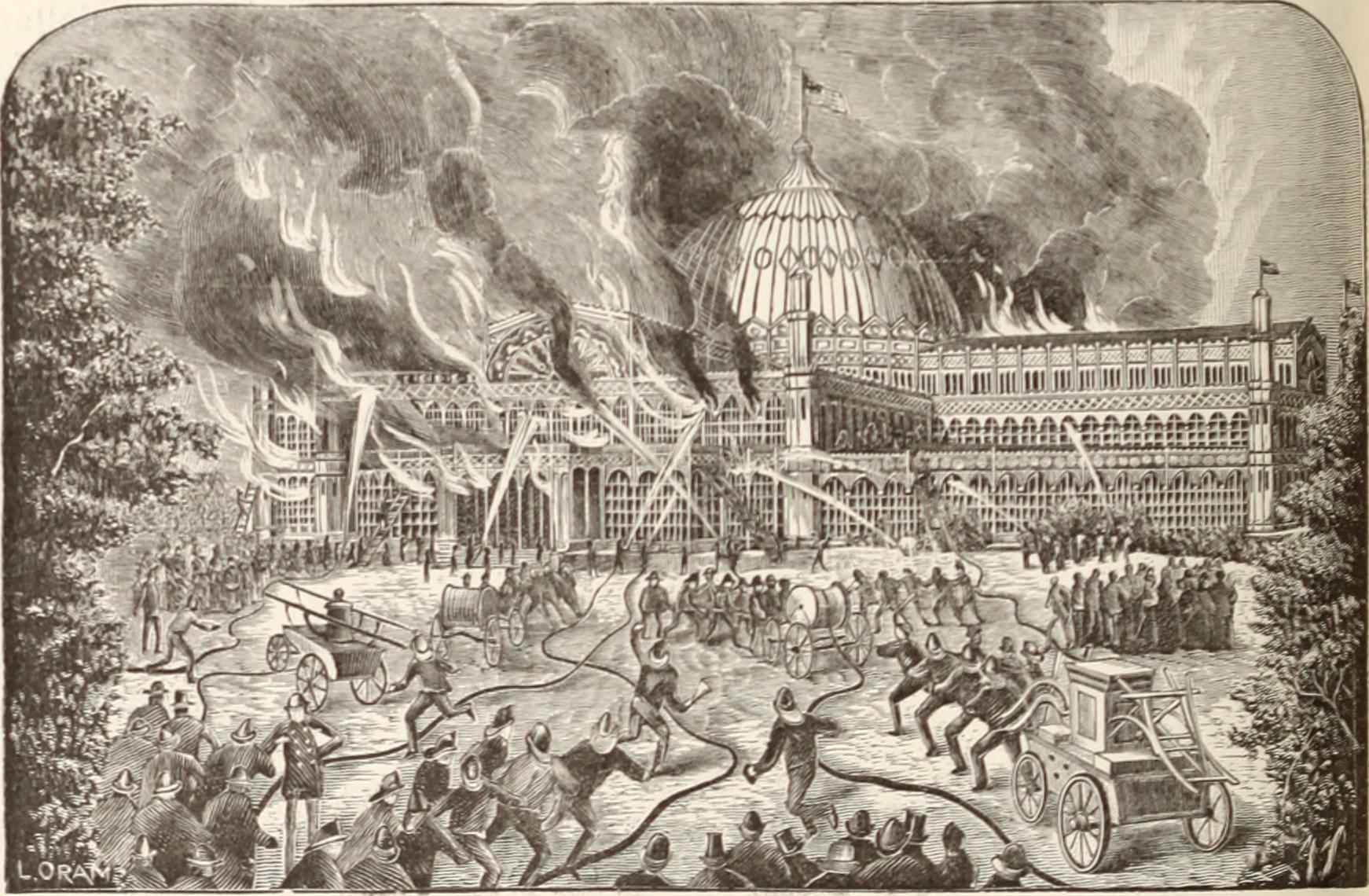
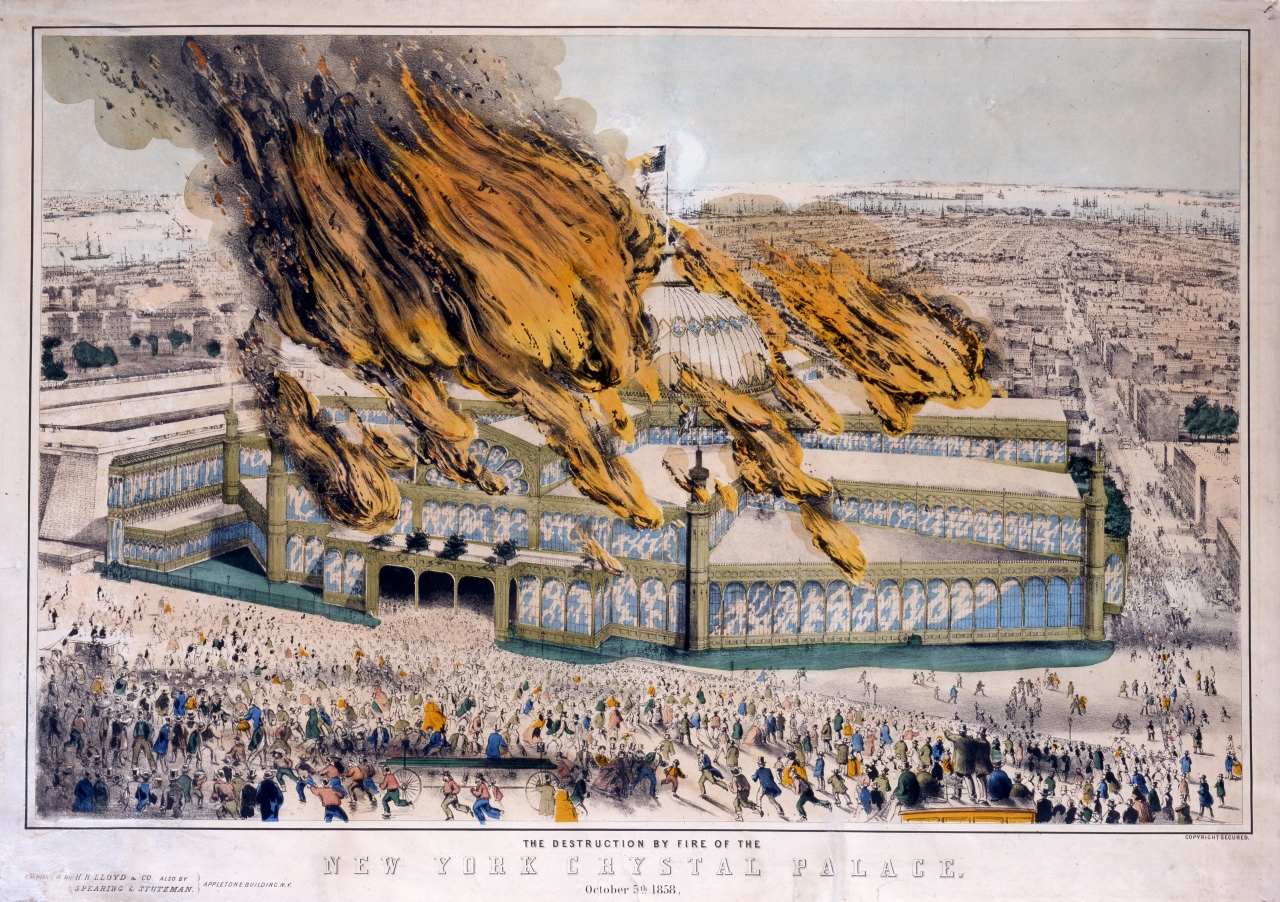
One of several illustrations of the Crystal Palace fire, a dramatic blaze that destroyed the building in under an hour.
An illustration from an 1887 book "Our firemen. A history of the New York fire department" Courtesy Internet Image Book Archives
An illustration from an 1887 book “Our firemen. A history of the New York fire department” Courtesy Internet Image Book Archives
Another view of the blaze, in perspective to the rest of New York to the south. Couirtesy New-York Historical Society
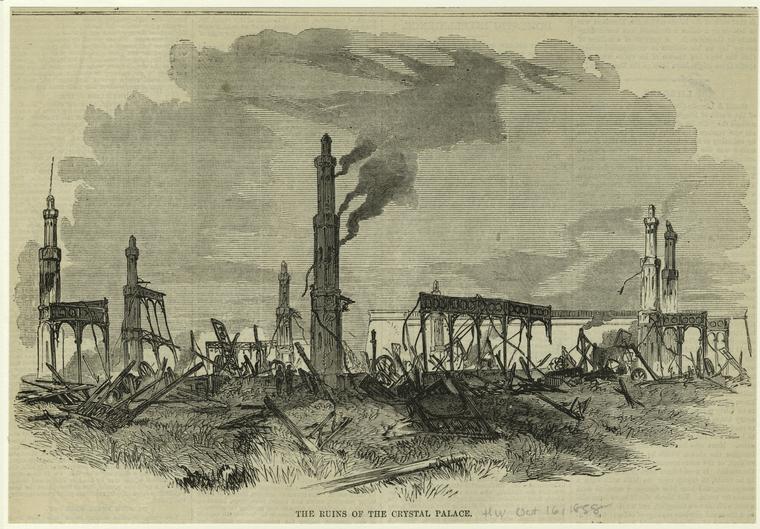
An illustration made in 1858, depicting the aftermath of the horrible fire that destroyed the Crystal Palace. NYPL

Some original documents that you may enjoy reading:

How To See the New York Crystal Palace: Being a Concise Guide to the Principal Objects in the Exhibiton

A Day in the New York Crystal Palace and how to Make the Most of It

And for some comparison, a guide to the London Crystal Palace can be found here.

Categories
Queens History

The religious controversy behind a lonely Roman column just standing around by itself in Flushing Meadows Park

.
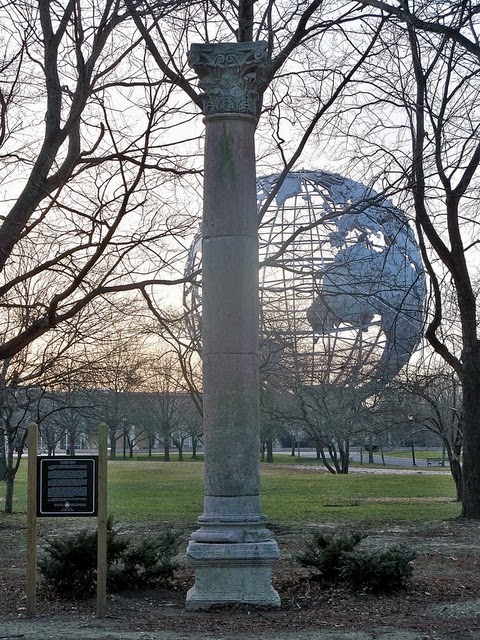
The second oldest manmade object in New York City — outside, that is, not in a museum or private collection — is a solitary little Roman column built in 120 AD for the Temple of Artemis in the ancient city of Jerash.  It once stood among a chorus of ‘whispering columns’, creating an effect in the temple which would magnify the human voice.
So why is it standing all alone in Flushing Meadows Park in Queens?

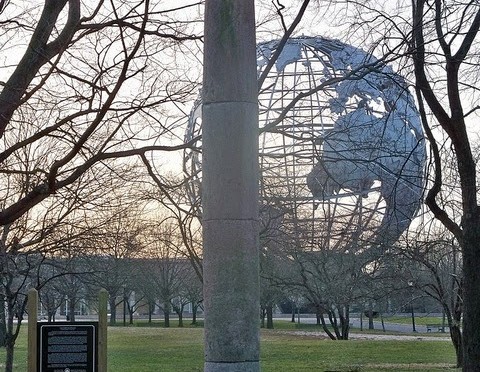
At right: The column stands alone, with the Unisphere in the background. Courtesy Flickr/Christoslilu

It was a gift of the Kingdom of Jordan for the New York World’s Fair of 1964-65, presented on April 22, 1964, by the young King Hussein to none other than Robert Moses. What did those two have to talk about?

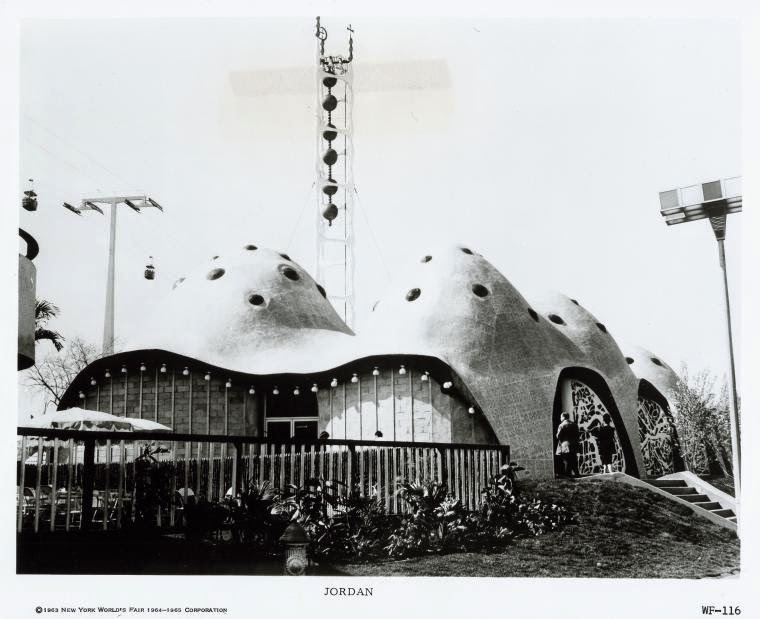
The Jordanian Pavilion at the World’s Fair was a particularly unusual addition to the unofficial (and incomplete) league of nations at the fair. Despite its almost alien appearance — curved and encrusted with gold mosaics — it was one of the most religious buildings there, embodying imagery of both the Christian and Muslim faiths.

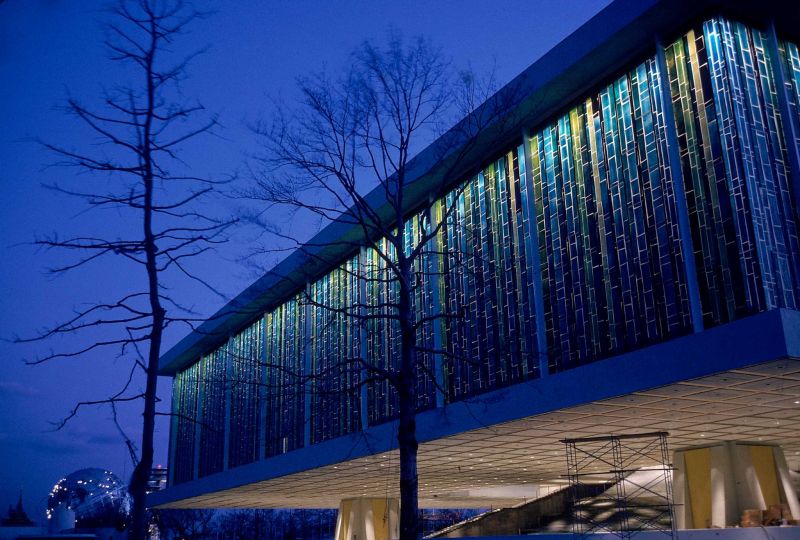
Sculptural displays of Stations of the Cross by Antonio Saura decorated the exterior, and bright stained glass windows lit up spectacularly at night.  The Dead Sea Scrolls were displayed alongside a replica of the Dome of the Rock, and visitors could shop at a jewelry bazaar or eat traditional Middle Eastern food in the snack shop.

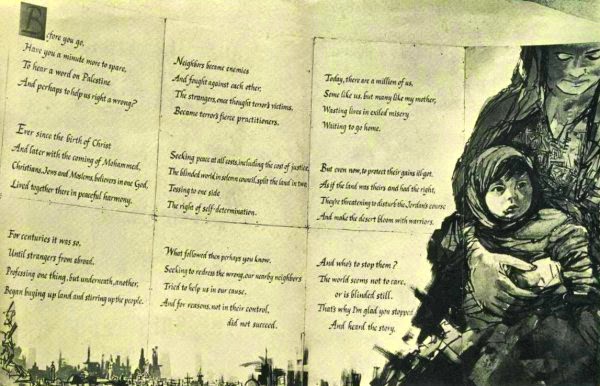
But despite the many artifacts of great historical provenance, the most controversial thing in this odd building were a set of newly painted murals.

Some Jewish visitors to the pavilion were immediately offended by one particular mural depicting a young refugee expounding in a lengthy text about the Israeli-Palestinian situation at the Jordanian border.  “The strangers, once thought terror’s victims, became terror’s practitioners,” it said, implicating the Israelis (but never mentioning them by name).

“But even now, to protect their gains, illgot, as if the lands were theirs and had the right,” went the mural, “they’re threatening to disturb the Jordan’s course and make the desert bloom with warriors.”

Below:  The controversial Jordanian mural (Courtesy the excellent tribute site NYWF64 )

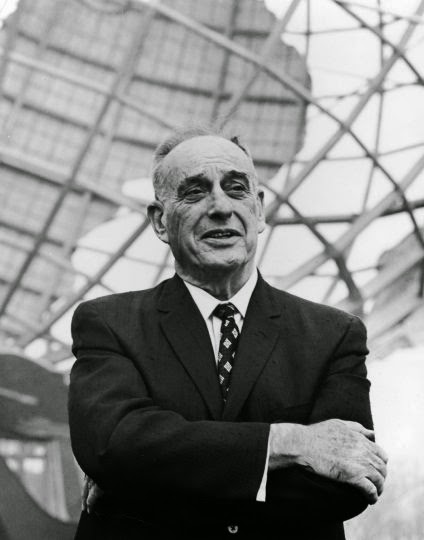
Organizers at the American-Israeli Pavilion wrote Moses to complain, saying the murals were not in keeping with the fair’s theme of “Peace Through Understanding.”  Moses (pictured below) initially rejected the request, but Mayor Robert Wagner, perhaps in an intentional slight to the former parks commissioner, promised to have the murals removed.

Members of the City Council even proposed a bill forcing the fair to remove the mural.  The Jordanians replied that they would rather close the pavilion than tear down the murals under pressure.  Israeli protesters picketed the pavilion;  at one point, the Jordanian flag was taken and temporarily replaced by the Israeli flag by a protester.

Of course, as a result, the Jordanian Pavilion became hugely popular in the early days of the fair, with thousands of visitors streaming in to see what the fuss was about.

The Isaeli pavilion then unveiled its own mural as a response to the Jordanian mural.  Further lawsuits, even fistfights, ensued over the controversy. In the end, none of the murals were removed.

What got sadly overshadowed in all this, of course, was the Column of Jerash, which could have been made of plaster for all the attention it received.

After the fair ended in 1965, the pavilions were mostly all torn down, but the column stayed behind, making the park its home for several decades now.  Today you can find it near the Unisphere next to a plaque which reads:

THIS COLUMN WAS PRESENTED TO/ THE NEW YORK WORLDS FAIR AND THE CITY OF NEW YORK BY/ HIS MAJESTY KING HUSSEIN / OF THE HASHEMITE KINGDOM OF JORDAN/ ON THE OCCASION / OF JORDAN’S PARTICIPATION IN THE FAIR./ THE COLUMN WAS RECEIVED BY THE HONORABLE ROBERT MOSES, PRESIDENT, / NEW YORK WORLD’S FAIR 1964-1965 CORPORATION./ THIS IS ONE OF MANY COLUMNS IN A TEMPLE ERECTED BY THE ROMANS/IN 120 A.D./ THAT STOOD IN THE ROMAN CITY OF JERASH, JORDAN./ THE COLUMNS ARE KNOWN AS THE WHISPERING COLUMNS OF JERASH.

——————————

Okay, so that’s the second oldest large manmade object in New York City?  What’s the oldest?

That’s the subject of our new podcast tomorrow so stay tuned!

Categories
Podcasts Pop Culture

New York City and the birth of the television industry, experimental broadcasts from the city’s greatest landmarks


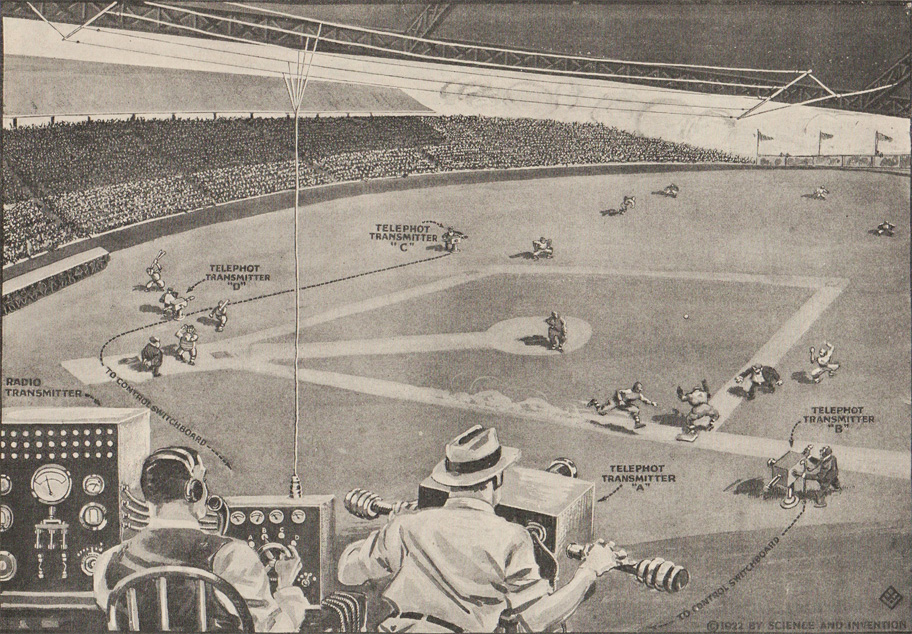
An illustration from Science & Invention, one of Hugo Gernsback’s many technology journals, demonstrating the possibilities of his ‘telephot’ system. (Courtesy The Verge)

PODCAST It’s the beginning of The Bowery Boys Summer TV Mini-Series, three podcasts devoted to New York City’s illustrious history with broadcast television — from Sarnoff to Seinfeld!

 In our first show, we go back to the start of the invention of the television and the city’s role in both the creation of the complicated technology and the early formation of programming.

We begin with the Electro Importing Co. and the imagination of one of the greatest names in science fiction.  Then head into scientific realities — the failures of mechanical televisions and the brutal patent wars between RCA’s David Sarnoff and one of the great inventors of television, Philo Farnsworth.

 In victory, Sarnoff claimed the mantel of ‘father of television’ at the 1939 World’s Fair in Flushing Meadows-Corona Park, Queens.  It’s but one of many great New York City’s beloved landmarks with ties to television’s early history, from the heights of the Empire State Building to even a floor at Wanamaker’s Department Store.

Video telephones in the West Village. Spectacularly strange television displays at Madison Square Garden. News broadcasts in Grand Central Terminal.  And we even go drinking with a few stars at McSorley’s Old Ale House!

ALSO: Why is Greg singing Cole Porter?

To get this week’s episode, simply download it for free from your favorite podcast player

Or listen to straight from here:
The Bowery Boys: New York City and the Birth of Television 1909-48

—–
A couple clarifications: Hugo Gernsback‘s experimental station WRNY at the Hotel Roosevelt operated radio frequencies in 1925 and tried out television broadcasts in August 1928.  I use both dates inter-changeably at one point.

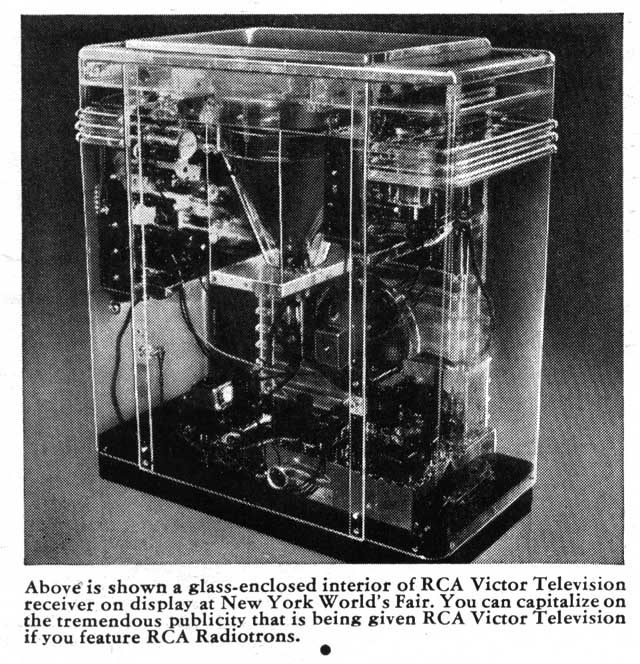
RCA had 13 sets from 4 different models of televisions at their World’s Fair pavilion.  I think Tom said 12 sets. Maybe one of them was that plastic see-thru version (see below)?

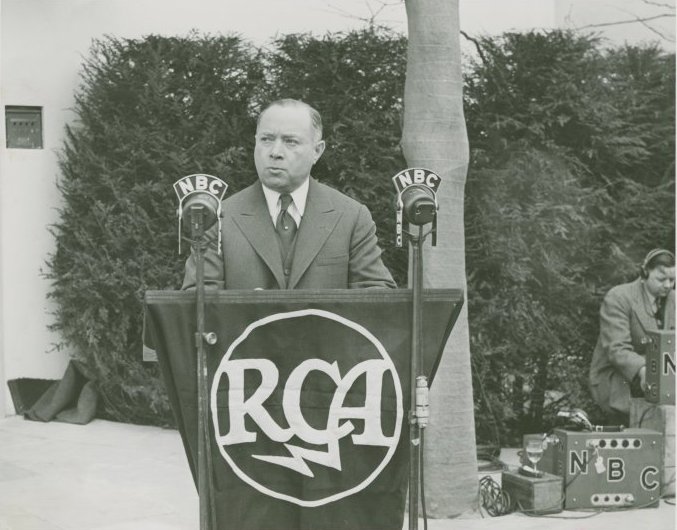
David Sarnoff speaking at the 1939 World’s Fair, presenting the ‘debut’ of television. Although, of course, television had been around in some form or another in New York for over ten years by that time.

 
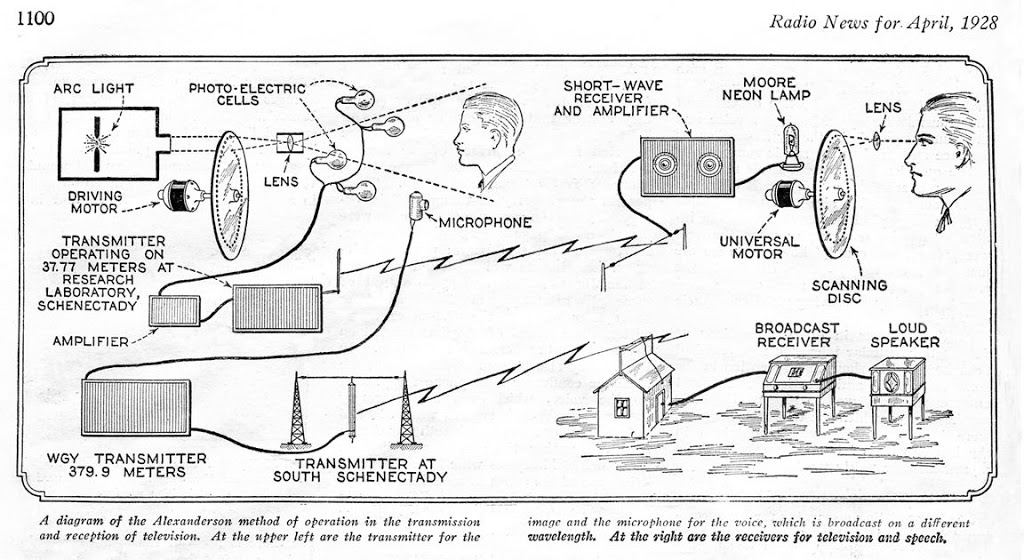
A diagram from 1928 outlining the mechanical television process, as described in the Hugh Gernsback-owned journal Radio News:
 

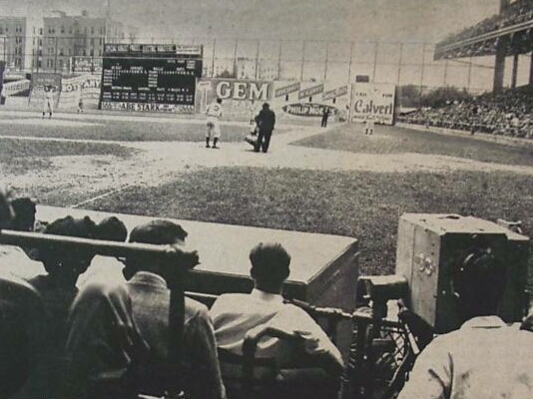
The first televised Major League baseball was broadcast by W2XBS on August 26, 1939, a game at Ebbets Field between the Brooklyn Dodgers and the Cincinnati Reds.  It would also be the first television broadcast of the Dodgers losing a game! (source)

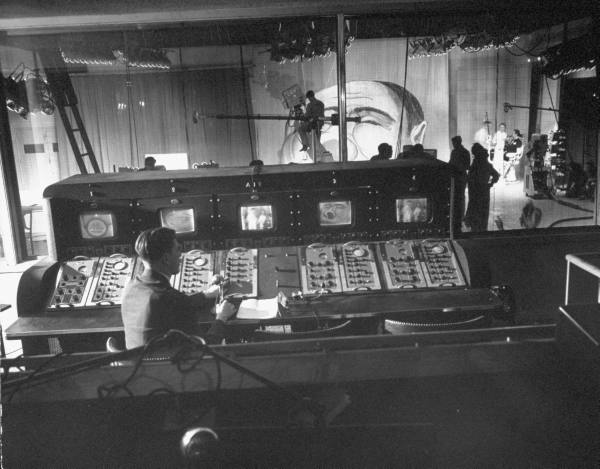
From the Dumont studios in the Wanamaker’s Department Store, 1946 (courtesy Eyes of a Generation):

Auf Wiedersehen to a well-travelled World’s Fair original


In 1965, at the completion of the World’s Fair in Flushing-Meadows, many components like fountains, sculptures, lighting features and even whole pavilions were moved to other areas of the world. Most famously, the ‘It’s A Small World’ collection of animatronics made their way west to Disneyland. The Spanish pavilion moved to St. Louis and became a hotel. Parts of the New England pavilion decorated a shopping mall in Danbury, Mass.

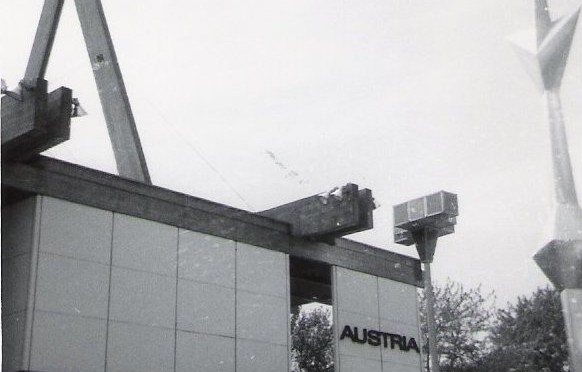
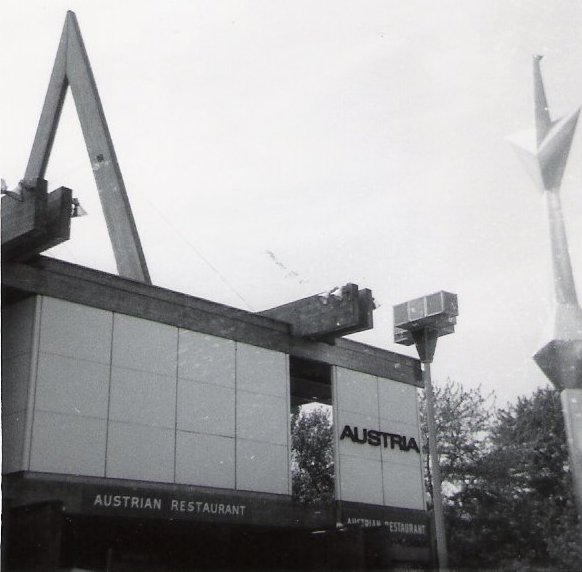
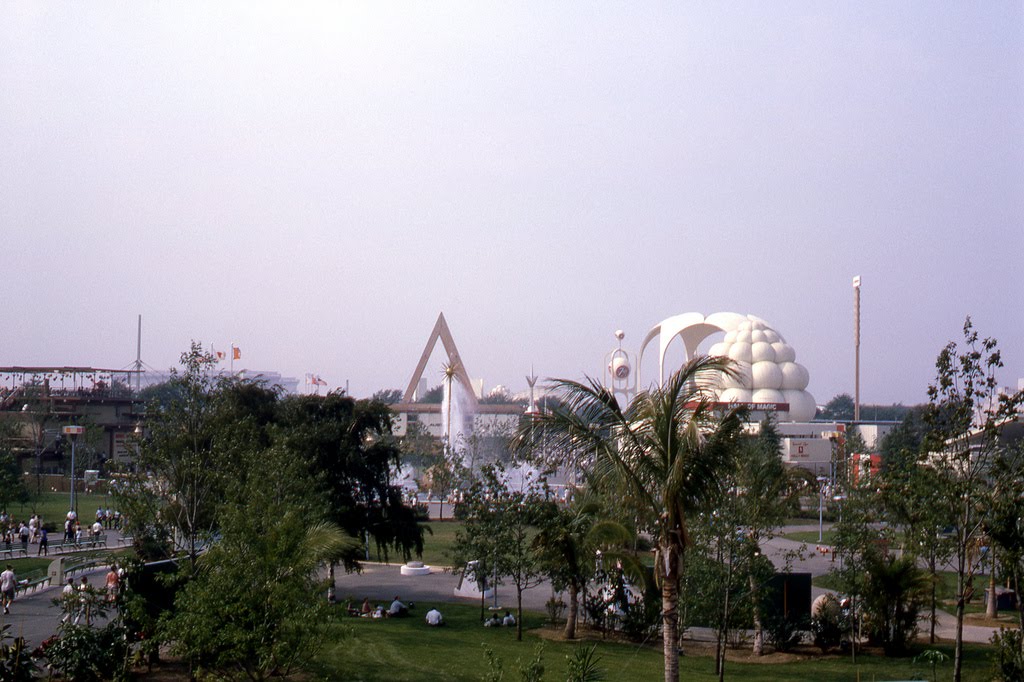
But the Austrian pavilion seemed to win the prize for best post-fair afterlife. The entire structure was moved to a ski resort in western New York, where its unusual angular design seemed to fit quite nicely as a remote, snow-covered lodge. The Cockaigne Ski Resort paid just $3,000 for the used building, but spent a great deal more (nearly $200,000!) to transfer it almost 400 miles to its new home.

Unfortunately, the great, kitschy lodge was destroyed in a fire a couple weeks ago. Images taken in the smoldering aftermath don’t look pretty. The signature angle is completely gone. [Click here to see video of the blaze.]

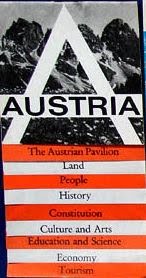
According to a dedication booklet from the fair, the pavilion’s unusual triangle shape bear a symbolic purpose, “to symbolize Austria as a land of mountains and tourism, and constructed of wood to symbolize the richness of the timber and industry.” I’ll bet they’re really regretting that wood construction now!

You would have received the brochure to the right upon entering.

The pavilion was always closely tied to the skiing industry; in fact Austrian-made ski products were displayed inside during the Fair’s duration, serenaded by classical music from Austrian composers. And then there’s this, according Jeffrey Stanton’s excellent World’s Fair website Westland: “Beneath the pavilion were other contemporary sculptures and a large photographic exhibit of the SOS Children’s Villages, which were settlements for homeless children.”

Below: the Austrian pavilion prominently sticks out on the strange World’s Fair skyline. (epicharmus/Flickr)

Wonderland: Walt Disney’s seven Big Apple moments

Yesterday’s news about a new Times Square flagship store for Disney had me wondering what influence if any New York had on the career of Walt Disney, arguably one of the most successful men in history to make his name on the West Coast. Come to find out, the world might never have had Mickey Mouse and the rest without one New Yorker in particular.

Here’s seven of the most significant New York moments for Walt Disney and the Disney empire:

1) Disney Discovered
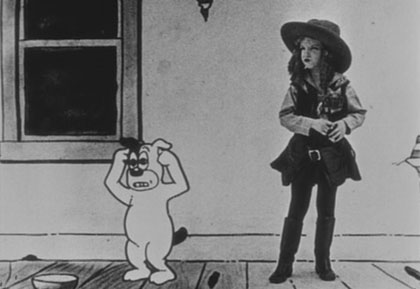
Small-time Kansas City animator Walt Disney spent much of 1923 writing New York film distributor Margaret Winkler, hoping she’d take a look at a new film he was creating, Alice’s Wonderland — a coy, self-reflexive mix of animation and live-action. He was lucky; Winkler was looking to put pressure on her biggest star Pat Sullivan (creator of Felix The Cat), and Disney’s strange little picture did the trick. She signed him and brother Roy, but retained editing control on the early ‘Alice Comedies’, inserting a Felix the Cat-like character named Julius, the first of hundreds of human-like animals in Disney films.

Winkler, by the way, was the first female film distributor in the United States and briefly one of the most powerful women in silent film — at a time when the film industry was centered on the east coast.

Below:one of the Alice Comedies

2) Steamboat Willie
Disney would return to New York with his revolutionary ‘Steamboat Willie’, the first sound appearance of Mickey Mouse. On November 18, 1928, it quietly made its world premiere at the Colony Theatre (Broadway and 53rd Street, still around today as the Broadway Theatre). Sitting in the audience for everyone of its two-week performances was Walt himself.

Steamboat Willie was the opener on a bill of entertainment that also featured the film Gang War, starring Mary Pickford’s brother Jack, an alcoholic mess who once dated Olive Thomas who allegedly haunts the New Amsterdam Theatre. ‘Gang War’ would be his final movie role.

3) Snow White and The Seven Dwarfs
Almost ten years later, Disney’s first feature-length animated spectacle would have a far more grandiose reception — a five-week run at Radio City Music Hall starting in January 1938. The New York Times exclaimed, “They’re gay and friendly and pleasant, all of them, and so is the picture. Thank you very much, Mr. Disney, and come again soon.” As legend goes, the upholstery of several Radio City Music Hall chairs had to be replaced, as children wet their pants as the first sight of the Wicked Witch.

Strangely, the film was later paired with an ice-themed short, Ski Flight, because during winter there’s nothing people like to do more than sit and watch ski movies.

4) Fantasia
Disney’s trippy concept film closed the loop; as one of Disney’s first self-distributed films, it premiered November 13, 1940 at the same theatre that had once shown Steamboat Willie, only this time it was called the Broadway Theatre. (Today it’s a mainstream musical stage featuring Shrek the Musical).)

There was more drama behind the screen than in front. One scene (“Ave Maria”) had to be redeveloped, flown to New York and was literally spliced in with four hours to go before showtime.

5) The Worlds Fair 1964-65
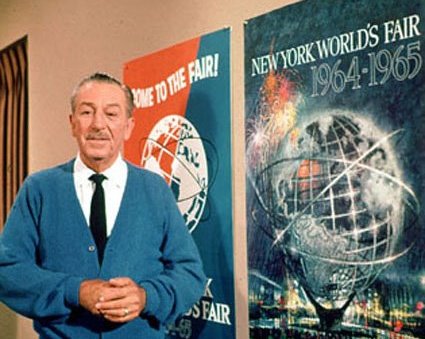
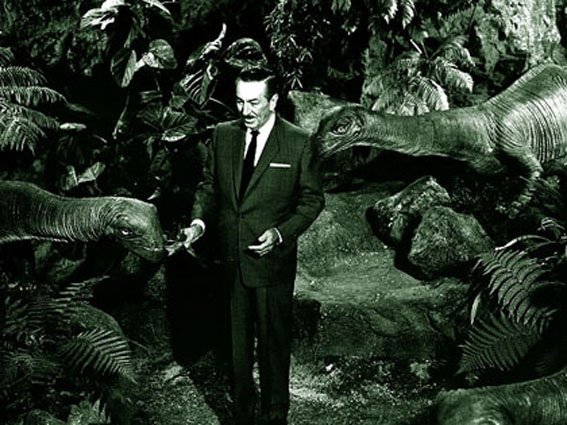
The Worlds Fair of 1939 had clearly had its influences on Disney’s future theme parks. So it was only natural to bring him in as a consultant for Robert Moses’ crowning concrete spectacle of 1964. Disney Studios brought animatronic dinosaurs to life in the “Magic Skyway” for the Ford Motor Company pavilion (see picture below), a talking Abraham Lincoln, and of course ‘It’s A Small World’. Many more pictures of Walt behind the scenes at Disney and More.

6) Disney rewrites Broadway
Less than thirty years after Walt’s death, the company enters — and promptly conquers — a new frontier: Broadway. Beauty And The Beast became its first permanent Broadway production when it opened in April 18, 1994. The swirling gala of dancing utensils and candelabras won the Tony for Best Musical, fueling a run that would make it the sixth longest running show in Broadway history and opening the flood gates of Disney-themed shows.

By the time ‘Beauty and the Beast’ closed in 2007, Disney had changed the rules of the Broadway musical and the actual physical makeup of 42nd Street itself, leading to the sanitation (i.e. ‘Disney-fication’) of the once-seedy boulevard

7) And hits Fifth Avenue, too
The invasion wasn’t just on popular entertainment, but on the heart of New York retail. The first Disney store opened on Fifth Avenue on May 22, 1996. Ushered in by mayor Rudy Giuliani and Disney CEO Michael D. Eisner, thousands of shoppers flocked to the retailer, at the time setting the record for single-day sales at a Disney store. That’s an awful lot of mouse-eared Statue of Libertys.

The company just announced that this ‘World of Disney’ location, at 55th Street, would be permanently closing next year, to make way for Disney’s Time Square plans.

I should end by adding that when Disney moved in during the 1990s, it had kicked out a New York City institution — the famous French restaurant La Côte Basque, a “high-society temple” and favorite of Jacqueline Kennedy Onassis. The eatery moved around the corner but only lasted a few more years.

Categories
Podcasts

PODCAST: Freedomland U.S.A.

What is Freedomland U.S.A.? An unusual theme park in the Bronx, only in existence for less than five years, Freedomland has become the object of fascination for New York nostalgia lovers everywhere.

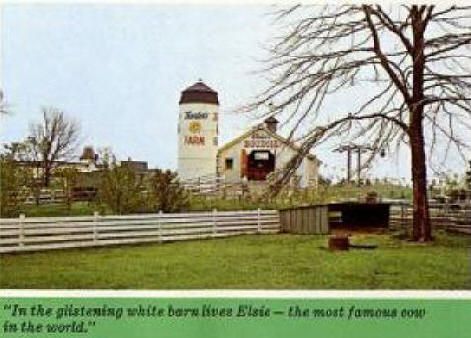
Created by an outcast of Walt Disney’s inner circle, Freedomland practically defines 60s kitsch, with dozens of rides and amusements related to saccharine views of American history. Along the way, we’ll take a visit to the Blast-Off Bunker, Casa Loca, and, yes, Borden’s Barn Boudoir!

Listen to it for FREE on iTunes or other podcasting services. Or click this link to listen to the show or download it directly from our satellite site.

NOTE: There’s nothing wrong with your speakers! I include a short clip in this podcast of an original Freedomland radio advertisement from 1960. The sound quality of the clip is extremely bad, however I thought it was important to include as it sets the tone for what Freedomland was all about (or, rather, wanted to be about).

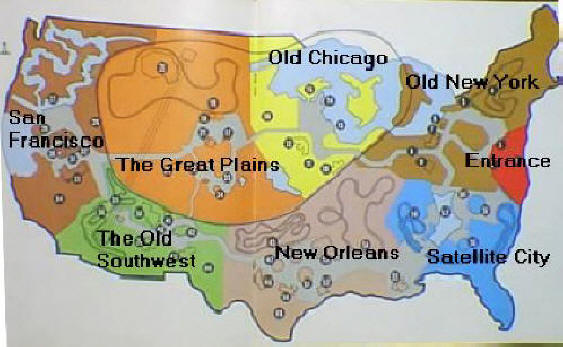
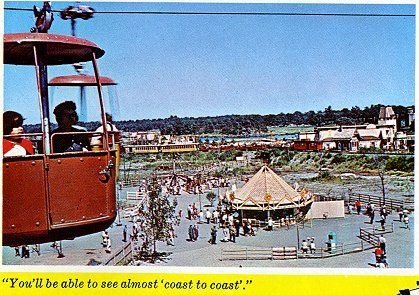
The map through Freedomland mimicked the outline of the United States. (Well, sorta.) Visitors entered through Washington D.C. and meandered through candy-coated interpretations of various national regions, ending up in the future (located in the American South).

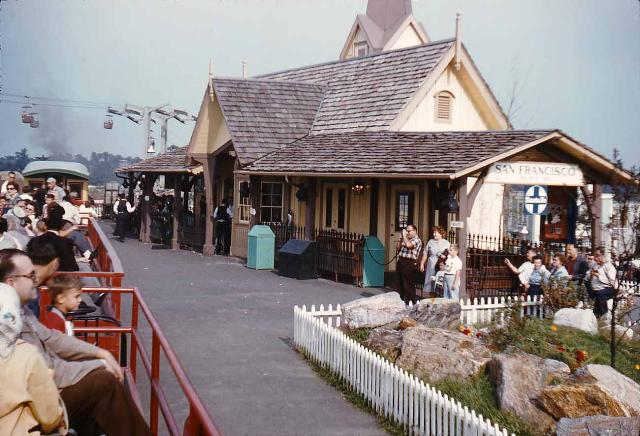
San Francisco in the Bronx, a Disney-like village served by the Santa Fe Railroad (pic courtesy Stuff From The Park)

Another view of the Santa Fe (courtesty Gorillas Dont Blog)

Looking out over the ‘United States’

A rather blurry image — perhaps that’s best — of Borden’s Barn Boudoir, featuring the private rooms of one Elsie the Cow (Pic courtesty Benros, who has a great page on Freedomland.)

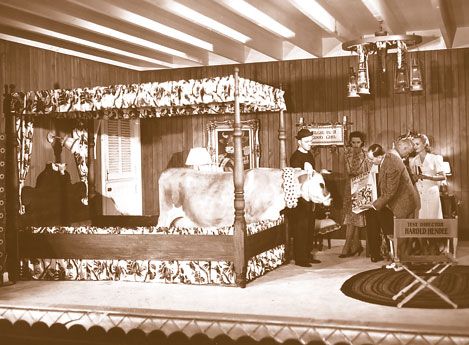
The picture below is NOT from Freedomland, but it gives you an idea of what Elsie’s bedroom might have looked like. Apparently, Bordens loved nothing more than putting their bovine mascot in this type of setting; she also had a bedroom at the World’s Fair of 1964-65 in Flushing Meadows, most likely transported from the failing Freedomland attraction.

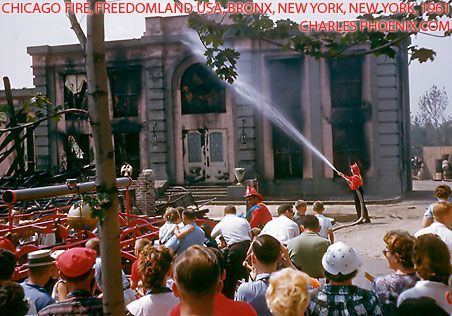
Why people are so entertained by this, I’ll never understand. But if fire was your game, Freedomland let you enjoy the re-burning of Chicago every day. And sometimes, the firemen actors would grab volunteers to help put out the blaze! (Pic courtesy God Bless Americana)

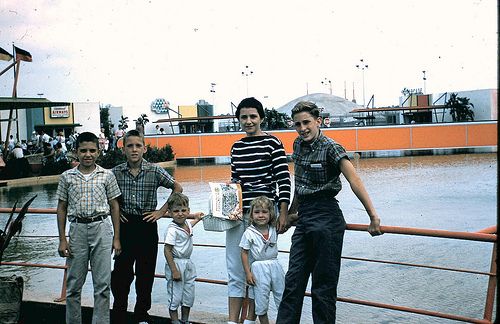
Freedomland was perpetually in debt and often a great inconvenience with long lines and unfinished rides. This family, visiting in July 1960, doesn’t seem to mind. (Flickr)

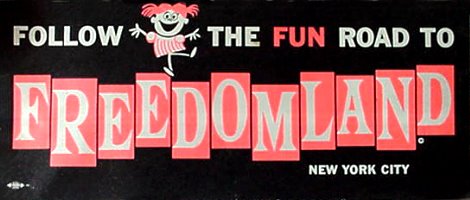
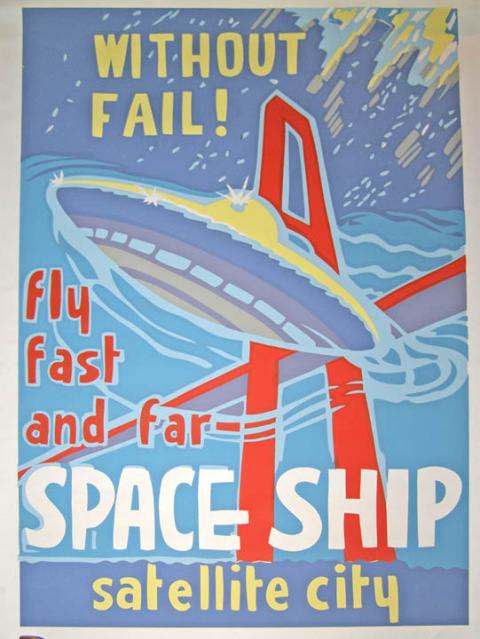
A promotional poster for Freedomland’s futuristic Satellite City, which wasn’t opened for a few days after the park’s opening, by which time crowds had died off considerably. (Pic courtesy Perky Pickle, who has other great poster images from the park’s heyday.)

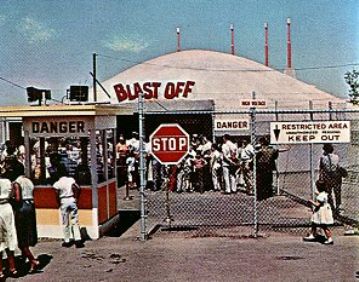
This frightening little attraction was the Blast-Off Bunker, because there’s nothing more fun than hanging out in a dark bunker on a nice summer’s day. In fact, inside you could enjoy the ‘tense excitement’ of a Cape Canaveral control room.

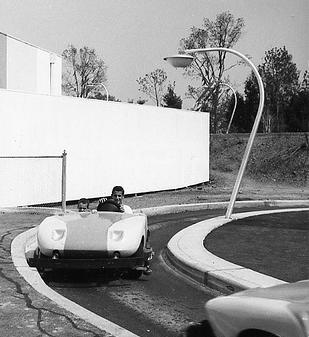
You could experience the joys of riding a ‘modern automobile’ in Freedomland’s knockoff future land. A sad way of marketing a go-cart, but at least this picture is pretty great. (Courtesy Flickr)

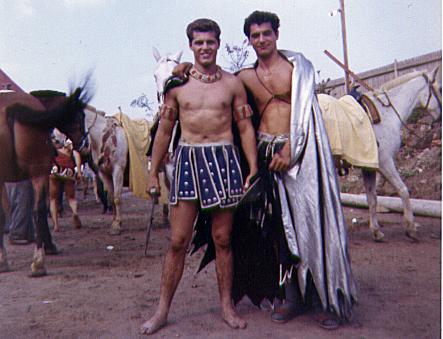
Freedomland was more than happy to abandon its themes if it meant more paying customers. Here are two stunt men from a ‘Colossus’ spectacular in 1961. (Benros)

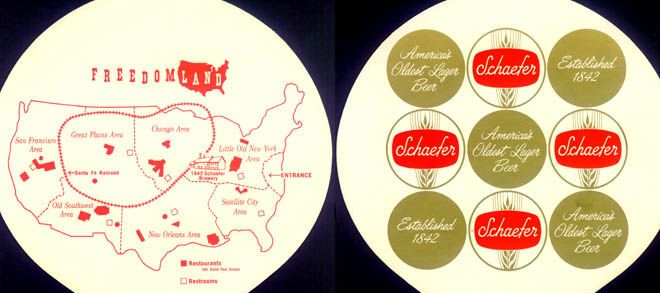
Some detailing from a Freedomland souvenir fan, featuring a map of the park on one side, and beer advertisement on the other. This was, after all, a ‘family entertainment center.’ (Click it for a closer look.)

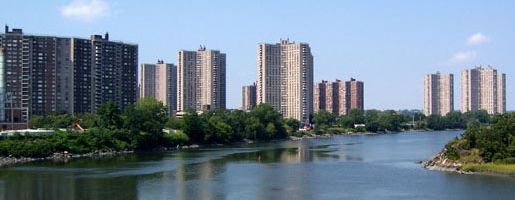
Freedomland was replaced by another oddity — the massive Co-op City, housing over 50,000 residents, and often referred to as a ‘city within a city’. Theoretically, one never need leave Co-op City.

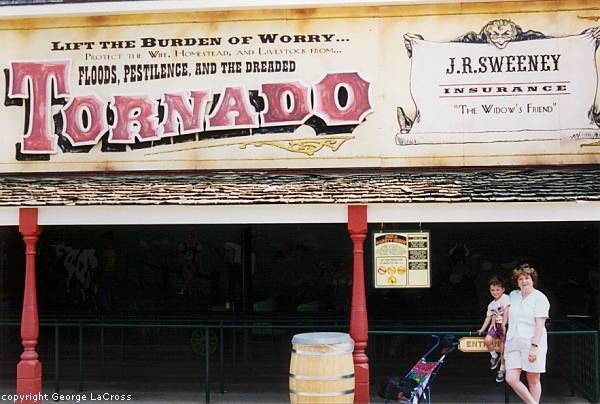
After the closing of Freedomland, some rides were rescued by other amusement parks, including the Tornado Adventure, seen here at Lake George, NY. It was eventually closed for good in 2003. If you really want to experience the delights of a tornado, you’ll have to go to the midwest! (Courtesy Laff In The Dark)

I tried to include a lot of link above to other great websites with more information on Freedomland. The most comprehensive tribute can be found on Rob Friedman’s old site on the park, with dozens of pictures, sounds and personal stories.

Any of you remember visiting this place? Leave a comment!

Pope-fest 2008: The Holy (Sight) See

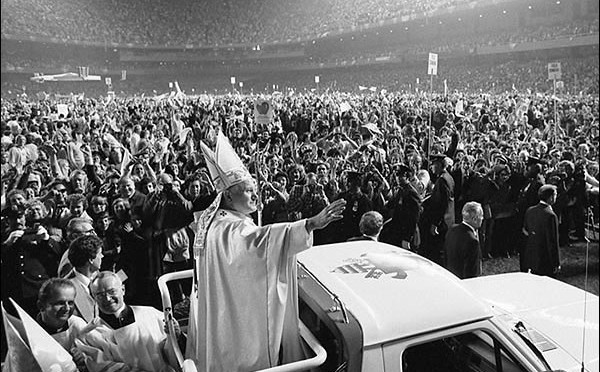
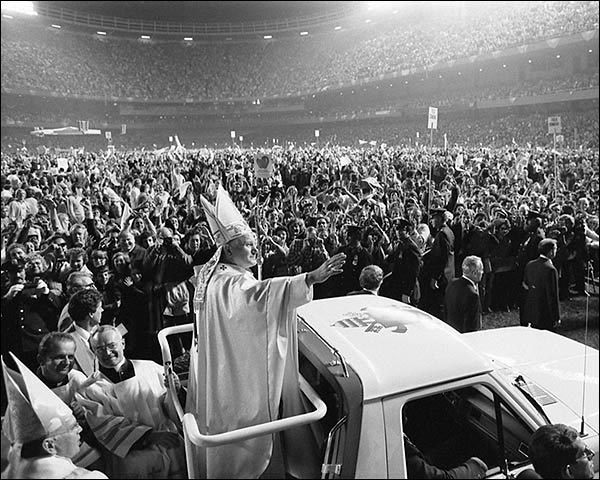
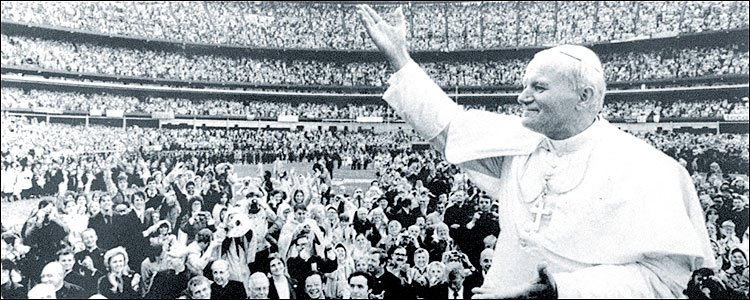
Pope John Paul greets the crowds at Yankee Stadium

Welcome Benedict! I’m not Catholic, but I do love a good papal visit to New York City. Nothing could be more absurd. The leader of the Catholic Church, a man who traces his spiritual lineage all the way back to the apostles — delivering mass at Yankee Stadium, traipsing Fifth Avenue in his sacred robes. I hope that person who dresses as Sesame Street’s Elmo in front of Rockefeller Center waves to Benedict as he enters St. Patrick’s Cathedral on Friday.

Only the Marquis de Lafayette and the Beatles have been treated to more rapturous displays of welcome by New York City residents. The city has been host to three previous papal visits, and in each case, St. Patrick’s has naturally been the manic center of activity. In fact each visit is immortalized on a plaque in front of the cathedral. Although with each trip, the pope in question managed to find a couple other unique corners of the city to visit as well.

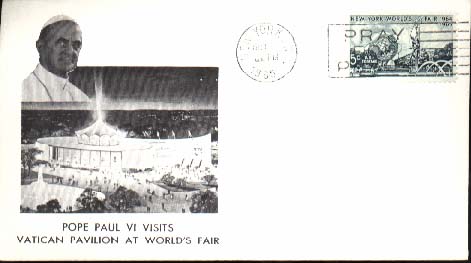
Perhaps the strangest was the very first — Pope Paul VI, the controversial leader who presided over the Second Vatican Council and made a name for himself traveling all over the world. Finally in an era were a man could be both pope and jetsetter, Pope Paul arrived in New York in October of 1965 and promptly went to visit his roommate, who was performing in a fair.

That roommate would be Michelangelo’s Pieta, on loan from St. Peter’s hallways to the Vatican pavilion at the 1964-65 World’s Fair. The Pope visited the Fair on Oct 4, 1965, on a busy day that also included mass at Yankee Stadium (the first papal mass ever in the United States), an address to the United Nations, and a meeting in the city with president Lyndon Johnson at the Waldorf=Astoria.

Today a rounded bench, or exedra, sits in Flushing Meadows park honoring the moment Pope Paul visited the Pavilion. (It seems that whenever a Pope hovers in a place for more than a few minutes, a plaque or monument springs up in its place.)

By the way, I found this extraordinary page full of great photos about the Pope-mobile, the superfine limousine used by the Pope during his visit.

But its Pope John Paul who’s the real New York favorite; he held the office for so long that he managed two trips to Gotham City — in 1979 and 1995.

His October 1979 trip was like a rock concert tour, also swinging through Philadelphia, Boston, D.C., Chicago and Des Moines. Part of the enthusiasm was because John Paul, at 58 years old, had just been appointed the year before.

As a cardinal, he had already held mass at Yankee Stadium, so by the time he did it again on October 2, 1979, he was as much a fixture as Reggie Jackson. Rain greeted over 9,000 cheering worshippers — or fans — and, according to legend, when the Pope mounted the ballfield to address the crowd, the rain showers stopped. And as a blessing for Mets fans, the next day the Pope also held rapt an audience of 52,000 at Shea Stadium (pictured below).

But like all rock stars, the Pope couldn’t complete his New York odyssey without a performance at Madison Square Garden. Although John Paul also addressed the U.N. and a St Patrick’s audience during that trip, he’s best remembered by many for his inspirational address on October 3rd to 19,000 city children.

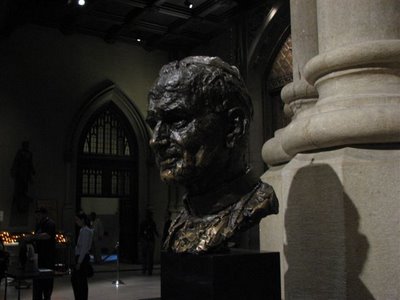
St Patrick’s honored his Holiness’s visit in 1979 by installing a bust (see below). But he would be back. On almost exactly the same day, sixteen years later.

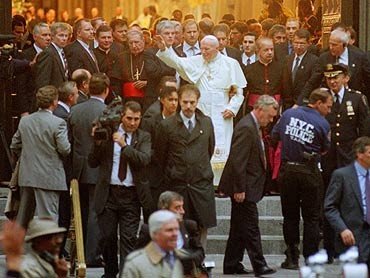
New York City in 1995 was a vastly different city and John Paul returned for a longer visit — four days in total in the entire New York area — on October 4th. This time, instead of just delivering messages to the clergy gathered at St. Patrick’s, he spontaneously decided he wanted to walk around the block. And why not? You’ve got shopping, Saks, street vendors selling Pope souvenirs!

Below: the Pope prepares for his light stroll

The Pope also finished off his collection of performing in gigantic venues for mass — holding court in Giants Stadium, the Aquaduct Racetrack in Ozone Park and eventually to 100,000 people on the great lawn in Central Park.

From there, the elderly leader of the Catholic Church gave the city the ultimate shout-out: “This is New York! The great New York! This is Central Park. The beautiful surroundings of Central Park invite us to reflect on a more sublime beauty: the beauty of every human being, made in the image and likeness of God. Then you can tell the whole world that you gave the pope his Christmas present in October, in New York, in Central Park.”

Pope Benedict, here for two days (April 19-20), has broken the apparently holy tradition of visiting New York in the first week in October. But Benedict, as the cardinal formerly known as Joseph Ratzinger, actually visited the city in that lesser role in 1988, where apparently he was met with protest from gay activists and shunned by some prominent Jewish leaders.

This year, he intends to hit all the “usual” Pope spots — St. Patricks, the United Nations, Yankee Stadium — but has added a couple surprising detours: Park East Synagogue and Ground Zero. At this rate, he might even stop in to see an off-Broadway show! Is Nunsense still playing?

Categories
Amusements and Thrills Podcasts

PODCAST: The New York World’s Fair of 1964-65

Come with us as we jettison ourselves into the future as it was seen in the past — namely the 1964-65 World’s Fair in Flushing Meadows, Queens. Fans of Robert Moses, 1960s space-age optimism and really, really large tires should take special note to listen.

Listen to it HERE:

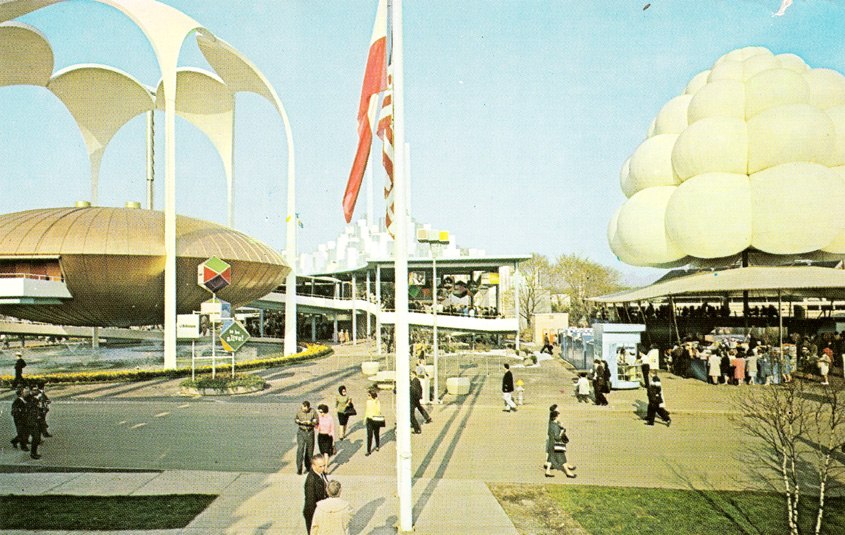
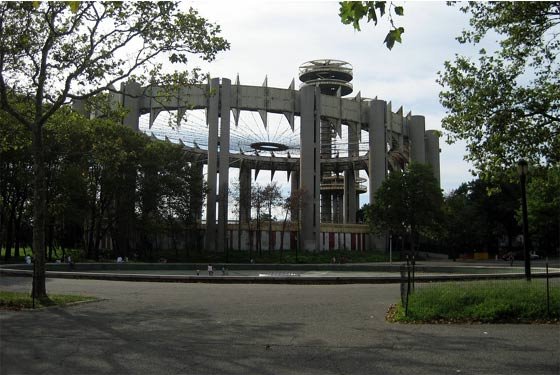
The Johnson Wax Pavilion, surrounded in examples of ’64 loopy, futuristic architecture.

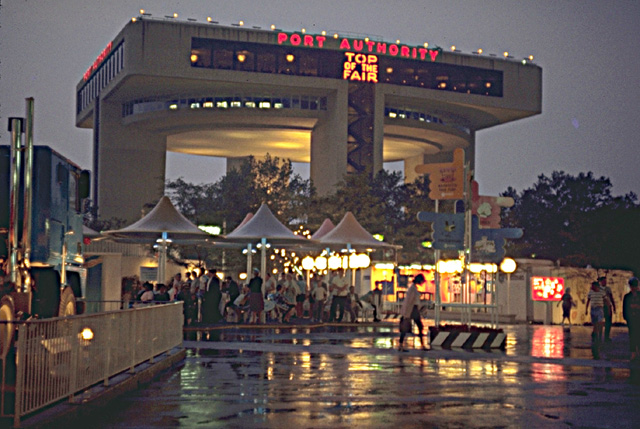
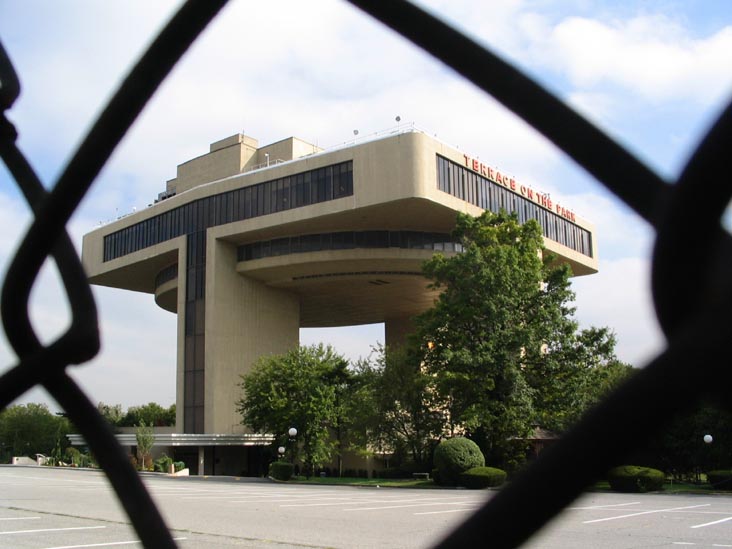
The Port Authority Heliport, where guest could fly in via helicopter from Manhattan, is one of the few buildings still standing today. It is now Terrace On The Park. (Courtesy here).

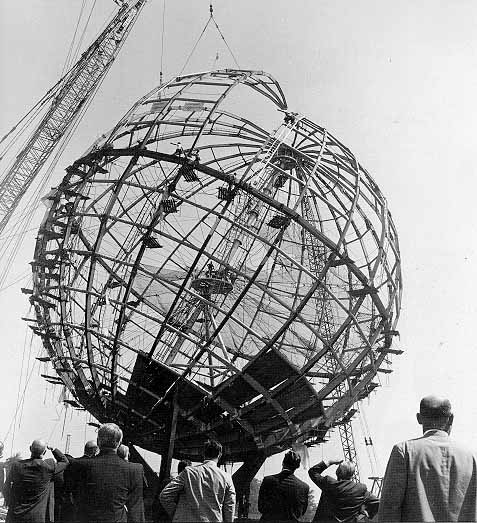
Piecing together the heavy US Steel-created Unisphere.

The New York State pavilion — Tent of Tomorrow! — as it looked then:

And today.

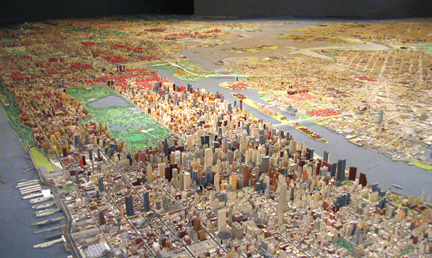
The New York City Pavilion featured the city of New York in miniature. Called the Panorama, it’s still thriving at the Queens Museum and is regularly updated to reflect the changing city. One significant difference: as a memorial, the World Trade Center remains standing in downtown Manhattan.

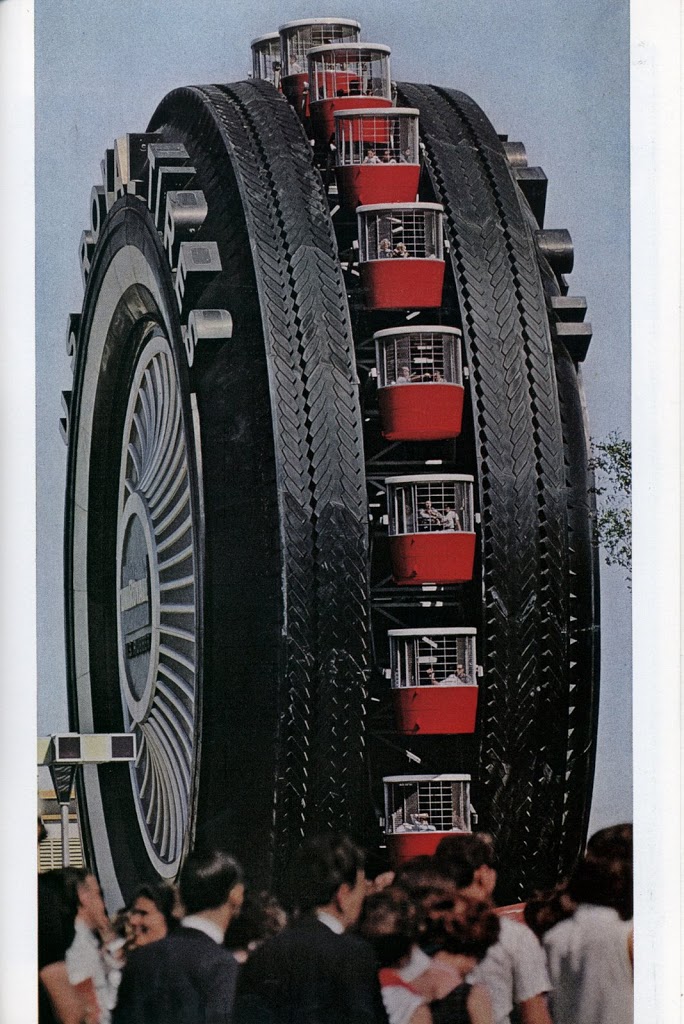
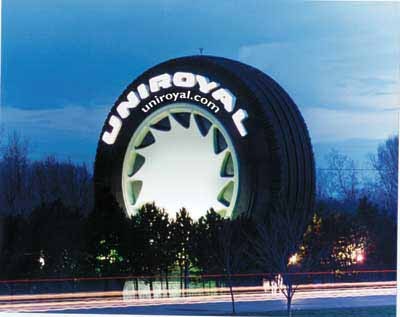
Many attractions from the World’s Fair now make their home in other parts of the world. The Uniroyal tire ferris wheel, for instance, now sits in Allen Park, Michigan, without its seats.

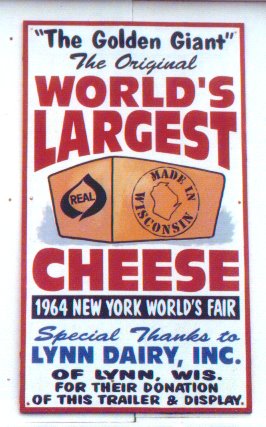
Another favorite, the world’s largest cheese, naturally still makes its home in its home state of Wisconsin.

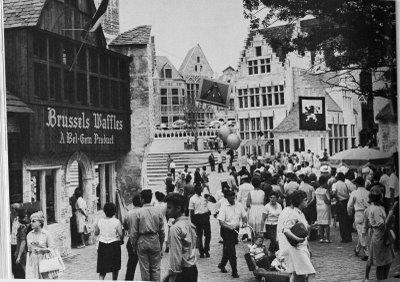
The famous Belgian Village, with the park’s defining snack being sold just the left of the picture (i.e. the Bel Gem Waffle).

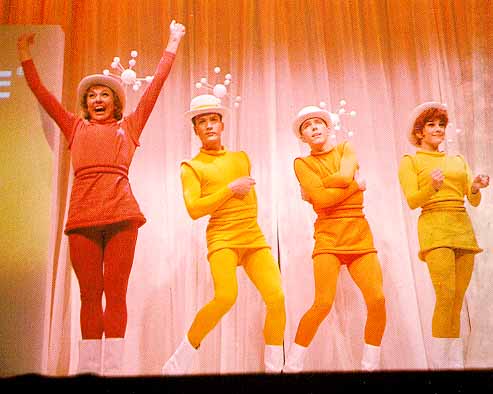
Dupont’s zippy musical ‘The World of Chemistry’ didn’t quite make it to Broadway.

I highly, highly recommend a few website for some further information about the World’s Fair. NYWF64 has a exhaustive description of almost every pavilion, including a great many we didnt mention, like The Underground Home, Sinclair’s Dinoland, and the Lunar Fountain.

Jeffrey Stanton has an excellent site about it as well.

The World’s Fair tire pic is from a great page by Modern Mechanix featuring magazine photos from the beginnings of the fair.

A few months ago we wrote about the Singer Bowl, a World’s Fair auditorium that later become the Billie Jean King Tennis Center, home of the U.S. Open.

Find all of our Robert Moses coverage here.