PODCAST The fascinating story of the Public Theater and Joseph Papp’s efforts to bring Shakespeare to the people. (Episode #88)
What started in a tiny East Village basement grew to become one of New York’s most enduring summer traditions, Shakespeare in the Park, featuring world class actors performing the greatest dramas of the age. But another drama was brewing just as things were getting started. It’s Robert Moses vs. Shakespeare! Joseph Papp vs. the city!
ALSO: Learn how the Public Theater got off the ground and helped save an Astor landmark in the process.
THIS SHOW WAS ORIGINALLY RELEASED ON JUNE 18, 2009 — MANY, MANY YEARS BEFORE LIN-MANUEL MIRANDA AND ‘HAMILTON’ HIT THE PUBLIC STAGE
The Bowery Boys: New York City History podcast is brought to you …. by you!
We are now producing a new Bowery Boys podcast every week. We’re also looking to improve and expand the show in other ways — publishing, social media, live events and other forms of media. But we can only do this with your help!
We are now a creator on Patreon, a patronage platform where you can support your favorite content creators.
Please visit our page on Patreon and watch a short video of us recording the show and talking about our expansion plans.
If you’d like to help out, there are six different pledge levels.Check them out and consider being a sponsor.
A condescending illustration of Tompkins Square Park from the New York journal Hearth and Home, 1873. (NYPL)
This episode on the history of Tompkins Square Park ties right into an all-new two-part episode coming in September, the first part coming at you next week.
Central Park has frequently been called ‘the people’s park,” but we think Tompkins Square Park may have a better claim to that title. From its inception, this East Village recreational spot — named for Vice President Daniel D Tompkins — has catered to those who might not have felt welcome in other New York parks.
Carved from the marshy area of Peter Stuyvesant‘s old farm, Tompkins Square immediately reflected the personality of German immigrants who moved here, calling it Der Weisse Garten. With large immigrants groups came rallies and demands for improved working conditions, leading to more than a number of altercations with the police in the 19th century.
Progressives introduced playgrounds here, and Robert Moses changed the very shape of Tompkins Square. But the most radical transformation here took place starting in the late 1950s, with the introduction of beatnik and ‘hippie’ culture and infusion of youth and music.
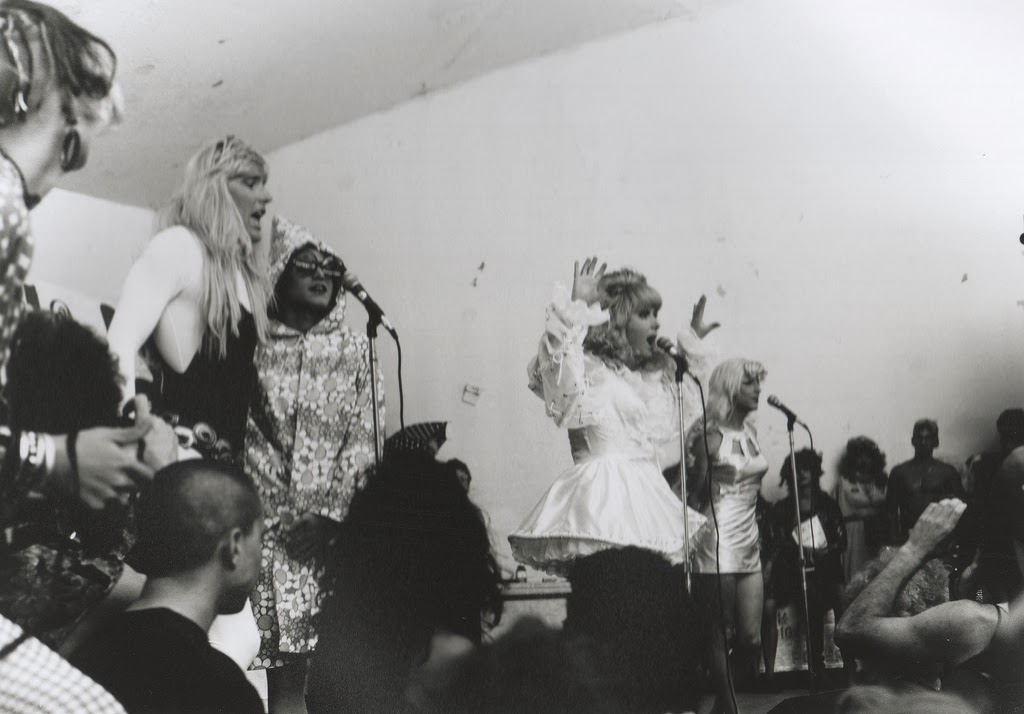
By the 1980s, the park became known not only for embodying the spirit of the East Village through punk music and drag shows (above: Lady Bunny), but also as a haven for the homeless. Clashes with police echoed the clashes that happened here one century before. The park still maintains a curfew left over from the strife of the late 1980s.
FEATURING: Lillian Wald, the Grateful Dead, Charlie Parker, Samuel S. Cox, Lady Bunny … and Chevy Chase?
LISTEN NOW: TOMPKINS SQUARE PARK
A version of this show was originally released in 2014 (episode #160)
Images from the park this week (August 2023)
It’s doubtful that the image below is accurately depicted by the caption which accompanied it in Frank Leslie’s Illustrated Newspaper in 1874: “The red flag in New York – riotous Communist workingmen driven from Tompkins Square by the mounted police, Tuesday, January 13th.” [Courtesy LOC]
Another illustration of the 1874 protests, notably featuring a German establishment in the background. (More information on the Tenement Museum blog.)
People enjoying (most likely) German music and entertainment in Tompkins Square Park, 1891. An image from Harper’s Weekly by Thure de Thulstrup. (NYPL)
Women and children enjoying themselves in Tompkins Square Park, Arbor Day, 1904, on the brand new playground for girls. (Photos courtesy Museum of the City of New York)
The Tompkins Square Milk House, which provided clean, healthy milk to families in the 1910s.
The statue of Samuel Cox, funded by New York postal workers. (1900, pic courtesy Museum of the City of New York
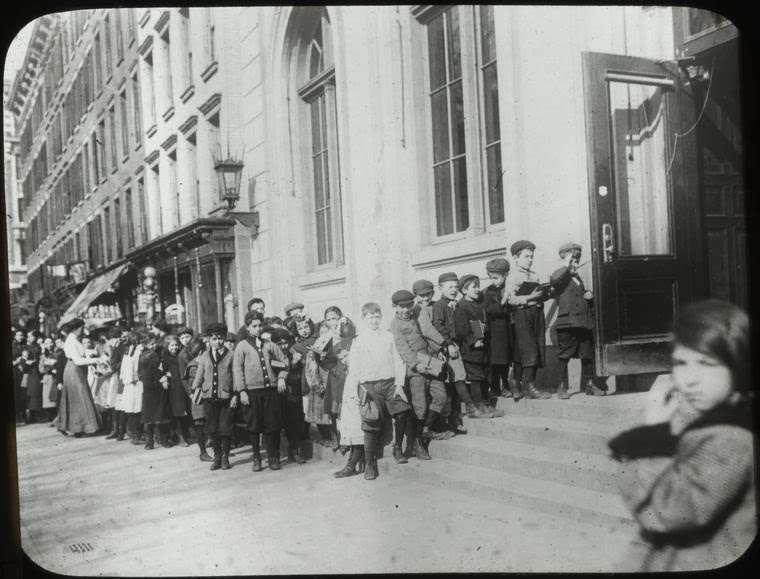
Children waiting in line to use the children’s reading room at the Tompkins Square branch library. (NYPL)
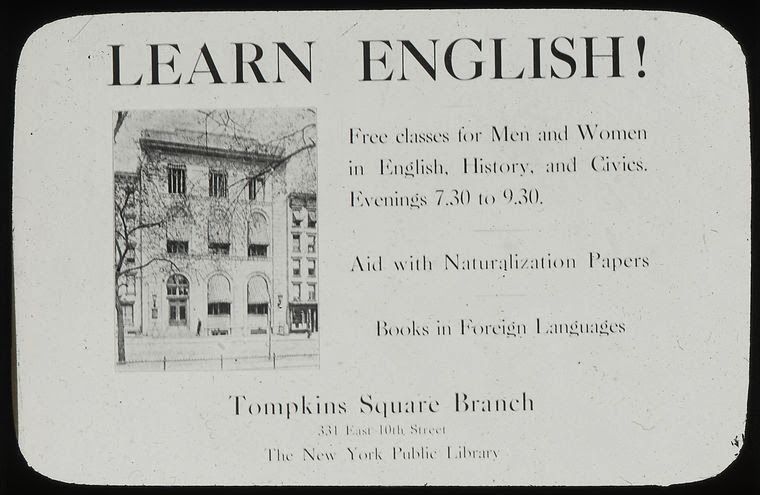
An advertisement from 1920, urging residents of the Lower East Side to take English courses at the Tompkins Square branch library. There are several of these posters in different languages here. (NYPL)
Lady Bunny and friends, performing at Wigstock 1988 (Picture courtesy aquaman6 on Flickr)
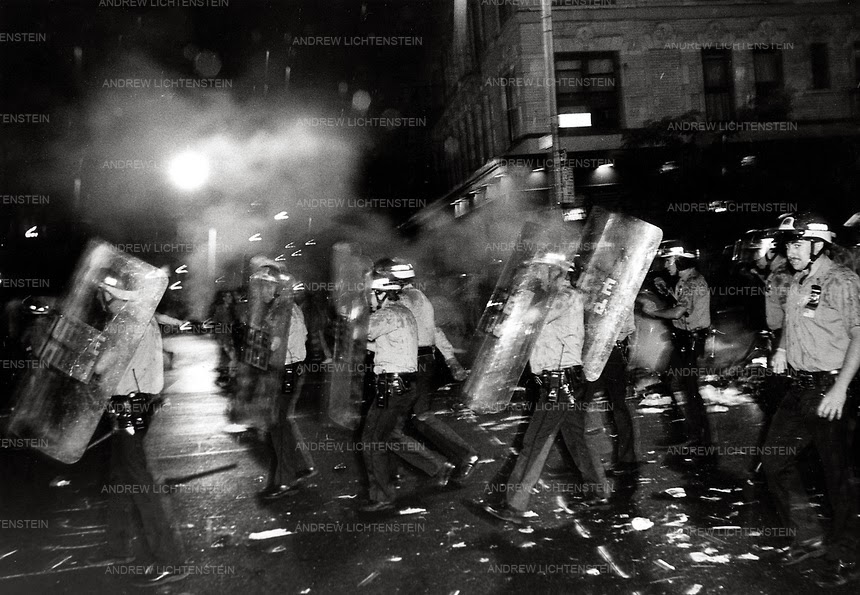
The Tompkins Square Police Riot from 1988 (courtesy Quilas)
Police retake Avenue A during a riot outside Tompkins Square Park that erupted after police allegedly beat a homeless man. The late 1980’s and early 1990’s was a period of rapid gentrification in the East Village, and many homeless residents, activists, and squatters, battled the process, frequently clashing with the police around Tompkins Square Park.
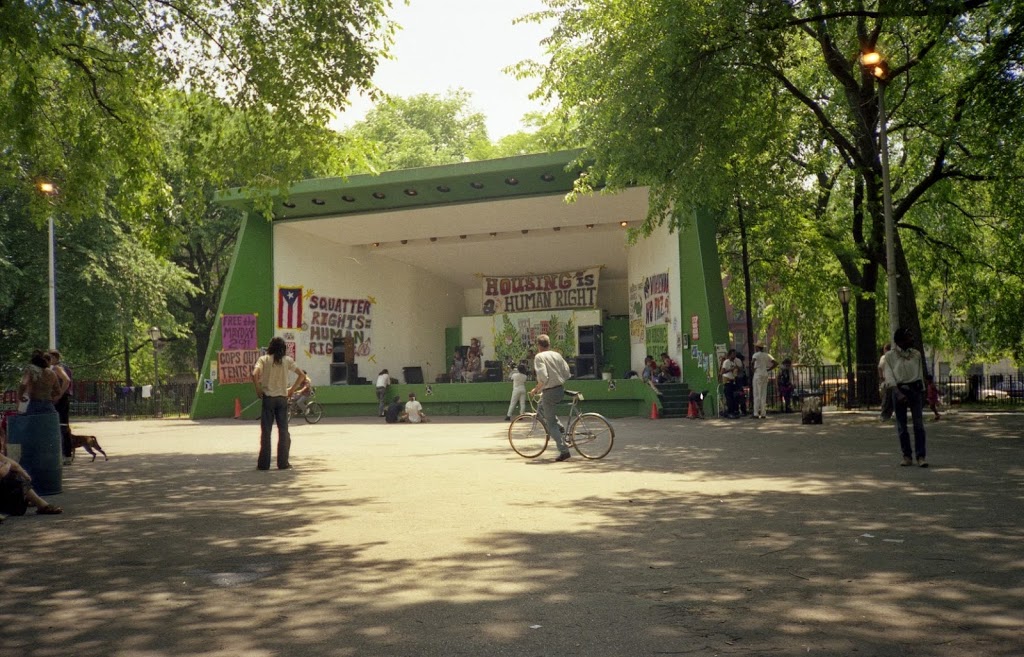
The Tompkins Square Park bandshell, which was torn down by the city in 1991. (Photo courtesy Flickr/Mike Evans)
A performance by the hardcore band Breakdown at the bandshell in 1988
A Ghostbusters-themed entrant in the Halloween Dog Parade in 2013 (Courtesy USA Today)
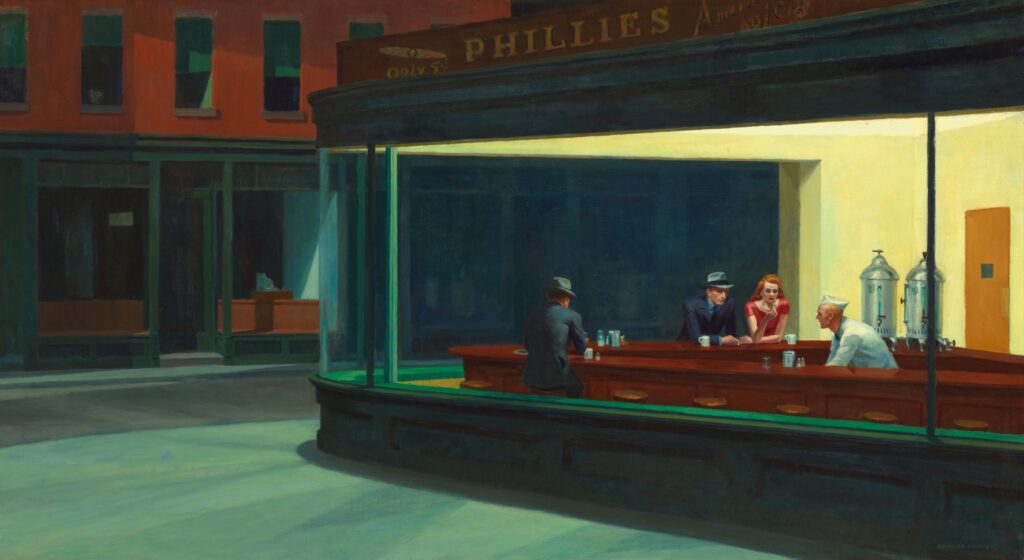
Within the New York City of Edward Hopper‘s imagination, the skyscrapers have vanished, the sidewalks are mysteriously wide and all the diners and Chop Suey restaurants are sparsely populated with well-dressed lonely people.
In this art-filled episode of the Bowery Boys, Tom and Greg look at Hopper’s life, influence and specific fascination with the city, inspired by the recent show Edward Hopper’s New Yorkat the Whitney Museum of American Art.
Hopper, a native of the Hudson River town of Nyack, painted New York City for over half a decade. In reality, the city experienced Prohibition and the Jazz Age, two world wars and the arrival of automobiles. But not in Hopper’s world.
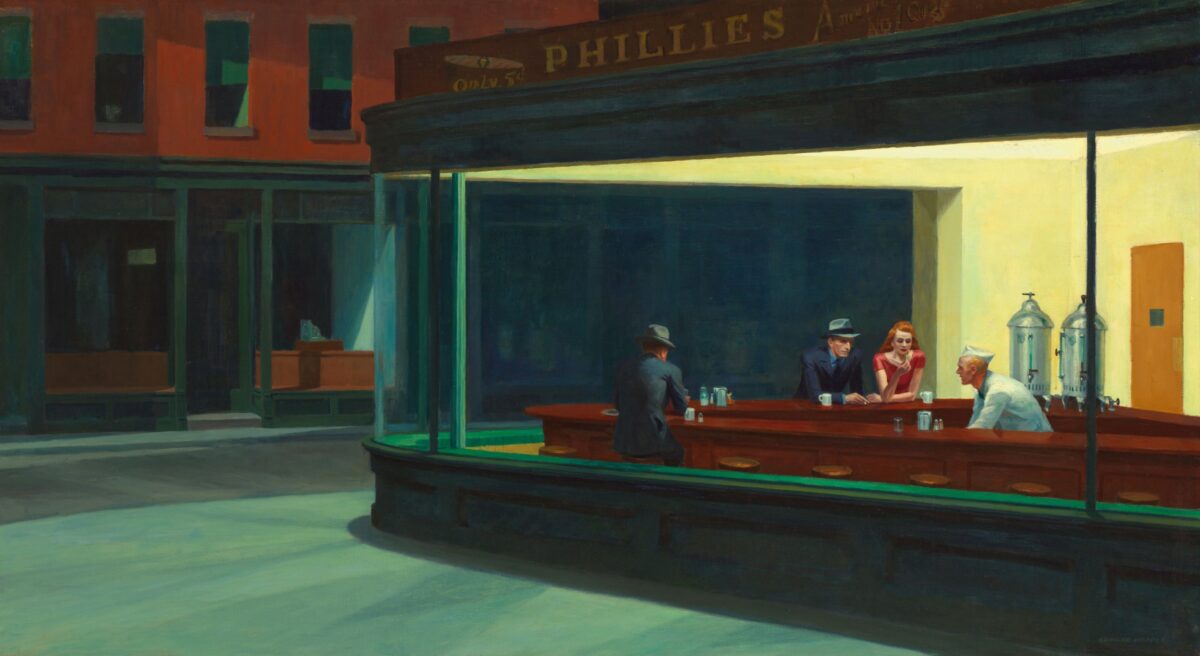
In his most famous work Nighthawks (1942), figures from a dreamlike film appear trapped in an aquarium-shaped diner. But Hopper has captured something else in this iconic painting: fear and paranoia. No wonder he’s considered a huge influence on Hollywood film noir and detective stories.
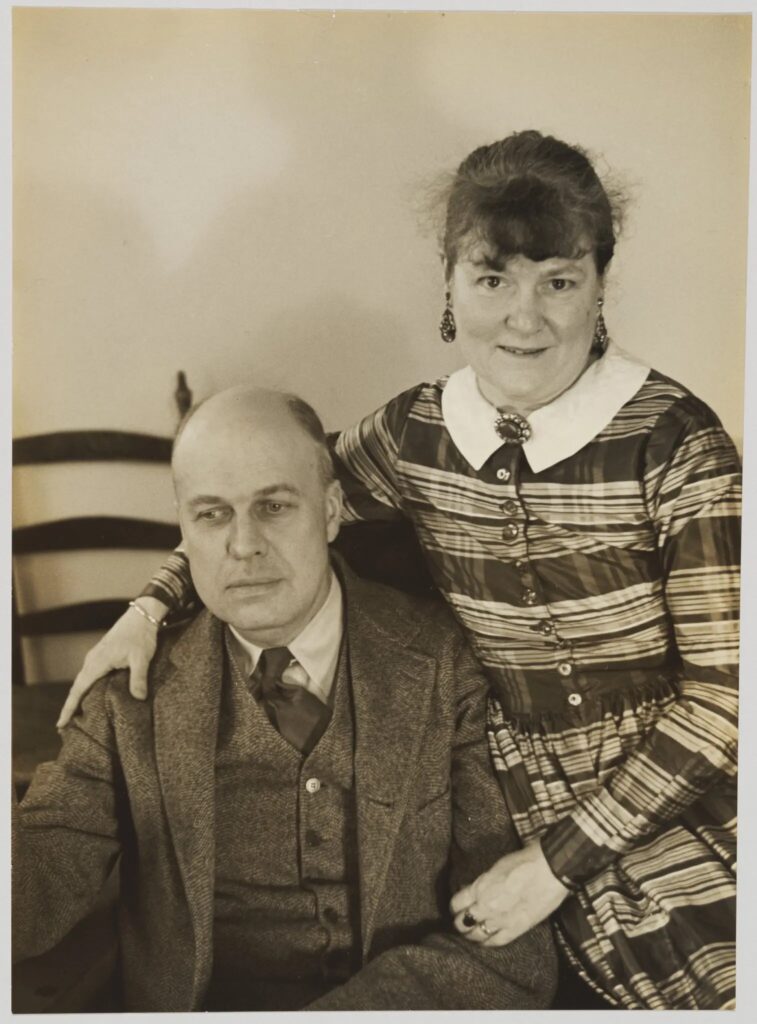
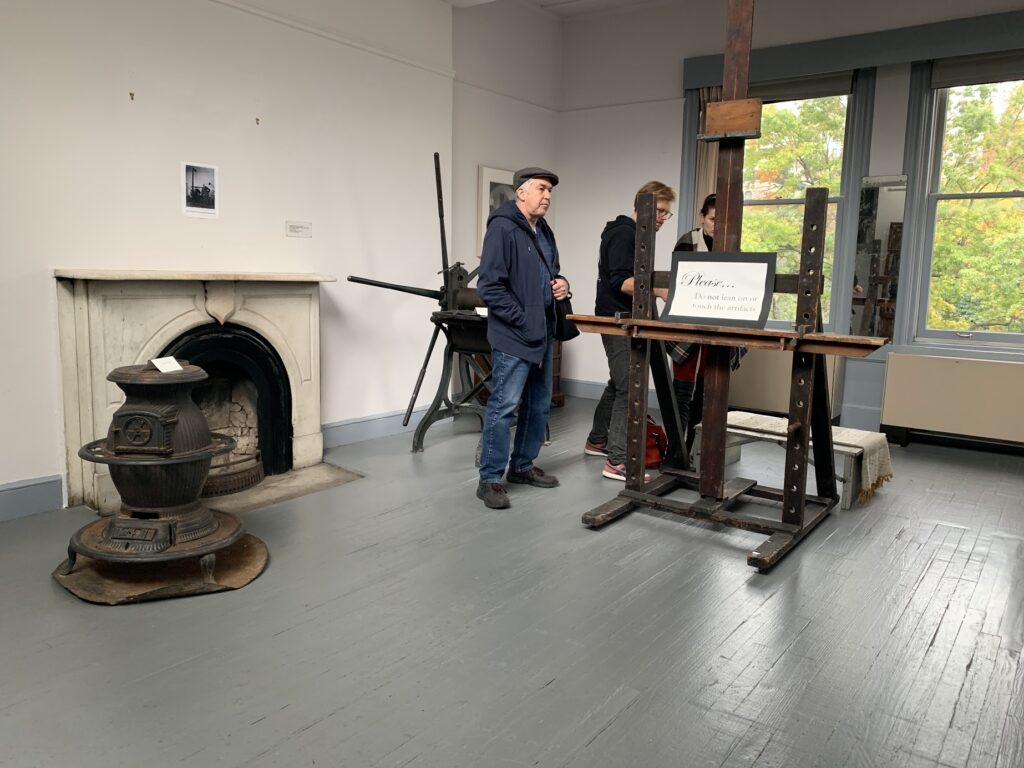
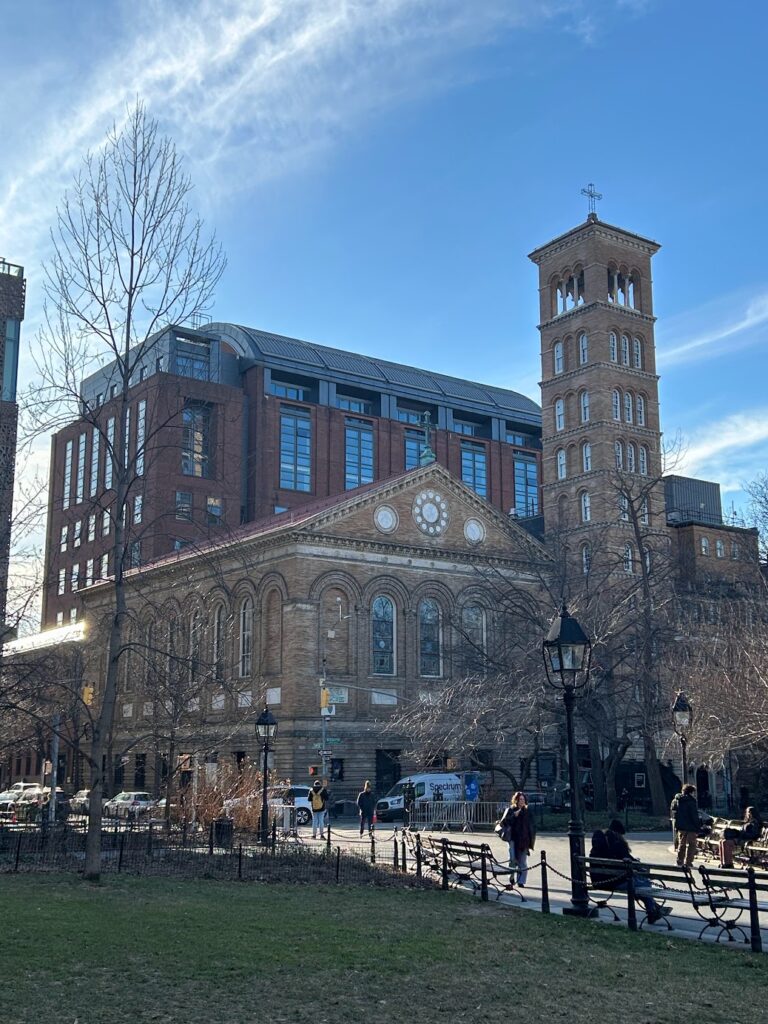
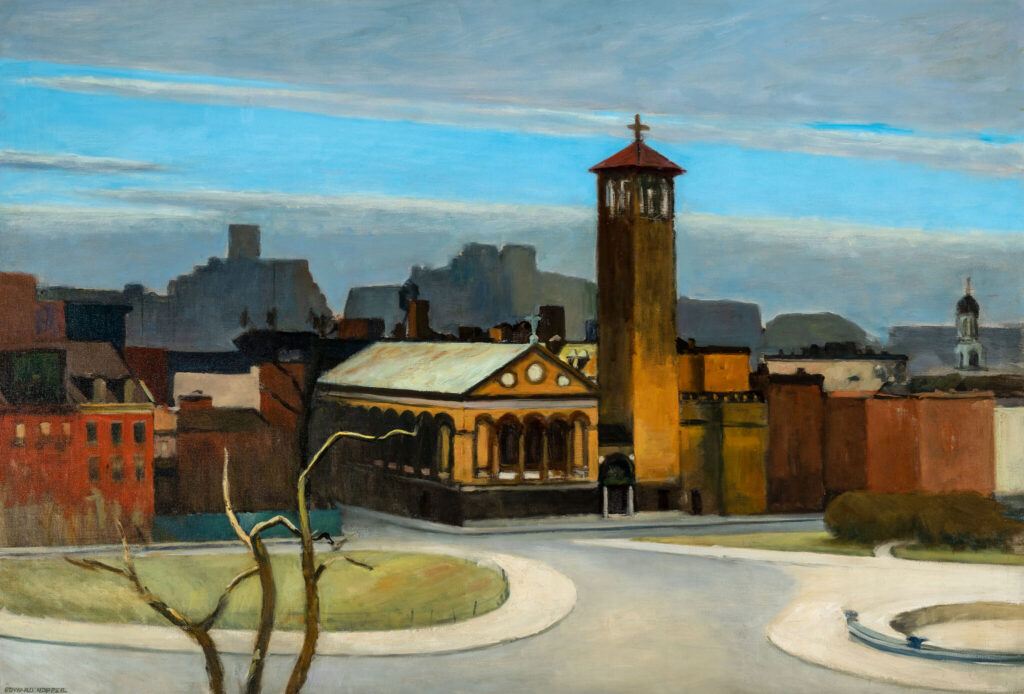
Hopper painted New York from his studio overlooking Washington Square Park, and both he and his wife Josephine Nivison Hopper would become true fixtures of the Greenwich Village scene.
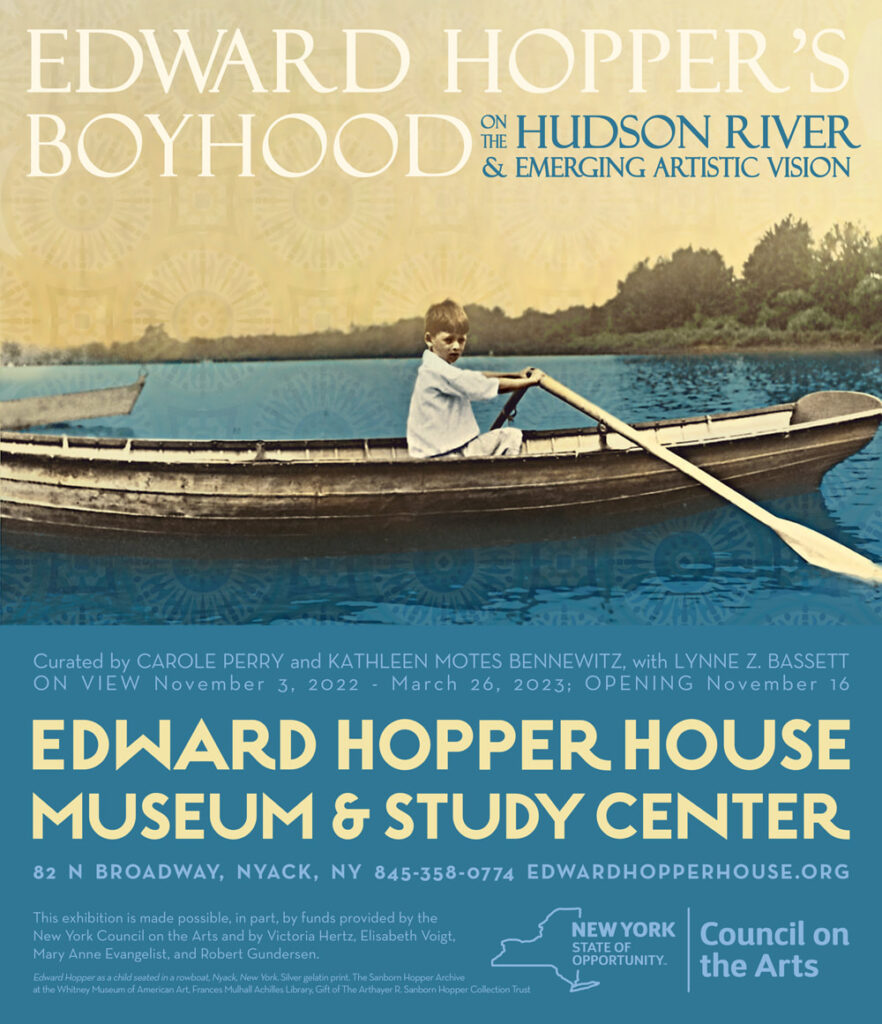
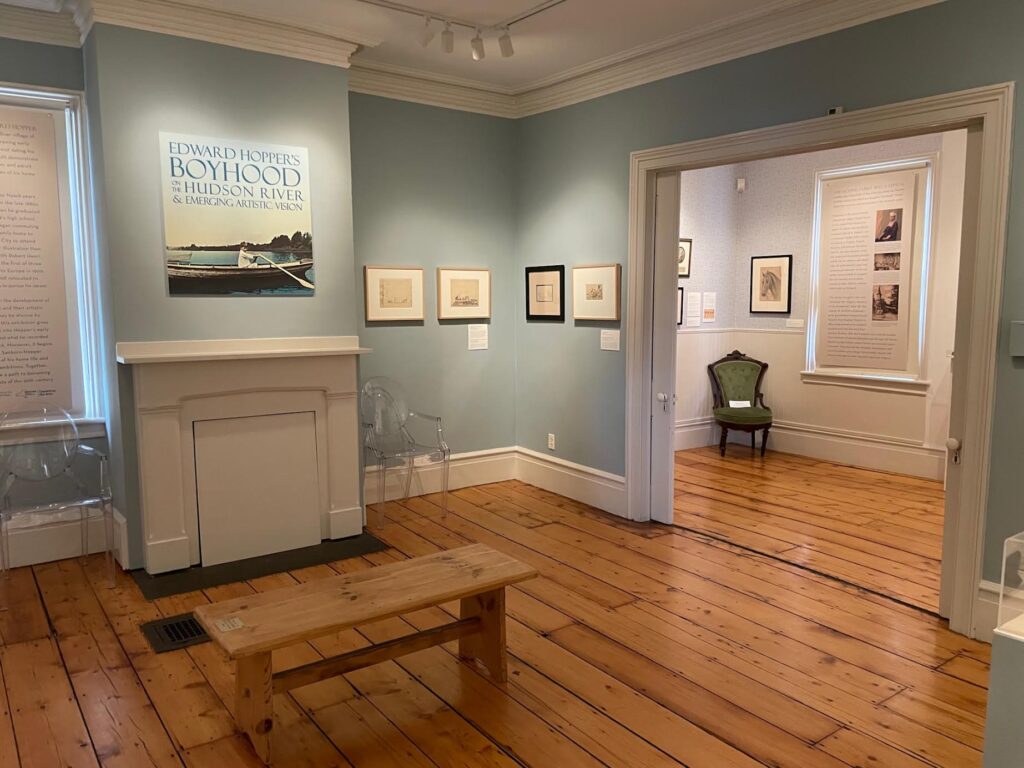
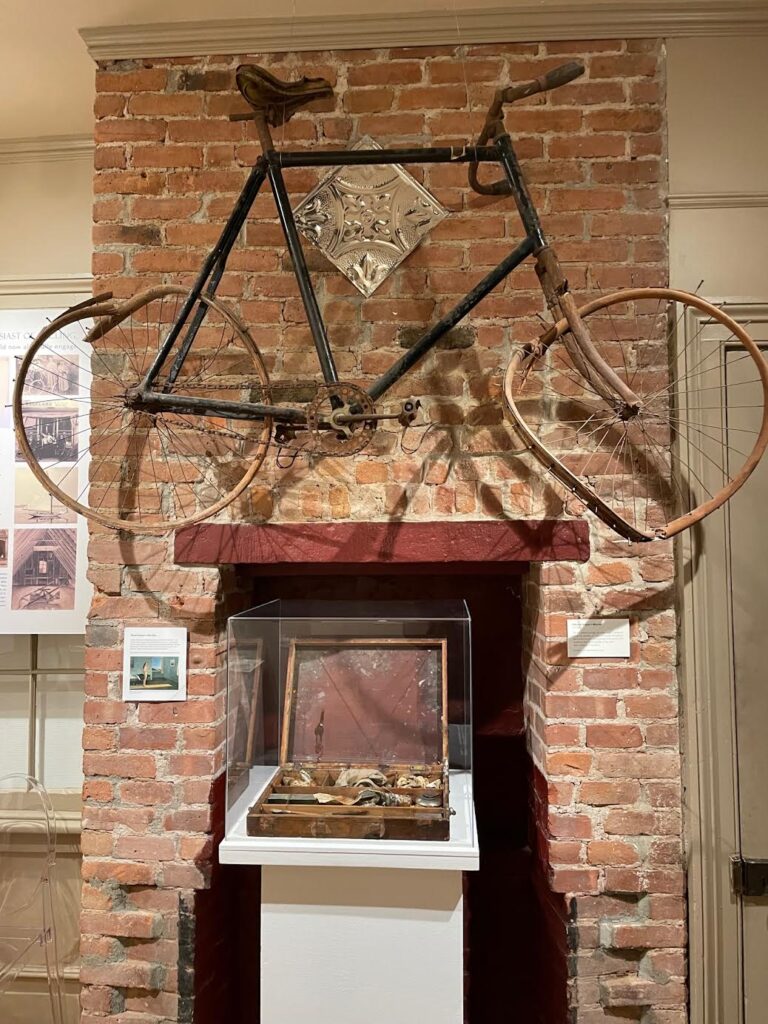
PLUS: Tom visits the Edward Hopper House Museumin Nyack, New York, to talk the artist’s early life with executive director Kathleen Motes Bennewitz. And Greg finds some of the hidden meanings in Hopper’s paintings thanks to American art historian Rena Tobey.
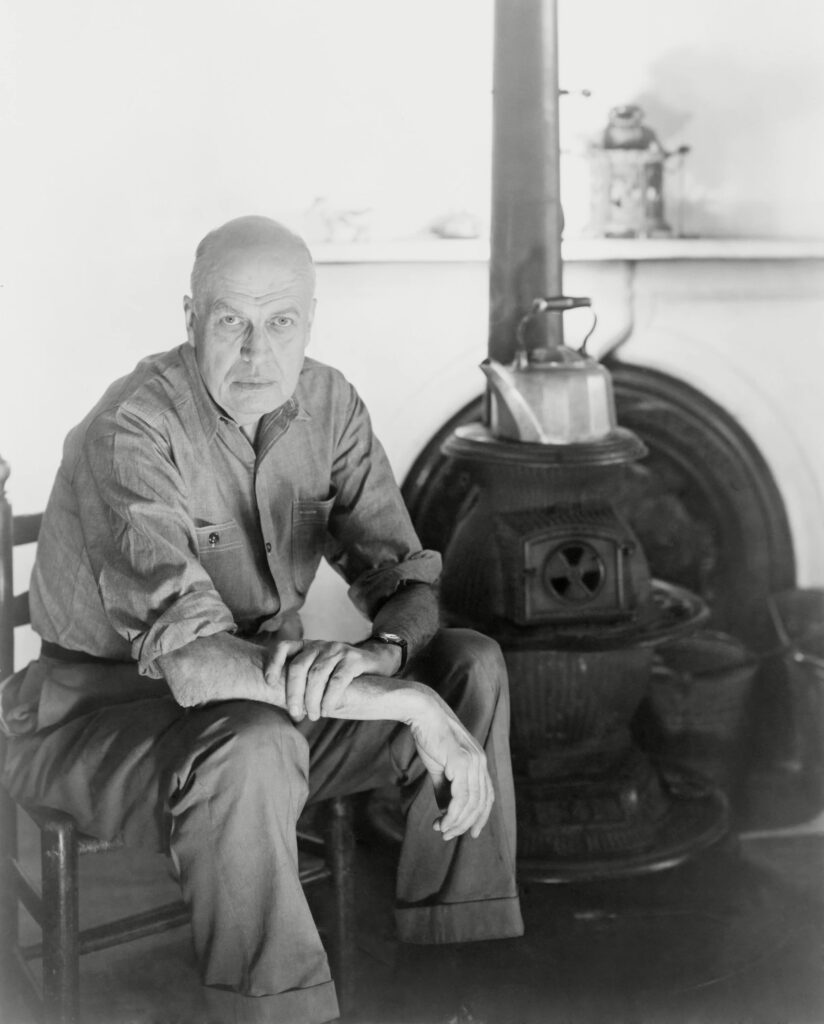
Edward Hopper in his studio. Courtesy Everett/ShutterstockCirca 1947. Photo courtesy Whitney Museum of American Art
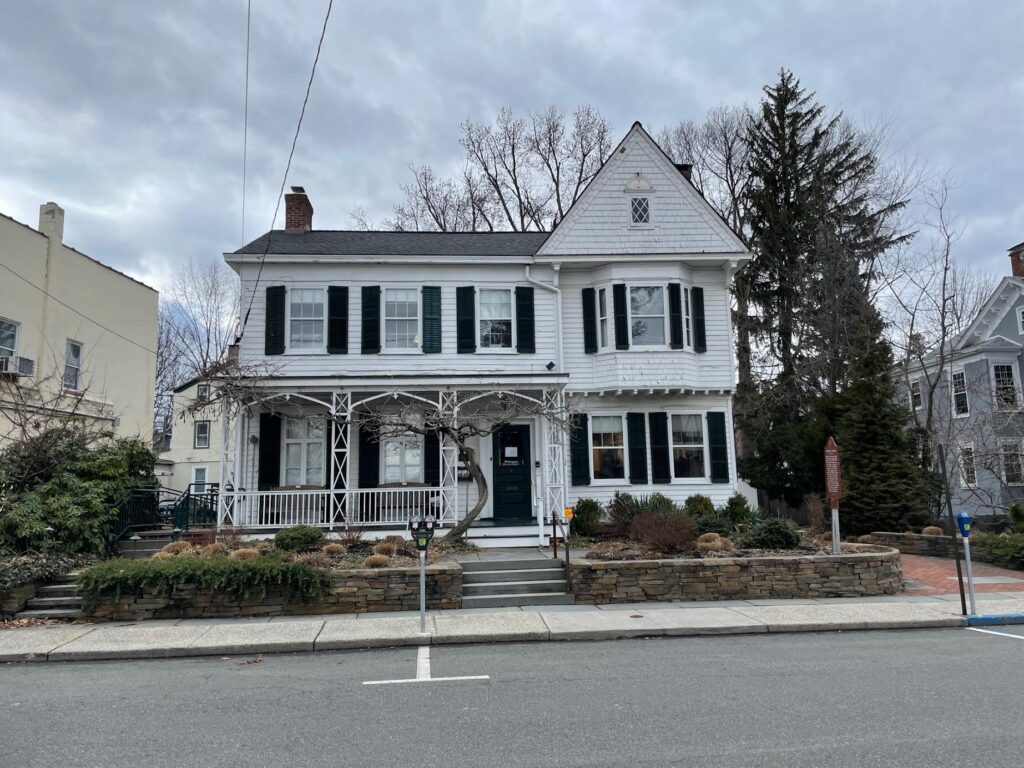
From the Edward Hopper House Museum in Nyack, NY:
Photos by Tom Meyers
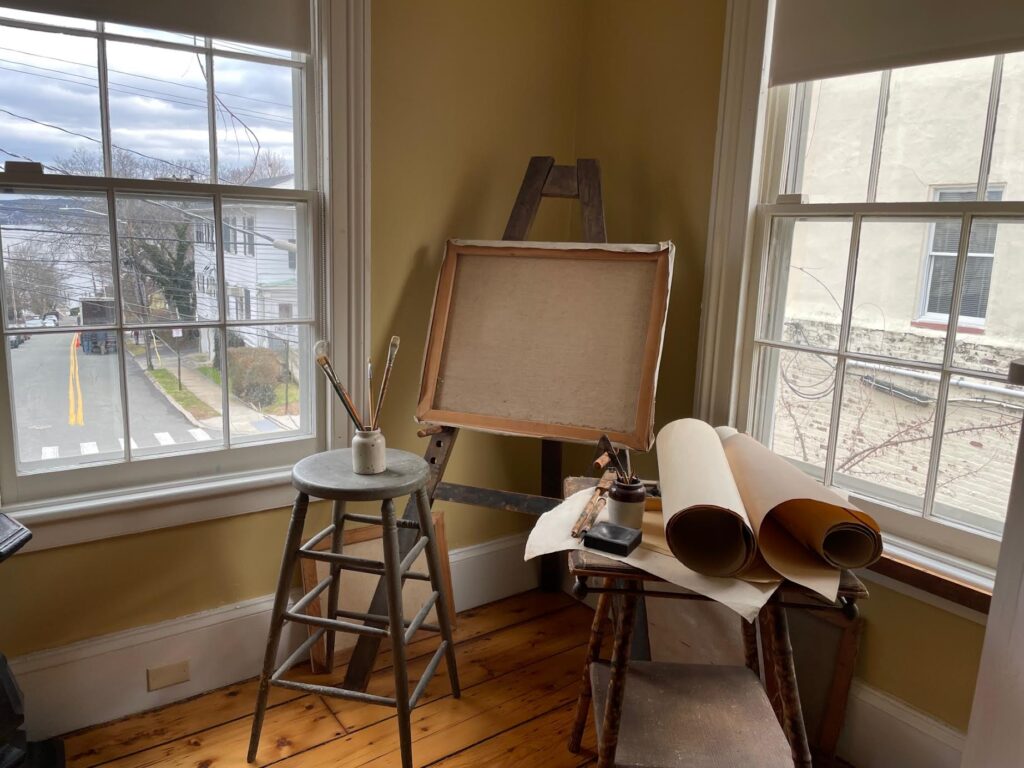
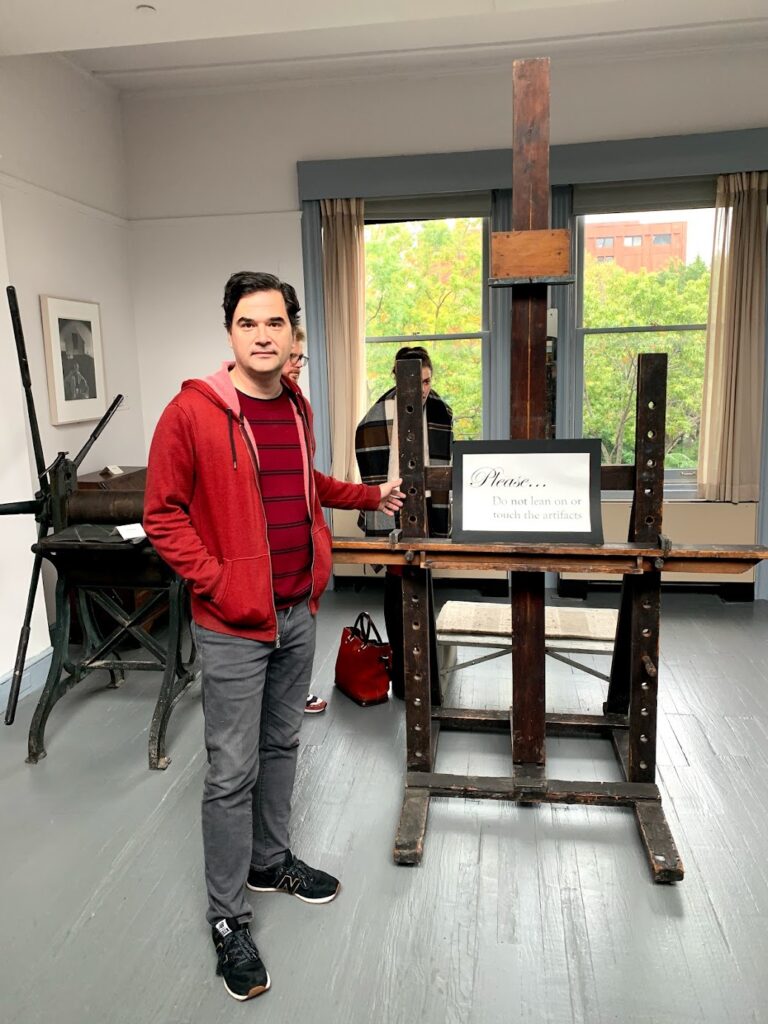
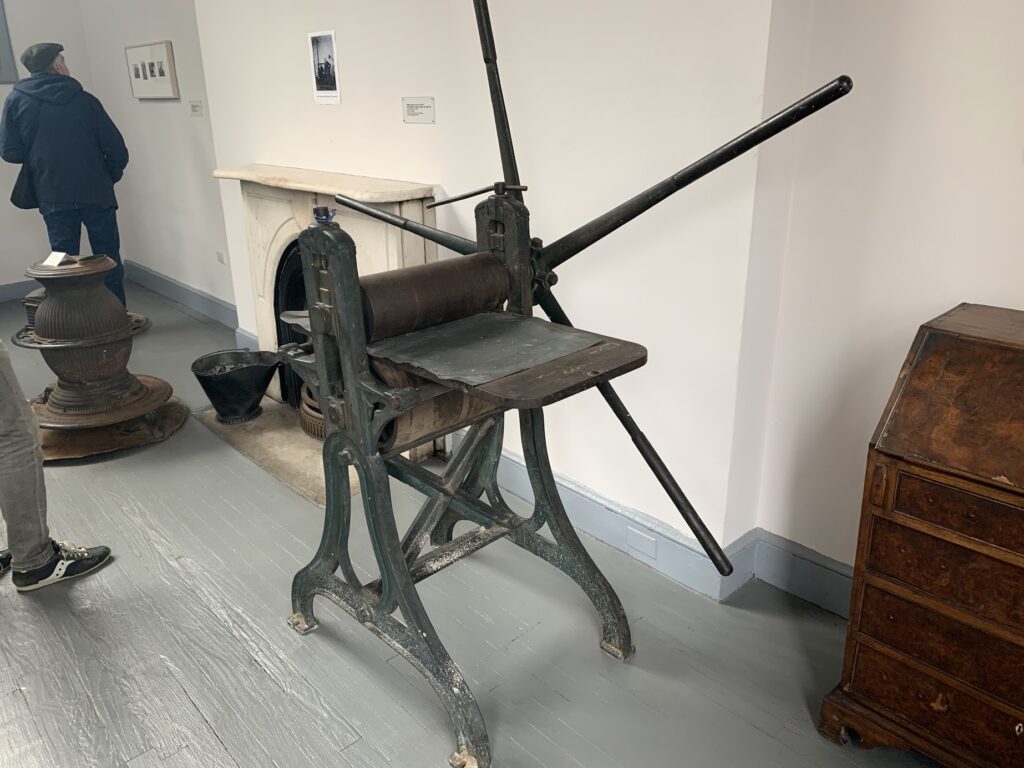
From inside Edward Hopper’s studio at 3 Washington Square North (from Open House NY 2019). Information on the studio here.
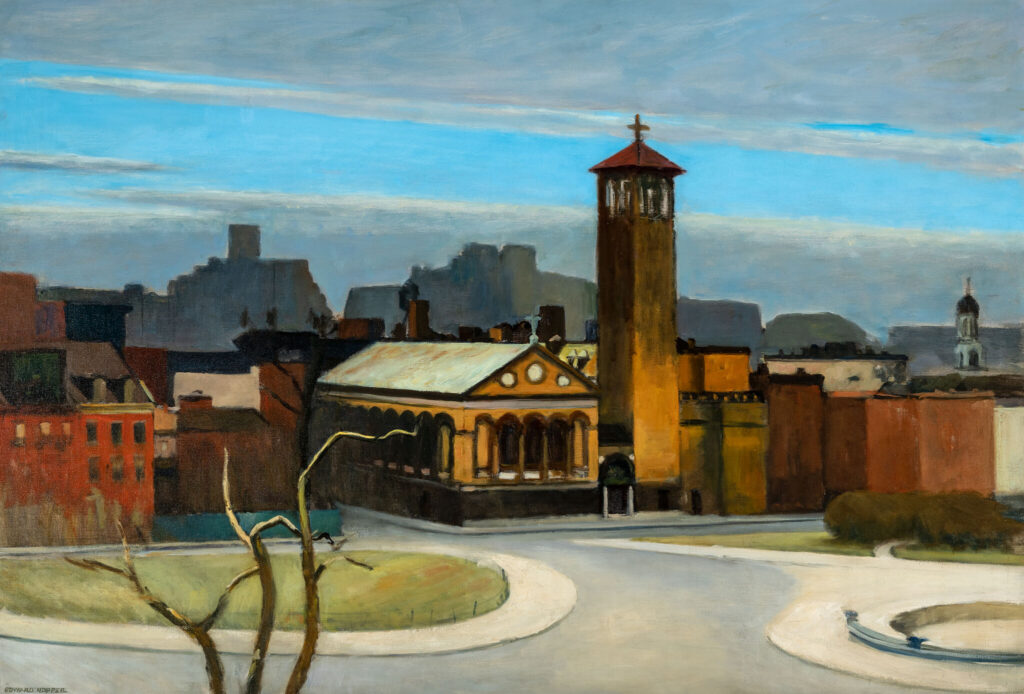
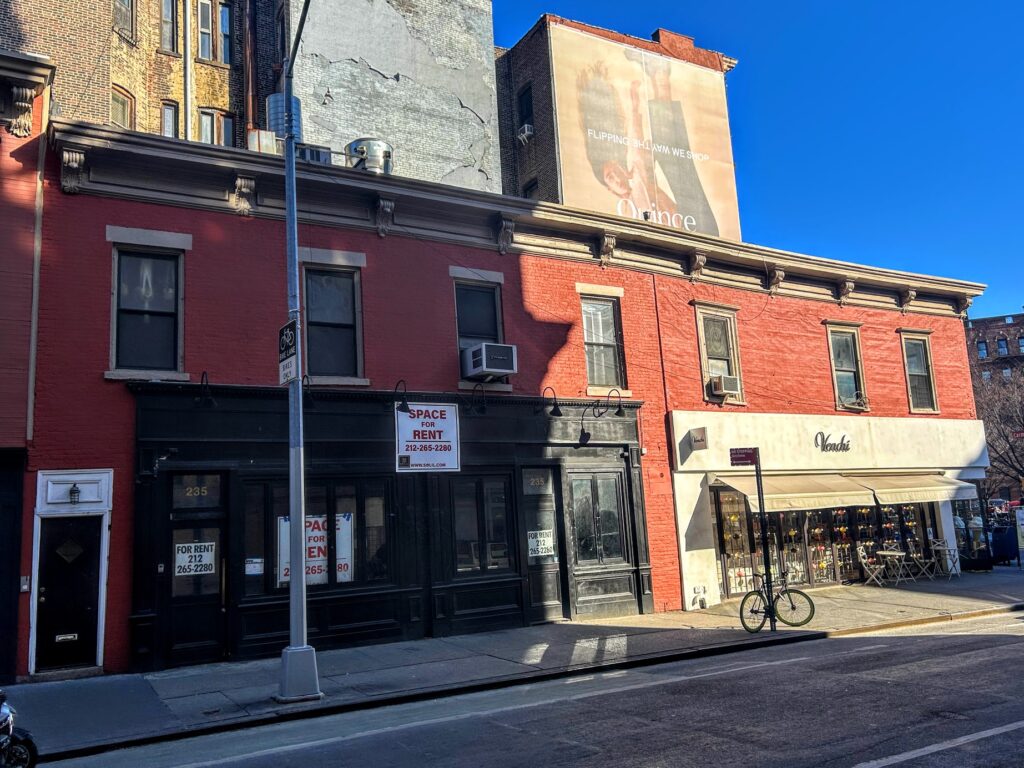
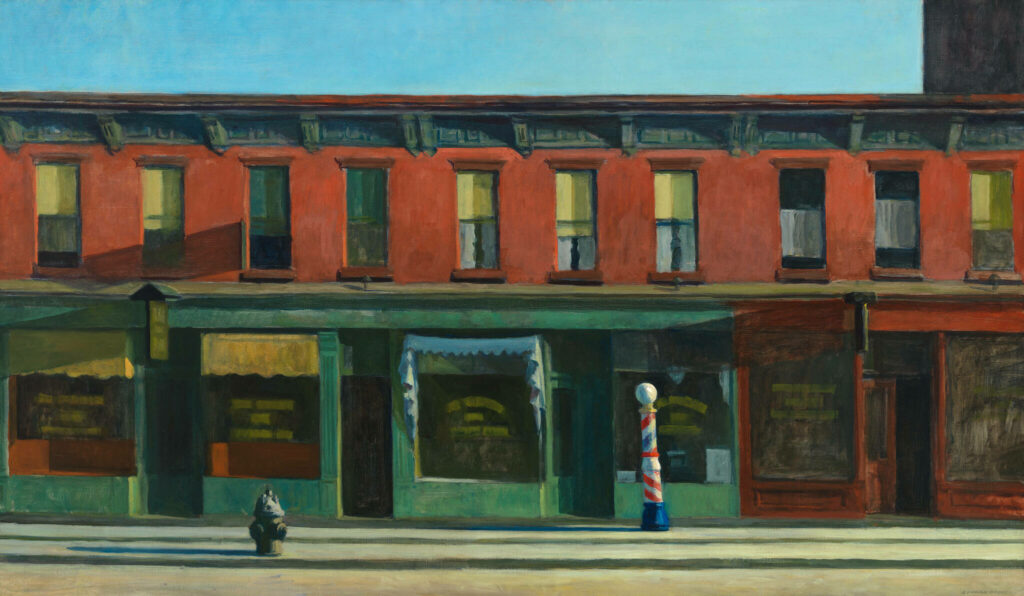
Although Hopper’s painting are mostly from the domain of his imagination, you can see some of his architectural subjects on the streets today. For more information, visit this interesting article posted at Village Preservation.
Bleecker and Carmine StreetEarly Sunday Morning, 1930Greenwich Avenue and Seventh AvenueNighthawks, 1942Judson Memorial ChurchNovember, Washington Square
FURTHER LISTENING
After finishing this show on Edward Hopper, dive back into our back catalog and experience other shows related to Hopper and his subjects:
Jacob Riis changed the world with “How The Other Half Lives.” By using the new technology of flash photography, Riis was able to capture the squalid conditions of Manhattan tenements in a way no mere paragraph, drawing or sermon could.
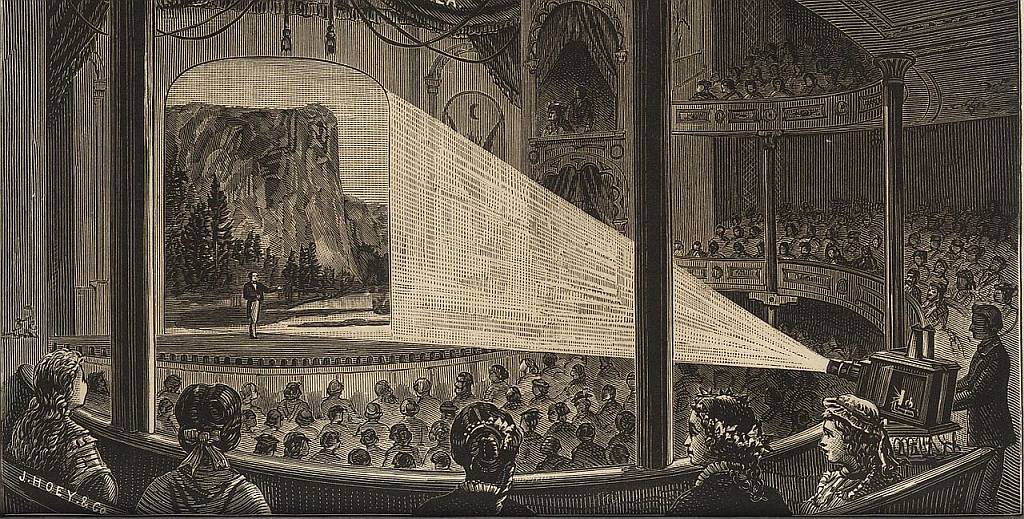
The startling photographs contained in this book did not originate there, however. Riis debuted them — and would continue to exhibit them — in “magic lantern” lectures, essentially the first slide shows.
But calling them magic lanterns is far more exciting, don’t you think? Wouldn’t you have gone to class a lot more had you known your professor was lighting up the magic lantern?
The magic lantern’s “real” name, the stereopticon, used a succession of glass slides (as few synthetic, transparent materials were not available at the time) transposed with a negative image that could be projected onto a hanging sheet.*
The magic lantern was created in the 1840s in Philadelphia and was originally intended for entertainment. In fact, one of Riis’s first schemes in New York used the magic lantern in a rather clever way.
He and a business partner would set up a stereopticon in a public park — a precursor to the Bryant Park film series — and project images of attractive people and international public landmarks, interspersing the pictures with advertisements from businesses nearby.
By 1888, however, Riis (pictured right) was using the technology to display the devastating images he had taken in the various slums around town. His first show was to the New York Society of Amateur Photographers, giving a vivid account according to some sources.
“Mr. Riis was so ingenious in describing the scenes and brought to his task .. a vein of humor,” according to a newspaper account quoted in Tyler Anbinder’s book Five Points.
Riis eventually took his ‘illustrated lectures’ on the road, electrifying audiences both taken with the modern marvel of the magic lantern and the images captured by the newly developed flash photography. “His viewers moaned, shuddered, fainted and even talked to the photographs he projected, reacting to the slides not as images but as a virtual reality that transported the new York slum world directly into the lecture hall.”
In essence, Riis was giving the equivalent of a show-stopping IMAX show to illuminate the plight of New York’s poorest and the unsafe conditions of their tenements. His shows could be considered the prototype of the film documentary.
The presentations would come with fiery speeches by Riis, often using the rhetoric of religious sermons in service of a more progressive, social cause. The shows were so successful that Riis grabbed a book deal and in 1890, his lectures and photographs were contained in his masterpiece “How The Other Half Lives.”
Interest in the magic lantern hasn’t waned today; in fact there’s a national organization that still revels in the wonder of the projected still image.
By the way, you can still find Jacob Riis all over the city. There are the Jacob Riis Houses on East 10th Street and Avenue D, built in 1949 on the site of a clump of tenements Riis railed on about, as well as the Jacob Riis Settlement House in western Queens and high school in the Lower East Side. And of course, there’s a huge Robert Moses park in Far Rockaway named for him.
*Read here for an interesting short history of the magic lantern and how images adhered to the glass
Below: a home on Bleeker Street (at Mercer and Greene streets), a Jacob Riis image that certainly must have popped up in one of his magic lantern shows
PODCAST Steven Spielberg’s new version of West Side Story is here — and it’s fantastic — so we’re re-visiting our 2016 show on the history of Lincoln Center, with a new show introduction discussing the film and the passing of musical icon Stephen Sondheim.
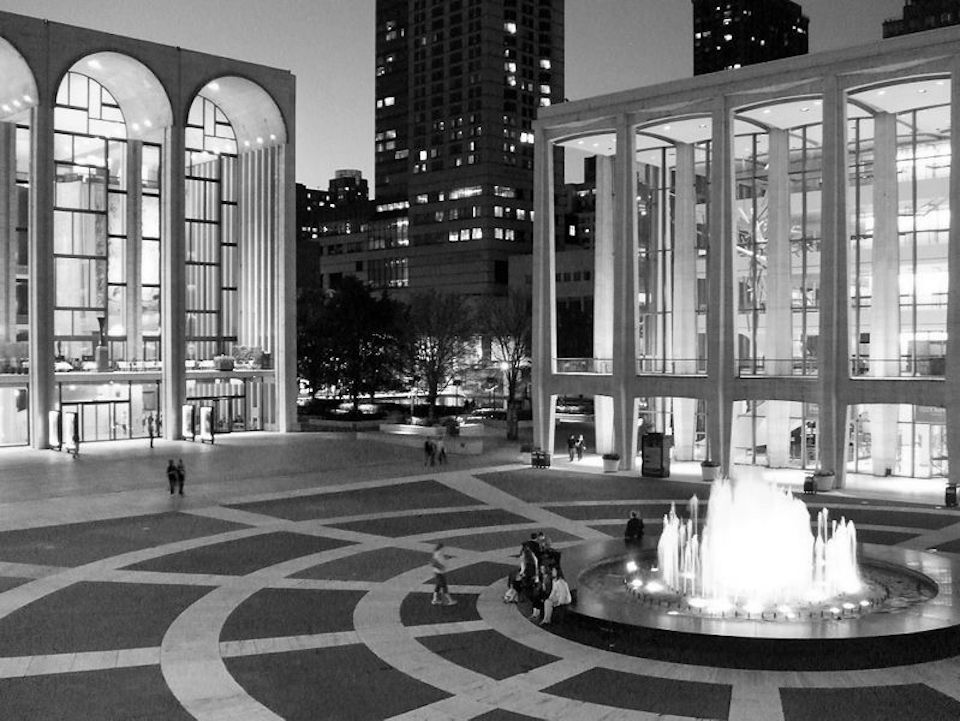
Warm up the orchestra, lace up your dance slippers, and bring the diva to the stage! For our latest show we’re telling the origin story of Lincoln Center, the fine arts campus which assembles some of the city’s finest music and theatrical institutions to create the classiest 16.3 acres in New York City.
However this tale of Robert Moses urban renewal philosophies and the survival of storied institutions has a tragic twist. The campus sits on the site of a former neighborhood named San Juan Hill, home to thousands of African American and Puerto Rican families in the mid 20th century. No trace of this neighborhood exists today.
Or, should we say, ALMOST no trace. San Juan Hill exists, at least briefly, within a part of classic American cinema.
The Oscar-winning film West Side Story, based on the celebrated musical, was partially filmed here. The movie reflects many realities of the neighborhood and involves talents who would be, ahem, instrumental in Lincoln Center’s continued successes.
FEATURINGLeonard Bernstein, Leontyne Price, James Earl Jones, Imelda Marcos, David Geffen and, naturally, the Nutcracker!
The Bowery Boys: New York City History podcast is brought to you …. by you!
We are now producing a new Bowery Boys podcast every other week. We’re also looking to improve and expand the show in other ways — publishing, social media, live events and other forms of media. But we can only do this with your help!
We are now a creator on Patreon, a patronage platform where you can support your favorite content creators.
Please visit our page on Patreon and watch a short video of us recording the show and talking about our expansion plans. If you’d like to help out, there are several different pledge levels. Check them out and consider being a sponsor.
We greatly appreciate our listeners and readers and thank you for joining us on this journey so far.
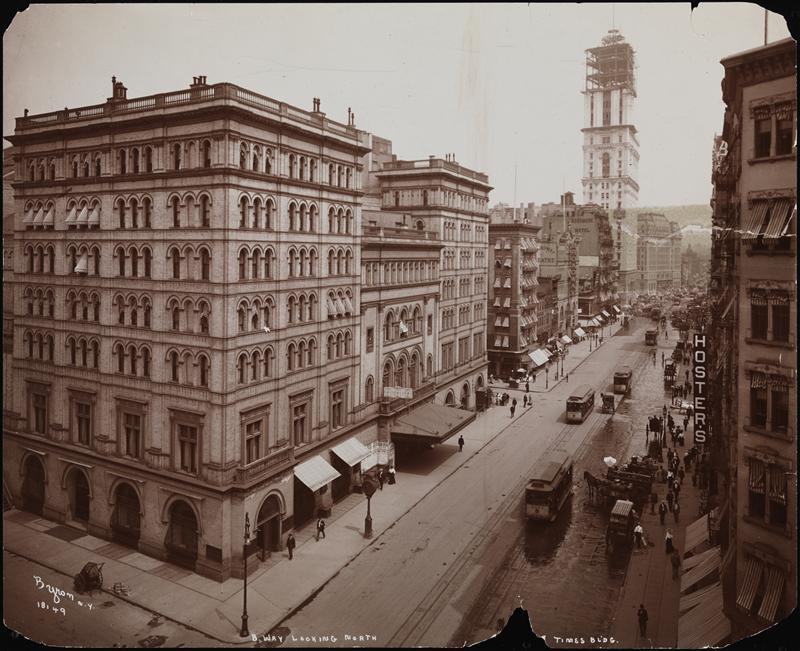
The Metropolitan Opera House, in 1904. In the far distance, you see One Times Square being constructed in Longacre Square.
Courtesy MCNY
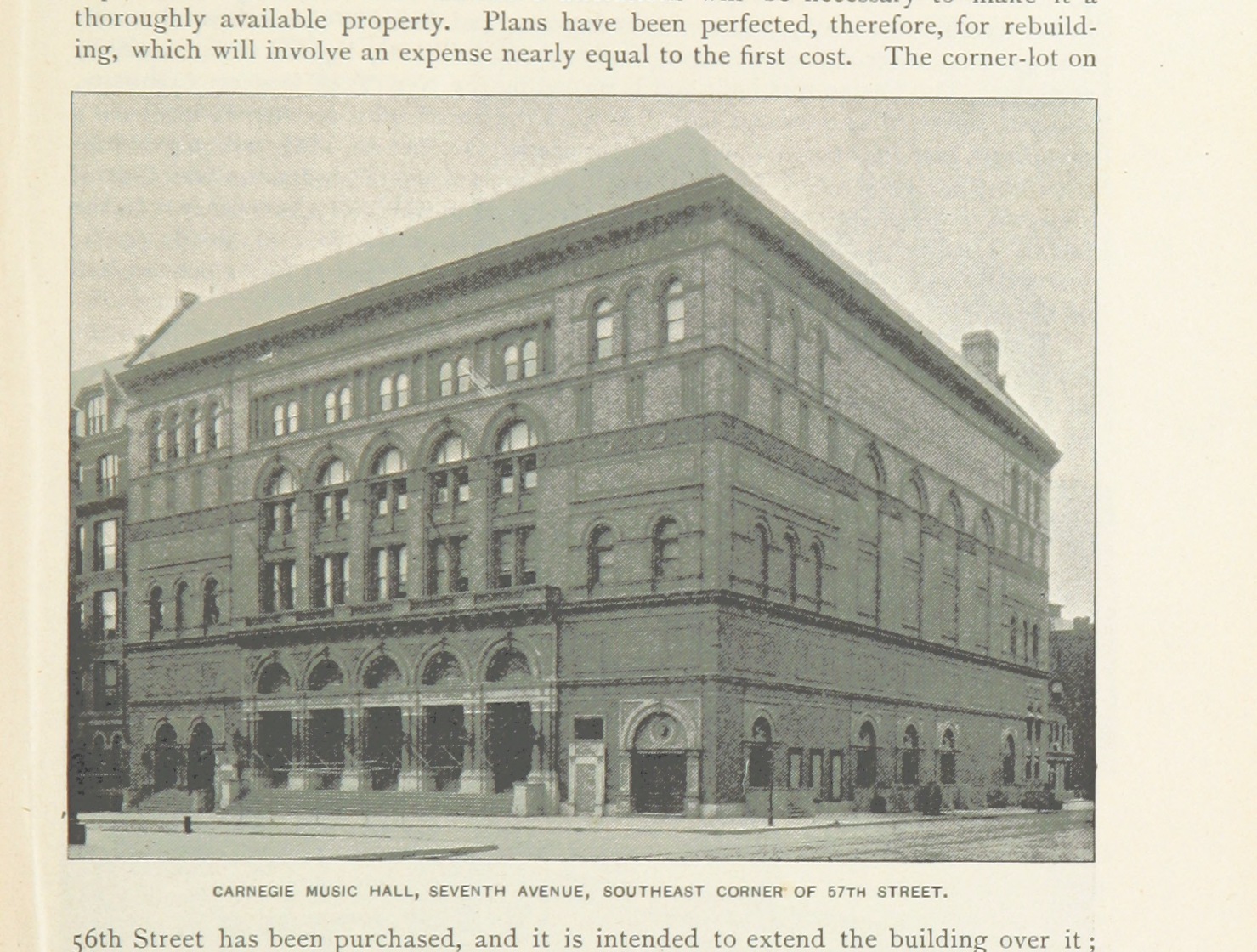
The New York City Ballet had its first home at City Center while the New York Philharmonic was housed for decades at Carnegie Hall.
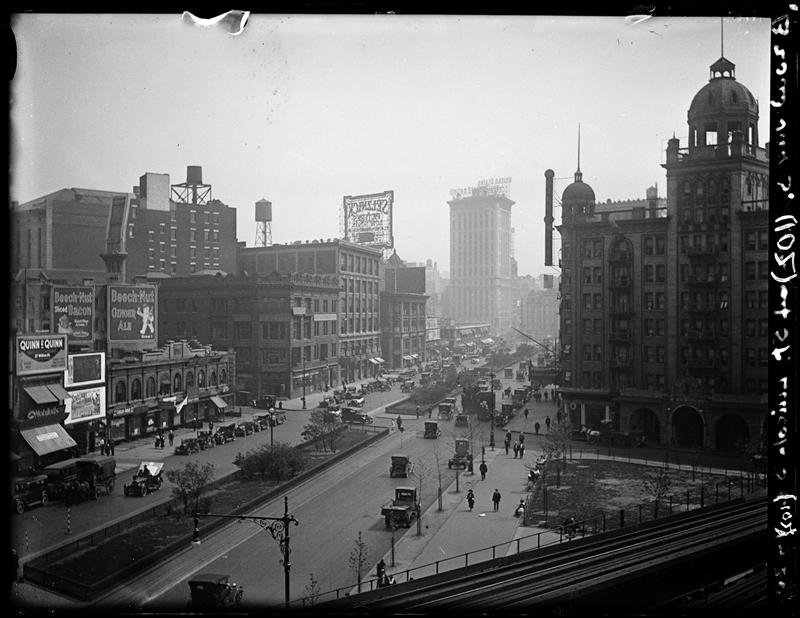
Below: Lincoln Square, 1920. This picture is actually taken from the spot where Lincoln Center stands today.
The triangular plaza pictured here would later be called Dante Park (a statue to the Italian writer would be placed here a year after this photo was taken). Take note of the 9th Avenue elevated streaking up Columbus Avenue at the bottom of this image.
Arthur Hosking/Museum of the City of New York
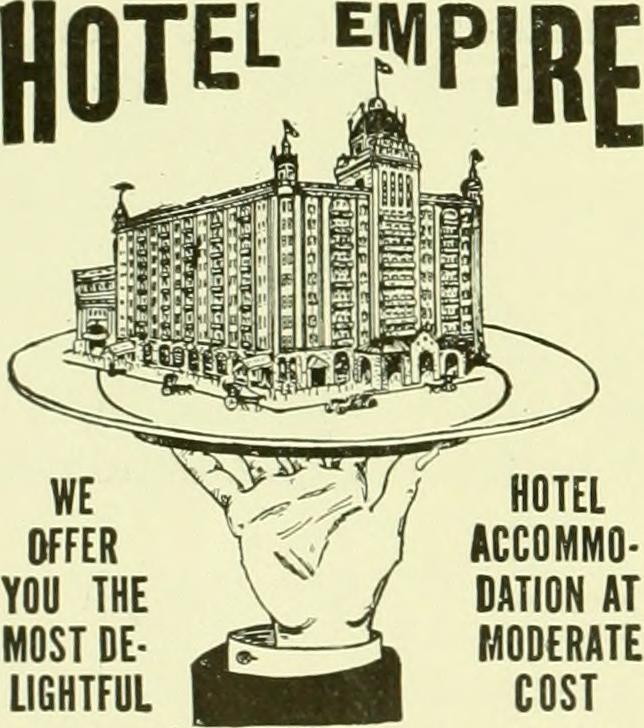
And that building to the right? That’s the Hotel Empire which is still standing there today (albeit in a greatly modified form). Here’s an ad for the Empire from 1909.
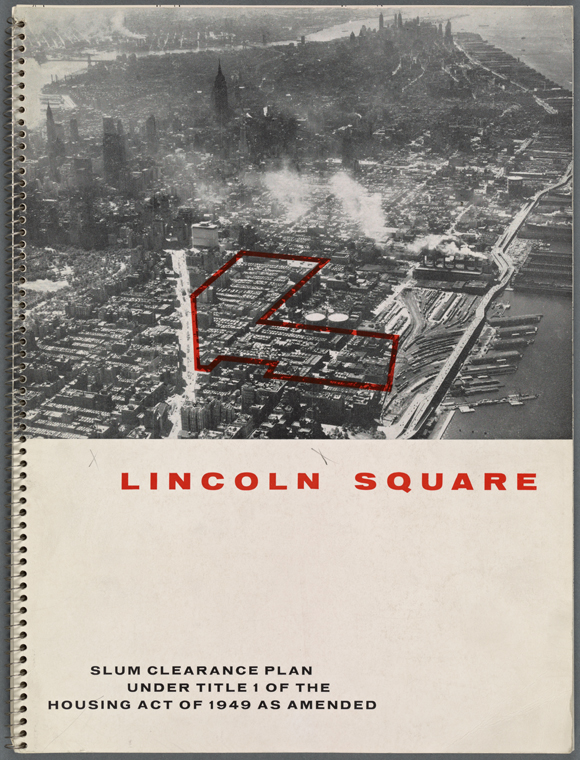
Robert Moses’ slum clearance plan for San Juan Hill, published in 1956.
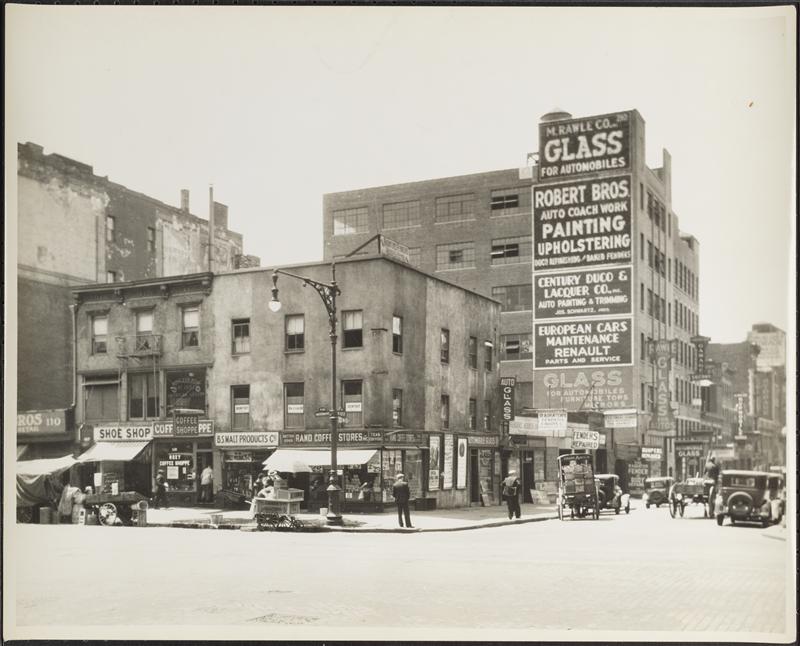
Scenes from old San Juan Hill — 1932, 65th Street and Amsterdam Avenue
Charles Von Urban/MCNY
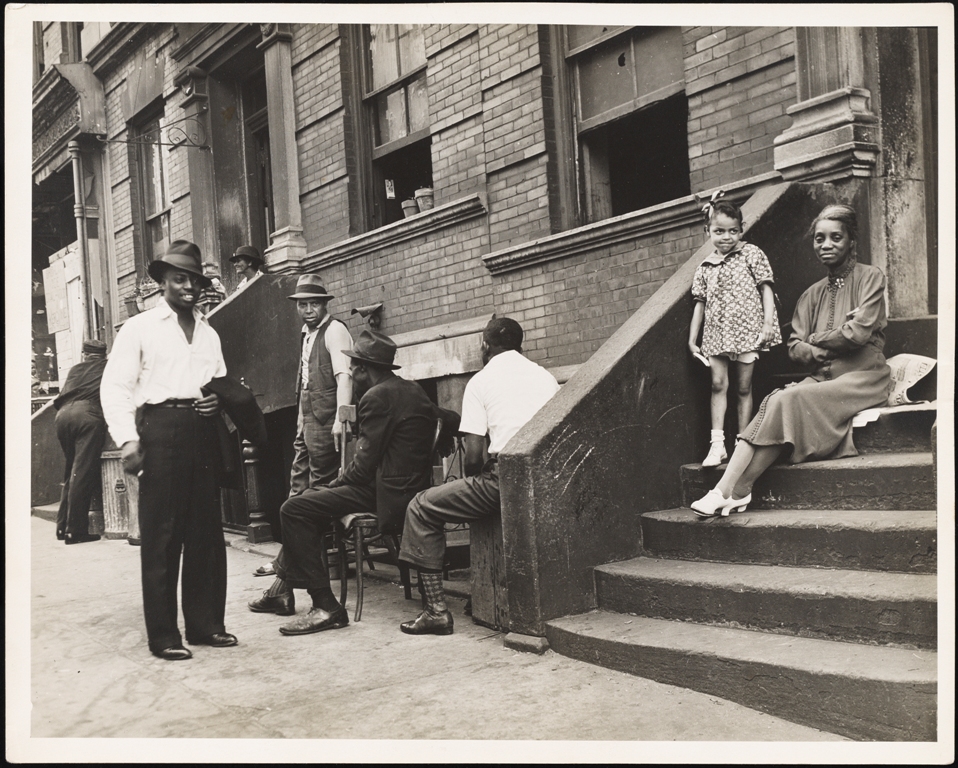
1939 — the stoop scene in San Juan Hill, street unknown
Courtesy MCNY Lee Sievan (1907-1990). San Juan Hill. 1939
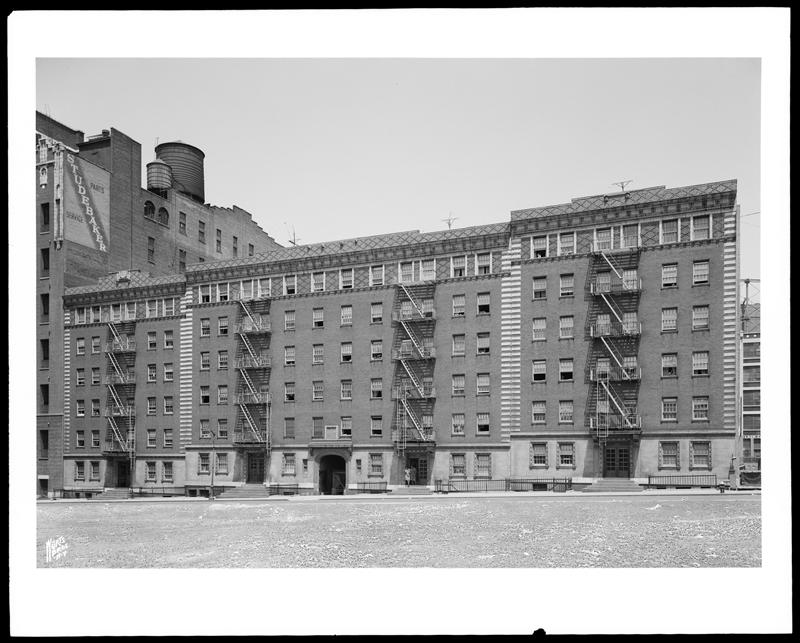
Below: An early effort to improve the housing quality in the neighborhood — the Phipps Houses, built in 1906.
An interesting New York Times article describes a few residents: “A typical tenant was the steamboat steward Joseph Craig, 36, classed as ‘mulatto’, who was born in Trinidad and arrived in the United States in 1891. Another was the horse breeder Daniel Moore, 43, born in Missouri and married for six years to Tilly Moore, 30, born in Cuba and in the United States since 1892; she worked as a domestic.”
MCNY
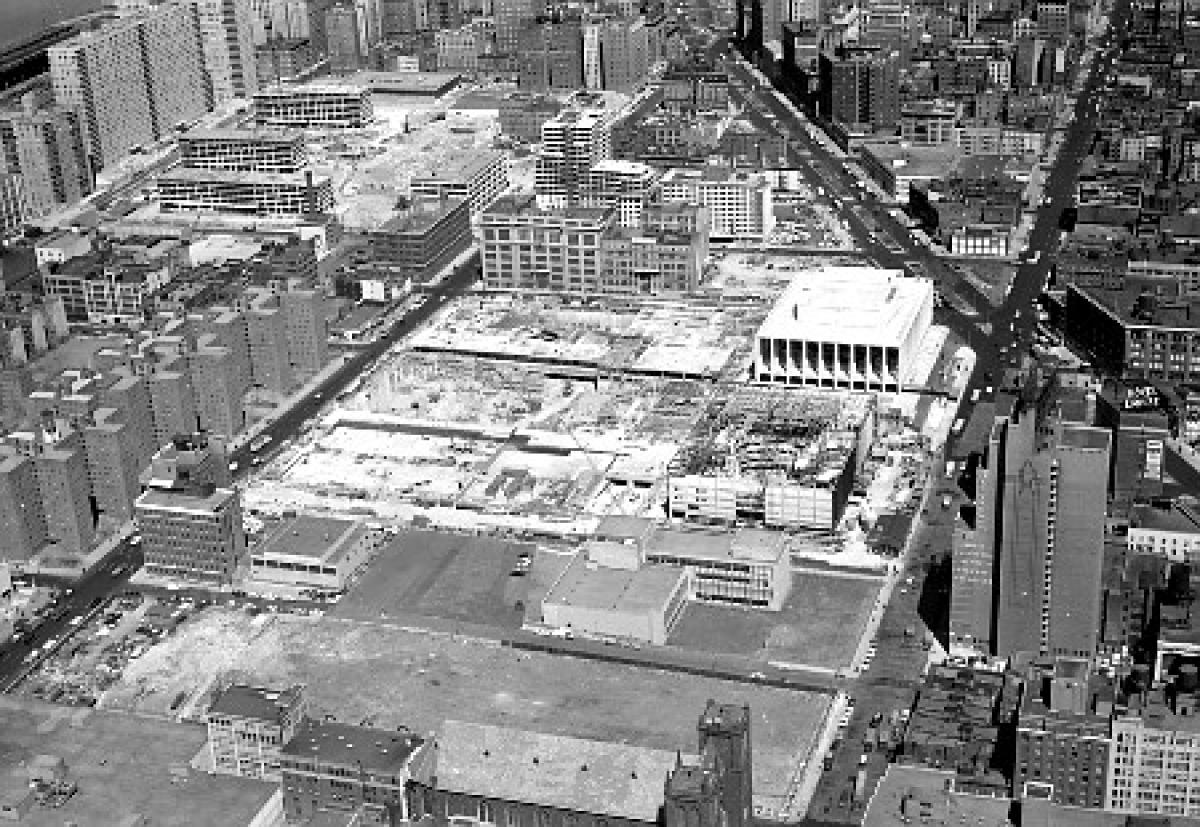
The scene in April of 1963. The Philharmonic Hall was already opened by this point. This really brings home the fact that there must have been so much noise pollution due to construction which must have perturbed the organizers of the Philharmonic greatly!
(MATTSON/DAILYNEWS)
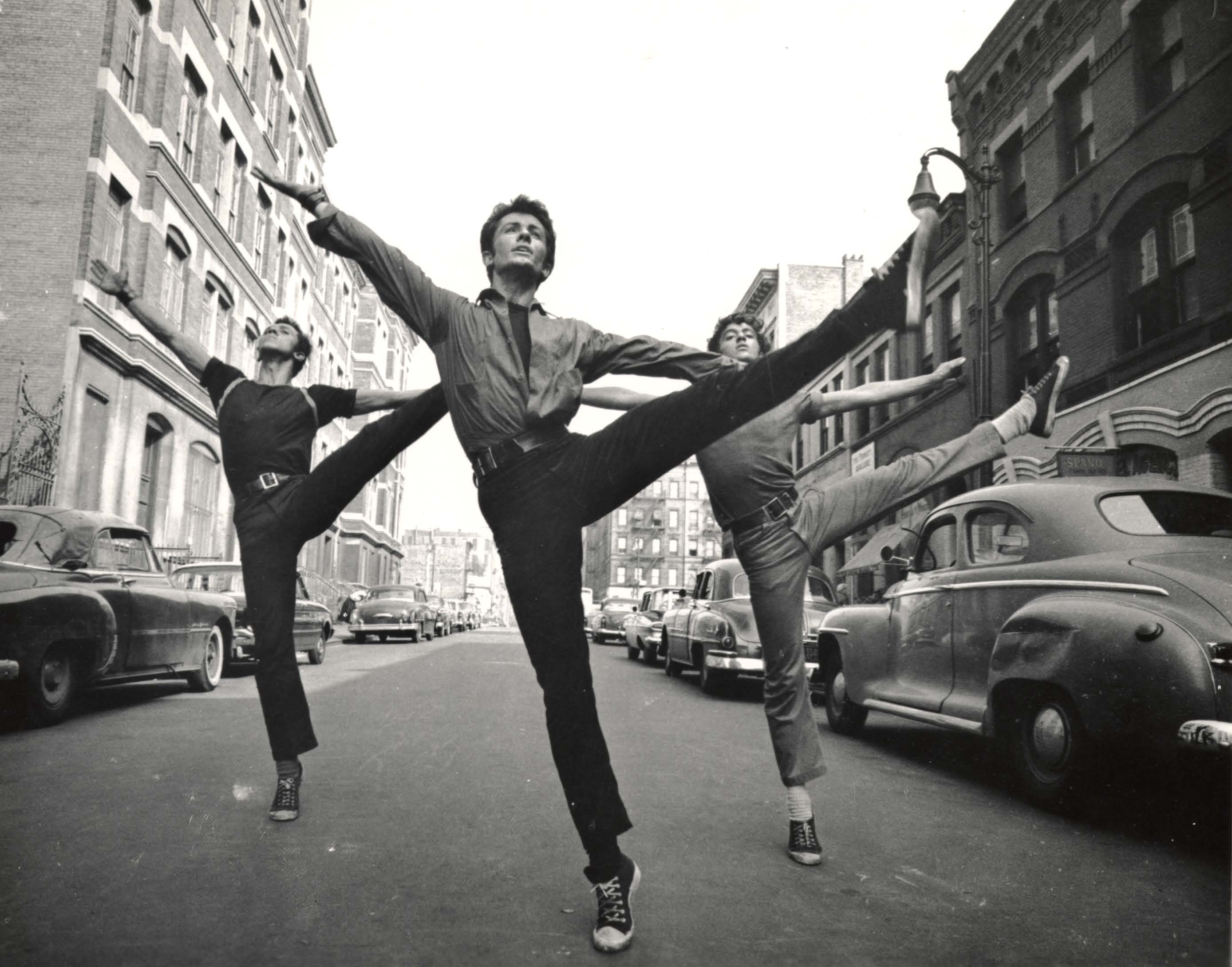
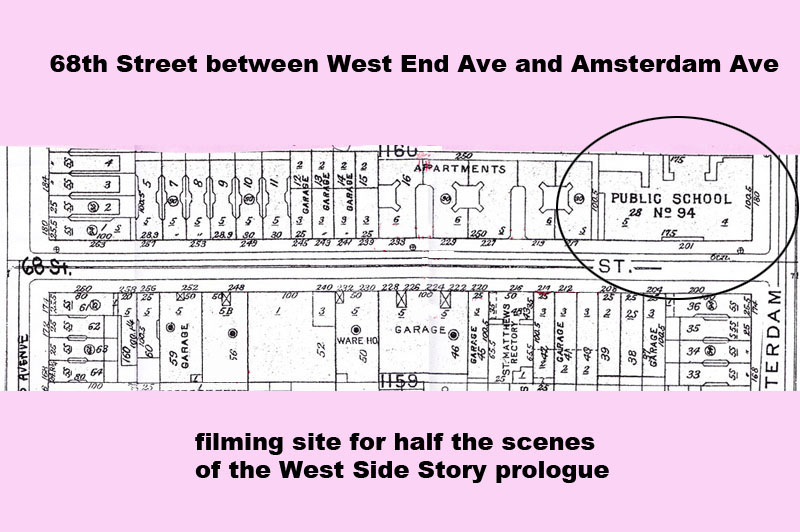
The opening sequence of the Oscar-winning film West Side Story was filmed on the streets of San Juan Hill, the structures around the actors clearly boarded up and ready for demolition.
(The website Tom mentioned on the show — Pop Spots NYC — shows a very detailed comparison of film scenes with maps and old photographs. Highly recommended!)
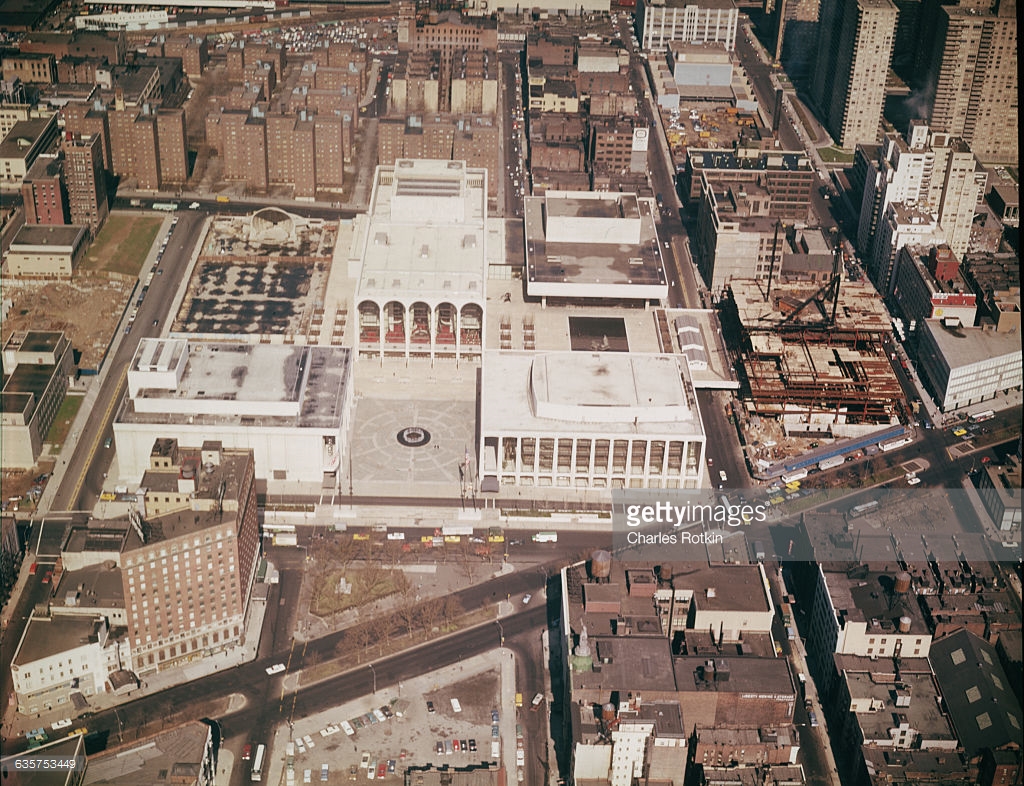
An overhead view of Lincoln Center in 1969 with most of the major venues completed by this point. At the bottom right you see the Empire Hotel, then (moving clockwise around the fountain): the New York State Theater, Damrosch Park, the Metropolitan Opera House, the library and the Vivian Beaumont Theater and Philharmonic Hall.
Getty Images
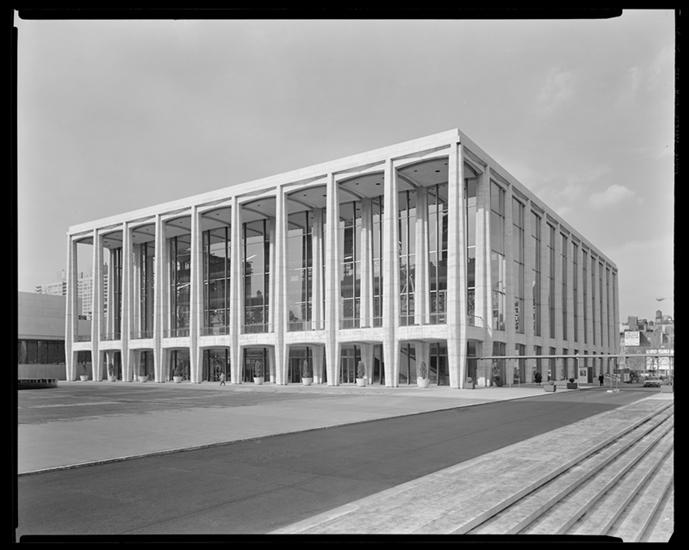
Philharmonic Hall, later Avery Fisher Hall, then David Geffen Hall — designed by Max Abramovitz.
MCNY
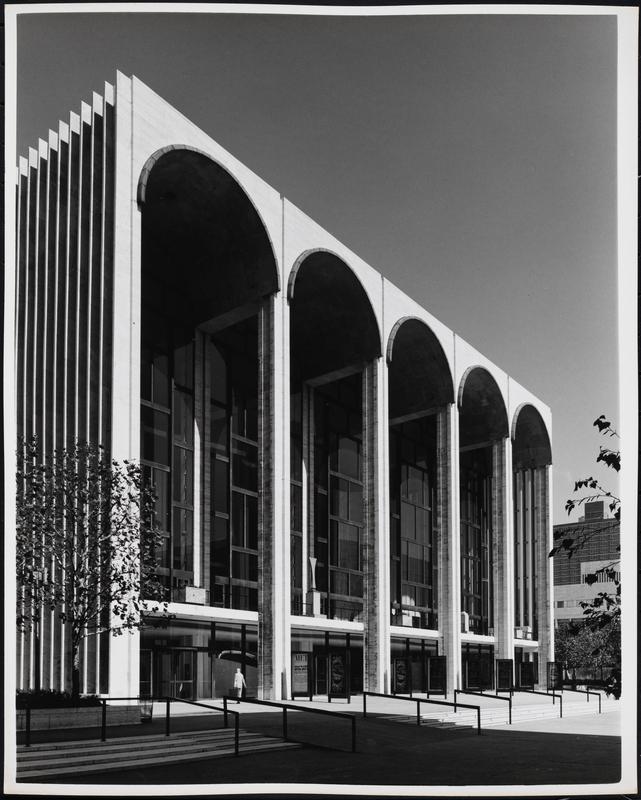
The Metropolitan Opera House, designed by Wallace Harrison.
MCNY/Edmund Vincent Gillon
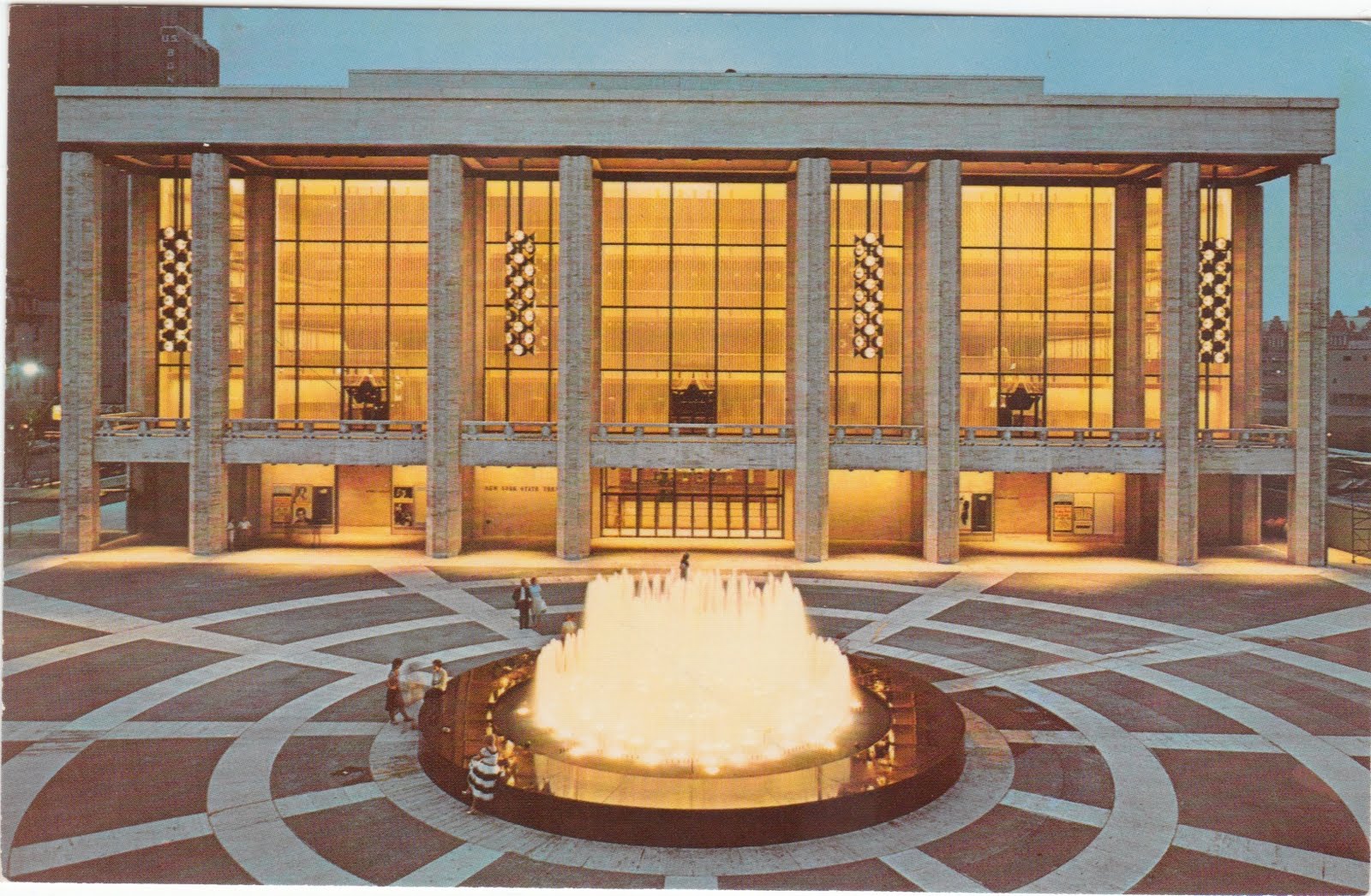
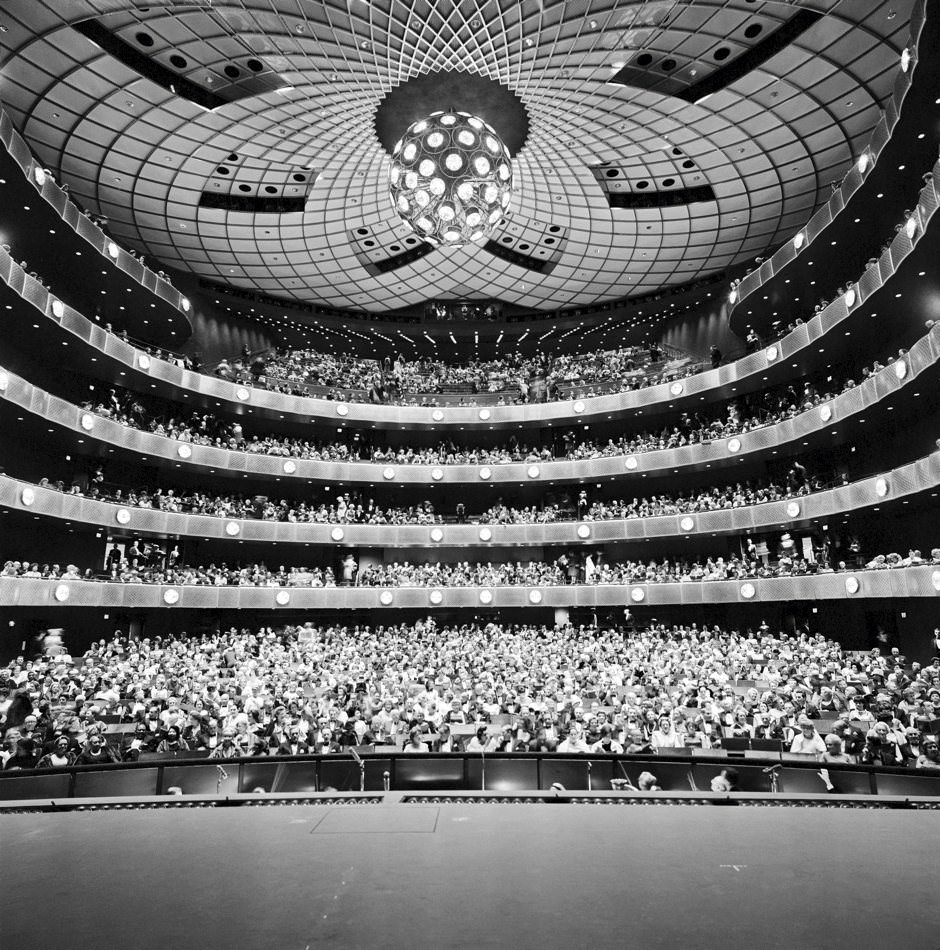
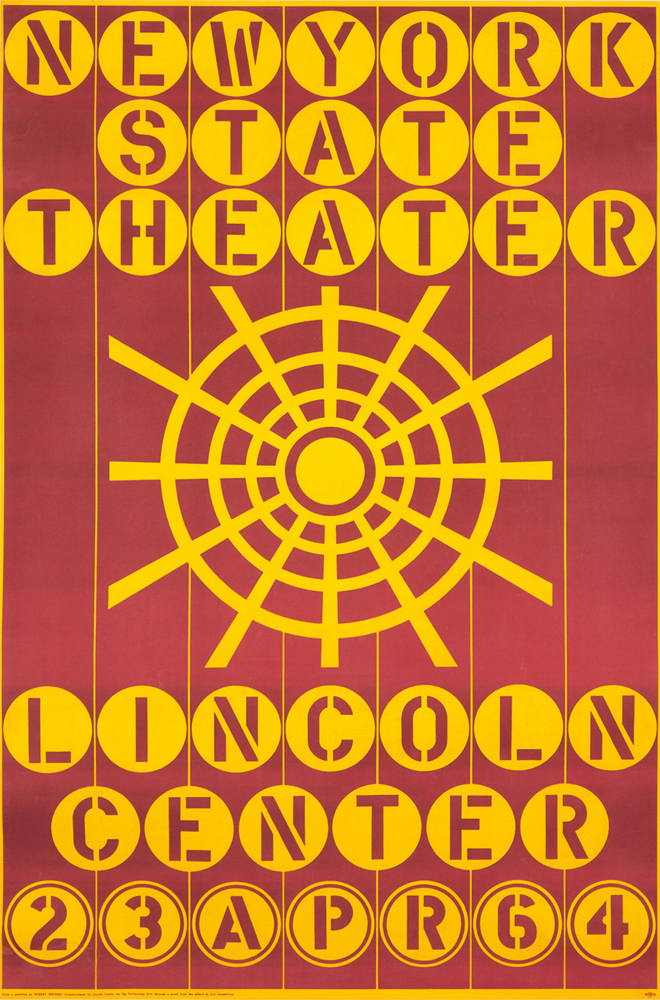
The New York State Theater, later the David H. Koch Theater.
Opening night at the New York State Theater, April 24, 1964
Bettman/Corbis
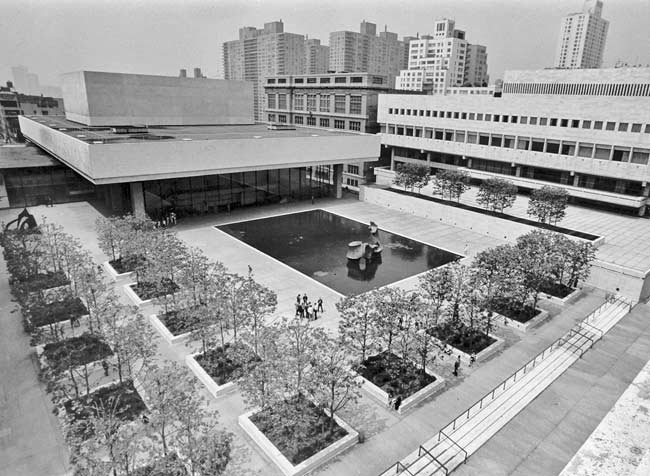
Eero Saarinen’s Vivian Beaumont Theater, the reflecting pool featuring a sculpture by Henry Moore, and the Julliard School, designed by Pietro Belluschi.
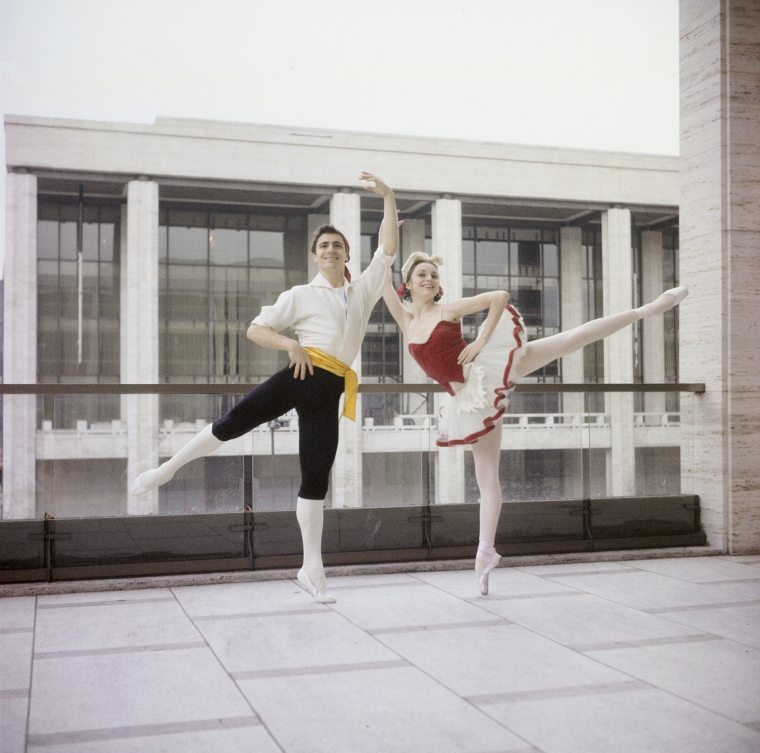
Patricia McBride and Edward Villella in front of the unfinished New York State Theater at Lincoln Center, in Tarantella costume, choreography by George Balanchine, 1964
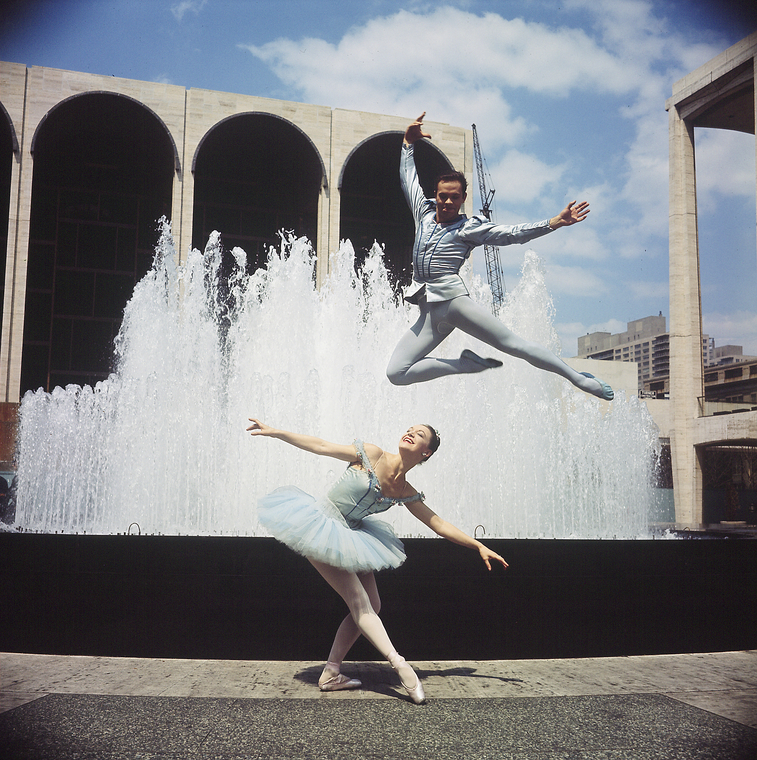
Patricia Wilde and Andre Prokovsky in Raymonda posing in front of fountain in plaza at Lincoln Center, choreography by George Balanchine, 1965
Courtesy NYPL
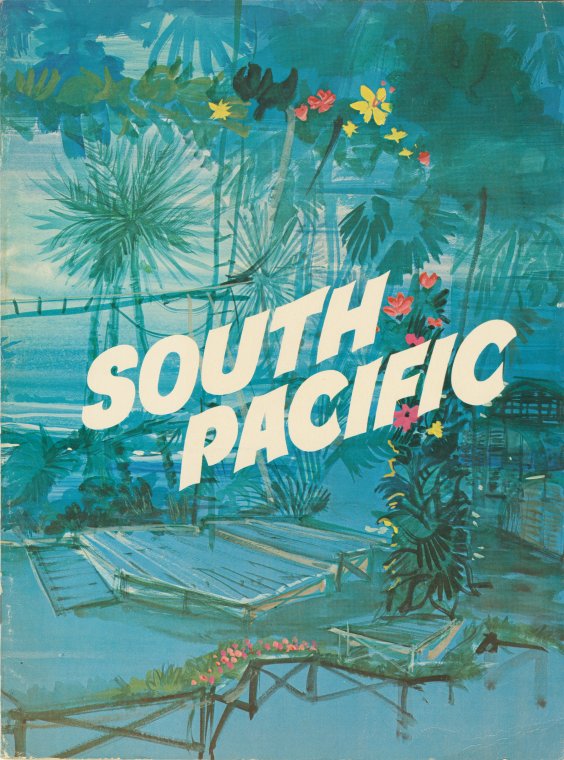
Program from the 1967 revival of South Pacific which played at the New York State Theatre……
NYPL
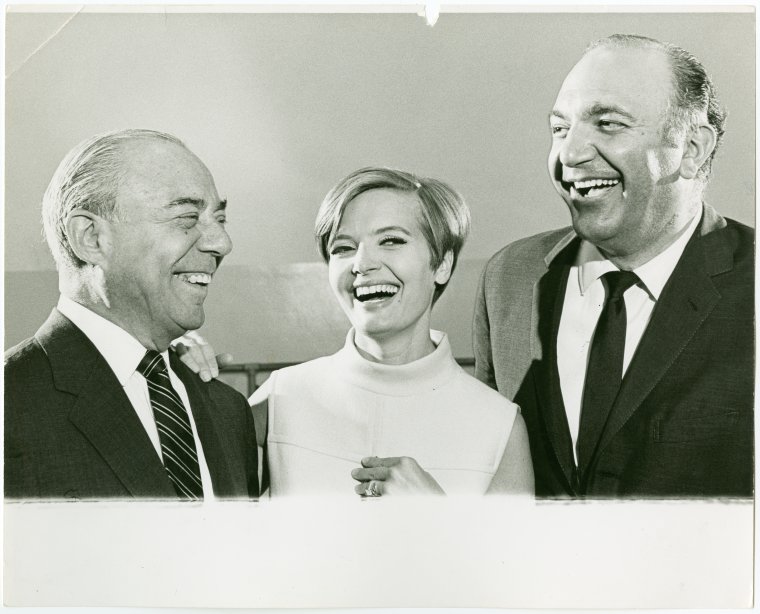
….starring Florence Henderson as Nellie Forbush! Here she is with Richard Rodgers and Georgio Tozzi (who played Emile de Becque).
NYPL
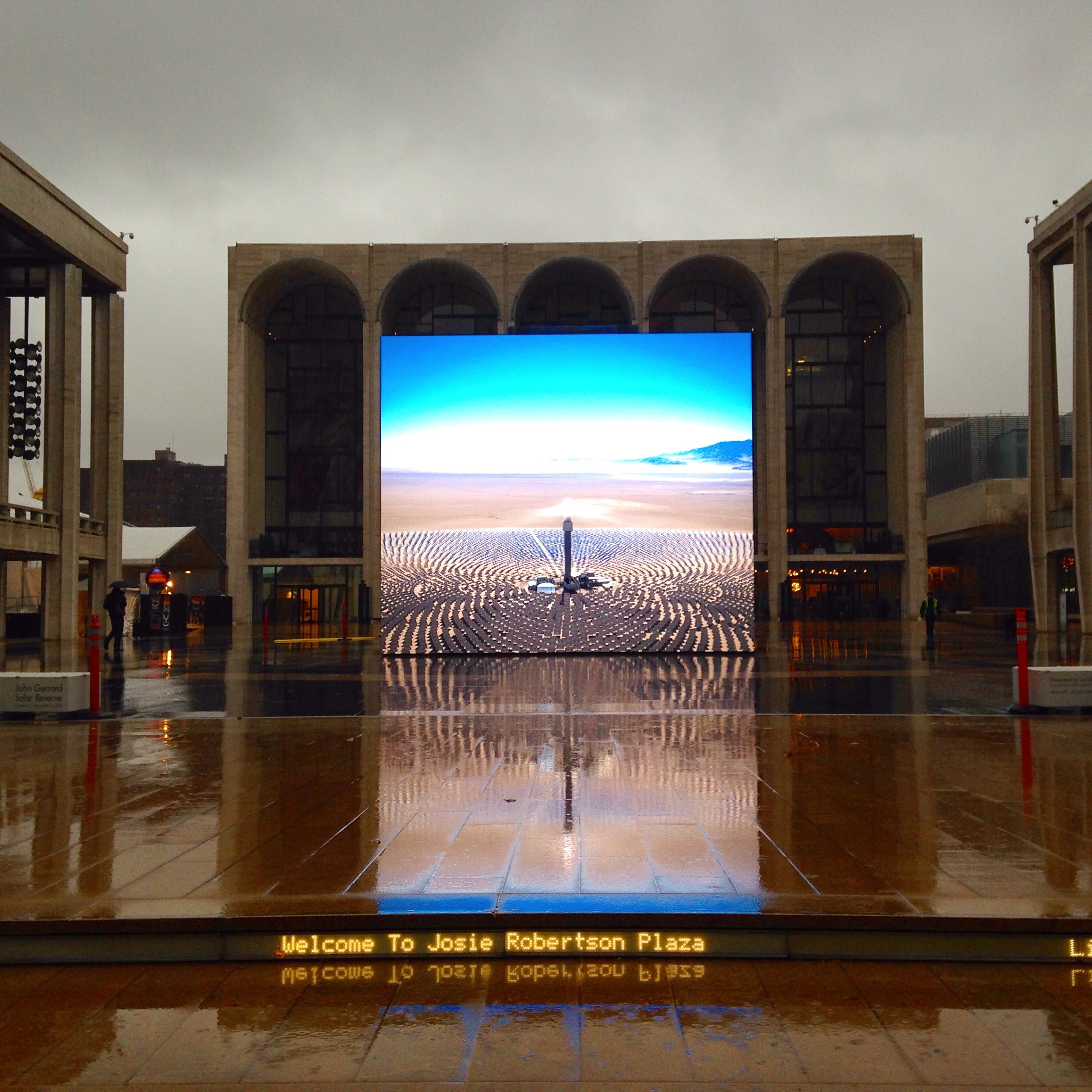
The plaza at Lincoln Center is always a place where surprises greet visitors. Here’s an image from a couple years ago of a video installation which sat in front of the fountain:
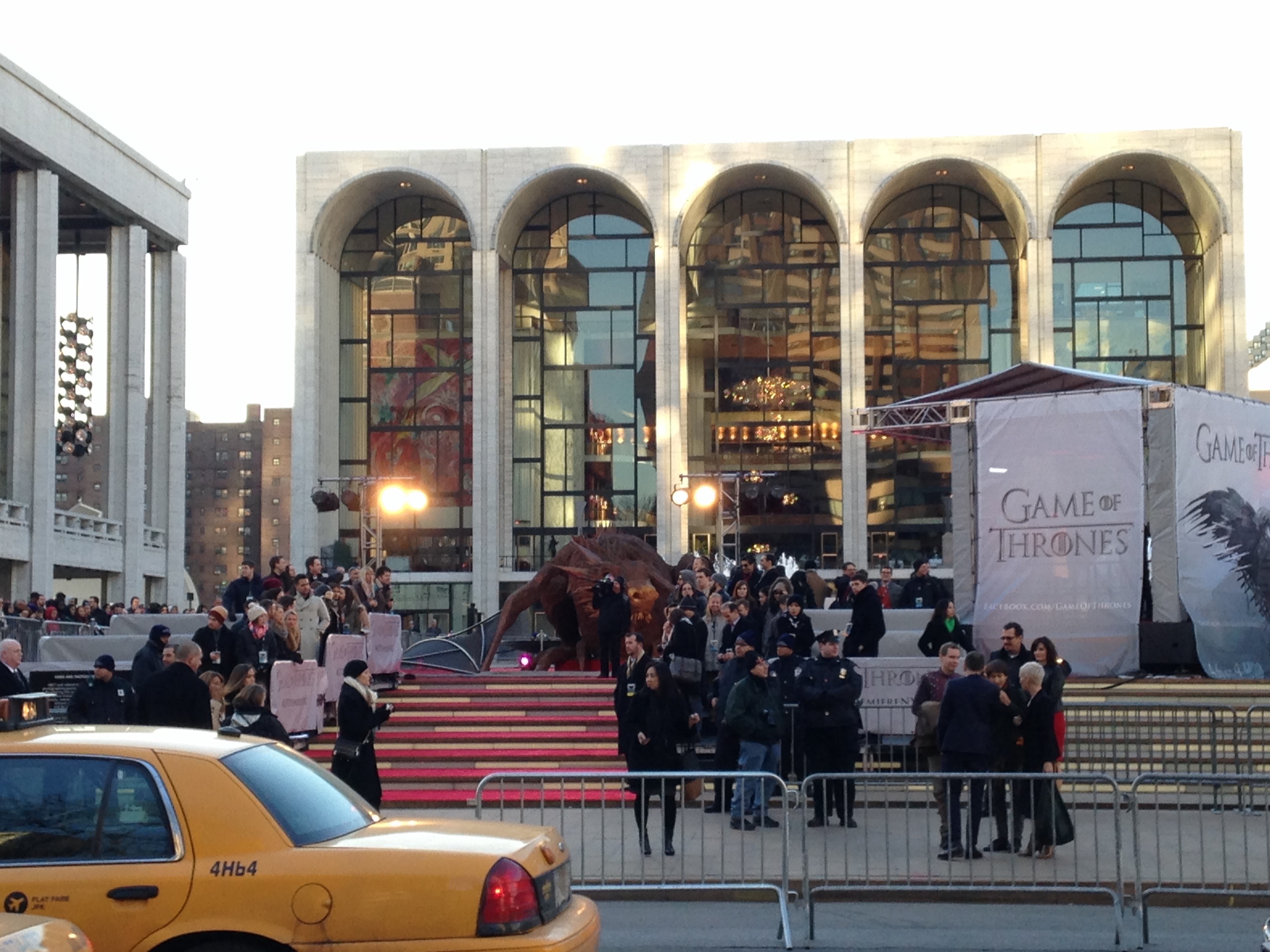
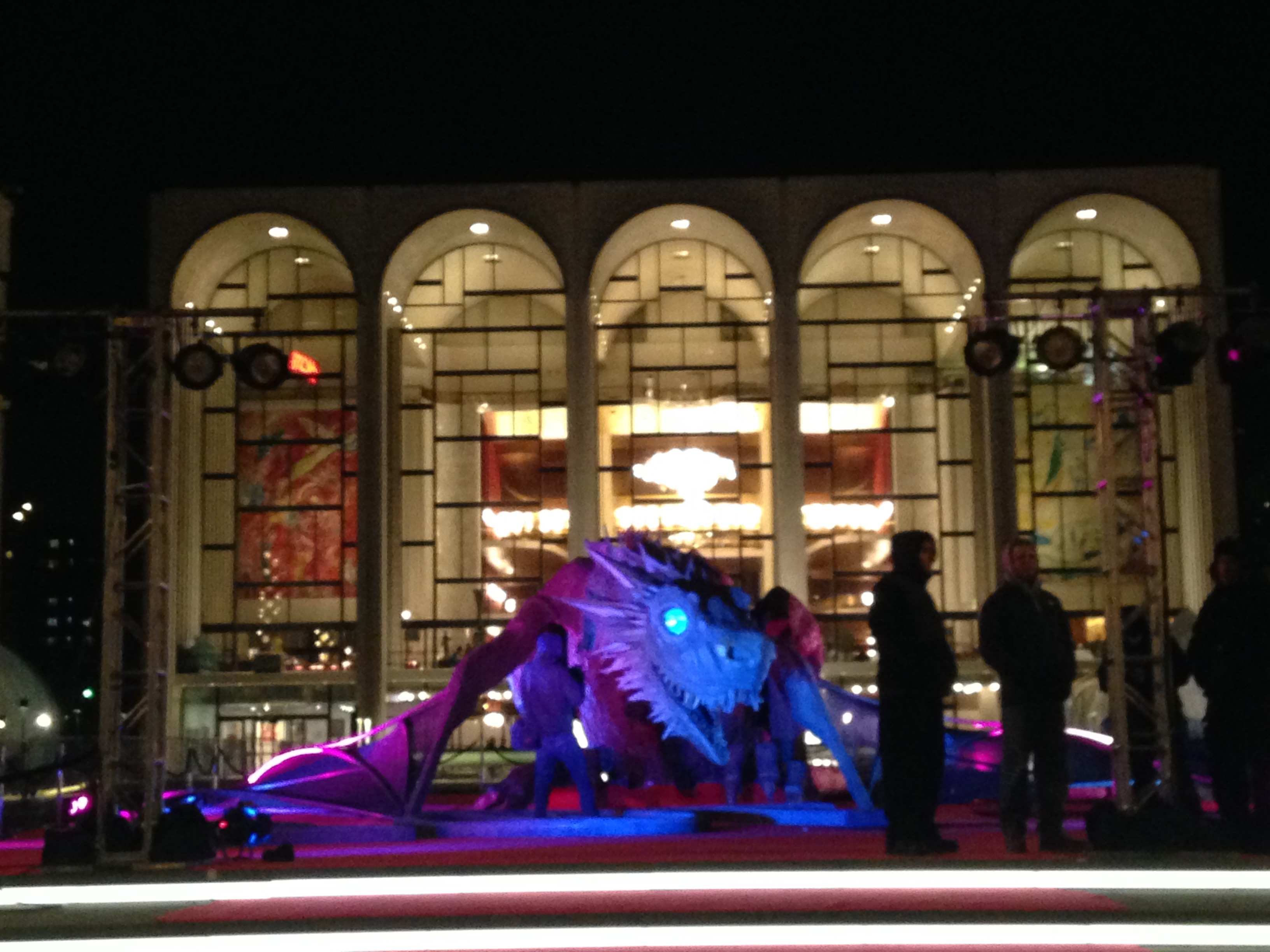
And 2019 when they hosted the premiere of Game of Thrones. With a life-size dragon!
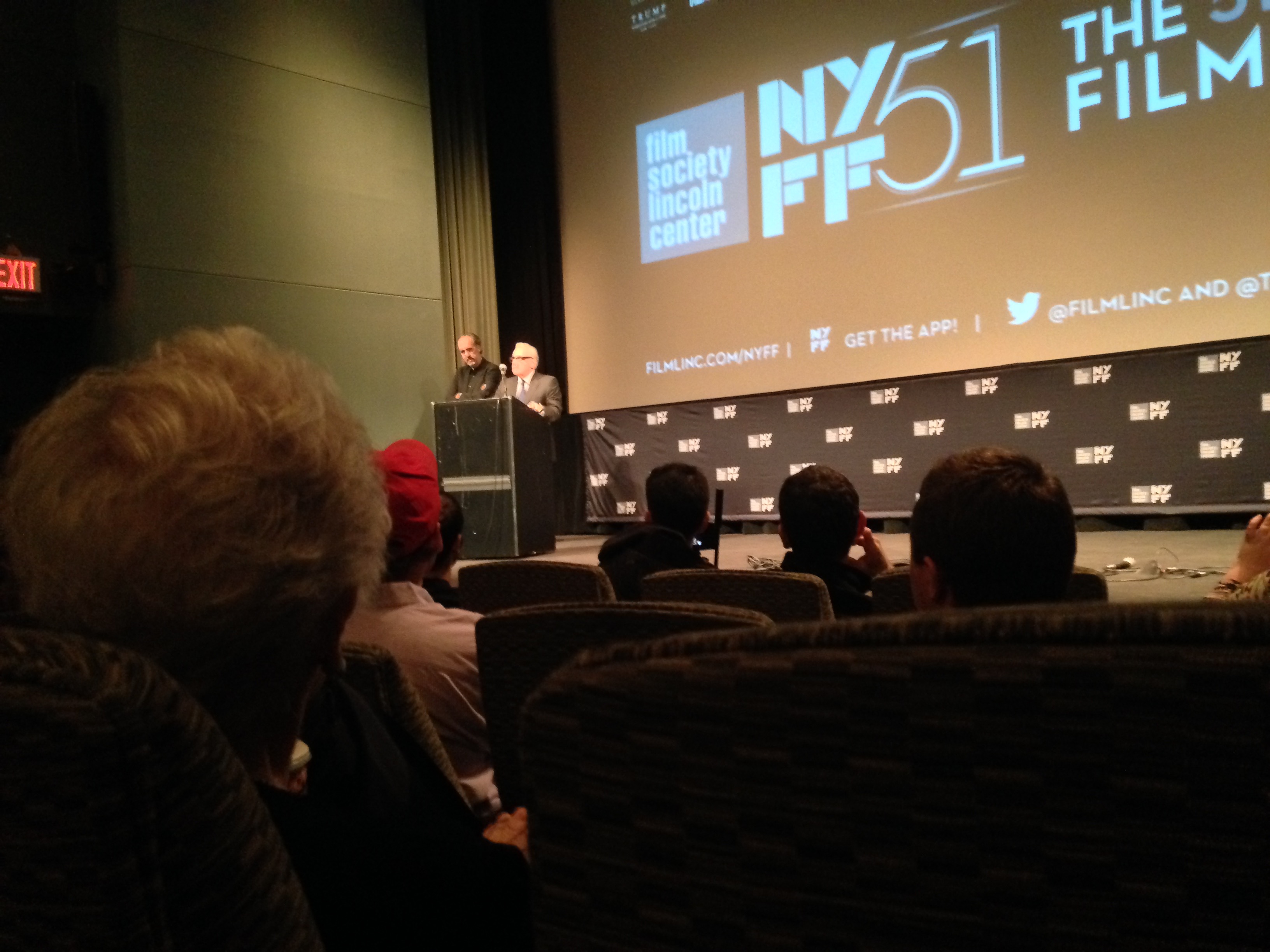
Martin Scorsese! He introduced a screening of his film The Age of Innocence at the New York Film Festival.
FURTHER LISTENING
Back catalog episodes mentioned on show or shows with similar themes that we think you’ll enjoy.
EPISODE 344 We’ve now made our Bowery Boys Movie Club episode on the film Ghostbusters available for everyone. Listen to it today wherever you get your podcasts.
This episode is brought to you by those who support the Bowery Boys Podcast on Patreon. Join us there to get additional episodes of the new Patreon-only Bowery Boys Movie Club — including the latest episode on When Harry Met Sally.
This episode is partially based on this in-depth article on the New York City history moments featured in the film, originally written in 2013. Give it a read while you listen along!
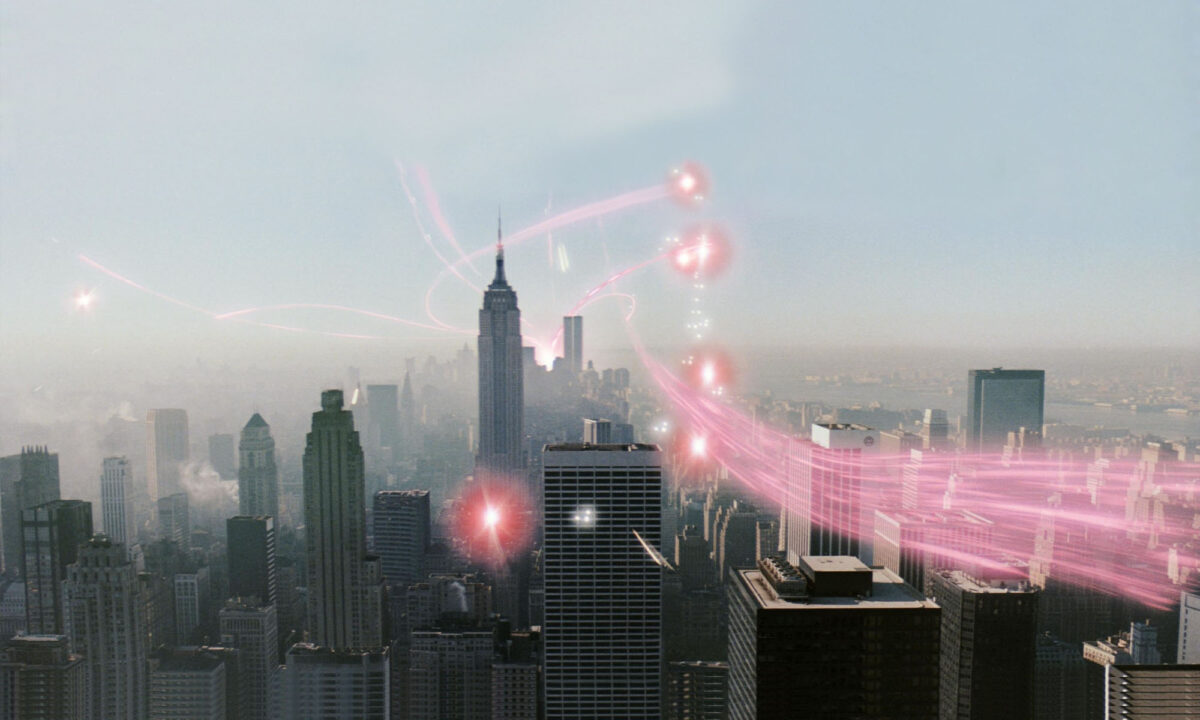
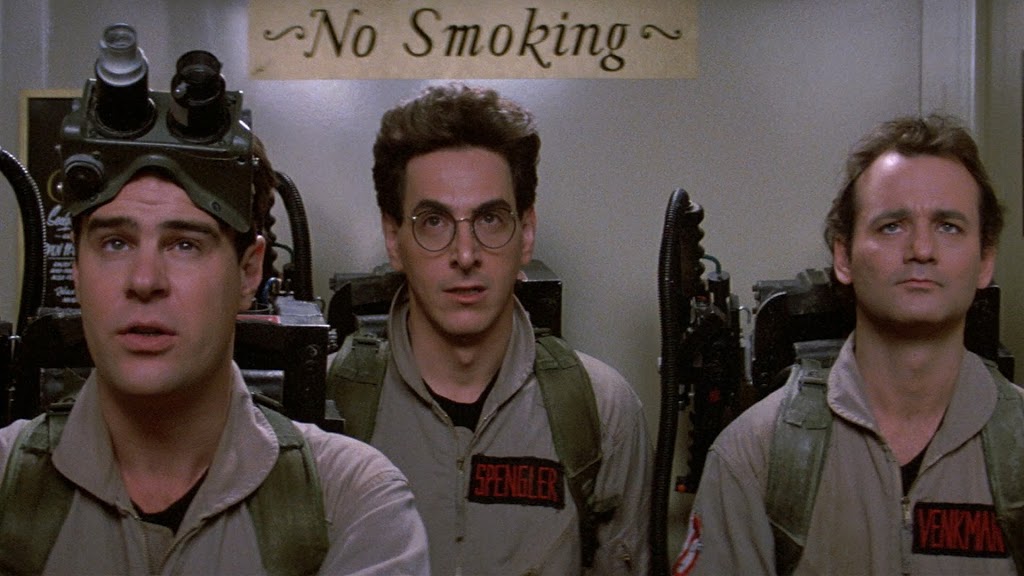
Ghostbusters, the goofy, supernatural tale starring Bill Murray, Dan Ackroyd, Harold Ramis, Ernie Hudson, and Sigourney Weaver, was one of the biggest hits of 1984, a rare blend of wry comedy, special effects and spectacular New York City landscapes.
Despite its preposterous premise — that ghosts look either like oozing fat blobs or Sheena Easton-ish supermodels — the film flawlessly displays the easy comic talents of its stars and reveals a New York City with only monsters as its greatest threat.
There have been both believers and cynics from New York history who have attempted to prove the existence of supernatural forces and have even tried to purge them from the city.
From there, I took a deeper look into the historical people, places and events depicted in the film, if not only to find evidence of New York’s ghostbusting forefathers, then at least to enjoy the pop culture references of the early 1980s.
Ghostbusters was a mainstream offering, so it goes very light on its urban commentary of a city picking itself up out of withering debt.
Its ghosts are quite democratic, in fact, terrorizing libraries, public places, ethnic neighborhoods and wealthy condominiums alike.
Here are 25 fascinating pieces of trivia about Ghostbusters, putting the film within the context of New York City history. Obviously there are a ton of spoilers here, in case you haven’t yet seen it.
But hopefully I’m giving you a good excuse to catch on television this Halloween!
1)Ghostbusters is set in 1984, late October-early November, judging from the dates on newspapers and magazines which appear midway through the film. But the film’s release date was in June 1984, so technically the film documents future events.
The appearance of Sumerian gods on the Upper West Side and a team of wise-cracking ghost exterminators certainly would have been the top story of the year.
Real life is not as magical. The big story in New York City that year came over a month later, when Bernhard Goetz shot four men who tried to mug him in the subway.
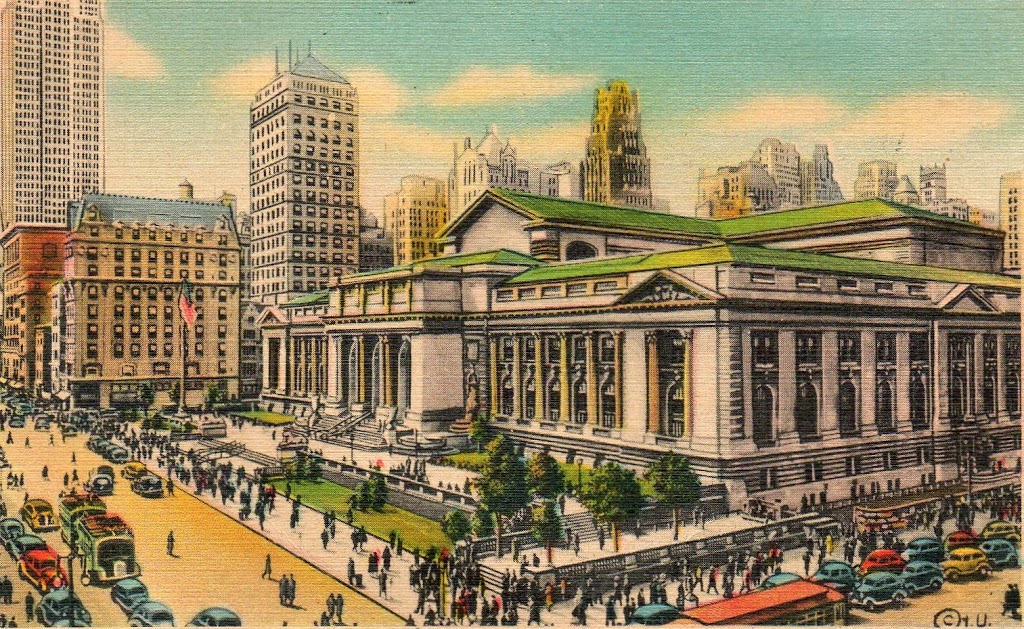
2) The New York Public Library, setting for the delightfully shushy spectre in the opening scene, may actually be haunted. After all, it sits on land that was once a burial ground.
According to historian Charles Hemstreet, writing in 1899, “The ground between Fifth and Sixth Avenues, Fortieth and Forty-second Streets, now occupied by Bryant Park and the old reservoir, was purchased by the city in 1822, and in 1823, a potter’s field was established there, the one in Washington Square having been abandoned in its favor.”
By the way, the two lions (named Patience and Fortitude) are prominently featured in the opening, a sly parallel to the stone monsters which will appear later.
Photo courtesy Bain News Service
3) Our ghostbusting heroes are originally located at Columbia University, in Weaver Hall (actually Havemeyer Hall). Although there is no actual department of paranormal psychology, Columbia does have a connection to one of New York’s earliest institutes of paranormal study.
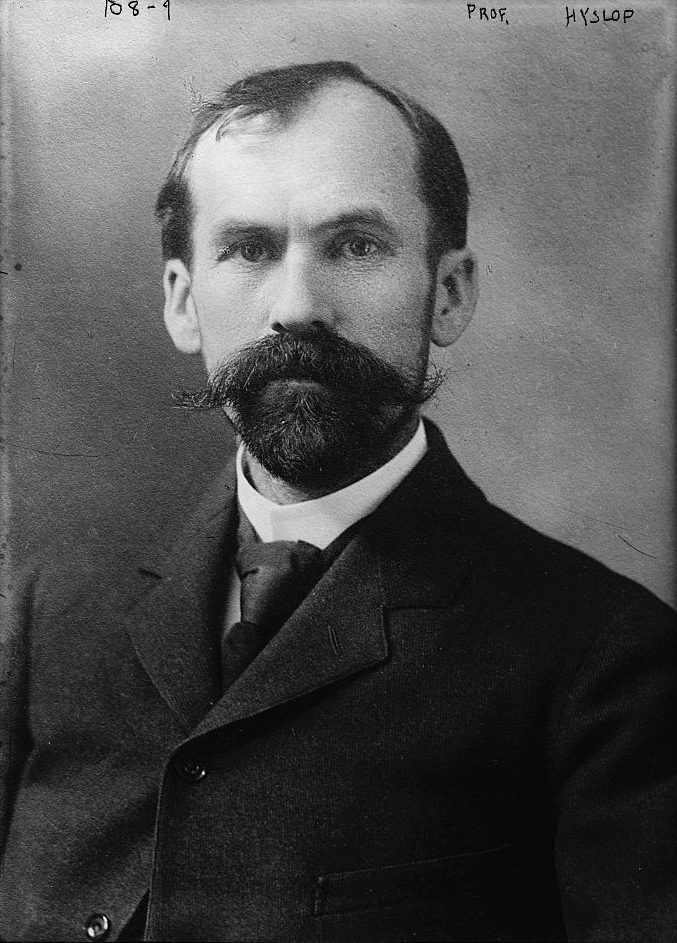
The American Society for Psychical Research was founded in 1884 — exactly one century before Ghostbusters — as a legitimate organization looking to separate spiritualist quacks from actual supernatural phenomena.
Its most prominent leader was James H. Hyslop (above), a former professor of ethics and logic at Columbia University. Â His early studies read like a jazz-age X-Files, investigating ghosts, spiritual possession and a strange variety of mental abilities. Â (We speak of Hyslop in two of our old ghost story podcasts, investigating a case of spiritual harassment and contact via a Ouija board.)
4) While no hauntings are actually displayed at Columbia University in the film, they certainly could have been.
The campus is located on the site of old Bloomingdale Insane Asylum, where more than a few mentally disturbed individuals met their end.
Columbia bought the facility in the 1880s and demolished most of it to make way for their McKim, Mead and White-designed campus. But one structure still remains — the Macy Villa, a home for mentally-troubled rich gentlemen, in today’s Buell Hall, home of La Maison Francaise.
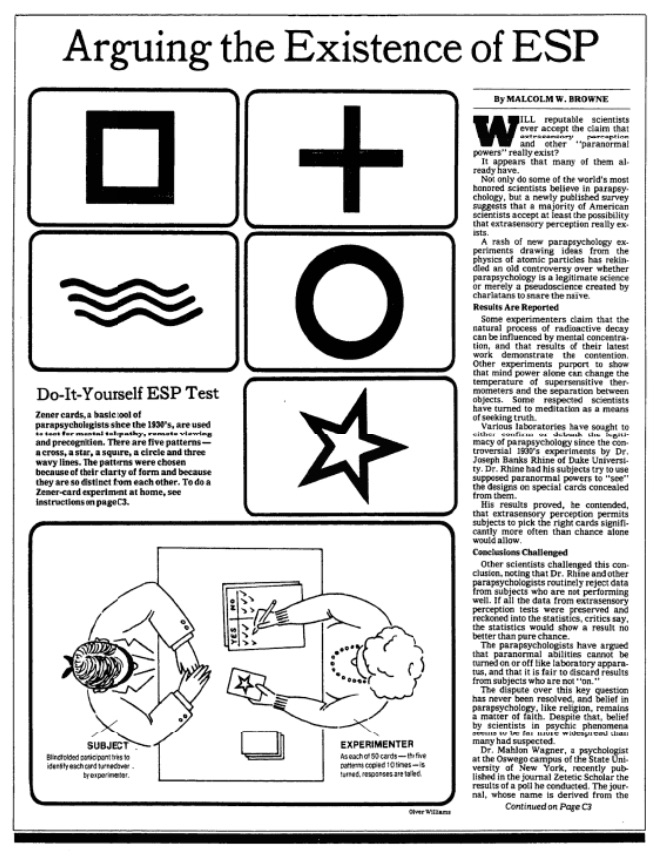
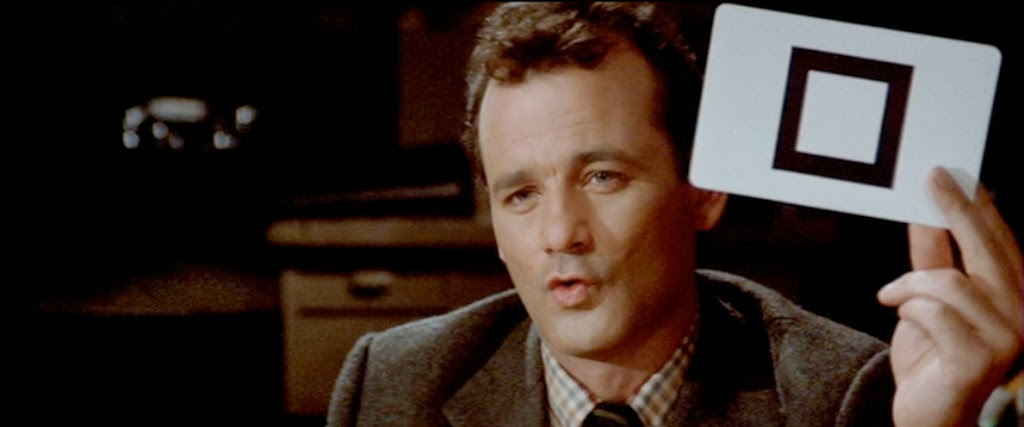
5)The deck of cards used by Dr. Venkman (Bill Murray) to test the telepathic abilities of his patients (and to flirt with the pretty blonde) are called Zener cards, invented by Karl Zener and J. B. Rhine, who was inspired to enter psychical research after listening to a lecture by author and paranormal cheerleader Sir Arthur Conan Doyle.
In 1980, the New York Times printed a set of Zener cards in its January 29, 1980 edition. “The reader may judge for themselves.”
6) Dr. Venkman’s continued skepticism gives Murray a host of excuses to stare at the camera and mug sardonic. But his character probably has the most in common with New York’s original ghostbusters, especially adventurer and conjurer Joseph Rinn.
He and his childhood friend Harry Houdini basked in debunking frauds while keeping alive the illusion of magic and mystery for their acts.
Rinn most famously held a demonstration at Carnegie Hall where he taunted mediums and mystics to exercise their powers for a prize pot of $10,000. Nobody ever won the money.
7)Manhattan City Bank, depicted in the film, is not real. Â Coincidentally, the scene was filmed at another bank directly across the street from the New York Public Library at Fifth Avenue/41st Street. In fact, you can see that the library is surrounded by scaffolding in the movie.
What was the scaffolding for? In 1982, the library embarked a $20 million renovation project. It’s difficult to imagine today, but this classic New York institution had been badly abused over the years.
The 1982 renovation was meant to return the building to its original glory. “It is a restoration in some ways, a modernization in others,” said the Times. “[T]his ambitious plan emerges out of the conviction that this building is as much a part of our cultural heritage as the billions of words that it contains.”
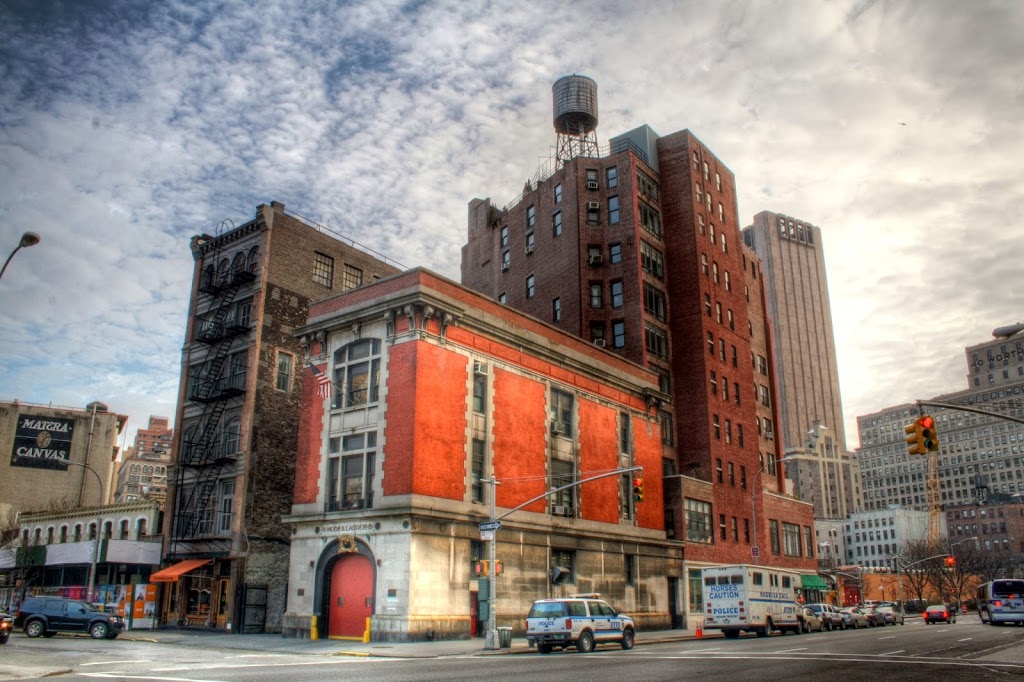
Ghostbusters headquarters — the TriBeCa fire house on North Moore. Pic courtesy Phillip Ritz
8) Perhaps the most beloved New York site from the film is Ghostbusters headquarters, the Hook and Ladder Company No. 8 fire station at the corner of North Moore Street and Varick Street.
If the building looks awkwardly slender to you, there’s a good reason — half the building was demolished in 1914 when Varick Street was widened. Several other buildings, including St. John’s Chapel, owned by Trinity Church, were not so lucky, wiped out entirely by Varick’s expansion.
Spengler (Harold Ramis) says of the firehouse. “I think this building should be condemned….The neighborhood is like a demilitarized zone.”
In fact, the converted lofts and warehouses of TriBeCa (Triangle Below Canal) — the name was slightly over a decade old in 1984 — were a haven for artists, designers and musicians by this time and probably deemed ‘gritty’ by the standards of 1980s American film goers.
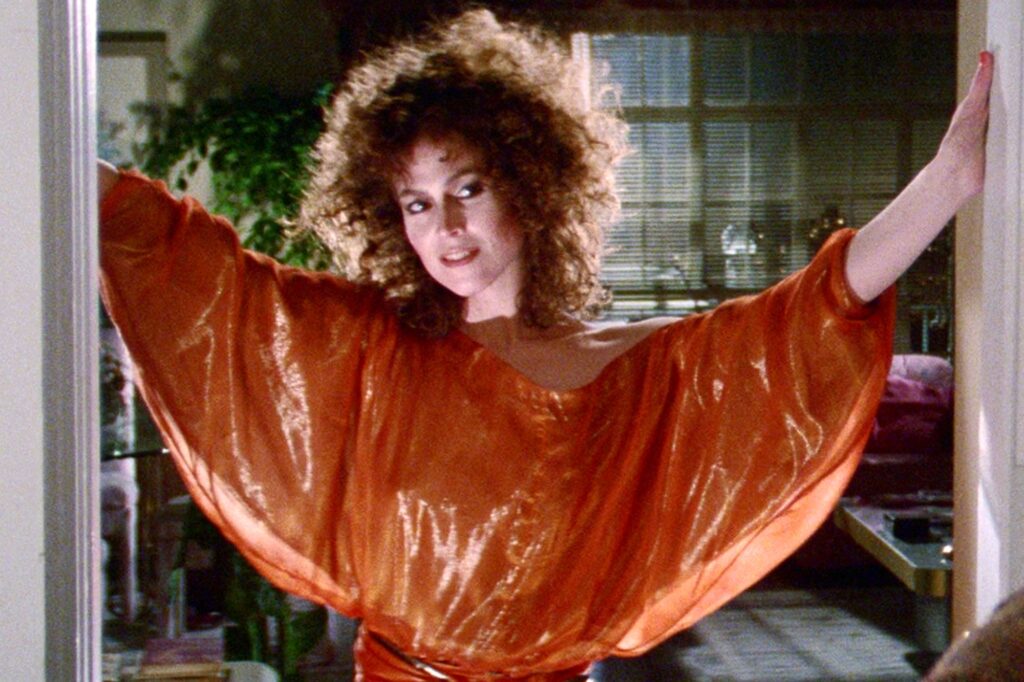
9)Sigourney Weaver is probably the most New York-centric star of Ghostbusters and a perfect choice for the role of Dana, the sophisticated lady possessed by an ancient God. (Dana’s in the New York Philharmonic after all!)
Weaver was a regular on the off-Broadway stage, an offbeat star who once starred in a Christopher Durang play about the Titanic. Her first two film performances are in two 1970s New York film classics — Serpico and Annie Hall. 10) As Sigourney arrives at her apartment building, you can clearly identify Checker Cabs passing on the street, even though that were already a dying breed by this time, the last rolling out from its Michigan plant in 1982.
11) The Sedgewick Hotel, site of the Ghostbusters’ most conspicuous catch, is one of several Los Angeles locations pretending to be in New York.
However, if they wanted a haunted hotel near the New York Public Library, they could have looked no further than the Algonquin Hotel, two blocks north on West 44th Street, notoriously famous for the ghosts of the Round Table.
The Sedgewick is played in the film by L.A.’s Biltmore Hotel, site of several Academy Awards ceremonies and itself haunted by a famous ghost, that of Elizabeth Short, aka the Black Dahlia.
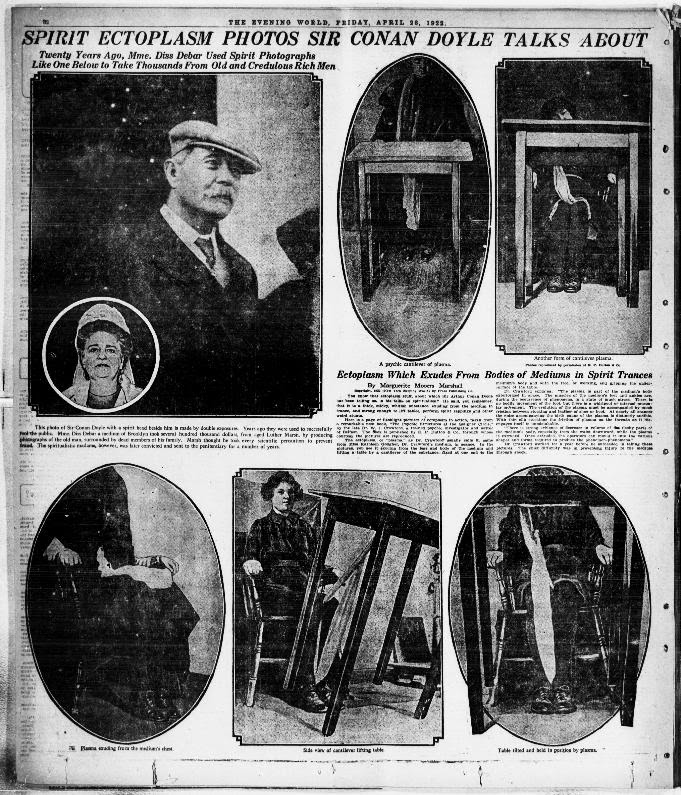
12) Ectoplasm isn’t just a cool word for ‘slime’. In 1922, the New York Evening World ran photographs of mediums coated in ectoplasm.
Sir Arthur Conan Doyle described it as “thick, sticky, whitish substance exuding from the medium in trance and strong enough to lift tables, perform spirit rappings and other weird stunts.”
13) A New Jersey high school student named Jeff Nichols found momentary fame when he accidentally appeared as an extra in the film, during the brief scene in which Bill Murray and Dan Ackroyd storm through Rockefeller Center. (Did they not sign release forms back then?) The scene appears in a montage of the crew’s many ghost-exterminating antics.
”I got a bunch of phone calls from friends who saw it, saying, ‘Hey, Jeff, you’re in the movie,’ ” said a surprised Jeff last week. ”It’s strange to think that I’m in a movie that’s playing all over the country…… I guess it’s like being part of history.”
No offense to Jeff, but I’m kinda more fascinated in another brief scene during this montage, when the Ghostmobile speeds past Umberto’s Clam House in its original location (the corner of Mulberry and Hester).
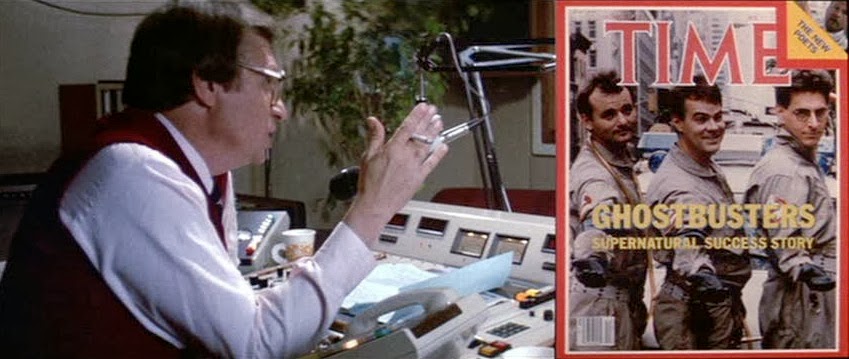
14)Larry King on the radio in Ghostbusters in 1984:
15) There’s a silly montage of 1984 publications that go swirling by. People Magazine touting the trio also reveals “Princess Di Expecting Again!” The magazine (supposedly from October 1984) is a little off — Prince Harry was born on September 15, 1984.
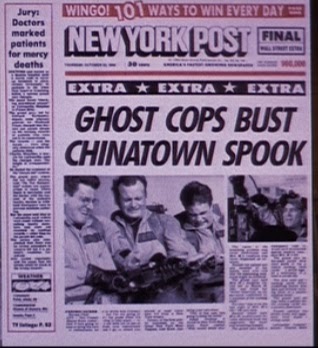
The New York Post also celebrates one off-screen Ghostbusters’ victory: GHOST COPS BUST CHINATOWN SPOOK.
In the early 1980s, the Post gave $50,000 a week in its WINGO! lottery promotion. According to author and former Post reporterCharlie Carillo, the contest illicited some rather mysterious winners:
“One Wingo winner showed up soaked in sweat and literally looking over both shoulders. He wouldn’t even tell me his real name, and he covered his face with his hands when the photographer lifted the camera. ‘No pictures!’ he cried through his fingers. ‘Can’t have my picture in the paper!'”
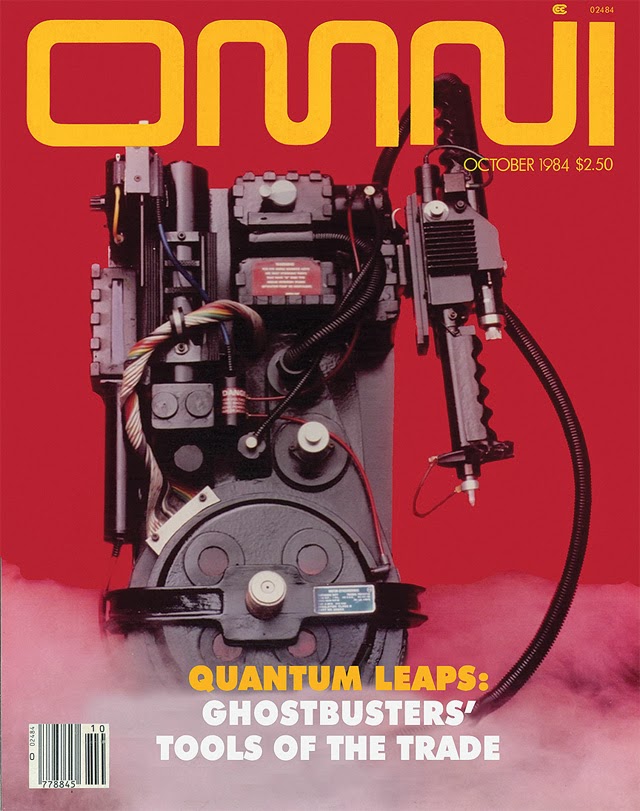
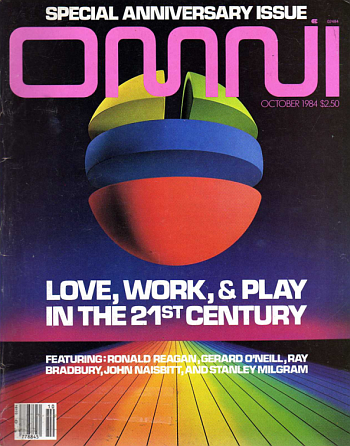
16) Also given credible prominence during this montage is the long-gone OMNI Magazine, a science publication with the unique distinction of being one of the first magazines to simultaneously publish a digital edition (in 1986).
Here’s a copy of the October 1984 issue from the movie, and the actual October 1984 issue:
17) Dana listens to Casey Kasem gab about the Ghostbusters during his Top 40 countdown show. His wife Jean Kasem appears later in the movie as Rick Moranis’ ditzy date.
Had we been privy to the entire broadcast, we would have heard that the top five songs that week were (in Kasem countdown order): 5) “Lucky Star” by Madonna, 4) “Purple Rain” by Prince, 3) “Hard Habit To Break” by Chicago, 2) “Caribbean Queen (No More Love On The Run)” by Billy Ocean, and 1) “I Just Called To Say I Love You” by Stevie Wonder.
18) Veteran New York broadcaster Joe Franklin appears on television, asking Murray, “I’m sure there’s one big question on everybody’s mind, and I imagine you are the man to answer that. How is Elvis, and have you seen him lately?”
Franklin, presumably recording from WWOR‘s brand-new studios in Secaucus, NJ, was touching on a hot-button issue in 1984. That year, some believers found proof that Elvis Presley was actually still alive, due to an infamous photograph that emerged in the press of Elvis with Muhammed Ali. A video of that investigation is below:
19) A supernatural upheaval of godlike forces emerges from Dana’s icebox, located in a penthouse at 55 Central Park West. In the film, this building, constructed in 1929, was made with cosmic connections in mind, with a super-conductive antenna, “pulling in and concentrating spiritual turbulence.” Stantz (Dan Ackroyd) adds, “The architect was either a certified genius or a pathetic wacko.”
In Ghostbusters lore, the architect is Ivo Shandor. In reality, the building was constructed by the less immortal architectural firm of Schwartz and Gross, best known before then for their building The Majestic on West 75th Street. 55 Central Park West has been home to Rudy Vallee, Ginger Rogers, Donna Karan and Calvin Klein.
There does appear to be something strange going on with the building. According to the latest AIA Guide: “[I]f the sun seems brighter at the top than the bottom, it is brighter. Â A flush of brick from red to yellow rises from the second floor to the sun.” Gozer is impressed.
20) Louis Tully (Rick Moranis) just wants somebody to like him. Although a “nerd” in the classic 1980s nerd style, he’s pretty much a prototype for the modern hipster. In a futile effort to get Dana to his party, he proclaims that they will “play some Twister, do some breakdancing.”
1984 was the year that this form of street dancing went mainstream, with films, fashion and music that year monopolizing on the trend. Breakin‘ was in theaters for a month already when Ghostbusters opened on June 8, 1984. It handily beat a competing film making its debut that same week — Beat Street (see below).
Believe it or not, Beat Street debuted on more screens than Ghostbusters, but lost in the box office battle.
21) Louis runs into Central Park to escapes Gozer’s demon minion but is cornered at Tavern On The Green. It would have been quite a party that Louis and the hellbeast were crashing, as the fancy restaurant was celebrating its 50th anniversary that very month.
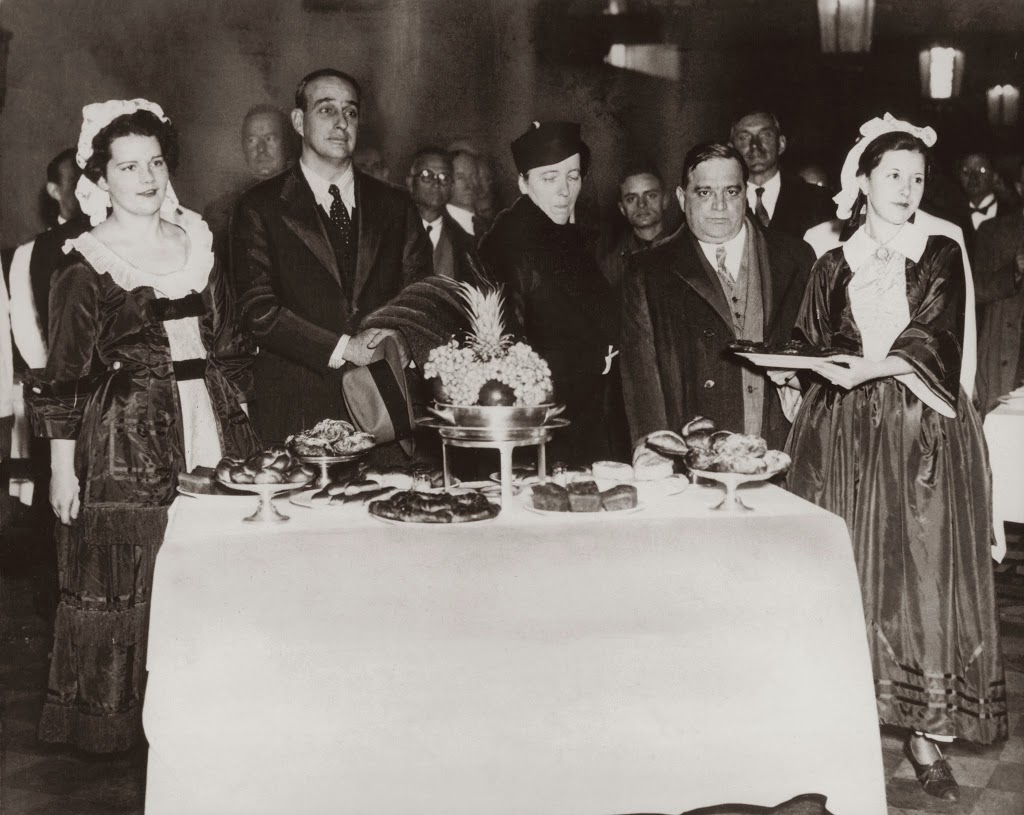
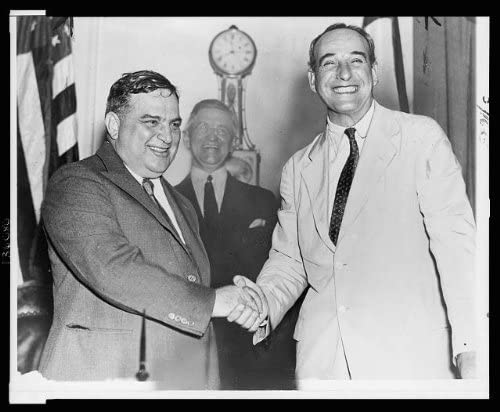
Tavern On The Green opened on October 20, 1934, with a lavish dinner attended by Mayor Fiorello LaGuardia and parks commissioner Robert Moses (pictured below, image courtesy New York Times)
22) Later, a possessed Louis (as the Key Master) streaks through Times Square in a demoniacal rage, looking for the Gate Keeper.
It’s a fairly nondescript early 80s midtown landscape, but look for the curious chain restaurant WienerWald in the background.
The German franchise had several locations throughout the United States but was unable to turn Americans on to its menu — mostly chicken, despite the name.
One intrepid Ghostbusters fan has successfully located the precise block on Seventh Avenue where this WienerWald was located.
23) With the city in crisis, the Ghostbusters are invited to City Hall for a meeting. As they enter the building, you can clearly see the banner for an exhibit in the rotunda called “Furnishing the Streets: 1902-1922.”
Because the banner could not be removed for some reason, the filmmakers cleverly obscure the exhibition’s date with a flagpole. However you can still make out that it says 1983.
24) The Stay Puft Marshmallow Man in his deliciously savage rage stomps up Central Park West from Columbus Circle. The most significant landmark destroyed by this sugary-sweet demon spawn is Holy Trinity Lutheran Church which sits next to 55 Central Park West.
The picturesque Gothic building has been a magnet for chaos from the very beginning. Over 3,000 people filled the street when its cornerstone was laid in November 1902, causing a traffic meltdown.
According to the New York Tribune, “It was as much as the police could do for a time to prevent people from being run down by trolley cars and automobiles, as many people were compelled to stand in the middle of the street.”
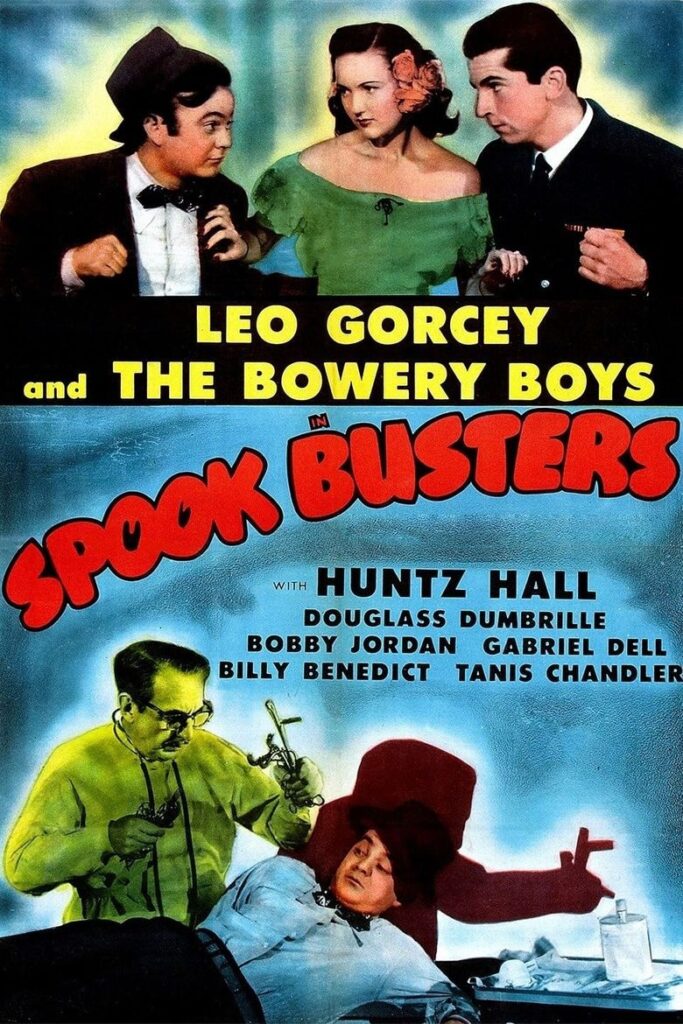
25) Our brave heroes vanquish Gozer and return to the street, greeted to the applause of grateful New Yorkers. I would be remiss, however, if I didn’t mention another set of Ghostbusters who once scoured Manhattan of its supernatural nuisances: the 1940s wacky Bowery Boys comedy troupe made a film in 1946 called Spook Busters.
Instead of a fire station, these exterminators of unwanted phantoms set up shop in a candy store.
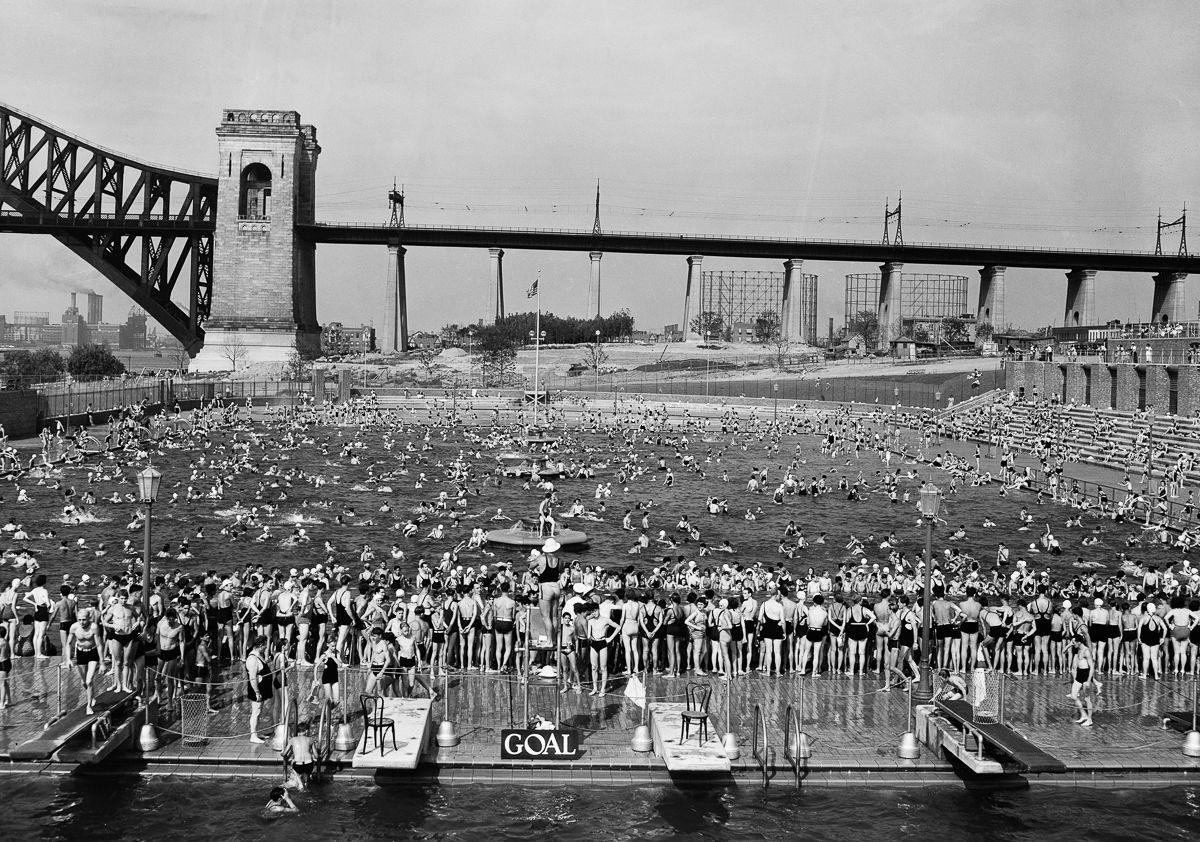
Astoria Pool is the largest venue for swimmers in New York, outside of the Hudson and East Rivers and, of course, the ocean.
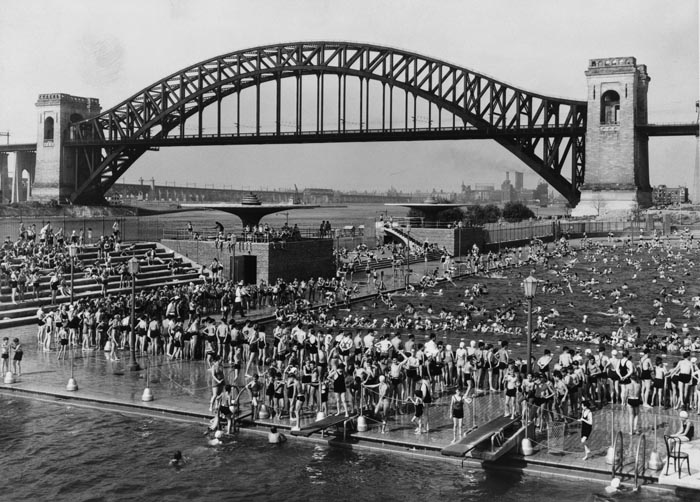
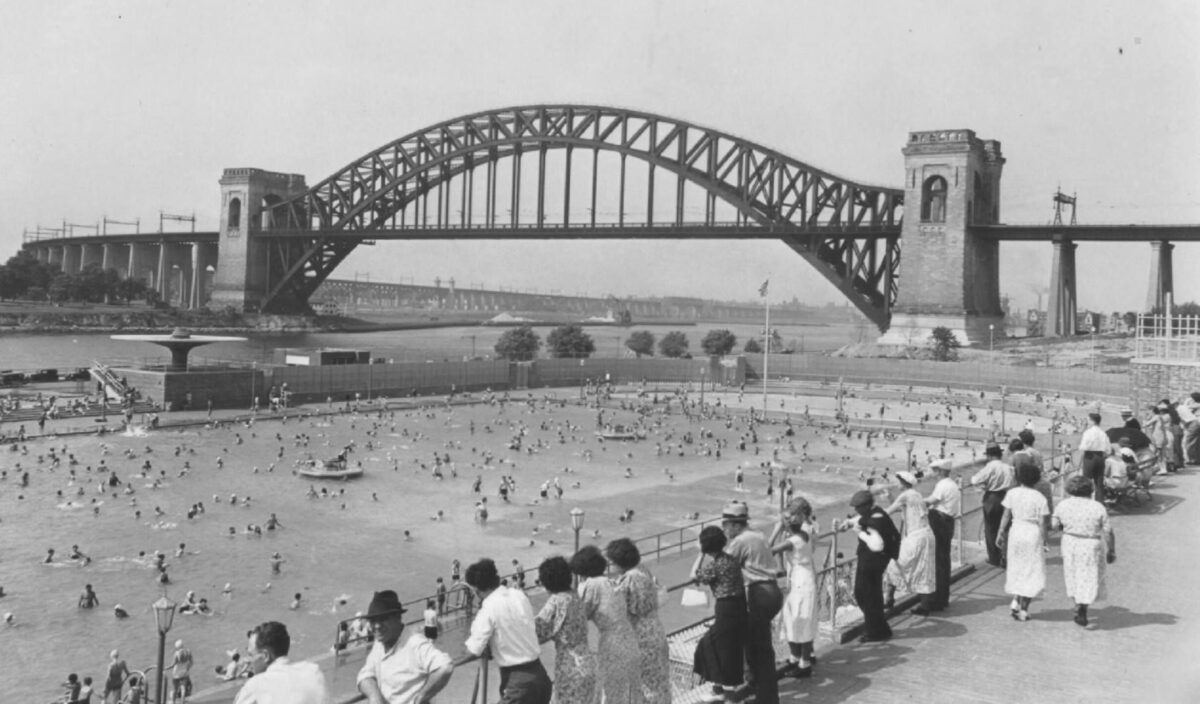
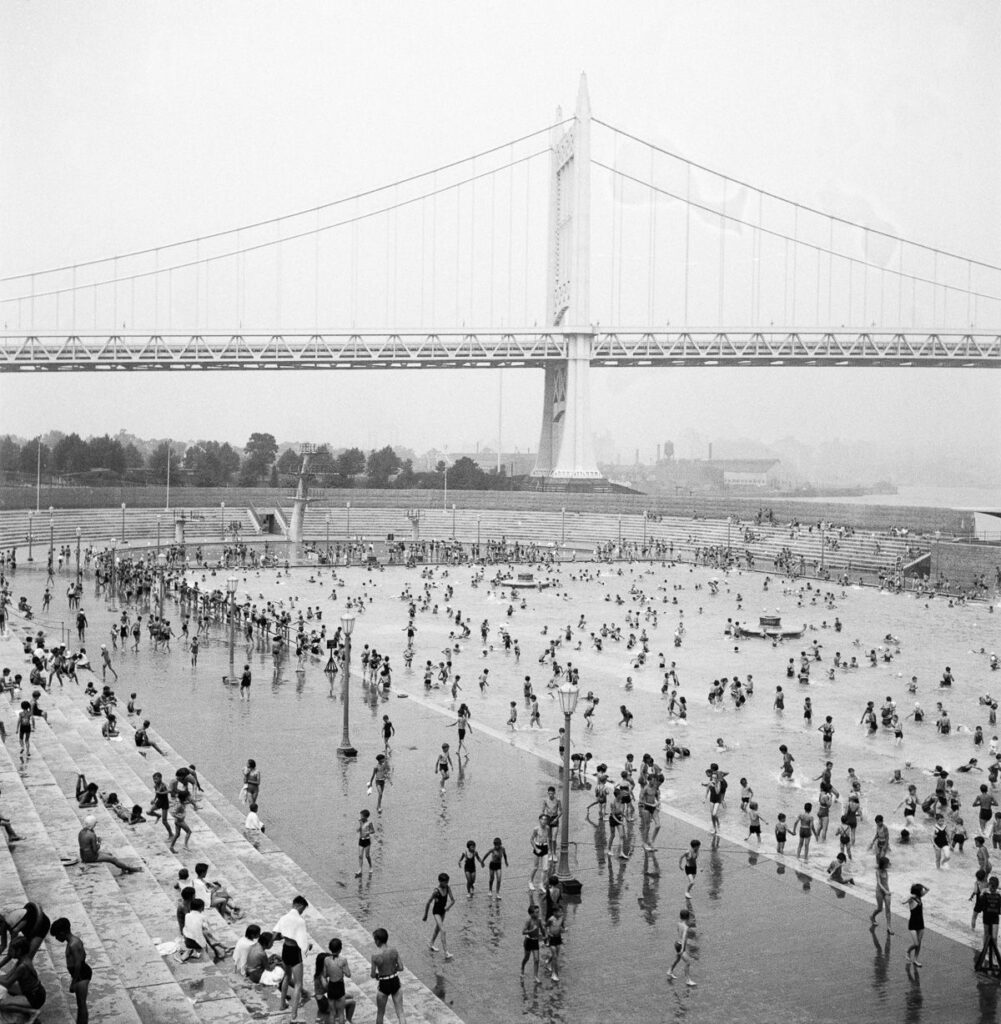
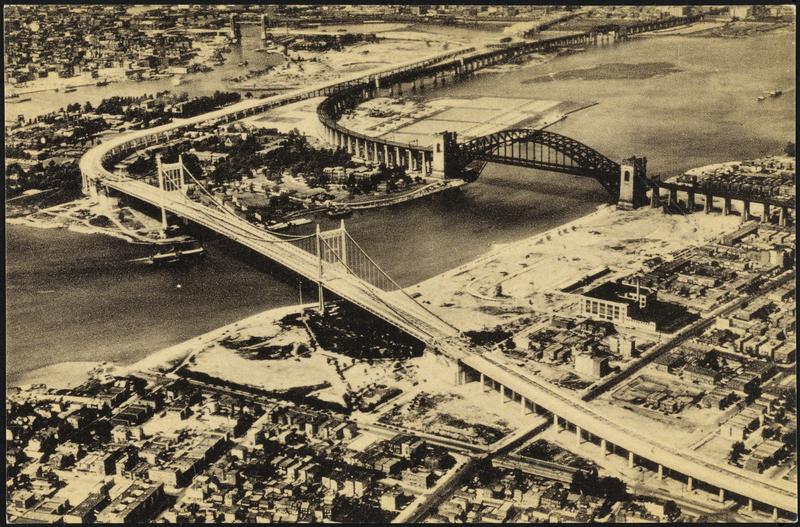
Its location in Astoria Park is certainly theatrical, parallel with the river and in sight of two spectacular bridges (the Robert F. Kennedy and the Hell Gate) that sail over to Randall’s Island.
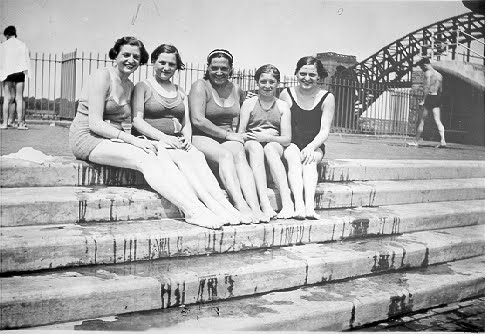
Mermaidens: Five sisters in bathing suits pose on steps of Astoria Pool, circa 1938. Courtesy the LaGuardia and Wagner Archives
For a public pool, its so big (330 feet long, with a supposed capacity of 3,000 people) that it might be more comfortable in a theme park.
Riding the Wave
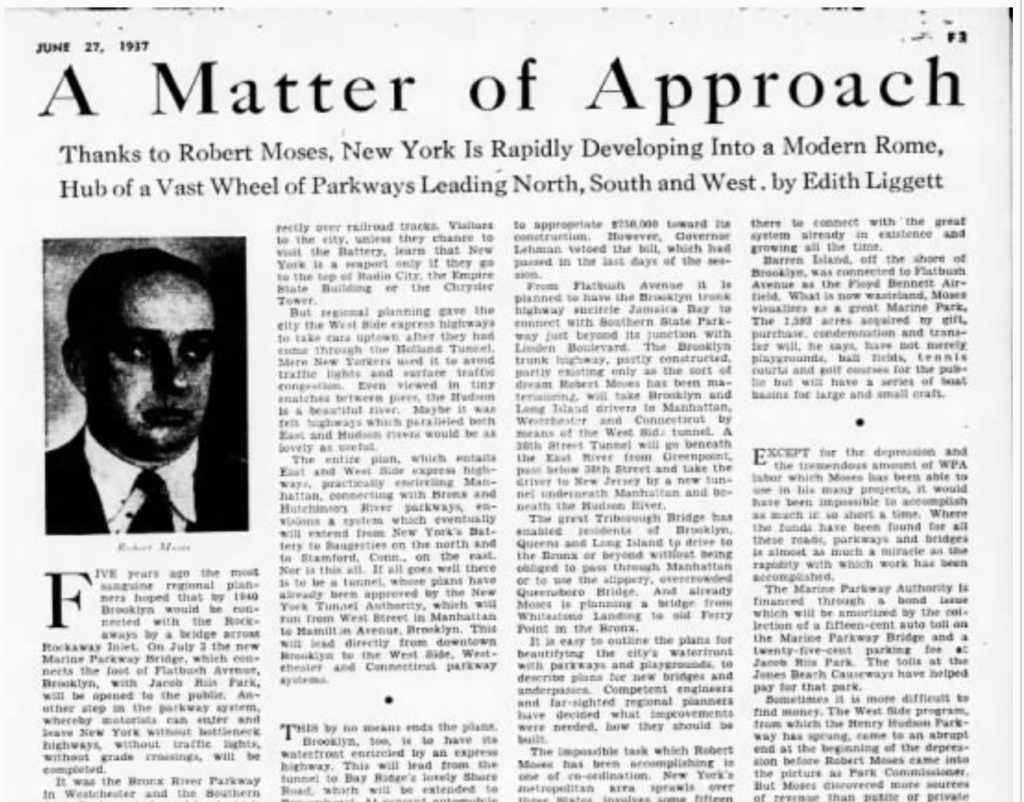
The pool, the park, one of the bridges (the RFK, aka the Triborough) and the roads you probably used to get to thee places were all 1930s projects overseen by New York Parks Commissioner Robert Moses.
But the real fuel behind the creation of Astoria Pool was the Works Progress Administration, a federal agency that infused billions of dollars into local communities during the Great Depression.
The money came just as Moses (above, in a swimsuit, at Jones Beach) was ascending into his various governmental roles in city and state government. The result was some of his most earnest and arguably most effective projects.
Perhaps his legacy might not be as hotly debated today had he stopped with his greatest hits of the decade: the Triborough, the parkways and the many miles of parkland scattered throughout the city.
And of course the swimming pools, eleven in total, built during the 1930s.
Dipping A Toe Into Swimming Pools
They were of special note as a culmination of the modern public facility, using modern design and new technology to create places of recreation for regular New Yorkers.
The idea of municipal pools wasn’t new — Philadelphia had them as early as 1890s, and New York had plenty of public baths and even floating baths — but standards of decency had changed by the 1920s.
Women could cavort with men, as could different social classes. (And occasionally people of different races, although many of Moses’ own pools were guilty of segregation.)
Astoria Pool, with its subdued Art Deco design, was the grand model for all the new pools in the other boroughs. And it was certainly the most popular, from the moment it opened in July 1936.
It became a daily destination during the summer for neighborhood children.
“In 1936, I was eight years old,” recalled New York Yankee superstar Whitey Ford. “You could stand by the pool on a hot summer day –along with a couple thousand neighborhood kids in the main pool and maybe another hundred in the diving pool — look up, and see quite a sight. On the right was Hell’s Gate Bridge….and on your left, was the brand new Triboro Bridge heading towards the horizon.”
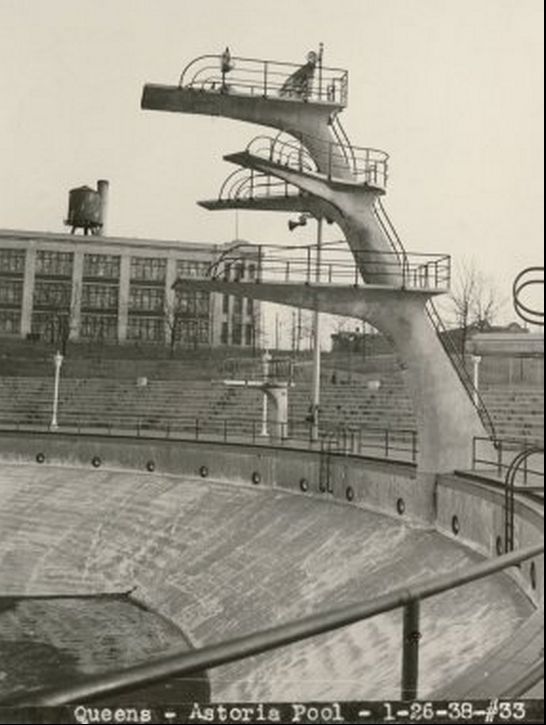
But Moses wasn’t just concerned with public accommodation. He had different intentions for this pool, reflected in the semi-circle of bleachers and that spectacular diving platform stretching like a plant over a deeper half-moon pool.
The Astoria Pool was meant to create swimming superstars.
The Diving Board and the Butterflies
Two days after its opening, on July 4, 1936, Astoria Pool hosted the U.S. Olympic trials in swimming and diving. From these events, victors went straight over to the Games, hosted that year in Berlin.
And they weren’t the only athletes tested that month in a New York WPA project.
Across the water, at Randall’s Island, Olympic track-and-field trials were hosted at Downing Stadium, producing the man who would become the most famous Olympian of the ’36 games — Jesse Owens, winner of four golds. [For more information, check out the podcast on Randall’s Island and the 1936 Olympic trials.]
Two massive Olympic torches stood astride the pool as competitors fought for a spot on the Olympic team.
Events at the Astoria Pool in July 1936 produced several winners, including gold medal swimmers Jack Medica and Adolph Keifer and a slate of athletes that went on win ten of twelve medals in men’s and women’s platform and springboard diving.
(Interestingly, the other two medalists were Germans. And both their medals were bronze, yet another result that must have angered Adolf Hitler.)
Olympics trials returned to Astoria Pool in 1952, and again in 1964, producing athletes that again nearly swept the diving events in the Tokyo games.
SwimmerDon Schollanderwent on to win 4 golds that year, the most of any athlete in 1964 and the most medals won by an American athlete since Jesse Owens.
But, as it would turn out, the biggest swimming celebrities fostered from the Astoria Pool were neighborhood boys.
Aqua-Zanies
Imagine being a kid in Astoria, Queens, in the early 1940s, living next to a swimming pool that had helped produce the world’s greatest swimmers!
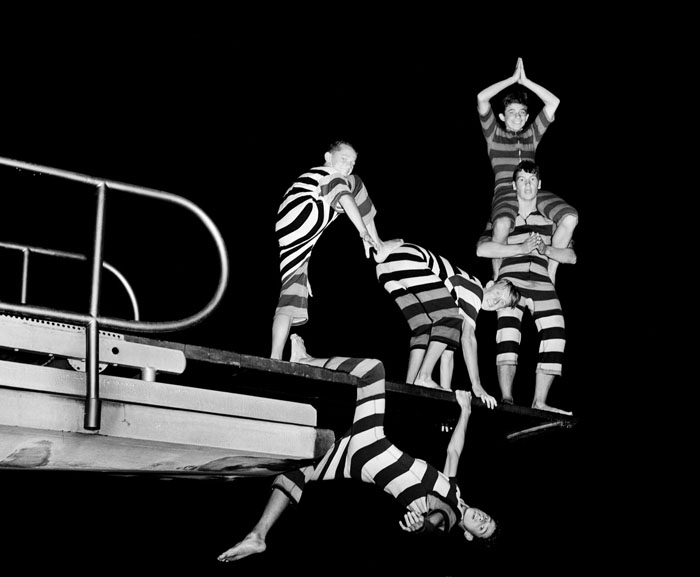
A group of local swimming enthusiasts looked at Astoria Pool’s extended diving platform and saw a opportunity to entertain, forming an athletic-comedy group called the Aqua-Zanies.
Garbed in matching stripped ensembles, the teenagers performed wacky acrobatic stunts from off the platform — darting, twirling and sometimes bellyflopping into the water below.
They soon became ‘America’ leading water comedians‘, performing throughout New York and even going on an international tour in the early 1950s. Several Aqua-Zanies went onto more legitimate swimming careers.
And certainly these effortless performance have inspired hundreds of others to leap from the Astoria diving platform with equal attempts at gravity-defying levity.
Although the swimming pool has remained a important part of the community even to this day, that diving platform, weathering decades of elemental abuse, was shut down in the 1970s and has become something of a beloved ruin.
In June 2006 it was officially designated a New York City landmark. And the pool is open for swimming again. Let your aqua-zany dreams soar!
Thanks to the Parks Department for use of the images above. (Diving platform photo courtesy NYC Dept of Records)
PART ONE of a two-part podcast series A NEW DEAL FOR NEW YORK.
In this episode, we look at the impact New Deal funding had in shaping the city’s infrastructure — from bridges and tunnels to neighborhood parks — how New York City uniquely benefited from this government program.
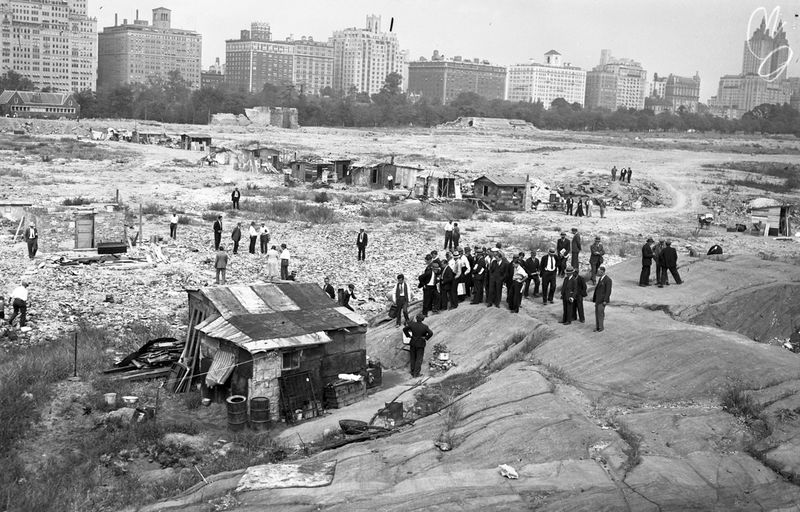
EPISODE 337 New York City during the 1930s was defined by massive unemployment, long lines at the soup kitchens, Hoovervilles in Central Park.
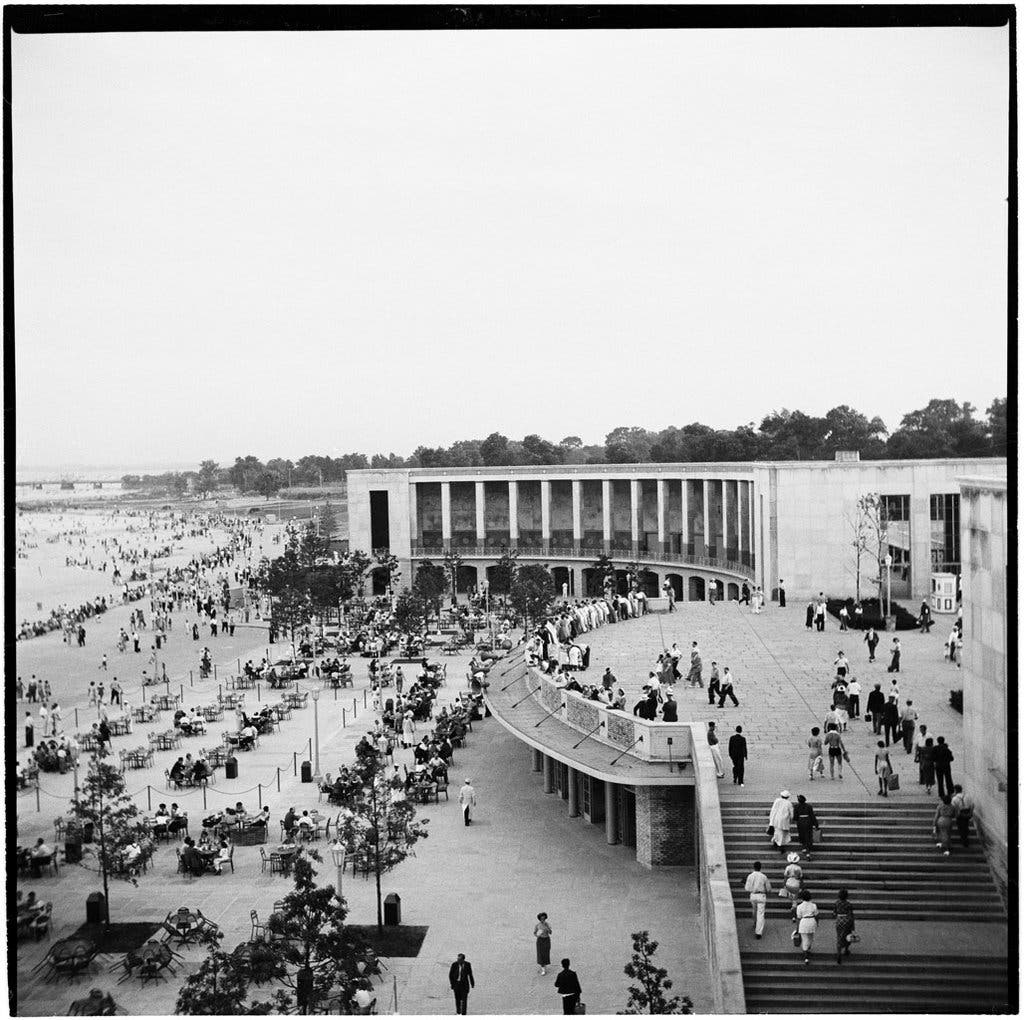
But this was also the decade of the Triborough Bridge and Orchard Beach, of new swimming pools and playgrounds, of hundreds of new building projects across the five boroughs.
Faced with the nationwide financial crisis, former New York governor and newly elected President of the United States Franklin Delano Roosevelt chose to boldly take the crisis on a series of transformative actions by the government that became known as the New Deal.
No other American city would benefit more from the New Deal that New York City. At one point, one out of every seven dollars from the Works Progress Administration (WPA) was being spent in New York.
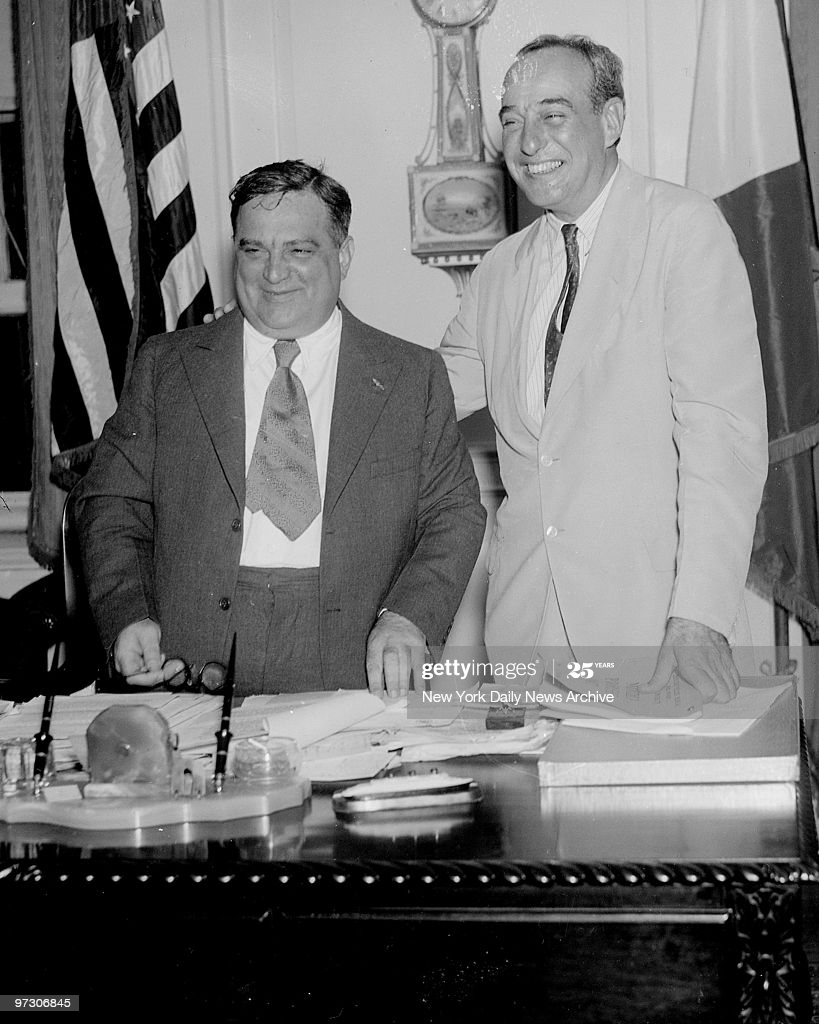
And the two men responsible for funneling federal funding to the city was Mayor Fiorello LaGuardia and his new parks commissioner Robert Moses.
Moses amassed a great amount of unchecked power, generating thousands of projects through out the city — revitalizing the city landscape.
How did Moses manage to funnel so much federal assistance into his own projects? And where can you see evidence of the New Deal in the city today? (HINT: Pretty much everywhere.)
Listen today on your favorite podcast player or just press play here:
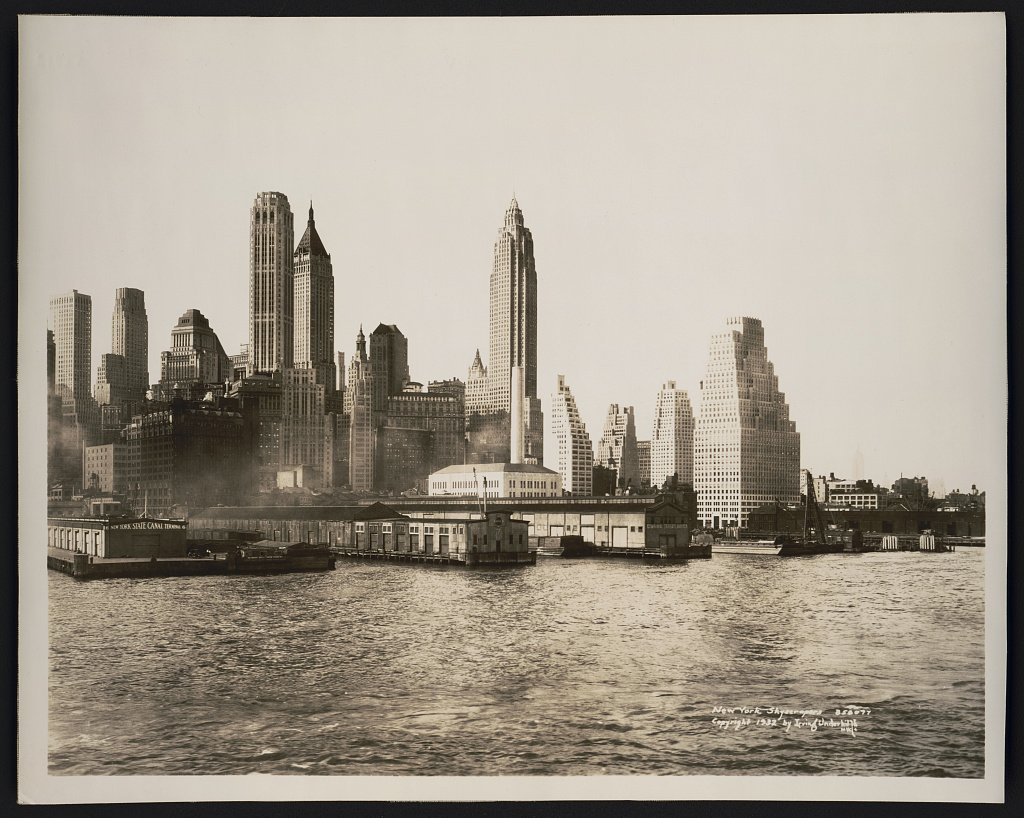
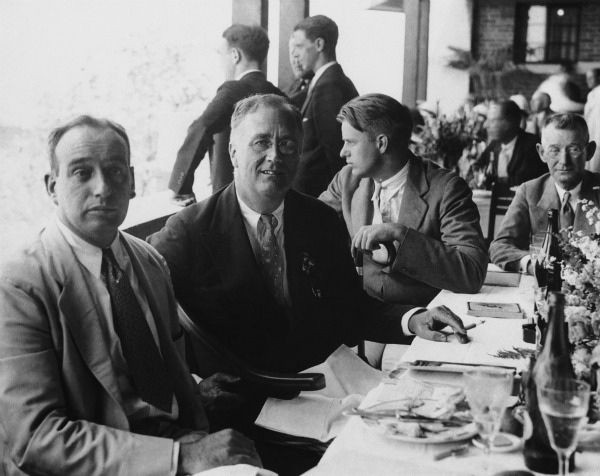
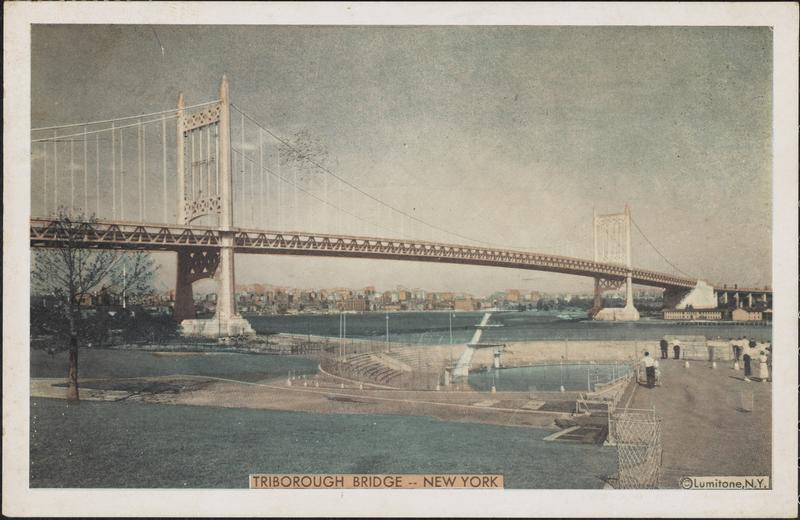
New York City, 1932 (Irving Underhill/Library of Congress)A Hooverville in Central Park, 1932 (New York Daily News)Robert Moses and FDR at Jones BeachMayor Fiorello LaGuardia and Gov. Robert Moses (Photo by Bob Mortimer/NY Daily News Archive via Getty Images)Orchard Beach, 1937 (Museum of the City of New York)July 29, 1936 Astoria Park PoolThe Triborough Bridge as seen from the Astoria swimming pool, in a 1940 postcard. (Museum of the City of New York)Aerial view of the Triborough Bridge, 1936 (Museum of the City of New York)Article from the Brooklyn Daily Eagle, 1937 (Courtesy Newspapers.com)
FURTHER LISTENING
After you’ve checked out this episode, go back to some of our past episodes for further insight into this period in American history.
FURTHER READING
First of all, please visit The Living New Deal, an incredible website with an exhaustive catalog of New Deal projects across the country.
Robert Caro / The Power Broker William E. Leuchtenburg / Franklin D. Roosevelt and the New Deal Amity Shlaes / The Forgotten Man Nick Taylor / American Made: The Enduring Legacy of the WPA Mason Williams / City of Ambition: FDR, La Guardia and the Making of Modern New York (And our miniseries title is an homage to Mike Wallace‘s 2002 book A New Deal For New York)
The Bowery Boys: New York City History podcast is brought to you …. by you!
We are now producing a new Bowery Boys podcast every week. We’re also looking to improve and expand the show in other ways — publishing, social media, live events and other forms of media. But we can only do this with your help!
We are now a creator on Patreon, a patronage platform where you can support your favorite content creators.
Please visit our page on Patreon and watch a short video of us recording the show and talking about our expansion plans.
If you’d like to help out, there are six different pledge levels.Check them out and consider being a sponsor.
We greatly appreciate our listeners and readers and thank you for joining us on this journey so far.
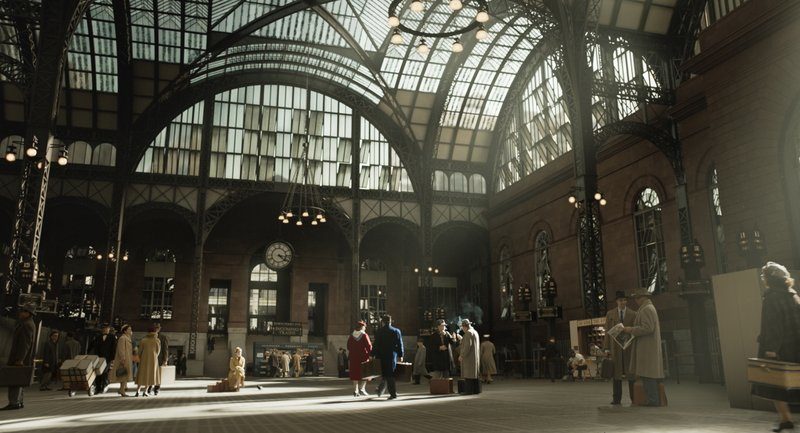
Penn Station as recreated in Warner Bros. Pictures’ drama “MOTHERLESS BROOKLYN,” a Warner Bros. Pictures release.
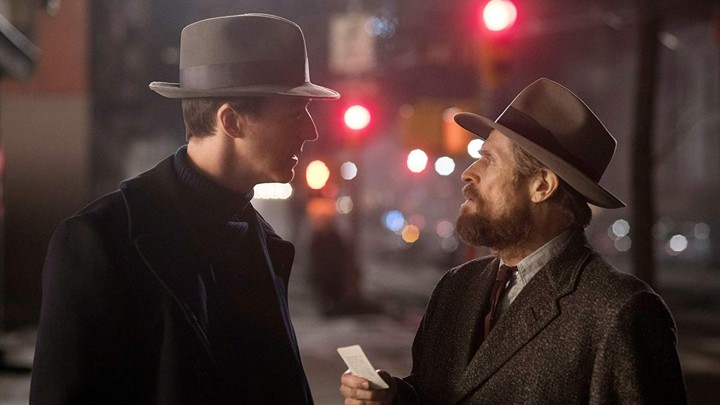
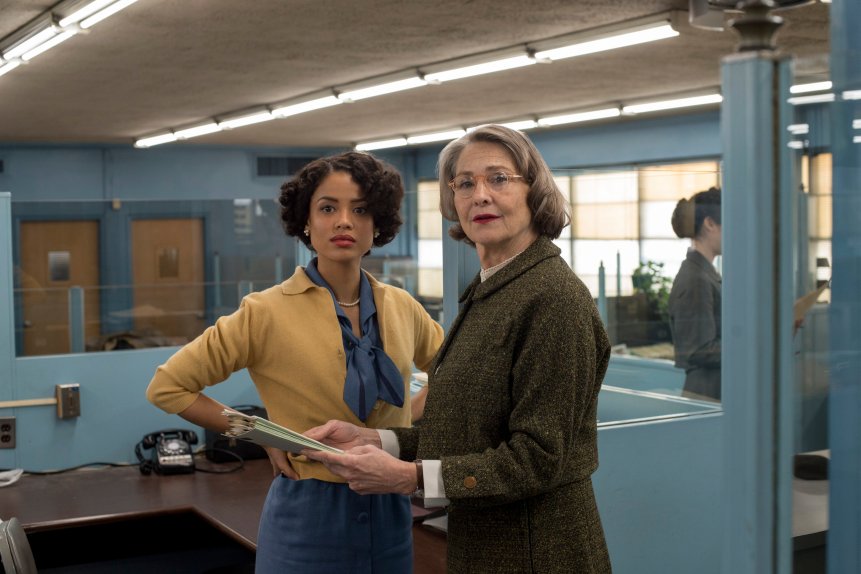
Motherless Brooklyn, a radical retro transformation of Jonathan Lethem’s book of the same name, refits the bright noir of the movie Chinatown into 1950s New York City. Edward Norton, who wrote and directed this adaptation, also stars as its central figure — Lionel Essrog or simply Brooklyn, a detective with Tourette syndrome and a photographic memory.
The film is a lot. Its success for you will depend on your tolerance for Norton’s performance as Brooklyn, who explodes with spontaneous verbal tics while on a labyrinthine case nodding (often blatantly, sometimes brilliantly) to dozens of classic detective tropes.
I saw it a week ago and I’m still not sure whether I loved it or detested it. It’s a movie full of wonderful concepts, fascinating history and a few failed ideas.
But if you’ve ever listened to our podcast — or spent more than five minutes on this website — then I’m pretty sure you’ll find something to admire in Motherless Brooklyn.
The list below contains no big spoilers pertaining to the film’s plot, but prepare to recognize the following historical figures and concepts. In fact you might like to listen to a podcast or two before or after you view the film. Some listening suggestions are below:
THE POWER BROKER
In many ways Motherless Brooklyn is as much an adaptation of The Power Broker as it is Lethem’s detective novel. (There are at least three character monologues that feel like information dumps from the book.)
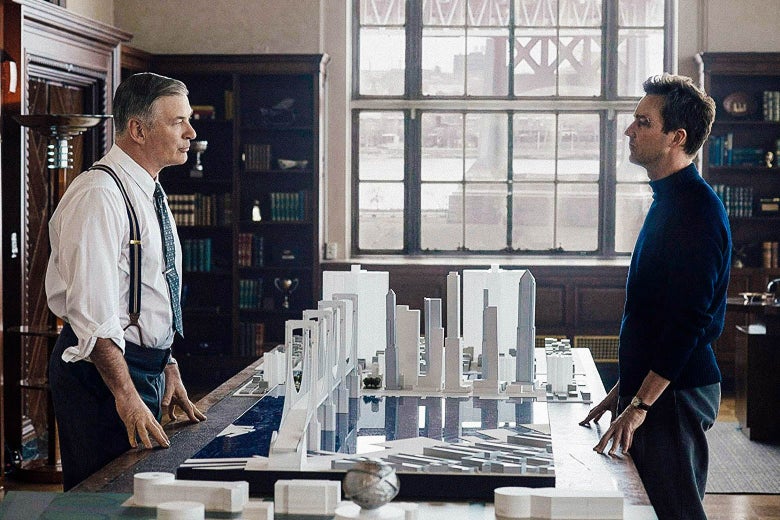
The central antagonist Moses Randolph (Alec Baldwin) stands in for Robert Moses, the unelected city official who amassed great power during the 1940s and 50s, shaping the city to his whims. By the ’50s, Moses has collected several job titles, lording over weak mayors and determining the city’s fate — with little consideration for individual community needs.
Warner Bros
TRIBOROUGH BRIDGE AND TUNNEL AUTHORITY
In Motherless Brooklyn, Moses’ instrument for change is actually called the Borough Authority, but its headquarters are located in the same place as Moses’ — Randall’s Island. Originally commissioned by the state to construct the Triborough Bridge, the authority’s merged with other city agencies under Moses.
THE GREAT MIGRATION
Thousands of African-Americans moved out of the South in the first half of the 20th century — escaping the dominance of Jim Crow laws — and many came to New York City, only to find a familiar tenor of discrimination here. By the 1940s, housing shortages in black communities like Harlem vexed African-Americans who were unable to rent from many landlords in mostly white neighborhoods.
Norton with Willem Dafoe in a stand-out performance. Courtesy Warner Bros
REDLINING
The process by which banks and insurance companies, with de facto approval by the city, denied loans and mortgages to residents in predominantly minority neighborhoods, leading to the deterioration of those neighborhoods, leading them to be labeled ‘slums’. When then led to….
SLUM CLEARANCE
An urban renewal strategy popular in the mid-20th century — Robert Moses was its maestro — involving the complete demolition of neighborhoods labeled slums and relocating its displaced residents to public housing in far off (less valuable) quadrants of the city. In many cases, those neighborhoods were not ‘slums’ at all; that is, they were thriving places that just happened to be homes to black, Hispanic or Jewish residents.
EAST TREMONT
A neighborhood in the South Bronx, largely populated with working class Jewish residents, decimated by the construction of the Cross Bronx Expressway in the 1940s and 50s. From The Power Broker: “The one mile of the Cross-Bronx Expressway through East Tremont was completed in 1960. By 1965, the community’s “very good, solid housing stock,” the apartments that had been so precious to the people who had lived in them, were ravaged hulks.
Glen Wilson/Warner Bros.
JANE JACOBS
Cherry Jones plays Gabby Horowitz, a community activist very much in the mold of Greenwich Village crusader Jane Jacobs. There’s even an interesting nod to her work in Washington Square and a notable rally which took place there in 1958.
HARLEM JAZZ
Harlem’s glorious jazz-club tradition is vividly illustrated in one set piece — a smoky club called the King Rooster. The film used the actual St. Nick’s Pub (St. Nicholas Avenue at West 149th Street) which dated back to the 1930s. Sadly the club burned down in 2018 in a tragic blaze which killed a firefighter.
THE ORIGINAL PENNSYLVANIA STATION
By the 1950s, the first Pennsylvania Station — above ground, designed by McKim, Meade and White — was just a few years away from demolition. It was deteriorating and not very clean by then, but Norton thankfully recreates a fantasy, photo-perfect version of Penn Station. It’s genuinely breathtaking.
SWIMMING
Robert Moses was a champion swimmer and even let his hobby influence early policy, constructing ten massive swimming pools during the 1930s with Work Progress Administration funding. Quoting Caro: “Moses gave each of his pools … his personal attention. Under his prodding, his architects adorned them with masterful little touches; over the entrance which divided men from women as they entered the bathhouse at the Corona Pool complex sat a stork wearing an expression that made him look as if he were puzzling over the physical differences in the creatures he had brought into the world.”
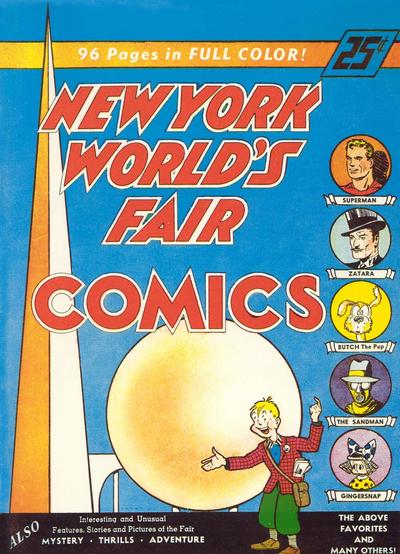
The New York World’s Fair of 1939-40, held in Flushing Meadows Corona Park, was an extravagant wonderland of ideas, filled with technological wonder and futuristic imagination. It was fun for all ages — if you could afford it. Children were a key audience, of course, and the fair was advertised to them in a variety of ways, including through a rather new form of publication called a comic book.
Action Comics #1, featuring the first exploits of Superman, was published in June 1938. Less than a year later, the Man from Krypton appeared in an official World’s Fair tie-in comic book.
Flash forward many decades in the future. Comic books have gone from cheap kiddie magazines to the basis of modern Hollywood blockbusters. And it’s there that the New York World’s Fairs have again come alive — thanks to Marvel Comics.
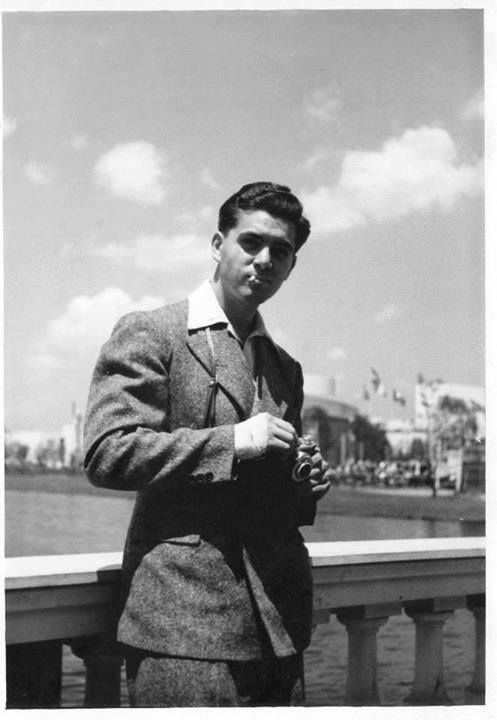
Below: Jack Kirby at the 1939 New York World’s Fair
Courtesy Kirby Museum
But there’s obviously something special about Flushing Meadows Corona Park— and the two New York World’s Fairs which were held there in 1939-40 and 1964-5 — for the site has been carefully built into the movies of the Marvel Cinematic Universe, a collection of massive superhero blockbusters culminating this weekend with Avengers: Endgame**.
Courtesy New York Public Library
World’s Fair of 1939
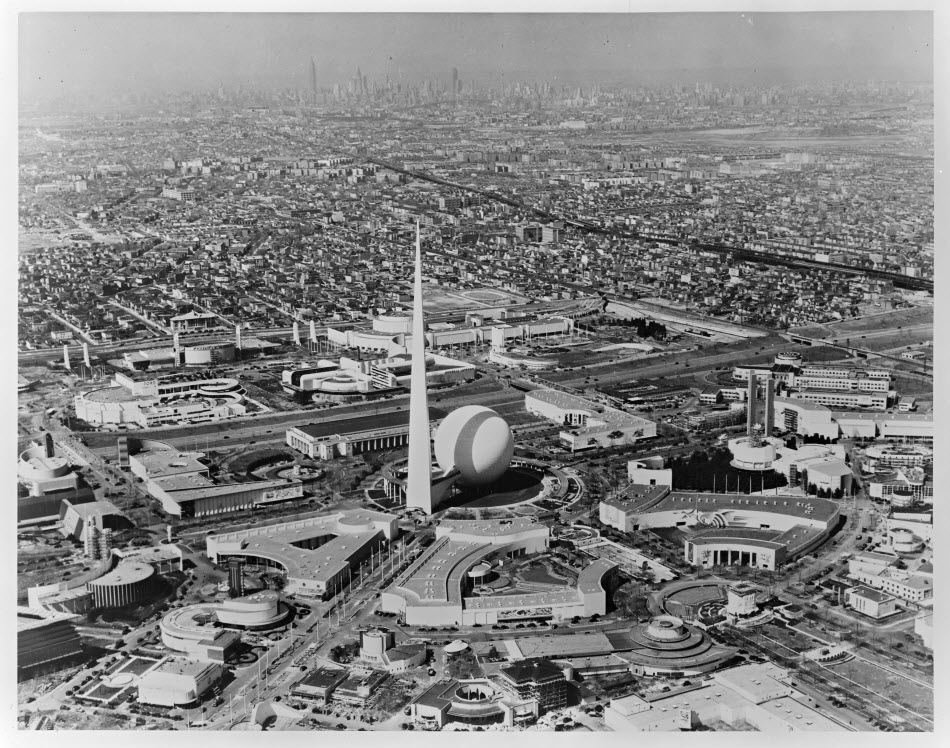
As we mentioned in our latest podcast, the New York World’s Fair of 1939-40 celebrated corporate innovation and technological progress, a glittering future through automobiles and robotics.
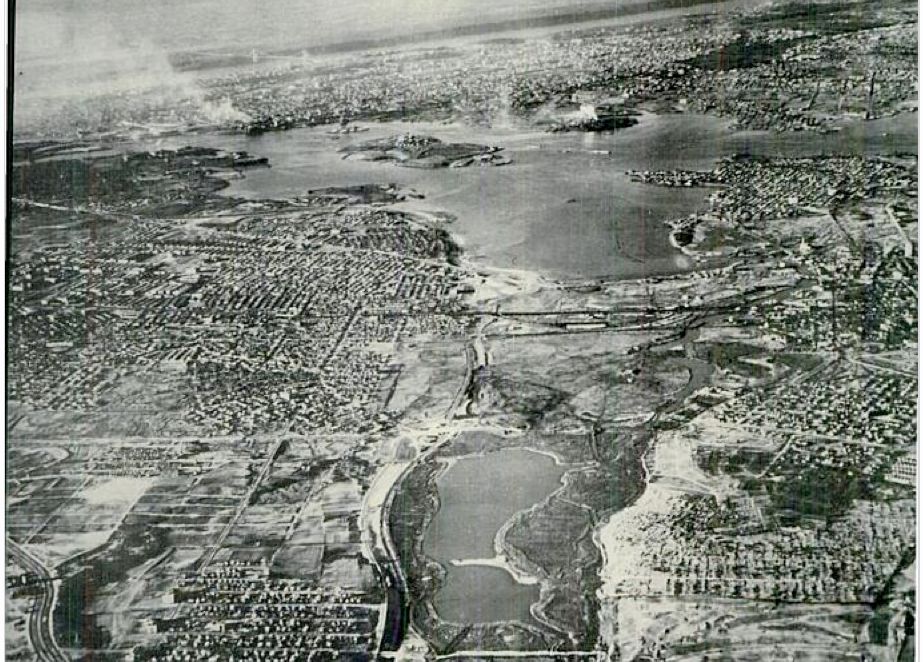
Had the fair been deemed a financial success when it closed in 1940, you could imagine how it might have become a permanent theme park to American middle-class ideals. After all, it was the ambitions of city parks commissioner Robert Moses to transform Flushing Meadows Corona Park — a former ash dump — into a place that could be enjoyed by New Yorkers year-round.
Well, good news, Mr. Moses! In the alternate history presented by Marvel, the World’s Fair of 1939-40 was apparently NOT a financial disappointment, because its doors remained open for future expositions, possibly even yearly ones.
Imagine how Queens would have developed with perpetual events at Flushing Meadows. There would have been more highways and a greater expansion of the park grounds. The tolls gathered by Moses’ Triborough Authority would have been double the bounty they were in real life. He might have arguably had even more power within the city.
World’s Fair of 1943
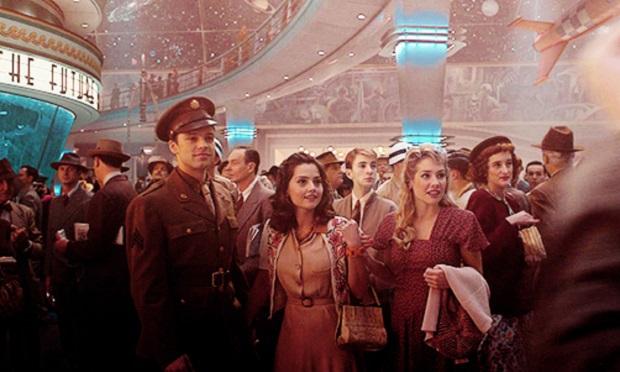
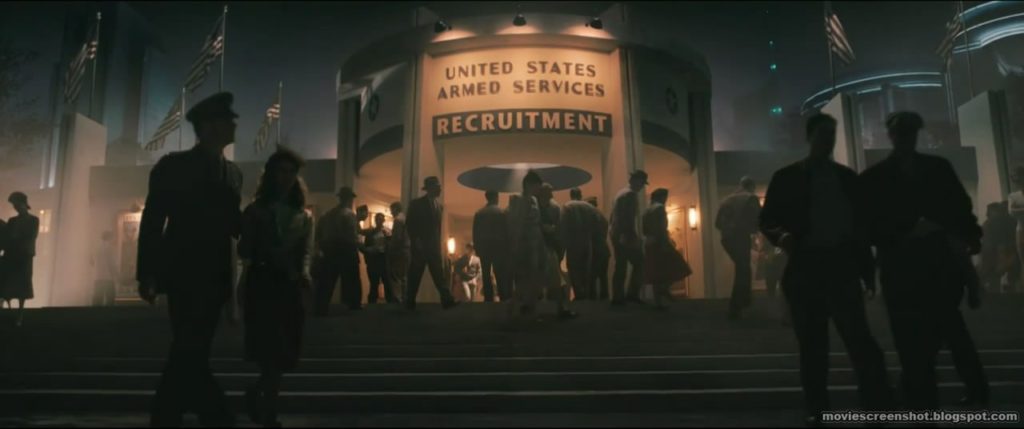
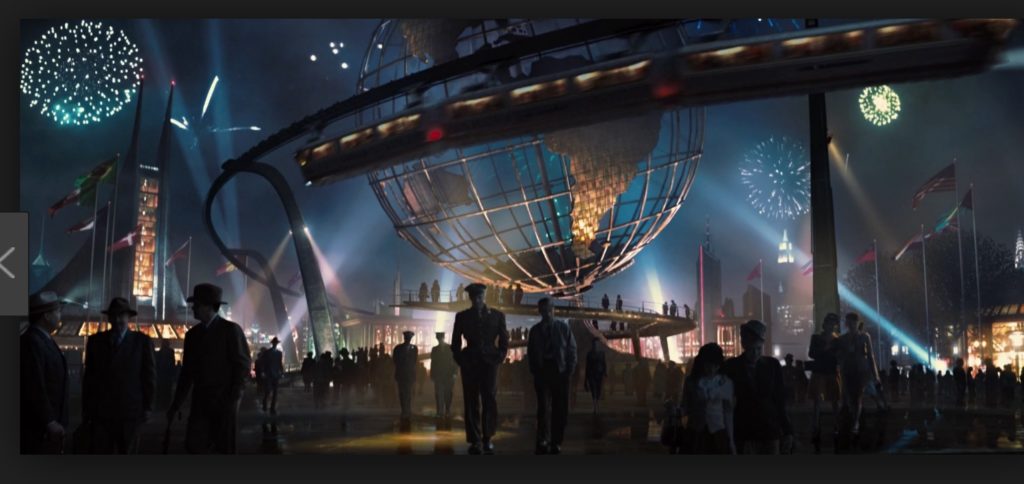
The first fictional fair in Flushing Meadows debuted in the film Captain America: The First Avenger, an exposition called Modern Marvels of Tomorrow.
Longtime friends Bucky Barnes and Steve Rogers bring dates to the fair and attempt to have a good time before Bucky ships out to war. Rogers, a puny CGI-ed man with great enthusiasm, pines to join his best friend on the front lines.
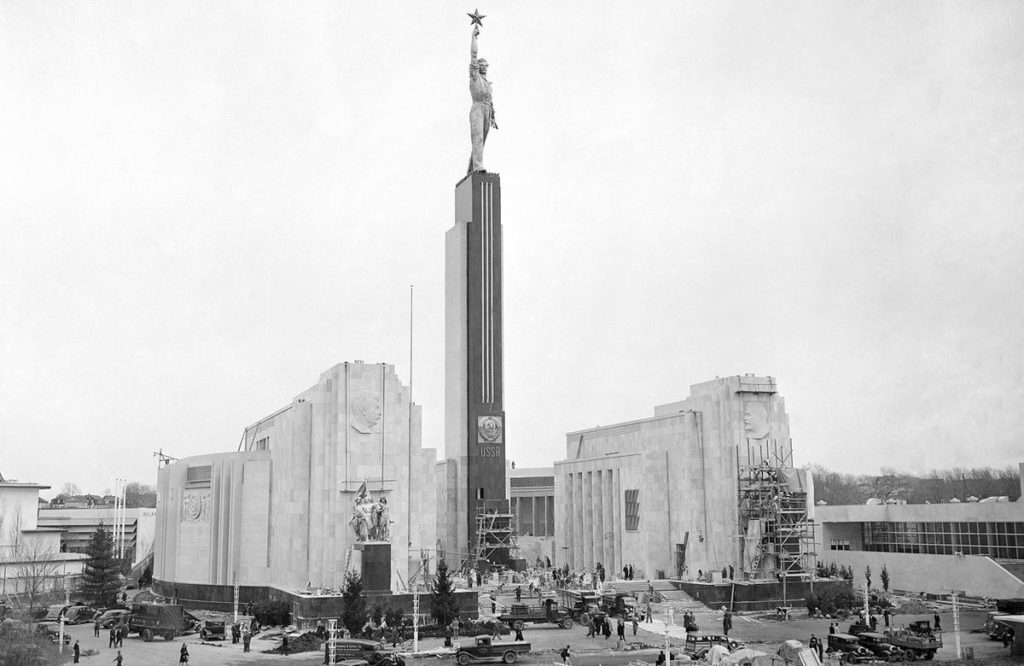
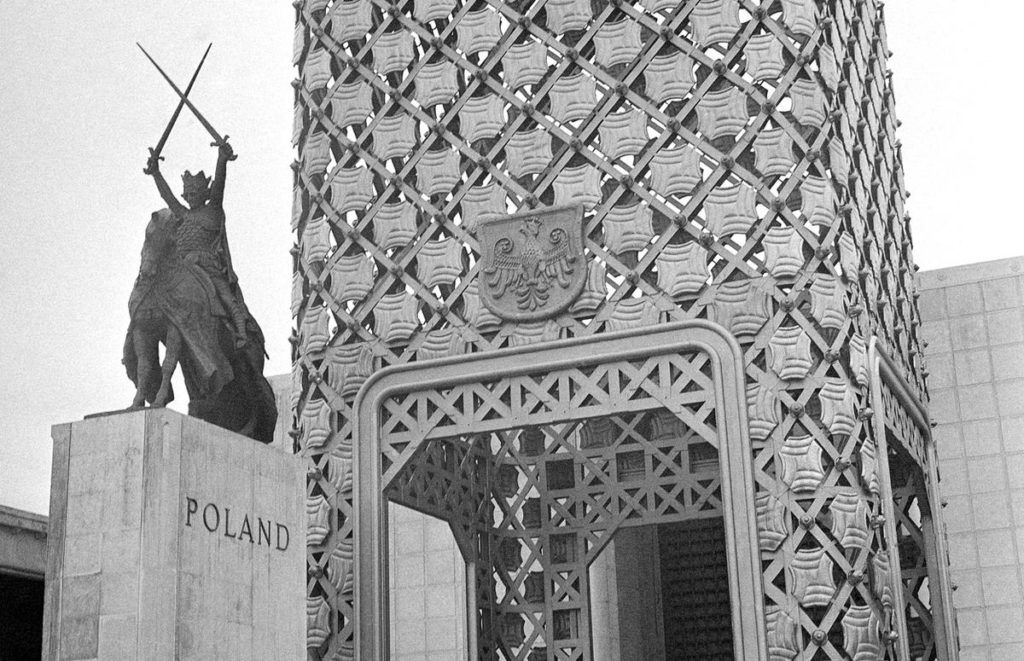
It seems unusual that New York would host a seemingly frivolous fair during wartime. Even in 1939, the crisis in Europe was influencing the direction of the actual fair; by the 1940 edition, the Poland Pavilion had closed and the Soviet Pavilion and its massive Big Joe sculpture were entirely removed.
The fictional Modern Marvels of Tomorrow seems to mix patriotic pride with technological advancement. It’s here that Rogers, deemed too physically inadequate to serve, attempts to re-enlist for the military.
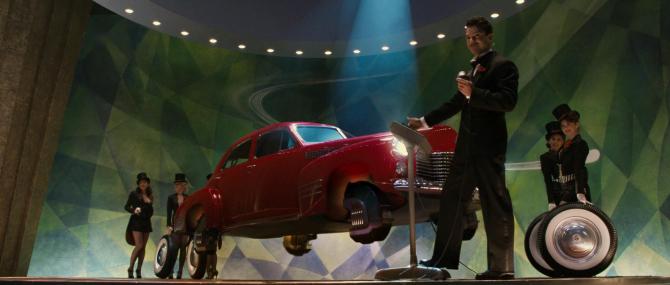
It’s not all bandstands and flag-waving. The future Captain America and Winter Soldier (and their dates) drop by the pavilion of a young start-up company Stark Industries where its handsome young CEO Howard Stark attempts to demonstrate a flying car.
You can watch the entire sequence featuring the 1943 World’s Fair here. Note that the Unisphere, created for the 1964 World’s Fair, is already a feature of the Marvel Cinematic Universe by this time. In fact, a model of the Unisphere plays a crucial role in the film Iron Man 2.
The Trylon and Perisphere are nowhere to be seen but the Helicline — the spiral ramp which encircled the Perisphere — now wraps around the Unisphere.
World’s Fair of 1954
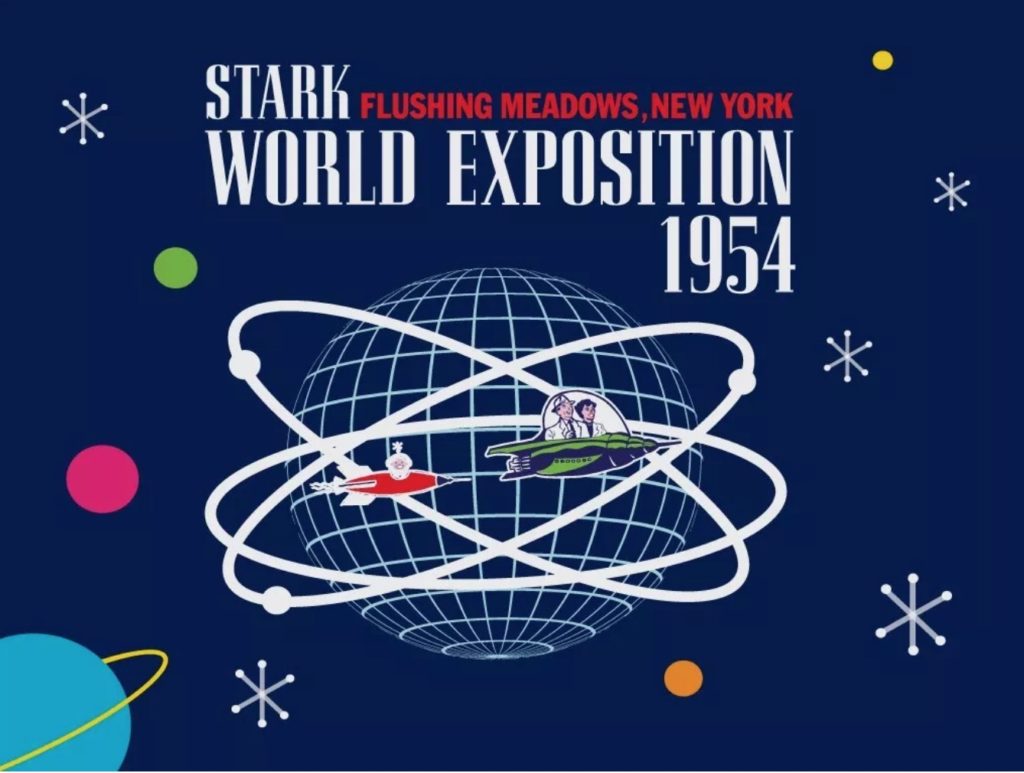
In the Marvel Cinematic Universe, we must assume that Howard Stark became good friends with Robert Moses and mayor Vincent Impellitteri, for in 1954, it appears they simply give management of the fair over to Stark Industries.
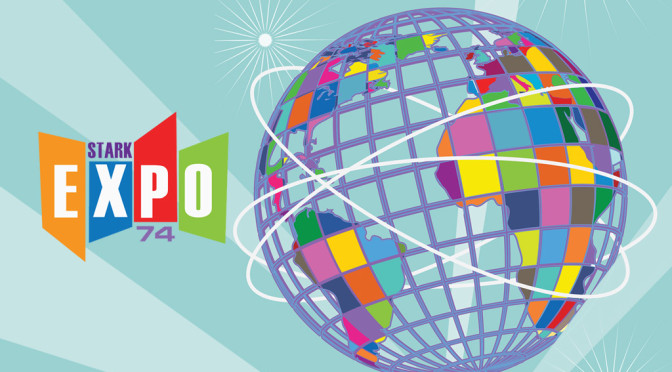
In a memo later sent by Howard’s son Tony Stark: “In ’54 my Father returned to Flushing Meadows, Queens, to show off the new tech he used to defeat global tyranny. This was the first ever Stark Expo.”
Banner for the non-existent 1954 fair.
Certainly Moses would have been thrilled to have private sponsorship of public fair pavilions. In this alternate New York past, perhaps Moses even worked with Stark in producing the highways and airports that would service this grand Queens attraction. By the 1950s, Queens would have been recognized as the most important tech center in the United States.
World’s Fair of 1964
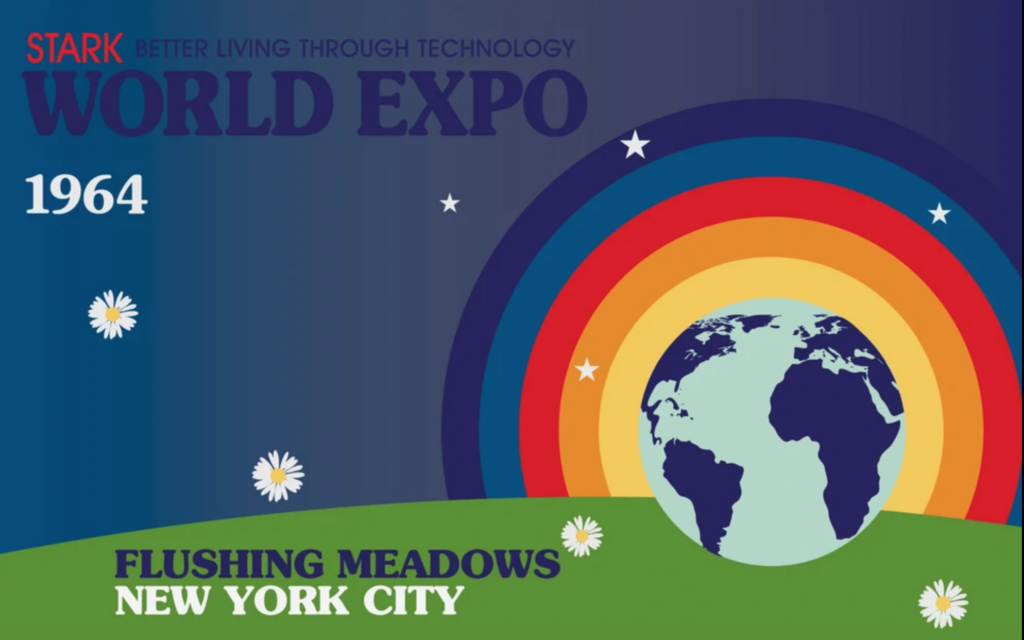
The New York World’s Fair of 1964-65 occurred both in the real world and in Marvel Cinematic Universe history. The themes, however, were quite different.
The theme of real fair, officially unsanctioned by the Bureau of International Expositions, was “Peace Through Understanding.” Howard Stark’s fair put a cheeky spin on that title — “Better Living Through Technology.”
In the Marvel world, we can only assume that the Mets did debut in Shea Stadium in 1964, except that it was most likely called Stark Stadium. We do know that the Mets exist in the same universe as the Avengers as canonically the cinematic Amazing Spider-Man is a big fan.
As with the actual 1964 fair, it appears that that the New York State Pavilion structure may have been built for the Stark Expo, although it is unclear if the Marvel version of the Philip Johnson-designed pavilion would have included a life-sized Texaco highway map.
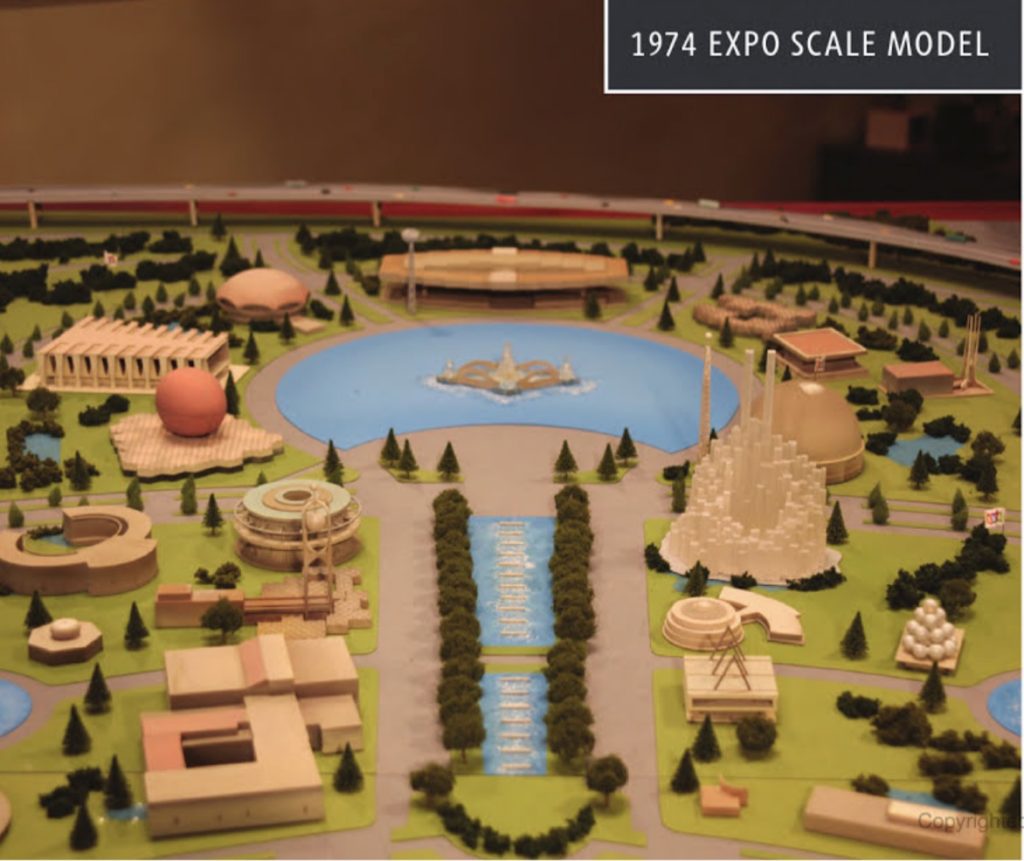
Stark Expo 1974
The ‘Stark Expos’ ran for many years until 1974. I can only imagine that New York City’s dire financial fortunes still played out in this fictional comic-book world, closing the annual display of progress for good.
From Tony Stark’s memo: “In the decades that followed, my Father invited the world’s greatest minds to contribute to the Expo and put to task corporations to create better living for all. When the 1974 Expo closed, we lost that glimpse into humankind’s amazing future.”
Below: It appears that the Lagoon of Nations has been a feature of the fair from the very beginning — in both the real and fictionalized worlds.
After its closure, the borough would have been decimated, no longer the heart of American technology. Perhaps we can assume Moses was involved until the bitter end, for 1974 happens to be the year his own reputation takes a beating with the publication of Robert Caro’s The Power Broker.
The promotional video for the 1974 Stark Expo offers no new insights outside of an introduction by Howard Stark (who looks an awful lot like another New York city power player, Madison Avenue advertising king Roger Sterling, mixed with a bit of Walt Disney).
The great downturn of New York City’s fortunes in this alternate timeline must have contributed to a massive crime wave and serious urban blight. It is fortunate then that the city might have benefited from a completely coincidental spike in costumed crime fighters.
(By the way, the film Iron Man 2 does provide confirmation that the 1974 fair did include a “Belgian waffle stand,” as mentioned by Jarvis, the computer intelligence that would later become incorporated into robot superhero Vision. Belgian waffles were the fair snack of choice for visitors of the 1964 New York World’s Fair.)
A look at the World’s Fair of 2010 according to the film Iron Man 2.
Stark Expo 2010
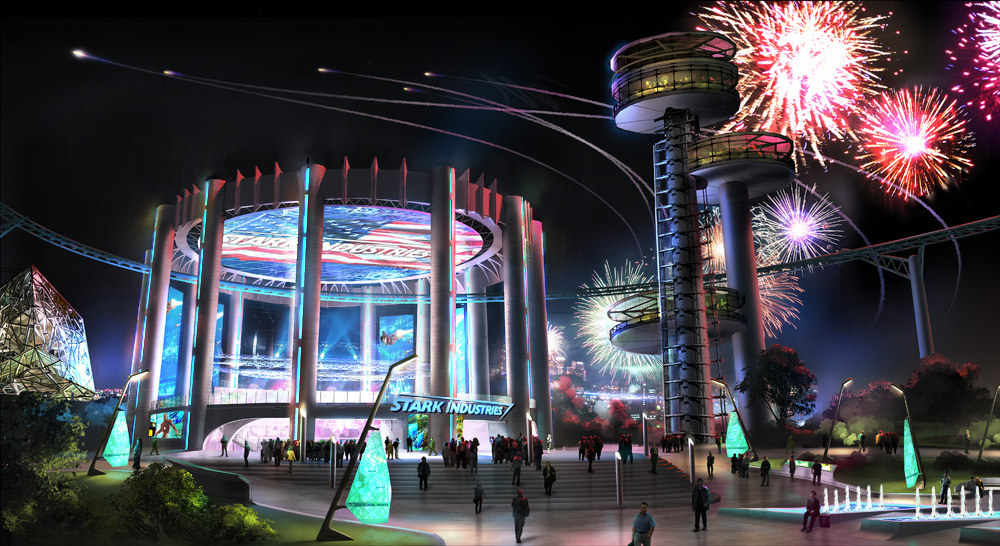
As highlighted in the film Iron Man 2, Howard’s son Tony Stark — aka Iron Man — would bring the Stark Expo back to Flushing Meadows in 2010, making the New York State Pavilion the centerpiece of the excitement.
Unfortunately the festivities are interrupted by dozens of flying armored super robots. I’m sure Iron Man 2 features several deleted scenes of an enraged Mayor Michael Bloomberg demanding retribution from Stark Industries, dozens of lawsuits against the private firm and reverberations of corruption through Stark’s association with the federal government. (Hopefully, the Mets weren’t having a home game that night!)
Bill Cotter/New York Times
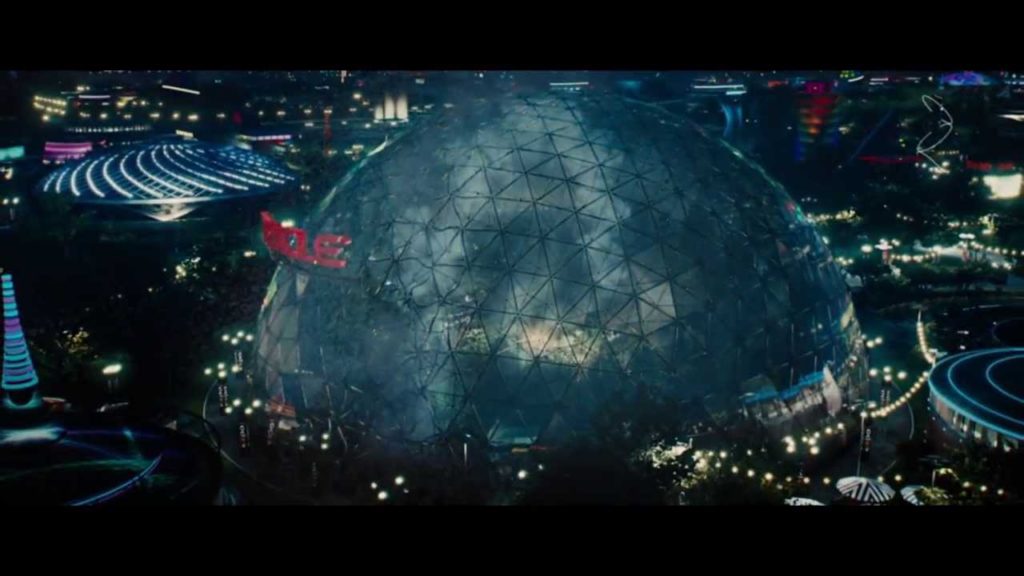
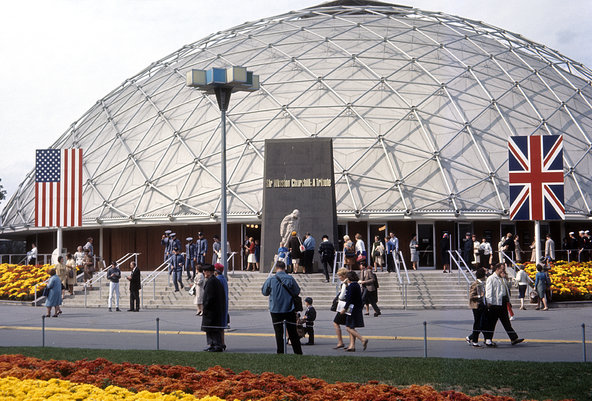
Among the architecture seriously damaged during the battle was a pavilion sponsored by Oracle within a geodesic dome that looks very similar to the Queens Zoo aviary which was originally created for the 1964 World’s Fair.
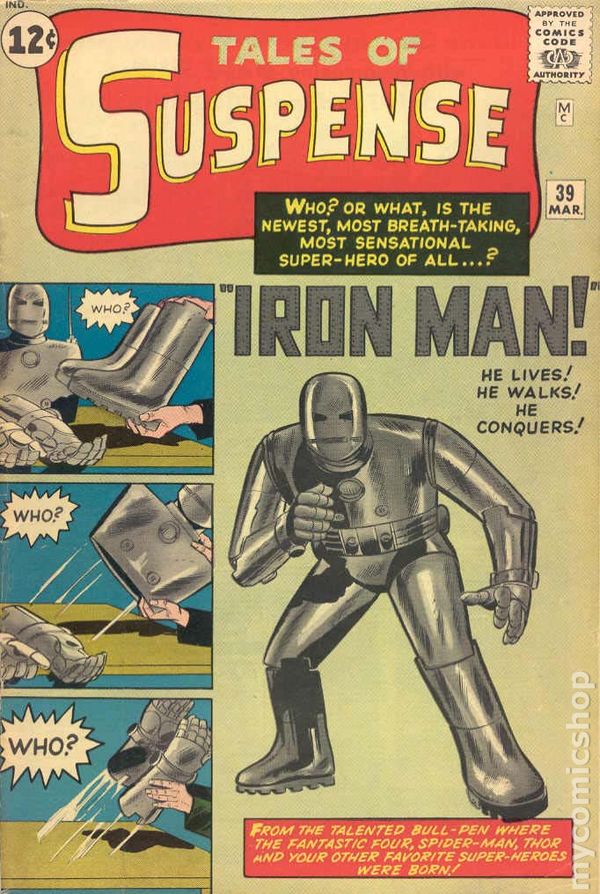
The character of Iron Man debuted on March 1963 in the comic book Tales of Suspense #39. Had this suit of powered armor been an actual creation, it would most likely have been displayed at the real 1964 World’s Fair — with its focus on ‘A Millennium of Progress’ — alongside other wonders of the day like the computer, atomic power and new space technology.
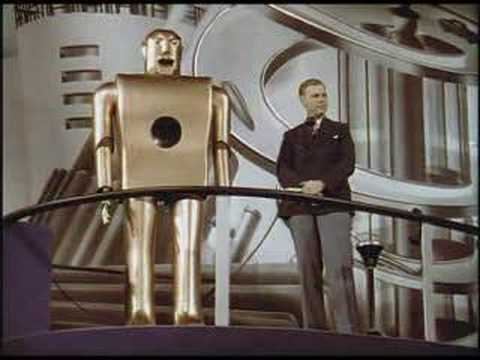
There is no evidence that Iron Man creators Lee, Kirby, Don Heck and Larry Lieber were directly inspired by the 1939 World’s Fair super-being Elektro, but visually the pair could been mechanical cousins.
And just nearby….
Peter Parker lives with his Aunt May in the neighborhood of Forest Hills, Queens, a short walk from Flushing Meadows Corona Park.
In the comic books, Parker would attend a demonstration of the “safe handling of nuclear laboratory waste materials” at the New York Hall of Science within the park, and it was there that he was bitten by a radioactive spider, becoming Spider-Man. It too was designed for the 1964 New York World’s Fair.
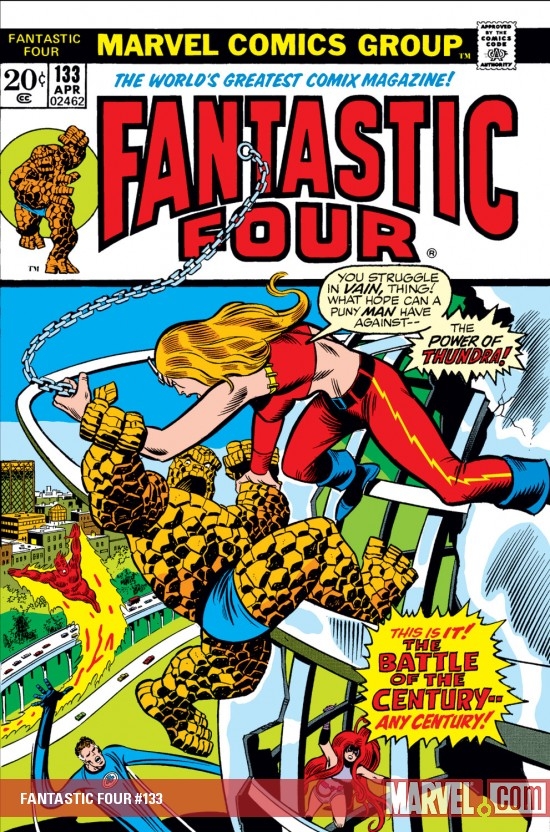
The Fantastic Four found themselves at the Unisphere in 1973
Check out these past podcast episodes for more information on World’s Fairs, Flushing Meadows Corona Park and comic books!
**In the new Avengers: Endgame there is a quick panning show of Flushing Meadows centers on Citi Field, proving you can’t make a Marvel movie without a little Queens in it.
All movie art and promotional photos above courtesy Marvel Entertainment — from the films Captain America: The First Avenger and Iron Man 2. All comic book art (except where otherwise noted) is courtesy Marvel Comics
PODCAST Visiting the first World’s Fair at Flushing Meadows Corona Park, the unimaginable playground of the future, planted inescapably within the reality of the day.
Flushing Meadows Corona Park, the fourth largest park in New York City and the pride of northern Queens, has twice been the doorway to the future.
Two world’s fairs have been held here, twenty-five years apart, both carefully guided by power broker Robert Moses. In this episode, we highlight the story of the first fair, held in 1939 and 1940, a visionary festival of patriotism and technological progress that earnestly sold a narrow view of American middle-class aspirations.
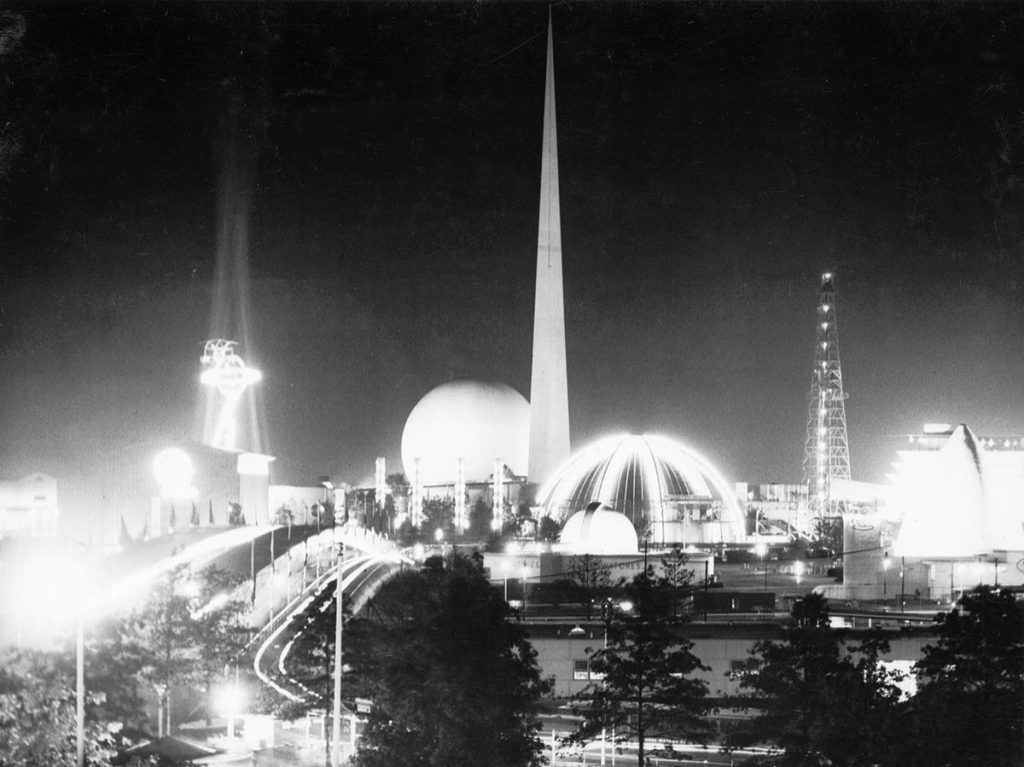
It was the World of Tomorrow! (Never mind the protests or the fact that many of the venues were incomplete.) A kitschy campus of themed zones and wacky architectural wonders, the fair provided visitors with speculative ideas of the future, governed by clean suburban landscapes, space-age appliances and flirtatious smoking robots.
The fair was a post-Depression excuse for corporations to rewrite the American lifestyle, introducing new inventions (television) and attractive new products (automobiles, refrigerators), all presented in dazzling venues along gleaming flag-lined avenues and courtyards.
But the year was 1939 and the world of tomorrow could not keep out the world of today. The Hall of Nations almost immediately bore evidence of the mounting war in Europe. Visitors who didn’t fit the white middle-American profile being sold at the fair found themselves excluded from the ‘future’ it was trying to sell.
And then, in July of 1940, there was a dreadful tragedy at the British Pavilion that proved the World of Tomorrow was still very much a part of the world of today.
PLUS: Where can you find traces of the fair in New York City today?
Listen Now: New York World’s Fair of 1939 Podcast
The Bowery Boys: New York City History podcast is brought to you …. by you!
We are now producing a new Bowery Boys podcast every other week. We’re also looking to improve the show in other ways and expand in other ways as well — through publishing, social media, live events and other forms of media. But we can only do this with your help!
We are now a member of Patreon, a patronage platform where you can support your favorite content creators.
Please visit our page on Patreon and watch a short video of us recording the show and talking about our expansion plans. If you’d like to help out, there are six different pledge levels (New Amsterdam, Five Points, Gilded Age, Jazz Age, Empire State and Greater New York). Check them out and consider being a sponsor.
And join us for the next episode of the Bowery Boys Movie Club, an exclusive podcast provided to our supporters on Patreon. This month’s movie — On The Town!
We greatly appreciate our listeners and readers and thank you for joining us on this journey so far.
AP Photo
Silent color video of the 1939 World’s Fair
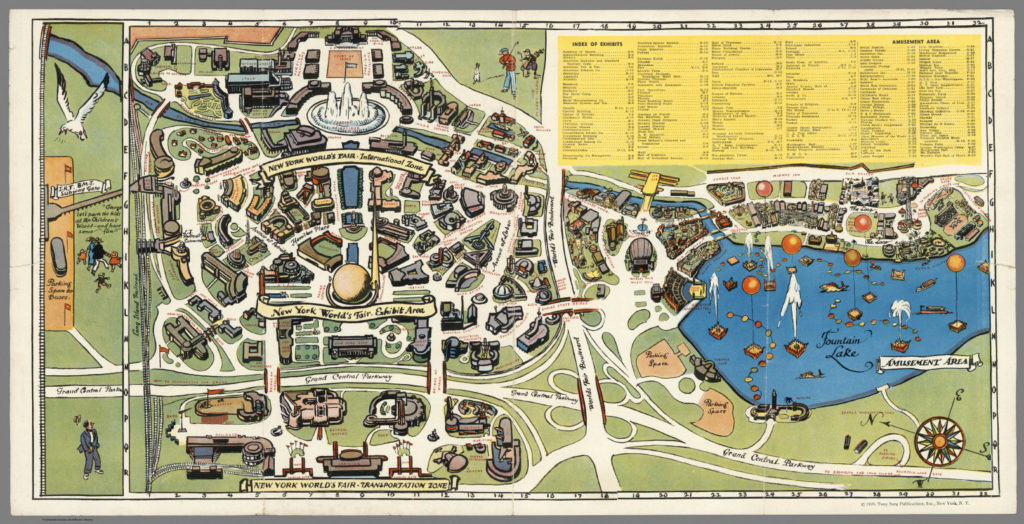
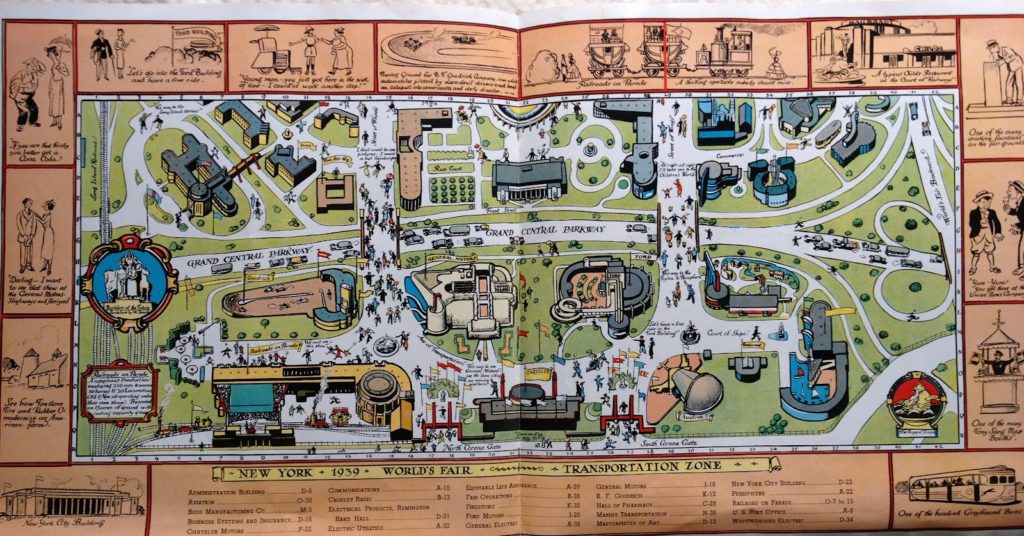
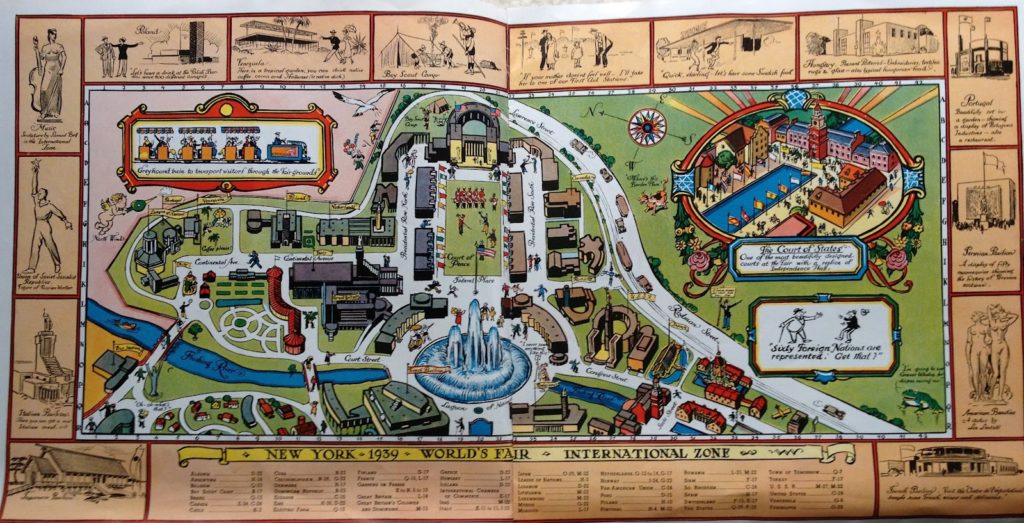
A map of the World’s Fair of 1939, courtesy the David Rumsey Map Collection. Click here to zoom in and get a closer look.
David Rumsey Map CollectionRenfusa/designer Tony SugaRenfusa/designer Tony Suga
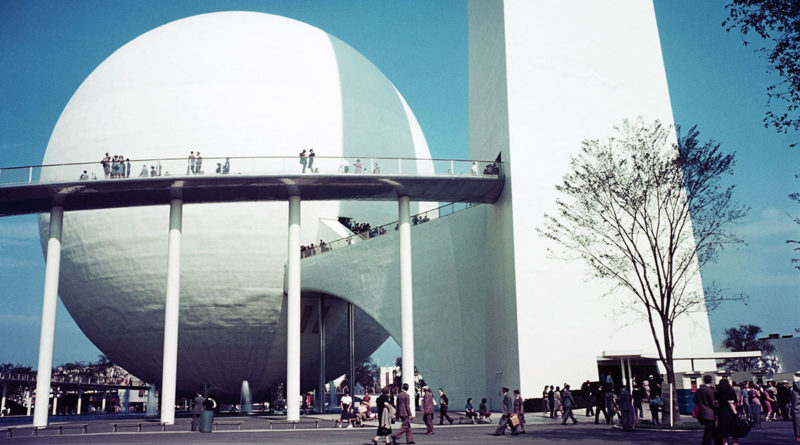
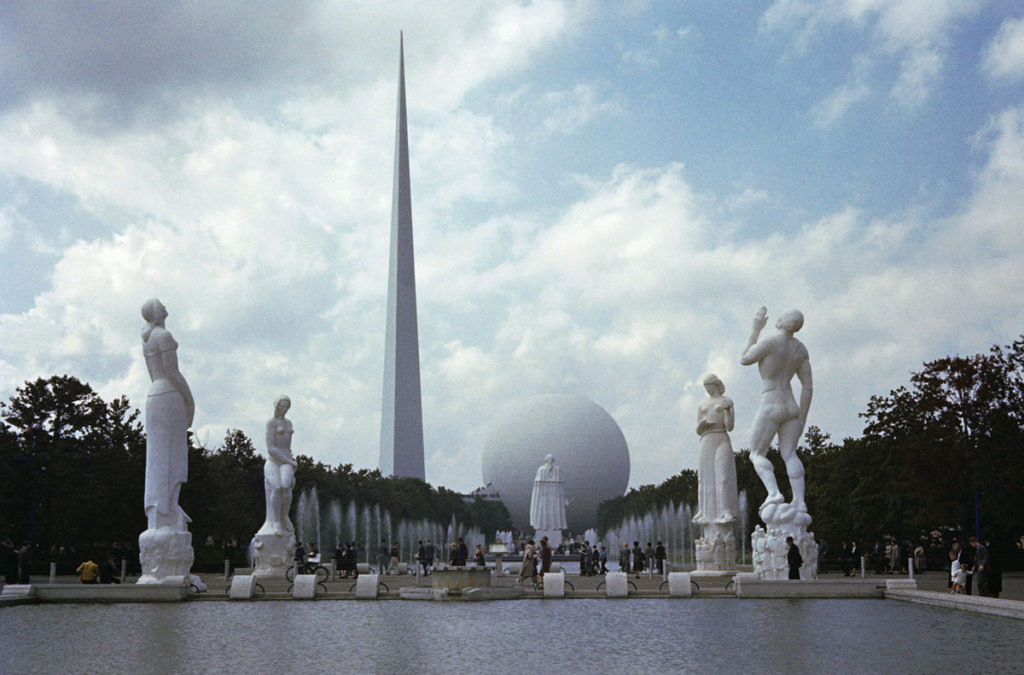
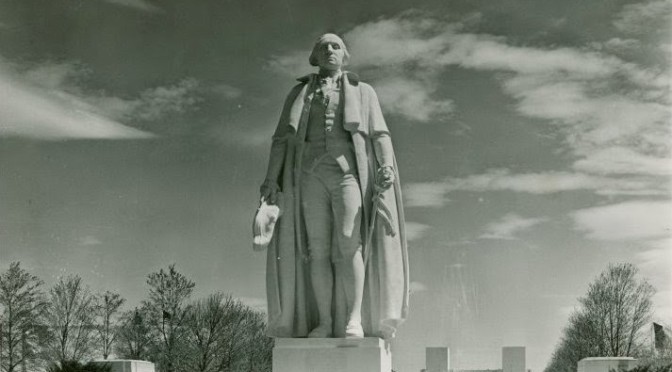
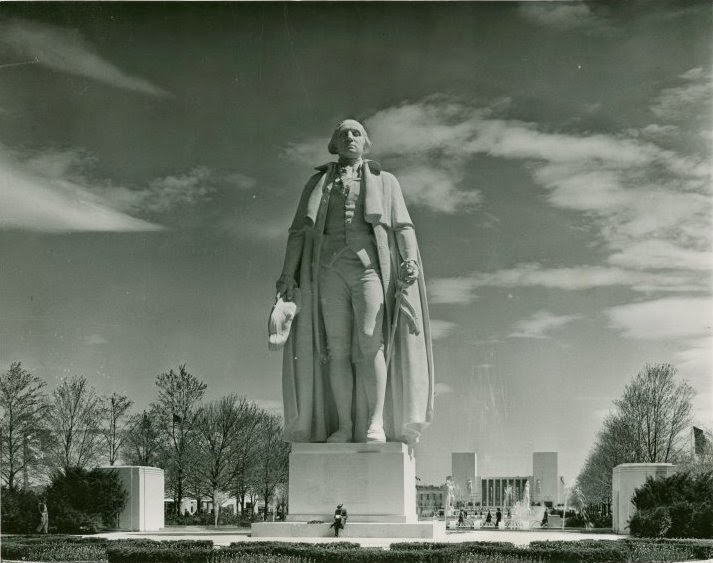
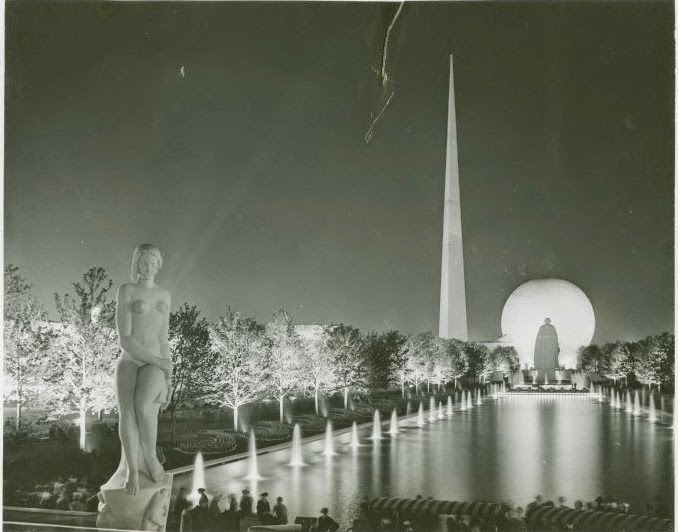
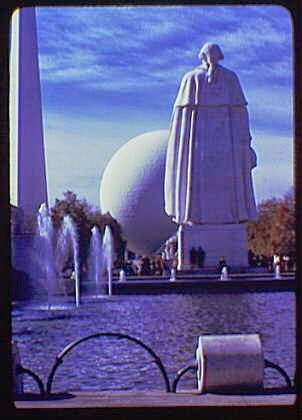
With the Trylon and Perisphere in the background, a statue of George Washington presides over the lagoon era and statues of the Four Freedoms. Read this for more information on the fair’s Washington inauguration connection.
Peter Campbell/CORBIS/Corbis via Getty Images
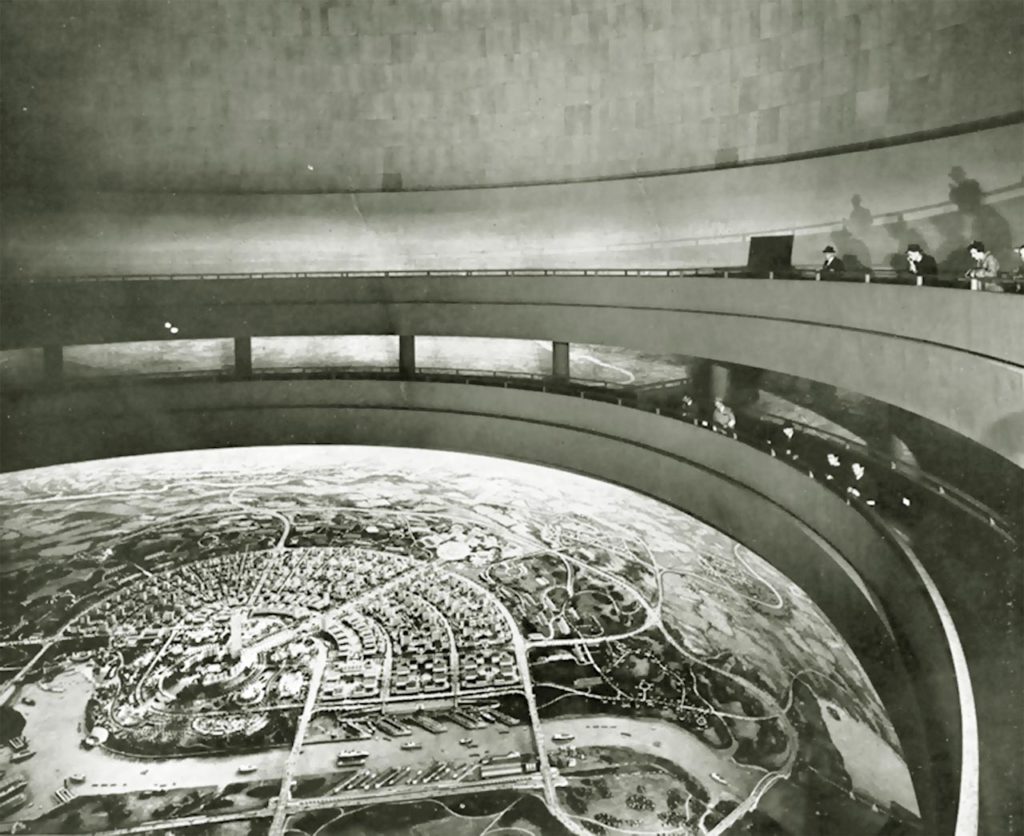
Gazing down at the wonder of Democracity within the Perisphere.
Worlds Fair Community
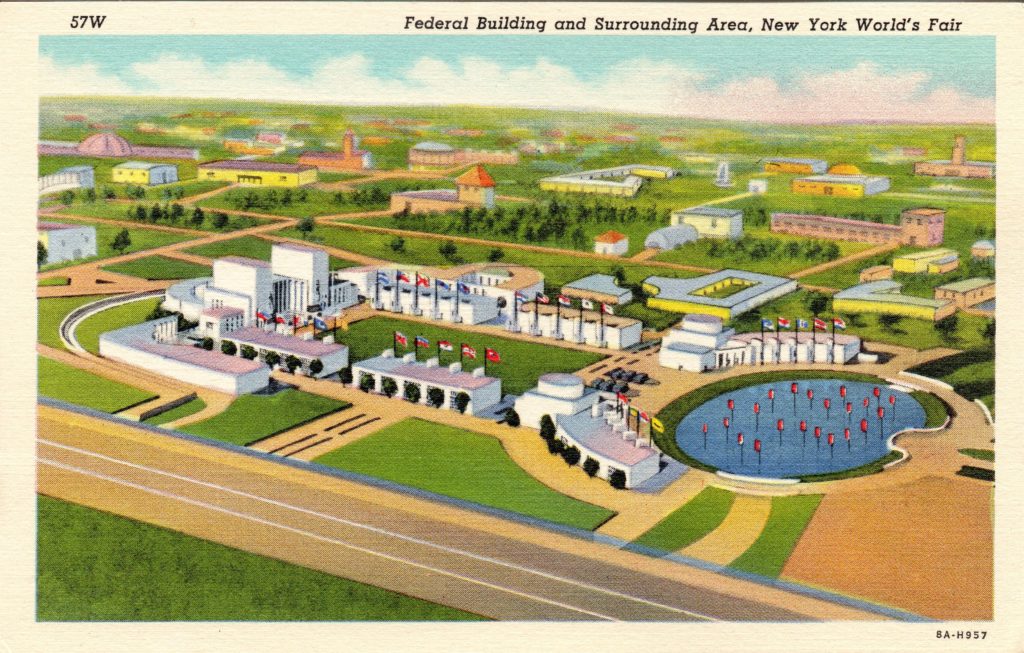
Starring into the gushing waters of the Lagoon of Nations with a view of the U.S. Federal Building.
A few images of pavilions from the ‘Government Zone’ that were mentioned on the show:
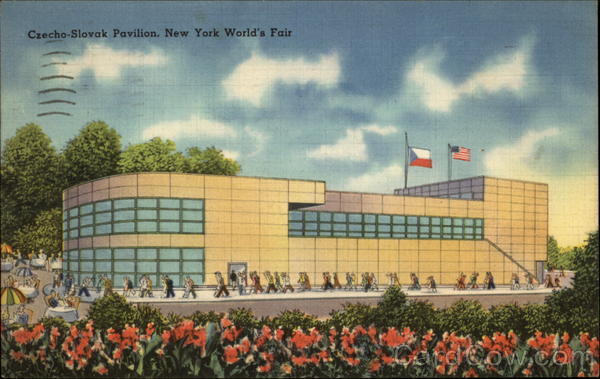
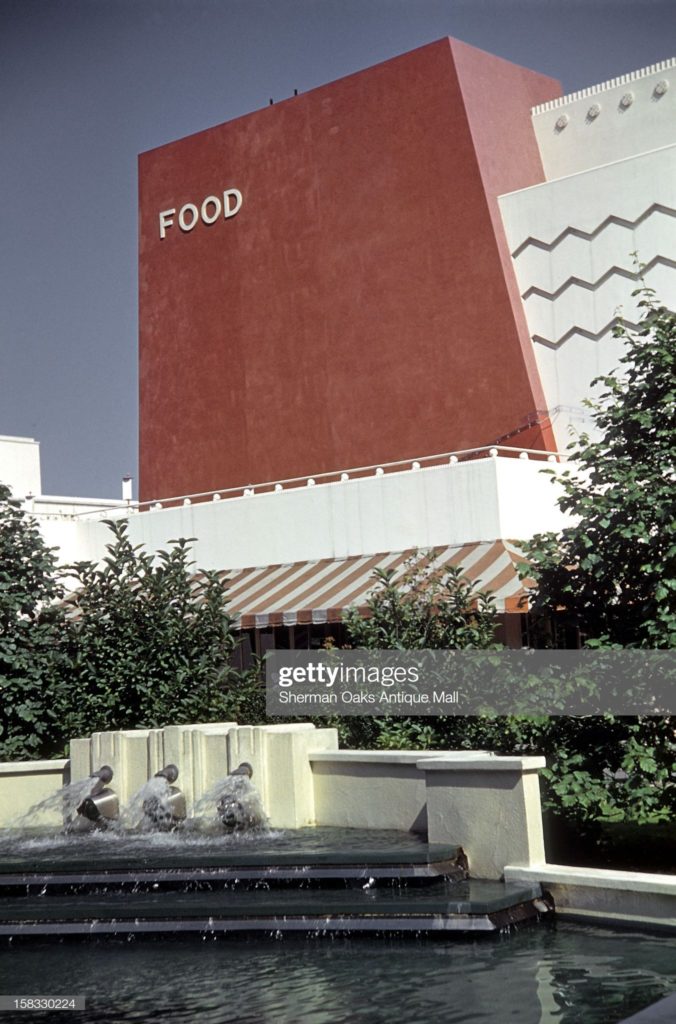
The Soviet Union pavilion/AP PhotoPoland pavilion/AP photoCzech-Slovak Pavilion, New York World’s Fair New York CityA view of the Food North Building at the 1939 New York World’s Fair in Flushing Meadows, Queens, New York City, New York. (Photo by Sherman Oaks Antique Mall/Getty Images)
The Mickey and Minnie Mouse cartoon which appeared at the National Biscuit Company (Nabisco) exhibition.
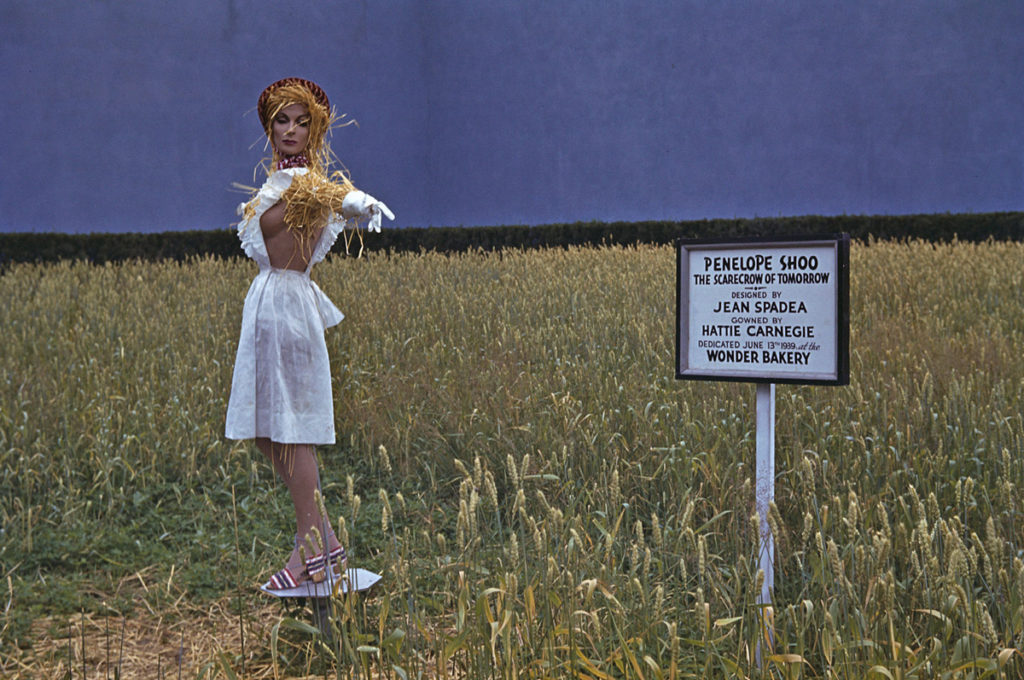
Wonder Bakery displays a wheat field exhibit at the 1939 World’s Fair. The model, Penelope Shoo, is wearing an outfit designed by Hattie Carnegie. The wheat field was billed as “the first planted in New York City since 1875.” (Peter Campbell//Corbis via Getty Images)
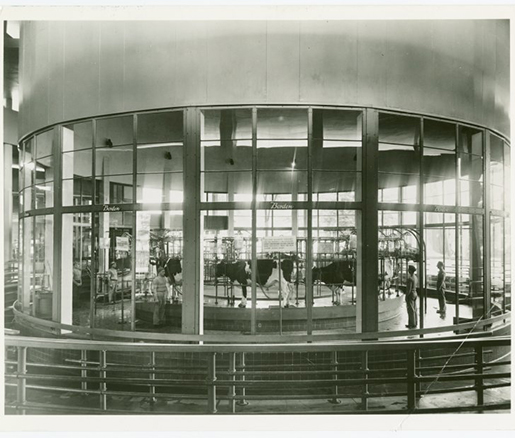
The ‘rotolactor’ in the Borden Company Exhibit
Courtesy James Beard
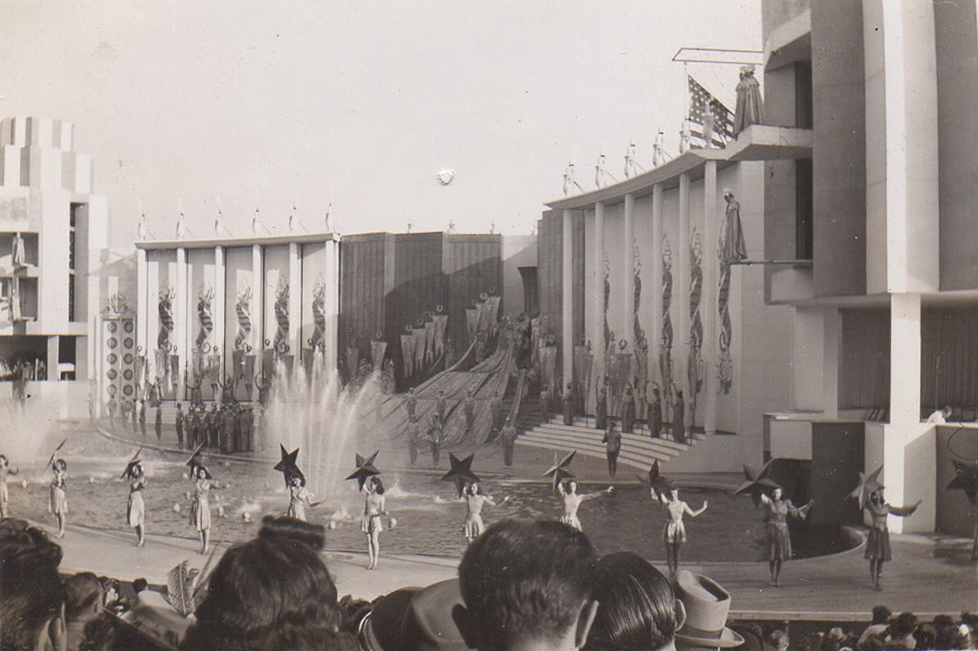
Billy Rose’s Aquacade — or if Aquaman were a musical!
You can find evidence of the 1939 Worlds Fair all over the place in the park! Just a few examples (pictures by Greg Young):
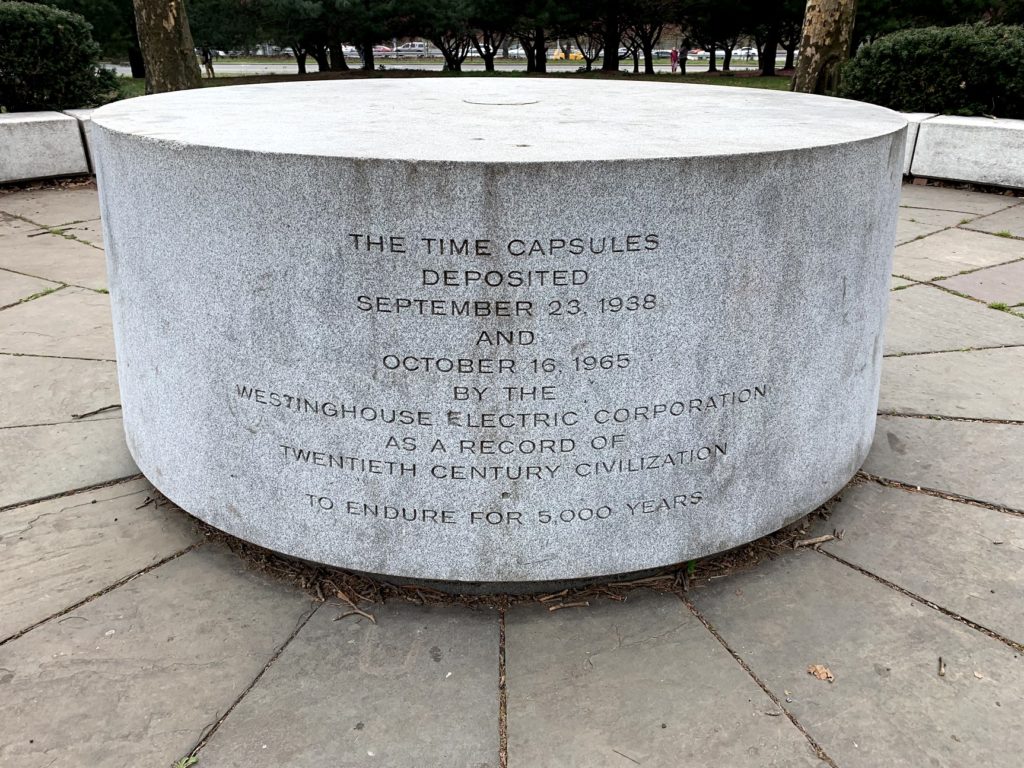
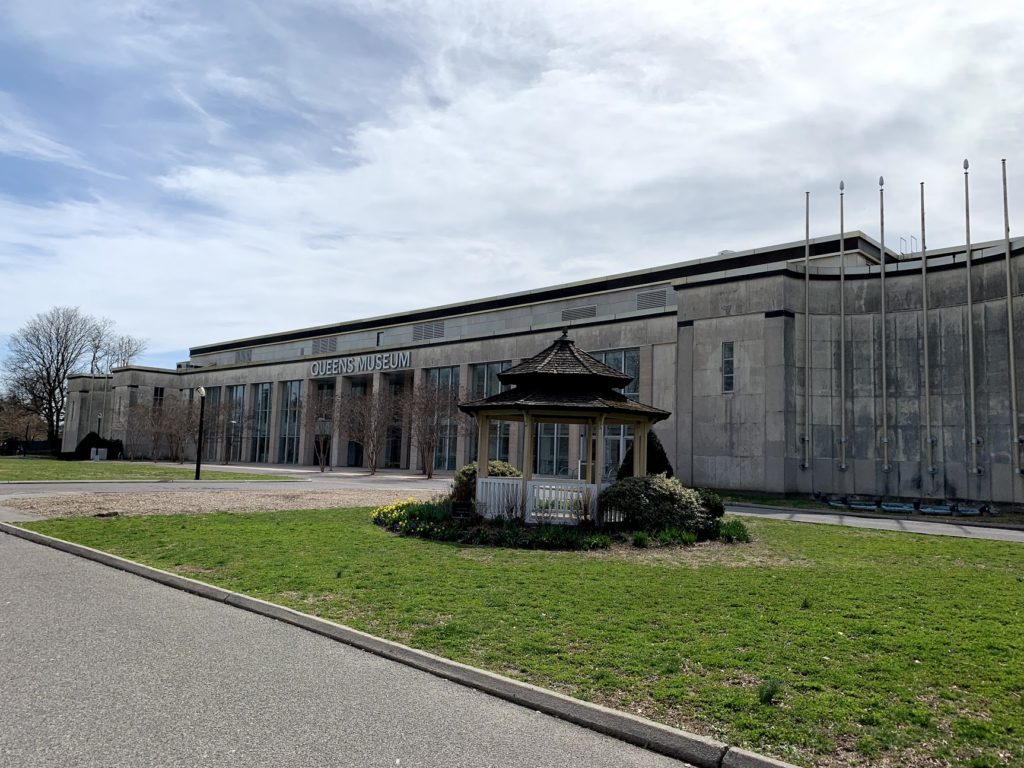
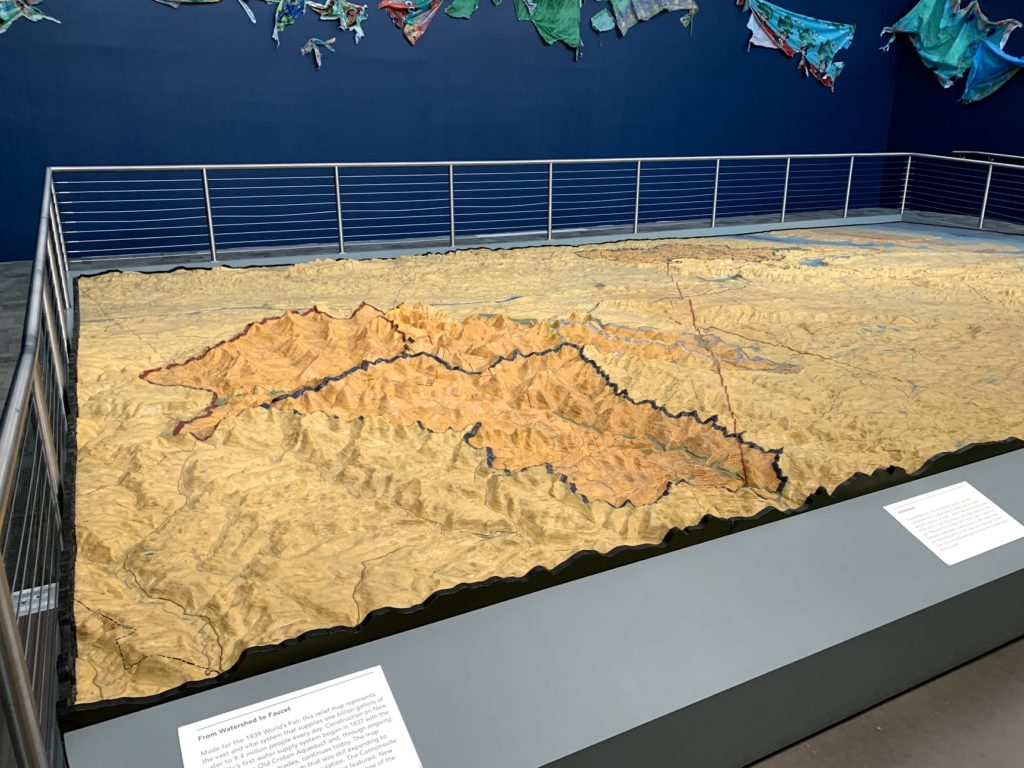
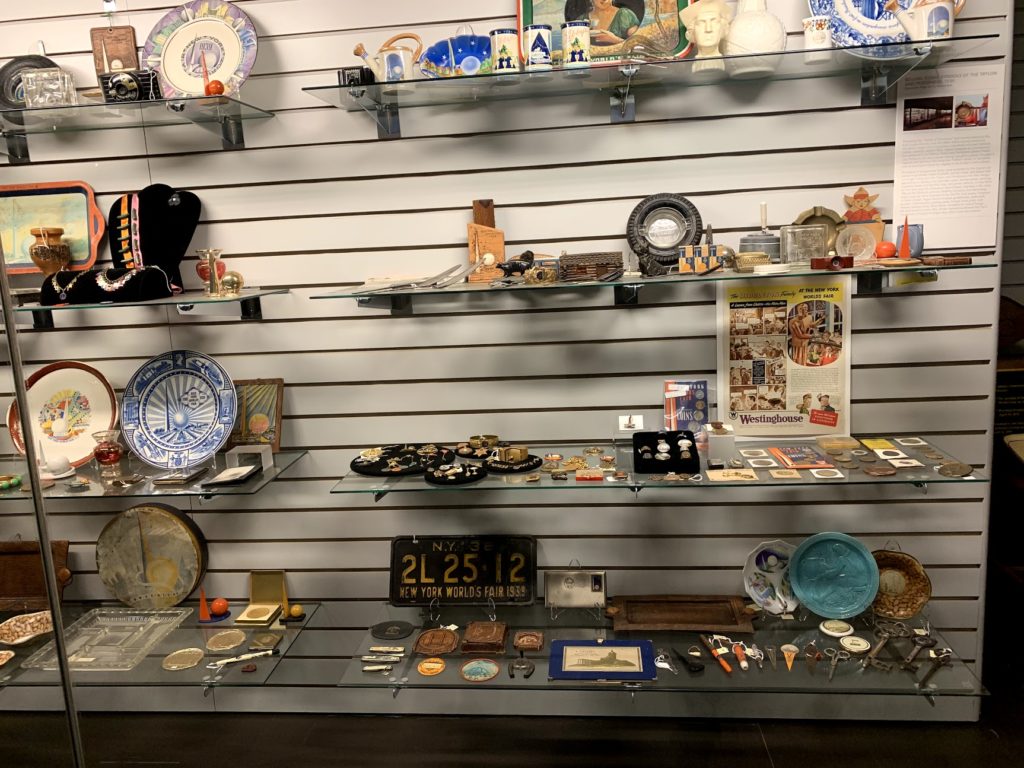
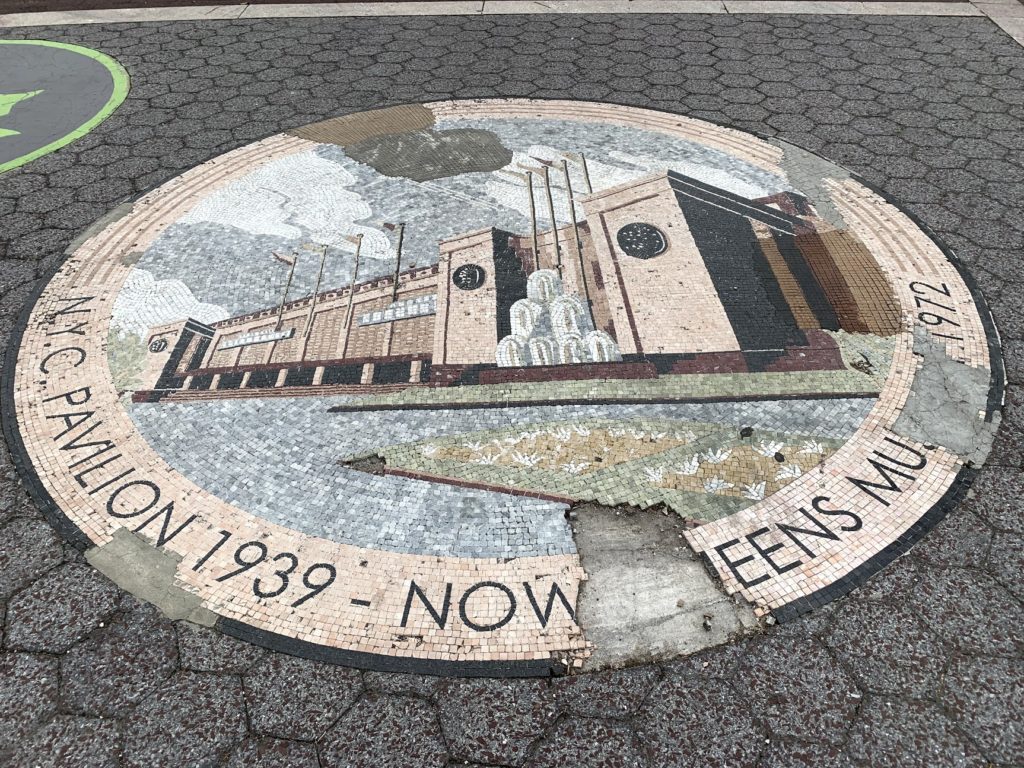
The former “New York City Building” which sat in the shadow of the Trylon and the Perisphere. Today it’s the Queens Museum….…where you can find the relief map of the New York City water supply, designed for the 1939 World’s Fair but never used.On the second floor, you’ll find a visible storage collection of World’s Fair memorabilia from both fairs.
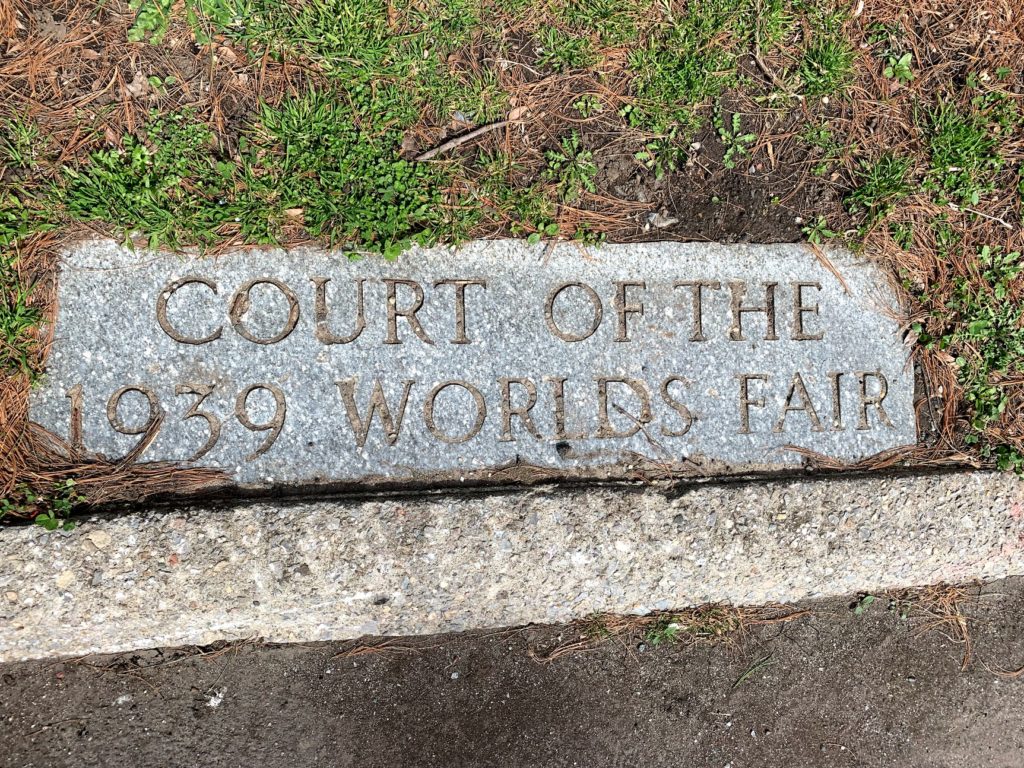
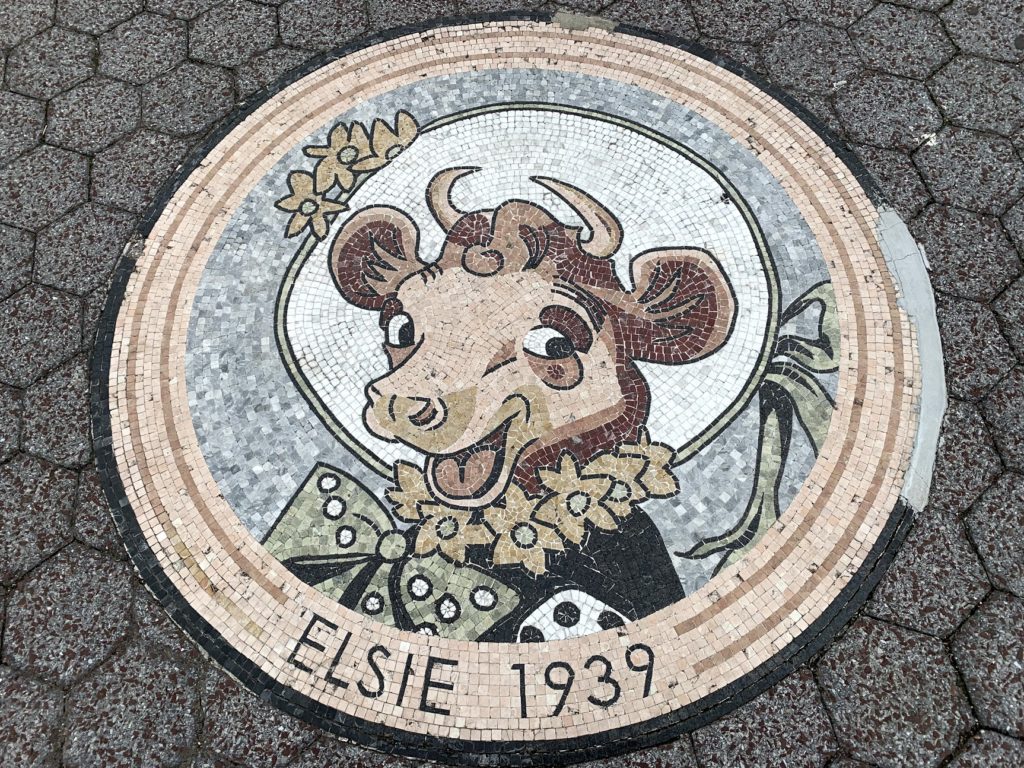
Don’t just look up! At your feet are also some tributes and traces to the World’s Fair.
FURTHER READING
The website 1939 New York World’s Fair is a wonderful resource, breaking down the specifics of most pavilions and even offering scans of brochures and programs from the fair.
The monumental events of America’s founding would be immortalized by the fair in some rather unusual ways 150 years later. Both April 30th events were occasions of great patriotic ceremony (and both even slightly kitschy) in their own ways.
Courtesy New York Public Library
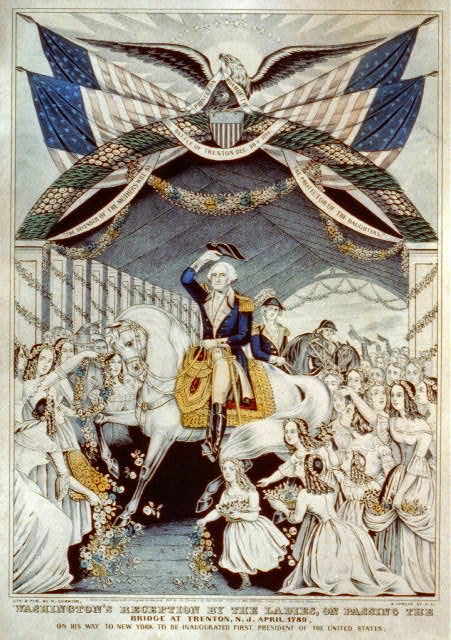
April 1789 It took George seven entire days to get to New York from his home in Mount Vernon, as his procession was met every step of the way with throngs of patriotic crowds and flamboyant celebratory displays.
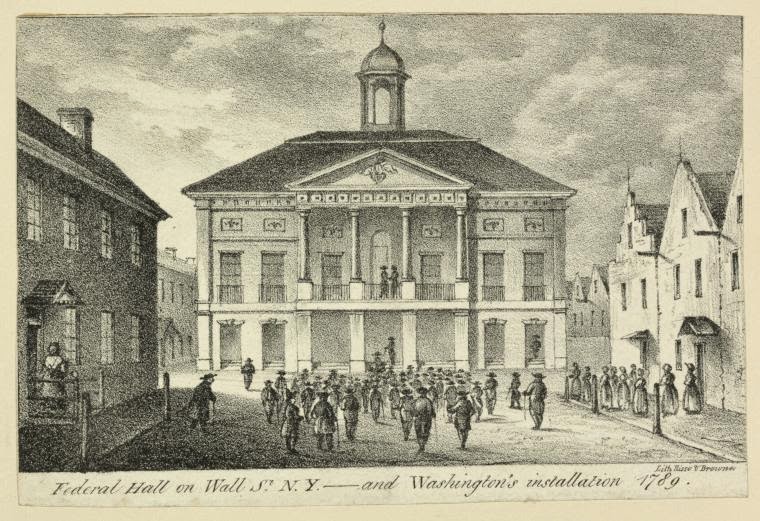
Washington’s vice president John Adams had already arrived in New York, on April 21st. The building which greeted him, the former City Hall building on Wall Street, had been the center of city’s government since 1699, when the British used materials from the city’s demolished north defense wall to construct it.
Courtesy New York Public Library
The heavily remodeled building which now stood in its place, later to be calledFederal Hall, was designed by successful city contractor and former Continental Army engineer Pierre Charles L’Enfant. According to author David McCullough, “it was the first building in America designed to exalt the national spirit, in what would come to be known as the Federal style.” (Sadly, this building was ripped down in 1812; the ‘Federal Hall’ which stands in the same spot today was built as a customs house in 1842.)
L’Enfant would later work on the creation of Washington DC out of Maryland swampland. He would ultimately be fired from that project — by George Washington.
George finally arrived in New York two days after Adams, April 23, via a barge from Elizabeth, New Jersey, and was met at the Wall Street pier by the current mayor of New YorkJames Duaneand the state’s governor George Clinton.
From there, he was taken to his new home on Cherry Street (long demolished, around near the Brooklyn Bridge anchorage today) and spent the day greeting dozens of well-wishers. That night, Governor Clinton hosted an elaborate dinner in his honor; the pomp and extravagance by this time were probably getting tiresome to the stately Virginian farmer.
Meanwhile Adams spent the week at Federal Hall in Senate chambers, hashing out such things we take for granted — such as how to even address the new president — until at last they were ready for the ceremony to begin, on April 30.
According to Ron Chernow: “Washington rose early, sprinkled powder in his hair, and prepared for his great day.” Like some detail from a fairy tale, Washington left his Cherry Street home at noon in a yellow carriage driven by white horses, legions of soldiers marching proudly behind him.
The streets of Manhattan were clogged with people, over ten thousand cramming Broad and Wall streets, as far as the eye could see both ways. Sitting on the balcony of his own home on Wall Street was Washington’s closest confidante Alexander Hamilton, certainly reveling in the moment.
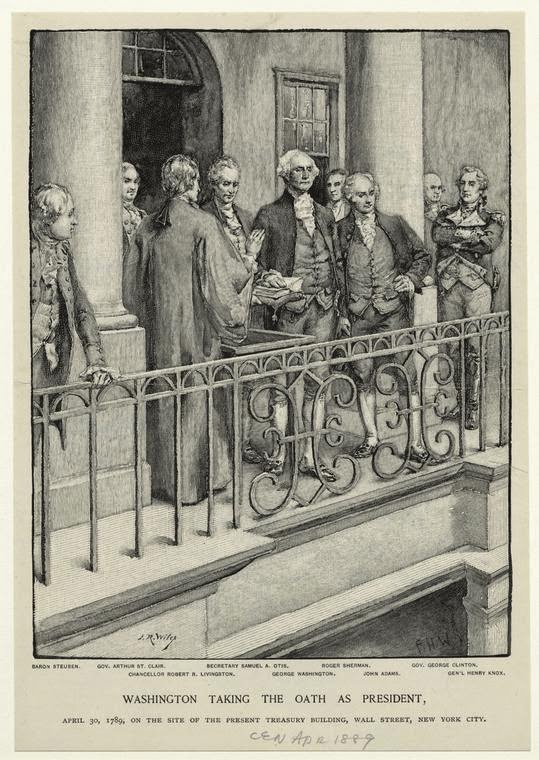
After greeting the Congress, Adams led Washington to the second floor balcony along with Robert Livingston, the Chancellor of New York (the highest judicial office in the state), who held out a bible owned by the St. John’s Lodge Freemasons and delivered the oath of office, probably not loud enough for anybody in the street to actually hear.
Washington, even less audibly than Livingston, swore to “faithfully execute the office of President of the United States, and will to the best of my ability, preserve, protect and defend the Constitution of the United States.” He then possibly threw in a ‘so help me God’ for good measure (although there are many doubts that this occurred).
Courtesy New York Public Library
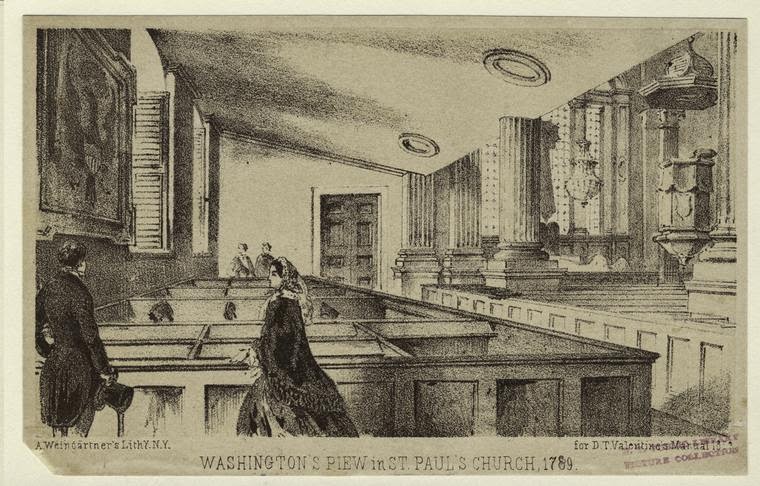
New Yorkers went crazy then, firing cannons, screaming and waving flags, playing music and dancing in the streets. After returning inside to address the new Congress — by this time with tears in his eyes — Washington and his entourage went up Broadway to receive on invocation at St. Paul’s Church, the scrappy survivor of the great fire the destroyed much of the city in 1776. Washington would be a regular here for his entire stay in New York; the pew where he planted himself for two years is still on display there (illustrated above).
Martha Washington would not arrive in town for another month, but that didn’t stop the parties. The official inauguration ball took place a week later, on May 7th, at the Assembly Rooms at 115 Broadway.
Although a bit stiff and silent, George was still popular with the ladies and danced “two cotillions and a minuet,” often seen with Alexander Hamilton’s young bride Eliza. When Martha arrived on May 17, landing at Peck Slip, she was greeted with similarly grand fanfare, and yet another ball was held in her honor.
James Earle Fraser’s colossal Washington statue out in Queens. (NYPL)
April 1939 One hundred and fifty years later, the 1939 New York World’s Fair opened in Flushing Meadows-Corona Park, the second largest American fair up to that time (only St. Louis’ 1904 event was larger).
This celebration of human advancement — as demonstrated through miles of utopian kitsch and strikingly bizarre architecture — was a reason for Robert Moses to turn the unsightly Corona Ash Dumps into a Queens super-park. The fair was advertisement as entertainment, with hundreds of modern gadgets displayed as novelties and staples of the future.
Courtesy the Museum of the City of New York
But the celebration was planned with the past in mind as well. It opened on April 30, 1939, coinciding with another great day in New York City history — Washington’s inauguration. That’s how important the city thought the opening of the fair was. (Life Magazine was a little more cynical; in 1939, they refer to Washington as “the excuse” for the fair. The purpose, of course, was profits.)
A 61-foot-tall statue of Washington by James Earle Fraser stood mightily over the fair’s Constitution Mall, peering perhaps quizzically at Paul Manship’s massive sundial sculpture. A cluster of buildings called the Court of States recalled the Colonial architecture of Washington’s day. Even Federal Hall was recreated.
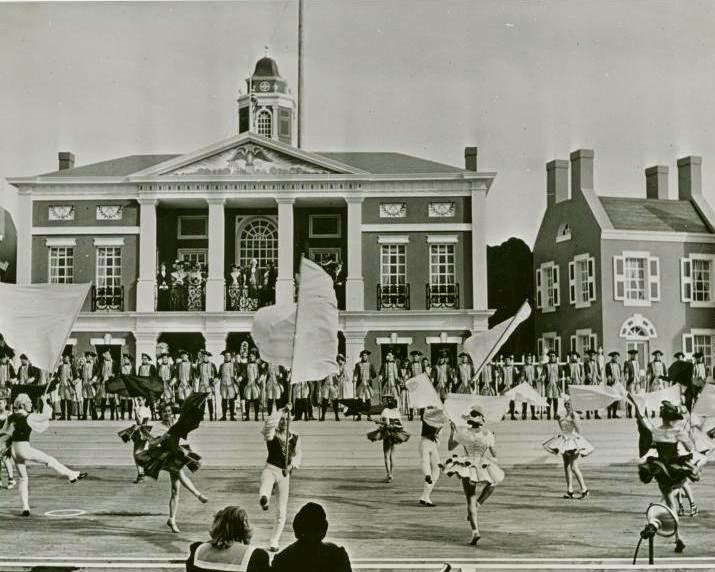
Below: The World’s Fair presented a recreation of Washington’s inauguration, except with lots of flag dancing. (NYPL)
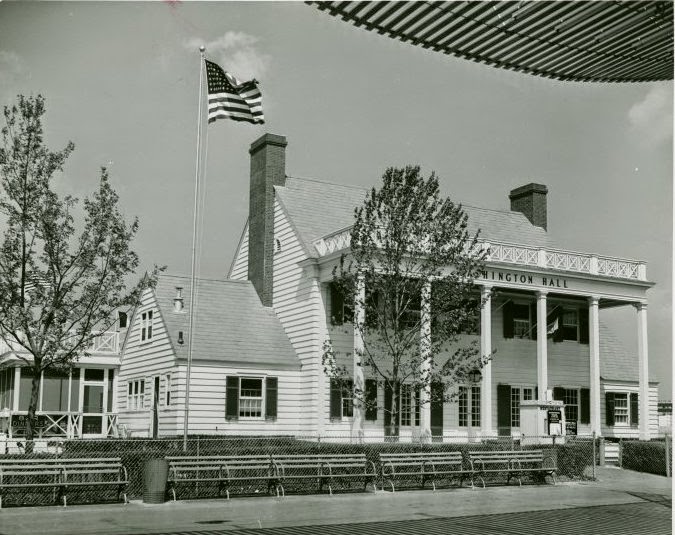
A replica of Mount Vernon (sort of) called Washington Hall was the pet project of a New Yorker with presidential ties.
Museum of the City of New York
According to the New Yorker, “Mr. Messmore Kendall, is responsible for the Hall. Mr. Kendall, president of Sons of the American Revolution and owner of the Capitol Theatre, [developed] plans for erecting, entirely at his own expense, a $28,000 building to house a collection of Washington relics. Before the Fair closes, he expects the whole thing will have cost him more than $50,000. He has given more than money to the project; he has given the family cook, so that whenever he wants a home-cooked meal, he has to go all the hell out to Flushing.”
The Hall received a host of reenactors who had made their way up from Mount Vernon in emulation of Washington’s own footsteps. On May 6th, a child named Robert E, Lee Williamson opened Washington Hall in a grand ceremony, bringing “three consecutive weeks of neo-Federal quaintness to a close.” [source]
The president also sits (sometimes awkwardly) upon a variety of World’s Fair merchandise. Light shows and fireworks unheard of in Washington’s time were dedicated in his honor throughout the fair. He even starred in a popular musical pageant at the fair called American Jubilee, with books and lyrics by Oscar Hammerstein.
It was another great president who kicked off the fair 75 years ago. With 200,000 people in attendance, Franklin Delano Roosevelt gave an opening speech extolling the virtues of American ingenuity as he became the first president to be broadcast to television audiences. Few had televisions in their homes at the time. But NBC founder David Sarnoff helpfully scattered a few dozen of them throughout the city in a clever publicity stunt.
Roosevelt starts off his speech referencing Washington. “[T]here have been preserved for us many generations later, accounts of his taking of the oath of office on April thirtieth on the balcony of the old Federal Hall. ….. And so we, in New York, have a very personal connection with that thirtieth of April, one hundred and fifty years ago.” [Read the whole speech here.]
Defined by the odd Trylon and Perisphere buildings, the fair seems like something truly dreamlike. The land where the fair once stood now contains the ruins of a New York’s other World’s Fair, the event from 1964-65.
TODAY
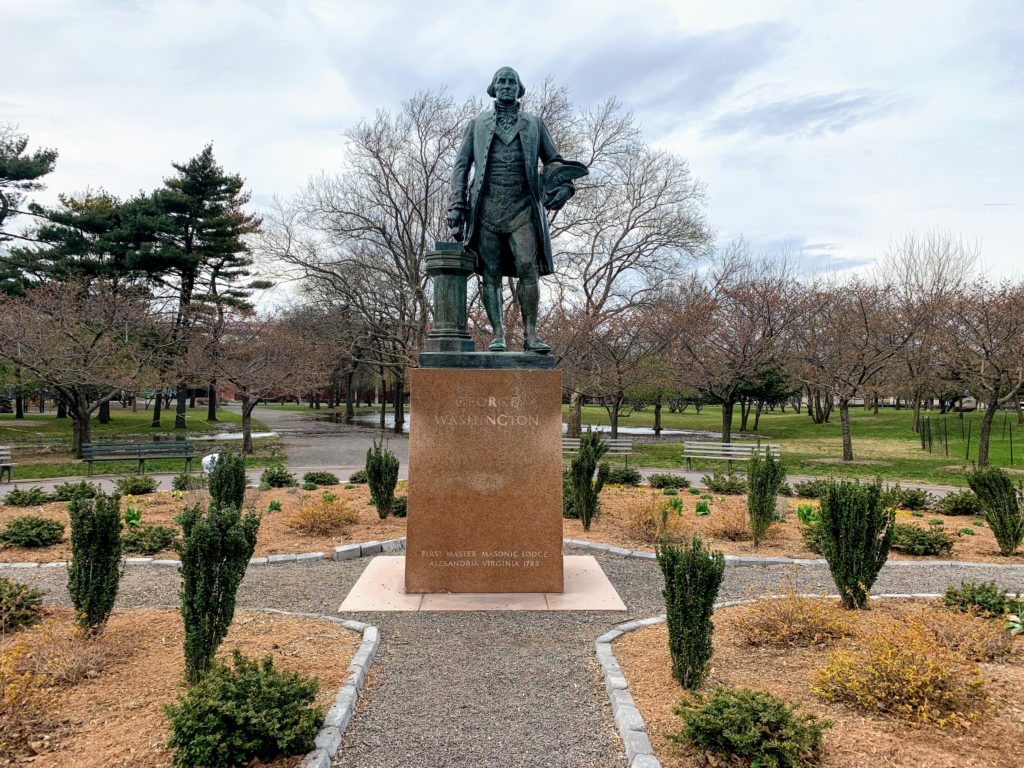
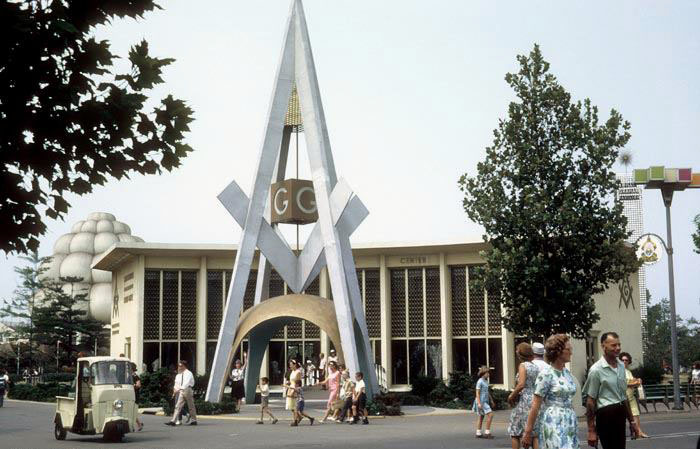
You can still find a tribute to George Washington in Flushing Meadow Corona Park today. George Washington as Master Mason by Donald De Lue was installed here in 1967, a replica of a much larger Washington statute, made of plaster, that stood at the New York World’s Fair of 1964-65 within the Masonic Pavilion. (That’s right; the Freemasons had a World’s Fair pavilion).
That 11-foot plaster statue of Washington stood next to the actual Masonic Bible on which Washington took his oath of office. Today the bible is on display — at Federal Hall.
For this article, I’ve re-purposed a couple pieces of writing I did on these events a few years ago. The original pieces can be found here and here.
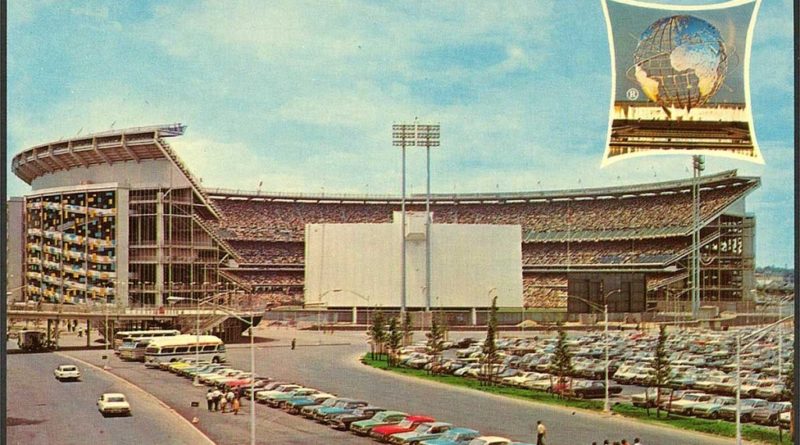
With mourning fans looking on, the final section of seats were torn out on the morning of February 18, 2009. Awaiting fans a short distance away was the sparkling new Citi Field which would open for business with a thrilling game between the San Diego Padres and the field’s home team the New York Mets.
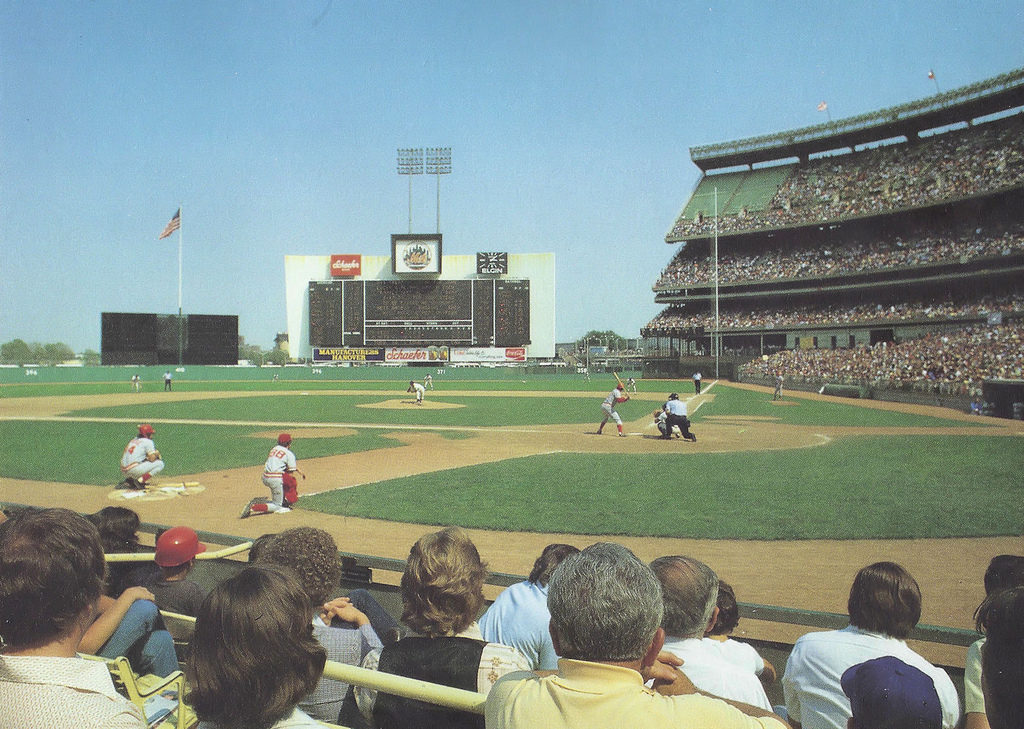
Shea was not a perfect stadium. Neither was Ebbets Field, the former home of the Brooklyn Dodgers that has nonetheless entered into the realm of sports mythology. But nostalgia holds a special power in sports history, and the further we get from the classic moments which took place at Shea, the more remarkable it becomes in memory.
Quite frankly, Queens has not been quite the same.
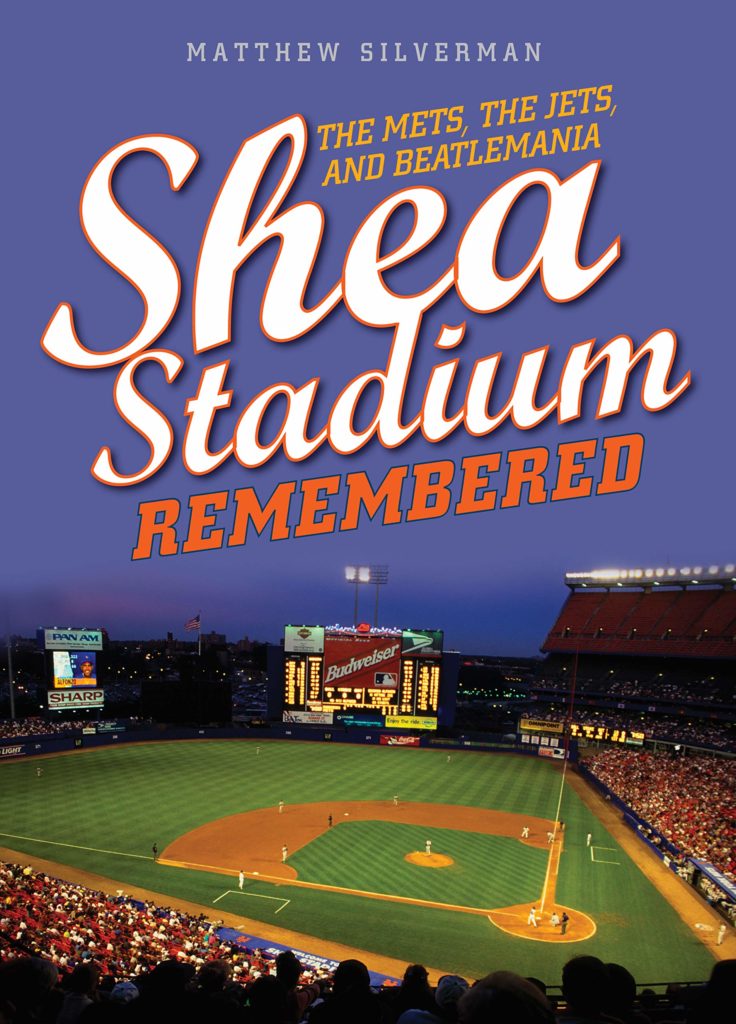
Shea Stadium Remembered: the Mets, the Jets and Beatlemania by Matthew Silverman Lyons Press
Journalist Matthew Silverman is such an ardentMets aficionado — if you’ve read a book about the beloved Queens baseball team, he probably wrote it — that his official website is MetSilverman.com. And so of course Shea Stadium Remembered: the Mets, the Jets and Beatlemania, his tribute to the Met’s most famous home, has a breezy pitch-perfect charm to it.
Arranged in tiny chapters, little blips of history, Shea Stadium Remembered revels unashamedly in sweet nostalgia, recalling a place that matched the charisma of its underdog baseball team and a home for an accomplished football team back when it was actually situated within the city.
The birth of the Mets and their home for over 40 years begins in a moment of great turmoil in New York City sports history. In the 1950s, both the New York Giants and the Brooklyn Dodgers left New York City, the latter after a vicious public battle between Dodgers owner Walter O’Malley and New York power broker Robert Moses.
Moses wanted a team situated in Queens, in Flushing Meadows-Corona Park, an eventual companion to Moses’ pet project — the World’s Fair of 1964. With Ebbets growing inadequate for modern baseball crowds, O’Malley wanted a new stadium at Atlantic and Flatbush Avenues, keeping them in Brooklyn. (That’s near the spot of today’s Barclays Center.)
But nobody overpowered Robert Moses in the 1950s. The Dodgers split for Los Angeles.
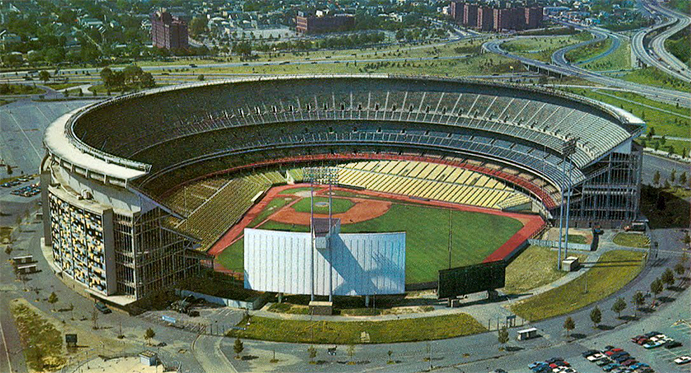
Shea Stadium, late 1970s — Sports Photo File/Mitchell Reibel
Fortunately, lawyer William Shea convinced the National League to expand their roster, leading to the creation of the New York Metropolitans, the name a nod to a 19th century baseball club and eventually shortened. After a short stint in the decrepit Polo Grounds, they moved to their new home — named in honor of a man who never played for them but was nonetheless instrumental to the history of New York City sports.
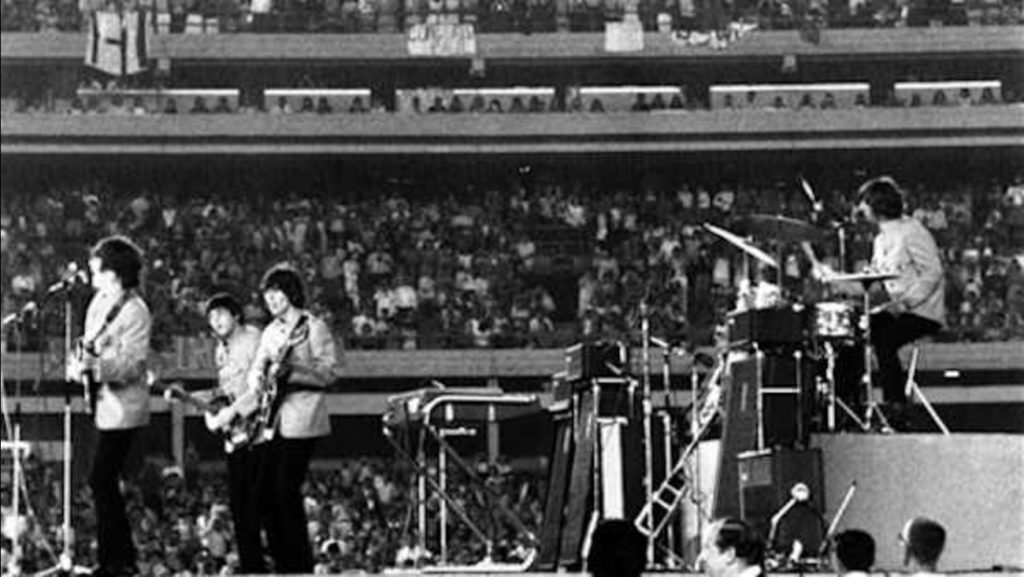
In Shea Stadium Remembered, Silverman gives us a compilation of the stadium’s greatest moments, weaving the Met’s history in with the other notable events at the stadium — from the Beatles to Pope John Paul II.
Not to say that the Jets aren’t prominently featured here as well — they played at Shea for almost twenty years — but the Mets were truly at home here, through thick and thin (often very thin). The Mets gave Shea some of its personality and Shea gave the Mets its hometown pride.
The Beatles at Shea Stadium, August 1965 (AP)
For more information, check out these catalog episodes of the Bowery Boys podcast:
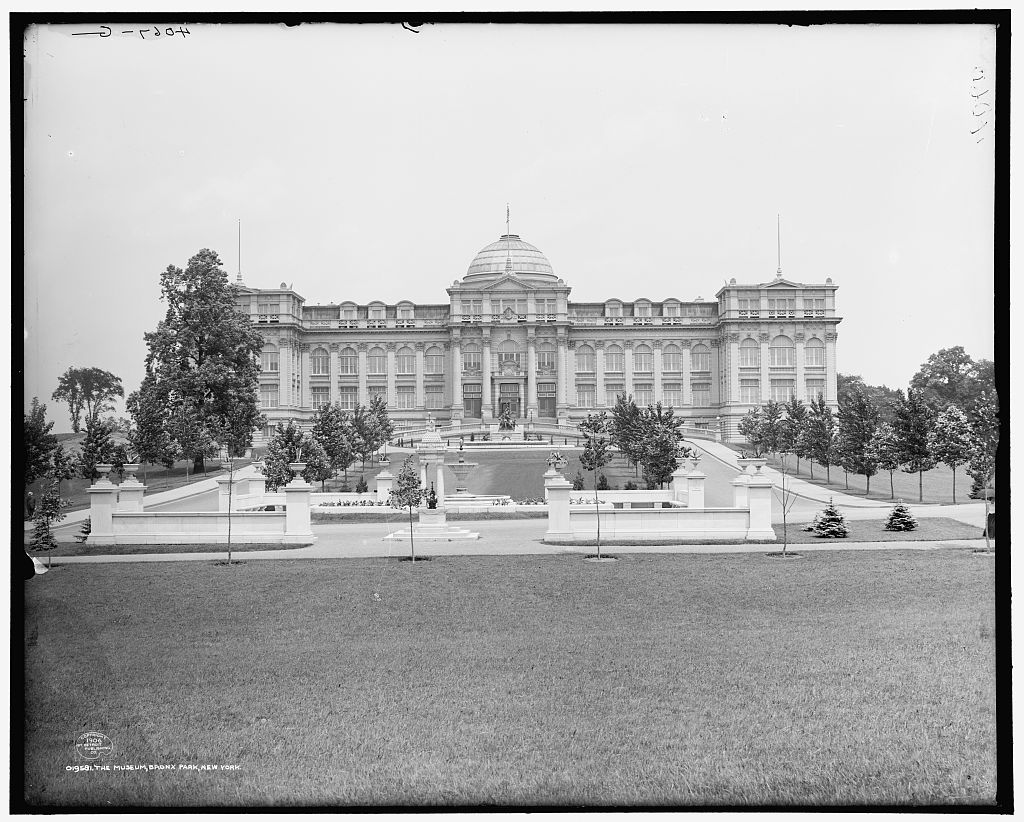
PODCAST The story of how the Bronx became a part of New York City and the origin of some of the borough’s most famous landmarks.
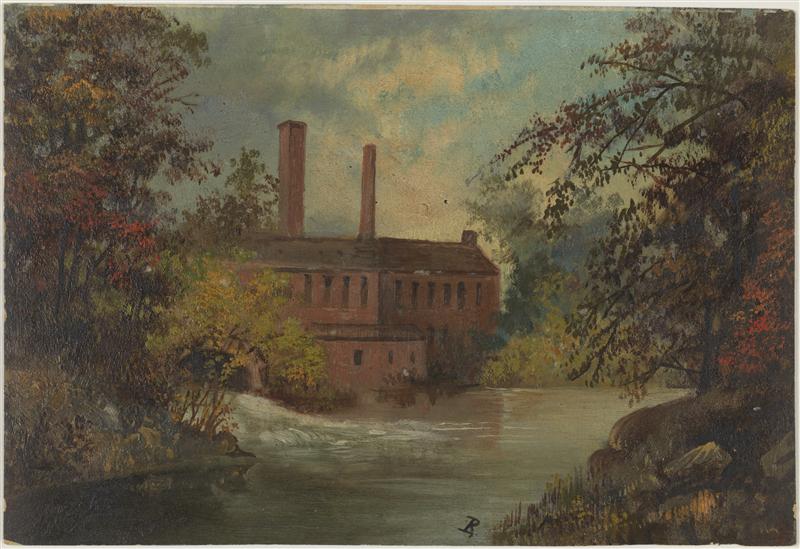
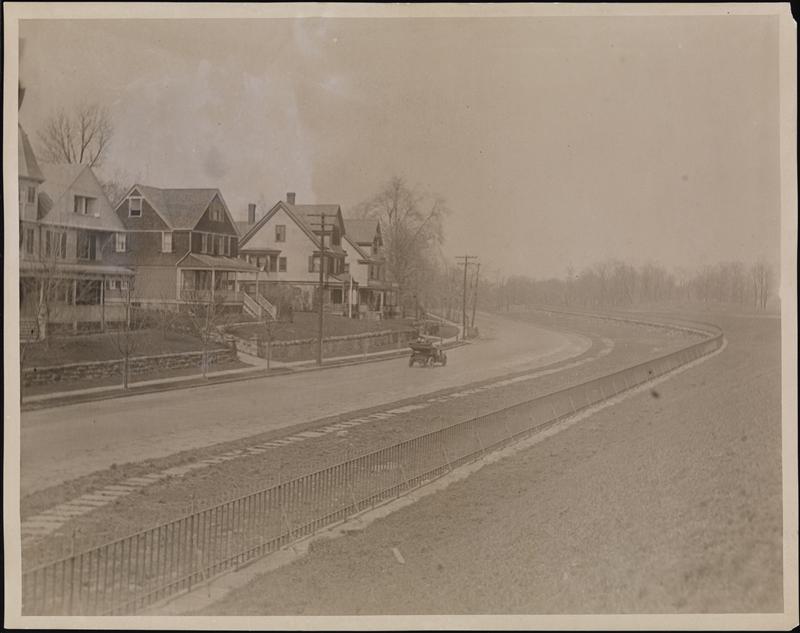
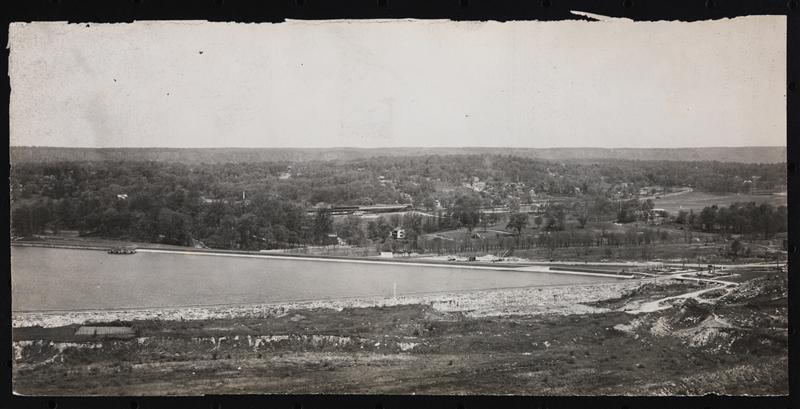
In the second part of the Bowery Boys’ Bronx Trilogy — recounting the entire history of New York City’s northernmost borough — we focus on the years between 1875 and 1945, a time of great evolution and growth for the former pastoral areas of Westchester County.
New York considered the newly annexed region to be of great service to the over-crowded city in Manhattan, a blank canvas for visionary urban planners. Soon great parks and mass transit transformed these northern areas of New York into a sibling (or, perhaps more accurately, a step-child) of the densely packed city to the south.
The Grand Concourse embodied the promise of a new life for thousands of new residents — mostly first and second-generation immigrants, many of them Jewish newcomers. The Hall of Fame of Great Americans was a peculiar tourist attraction that honored America’s greatest. But the first time that many outside New York became aware of the Bronx may have been the arrival in 1923 of New York’s most victorious baseball team, arriving via a spectacular new stadium where sports history would frequently be made.
By the 1930s Parks Commissioner Robert Moses began looking at the borough as a major factor in his grand urban development plans. In some cases, this involved the creation of vital public recreations (like Orchard Beach). Other decisions would mark the beginning of new troubles for the Bronx.
The Bowery Boys: New York City History podcast is brought to you …. by you!
We are now producing a new Bowery Boys podcast every two weeks. We’re also looking to improve the show in other ways and expand in other ways as well — through publishing, social media, live events and other forms of media. But we can only do this with your help!
We are now a member of Patreon, a patronage platform where you can support your favorite content creators for as little as a $1 a month.
Please visitour page on Patreon and watch a short video of us recording the show and talking about our expansion plans. If you’d like to help out, there are five different pledge levels (and with clever names too — Mannahatta, New Amsterdam, Five Points, Gilded Age, Jazz Age and Empire State). Check them out and consider being a sponsor.
We greatly appreciate our listeners and readers and thank you for joining us on this journey so far. And the best is yet to come!
The burial vault of the Van Cortlandts was actually contained within the newly formed park. And it’s still there.
Courtesy New York Park Service
NYU’s former University Heights campus (now the home of Bronx Community College) contains one unusual tourist attraction — the Hall of Fame of Great Americans
Louis Risse’s vision of the Grand Concourse in 1892 obviously did not imagine automobiles using the boulevard.
MCNY
Kingsbridge Road near the Grand Concourse, 1890. It was originally a dirt road of course.
MCNY
The New York Botanical Garden inaugurated Bronx Park and created another reason for New Yorkers to head up to the vastly evolving area up north.
A romantic depiction of the Lorillard snuff mill on the Bronx River. The building is still on the river, contained within the Botanical Garden.
By Frederick Rondel, Jr., courtesy MCNY
Jerome Park Reservoir, opposite a set of homes, pictured here in 1920 and (below) 1936.
MCNYMCNY
The unveiling of the Heinrich Heine monument in today’s Joyce Kilmer Park on the Grand Concourse.
MCNY
Lavish apartments like the Roosevelt (pictured here in 1924 and in 1937) were able to attract New Yorkers escaping the overcrowded Lower East Side.
MCNYMCNY
Fordham Road in 1930 with the Grand Concourse East Kingsbridge Road steaming by.
Photo by William Roege (1930)
A Yankee Stadium postcard circa 1945
Courtesy MCNY
Ruth was so integrally a part of the Bronx and Yankee Stadium that when he died in 1948, his casket was taken to the stadium where tens of thousands of people came to pay their respects.
A few selections from our Instagram account of things we discussed on this week’s show:
We hope you enjoyed our 200th Bowery Boys podcast on Jane Jacobs. For further reading on her life, philosophy and work, we recommend the following books, most of which we used as source material for this show.
The Death and Life of Great American Cities by Jane Jacobs — Obviously you should start with Jacobs’ opus on how the American city works (well, at least the city of the 1960s). Â She has a clear, approachable and pragmatic way of looking at urban problems. You’ll also notice immediately how modern city planners have used some of the ideas she’s described.
Wrestling With Moses by Anthony Flint — Perhaps the most succinct book on the specific crises which pitted Robert Moses with Jacobs, a breezy and engaging tale of New York City in the 1950s and ’60s.
Jane Jacobs: Urban Visionary by Alice Sparberg Alexiou — If you’d like a good biography on Jacobs, try this enjoyable read (published in 2006, the year of Jacobs’ death) that gives an overview of her life and career.
Becoming Jane Jacobs by Peter Laurence — If you’re looking for something more recent, this brand new biography uniquely explores the origins of how she developed her ideas of urban places. Even if you’ve read any of the books listed above, Laurence’s book goes more deeply into her many influences.
The Battle For Gotham by Roberta Brandes Gratz — For even more expansive look at the legacies of both Moses and Jacobs, especially in the proceeding decades. Gratz takes specific aim at more recent projects in New York in a very personalized way.
The Village by John Strausbaugh — A wide-lens history of Greenwich Village, Strausbaugh spends a great amount of time looking at how Jacobs assisted in the salvation of her neighborhood, and how these preservation battles interlocked with the culture of the day.
The Power Broker by Robert Caro — Jacobs famously doesn’t even make an appearance in Caro’s legendary, barn-burning biography, but the book remains essential reading for anybody interested in mid-century America.
————–
Or burrow your way through the New York Times archives of material on the battles waged by Jane Jacobs and Village community activists against the city. Â Start with these:
Shopping Scarce In City Projects “Most of the 350,000 New Yorkers living in public housing must go outside the projects for the loaf of bread, the quart of milk, the daily newspaper and the sociability of the candy store, coffee shop or tavern.” (June 16, 1957)
To celebrate the 100th anniversary of her birth (May 4), the Municipal Art Society, with funding by the Rockefeller Foundation, has been hosting a series of events this year. From the website #JJ100:
“The celebration will pay tribute to Jane Jacobs on the 100-year anniversary of her birth by highlighting self-organized activities and events that embody Jane’s lasting legacy in cities around the world.”
Starting with Jane’s Walk in May, and culminating at the Habitat III Conference in Quito, Ecuador, Jane Jacobs at 100 will promote self-organized Jacobsian programming and projects taking place in New York and in cities around the world.” Â Keep checking in at their website for more information. And of course Jane’s Walk arrives in May!
————–
Meanwhile The Center for the Living City is taking a fascinating approach to their celebration of Jacobs’ legacy. Check out their dedicated page Jane’s 100th for a list of events and unique objectives. Including getting Jane Jacobs on a postage stamp! (How is she not on a postage stamp? Harry Potter has a postage stamp!)  Author Peter Laurence has set up a petition for this that you obviously must sign.
You also may be interested in their new project being launched as part of their Jacobs celebrations —the Urban Acupuncture Network.
————–
By the way, if you’re interested in hearing the entire 1962 chat by Jane Jacobs that we featured in our show, you can hear it here.
Or perhaps you’d like to catch the new Robert Moses/Jane Jacobs opera — A Marvelous Order!

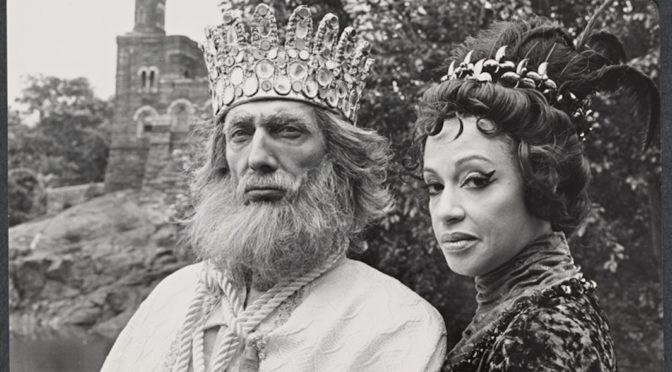
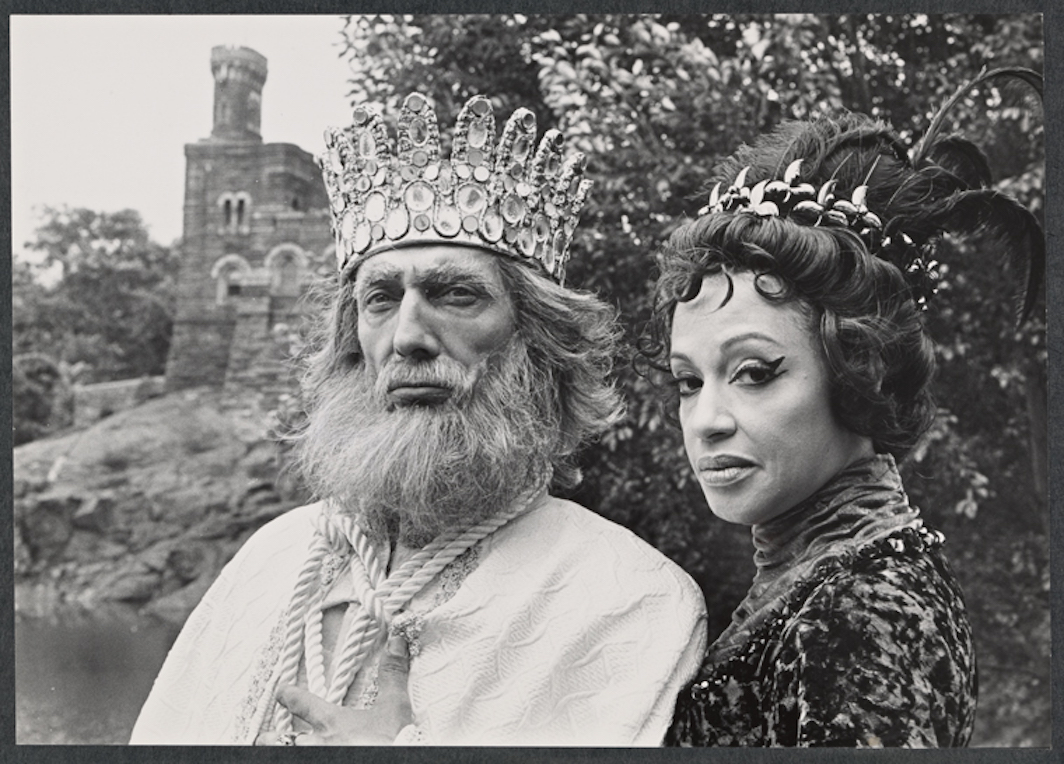
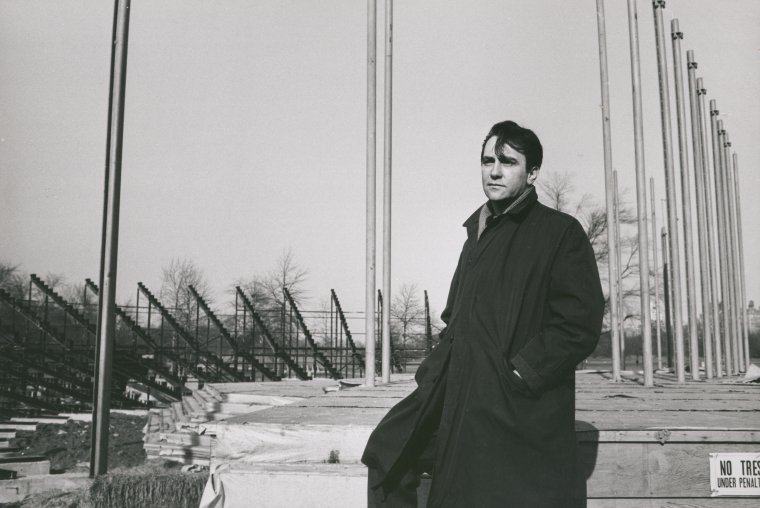
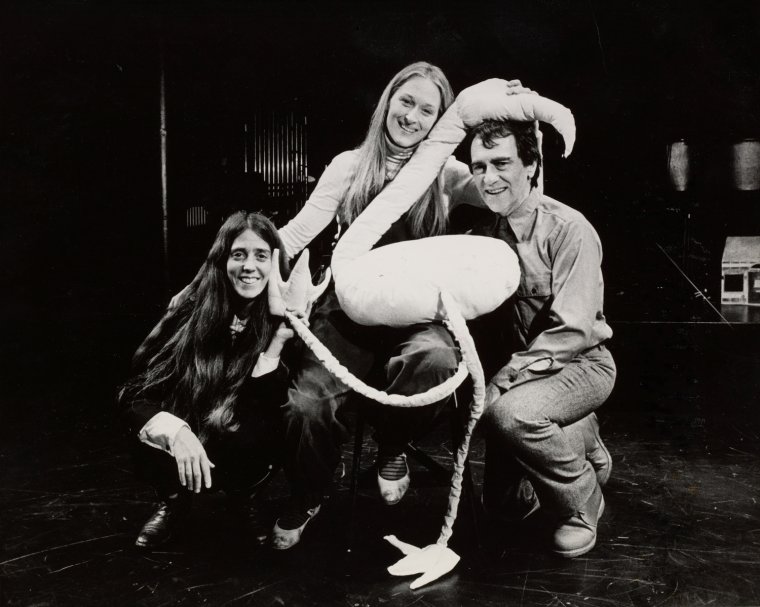
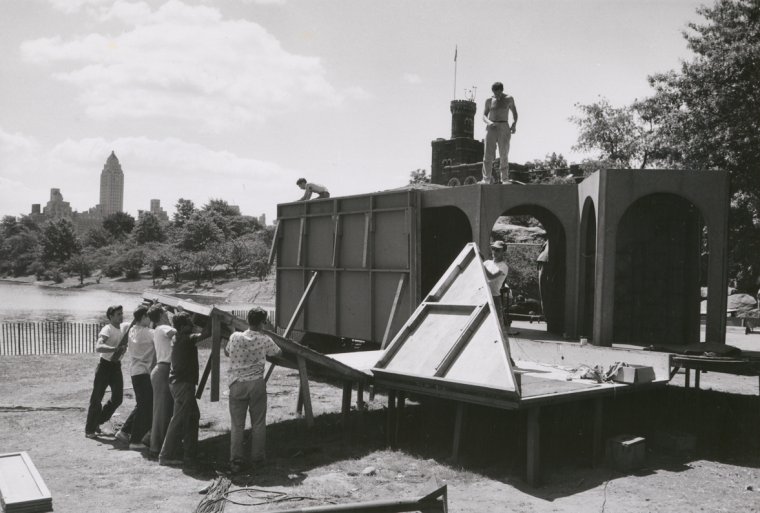
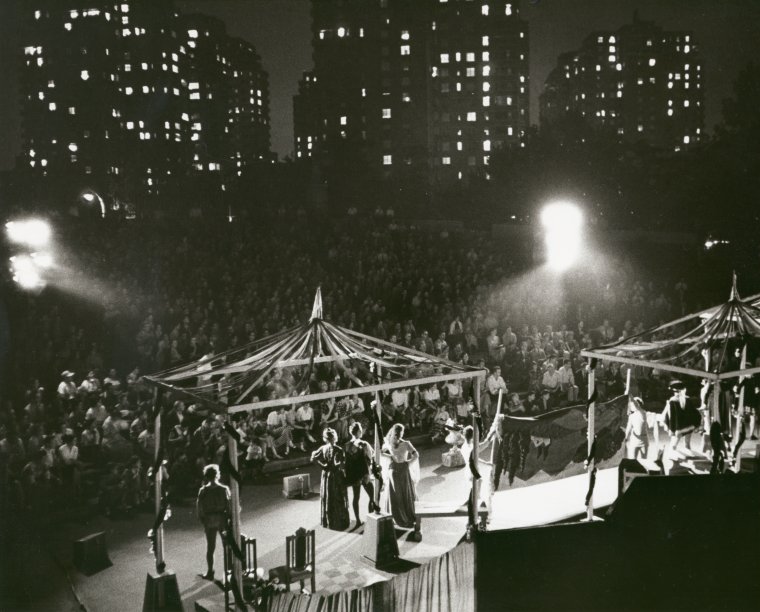
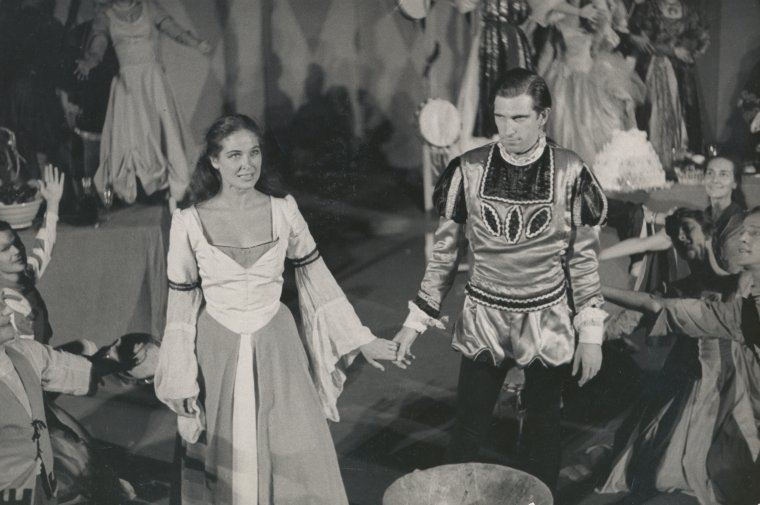
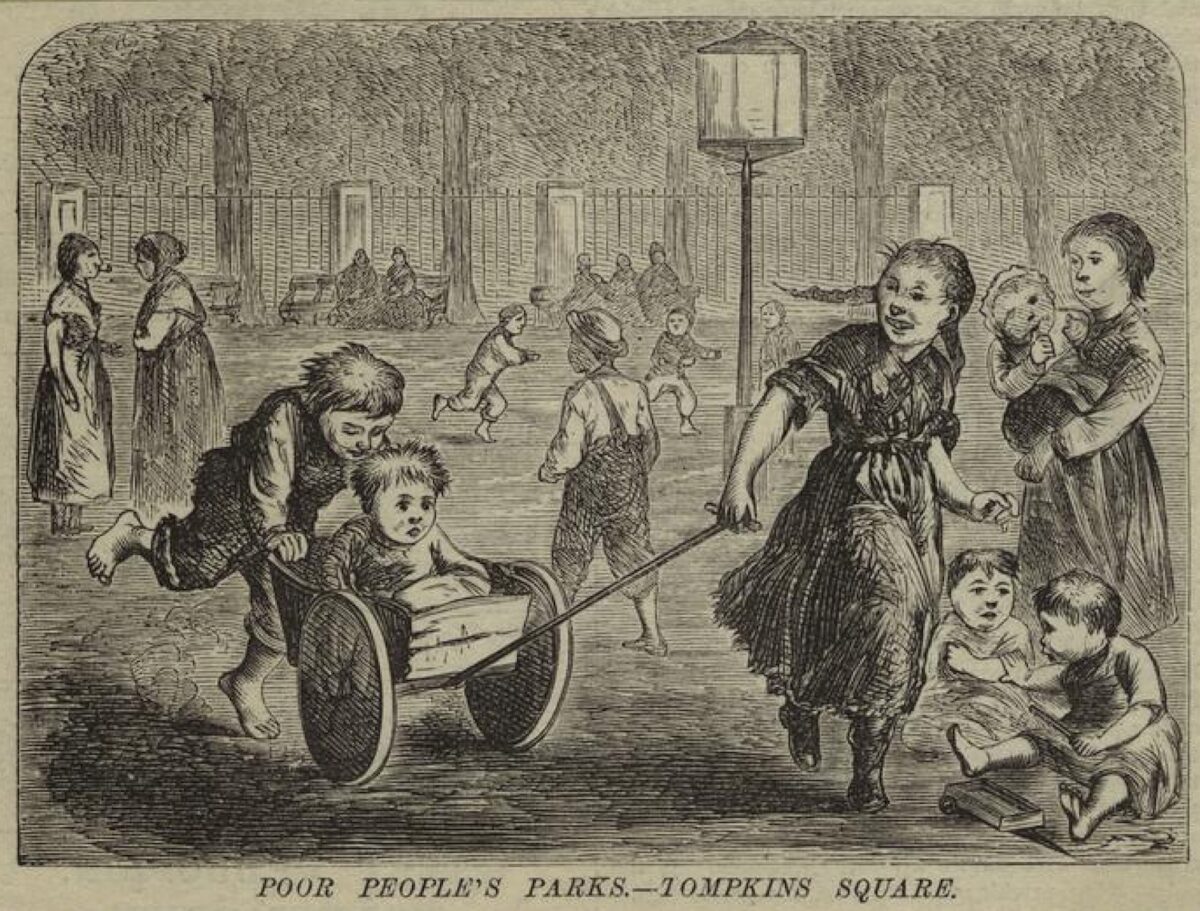
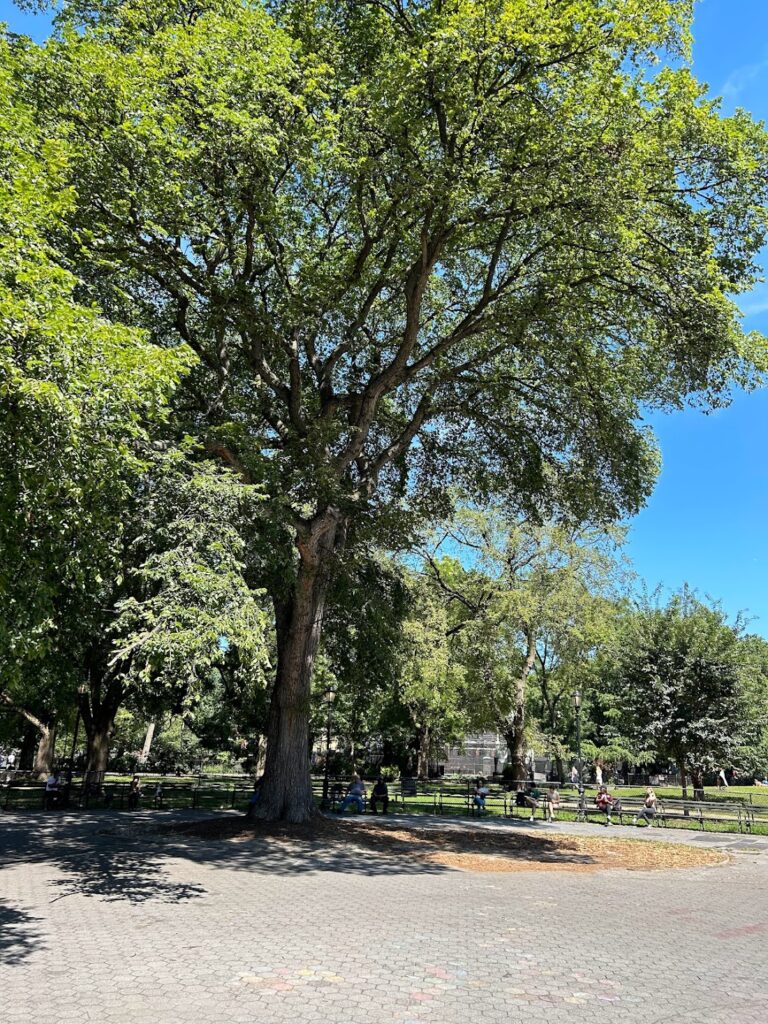
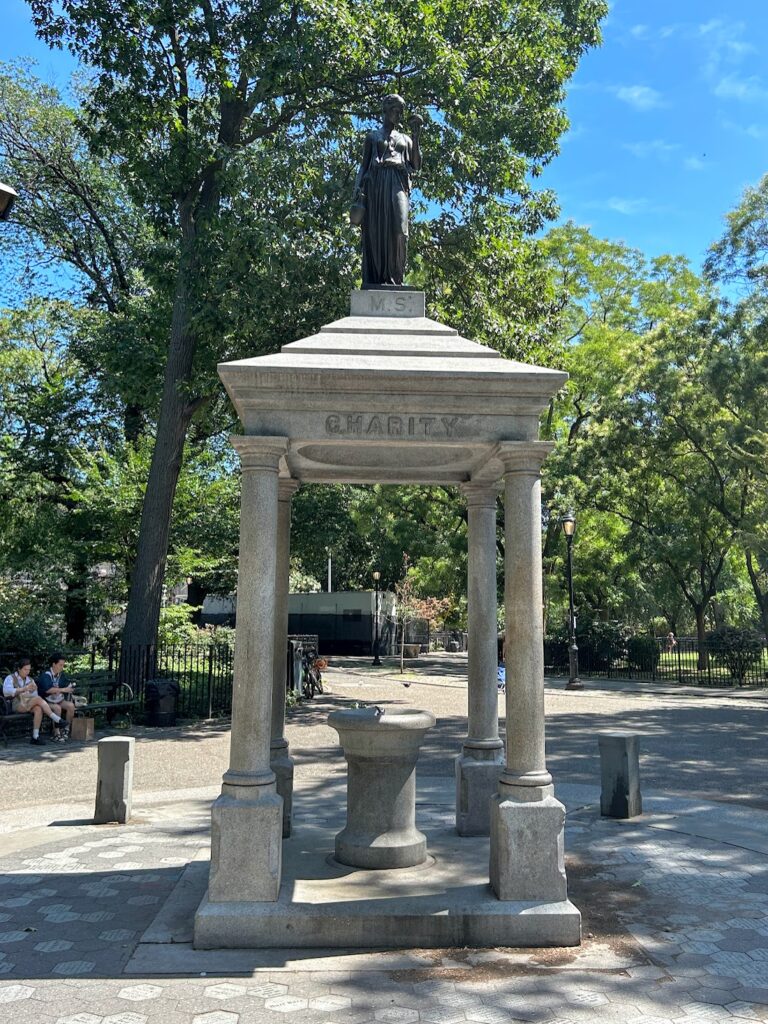
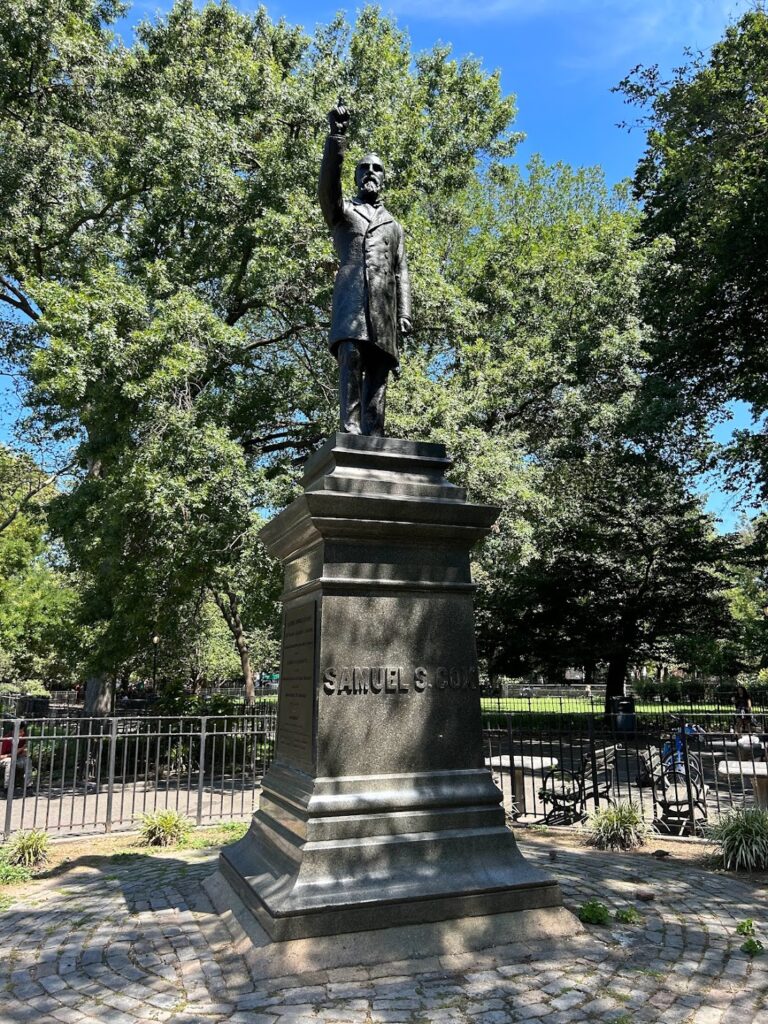
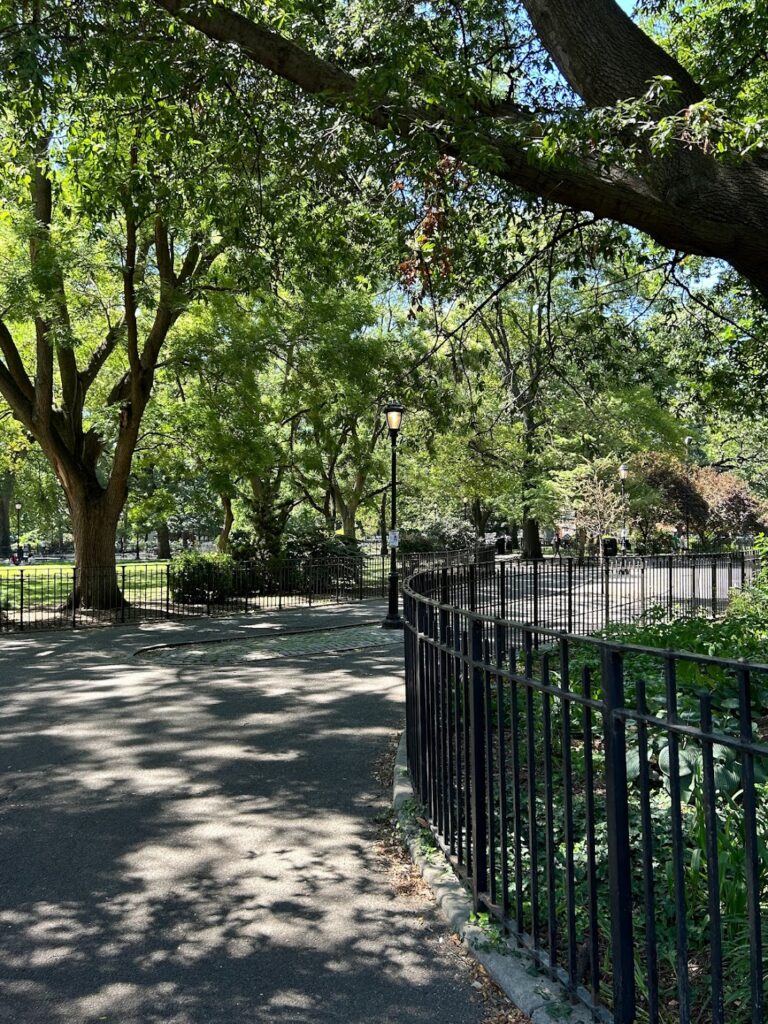
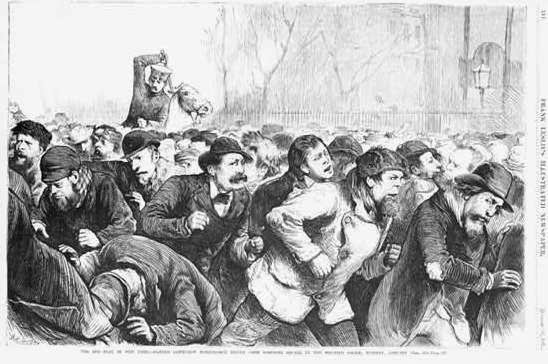
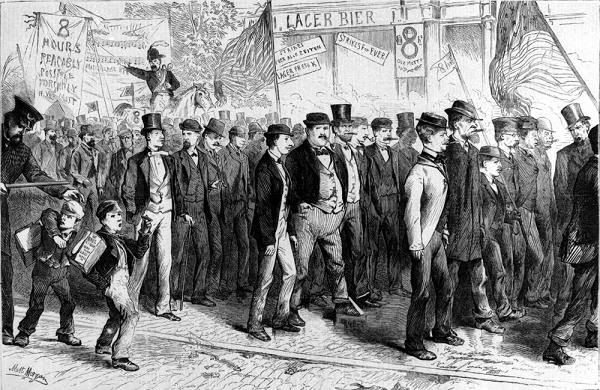
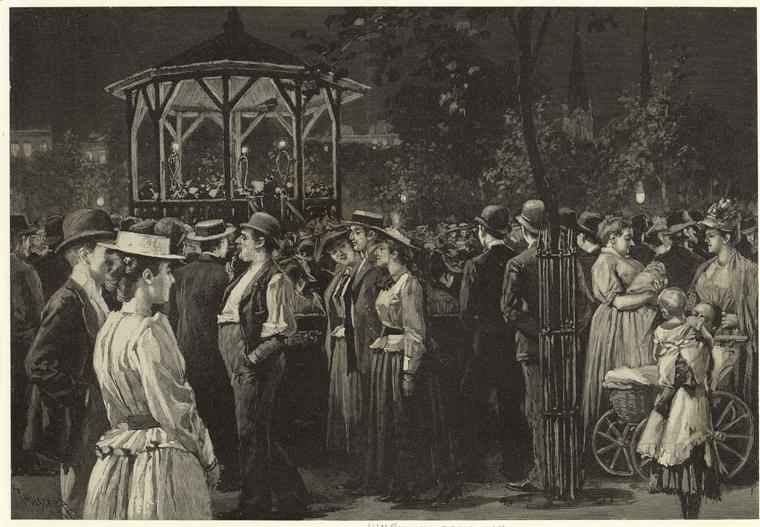
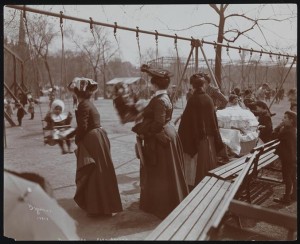
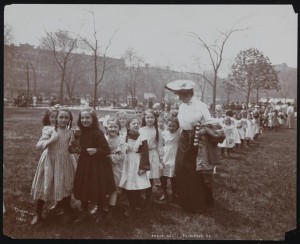
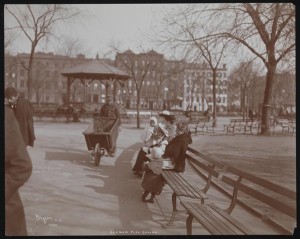
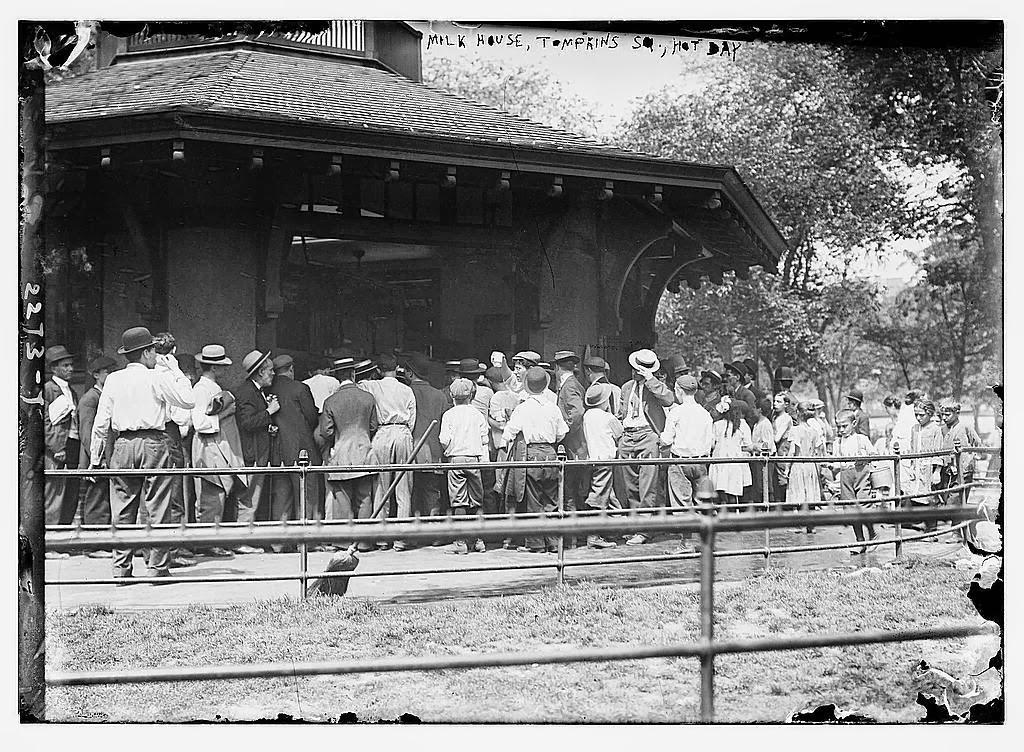
![[Samuel Sullivan Cox statue.]](https://www.boweryboyshistory.com/wp-content/uploads/2014/01/M3Y44713-188x300.jpg)