Categories
Bowery Boys Bookshelf Brooklyn History

That Kid From Bensonhurst: ‘The Adventures of Herbie Cohen’

Playboy Magazine called Herb Cohen “the world’s greatest negotiator” and whether or not that was true, Cohen could convince you that it most certainly was.

He wrote You Can Negotiate Anything and in 1982 it became a best-seller during a wave of self-help books. A year before its release, Cohen became involved in the Iran hostage crisis — with both Carter and Reagan.

“Over time, without meaning or wanting to, he gathered a group of disciples. He became a kind of guru. People called at all hours looking for answers.”

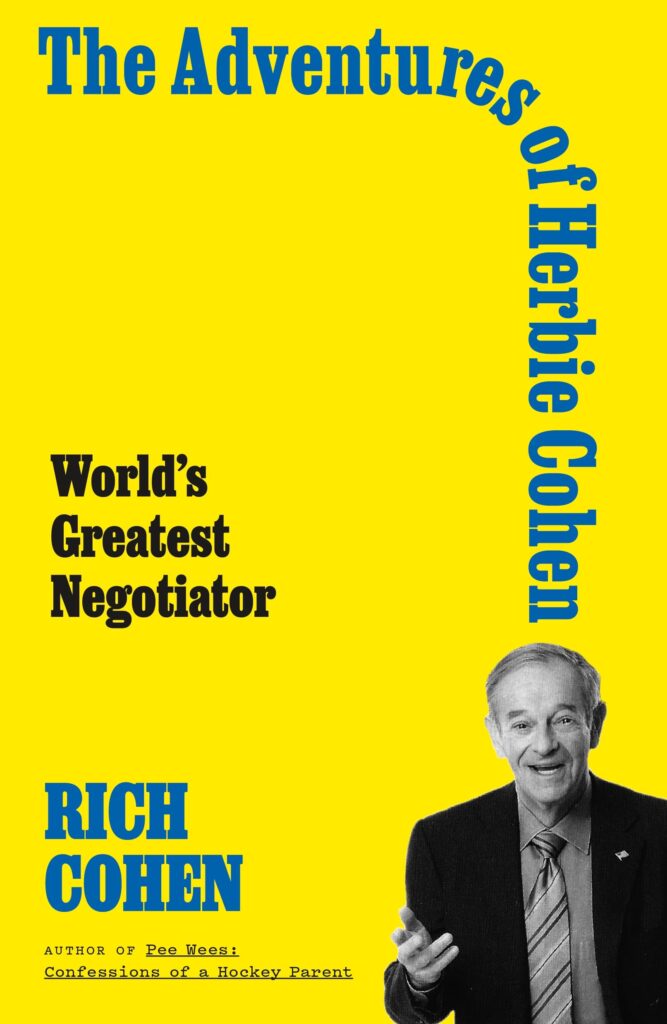
The Adventures of Herbie Cohen: World’s Greatest Negotiator
Rich Cohen
Farrar, Straus and Giroux

But The Adventures of Herbie Cohen: World’s Greatest Negotiator, written by acclaimed author and journalist Rich Cohen, is not your ordinary profile. For one, Rich is Herbie’s son.

This is no mere ode to a no-nonsense, wise-cracking father. Cohen has managed to craft an absolutely perfect character profile, keeping Herbie’s grounded personality front and center in a hilarious collection of anecdotes, recollections and maybe one or two tall tales (in the way that we share tall tales about ourselves).

“Though he’s lectured at Harvard and Yale and worked for many Fortune 500 companies,” Rich writes of his father, “he says he learned everything he needed to know about negotiation in Brooklyn as a kid.”

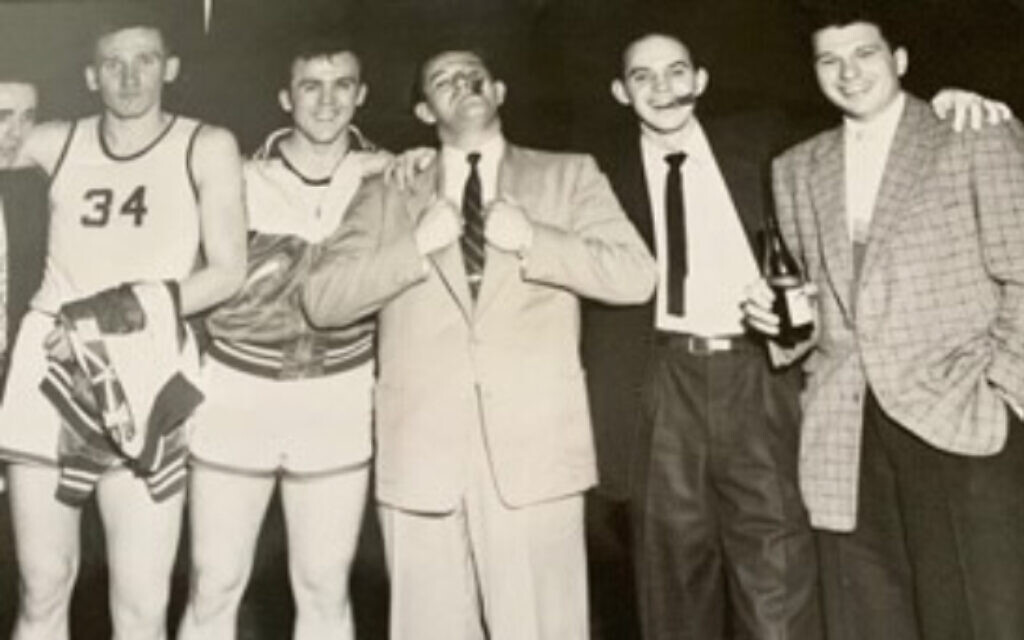
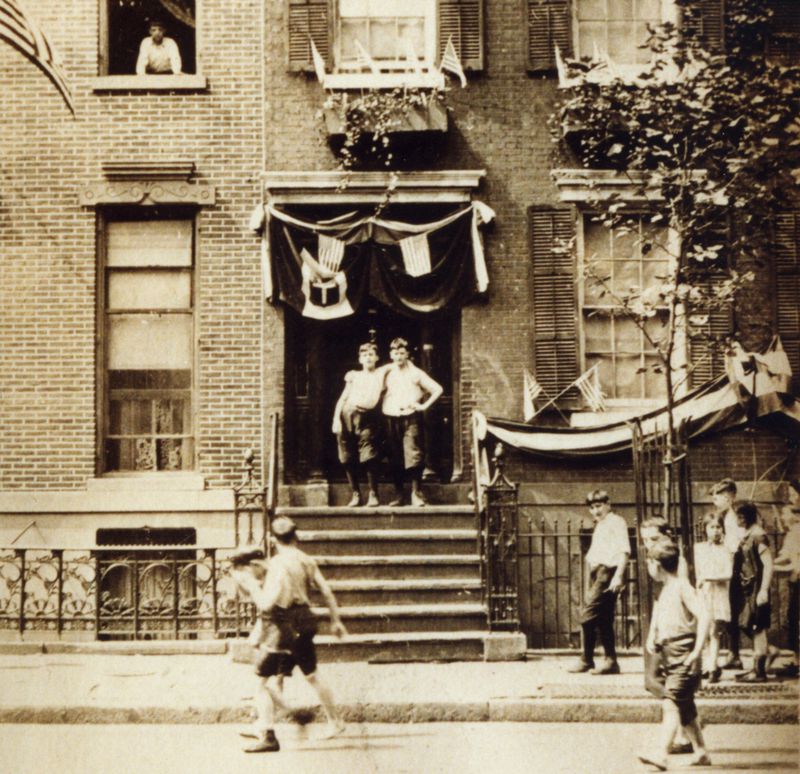
He grew up in Bensonhurst in the 1940s and 1950s, a working class Jewish and Italian neighborhood where Herb got into trouble in a street gang with friends nicknamed Sheppo, Iron Lung and Gutter Rat. (The gang was named the Warriors of course.)

Cohen gathers together family stories and his father’s Army tales in a particular way, building upon nostalgia to reveal Herb’s growing talents as a negotiator and lecturer. Everything in The Adventures of Herbie Cohen feels like it’s being told to you over the kitchen table.

Categories
Bowery Boys Bookshelf Health and Living

‘The House on Henry Street’: A new book on the mothers of modern activism

If you’re looking to read something about the possibility of doing absolute good in the world, then a story about the Henry Street Settlement is a good place to start.

The Lower East Side settlement house, founded by Lillian Wald in 1893, became not only a salvation to the hundreds of thousands of immigrants in the densely populated neighborhood, it created a template for social work and community care during the Progressive Era.

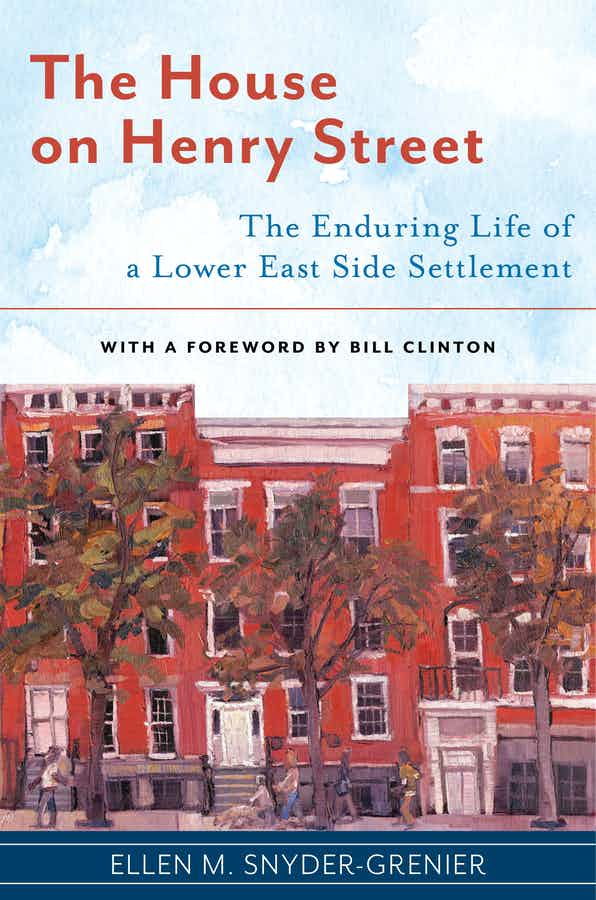
THE HOUSE ON HENRY STREET
The Enduring Life of a Lower East Side Settlement

by Ellen M. Snyder-Grenier
Washington Mews Books

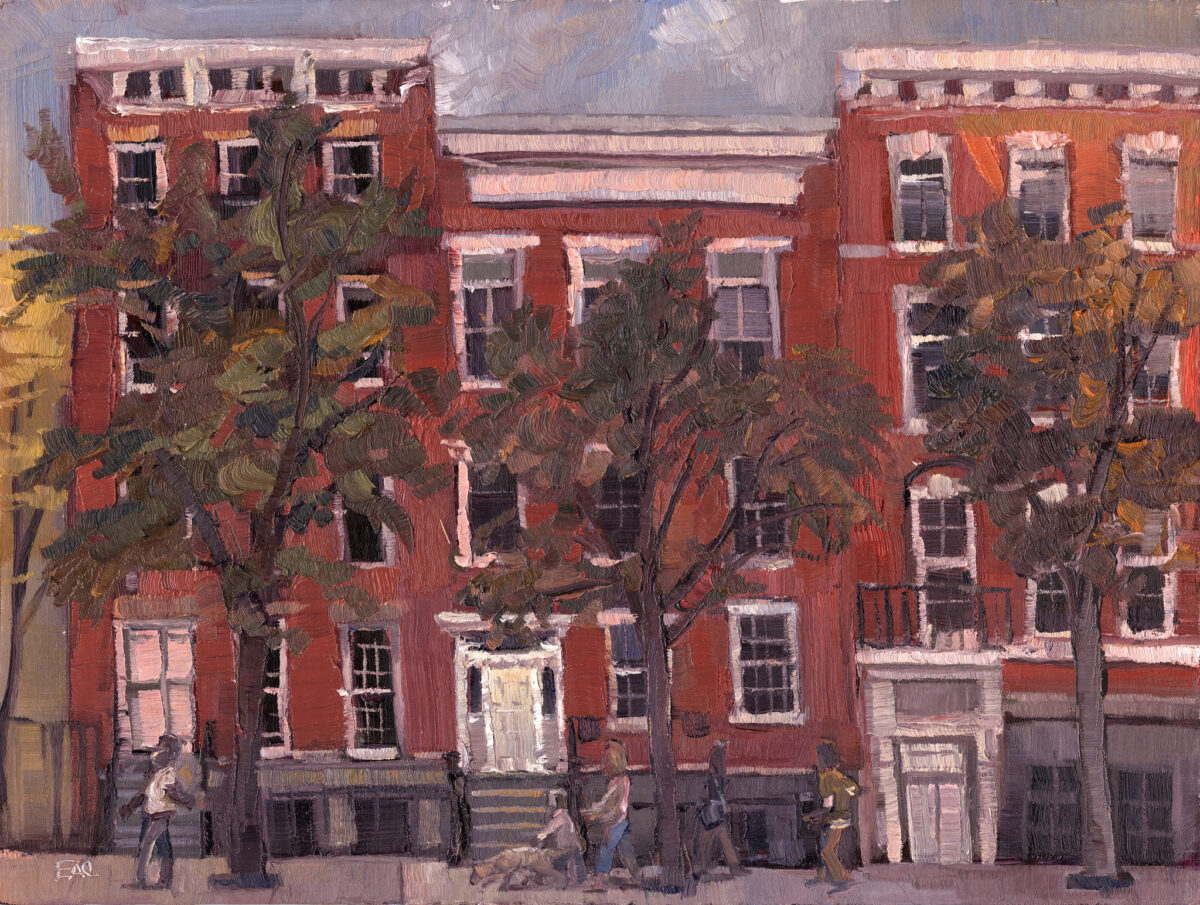
But in a new book about Wald and her historic institution, curator Ellen M. Snyder-Grenier makes the convincing case that many roads of 21st century social justice pass through the doorway at 265 Henry Street as well.

Wald charted this ambitious project as a means to provide individualized nursing care to those in the Lower East Side who could not afford or were too unwilling to visit hospitals. Writes Snyder-Grenier:

Warm, inviting, and welcoming, the house on Henry Street was more than just a house; it was a home. Settlement women like Wald drew on a Victorian model of middle-class women presiding over their homes as wives and mothers with care, moral uplift and nurturing, redefining it for their modern endeavor, rejecting maternalism’s limiting aspects and owning its best and most useful parts.”

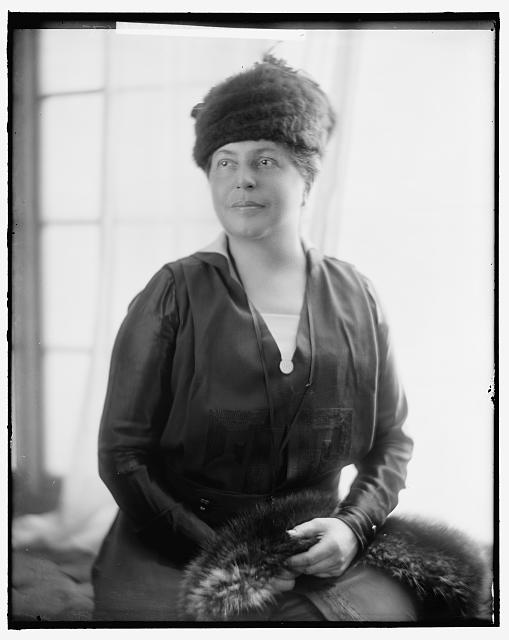
But Wald (pictured above) knew early on that struggling communities needed more than physical care. They needed advocates. “[H]er goal was not only to nurse the sick but to address the underlying social problems to poor public health.”

The Henry Street Settlement became a testing ground for social reform. Every child in America has been positively affected by Wald’s crusades, local endeavors which took wing across the country — for playgrounds, for free school lunches, for special education, for child labor laws.

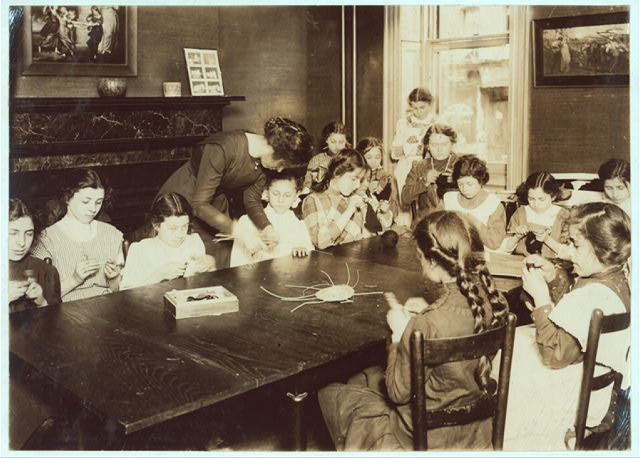
A knitting class in the famous Henry Street dining room, May 1910. The fireplace at left is still very much intact. (Library of Congress)

But Wald (and the Settlement, the fullest extension of her personality) also fought for gender equality and organized against racial injustice.

She expanded the Settlement into black neighborhoods like San Juan Hill and was on the board of the directors for the NAACP. And during wartime, she and the Settlement championed for peace.

Naturally, during conservative periods, Wald and her “seditious activities” were painted by some as anti-American.

The settlement house, around 1920. (Henry Street Settlement Collection)

After Wald’s death, Helen Hall became director of the Settlement, and for over thirty years she led the institution in directions that would have made Wald quite proud.

In particular, Hall and the Settlement became instrumental during the development of certain New Deal programs. Although, from the vantage of a social worker, FDR’s visionary programs did not go far enough.

“Hall was unhappy about what the legislation had left out — compulsory (universal) health insurance — an omission that continues to resonate in American life in politics.”

In fact the parallel with modern progressive politics is made so clear in The House of Henry Street that the book even comes with a forward written by Bill Clinton, who visited the Settlement in 1992:

“As I looked around, I saw the best of America — young and old, immigrant and native born — all there because they wanted to create a better future for themselves and their families.”


You can also check out our show from last year Saving The City: Women of the Progressive Era for more information on Wald and a tour of the Henry Street Settlement.

Categories
Bowery Boys Bookshelf True Crime

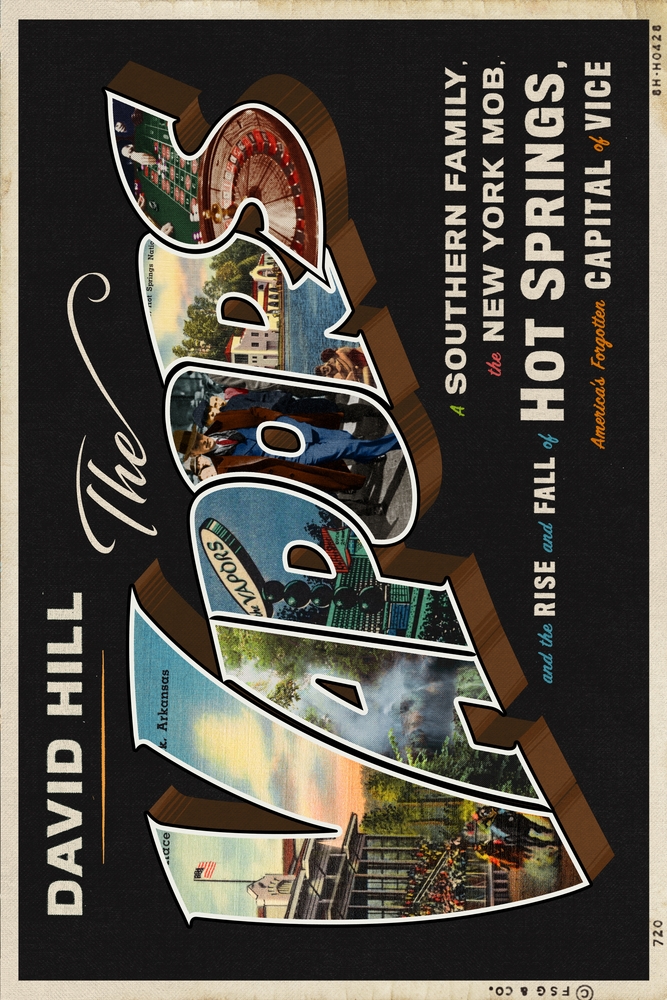
‘The Vapors’: How an Arkansas spa town became a New York gangster paradise

Owney Madden was one of New York’s most infamous gangsters, a bootlegger and murderer who seemed to cross paths with every major cultural marker of the Roaring 20s. He opened the Cotton Club (with Jack Johnson), dated Mae West, and operated a liquor smuggling racket that catered to the city’s busiest speakeasies.

In essence Madden was the blistering face of Prohibition-era Manhattan.

And in 1935, he left it for good to go live in Hot Springs, Arkansas.

THE VAPORS
A Southern Family, the New York Mob and the Rise and Fall of Hot Springs, America’s Forgotten Capital of Vice
By David Hill
Farrar, Straus and Giroux

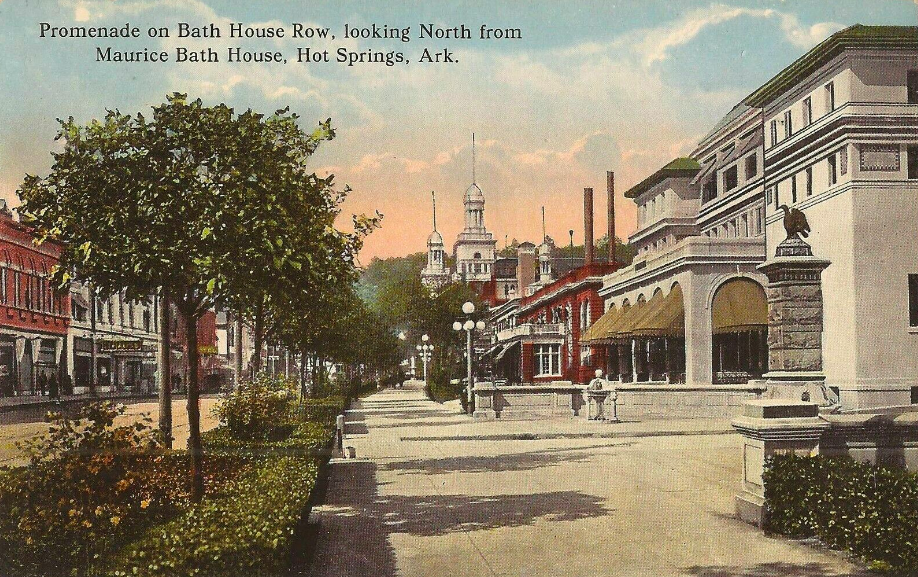
For a time, it seemed that Hot Springs, not Las Vegas, would be the vice capital of the United States. In David Hill’s captivating and beautifully written The Vapors, we’re re-introduced to an overlooked corner of history, a historic spa town with troubling secrets and a sleazy underbelly.

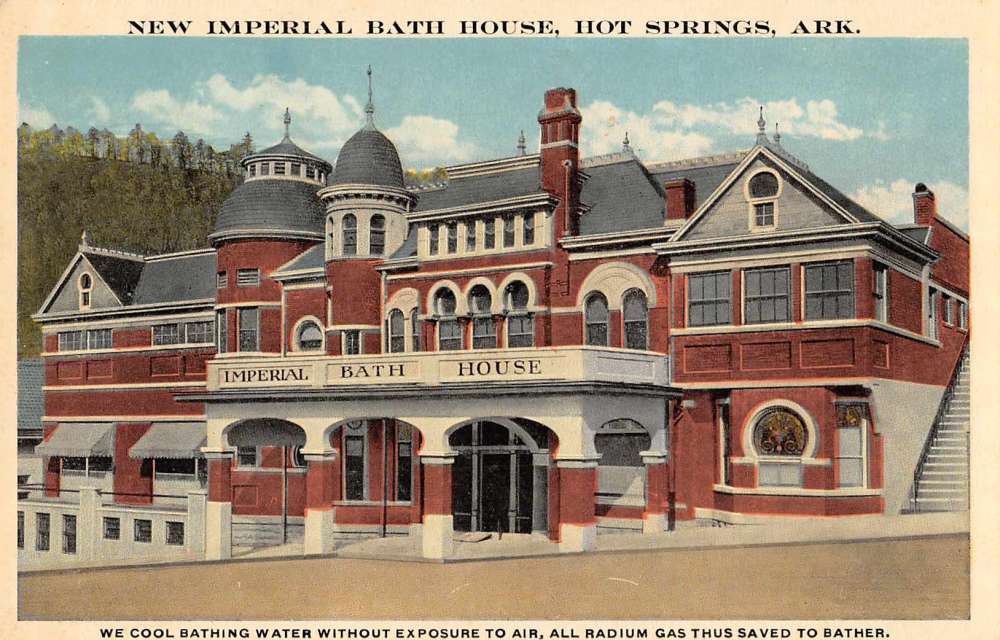
The Vapors was one of the last in a series of glamorous casinos and resorts which graced this mountain town during the 20th century, well established as a destination for illegal gambling by the time Madden arrived.

With Prohibition repealed, organized crime lords looked to gambling as their next best bet.

In the 1930s, Vegas was an uncertain proposition, sprouting haphazardly in the middle of the desert.

But here in Hot Springs, tourists had luxuriated in healing spring waters for decades. Sports heroes, politicians and musical entertainers all came here to relax. Lawmakers and law enforcement often looked the other way as it frequently benefited them to do so.

Madden was a celebrity in Hot Springs, a liaison between civic leaders and visiting gangsters, a man with unique powers who nonetheless had to learn the more delicate game of political control.

“Owney’s days of killing his enemies were long behind him,” writes Hill, “but it sure must have seemed cheaper than winning a fair election in Hot Springs. ‘You know, in my day, back in New York, how I’d have handled this…..’ Owney said to the gamblers. ‘No, no, no!’ they quickly cut him off.”

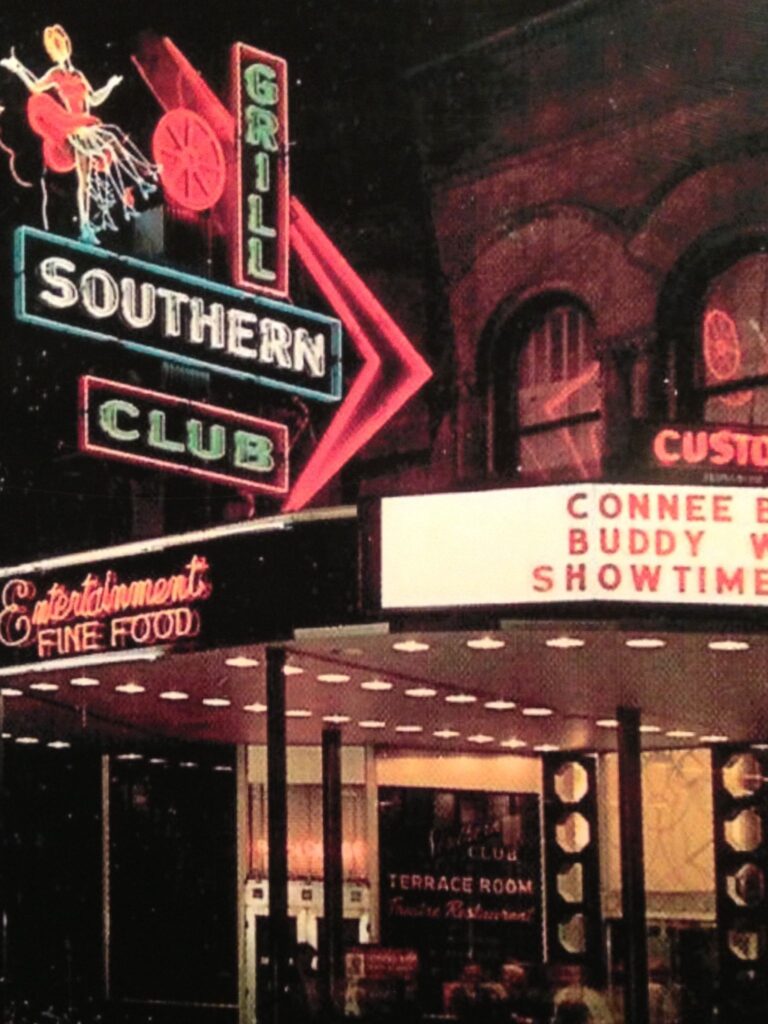
Madden’s roost was the Southern Club, an Arkansas variant of club’s like his old Cotton Club. Hill writes:

At the Southern, Owney was treated with discretion, not as if he were anyone else off the street, but not as anything special, either. The patrons knew to keep their distance. In Hot Springs, people had grown used to seeing famous folks out and about, and had learned to act like it wasn’t any big deal. In this way the spa had a lot in common with much larger cities, and the famous appreciated it as a form of hospitality. The notorious, even more so.”

The fate of Hot Spring’s lucrative gambling scene — and all its vice-ridden sideshows — rested on shady deals with law enforcement and local officials.

The city often resisted the presence of notorious gangsters for fear of the attention; in fact, another New York mob boss Charles ‘Lucky’ Luciano, who had considered Hot Springs a sort of gangster’s retreat, was arrested here in 1936.

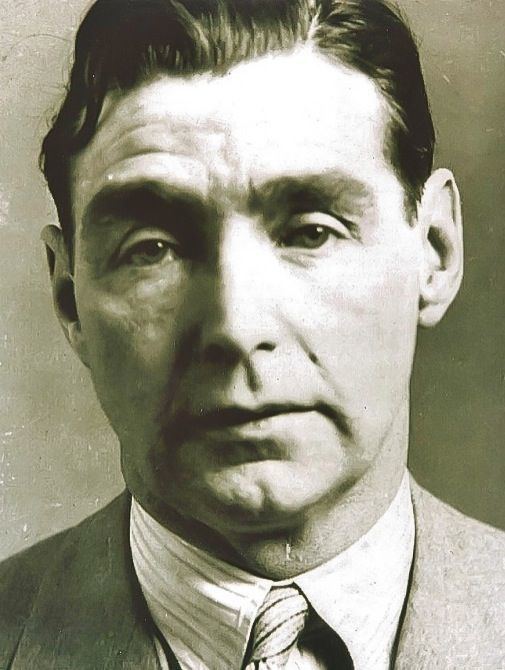
Below: Owney Madden in his later years

Hill reconstructs the resort town with such vivid attention to detail — a haven of mist, fedoras and cheap-lipstick glamour — through exhaustive research and interviews. (Hill, who lives in New York, is a native Arkansan and you feel it.)

Alongside Madden, in a simple stroke of balanced narrative that really elevates The Vapors into the realm of prize-deserving literary magic, the author also follows the stories of Madden’s protege Dane Harris (the “boss gambler” of Hot Springs) and a tough lady named Hazel Hill, raising two sons during the city’s most tumultuous years.

Hazel’s story is told with an added degree of richness and sympathy, as well it should. She’s the author’s grandmother.

Categories
Bowery Boys Bookshelf It's Showtime

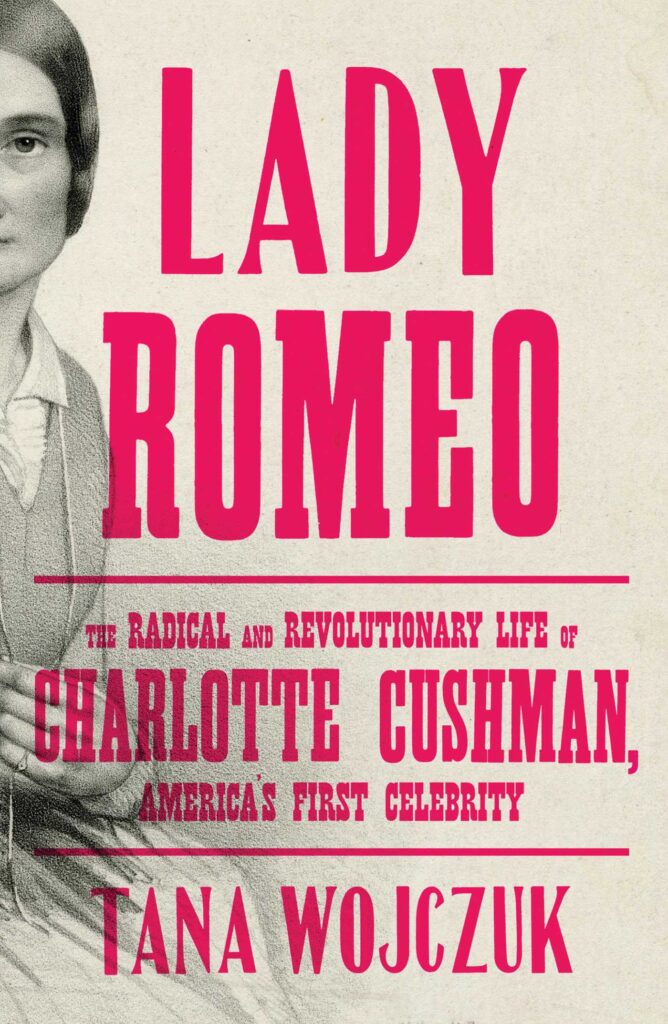
‘Lady Romeo’: The unconventional life of actress Charlotte Cushman

Without moving images or sound recordings to guide us, it can be hard to imagine the lives and careers of famous theater actors from the 19th century.

And yet the American theater produced a list of wildly famous performers whose names were repeated in households that often had no possibility of ever seeing a major play. The press could build upon an actor’s natural charisma and talent, turning leading ladies into modern goddesses.

One such star was Charlotte Cushman, a theatrical chameleon who achieved international fame playing men’s roles and breaking just about every other convention in the book.

LADY ROMEO
The Radical and Revolutionary Life of Charlotte Cushman, America’s First Celebrity
by Tana Wojczuk
Simon & Schuster

The charming biography Lady Romeo has by circumstance become a truly fantastical read, more so than author Tana Wojczuk probably intended.

Not only is Cushman’s life fascinating and almost unbelievable, but nostalgia for the theater itself in 2020 has become romanticized. Imagining anybody on stage performing Shakespeare gave me a thrill!

Cushman reigned during the mid 19th century as America’s most famous actress, specializing in playing roles written for both women and men.

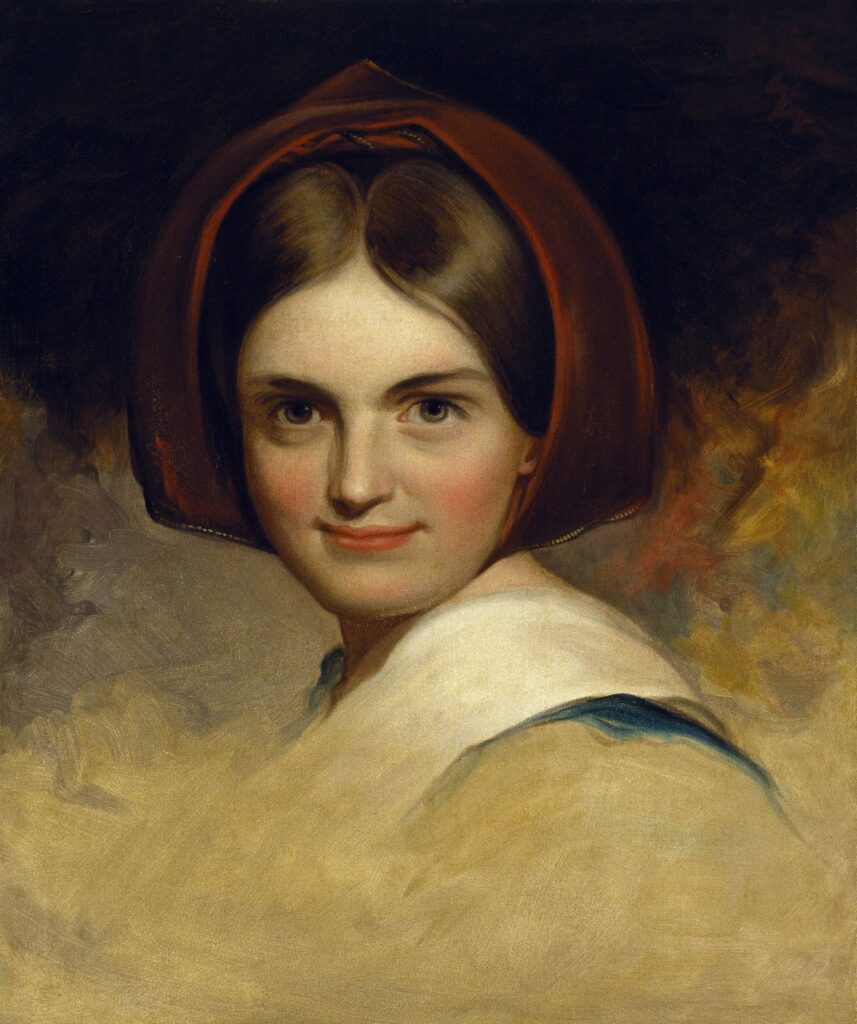
Cushman in an unfinished 1843 painting by Thomas Sully, courtesy the Folger Shakespeare Library

Her versatility and transformative ability — it was truly 19th century ‘method acting’ — were displayed on the New York stage by the mid 1830s, and even early on she was not afraid to challenge the status quo.

She soon commanded the attentions of the New York theater world — even on stages such as the Bowery Theatre with its ample prurient distractions — and in Lady Romeo, her bold ingenuity leaps off the page.

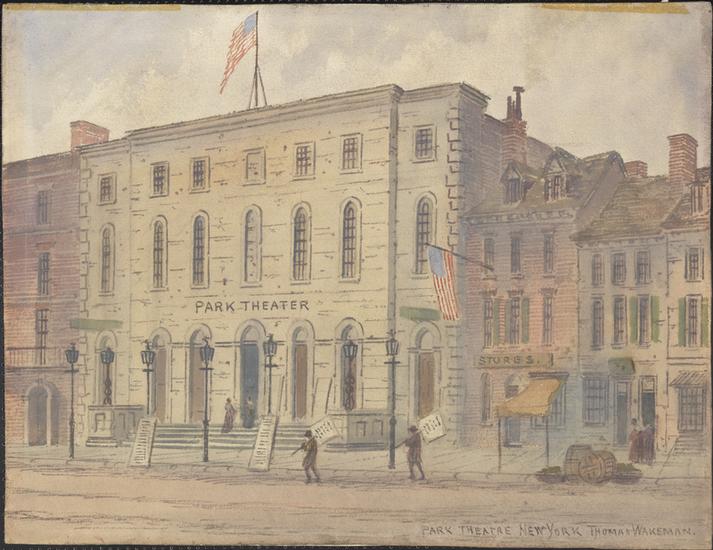
The Park Theater, depicted here in 1840 in a watercolor by Thomas Wakeman. (Courtesy the Museum of the City of New York)

At a performance of Guy Mannering at the lofty Park Theatre on Park Row, Cushman stepped into a starring role interpreted as a young woman.

Charlotte thought differently; she surprised both cast and audience when she emerged as an old crone; her “face was deeply carved with dry creek beds of wrinkles, her dark hair, parted in the middle, escaping in uncombed tangles down her back.”

Cushman was not a traditional beauty, nor was she uniquely connected or wealthy enough to take such early risks in her career. But she let nothing stop her bold ambition for reinventing theater.

For instance, in 1839, Cushman was given the role of Nancy in Oliver Twist. Playing a prostitute was a risky part. Wojczuk writes, “[A]ctresses already had to fight against the stereotype that they were essentially prostitutes themselves.”

Cushman leaned into the controversy. She visited the neighborhood of Five Points to research the part and even exchanged her clothes with those of a dying prostitute. “She gave up her simple but well-made silk dress and put on the women’s rags. These would be Nancy’s clothes.”

She soon became the American queen of Shakespeare; President Abraham Lincoln was a huge fan, enrapt with her portrayal of Lady McBeth.

Her fame and command of the stage allowed her to live a surprisingly more open life with many female companions over her life. Cushman steps vividly from the pages of Lady Romeo like a superstar who would fit perfectly into the 21st century.

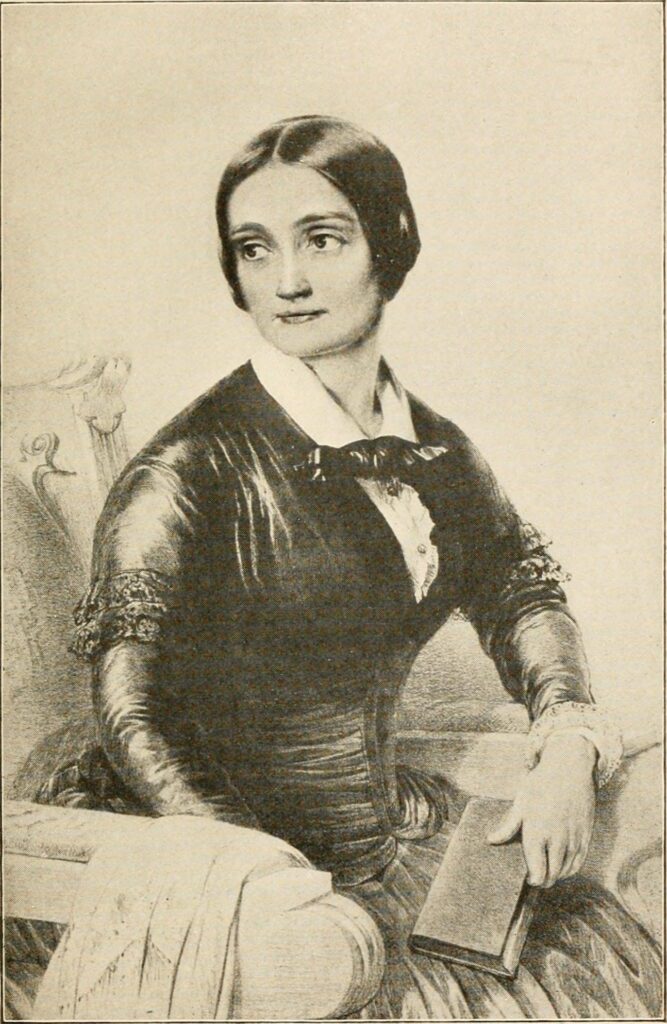
Charlotte Cushman and the New York sculptor Emma Stebbins. The pair were partners at the end of Cushman’s life. Stebbins would eventually write a biography of Cushman. (Shakespeare Folger Library)
Categories
A Most Violent Year Bowery Boys Bookshelf

‘Murder in the Garment District’: Unraveling the labor unions in mob-controlled Manhattan

By the 1930s, New York City’s thriving garment industry had moved from the Lower East Side to Midtown Manhattan*, housed within nondescript buildings with hundreds of showrooms and shop floors.

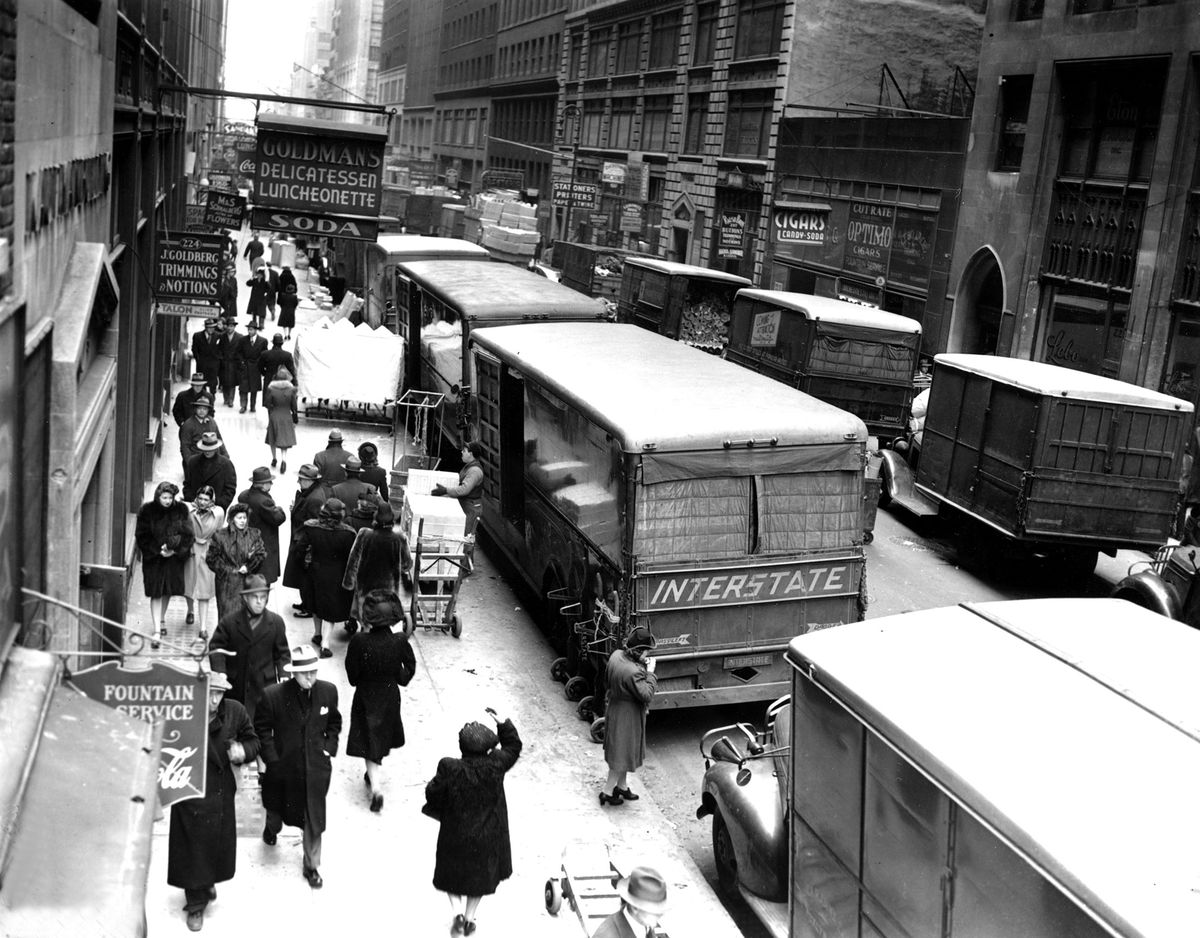
The streets were lined with idling trucks, racks of dresses pulled along the sidewalk by loaders and truck men. The streets where American fashion was made, were decidedly unglamorous.

MURDER IN THE GARMENT DISTRICT
The Grip of Organized Crime and the Decline of Labor in the United States

David Witwer and Catherine Rios
The New Press

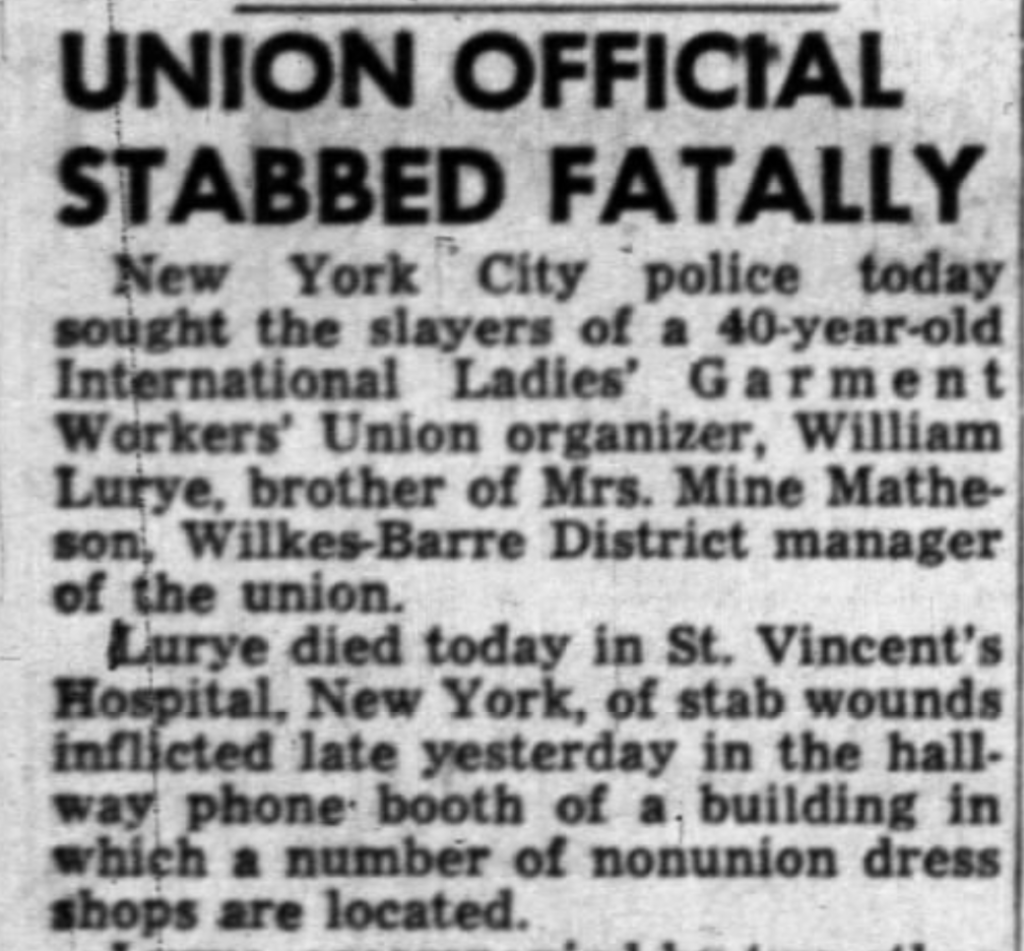
But on May 9, 1949, the Garment District borrowed a terrifying plot line from a Hollywood film noir. That afternoon, labor organizer Will Lurye was brutally stabbed by two assailants while making a call in a phone booth.

“Staged in the midst of a busy workday, in the crowded center of the Garment District, Lurye’s murder was designed to send a message to the union and its supporters,” writes David Witwer and Catherine Rios in Murder in the Garment District, an insightful exploration into labor unions’ mid-century battles with the mob.

The Times-Tribune. Scranton PA, May 10, 1949 (newspapers.com)

Fans of Martin Scorsese’s The Irishman or perhaps even the garment subplots in The Marvelous Mrs. Maisel will find great intrigue with this hardboiled look at racketeering and the mob’s gradual influence over labor unions.

Organized crime’s growing control over the literal streets of the Garment District — via mob-controlled truck services — heightened the challenges had by union-run shops. Many shop owners were forced into relationships with the mob in order to survive.

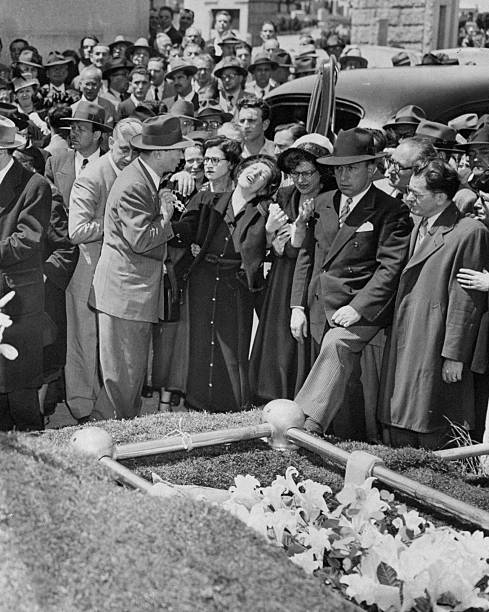
The wife of slain garment district worker William Lurye breaks down at his funeral in the Carmel Cemetery in Cypress Hills, Queens. She is supported by David Dubinsky, President of the International Ladies Garment Workers Union. (Photo by George Torrie/NY Daily News Archive via Getty Images)

In addition, police departments would often feign interest in crimes aimed at labor organizers (who were often at odds with law enforcement in their daily routine). As a result, endangered labor groups “would turn elsewhere [for protection], and in doing so the union’s leadership chose to make an accommodation with organized crime.”

But this association would soil the reputation of American labor unions, built fifty years before in the sweatshops of major cities by most immigrant workforces.

David Dubinsky, president of the International Ladies’ Garment Workers’ Union, even called this form of racketeering “a cancer that almost destroyed the American labor movement.”

Murder isn’t much of a mystery but its observations of 20th century organized crime in New York City — and its oppressive hold on a vital industry — are truly chilling.

*For more information on the Garment Industry’s move to Midtown Manhattan, check out our back-catalog show on the history of the Garment District:

Categories
Bowery Boys Bookshelf

The menagerie of New York: A colorful look at the ‘Wild City’

While traipsing through Red Hook a couple months ago, I happened upon a family of raccoons camped out underneath a pick-up truck.

New York City is actually a bit of a zoo — if you open your mind to what constitutes a star attraction. Sure, we don’t have lions wandering around (thankfully), but what zoo creature is more famous than Pizza Rat?

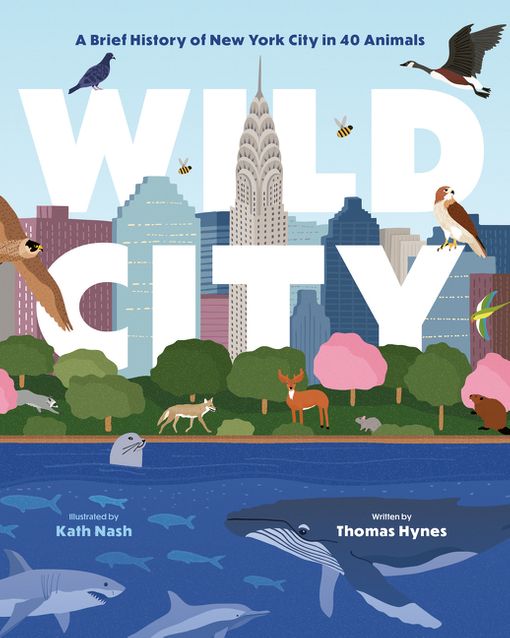
WILD CITY
A Brief History of New York City in 40 Animals
Written by Thomas Hynes
Illustrated by Kath Nash

In Wild City, author Thomas Hynes and illustrator Kath Nash reveal an urban environment more exotic and thriving than any city of concrete and steel has right to be.

The creators focus on forty creatures — from the ancient mastodon whose skeletal remains presumably linger underfoot to the clever starlings who have bullied their way into the American habitat (to the detriment of other birds).

New York really became a metropolis because of two particular living creatures — beavers and oysters. But one can hardly deny that horses may be the most important animals to New York City history, for better or worse.

Seals make the list! Picture courtesy NY Harbor Nature. Visit their website for more information about the plight of seals in the harbor.

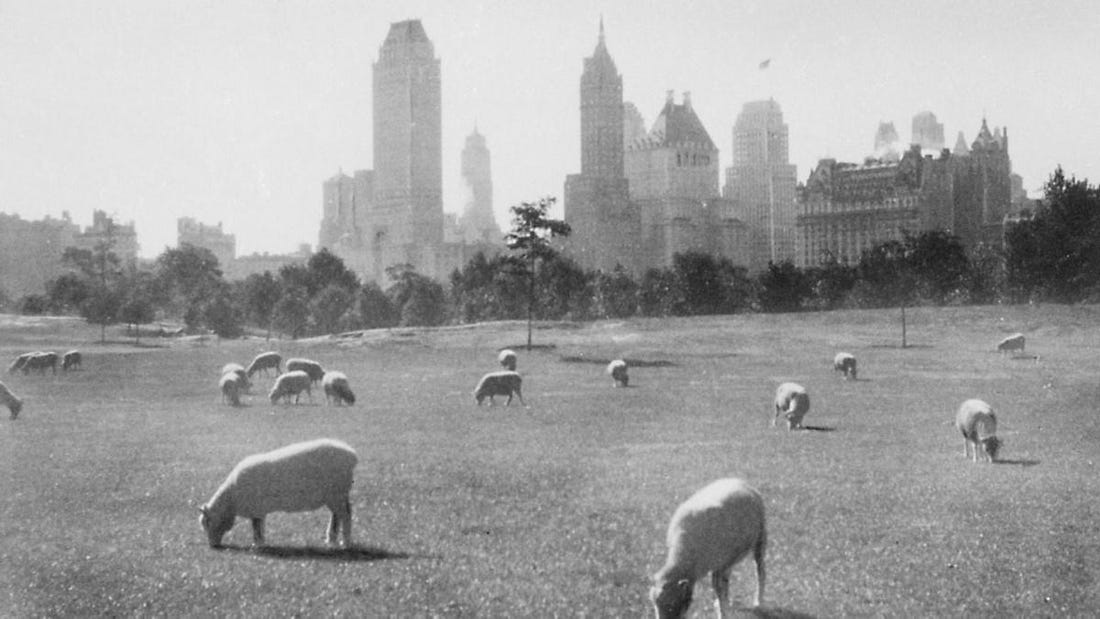
In a sense, a city with underground tunnels, green parks and a skyline with a million perches seems suited for particular kinds of beasts. Even those from urban legend like the sewer alligators (which, it turns out, aren’t mythical after all).

And when nature itself doesn’t provide, the need for companionship invites them — from dogs and cats to more, um, unconventional pets (such as Su Lin, the first panda to ever come to the United States).

Yes there are shipworms and mosquitoes and bed bugs here too — yikes! Luckily Wild City is such a calming, enjoyable read — and so beautifully illustrated — that you might be a little less inclined to swipe away that annoying insect next time you’re in the park.

And I think I’m going to go look for those raccoons again.

Geese are also really into Red Hook.
Categories
American History Bowery Boys Bookshelf

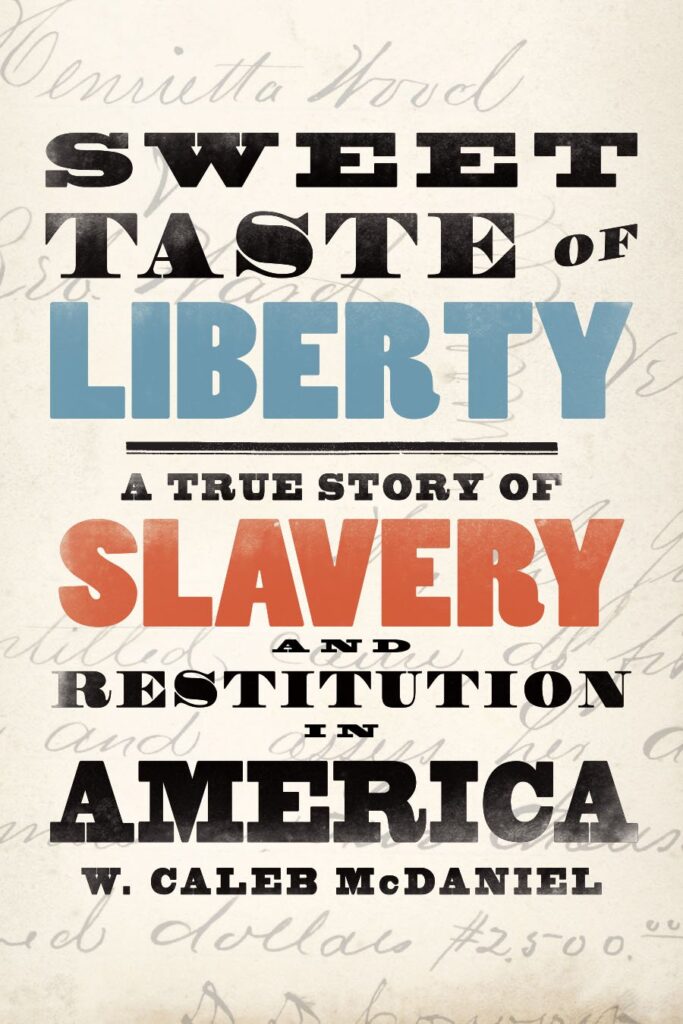
Sweet Taste of Liberty: Celebrating the life of Henrietta Wood

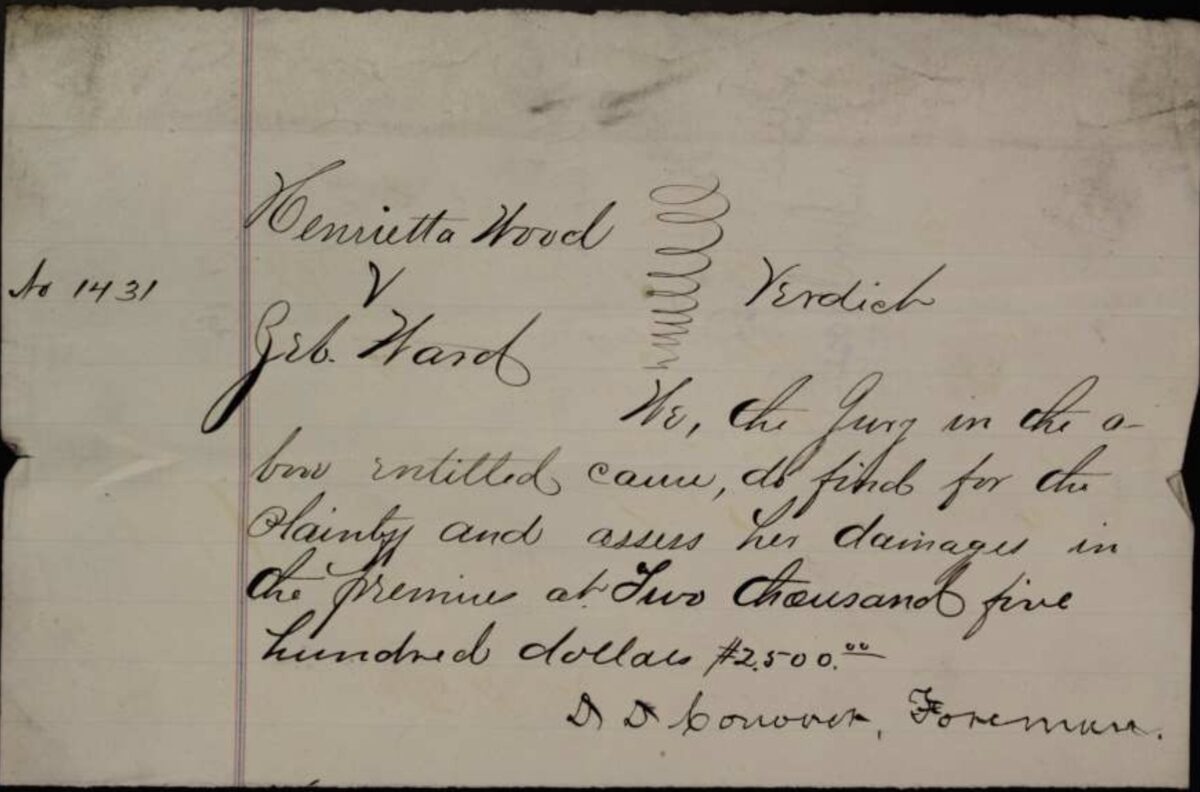
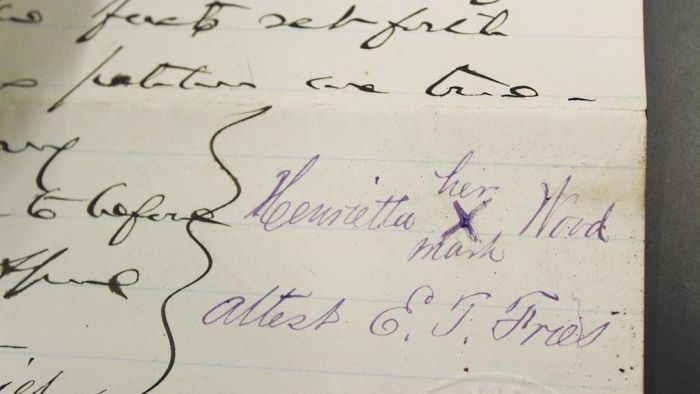
One hundred and fifty years ago this month, Henrietta Wood sued the man who kidnapped her and sold her back into slavery.

In his lifetime, that man — a prison warden and general scoundrel named Zebulon Ward — often bragged about losing the case, saying “he was the last American ever to pay for a slave.”

But Ward has become an ugly footnote. The woman who suffered that injustice, whose story has almost been lost in obscurity, will never be forgotten again.

Sweet Taste of Liberty
A True Story of Slavery and Restitution in America

W. Caleb McDaniel
Oxford University Press

Last month author and Rice University professor W. Caleb McDaniel won the Pulitzer Prize in History for this compact but potent story, an achievement that feels like a master class in archival research.

Past winners of this honor have been grand, sweeping tomes exploring vast reaches of American history. Sweet Taste of Liberty is a little different, an intimate story of one woman’s survival presented as a sobering illustration of the chaotic definitions of freedom in America’s border states in the 1850s.

Wood was born into slavery in Kentucky; she was later freed when she was brought into Ohio. By crossing the border, she technically gained her freedom. (Most enslaved people, however, were purposefully kept from this information.)

Her mistress eventually did register her as free. But in a warped system where ‘freedom’ simply means a piece of paper indicating your freedom, great and frequent abuses meant that many formerly enslaved (and sometimes never enslaved) people were kidnapped and sold to plantations in the Deep South.

For Wood, the theft of her freedom was just the beginning.

From the words of just a couple newspaper interviews she later gave, McDaniel is able to piece together Wood’s entire world, finding her voice and dignity through increasingly fraught and intolerable scenarios.

Wood’s story is unique not because of the legal reparation she received, a stunning result and hardly destined given the circumstances. (It took Wood years to finally succeed in court.)

Her story is exceptional because it was told at all.

Categories
Bowery Boys Bookshelf

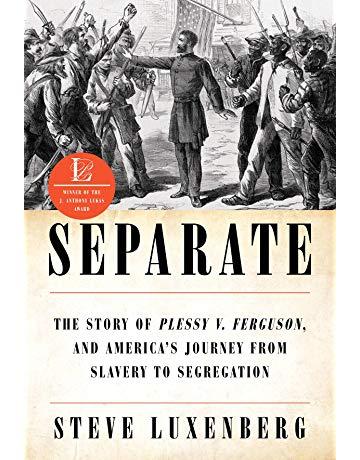
‘Separate’: The origins of a catastrophic and disgraceful Supreme Court decision

The 1896 landmark Supreme Court decision Plessy v. Ferguson embedded and legitimized the practice of “separate but equal” into American life in the 20th century.

The decision built racism into the fiber of everyday activities — schooling, housing, medical care, public transportation — and elevated personal prejudices into the realm of legality. It raised white and black children in separate environments, entrenching prejudice so deeply that we, in 2019, are still reeling from its consequences.

Steve Luxenberg’s captivating history SeparateThe Story of Plessy v. Ferguson, and America’s Journey From Slavery to Segregation is a slow-build up to the case itself. (Homer Plessy, the Creole plaintiff who attempted to sit in a railroad car for white passengers, comes into the story 60 pages before the end.) Luxenberg is more concerned with the legal and social entanglements that led up to the case, a myriad of state-specific practices upon a wide spectrum of public prejudice.

Separate follows the lives of three men crucial to the outcome of the decision — the firebrand white Northern journalist Albion Tourgée and Supreme Court justices Henry Billings Brown and John Marshall Harlan. From different states and backgrounds, the stories of these three men hurtle towards that fated moment in 1896 when their collective experiences lead to a damaging climax.

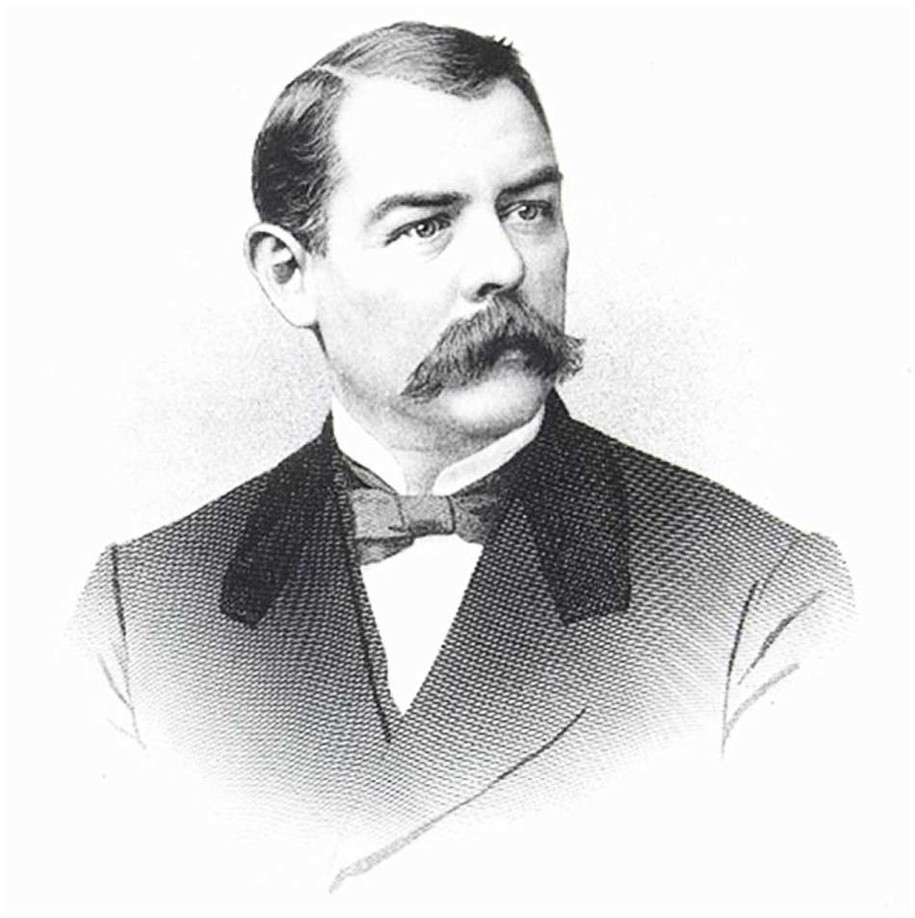
Albion Tourgéwho litigated for Homer Plessy in front of the Supreme Court. (Library of Congress)

The fourth protagonist — and certainly the most interesting — are the people of color in New Orleans in the late 19th century.

‘Separate but equal’ policies were commonplace on the state level throughout the South and especially contentious when it came to public transportation — streetcar and railroad passenger cars. Drivers and ticket takers had to determine on the spot the race of a passenger, guide them to the ‘proper’ section and enforce the separation should there be conflict.

But in Louisiana, there were thousands of residents of color who had never been enslaved people, les gens de couleur libres with a mix of European and African ancestry. (An excerpt of a 1853 New Orleans divvied its population into eight different ‘grades’.) Passengers could be labeled black one day, white the next, depending on the railroad or streetcar employee making the determination.

Plessy was indeed a mixed race gentlemen from New Orleans, and his ‘test case’, destined for the high court, would be shepherded through the system by Tourgée, a nationally known columnist, and Louis Martinet, a Creole attorney with interesting challenges to his own career.

In the stories of Brown and Harlan, another fascinating subplot emerges, that of wavering and unexpected shifting views on slavery and racial relationships, inspired by unique state issues following the Civil War.

And even enlightened views can be reached narrowly. Harlan, the ‘lone dissenter’ in the case of Plessy vs. Ferguson, was once a proud member of the anti-immigrant Know Nothing Party and was a full-throated supporter of the Chinese Exclusion Act.

For many legal minds in the late 19th century, equality in a legal sense did not mean social equality. An American, white or black, may share the same rights as upheld by the U.S. Constitution, but in everyday matters, there was no urgent need to include all people in the same public spaces.

Of course this would prove dysfunctional and absurd, a fallacy based on an unenforceable belief that every actor at every level of public life would truly provide ‘equal’ options to Americans of any color. Separate lays out the course for how this thinking became the law of the land.

Categories
Bowery Boys Bookshelf Sports

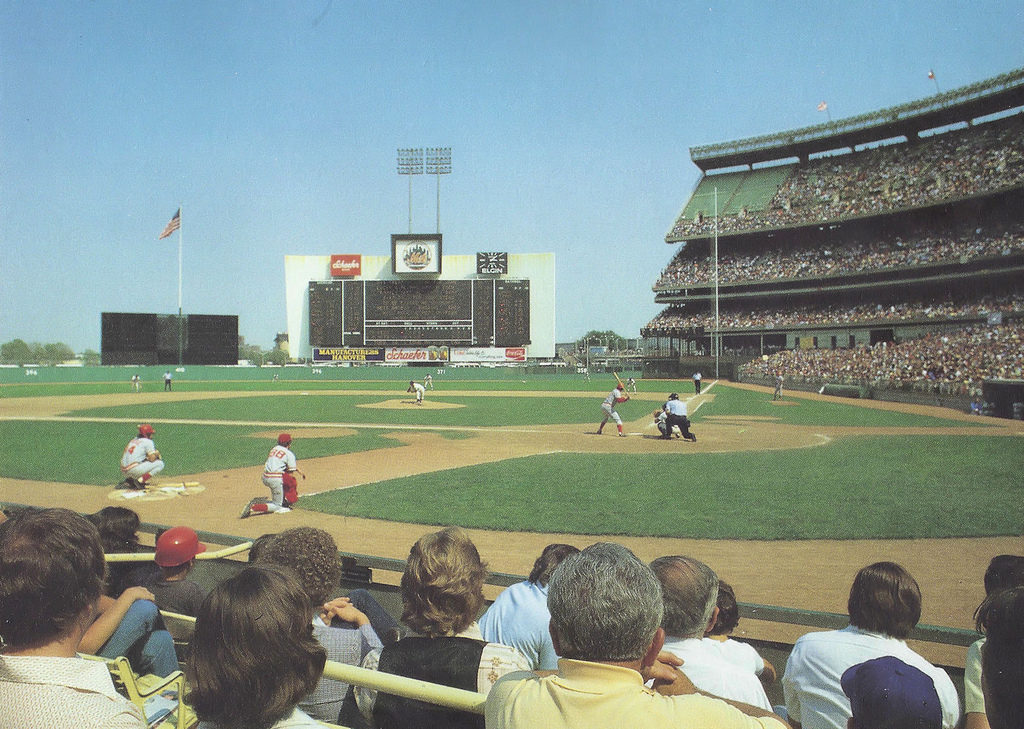
Opening Day at Shea Stadium: A nostalgic trip to the New York Mets’ beloved old home

Shea Stadium has been gone ten years now.

With mourning fans looking on, the final section of seats were torn out on the morning of February 18, 2009. Awaiting fans a short distance away was the sparkling new Citi Field which would open for business with a thrilling game between the San Diego Padres and the field’s home team the New York Mets.

Shea was not a perfect stadium. Neither was Ebbets Field, the former home of the Brooklyn Dodgers that has nonetheless entered into the realm of sports mythology. But nostalgia holds a special power in sports history, and the further we get from the classic moments which took place at Shea, the more remarkable it becomes in memory.

Quite frankly, Queens has not been quite the same.

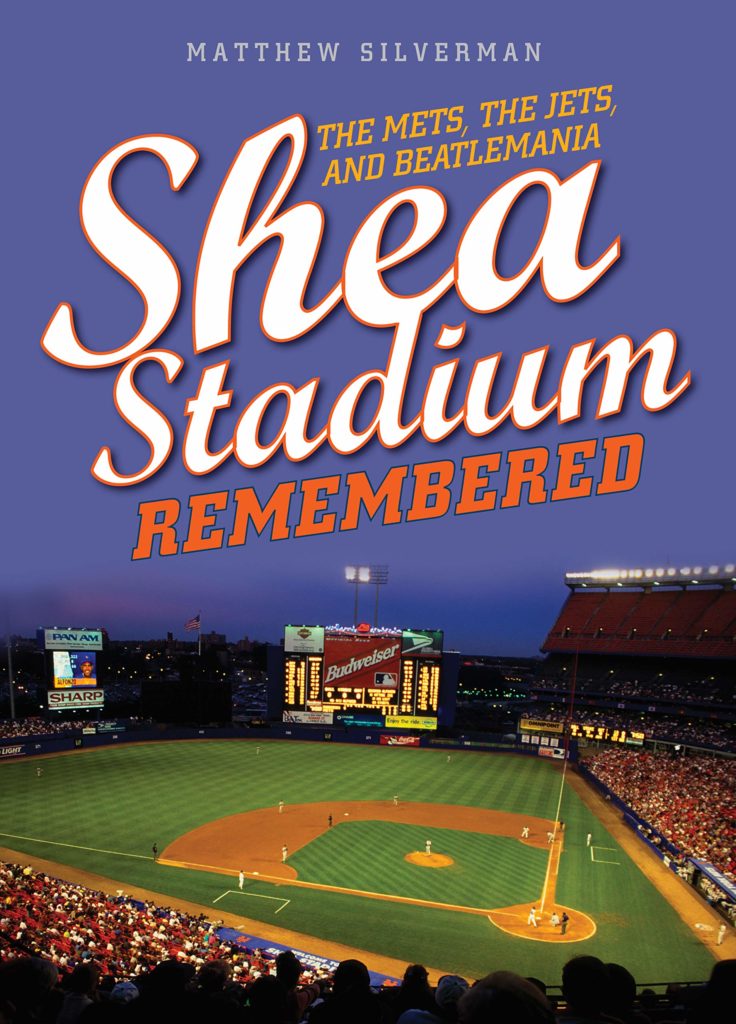
Shea Stadium Remembered:
the Mets, the Jets and Beatlemania
by Matthew Silverman
Lyons Press

Journalist Matthew Silverman is such an ardentMets aficionado — if you’ve read a book about the beloved Queens baseball team, he probably wrote it — that his official website is MetSilverman.com. And so of course Shea Stadium Remembered: the Mets, the Jets and Beatlemania, his tribute to the Met’s most famous home, has a breezy pitch-perfect charm to it.

Arranged in tiny chapters, little blips of history, Shea Stadium Remembered revels unashamedly in sweet nostalgia, recalling a place that matched the charisma of its underdog baseball team and a home for an accomplished football team back when it was actually situated within the city.

The birth of the Mets and their home for over 40 years begins in a moment of great turmoil in New York City sports history. In the 1950s, both the New York Giants and the Brooklyn Dodgers left New York City, the latter after a vicious public battle between Dodgers owner Walter O’Malley and New York power broker Robert Moses.

Moses wanted a team situated in Queens, in Flushing Meadows-Corona Park, an eventual companion to Moses’ pet project — the World’s Fair of 1964. With Ebbets growing inadequate for modern baseball crowds, O’Malley wanted a new stadium at Atlantic and Flatbush Avenues, keeping them in Brooklyn. (That’s near the spot of today’s Barclays Center.)

But nobody overpowered Robert Moses in the 1950s. The Dodgers split for Los Angeles.

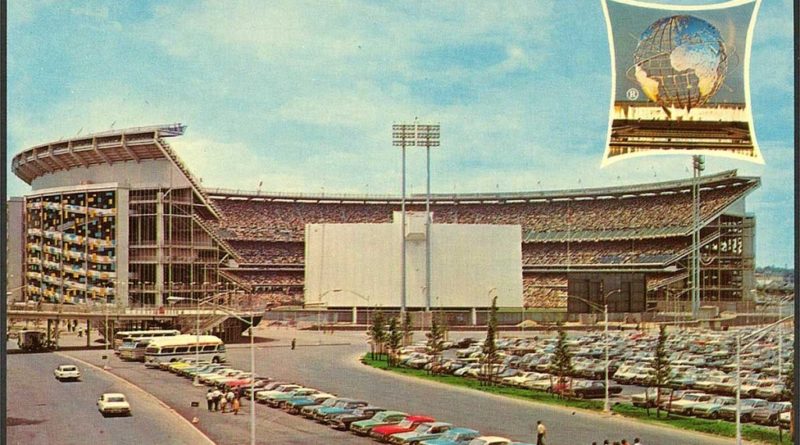
Shea Stadium, late 1970s — Sports Photo File/Mitchell Reibel

Fortunately, lawyer William Shea convinced the National League to expand their roster, leading to the creation of the New York Metropolitans, the name a nod to a 19th century baseball club and eventually shortened. After a short stint in the decrepit Polo Grounds, they moved to their new home — named in honor of a man who never played for them but was nonetheless instrumental to the history of New York City sports.

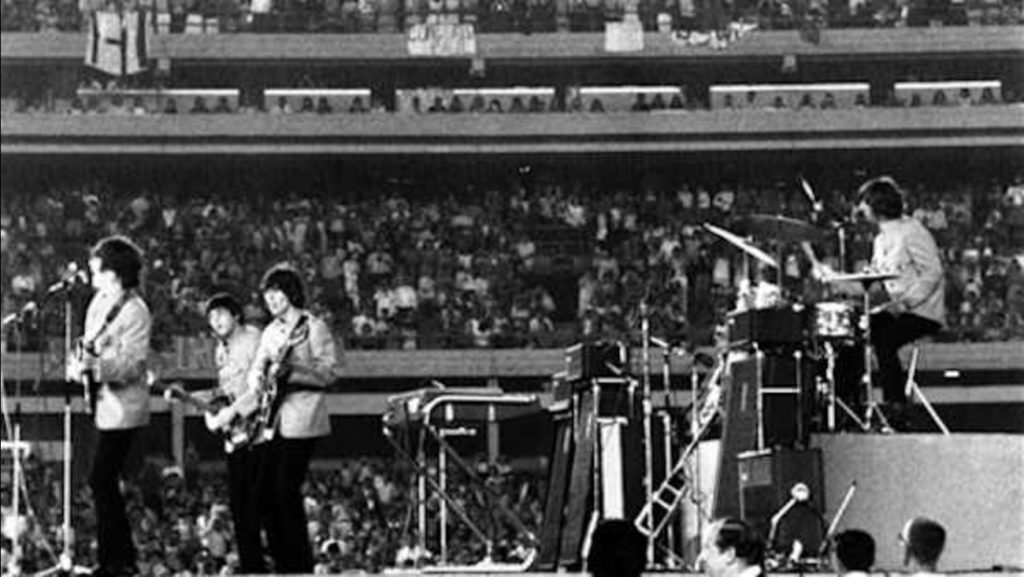
In Shea Stadium Remembered, Silverman gives us a compilation of the stadium’s greatest moments, weaving the Met’s history in with the other notable events at the stadium — from the Beatles to Pope John Paul II.

Not to say that the Jets aren’t prominently featured here as well — they played at Shea for almost twenty years — but the Mets were truly at home here, through thick and thin (often very thin). The Mets gave Shea some of its personality and Shea gave the Mets its hometown pride.

The Beatles at Shea Stadium, August 1965 (AP)

For more information, check out these catalog episodes of the Bowery Boys podcast:

Categories
American History Bowery Boys Bookshelf

WILD BILL: The real man behind a Western legend — and a reluctant Broadway stage star

“Hickok was a celebrity. He was famous. He was feared. He was already a legend. It is estimated that over fifteen hundred dime novels were written just about Buffalo Bill Cody, beginning in 1869, when he was only twenty-three, into the 1930s, and during the early years. Wild Bill was in that category of iconic western hero. He had risen to the heights of both reputation and fabrication … and now the slow, inexorable descent began.” — Tom Clavin

How do you write a book about a historical figure who seems more fiction than real? The Western folk hero Wild Bill Hickok lived a life that was thrilling, dangerous and brash, amplified by the fascinations of the American press into a virtual Western superhero.

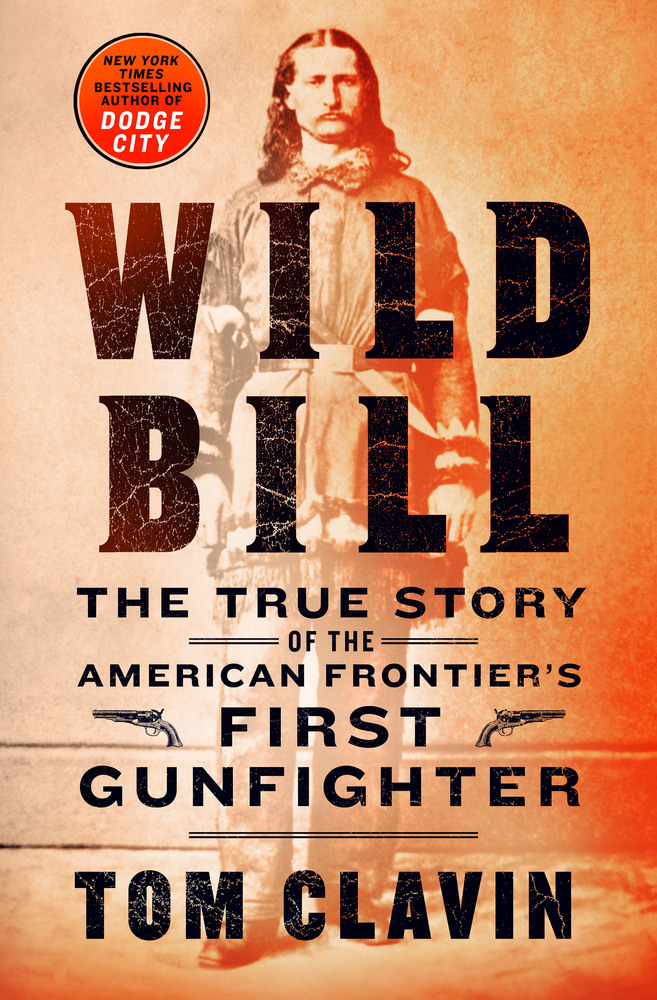
Wild Bill: The True Story of the American Frontier’s First Gunfighter
by Tom Clavin

St. Martins Press/2019

Tom Clavin’s Wild Bill: The True Story of the American Frontier’s First Gunfighter, a biography as frisky and unpretentious as its subject, attempts the noble task of walking back 150 years of mythology surrounding the Illinois man named James Butler Hickok, a drifter who wandered from job to job through Missouri, Arkansas and Kansas. During the Civil War, he worked as a wagon master and later a scout for the Union Army.

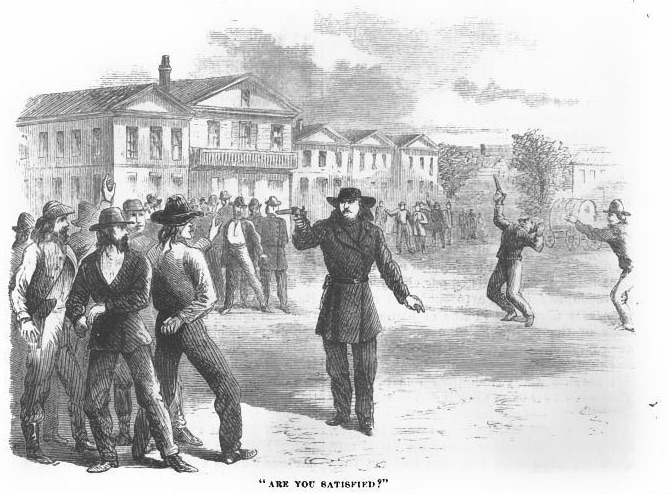
In 1865, he shot and killed the gambler Davis Tutt in the town square of Springfield, Missouri. This quick-draw duel — essentially over a pocket watch — took place in the early evening, not high noon. But whispers of this outrageously bloody event inspired a journalist named George Ward Nichols, working for New York’s Harper’s New Monthly Magazine, to profile Hickok.

Hickok shoots Tutt in Springfield town square, as depicted in Harper’s New Monthly Magazine in 1867.

It was in Nichols’ piece that Wild Bill Hickok — the fastest gun in the West — and indeed the genre of Wild West pulp fiction was born.

“[N]o single published piece catapulted a man on the American frontier more than Nichol’s article did for Hickok,” writes Clavin. With “the fertile imagination of a writer who could cash in on a sensational story and an outlet that offered that story to thousands of eager and mostly gullible readers, America had its first postwar frontier star.”

The attention only made Hickok more of a target with foolhardy men seeking him out in efforts to best the now-famous gunslinger. (It never ended very well for them.)

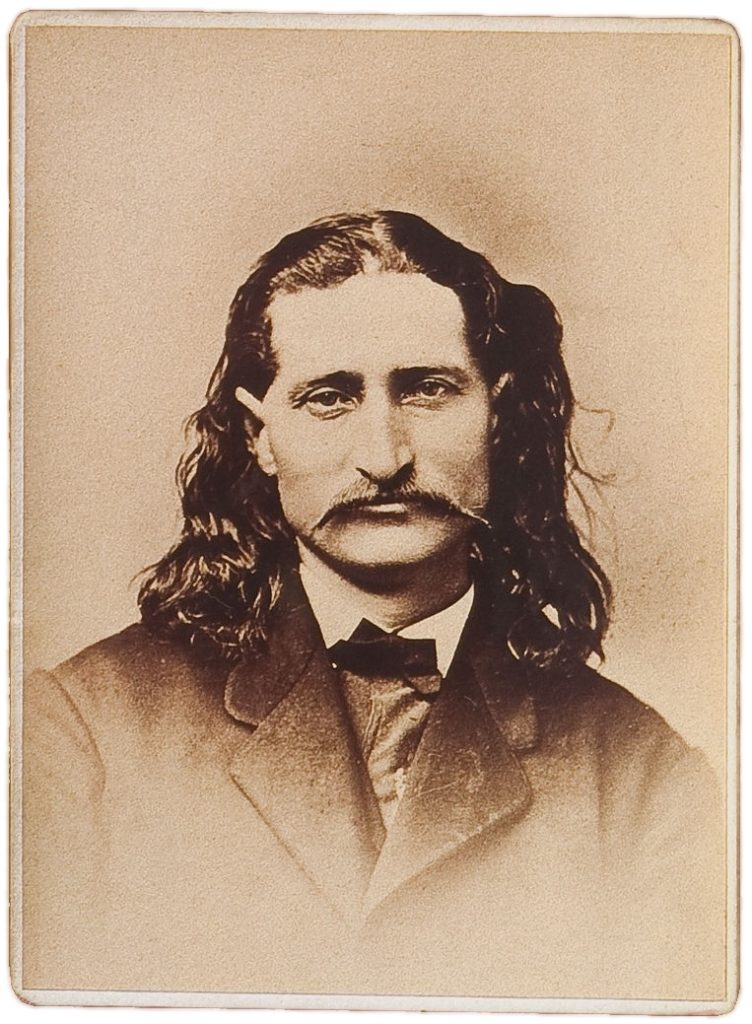
Wikimedia Commons

Clavin depicts an unruly but realistic western (or, more accurately, midwestern) landscape of chance encounters, brief romances and wide, arduous journeys. Yet even a hardened adventurer like Hickok would occasionally take a moment to bask in his fame.

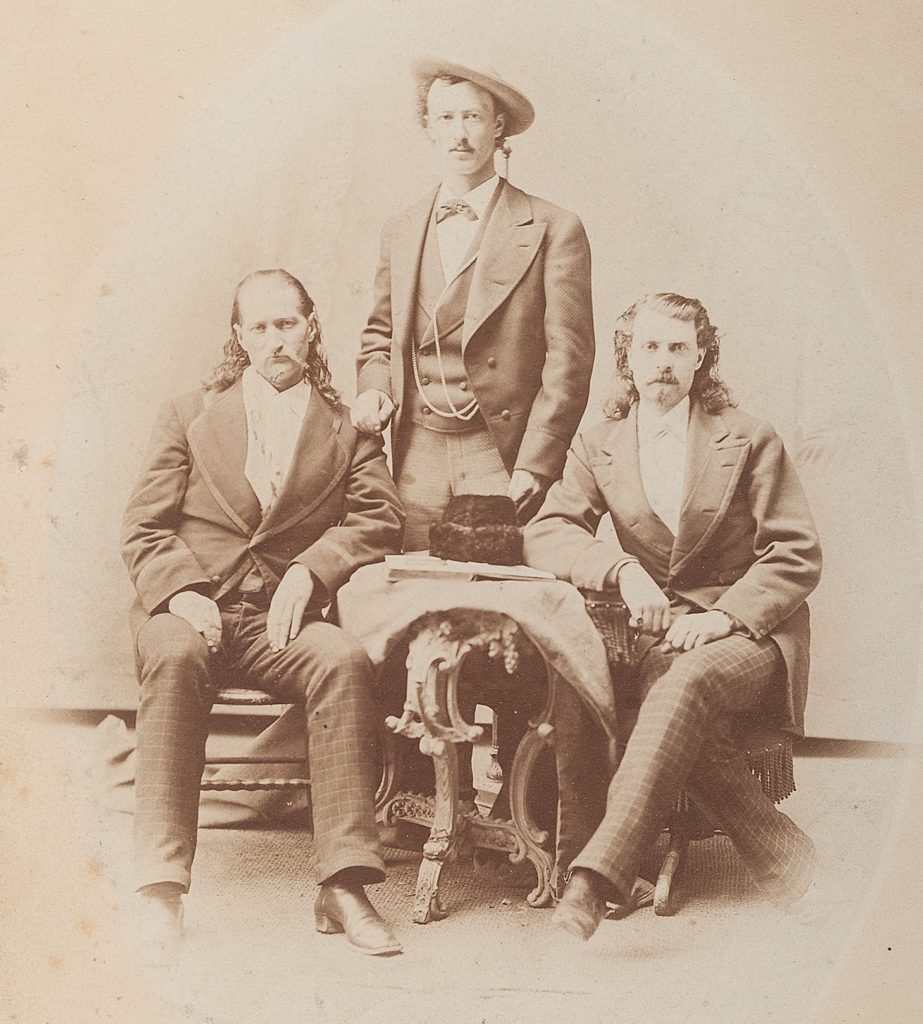
In 1873 he joined his longtime friend ‘Buffalo Bill’ Cody in the cast of a ham-fisted play Scouts of the Plains at New York’s Niblo’s Garden, becoming a major box office draw.

Today we might call him, um, difficult. “Hickok felt like he was risking his integrity and dying a bit with every performance because he became further convinced that acting was a foolish occupation. One night … he took one of his real pistols and shot out the spotlight that had been fixed on him. The audience applauded the dramatic reality of the production as well as Hickok’s famous marksmanship.”

On August 1, 1876, Hickok was murdered during a poker game in Deadwood, a frontier town in the Dakota Territory, cutting short any future stage performances but securing his position in the pantheon of Wild West mythology.

Wild Bill Hickok, “Texas Jack” Omohundro, and Wild Bill’s longtime front “Buffalo Bill” Cody, in a cabinet photograph for Scouts of the Plains, 1873

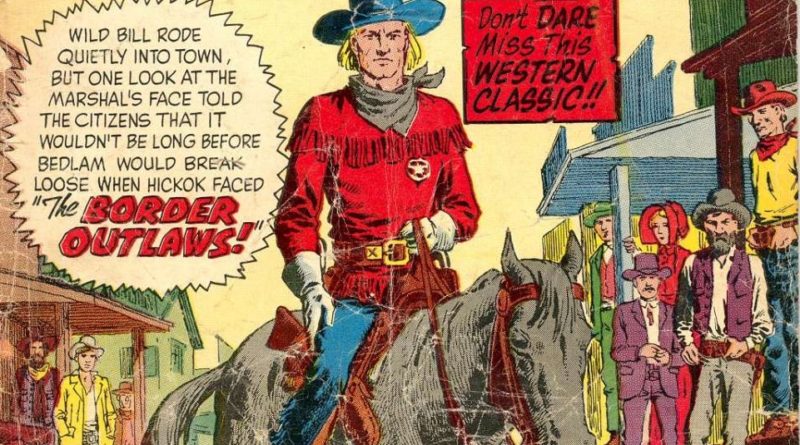
At top: An issue of the 1964 comic book Wild Bill Hickok #12, published by Super Comics

Categories
Bowery Boys Bookshelf

Eleven holiday gift ideas for New York history buffs: The Bowery Boys favorite books of 2017

For this holiday season, what single present can satisfy a native New Yorker, a history buff enchanted with the city’s rich heritage, or a person who’s dreamed of coming here to visit one day? A book of course!

Here are our picks for ideal gifts this year — from hard-hitting non-fiction to nostalgic memoir, from the Revolutionary War to the 1970s, from the real to the imagined.

And at the bottom of this list are our three favorite New York City history books of 2017. Most of these books are taken from past blog write-ups so click on the links below to get our full reviews.
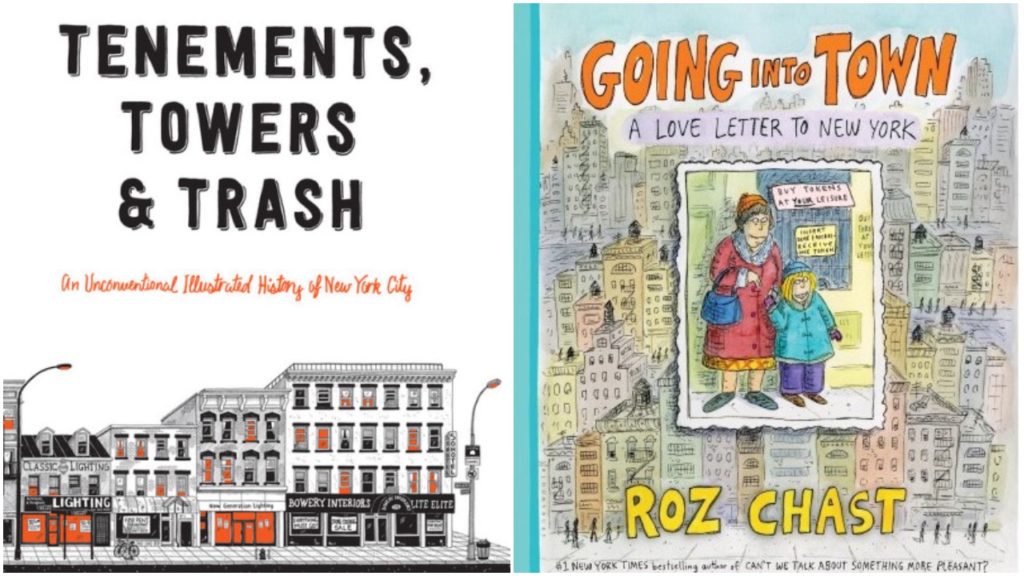
ILLUSTRATED WONDERS

Tenements, Towers & Trash
An Unconventional Illustrated History of New York City
by Julia Wertz

Going Into Town
A Love Letter to New York
by Roz Chast

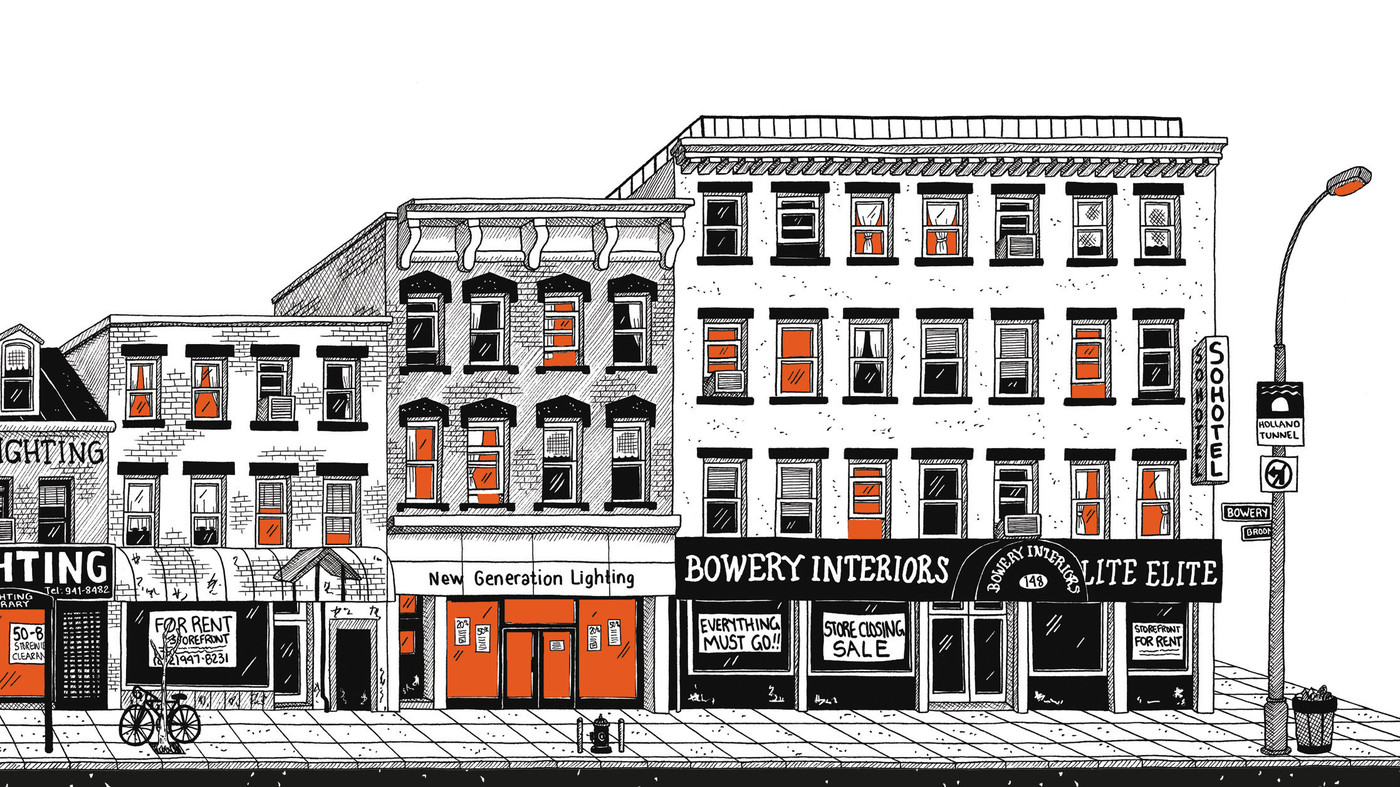
Two New Yorker cartoonists hit the bookshelves with absolutely perfect tributes to the city, both in the spirit of E.B. White’s Here Is New York (of which both books pay homage).  Tenements, Towers & Trash is a wonderland of New York scenes from the past and present,  wandering through time and space almost in a sentimental stream of consciousness, captured in beautiful and detailed black-and-white illustrations. Streetscapes are captured at rest, the awnings and ornaments of the past awaiting the reader to fill them with memories. Along the way are historical asides on Madame Restell and Typhoid Mary, as well as fabulous celebrations on the city’s most beautiful trash dumps (Bottle Beach, Staten Island’s Boat Graveyard.)

Going Into Town, Chast’s book of urban observations, is a guide book full of charm and optimism, a polar opposite of most current-affairs tomes about New York on the shelves today. Even when she remarks disparagingly about tourists or rodents or trash, it’s done with the lightest of touches, graced with vibrating illustrations of herself.  And it really is a guide book — albeit one you can safely read at home — describing the layout of New York’s avenues and cross-streets, exploring its most enchanting institutions and proclaiming love for the most particular things (the Times Square/Grand Central shuttle, the armor gallery at the Met, the pigeon). It’s curmudgeonly but not the least bit cynical.

(Read the full review of Chast’s book here.)
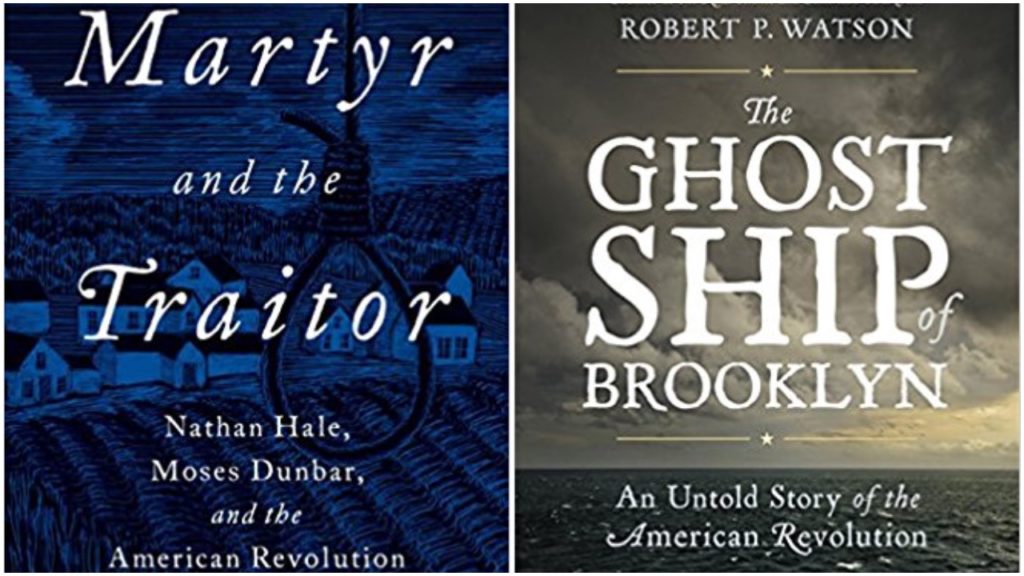
 

REVOLUTIONAIRIES, 18th CENTURY VERSION 

The Martyr and the Traitor
Nathan Hale, Moses Dunbar, and the American Revolution
by Virginia DeJohn Anderson

The Ghost Ship of Brooklyn
An Untold Story of the American Revolution
by Robert P. Watson

You may know Nathan Hale well from history books as a symbol of American patriotism, dying for his country long before anybody actually thought it would ever be a country.  But what if things had been a little different in the life of Mr. Hale as a young man? What if, Sliding Doors-style, decisions made by him and his loved ones had sent him down a different path? What if his ardent patriotism had, instead, been in support of the British cause?  In Anderson’s captivating history, we are presented with an actual historical example — a contrasting figure, nearly forgotten, named Moses Dunbar — to use for this thought experiment.

But during the Revolutionary War, there was a fate worse than death, as graphically depicted in Watson’s history of the prison ships of Brooklyn’s cursed Wallabout Bay. The author isolates the grim tale of these prison ships, often deemed a footnote in most war histories, from the actions of the conflict at large. It’s vividly narrow in scope, allowing the reader to experience the ship’s macabre trials in a sort of narrative entrapment.

(Read the full review of these books here and here.)
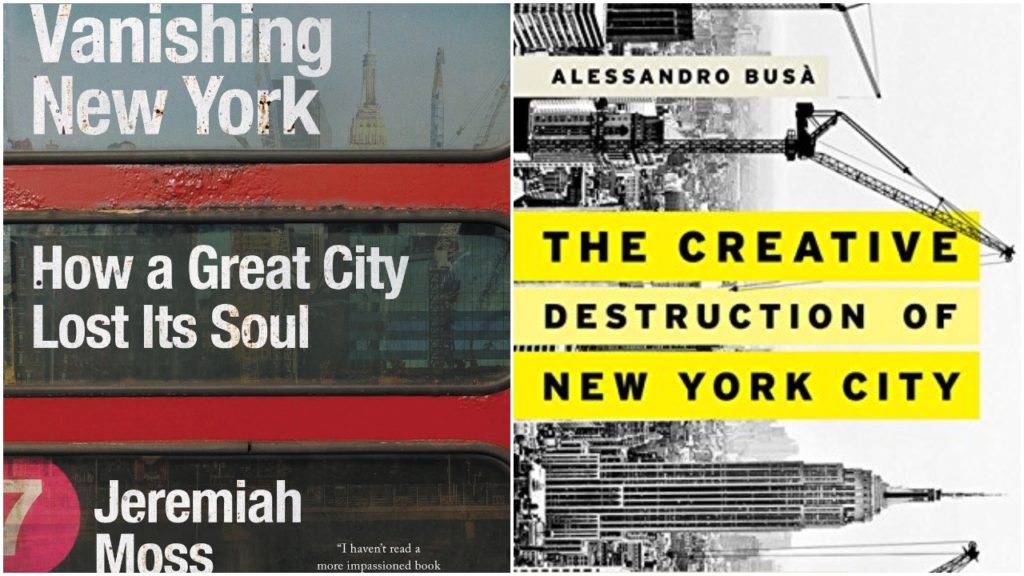
REVOLUTIONAIRIES, 21st CENTURY VERSION 

Vanishing New York
How A Great City Lost Its Soul
by Jeremiah Moss

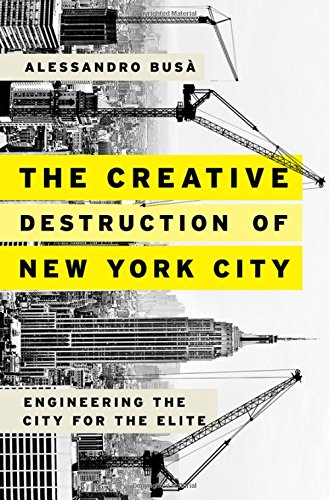
The Creative Destruction of New York City
Engineering the City of the Elite
Alessandro Busà

Loving New York, of course, doesn’t mean you have to like what it’s becoming. Most of you know the blog Jeremiah’s Vanishing New York, observing the steady strangulation of New York City by hyper-gentrification, one fallen local landmark at a time. In what is essentially a book-length version of the blog, Moss has taken a step back, observing the alterations of the city’s DNA from neighborhood perspectives. In The Creative Destruction of New York City, Busà goes for a different approach, breaking down the major players in city government who make those altering decisions and identifies the tools those parties may use in transforming New York, often for less-than-altruistic ends.

(Read the full reviews of these books here and here.)
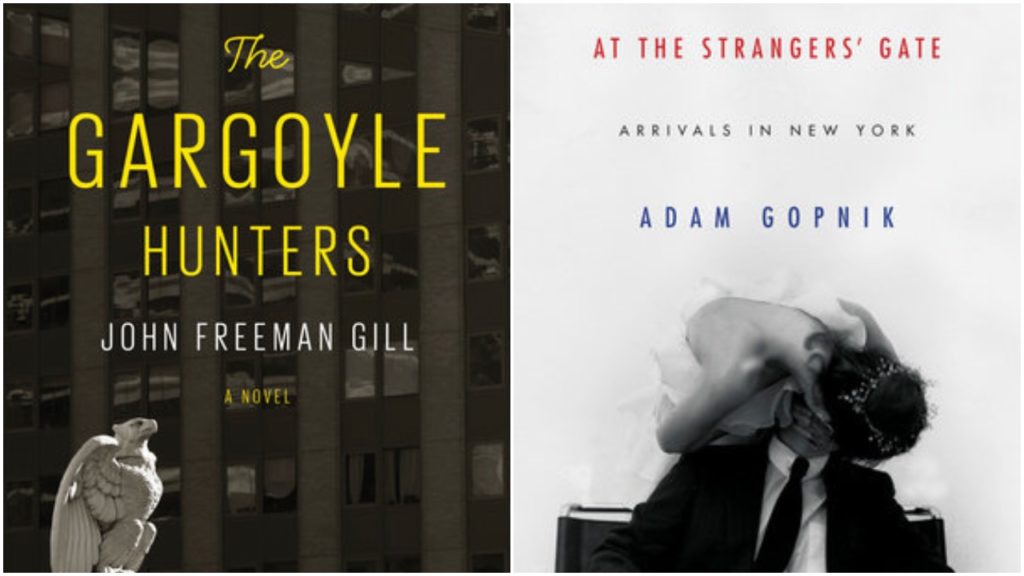
PIECING TOGETHER THE PAST

 The Gargoyle Hunters
John Freeman Gill

At the Strangers’ Gate
Arrivals In New York
by Adam Gopnik

In the 1970s lovers of New York’s fading architectural landscape decided to protect its most treasured features — by liberating its details from the landscape entirely. They were called ‘gargoyle hunters’, so passionate for the city’s magnificent beauty that they would rather steal aspects of it than see it destroyed. Gill is the son of a ‘gargoyle hunter’ who traipsed 1970s in search of aged, deteriorating treasures, and his adventure here, while certainly fictionalized, has the immediacy of a memoir, laced with specific references to corner shops, restaurants and cheap snack foods.

The ’80s in New York City, meanwhile, were sometimes defined by glossy magazines and gallery shows, the earnest giving way to irony, the facile passed off as profound. Many chroniclers of this period fall victim to its excesses, treating guest lists like poems. Not Gopnik, the New Yorker writer who resides within his written settings retaining a voice of sincerity and restraint.  Gopnik’s lovely recollection of New York during this heady, escapist decade recounts tales of tiny studio apartments and dinners with iconic photographers with equal measures of joy and admiration.

(Read the full Bowery Boys book reviews here and here.)

And our top three favorite books of 2017 are….
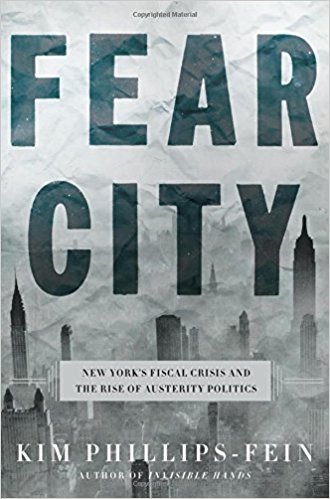
1) Fear City
New York’s Fiscal Crisis and the Rise of Austerity Politics
Kim Phillips-Fein

Phillips-Fein has crafted one of the best history books of the year out of one of the ugliest periods in New York City history — the financial crisis of the 1970s. The author manages to sift through this complicated and seemingly indecipherable story and recount even the most gloomy late-night board meetings with a vital urgency. You may know portions of this story quite well — some of you lived through it — but you may not know the varying and even opposing ways that the city got out of this mess.

(Read the full Bowery Boys book review from May here.)
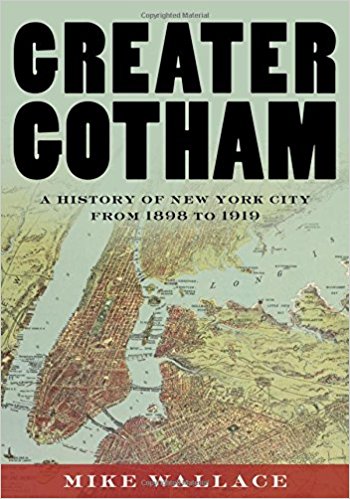
2) Greater Gotham
A History of New York City from 1898 to 1919
Mike Wallace

The decades between Consolidation and Prohibition saw the rise of New York City as an international symbol of American prosperity while being reshaped by an unprecedented collection of modern cultural forces. During the Gilded Age, New York became of city of wealth and a metropolis of stratified classes, forming immigrant enclaves and vital (if often corrupted) social institutions. In the new century, a pivot occurs. Tradition gives way to the modern and a crowded city finds room for its new personalities.

Confined by just these two decades, the book visits virtually every aspect of life by category. It thoroughly explores one element of that critical period — politics or finance, for instance — then refocuses and reboots, starting at the beginning again in the next chapter, observing different histories.

(Read the full Bowery Boys review from November here.)
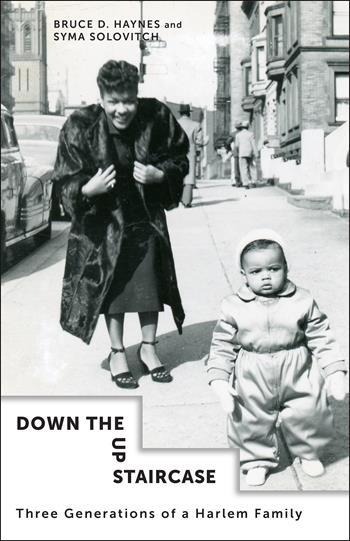
3) Down the Up Staircase
Three Generations of a Harlem Family
Bruce D. Haynes and Soma Solovitch

Haynes grew up in a townhouse at 411 Convent Avenue, observing the latter years of the building’s steady, graceful decline. His grandparents had moved into the townhouse in 1944 and his parents had remained within it their entire lives, even through a contentious marriage. Bruce grew up there with his two brothers George and Alan. One of them would meet a tragic end during the fateful summer of 1976.

But the house has not simply been transformed by familial necessity; it has been changed by the history of Harlem itself. Down the Up Staircase documents the lives of three families who seem to have felt every tumultuous shift and been present, in some form, in every major milestone in black American life.

(Read the full Bowery Boys review from July here.)

Categories
Bowery Boys Bookshelf

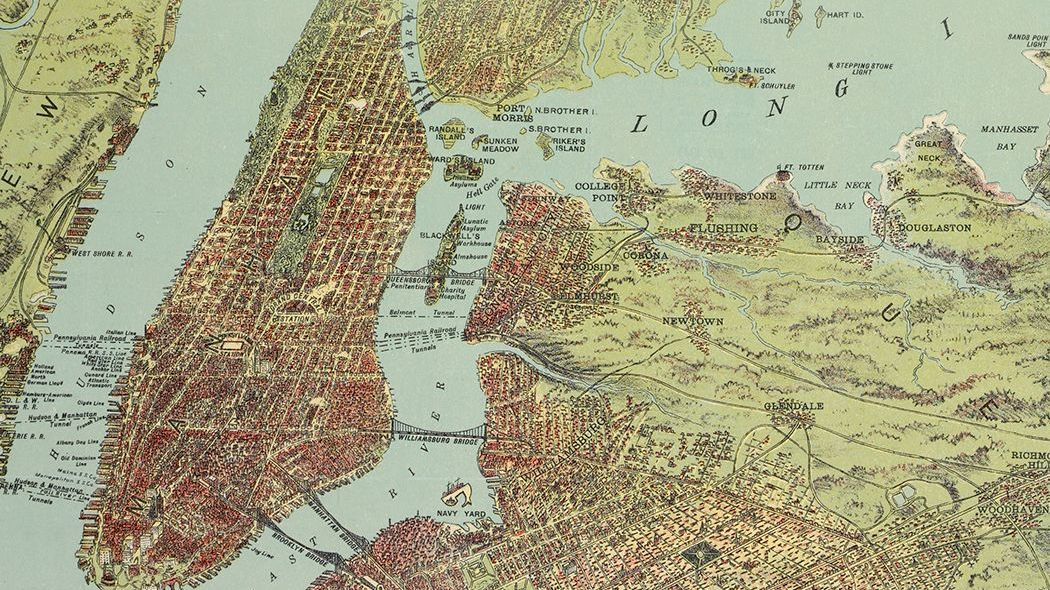
‘Greater Gotham’: Admiring the biggest, most important New York City history book of the year

Gotham: A History of New York City to 1898, by Edwin G. Burrows and Mike Wallace, is my bible.

It sits with my reference books, not with the other history non-fiction, foundational in its importance to this subject. I’ve read every page, although not in one or even 50 sittings. It winds through about 275 years of history with an exhaustive confidence, exploring every aspect of life in this region with depth and dexterity. The subject is the island of Manhattan and the lands surrounding that will become Greater New York City. Like a Shakespearean comedy, it concludes with a wedding — the Consolidation of 1898.

It takes the authors 1,236 page to journey through this story. The new follow-up by Wallace, Greater Gotham: A History of New York City from 1898 to 1919,  takes almost as many pages to tell the story of just a couple decades. But that’s the 20th century for you.

Greater Gotham
A History of New York City from 1898 to 1919
Mike Wallace
Oxford University Press

The decades between Consolidation and Prohibition saw the rise of New York City has an international symbol of American prosperity while being reshaped by an unprecedented collection of modern cultural forces. During the Gilded Age, New York became of city of wealth and a metropolis of stratified classes, forming immigrant enclaves and vital (if often corrupted) social institutions.

In the new century, a pivot occurs. Tradition gives way to the modern and a crowded city finds room for its new personalities.

Professor Wallace, founder of the Gotham Center for New York City, takes Gotham‘s comprehensive powers to new heights with Greater Gotham. Confined by two decades, the book visits virtually every aspect of life by category. It thoroughly explores one element of that critical period — politics or finance, for instance — then refocuses and reboots, starting at the beginning again in the next chapter, observing different histories.

This categorical framing makes Greater Gotham perhaps a more difficult straight-through read, but lends the work an authoritative feel. Will there ever be a better book about this period? How could there be?

The book starts with higher infrastructural forces — from great transportation projects to population movements — then gently settles into turn-of-the-century street life and everyday customs of New Yorkers. Baseball games, Times Square restaurants, Gibson Girls, ragtime music. I found the middle sections to be of special interest, those ‘unofficial’ collaborations borne from the social and intellectual ideas coming in from Ellis Island. Unions and radicals. Progressives and repressives. Maxim Gorky, Arnold Rothstein, Edith Wharton, Madam C. J. Walker.

Greater Gotham really does reach into all five boroughs and even into the extended regions of Westchester County and Long Island. The attempt to tell the total story is bold, perhaps bolder than the first Gotham. New Yorkers were much more diverse — from many backgrounds, many races — than they were even fifty years before. The goal of Wallace and his researchers is to find stories that attach to every New Yorker living here during this twenty-year period.

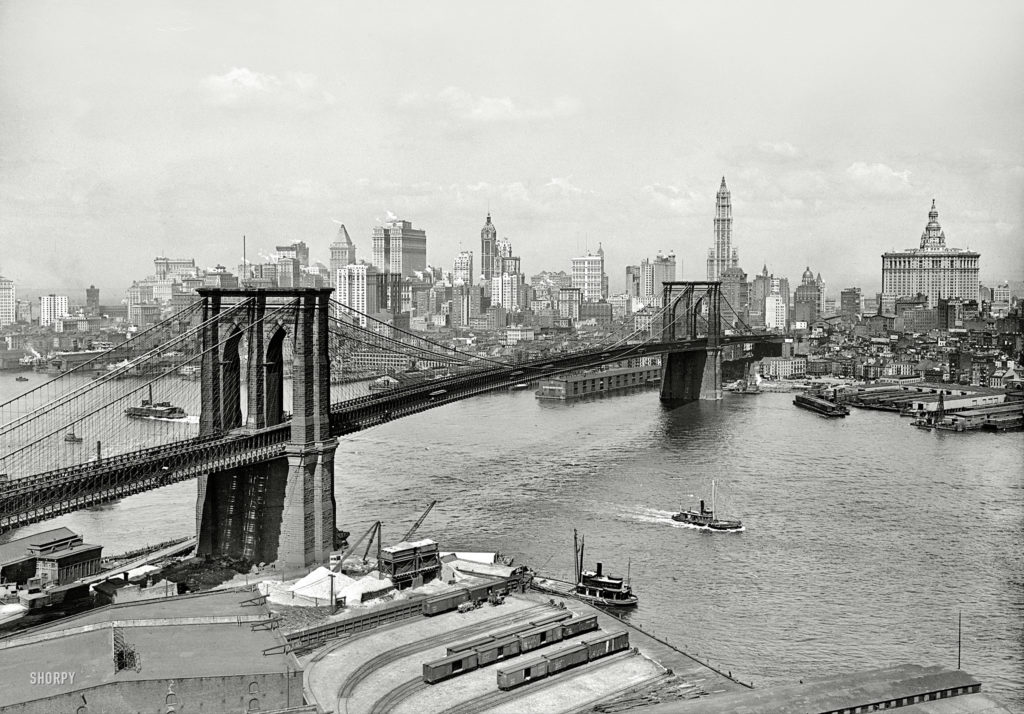
New York City 1915, courtesy Shorpy

As categorically framed, some cultural shifts of the early 20th century may seem even more impressive, seeming to lurch forward with a bewildering speed: the dissolution of corporate trusts, the sophistication of organized crime, the lives of African-American New Yorkers. And this ‘sudden’ modern effect is especially true with the role of women which expanded in practice, if not in custom. “Women had also been contesting the double standard, revising family law, managing economic resources, building female-run institutions, and engaging in politics (despited being barred from the polls).”

Also explored is the rise of outer-borough communities during this period, particularly in the Bronx, Manhattan’s closest companion, becoming transformed by post-Consolidation optimism, from rising institutions in its parks to the residential boom along the Grand Concourse.

I’ve spent a couple months with this book already and have found so many new marvels among the pages. I suspect its trove of particular details will continue to enthrall me in years to come. Time to make room on my reference shelf.


Review by Greg Young

Categories
Bowery Boys Bookshelf

‘The Creative Destruction of New York City’: The Tools For Fighting Back Against Unwanted Change

Talk of hyper-gentrification, skyrocketing real estate and the ‘end of New York’ comes bundled with despair and helplessness. Walk down 59th Street and gaze as the super-talls blocking the sun, built for foreign investors who may never once step inside these luxury caverns.

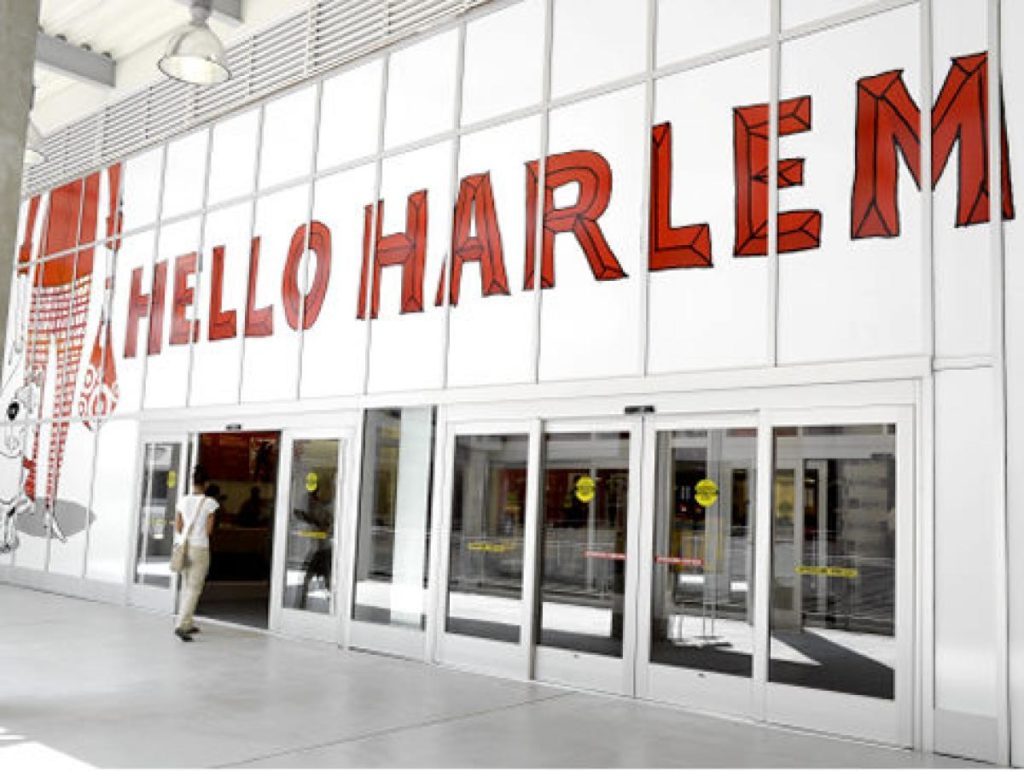
Or stroll along Smith Street in Cobble Hill, observing the rows of boarded-up or vacant store fronts, their rents too high for most actual human retails. Or head to 125th Street to experience the amazing history of Harlem, only to be met with a smorgasbord of national brand retailers with few connections to locals.

What can I do about any of this?, you might think hopelessly. Activism, voting, speaking out — we must all do these things to protect the city we love. But the first step is education on the basic matters of rezoning and gentrification. Where do you even begin?

THE CREATIVE DESTRUCTION OF NEW YORK CITY
Engineering the City of the Elite
Alessandro Busà
Oxford University Press

In The Creative Destruction of New York City, a manual for the big-city activist, the critical urban scholar Busà lays out the current crisis in an explanatory, high-level inspection.  One must turn to points in the past — 9/11, the near-bankrupt ’70s, even the destructive shenanigans of Robert Moses — to understand the often soulless and demoralizing changes to the city in 2017. The most troubling development trends began as remedies for past urban decay.  In essence, the city is now choking on its former cures.

Courtesy brklyn is over/Flickr

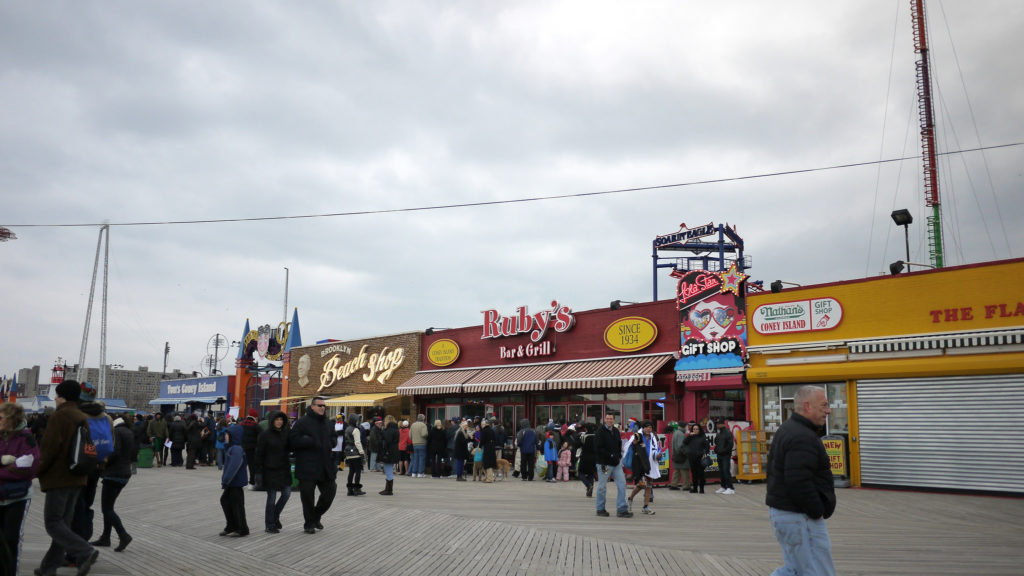
As examples, Busà focuses on two neighborhoods in particular — Harlem and Coney Island.  Neither of these places were ‘gentrified’ in the traditional sense — as in, initially driven by artists and the artists-formerly-known-as ‘bohemians’ that staked out Williamsburg in the 1980s and 90s. (Unlike other, angrier screeds, Busà mostly steers clear from blanket condemnations of hipsters.)

Portions of Harlem were refitted for big-box retailers who quickly closed in on the mom-and-pop establishments of 125th Street, while luxury housing monopolized on Harlem’s rich history to attract wealthy urbanites looking a condo in a hip neighborhood. Coney Island’s redevelopment woes have eliminated parts of the iconic amusement district and wiped historic buildings from the map.

Below: Target opened in East Harlem in 2010. Today there are at least 15 Target stores throughout the five boroughs. 

ALFRED GIANCARLI/Daily News

At the core of both is that pesky, misunderstood implement known as rezoning. It’s a simple enough concept of course, the mechanism by which certain areas designated for one purpose (residential, commercial, industrial) switch to another. But as Busà says, “As of late, it has become the buzzword loaded with rather negative connotations in New York City. While for some residents it’s nothing more than some technocratic yaw-inducing mumbo-jumbo, for others this loathed word means a call to arms.”

Busà breaks down the major players in city government and civic life who control these decisions and identifies the tools those parties may use in transforming New York, often for less-than-altruistic ends. At times, during the administrations of Bloomberg and De Blasio, rezoning seems to have no more purpose than to create wealth for a few private players.

The Creative Destruction of New York City, written by an academic, is dispassionate and often dry; consider this a compliment. There are many outlets for well-meaning, instructive outrage. (Every time I want to do something — call a congressman or join a protest — I go to Jeremiah’s Vanishing New York first.) Busà‘s more academic take on the crisis will help you understand the rules of the game and those who move the pieces. It’s the book you reach for after you get angry.

Categories
Revolutionary History

The Martyr and the Traitor: Choosing Sides In The Revolutionary War

You may know Nathan Hale well from history books or from New York’s numerous memorials as a symbol of American patriotism, dying for his country long before anybody actually thought it would ever be a country.

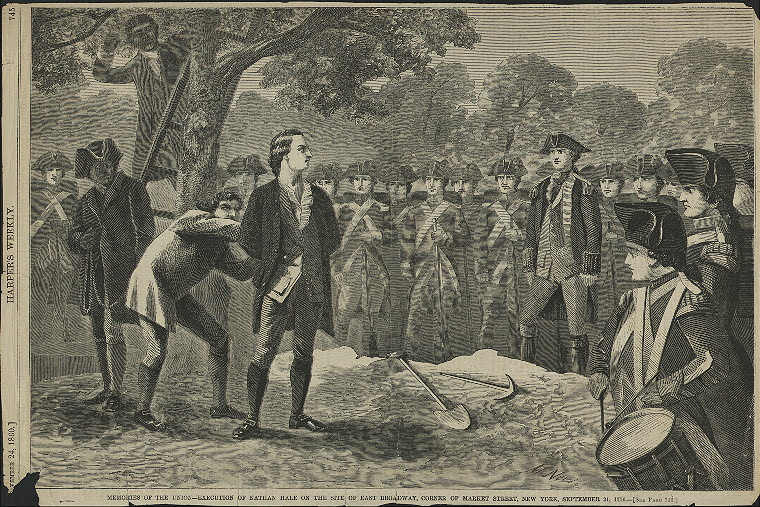
The British hanged him in New York as a spy in the aftermath of the Great Fire of 1776. He had performed no great deed for George Washington and his army — his intel never made it back to the general — except for volunteering for the spy mission in the first place.  His gift to the future United States was in believing it would exist.

Courtesy NYPL

But what if things had been a little different in the life of Mr. Hale as a young man? What if, Sliding Doors-style, decisions made by him and his loved ones had sent him down a different path? What if his ardent patriotism had, instead, been in support of the British cause?

In a captivating new book by Virginia DeJohn Anderson, a professor of history at the University of Colorado in Boulder, we are presented with an actual historical example — a contrasting figure nearly forgotten — to use for this thought experiment.

THE MARTYR AND THE TRAITOR
Nathan Hale, Moses Dunbar, and the American Revolution
by Virginia DeJohn Anderson
Oxford University Press

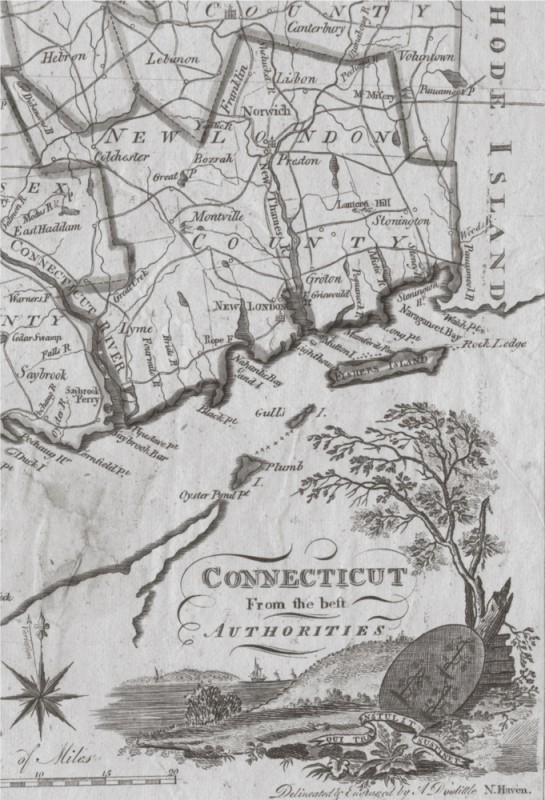
The story of Moses Dunbar is the flip-side to the Hale legend. The two Connecticut men were similar in a great many ways (although Dunbar was older) but circumstances led them to different causes.

Dunbar’s story is far less known than Hale’s of course. Hale was proclaimed a true patriot early in the Revolutionary conflict, and those with documents and information about the young schoolmaster proudly preserved them. His story is richly documented and well embroidered.

The opposite is true of Dunbar; he was hung in disgrace after returning home from a mission to recruit British sympathizers among his countrymen. It’s said that Dunbar’s own father offered to provide the rope.

Detail of Amos Doolittle, Connecticut From the best Authorities, first printed by Matthew Carey, Philadelphia, Pennsylvania, 1795. (Courtesy, Connecticut Historical Society via Chipstone.)
Anderson tells both of their stories in parallel, and for a time, the reader can experience this book as an excellent social history of life in Connecticut in the mid 18th century — the degrees in which religion, marriage, education and land ownership play a defining role in an individual’s fate.

Dunbar became an Anglican, tied to the Church of England in a time with anti-British fervor was sweeping the countryside. In fact, there are moments when Dunbar seems far more radical than Hale (who, with his Yale education, is exposed to other feisty young men and books full of eye-opening revolutionary beliefs).

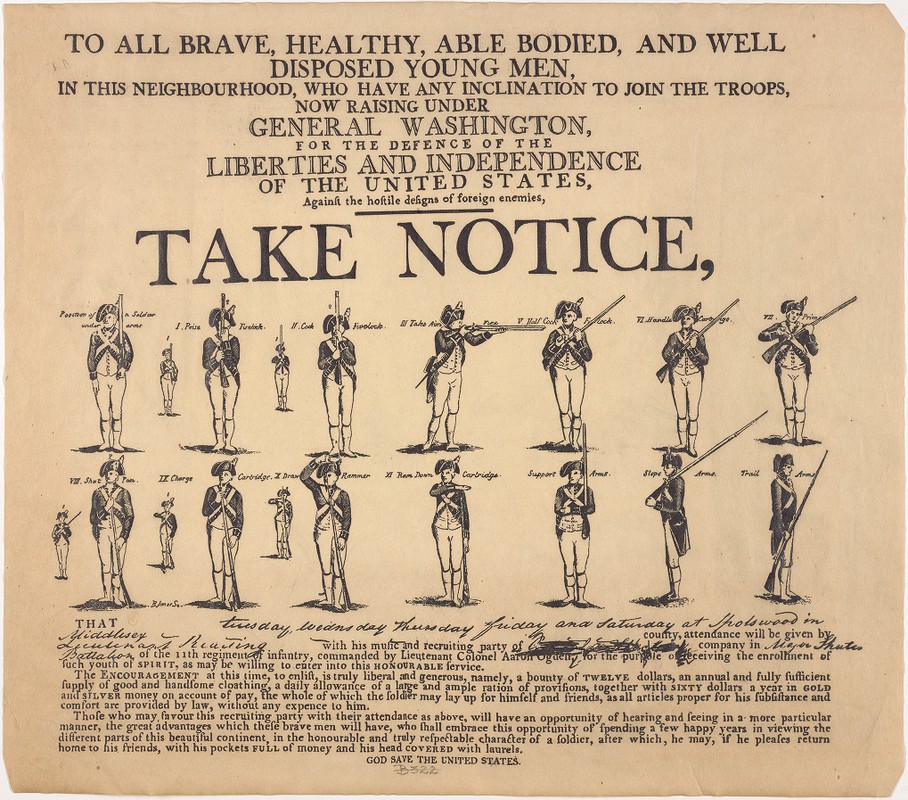
Courtesy Brown University Digital Repository

The most vivid portions of Anderson’s well-researched and excellently paced history involve violent attempts by anti-British mobs. Writes Anderson:

“As the weeks passed, Anglicans in general, not just clergy, became target of attacks if they did not announce their opposition to Britain. In East Haddam  a seventy-year-old Anglican parish clerk was yanked out of bed on a cold night, stripped, and beaten …… Rumors began circulating that Anglican clergy, in league with the detested Samuel Peters and with the approval of their congregations, were plotting to enslave the colony.”

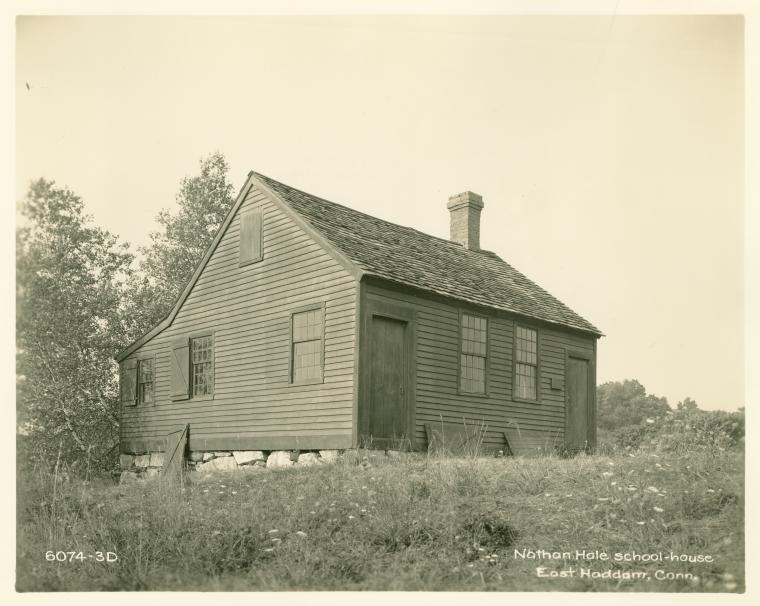
Below: Nathan Hale’s schoolhouse in East Haddam, CT

NYPL

Dunbar was radicalized by his environment and, observing such displays in his community, chose church (and, by extension, Great Britain) over country. His decision would destroy him and even lead his disgraced family into vigorously supporting the American cause.

In The Martyr and the Traitor, in putting Hale and Dunbar on equal footing, Anderson underscores the intensity of the moment and the uncertainty of its outcome. Hale’s patriotism seems all the more brave but so too does Dunbar’s intransigence.

Both men died on the noose away from loved ones; their ends embody the chaos and certain danger of the Revolutionary War.


Categories
Bowery Boys Bookshelf Politics and Protest

‘Fear City’: The unthinkable tale how New York City almost went bankrupt

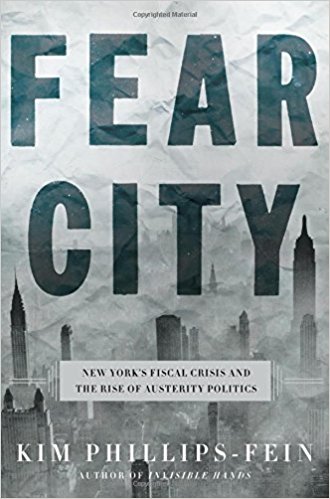
Fear City: New York’s Fiscal Crisis and the Rise of Austerity Politics, the title of Kim Phillips-Fein’s riveting new book on the 1970s financial catastrophe, isn’t wantonly comparing New York City to the devilish landscape of a horror film.

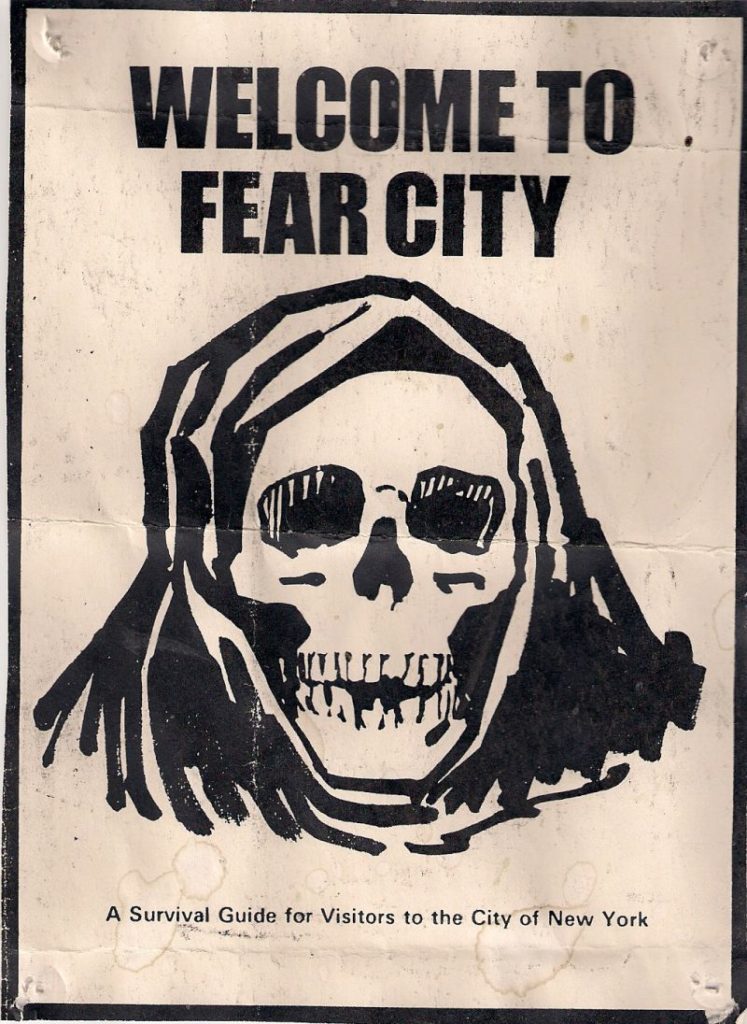
It’s the actual title of a grim pamphlet the New York Police Department distributed to tourists in 1975, providing insights into staying safe during this period of high crime and government cut-backs. Today it does read a bit like promotional material for an actual horror film The Purge, a fear-mongering document meant to embarrass city officials and galvanize communities.

Its advice included:

  1. Stay off the streets after 6 P.M.
  2. Do not walk.
  3. Avoid public transportation.
  4. Remain in Manhattan.
  5. Protect your property.
  6. Safeguard your handbag.
  7. Conceal property in handbags.
  8. Do not leave valuables in your hotel room and do not deposit them in the hotel vault.
  9. Be aware of fire hazards.

The flyers enraged Mayor Abe Beame, who was scrambling to come up with money to save New York, and he even slapped a restraining order upon the president of the Patrolmen’s Benevolent Association who was attempting to distribute the flyers. “Abandoning the notion of leafleting the airports,” writes Phillips-Fein, “police officers instead drove around trucks decked with American flags and red-white-and-blue bunting around the city, blasting out warnings about the threats to public safety.”

How did New York City get itself into this weakened, paralyzing situation? And just as impossibly — how did the city manage to get out of it?

Metropolitan Books

FEAR CITY
New York’s Fiscal Crisis and the Rise of Austerity Politics
By Kim Phillips-Fein
Metropolitan Books/Henry Holt & Co.

In Fear City, Phillips-Fein manages to sift through this complicated and seemingly indecipherable story and recount even the most gloomy late-night board meetings with a vital urgency.

In essence, it does have a horror-film quality, as we watch a festering monster grow in size within the corridors of government. New York’s financial woes began in the late 1950s, as the city began taking out large, virtually unchecked loans, playing elaborate games on spreadsheets in order to pay the bills. They were assisted by state government (who at first facilitated such borrowing and even changed laws to allow it) and the eager ratings agencies who considered New York a safe A-rating bet as late as 1973.

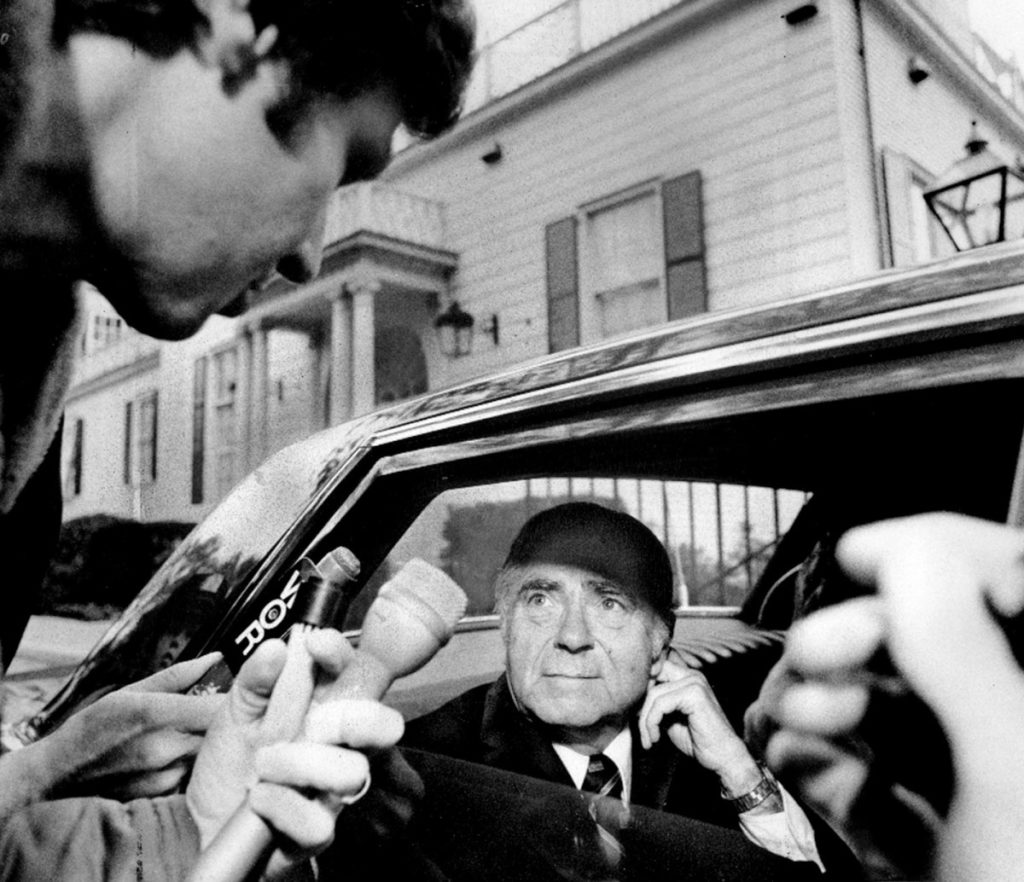
Mayor Beame, besieged by reporters outside of Gracie Mansion

Clarence Davis/NY Daily News Archive via Getty

To be fair, under prior mayors, coffers began aching under increased funding of social services, expanded to combat growing threats such as the depopulation of some neighborhoods (due to the growth of suburbs) and the spectre of deteriorating infrastructure.

But by the mid 1970s, the city and its new mayor Abe Beame faced the terrifying possibility of bankruptcy. This would not only be bad for the city, but for the nation as a whole, destabilizing the country’s banking networks. Indeed New York threatened to fall into a hole and pull the entire country in with it.

“Over time,” writes Phillips-Fein, “the fear of bankruptcy took on a life of its own.”

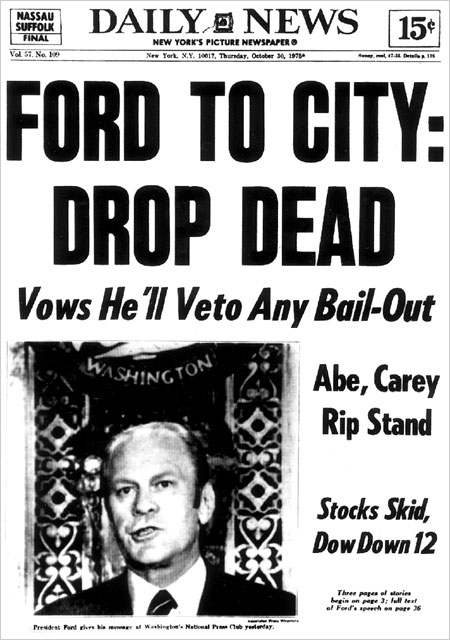
The one person with certain power to bail out the city chose not to. President Gerald Ford would eventually butt heads with his own vice president Nelson Rockefeller over the country’s involvement with New York. “Most of Ford’s advisers believed New York was shamelessly begging for help to prop up its welfare state. The cold light of default … might be the only thing that could compel the city to change its ways.”

We know how that ended up turning out.

But if Ford wouldn’t come to the table to offer assistance, Beame often had a problem admitting there was a problem at all. At times he sounds like an addict, frantically coming up with excuses for his own behavior. “He claimed the city was just running low on cash while it waited for revenues to arrive.”

You may know portions of this story quite well — some of you lived through it — but you may not know the varying and even opposing ways that the city got out of this mess.

On one level, it did so with the help of financiers and CEOs, leading task forces  of great and questionable power.

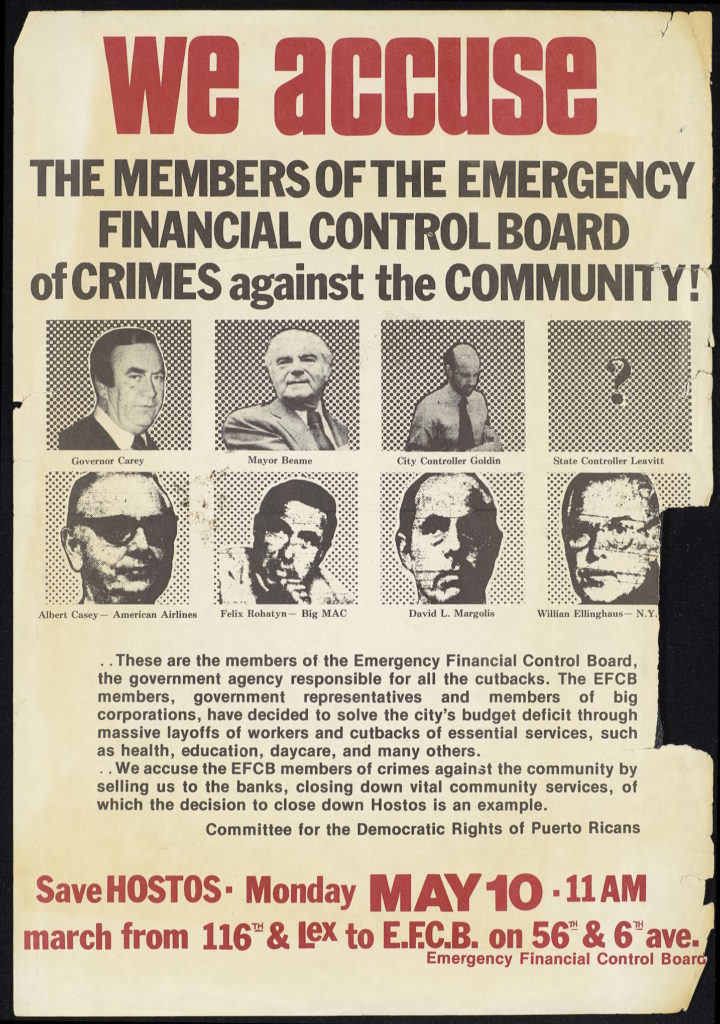
Empowered by a late-night act hurriedly passed by the state senate, the ominous-sounding Emergency Financial Control Board oversaw all city expenditures, “wrest[ing] control over the city’s finances out of the hands of the mayor and the City Council.” Among those on the board were the CEOs of New York Telephone Company, American Airlines and Colt Industries (the gun manufacturer).

Below: Anger at the EFCB’s actions to close Hostos Community College inspired vigorous protests. Such community action helped save the college.

Courtesy Museum of the City of New York

But the real bailout came from the citizens of New York themselves who weathered the horrifying notion of “planned shrinkage,” the drastic and detrimental cutbacks to hospitals, schools and public transit, generally speaking, with great resolve. (Events like the Blackout of 1977 notwithstanding.)
But they did not weather them quietly.

Communities were not afraid to push back against aggressive cuts that would have endangered them, such as the efforts by one Greenpoint community to save their fire house from closure and another by a South Bronx residents to stop the shuttering of a unique educational institution — Eugenio Maria de Hostos Community College of the City University of New York — aimed at the community’s bilingual residents.

Phillips-Fein, an associate professor at New York University, has crafted one of the best history books of the year out of one of the ugliest periods in New York City history. Aspects of this story reverberate into present dilemmas — on the local, state and national levels – as austerity measures take center stage as possible solutions to deficits and shortfalls. Let’s not hope for any sequels.

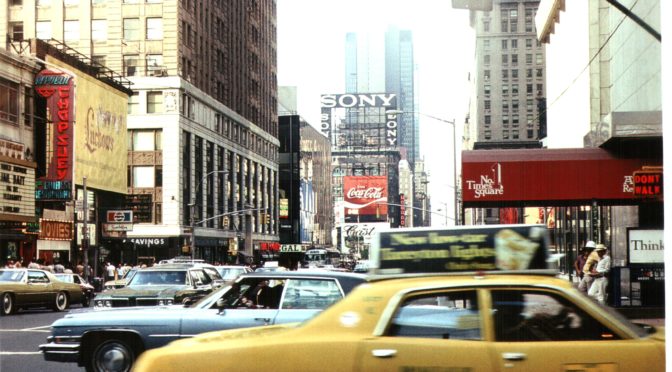
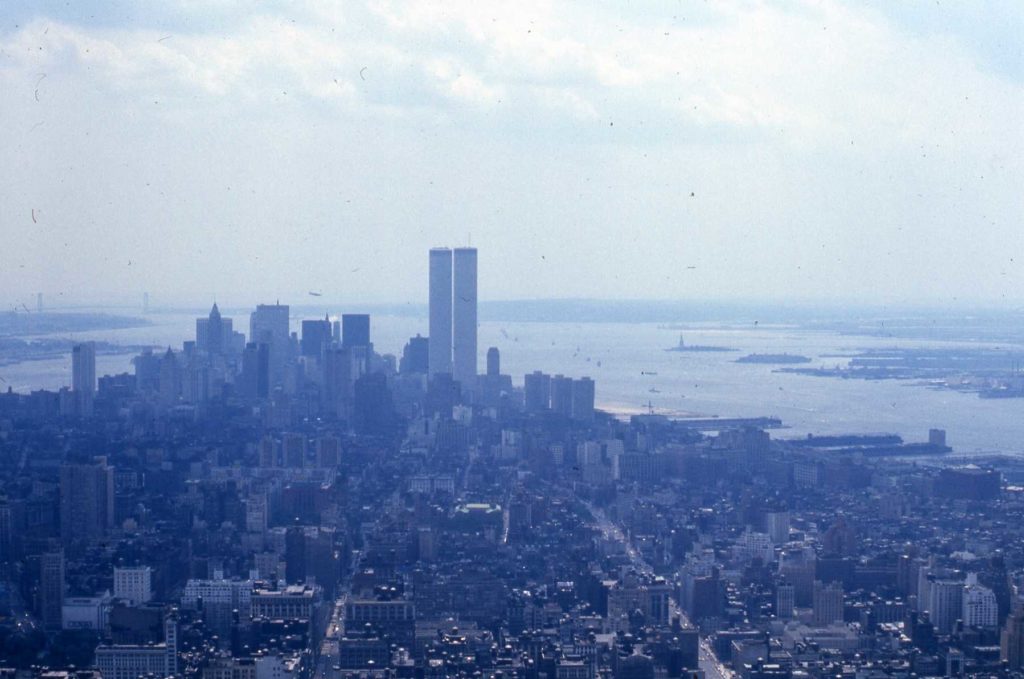
Below: New York City 1976

Photo/John VanderHaagen


New York City 1977

Photography by Derzsi Elekes Andor