Categories
It's Showtime Podcasts

The Broadway Musical: A trip through American theater history


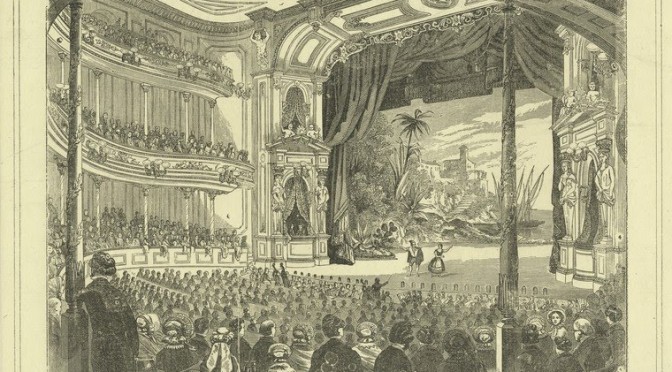
The Broadway Musical is one of New York City’s greatest inventions, over 150 years in the making! It’s one of the truly American art forms, fueling one of the city’s most vibrant entertainment businesses and defining its most popular tourist attraction — Times Square.

 But why Broadway, exactly? Why not the Bowery or Fifth Avenue? And how did our fair city go from simple vaudeville and minstrel shows to Shuffle Along, Irene and Show Boat, surely the most influential musical of the Jazz Age?

This podcast is an epic, a wild musical adventure in itself, full of musical interludes, zipping through the evolution of musical entertainment in New York City, as it races up the ‘main seam’ of Manhattan — the avenue of Broadway.

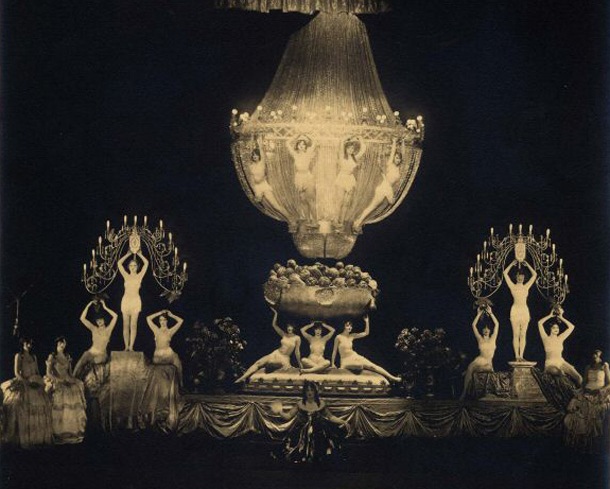
We are proud to present a tour up New York City’s most famous street, past some of the greatest theaters and shows that have ever won acclaim here, from the wacky (and highly copied) imports of Gilbert & Sullivan to the dancing girls and singing sensations of the Ziegfeld revue tradition.

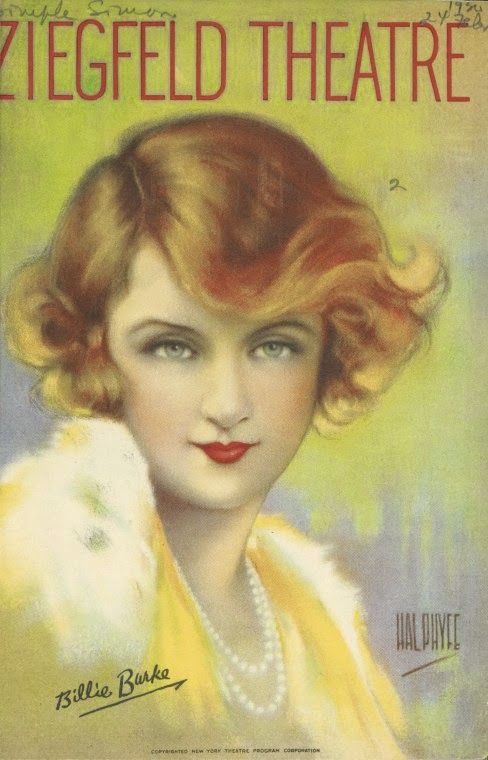
CO-STARRING: Well, some of the biggest names in songwriting, composing and singing. And even a dog who talks in German!  At right: Billie Burke from a latter-year Follies. (NYPL)

This show, originally recorded in 2013, has been re-edited, remastered and even includes extra material which was cut from the original episode.

LISTEN NOW: THE BIRTH OF THE BROADWAY MUSICAL


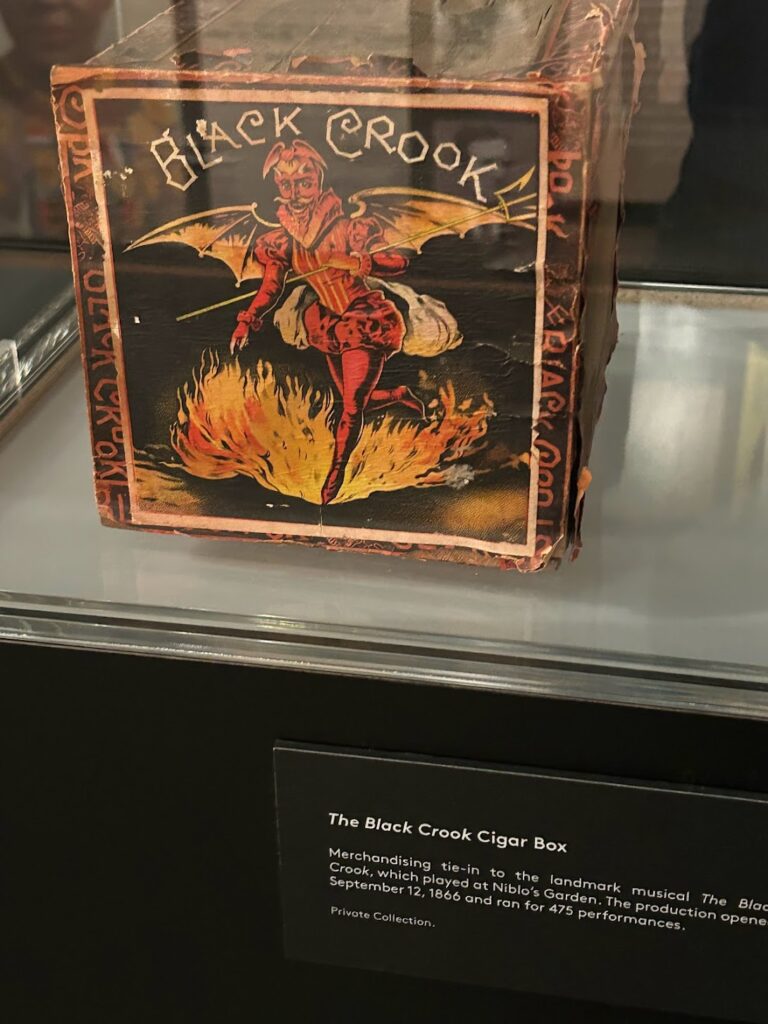
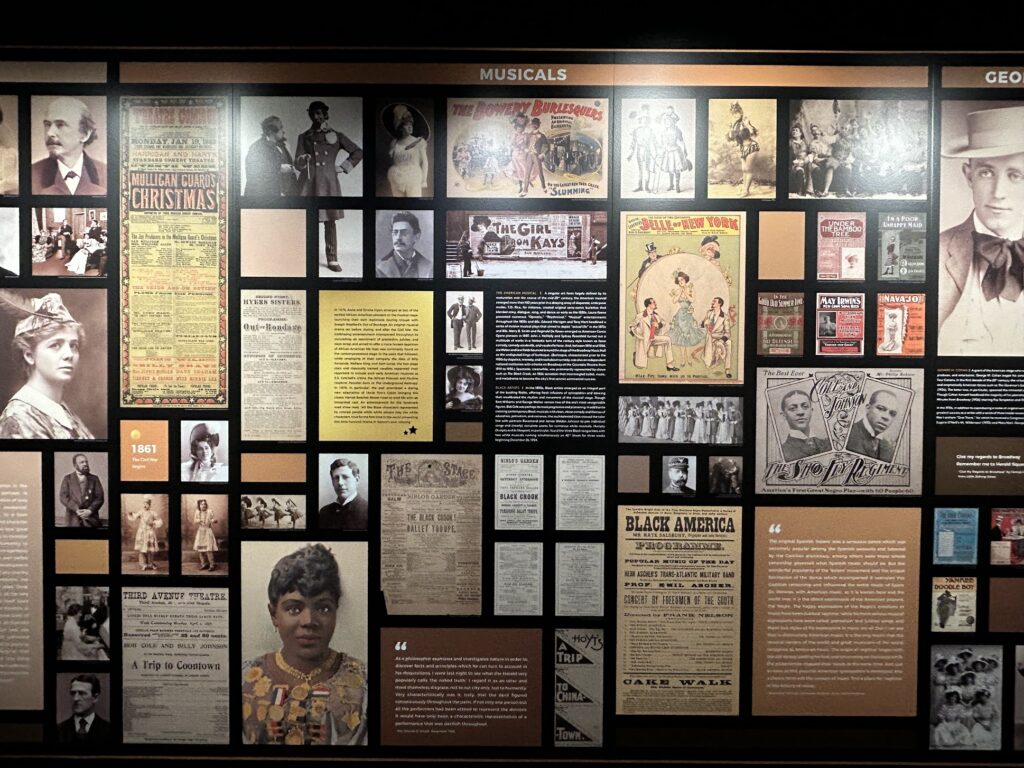
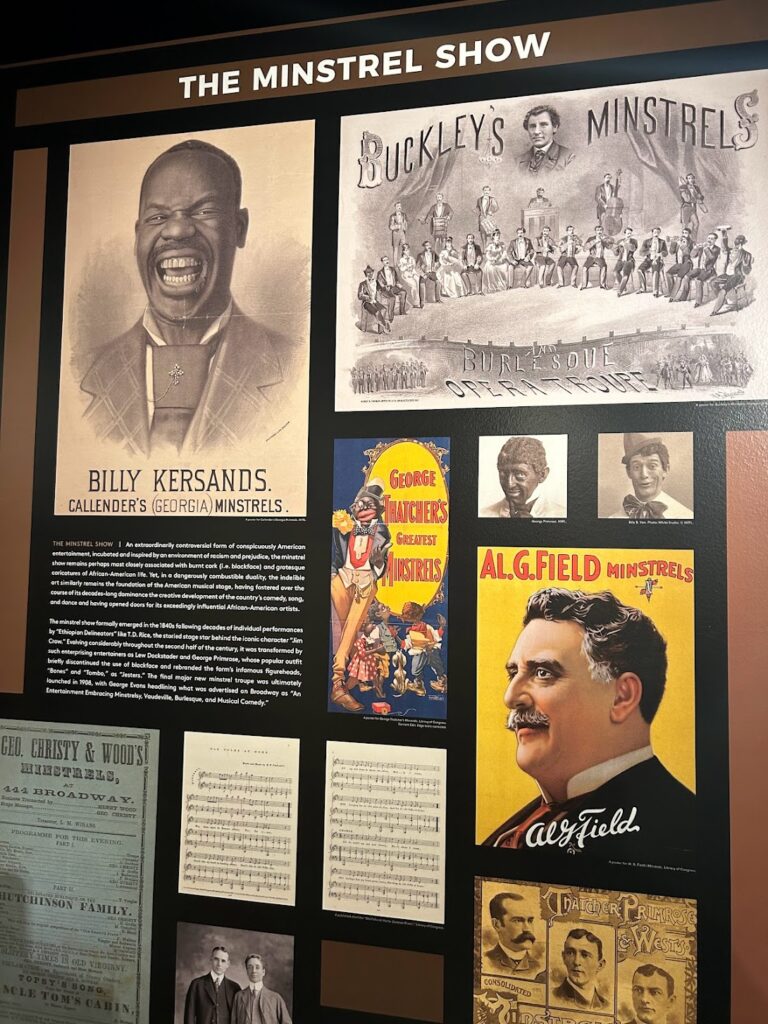
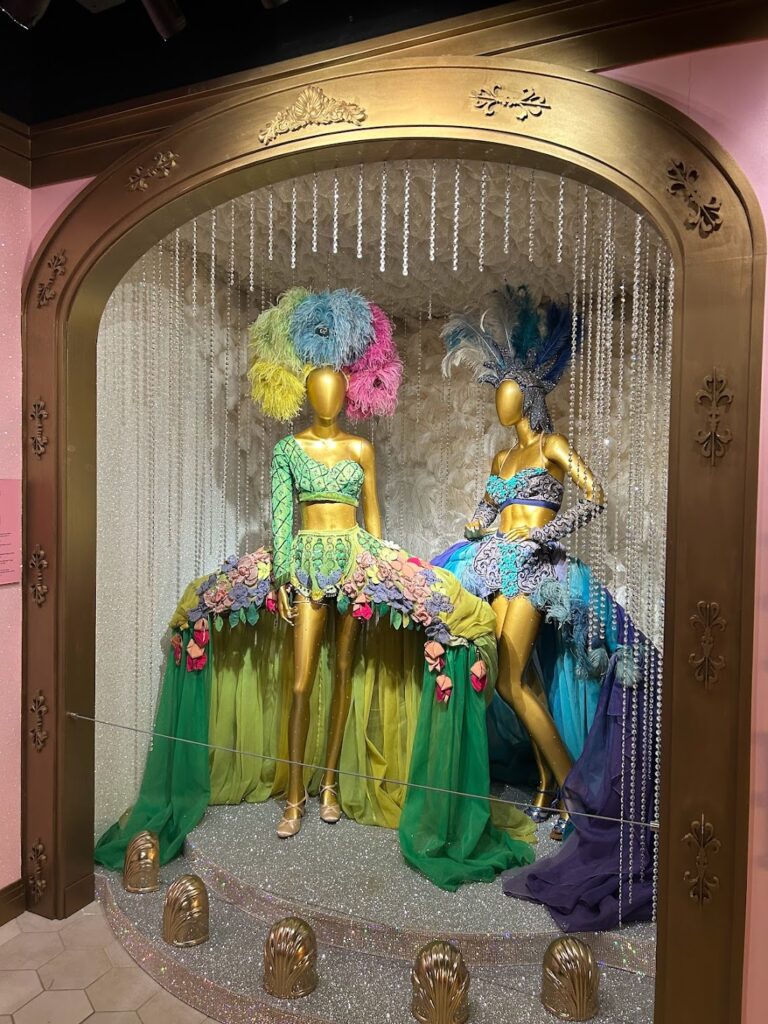
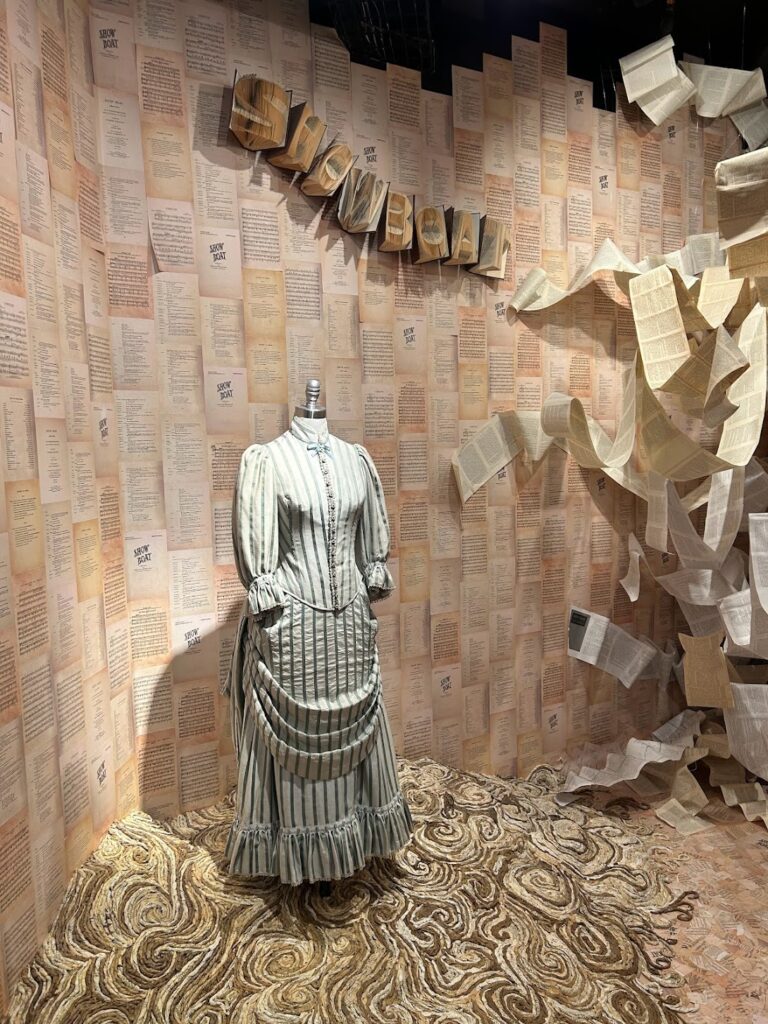
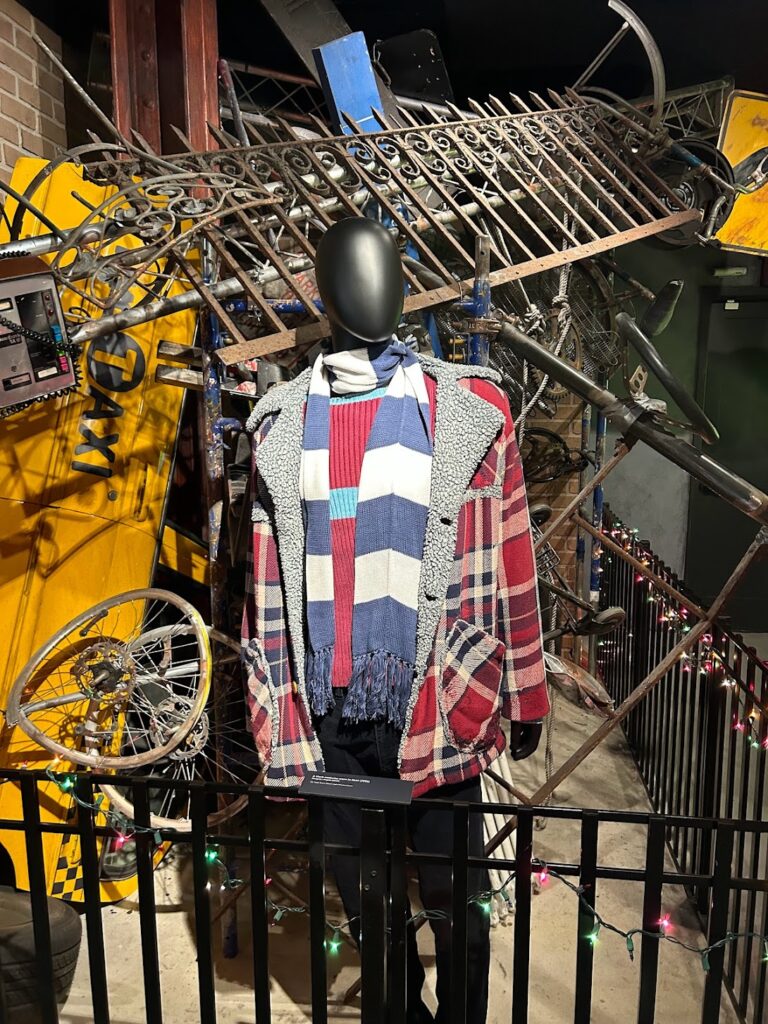
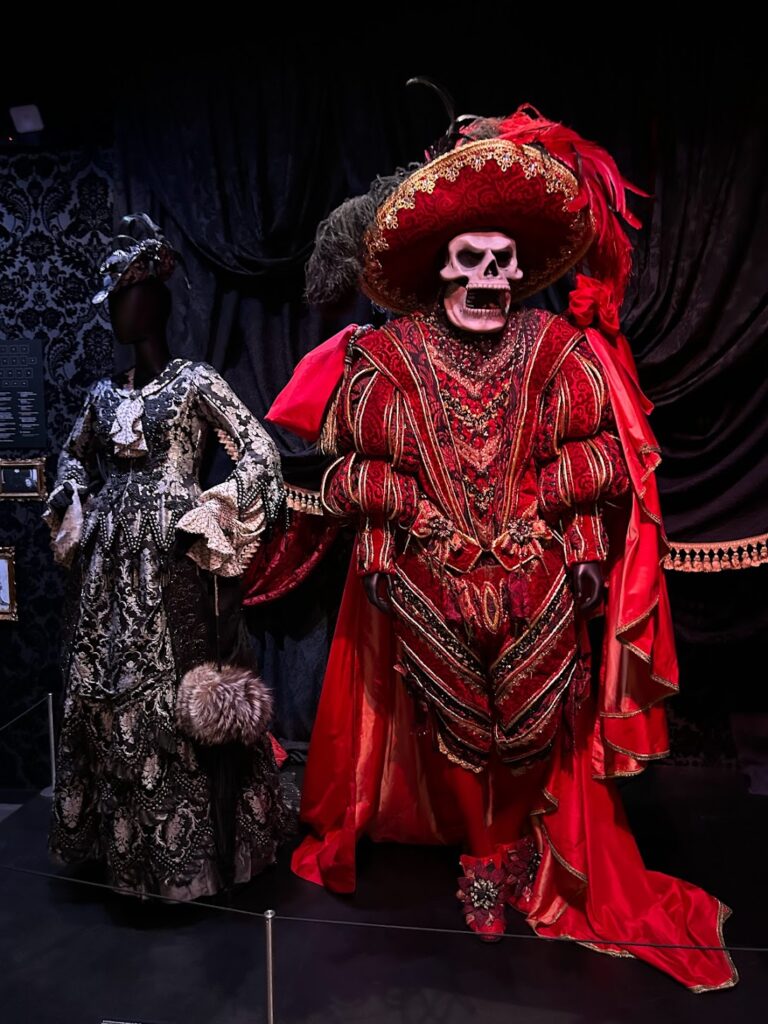
A few images from Greg’s trip to the Museum of Broadway at 145 West 45th Street.

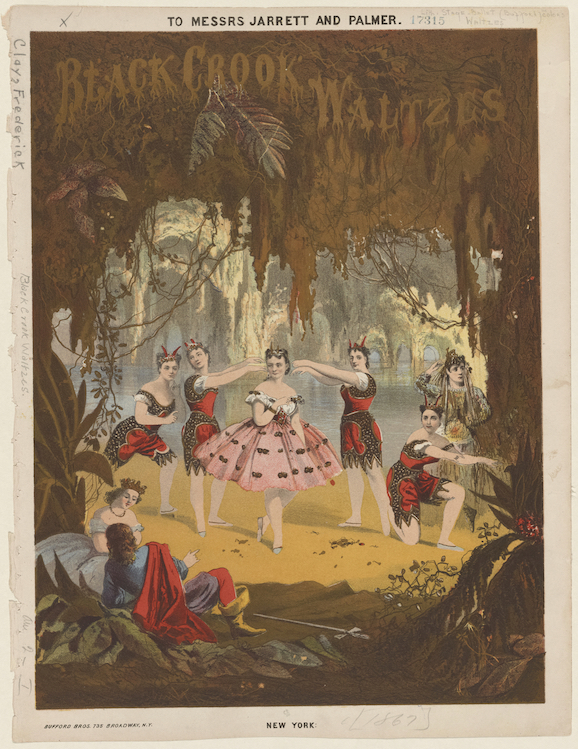
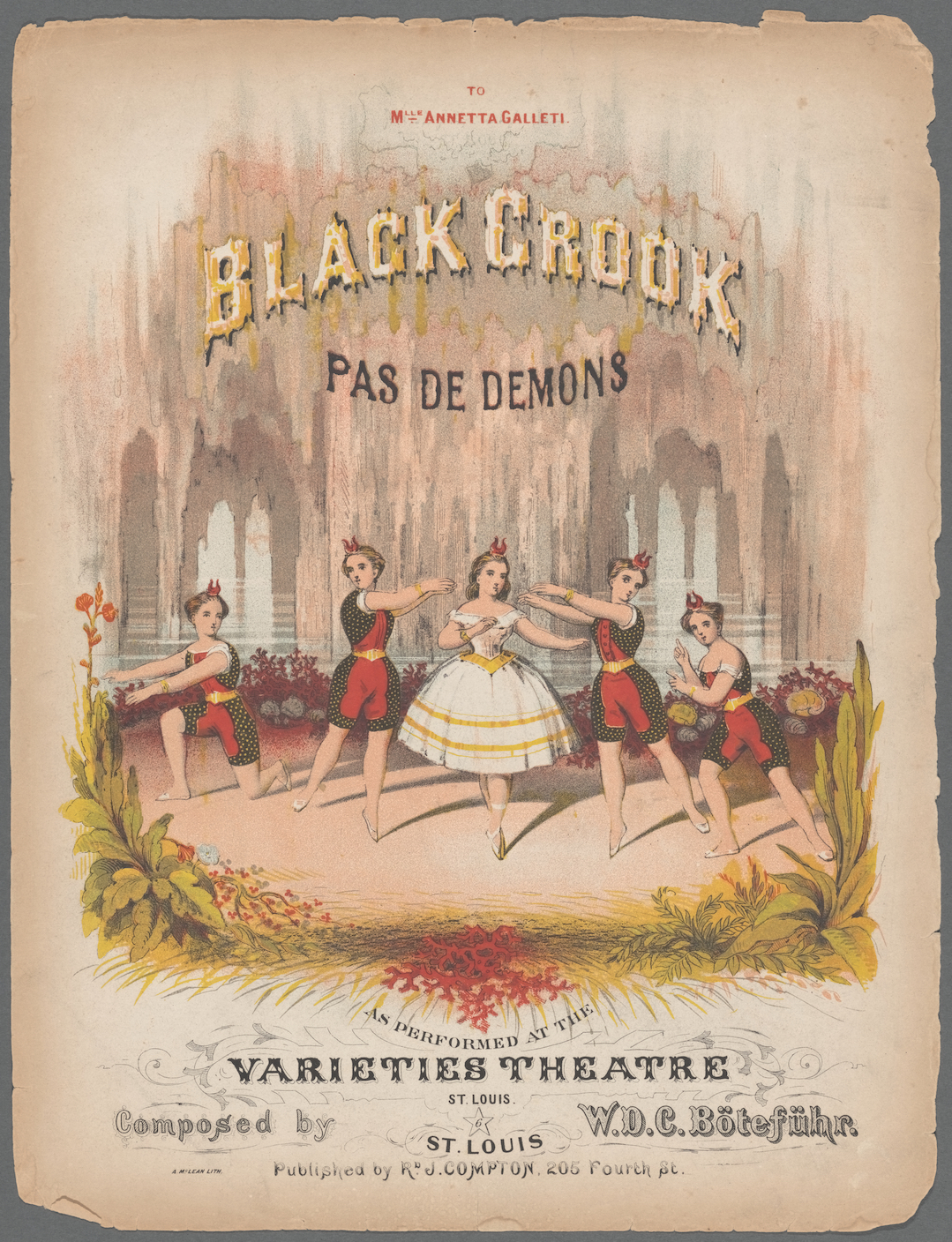
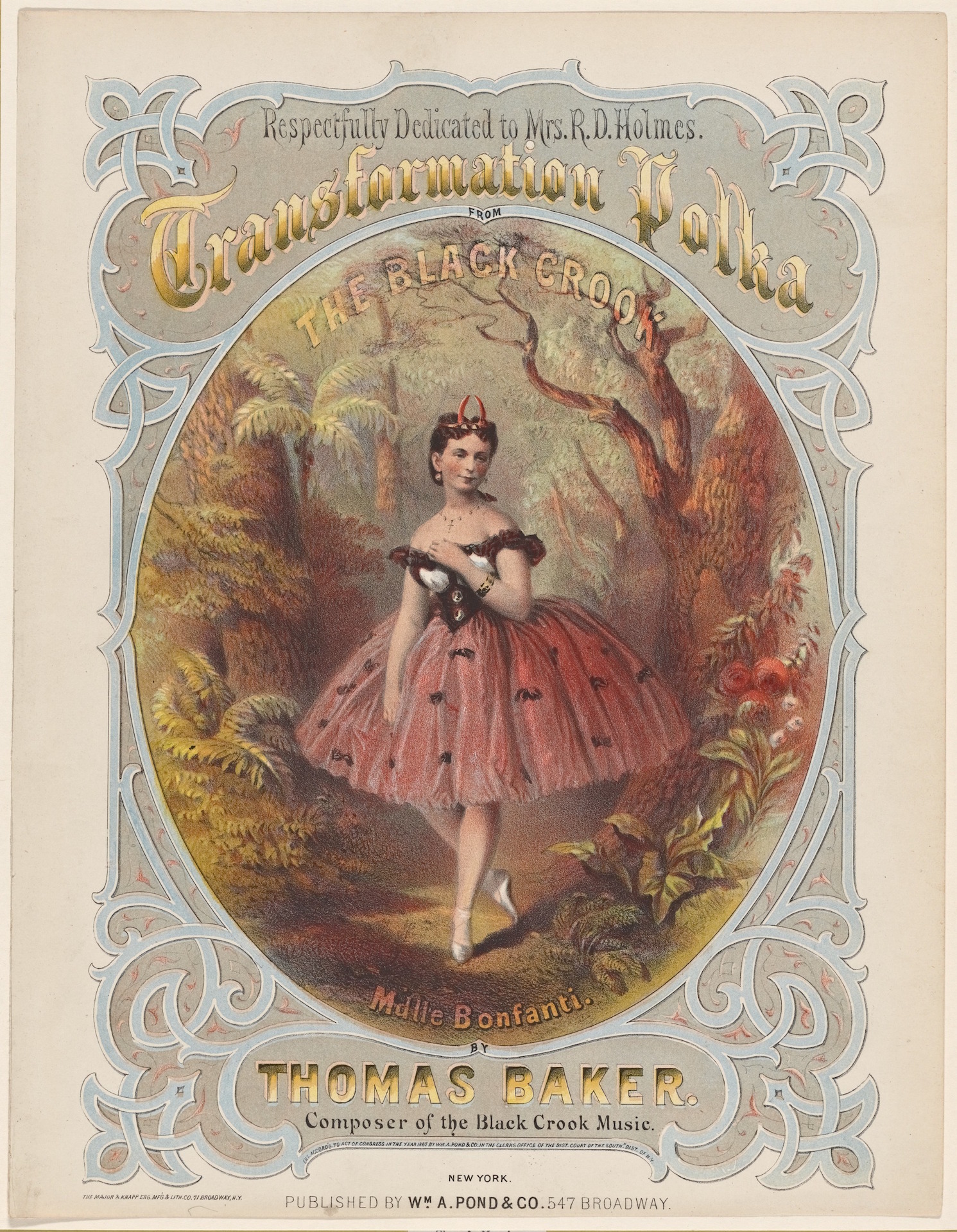
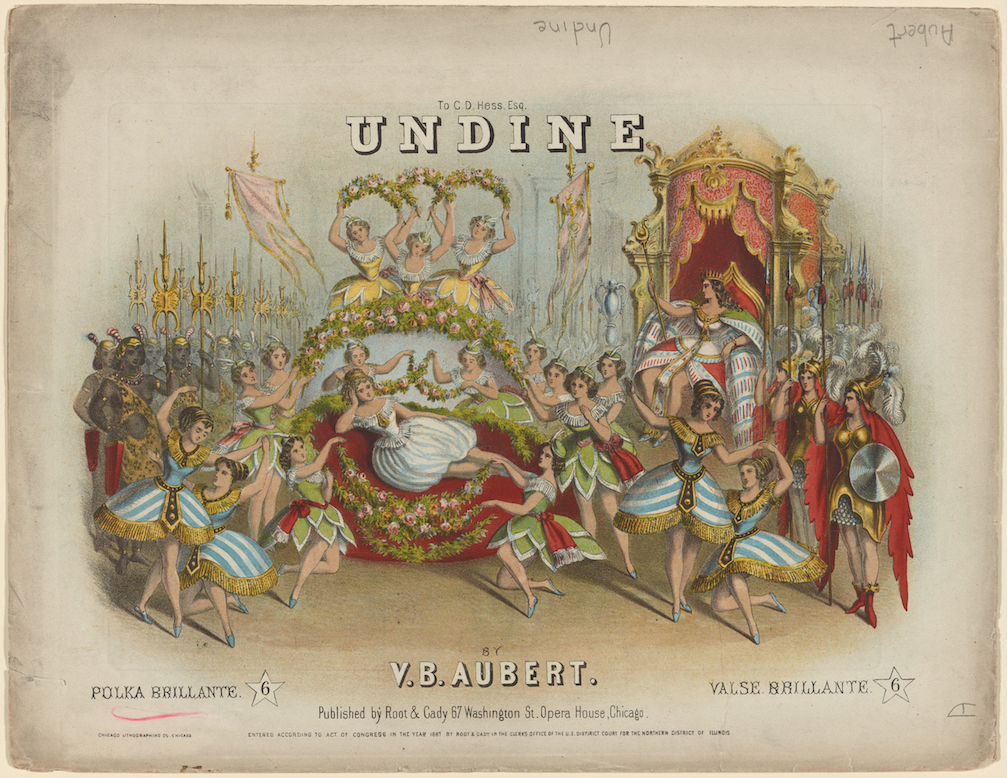
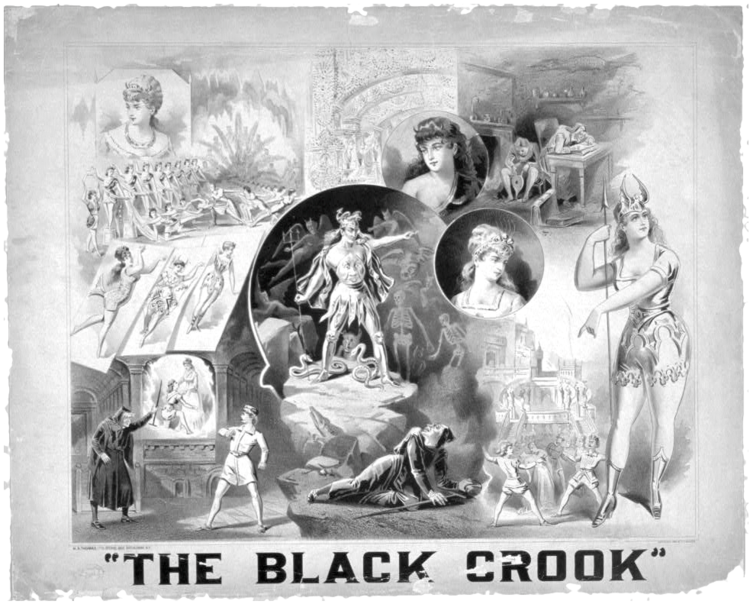
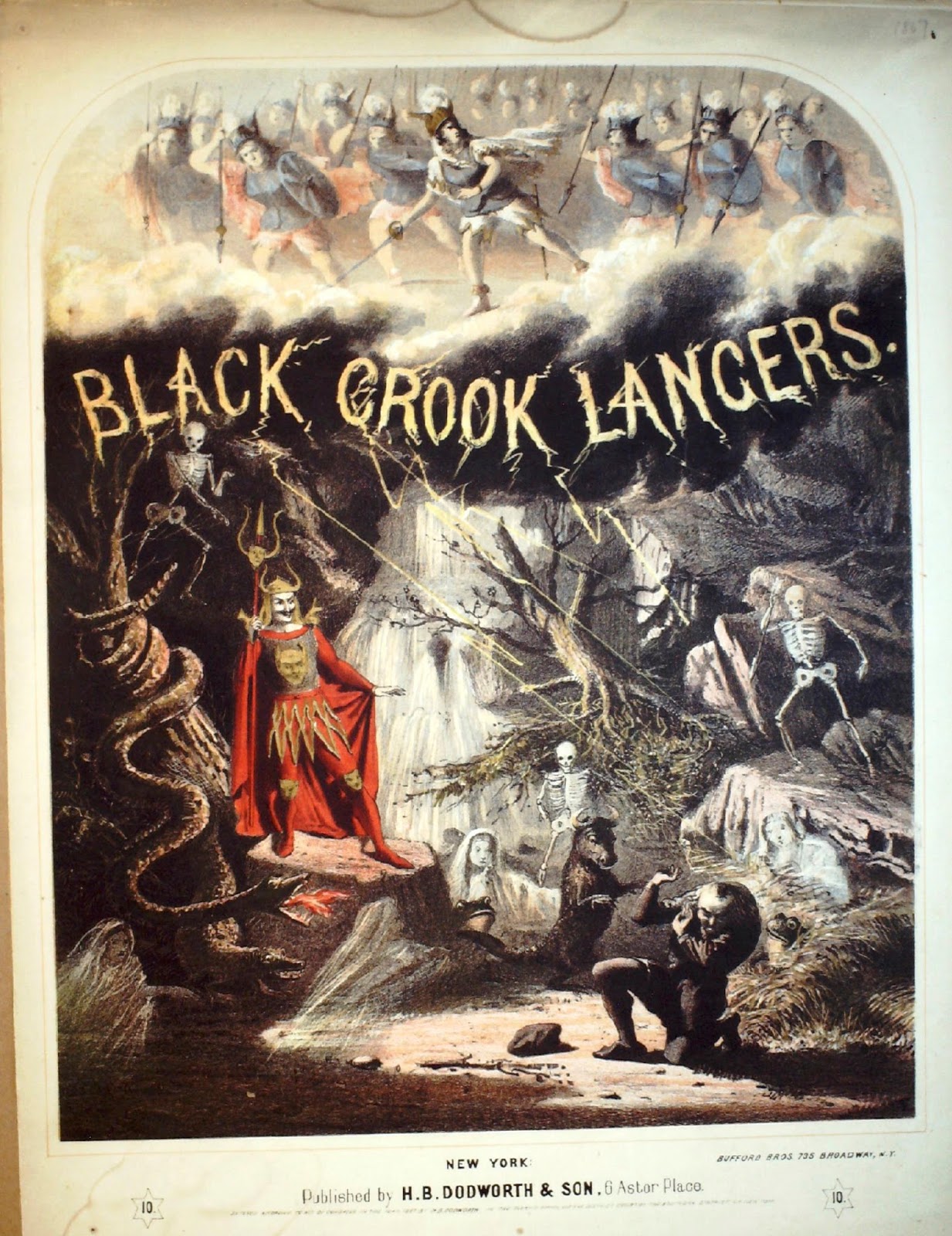
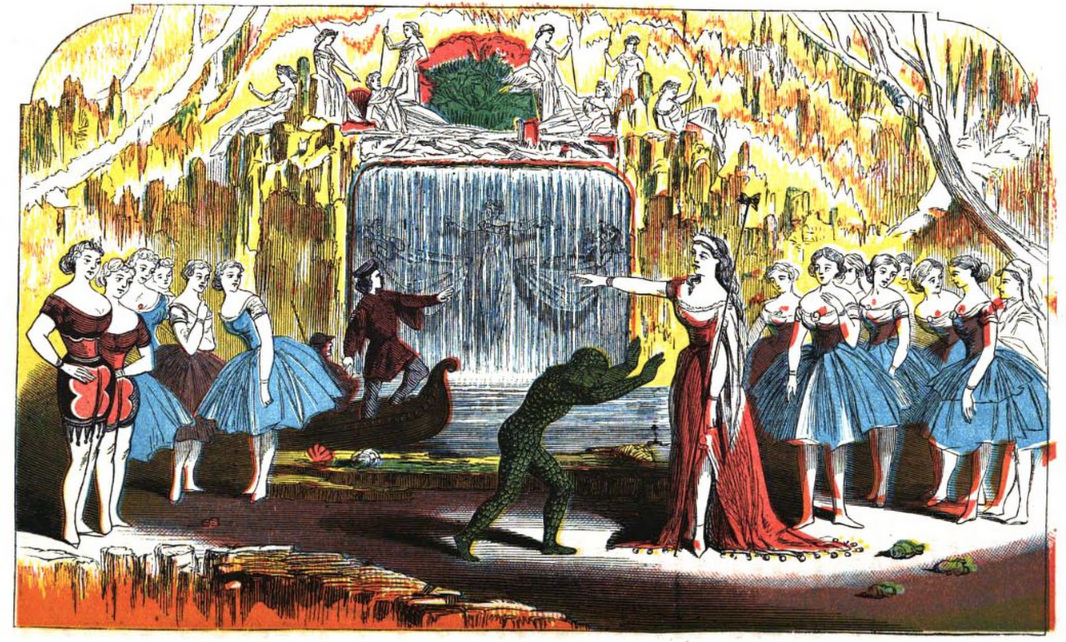
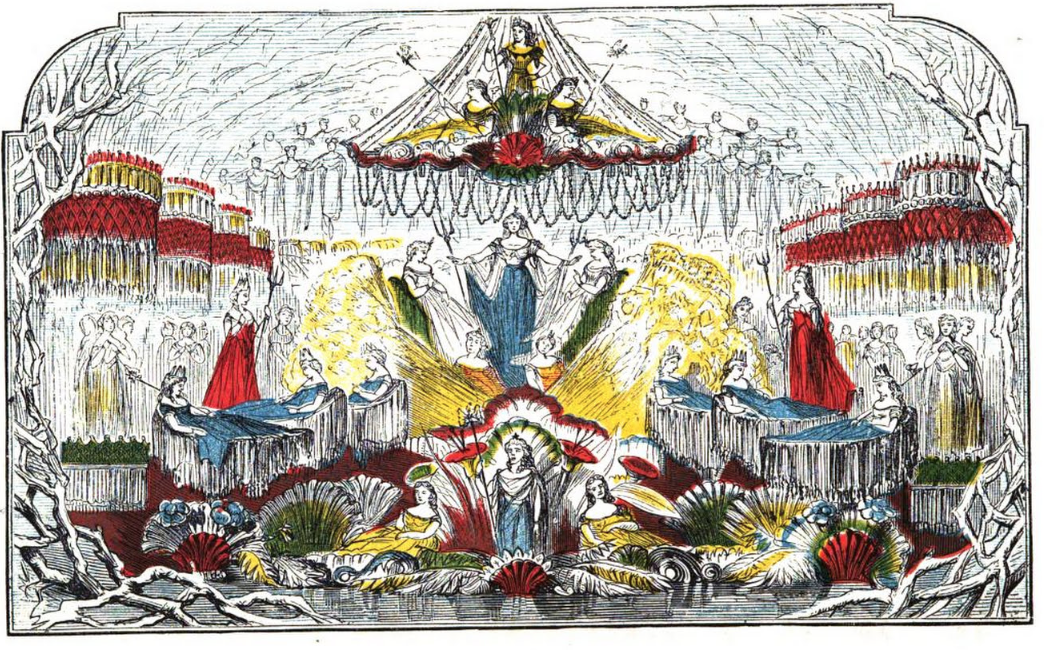
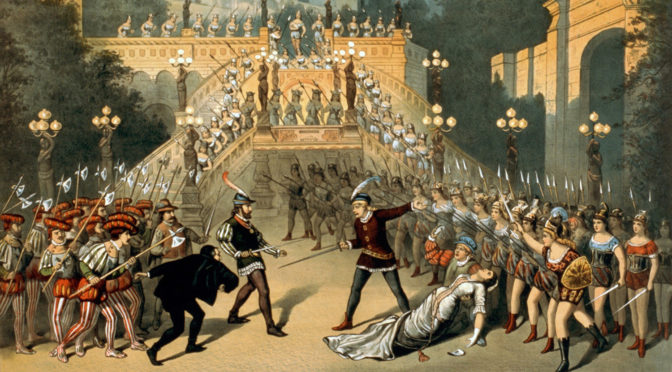
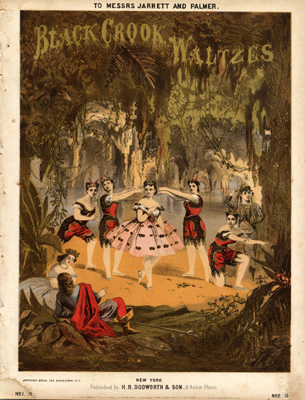
The Black Crook
Ziegfeld Follies
Showboat
Rent
The Phantom of the Opera

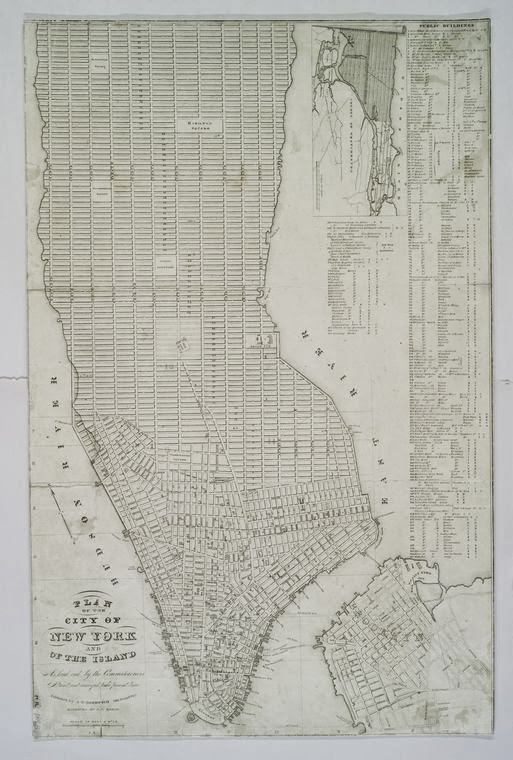
The original grid plan from 1811. As you can see, Broadway was not meant to extend further than the Parade Ground, the largest planned plaza from the Commissioner’s Plan. Years later, the Parade Ground was reduced (becoming Madison Square) and Broadway was allowed to break the grid, creating plazas conducive for transportation and public gathering. (NYPL)

New York Public Library

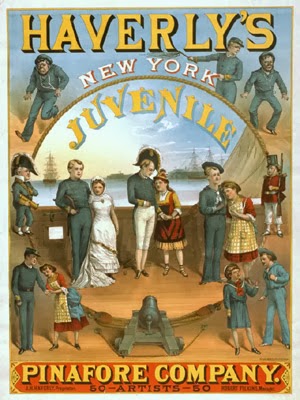
One of dozens of knock-off productions of HMS Pinafore, this one featuring children:

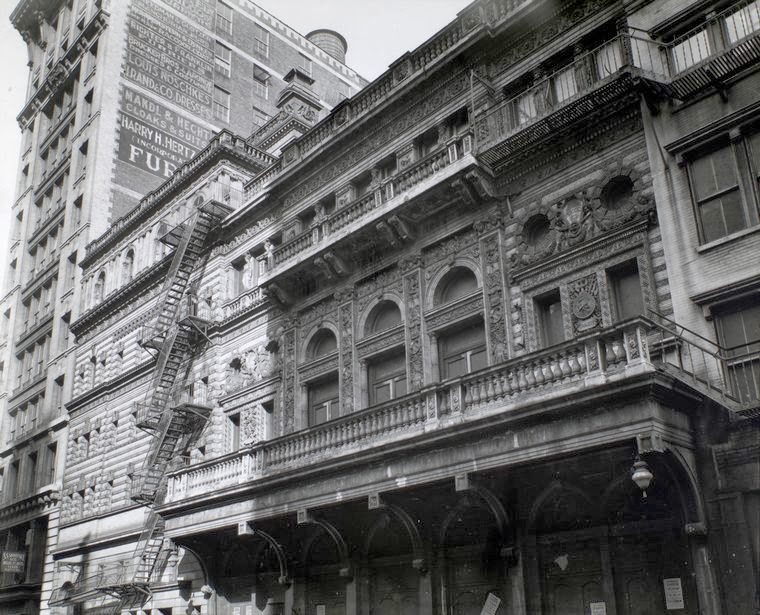
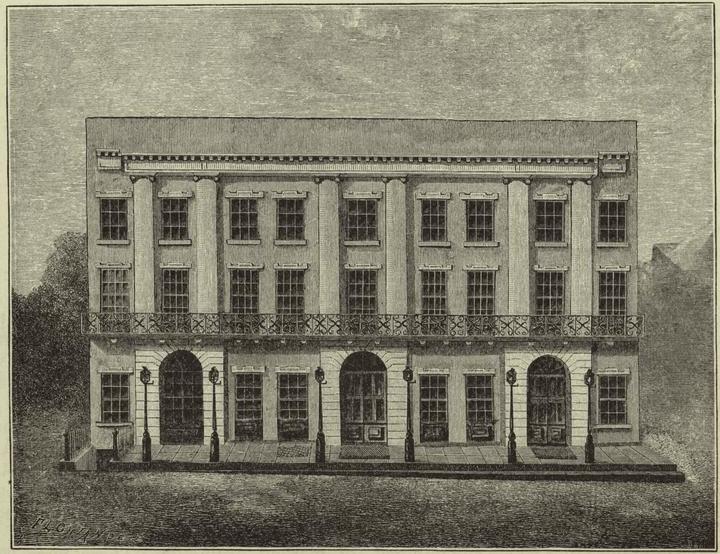
The facade of the Fifth Avenue Theater, once located at 1185 Broadway. Why was it called the Fifth Avenue Theater then? Possibly to just make the society ladies feel at home here!  This was home to three Gilbert & Sullivan original productions, including the premiere of The Pirates of Penzance.

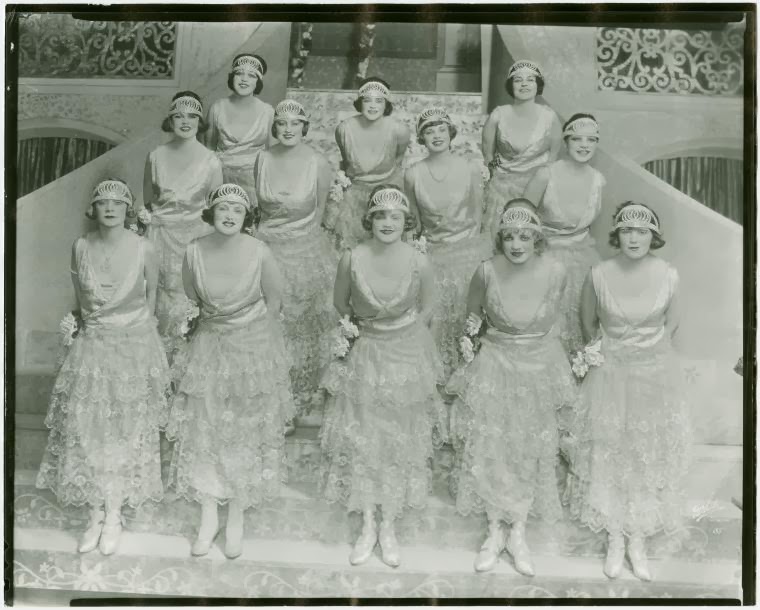
The Florodora girls, from the hugely successful 1900 musical comedy which debuted at the Casino Theater. (NYPL)

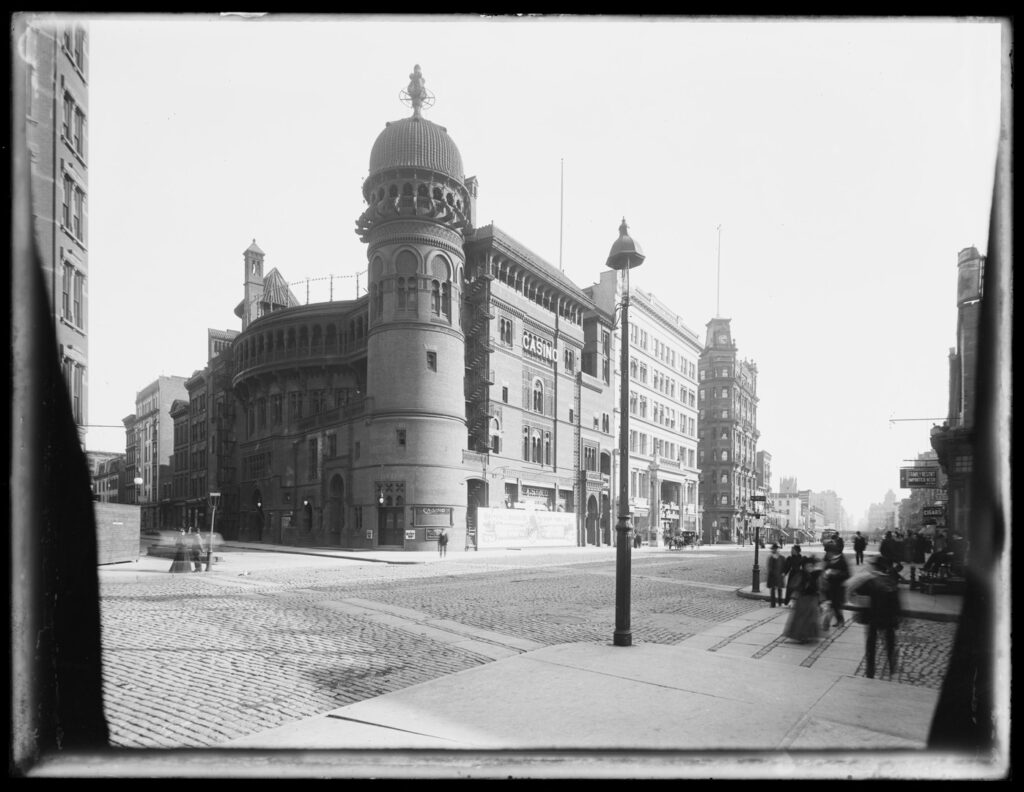
The Casino Theatre at West 39th Street and Broadway.

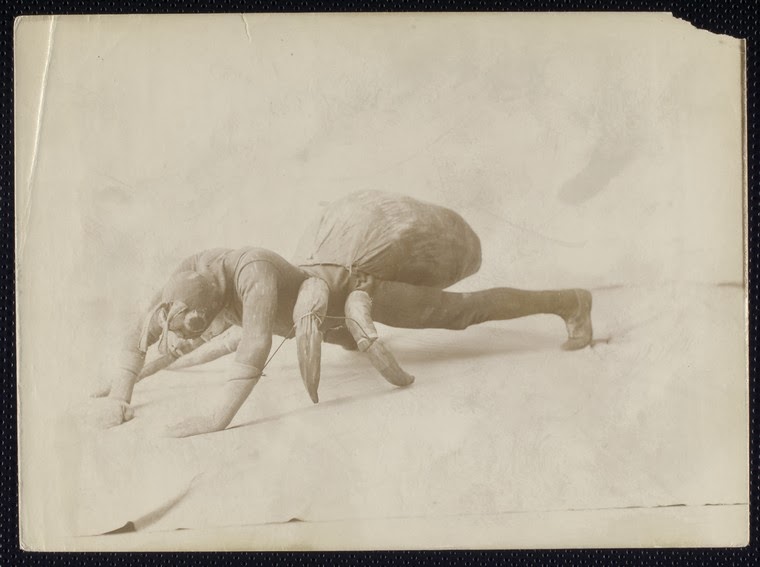
One of the more fantastic creatures from Victor Herbert’s Babes In Toyland, which made its debut in Columbus Circle’s Majectic Theater. You can read my article here on the musical which inspired Herbert’s show, the musical version of The Wizard of Oz. (NYPL)

New York Public Library

George M Cohan singing “Over There”

Video of a Ziegfeld Follies from 1929, a bit past their heyday, actually. They would only last until 1931:

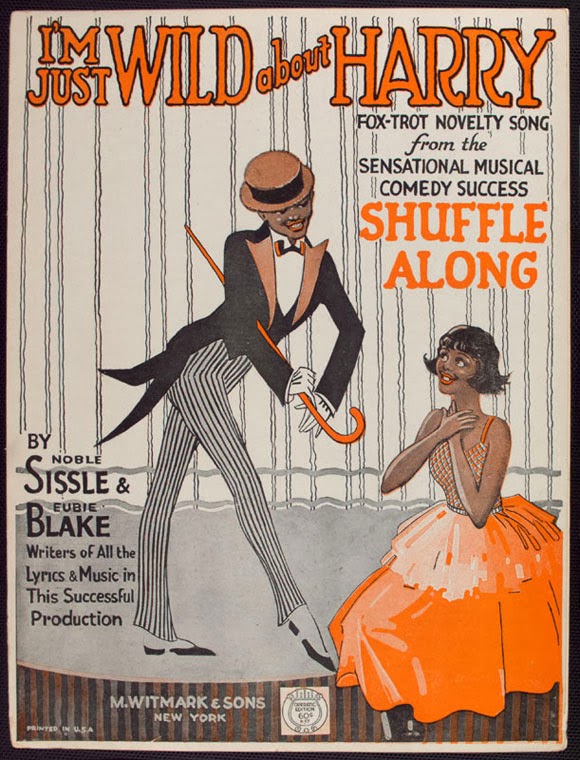
Sheet music from 1921 of one of the most famous songs from Shuffle Along (NYPL):

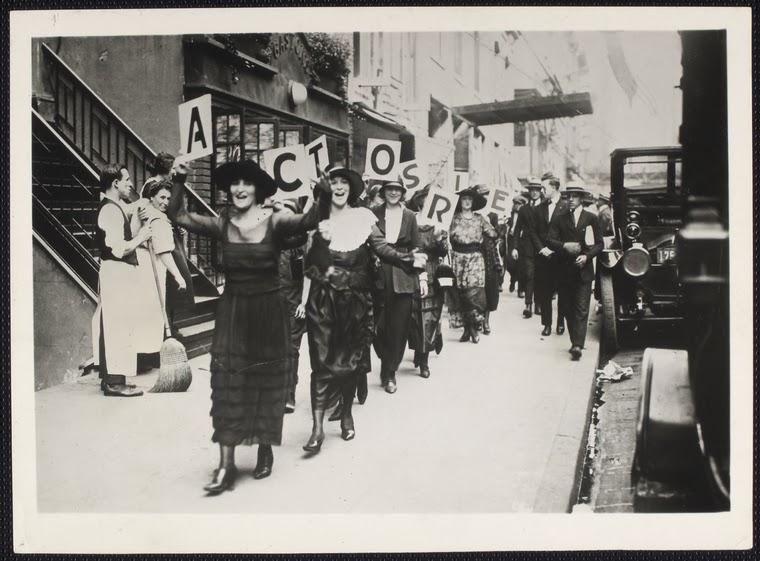
Dancing girls during the Actors Strike of 1919, which galvanized the industry and gave regular New Yorkers a window into the tough conditions faced by many background performers. (NYPL)

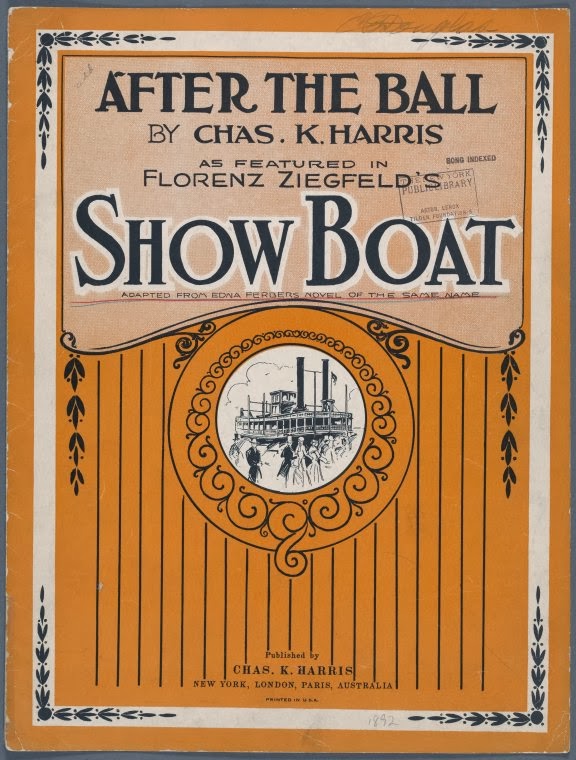
So the number ‘After The Ball’ — a huge hit song that made its stage debut in A Trip To Chinatown — made a return appearance to Broadway in 1927’s Show Boat!

Musical cues from this week’s show:
Give My Regards To Broadway and After the Ball performed by Billy Murray
A version of Make Believe recorded by Bing Crosby, and Ol Man River, performed by Paul Robeson, from a 1932 cast recording, featuring Victor Young and His Orchestra
Love Will Find A Way, from a 1921 recording by Eubie Blake
Selection from HMS Pinafore, from a 1914 recording by the Victory Light Opera Chorus

 And finally, a clip from the film version of ‘Show Boat’, featuring an iconic performance by Paul Robeson.
 

Categories
Amusements and Thrills It's Showtime

In the Pleasure Gardens of Old New York

It has become a name so associated with American sports and entertainment that you barely think about it.

In New York City, when you say you are going to The Garden, you aren’t going to see flowers. Most likely, you’re going to see the Knicks. Or possibly Billy Joel.

New York City’s many actual gardens — the ones with plants, not millionaire performers — are so diverse and numerous that they offer sensual and educational pleasures for people of all ages.

But none can be called THE Garden.

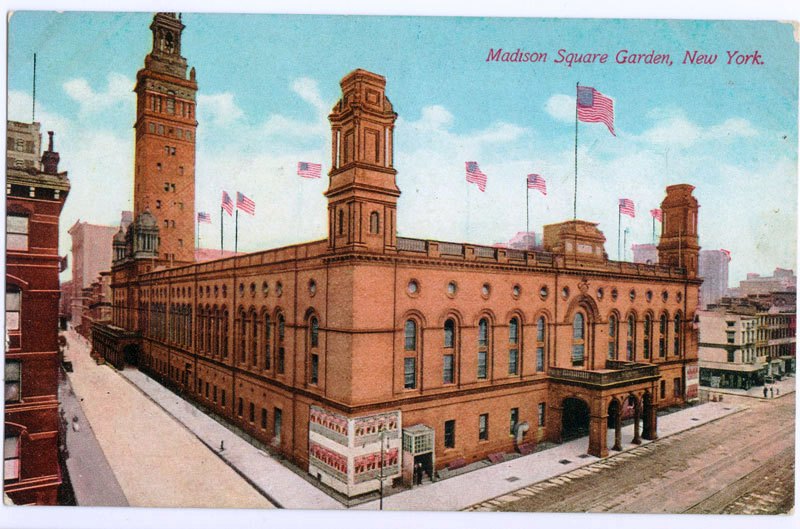
The 1890 Stanford White masterpiece. Image from Daytonian in Manhattan

Madison Square Garden (MSG) traces its history back to almost 150 years ago to a vacated New York and Harlem Railroad train depot which once sat on the northeast corner of Madison Square. It was here that P.T. Barnum briefly set up a circus arena called the Great Roman Hippodrome.

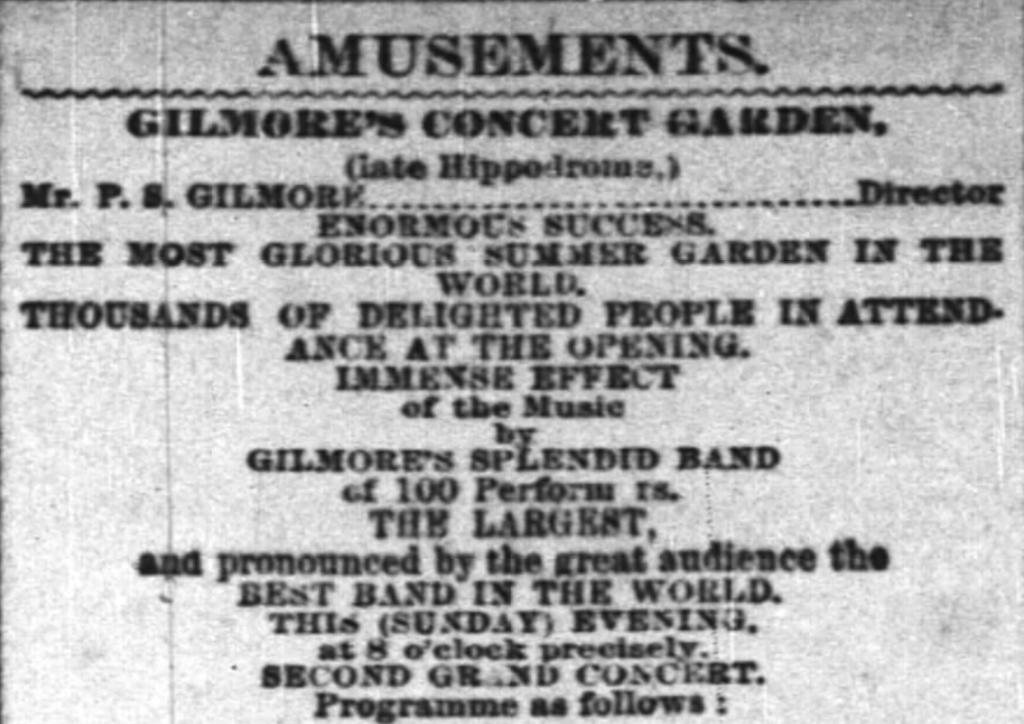
But it was the site’s second impresario — bandleader Patrick Gilmore — who gave the site for his concerts a more fragrant sounding name in the Spring of 1875 — Gilmore’s Garden.

From the New York Times, May 30, 1875 (newspapers.com)

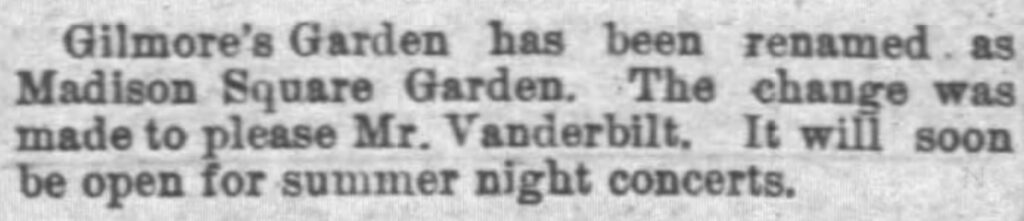
Four years later, the popular venue was renamed Madison Square Garden — “to please Mr. Vanderbilt,” according to the Brooklyn Union clip below. (That would be William Kissam Vanderbilt, the grandson of Cornelius Vanderbilt.)

For more information on the history of Madison Square Garden, listen to our back catalog show on the many locations of this storied venue:


But even Gilmore’s was a rather late entry in New York City’s many well-known pleasure gardens, the name for an all-in-one entertainment space which traces back to the ancient Romans.

The pleasure garden become a key ingredient in the social world of New York City because of its popularity with the British during the Colonial period.

Here are a few of New York’s more notable ‘gardens’, taking root in the city even before the appearance of Madison Square Garden:

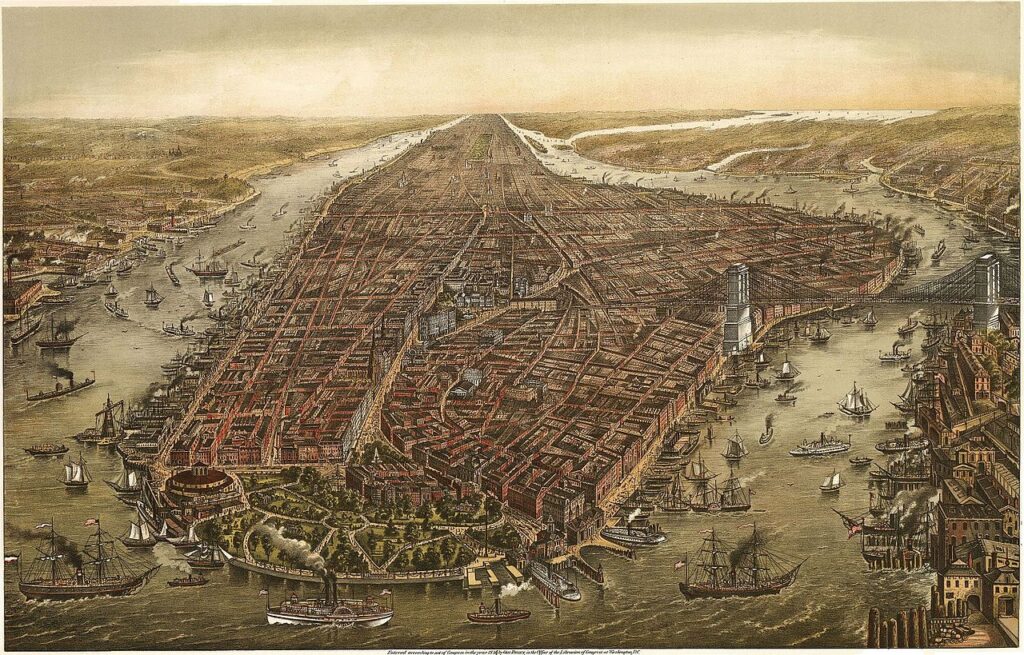
Bird’s eye panorama of Manhattan & New York City in 1873.

Spring Garden and Catiemuts Gardens

The first Colonial-era pleasure gardens in New York leaned upon the popularity of well-known gardens in England. For instance, the 1740 Spring Garden — located just south of today’s City Hall Park — was a nod to 17th century English pleasure gardens by that name.

According to author Hallie Alexander: “The Spring Garden tavern hosted balls, magic shows, tumbling acts, feats of strength (including a Female Samson), and musical concerts.”

Catiemuts Gardens was north of Spring Garden (at Park Row and Chambers Street). Like many early pleasure-garden proprietors, Catiemuts’ owner made sure to center his venue around a tavern, and entertainments were thusly invented to inspire the purchase of alcohol.

New York Public Library

Ranelagh Gardens

Londoners could enjoy the first Ranelagh Gardens in 1741, built on the site of the home of the 1st Earl of Ranelah in the neighborhood of Chelsea. In 1765, New Yorkers got their own Ranelagh.

According to William Harrison Bayles’s 1918 Old Taverns of New York: “It was said that the grounds had been laid out at great expense and that it was by far the most rural retreat near the city. Music by a complete band was promised for every Monday and Thursday evening during the summer season.”

And according to author Vaughn Scribner: “[The venue’s proprietor John] Jones took to the New-York Mercury to announce that, in addition to all the leisurely pleasures already available at Ranelagh, Jones would offer any customer who could pay the two shillings and three pence entrance fee a ‘Concert of Musick’ followed by a grand firework show.”

New York Public Library

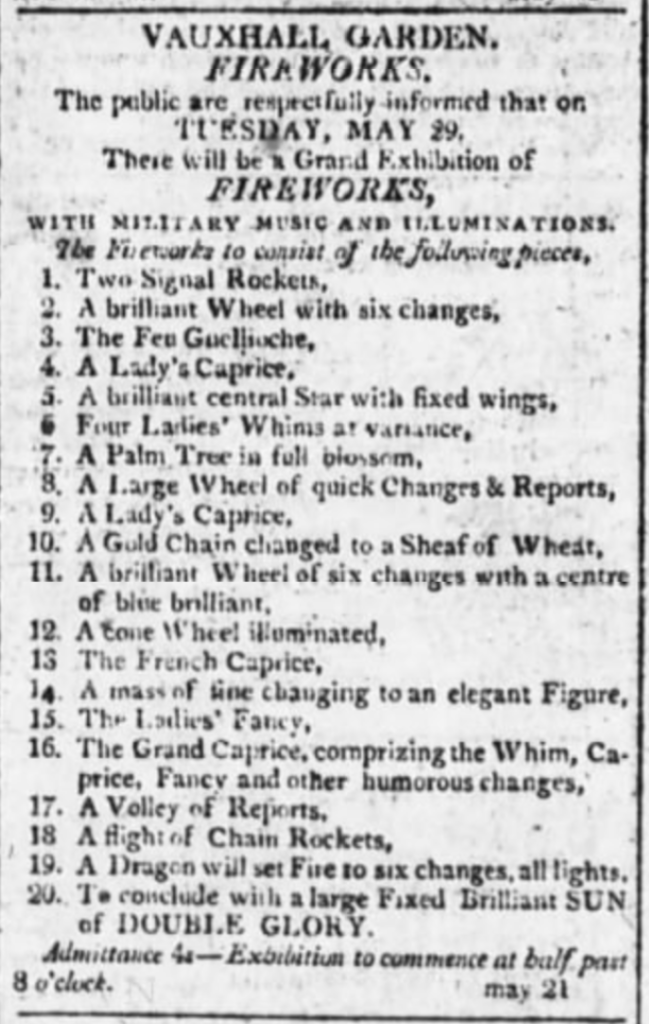
Vauxhall Gardens

Vauxhall Gardens is one of London’s most historic public spaces and it was so renown back in the 18th century that it inspired several New York knockoffs, including one owned in 1767 by tavern owner Samuel Fraunces (before operating the more famous tavern which bears his name today.)

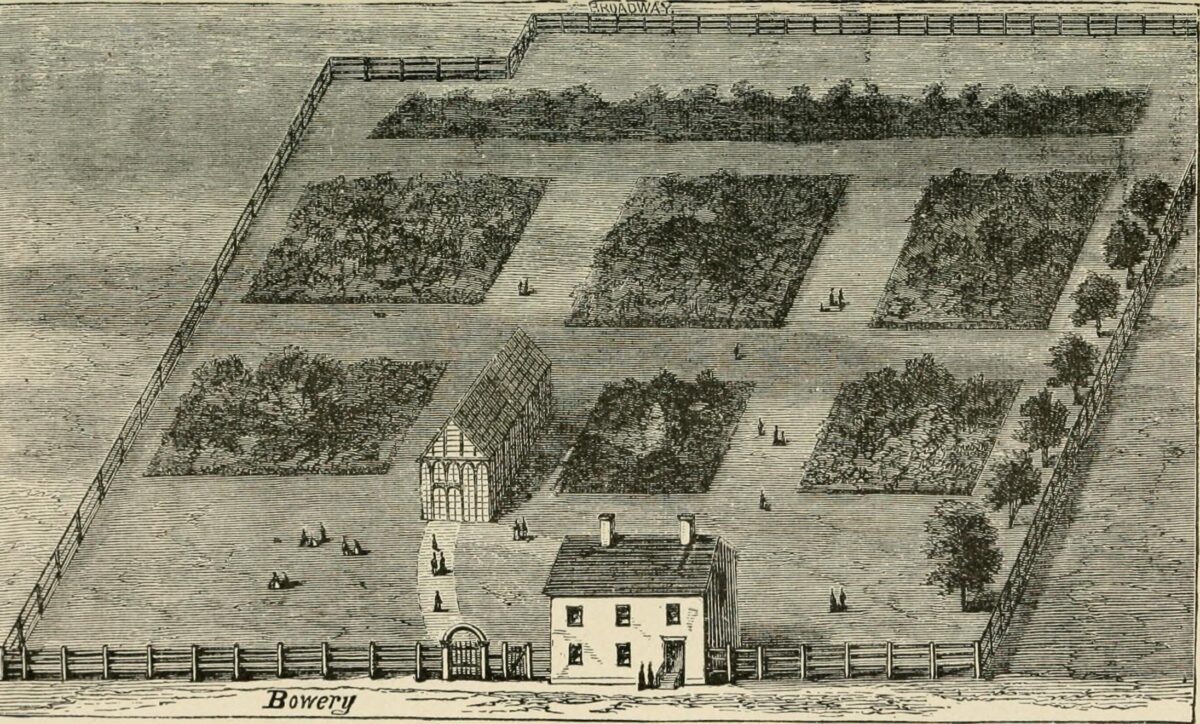
But the most famous, from 1771, was first owned by Jacob Sperry, a charming garden space around the area of today’s Astor Place. (In fact John Jacob Astor would eventually purchase the property for speculative development.)

The New York Evening Post, May 28, 1904 (via newspapers.com)

For the first two decades of the 19th century, it was one of the most popular attractions in New York City.  Under the management of French proprietor Joseph Delacroix, the cultivated garden pathways were adorned with magical lanterns, accompanied by musicians nestled throughout the flora.

Bayles later wrote in 1918: “Vauxhall Garden was an inclosure said to contain three acres of ground, handsomely laid out with gravel walks and grass plots, and adorned with shrubs, trees, flowers, busts, statues, and arbors. In the center was a large equestrian statue of General Washington. 

“All the town flocked to [Vauxhall]. It was to the New York of that day something like what Coney island is to the New York of today. The people of New York considered it to be about as gay a place of recreation as could be found anywhere.”

New York Public Library

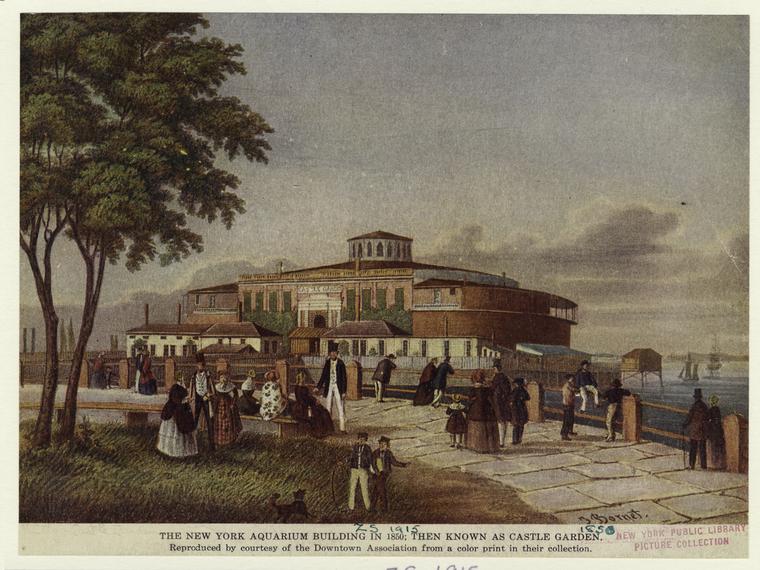
Castle Garden

In 1824, the old Castle Clinton in the Battery was transformed into New York’s largest exhibition hall — Castle Garden.

While the Battery did provide the strolling pleasures of an actual garden — a visitors could enjoy refreshments at the beer garden — it was the performances within the building (which was later fitted with a roof) that really drew the crowds.

In 1850 Barnum would bring the Swedish songstress Jenny Lind to Castle Garden to universal acclaim.

(Castle Garden is also featured in the film The Greatest Showman.)

For more information, check out our podcast from last year on this iconic moment in New York City entertainment.

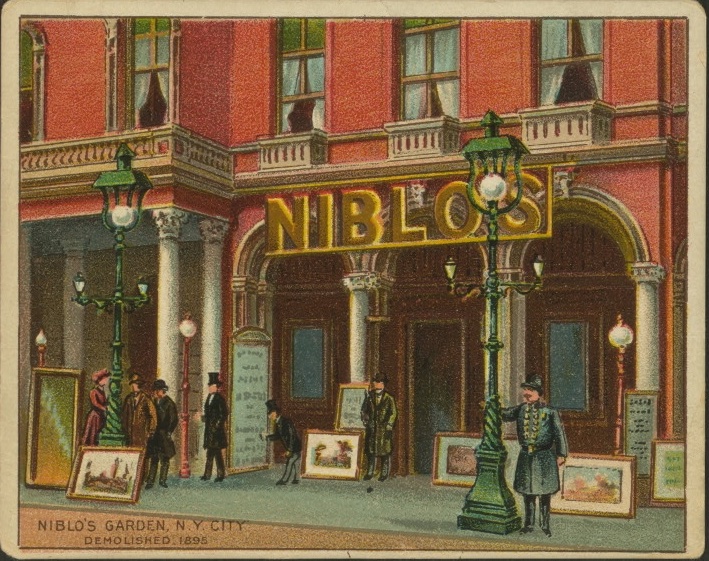
Niblo’s Garden

The pleasure garden at the corner of Broadway and Prince Street changed theater history.

The site evolved from a simple garden in 1828 to a lavish destination for entertainment and delight thanks to Irish impresario and coffee house owner William Niblo.

From Bayles’ description: “The interior of the garden was spacious and adorned with shrubs and flowers; cages with singing birds were here and there suspended from the branches of trees, beneath which were placed seats with small tables where were served ice cream, wine negus and cooling lemonade; it was lighted in the evening by numerous clusters of many-colored glass lamps.”

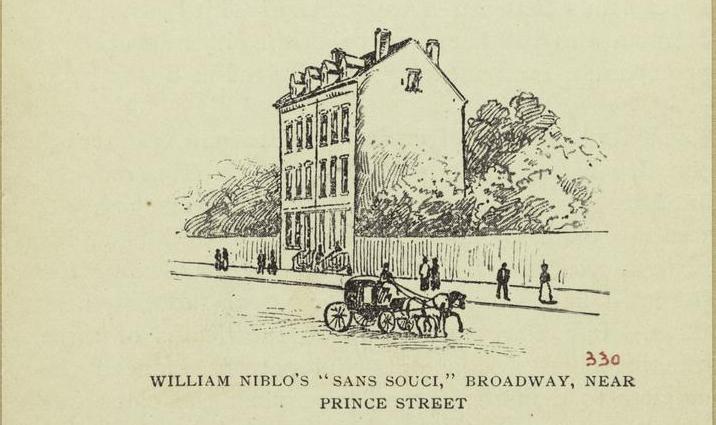
Niblo greatly expanded his romantically lit garden (originally named San Souci) by taking over several surrounding lots and installing a theater and saloon. The venue was large enough that it hosted both large fairs and orchestral productions.

After a fire destroyed the stage in 1846, Niblo built bigger, becoming one of New York’s central performance spaces by the Civil War era with over 3,000 seats.

Operetta Research Center

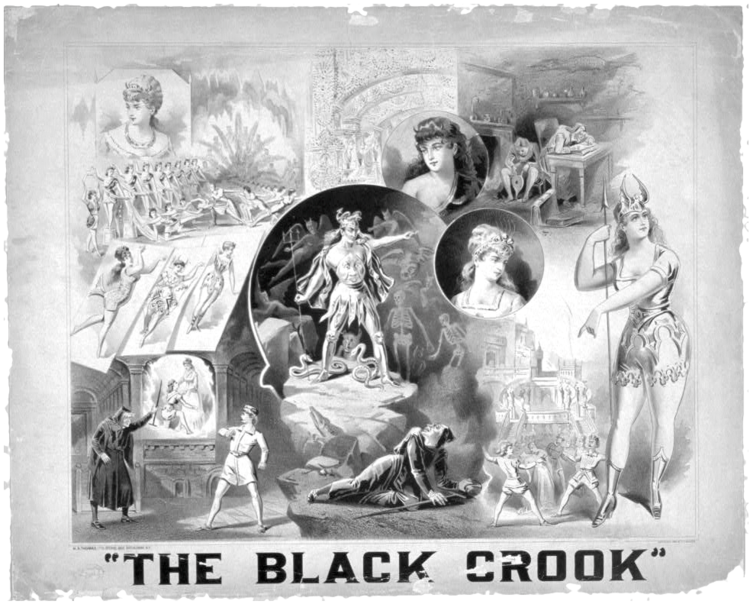
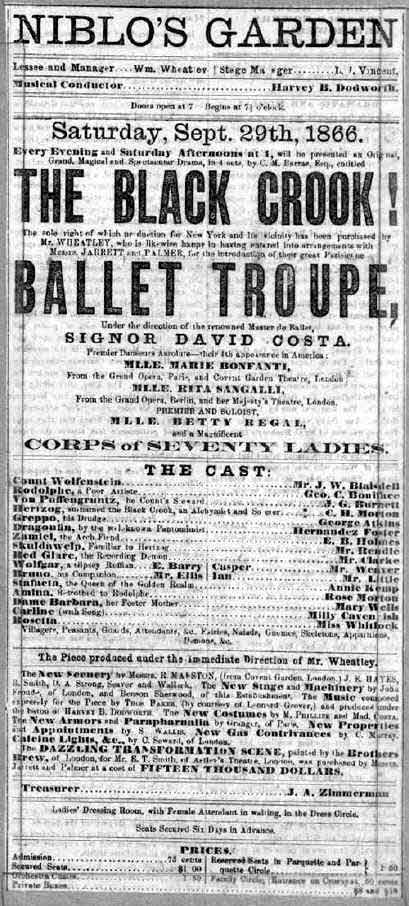
And in 1866 it debuted a show equally as ambitious — The Black Crook, running five-and-a-half hours long and considered by many to be the first Broadway musical.

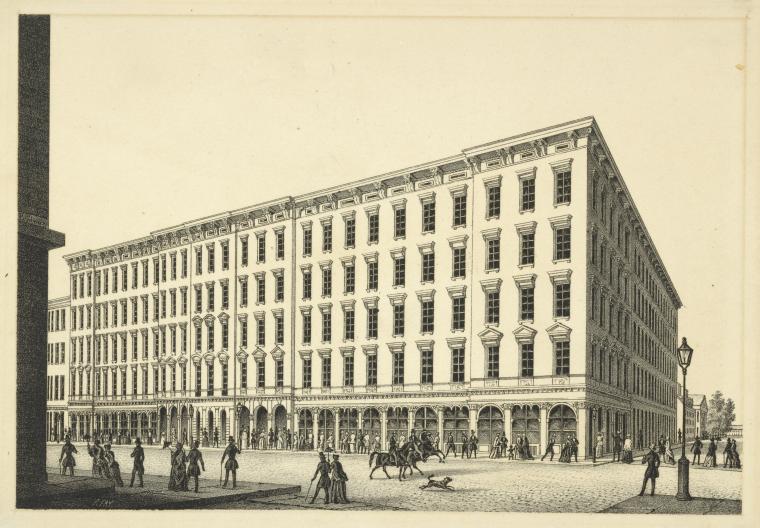
But by this time, the ‘garden’ of Niblo’s Garden had been greatly reduced, replaced by a luxury hotel — the Metropolitan.

For more information on the history of Niblo’s Garden, listen to this back catalog show on the history of this long-gone theatrical icon:

Palace Garden

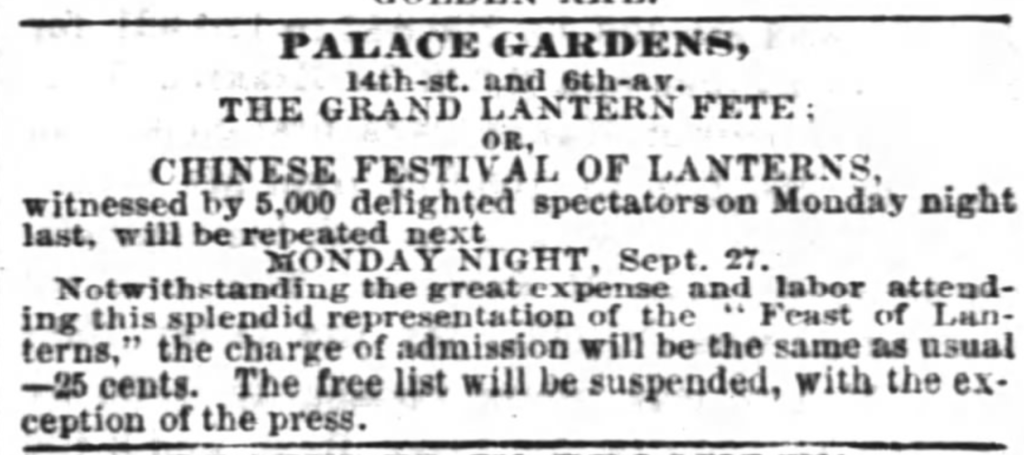
Throughout the decades, New York society moved north up the island and so too did the pleasure gardens. The Palace Garden, at Sixth Avenue and 14th Street, situated its attractions nearby bustling Union Square.

From the New York Times, September 24, 1858

It might be hard to imagine a ‘festival of lanterns’ at that particular street corner today. Just a couple decades the avenue would be transformed by massive department stores, becoming the fashionable shopping district Ladies Mile.

In fact, the entire idea of a pleasure garden was evolving into something that was very much not a garden at all. With the arrival of Central Park in the late 1860s and the rising prices of real estate in high trafficked areas of Manhattan, the simple pleasures of the urban pleasure garden faded away.

But not the name! Pleasure gardens were associated with music and performance and so the ‘garden’ stuck around.

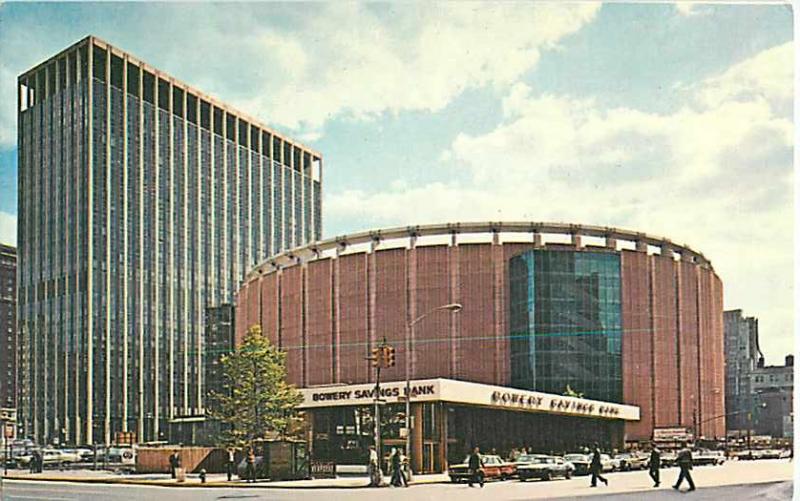
So despite hundreds of beautiful parks, botanical gardens and community gardens in the city, this is the location that is called THE GARDEN:

Categories
American History Bowery Boys Bookshelf

WILD BILL: The real man behind a Western legend — and a reluctant Broadway stage star

“Hickok was a celebrity. He was famous. He was feared. He was already a legend. It is estimated that over fifteen hundred dime novels were written just about Buffalo Bill Cody, beginning in 1869, when he was only twenty-three, into the 1930s, and during the early years. Wild Bill was in that category of iconic western hero. He had risen to the heights of both reputation and fabrication … and now the slow, inexorable descent began.” — Tom Clavin

How do you write a book about a historical figure who seems more fiction than real? The Western folk hero Wild Bill Hickok lived a life that was thrilling, dangerous and brash, amplified by the fascinations of the American press into a virtual Western superhero.

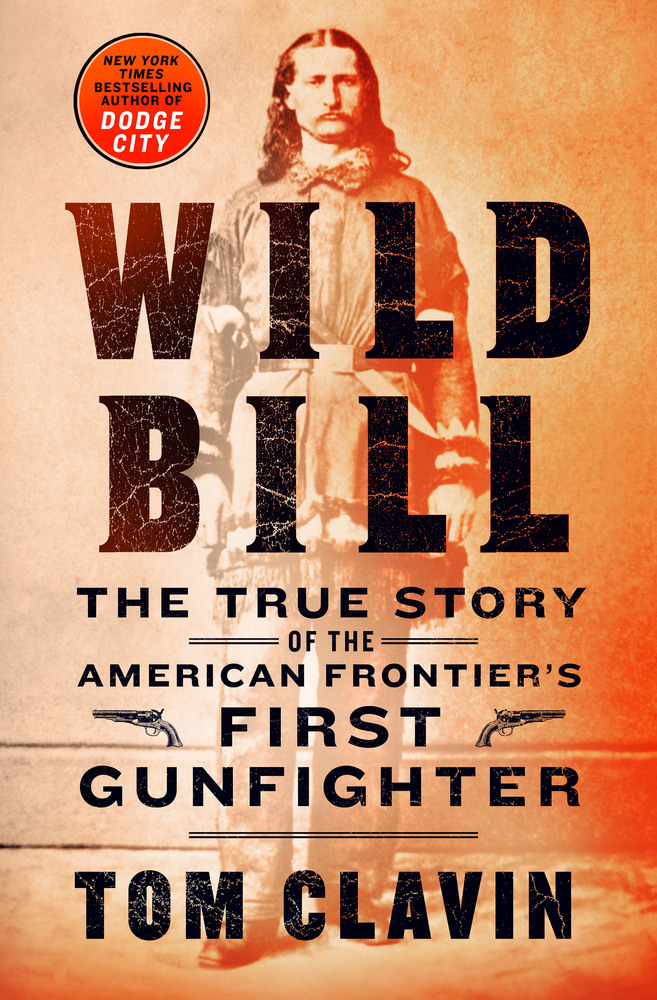
Wild Bill: The True Story of the American Frontier’s First Gunfighter
by Tom Clavin

St. Martins Press/2019

Tom Clavin’s Wild Bill: The True Story of the American Frontier’s First Gunfighter, a biography as frisky and unpretentious as its subject, attempts the noble task of walking back 150 years of mythology surrounding the Illinois man named James Butler Hickok, a drifter who wandered from job to job through Missouri, Arkansas and Kansas. During the Civil War, he worked as a wagon master and later a scout for the Union Army.

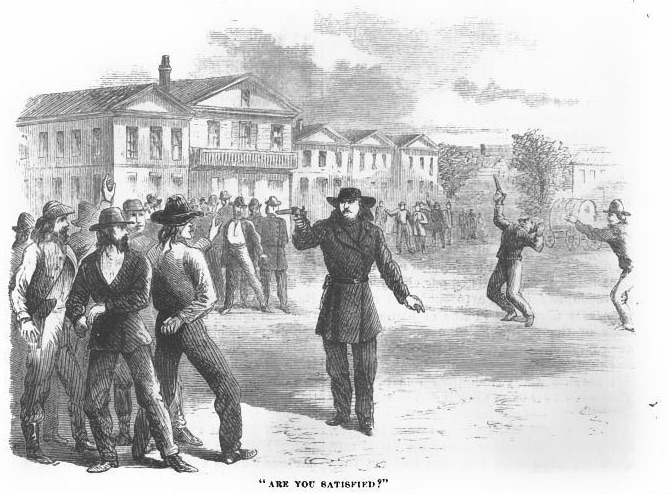
In 1865, he shot and killed the gambler Davis Tutt in the town square of Springfield, Missouri. This quick-draw duel — essentially over a pocket watch — took place in the early evening, not high noon. But whispers of this outrageously bloody event inspired a journalist named George Ward Nichols, working for New York’s Harper’s New Monthly Magazine, to profile Hickok.

Hickok shoots Tutt in Springfield town square, as depicted in Harper’s New Monthly Magazine in 1867.

It was in Nichols’ piece that Wild Bill Hickok — the fastest gun in the West — and indeed the genre of Wild West pulp fiction was born.

“[N]o single published piece catapulted a man on the American frontier more than Nichol’s article did for Hickok,” writes Clavin. With “the fertile imagination of a writer who could cash in on a sensational story and an outlet that offered that story to thousands of eager and mostly gullible readers, America had its first postwar frontier star.”

The attention only made Hickok more of a target with foolhardy men seeking him out in efforts to best the now-famous gunslinger. (It never ended very well for them.)

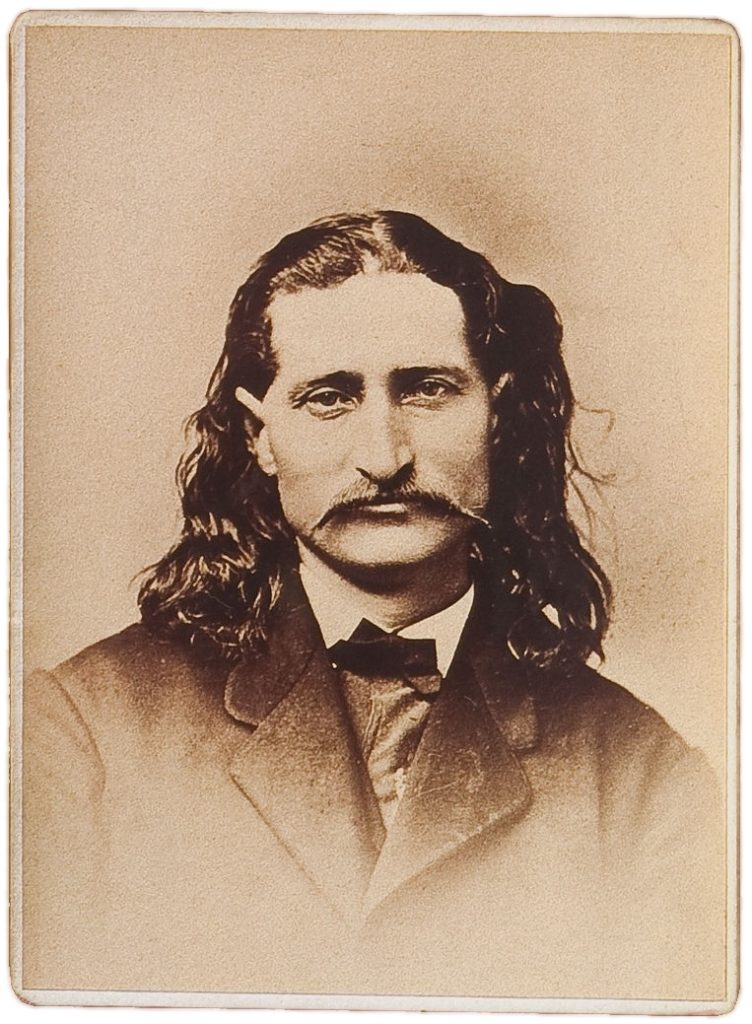
Wikimedia Commons

Clavin depicts an unruly but realistic western (or, more accurately, midwestern) landscape of chance encounters, brief romances and wide, arduous journeys. Yet even a hardened adventurer like Hickok would occasionally take a moment to bask in his fame.

In 1873 he joined his longtime friend ‘Buffalo Bill’ Cody in the cast of a ham-fisted play Scouts of the Plains at New York’s Niblo’s Garden, becoming a major box office draw.

Today we might call him, um, difficult. “Hickok felt like he was risking his integrity and dying a bit with every performance because he became further convinced that acting was a foolish occupation. One night … he took one of his real pistols and shot out the spotlight that had been fixed on him. The audience applauded the dramatic reality of the production as well as Hickok’s famous marksmanship.”

On August 1, 1876, Hickok was murdered during a poker game in Deadwood, a frontier town in the Dakota Territory, cutting short any future stage performances but securing his position in the pantheon of Wild West mythology.

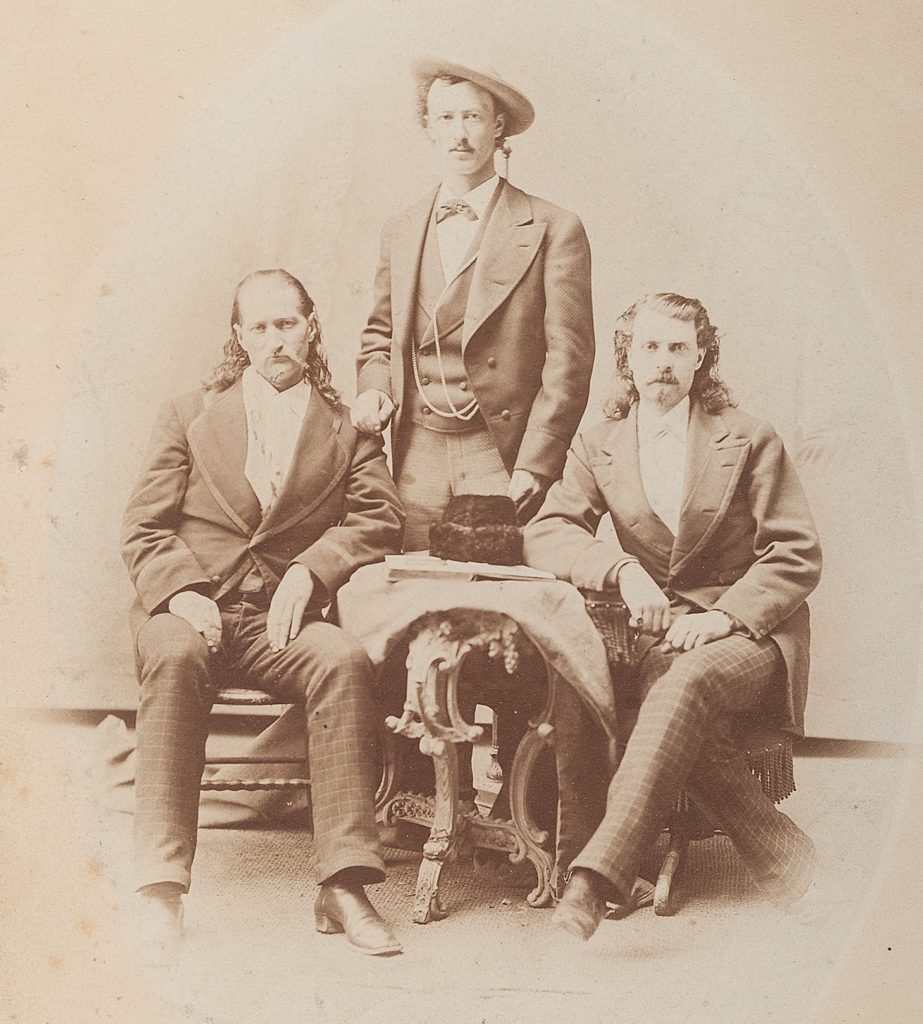
Wild Bill Hickok, “Texas Jack” Omohundro, and Wild Bill’s longtime front “Buffalo Bill” Cody, in a cabinet photograph for Scouts of the Plains, 1873

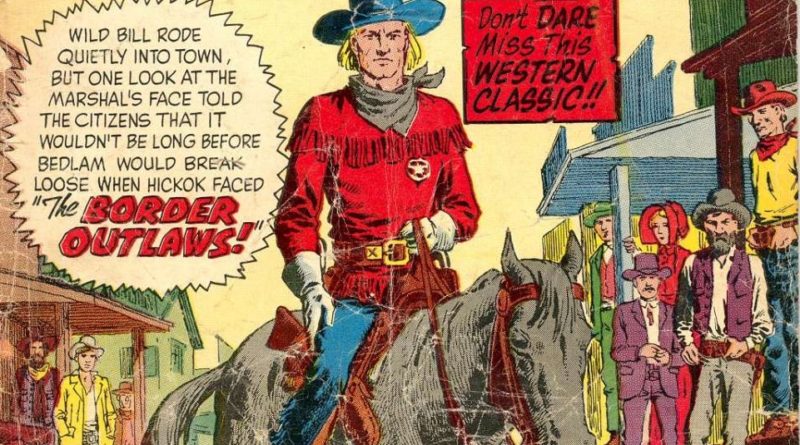
At top: An issue of the 1964 comic book Wild Bill Hickok #12, published by Super Comics

Categories
Neighborhoods Podcasts

The Story of SoHo: The Iron-Clad History of ‘Hell’s Hundred Acres’

PODCAST The history of SoHo, New York’s 19th century warehouse district turned shopping mecca

Picture the neighborhood of SoHo (that’s right, South of Houston) in your head today, and you might get a headache. Crowded sidewalks on the weekend, filled with tourists, shoppers and vendors, could almost distract you from SoHo’s unique appeal as a place of extraordinary architecture and history.

On this podcast we present the story of how a portion of Hell’s Hundred Acres became one of the most famously trendy places in the world.

In the mid 19th century this area, centered along Broadway, became the heart of retail and entertainment, department stores and hotels setting up shop in grand palaces. (It also became New York’s most notorious brothel district). The streets between Houston and Canal became known as the Cast Iron District, thanks to an exciting construction innovation that transformed the Gilded Age.

Today SoHo contains the world’s greatest surviving collection of cast-iron architecture. But these gorgeous iron tributes to New York industry were nearly destroyed — first by rampant fires, then by Robert Moses. Community activists saved these buildings, and just in time for artists to move into their spacious loft spaces in the 1960s and 70s. The artists are still there of course but these once-desolate cobblestone streets have almost unrecognizably changed, perhaps a victim of its own success.


The Bowery Boys: New York City History podcast is brought to you …. by you!

We are now producing a new Bowery Boys podcast every two weeks. We’re also looking to improve the show in other ways and expand in other ways as well — through publishing, social media, live events and other forms of media. But we can only do this with your help!

We are now a member of Patreon, a patronage platform where you can support your favorite content creators for as little as a $1 a month.

Please visit our page on Patreon and watch a short video of us recording the show and talking about our expansion plans. If you’d like to help out, there are five different pledge levels (and with clever names too — Mannahatta, New Amsterdam, Five Points, Gilded Age, Jazz Age and Empire State). Check them out and consider being a sponsor.

We greatly appreciate our listeners and readers and thank you for joining us on this journey so far. And the best is yet to come!


A map of the Bayard farm and how it was broken up and carved into the streets we know today.

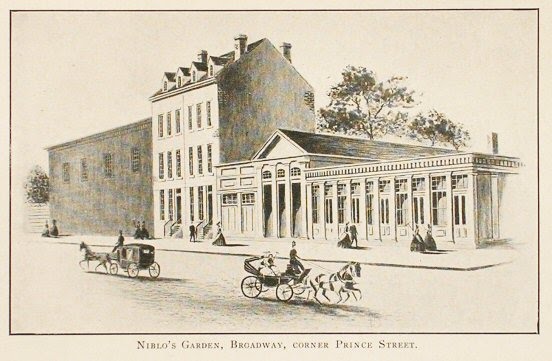
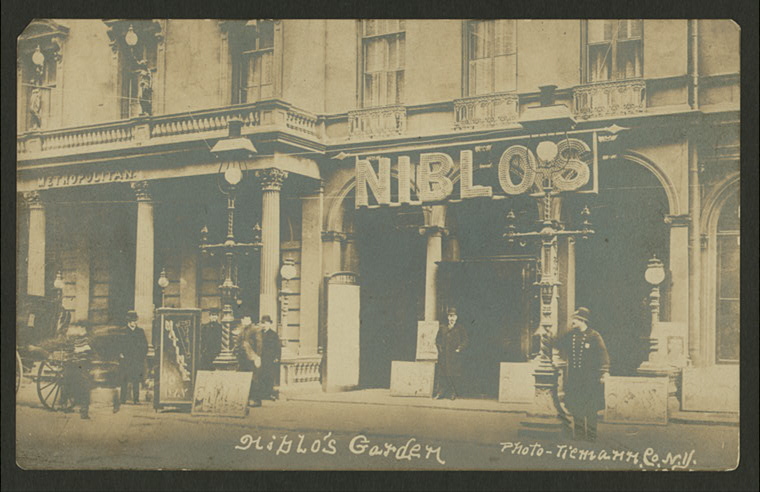
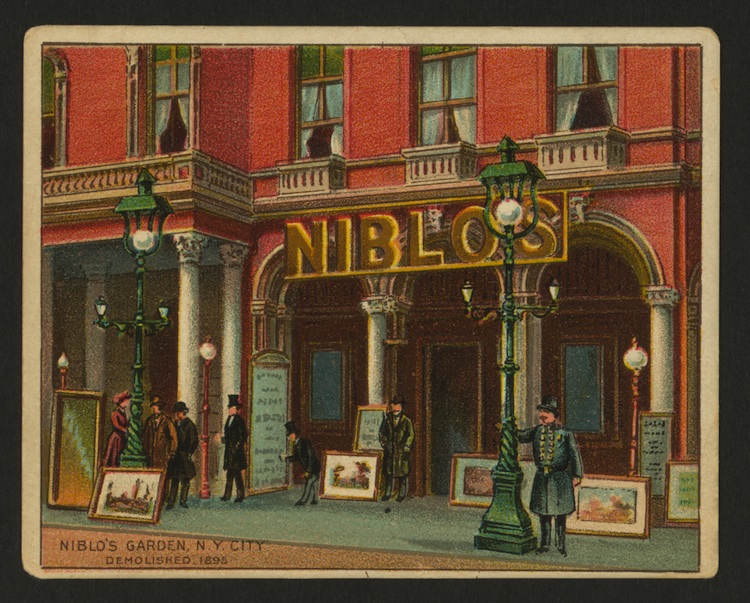
Niblo’s Garden, located at Broadway and Prince Streets, was one of the finest theaters along Broadway in the area of today’s SoHo.
Looking north along Broadway between Grand and Broome Street. The St. Nicholas Hotel is the white structure in the center of the photo.
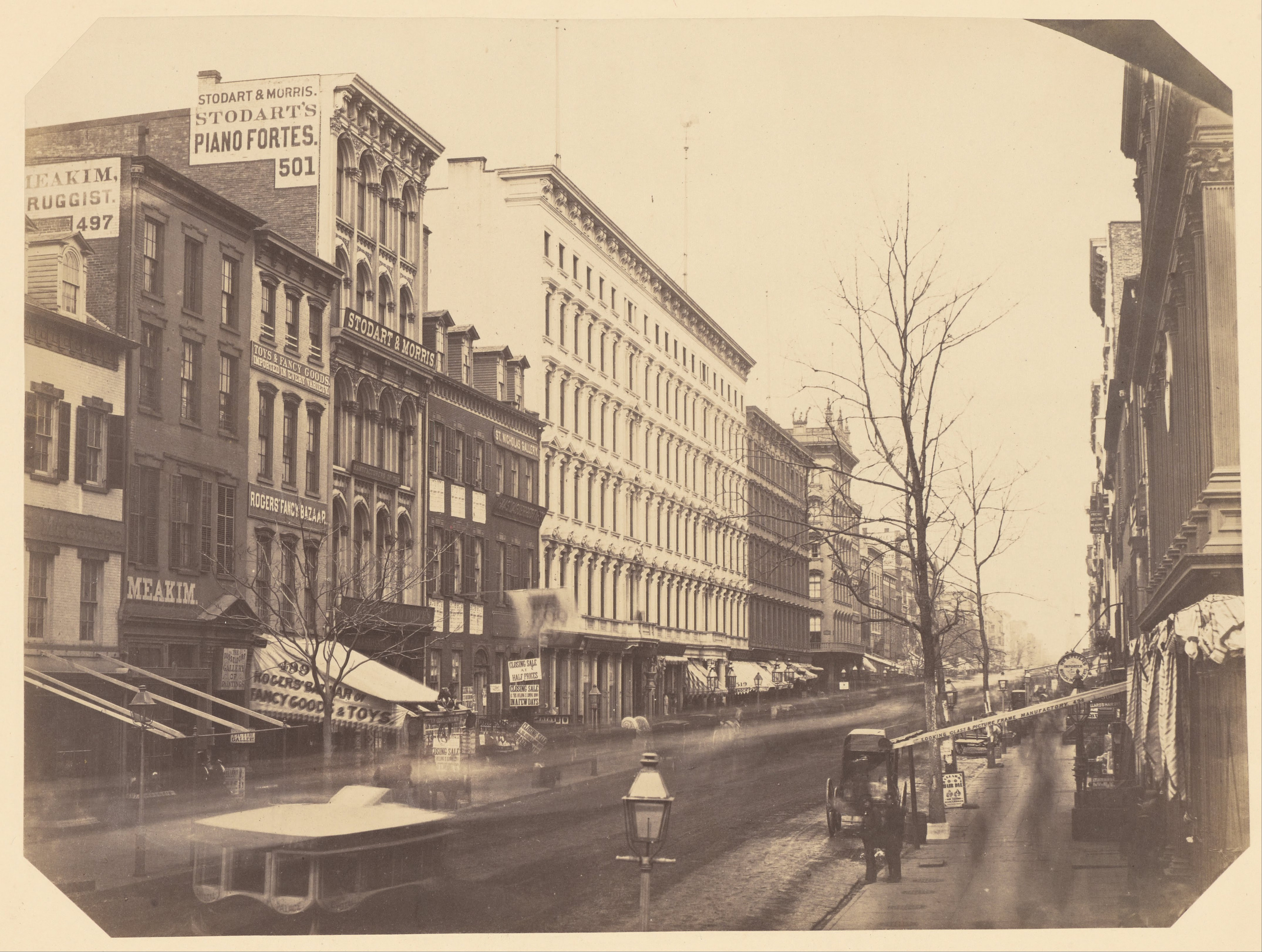
Photo attributed to Silas A Holmes

An auction poster from 1872 advertising a property on Broome Street and “South Fifth Avenue or Laurens Street” — today’s West Broadway.
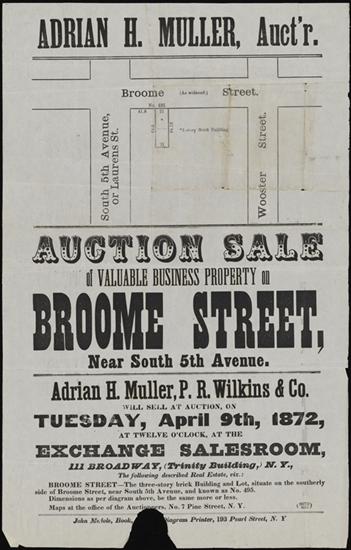
MCNY

Here is that corner at 504-506 Broome Street — in 1935 (photo by Berenice Abbott). Per Sean Sweeney on Facebook: “The two buildings were demolished and for years were a parking lot. Now a new 3-story retail building sits in their place.”
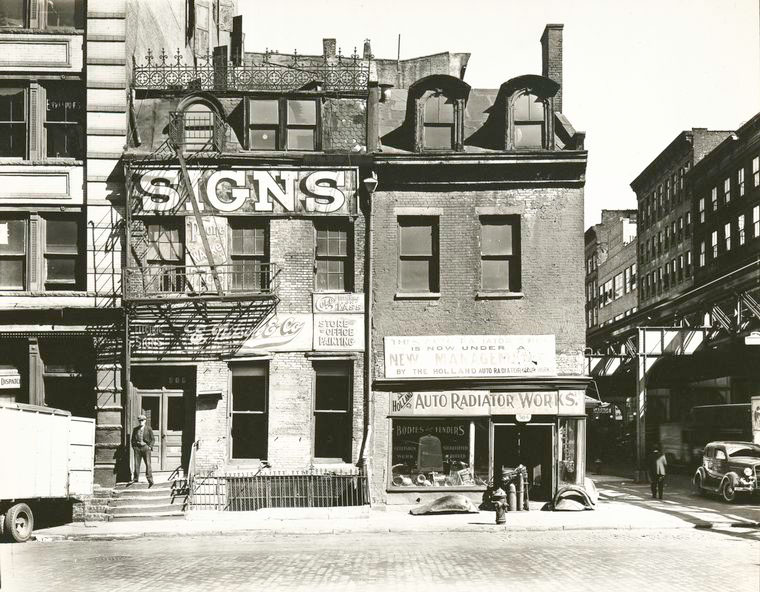
NYPL

The house at 143 Spring Street — in 1932 (photograph by Charles Von Urban) and today (it’s a Crocs shop!)
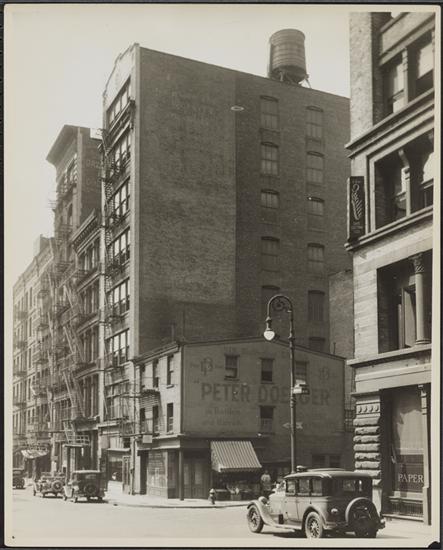
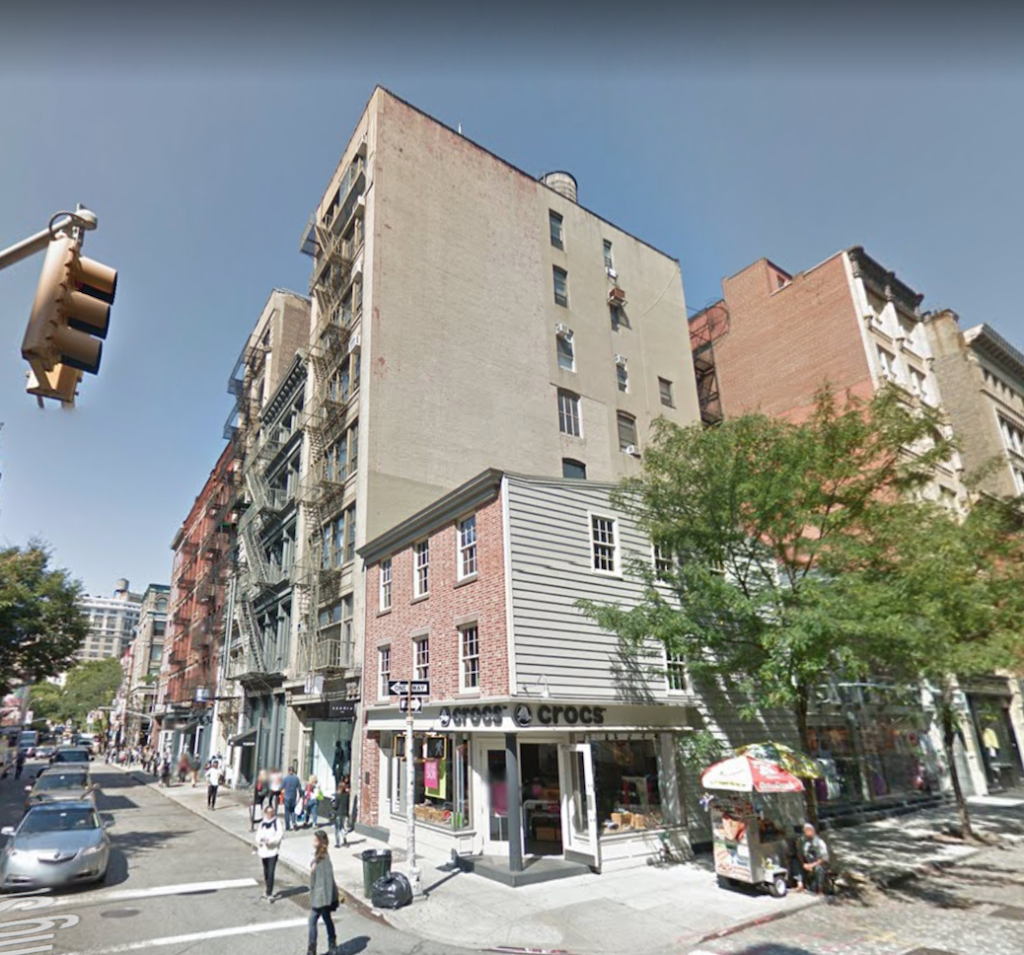
Museum of City of New York/Charles Von Urban collection

491 Broadway at Broome Street — in 1905 (photograph by the Wurts Bros.) and today
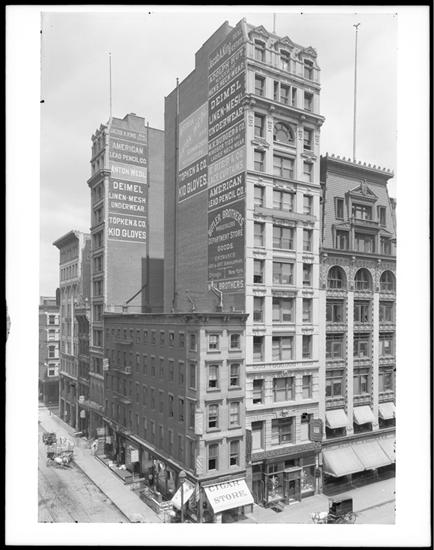
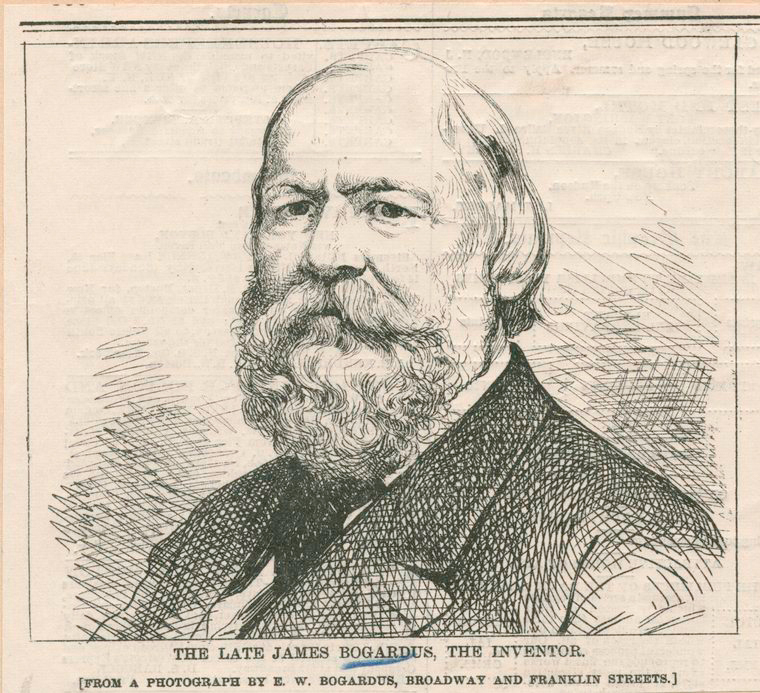
James Bogardus, the man who helped give SoHo its distinctive appearance thanks to his vigorous marketing and promotion of cast-iron architecture.
The first cast-iron structure in New York, built in 1848, was further south at the corner of Centre and Duane Streets.
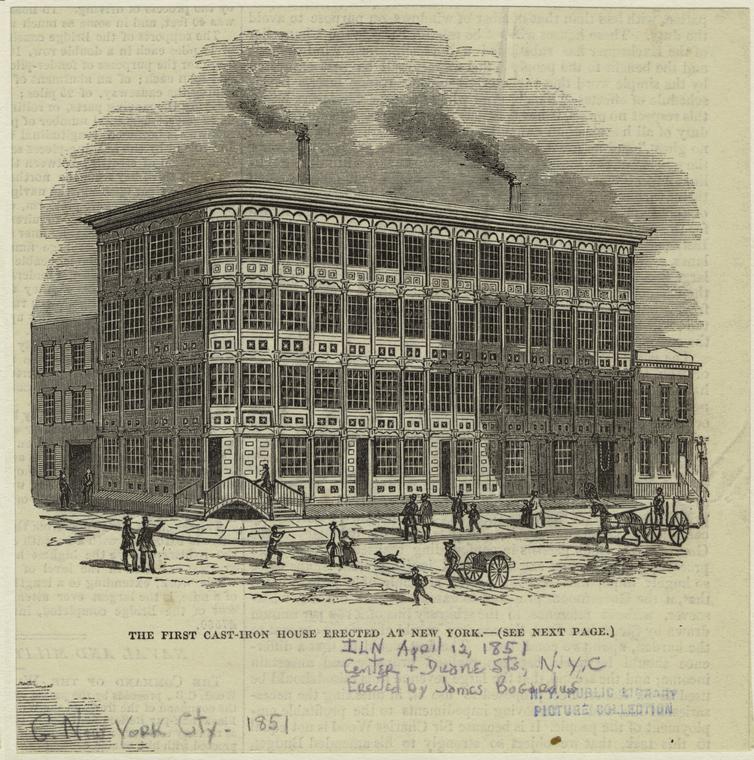
NYPL

Robert Moses’ view of Broome Street via his project Lower Manhattan Expressway project. Broom Street would have had an elevated highway, enclosed within modern buildings. A view of surviving cast-iron architecture on the right.
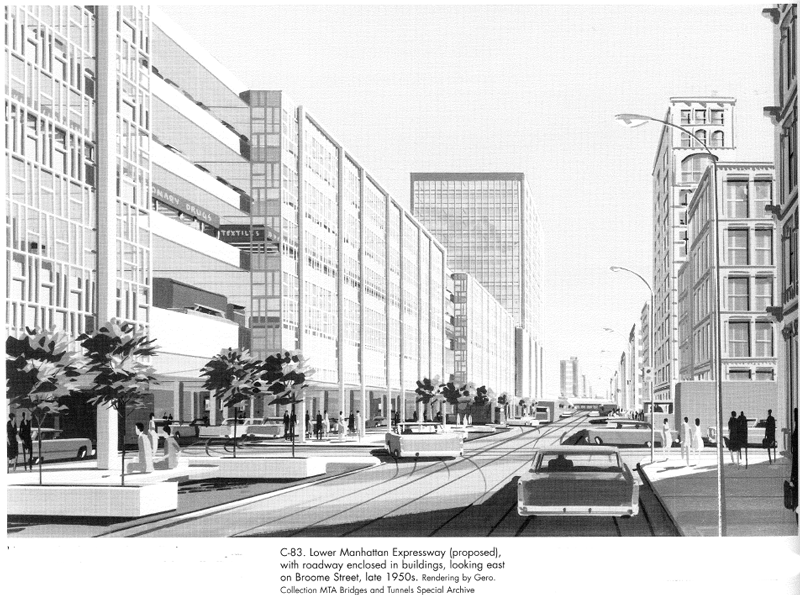
SoHo would have been eliminated (or greatly reduced) by Moses’ project which was thankfully nixed.
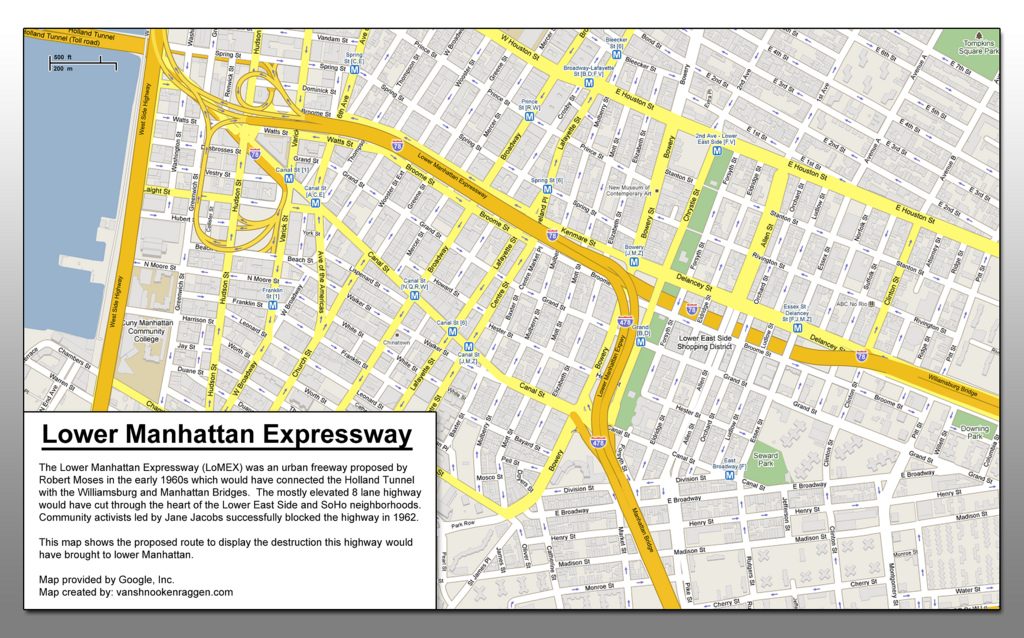
Map produced by vanshnookenraggen

A map of the art galleries in the SoHo art scene during the 1970s.
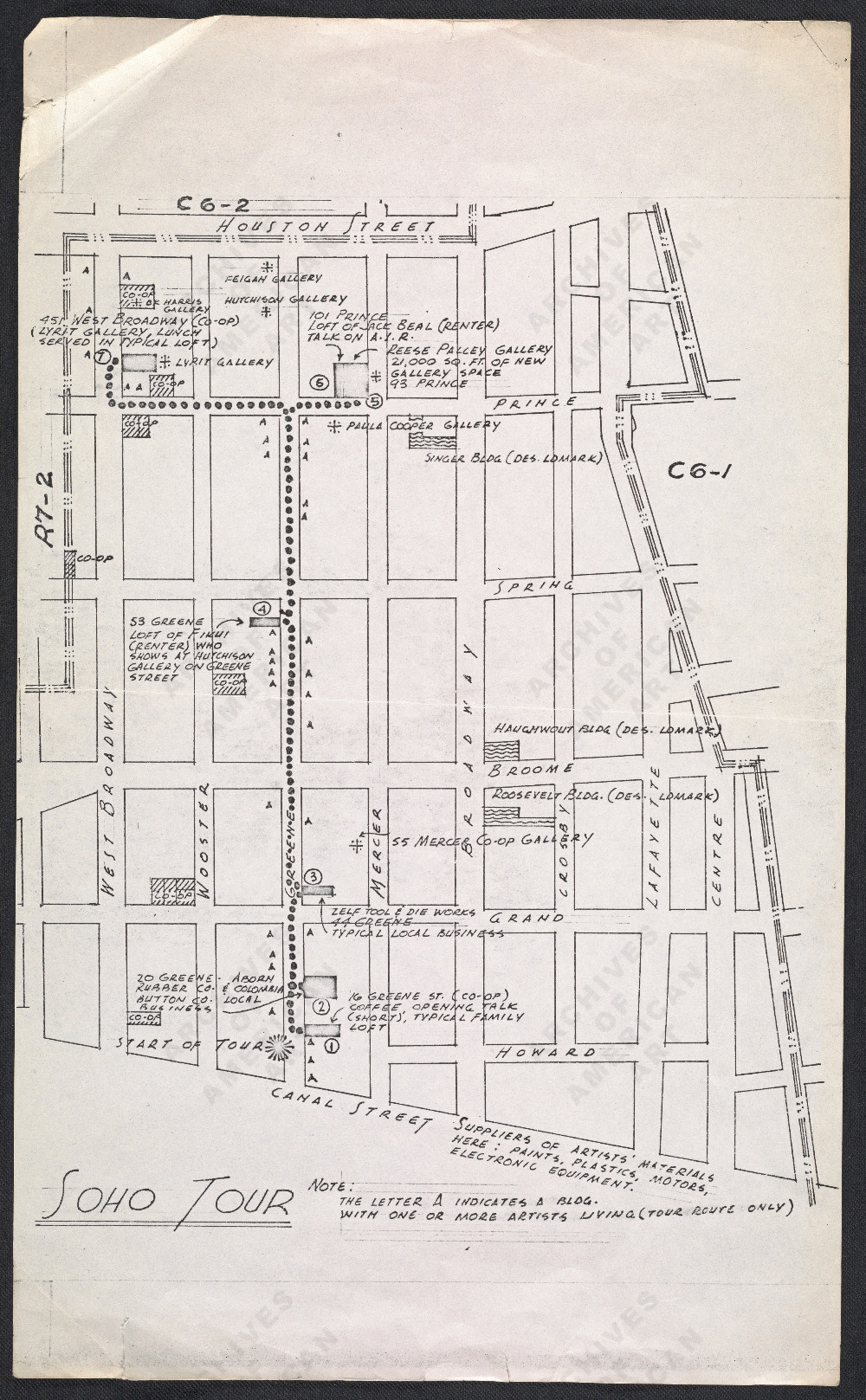
SoHo Artists Association Records, 1968-1978. Archives of American Art, Smithsonian Institution

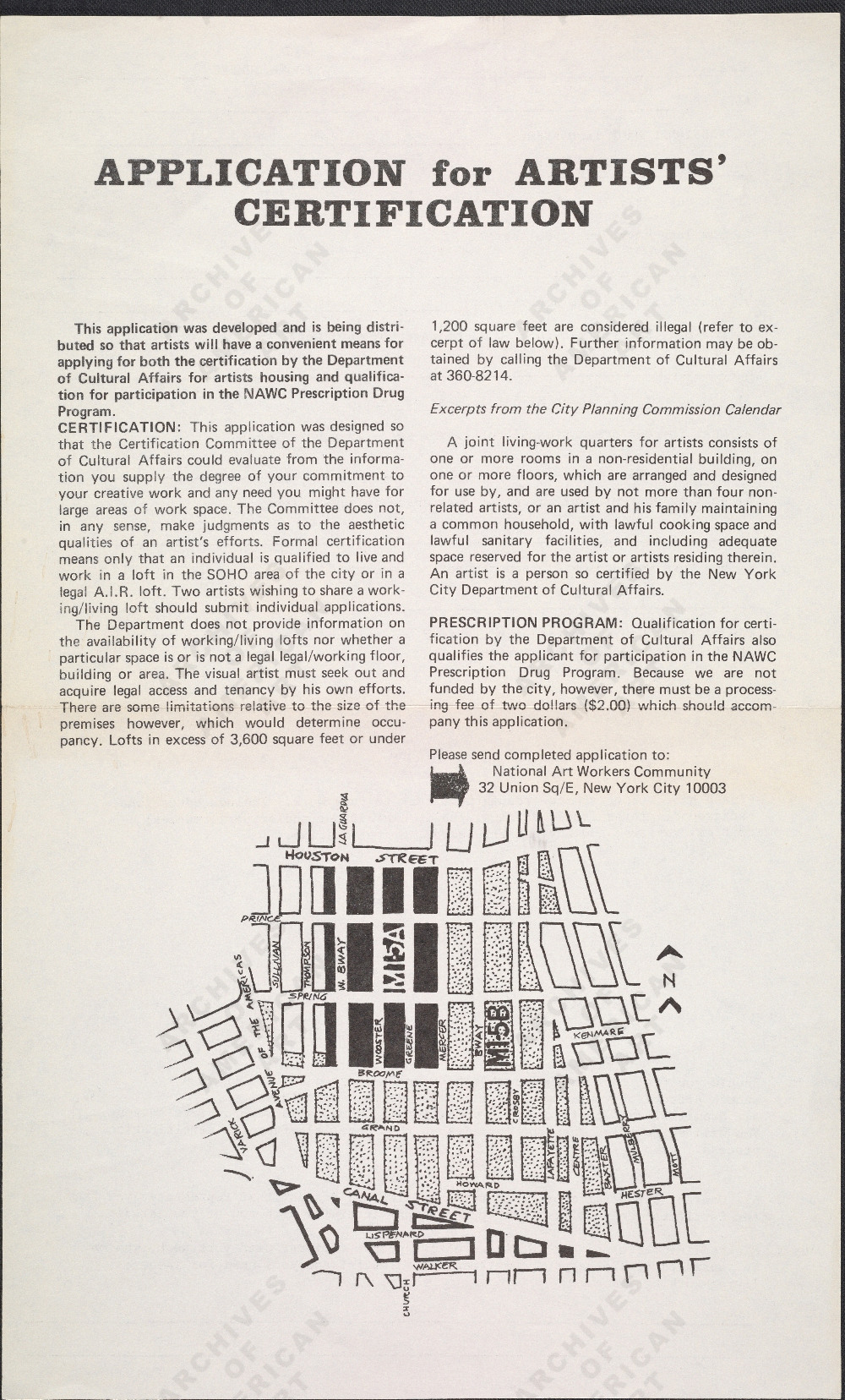
From a 1971 SoHo newsletter: The criteria for qualifying as an artist — and eventual resident — of a specially-zoned loft in SoHo. M1-5A and M1-5B were the newly created work-living zones.
SoHo Artists Association Records, 1968-1978. Archives of American Art, Smithsonian Institution

We greatly encourage you to check out the SoHo Memory Project for a lot of fantastic and often deeply personal recollections about the SoHo days of yore.

For further listening, check out the following Bowery Boys podcasts which were referenced in this week’s show:

Before Harlem: New York’s Forgotten Black Communities (#230) for information on first farms of the city’s first black New Yorkers

Niblo’s Garden (#113) for the history of the district’s most famous entertainment center

Our podcasts on Robert Moses (#100) and Jane Jacobs (#200)

And we really hope our show inspires you to check out two films that features interesting views of SoHo during its chic gallery phase — The Eyes of Laura Mars and After Hours
Categories
Podcasts The First

The Devil and the First Broadway Musical (“The Black Crook”)

THE FIRST PODCAST The Black Crook is considered the first-ever Broadway musical, a dizzying, epic-length extravaganza of ballerinas, mechanical sets, lavish costumes and a storyline about the Devil straight out of a twisted hallucination.

The show took New York by storm when it debuted on September 12, 1866. This is the story of how this completely weird, virtually unstageable production came to pass. Modern musicals like Phantom of the Opera, Wicked, and Hamilton wouldn’t quite be what they are today without this curious little relic.

WARNING: You may leave this show humming a little tune called “You Naughty, Naughty Men.”

Featuring music by Adam Roberts and Libby Dees, courtesy the New York Public Library for the Performing Arts.

And the voice of Ben Rimalower reading the original reviews of the Black Crook.

With grateful thanks to Doug Reside whose online resources have been most invaluable with my research.

For more information, there’s an entire Bowery Boys podcast on the history of Niblo’s Garden:

The actress and dancer Pauline Markham, performing as Stalacta, Queen of the Golden Realm

NYPL

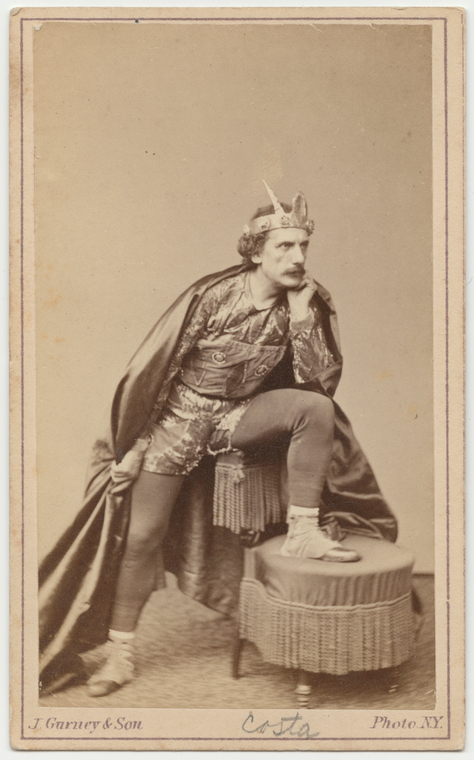
“Celebrated dancer and composer, David Costa, wearing tights, trunks, shirt and long cape with a satin sheen, and a crown on his head featuring horns. He has one foot on the seat of a round-seat chair with heavy fringe, his thigh resting on the back of the chair as he rests his elbow on his knee and his chin on his hand.”

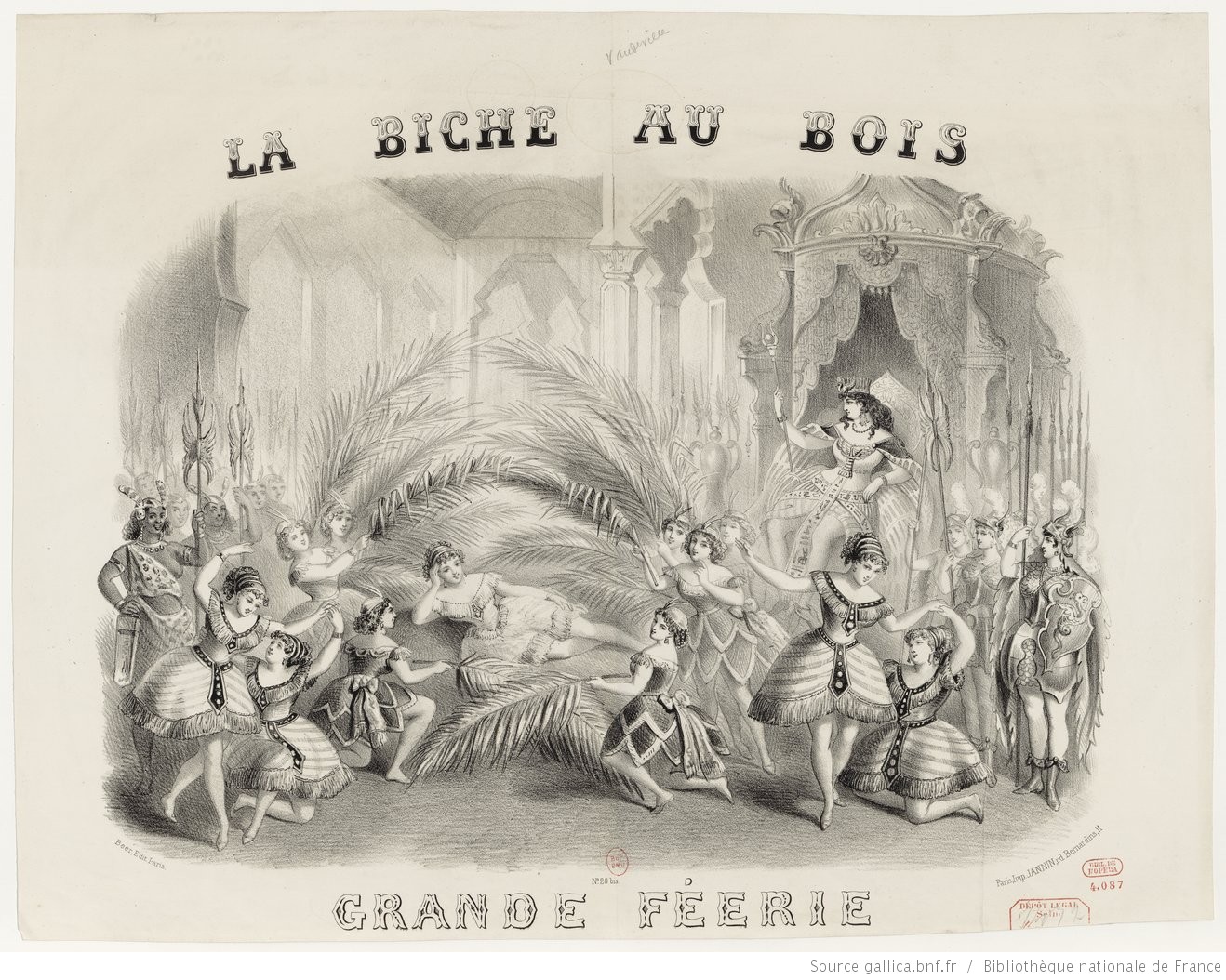
La Biche au Bois from which sprung the Black Crook

From an 1867 book of songs from the Black Crook (although many of the songs were likely never in the show!)

NYPL

Versions of the show popped up across the country in almost every major city. There was no real consistency aside from Barras’ story.

NYPL

Thomas Baker wrote many of the songs in The Black Crook. He was also a song writer for Laura Keene whose show The Seven Sisters is sometimes noted as an early proto-musical.

NYPL

Each number was so elaborate that it would take several minutes to move scenery and get the cast into new costumes. This was one of the key reasons the show had so many unrelated songs which were sung as scenes were shifted.

NYPL
Operetta Research Center

Illustrations from Charles Barras novel The Black Crook: A Most Wonderful History, published in 1866

The audio of Leonard Bernstein was taken from this episode of Omnibus:

“You Naughty, Naughty Men” performed by Adam Roberts and Libby Dees

“Les Grelots d’amour” performed by Adam Roberts

Some intrepid theater folk brought back a version of The Black Crook and performed it last year at Abrons Arts Center. Hopefully they will remount the show in the future!

Categories
Those Were The Days

Ten cool facts about ice cream and New York City history PLUS: where was New York’s first frozen yogurt shop?

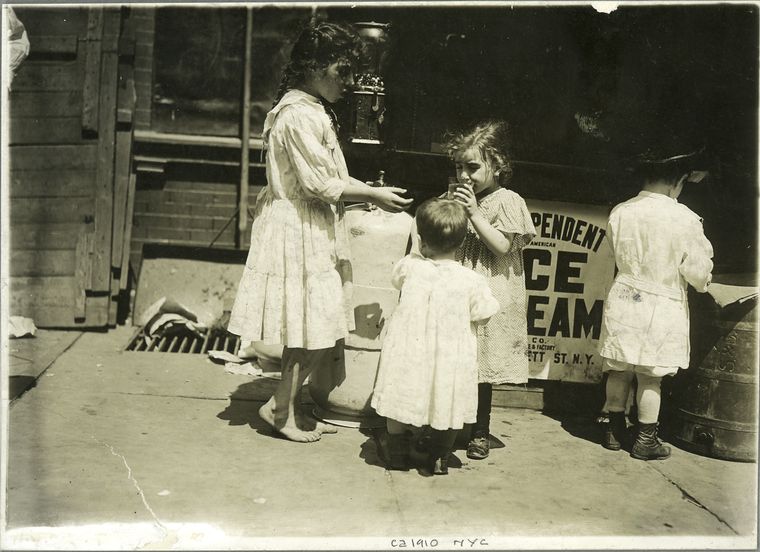
Lewis Wickes’ photograph of a few children enjoying a bit of ice cream on a hot day, 1910. (NYPL)

1. America’s first ice cream shop was located on Dock Street** (roughly today’s Pearl Street) in 1774.  The British confectioner Philip Lenzi advertised ice cream of “any sort”, along with a host of treats, including sugar plums, jams and sweetmeats.

2.  Hanover Square (near Stone and Pearl streets) was the center of commerce in colonial New York, and apparently of confections as well.  In 1777, in the midst of British-occupied New York during the Revolutionary War, Lenzi moved his shop up into Hanover Square next to another ice cream shop owned by Joseph Corree at 120 Hanover Square. [source]

3. George Washington and his wife Martha were huge fans of ice cream.  During the first year of Washington’s presidency, back in 1789, when the seat of government resided in New York, Martha would make several batches of it from the Washington’s home at One Cherry Street She sometimes complained of the lack of fresh cream, sometimes serving “unusually stale and rancid” desserts at her weekly tea parties.  One well-repeated legend states that the Washington’s spent over $700 on ice cream desserts in the summer of 1789.

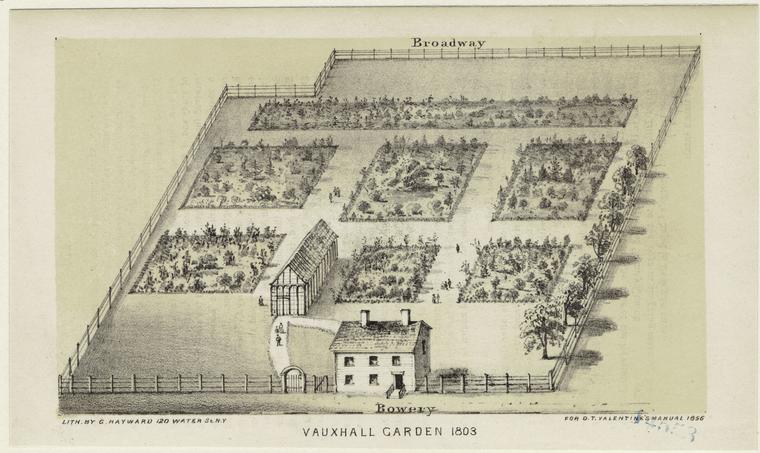
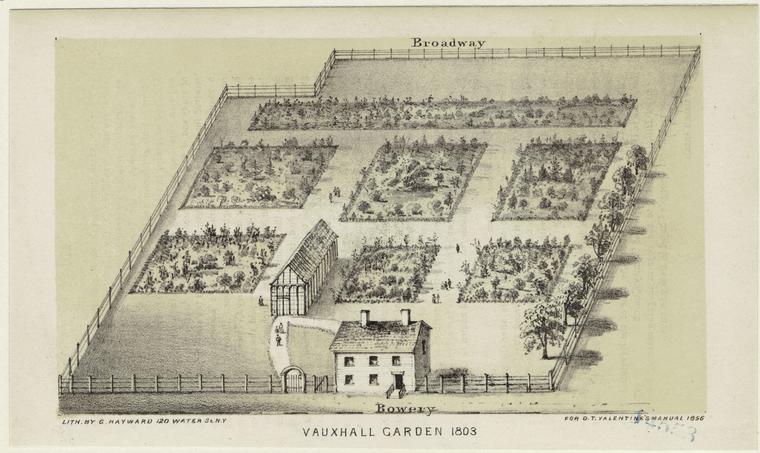
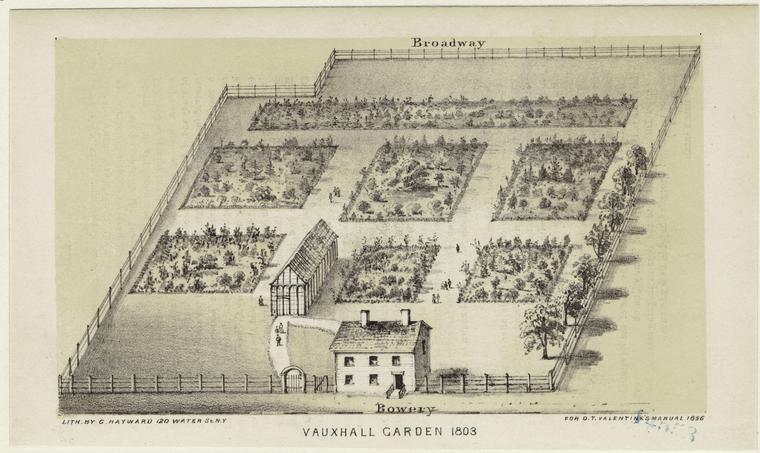
Above: A 1803 map of Vauxhall Garden, at Broome Street between the Bowery and Broadway, a lovely place to enjoy a bowl of ice cream in early New York

4. Manhattan’s pleasure gardens — early precursors to the modern park — became instrumental in spreading the joy of ice cream.  The aforementioned Joseph Corree opened the Mount Vernon Garden at Broadway and Leonard Street in 1800, a few months after ice cream-lovin’ Washington died at his estate in Mount Vernon.

On top of the many festive entertainments at the garden — fireworks, theatricals, topiary, tableaux vivant — Corree also offered ice cream for sale.  Other popular pleasure gardens of the day, such Vauxhall Garden and Niblo’s Garden, would follow suit.

5. Delmonico’s, before it became the finest name in restaurant dining in New York in the 19th century, got its start as a small confectionery shop on 23 William Street in 1827 which featured ice cream on its menu. (Learn more about Delmonico’s from my podcast on its history.)

6. Ice cream vendors were on the streets of New York as early as the 1820s, the best way for less affluent people to enjoy the dessert.  Within a couple decades, of course, the ‘pleasure gardens’ would lose their patina of class and become playgrounds for poorer New Yorkers.  In 1852, one garden near the Bowery was described as “a sort of ice-creamery, and general rendezvous for the Bowery fashionables.” [source]

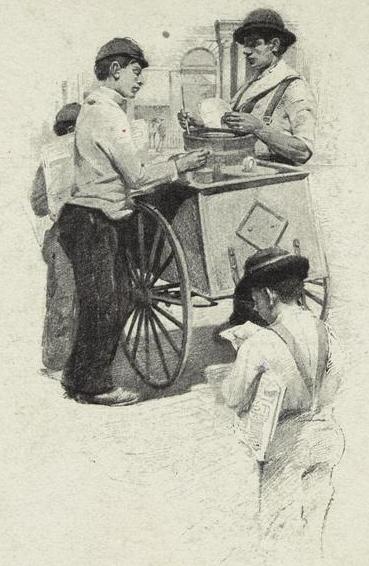
At right: A Century Magazine illustration from 1901 of a New York ice cream vendor or ‘hokey pokey man’ (NYPL)

7. Ice cream saloons, by mid-19th century, were aplenty along the main thoroughfares of New York, experimenting with different kinds of production.  One saloon, Parkinson’s on Broadway, claims to have invented pistachio ice cream.  Another, the Patent Steam Ice Cream Saloon, named for its steam-operated freezing unit, catered to the women of the middle class, “the wives and daughters of the substantial tradesmen, mechanics and artisans of the day,” according to New York by Gas-Light.

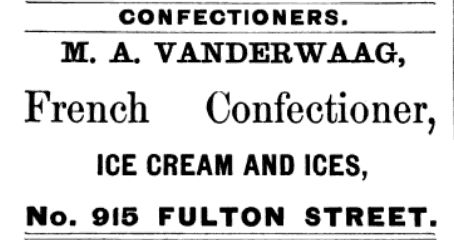
A Brooklyn confectioner ad from 1876:

8. The hokey pokey men, the nickname for one-cent ice cream street vendors, were briefly hindered by the Ice Cream Strike of 1913, a walkout by all 2,500 members of the Ice Cream Workers Union in New York, effectively shutting down the production of ice cream, especially in the Lower East Side.  The strike lasted several weeks.

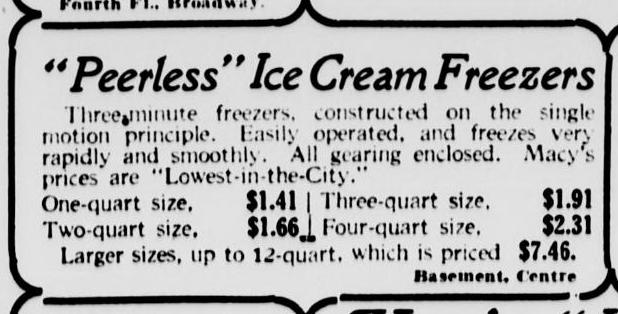
Below: A Macy’s ad in 1913 for a home ice-cream maker:

9. Ice Cream Profiteering or Newspaper Self-Promotion?  After the war, many merchants continued to sell massively overpriced ice cream.  The Evening World reported in 1921 that “profits from ice cream range from 500 to 1,000 percent” at a survey of local ice cream vendors.  “In few articles of food has there been found any greater evidence of extortion from the consumer.” [source]

A few days later, the newspaper extolled upon its own crack reporting, claiming that ice cream prices were going down because of their investigations.  “Hundreds of manufacturers and retails have already cut prices,” the World boasted.

10. Haagen-Dazs Ice Cream was not created anywhere near Scandinavia, but rather in the Bronx, the product of two Polish-Jewish confectioners Reuben and Rose Mattus.  The official reason for the name was “to convey an aura of the old-world traditions and craftsmanship to which he remained dedicated.” Reuben later admitted, “We wanted people to take a second look and say, ‘Is this imported?'”

The first Haagen-Dazs ice cream shop, which opened in 1976, is located at 120 Montague Street in Brooklyn Heights. The store is still going strong.

EXTRA: Frozen yogurt was the original cronut The trendy dessert was first sold over the counter in New York at Bloomingdale’s Department Store in the early 1970s.  As far as I can tell, the first actual yogurt store in the city — the first of many — was the Dannon Yogurt Store at 207 East 86th Street, opening in February 1975.

That was the year that New Yorkers first went WILD for frozen yogurt, well at least according to the New York Times (but you know how they are with trend stories!)

Yogurt: “It’s the biggest thing since hamburgers and chicken,” according to one fast-food executive in 1976.

**There were two Dock Streets back in old New York, so it’s possible (although more unlikely) the original shop could have been on the other one, which is near today’s Water Street and Coenties Slip.

For more sweet New York City history, check out my prior articles on:
New York and the history of soda fountains
New York, World War I and the history of the doughnut

Categories
Podcasts

Hoaxes and Conspiracies of 1864: The Confederate Plot to Torch New York

Barnum’s American Museum at left (the building with the flag) and the Astor House at right, from the vantage of City Hall Park, circa 1850. Both buildings were victims of the Confederate plot of 1864 to burn the city.

PODCAST We’re officially subtitling this ‘Strange Tales of 1864’, presenting you with a series of odd, fascinating stories from one pivotal year in New York City history. With the city both fatigued by the length of the Civil War and energized by Union victories, New Yorkers were often at their best — and their worst.

The city unites around an unusual parade — the first regiment of African-American troops — even as it elects a pacifist mayor sympathetic to the Southern cause. A grand and flamboyant fair, uniting the community, offers up a surprising New York tradition — the theme restaurant. Meanwhile, a local newspaper editor devises an elaborate hoax to get rich quick off the gold market.

But with the November re-election of Abraham Lincoln also comes a deadly threat — a Confederate conspiracy aimed at New York’s luxury hotels. Tune in as we recount the botched plot to destroy New York in an conflagration of ‘Greek fire’.

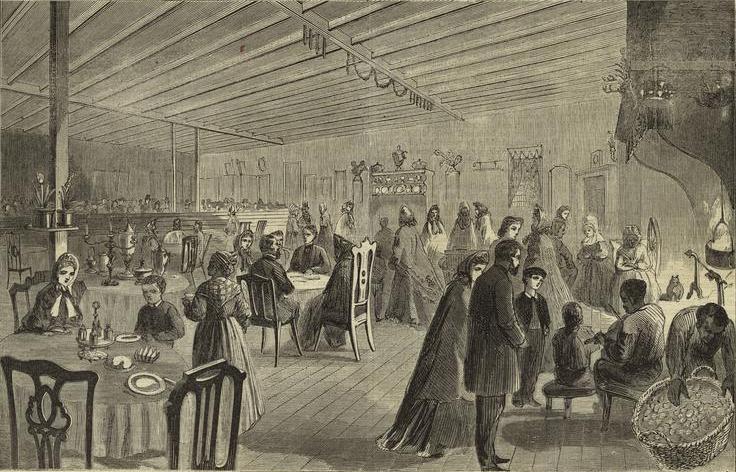
The Knickerbocker Kitchen, a featured restaurant at New York’s Metropolitan Fair. Women dressed in traditional Dutch and Colonial garb and served items believed to be popular with the residents of old New Amsterdam. [NYPL]

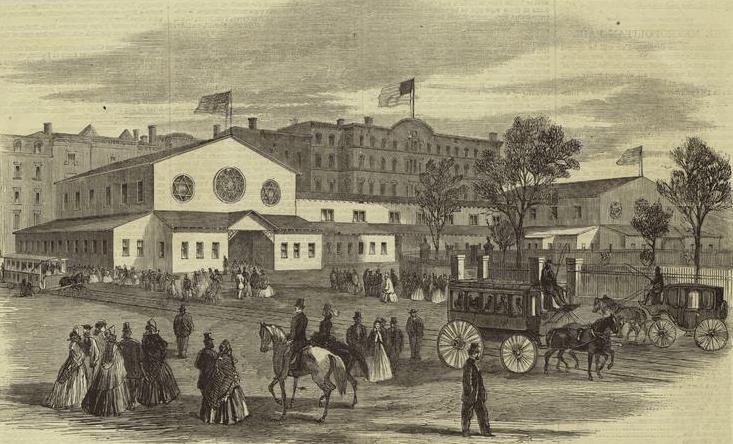
Pavilions were specially constructed around Union Square for the Metropolitan Fair, which raised money for the U.S. Sanitary Commission.

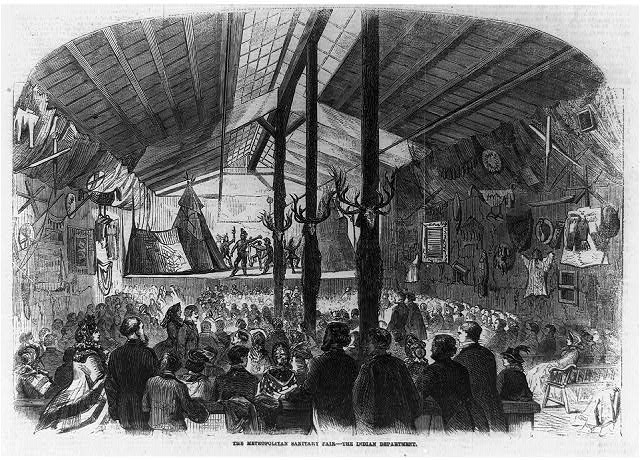
The ‘Indian Department’ at the Metropolitan Fair. [Library of Congress]

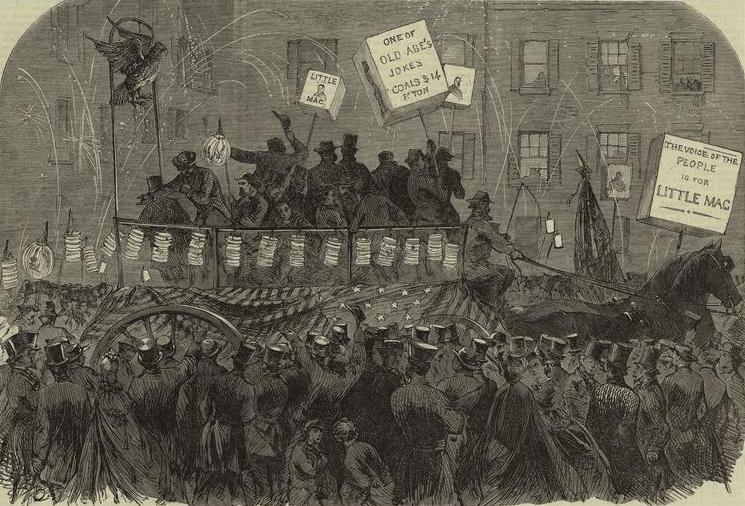
A nighttime ‘torchlight’ rally for presidential candidate George McClellan, the clear choice for New Yorkers in 1864. For a Democratic stronghold like New York, the former general was an especially appealing alternative to Abraham Lincoln. [NYPL]

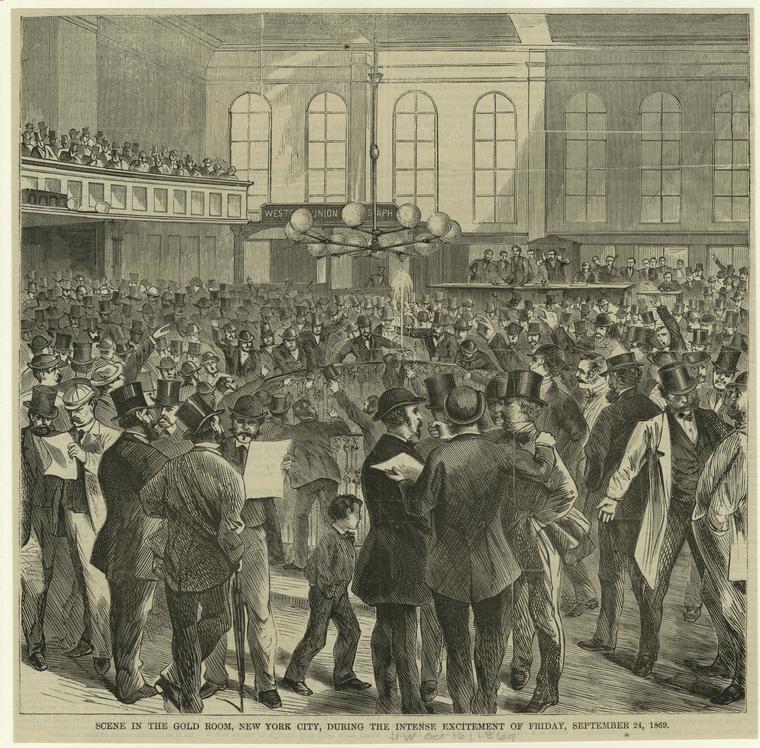
A scene from the New York Gold Room, epicenter of American gold speculation. During the Civil War, traders would buy and sell based upon Union victories and defeats. The trade was also susceptible to false information, such as the events of the Gold Hoax of 1864. (NYPL)

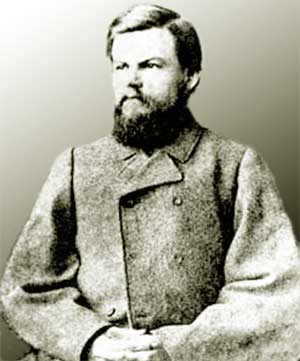
Robert Cobb Kennedy, the only one of the Confederate conspirators to be caught. He was executed at Fort Lafayette in 1865, a couple weeks before the end of the Civil War.

Burton’s faux nude follies: NYC’s first ‘legit’ flesh shows

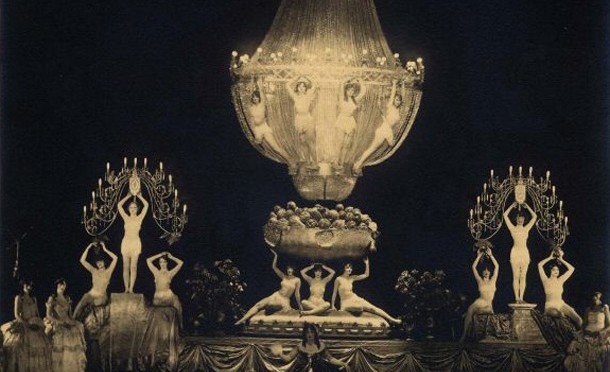
An exotic tableau from the Ziegfeld Follies. The presentations by Burton in the mid-19th century would have been less ornate, but certainly more tantalizing. (photo source)

FRIDAY NIGHT FEVER To get you in the mood for the weekend, on occasional Fridays we’ll be featuring an old New York nightlife haunt, from the dance halls of 19th Century Bowery, to the massive warehouse clubs of the mid-1990s. Past entries can be found here.

LOCATION: Palmo’s Opera House/Burton’s Chamber Street Theater
39-41 Chambers Street, Manhattan
In operation 1844-1870s

The sexual appetites of New Yorkers in the pre-Victorian era would sometimes manifest themselves in peculiar ways. Let me take you back to the 1840s, when raunch and salacious behavior infiltrated the Bowery theater scene, and even respectable downtown playhouses like the Park Theater cordoned off the third tier for encounters with prostitutes. A statesman of the time, Francis Grund, complained: “[F]ew ladies….are ever seen at the theater; and the frequenting of them, even by gentlemen, is not considered a recommendation to their character.”

Public sexual practice become distorted under conflicting cultural movements that smashed together like tectonic plates. On the one hand, New York’s growing international prominence combined with new American religious fervor to create a chaste facade of propriety, a population that seemingly had no sexual life. On the other, growing immigration filled the streets with single men and women, restless and crammed together. The ‘sporting man’ culture — erudite, rich men of well-tweezed masculinity — created New York bachelorhood; a couple social classes below, the Bowery b’hoy, did the same, and had more fun doing it.

It’s under these conditions that a strange new craze erupted — the artist-model tableau, New York’s first unofficial flesh show. I call it the Era of the Nude Body Stocking.

Before the days of burlesque and striptease, New Yorkers could enjoy all the nude flesh they desired. It just pretended to be art. And often, it pretended to be nude.

In the early 1830s, legitimate stages began presenting tableaux of the human form, ‘living statues’ as they were called, stationary figures in nude or white body stockings, in classical poses. Assumably there would be some musical accompaniment or a reading of poetry, with tasteful lighting illuminating the heavenly contours of the human form. Very tasteful, right?
Down-market stages ran with the idea, eventually contorting it for a more tittilated crowd. Early instances of the ‘artist model’ presentations had men dressed as women. Quickly, women joined them on stage. And then, sometimes, the body stockings came off entirely.


One of the most famous stages for this skimpy sort of tableau vivant began with less prurient intentions. Palmo’s Opera House (pictured above, 39-41 Chambers Street), opened in 1844 by an Italian immigrant Ferdinand Palmo. Italian opera had debuted in New York in 1825 at the Park Theatre, and instantly meshed with the upper class notions of acting more European. But working class New Yorkers didn’t quite warm to it; according to Mark Caldwell, “[o]pera was the ambrosia to a self-professed elite but chloroform to the masses.”

Palmo, owner of the Cafe des Mille Collones right around the corner, threw his money into the new opera house in an effort to bridge the gap. His first production was Bellini’s ‘I Puritani’, launched in February 3, 1844. The masses stayed away, in droves. Palmo kept the opera house open for two years, fending off mounting debts. At one point, performers went on strike — in the middle of a performance — because they had not yet been paid.

The restaurateur lost all his money in the endeavor and promptly lost his opera house as well. The stage then passed through various hands, some taking a crack at legit amusements, with ballet and even Greek tragedy.

A showman William Burton (at right) took over the lease in 1848 and threw out those high-falutin acts. Burton was concerned with mainstream entertainment, not art per se. And it was during Burton’s variety programs — which notably featured the best minstrel acts in Manhattan — that this unusual, shall we say, indiscreet tableaux made its debut, a presentation of lilywhite, illuminated flesh decorating an evening of song and dance.

In most cases, it was presented as a straight-up art lesson, with such mythology themed dioramas as ‘Psyche Going To The Bath’ and ‘Venus Rising From the Sea’. But, as I said, Burton didn’t care to sell art. He sold a view to nude bodies — or bodies that at least appeared nude — and soldout crowds raced to have a look.

But what if you wanted to see all this solitary nudity but the damned horse carriage had made you late? No worries, for at the newly named Burton’s Chamber Street Theater, you were provided with a New York first — numbered reserved seats.

Burton’s stage wasn’t the only place displaying ‘artist models’; it soon became so common on New York stages that it soon became incorporated into productions, such as the extravagant ‘The Black Crook’ at Niblo’s Garden in 1866, considered the first Broadway musical.

Obviously, the degree to which onstage nudity appeared scandalized proper New Yorkers. In fact, in 1848, police raided several establishments, including Barton’s. According to a contemporary account by Foster Rhea Dulles, a “beautifully formed creature, just drawing on her tights for the Greek Slave, and some of the others, were so dreadfully alarmed at the sight of the police with their clubs in hand that they seized up a portion of their garments in order to hide their faces, forgetting their lower extremities, thus making a scene mixed up with the sublime and the ridiculous.”

While prudish tastes frowned upon such displays, they never quite went away. Even as late as the 1920s, Florenz Ziegfeld frequently paid homage to the craze during his famous Follies.

As for the old opera house, it would continue featuring minstrel shows and comedy pieces well into the 1860s. For a short time it even served as federal courthouse before its demolition in 1876.

And here’s the final kicker — Palmo’s Opera House and its later incarnation as Burton’s Chamber Street Theatre was sat on top of — you guessed it — the African Burial Ground!

Categories
Podcasts

Niblo’s Garden: New York’s entertainment complex and home to the first (bizarre) Broadway musical

Show-stopping: The interior of Niblo’s Garden Theatre. Illustration by Thomas Addis Emmet, courtesy NYPL

PODCAST It’s the 1820s and welcome to the era of the pleasure garden, an outdoor entertainment complex delighting wealthy New Yorkers in the years before public parks. Wandering gravel paths wind past candle-lit sculptures, songbirds in gilded cages, and string quartets in gazebos, while high above, nightly fireworks spray the sky.

Niblo’s Garden, at the corner of Broadway and Prince Street, was the greatest of them all, with an exhibit room for panoramas and refreshment hall consider by some to be one of New York’s very first restuarants. But it was Niblo’s grand theater, seating 3,000 people, that would make Niblo’s reputation as the venue for both high- and low-brow events. And in 1866, a production debuted there that would change everything — the gaudy, much-too-long spectacle The Black Crook, considered by most as the very first Broadway musical.

Music in the episode is Enigma Variation VI. Ysobel by Elgar. It’s actually from after the time period of Niblo’s, but it’s so very strolling-the-garden, isn’t it? And I had a cold this week, so please forgive my scratchy voice!

Before Niblo’s, the premier pleasure garden was Vauxhall Garden, derived from a British garden of the same name. The one picture below is from the incarnation before it moved in 1807 to the area just below Astor Place, in what would become Lafayette Street. (NYPL)

The first theater on the Niblo property was a small stage he called ‘Sans Souci’. Demand soon dictated that a larger venue be built. [NYPL]

From another illustration detailing the block just a few years later. The theater looks the same, but other buildings (possibly the saloon or a greenhouse?) have been built up around it. (from Merrycoz)

The garden was soon overtaken by a great hotel, the Metropolitan, which opened in 1852. This image is looking east, down Prince Street, with Broadway stretching to the left. NOTE: The original caption on this illustration says 1850, but the hotel would not be open for a couple years later. (NYPL)

This is one of the only photographs of Niblo’s Theater, certainly from its last years, judging from the fashion of the day. The theater and the hotel were demolished in 1895. [Pic from here]

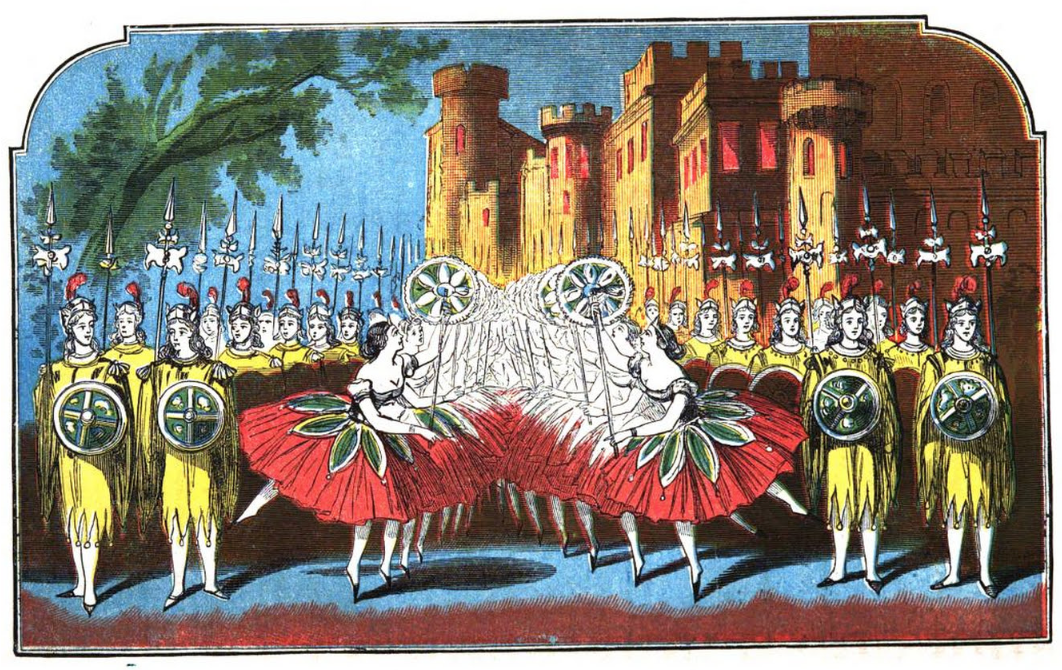
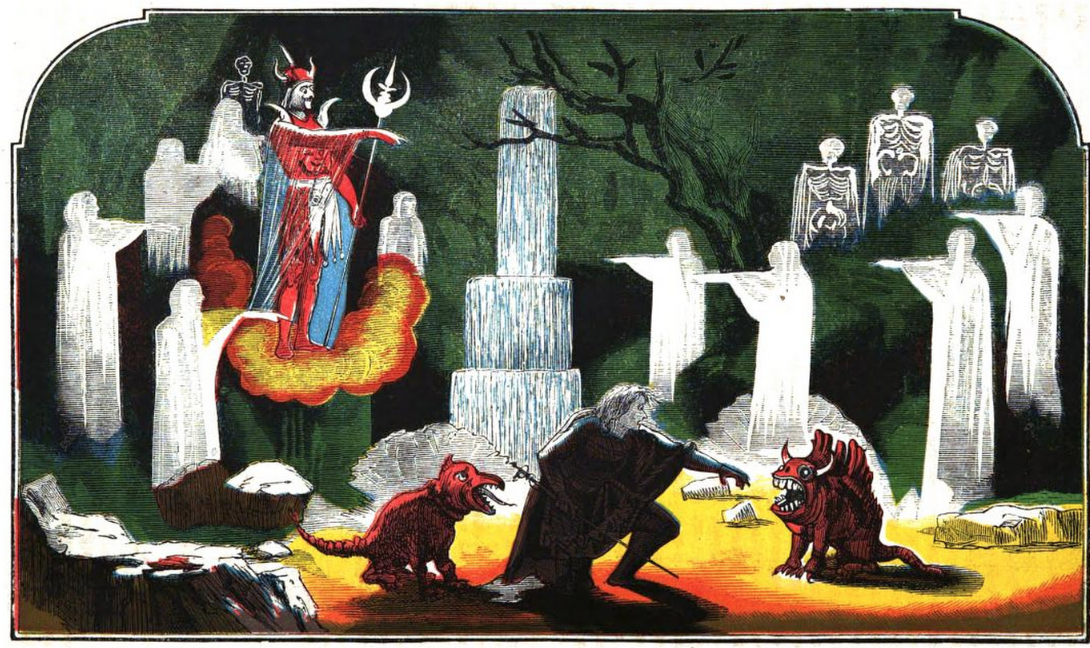
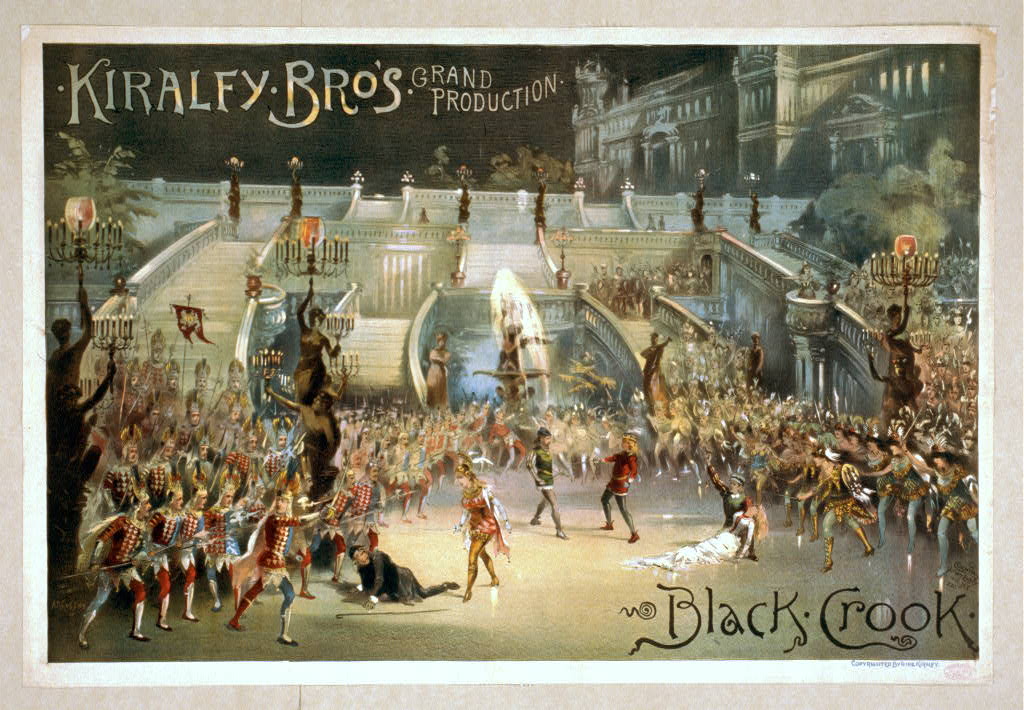
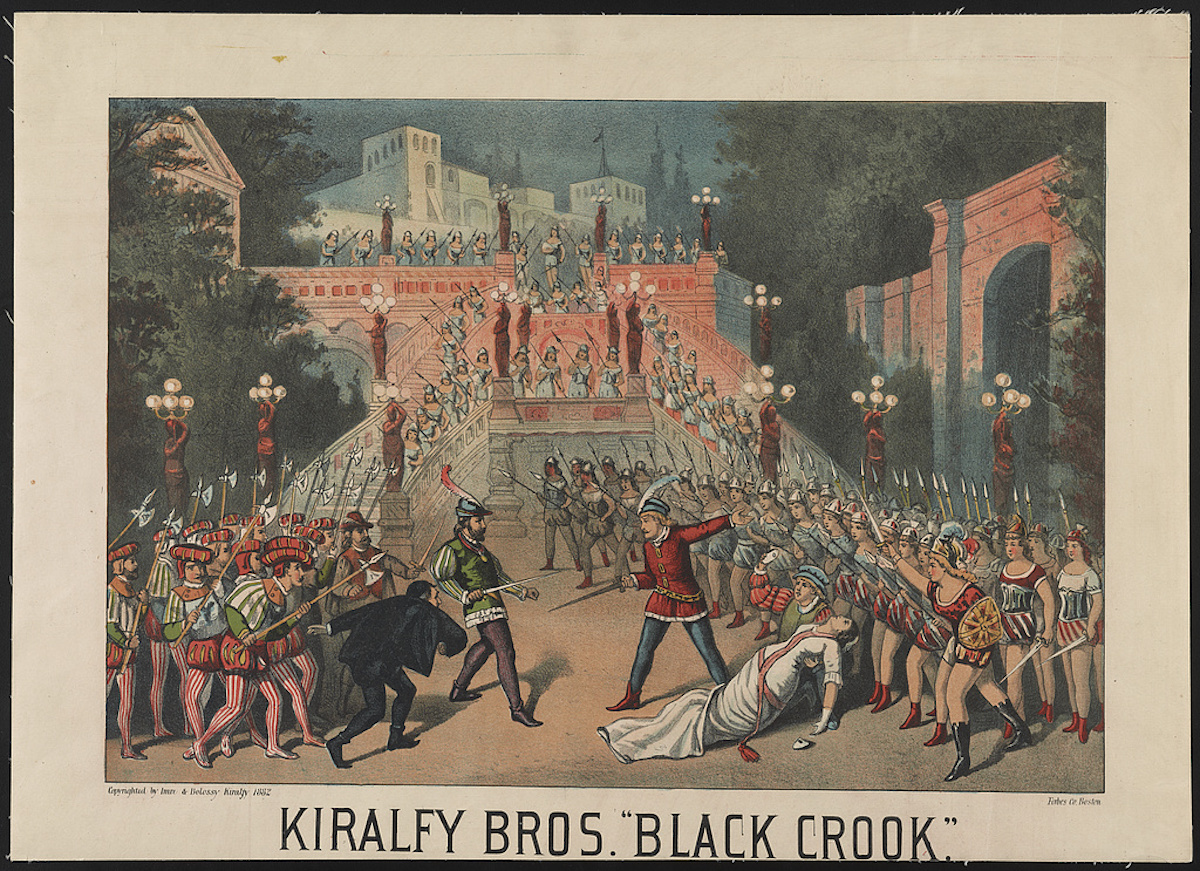
This poster is from a Boston production of ‘The Black Crook’, but it illustrates nicely the scope and theatricality of the production. The show was cobbled together using a poorly written German fantasia, a troupe of out-of-work Parisian dancers, and some original music. The show ran five and a half hours nightly and was a runaway hit. [Image from Kirafly Bros]
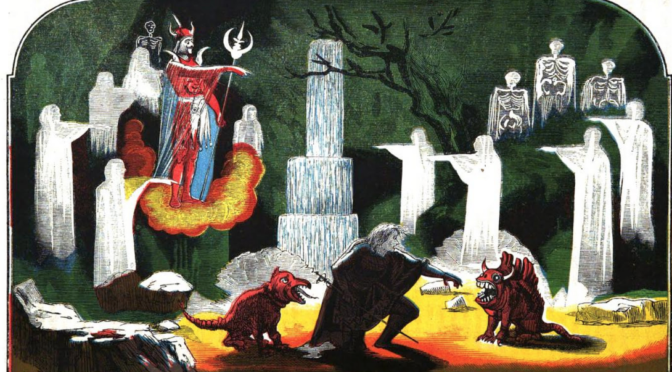
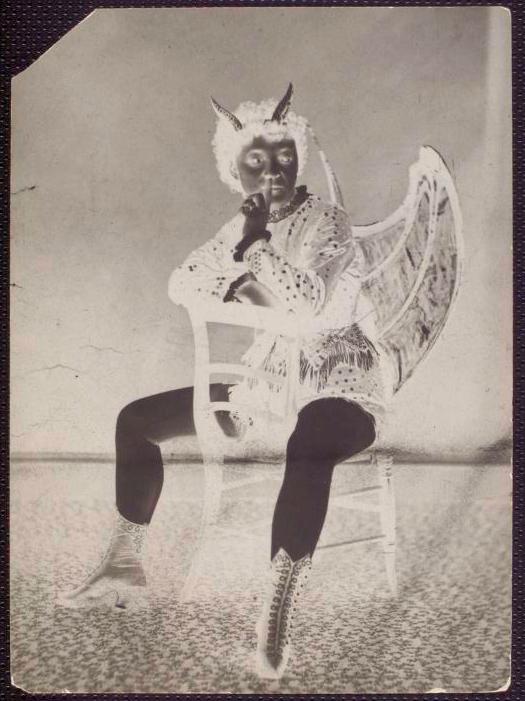
A costumed damsel (in photographic negative) from an early production of The Black Crook. [source]

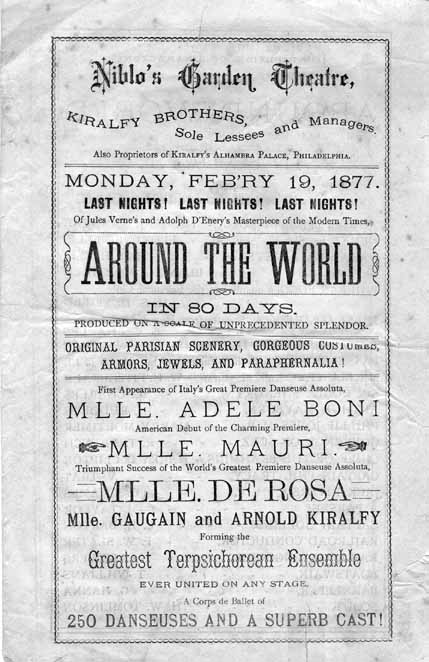
An early program from Niblo’s, from 1877, featuring stage rendition of Jules Verne’s Around The World In 80 Days. I can only imagine the sets for this one! Also featuring the ‘Greatest Terpsichordean Ensemble’ and ‘250 Danseuses and a Superb Cast’.[Courtesy Jules Verne]

Categories
It's Showtime

Broadway’s first musical: The Black Crook

The Broadway theater season begins again with another new batch of musicals hitting the boards — from an unusual adaptation of War And Peace to a stage version of a Robert DeNiro drama.  Some believe that this musical tradition begins all the way back in September 12, 1866, back when musicals based on movies and popular Founding Fathers weren’t much of a consideration.
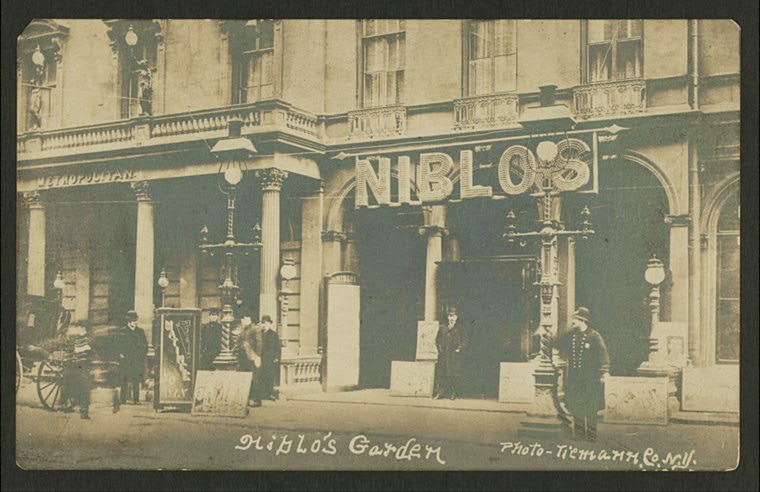
At a time when the largest theaters in Manhattan were all below 14th Street, the 3,200-seat Niblo’s Garden on Prince and Broadway was one of the largest and most popular. In fact, it wasn’t merely a theater but an entertainment park of mid-19th century fancies. William Niblo, an upper class PT Barnum of sorts, opened his version of a showy Las Vegas hotel in 1828, with elaborate gardens, gaslight illumination shows, vivid dioramas, traveling circuses, fireworks displays, and plenty of open saloons to keep his patrons happy. A theater was included in this complex, for many years one of the most popular amusements in the city.
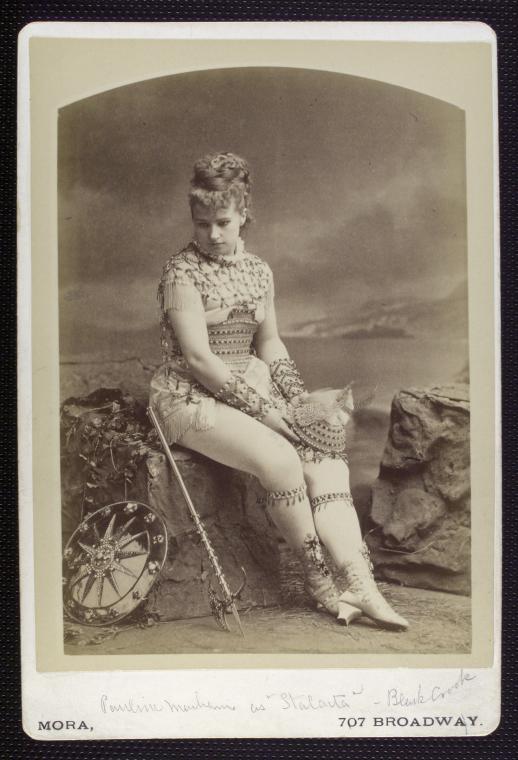
In 1866, a variation on the usual theatrical spectacle debuted at Niblo’s that soon proved to be his most popular offering. Plays had featured popular songs in the past, and variants of operas (or rather, sung plays or ‘ballad-operas’) were popular. But in September, The Black Crook debuted, with odd traits at the time that have now come to typify the modern musical.

It’s considered the first American musical by many scholars for three reasons: 1) it included newly written songs with previously adapted music; 2) it included a flashy chorus of leggy dancers; 3) its success spawned a slew of ‘extravaganzas’ that evolve right into today’s modern musical productions. By most accounts, it was also, from our perspective, really, really awful.

Evokative of German melodrama, Crook was really just a terrible play by Charles M. Barras that Niblo manager William Wheatley had refitted with a troupe of recently unemployed French dancers from another show that had the fortune (in William’s eyes) of being booked in a theater that had just burned down.

The plot was all fainting spells and sulfur smoke. Young Rodolphe is enslaved by a sorceror Hertzog, who must grant the Devil the soul of one innocent every New Years Eve. Rodolphe saves a white dove from peril which just happens to be a good witch in disguise — Stalacta, Fairy Queen of the Golden Realm — who rescues him and sends all the bad guys straight to Hell. Damn it, why hasnt this thing been revived? I smell Tonys! [2016 Ed: Guess what? It is being revived!]

Well, for one, if you can believe it, the musical ran five and a half hours long each night. Despite this, it was a huge success, running 263 performances and, in a proud American tradition, spawning a sequel, The White Fawn.

The key to its success wasn’t the drama, but all those sexy girls in flesh colored garments and a bevy of dazzling light and shadow effects that were lavish and magical. From a review from the New York Tribune: “One by one curtains of mist ascend and drift away. Silver couches, on which fairies loll in negligent grace, ascend and descend amid a silver rain.” Although I’m sure they’re nothing compared to the scandalous vamps of Chicago, they must have been spectacular at the time.

And, in keeping with perspective of our current strike, according to Mark Caldwell’s New York Night, the show employed 80 carpenters and “twenty gasmen” just to run the elaborate mechanics.