Categories
Bowery Boys Bookshelf Wartime New York

‘Shooting Lincoln’: The Complicated Story Behind America’s First Wartime Photographs

Alexander Gardner is a bit of a Nikola Tesla-like figure in American history in that his contributions were largely overlooked in his day, concealed within a partnership with a famous business titan.

That titan was Mathew Brady, the most famous photographer of the 19th century, with studios in New York and Washington D.C. that captured the nation’s most prominent figures in daguerrotype galleries and propelled the popularity of photographic images as the successor to painting and illustration.

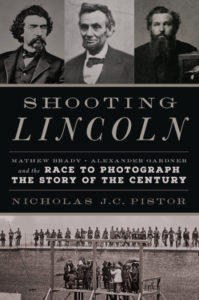
SHOOTING LINCOLN
Mathew Brady, Alexander Gardner and the Race to Photograph the Story of the Century
by Nicholas J.C. Pistor
Da Capo Press

In Shooting Lincoln, the interesting if unusually titled new book by Nicholas J.C. Pistor, we see their partnership, developed in the tasteful parlors of respectable 1850s New York portrait galleries, wither and eventually dissolve during the American Civil War. And yet the pair, along with a legion of other intrepid young photographers, brought the realities of war into the rings of sheltered American society.

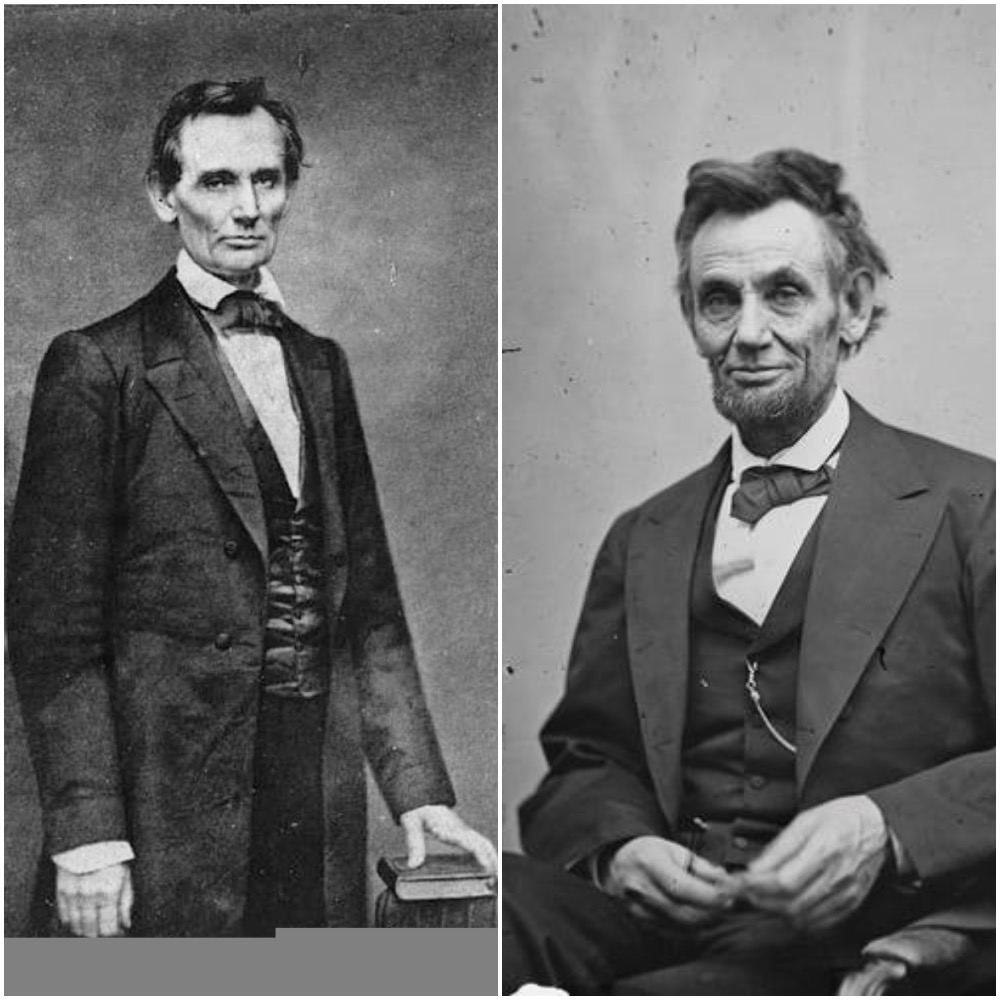
Abraham Lincoln first visited a Brady studio during the winter of 1860, posing for the famous portraitist hours before the seminal Cooper Union speech that would catapult him to his party’s nomination for the presidency. And yet the most famous images of Lincoln (including the Gettysburg portrait) were actually taken by Gardner years later, working first from Brady’s studio in Washington D.C., then from his own.

While Lincoln was not the first president to pose for portraits, he was the first to have his image defined by them — his face resolute, weary, wise. These images would be reproduced for sale and redrawn for newspapers, making the Lincoln the most recognizable human being on the planet.

Both Brady and Gardner took to the carnage-strewn backroads of America to photograph the scenes of war. Their images — a great many posed, a few even doctored — essentially created photojournalism as a defining method for distributing information.

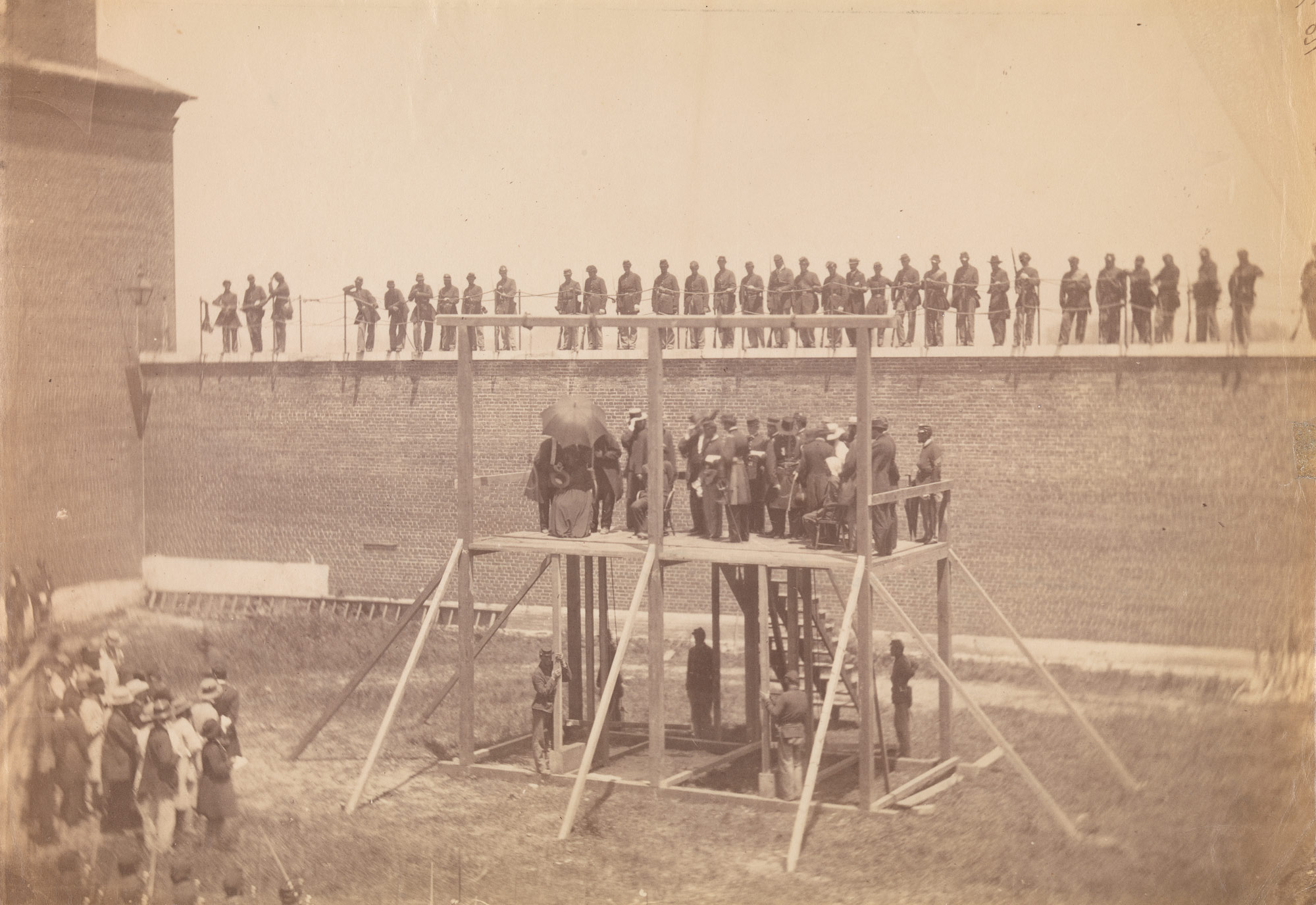
But it’s Gardner who was uniquely situated to photograph the tragic final strains of the war — the aftermath of Lincoln’s assassination and the execution of the conspirators (pictured at the top of this post).  Pistor reveals the many controversies in capturing these important images. These men were capturing history as none had done before.

Below: Lincoln by Brady and by Gardner

Categories
American History

New York’s Poignant Memorial to Lincoln’s Death Is In A Very Odd Place

Abraham Lincoln died 150 years ago today in a Washington DC rowhouse, shot and killed by the actor John Wilkes Booth while the president was attending a performance of Our American Cousin at Ford’s Theater the previous evening.

The news hit the North as some sort of horrible dream.  Confederate general Robert E Lee had just surrendered to Ulysses S. Grant at Appomattox Courthouse less than a week. The war was over in the minds of many. How could this have happened?

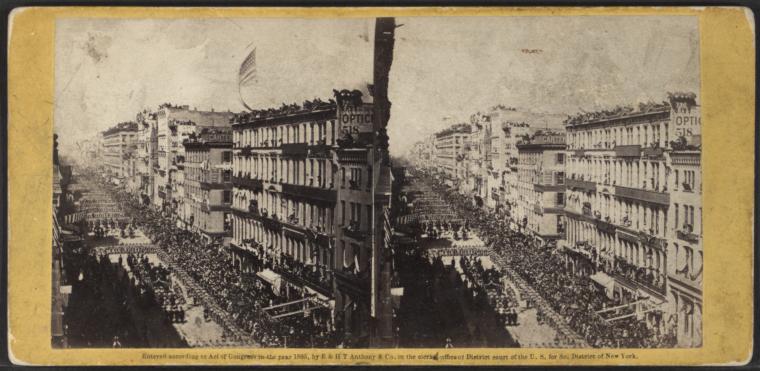
On April 21, Lincoln’s body began a mournful tour of the United States, taken from cities across the country via a funeral train.  Three days later, on April 24, the train with Lincoln’s body pulled into 30th Street Station, the depot which served the Hudson River Railroad back when the train brought passengers down the western side of Manhattan. (We give the details of this vanished station in our podcast on the High Line.)

Funeral of President Lincoln in New-York, April 25th, 1865. (Courtesy of New York Public LIbrary)

From the New York Sun: “This morning the citizens of New  York are called upon to pay funeral honors to the remains of one whose tragic death, invests the ceremonies with an interest never before felt for any individual, who has occupied the highest office which the suffrages of a free people can confer upon a citizen of the Republic.”

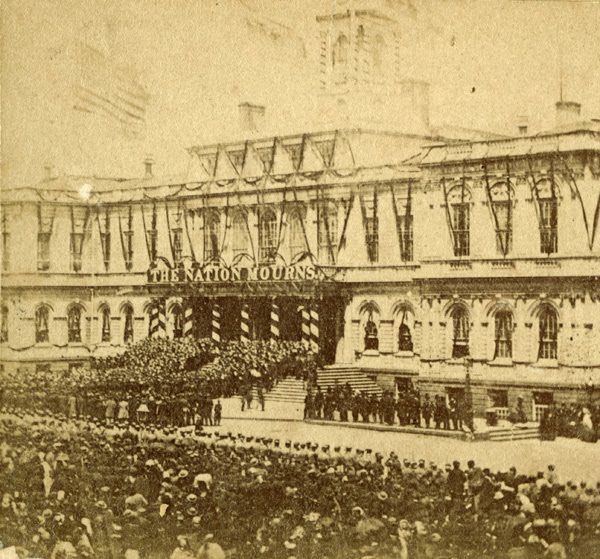
His body was taken to New York City Hall where he lay in visitation for almost an complete twenty four hours. Thousands of New Yorkers came to pay their respects.  In the afternoon of the April 25, his body was brought back to the 30th Street Station and transported to Albany, then to other cities, before its final destination in Springfield, Illinois.

lincolns-funeral-at-city-hall

The Hudson River Railroad station is long gone. Standing in its place however is another large structure:  the United States Postal Service mail processing facility at 341 9th Avenue.  Unless you’re a fan of postal history — or you’ve stumbled around the neighborhood after stepping of the High Line — you’ve probably never given this building much notice.

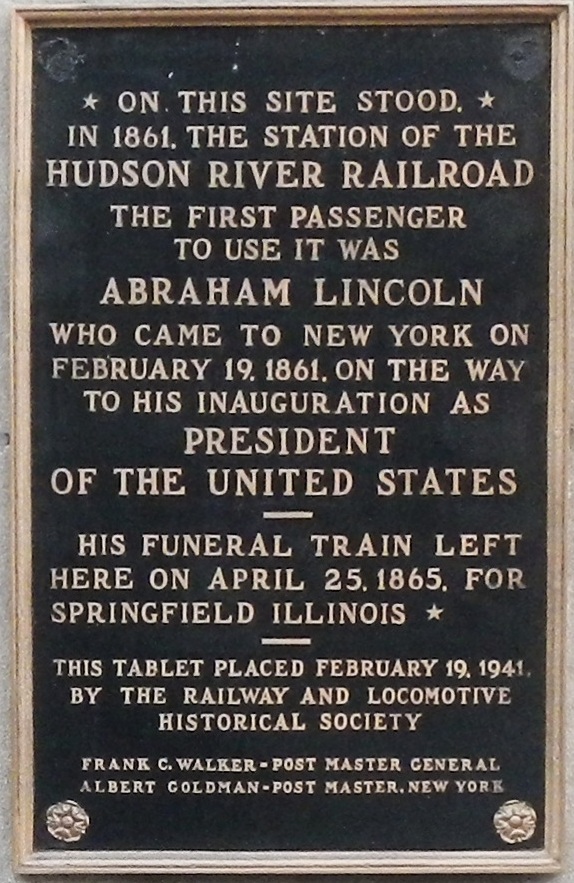
But visit the northern side of this building, and you’ll find the following plaque:

???????????????????????????????

“On this site stood in 1861 the station of the Hudson River Railroad. The first passenger to use it was Abraham Lincoln, who came to New York on February 19, 1861 on his way to his inauguration as President of the United States.  His funeral train left here on April 25, 1865 for Springfield, Illinois.  This tablet placed February 19, 1941 by the Railway & Locomotive Historical Society.”

That’s right — Lincoln was the first honorary passenger to arrive at Cornelius Vanderbilt’s new ‘uptown’ depot! Again the New York Sun, but on February 20, 1861:

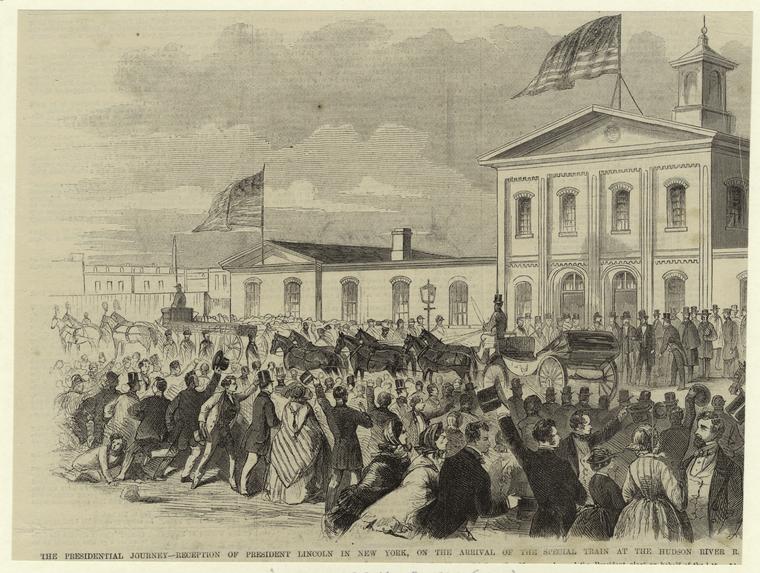
“In that strange and dirty locality where the Hudson River R.R. Company have fixed upon their uptown depot, thousands of people began to congregate fully two hours before the hour when the expected train was due…..The great gate of the depot yard through which the train was to enter was guarded by a cordon of police, and outside these limits surged the crowds, unusually patient for a New York crowd awaiting a sensation probably from a general faith that Old Abe could be depended upon to come to time properly.”


Presidential journey : reception of President Lincoln in New York, on the arrival of the special train at the Hudson River Railroad. (Courtesy New York Public Library)


Here’s a description of the exact same spot, over four years later (courtesy the New York Times):

Outside of the gate of the depot yard, on Tenth-avenue, the immense throng stationed there received in respectful and mournful silence the very brief and unsatisfactory glimpse they gained of the coffin of the dead President. Viewing with anxious eyes the train as it emerged from the gate, and gazing upon the gorgeously decorated car, and uncovering with sincere respect for the hallowed dead, the immense multitude beheld the departure of the train. 

 As the train fairly got into motion and disappeared round the curve, the immense mass of beings, so long kept within bounds, at last burst through all restraint, and the entire vicinity of the depot became the scene of the most extraordinary confusion. The police were totally inadequate to the impossible task of keeping the people in order, for they were carried like drift-wood before the flood as the impatient crowd broke up and started upon their several homeward ways.”

This plaque was placed on the side of the postal facility (called the Morgan Annex) on the afternoon of February 19, 1941, unveiled by the U.S. postmaster Albert Goldman.  The organization who sponsored it, the Railway & Locomotive Historical Society, still operates today.


An historic New Years Day editorial from 150 years ago, as the Emancipation Proclamation takes effect


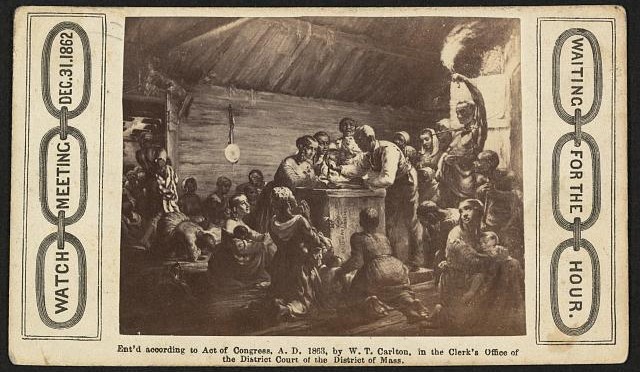
In black churches throughout America 150 years ago, gatherers celebrated ‘Watch Night’ on December 21, 1862, counting down to the moment when Abraham Lincoln’s Emancipation Proclamation would take effect. The carte-de-visite above celebrates a watch night that took place in Boston. [LOC]

The following text is taken from the New York Tribune on January 1, 1863. (You can read the entire issue here.) With the North in the terrible throes of war, most of the issue is filled with battle reports.  New York City celebrations of the new year were most likely muted, with possible exception of a few saloons celebrating some odd-timed primary elections for various Tammany Hall job functions.

But for a great many, midnight brought in more than just a new year.  That day was significant for another reason.  President Abraham Lincoln’s executive order, the Emancipation Proclamation, freeing the slaves in Confederate territories, took effect on January 1.

I’m reprinting the Daily Tribune’s notice in full, both the significant and trivial portions, to give you a full sense of how the news was received, in this case, by the pro-Lincoln paper owned by Horace Greeley (over three decades before Mr. Greeley was immortalized in statuary in Herald Square). It’s a celebration of a true historical event and the pursuit of freedom, with a snide insult lobbed at ‘the low-born and vulgar [who] fear the competition of the negroes’.

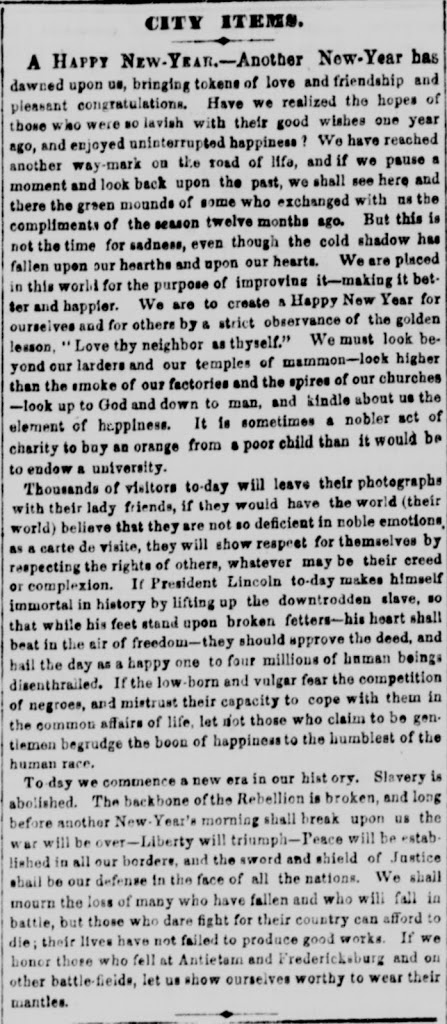
Here’s the original article, with excerpts from the text below it.

A Happy New Year Another New Year has dawned upon us, bringing tokens of love and friendship and pleasant congratulations. Have we realized the hopes of those who were so lavish with their good wishes one year ago, and enjoyed uninterrupted happiness? 

We have reached another way-mark on the road of life, and if we pause a moment and look back upon the past, we shall see here and there the green mounds of some who exchanged with us the compliments of the season twelve months ago. But this is not the time for sadness, even though the cold shadow has fallen upon our healths and upon our hearts.

….

Thousands of visitors today will leave their photographs with their lady friends, if they would have the world (their world) believe that they are not so deficient in noble emotions as a carte de visite*, they will show respect for themselves by respecting the rights of others whatever may be their creed or complexion. 

If President Lincoln today makes himself immortal in history by lifting up the downtrodden slave, so that while his feet stand upon broken fetters — his heart shall beat in the air of freedom — they should approve the deed, and hail the day as a happy one to four millions of human beings disenthralled**.  If the low-born and vulgar fear the competition of negroes and mistrust their capacity to cope with them in the common affairs of life, let not those who claim to be gentlemen begrudge the boon of happiness to the humblest of the human race.***

Today we commence a new era in our history. Slavery is abolished. The backbone of the Rebellion is broken, and long before another New Year’s morning shall break up us the war will be over — Liberty will triumph — Peace will be established in all our borders, and the sword and shield of Justice shall be our defense in the face of all the nations.**** 

We shall mourn the loss of many who have fallen and who will fall in battle, but those who dare fight for their country can afford to die; their lives have not failed to produce good works.   If we honor those who fell at Antietam and Fredericksburg and on other battlefields, let us show ourselves worthy to wear their mantles.

*Small likenesses  — essentially trading cards of yourself — called carte de visite were especially trendy during the Civil War, both as a novelty and as a way of remembering those at war.

**The Proclamation could only be enforced in rebel territory under Northern control, so not all of the four million enslaved men felt its benefits on this date.

***Referencing fears of new immigrants that freed blacks would become a competitive labor force. These fears would, of course, culminate later that summer in the Civil War Draft Riots.

****Of course, we know now that the war would drag on for over two more years.


Categories
Gangs of New York

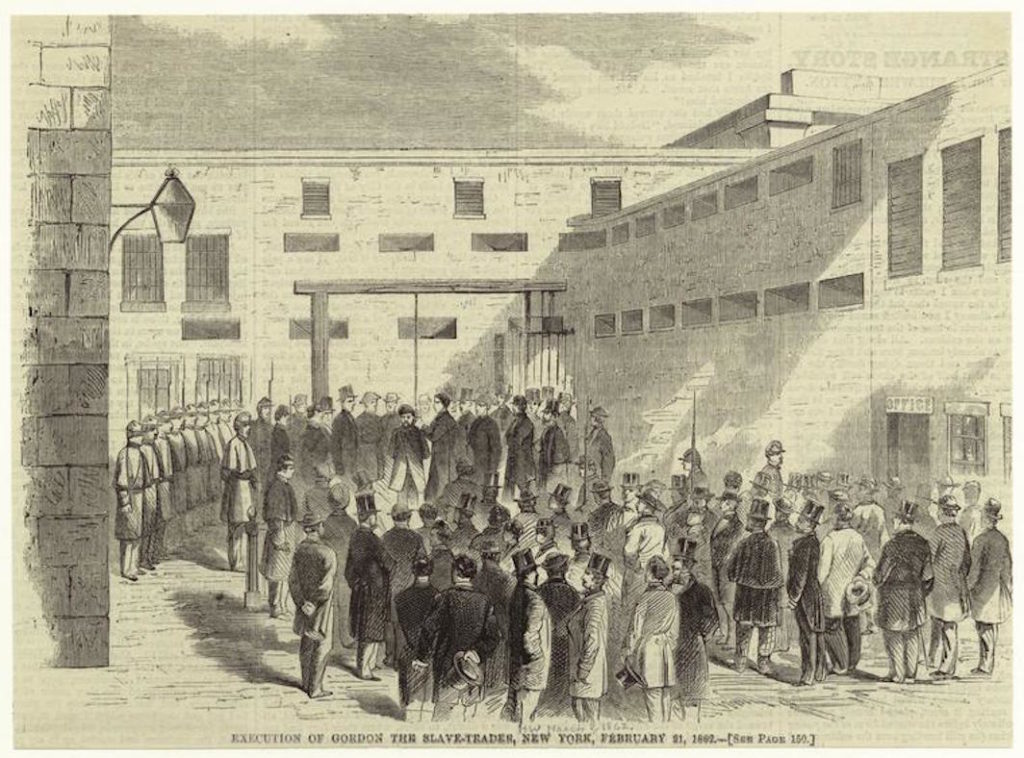
Execution in Five Points: Piracy, slave trade and the Tombs

Sometimes you can look back at history and think that nothing ever changes. And sometimes you find something that makes New York seem extraordinary unrecognizable, a city besieged by near barbaric crises.

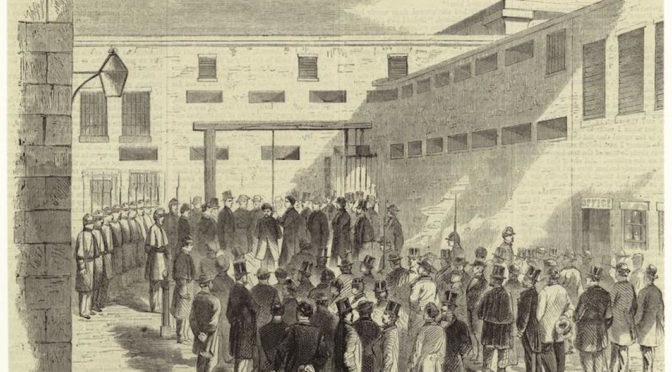
The image above depicts a scene from February 21, 1862, in the courtyard of the famous Tombs prison in the Five Points neighborhood.

The notoriously dank and foul-smelling complex was the scene of a great many public executions since its opening in 1838, but the one which took place on February 21 was particularly urgent, the crime cutting to the core of America’s central dilemma.

The man being hanged was Nathaniel Gordon, and his crime was international slave trade.

America was in the throes of a Civil War between the North and South, waged with slavery as its central issue. But the import and export of slaves into the United States has technically been banned decades earlier, and the U.S. Piracy Act of 1820 included human cargo in its definition of international piracy.

This did not deter Gordon, who sailed to North Africa in 1860 and loaded a boat with almost 900 people, intending to sell them to Southern plantations.

From a vivid description from Harper’s Weekly, the boat was overloaded with “eight hundred and ninety-seven (897) negroes, men, women, and children, ranging from the age of six months to forty years. They were half children, one-fourth men, and one-fourth women, and so crowded when on the main deck that one could scarcely put his foot down without stepping on them. The stench from the hold was fearful, and the filth and dirt upon their persons indescribably offensive.”

Gordon was caught just 50 miles offshore and brought to the United States for trial. He would have received a stern sentence even before the war, but with the conflict in full swing by the time of his trial in late 1861, Gordon’s defense team never stood a chance.

Despite pleas from wealthy supporters, Gordon was sentenced to die on February 7, 1862. President Abraham Lincoln commuted the sentence by two weeks, and Gordon’s supporters might have even convinced him to commute it further had Lincoln’s young son Willie not died of typhoid on February 20.


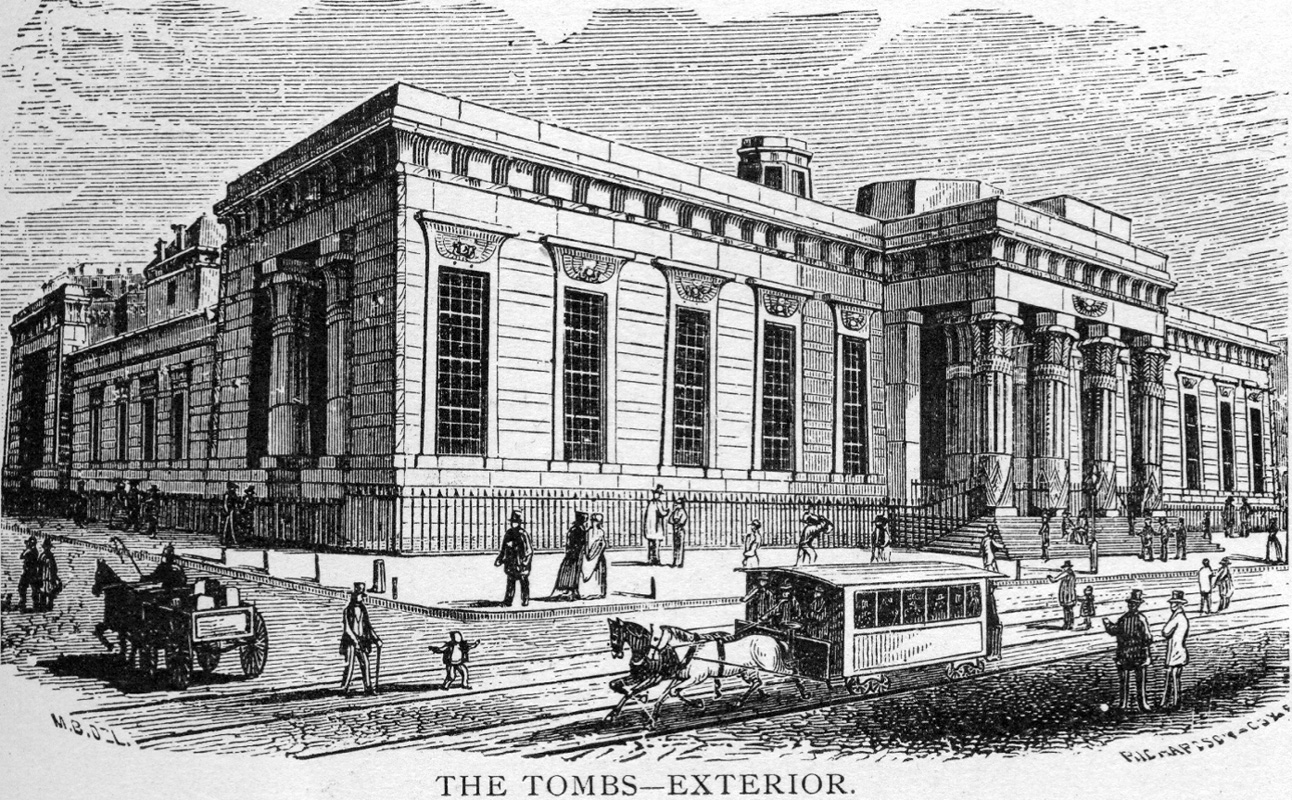
One notable fact about this execution is the Tombs (pictured above, in 1863) is a city prison, but the crime was a federal offense, the only such national execution to have taken place here.

Most federal executions took place at military installations. For instance ‘Pirate’ Albert Hicks was hanged on Bedloe’s Island, home of Fort Wood (and today the residence of the Statue of Liberty). Robert Cobb Kennedy, one of the Confederate conspirators who attempted to torch various New York hotels in November 1864, was executed at Fort Lafayette off the coast of Bay Ridge, Brooklyn.

Gordon was also the last person ever executed by the U.S. government for violations of the Piracy Act.

For more details on the execution, check out the great Corrections History blog which details the messy particulars of the execution.

Illustration above courtesy New York Public Library

William Seward: a park in his honor, while sitting in another

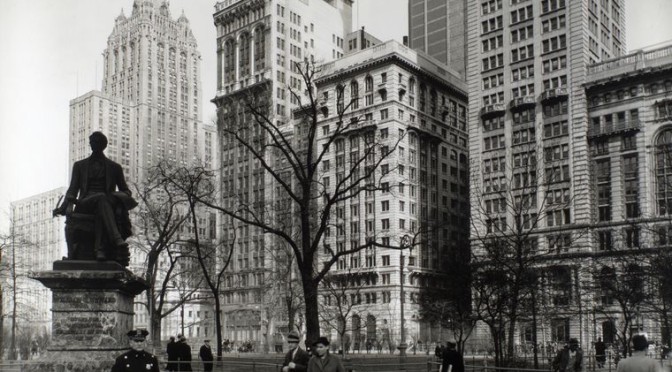
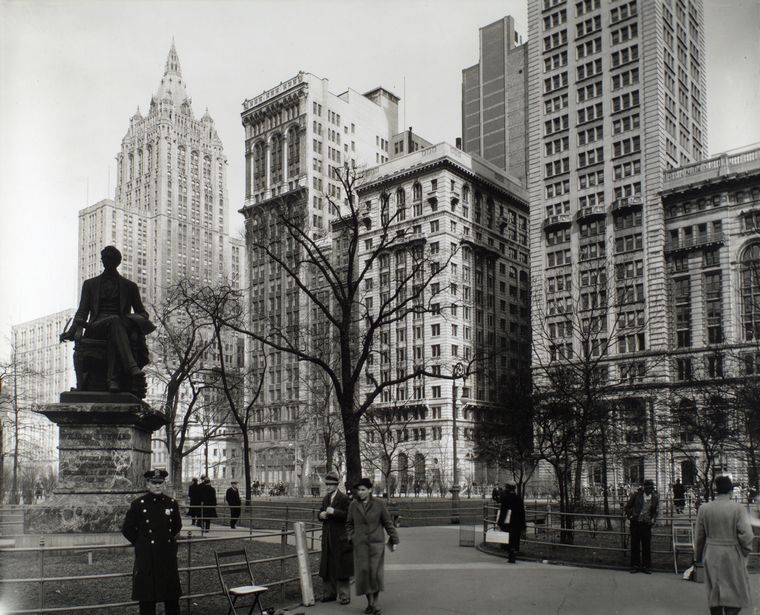
Mr. Seward, with the best seat in the park in 1934. He does seem awfully thin though, almost like a certain president. (At least, some people thought so.)

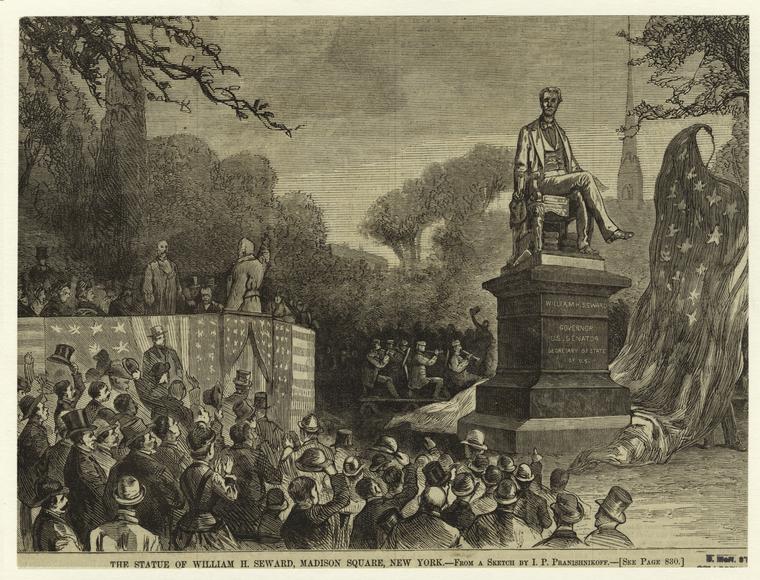
This month marks the 135th anniversary of an extraordinary gift endowed to Madison Square Park — the statue of William Seward. the former New York governor and Secretary of State under Abraham Lincoln. Indeed, he’s easily one of the most influential New York politicians ever upon the national stage. A master of backroom politics and a proponent of American expansion (best known for negotiationg the purchase of Alaska from the Russians in 1867), Seward died a revered figure, and monuments to his legacy sprouted up throughout the nation, from shore to shore.

In New York City, there are two key landmarks named after him, and they could not be more different.

The aforementioned bronze statue at the southwest corner of Madison Square Park was presented with the maximum of pomp and circumstance in September of 1876. The work, by Randolph Rogers, depicts Seward in a seated, almost languid pose, with unusual proportions. As has been frequently speculated, Rogers might have adapted an earlier seated statue of his, depicting Abraham Lincoln, and simply slapped Seward’s head onto it. This is unproven, of course, but since Lincoln was Seward’s old boss, it makes for amusing symmetry.

But the gathering admirers on the afternoon of its unveiling scarcely seemed to notice. Present at its debut was future U.S. president Chester A. Arthur, who would be graced with his own statue in Madison Square Park 23 years later.

Further downtown, in the Lower East Side, at the convergence of Essex Street, Canal Street and East Broadway, lies Seward Park, also named for the venerated politician. In 1897, in a neighborhood desperate for breathing room, the city condemned a cluster of tenements lining the east side of Essex Street. The fenced-in park was pretty much developed by private groups until the city intervened in 1903, equipping the grounds with a sporting pavilion and leveling areas for a playground.

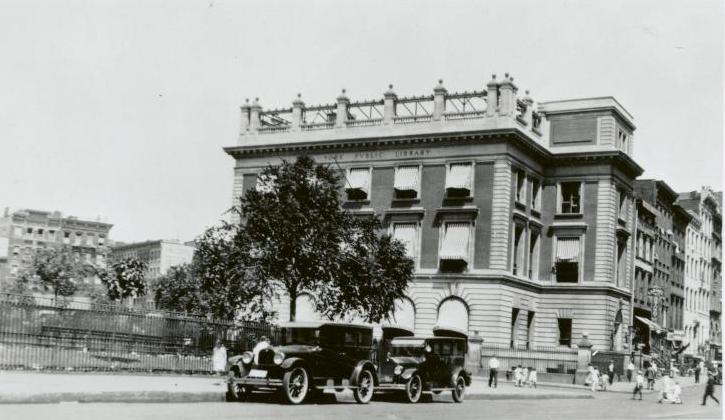
But the real jewel of this park came in 1909 when the Carnegie Foundation placed one of its most stunning libraries here. By the way, Jefferson Street used to separate the library from the park (as evidenced in the picture above). Today, the road has been closed off and the space has been become part of the park itself.

So the development of this park came well after Seward (or the head of Seward, on Lincoln) was placed uptown. And really, they weren’t going to place so a lavish memorial in the midst of so many tenements, were they?

However, Seward himself might have considered Seward Park the far greater honor. During his years as governor (1839-42) and many years following as a New York senator, he supported many pro-immigration policies that were considered extraordinarily progressive for the day. Naming the park after him was a tip-of-the-hat to these early risky political stances.

Pictures courtesy NYPL. (link to top photo here)

Categories
Podcasts

Hoaxes and Conspiracies of 1864: The Confederate Plot to Torch New York

Barnum’s American Museum at left (the building with the flag) and the Astor House at right, from the vantage of City Hall Park, circa 1850. Both buildings were victims of the Confederate plot of 1864 to burn the city.

PODCAST We’re officially subtitling this ‘Strange Tales of 1864’, presenting you with a series of odd, fascinating stories from one pivotal year in New York City history. With the city both fatigued by the length of the Civil War and energized by Union victories, New Yorkers were often at their best — and their worst.

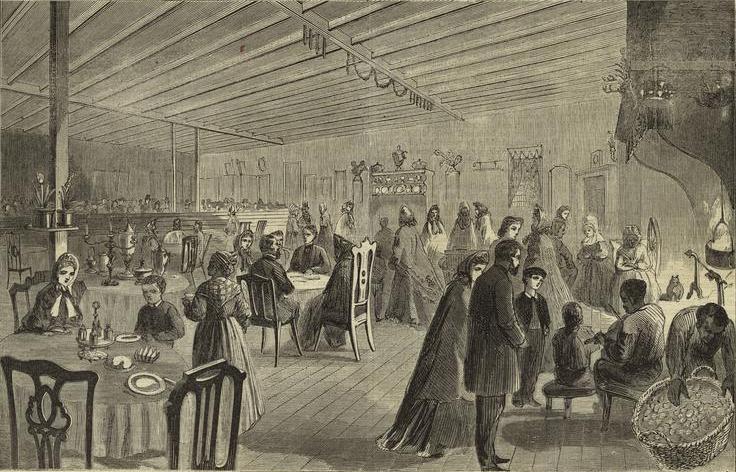
The city unites around an unusual parade — the first regiment of African-American troops — even as it elects a pacifist mayor sympathetic to the Southern cause. A grand and flamboyant fair, uniting the community, offers up a surprising New York tradition — the theme restaurant. Meanwhile, a local newspaper editor devises an elaborate hoax to get rich quick off the gold market.

But with the November re-election of Abraham Lincoln also comes a deadly threat — a Confederate conspiracy aimed at New York’s luxury hotels. Tune in as we recount the botched plot to destroy New York in an conflagration of ‘Greek fire’.

The Knickerbocker Kitchen, a featured restaurant at New York’s Metropolitan Fair. Women dressed in traditional Dutch and Colonial garb and served items believed to be popular with the residents of old New Amsterdam. [NYPL]

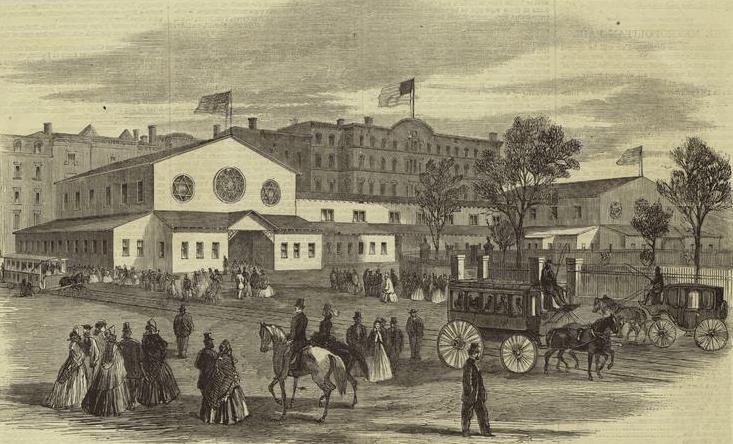
Pavilions were specially constructed around Union Square for the Metropolitan Fair, which raised money for the U.S. Sanitary Commission.

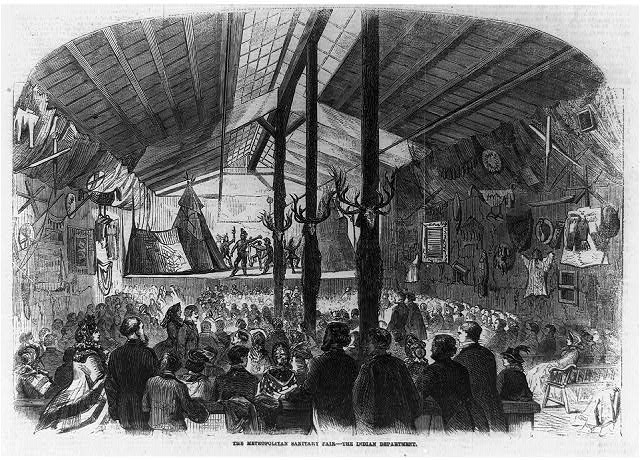
The ‘Indian Department’ at the Metropolitan Fair. [Library of Congress]

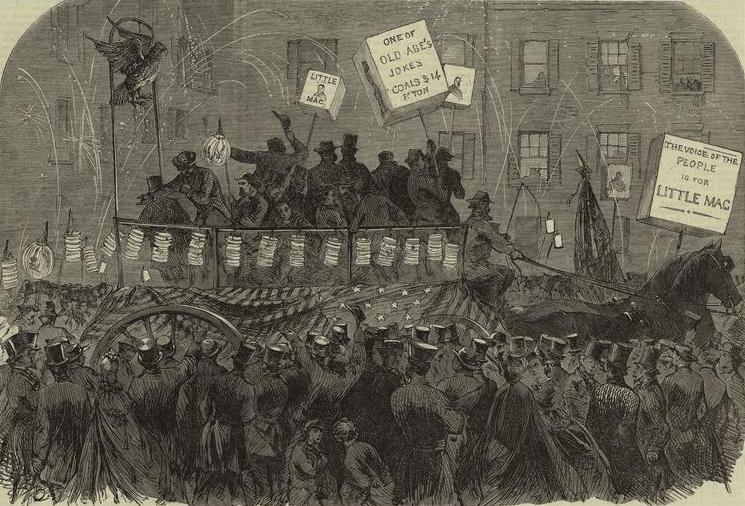
A nighttime ‘torchlight’ rally for presidential candidate George McClellan, the clear choice for New Yorkers in 1864. For a Democratic stronghold like New York, the former general was an especially appealing alternative to Abraham Lincoln. [NYPL]

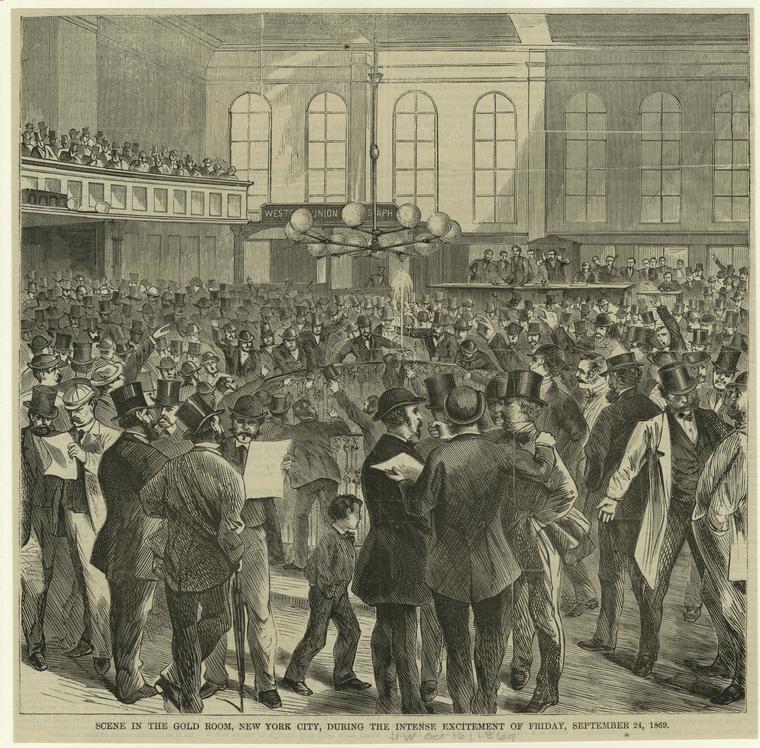
A scene from the New York Gold Room, epicenter of American gold speculation. During the Civil War, traders would buy and sell based upon Union victories and defeats. The trade was also susceptible to false information, such as the events of the Gold Hoax of 1864. (NYPL)

Robert Cobb Kennedy, the only one of the Confederate conspirators to be caught. He was executed at Fort Lafayette in 1865, a couple weeks before the end of the Civil War.

Categories
Podcasts

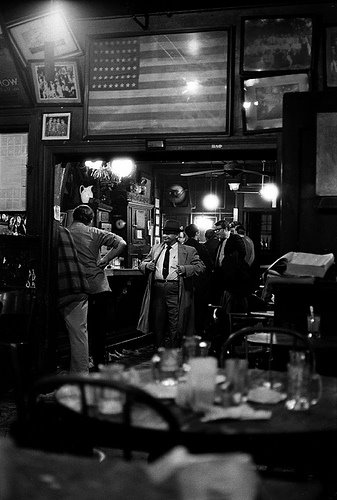
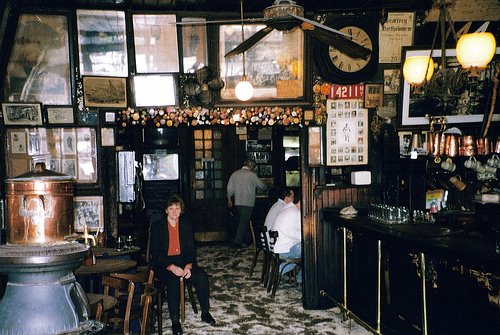
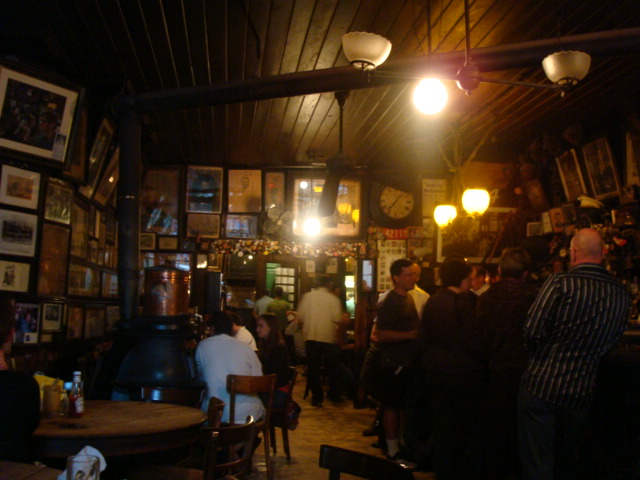
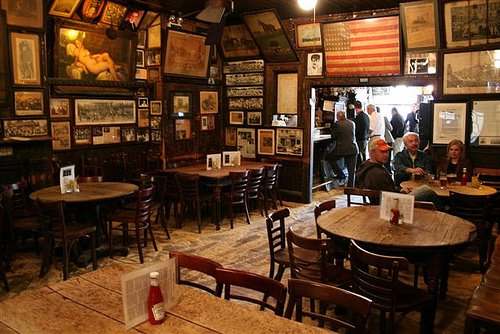
PODCAST: McSorley’s Old Ale House

Grab yourself a couple mugs of dark ale and learn about the history of one of New York City’s oldest bars, serving everyone from Abraham Lincoln to John Lennon — and eventually even women!

Listen to it for free on iTunes or other podcasting services. Or you can download or listen to it HERE

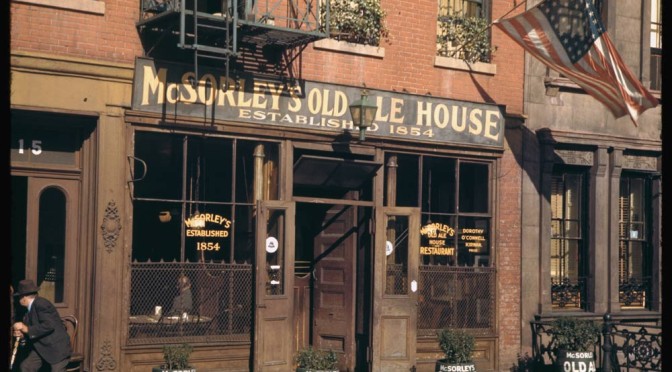
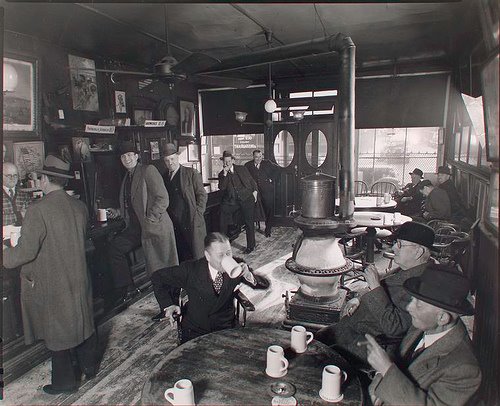
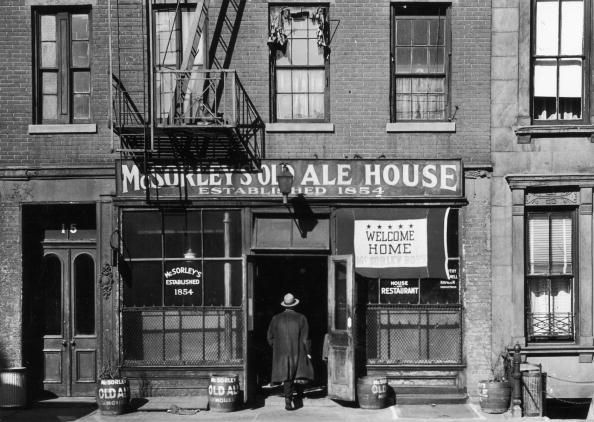
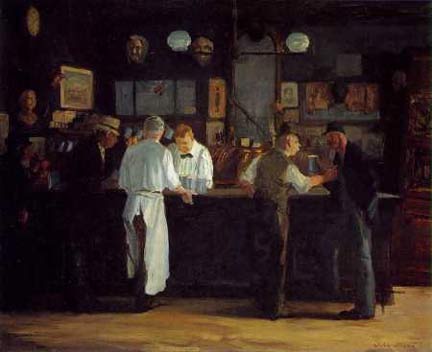
McSorley’s through the ages. Here’s one from 1937:

The outside from 1945

1969:

1998:

And McSorley’s today

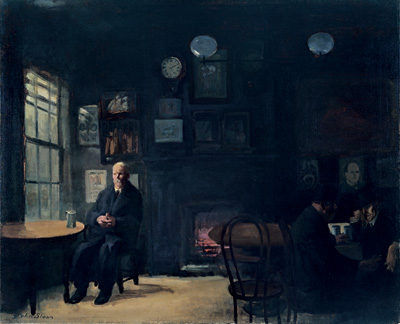
The backroom:

Two of John Sloan’s most famous works, with McSorley’s as its subject:

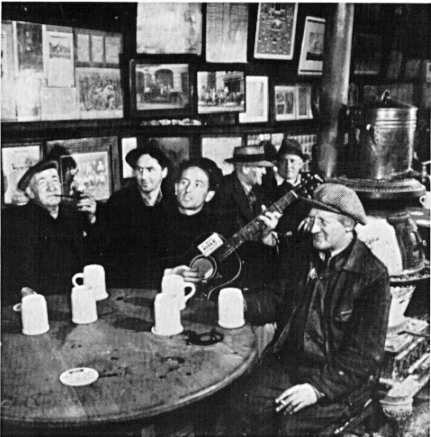
Woody Guthrie hams it up by the coal burning stove.

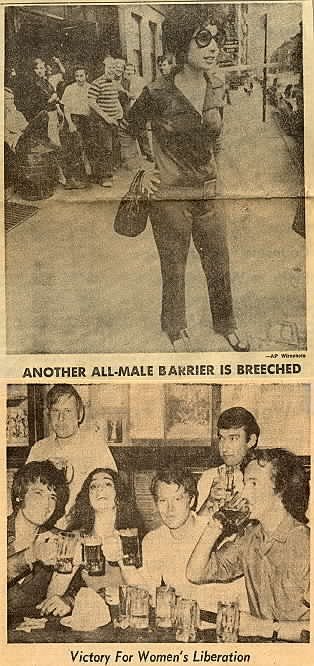
Women win the right to vote: dark ale or light ale!

Categories
Podcasts

PODCAST: Union Square

This former English-garden style park became the heart of protest and the labor movement. Join the Bowery Boys as we dig into the history of Union Square, from Book Row to Klein’s.

Listen to it for free on iTunes or other podcasting services. Or you can download or listen to it HERE

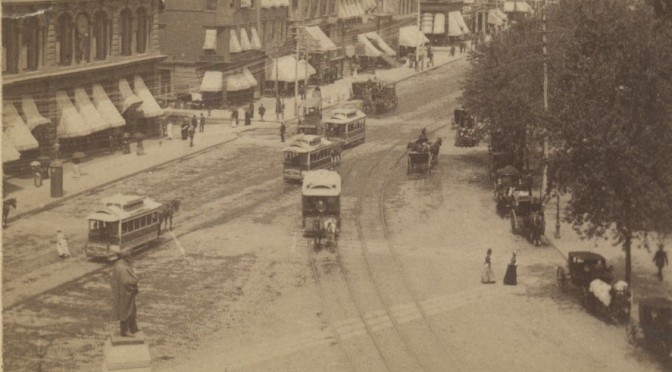
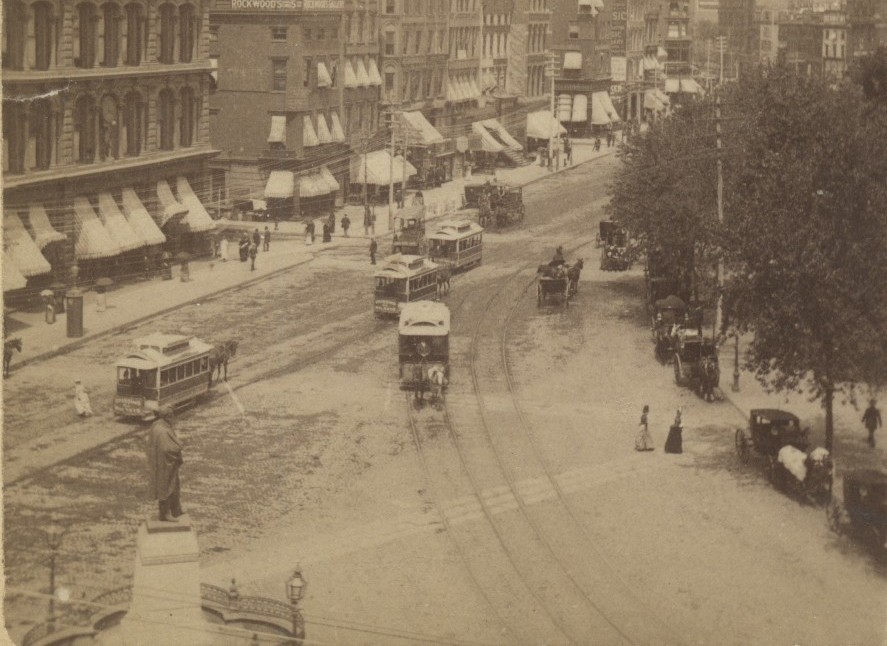
An old view of Union Place, looking south. The oval shape of the park is readily apparent from this drawing. The park is still oval, but sidewalk extensions and the inclusion of the south ‘traffic islands’ configure the park into a more rectangular shape.

Two views of the 1861 Civil War rally (or Sumter rally), one from the ground…

…and from overhead.

This is Deadman’s Curve, the scene of several accidents due to cable-car operators zipping through

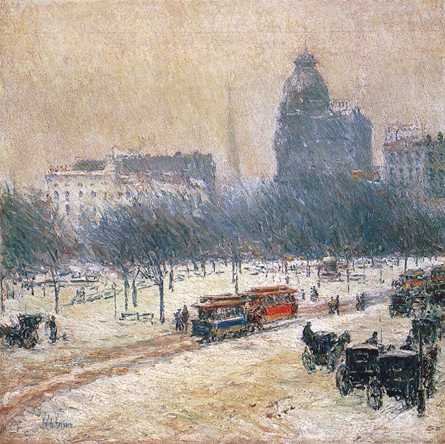
Union Square in 1892, by the American impressionist painter Frederick Childe Hassam

A depiction of the first Labor Day march by the Knights of Labor

Labor leader Emma Goldman was arrested here at Union Square. In this picture, she lectures to an enrapt audience (of men!)

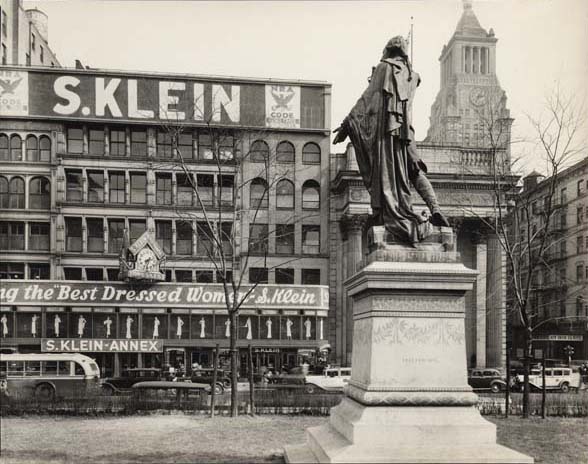
Klein’s on the Square — affordable women’s clothes dominate the park for decades, until they closed in 1975. It was strangely juxtaposed across the street with the Marquis de Lafayette statue, designed by Statue of Liberty creator Frederic Bartholdi.

New York also celebrated the first Earth Day here in Union Square in 1970

Union Square is still a popular and often chaotic place for gathering in protest. Last Saturday (March 22nd), over the course of about an hour, saw a large anti-war gathering, with speakers and singers.

People used the rally to air all sorts of grievances. And wear gory costumes.

Not thirty feet away, this flower seller was offering his springtime wares.

The Greenmarket stretched from the north side and down along the east side of the Square.

At 3 pm, almost as though in opposition to the war protest, people battled in a gigantic pillow fight

Now compare those pictures to this one of a Union Square crowd in 1910:

And finally, an extraordinary panoramic view of Broadway from Union Square … via 1890! Click to get a closer view

The REAL story behind those confusing numbers

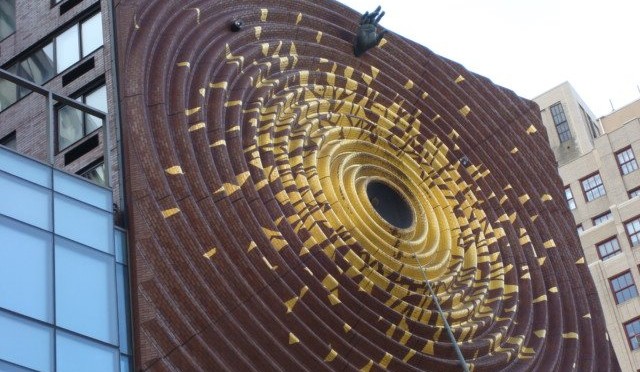
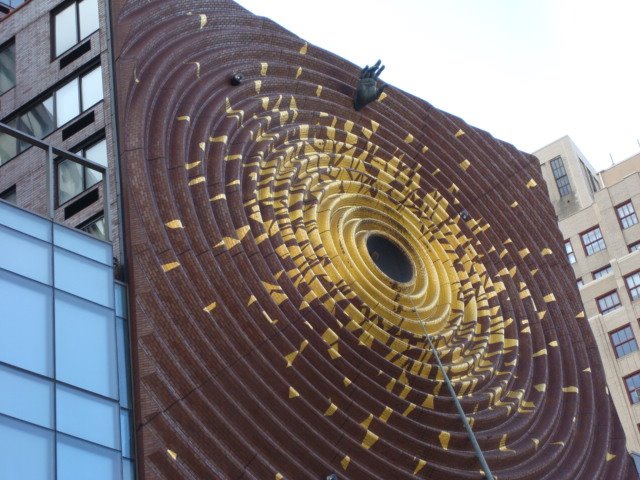
Some architectural monstrosities just beg to be ripped upon. Topping this list is One Union Square South, a bland 33-story structure and pioneer in the mall-ification of Union Square. Although its storefronts feature a Circuit City and a dying Virgin Mega-store, One Union Square South is defined by a piece of public art that has only gotten more atrocious and weird over time.

The Metronome was a project three years and $3 million in the making when it was finally installed in February 1999. It has confused and horrified New Yorkers ever since. The 100-foot Kristin Jones and Andrew Ginzel display features a brick wall striated with the undulations of water waves, interrupted with such objects as a boulder, a long tube frozen in the swing of a ‘metronome’, and a sphere which registers the moon cycles. Smoke occasionally burps through the hole in the middle, and a gigantic hand — modeled after the hand of George Washington across the street on his equestrian statue — beckons the viewer to stop and gawk at it.

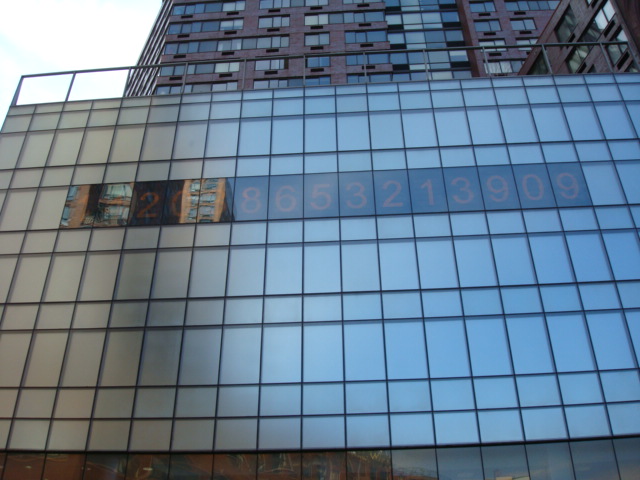
Nearby is a row of 80s-era calculator digits, rolling at different speeds. The six numbers on the left indicate the proper time (i.e. 9:34 am and 21 seconds = 093421).

The six numbers on the right display the amount of time before midnight, except to be quirky, they put it backwards. So, using the prior example, there are 14 hours, 25 minutes and 39 seconds to midnight. In Metronome world, you write that as 392514.

The three digits in the middle are too blurry, presumably in the rush of micro-seconds. (Except, of course, when you take a picture of it.)
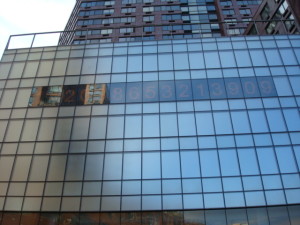
Since this piece begs the viewer to speculate the passage of time, perhaps its time to speculate what sat here at One Union Square South before this dated piece was even here. (To be fair, the piece seemed dated the moment it was installed in 1999.)

One Union Square South replaced the less glamorous address 58 East 14th Street. Passersby in the early 90s saw it as a frumpy building with modest retail space dominated by a gigantic McDonalds sign. What many may not have known was that this building contained the oldest theatrical space in Manhattan.

Rumors of this secret stage had persisted since the 1970s, but it wasn’t until some clever detective work by a New York Times reporter verified in fact interior walls were built during its transition into retail space, severing the stage from a vast auditorium, sitting empty for decades.

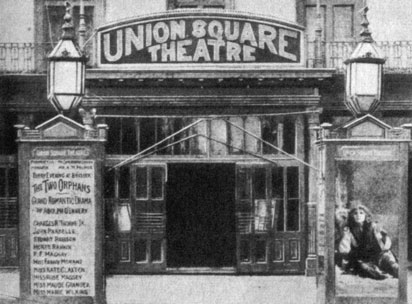
It had once been the Union Square Theater. In its final days of operations, from 1896 until the late 30s, it had been a cinema for silent features and ‘racy’ pre-code pictures. As with many stages, it converted to showing films after a brief stint from 1893 to 1896 as a vaudevillian showcase. The stage saw the debut of a young entertainer named George M. Cohen, who was originally supposed to perform with his family The Four Cohens. But owner B. F. Keith needed to fill up his bill, so young Georgie took the stage himself and the boy was greeted with apparent indifference. (You can see a variant of this event in the film ‘Yankee Doodle Dandy’.)
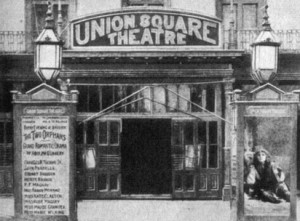
Before the racy films, before Cohen and the vaudeville, the Union Square Theater was a legitimate stage, showing mostly unsuccessful fare such as the un-intriguingly named ‘A Woman’s Strategem’. That show was apparently significant enough to merit articles about the details of the leading lady’s costumes — “a very quaintly-designed morning gown of crepe,” “a very handsome broche with bodices of the Directoire period and point de gaze’ lace sleeves.”
The early days of the Union Square Theater sound a lot more engaging. When it opened in 1871, it was advertised as a ‘modern temple of amusement’, showcasing everything from burlesque to ballet. Its brief foray into legitimate theater — the kind that could feature costumes of ‘quaintly-designed’ crepe — came only after a small fire gutted the balcony in 1888.

Peeling time back further, we find that the Union Square Theater was carved out of the remnants of vast dining room of an old hotel the Morgan House, which was itself the five-story modification of the original building on this spot — the Union Place Hotel, built in 1850.

A descriptive 1861 travel guide refers to the Union Place Hotel as an ‘elegant establishment’, and truly this was Union Square’s high-class heyday, of upper-crust homes surrounding an earlier version of the square inspired by lush English gardens.

A cheeky 1852 guide to the city called Glimpses of New York — written by “a South Carolinian (who had nothing else to do)” — describes it as ‘kept in equal style to the New York [Hotel, one of the superior hotels of the time] and the charges are a grade higher.’

Among many famous guests of the hotel were Mary Todd Lincoln in the years after the death of her husband.

Union Square eventually became the heart of New York’s theater district, and apparently the Union Square Hotel was a bit of a hangout for the out-of-work. Dwight’s Journal of Music proclaims “…at the Union Square Hotel, there is always a host of unemployed managers and actors.”

Luxury hotels and out-of-work actors — some things about New York haven’t changed a bit.