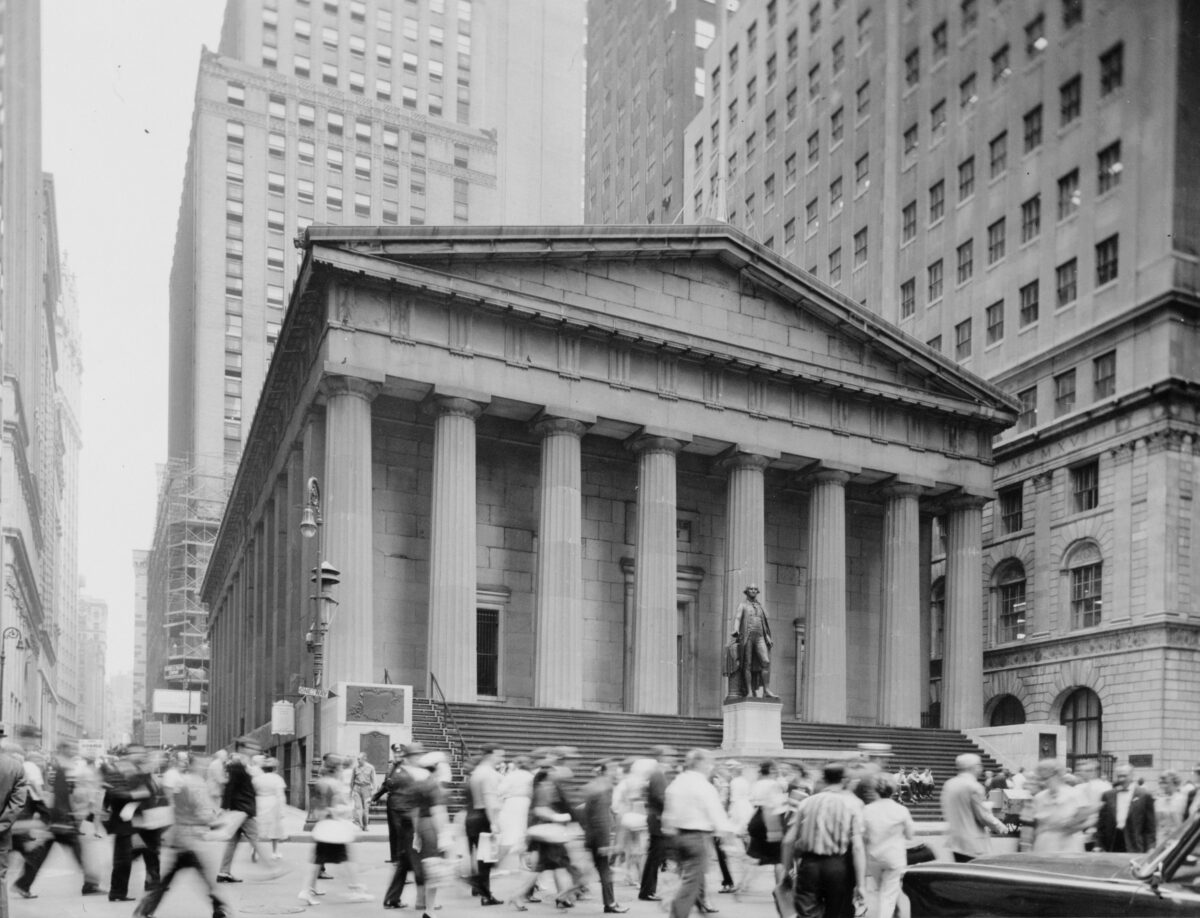
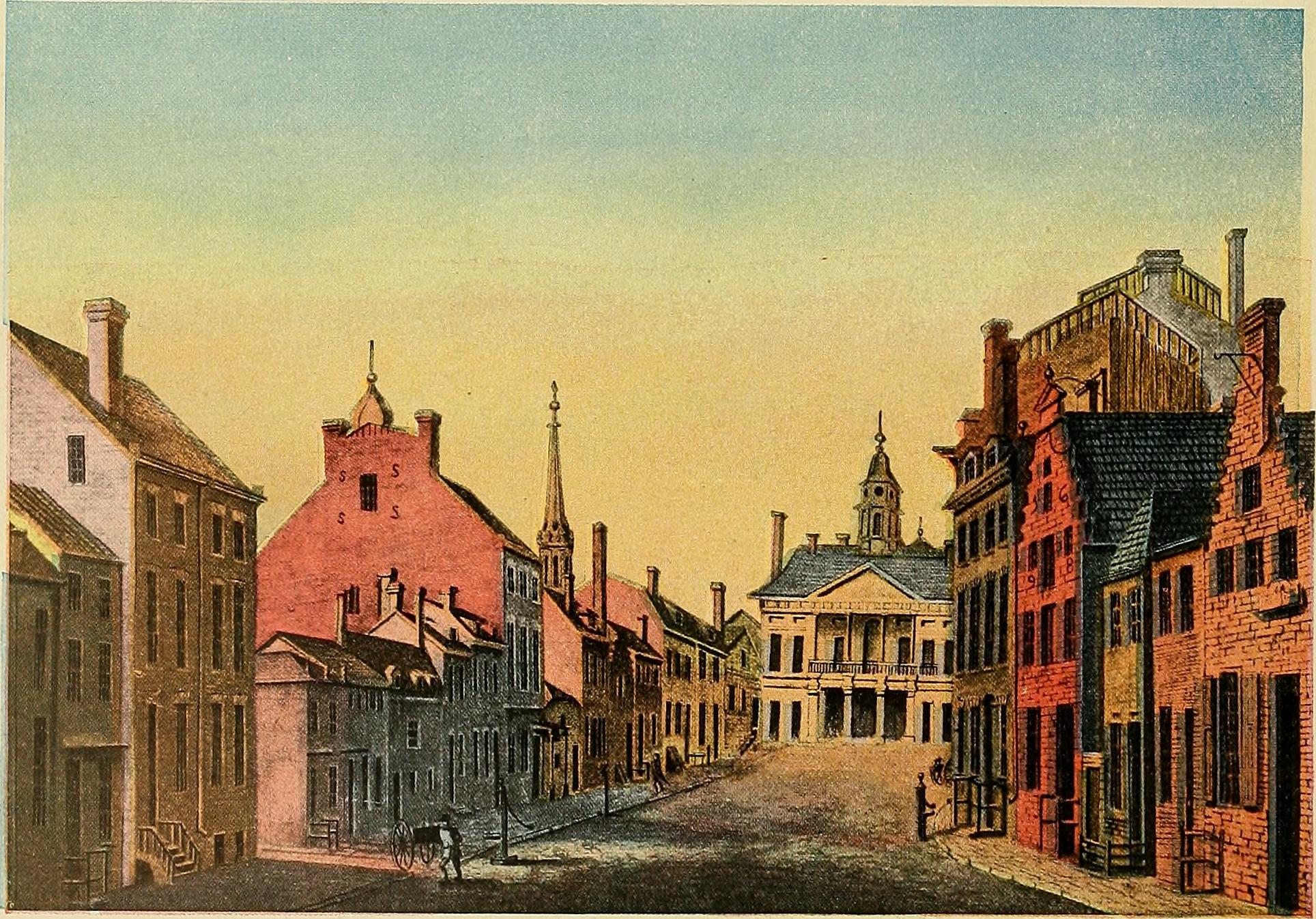
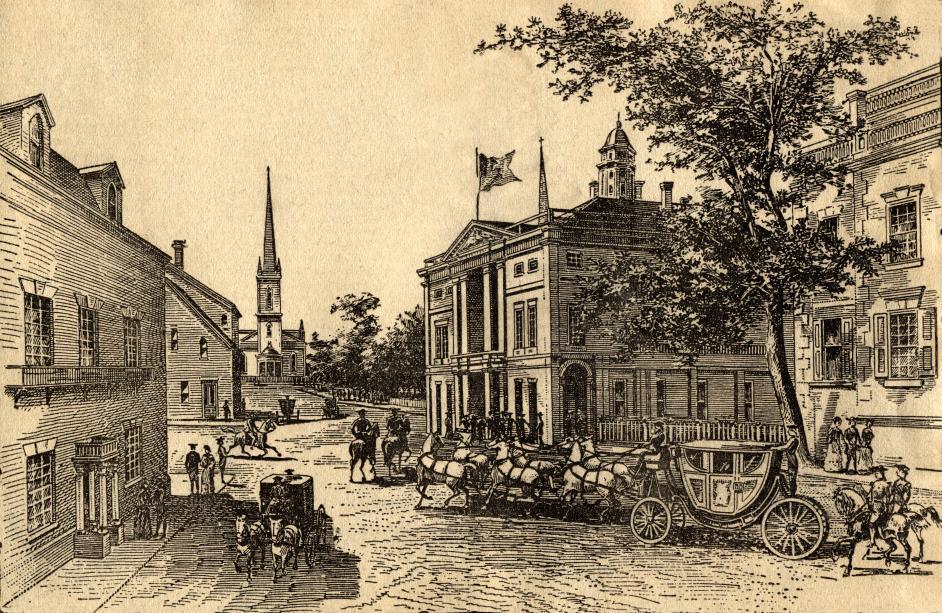
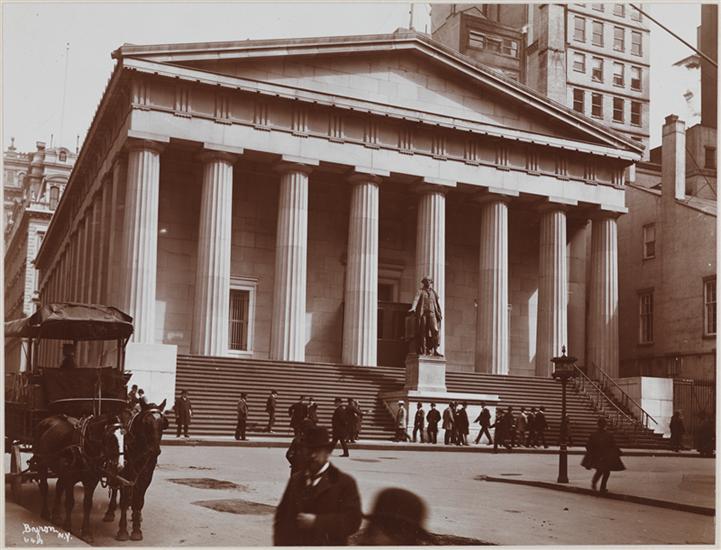
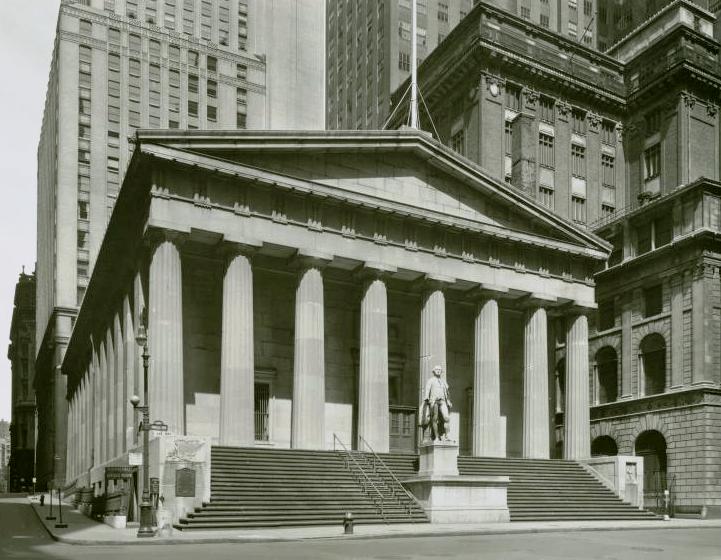
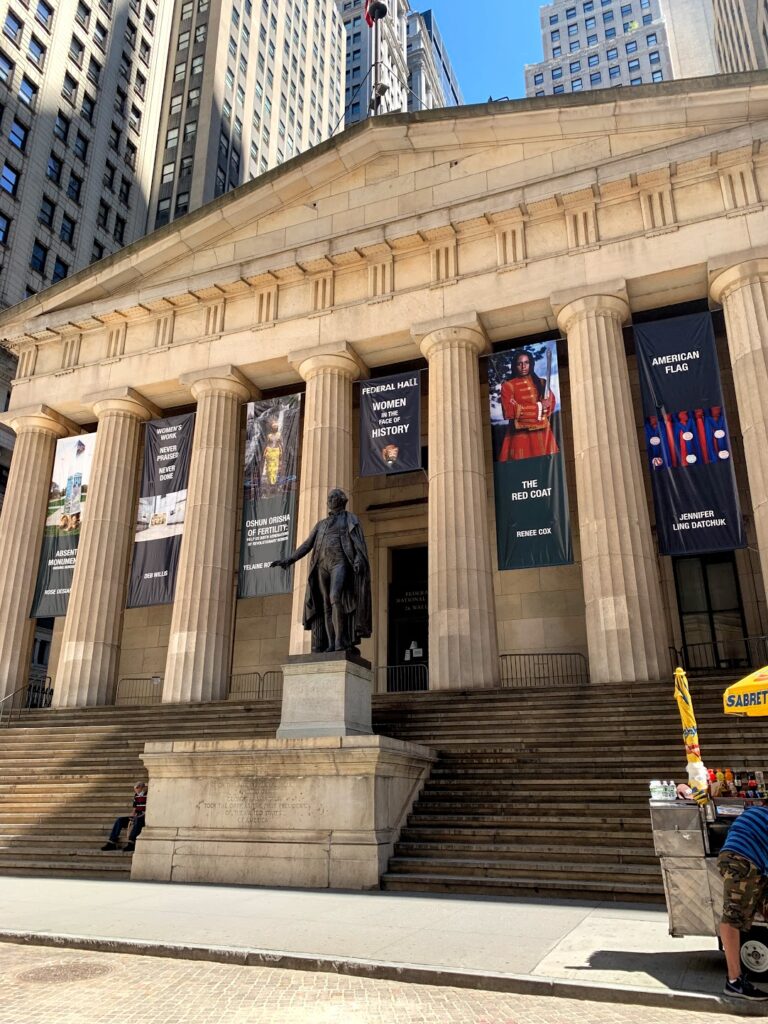
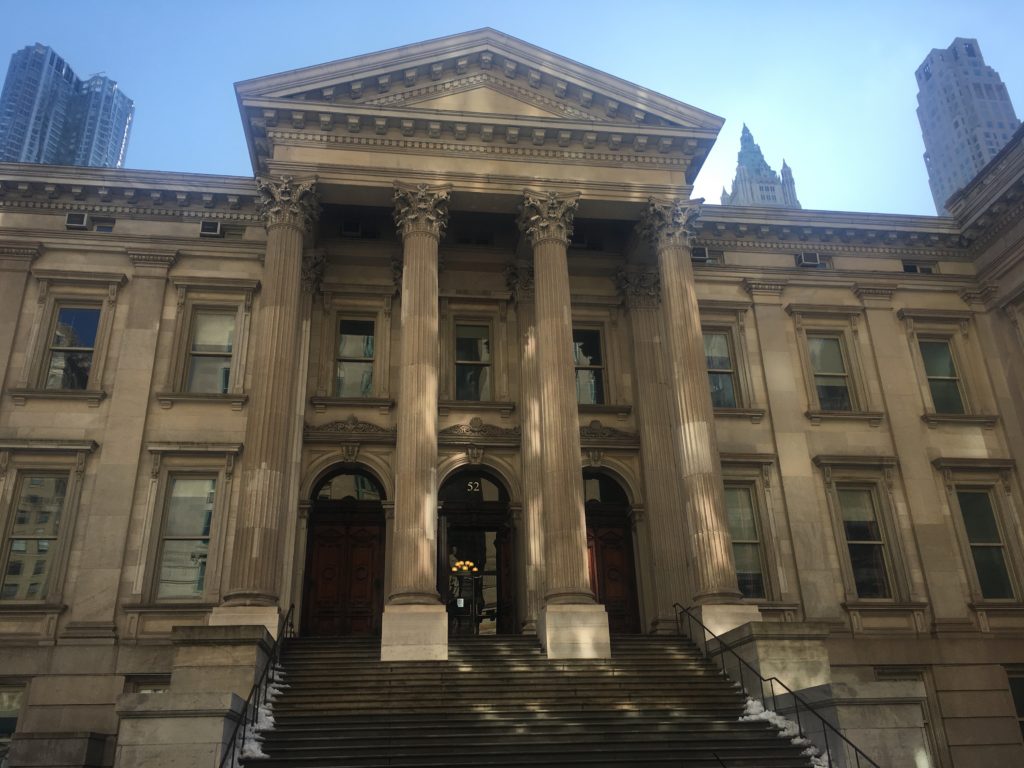
Federal Hall National Memorial, currently administered by the National Park Service, has always been a popular landmark with tourists thanks to its position on one of the most photographed intersections in New York. Who can resist that noble statue of George Washington silently meditating on the financial juggernaut of Wall Street?
In 2015 Federal Hall was officially named an official American National Treasure, part of the ongoing Saving Places programby National Trust for Historic Preservation calling attention to endangered landmarks of national significance. (The following article was originally posted that year in honor.)
While this sounds like a distinction that might pique the interest of Nicolas Cage — after all, he broke into Trinity Church up the street in the first National Treasure film — the National Treasure program gives a boost to historic places that may be otherwise neglected or under-appreciated. When’s the last time you were there?
Here are a few facts about the history of Federal Hall that you may not have known:
2. That Federal Hall was remodeled by a controversial architect.Pierre Charles L’Enfant, a successful city contractor and former Continental Army engineer redesigned the structure in time for its use as the first national capital.
According to David McCullough, it was the first building in America designed to exalt the national spirit, in what would come to be known as the Federal style. Lâ’Enfant would later work on the creation of Washington DC from Maryland swampland and be fired from that project by George Washington.
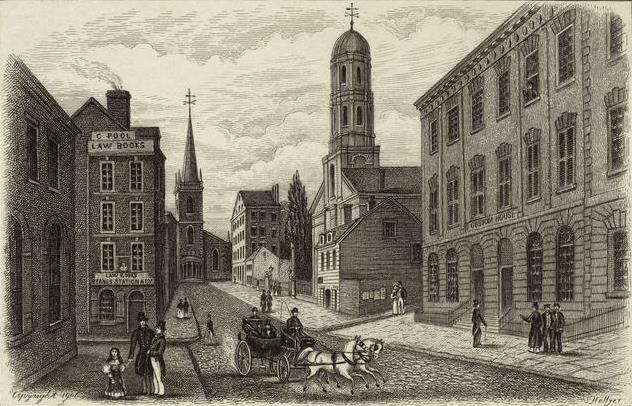
4. The original Federal Hall was torn down in 1812 when city administration moved to the new City Hall. Its materials were sold off to make other buildings in the city.
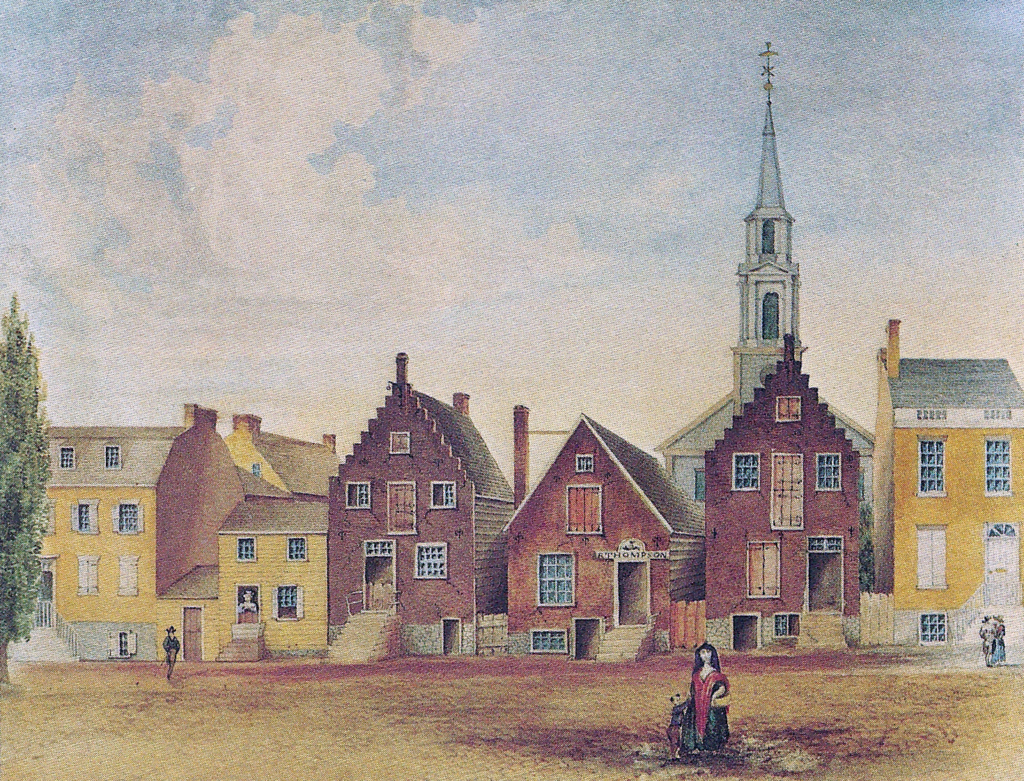
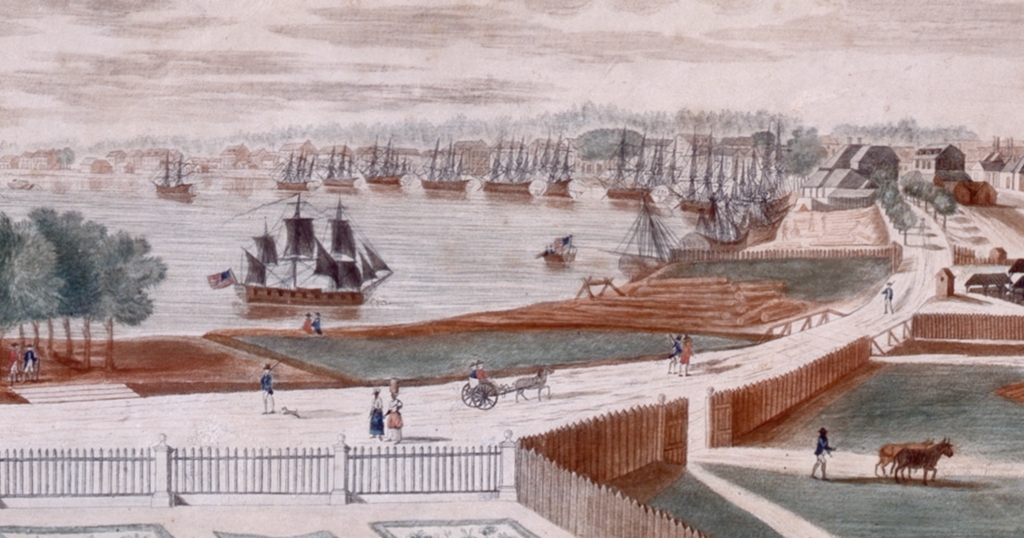
Below: Wall Street in 1825 without a Federal Hall, either old or new!
5. The current Federal Hall is actually the original U.S. Custom House which opened in 1842, replacing a structure used for that purpose at 22-24 Wall Street.
Courtesy Museum of the City of New York
6. The offices of the Custom House again moved in 1855, and the building was used as the U.S. Sub-Treasury building. In 1913 it became the first place in New Yorkto buy the original buffalo nickel.
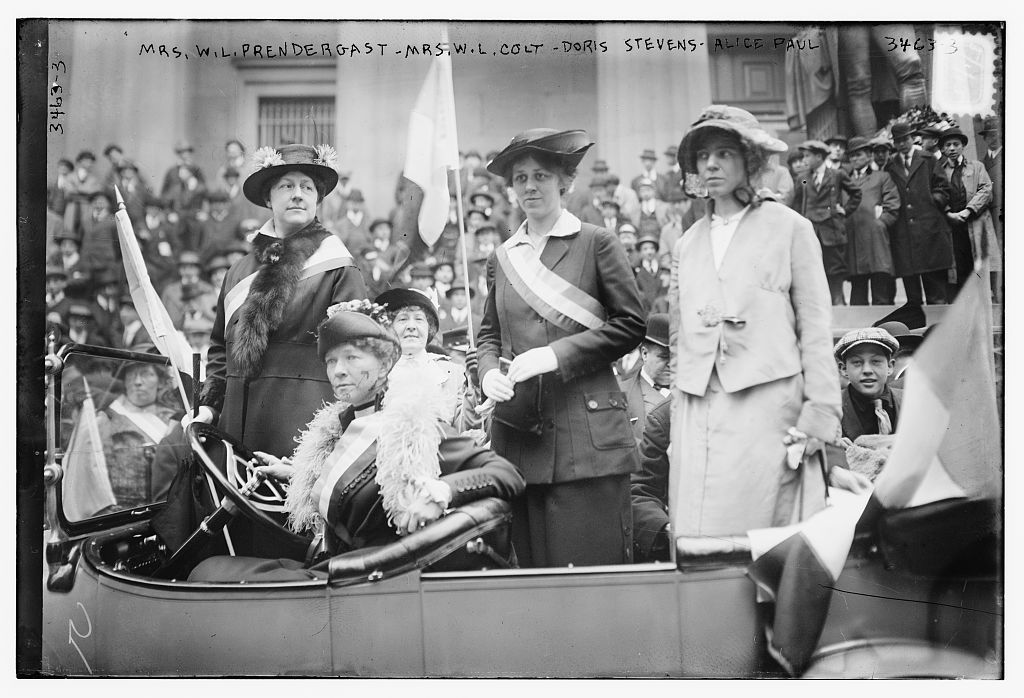
Below: Suffrage proponents Mrs. W.L. Prendergast, Mrs. W.L. Colt, Doris Stevens, Alice Paul stop in front of Federal Hall
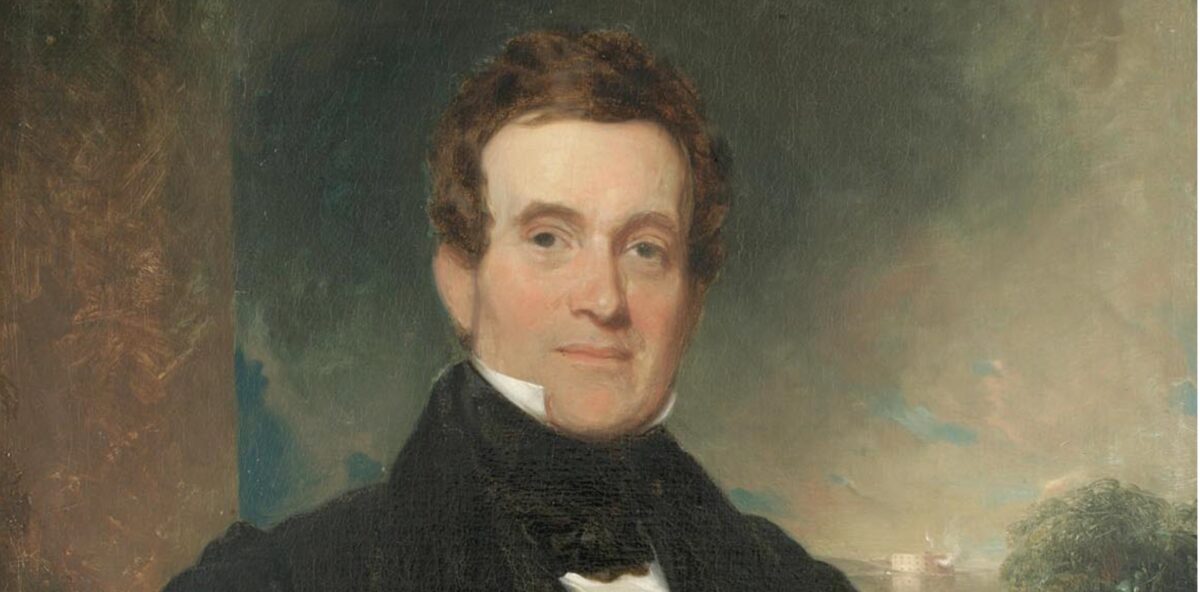
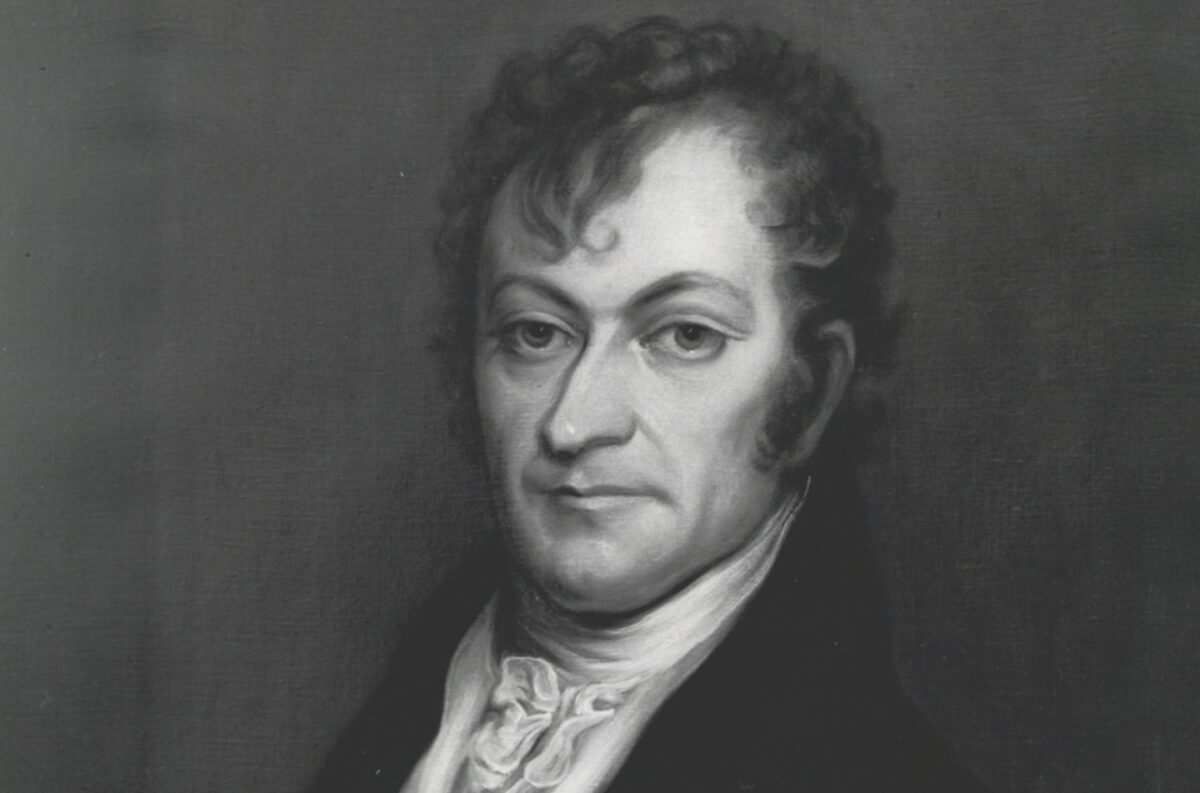
Aaron Clark, from his official City Hall portrait, painted by Henry Inman. Courtesy NYC City Hall
New York City has a new mayor — Eric Adams! So we think it is time that you Know Your Mayors, becoming familiar with other men who’ve held the job, from the ultra-powerful to the political puppets, the most effective to the most useless leaders in New York City history.
This longtime feature of this website is being rebooted with new articles and newly researched and refreshed earlier entries in this series. Check back every other week for a new installment. Read past articles here.
Mayor Aaron Clark 1837-1839 (two one-year terms)
Aaron Clark has many claims to fame in New York City history, none of them really things that recommend him as a defining leader of our city. His most defining characteristic was that he was often very lucky.
Clark is the first mayor ever elected representing the anti-Democrat, anti-Andrew Jackson Whig Party — a political party abolished less than 20 years after Clark’s victory.
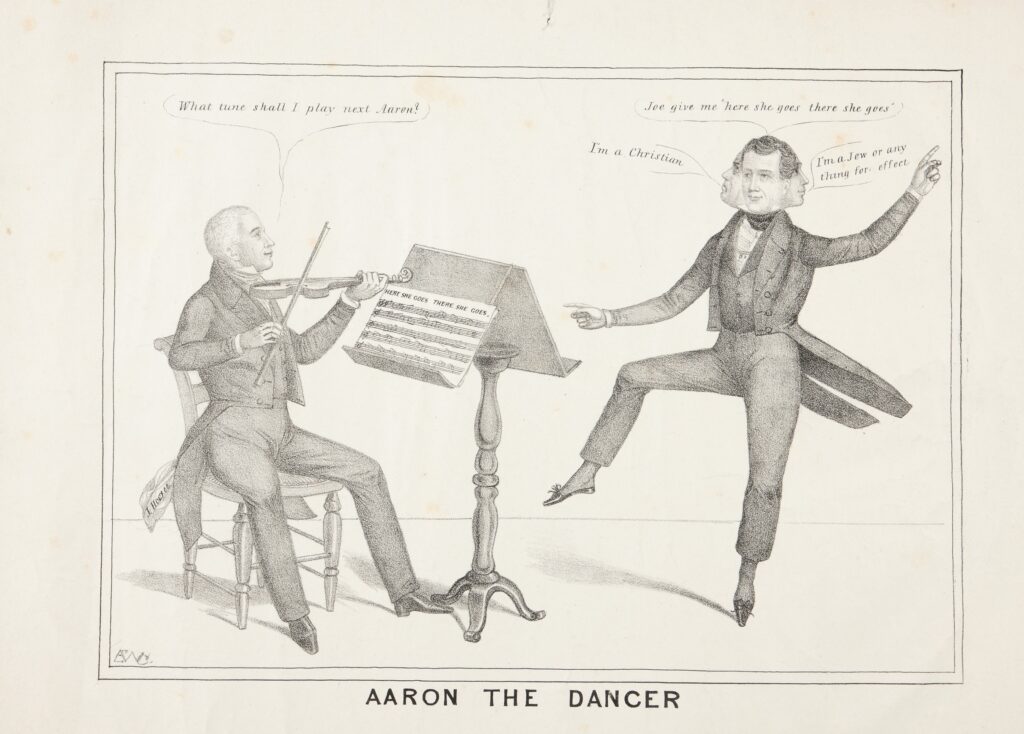
He was known as the ‘Dancing Mayor’, which was not an accomplishment but a mockery.
He called himself the New York’s most prestigious lottery operator, which he considered an accomplishment but was perceived by some as a disqualification.
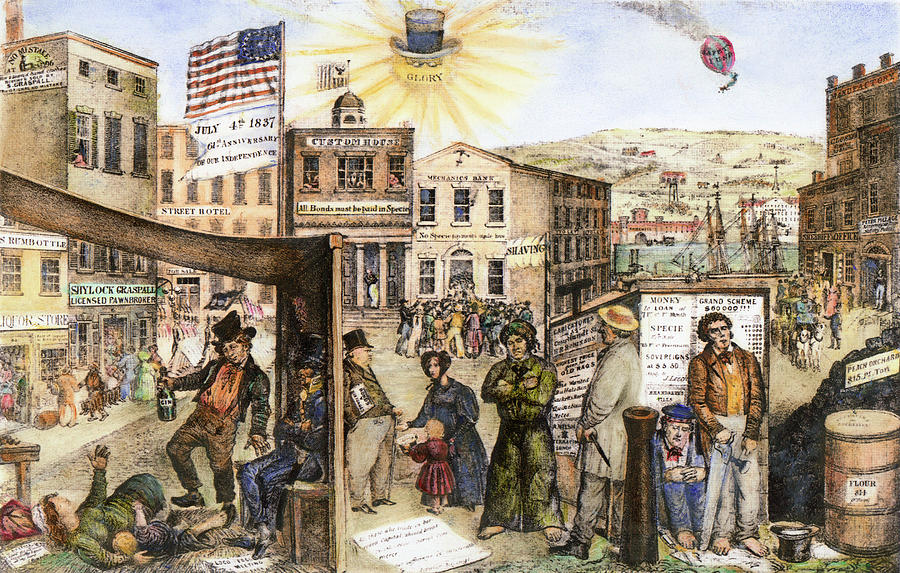
And finally he was elected amidst one of the worst financial crises in its history– the Panic of 1837.
Previously on ‘Know Your Mayors’
Clark, perhaps more honorably, was also the second man to ever be popularly elected as mayor of New York, i.e. chosen directly by the people of the city.
Previously, the position was selected by the Common Council (city council), district representatives who often chose men beholden to their whims.
When the state finally changed mayoral selection to one of popular election in 1834, the result caused violence at the polls and mass pandemonium. (See the last installment.) Cornelius Lawrence would come out ahead for three consecutive one-year terms.
Lawrence had been a candidate of Democratic machine Tammany Hall — with their influence, who else would be the first mayor? — but Democrats were facing strong opposition from an ascendent Whig party.
In fact, the Whig candidate in 1834, Gulian Verplanck, very nearly won; the animosity between the Democrats and Whigs was so contentious that right before the election, Tammany thugs stormed their opponents headquarters, destroyed everything inside and even killed a man.
During Lawrence’s tenure, the Whigs remained strong as the Democrats got weaker.
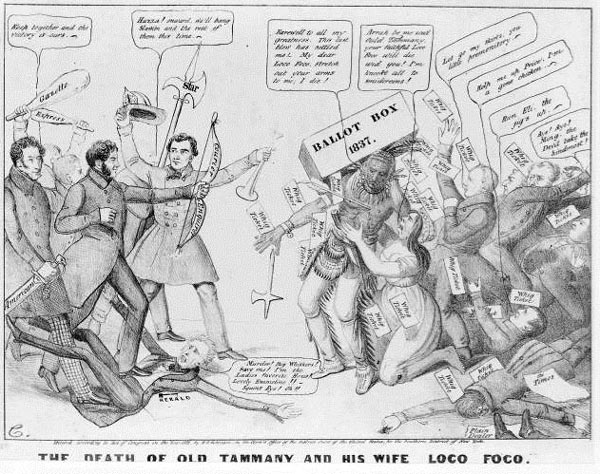
In a situation which certainly has some reflection in current national events, Tammany was split between conservative and liberal factions (an ‘Equal Rights’ faction, as they called themselves).
During a Tammany meeting in 1835, the Equal Righters stormed a Tammany committee meeting loaded with conservative members and threw them out.
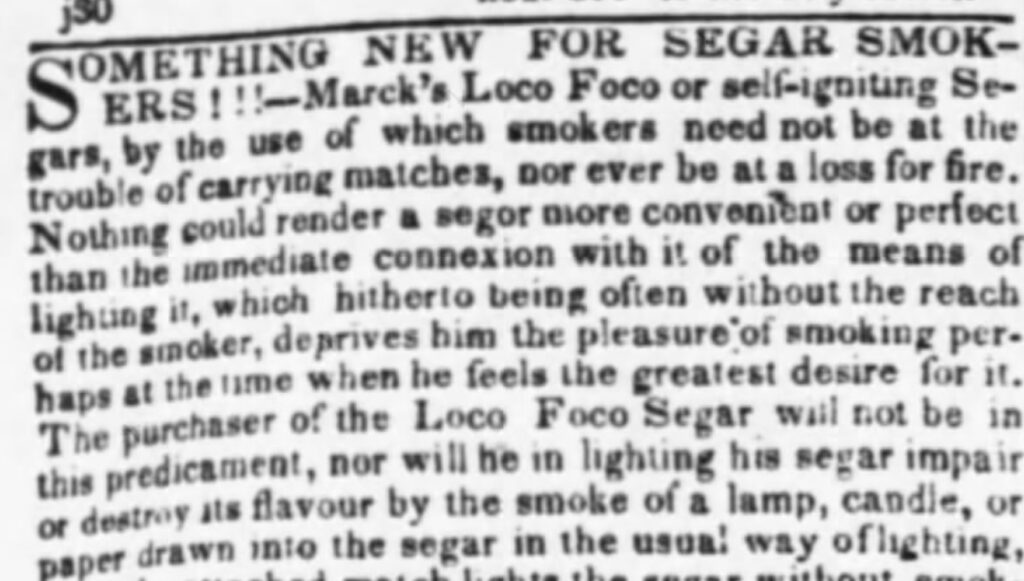
When the lights were turned out on the party-crashers, they lit Spanish matches or ‘loco-focos‘ and continued. The opposition, which would eventually run the conservatives right out of the party, would forever be known as the Locofocos. (For more on their particular beliefs, read here.)
How Luck Elected A Whig Mayor
So what does this have to do with Whig man Aaron Clark? At another period in history, Mr. Clark might never have gotten to experience life in City Hall.
But the dissention within the Democrats opened the door for the fleeting Whig party to reign briefly in New York. With that sort of luck, it’s no surprise to learn that Clark’s primary occupation up to then was as operator of a lottery business.
Privately-run lotteries were, believe it or not, quite common in early American history.
King’s College (today’s Columbia University) was founded with a lottery pool. A young P.T. Barnum operated one up in the 1820s. Benjamin Franklin and George Washington both held fund-raising lotteries in their day.
Even Alexander Hamilton opined that “everybody … will be willing to hazard a trifling sum for the chance of considerable gain.”
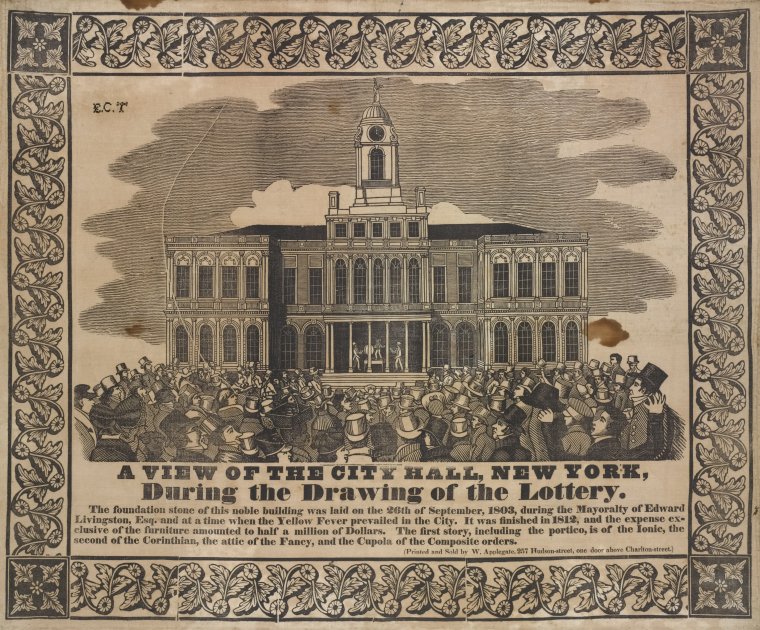
A view of the City Hall, New York, during the drawing of the lottery, New York Public Library
By the mid 19th century, private lotteries would be associated with more disreputable elements and would be abolished at the end of the century. Clark was thus a successful operator of an industry in the 1830s that would soon be looked upon as scandalous and unseemly.
“As lotteries, under certain regulations as to the drawings, which were had upon the esplanade in front of the City Hall, in the presence of an alderman, were authorized by law, there were many offices in the city, notably one at the southwest corner of Broadway and Park Place* kept by Aaron Clark, a much reputed citizen.”
*The Woolworth Building now stands on the spot where Clark’s business once stood.
“He was a great lottery seller and made a fortune of it,” says one source. A recollection from an 1890s New York Times article shortlists Clark as one of the “best known rich men” at the time.
Huzza for Clark, Fortune’s Favorite!
Clark was born in 1787 in Massachusetts, a veteran of the War of 1812, and spent his early years as a clerk of Albany state assembly.
He moved to New York to pursue banking and eventually fell into his lottery endeavors, becoming wealthy and, by extension, highly suitable for early 19th century public office. Clark was soon elected to an alderman’s seat, typically a neat launching pad into the mayor’s chair.
The Whigs announced him as their candidate in 1837 against the intensely split Democrats. Conservative Tammany ran John Jordan Morgan, while the Loco-Focos put up the interestingly named Moses Jacques, considered “the patriarchal leader of the Loco-Focos.”
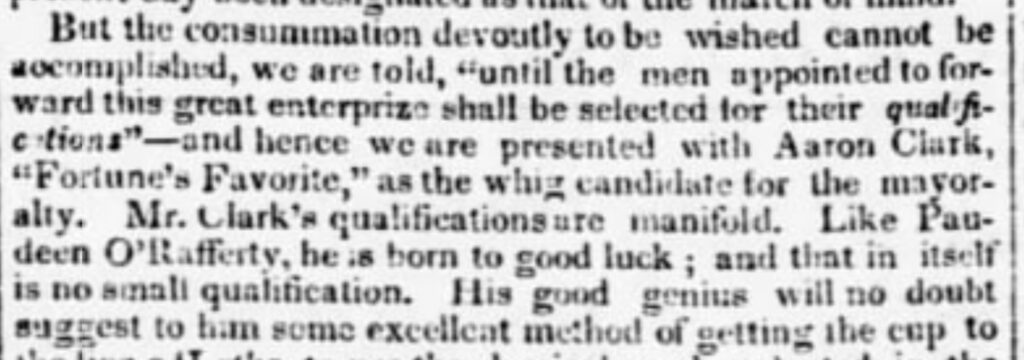
Clark’s opponents certainly tried to use his occupation against him. Wrote William Leggett : “If we elect Aaron Clark for Mayor who knows but he may get up some ‘splendid scheme’ and insure ‘a grand prize’ to everyman who assisted in making him manager of the municipal lottery. Huzza for Clark, Fortune’s Favorite!”
The Evening Post repeated this nickname — Fortune’s Favorite — March 1837.
However Morgan and Jacques cleaved the opposition in two, and for the first time in New York history, on April 11, 1837, a Whig became mayor.
He then would be re-elected in 1838 when Tammany’s conservatives threw their support to him out of spite towards their liberal LocoFoco brethren. (There was apparently a shocking amount of fraud going about that year, which also helped matters.)
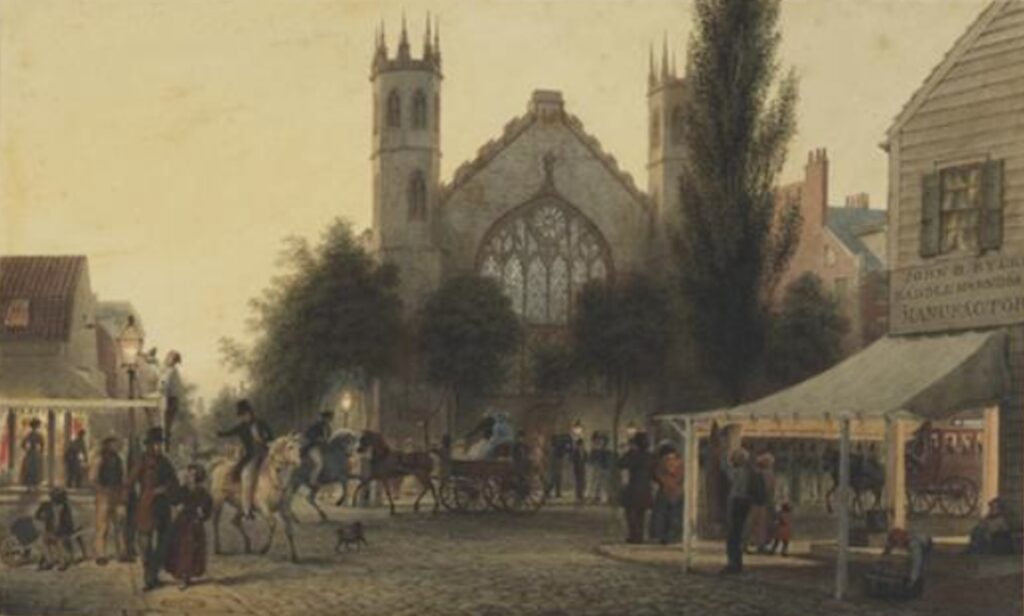
Night-fall. St. Thomas’ Church, Broadway, New York, a beautiful painting by George Harvey from 1837. (The Museum of the City of New York)
Fortune’s Favorite?
Clark was certainly the wrong mayor for the moment. He was an ardent Native American, meaning he generally despised the boatloads of Irish emptying into New York slums, driving “the native workmen to exile,” he said in a meeting to the Common Council.
His campaign was openly hostile to ‘clannish’, ‘untrustworthy’ Irishmen, and his tenure as mayor only stirred up xenophobic sentiments. He advocated for keeping new immigrants on ships, directing them away from city and charging them ‘commutation fees’ of $10.
Clark aimed his racial paranoia at the lower classes at large, fearing that the charity organizations already in place were turning the city “into a rendez-voux of beggars, paupers, vagrants and mischievous persons,” according to the book Gotham.
One general benefit of this alarming hysteria was an improvement to the system of nightwatchmen and security patrols throughout the city, a “military arm” to assuage rioting and general chaos. Clark was no light-weight; he would frequently lead these local militias through the city himself, breaking up rabble-rousing groups.
The Unfortunate Fop
Most unfortunately, however, Clark’s charms were limited. His attempts to woo over New York’s elite in a series of parties at his home on Broadway and Leonard Street fell flat.
This type of social governance was a winning recipe for mayors like the honorable Philip Hone. As mentioned in a prior installment of this column, Hone’s parlor “hosted a nightly gallery of political and foreign dignitaries mixing it up with New York’s social strata.”
Clark, however, was roundly ridiculed for attempting such grand ‘entertainments’. In fact, in an early form of political snark, Clark was ironically called ‘the Dancing Mayor’, not for his graces assumably or even the class of his “splendid patent leather pumps” but for his pretensions of trying too hard.
Also on his watch, the Croton Aqueductcontinued apace although its workers went on strike not once but twice in 1838 for better wages.
He also governed the city through the beginning of a grueling financial crisis, known today as the Panic of 1837.
Not even a month into Clark’s first term, on May 10, 1837, New York City banks ran out of gold and silver, having loaned out too much due to months of high inflation. President Jackson had hollowed out the central bank and refused to recharter it, leading to bank collapses across the country.
“During the Panic of 1837, approximately ten percent of U.S. workers were unemployed at any one time. Mobs in New York City raided warehouses to secure food to eat. Prominent businessmen, like Arthur Tappan, lost everything.” [source]
The Panic froze real estate developments across the city. Construction projects in Union Square and Gramercy Park sat unfinished.
“A deadly calm pervades this lately flourishing city,” wrote former mayor Philip Hone in his diary. “No goods are selling, no business stirring, no boxes encumber the sidewalks of Pearl Street.”
A Different Kind of Prize
It became clear that Clark was out of his depth. Two years of a Whig in office — with the tide of immigrants hardly abating — was quite enough.
In the election of 1839, Tammany put up Isaac Varian, who had been defeated the year previous by his political machine’s fractious split. Despite the usual cries of fraud, in this round Varian was the victor. Clark’s luck, if that’s ever what it was, had run out.
During its first year, The Clark Prize had eight competitors. “It is expected that the exercises will be unusually interesting and attractive,” claimed one article.
When Clark died in 1861, he was buried right here in the city, at the old New York Marble Cemetery in the East Village. The gates to this historic burial ground are occasionally opened to the public so I recommend bringing a lottery ticket to his headstone.
We’re just months away from a new mayor in New York City so we think it is time that you Know Your Mayors! Become familiar with other men who’ve held the job, from the ultra-powerful to the political puppets, the most effective to the most useless leaders in New York City history.
This longtime feature of this website is being rebooted with new articles and newly researched and refreshed earlier entries in this series. Check back every other week for a new installment. Read past articles here.
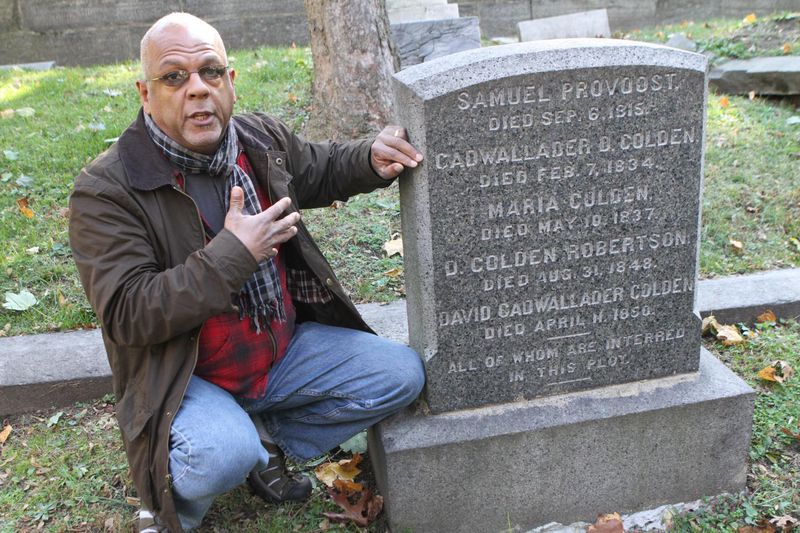
Cadwallader D. Colden Terms: 1818-1821
The most remarkable thing about New York City having a mayor named Cadwallader Colden is the fact that he was not even the most famous New Yorker named Cadwallader Colden.
That distinction goes to his grandfather, an altogether different Cadwallader Coldenthan his grandson and a rather fascinating Renaissance man.
Well, despite the fact that he was also pro-British, stridently hated among the American rebels and the type of man that would have thrown most of us in jail on sight.
Grandpa Colden
Ole Cadwallader was an Irish physician who came to the American colonies in 1710 (at age 22) to practice medicine.
Establishing his practice in Philadelphia, he later came to New York and in 1743 wrote a now seemingly obvious treatise drawing a connection between New York’s unsanitary conditions and its frequent outbreaks of yellow fever.
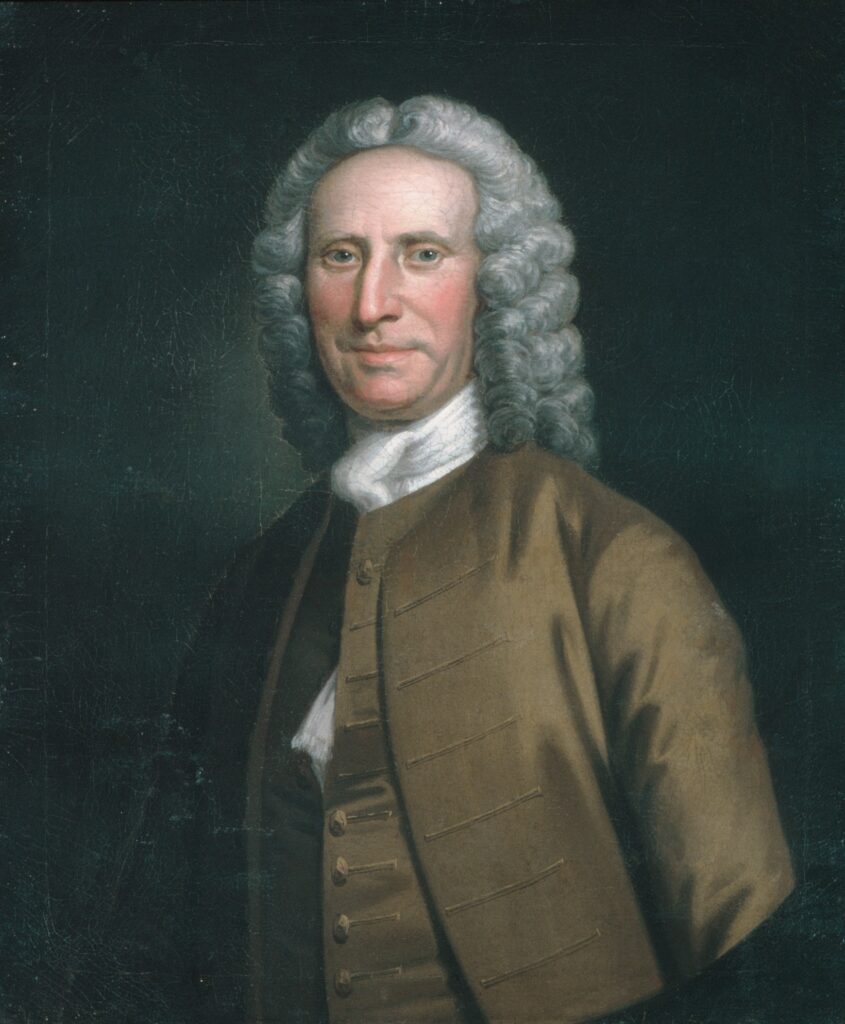
Painting of the Elder Colden by John Wollaston the Younger. Wikimedia Commons
Elder Colden became governor of the New York colony in 1760 and later sparked ire among beleaguered New Yorkers, who burned his effigy over enactment of the Stamp Act.
Colden ultimately represented the losing side of the American Revolution, and due to that, his other accomplishments are often overlooked. He was the first in America to write about Newtonian scientific theories and the first colonist to act as ambassador to the Iroquois Confederacy, the union of five Native American tribes.
Grandson in a New County
Perhaps it’s fitting that Colden died in September 1776, the year of the conflict that would run the British out forever.
He might be scandalized to know that his grandson, born in 1769 in Flushing, Queens County, would become a model American. (The child’s father Cadwallader Colden II was more concerned with governing the family’s lush 3,000 acre estate in Queens and remained essentially neutral during the Revolutionary War.)
Born in the trappings of wealth, Cadwallader David Colden III was shipped off to London for a proper education and returned to New York in 1785 to become a lawyer.
With his high class connections, he quickly acquired an impressive client roster, in particular Robert Fulton and Robert Livingston, assisting in their control of ferry services in New York harbor. He became New York district attorney twice, 1798 and 1810.
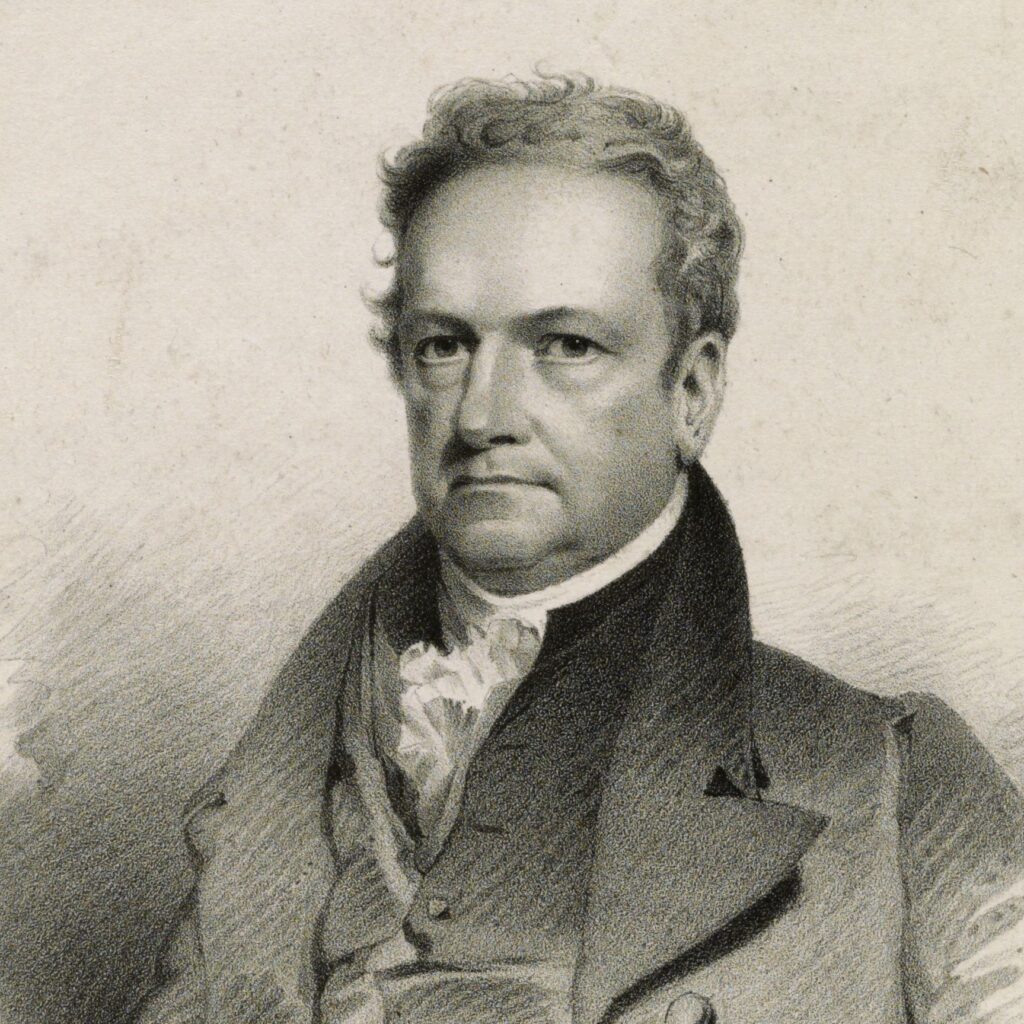
Colden’s good pal DeWitt Clinton
Advantageous Friendships
Colden was a different man from his ancestor; he even fought against the British as a colonel of volunteers in the War of 1812. Surprising given his lineage, Colden was for many years considered a Federalist, the party of Alexander Hamilton. However, he considered as one of his closest friends a rather unlikely ally — anti-Federalist DeWitt Clinton.
How they met probably had less to do with political alliances than membership of a rather notable society — the Freemasons.
In fact, Colden and Clinton were members of the city’s most influential — and still active — Holland Lodge. Within a few years, this affiliation would be political poison, with anti-Freemason candidates characterizing the secret organization as above the law and morally corrupt.
View of North Pearl Street just north of State Street in Albany (1800s), painting by James Eights
Clinton would use his influence to install his friend in the job in 1818, but not without Colden sustaining a little political injury.
One evening, Colden was in Albany and was invited inside a tavern for a glass of wine. He suddenly realized he was in a room filled with members of Tammany Hall, political enemies of the Federalists.
Immediately they pounced, urging him to not seek the mayor appointment. But no, he cried!
“He exclaimed energetically against the trickery, declaring that he had not asked for the office of Mayor, but would only accept it if offered.”
When Clinton did grant him the job, Tammany made sure to make life difficult for him. For the entirely of his three one-year terms, Colden became a pawn in the battle between Governor Clinton and the ascendant Democratic machine.
Colden began work in the spanking new City Hall, the fourth mayor for the new building after Jacob Radcliffe, John Ferguson and, of course, DeWitt Clinton.
Pigs and Prison Reform
First on Colden’s agenda: all those pigs running around.
He declared, “Our wives and daughters cannot walk through the streets of the city without encountering the most disgusting spectacles of these animals indulging the propensities of nature.”
Animals were penned up and steep fines charged to butchers who kept pigs unproperly supervised.
Colden also took a crack at the city’s deeper social problems. Indeed he was governing over a growing city, population 123,706 as of 1820. With a big city came big city problems — poverty, crime, homelessness.
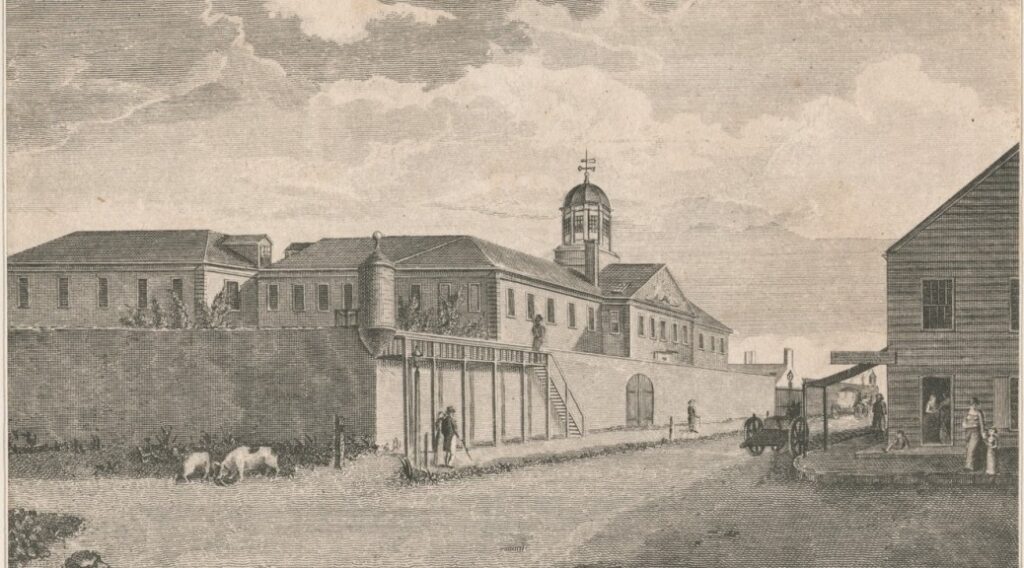
Newgate Prison. Image courtesy New York Public Library
The New York Society for the Prevention of Pauperism, led by the mayor himself, investigated prison conditions throughout the young nation to come up with a local solution.
Colden proclaimed, “It must be obvious that under such circumstances it would be in vain to expect that their punishment will improve their morals: it can hardly fail to have a contrary effect.”
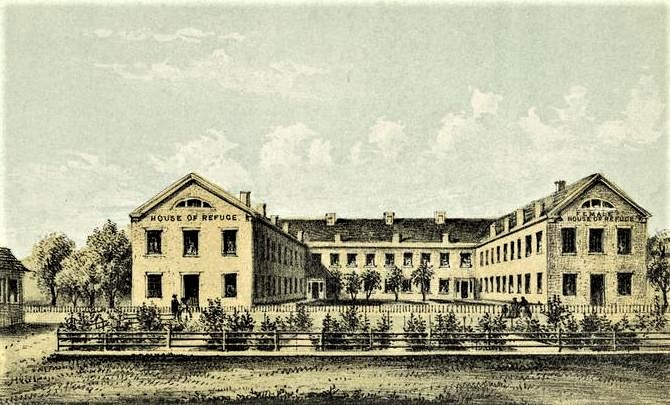
The mayor set the stage for an innovative experiment: New York’s House of Refuge, in an arsenal at Broadway and 23rd Street, essentially a reform school, built to incarcerate children age 16 and younger.
It later opened in 1825 (after Colden left office) with six boys and three girls as its pupils, many of them guilty only of homelessness and essentially kept here until adulthood. By the early 1830s, the House of Refuge would receive over 1,600 teenagers.
A ‘Kindly’ Anecdote
Like many mayors to follow, Colden also clamped down on liquor sales, even carrying around a ‘red book’ to notate violations and overheard complaints of local tavern owners.
Naturally, Colden would rally behind Clinton’s most ardent cause — the Erie Canal. It opened in 1825, after Colden left office, but his support did indeed pave the way for New York to become, in his own words, “one of the greatest commercial cities in the world.”
He was aristocratic, class-oriented but ultimately open hearted, they say. A reminiscence in the 1843 journal New Mirror quotes this certainly apocryphal story about the mayor’s ‘kindness’.
One rainy night on his way to a dinner party, Cadwallader stepped up to a ‘hackman’, a type of carriage taxi, for a ride.
The driver, “who had some old grudge against Mr. Colden,” rudely sped away, leaving the passenger on the curb. He jotted down the cab driver’s number and summoned him to City Hall.
“Poor Pat (for of course he was Irish)” as the article indicates, “went up the stairs, trembling at the fate which awaited him. When the mayor demanded to know why he was treated so rudely, the driver proclaimed,”you see I looked in your face, and, faith, you looked so like a jontleman I drove twice before that never paid me, I was afraid to thrust him agin!”
Colden laughed, exclaiming, “Your wit has saved you this time!” and excused the driver.
Aligning with Clinton eventually became a bad idea. When Clinton was turned out of the governor’s office, so too was Colden from the mayor’s office. But he still remained popular with New Yorkers, becoming a U.S. congressman, then a member of the New York state senate in 1825.
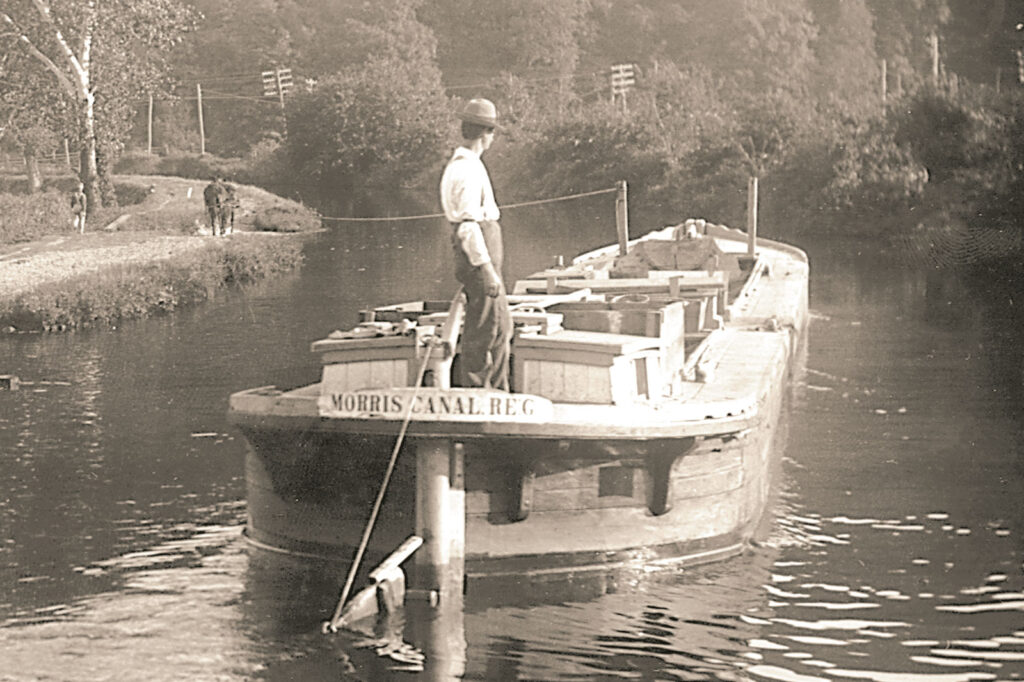
In later life, he engaged in a couple unusual endeavors. The first was the construction of the Morris Canal in northern New Jersey, a conveyor of coal that operated for over a century.
And in 1830, he briefly indulged in the hobby of horse racing, taking over the Union Course in Woodhaven, Queens. The closest you’ll get to visiting Colden’s racetrack is visiting Neir’s Tavern, the oldest tavern in the borough.
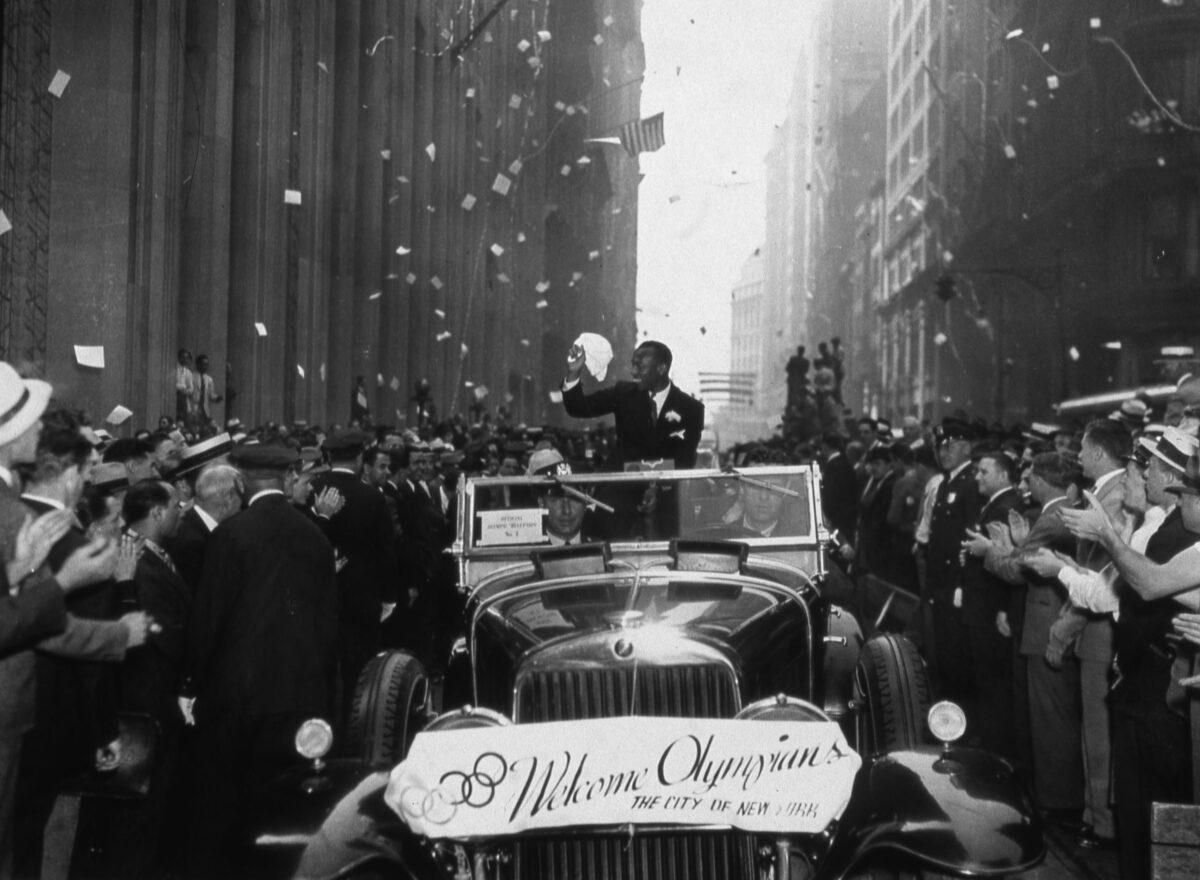
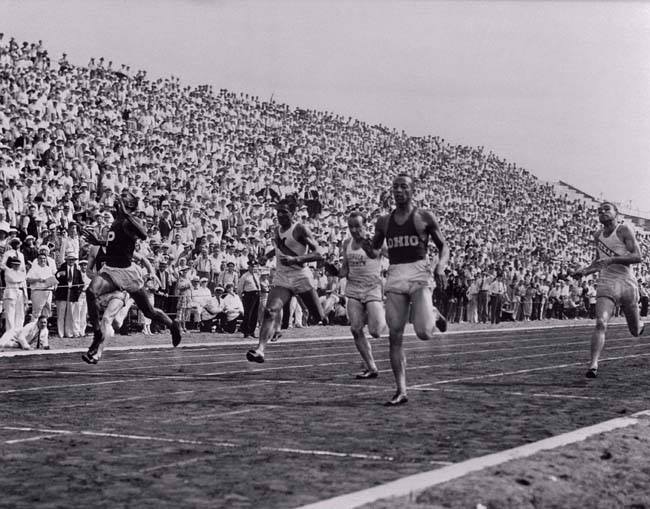
Olympic gold medalist Jesse Owens receives a ticker-tape parade through lower Manhattan, September 3, 1936. (Photo by Transcendental Graphics/Getty Images)
OLYMPICS ROUNDUPStarting today Tokyo, the biggest city in the world, will host the Games of the XXXII Olympiad aka the Tokyo Olympics 2020 (in 2021). The Japanese city first hosted the games back in 1964.
New York City, the biggest city in the United States, has never hosted the Olympics Games.
The city did aim to host the 2012 Olympics in an ultimately unsuccessful bid back in 2005. Those games went to London.
Alas.
A great many New Yorkers were quite happy to be without that international sporting event in the city. Personally, I would have loved to have seen New York become even more international for a few weeks, although I’m relieved that plans for that catastrophic Olympic Village in Queens were never realized.
Outside of that, the closest the city has ever gotten to the Olympics is a little under 300 miles — the distance from New York to Lake Placid, which hosted the 1980 Winter Olympics.
Those games featured the now-storied ‘Miracle on Ice‘ match between the USA and the USSR.
But did you know that the Russian team completely iced the US team just a few days earlier in an exhibition game played at Madison Square Garden? You can read more about that in my article ‘No Miracle on Ice’ from February 2010.
Although New York has never hosted the Games, when it comes to events before and after the Olympics, New York City’s all over them.
Randall’s Island
Randall’s Island has hosted several Olympic trials, including one of the most famous at all, the track and field events from 1936 which produced sports legend Jesse Owens.
You can hear all about it in one of our very early podcasts onthe history of Randall’s Island and the 1936 Olympic Trials.
Astoria Pool
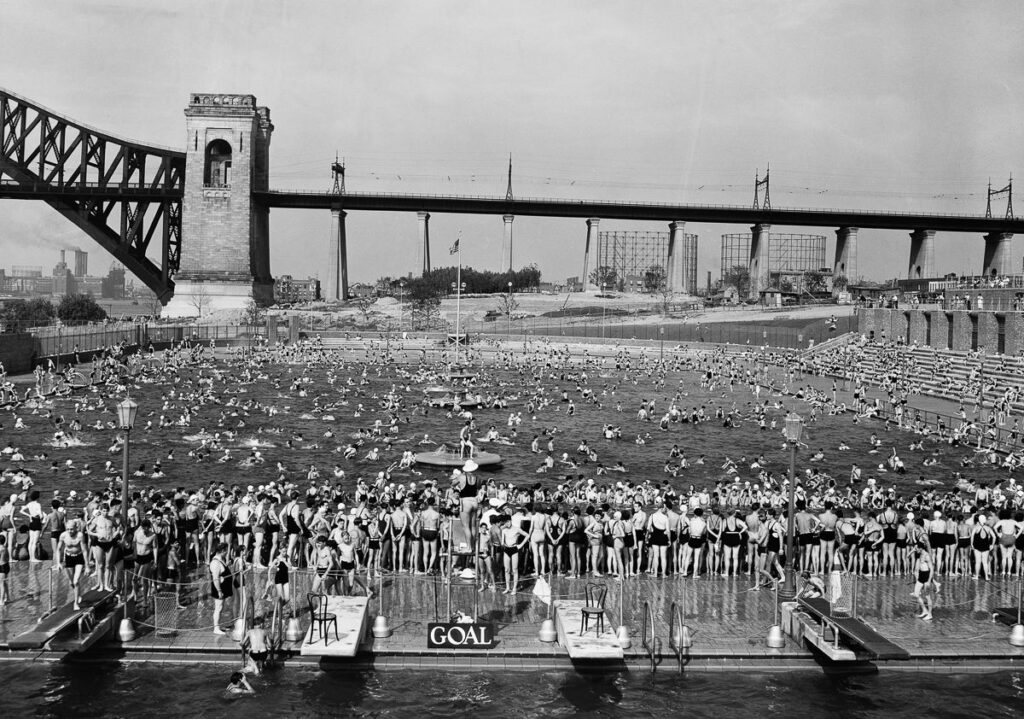
Around the same time, Robert Moses commissioned Astoria Pool with the explicit purpose of hosting Olympic swimming trials.
That 1936 event, featuring its dramatic diving platform, produced several American gold medalists. Two massive Olympic torches stood astride the pool as competitors fought for a spot on the Olympic team.
Olympics trials returned to Astoria Pool in 1952, and again in 1964, producing athletes that again nearly swept the diving events in the Tokyo games.
SwimmerDon Schollanderwent on to win 4 golds that year, the most of any athlete in 1964 and the most medals won by an American athlete since Jesse Owens.
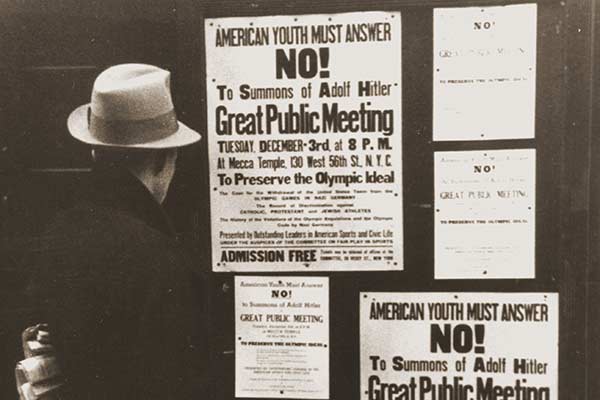
Of course, a great many New Yorkers were entirely unhappy with any participation in the 1936 Olympic Games, given that they were being held that year in Berlin, in the heart of Nazi Germany.
A concerted effort by politicians (including Fiorello LaGuardia), religious leaders and athletes to boycott the games was met with defeat, but in the summer of 1936, a group of Jewish athletes competed in a ‘counter-Olympics’.
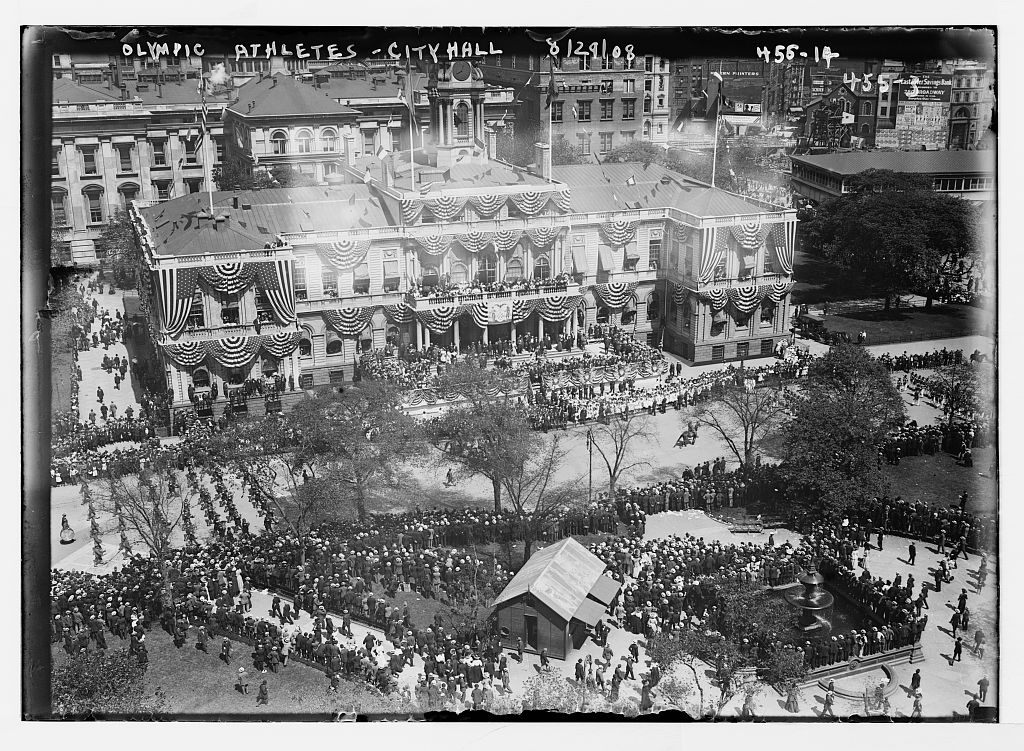
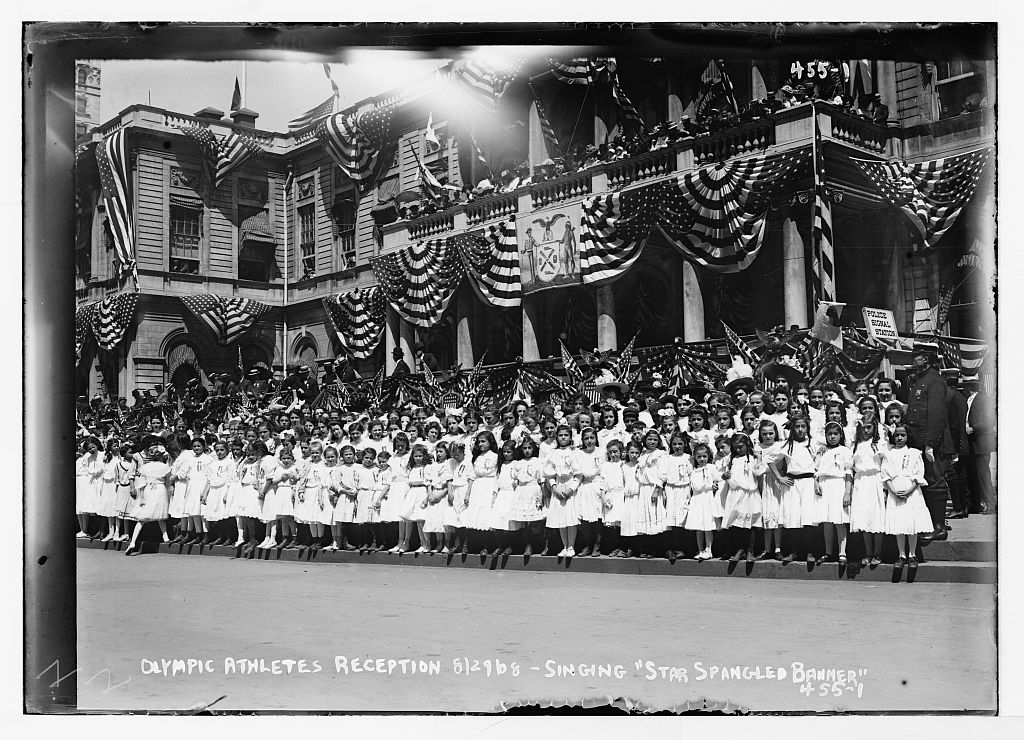
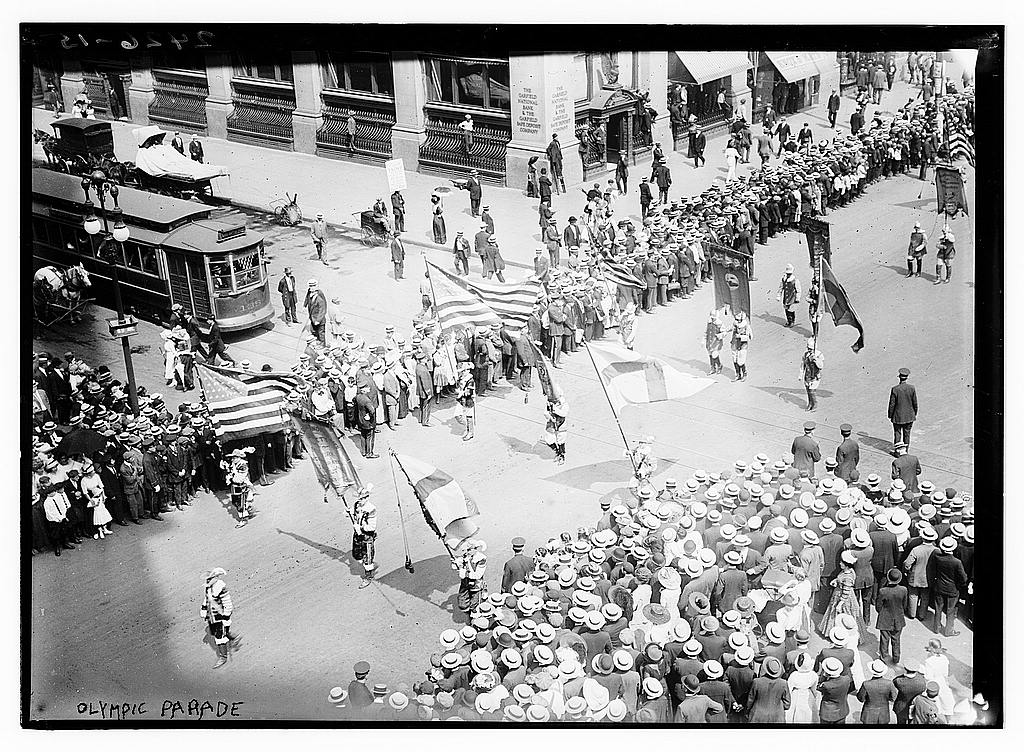
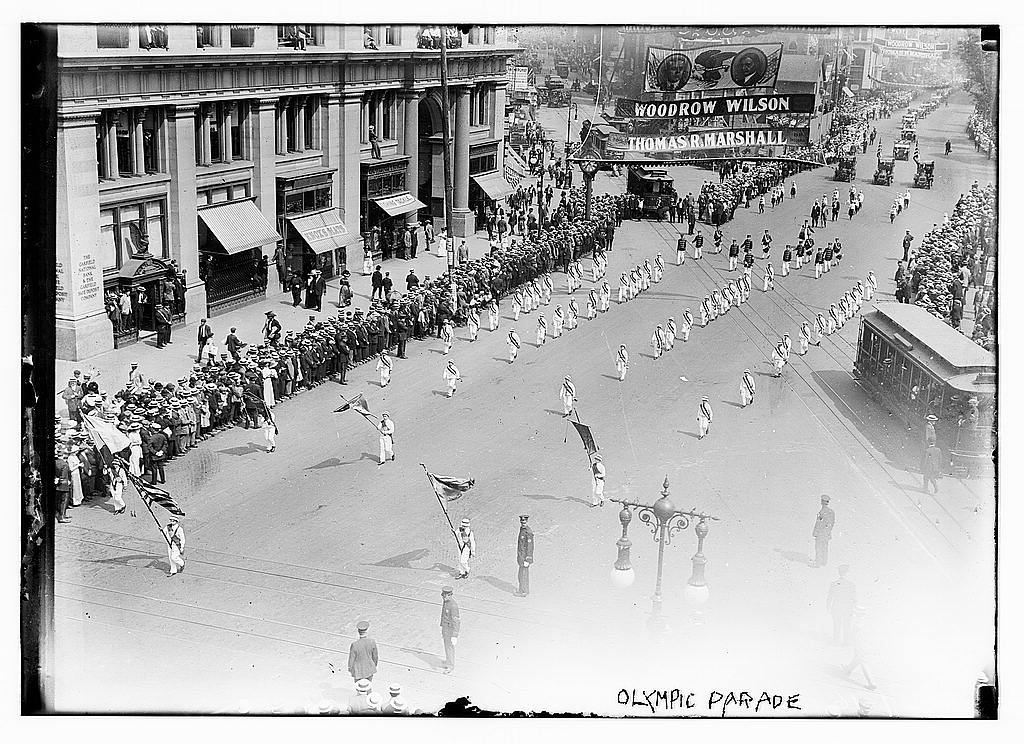
And finally, here are some pictures of two glorious receptions of American Olympians held in New York — after the 1908 games (in London) and the 1912 games (in Stockholm).
Photo showing an event in New York City related to the 4th Olympic Games, held in London, England, in 1908. Library of CongressPhoto showing an event in New York City outside City Hall, related to the 4th Olympic Games, held in London, England, in 1908. Library of CongressPhoto showing a parade in New York City related to the 5th Olympic Games, held in Stockholm, Sweden, in 1912. Library of CongressPhoto showing a parade in New York City related to the 5th Olympic Games, held in Stockholm, Sweden, in 1912. Library of Congress
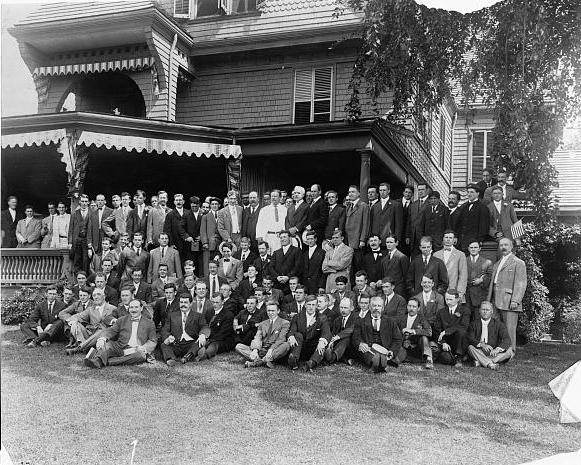
And finally, here’s a swell photograph — no other adjective to describe it — of the U.S. Olympic team from 1908, posing with President Theodore Roosevelt at his home in Sagamore Hill, Long Island.
PODCAST REWIND A story almost four hundred years in the making — and a place at the center of modern New York political life.
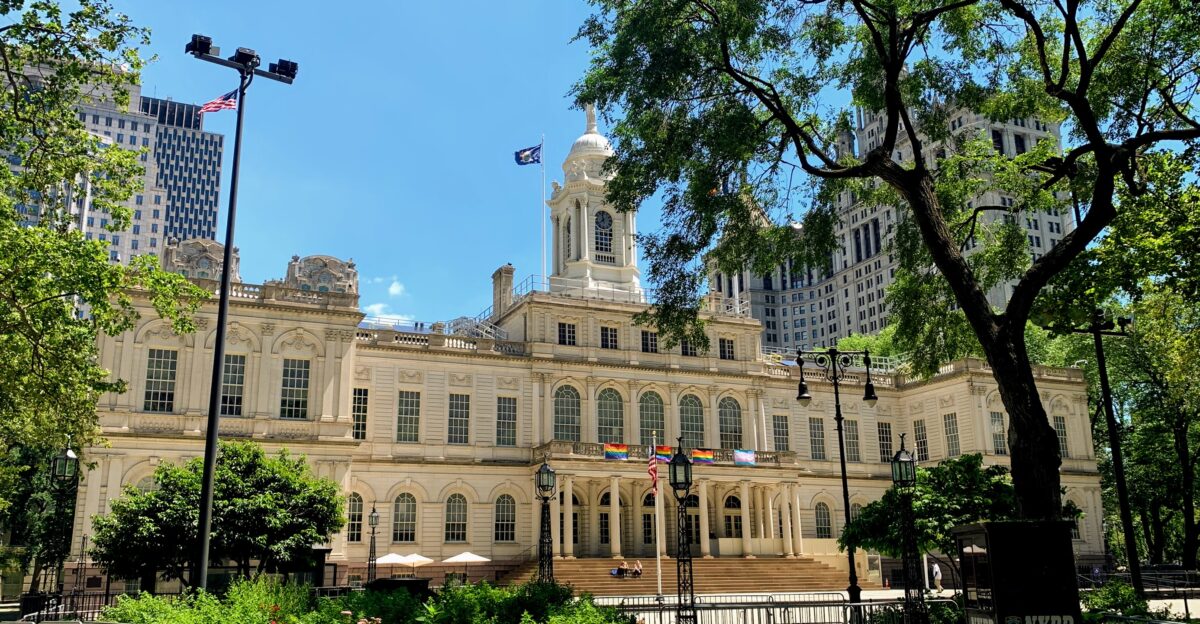
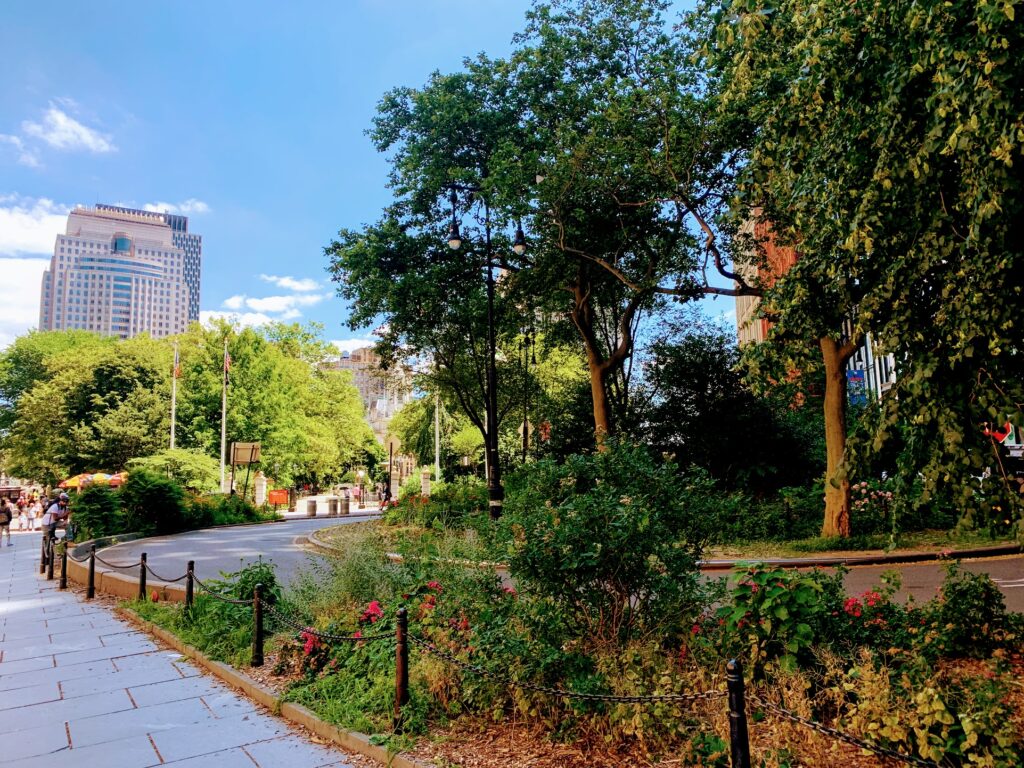
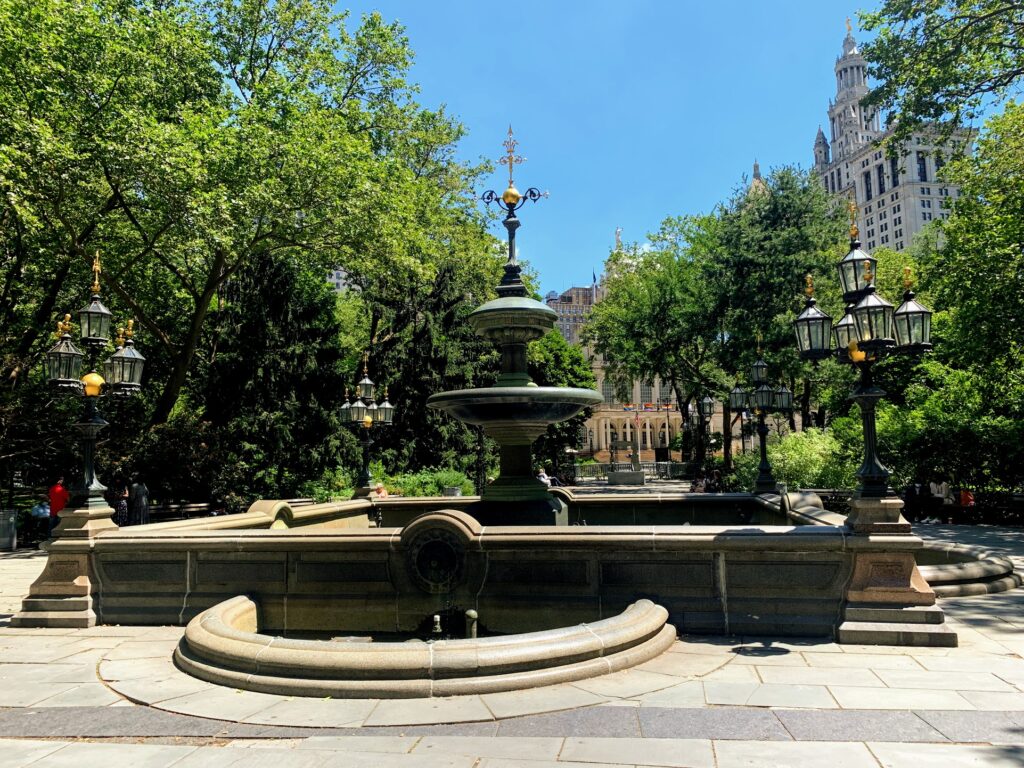
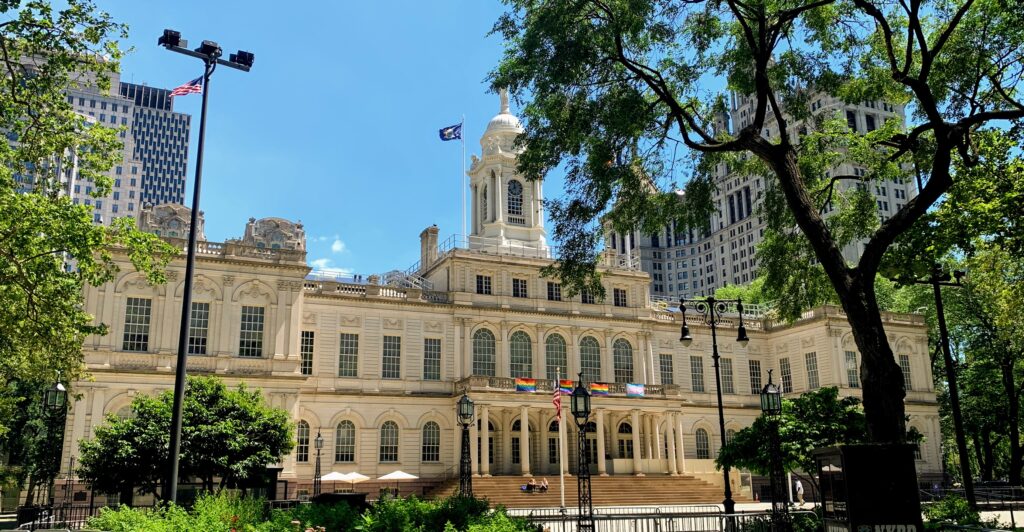
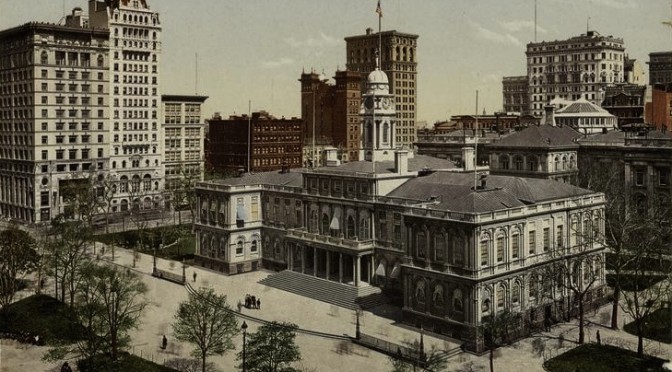
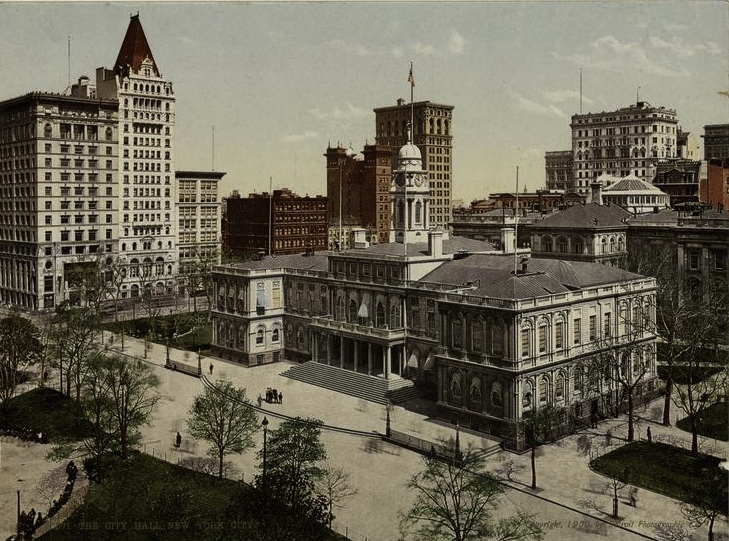
New York City Hall sits majestically inside a nostalgic, well-manicured park, topped with a beautiful old fountain straight out of gaslight-era New York.
But its serenity belies the frantic pace of government inside City Hall walls and disguises a tumultuous and vigorous history.
There have actually been two other city halls — one an actual tavern, the other a temporary seat of national government. The present city hall — first used in 1811 and completed the following year — is one of New York City’s greatest treasures.
Join us as we explore the unusual history of this building, through ill-executed fireworks, disgruntled architects and its near-destruction by city planners.
PLUS: We look at the park area itself, a common land that once catered to livestock, liberty poles, almshouses and a big, garish post office.
This is a reedited and remastered version of episode #93 featuring an all-new, very special ‘Choose Your Own Adventure’ challenge at the end.
Listen Now: The Historic New York City Hall
The Bowery Boys: New York City History podcast is brought to you …. by you!
We are now producing a new Bowery Boys podcast every other week. We’re also looking to improve and expand the show in other ways — publishing, social media, live events and other forms of media. But we can only do this with your help!
We are now a creator on Patreon, a patronage platform where you can support your favorite content creators.
Please visit our page on Patreon and watch a short video of us recording the show and talking about our expansion plans. If you’d like to help out, there are six different pledge levels. Check them out and consider being a sponsor.
We greatly appreciate our listeners and readers and thank you for joining us on this journey so far.
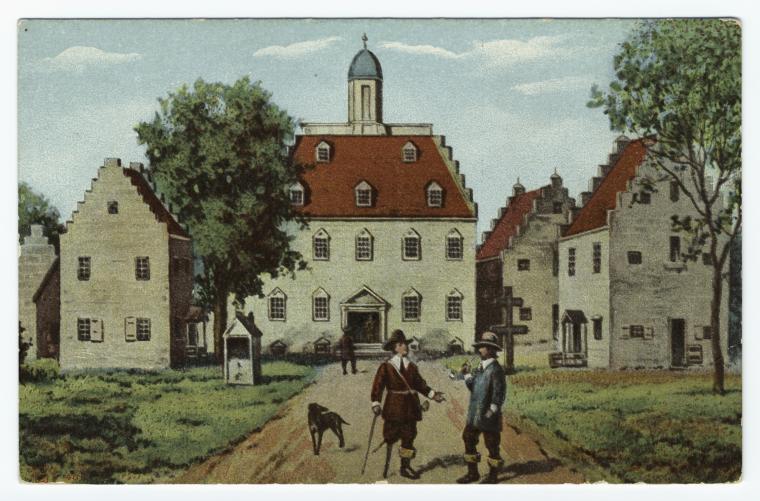
I’ll Drink To That: Stadt Huys, New Amsterdam’s town hall, was a multi-purpose stone building housing an inn, a tap room on the first floor and the workings of city government on the second floor. The building was the government center even when the British arrived and would only be replaced in 1700.
Today on Pearl Street (near Stone Street) one can find the exact spot where the Stadt Huys once stood, marked by beige-colored bricks.
Photo by Greg Young
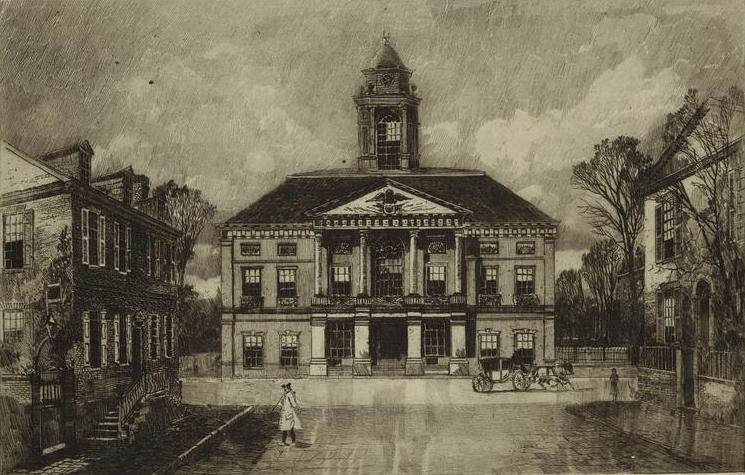
Federal Style: The second city hall, made with stones from the actual ‘wall’ of Wall Street, would be a bustling overstuff building and central to the beginnings of American history.
For a couple years, as Federal Hall, it was the center of federal government; the votes for George Washington as the first president were counted here and he was sworn in from the balcony.
New York Public Library
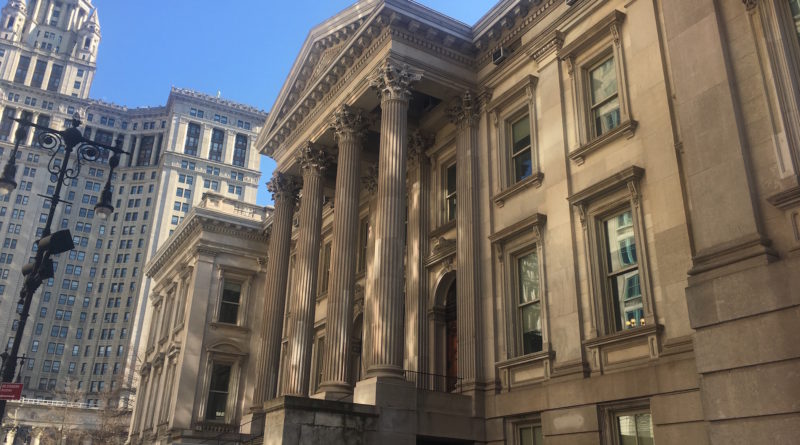
The old City Hall/Federal Hall was torn down in 1812. Three decades later the U.S. Custom House was constructed here, and today it is called Federal Hall.
Photo by Greg Young
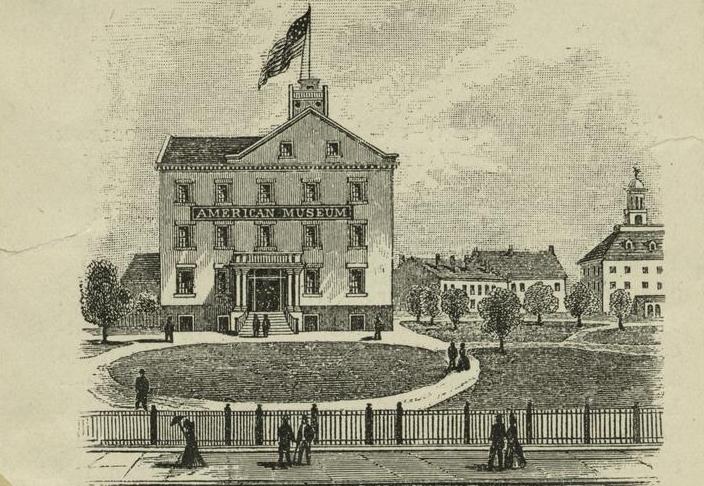
Park Purposes: Before City Hall arrives, the common ground held several buildings, includin almshouses and debtors prisons (depicted in the background) and an early version of the American Museum (which evolved to become Barnum’s American Museum).
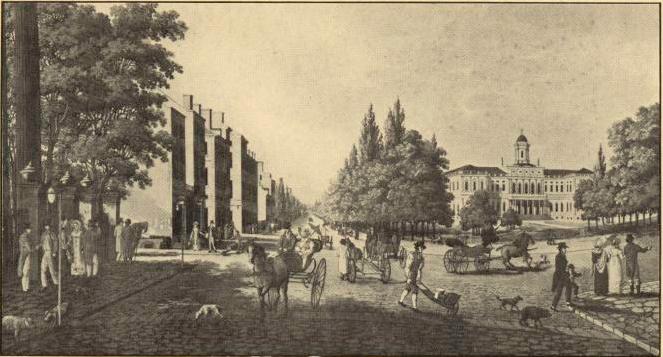
There Goes The Neighborhood: The image below depicts life in the year 1820. With the introduction of a shiny new City Hall, lavish rowhouses begin springing around the park, housing New York’s elite. Just a few years before, they would have faced into almshouses.
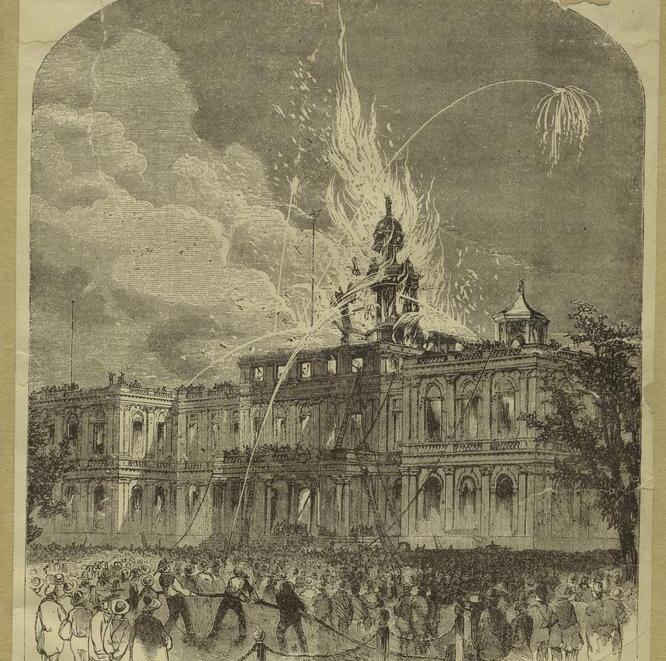
D’oh!: Wanna know one really good reason why we don’t shoot off fireworks in the middle of the city anymore? One robust fireworks celebration, honoring the laying of the Atlantic cable, caught the roof of City Hall on fire in 1858, causing extensive damage.
New York Public Library
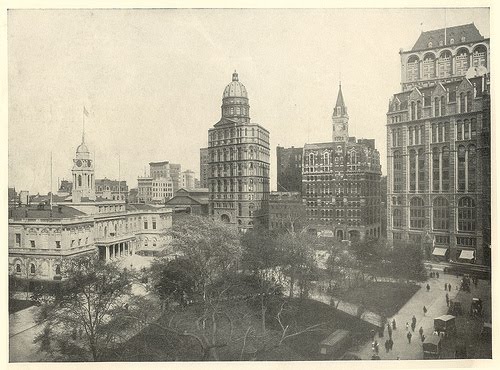
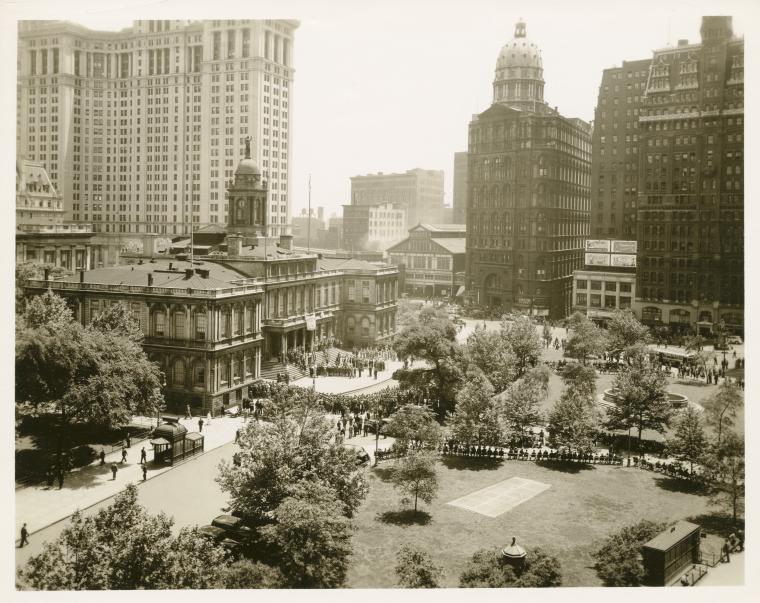
The City Grows Up: New York’s growth spurt starts around City Hall Park, with a few new skyscrapers becoming the tallest buildings of their times, including the World Building (pictured at center), the Park Row and St. Paul buildings (just south), and the Woolworth Building, on the park’s west side.
The Municipal Building joins it a few years later….
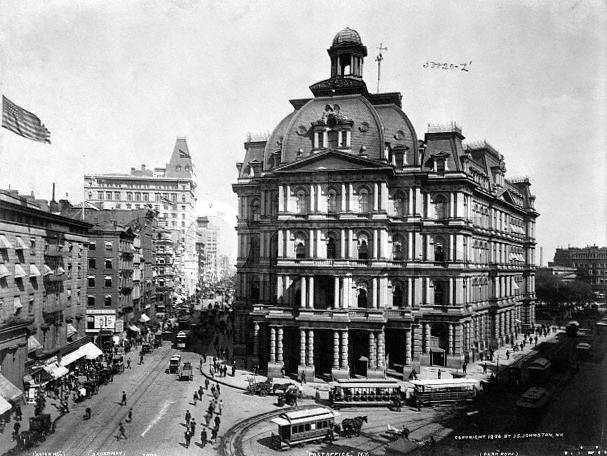
Post Haste: The City Hall Post Office sat on the southern end of City Hall Park.
The front of the Post Office, entirely consuming the area that is today’s southern end of the park and adjoining traffic triangle.
Photo by Greg Young
The Jacob Wrey Mould Fountain, first placed in City Hall in 1871. During the 1920s it was dismantled and shipped to Bronx, but returned to the park in 2000.
Photo by Greg Young
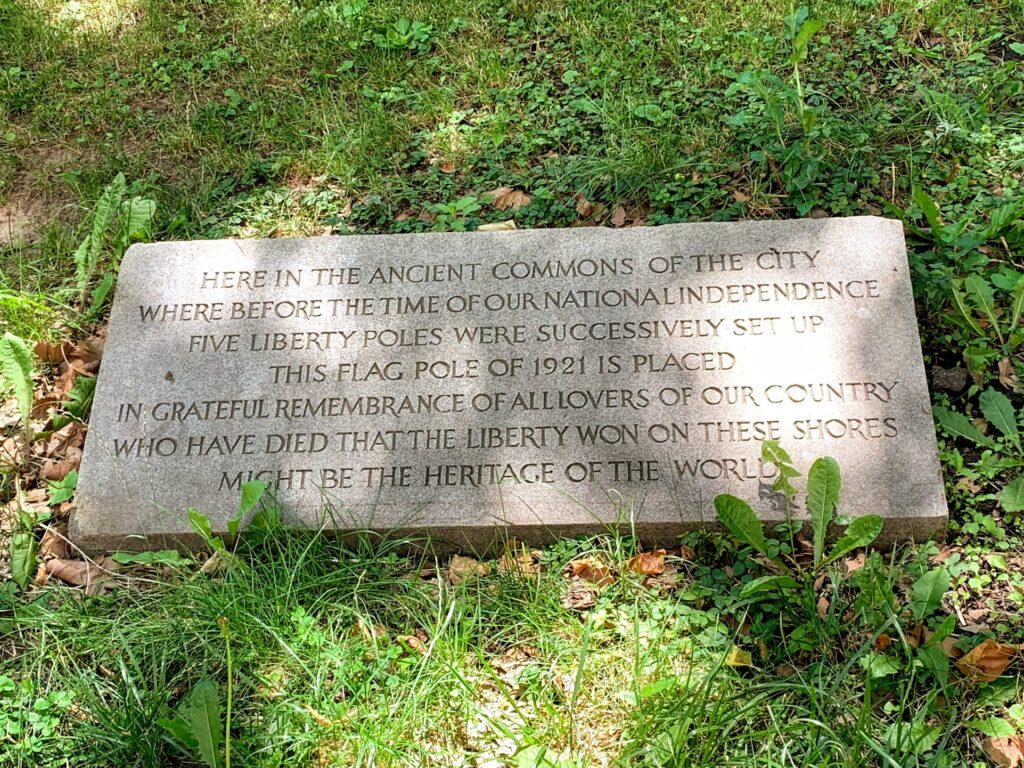
Plaque on the western side of City Hall Park:
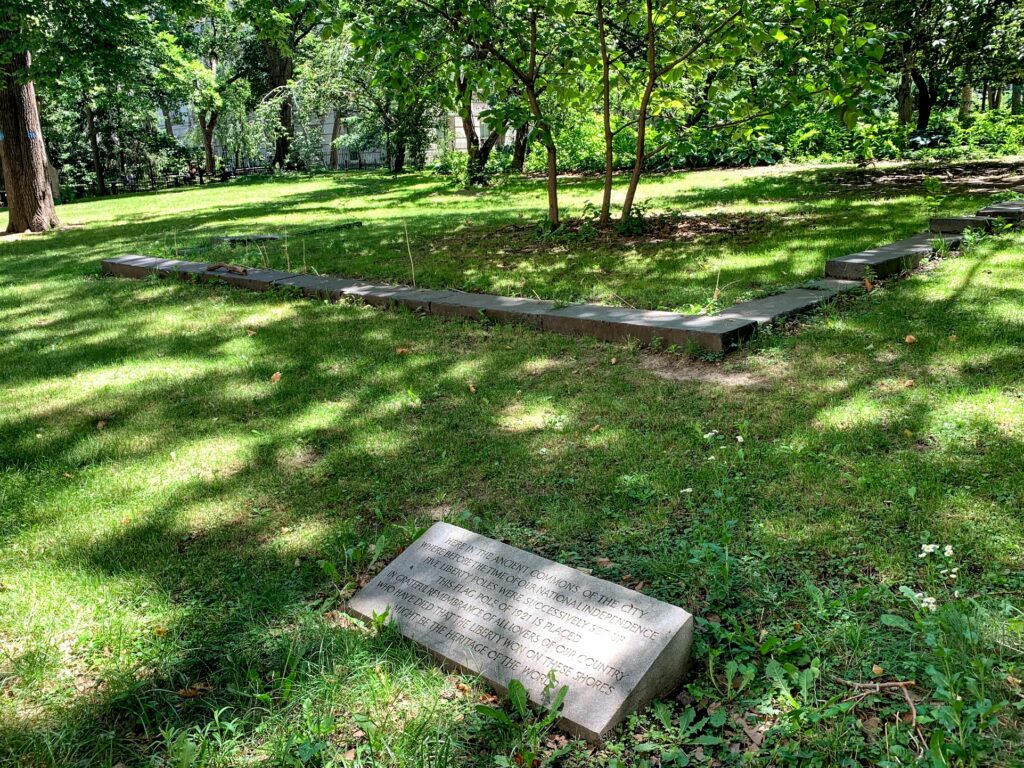
Stones mark the site of Bridewell Prison:
Photo by Greg Young
FURTHER LISTENING:
After listening to this show on the history of New York City Hall check out these shows with similar themes and historical moments mentioned in this show:
With a new mayoral race on the horizon in New York City we think it is time that you Know Your Mayors! Become familiar with other men who’ve held the job, from the ultra-powerful to the political puppets, the most effective to the most useless leaders in New York City history.
This longtime feature of this website is being rebooted with new articles and newly researched and refreshed earlier entries in this series. Check back each week for a new installment.
Edward Livingston Term: 1801-1803 The Mayor Who Went On To Do Better Things
On the spectrum of interesting folks who have occupied the mayor’s seat, Edward Livingston must certainly be noted as the defining example of turning your life around.
In 1801Livingston became the mayor of New York City. Two years later, he left the job in total disgrace, run out of the city due to a financial scandal. He would never work in this town again.
And then things got really interesting.
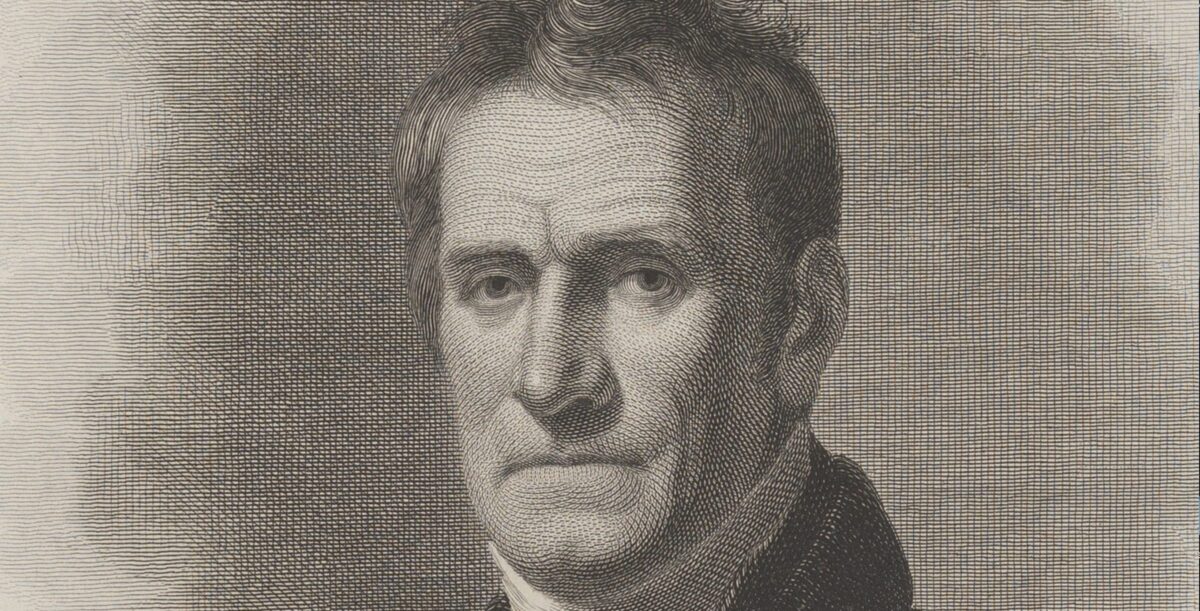
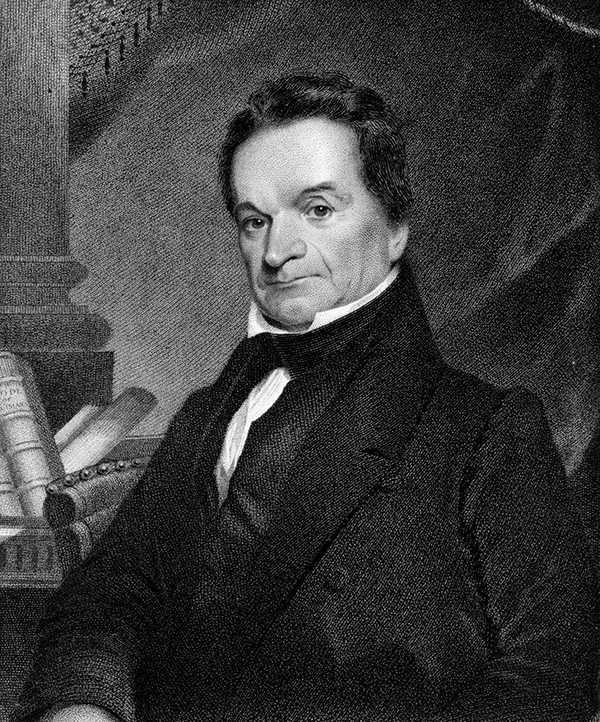
Edward Livingston. Wellmore, E (Engravor) &Longacre, J. L. (Illustrator) Courtesy Library of Congress
Life With The Livingstons
Livingston, born in 1764, was a member of the rich and powerful Livingston clan. There were Livingstons in all aspects of American life — political, social, financial. It was as close as you got to a brand name in the Colonial era.
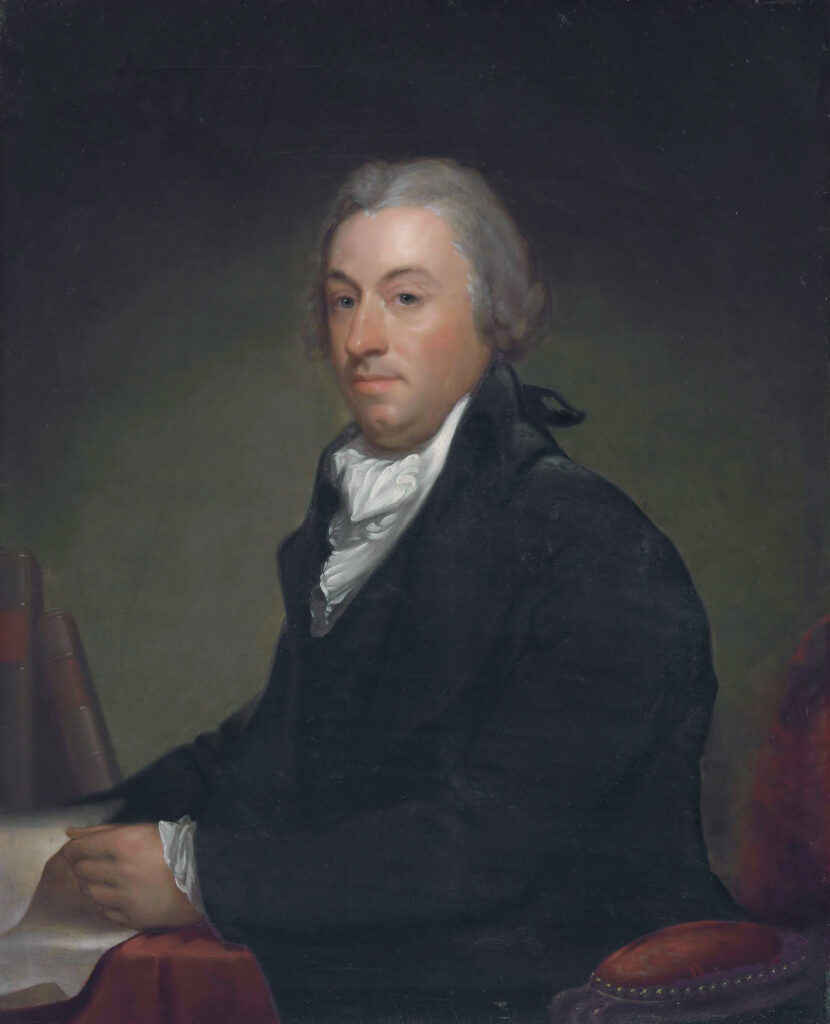
Edward benefited from this common ancestry. He was just eleven years old when his father Peter Van Brugh Livingston became president of New York’s First Provincial Congress in 1775. Another relation Philip Livingston signed the Declaration of Independence in 1776. And Edward’s older brother Robert Livingston (pictured below) would become New York chancellor.
Robert R. Livingston, in a painting by Gilbert Stuart
Young Edward barreled into his career, an ambitious lawyer who settled in New York following the Revolutionary War. Everybody knew his name; he was unsurprisingly a great success. What could go wrong?
Rising Star
In 1795, Beau Ned (as he was called) was elected to represent New York in the U.S. House of Representatives, aligned with the ascendent Democratic-Republican Party, putting him in good graces with Thomas Jefferson, New York Governor George Clinton and various politicians in opposition to the Federalists.
The mayor of New York at that time — Ricard Varick — was a Federalist.
WhenJeffersonwon the presidency in a hotly contested election in 1800, Edward Livingston found himself on the right side of many lucrative political appointments.
In 1801, the governor chose him for U.S district attorney and then, a few months later, Livingston was also appointed mayor. (See entries on Varick and James Duane to understand why these men were even allowed to hold multiple jobs.)
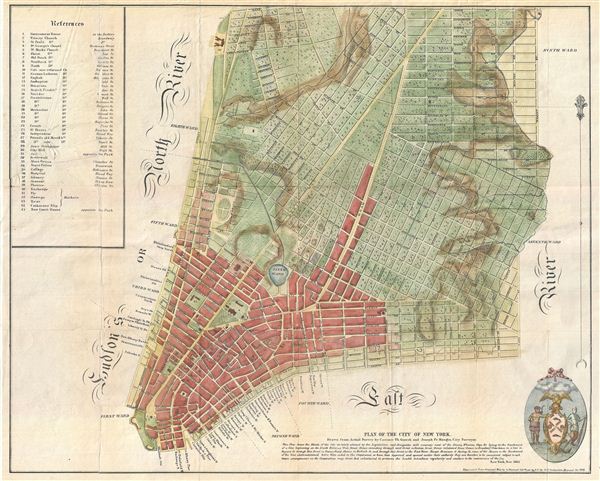
An 1801 map of New York, overlaid with a grid plan proposed by Casimir Goerck and Joseph-François Mangin. This plan was never carried out but it would inspire the Commissioners Plan of 1811.
A Hot Time In The Old Town
Suddenly, Livingston had become mayor of the biggest city in the new nation — a whopping 60,482 according to that year’s census. His opposition to the policies of former president John Adams served him well for a time under the new auspices of a Jefferson presidency.
But the year 1801 in New York was undeniably a volatile one and post-war optimism had given way to bitter skepticism and political chicanery.
New York senator Aaron Burr, Jefferson’s running mate, was nearly voted president in an electoral-college snafu.
Jefferson’s nemesis Alexander Hamilton— who would later be shot and killed by said running mate — would baste his thoughts in the newly created New York Evening Post.
Nearby, a young aide named Washington Irving worked in a law office.
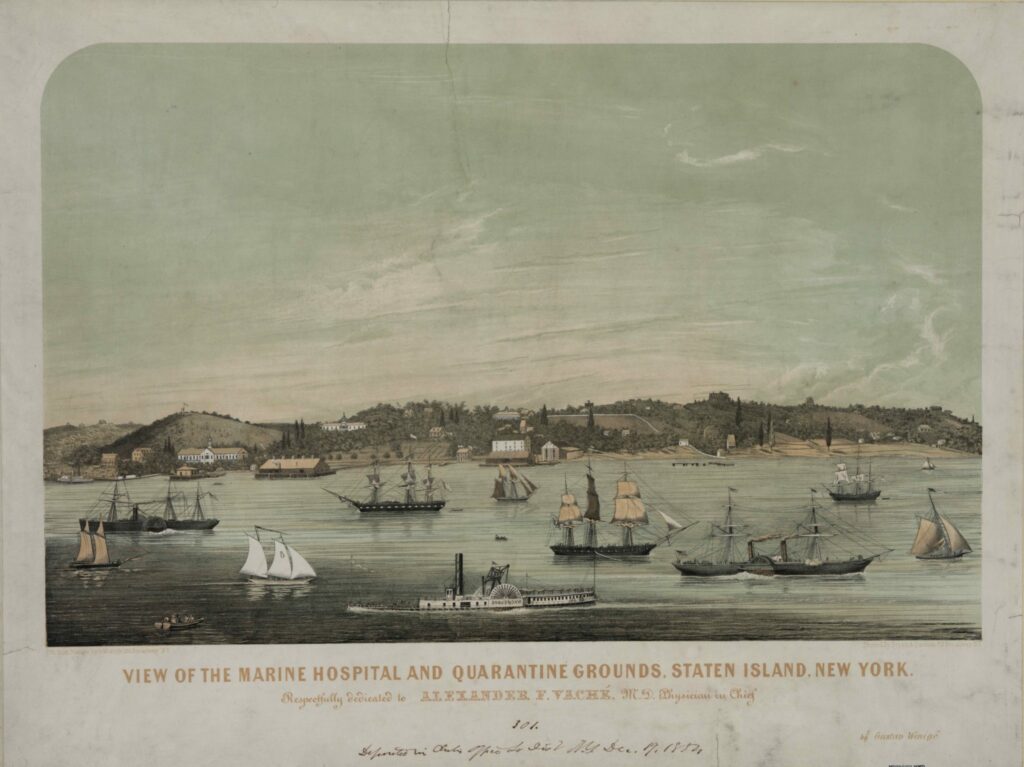
In 1799 New York City built a quarantine station in Staten Island for the treatment of people afflicted by yellow fever and other illnesses. (Image courtesy New York Public Library)
A City Sickness
Unfortunately for Livingston the early 1800s were simply not a great time to be living in New York City. In fact, during his tenure, Edward Livingston almost died of yellow fever.
In 1803, a second epidemic hits New York and hits hard. Hundreds would die, thousands would flee. The stoic Livingston would manage to keep the city operating, even as he himself would become sick and nearly die.
In Disgrace
He recovered only to meet with a scandal that would nearly ruin him.
In the summer of 1803, it was discovered that $45,000 had gone missing from the city’s custom-house fund. While it was determined that a clerk from the district attorney’s office had actually stolen the money, it was Edward Livingston who took the hit politically.
“Although his own integrity was not in question,” according to the book Gotham, the ensuing scandal not only forced Livingston to give up both the state attorney job and the mayor’s seat, but he actually had to sell his property to repay the government.
Livingston had disgraced the family name.
1803 view of New Orleans, looking upriver from the Marigny Plantation House, by J. L. Bouquet de Woiseri
The Ultimate Second Act
Nearly penniless and humiliated, Edward decided to leave New York for good in 1803.
Penniless but not, of course, without family connections.
In 1804 moved to New Orleans, recently purchased from the French by the federal government as part of the Louisiana Purchase. The team negotiating that deal included James Monroe — and Edward’s older brother Robert Livingston.
During the War of 1812, Edward was active in the defense of New Orleans and even served as the aide-de-camp to General Andrew Jackson. The two became close friends.
By 1826, Livingston was successful enough again with his own law practice in New Orleans that he was able to pay back the government all the money he owed plus interest — or almost $100,000, no petty sum back then.
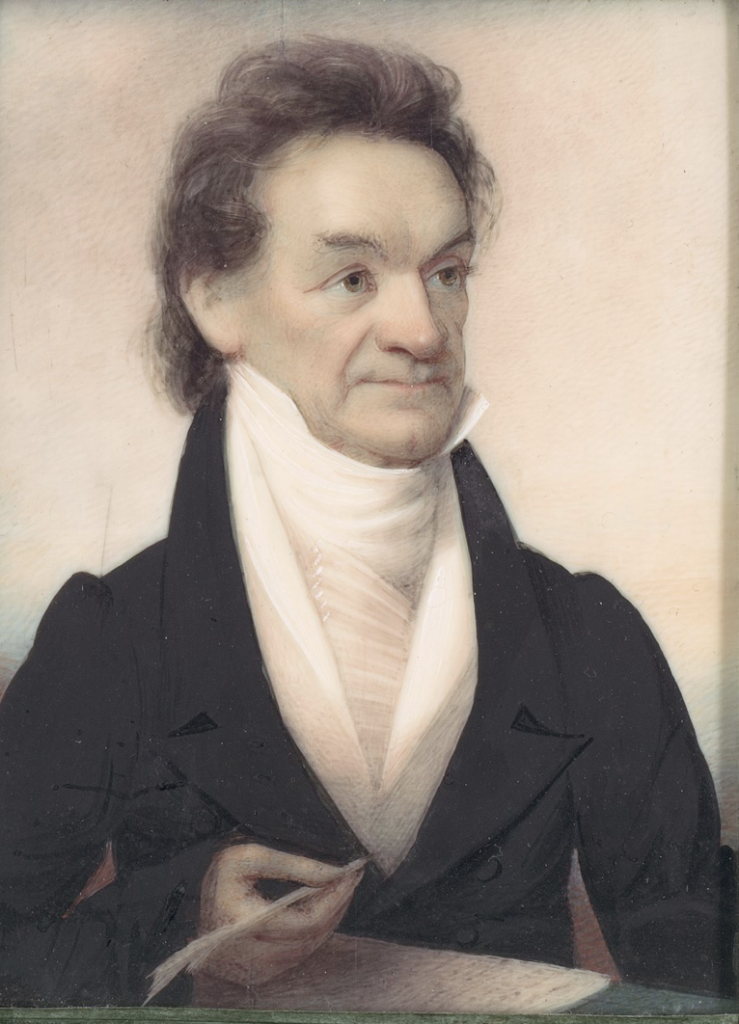
Livingston in 1827. Painting by Anson Dickinson
That same year, Livingston would shape American civil policy with a series of influential penal and judiciary codes for the treatment of prisoners, now referred to as the Livingston Code. While rejected by the State of Louisiana, the legal reforms would live on to shape ideals about incarceration and the death penalty.
Because of these reform codes, Edward Livingston is considered one of the great American legal geniuses of the early 19th century.
After notable stints as representative and a Senator for the State of Louisiana, he became a persuasive Secretary of State for President Jackson from 1831-1833. Edward Livingston died on May 23, 1836.
The Metropolitan Museum of Art contains a very unusual piece of art tied to the early history of City Hall. In fact, this piece is responsible for what is sometimes considered New York’s very first art museum — decades older than the Met itself.
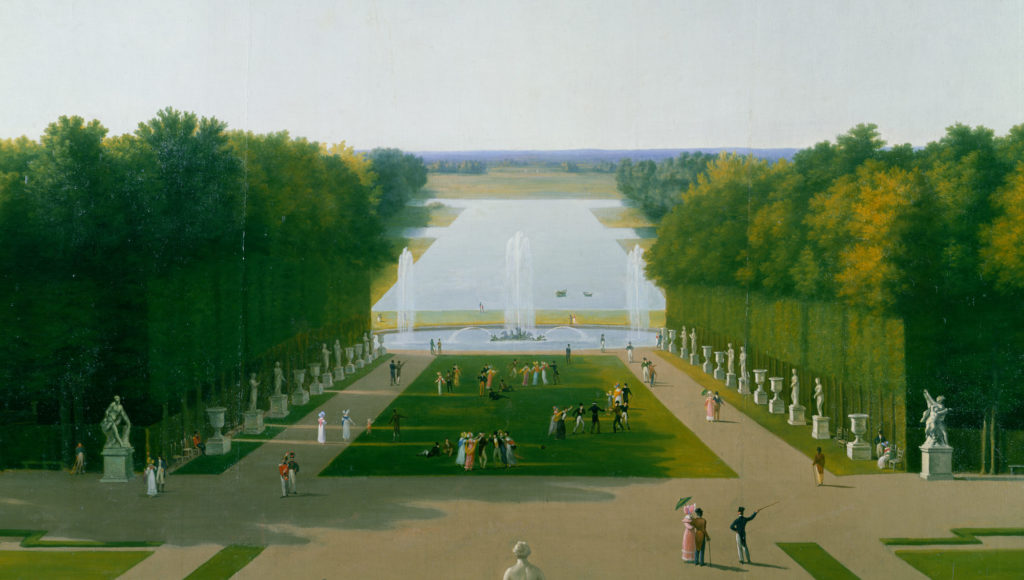
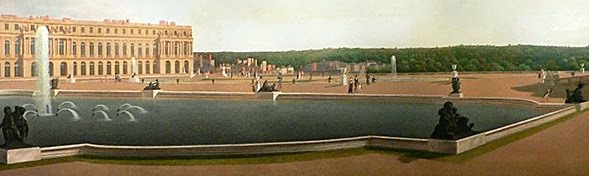
The strange oil painting is called Panoramic View of the Palace and Gardens of Versailles by John Vanderlyn (pictured below). Strange, because it’s a circular work of art, requiring its own room in the American wing of the Met, where it is broken into two pieces that immerse the viewer who walks between them.
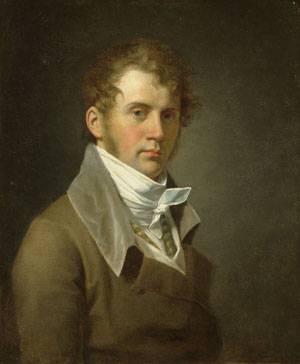
Vanderlyn was a painter of great renown at the start of the 19th century, despite being a protege and close friend of disgraced vice president Aaron Burr. He went on to create portraits of many great men of the age, including several presidents.
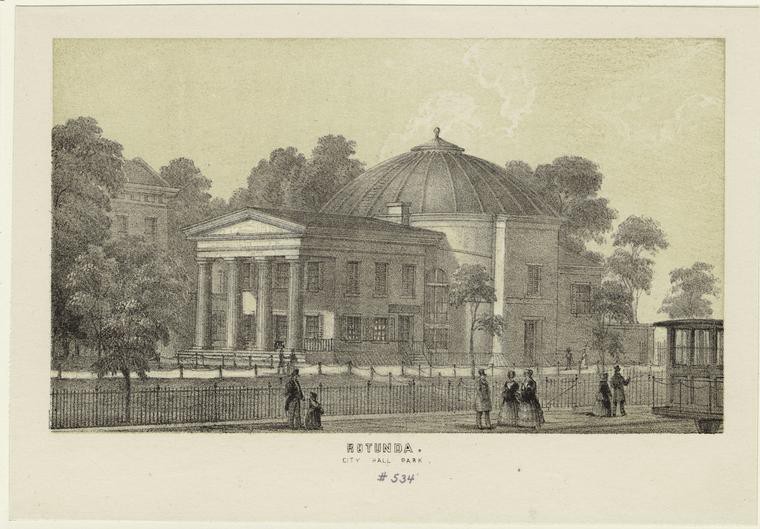
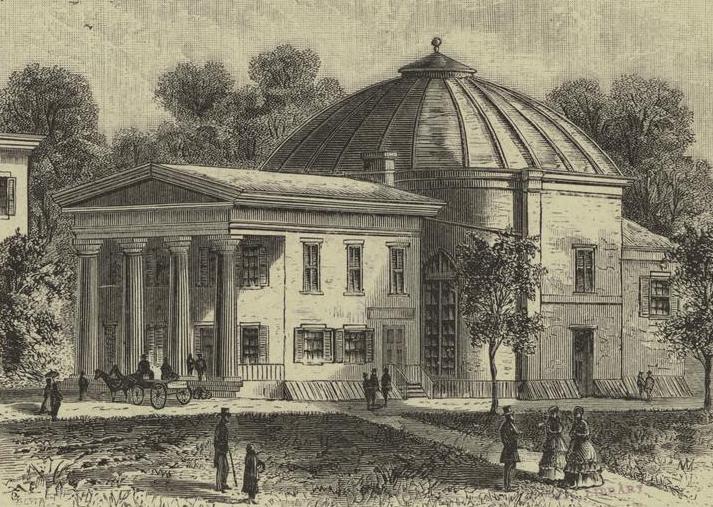
The artist painted the Versailles panorama in 1818 in his childhood home of Kingston, New York, about a 100 miles north of the city. With the support of some wealthy New York patrons (including John Jacob Astor), Vanderlyn received permission from the city to build a small rotunda in which to properly display this odd, grandiose canvas. And prime real estate it was, located just a few steps north of the newly built City Hall at Chambers Street and Cross Street (or, today’s Centre Street).
It was also next door to an abandoned almshouse; the residents of this facility had been shipped off to the newly created Bellevue Hospital by this time and the building’s hallways were filled with loftier organizations, like the New-York Historical Society and Scudder’s American Museum. Classy, and perfect for a neighboring vanity museum.
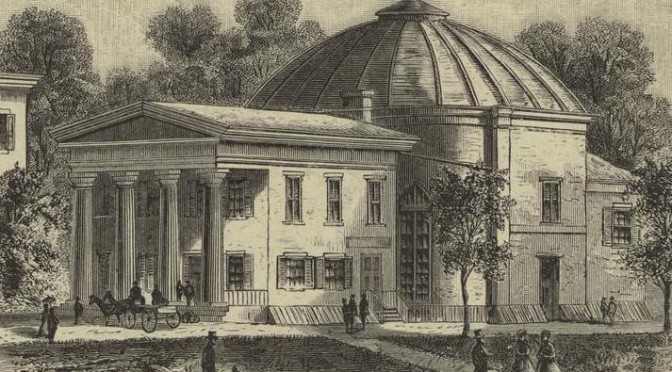
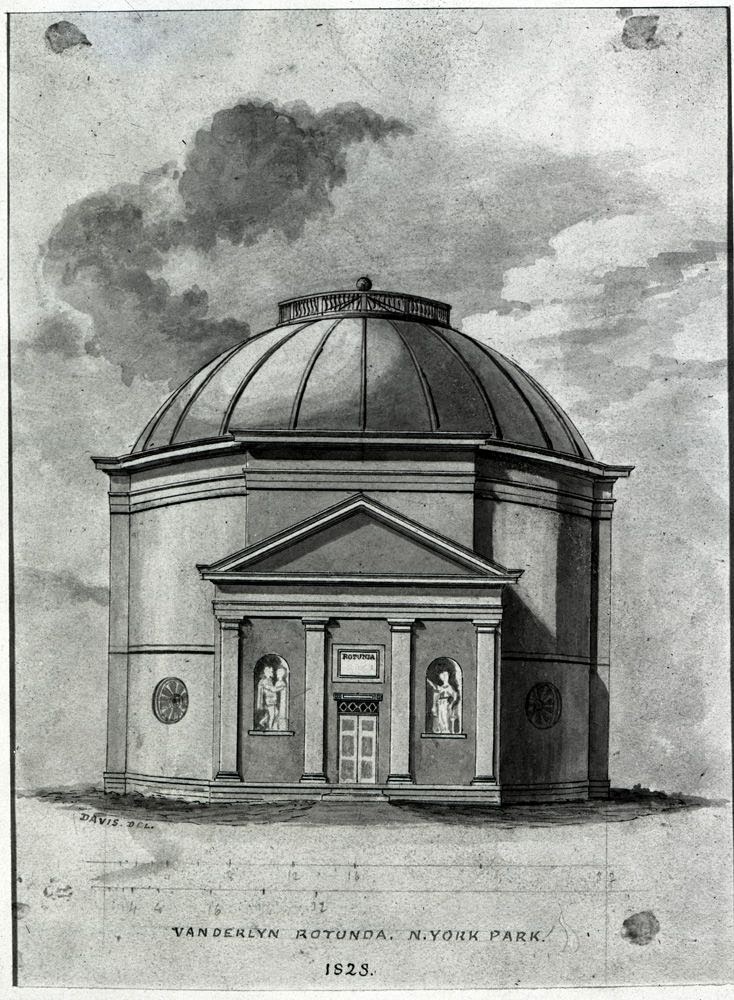
Vanderlyn’s self-designed gallery* was tiny but intense, a miniature Pantheon with domed roof 40 feet overhead. Uniquely, it was an art museum designed to focus on one artist — Vanderlyn. However, the piece was not completed in time for the Rotunda opening, and another panorama was displayed — a presentation of the city of Paris by Robert Barker, an Irish artist who allegedly invented the panoramic painting.
Eventually Vanderlyn brought Versailles to the Rotunda on May 26, 1820, as well other panoramas of Athens and Geneva, enhanced of course by the presence of more traditional paintings. The stipulation was that the artist could use the space as his own personal showroom for nine years, when it would pass over to the city for their own purposes.
Below: a segment of Vanderlyn’s panorama, courtesy the Met
However, it appears he grossly overestimated his own appeal. Vanderlyn was constantly owing money for the building’s upkeep and audiences never flocked to the gallery in numbers that would make it profitable. The artist would have to take some pieces on the road to boost interest in them.
Well before his nine years were up, Vanderlyn was interested in renewing his lease, but New York City had other plans. Despite the pleas of some of Vanderlyn’s wealthy friends, the building was refitted as a small courthouse — for a Court of Sessions (county-run criminal court) in 1829 — and morphed, for a time, into New York’s naturalization office and a neighborhood post office.
Drawing by Alexander Jackson Davis
Art returned briefly to the Rotunda in 1845 when it was used in the inaugural display from the New York Gallery of the Fine Arts, a consortium of art collectors who pooled together a stagger rent of “$1 a year” to shhow off their collections of European paintings. The Gallery only stayed at the Rotunda for a short time, moving to a more elegant gallery at 663 Broadway in 1848 and dissolving entirely when they donated their entire collection to the Historical Society ten years later.
By then, the classic glory of the Rotunda had been muddied by additions mandated by the city to turn the domed structure into government offices. Where once the glories of Greece and France once hung, New York plopped down its water board and home of the Almshouse Commissioner. Despite an attempt at appropriate alternations — including a “propylaeum, having a portico and four Doric columns” — the Rotunda never again returned to any sort of aesthetic glory. It was ripped down entirely in 1870, in time for the city to start construction of the Tweed Courthouse.
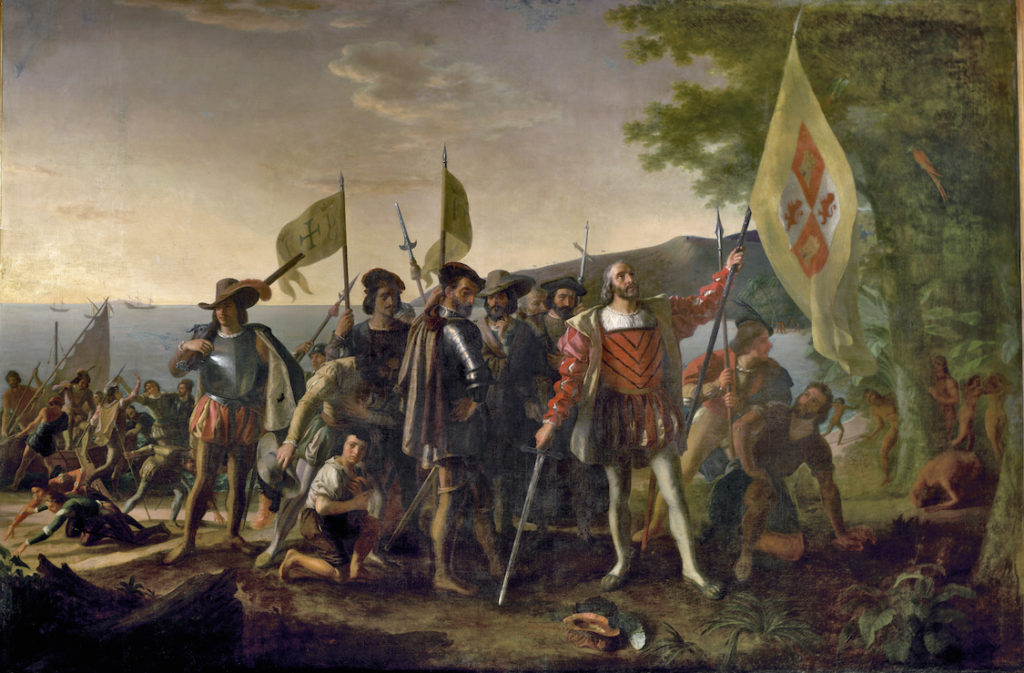
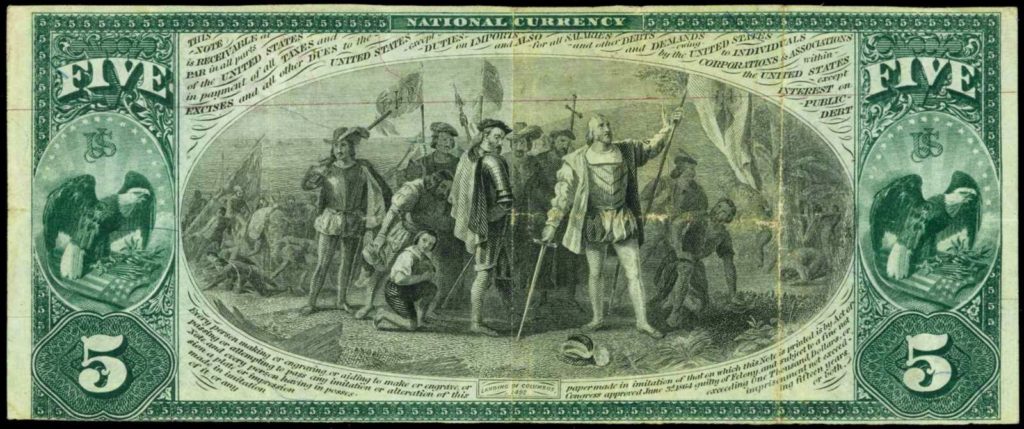
As for Vanderlyn, true success continued to evade him. In 1842, he would paint one of his most well-known pieces, The Landing of Columbus, a commission from the U.S. government that was used on the five-dollar bill. Yet, just ten years later, Vanderlyn would alledged die in poverty back in his home in Kingston, where he had created the Rotunda panoramas.
Below: Vanderlyn’s painting and the money it appeared on
Architect of the Capital
His Versailles painting would receive a grand reception when it was donated to the Met in 1956. The museum built a special circular room just contain it.
Click here for a nice review of Vanderlyn’s Versailles panorama and an overview of the entire panoramic phase of painting.
* Many sources seem to grant Vanderlyn the honor of designing the Rotunda himself, although one source lists a more-likely candidate — Martin Euclid Thompson, who was actually an architect.
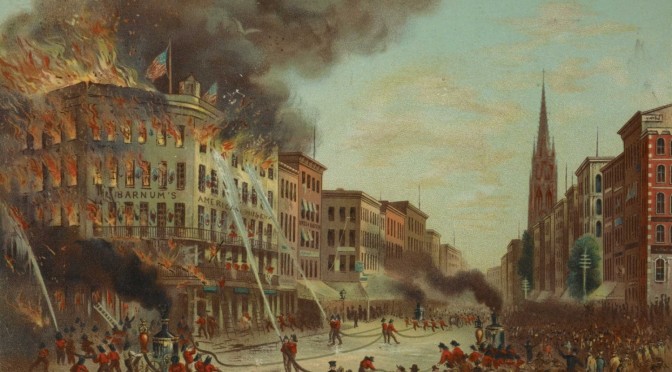
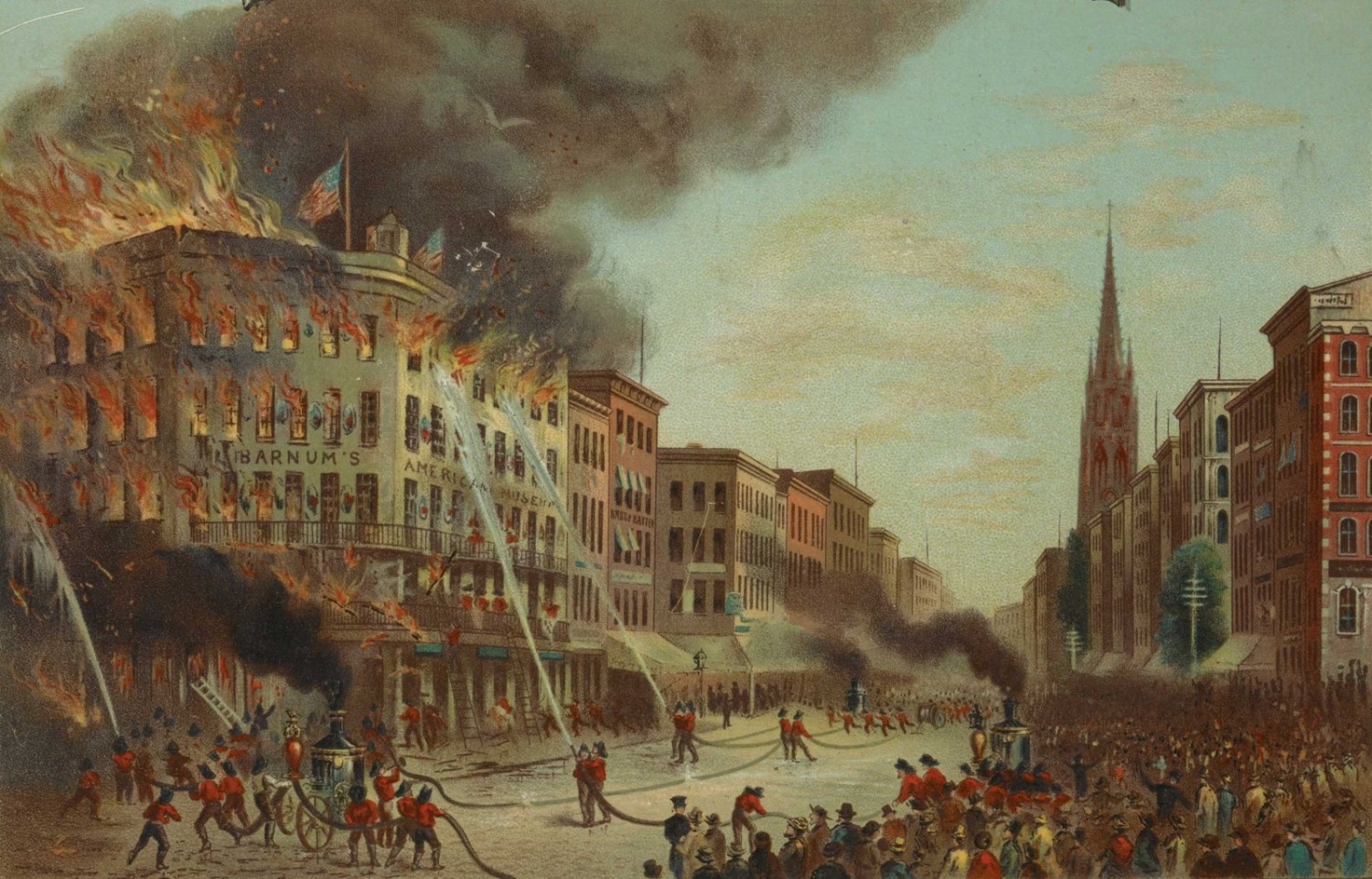
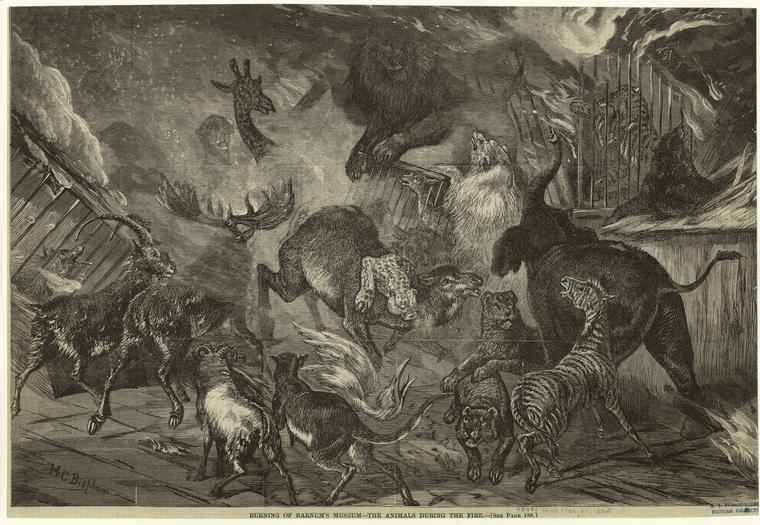
Christopher Pearse Cranch. Burning of Barnum's Museum, July 13th, 1865, 1865. Chromolithograph. Eno Collection Miriam and Ira D. Wallach Division of Art, Prints and Photographs, The New York Public Library
One hundred and fifty-five years ago (on July 13, 1865), New York City lost one of its most famous, most imaginative and most politically incorrect attractions.
When P.T. Barnum opened his museum in 1841, the kooky curiosities contained within the building at the corner of Broadway and Ann Street— at the foot of Park Row — were simply reconstituted properties from other museums.
But he soon expanded the collection to include living spectacles, both human and animal, become both the greatest show and the greatest side-show on earth.
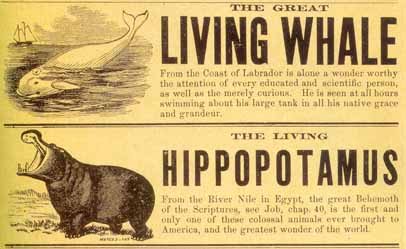
From his lilliputian stars Tom Thumband Commodore Nuttto the unfortunate white whales contained in water tanks in the basement, Barnum’s American Museum was New York’s destination for the fascinating and the weird.
Millions would visit its corridors during its two and a half decades of operation. It was so renown that it was even a target of attempted sabotageduring the Civil War.
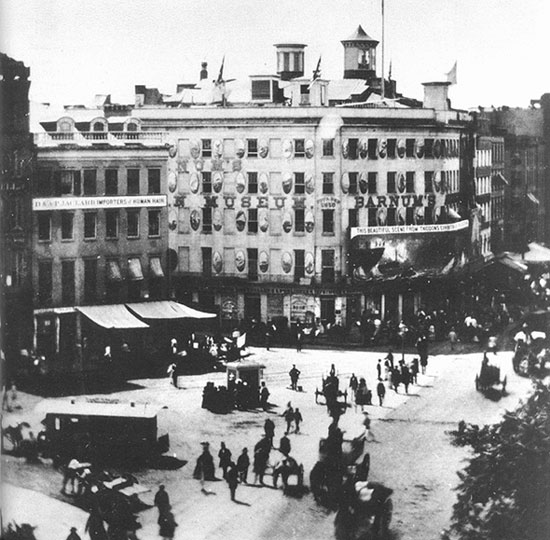
Below: A rare photo of Barnum’s American Museum, taken in 1858
Taken 1858
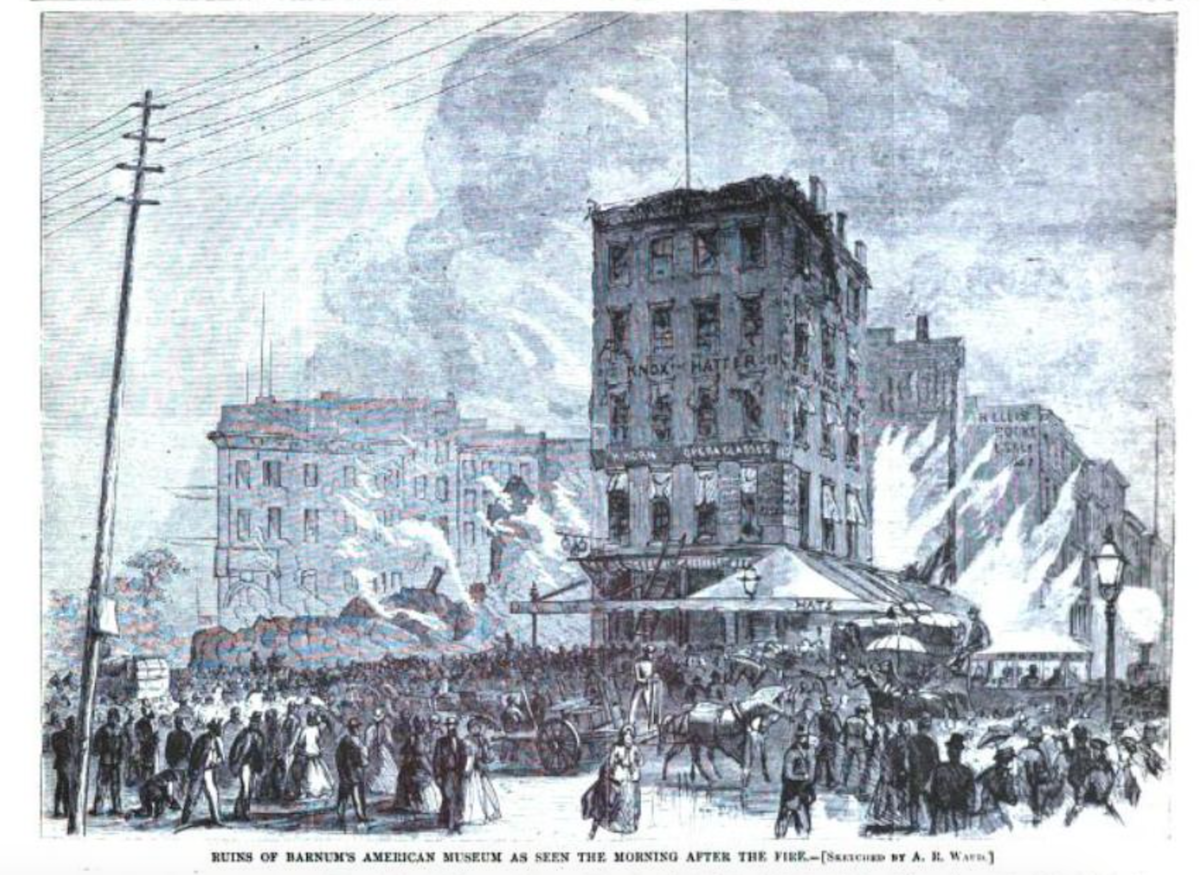
At around noon on July 13, 1865, the building quickly succumbed to “the fierce tooth of fire,” causing the greatest pandemonium that New York City had ever seen. I must give way to some of the press reports of the day, as they best capture the drama:
New York Times: “Probably no building in New-York was better known, inside and out, to our citizens than the ill-looking ungainly, rambling structure on the corner of Broadway and Ann-streets, known as the American Museum, where for more than twenty years Mr. Barnum has furnished the public with a wonderful variety of amusements.”
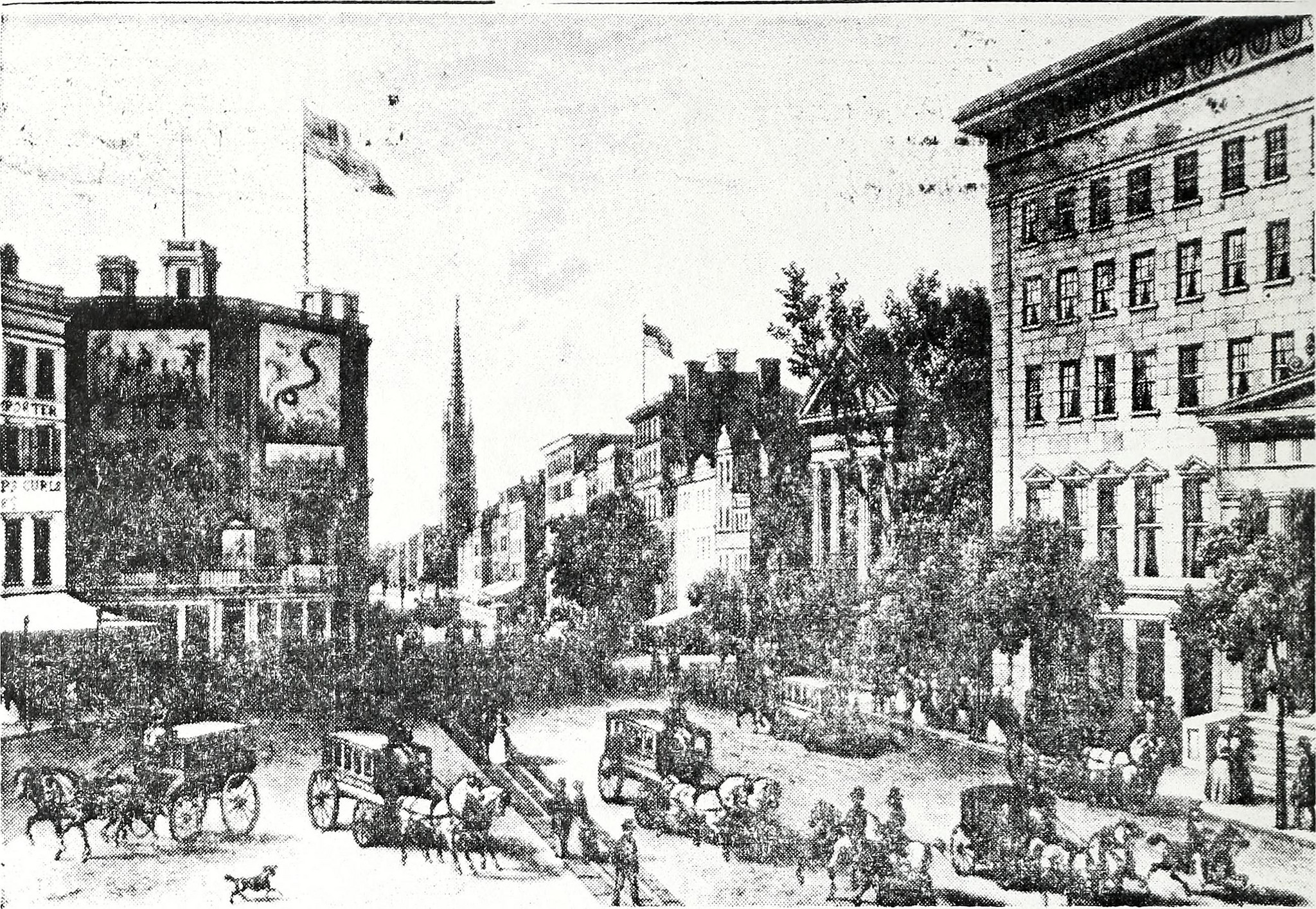
Below: The street scene at the cross-section of Broadway and Ann Street, in 1860. A sign advertising Barnum’s snake collection can be seen on the museum.
Courtesy Internet Book Archive
New York Sun: “About half past twelve o’clock yesterday the Engineer rushed up from below announcing that his room was on fire, and about the same time immense volumes of smoke permeated the Ann Street end of the building. [K]nowing that the immense whale tank was directly over the spot where the fire had begun to make headway, attempted to knock a hole in the huge reservoir.”
Christopher Pearse Cranch. Burning of Barnum’s Museum, July 13th, 1865, 1865. Chromolithograph. Eno Collection Miriam and Ira D. Wallach Division of Art, Prints and Photographs, The New York Public Library
The occupants of the tanks were doomed. “‘[T]wo whales, imported, at a cost of $7,000, from the coast of Labrador,’ whose sportive plunges and animated contests of affection afforded constant amusement to hundreds of spectators, [was] a pregnant contrast to the fearful death by roasting which they so soon thereafter met.”
The fire spread rapidly, quickly filling the upper floors with smoke. Â Firemen burst in from the Ann Street side and quickly attended to patrons who had collapsed or were too confused in the immense labyrinth of bizarre objects to escape.
A fireman named William McNamara is credited with single-handedly evacuating many patrons of the museum, not to mention some of the performers who regularly lived there.
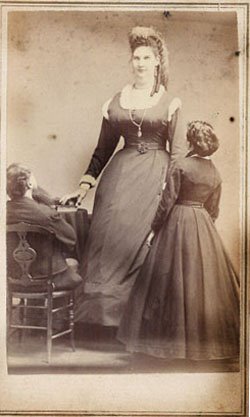
From the New York Sun: “Knowing that [some performers] occupied apartments on the third floor, he rushed thither and burst open the doors. Finding the rooms empty he ascended to the next floor and succeeded in bringing down the ladies assembled in the dressing rooms there — a Miss Swan, the Giantess, and Miss Zuruby Hannus, the Circassian girl.”
Below: Anna Swan, ‘the Giantess’ who lived at the museum, was successfully rescued
Many of the wax figures from the third floor were hurled out the windows. One peculiar item captured the imagination of the crowd — the wax depiction of Jefferson Davis, dressed in a woman’s petticoat. (It was rumored that the former president of the Confederacy has attempted to escape dressed as a lady.)
NYT: “One [rescuer] had Jefferson Davis’ effigy in his arms and fought vigorously to preserve the worthless thing, as though it were a gem of rare value. On reaching the balcony the man, perceiving that either the inanimate Jefferson or himself must go by the board, hurled the scarecrow to the iconoclasts in the street. As Jefferson made his perilous descent, his petticoats again played him false, and as the wind blow them about, the imposture of the figure was exposed.”
NYS: “When the Jefferson Davis petticoated figure was recognized by the crowd, it was seized, kicked, knocked and finally hanged to an awning frame [in front of St. Paul’s Church], amid the derisive and contumelious epithets of the persons engaged in this pastime.”
More seriously a great number of artifacts from the Revolutionary War were incinerated in the fire. “Valuable mementos of Washington, Putnam, Greene, Marion, Andre, Cornwallis, Howe, Burr, Clinton, Jefferson, Adams, and other eminent men which should have been carefully stored in a fire-proof vault, yesterday smoldered in the heat….” [NYT]
The museum’s impressive collection of taxidermy — monkeys, lions, elephants, zebras — were swallowed up by smoke and collapsed into the inferno.
But the museum also had a great many living animals — snakes, pigs, dogs, and even a kangaroo and an alligator. And, of course, a great many monkeys — “big monkeys, little monkeys, monkeys of every degree of tail, old, grave, gray monkeys, young, rascally, mischievous monkeys, middle-aged, scheming monkeys, and a great many miserable, angry monkeys.” Most perished in the flames although some escaped into the streets, some never to be found again.
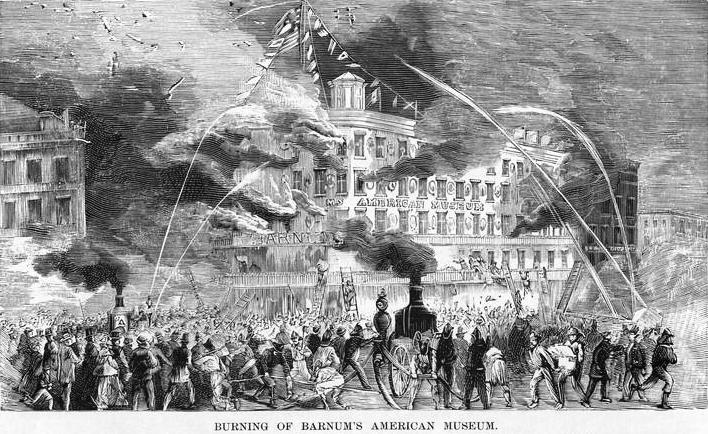
Below: This is Harpers Weekly’s illustration of Barnum’s second fire — see below — but could have tragically captured the events on July 13, 1865.
Harpers Weekly
Remarkably, nobody humans died in the blaze. In fact, few wax depictions of humans perished as many took to rescuing wax figures thinking they were alive. The fire spread to several surrounding buildings, and soon the entire block was engulfed in flame.
NYT: “The roof of the Museum had now fallen, and the interior of the building was like the crater of a volcano. A stream of heated air issued from the top, and was borne eastward by the breeze directly over the block, carrying with it light articles, pieces of burning wood, shingles ….
At 1:30 came a crash resounding like the explosion of a powder magazine. The whole wall on the Ann-street side had fallen. A cloud of dust and smoke filled the air, making it dark as twilight, and rendering it impossible to descry objects at short distance.”
There was a bit a looting, including “two men dressed as soldiers [who] were seen coming out of the shoe-store in Ann Street, each with five or six pairs of shoes under their coats.” And there were false reports that the lion has escaped and was running through the streets.
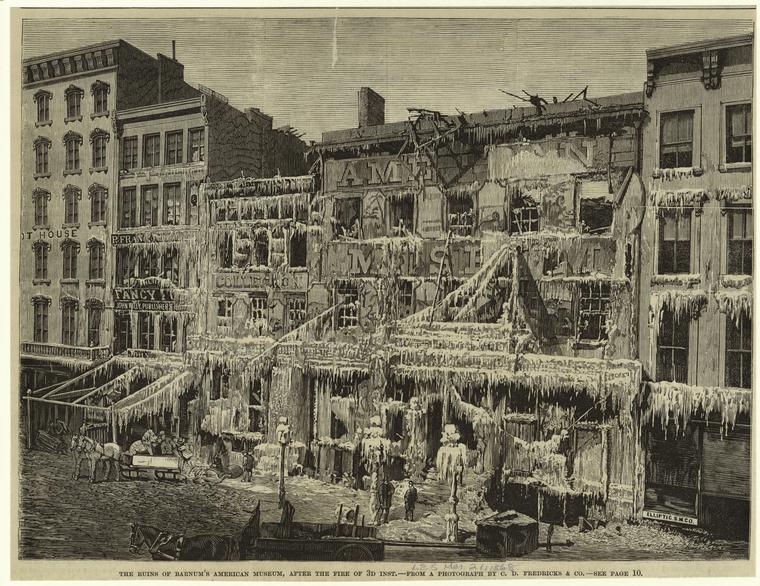
For years after, people mourned the loss of Barnum’s collection, truly among the greatest in New York City up until that time. Â Barnum attempted to relaunch the museum at 539-541 Broadway. but it, too, was destroyed in a fire (pictured below).
Then, in 1871, he leased a train depot and called it Barnum’s Monster Classical and Geological Hippodrome. (It would later morph into the first Madison Square Garden.)
Finally he just decided to take his collection of acts on the road forming a traveling circus in 1881 with ringmaster James Anthony Bailey.
While the world of entertainment would be changed by their collaboration — Barnum and Bailey’s Circus — most would consider the old American Museum as Barnum’s greatest achievement.
Below: Barnum’s second museum destroyed by fire, which gutted the building on a cold day
Harpers Weekly
For more information, we have a few Barnum-themed podcasts that you might enjoy:
PODCAST: How the Tweed Courthouse became a symbol for everything rotten about 19th century American politics.
The roots of modern American corruption traces themselves back to a handsome — but not necessarily revolutionary — historic structure sitting behind New York City Hall.
The Tweed Courthouse is more than a mere landmark. Once called the New York County Courthouse, the Courthouse is better known for many traits that the concepts of law and order normally detest — greed, bribery, kickbacks and graft.
But Tammany Hall, the oft-maligned Democratic political machine, served a unique purpose in New York City in the 1850s and 60s, tending to the needs of newly arrived Irish immigrants who were being ignored by inadequate city services. But they required certain favors like the support of political candidates.
And that is how William ‘Boss’ Tweed rose through the ranks of city politics to become the most powerful man in New York City. And it was Tweed, through various government organizations and his trusty Tweed Ring, who transformed this new courthouse project into a cash cow for the greediest of the Gilded Age.
How did the graft function during the construction of the Tweed Courthouse? What led to Tweed’s downfall? And how did this literal temple to corruption become a beloved landmark in the 1980s?
The Bowery Boys: New York City History podcast is brought to you …. by you!
We are now producing a new Bowery Boys podcast every other week. We’re also looking to improve the show in other ways and expand in other ways as well — through publishing, social media, live events and other forms of media. But we can only do this with your help!
We are now a member of Patreon, a patronage platform where you can support your favorite content creators for as little as a $1 a month.
Please visit our page on Patreon and watch a short video of us recording the show and talking about our expansion plans. If you’d like to help out, there are six different pledge levels (New Amsterdam, Five Points, Gilded Age, Jazz Age, Empire State and Greater New York). Check them out and consider being a sponsor.
And join us for the next episode of the Bowery Boys Movie Club, an exclusive podcast provided to our supporters on Patreon.
We greatly appreciate our listeners and readers and thank you for joining us on this journey so far.
We’d like to thank Mary Beth Betts of the NYC Public Design Commission for giving us a tour of the Tweed Courthouse. Tours are not currently available of the courthouse, but Betts and her docents lead tours of New York City Hall next door. Visit their website to book a free tour.
Some images from our visit —
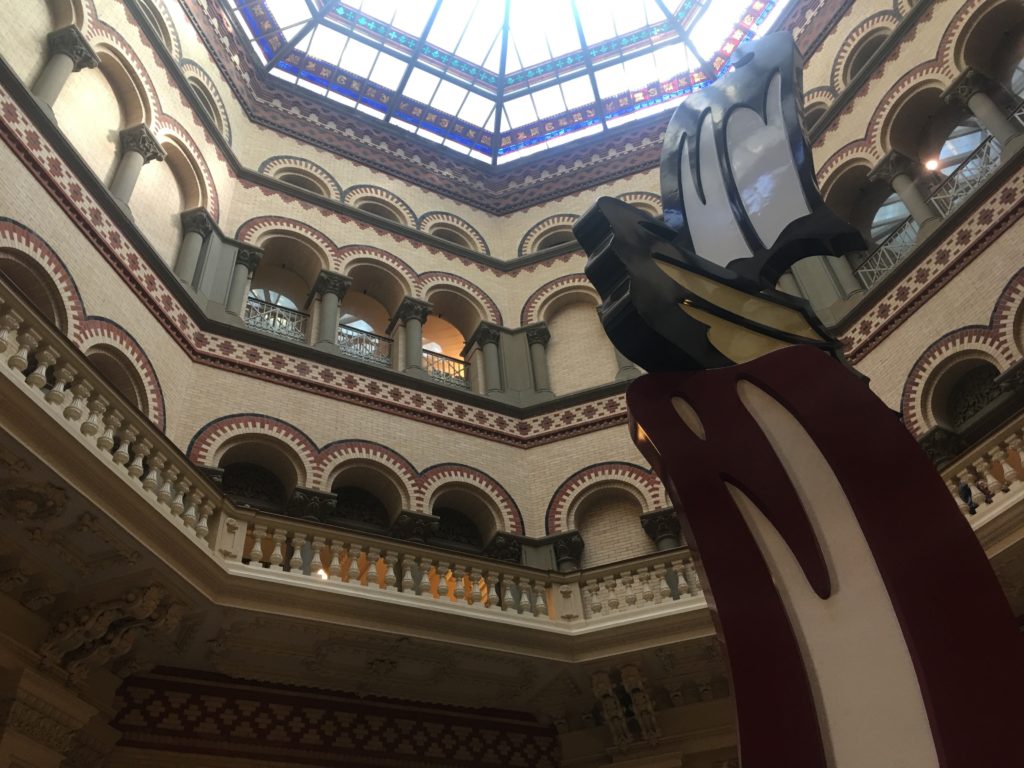
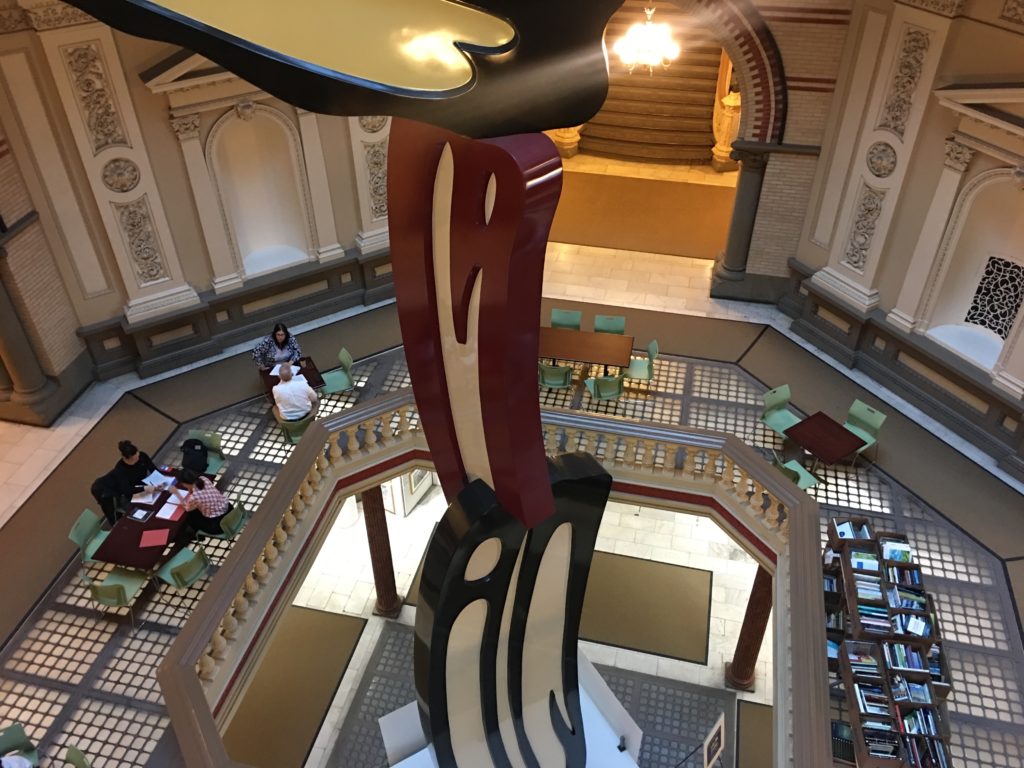
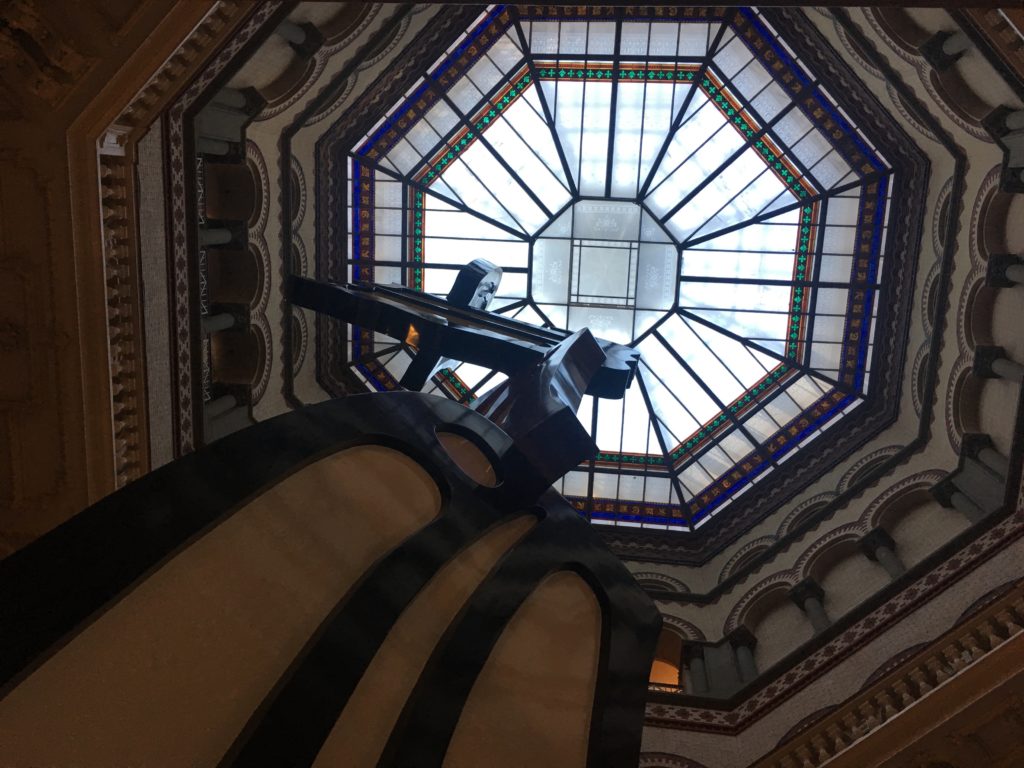
Leopold Eidlitz brought a million arches into the courthouse, his medieval inspirations playing an interesting contrast to the Romanesque Revival of architect John Kellum.Roy Lichtenstein’s Element E now dominates the interior of the courthouse. Students, teachers and administrators work in the spaces surrounding the sculpture.The infamous rotunda roof which remained incomplete even when courts began convening in the courthouse in the 1870s. The sumptuous staircases are all made of cast iron.The courthouse has many curious staircases, leading to smaller spaces on the upper floors. You can actually view the two competing architectural styles on the exterior facades facing into City Hall Park. (Hint: Arches vs. no arches)
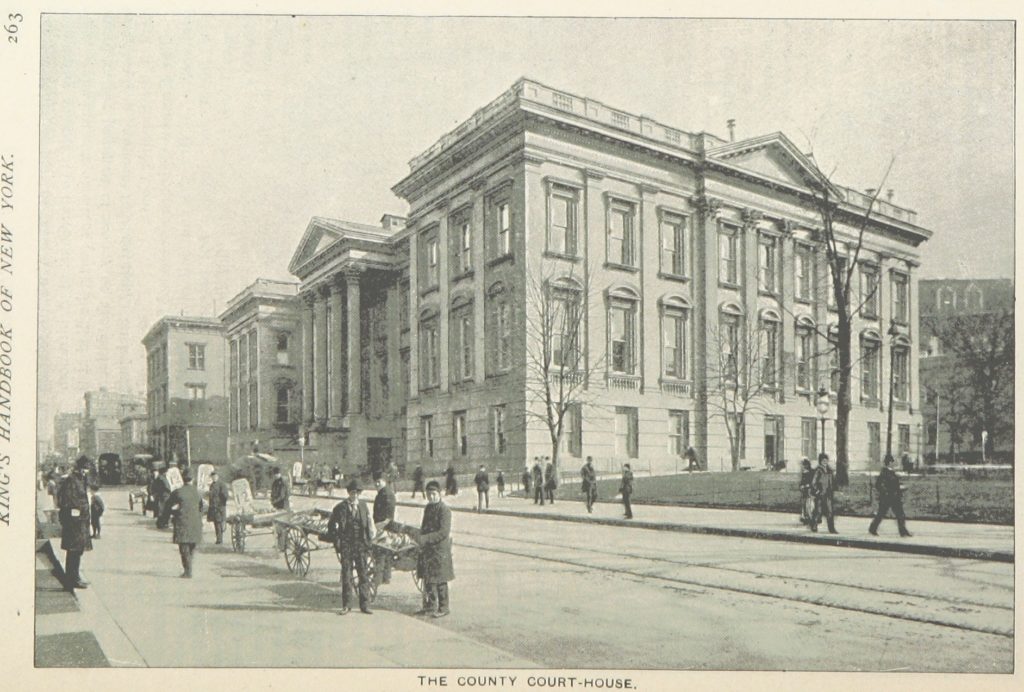
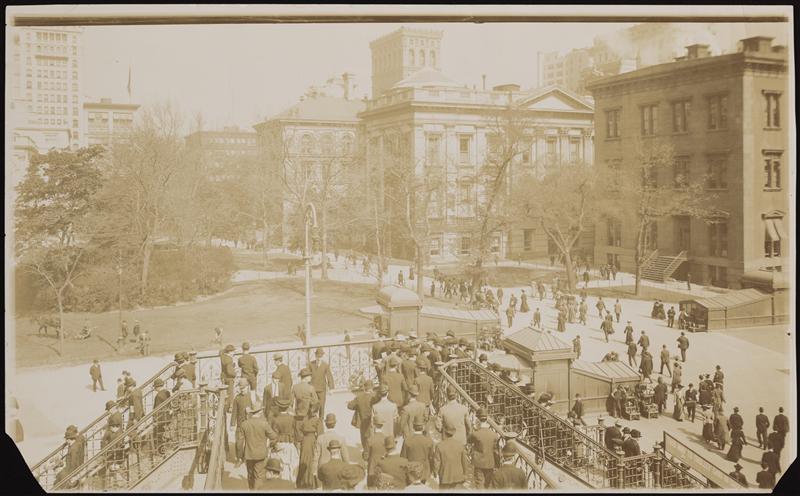
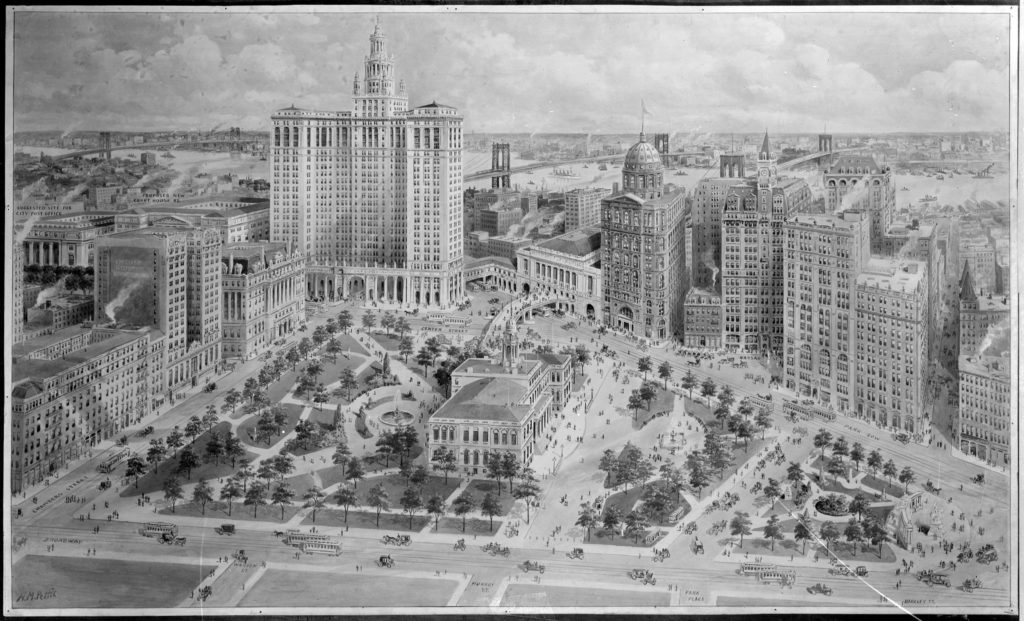
The Tweed Courthouse under construction, date unknown Image taken from page 269 of ‘King’s Handbook of New York City. An outline history and description of the American metropolis. With … illustrations, etc. (Second edition.)’ Courtesy the British LibraryA view of the Tweed Courthouse as seen from the City Hall elevated train station, 1915. The brownstone structure to the right of the courthouse is no longer there. In 1915 the city planned to actually get rid of the Tweed Courthouse. This rendering creates a large park space surrounding City Hall.
H.M. Pettit. Department of Bridges/Plant & Structures collection, NYC Municipal Archives.
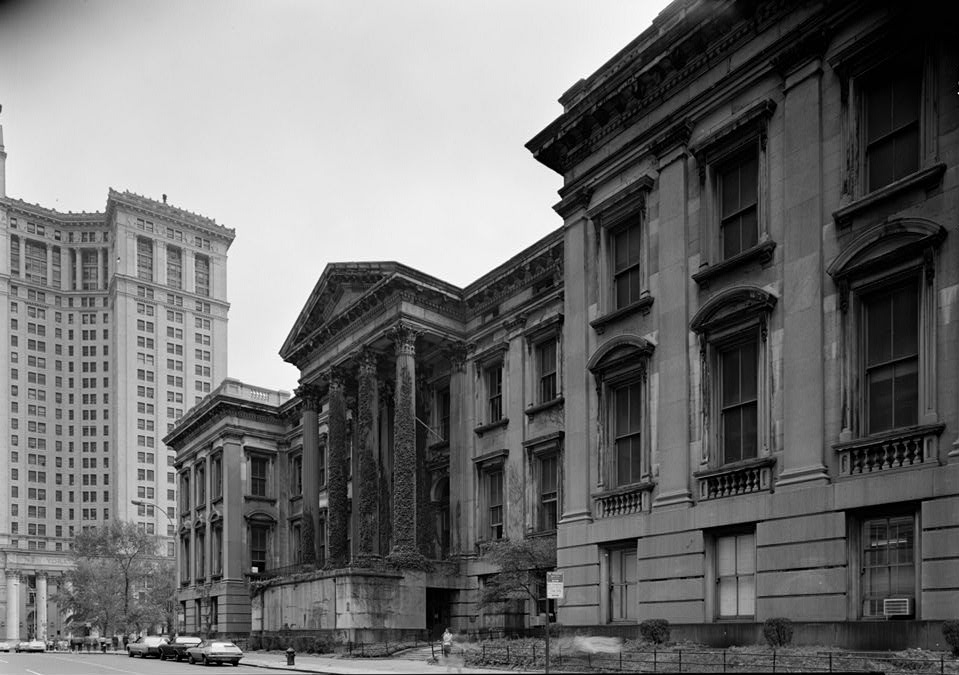
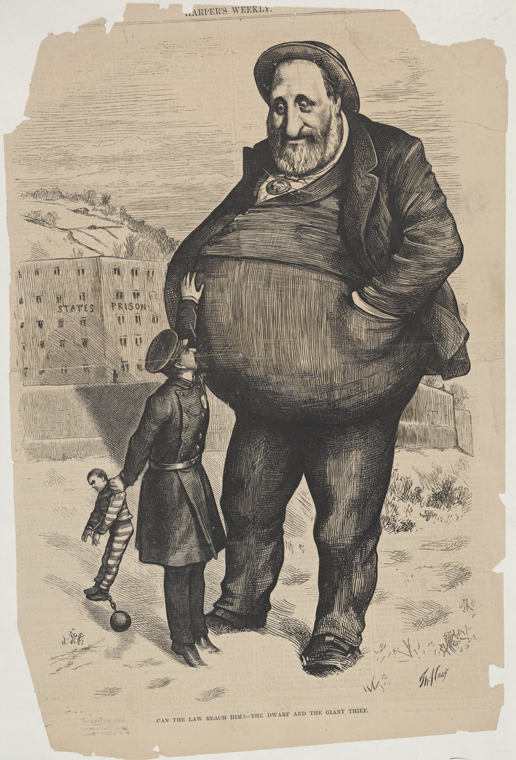
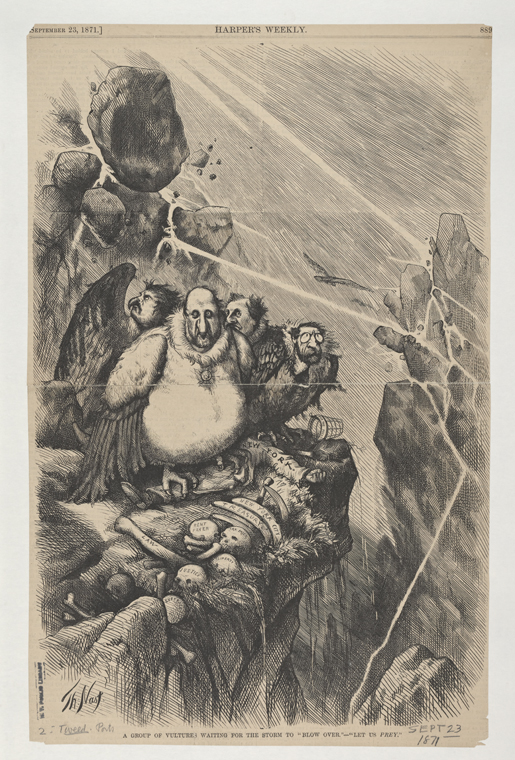
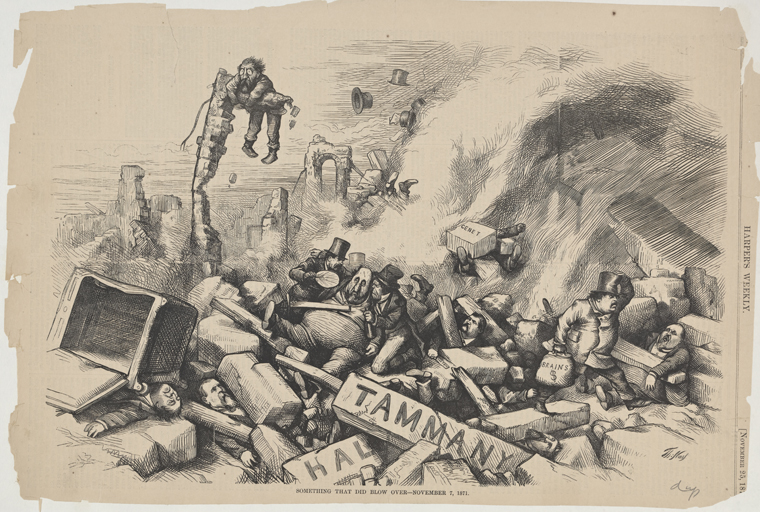
The courthouse in 1979 — in shoddy condition and without its famous staircase! Photo by Walter Snalling, Jr., Library of Congress“Can the law reach him?–The dwarf and the giant thief.” Thomas Nast/New York Public Library Digital CollectionAgroup of vultures waiting for the storm to “blow over.”–“Let us prey.” Thomas Nast/New York Public Library Digital CollectionSomething that did blow over–November 7, 1871. Thomas Nast/New York Public Library Digital Collection
FURTHER READING:
Boss Tweed’s New York by Seymour J. Mandelbaum
Boss Tweed: The Rise and Fall of the Corrupt Pol Who Conceived the Soul of Modern New York by Kenneth D. Ackerman
Machine Made: Tammany Hall and the Creation of Modern American Politics by Terry Golway
The Tweed Ring by Alexander B. Callow Jr.
The Tiger: The Rise and Fall of Tammany Hall by Oliver E. Allen
FURTHER LISTENING:
Our original Boss Tweed show from 2009 — with a big news reference at the very beginning that echoes the story we’re about to tell
The massive waves of Irish immigrants who arrived in this country starting in the 1830s and 40s changed New York City forever. Here’s their story:
Fernando Wood was another major power broker in New York City politics in the 1860s.
PODCAST For the first part in our New York City in the Roaring Twenties summer mini-series, we’re hitting the town with “Beau James,” New York’s lively and fun-loving mayor Jimmy Walker.
And the king of it all was Jimmy Walker, elected mayor of New York City just as its prospects were at their highest. The Tin Pan Alley songwriter-turned-Tammany Hall politician was always known more for his grace and style than his accomplishments. His wit and character embodied the spirit (and the spirits) of the Roaring ’20s.
The 1920s were a transformational decade for New York, evolving from a Gilded Age capital to the ideal of the modern international city. Art deco skyscrapers reinvented the skyline, reorienting the center of gravity from downtown to a newly invigorated Midtown Manhattan. Cultural influences, projected to the world via radio and the silent screen, helped create a new American style.
Join us for an after-midnight romp with the Night Mayor of New York as he ascends to the most powerful seat in the city and spends his first term in the lap of luxury. What could possibly go wrong?
LISTEN NOW: KING OF THE JAZZ AGE
The Bowery Boys: New York City History podcast is brought to you …. by you!
We are now producing a new Bowery Boys podcast every two weeks. We’re also looking to improve the show in other ways and expand in other ways as well — through publishing, social media, live events and other forms of media. But we can only do this with your help!
We are now a member of Patreon, a patronage platform where you can support your favorite content creators for as little as a $1 a month.
Please visitour page on Patreon and watch a short video of us recording the show and talking about our expansion plans. If you’d like to help out, there are five different pledge levels (and with clever names too — Mannahatta, New Amsterdam, Five Points, Gilded Age, Jazz Age and Empire State). Check them out and consider being a sponsor.
We greatly appreciate our listeners and readers and thank you for joining us on this journey so far. And the best is yet to come!
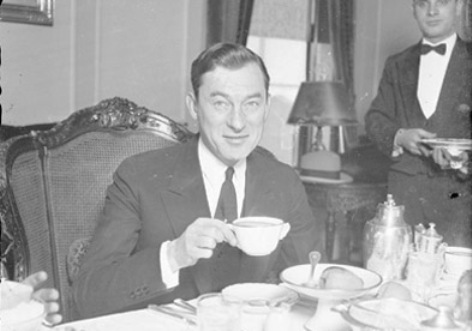
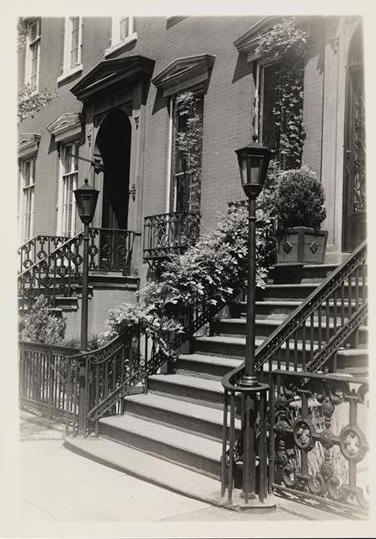
Walker having his morning coffee at his home on 6 St. Lukes Place (pictured below)
Courtesy MCNY
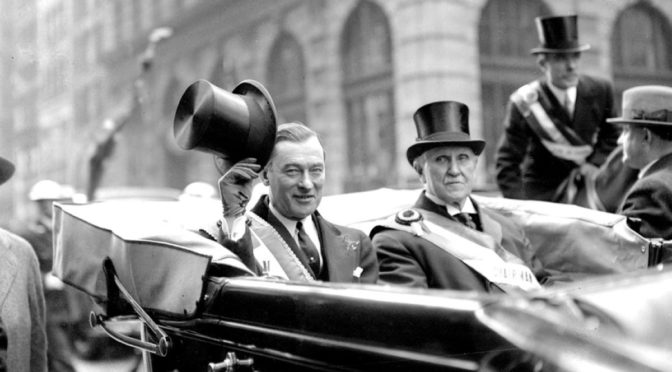
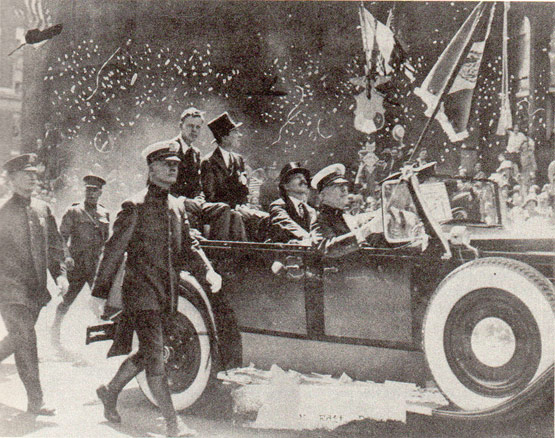
Jimmy Walker with Charles Lindbergh in 1927, in the midst of a ticker tape parade after his non-stop ride from Long Island to Paris.
Courtesy New York Social Diary
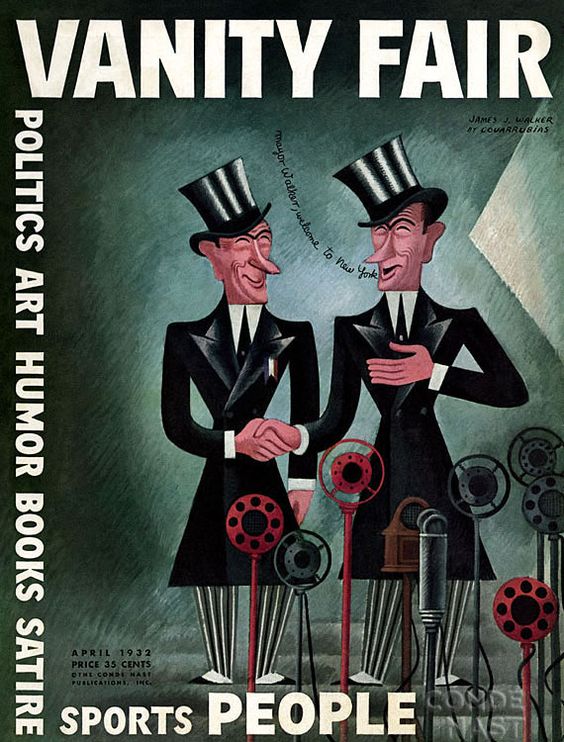
Walker so enjoyed throwing public events for famous people that he was frequently parodied for it. In 1932 Vanity Fair pictured him giving a lavish welcome — to himself.
Conde Nast
Harry McDonough with The Elysian Singers from 1905, singing Walker’s big hit “Will You Love Me In December As You Do In May.”
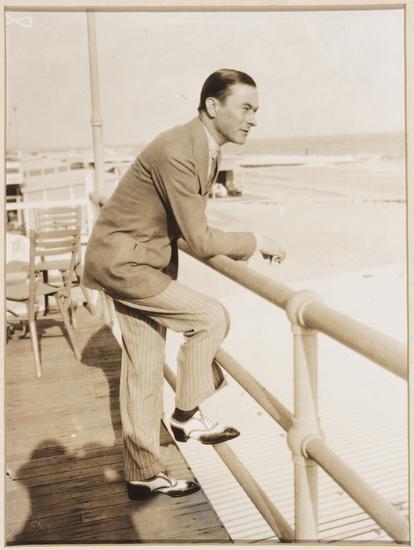
The dashing fashion plate, pictured here most certainly on his way to yet another vacation…..
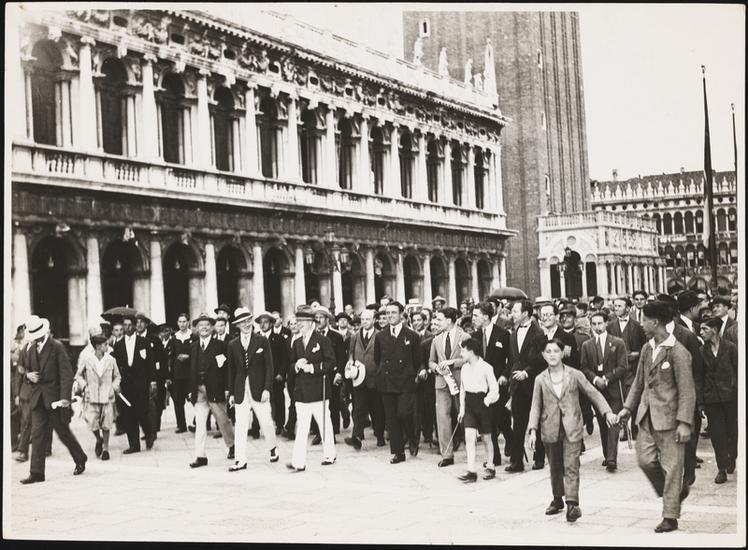
….perhaps his European vacation! He’s pictured here in 1927, strolling the streets of Venice with a few hundred people behind him.
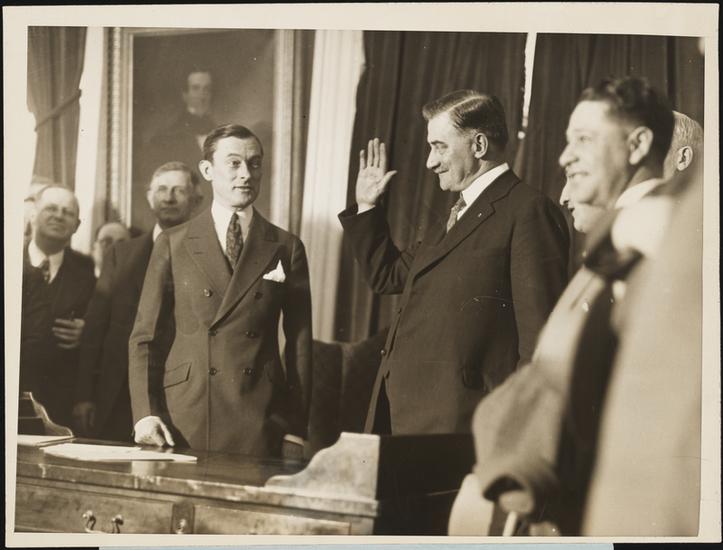
A picture of Jimmy, actually at work! He’s swearing in the new fire commissioner James J. Dorman in 1926.
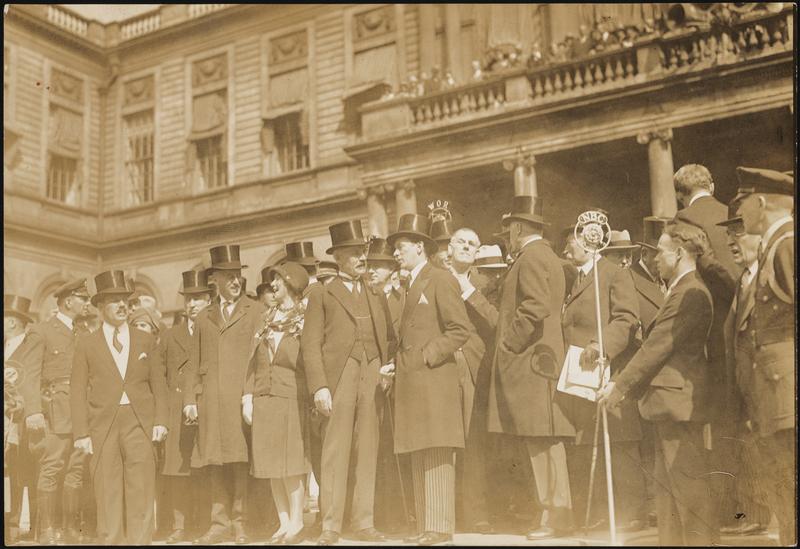
Mayor Jimmy Walker with British Prime Minister Ramsay MacDonald at yet another welcoming ceremony, broadcast on the radio.
MCNY
Another British visit, this time from Mrs Foster Welch, Mayor of Southampton.
In another Pathe video, Jimmy Walker visits Ireland and the former home of his father.
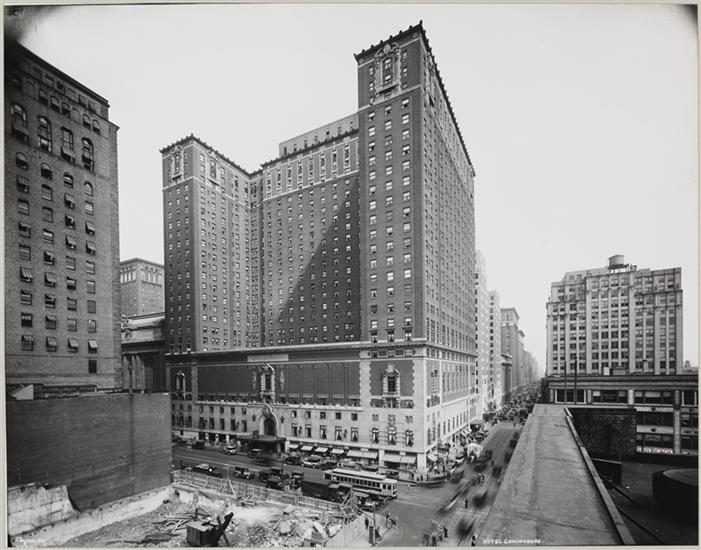
During Walker’s extraordinary rise, New York was becoming an entirely new city in the 1920s with construction projects on virtually on every block. Even in front of the Hotel Commodore (pictured here in 1927), which was, for a time, the home of Jimmy Walker.
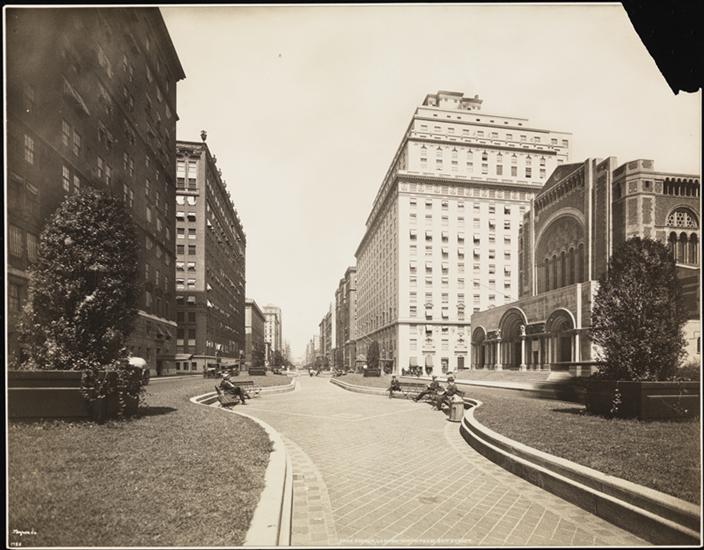
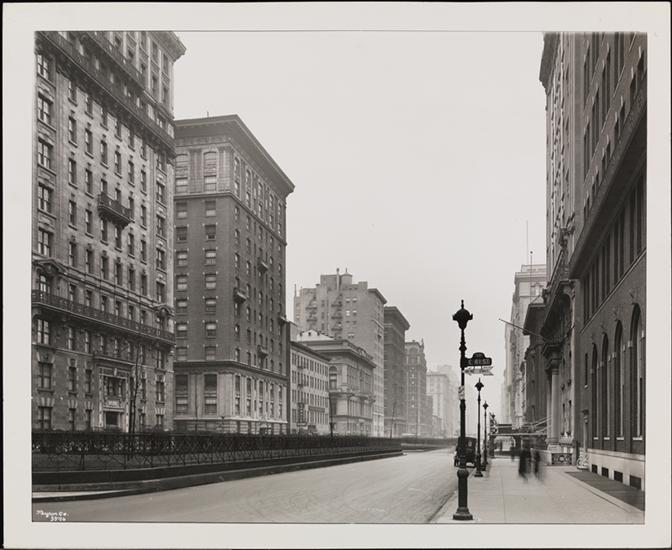
Park Avenue (at 50th Street) in 1922.
MCNY
Park Avenue at 61st Street in 1922. The rich flocked to this newly developed street of apartment complexes, making it the new center of wealth.
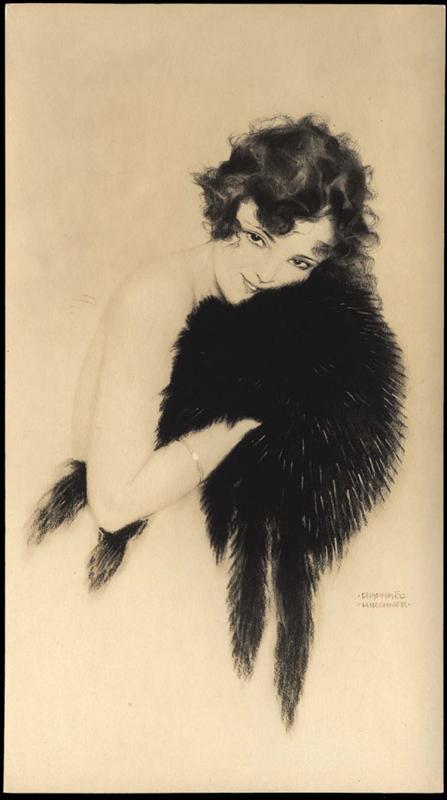
And now, for a little glamour, a few shots of Yvonne Shelton, then Betty Compton, Walker’s two most famous girlfriends (who he wooed while married to wife Janet).
wikiart
Courtesy Historial Ziegfeld
Photographs above by Alfred Cheney Johnston.
She most famously starred in 1927’s Broadway production of Oh Kay! starring Gertrude Lawrence. Here’s Lawrence singing a famous song from that show:
IN TWO WEEKS: Chapter Two of our series on the Roaring ’20s, rewinding back to the beginning of the decade and introducing you to another icon of the Jazz Age. Who will it be?
The article below contains spoilers involving locations used in the movie, but no specific plot spoilers that aren’t already revealed in the trailer.
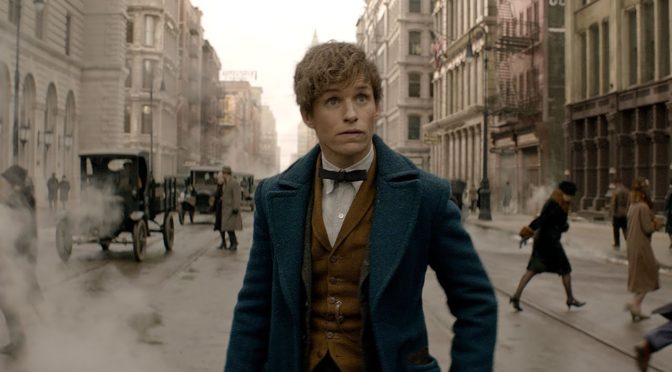
Fantastic Beasts and Where To Find Them, strictly a fantasy film of course, from the vivid mind of J.K. Rowling, is nonetheless the year’s best historical depiction of New York City.  This indulgence of the imagination is even more successful as a celebration of the past.
Sure, its presentation of 1920s New York is filled with physical impossibilities. Its Times Square blazes with the electric insignias of fake Broadway revues and advertisements. Its rows of townhouses are a wee bit too perfect and uniform.
But this story of an English wizard and his mischievous bag of creatures gets the magic of Old New York exactly right. Its a brilliant consideration of the imagined city — shining towers and beautiful architecture, speakeasies and cobblestone streets. The film lovingly unfurls the beauty of steel-beam architecture and old Beaux-Arts mansard roofs with as much loving care as the whimsical beasts of the title.
In a rather unprecedented and creative move, the City of New York has gotten into the movie tie-in game, presenting a fun page of historical photographs with a slider to compare old sites used in the film with today. There’s also an interactive map showing the streets of New York as presented in the film.
And On Location Tours is providing tours crossing many of the main sites of the film.
Even if you’re not a fantasy film buff, I think you’ll be captivated by the art direction and design of this film. Here are a few of my favorite details:
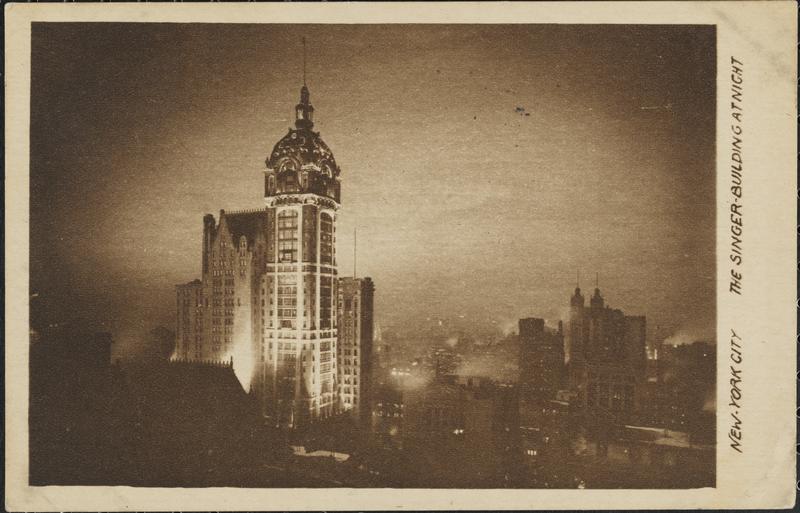
The Singer Building, 1911. courtesy Museum of the City of New York
Singer Building — The main character Newt Scamander arrives in New York Harbor and disembarks at Chelsea Piers. The camera pans over a breathtaking shot of downtown New York, its skyline as it would have looked in 1926. Most prominent among its many skyscrapers is the Singer Building.
“For a few short months from 1908 to 1909, the building that stood at 165 Broadway was the tallest in the world: the forty-seven-story Singer Building, the skyscraper trophy built by the head of the Singer Sewing Machine Company. Its unusual appearance—a narrow red tower shooting up from a chunky base—was among the most glorious on the young New York skyline. Its interior was festooned with bronze medallions engraved with the images of needle, thread, and bobbin. Because we can’t have nice things, they ripped it apart at the seams and tore it down in 1967. Prior to 2001, it remained the tallest building in the world ever demolished.”
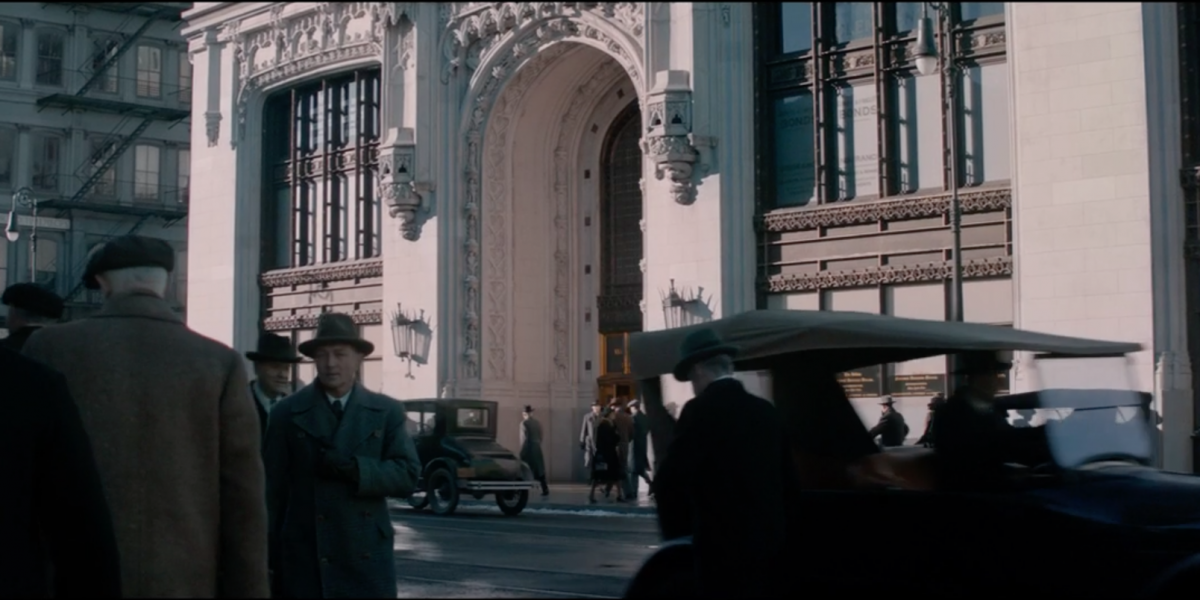
Woolworth Building — The world’s tallest building in 1926 is pivotal to the plot of Fantastic Beasts, the extra-dimensional headquarters for New York’s magicians. By 1926, it would have felt truly magical — if a bit old fashioned.  The sudden rise of Art Deco architecture and the installation of zoning laws in New York would have made the Woolworth feel like a unusual treasure of the skyline.
From our book:  “Designed by Cass Gilbert for the “five-and-dime†retail king Frank Woolworth, the Woolworth Building was a glowing candle of a skyscraper next to dainty little City Hall. The Woolworth’s intricate facade was adorned with many of the “international races†echoed down at Gilbert’s other big Manhattan building, the U.S. Custom House (1 Bowling Green).
Built three years before the city enacted stricter zoning laws (which, among other things, forced the construction of setbacks that would result in tiered wedding cake–shaped structures), the Woolworth simply zooms straight up into the sky.
Advertisements to fill the office space in the Woolworth Building made use of its unique place in American commerce. Said one ad, “Customers will never overlook your store if it is in the Woolworth Building. The sight and thought of the world’s greatest structure will remind them of you and your store.â€
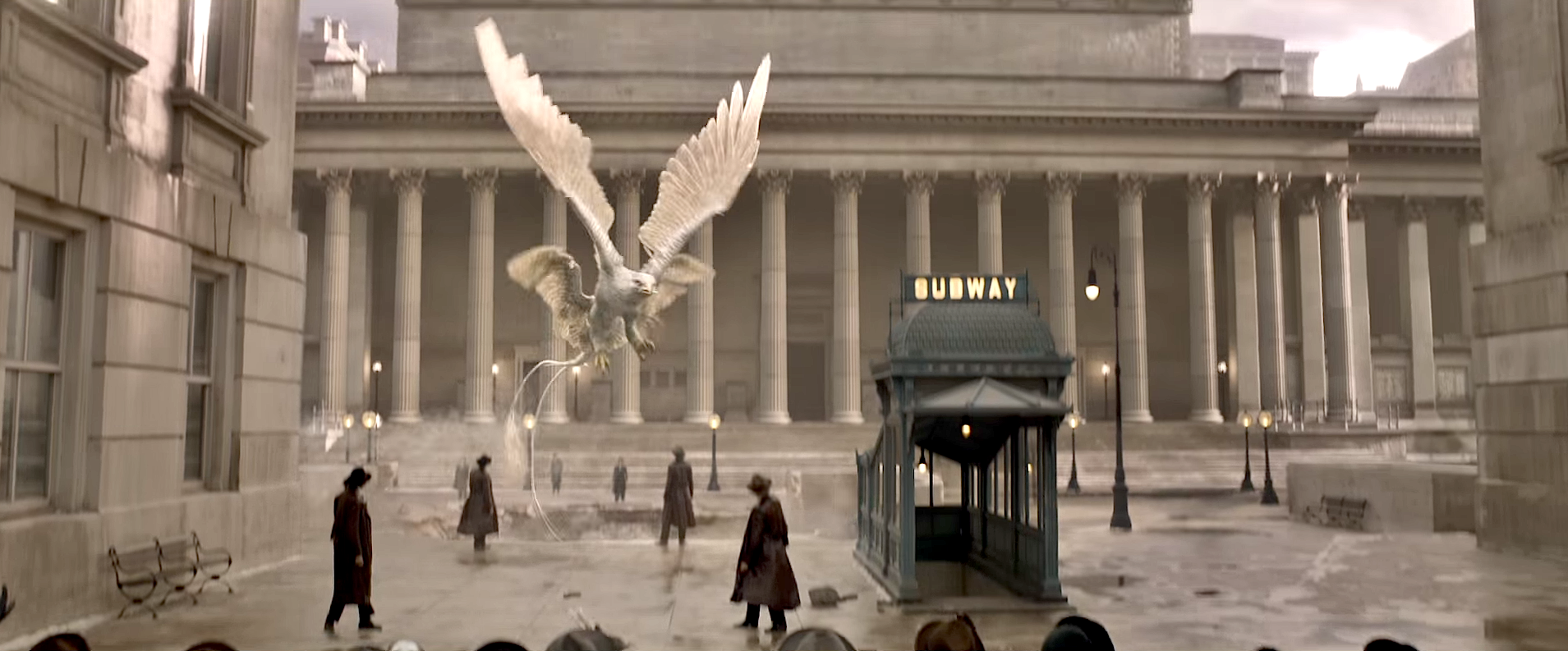
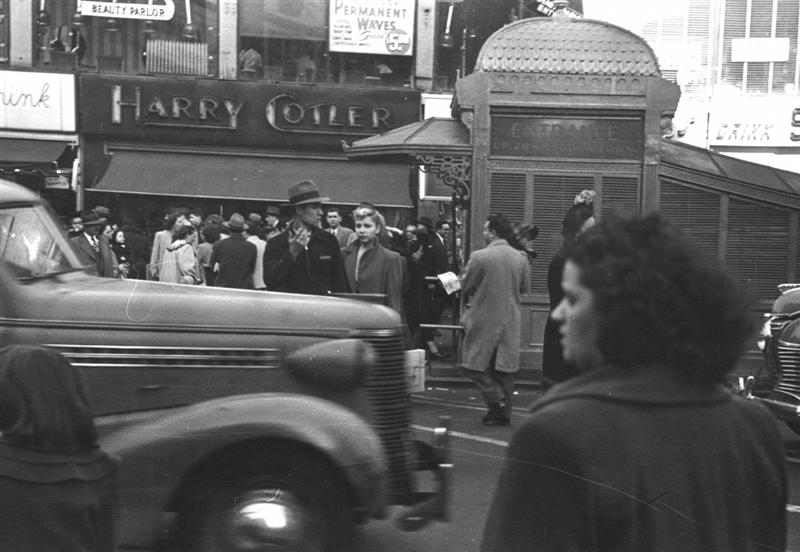
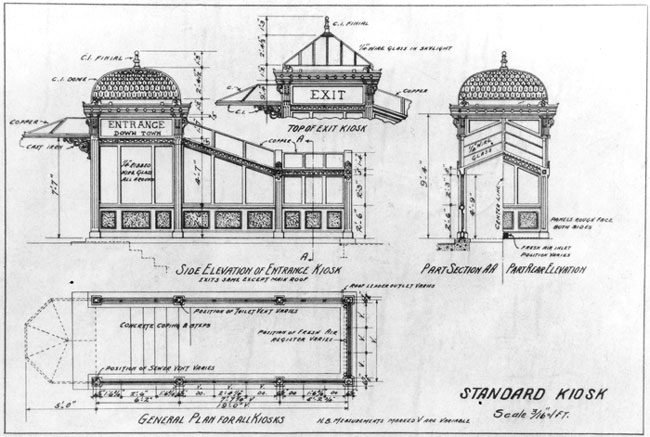
New York Subway Entrances — The unusual but elegant New York subway entrances are marvelously recreated here. Â The spectacular design of the entrances is inspired by the subway in Budapest (yes, they had a subway before New York), using a kushk or summerhouse design often found in ancient Turkish structures.
Below: A similar entrance from 1940 in Union Square. Photographer Arnold Eagle, courtesy Museum of City of New York.
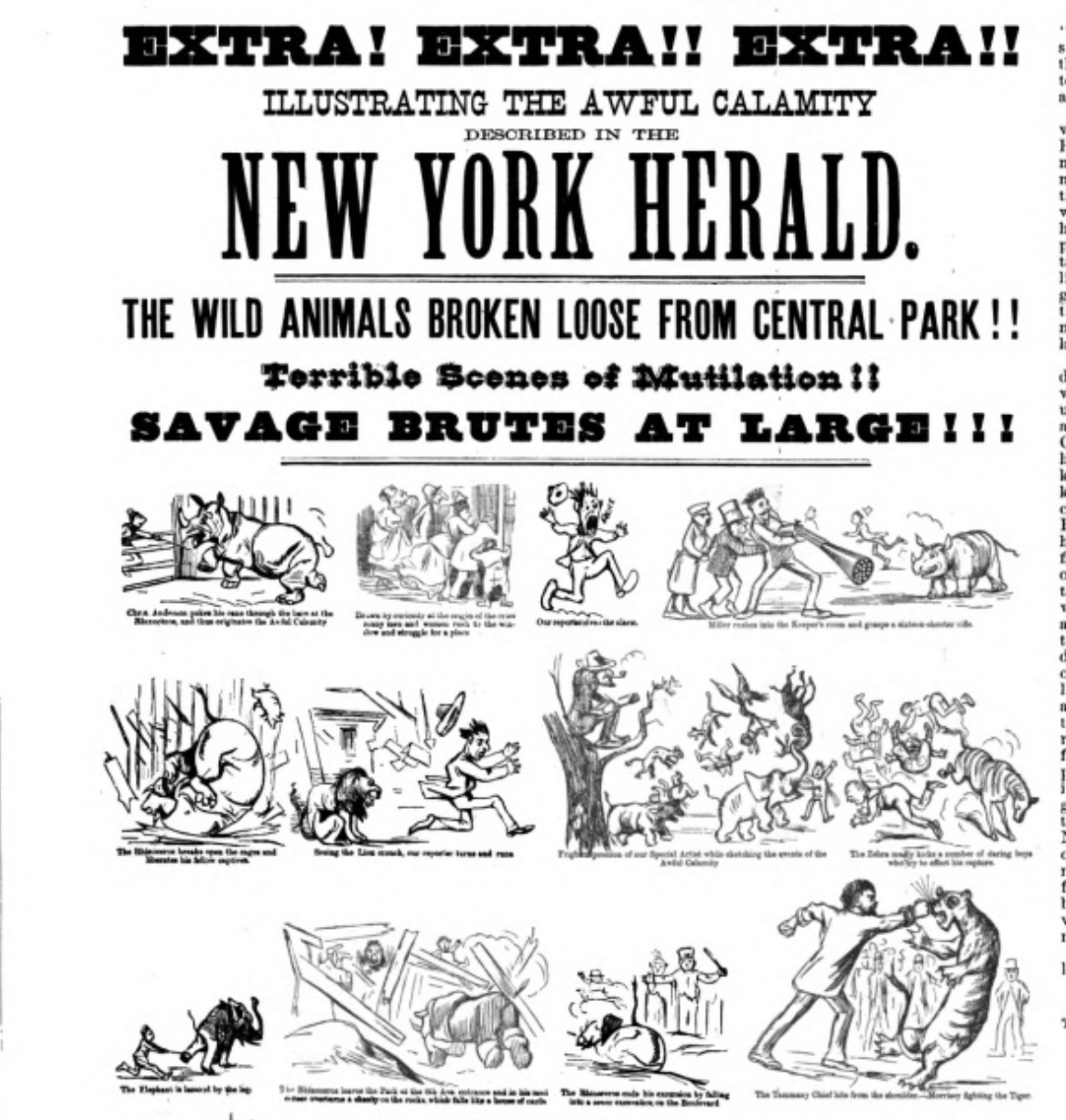
The Central Park Zoo escape — A specific moment in New York City history is strongly referenced in one exciting sequence in the movie. Or, should I say, an imagined moment in New York City history.
On November 9, 1874, the New York Herald ran a fictitious tale of animals escaping from the Central Park Zoo. “A SHOCKING SABBATH CARNIVAL OF DEATH” ran the headline: Â “Another Sunday of horror has been added to those already memorable in our city annals. The sad and appalling catastrophe of yesterday is a further illustration of the unforeseen perils to which large communities are exposed.”
Harper’s Weekly recounts the hoax in a article from 1893 here.
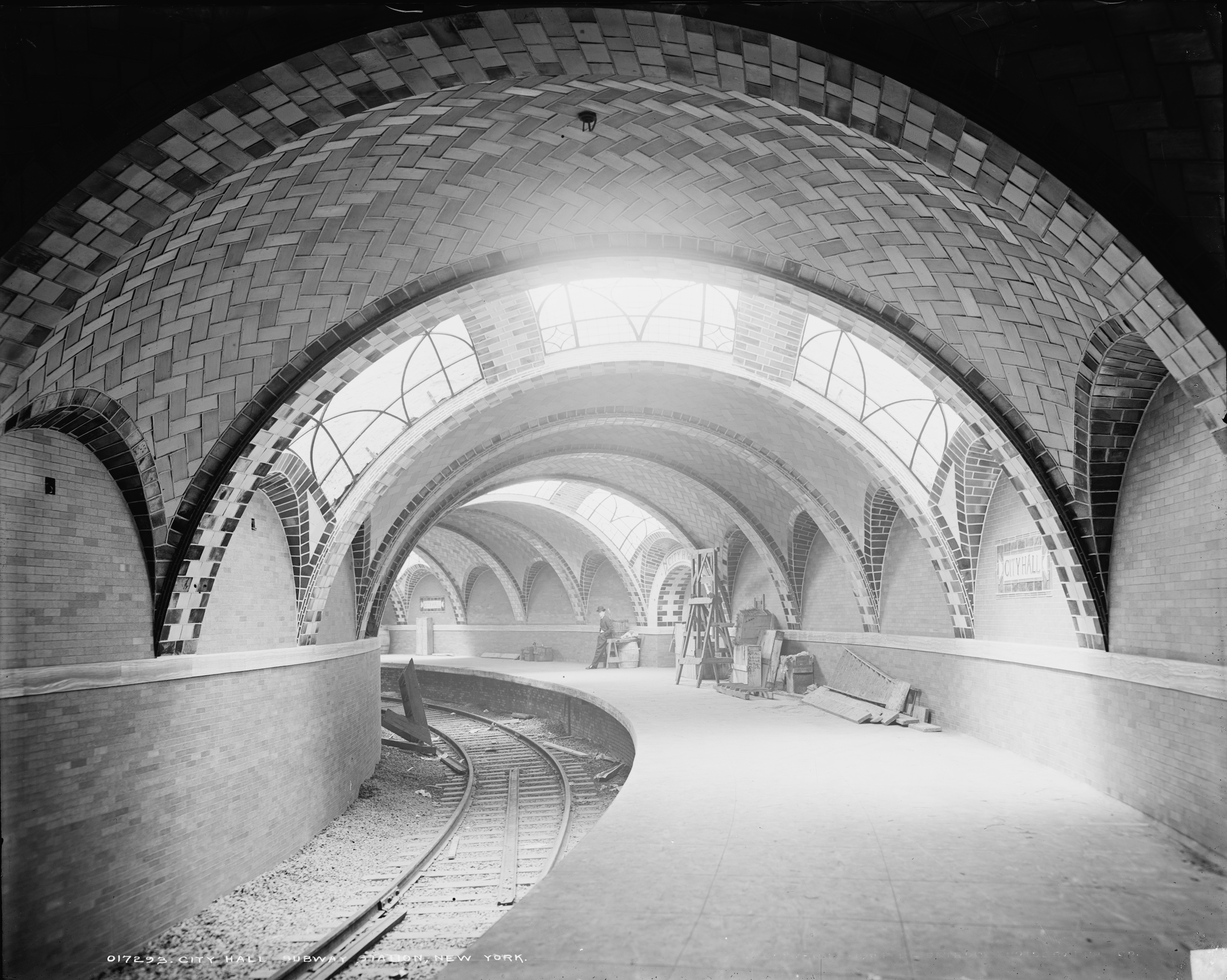
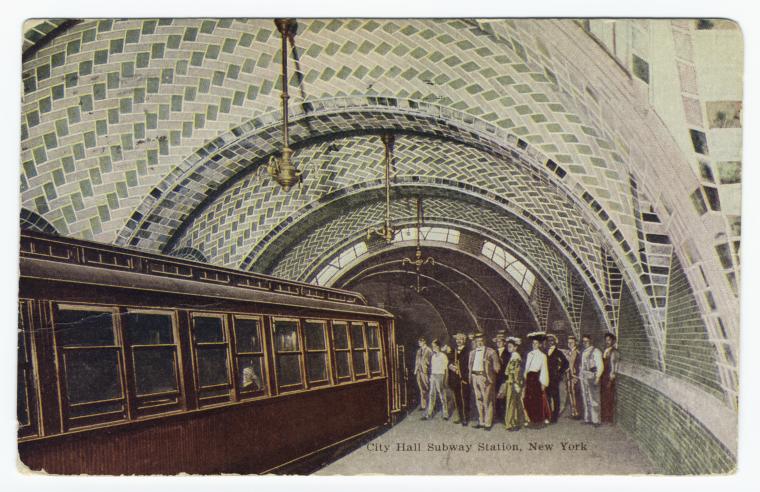
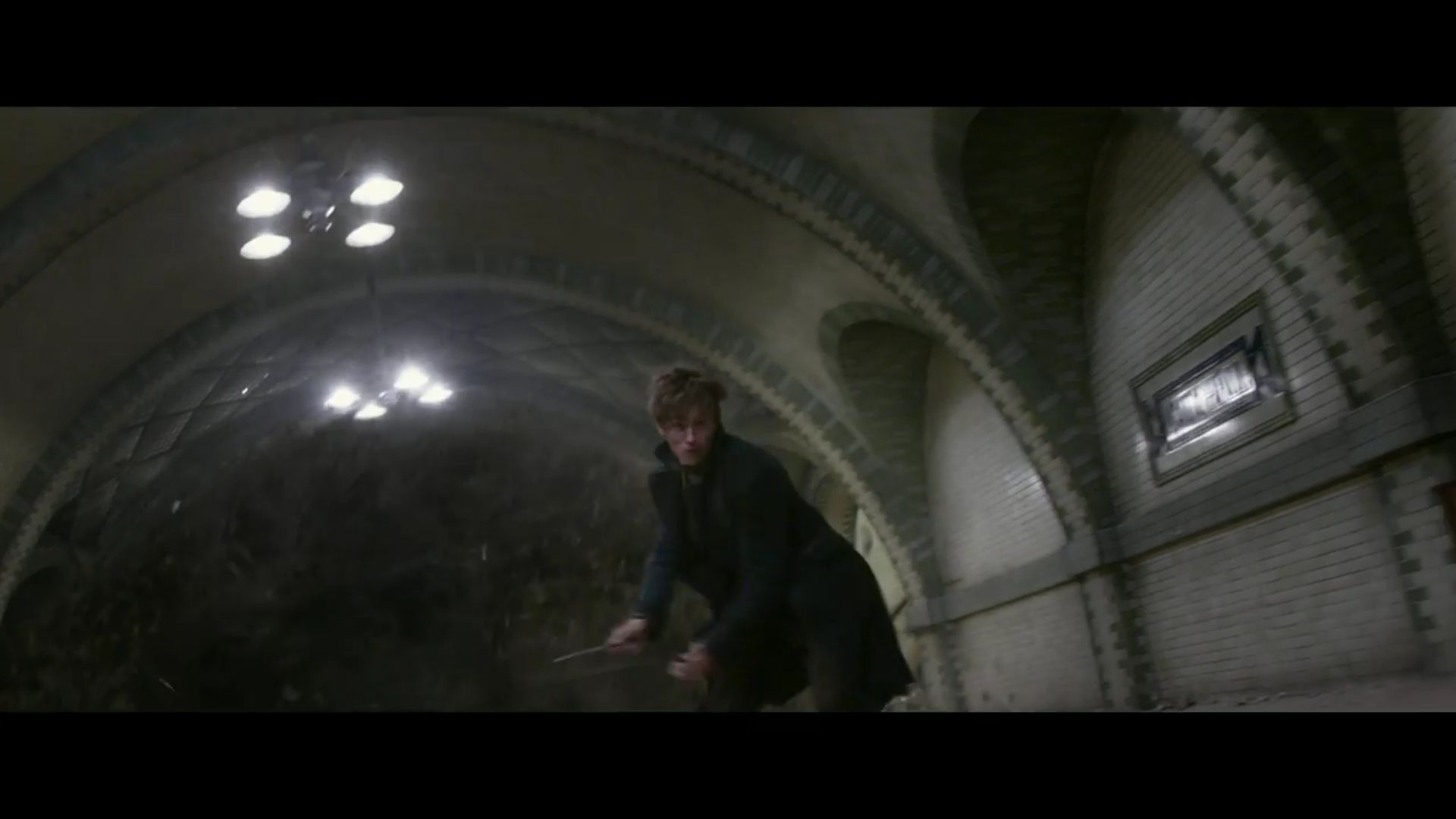
City  Hall Subway Station — One of the major action set pieces of the film takes place in a New York space that few are rarely allowed to go — the underground City Hall subway station.  Built in 1904 for the first subway, it was the most beautiful and the most elaborate, meant to assure the public of the subway’s comfort and safety. It was taken out of regular service in 1945 however it is occasionally reopened for tour groups.
Abraham Lincoln died 150 years ago today in a Washington DC rowhouse, shot and killed by the actor John Wilkes Booth while the president was attending a performance of Our American Cousin at Ford’s Theater the previous evening.
The news hit the North as some sort of horrible dream. Â Confederate general Robert E Lee had just surrendered to Ulysses S. Grant at Appomattox Courthouse less than a week. The war was over in the minds of many. How could this have happened?
On April 21, Lincoln’s body began a mournful tour of the United States, taken from cities across the country via a funeral train.  Three days later, on April 24, the train with Lincoln’s body pulled into 30th Street Station, the depot which served the Hudson River Railroad back when the train brought passengers down the western side of Manhattan. (We give the details of this vanished station in our podcast on the High Line.)
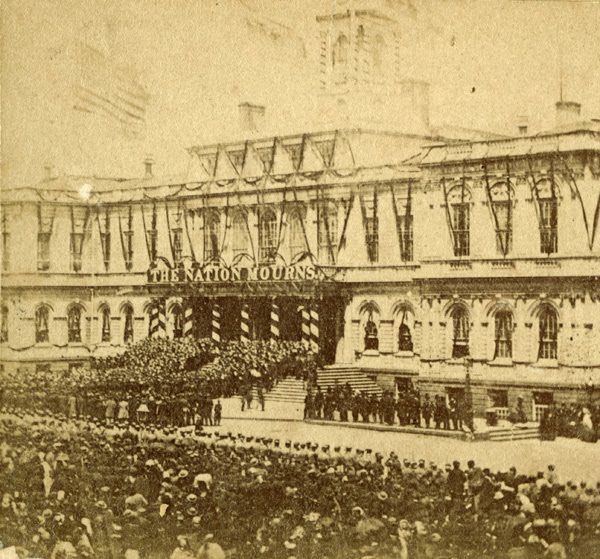
Funeral of President Lincoln in New-York, April 25th, 1865. (Courtesy of New York Public LIbrary)
From the New York Sun: “This morning the citizens of New  York are called upon to pay funeral honors to the remains of one whose tragic death, invests the ceremonies with an interest never before felt for any individual, who has occupied the highest office which the suffrages of a free people can confer upon a citizen of the Republic.”
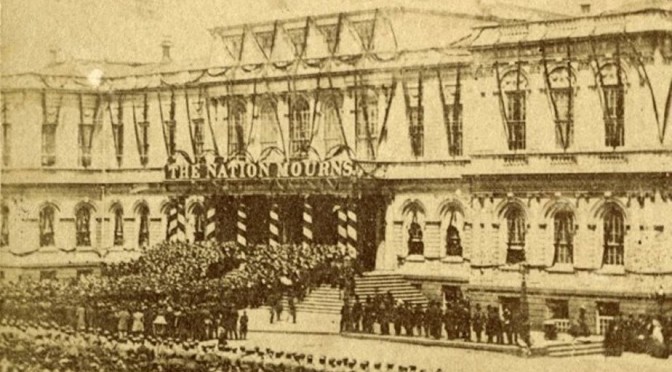
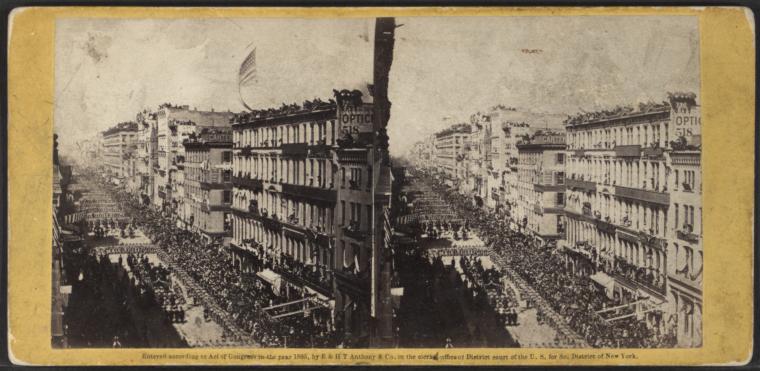
His body was taken to New York City Hall where he lay in visitation for almost an complete twenty four hours. Thousands of New Yorkers came to pay their respects.  In the afternoon of the April 25, his body was brought back to the 30th Street Station and transported to Albany, then to other cities, before its final destination in Springfield, Illinois.
The Hudson River Railroad station is long gone. Standing in its place however is another large structure:  the United States Postal Service mail processing facility at 341 9th Avenue. Unless you’re a fan of postal history — or you’ve stumbled around the neighborhood after stepping of the High Line — you’ve probably never given this building much notice.
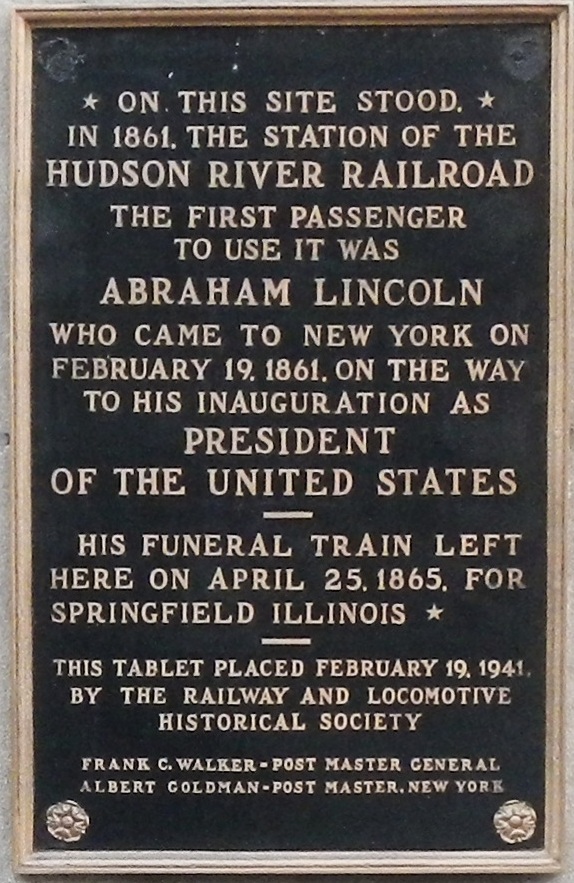
But visit the northern side of this building, and you’ll find the following plaque:
“On this site stood in 1861 the station of the Hudson River Railroad. The first passenger to use it was Abraham Lincoln, who came to New York on February 19, 1861 on his way to his inauguration as President of the United States. Â His funeral train left here on April 25, 1865 for Springfield, Illinois. Â This tablet placed February 19, 1941 by the Railway & Locomotive Historical Society.”
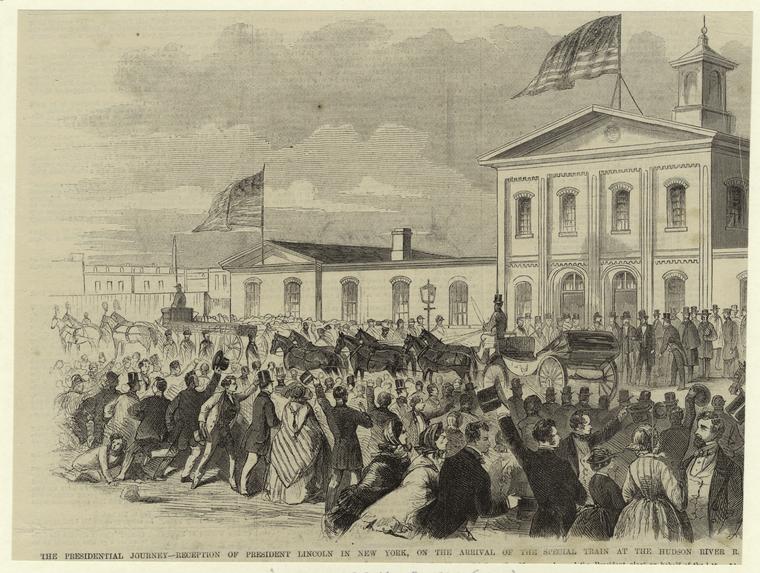
That’s right — Lincoln was the first honorary passenger to arrive at Cornelius Vanderbilt’s new ‘uptown’ depot! Again the New York Sun, but on February 20, 1861:
“In that strange and dirty locality where the Hudson River R.R. Company have fixed upon their uptown depot, thousands of people began to congregate fully two hours before the hour when the expected train was due…..The great gate of the depot yard through which the train was to enter was guarded by a cordon of police, and outside these limits surged the crowds, unusually patient for a New York crowd awaiting a sensation probably from a general faith that Old Abe could be depended upon to come to time properly.”
Presidential journey : reception of President Lincoln in New York, on the arrival of the special train at the Hudson River Railroad. (Courtesy New York Public Library)
Here’s a description of the exact same spot, over four years later (courtesy the New York Times):
“Outside of the gate of the depot yard, on Tenth-avenue, the immense throng stationed there received in respectful and mournful silence the very brief and unsatisfactory glimpse they gained of the coffin of the dead President. Viewing with anxious eyes the train as it emerged from the gate, and gazing upon the gorgeously decorated car, and uncovering with sincere respect for the hallowed dead, the immense multitude beheld the departure of the train.Â
 As the train fairly got into motion and disappeared round the curve, the immense mass of beings, so long kept within bounds, at last burst through all restraint, and the entire vicinity of the depot became the scene of the most extraordinary confusion. The police were totally inadequate to the impossible task of keeping the people in order, for they were carried like drift-wood before the flood as the impatient crowd broke up and started upon their several homeward ways.”
This plaque was placed on the side of the postal facility (called the Morgan Annex) on the afternoon of February 19, 1941, unveiled by the U.S. postmaster Albert Goldman. Â The organization who sponsored it, the Railway & Locomotive Historical Society, still operates today.
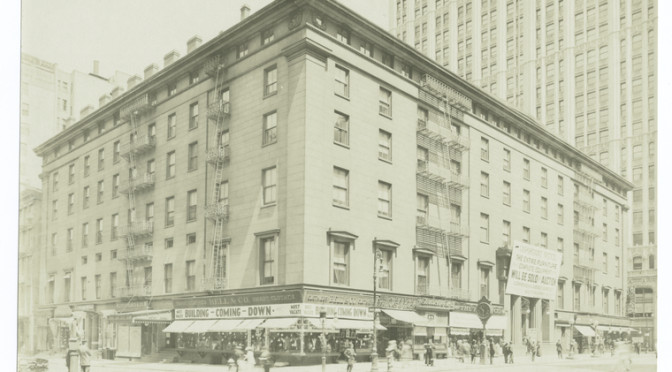
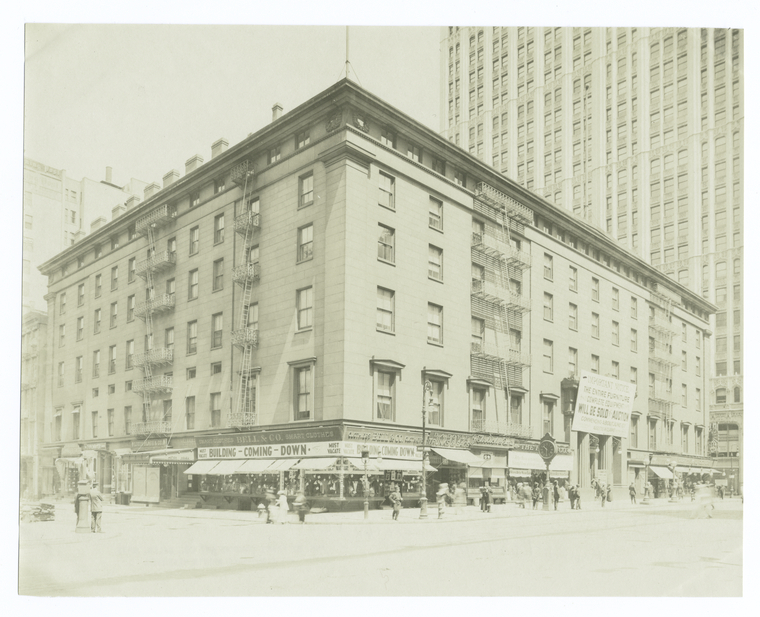
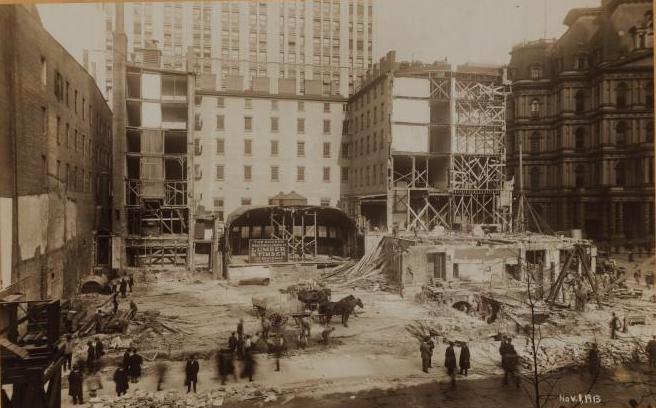
The Astor House was New York City’s first great hotel, opened in 1836 by John Jacob Astor himself, a premier accommodation for the city throughout the 19th century. But by 1913, it was time to tear it down.
It was a symbolic moment for many older New Yorkers. As you can tell from the image above, the ancient hotel had a new neighbor: the Woolworth Building, a symbol of the ‘new’ New York City. As dozens of more modern hotels opened uptown, the old Astor was greatly reduced, with whole sections partitioned for other uses.
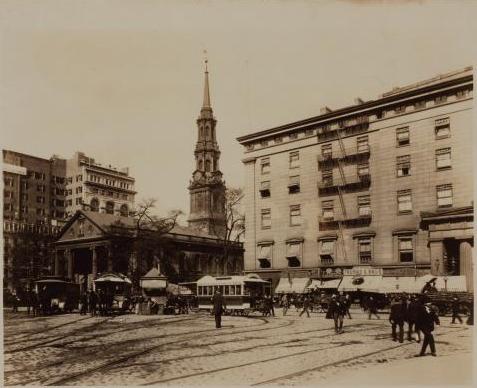
For a little comparison, here’s how the building looked in the 1890s, already minimized in its appearance:
Hotels were now flocking to the Times Square area. In fact, so to did the Astor name, with the beautiful Hotel Astoropening there in 1904.
The hotel might have survived a little longer if not for new subway construction in the area, endangering the foundation of the old building. On May 29, 1913, the hotel closed its doors, and over the next few weeks, the southern section of the Astor House was torn down. But not without a bevy of reminiscences from old New Yorkers, and a little teeth-gnashing too of a colder, modern city overtaking the gentle comforts of the old.
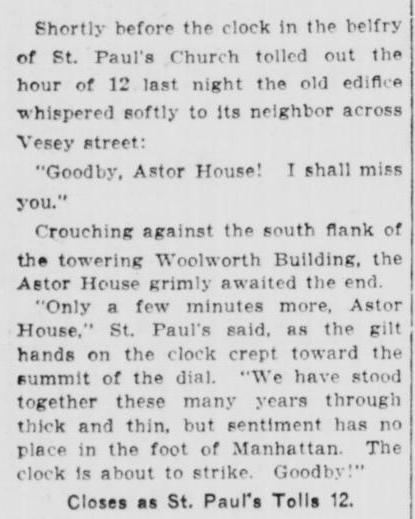
And then, there’s this dramatic article from the New York Tribune, depicting a literal farewell between the Astor and its neighbor to the south, St. Paul’s Church:
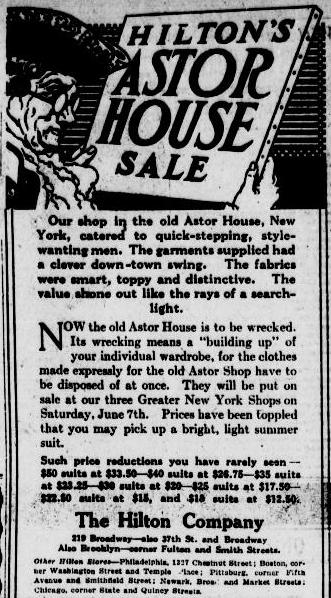
While this spelled doom for a certain memory of New York, those who liked firesales of sorts could take comfort in liquidation sales from famous shops which operated from the old Astor Hotel, such as the Hilton Company:
This is what the space looked like within a couple months. By the way, that’s the old Post Office to the right of the picture, a structure that would last another quarter century before it too was demolished in 1939:
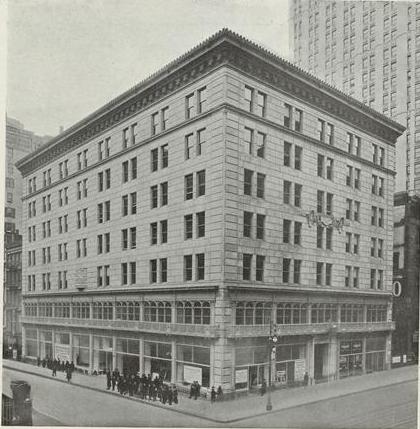
In 1915, it was replaced with the Astor House Building, a small suite of office spaces that remains on that street corner to this day. It’s where the Staples store is
WARNING The article contains a few spoilers about last night’s ‘Mad Men’ on AMC, so if you’re a fan of the show, come back once you’re watched the episode.
Lusty groupies, ample drug intake, smoky hallways and deafening rock music. One might have thought last night’s ‘Mad Men’ — partially centered around the backstage antics of a Rolling Stones concert — was taking place at Shea Stadium, where the Beatles famously performed to their largest audience in 1965. Or maybe that was Madison Square Garden, the one on Eighth Avenue and 50nd Street, where Marilyn Monroe sang happy birthday to John F. Kennedy in 1962?
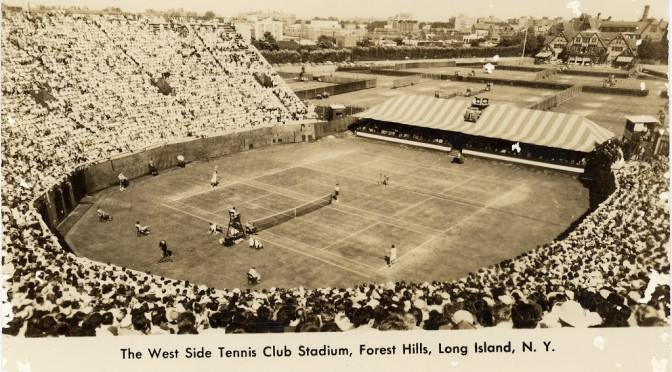
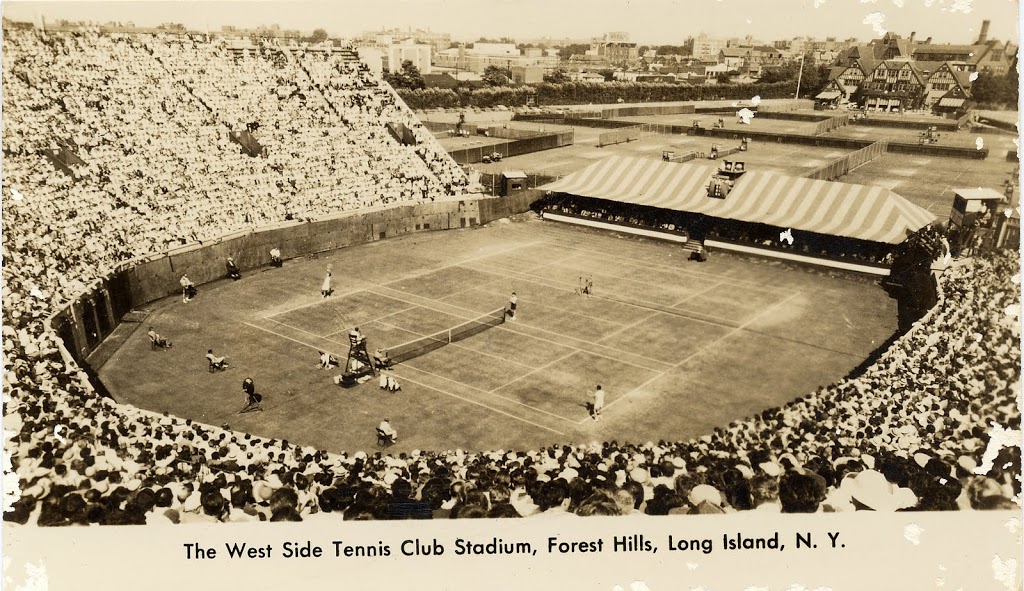
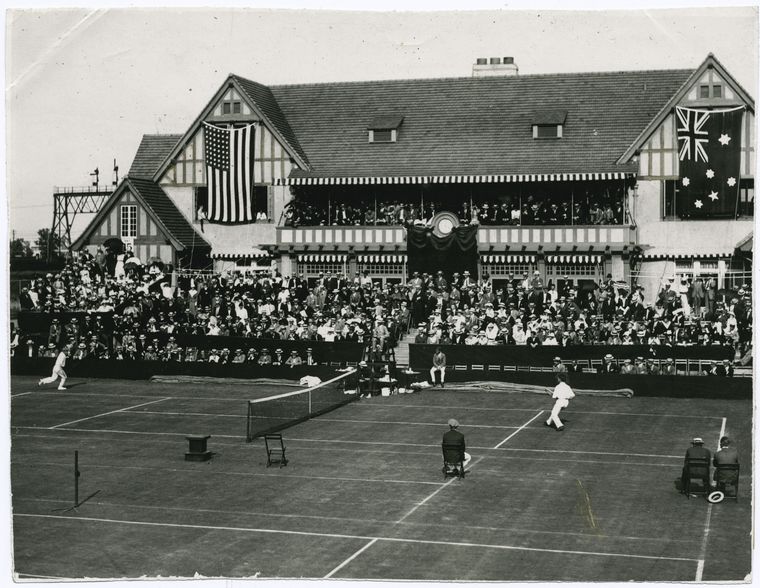
No, that mad, bacchanalian event took place at an esteemed tennis club — the West Side Tennis Club in Forest Hills, Queens.
Organized in New York in the 1890s, the tennis organization and social club quickly outgrew various venues in Manhattan and made their way to Queens. The momentary inconvenience of relocating to an outer borough was swiftly forgotten when the venue opened in 1914, a sumptuous series of grand courts, manicured lawns and a spectacular Tudor-style clubhouse designed by Grosvenor Atterbury* and John Almay Tompkins. A later court addition would provide seating for 14,000 spectators.
The clubhouse reflected the style of homes in nearby Forest Hills Gardens, also planned by Atterbury as a private, upper class community. To this day, the ‘cottage community’ is one of Queens most exclusive neighborhoods.
Below: A vigorous match between Maurice McLoughlin and Norman Brookes in 1914. The larger court would not be built for several more years. Courtesy NYPL
The grounds were so abundant that it drew the U.S. Open from Newport, Rhode Island, in 1915, and they remained here until 1987. In fact, for most of the 20th century, the tennis club became the American capital for the sport, seeing victories by sports icons like Arthur Ashe, Jimmy Connors, Althea Gibson and Billie Jean King. Alfred Hitchcock even filmed a pivotal scene in ‘Strangers On A Train’ here.
Tying in some of these themes of this season of ‘Mad Men’, there was even a scandal involving the exclusion of black and Jewish members from the club in the 1959, a scandal that involved an under-secretary from the United Nations.
But the appeal of a large and vibrant permanent outdoor venue soon drew, shall we say, less buttoned-up events. The Forest Hills Music Festival was a weekend precursor to New York’s many outdoor concert events today, bringing modern stars to the courtyards and giving this upper crust cloister a taste of counter-culture and teen-fueled rock and roll. One of its organizers was Ron Delsener, later to become a renown concert promoter in the New York area.
Beginning in the late 1950s, concert events were staged on the court itself. At first, the venue drew acts like the Kingston Trio, Frank Sinatra, Harry Belafonte, Barbra Streisand, and even Woody Allen with a stand-up performance. But not of those performers brought the frenzy quite like the Beatles, who played two nights in late August 1964 and drew such passionate crowds that their helicopter had to land on the court itself, their fans separated from the performance area by an eight-foot fence.
Forest Hills was known for its ungainly crowds. Bob Dylan performed there in August 1965 and was booed by audience members outraged that he would deign perform with electric accompaniment, “betraying the cause of folk music,” according to music historian Tony Glover.
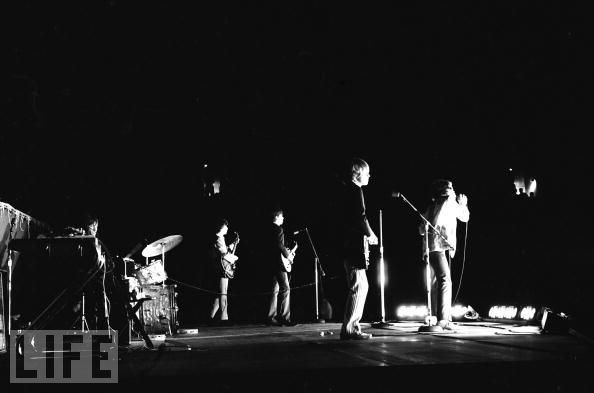
So with all that in mind, imagine the passionate crowds which awaited the shaggy ragamuffins from Dartford, the Rolling Stones, on July 2, 1966, appearing in the United States just as radio stations were buzzing with their number one song, ‘Paint It Black‘.
After three opening acts (including the Trade Winds), the Stones played ten songs at Forest Hills (pictured above), including ‘Lady Jane’, ‘Get Off My Cloud, and of course ‘Satisfaction’, to a crowd of 9,400 people.Yes, believe it or not, they didn’t sell out the venue, but that’s because the most expensive seats (an unheard-of $12.50!) went unsold, and the temperature for the outdoors concert was in the high 90s.
But those that were in attendance were frenzied enough that 250 cops were deployed to the show, armed with tear gas and nightsticks, holding back frothing audiences of young people sent “into peroxsyms” by the British stars. “A dozen youngsters willfully broke through the police line,” according to the Times. “Within seconds the park lights went up and the Rolling Stones’ helicopter took off into the night.”
Far from the maddening crowd, members of the band hit the club circuit in Manhattan, first Cafe Wha? in Greenwich Village, and then Ondine’s at 59th Street, where they were wowed by the energy of a young guitarist named Jimi Hendrix.**
And here’s some further context you should keep in mind. That was the summer of 1966. The biggest American musical artist that year was actually two young sons from Forest Hills, Queens — Paul Simon and Art Garfunkel — and their album The Sounds of Silence would become the biggest album of the year.
*Mr. Atterbury also played a significant role in the renovation of New York’s City Hall in the early 1900s. We have a ball with Grosvenor in our City Hall podcast from 2009
**There seems to be a little confusion here. Keith Richards bios recall Cafe Wha?, while the diary of Bill Wyman mentions Ondine’s. Hendrix played at both venues a few times, so either (or even both) is possible. Keep in mind, everybody was probably stoned.
Never have I been more elated to write about a City Council meeting.
At the start of the 19th century, city affairs were still being conducted on Wall Street at Federal Hall. For many years they shared the corridors with George Washington and the first American Congress. By 1800, the federal offices were long gone, but that ‘old City Hall’ was no longer an adequate structure for the affairs of a fast growing city.
So a new City Hall was planned in 1803 by New York’s most notable designers of the day, Joseph Mangin and John McComb, to be placed at the site of the city’s old common grounds. After years of delays, however, it seems city leaders grew a tad impatient. Although the new City Hall building would not officially be completed until 1812, the mayor and the Common Council moved in anyway.
According to state records, the very first meeting between Mayor DeWitt Clinton and the council was held on August 12, 1811.
“The Common Council met agreeably to adjournment in the new City Hall in the room designed for the Mayor’s office.” Mayor Clinton was joined in his chambers by a recorder and the 17 members of the Common Council, including both Caleb and John Pell, whose family holdings would become the basis of Pelham Bay Park.
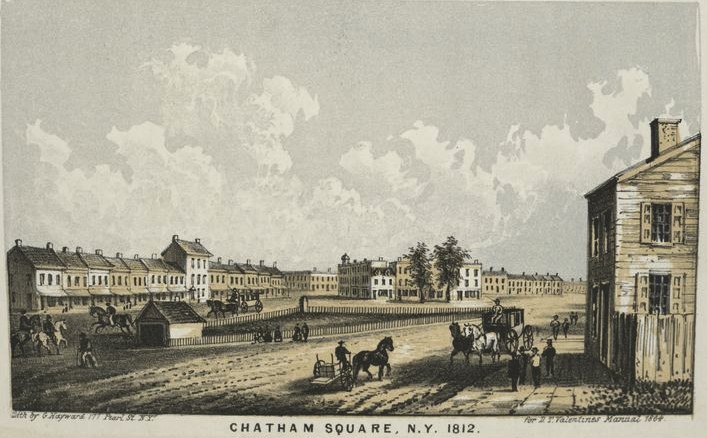
And what, you may ask, was the big item on their agenda? The proposal to fence in Chatham Square.
That open patch of land, on the Bowery and to the west of City Hall, had become an open air livestock market. The famous old Bull’s Head Tavern was located nearby, and farmers from all over Manhattan came to this area to sell their wares to merchants and to factories located around Collect Pond. Some on the council believed a fence around this place of business would constrict farmers attempting to move in and out of the property.
Still, a fence brought the promise of cleanliness. Collect Pond was being drained and levelled, and city leaders expected the land values surrounding it to increase. Thus the fence was approved. You can find a picture of Chatham Square and the newly constructed fence below.
But more importantly, with this decision, two hundred years of civic bureaucracy were well underway!
For more information, check out our podcast on the history of City Hall and City Hall Park (Episode #93).