Categories
Amusements and Thrills

The fire at Barnum’s American Museum 155 years ago

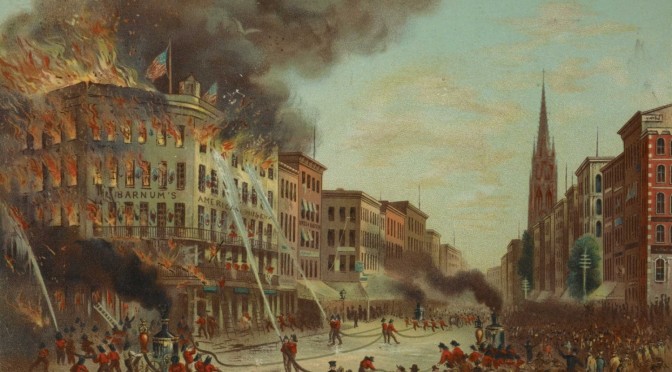
One hundred and fifty-five years ago (on July 13, 1865), New York City lost one of its most famous, most imaginative and most politically incorrect attractions.

When P.T. Barnum opened his museum in 1841, the kooky curiosities contained within the building at the corner of Broadway and Ann Street — at the foot of Park Row — were simply reconstituted properties from other museums.

But he soon expanded the collection to include living spectacles, both human and animal, become both the greatest show and the greatest side-show on earth.

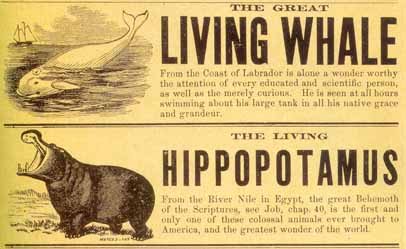
From his lilliputian stars Tom Thumb and Commodore Nutt to the unfortunate white whales contained in water tanks in the basement, Barnum’s American Museum was New York’s destination for the fascinating and the weird.

Millions would visit its corridors during its two and a half decades of operation. It was so renown that it was even a target of attempted sabotage during the Civil War.

Below: A rare photo of Barnum’s American Museum, taken in 1858
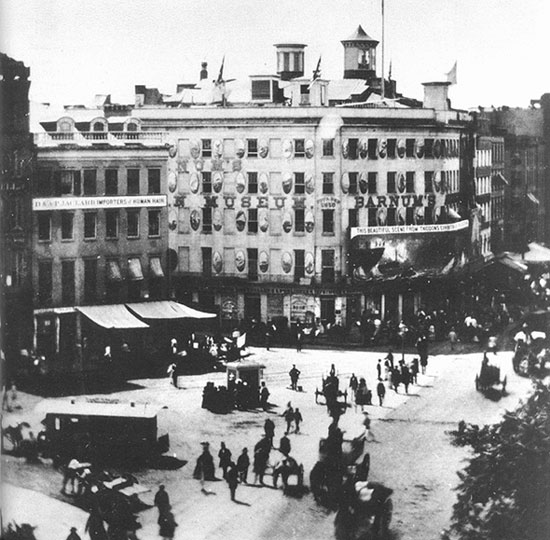
Taken 1858
Taken 1858

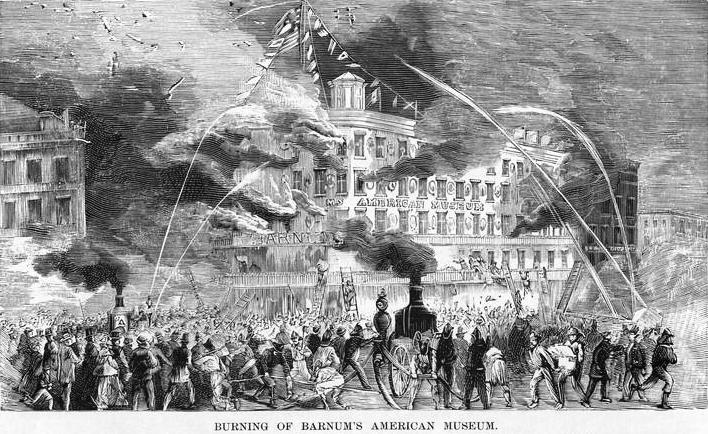
At around noon on July 13, 1865, the building quickly succumbed to “the fierce tooth of fire,” causing the greatest pandemonium that New York City had ever seen.  I must give way to some of the press reports of the day, as they best capture the drama:

New York Times: “Probably no building in New-York was better known, inside and out, to our citizens than the ill-looking ungainly, rambling structure on the corner of Broadway and Ann-streets, known as the American Museum, where for more than twenty years Mr. Barnum has furnished the public with a wonderful variety of amusements.”

Below: The street scene at the cross-section of Broadway and Ann Street, in 1860. A sign advertising Barnum’s snake collection can be seen on the museum.
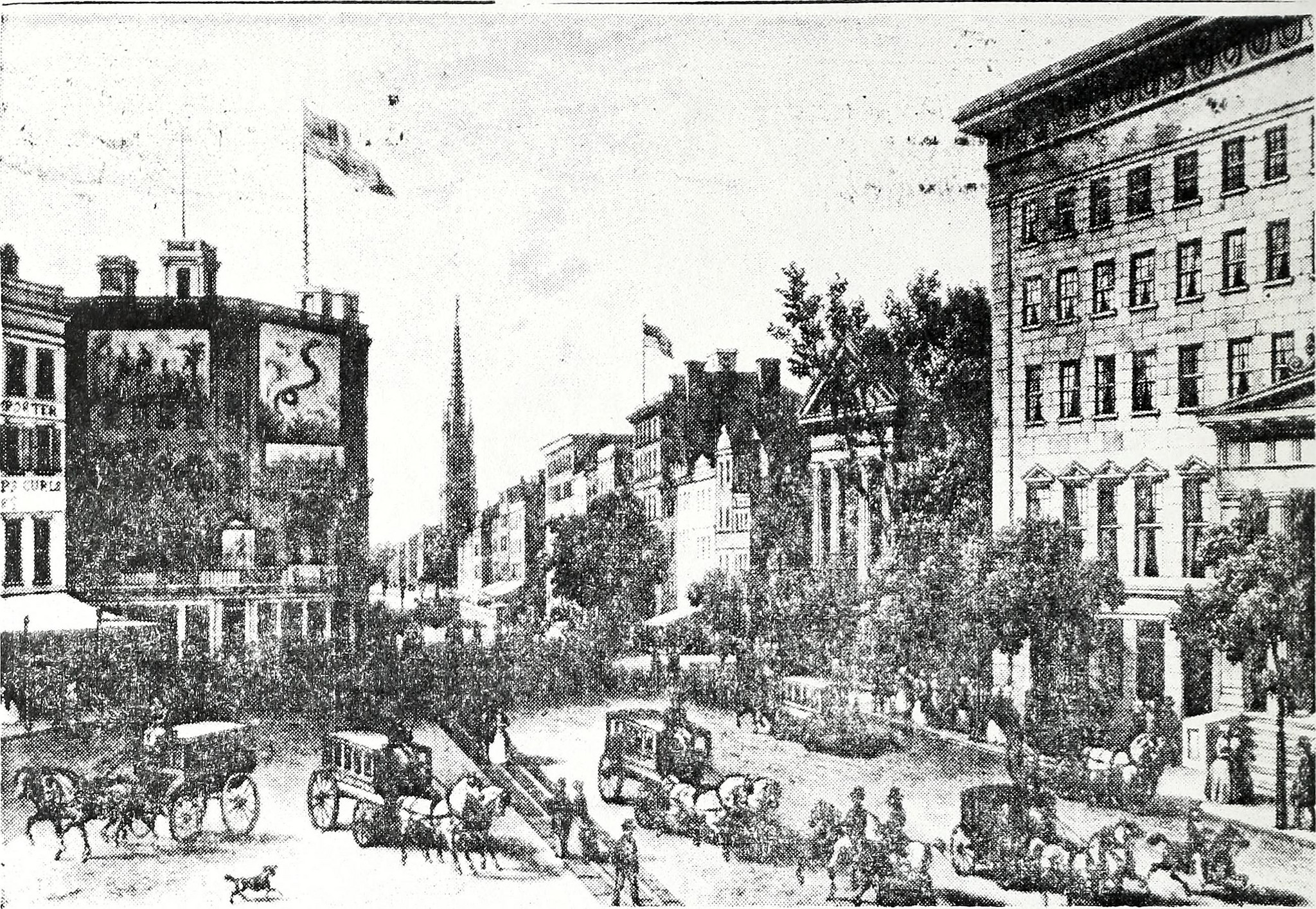
Courtesy Internet Book Archive

New York Sun: “About half past twelve o’clock yesterday the Engineer rushed up from below announcing that his room was on fire, and about the same time immense volumes of smoke permeated the Ann Street end of the building.  [K]nowing that the immense whale tank was directly over the spot where the fire had begun to make headway, attempted to knock a hole in the huge reservoir.”
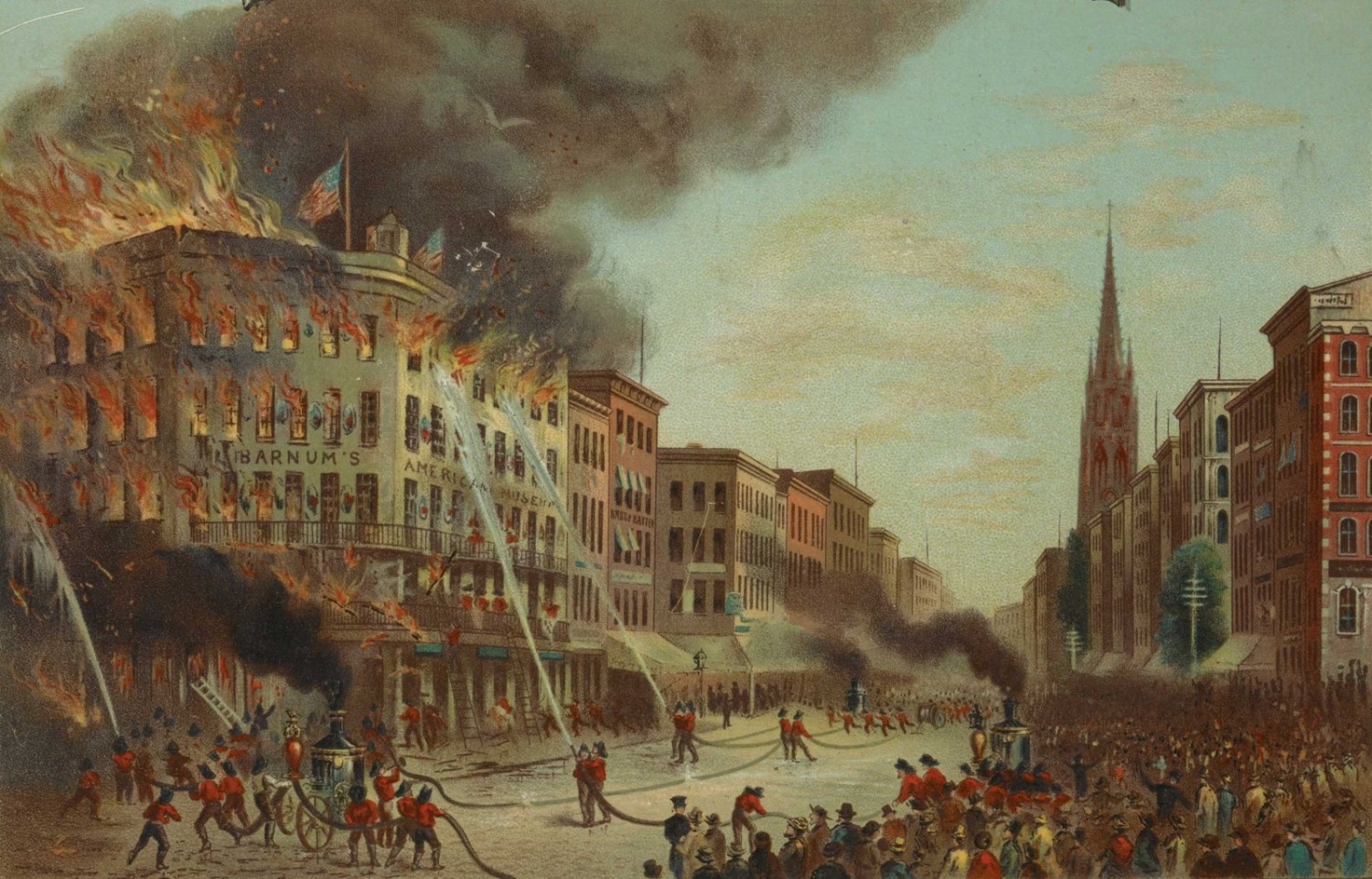
Christopher Pearse Cranch. Burning of Barnum's Museum, July 13th, 1865, 1865. Chromolithograph. Eno Collection Miriam and Ira D. Wallach Division of Art, Prints and Photographs, The New York Public Library
Christopher Pearse Cranch. Burning of Barnum’s Museum, July 13th, 1865, 1865. Chromolithograph. Eno Collection Miriam and Ira D. Wallach Division of Art, Prints and Photographs, The New York Public Library

The occupants of the tanks were doomed.  “‘[T]wo whales, imported, at a cost of $7,000, from the coast of Labrador,’ whose sportive plunges and animated contests of affection afforded constant amusement to hundreds of spectators, [was] a pregnant contrast to the fearful death by roasting which they so soon thereafter met.”

The fire spread rapidly, quickly filling the upper floors with smoke.  Firemen burst in from the Ann Street side and quickly attended to patrons who had collapsed or were too confused in the immense labyrinth of bizarre objects to escape.
1

A fireman named William McNamara is credited with single-handedly evacuating many patrons of the museum, not to mention some of the performers who regularly lived there.

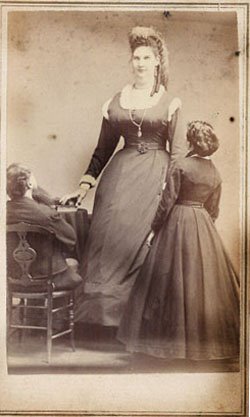
From the New York Sun: “Knowing that [some performers] occupied apartments on the third floor, he rushed thither and burst open the doors. Finding the rooms empty he ascended to the next floor and succeeded in bringing down the ladies assembled in the dressing rooms there — a Miss Swan, the Giantess, and Miss Zuruby Hannus, the Circassian girl.”

Below: Anna Swan, ‘the Giantess’ who lived at the museum, was successfully rescued
swan

Many of the wax figures from the third floor were hurled out the windows. One peculiar item captured the imagination of the crowd — the wax depiction of Jefferson Davis, dressed in a woman’s petticoat.  (It was rumored that the former president of the Confederacy has attempted to escape dressed as a lady.)

NYT:  “One [rescuer] had Jefferson Davis’ effigy in his arms and fought vigorously to preserve the worthless thing, as though it were a gem of rare value. On reaching the balcony the man, perceiving that either the inanimate Jefferson or himself must go by the board, hurled the scarecrow to the iconoclasts in the street. As Jefferson made his perilous descent, his petticoats again played him false, and as the wind blow them about, the imposture of the figure was exposed.”

NYS: “When the Jefferson Davis petticoated figure was recognized by the crowd, it was seized, kicked, knocked and finally hanged to an awning frame [in front of St. Paul’s Church], amid the derisive and contumelious epithets of the persons engaged in this pastime.”

More seriously a great number of artifacts from the Revolutionary War were incinerated in the fire. “Valuable mementos of Washington, Putnam, Greene, Marion, Andre, Cornwallis, Howe, Burr, Clinton, Jefferson, Adams, and other eminent men which should have been carefully stored in a fire-proof vault, yesterday smoldered in the heat….” [NYT]
barnum's museum burns 1865

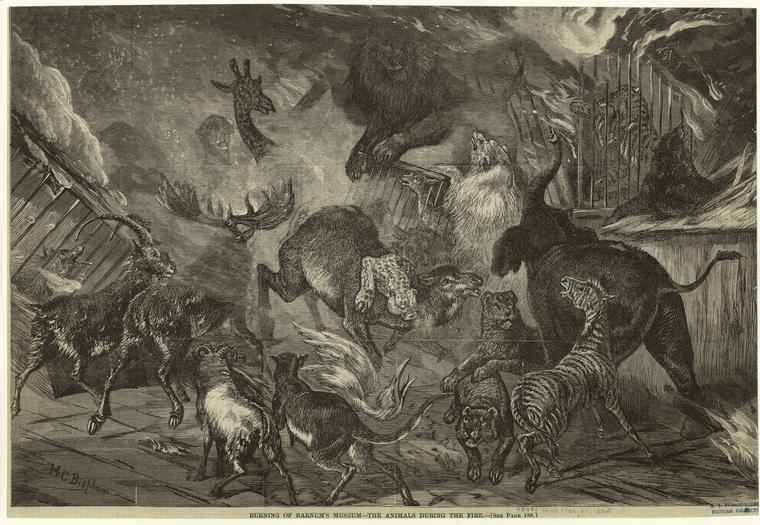
The museum’s impressive collection of taxidermy — monkeys, lions, elephants, zebras — were swallowed up by smoke and collapsed into the inferno.

But the museum also had a great many living animals — snakes, pigs, dogs, and even a kangaroo and an alligator. And, of course, a great many monkeys — “big monkeys, little monkeys, monkeys of every degree of tail, old, grave, gray monkeys, young, rascally, mischievous monkeys, middle-aged, scheming monkeys, and a great many miserable, angry monkeys.” Most perished in the flames although some escaped into the streets, some never to be found again.

Below: This is Harpers Weekly’s illustration of Barnum’s second fire — see below — but could have tragically captured the events on July 13, 1865.
Harpers Weekly
Harpers Weekly

Remarkably, nobody humans died in the blaze. In fact, few wax depictions of humans perished as many took to rescuing wax figures thinking they were alive.  The fire spread to several surrounding buildings, and soon the entire block was engulfed in flame.

NYT:  “The roof of the Museum had now fallen, and the interior of the building was like the crater of a volcano. A stream of heated air issued from the top, and was borne eastward by the breeze directly over the block, carrying with it light articles, pieces of burning wood, shingles ….

At 1:30 came a crash resounding like the explosion of a powder magazine. The whole wall on the Ann-street side had fallen. A cloud of dust and smoke filled the air, making it dark as twilight, and rendering it impossible to descry objects at short distance.”
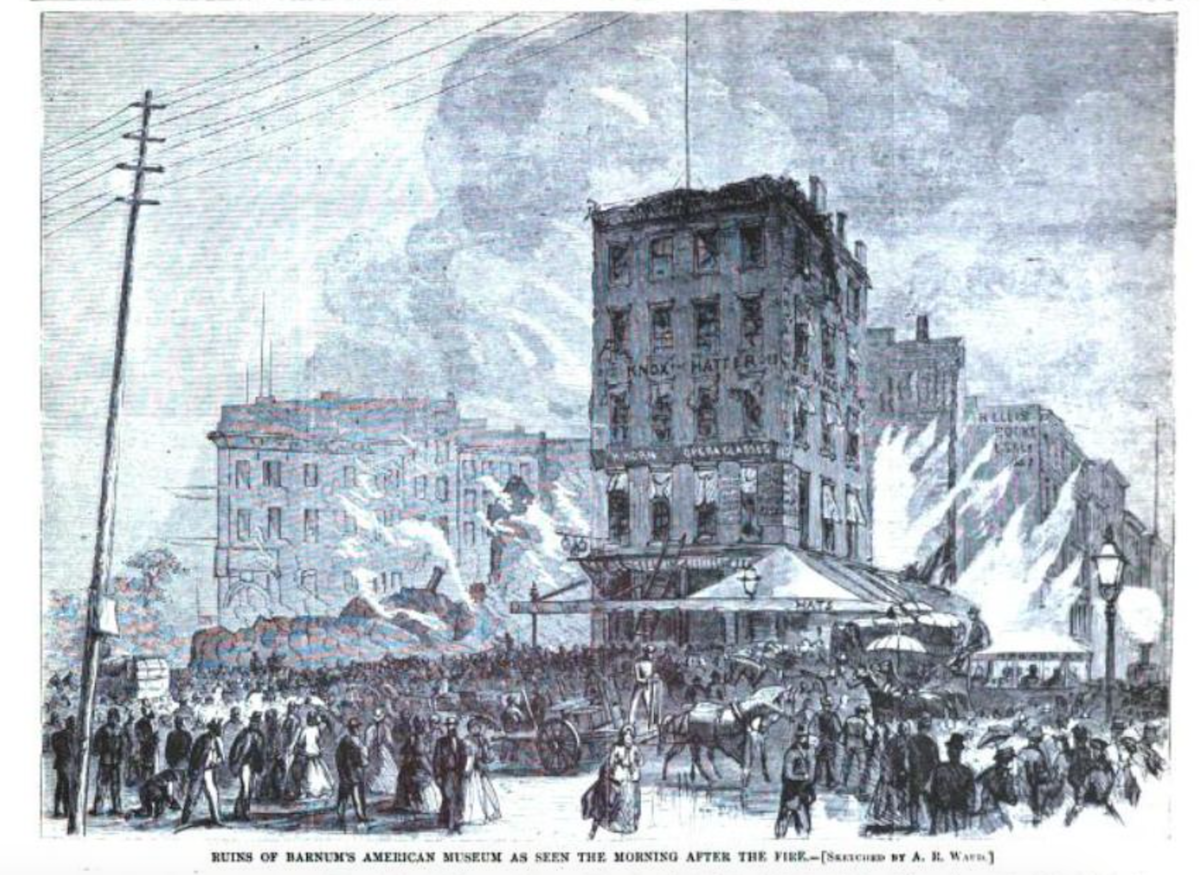
Harpers Weely
Harpers Weekly

Notable among the surrounding buildings that were damaged was the famous Knox the Hatter at 212 Broadway. Fortunately for the fate of New York,  the Croton Aqueduct water system had been installed two decades earlier, allowing the blaze to be put out with some speed, preventing a repeat of the Great Fire of 1835.

There was a bit a looting, including “two men dressed as soldiers [who] were seen coming out of the shoe-store in Ann Street, each with five or six pairs of shoes under their coats.” And there were false reports that the lion has escaped and was running through the streets.

For years after, people mourned the loss of Barnum’s collection, truly among the greatest in New York City up until that time. Â Barnum attempted to relaunch the museum at 539-541 Broadway. but it, too, was destroyed in a fire (pictured below).

Then, in 1871, he leased a train depot and called it Barnum’s Monster Classical and Geological Hippodrome.  (It would later morph into the first Madison Square Garden.)

Finally he just decided to take his collection of acts on the road forming a traveling circus in 1881 with ringmaster James Anthony Bailey.

While the world of entertainment would be changed by their collaboration — Barnum and Bailey’s Circus — most would consider the old American Museum as Barnum’s greatest achievement.

Below: Barnum’s second museum destroyed by fire, which gutted the building on a cold day
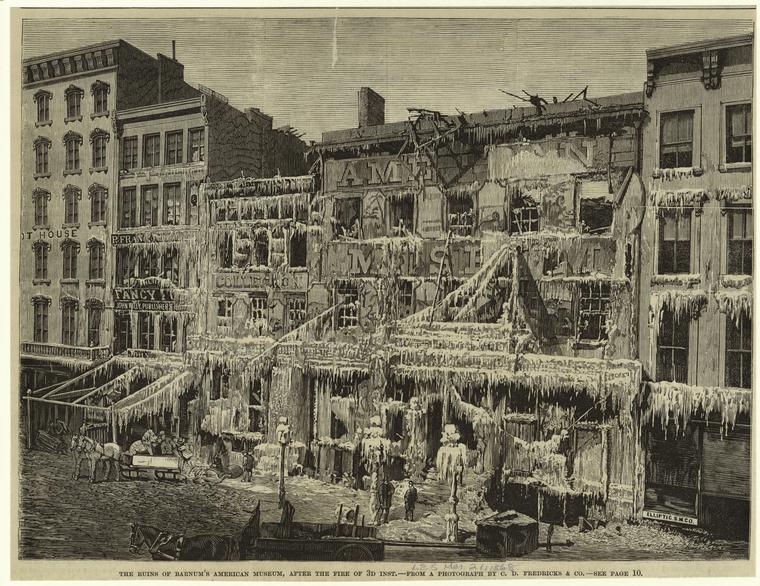
Harpers Weekly
Harpers Weekly

For more information, we have a few Barnum-themed podcasts that you might enjoy:
Categories
Museums Podcasts

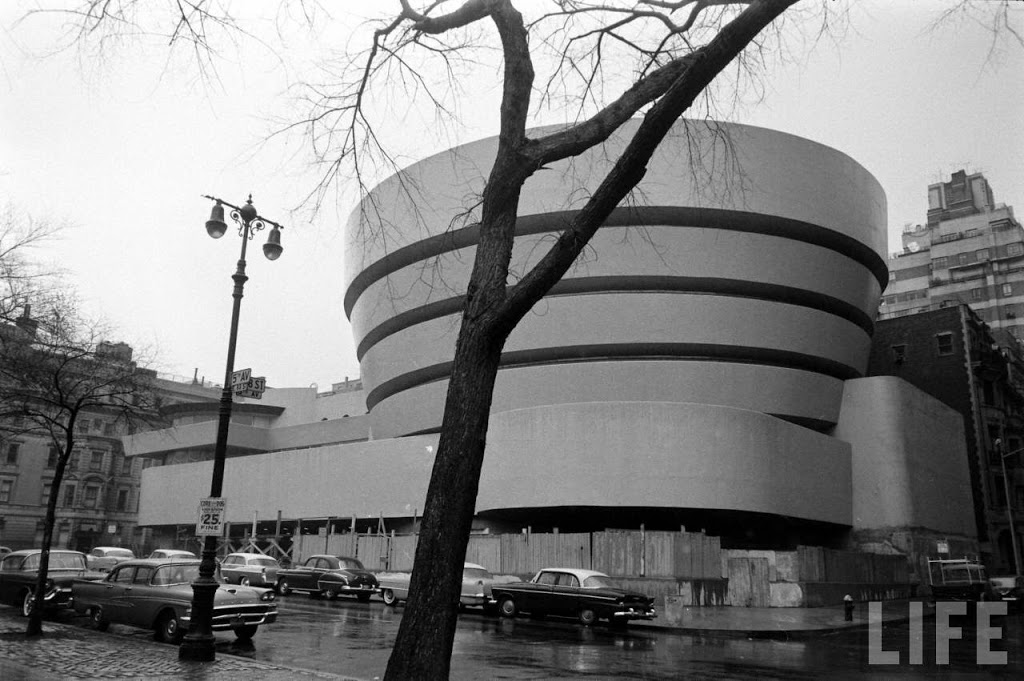
The wonderful mysteries of the Guggenheim Museum, the Frank Lloyd Wright ziggurat turned on its head

It’s ancient mysteries week on the Bowery Boys! What, you ask, I thought you only did New York City history? In fact, at least two great Manhattan landmarks evoke the great mysteries of ancient times, meant to bring mystical energy and revelation to one of the world’s greatest cities.

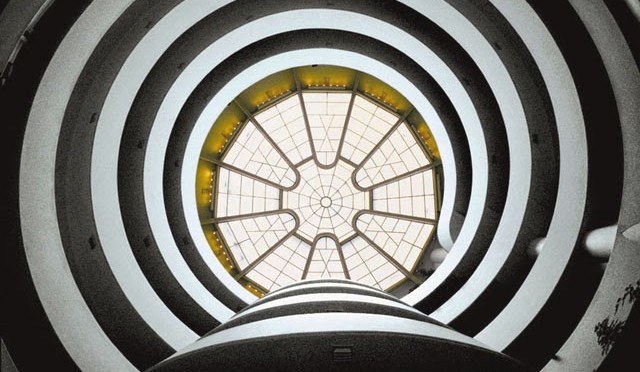
Here’s a replay of a podcast we recorded back in October 2008 on the history of the Guggenheim Museum, a space-age upside-down ziggurat originally designed to hold only the most unfathomable non-objective art in the world.

The spiral-ramped wonder that is the Guggenheim began as the dream of three colorful characters — a weathy art collector, a severe German artist and her rich patron art-lover. So how did they convince the most famous architect in the world to sign on to their dream for a modern art “museum temple”? Come meander with us through the Guggenheim’s quirky history. Co-starring Robert Moses!


Photographed by Walter Sanders, Life Magazine

PODCAST REWIND A special illustrated version of the podcast on the Guggenheim Museum (Episode #67) is now available on our NYC History Archive feed. Chapter headings with images have been embedded in this show, so if your listening device is compatible, just hit play and a variety of pictures should pop up. The audio is superior than the original as well. So dive into this weird, wild history of one of New York’s great museums!

When we recorded this, George W. Bush was still president of the United States, and the Guggenheim was just reopening after a major renovation. So even this podcast is a bit of history in itself!

Download it here or just subscribe to our archive feed — on iTunes or directly here. You can also stream it on Stitcher, although due to file incapability, it won’t be illustrated.

Categories
Amusements and Thrills

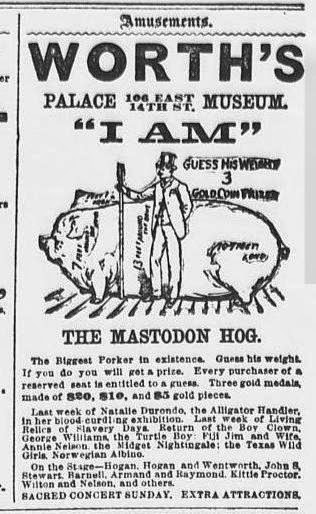
Meet the Mastodon Hog, the biggest star at a 14th Street museum

Worth’s Museum of Living Curiosities, one of New York’s most popular dime museums, paired cheap ‘curios’ with vaudeville performances on the main stage.  On December 29th, 1889, the star of the show was a massive hog named I-Am. “The Biggest Porker in existence. Guess his weight. If you do you will get a prize. Every purchases of a reserved seat is entitled to a guess.  Three gold medals, made of $20, $10 and $5 gold pieces”.

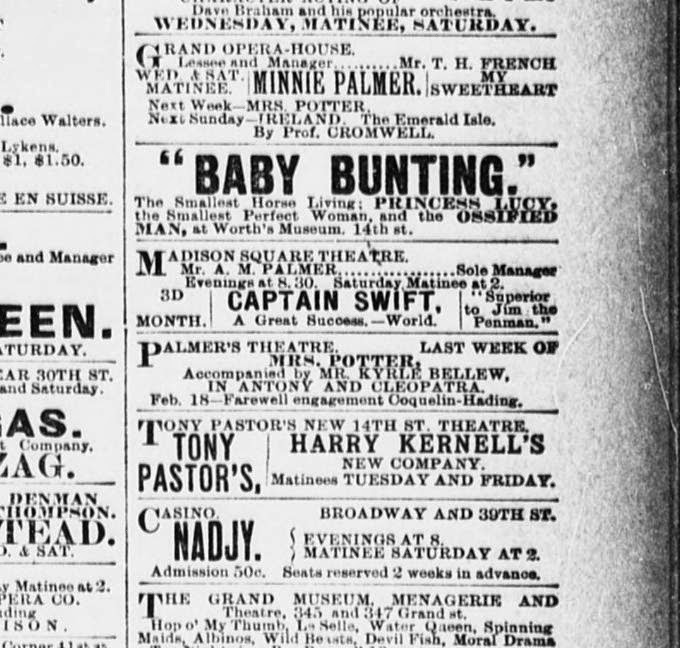
I can find no information on what the correct weight of this monster was.  However, this large animal capped a year of peculiarly sized beasts at Worth’s.  The year began with what was proclaimed as Baby Bunting, “the smallest horse living.”

Worth’s Museum was located at 106-108 East 14th Street, across from the Academy of Music.  The buildings were demolished in the 1920s — near the same time that the Academy was itself demolished — and the lavish Palladium concert hall was put in its place.  The Palladium became a nightclub in the 1990s.  It too was later bulldozed and replaced with a New York University residence hall.

Mrs. Bigge Trout: On the passing of Barnum’s prized fish

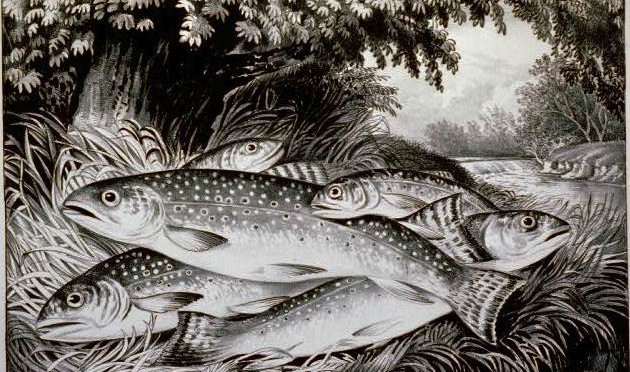
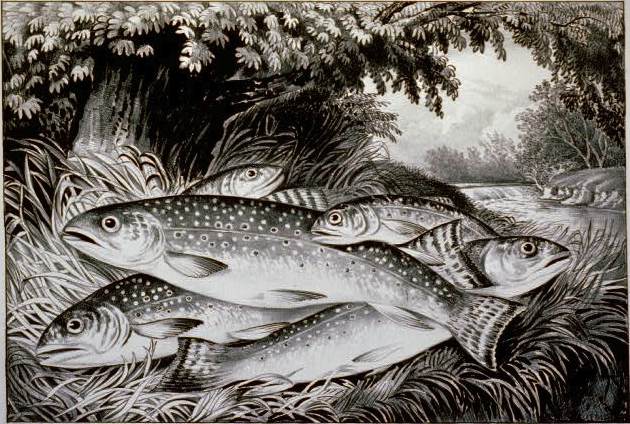
Trout by Currier & Ives, 1872. Sadly there are no extant images of Mrs. Trout.

I could not let this week pass without mentioning a sadness that fell over lower Manhattan 150 years ago today. A lament over the number of Southern states seceding from the union? The grief of Democrats over the inauguration that very day of a new American president, that uppity Illinois lawyer Abraham Lincoln? Concerns over the raucous administration of Mayor Fernando Wood?

No! It was the death of New York’s best known trout, known to all by her regal name, Mrs. Bigge Trout.
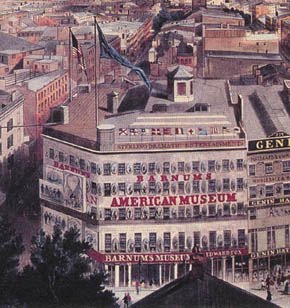
Mrs. Trout has been all but forgotten in the annals of both fish and human history. She would have been one of dozens of ill-kept aquatic creatures in the basement of Barnum’s American Museum, at the corner of Broadway and Ann Street, at the foot of City Hall Park.
The museum was an amalgam of delights, from wax figures to ‘freaks’ of nature, murals of historical reenactments to temperance entreaties in the lecture hall. But showman P.T. Barnum also specialized in a few live animals.
Fish were an especially popular delight to mid 19th century New Yorkers in a world without private aquariums. The museum featured a range of exotic fish such as “the angel, peacock, four-eyed cherub, cow, sturgeon, porcupine, and Spanish Lady as well as the squirrel, crimson cavaretta, parrot, grouper, zebra and yellow snapper.” Long after the passing of Mrs. Trout, Barnum would expand the aquatic feature to briefly include two doomed Beluga whales.
In 1861, the large, beloved Delaware trout would have been quite the popular attraction because she was pregnant. Very pregnant. According to the New York Daily Tribune, Mrs. Trout received her fatal injuries while attempting “to bring into the motley world seven thousand and sixty eggs at once.” The paper applauds her gusto in her attempt to increase “the census of the piscatorial kingdom by a number almost fabulous.”
The writer speculates: “Probably the odd sixty proved her ruin, but she is by no means the first who has fallen a victim to overweening ambition.”
Let me be clear here. I was reading this old issue of the Tribune looking for a more serious subject, and this, the death of Mrs. Bigge Trout, came before articles on the country’s impending strife, events that would lead to the Civil War. Urgency was apparently not a requirement for story placement in 1861.
Although Bigge — may I call her Bigge? — died on February 28th, her passing was reported in the March 4th issue with great fanfare (and some serious tongue in cheek).
If descriptions are to be believed, museum workers wore black, including the man in the box office with “crape on his hat.” Even the other animals, trapped in their confines and plaster dioramas, were reportedly sullen that day.
In all seriousness, Barnum’s would have offered New Yorkers the closest approximation to a modern ‘natural history’ experience, although proper care of the animals would have been a principal concern only to the extent that living creatures sell more tickets than dead ones. (Although there were plenty of those as well, stuffed and mounted throughout.)
The Tribune mentions that Mrs. Trout was “interred with all the honors” but does not list her final resting place. Morbidly, I wonder if that interment might have been the dinner plate of another museum inhabitant. “Her mourning friends, the other fishes, were prevented, by prior engagements, from following the remains to their last resting place.”
So this weekend, pour a little out for Bigge on this, the 150th anniversary of her passing to that great Barnum spectacle in the sky.
You can read the original article here. If you want more information on Barnum’s American Museum, check out our podcast on the subject from 2008.
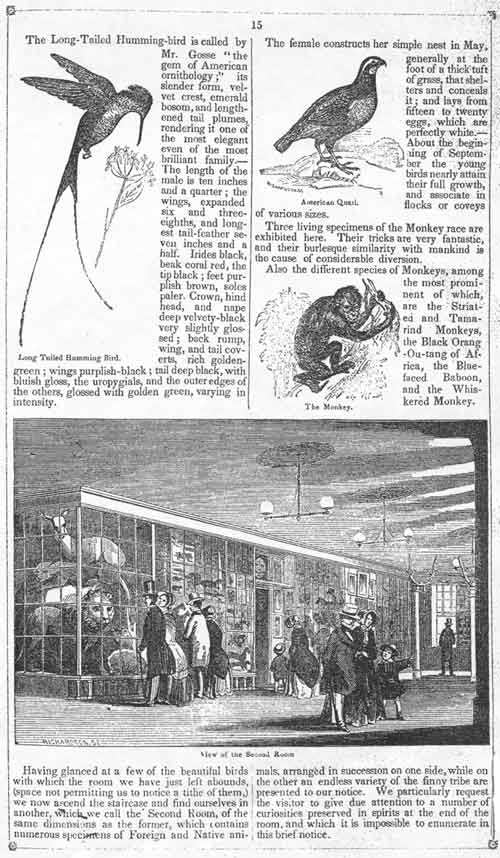
Below: A page from the 1850 Barnum’s Museum guide, from CUNY’s excellent interactive website on the museum

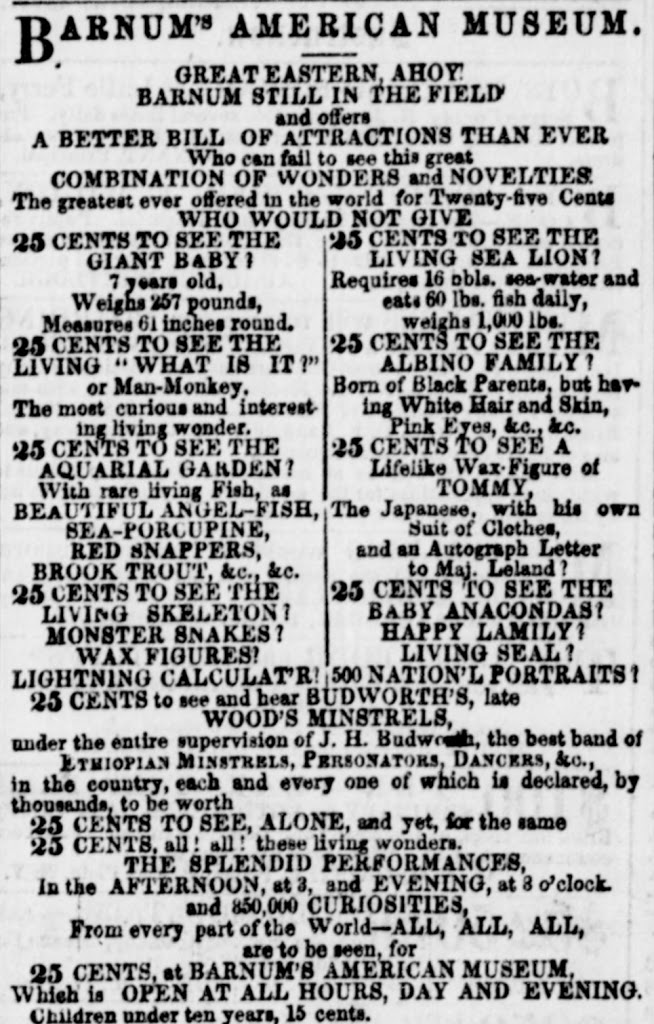
And finally, an advertisement from July 1860, unveiling some of the delights that would have been in the museum at around the time of Mrs. Trout’s death. It’s really worth your time to click the image and read through these. Don’t miss the Giant Baby!

Categories
Uncategorized

Mesmerizing: The forgotten museum of Rubens Peale

Believe it or not, this long-gone, unsuccessful attempt at a museum actually figures into the larger tale of a major New York institution, which we cover on this week’s podcast and which will be available for download by Wednesday. This is a reprinted article from May 15, 2008 with some modifications. Original is here.

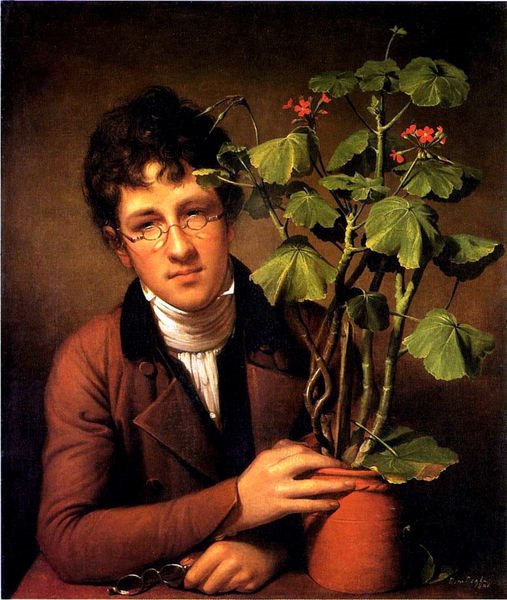
What if your best known accomplishment in this world was the fact that you posed for a well-regarded American masterpiece by your more talented older brother? Welcome to the world of Rubens Peale!

Philadelphians and American art lovers in general should be quite familiar with Rubens’ father Charles Wilson Peale, one of early America’s pre-eminent painters, portraitist to Washington and Jefferson, and patron of what would become the Philadelphia Museum. Peale’s museum for Philly, which opened in 1786, is not only one of this country’s most important natural history institutions, it set the stage for pioneering museums across the country.

Peale graced his children with some truly loaded first names — Raphaelle, Rembrandt, Titian and of course Rubens. And they all attempted to follow in their father’s footsteps, both as painters and as curators of their own museums.

Raphaelle tried to open one in Charleston. Rembrandt set one up in Baltimore (unfortunately timed for the War of 1812). Baby brother Titian took the reins in Philadelphia and became the family’s most prolific naturalist.

Rubens would have more ambitious designs. At first more interested in the sciences than the arts, the youngest and frailest Peale operated the Philadelphia Museum after his father’s retirement before coming to New York City in 1825 to set up his own version of his father’s dream. The address for the Peale Museum of New York City was 252 Broadway, a building better known as the more austere-sounding Parthenon.

Peale’s museum opened on October 26, 1825, to monopolize on a huge city celebration occurring that day: the opening of the Erie Canal. By 1840, Peale would change the name to the New York Museum of Natural History and Science.

In the early days, Peale’s chief competition was the small museum housed in the former almshouse across the street, next to City Hall. The collection of John Scudder, advertised as the American Museum, had thrilled New Yorkers here since 1817. But Scudder was dead by 1825, and his collection was worn and barely upgraded. It was definitely not of the calibre of a Peale museum, or so Rubens believed. Unbeknownst to Peale at the time, his real competition would sprout up just south of the park.

Rubens’ new museum would have had much the same makeup as the one in Philadelphia : great displays of stuffed animals in natural settings, display cases of butterflies and insects, postulations of pre-Darwinian scientific theories laid out over several rooms and supported with lectures and even theatrical productions. One book refers to Rubens as a “popularizer of scientific discoveries and a manager of theatrical attractions.”

In 1826, Rubens imported two mummies from Cairo for display; after 16 days of presenting the draped bodies, he presented for the interest of the “scientific and the curious” the unwrapping the age-old corpses in the museum lecture room.

His museum also featured fine arts and historical portraits, some by his own family members, others by respected painters as Bass Otis.

Rubens was sensitive to some of the cheap ploys of the Philadelphia Museum (live animals, displays of human deformities) and tried to keep his New York museum a dignified affair, although today we would find its use of waxworks and flashy lectures rather silly.

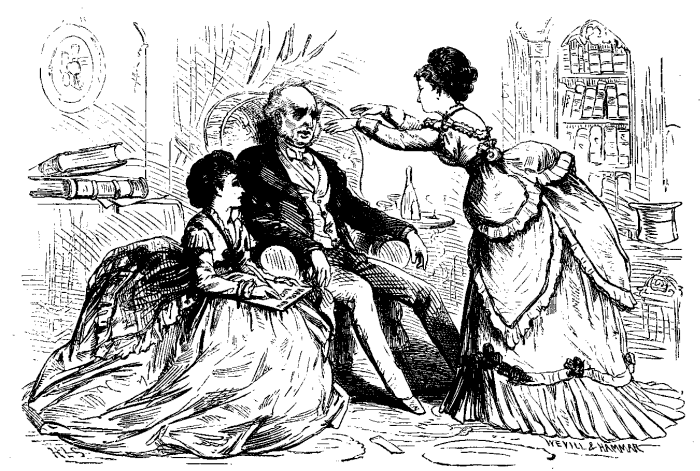
Above: an illustration entitled ‘Mesmerism on Wall Street’

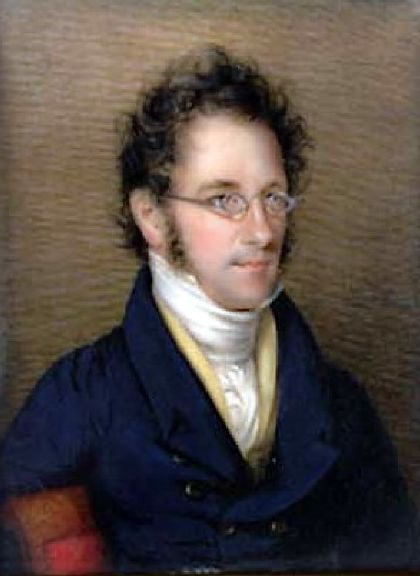
Rubens adherence to the scientific led him into some unusual directions. He became mesmerized, if you will, by the theories of Fredrich Anton Mesmer, who believed a magnetic fluid in the body controlled the personality. A precursor to hypnotism and later the intellectual embrace of clairvoyance, mesmerism was such a popular distraction that Rubens placed a New York newspaper advertisement on February 8, 1841, claiming “a demonstration on the principle of animal magnetism” would be presented at his museum.

“The time is not far off when it will be said where is the person that doubts its existence,” he later said in a letter to his brother Rembrandt.

Unfortunately he could not quite predict the financial disaster that was the Panic of 1837 which sent his museum deeply into debt for years, later unable to keep up with the flamboyant American Museum just opened down on Broadway and Ann Street (south of City Hall Park) by showman P.T. Barnum.

Rubens had to eventually sell his entire collection, and it ungraciously ended up in the hands of Barnum himself in 1843. (The old John Scudder exhibits now belonged to the flamboyant showman as well.) Included in the sale: one of the surviving mummies that had been brought from Cairo.

Almost as a slap in the face, Barnum actually kept Peales’ museum open under the original name as a faux rival to the much more popular American Museum on the other side of City Hall. Eventually its contents were absorbed in the bigger museum

Rubens drifted to his brother’s museum in Baltimore, and, swallowing his pride, even tried to interest Barnum in a collaboration there, involving P.T’s newest star Tom Thumb. Eventually, Rubens retired from museum operations entirely, turning first to his love of taxidermy then to a dalliance in painting. He did achieve a certain amount of renown for his excellent still lifes, up until his death in 1865.

Rubens’ earnest collection set the stage for the world-class museums that we have in our city today. However, art historians probably know him best as the subject of his brother Rembrandt’s portrait Rubens Peale With Geranium (below).

UNUSUAL NYC MUSEUMS #3: Teddy on 20th


Our weekly tribute to a severely off-the-beaten-path museum or landmark that you may not know about. Instead of Moma, why not try out one of these places? Past entries in this series can be found here.

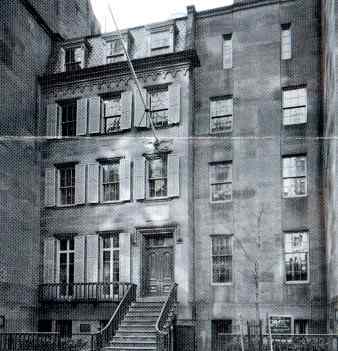
President residences arent what you call ‘unusual’ by any stretch of the imagination. But the Theodore Roosevelt Birthplace Historic Site, on 28 E 20th Street, is unique in that Theodore Roosevelt was never born here — never even lived here — and most of the possessions displayed werent even owned by him.

Once you get by those two teeny little facts, the Site is actually a treat, a wealth of calm and antiquity just steps from busy Broadway and Park Avenue.

The actual brownstone Teddy did live in — being born here in 1858 and residing until 1872 — was in the same location as the present building, but was demolished in 1916 for an office building. However, when he died in 1919, ten years after leaving office, a craze of honorific activities lead to plans to rebuild the original brownstone. It was eventually reconstructed later that year.

And I can see why it was important for not just Roosevelt admirers, but the city of New York. Roosevelt was the only president born in Manhattan, and as a man better known for his adventurous, rugged qualities, its important to remember what an impact the big city had on him as well during his 14 years here.

The lush but suprisingly quiet home features artifacts from Roosevelt’s childhood salvaged by his widow, although most of the furniture is from other family descendents, and the overall effect doesnt speak so much to understanding Roosevelt as it does understanding New York in the mid-1800s.

There are moments where you feel as though youre traipsing through a Henry James novel, imagined ladies sipping tea on those ice blue couches in the parlor. Roosevelt was a rather sickly child, and in the recreation of his room upstairs, you can find a small stairway to the roof — where Teddy’s father set up a gymnasium.

The extra touches continue downstairs to his favorite chair in the library, reupholstered in red fabric to protect Teddy’s knees from scratching. Its quite enlightening actually to see such adoring care for a small child who would later be known as an iconic figure of early 20th Century masculinty and ruggedness.

There’s a pleasant little display on the first floor of mementos and photographs giving a brief portrait into the man’s later career.

As lovely and quaint as the home is, the city’s most dramatic tribute to Teddy Roosevelt is his statue on horseback, outside a building he helped found — the Museum of Natural History.

Details about the Birthplace Historic Site, operated by the National Park Service, can be found here.

By the way, the actual home where he died can also be visited upstate in Sagamore, NY, and as a visitor is a bit ‘sexier’ than the Birthplace, as it was considered the ‘summer White House’ during Teddy’s presidency. Even the site of his inauguration still stands in Buffalo, NY.

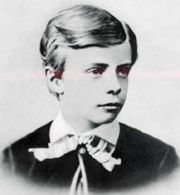
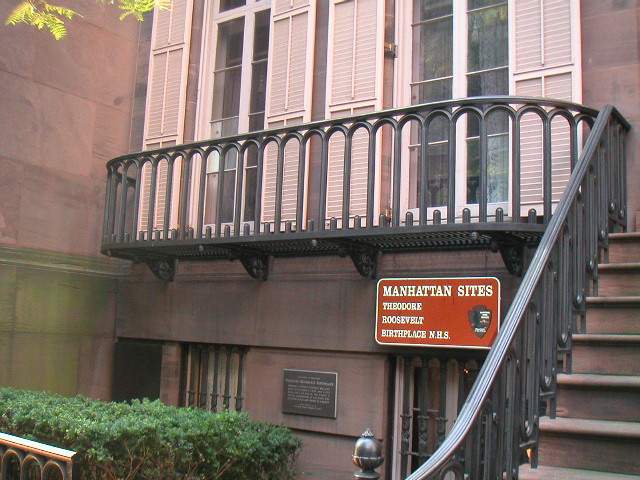
Above is a pic of young Roosevelt, and here’s the current entrance to the museum:

UNUSUAL NYC MUSEUMS #2: History and waffles

In one of my entries below regarding the Mudd Club, a reader asked why I referred to Cortlandt Alley as ‘mysterious’. The tiny little alley — one of New York’s last — is between Canal and Franklin and, while partially my own projection upon it as a rough reminder of old New York, the dark and creepy path retains much of its bruised, dented appearance.

Perhaps in deference to the Mudd Club days, however, the alley has also become a haven for artistic talent, inspiring the likes of filmmaker Laura Kraning, installationist Matthew Gellar and photographer Spencer Tunick, who took one of his community of nudes there.

What does this have to do with an UNUSUAL MUSEUM?

Cortlandt Alley was named after Olaff Stevenson Van Cortlandt, who came to ole New Amsterdam 1637 and whose progeny would go on to become powerful forces in the new city.

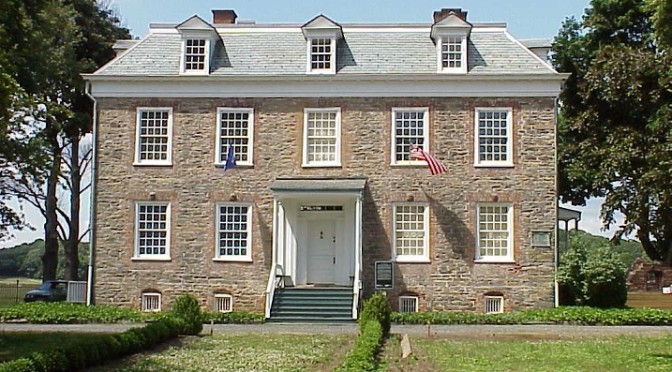
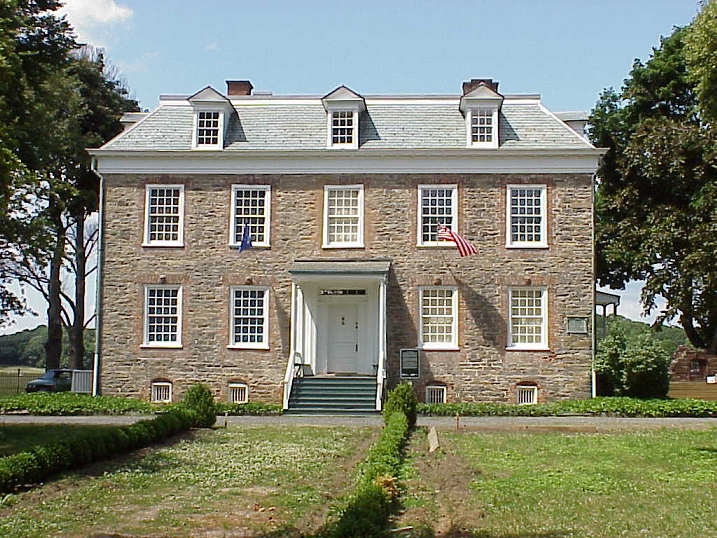
The Van Cortlandt’s base was in what is today the Bronx, and since 1897, their sprawling estate has been a museum and preservation to the lifestyle of early New York culture. It is officially the oldest standing structure in the Bronx, perched in massive Van Cortlandt Park.

The stately home was built by Olaff’s grandson Frederick, and the museum preserves rooms from the period from it was built in 1748, through the era (1823) that the house was maintained by his sons. If you’re doing your math, that would put the decor solidly in the American Colonial period. That’s right: George Washington slept here . During the Continental Army’s eventual retreat from New York, George set up officer’s quarters here. It must have sucked to leave the cozy charm of this house to cross into New Jersey and eventually the frozen shores of the Delaware River.

On top of its almost doll-house preservation of furniture and archectecture, there’s also a quaint herb garden outback. And, for some reason, my favorite part — Colonial waffle irons! You can even get the old-time recipe from the website, which also has visitors info and other historical details.

While you’re out there, why not check out the Van Cortlandt golf course nearby? Its the oldest golf course in the United States, built in 1895, but is still 150 years younger than the house that sits nearby. If that’s not enough for you, its also a movie star in its own right, starring in several film, including pivotal scenes in Wall Street.

As for Van Cortlandt House, don’t confuse it with the Van Cortlandt Manor, farther into New York state. Olaff’s son Stephanus , the first native-born mayor of New York City, moved farther up the Hudson River valley to what is now Croton and his house, which can also be visited, is almost more exquisite for its bucolic surroundings.

UNUSUAL NYC MUSEUMS #1: Satchmo’s Place

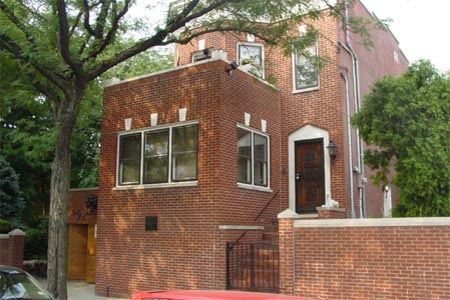
In the first part of our nth part series on unusual New York City museums, we turn your attention to Corona, Queens (several stations out on the 7 train) where lies a non-descript and not seemingly attractive red-brick house.

It was the home of Louis Armstrong and his wife Vivian and as of 2003 has opened to the public. But dont expect some extravagent tacky Graceland-like abode.

Armstrong actually preferred the calm and quiet of the neighborhood and the decor reflects his cool. His wife actually picked out the home and Armstrong, upon first seeing it in the at-the-time mostly white neighborhood, thought the cab driver had taken him to the wrong address.

You should definitely do as Satchmo did and sit on the stoop, where he would hang with the neighborhood kids and sign autographs, and then to the den, the scene of many jam sessions. The house also has an inordinate amount of wallpapers on the wall. Other cool things to check out: the Japanese style garden outback, the Louis portrait painted by no less than Tony Bennett, and a crucifix designed by Salvador Dali.

Two pieces of amusing trivia:
At the excellent museum gift shop, you can buy Armstrong’s favorite laxative Swiss Kriss!

The Armstrong house was purchased by the couple for $3,500, but benefited years later with the the museum opened after a $1.3 million renovation. How’s that for an price uptick?

Check out the official website for times and directions.

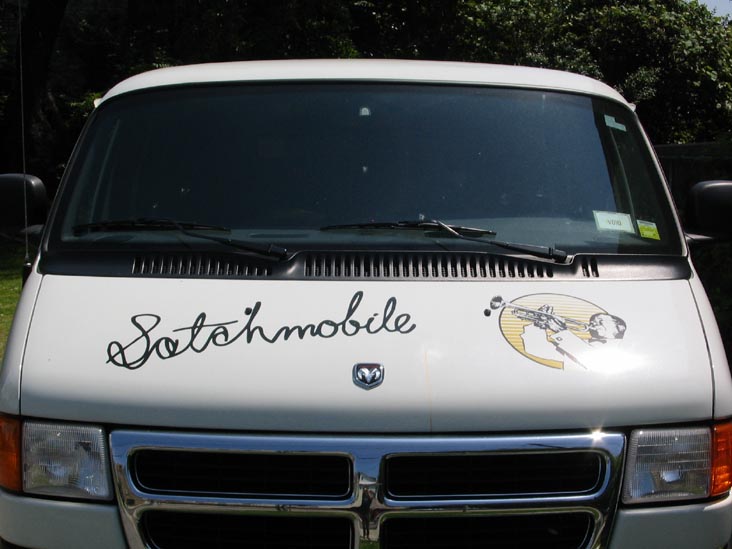
And if you’re lucky, maybe you’ll see the Satchmobile: