Categories
Podcasts Politics and Protest Wartime New York

The Deadly Draft Riots of 1863: New York City and the American Civil War

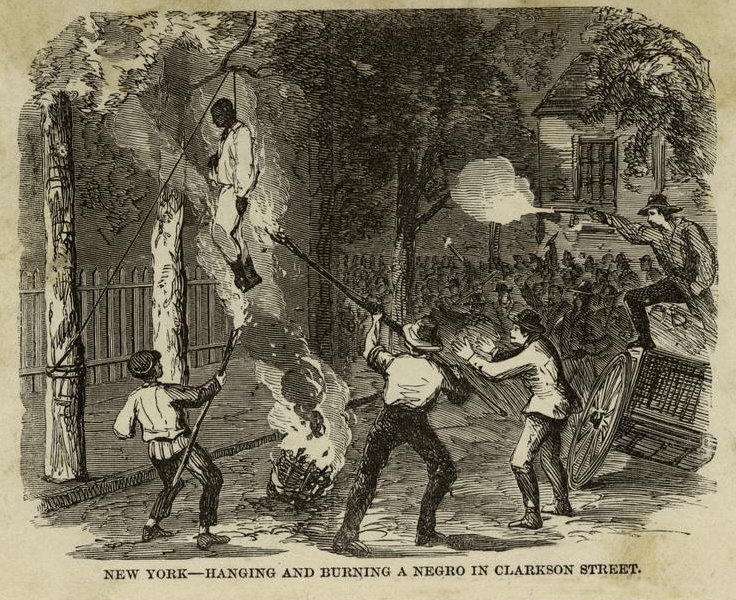
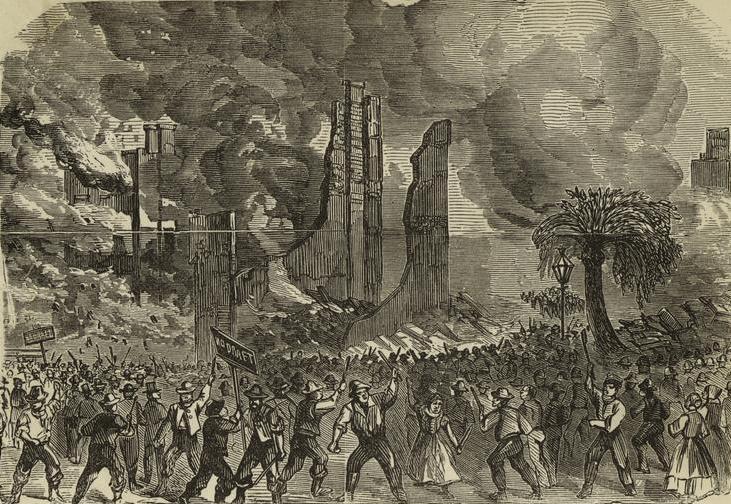
This month we are marking the 160th anniversary of one of the most dramatic moments in New York City history – the Civil War Draft Riots which stormed through the city from July 13 to July 16, 1863.

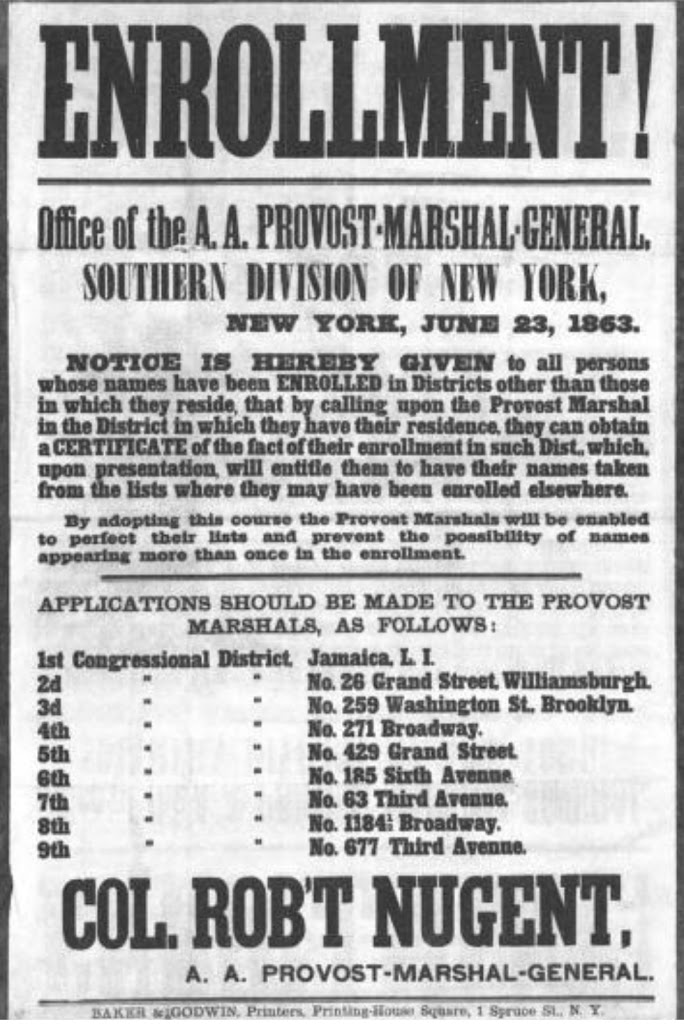
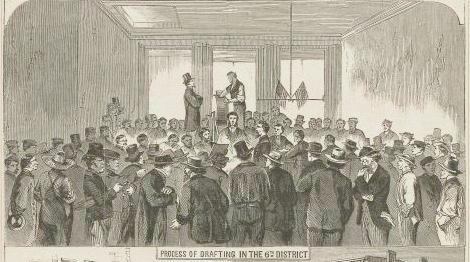
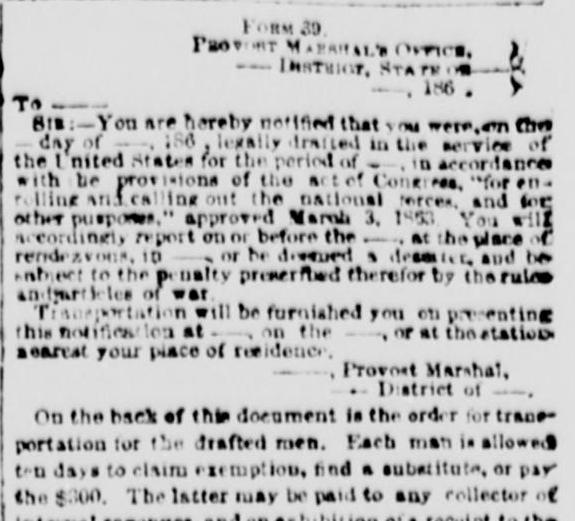
Thousands of people took to the streets of Manhattan in violent protest, fueled initially by anger over conscription to the Union Army which sent New Yorkers to the front lines of the Civil War. (Or, most specifically, those who couldn’t afford to pay the $300 commutation fee were sent to war.)

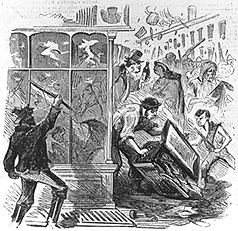
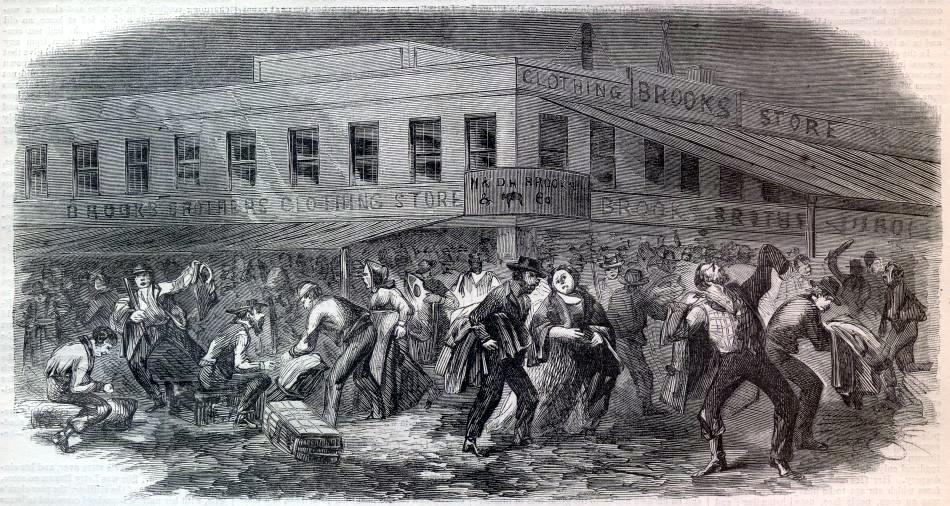
Looting at Brooks Brothers. Harpers Weekly, August 1, 1863

In many ways, our own city often seems to have forgotten these significant events.

There are very few memorials or plaques in existence at all to the Draft Riots, a very odd situation given the numerous markers to other tragic and unsettling moments in New York City history. 

In particular, given the number of African-Americans who were murdered in the streets during these riots, and the numbers of Black families who fled New York in terror, we think this is a very significant oversight.

Harper’s Weekly, August 1, 1863

The riots place New York City not outside the significance of the Civil War battlefield, but squarely within it. The Union was not united, but an assortment of different viewpoints.  

In this episode, a remastered, re-edited edition of our 2011 show, we take you through those hellish days of deplorable violence and appalling attacks on abolitionists, Republicans, wealthy citizens, and anybody standing in the way of blind anger. Mobs filled the streets, destroying businesses (from corner stores to Brooks Brothers) and threatening to throw the city into permanent chaos.

That Abraham Lincoln and the Union Army succeeded is even more remarkable when you realize the dissension from within, dissension which we discuss in this show (a remastered, reedited version of a show we originally recorded in 2011).

LISTEN NOW: THE DEADLY DRAFT RIOTS

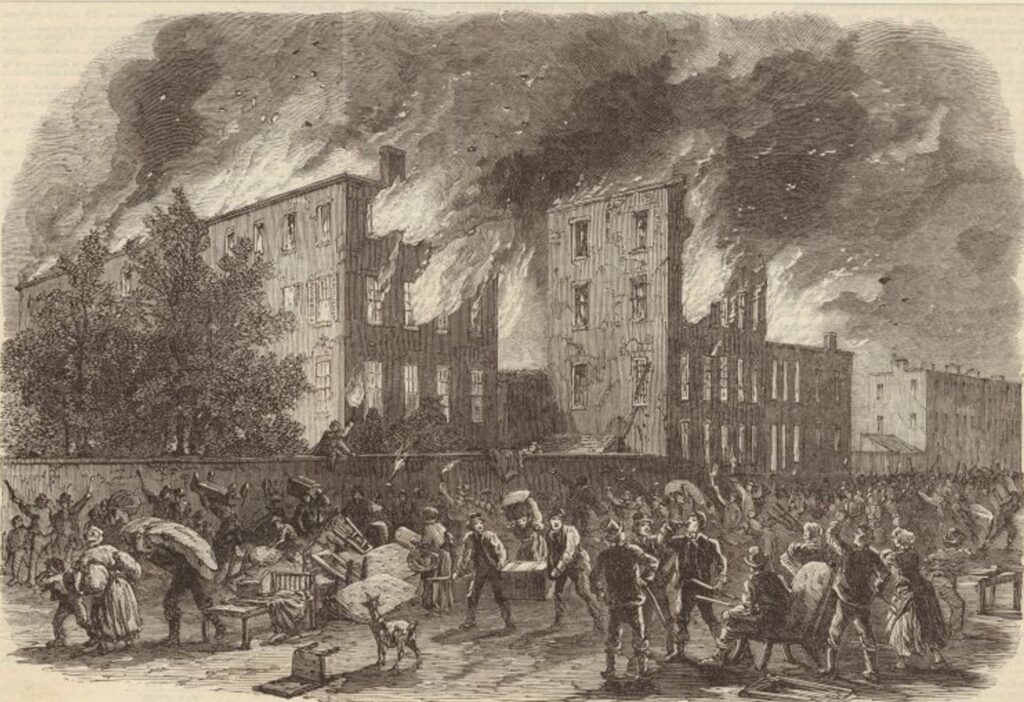
The burning of the Colored Orphan Asylum on Fifth Avenue: In a day of vile crimes that Monday, July 13th, this certainly stands out as one of the worst.
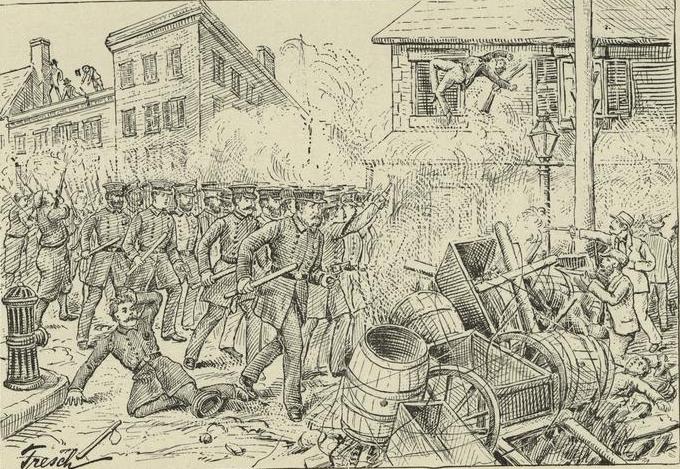
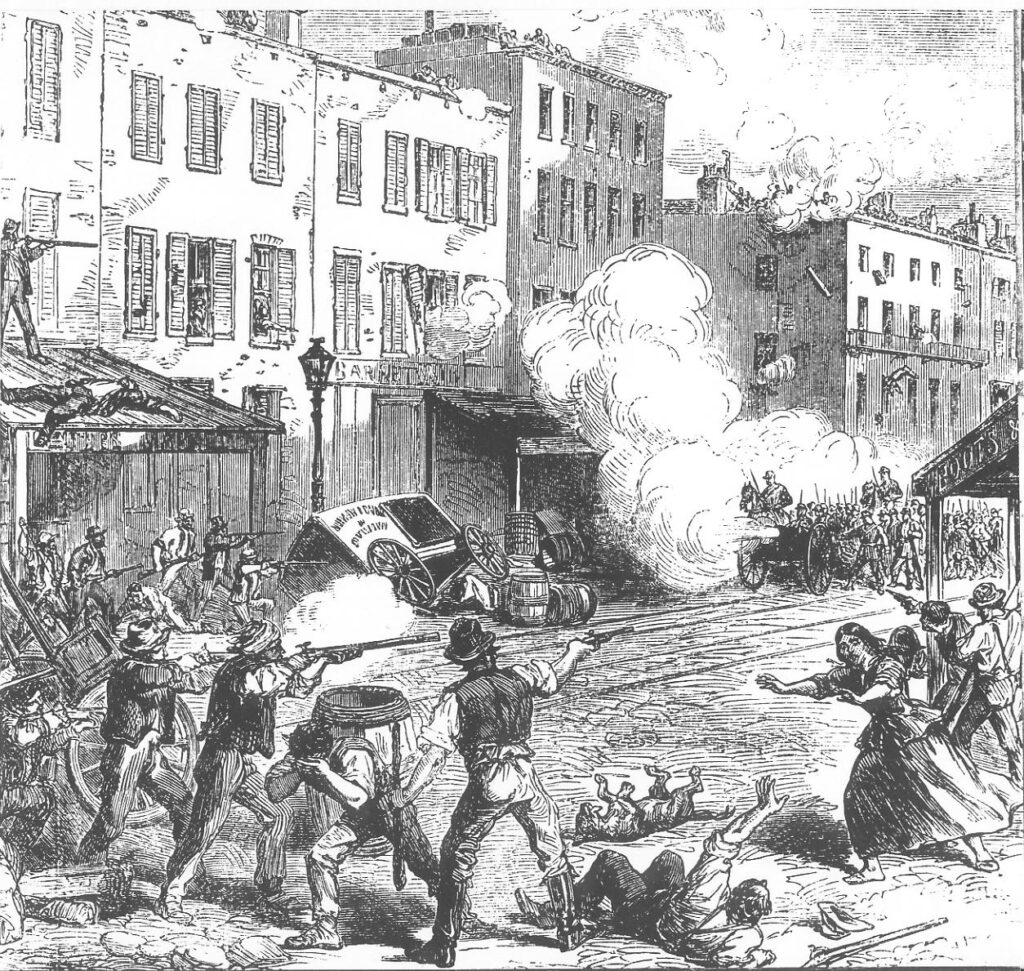
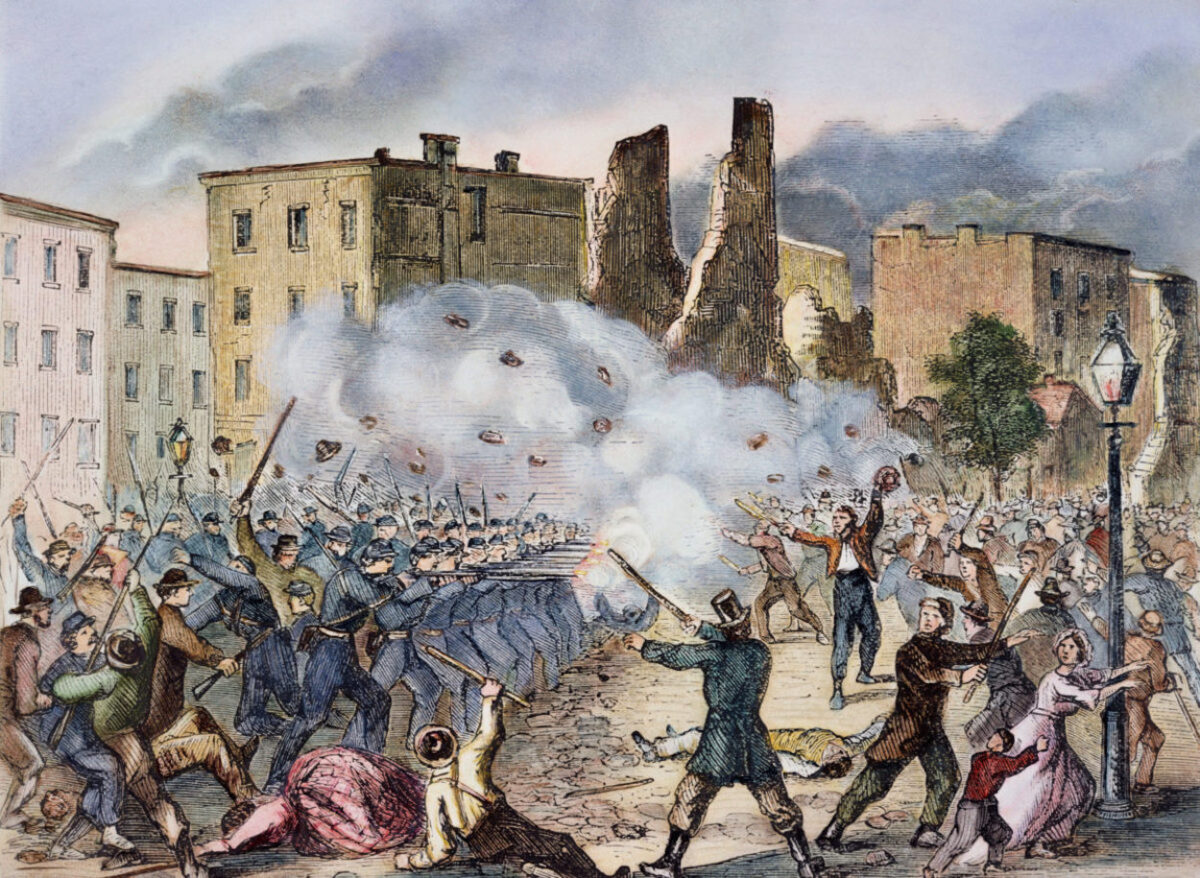
The mob burned the draft office at 3rd Avenue and 46th Street first thing on Monday morning. The destruction was but only a taste of the violence that was to come. By Friday, New York would be smoldering with dozens of structures in ashes — from factories and homes to armories and even bridges.

John A. Kennedy, the superintendent of police, who was savagely beaten and barely escaped with his life on the first day of rioting.

By Tuesday, rioters had cordoned off barricades along a couple key streets, including a mile-long makeshift fortification along Ninth Avenue, through today’s Chelsea and Hell’s Kitchen neighborhoods.

Illustrations courtesy New York Public Library digital image collection

The Illustrated London news

The other draft riots: Given the New York-centric nature of our program, I should note that draft riots occurred throughout the North that week, and even earlier. Yet none were of the intensity as those that occurred in Manhattan. In Boston, for instance, mobs stormed the famous Faneuil Marketplace and an armory on Cooper Street. But troops quelled the violence early, and only eight people died. [Read more about this even in the Boston Phoenix.]

And events were sparked in the future boroughs of Brooklyn, the Bronx, Queens and Staten Island as well. You can read more about them in this blog post.


Why are there no permanent memorials or remembrances of any significant kind in New York City to the Civil War Draft Riots? It was the most grave, the most tumultuous event in New York City history between the Revolutionary War and September 11, 2001. Doesn’t it merit some mention? Read Greg’s opinion piece which ran on the 150th anniversary — which more or less still applies today.


FURTHER READING

For more information on the Draft Riots, you can turn to several sources, based on your level of interest. My favorite is Barnet Schecter’s ‘The Devil’s Own Work’which gives a gripping chronological retelling of events. He really manages to tame a chaotic tale in a way that neither confuses nor oversimplifies. I used Schecter’s ‘Mrs. Hilton’ anecdote from this book, and his book is chockful of other individual tales like that one.

If you prefer something a bit more analytical, there’s Iver Bernstein’s ‘The New York City Draft Riots’ which tries to parse who exactly the rioters were. Of course ‘Gotham’ by Edwin G Burrows and Mike Wallace have a nice, compact recount with plenty of context. The City University of New York’s ‘Virtual New York’ web resource has a timeline with maps.

The Gangs of New York: Perhaps the most famous depiction of the riots occurs in Herbert Asbury’s classic ‘The Gangs of New York’. The film version, directed by Martin Scorsese, takes quite a few liberties with the facts of course. The placing of candles in windowsills and the fire at Barnum’s American Museum, for instance, did not happen during the riots. But those are based on true events that happened in New York a year later.

FURTHER LISTENING

There’s also the Broadway musical Paradise Square, set during the Draft Riots. Joaquina Kalukango won a Tony Award for Best Actress for her work in the musical: 

When this show was originally released in 2011, it was part of a three part mini-series on New York City and the Civil War. You might like to check out the other two parts — especially part three Hoaxes and Conspiracies of 1864

In this episode, Greg pays a visit to Weeksville, the Brooklyn community which became a haven for Black New Yorkers fleeing the city during the riots.

If there is a ‘prequel’ to the Draft Riots, it’s certainly the Astor Place Riot of May 10, 1849.

Categories
Gilded Age New York Landmarks

The Fifth Avenue Hotel: Opulence, glamour and power on Madison Square

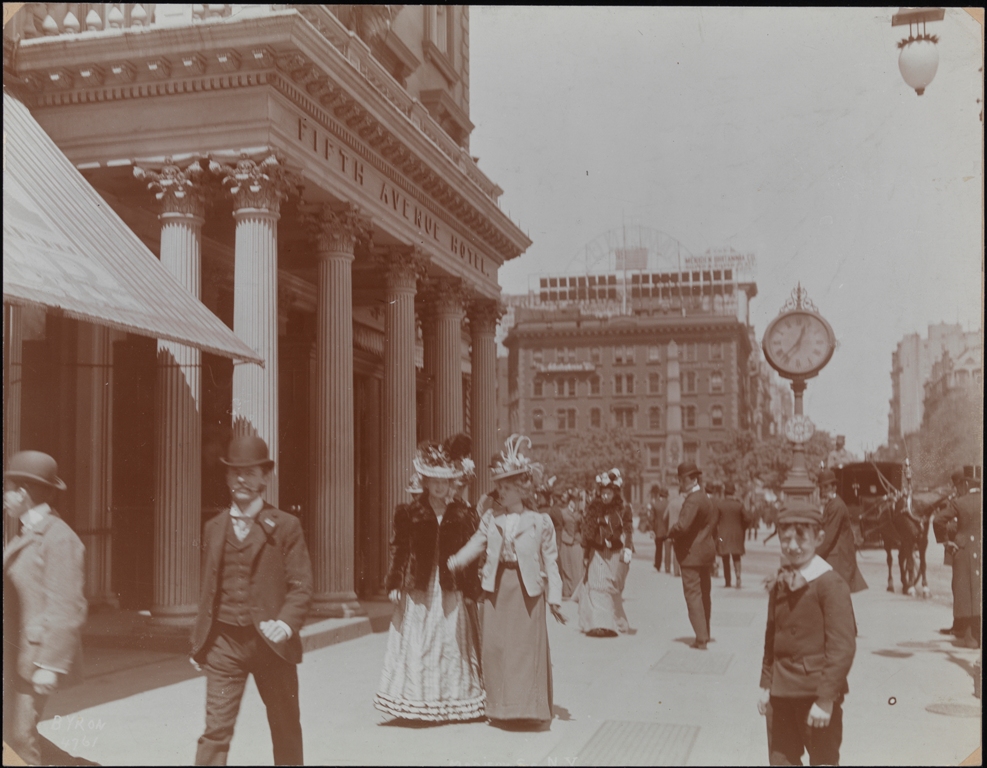
The double-breasted, cigar-chewing gentlemen who gathered in the sumptuous rooms of the Fifth Avenue Hotel were occasional connoisseurs of New York City history, and in particular, these amateur historians spoke of the very street corner where their hotel stood.

Before Madison Square, when the area was a barren parade ground, one Corporal Thompson opened a roadhouse and stagecoach station in the area that was to become 23rd Street and and Fifth Avenue.

Many spoke fondly of Thompson’s establishment, called Madison Cottage, because they remembered the place as young boys. They recalled the area’s rural quality, with carved rectangular blocks carved into the land and a dirt-road Broadway meandering north.

But that was the 1840s.
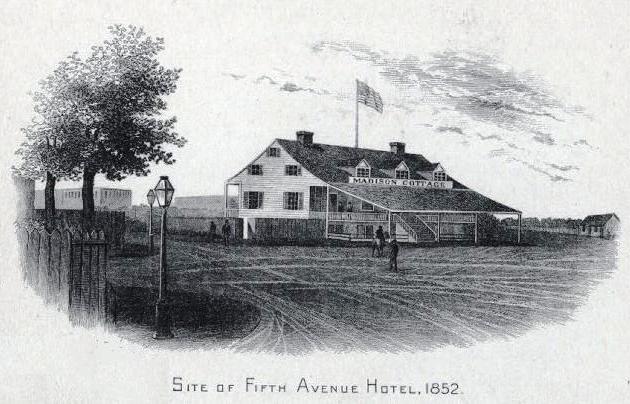
Madison Cottage, Hitchcock, Darling & Co.

Forty years later, Madison Square Park was the center of New York, a focal point of class, business and luxury that stretched south to Union Square, through that attractive collection of fine stores known as Ladies Mile, and up Fifth Avenue into the fabulous mansions of the rich.

And dead center of all that activity was the Fifth Avenue Hotel, not only the “finest [hotel] in this metropolis”, the “leading hotel of the world ,” but quite simply one of the most surprising stages for American politics of the mid and late 19th century.

New York’s Hotel Revolution

Hotels were fast becoming the center of New York life from at least the days of the Astor House, located near City Hall, in the 1830s. Within two decades, trendy new hotels (such as the St. Nicholas and the Metropolitan) spread up along Broadway and eventually clustered around Union Square.

By the Civil War, the thrust of New York society was so defined by them that Confederate conspirators tried setting fire to a several of them.

The Fifth Avenue Hotel opened in 1859, the venture of wealthy merchant Amos Richards Eno, who accurately gambled that the center of city commerce would soon settle at 23rd Street. So confident a speculator was Eno that he moved from his brownstone at 74 Broadway (the first New York brownstone, he claimed) to a massive home nearby the hotel.

Some thought it unwise to build so far north, and when workers unearthed dozens of skeletons during construction — the area once being a potter’s field — the corner was even considered cursed. Eno defied the naysayers, pouring his wealth into the hotel to make it the most modern, most luxurious accommodation of the day.
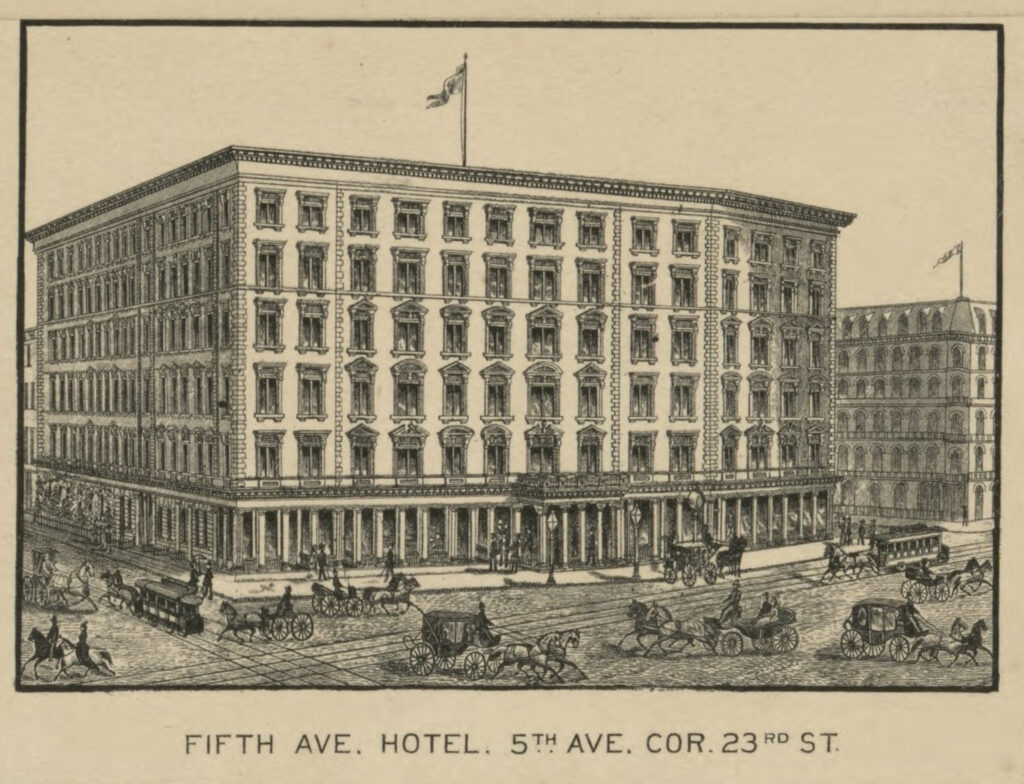
The Fifth Avenue Hotel, 1879. Courtesy Wikimedia Commons
A Gilded Age Confection

The Italian exterior was awash in five stories of imported marble, while austere, carpeted interiors of French design drew comparisons to European palaces.

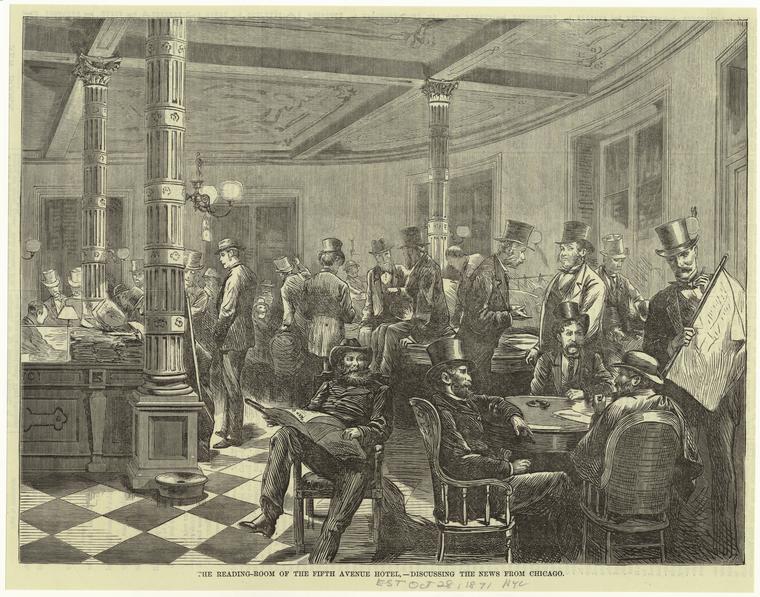
Guests enjoyed reading rooms, a luxurious bar, a barber shop, a dedicated telegraph office, and a variety of dining and drawing rooms, not to mention the first passenger elevator ever built in the United States, a steam-powered monstrosity whisking passengers to their floor.  

The private quarters were soundproofed, fixtured with the modern innovations in plumbing, and lavishly decorated, becoming to many “the safest, the most healthy and most comfortable hotel in the world.

The Fifth Avenue Hotel reading room, busy every weekend. (Boston: Fields, Osgood & Co.,)
Wheeling and Dealing

As the finest hotel in the city in the post Civil War years, it naturally became a magnet for politicians and financiers. Of all the ‘backrooms’ of American politics, none were as gleaming as the Fifth Avenue.

Bankers huddled in the legendary ‘parlor D. R.’ during the tense days of the financial panic of 1873. In particular, the hotel became a de facto headquarters for New York Republicans.

While often secondary to the city’s Democrats — this being the era of Tammany Hall‘s swelling power — Republicans were frequently in control of state government, and the Fifth Avenue Hotel became a smoky center of political wheeling and dealing.

During the 1870s, New York republicans became national power brokers and frequently hashed out crises here at the Fifth Avenue.

In the years before the Waldorf-Astoria, presidents and dignitaries all stayed here during visits. Seamier political maneuvers took place in the chambers of prominent politicians who held court here, including the inimitable Roscoe Conkling (at left), senator of New York and leader of the Republican faction known as the Stalwarts.

National Influence

When fractured Republicans at their convention in 1880 nominated non-Stalwart James Garfield for president, the nominee had to basically grovel for their support by symbolically ‘kissing the ring’ of the Stalwarts during a visit to the Fifth Avenue Hotel, partially agreeing to their system of patronage and taking Conkling ally Levi Morton as a member of his cabinet. (Garfield later backed out on this arrangement.)

Another frequent guest here was Chester A. Arthur, Garfield’s eventual vice president. When Arthur became president after Garfield’s assassination by Charles Guiteau (who had himself wandered the hotel’s hallways in delusion), he would set up his entire administration here during visits to his adopted city.

By the 1890s, a corridor of the hotel known as the ‘Amen Corner‘ was a famous congregation spot for Republican political bosses and reporters. As they frequently powwowed here on Sundays, gatherers would caustically shout ‘Amen!’ during heated discussions.
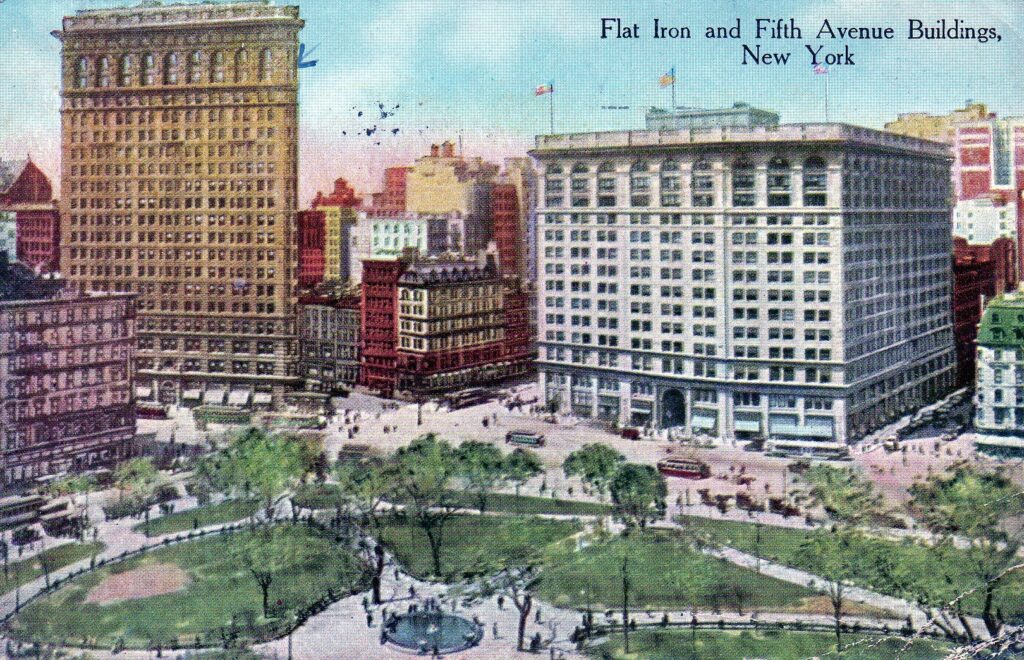
The Fifth Avenue Hotel in relation to the Flatiron Building
Checking Out

The hotel became a magnet for shenanigans of all varieties. In 1893, a couple hundred proponents of a U.S. monetary silver standard erupted into a riot that included two U.S. senators.

The bank robber Robert Montague was arrested here in 1896 thanks to a tip-off from a chambermaid. An early vestige of baseball’s National League met here annually, and the national pool competitions were held in the hotel’s billiard room.

By the new century, of course, the locus of New York activity was hastily moving uptown, and the Fifth Avenue Hotel was deemed a relic, even as a brand new structure across the street — the Flatiron Building — was being proclaimed the finest building in the city.

In 1908 the Fifth Avenue Hotel was torn down and replaced by the 16-story Toy Center (called the Fifth Avenue Building back in the day), the epicenter of toy manufacturing for much of the 20th century.
Categories
Landmarks Podcasts

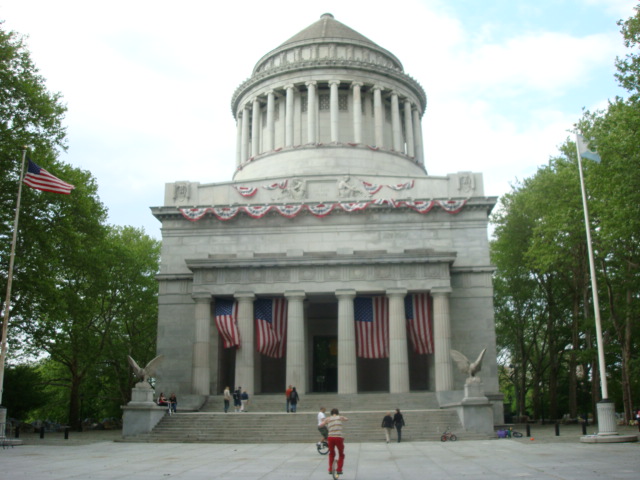
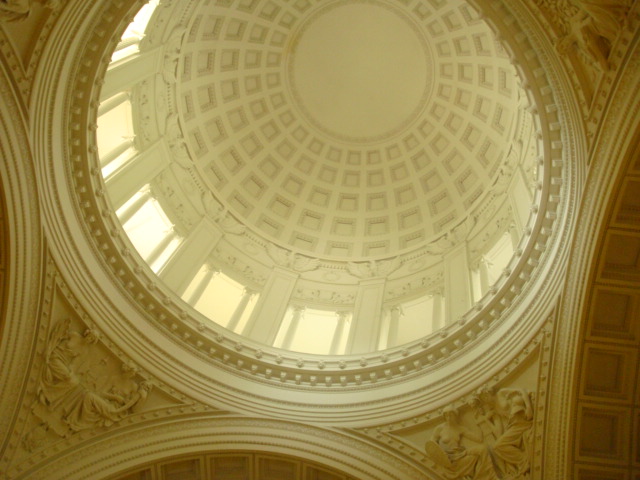
The Story of Grant’s Tomb: Upper Manhattan’s Magnificent Mausoleum

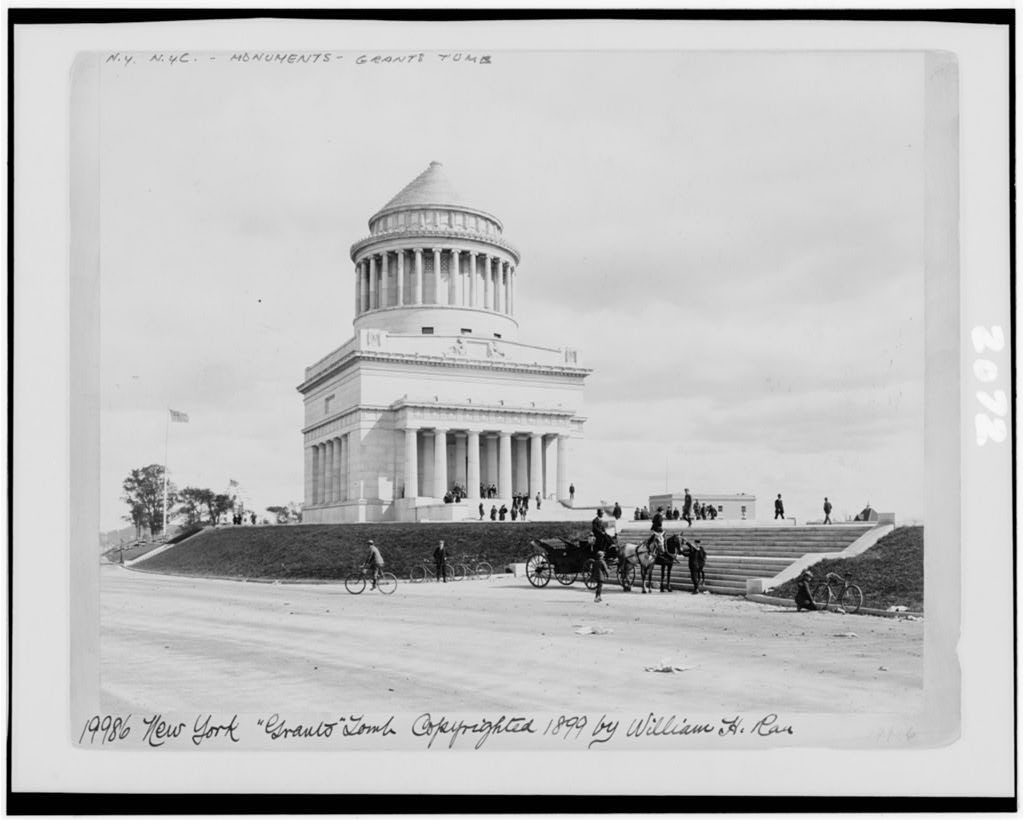
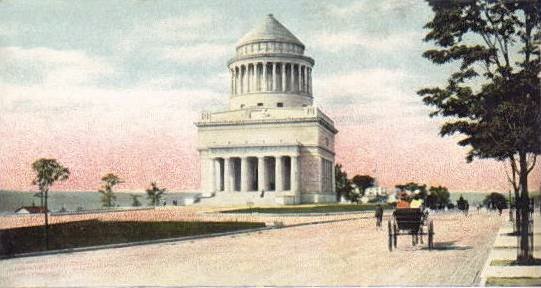
The fascinating story of Grant’s Tomb — and a quirky history that includes an ambitious architect, one of the seven wonders of the ancient world, lots of ugly raspberry paint, and strange charges of animal sacrifice.

The history of Grant’s Tomb plays an important role in the story of Riverside Park (released in 2018). Listen to that tale here:
And listen to the story of Grant’s Tomb in this very early episode of the Bowery Boys podcast from 2008.

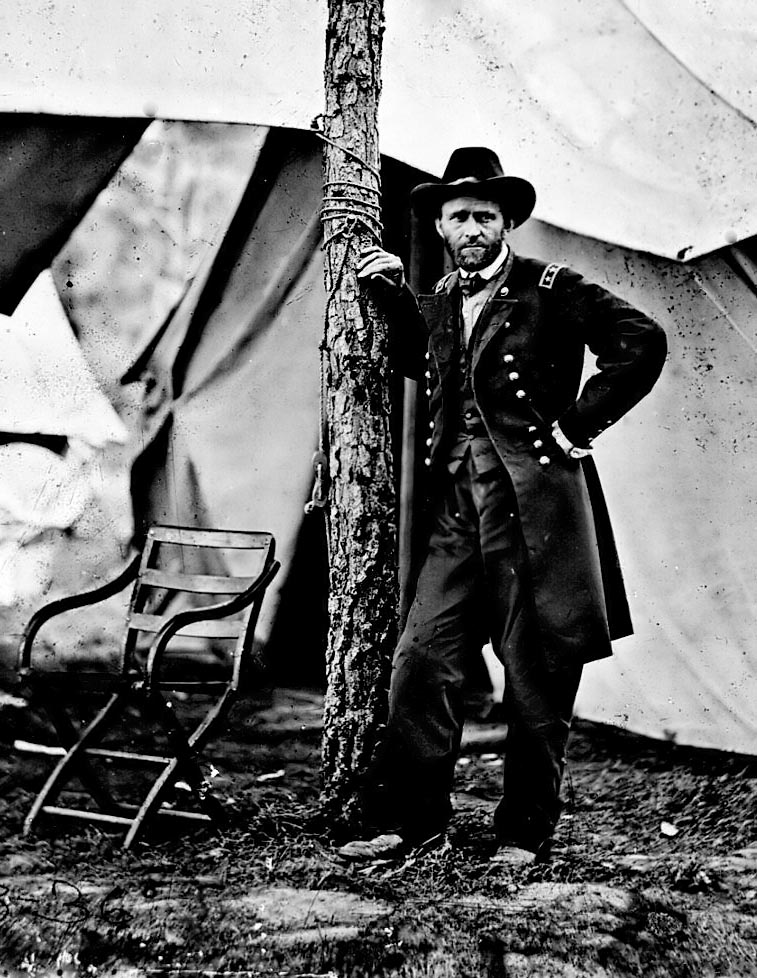
Ulysses S. Grant – perhaps America’s most famous man in the years following the Civil War. As president of the United States, Grant would be known for important political reforms — and a series of corruption scandals.

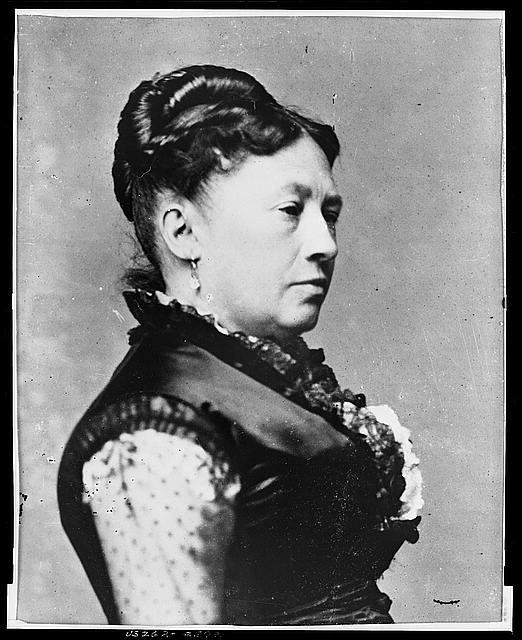
His wife Julia Dent Grant, entombed next to him


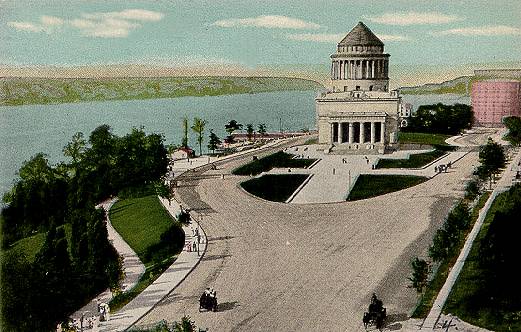
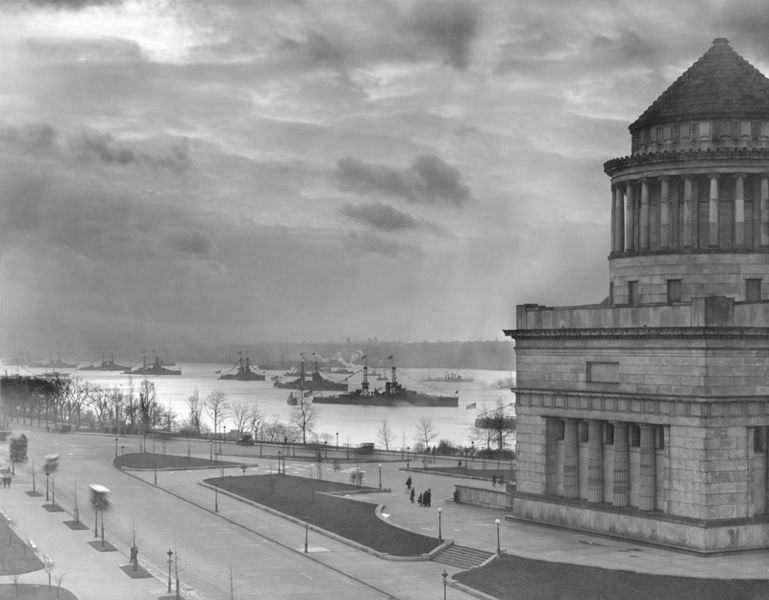
An ominous view of the Tomb during World War I, as battleships pass by it

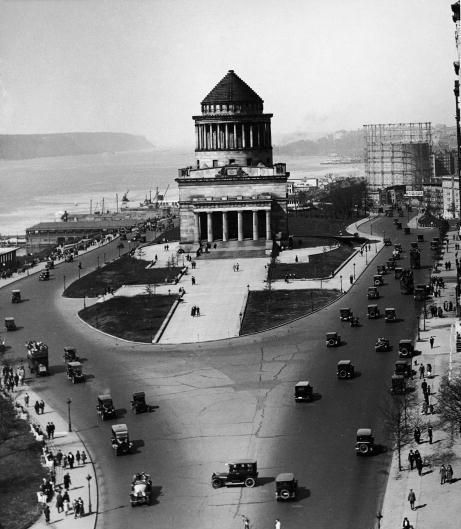
A great photo illustrating how somewhat barren that area of town was at the time. The silo-like building in the background is apparently a gas shell.

The website of the Grant Monument Association details some of the disasterous deterioration of the memorial during the 1970s:

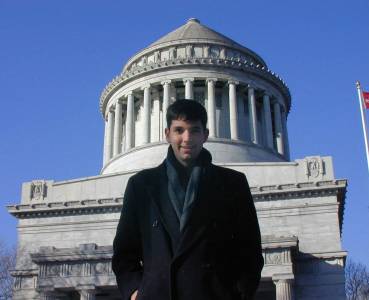
Frank Scaturro, the Columbia University student who helped bring Grant’s Tomb back to life (photos courtesy the GMA website)

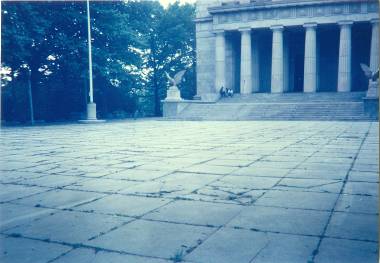
Grant’s Tomb today, complete with unicyclists (in foreground). Photos by Greg Young (taken in 2008)

Categories
On The Waterfront

In 1863, the Russians invaded New York City

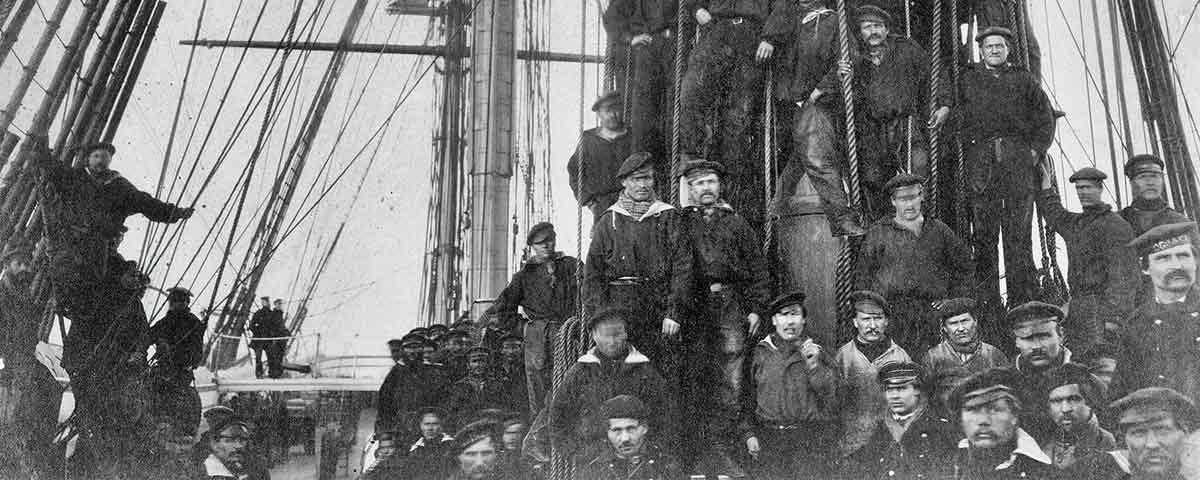
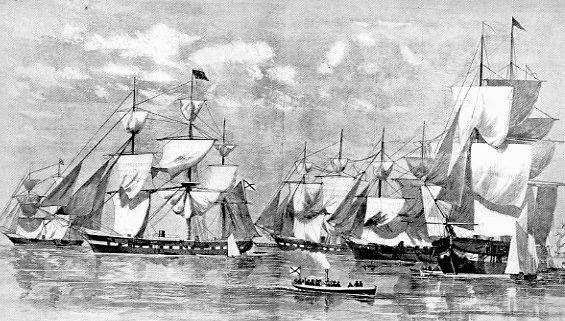
In 1863, New Yorkers flocked to the waterfront to see a startling sight — Russian war ships in New York Harbor. They were here as a display of force, but not to threaten the United States.

The fleet of Russian ships, sailing into New York Harbor in September 1863, as depicted by Harper’s Weekly.

Russia’s Atlantic Squadron, as the fleet was known, was patrolling the Atlantic Ocean as a show of strength against England’s Royal Navy.

They arrived in the harbor on September 24, 1863, initially anchoring in Flushing Bay, and stayed in the city for a couple months. (A description of the various Russian vessels can be found in this 1863 New York Times report.)

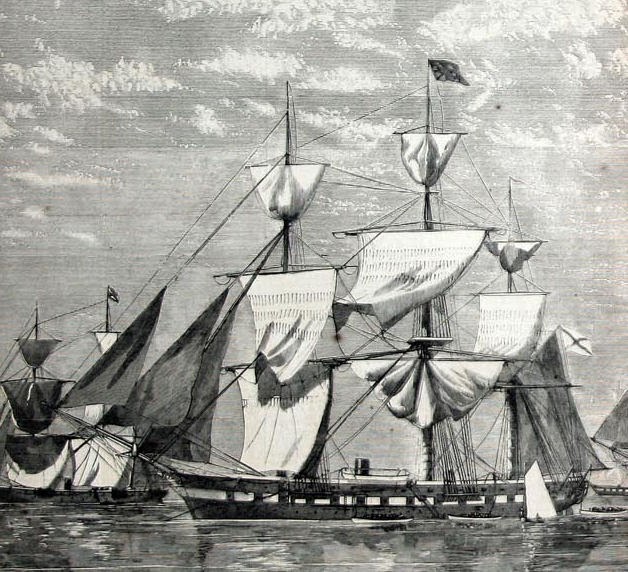
The fleet was led by the massive frigate Alexander Nevski (pictured below), an American-designed ship commissioned and built by the Russian government.

A reporter for Harper’s Weekly, joining a reception onboard the vessel, praised its beauty.  “A lady with the most immaculate skirts and kid gloves can move any where, on deck or below, without danger of soiling either, so perfectly clean every thing about the ship is kept.”

America was in the midst of the Civil War, and New York itself was still recovering from the Draft Riots that July. 

Many Americans believed the appearance by the Russians underscored a healthy support for the Union over the Confederacy, but most scholars today believe the Russians were acting with far more self-interest.

Still, most New Yorkers embittered by war welcomed the impressive show by friendly foreign powers, kicking off “a slight craze in the public mind.” 

Harper’s Weekly remarked, ” [E]very citizen felt bound to do what in him lay to testify to the Russians our sense of gratitude for the friendly manner in which Russia has stood by us in our present struggle, while the Western Powers [England and France] have done not a little to work our ruin.”

New Yorkers marveled at the mighty mast of the Alexander Nevsky, “lying almost on a line westward from Trinity Church,” as it shot off its cannons and a band on-board attempted to play ‘Yankee Doodle Dandy.’

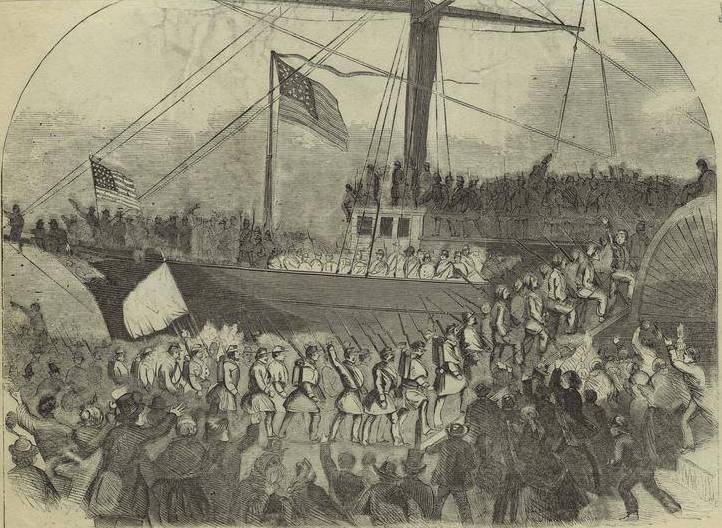
The ship officially docked on the west side at 23rd Street, and the procession, joined by city leaders, marched through the streets (pictured at left, courtesy NYPL), past Union Square and down Broadway.

“[T]he scene became splendidly animated.  The moving pageant rolled in a glittering stream down the broad thoroughfare between banks of upturned human faces, the trappings of the equipages, the gold and silver epaulets of the Muscovite guests and the sabres, helmets, and bayonets of the escort reflecting back in unnumbered dazzling lines the glory of the evening sun.”

In particular, New York women were captivated by the brawny Russian contingent in their handsome uniforms.  “Throngs of ladies in the windows most vigorously waved their ‘kerchiefs, to the great delight of the Russian officers, who never left off bowing, smiling, and even uttering their thanks aloud, while they doffed their gold-laced chapeau.”

(Not every woman was infatuated. The following day, two Russian officers reported being robbed by three women “at a disreputable house.“)

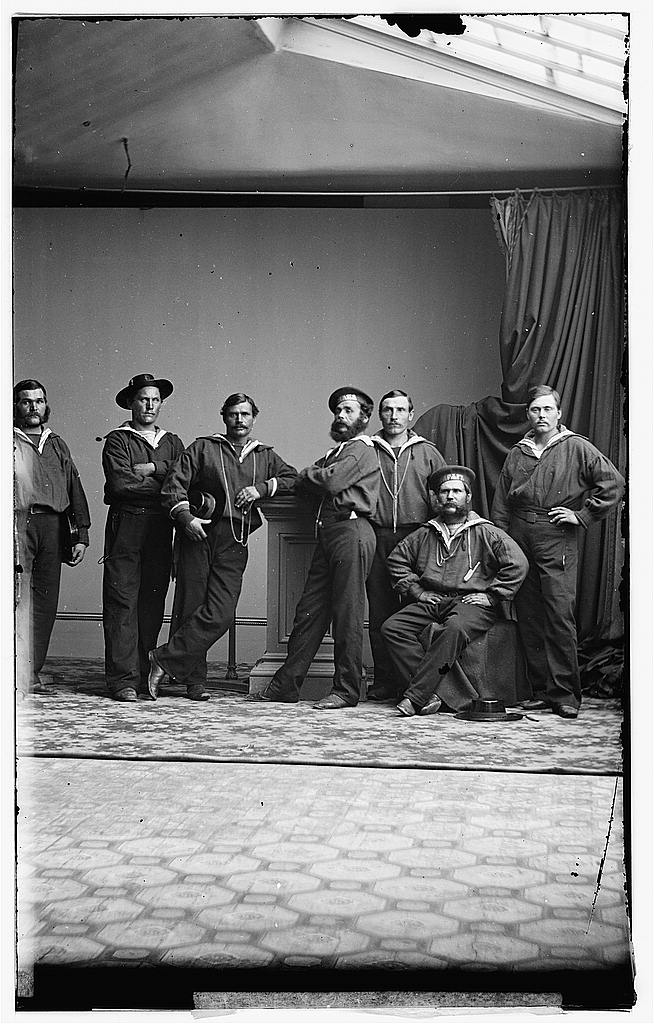
Below: A group of Russian soldiers, taken October 1863, courtesy Library of Congress


The finest hotels of New York were adorned with American and Russian flags. Tiffany’s, at its location on Broadway between Prince and Spring Streets, unfurled a gigantic Russian banner that stretched the length of the building.

Throughout the following weeks, the Russians were continually feted by the grateful Americans.  At a dinner with Mary Todd Lincoln and other American dignitaries, Mrs. Lincoln toasted the Russians for their kindness. 

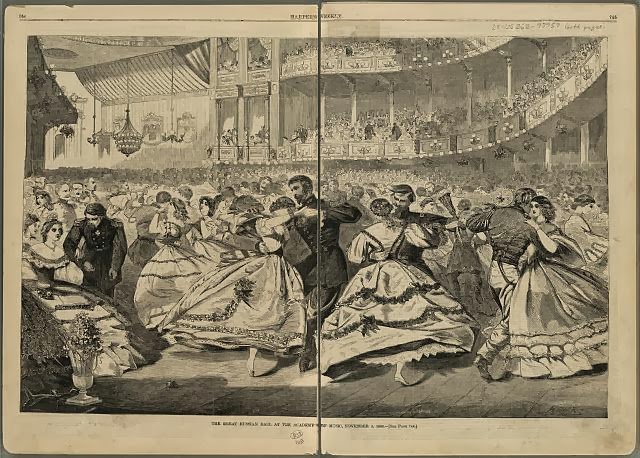
Russian dignitaries frequently met with Mayor George Opdyke and the Common Council and were wined and dined at virtually every hotel in town, including an opulent banquet at the Academy of Music in early November (depicted below in an illustration in Harper’s Weekly).


“They are dined, walked, driven, and are, with unconcealed gratification, availing themselves of the many opportunities of seeing us and all around and about us,” said the New York Times that October. “Yesterday, a number visited Central Park and enjoyed its fine drives and beautiful walks; others were whirled to High Bridge, and others were entertained with City sights of interest.”

The Russian ships would remain in American waters for almost seven months, darting up and down the coast, including a period of time in Washington D.C.

ORIGINALLY PUBLISHED ON THIS WEBSITE IN 2013.

Categories
Amusements and Thrills

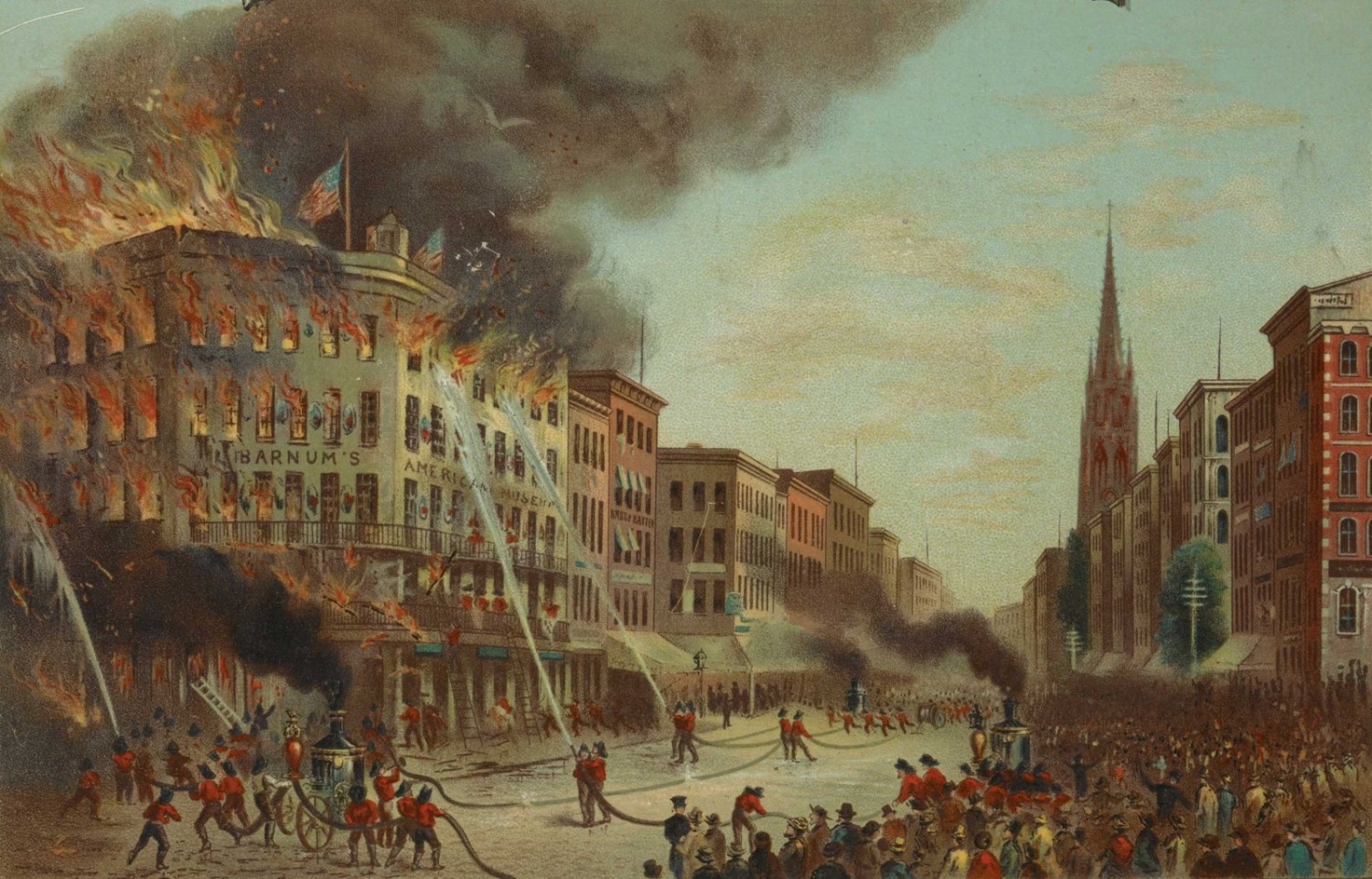
The fire at Barnum’s American Museum 155 years ago

One hundred and fifty-five years ago (on July 13, 1865), New York City lost one of its most famous, most imaginative and most politically incorrect attractions.

When P.T. Barnum opened his museum in 1841, the kooky curiosities contained within the building at the corner of Broadway and Ann Street — at the foot of Park Row — were simply reconstituted properties from other museums.

But he soon expanded the collection to include living spectacles, both human and animal, become both the greatest show and the greatest side-show on earth.

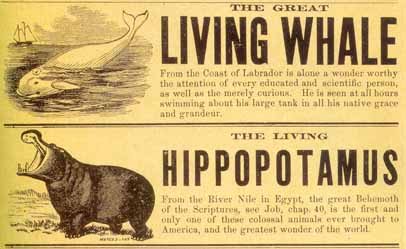
From his lilliputian stars Tom Thumb and Commodore Nutt to the unfortunate white whales contained in water tanks in the basement, Barnum’s American Museum was New York’s destination for the fascinating and the weird.

Millions would visit its corridors during its two and a half decades of operation. It was so renown that it was even a target of attempted sabotage during the Civil War.

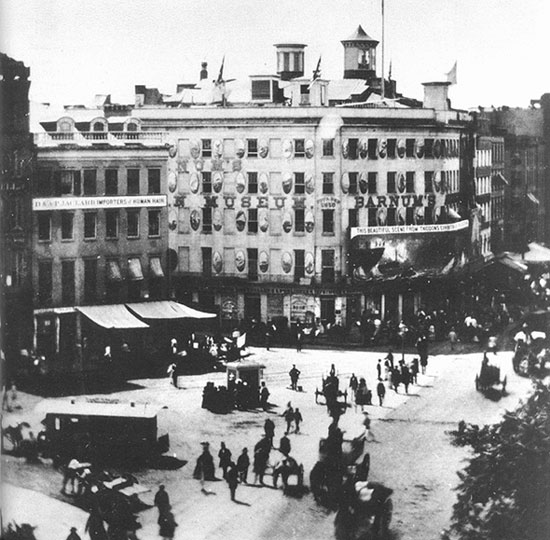
Below: A rare photo of Barnum’s American Museum, taken in 1858

Taken 1858
Taken 1858

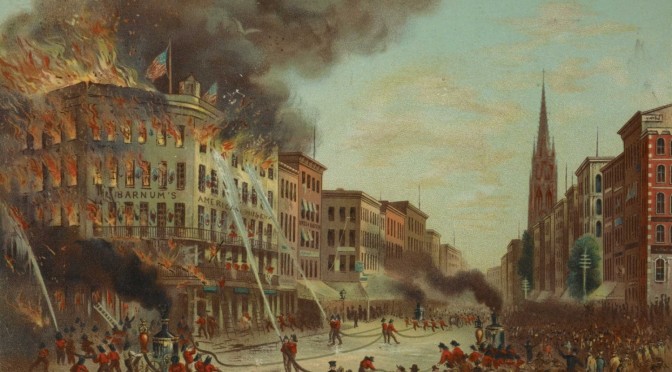
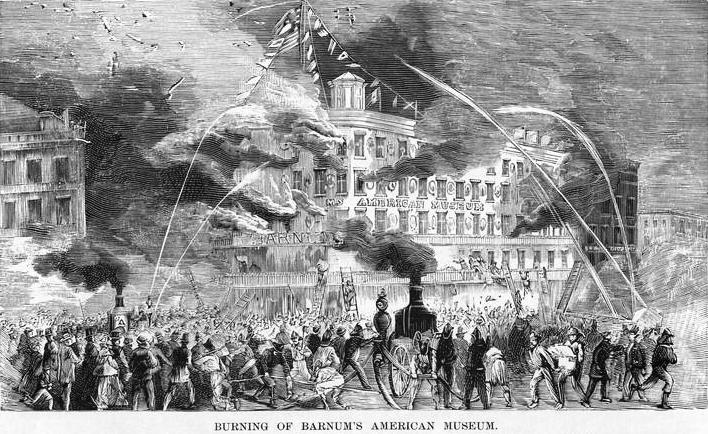
At around noon on July 13, 1865, the building quickly succumbed to “the fierce tooth of fire,” causing the greatest pandemonium that New York City had ever seen.  I must give way to some of the press reports of the day, as they best capture the drama:

New York Times: “Probably no building in New-York was better known, inside and out, to our citizens than the ill-looking ungainly, rambling structure on the corner of Broadway and Ann-streets, known as the American Museum, where for more than twenty years Mr. Barnum has furnished the public with a wonderful variety of amusements.”

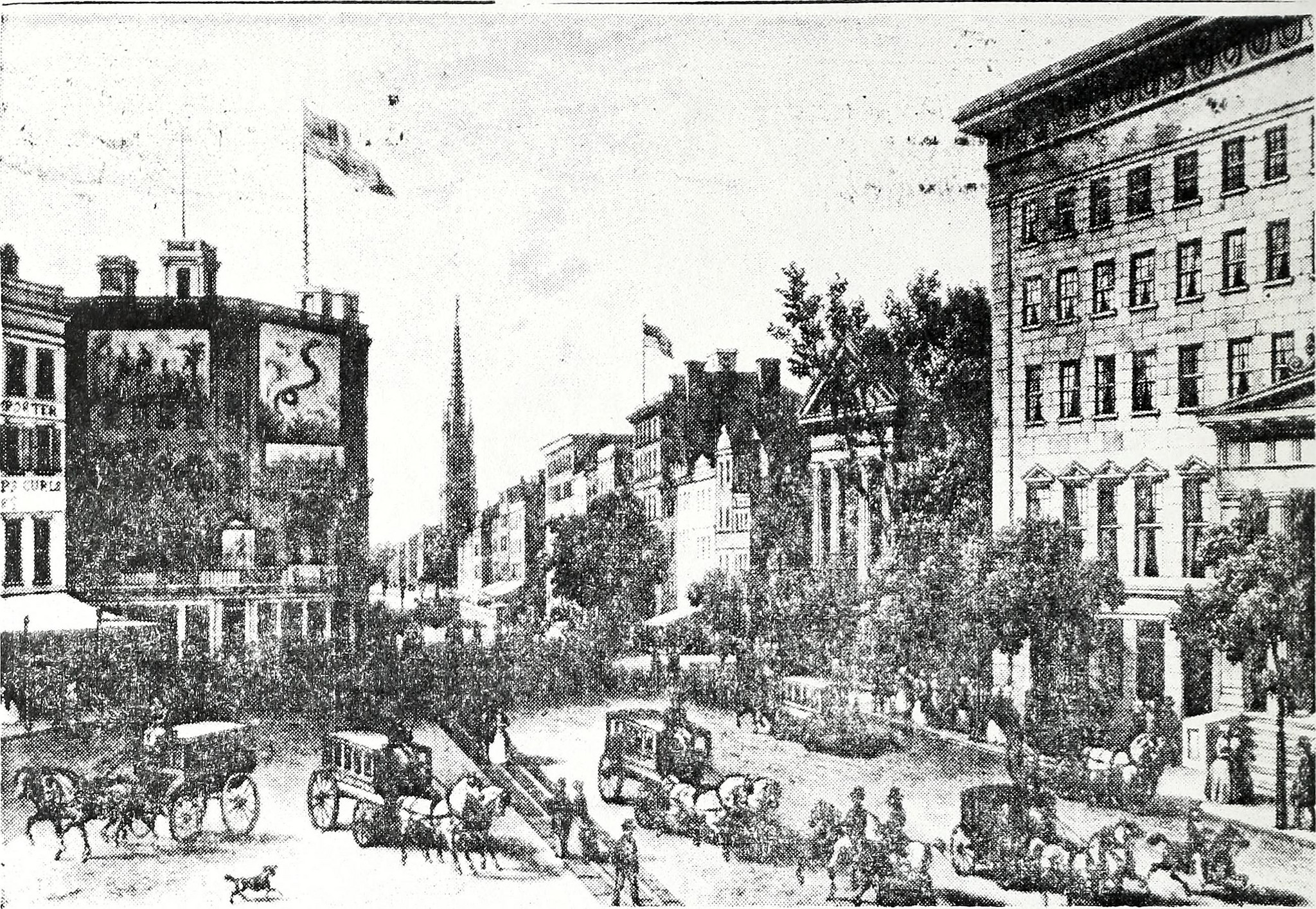
Below: The street scene at the cross-section of Broadway and Ann Street, in 1860. A sign advertising Barnum’s snake collection can be seen on the museum.

Courtesy Internet Book Archive

New York Sun: “About half past twelve o’clock yesterday the Engineer rushed up from below announcing that his room was on fire, and about the same time immense volumes of smoke permeated the Ann Street end of the building.  [K]nowing that the immense whale tank was directly over the spot where the fire had begun to make headway, attempted to knock a hole in the huge reservoir.”

Christopher Pearse Cranch. Burning of Barnum's Museum, July 13th, 1865, 1865. Chromolithograph. Eno Collection Miriam and Ira D. Wallach Division of Art, Prints and Photographs, The New York Public Library
Christopher Pearse Cranch. Burning of Barnum’s Museum, July 13th, 1865, 1865. Chromolithograph. Eno Collection Miriam and Ira D. Wallach Division of Art, Prints and Photographs, The New York Public Library

The occupants of the tanks were doomed.  “‘[T]wo whales, imported, at a cost of $7,000, from the coast of Labrador,’ whose sportive plunges and animated contests of affection afforded constant amusement to hundreds of spectators, [was] a pregnant contrast to the fearful death by roasting which they so soon thereafter met.”

The fire spread rapidly, quickly filling the upper floors with smoke.  Firemen burst in from the Ann Street side and quickly attended to patrons who had collapsed or were too confused in the immense labyrinth of bizarre objects to escape.

1

A fireman named William McNamara is credited with single-handedly evacuating many patrons of the museum, not to mention some of the performers who regularly lived there.

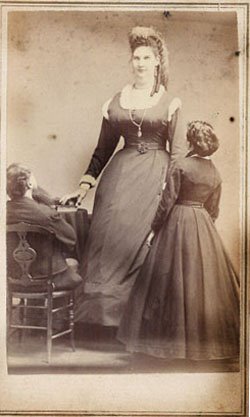
From the New York Sun: “Knowing that [some performers] occupied apartments on the third floor, he rushed thither and burst open the doors. Finding the rooms empty he ascended to the next floor and succeeded in bringing down the ladies assembled in the dressing rooms there — a Miss Swan, the Giantess, and Miss Zuruby Hannus, the Circassian girl.”

Below: Anna Swan, ‘the Giantess’ who lived at the museum, was successfully rescued

swan

Many of the wax figures from the third floor were hurled out the windows. One peculiar item captured the imagination of the crowd — the wax depiction of Jefferson Davis, dressed in a woman’s petticoat.  (It was rumored that the former president of the Confederacy has attempted to escape dressed as a lady.)

NYT:  “One [rescuer] had Jefferson Davis’ effigy in his arms and fought vigorously to preserve the worthless thing, as though it were a gem of rare value. On reaching the balcony the man, perceiving that either the inanimate Jefferson or himself must go by the board, hurled the scarecrow to the iconoclasts in the street. As Jefferson made his perilous descent, his petticoats again played him false, and as the wind blow them about, the imposture of the figure was exposed.”

NYS: “When the Jefferson Davis petticoated figure was recognized by the crowd, it was seized, kicked, knocked and finally hanged to an awning frame [in front of St. Paul’s Church], amid the derisive and contumelious epithets of the persons engaged in this pastime.”

More seriously a great number of artifacts from the Revolutionary War were incinerated in the fire. “Valuable mementos of Washington, Putnam, Greene, Marion, Andre, Cornwallis, Howe, Burr, Clinton, Jefferson, Adams, and other eminent men which should have been carefully stored in a fire-proof vault, yesterday smoldered in the heat….” [NYT]

barnum's museum burns 1865

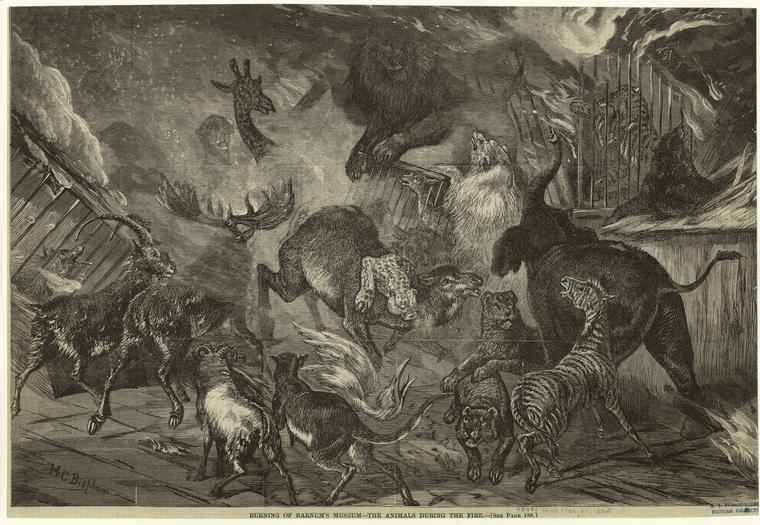
The museum’s impressive collection of taxidermy — monkeys, lions, elephants, zebras — were swallowed up by smoke and collapsed into the inferno.

But the museum also had a great many living animals — snakes, pigs, dogs, and even a kangaroo and an alligator. And, of course, a great many monkeys — “big monkeys, little monkeys, monkeys of every degree of tail, old, grave, gray monkeys, young, rascally, mischievous monkeys, middle-aged, scheming monkeys, and a great many miserable, angry monkeys.” Most perished in the flames although some escaped into the streets, some never to be found again.

Below: This is Harpers Weekly’s illustration of Barnum’s second fire — see below — but could have tragically captured the events on July 13, 1865.

Harpers Weekly
Harpers Weekly

Remarkably, nobody humans died in the blaze. In fact, few wax depictions of humans perished as many took to rescuing wax figures thinking they were alive.  The fire spread to several surrounding buildings, and soon the entire block was engulfed in flame.

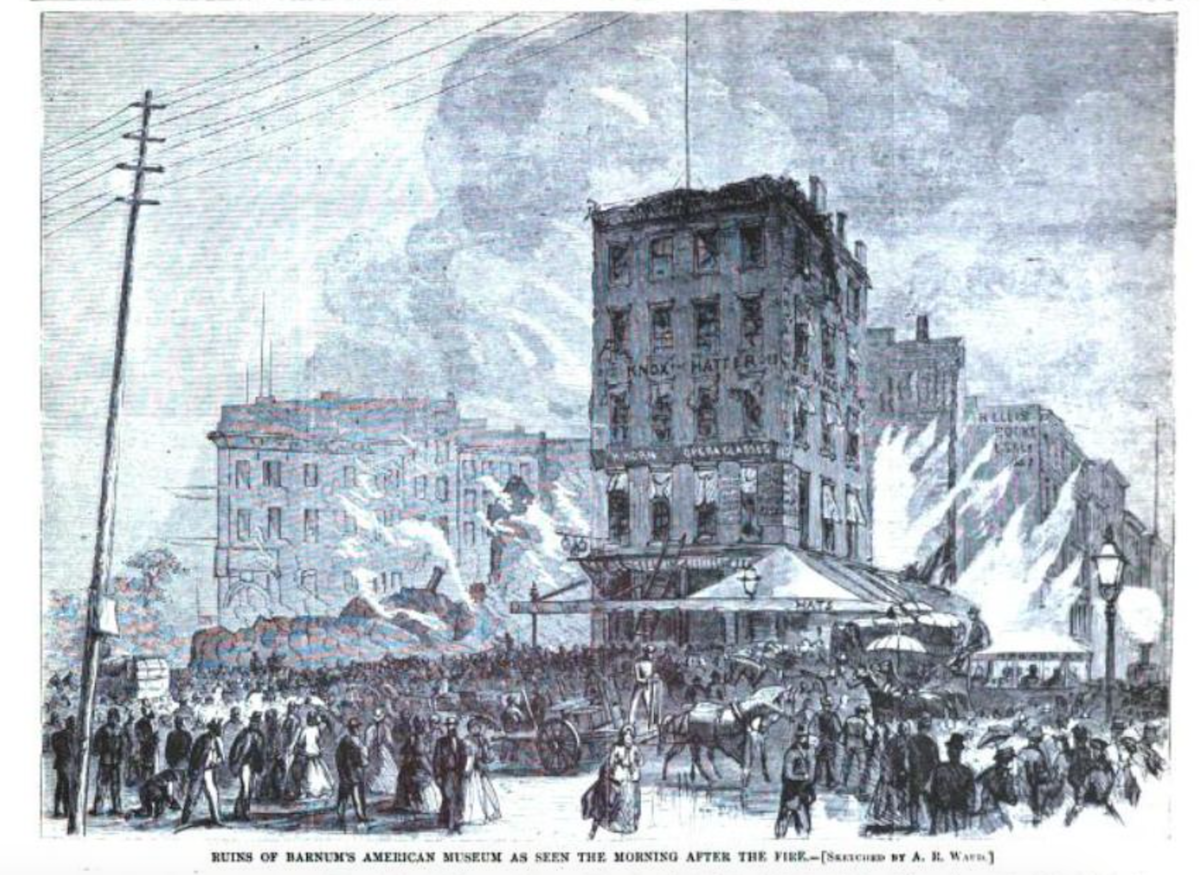
NYT:  “The roof of the Museum had now fallen, and the interior of the building was like the crater of a volcano. A stream of heated air issued from the top, and was borne eastward by the breeze directly over the block, carrying with it light articles, pieces of burning wood, shingles ….

At 1:30 came a crash resounding like the explosion of a powder magazine. The whole wall on the Ann-street side had fallen. A cloud of dust and smoke filled the air, making it dark as twilight, and rendering it impossible to descry objects at short distance.”

Harpers Weely
Harpers Weekly

Notable among the surrounding buildings that were damaged was the famous Knox the Hatter at 212 Broadway. Fortunately for the fate of New York,  the Croton Aqueduct water system had been installed two decades earlier, allowing the blaze to be put out with some speed, preventing a repeat of the Great Fire of 1835.

There was a bit a looting, including “two men dressed as soldiers [who] were seen coming out of the shoe-store in Ann Street, each with five or six pairs of shoes under their coats.” And there were false reports that the lion has escaped and was running through the streets.

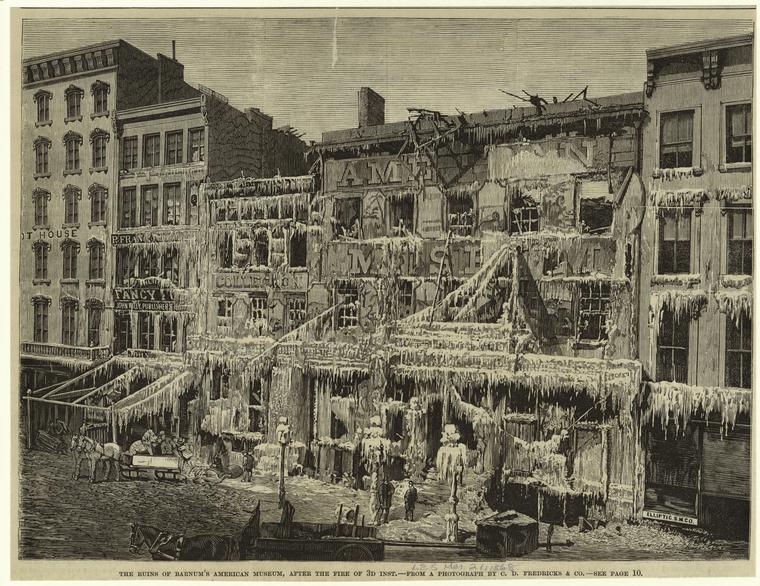
For years after, people mourned the loss of Barnum’s collection, truly among the greatest in New York City up until that time. Â Barnum attempted to relaunch the museum at 539-541 Broadway. but it, too, was destroyed in a fire (pictured below).

Then, in 1871, he leased a train depot and called it Barnum’s Monster Classical and Geological Hippodrome.  (It would later morph into the first Madison Square Garden.)

Finally he just decided to take his collection of acts on the road forming a traveling circus in 1881 with ringmaster James Anthony Bailey.

While the world of entertainment would be changed by their collaboration — Barnum and Bailey’s Circus — most would consider the old American Museum as Barnum’s greatest achievement.

Below: Barnum’s second museum destroyed by fire, which gutted the building on a cold day

Harpers Weekly
Harpers Weekly

For more information, we have a few Barnum-themed podcasts that you might enjoy:

Categories
New York Islands Podcasts

The history of Hart Island, a place of strangeness and sorrow

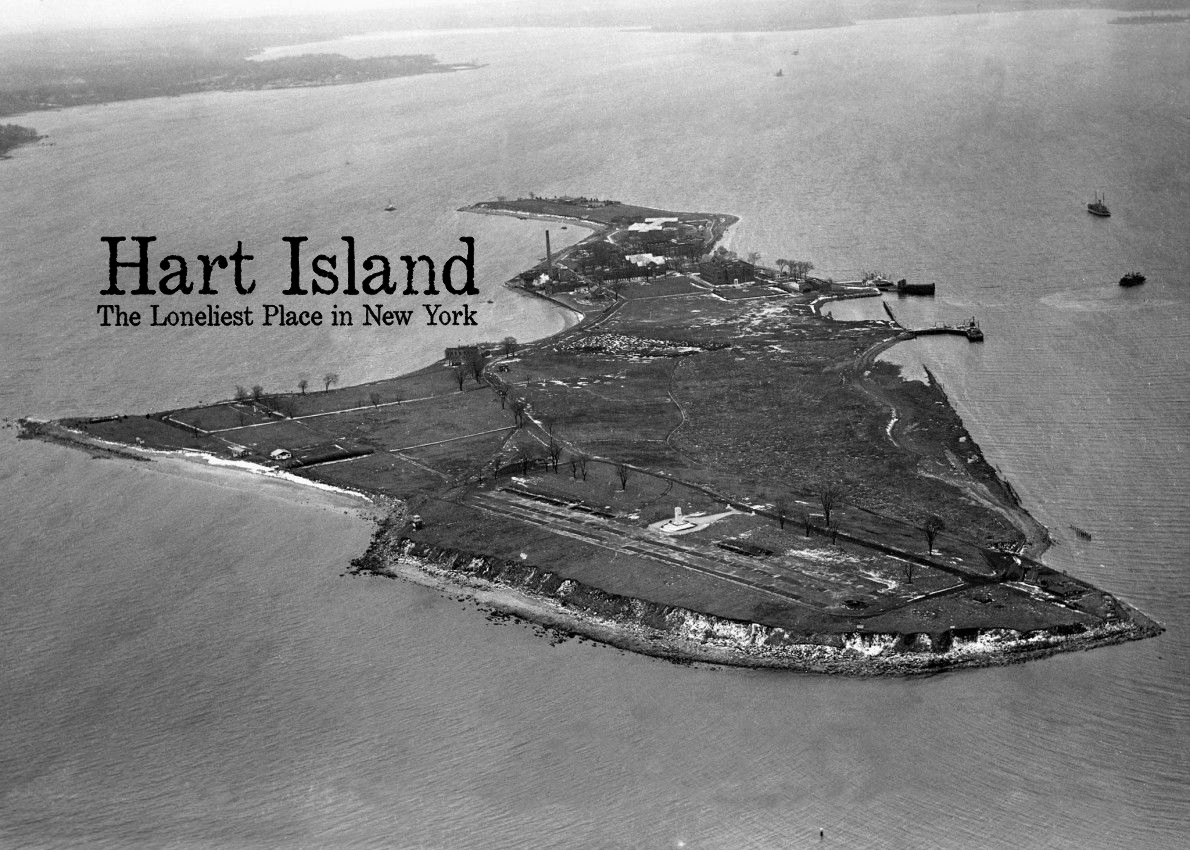
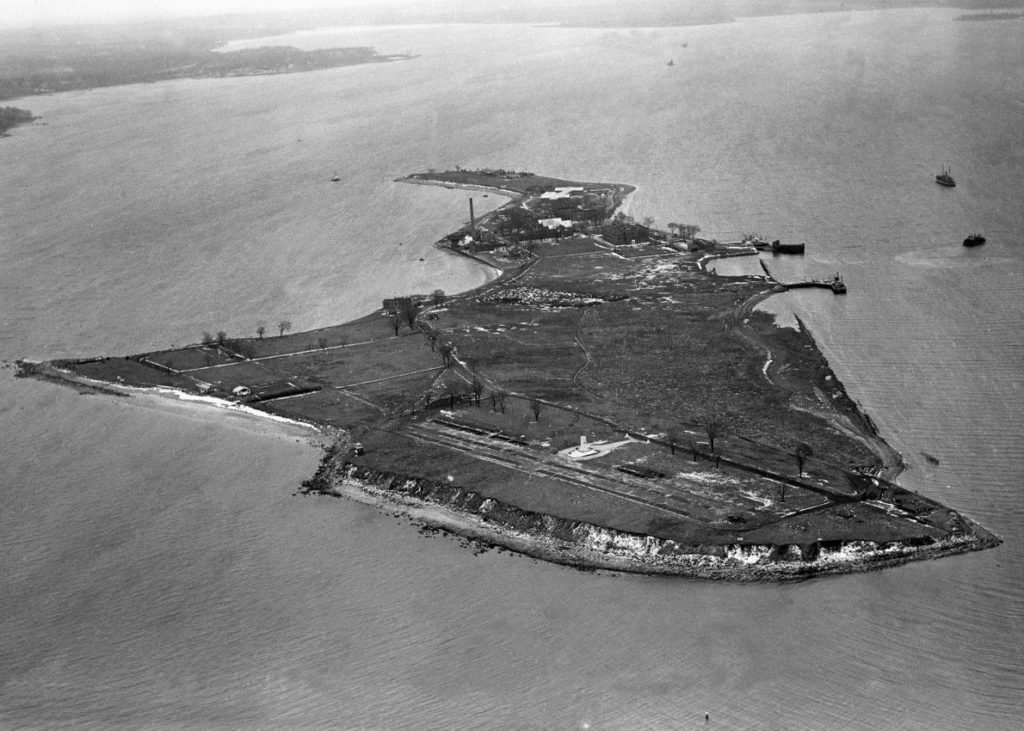
Few people are allowed to go onto Hart Island, the quiet, narrow island in the Long Island Sound, a lonely place in sight of the bustling community of City Island.

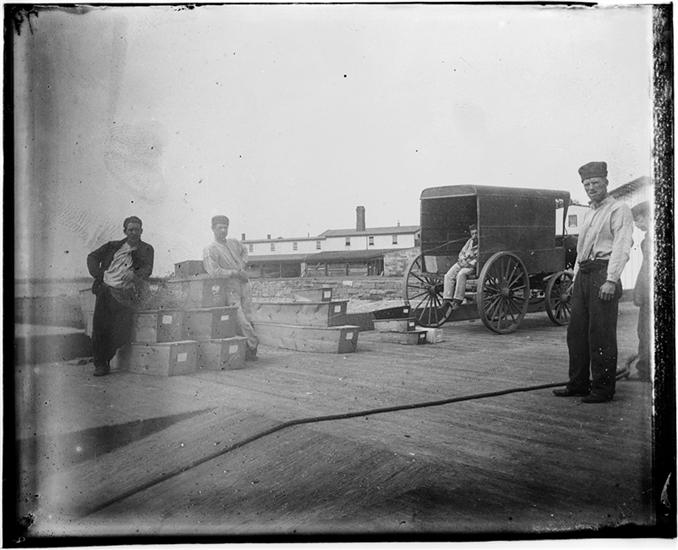
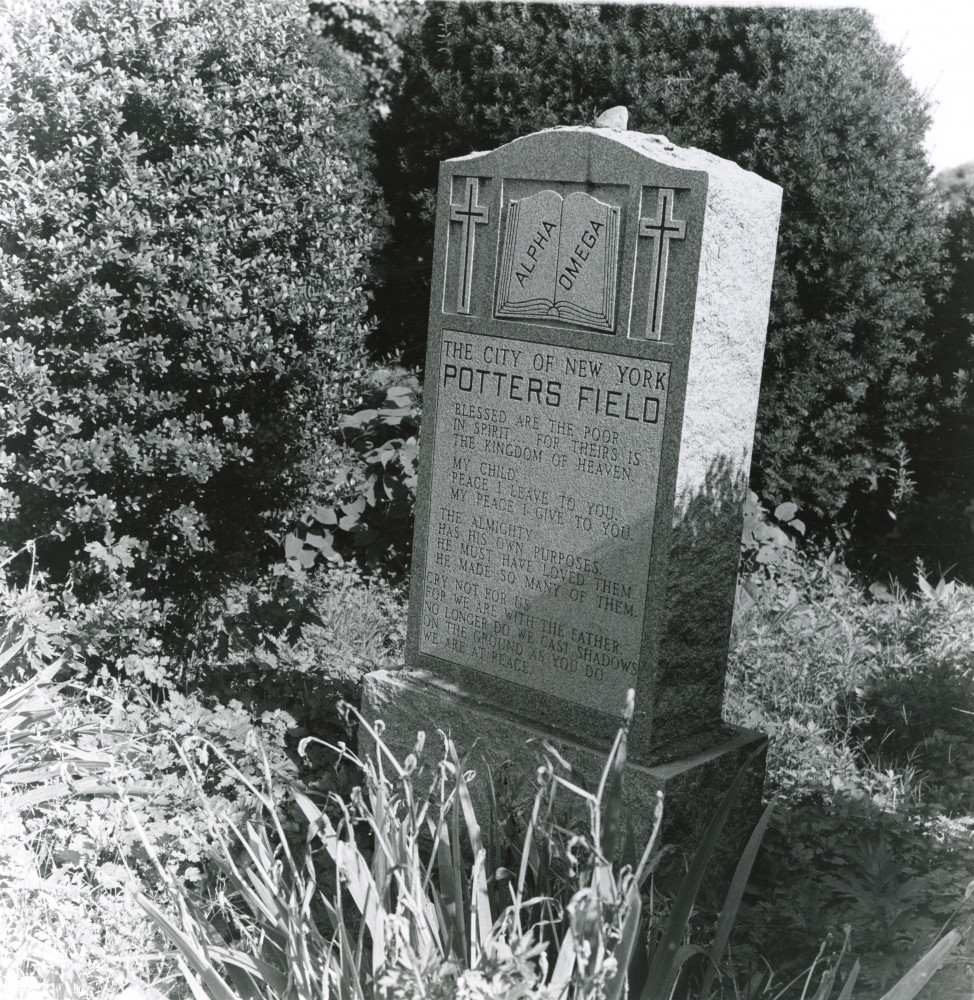
For over 150 years, Hart Island has been New York’s potter’s field, the burial site for over one million people — unclaimed bodies, stillborn babies, those who died of AIDS in the 1980s, and, in 2020, the location of burials of those who have died of COVID-19 coronavirus.

New York Daily News/Getty

Hart Island’s appearance in the international press this past week has drawn attention to the severity of the pandemic in New York City, but it has also drawn attention to the island itself.

By the early 19th century, this peaceful place — most likely named for deer which may have called it home — had already developed a violent reputation as a renegade site for boxing matches.

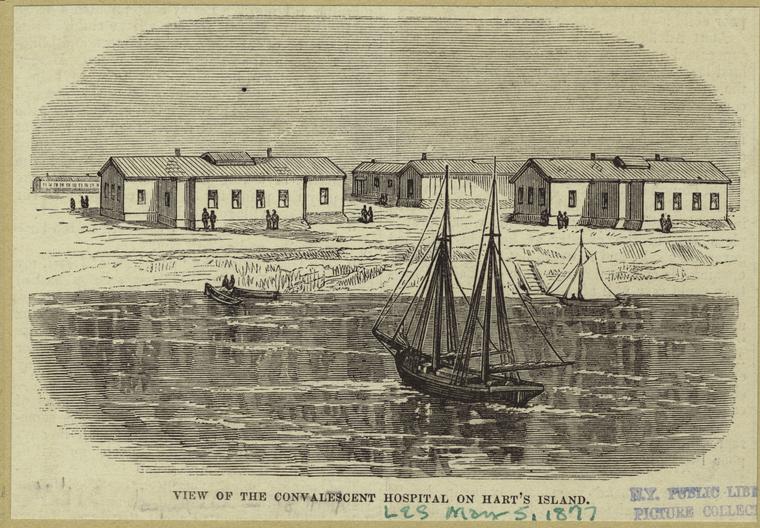
During the Civil War, black Union troops trained here and later Confederate soldiers were imprisoned in refitted prison barracks.

But in the late 1860s the city prepared the island for its eventual and longest lasting purpose. Today it is the world’s largest potter’s field. And thanks to groups like the Hart Island Project, New Yorkers may finally get a glimpse at this strange, forlorn place and the previously forgotten people buried here.

PLUS: That time that an amusement park was almost built on Hart Island.

LISTEN NOW — HART ISLAND: THE LONELIEST PLACE IN NEW YORK

To get this week’s episode, simply download or stream it forFREE from iTunes, Stitcher, Spotify or other podcasting services.You can also get it straight from our satellite site.

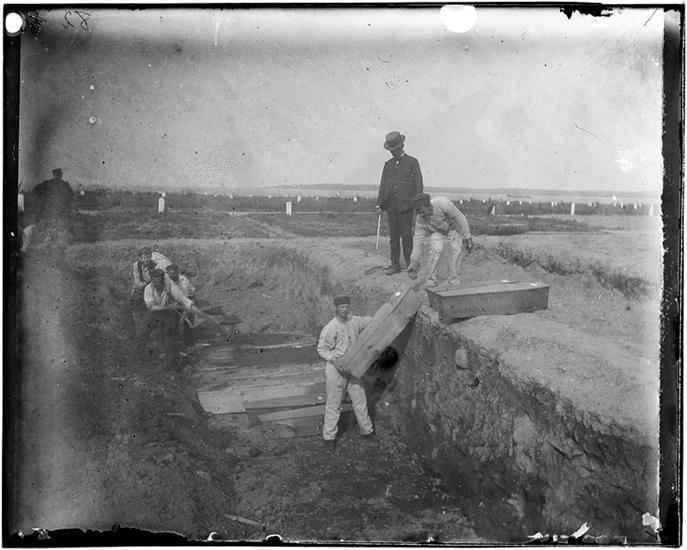
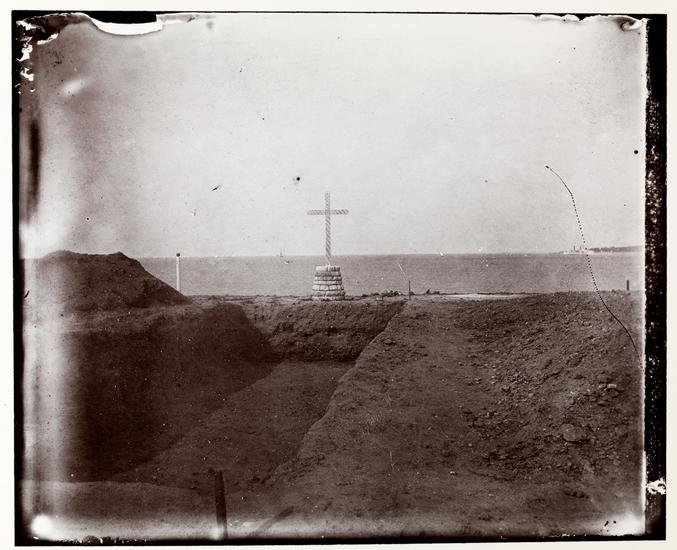
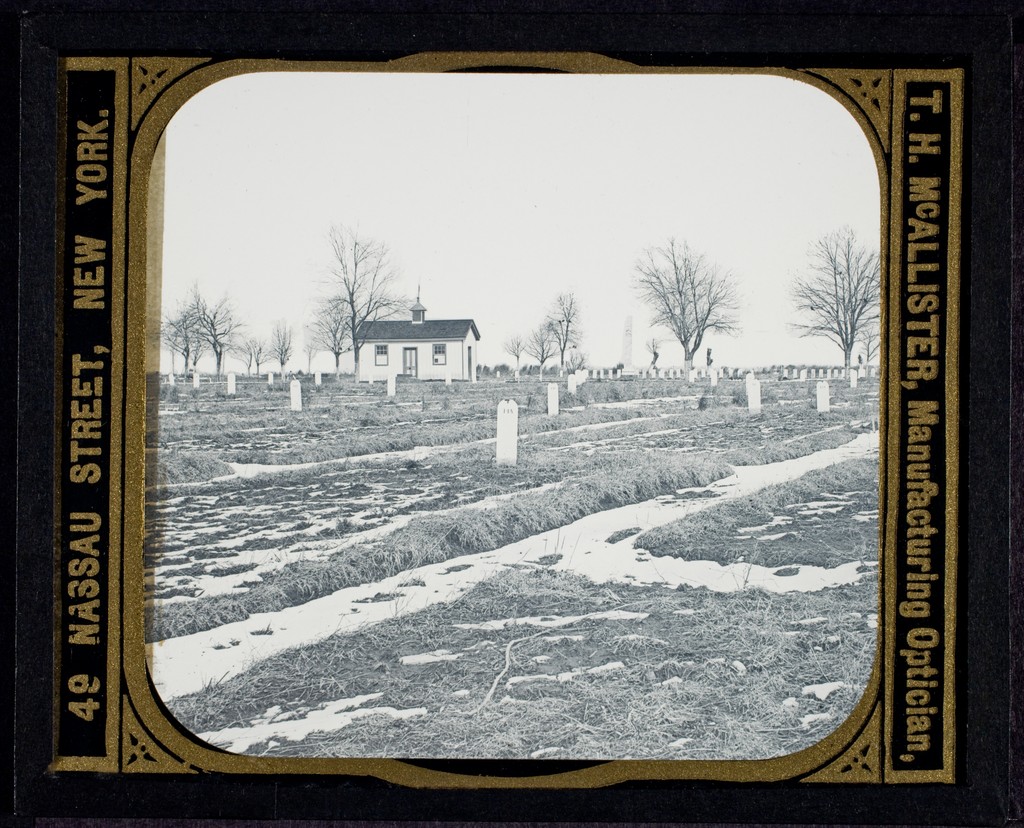
Hart Island 1877, courtesy New York Public Library
Hart Island 1890, photo by Jacob Riis/Museum of the City of New York
The Potter’s Field, Hart’s Island, 1898
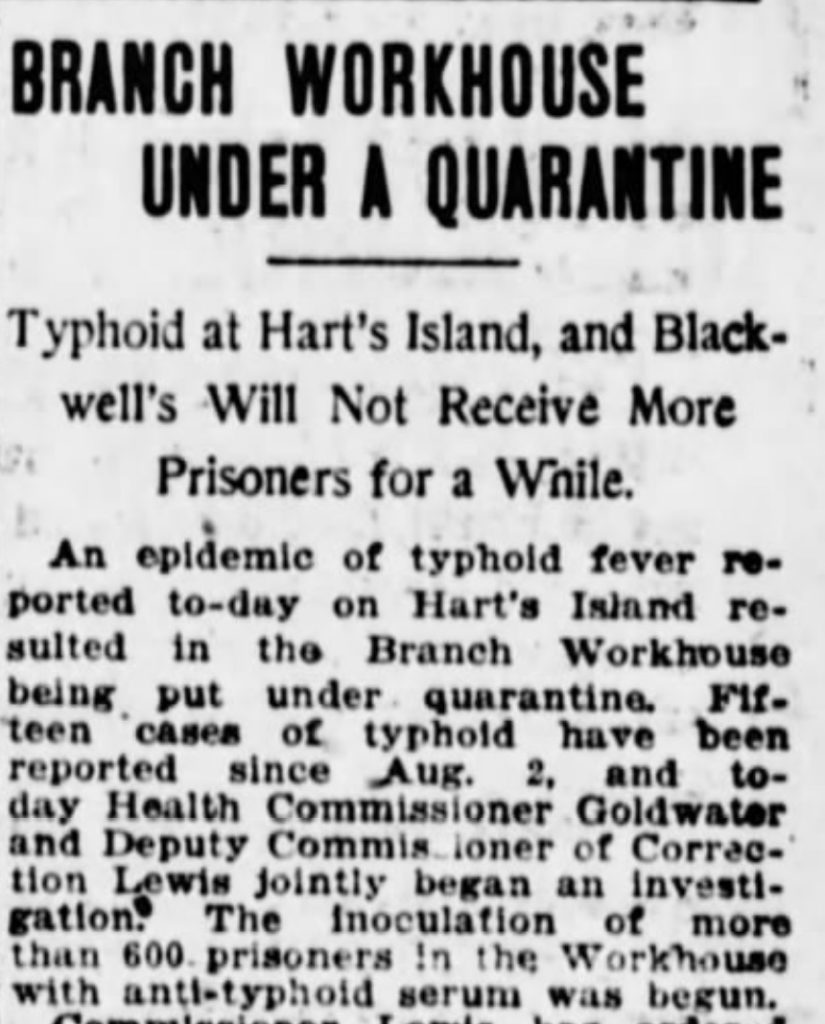
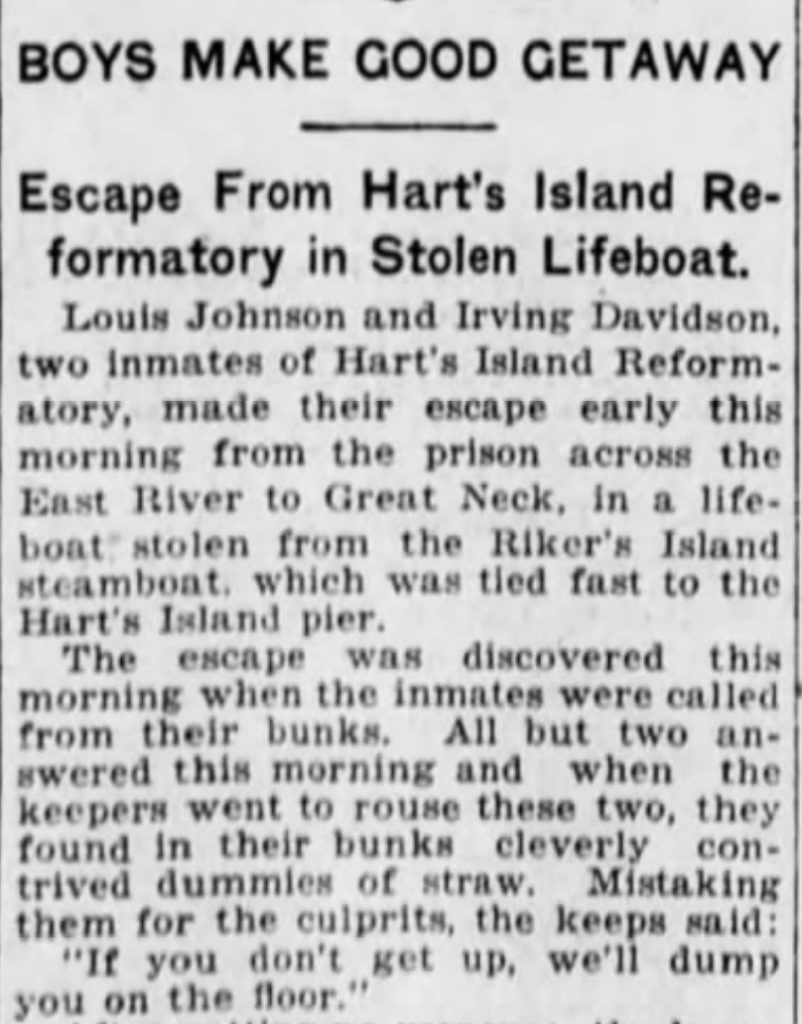
August 18, 1914, New York Evening Post (courtesy Newspapers.com)
March 20, 1916, Brooklyn Daily Eagle (courtesy Newspapers.com)
Claire Yaffa Children With Aids Photograph Collection, via New-York Historical Society
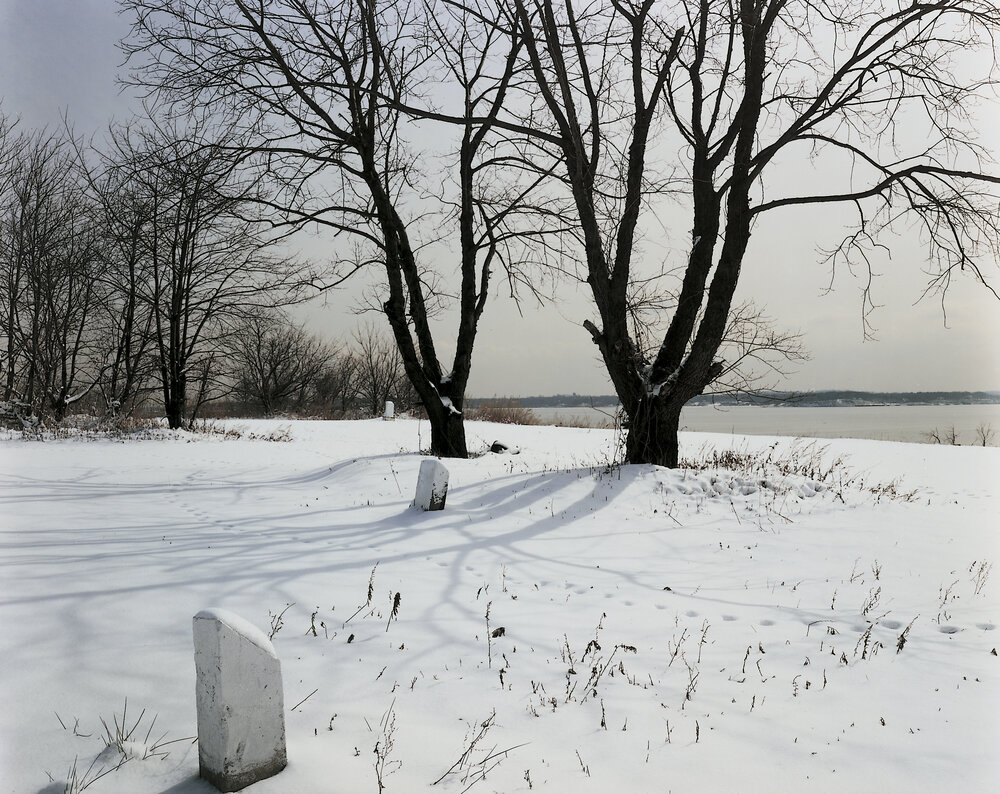
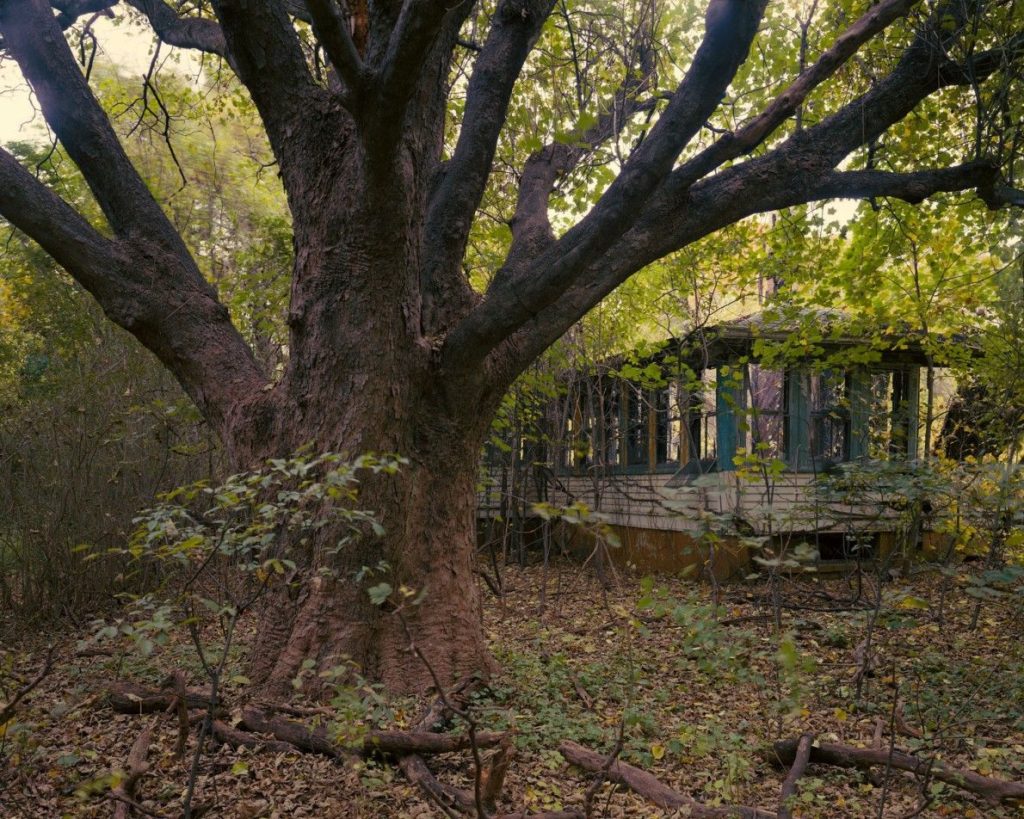
1993/Joel Sternfeld
The two images above were taken by Joel Sternfeld. Please check out his website for more haunting images of the island.

A 1978 news broadcast about Hart Island.

A 2015 piece about Hart Island from MSNBC.

FURTHER READING AND LISTENING

Believe it or not, potter’s fields and cemeteries play a huge role in the development of New York City. This article lists several sites that have once been burials grounds.

The lesser known islands of New York have very fascinating histories that you may not be aware of — try these stories about North Brother Island and City Island, for instance.

And these older podcasts on other New York City islands:

Blackwell’s Island/Roosevelt Island
Rikers Island
Randall’s Island and Wards Island

The Bowery Boys: New York City History podcast is brought to you …. by you!

We are now producing a new Bowery Boys podcast every other week. We’re also looking to improve and expand the show in other ways — publishing, social media, live events and other forms of media. But we can only do this with your help!

We are now a creator on Patreon, a patronage platform where you can support your favorite content creators.

Please visit our page on Patreon and watch a short video of us recording the show and talking about our expansion plans. If you’d like to help out, there are six different pledge levels. Check them out and consider being a sponsor.

For the next several weeks, in addition to our new two-episodes-a-week schedules, all those who support us on Patreon will receive a BONUS EPISODE every other Sunday.

We greatly appreciate our listeners and readers and thank you for joining us on this journey so far.

Categories
Wartime New York

“To the memory of the Brave Soldiers and Sailors Who Saved the Union”

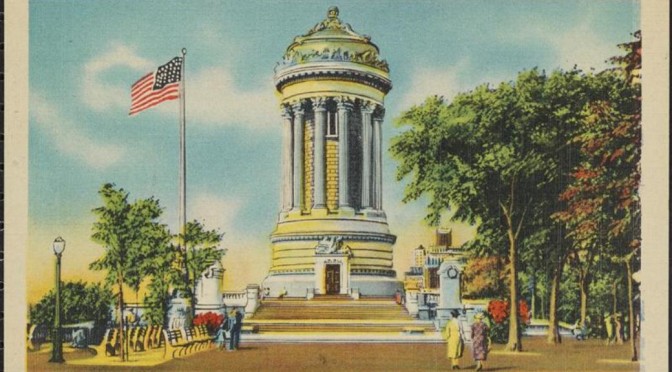
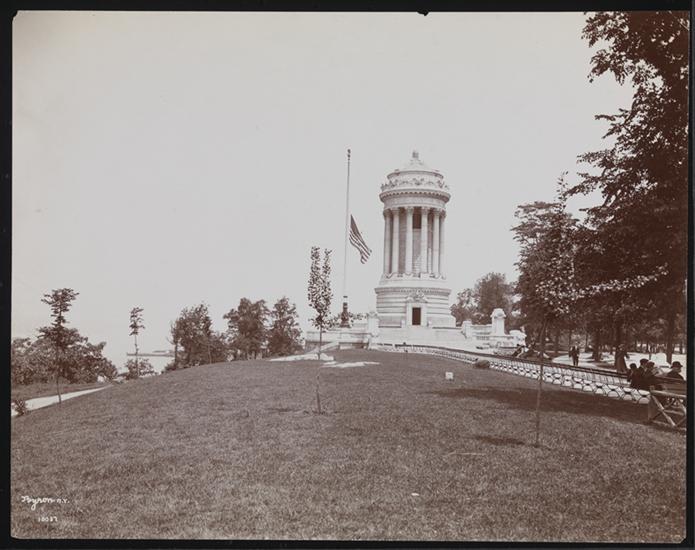
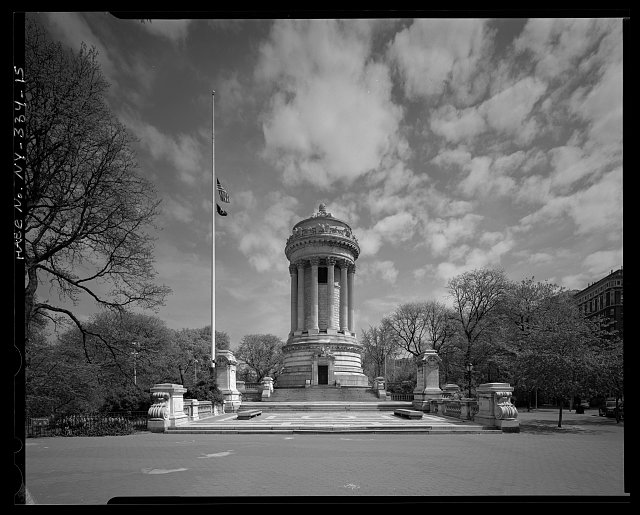
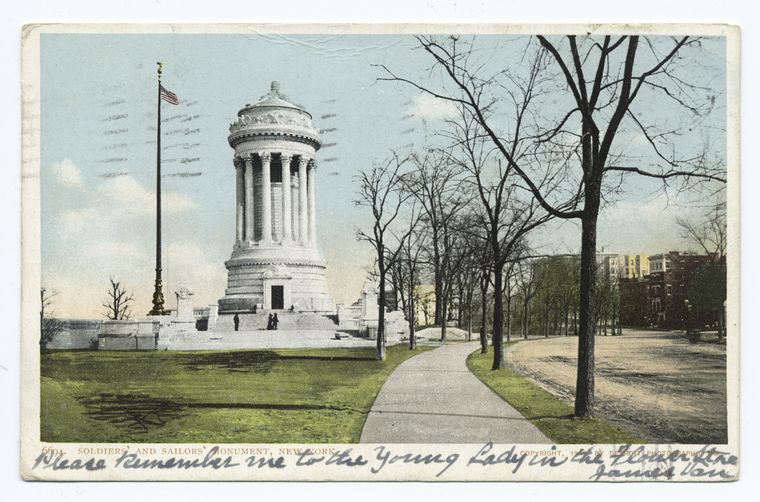
This Monday (May 27, 2019), a Memorial Day observance will be held from 10 a.m to noon at the Soldiers and Sailors Monument in Riverside Park. In honor of the holiday, we’re rerunning this 2015 article on this oft-forgotten monument.

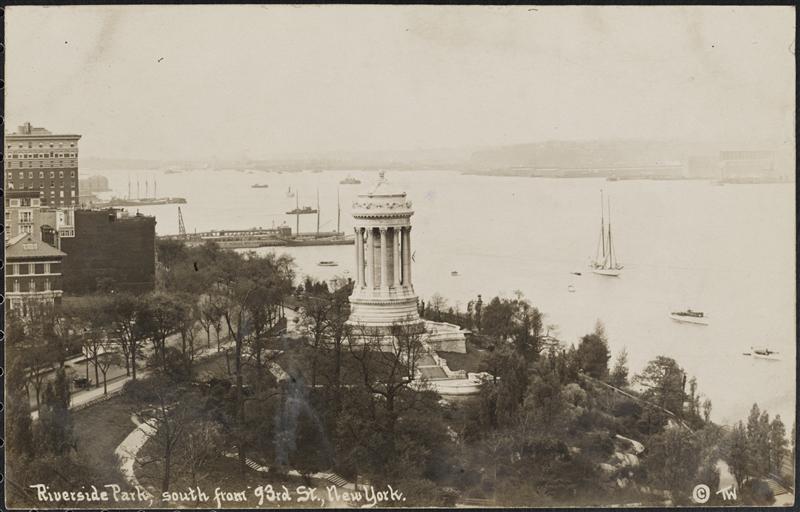
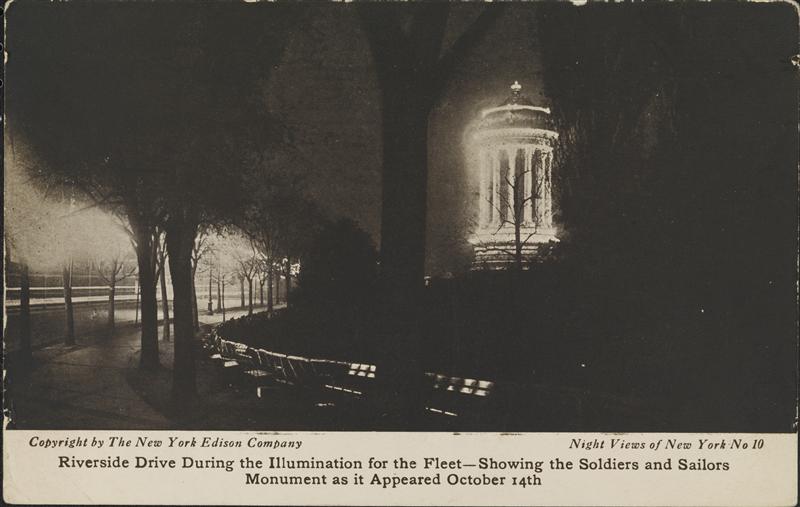
The Soldiers’ and Sailors’ Monument on the Upper West Side has been the centerpiece for Memorial Day commemoration for decades.  Unless you actually live by it, you probably have not been there in years, if at all. It’s a vastly under-appreciated landmark, occasionally vandalized and certainly in need of work. [For more on the history of Riverside Park, listen to our podcast episode: Heaven on the Hudson.]

Courtesy the Museum of the City of New York

It owes its form to the great Gilded Age fervor for classical beauty and the aesthetic appeal of Beaux-Arts architecture. Grand war memorials were sprouting up all over New York during this period, most notably he Soldiers’ and Sailors’ Arch in Brooklyn’s Grand Army Plaza (1892) and Prison Ship Martyrs Monument in Fort Greene (1908).  Then there’s Grant’s Tomb (1897), which owes its existence more to the General’s military career and not so much his scandal-filled presidency.

And similar monuments of such colossal proportion were erected in other cities including Hartford (1886), New Haven (1887), Allentown (1899) Indianapolis (1902), Baltimore (1909)  Syracuse (1910), Pittsburgh (1910), among many others.

Courtesy the Museum of the City of New York

Monuments are dandy indicators of civic pride but many were inspired by practical necessity. Most Union veterans were in their ’50s and ’60s by this time many of these memorials were planned. Those that grew up after the war– the sons and daughters of war heroes — wanted to recognize the achievements of a previous generation.  Many of these men (Grant being the notable example) were now prominent citizens in New York.

Its also not a coincidence patriotic feelings were swelling during this period due to conflicts like the Spanish-American War which would later demand their own memorials like the powerful Maine Monument, unveiled in 1913.

1915, courtesy the Museum of the City of New York

Riverside Drive might seem a curious place to put a Civil War monument. In fact, its location inspired a bit of a civic war itself from the moment it was first planned in 1893.  “THE MONUMENT FIGHT AGAIN” proclaimed the New York Times in 1895, reporting on a rivalry between  members of the Upper East Side Association and the Upper West Side Association.

I mean, in 1895, didn’t it make sense to place it on Fifth Avenue, the most prominent and wealthy street in the world? Proponents chose Fifth Avenue and 59th Street, the entrance to Central Park, as the ideal spot. “It is rather amusing to hear …. grounds for opposition in view of what was said in front of the Commissioners when the west side men wanted to locate the monument on the Riverside Drive and Seventy-Second Street…..[T]hey charged that the Plaza was not suitable because the monument would be surrounded by buildings that would dwarf it.”

Supports of the Riverside site claimed that the foundations would not be sturdy enough near the park, an amusing remark given the skyscraper boom which would take over Midtown Manhattan in the 20th century.  In particular, naval officers bristled at the Fifth Avenue site which was almost as far from the site of water that one could get in Manhattan.

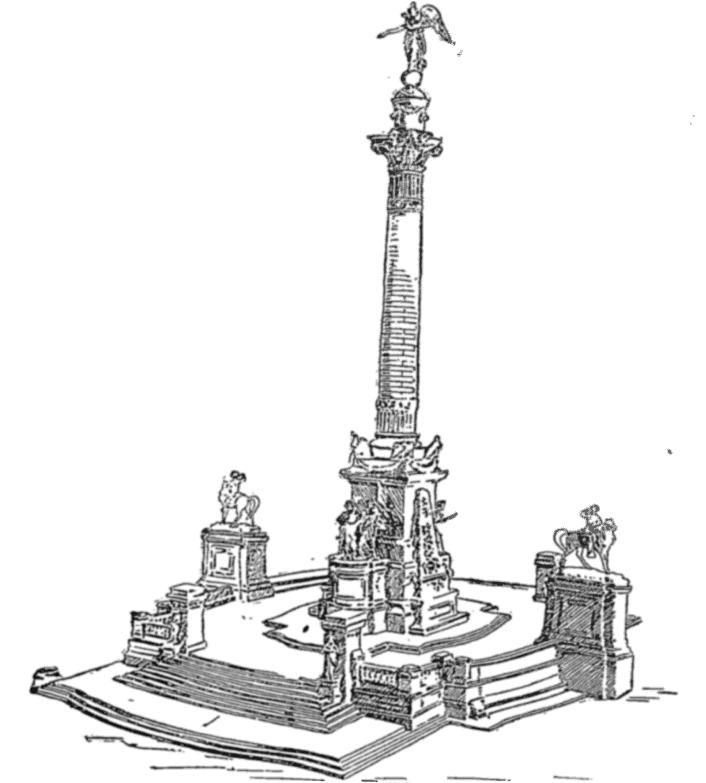
Had the eastsiders won, we would have gotten a Soldier’s and Sailors Monument that looked like this on the spot of today’s Grand Army Plaza:

1

By 1899, years after the project was conceived, proponents of the west side finally won out.  The monument was planned for a spot in the newly developed Riverside Park known as Mount Tom, a “very beautiful little knoll of natural rock,” believed to have been a spot of quiet contemplation for one Edgar Allen Poe (who lived nearby in 1844).  That was at Riverside Drive and 83rd Street.  Eventually that too was deemed inadequate, and the preparations were then moved to the present location at 89th Street.

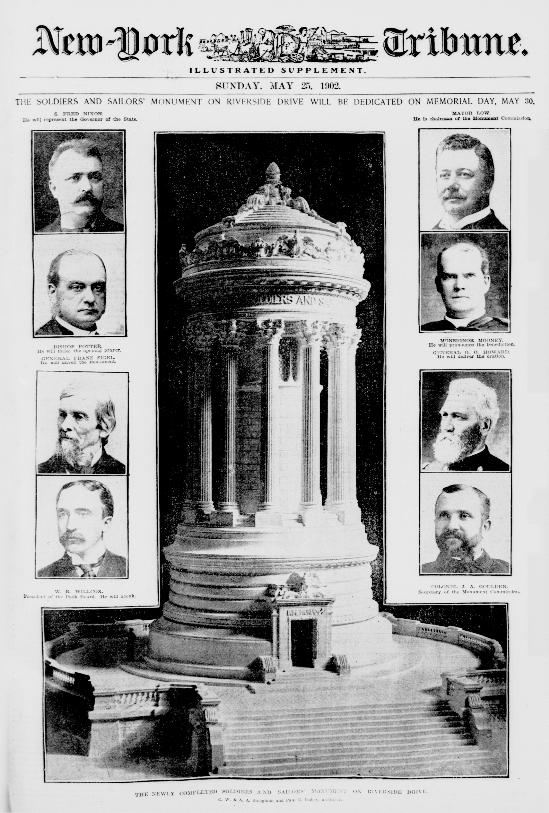
Given the new location, the monument was redesigned by the firm of Straughton and Straughton as a circular temple adorned with Corinthian columns. The Soldiers and Sailors Monument was officially dedicated on Memorial Day 1902:

1

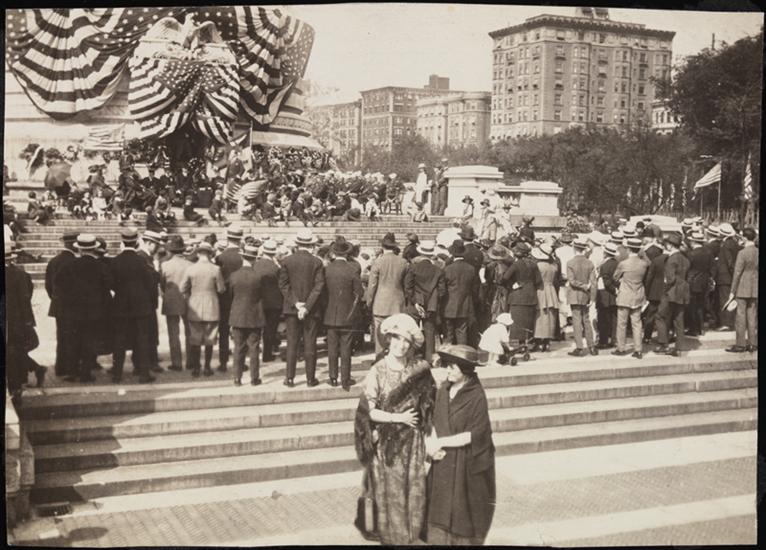
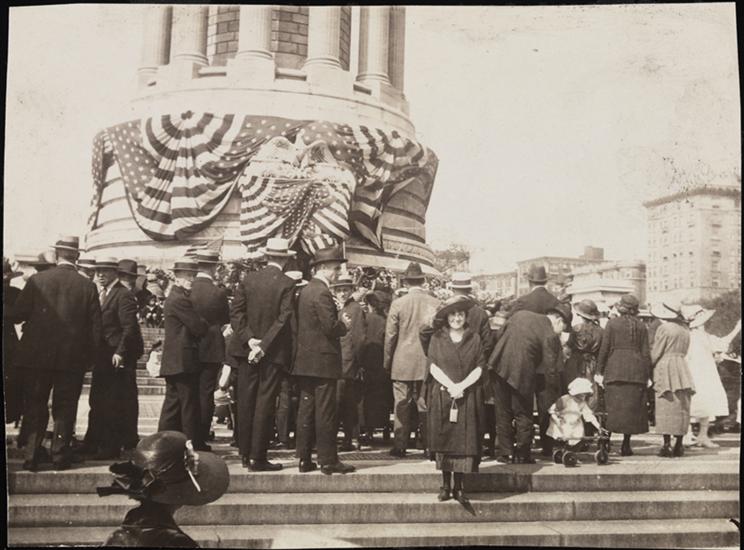
Here are a couple views of its dedication ceremony in 1902:

Courtesy the Museum of the City of New York

The final monument is absolutely beautiful, of noble design, but was not well constructed.  Repairs were necessary less than five years later, and the structure has gone through several alterations.  This New York Times article gives you a look inside the monument and reviews some current efforts to rescue the building from further deterioration.

The weather’s supposed to be spectacular this holiday weekend, so make that a good excuse to visit this unusual and charming little memorial.

Photo by Renee Bieretz, courtesy the Library of Congress

And finally, a mysterious post card from the New York Public Library collection. Note the caption:

forindex

Categories
Podcasts Politics and Protest

New York City and the Underground Railroad: Escaping to freedom through a hostile city

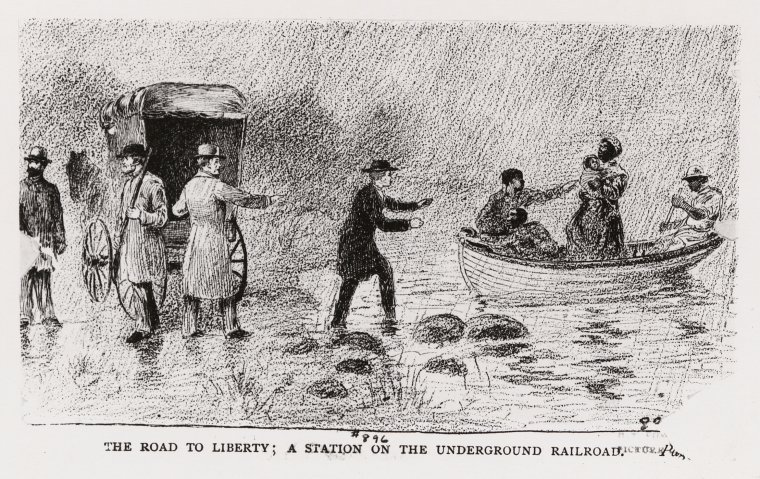
PODCAST For thousands of people escaping the bonds of slavery in the South, the journey to freedom wound its way through New York City via the Underground Railroad.


The Underground Railroad was a loose, clandestine network of homes, businesses and churches, operated by freed black people and white abolitionists who put it upon themselves — often at great risk — to hide fugitives on the run.

New York and Brooklyn were vital hubs in this network but these cities were hardly safe havens. The streets swarmed with bounty hunters, and a growing number of New Yorkers, enriched by Southern businesses, were sympathetic to the institution of slavery. Not even freed black New Yorkers were safe from kidnapping and racist anti-abolitionist mobs.

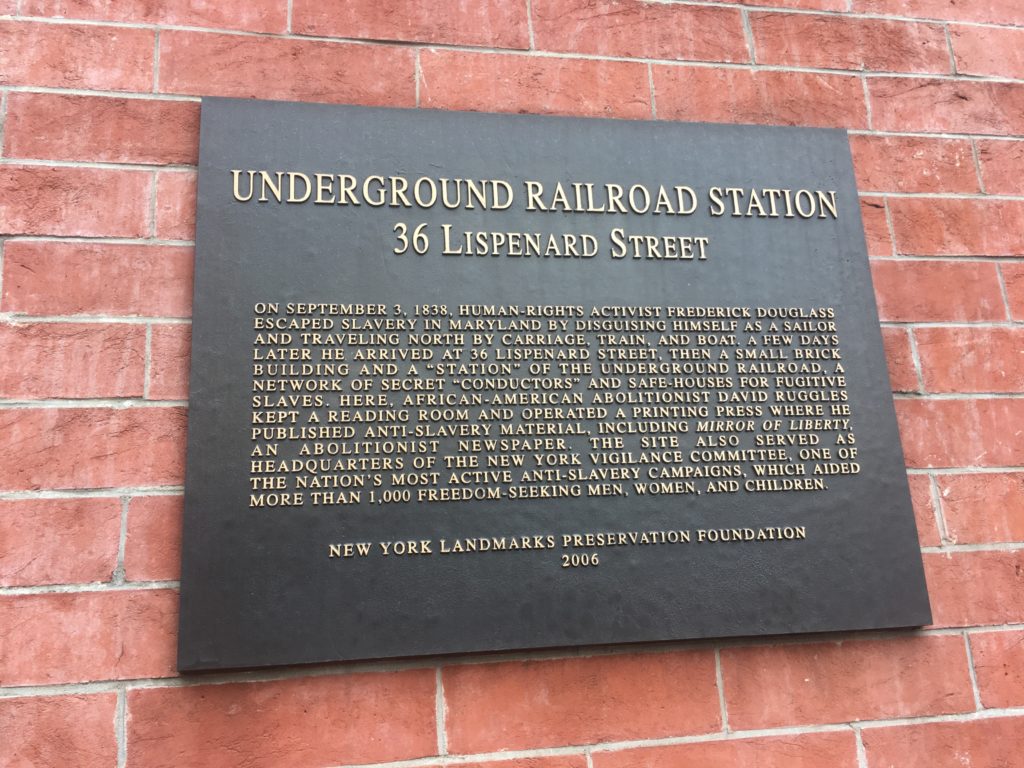
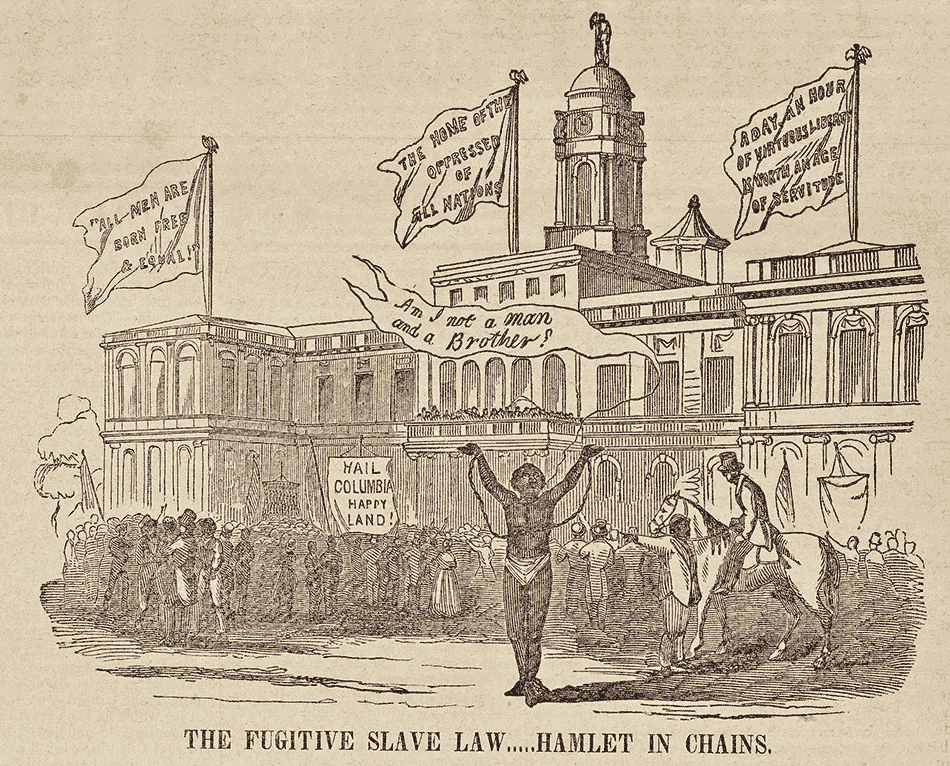
In this podcast we present some of the stops in New York along the Underground Railroad — from offices off Newspaper Row to the basement of New York’s first African-American owned bookstore. You’ll be familiar with some of this story’s leading figures like Frederick Douglass, Harriet Tubman and Henry Ward Beecher. But many of these courageous tales come from people who you may not know — the indefatigable Louis Napoleon, the resolute Sydney Howard Gay, the defiant David Ruggles and James Hamlet, the first victim of the 1850 Fugitive Slave Act.

PLUS: A trip to Brooklyn Heights and the site of New York’s most famous Underground Railroad site — Plymouth Church

LISTEN HERE:

_______________________________________________________

The Bowery Boys: New York City History podcast is brought to you …. by you!

We are now producing a new Bowery Boys podcast every week. We’re also looking to improve the show in other ways and expand in other ways as well — through publishing, social media, live events and other forms of media. But we can only do this with your help!

We are now a member of Patreon, a patronage platform where you can support your favorite content creators for as little as a $1 a month.

Please visit our page on Patreon and watch a short video of us recording the show and talking about our expansion plans. If you’d like to help out, there are five different pledge levels (and with clever names too — Mannahatta, New Amsterdam, Five Points, Gilded Age, Jazz Age and Empire State). Check them out and consider being a sponsor.

We greatly appreciate our listeners and readers and thank you for joining us on this journey so far. 

________________________________________________________

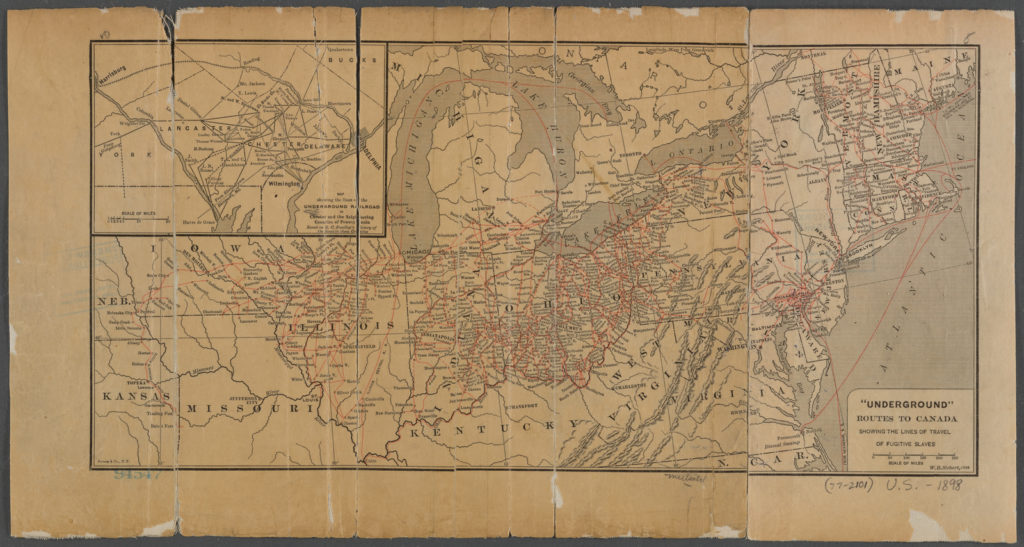
The many routes of the Underground Railroad, in an 1898 map by cartographer Wilbur Henry Siebert.

New York Public Library

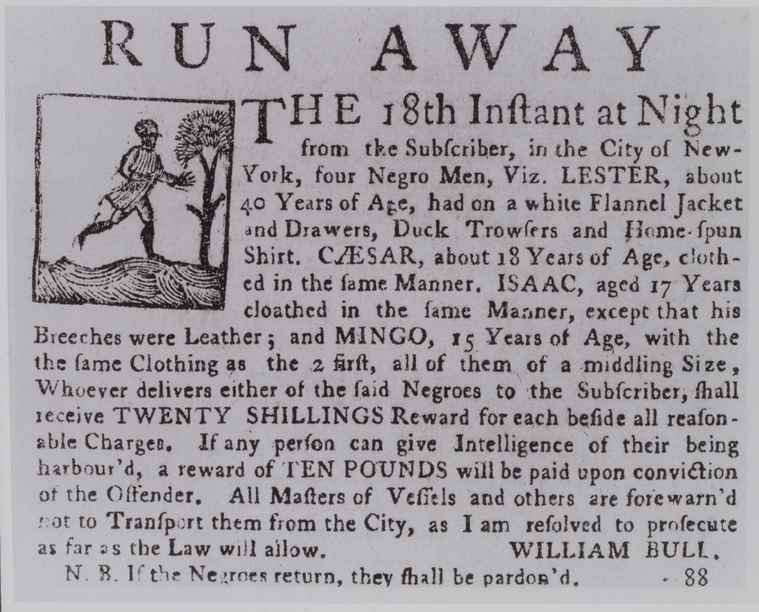
An advertisement for the capture of a runaway slave, published during the colonial era (1760s)

Schomburg Center for Research in Black Culture, Photographs and Prints Division

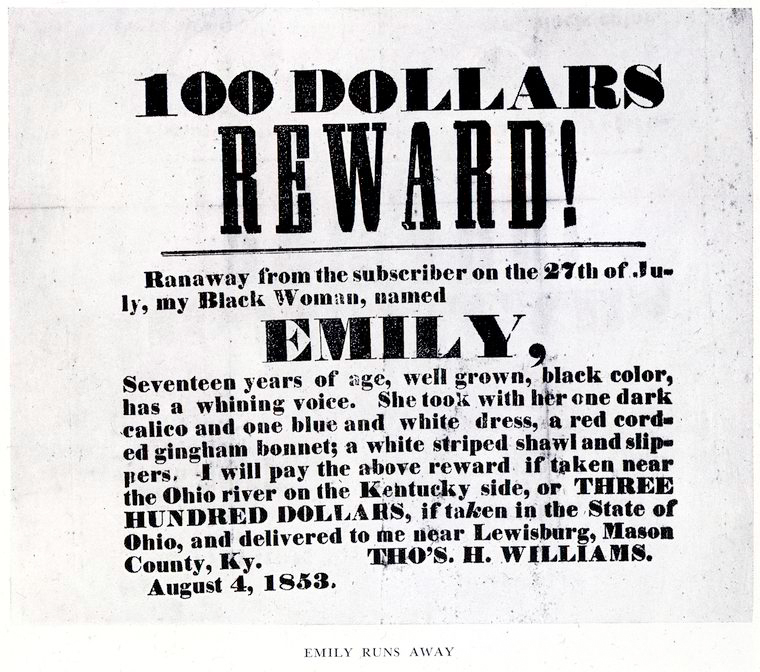
….and another, from 90 years later.

Schomburg Center for Research in Black Culture, Photographs and Prints Division

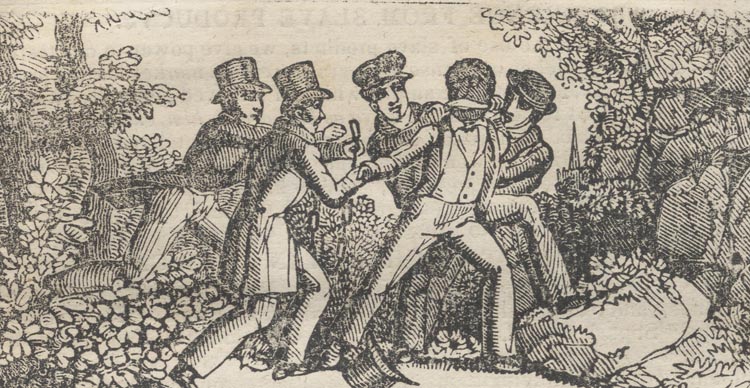
African-American New Yorkers lived in fear of being kidnapped by bounty hunters.

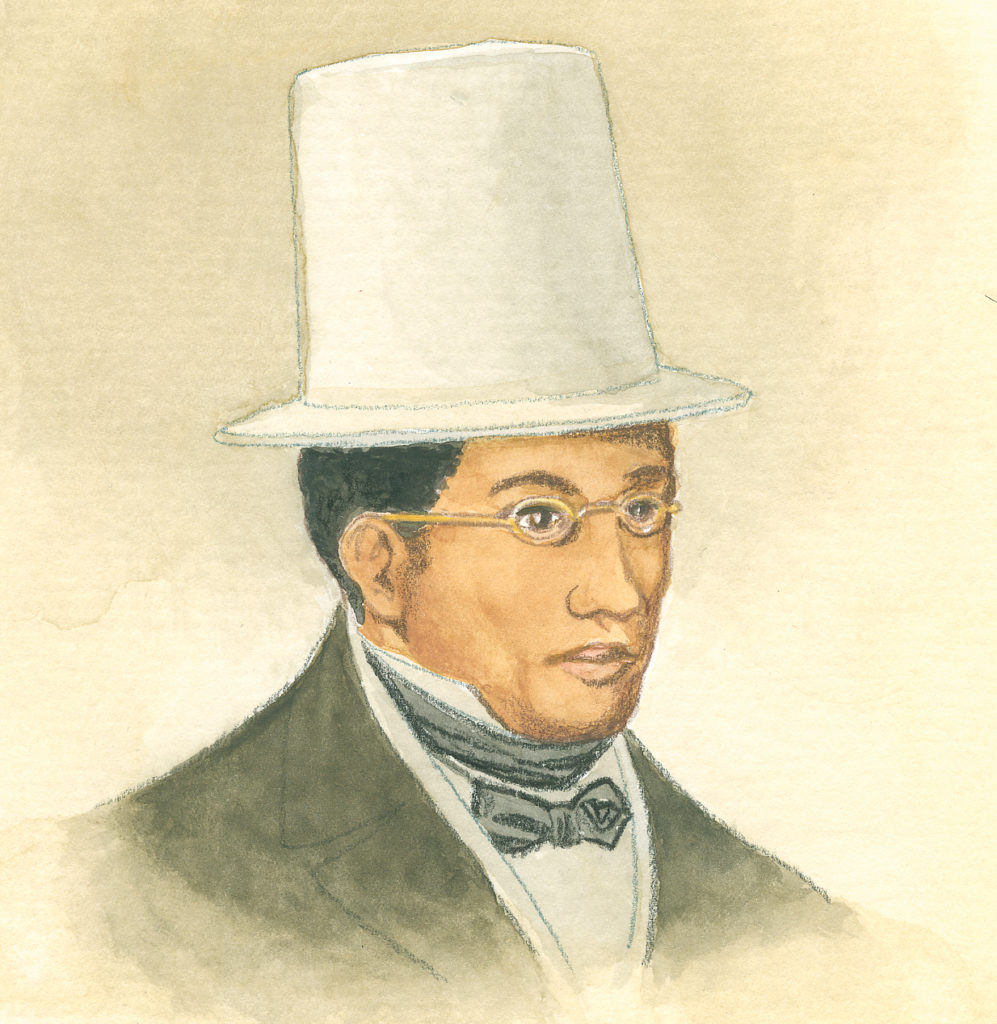
David Ruggles who operated America’s first African-American library and reading room on Lispenard Street. His home was also a stop on the Underground Railroad.

Illustration by Bob Powers (from original engraving)

At the release of James Hamlet (i.e. the purchase of his freedom by the AME Zion Church), this handbill was distributed

Rare Books and Manuscripts Library, Columbia University

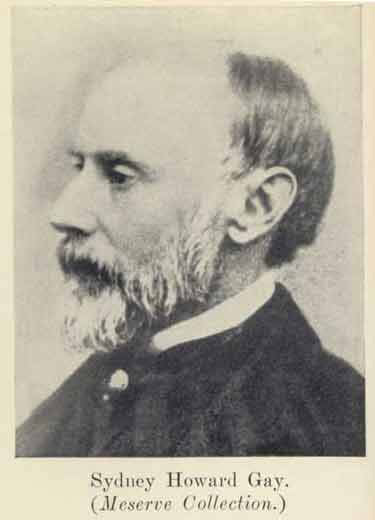
Sydney Howard Gay worked with several operatives on the Underground Railroad and was one of the few to keep records of new fugitive arrivals.

Abigail Hopper Gibbons, daughter of esteemed abolitionist Isaac Hopper, worked as a battlefield nurse in the early years of the Civil War. She returned to New York in 1863, only to be chased from her home by angry mobs during the Civil War Draft Riots.

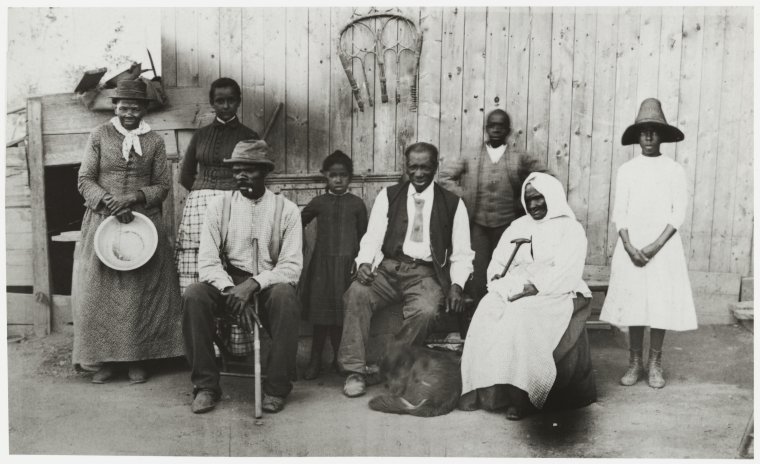
Harriet Tubman and her family — Gertie Davis [Tubman’s adopted daughter]; Nelson Davis [Tubman’s husband]; Lee Cheney; “Pop” Alexander; Walter Green; Sarah Parker [“Blind Auntie” Parker] and Dora Stewart [granddaughter of Tubman’s brother, John Stewart].

Schomburg Center for Research in Black Culture, Photographs and Prints Division

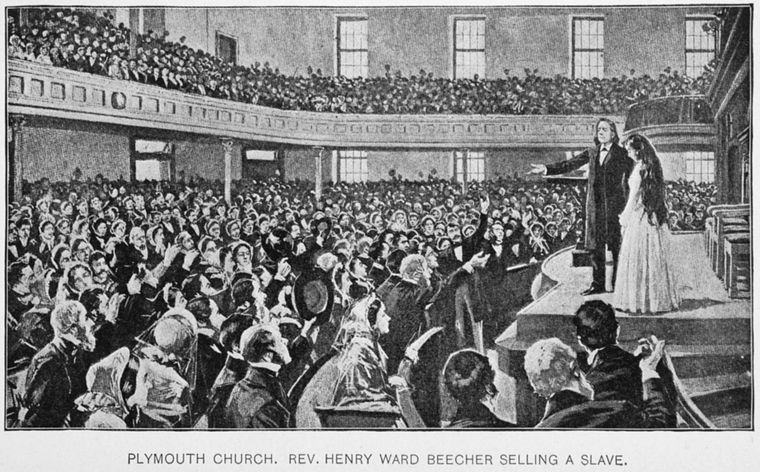
An illustration of Henry Ward Beecher‘s ‘auction’ of the enslaved woman nicknamed Pinky, held at Plymouth Church.

Schomburg Center for Research in Black Culture, Manuscripts, Archives and Rare Books Division

TOURS
Inside Out Tours: Slavery and Underground Railroad Walking Tour
Walks of New York
Black Gotham Experience

Plymouth Church — Public tours every Sunday at 12:30. Visit their website for more information

Plymouth now has a New Abolitionists ministry, tied into New York state’s anti-human trafficking initiatives. Visit Plymouth’s website for further information.

FURTHER READING
Bound for Canaan: The Epic Story of the Underground Railroad by Fergus M. Bordewich
Gateway to Freedom: The Hidden History of the Underground Railroad by Eric Foner
The Underground Railroad: Authentic Narratives and First-Hand Accounts (African American) by William Still

and, of course,

The Underground Railroad by Colson Whitehead

EXHIBITIONS

Brooklyn Historical Society — In Pursuit of Freedom: A long term installation celebrating the lives of Brooklyn abolitionists

Weeksville Heritage Center — Site of one of America’s first free black communities in the 19th century

You may also be interested in New-York Historical Society‘s online exhibit New York Divided: Slavery and the Civil War

FURTHER LISTENING
We mentioned these past Bowery Boys podcast on the show. After you’ve finished listening to our Underground Railroad show, give these a try!

Categories
Bowery Boys Bookshelf Wartime New York

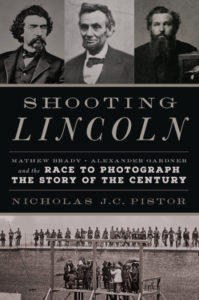
‘Shooting Lincoln’: The Complicated Story Behind America’s First Wartime Photographs

Alexander Gardner is a bit of a Nikola Tesla-like figure in American history in that his contributions were largely overlooked in his day, concealed within a partnership with a famous business titan.

That titan was Mathew Brady, the most famous photographer of the 19th century, with studios in New York and Washington D.C. that captured the nation’s most prominent figures in daguerrotype galleries and propelled the popularity of photographic images as the successor to painting and illustration.

SHOOTING LINCOLN
Mathew Brady, Alexander Gardner and the Race to Photograph the Story of the Century
by Nicholas J.C. Pistor
Da Capo Press

In Shooting Lincoln, the interesting if unusually titled new book by Nicholas J.C. Pistor, we see their partnership, developed in the tasteful parlors of respectable 1850s New York portrait galleries, wither and eventually dissolve during the American Civil War. And yet the pair, along with a legion of other intrepid young photographers, brought the realities of war into the rings of sheltered American society.

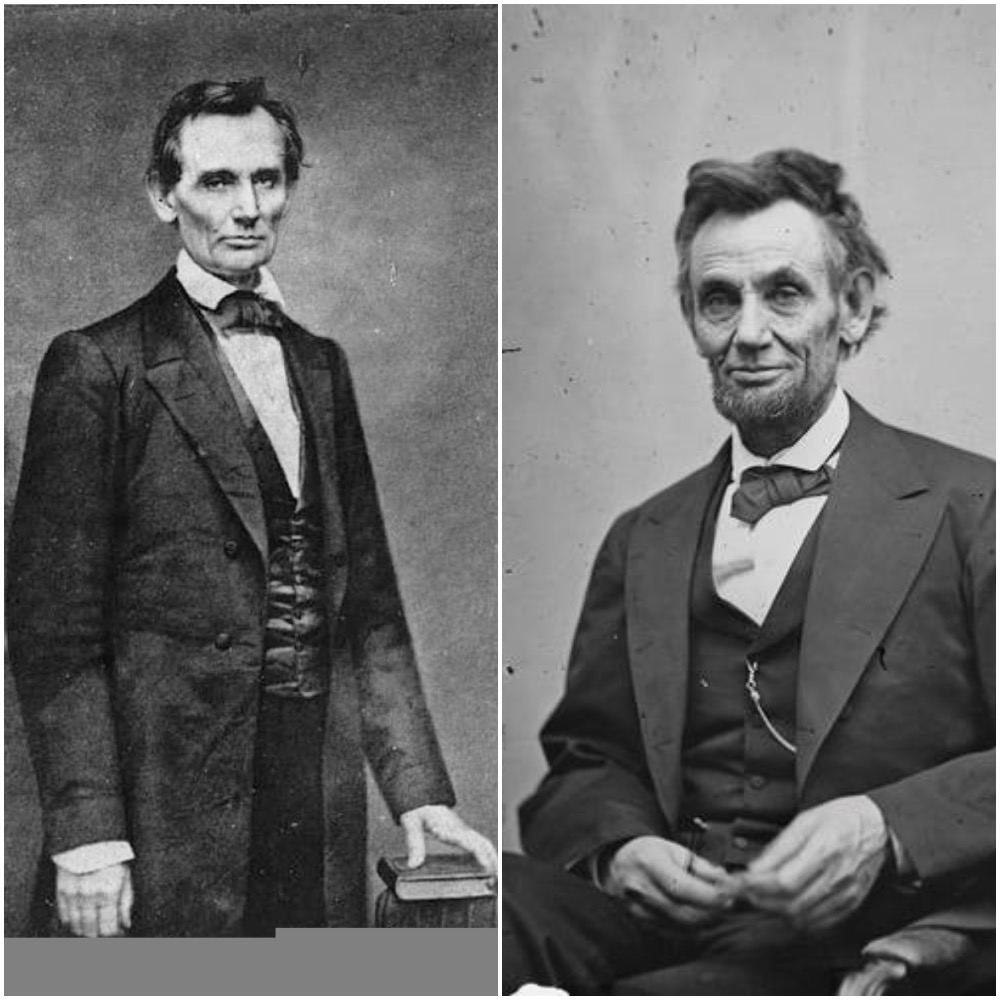
Abraham Lincoln first visited a Brady studio during the winter of 1860, posing for the famous portraitist hours before the seminal Cooper Union speech that would catapult him to his party’s nomination for the presidency. And yet the most famous images of Lincoln (including the Gettysburg portrait) were actually taken by Gardner years later, working first from Brady’s studio in Washington D.C., then from his own.

While Lincoln was not the first president to pose for portraits, he was the first to have his image defined by them — his face resolute, weary, wise. These images would be reproduced for sale and redrawn for newspapers, making the Lincoln the most recognizable human being on the planet.

Both Brady and Gardner took to the carnage-strewn backroads of America to photograph the scenes of war. Their images — a great many posed, a few even doctored — essentially created photojournalism as a defining method for distributing information.

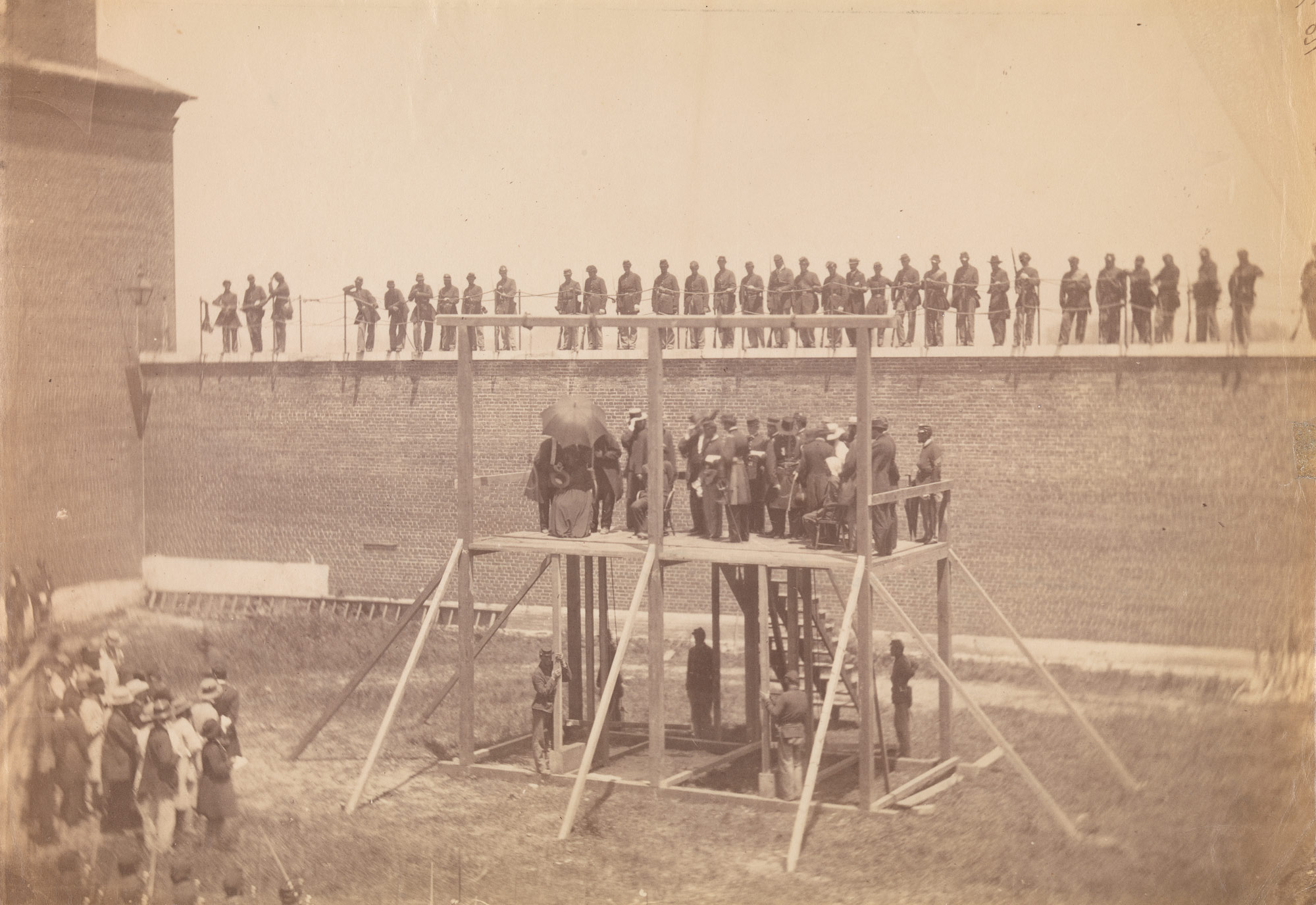
But it’s Gardner who was uniquely situated to photograph the tragic final strains of the war — the aftermath of Lincoln’s assassination and the execution of the conspirators (pictured at the top of this post).  Pistor reveals the many controversies in capturing these important images. These men were capturing history as none had done before.

Below: Lincoln by Brady and by Gardner

Categories
Bronx History

Robert E. Lee in the Hall of Fame? There were concerns even back in 1900

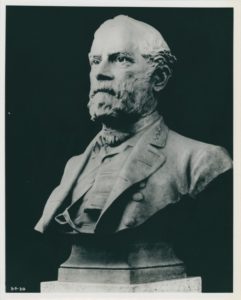
On Wednesday, Governor Andrew Cuomo announced that the busts of Robert E. Lee and Stonewall Jackson, located on the campus of Bronx Community College, would be permanently evicted, following the removal and dismantling of several sculptural depictions of the Confederate generals across the country in recent days.

The funny thing about these particular busts though. Most New Yorkers were probably saying to themselves, “Busts of Confederates? In the Bronx?”  Cuomo’s statement is probably the most that been written about them in more than five decades.

But many people have been displeased with Lee’s placement in the Hall of Fame from the moment it was decided to place his bust there back in 1900. Angry New Yorkers wanted to rip down his likeness before it was ever even erected.

“Robert E. Lee deserves the everlasting contempt of every soldier and every honest American.” – A.B.W., New York Times, 1900

Below: The Hall of Fame bust of Robert E. Lee

Archives of Bronx Community College, City University of New York

History remains static even as our recollections of it evolve, even as our monuments to it transform without a single chip of the chisel. Statues often reveal more about the nature of collective memory than the likenesses represented in these honors.

Nowhere in New York City is that more true than a strange little nook of marble busts in the Bronx.

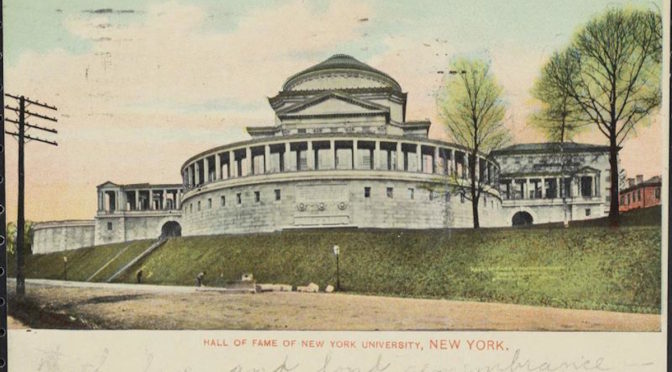
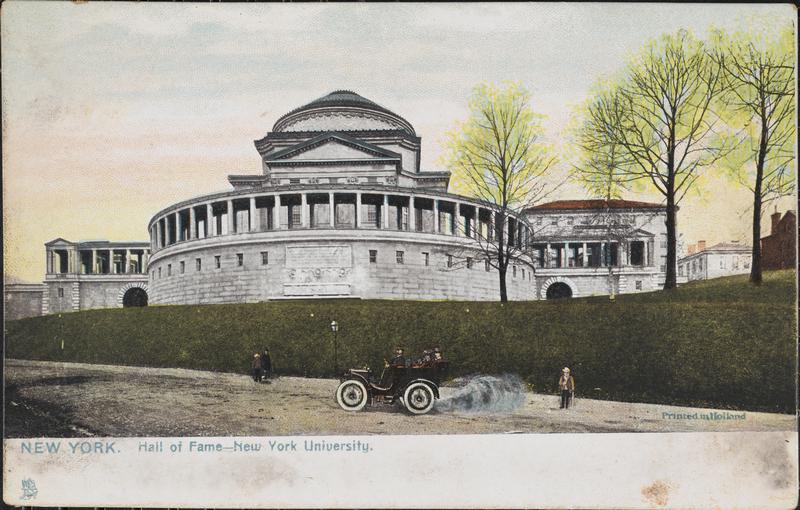
The Hall of Fame of Great Americans, located on the beautiful campus of Bronx Community College (the former uptown campus of New York University), used to be considered a very, very important place.

MCNY — Raphael Tuck & Sons

Tucked on a scenic cliff overlooking the Harlem River (and with the Cloisters well in sight), the Hall of Fame  was an ambitious project constructed in 1900 with the idea of immortalizing Americans who had made significant contributions to the sciences, the arts, politics and the military.

Spearheaded by then-chancellor of NYU Henry Mitchell MacCracken, the project is the first real memorial ‘hall of fame’ concept to be executed in the United States. With America flush with Gilded Age wealth, the Hall of Fame was intended to be an American pantheon, a modern response to the god-filled marble hallways of Europe.

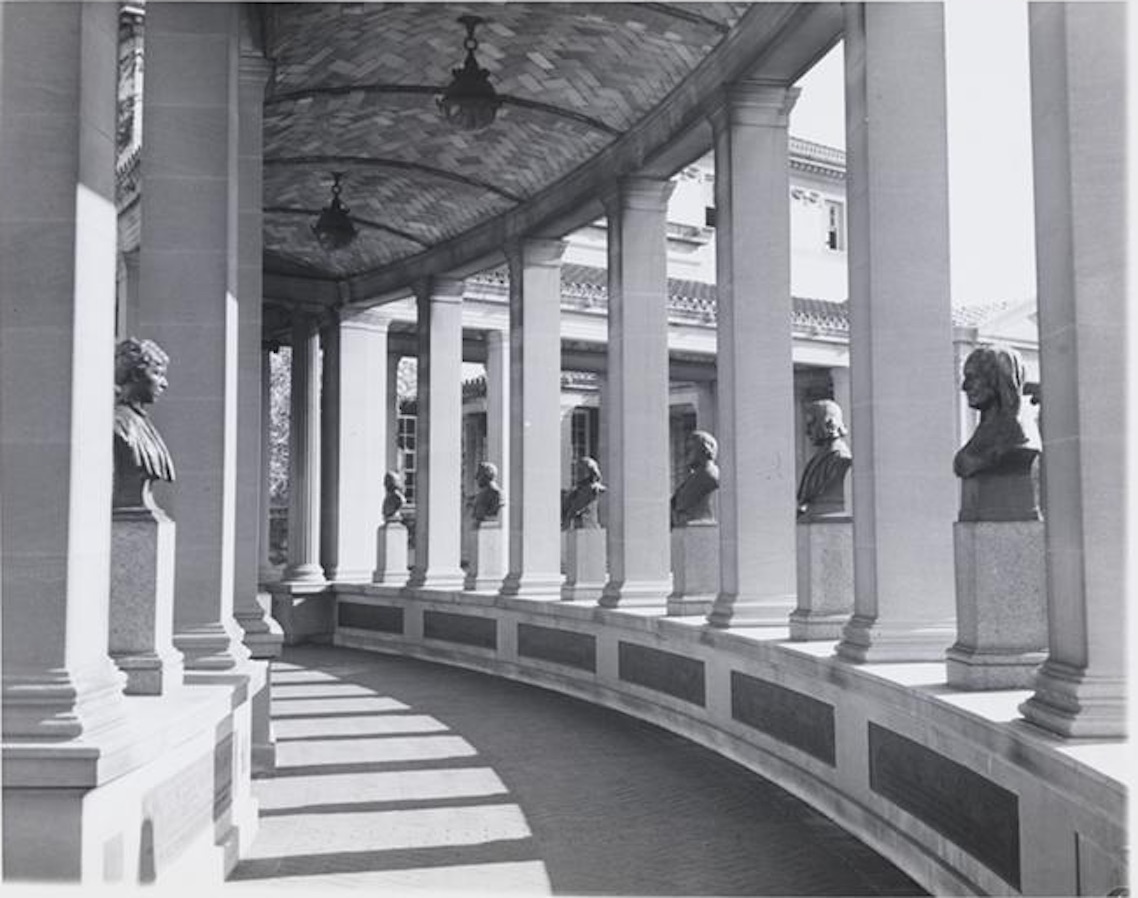
Walking along the spacious colonnade tucked behind the Stanford White-designed Hall of Philosophy, you are thrown back into a mix of turn-of-the century scholarly aesthetic and the belief of equating the American movement with ancient Roman and Greek forefathers.

MCNY 1945

There are 98 portrait busts representing a host of great minds — many recognizable, other completely forgotten today. The hall was regularly updated  up until the 1970s. Several people have been voted into the Hall of Fame but never received busts (sorry Andrew Carnegie).

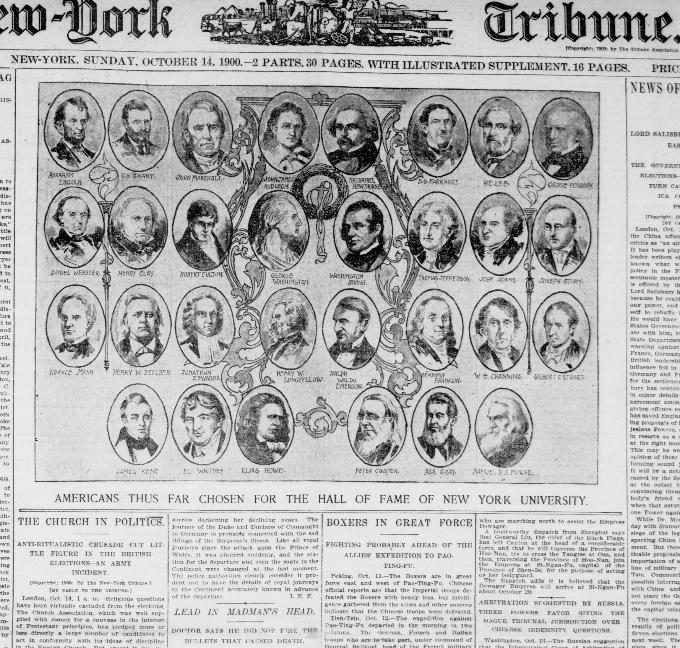
Prominent American citizens voted on who would be the first entrants to the Hall of Fame in 1900.  When the ballots were at last tallied, a great number of (exclusively) men included some very obvious choices (Benjamin Franklin, Abraham Lincoln) some inspired ones (Nathaniel Hawthorne, Peter Cooper), and a couple bizarre ones, by today’s standards (the famed botanist Asa Gray).

Interestingly one man who had fought for the Confederacy during the Civil War made the original list — Robert E. Lee. Over a half century later, he would be joined by Stonewall Jackson, another Confederate general.

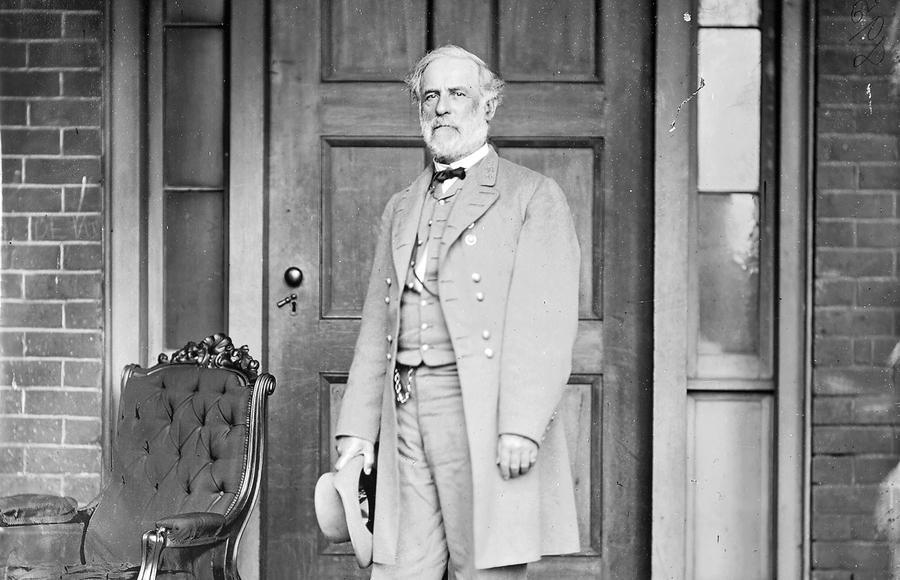
Below: Lee, photographed by Mathew Brady in 1865

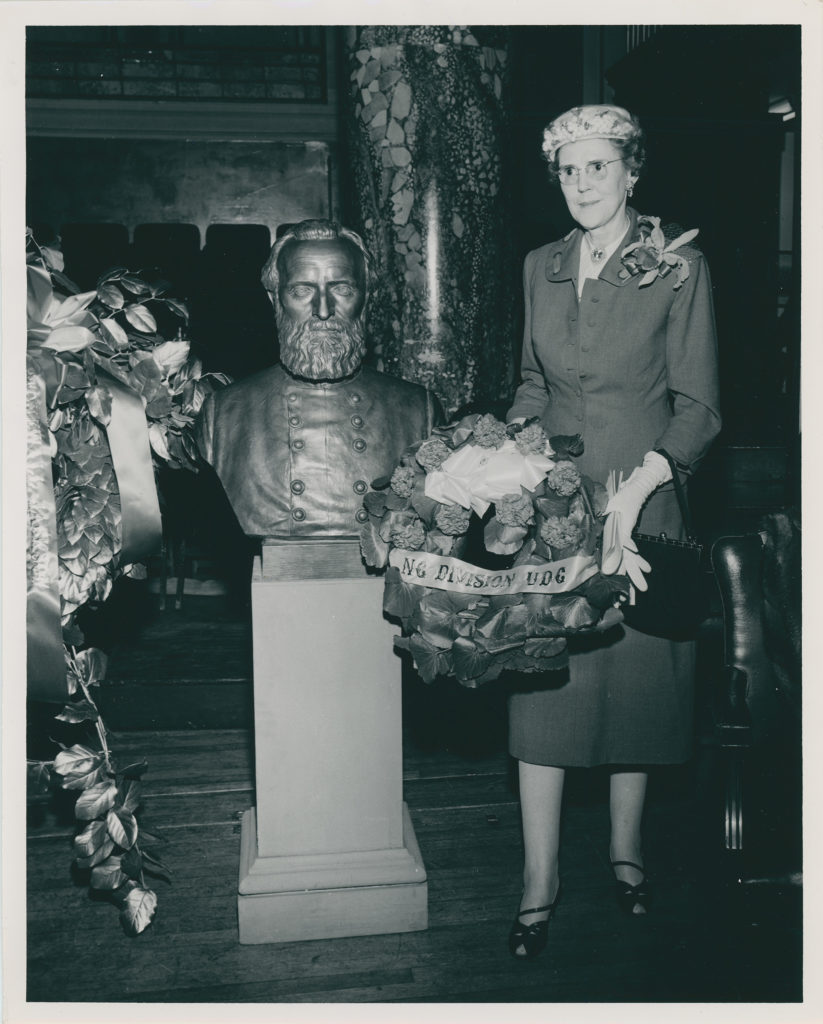
The Jackson bust was installed in 1957 after a vigorous campaign by  Confederate history supporters. According to Richard Rubin of The Atlantic: “Newspaper publishers used their editorial pages to lobby for or against nominees, and groups like …. the United Daughters of the Confederacy waged extensive, expensive campaigns to get ‘their’ candidates elected.” [See picture at the bottom of this article]

But Lee’s appearance in this immortal pantheon was almost never in question — at least for those who voted on the original inductees.

However, almost immediately, the possibility of Lee’s inclusion became controversial. The idea of a Confederate general — responsible for the deaths of thousands of Union soldiers — seemed ridiculous, even offensive, particularly to Northerners and to the residents of the city which would hold the Hall of Fame.

Leading the charge against Lee was the New York Sun.

At this time there has come up a false and mushy sentimentality which would have the American people forget the outrage against the Republic committed by the rebellions forces under the command of Robert E. Lee. It is that meek and mawkish sentimentality which puts the name of Lee among the great commanders entitled to the veneration of posterity.  Hail to the Stars and Stripes and always death and confusion to its enemies!

The New Orleans newspaper The Times-Democrat promptly went after the Sun:

[T]he protagonist of the Lost Cause possessed personal beauty of the ideal kind and accomplishments which perfectly fitted him for the high station which was his, from the bright beginning to the sombre close of his career. [H]e sacrificed wealth and ambition, to battle for a cause which, to his keen professional eye, was predestined to failure.”

(Their response seems to revel in the ‘mawkish sentimentality’ upon which the New York Sun was remarking!)

In Alabama, the Montgomery Advertiser also trashed the Sun: “No doubt that paper is an admirer of John Brown and others of his character while vilifying one of the greatest captains of the century.” Brown led the raid on Harpers Ferry in 1859, an event which became a cause célèbre for Northern abolitionists.


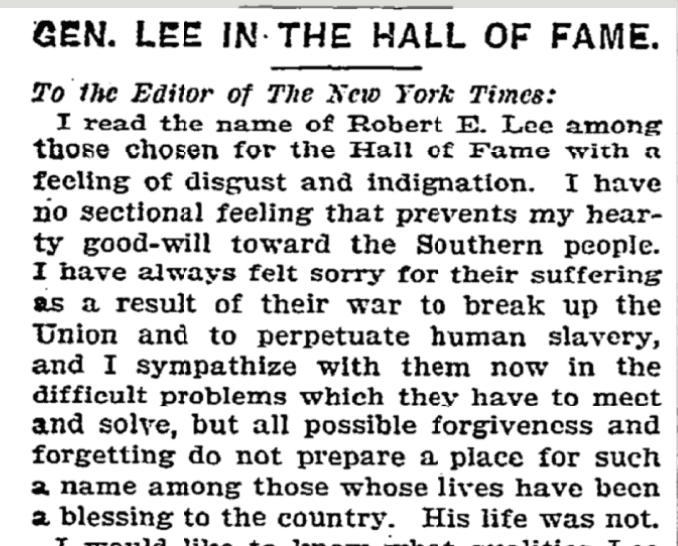
But such remarks were not left to editorial boards.  Said one reader E.O. in the New York Times (Oct 16, 1900):

His only claim to distinction is that he displayed great ability in his attempt to destroy the Government he had sworn to defend, much of his ability being due to the education given him by that Government. The only excuse to be made for Lee is that he thought he was right, that he thought he must be ‘loyal to his State’…..

But supposing Lee was honest in his belief, it is not customary or proper to honor a man for making the mistake of a lifetime. We may forgive his offense but neither justice nor charity requires that we should do more than maintain silence on the subject.

Let those who know Robert E. Lee honor his memory for such good qualities as they found in him, but the Hall of Fame should be reserved for those whose public services are worthy of honor.

A month later:  “I protest against his name being coupled with the patriots of his time. Robert E. Lee deserves the everlasting contempt of every soldier and every honest American for accepting the surrender of brave Union soldiers when he know they would be sent to be starved and tortured in Southern prison pens.” — NYT, Oct 16, 1900

Then there’s this one:

Read the rest of this letter here:

Many of the letter writers were certainly alive during the Civil War. The veterans organization Associated Survivors of the Sixth Army Corps of Washington passed a resolution against the Hall of Fame organizers, declaring “General Lee was an enemy to his country and failed to do his duty at a critical time.”

However it is interesting that of all the objections about Lee and Jackson, none directly had to do with slavery or the plight of enslaved people.

An illustration of the first inductees from the New York Tribune:

Others thought of the  Hall of Fame a place of representative honor and so Lee must be included, if only to bring the Southern states into the hall’s august glory.

A reader (signed ‘Constant Reader’) from the Brooklyn Daily Eagle [April 3, 1900]:

“Would it not be a graceful tribute to our worthy Southern brothers to include the names of some of their great heroes on the Hall of Fame record? Though Robert E. Lee and T. J. Jackson fought for what we think is a bad cause, yet we should not forget that such men acted as their consciences dictated, and their whole lives show them to be great, good and most worthy gentlemen.”

Others set aside grievances with Lee and took aim at another candidate — John C. Calhoun, the former Vice President who set the wheels of the South’s secession in motion.

From a Boston newspaper: “The judges are having trouble enough from their assignment of a pedestal to General Lee. But Lee did not formulate policies. To have put the Great Nullifier in the American Pantheon would have bred a riot.”

To which the Atlanta Constitution replied: “A truly cultured people ought not to be lured into a riot because of honor paid the memory of a great man.”

In the end, Lee would be among the original inductees to the Hall of Fame. (Calhoun would fail to make the final cut.) Indeed the balloting proved both general to be well regarded in their day, placing higher in the voting than all generals by Ulysses S. Grant.

The Hall of Fame is a true curiosity in the ‘roadside attraction’ sense. Once NYU sold the campus in the 1970s, the colonnade was virtually neglected, the hall of fame forgotten.

It is a modern ruin that current events has dusted off for new evaluation.

Below: The installation of Stonewall Jackson’s bust in 1957 

Courtesy Bronx Community College

________________

Portions of the research for this article were taken from a previous article I wrote about the Hall of Fame back in 2009.

Categories
True Crime

That rascal Daniel Sickles, the beloved politician and veteran who killed the son of Francis Scott Key

We don’t have large, parade-like funeral processions marching up the avenues as they once did during the Gilded Age and in the early years of the 20th century.
These events were times of public mourning and a bit of festivity.  Most often they involved the passing of a well-connected political leader or a popular entertainers.  They were somber and reverent affairs; afterwards the saloons along the side streets benefited graciously, tributes and toasts into all hours of the night.

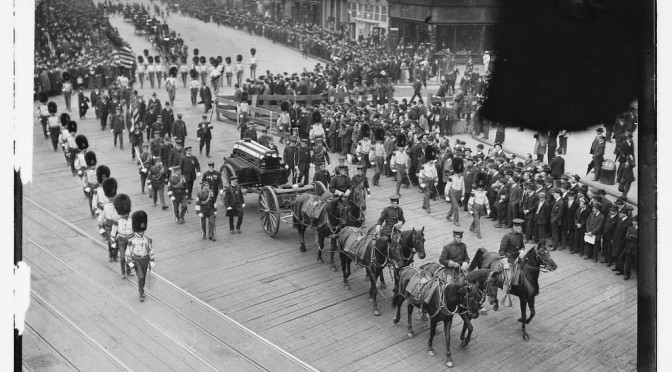
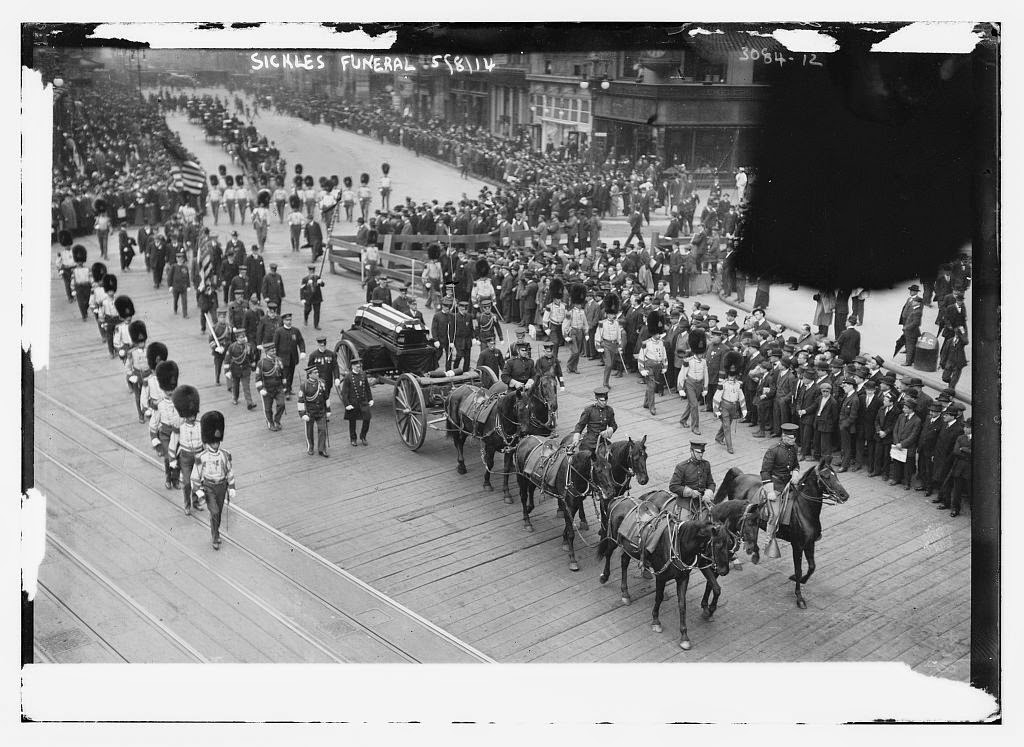
1914

One hundred years ago today, on May 8, 1914, New Yorkers filled the streets — from Fifth Avenue up to St. Patrick’s Cathedral — to mourn the passing of Daniel E. Sickles, one of the city’s most heralded war veterans.

Having marshaled up volunteers in New York in the early days of the Civil War, Sickles distinguished himself as a bold and commanding general, gathering military promotions through sheer ambition. (He was one of the few commanders in Abraham Lincoln’s army without a West Point education.)

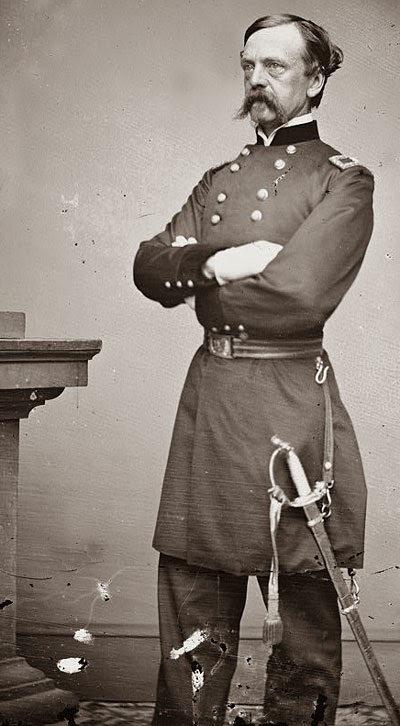
During the Battle of Gettysburg, Sickles was severely injured and had his right leg amputated. (At right: Sickles posing for Matthew Brady, clearly before the events of Gettysburg.)

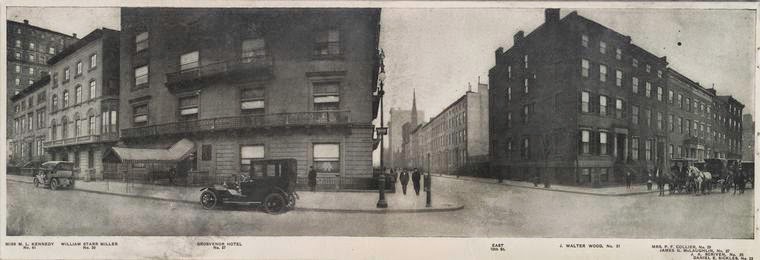
He spent his years after the war polishing his war credentials and maneuvering from one political appointment to another.  Sickles belatedly received the Medal of Honor and, situated from his home at 23 Fifth Avenue, was acclaimed in later life in one of New York’s greatest living veterans.

Sickles’ military career, however, was built as an exercise in reputation rehabilitation.  When the war with the South arrived, he saw an opportunity to change the conversation about himself.  His bravery in service to the Union, never questioned, served a dual purpose for Sickles.  Today we might call this “re-branding.”

For in the years preceding the Civil War, the young politician was also known as a cold-blooded murderer who held a unique distinction in the history of legal proceedings.

1859
In April of 1859, New York Congressman Daniel Sickles became the first person in history to ever be acquitted of a crime due to temporary insanity.

The crime in this case was the February murder of Philip Barton Key II, the son of Francis Scott Key, author of “The Star-Spangled Banner,” the national anthem of the United States.

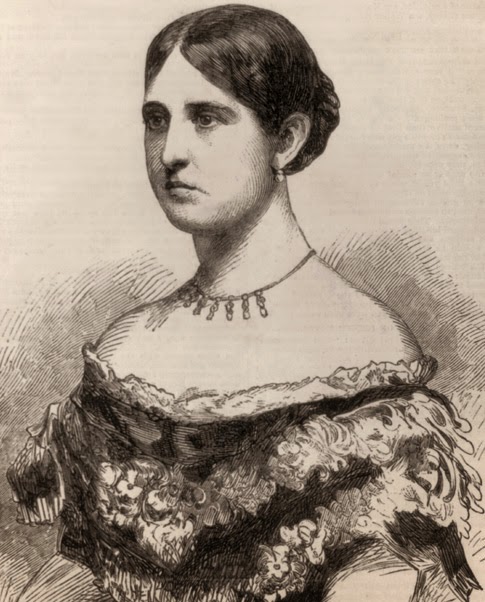
Their lives almost resemble an episode of House of Cards.  Key had been having a very open affair with Sickles’ wife Teresa. (Pictured at right)

Daniel, however, was something of an epic rake himself.  With no thought to his own or his wife’s reputation, Sickles was once passionately obsessed with the New York prostitute Fanny White, going so far as to take her into the Albany assembly chamber for a tour.  There were even rumors that some of Sickles’ campaign election costs were covered by White.

But Key was hardly a wallflower; the famous son was a charming widower who bewitched the women of Washington DC with his intelligence, elegance and wealth.  He and Teresa met in 1857 and began their affair soon after, meeting often once a day and openly flirting with each other at a society balls.

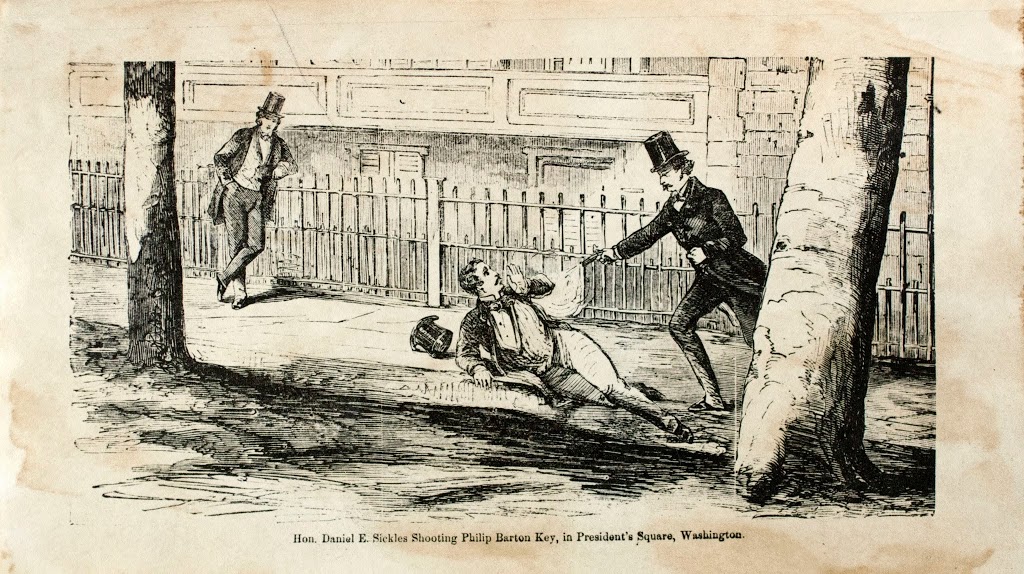
When Sickles did finally discover the affair, he was distraught and sickened, before turning violently angry.  On February 27, 1859, Sickles approached Key in DC’s Lafayette Squarea short distance from the White House — and shot him in the groin.
“You villain, you have dishonored my house, and you must die!” Sickles reportedly said.

He shot Key again in the chest and would have shot him directly in the head had the gun not misfired.

Said the New York Times the following day, “The vulgar monotony of partisan passions and political squabbles has been terribly broken in upon to-day by an outburst of personal revenge, which has filled the city with horror and consternation.”

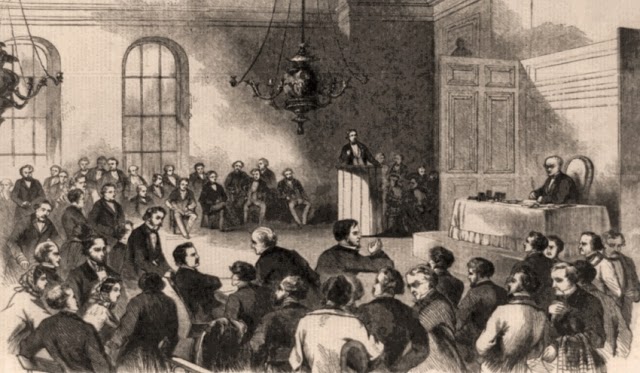
Above: An illustration of the Sickles trial, courtesy Library of Congress

The condition of Sickles’ mental state during and following the murder would be closely dissected in court. A colorful swath of testimony described Sickle as everything from disturbingly serene to a raging lunatic.

According to authors Michael Lief and H. Mitchell Caldwell, “These conflicting stories may be exaggerations on the part of creative witnesses, or they may be evidence that Sickles was driven to the edge, past the breaking point, entirely out of his mind.”

One of the lawyers who helped craft the insanity defense was Edward M. Stanton, later to be Abraham Lincoln’s Secretary of War.  Their defense of temporary insanity — never successfully tried in a U.S. court — was sprung upon the jury, nested within an extravagant bed of prose, classical quotations and moral quandary.
“It is folly to punish a man for what he cannot help doing?” asked associate defense attorney John Graham.  Apparently so, it seems, for in April, a jury acquitted Sickles, taken with the plight of a man wronged by his unfaithful and deceitful wife. (His attorneys did a spectacular job of burying Sickle’s own unfaithfulness and deceit.)
At left: 23 Fifth Avenue, the home of Daniel Sickles and the location of his death on May 5th, 1914

1914
Fifty-five years later, Sickles’ many legitimate accomplishments (and, let’s be honest, his relentless self-promotion) assured that this unusual crime was rendered a footnote when he died on May 5.

His New York Times obituary is an extraordinary bit of word play:  “Philip Barton Key … paid attention to Mrs. Sickles, and Sickles shot and killed Key on the street in Washington D.C. on February 27, 1859.”

The focus then turns on Sickles’ “gracious” forgiveness of his wife: “I am not aware of any statute or code of morals,” said Sickles to his critics, “which makes it infamous to forgive a woman….I shall strive to prove to all that an erring wife and mother may be forgiven and redeemed.”

In reality, the two never reconciled.  Teresa died in 1867 at age 31, her reputation destroyed.  A few years later, Sickles became the ambassador to Spain, returned to his legendary womanizing and eventually married a well-connected daughter of a Spanish official.

He spent his final years at his Fifth Avenue home nearly bankrupt, his only means of support coming from his children and his now-estranged second wife.  “[S]everal attempts were made to seize the art treasures  in his Fifth Avenue home because of debt,” noted the Times.

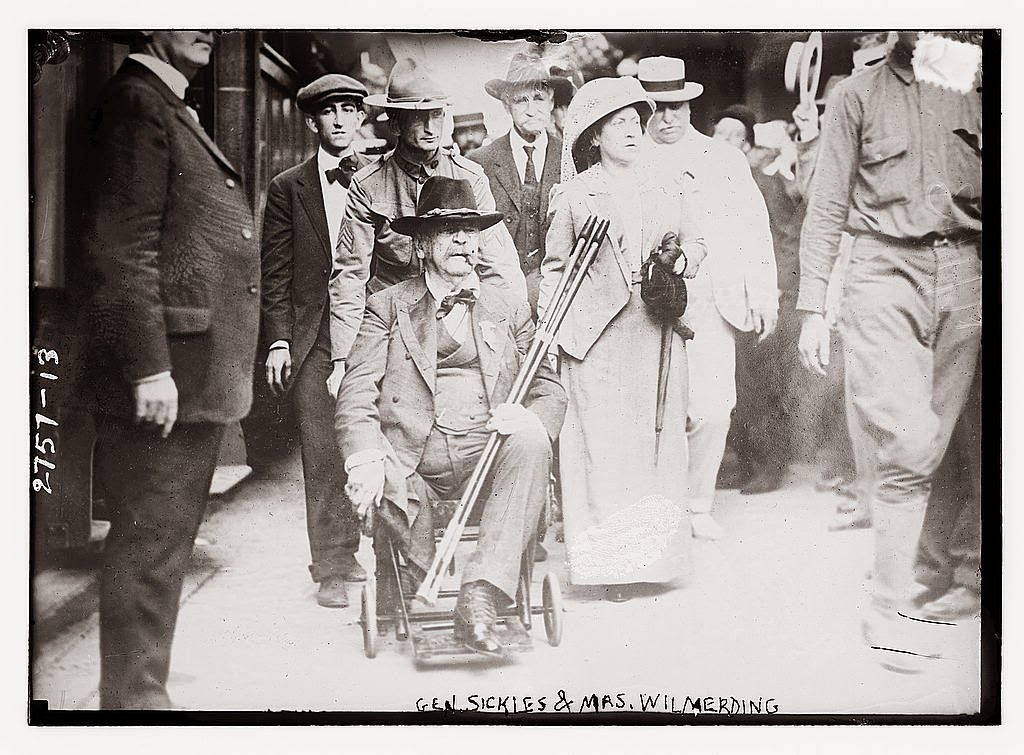
Below: Daniel Sickles at a 1913 Gettysburg reunion, accompanied by his live-in secretary Eleanora Wilmerdirg


Categories
Holidays

Months after the Draft Riots, New York celebrates the first national Thanksgiving, in the shadow of war and lunar eclipse


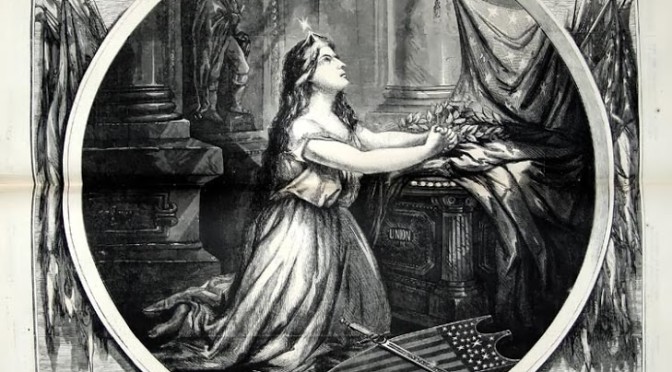
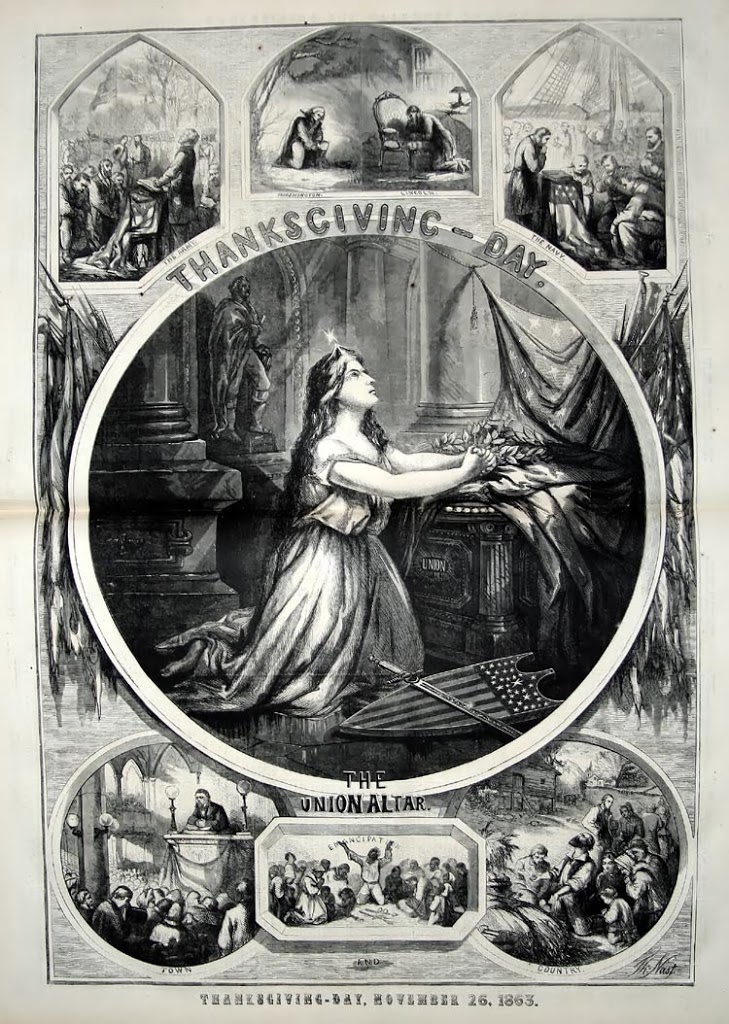
Above: A Thomas Nast illustration from Harper’s Weekly, November 1863, clearly putting the event in the context of war and hardship. 

In practice, Thanksgiving celebrates the supposed feast between the Pilgrims and their Native American neighbors in Massachusetts. But meals of ‘thanksgiving’ have been part of the Western world customs for hundreds of years, and today the meal is more an excuse to gather the family together and count the seconds until holiday shopping.

Because that ‘original’ meal was only vaguely documented, let me give you a more definite event — 150 years ago, President Abraham Lincoln declared a national celebration of Thanksgiving for the last week in November:

“I do therefore invite my fellow-citizens in every part of the United States, and also those who are at sea and those who are sojourning in foreign lands, to set apart and observe the last Thursday of November next as a day of thanksgiving and praise to our beneficent Father who dwelleth in the heavens.”

Perhaps you did a double-take at that statement.  There’s no mention of Pilgrims or Indians in Lincoln’s proclamation, which was made on October 3, 1863.  There is, of course, several soothing religious references. (You can read the entire statement here.)  After all, the United States had been fighting a Civil War for over two and a half years. Any words of peace and calm, paired with boasts of American bounty and expansion, would have put the bloody conflict in a divine context.  “[H]armony has prevailed everywhere except in the theatre of military conflict,” Lincoln wrote.

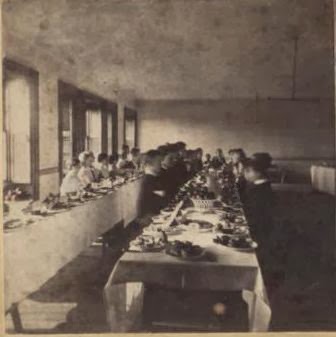
At right: Thanksgiving dinner at ‘the Home for the Friendless’, 1860s.  I cannot imagine a more grimly named institution! courtesy NYPL

New Yorkers had celebrated a form of Thanksgiving for many years prior to the 1863 proclamation.  But the feast had always been considered a regional, New England celebration, one a little foreign for the city.

From The New York Sun, November 26, 1863:  “The sights and scenes in our city yesterday afforded evident indications of a unanimous determination … to break up once and all the monopoly of Thanksgiving, so long enjoyed by the New Englanders.  For years past, it had been a standing boast of the genuine ‘Down Easters’ that the air of New York was unsuited to the festival of the Pilgrim fathers.”

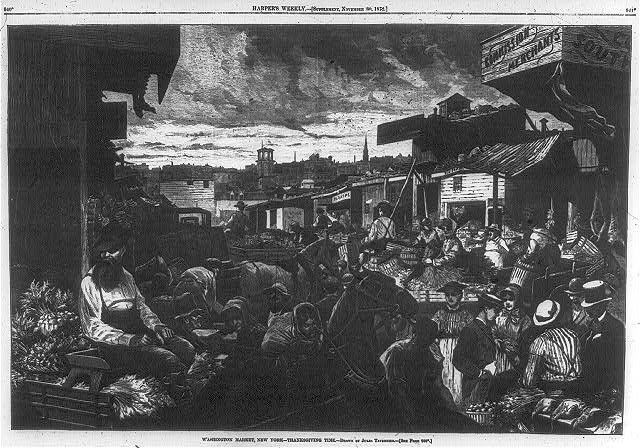
Below: Washington Market, always a hectic place, was especially so on Thanksgiving. This scene from Harper’s Weekly depicts frantic shoppers in 1872. Courtesy Library of Congress

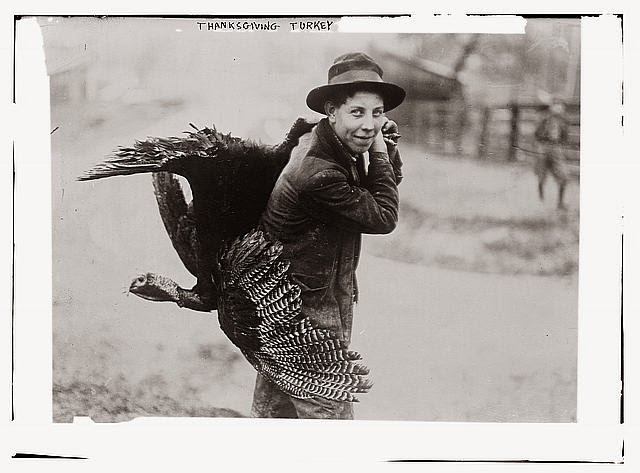
Don’t tell New Yorkers what they can’t have!  The Sun promised a “racy and peculiar” New York Thanksgiving that year.  The markets were clogged with shoppers, as New Yorkers came out in force to purchase items for their own Thanksgiving meals.  Every other man on the street seemed to have a naked bird flung over their shoulders.  “Evidentally, every family man and woman, who could raise the number of greenbacks, invested them in Thanksgiving fixings.”

This might have been a little journalistic posturing.  Just five months earlier, New York had been ablaze in the Draft Riots, several days of violence towards its own citizens, fueled by an unfair conscription policy and the fears and racial hatreds of its citizens.  Most of the burned buildings had been cleared, but the bloodshed was on many minds.  Many benefits throughout the city raised money for injured Union soldiers and the families of those who had died in battle.

The Sun quietly refers to the Draft Riots’ most sickening event, the burning of the Colored Orphan Asylum.  “At the Five Points House of Industry the little ones are to have a bountiful feast.   The colored children burnt out by the mob will be taken care of at Carmansville.”

Below: Boy with a turkey, circa 1910-1915 (LOC)

Generally speaking, celebrations went forward as they would in subsequent years — the food, the church services, the carousing, the merriment, decades before anybody would think of blowing up gigantic balloons and dragging them down Broadway.

However, one thing had been very different that year.  On the evening before Thanksgiving, New Yorkers looked up into sky and witnessed a partial lunar eclipse.

While the event might have filled some with dread, it cast a mysterious pall further south, on the battle field of Lookout Mountain in Chattanooga, Tennessee.  It occurred hours after the Confederacy’s defeat by the Union army and helped shield the Southern forces as they slipped away by cover of fog.

Alongside news of New York’s embrace of Thanksgiving, the newspapers that day reported of a victory and a death toll:  “General [Joseph] Hooker, in command of General Geary’s division, Twelfth corps, General Osterhau’s divison, Fifteenth corps, and two brigades, carried the north slope of Lookout Mountain, with small loss on our side, and a loss to the enemy of five hundred or six hundred prisoners: killed and wounded not reported.”

Categories
Know Your Mayors

George Opdyke: The mayor during the Civil War Draft Riots and his unsavory connection to New York’s fashion industry

KNOW YOUR MAYORS A modest little series about some of the greatest, notorious, most important, even most useless, mayors of New York City. Other entrants in the Bowery Boys mayoral survey can be found here.

Mayor George Opdyke
In office: 1862-1863

The wealthy merchant and politician George Opdyke died on June 12, 1880, attended to by his family from their lavish home at Fifth Avenue and East 47th Street, just a few blocks from where the violent Draft Riots had ignited back in 1863.

In the 17 years since those terrible days, New York had grown mightier with vast wealth, in an explosion of prosperity that would inaugurate the Gilded Age.  But while the scars of the Draft Riots had faded from the city streets, they never quite faded from Opdyke, who had been mayor of New York during the violent outbreak.

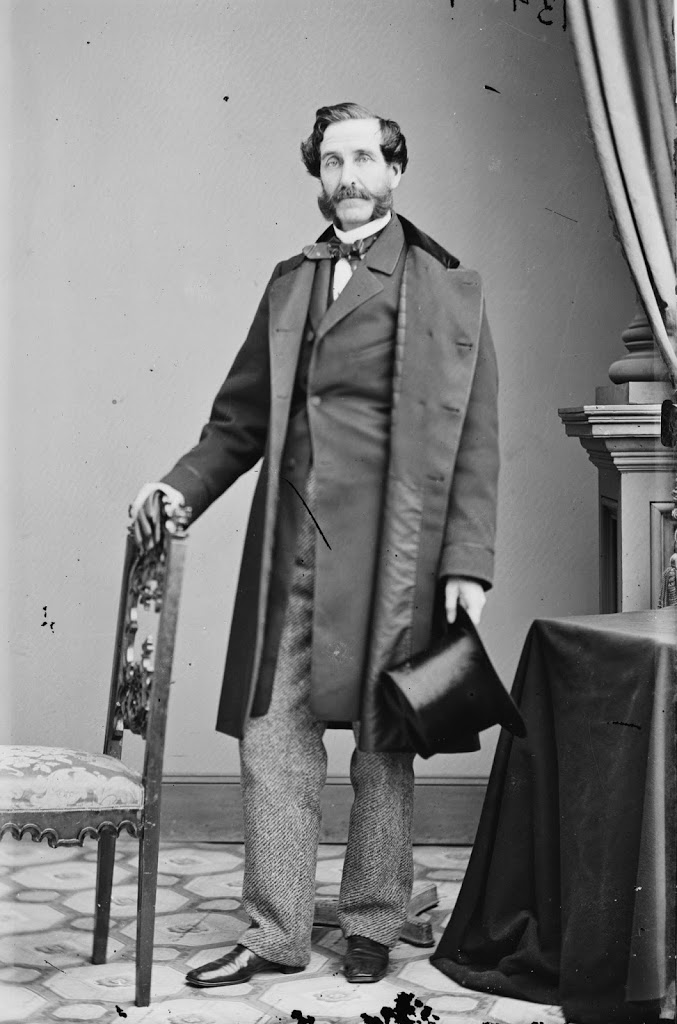
At right: George Opdyke, in a photo taken by Matthew Brady

Some of the violence that week in July had been directed towards Opdyke, one of the most prominent Republicans in a city of Democrats. His former home at 57 Fifth Avenue had been attacked twice by rioters.  He was considered the face pro-Lincoln, pro-war, and, thus, pro-abolitionist forces in New York

Yet had it not been for the institution of slavery in the South, Opdyke might never have even made his fortune.

George Opdyke was born to a large New Jersey farming family in 1805, working his way from the fields to the classroom, becoming a young school teacher at an early age.  Like so many teenagers in the early 19th century, job opportunities out West spoke to his sense of adventure.  With $500 in their pockets, Opdyke and a friend settled in Cleveland, Ohio, opening a clothing store and tailor for workers of the newly constructed Erie Canal.

Opdyke soon found a more profitable application for his young business — the high mark-up manufacturing of cheap slave clothing.  He moved to New Orleans and began an incredibly profitable plant there, making inexpensively produced clothing for the plantations of the deep South.

In fact, Opdyke became so successful that, in 1832, he moved to New York to open a larger clothing factory on Hudson Street.  According to historian George Lankevich, Opdyke “built the city’s first important clothing factory, selling his goods largely to southern plantations and creating the basis of a new industry.”  It was the first large-scale, ready-to-wear clothing establishment in New York, soon employing thousands; so, yes, this is how the New York fashion industry begins.

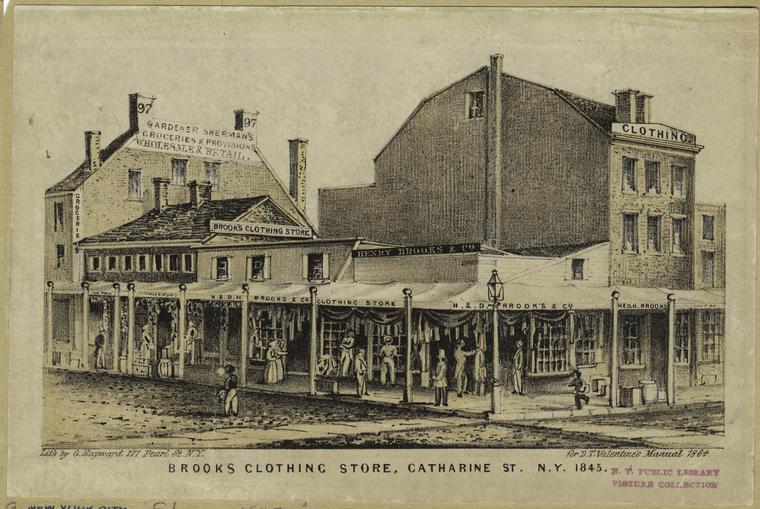
Below: Brooks Clothing Store in 1845, a rival of Opdyke’s clothing business. Opdyke would have some rather controversial connections for Brooks Brothers during the Civil War. (NYPL)

And a successful political career begins as well.  By 1846, Opdyke, now a millionaire and a well-connected member of mid-19th century New York society, entered a life of politics.

Interestingly, he was originally associated with the Free Soil Party, an early anti-slavery effort, illustrating how businessmen often separated certain moral beliefs from their business practices. (Early on, he would become one of Abraham Lincoln’s most ardent supporters.) The Free Soilers were soon be incorporated into the burgeoning Republican Party, and Opdyke’s first appearance in New York state assembly, in 1859, was as a Republican.

That same year, Opdyke became the Republican’s best chance at winning the mayor’s seat in New York. However, he vied for the job with two other seasoned politicians — unscrutable Democrat Fernando Wood and former mayor and sugar king William Havemeyer.  Thanks to machine politics and the uncertainty of war with the South, Wood prevailed that fall, becoming mayor of New York at the start of the Civil War. (I have an entire podcast on Wood’s roller-coaster career in politics.)

But tides would change in Opdyke’s favor.  Pro-Union sentiment surged through the nation and in New York City by the start of the war.  And by the time of the next mayoral election in 1861, situations were ideal for a Republican to take charge.

It helped that Democrats were divided — Tammany Hall went with C. Godfrey Gunther, while Wood formed his own alternative political machine Mozart Hall.  But it was Opdyke that prevailed, although barely.  He beat Gunther by a whopping 613 votes. (But he did beat Wood in Wood’s own ward.  That must have felt good.)

Part of Opdyke’s appeal at that moment was his deep connections to the Lincoln administration. When the flags were waving in New York, Opdyke was an ideal representative, encouraging support for the war, hosting troops in the city, raising money for the effort.  But when enthusiasm for the war withered, so did Opdyke’s reputation.

Below: The draft riots, which paralyzed New York in July 1863

Opdyke’s unwavering support for the draft backfired severely in the summer of 1863. When New Yorkers took the street on July 13, 1863, burning the draft offices and taking out their anger on black citizens and prominent Republicans, Opdyke topped the list of most despised New Yorkers.  He had very little power to quell the violence; the police department was placed under state control, and state militia had been called away.

While his home was nearly destroyed, it was his political reputation that took the greatest hit. At first, he had vetoed a plan by the Common Council to pay for substitutes for any drafted New Yorkers. But a month later, working with Tammany Hall, he essentially endorsed a similar bill to avoid more violence.

This saved New York, but it did not save him.  On election day, that December in 1863, he was replaced with the Democrat Gunther, whom he had narrowly beat just two yeas before.

His woes weren’t quite over. A political feud with newspaper editor Thurlow Weed revealed some unpleasant information about Opdyke in the press. “[H]e had made more money out of the war by secret partnerships and contracts for army clothing, than any fifty sharpers in New York,” claimed the irate newspaper editor.

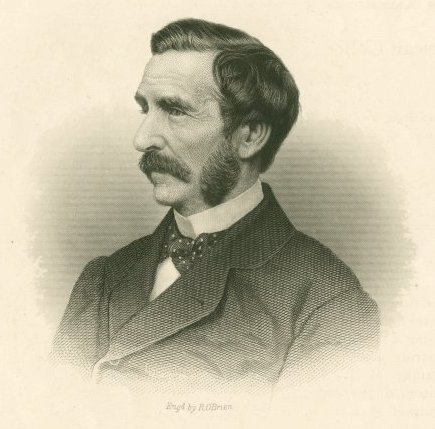
At right: Opdyke in later life (NYPL)

Opdyke had profited handsomely from the war through his own clothing plant and in deals with rival clothing manufacturer Brooks Brothers.  Opdyke took Weed to court for libel in December 1864, but the jury essentially exonerated Weed, delivering an indecisive verdict “as to whether Weed should pay nominal damages of six cents, or be acquitted.” [source]

In later life, Opdyke took up banking with his sons, representing the concerns of various railroad companies. He “retired a few months before his death with a large fortune.” [source]

After his death, the Opdykes would sell their house to railroad tycoon Jay Gould.

Categories
American History Wartime New York

It’s the 150th anniversary of the 1863 Civil War Draft Riots. Why should we care?

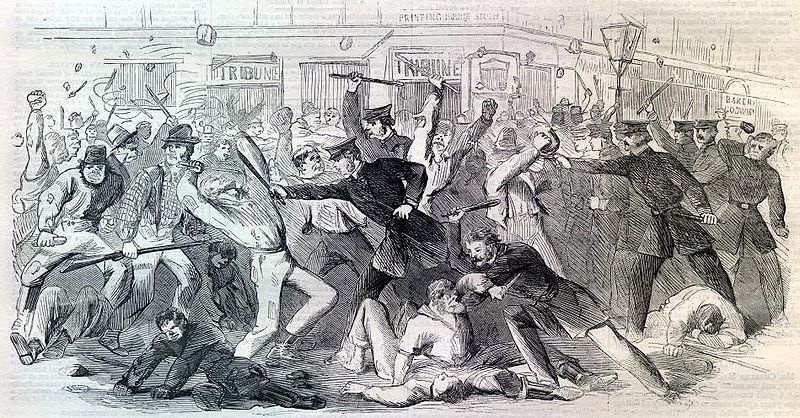
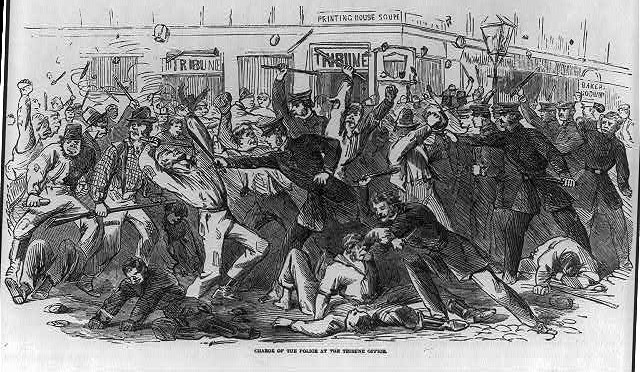
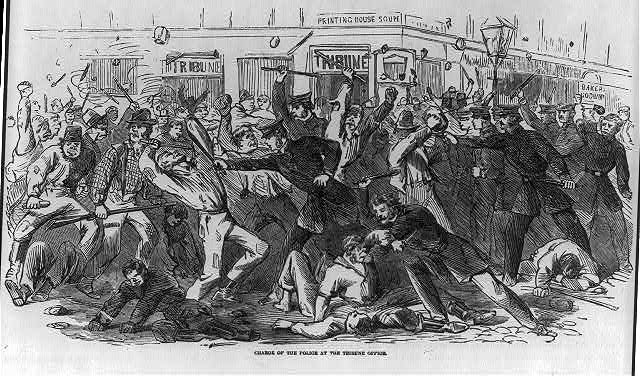
Police try to restore order in front of the New York Tribune building, a pro-Lincoln publication being attacked by rioters.

Why are there no permanent remembrances of any significant kind in New York City to the Civil War Draft Riots?   It was the most grave, the most tumultuous event in New York City history between the Revolutionary War and September 11, 2001.  Doesn’t it merit some mention?

The leading answer, of course, is that New Yorkers don’t end up looking very good.  This isn’t New York’s finest moment; in fact, it’s probably its worst.  Many of the hundreds who died during that week were rioters, lawbreakers, killers.  The racism of many was laid bare, exposed brutally.  On the first day of rioting, firemen — the Black Joke Engine Co. — were actually complicit in kicking off the violence.  Even the leaders of the period had ulterior motives.

At right: The Black Joke firemen help plunder the draft office

For almost five days, the angered and the desperate rampaged through the streets of New York. The violence was only superficially fueled by anger over the actual conscription act, an excuse to vent other frustrations, some understandable, others reprehensible.  For several days, nobody was safe — from the moment the Ninth District Draft Office was incinerated on Monday morning to the final sweep of barricaded streets by state militia and federal troops on Thursday night.

It’s a complicated, ugly, confused time in New York City history.  But how does a city acknowledge a self-inflicted tragedy?  Who wants to remind America of how duplicitous many New Yorkers were during the Civil War?

The Draft Riots are a nuisance of fact, sometimes serving to obfuscate the sacrifice of the many thousands of New Yorkers who gave their lives in service of the Union Army.  New York holds up its reputation as a melting pot, as a place where people of different ethnicities co-exist, if not always peaceably.  The images of the Draft Riots — black families fleeing the city in terror, lynched bodies from trees and streetlamps — serve only to remind you that the spirit of inclusiveness is merely a modern notion and possibly a mirage.

Anniversaries are important.  They reflect how we want to present our past and illustrate our present frame of mind.  On the one hundredth anniversary of the sinking of the Titanic, people re-watched the James Cameron movie and took a (strangely morbid) memorial voyage along the same watery path the original ship was to have taken.  On the centennial of the Triangle Factory Fire, hundreds marched through the street and chalked memorials on the sidewalk in front of the homes of the victims.

On America’s bicentennial, New York briefly awoke from its bankrupt, gritty slumber to present a shimmering display of patriotism featuring Queen Elizabeth, festive parades, and battalions of ships in the harbor.  Every September, we revisit the horror and suffering of the attacks upon the World Trade Center because the idea of forgetting about it is simply unimaginable.

The Draft Riots fit none of the criteria of something we’d like to remember. It’s for that reason we should.

Today we remember the Civil War in iconic terms, good and evil, right and wrong.  The Draft Riots presents a nuanced reinterpretation of that story line.  It places New York City not outside the significance of the battlefield, but squarely within it.  The Union was not united, but an assortment of different viewpoints.  That Lincoln and the Union Army succeeded is even more remarkable when you realize the dissension from within.

For that reason, I hope one day the city of New York will take upon itself to memorize this event in the same way it has so many others.  Until then, I’m at least grateful to those various private institutions around the city who will ensure that future New Yorkers will continue to be stunned, horrified and otherwise amazed at the extraordinary events which took place in this city on July 13-16, 1863.

———–

According to this article from the New York Times in 1963, there were once three temporary plaques placed in significant places for the centennial marking — at Fifth Avenue between 43rd and 44th (site of the Colored Orphanage), Third Avenue and 46th Street (site of the Ninth District Draft Office) and, oddly, at Tenth Avenue and 46th Street (site of the home of Willy Jones, the first person chosen in the draft lottery).  I do not believe these plaques to still be in existence, but if you know otherwise, please email me.

Here’s a few ways to commemorate the 150th anniversary of the Civil War Draft Riots over the next few days:

Reading:  I highly recommend Barnet Schecter‘s “The Devil’s Own Work: The Civil War Draft Riots and the Fight To Reconstruct America“.  For a more academic analysis, you can also try “The New York City Draft Riots: Their Significance for American Society and Politics in the Age of the Civil War,” by Ivar Bernstein.

Exhibit: There are no Draft Riot exhibits currently in New York, but the Metropolitan Museum of Art has two must-see shows about the Civil War that would make a fine substitute — ‘The Civil War and American Art’  and ‘Photography and the American Civil War

Discussion: The Museum of the City of New York is presenting a panel discussion on Monday, July 15, with a superb line-up, including Craig Stephen Wilder, filmmaker Ric Burns, historian Joshua Brown and author Kevin Baker.  Check here for more information.

Podcast: Then of course there’s our 2011 podcast on the Civil War Draft Riots.  You can find it on iTunes or download it from here.  And I’ve finally uploaded it onto SoundCloud, so you can listen to it right here!


And if you’d like more information on how the Draft Riots affected the future boroughs of New York City, you can check out my article on Huffington Post: The Many Civil War Draft Riots: Violence From 150 Years Ago, in New York and Beyond.

NOTE: If you know of any events relating to the Draft Riots, please email me and I will include them in the list above. Thanks!

Categories
American History Wartime New York

Calm before the storm: Saturday before the Draft Riots, an ominous silence before New York’s most violent days


A list of the nine draft offices where lotteries would occur that Monday, July 13th. It would have already begun in Jamaica and at the Ninth District Office that Saturday.

One hundred and fifty years ago today, on July 11, 1863, the first round of lotteries to select able-bodied men for conscription into the Union Army began rolling out in New York.

It was a Saturday.  The day of the week is rather important to history. For on that day — the day that brought the draft that would inspire the horror of the notorious Draft Riots 48 hours later — the draft lotteries would arrive without violence.  Nobody in New York would die that day because they were following federal orders or because of the color of their skin.

Below: The draft in New York in simpler times.  When a draft lottery was called two years earlier, in 1861, there was no such tension or violence.  A spirit of patriotism and a lack of cynicism about the war greeted the provost marshals as names were selected. [NYPL]

A few factors went into this surprising peace. Federal and state law enforcement knew there would be some trouble. The newspapers had grumbled about it and anti-draft factions gathered in halls around New York in the preceding days. Draft riots had already erupted in places like Buffalo, New York.

As a result, they decided to roll out the draft slowly, starting in less densely populated areas.  Thus, the first names were read out from the Ninth District draft office at Third Avenue and 46th Street which, in 1863, was neither the most fashionable neighborhood, nor the most squalid.  Being first, however, made it a prime target for agitators when it reopened on Monday.

Anger in New York was delayed.  Many assumed that a Democratic controlled state government and its Democratic governor Horatio Seymour would delay or even block the draft.  Many of those leaders campaigned on that very fact.  Yet as the ‘wheel of misfortune’ was turned that Saturday morning and names were selected for the draft, the horror began to sink in.

Below: The 69th Regiment leaves New York harbor, April 1861.  A largely Irish regiment, they are one of New York’s great military units.  They were so decimated during the Battle of Fredericksburg and the Battle of Gettysburg — which took place just two weeks before New York’s draft — that they were temporarily disbanded.


This is why Saturday is so important — the gestating anger that led to the draft riots that Monday broke out in the taverns of lower Manhattan that Saturday night, as news spread of friends and loved ones in other districts whose names had been chosen.

James Gordon Bennett of the New York Herald wrote: “Those who heard the scattered groups of laborers and mechanics who congregated in different quarters on Saturday evening, and who canvassed unsparingly the conscription law might have reasonably augured that a tumult was at hand.” [source]

In typical understated fashion, the New York Sun remarked, “Considerable feeling and warm discussion was manifested throughout the city as soon as it became generally known that the draft had actually commenced.”   Those words were published on July 13, the first and most incendiary day of the draft riots..

Had the draft actually proceeded without incident, those chosen would have received the following letter, reprinted in the same issue of the New York Sun mentioned above:

If you were chosen for the draft, you would have had ten days to “claim an exemption**, find a substitute, or pay the $300” commutation fee. Barring that, you were to report to Rikers Island for immediate training.

Prepping from some dissension on Monday, five hundred soldiers from Governors Island were summoned into the city to stand guard over the draft offices. Little did they know then that a mere 500 men would be no match for the surge of rabid mobs that would greet them on Monday.

** What were the various draft exemptions? The July 13, 1863 issue of the New York Daily Tribune had a list available for its readers which included 1) being the son of a widow or ailing parent; 2) being the only brother of a child dependent on him for support; 3) being the only parent to children under the age of 12; 4) having two family members already serving in the Union army; and 5) “unsuitableness of age,” meaning you were too old or too young to serve.