Categories
Podcasts Politics and Protest Wartime New York

The Deadly Draft Riots of 1863: New York City and the American Civil War

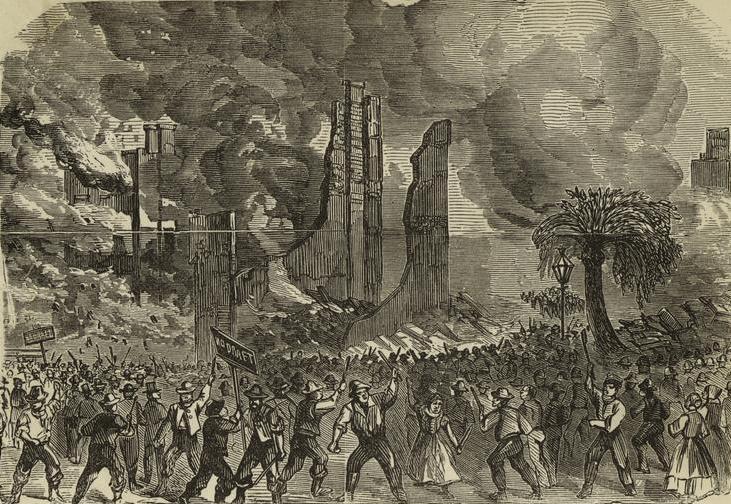
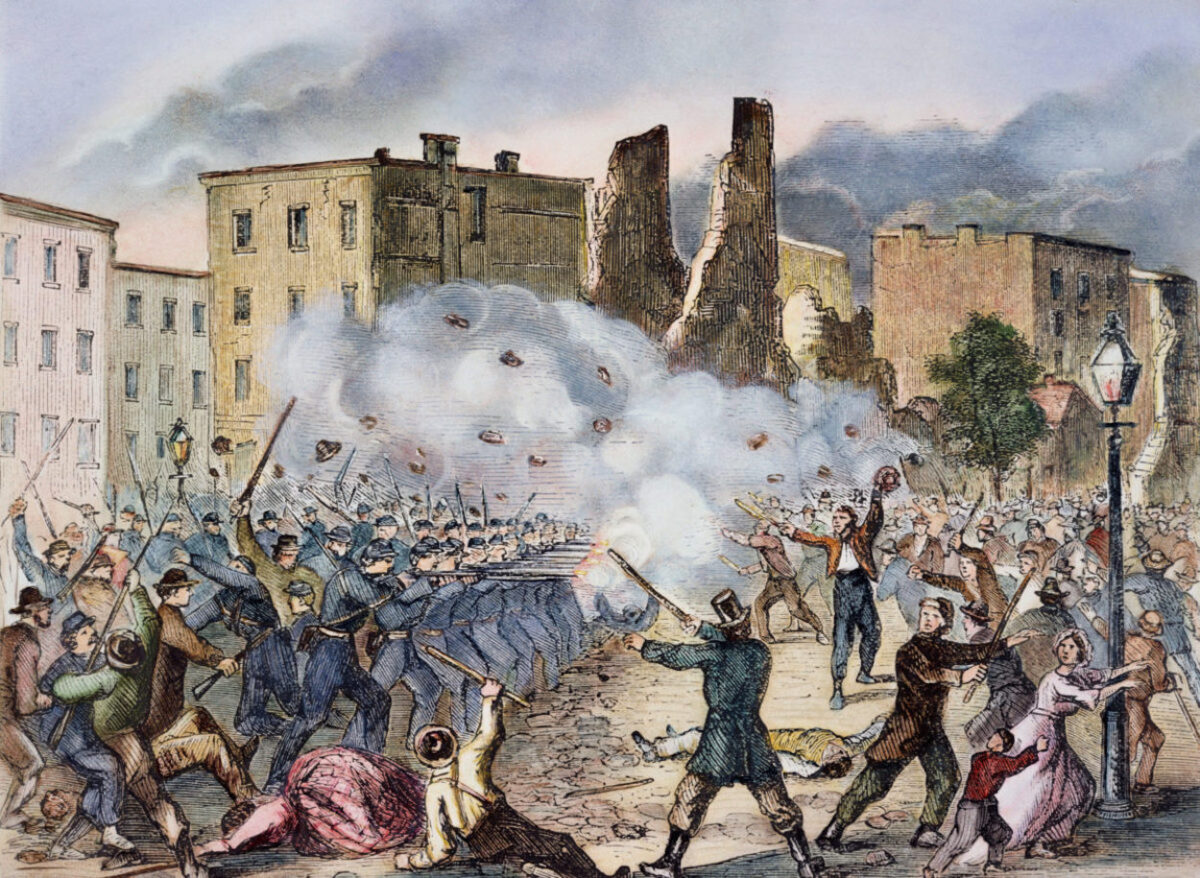
This month we are marking the 160th anniversary of one of the most dramatic moments in New York City history – the Civil War Draft Riots which stormed through the city from July 13 to July 16, 1863.

Thousands of people took to the streets of Manhattan in violent protest, fueled initially by anger over conscription to the Union Army which sent New Yorkers to the front lines of the Civil War. (Or, most specifically, those who couldn’t afford to pay the $300 commutation fee were sent to war.)
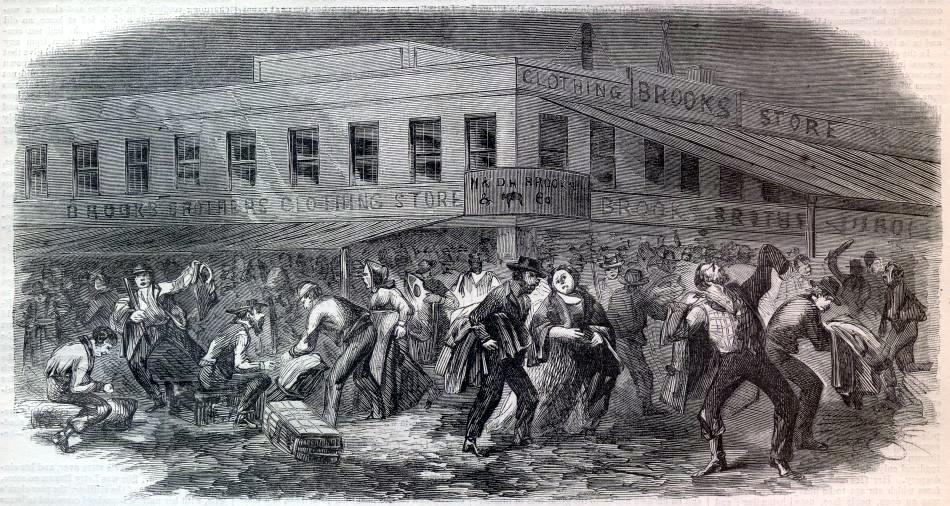
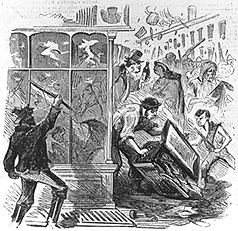
Looting at Brooks Brothers. Harpers Weekly, August 1, 1863

In many ways, our own city often seems to have forgotten these significant events.

There are very few memorials or plaques in existence at all to the Draft Riots, a very odd situation given the numerous markers to other tragic and unsettling moments in New York City history. 

In particular, given the number of African-Americans who were murdered in the streets during these riots, and the numbers of Black families who fled New York in terror, we think this is a very significant oversight.
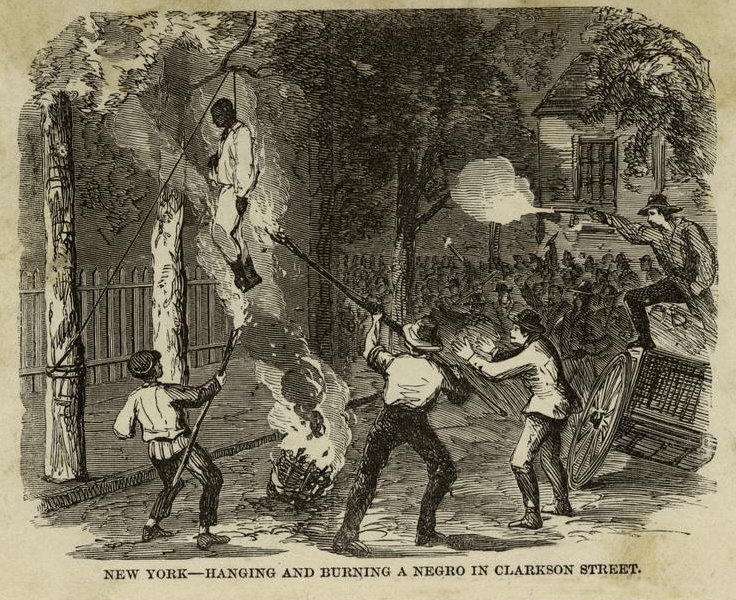
Harper’s Weekly, August 1, 1863

The riots place New York City not outside the significance of the Civil War battlefield, but squarely within it. The Union was not united, but an assortment of different viewpoints.  

In this episode, a remastered, re-edited edition of our 2011 show, we take you through those hellish days of deplorable violence and appalling attacks on abolitionists, Republicans, wealthy citizens, and anybody standing in the way of blind anger. Mobs filled the streets, destroying businesses (from corner stores to Brooks Brothers) and threatening to throw the city into permanent chaos.

That Abraham Lincoln and the Union Army succeeded is even more remarkable when you realize the dissension from within, dissension which we discuss in this show (a remastered, reedited version of a show we originally recorded in 2011).

LISTEN NOW: THE DEADLY DRAFT RIOTS
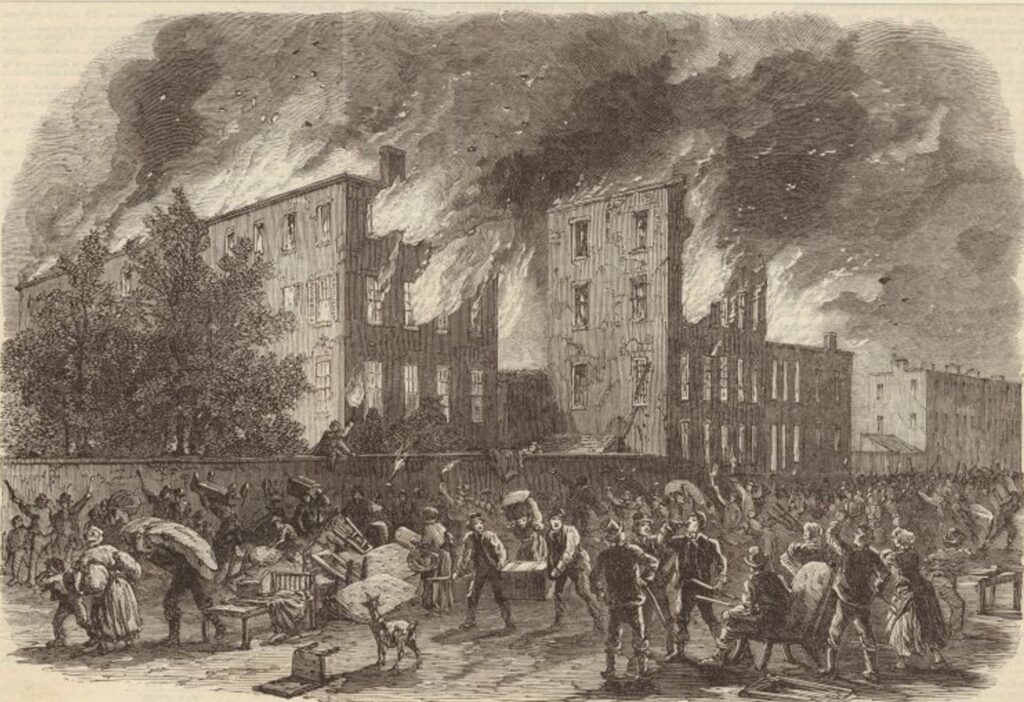
The burning of the Colored Orphan Asylum on Fifth Avenue: In a day of vile crimes that Monday, July 13th, this certainly stands out as one of the worst.
The mob burned the draft office at 3rd Avenue and 46th Street first thing on Monday morning. The destruction was but only a taste of the violence that was to come. By Friday, New York would be smoldering with dozens of structures in ashes — from factories and homes to armories and even bridges.

John A. Kennedy, the superintendent of police, who was savagely beaten and barely escaped with his life on the first day of rioting.
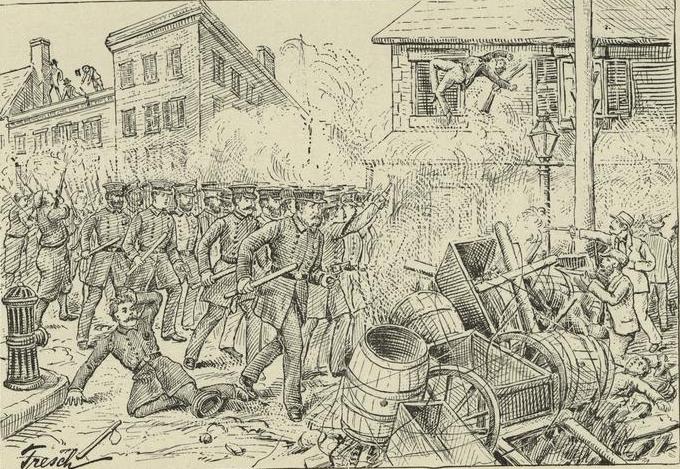
By Tuesday, rioters had cordoned off barricades along a couple key streets, including a mile-long makeshift fortification along Ninth Avenue, through today’s Chelsea and Hell’s Kitchen neighborhoods.

Illustrations courtesy New York Public Library digital image collection
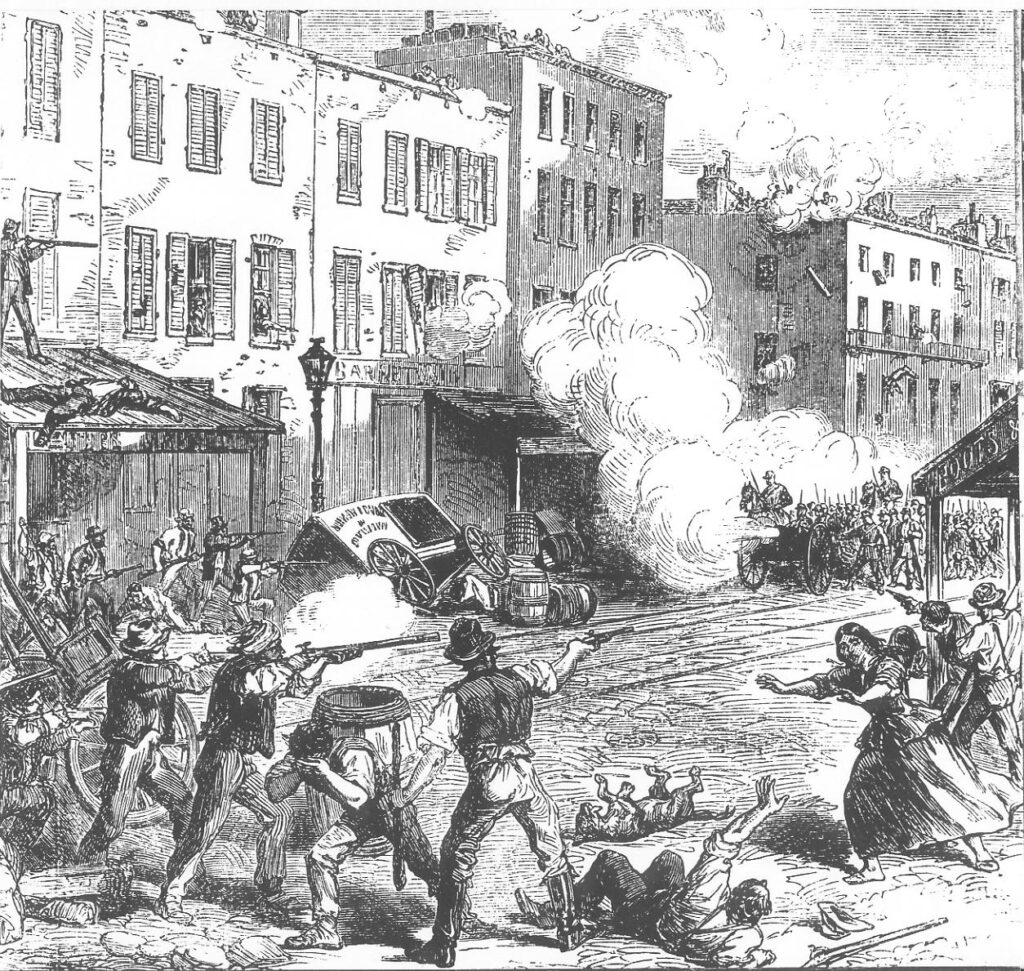
The Illustrated London news

The other draft riots: Given the New York-centric nature of our program, I should note that draft riots occurred throughout the North that week, and even earlier. Yet none were of the intensity as those that occurred in Manhattan. In Boston, for instance, mobs stormed the famous Faneuil Marketplace and an armory on Cooper Street. But troops quelled the violence early, and only eight people died. [Read more about this even in the Boston Phoenix.]

And events were sparked in the future boroughs of Brooklyn, the Bronx, Queens and Staten Island as well. You can read more about them in this blog post.


Why are there no permanent memorials or remembrances of any significant kind in New York City to the Civil War Draft Riots? It was the most grave, the most tumultuous event in New York City history between the Revolutionary War and September 11, 2001. Doesn’t it merit some mention? Read Greg’s opinion piece which ran on the 150th anniversary — which more or less still applies today.


FURTHER READING

For more information on the Draft Riots, you can turn to several sources, based on your level of interest. My favorite is Barnet Schecter’s ‘The Devil’s Own Work’which gives a gripping chronological retelling of events. He really manages to tame a chaotic tale in a way that neither confuses nor oversimplifies. I used Schecter’s ‘Mrs. Hilton’ anecdote from this book, and his book is chockful of other individual tales like that one.

If you prefer something a bit more analytical, there’s Iver Bernstein’s ‘The New York City Draft Riots’ which tries to parse who exactly the rioters were. Of course ‘Gotham’ by Edwin G Burrows and Mike Wallace have a nice, compact recount with plenty of context. The City University of New York’s ‘Virtual New York’ web resource has a timeline with maps.

The Gangs of New York: Perhaps the most famous depiction of the riots occurs in Herbert Asbury’s classic ‘The Gangs of New York’. The film version, directed by Martin Scorsese, takes quite a few liberties with the facts of course. The placing of candles in windowsills and the fire at Barnum’s American Museum, for instance, did not happen during the riots. But those are based on true events that happened in New York a year later.

FURTHER LISTENING

There’s also the Broadway musical Paradise Square, set during the Draft Riots. Joaquina Kalukango won a Tony Award for Best Actress for her work in the musical: 

When this show was originally released in 2011, it was part of a three part mini-series on New York City and the Civil War. You might like to check out the other two parts — especially part three Hoaxes and Conspiracies of 1864

In this episode, Greg pays a visit to Weeksville, the Brooklyn community which became a haven for Black New Yorkers fleeing the city during the riots.

If there is a ‘prequel’ to the Draft Riots, it’s certainly the Astor Place Riot of May 10, 1849.
Categories
Holidays

Months after the Draft Riots, New York celebrates the first national Thanksgiving, in the shadow of war and lunar eclipse


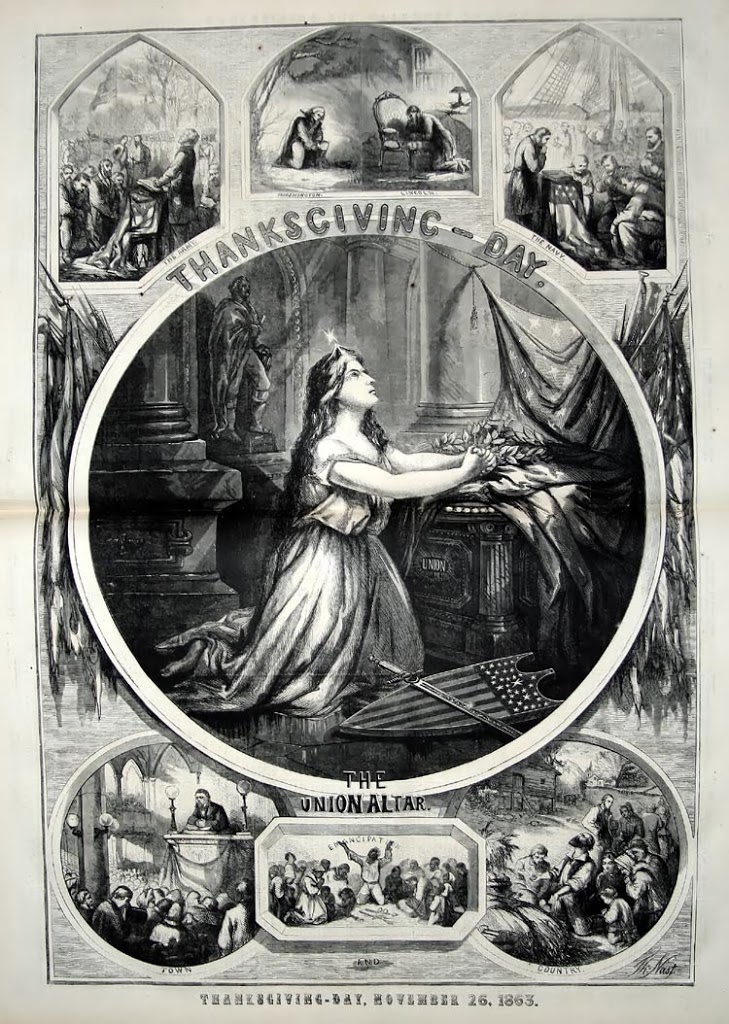
Above: A Thomas Nast illustration from Harper’s Weekly, November 1863, clearly putting the event in the context of war and hardship. 

In practice, Thanksgiving celebrates the supposed feast between the Pilgrims and their Native American neighbors in Massachusetts. But meals of ‘thanksgiving’ have been part of the Western world customs for hundreds of years, and today the meal is more an excuse to gather the family together and count the seconds until holiday shopping.

Because that ‘original’ meal was only vaguely documented, let me give you a more definite event — 150 years ago, President Abraham Lincoln declared a national celebration of Thanksgiving for the last week in November:

“I do therefore invite my fellow-citizens in every part of the United States, and also those who are at sea and those who are sojourning in foreign lands, to set apart and observe the last Thursday of November next as a day of thanksgiving and praise to our beneficent Father who dwelleth in the heavens.”

Perhaps you did a double-take at that statement.  There’s no mention of Pilgrims or Indians in Lincoln’s proclamation, which was made on October 3, 1863.  There is, of course, several soothing religious references. (You can read the entire statement here.)  After all, the United States had been fighting a Civil War for over two and a half years. Any words of peace and calm, paired with boasts of American bounty and expansion, would have put the bloody conflict in a divine context.  “[H]armony has prevailed everywhere except in the theatre of military conflict,” Lincoln wrote.

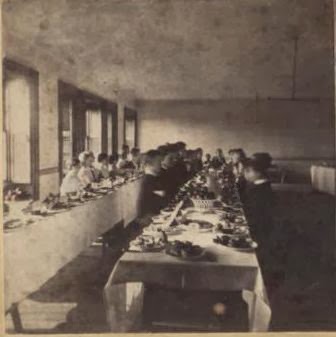
At right: Thanksgiving dinner at ‘the Home for the Friendless’, 1860s.  I cannot imagine a more grimly named institution! courtesy NYPL

New Yorkers had celebrated a form of Thanksgiving for many years prior to the 1863 proclamation.  But the feast had always been considered a regional, New England celebration, one a little foreign for the city.

From The New York Sun, November 26, 1863:  “The sights and scenes in our city yesterday afforded evident indications of a unanimous determination … to break up once and all the monopoly of Thanksgiving, so long enjoyed by the New Englanders.  For years past, it had been a standing boast of the genuine ‘Down Easters’ that the air of New York was unsuited to the festival of the Pilgrim fathers.”

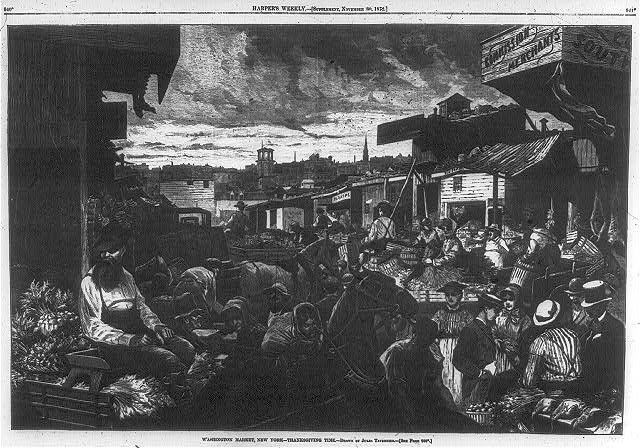
Below: Washington Market, always a hectic place, was especially so on Thanksgiving. This scene from Harper’s Weekly depicts frantic shoppers in 1872. Courtesy Library of Congress

Don’t tell New Yorkers what they can’t have!  The Sun promised a “racy and peculiar” New York Thanksgiving that year.  The markets were clogged with shoppers, as New Yorkers came out in force to purchase items for their own Thanksgiving meals.  Every other man on the street seemed to have a naked bird flung over their shoulders.  “Evidentally, every family man and woman, who could raise the number of greenbacks, invested them in Thanksgiving fixings.”

This might have been a little journalistic posturing.  Just five months earlier, New York had been ablaze in the Draft Riots, several days of violence towards its own citizens, fueled by an unfair conscription policy and the fears and racial hatreds of its citizens.  Most of the burned buildings had been cleared, but the bloodshed was on many minds.  Many benefits throughout the city raised money for injured Union soldiers and the families of those who had died in battle.

The Sun quietly refers to the Draft Riots’ most sickening event, the burning of the Colored Orphan Asylum.  “At the Five Points House of Industry the little ones are to have a bountiful feast.   The colored children burnt out by the mob will be taken care of at Carmansville.”

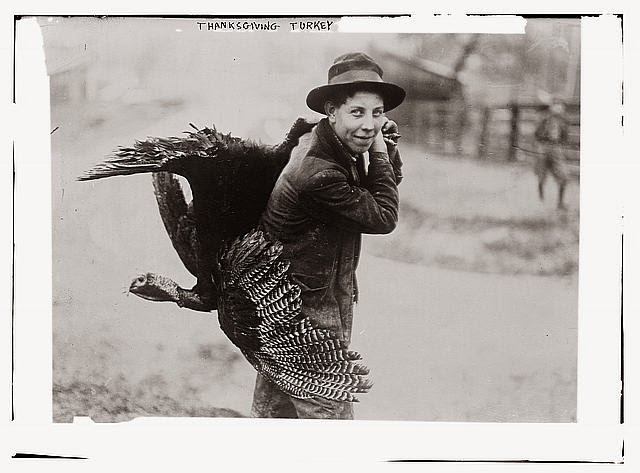
Below: Boy with a turkey, circa 1910-1915 (LOC)

Generally speaking, celebrations went forward as they would in subsequent years — the food, the church services, the carousing, the merriment, decades before anybody would think of blowing up gigantic balloons and dragging them down Broadway.

However, one thing had been very different that year.  On the evening before Thanksgiving, New Yorkers looked up into sky and witnessed a partial lunar eclipse.

While the event might have filled some with dread, it cast a mysterious pall further south, on the battle field of Lookout Mountain in Chattanooga, Tennessee.  It occurred hours after the Confederacy’s defeat by the Union army and helped shield the Southern forces as they slipped away by cover of fog.

Alongside news of New York’s embrace of Thanksgiving, the newspapers that day reported of a victory and a death toll:  “General [Joseph] Hooker, in command of General Geary’s division, Twelfth corps, General Osterhau’s divison, Fifteenth corps, and two brigades, carried the north slope of Lookout Mountain, with small loss on our side, and a loss to the enemy of five hundred or six hundred prisoners: killed and wounded not reported.”

Categories
Know Your Mayors

George Opdyke: The mayor during the Civil War Draft Riots and his unsavory connection to New York’s fashion industry

KNOW YOUR MAYORS A modest little series about some of the greatest, notorious, most important, even most useless, mayors of New York City. Other entrants in the Bowery Boys mayoral survey can be found here.

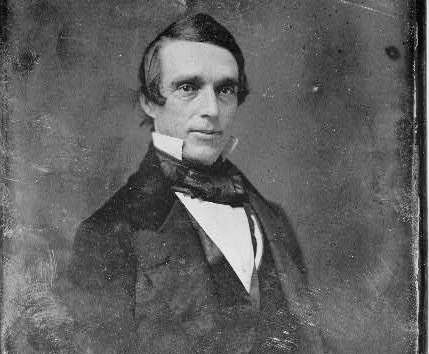
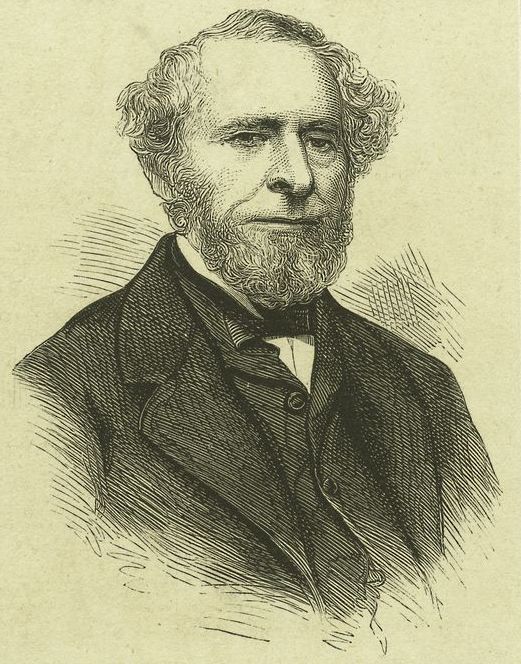
Mayor George Opdyke
In office: 1862-1863

The wealthy merchant and politician George Opdyke died on June 12, 1880, attended to by his family from their lavish home at Fifth Avenue and East 47th Street, just a few blocks from where the violent Draft Riots had ignited back in 1863.

In the 17 years since those terrible days, New York had grown mightier with vast wealth, in an explosion of prosperity that would inaugurate the Gilded Age.  But while the scars of the Draft Riots had faded from the city streets, they never quite faded from Opdyke, who had been mayor of New York during the violent outbreak.

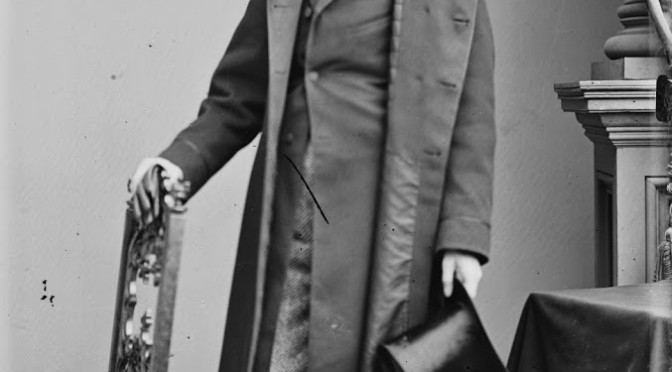
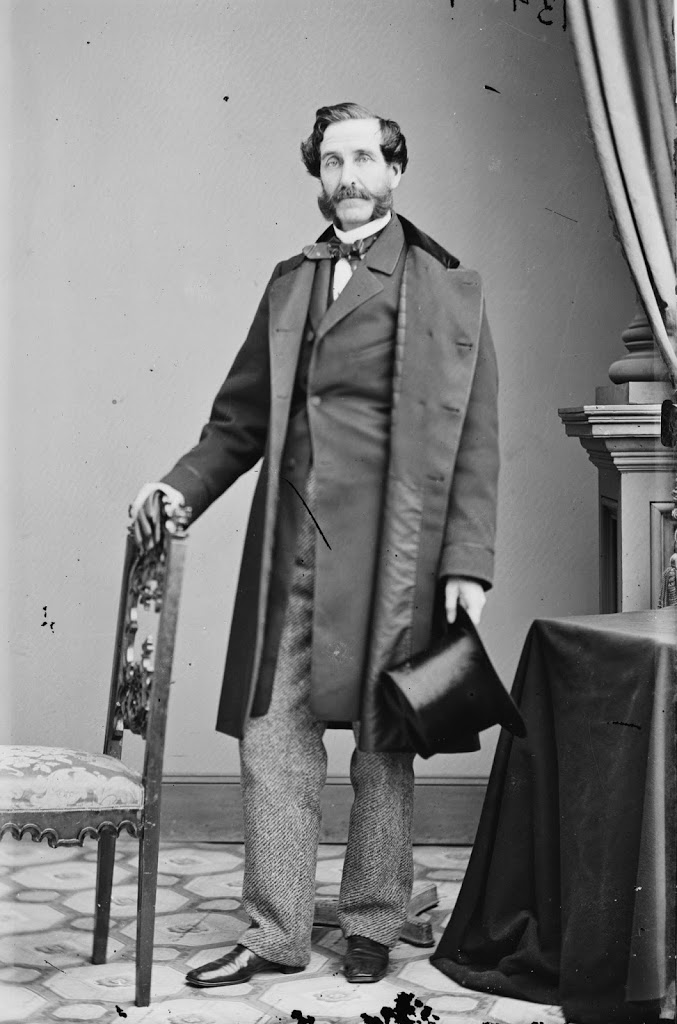
At right: George Opdyke, in a photo taken by Matthew Brady

Some of the violence that week in July had been directed towards Opdyke, one of the most prominent Republicans in a city of Democrats. His former home at 57 Fifth Avenue had been attacked twice by rioters.  He was considered the face pro-Lincoln, pro-war, and, thus, pro-abolitionist forces in New York

Yet had it not been for the institution of slavery in the South, Opdyke might never have even made his fortune.

George Opdyke was born to a large New Jersey farming family in 1805, working his way from the fields to the classroom, becoming a young school teacher at an early age.  Like so many teenagers in the early 19th century, job opportunities out West spoke to his sense of adventure.  With $500 in their pockets, Opdyke and a friend settled in Cleveland, Ohio, opening a clothing store and tailor for workers of the newly constructed Erie Canal.

Opdyke soon found a more profitable application for his young business — the high mark-up manufacturing of cheap slave clothing.  He moved to New Orleans and began an incredibly profitable plant there, making inexpensively produced clothing for the plantations of the deep South.

In fact, Opdyke became so successful that, in 1832, he moved to New York to open a larger clothing factory on Hudson Street.  According to historian George Lankevich, Opdyke “built the city’s first important clothing factory, selling his goods largely to southern plantations and creating the basis of a new industry.”  It was the first large-scale, ready-to-wear clothing establishment in New York, soon employing thousands; so, yes, this is how the New York fashion industry begins.

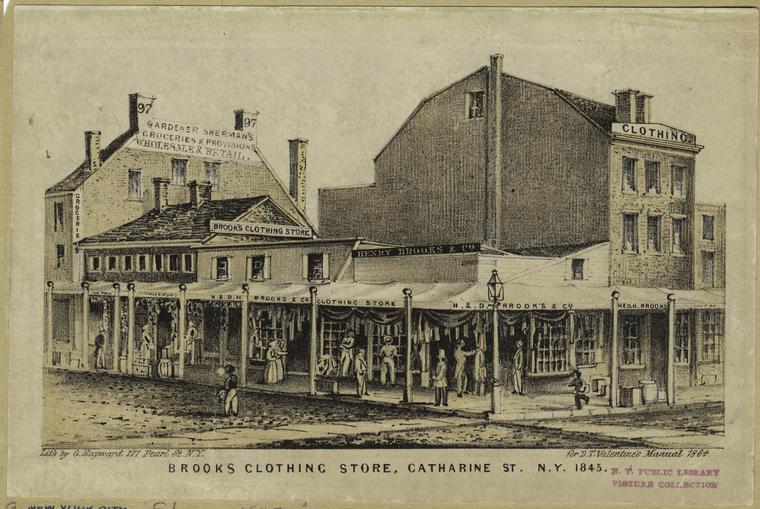
Below: Brooks Clothing Store in 1845, a rival of Opdyke’s clothing business. Opdyke would have some rather controversial connections for Brooks Brothers during the Civil War. (NYPL)

And a successful political career begins as well.  By 1846, Opdyke, now a millionaire and a well-connected member of mid-19th century New York society, entered a life of politics.

Interestingly, he was originally associated with the Free Soil Party, an early anti-slavery effort, illustrating how businessmen often separated certain moral beliefs from their business practices. (Early on, he would become one of Abraham Lincoln’s most ardent supporters.) The Free Soilers were soon be incorporated into the burgeoning Republican Party, and Opdyke’s first appearance in New York state assembly, in 1859, was as a Republican.

That same year, Opdyke became the Republican’s best chance at winning the mayor’s seat in New York. However, he vied for the job with two other seasoned politicians — unscrutable Democrat Fernando Wood and former mayor and sugar king William Havemeyer.  Thanks to machine politics and the uncertainty of war with the South, Wood prevailed that fall, becoming mayor of New York at the start of the Civil War. (I have an entire podcast on Wood’s roller-coaster career in politics.)

But tides would change in Opdyke’s favor.  Pro-Union sentiment surged through the nation and in New York City by the start of the war.  And by the time of the next mayoral election in 1861, situations were ideal for a Republican to take charge.

It helped that Democrats were divided — Tammany Hall went with C. Godfrey Gunther, while Wood formed his own alternative political machine Mozart Hall.  But it was Opdyke that prevailed, although barely.  He beat Gunther by a whopping 613 votes. (But he did beat Wood in Wood’s own ward.  That must have felt good.)

Part of Opdyke’s appeal at that moment was his deep connections to the Lincoln administration. When the flags were waving in New York, Opdyke was an ideal representative, encouraging support for the war, hosting troops in the city, raising money for the effort.  But when enthusiasm for the war withered, so did Opdyke’s reputation.

Below: The draft riots, which paralyzed New York in July 1863

Opdyke’s unwavering support for the draft backfired severely in the summer of 1863. When New Yorkers took the street on July 13, 1863, burning the draft offices and taking out their anger on black citizens and prominent Republicans, Opdyke topped the list of most despised New Yorkers.  He had very little power to quell the violence; the police department was placed under state control, and state militia had been called away.

While his home was nearly destroyed, it was his political reputation that took the greatest hit. At first, he had vetoed a plan by the Common Council to pay for substitutes for any drafted New Yorkers. But a month later, working with Tammany Hall, he essentially endorsed a similar bill to avoid more violence.

This saved New York, but it did not save him.  On election day, that December in 1863, he was replaced with the Democrat Gunther, whom he had narrowly beat just two yeas before.

His woes weren’t quite over. A political feud with newspaper editor Thurlow Weed revealed some unpleasant information about Opdyke in the press. “[H]e had made more money out of the war by secret partnerships and contracts for army clothing, than any fifty sharpers in New York,” claimed the irate newspaper editor.

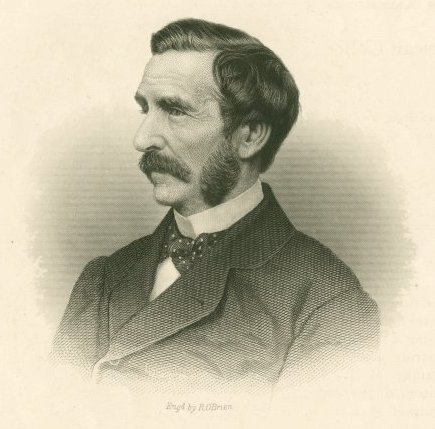
At right: Opdyke in later life (NYPL)

Opdyke had profited handsomely from the war through his own clothing plant and in deals with rival clothing manufacturer Brooks Brothers.  Opdyke took Weed to court for libel in December 1864, but the jury essentially exonerated Weed, delivering an indecisive verdict “as to whether Weed should pay nominal damages of six cents, or be acquitted.” [source]

In later life, Opdyke took up banking with his sons, representing the concerns of various railroad companies. He “retired a few months before his death with a large fortune.” [source]

After his death, the Opdykes would sell their house to railroad tycoon Jay Gould.

Categories
American History Wartime New York

It’s the 150th anniversary of the 1863 Civil War Draft Riots. Why should we care?

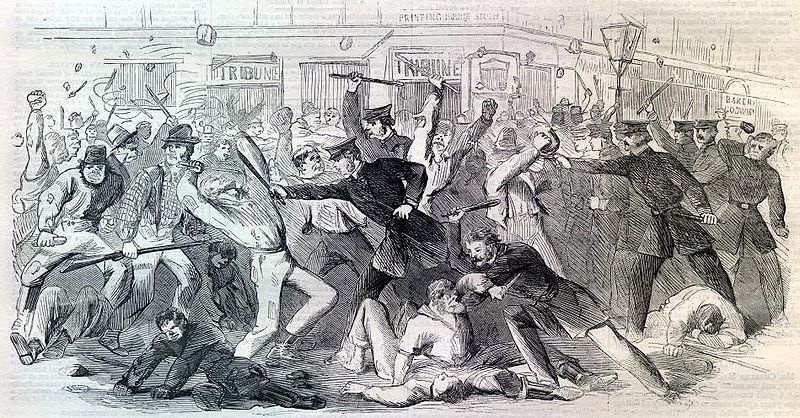
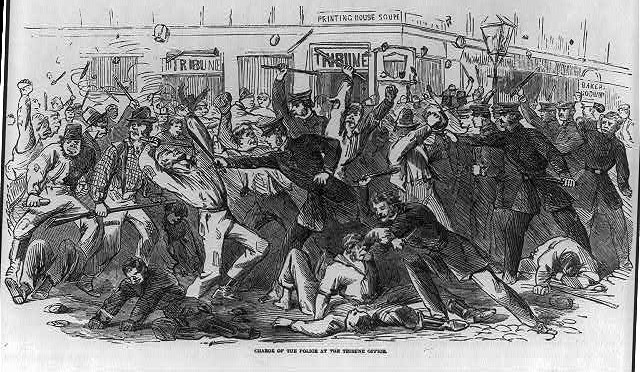
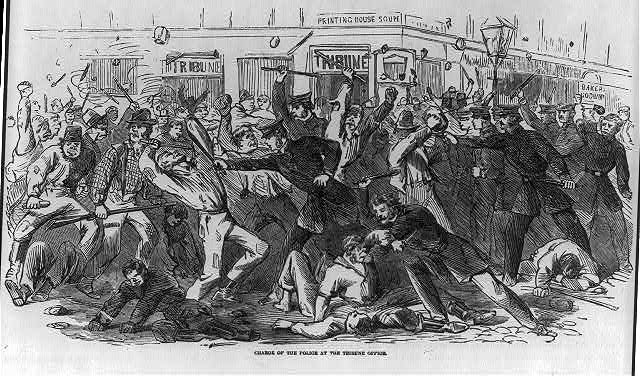
Police try to restore order in front of the New York Tribune building, a pro-Lincoln publication being attacked by rioters.

Why are there no permanent remembrances of any significant kind in New York City to the Civil War Draft Riots?   It was the most grave, the most tumultuous event in New York City history between the Revolutionary War and September 11, 2001.  Doesn’t it merit some mention?

The leading answer, of course, is that New Yorkers don’t end up looking very good.  This isn’t New York’s finest moment; in fact, it’s probably its worst.  Many of the hundreds who died during that week were rioters, lawbreakers, killers.  The racism of many was laid bare, exposed brutally.  On the first day of rioting, firemen — the Black Joke Engine Co. — were actually complicit in kicking off the violence.  Even the leaders of the period had ulterior motives.

At right: The Black Joke firemen help plunder the draft office

For almost five days, the angered and the desperate rampaged through the streets of New York. The violence was only superficially fueled by anger over the actual conscription act, an excuse to vent other frustrations, some understandable, others reprehensible.  For several days, nobody was safe — from the moment the Ninth District Draft Office was incinerated on Monday morning to the final sweep of barricaded streets by state militia and federal troops on Thursday night.

It’s a complicated, ugly, confused time in New York City history.  But how does a city acknowledge a self-inflicted tragedy?  Who wants to remind America of how duplicitous many New Yorkers were during the Civil War?

The Draft Riots are a nuisance of fact, sometimes serving to obfuscate the sacrifice of the many thousands of New Yorkers who gave their lives in service of the Union Army.  New York holds up its reputation as a melting pot, as a place where people of different ethnicities co-exist, if not always peaceably.  The images of the Draft Riots — black families fleeing the city in terror, lynched bodies from trees and streetlamps — serve only to remind you that the spirit of inclusiveness is merely a modern notion and possibly a mirage.

Anniversaries are important.  They reflect how we want to present our past and illustrate our present frame of mind.  On the one hundredth anniversary of the sinking of the Titanic, people re-watched the James Cameron movie and took a (strangely morbid) memorial voyage along the same watery path the original ship was to have taken.  On the centennial of the Triangle Factory Fire, hundreds marched through the street and chalked memorials on the sidewalk in front of the homes of the victims.

On America’s bicentennial, New York briefly awoke from its bankrupt, gritty slumber to present a shimmering display of patriotism featuring Queen Elizabeth, festive parades, and battalions of ships in the harbor.  Every September, we revisit the horror and suffering of the attacks upon the World Trade Center because the idea of forgetting about it is simply unimaginable.

The Draft Riots fit none of the criteria of something we’d like to remember. It’s for that reason we should.

Today we remember the Civil War in iconic terms, good and evil, right and wrong.  The Draft Riots presents a nuanced reinterpretation of that story line.  It places New York City not outside the significance of the battlefield, but squarely within it.  The Union was not united, but an assortment of different viewpoints.  That Lincoln and the Union Army succeeded is even more remarkable when you realize the dissension from within.

For that reason, I hope one day the city of New York will take upon itself to memorize this event in the same way it has so many others.  Until then, I’m at least grateful to those various private institutions around the city who will ensure that future New Yorkers will continue to be stunned, horrified and otherwise amazed at the extraordinary events which took place in this city on July 13-16, 1863.

———–

According to this article from the New York Times in 1963, there were once three temporary plaques placed in significant places for the centennial marking — at Fifth Avenue between 43rd and 44th (site of the Colored Orphanage), Third Avenue and 46th Street (site of the Ninth District Draft Office) and, oddly, at Tenth Avenue and 46th Street (site of the home of Willy Jones, the first person chosen in the draft lottery).  I do not believe these plaques to still be in existence, but if you know otherwise, please email me.

Here’s a few ways to commemorate the 150th anniversary of the Civil War Draft Riots over the next few days:

Reading:  I highly recommend Barnet Schecter‘s “The Devil’s Own Work: The Civil War Draft Riots and the Fight To Reconstruct America“.  For a more academic analysis, you can also try “The New York City Draft Riots: Their Significance for American Society and Politics in the Age of the Civil War,” by Ivar Bernstein.

Exhibit: There are no Draft Riot exhibits currently in New York, but the Metropolitan Museum of Art has two must-see shows about the Civil War that would make a fine substitute — ‘The Civil War and American Art’  and ‘Photography and the American Civil War

Discussion: The Museum of the City of New York is presenting a panel discussion on Monday, July 15, with a superb line-up, including Craig Stephen Wilder, filmmaker Ric Burns, historian Joshua Brown and author Kevin Baker.  Check here for more information.

Podcast: Then of course there’s our 2011 podcast on the Civil War Draft Riots.  You can find it on iTunes or download it from here.  And I’ve finally uploaded it onto SoundCloud, so you can listen to it right here!


And if you’d like more information on how the Draft Riots affected the future boroughs of New York City, you can check out my article on Huffington Post: The Many Civil War Draft Riots: Violence From 150 Years Ago, in New York and Beyond.

NOTE: If you know of any events relating to the Draft Riots, please email me and I will include them in the list above. Thanks!

Categories
American History Wartime New York

Calm before the storm: Saturday before the Draft Riots, an ominous silence before New York’s most violent days


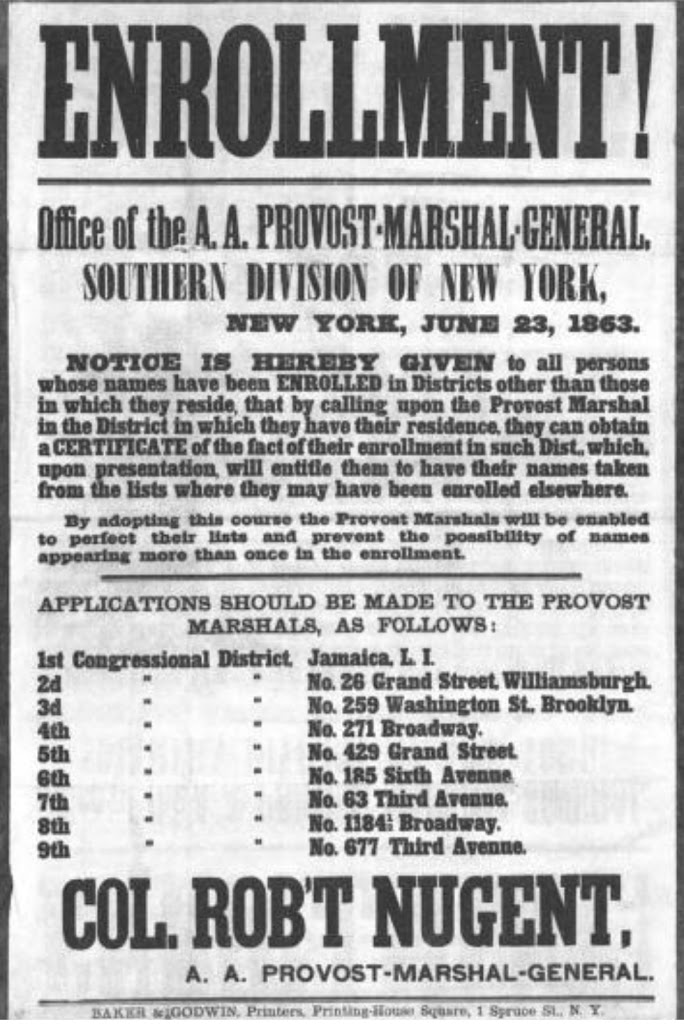
A list of the nine draft offices where lotteries would occur that Monday, July 13th. It would have already begun in Jamaica and at the Ninth District Office that Saturday.

One hundred and fifty years ago today, on July 11, 1863, the first round of lotteries to select able-bodied men for conscription into the Union Army began rolling out in New York.

It was a Saturday.  The day of the week is rather important to history. For on that day — the day that brought the draft that would inspire the horror of the notorious Draft Riots 48 hours later — the draft lotteries would arrive without violence.  Nobody in New York would die that day because they were following federal orders or because of the color of their skin.

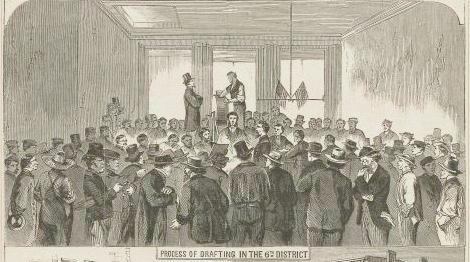
Below: The draft in New York in simpler times.  When a draft lottery was called two years earlier, in 1861, there was no such tension or violence.  A spirit of patriotism and a lack of cynicism about the war greeted the provost marshals as names were selected. [NYPL]

A few factors went into this surprising peace. Federal and state law enforcement knew there would be some trouble. The newspapers had grumbled about it and anti-draft factions gathered in halls around New York in the preceding days. Draft riots had already erupted in places like Buffalo, New York.

As a result, they decided to roll out the draft slowly, starting in less densely populated areas.  Thus, the first names were read out from the Ninth District draft office at Third Avenue and 46th Street which, in 1863, was neither the most fashionable neighborhood, nor the most squalid.  Being first, however, made it a prime target for agitators when it reopened on Monday.

Anger in New York was delayed.  Many assumed that a Democratic controlled state government and its Democratic governor Horatio Seymour would delay or even block the draft.  Many of those leaders campaigned on that very fact.  Yet as the ‘wheel of misfortune’ was turned that Saturday morning and names were selected for the draft, the horror began to sink in.

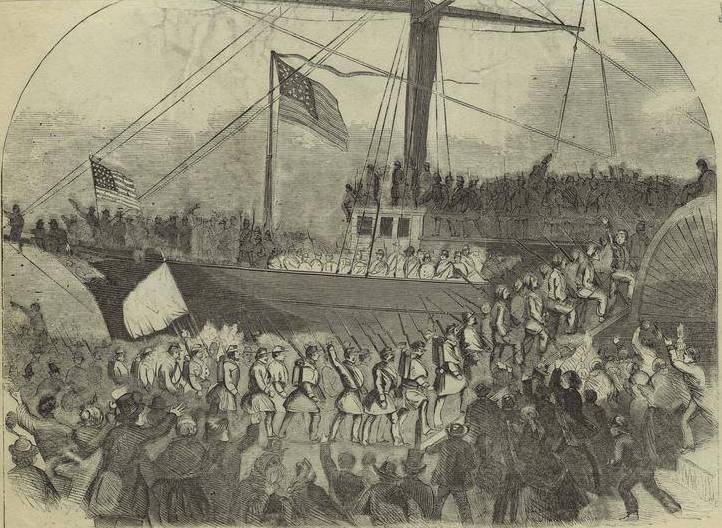
Below: The 69th Regiment leaves New York harbor, April 1861.  A largely Irish regiment, they are one of New York’s great military units.  They were so decimated during the Battle of Fredericksburg and the Battle of Gettysburg — which took place just two weeks before New York’s draft — that they were temporarily disbanded.


This is why Saturday is so important — the gestating anger that led to the draft riots that Monday broke out in the taverns of lower Manhattan that Saturday night, as news spread of friends and loved ones in other districts whose names had been chosen.

James Gordon Bennett of the New York Herald wrote: “Those who heard the scattered groups of laborers and mechanics who congregated in different quarters on Saturday evening, and who canvassed unsparingly the conscription law might have reasonably augured that a tumult was at hand.” [source]

In typical understated fashion, the New York Sun remarked, “Considerable feeling and warm discussion was manifested throughout the city as soon as it became generally known that the draft had actually commenced.”   Those words were published on July 13, the first and most incendiary day of the draft riots..

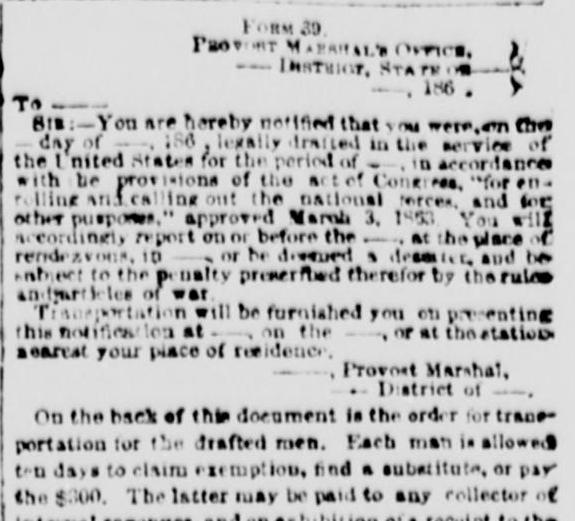
Had the draft actually proceeded without incident, those chosen would have received the following letter, reprinted in the same issue of the New York Sun mentioned above:

If you were chosen for the draft, you would have had ten days to “claim an exemption**, find a substitute, or pay the $300” commutation fee. Barring that, you were to report to Rikers Island for immediate training.

Prepping from some dissension on Monday, five hundred soldiers from Governors Island were summoned into the city to stand guard over the draft offices. Little did they know then that a mere 500 men would be no match for the surge of rabid mobs that would greet them on Monday.

** What were the various draft exemptions? The July 13, 1863 issue of the New York Daily Tribune had a list available for its readers which included 1) being the son of a widow or ailing parent; 2) being the only brother of a child dependent on him for support; 3) being the only parent to children under the age of 12; 4) having two family members already serving in the Union army; and 5) “unsuitableness of age,” meaning you were too old or too young to serve.

Tammany Hall hosts the city’s first Democratic Convention: Susan B. Anthony, the KKK, and a reluctant nominee

Many of you may remember New York’s sole Republican National Convention, held in 2004 at Madison Square Garden, celebrating the re-election bid of George W. Bush. Some may recall any one of New York’s three recent Democratic National Conventions — two (1976, 1980) for Jimmy Carter, and a rather memorable one in 1992 that placed Bill Clinton on the ticket.

Oh, but that’s modern politics! Conventions of the past — stodgy, contentious, male — are more fascinating artifacts, gentlemanly in tone, chaotic and raw in execution, and dominated by a mix of issues both eternal (war, debt, taxes) and outdated (slavery, territorial expansion).

Of New York’s five Democratic nominating conventions, the most infamous is certainly the 1924 gathering at Madison Square Garden — the old Garden, Stanford White’s palace on 26th Street — distinguished by rancor, the significant influence of an energized Ku Klux Klan and an exhaustive trek through 103 ballots only to settle upon a weak compromise candidate, West Virginian politician John W. Davis, who was crushed in the general election by Republican Calvin Coolidge. Within two years, the Garden would be closed and promptly demolished, as though in embarrassment.

But I find the first national convention, held in 1868, to be the most intriguing and telling of New York life in the mid-19th century, a convention so unusual that the eventual presidential nominee actually recoiled from accepting the nomination.

Four years prior, in 1864, a splintered Democratic Party had tried to replace Abraham Lincoln in the White House with his former Union general George B. McClellan. In New York, former mayor and now-Congressman Fernando Wood led a drive for new national leadership — even though he loathed McClellan — and called for an end to the Civil War with their ‘Southern brethren’. But opposition quickly withered after a series of Union victories, and Lincoln was re-elected.

Flash forward to 1868. Lincoln was dead, the Civil War was over and slavery was abolished. The current president Andrew Johnson aligned with Democrats over Southern inclusion, eventually leading to his impeachment and a serious damaging of the national Democratic brand.

To bring glory back to the White House, the Republicans hoisted forth as their nominee the hero of the war, Ulysses S. Grant. Perhaps the most famous man in America, Grant would eventually prove to be a mediocre president. But his reputation and charm were so great in 1868 that the Democrats knew they stood little chance to defeating him.

New York’s Democratic contingent — in particular, the political machine Tammany Hall and its leader William ‘Boss’ Tweed — controlled the national committee during this period and steered the convention to New York for the very first time in July 1868.

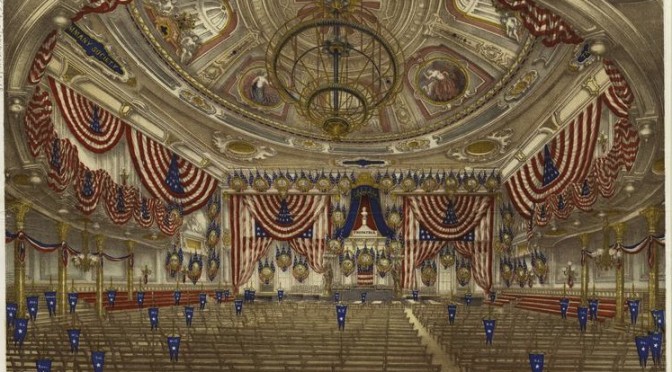
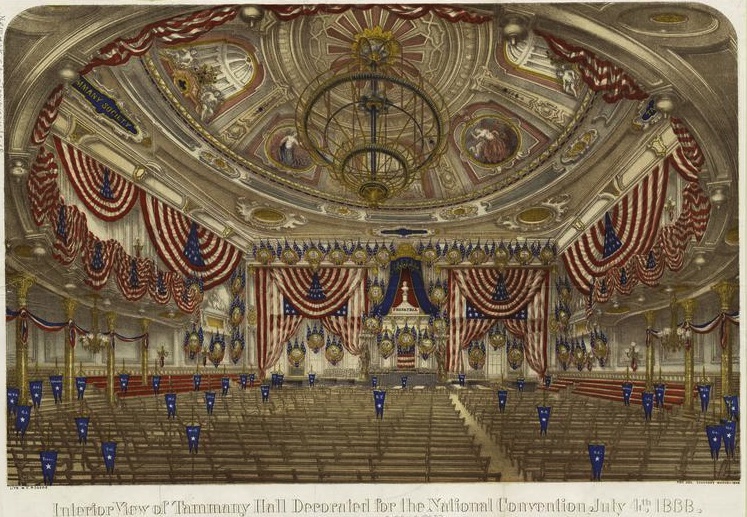
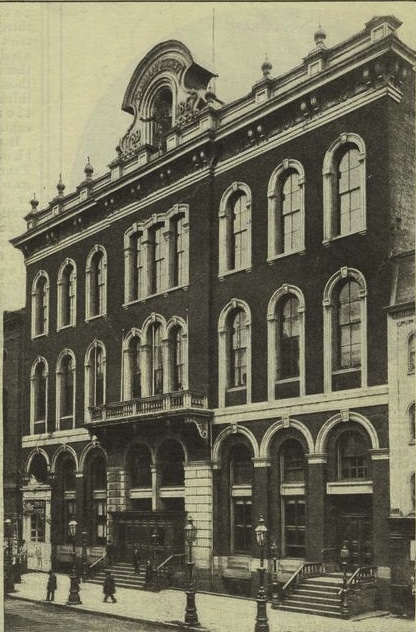
Their headquarters at 141 14th Street (at left) was sparkling new, ‘fresh from the builder’s hands,’ a lush multi-use venue with auditoriums, clubrooms and even a basement cafe, situated next door to New York’s poshest destination, the Academy of Music.

The convention was especially notable as it featured several Democrats from Southern states for the first time since the war.

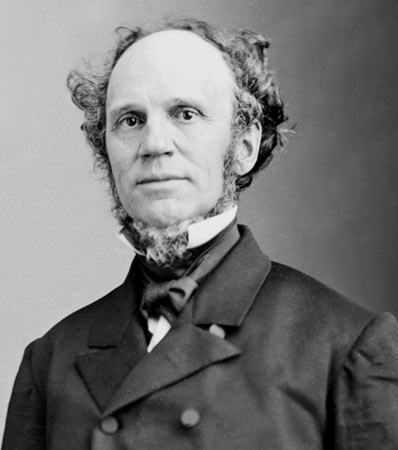
Delegates crowded into the main hall on July 4, and a roar of support greeted Democratic power player (and horse breeder) August Belmont, who gaveled in the proceedings. “I welcome you to this good city of New York,” Belmont declared, “the bulwark of Democracy.”  Nearby smiled former New York governor Horatio Seymour (pictured below), president of the convention. Five days later, there were be far less formality and Seymour, in particular, would not be smiling.

On July 5th, the Democrats unfurled their official platform, embracing the return of the Southern states and harshly criticizing the Republican-dominated Congress:  “Instead of restoring the Union, it has, so far as in its power, dissolved it, and subjected ten States, in time of profound peace, to military despotism and negro supremacy.”  Certainly pleased with this particular inclusion was Tennessee delegate Nathan Bedford Forrest, grand wizard of the Ku Klux Klan.

But the Democrats made room for the consideration of progressive causes too, such as a call for women’s suffrage.  Seymour read aloud a plank from the Women’s Suffrage Association written by Susan B. Anthony and co-signed by Elizabeth Cady Stanton.

Anthony appealed to their quest for dominance. “It was the Democratic party that fought most valiantly for the removal of the ‘property qualification’ from all white men, and thereby placed the poorest ditch-digger on a political level with the proudest millionaire. And now you have an opportunity to confer a similar boon on the women of the country … a new talisman that will ensure and perpetuate your political power for decades to come.”

The request was greeted warmly by the room before being respectfully dismissed altogether.

Things grew less harmonious when the balloting for president began.  Several candidates were submitted, even the disgraced Andrew Johnson. For several arduous ballots, the leader was George H. Pendleton, who had been the vice presidential hopeful under General McClellan. But it immediately became clear that the factions within the party were in no mood to settle quickly.

Pendleton’s lead had weakened by the 13th or 14th ballot, leaving two key candidates — Thomas Hendricks, an Indiana politician, and Winfred Scott Hancock, a Union general that seemed an attractive challenger to Grant.  But neither could approach the two-thirds needed to snatch the nomination.

A stalemate called for a third candidate, somebody that all could agree with, while at the same time, an individual that was absolutely nobody’s top choice.  It was at the podium that delegates found their man — Horatio Seymour.

He was horrified. Seymour wanted to retire and had previously rejected calls to run for national office. Privately he must have considered the pitiful chances of running a lengthy campaign against Grant. But delegates greatly respected the former governor, a bastion of cool Democratic leadership who had been an opponent to the federal draft during the war.  He had also been partly responsible for the Draft Riots, emptying the city of federal militia days before the draft was to begin that July.

Still, their were few ready options for the Democrats. When a delegate from Ohio suddenly declared “against his inclination, but no longer against his honor” to put forth Seymour as a suitable compromise, the room followed suit. On the 22nd ballot, Seymour was enthusiastically declared the Democratic nominee for president.

The only one not enthusiastic about it was Seymour. “I said to them that I could not be a candidate [and] I meant it.” [source]  He left the convention in a huff, only to begrudgingly accept the nomination back at Tammany Hall the following day.

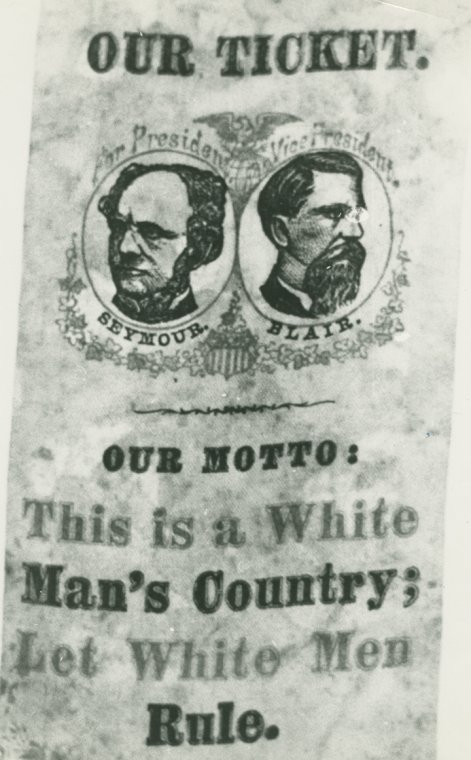
Seymour threw himself into the campaign with vice presidential choice Francis Blair Jr. (whom Seymour barely knew and hardly liked). As evidenced by the campaign poster above, they weren’t afraid to use the Southern racial divide to appeal to voters. But no matter; they lost soundly in the electoral vote to Grant and vice president Schuyler Colfax.

Perhaps the real objective of the convention wasn’t to sway a national crowd, but to energize New Yorkers. Democrats swept into local and state offices, including Boss Tweed’s own choice for governor John T. Hoffman.

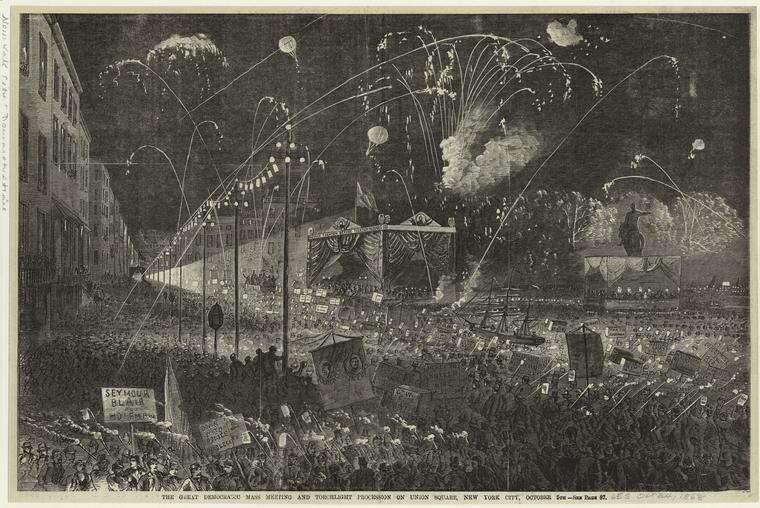
Below: Democrats rally in Union Square in support of Seymour and other local candidates, October 5, 1868

Pictures courtesy of New York Public Library

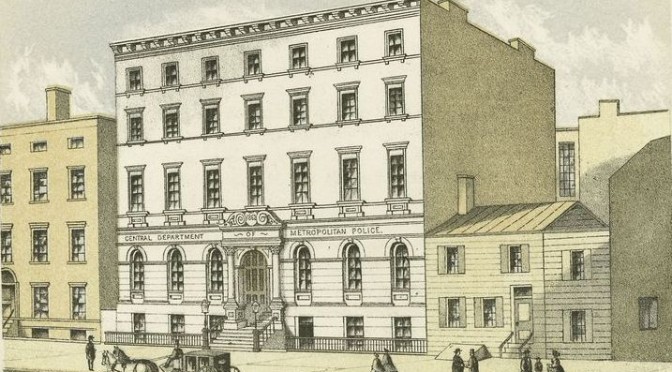
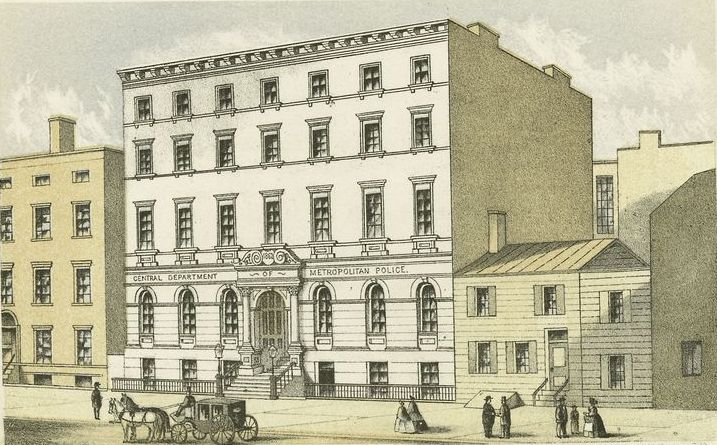
The legendary police headquarters at 300 Mulberry Street

There is nothing extraordinary at 300 Mulberry Street anymore, just a standard five-story apartment complex and a parking garage, hugged to its south by a Subway sandwich shop. But for much of the Gilded Age, this address was the grand headquarters for New York’s police department.

The Mulberry Street building was New York’s center of law enforcement from 1862 to 1909. Not surprisingly, it was located close to the densest concentrations of tenements and just eight blocks down Mulberry to the heart of Five Points. And this spot is directly between Broadway and the Bowery.
The building had an unfortunate inauguration as the year after opening came the summer of the Civil War draft riots. The superintendent of police, John A. Kennedy, was savagely beaten and deposited at headquarters nearly dead. Rioters targeted telegraph poles throughout the city, leaving officers there in a 19th century version of a communication dead zone.

No doubt, overseeing the criminal behavior of a quickly multiplying populace in one of the world’s richest cities in the 19th century was no ordinary achievement. “No other building in the city, probably, is richer in memories than 300 Mulberry Street,” said the New York Times in 1909. “It is famous the world over.” In an other article, the paper triumphantly calls the force “America’s Scotland Yard.”  Notable among its many rooms was the famed ‘Rogue’s Gallery’, a collection of photographs of the city’s most notorious criminals.

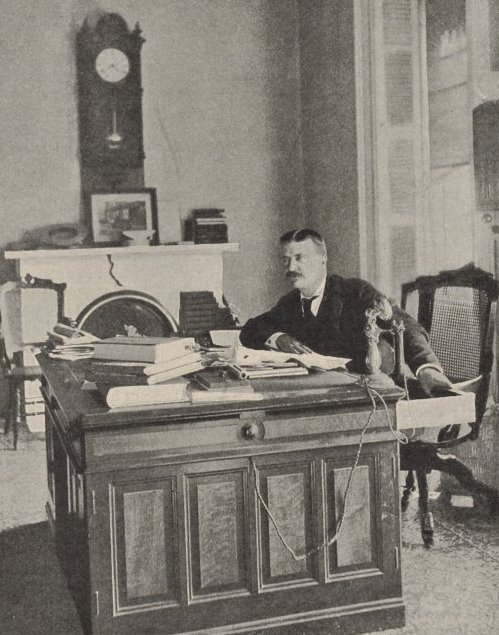
But during the 1870s and 80s, the department was mired in corruption; mayors throughout this period usually ran for election on the mantle of police reform, only to cave to the organization’s impossibly deep infrastructure of bribery and kickbacks.  It would take the state-run Lexow Committee in the 1890s and later, in 1895, a reform commissioner named Theodore Roosevelt to clean up the shenanigans here. At right: Roosevelt in his Mulberry Street office.

According to a 1901 issue of the Evening World: “Today No. 300 Mulberry Street is the centre and disseminator of laziness, corruption, contempt for all the right standards of police duty. And the once superb detective branch, the pride of New York, has become feeble and almost ridiculous.”

The force used the excuse of expansion — and the needs of a consolidated five-borough city — to rehabilitate its image. It needed a larger, modern structure, one untainted by the reputation of corruption. And so, in 1909, after a flirtation with relocating to Times Square, the force moved to the elegant Beaux-Arts palace on Broome and Centre streets. That structure, at 240 Centre Street, still stands as a luxury condominium.  The old headquarters at 300 Mulberry, however, were torn down and have been long forgotten. Not even a plaque!

A reconstruction of the interior can be briefly seen in the Draft Riots scene of Martin Scorsese’s ‘Gangs of New York’:

By the way, a few months ago, I wrote about a very notable saloon experiment from 1904 called the Subway Tavern, a non-alcoholic church-owned saloon which opened around the same time that the New York subway did. It was located on the corner, just a couple doors up from the police headquarters. [Read more about it here.]

The other Draft Riots: Brooklyn infernos, Queens bonfires

You probably know something about the Civil War draft riots that kept New York paralyzed during the week of July 13, 1863. But New York only meant Manhattan back then. What about the rest of the future boroughs?

The conscription act initiated draft lotteries throughout the area as, by 1863, the Union struggled to fill its quota of volunteers. Many thought the state of New York had contributed enough; hundreds were already dead after two years of bleak and depressing battle.

Then there was that troublesome little exemption clause. Those chosen in the ‘wheel of misfortune’ could either find a substitute or pay a $300 commutation fee. According to the Inflation Calculator, that’s about $5,250.00 today. Look at your bank account. Could you afford to pay that?

People revolted violently when the drafts were held in New York on July 13. There were also seismic reactions in the surrounding counties as well, chain reactions of the anger quelling in New York. In the surrounding regions, local law enforcement were often better prepared to handle disruptions amongst their less concentrated populations. Even still, the horror of New York’s draft riots did spread.

The homes of many black residents on Staten Island were torched. According to historian Richard Bayles, “From its proximity to New York City this county could not help but feel every pulsation of popular emotion that disturbed the bosom of the city.” Mobs attacked black shopowners in Factoryville, surrounded a black church in Stapleton and threatened parishioners inside, and burned down a railroad station owned by Republican and Union supporter Cornelius Vanderbilt.

Residents from the village of Astoria and the farmlands of Sunnyside and Ravenswood could see New York burning across the water. But Queens County caught the loathsome riot fever when the draft commenced in nearby Jamaica, on July 14. Riled crowds gathered at dusk and nearly torched the village but for the intervention of a few Democratic community leaders.

The draft office in Jamaica was eventually destroyed and number of buildings filled with government property were vandalized. Rioters stormed one building and stole piles of garments intended for the battlefield. According to an 1882 history of Queens County, it was an apparel Armageddon, the rioters “taking out some boxes of clothing which they broke open, piled in heaps and set on fire. The largest pile, which they derisively called ‘Mount Vesuvius’ was about ten feet high.”

In Westchester County, towns along the Bronx River reacted similarly to their own draft lotteries, with rioters in Morrisania and West Farms destroying telegraph offices and yanking railroad ties from the ground. However, other local towns, like Yonkers, were successfully insulated from violence, due to better living conditions and the entreaties of an especially popular local leader, the Rev. Edward Lynch. A mass gathering on July 15th in the village of Tremont eventually snuffed out violence in the region.

Although it was one of the country’s largest metropolises, the independent city of Brooklyn never saw the intensity of violence that New York did. Indeed, some black New Yorkers escaping violence in the city fled to the countryside in Kings County, to places like Weeksville. However the county did see a good share of bloodshed and destruction, particularly in the Eastern District (the areas of Williamsburg and Greenpoint).

The Brooklyn Eagle, solidly Democratic and in quiet support of the anti-draft agitators, had this to say in a July 16th article, “We could fill columns of the Eagle with exciting stories of anti-negro demonstrations, threatened outbreaks, etc.. So far no disturbance has occurred in Brooklyn which two or three policemen could not surprise [sic]. There has been nothing like any attempt to get up a mob, or create a riot.”

This is preposterous, but even through the Eagle’s glossy lens, it’s apparent that violence never fomented to the degree that it did in New York. This, of course, would be of cold comfort to the dozens of black Brooklynites who did have to flee their homes and businesses that week.

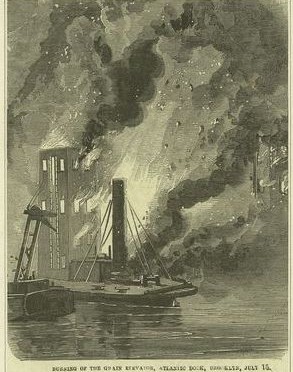
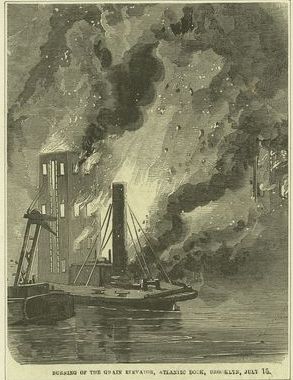
The most dramatic scene in Brooklyn took place before midnight on Wednesday, July 13, with the destruction of two large grain elevators in the Atlantic Basin, in Red Hook. (Pictured at top.)

The Eagle’s reasoning for the blaze demonstrates the reasonless chaos that typified violence in the latter days of the riots. It had nothing to do with racism or with drafts, but rather â€œ[t]he fire was the work of incendiaries, supposed to be grain shovellers who recently had some trouble about a raise on wages, and who have always looked with feelings of animosity on these elevators because they dispensed with a large amount of manual labor.”

The burning elevators, facing into the East River, made a grim bookend to the burning structures across the water in New York. Luckily, within 24 hours, the riots would be calmed throughout the region.

Charming mayor A. Oakey Hall: coy, clueless or corrupt?

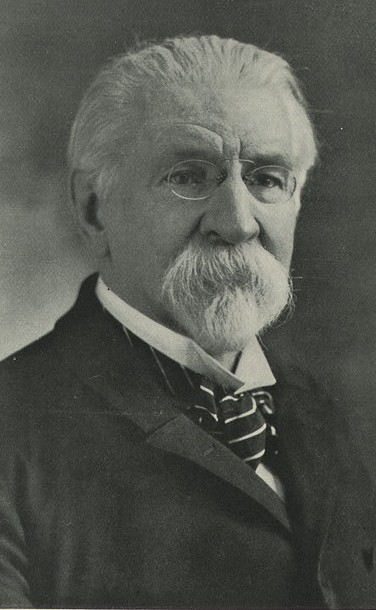
An early portrait of A. Oakey Hall as photographed by Matthew Brady

KNOW YOUR MAYORS Our modest little series about some of the greatest, notorious, most important, even most useless, mayors of New York City. Other entrants in our mayoral survey can be found here.

Mayor A. Oakey Hall

In office: 1869-1872

Few leaders of New York could match Abraham Oakey Hall in personal flair. For every nine colorless businessmen who ascend to the mayoralty, there is one truly debonair statesman, an enigma of charm who seems to govern with ease. In 1869 that was Hall, a jack of all trades, a raconteur and paragon of style. Unfortunately, as the most glamorous member of the notorious Tweed Ring, corruption may have been another trend that suited him.

Before the events, Hall was destined for great things. Most (even Tweed himself) assumed Hall would become New York’s governor, with the White House in sights. He was after all born in Albany, in 1826, back when New York’s capital was one of the most populous cities in the entire country. For those who believed in such things, Hall’s birth there might have been providence, because his parents were merchants in New York and were merely visiting Hall’s grandfather. “I was born transitu,” he proclaimed later. But he never made it back to Albany, at least not officially.

A slight, nimble figure, Hall expressed a variety of talents at an early age, latching on first to journalism, writing for many city newspapers while working his way through New York University, graduating in 1844. Next came a love for the law, attending both Harvard and Cambridge before heading to New Orleans to start a small practice. He then returned to Manhattan and swiftly maneuvered through the courts to become the assistant district attorney in 1850 and a short time later to even argue a case before the state Supreme Court — all before he was 25 years old.

He would win true acclaim and popularity, however, as the city’s district attorney proper, serving first from 1853-1859 and again from 1861-1869, one of New York’s most important legal voices during the Civil War. He allegedly prosecuted over 12,000 cases. He was also on hand during the Draft Riots, funneling many rioters through the court system and straight to jail. His accomplice was often judge John Hoffman, soon to be the mayor of New York who preceded Hall. Their crusades against rioters would boost both their popularity.

Hall would also be known for a rather alarming law briefly on the books in 1855. The state had outlawed the sale of alcohol in the entire state. Under advisement of mayor Fernando Wood (who wanted to please hard-drinking Irish voters), Hall constructed a law allowing for unencumbered liquor sales, seven days a week, in the two months before the prohibition was to take effect. May and June of 1855 were the booziest months in New York City history.


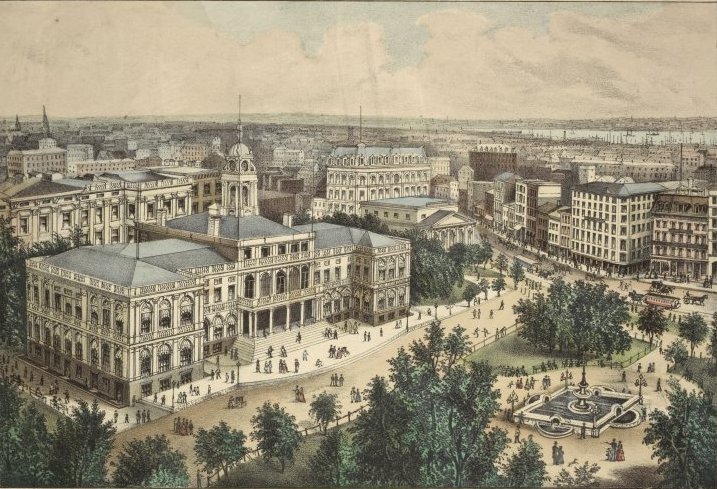
Above: City Hall in 1874 in an illustration by Currier and Ives

With his professorial good looks and humorous demeanor, A. Oakey was a natural for politics of course. Bespeckled and bearded, he spoke elegantly — Elegant Oakey was his nickname after all — and wrote passionately. He penned social polemics, theatrical plays, political tirades and at least one holiday novel — Old Whitey’s Christmas Trot.

More importantly though, he was an attractive politician to Tammany Hall and in particular its boss, William M. Tweed**.

We know the Tweed Ring as that most notorious of crooked entities that came from the Democratic machine. In fact, through, Hall was for many years a Republican — even claiming to have helped form the Republican Party! — and was even elected District Attorney as a member of that party. But he was lured into Tammany Hall shortly before the war ended and would facilitate their dominance over the affairs of City Hall.

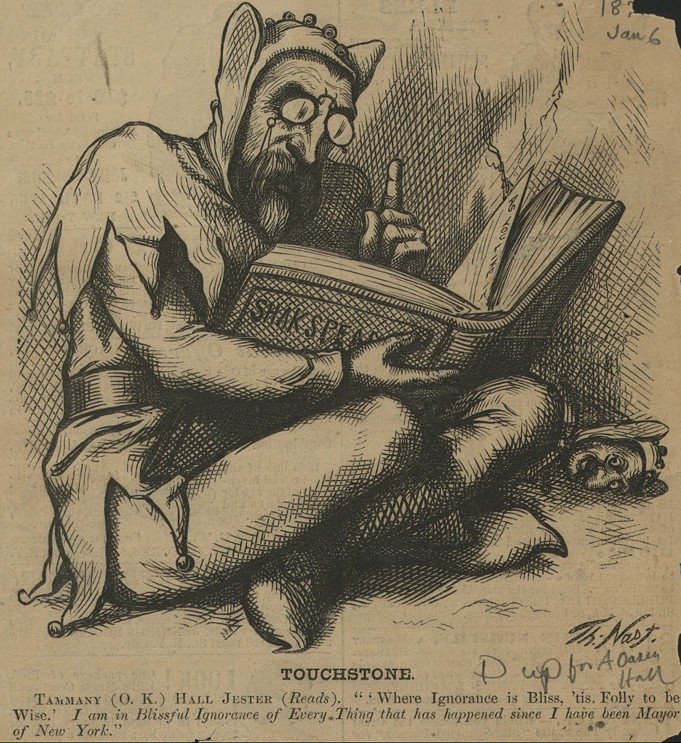
‘Boss’ Tweed liked him because he was confident, likable, distracting. He often quoted Shakespeare and cracked jokes. The complicated layers of graft, bribery and outright theft that were installed in city government needed an attractive front. In one of the most manipulated elections in New York history, Tweed and Tammany Hall succeeded that fall of 1868 in getting their man Hoffman into the governors seat, with Elegant Hall becoming his elegant replacement at City Hall. (Hall would be re-elected three times in heavily tampered elections.)

The year 1869 was a watershed year in New York City corruption, with the Tweed’s hand-selected cohorts fully in place at City Hall, all oversight committees abolished the previous year, and civic projects sprouting up throughout the city, ripe for graft and embezzlement.

Tweed and the others directly associated with the ring (chamberlain Peter Sweeny, comptroller Richard Connelly) needed Hall’s charm to bedazzle the press and public, deflecting any charges of malfeasance.

The level of Hall’s involvement in the city corruption at the time is unclear. He was brought before a grand jury twice, once during the final days of his tenure as mayor. Two trials followed, the first ending in mistrial, the second in acquittal. Despite clear signatures on dozens of suspicious invoices, Hall claim was that he was much too busy running the city to have carefully inspected each and other claim.

Below: Thomas Nast parodies Hall’s statements at being ‘blissfully ignorant’ of corruption

Perhaps so. During his first year in office came a devastating stock market crash, the Black Friday of September 24, 1869, facilitated by Tweed’s chums Jay Gould and Jim Fisk.

As immigrant numbers increased — as tenements like Five Points were swelling to overcrowded — racial and religious disunion threatened the city. Like Tammany, Hall was a friend of the Irish; on St. Patricks Day, he would wear an emerald flytail coat. When Hall suddenly banned the particularly violent protestant Orange parade that year, its participants feared his actions were controlled by Irish Catholics. Governor Hoffman ordered the parade to resume, but the result was an even more violent riot, with 62 people dead and over a hundred injured. Confidence in Hall’s leadership quickly evaporated.

Despite the aura of corruption and mediocrity that hung over his tenure as mayor, Hall actually had a quite colorful life afterwords, working as both a newspaper editor (for the New York World), a London correspondent for the New York Herald and the manager of a theater. He even produced and starred in his own play. For some reason, few went to see it.

He returned to practicing law in his later years in London, famously returning to New York in a court case in 1893 representing Emma Goldman. Despite the convergence and press coverage of these two great New York figures, Goldman and Hall lost the case.

Hall died on October 7, 1898, at his home at 68 Washington Square South, just blocks from where he first went to college. The picture above was taken the year of his death (pic courtesy NYPL)

**Wanna know more about Boss Tweed and the Tweed Ring? Tune in on Friday!

Categories
Podcasts

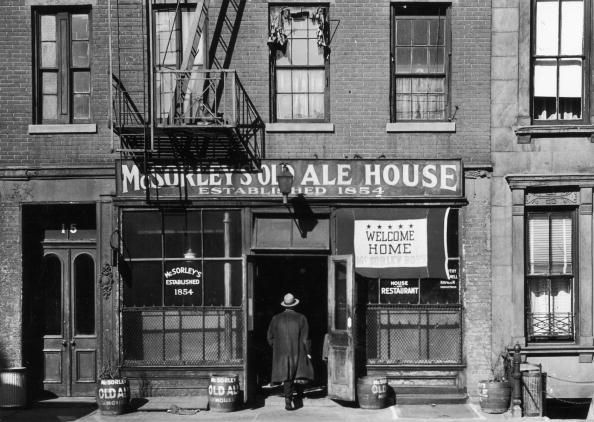
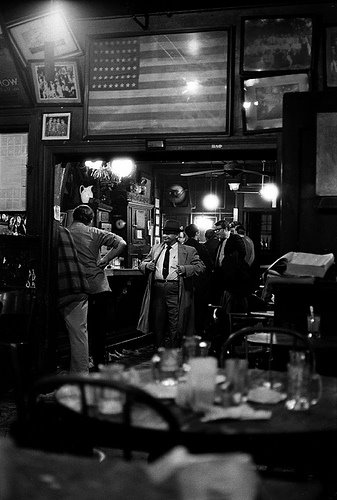
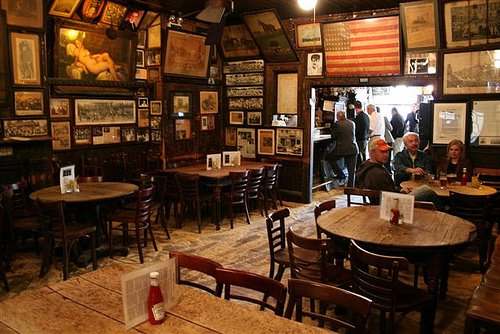
PODCAST: McSorley’s Old Ale House

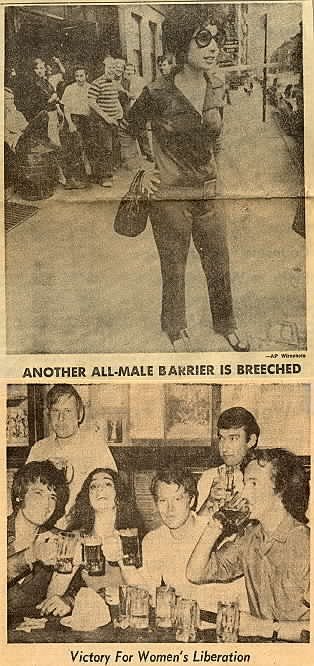
Grab yourself a couple mugs of dark ale and learn about the history of one of New York City’s oldest bars, serving everyone from Abraham Lincoln to John Lennon — and eventually even women!

Listen to it for free on iTunes or other podcasting services. Or you can download or listen to it HERE

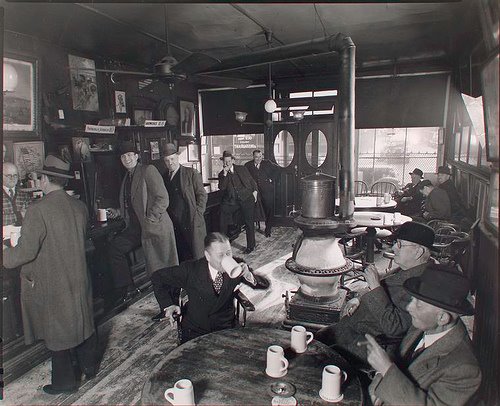
McSorley’s through the ages. Here’s one from 1937:

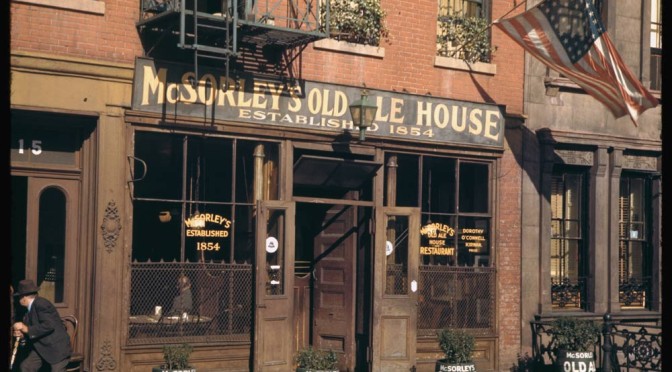
The outside from 1945

1969:

1998:

And McSorley’s today

The backroom:

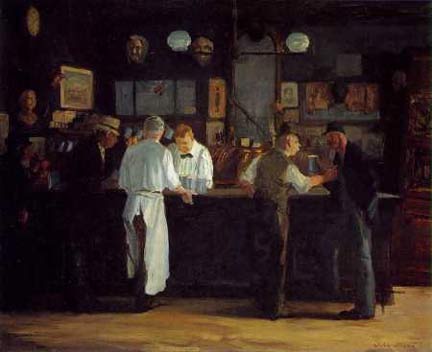
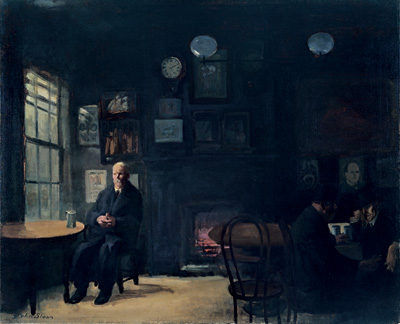
Two of John Sloan’s most famous works, with McSorley’s as its subject:

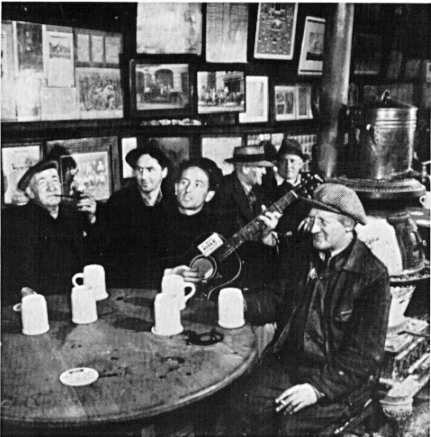
Woody Guthrie hams it up by the coal burning stove.

Women win the right to vote: dark ale or light ale!