Categories
Queens History

In 1895 a deadly tornado hit Queens, and the ruins became a tourist attraction

The destructive force of tornado season has made itself abundantly evident in the Midwest this week, and New Yorkers can sometimes develop a false sense of security by the rarity of twister activity here.

But tornados do occasionally make their way to the five boroughs.

2007 tornado in Brooklyn and Staten Island caused widespread damage of the kind that states like Missouri and Oklahoma (along the so-called ‘tornado alley’) experience almost yearly. The Bronx even saw a tornado back in 1974further bedeviling the residents in a troubling year.

But all of these pale in comparison to the terrifying storm which hit the area in the summer of 1895, nearly decimating a neighborhood in Queens.
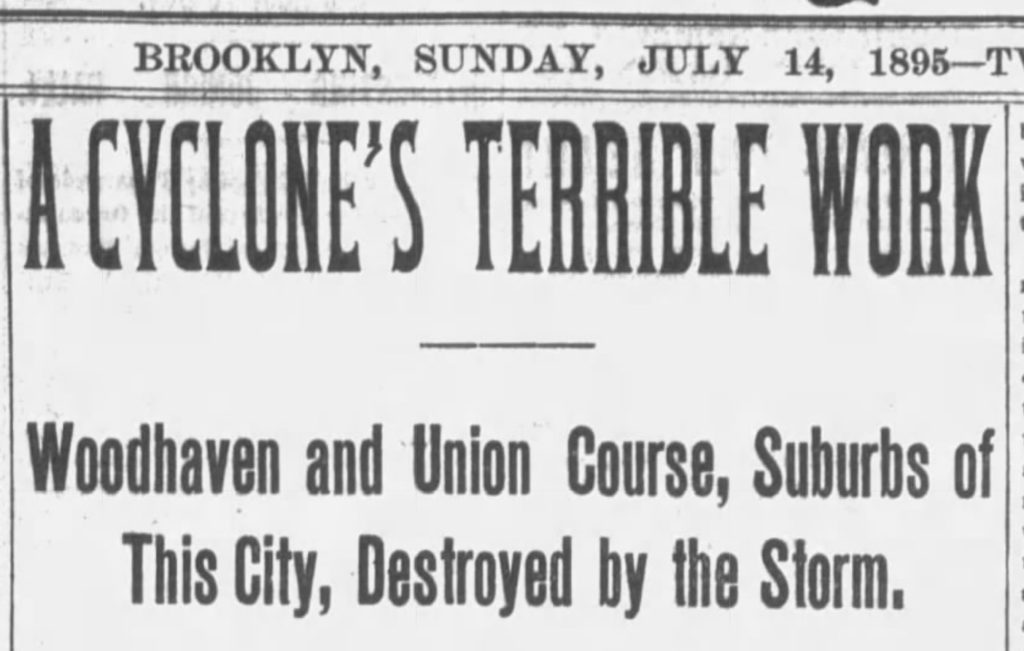
Brooklyn Citizen, July 14, 1895 — BROOKLYN ESCAPED AS BY A MIRACLE
New York Public Library

On the afternoon of July 13, 1895, a horrendous tornado — a “hellish wind” — ripped apart the New Jersey town of Cherry Hill (pictured below). A New York Times reported that “nearly every building in the place bears evidence of the force of its power.” Some claim the village’s name became so associated with that destructive storm that it later had to change its name to North Hackensack.
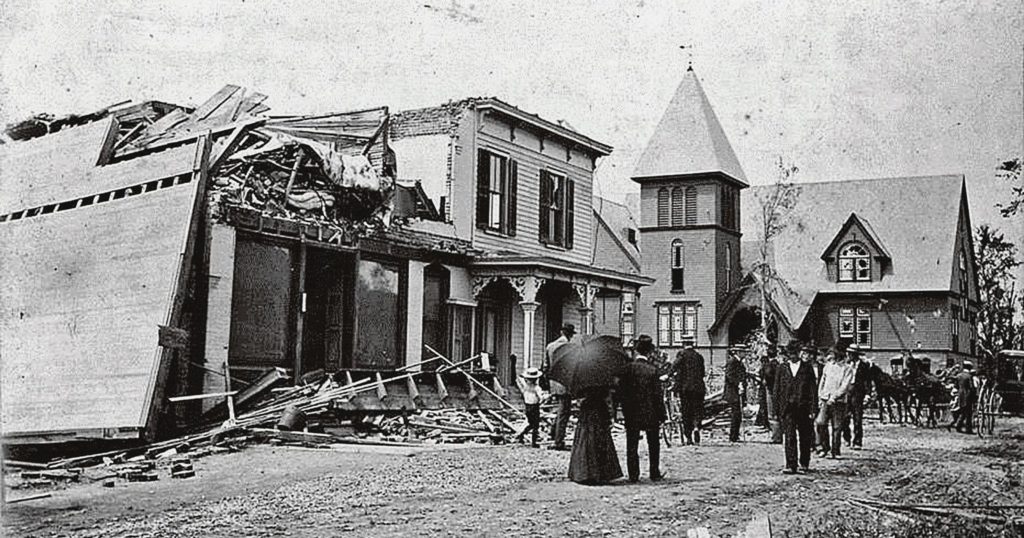
Courtesy the Bergen County Historical Society

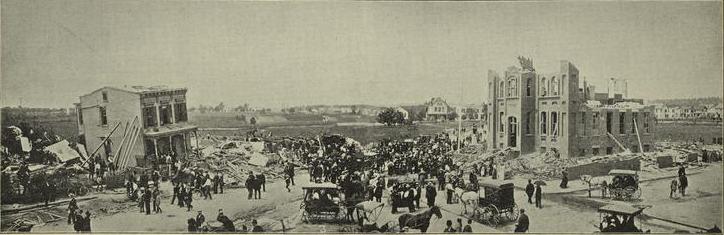
That same storm swept into New York, whipping through Manhattan via Harlem, leaping across the East River and striking the village of Woodhaven.

The rather unusual reaction of New Yorkers to this storm caught my attention, as reported by the New York Sun: “Yesterday was another eventful day in the history of Woodhaven, Long Island. The tornado on Saturday that killed one, wounded forty, demolished fifteen houses and partially wrecked thirty more, was followed by the largest crowd of sightseers that ever collected in town limits.”

The paragraph ends, “Altogether it was a great day in the town.”
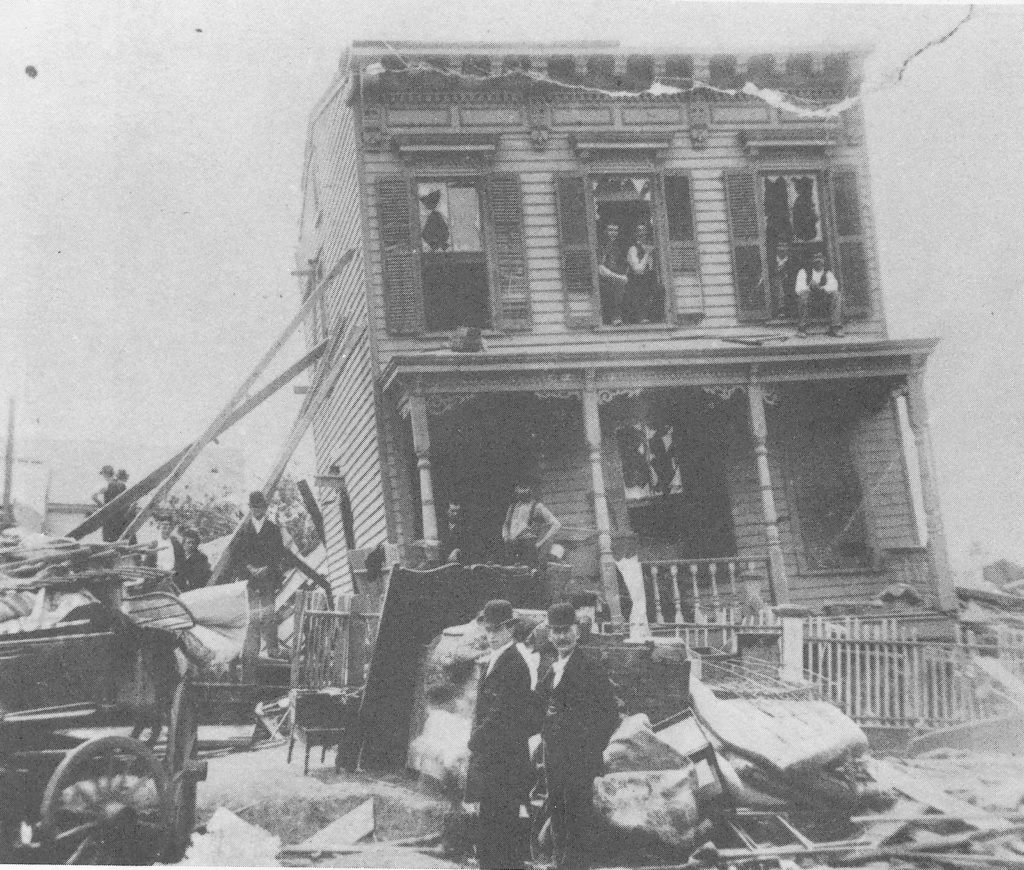
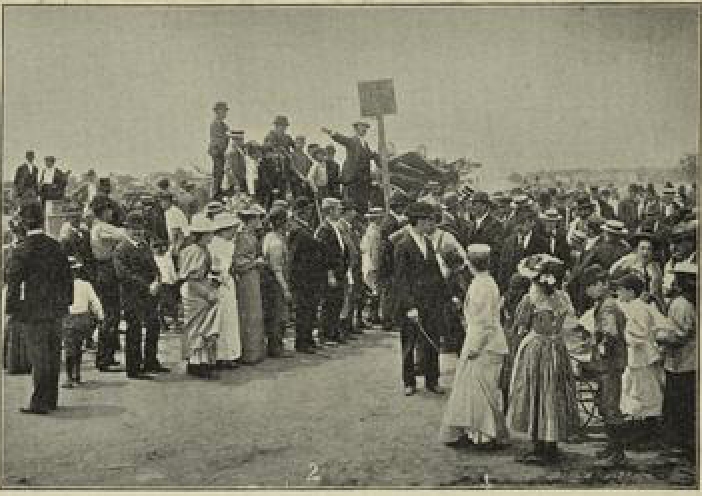
Throngs of locals from New York and Brooklyn took the newly constructed elevated railroads into Queens to witness the carnage, to help out the victims or, in very isolated cases, snag a souvenir of this rare event.

The Sun reports that over 100,000 people visited the site over the next day, and while most were there to assist those in need — a genuine outpouring — still others came merely to witness the pandemonium.

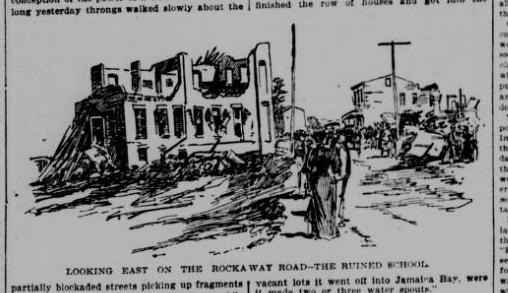
Below: an illustration on the schoolhouse, from the New York Tribune:
For those lucky to own Woodhaven’s saloons — and there were many, the village being near the former Union Course racetrack — the vicious tragedy drew bewildered drinkers. “The saloons that were not wrecked were open. Some of those that were wrecked had beer on tap, and the crowd drank as fast as the spigots could be put in the kegs. Nobody went thirsty.” [Sun]

The tornado tore up pieces of the village and redistributed them at random. One man had four roofs in his backyard; cows and chickens were deposited into new homes. The Sun reports the bodies of dozens of chickens, plucked of their feathers by the winds.
New York Public Library

This being the days before FEMA and decent insurance plans, many families were left to beg.

Many of the gawkers and sightseers began pulling money from their wallets. An enterprising lawyer took an empty beer keg and asked people to fill it with money for the needy. Soon volunteers carried signs saying “Help fill the barrel!” The throngs were directed past the money barrel as a man cried, “You’ve spent your lives emptying kegs. Fill this one!”

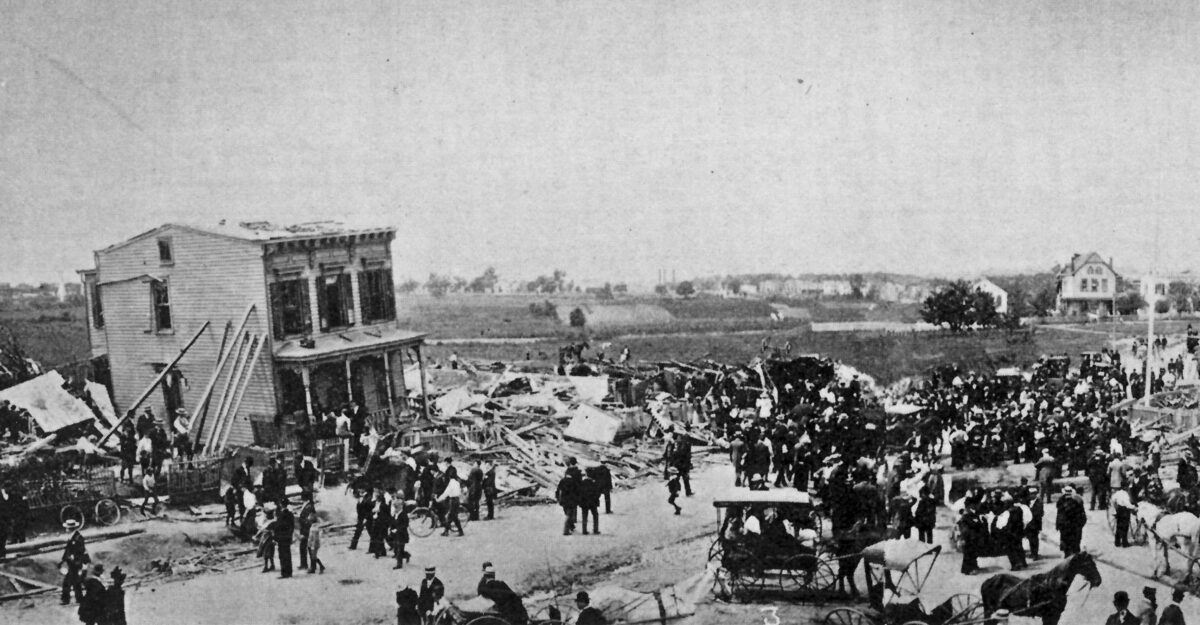
Below: the scene at Rockaway Boulevard at 83rd Street
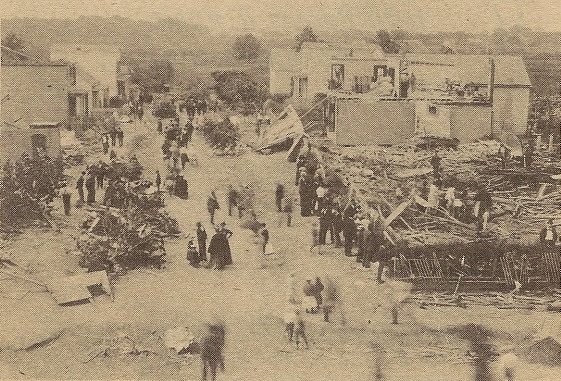
Courtesy Project Woodhaven

The scene took on the feel of a macabre carnival, with gory recounts of the storm and cries from virtual carnies driving more people to arrive and donate. “In the keg! In the keg! In the k-e-g!”

Soon there were many empty kegs (and boxes and bags) distributed throughout the wreckage, gathering funds for the homeless and wounded.

From my experience with late 19th century New Yorkers, I’m going to take a wild guess and say that not all that money ended up in the proper hands. But for the most part, it seems, it was an overflow of generosity and charity that day.

As the sun set upon the ruins of Woodhaven, the money was compiled at the schoolhouse — pictured below, its roof gone and walls torn away — while “perhaps 5,000 people” gathered outside.
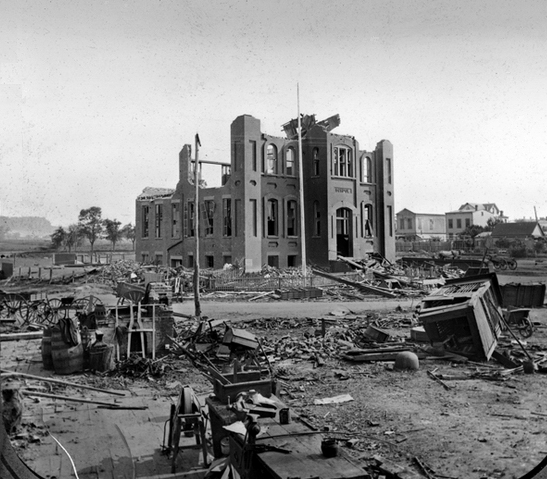
Courtesy Woodhaven Cultural and Historical Society

In the end, two people from Queens died during that storm — a pregnant 17 year old struck by a beam and a five-year-old boy. (Actually, the Times reports the boy lived; the Sun says he died. Such was the way of New York newspapers in 1895.)

One rather remarkable story of survival soon emerged — the ten-year-old daughter of the village milkman was walking her cow back to the barn when the tornado picked up both her, the cow and the barn. The barn was torn to splinters and the cow thrown into Jamaica Bay. The girl, thankfully, was deposited into an onion patch, only slightly bruised. [From the New York Tribune]

Let that be a reminder of the days when Queens had barns, cows, milkmen, milkmen’s daughters — and deadly tornados!
Categories
Planes Trains and Automobiles

New York City’s “stripped and abandoned” car crisis

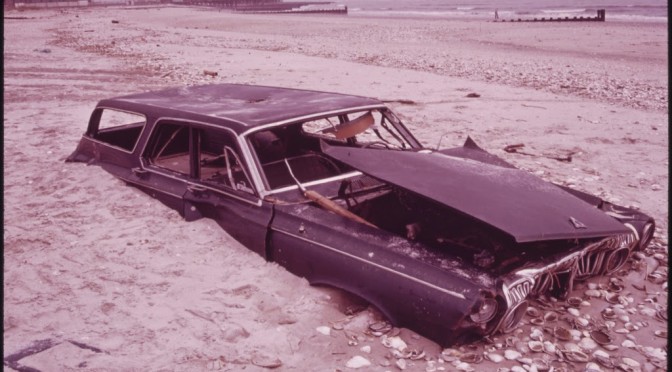
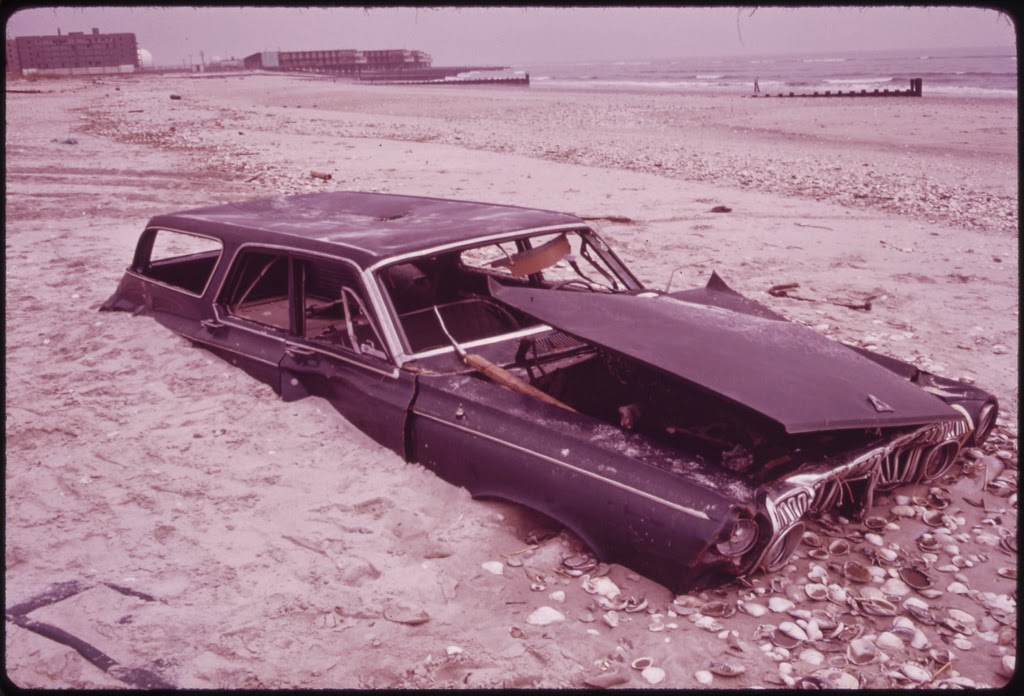
The fate of an automobile at Breezy Point, 1973 (Courtesy US National Archives)

The abandoned car, that most dramatic symbol of urban blight, is a sight that has pretty much vanished from most New York City streets. (Most, not all.)

In a city refitted for the automobile by the mid 20th century, people just began leaving their cars everywhere, either vandalized beyond repair or too expensive to tow when their vehicles became unusable. These husks of metal were scavenged for parts, then left to rust, the city’s sanitation crews unable to keep pace of the growing problem.

I recently found an intriguing article in New York Magazine from 45 years ago, titled “Stripped and Abandoned,” outlining the causes of the city’s sudden population of vehicular remains:

“Last year, by Department of Sanitation records, 31,578 cars were abandoned in New York City. Some were wrecks; some were stolen, then stripped; some were involved … in minor highway mishaps which caused their owners to leave them — to expert instant strippers, who evidently abound.”

By 1969, the problem had grown so unwieldy that the city hired third-party contractors to take care of most of it, but its budget for such removal would only shrink as the city entered the hard-knock 1970s.

Within a few years, the city would not even bother to remove such blight from certain neighborhoods.

“At any one time,” wrote author Fred Ferretti in 1969, “there are about 2,000 cars strewn about the highways and local streets.”

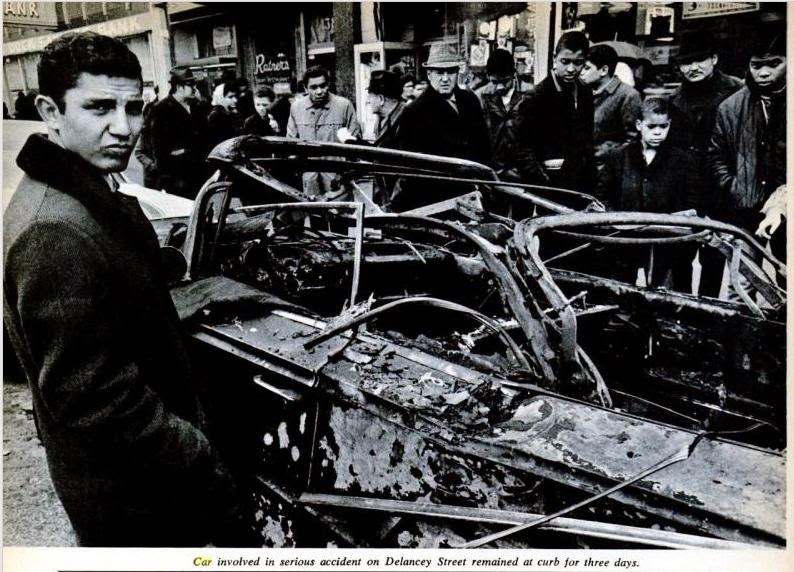
Below: From the New York Magazine article, the fate of a vehicle in Clinton Hill, Brooklyn, and on Delancey Street in the Lower East Side (photos by Robert D’Alessandro):

In 1970, standing in stark contrast to a city of polluted, automotive remains, one artist at the very first Earth Day celebration in Union Square attempted to address the problem.  A crushed sedan sat alongside the environmental merriment with a sign: “57,742 Cars Removed in 1969; 21,635 Removed in 1970, as of April 21.”  The New York Times would later note a total of 72,961 abandoned cars in 1970. [source] [source]

They weren’t just eye sores. What wasn’t pilfered or siphoned out was left to rot in the elements, leaking oil, attracting vermin.

New York City was only one problem spot within a new American crisis, with millions and millions of cars across the country already overfilling scrap yards. Here, however, it was a harbinger of hard times on the way.

“Everywhere you look, there are abandoned cars, stripped and junked,” said one resident of Brownsville, Brooklyn, returning to his deteriorating neighborhood in 1970.

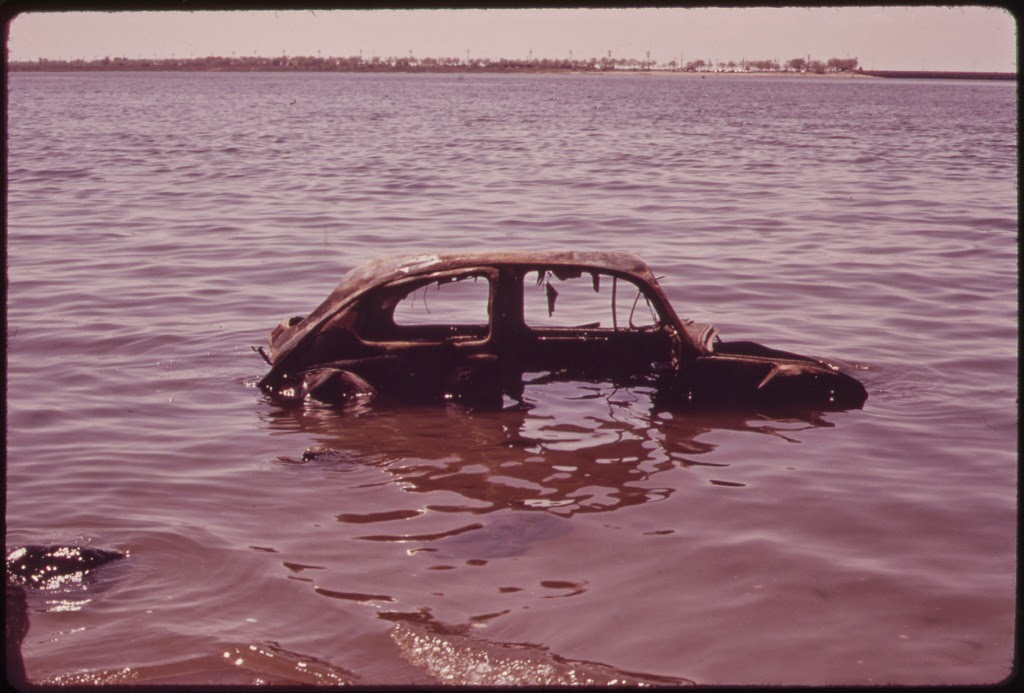
A car almost completed ingested by Jamaica Bay, 1973  (Courtesy US National Archives)

Abandoned vehicles became the New York Sanitation Department’s biggest issue in the 1970s, although by the new decade, there was some improvement. According to a New York Times article from 1981:

“Total abandoned-car collections declined from more than 79,000 in 1978 to 33,112 last year and to 14,900 in the first half of this year, officials said. Robert Hennelly, chief of cleaning operations, said he thought the drop was ”perhaps because the cost of cars has gotten so high that people are holding on to them longer.”

Some cynically still considered the abandoned vehicle to be a recognizable mark of New York City, even in the 1980s, a sort of native animal.

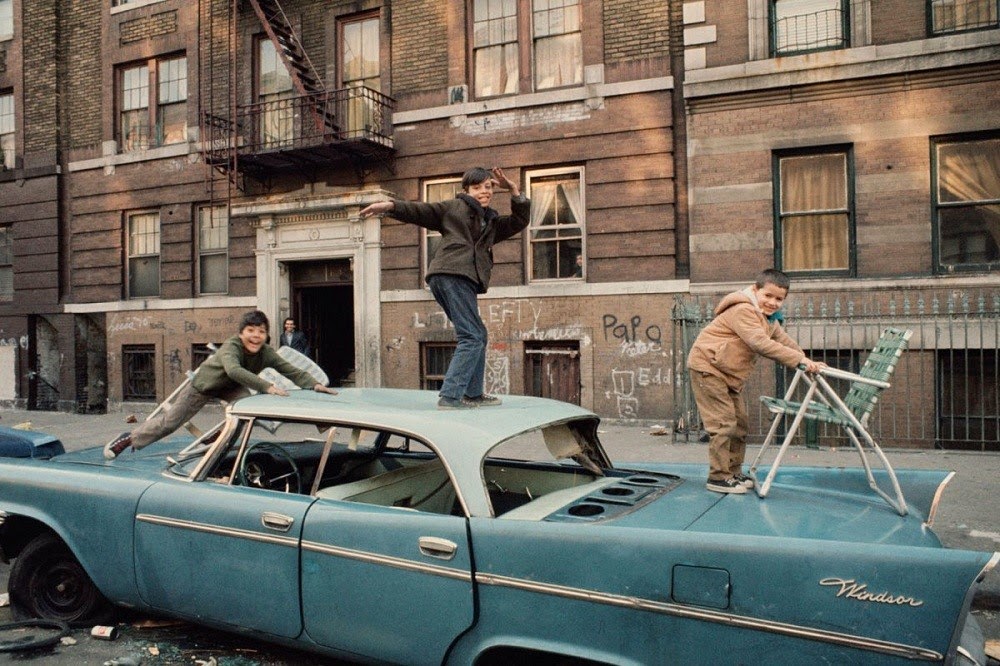
Not that an abandoned car couldn’t have some useful purpose, as this picture by Camily Jose Vergara illustrates. (Click here for more of his terrific photography)

With the general infrastructural improvement of the city during the 1990s, the beast had receded somewhat from view in most neighborhoods.

There are still abandoned cars galore — here’s the city’s current policy for reporting derelict vehicles — but few are so unscrupulously picked clean or left to decay into a rusty shell.

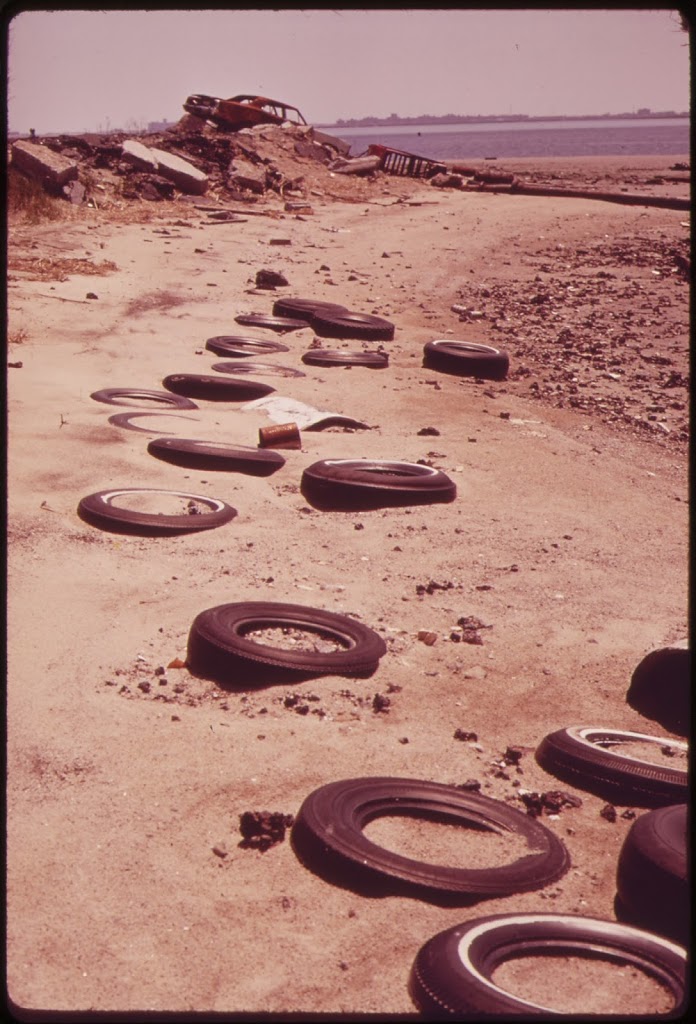
Below: As with the others above, Jamaica Bay 1973, near JFK Airport (US National Archives)

The other Draft Riots: Brooklyn infernos, Queens bonfires

You probably know something about the Civil War draft riots that kept New York paralyzed during the week of July 13, 1863. But New York only meant Manhattan back then. What about the rest of the future boroughs?

The conscription act initiated draft lotteries throughout the area as, by 1863, the Union struggled to fill its quota of volunteers. Many thought the state of New York had contributed enough; hundreds were already dead after two years of bleak and depressing battle.

Then there was that troublesome little exemption clause. Those chosen in the ‘wheel of misfortune’ could either find a substitute or pay a $300 commutation fee. According to the Inflation Calculator, that’s about $5,250.00 today. Look at your bank account. Could you afford to pay that?

People revolted violently when the drafts were held in New York on July 13. There were also seismic reactions in the surrounding counties as well, chain reactions of the anger quelling in New York. In the surrounding regions, local law enforcement were often better prepared to handle disruptions amongst their less concentrated populations. Even still, the horror of New York’s draft riots did spread.

The homes of many black residents on Staten Island were torched. According to historian Richard Bayles, “From its proximity to New York City this county could not help but feel every pulsation of popular emotion that disturbed the bosom of the city.” Mobs attacked black shopowners in Factoryville, surrounded a black church in Stapleton and threatened parishioners inside, and burned down a railroad station owned by Republican and Union supporter Cornelius Vanderbilt.

Residents from the village of Astoria and the farmlands of Sunnyside and Ravenswood could see New York burning across the water. But Queens County caught the loathsome riot fever when the draft commenced in nearby Jamaica, on July 14. Riled crowds gathered at dusk and nearly torched the village but for the intervention of a few Democratic community leaders.

The draft office in Jamaica was eventually destroyed and number of buildings filled with government property were vandalized. Rioters stormed one building and stole piles of garments intended for the battlefield. According to an 1882 history of Queens County, it was an apparel Armageddon, the rioters “taking out some boxes of clothing which they broke open, piled in heaps and set on fire. The largest pile, which they derisively called ‘Mount Vesuvius’ was about ten feet high.”

In Westchester County, towns along the Bronx River reacted similarly to their own draft lotteries, with rioters in Morrisania and West Farms destroying telegraph offices and yanking railroad ties from the ground. However, other local towns, like Yonkers, were successfully insulated from violence, due to better living conditions and the entreaties of an especially popular local leader, the Rev. Edward Lynch. A mass gathering on July 15th in the village of Tremont eventually snuffed out violence in the region.

Although it was one of the country’s largest metropolises, the independent city of Brooklyn never saw the intensity of violence that New York did. Indeed, some black New Yorkers escaping violence in the city fled to the countryside in Kings County, to places like Weeksville. However the county did see a good share of bloodshed and destruction, particularly in the Eastern District (the areas of Williamsburg and Greenpoint).

The Brooklyn Eagle, solidly Democratic and in quiet support of the anti-draft agitators, had this to say in a July 16th article, “We could fill columns of the Eagle with exciting stories of anti-negro demonstrations, threatened outbreaks, etc.. So far no disturbance has occurred in Brooklyn which two or three policemen could not surprise [sic]. There has been nothing like any attempt to get up a mob, or create a riot.”

This is preposterous, but even through the Eagle’s glossy lens, it’s apparent that violence never fomented to the degree that it did in New York. This, of course, would be of cold comfort to the dozens of black Brooklynites who did have to flee their homes and businesses that week.

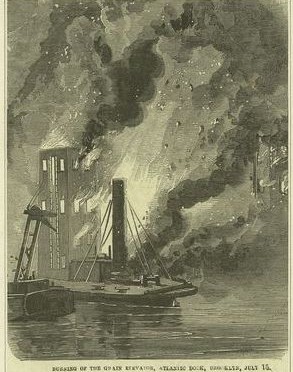
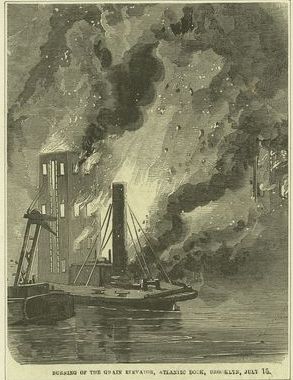
The most dramatic scene in Brooklyn took place before midnight on Wednesday, July 13, with the destruction of two large grain elevators in the Atlantic Basin, in Red Hook. (Pictured at top.)

The Eagle’s reasoning for the blaze demonstrates the reasonless chaos that typified violence in the latter days of the riots. It had nothing to do with racism or with drafts, but rather â€œ[t]he fire was the work of incendiaries, supposed to be grain shovellers who recently had some trouble about a raise on wages, and who have always looked with feelings of animosity on these elevators because they dispensed with a large amount of manual labor.”

The burning elevators, facing into the East River, made a grim bookend to the burning structures across the water in New York. Luckily, within 24 hours, the riots would be calmed throughout the region.

Robert Moses’ ridiculously large parking lot

Photo:Claudio Papapietro for http://ontheinside.info

Starting Monday, May 12, New Yorkers will have another way to transport themselves between boroughs with a new ferry service shuttling between Queens, Brooklyn and Manhattan.

You’re probably familiar with at least one of its three stops: Pier 11’s sleek Wall Street Ferry Terminal, just a few steps away from Staten Island Ferry Terminal and the Battery Maritime Building. Between Queens and Manhattan it will pick up Brooklyn passengers at the Brooklyn Army Terminal in Sunset Park, already one port of the New York Water Taxi.

The new ferry will begin by loading up Queens commuters at Riis Landing in Far Rockaway, Queens.

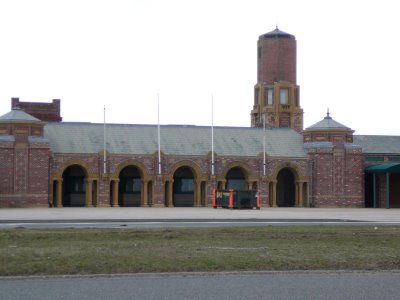
As a part of the Gateway National Recreation Area in the most remote area of Queens (if not arguably the whole city), Riis Landing is best known for its Colonial style Coast Guard station, built in 1937. It sits in the middle of Breezy Point peninsula, a residential area once dotted with shipwreck rescue stations. Now owned by the National Park Service, the ferry terminal was recently upgraded in anticipation of the mayor’s announcement; however it’s still surrounded by many unused buildings.

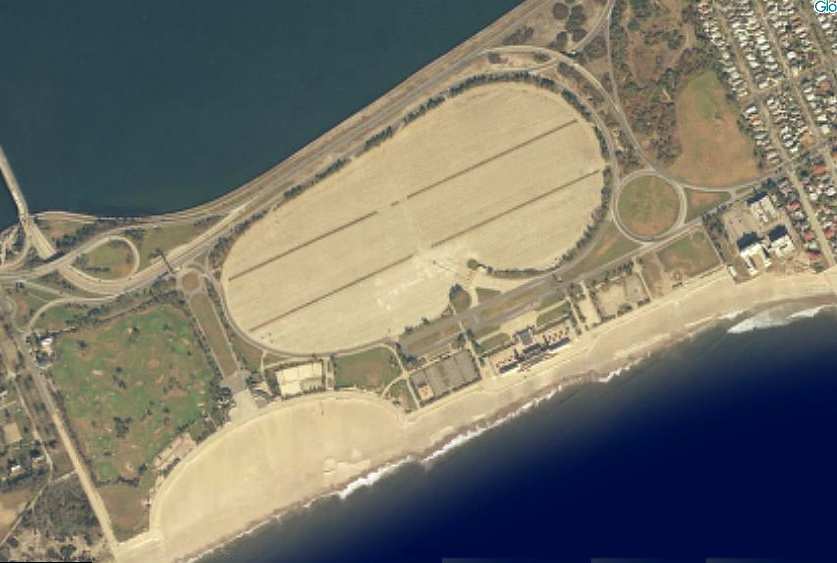
More important to many New Yorkers, it’s also close to Jacob Riis beach, a hidden treasure of the Breezy Point peninsula and often referred to as ‘the people’s beach’. Riis Beach is a relic of the Robert Moses era, who created the beachfront in the 1930s by destroying a historic World War I Naval Air station (liftoff point of the very first transatlantic flight in 1919) and intending the artificial getaway specifically for locals with cars, an alternative to Jones Beach.

To that end, in addition to constructing public beach and park space, he also commissioned a gigantic parking lot, at the time the largest parking lot in the world. Many sources call it a 5,000-car lot; Riis Landing’s own site claims room for 9,000 cars!

Here’s an aerial view. Beautiful, is it not?

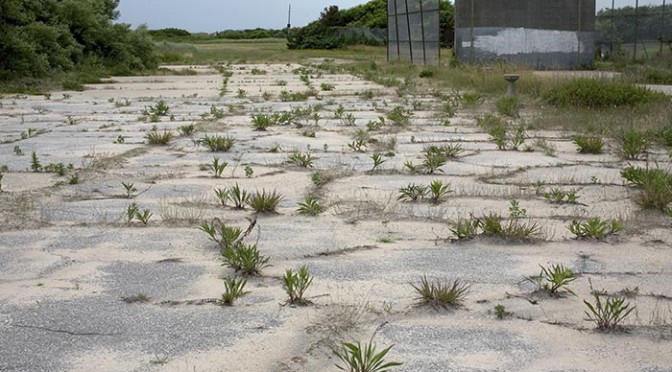
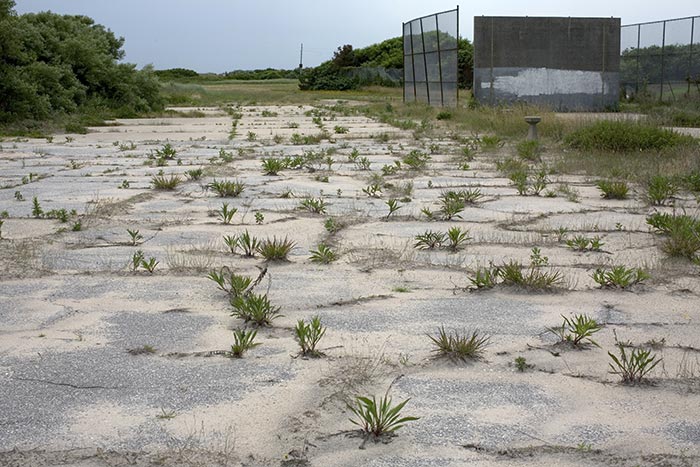
While the, er, rustic Jacob Riis beach is popular in the summer months mostly with locals, that parking lot is never, ever full. The new ferry service which begins here will presumably put that abandoned slab of pavement to better use.

With new attention now being brought to the area, now maybe they can fix up the beach, which features a gem of an art-deco bathhouse.

Riis Landing’s official website is an outstanding layout of proposed improvements of the area, many interesting, a couple downright left-field. (Their recommended proposal is to develop a dorm-style budget hostel!)