Categories
Queens History

In 1895 a deadly tornado hit Queens, and the ruins became a tourist attraction

The destructive force of tornado season has made itself abundantly evident in the Midwest this week, and New Yorkers can sometimes develop a false sense of security by the rarity of twister activity here.

But tornados do occasionally make their way to the five boroughs.

2007 tornado in Brooklyn and Staten Island caused widespread damage of the kind that states like Missouri and Oklahoma (along the so-called ‘tornado alley’) experience almost yearly. The Bronx even saw a tornado back in 1974further bedeviling the residents in a troubling year.

But all of these pale in comparison to the terrifying storm which hit the area in the summer of 1895, nearly decimating a neighborhood in Queens.
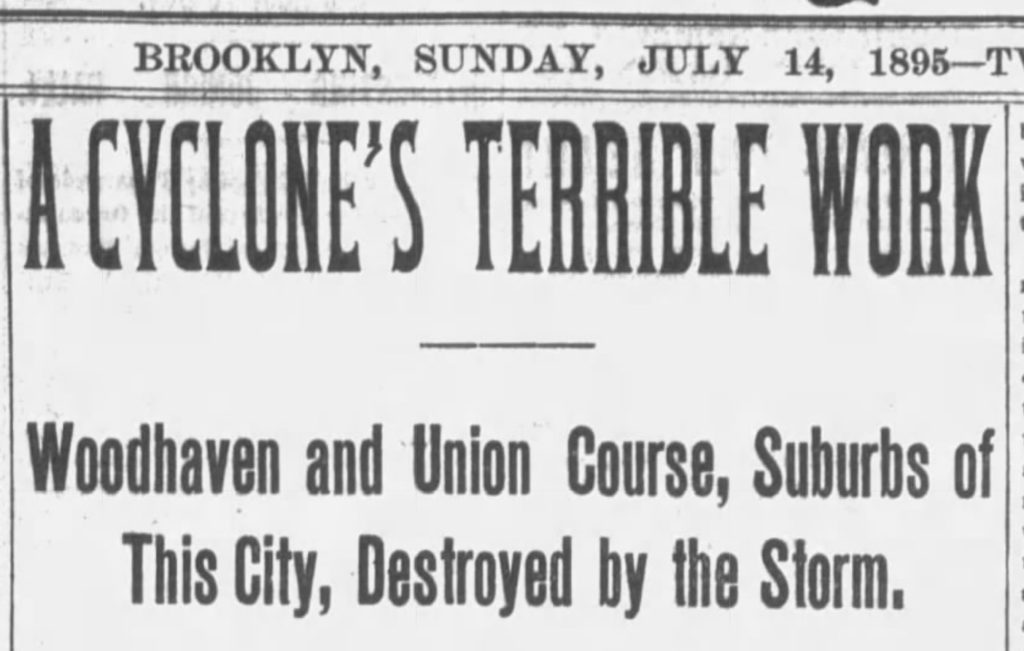
Brooklyn Citizen, July 14, 1895 — BROOKLYN ESCAPED AS BY A MIRACLE
New York Public Library

On the afternoon of July 13, 1895, a horrendous tornado — a “hellish wind” — ripped apart the New Jersey town of Cherry Hill (pictured below). A New York Times reported that “nearly every building in the place bears evidence of the force of its power.” Some claim the village’s name became so associated with that destructive storm that it later had to change its name to North Hackensack.
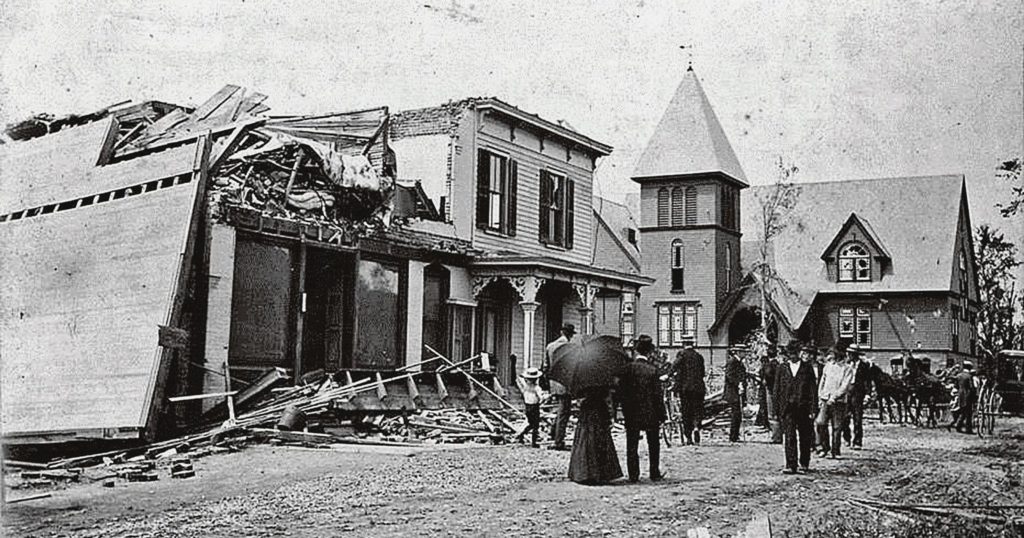
Courtesy the Bergen County Historical Society

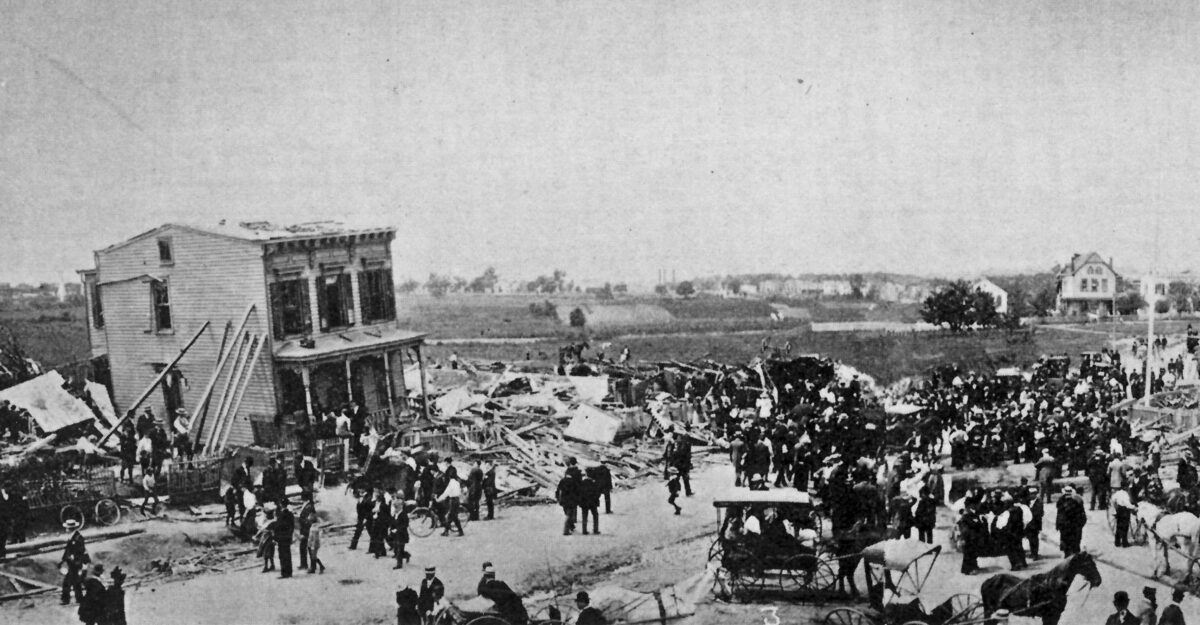
That same storm swept into New York, whipping through Manhattan via Harlem, leaping across the East River and striking the village of Woodhaven.

The rather unusual reaction of New Yorkers to this storm caught my attention, as reported by the New York Sun: “Yesterday was another eventful day in the history of Woodhaven, Long Island. The tornado on Saturday that killed one, wounded forty, demolished fifteen houses and partially wrecked thirty more, was followed by the largest crowd of sightseers that ever collected in town limits.”

The paragraph ends, “Altogether it was a great day in the town.”
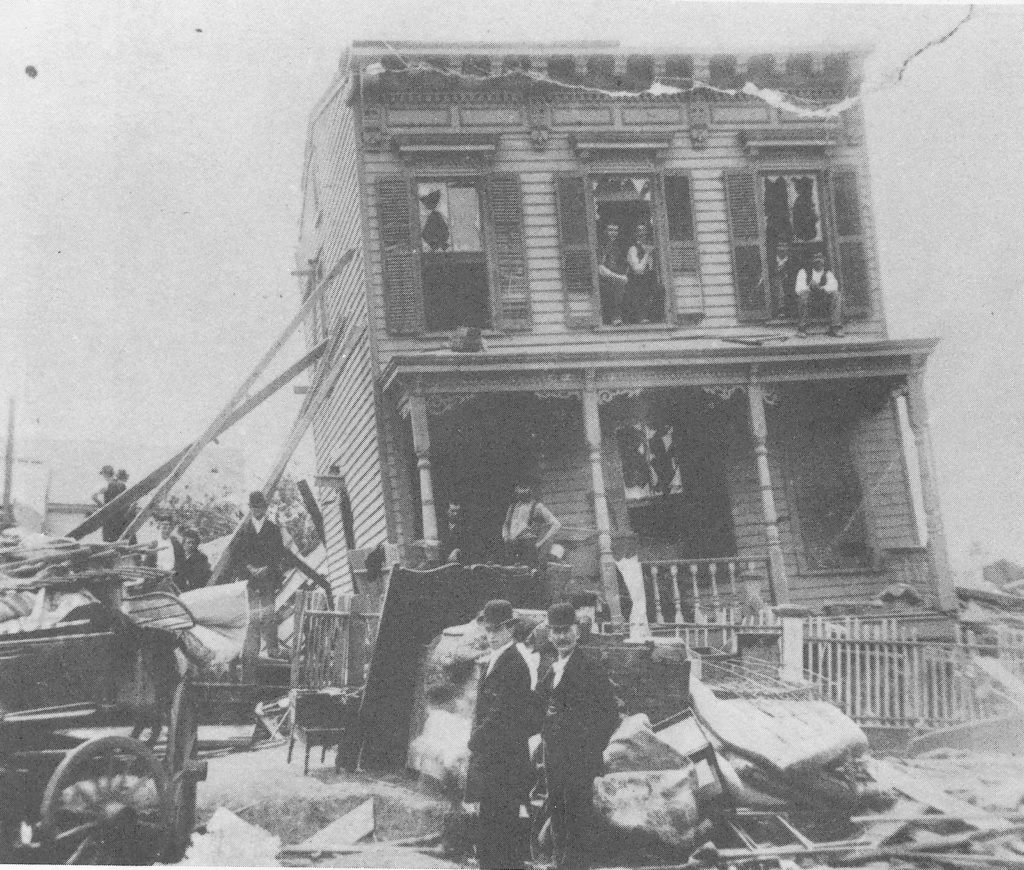
Throngs of locals from New York and Brooklyn took the newly constructed elevated railroads into Queens to witness the carnage, to help out the victims or, in very isolated cases, snag a souvenir of this rare event.

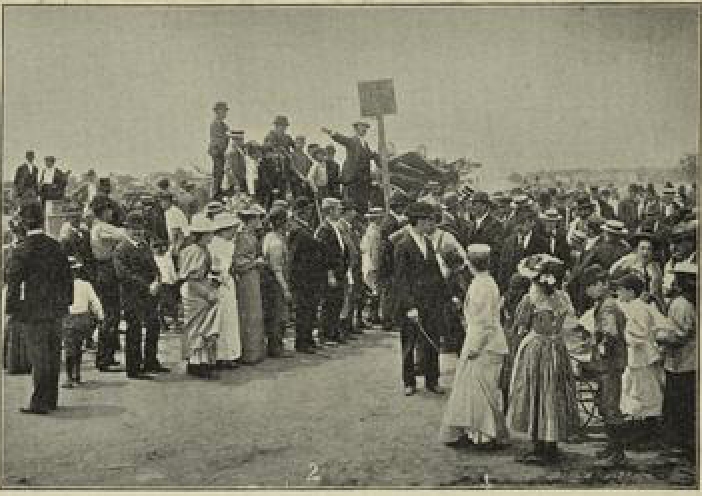
The Sun reports that over 100,000 people visited the site over the next day, and while most were there to assist those in need — a genuine outpouring — still others came merely to witness the pandemonium.

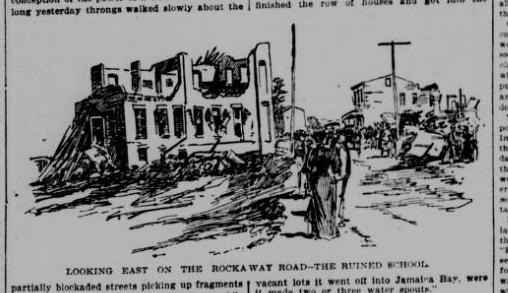
Below: an illustration on the schoolhouse, from the New York Tribune:
For those lucky to own Woodhaven’s saloons — and there were many, the village being near the former Union Course racetrack — the vicious tragedy drew bewildered drinkers. “The saloons that were not wrecked were open. Some of those that were wrecked had beer on tap, and the crowd drank as fast as the spigots could be put in the kegs. Nobody went thirsty.” [Sun]

The tornado tore up pieces of the village and redistributed them at random. One man had four roofs in his backyard; cows and chickens were deposited into new homes. The Sun reports the bodies of dozens of chickens, plucked of their feathers by the winds.
New York Public Library

This being the days before FEMA and decent insurance plans, many families were left to beg.

Many of the gawkers and sightseers began pulling money from their wallets. An enterprising lawyer took an empty beer keg and asked people to fill it with money for the needy. Soon volunteers carried signs saying “Help fill the barrel!” The throngs were directed past the money barrel as a man cried, “You’ve spent your lives emptying kegs. Fill this one!”

Below: the scene at Rockaway Boulevard at 83rd Street
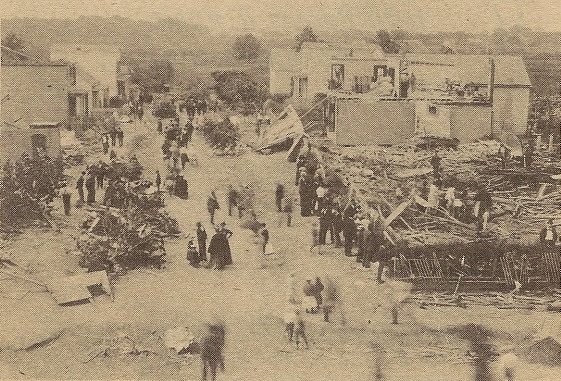
Courtesy Project Woodhaven

The scene took on the feel of a macabre carnival, with gory recounts of the storm and cries from virtual carnies driving more people to arrive and donate. “In the keg! In the keg! In the k-e-g!”

Soon there were many empty kegs (and boxes and bags) distributed throughout the wreckage, gathering funds for the homeless and wounded.

From my experience with late 19th century New Yorkers, I’m going to take a wild guess and say that not all that money ended up in the proper hands. But for the most part, it seems, it was an overflow of generosity and charity that day.

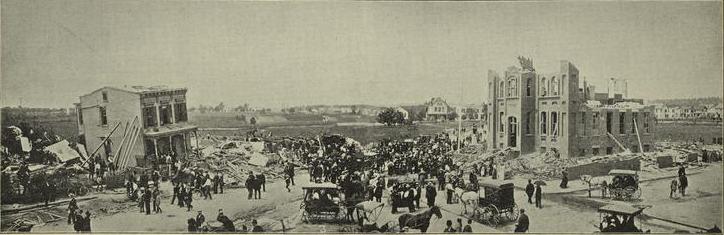
As the sun set upon the ruins of Woodhaven, the money was compiled at the schoolhouse — pictured below, its roof gone and walls torn away — while “perhaps 5,000 people” gathered outside.
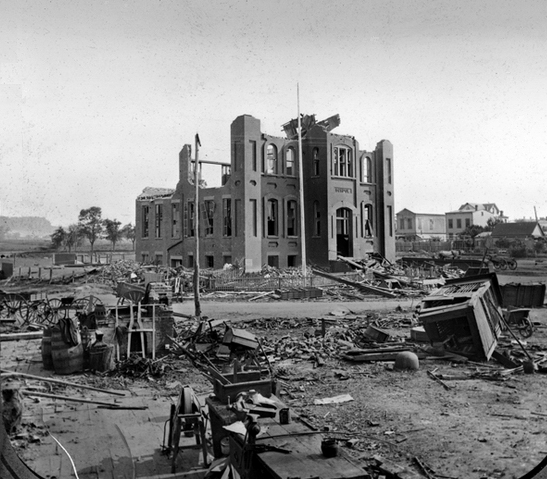
Courtesy Woodhaven Cultural and Historical Society

In the end, two people from Queens died during that storm — a pregnant 17 year old struck by a beam and a five-year-old boy. (Actually, the Times reports the boy lived; the Sun says he died. Such was the way of New York newspapers in 1895.)

One rather remarkable story of survival soon emerged — the ten-year-old daughter of the village milkman was walking her cow back to the barn when the tornado picked up both her, the cow and the barn. The barn was torn to splinters and the cow thrown into Jamaica Bay. The girl, thankfully, was deposited into an onion patch, only slightly bruised. [From the New York Tribune]

Let that be a reminder of the days when Queens had barns, cows, milkmen, milkmen’s daughters — and deadly tornados!
Categories
Know Your Mayors Politics and Protest Queens History

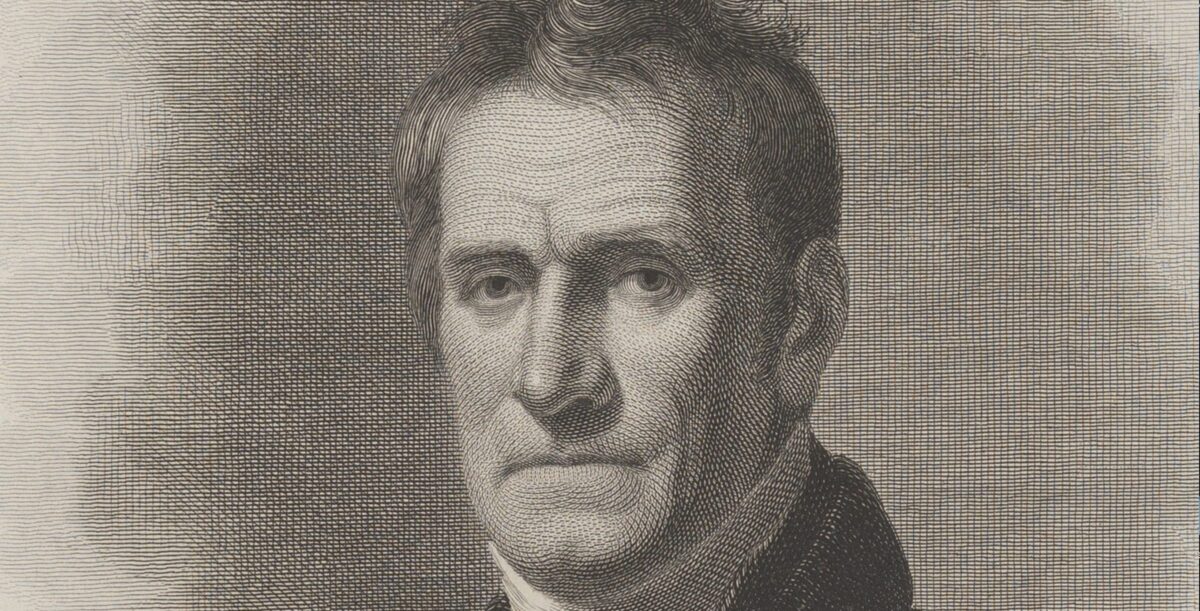
Mayor Cadwallader D. Colden: Leading the city over 200 years ago

We’re just months away from a new mayor in New York City so we think it is time that you Know Your Mayors! Become familiar with other men who’ve held the job, from the ultra-powerful to the political puppets, the most effective to the most useless leaders in New York City history.

This longtime feature of this website is being rebooted with new articles and newly researched and refreshed earlier entries in this series. Check back every other week for a new installment. Read past articles here.

Cadwallader D. Colden
Terms: 1818-1821

The most remarkable thing about New York City having a mayor named Cadwallader Colden is the fact that he was not even the most famous New Yorker named Cadwallader Colden.

That distinction goes to his grandfather, an altogether different Cadwallader Colden than his grandson and a rather fascinating Renaissance man.

Well, despite the fact that he was also pro-British, stridently hated among the American rebels and the type of man that would have thrown most of us in jail on sight.

Grandpa Colden

Ole Cadwallader was an Irish physician who came to the American colonies in 1710 (at age 22) to practice medicine.

Establishing his practice in Philadelphia, he later came to New York and in 1743 wrote a now seemingly obvious treatise drawing a connection between New York’s unsanitary conditions and its frequent outbreaks of yellow fever.

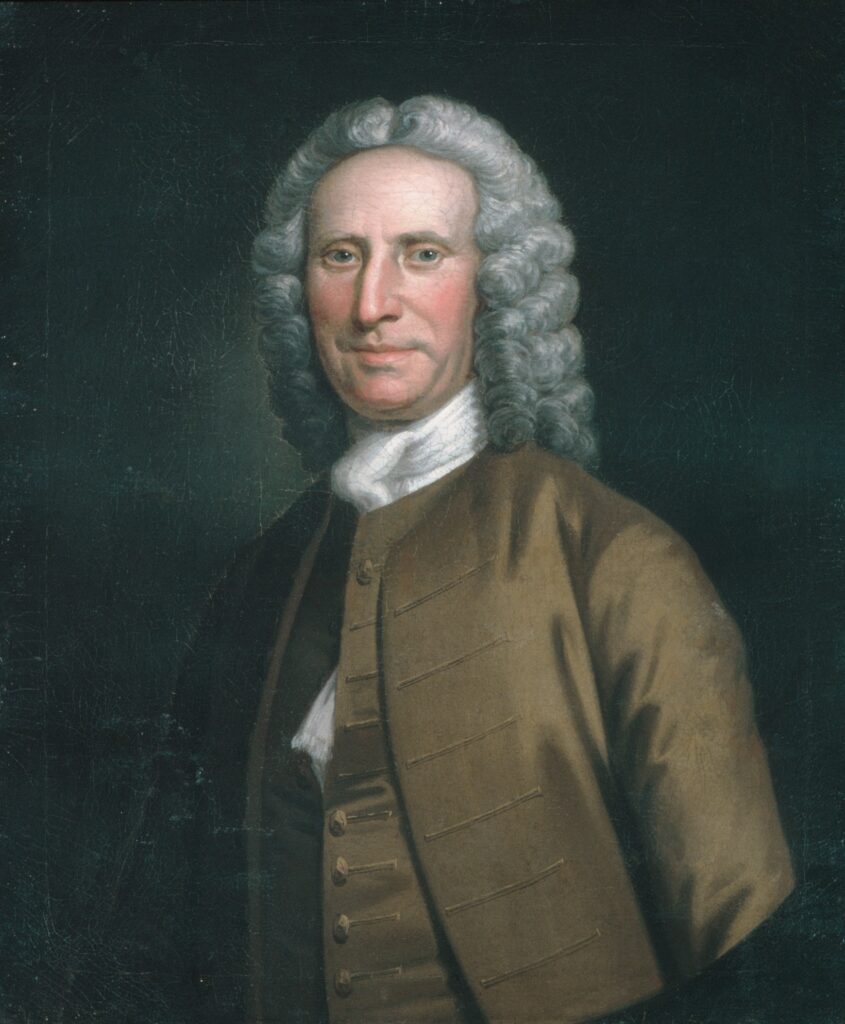
Painting of the Elder Colden by John Wollaston the Younger. Wikimedia Commons

Elder Colden became governor of the New York colony in 1760 and later sparked ire among beleaguered New Yorkers, who burned his effigy over enactment of the Stamp Act.

Colden ultimately represented the losing side of the American Revolution, and due to that, his other accomplishments are often overlooked. He was the first in America to write about Newtonian scientific theories and the first colonist to act as ambassador to the Iroquois Confederacy, the union of five Native American tribes.

Grandson in a New County

Perhaps it’s fitting that Colden died in September 1776, the year of the conflict that would run the British out forever.

He might be scandalized to know that his grandson, born in 1769 in Flushing, Queens County, would become a model American. (The child’s father Cadwallader Colden II was more concerned with governing the family’s lush 3,000 acre estate in Queens and remained essentially neutral during the Revolutionary War.)

Born in the trappings of wealth, Cadwallader David Colden III was shipped off to London for a proper education and returned to New York in 1785 to become a lawyer.

With his high class connections, he quickly acquired an impressive client roster, in particular Robert Fulton and Robert Livingston, assisting in their control of ferry services in New York harbor. He became New York district attorney twice, 1798 and 1810.

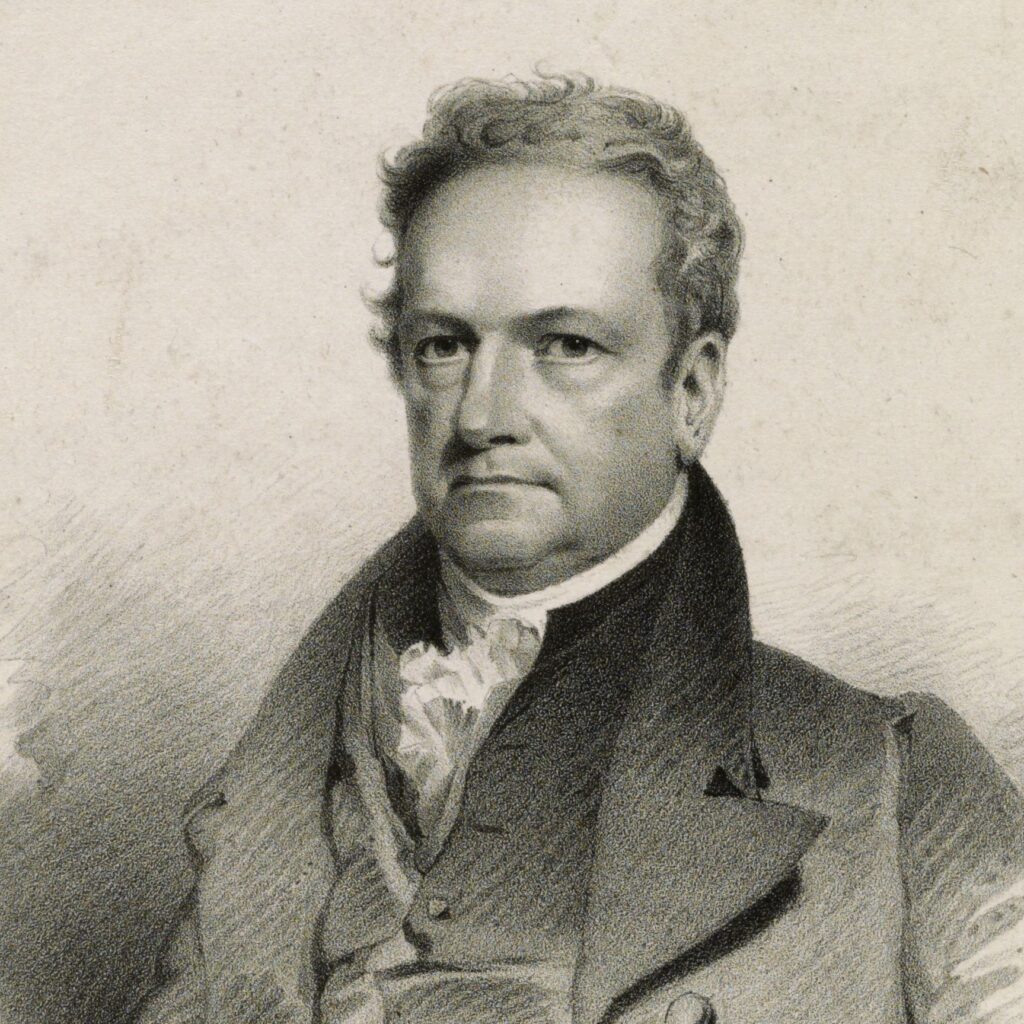
Colden’s good pal DeWitt Clinton

Advantageous Friendships

Colden was a different man from his ancestor; he even fought against the British as a colonel of volunteers in the War of 1812. Surprising given his lineage, Colden was for many years considered a Federalist, the party of Alexander Hamilton. However, he considered as one of his closest friends a rather unlikely ally — anti-Federalist DeWitt Clinton.

How they met probably had less to do with political alliances than membership of a rather notable society — the Freemasons.

In fact, Colden and Clinton were members of the city’s most influential — and still active — Holland Lodge. Within a few years, this affiliation would be political poison, with anti-Freemason candidates characterizing the secret organization as above the law and morally corrupt.

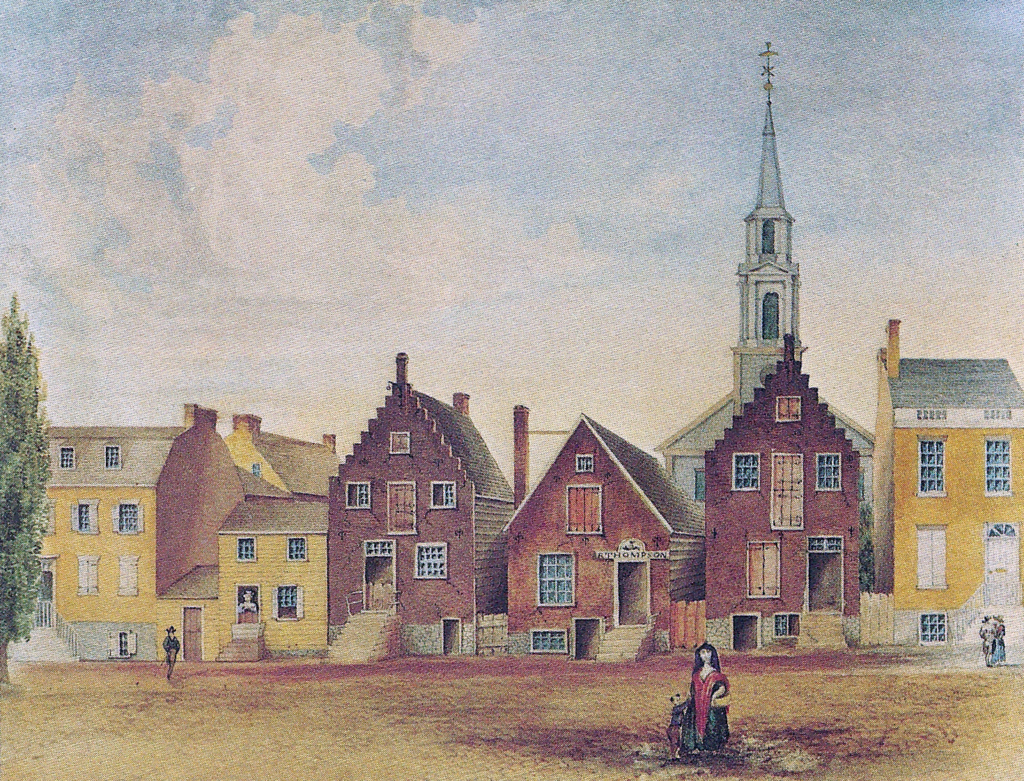
View of North Pearl Street just north of State Street in Albany (1800s), painting by James Eights

At Odds With Tammany Hall

Colden’s ascent into the mayor’s office caught him within some serious political crossfire. Cadwallader’s friend DeWitt became the governor of New York in 1817, making him the head of the Council of Appointments, which selected a mayor for New York, back in the heady days before elections.

Clinton would use his influence to install his friend in the job in 1818, but not without Colden sustaining a little political injury.

One evening, Colden was in Albany and was invited inside a tavern for a glass of wine. He suddenly realized he was in a room filled with members of Tammany Hall, political enemies of the Federalists.

Colden had once been a member of Tammany — during their less politically active days — and in 1793 had even spoke to an assemblage at Saint Paul’s Church.

He was now on the opposite side.

Immediately they pounced, urging him to not seek the mayor appointment. But no, he cried!

“He exclaimed energetically against the trickery, declaring that he had not asked for the office of Mayor, but would only accept it if offered.”

When Clinton did grant him the job, Tammany made sure to make life difficult for him. For the entirely of his three one-year terms, Colden became a pawn in the battle between Governor Clinton and the ascendant Democratic machine.

Colden began work in the spanking new City Hall, the fourth mayor for the new building after Jacob Radcliffe, John Ferguson and, of course, DeWitt Clinton.

Pigs and Prison Reform

First on Colden’s agenda: all those pigs running around.

He declared, “Our wives and daughters cannot walk through the streets of the city without encountering the most disgusting spectacles of these animals indulging the propensities of nature.”

Animals were penned up and steep fines charged to butchers who kept pigs unproperly supervised.

Colden also took a crack at the city’s deeper social problems. Indeed he was governing over a growing city, population 123,706 as of 1820. With a big city came big city problems — poverty, crime, homelessness.

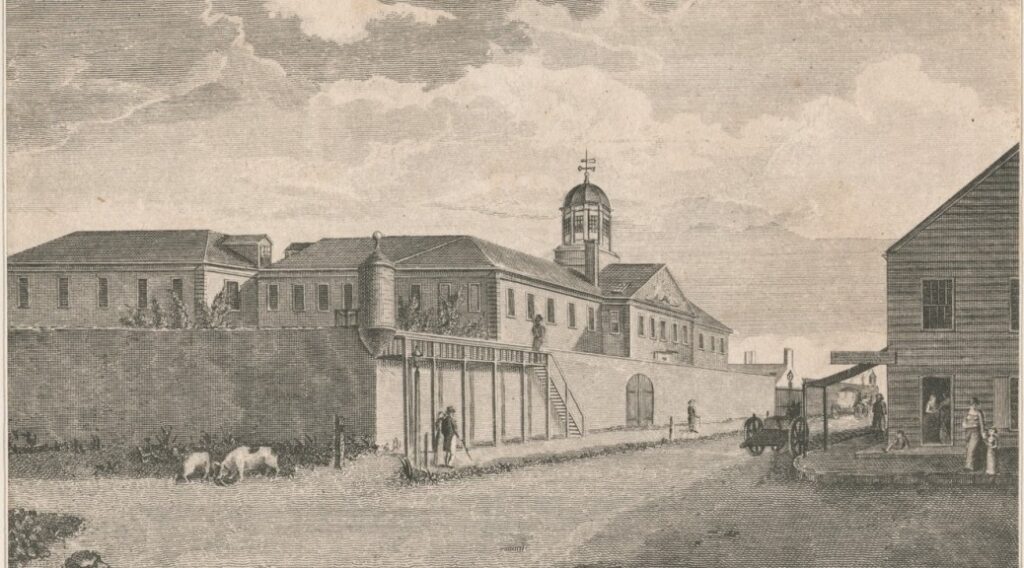
Newgate Prison. Image courtesy New York Public Library

The New York Society for the Prevention of Pauperism, led by the mayor himself, investigated prison conditions throughout the young nation to come up with a local solution.

At the time, the state penitentiary lay in today’s West Village in a place called Newgate Prison. One of their findings was a need to separate younger delinquents from the adult criminals held there.

Colden proclaimed, “It must be obvious that under such circumstances it would be in vain to expect that their punishment will improve their morals: it can hardly fail to have a contrary effect.”

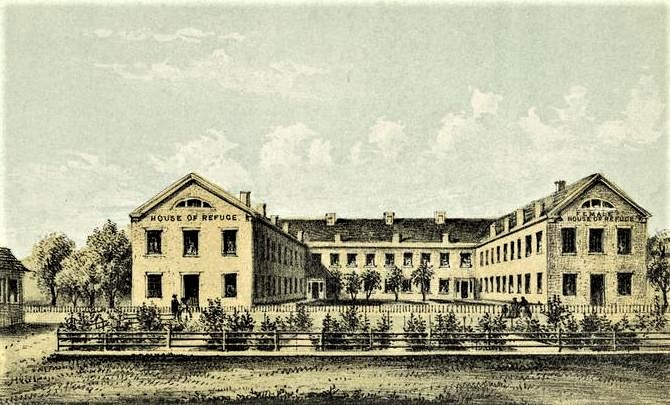
The House of Refuge in 1832 (pic courtesy NYPL)

The mayor set the stage for an innovative experiment: New York’s House of Refuge, in an arsenal at Broadway and 23rd Street, essentially a reform school, built to incarcerate children age 16 and younger.

It later opened in 1825 (after Colden left office) with six boys and three girls as its pupils, many of them guilty only of homelessness and essentially kept here until adulthood. By the early 1830s, the House of Refuge would receive over 1,600 teenagers.

A ‘Kindly’ Anecdote

Like many mayors to follow, Colden also clamped down on liquor sales, even carrying around a ‘red book’ to notate violations and overheard complaints of local tavern owners.

Naturally, Colden would rally behind Clinton’s most ardent cause — the Erie Canal. It opened in 1825, after Colden left office, but his support did indeed pave the way for New York to become, in his own words, “one of the greatest commercial cities in the world.”

He was aristocratic, class-oriented but ultimately open hearted, they say. A reminiscence in the 1843 journal New Mirror quotes this certainly apocryphal story about the mayor’s ‘kindness’.

One rainy night on his way to a dinner party, Cadwallader stepped up to a ‘hackman’, a type of carriage taxi, for a ride.

The driver, “who had some old grudge against Mr. Colden,” rudely sped away, leaving the passenger on the curb. He jotted down the cab driver’s number and summoned him to City Hall.

“Poor Pat (for of course he was Irish)” as the article indicates, “went up the stairs, trembling at the fate which awaited him. When the mayor demanded to know why he was treated so rudely, the driver proclaimed,”you see I looked in your face, and, faith, you looked so like a jontleman I drove twice before that never paid me, I was afraid to thrust him agin!”

Colden laughed, exclaiming, “Your wit has saved you this time!” and excused the driver.

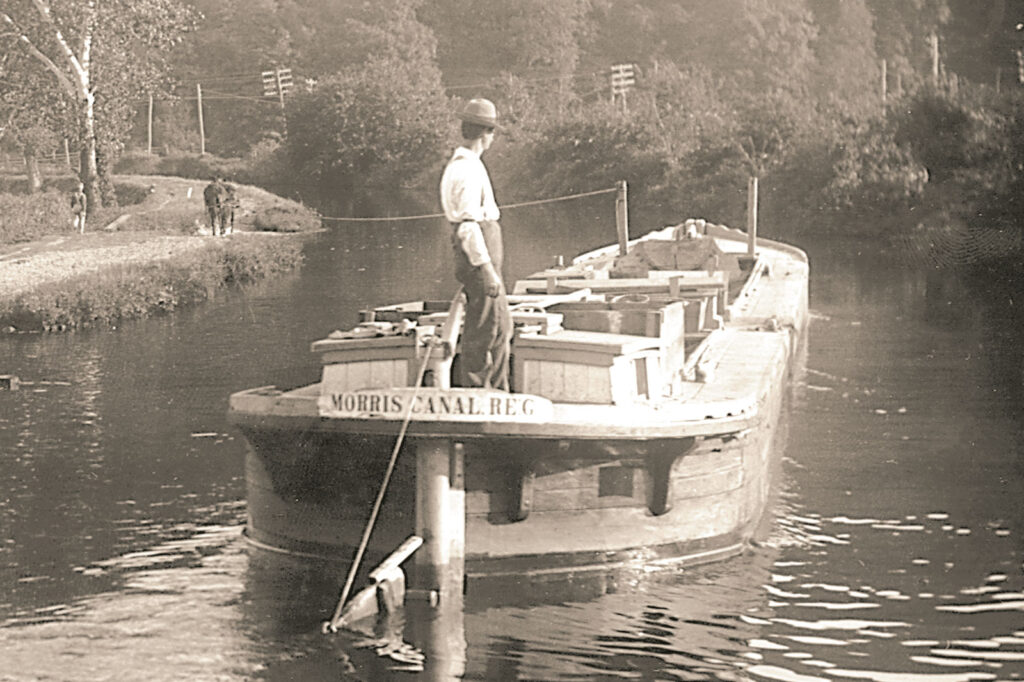
A boat upon the Morris Canal (courtesy the Canal Society of New Jersey)

Colden’s Later Years

Aligning with Clinton eventually became a bad idea. When Clinton was turned out of the governor’s office, so too was Colden from the mayor’s office. But he still remained popular with New Yorkers, becoming a U.S. congressman, then a member of the New York state senate in 1825.

In later life, he engaged in a couple unusual endeavors. The first was the construction of the Morris Canal in northern New Jersey, a conveyor of coal that operated for over a century.

And in 1830, he briefly indulged in the hobby of horse racing, taking over the Union Course in Woodhaven, Queens. The closest you’ll get to visiting Colden’s racetrack is visiting Neir’s Tavern, the oldest tavern in the borough.

Colden died in 1834, in Jersey City.

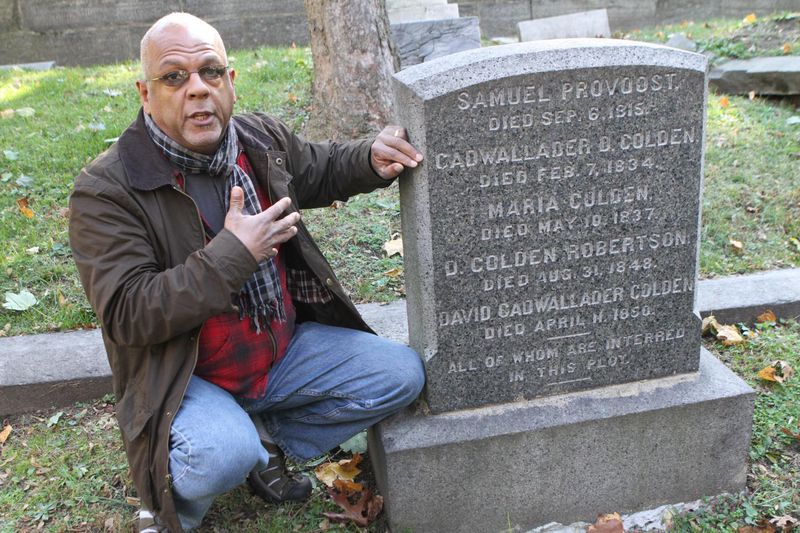
For centuries his gravesite was unknown. But in 2011, historian (and friend of the show) Eric K. Washington discovered his grave at Trinity Church Cemetery.

Washington in front of the new stone in 2011, adding Cadwallader III’s name. (Courtesy Mariela Lombard  of theNew York Daily News)

Revision and expansion of an article which first ran on this website in 2009.

Categories
Neighborhoods Queens History

The breezy story of Ozone Park, Queens

Ozone Park, a quiet residential Queens neighborhood near Woodhaven, is one of those places created by real estate developers in the 1880s.

It happens to have one of the best neighborhood names in all of New York City. So where did it come from?

Ozone is a gas that exists as part of the Earth’s atmosphere and, more dangerously, as a component of ground-level pollutants like smog and industrial waste.

By all accounts, the word should sit nowhere near the word ‘Park’ where the foul-smelling gas would kill everything.

OzonePark
The First Ozone

But when ozone gas was first identified in 1840, its harmful effects were not widely understood. It was associated with fresh air, filled with refreshing recuperative properties.

 One dictionary in particular describes ozone as “clean bracing air as found at the sea side.”

By the 1860s and 70s, beach resorts and hotels were advertising their properties are paradises full of tonic air with all the ozone you could want!

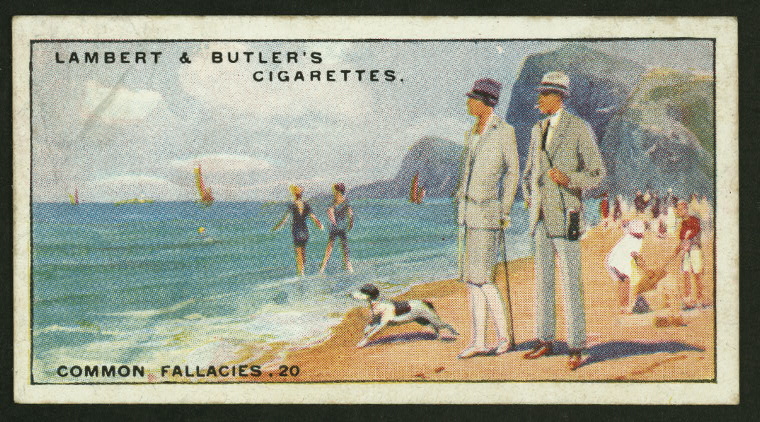
Below: This cigarette card was labeled ‘Ozone is present in the air at the sea-side.” So you have cigarettes and ozone…..

New York Public Library
Lands to Develop

There was no borough of Queens in the 1860s, only the counties of Kings and Queens sitting near each other on the western end of Long Island.

The county of Queens was sparsely populated outside of a few towns further north, including Flushing, Jamaica, Astoria and Newtown (later Elmhurst).

The vast population rise and the improving financial fortunes of the cities of New York and Brooklyn in the 1860s inspired some developers to sweep into under-populated areas with the hopes of developing new communities.

It was in the decades following the Civil War that many new Queens communities sprouted up in this way.

Starts With A Fire

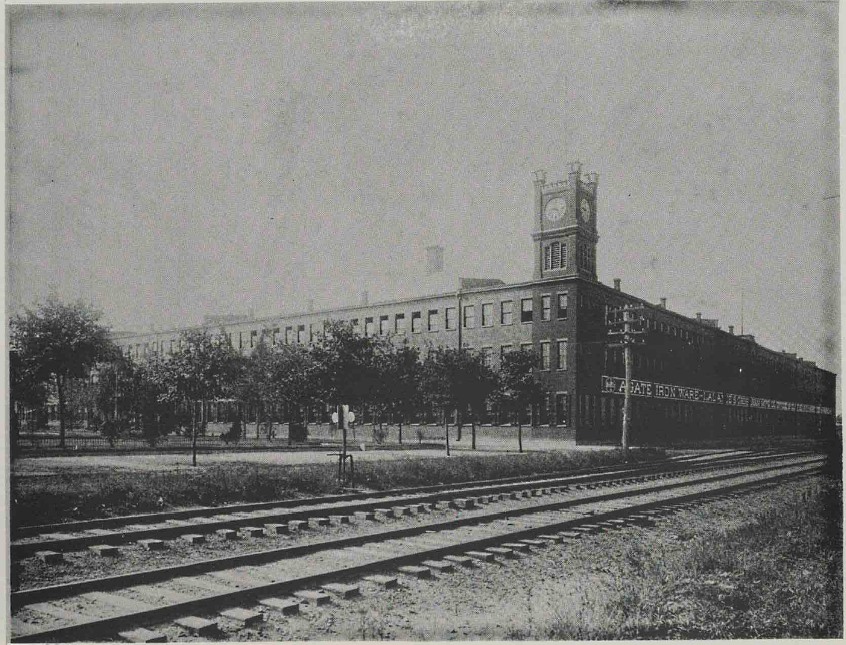
In the 1870s, the cooking and houseware manufacturers Florian Grosjean and Charles Lalance built a large factory near the site of the old Union Course racetrack, long since closed. The company town which sprouted up around the factory became the basis for the Woodhaven neighborhood.

In 1876, the factory was destroyed in a devastating fire, so complete in its destruction that Grosjean, upon seeing his life’s work in flames, fainted to the ground.

But Grosjean rebuilt his massive factory just a bit south of the original site, constructing more new cottages for his workers.

While the factory is long gone today, its distinctive clock tower can still be seen in the neighborhood today. [You can read more about Grosjean’s contribution to the area here.]

2
Courtesy Project Woodhaven
Making the Ozone

I bring up the origins of Woodhaven because the southern factory opened up new opportunities for some undeveloped land. New employees of Grosjean’s factory would eventually venture into this area needing housing,

In 1880, the Long Island Railroad built a station south of Woodhaven as part of its line from Long Island City to Howard Beach.

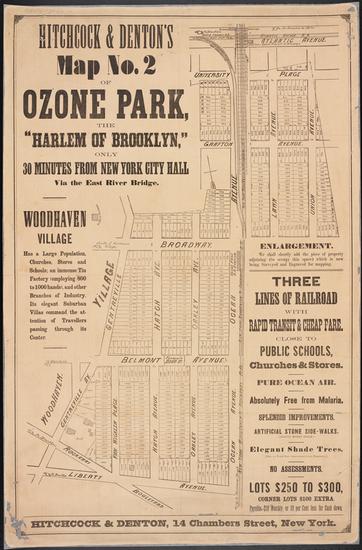
Two years later, two speculators Benjamin W. Hitchcock and Charles C. Denton bought up most of the plots of land around the station and began marketing the area as a visionary new neighborhood called Ozone Park!

Hitchcock had made his money in the music publishing business, one of several enterprising Manhattan businessmen who looked to the vast undeveloped spaces of Long Island to make money. He coined the name Ozone Park to promote the area’s proximity to fresh tonic ocean air.

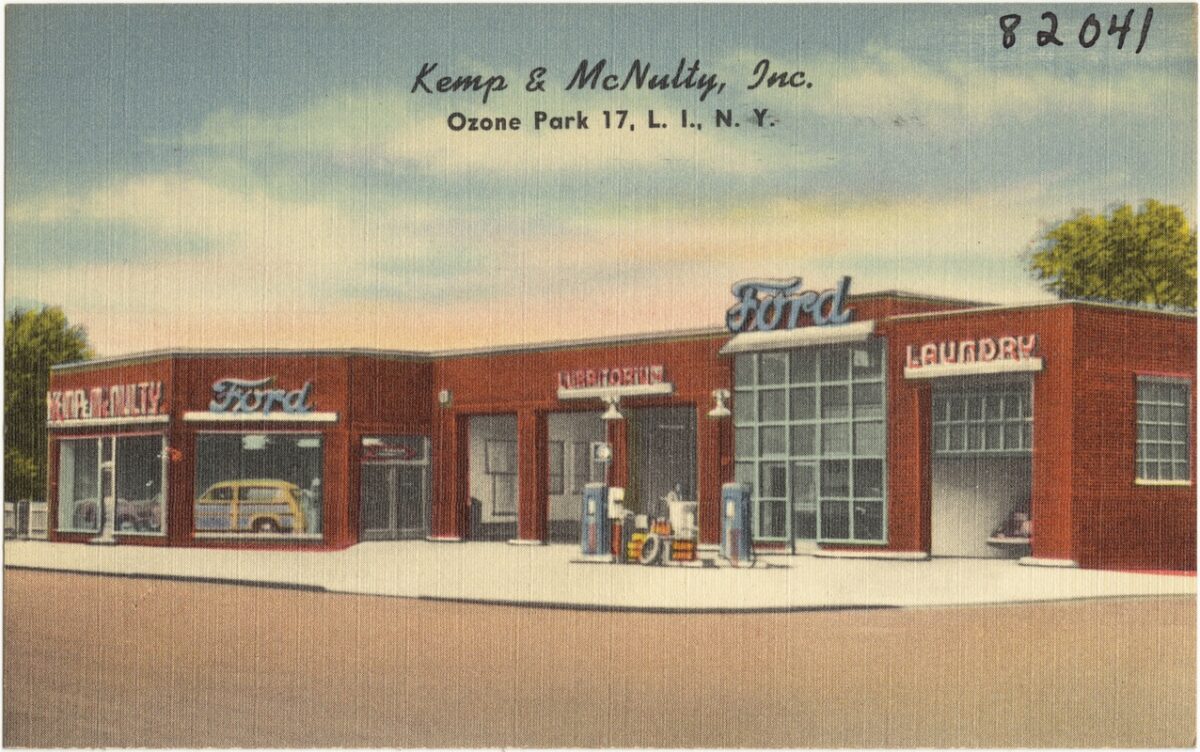
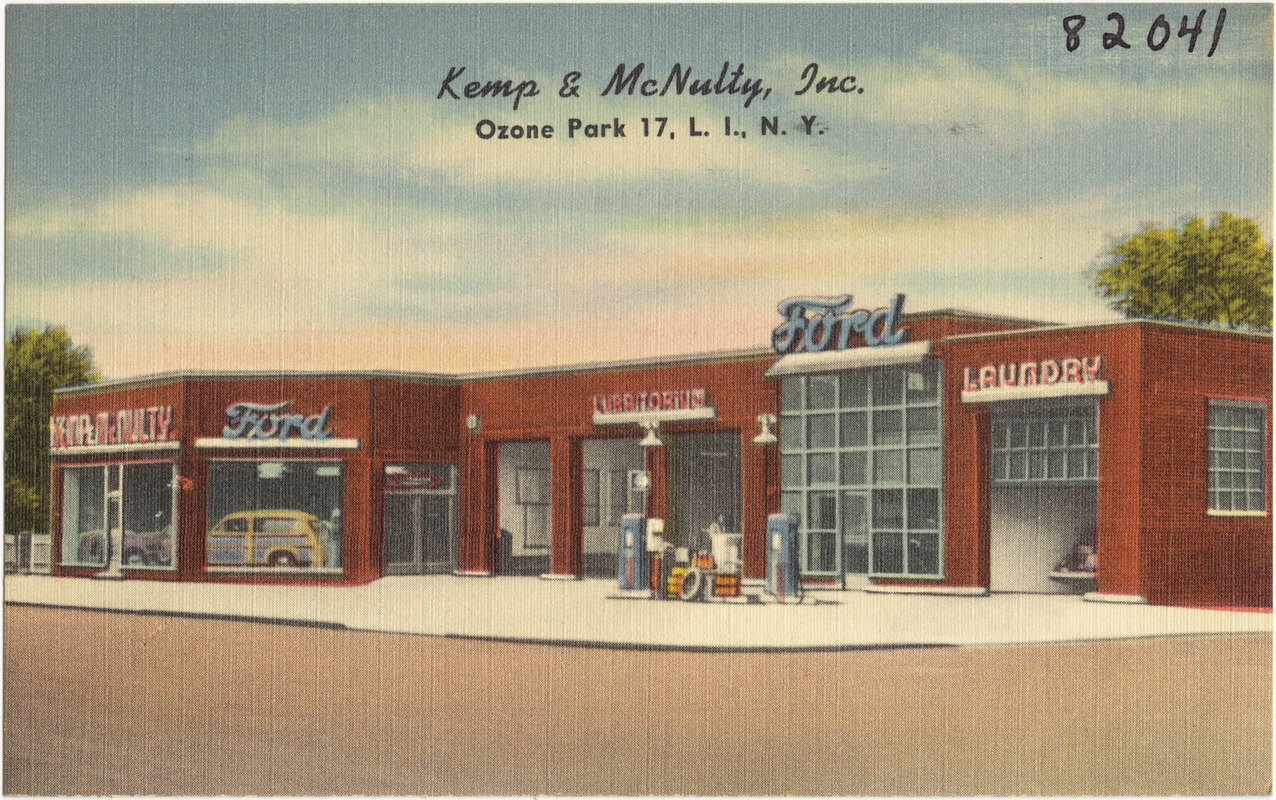
Below: Postcard of an Ozone Park filling station circa 1930s

Courtesy Boston Public Library
The “Harlem of Brooklyn”?

Here’s a few examples of advertisements used to lure prospective customers to the area:

From the Brooklyn Daily Eagle (7/9/1882):

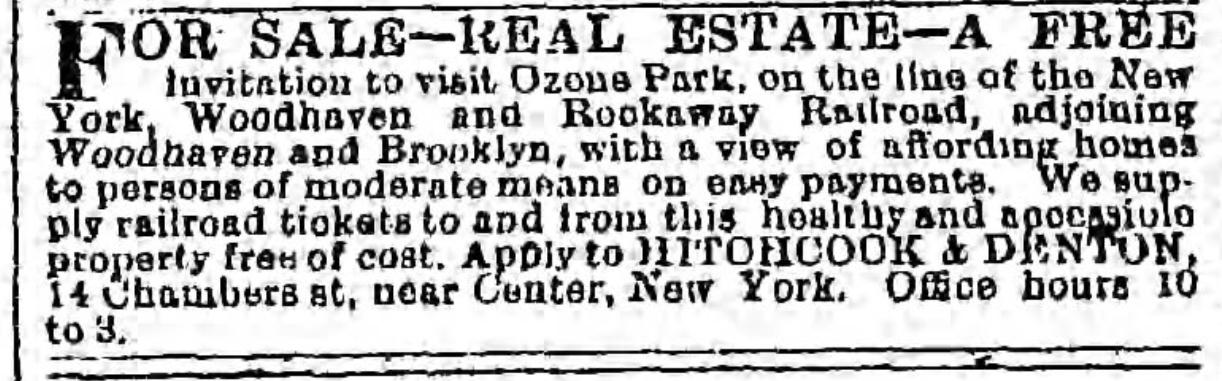
“A FREE invitation to visit Ozone Park, on the New York, Woodhaven and Rockaway Railroad, adjoining Woodhaven and Brooklyn, with a view of affording homes to persons of moderate means on easy payments.”

3

From the New York Sun (8/27/1882):

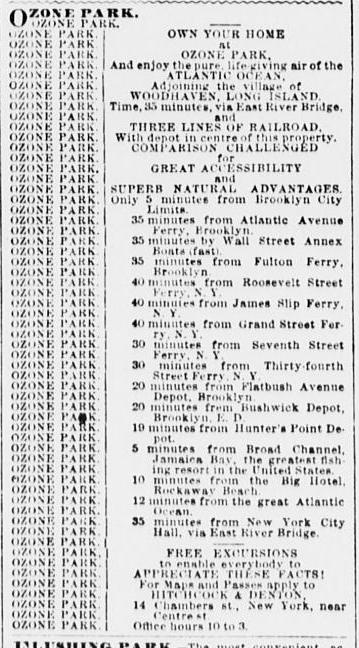
“OWN YOUR HOME at OZONE PARK, And enjoy the pure, life-giving air of the ATLANTIC OCEAN……”

1

From the New York Sun (4/21/1883):

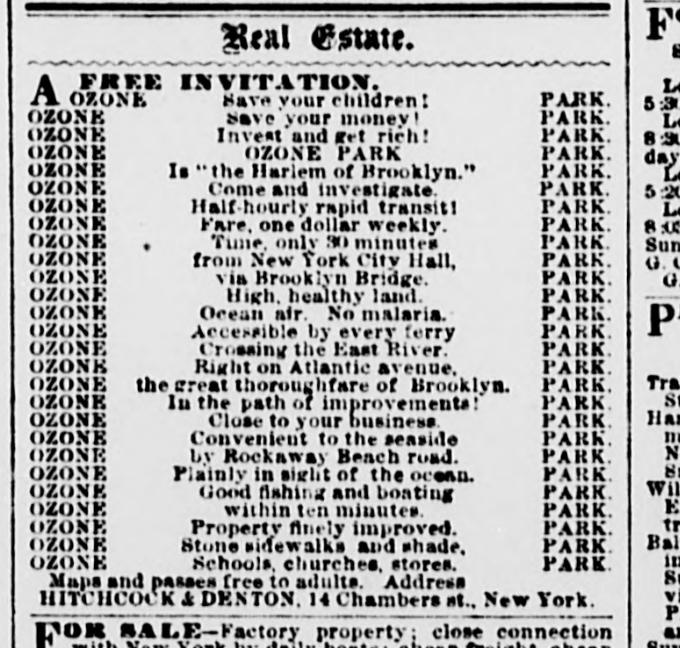
“Save your children! Save your money! Invest and get rich! OZONE PARK is ‘the Harlem of Brooklyn.’ Come and investigate!”

2

Wait — ‘the Harlem of Brooklyn‘? Ozone Park isn’t even in Brooklyn, although it’s near the modern border of the borough.

In the 1880s Harlem was a thriving and newly developed Jewish and Italian neighborhood, a new rowhouses were being built along the routes of elevated rail lines. This is certainly the comparison the developers had in mind with this particular advertisements.

Courtesy Museum of the City of New York

Courtesy Museum of the City of New York

Park Life

By 1884, the developers carved streets to connect the properties. Far from relaxing and ‘tonic’, the area was a fury of building construction.

Five years later there were at least 600 residents living in Ozone Park, enough to merit its very own post office.

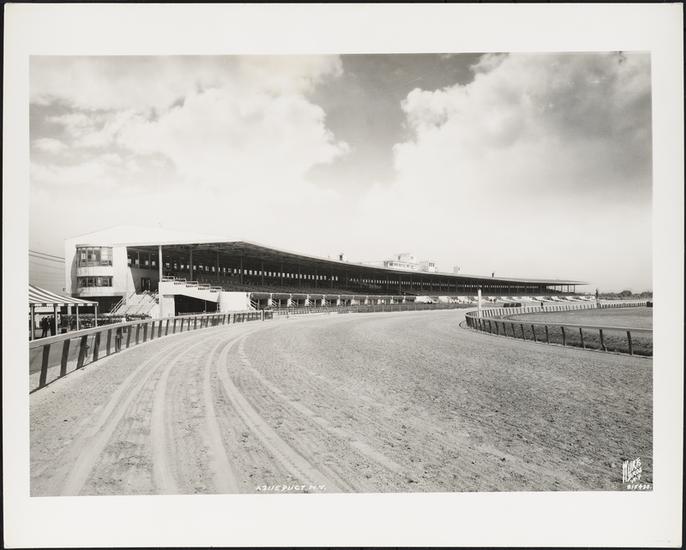
The development of South Ozone Park was bolstered with the construction in 1894 of the Aqueduct Racetrack (pictured below in 1941).

When Idlewild Airport (later JFK Airport) was completed in 1948, anything positively “ozone” about the the air quickly evaporated.

Courtesy Museum of the City of New York

Thank you Project Woodhaven for inspiring this article!