You better clean your room or you’ll end up like the Collyer Brothers.
New York City, a city crammed of 8.6 million people. It’s filled with stories of people who just want to be left alone – recluses, hermits, cloistering themselves from the public eye, closing themselves off from scrutiny.
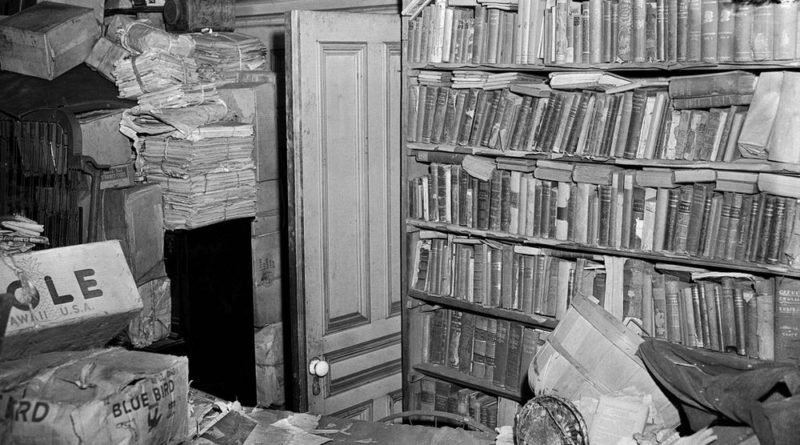
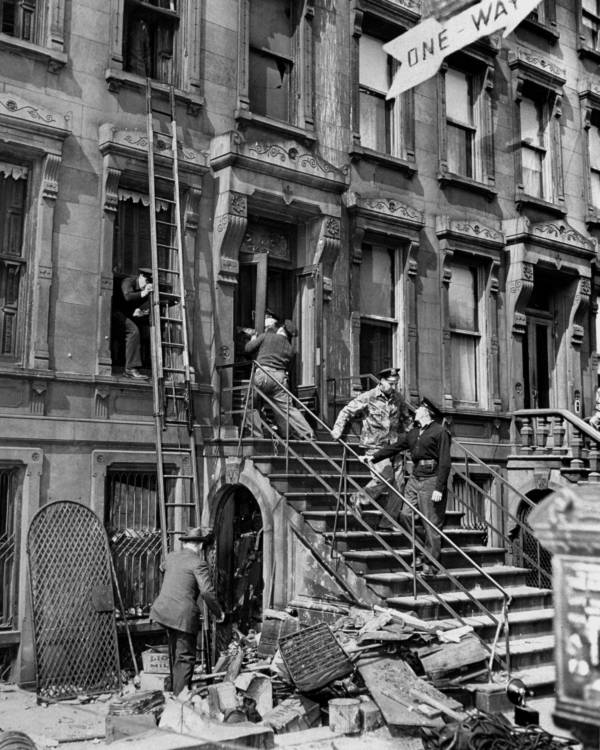
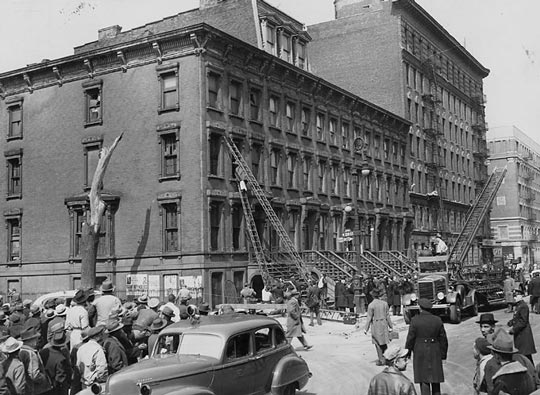
But none attempted to seal themselves off so completely in the way that Homer and Langley Collyer attempted in the 1930s and 1940s. Their story is infamous. In going several steps further to be left alone, they in effect drew attention to themselves and to their crumbling Fifth Avenue mansion – dubbed by the press ‘the Harlem house of mystery’.
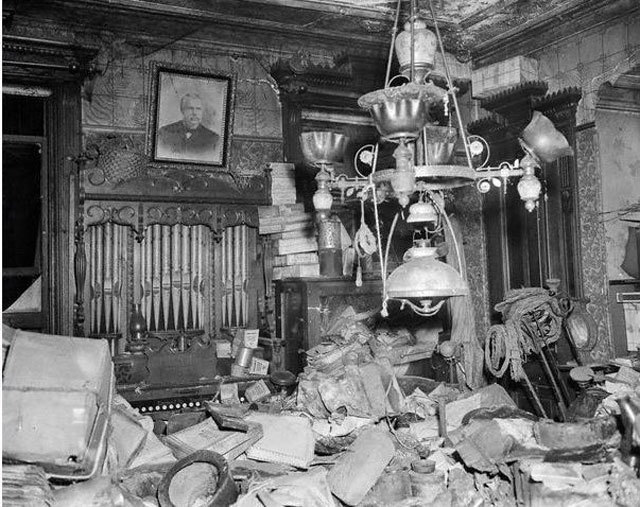
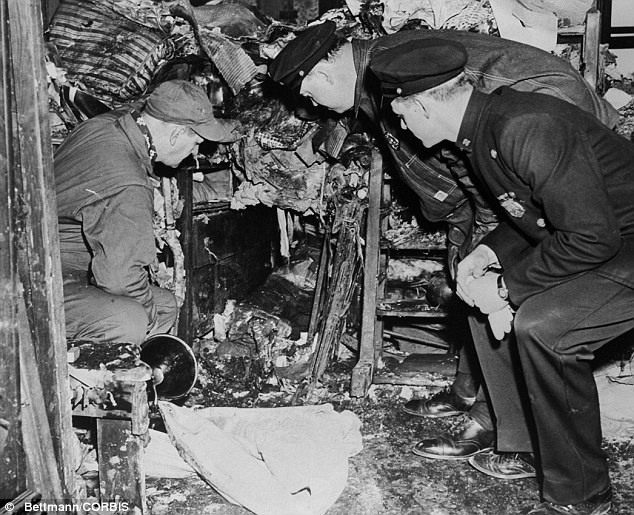
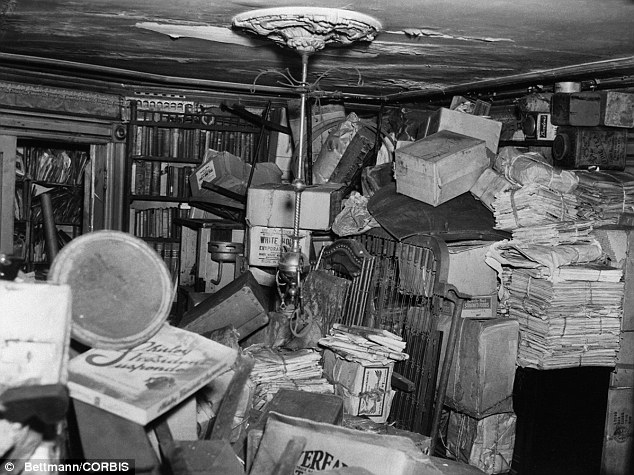
They were the children of the Gilded Age, clinging to blue-blooded lineage and drawing-room social customs, in a neighborhood that was about to become the heart of African-American culture. But their unusual retreat inward — off the grid, hidden from view — suggested something more troubling than fear and isolation. And in the end, their house consumed them.
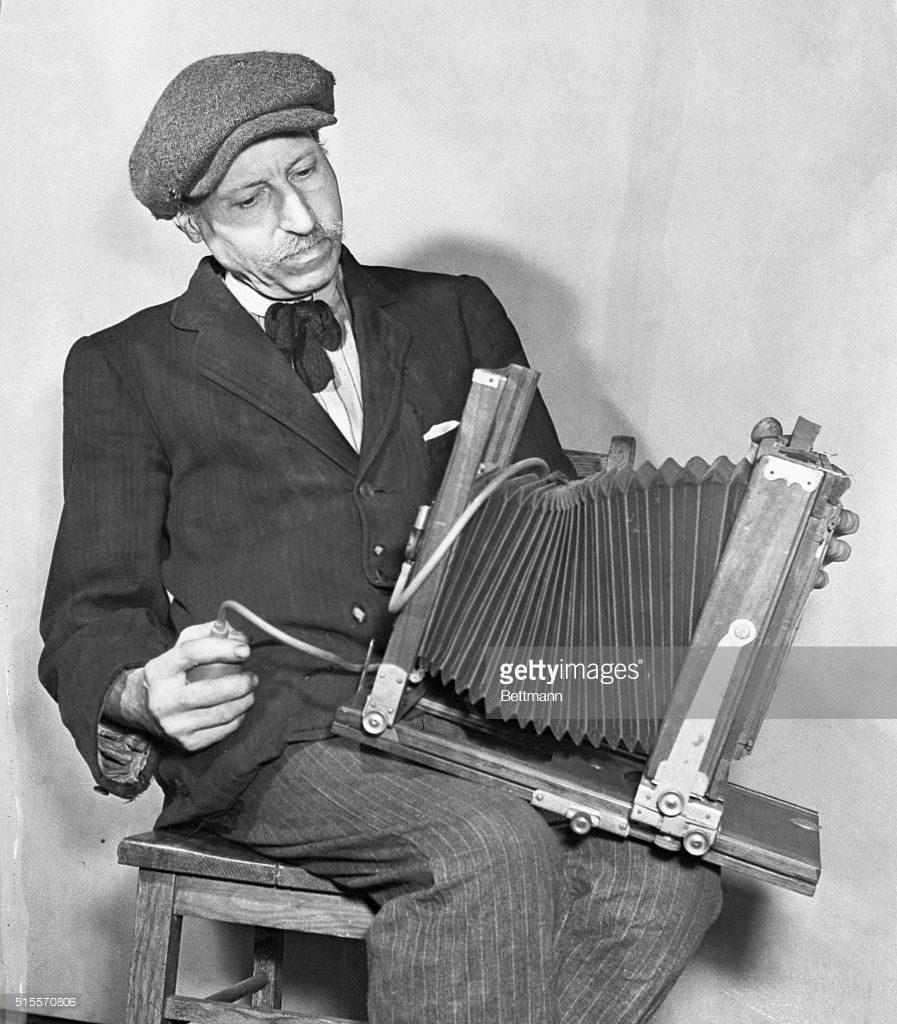
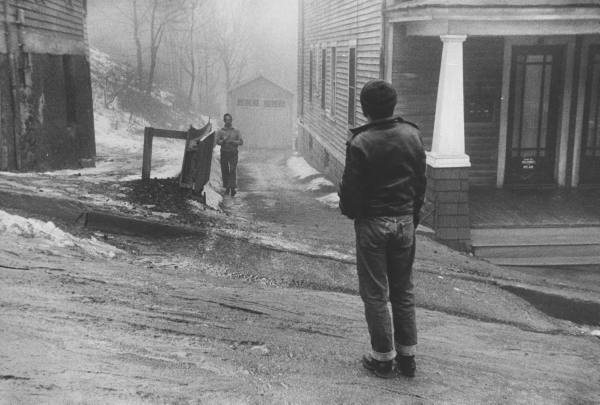
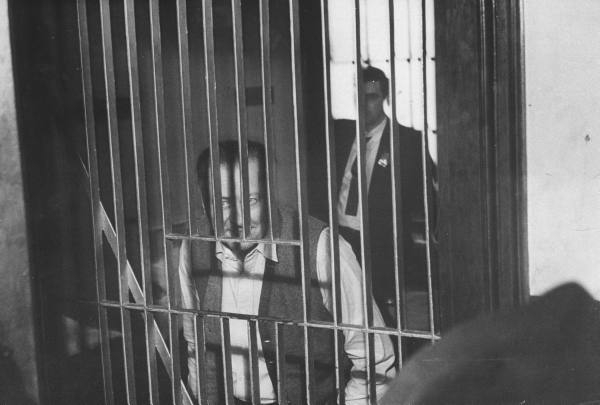
Langley Collyer, 1942, at his New York Herald Tribune photo shoot
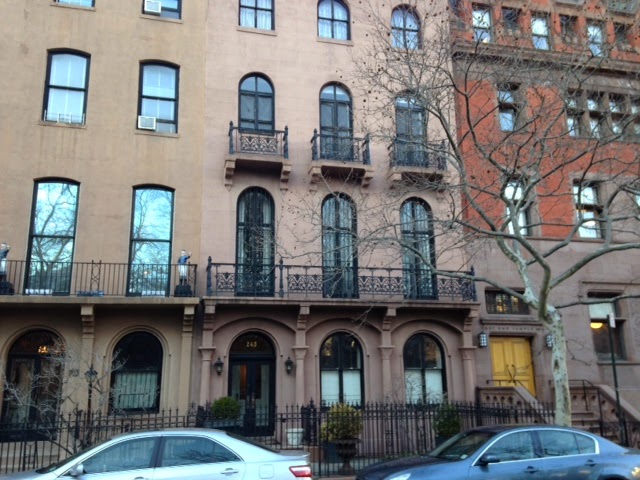
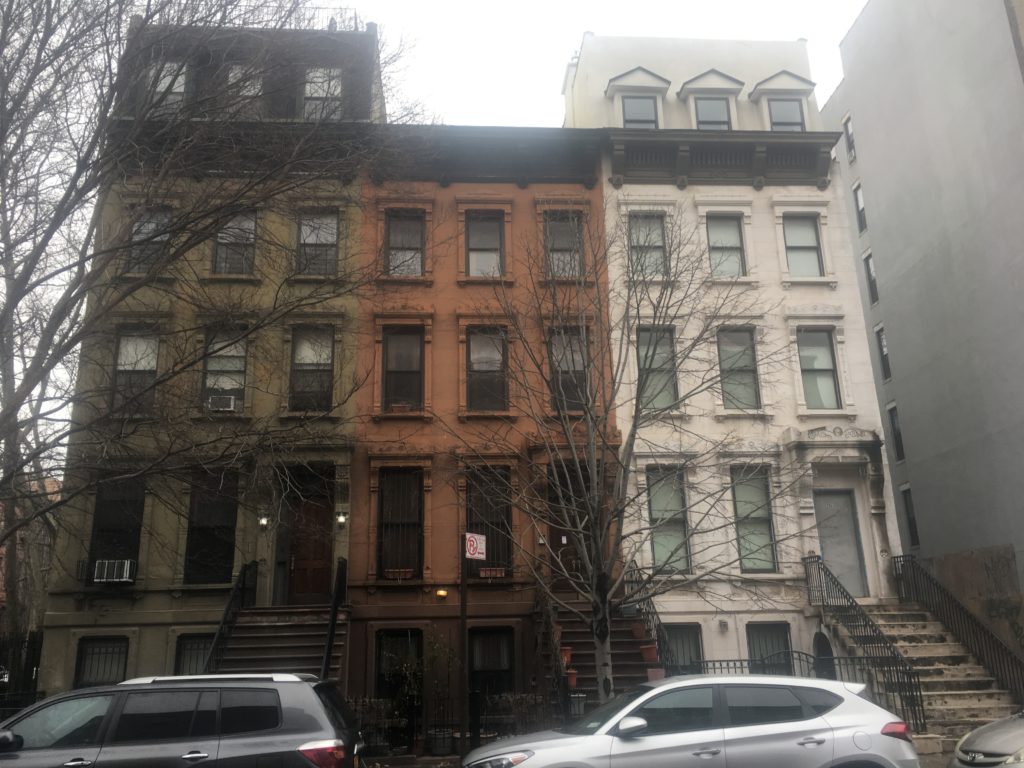
The three remaining rowhouses developed by George J. Hamilton. The middle house gives you some idea of what the Collyer mansion looked like.
Charles Hoff / NY Daily News
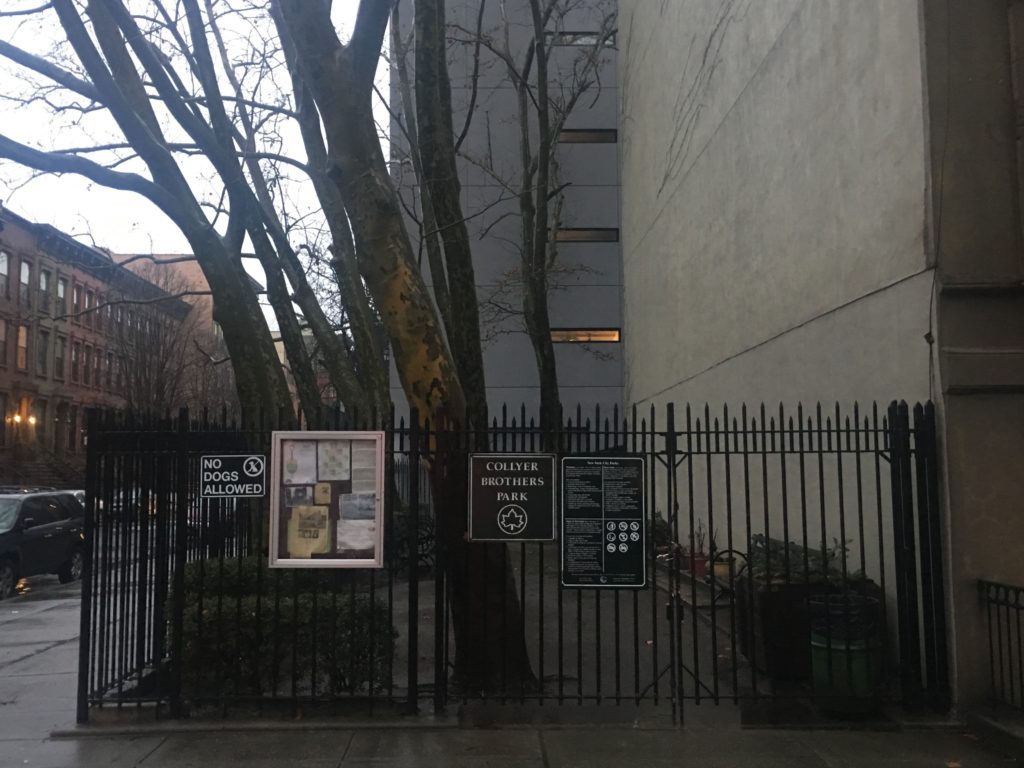
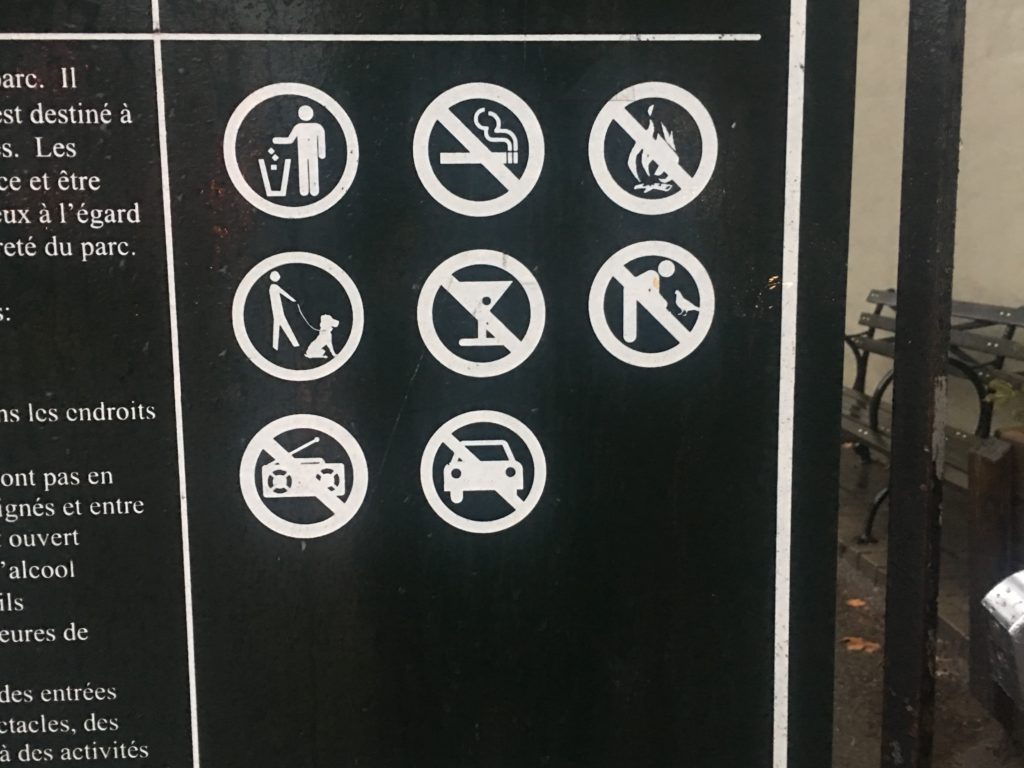
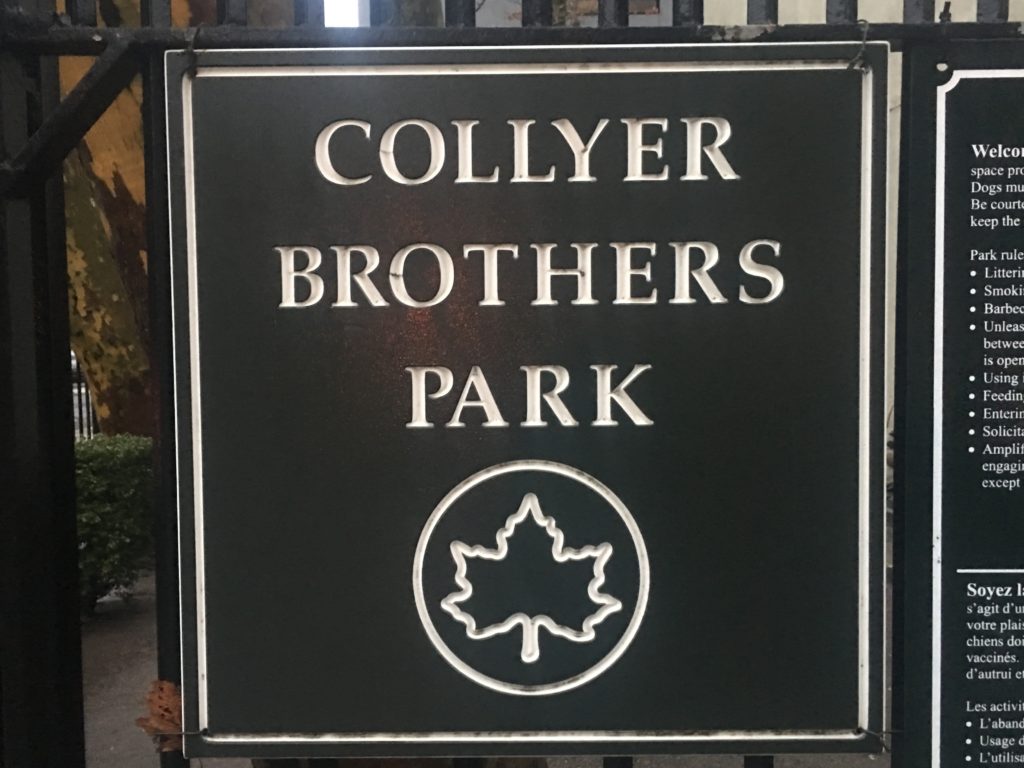
No littering in Collyer Brothers Park!
Silent footage taken outside the Collyer house, 1947
FURTHER READING
Homer and Langley by E.L. Doctorow Out of this World by Helen Worden Erskine Stuff: Compulsive Hoarding and the Meaning of Things by Randy O. Frost and Grail Steketee Ghosty Men by Franz Lidz
FURTHER LISTENING
We’ve visited the back story of famous recluses in past shows with the story of Big Edie and Little Edie Bouvier (Grey Gardens) and the legendary film actress Greta Garbo:
And the story of changing Harlem is profiled in the biography episode of the great Madam C. J. Walker
The seats at Radio City Music Hall, rigged with explosive devices planted inside the upholstery. Bombs found at the Empire State Building, others detonating at movie theaters and in phone booths, at the New York Public Library and in subway stations. An explosion inside Macy’s.
Chaos, panic, anonymous letters to the police, copycat bombers. Some of the most sustained levels of domestic terrorism to hit an American city in the 20th century.
It may sound like the plot of a dastardly comic book film. But it actually happened in New York City.
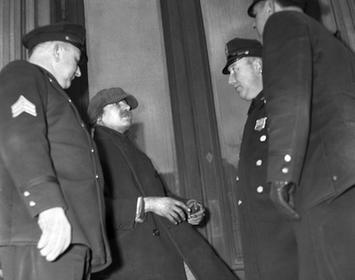
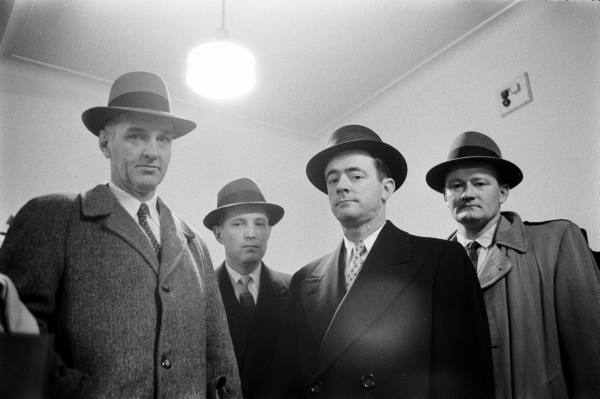
The man in the center, the one who looks like a kind grocer? That’s George Metesky, the insane “Mad Bomber” who terrorized New York for years with crudely made bombs placed in public places. (Photo by Peter Stackpole)
Through two decades, from 1940 to the mid 1950s, the city was under siege by a violent, greatly disturbed ex-Marine dubbed the Mad Bomber by the press.
George Metesky planted dozens of pipe bombs in New York City before he was finally apprehended in January 1957 at his home in Waterbury, Conn. He sheepishly met his captors at the door with the phrase, “I know why you fellows are here. You think I’m the Mad Bomber.”
George had been employed by the utility company until 1931, when a boiler explosion at uptown Manhattan plant left him permanently disabled and in the care of his two sisters in Connecticut.
He claimed the company refused to compensate him for his work-related hardship, fighting in vain with the corporation for five years. “My medical bills and care have cost thousands — I did not get a single penny for a lifetime of misery and suffering,” he would claim in one of his many letters to the press, after the bombings began.
For Con Ed’s part, they claimed Metesky had taken too long to file for disability benefits. Eventually, the truth didn’t matter. Metesky, later to be diagnosed a paranoid schizophrenic, decided to get comeuppance in a more sinister manner.
New York Daily News, November 19, 1940
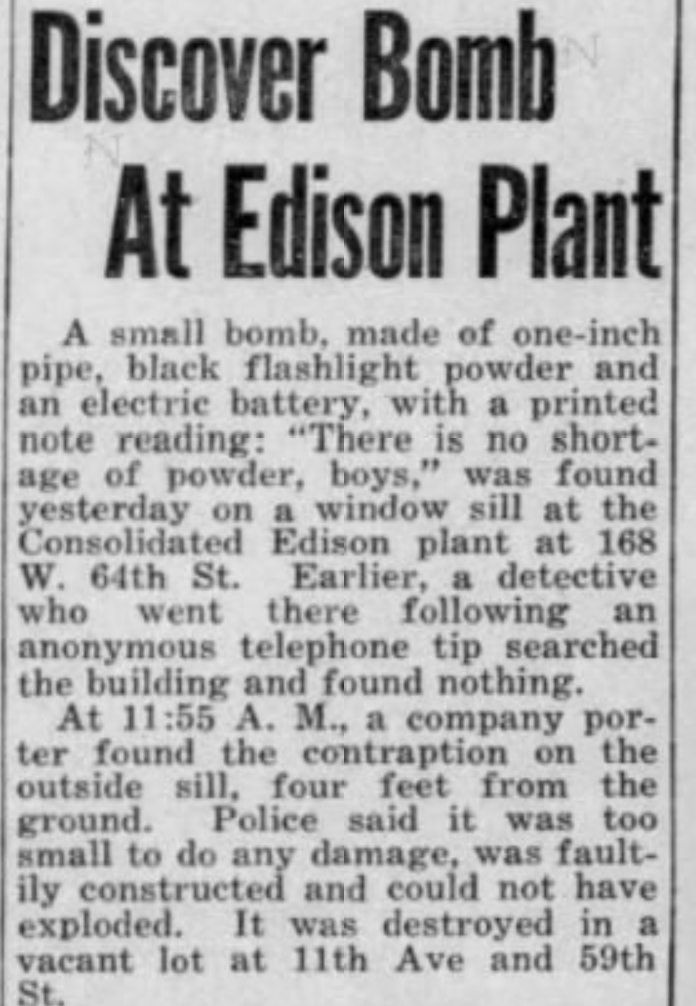
The first explosive, ultimately a dud (as many were), was placed at Con Ed’s 64th Street office on November 18th, 1940, accompanied by a carefully constructed note, “CON EDISON CROOKS, THIS IS FOR YOU.”
One year later, another device, wrapped in a woolen sock, was hastily dropped in front of Con Ed’s 19th Street offices, without a missive this time. In both cases, investigators were befuddled: were the bombs even meant to go off or was it a scare tactic?
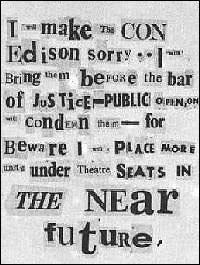
Metesky was feeling ignored yet again by Con Ed. Whether out of frustration or some kind of twisted, legitimate patriotic duty, however, he decided to call off future bombings due to World War II and sent a ‘kidnapper-style’ note(left, one such example), made from cut newspaper letters, to the press informing them so.
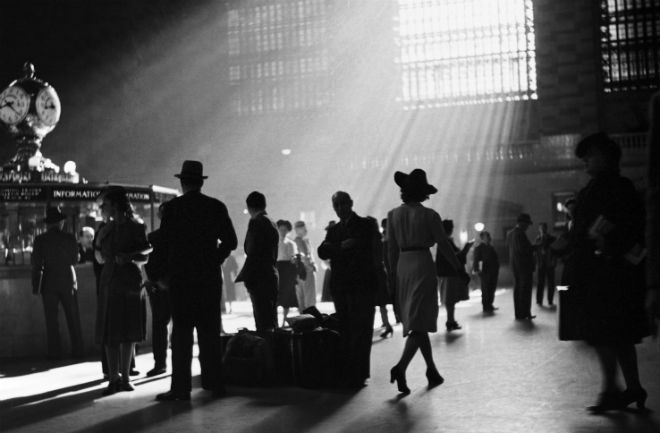
Feeling some acceptable amount of time had passed, Metesky decided on a different tactic on March 29th, 1950, planting a bomb at crowded Grand Central Terminal. Another note from George warned of an explosion there, and police were able to locate and defuse the device in time.
Thus began a bizarre game of cat-and-mouse as Metesky laid dozens of bombs throughout the city, unbelievably without detection. (The “see something, say something” mantra was clearly not in effect in the 1950s.)
A fourth device, in front of the New York Public Library, was the first to actually detonate, but it injured no one, the fortunate outcome of many of Metesky’s oddly made devices.
Despite dropping off pipe bombs in such places as Penn Station and the Port Authority Bus Terminal, despite targeting movie houses by scooping out the seats and implanting bombs there — despite some of these weapons actually exploding, nobody had been hurt. He had even thrown a pipe bomb into the Oyster Bar at Grand Central Terminal, with no serious harm.
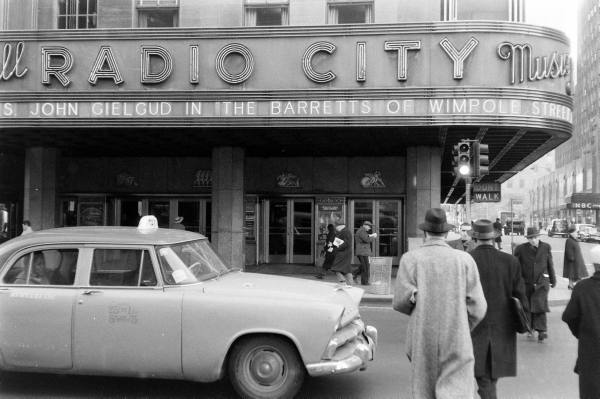
His devices in 1954, however, began to hurt people — minor injuries in a detonation at a Grand Central men’s room, then during a November screening of White Christmas at Radio City Music hall, where five people were hurt. (You can find pictures of the aftermath of one such bombing at Radio City in this Life Magazine article.) Amazingly, Metesky set off three bombs in total at Radio City. Once, a bomb went off with the bomber still in the theater; an usher stopped him as he was escaping but merely “apologized for the disturbance” and let him go.
He also sent a series of letters to the New York Herald Tribune, all in that same exact block-letter styling. Stating in these letters that he was seriously disturbed, George apologized for any potential injuries he might cause but proclaimed, “IT CANNOT BE HELPED—FOR JUSTICE WILL BE SERVED.” Metesky would sign his letters F.P., which investigators would later learn meant ‘Fair Play.’
Two explosions in 1956 ramped up the intensity and urgency of stopping Metesky. One device planted in a Penn Station bathroom seriously injured an elderly attendant. And Metesky left a Christmastime bomb in the Paramount Theatre in Brooklyn that detonated and injured six people, three seriously. (The film playing? War and Peace with Audrey Hepburn.)
The police were frantically piecing together a profile of Metesky, and dozens of people were apprehended and questioned, including one man who frequently drove into the citywith a suspicious trunk in his backseat. It was not Metesky; the trunk contained a pair of sexy fetish boots that the man paid prostitutes to wear.
During this time, dozens of bomb scares were called in throughout the city and there were even other copycat bombers likeFrederick Eberhardtwho sent a ‘sugar bomb‘ in the mail to Con Edison. He too was a former employee….and mentally disturbed.
It’s a bit difficult to get a grasp on the true on-the-street reaction to these bombings, which were numerous but rarely deadly. Slight panic may have passed through the thoughts of commuters passing through Grand Central or riding the subway, but over time, most people seem to have dismissed the danger. These events are sometimes brought up in comparison to the Son of Sam killings of the 1970s, which held the city in a far greater hysteria.
But, as they’re well equipped to do, the newspapers kept reminding New Yorkers of the danger. According to a 1957 Time Magazine article: “Hearst’s Journal-American thoughtfully provided a do-it-yourself spread on how to make a pipe-bomb…..The papers, thirsty and cunning in a news-dry holiday period, were still going strong.”
The Mad Bomber case is a textbook example of early profiling techniques of the day, and the first with a forensics psychologist (Dr. James Brussel) at its forefront.
In January 1957, a Con Edison secretary discovered similarities between letters from ‘F.P.’ published in newspapers and wording in Metesky’s old personnel files. Police were at Metesky’s doorstep in Waterbury a couple days later, where he almost readily spilled the beans about his identity.
Metesky was declared insane and sent to upstate’s Matteawan Hospital for the Criminally Insane. Believe it or not, he was freed on December 13, 1973, and lived for twenty more years back at his home in Waterbury. He claimed to the end that he designed his bombs not to hurt people. And yet, of course, many did.
Events such as these used to be unthinkable, anomalies of history that once played like speculative fiction. But this really did happen.
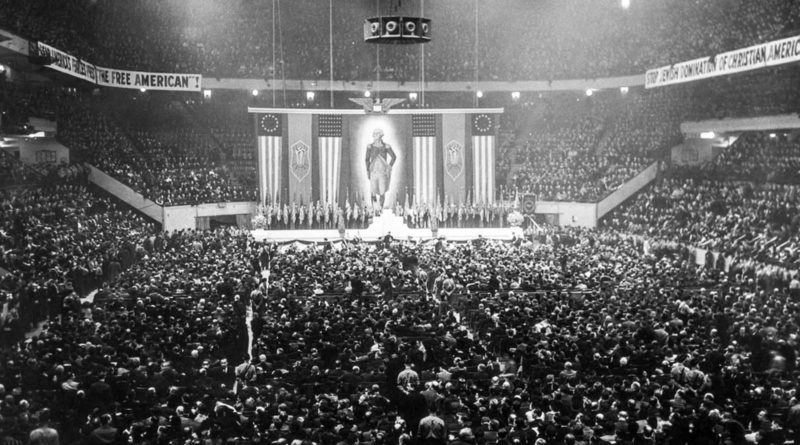
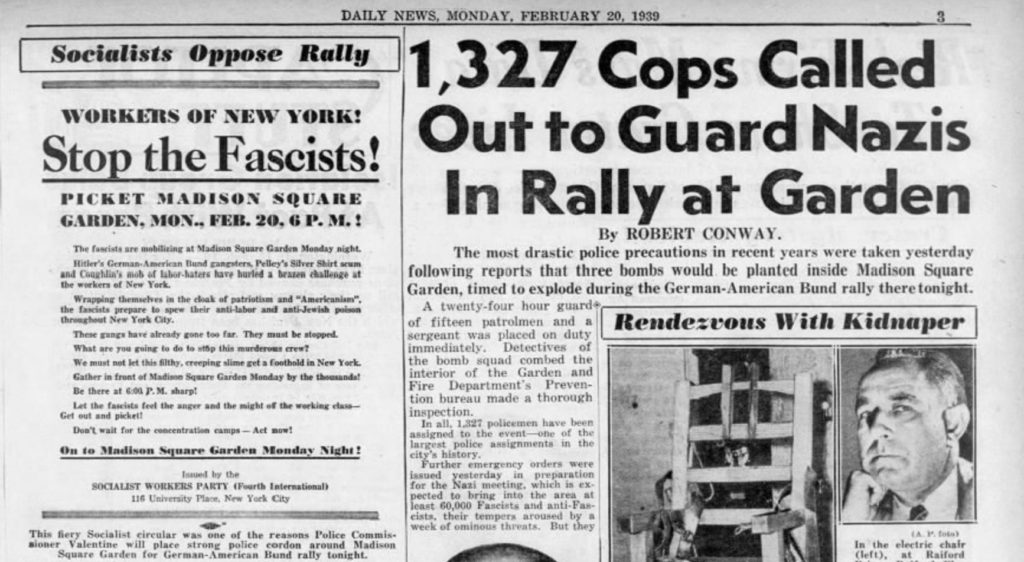
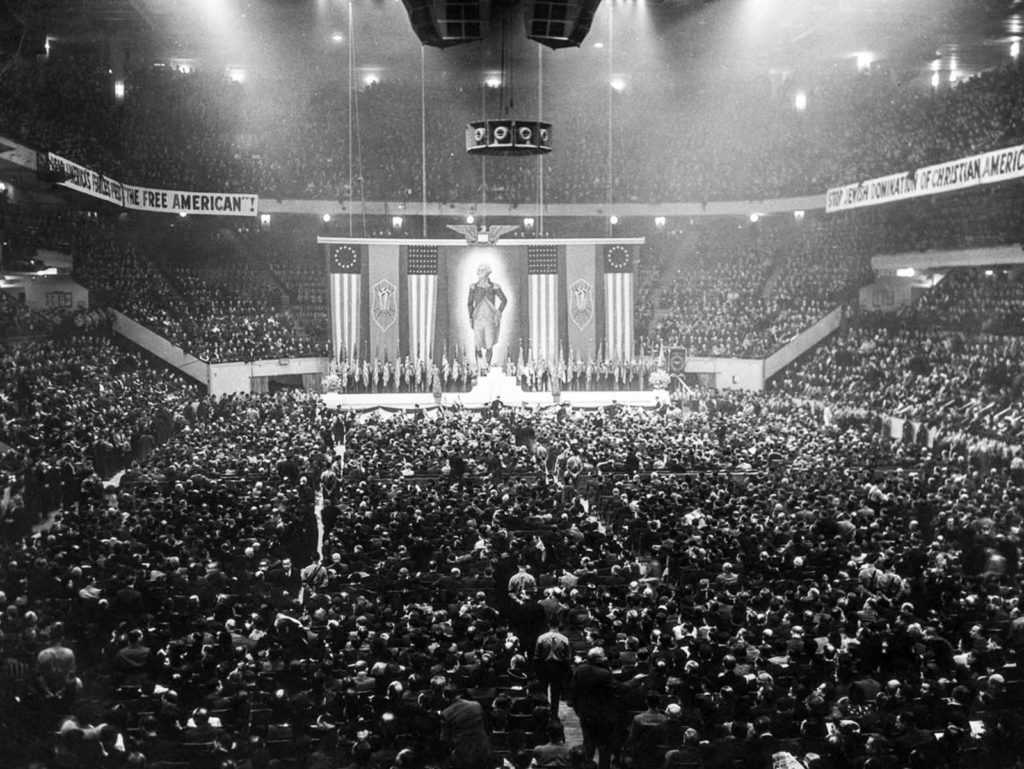
Eighty years ago this month — on February 20, 1939 — over 20,000 members of the German American Bund, a pro-Nazi organization, gathered at Madison Square Garden (at its Hell’s Kitchen location on Eighth Avenue) to unite the philosophies of American exceptionalism and Nazi worldview, gathering under the pretense of celebrating the birthday of George Washington.
Just a week earlier, on February 12, 1939, the Garden was filled with thousands of prized canines as part of the Westminster Dog Show. Eight days later, the famous arena was occupied with a more menacing sight.
From the New York Daily News:
I find the matter-of-fact reporting from the Brooklyn Daily Eagle the following day to be almost chilling:
“Marked by scores of street fights in which anti-Nazis, Nazis and police clashed frequently, the German-American Bund’s “American-ism” rally in celebration of George Washington’s birthday last night gave the vicinity of Madison Square Garden the liveliest six hours it has known in recent years.
The meeting itself, attended by more than 18,000, was without incident, except for the beating by Storm Troopers and subsequent arrest of Isadore Greenbaum, Brooklyn unemployed plumber, who attempted to attack Fritz Kuhn, Bund leader, as he spoke from the platform.”
The Oscar-nominated short documentaryA Night At the Garden looks at this event from an ominous bird’s eye view, capturing the united enthusiasm of the crowd and even Greenbaum’s attempt to storm the stage. The director Marshall Curry (who made the excellent film Street Fight — about Newark politics — over a decade ago) lets the footage speak for itself, allowing the audience to make their own contemporary parallels.
You can watch the entire film here. It’s up for an Academy Award for Best Documentary Short Subject against four other astounding films. (End Game and Period. End of Sentence are both on Netflix. And you can find Black Sheep and Life Boat on YouTube.)
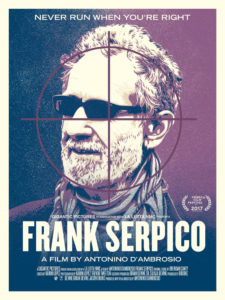
Frank Serpico is a member of an elite group of important American figures (along with Erin Brockovich and Karen Silkwood) that are almost entirely defined by the actors who played them in movies.
Even if you lived in New York City in the early 1970s and remember Serpico from the headlines, most likely you picture him as a young, handsome Al Pacino. Serpico is considered one of the greatest films of that decade, solidifying Pacino’s status as a successor to Marlon Brando, an actor of rare cinematic presence.
But whatever happened to Serpico, the actual Frank Serpico?
Frank Serpico
A documentary by Antonino D’ambrosio
Music by Jack White
In theaters and On Demand
An engaging new documentary by Antonino D’ambrosio tracks down the elusive Serpico and replays his dramatic story, but with a tonal shift. Frank Serpico is the actual star here and he’s no superhero. It turns out that becoming a lauded pop-cultural symbol of honesty and bravery is a hard act to follow.
Serpico, the son of southern Italian immigrants, grew up on the streets of Crown Heights and entered the ranks of the New York Police Department in 1959. Â From his Perry Street apartment, Serpico donned various undercover disguises to infiltrate the criminal ranks.
“I got my training in the streets of New York where I played many roles from a doctor to a derelict,” Serpico says early on, in front of a dressing room mirror. “And how well I played those roles, my life depended on it.”
His choice of neighborhood — the West Village was for bohemians and ‘degenerates’ — and his southern Italian heritage set him apart from his mostly Irish brethren and eventually he was moved to plainclothes duty. It was there that Serpico took in the extraordinary network of corruption which has afflicted the police department since the early 19th century. (Historian Luc Sante makes an appearance in the film to remark upon the cyclical nature of police corruption in New York.)
Trevor Tweeten/IFC Films
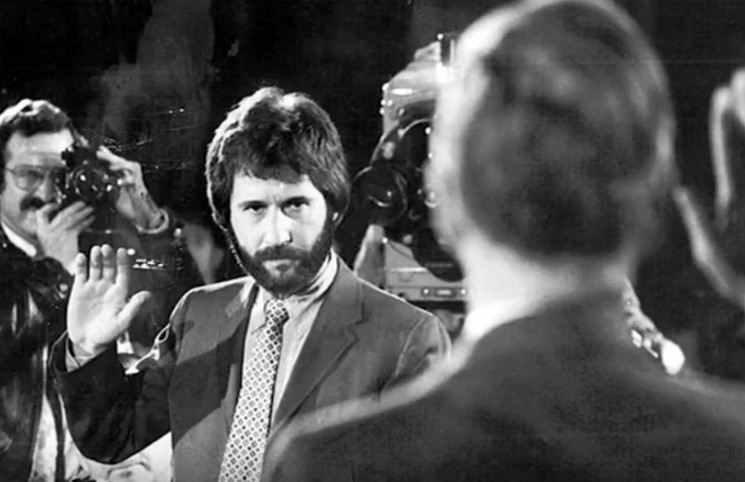
Instead of keeping quiet about it, Serpico spoke up — despite death threats  — leading to the formation of an investigative commission under the administration of Mayor John Lindsay. In the winter of 1971, Serpico was shot in the face at a routine drug arrest in Brooklyn. Was it a retaliation? In the documentary, Serpico sits with his former partner Arthur Cesare, discussing the incident with no small amount of awkwardness and intimation.
You’re perhaps familiar with most of this from the Pacino film, directed by Sidney Lumet. But what became a landmark piece of cinema only made Serpico’s life worse. While this documentary sometimes loses its focus — and even becomes distracted during its Hollywood segments — it’s absolutely worth it to see Serpico himself reflect upon his unusual legacy. He’s interesting, unassuming, at peace. But there’s little nobility in being right.
One hot summer’s morning, in the neighborhood of Yorkville on the Upper East Side, high school student James Powell was shot and killed by police officer James Gilligan.
Powell either attempted to stab the officer or else the unarmed boy was brutally set upon by a man with violent tendencies. Gilligan, a war veteran, was either defending himself from a troubled delinquent or else he gunned down the teenager with little remorse.
There were few actual witnesses but dozens of bystanders. The incident took place across the street from a high school, and the students, incensed by rumors and the fear of blood running in the streets, began panicking.
The year was 1964.
It’s hard not to read the opening pages to Michael W. Flamm’s gripping In The Heat Of The Summer: The New York Riots of 1964 and the War on Crime (University of Pennsylvania Press) and not see the parallels to modern police brutality cases.  So many different testimonies obscure the truth that it’s hard to know what really did happen in front of 215 East 76th Street that day. (Video footage might not have even cleared it up.)
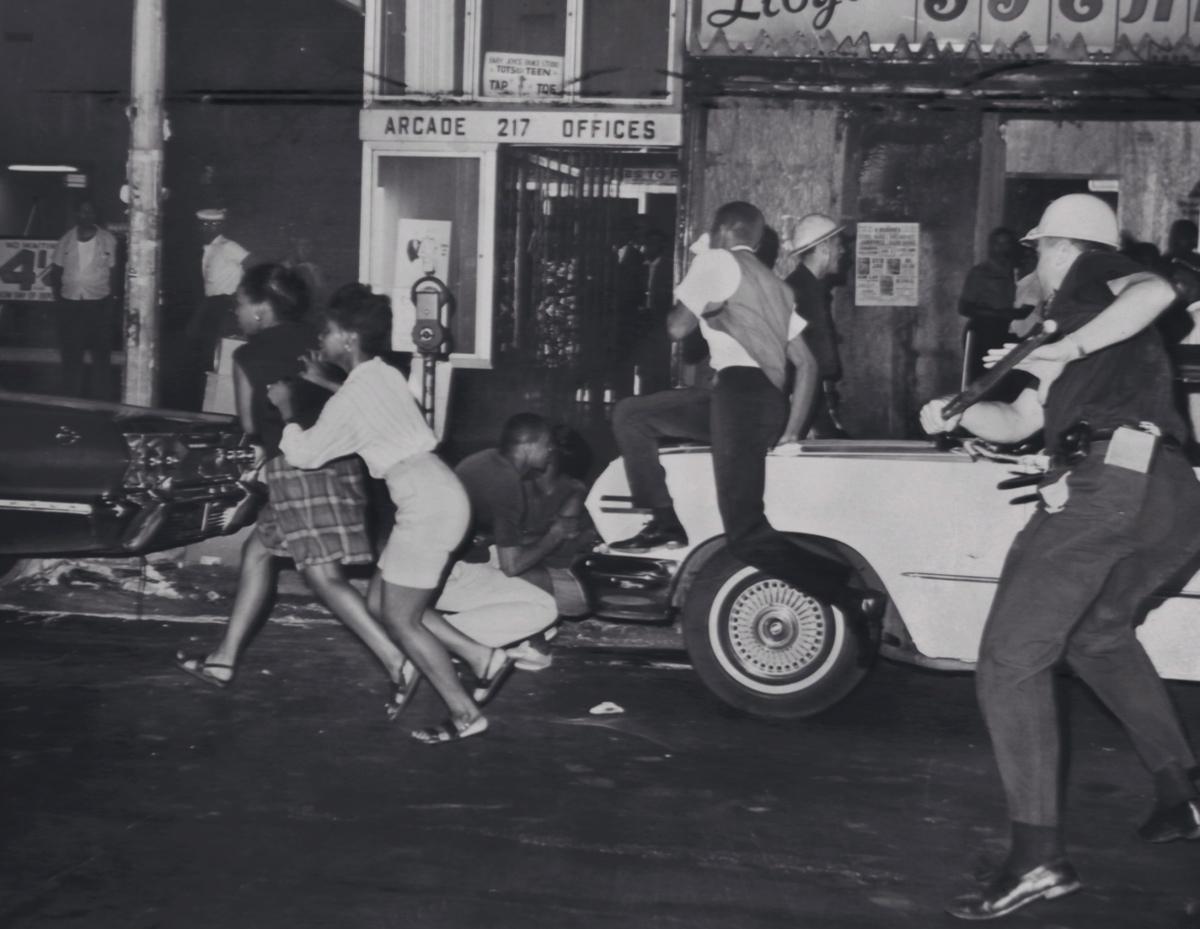
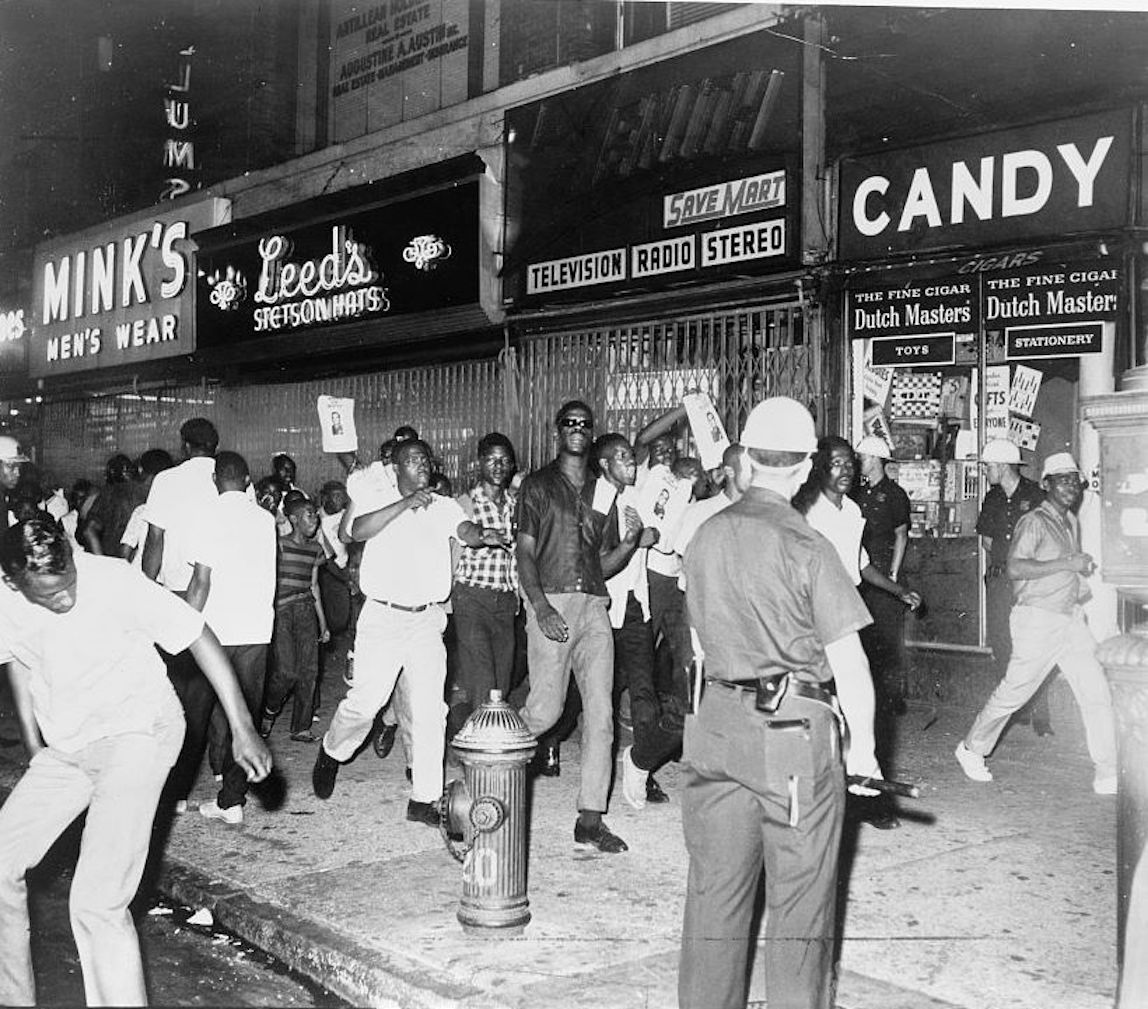
Yet Flamm’s book isn’t specifically about the crime, but the chaos which ensued — the New York Riots of 1964 (with the most violent night often referred to as the Harlem Riot of 1964). For several evenings following the shooting, a host of speculations and false rumors — mixing with grief and despair on a series of hot summer evenings — led to roaming violence and looting in Harlem (with some also reported in the Brooklyn neighborhood of Bedford-Stuyvesant).
The incidents which occurred that summer stem from hostilities which had built up within the black community for decades. A great distrust between the police and African-Americans played a part in the rising crime rate in poor neighborhoods like Harlem in the 1960s.
Courtesy the New York Daily News
Fearful residents felt powerless against increasing criminal behavior and drug abuse in their streets but didn’t risk involving law enforcement, who most considered corrupt and racist.
White residents avoided black neighborhoods — and vice versa — due to wildly dramatic reports in the press. Black power movements like the Nation of Islam escalated talk of violence while, in some neighborhoods, white vigilantes stopped and interrogated every black person found in the streets.
Writes Flamm: “New York sounded to the rest of the country like some frontier town helpless before the uncontrollable violence stalking its streets.”
Dick DeMarsico, New York World Telegraph & Sun
Flamm follows two parallel threads, both coming together in raw, unexpected ways. The first is a terrifying minute-by-minute account of the late-night street riots, the chaotic protests and the rallies organized by those who wished to funnel that rage into a mechanism of change. The second is the reactions of politicians and civil rights leaders to New York’s race and law enforcement problems.
The author’s meticulous research finds microcosms of hate and fear at nearly ever corner — of the kind which will make nobody particularly nostalgic for the period. “Central Harlem seemed like a war zone, with screams from people and cracks from bullets as they ricocheted off brick walls and cement sidewalks.”
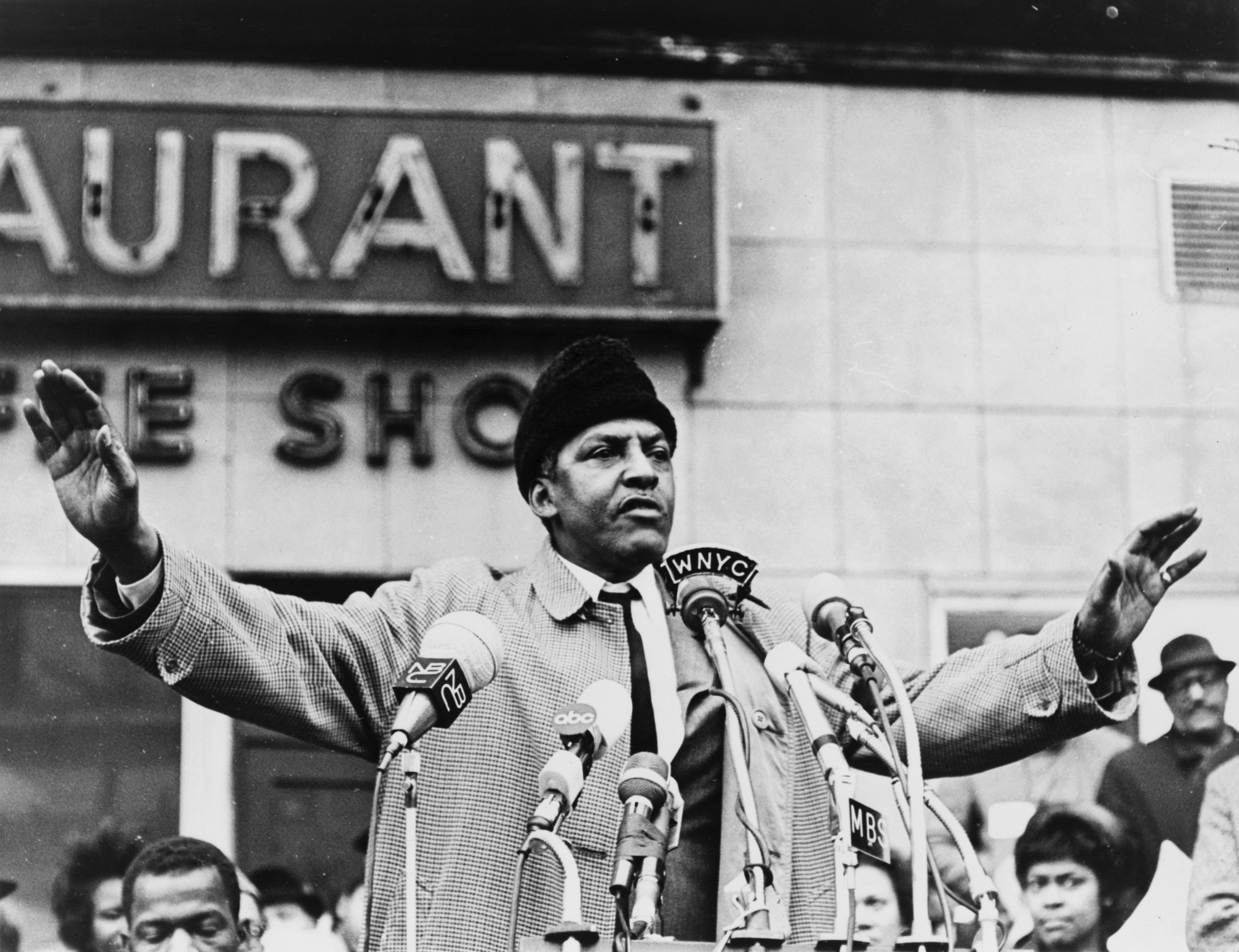
New York World-Telegram and the Sun staff photographer: Wolfson, Stanley, photographer.
At the center of the story is civil rights leader Bayard Rustin (pictured above) and the Congress for Racial Equality (CORE), often caught between keeping and promoting the peace and quelling the concerns of angry residents.
At one point, Rustin was literally disarming people. “The toll might have gone much higher if not for Rustin, who personally disposed of three cases of dynamite — enough to destroy a city block — after two young black men agreed to give it to him instead of using it.”
Few history books I’ve read in the past twelve months have felt as immediate as In the Heat of the Summer, with anecdotes that seem to speak pointedly to the events of today’s headlines.
For example, some police authorities applauded television coverage of the riots. Said one commissioner: “It’s the best answer we have to the cries of police brutality. The camera, after all, cannot distort or lie; the worst that can happen is that the film is edited. But what you see on the home screen is the actual occurrence.”
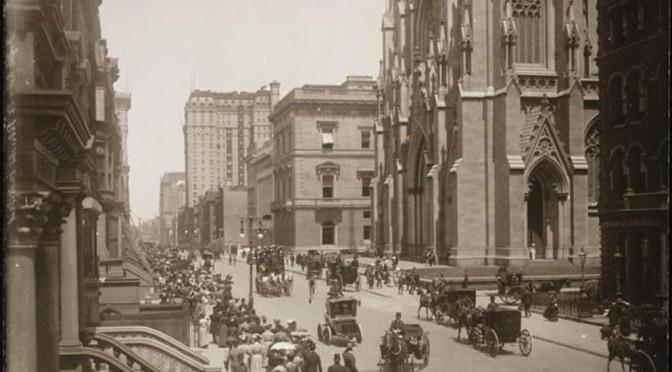
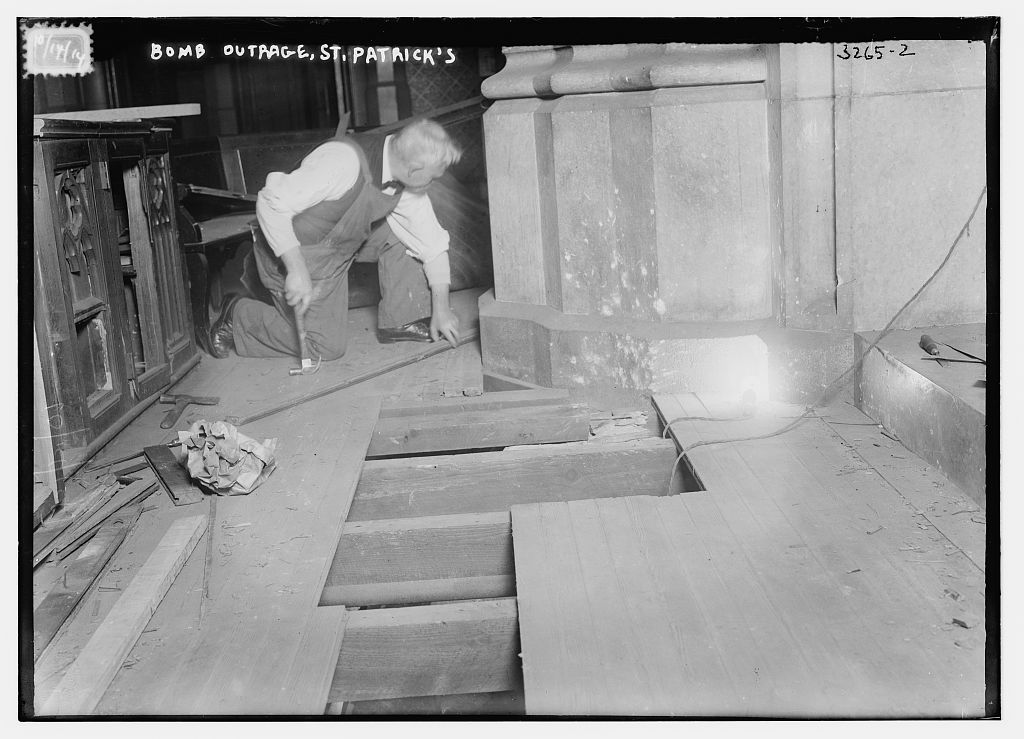
On the afternoon of October 13, 1914, a bomb exploded in the northwest corner of St. Patrick’s Cathedral, sending deadly iron shrapnel flying through the room.
A stained glass window was shattered and an 18-inch hole (shown in the picture below) was blown into the floor. While the pews were partially filled with worshipers, there was only a single injury, to a boy whose head was grazed by a piece of flying metal.
That was the second bomb of the day; another explosive, downtown at St. Alphonsus Church on West Broadway, detonated a little after noon.
Photograph shows damage after an anarchist bomb explosion at St. Patrick’s Cathedral on October 13, 1914. (Source: Flickr Commons project, 2011 and Washington Herald, Oct. 15, 1914) Â George Grantham Bain Collection (Library of Congress).
Such a disturbing attack in a public space would cause mayhem in the streets today. Yet this sort of terrorism was disturbingly frequent one hundred years ago, a tactic used by anarchist groups to sow discontent.
Many of the attacks were primarily aimed at New York’s financiers. For instance, on July 4, 1914, a brownstone exploded on the Upper East Side in the Yorkville neighborhood, killing members of the Anarchist Black Cross. The explosives had accidentally gone off and were intended for the home of John D. Rockefeller.
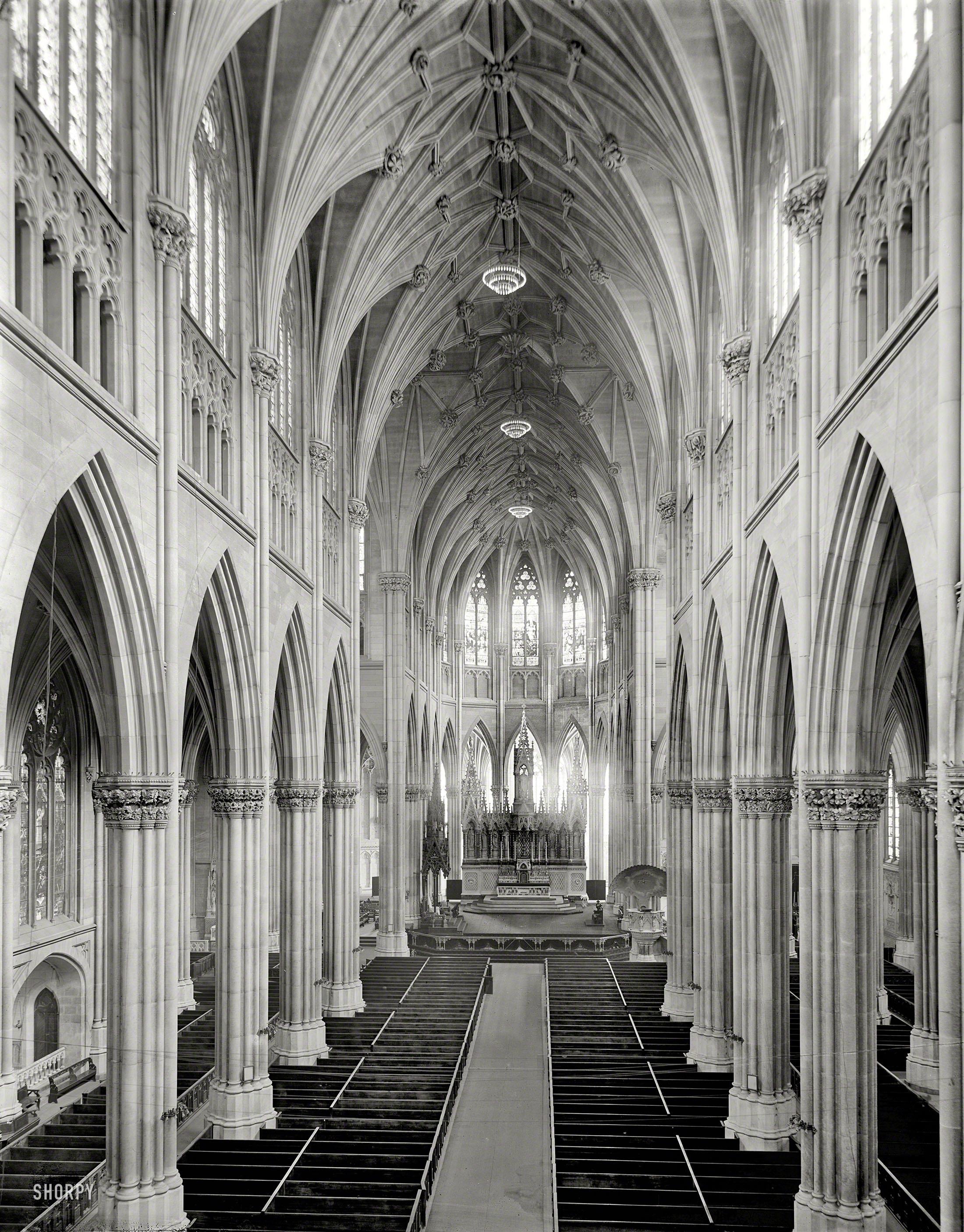
The interior of St. Patrick’s Cathedral, circa 1907 (Clean-up photograph courtesy Shorpy.com)
No arrests had been made in the St. Patrick’s attack. But detectives working with the New York Department of Combustibles were on the case, and, in March of 1915, they managed to thwart a second attack on St. Patrick’s with the help of a young detective named Emilio Polignani.
Polignani was only 25 years old. He had been a patrolman for only a few months when he was chosen in the fall of 1914 for a special assignment — to infiltrate anarchist circles and identify the perpetrators of the attack on St. Patrick’s.
His qualifications, according to the New York Times, were “his nationality, his newness to the force and most especially because Captain Tunney had decided that he had the nerve and the resource to carry him through tight places.”
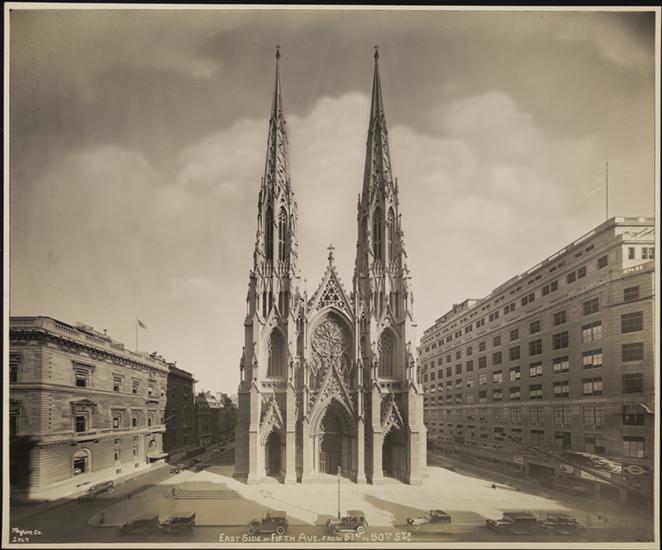
St. Patrick’s Cathedral 1923
For four months, Polignani lived under cover (possibly not even allowed to speak to his wife) as Frank Baldo, attending anarchist meetings throughout the city, becoming familiar with several of the more radical members. It was in Yorkville that he became friends with an 18-year-old named Charles Carbone.
From the New York Times: “Carbone and Polignani became intimate and used to take long walks together, in which Carbone, according to the detective, inveighed against the rich and suggested bombs as a means of readjusting social inequalities.”
Polignani was even initiated into an anarchist group by swearing an oath administered “on the cross hilt of a dagger to bind him … to his comrades.”
Carbone confided to Polignani details of the botched July 4th bomb meant for Rockefeller. “I am an expert,” he said. “Nothing like that could happen to me.”
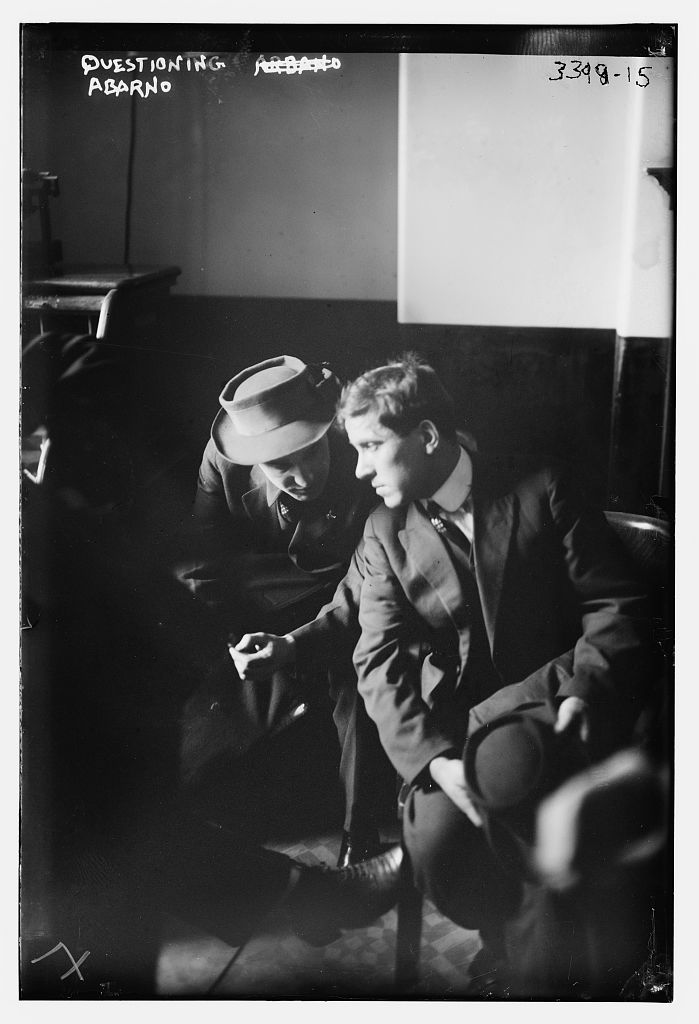
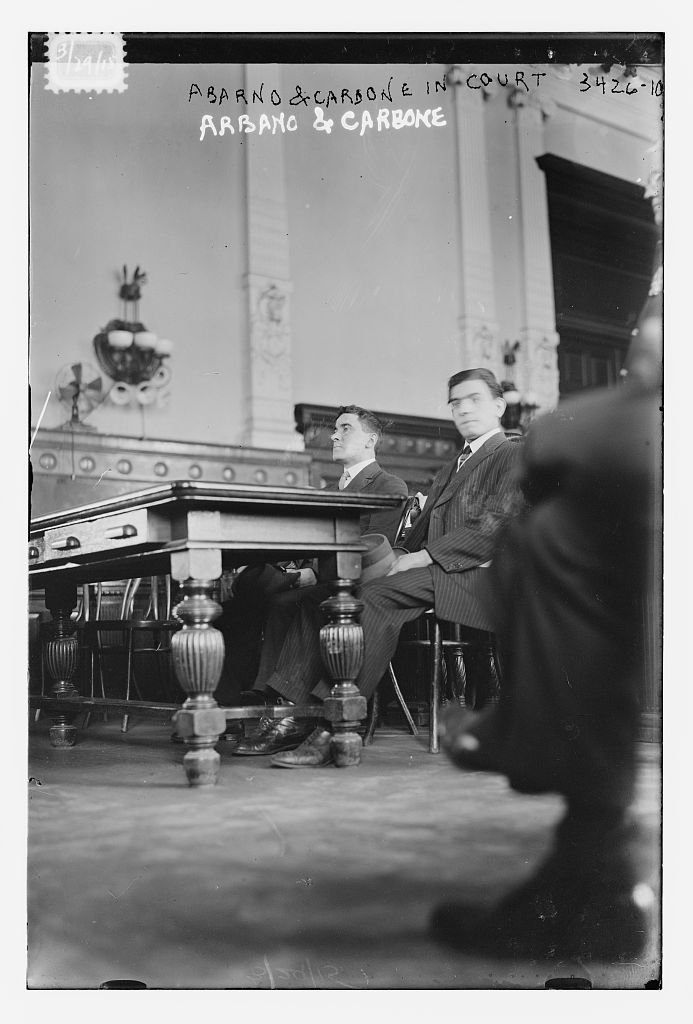
Frank Abarno, an Italian anarchist who was charged with planting a bomb in St. Patricks Cathedral, New York City, on March 2, 1915. (Source: Flickr Commons project, 2012) Forms part of: George Grantham Bain Collection (Library of Congress).
On Christmas the detective met another anarchist named Frank Abarno who later professed the wish to bomb St. Patrick’s.
Over the next two months, the three men walked along the East River and plotted a new attack at St Patrick’s, seen as the ultimate representative of both religion and wealth.
What Abarno and Carbone did not know was that Polignani sent pages from their bomb manual down to police headquarters.
Plans were finally hatched in late February to again bomb the cathedral. The men gathered explosive materials at a tenement on Third Avenue then wandering around the church the Saturday before, looking for a more effective spot in which to place an explosive. Their movements were closely followed by other disguised detectives, clued in by Polignani of the anarchist’s plans.
The new attack on St. Patrick’s Cathedral was planned for March 2nd. Abarno and Polignani left the Third Avenue tenement that morning with bombs placed under coats and armed with cigars to be used to light the fuses. (Curiously enough Carbone failed to show up; he was later arrested.) They headed towards the cathedral which was filled with hundreds of worshipers in the middle of morning Mass.
Luckily, Polignani had alerted his department of the details of the bomb attack. Waiting for them at St. Patrick’s were dozens of disguised detectives, so many that a Broadway theatrical costumer was employed to fashion the various false appearances.
“Of the fifty [detectives] stationed in the Cathedral,” said The Evening World, “[s]ome were disguised as women worshipers, two as scrubwomen, others as ushers.”
When Abarno prepared to light the fuse on the bomb with his cigar, one of the scrubwomen “suddenly straightened up and seized [Abarno] by the arm.” Another detective calmly strolled over to the lit bomb and pinched out the fuse. The Mass went entirely uninterrupted. (Read the breathtaking details of the capture here.)
Photograph shows Frank Abarno and Carmine Carbone, who were accused and convicted of an anarchist plot to blow up St. Patrick’s Cathedral in March 1915. (Source: Flickr Commons project, 2012)Â Â George Grantham Bain Collection (Library of Congress).
Polignani kept up the facade for most of the interrogation, and his would-be conspirators were none the wiser. He argued with Abarno in jail, eventually getting him to talk openly about his involvement (to the delight of detectives who were listening in).
Abarno and Carbone both eventually broke down and were promptly convicted. They were both sent to Sing Sing in April where they both served six year terms.
Newspapers the following day declared “the episode was the culmination of one of the most intricate pieces of detective work ever achieved by the New York police.”
However the bombings would continue. The most dramatic incident would take place on September 16, 1920, with a bomb detonating on Wall Street, killing 30 people.
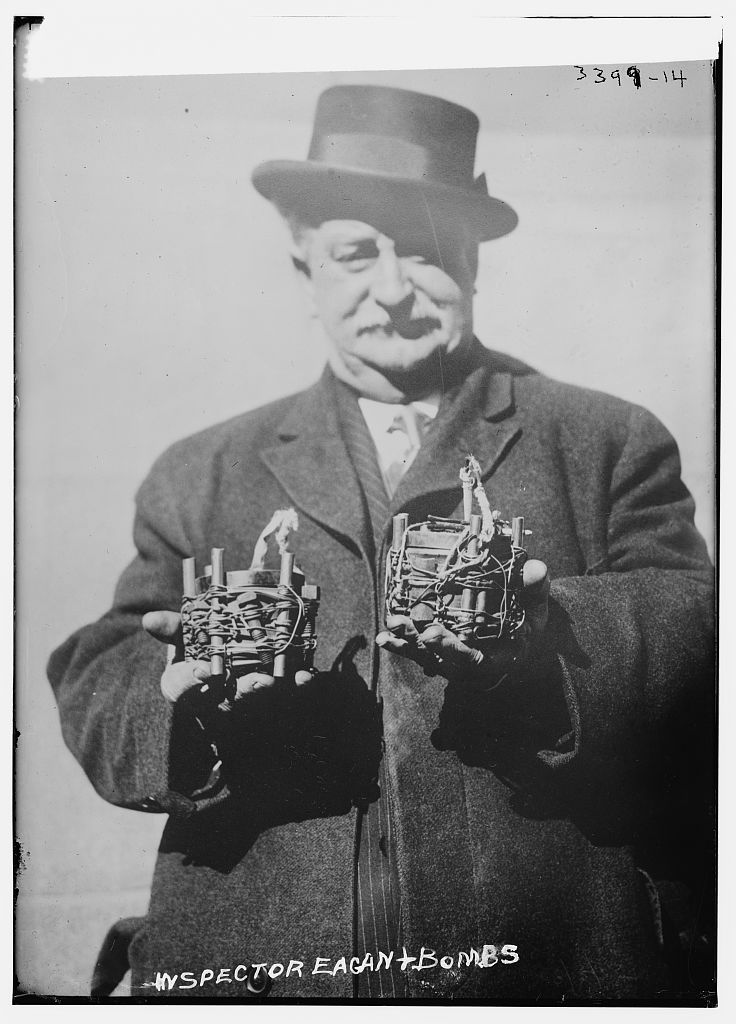
Owen Eagan (1957-1920), a bomb expert in the New York City Fire Department’s Bureau of Combustibles. He is holding a bomb recovered from an attempted anarchist bombing of St. Patrick’s Cathedral, New York City on March 2, 1915. (Source: Flickr Commons project and New York Times, March 3, 1915) Forms part of: George Grantham Bain Collection (Library of Congress).
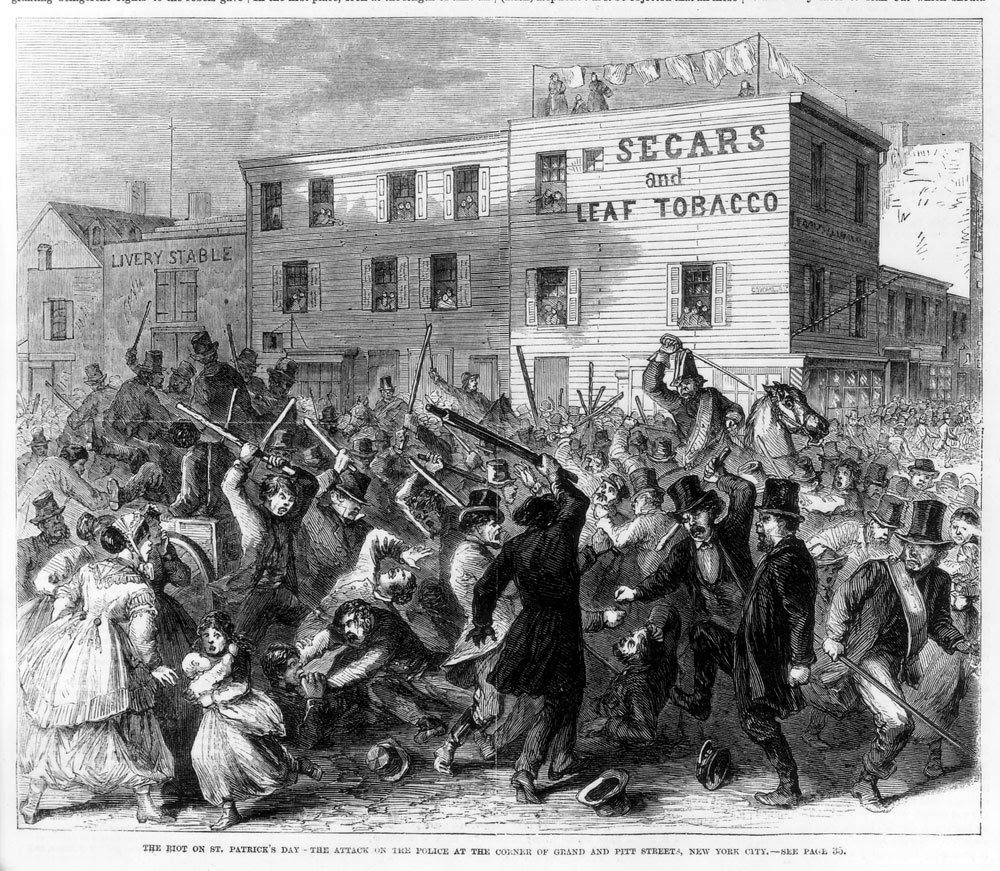
Frank Leslie’s Illustrated Newspaper reported on a ‘riot’ which occurred on Saint Patrick’s Day 1867 at the intersections of East Broadway, Grand and Pitt Streets, one block below Delancey Street and the Williamsburg Bridge (which was decades from being built by that date).
The parade began on East Broadway, with regiments assembling here (“slush and snowdrifts … disregarded”) to march throughout the city.
A bit after noon, a wagon driver, hemmed in by mounds of snow, got caught at Grand and Pitt street, blocking the parade route. He was immediately set upon by angry marchers. When a police officer interceded to protect the driver, he, too, was assaulted, “knocked down and severely injured by being trampled upon.”
Other officers arrived, and soon Grand and Pitt was the scene of senseless violence. “The Hibernians broke their staves of office and used the fragments as shillelaghs and clubs, with such effect, that the officers were the recipients of several ugly scalp wounds and bruises.” Another report lists the unique weaponry as “sword canes, society emblems and other missiles.” One officer was wounded with a sabre. Soon the street corner filled with policemen, and the violence subsided. [source]
The whole event seemed to last no more than thirty minutes. But the New York Times, a fairly anti-Democrat, anti-Irish paper in the mid 19th century, was truly outraged: “We trust there is no Irishman or Irish American, outside of a small lawless minority, that does not feel keenly the disgrace brought upon such celebrations as that of yesterday, by the wanton and brutal assaults upon the Police.”
NOTE: This article has a few plot spoilers but no major twists are revealed or discussed. I’ve tried to write the descriptions within the interactive map as vaguely as possible.
The Alienist by Caleb Carr was published 20 years ago this week, an instant best-seller in 1994 that has become a cult classic among history buffs. Despite some creakiness uniquely inherent to early ’90s fiction thrillers, it remains today a page-turning and utterly spellbinding adventure.
Although the Jack the Ripper murders were an obvious inspiration for Carr, perhaps The Alienist‘s biggest influence is The Silence of the Lambs by Thomas Harris. Carr completed his tale of serial murders in the Gilded Age just as a slew of Silence knockoffs began hitting the bookshelves. The Alienist stands far above the pack, of course, but you can’t deny its success in 1994 was partially inspired by reader’s cravings for murderers with perverted tastes and body parts in formaldehyde jars.
The Alienist follows a quirky team of investigators in 1896 as they follow the bloody trail of a killer with a peculiar penchant for boy prostitutes, often dressed as girls to the delight of their clientele. Dr. Laszlo Kreizler is the alienist (or psychologist) in charge of the case, stitching together a profile of the loathsome figure, conveniently using soon-to-be standard analytic techniques.
At right: Alternate artwork for The Alienist (Courtesy Nerd Blerp)
As protagonist John Schuyler Moore, a reporter for the New York Times, explains it “[W]e start with the prominent features of the killings themselves, as well as the personality traits of the victims, and from those we determine what kind of man might be at work. Then, using evidence that would otherwise have seemed meaningless, we begin to close in.”
Carr’s book is finely detailed, perhaps overly detailed, which won’t be a problem if you love New York City history. There are over two dozen scenes at various notable landmarks throughout Manhattan, some in various states of construction. Several real-life figures make appearances, although the most entertaining characters are Carr’s own, including the intrepid proto-policewoman Sara Howard and scrappy errand boy Stevie ‘Stovepipe’ Taggart.
When I first read The Alienist back in 1994, I was struck by its preciseness, an expertly placed breadcrumb trail through old Gotham. There is no romantic gloss, as in another history classic Time and Again. He makes it seem possible to retrace almost every step of our heroes. (In researching this article, I tried to do so.) The original New York Times review noted that “[y]ou can practically hear the clip-clop of horses’ hooves echoing down old Broadway.” They’re still echoing.
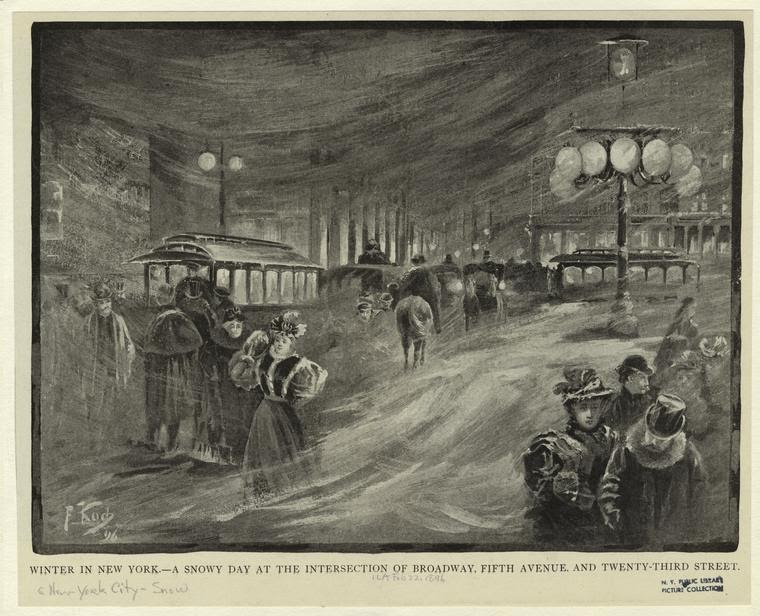
The story begins in the early months of 1896 during a robust winter. Below, from the Illustrated American, a depiction of a snowy Madison Square that year (NYPL):
His depiction of old New York is still glorious. The book’s polite take on certain social issues, however, read a bit wobbly today. To his credit, Carr tackles police corruption, gender discrimination, racial prejudice and the plight of homosexuals, all while elaborating on complicated psychological theories in service of an entertaining story. He has stuffed a hidden epic of New York into the framework of a modern murder mystery. That he chooses to handle hot-button social issues with kid gloves is not a misstep, but merely a symptom of its genre and day.
The Alienist is still greatly enjoyable, perhaps slightly more so now. Thanks to renewed interest in New York City history, the details here are even more shimmering and vital. This is not an old New York emerging from a mysterious fog, but a world that seems to exist alongside our own.
And to prove that — below you will find a detailed, interactive map of the pivotal locations used in the book. You can click into various points for further details. A few of these pins have pictures and other links. Just zoom in and choose a location! (NOTE: Some locations are approximate and a couple are speculation.)
A little elaboration on certain elements of the book’s bigger places and themes:
Paresis Hall Most of the murder victims are boy prostitutes employed as several houses of ill repute throughout the city. Paresis Hall, located steps from Cooper Union, sounds like it was both a place where gay men could congregate in private clubs and a place of sexual transaction, often (as in the book) with underage boys dressed up as girls. This boy, Nathaniel ‘ The Kid’ Cullen, may have worked there, or may have just a habitue of the club. (He appears in this collection of photographs from Paresis Hill.)
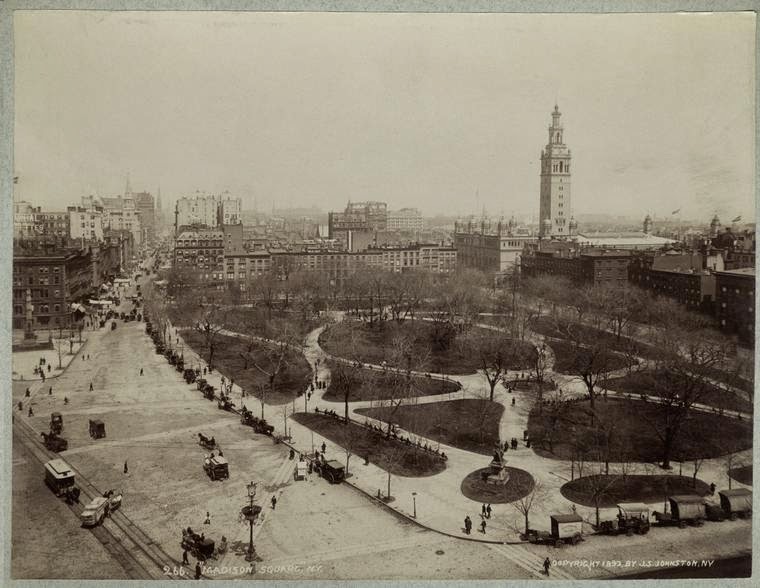
Madison Square This was still a thriving center for culture and dignified entertainments in 1896. Many theaters clustered around the park, although newer stages were making their way up Broadway to Herald Square. If Delmonico’s (on the northwest corner) is too crowded for you, head over to the tea room at Madison SquareGarden on the northeast side. Pictured here in 1893, three years before the events of the Alienist. (NYPL)
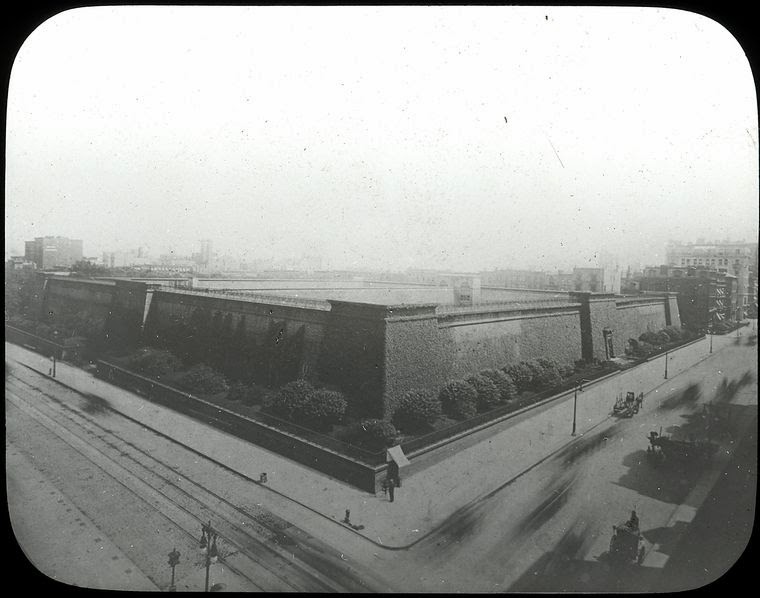
Murray Hill Distributing Reservoir In 1896, New York still relied on this reservoir to provide most people with water. But it was also a tourist destination in itself, with walking paths along the top. Shortly after its appearance it the book, the Egyptian-inspired reservoir was torn down to make way for New York’s new public library. (NYPL)
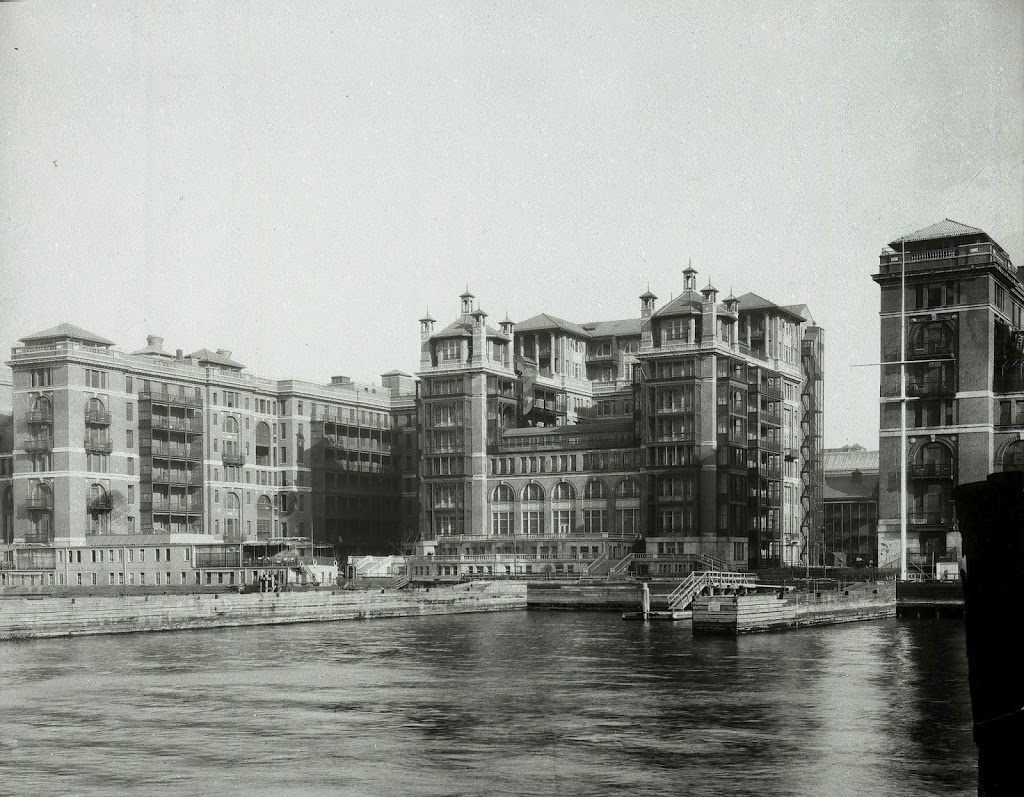
Bellevue Hospital and Morgue Check out our podcast and blog posting on the history of Bellevue Hospital, as many of the details mentioned there appear in this book. Below: Bellevue in 1879.
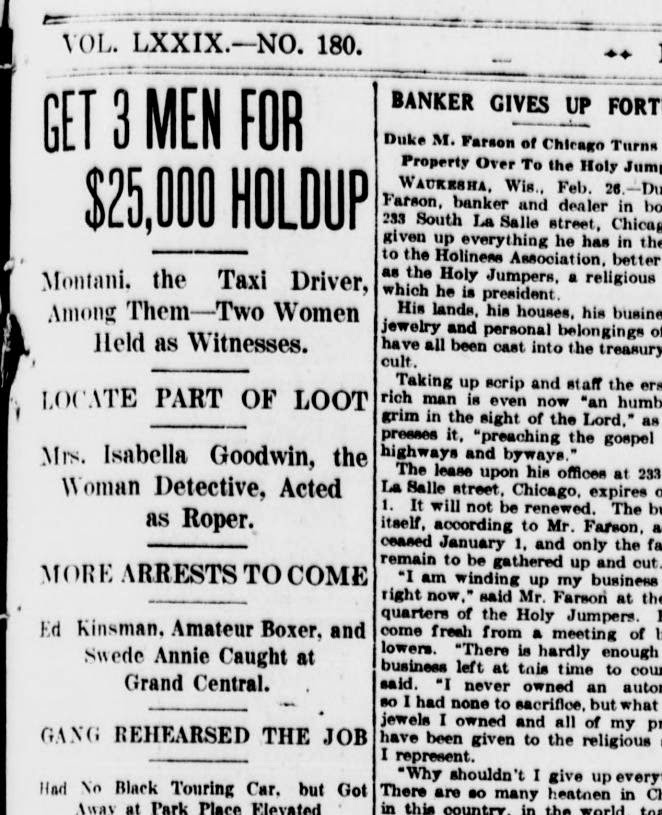
Isabella Goodwin Sara Howard seems to be a little bit Nellie Bly, and a lot Isabella Goodwin, the first female office promoted to detective in 1896 (the year the book is set). Below: A front-page case cracked by Goodwin from February 1912.
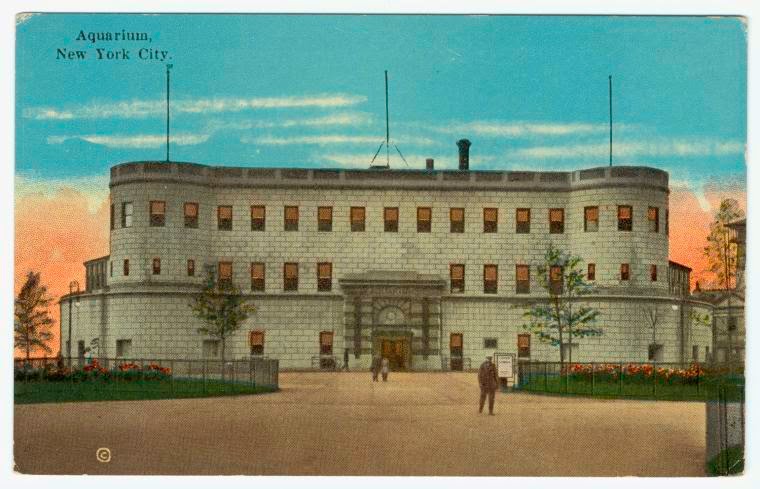
New York Aquarium Carr’s narrative features several New York landmarks in construction. Two of those places take a morbid center stage in the book — the Williamsburg Bridge and the nearly completed New York Aquarium (the former Castle Garden) (NYPL)
Theodore Roosevelt Carr weaves several real life figures into the storyline, from J.P. Morgan (who comes off quite ominous) to Jacob Riis (not a flattering portrait of him either). But future president Roosevelt gets a glowing supporting role as New York’s police commissioner who directs Dr. Kreizler, Moore and Howard to investigate the murders using powers of psychological deduction.
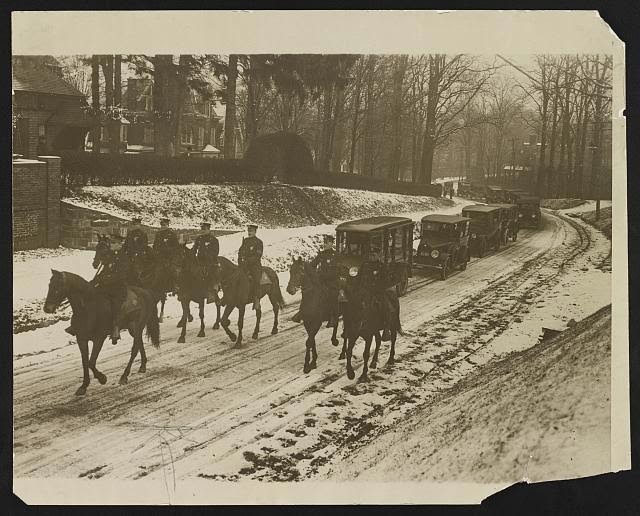
In fact, the book is actually a flashback by our hero Moore, recalled when he visits the Oyster Bay funeral of his dear friend in 1919 (pictured below). (LOC)
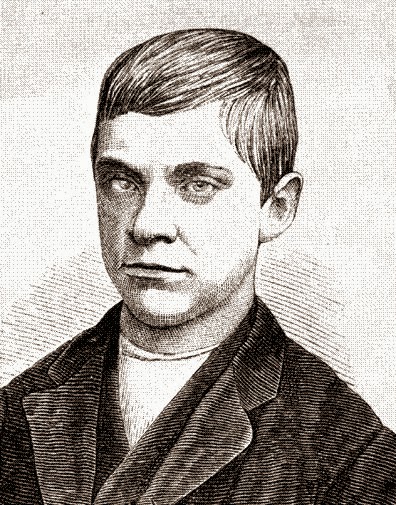
True Crime And there are a great many real-life figures from New York’s criminal underworld as well. In fact, most of the lecherous and notorious figures depicted in the book are real folks, from early gangsters like Paul Kelly to brothel owners such as Biff Ellison. Carr also finds a few disturbing mental cases to bring into the story, including the young killer Jesse Pomeroy (pictured below), considered one of the most brutal of murderers at a ripe age of 14.
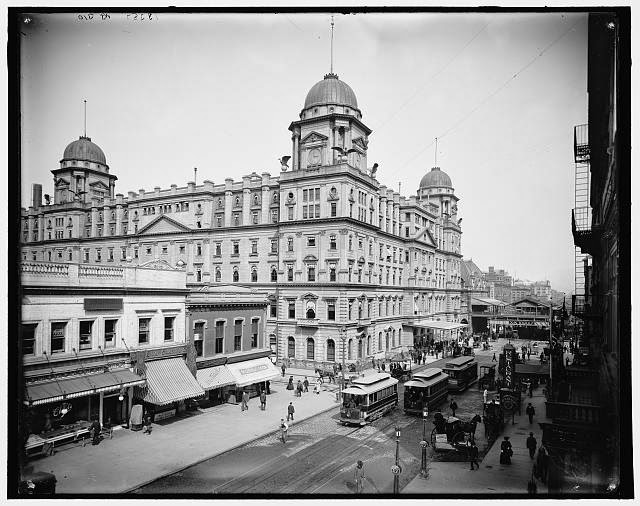
Grand Central Depot The characters do venture to places outside the city for further clues, but they always come through Grand Central Depot, the most hectic place in New York. (Pennsylvania Station had not yet been built.) Within a few years, this too would be ripped down and replaced with the present Grand Central Terminal. (LOC)
And finally, there are three central locations from the book that are still around today:
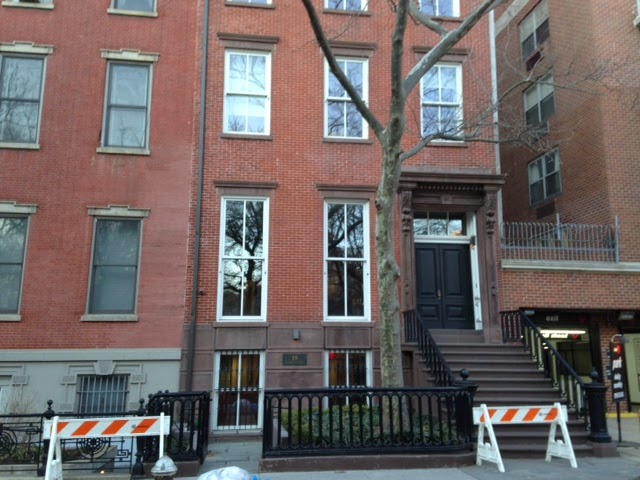
Dr. Laszlo’s residence at Stuyvesant Park. Actually the address in the book doesn’t really exist. But based on a couple descriptions — and its proximity to St. George’s Church, which is mentioned as close by — this building at 237 East 17th Street may be what Carr had in mind:
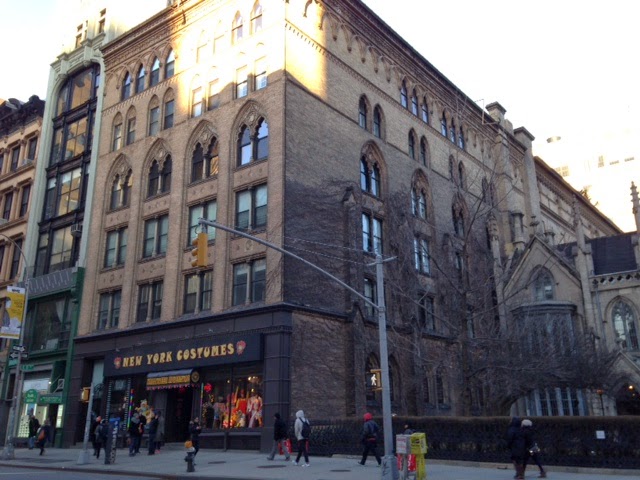
Murder headquarters at 808 Broadway — This exceptionally handsome building was constructed by James Renwick, playing nicely off its neighbor Grace Church. It’s actually called the Renwick! The team was located on the sixth floor. Today, on the first floor, is one of New York’s most popular costume shops.
John Schuyler Moore’s home at Washington Square Park North, facing the park:
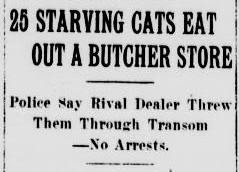
“Policeman James Kenny, trudging along James Street at 10 o’clock last night, heard horrendous sounds coming from the market of Brighton Beef Company at No. 72. Â A hundred drunken burglars couldn’t have made more noise. Kenny, remembering that a bomb went off in front of this same market six months ago and blew the store front to pieces, blew his whistle and thumped his night stick for assistance. Â Seven other patrolmen came running. They stole up to the door with pistols pointed. Â They lunged together and burst in. Â Twenty-five cats fled at their approach. Â The cats were of all sizes and colors. Â They had been hungry, but were no longer. Â They had eaten every scrap of meat in the market — chicken and beef and everything else, and were fighting over the bones. The eight policemen pocketed their pistols but swung their clubs. Â They also said ‘Scat!’ and the cats ran into the street and scurried through the East Side with great news for their tribe. Â There were no arrests. The police suspected that some rival butcher had collected the cats, Â starved them and thrown them through the transom of the Brighton Beef Company’s store.”
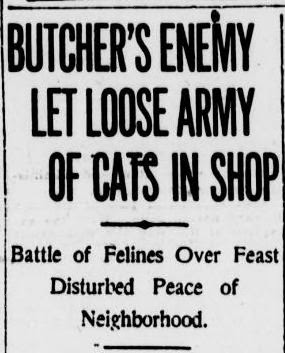
“[T]he owner has two cats of his own, trained to eat no meat, which he always leaves in the shop overnight. The first peripatetic pussy that was pushed through the fanlight was pounced upon by the faithful feline guards of the pork chops. Â They grabbed him and sought to shove him into the sausage chopper. Â But other felines came through the fanlight. It began to rain cats. Â The guardians of the garbage cans made short shrift of the tame tabbies of the butcher shop.”
What the Sun story fails to report is that a young man was pushed through the fanlight before the cops stormed the shop.
“The policemen couldn’t open the door. Â They shoved Tommy Laura, a young man of James Street, through the fanlight. A dozen cats scrambled over Tommy when he fell to the floor. Â He turned up the lights and got a pair of pliers with which he opened the door…..”
One man had to be taken to the hospital when he grabbed the tail of a cat perched upon a meat hook.
Cats and butcher shops, clearly, do not mix!
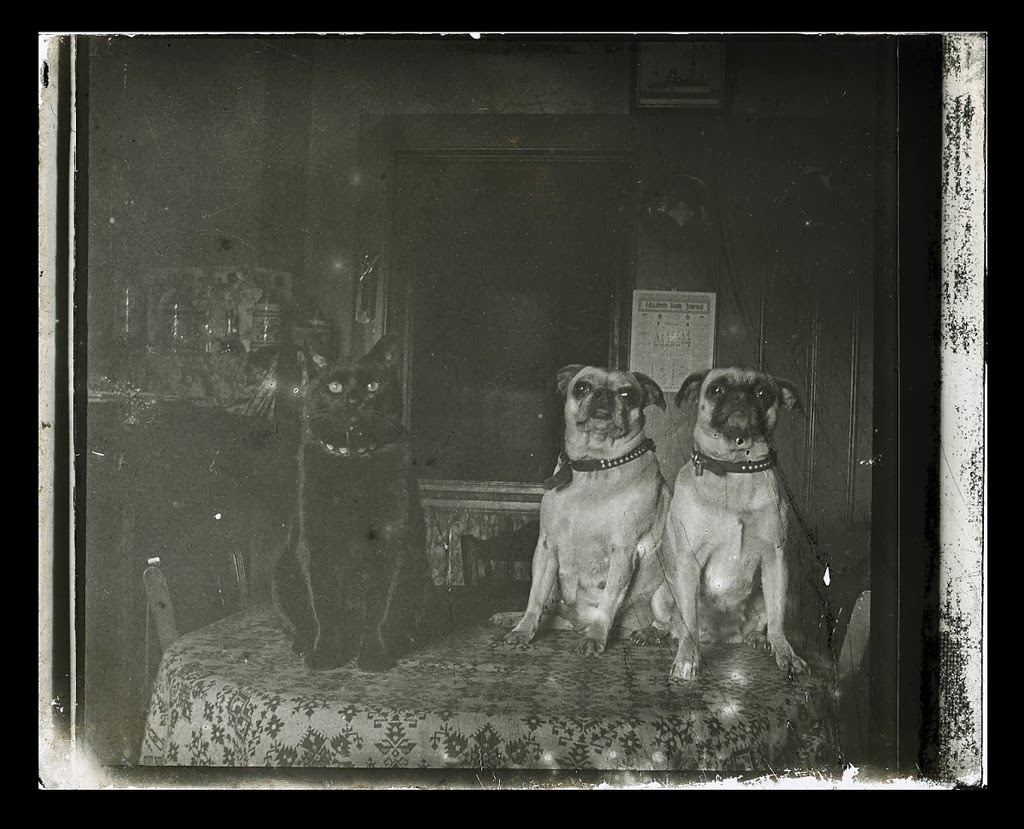
Below: Do you trust this cat with your perishables? It’s a cat and two dog companions in Flatbush, circa 1900s, photographed by Daniel Berry Austin, courtesy the Brooklyn Museum
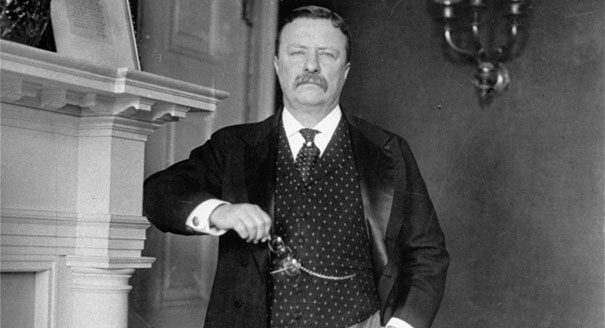
Theodore Roosevelt in 1908, in a rare shot with his pince-nez lowered.
Checking the mailbox was a frightening experience for some New Yorkers almost a century ago.
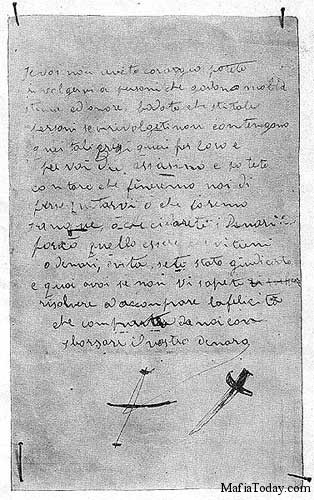
Some found extortion notes — threatening letters, demanding large sums of money or else — courtesy Italian gangsters collectively referred to in the press as The Black Hand. Most of the targeted addresses belonged to newly arrived wealthy Italian immigrants, often celebrities or successful business owners. Famed tenor Enrico Caruso was even a victim of the Black Hand’s extortion in 1920. “I laugh, ho ho, to show me myself that I fear not,” the singer claimed, although he ended up paying one extortion threat before calling the police after he received a follow-up.
At right: A typical extortion letter attributed to the Black Hand (Courtesy Mafia Today)
The Black Hand was already a frightening and well-publicized threat by 1913, although the number of incidents were probably less than the press would have its readers believe.
It was under this apprehension, on Valentine’s Day 1913, that a Mrs. Douglas Robinson arrived at her husband’s real estate office on the Upper East Side to open his mail.
Inside one envelope was a single ‘blood-red’ card, which very simply stated:
“This is the red card to remind you that I have not forgotten. When you receive a black card, you will know that the end is at hand. The Master Mind”
What Mrs. Robinson did not know is that this threatening note had been sent to thousands of New Yorkers that very day. And that it had been preceded just a few days before with another ominous card:
“This is to remind you of an incident in your past, and of my enmity. When you receive a red card it will mean I am drawing near. The Master Mind.”
According to the New York Tribune, 40,000 New Yorkers had received such cards in the mail that month. Had Mrs. Robinson known this fact, she might have found safety in numbers and cautiously went about her day. Instead, in a panic, she reached for the telephone and called New York’s police commissioner.
Except not the current commissioner, the ineffectual reformist Rhinelander Waldo. Instead, she called up New York’s most famous police commissioner (from 1895-97), a man who still lived in New York and, oh yes, had been the President of the United States for a few years — Theodore Roosevelt.
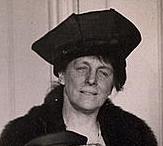
The Colonel was still licking his wounds from an unsuccessful bid the previous year at reacquiring the presidency, as the head of the newly formed Bull Moose Party. You may wonder how the wife of a real estate broker would have the ready ear of an ex-President, but it is here that I reveal that Mrs. Douglas Robinson (which is how she’s presented in press accounts of this incident) is in fact Corinne Roosevelt Robinson, Theodore’s younger sister. (Pictured at left in 1920, picture courtesy LOC)
“Leave it to me,” he assured his sister and promptly called up detectives Hyams and Hughes to investigate the matter.
Going only upon Roosevelt’s description, the two detectives began scouring the streets for clues. They were certainly quite proud to be working on a case personally passed to them by Roosevelt — probably the most famous New Yorker in America. Their only liability was that they were working only off of Roosevelt’s information — and his sister had overlooked one rather big piece of information.
While wandering through midtown Manhattan, the detectives struck up a conversation with Edward Gireaux, a booking agent of John Cort, one of America’s leading theatrical impresarios. A Seattle entrepreneur enriched by the Klondike gold rich, Cort, unlike his competitors Klaw & Erlanger and the Shuberts, specialized in promoting a national circuit of legitimate theater. No musicals for the Cort Circuit! (The Cort Theatre, on West 48th Street, is still hammering out dramas to this day.)
The detectives were only too eager to tell Mr. Gireaux of their mysterious case, delivered to them by Roosevelt directly. It was only when they informed the agent of the details of the crime that Gireaux must have smiled to himself.
He produced a stack of the very same ‘blood-red’ cards from his pocket. Perhaps he was passing them out to passers-by. The detectives now saw the entire printed content of the card:
“This is the red card to remind you that I have not forgotten. When you receive a black card, you will know that the end is at hand. I will see you at the Harris Theatre. — The Master Mind”
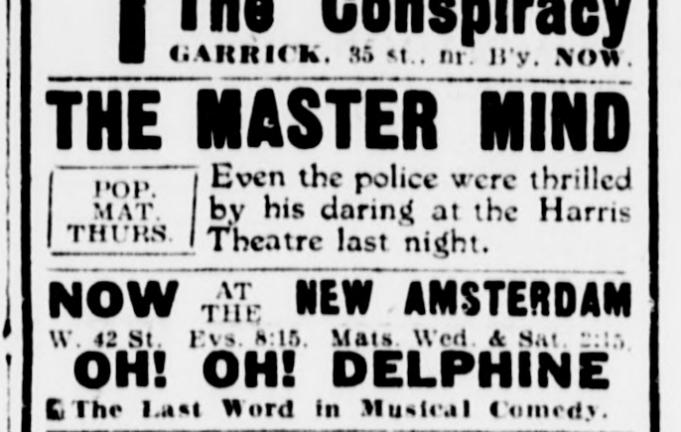
‘The Master Mind’, starring Edmund Breese, was a ragged melodrama about “a dominant personality in a band of criminals,” premiering that week at the Harris Theatre at 254 W. 42nd Street. The cards had been nothing more than a slightly inappropriate bit of viral marketing.
Below: Newspaper advertisement for the Master Mind. ‘Even the police were thrilled!’
And it worked! The Master Mind played for several months despite some tepid reviews (“headachy to follow“) and was later turned into a film starring Lionel Barrymore. You can read a contemporary novelization of the play here, featuring such delectable bon mots as “You have made your own beds! Now you shall lie in them. Understand that, please! I have said it — I, the Master Mind!”
The star of the play Breese would himself go on to the silent pictures and co-starred in the Oscar-winning All Quiet On The Western Frontin 1930.
As for Theodore Roosevelt, he would publish his autobiography in 1913 and by year’s end would embark on a lengthy journey to South America. Corinne Roosevelt Robinson would later dabble in politics herself, backing Warren G. Harding in 1920 and even recording this radio message in support.
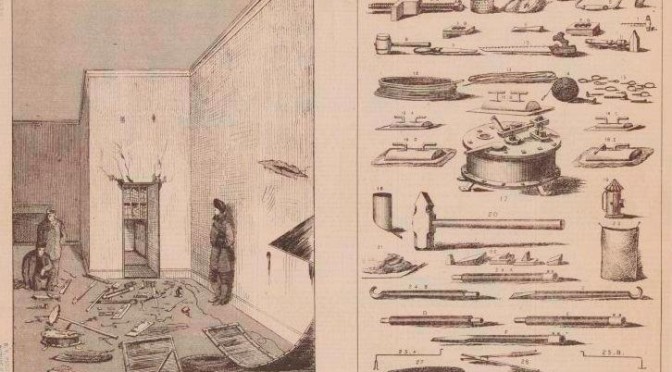
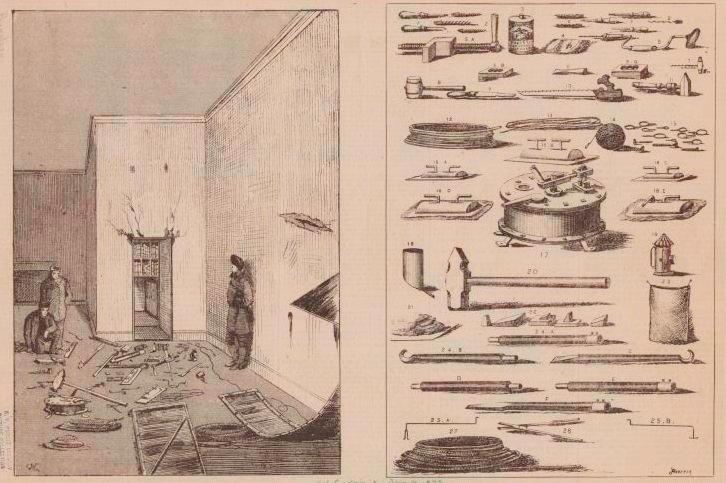
‘Red’ Leary was one of the famous bank robbers of the 1870s, assisting in heists all along the Northeast. Above is an illustration of a bank robbery in Montreal, Canada, displaying some of the tools found at the crime scene.
They don’t talk about ‘Red’ Leary anymore down in the streets of the Lower East Side. In the hipster bars and boutiques, in the graphic design firms and the Chinese foot-massage parlors, his name goes virtually unspoken.
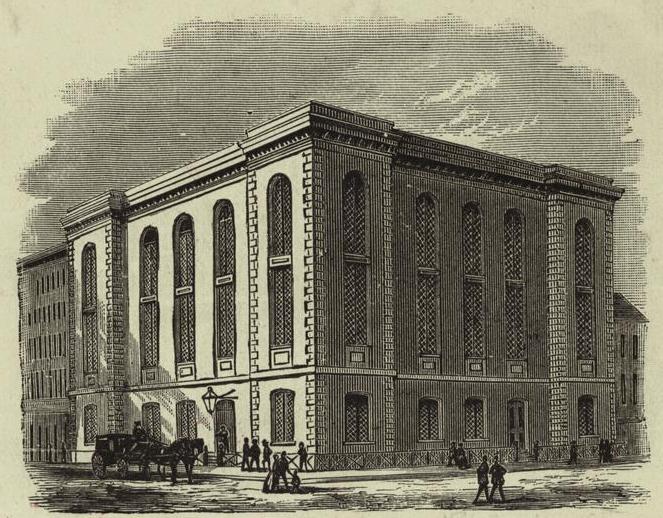
But over one hundred and thirty years ago, his unusual escape from the Ludlow Street Jail (pictured below) captivated New Yorkers, willing to overlook the rascal’s criminal misdeeds to marvel at the ambitiously planned jail break, orchestrated by his wife Kate Leary. ‘A Hero and a Burglar’ proclaimed the New York Times, appalled that teenagers were “absolutely besides themselves and exultant over the daring deed, each individual boy wishing, for the moment, that we was a Red Leary.”
John ‘Red’ Leary was one of the northeast’s most notorious bank robbers of the 1870s, frequently pairing with other known criminals of the day to pull of spectacular heists. In particular, as a part of the gang of George Leonidas Leslie (nicknamed “king of bank robbers”), Leary helped make off with thousands of dollars in stolen sums, involved in tricky operations that sometimes took years to plan.
According to Herbert Asbury, Leslie’s gang was responsible for 80% of the bank robberies between 1874-84. Not sure how that number was specifically settled on, but needless to say, as a critical member of Leslie’s operation, ‘Red’ Leary was a master at his chosen profession.
However, in December 1878, after a robbery at the Northampton Bank in Massachusetts (making off with a staggering $1.6 million), Leary was promptly captured back in New York at Second Avenue and 92nd Street, in connection with another bank robbery. It was decided to extricate Leary to Massachusetts to answer for the robbery there, so he was thrown into Ludlow Street Jail to await transferal.
Leary would be sure not to meet the same fate, thanks in part to his wife, the fiery Coney Island pickpocket Kate Leary, and some of Red’s criminal cohorts. Included among them were Shang Draper, a crooked saloon owner famous for drugging customers and shanghaiing them onto ships.
Kate had already helped her husband escape capture once before, in August 1877, when the duo eluded several officers at a hotel near Fort Hamilton in Brooklyn. A lightly guarded prison in the middle of one of the most populated neighborhoods in the world was certainly no match for a woman as determined as Kate, known as much for her intelligence as for her venality.
In May of 1879, Mrs. Leary, in disguise, rented a tenement flat next door to the jail at 76 Ludlow Street. She and her accomplices then knocked out a wall, drilling through the thick prison defenses until they broke through into the prisoner’s bathroom, perfectly timed with Red’s arrival there.
As author B.A. Botkin‘s describes: “No alarm was raised, nor was the tunnel leading to the room with its neatly piled ton of excavated brick discovered until 10:30. By that time the fugitive was on his way to Coney Island in a light truck.”
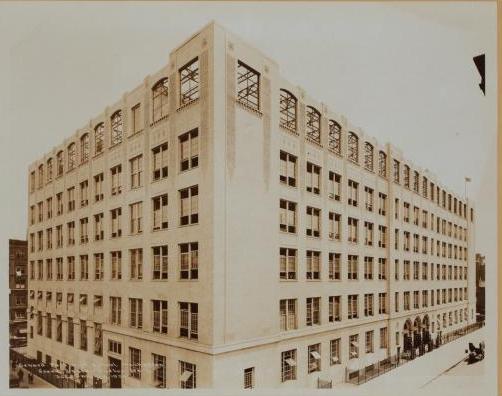
As a judge has explicitly stated that Leary would probably try to escape, the clean extraction of the high profile criminal elicited mocking scorn at the jailers and officers involved. Saving face, Ludlow officials declared Leary’s assisted release was “one of the most daring and skillfully-planned affairs of the kind to ever occur in the city,” “executed by shrewd and bold criminals.” [source] The Ludlow jail would never really shake its, shall we say, porous reputation and was eventually demolished in the 1920s. Both the jail and the address 76 Ludlow Street would make way for Seward Park High School (pictured below, from 1930)
So dramatic was the 1879 Ludlow prison break that Leary and his crew were soon turned into folk heroes by the more rebellious residents of the Lower East Side. For this reason, the Leary escape is sometimes listed as a New York urban legend. But in fact, newspapers of the day spilled over with reports of the bold getaway.
According to Botkin’s 1956 book ‘New York City Folklore’, the legend of Red Leary even briefly entered sports vernacular. “So celebrated did the exploit become, that …. [a] coach who wanted to instruct a player to break loose and steal a base simply yelled, “Red Leary!“
The attentions of most New Yorkers 150 years ago today were understandably occupied by the events of the Civil War. The general mood in April 1862 had turned cynical and grim. It had been one year since the first battle at Fort Sumter. The bloodiest skirmish yet, the Battle of Shiloh in northwestern Tennessee, left thousands dead on the battlefield just two weeks before, and attention now turned to the standoff at Fort Pulaski.
And yet the city in April 1862 was overflowing with distraction. The jewellers Ball Black & Co. displayed a framed personal letter from Queen Victoria, thanking New Yorkers for their well wishers following the death of her husband a few months earlier. Across the street, at Niblo’s Garden, theatergoers could delight in ‘The Enchantress’, featuring actor William Wheatley, who would later stage the world’s first Broadway musical, ‘The Black Crook’, on that very stage. Merry gentleman and naughty ladies drank up in lower Manhattan’s various concert saloons, bracing for the effects of a new law passed that month that would effectively close down such bawdy amusements. (Luckily, the law had little effect.)
But New York’s merry king of showbiz in 1862 was P.T. Barnum,his American Museum still New York’s most popular attraction. That April, Barnum featured a ‘living hippopotamus’ and two beluga whale in its basement, and among the museum’s many shows at Broadway and Ann Street was the feature ‘Hop O’ My Thumb, or The Ogre And The Dwarf’ starring Barnum’s biggest small star General Tom Thumb.
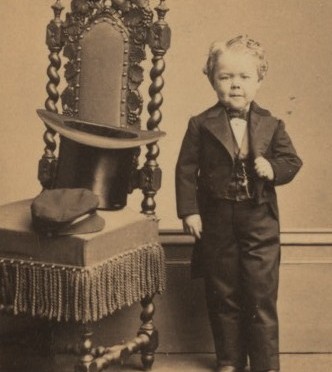
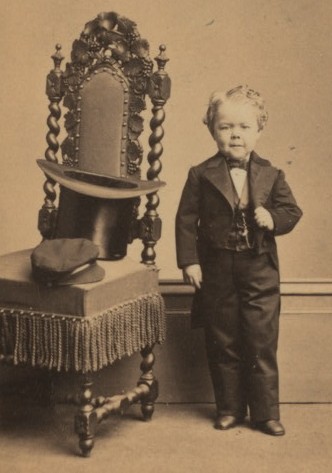
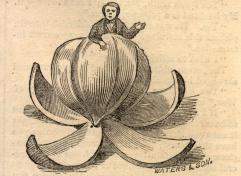
Thumb, however, was not Barnum’s only dwarf star in 1862. Earlier that year, Barnum unveiled a New Hampshire teenager afflicted with dwarfism and presented him with the stage name Commodore George Washington Nutt. Known as the ‘$30,000 Nutt’ due the amount of money he was supposedly paid (although later disproven), the young man was advertised as “the Smallest Man in Miniature in the known world” and “Most Attractive and Interesting human being ever known.”
At right: Nutt in an illustration from Harpers Weekly, February 1862, ‘bursting out of his shell’
Although Nutt would perform at the museum, he was frequently used as an instrument to promote Barnum’s many endeavors. He would serve as Tom Thumb’s friendly rival for the hand of diminutive actress Lavinia Warren (whom Thumb later married at Grace Church in 1863) and tour throughout Europe with Barnum. But on April 17, 1862, Nutt had a local duty to perform — at the headquarters of the New York Police Department.
According to the Daily Tribune, Nutt met with local police commissioners in an effort to get an officer specifically assigned to Barnum’s museum. And just in case the idea would be met with indifference, Nutt himself applied to become a New York police officer, although his height of three feet might have precluded him from such an occupation.
A uniform was immediately ordered for the young star, and by telegraph to the Ninth Precinct, he claimed he would hold ‘extraordinary powers to arrest’ troublemakers at the Museum. It appears, however, that Nutt held few responsibilities for the police force.
During his tour of the police facilities, including the famed Rogue’s Gallery, the charming performer even got in a rather dirty joke. According to the article, “Some one said that on the stage the Commodore had been seen to kiss a girl on the mouth. ‘Well, that was the right place, wasn’t it?’ was the reply.”
I enjoyed the first part of the Ken Burns and Lynn Novak documentary series ‘Prohibition’ which debuted last night. But let’s be honest, the second part — introducing the Roaring 20s and the godfathers of organized crime — should be far more provocative. After all, morally righteous reformers did what they believed was right for their day, but few had dynamic personalities that resonate in our imaginations today.
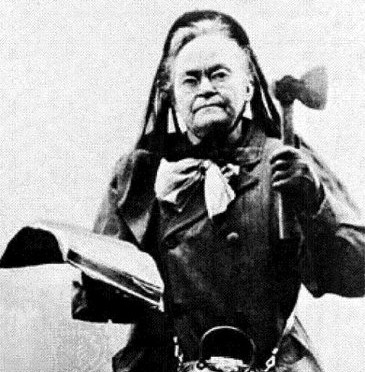
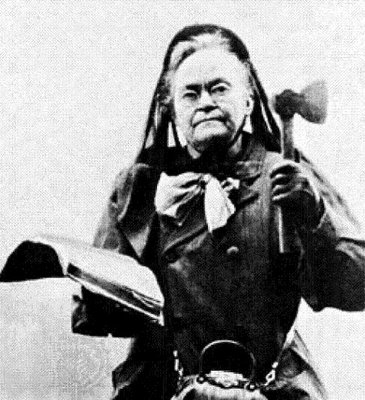
That is, except for Carrie Nation, that hatchet-wielding temperance terror whose unorthodox and non-peaceful displays of protest made her a national celebrity. Literally taking directives from God, Nation battle-axed her way through small Midwestern towns, protesting the sale of liquor with violent force, chopping at bartops, bottles and furniture with her signature hatchet, accompanied by a righteous choir of church ladies belting hymns while dodging splinters.
Nation was regularly arrested and fined, but under the cover of doing God’s duty — and riding a swell of anti-liquor sentiment — she managed to continue her vicious tirade across the country, becoming the temperance movement’s most colorful star. She even sold minature replicas of her well-known weapon to fund her cross-country adventures.
Nation’s reputation had obviously preceded her when she arrived in New York on August 28, 1901. Law enforcement and nervous saloon owners braced for the worst. After freshening up in a suite of rooms arranged for her at the Victoria Hotel on 27th Street and Broadway, Mrs. Nation headed down to police headquarters on Mulberry Street to address the general drunkenness conditions of the city directly with police commissioner Michael Murphy.
Their exchange was not pleasant. Nation demanded to know why the city kept saloons open on Sunday. Murphy replied that it was legal to do so. She bitterly lectured back with a Bible verse; Murphy replied, “Don’t quote scripture at me, Madame. Go back to Kansas and get that off on your husband.”
After a few more volatile exchanges, Nation was forcefully removed from police headquarters. (Certainly, this result was one she had intended. Her press agent was waiting outside with a throng of curious onlookers.) Nation next decided to harangue the mayor and prepared to visit City Hall. When message was sent that the mayor didn’t care to meet with the fiery reformer, Nation decided to do what came most naturally — she headed for a bar, hatchet in hand.
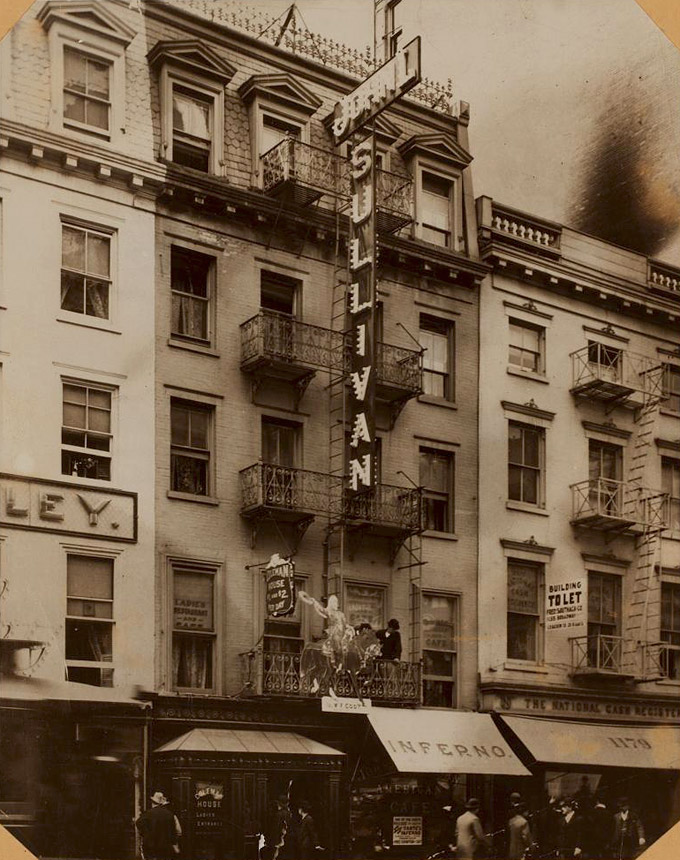
The unfortunate establishment in her crosshairs was that owned by famed boxer John L. Sullivan, himself a celebrity of some flamboyance. Having spent the 1880s as one of America’s most legendary bare-knuckle fighters, he was famously brought down (in a gloved match) by ‘Gentleman’ Jim Corbett in 1892. Like many boxing stars before him, Sullivan ended up in New York as a saloon owner, at 1177 Broadway, between 27th and 28th streets (at right). And right near the hotel hosting Carrie Nation!
In a bit of braggadocio, Sullivan had proclaimed to the press that if Nation ever bothered to stop by, he would “thrust her into a sewer hole.”
Nation accepted the invitation, arriving by carriage and demanding Sullivan meet her out front. The famed boxer, however, refused to come outside, the New York Times even mentioning, “A shutter in one of the blinds in the room usually occupied by Mr. Sullivan was seen to move.”
The mighty athlete was certainly fearful of his property being chopped to ribbons. This wasn’t some Bowery dive bar, after all. But while the authorities were certainly no friends of Nation, she was a very popular symbol among New York’s temperance supporters. Arresting such a known figure would have actually played into Nation’s intentions.
Best to wait out the storm, I suppose. By that afternoon, Nation has left town via Grand Central, off to more wily stunts in the Midwest. Drinkers and cops alike raised a toast in relief.
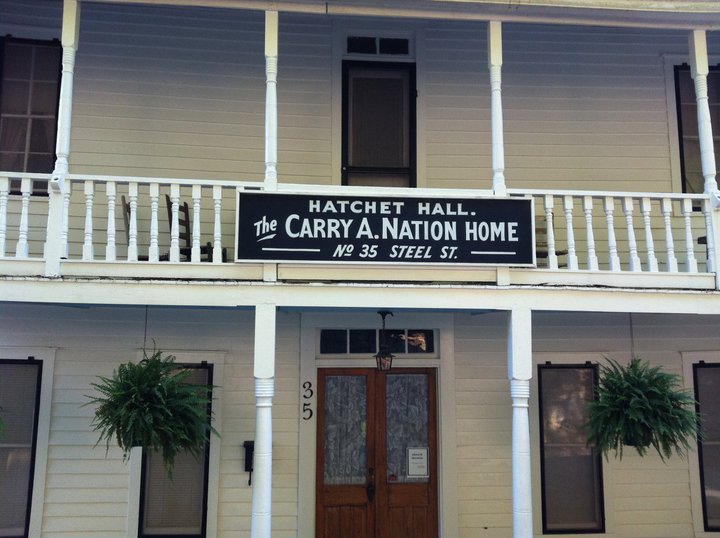
— BY THE WAY: This summer I took a trip back to Ozarks (where I’m originally from) and spent an evening in marvelous Eureka Springs, Arkansas. Carrie Nation spent her final years here, appropriately opening a boardinghouse for widows and proper ladies called Hatchet Hall. The Hall is still preserved near the center of town (pictured below) and across from a boarded-up water spring that was also named in Nation’s honor. She collapsed during heated speech right up the road from Hatchet Hall in 1911 and died shortly thereafter in a Kansas hospital.
Picture of Sullivan’s courtesy Sepiatown. Picture of Hatchet Hall courtesy me.
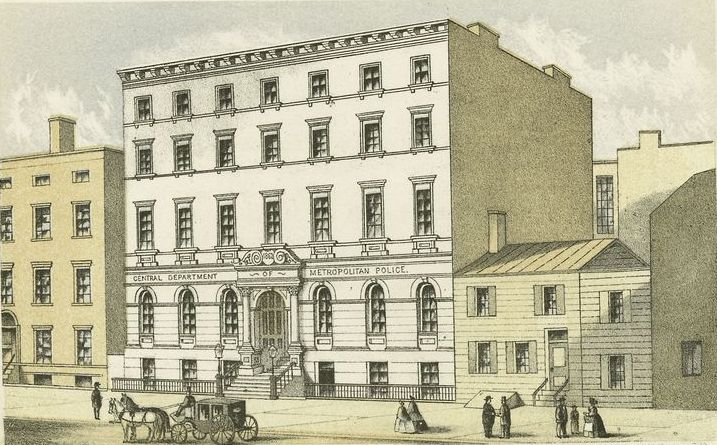
There is nothing extraordinary at 300 Mulberry Street anymore, just a standard five-story apartment complex and a parking garage, hugged to its south by a Subway sandwich shop. But for much of the Gilded Age, this address was the grand headquarters for New York’s police department.
The Mulberry Street building was New York’s center of law enforcement from 1862 to 1909. Not surprisingly, it was located close to the densest concentrations of tenements and just eight blocks down Mulberry to the heart of Five Points. And this spot is directly between Broadway and the Bowery.
The building had an unfortunate inauguration as the year after opening came the summer of the Civil War draft riots. The superintendent of police, John A. Kennedy, was savagely beaten and deposited at headquarters nearly dead. Rioters targeted telegraph poles throughout the city, leaving officers there in a 19th century version of a communication dead zone.
No doubt, overseeing the criminal behavior of a quickly multiplying populace in one of the world’s richest cities in the 19th century was no ordinary achievement. “No other building in the city, probably, is richer in memories than 300 Mulberry Street,” said the New York Times in 1909. “It is famous the world over.” In an other article, the paper triumphantly calls the force “America’s Scotland Yard.” Notable among its many rooms was the famed ‘Rogue’s Gallery’, a collection of photographs of the city’s most notorious criminals.
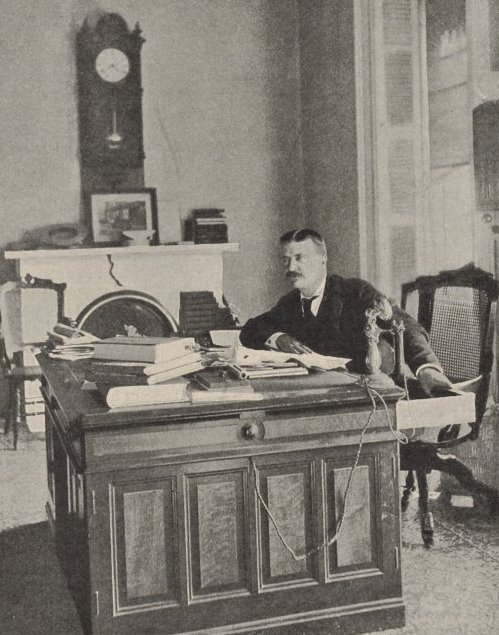
But during the 1870s and 80s, the department was mired in corruption; mayors throughout this period usually ran for election on the mantle of police reform, only to cave to the organization’s impossibly deep infrastructure of bribery and kickbacks. It would take the state-run Lexow Committee in the 1890s and later, in 1895, a reform commissioner named Theodore Roosevelt to clean up the shenanigans here. At right: Roosevelt in his Mulberry Street office.
According to a 1901 issue of the Evening World: “Today No. 300 Mulberry Street is the centre and disseminator of laziness, corruption, contempt for all the right standards of police duty. And the once superb detective branch, the pride of New York, has become feeble and almost ridiculous.”
The force used the excuse of expansion — and the needs of a consolidated five-borough city — to rehabilitate its image. It needed a larger, modern structure, one untainted by the reputation of corruption. And so, in 1909, after a flirtation with relocating to Times Square, the force moved to the elegant Beaux-Arts palace on Broome and Centre streets. That structure, at 240 Centre Street, still stands as a luxury condominium. The old headquarters at 300 Mulberry, however, were torn down and have been long forgotten. Not even a plaque!
A reconstruction of the interior can be briefly seen in the Draft Riots scene of Martin Scorsese’s ‘Gangs of New York’:
By the way, a few months ago, I wrote about a very notable saloon experiment from 1904 called the Subway Tavern, a non-alcoholic church-owned saloon which opened around the same time that the New York subway did. It was located on the corner, just a couple doors up from the police headquarters. [Read more about it here.]
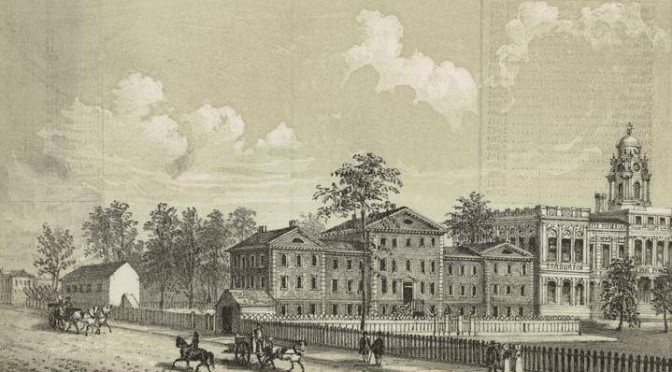
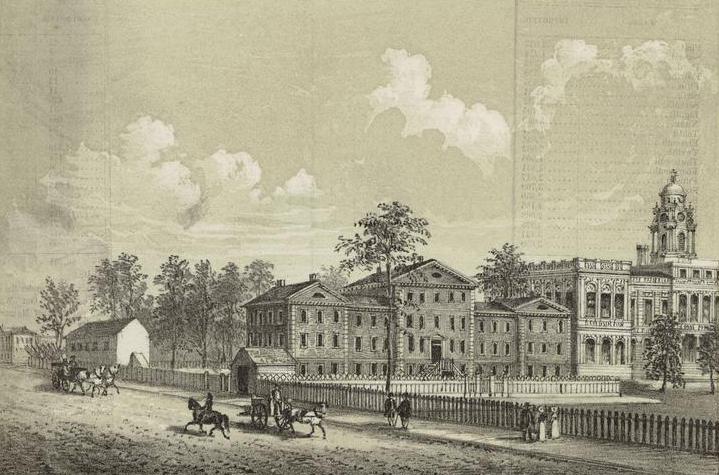
Broadway and City Hall, in 1809. The mobs of the so-called ‘Augustus Street Riot’ would have scuffled just to the west of this illustration. (Courtesy NYPL)
The official count considers all officers from as far back as 1802 and the days of the New York City watch under the supervision of its renown High Constable Jacob Hays. (See our podcast below for more information.) Hays would be the sole administrator of this early form of law enforcement and would lead the group until the formation of the New York Municipal Police in 1845.
The watch’s first casualty came in 1806. The man’s name was Christian Luswanger, murdered in the line of duty during a very curious riot.
This was still a city shaking off its colonial trappings and still finding its identity. The mayor of New York that year was 37-year-old DeWitt Clinton, the well connected nephew to the former governor of New York and a man with great things in his future. The British had been gone for over two decades, and the city and its port were rapidly growing. But the real jump starts to the city’s economy and expansion — the Erie Canal, the debut of the steamboat, the Commissioners Plan — would come in the next decade.
New York was small but restless. When mayor Edward Livingston formed the night watch in 1801, it required only a handful of men, overseen by a Watch Committee on the city council (or Common Council). By 1806, all watchmen reported to Hays, and the constable reported to the council, who often directly advised on priorities. “The Captains of Watch in the first district [should] be particularly attentive to the neighborhood of Burling Slip,” according to the minutes of one council meeting.
Hays supervised a couple captains for each of New York’s wards — captains with such sturdy names as Magnus Beekman, Nicholas Lawrence, Gad Dumbolton and William Van Wart. Those captains had other men reporting to them, including Christian Luswanger, of which almost nothing is known — regular watchmen didn’t appear in the council payrolls, only the captains — nothing at all, except for the event which took his life. An event sometimes referred to as the Augustus Street Riots*.
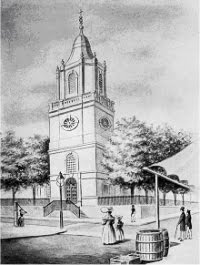
In 1806, St Peter’s Church was the only parish in town if you were a practicing Catholic. (The current building, sometimes called Old St. Peter’s, a simple, neo-classical gem near the WTC site, was built over the old structure in 1840.) It’s most famous congregant would be Elizabeth Ann Seton, the first American to be declared a saint.
Built in 1785, the church (at right) was a perpetual target of anti-Catholic sentiment, and violence would erupt here on Christmas morning, 1806. As worshippers gathered for midnight mass, a group of rowdies gathered outside, prepared to disrupt services.
Simply consider them a massive of drunken, anti-Catholic thugs — sailors according to one source, “a nativist gang of apprentices and propertyless journeyman butchers” according to Edwin Burrows and Mike Wallace — all looking to cause trouble. Parishioners ran to get their alderman who eventually broke up the crowd. However they returned the next night — Christmas night — far more incensed, only this time the churchgoers were ready, armed with weapons. Certainly the defenders were not merely parishioners than other Irish immigrants who had heard about the prior evening’s altercation and came looking for a fight.
They got one. The two groups clashed through the street, a few dozen men on each side, travelling from the church’s doorsteps up to the Irish neighborhood in the Sixth Ward — many, many years before it would be called Five Points.
In this melee, the watch were called to quell the violence and arrest the rioters. Jacob Hays may have been there; several of his captains certainly were. Watchman Luswanger was called to join them. Somewhere along the way, a rioter stabbed Luswanger, and the watchman died of his injuries. Apparently, this did nothing but bring more rioters into the chaos.
Diarist William Otter presents a vivid recollection of these events, although he does not mention Luswanger: “The church was surrounded with a motley crew of Irish and sailors…engaged in deadly conflict…..The mob fought from the door of the church to Irish town, being the distance of about a fourth of a mile….A great deal of property was destroyed by the mob and a great deal of human blood shed.”
It took most of the night watch and the light of day to dissolve the rioters. Ten men, all Irishmen, were arrested. The mayor offered a reward for any information on Luswanger’s demise, but danced around firm condemnation of either group. I’m gathering from the lack of evidence that the case of who stabbed the watchman remains unsolved.
NOTE: One of my prime sources on this article states that the watchman’s name was Christopher Newfanger, not Christian Luswanger. I believe the latter is correct, and it is the name officially recognized by the police department.
*According to Forgotten New York, Augustus Street “was later called City Hall Place and in 1941 it was again renamed for Patrick Cardinal Hayes who had died in 1938.”



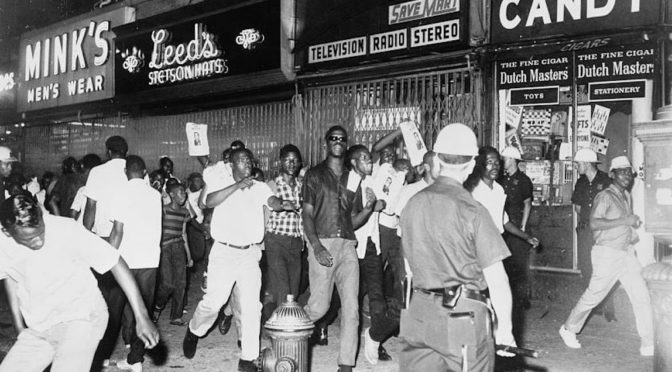
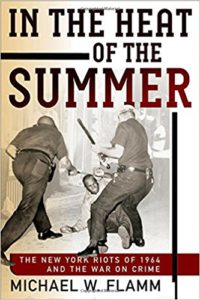 It’s hard not to read the opening pages to Michael W. Flamm’s gripping In The Heat Of The Summer: The New York Riots of 1964 and the War on Crime (University of Pennsylvania Press) and not see the parallels to modern police brutality cases.  So many different testimonies obscure the truth that it’s hard to know what really did happen in front ofÂ
It’s hard not to read the opening pages to Michael W. Flamm’s gripping In The Heat Of The Summer: The New York Riots of 1964 and the War on Crime (University of Pennsylvania Press) and not see the parallels to modern police brutality cases.  So many different testimonies obscure the truth that it’s hard to know what really did happen in front of