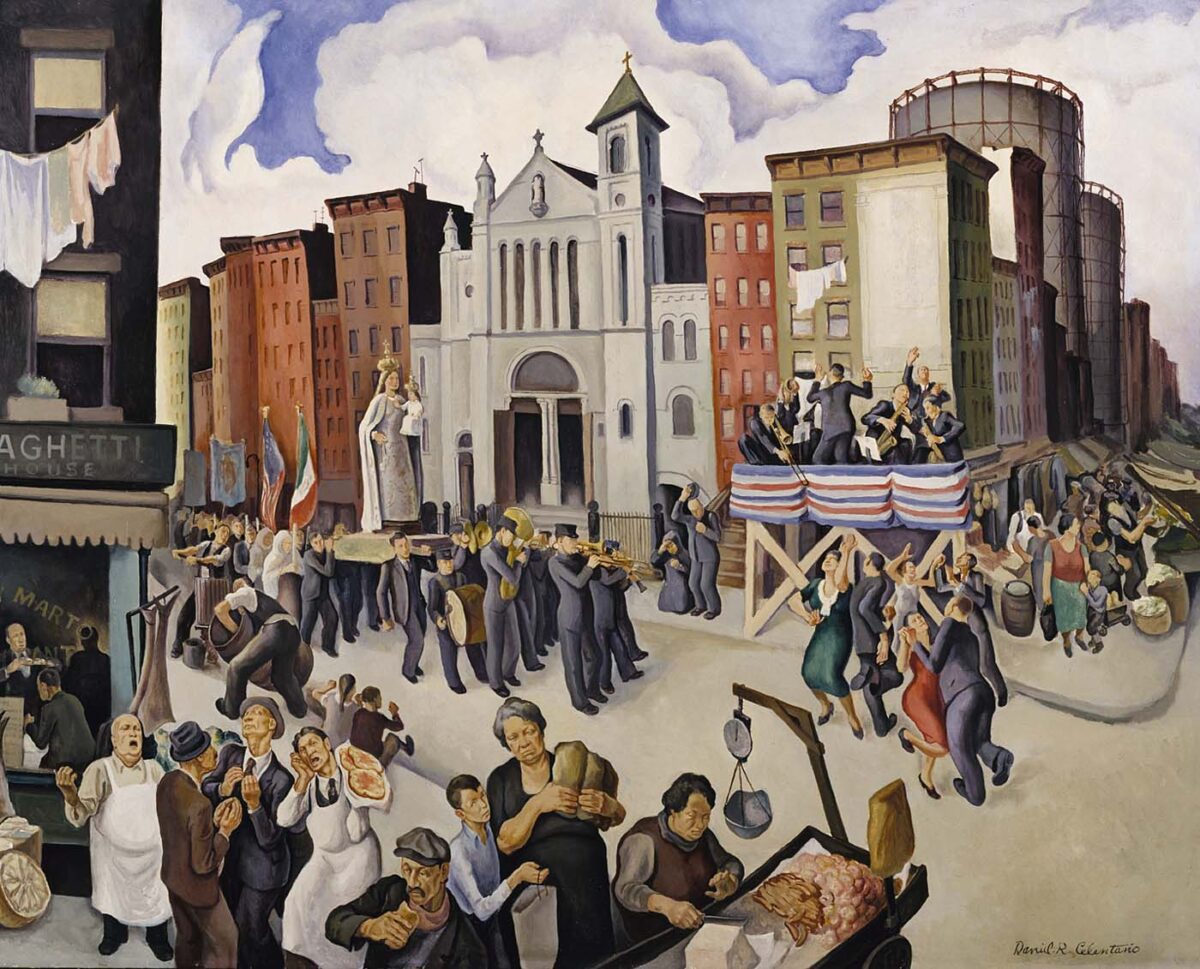
Daniel Celentano, Festival, 1934. Celentano was born and raised in East Harlem.
One of America’s first great Italian neighborhoods was once in East Harlem, populated with more southern Italians than Sicily itself, a neighborhood almost entirely gone today except for a couple restaurants, a church and a long-standing religious festival.
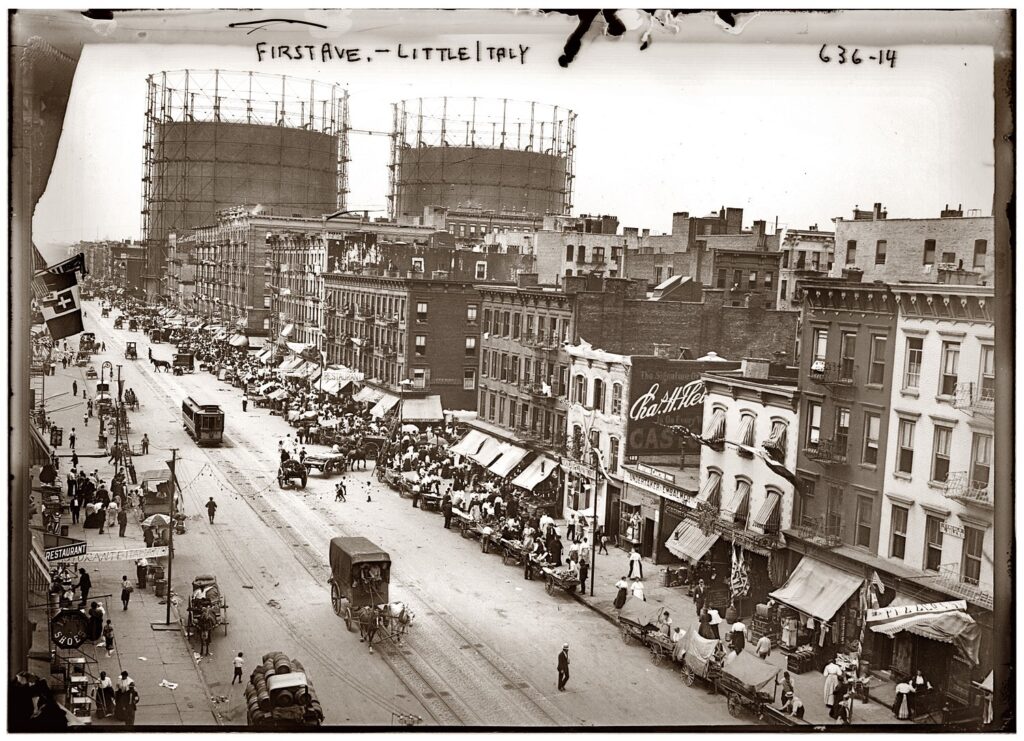
This is, of course, not New Yorks’ famous “Little Italy,” the festive tourist area in lower Manhattan built from another 19th-century Italian neighborhood on Mulberry Street. The bustling street life of old Italian Harlem exists mostly in memory now.
If you wander around any modern American neighborhood with a strong Italian presence, you’ll find yourself around people who can trace their lineage back through the streets of Italian Harlem. Perhaps that includes yourself.
But it’s not all warm nostalgia and fond recollections. Life could be quite hard in Italian Harlem, thanks to the nearby industrial environment, the deteriorating living conditions and the street crime, the early years of New York organized crime.
So who were these first Italian settlers who left their homes for what would become a hard urban life in upper Manhattan? What drew them to the city? What traditions did they bring? And in the end, what did they leave behind, when so many moved out to the four corners of the United States?
Find the episode wherever you listen to podcasts or listen right here:
LISTEN NOW Italian Harlem: New York’s Forgotten Little Italy
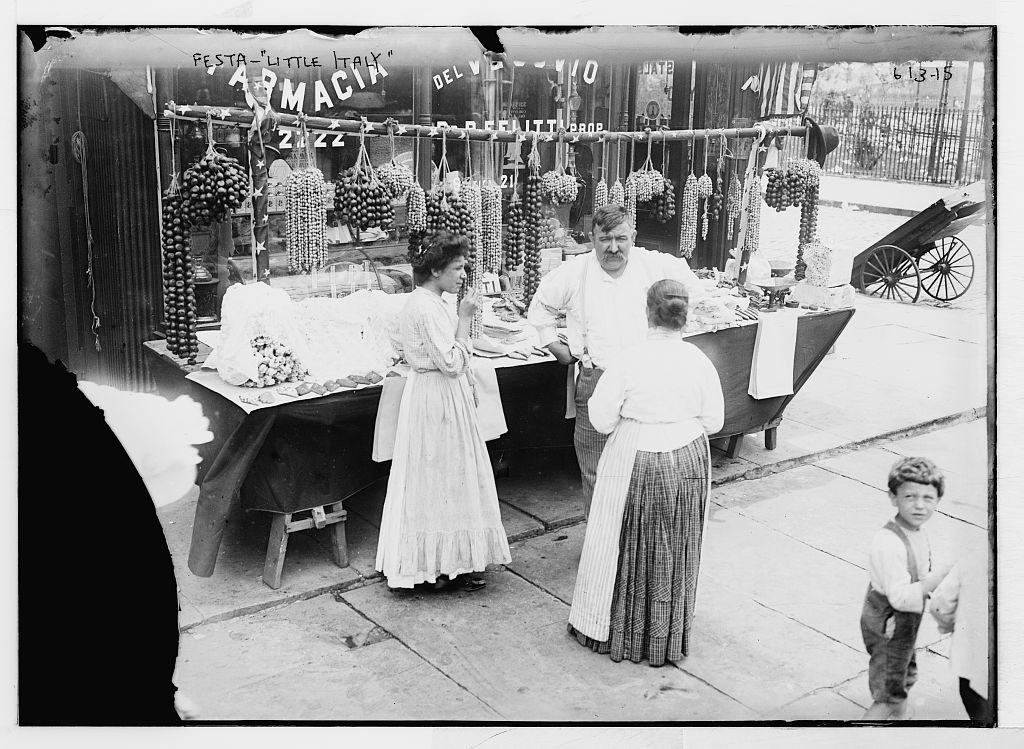
a street vendor with wares displayed, during a festival in Italian Harlem. 1915, Bain Services/Library of Congress
We’re not done with Harlem! In fact we’re building up to an epic new 450th episode for our next show.
FURTHER LISTENING:
Past Bowery Boys episodes with close links to this current show:
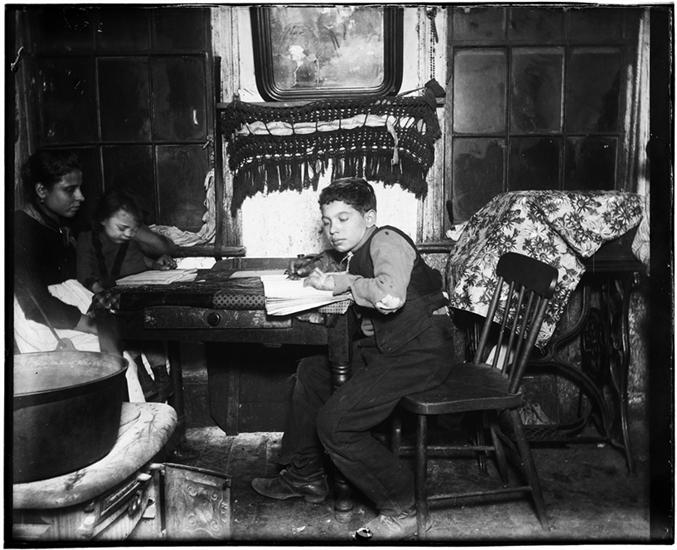
One of you may be related to Pietro, the boy in the picture. He was one of thousands of Italian immigrants who arrived in New York in the 1870s-80s. He seems to have been intelligent and even exceptional, weathering a set of truly dreary circumstances that would have defeated most men.
Pietro was not yet 13 years old when he was almost killed in a streetcar accident. He was permanently scarred and unable to support his family. If not for witnessing a shooting outside of his home, we might never know his name.
But in 1892, Pietro became a profoundly moving subject in a new book by one of the greatest social reformers of the Gilded Age.
Jacob Riis was a pioneer social activist who used journalism and photography to change the living conditions of thousands of poor New Yorkers. He took his bulky camera to the most decrepit nooks of lower Manhattan, documenting a world entirely unseen by most people.
In 1890 he published How The Other Half Lives, exposing the squalid living conditions of downtown Manhattan’s mostly immigrant population.
Riis did help to change the face of New York. In Five Points, the worst tenements were demolished and replaced with government buildings and one very manicured park. But his depictions of ethnic groups, in retrospect, could be very simplistic, even condescending. In his goals to highlight an overwhelmingly malignant condition, he often glossed over some telling details of some of his subjects.
Pietro (I haven’t been able to find his last name) is one of Riis’ favorite subjects. He makes his debut in The Children of the Poor, Riis’ 1892 follow-up to How The Other Half Lives, as a model ofthe striving young student. Pietro is an ambassador of sorts, an avatar of social improvement, bringing “[e]very lesson of cleanliness, of order, of English” taught to him in school back to his tenement life.
He was born sometime in the early 1878 or 1879, just as the sudden increase of southern Italians began to permanently change the nature of the old tenement neighborhoods.
He lived in a single room with his parents and four younger siblings. As a small boy, he attended classes at the school run by Old St. Patrick’s until “his education was considered to have sufficiently advanced to warrant his graduating into the ranks of the family wage- earners.”
Being the eldest son, he would have gone to work immediately. In this case, as a bootblack, the most common occupation for poor Italian immigrants in the 1880s.
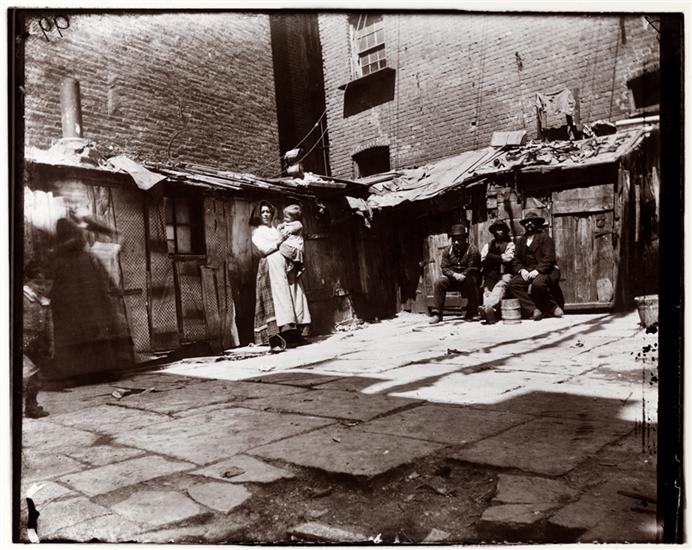
1897 Yard in Jersey Street (now gone). A woman holding a child, and men sitting in a rear yard of a Jersey Street tenement. Pietro lived on Jersey Street and one of these buildings may have been his home.
Probably around age 11 or 12, Pietro began shining shoes in a saloon somewhere in the neighborhood. One day, while crossing Broadway, he was struck by a streetcar and mangled so badly that it was assumed he would not survive. “They thought he was killed but he was only crippled for life.”
He met Riis one dayat the police station at 300 Mulberry Street. He was there as a witness to a shooting which had occurred in front of his home. As Riis describes:
“With his rags, his dirty bare feet, and his shock of tousled hair, he seemed to fit in so entirely there of all places, and took so naturally to the ways of the police-station, that he might have escaped my notice altogether but for his maimed hand and his oddly grave but eager face, which no smile ever crossed despite his thirteen years.”
Riis gained the boy’s confidence and was invited into his home to document his life. Pietro was devoting his energies to education, improving both his Italian and English skills. It appears the accident left one or both of his hands impaired.
As Riis observes:
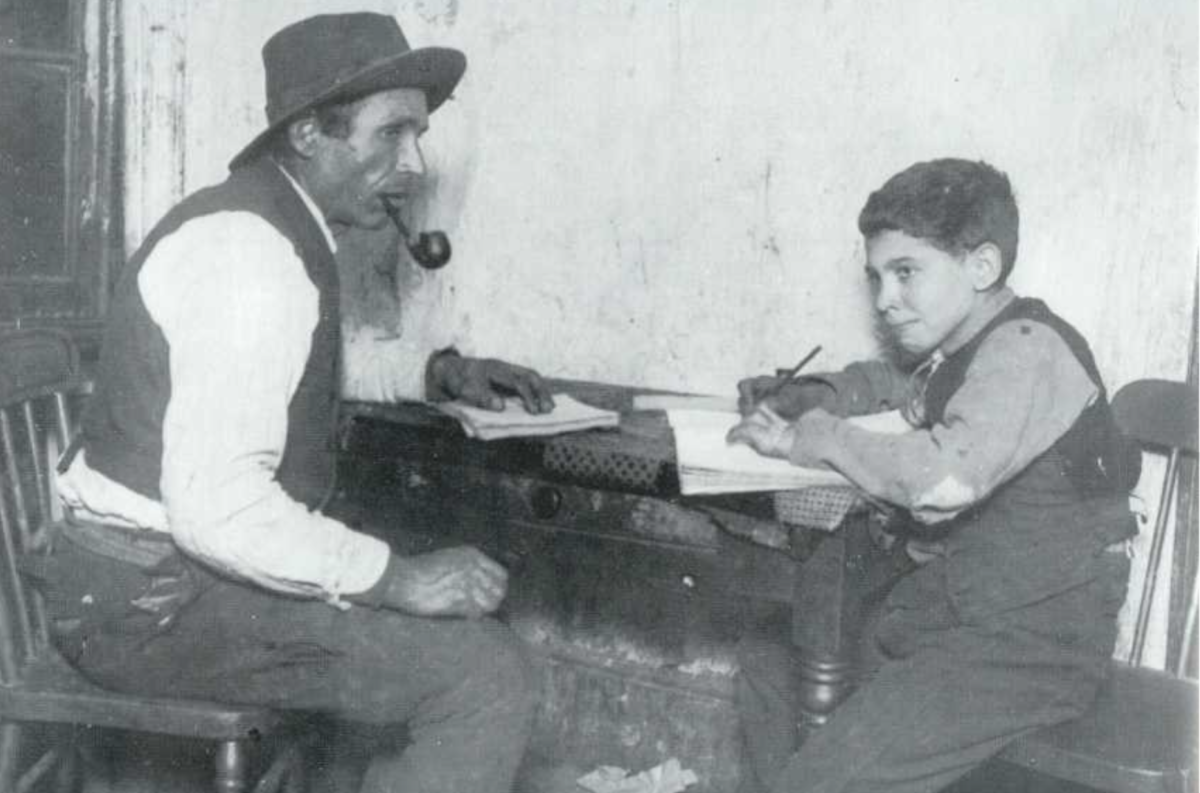
‘By ‘m by,’ said poor crippled Pietro to me, with a sober look, as he labored away on his writing lesson, holding down the paper with his maimed hand, ‘I learn t’ make an Englis’ letter; maybe my fadder he learn too.’
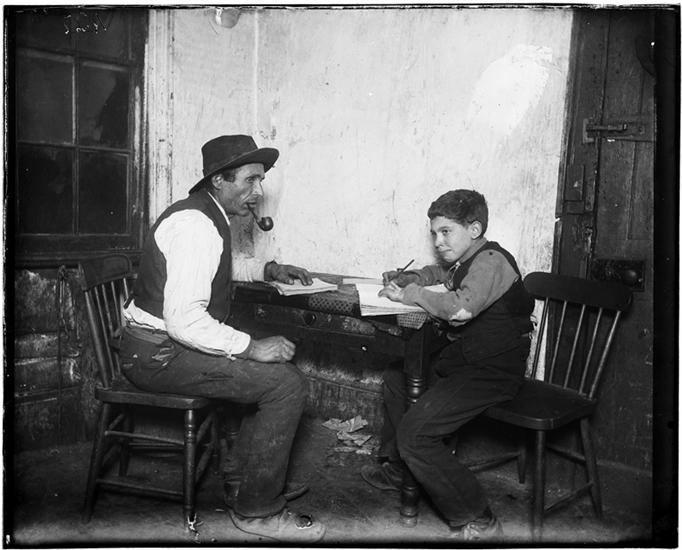
I had my doubts about the father. He sat watching Pietro with the pride in the achievement that was clearly proportionate to the struggle it cost, and mirrored in his own face every grimace and contortion the progress of education caused by the boy.
‘Si! si!’ he nodded eagerly. ‘Pietro he good a boy; make Englis’, Englis’!’ and he made a flourish with his clay-pipe, as if he too were making the English letter that was the subject of their common veneration.
Riis clearly views Pietro as a charity case burdened with the extraordinary responsibility of assimilating his family into American life.
At the maimed 13 year old eldest child of immigrants, his days of innocence were long gone. His situation had utterly defeated him. At least, that’s the image Riis very poignantly meant to convey in his final anecdote, turning to Pietro as he watched over his baby brother:
‘Pietro’,” I said with a sudden yearning to know, ‘did you ever laugh?’
The boy glanced from the baby to me with a wistful look.
‘I did wonst’, he said quietly and went on his way. And I would gladly have forgotten that I ever asked the question; even as Pietro had forgotten his laugh.’
We never see Pietro again. He’s used as a pitiful example of life in the Italian slums and then fades into the background, lost among the thousands of individuals who lived in the Mulberry Street slums.
Riis, however, does use the generic name ‘Pietro’ — now a stand-in for all disadvantaged Italian immigrants — in his 1902 book The Battle With the Slum.“
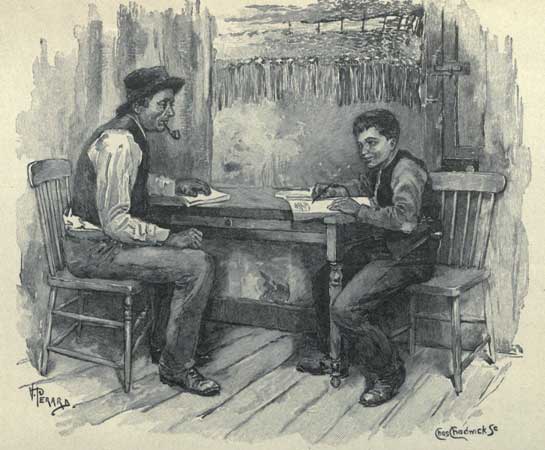
One of Riis’ photographs, illustrated for the book Children of the Poor.
Did Pietro ever make it out of the tenements? Did he get married, have children, begin a career? Did his physical condition ever improve? It’s rather likely that either he or one of his siblings had children, and one of those children might be your grandmother or grandfather.
You can read Jacob Riis’ Children of the Poor here.
PODCAST REWINDNew Yorkers are serious about their pizza, and it all started with a tiny grocery store in today’s Little Italy and a group of young men who became the masters of pizza making.
In this podcast, you’ll find out all about the city’s oldest and most revered pizzerias — Lombardi’s, Totonno’s, John’s, Grimaldi’s and Patsy’s in all its variations.
But if those are the greatest names in New York-style pizza, then who the heck is Ray — Original, Famous or otherwise?
NOW UPDATED with several minutes of new pizza history –– including an update on Totonno’s in Coney Island, the pizza war firing up underneath the Brooklyn Bridge and the story of Sbarro’s mall pizza domination.
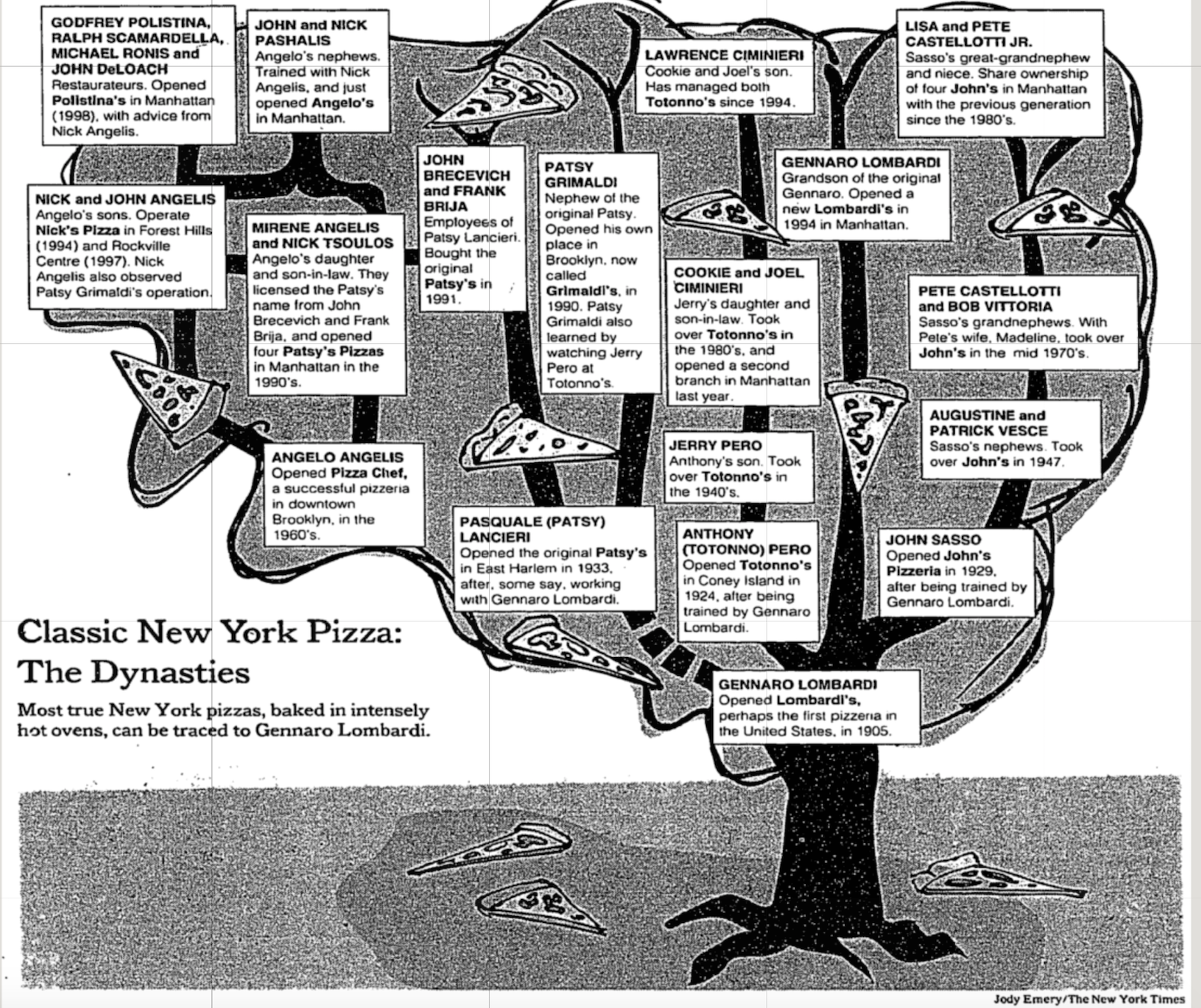
A New York ‘pizza tree’ which ran in the New York Times in 1998, outlining the lineage of local pizza. (Read the entire article here, section F6, page 87.)
Courtesy New York Times
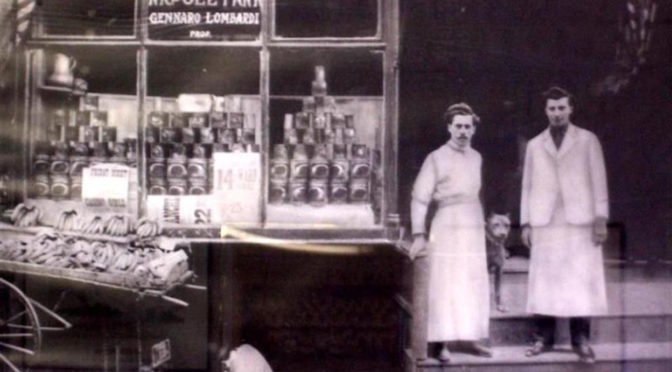
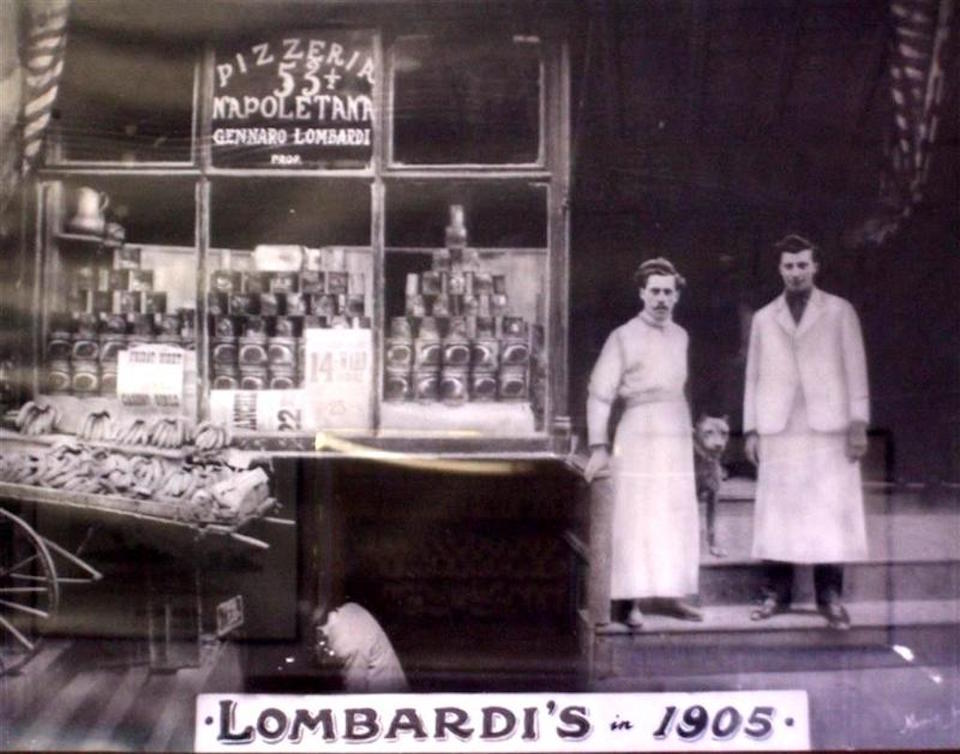
Below: The original Lombardi’s back when it sold a lot more than just pizza.
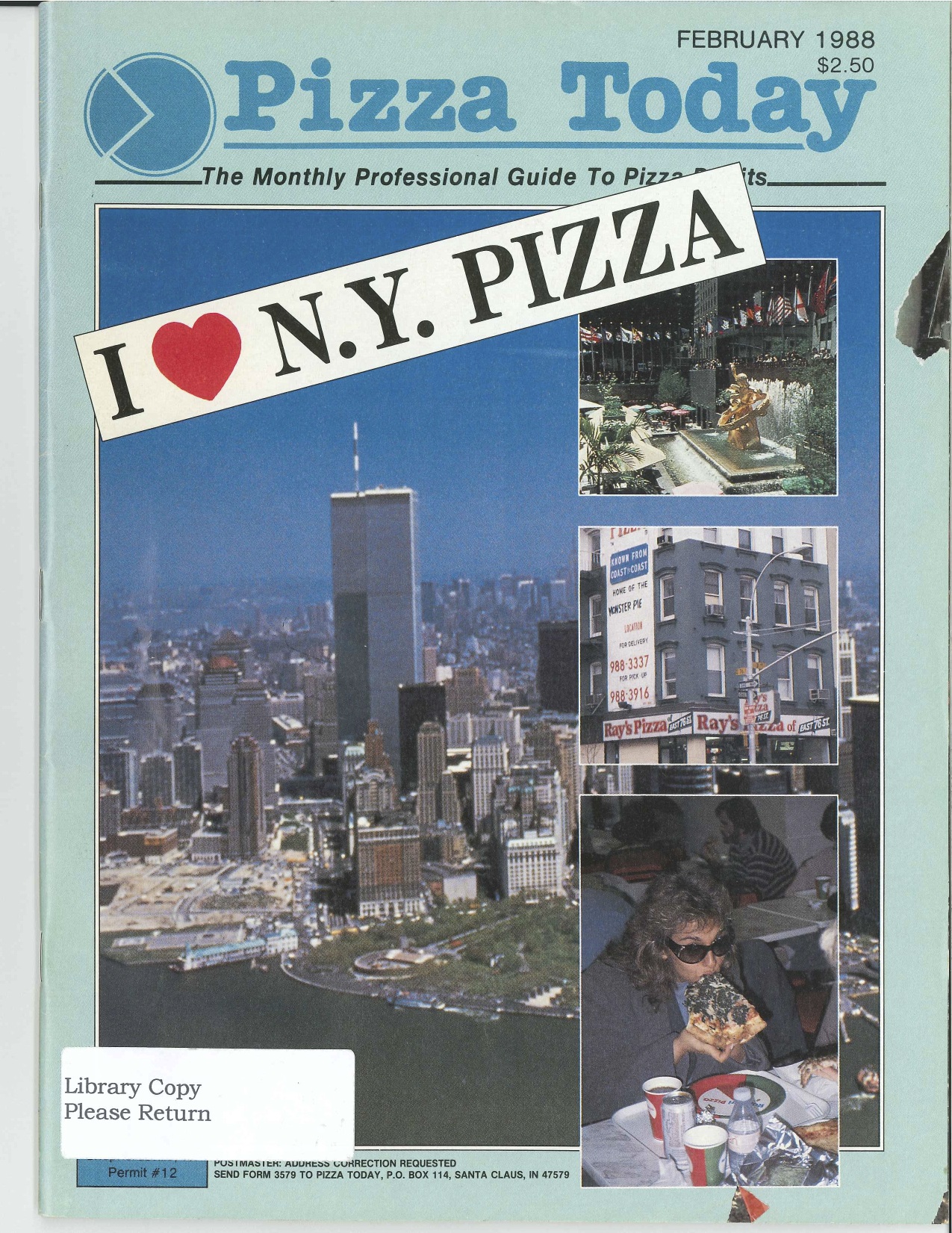
The 1988 issue of the trade journal Pizza Today, extolling the virtues of New York and one of its signature dishes.
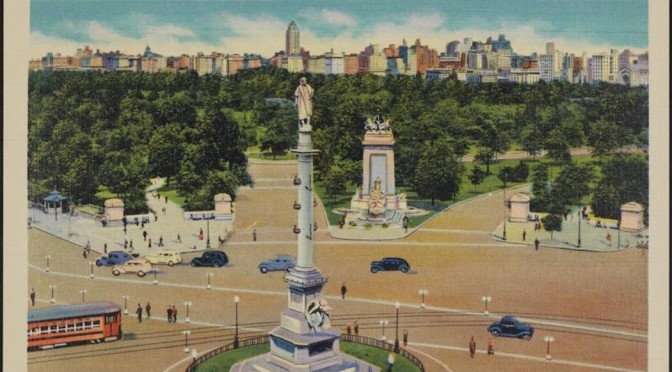
There are a great many statues in New York City of the Italian explorer Christopher Columbus, a rather controversial figure today who many consider to be a sadist and a bumbling idiot who destroyed indigenous cultures in the name of European glory.  He was obviously more celebrated at the end of the 19th century when colonization and violent conquest were still on the menu of empire expansion.
In many ways, Columbus’ iconography has become removed from his legacy. Some of New York’s Columbus representations — including the most prominent one in Columbus Circle — arrived in 1892, the year New Yorkers celebrated the 400th anniversary of Christopher Columbus’ ‘discovery’ of the New World with a variety of commemorative events. Given that this was the Gilded Age, this required all manner of sculptural representation laced with symbolic meaning.
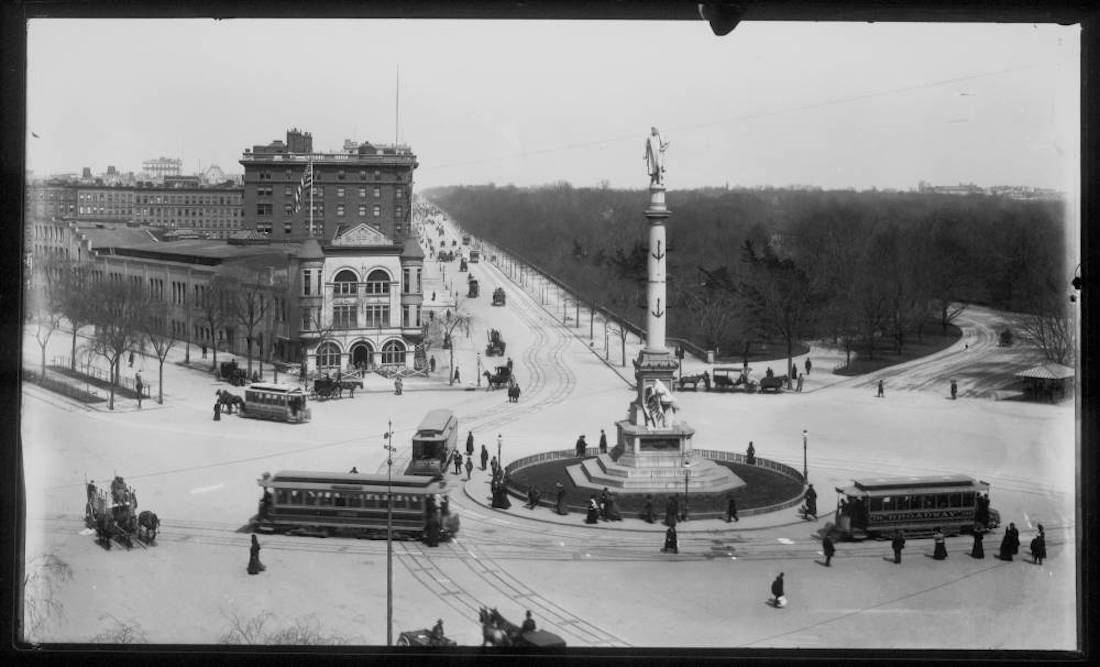
Below: Columbus Circle in 1905
1905 Courtesy George Eastman House
More importantly, the ceremonies marked a unique time in this country’s history with the increased prominence of new Italian immigrants. Italians were arriving in America at a rapid rate starting in the 1880s and increasing well into the new century.  Today, the idea of Columbus as a proud representation of European conquest has diminished, but his stature as a icon of Italian pride remains. In fact the Columbus statue at the heart of Columbus Circle was funded entirely by Italian Americans — or, at least, readers of the Italian American newspaper Il Progresso.
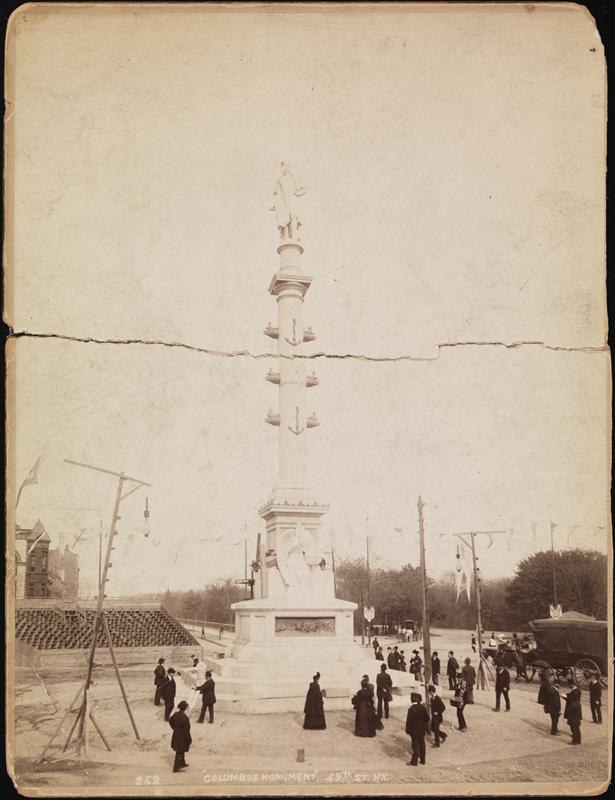
The largest was planned in the “big circle” at the southwest gate of Central Park, featuring a great column and a granite depiction of Columbus by Gaetano Russo, entirely created in his studio in Rome and shipped over in August.
1895, JS Johnston, Museum of the City of New York
The statue was in a competition of sorts with a Spanish-American tribute to Columbus, a massive fountain to be designed by Fernando Miranda. But there was no room for Miranda’s 100-foot-wide fountain by the time Columbus and his column were erected on October 12, 1892.
It’s interesting to compare the two southern corners of Central Park and how they were perceived.  The southeast side ran along Fifth Avenue — lined with mansions — and was essentially a carriage entrance for the wealthy. The southwest side was used by the residents of the Tenderloin and Hell’s Kitchen although sumptuous new apartment buildings were going up along Central Park’s west side.  Thus it might have been considered a more ‘democratic’ entrance.  Many years later, the Columbus column would be joined by the Maine monument.
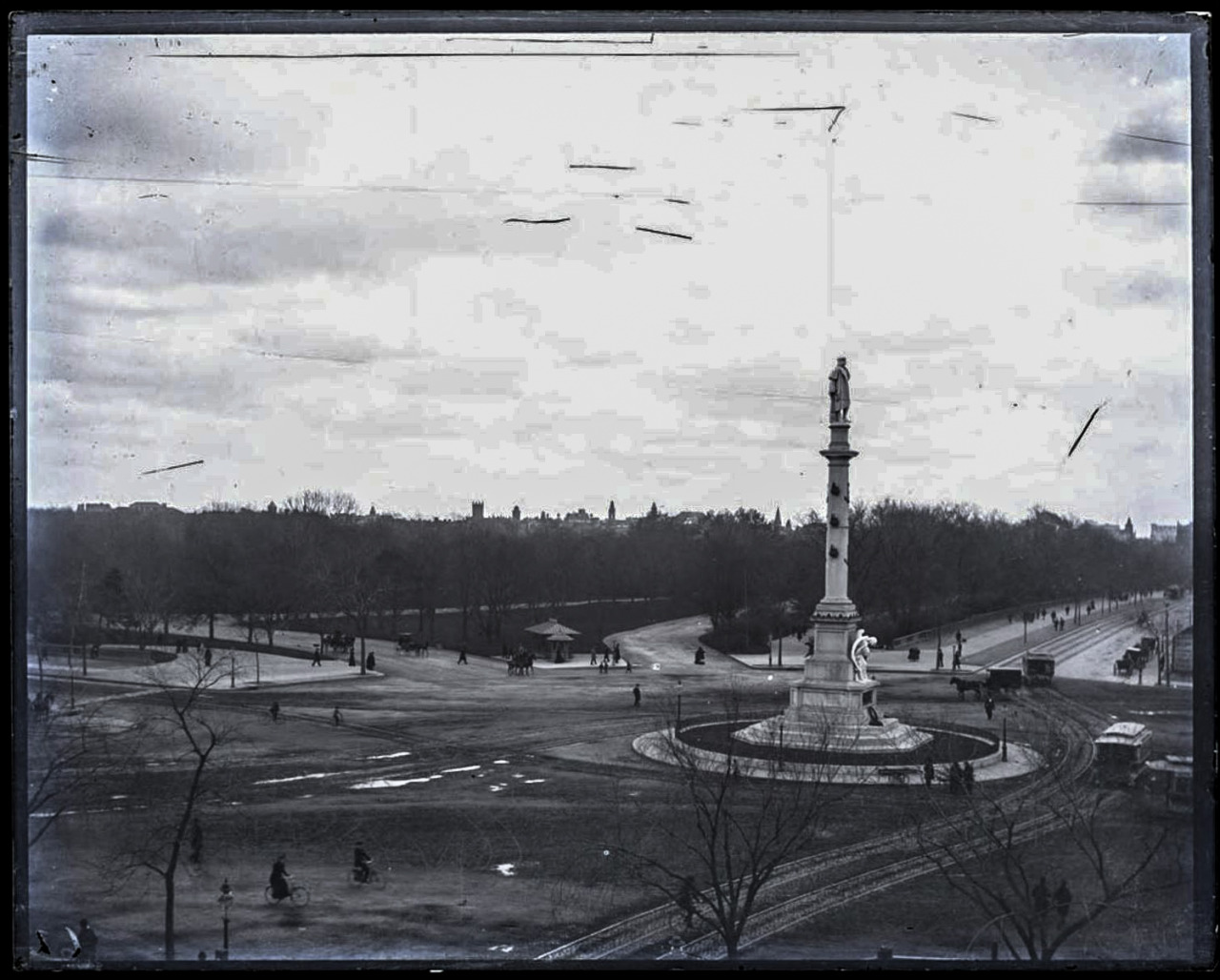
Below: Â How the area looked around the circle when Columbus was first installed in 1892
Christopher Columbus’ journey — his statue’s journey, that is — was closely followed by the press. Â “A ship belonging to the Italian Navy is now on the Atlantic Ocean headed for this port with a beautiful and nobel gift for this city,” according the New York Tribune on August 21, 1892.
The Statue of Liberty, a gift from France, had only been dedicated in 1886, and some saw parallel in the two foreign presents. Â “From the time the movement was first started to the present time it has been forwarded enthusiastically by Italians of all conditions and circumstances, not only in this city, but also in Italy.”
Some prominent guests arrived from the official unveiling on October 12, 1892, including the Vice President of the United States Levi P. Morton, the Archbishop of New York Michael Corrigan, and the mayors of both New York and Brooklyn.
Whatever happened to Miranda’s Columbus fountain? Other homes were sought for the creation but none were found, so the project wasn’t installed in any public plaza. Fountains would eventually join the Columbus Circle column but not for several decades. In 2005 a dramatic new fountain was installed at the column’s base, recalling the water features of Rome.
Meanwhile a statue to Columbus was also planned for Central Park. Originally slated to stand next to William Shakespeare’s statue, park commissioners soon thought otherwise, objecting “to having too many memorials of Columbus in and about Central Park,” according to the Times. They changed their minds, and Jeronimo Sunol’s statue of Columbus was finally placed here on May 12, 1894.
You can spend the day looking for Columbus all over New York City! Here’s a list of places you can find Columbus in at least four of the five boroughs.
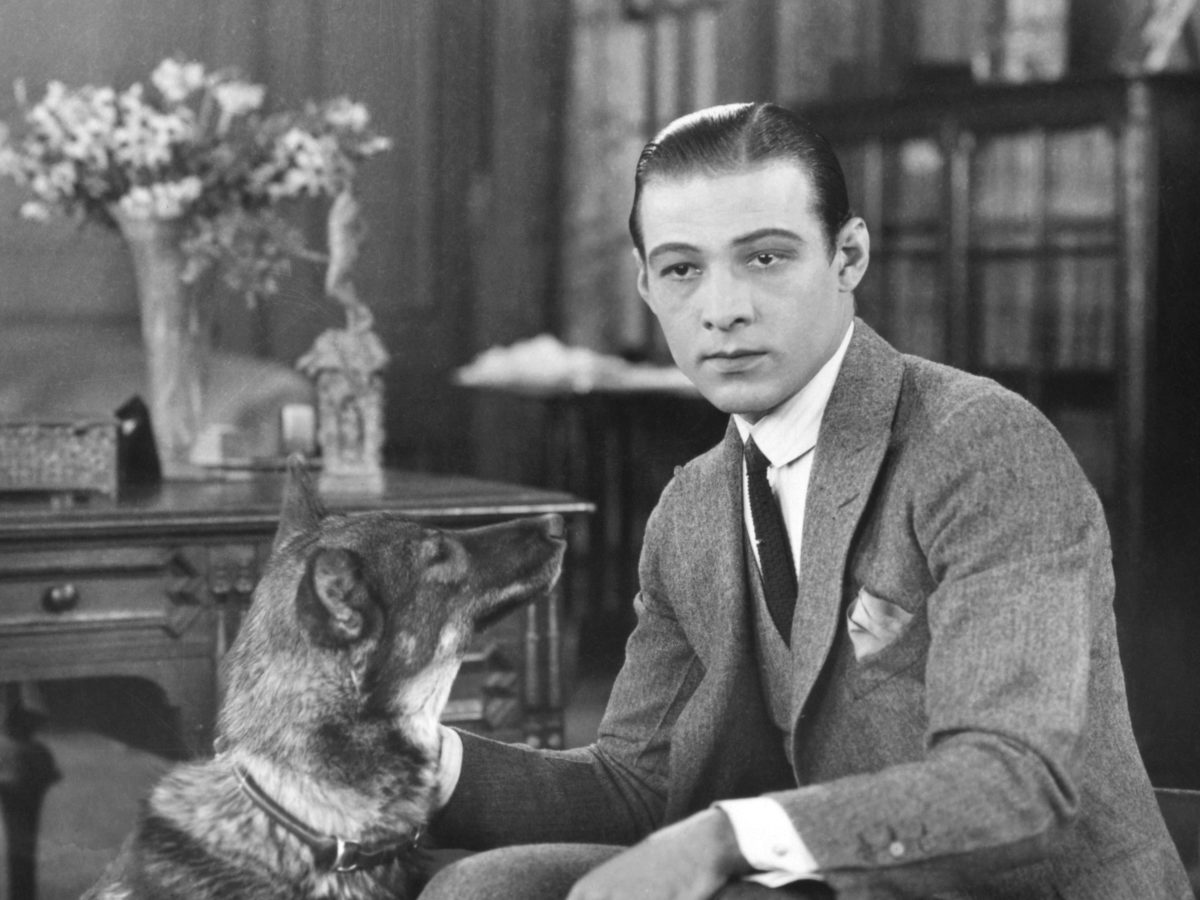
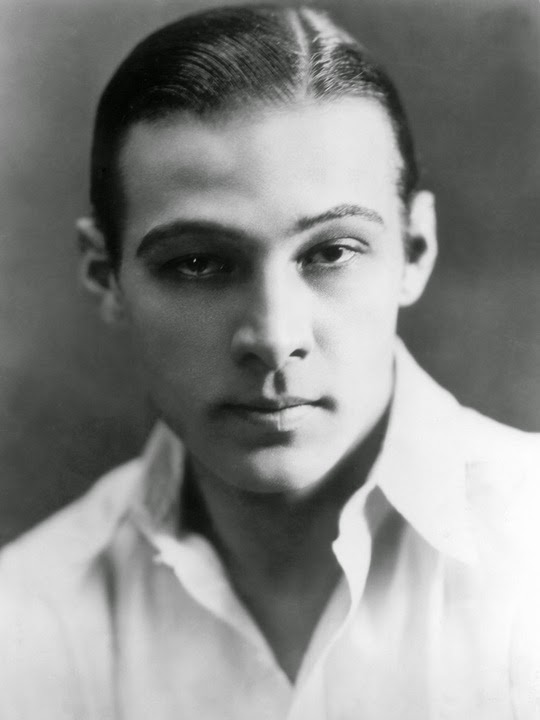
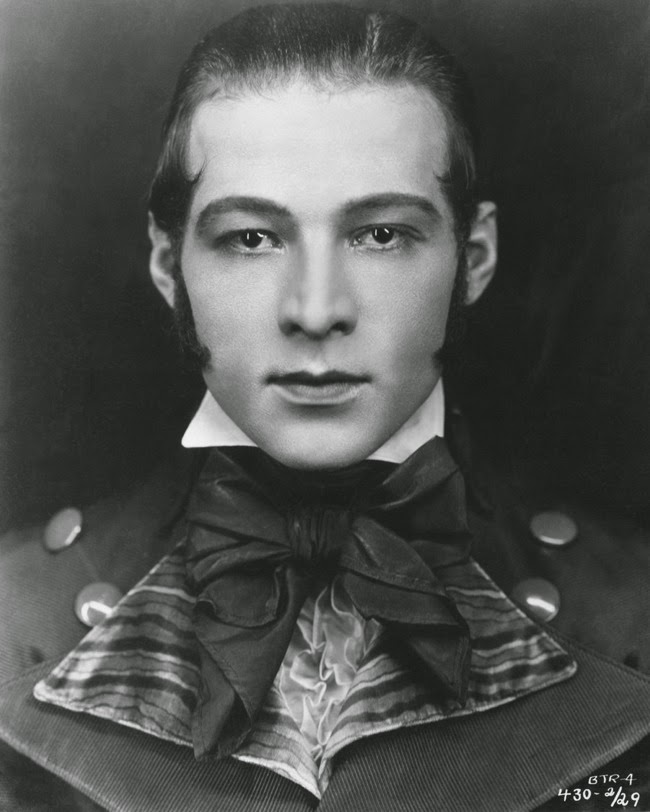
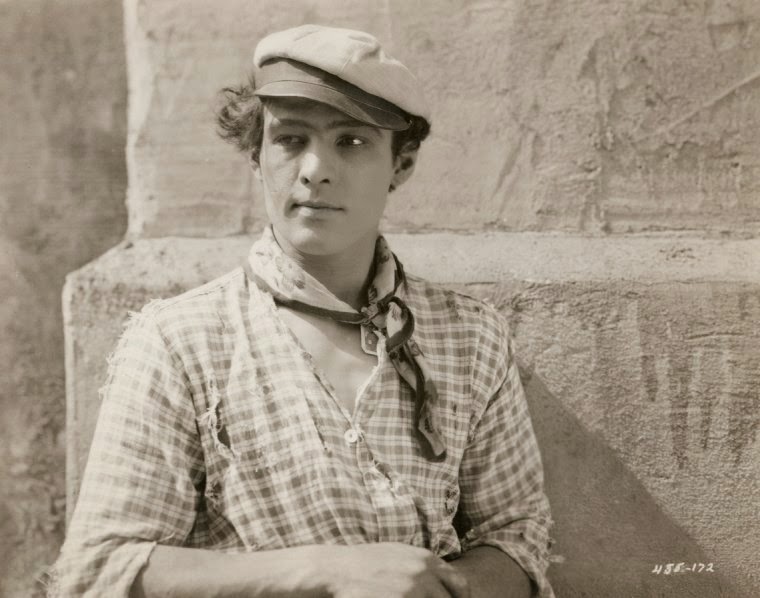
PODCAST Rudolph Valentino was an star from the early years of Hollywood, but his elegant, randy years in New York City should not be forgotten. They helped make him a premier dancer and a glamorous actor. And on August 23, 1926, this is where the silent film icon died.
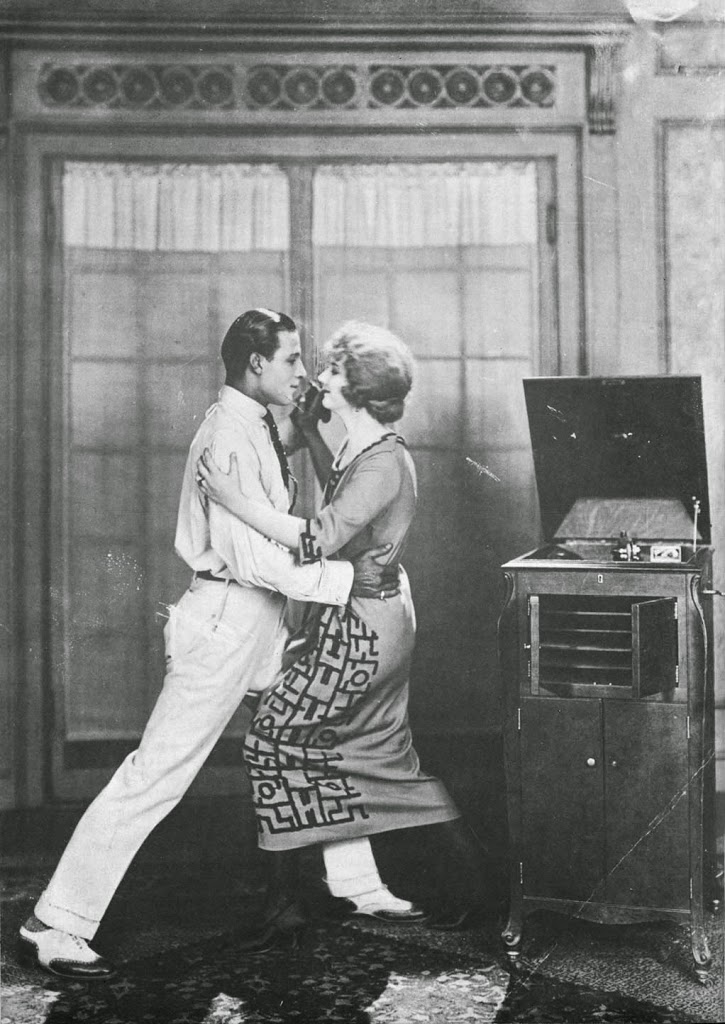
Valentino arrived in Ellis Island in 1913, one of millions of Italians heading to America to begin a new life. Â In his case, he was escaping a restless life in Italy and a set of mounting debts! But he quickly distinguished himself in New York thanks to his job as a taxi dancer at the glamorous club Maxim’s, where he mingled with one particular Chilean femme fatale.
He headed to Hollywood and became a huge film star in 1921, thanks to the film The Sheik, which set his reputation as the consummate Latin Lover. Â Throughout his career, he returned to New York to make features (in particular, those as his Astoria movie studio), and he once even judged a very curious beauty pageant at Madison Square Garden.
In 1926, he headed here not only to promote his sequel Son Of The Sheik, but to display his masculinity after a scathing article blamed him for the effeminacy of the American male!
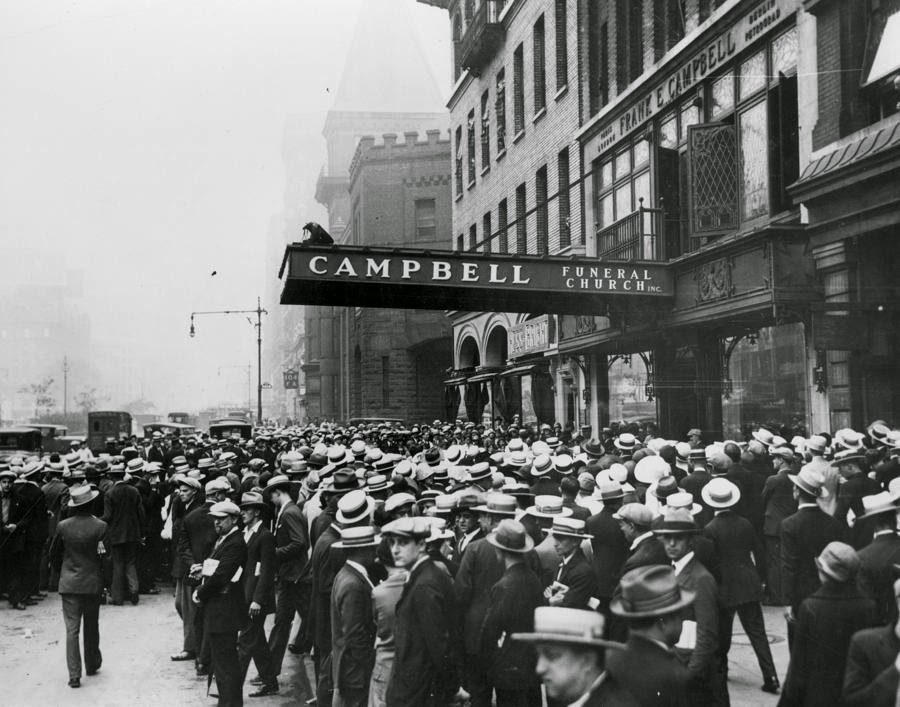
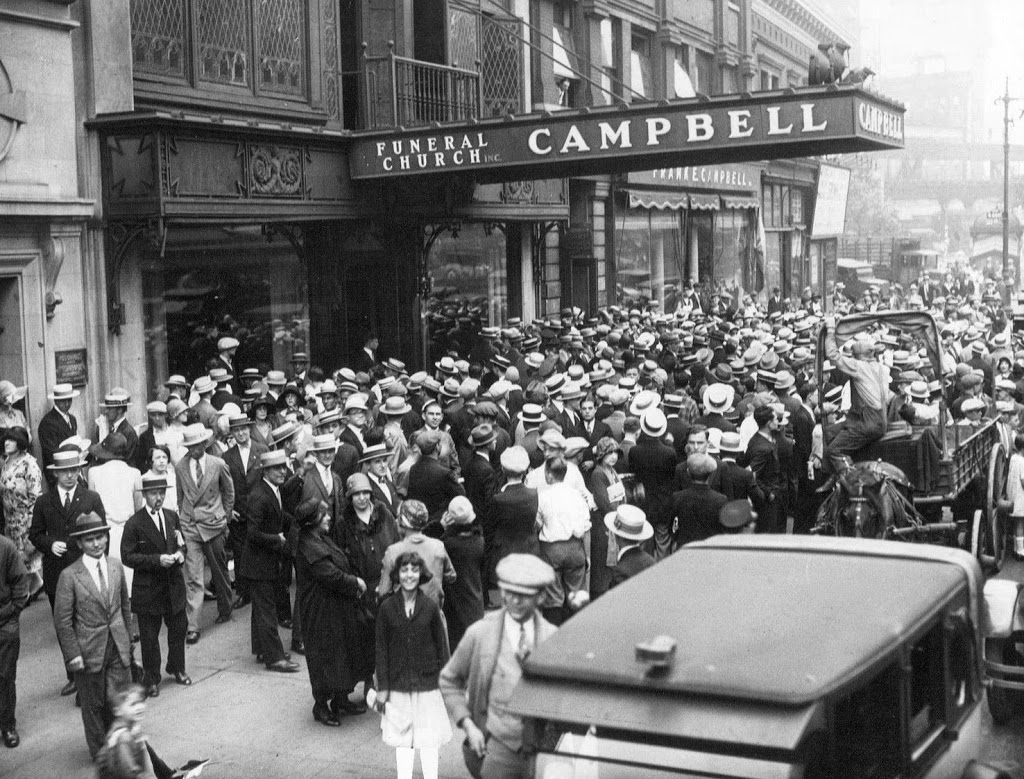
Sadly, however, he tragically and suddenly (and, some would say, mysteriously) died at a Midtown hospital. Â People were so shocked by his demise that the funeral chapel (in the area of today’s Lincoln Center) was mobbed for almost a week, its windows smashed and the streets paralyzed by mourners — or where those people paid by the film studio?Here are the details of the tragedy that many consider one of the most important cultural events of the 1920s.
ALSO: We are proud to introduce to you — POLA!
To get this week’s episode, simply download it for FREE from iTunes or other podcasting services.
The young dancer was employed at Maxims on 110 West 38th Street. From a 1916 guidebook: “A famous ‘smart’ restaurant. A la carte. Music, dancing, cabaret, from 6:30 to close. High prices. Special ladies luncheon at noon.” Valentino would use his skills as a struggling actor in Los Angeles and incorporate it into his film work. Below: Valentino with Alice Terry
Valentino’s breakthrough film — The Four Horsemen of the Apocalypse. “He paints the town red!” “Each kiss flamed with danger!” Like many of his movies, the plot seems taken from his life. Valentino spent some time as a youth in Paris, dancing and dining his way through the city (and into debt). (NYPL)
The Sheik, the film that made his reputation:
From Blood and Sand (1922) — In this one, the Italian Valentino plays a Spanish toreador. (NYPL)
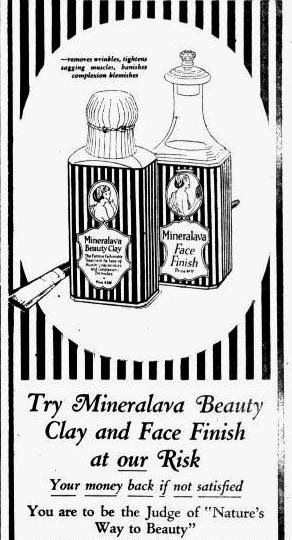
Mineralava Beauty Clay, the sponsor of Valentino and Rambova’s cross-country tango trip:
Newsreel footage of Valentino at Madison Square Garden judging the Mineralava Beauty Clay competition:
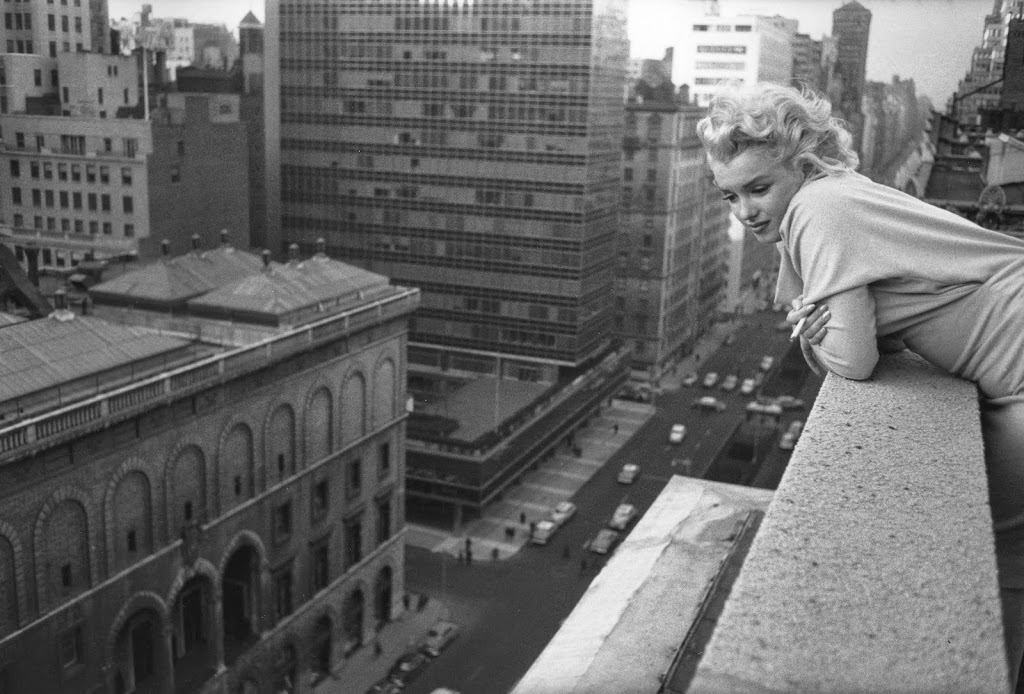
The Hotel Ambassador at Park Avenue and 51 Street. This is where Valentino boxed the reporter (on the rooftop) to defend his masculinity and where he was staying on August 15, 1926, when he collapsed.
Most people are familiar with the Ambassador due to another iconic film star and her memorable photo shoot (by Ed Feingersh) on the rooftop:
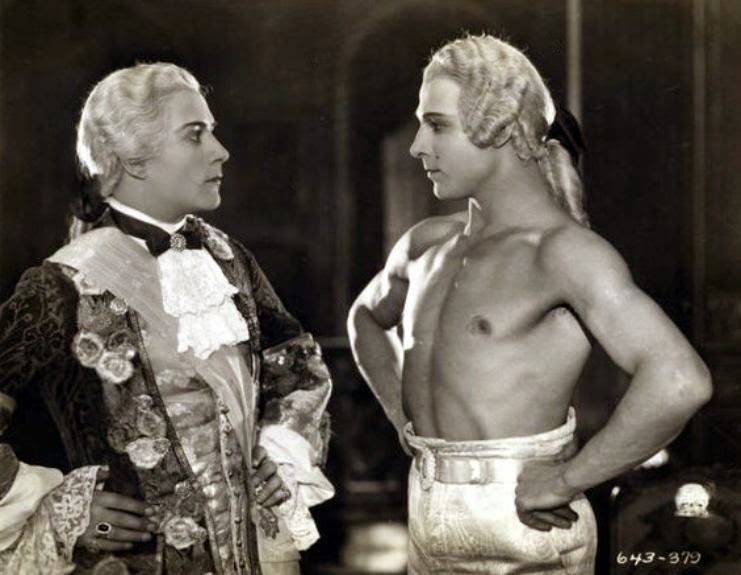
Rudolph in Monsieur Beaucaire, filmed at the Famous Players (later Paramount) studio in Astoria, Queens:
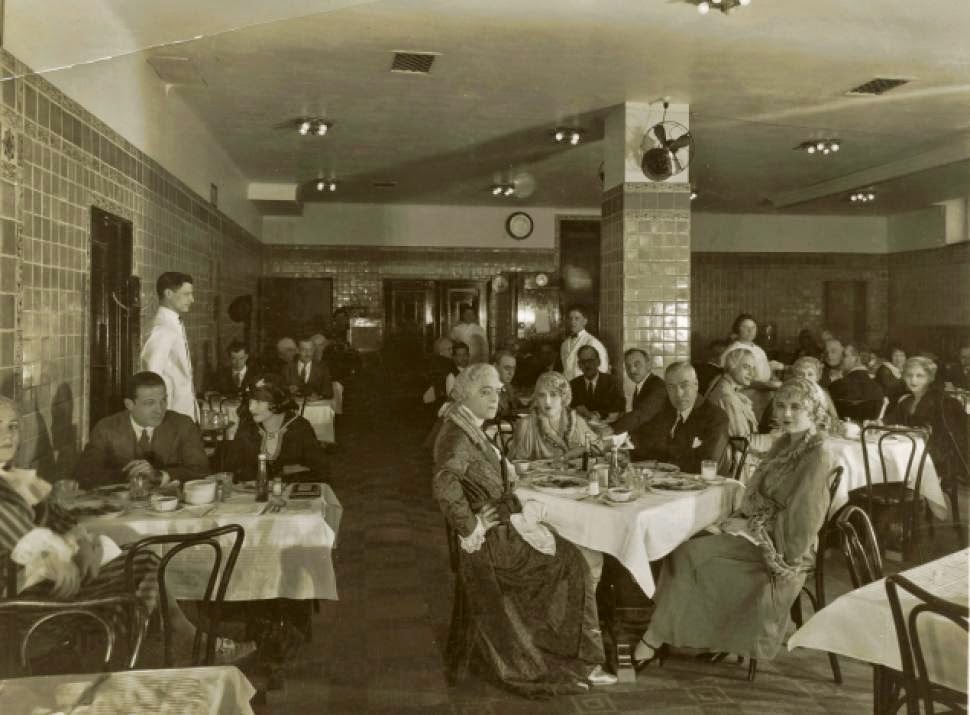
Downstairs, in the studio commissary, with Valentino (at left) and the cast of the film. Today this room is a restaurant named The Astor Room, which features cocktails named for silent film stars. There’s even a Valentino-themed cocktail called Blood and Sand!
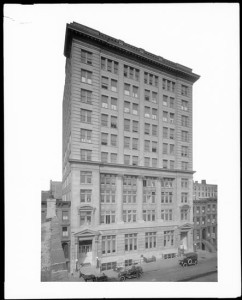
Polyclinic Hospital at 345 West 50th Street, where Valentino died on August 23, 1926. The building still exists today as an apartment complex. (Picture courtesy Museum of the City of New York)
Pictures of the mad, chaotic crowds outside Frank Campbell’s Funeral Church during the week of August 23-30, 1926:
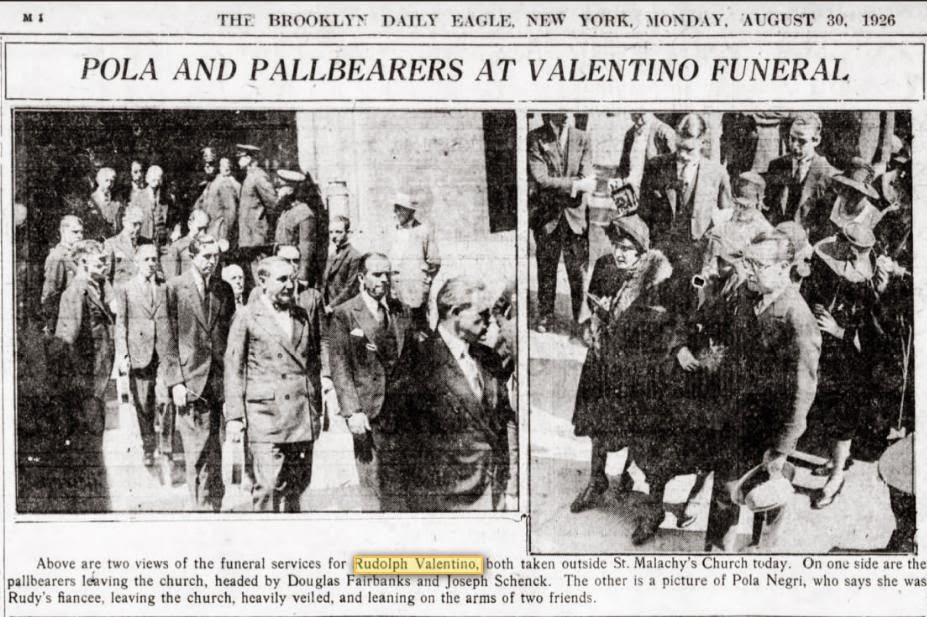
Pola Negri, who made quite a scene at the funeral of Valentino (NYPL):
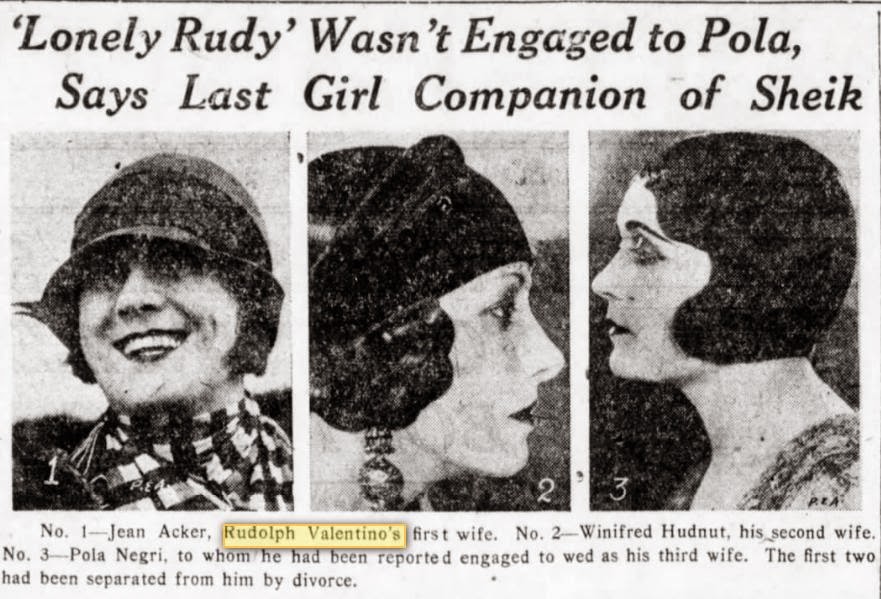
From the Brooklyn Daily Eagle, August 30, 1926
Newsreel footage of his funeral in Midtown Manhattan — from Frank Campbell’s (in today’s Lincoln Center area) to St Malachy’s on West 49th Street:
SOURCES AND SUGGESTED READING: Note: Don’t say we didn’t warn you! There’s a lot of material that seems to be based on speculation. Thoughts of possible sexual adventures have sent many authors into wild fits of imagination. ( Â Enter the back catalog of Valentino at your own risk:
Rudolph Valentino: A Wife’s Memories of an Icon by Natacha Rambova and Hala Pickford The Valentino Mystique: The Death and Afterlife of a Silent Film Idol by Allen R Ellenberger and Edoardo Ballerini Dark Lover: The Life and Death of Rudolph Valentino by Emily W. Leider The Valentino Affair: The Jazz Age Murder Scandal That Shocked New York Society and Gripped The World by Colin Evans The Intimate Life of Rudolph Valentino by Jack Scagnetti Falcon Lair— an indispensable online resource for all things Valentino Publications sited: New York Times, New Yorker, Newark News, Brooklyn Daily Eagle, New York Sun
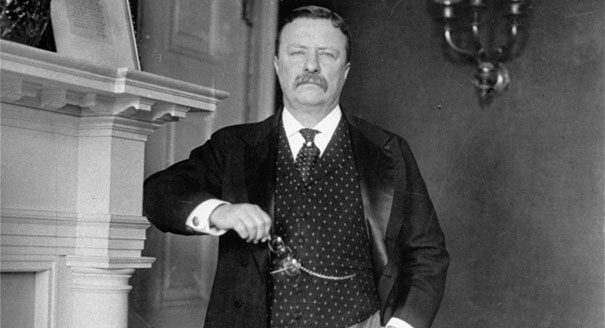
Theodore Roosevelt in 1908, in a rare shot with his pince-nez lowered.
Checking the mailbox was a frightening experience for some New Yorkers almost a century ago.
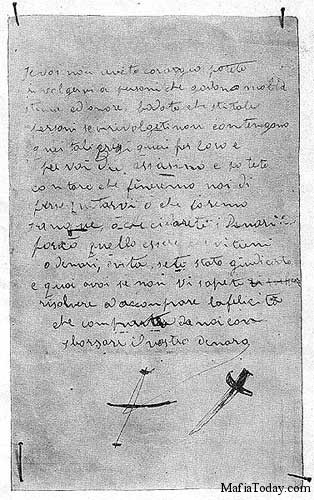
Some found extortion notes — threatening letters, demanding large sums of money or else — courtesy Italian gangsters collectively referred to in the press as The Black Hand. Most of the targeted addresses belonged to newly arrived wealthy Italian immigrants, often celebrities or successful business owners. Famed tenor Enrico Caruso was even a victim of the Black Hand’s extortion in 1920. “I laugh, ho ho, to show me myself that I fear not,” the singer claimed, although he ended up paying one extortion threat before calling the police after he received a follow-up.
At right: A typical extortion letter attributed to the Black Hand (Courtesy Mafia Today)
The Black Hand was already a frightening and well-publicized threat by 1913, although the number of incidents were probably less than the press would have its readers believe.
It was under this apprehension, on Valentine’s Day 1913, that a Mrs. Douglas Robinson arrived at her husband’s real estate office on the Upper East Side to open his mail.
Inside one envelope was a single ‘blood-red’ card, which very simply stated:
“This is the red card to remind you that I have not forgotten. When you receive a black card, you will know that the end is at hand. The Master Mind”
What Mrs. Robinson did not know is that this threatening note had been sent to thousands of New Yorkers that very day. And that it had been preceded just a few days before with another ominous card:
“This is to remind you of an incident in your past, and of my enmity. When you receive a red card it will mean I am drawing near. The Master Mind.”
According to the New York Tribune, 40,000 New Yorkers had received such cards in the mail that month. Had Mrs. Robinson known this fact, she might have found safety in numbers and cautiously went about her day. Instead, in a panic, she reached for the telephone and called New York’s police commissioner.
Except not the current commissioner, the ineffectual reformist Rhinelander Waldo. Instead, she called up New York’s most famous police commissioner (from 1895-97), a man who still lived in New York and, oh yes, had been the President of the United States for a few years — Theodore Roosevelt.
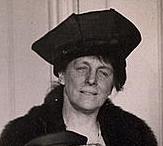
The Colonel was still licking his wounds from an unsuccessful bid the previous year at reacquiring the presidency, as the head of the newly formed Bull Moose Party. You may wonder how the wife of a real estate broker would have the ready ear of an ex-President, but it is here that I reveal that Mrs. Douglas Robinson (which is how she’s presented in press accounts of this incident) is in fact Corinne Roosevelt Robinson, Theodore’s younger sister. (Pictured at left in 1920, picture courtesy LOC)
“Leave it to me,” he assured his sister and promptly called up detectives Hyams and Hughes to investigate the matter.
Going only upon Roosevelt’s description, the two detectives began scouring the streets for clues. They were certainly quite proud to be working on a case personally passed to them by Roosevelt — probably the most famous New Yorker in America. Their only liability was that they were working only off of Roosevelt’s information — and his sister had overlooked one rather big piece of information.
While wandering through midtown Manhattan, the detectives struck up a conversation with Edward Gireaux, a booking agent of John Cort, one of America’s leading theatrical impresarios. A Seattle entrepreneur enriched by the Klondike gold rich, Cort, unlike his competitors Klaw & Erlanger and the Shuberts, specialized in promoting a national circuit of legitimate theater. No musicals for the Cort Circuit! (The Cort Theatre, on West 48th Street, is still hammering out dramas to this day.)
The detectives were only too eager to tell Mr. Gireaux of their mysterious case, delivered to them by Roosevelt directly. It was only when they informed the agent of the details of the crime that Gireaux must have smiled to himself.
He produced a stack of the very same ‘blood-red’ cards from his pocket. Perhaps he was passing them out to passers-by. The detectives now saw the entire printed content of the card:
“This is the red card to remind you that I have not forgotten. When you receive a black card, you will know that the end is at hand. I will see you at the Harris Theatre. — The Master Mind”
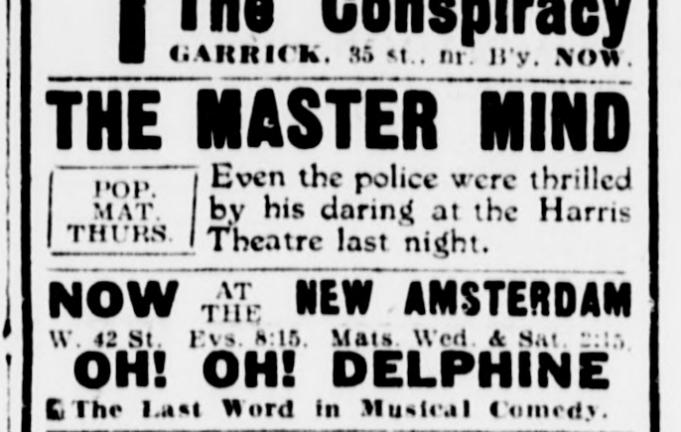
‘The Master Mind’, starring Edmund Breese, was a ragged melodrama about “a dominant personality in a band of criminals,” premiering that week at the Harris Theatre at 254 W. 42nd Street. The cards had been nothing more than a slightly inappropriate bit of viral marketing.
Below: Newspaper advertisement for the Master Mind. ‘Even the police were thrilled!’
And it worked! The Master Mind played for several months despite some tepid reviews (“headachy to follow“) and was later turned into a film starring Lionel Barrymore. You can read a contemporary novelization of the play here, featuring such delectable bon mots as “You have made your own beds! Now you shall lie in them. Understand that, please! I have said it — I, the Master Mind!”
The star of the play Breese would himself go on to the silent pictures and co-starred in the Oscar-winning All Quiet On The Western Frontin 1930.
As for Theodore Roosevelt, he would publish his autobiography in 1913 and by year’s end would embark on a lengthy journey to South America. Corinne Roosevelt Robinson would later dabble in politics herself, backing Warren G. Harding in 1920 and even recording this radio message in support.
Christopher Columbus is among the most honored figures in New York statuary, appearing abundantly throughout the five boroughs — standing prominently, nestled in parks and squares, peering from building features.
I’ve located a seemingly complete list of New York Columbus monuments, strangely enough, on a German website, inclusive even of Chris’s appearance of 8th Avenue subway tiles.
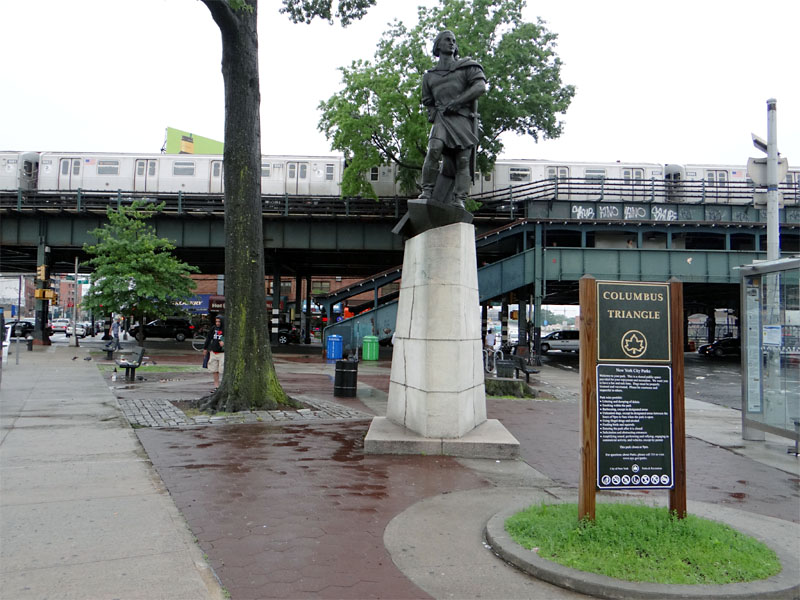
While the one perched atop the column at Columbus Circle is the most famous, perhaps the most interesting one sits in Columbus Park, in Astoria, Queens.
Depicting a young, robust explorer, the statue was erected here in 1941 in recognition of the area’s growing Italian population. But youthful Chris was almost immediately removed to the basement of Queens Borough Hall, for fears it would get melted down in wartime scrap-metal programs.
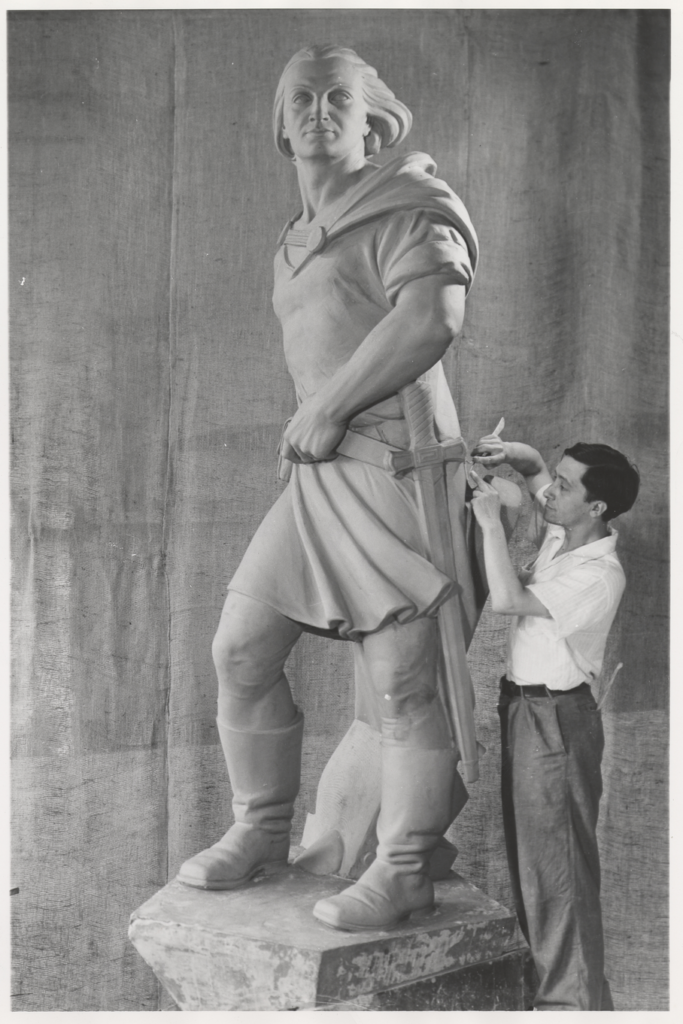
Racioppi works on Astoria’s Columbus as part of the WPA program.
It was returned to dignity by the end of the war and has commanded the crossroads here ever since.
Had Parks Commissioner Robert Moses had his way, however, the striking, romantic monument would never have seen light of day. “We don’t think the statue looks like anything we have read about Columbus, or that as a piece of symbolism it represents anything associated with Columbus,” Moses complained.
“Anything Moses doesn’t design himself, he thinks is no good,” replied Queens Borough President George U. Harvey.
Nearby you’ll find a dedication plaque from the Italian Chamber of Commerce. Your eyes aren’t deceiving you; it lists a dedication date of 1937.
Although sculptor Angelo Racioppi had completed the work by then, the community couldn’t afford the base until a few years later.