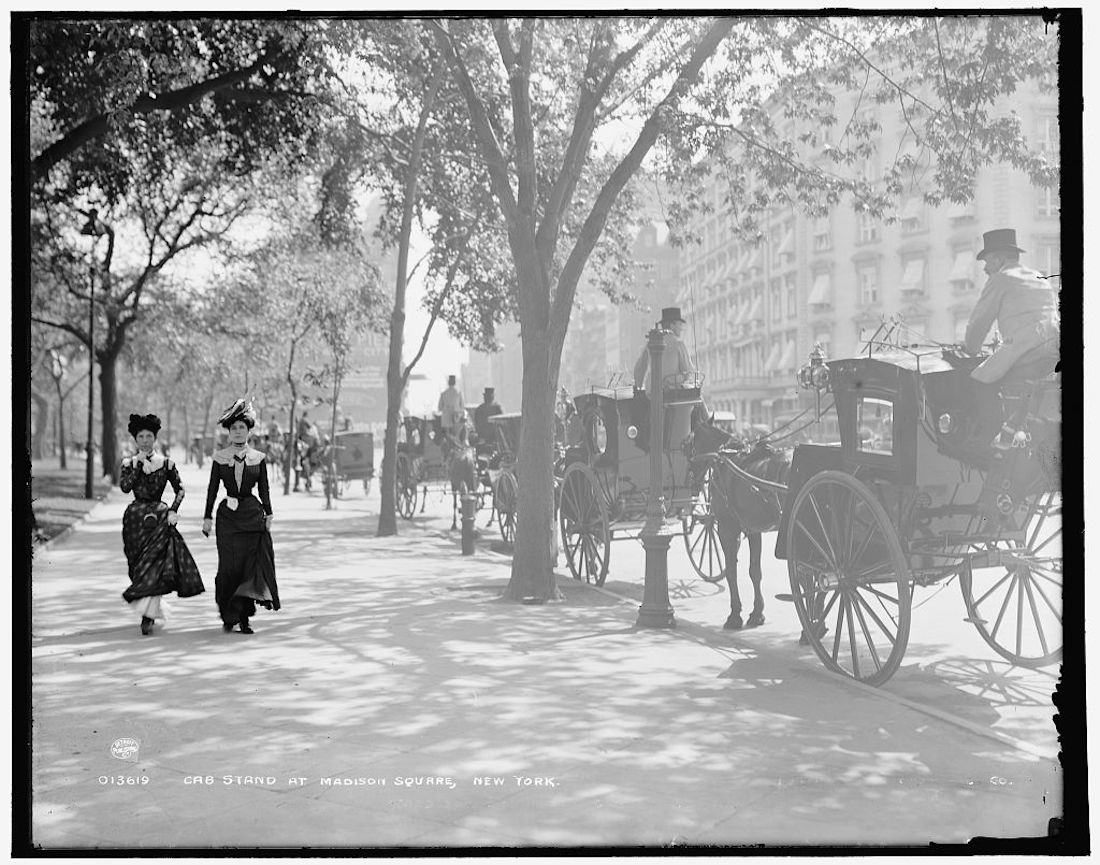
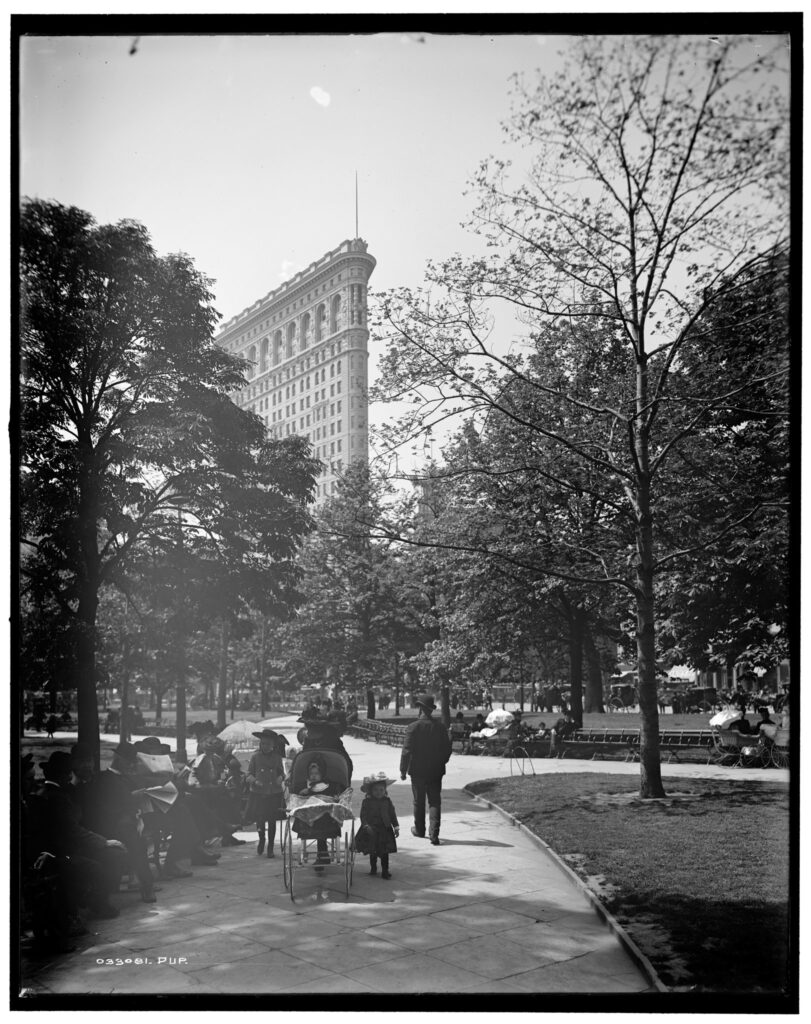
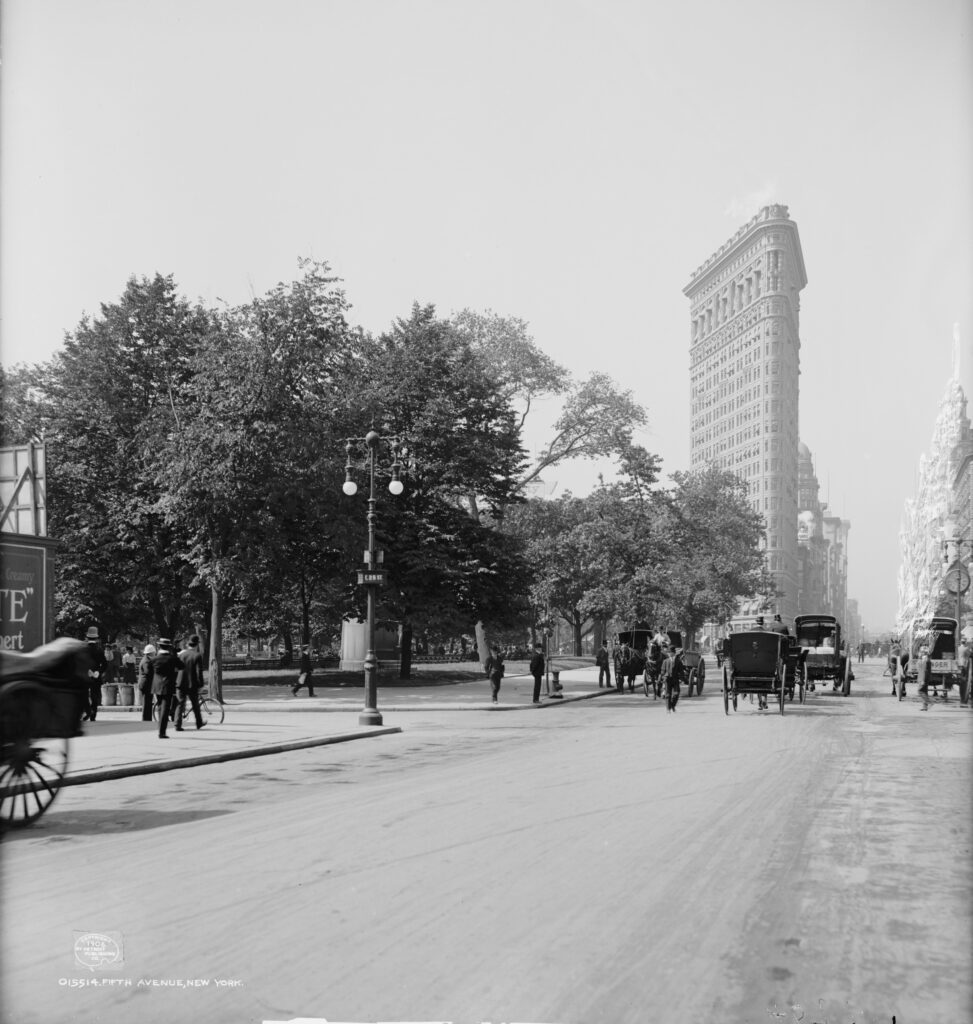
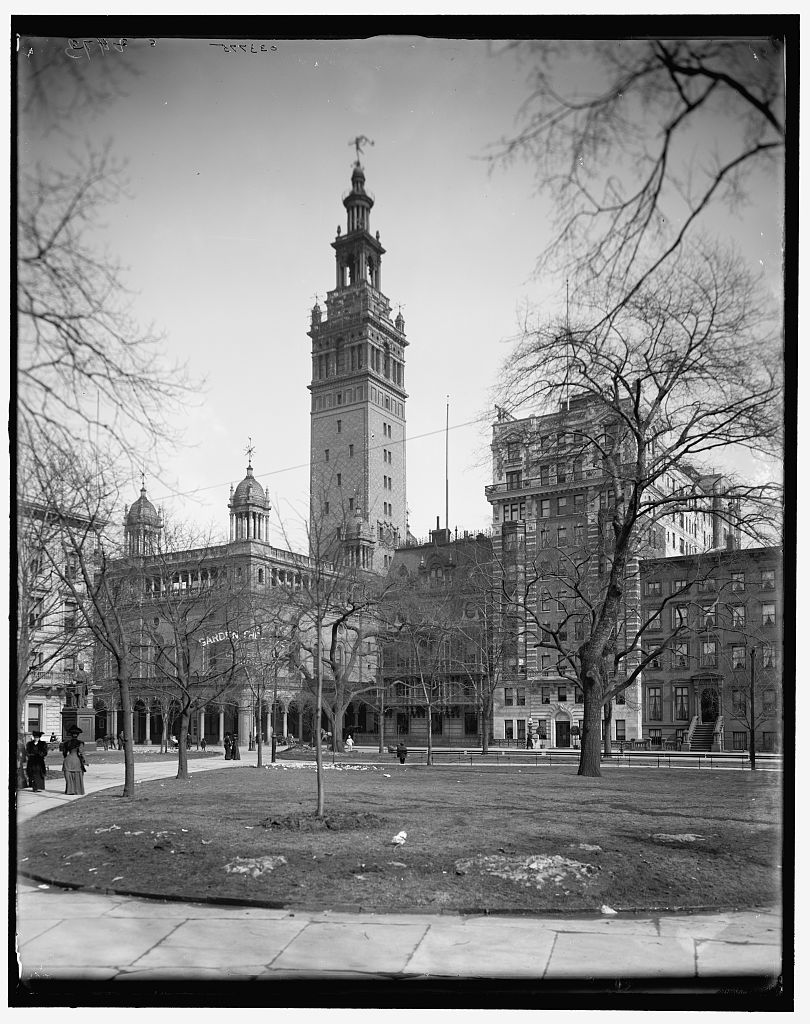
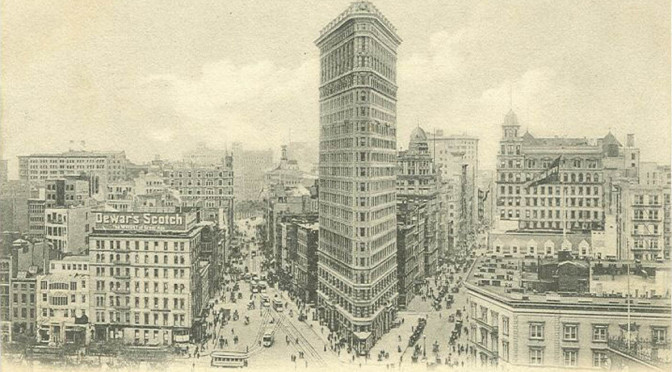
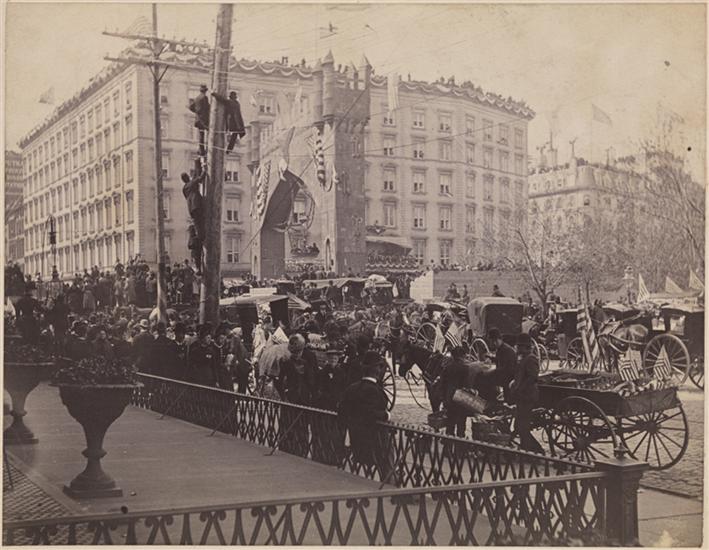
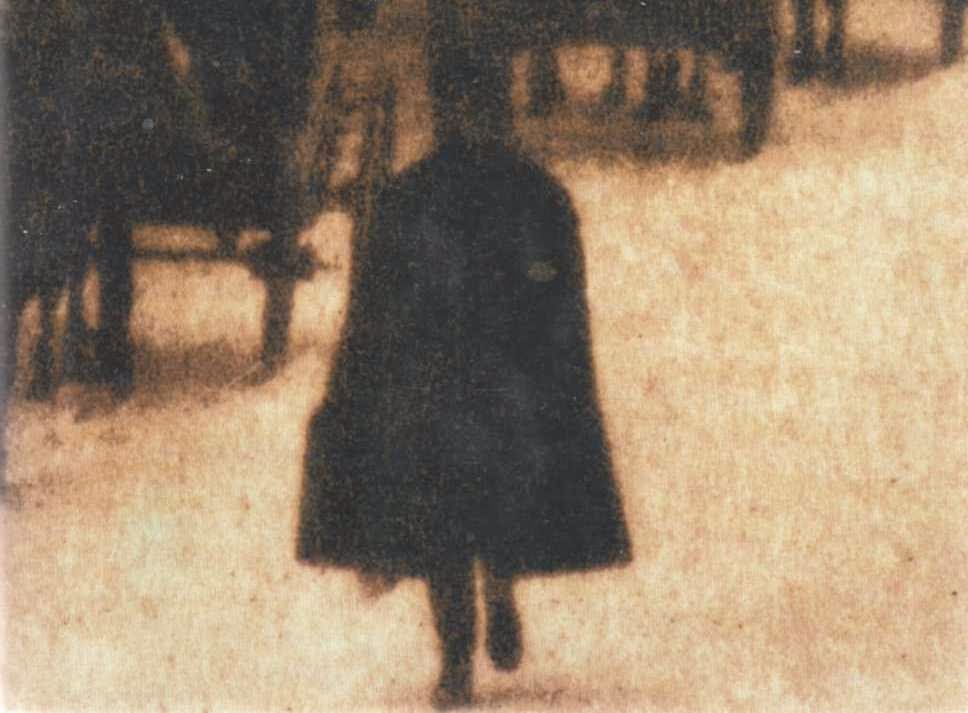
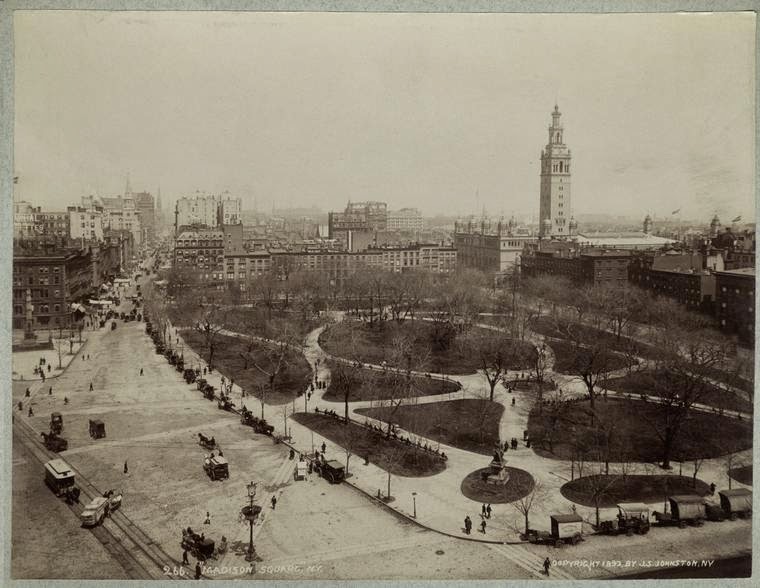
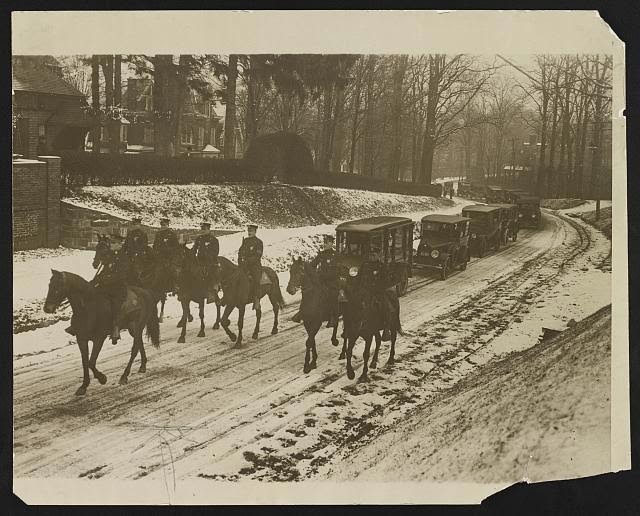
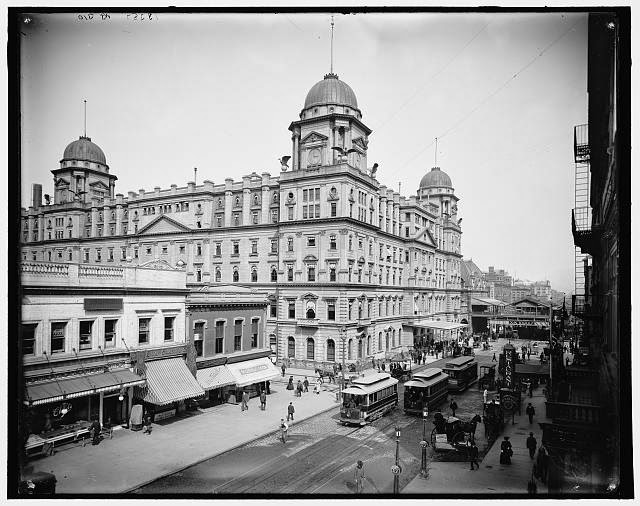
Cab stand at Madison Square, 1900. Courtesy Detroit Publishing/Library of Congress. This image is looking south down the edge of the park. Within two years, the Flatiron Building would be rising in the distance.
So much has happened in and around Madison Square Park — the leafy retreat at the intersections of Broadway, Fifth Avenue and 23rd Street — that telling its entire story requires an extra-sized show, in honor of the Bowery Boys 425th episode.
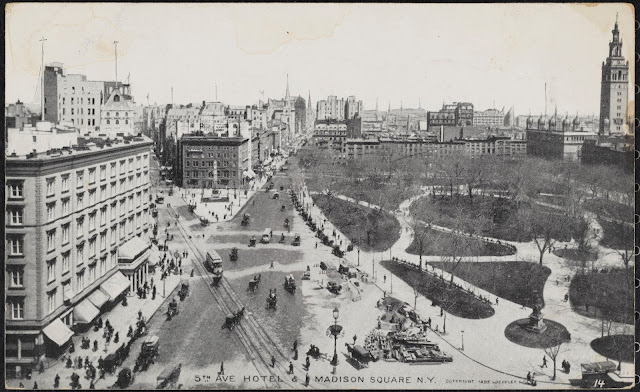
Madison Square Park was the epicenter of New York culture from the years following the Civil War to early 20th century. The park was really at the heart of Gilded Age New York, whether you were rushing to an upscale restaurant like Delmonico’s or a night of the theater or maybe just an evening at one of New York’s most luxurious hotels like the Fifth Avenue Hotel or the Hoffman House.
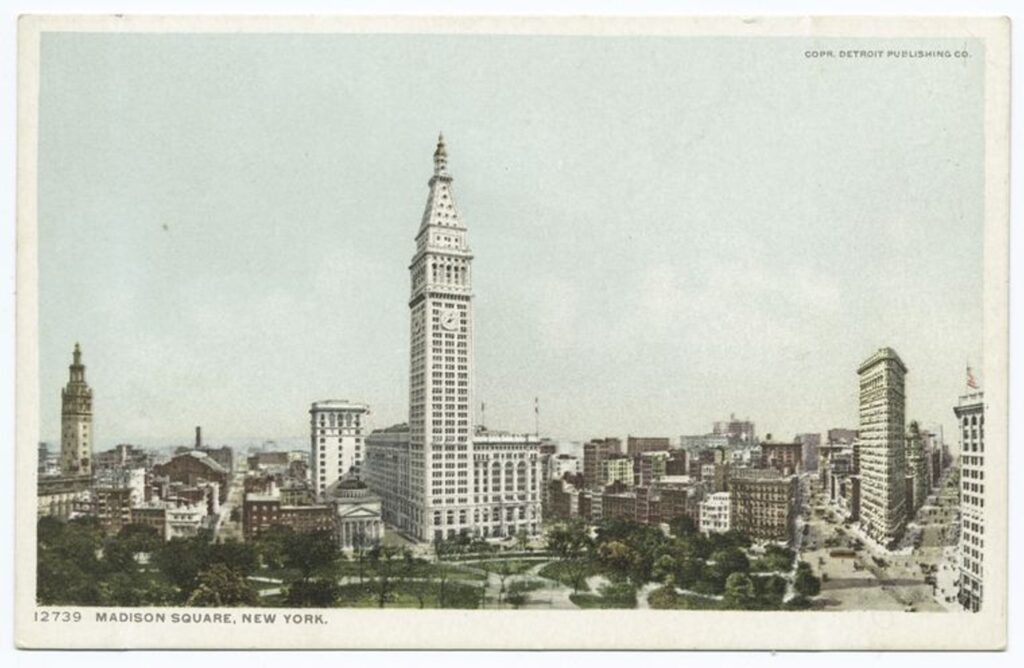
The park is surrounded by some of New York’s most renown architecture, from the famous Flatiron Building to the Metropolitan Life Insurance Tower, once the tallest building in the world.
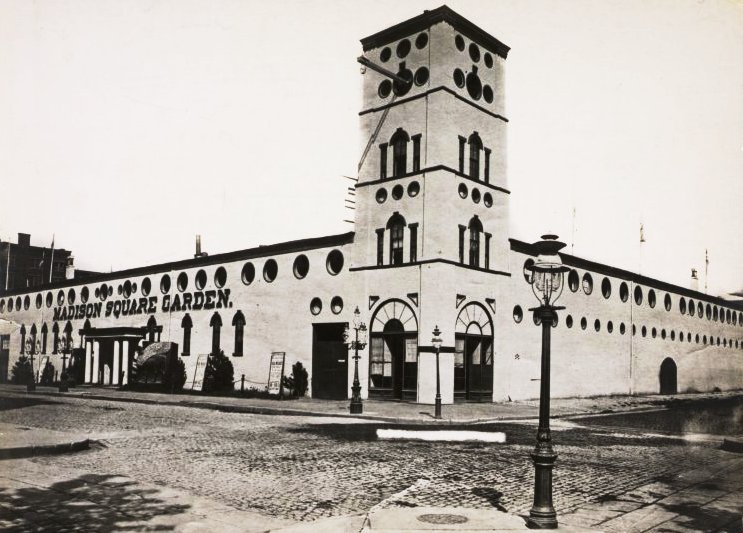
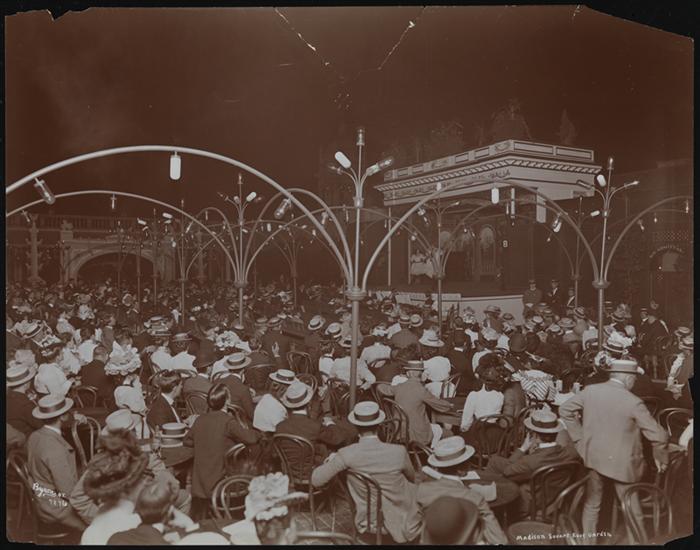
The square also lends its name, of course, to one of the most famous sports and performing venues in the world – Madison Square Garden. Its origins begin at the northeast corner of the park on the spot of a former railroad depot and near the spot of the birthplace of an American institution — baseball.
The park introduced New Yorkers to the Statue of Liberty … or at least her forearm and torch. It stood silently over the bustling park while prize-winning dogs were championed at the very first Westminster Kennel Club Dog Show nearby, held at Gilmore’s Gardens, the precursor to Madison Square Garden.
Today the region north of the park is referred to as NoMad, which recalls life around Madison Square during the Gilded Age with its high-end restaurant and hotel scene.
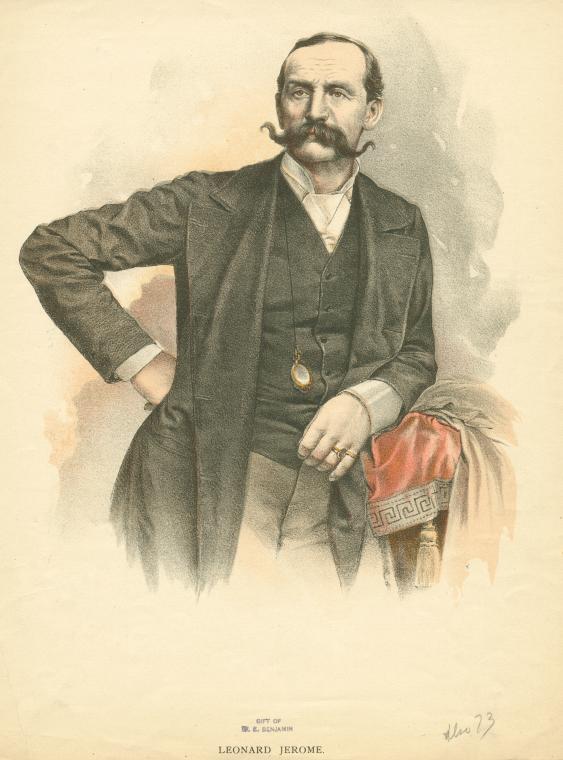
Tom and Greg invite you on this time-traveling escapade covering over 200 years of history. From the days of rustic creeks and cottages to the long lines at the Shake Shake. From Franconi’s Hippodrome to the dazzling colonge fountains of Leonard Jerome (Winston Churcill’s grandfather).
LISTEN HERE: IT HAPPENED AT MADISON SQUARE PARK
This episode’s title pays homage to one of favorite books about park history — It Happened On Washington Square by Emily Kies Folpe.
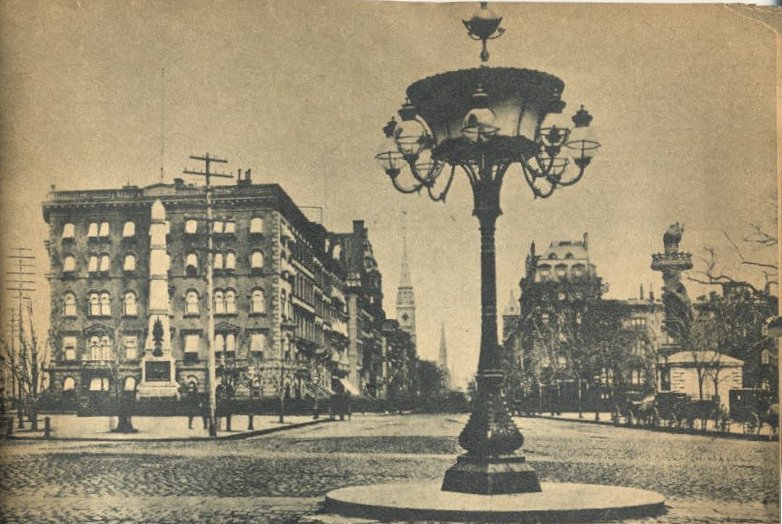
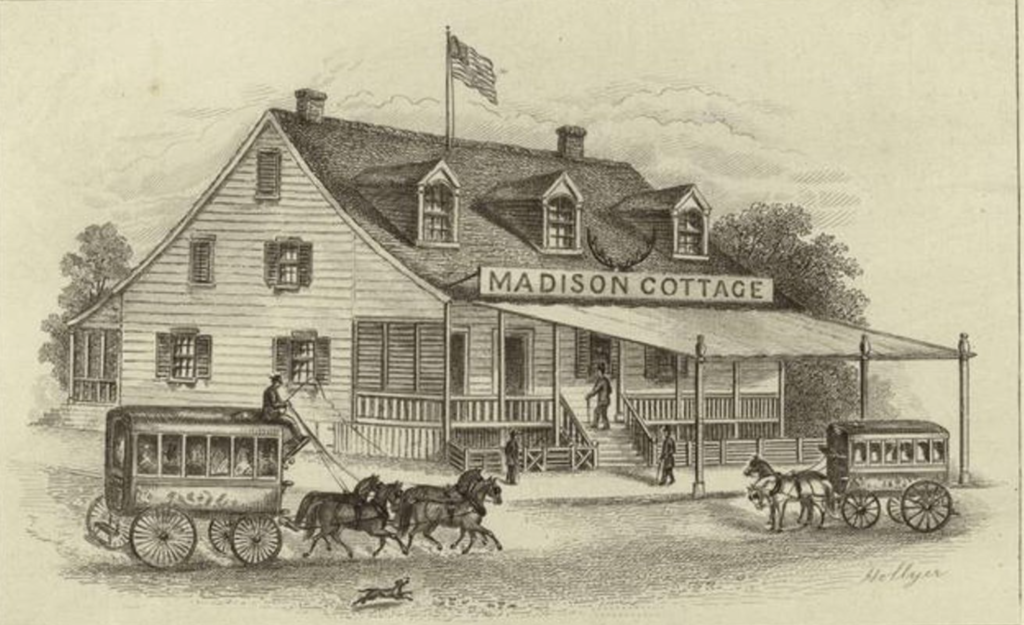
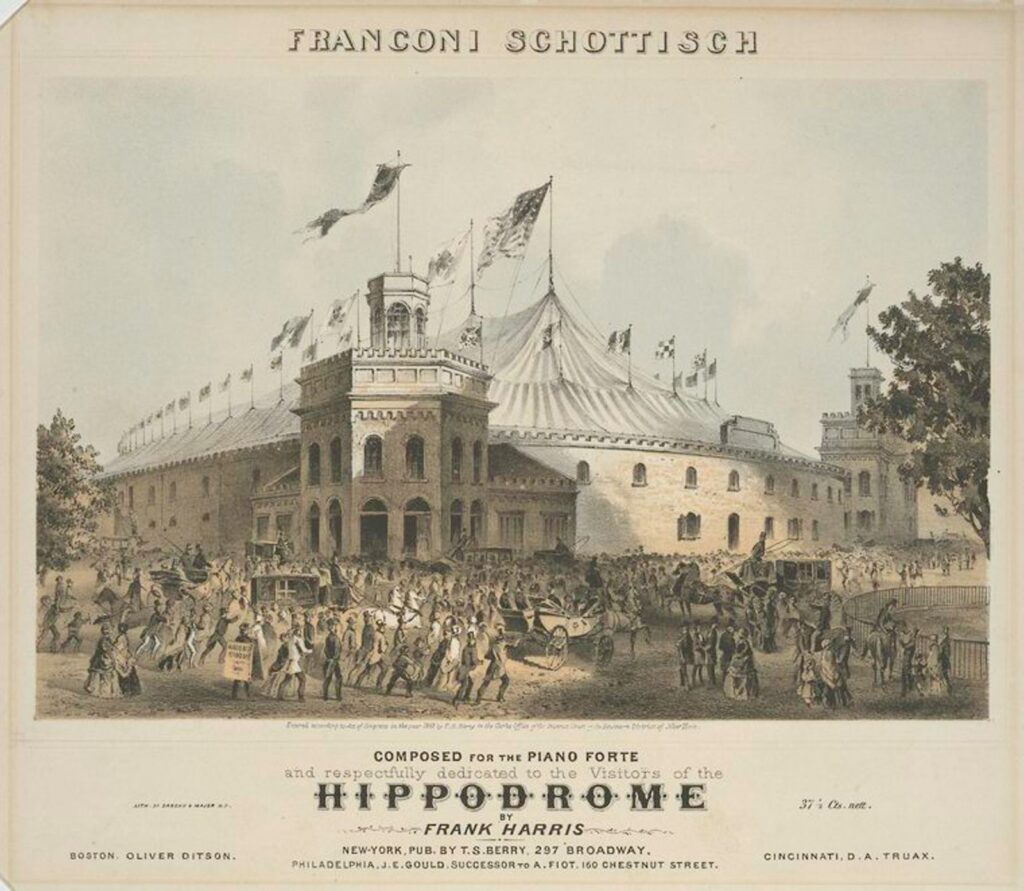
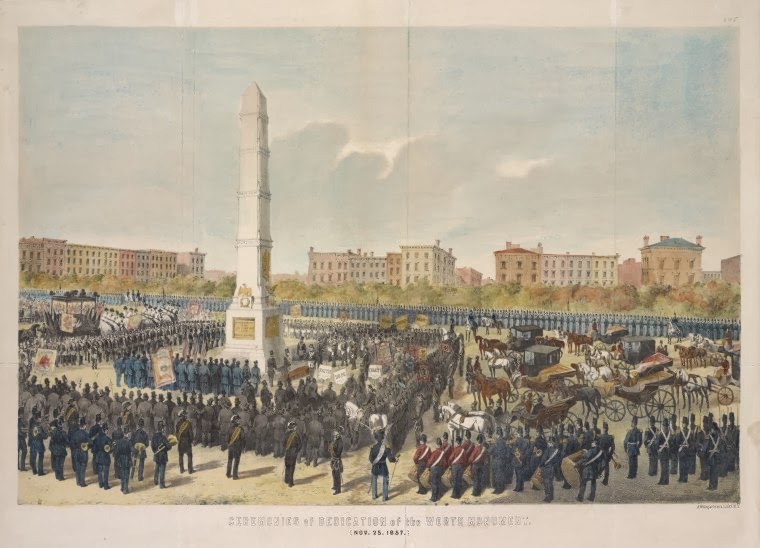
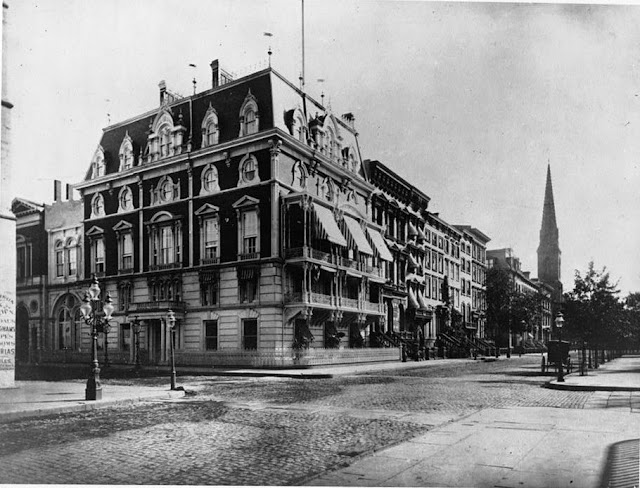
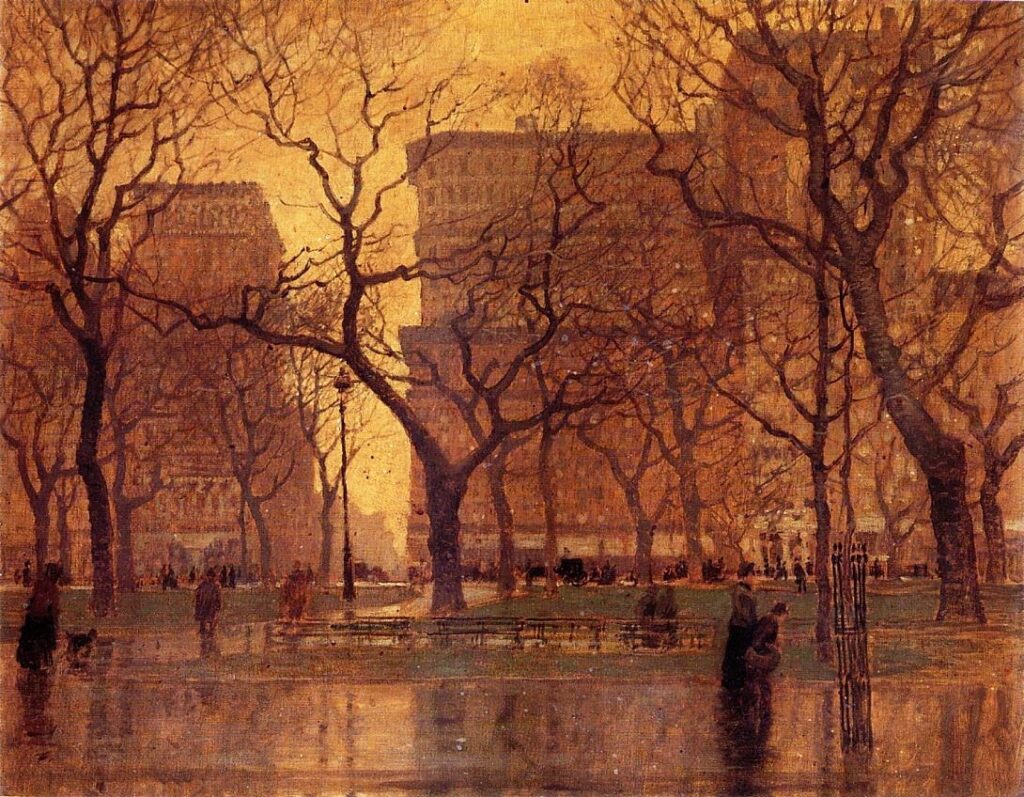
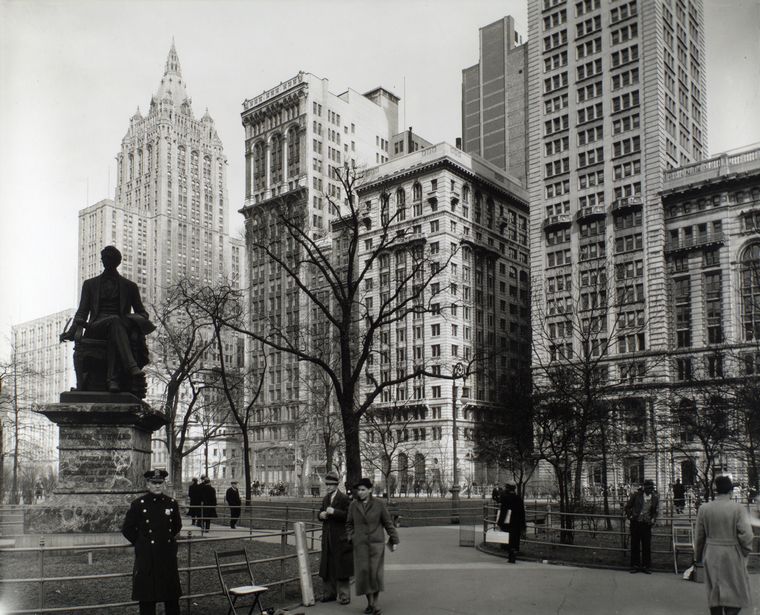
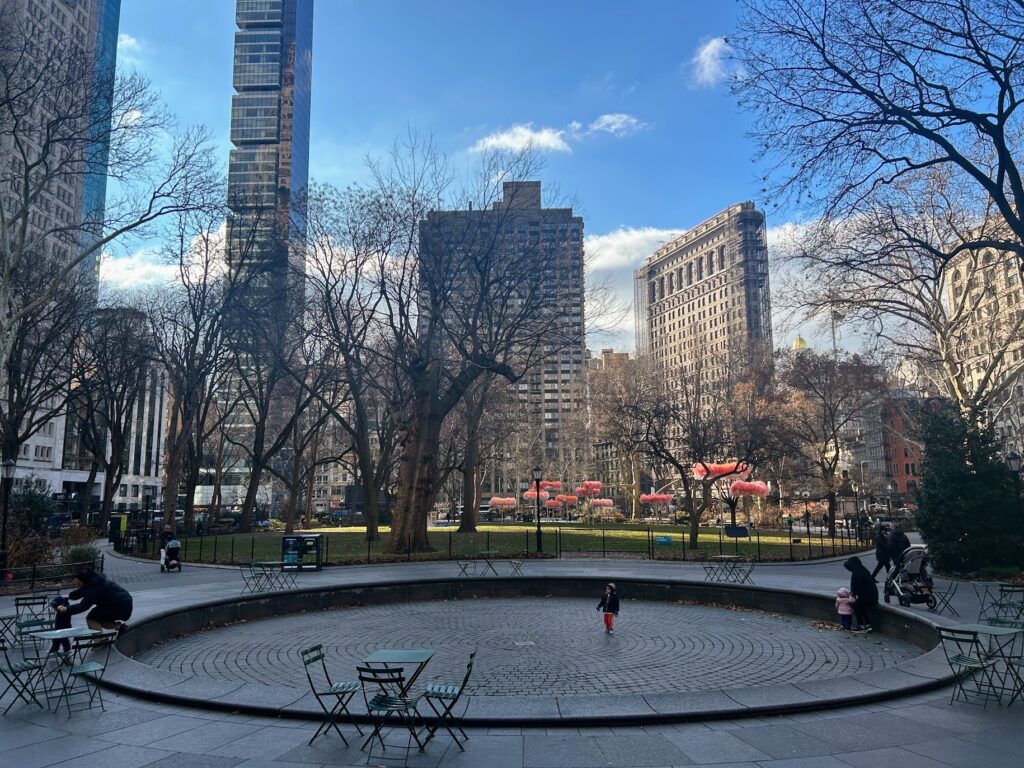
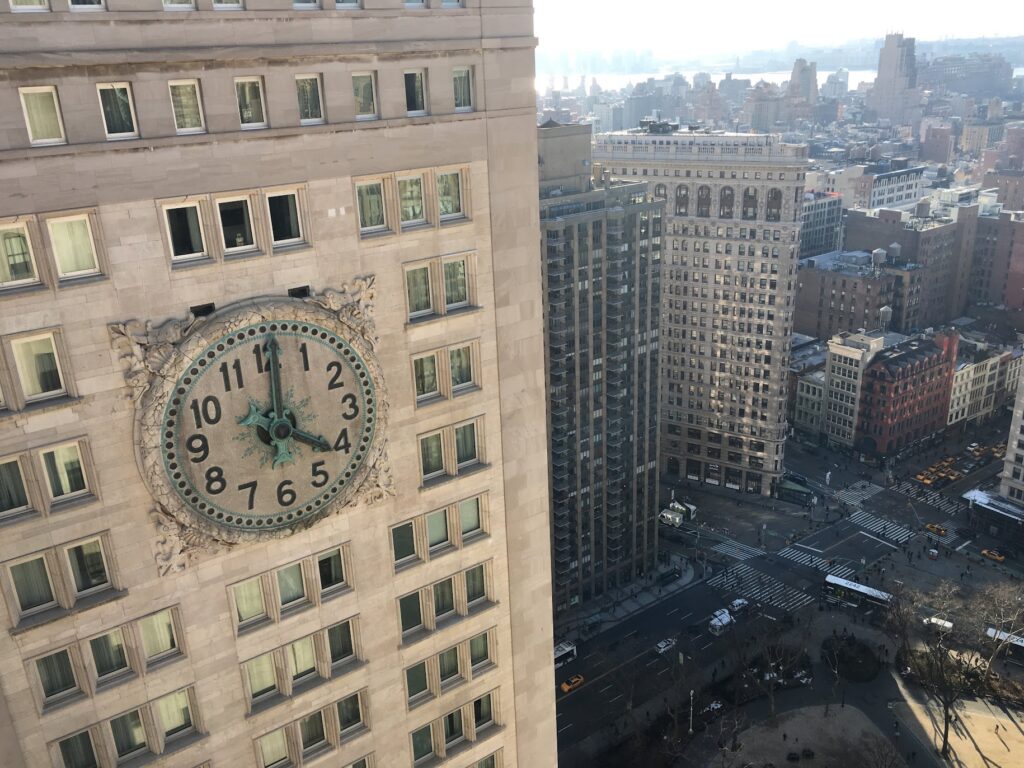
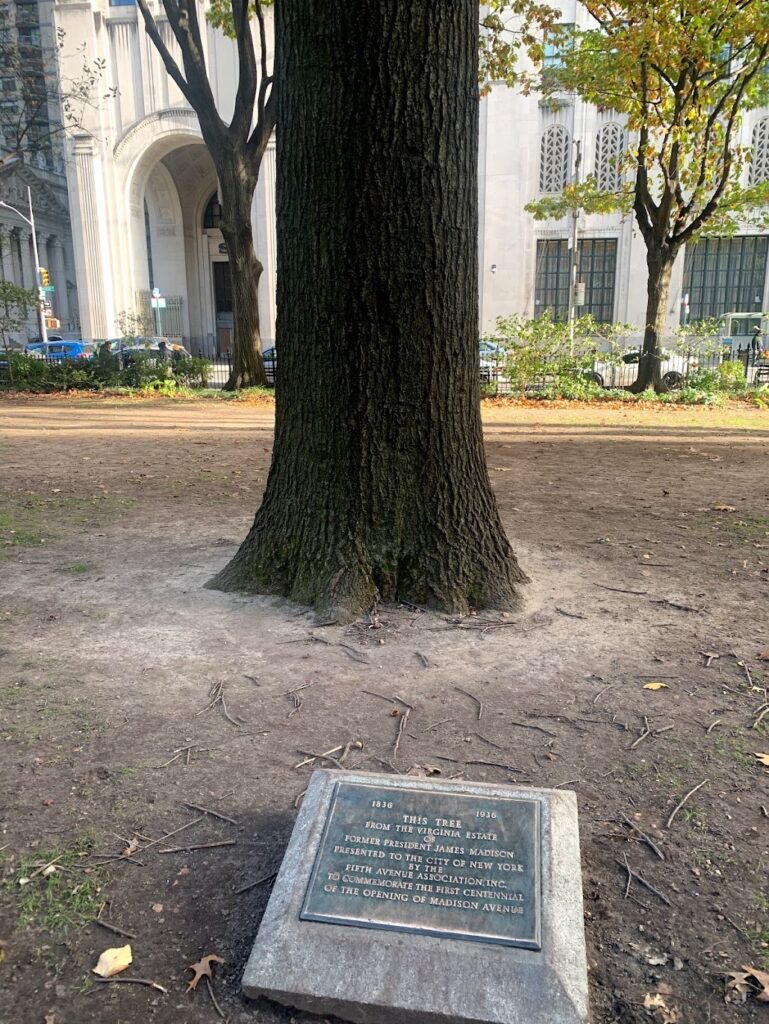
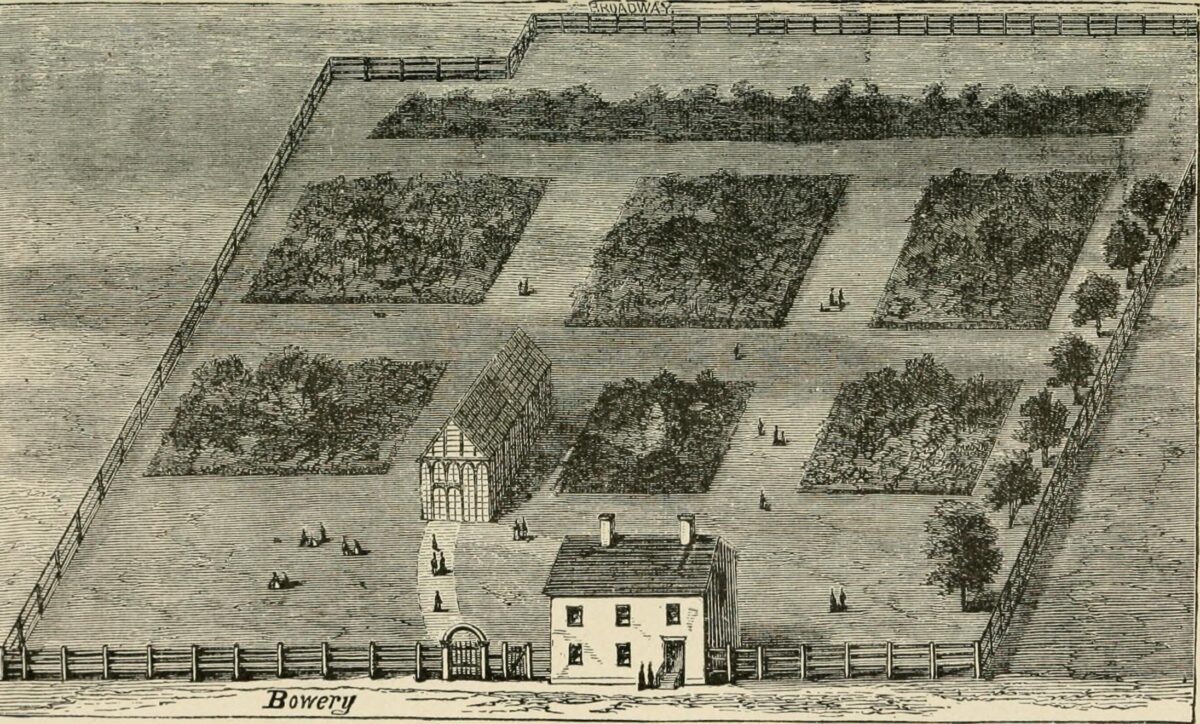
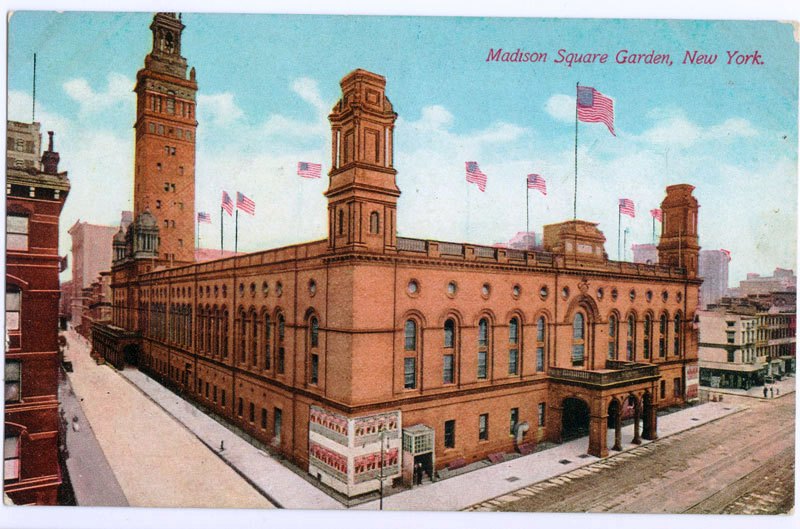
Madison Cottage, courtesy NYPLFranconi’s Hippodrome, 1853, courtesy NYPLDedication of the Worth Monument in 1857. In the background you can see the development of the surrounding areaLeonard Jerome….… and the Jerome Mansion. In the distance is the Madison Avenue Presbyterian Church. The former Gilmore’s Gardens, renamed Madison Square GardenRain on Madison Square, painting by Paul CornoyerCourtesy NYPLMadison Square 1936 , photo by Berenice AbbottNorthern pool in Madison Square Park. Photo by Greg YoungLooking down at the Metropolitan Life Tower and the Flatiron Building. Photo by Greg YoungThe park features a tree from James Madison’s Virginia plantation.
FURTHER READING
A Block in Time: A New York City History at the Corner of Fifth Avenue and Twenty-Third Street / Christiane Bird The Flatiron: The New York Landmark and the Incomparable City That Arose with It / Alice Sparberg Alexiou The Grandest Madison Square Garden: Art, Scandal, and Architecture in Gilded Age New York / Suzanne Hinman Incredible New York: High Life and Low Life from 1850 to 1950 / Lloyd Morris Liberty’s Torch: The Great Adventure to Build the Statue of Liberty / Elizabeth Mitchell Madison Square: The Park and Its Celebrated Landmarks / Miriam Berman Madison Square Garden, 100 Years of History / Joseph Durso
It has become a name so associated with American sports and entertainment that you barely think about it.
In New York City, when you say you are going to The Garden, you aren’t going to see flowers. Most likely, you’re going to see the Knicks. Or possibly Billy Joel.
New York City’s many actual gardens — the ones with plants, not millionaire performers — are so diverse and numerous that they offer sensual and educational pleasures for people of all ages.
Madison Square Garden (MSG) traces its history back to almost 150 years ago to a vacated New York and Harlem Railroad train depot which once sat on the northeast corner of Madison Square. It was here that P.T. Barnum briefly set up a circus arena called the Great Roman Hippodrome.
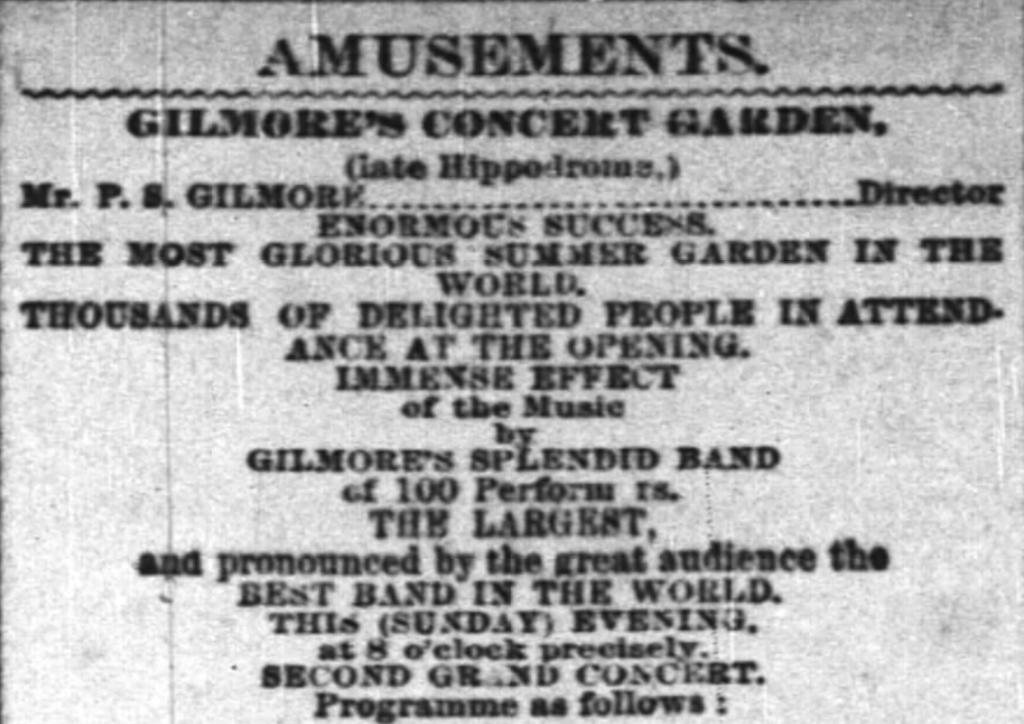
But it was the site’s second impresario — bandleader Patrick Gilmore — who gave the site for his concerts a more fragrant sounding name in the Spring of 1875 — Gilmore’s Garden.
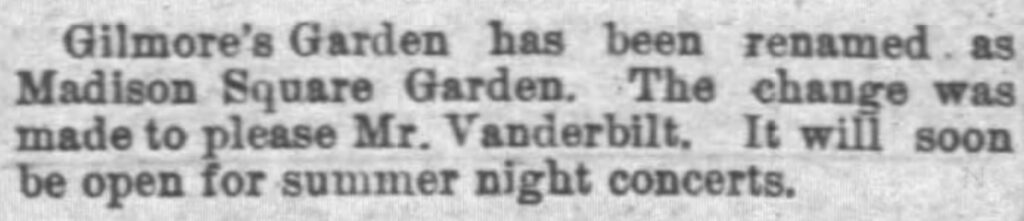
Four years later, the popular venue was renamed Madison Square Garden — “to please Mr. Vanderbilt,” according to the Brooklyn Union clip below. (That would be William Kissam Vanderbilt, the grandson of Cornelius Vanderbilt.)
For more information on the history of Madison Square Garden, listen to our back catalog show on the many locations of this storied venue:
But even Gilmore’s was a rather late entry in New York City’s many well-known pleasure gardens, the name for an all-in-one entertainment space which traces back to the ancient Romans.
The pleasure garden become a key ingredient in the social world of New York City because of its popularity with the British during the Colonial period.
Here are a few of New York’s more notable ‘gardens’, taking root in the city even before the appearance of Madison Square Garden:
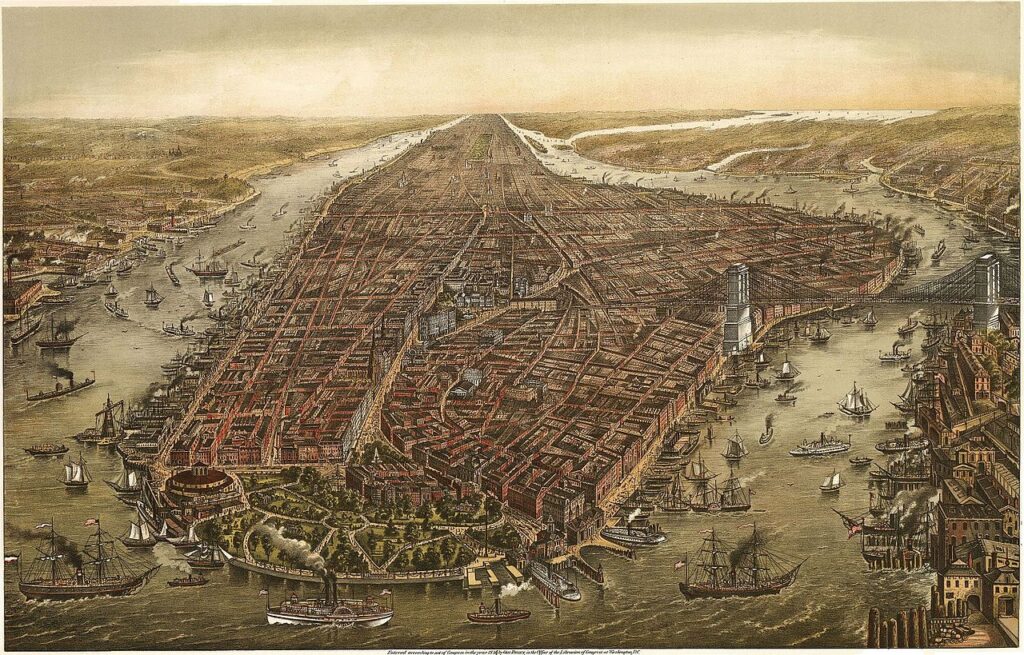
Bird’s eye panorama of Manhattan & New York City in 1873.
Spring Garden and Catiemuts Gardens
The first Colonial-era pleasure gardens in New York leaned upon the popularity of well-known gardens in England. For instance, the 1740 Spring Garden — located just south of today’s City Hall Park — was a nod to 17th century English pleasure gardens by that name.
According to author Hallie Alexander: “The Spring Garden tavern hosted balls, magic shows, tumbling acts, feats of strength (including a Female Samson), and musical concerts.”
Catiemuts Gardens was north of Spring Garden (at Park Row and Chambers Street). Like many early pleasure-garden proprietors, Catiemuts’ owner made sure to center his venue around a tavern, and entertainments were thusly invented to inspire the purchase of alcohol.
New York Public Library
Ranelagh Gardens
Londoners could enjoy the first Ranelagh Gardens in 1741, built on the site of the home of the 1st Earl of Ranelah in the neighborhood of Chelsea. In 1765, New Yorkers got their own Ranelagh.
According to William Harrison Bayles’s 1918 Old Taverns of New York: “It was said that the grounds had been laid out at great expense and that it was by far the most rural retreat near the city. Music by a complete band was promised for every Monday and Thursday evening during the summer season.”
And according to author Vaughn Scribner: “[The venue’s proprietor John] Jones took to the New-York Mercury to announce that, in addition to all the leisurely pleasures already available at Ranelagh, Jones would offer any customer who could pay the two shillings and three pence entrance fee a ‘Concert of Musick’ followed by a grand firework show.”
New York Public Library
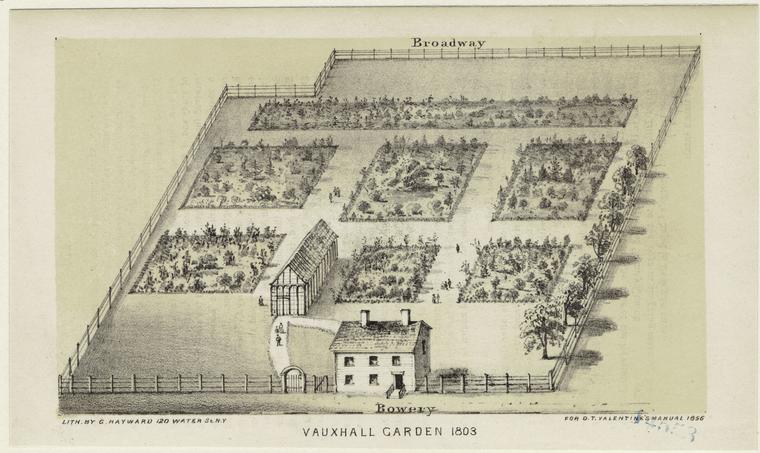
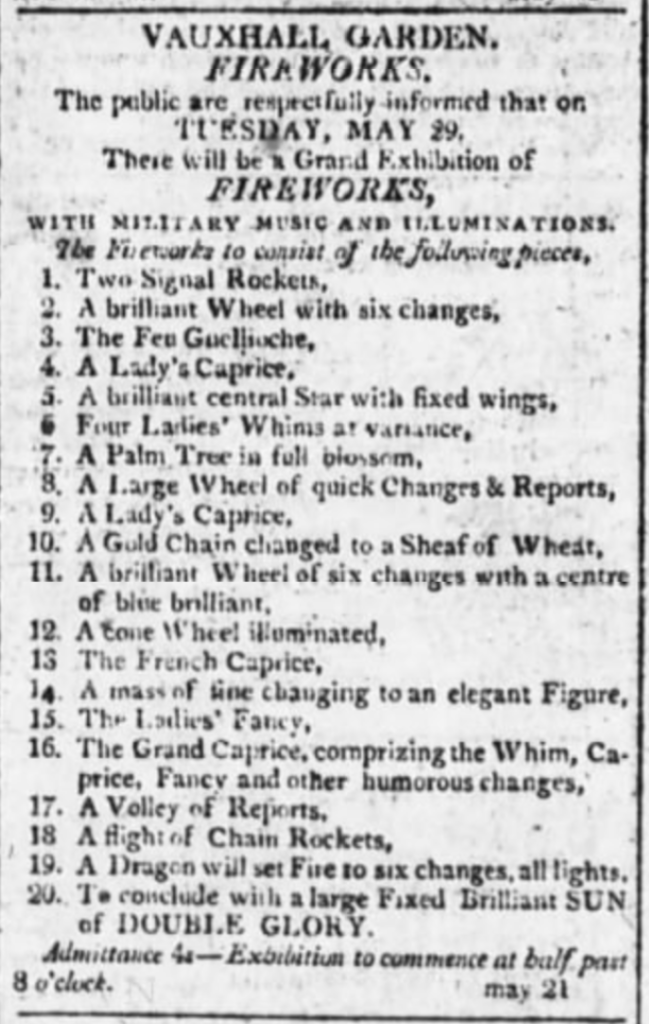
Vauxhall Gardens
Vauxhall Gardens is one of London’s most historic public spaces and it was so renown back in the 18th century that it inspired several New York knockoffs, including one owned in 1767 by tavern owner Samuel Fraunces (before operating the more famous tavern which bears his name today.)
But the most famous, from 1771, was first owned by Jacob Sperry, a charming garden space around the area of today’s Astor Place. (In fact John Jacob Astor would eventually purchase the property for speculative development.)
The New York Evening Post, May 28, 1904 (via newspapers.com)
For the first two decades of the 19th century, it was one of the most popular attractions in New York City. Under the management of French proprietor Joseph Delacroix, the cultivated garden pathways were adorned with magical lanterns, accompanied by musicians nestled throughout the flora.
Bayles later wrote in 1918: “Vauxhall Garden was an inclosure said to contain three acres of ground, handsomely laid out with gravel walks and grass plots, and adorned with shrubs, trees, flowers, busts, statues, and arbors. In the center was a large equestrian statue of General Washington.
“All the town flocked to [Vauxhall]. It was to the New York of that day something like what Coney island is to the New York of today. The people of New York considered it to be about as gay a place of recreation as could be found anywhere.”
New York Public Library
Castle Garden
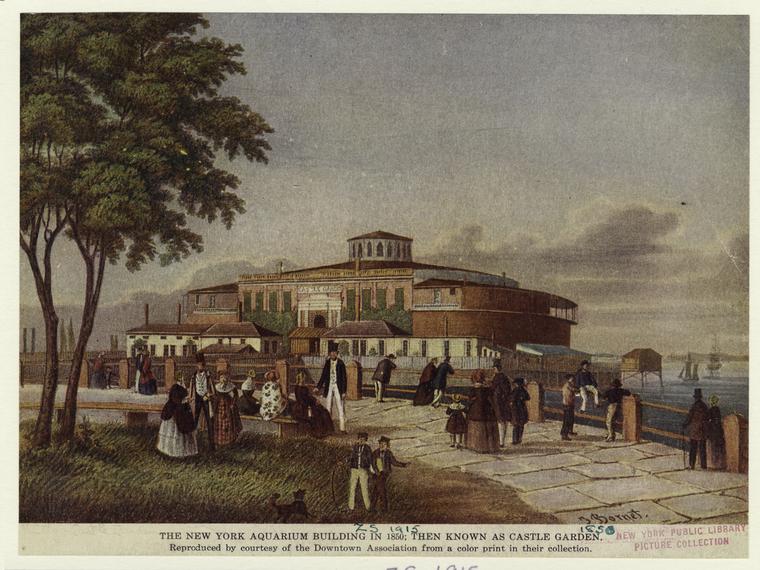
In 1824, the old Castle Clinton in the Battery was transformed into New York’s largest exhibition hall — Castle Garden.
While the Battery did provide the strolling pleasures of an actual garden — a visitors could enjoy refreshments at the beer garden — it was the performances within the building (which was later fitted with a roof) that really drew the crowds.
In 1850 Barnum would bring the Swedish songstress Jenny Lind to Castle Garden to universal acclaim.
For more information, check out our podcast from last year on this iconic moment in New York City entertainment.
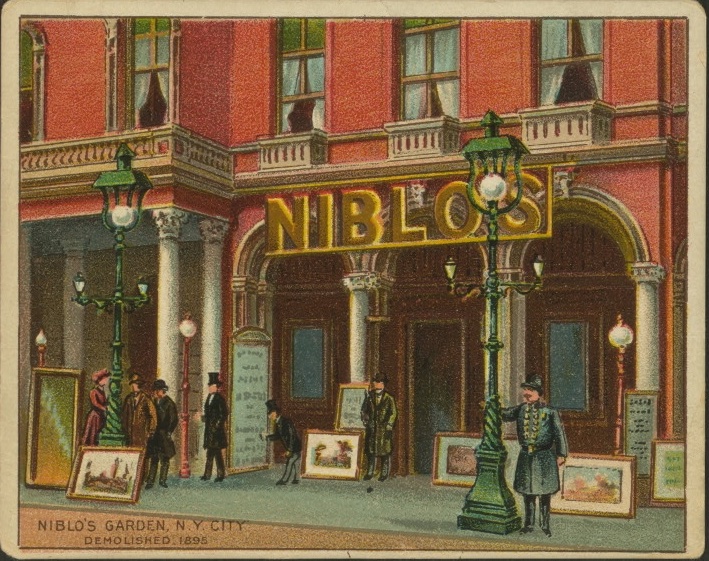
Niblo’s Garden
The pleasure garden at the corner of Broadway and Prince Street changed theater history.
The site evolved from a simple garden in 1828 to a lavish destination for entertainment and delight thanks to Irish impresario and coffee house owner William Niblo.
From Bayles’ description: “The interior of the garden was spacious and adorned with shrubs and flowers; cages with singing birds were here and there suspended from the branches of trees, beneath which were placed seats with small tables where were served ice cream, wine negus and cooling lemonade; it was lighted in the evening by numerous clusters of many-colored glass lamps.”
Niblo greatly expanded his romantically lit garden (originally named San Souci) by taking over several surrounding lots and installing a theater and saloon. The venue was large enough that it hosted both large fairs and orchestral productions.
After a fire destroyed the stage in 1846, Niblo built bigger, becoming one of New York’s central performance spaces by the Civil War era with over 3,000 seats.
Operetta Research Center
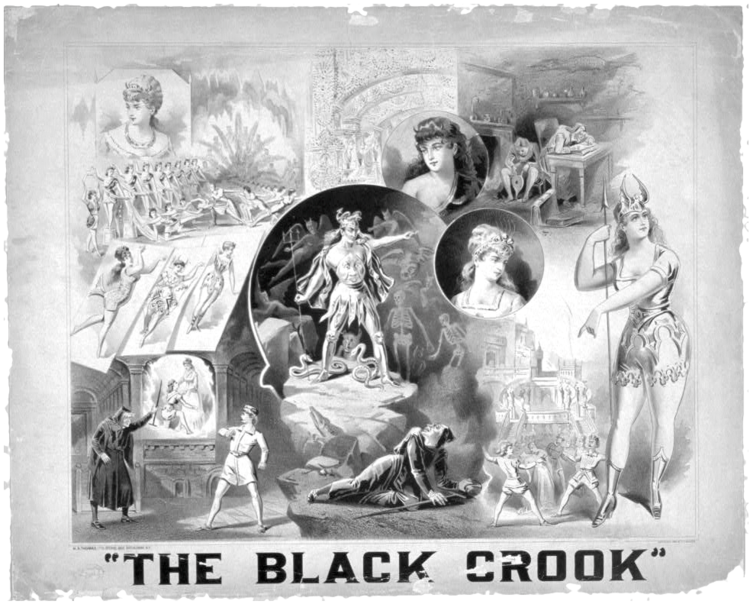
And in 1866 it debuted a show equally as ambitious — The Black Crook, running five-and-a-half hours long and considered by many to be the first Broadway musical.
But by this time, the ‘garden’ of Niblo’s Garden had been greatly reduced, replaced by a luxury hotel — the Metropolitan.
For more information on the history of Niblo’s Garden, listen to this back catalog show on the history of this long-gone theatrical icon:
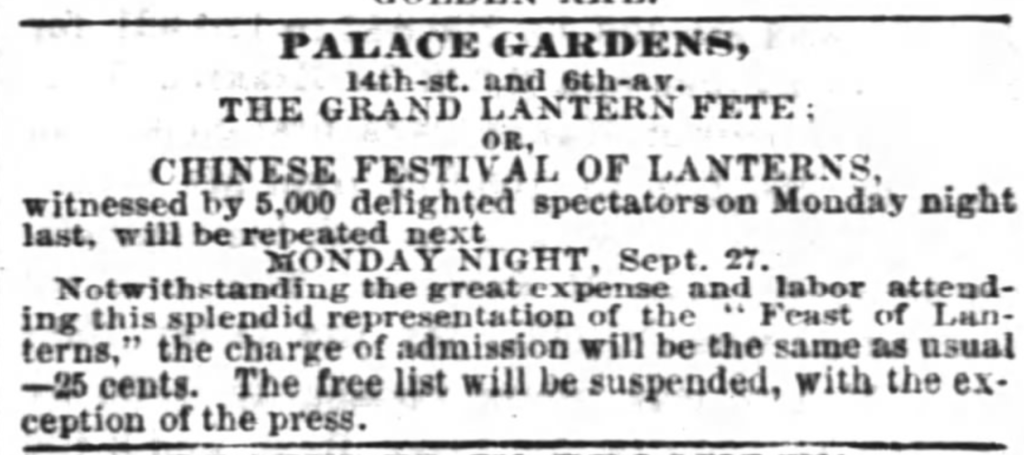
Palace Garden
Throughout the decades, New York society moved north up the island and so too did the pleasure gardens. The Palace Garden, at Sixth Avenue and 14th Street, situated its attractions nearby bustling Union Square.
From the New York Times, September 24, 1858
It might be hard to imagine a ‘festival of lanterns’ at that particular street corner today. Just a couple decades the avenue would be transformed by massive department stores, becoming the fashionable shopping district Ladies Mile.
In fact, the entire idea of a pleasure garden was evolving into something that was very much not a garden at all. With the arrival of Central Park in the late 1860s and the rising prices of real estate in high trafficked areas of Manhattan, the simple pleasures of the urban pleasure garden faded away.
But not the name! Pleasure gardens were associated with music and performance and so the ‘garden’ stuck around.
So despite hundreds of beautiful parks, botanical gardens and community gardens in the city, this is the location that is called THE GARDEN:
Frances Ethel Gumm was born 100 years ago (June 10, 1922) in Grand Rapids, Minnesota, a world away from the glamour of Hollywood and the lights of Broadway. Yet — as Judy Garland — she would change both places forever, becoming one of the most beloved entertainers in the world.
And she remains beloved to this day — by international fans of her films The Wizard of Oz, A Star Is Born and Meet Me In St. Louis, by music lovers entranced by her rich, emotional voice, by many members of the LGBT+ community who still exalt her as a pop culture legend.
Unlike California, New York was never really her home in the same way — although she did have an apartment here in the 1960s. New York City always knew Judy as a star and revitalized her career at a critical moment.
And she loved the city for that reason. “I’m always at my best in New York.” she once claimed. And when she was not her very best — which was not uncommon — her New York fans stood by her.
Here’s a look at Judy Garland’s New York, the places and spaces which made her an icon.
A Star Is Born
Garland hit the ground running on her very first trip to New York in 1936 — already an MGM star at age 14 — heading to Decca Records West 57th Street studio to record her very first record — “Stompin’ At The Savoy,” originally made famous by Benny Goodman. (Interestingly she would not actually step foot in Harlem’s Savoy until many. years later.)
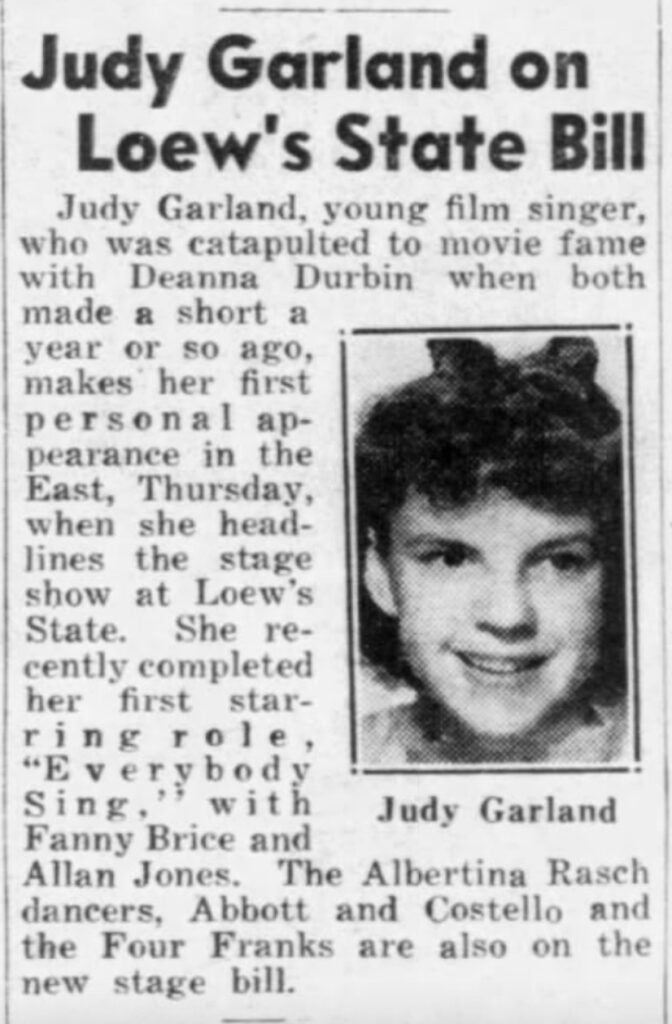
Two years later, in 1938, Garland would make her first stage appearance in New York City at the Loew’s State Theater, the Thomas Lamb-designed movie palace at 1540 Broadway that was still booking vaudeville acts into the 1930s.
Garland was there to promote her film Everybody Sings, a forgettable film co-starring Fanny Brice. But her appearances during the hectic promotional tour — a miniature singing and dancing sensation — dazzled audiences, a true ‘star is born’ moment which set her career in motion.
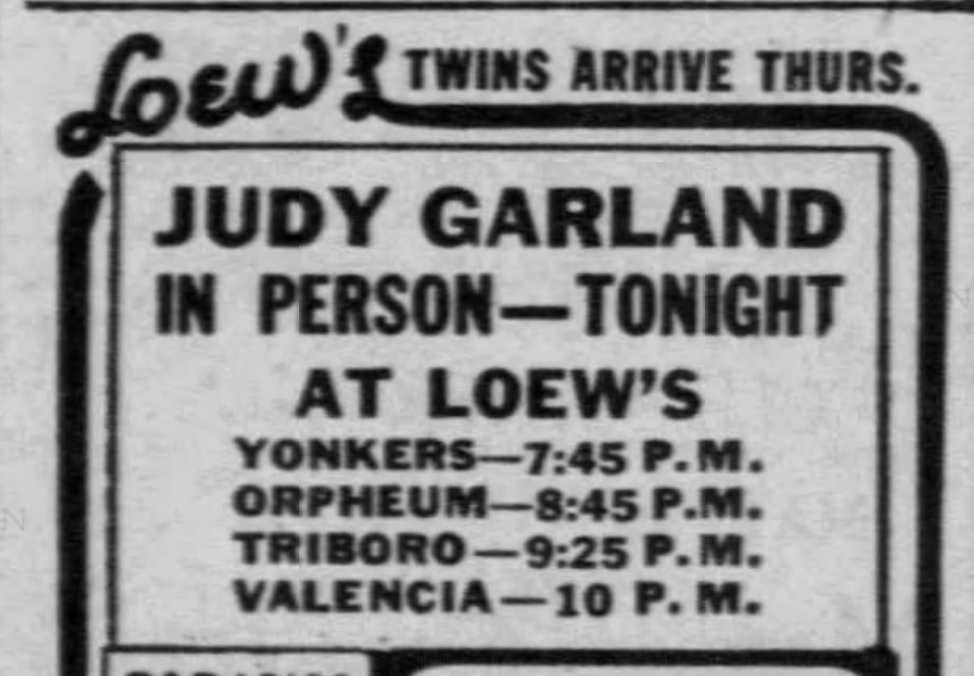
By the time she returned to the Loews State in the spring of 1939, she was already a mega-star thanks to the hit film Love Finds Andy Hardy, her second on-screen appearance with Mickey Rooney.
On April 10, 1939 she was quite literally whisked around town on a cyclone-like tour of Loew’s theaters:
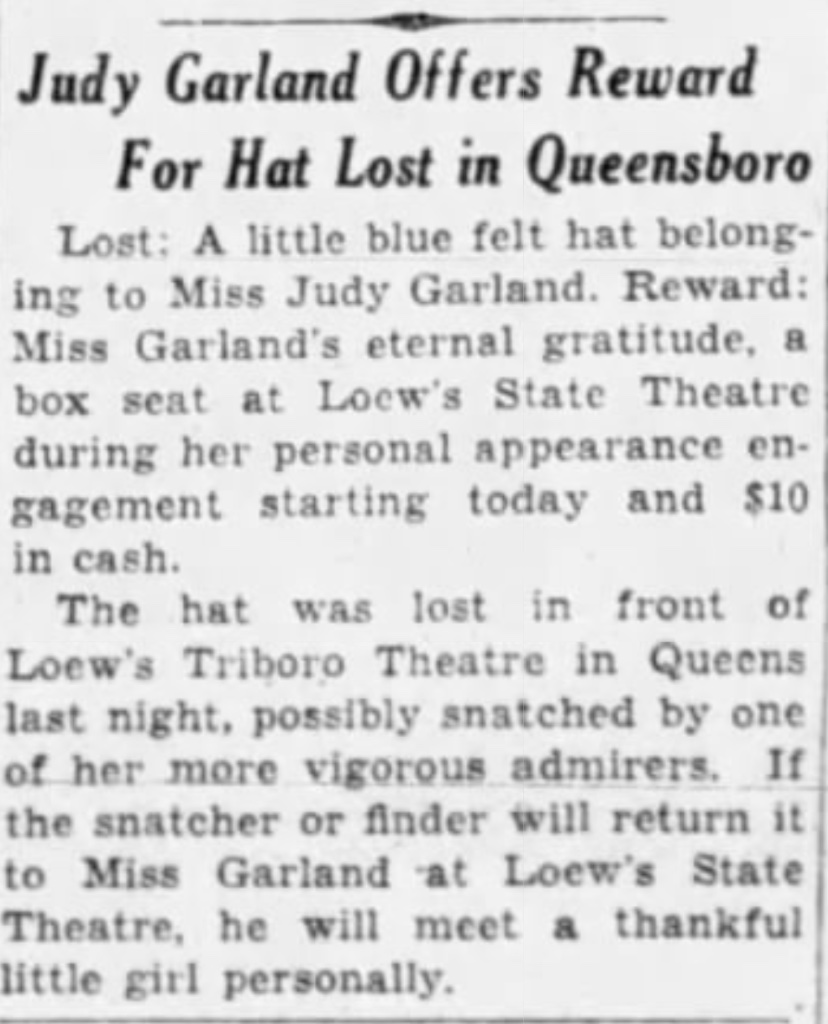
While at the Loews Triboro(2804 Steinway Street in Astoria) she obviously lost a hat. Garland offers a reward to New Yorkers for the accessory that went missing in Queens (April 13, 1939).
Off To See The Wizard
Her next visit to New York is considered by some to be a legendary moment in American entertainment history.
Garland was swinging through town on another frantic tour with Rooney. But this time they were promoting her big star-making vehicle.
The pair arrived at Grand Central Terminal on August 14, 1939 to thousands of well-wishers. (You can see footage of Garland and Rooney at the train station in this video.)
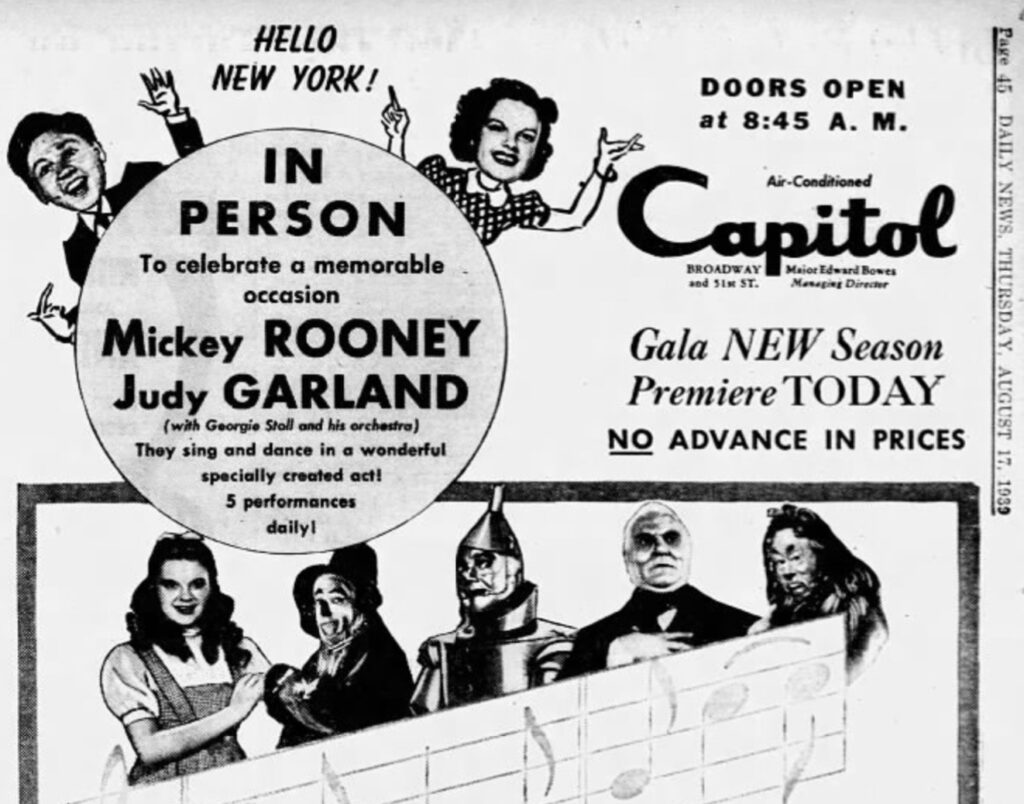
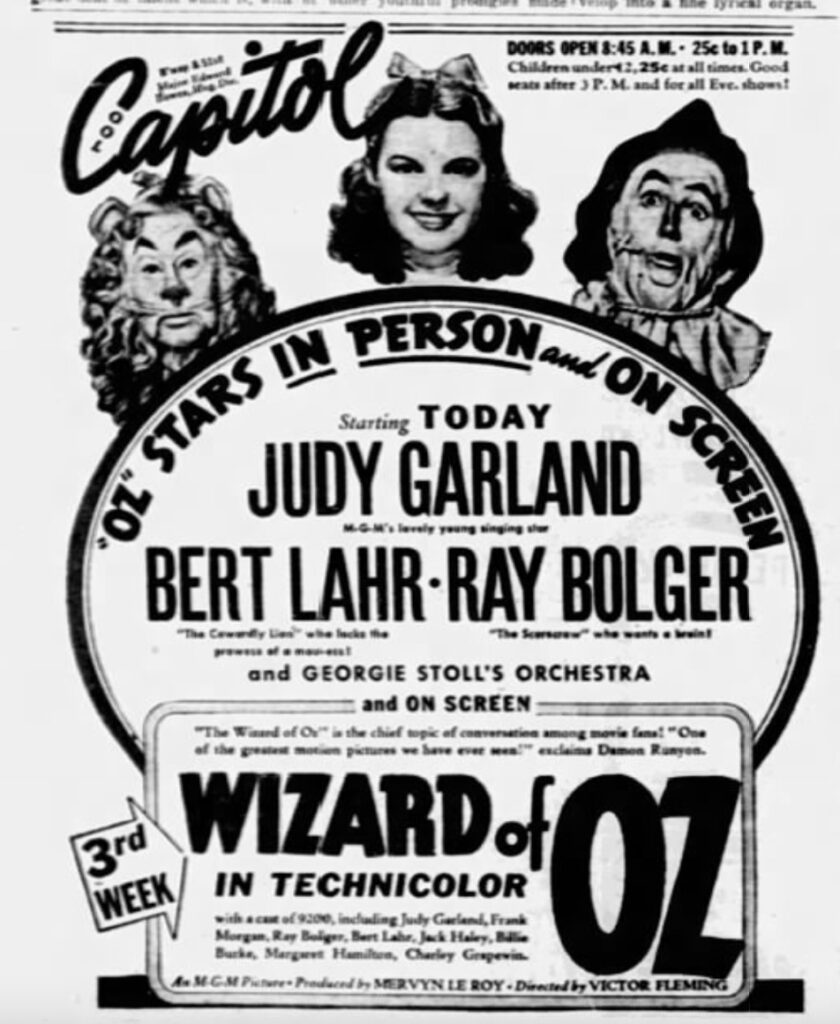
Three days later, on August 17, the film The Wizard of Oz premiered at the Capitol Theater (1645 Broadway), and Garland and Rooney were there, performing live, five shows a day, between sold-out screenings. (On the weekends, they did seven performances a day.)
They were constantly on the go in New York, an exhausting blur of public appearances. And everywhere they went, adoring crowds met them — at restaurants, on the street, at the Waldorf-Astoria, even at a brief appearance at Madison Square Garden.
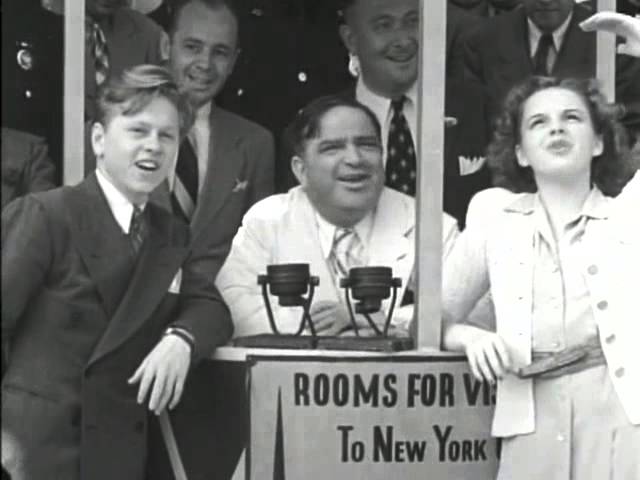
But the duo’s most interesting stop was to Flushing-Meadows Park in Queens — hopefully Judy left her hat at home — for the 1939 World’s Fair where they met Mayor Fiorello La Guardia:
Rooney and La Guardia shared some corny banter:
Rooney: “Mr. Mayor, I have a lot of friends out on the coast and elsewhere who would like to come to your wonderful fair. Is there any place they can stay besides expensive Park Avenue hotels?”
La Guardia: “Why, Mickey, New York is just like any other city in the country. The only difference is that we have 50,000 places for people who visit the Fair to stay as low as 50 and 75 cents, and we have better food for less money.”
Judy and Mickey then spent the day enjoying the many rides at the fair including the Parachute Jump — the very same amusement which new sits in Coney Island today.
Rooney then left town and Garland returned to the Capitol Theater — but she wasn’t alone.
She was joined by a couple of her Wizard of Oz costars, men who were familiar to New York vaudeville audiences — Bert Lahr and Ray Bolger. Imagine seeing them live — then seeing Oz for the very first time — for just a quarter.
New York Daily News, August 31, 1939
Meet Me In New York
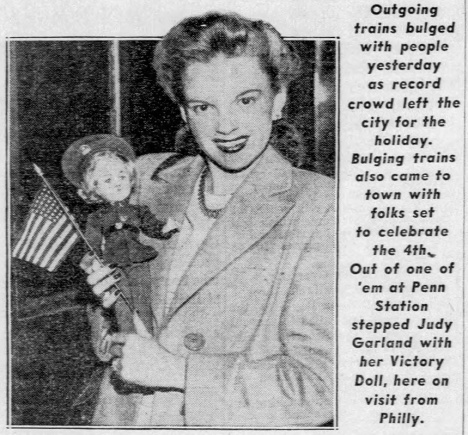
Her rigorous filming and recording schedule in Los Angeles meant long, intense days at the studio — and little traveling. But she appeared briefly in New York in 1943 as part of a USO tour, entertaining troops heading to war. Here’s Garland at Penn Station in August of 1943:
Her next companion in New York was neither Andy Rooney nor a victory doll.
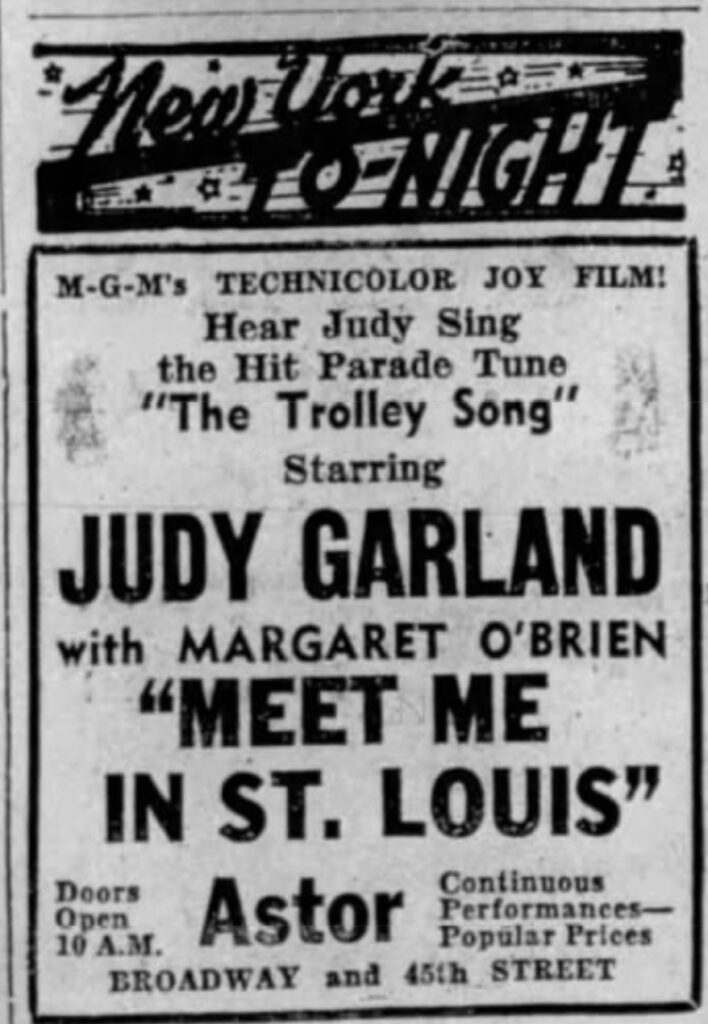
During Thanksgiving week in 1944, Garland arrived with director Vincente Minnelli for the premiere of Meet Me In St. Louis at the Astor Theater (1537 Broadway,). While in New York, they announced their engagement to the press.
The New York Times gifted the film with a rapturous review: “Let those who would savor their enjoyment of innocent family merriment with the fragrance of dried-rose petals and who would revel in girlish rhapsodies make a bee-line right down to the Astor.”
In 1945, Garland and Minnelli honeymooned in New York for three months. Even then she continually recorded music and made radio appearances — all the while pregnant with Liza May (born March 12, 1946).
By the late 1940s Garland’s non-stop (and abusive) schedule had taken a serious toll on her in Los Angeles. Even as her problems began seeping into the press, her supporters came to the rescue.
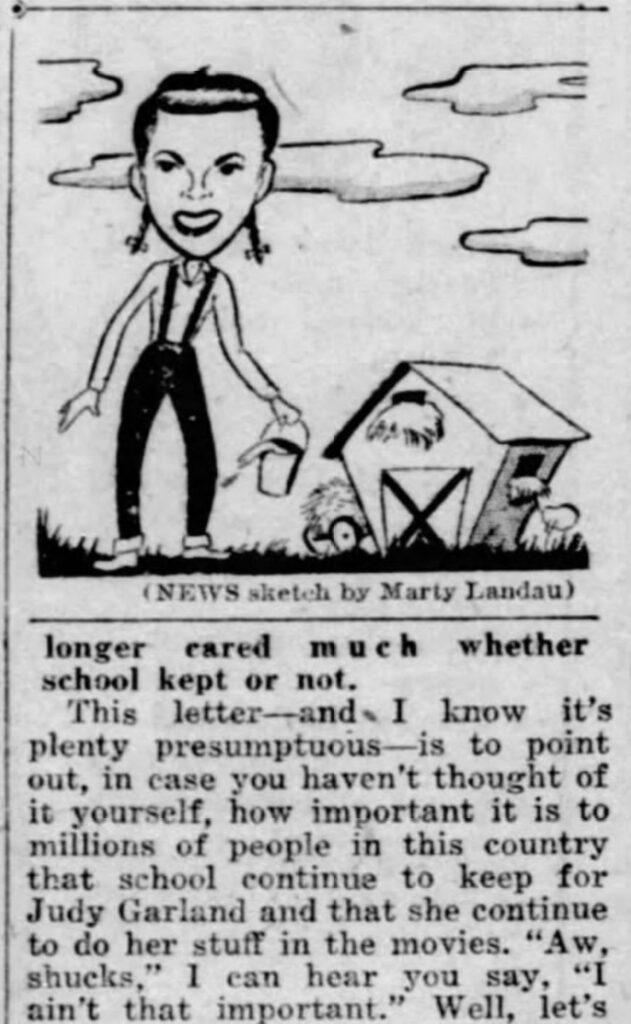
On September 1, 1950, the New York Daily News published a column from theater impresario Billy Rose titled “Love Letter to a National Asset,” both an adoring fan letter and a pep talk. Rose probably knew Garland through his former wife Fanny Brice but here he scribbles down a gushing tribute:
“It gets down to this Judy: In an oblique and daffy sort of way, you are as much a national asset as our coal reserves — both of you help warm up our insides.“
An excerpt from the Daily News (with an accompanying illustration):
Queen Of The Palace
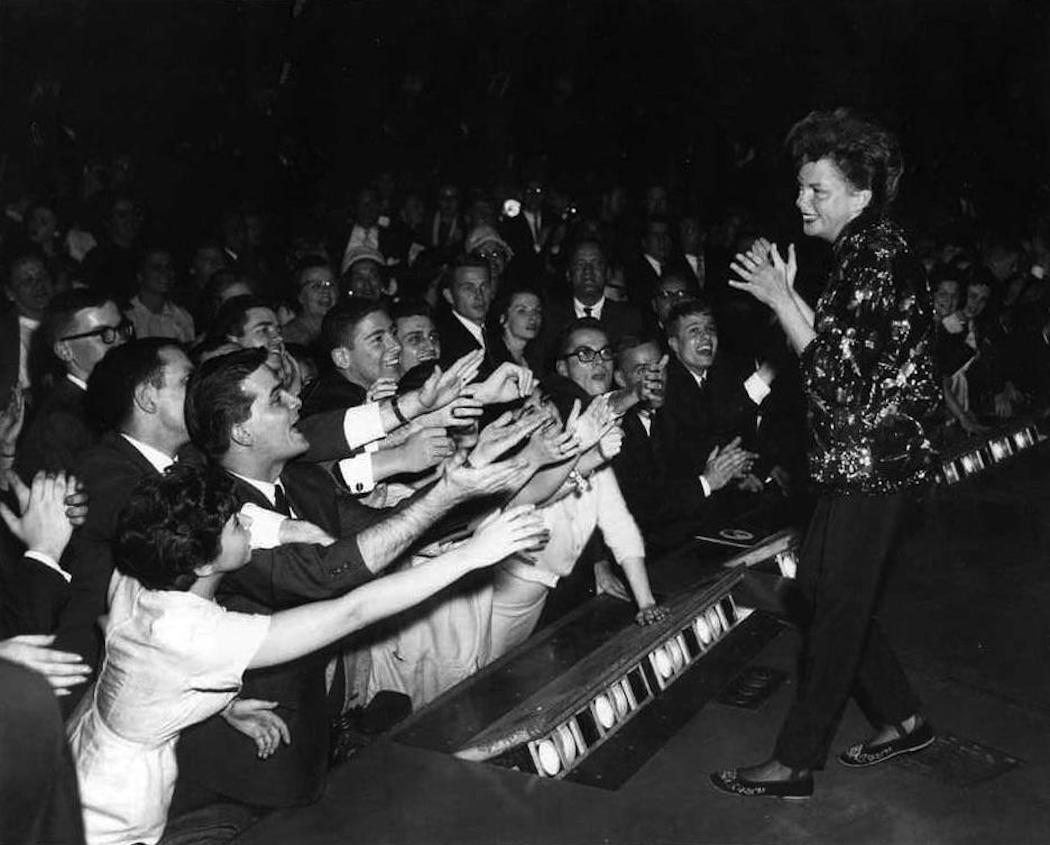
But the most important date in Judy Garland’s New York life was October 16, 1951 — her first performance at the Palace Theater. Her scheduled four-week run stretched to a record nineteen weeks, becoming one of the most legendary theatrical runs in New York history.
The Palace (at 1564 Broadway) first opened in 1913 as a straight vaudeville house but it was a 1915 appearance by acclaimed French actress Sarah Bernhardt put the venue on the map. But by the 1930s, like so many Broadway theaters, it had become a movie palace.
Garland’s live appearance was an attempt to reintroduce vaudeville at the Palace. While that certainly did not happen, Garland’s shows became the true stuff of legend.
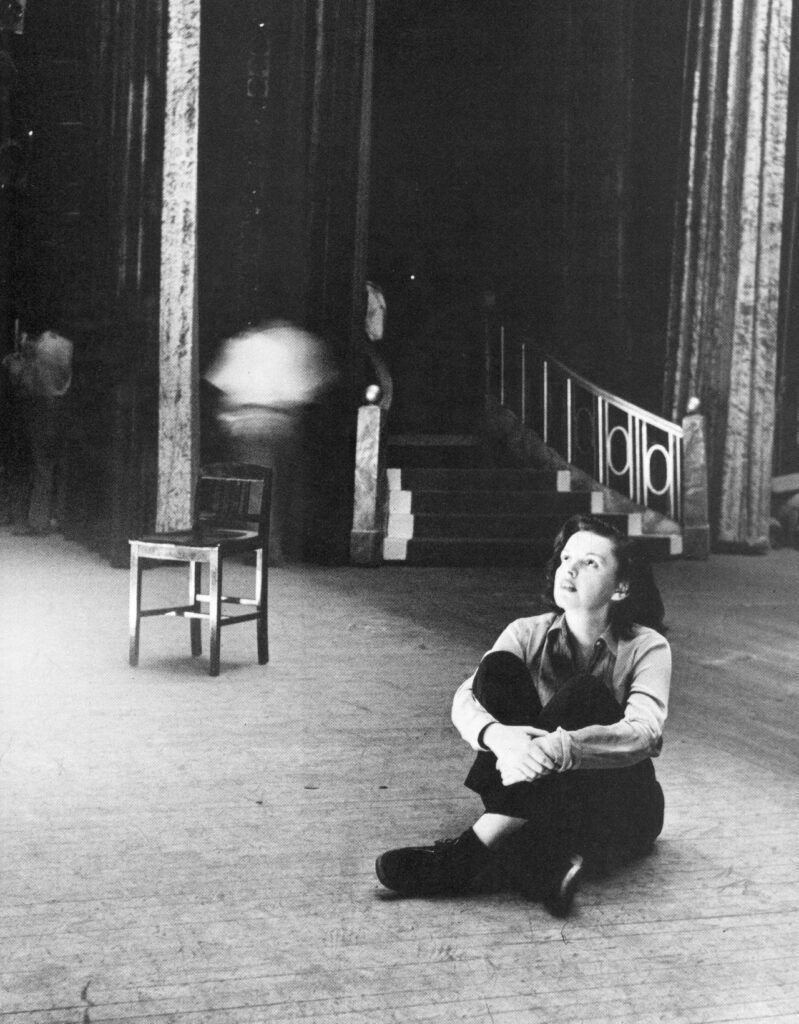
Garland in rehearsals at the Palace, 1951
“Never in this reporter’s memory has there been such a furor outside and inside a single theatre,” writes Robert Sylvester for the Daily News:
“Outside Broadway and 47th Street was blocked off by sawhorses and harassed cops managed to keep thousands of gawkers on the safe side of the blockades. Inside, the explosion of applause which greeted Miss Garland’s entrance threatened to get complete out of hand. The enfant terrible of the musical films finally hollered it down herself and then went on to do one of the most fantastic one-hour solo performances in theatrical history.“
According to Life Magazine: “Almost everyone in theater was crying and for days afterwards people around Broadway talked as if they beheld a miracle. What they beheld was Judy Garland making her debut at the old Palace, which was having a comeback to straight vaudeville. But the real comeback was Judy’s.”
Although this revitalized Garland’s career at a time when her film career was tanking, it also put the superstar through another grueling schedule which facilitated her reliance on alcohol and drugs.
C’mon Get Happy
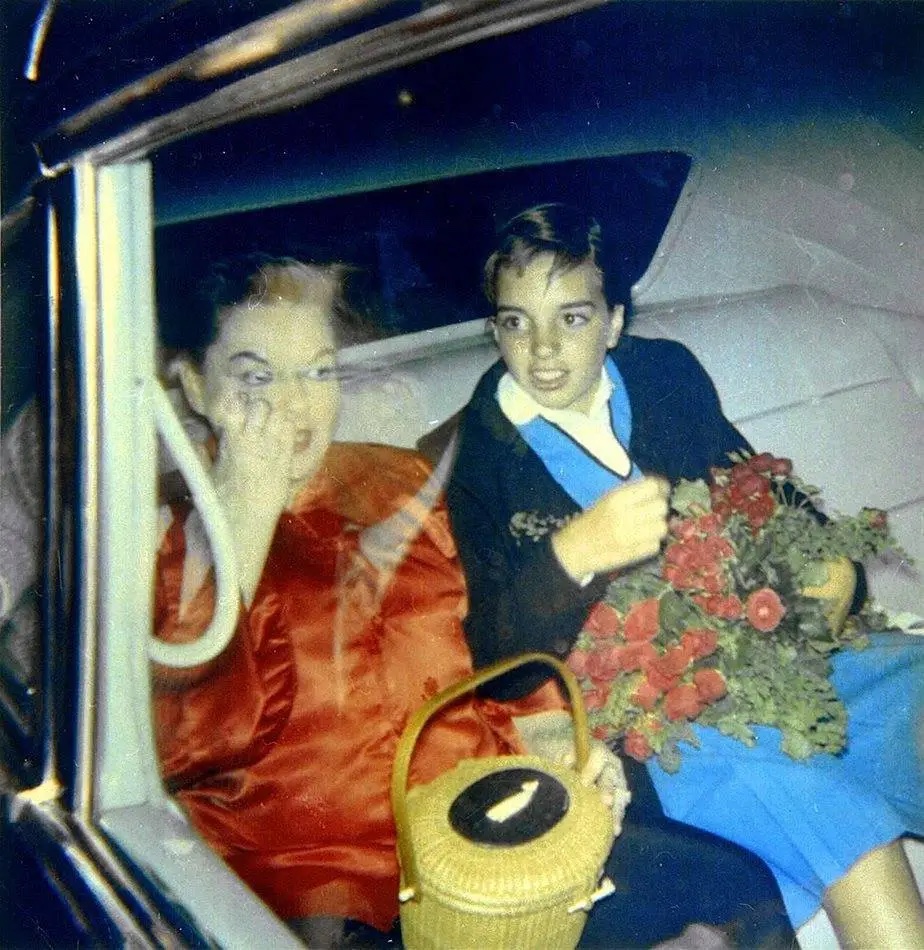
The Palace would open its doors to her again — next in 1956 for the show Judy Garland in Person. Making her stage debut at the Palace was her ten-year-old daughter Liza who would go on to many Palace performances of her own.
But Judy also performed in other New York City venues over the years. Here’s a list of the most notable:
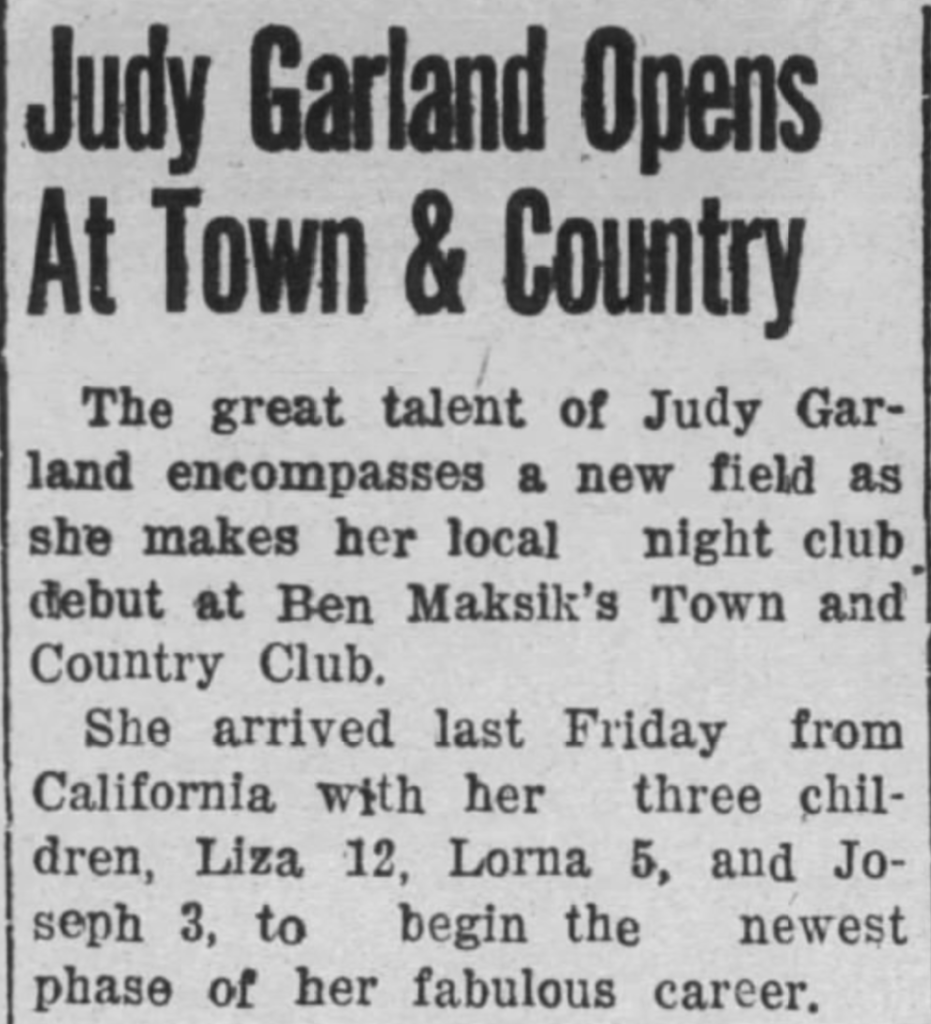
— The Town and Country Club in Flatbush Brooklyn, was notable for Garland opening (on March 20, 1958) to a sold-out house — during a massive snowstorm. Due to various delays, Garland began performing at midnight.
“ Judy only got through the first two songs of her act when she announced that she had laryngitis and had been fired, then left the stage. She had developed severe colitis before opening but had been able to get through the shows until this night. The newspapers reported that she had been an hour late for the show and that the club’s manager, Ben Maksik, noted that when she showed up she was obviously sick. Maksik also said he advanced Judy $40,000, which Judy denied.“
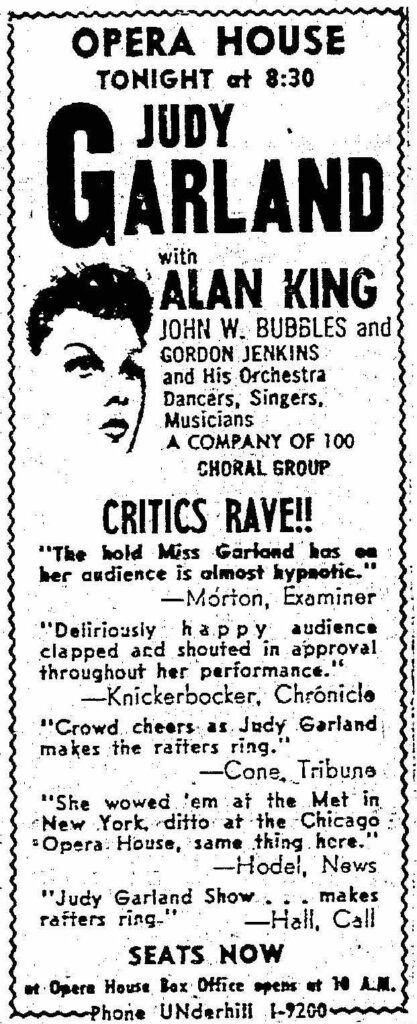
— The Metropolitan Opera House — Garland’s performances here in 1959 — one of the first by a non-opera performer — benefited the Children’s Asthma Research Institute and Hospital.
During this period, Garland was often very ill in part due to her reliance on alcohol and pills. In 1959, she was admitted into Doctor’s Hospital (formerly at 170 East End Avenue). As James Kaplan wrote in Vanity Fair, “With a quarter-century of hard living behind her, [Garland] lay near death in New York’s Doctors Hospital. Alcohol and pills were the culprits. “
Below: Liza with her mother following a hospital visit
Courtesy the Judy Room
The Swinging 60s
In the last decade of her life, Garland, weakened and exhausted, still gave the audience her all. And she provided New Yorkers with some magnificent music moments.
— The Copacabana — Her appearance at this legendary nightclub in January 1961 wasn’t an official performance but I bet it was memorable. She popped up on stage during Sammy Davis Jr. final night of his legendary run of shows here and did an impromptu version of “Over The Rainbow.”
Judy at Carnegie Hall. Courtesy Frank Beacham
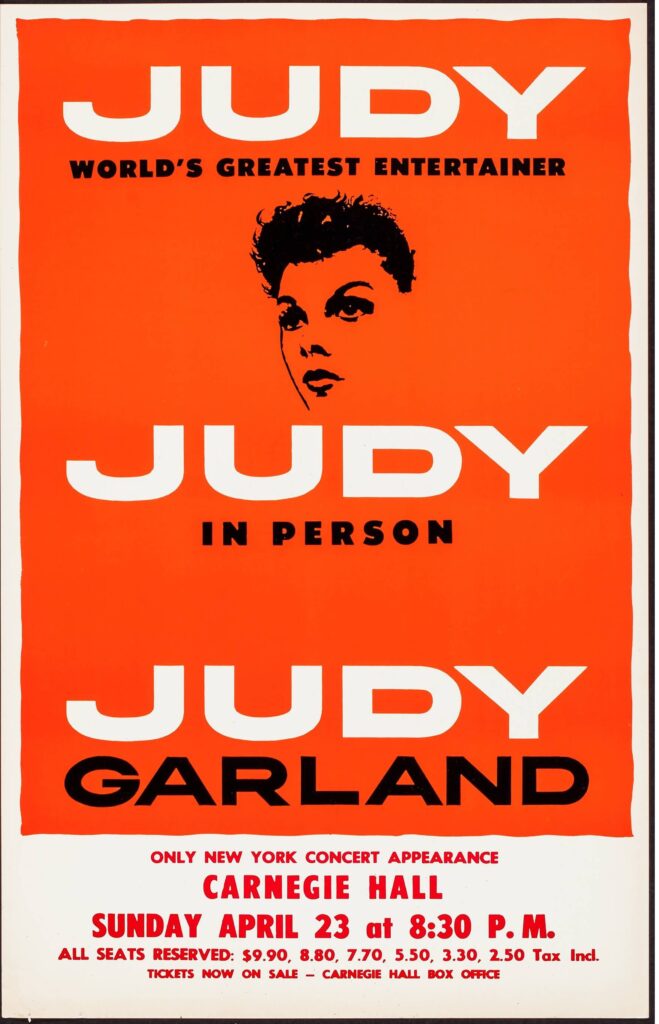
— Carnegie Hall April 23 and May 21, 1961 Her first appearance here is probably Garland’s best known stage performance because it was recorded and released as Judy at Carnegie Hall, an album which spent 95 weeks on the Billboard Charts.
— Manhattan Center 1962 Among the luminaries who witnessed Judy’s performance here in 1962 were Marilyn Monroe and a rising young songstress named Barbra Streisand. She had a bad case of laryngitis that night and Capitol Records scrapped plans for a live album. (In 1989 the album was finally released — Judy Garland Live!)
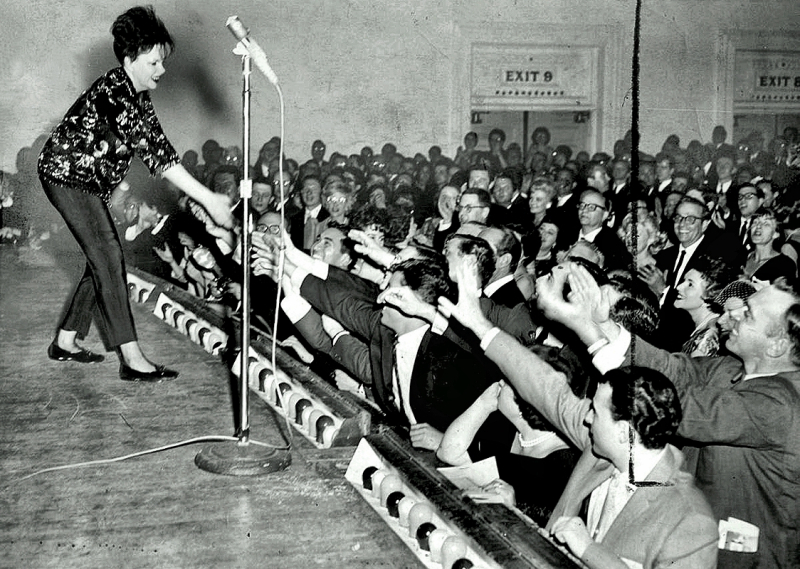
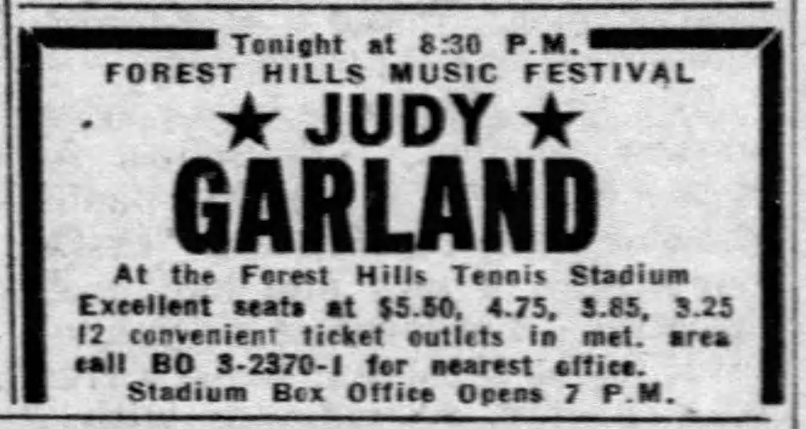
— Forest Hills Stadium She performed two times at the classic tennis-club-turned-performance venue in July 1961, but it was her show here four years later (on July 17, 1965) that made headlines for the 10,000 audience members who gave her allegedly the “longest standing ovation” for a performer at that time.
Before stepping on the stage, Judy told the press: “New York is my town and I’m really looking forward to this concert. I’m always at my best in New York.”
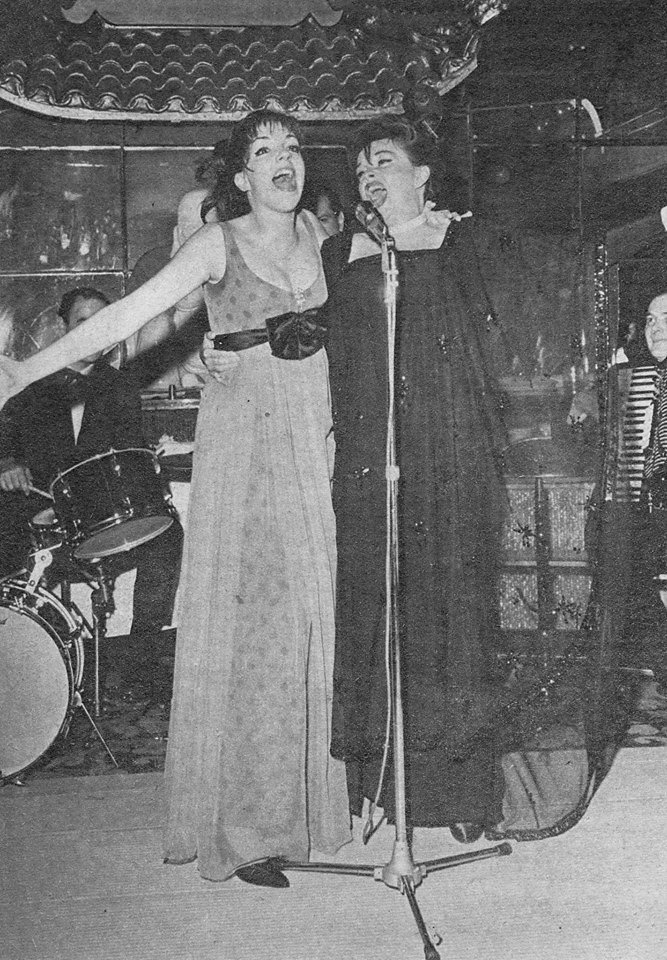
— Ruby’s Foos May 11, 1965 — Not a music venue but oh want a performance to have seen! Judy and her daughter Liza performed together at this classic Chinese restaurant in Midtown at an afterparty for Liza’s Broadway debut in the play Flora the Red Menace:
Judy and Liza at Ruby Foo’s
She performed a final run of shows at the Palace Theater from July 31 to August 26, 1967. The shows were greeted with the same enthusiasm as her previous appearances. Jerry Tallmer from the New York Post gushed, “Judy, for the thousand and first time, has come all the way back.”
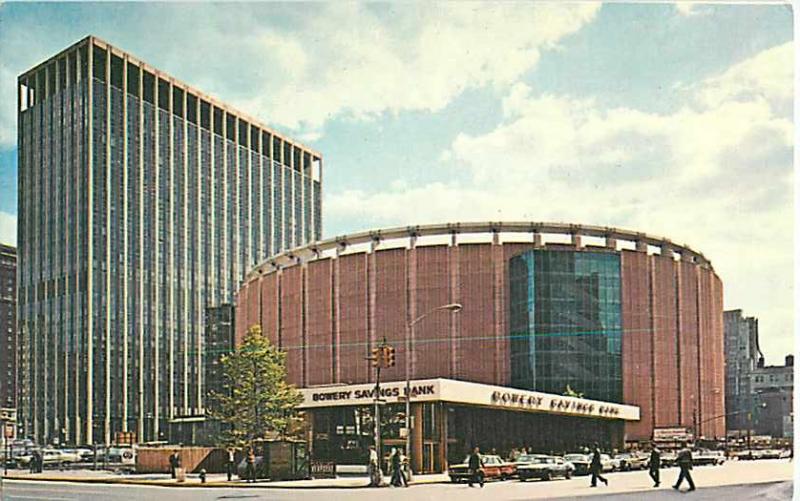
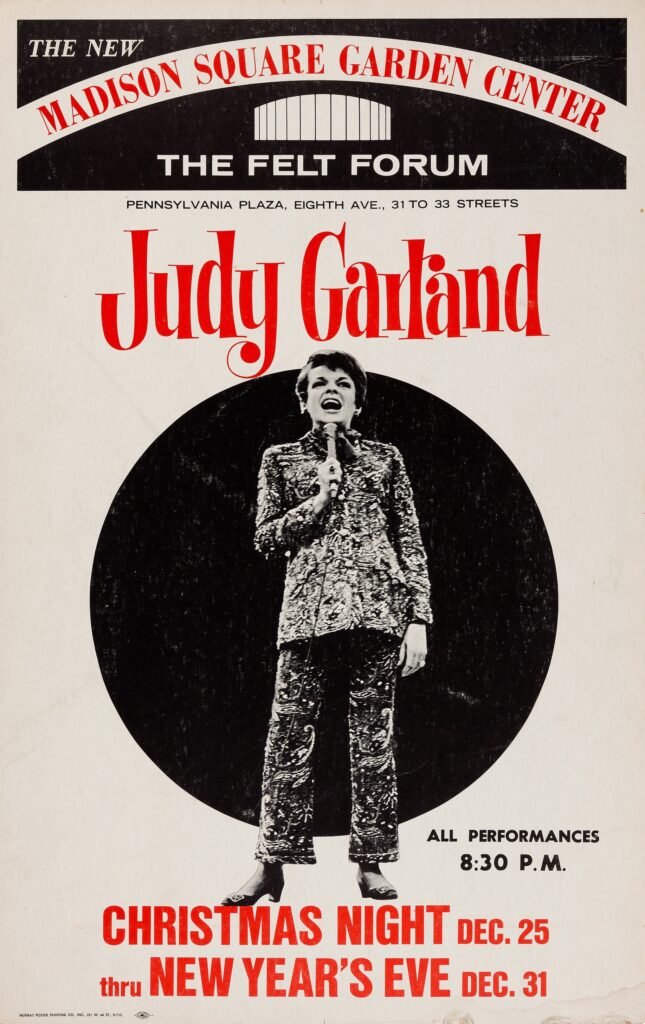
In 1967 she also played Madison Square Garden, one of the first shows at venue’s new Felt Forum (today’s Hulu Theater at Madison Square Garden) above the new subterranean Pennsylvania Station. During the show she was joined by Tony Bennett for a couple Christmas numbers. She did not complete her run of shows, cancelling after her final appearance here on December 27.
There No Place Like Home
Garland lived in several cities over the years — in the Hollywood Hills, Malibu and London — although in a way, it’s hard to associate her with any place on the map. (Of course, for many, she’ll always be that girl from Kansas or St. Louis.)
While in New York, she mostly she lived in hotels, of the most glamorous sort — the St. Regis, the Carlyle, the Regency, the Plaza, the Sherry Netherland. In 1961 she even lived briefly at the Dakota Apartments.
In 1968 she was locked out of the St. Moritz Hotel (50 Central Park South) for not paying her bills.
The Rainbow
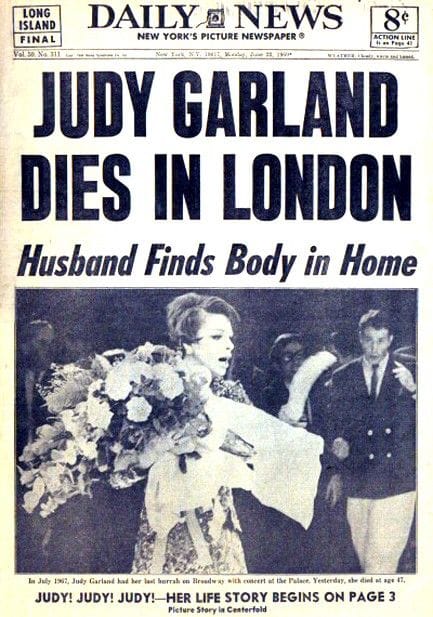
On June 22, 1969, Garland was found dead in her rented house in London. She was 47 years old. The cause of death was an accidental barbiturate overdose.
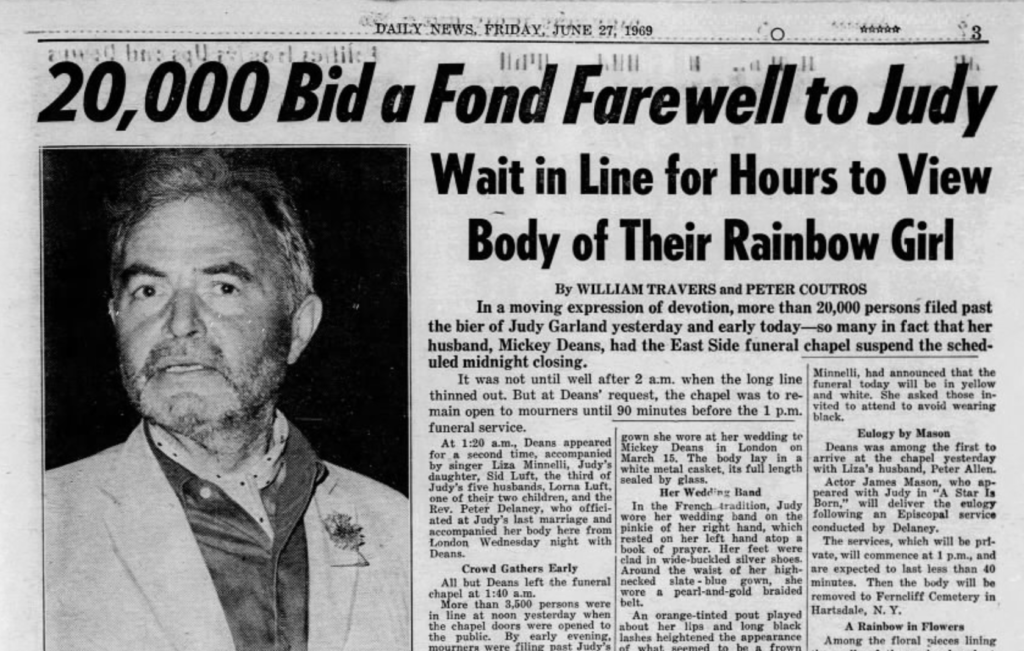
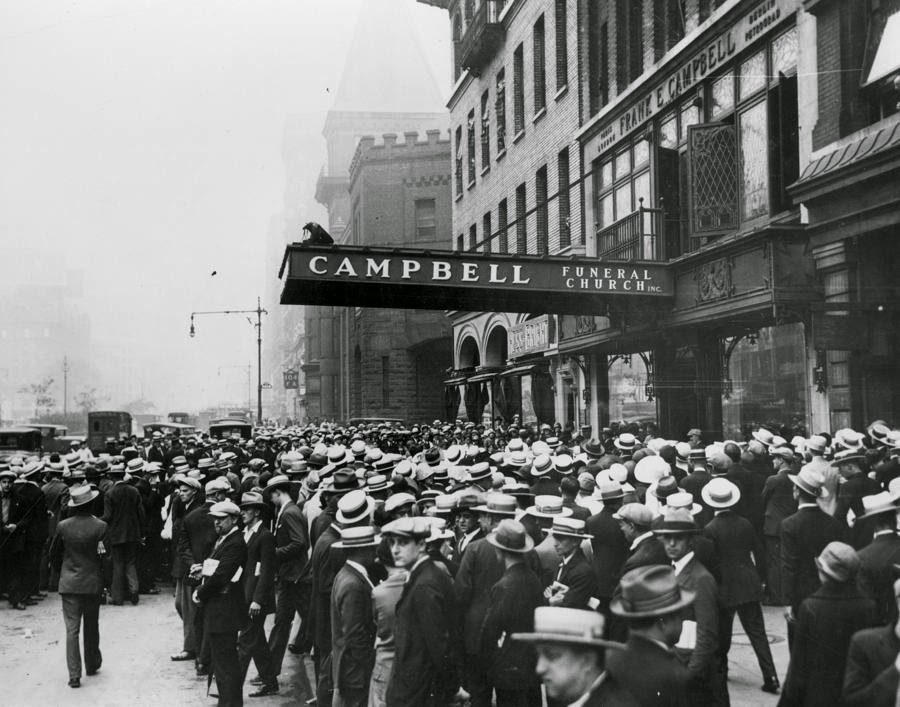
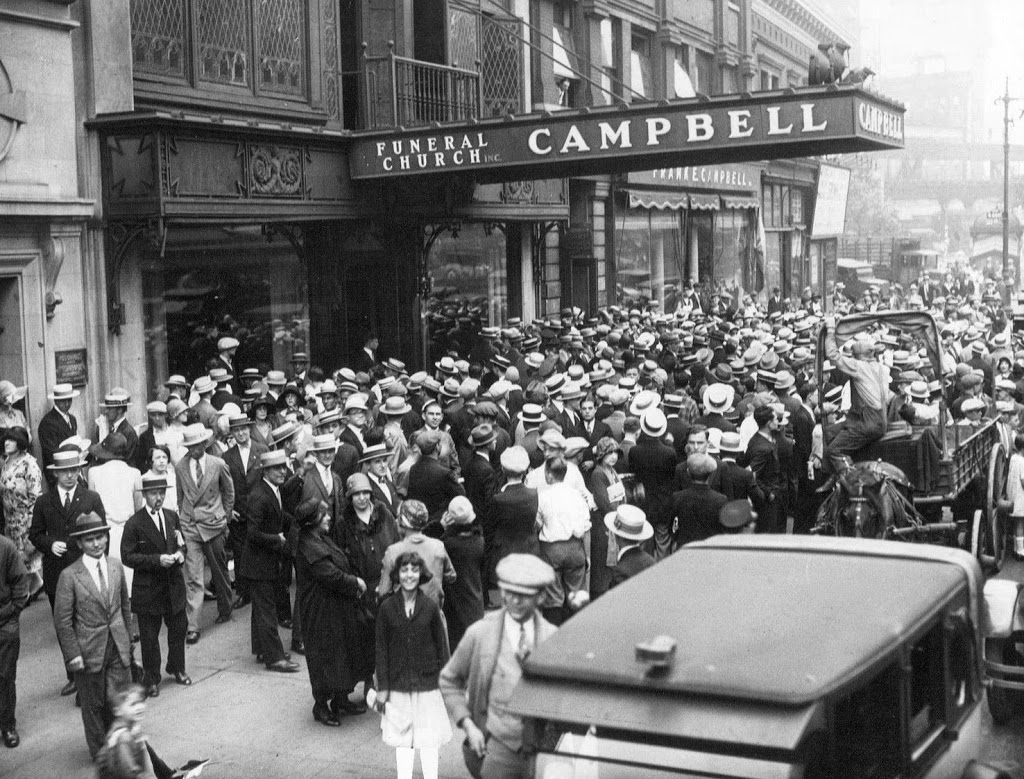
The world mourned her passing — and most especially, we can assume, her legion of fans in New York City. Her funeral at Frank E. Campbell’s Funeral Chapel drew thousands of mourners who gathered along the surrounding streets.
From the New York Times: “While legions of her fans maintained an ardent vigil in the hot and humid streets, colleagues of Judy Garland bade her farewell yesterday in a swift, simple service at the Frank E. Campbell Funeral Home.
“Judy’s great gift,” James Mason said in his eulogy, “was that she could wring tears out of hearts of rock.”
Although the press was barred from the actual service, portions of the funeral, including Mr. Mason’s eulogy, were audible through a loudspeaker provided by Campbell’s in an upstairs room.”
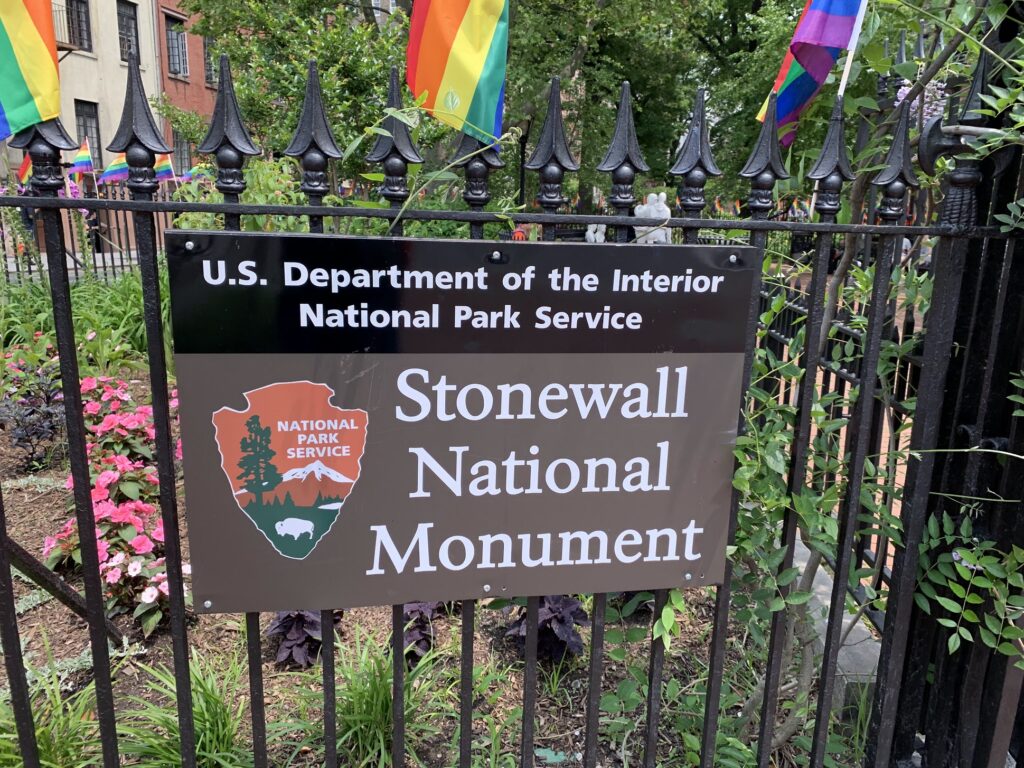
Many hours later in the West Village, in the early morning hours of June 28, police raided a gay bar named the Stonewall Inn. The patrons, tired of the homophobia and the cycles of police intimidation, at last fought back.
As many of Judy Garland’s most passionate fans were gay, could this mean that her death, as urban legend goes, fueled the passions that went into the historic event today known as the Stonewall Uprising?
It’s impossible to really say. The people at the Stonewall Inn that first night of conflict were probably younger than the average Judy Garland fan. However, in the following days, as more people gathered on the streets of the West Village to protest, it’s very likely that many who attended Garland’s funeral were also there — at the dawn of the Gay Liberation Movement. (Listen to our Stonewall Riots show for more information.)
Everybody Rise
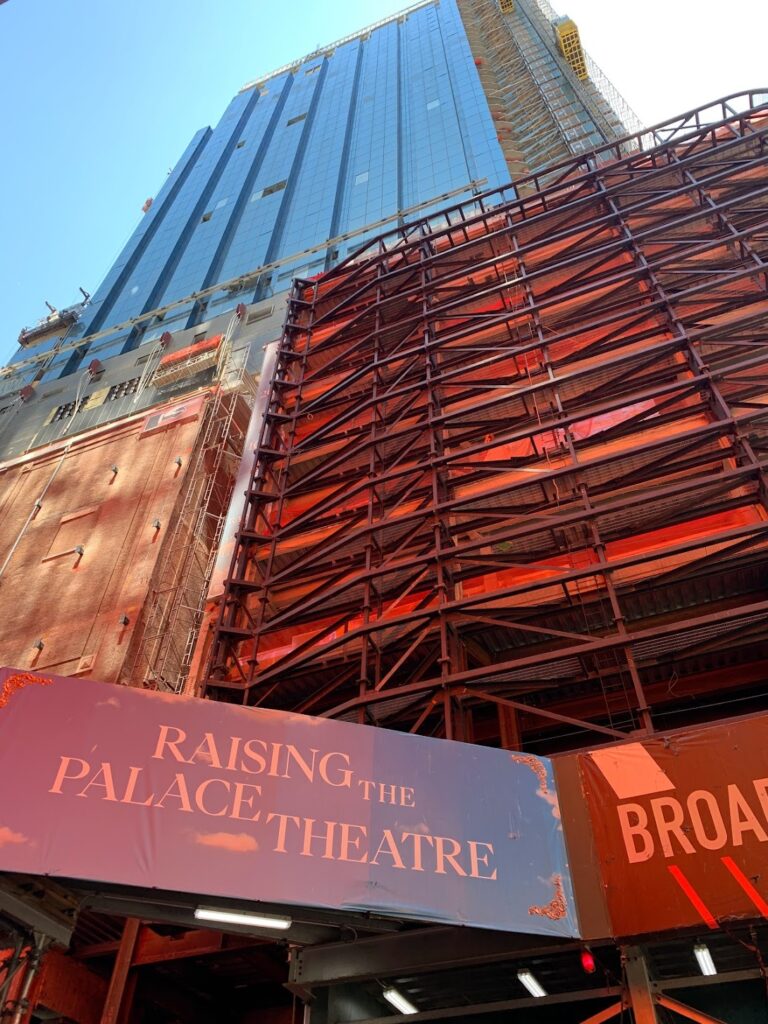
Today the Palace Theatre, the greatest landmark to Garland’s New York legacy is getting a facelift. Scratch that, an UP-lift.
The theater has literally been lifted 30 feet off the ground as part of a massive new construction project, a 46-story, 661-room hotel being built above it.
According to the New York Times: “L&L Holding, the lead developer on the TSX project, made arrangements with the theater’s owner, the Nederlander Organization, to elevate the Palace and fill the void with three floors of new shopping space, part of 10 floors of retail in the tower. The theater will have a new entrance on West 47th as well as a new lobby, marquee and backstage area.”
By the way, does Judy Garland still haunt the Palace Theatre? That urban legend is explored in our podcast Haunted Histories of New York.
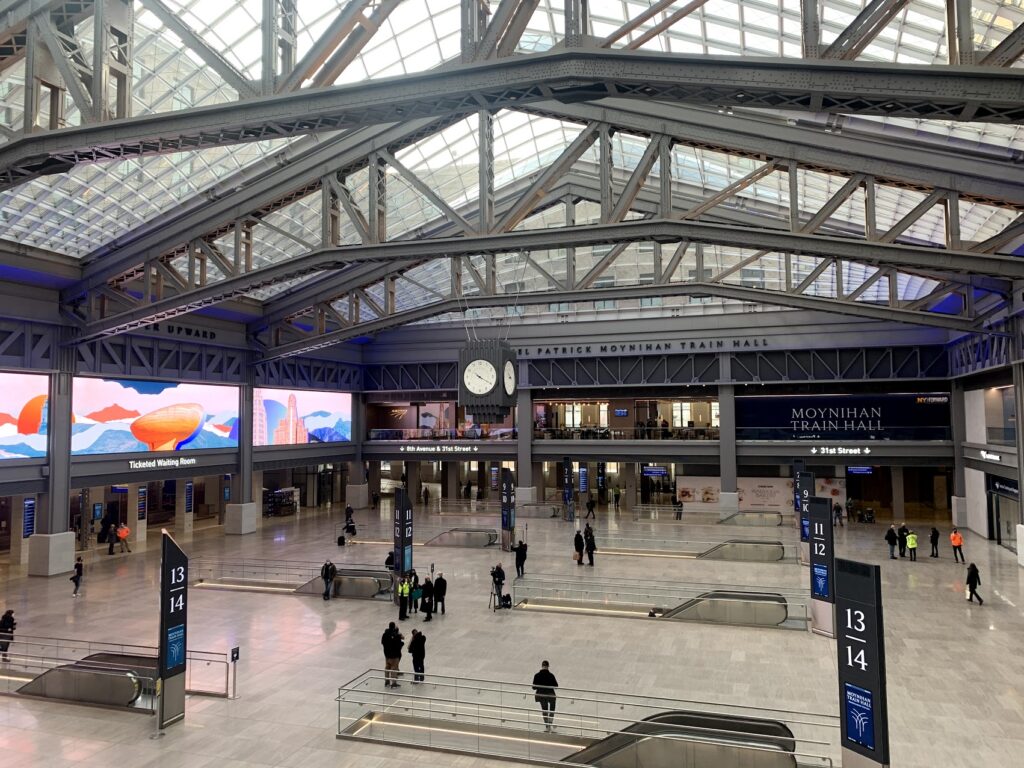
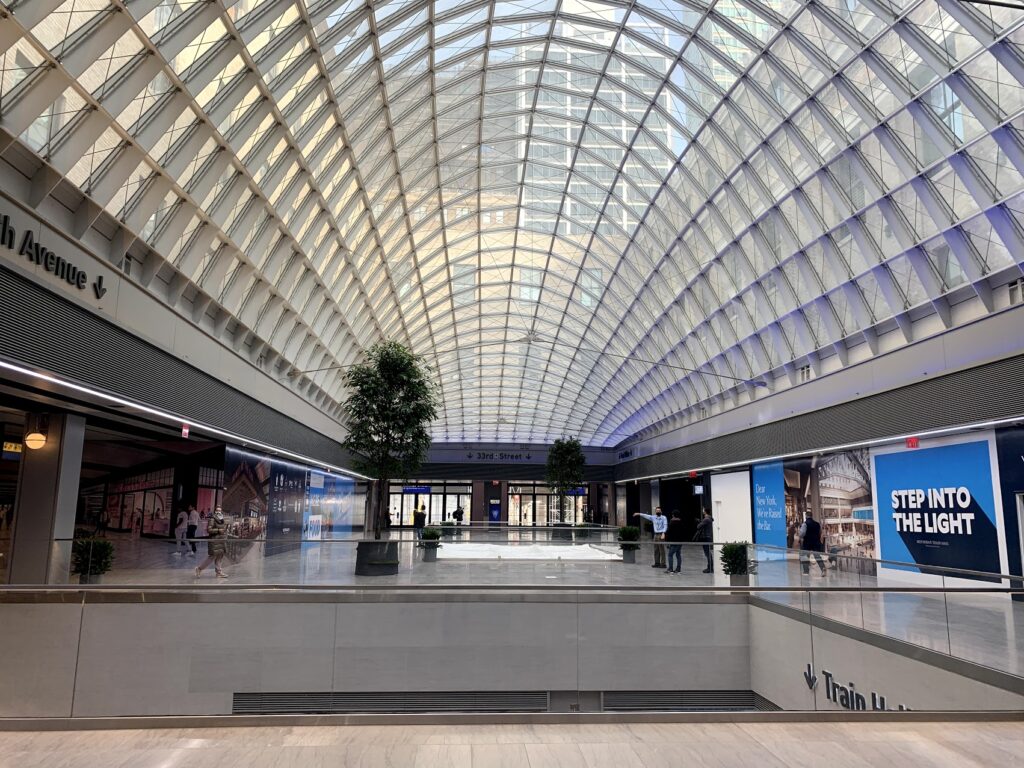
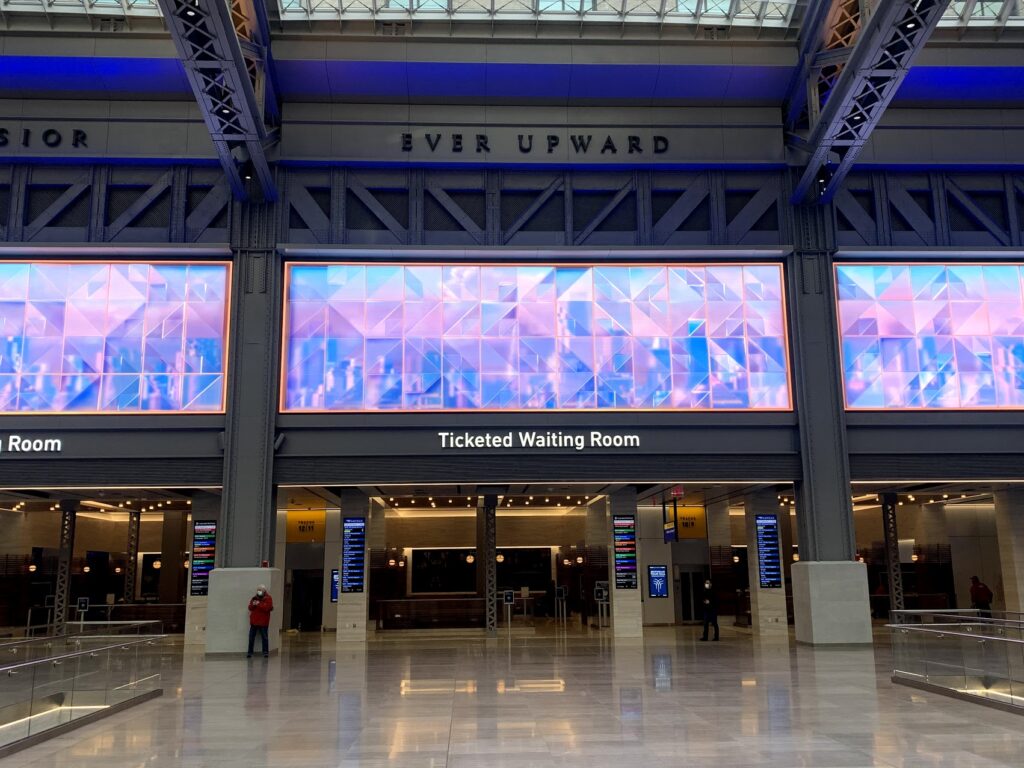
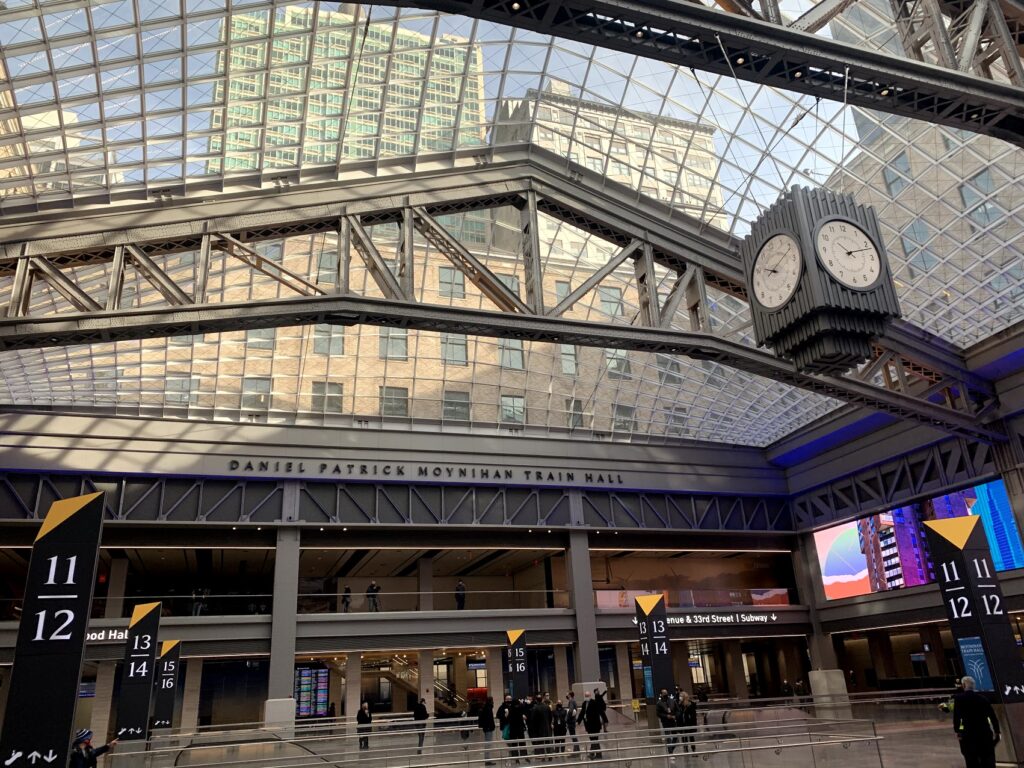
On January 1, 2021 Moynihan Train Hallofficially opens to the public, a new commuters’ wing catering to both Amtrak and Long Island Railroad train passengers at New York’s underground (and mostly unloved) Penn Station.
To celebrate this big moment in New York City transportation history, we’re going to tell the entire story of Pennsylvania Station and Pennsylvania Railroad over two episodes, using a couple older shows from our back catalog.
PODCAST The story of Pennsylvania Station involves more than just nostalgia for the long-gone temple of transportation as designed by the great McKim, Mead and White. It’s a tale of incredible tunnels, political haggling and big visions.
Pennsylvania Railroad was the largest railroad in the world by the 1880s, but thanks to Cornelius Vanderbilt’s New York Central Railroad, one prize was strategically out of their grasp — direct access to Manhattan.
An ambitious plan to link New Jersey to New York via a gigantic bridge fell apart, and it looked like Pennsylvania passengers would have to forever disembark in Jersey City.
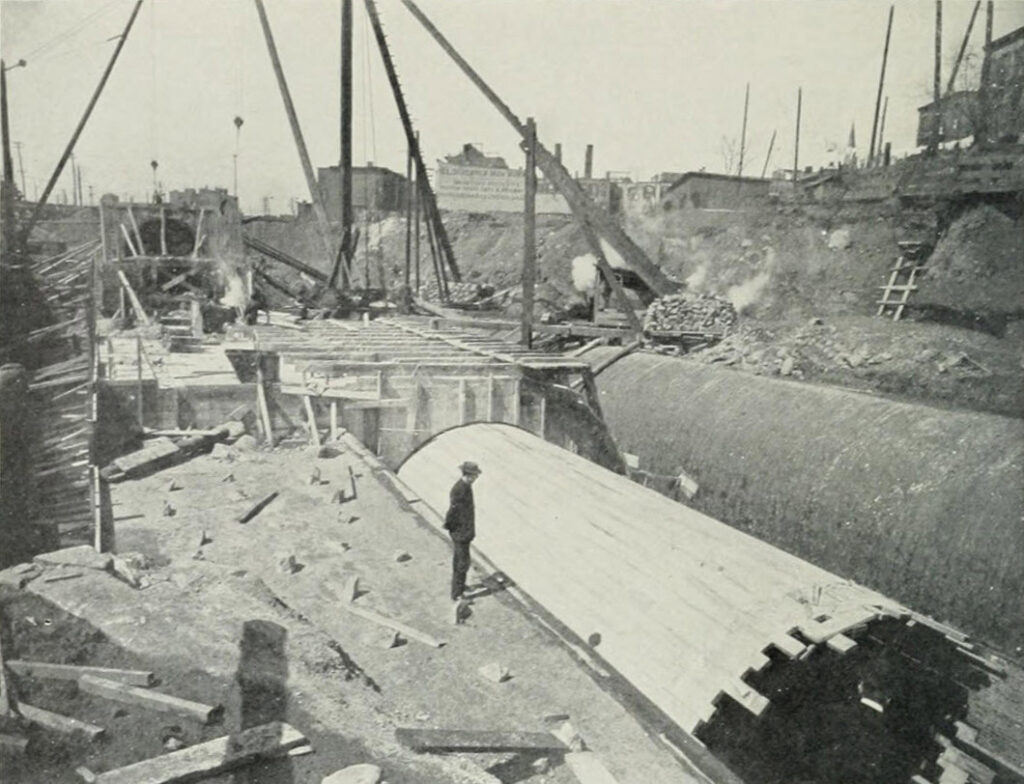
North River Tunnels of the Pennsylvania Railroad: Tunnel C crossing Tunnel B West of Sunnyside Yard as seen during cut-and-cover construction, 1909
But Penn Railroad president Alexander Cassatt was not satisfied. Visiting his sister Mary Cassatt — the exquisite Impressionist painter — in Paris, Cassatt observed the use of electrically run trains in underground tunnels. Why couldn’t Penn Railroad build something similar?
One problem — the mile-wide Hudson River (or in historical parlance, the North River).
This is the tale of an engineering miracle, the construction of miles of underground tunnels and the idea of an ambitious train station to rival the world’s greatest architectural marvels.
Listen to the show here or on your favorite podcast player:
THIS SHOW WAS ORIGINALLY RELEASED AS EPISODE 80 — APRIL 10, 2009
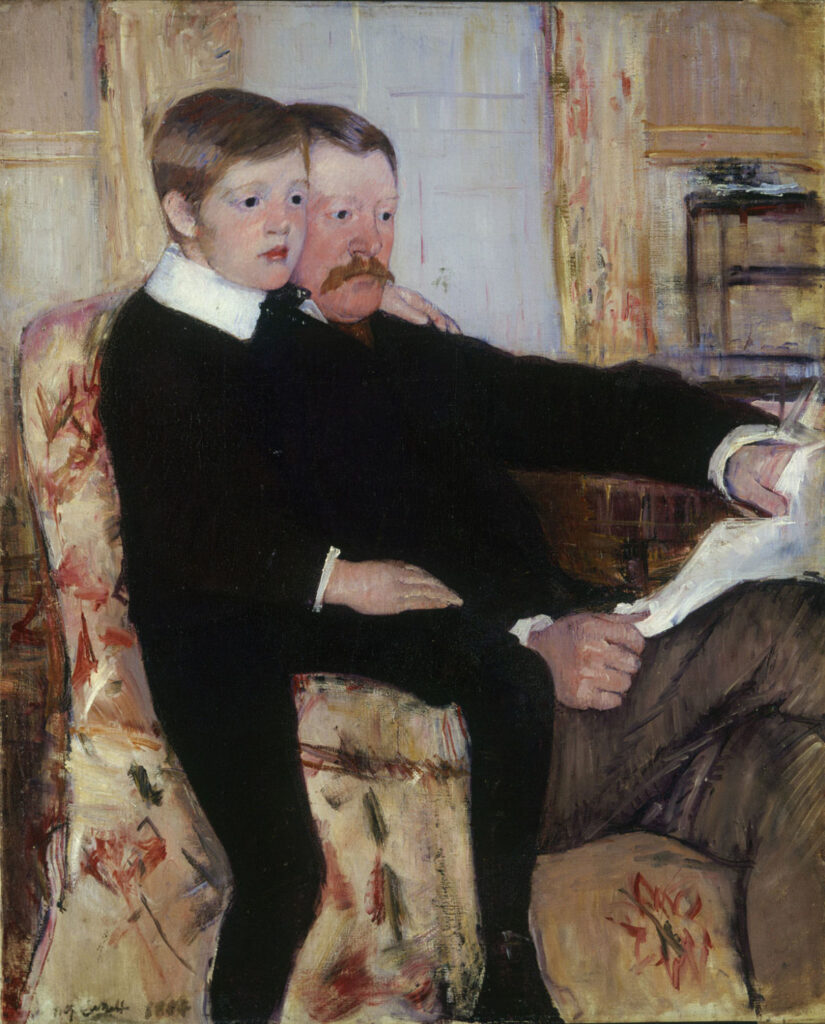
Alexander Cassatt and his son Robert, as painted in 1884 by Mary Cassatt
The Bowery Boys: New York City History podcast is brought to you …. by you!
We are now producing a new Bowery Boys podcast every other week. We’re also looking to improve and expand the show in other ways — publishing, social media, live events and other forms of media. But we can only do this with your help!
We are now a creator on Patreon, a patronage platform where you can support your favorite content creators.
Please visit our page on Patreon and watch a short video of us recording the show and talking about our expansion plans. If you’d like to help out, there are six different pledge levels. Check them outand consider being a sponsor.
We greatly appreciate our listeners and readers and thank you for joining us on this journey so far.
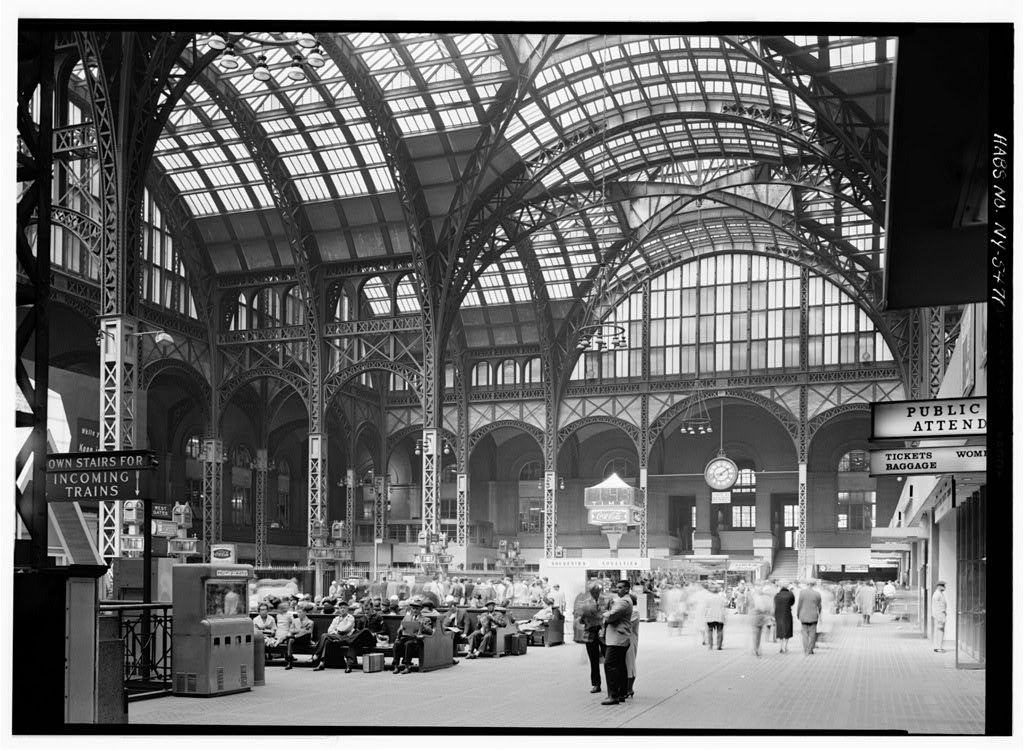
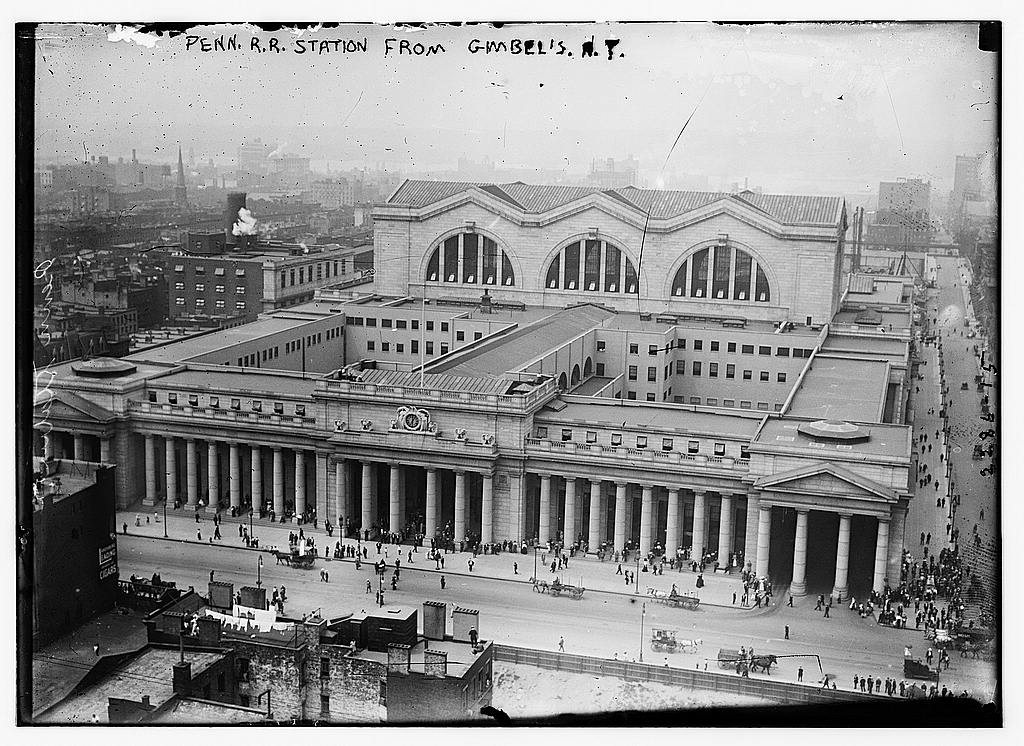
Old Penn Station vs the new Moynihan Train Hall
The view of Penn Station from the roof of Gimbels Department Store.
Library of Congress
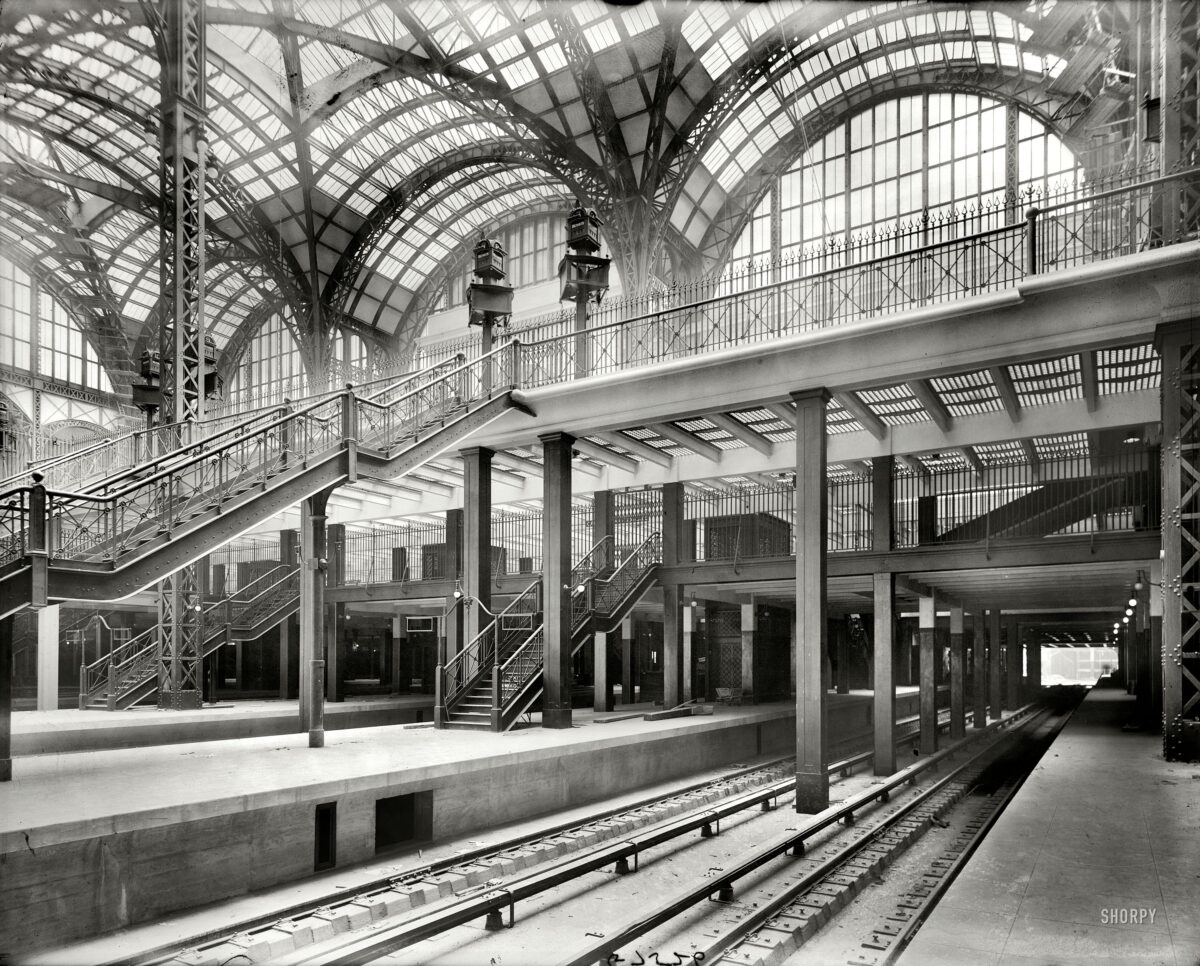
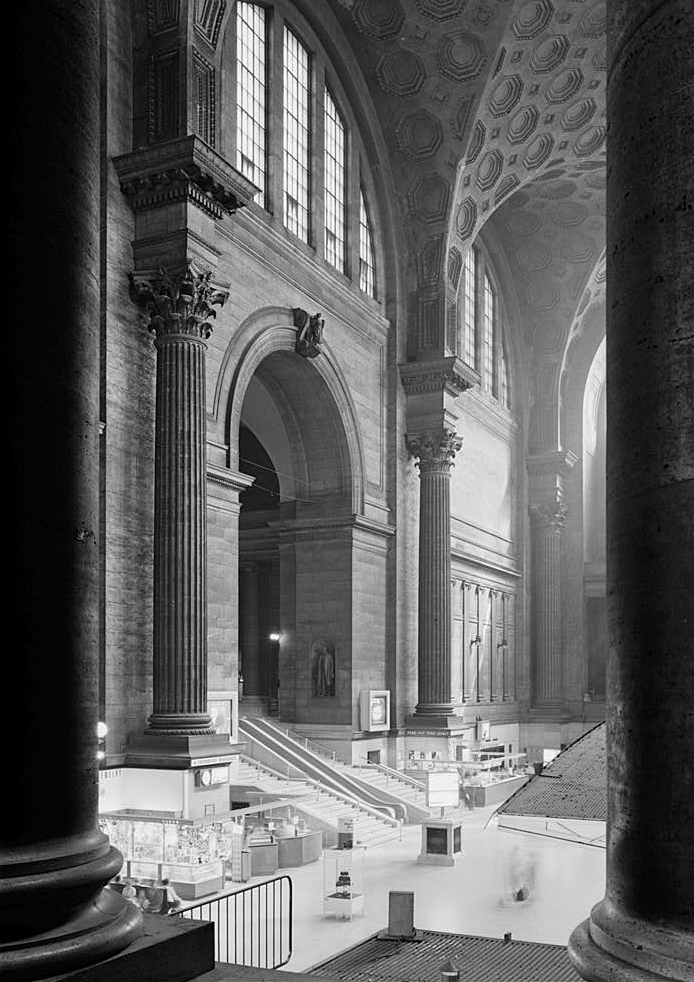
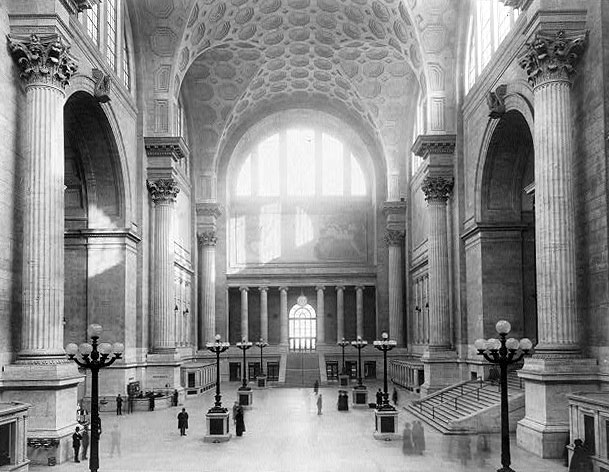
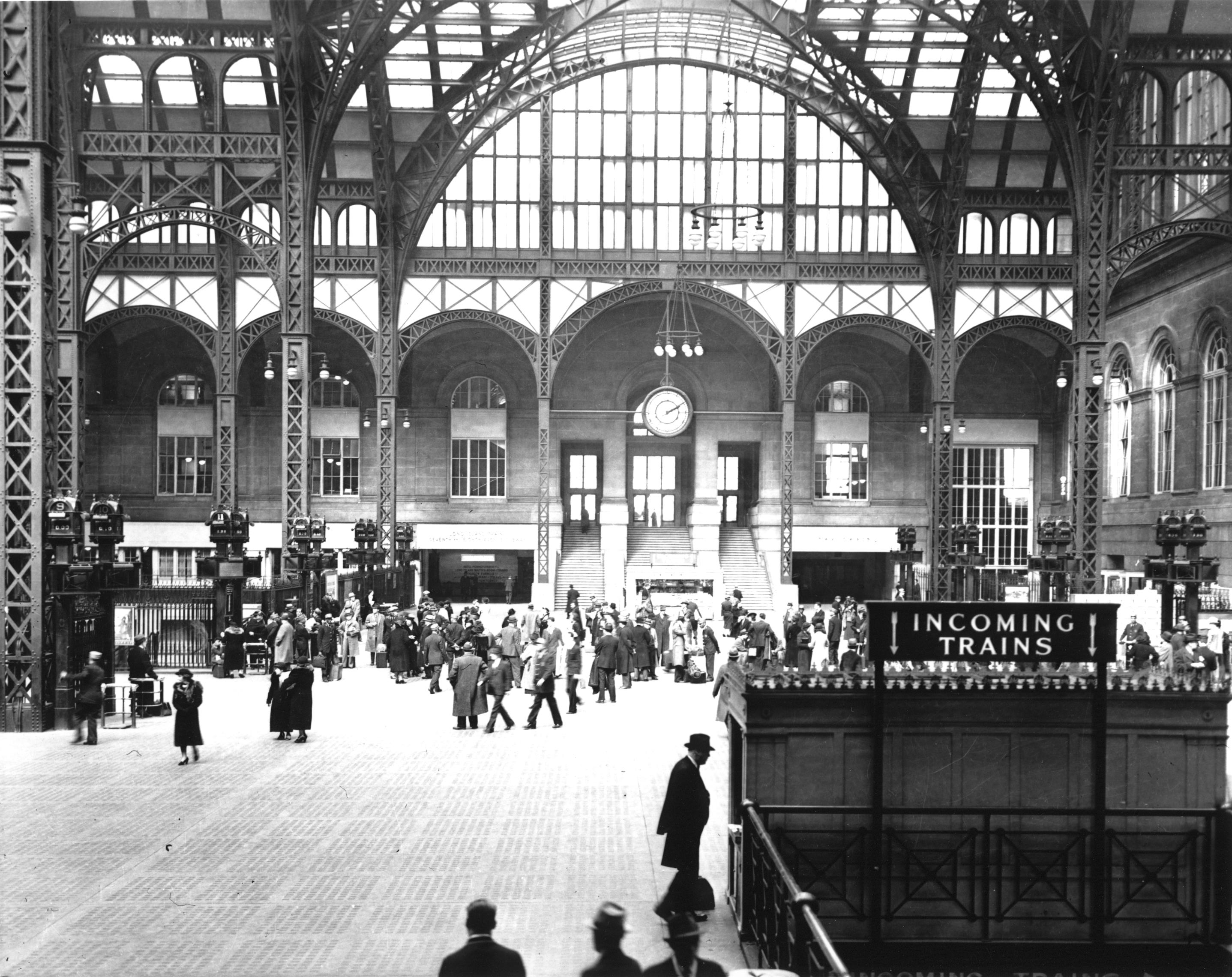
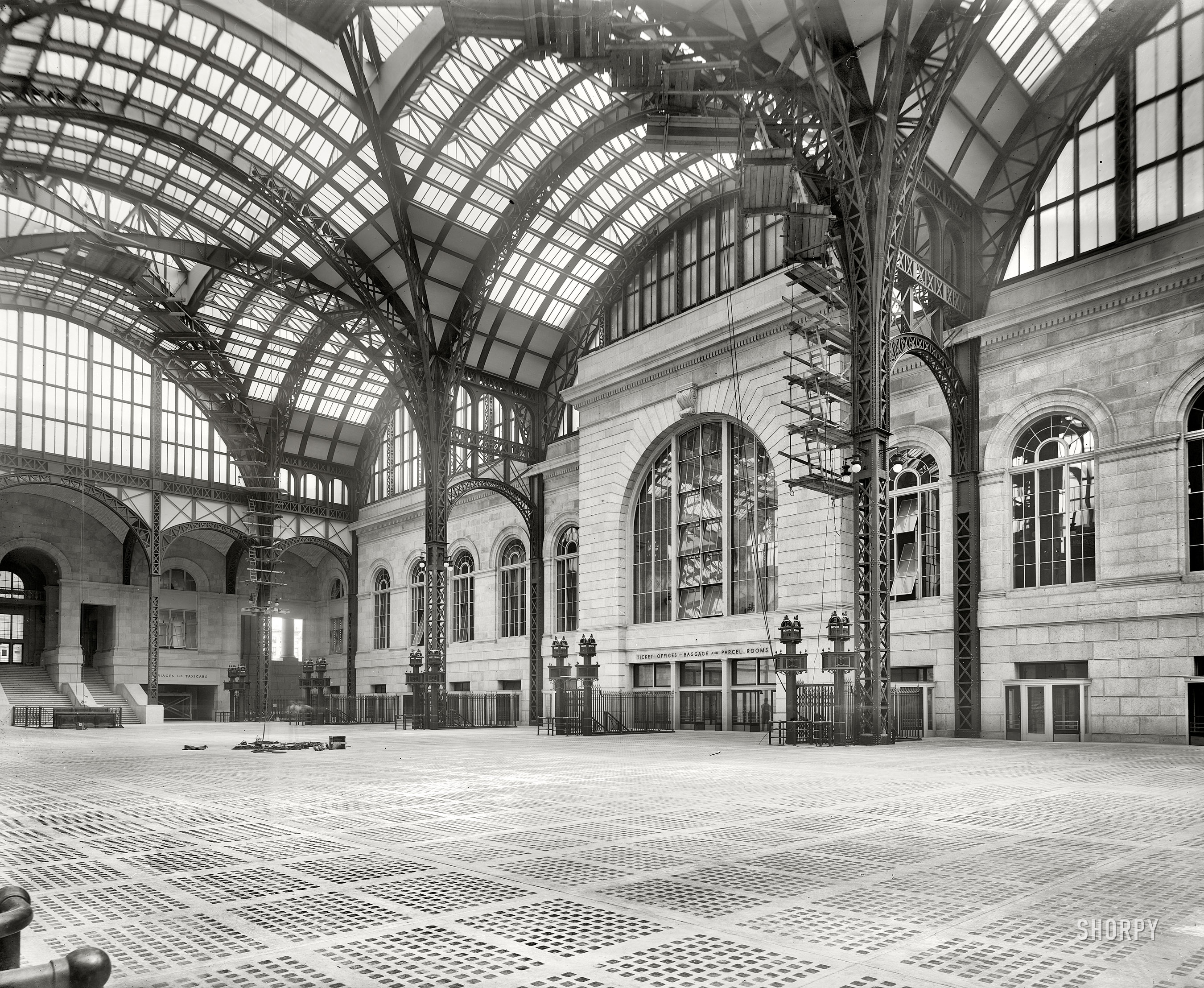
For this round of photographs, let’s focus on the inside of the station, shall we?
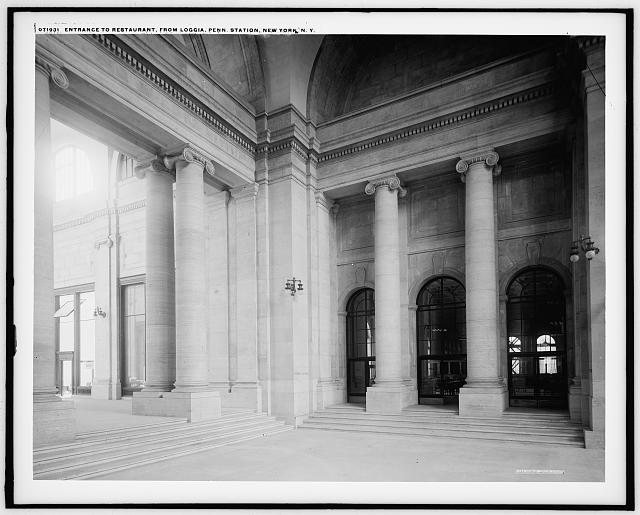
Images of the spectacular main waiting room and the classical Corinthian columns. Read here about something very mysterious and tragic which occurred near here in 1914.
Library of Congress
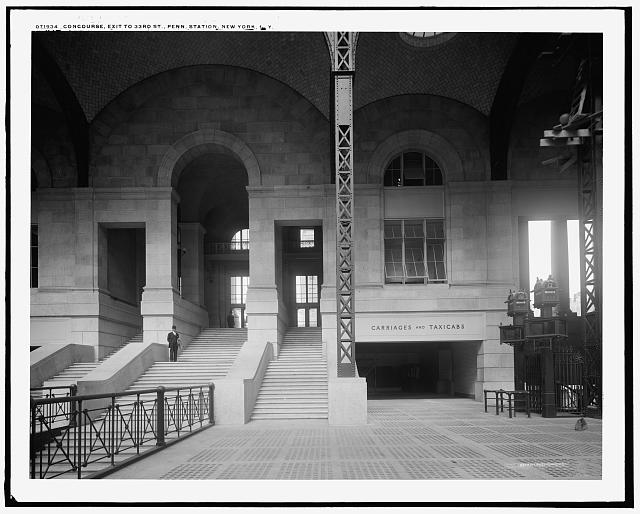
This is what greeted you as you got off the train and headed for 33rd Street.
Library of Congress
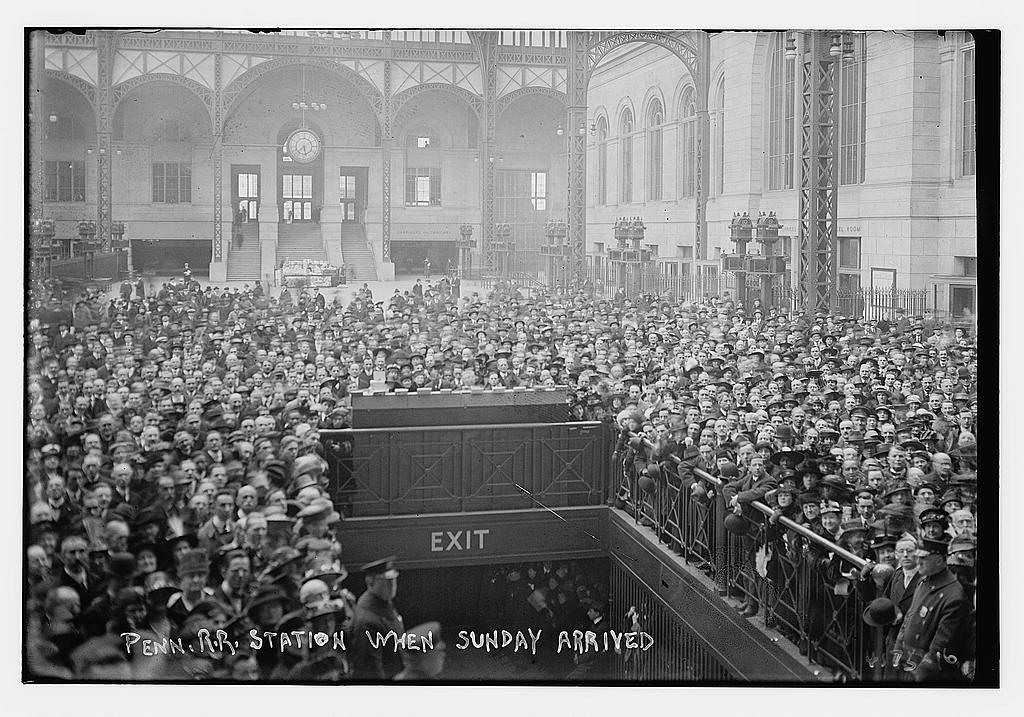
Crowds await the arrival of superstar preacher Billy Sunday in 1917. Read all about his visit here.
Library of Congress
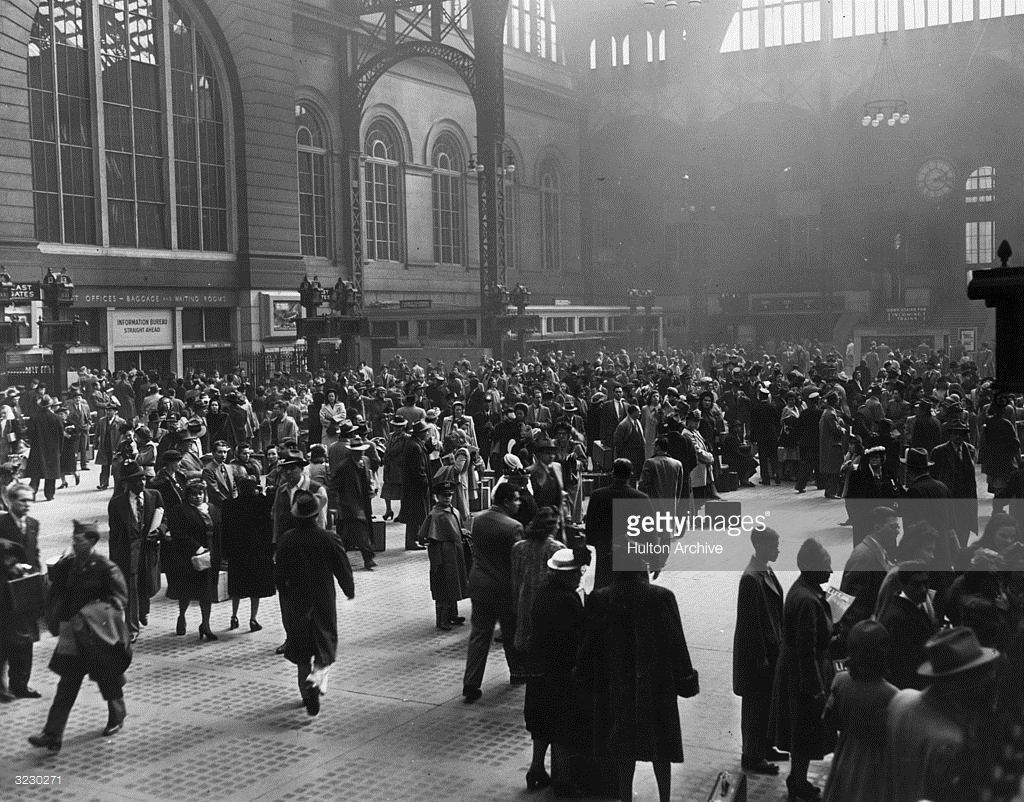
The interior from the 1950s during rush hour. Getty has a terrific collection of Penn Station photographs over the years.
Getty Images
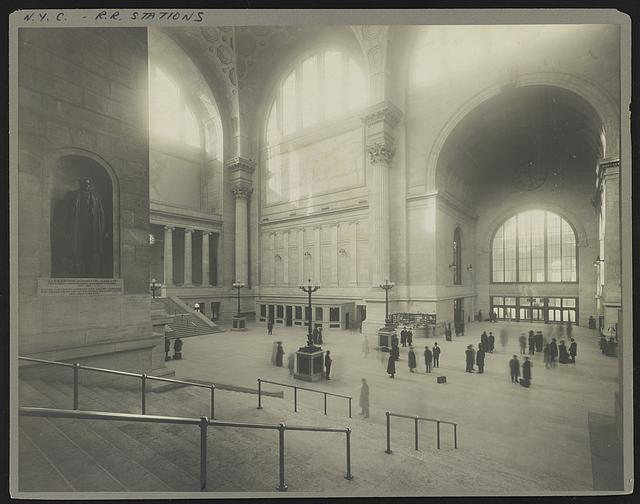
From this angle of the waiting room (taken in the station’s early days) you can see a statue of Alexander Cassatt, Penn Railroad’s former president, in its wall niche. Cassatt, brother of impressionist painter Mary Cassatt, never got to see the completed station, as he died in 1906. (The station opened in 1910.)
Library of Congress
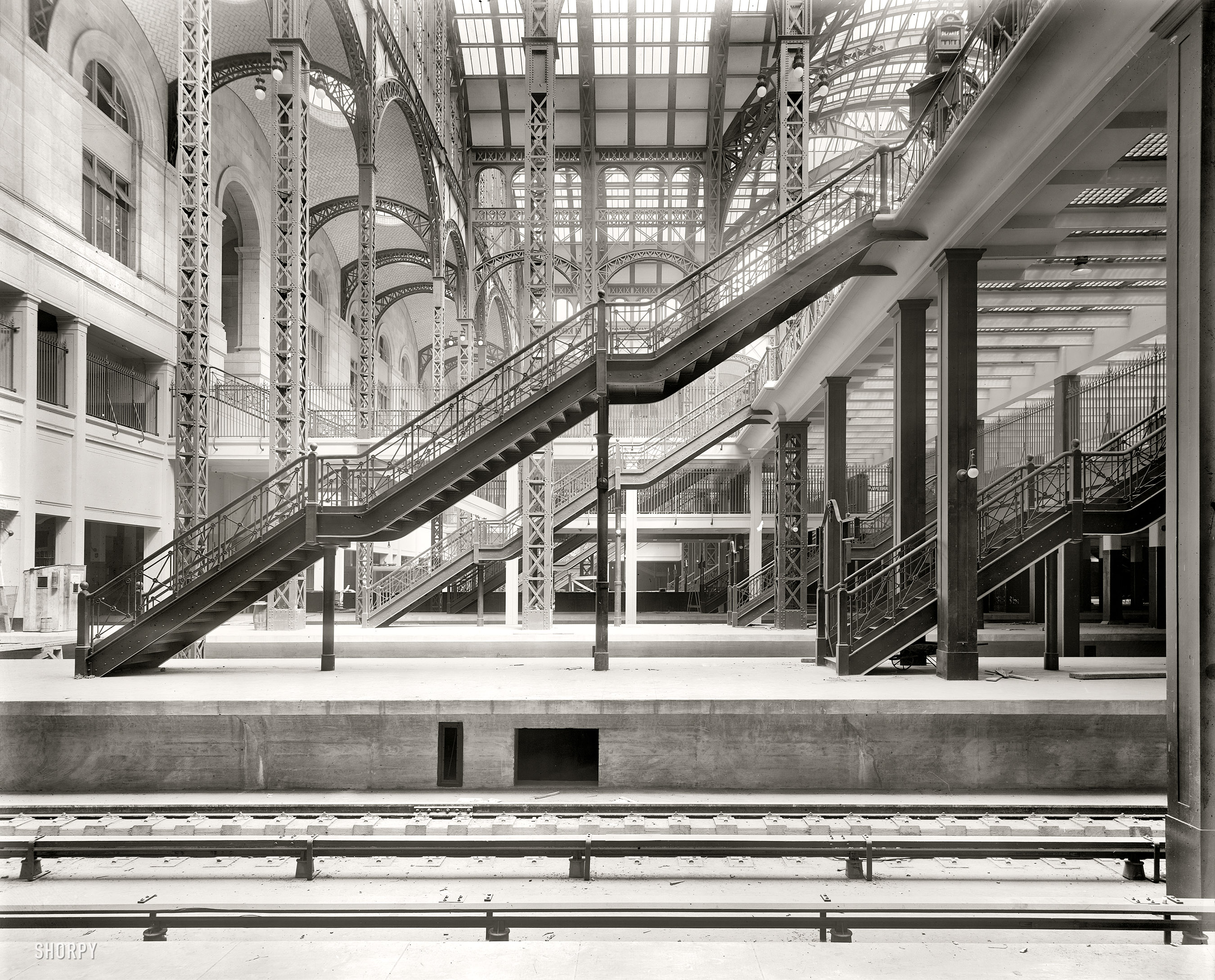
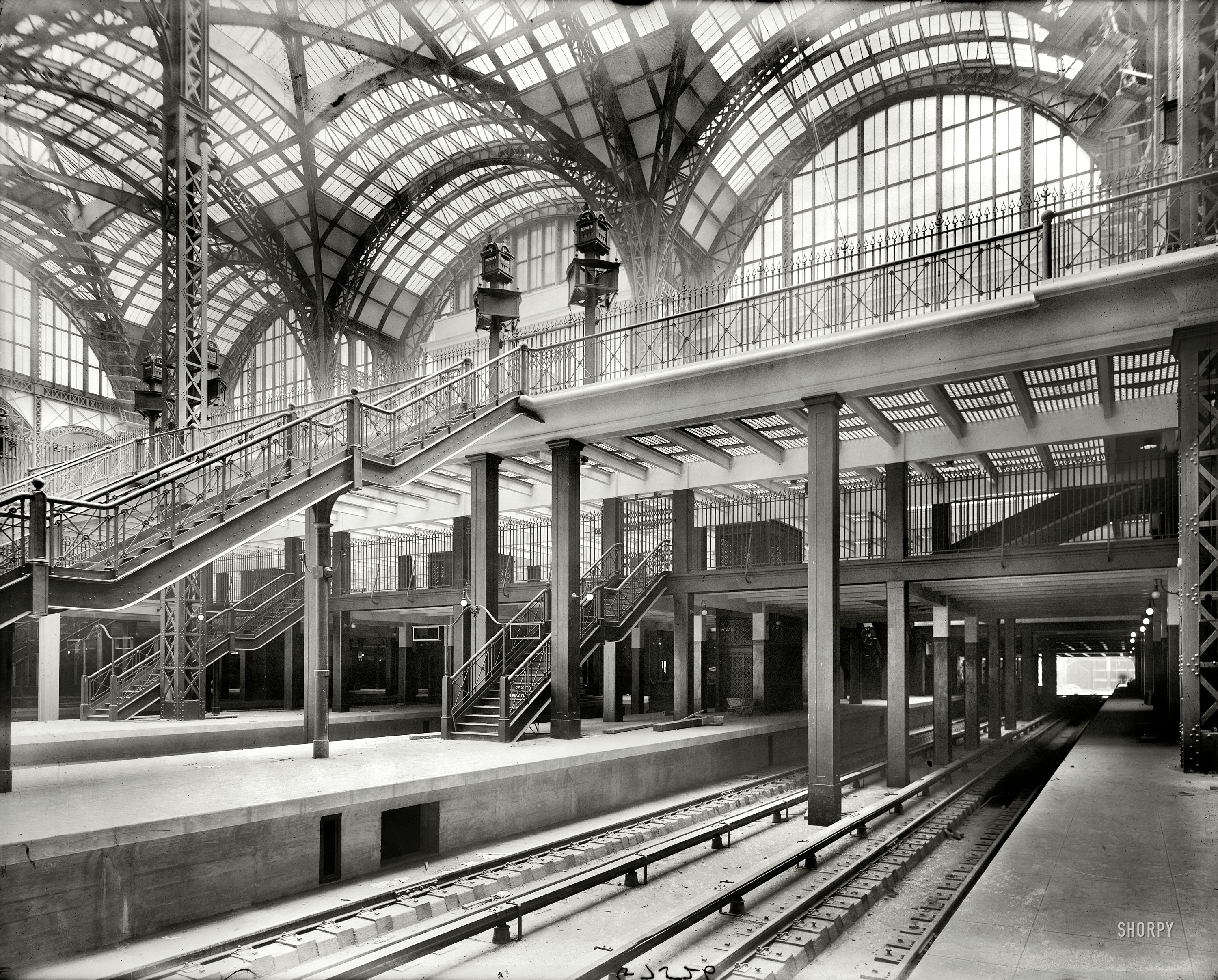
From this angle, you can really see the relation of the train platforms with one of the entrances. Seems easier to navigate than the current Penn Station, don’t you think?
Here are a few ‘cleaned up’ hi-res images from the fine folks over at Shorpy, who have a bit of a thing apparently for old Penn Station. Go over to their blog to check out the rest of their work.
Women received the right to vote 100 years ago today with the ratification of the Nineteenth Amendment to the U.S. Constitution.
Tens of thousands of women from all walks of life spent hard-fought decades working for this moment. Many of the most prominent suffragettes were wealthy white women of the Fifth Avenue set.
It was their influential voices — added to those of long-time activists, women and girls from the labor movement and women of color from all backgrounds — that convinced the nation that its institutionally ingrained discrimination should end.
Even circus women got into the act.
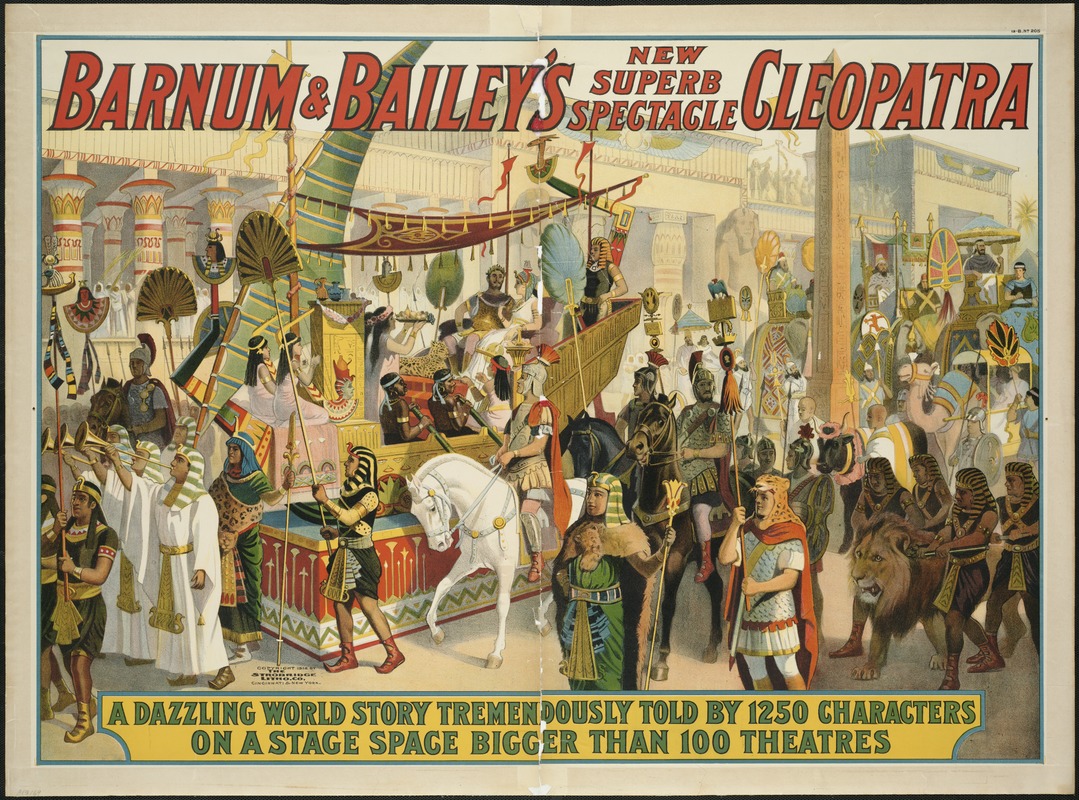
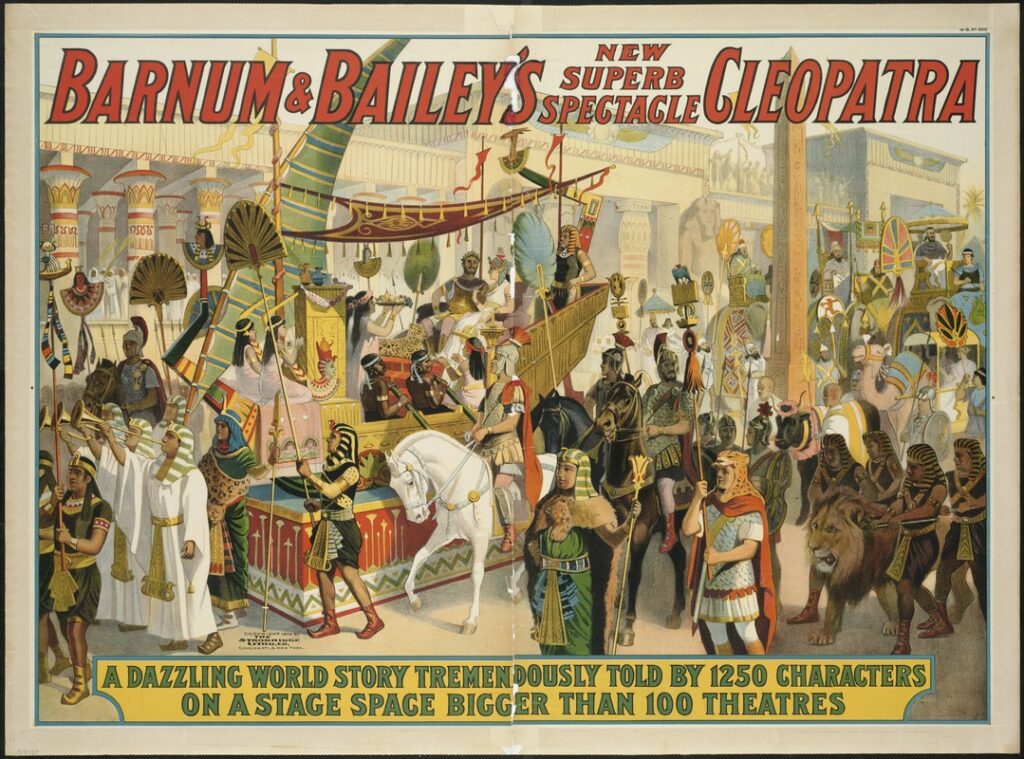
The famed Barnum & Bailey’s presented an elaborate Cleopatra-themed stage show during its 1912 season, featuring over 1,500 performers. The show had debuted just the week before at Madison Square Garden. Certainly some of its stars — perhaps Cleopatra herself? — participated in the March 1912 suffrage event.
On March 31, 1912, members of the Barnum & Bailey circus troupe, in town to perform at Madison Square Garden (back in its Madison Square location), decided to put on a very different show.
The female stars of Barnum’s traveling show decided to throw their support behind the suffragist cause. Unfortunately they were not greeted with the praise they deserved — by either the newspapers or the other suffragists.
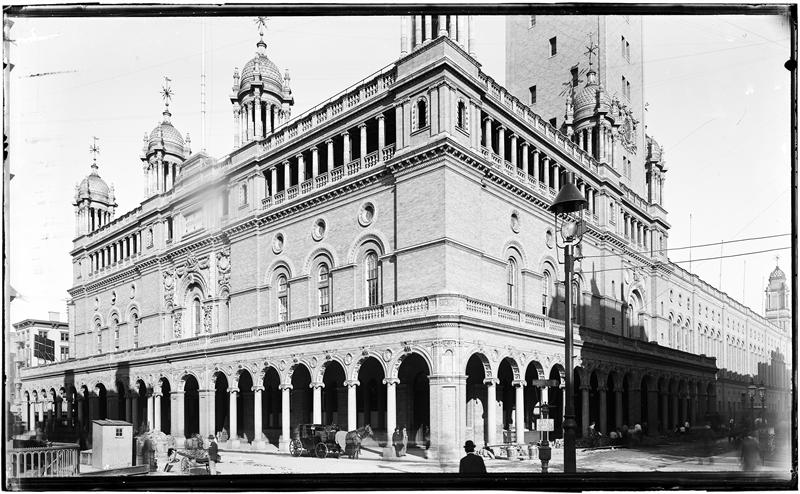
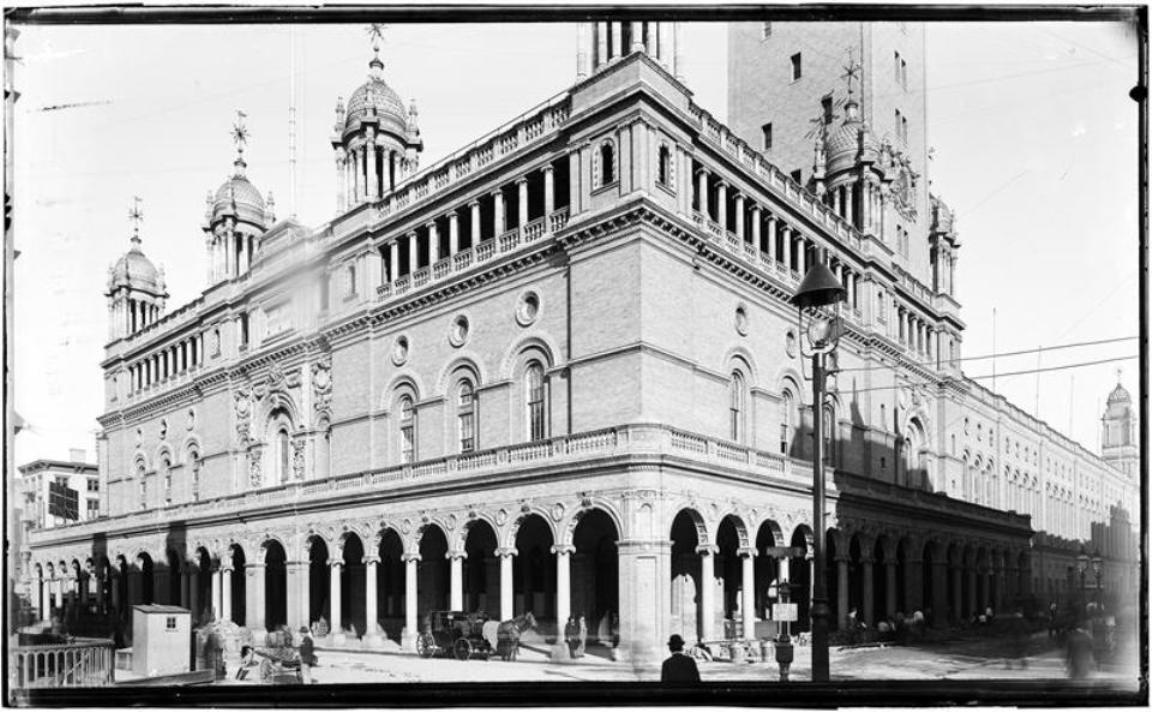
Madison Square Garden, 1910 (Courtesy Library of Congress)
Modern women activists of the day were happy to see any headlines relating their cause, as long as the environment was a respectable one. The circus was not one of those environs.
Then consider that most newspapers were operated by men and read by men. While some progressive sheets supported suffrage, several chose to cast the cause in a satirical light where possible. The ladies of Barnum & Bailey gave reporters a particularly ripe opportunity for a little spoofing.
On March 31, seventy-five women employed by America’s most famous circus organized an afternoon suffrage rally and invited the press to the world’s first ‘circus suffrage society‘.
How indeed could reporters resist a group of daredevil acrobats and horse wranglers, presenting their cause on the site of caged animals?
It was meant as a solemn pronouncement; reporters mocked it. “They Organize As Man-Eating Hyena Grins, Elephants Trumpet‘, went the Tribune headline, as the circus’s publicity agent “solemnly swore last night with a hand on his heart that the meeting was a real, honest-to-goodness suffrage meeting.” [source]
This was Barnum territory, after all. Although the great showman had died many years earlier, perhaps after decades of chicanery and misdirection, nobody could take a Barnum photo opportunity with a straight face.
But it was a serious endeavor, led by petite circus rider Josie De Mott (pictured above)and acrobat Zella Florence.
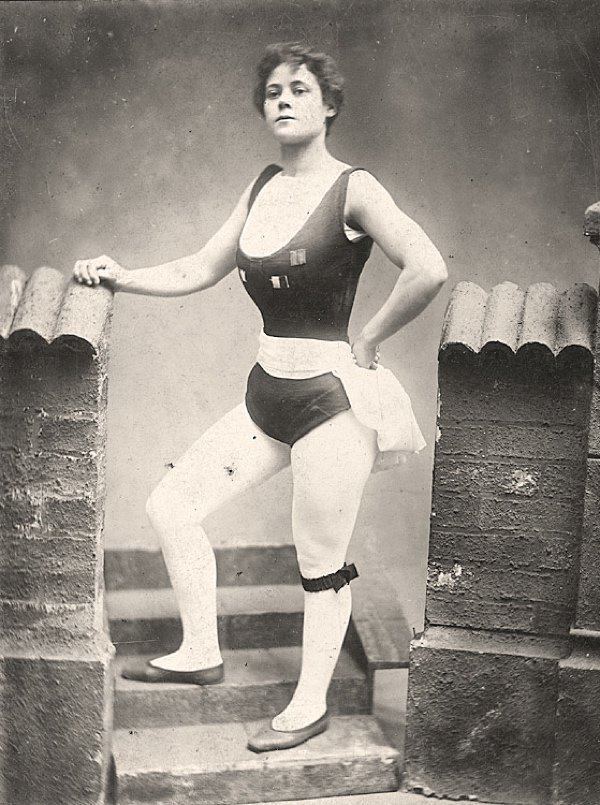
Included in the audience were animal trainers, wire walkers, ‘hand balancers’, dancers, acrobats and even a few strong ladies, including the renown Katie Sandwina, ‘the female Hercules’ (pictured below).
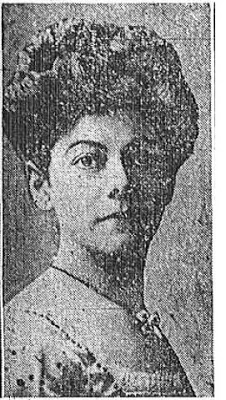
Not in attendance, however, were key members of the mainstream suffrage movement — notably Brooklyn socialite Inez Millholland and the movement’s de facto leader Harriet Stanton Blatch, the daughter of Elizabeth Cady Stanton.
Mrs. Blatch, the New York Times noted, was having tea with her fellow esteemed suffragists at their 46 East 29th Street headquarters. (It should be noted they were only a block away from Madison Square Garden!) However, perhaps recognizing the value of a traveling suffragist show, they did deign to send a representative named Beatrice Jones.
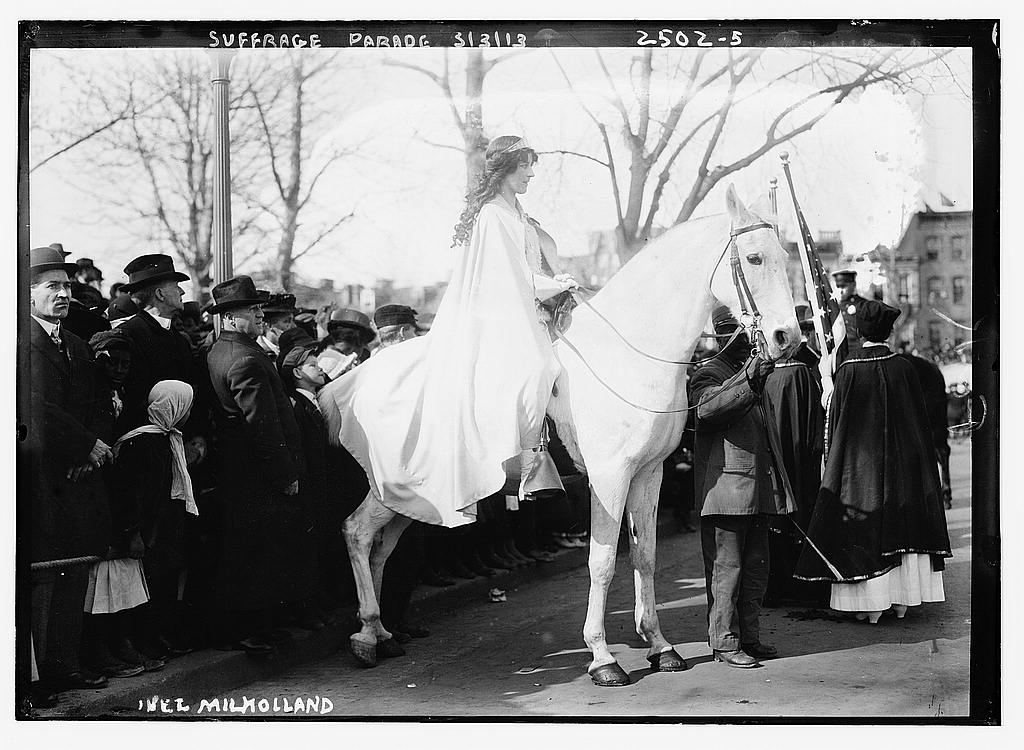
Inez Millholland at a Washington DC suffrage event in 1913. Given her dramatic display on horseback, one might have thought she’d be delighted to entertain the circus women. (Library of Congress)
Clearly flustered by the appearance of the press — the society ladies of the suffrage movement did not consider a circus ring an appropriate political venue — Jones repeatedly asked the ladies if they were serious, then dispensed advice on how to conduct themselves as standard-bearers of the roving suffragist cause.
At one point, the male half of Barnum’s husband-and-wife riding act stormed in and dragged his partner from the meeting. The crowd assailed the interloper with boos and hisses.
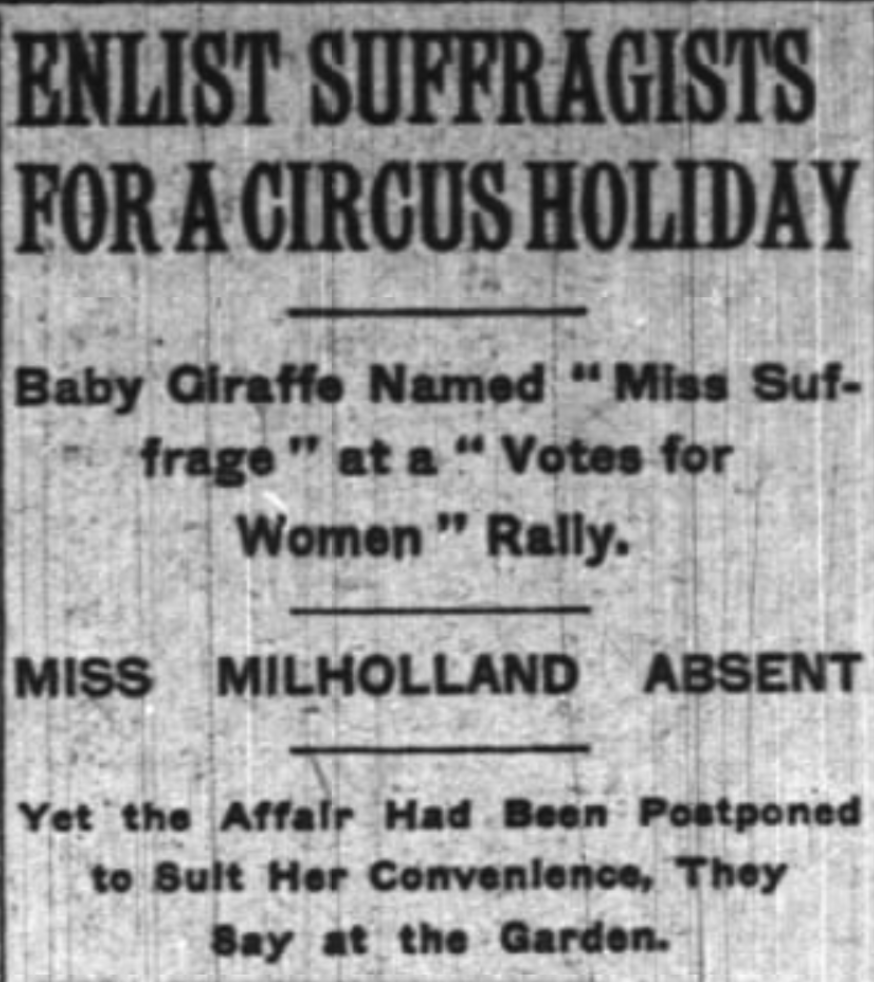
After the meeting, De Mott and the other circus suffragists created a dandy of a photo op, moving to a cage and presenting the name of ‘Miss Suffrage’ to a young baby giraffe. The Times coyly suggested the animal was male: “[B]y nightfall he couldn’t abide even the sight of a suffragette.”
The ‘proper’ suffragists acquiesced and eventually did meet with their more flamboyant sisters over tea the following week. The society activists marveled at the vigor of the Barnum ladies.
“It is because they have so much exercise,” one exclaimed, all the while “looking envious at the at the smooth skins and rosy cheeks,” the Times condescendingly added.
Eight years later, however, all these women would earn the right to vote.
Ever wonder what the very first movie ever shot in Manhattan was? It also happens to be the first American film ever shown to a paying movie audience. Woodville Latham and his sons Otway and Gray Latham had invented the Eidoloscope projector (also called the Pantoptikon), running very crudely like a film projector today. However its image size was very small, about the size of a small TV set.
The Latham brothers had debuted test images to the press. But their real test of this device was to film something live and then display it a short time later.
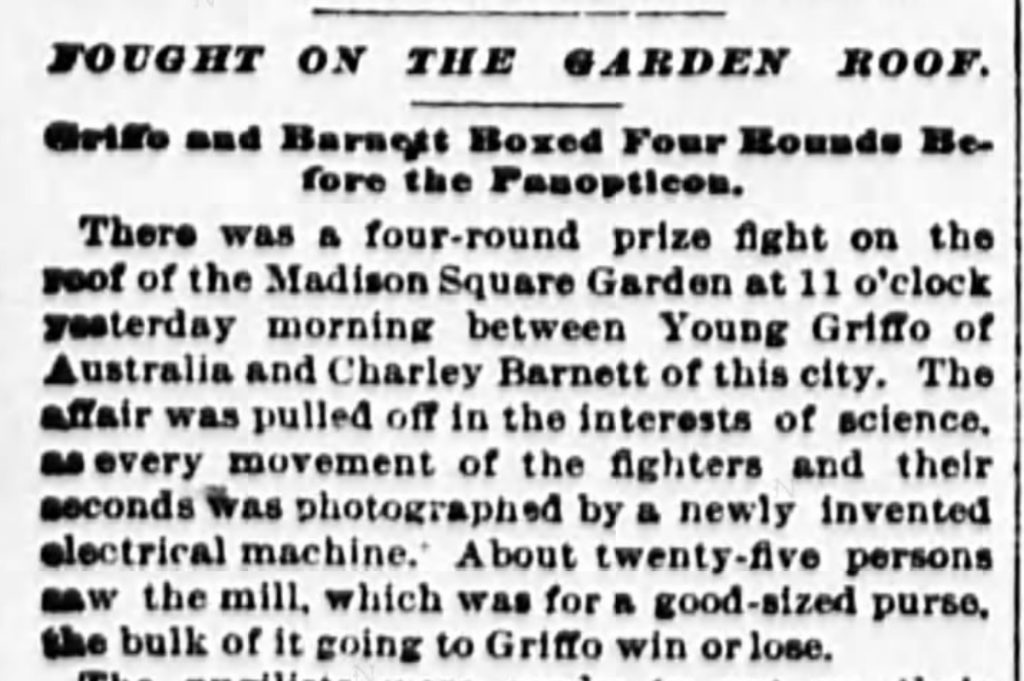
New York Sun, May 5 ,1895 (Newspapers.com)
So on May 4, 1895, the brothers filmed a boxing match on the rooftop of Madison Square Garden, then on 27rd Street and Madison Avenue.
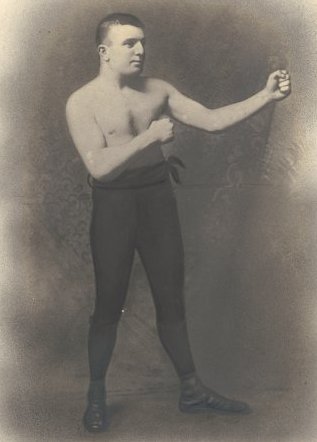
The competitors were ‘Battling’ Charles Barnett in the ring with Young Griffo (pictured below), a legendary Australian boxer who was a rather chaotic presence in the sport.
The match was actually a re-match, the recreation of an actual boxing match between the two athletes which had occurred that morning at the Garden.
Sixteen days later, that four-minute film, Young Griffo versus Battling Charles Barnett, was displayed to a paying audience, at a makeshift theater in a storefront at 153 Broadway (a couple blocks up from Wall Street).
Believe it or not, boxing films were all the rage in these infant years of the motion picture business as they were easy to film (compared to a baseball game) and featured name performers in an era before actual movie stars.
“The film offered topicality that previous productions had not,” said author Dan Streible in his book Fight Pictures: A History of Boxing and Early Cinema. “If such reenactments could be marketed quickly, their commercial value could exceed that of unofficial match-ups created solely for the movies.”
The film was also a huge hit that summer on Coney Island, projected in a tent on Surf Avenue.
No extant copy of Young Griffo v. Battling Charles Barnett has been found.
Events such as these used to be unthinkable, anomalies of history that once played like speculative fiction. But this really did happen.
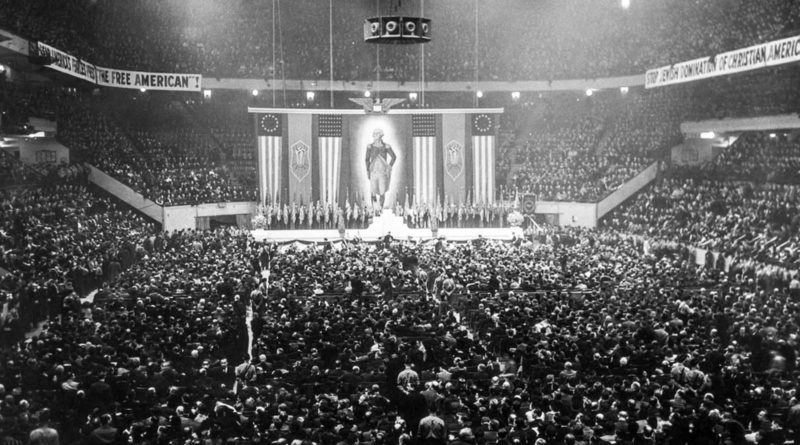
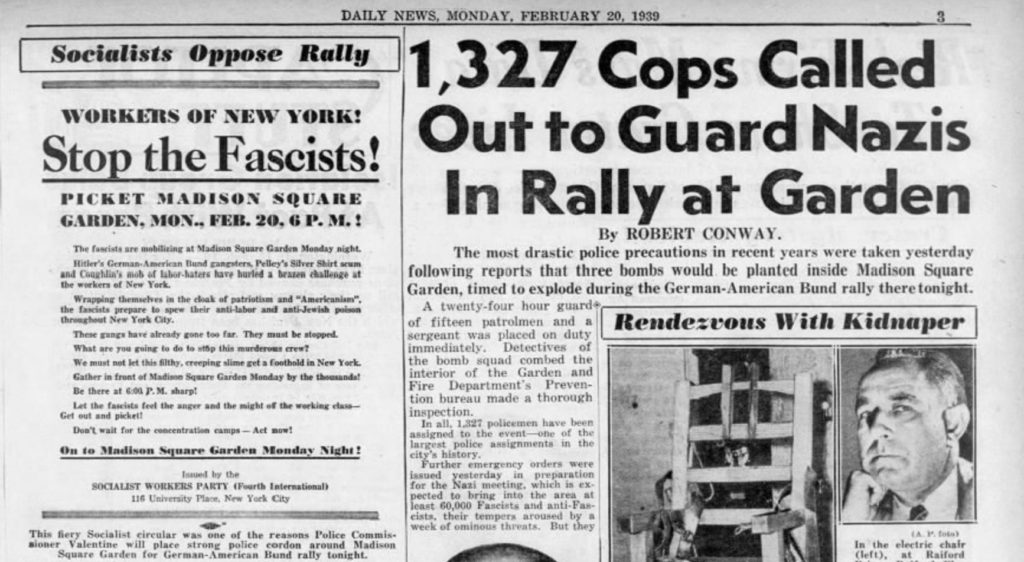
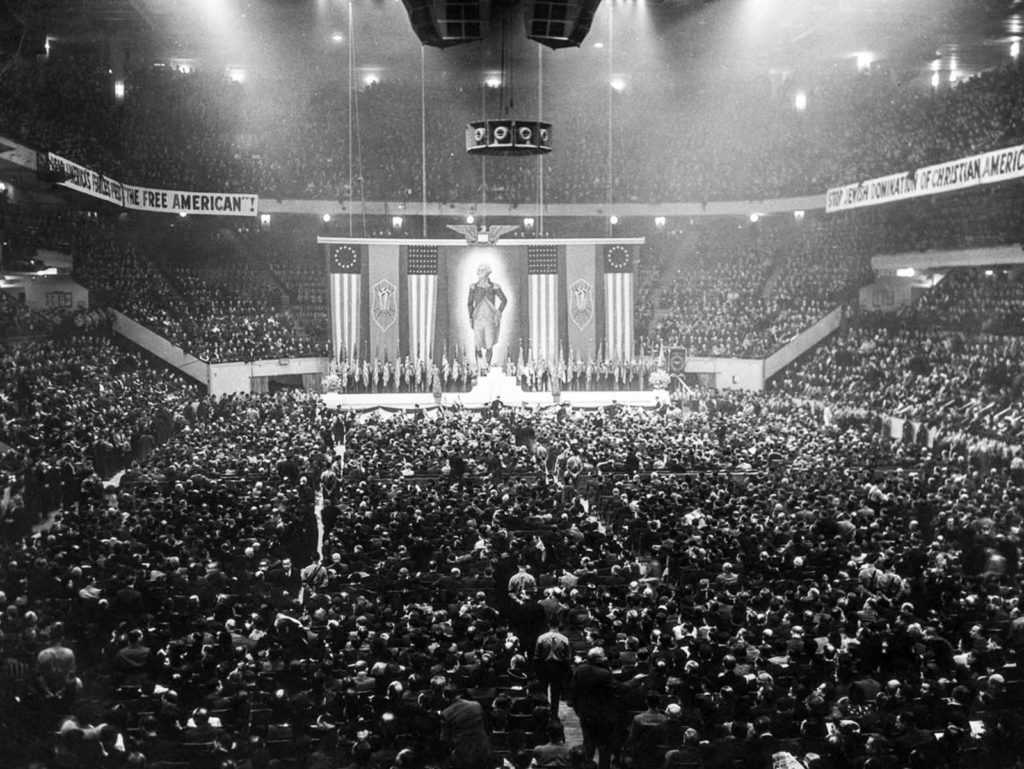
Eighty years ago this month — on February 20, 1939 — over 20,000 members of the German American Bund, a pro-Nazi organization, gathered at Madison Square Garden (at its Hell’s Kitchen location on Eighth Avenue) to unite the philosophies of American exceptionalism and Nazi worldview, gathering under the pretense of celebrating the birthday of George Washington.
Just a week earlier, on February 12, 1939, the Garden was filled with thousands of prized canines as part of the Westminster Dog Show. Eight days later, the famous arena was occupied with a more menacing sight.
From the New York Daily News:
I find the matter-of-fact reporting from the Brooklyn Daily Eagle the following day to be almost chilling:
“Marked by scores of street fights in which anti-Nazis, Nazis and police clashed frequently, the German-American Bund’s “American-ism” rally in celebration of George Washington’s birthday last night gave the vicinity of Madison Square Garden the liveliest six hours it has known in recent years.
The meeting itself, attended by more than 18,000, was without incident, except for the beating by Storm Troopers and subsequent arrest of Isadore Greenbaum, Brooklyn unemployed plumber, who attempted to attack Fritz Kuhn, Bund leader, as he spoke from the platform.”
The Oscar-nominated short documentaryA Night At the Garden looks at this event from an ominous bird’s eye view, capturing the united enthusiasm of the crowd and even Greenbaum’s attempt to storm the stage. The director Marshall Curry (who made the excellent film Street Fight — about Newark politics — over a decade ago) lets the footage speak for itself, allowing the audience to make their own contemporary parallels.
You can watch the entire film here. It’s up for an Academy Award for Best Documentary Short Subject against four other astounding films. (End Game and Period. End of Sentence are both on Netflix. And you can find Black Sheep and Life Boat on YouTube.)
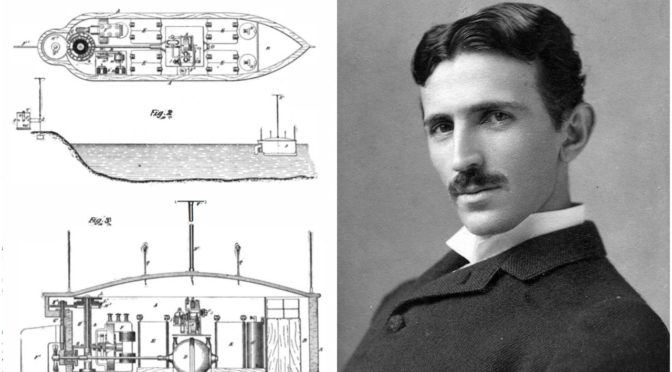
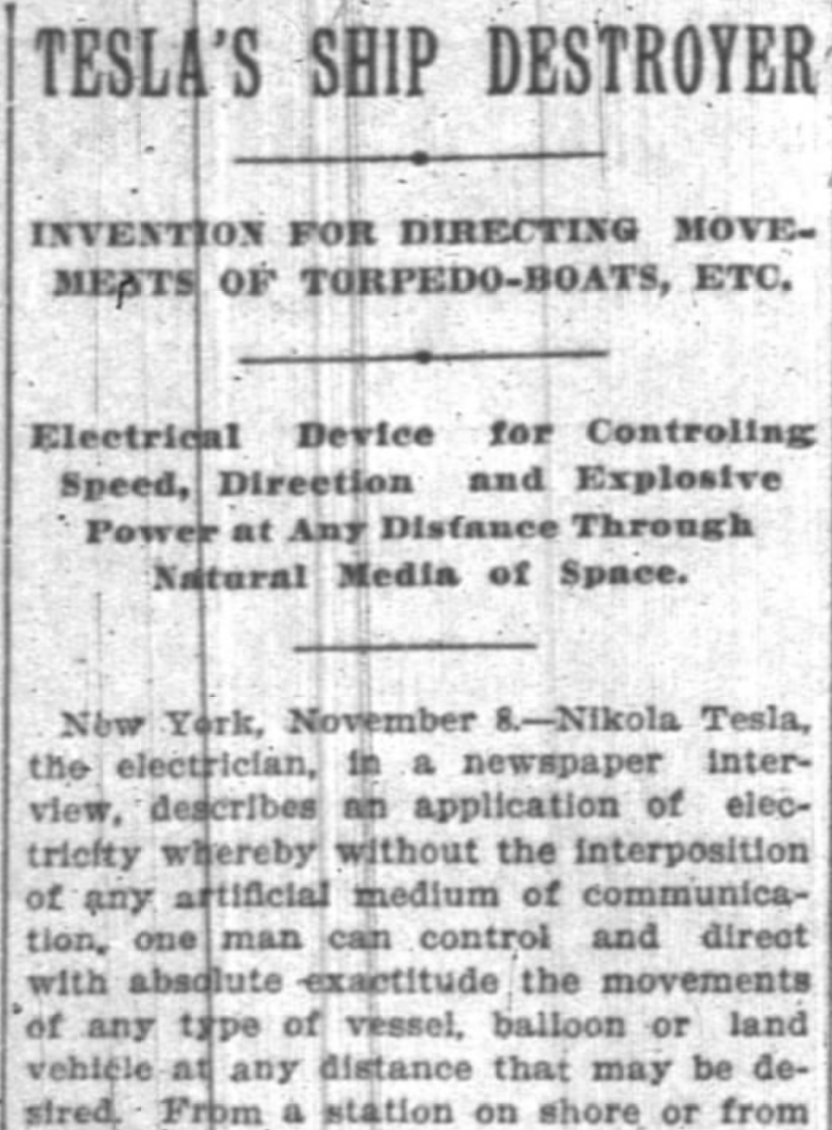
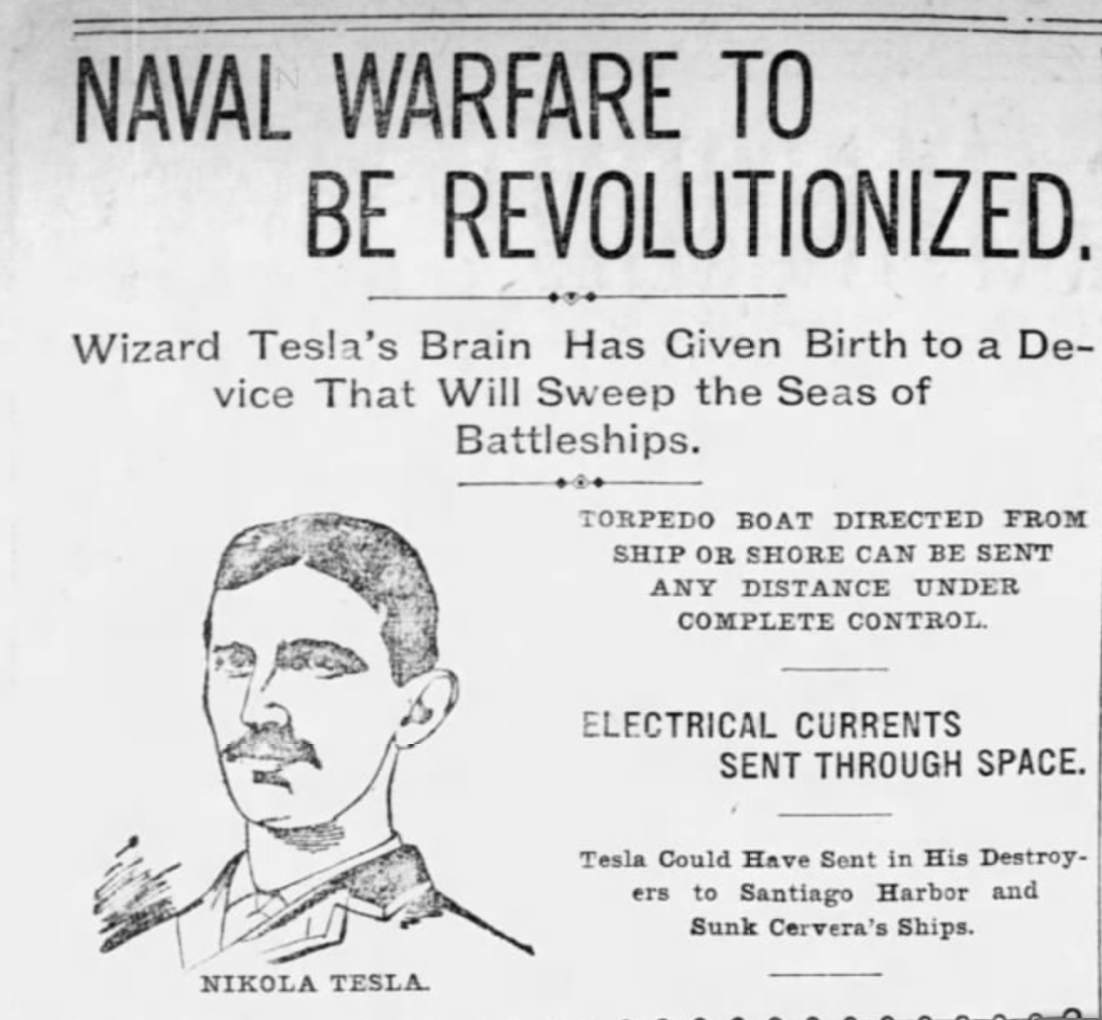
THE FIRST: STORIES OF INVENTIONS AND THEIR CONSEQUENCESThe Serbian inventor Nikola Tesla is known as one of the fathers of electricity, the curious genius behind alternating current (AC), the victor in the so-called War of the Currents. But in this episode of The First, starting in the year 1893, Tesla begins conceiving an even grander scheme — the usage of electromagnetic waves to distribute power.
Today we benefit from the electromagnetic spectrum in a variety of ways — Wi-Fi, X-rays, radio, satellites. One of the roads to these inventions begins with Tesla and his experiments with remote control, using radio waves to operate a mechanical object.
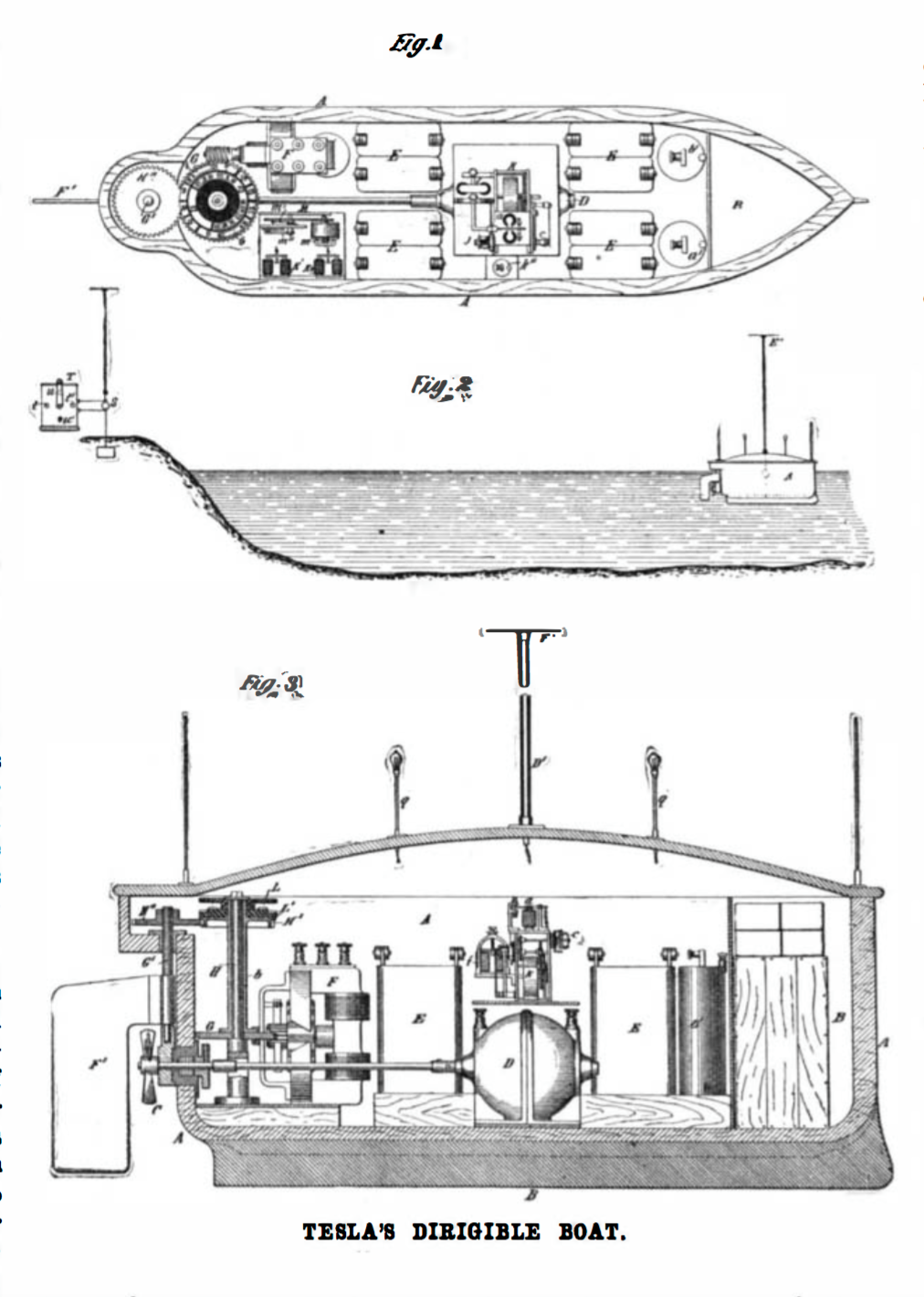
But you may be surprised to discover Tesla’s initial application of remote control. Far from inventing an children’s toy, Tesla’s remote controlled device would be used as a weapon of war.
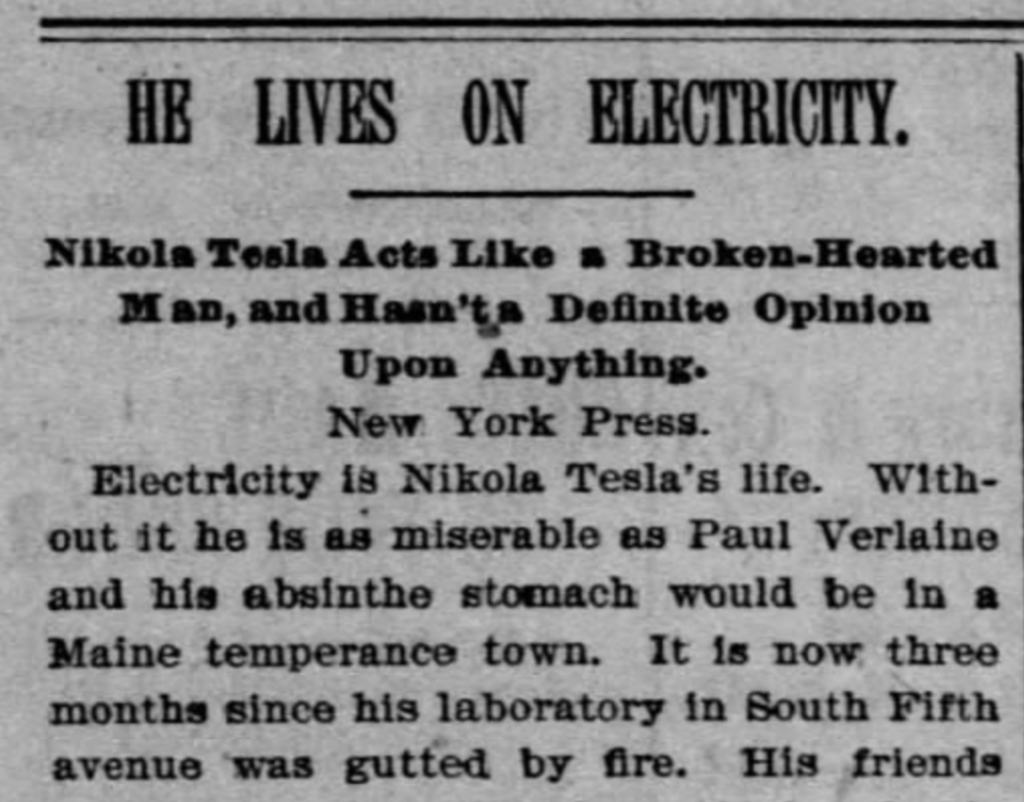
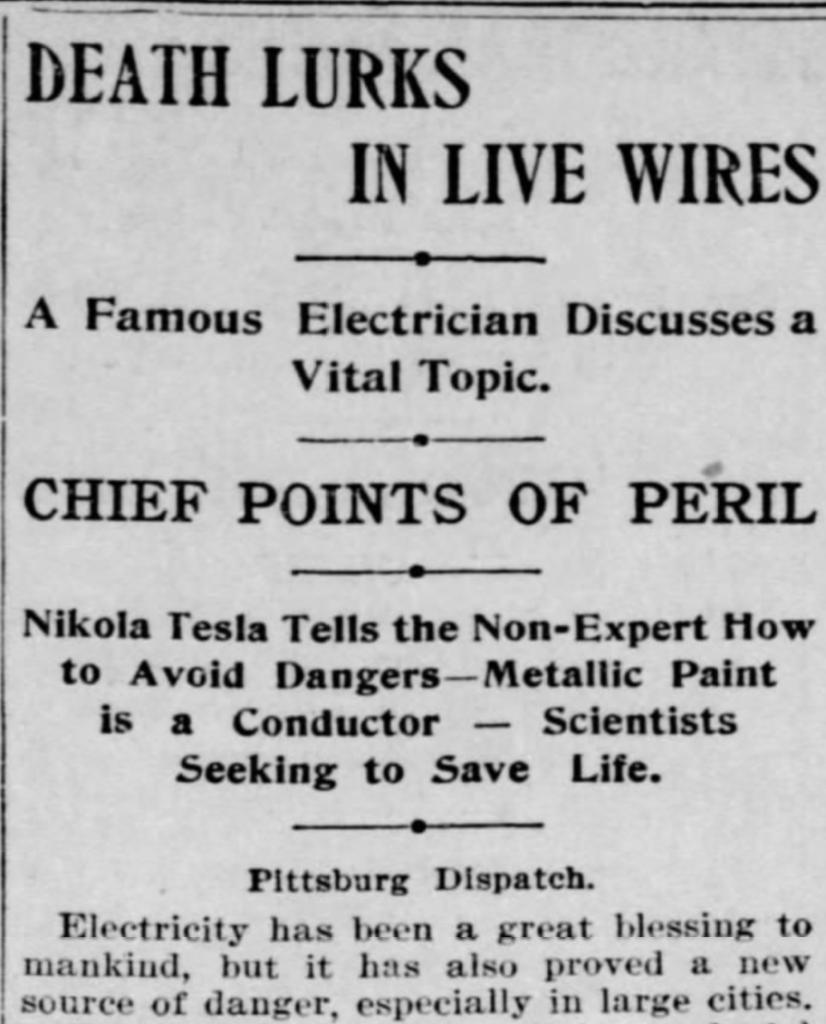
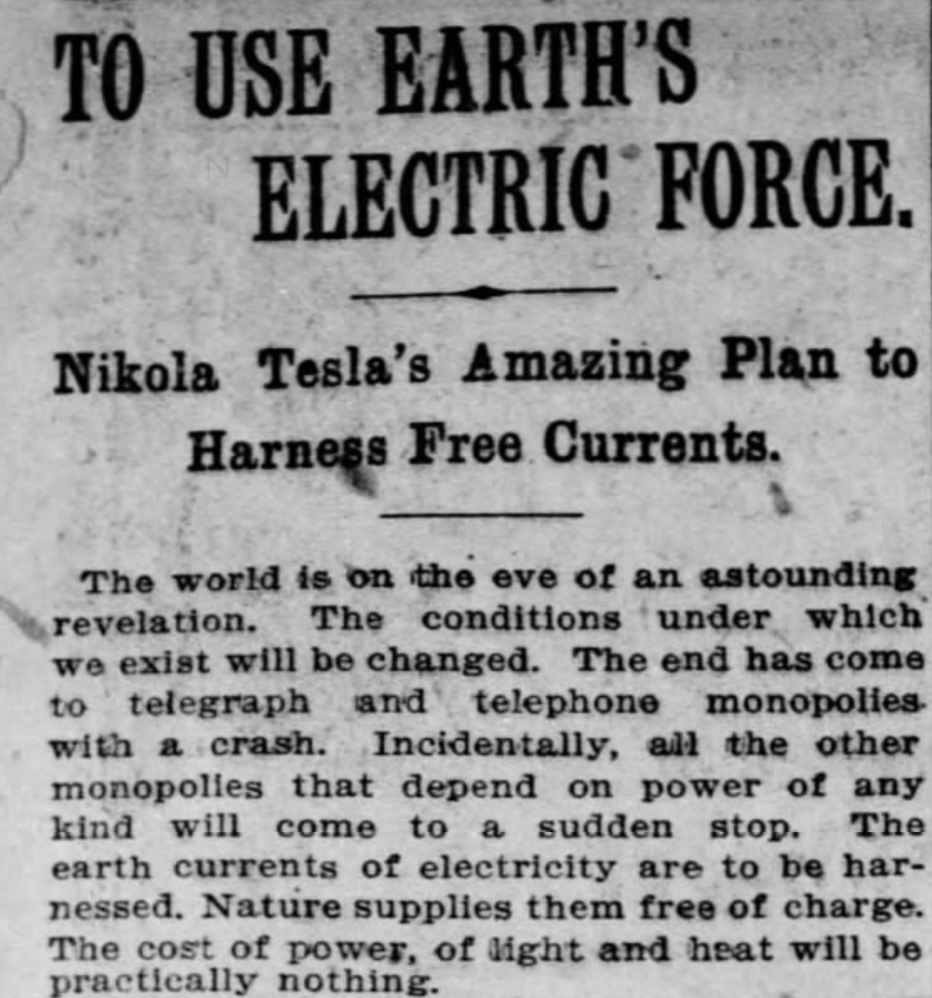
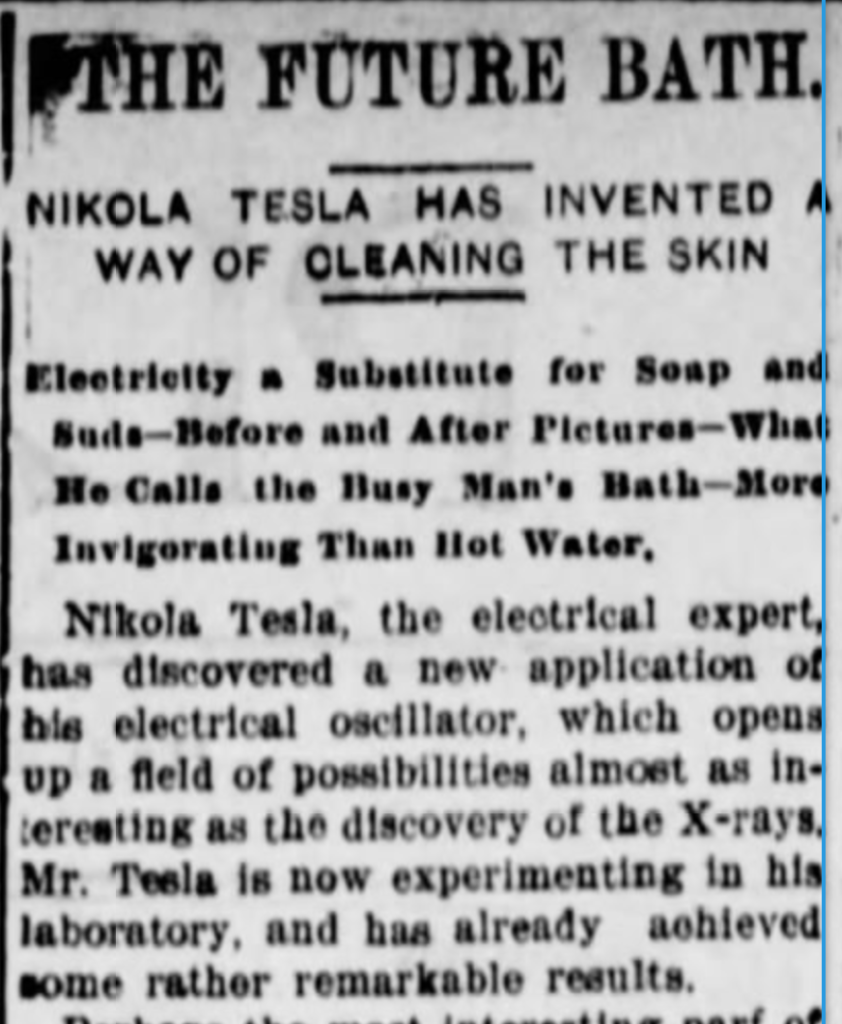
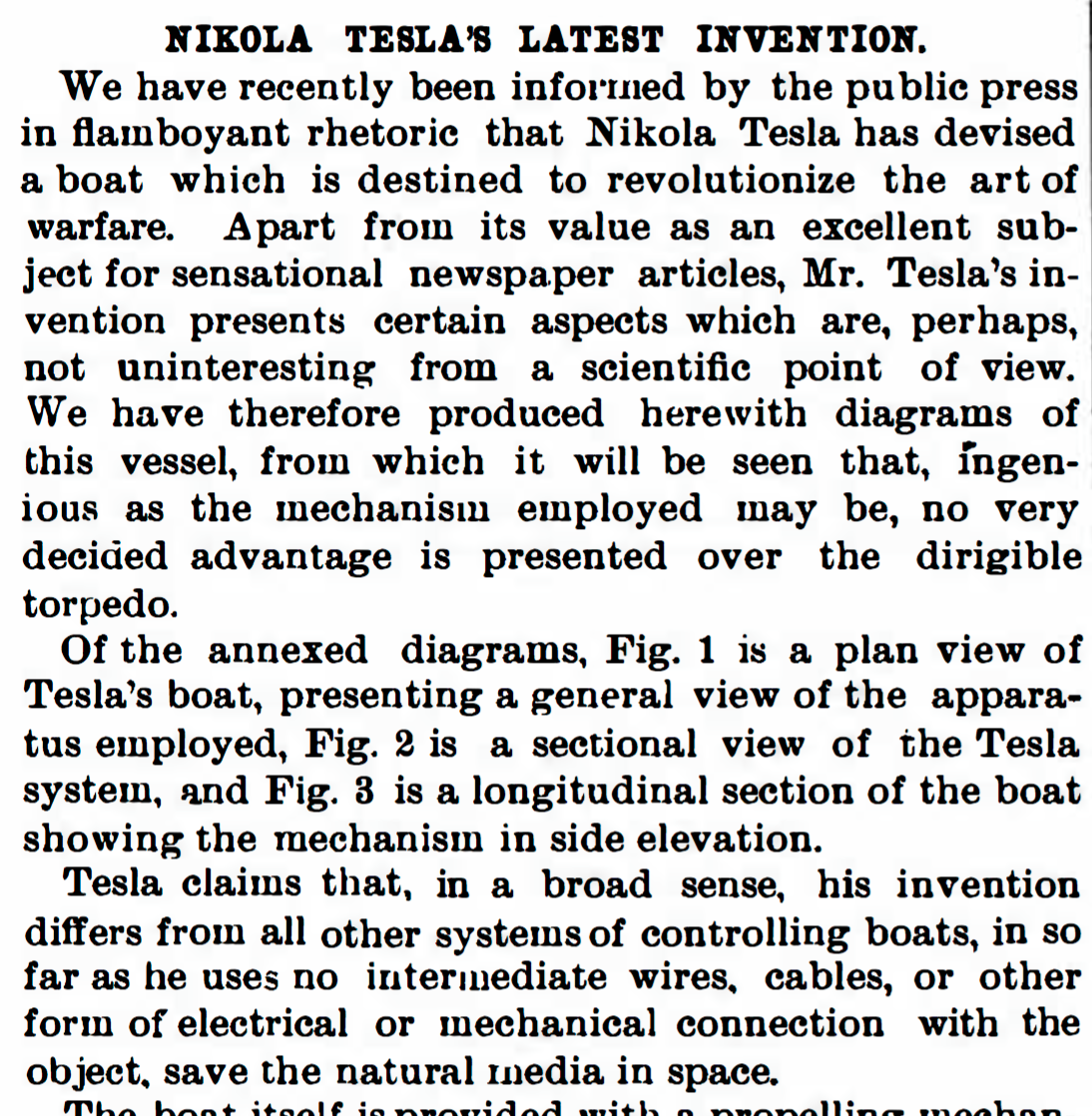
Below — A sampling of newspaper headlines involving Nikola Tesla, specifically from the mid and late 1890s (when he first began thinking and experimenting with wireless) and one from 1901.
HE LIVES ON ELECTRICITY
Nikola Tesla Acts Like a Broken-Hearted Man, and Hasn’t a Definite Opinion Upon Anything
Electricity is Nikola Tesla’s life. Without it he is as miserable as Paul Verlaine and his absinthe stomach would be in a Maine temperance town.
“We have recently been informed by the public press in flamboyant rhetoric that Nikola Tesla has devised a boat which is destined to revolutionize the art of warfare.”
5th October 1965: Photo by Harry Benson/Express/Getty Images
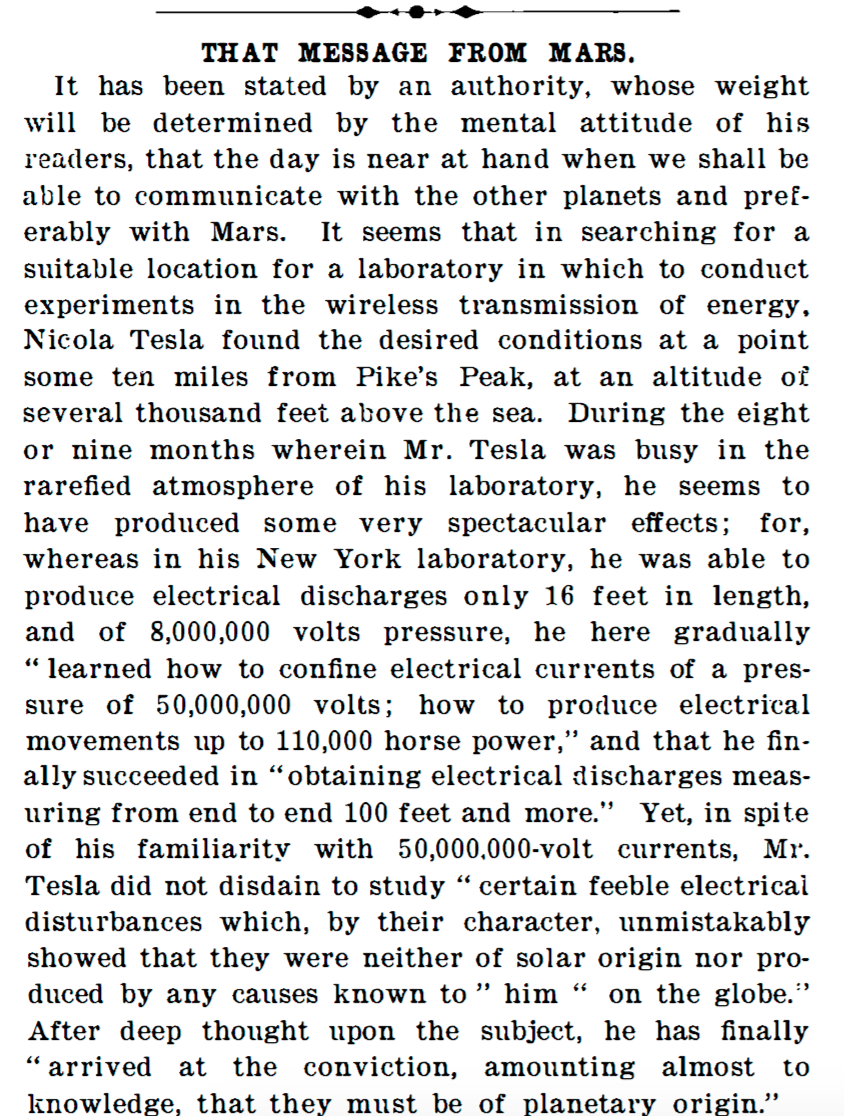
Pope Francis arrives in New York City today — part of his first-ever trip to the United States — and the city is rolling out the red carpet. In fact, all available carpets are being rolled out and even some throw rugs.
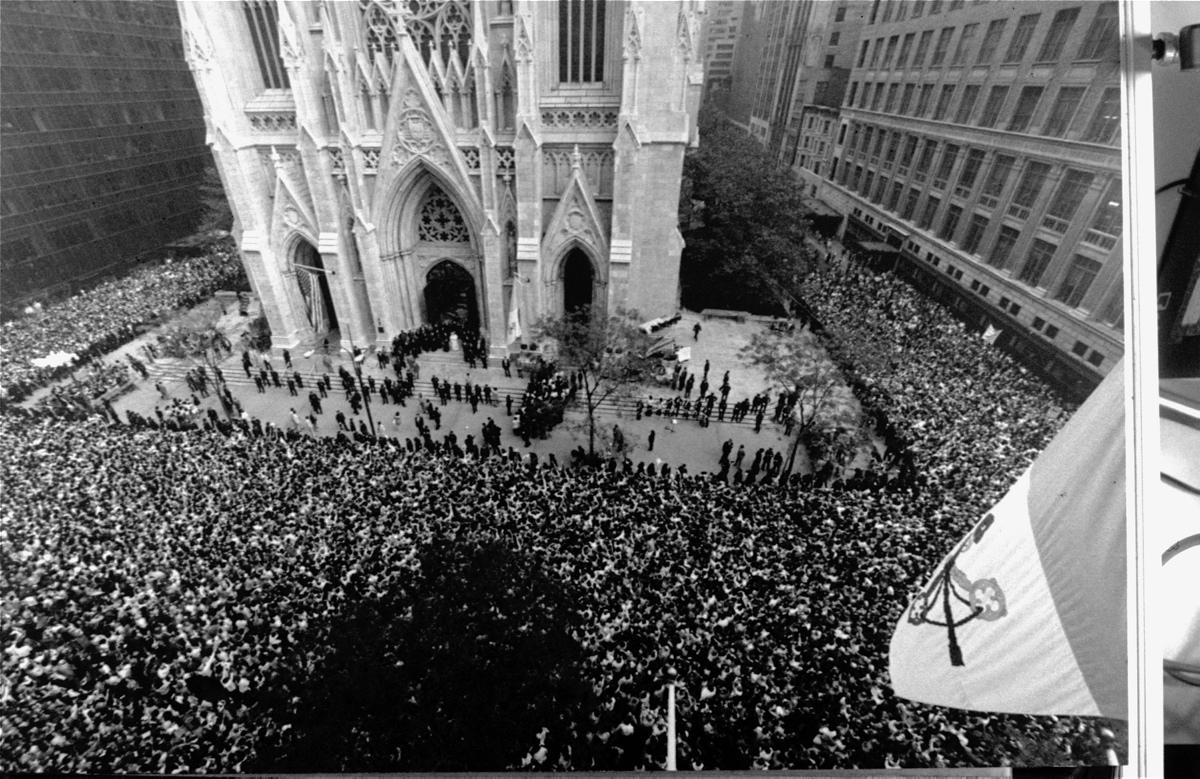
The city has been host to four previous papal visits, and in each case, Saint Patrick’s Cathedral has naturally been the manic center of activity. In fact three such visits have been immortalized on plaques in front of the cathedral.
But with each trip, the pope in question managed to find a couple other unique corners of the city to visit as well.
THE FIRST POPE
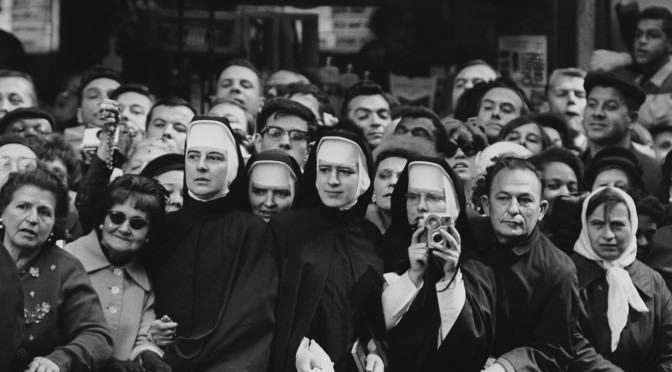
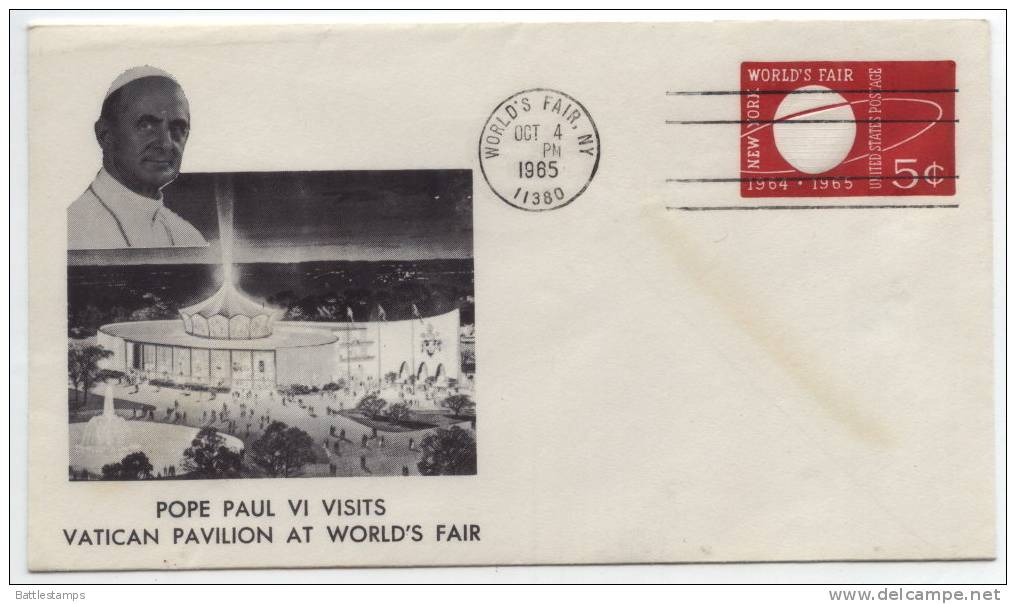
Perhaps the strangest visit of all was the very first — Pope Paul VI, the controversial leader who presided over the Second Vatican Council and made a name for himself traveling all over the world. Finally in an era where a man could be both pope and jetsetter, Pope Paul arrived in New York in October of 1965 and promptly went to visit his old roommate, who was performing in a fair.
The Pope visited the Fair on October 4, 1965, on a busy day that also included mass at Yankee Stadium (the first papal mass ever in the United States), an address to the United Nations, and a meeting in the city with president Lyndon Johnson at the Waldorf-Astoria.
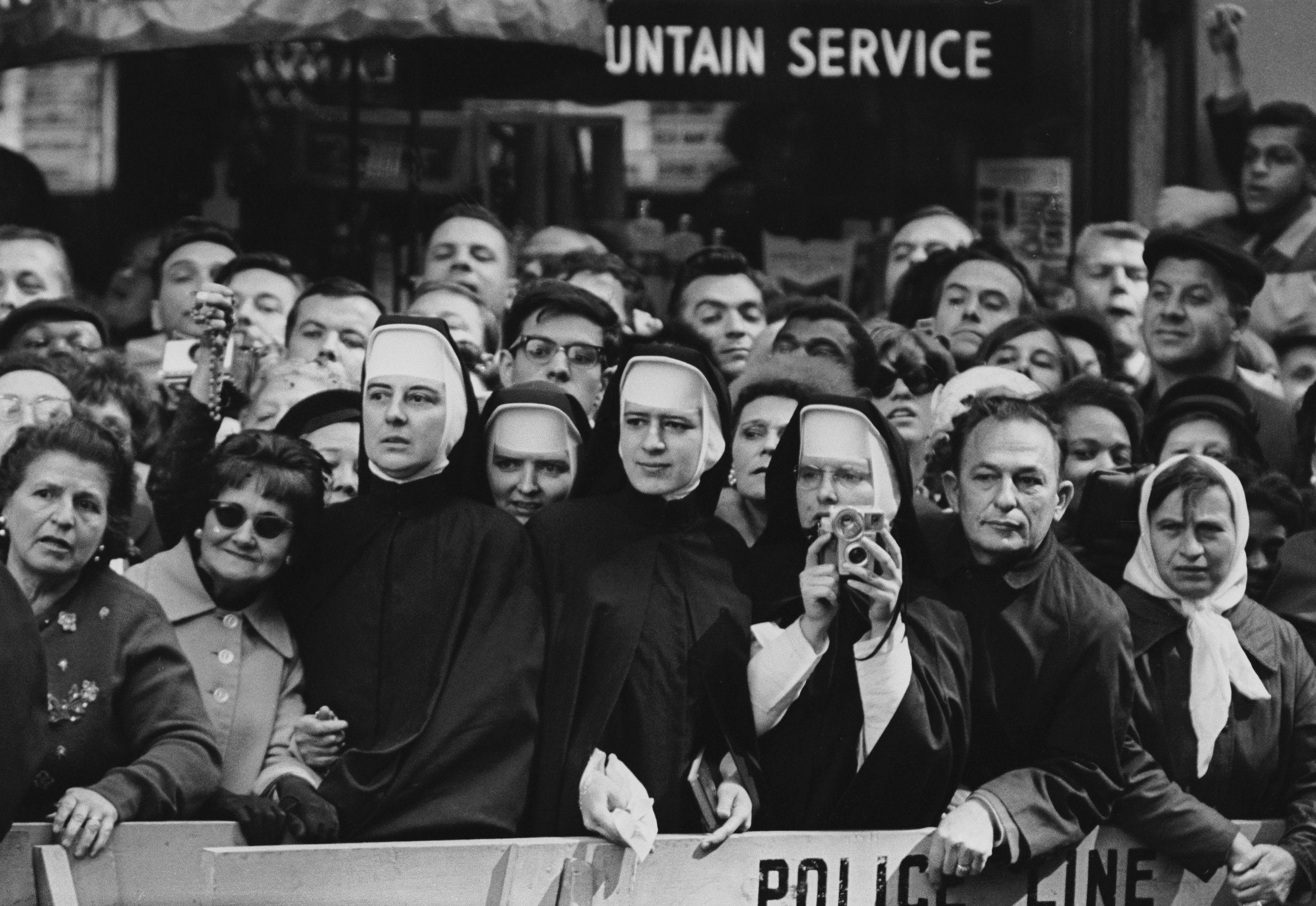
5th October 1965: Photo by Harry Benson/Express/Getty Images
Many will remember the thousands of people who greeted the Pope in the original Pope-mobile (“a closed, bubble-top limousine”) during its 25-mile procession through the city. Here’s a fact to delight your friends and neighbors — the first American bridge ever crossed by a Pope in all of history was the Queensboro Bridge.
Today a rounded bench, or exedra, sits in Flushing Meadows park honoring the moment Pope Paul visited the Pavilion. (It seems that whenever a Pope hovers in a place for more than a few minutes, a plaque or monument springs up in its place.)
But it’s Pope John Paul who’s the real New York favorite; he held the papal throne for so long that he managed two trips to Gotham City — in 1979 and 1995.
His October 1979 trip was like a rock concert tour, also swinging through Philadelphia, Boston, D.C., Chicago and Des Moines. Part of the enthusiasm was because John Paul, at 58 years old, had just been appointed the year before.
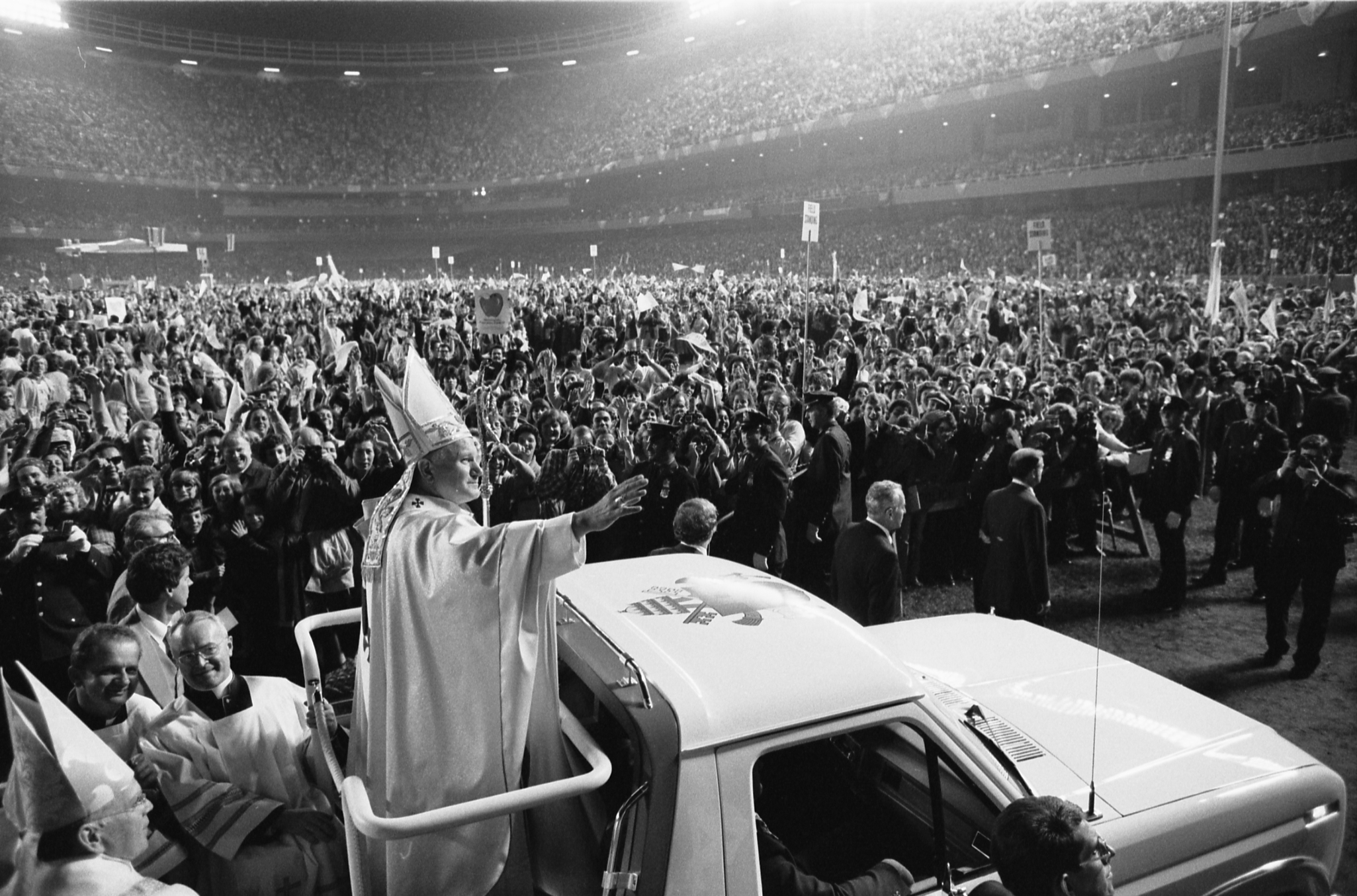
In 1969, as a cardinal, he had held mass at Yankee Stadium, so by the time he did it again on October 2, 1979 — as the Pope — he was as much a fixture as Reggie Jackson. Rain greeted over 9,000 cheering worshippers — or fans — and, according to legend, when the Pope mounted the ballfield to address the crowd, the rain showers stopped. And as a blessing for Mets fans, the next day the Pope also held rapt an audience of 52,000 at Shea Stadium.
Below: the Pope at Yankee Stadium
Courtesy US News and World Report
But like all rock stars, the Pope couldn’t complete his New York odyssey without a performance at Madison Square Garden. Although John Paul also addressed the U.N. and a Saint Patrick’s audience during that trip, he’s best remembered by many for his inspirational address on October 3rd to 19,000 city children.
Saint Patrick’s honored his Holiness’s visit in 1979 by installing a bust. But he would be back. On almost exactly the same day, sixteen years later.
Length of his visit: Almost 48 hours
THE SECOND POPE — THE SECOND VISIT
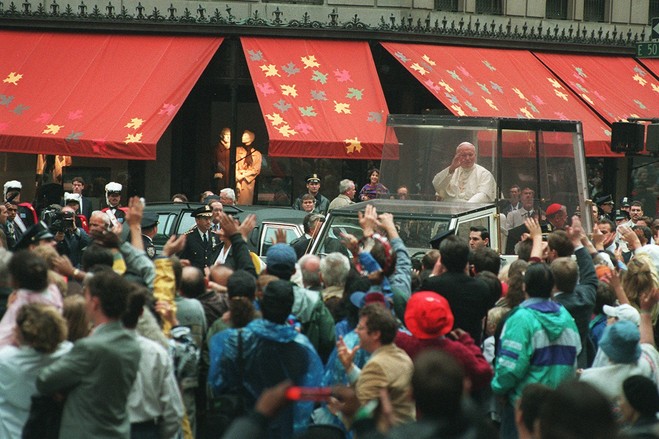
New York City in 1995 was a vastly different city and John Paul returned for a longer visit — four days in total in the entire New York area — on October 4th. This time, instead of just delivering messages to the clergy gathered at Saint Patrick’s, he spontaneously decided he wanted to walk around the block. And why not? You’ve got shopping, Saks, street vendors selling Pope souvenirs!
Below: In the Pope-mobile, riding by Saks Fifth Avenue
Courtesy Wall Street Journal
The Pope also finished off his collection of performing in gigantic venues for mass — holding court in Giants Stadium, the Aquaduct Racetrack in Ozone Park and eventually to 100,000 people on the great lawn in Central Park.
From there, the elderly leader of the Catholic Church gave the city the ultimate shout-out: “This is New York! The great New York! This is Central Park. The beautiful surroundings of Central Park invite us to reflect on a more sublime beauty: the beauty of every human being, made in the image and likeness of God. Then you can tell the whole world that you gave the pope his Christmas present in October, in New York, in Central Park.”
Length of his visit:Â Almost four days! He couldn’t get enough.
Courtesy Chris Hondros/Getty Images./New York Daily News
THE THIRD POPE
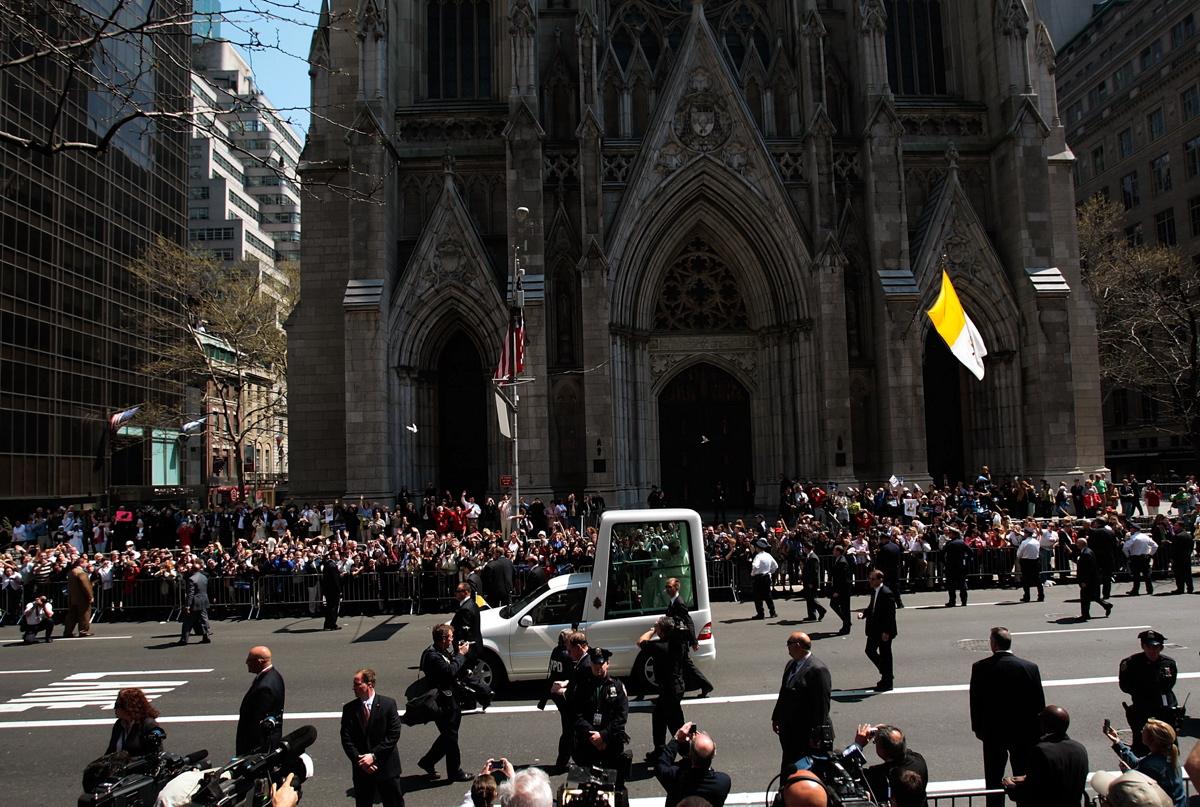
Pope Benedict XVI came to New York for three days, two nights (April 18-20), arriving in Manhattan on a military helicopter and breaking the apparently holy tradition of visiting New York in the early Fall. (Still would have needed a light sweater or vestment.) But Benedict, as the cardinal formerly known as Joseph Ratzinger, actually visited the city in that lesser role in 1988, where apparently he was met with protest from gay activists and shunned by some prominent Jewish leaders.
He hit all the “usual” Pope spots — Saint Patricks, the United Nations, Yankee Stadium — but added a couple interesting detours: Park East Synagogue, St Joseph’s Seminary in Yonkers, and the World Trade Center site.
Below: The Pope viewing the World Trade Center site
April 20, 2008 Courtesy MSNBC
Length of his visit: Almost 72 hours
THE FOURTH POPE
Pope Francis’ exhausting itinerary can be found here. He’ll make stops first for evening prayer at Saint Patrick’s Cathedral, then to the residence of the Apostolic nuncio at the United Nations to sleep.
He speaks to the U.N. Assembly in the morning, then down to the National September 11 Memorial & Museum by lunchtime.
Perhaps the most intriguing stop will come in the afternoon, meeting with students from Our Lady Queen of Angels School in East Harlem. Whereas the first Pope to come New York fifty years rode through East Harlem in his covered Pope-mobile, Pope Francis will chat with a third-grade class filled with children who will have quite a story to tell their grandkids.
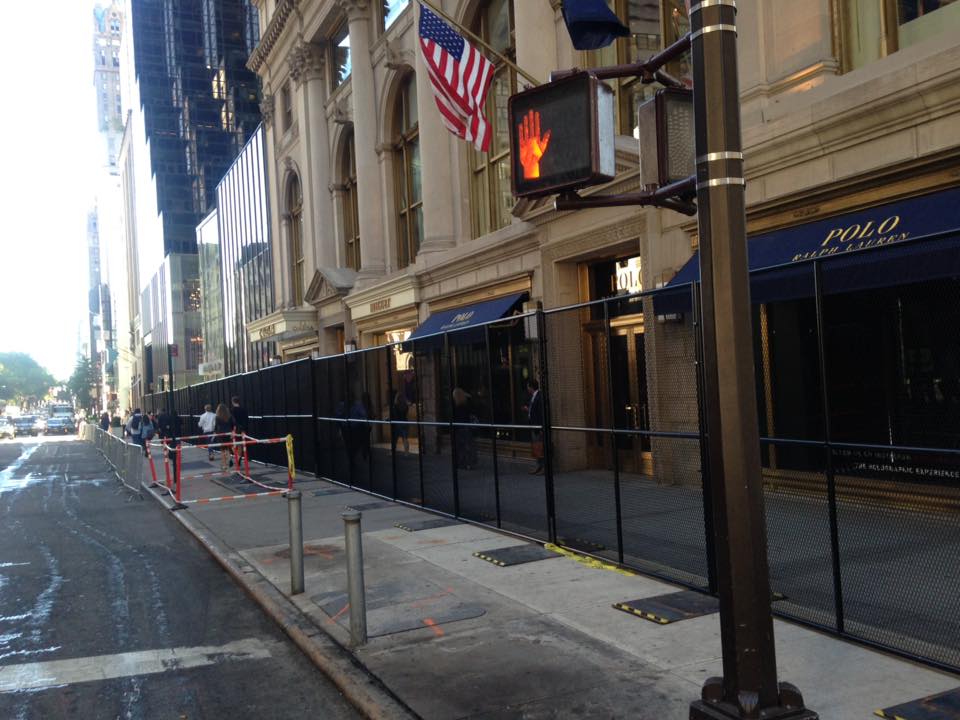
Afterwards he will travel through Central Park and arrive at Madison Square Garden for Mass. At rush hour! Oh right, all the streets are closed. In fact, Fifth Avenue right now is contained in a large fence, easily the tightest security I’ve ever seen here.
But Pope Francis is a man of many surprises. Could he decide that he wants to walk the High Line? And how can he visit New York and not even visit Brooklyn? Is the Pope a Girls fan?
This is a heavily revised version of an article that originally ran in 2008 when Pope Benedict visited New York City.
PODCASTThe tale behind the brutal murder of renown architect Stanford White on the roof garden of Madison Square Garden, the building that was one of his greatest achievements.
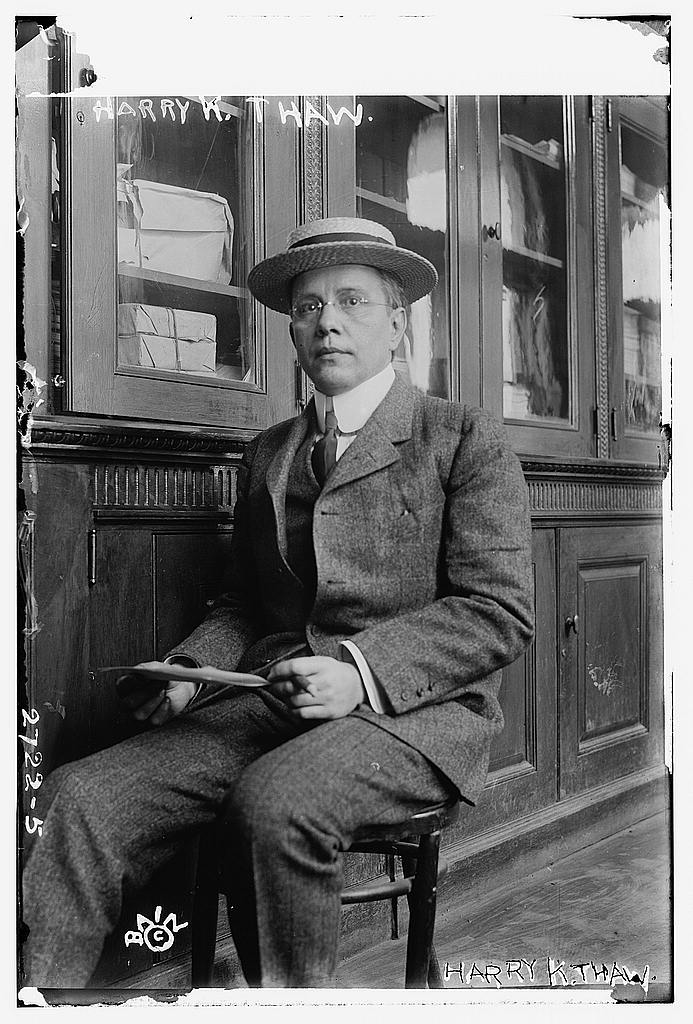
On the evening of June 25, 1906, during a performance of Mam’zelle Champagne on the rooftop of Madison Square Garden, the architect Stanford White was brutally murdered by Harry Kendall Thaw. The renown of White’s professional career — he was one of New York’s leading social figures — and the public nature of the assassination led newspapers to call it the Crime of the Century. But many of the most shocking details would only be revealed in a courtroom, exposing the sexual and moral perversities of some of the city’s wealthiest citizens.
White, as a member of the prestigious firm McKim, Meade and White, was responsible for some of New York’s most iconic structures including Pennsylvania Station, the Washington Square Arch and Madison Square Garden, where he was slain. But his gracious public persona disguised a personal taste for young chorus girls, often seduced at his 24th Street studio, famed for its ‘red velvet swing’.
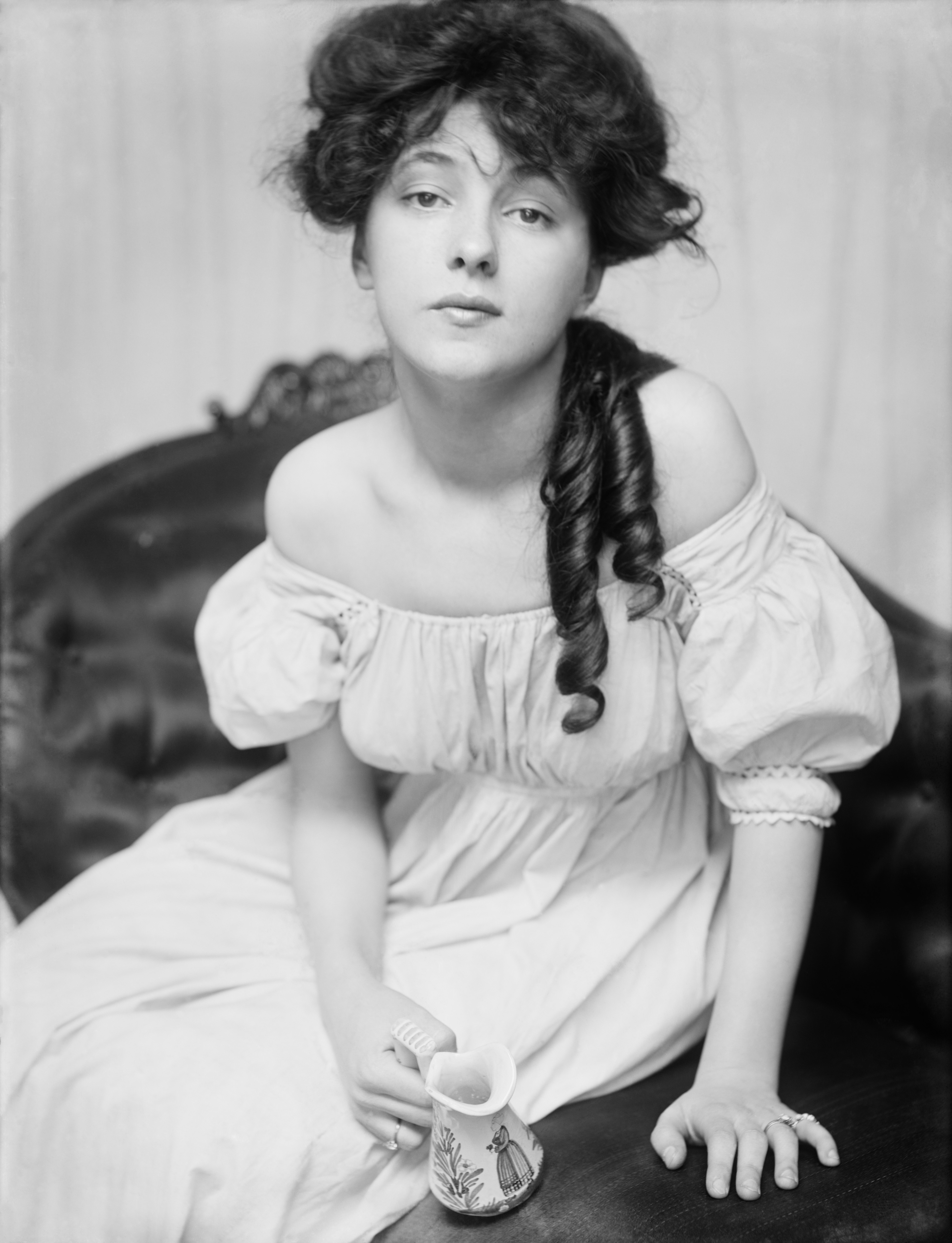
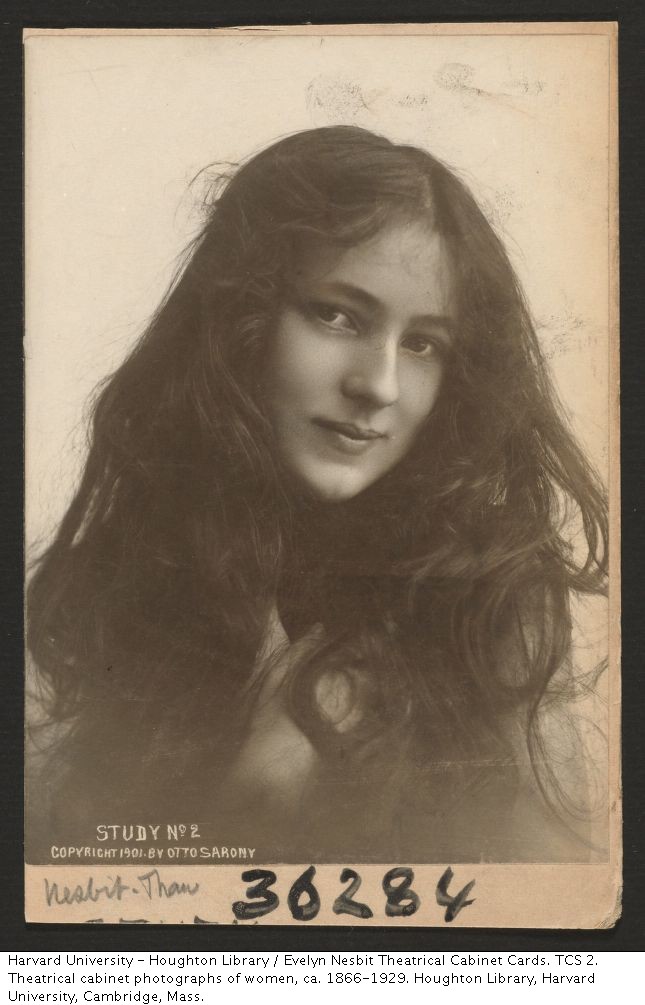
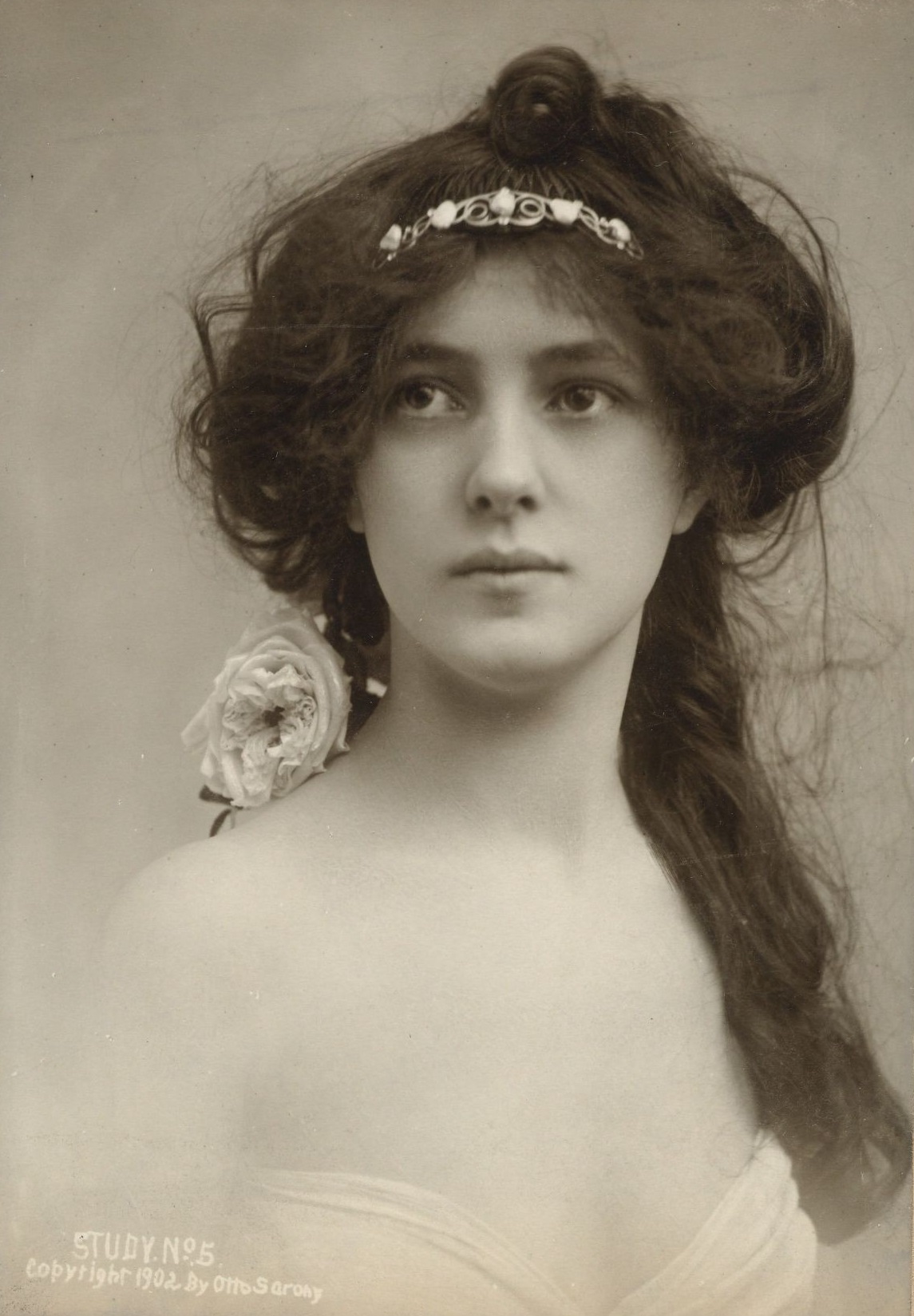
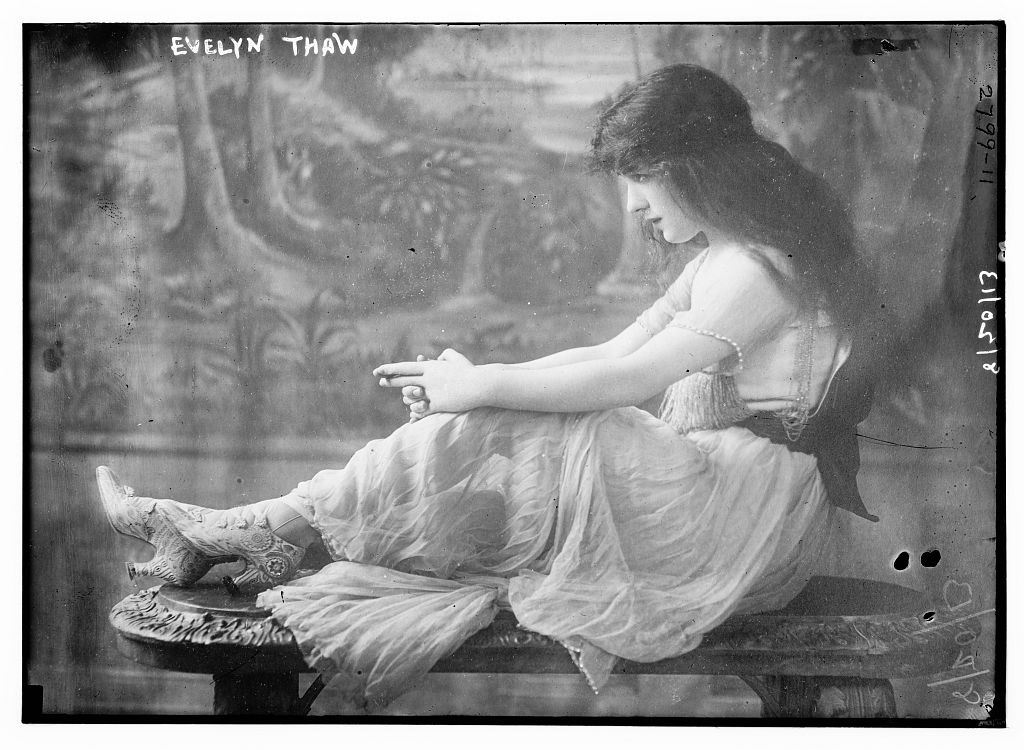
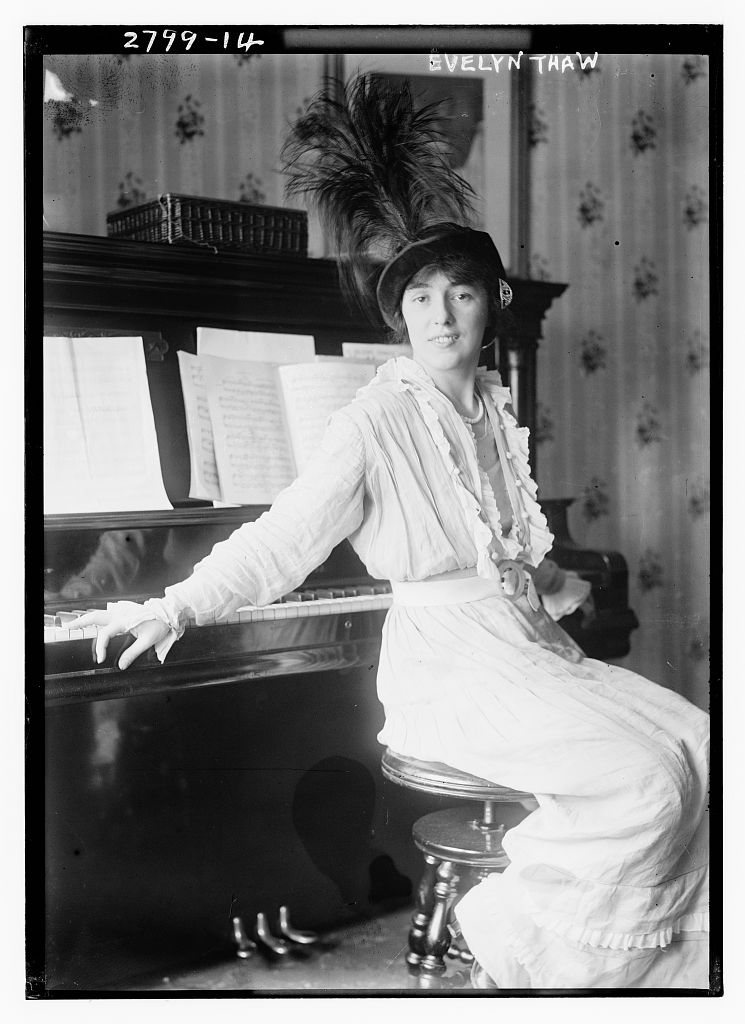
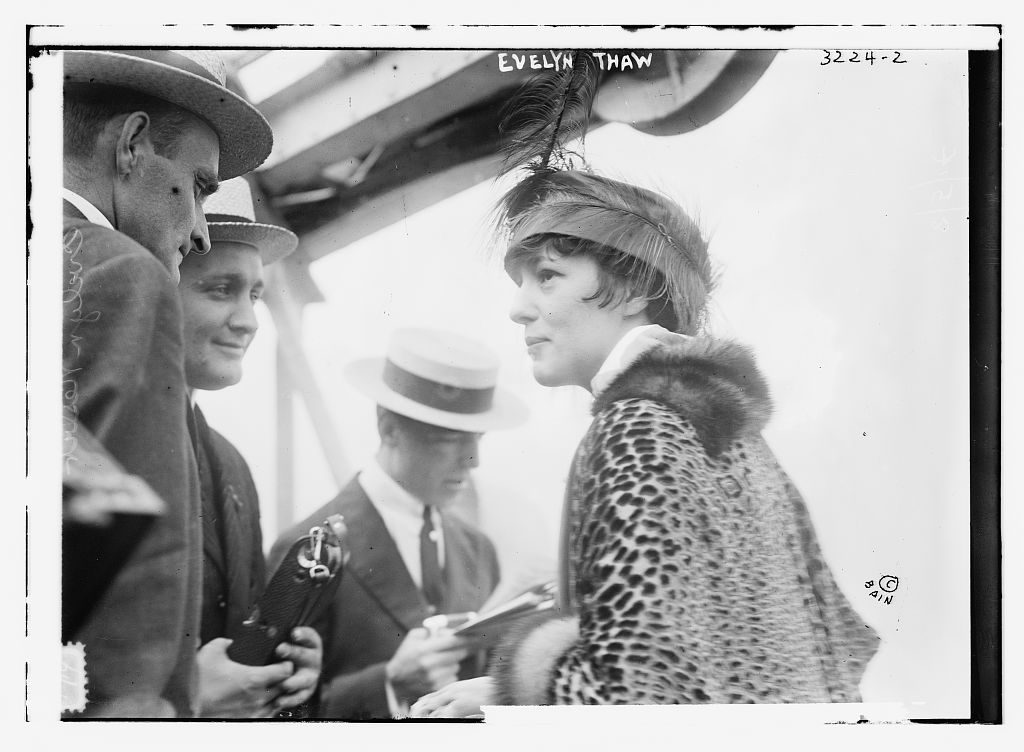
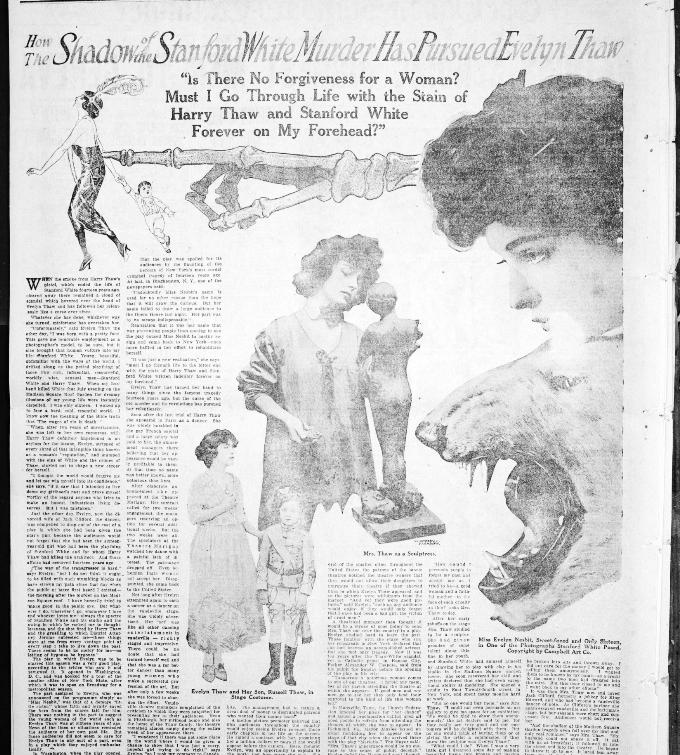
Evelyn Nesbit was only a teenager when she became a popular artist’s model and a cast member in Broadway’s hottest musical comedy. White wooed her with the trappings of luxury and subsequently took advantage of her. The wealthy playboy Harry Thaw also fell for Nesbit — and grew insanely jealous of White. Soon his hatred would envelop him, leading to the unfortunate events of that tragic summer night.
The Bowery Boys: New York City History podcast is brought to you …. by you!
We are now producing a new Bowery Boys podcast every two weeks. We’re also looking to improve the show in other ways and expand in other ways as well — through publishing, social media, live events and other forms of media. But we can only do this with your help!
We are now a member of Patreon, a patronage platform where you can support your favorite content creators for as little as a $1 a month.
Please visitour page on Patreon and watch a short video of us recording the show and talking about our expansion plans. If you’d like to help out, there are five different pledge levels (and with clever names too — Mannahatta, New Amsterdam, Five Points, Gilded Age, Jazz Age and Empire State). Check them out and consider being a sponsor.
We greatly appreciate our listeners and readers and thank you for joining us on this journey so far. And the best is yet to come!
THE UNFORTUNATE TRIO
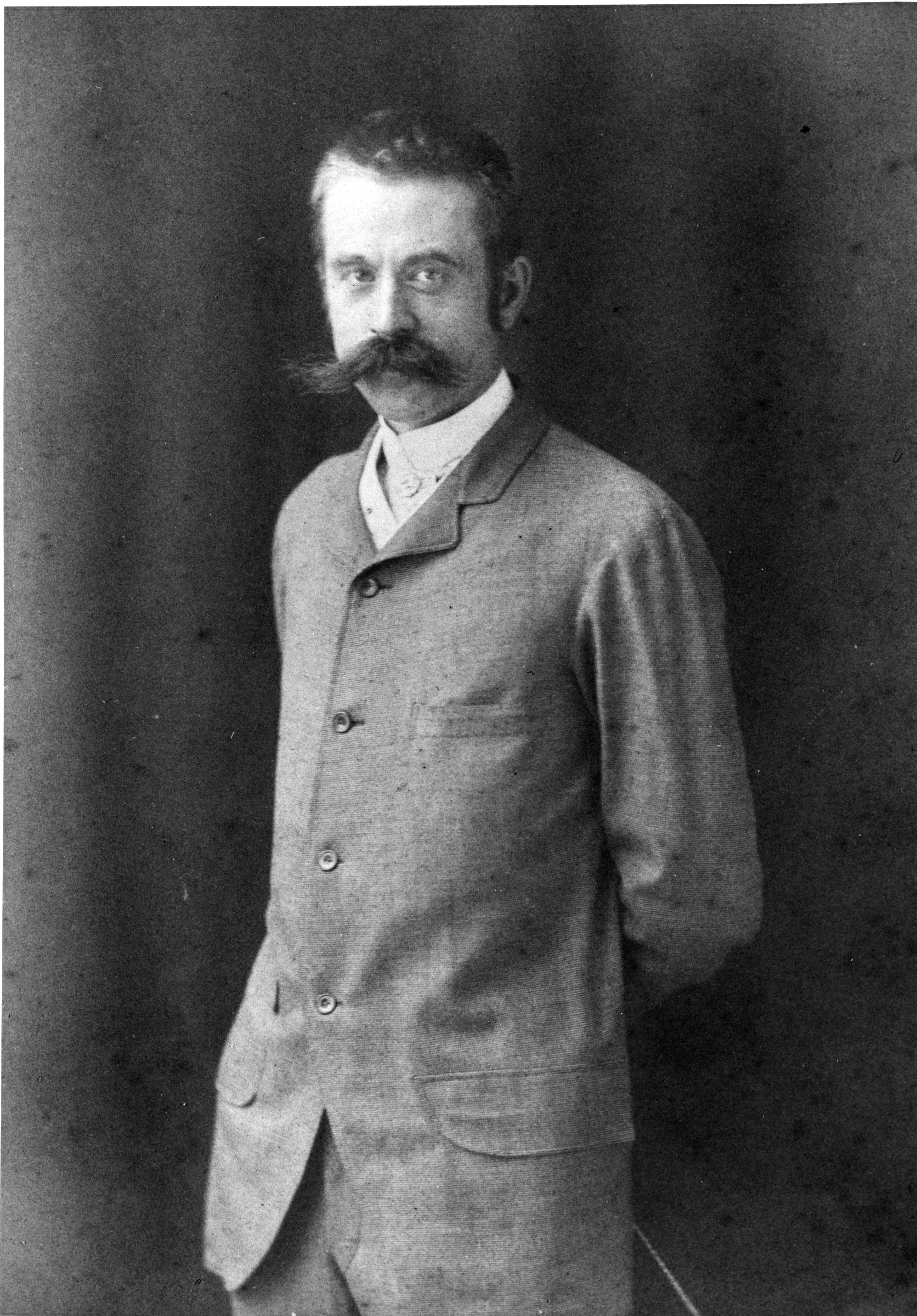
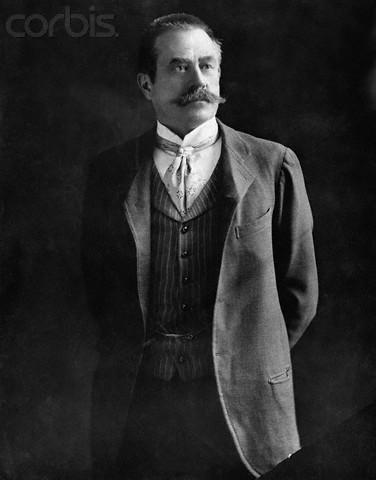
Stanford White
White as a young man (with an enormous mustache!)
Stanford White — date unknown but presumed to be 1906, the year he died.
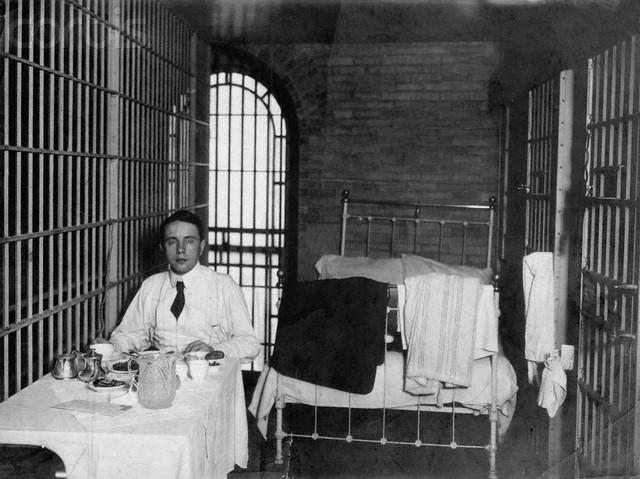
in September 1913, Thaw escaped from the institution to Canada. He was eventually captured and brought back to the states. Here he is in New Hampshire, awaiting transportation back to Matteawan.
Library of Congress
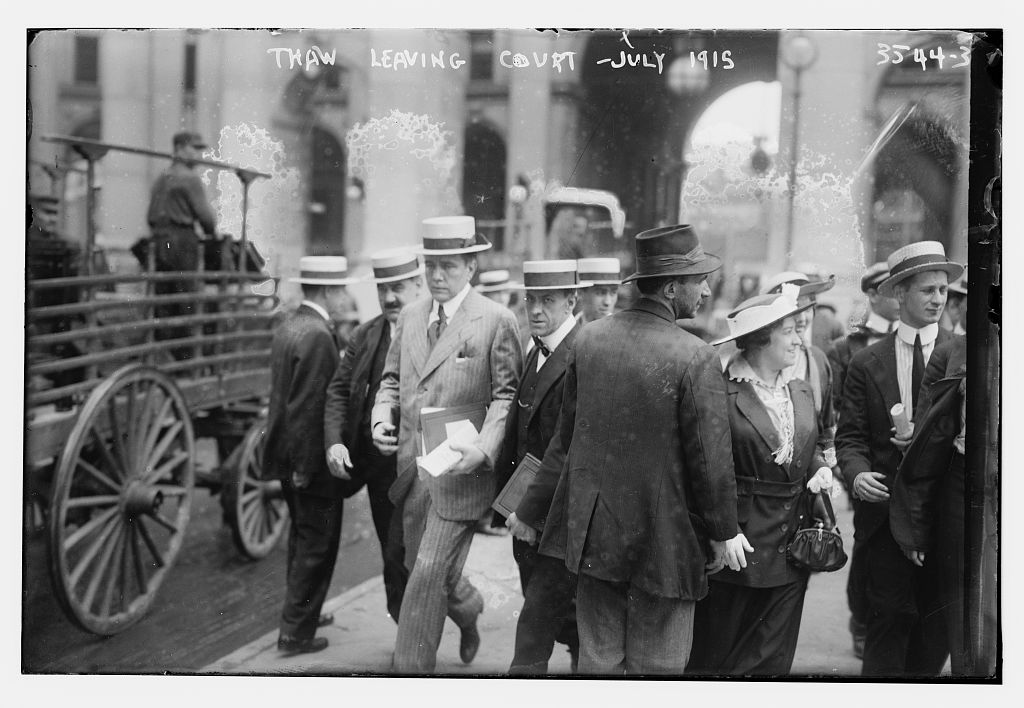
Thaw leaving court in July 1915 after he was declared mentally sane.
Library of Congress
SCENE OF THE CRIME
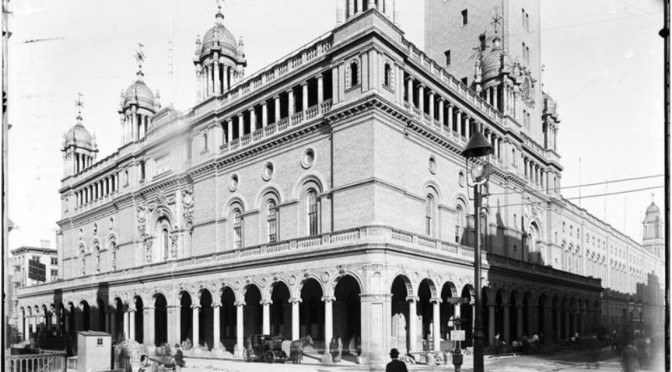
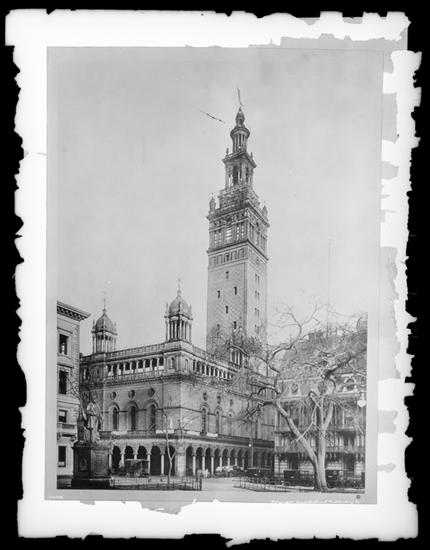
Madison Square Garden, taken in 1905 from inside the park
Museum of the City of New York
The rooftop theater at Madison Square Garden, pictured here circa 1900
Courtesy the Museum of the City of New York
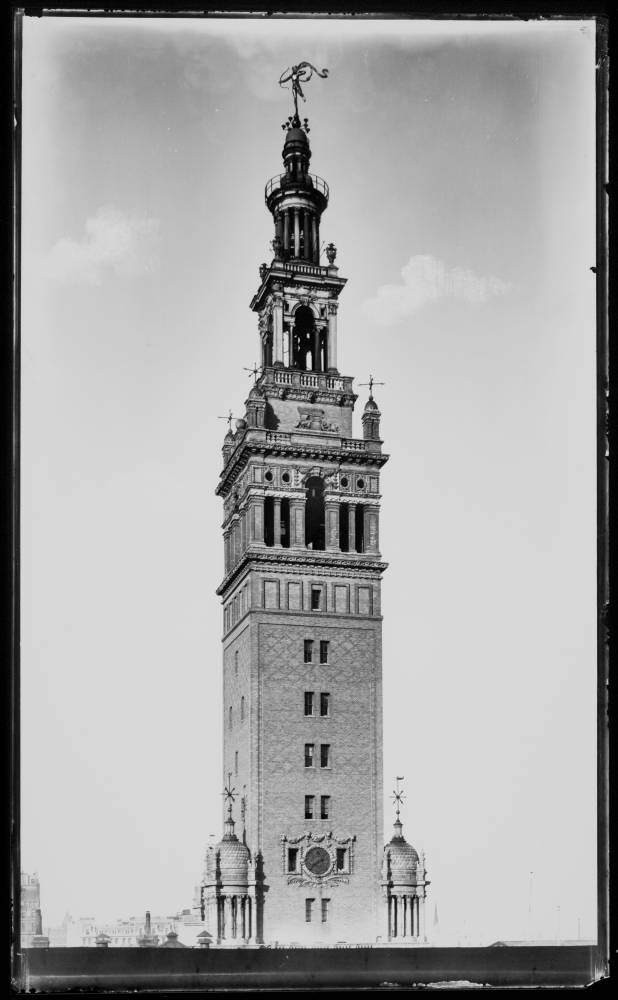
The tower at Madison Square Garden, topped with the scandalous Diana weather vane.
Courtesy George Eastman House
OTHER SETTINGS
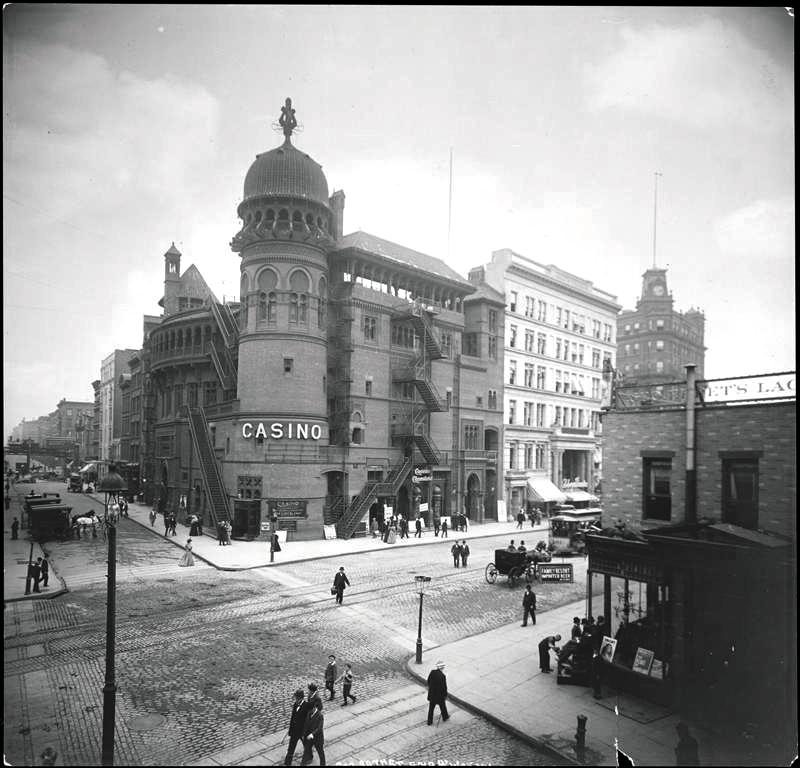
The Casino Theatre, home of the show Florodora, where Evelyn Nesbit was featured, despite her young age
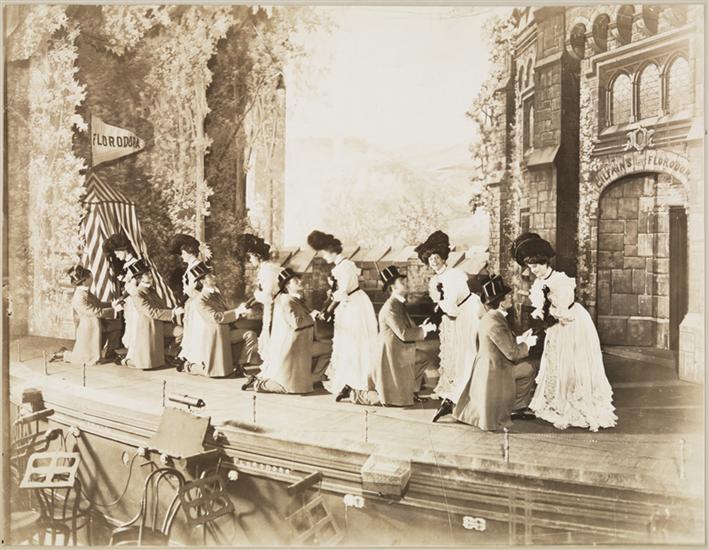
A scene from Florodora in 1900
The former Hotel Lorraine, where Nesbit and Thaw were staying on the night of the murder. The address is 545 Fifth Avenue.
Courtesy Flickr/Anonymous A
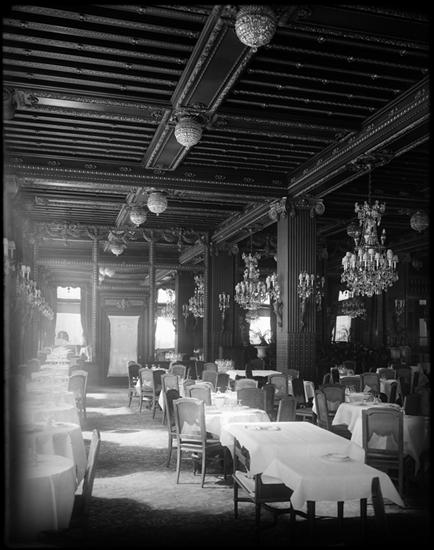
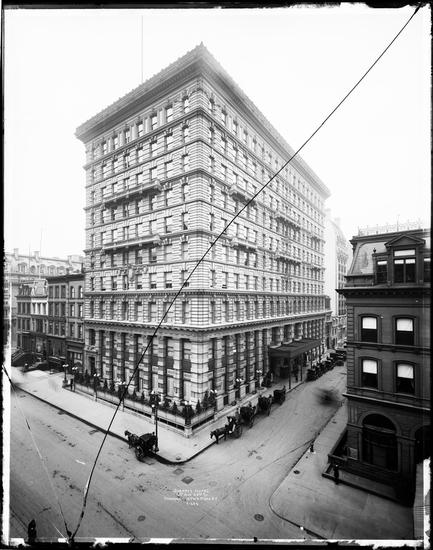
Inside the dining room of Sherry’s Restaurant (44th and 5th Avenue), where Harry Thaw got boozed up before meeting with Evelyn.
Sherry’s in 1905 — 44th Street and 5th Avenue
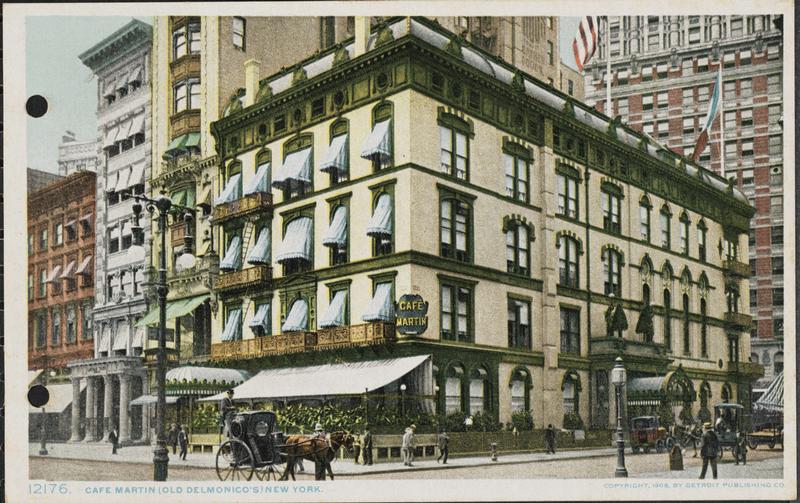
Cafe Martin in 1908, where Evelyn and Harry had dinner before the show
Museum of the City of New York
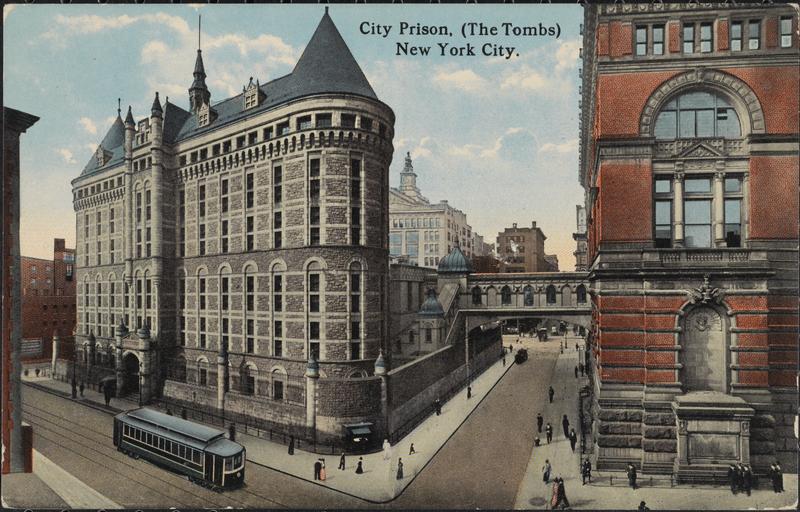
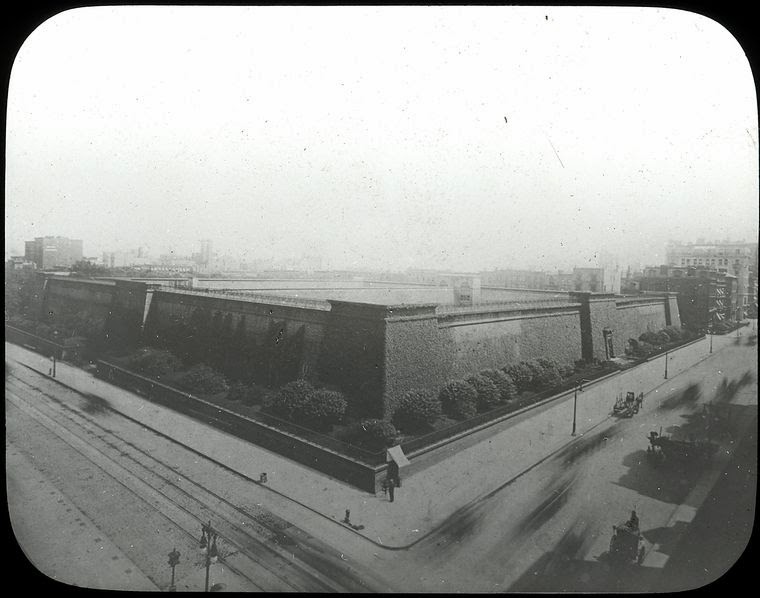
The Tombs — Where Harry Thaw was imprisoned during the original trial
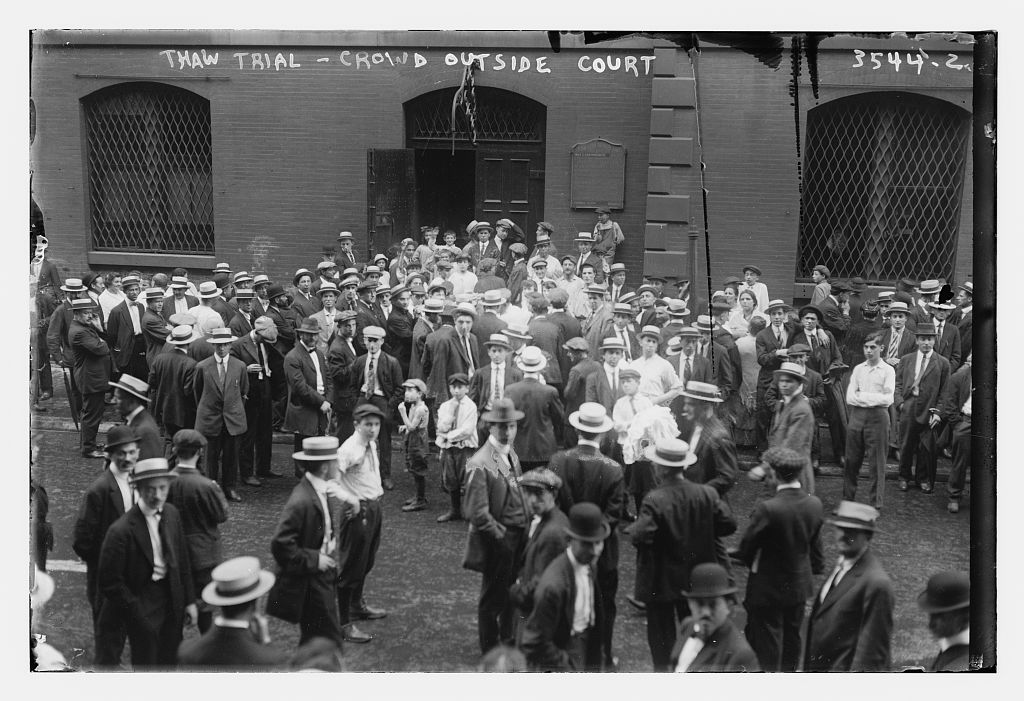
Ludlow Street Jail — Crowds linger outside during the last of the many Thaw trials. For most of his jail time, he was held in the Tombs. According to a Library of Congress commenter: “His lawyers successfully asked the court to move him from The Tombs to the Ludlow Street Jail, on the basis that he was not charged in a criminal matter, but that he was to have a jury trial only as to his present sanity.”
Library of Congress
A 1907 nickelodeon film called The Unwritten Law about the crime.
https://www.youtube.com/watch?v=6rE2WjXqf7U
Newsreel footage from 1915 of Thaw’s release.
Evelyn Nesbit performing in a nightclub in the 1930s (not sure of the club). Start the video at around 2:15:
The trailer to The Girl In The Red Velvet Swing, a highly fictionalized account of the crime. Nesbit was a consultant for the film.
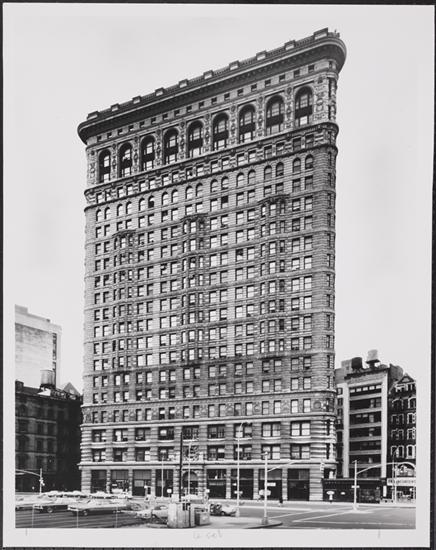
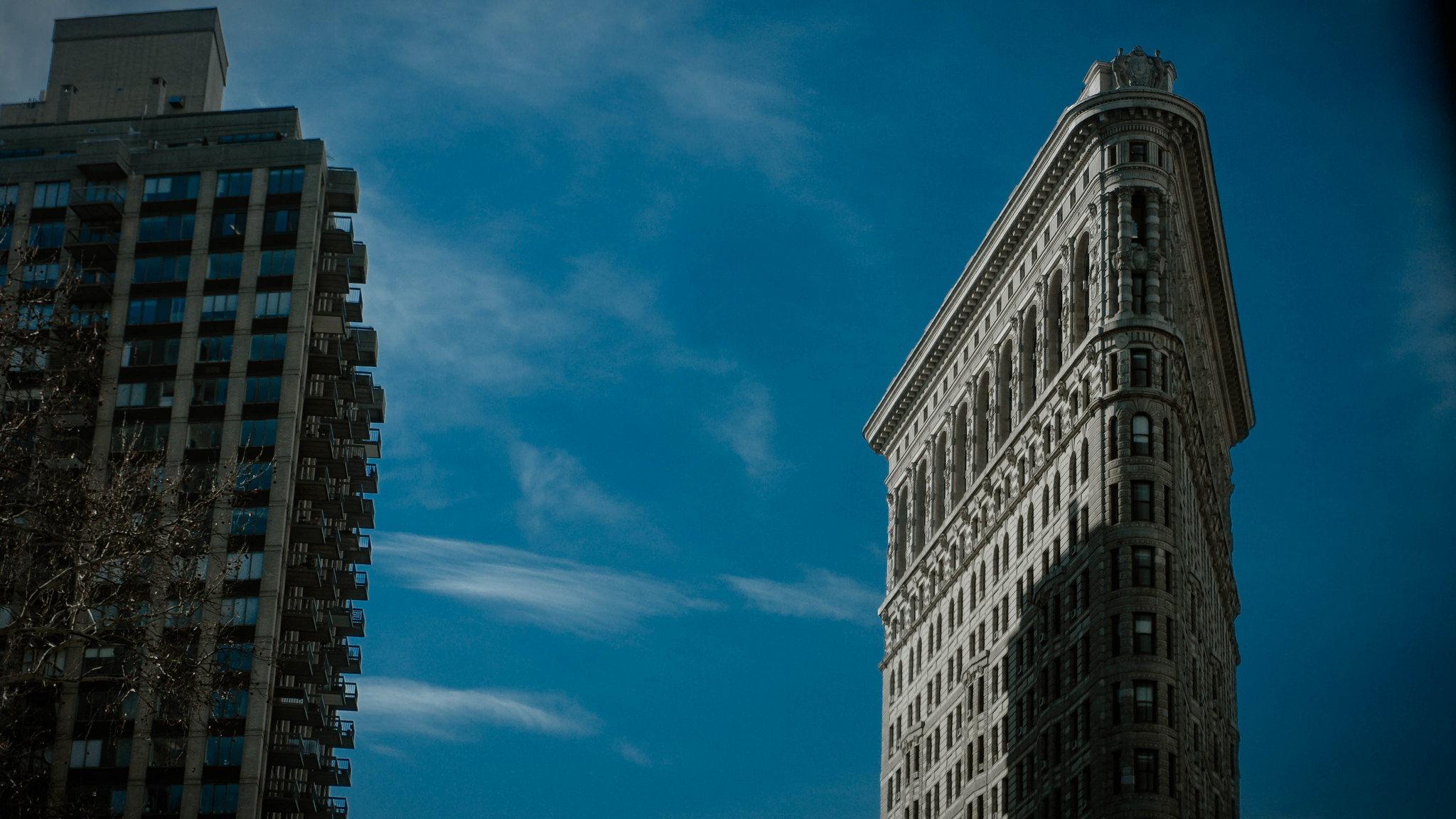
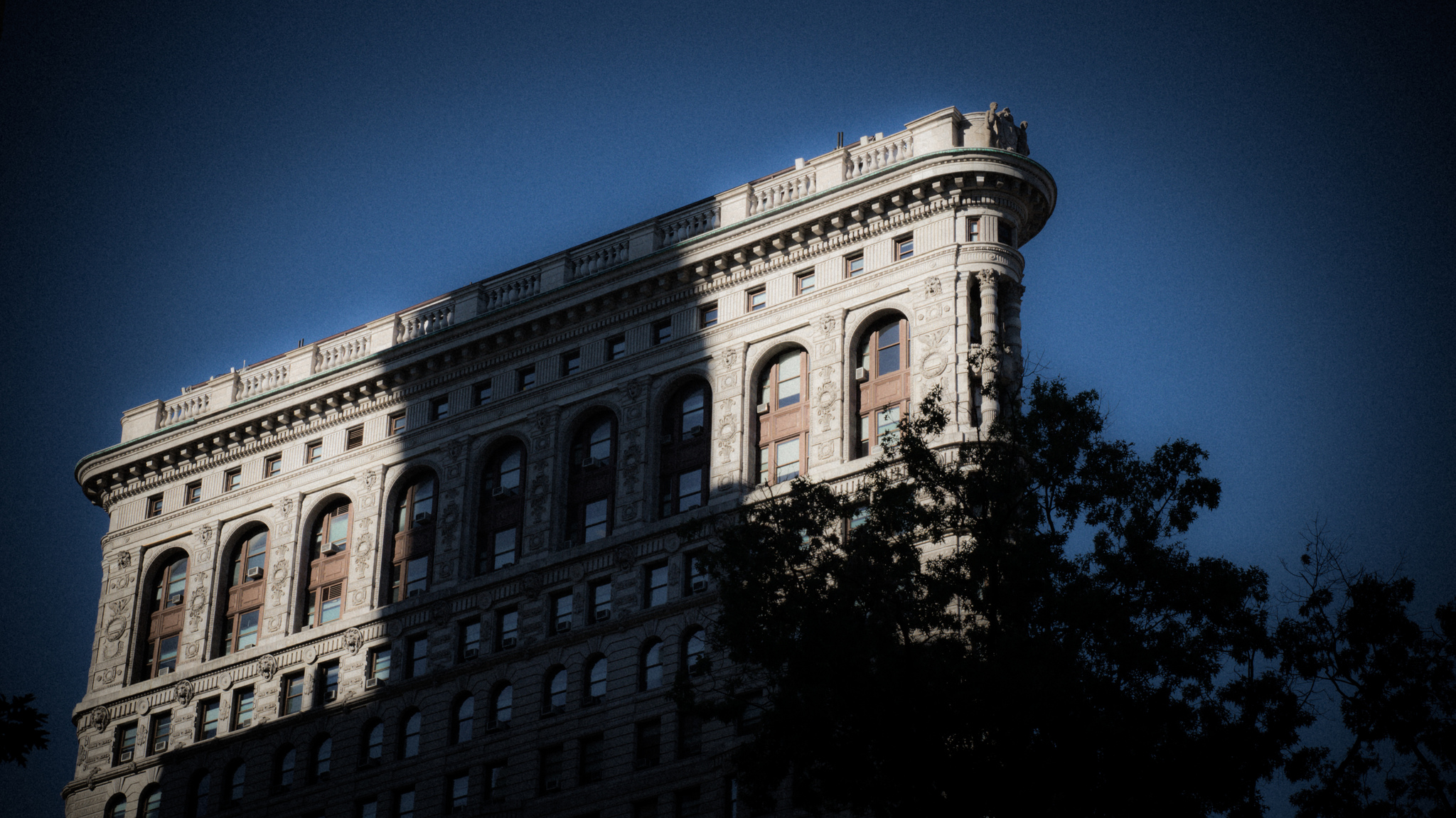
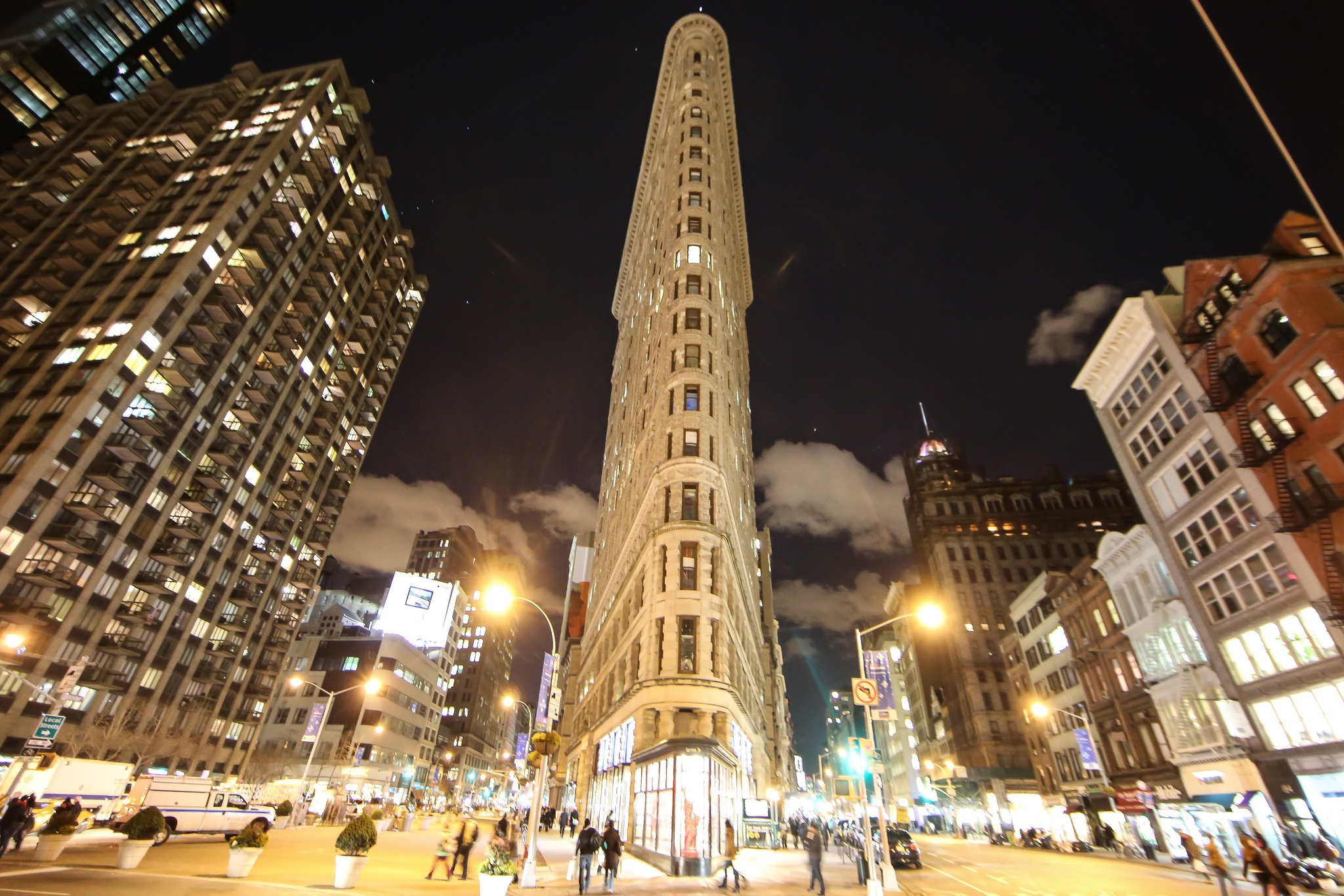
PODCASTFor our 8th anniversary episode, we’re revisiting one of New York City’s great treasures and a true architectural oddity — the Flatiron Building.
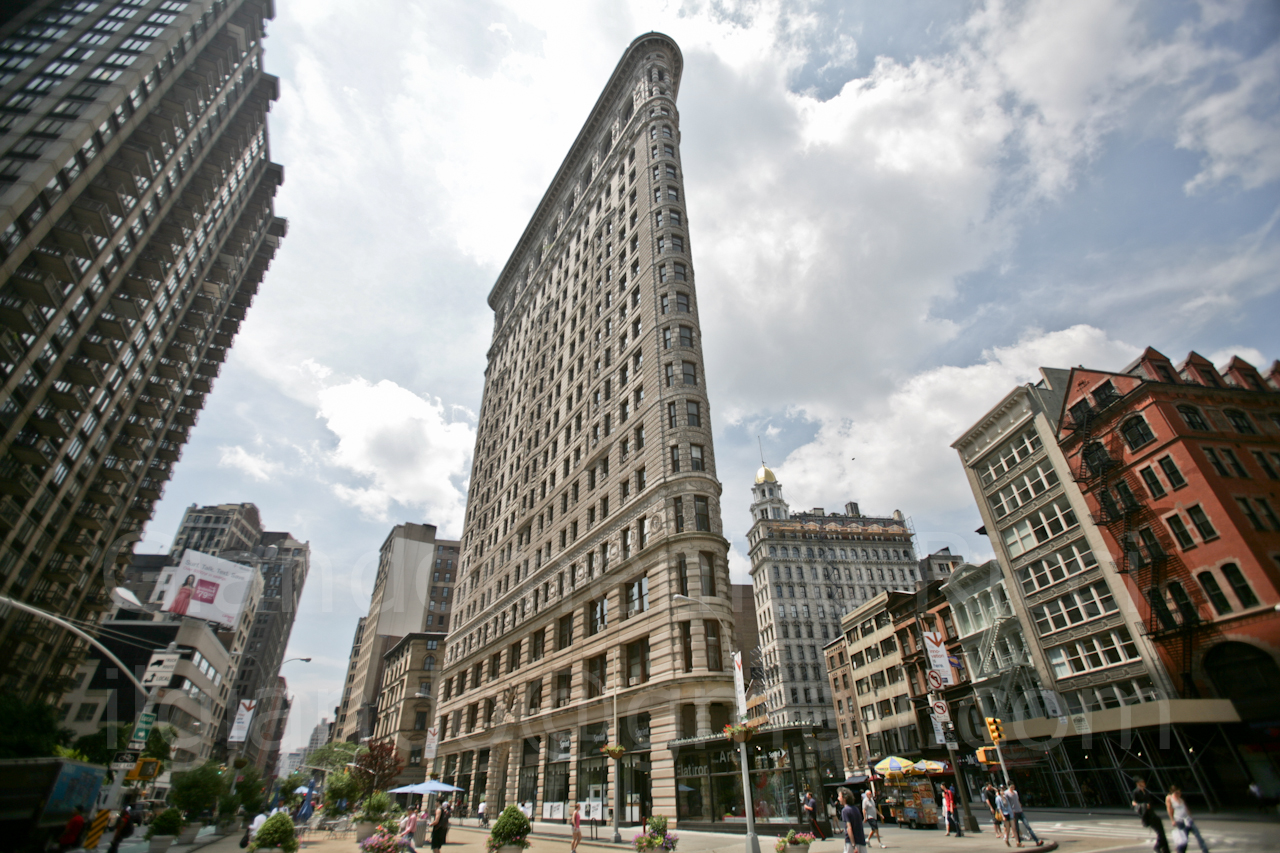
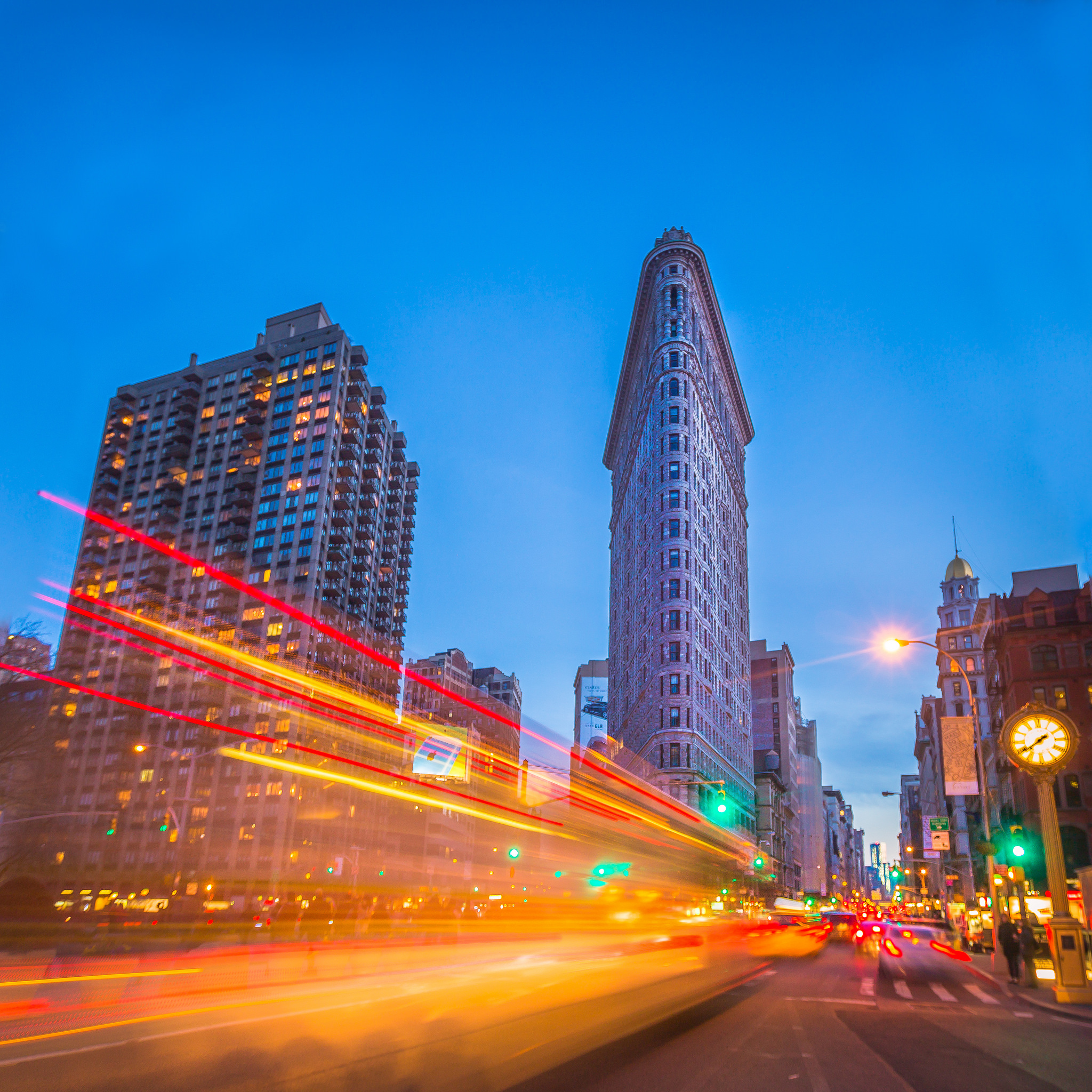
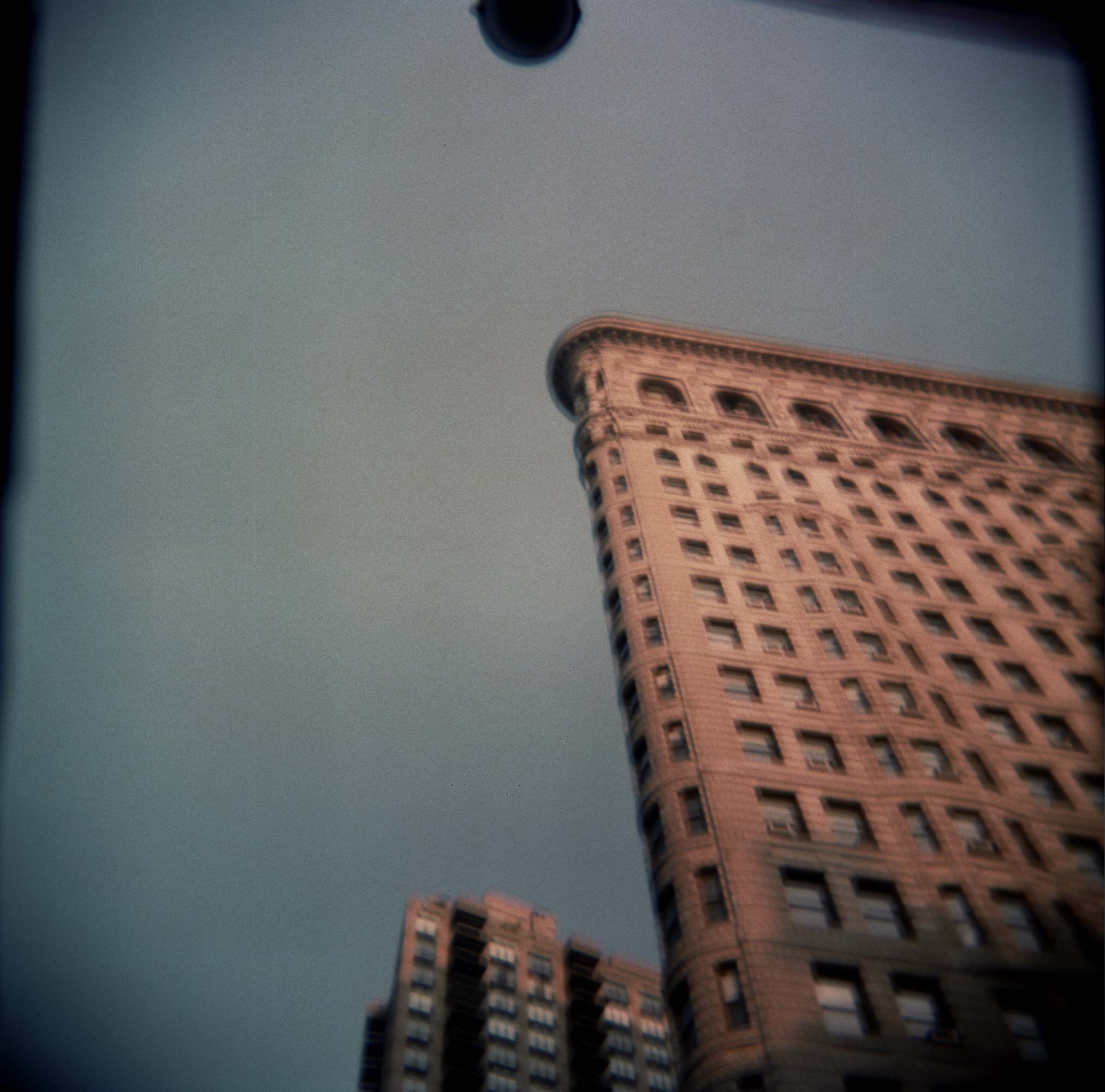
When they built this structure at the corner of Madison Square Park (and completed in 1902), did they realize it would be an architectural icon AND one of the most photographed buildings in New York City?
The George A. Fuller Company, one of the most powerful construction firms in Chicago, decided to locate their new New York office building in a flashy place — a neighborhood with no skyscrapers, on a plot of land that was thin and triangular in shape. They brought in Daniel Burnham, one of America’s greatest architects, to create a one-of-a-kind, three-sided marvel, presenting a romantic silhouette and a myriad of optical illusions.
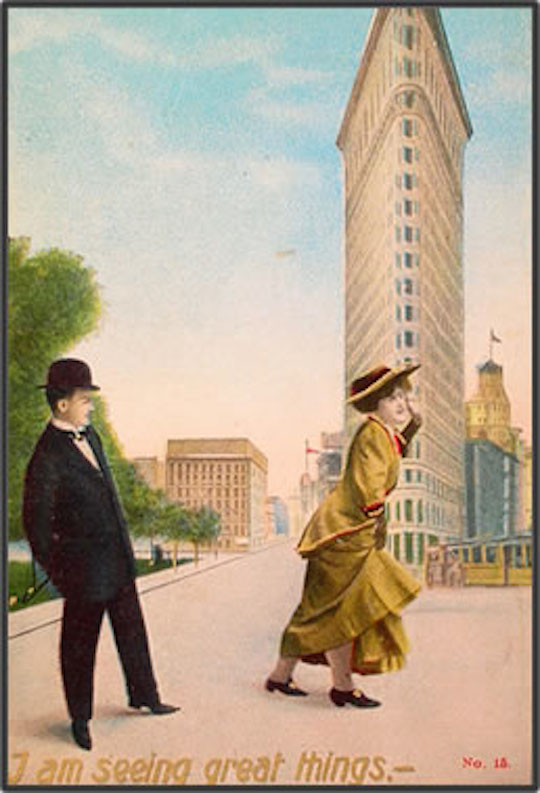
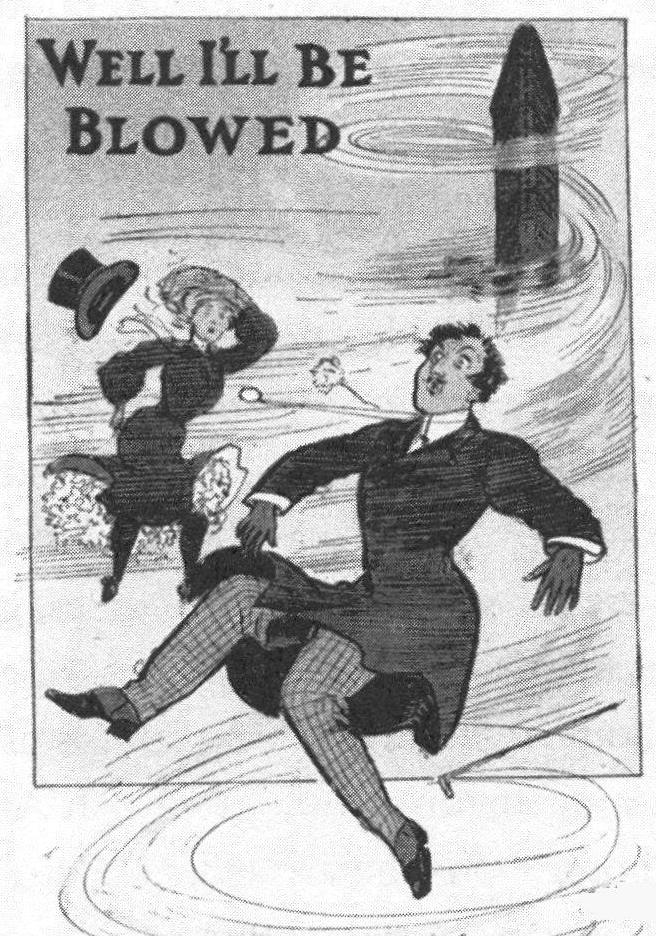
The Flatiron Building was also known for the turbulent winds which sometimes blew out its windows and tossed up the skirts of women strolling to Ladies Mile. It’s a subject of great art and a symbol of the glamorous side of Manhattan.
In this show, we bring you all sides of this structure’s incredible story.
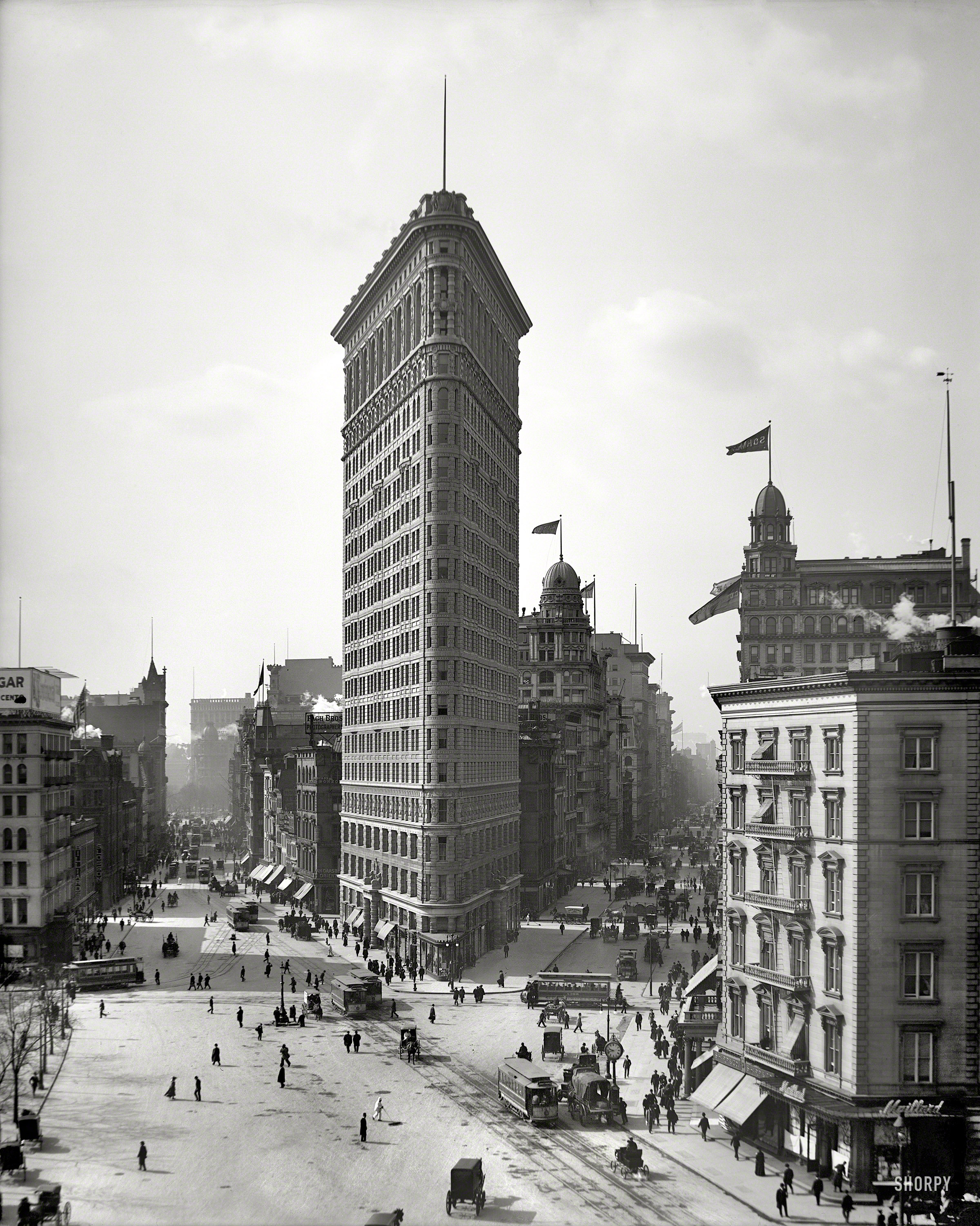
Below: A cleaned up look at the Flatiron Building, courtesy Shorpy. Click here for a look at the details!
Courtesy Shorpy
The Bowery Boys: New York City History podcast is brought to you …. by you!
Starting this month, we are doubling our number of episodes per month. Now you’ll hear a new Bowery Boys podcast every two weeks. We’re also looking to improve the show in other ways and expand in other ways as well — through publishing, social media, live events and other forms of media. But we can only do this with your help!
We are now a member of Patreon, a patronage platform where you can support your favorite content creators for as little as a $1 a month.
Please visitour page on Patreon and watch a short video of us recording the show and talking about our expansion plans. If you’d like to help out, there are five different pledge levels (and with clever names too — Mannahatta, New Amsterdam, Five Points, Gilded Age, Jazz Age and Empire State). Check them out and consider being a sponsor.
We greatly appreciate our listeners and readers and thank you for joining us on this journey so far. And the best is yet to come!
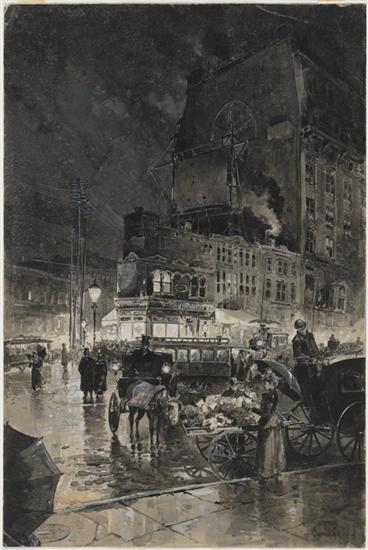
A dramatic illustration of 23rd Street and Fifth Avenue, where the Flatiron Building would soon stand. From here you can see the taller Cumberland building which would be used for billboards.
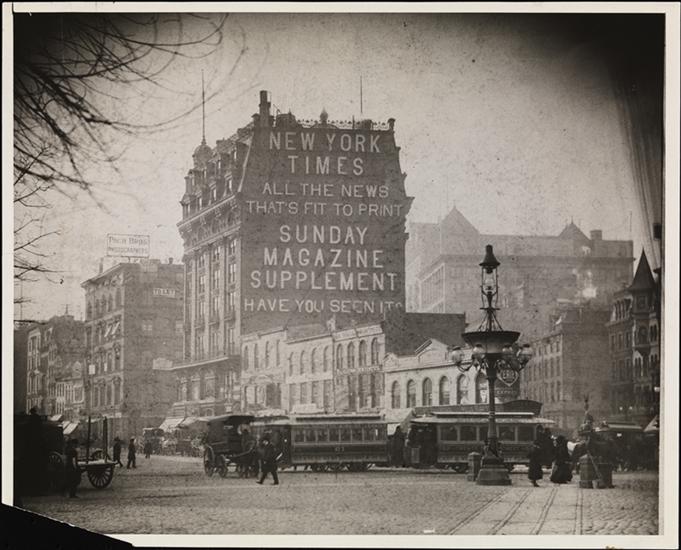
The structures that pre-dated the Flatiron Building, pictured here in 1897.
Courtesy Museum of City of New York
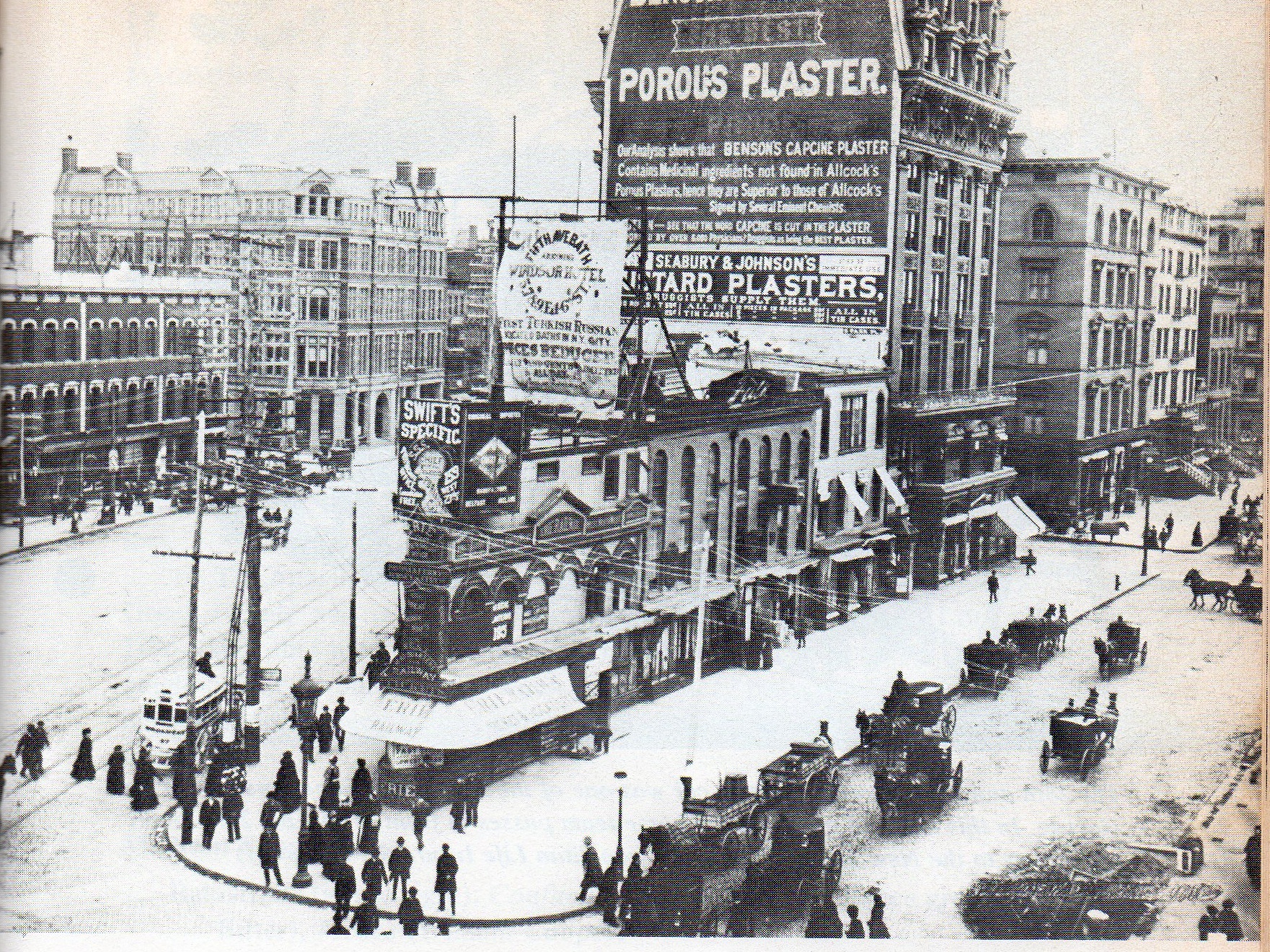
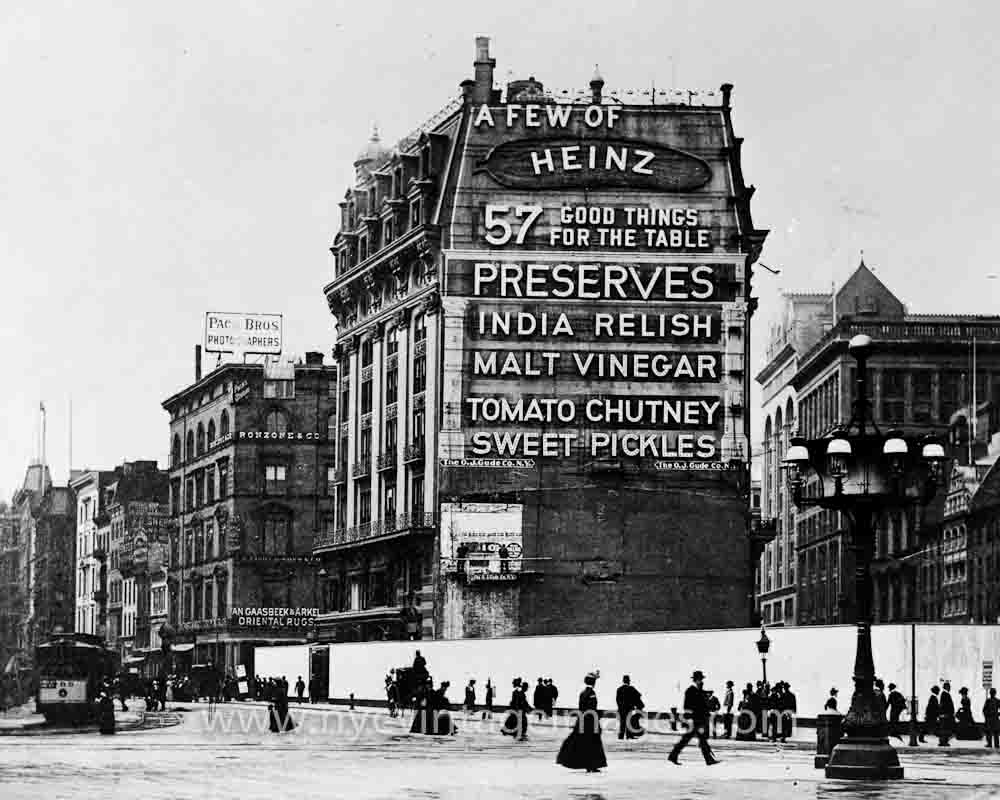
The smaller buildings have already been cleared away for the construction of the Fuller/Flatiron Building, but the taller building remains to some promotion of Heinz products.
Courtesy vintageimages.com
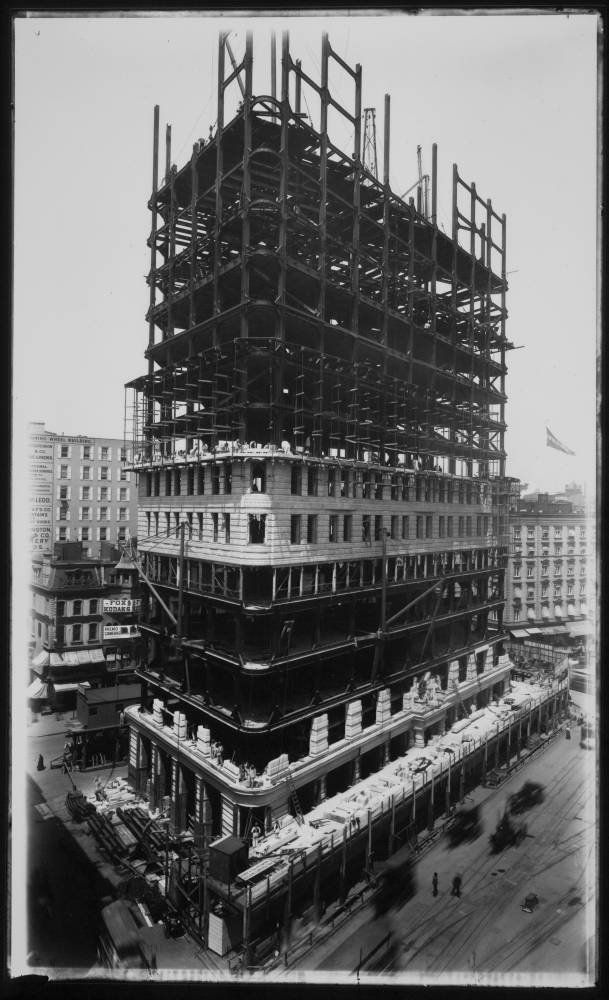
Construction of the Flatiron, picture from late 1901 or early 1902.
Courtesy Library of Congress
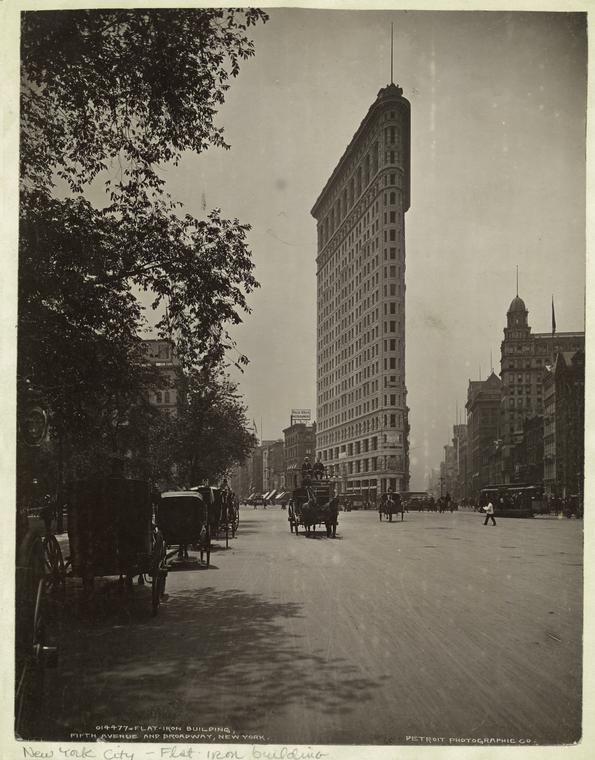
From every angle, the Flatiron takes on a new shape…..
Courtesy New York Public LIbrary
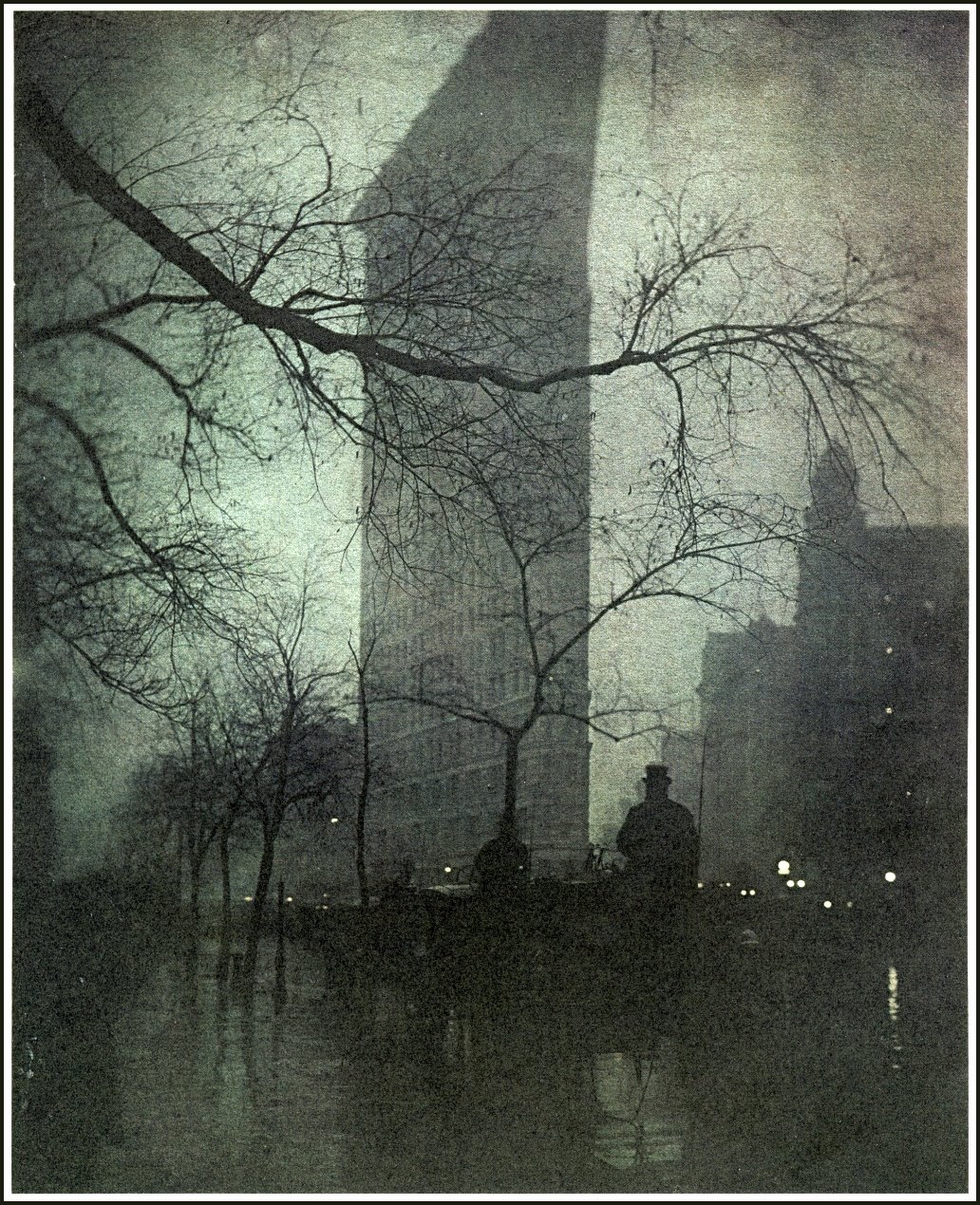
…inspiring artists like Edward Steichen to frame the building in romantic and even mysterious ways (such as his iconic shot from 1904)
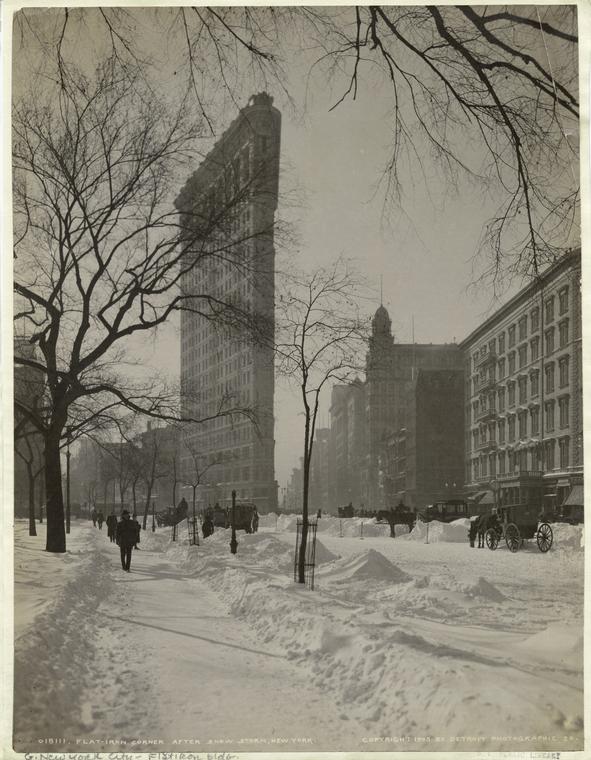
A view, similar to the classic one above, of the Flatiron after a snowstorm in 1905
Courtesy New York Public Library
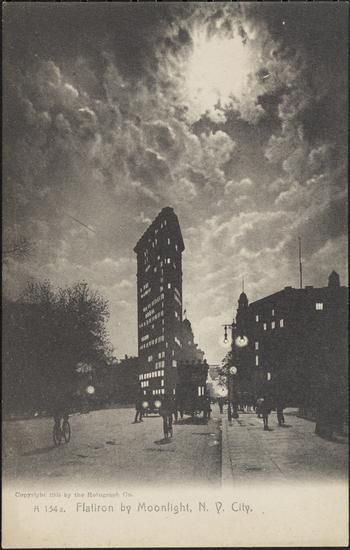
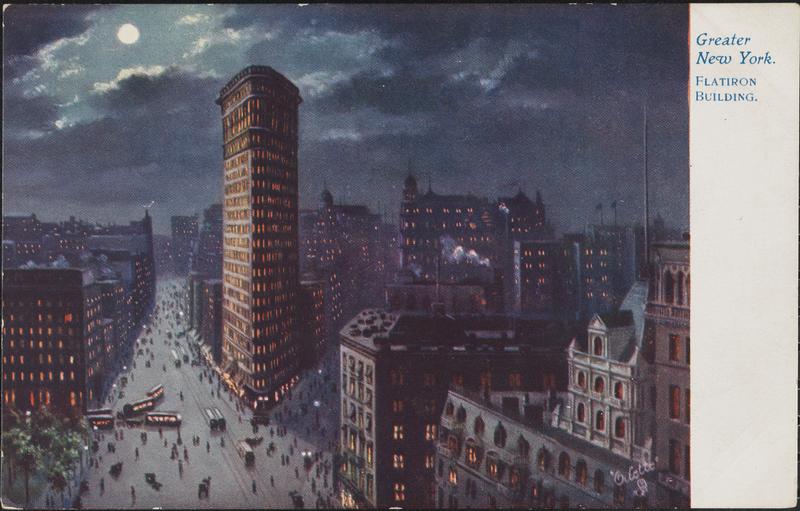
The Flatiron has inspired thousands of photo-mechanical post cards back in the day, highlighting its alluring shape-shifting form upon the changing New  York skyline.
Courtesy Museum of the City of New York
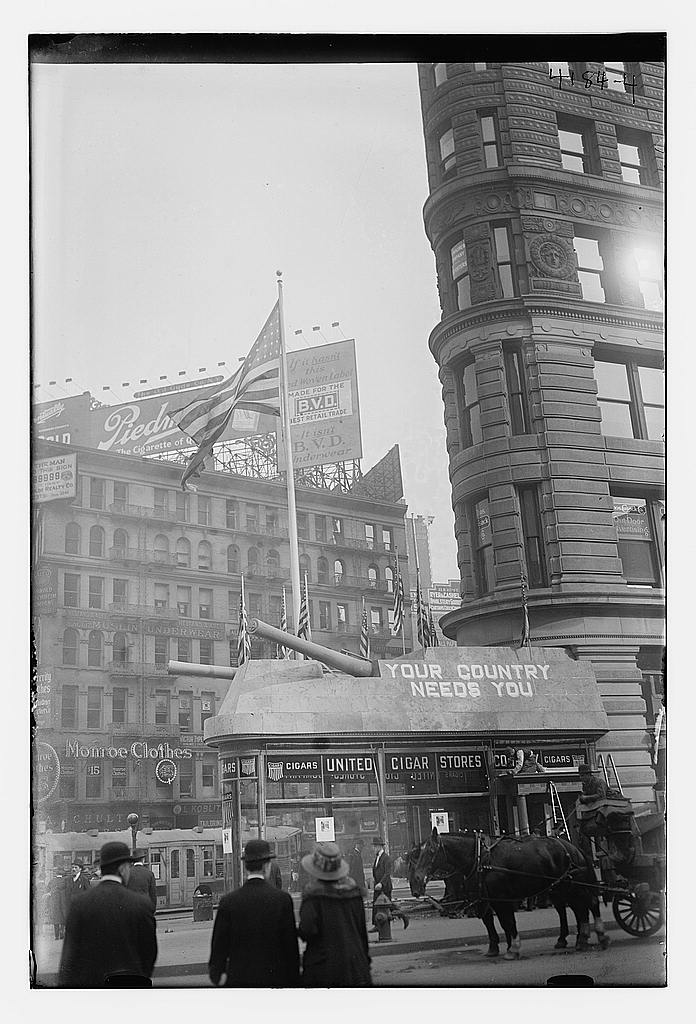
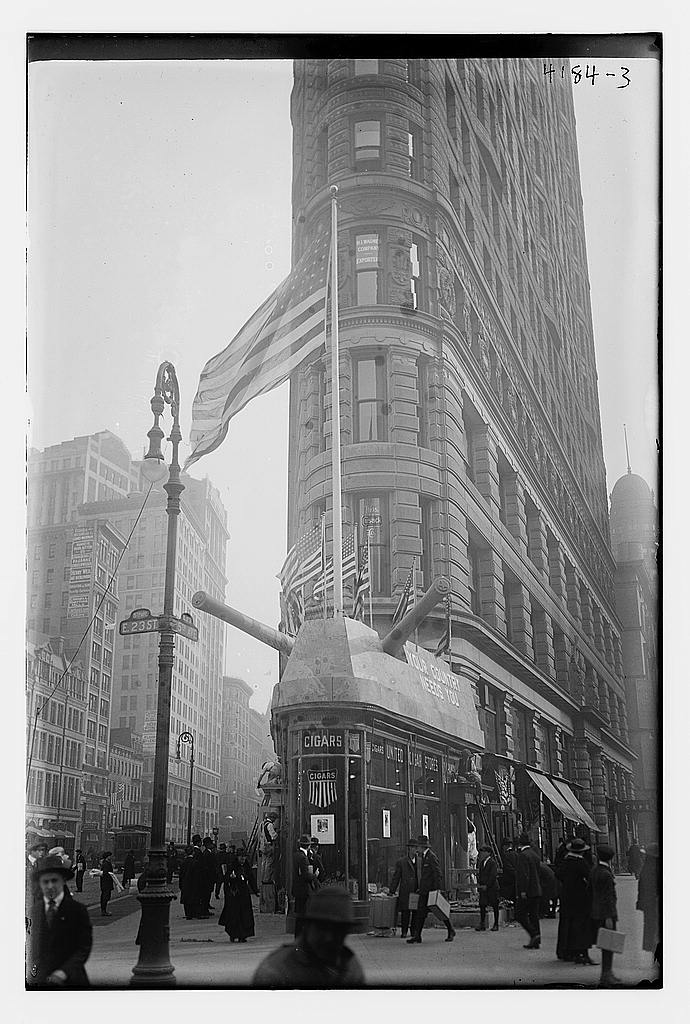
The cigar store in the narrow ‘cowcatcher’ served as a recruitment office during World War I, topped with military weaponry.
Courtesy Library of Congress
Courtesy Library of Congress
Another postcard focused on the Flatiron’s particularly windy properties!
American Mutoscope and Biography Co. filmed this humorous look at ladies in the wind on October 26, 1903:
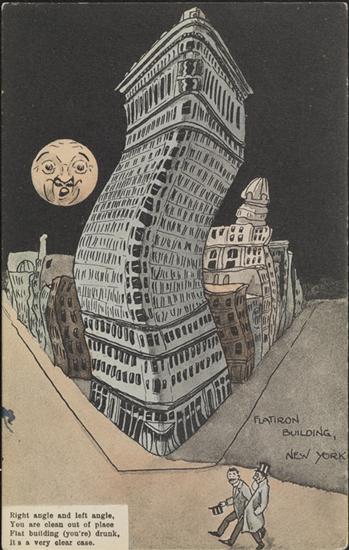
A Max Ettlinger illustration from 1915 — Flatiron, you’re drunk!
Courtesy Museum of City of New York
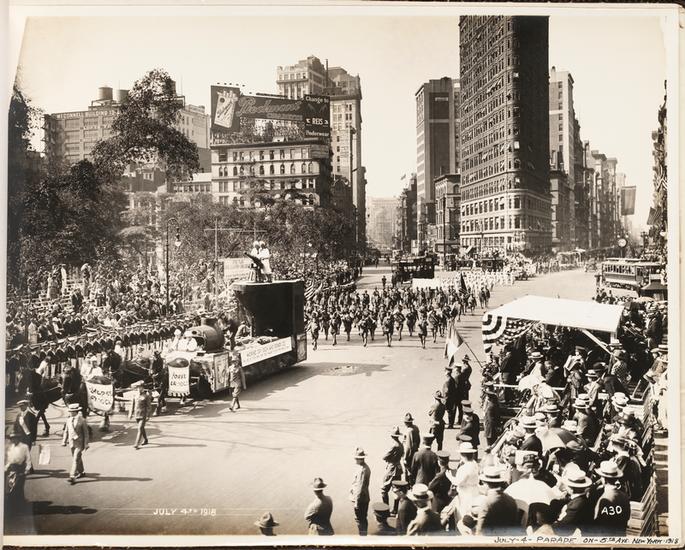
A July 4th parade, passing up Fifth Avenue.
Courtesy Museum of the City of New York
The Flatiron in 1935, from an angle that makes it appear almost two dimensional.
CORRECTION: A small correction to this week’s show. The beautiful Madison Square Garden tower — with the nude Diana statue — is actually in a Spanish style, not an Italian style.
Memorial arches have been a dramatic way to honor military victories, dating back to the Roman times. Naturally, in a city with abundant Beaux-Arts classical-style architecture, New York has erected its share of grand archways. Two spectacular examples exist today — the Washington Square Arch and the Soldiers and Sailors and Sailors Memorial Arch in Brooklyn.
But the area which has been host to the most arches has been Madison Square Park. Sadly the only arches you can find near here are McDonalds Golden Arches on 23rd Street and Madison.
There are been four total arches here, all of them on Fifth Avenue near the park:
The George Washington Arches – 1889
Courtesy the Museum of the City of New York
Two arches celebrating the 100th anniversary of George Washington’s inauguration were on Fifth Avenue — one at 23rd Street at the southern side of the park, and another at 26th Street at the northern side.
These, of course, were accompanied by another arch further down Fifth Avenue at Washington Square Park. That arch, designed by Stanford White, was considerably better received than the Madison Square versions, so much so that White designed a permanent one in 1893.
Below: The 1889 arch up at the northern corner of Fifth Avenue and 26th Street
Courtesy the Museum of the City of New York
Courtesy Museum of the City of New York
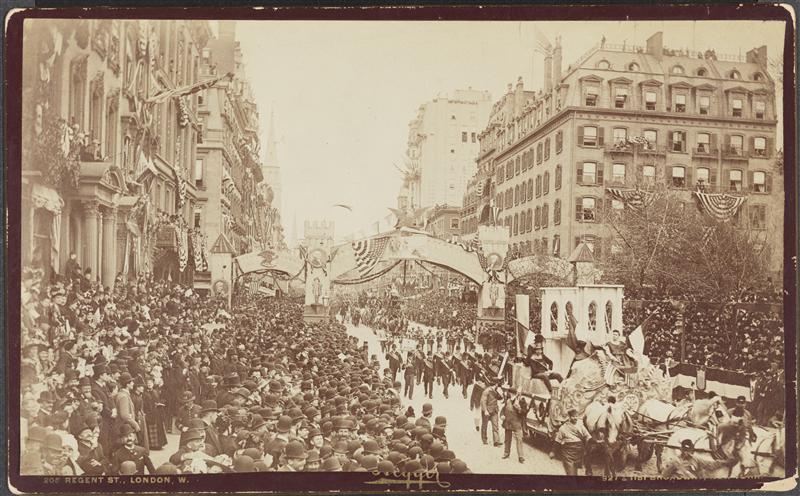
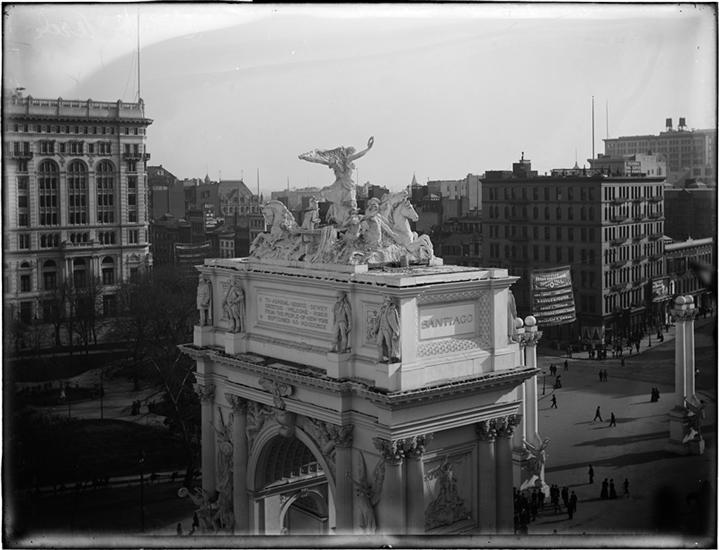
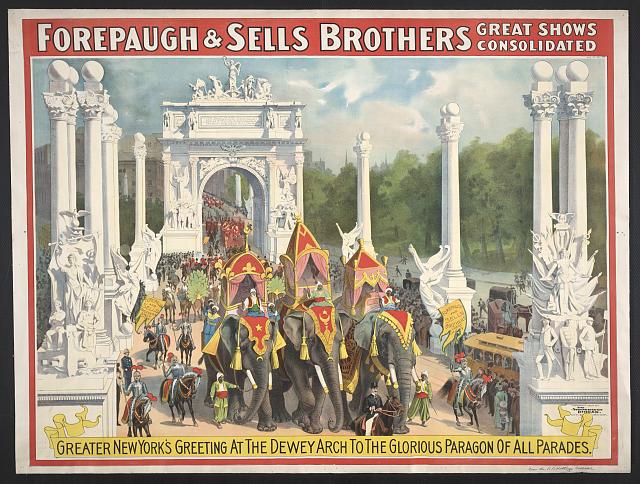
The Dewey Arch – 1899-1900
This ornate and exceptionally lavish structure was built to commemorate a then-recent event — the victory of Admiral George Dewey at the Battle of Manila Bay, which took place on May 1, 1898.
The Dewey Arch was far showier than the earlier arches: “The great triumphal arch to be erected in this city in honor of the return of Admiral Dewey will not only be worthy of the occasion, but will be the most elaborate and artistic structure of its kind ever attempted here or in Europe.” [NYT]
Madison Square Garden, just on the other corner of the park, was closed to construct the statue. For Dewey’s triumphant arrival in New York in late September 1899, the entire city was lit up with ‘fairy lamps‘ to greet the procession. The fireworks display for the event would be the greatest the city has ever seen.
It seems, however, that the Dewey Arch was massively rushed, built in “hot haste“ according to reports. Although a great many petitioned for a permanent Dewey Arch in its place that winter, people had moved on by the winter of 1900 when it was unceremoniously torn down.
Courtesy Library of Congress
Courtesy of Museum of City of New York
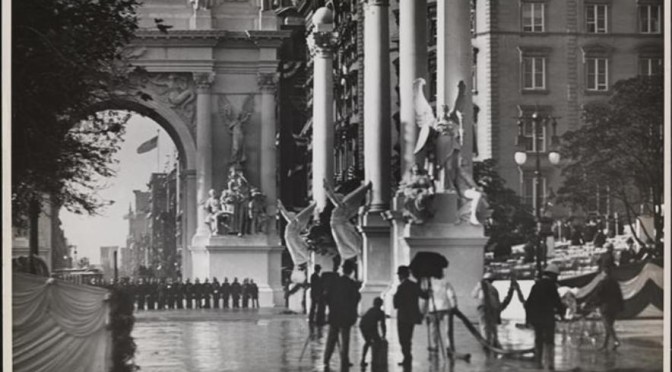
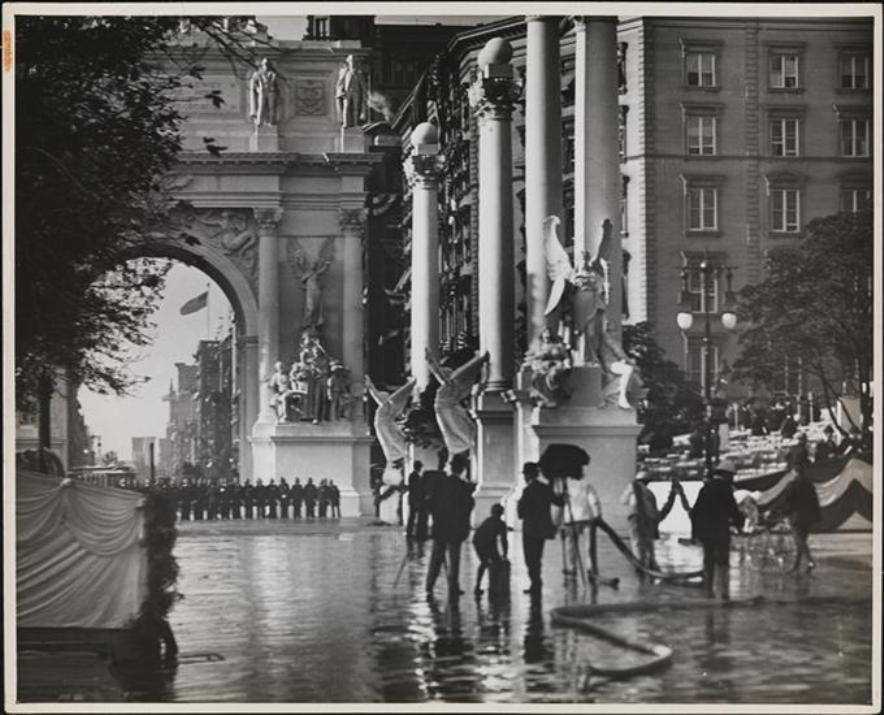
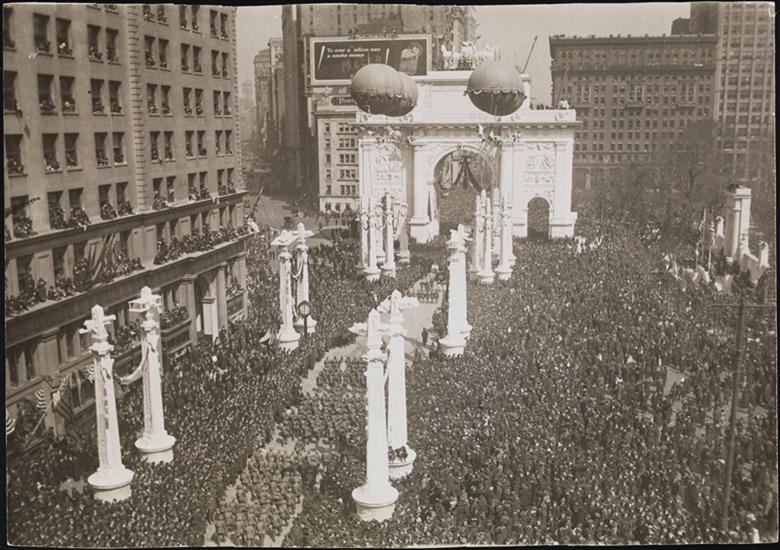
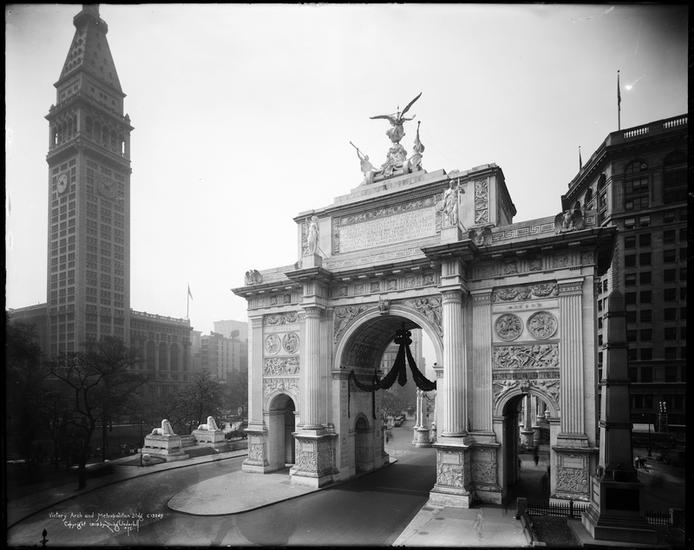
Victory Arch — 1918-20
By 1918, the area around Madison Square Park was quite a transformed place with the Metropolitan Life Insurance Company Tower and the Flatiron Building now in attendance to witness the fourth arch, built to honor those in New York who had died thus far in the battles of World War I.
This arch was equally as ornate as the previous arch occupant, designed by Thomas Hastings (co-architect of the New York Public Library). It was built in wood and plaster and also, apparently, in haste.
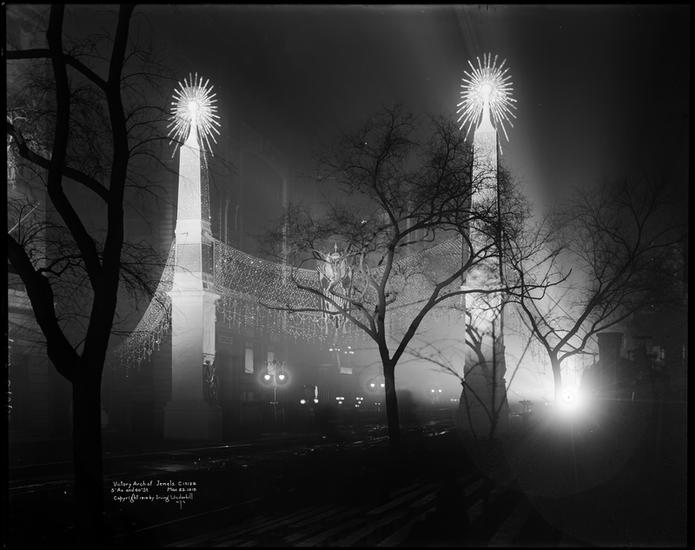
Below: The ‘Altar of Jewels’Â glowing to signal victory
At the completion of the war, It was the focal point of a gigantic parade greeting arriving troops on March 25, 1919, a parade which turned quite rowdy. “The greatest crowd that ever gathered in New York City upon any occasion, and the most difficult to handle,” was how the New York Times described it. “The worst point of disorder was the district around the Victory Arch at Twenty-Third Street, where thousands and thousands fought among themselves or combined against the police in an effort to get a vantage point.” [source]
This arch was not spared either. It was soon villified as an icon of wasteful spending by no less than future mayor Fiorello LaGuardia. “The Altar of Liberty was renamed the “Altar of Extravagance,” the Victory Arch “Wasteful Arch,” and the Altar of Jewels — the “Arch of Folly.”
It was ripped down in the summer of 1920, although the damage to the park would last throughout the year. [source]
New York Fashion Week, the city’s twice-yearly celebration of couture and runway, traces its roots to a 1943 press week event at the Plaza Hotel, organized by publicist Eleanor Lambert.
But there had been a variety of one-off ‘fashion weeks’ or American fashion events in the years between the wars.
In 1934, the Mayfair Mannequin Academy, a local modeling school, even petitionedMayor Fiorello LaGuardia to declare an official New York Fashion Week as a way to encourage American designers who worked in an industry dominated by Paris.
But well before any of those events, New York’s most famous runway show took place on the street — the Sunday promenades along Fifth Avenue.
It was especially robust during Easter with wealthy women trying to outdo each other in latest styles from Europe. Newspapers coveredEaster Sunday with the same fervor as a modern fashion show, noting colors, hem lines, and even the plumage flagrantly bursting from hats.
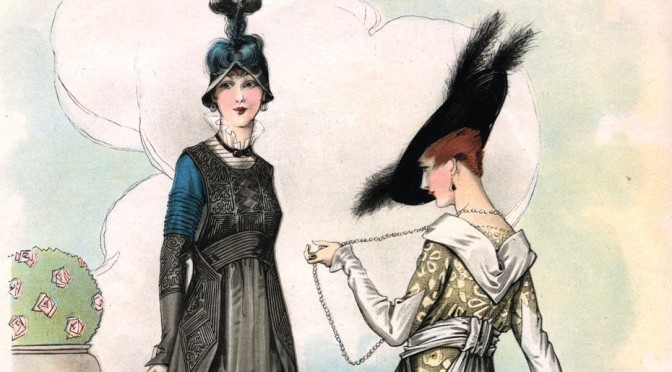
While there was no dedicated ‘fashion week’ one hundred years ago, there was heightened and excited attention to of-the-moment fashion trends. So here’s a little thought experiment — what would an actual Fashion Week in 1915 look like?
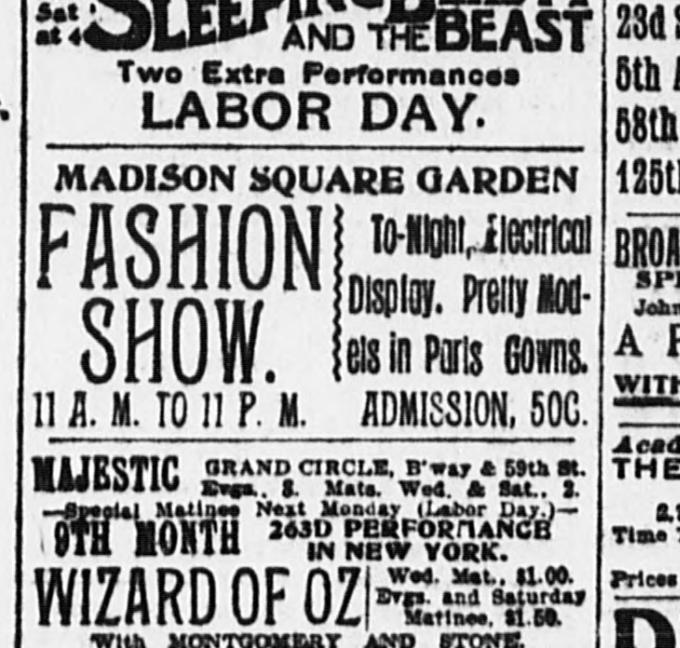
There would in fact be fashion-related events at Madison Square Garden (in its original location off of Madison Square) so let’s put this imaginary Fashion Week there:
from September 4, 1903, New York Evening World
An End to Bondage
Women’s fashion would be affected by the war in Europe in many ways. Â Travel restrictions put an end to the constant flow of fashion queues from Paris. New ideas that were strictly American could begin influencing the way women dressed here.
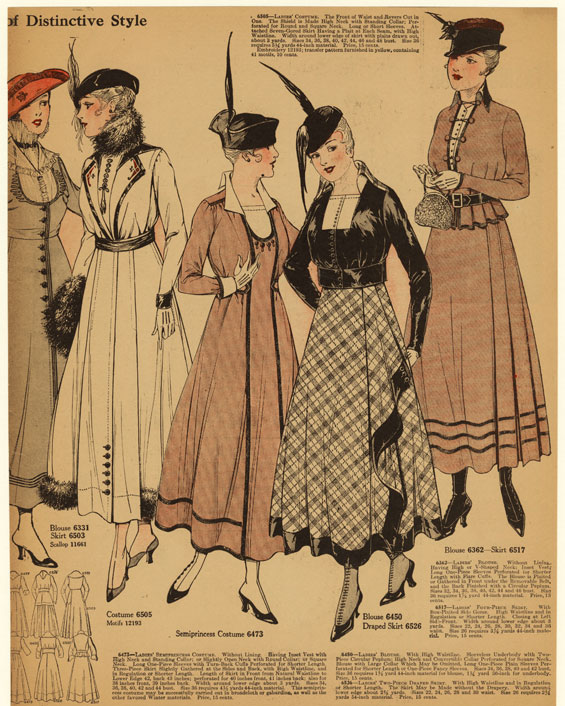
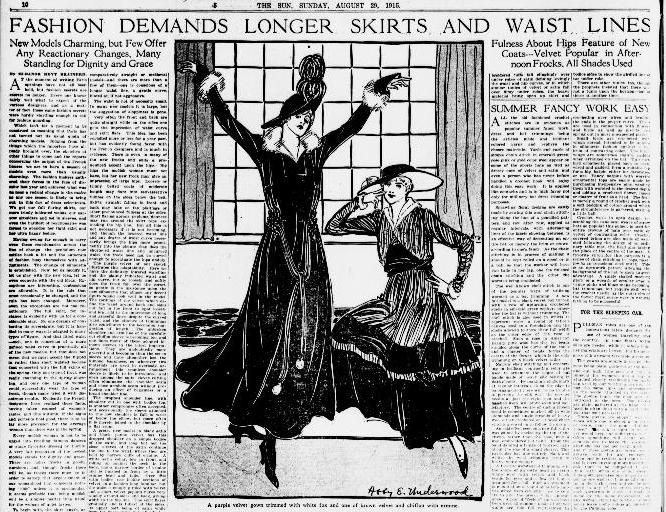
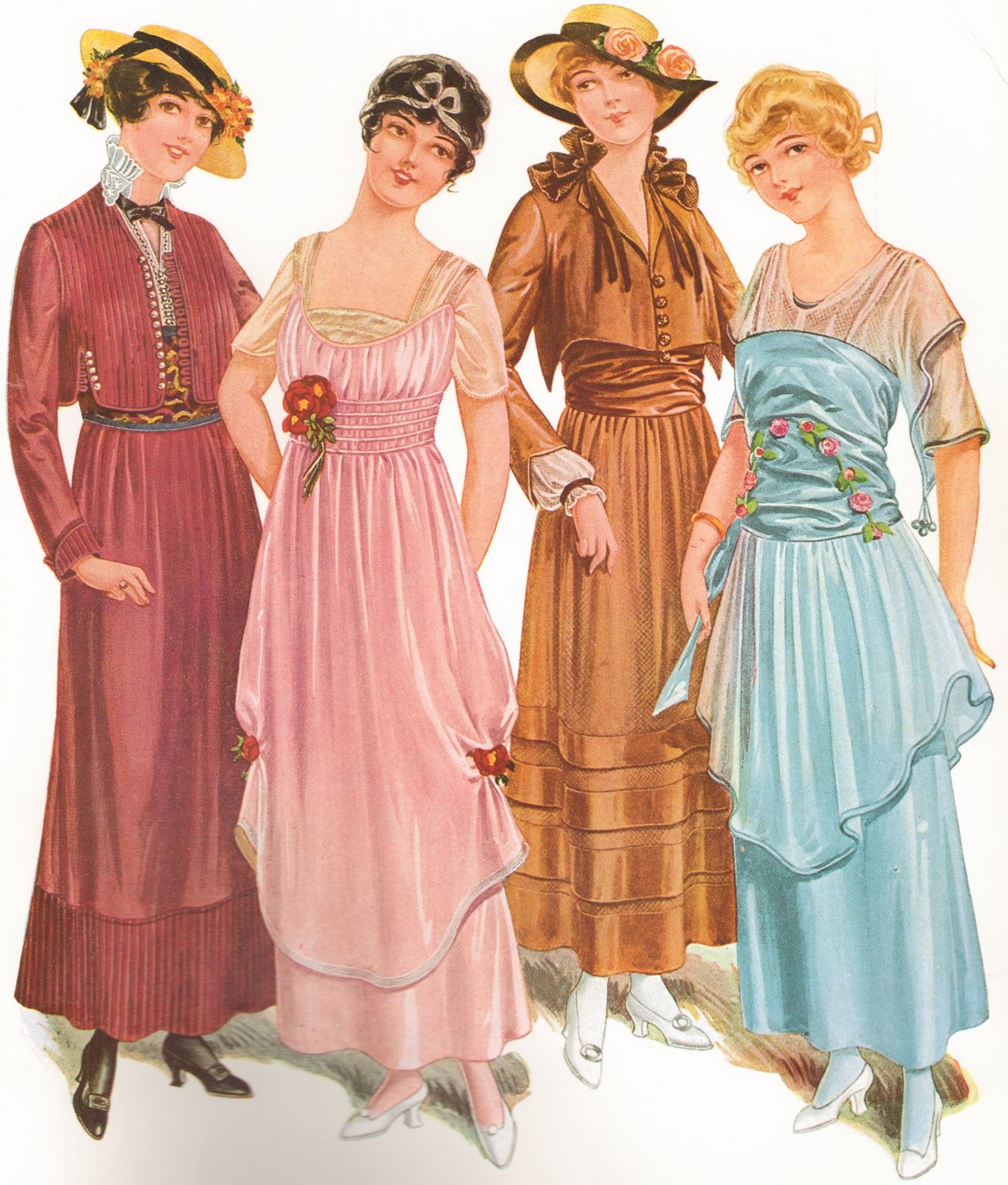
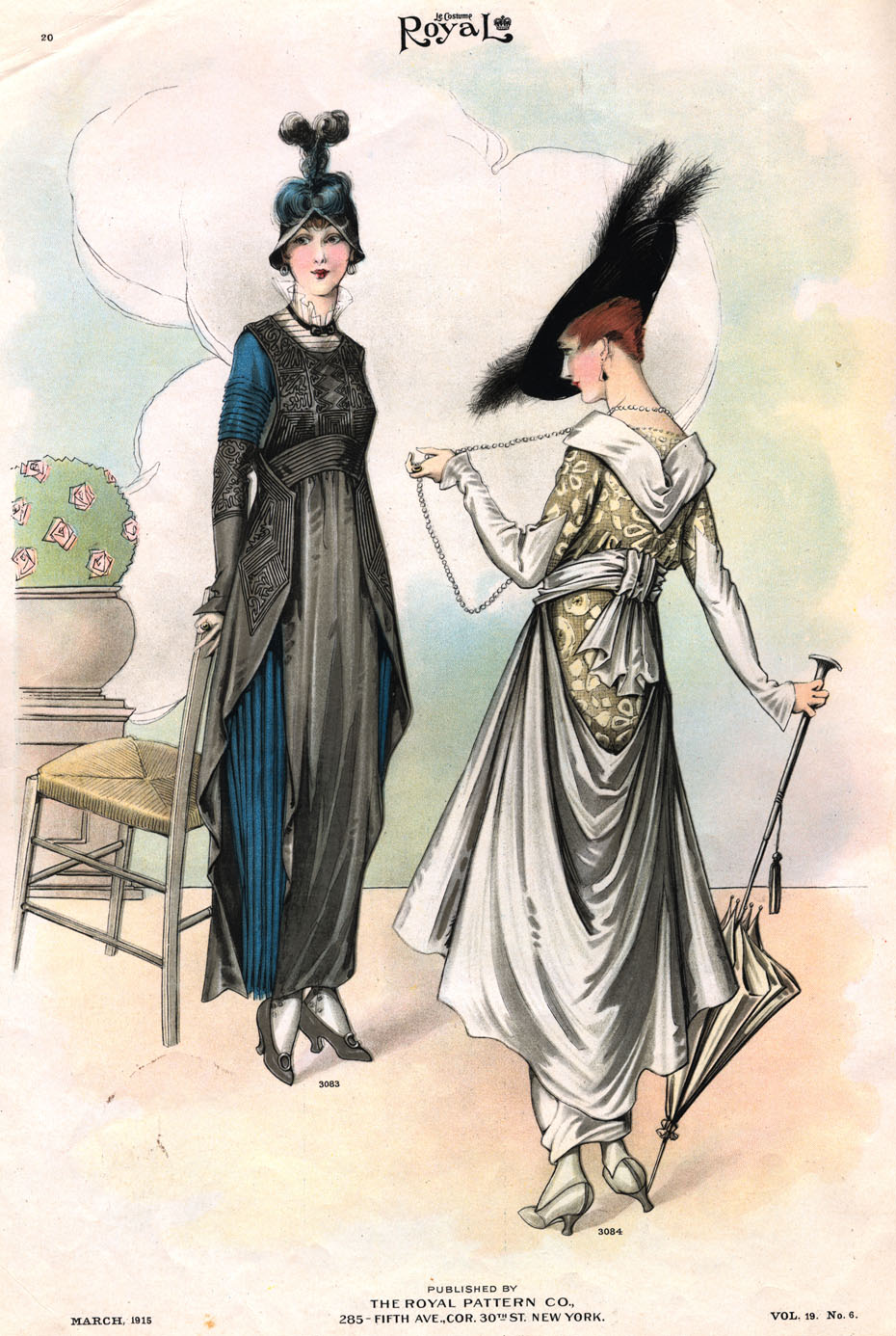
The growing independence of women also allowed for a looser, more comfortable style.  Gone from the streets were the dreaded hobble skirts, limiting the ability of women to take long strides. (Anything for fashion!) What audiences might have seen in 1915 were skirt styles that opened up at the bottom, allowing for freer movement.
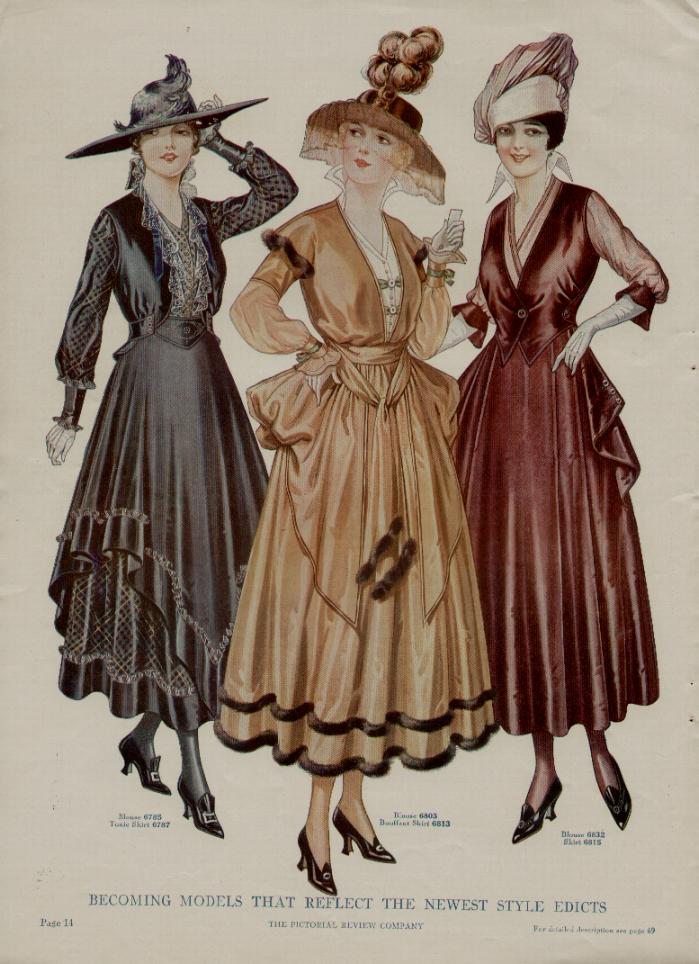
These would come to be called ‘war crinoline’, essentially a precursor to a modern conservative skirt and described as bell-shaped, a “very full calf-length skirt” requiring extra fabric to attain its flowy, romantic look.
This would seem to be antithetical to wartime thinking — when lifestyles were often pared back — but these larger gowns were touted as practical fashion and thus ‘patriotic’ in their intent. Â The role of women in wartime, many thought, was to simply look their best. At least, this was the line many fashion designers took during the era.
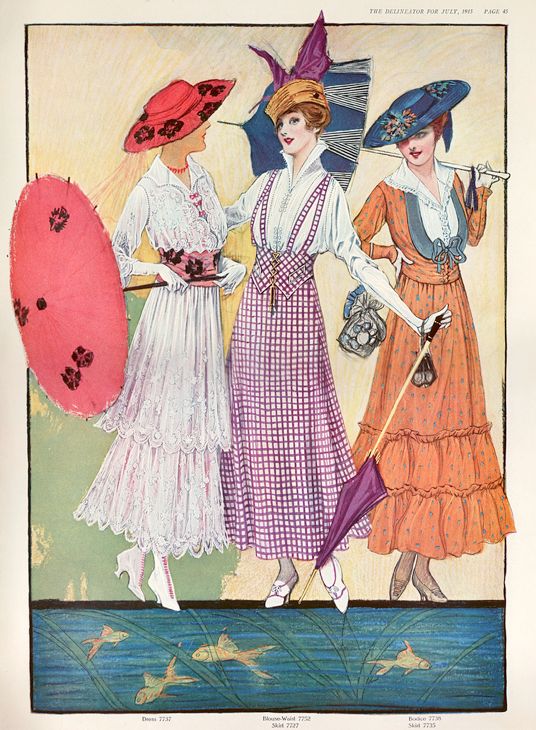
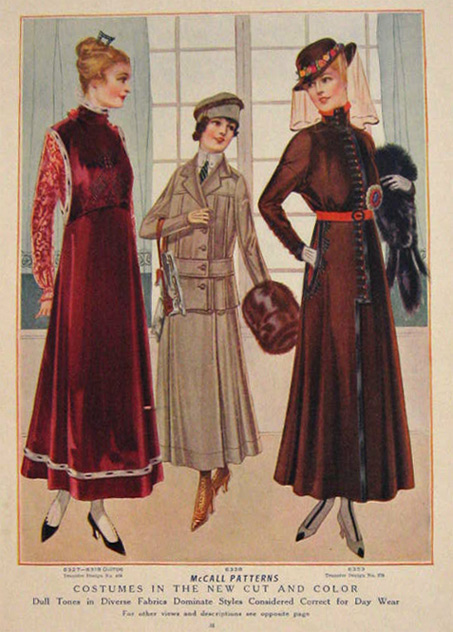
1915 Delineator Spring dresses
New York Sun, August 1915
Revolutionary Undergarments
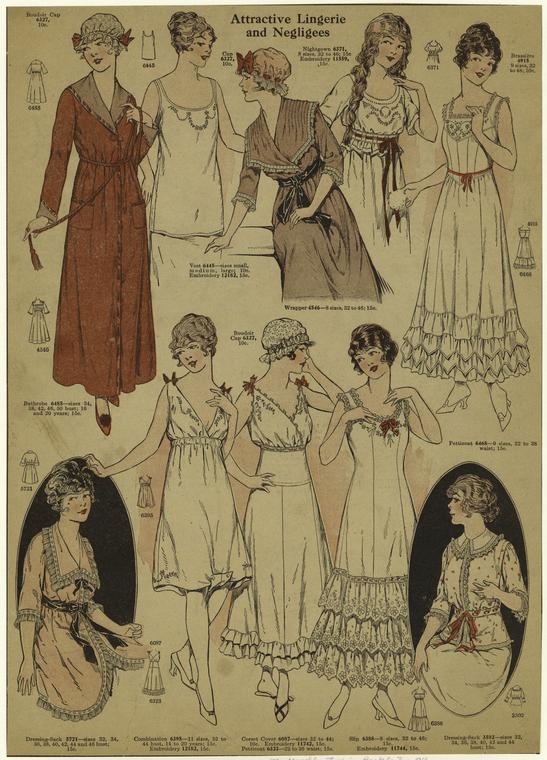
While some women would continue to subject themselves to the corset, the practicalities of life soon led to its unpopularity.  In 1914, Carisse Crosby, a well-connected society heiress from New Rochelle, received the patent for a revolutionary new form of support  — the modern bra.  Called the backless brassiere, the invention further facilitated a departure from stiff and uncomfortable silhouettes.
Crosby (really named Mary Phelps Jacobs) was a well connected society woman and would have been milling about the crowd at Madison Square Garden.  In 1915 she married the Boston Brahmin playboy Richard Peabody and eventually moved to Manhattan when she became pregnant with his child.
Lingerie And Negligees, 1915. Courtesy New York Public LIbrary
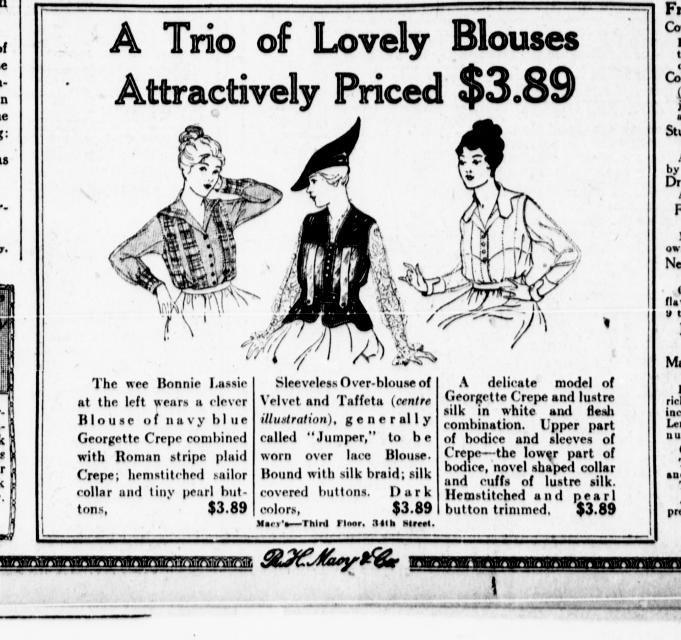
from the New York Evening World, October 21, 1915
The Gradual Straight Line
Perhaps the boldest fashion transition in the 1910s was the subtle shift from curvaceous, hour-glass forms to a straight, shapeless silhouette.  While the war crinoline still required a narrow waist for some of its dramatics, competing styles leaned towards sleekness.  This was an evolution from the Empire waist which had gained a resurgence earlier in the decade.
Rise of the Dangerous
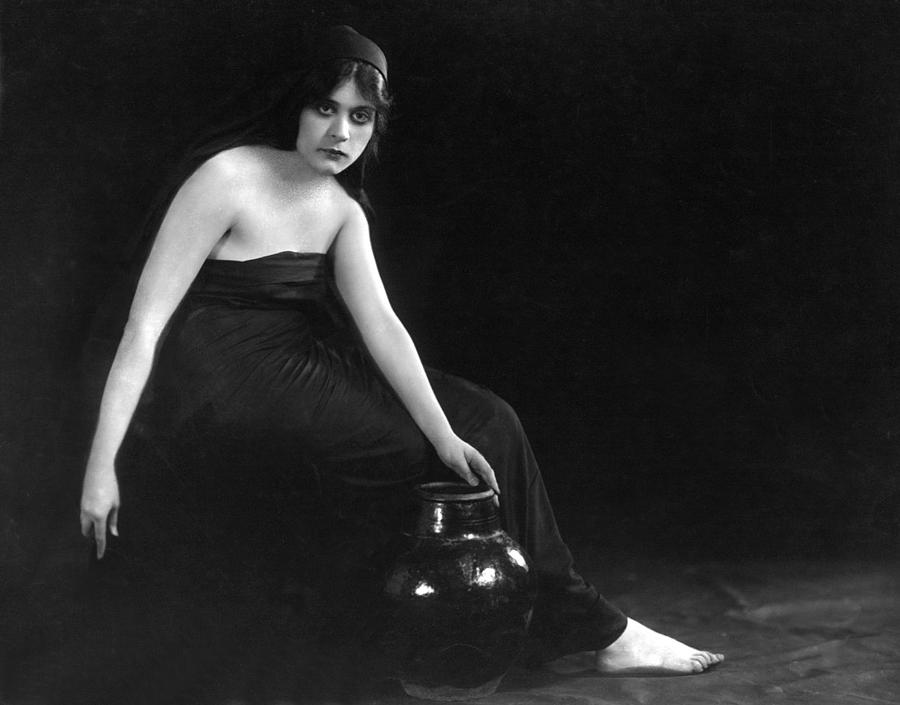
The predominant form of women’s fashion in the 1920s — the boyish flapper with sleek dresses and short hair — would rise from the edgier look of the ‘vamp’, best embodied in the late 1910s by film and stage actress Theda Bara.  This took the reformed instincts of woman’s fashion to its extreme. Sexuality became more overt and stylized, from bold makeup to exposed flesh.  This was certainly not the look of your average lady on the street, but soon slight shades of the vamp style would eventually seep into everyday fashion.
Theda Bara in the 1915 film Sin
The Popularity of Make-Up
It was unseemly of women to paint their faces with too many cosmetics during the late 19th century. But by the mid 1910s, women were influenced by actresses and dancers, and taboos against wearing cosmetics were relaxed.  The natural pale complexion so desired a decade earlier gave way to a kind of democratization that only makeup could provide.  Women were allowed to heighten the drama in their faces and mask the imperfections.
In 1915, two major forces in women’s beauty opened salons on Fifth Avenue — Elizabeth Arden and Helena Rubenstein. Both heavily influenced by the Parisian fashion aesthetic, elite New York women flocked to their shops.  Within a decade, these two entrepreneurs would be the anchors of a burgeoning and highly lucrative beauty industry.
from a 1915 Gimbels fashion magazine, courtesy the blog Historically Romantic
Hints of the ‘Little Black Dress’?
Black was not worn by women of gaiety and glamour.  It was strictly the hue of mourning during the Gilded Age and rarely made an appearance in actual evening wear.  However in an imagined fashion show in 1915, you may have seen a slight hint of it here or there, although not very practical and only as part of bold ‘vamp’ styling of its time.  It might have seemed edgy and even a bit bizarre, something only a worldly woman might have worn.
It would take another decade — and the influence of Coco Chanel — to bring the black dress into fashionable prominence. It would eventually becoming one of the defining looks of the New York woman.
from a 1915 Pictoral Review
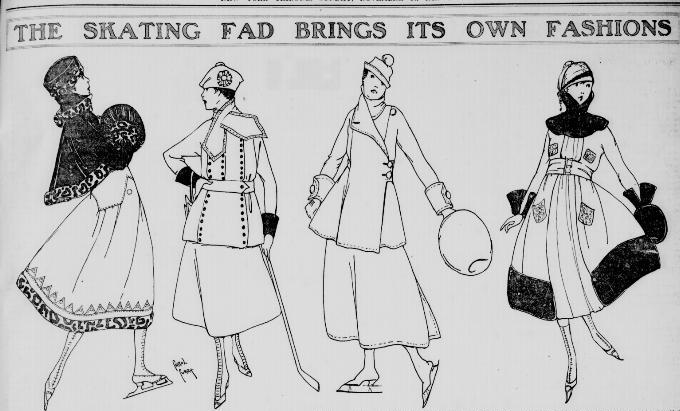
A brief skating fashion fad inspired this spread in the New York Tribune, November 14 1915
Driving Attire
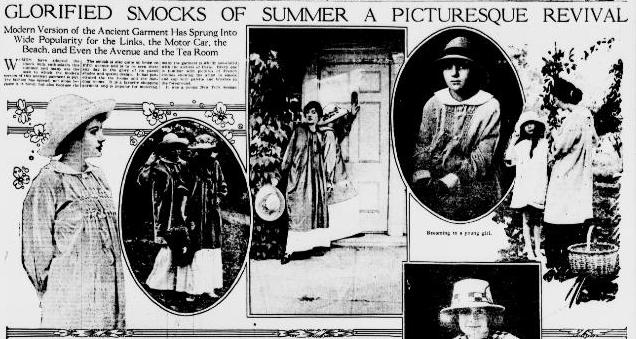
The continued popularity of the automobile required specific sorts of fashion to protect the clothes from dust.  These items found their way into regular wear.  This article from an August 1, 1915, issue of the New York Sun proclaims the return of the smock. “The smock is worn in the garden and on the golf links.”
Still A World of Hats
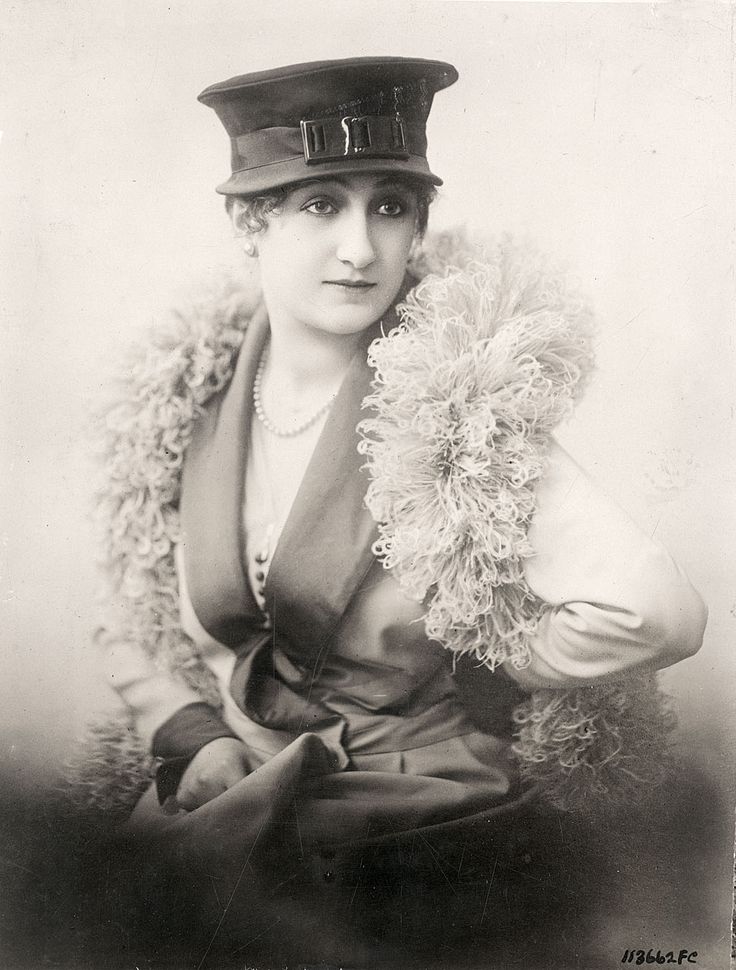
One taste that didn’t wander far was the love of hats. While flamboyant hats still topped many society ladies head, styles eventually became a little serious with nautical and even military influences.
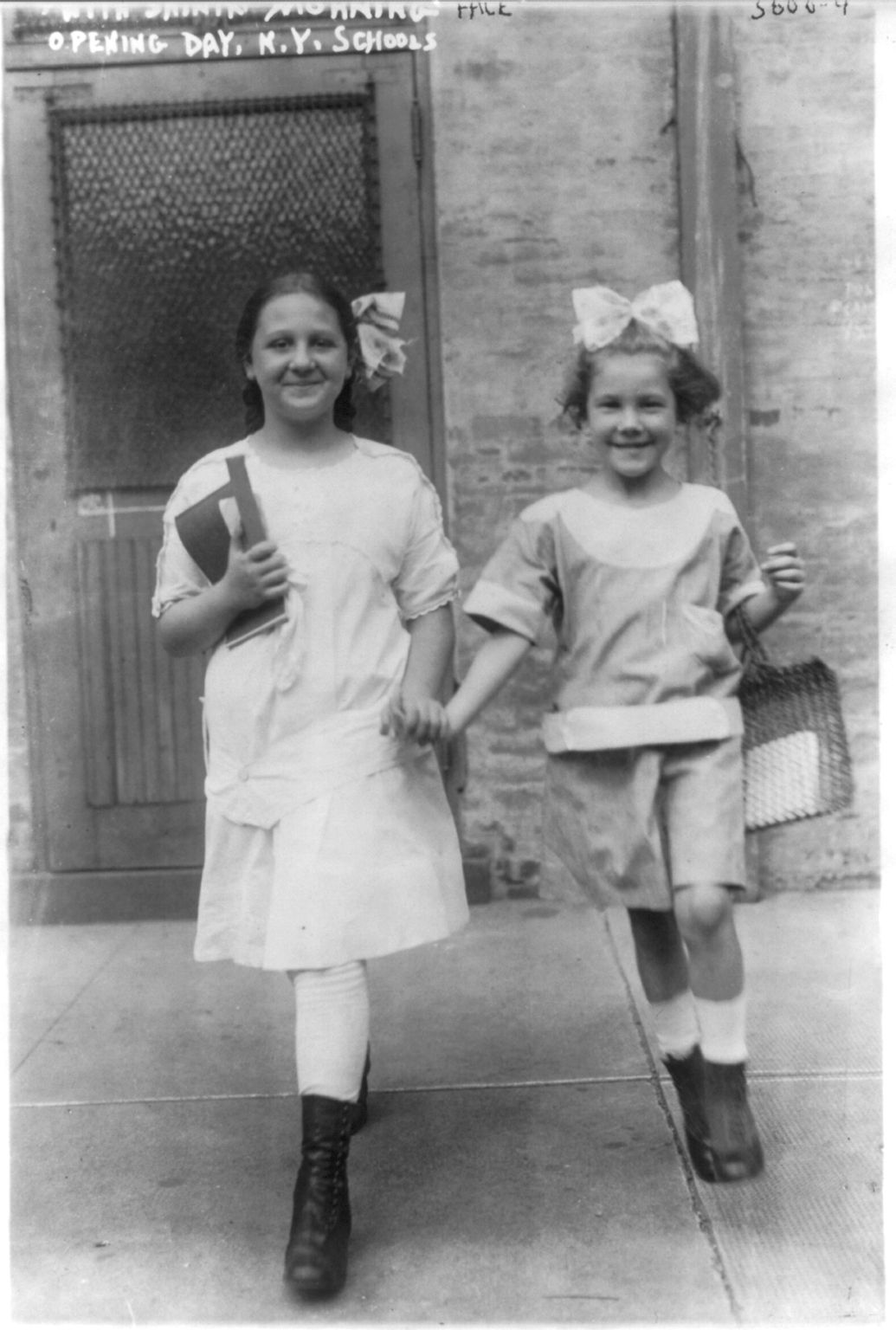
Even the school girls got into the act of fashion! Â Here’s a pair from the first day of school in 1915….
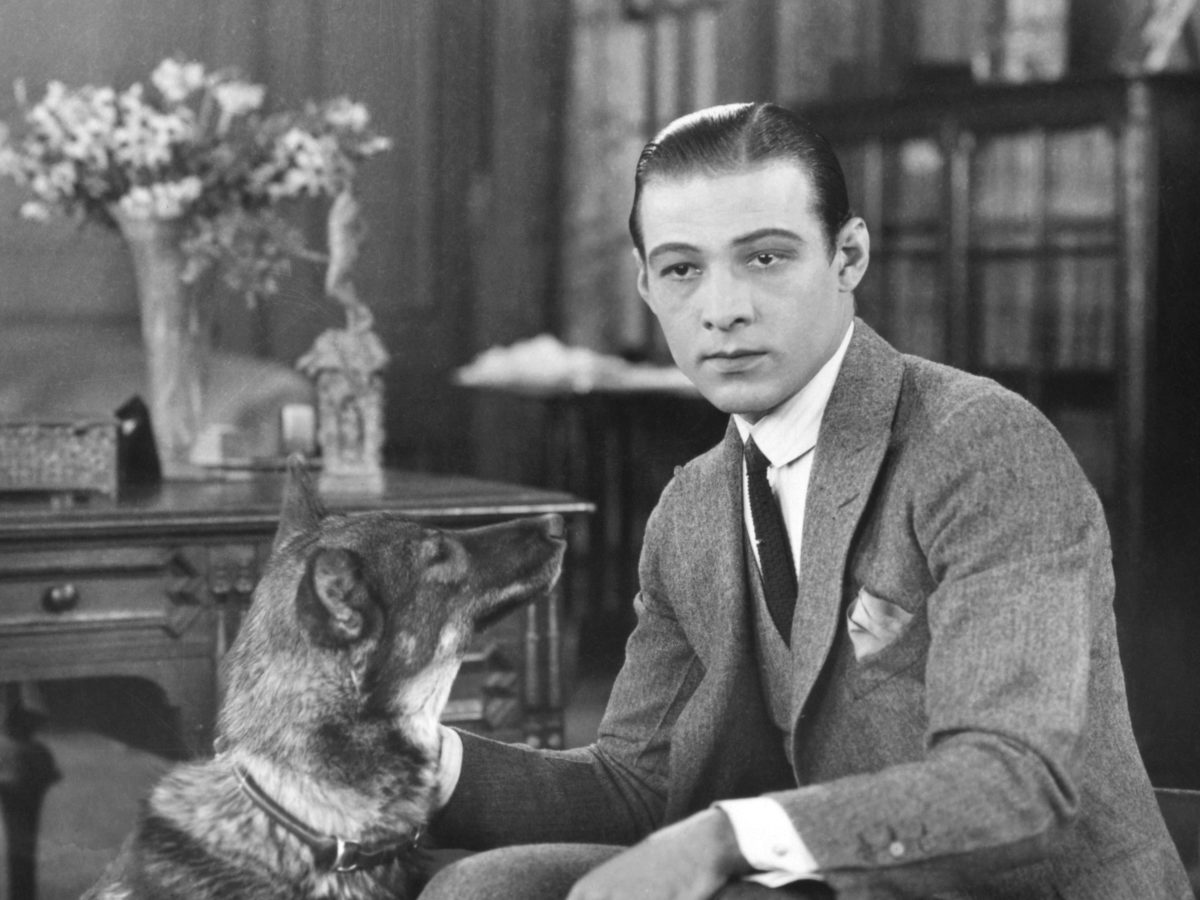
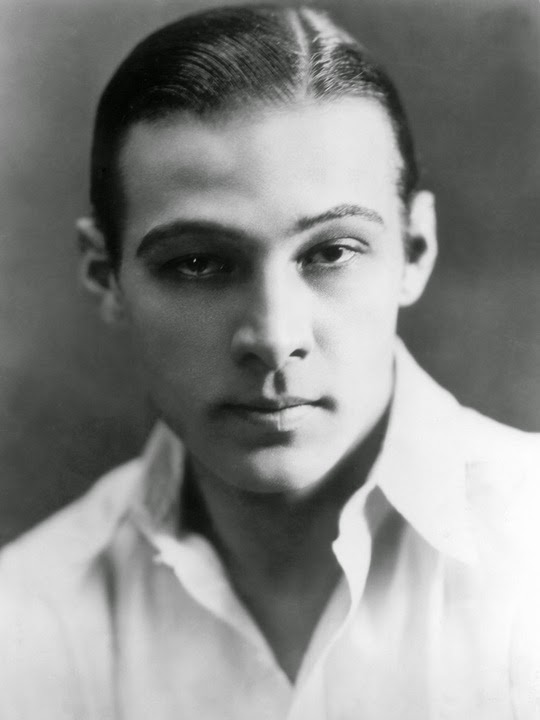
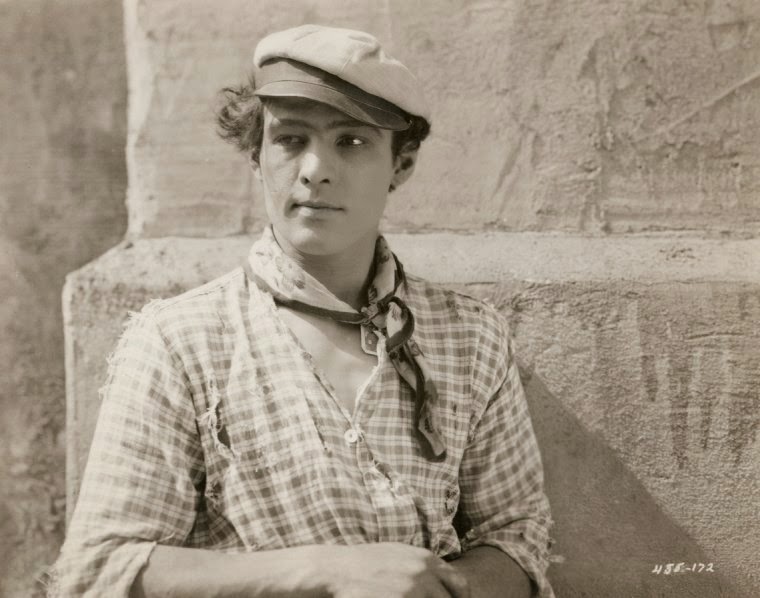
PODCAST Rudolph Valentino was an star from the early years of Hollywood, but his elegant, randy years in New York City should not be forgotten. They helped make him a premier dancer and a glamorous actor. And on August 23, 1926, this is where the silent film icon died.
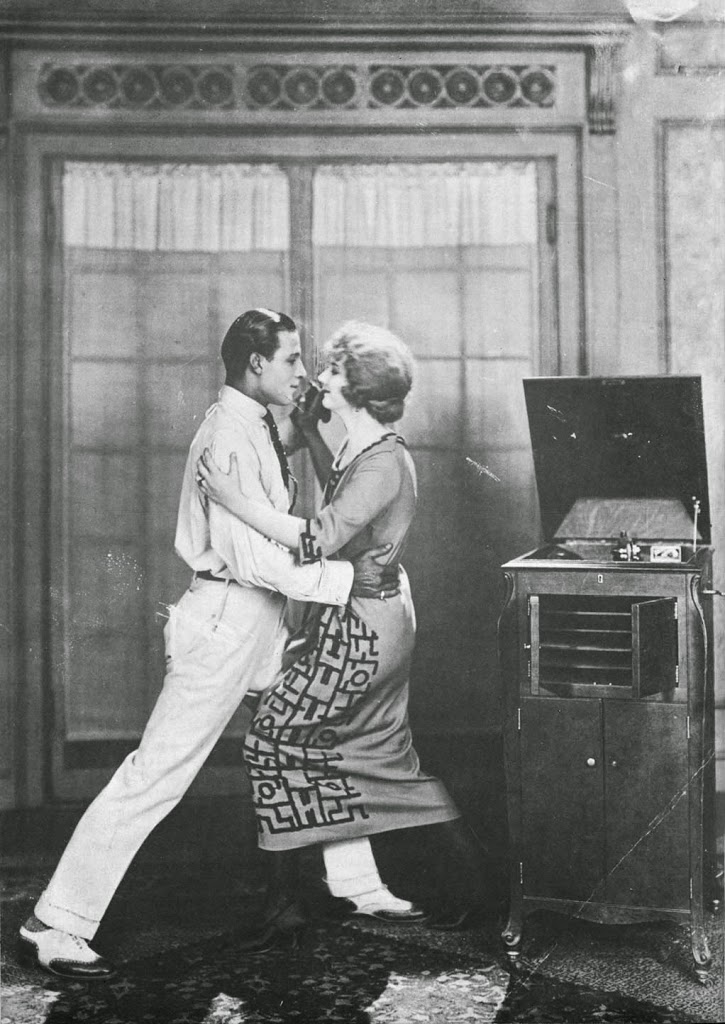
Valentino arrived in Ellis Island in 1913, one of millions of Italians heading to America to begin a new life. Â In his case, he was escaping a restless life in Italy and a set of mounting debts! But he quickly distinguished himself in New York thanks to his job as a taxi dancer at the glamorous club Maxim’s, where he mingled with one particular Chilean femme fatale.
He headed to Hollywood and became a huge film star in 1921, thanks to the film The Sheik, which set his reputation as the consummate Latin Lover. Â Throughout his career, he returned to New York to make features (in particular, those as his Astoria movie studio), and he once even judged a very curious beauty pageant at Madison Square Garden.
In 1926, he headed here not only to promote his sequel Son Of The Sheik, but to display his masculinity after a scathing article blamed him for the effeminacy of the American male!
Sadly, however, he tragically and suddenly (and, some would say, mysteriously) died at a Midtown hospital. Â People were so shocked by his demise that the funeral chapel (in the area of today’s Lincoln Center) was mobbed for almost a week, its windows smashed and the streets paralyzed by mourners — or where those people paid by the film studio?Here are the details of the tragedy that many consider one of the most important cultural events of the 1920s.
ALSO: We are proud to introduce to you — POLA!
To get this week’s episode, simply download it for FREE from iTunes or other podcasting services.
The young dancer was employed at Maxims on 110 West 38th Street. From a 1916 guidebook: “A famous ‘smart’ restaurant. A la carte. Music, dancing, cabaret, from 6:30 to close. High prices. Special ladies luncheon at noon.” Valentino would use his skills as a struggling actor in Los Angeles and incorporate it into his film work. Below: Valentino with Alice Terry
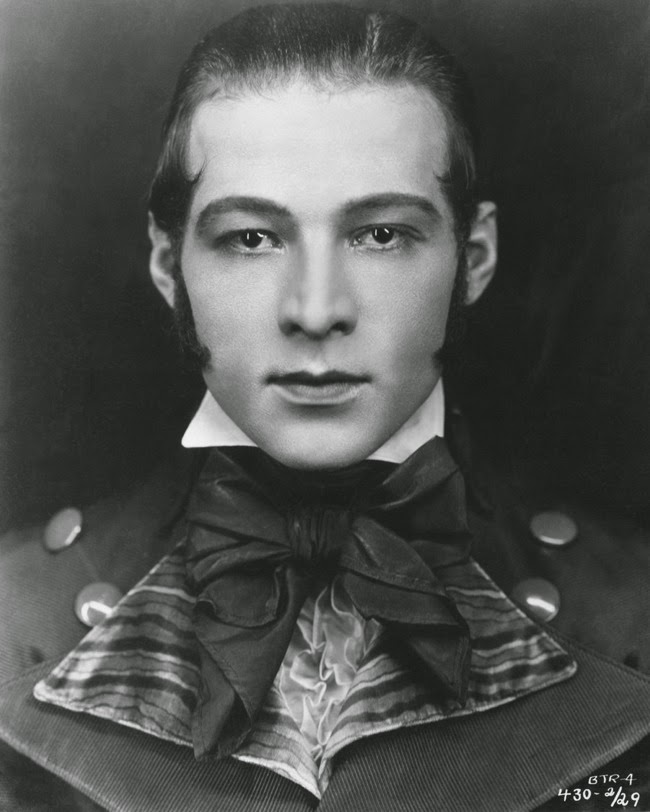
Valentino’s breakthrough film — The Four Horsemen of the Apocalypse. “He paints the town red!” “Each kiss flamed with danger!” Like many of his movies, the plot seems taken from his life. Valentino spent some time as a youth in Paris, dancing and dining his way through the city (and into debt). (NYPL)
The Sheik, the film that made his reputation:
From Blood and Sand (1922) — In this one, the Italian Valentino plays a Spanish toreador. (NYPL)
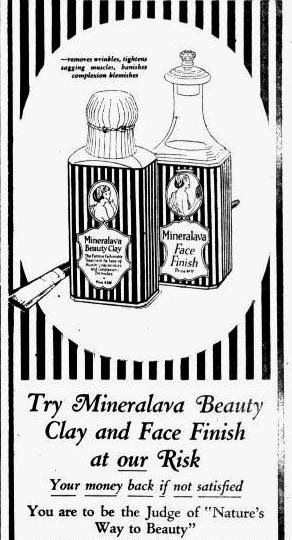
Mineralava Beauty Clay, the sponsor of Valentino and Rambova’s cross-country tango trip:
Newsreel footage of Valentino at Madison Square Garden judging the Mineralava Beauty Clay competition:
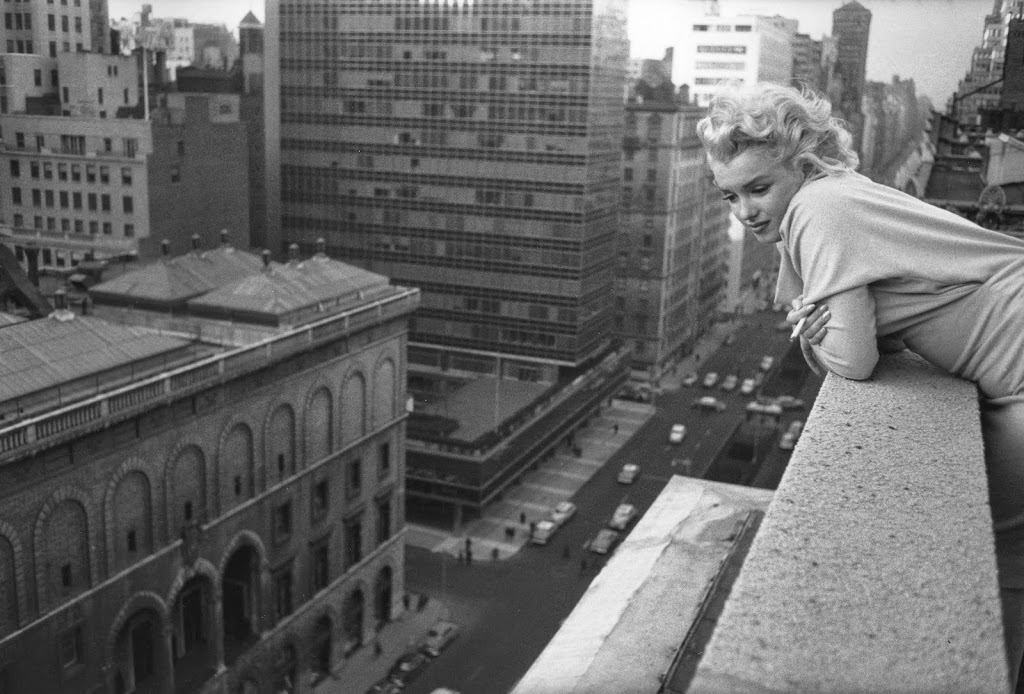
The Hotel Ambassador at Park Avenue and 51 Street. This is where Valentino boxed the reporter (on the rooftop) to defend his masculinity and where he was staying on August 15, 1926, when he collapsed.
Most people are familiar with the Ambassador due to another iconic film star and her memorable photo shoot (by Ed Feingersh) on the rooftop:
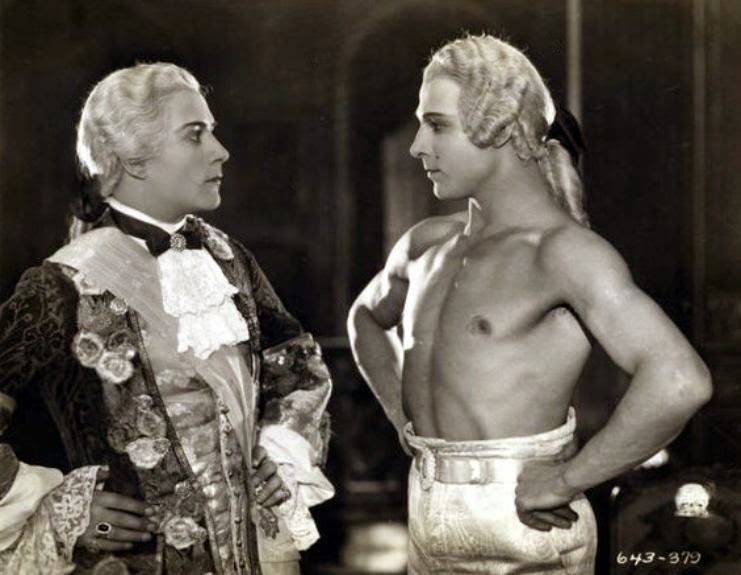
Rudolph in Monsieur Beaucaire, filmed at the Famous Players (later Paramount) studio in Astoria, Queens:
Downstairs, in the studio commissary, with Valentino (at left) and the cast of the film. Today this room is a restaurant named The Astor Room, which features cocktails named for silent film stars. There’s even a Valentino-themed cocktail called Blood and Sand!
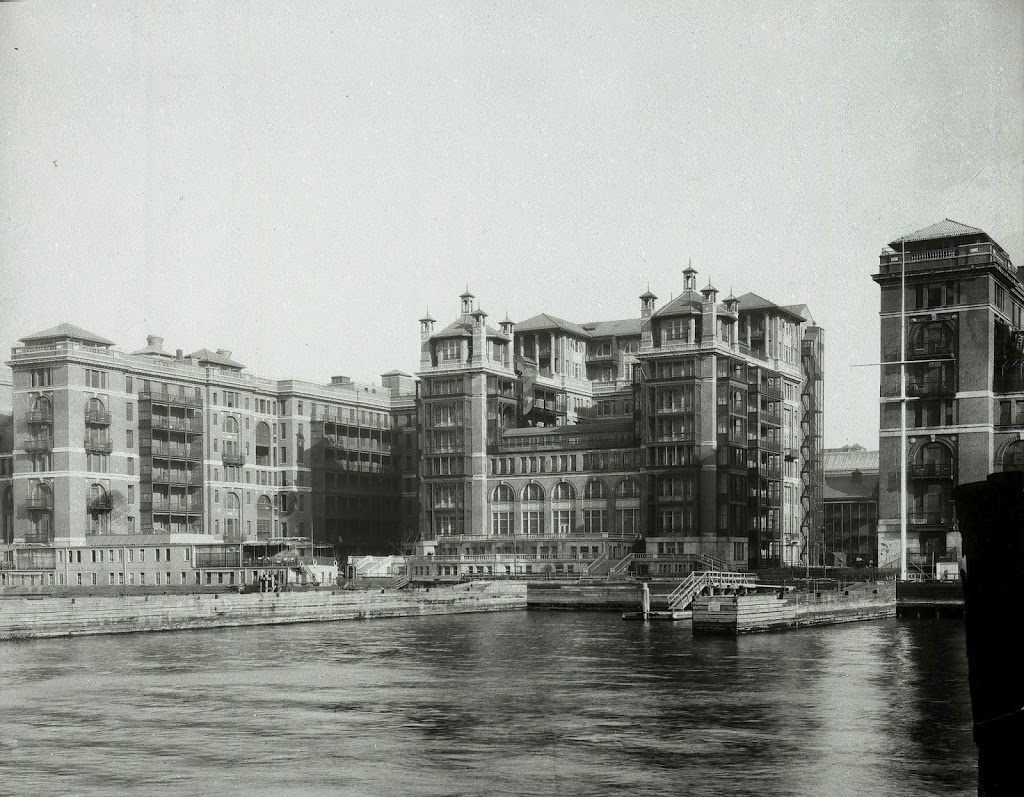
Polyclinic Hospital at 345 West 50th Street, where Valentino died on August 23, 1926. The building still exists today as an apartment complex. (Picture courtesy Museum of the City of New York)
Pictures of the mad, chaotic crowds outside Frank Campbell’s Funeral Church during the week of August 23-30, 1926:
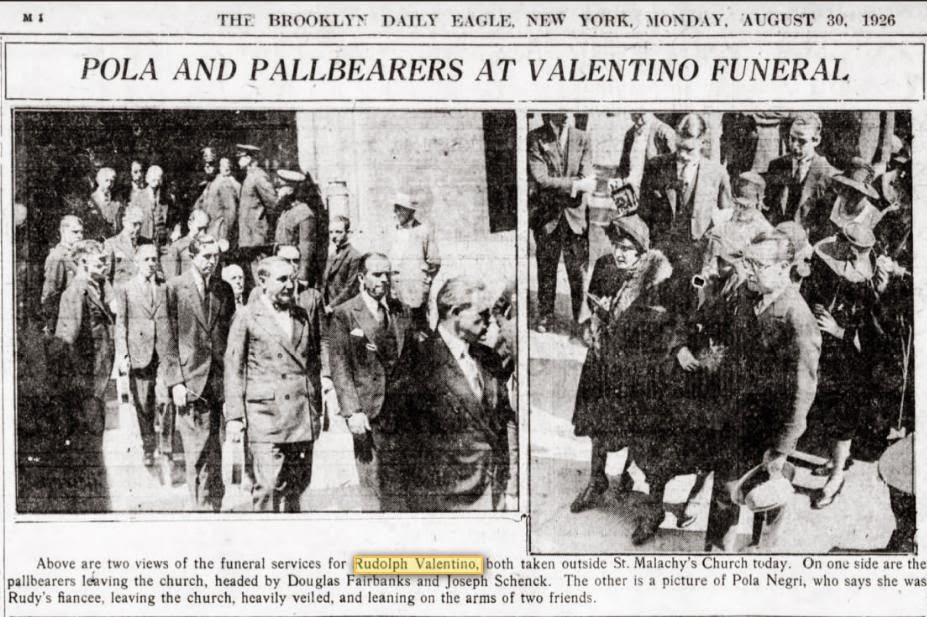
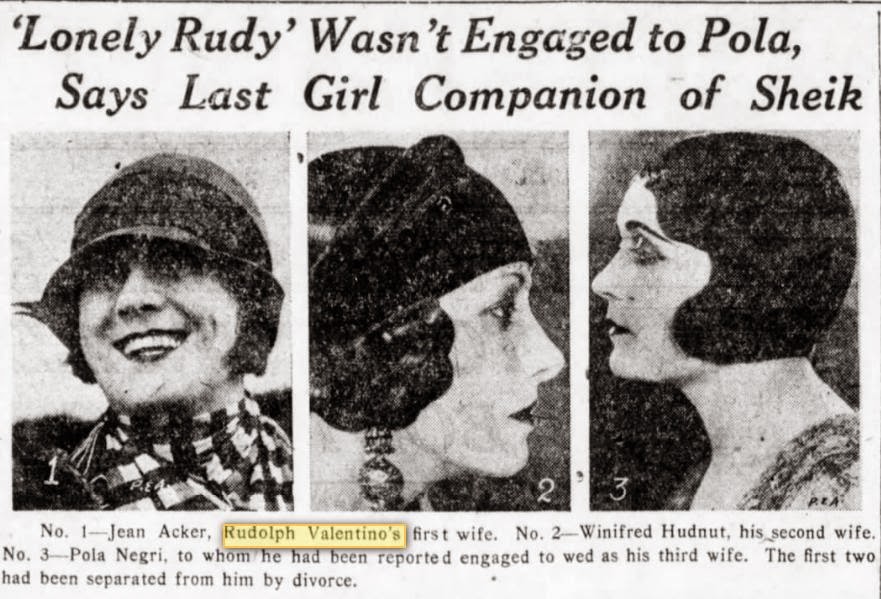
Pola Negri, who made quite a scene at the funeral of Valentino (NYPL):
From the Brooklyn Daily Eagle, August 30, 1926
Newsreel footage of his funeral in Midtown Manhattan — from Frank Campbell’s (in today’s Lincoln Center area) to St Malachy’s on West 49th Street:
SOURCES AND SUGGESTED READING: Note: Don’t say we didn’t warn you! There’s a lot of material that seems to be based on speculation. Thoughts of possible sexual adventures have sent many authors into wild fits of imagination. ( Â Enter the back catalog of Valentino at your own risk:
Rudolph Valentino: A Wife’s Memories of an Icon by Natacha Rambova and Hala Pickford The Valentino Mystique: The Death and Afterlife of a Silent Film Idol by Allen R Ellenberger and Edoardo Ballerini Dark Lover: The Life and Death of Rudolph Valentino by Emily W. Leider The Valentino Affair: The Jazz Age Murder Scandal That Shocked New York Society and Gripped The World by Colin Evans The Intimate Life of Rudolph Valentino by Jack Scagnetti Falcon Lair— an indispensable online resource for all things Valentino Publications sited: New York Times, New Yorker, Newark News, Brooklyn Daily Eagle, New York Sun
NOTE: This article has a few plot spoilers but no major twists are revealed or discussed. I’ve tried to write the descriptions within the interactive map as vaguely as possible.
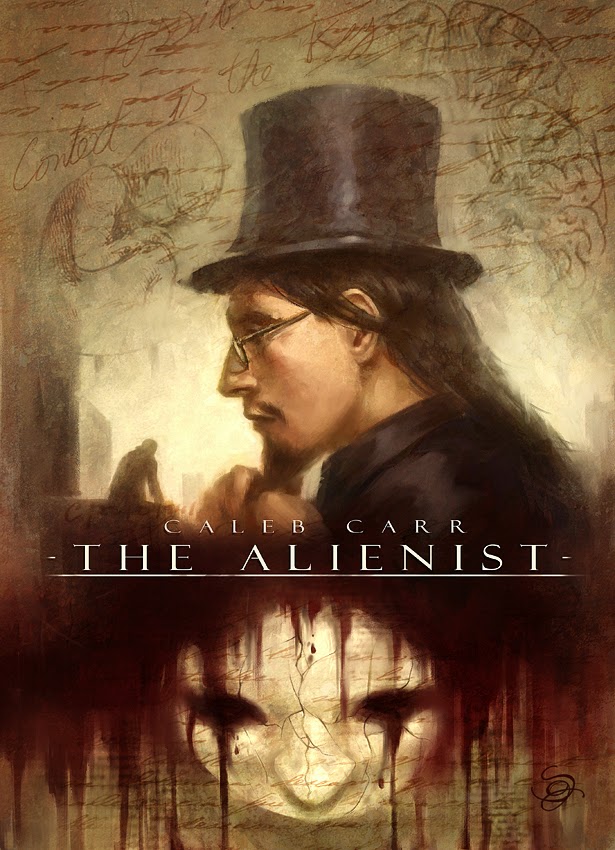
The Alienist by Caleb Carr was published 20 years ago this week, an instant best-seller in 1994 that has become a cult classic among history buffs. Despite some creakiness uniquely inherent to early ’90s fiction thrillers, it remains today a page-turning and utterly spellbinding adventure.
Although the Jack the Ripper murders were an obvious inspiration for Carr, perhaps The Alienist‘s biggest influence is The Silence of the Lambs by Thomas Harris. Carr completed his tale of serial murders in the Gilded Age just as a slew of Silence knockoffs began hitting the bookshelves. The Alienist stands far above the pack, of course, but you can’t deny its success in 1994 was partially inspired by reader’s cravings for murderers with perverted tastes and body parts in formaldehyde jars.
The Alienist follows a quirky team of investigators in 1896 as they follow the bloody trail of a killer with a peculiar penchant for boy prostitutes, often dressed as girls to the delight of their clientele. Dr. Laszlo Kreizler is the alienist (or psychologist) in charge of the case, stitching together a profile of the loathsome figure, conveniently using soon-to-be standard analytic techniques.
At right: Alternate artwork for The Alienist (Courtesy Nerd Blerp)
As protagonist John Schuyler Moore, a reporter for the New York Times, explains it “[W]e start with the prominent features of the killings themselves, as well as the personality traits of the victims, and from those we determine what kind of man might be at work. Then, using evidence that would otherwise have seemed meaningless, we begin to close in.”
Carr’s book is finely detailed, perhaps overly detailed, which won’t be a problem if you love New York City history. There are over two dozen scenes at various notable landmarks throughout Manhattan, some in various states of construction. Several real-life figures make appearances, although the most entertaining characters are Carr’s own, including the intrepid proto-policewoman Sara Howard and scrappy errand boy Stevie ‘Stovepipe’ Taggart.
When I first read The Alienist back in 1994, I was struck by its preciseness, an expertly placed breadcrumb trail through old Gotham. There is no romantic gloss, as in another history classic Time and Again. He makes it seem possible to retrace almost every step of our heroes. (In researching this article, I tried to do so.) The original New York Times review noted that “[y]ou can practically hear the clip-clop of horses’ hooves echoing down old Broadway.” They’re still echoing.
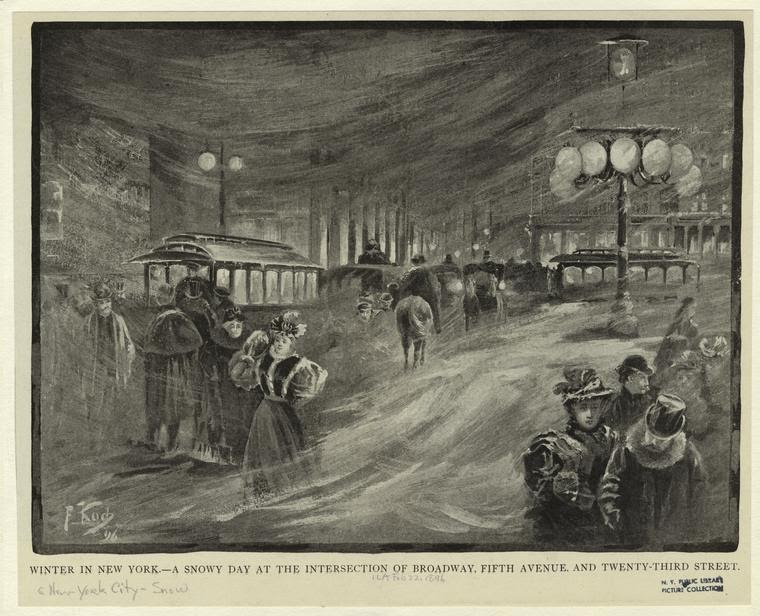
The story begins in the early months of 1896 during a robust winter. Below, from the Illustrated American, a depiction of a snowy Madison Square that year (NYPL):
His depiction of old New York is still glorious. The book’s polite take on certain social issues, however, read a bit wobbly today. To his credit, Carr tackles police corruption, gender discrimination, racial prejudice and the plight of homosexuals, all while elaborating on complicated psychological theories in service of an entertaining story. He has stuffed a hidden epic of New York into the framework of a modern murder mystery. That he chooses to handle hot-button social issues with kid gloves is not a misstep, but merely a symptom of its genre and day.
The Alienist is still greatly enjoyable, perhaps slightly more so now. Thanks to renewed interest in New York City history, the details here are even more shimmering and vital. This is not an old New York emerging from a mysterious fog, but a world that seems to exist alongside our own.
And to prove that — below you will find a detailed, interactive map of the pivotal locations used in the book. You can click into various points for further details. A few of these pins have pictures and other links. Just zoom in and choose a location! (NOTE: Some locations are approximate and a couple are speculation.)
A little elaboration on certain elements of the book’s bigger places and themes:
Paresis Hall Most of the murder victims are boy prostitutes employed as several houses of ill repute throughout the city. Paresis Hall, located steps from Cooper Union, sounds like it was both a place where gay men could congregate in private clubs and a place of sexual transaction, often (as in the book) with underage boys dressed up as girls. This boy, Nathaniel ‘ The Kid’ Cullen, may have worked there, or may have just a habitue of the club. (He appears in this collection of photographs from Paresis Hill.)
Madison Square This was still a thriving center for culture and dignified entertainments in 1896. Many theaters clustered around the park, although newer stages were making their way up Broadway to Herald Square. If Delmonico’s (on the northwest corner) is too crowded for you, head over to the tea room at Madison SquareGarden on the northeast side. Pictured here in 1893, three years before the events of the Alienist. (NYPL)
Murray Hill Distributing Reservoir In 1896, New York still relied on this reservoir to provide most people with water. But it was also a tourist destination in itself, with walking paths along the top. Shortly after its appearance it the book, the Egyptian-inspired reservoir was torn down to make way for New York’s new public library. (NYPL)
Bellevue Hospital and Morgue Check out our podcast and blog posting on the history of Bellevue Hospital, as many of the details mentioned there appear in this book. Below: Bellevue in 1879.
Isabella Goodwin Sara Howard seems to be a little bit Nellie Bly, and a lot Isabella Goodwin, the first female office promoted to detective in 1896 (the year the book is set). Below: A front-page case cracked by Goodwin from February 1912.
New York Aquarium Carr’s narrative features several New York landmarks in construction. Two of those places take a morbid center stage in the book — the Williamsburg Bridge and the nearly completed New York Aquarium (the former Castle Garden) (NYPL)
Theodore Roosevelt Carr weaves several real life figures into the storyline, from J.P. Morgan (who comes off quite ominous) to Jacob Riis (not a flattering portrait of him either). But future president Roosevelt gets a glowing supporting role as New York’s police commissioner who directs Dr. Kreizler, Moore and Howard to investigate the murders using powers of psychological deduction.
In fact, the book is actually a flashback by our hero Moore, recalled when he visits the Oyster Bay funeral of his dear friend in 1919 (pictured below). (LOC)
True Crime And there are a great many real-life figures from New York’s criminal underworld as well. In fact, most of the lecherous and notorious figures depicted in the book are real folks, from early gangsters like Paul Kelly to brothel owners such as Biff Ellison. Carr also finds a few disturbing mental cases to bring into the story, including the young killer Jesse Pomeroy (pictured below), considered one of the most brutal of murderers at a ripe age of 14.
Grand Central Depot The characters do venture to places outside the city for further clues, but they always come through Grand Central Depot, the most hectic place in New York. (Pennsylvania Station had not yet been built.) Within a few years, this too would be ripped down and replaced with the present Grand Central Terminal. (LOC)
And finally, there are three central locations from the book that are still around today:
Dr. Laszlo’s residence at Stuyvesant Park. Actually the address in the book doesn’t really exist. But based on a couple descriptions — and its proximity to St. George’s Church, which is mentioned as close by — this building at 237 East 17th Street may be what Carr had in mind:
Murder headquarters at 808 Broadway — This exceptionally handsome building was constructed by James Renwick, playing nicely off its neighbor Grace Church. It’s actually called the Renwick! The team was located on the sixth floor. Today, on the first floor, is one of New York’s most popular costume shops.
John Schuyler Moore’s home at Washington Square Park North, facing the park: