Categories
Podcasts Science

The story of Tesla: The spark of invention in Old New York

PODCAST The strange and wonderful life of Nikola Tesla in New York City.

The Serbian immigrant Nikola Tesla was among the Gilded Age’s brightest minds, a visionary thinker and inventor who gave the world innovations in electricity, radio and wireless communication.

So why has Tesla garnered the mantle of cult status among many?

Part of that has to do with his life in New York City, his shifting fortunes as he made his way (counting every step) along the city streets.

Tesla lived in Manhattan for more than 50 years, and although he hated it when he first arrived, he quickly understood its importance to the development of his inventions.
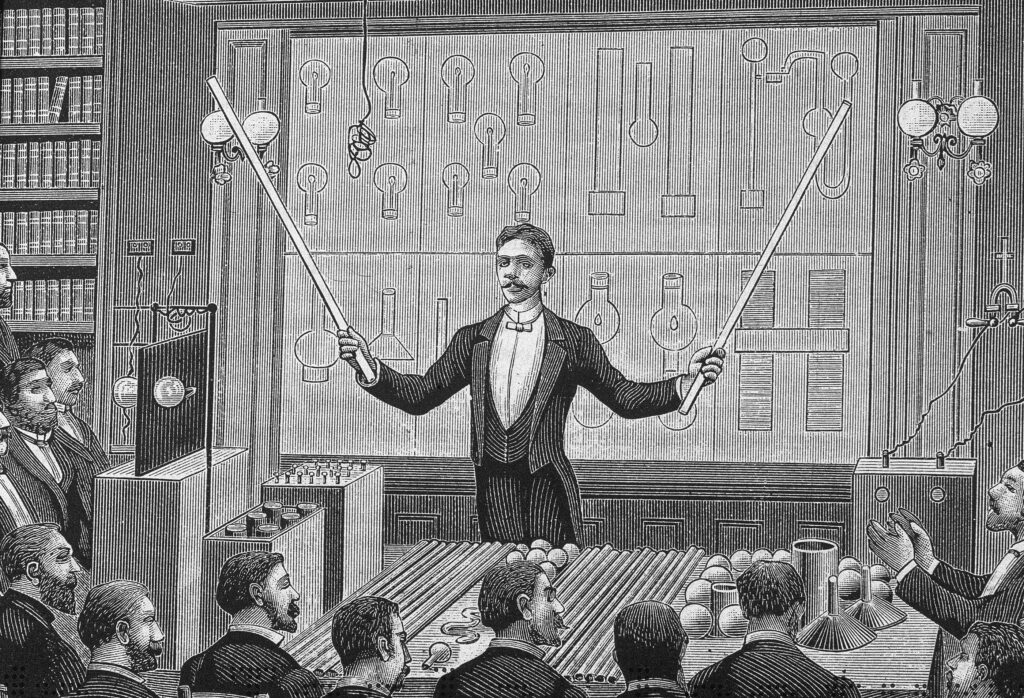
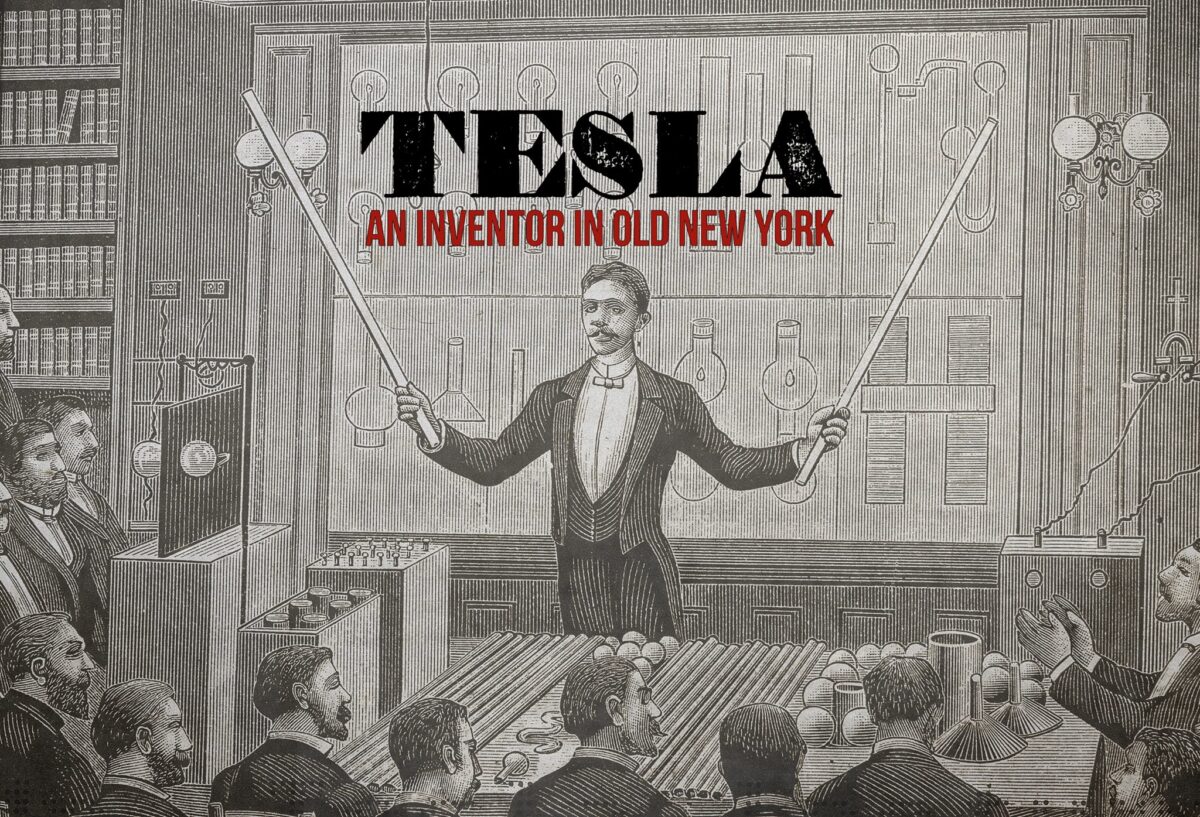
Engraving of Nikola Tesla (1856 – 1943) ‘lecturing before the French Physical Society and The International Society of Electricians,’ 1880s. (Kean Collection/Getty Images)

Travel with us to the many places Tesla worked and lived in Manhattan — from the Little Italy roost where the Tesla Coil may have been invented to his doomed Greenwich Village laboratory.

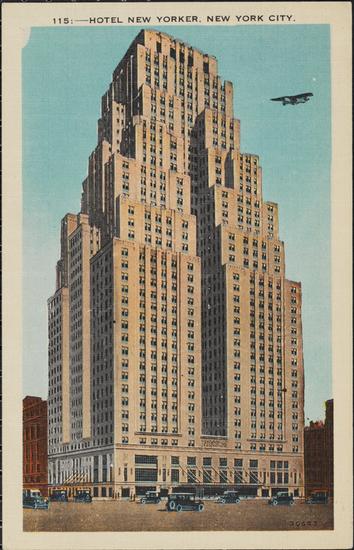
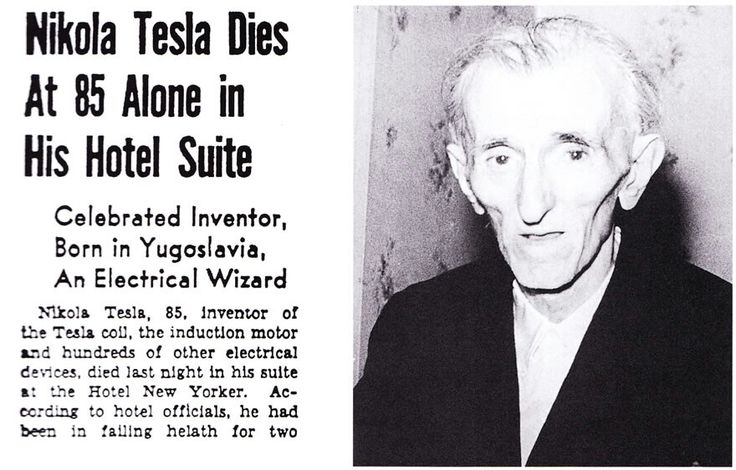
From his first job in the Lower East Side to his final home in one of Midtown Manhattan‘s most famous hotels.

Nikola Tesla, thank you for bringing your genius to New York City.

PLUS: The marvelous demonstration at Madison Square Garden in 1898 that proves that Tesla invented the drone!

To get this week’s episode, just find our show on your favorite podcast streaming service. Or listen to it here:

Or listen to it straight from here:

__________________________________________________________

The Bowery Boys: New York City History podcast is brought to you …. by you!

We are now producing a new Bowery Boys podcast every week. We’re also looking to improve and expand the show in other ways — publishing, social media, live events and other forms of media. But we can only do this with your help!

We are now a creator on Patreon, a patronage platform where you can support your favorite content creators.

Please visit our page on Patreon and watch a short video of us recording the show and talking about our expansion plans.

If you’d like to help out, there are six different pledge levels. Check them out and consider being a sponsor.

We greatly appreciate our listeners and readers and thank you for joining us on this journey so far.

__________________________________________________________

A page from the 1942 comic book Real Heroes, illustrating the life of Nikola Tesla:
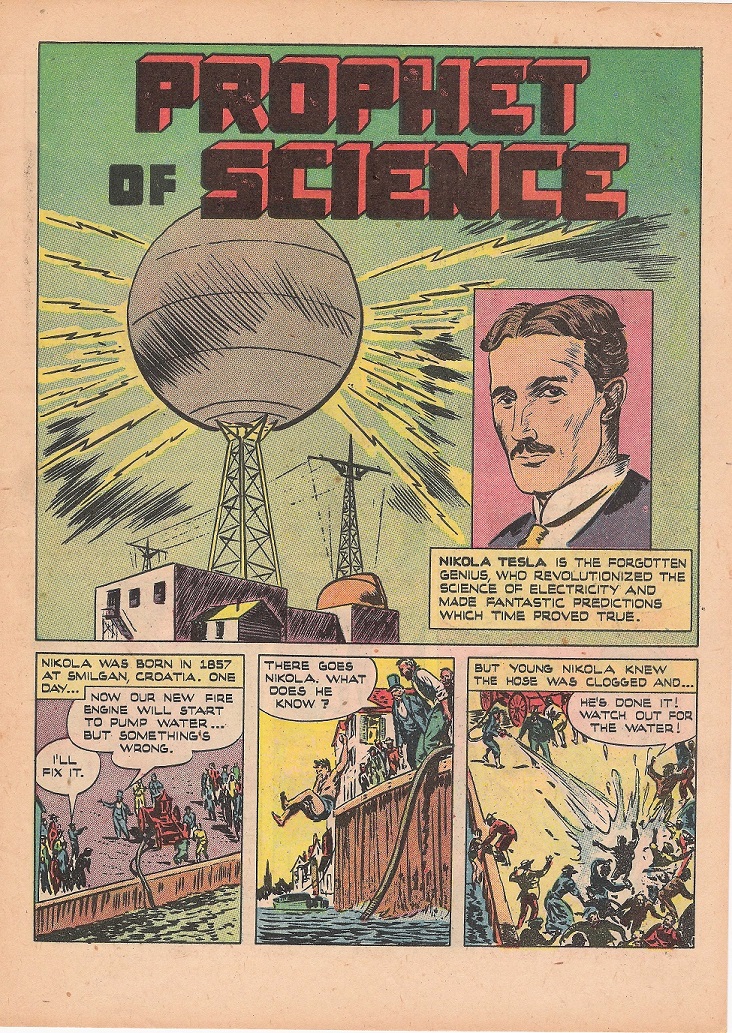
Courtesy Quality Comics

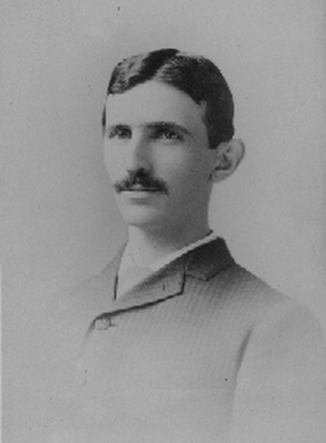
Young Tesla in 1885 while still in the employ of Thomas Edison.
Smithsonian Institution

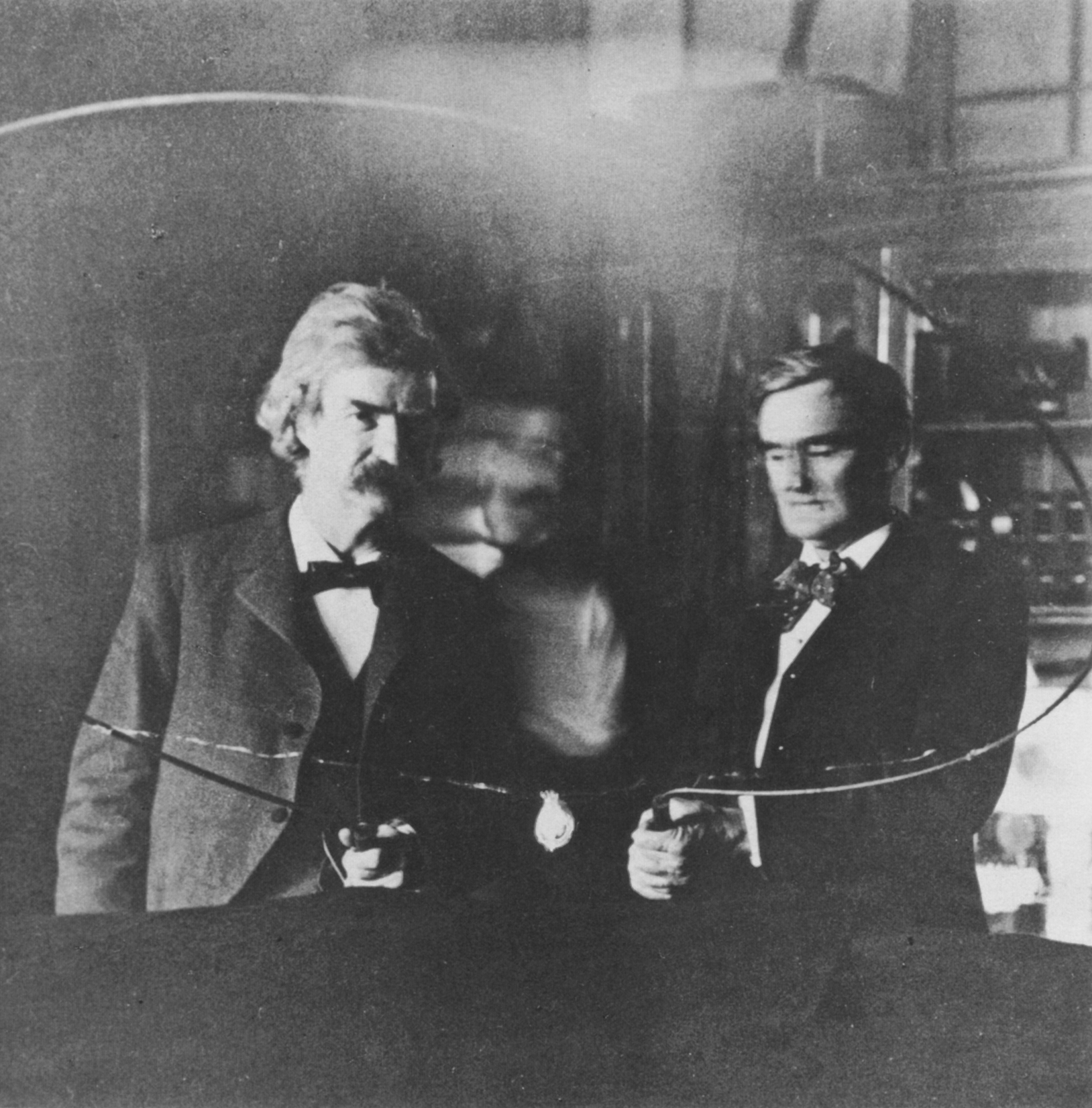
Mark Twain and Joseph Jefferson in Tesla’s South Fifth Avenue Laboratory. That’s Tesla, blurry, in the background.
Courtesy the Tesla Society

Tesla’s 1888 lecture at Columbia changed his life. His demonstration dazzled the room of distinguished scientists and professors and particularly grabbed the attention of journalists.
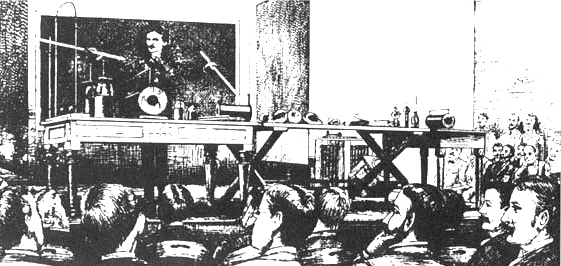
1888
Courtesy Pictures of Infinity

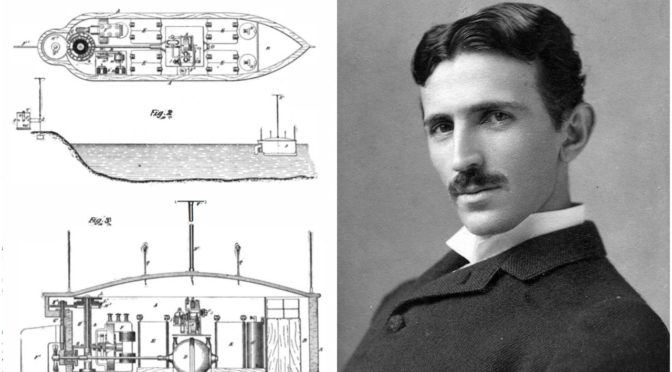
Diagrams of Tesla’s inventions from the 1880s and 90s have an almost otherworldly quality that wouldn’t look out of place in a gallery of modern art.
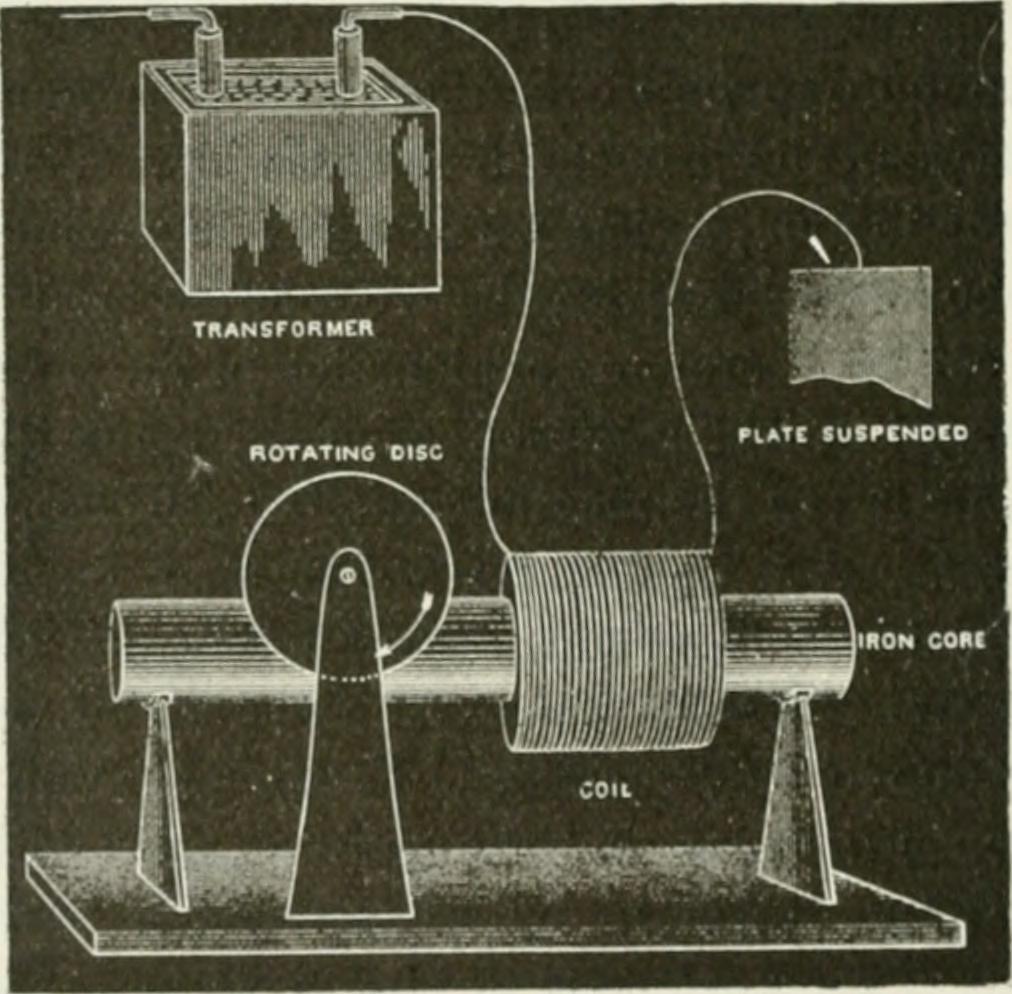
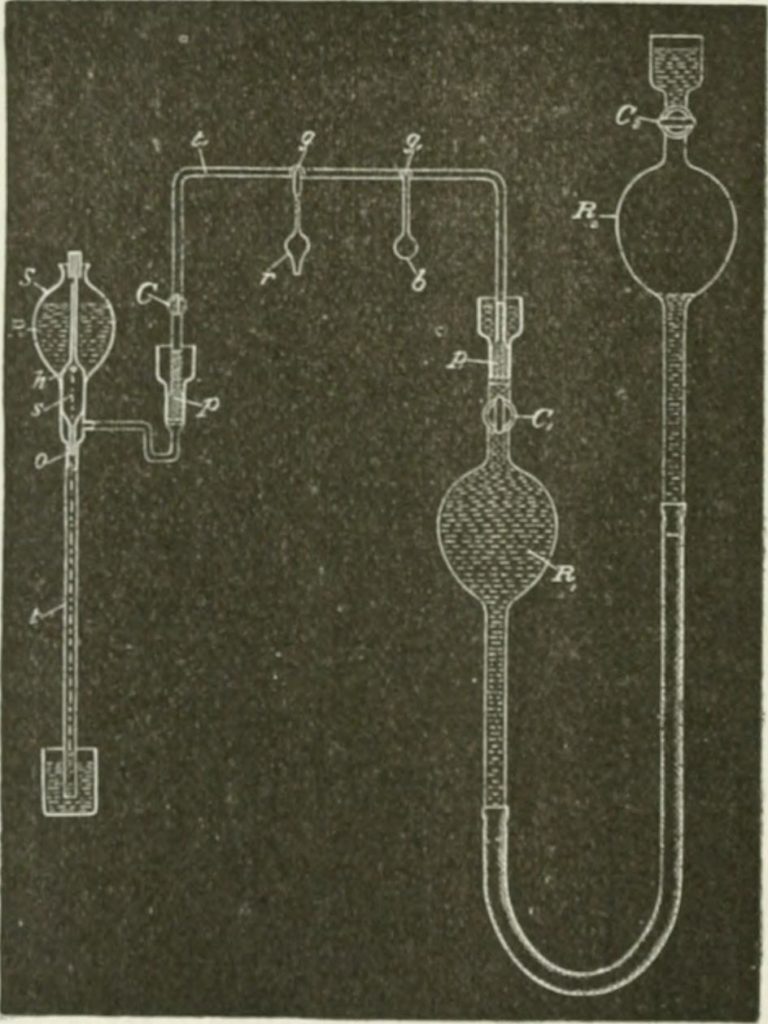
Internet Archive Book Images
3

The Not-so-mad Scientist: Tesla posing with perhaps his most famous prop — a large bulb which could generate light from the human body.
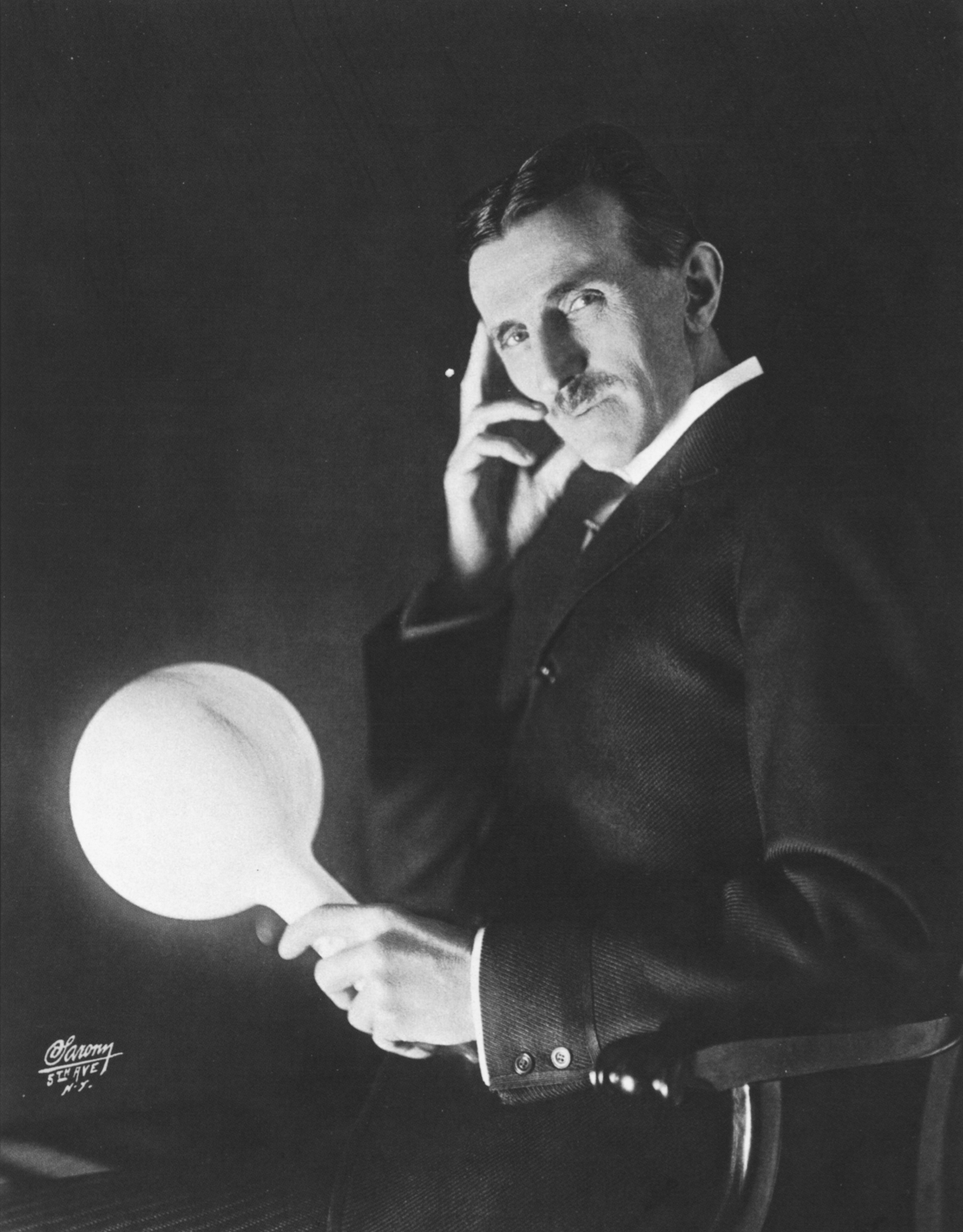
bulb

Tesla in Colorado Springs, 1899. From the caption: “A publicity photo of a participant sitting in the Colorado Springs experimental station with his “Magnifying Transmitter“. The arcs are about 22 feet (7 m) long. (Tesla’s notes identify this as a double exposure.)”
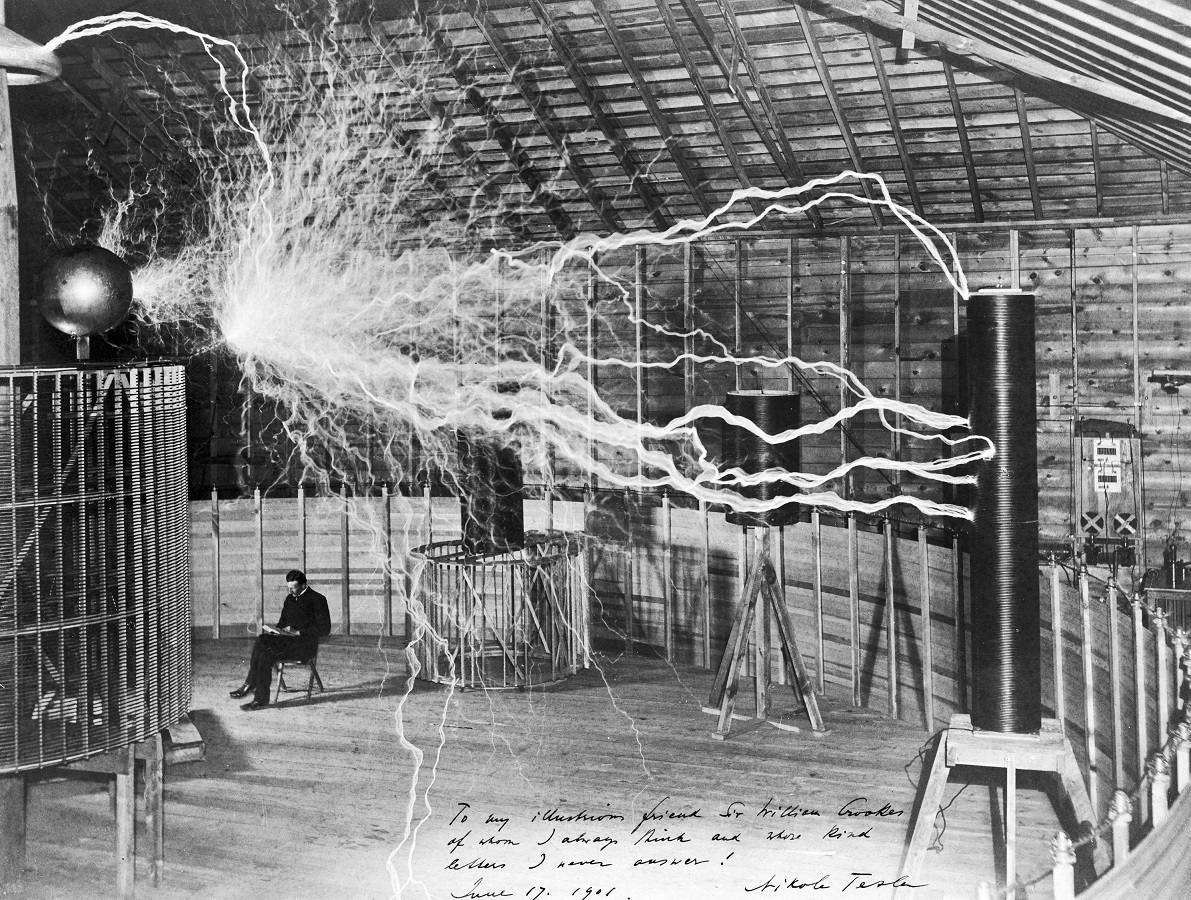
M0014782 Nikola Tesla, with his equipment Credit: Wellcome Library, London. Wellcome Images images@wellcome.ac.uk http://wellcomeimages.org Nikola Tesla, with his equipment for producing high-frequency alternating currents. Inscribed: 'To my illustrious friend Sir William Crookes of whom I always think and whose kind letters I never answer! Nikola Tesla June 17, 1901' Photograph 1901 Published: - Copyrighted work available under Creative Commons Attribution only licence CC BY 4.0 http://creativecommons.org/licenses/by/4.0/
M0014782 Nikola Tesla, with his equipment
Credit: Wellcome Library, London. Wellcome Images
images@wellcome.ac.uk
http://wellcomeimages.org
Nikola Tesla, with his equipment for
producing high-frequency alternating currents.
Inscribed: ‘To my illustrious friend Sir William Crookes of whom I always think and whose kind letters I never answer! Nikola Tesla June 17, 1901’
Photograph
1901 Published: –

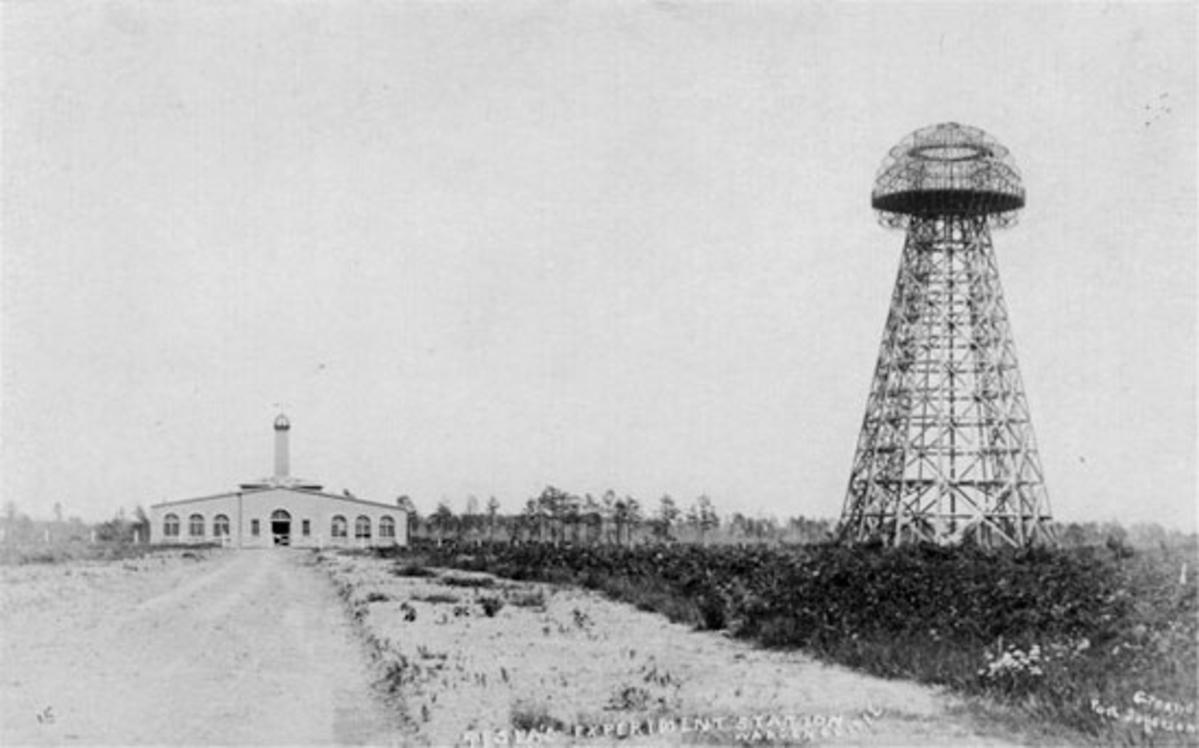
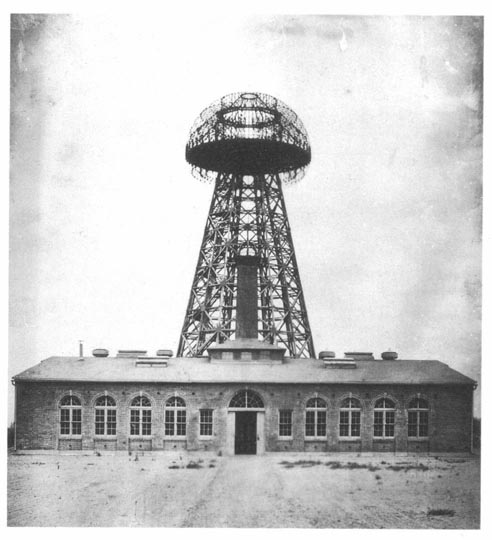
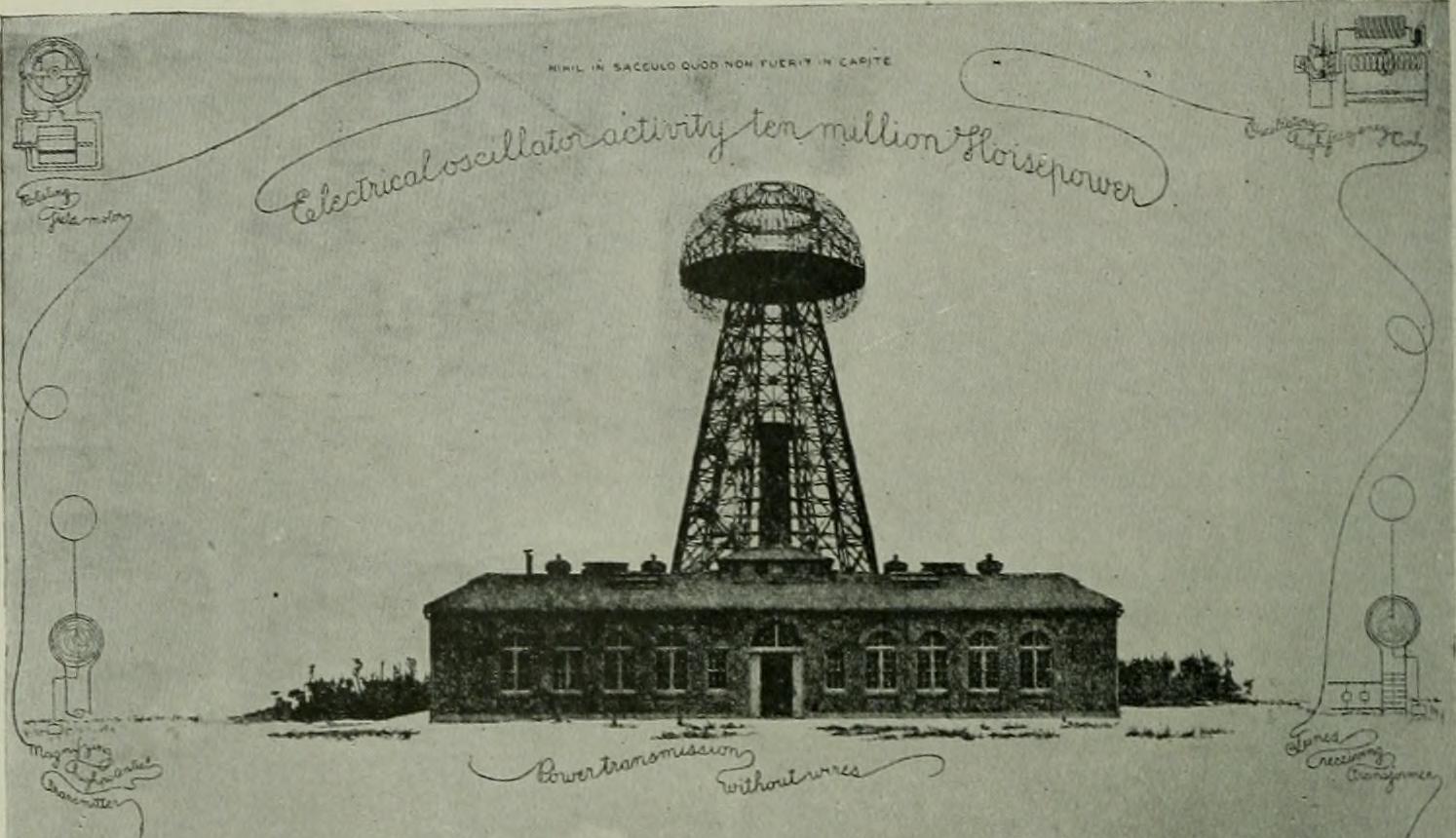
A view of Wardenclyffe Tower, Tesla’s grandest attempt of creating a wireless tranmission of electricity.

(From Electrical World and Engineer, 1904)
Internet Archive Book Images

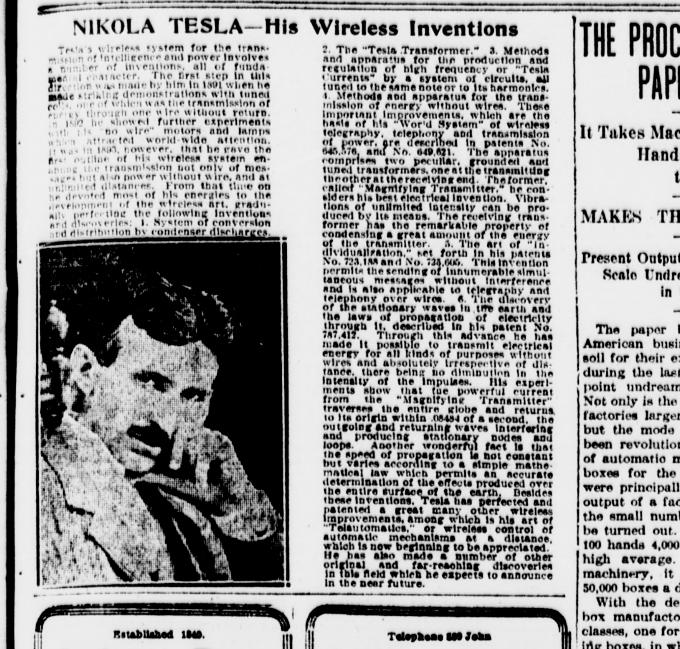
From the New York Sun, March 31, 1912: “Tesla’s wireless system for the transmission of intellegence and power involves a number of inventions, all of fundamental character.”
1912

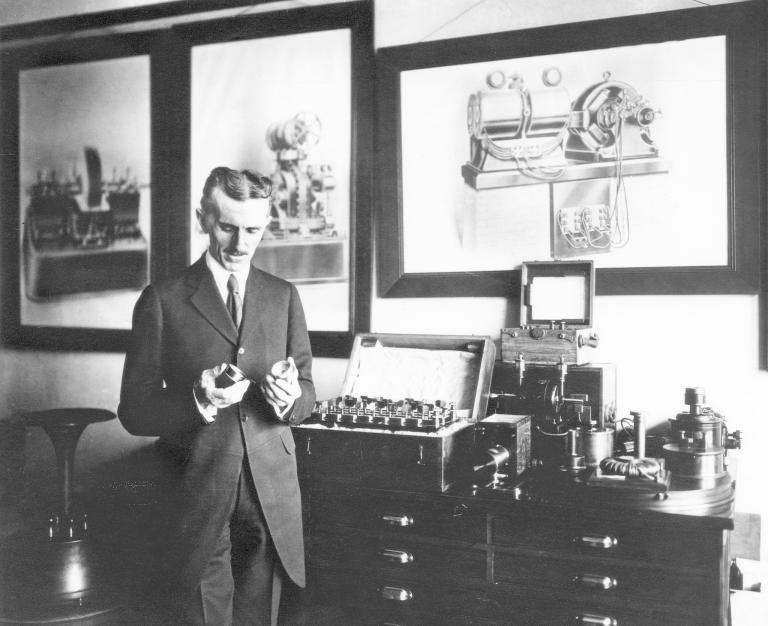
1916: Tesla poses in his West 40th Street laboratory, 1916.
Courtesy Everett Collection Inc., ALAMY
Courtesy Museum of the City of New York
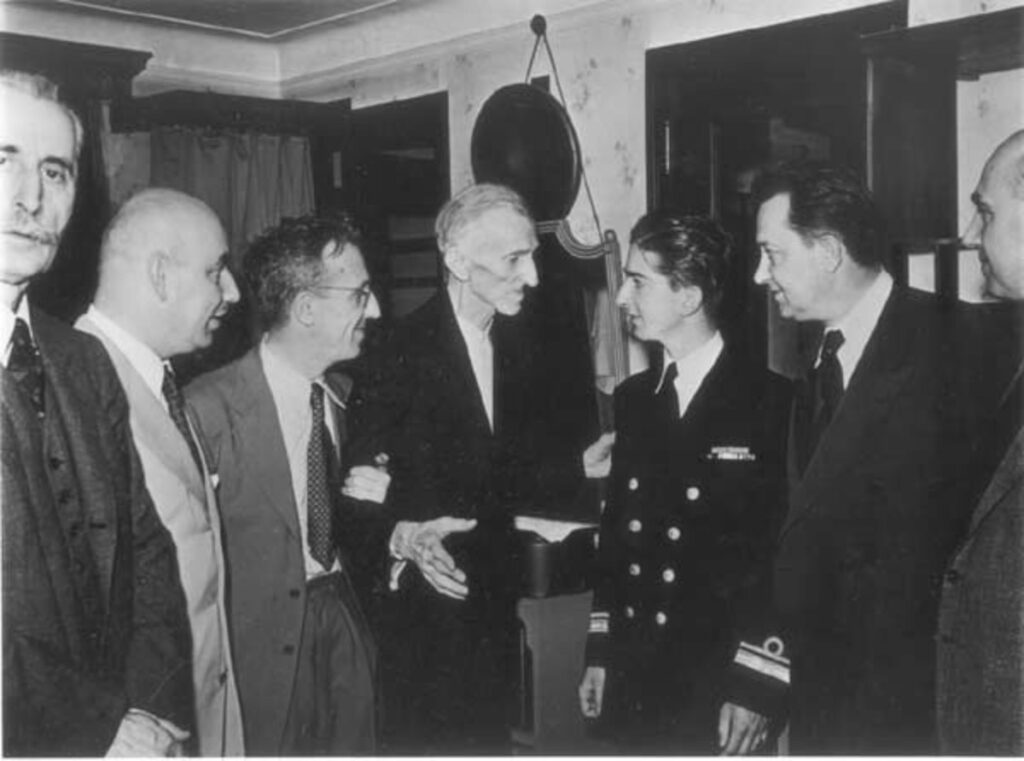
Nikola Tesla at the Hotel New Yorker with King Peter II of Yugoslavia. (Courtesy The New Yorker Hotel)
5

Bryant Park, near the spot of Tesla’s former laboratory and the place where he fed the pigeons.
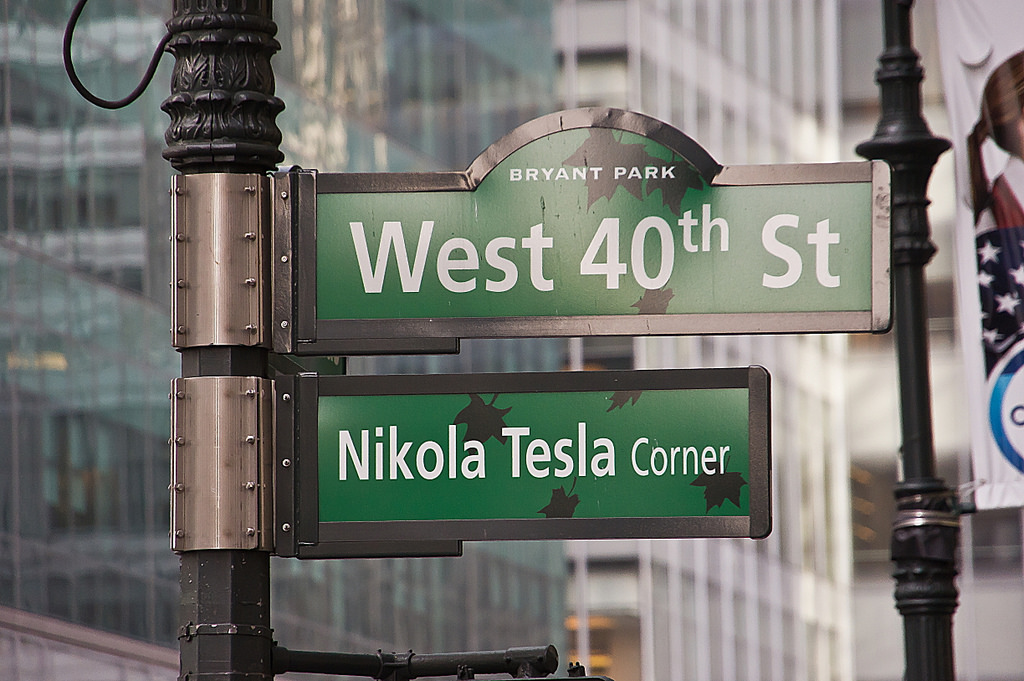
Courtesy Flickr/Lidija Bondarenko
 

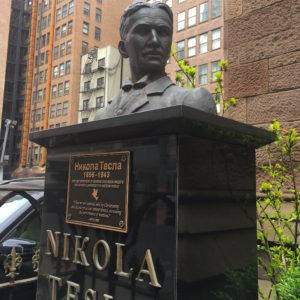
The Nikola Tesla bust in front of St Sava Serbian Orthodox Cathedral. #boweryboys

A photo posted by Gregory Young (@boweryboysnyc) on

For more information

Visit the excellent blog by author Martin Hill Ortiz, deeply exploring the life of Tesla in New York City.

There are many societies devoted to the life and work of Nikola Tesla including the Tesla Memorial Society of New York.  The Oatmeal is behind the effort to turn Wardenclyffe into the Tesla Science Center. Go read up on Tesla at The Oatmeal first, then check out their efforts at the Tesla Science Center.

Wann learn more about Tesla? There’s a few great books on his life including the latest by W. Bernard Carlson — Tesla: Inventor of the Electrical Age. — and Sean Patrick’s Nikola Tesla: Imagination and the Man Who Invented the 20th Century.

Then there are Tesla’s own writings — My Inventions: The Autobiography of Nikola Tesla and The Inventions, Researches and Writings of Nicola Tesla
Categories
The First

Nikola Tesla and the Wireless World: The Invention of Remote Control
THE FIRST: STORIES OF INVENTIONS AND THEIR CONSEQUENCES The Serbian inventor Nikola Tesla is known as one of the fathers of electricity, the curious genius behind alternating current (AC), the victor in the so-called War of the Currents. But in this episode of The First, starting in the year 1893, Tesla begins conceiving an even grander scheme — the usage of electromagnetic waves to distribute power.

Today we benefit from the electromagnetic spectrum in a variety of ways — Wi-Fi, X-rays, radio, satellites. One of the roads to these inventions begins with Tesla and his experiments with remote control, using radio waves to operate a mechanical object.

But you may be surprised to discover Tesla’s initial application of remote control. Far from inventing an children’s toy, Tesla’s remote controlled device would be used as a weapon of war.

To get this episode, simply download it for FREE from iTunes or other podcasting services.

Subscribe to The First here so that you don’t miss future episodes!

Or listen to it straight from here:
11 NIKOLA TESLA AND THE WIRELESS WORLD

Below — A sampling of newspaper headlines involving Nikola Tesla, specifically from the mid and late 1890s (when he first began thinking and experimenting with wireless) and one from 1901.

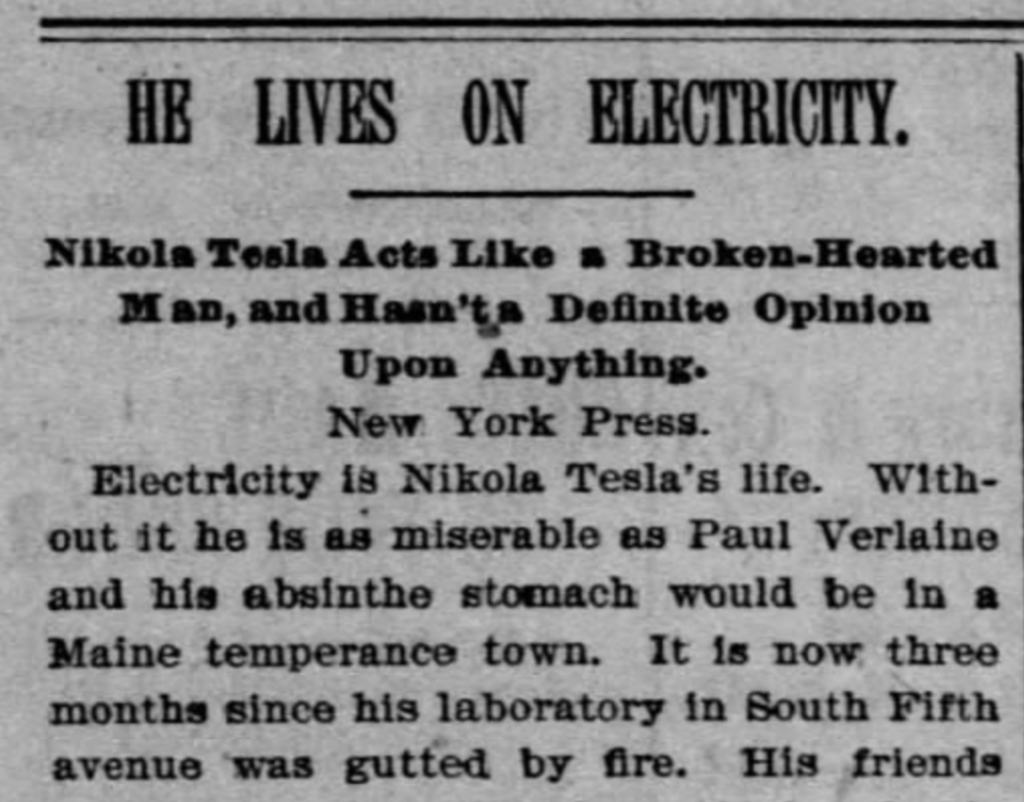
HE LIVES ON ELECTRICITY

Nikola Tesla Acts Like a Broken-Hearted Man, and Hasn’t a Definite Opinion Upon Anything

Electricity is Nikola Tesla’s life. Without it he is as miserable as Paul Verlaine and his absinthe stomach would be in a Maine temperance town.

July 18, 1895, The Morning News (Wilmington, Delaware)

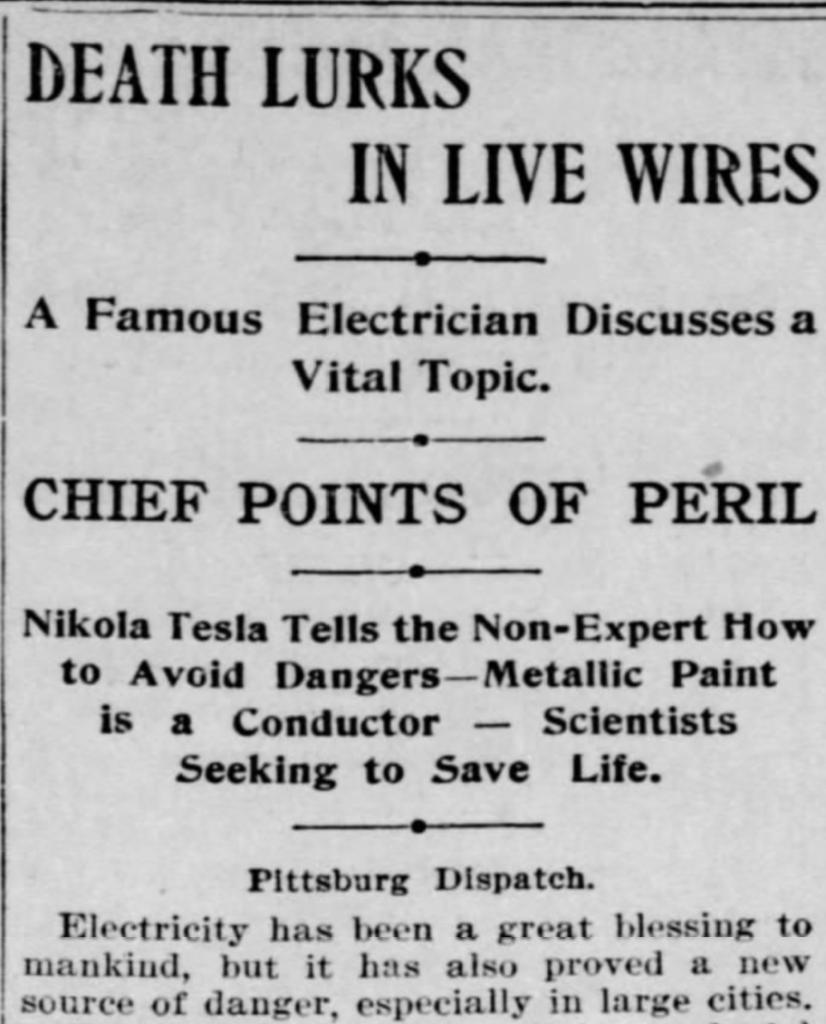
DEATH LURKS IN LIVE WIRES

A Famous Electrician Discusses a Vital Topic

CHIEF POINTS OF PERIL

Nikola Tesla Tells the Non-Expert How to Avoid Dangers — Metallic Paint is a Conductor — Scienties Seeking to Save Life

August 5, 1898, Democrat and Chronicle (Rochester, New York)

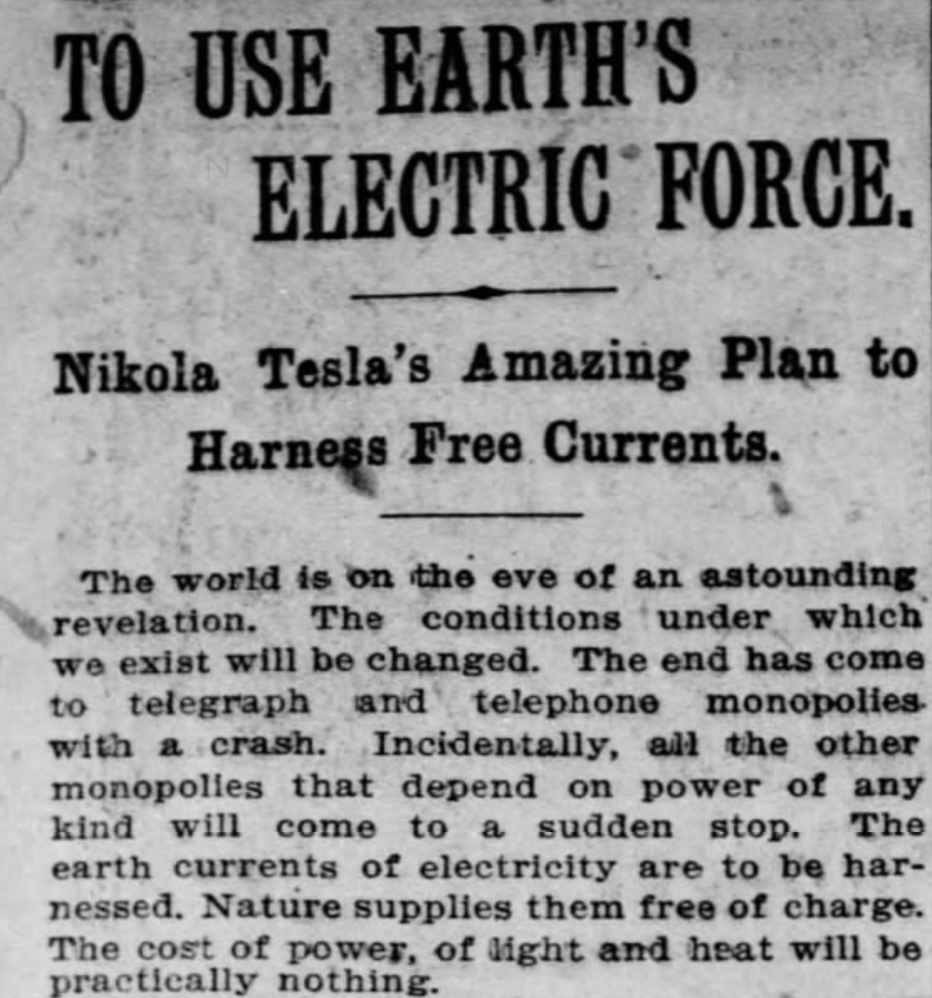
TO USE THE EARTH’S FORCE

Nikola Tesla’s Amazing Plan to Harness Free Currents

March 15, 1896, St. Louis Post Dispatch (St. Louis, Missouri)

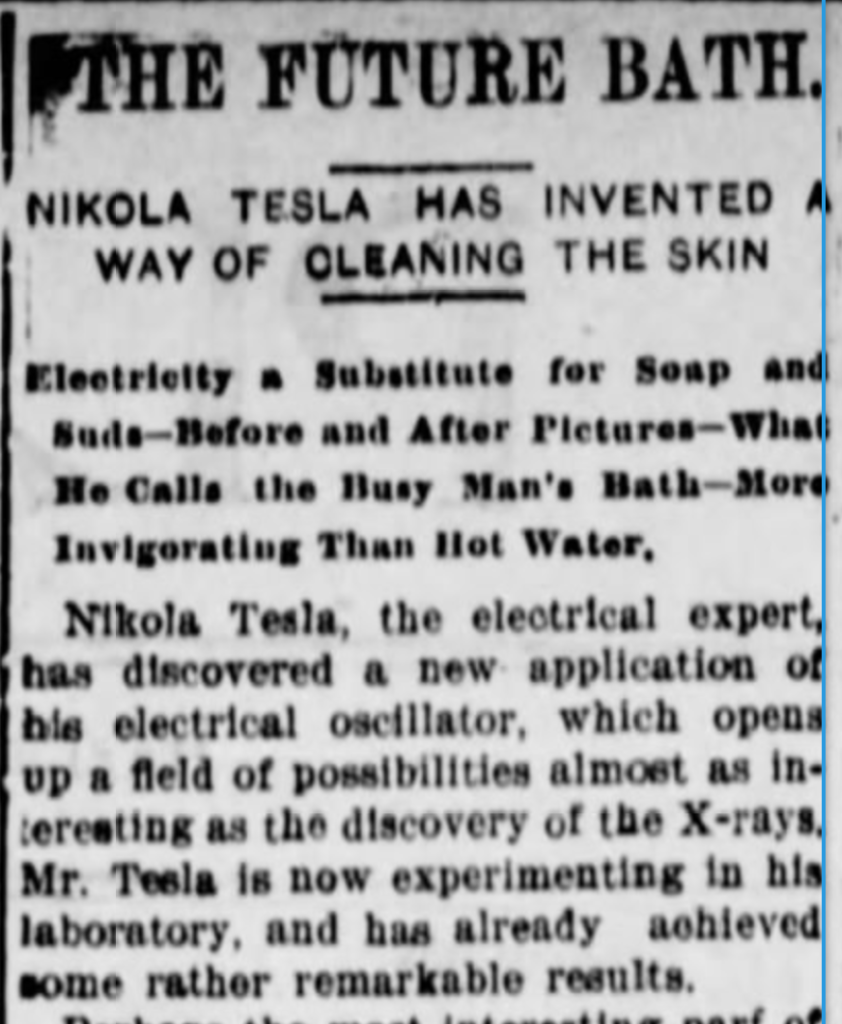
THE FUTURE BATH

Nikola Tesla has invented a way of cleaning the skin

Electricity a Substitute for Soap and Suds — Before and After Pictures — What He Calls the Busy Man’s Bath — More Invigorating Than Hot Water

October 25, 1898, The Plain Speaker (Hazleton, Pennsylvania)

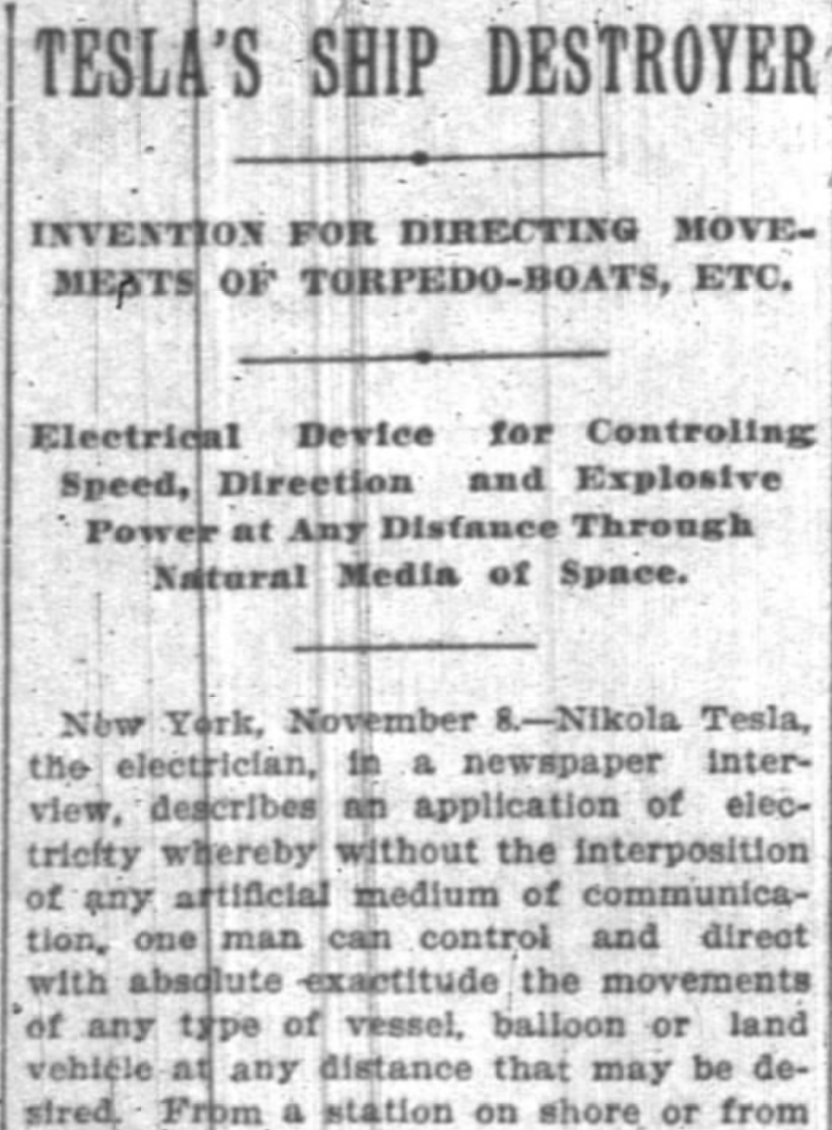
TESLA’S SHIP DESTROYER

Invention for Directing Movements of Torpedo-Boats, Etc.

Electrical Device for Controlling Speed, Direction and Explosive Power at Any Distance Through Natural Media of Space

November 8, 1898, The Indianapolis News (Indianapolis, Indiana)

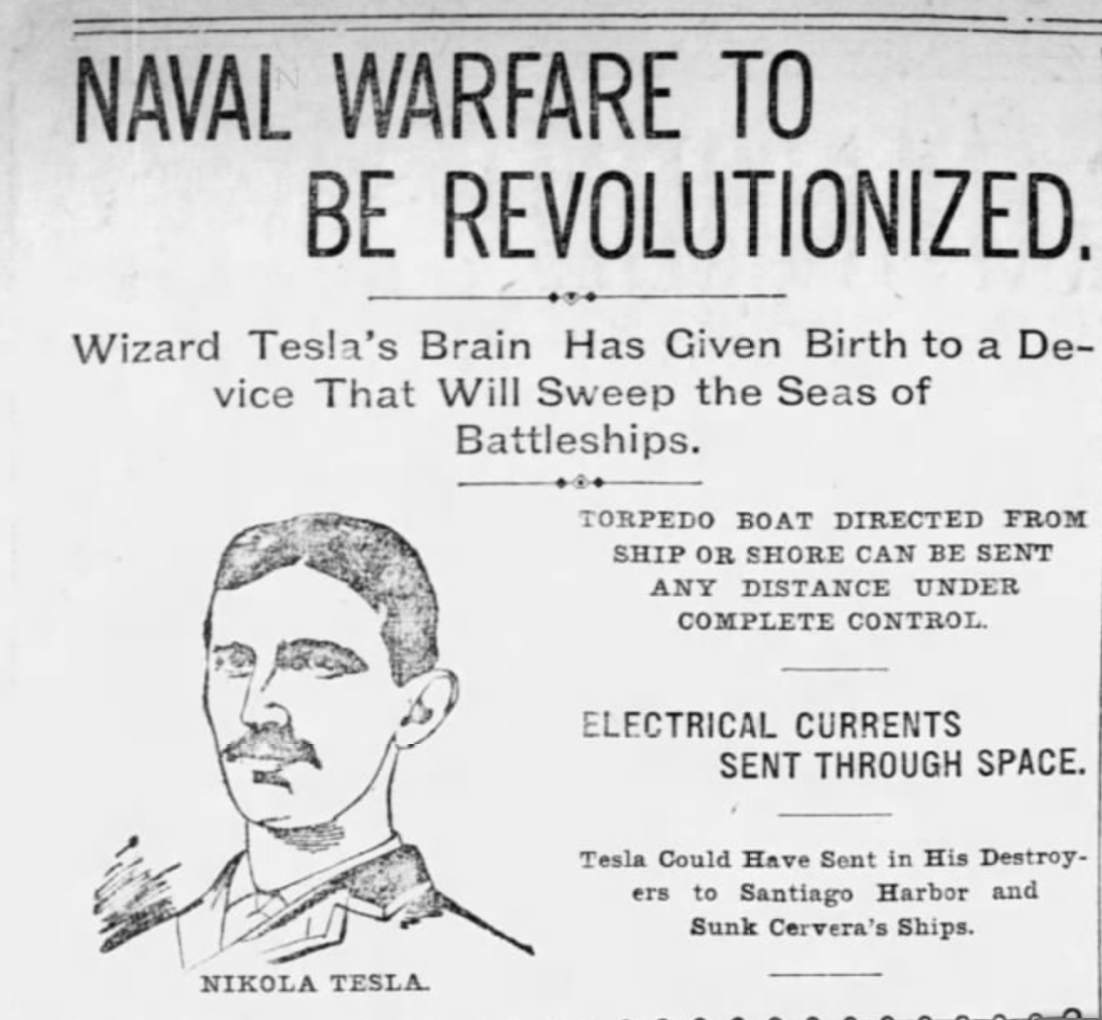
NAVAL WARFARE TO BE REVOLUTIONIZED

Wizard Tesla’s Brain Has Given Birth to a Device That Will Sweep the Seas of Battleships

ELECTRICAL CURRENT SENT THROUGH SPACE

November 8, 1898, St. Louis Post-Dispatch (St. Louis, Missouri)

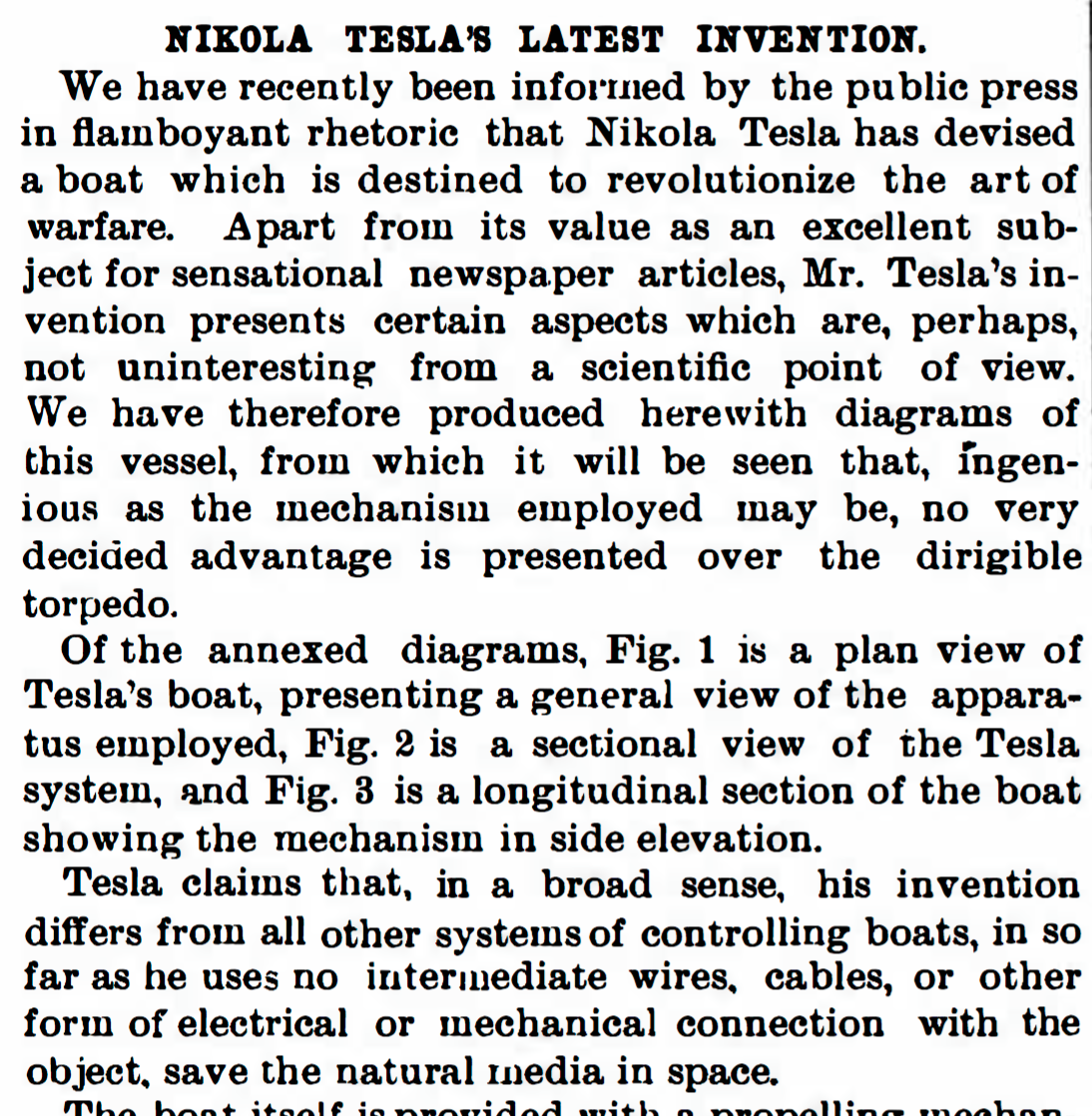
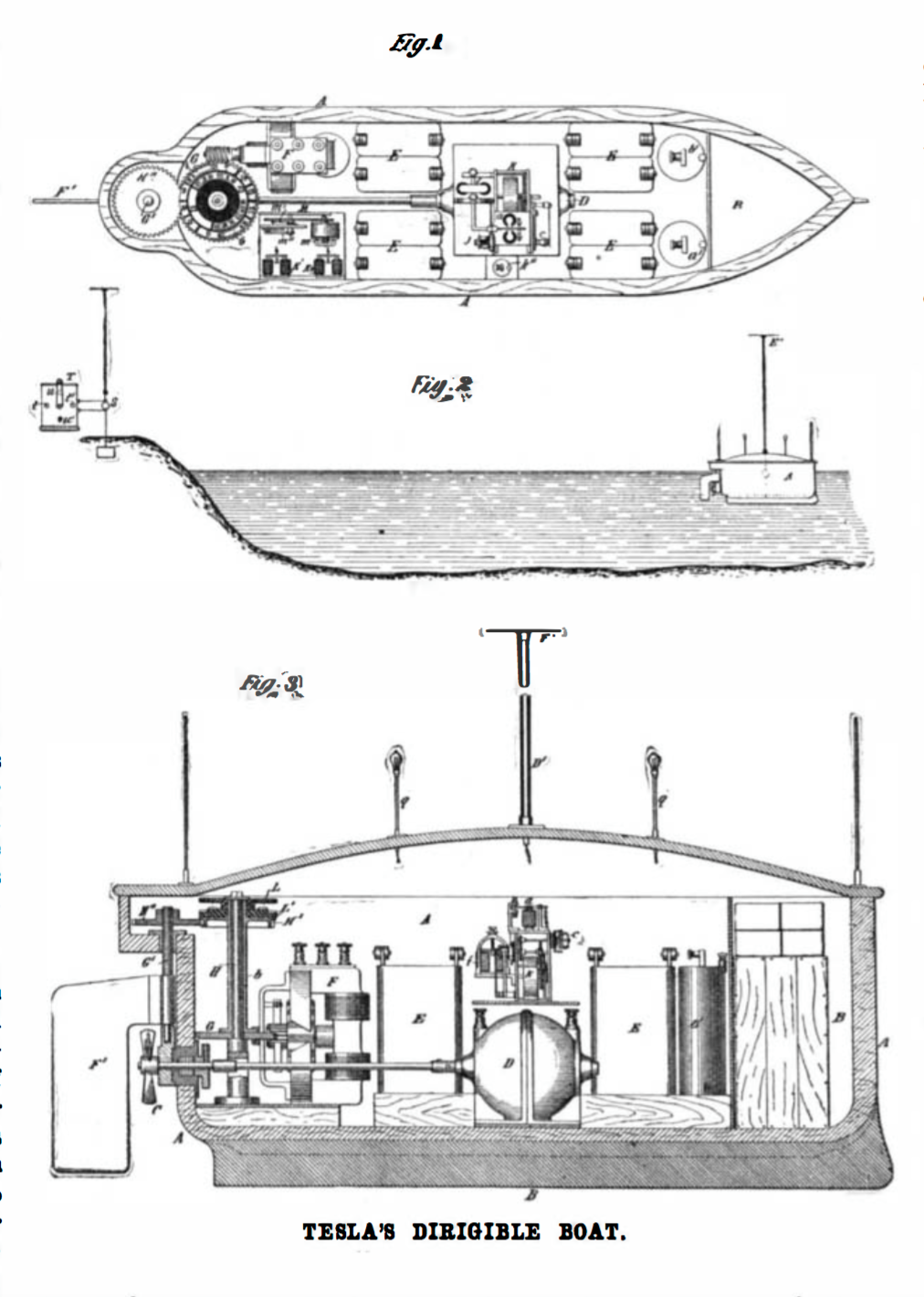
NIKOLA TESLA’S LATEST INVENTION

“We have recently been informed by the public press in flamboyant rhetoric that Nikola Tesla has devised a boat which is destined to revolutionize the art of warfare.”

Scientific American, November 19, 1898

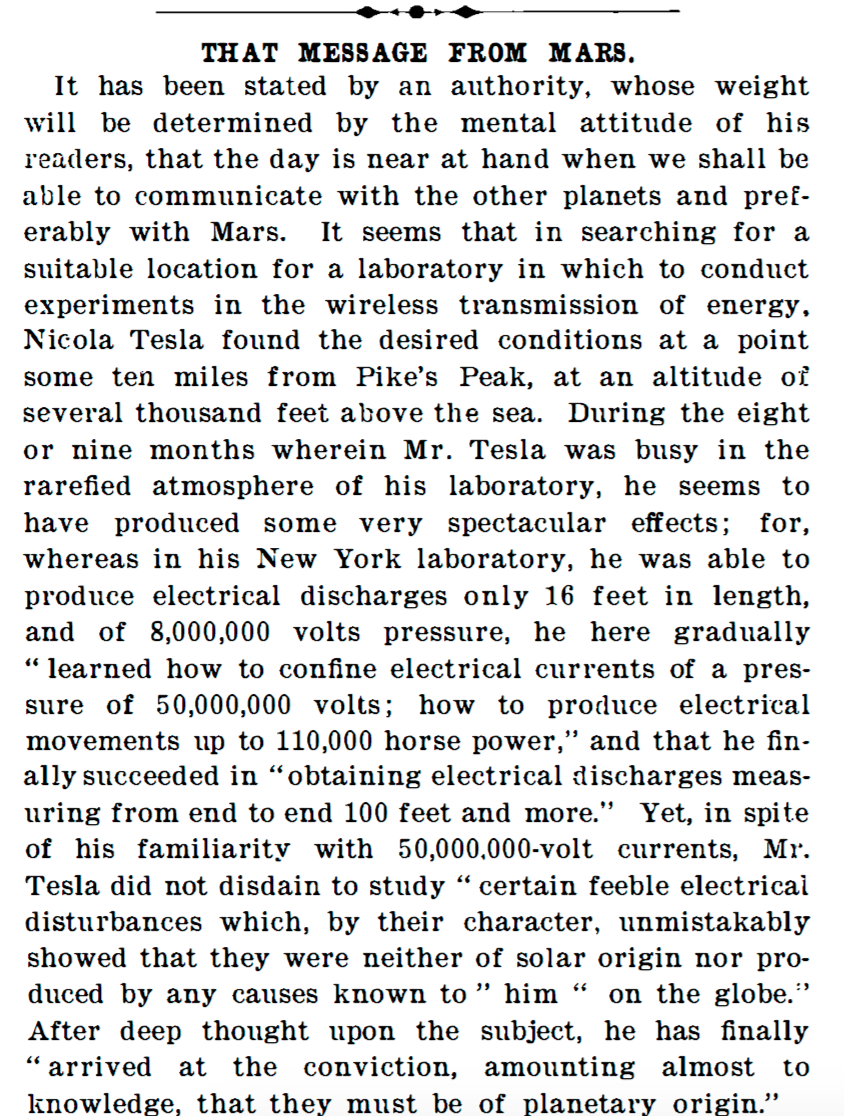
THAT MESSAGE FROM MARS

Scientific American, January 19, 1901

Categories
American History

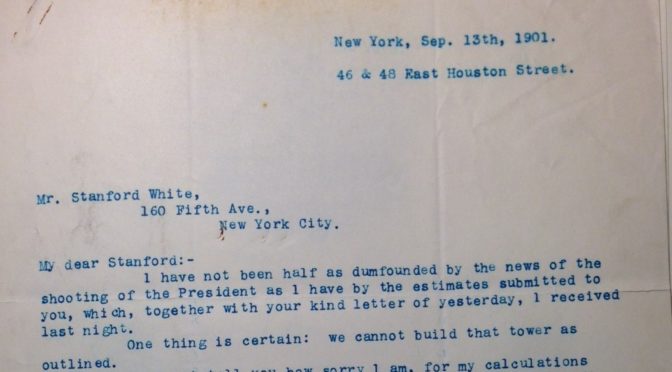
“My dear Stanford…” Letters from Tesla at the New York Public Library

Here’s a little inside look on some of the fun stuff that we sometimes get to do while researching a podcast:

Tom headed over to the New York Public Library while researching our show on Nikola Tesla and got the opportunity to looking into the library’s rich trove of original documents from the Manuscripts and Archives Division.

It’s one thing to study facts in a book or read the depictions of events in an old newspaper. It’s quite another to get close up to the historical figures themselves through their actual correspondence, not so much for the information, but for the tone and character of their voices.  Even though these papers are all mostly business-related, you can really get a sense of Tesla’s personality and how he viewed others. He was ambitious and creative. He was anxious and protective.

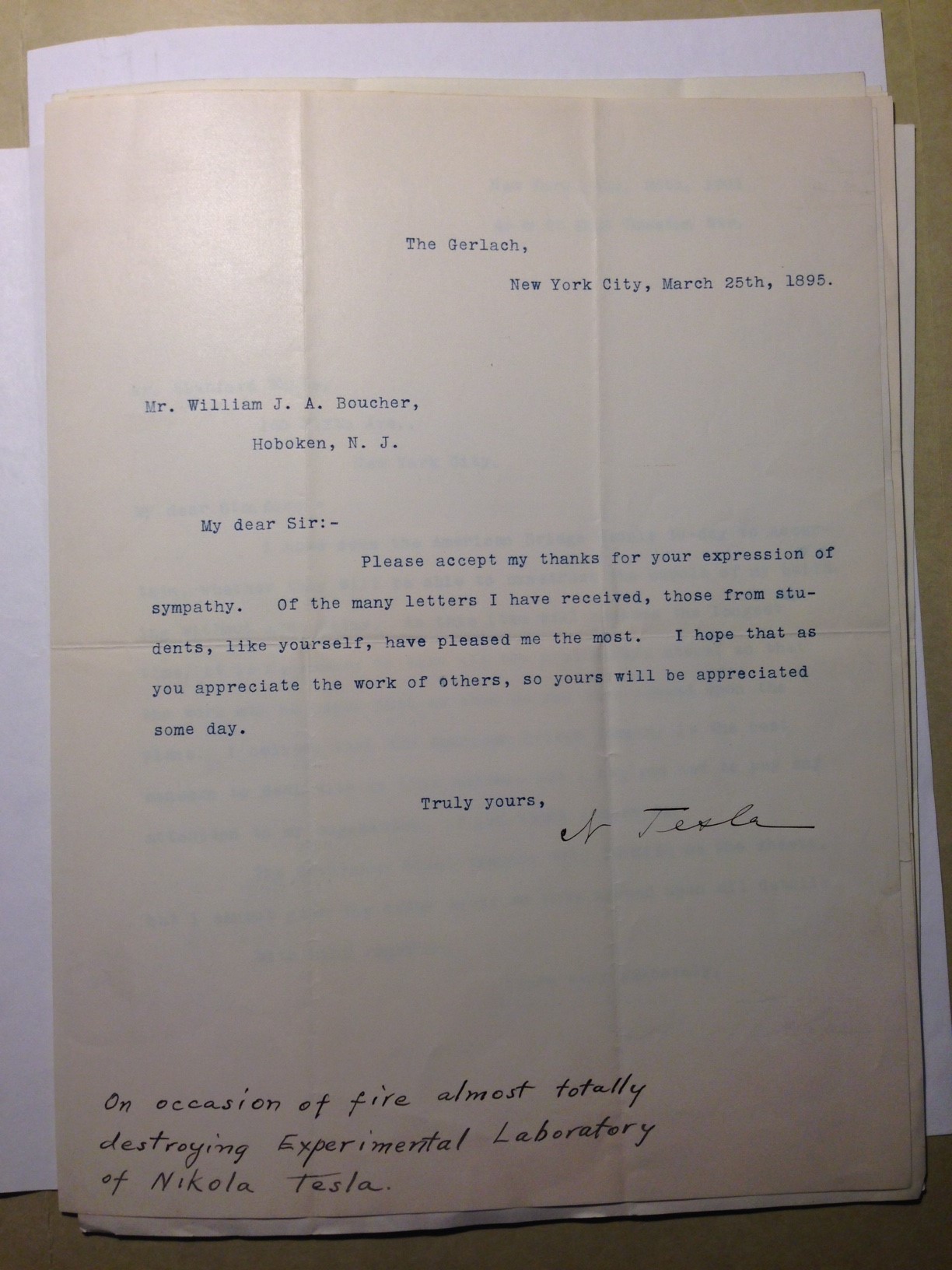
As we mentioned in our podcast on Nikola Tesla, his South Fifth Avenue laboratory was destroyed in a fire on March 13, 1895. It was a well publicized event, especially in scientific journals. Tesla most likely received many letters like the one below at his home at the Gerlach Hotel (today’s Radio Wave Building, named so in his honor).

Courtesy New York Public LIbrary
Courtesy New York Public Library


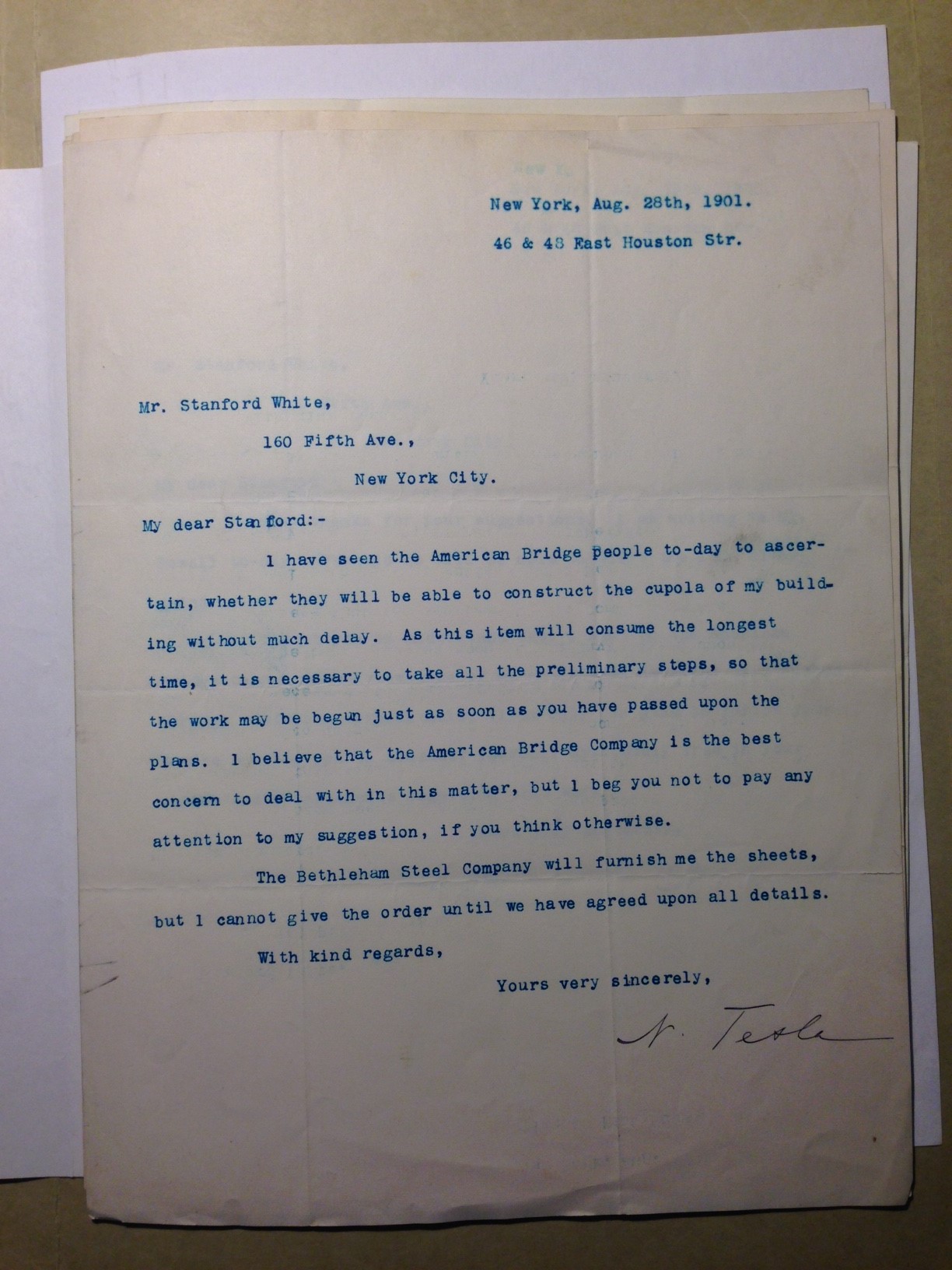
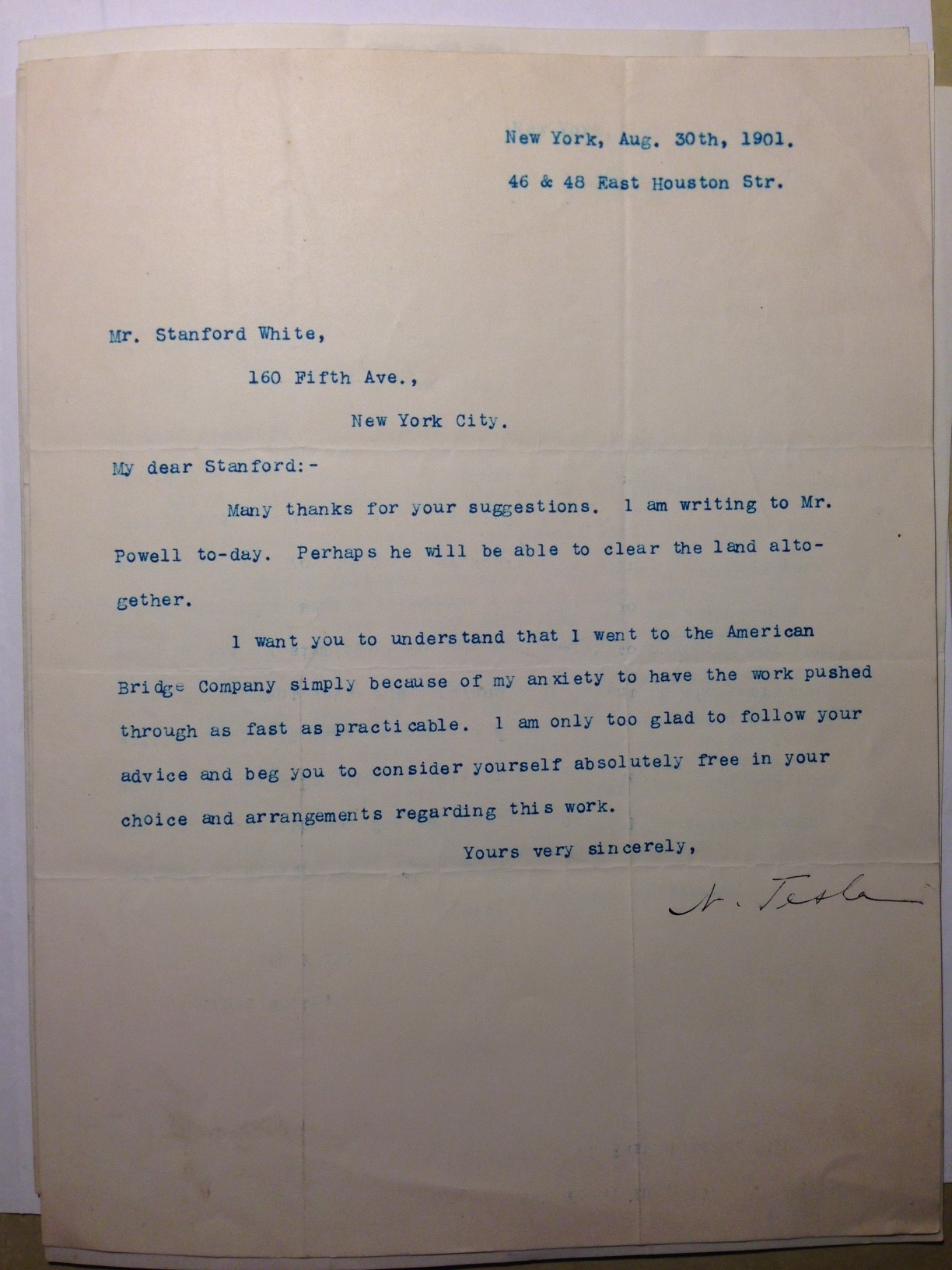
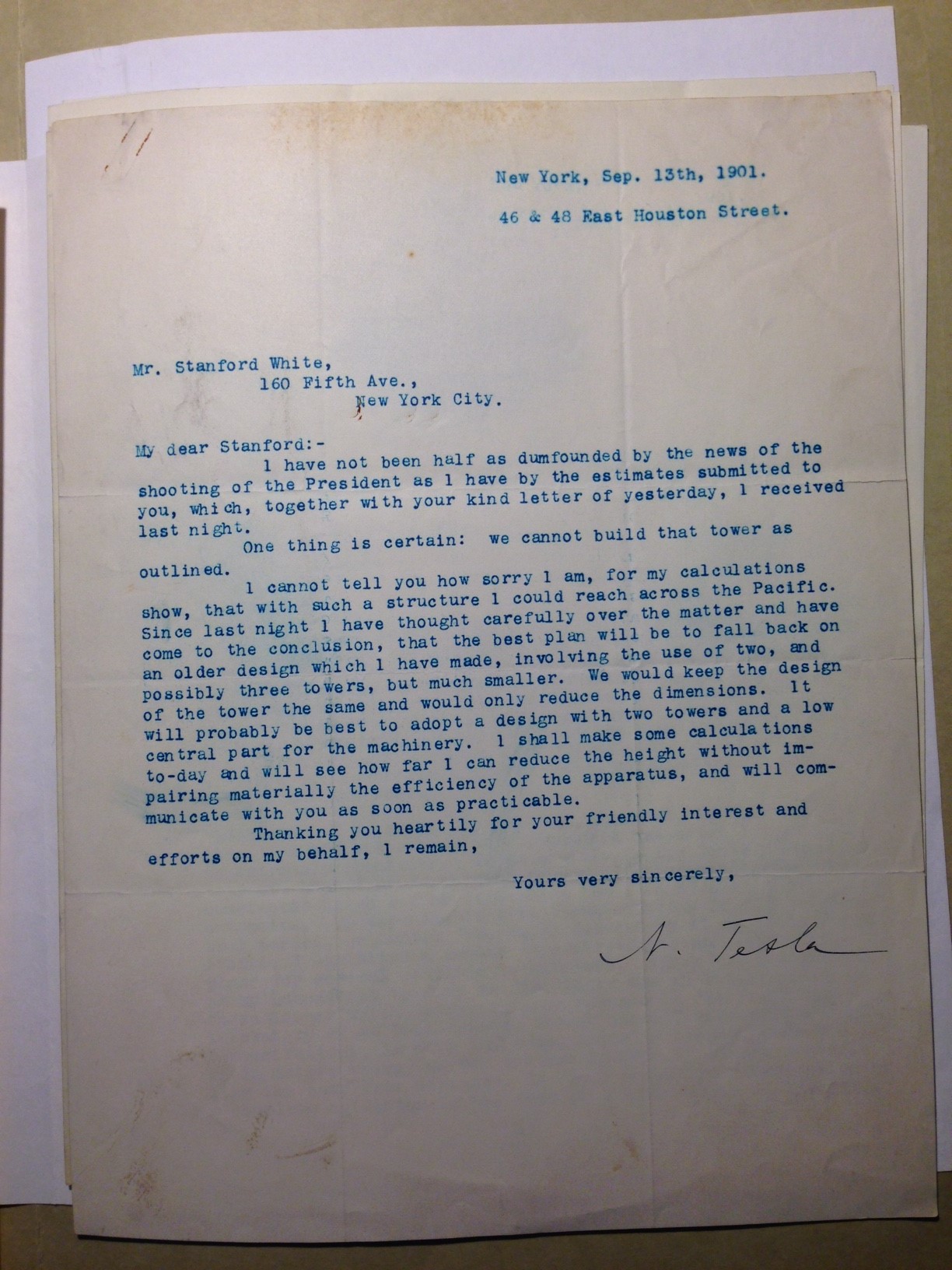
The next three are letters to friend and architect (and scaliwag) Stanford White, outlining the constructionn of Wardenclyffe Tower in Long Island.  The third letter is by far the most intriguing, sent days after the shooting of William McKinley.  The president died the day after Tesla’s letter was sent, and White’s friend Theodore Roosevelt would then ascend to the presidency.

The American Bridge Company was newly formed in 1901 but traces itself to the civil engineering firm that built the Eads Bridge in St. Louis, the longest arch bridge in the world at the time. New York projects for the firm in the 20th century would include the Empire State Building, the Chrysler Building, the Woolworth Building and the Verrazano-Narrows Bridge. They’re still in operation; in fact they’re finishing up work on a project at the George Washington Bridge.

Pennsylvania’s Bethlehem Steel Company was a giant of steel manufacturing in the Gilded Age. Just as Tesla and George Westinghouse got to display the marvels of alternating current at the World’s Fair of 1893 in Chicago, so to did Bethlehem Steel get to employ their wares; the world’s first Ferris Wheel, the grand attraction of the fair, was held together in Bethlehem Steel.

2


9


4

And here was the final result of their labor — the Wardenclyffe Tower in Shoreham, Long Island.


lab_photo-thumb-550xauto-98423
Courtesy Daniel C. Elton


Tesla_Broadcast_Tower_1904


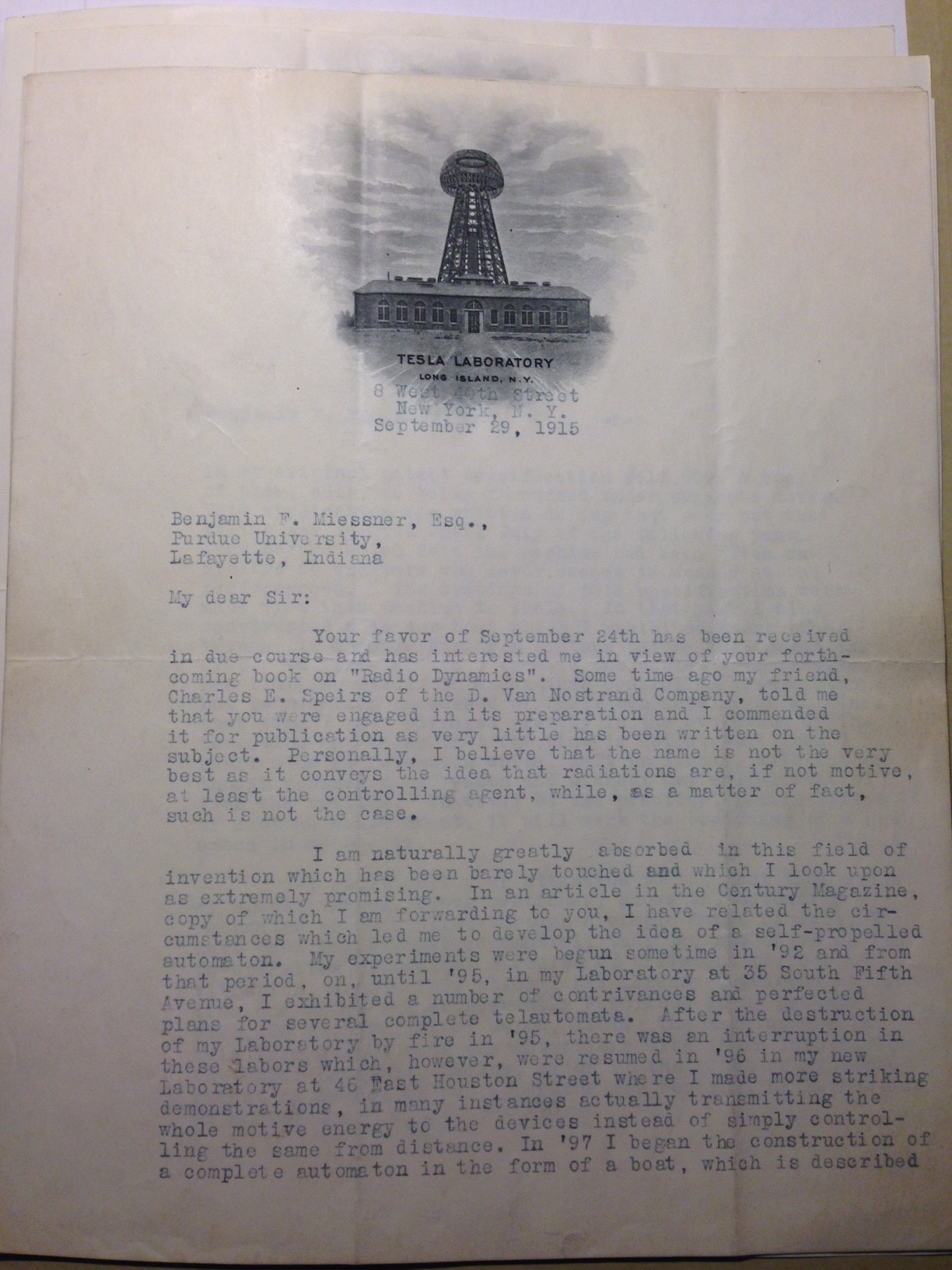
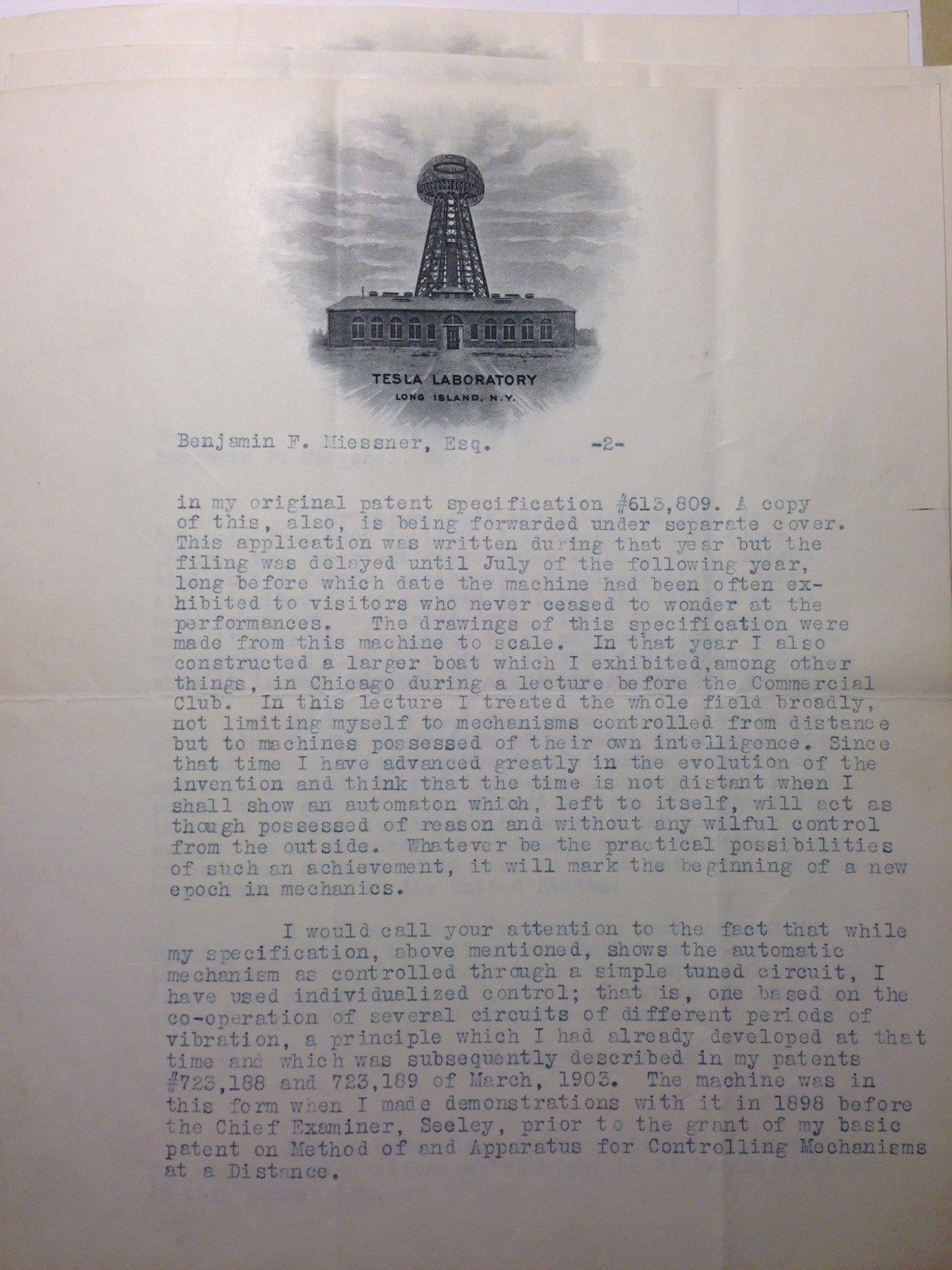
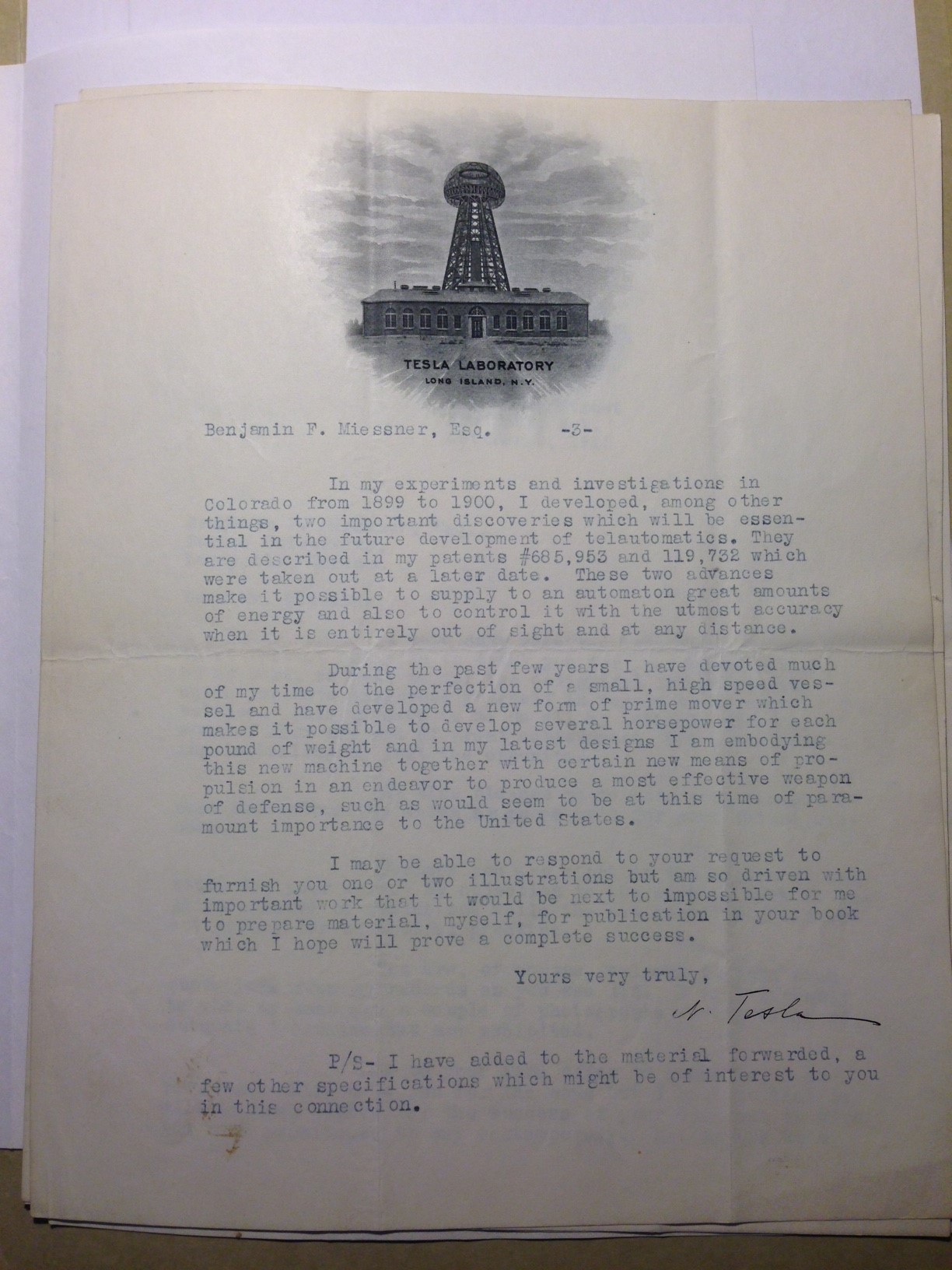
The final letter is intriguing for being written on the official Wardenclyffe Tower letterhead! Of course, in 1915, the tower had been long shut down, and Tesla was racking up the bills at the Waldorf-Astoria Hotel.

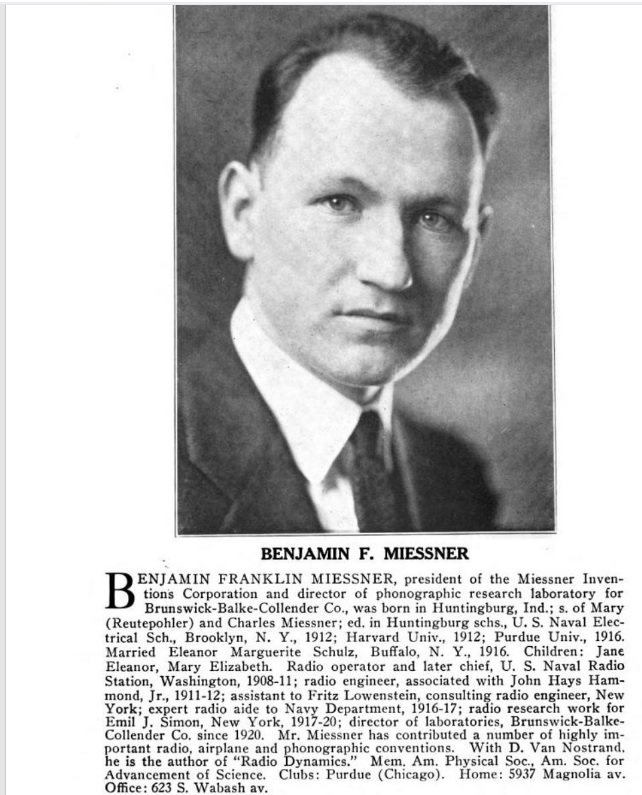
His correspondence is with young inventor Benjamin Miessner who was studying at Perdue University on this date.  Miessner eventually went into acoustical research; he later innovated technologies in sound recording. A picture and biography of Mr. Miessner appear below this letter from the Press Club of Chicago’s Official Reference Book.

In the letter, Tesla references the fire of 1895 and his automaton experiment which was revealed at Madison Square Garden. You can also see a real preoccupation with keeping and protecting patents for his work (and a subtext of preservation of those patents). After all, in 1915, Tesla was out of money!

10
11

12

His correspondence partner Benjamin Miessner in 1922:

1


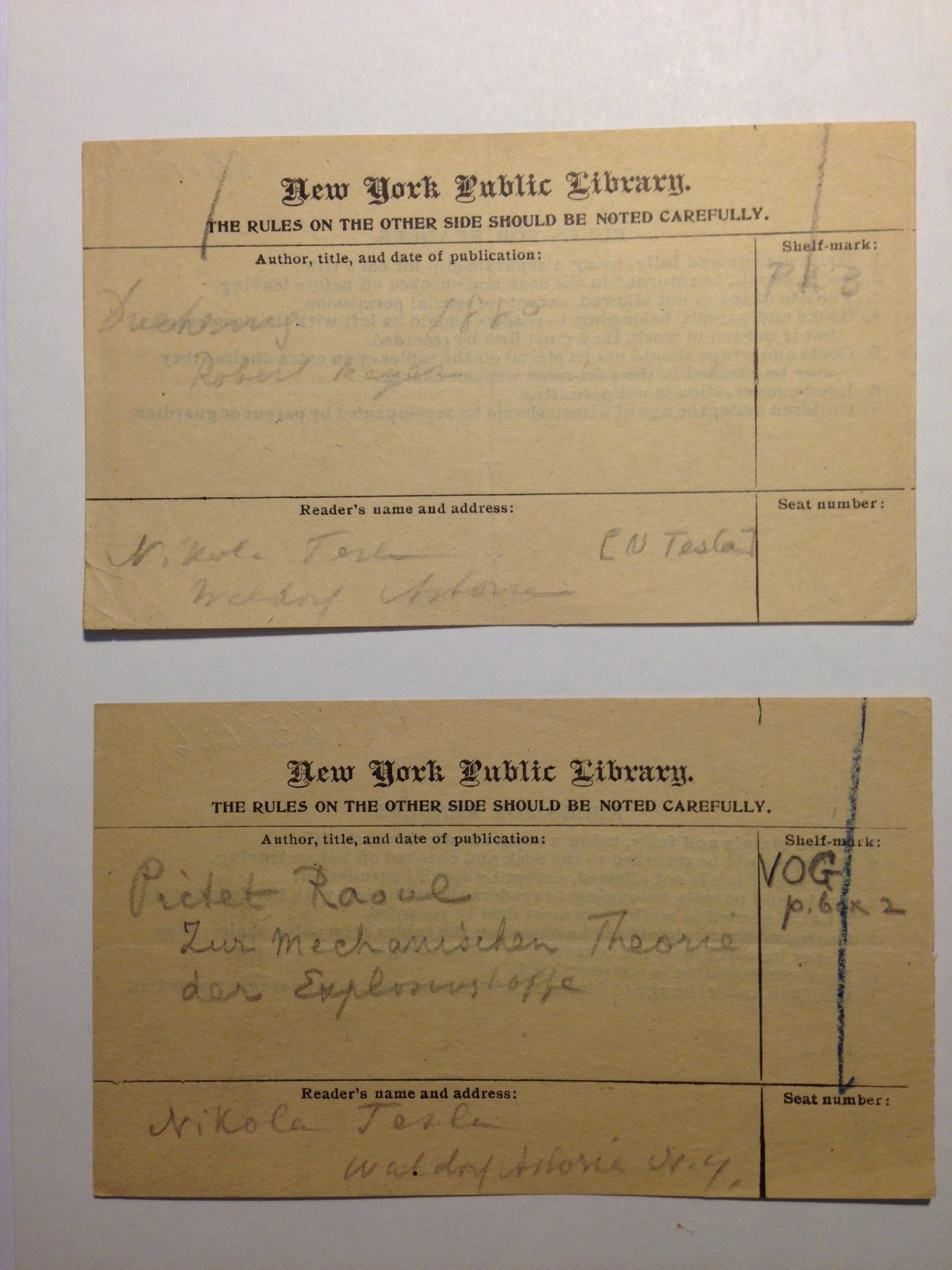
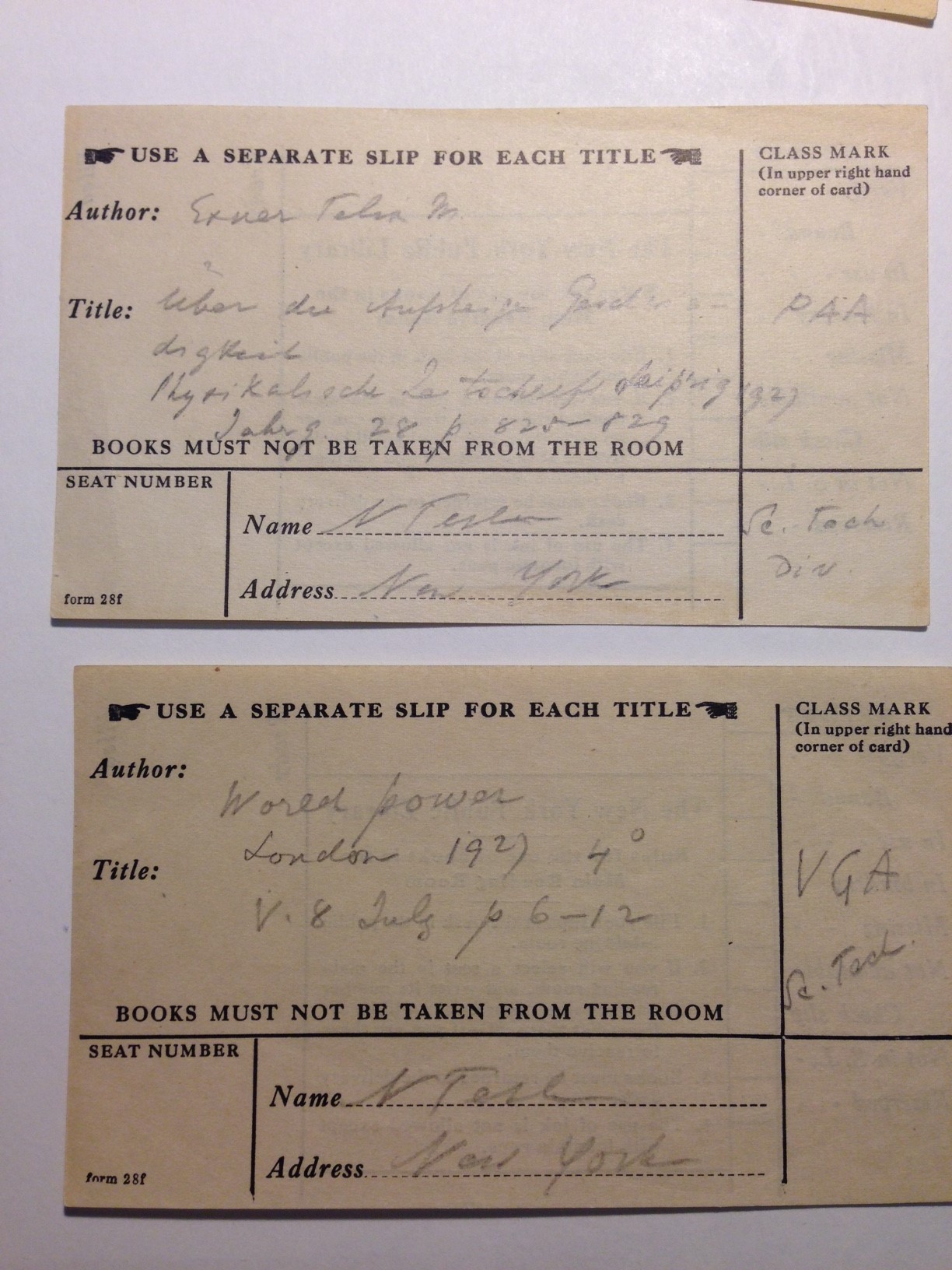
And finally, some library cards that Tesla check out himself, with an address of the Waldorf Astoria (which needed no address):

5

3


Documents from the Nikola Tesla letters. Manuscripts and Archives Division. The New York Public Library. Astor, Lenox, and Tilden Foundations. We thank the library for their help with this podcast and with all other things!


Categories
Gilded Age New York

The Boss Tweed connection to St. Sava, the cathedral destroyed by fire

New York City lost a very interesting landmark this past weekend.

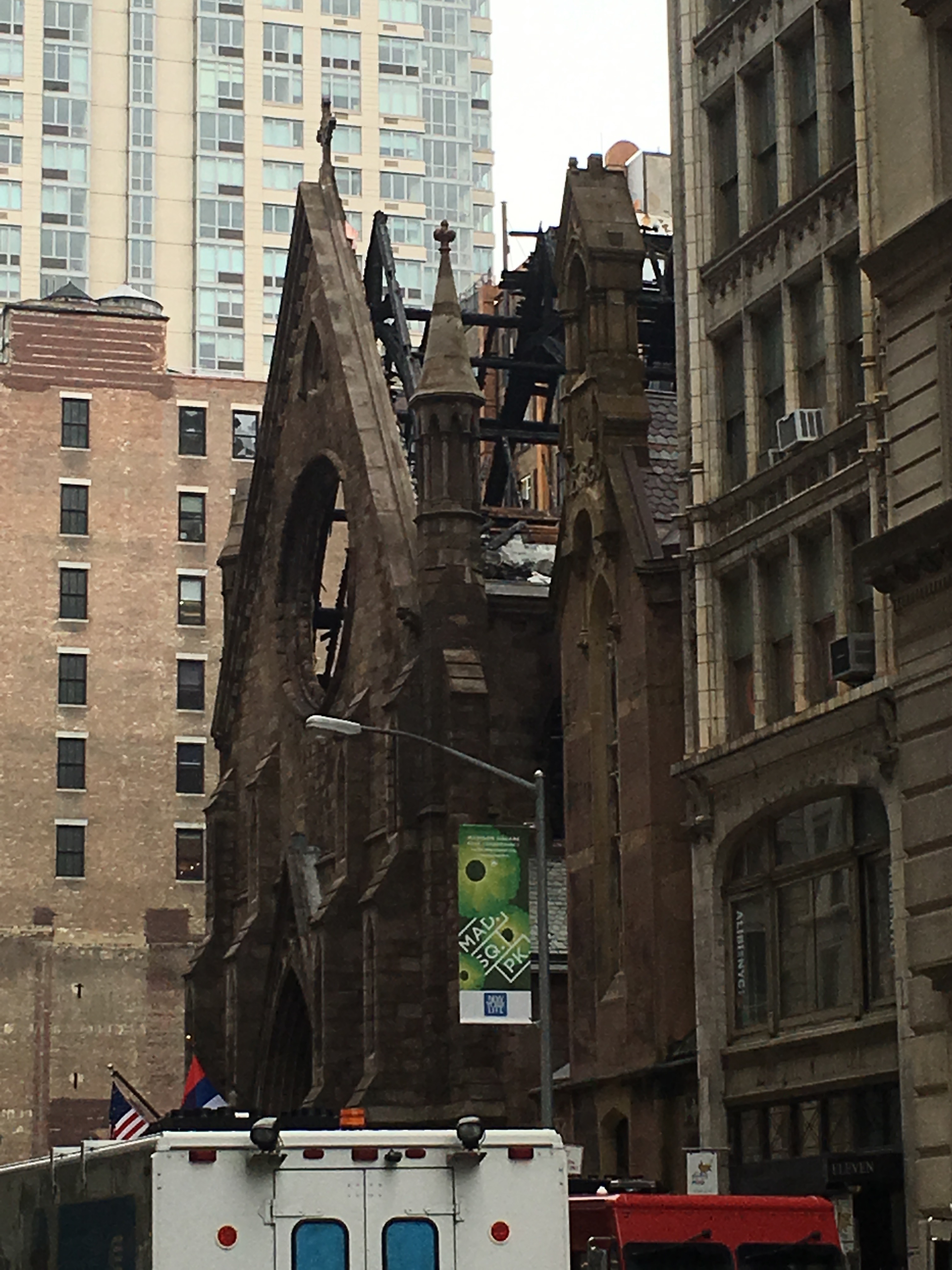
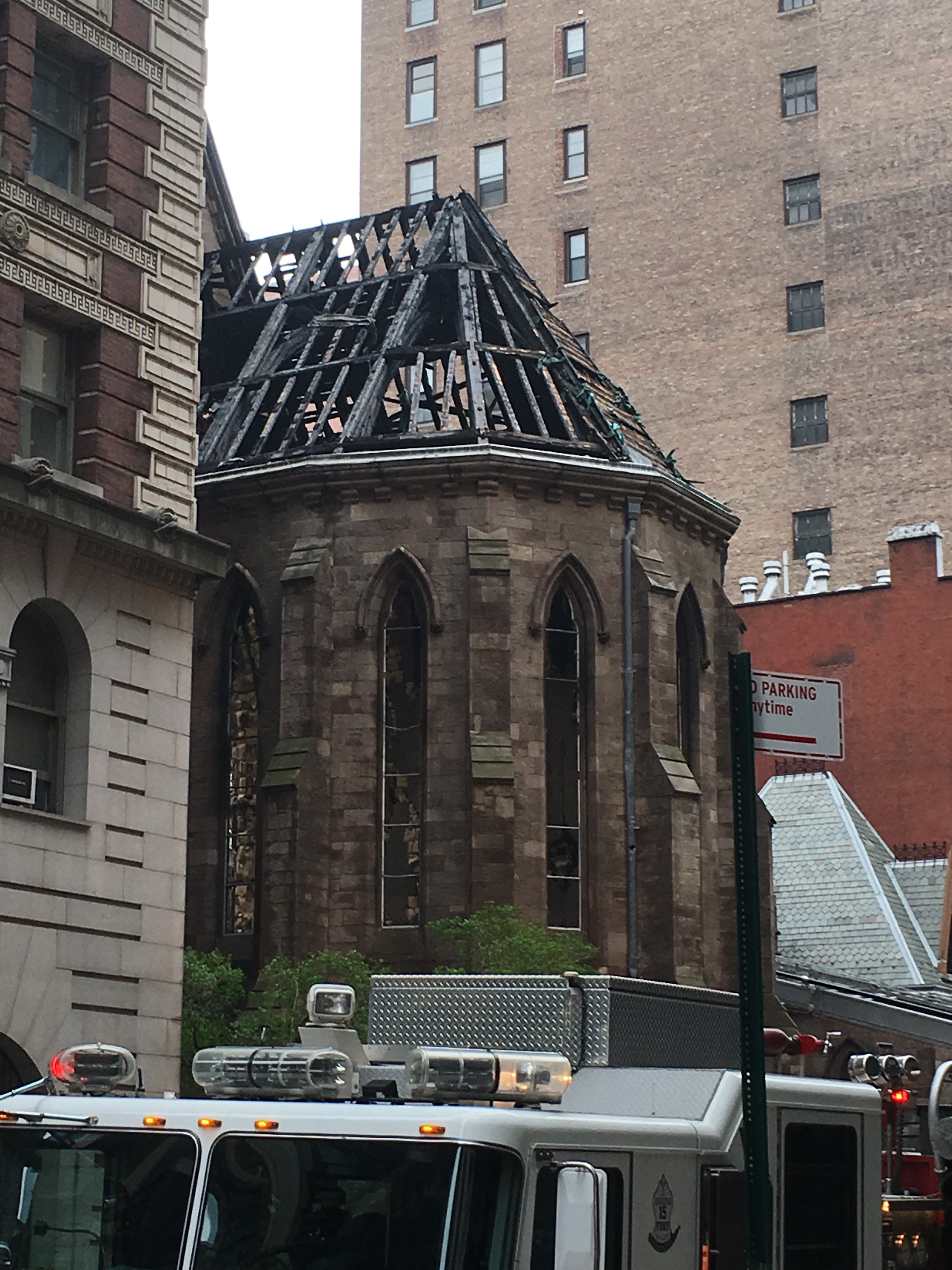
Serbian Orthodox Cathedral of St. Sava, at West 25th and Broadway, was destroyed in a spectacular and mysterious four-alarm fire on Sunday, its windows shattered in shafts of flame, its ceiling reduced to cinders. If you’re a podcast listener, you may know this place from the show we released just last Friday on the life of Nikola Tesla. Sitting in front of St. Sava is a bust of Tesla, placed there by the Tesla Memorial Society of New York. Or was, I suppose. The bust was either moved or did not survive this catastrophic blaze.

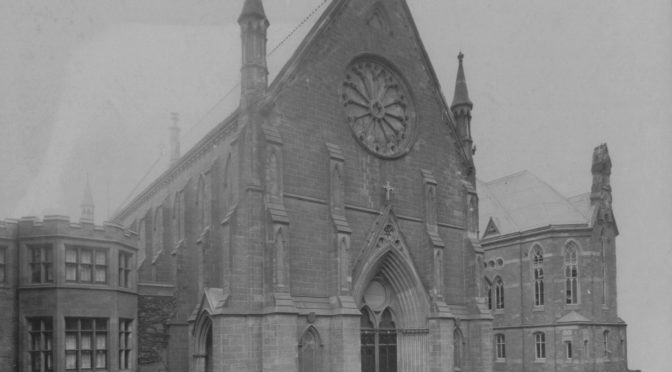
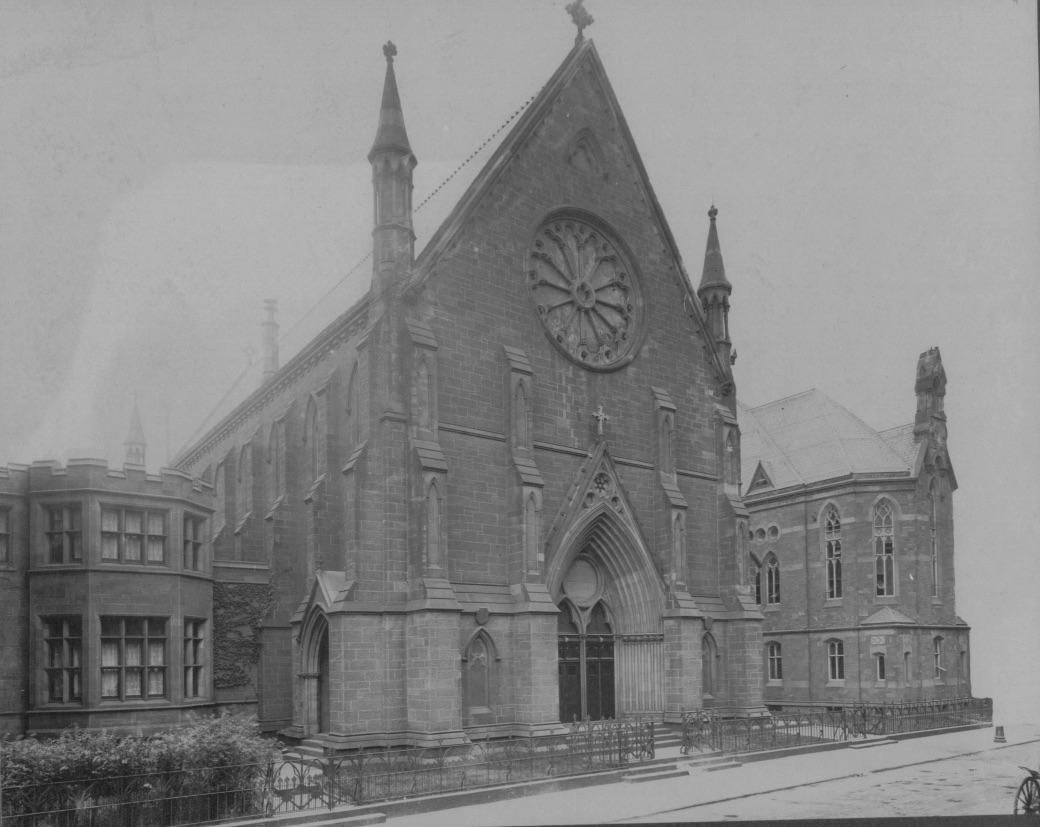
New York has lost an important bit of history. The cathedral was the former Trinity Chapel, an outpost of downtown’s Trinity Church which opened here in 1851 to cater to the elite moving uptown along Fifth Avenue.

The New York Times has a short roundup of some of its most notable events — notably the marriage of Edith Wharton in 1885 and, in 1943, its conversion into an Eastern Orthodox house of worship. The usual fine work of Daytonian In Manhattan highlights the details of its construction.  “It was, as The New York Times called it in 1914, “distinctly fashionable to be married there.'”

1

Picture courtesy Trinity Wall Street

In fact one of the most notorious weddings in New York City history took place here.

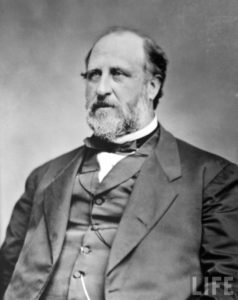
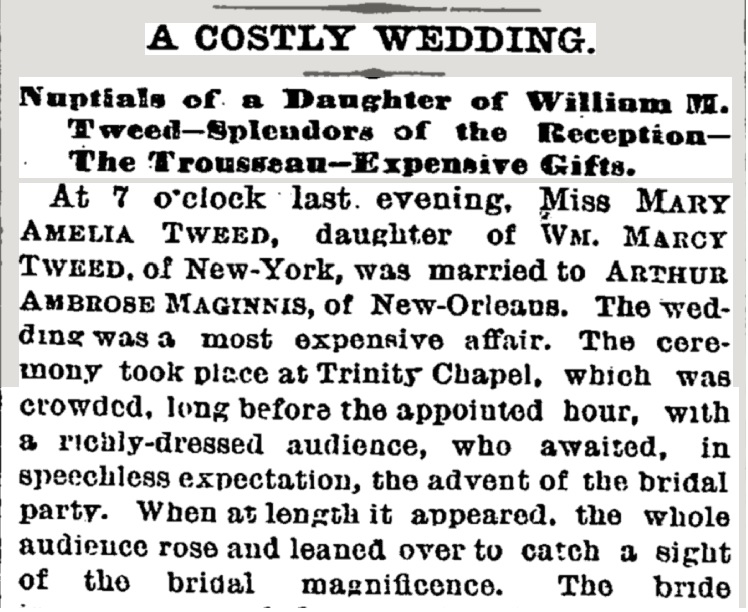
Not because of the bride and groom — Mary Amelia Tweed and New Orleans heir Ambrose MaGinnis — but because of the lavish behavior of the bride’s father William ‘Boss’ Tweed. In another strange bit of coincidence, that fated wedding occurred 145 years ago this month, on May 31, 1871.

William_Magear_-Boss-_Tweed_(1870)

“The streets for blocks around were filled with carriages, while the church was crowded to excess,” said the New York Herald the following day. “The center aisle was reserved for the invited guests and presented a most brilliant spectacle.”

The entire clan was adorned in jewels; “the Tweed family seemed to be a Christmas tree of diamonds,” according to author Alexander B. Callow Jr. Tweed wore his famous diamond pin, while his wife sparkled in so many that she threatened to take attention away from the bride.

Almost, that is. For Tweed’s daughter wore, according to Kenneth Ackerman, a “‘white corded silk, décolleté, with demi-sleeves, and immense court train’ with orange blossoms at her waist and, on her bosom, ‘a brooch of immense diamonds, and long pendants, set with three large solitaire diamonds, sparkled in her ears.’”

It was one of the most ostentatious weddings of the post-Civil War era. The reception was held at the Tweed residence at Fifth Avenue and 43rd Street where hallways were filled with rich fineries. But it was the upstairs rooms — filled with wedding gifts — that would be the focus of future query.

From the New York Herald:

“THE WEDDING PRESENTS, which were displayed in one of the upper rooms, must have amounted to the value of over $700,000 and presented an appearance of brilliancy which can never have been equaled in munificence even in this Empire City.  They comprised all sorts of jewelry with diamonds enough to stock half a dozen stores; silver sets in profusion and almost everything that the ingenuity of the human mind could suggest in the line of presents.”

In today’s money, those gifts would have been worth over $14 million! This lavish ceremony highlighted Tweed’s extravagance at a time when many began questioning his corrupt hold over city affairs. In particular, the New York Times, Tweed’s biggest enemy, delighted in highlighting the garish cost of the ceremony. “The wedding was a most expensive affair.”

tweed


Tweed’s arrogance and extravagance definitely got the better of him, and the wedding at Trinity Chapel would soon become emblematic of the absolute corruption which fueled the city politic of the day.

To select but one example — a 1872 tome by minister Hollis Read called The Foot-Prints of Satan: Or, The Devil In History waxes on for a few pages about the scandalous wedding:

“Weddings are often relentless prodigal of lucre.  A recent one in our great Gotham has attracted some special attention, both on account of the profuse expenditure, and from the character and position of the parties concerned.  It was at the ‘palatial residence’ of the redoubtable ‘Boss Tweed,’ and the happy bride was his daughter.  Here we shall cease to wonder at the extravagant amounts absorbed in grounds, house, stables; and now in profuse expenditures for the wedding, when we are reminded how the ‘Boss’ got his money. For here certain unmistakable ‘footprints’ are, if possible, more apparent in the getting than in the spending.”

Tweed and his notorious Ring (including mayor A. Oakey Hall) would be exposed by the summer, and the Boss was soon thrown into jail (only to promptly be released on bail). He would go to trial for his crimes by 1873 and eventually died at the Ludlow  Street Jail on April 12, 1878.


For more information on Boss Tweed, check out our podcast on William ‘Boss Tweed and the bitter old days of Tammany Hall.

___________________________________________________________________

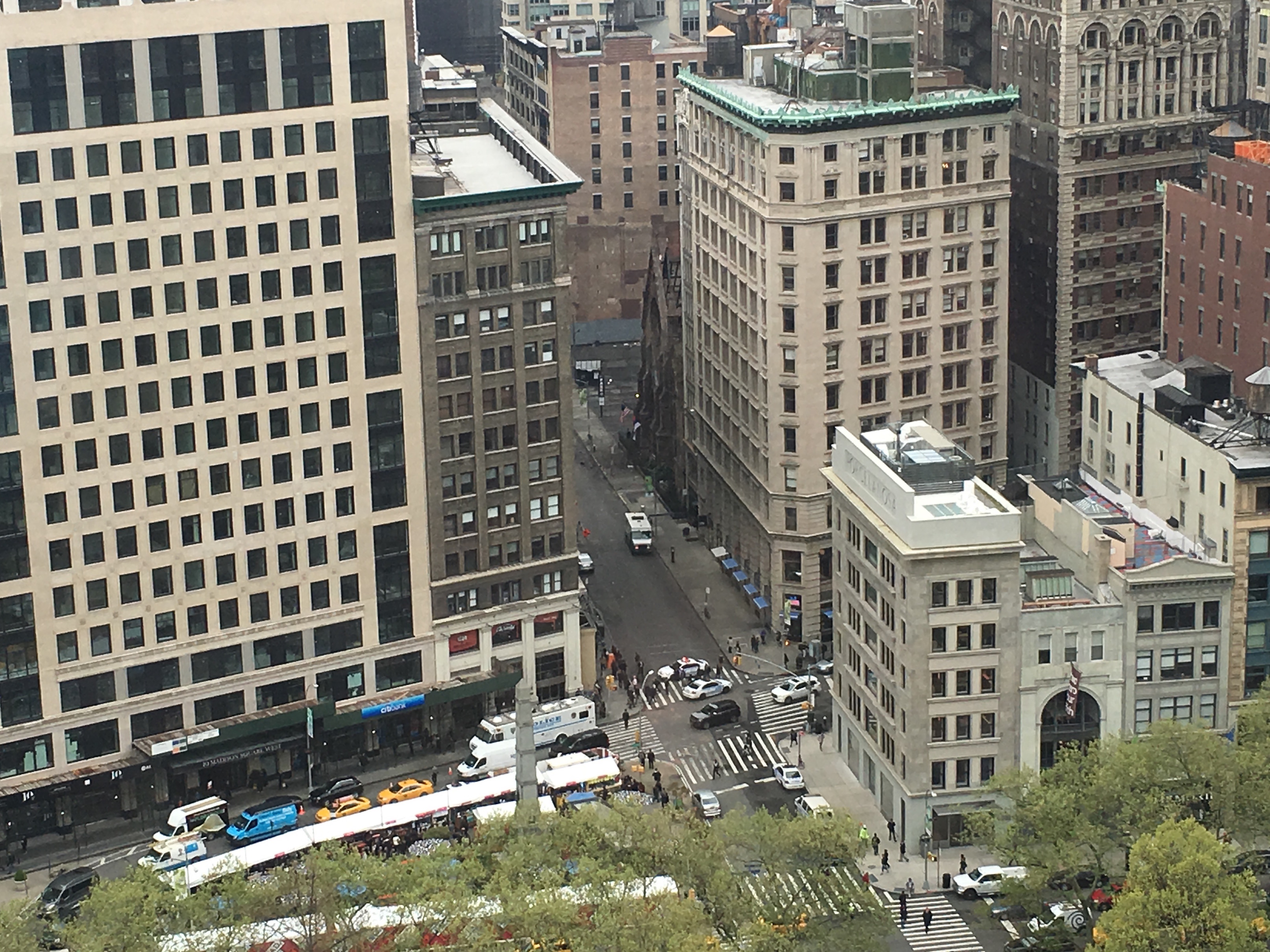
And here’s a picture of the Tesla bust which I took this past Friday, then the scene at St. Sava as it looked on Monday afternoon.

IMG_9286

IMG_9302 IMG_9307
IMG_9306