Categories
Those Were The Days

Let’s go see the horses at Madison Square Garden!

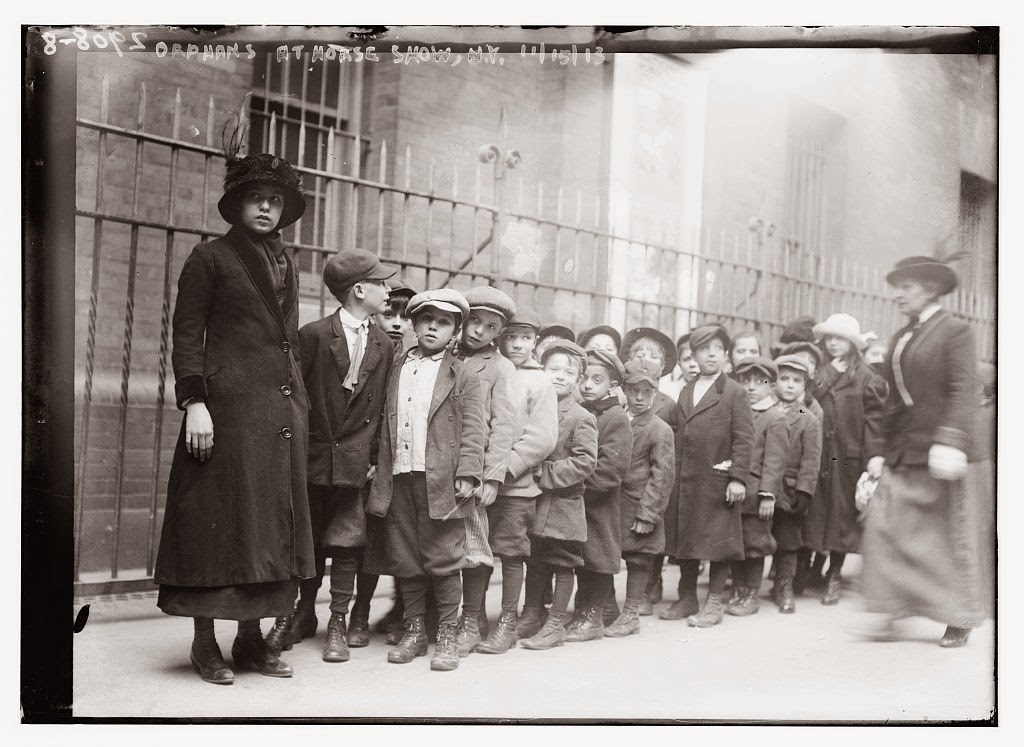
These unbearably cute orphans seen above were lined up to go to the National Horse Show at Madison Square Garden which began on November 15, 1913.  These are of course the days of the Garden down at the northeast corner of Madison Square, the glorious McKim, Mead and White structure topped with a glittering statue of Diana.

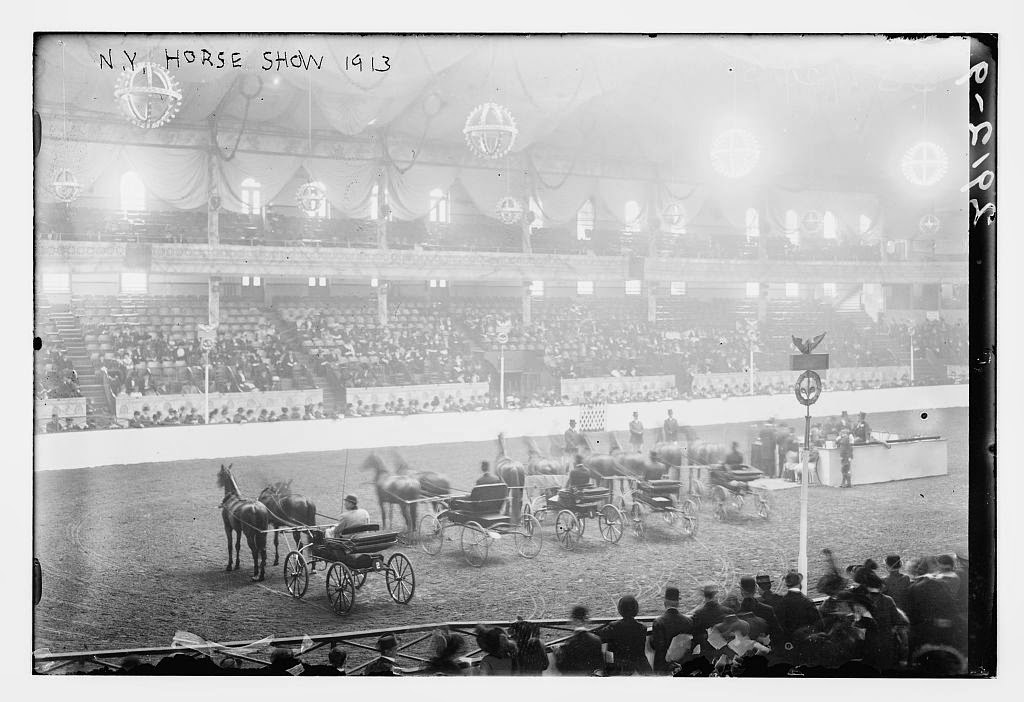
Once inside, the children were witness to a marvelous variety of events, including horse racing, pictured here:

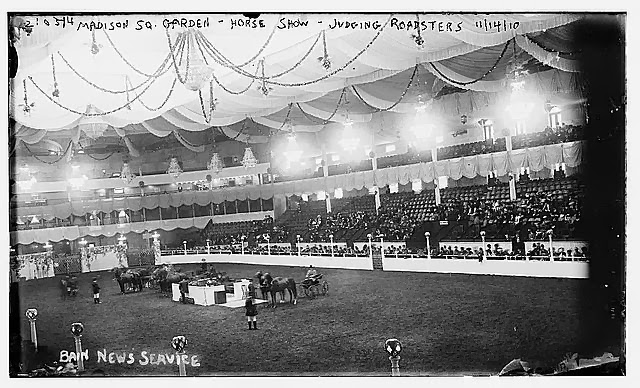
Here’s another view of an earlier event from 1910:

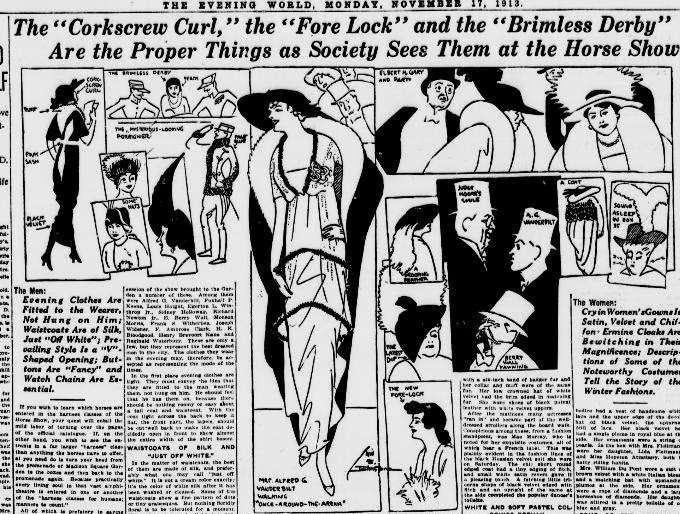
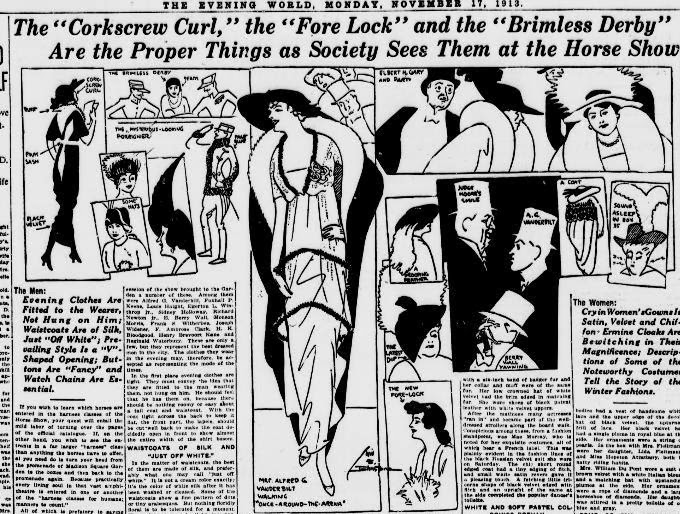
The National Horse Show was one of New York’s big society events, as much a see-and-be-seen spectacle as the opera.  Did anybody care about the dressage, the equestrian excellence?  Perhaps some. But many were just there for the fashion show as society doyennes and big-money mogul strutted the latest styles.

“If you wish to learn which horses are entered in the harness classes of the Horse Show, your quest will entail the mild labor of turning over the pages of the official catalogue.  If, on the other hand, you wish to see the entrants in a far larger “harness” class than anything the horses have to offer, all you need do is turn your head from the promenade of Madison Square Garden to the boxes and then back to the promenade again.”

From the Nov. 17th Evening World

From the Nov. 21st Evening World

So how did a group of poor orphans get invited to high society’s big event? It was a gesture of charity by the Vanderbilt family — Alfred Gwynne Vanderbilt* was president of the horse show — who invited 3,000 orphaned children from around the city to sit in the balconies.

The city’s little wards have looked forward to this occasion for many months.  They always do.  They know Santa Claus Vanderbilt.  After the show each of them will leave the Garden with a substantial present.  It is their Christmas Day.” [source]

* Two years later, Mr. Vanderbilt would die in the sinking of the RMS Lusitania.

Photographs at top courtesy the Library of Congress

Categories
Mad Men

‘Mad Men’ notes: New York City on January 31, 1968


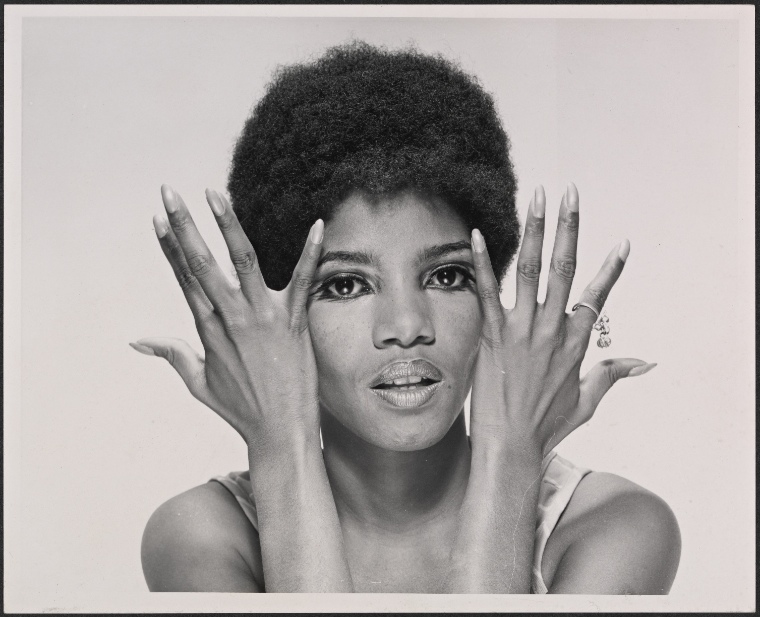
A press photo from Hair, the hottest show in town in early 1968, photographer Kenn Duncan

WARNING The article contains a couple light spoilers about last night’s ‘Mad Men’ on AMC.  If you’re a fan of the show, come back once you’re watched the episode.  But these posts are about a specific element of New York history from the 1960s and can be read even by those who don’t watch the show at all.  You can find other articles in this series here

Don Draper and the gang were too busy with their mistresses and their ‘self-immolating’ pitch meetings to properly react to the headlines of the day on January 31, 1968.  Word of the U.S. military’s devastating setback — today called the Tet Offensive — only briefly interrupted dinner conversation; by the time Draper’s dinner companion ordered steak diavolo, the subject had floated to another table.

In the year 1968, it will be become increasingly difficult to tune out the world.  Pete Campbell, with blank eyes, tunes into Johnny Carson, who has devoted his entire show that evening debating New Orleans district attourney Jim Garrison regarding the assassination of JFK.  Garrison was readying a case against Clay Shaw for conspiracy to kill the president (he was acquitted):

The most vibrant movements in the city involved protest and aggravation. The hottest show off-Broadway, Hair, was prepping for its official Broadway opening that April.  Hair was the very first musical to ever transfer from off-Broadway to Broadway.

What else is going on in January 31, 1968?

—  The finishing touches are placed on the new Madison Square Garden which will open a couple weeks later, on February 11. A few seasons ago, the admen of Sterling Cooper took to wooing the organizers of MSG who were prepping the destruction of Penn Station.  All traces were gone by 1968, replaced with the  drab concrete cylinder which presently sits at 34th Street.

— And things were brewing below it as well.  The following day, New York’s two largest train companies — Pennsylvania Railroad and New York Central Railroad — announced their merger to form the eventually-named Penn Central.  This would eventually incorporate other services, including Pete Campbell’s favorite train. And it would all go bankrupt by 1970!

— The number one song that week? The parody number ‘Judy In Disguise (With Glasses) by John Fred and the Playboys.

The number one film that week was the throwback Western Firecreek.  This was a rare lapse into the traditional, as most filmgoers were talking about two other big releases — Planet of the Apes and The Graduate.

— In a sign of protest (and grim foreboding), the head of the city’s anti-poverty programs George Nicolau resigned out of frustration with lack of support from the federal government.  [source]

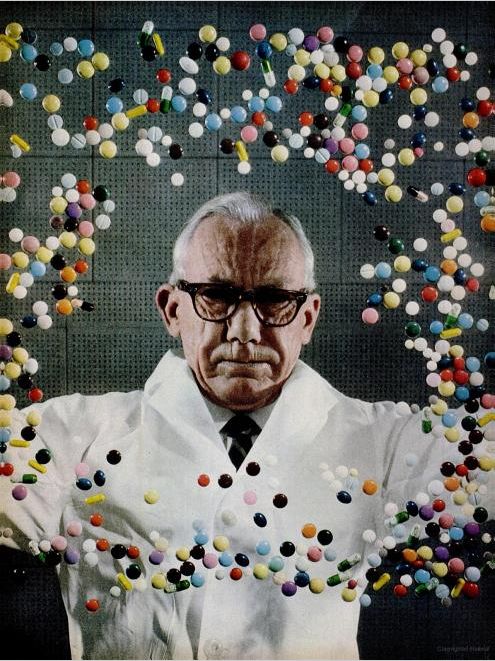
— Has somebody shown this to Betty? The cover of Life Magazine that week presented an expose on dangerous diet pills. The picture below grandly illustrates the problem.  (This issue from the week before is actually seen on a coffee table in this episode.)

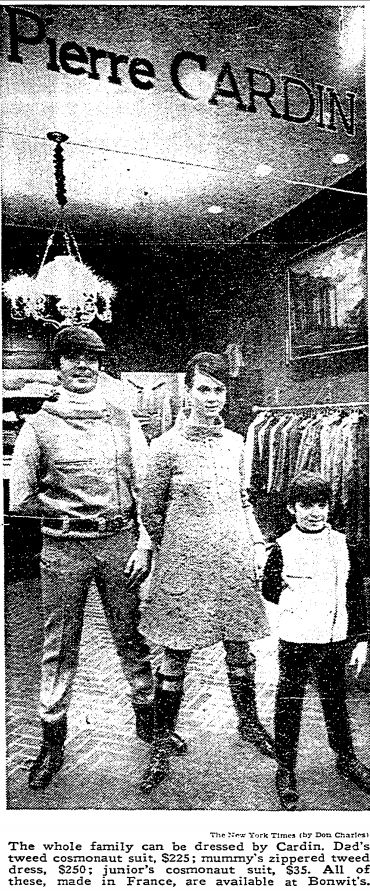
— But never fear. The New York Times fashion section announces a fabulous trend — dress the entire family as cosmonauts, courtesy Pierre Cardin! “The era of the fully fashion-coordinated family is at hands,” they declare.  You could buy this extraordinary set of garments at Bonwit Teller at the corner of Fifth Avenue and 56th Street

(Edit: A prior version of this story listed the address at Fifth Avenue and 38th Street, next to the still-surviving Lord & Taylor. It was indeed there for two decades, but by 1930, it had moved to the tonier uptown address.) [source]

Tammany Hall hosts the city’s first Democratic Convention: Susan B. Anthony, the KKK, and a reluctant nominee

Many of you may remember New York’s sole Republican National Convention, held in 2004 at Madison Square Garden, celebrating the re-election bid of George W. Bush. Some may recall any one of New York’s three recent Democratic National Conventions — two (1976, 1980) for Jimmy Carter, and a rather memorable one in 1992 that placed Bill Clinton on the ticket.

Oh, but that’s modern politics! Conventions of the past — stodgy, contentious, male — are more fascinating artifacts, gentlemanly in tone, chaotic and raw in execution, and dominated by a mix of issues both eternal (war, debt, taxes) and outdated (slavery, territorial expansion).

Of New York’s five Democratic nominating conventions, the most infamous is certainly the 1924 gathering at Madison Square Garden — the old Garden, Stanford White’s palace on 26th Street — distinguished by rancor, the significant influence of an energized Ku Klux Klan and an exhaustive trek through 103 ballots only to settle upon a weak compromise candidate, West Virginian politician John W. Davis, who was crushed in the general election by Republican Calvin Coolidge. Within two years, the Garden would be closed and promptly demolished, as though in embarrassment.

But I find the first national convention, held in 1868, to be the most intriguing and telling of New York life in the mid-19th century, a convention so unusual that the eventual presidential nominee actually recoiled from accepting the nomination.

Four years prior, in 1864, a splintered Democratic Party had tried to replace Abraham Lincoln in the White House with his former Union general George B. McClellan. In New York, former mayor and now-Congressman Fernando Wood led a drive for new national leadership — even though he loathed McClellan — and called for an end to the Civil War with their ‘Southern brethren’. But opposition quickly withered after a series of Union victories, and Lincoln was re-elected.

Flash forward to 1868. Lincoln was dead, the Civil War was over and slavery was abolished. The current president Andrew Johnson aligned with Democrats over Southern inclusion, eventually leading to his impeachment and a serious damaging of the national Democratic brand.

To bring glory back to the White House, the Republicans hoisted forth as their nominee the hero of the war, Ulysses S. Grant. Perhaps the most famous man in America, Grant would eventually prove to be a mediocre president. But his reputation and charm were so great in 1868 that the Democrats knew they stood little chance to defeating him.

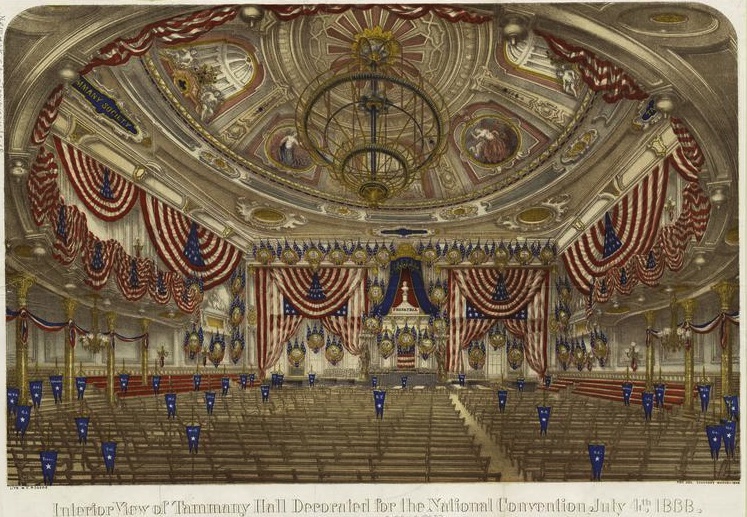
New York’s Democratic contingent — in particular, the political machine Tammany Hall and its leader William ‘Boss’ Tweed — controlled the national committee during this period and steered the convention to New York for the very first time in July 1868.

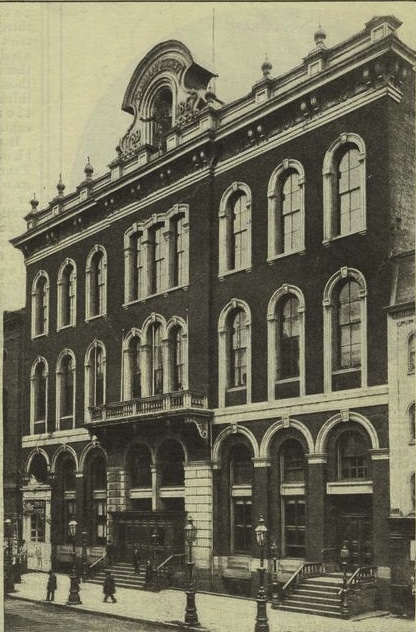
Their headquarters at 141 14th Street (at left) was sparkling new, ‘fresh from the builder’s hands,’ a lush multi-use venue with auditoriums, clubrooms and even a basement cafe, situated next door to New York’s poshest destination, the Academy of Music.

The convention was especially notable as it featured several Democrats from Southern states for the first time since the war.

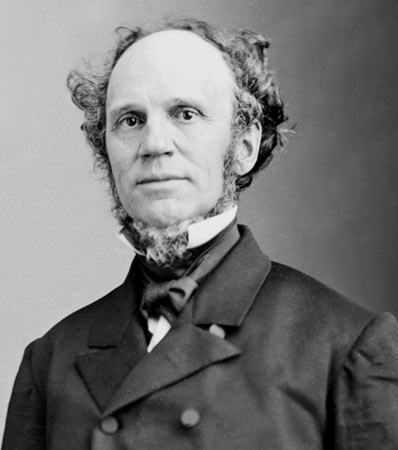
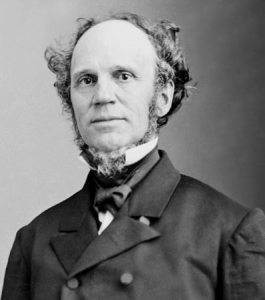
Delegates crowded into the main hall on July 4, and a roar of support greeted Democratic power player (and horse breeder) August Belmont, who gaveled in the proceedings. “I welcome you to this good city of New York,” Belmont declared, “the bulwark of Democracy.”  Nearby smiled former New York governor Horatio Seymour (pictured below), president of the convention. Five days later, there were be far less formality and Seymour, in particular, would not be smiling.

On July 5th, the Democrats unfurled their official platform, embracing the return of the Southern states and harshly criticizing the Republican-dominated Congress:  “Instead of restoring the Union, it has, so far as in its power, dissolved it, and subjected ten States, in time of profound peace, to military despotism and negro supremacy.”  Certainly pleased with this particular inclusion was Tennessee delegate Nathan Bedford Forrest, grand wizard of the Ku Klux Klan.
But the Democrats made room for the consideration of progressive causes too, such as a call for women’s suffrage.  Seymour read aloud a plank from the Women’s Suffrage Association written by Susan B. Anthony and co-signed by Elizabeth Cady Stanton.

Anthony appealed to their quest for dominance. “It was the Democratic party that fought most valiantly for the removal of the ‘property qualification’ from all white men, and thereby placed the poorest ditch-digger on a political level with the proudest millionaire. And now you have an opportunity to confer a similar boon on the women of the country … a new talisman that will ensure and perpetuate your political power for decades to come.”

The request was greeted warmly by the room before being respectfully dismissed altogether.

Things grew less harmonious when the balloting for president began.  Several candidates were submitted, even the disgraced Andrew Johnson. For several arduous ballots, the leader was George H. Pendleton, who had been the vice presidential hopeful under General McClellan. But it immediately became clear that the factions within the party were in no mood to settle quickly.

Pendleton’s lead had weakened by the 13th or 14th ballot, leaving two key candidates — Thomas Hendricks, an Indiana politician, and Winfred Scott Hancock, a Union general that seemed an attractive challenger to Grant.  But neither could approach the two-thirds needed to snatch the nomination.

A stalemate called for a third candidate, somebody that all could agree with, while at the same time, an individual that was absolutely nobody’s top choice.  It was at the podium that delegates found their man — Horatio Seymour.
He was horrified. Seymour wanted to retire and had previously rejected calls to run for national office. Privately he must have considered the pitiful chances of running a lengthy campaign against Grant. But delegates greatly respected the former governor, a bastion of cool Democratic leadership who had been an opponent to the federal draft during the war.  He had also been partly responsible for the Draft Riots, emptying the city of federal militia days before the draft was to begin that July.

Still, their were few ready options for the Democrats. When a delegate from Ohio suddenly declared “against his inclination, but no longer against his honor” to put forth Seymour as a suitable compromise, the room followed suit. On the 22nd ballot, Seymour was enthusiastically declared the Democratic nominee for president.

The only one not enthusiastic about it was Seymour. “I said to them that I could not be a candidate [and] I meant it.” [source]  He left the convention in a huff, only to begrudgingly accept the nomination back at Tammany Hall the following day.

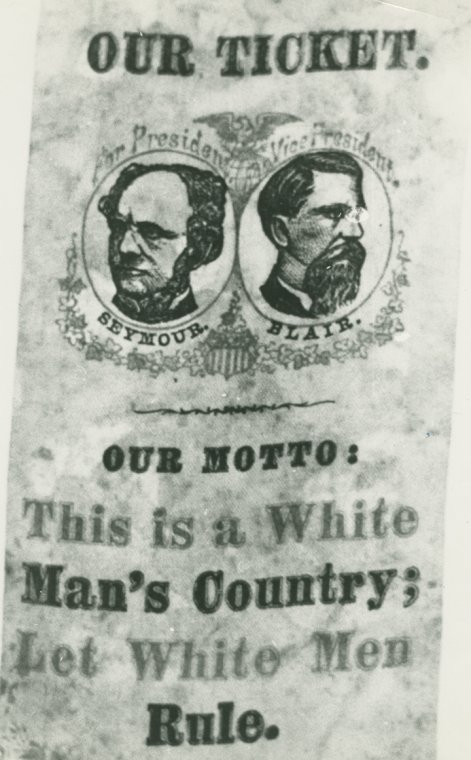
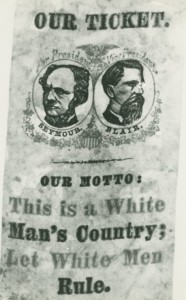
Seymour threw himself into the campaign with vice presidential choice Francis Blair Jr. (whom Seymour barely knew and hardly liked). As evidenced by the campaign poster above, they weren’t afraid to use the Southern racial divide to appeal to voters. But no matter; they lost soundly in the electoral vote to Grant and vice president Schuyler Colfax.

Perhaps the real objective of the convention wasn’t to sway a national crowd, but to energize New Yorkers. Democrats swept into local and state offices, including Boss Tweed’s own choice for governor John T. Hoffman.

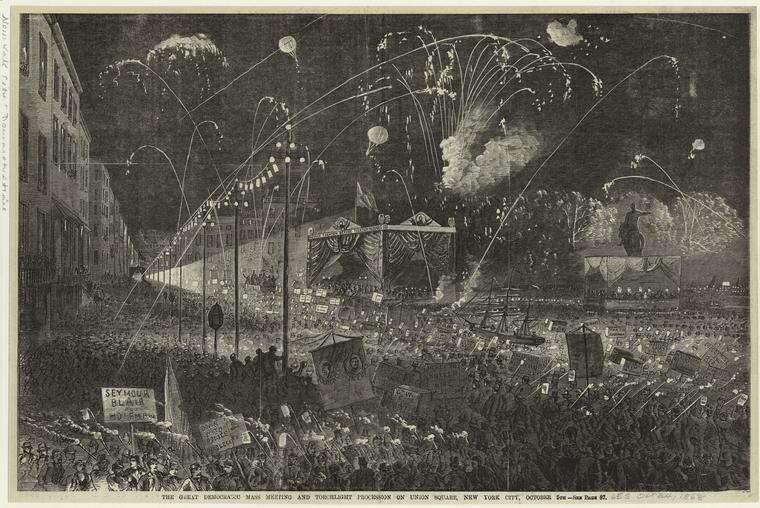
Below: Democrats rally in Union Square in support of Seymour and other local candidates, October 5, 1868

Pictures courtesy of New York Public Library

Categories
Mad Men

‘Mad Men’ notes: Between Julia Child and Weight Watchers

WARNING The article contains a couple spoilers about last night’s ‘Mad Men’ on AMC. If you’re a fan of the show, come back once you’re watched the episode. But these posts are about a specific element of New York history from the 1960s and can be read even by those who don’t watch the show at all. You can find other articles in this series here.

This week’s episode was set in the week before Thanksgiving 1966, certainly a moment of great apprehension for many American housewives like the embittered Betty Francis (the artist formerly known as Betty Draper).

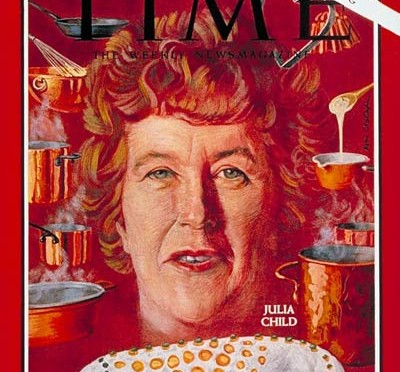
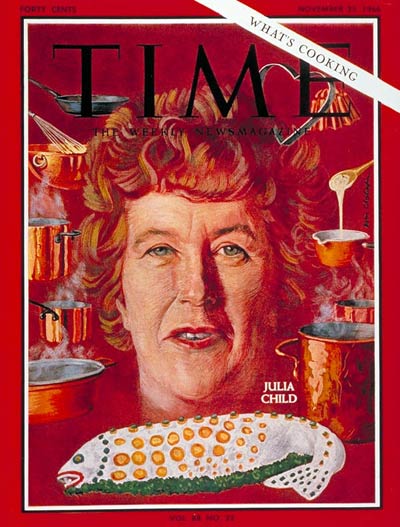
The cover of Time Magazine that week (11/25/66) featured a psychedelic portrait of Julia Child, framed in a chorus of saucepans with some kind of odd,decorated fish below her. Her Boston-based program The French Chef had been on the air over three years by then, bringing rich, savory delicacies into American homes. “Her fingers fly with the speed and dexterity of a concert pianist. Strength counts, too, as she cleaves an ocean catfish with a mighty, two-fisted swipe or, muscles bulging and curls aquiver, whips up egg whites with her wire whisk.” [source]

Child made classic, wholesome dishes with generous portions of high-calorie ingredients. But the 1960s also shoehorned greater artificiality into American kitchens — a barrage of food products loaded with preservatives, in unnatural shapes and presentations. The two food products most substantially featured on this week’s episode were canned whipped cream and Hostess Sno Balls, pink mounds of firmly molded, processed cake coated in a gelatinous frosting of uncertain origins. Even as Child stressed classic meals with fresh ingredients, actual food production was moving further away from easily digestible ingredients.

Made available to American grocery stores between 1965 and 1967: Bac-Os bacon bits, Shake ‘N’ Bake, Doritos, Easy Cheese, SpaghettiOs, Tang, Cool Whip.

If eating patterns in the 1960s set the county on a path of future health problems, they also spawned America’s first significant weight loss regiment. Betty, mortified by her extra pounds and judging herself against the lanky frame of her ex-husband’s new wife, turns to a community group that would grow to become the most successful weight loss program of the 20th century — Weight Watchers, a Queens-based company formed in 1963 that brought weight control to the mainstream.

Founder Jean Nidetch described herself in a 1971 biography as a “fat Brooklyn girl who grew up to be an even fatter Queens housewife.” She graduated from high school in Bedford-Stuyvesant in the 1940s and worked for the Internal Revenue Service before marrying in 1947. By the 1950s, she found herself in the massive garden apartment complex Deepdale Gardens in northeast Queens raising two sons and developing a compulsive eating habit.

Trying every available fad diet to no avail, she eventually visited a city-run obesity clinic in the neighborhood of Kips Bay in Manhattan, where she was advised to eat a so-called ‘prudent diet’: “two pieces of bread and two glasses of milk a day, fish five times a week and a weekly meal featuring liver.” [source] What they didn’t prescribe was camaraderie.

Nidetch took the food plans back to her apartment complex and organized a small cluster of neighborhood women to support each other in their quest to shed pounds. By 1962, she had lost dozen of pounds and had gained valuable insight into the power of group support to control eating habits. Using the ‘prudent diet’ as a rough guideline, she moved her regular meetings into a loft above a movie theater in Little Neck, charging $2 per meeting — the same price as the movie tickets being sold downstairs.

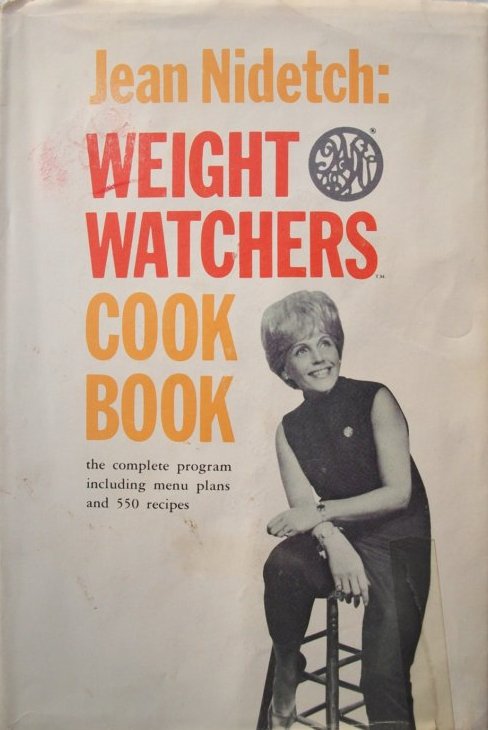
As depicted in this week’s episode, set in November 1966, Weight Watchers was still very much a regional program. Nidetch’s first Weight Watchers cookbook was released earlier in the year, debuting the regimented eating plan and structured point system.
A sampling: “Luncheon: 4 ounces fish or lean meat or poultry, or 2/3 cup cottage cheese or pot cheese or 4 ounces farmer cheese or 2 ounces hard cheese or 2 eggs. All you want of unlimited vegetables. 1 slice bread.”

As she confesses from the back cover: “Weight Watchers began when I invited to my house six overweight friends – have you ever noticed that most fat people have fat friends? – and much to the surprise of all of us we found that there were other people hiding cookies in the bathroom and eclairs in the oven.”

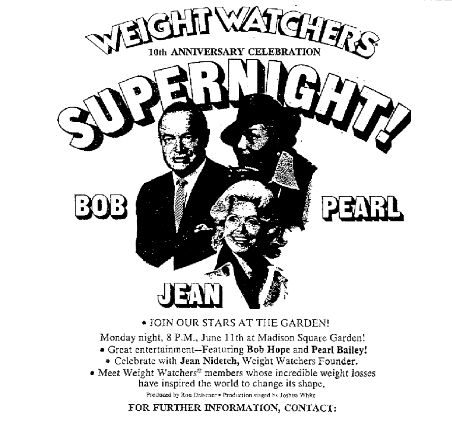
By the end of the decade, Nidetch’s new company — incorporating its famous food-points system and a methodology of daily calorie targets — would go worldwide. By 1972, Nidetch would invite 20,000 national devotees to a tenth anniversary party at Madison Square Garden, featuring guest appearances by Bob Hope and Pearl Bailey. (Ad below from Lubbock, TX, newspaper)
In 1978, Weight Watchers was acquired by the H.J. Heinz Company (which, in ‘Mad Men’ continuity, has been a most frustrating client for our favorite ad staff) who would mass produce Weight Watchers frozen foods.

Spicy Bit, My Own Brucie and other odd Best In Show dog names


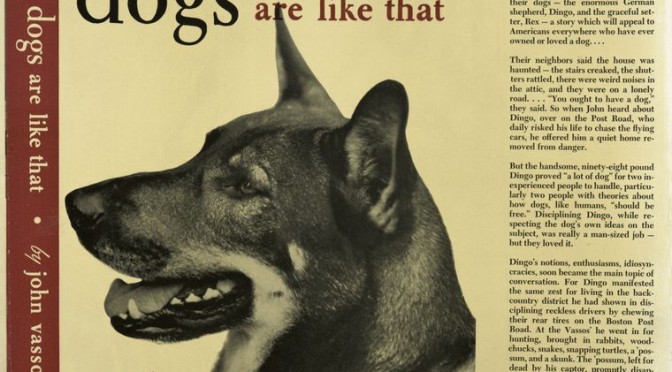
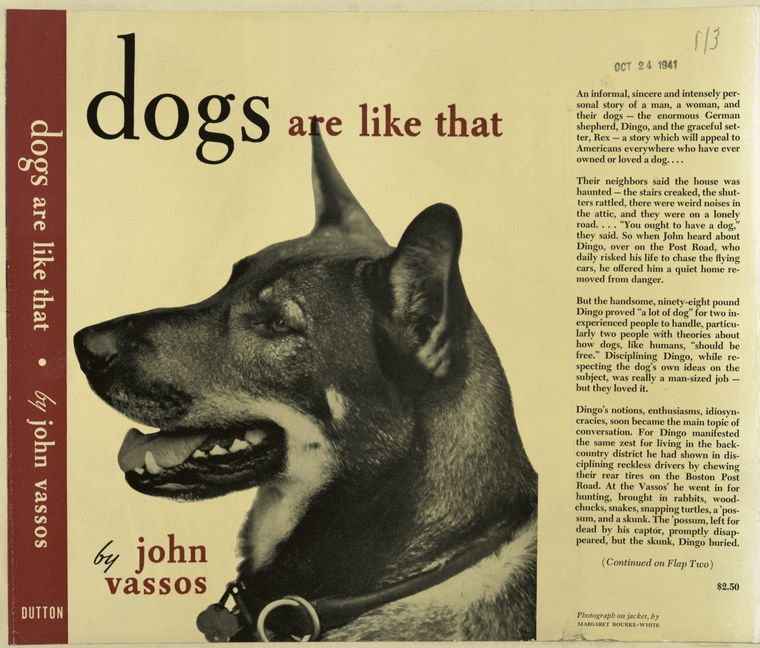
Yes, they are: from a book by noted New York graphic designer and dog breeder John Vassos. [source]

Hickory, the winner of last night’s Westminster Kennel Club dog show, might seem to embody a refreshing return to normalcy when it comes to dog names. In fact, the deerhound’s full name is a bit more exotic — Foxcliffe Hickory Wind.
When I was kid, I had dogs named Snoopy, Max and Dutch. Clearly, these common, pedestrian names would never have got these pets into the storied Westminster Kennel Club dog show, where the finest of animals are given the most extraordinary and absurd names.
The Westminster show seems like it might have connections to the British Isles, but in fact the annual canine carnival got its start in New York City in December 1877, amongst a group of wealthy sportsmen who gathered at the Westminster Hotel. An old train shed owned by musician Patrick Gilmore (and formerly run by P.T. Barnum) became their first home. When it changed owners and its name — to Madison Square Garden — the dogs and the purple ribbons remained, tagging along through the Garden’s various locations.

Below: St. Bernards on display at the Westminster show in 1908. No representative of that breed has ever won Best In Show, but they’ve gotten close many times.

Thousands of dogs have graced the competition floor, sparring for group prizes and the coveted Best In Show. For some reason, these prized dogs are given wildly strange, humorous or even mysterious names. These are not rock stars, action heroes or drag queens; they are Westminster’s Best In Show. Amongst the hundreds of victories won at Madison Square Garden over the years in a variety of sports, these are some of my favorites of the most unusually named winners in its history:

1907-09: Warren Remedy — I wrote about this dog last year, a female fox terrier from New Jersey who won three years in a row, “the fantastic bitch whose major achievement has yet to be duplicated.

1910 Sabine Rarebit — Animals were frequently referred to by the kennel in which they were raised. The first male winner came from Sabine Kennels in Orange, Texas.

1911 Tickle-Em-Jock — Not every dog went the dignified route. This terrier was a butcher’s dog in London and was literally scouted out by an English dog breeder. No word on whether he barked with a cockney accent.

1917, 1920 Wycollar Boy — The most extraordinary comeback in the dog world, this terrier crawled back to the winner’s circle three years after his first win, at a relatively old six years of age.

1922 Barkentine — Named for a type of ship but sounds like a Westminster pun.

1924 Bootlegger — In the age of Prohibition, Bootlegger really did beat out other dogs named Home Brew and Tom Collins.

1925 Governor Moscow — From Pittsburgh, not Moscow, he was the first Pointer to win in the history of the show.
1934 Spicy Bit — Lived up to her name when, after her victory, “she slipped her leash and frisked across the ring as saucily as though her name were Gyp.” [Time]

1940, 1941 My Own Brucie — With war ensuing, people clung to their pets ever tighter. Thus, Brucie, a ‘silky cocker spaniel’, was proclaimed as the most popular dog in America by Time Magazine.

1951 Bang Away of Sirrah Crest — The most influential boxer in the history of dogs (if breeding websites are to be believed), Bang Away won a total of 121 Best in Shows worldwide and even caused a small riot at the one show he lost. The judge that delivered that negative verdict was permanently banned from the Kennel Club.

1965 Carmichael’s Fanfare — But for some reason, the Scottish terrier’s nickname was ‘Mamie’.

1975 Sir Lancelot of Barvan — A lovely sheepdog, Sir Lancelot made the cover of Sports Illustrated after his win: ‘Big Itch In the Dog World’

1987 Covy Tucker Hill’s Manhattan — Despite the name, the Westminster’s first German Shepherd winner and the ‘winningest German Shepherd in history’ has a Long Island owner, and the Covy Tucker Hill Kennel is in California.

1999 Supernatural Being — A tiny, successful Papillon along the dog circuit, his official name is actually quite average compared to his parents (Supercharger and Denzel Fortuneteller). Supernatural Being would also answer to ‘Kirby’.

Thanks to William Stifel’s ‘The Dog Show: 125 of Westminster’ for some of the info.
Categories
Uncategorized

Yes, there really was a FIFTH Madison Square Garden

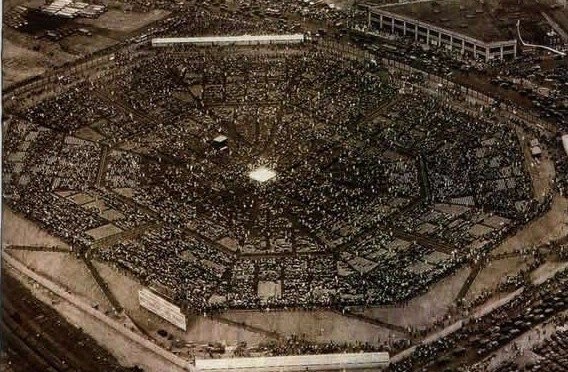
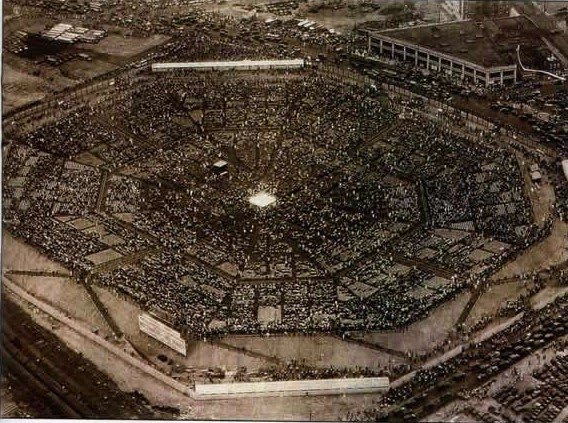
A packed house at MSGBowl on June 21, 1932, turning out for a prizefight between Max Schmeling and Jack Sharkey Picture courtesy Awesome Stories

There was so much to speak about during the Madison Square Garden podcast that we didn’t have time to mention that, for a brief time, the borough of Queens once had its own Madison Square Garden — one that spawned a ‘cinderella’ sports legend.

Situated in Long Island City, the Madison Square Garden Bowl was a roomy Depression-era spinoff of Tex Rickard’s midtown Manhattan branch, built in 1932 at 45th Street and Northern Boulevard, an immense outdoor stadium that could seat up to 72,000 people. It was not a regular venue but instead hosted big-ticket events during the summer. The Bowl cost the Garden only $160,000 to build, designed for high capacity if not longevity.

It may not have exactly been a popular place among name boxing stars. Sometimes referred to as the ‘Jinx Bowl’ or ‘The Graveyard of Champions’, reigning champs who boxed here frequently lost, heavyweight championship titles regularly changing hands here. “It was the arena where champions went to die,” according to author Jeremy Schaap.

People were willing to pay up to $25 for ringside seats because of the talent sparring in the ring, including Max Baer, Joe Louis, Henry Armstrong, and (most famously) James Braddock, aka ‘Cinderella Man’. A depiction of the Bowl naturally pops up in the Russell Crowe film ‘Cinderella Man’ about Braddock.

The Bowl hosted more than boxing, famously hosting several vigorous “midget auto races” (that’s like NASCAR for really small cars). “They had these midget auto races there and a lot of times the fumes of whatever it was they used to keep ’em going would spill through the entire neighborbood,” recalled Yankees legend and neighbor Whitey Ford. “If the wind was blowin’ the right way, we could get asphyxiated in our apartments if we didn’t keep the windows closed.”

During World War II, the arena saw little use, and Garden management soon gave up on it entirely, tearing it down in 1942, to be replaced with a mail depot for the U.S. Army. At some point that too was ripped down. As you can see, the area remains singularly unexciting today.


View Larger Map

Categories
Podcasts

Madison Square Garden, World’s Most Famous Arena(s)

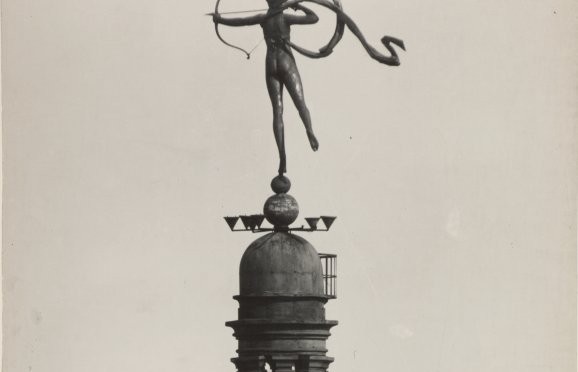
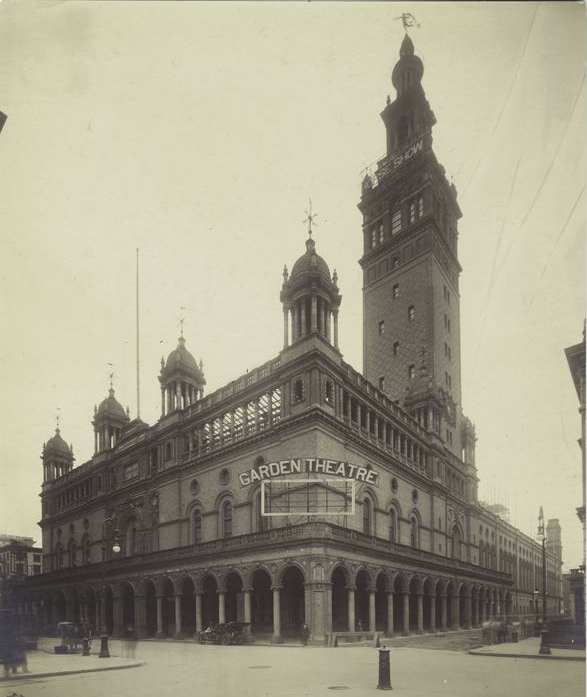
Augustus Saint-Gauden’s Diana twirling overhead on the second and arguably greatest version of Madison Square Garden

Madison Square Garden is certainly the recognizable name in arena entertaining, hosting Rangers and Knicks games, concerts, even political conventions. But it inherited that reputation from three other buildings which also called themselves ‘Madison Square Garden’.

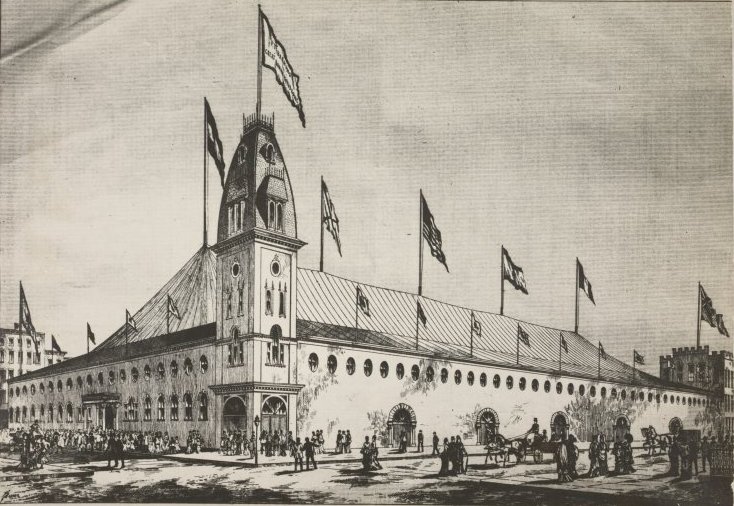
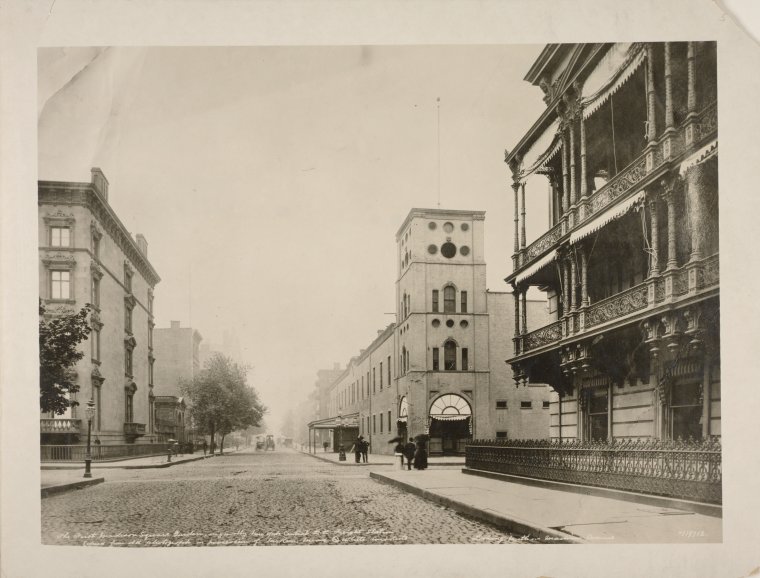
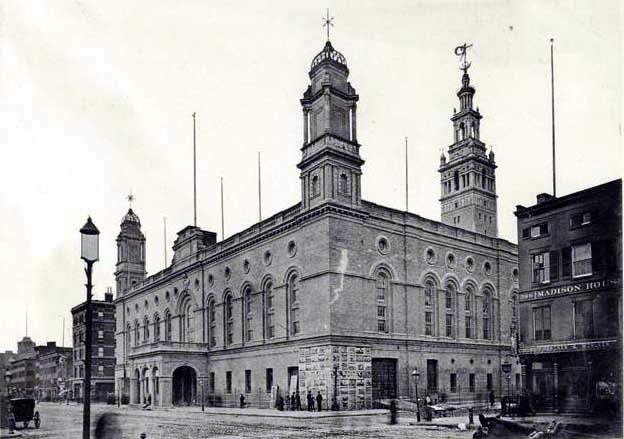
The first, inspired by P.T Barnum and a popular bandleader, staked its claim in the hottest area of New York in the 1870s. The second, a classic designed by the city’s most famous architect, featured both trendy new sports and high society events. The third Garden, moving up town, stripped off the glamour and helped make the Garden’s sporting reputation.

We’ll also tell you about the most famous event to ever happen in any Madison Square Garden — a shocking and brutal murder which led to the ‘trial of the century.

Pre-Garden: It was all Barnum, with his spectacular tented Roman Hippodrome.

Madison Square Garden I, built for William Kissam Vanderbilt, grandson of Cornelius Vandebilt. Click for larger view. Photo courtesy NYPL

Madison Square Garden II, designed by Stanford White, studded with towers, weathervanes, grand arches and other Moorish touches. (Courtesy NYC Architecture, also a good place to find more information about the building’s design)

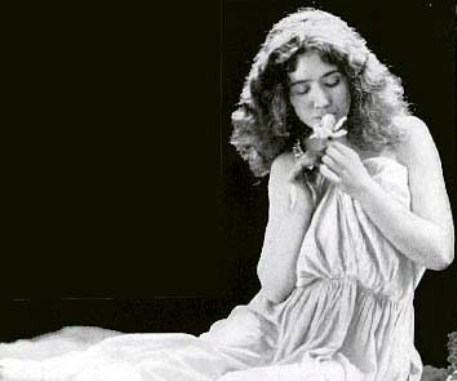
The two beauties of Madison Square Garden. The first, Julia Baird, was the model for Diana. Her nude exploits in its creation cause quite a fervor in the press.

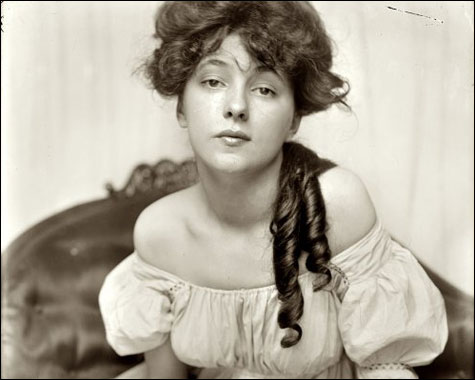
The tragic, beautiful Evelyn Nesbit, caught up between a powerful man and an insane spouse. Read here for an in-depth look at the murder and trial of Henry Thaw.

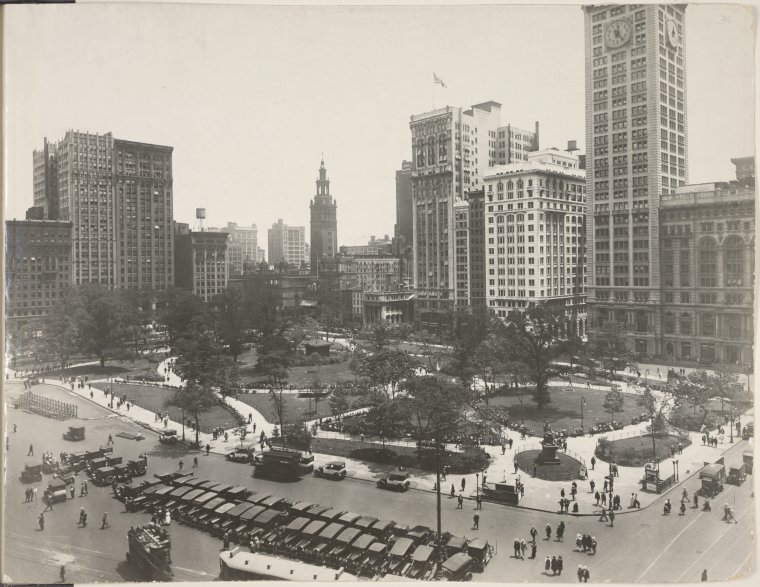
White’s Garden in context with the neighborhood in 1925, the year of its demolition. This one will require you to click into the picture for greater detail to see the full effect. (courtesy NYPL)

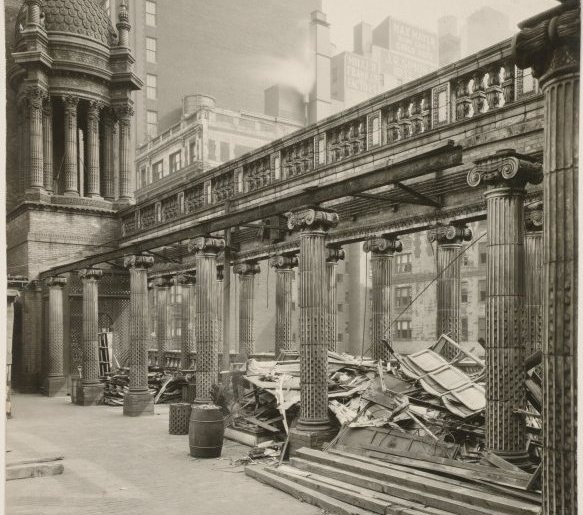
Madison II being demolished in 1925. (See full image here)

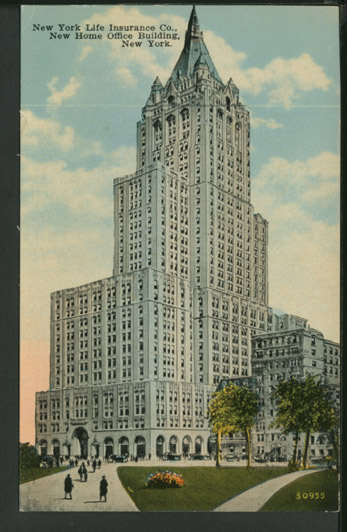
Unlike so many architectural calamities, at least it was replaced with something of equal beauty — namely the golden Cass Gilbert gem New York Life Insurance Building, looking here as though it were situated in California.

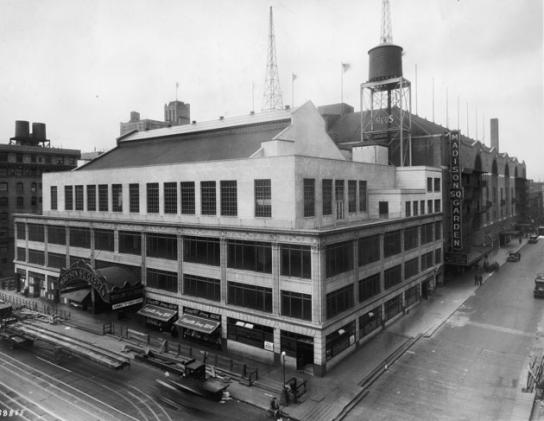
Madison Square Garden III. Why be fancy? Tex Rickard, moving the venue uptown to 50th Street, was more concerned with the entertainment inside than the flash and fancy outside. His glitz came from the lighted marquee and the big names blazing across it.

Promoter Tex Rickard, who helped form the New York Rangers and changed the sport of boxing forever with dozens of sell-out matches at his Garden.

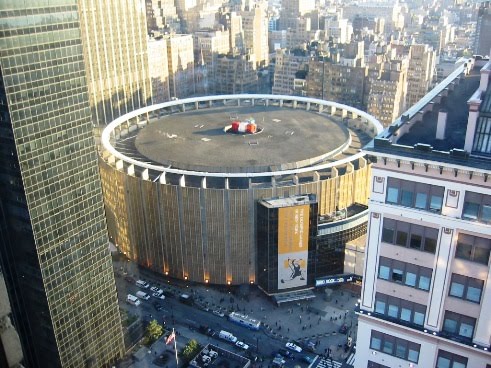
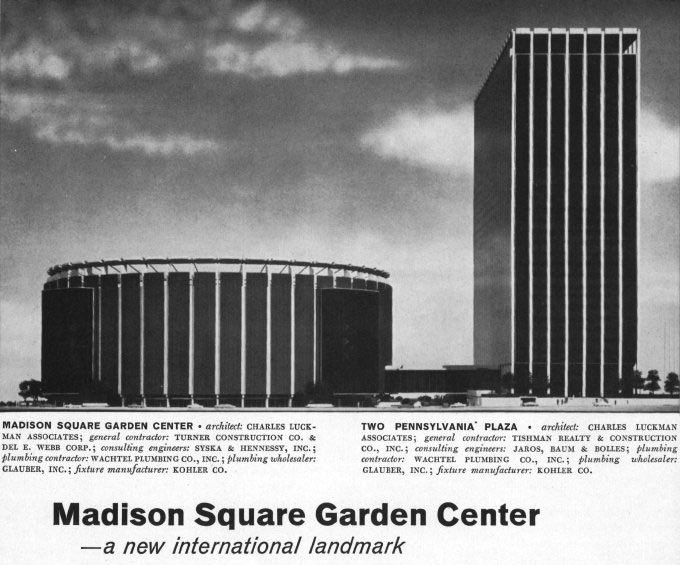
Madison Square Garden IV, designed by Charles Luckman Associates. This may surprise no one, but their other claims to fame include designing both Kennedy Space Center in Florida and Johnson Space Center in Texas. The firm also designed Los Angeles’s convention center which was partially demolished over a decade ago to make room for the Staples Center. (Pic from New Penn Station)

Although I can’t say it’s aging well, the current MSG will have officially outlasted all others in a couple years. Photo courtesy here


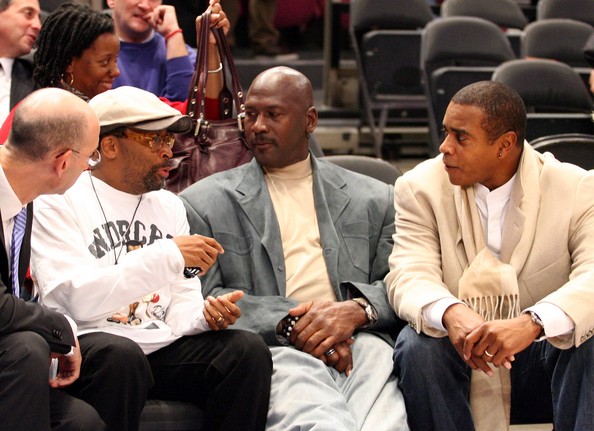
However, with the exception of Fashion Week, there may not be a fancier, more celebrity-laden row of seats than courtside during a Knicks game (below, Spike Lee, Michael Jordan and Ahmad Rashad, 2008).

For more information on special events, visit Madison Square Garden’s official website.

Finally, some great events hosted by Madison Square Garden. First of all, some pro-wrestling from January 30, 1920 at MSG II. Very rough footage, but extraordinary to watch if you have the patience.

Marilyn Monroe sings to JFK on his birthday (and just a few months before her death) at MSG III.

Elvis Presley in 1972, during one of his last performances here, at MSG IV

Categories
It's Showtime

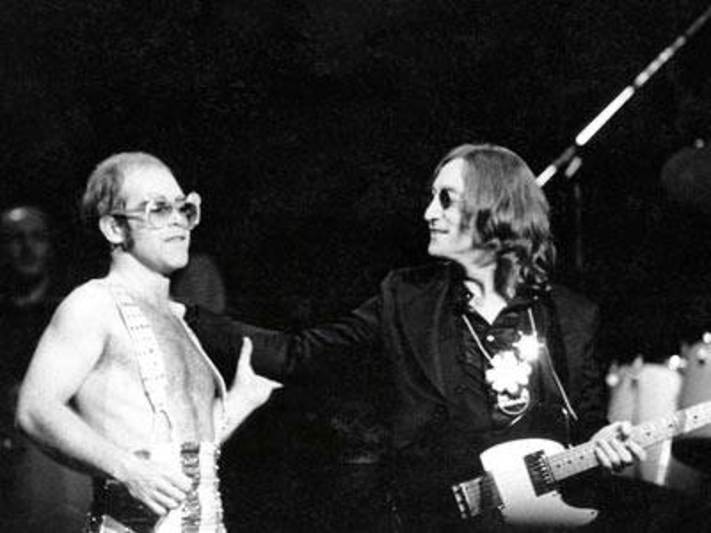
Stars of MSG: Two great Johns on a Thanksgiving night

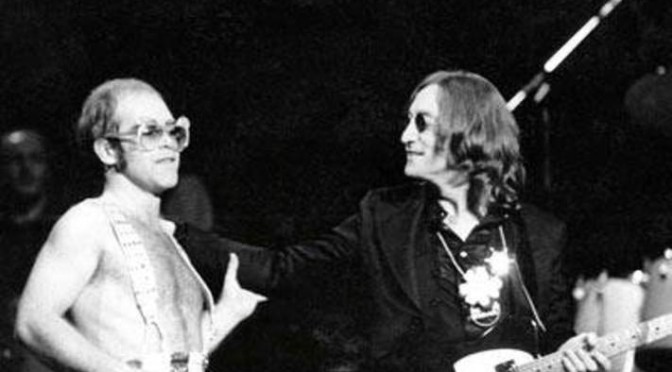
STARS OF MADISON SQUARE GARDEN: Elton John and John Lennon
LOCATION: MSG IV

John Lennon’s last stage performance ever took place on 1974 at Madison Square Garden, and he only did it because he lost a bet.


Elton John, an up and coming young star fresh from the successes of his album Goodbye Yellow Brick Road, collaborated with the Beatles icon on the Lennon single “Whatever Gets You Thru the Night,” providing piano and background vocals. As legend has it, Lennon was incredulous that the song would have mass appeal and agreed to perform with Elton in concert if the song hit number one.


Appearing on Lennon’s album Walls and Bridges, “Whatever Gets You Thru the Night” did indeed hit #1 on the charts — the only Lennon solo track to ever reach that spot.


And so, at the Elton’s Thanksgiving performance at MSG, November 28, 1974, Lennon took to the stage, and the two Johns plays a small set together which included renditions of “I Saw Her Standing There” and “Lucy In The Sky With Diamonds.”


More info at the Franklin Mint blog, where you can also hear the live performance.

Stars of MSG: Fears of Ku Klux Klan and a political dud

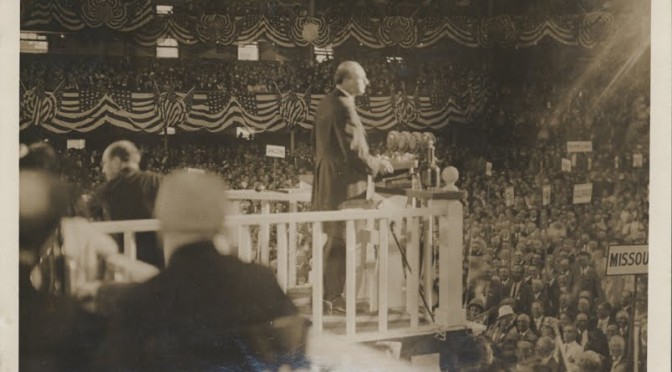
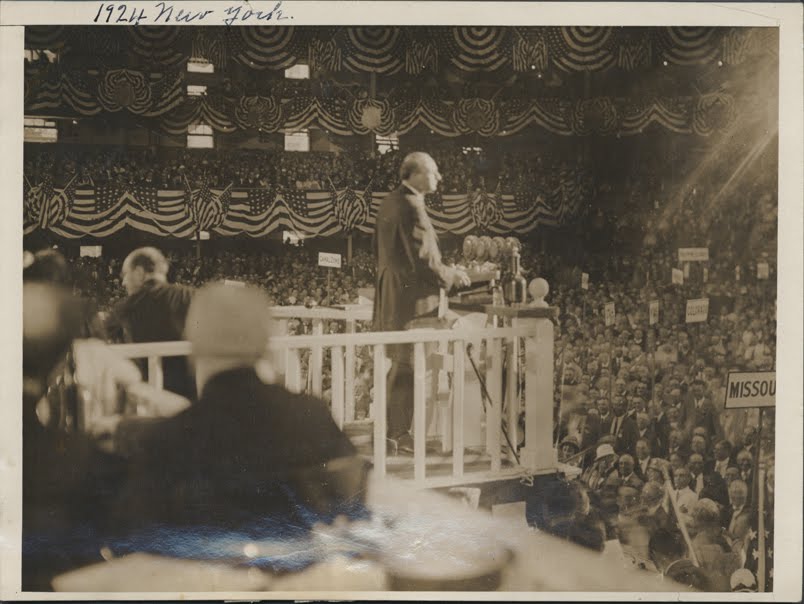
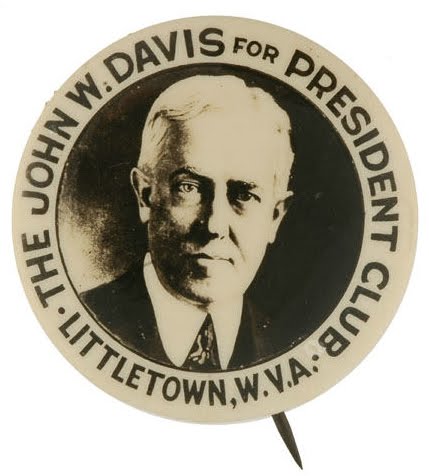
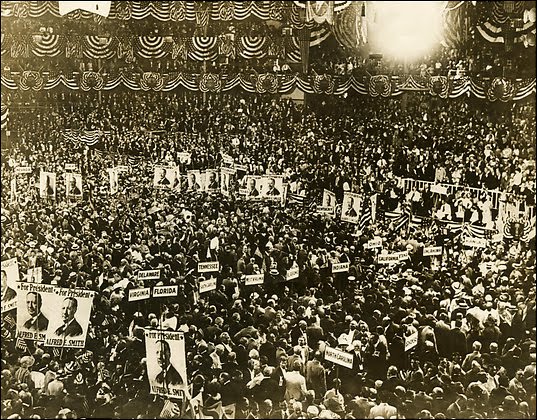
STARS OF MADISON SQUARE GARDEN: John W. Davis
LOCATION: MSG II

Both the Republicans and Democrats have held presidential nomination conventions here at Madison Square Garden, and with some success. The Republicans, in their only New York convention, re-nominated George W. Bush here in 2004. The Democrats propelled both Jimmy Carter and Bill Clinton from MSG conventions, in 1976 and 1992, respectively. (They also re-nominated Carter here in 1980, but we won’t talk about that.)

All these triumphs have been in the current Madison Square Garden, the one opened in 1968. But the second Garden, the one from 1890, hosted just one convention, but boy what a doozy. And after all the drama, they produced one of the most forgettable political candidates of the 20th Century — John W. Davis.

Davis was not a horrible candidate, per se; born in West Virginia, the dignified Davis practiced law in New York and served as the US ambassador to England. He was a staunch old-school conservative with somewhat centrist opinions on race, eventually making him a safe choice in Prohibition-era 1924. In fact, nobody truly wanted him.

The real battle at the Garden convention, held June 24 to July 9, was between Woodrow Wilson protege William Gibbs McAdoo and New York governor Al Smith. At issue was the rise in the South of a revitalized Ku Klux Klan who garnered some support in the conservative wing of the party. Also not helping matters — Al Smith was Catholic and obviously taking all his orders from the Pope (claimed the racist organization).

The battle between factions on the Garden floor were ferocious, Smith taking the progressives, McAdoo receiving support from the conservatives. (Peter Carlson of the Post calls the conflict representative of “the two sides of America’s cultural divide — what today’s TV yappers would call the red states and blue states.”) After the first vote, McAdoo was in the lead; John W. Davis was SEVENTH. A candidate needed two-thirds of the vote to be declared the nominee.

By the 20th vote or so, candidates were weeded out, but McAdoo and Smith were still battling for the lead. Davis had now moved to third position. With deals swiftly being made on the convention floor, handshakes and whispers gradually shifted the vote over the course of literally dozens more vote calls — and over the course of two weeks — with the lead gradually shifting from McAdoo to Smith. But still, no consensus, no two-thirds. Deadlock.

Things were getting out of hand, with demonstrations and fistfights breaking out. Not even Franklin Delano Roosevelt delivering the now famous ‘happy warrior’ speech, in support of Smith, clarified matters. Inflaming matters further was the fact that this was the first political convention broadcast on the radio. Americans must have thought politicians mad.

Davis, consistently in third place, suddenly became something of a compromise; while conservative, he openly reprimanded the KKK. Most importantly, for McAdoo supporters, he wasn’t Smith, and for Smith supporters, vice versa. After 103 ballots, Davis became the nominee. And was promptly destroyed in the election that following November by incumbent Calvin Coolidge. Coolidge even beat Davis in New York City.

Incidentally, all political conventions held in New York have taken place at some version of Madison Square Garden, except for one. In 1868, Democrats were so firmly in the grasp of Tammany Hall that, heck, they just decided to have the convention there, at their new headquarters on East 14th Street. The boss of Tammany at the time was, of course, Boss Tweed; the candidate? Horatio Seymour, like Smith, a governor of New York. (He lost to venerated war general Ulysses S. Grant.)

TOP Photo courtesy University of Mississippi, and check out their great site on presidential elections

Stars of MSG: the Garden goes gospel – summer 1957

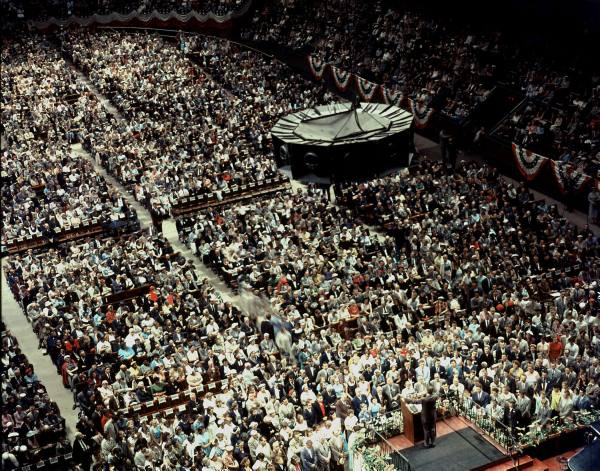
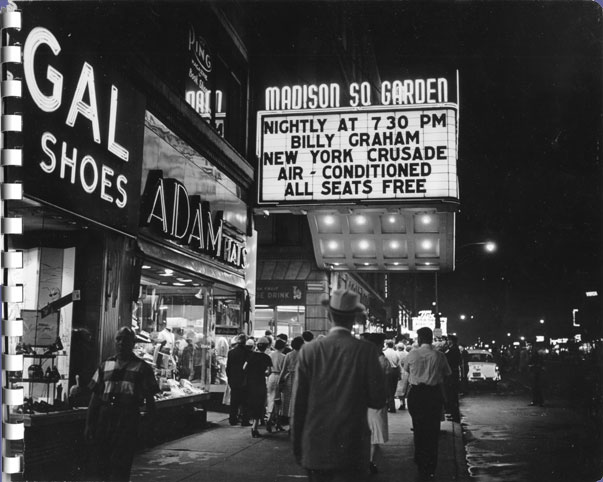
STARS OF MADISON SQUARE GARDEN: Billy Graham
LOCATION: MSG III

Sitting squarely where boxers and hockey stars frequently bloodied themselves, worshippers sit and listen to evangelist Billy Graham, during a run of 98 ‘Crusade’ sermons at the Garden in 1957, beginning on May 15. Events that summer would also continue onto Times Square and Yankee Stadium. Graham would famously include African-American preacher Howard O. Jones in the line-up, a radical step for its day.

According to Jones: “When news hit the street that Billy was thinking of bringing me on board, he received an alarming number of disparaging letters: ‘You should not have a Negro on your team,’ came the warnings. ‘You’re going to ruin your ministry by adding minorities. We may have no choice but to end our support.'”

Much, much more information at the Wheaton College website

Top photo courtesy Life images. Bottom photo courtesy here

Stars of MSG: The deadliest roller skating event ever

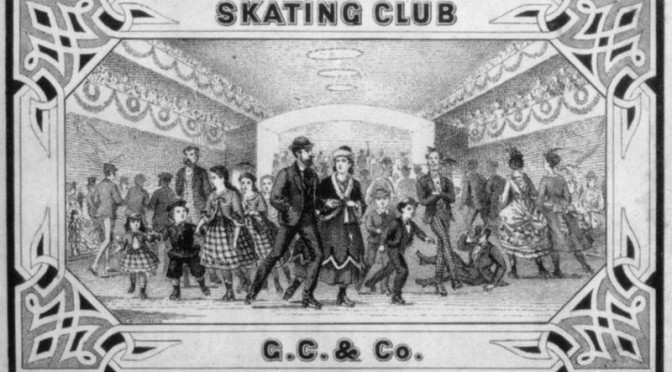
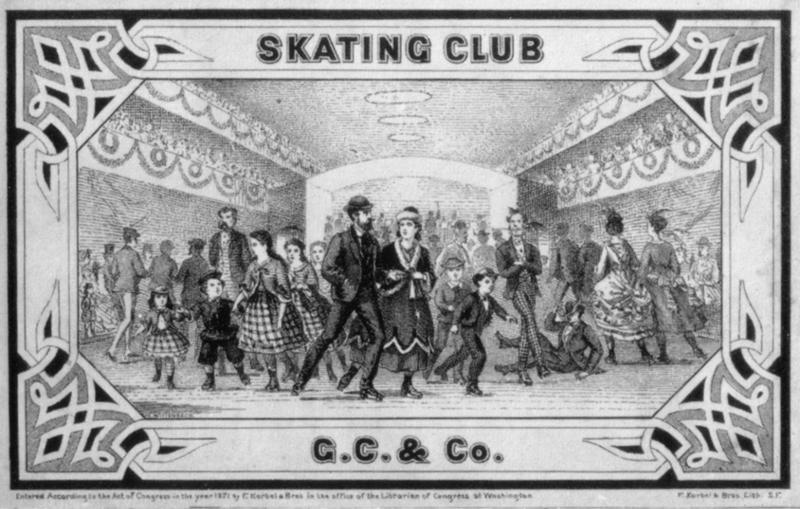
People were just wild about skating in the 1880s.

STARS OF MADISON SQUARE GARDEN: Six-day skater William Donovan
LOCATION: MSG I

People were a touch insane in the 1880s and 90s. One of the most popular sports was the six-day bicycle race, a sport so popular, particularly in Madison Square Garden II (debuting there in 1891), that they were referred to as ‘madison events’ in international circles.

But they were preceded by six-day rollerskating marathons, the first one in New York on March 1885, in the original Madison Square Garden — an event so strenuous it actually killed the young 19-year-old winner, William Donovan.

Donovan was a newsie from Elmira, NY, who trained for the event with a man who went by the name ‘Happy Jack Smith.’ The event, a ‘go as you please’ event involving a velodrome built within the garden, attracted 36 skaters aiming for a $500 prize.

The dangers of this event were apparently well elaborated. ” ‘It’s the first test of endurance that has ever been made on roller skates,’ said a sporting man, ‘and I believe that over half the men entered will cripple themselves for life.’ “ [source] Great, where do I sign up?!

I can’t help but think this sort of event would attract a certain sort of young, brash derring-do, possibly with lots of time on his hands. From the same article, two spectators were quoted describing a participant:

” ‘I shouldn’t think his mother would let him come out of the house looking that way,’ said a pretty little miss.

” ‘Perhaps he’s an orphan,” said her companion. “He looks like he’s seen a lot of trouble.’ ” [source]

Contestants would frequently collapse in a faint, be taken off the track, revived, then taken back to the course. Spectators actually sat in the arena for the entire six days, in apparently some kind of come-and-go ticket arrangement. There was an ongoing carnival and bicycle demonstrations to keep ticket holders busy when the skating got boring.

It appears athletes were allowed to rest off-track, but obviously the time spent sleeping was taken off their total. Many of the most popular skaters were given nicknames; redheaded Donovan, for instance, was ‘Sorrel-top’, I assume for the color of red sorrel, not green. The total length of the track multiplied by the 144 hours of non-stop riding meant that young Donovan had ridden 1,092 miles, awarding him the prize money and a fine diamond belt.

A few days later, while staying nearby at the trendy Putnam House, the victor Donovan caught pneumonia. While looking out his window at people streaming to P. T. Barnum’s Greatest Show on Earth (holding court at, yes, Madison Square Garden), Donovan collapsed and died within 36 hours — of acute pericarditis (heart inflammation).

Newspaper investigation of his death reveals that the boy had skated the course with a ‘dead bone’ (necrosis) on his right leg.

Within days it was revealed that a second skater who participated in the event, Joseph Cohen, had also died afterwards.

Now, why the heck would anybody be interested in roller-skating for six straight days?

Rollerskating was a popular craze in the 1880s, with mass production and sale beginning then, so a six-day roller-skating fest would have been the 1885 equivalent of x-treme sports.

Evaluating the safety of the event was indeed in its infancy, as this excerpt from a medical journal in 1885 illustrates:

“The mind acts “exoneurally,” we are told, and the vibrating brain-cells of the enthusiastic roller-skater communicate their rhythmical pulsations to the previously insensitive spectator. Whatever the mechanism, there is certainly at present a morbidly exaggerated passion for, and indulgence in, roller-skating. And the question comes home to the physician, whether it is doing any physical or mental harm.”

Too much skating, as Donovan proved, was dangerous. Organizers of the skating marathon booked the Garden for a second event in May 1885, but participants were handpicked only the most experienced and healthy, including a few surviving the last go-round. Shortly afterwards, official skating events were prohibited from being longer than four hours in length.

Stars of MSG: Indoor fishing in an outdoor wonderland

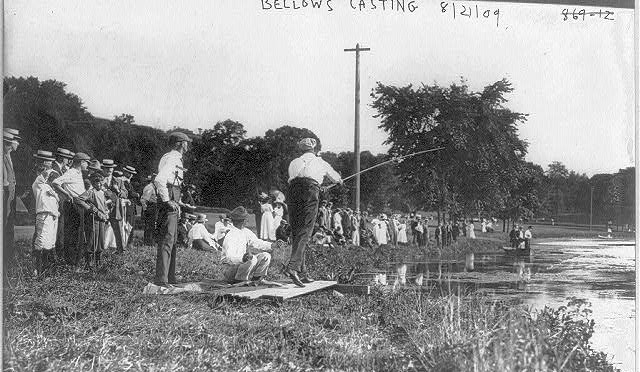
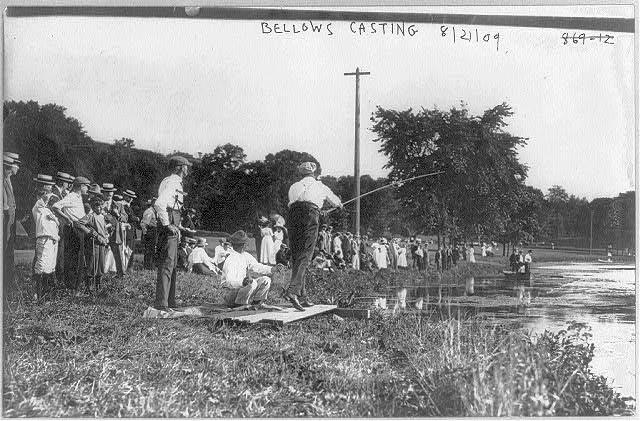
ABOVE: Fly fishing in Van Cortlandt Park in the Bronx, August 1909. Meanwhile, downtown, people cast for greater prizes indoors. (Pic courtesy LOC)

STARS OF MADISON SQUARE GARDEN: R.C. Leonard, fisherman
LOCATION: MSG II

Of all the curious events to ever happen at Madison Square Garden — from the first one to the latest — no competition seems more surreal to me as a spectator sport than watching somebody fish. But in fact, for many years, Madison Square Garden II had quite popular fly fishing contests, either on their own or as part of elaborate hunting and fishing extravaganzas, the Bass Pro Shops meets Disneyworld.

The luxe, new Madison Square Garden, designed by Stanford White, was equipped with its own aquatic tank for water polo events, but in sporting season, it was apparently used for fishing events as well. The arena was obviously dressed up to resemble the ‘great outdoors’. In a tournament in 1911, an artificial mountain and waterfall were even designed as casting sites. The following year promised “so complete will be the change in the appearance of the amphitheatre that it will be hardly recognizable.” [Times]

For the fishing competitions, there was both ‘dry fly-casting’ using distance and accuracy markers, as well as the naturalistic kind, immersed in these natural dioramas.

And the leader of this sports was apparently one R.C. Leonard, who set a record for fly casting for black bass – at 101 feet and 6 inches — at the very first indoor fishing event at MSG, on March 15, 1897. He was still setting records as late as 1905: “He made the most notable cast that has ever been seen in the Garden,” according to the Times, breaking a distance record that he himself had set a few years previous. When Leonard made this “most notable” cast, the “rubber frog” hurled over the end of the 130-foot tank and hit the decorative “rustic bridge”!

Leonard, born either in 1862 or 1863, was the undisputed master of the sport, by 1905 the winner of 55 gold medals in the sport.

Leonard might have met his match many years later in 1911 — in the form of a four-year-old girl. If ever a novelty act existed, it was Madge Seixas, a tot with an impressive arm, “having a mark of forty-five feet with a fly rod weighing about four ounces.” She climbed the fakemountain, situated on the Park Avenue (Fourth Avenue back in the day) side of the auditorium, and “insisted upon casting into the waterfall.”

Fishing was only one of several curious displays honoring the great outdoors. As part of an annual Motor Boat and Sportsmen’s Show festival, the 1905 event also featured canoe races at the Garden on a makeshift lake, and a whole hunter’s paradise — tent, camp fire and all, with a recently killed deer suspended from a tree and other game dangling from other faux foliage. In addition, there was a shooting range for schoolboys.

Incidentally, the New York Boat Show, held just a few weeks ago at the Jacob Javits Center, traces its lineage back to this 1905 convention.

Stars of MSG: No miracles on ice — Russians beat USA!


STARS OF MADISON SQUARE GARDEN: 1980 Russian Olympic Team
LOCATION: MSG IV

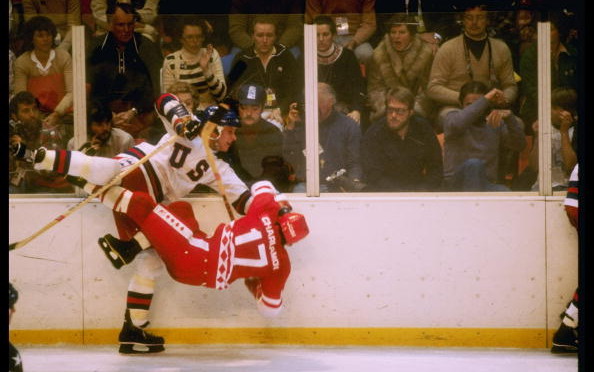
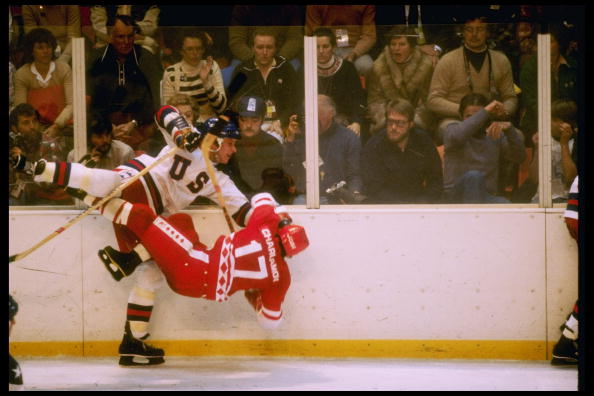
Nope, that headline is not from an alternate timeline. Thirty years ago, the most memorable moment in US Winter Olympics history occurred on February 22, with the victory of the US men’s hockey team against its athletic and ideological rivals from the Soviet Union. What’s lost in the mists of history is that these two teams has played each other two weeks earlier, in New York, at Madison Square Garden — and the Russians iced the US team.

In promotion of the 1980 Olympics that year, in Lake Placid, NY, the two squads played an exhibition round for fired-up New Yorkers on February 9th, 1980, just three days before the opening ceremonies. Despite an openly hostile crowd, the Russians handily beat the young team of American athletics, 10-3.

According to sportscaster Al Michael, “Anybody who left Madison Square Garden that day thought to themselves: ‘The Soviets will win every game in the Olympics, take home the gold medal, and never be challenged.'”

Of course, in the game that really counts, the American team swept aside the Russians in Lake Placid, 4–3, in what has been called ‘the greatest sports moment of the 20th century.”

The Sheila Variations has a nice, full write-up of the MSG battle

Picture from the Lake Placid match-up, courtesy World Hockey

Stars of MSG: Warren Remedy, the winningest dog

STARS OF MADISON SQUARE GARDEN: Warren Remedy
LOCATION: MSG II
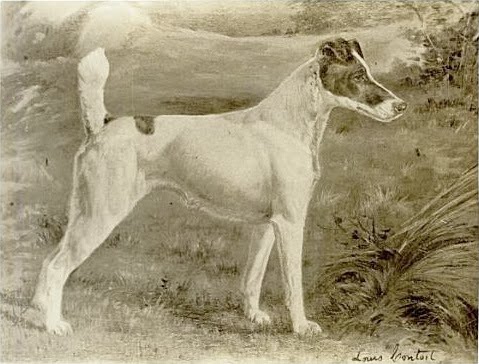
The picture above is of the Katharine Hepburn of dogs, Warren Remedy, the only dog to ever win the Westminster Kennel Club Dog Show three times in a row.  Despite the name, this smooth-haired Fox Terrier canine superstar was female.

She also kicked off the storied Best In Show competition, which was held for the first time in 1907 and chosen from the winning dogs in other categories by a panel of ten judges.  The annual dog show, of course, predates all incarnations of Madison Square Garden, with the first one on May 8, 1877 — easily the oldest continuing sporting event in New York City.

Warren Remedy, “the fantastic bitch whose major achievement has yet to be duplicated” according to Harold Nedell, was owned by the appropriately named Winthrop Rutherfurd.  She’s the only dog to win Best In Show in successive years, and given the highly political nature of the dog show today, I can’t imagine this ever happening again.

According to the Times, “The little white twenty-month-old son of Sabine Resist … was handed out of the ring to the attendant who had handled him [sic] since his birth on Mr Rutherford’s New Jersey farm and was wild with exultation. He hugged the little champion ecstatically and hurried off to the dong’s bench, where he and the winner held an improptu reception that continued most of the afternoon and evening.”

The New York Tribune gives a fuller desciption of the little girl’s charms:  “Warren Remedy is practically true to type. She is tan marked, with strong head, keen expression, good outline and grand ribs. She was in fine coat also, and should be worthy of winning in the best company in England.”

Apparently, the spirited dog barked herself hoarse — although that was more likely a bit of anthropomorthism by the Tribune reporter.

Her owner Rutherfurd, with kennels in Allamuchy, NJ, got in the Fox Terrier breeding business quite suspiciously; their first terrier was from an English lot stolen in Liverpool and smuggled over.  It is unclear whether Warren Remedy is from this pirated lot.

Above illustration by Gustav Muss-Arnolt, a New York illustrator who actually specialized in dog portraits, drawing over 170 portraits for American Kennel Club Gazette.

Previously: My article “Who Let The Dogs In?” on the first dog show. And for the truly adventurous of you, my very first solo podcast, from way back in 2007 — the Famous Dogs of New York.

The Americans: NYC’s first professional hockey stars

The New York Rangers , the city’s ice hockey hope since 1926, began their season on Friday, losing one that night and recovering on Saturday versus Ottowa Senators.

Okay, so I’m not going to pretend that I’ve ever been a hockey fan before this year. However, geek alert, I have this uncanny ability to trick myself into liking something by studying and absorbing its history. To see that bloody ice, those flying sticks, that vulgar degree of unsportsman-like agitation! When Sean Avery, who will debut this week after an injury, punches somebody in the face, it’s part of a proud tradition that harkens back generations.

While the Rangers often play fourth-fiddle in the pantheon of high-profile New York sports teams, they’ve been part of the city for decades, playing their first game on November 16, 1926, against the Montreal Maroons. They beat the Maroons — and almost everybody else, winning the American Division title (though losing the Stanley Cup) their very first year.

Believe it or not, however, the Rangers were not even New York’s first hockey team. Enter the far less successful but not forgotten New York Americans, one of the few U.S. sports teams to be owned by a Prohibition bootlegger.

Ice hockey was invented in Canada, flourishing and expanding there, but before the 20th century began spilling over the border to the United States and into New York, with amateur leagues in Manhattan and Brooklyn, and even a Columbia University team. Hockey’s first home in New York was St. Nicholas Rink, a sports venue at 69 West 66th Street (at Columbus Avenue) which opened in 1896 as an exclusive site for ice sports until a more popular sport — boxing — forced it out in 1920.

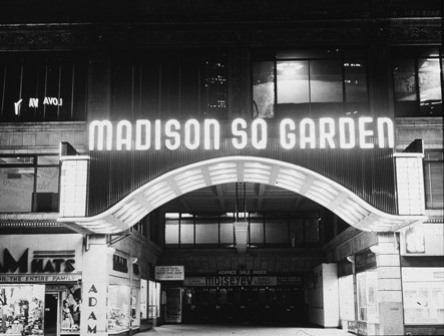
Which was fine for ice hockey enthusiasts, because the sport was moving on to a brand new venue — Madison Square Garden. In this case, we’re not talking about the Stanford White classic which actually sat in Madison Square or the current MSG at 34th street above Penn Station. No, from the years 1925-1968, another building held the name, located at 50th Street and 8th Avenue. Today, Worldwide Plaza stands in its place.

This MSG, owned by the flamboyant promoter Tex Rickard, would famously stake its reputation on boxing and circuses. But in its first year, Rickard agreed to open the floor to brand new ice hockey team.

The Canadian National Hockey League was a granting franchise licenses to various American cities. The franchise promoter Thomas Duggan saved one for himself and set his sights for a New York team. His only setback was money. This being 1925, smack in the heart of Prohibition, it’s no surprise he turned to famous bootlegger and mobster Bill Dwyer for assistance. Yes, New York’s first ice hockey team was funded by one of the city’s most notorious gangsters.

By 1925, Dwyer had even spent some time in jail for bribing the Coast Guard. He looked at funding sports teams as a vie for ‘legitimate’ business, although it was his amassed wealth by illicit gains that was actually used to sculpt the new team. When members of an Ontario team the Hamilton Tigers revolted against their management, Duggan simply bought out all the players, moved them to New York and — certainly thumbing their noses at their old Canadian owners — called them the New York Americans.

The Americans, garbed in patriotic colors, played their first game on December 15th, 1925, against the Montreal Canadiens. At least in 1925, Americans were no match in the game of hockey against Canadians, and they lost 3-1. And would continue to lose, from 1925 to 1941, once or twice making division playoffs but mostly placing last.

But New Yorkers, at least that first year, were intrigued. Attendance was so strong that Rickard, jealous of Duggan and Dwyer’s success, wanted his own team, one in which he didn’t have to split the profits. And so, the very next year, on the very same ice as the Americans, the New York Rangers made their debut. They were an even bigger hit because they actually won games, partially due to being placed in a division with fewer seasoned Canadian teams.

By 1941, the Americans were overshadowed, utter defeated and out of steam. A brief ploy to rebrand the team as the Brooklyn Americans — they never actually played any matches in Brooklyn — only delayed the inevitable, and the team’s franchise was bitterly not renewed.

Most Rangers fans are probably not too familiar with the Americans’ record, but they are familiar with Rangers ‘curse’ placed upon them by then-Americans coach Red Dutton, who supposedly declared that their rivals would never win another Stanley Cup while Red was still alive. It worked. The Rangers would not take home the cup until 1994, seven years after Red’s death. Talk about holding a grudge!