Categories
Politics and Protest

Jimmy Walker vs. the Ku Klux Klan

Jimmy Walker, the man who would become the mayor of New York during one of its most prosperous periods, was famously cavalier about politics. [Listen to our podcast on Mr. Walker for more information.] But in the years before he became mayor, he actually spearheaded two laws that would change New York City and the state of New York forever.

The first brought one of America’s great pastimes back into vogue: boxing. The sport was technically illegal for much of the 19th century — which didn’t stop New York from becoming the boxing capital of the United States — until a 1911 law briefly brought back.

Reformers banned it again in 1917 only to be met head-on by a powerful and well-connected member of the New York state senate who also just happened to be a boxing enthusiast — Jimmy Walker. The 1920’s Walker Law would bring back the sport for good.

His second great legislative contribution would set the stage for civil rights laws across the country.

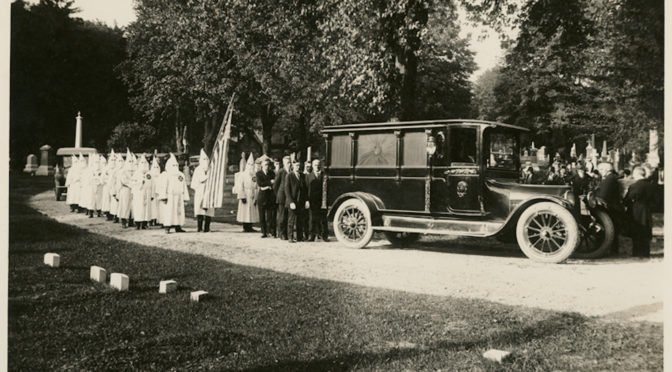
Below: Funeral procession for a Ku Klux Klan member, held in Cold Spring, Putnam County, New York, 1920s.
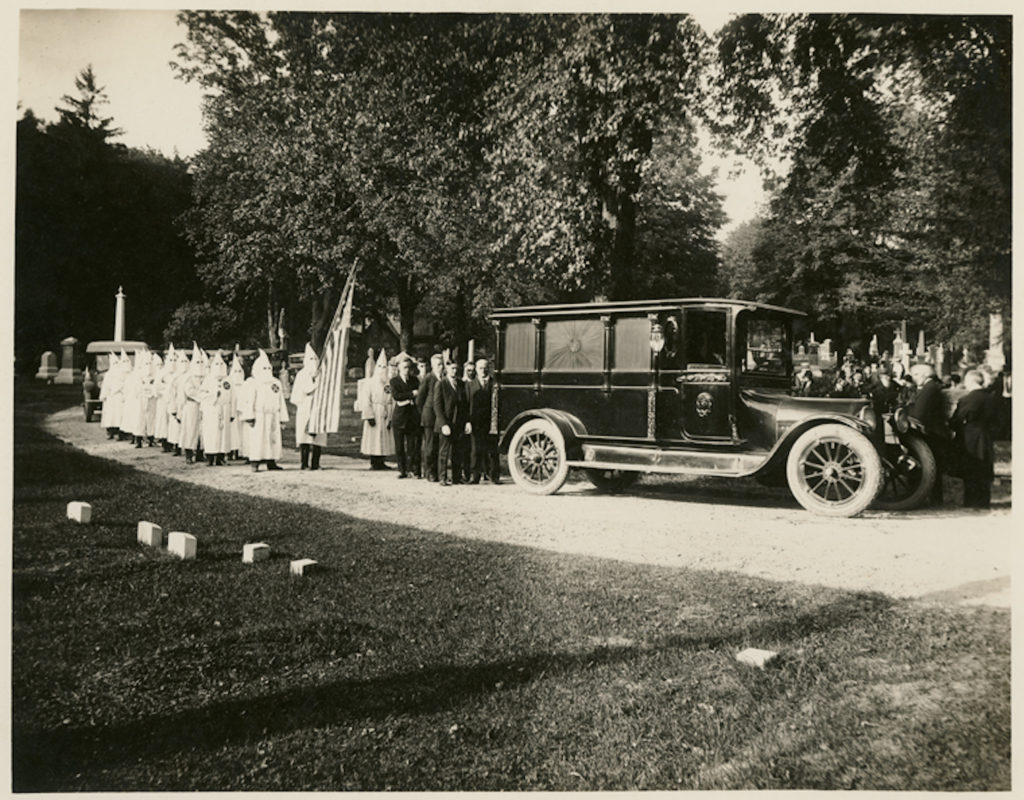
Courtesy NYPL

The Ku Klux Klan, a racist vigilante organization formed in the Reconstruction South, gained new prominence in the mid-1910s thanks to the popularity of the film The Birth of a Nation.

Feeding off anti-black, anti-Catholic and anti-immigrant fervor, the newly reinvigorated organization rose to power in the early 1920s in many big American cities. By 1922 there were 21 distinct klaverns in New York City alone.

But in a city full of powerful Catholics, immigrant groups of all types, and an empowered African-American population rising in Harlem, one might have expected a reactionary force like the KKK to be even bigger in New York City. That’s where Walker comes in.
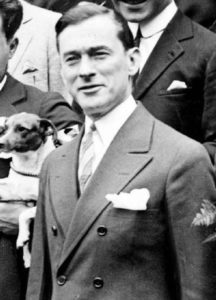
Walker, born an Irish Catholic, was closely associated with Al Smith, the new governor of New York who was also Catholic. Both were Democrats and also aligned with the needs of the city’s Irish community. (Not to mention Tammany Hall, the political organization whose power had diminished since its Gilded Age glory days.)

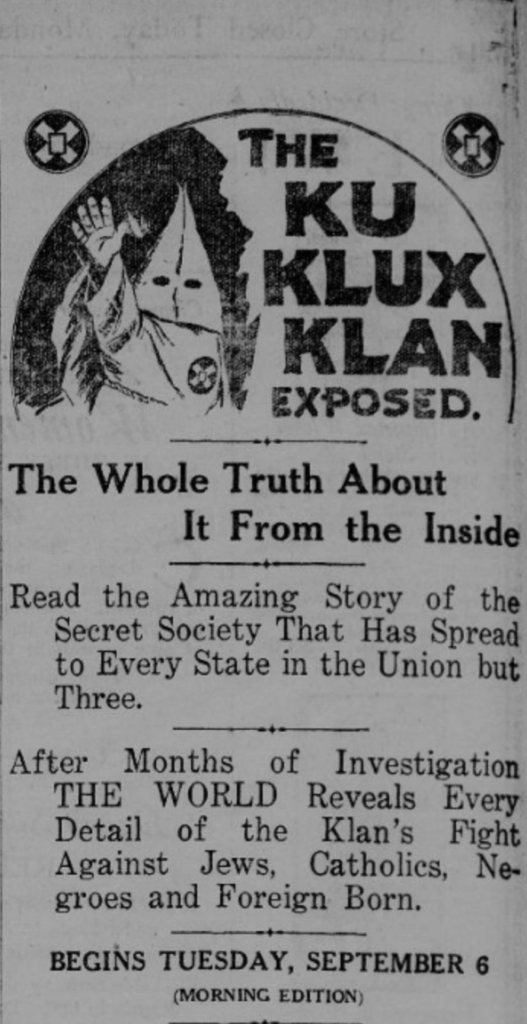
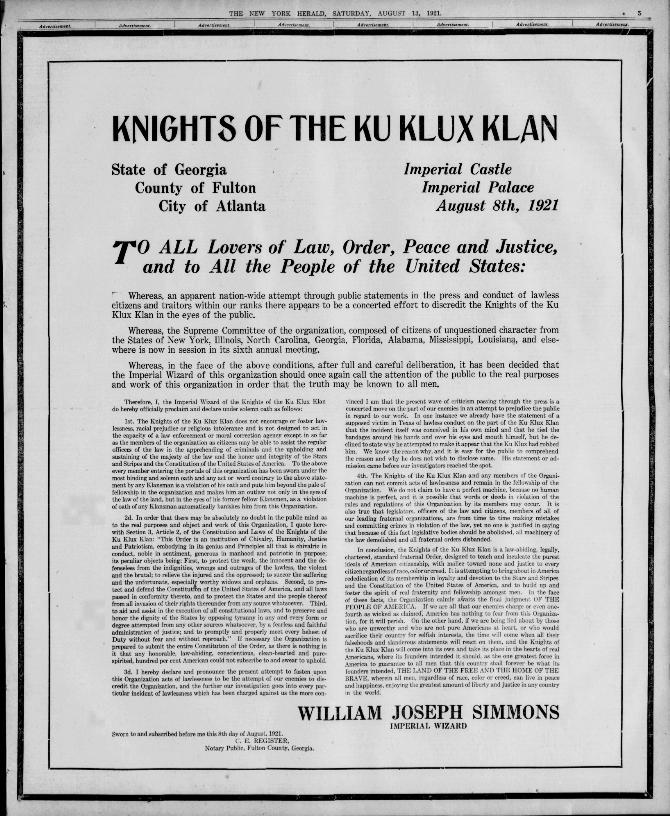
A rising swell of anti-KKK sentiment in New York City came in 1921 with the publication of a series of damning articles in the New York World, effectively neutralizing the klan’s influence in denser portions of the city. Mayor John Hylan “launched an all-out war” on the KKK, throwing them out of Manhattan wherever possible.

Below: Advertisements for the newspaper series ran in competing newspapers. From the September 5, 1921, New York Tribune:
The Klan hit back with full page ads like the one below:
In no uncertain terms, Hylan declared, “Do not leave a stone unturned to ferret out these despicable, disloyal persons who are attempting to organize a society the aims and purposes of which are of such a character that were they to prevail, the foundation of our country would be destroyed.”

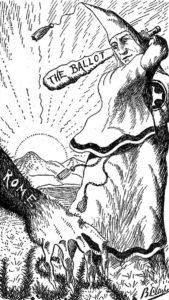
Below: A 1928 anti-Catholic cartoon published in the book Heroes of the Fiery Cross by the Pillar of Fire Church in Zarephath, New Jersey
But targeting the KKK was not merely a moral mission for Walker, the future mayor of New York City.

Nationally the KKK were a rising political power within the Democratic party of the 1920s. In fact the the 1924 Democratic National Convention, held at Madison Square Garden to select a presidential candidate, was almost derailed by their inclusion.

Smith, Walker’s ally, was planning on running for president in 1924. (He was overlooked that year but eventually became the party’s candidate in 1928). Limiting a hate group like the Ku Klux Klan — a hate group with rising power — within the state would certainly lessen their impact within the party.
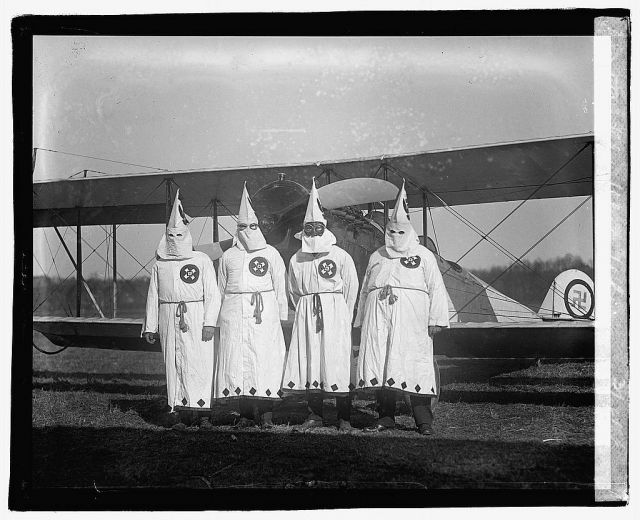
By early 1923, Walker was the state senate leader and introduced a bill into the chamber, placing limits on ‘oath-based associations’ that would require them to file a list of their membership with the state. The Klan were essentially being unmasked; the names of their members would become public record.

From the Brooklyn Daily Eagle:
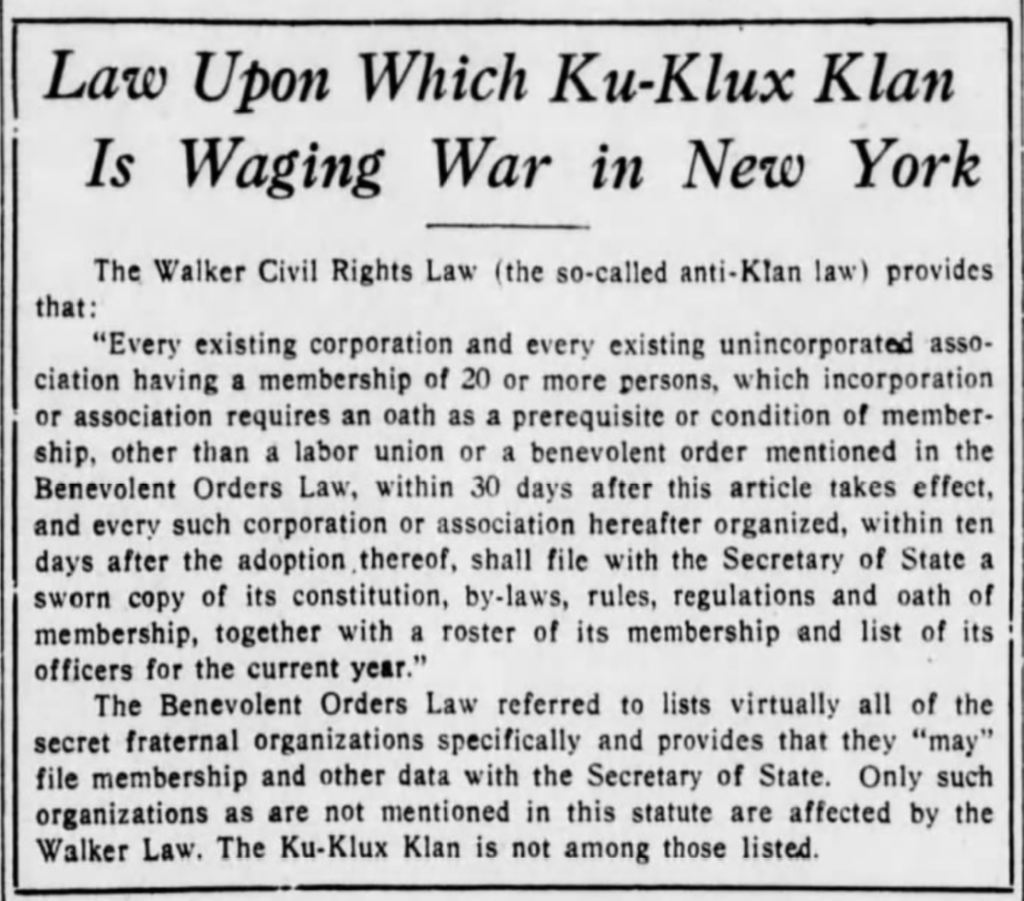
*The bill exempted labor unions and, “officially chartered benevolent orders” like the Elks Lodge.

The bill swept through the state senate, (barely) made it through the assembly, before landing on Governor Smith’s desk for a swift passage.

Even with the ‘anti-masking’ law in place, the klan found receptive crowds in the region.

Thousands of Klan members marched in protests immediately following the law’s implementation.

“The demonstrations by tens of thousands of Ku Kux Klansmen on Long Island, in New Jersey and in various parts of New York State yesterday and Saturday were staged as a spectacular defiance of the Klan’s enemies.” [Eagle, 5/28/1923]

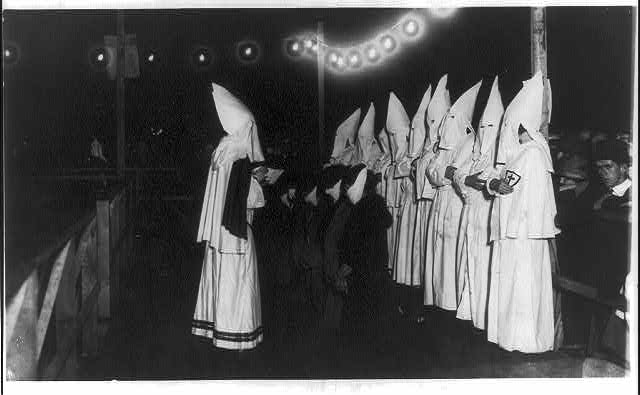
Below: A scene from Long Island, 1925. “Four women kneeling in front of strouded Klansman reading from a book; other Klansmen stand behind them on the platform; spectators watch initiation.”
Library of Congress

The spirit of the law was more powerful than its specifics. The Ku Klux Klan was effectively turned into an illegal organization that day. Many states would use Walker’s tactics in crafting their own anti-Klan laws.

The Klan attempted to overturn Walker’s law, taking it all the way to the Supreme Court. On November 20, 1928, the court upheld the law, specifically marking the klan as a terrorist group, “its members disguised by hoods and gowns and doing things calculated to strike terror into the minds of the people.

Once the Great Depression arrived, the organized KKK was all but gone in the New York region, retreating to “a shadowy existence in the South.”

Listen to more on the story of Jimmy Walker here:
Tammany Hall hosts the city’s first Democratic Convention: Susan B. Anthony, the KKK, and a reluctant nominee

Many of you may remember New York’s sole Republican National Convention, held in 2004 at Madison Square Garden, celebrating the re-election bid of George W. Bush. Some may recall any one of New York’s three recent Democratic National Conventions — two (1976, 1980) for Jimmy Carter, and a rather memorable one in 1992 that placed Bill Clinton on the ticket.

Oh, but that’s modern politics! Conventions of the past — stodgy, contentious, male — are more fascinating artifacts, gentlemanly in tone, chaotic and raw in execution, and dominated by a mix of issues both eternal (war, debt, taxes) and outdated (slavery, territorial expansion).

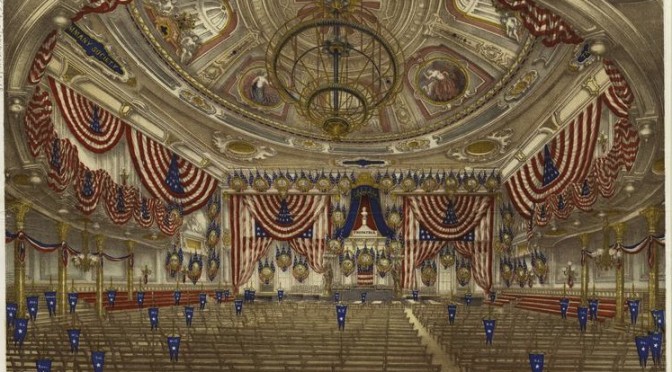
Of New York’s five Democratic nominating conventions, the most infamous is certainly the 1924 gathering at Madison Square Garden — the old Garden, Stanford White’s palace on 26th Street — distinguished by rancor, the significant influence of an energized Ku Klux Klan and an exhaustive trek through 103 ballots only to settle upon a weak compromise candidate, West Virginian politician John W. Davis, who was crushed in the general election by Republican Calvin Coolidge. Within two years, the Garden would be closed and promptly demolished, as though in embarrassment.

But I find the first national convention, held in 1868, to be the most intriguing and telling of New York life in the mid-19th century, a convention so unusual that the eventual presidential nominee actually recoiled from accepting the nomination.

Four years prior, in 1864, a splintered Democratic Party had tried to replace Abraham Lincoln in the White House with his former Union general George B. McClellan. In New York, former mayor and now-Congressman Fernando Wood led a drive for new national leadership — even though he loathed McClellan — and called for an end to the Civil War with their ‘Southern brethren’. But opposition quickly withered after a series of Union victories, and Lincoln was re-elected.

Flash forward to 1868. Lincoln was dead, the Civil War was over and slavery was abolished. The current president Andrew Johnson aligned with Democrats over Southern inclusion, eventually leading to his impeachment and a serious damaging of the national Democratic brand.

To bring glory back to the White House, the Republicans hoisted forth as their nominee the hero of the war, Ulysses S. Grant. Perhaps the most famous man in America, Grant would eventually prove to be a mediocre president. But his reputation and charm were so great in 1868 that the Democrats knew they stood little chance to defeating him.

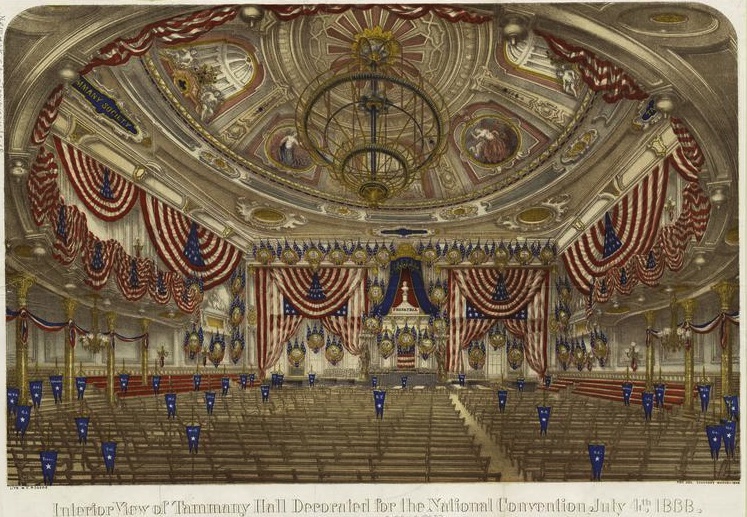
New York’s Democratic contingent — in particular, the political machine Tammany Hall and its leader William ‘Boss’ Tweed — controlled the national committee during this period and steered the convention to New York for the very first time in July 1868.

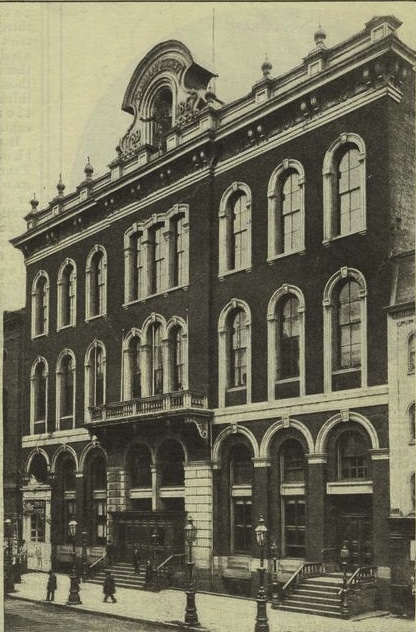
Their headquarters at 141 14th Street (at left) was sparkling new, ‘fresh from the builder’s hands,’ a lush multi-use venue with auditoriums, clubrooms and even a basement cafe, situated next door to New York’s poshest destination, the Academy of Music.

The convention was especially notable as it featured several Democrats from Southern states for the first time since the war.

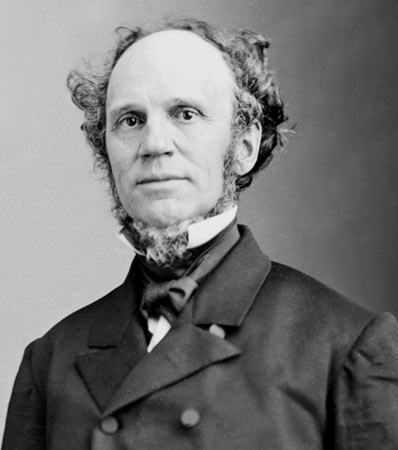
Delegates crowded into the main hall on July 4, and a roar of support greeted Democratic power player (and horse breeder) August Belmont, who gaveled in the proceedings. “I welcome you to this good city of New York,” Belmont declared, “the bulwark of Democracy.”  Nearby smiled former New York governor Horatio Seymour (pictured below), president of the convention. Five days later, there were be far less formality and Seymour, in particular, would not be smiling.

On July 5th, the Democrats unfurled their official platform, embracing the return of the Southern states and harshly criticizing the Republican-dominated Congress:  “Instead of restoring the Union, it has, so far as in its power, dissolved it, and subjected ten States, in time of profound peace, to military despotism and negro supremacy.”  Certainly pleased with this particular inclusion was Tennessee delegate Nathan Bedford Forrest, grand wizard of the Ku Klux Klan.

But the Democrats made room for the consideration of progressive causes too, such as a call for women’s suffrage.  Seymour read aloud a plank from the Women’s Suffrage Association written by Susan B. Anthony and co-signed by Elizabeth Cady Stanton.

Anthony appealed to their quest for dominance. “It was the Democratic party that fought most valiantly for the removal of the ‘property qualification’ from all white men, and thereby placed the poorest ditch-digger on a political level with the proudest millionaire. And now you have an opportunity to confer a similar boon on the women of the country … a new talisman that will ensure and perpetuate your political power for decades to come.”

The request was greeted warmly by the room before being respectfully dismissed altogether.

Things grew less harmonious when the balloting for president began.  Several candidates were submitted, even the disgraced Andrew Johnson. For several arduous ballots, the leader was George H. Pendleton, who had been the vice presidential hopeful under General McClellan. But it immediately became clear that the factions within the party were in no mood to settle quickly.

Pendleton’s lead had weakened by the 13th or 14th ballot, leaving two key candidates — Thomas Hendricks, an Indiana politician, and Winfred Scott Hancock, a Union general that seemed an attractive challenger to Grant.  But neither could approach the two-thirds needed to snatch the nomination.

A stalemate called for a third candidate, somebody that all could agree with, while at the same time, an individual that was absolutely nobody’s top choice.  It was at the podium that delegates found their man — Horatio Seymour.

He was horrified. Seymour wanted to retire and had previously rejected calls to run for national office. Privately he must have considered the pitiful chances of running a lengthy campaign against Grant. But delegates greatly respected the former governor, a bastion of cool Democratic leadership who had been an opponent to the federal draft during the war.  He had also been partly responsible for the Draft Riots, emptying the city of federal militia days before the draft was to begin that July.

Still, their were few ready options for the Democrats. When a delegate from Ohio suddenly declared “against his inclination, but no longer against his honor” to put forth Seymour as a suitable compromise, the room followed suit. On the 22nd ballot, Seymour was enthusiastically declared the Democratic nominee for president.

The only one not enthusiastic about it was Seymour. “I said to them that I could not be a candidate [and] I meant it.” [source]  He left the convention in a huff, only to begrudgingly accept the nomination back at Tammany Hall the following day.

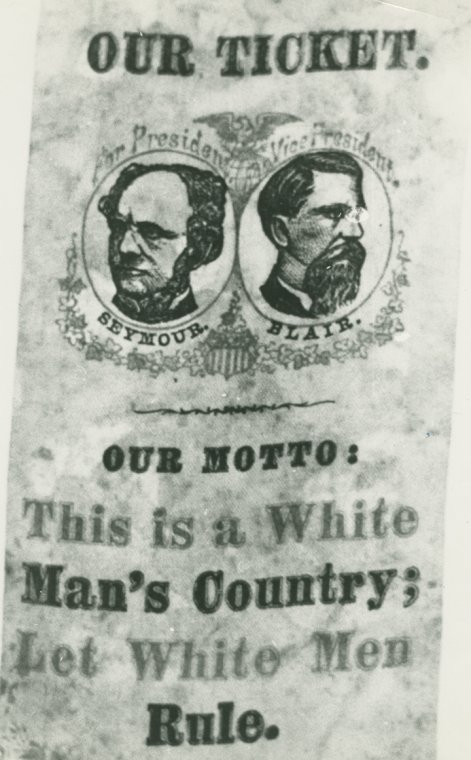
Seymour threw himself into the campaign with vice presidential choice Francis Blair Jr. (whom Seymour barely knew and hardly liked). As evidenced by the campaign poster above, they weren’t afraid to use the Southern racial divide to appeal to voters. But no matter; they lost soundly in the electoral vote to Grant and vice president Schuyler Colfax.

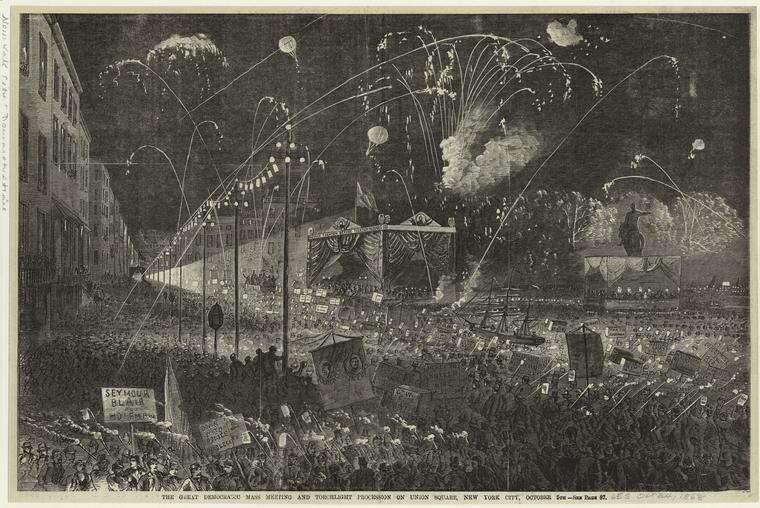
Perhaps the real objective of the convention wasn’t to sway a national crowd, but to energize New Yorkers. Democrats swept into local and state offices, including Boss Tweed’s own choice for governor John T. Hoffman.

Below: Democrats rally in Union Square in support of Seymour and other local candidates, October 5, 1868

Pictures courtesy of New York Public Library