Categories
Women's History

Suffragettes on Parade! In 1915, thousands march for right to vote

For once, the biggest news story in America in 1915 was not about the war waging in Europe.

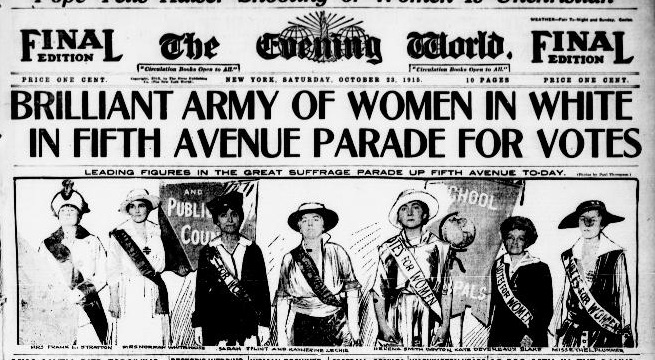
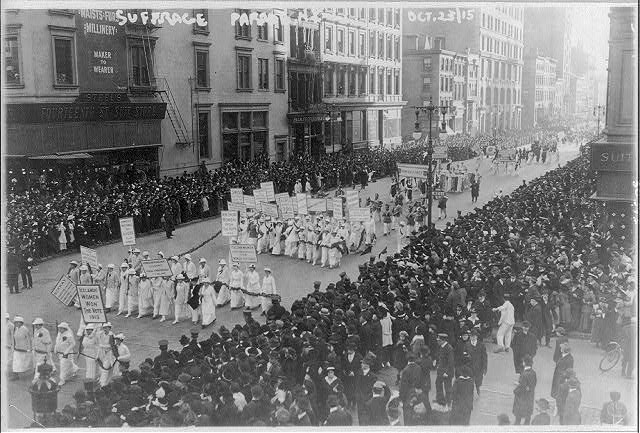
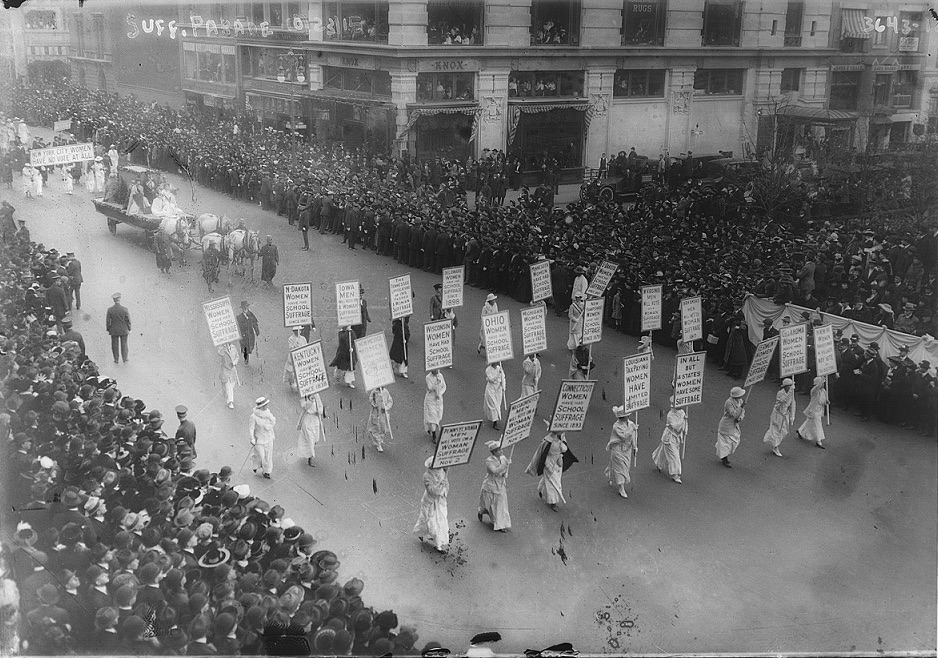
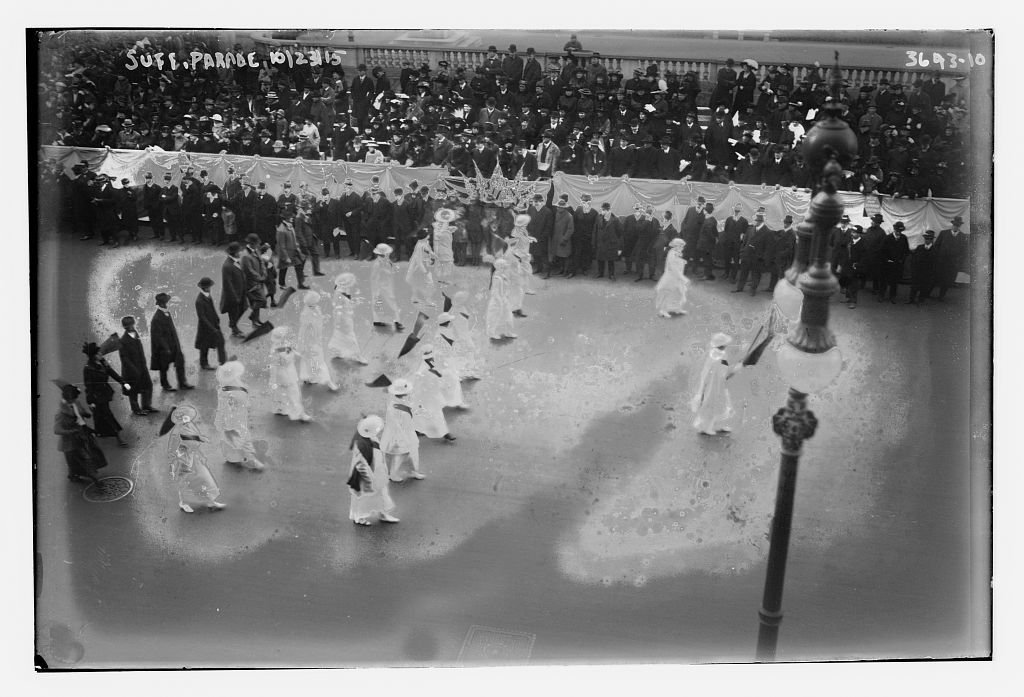
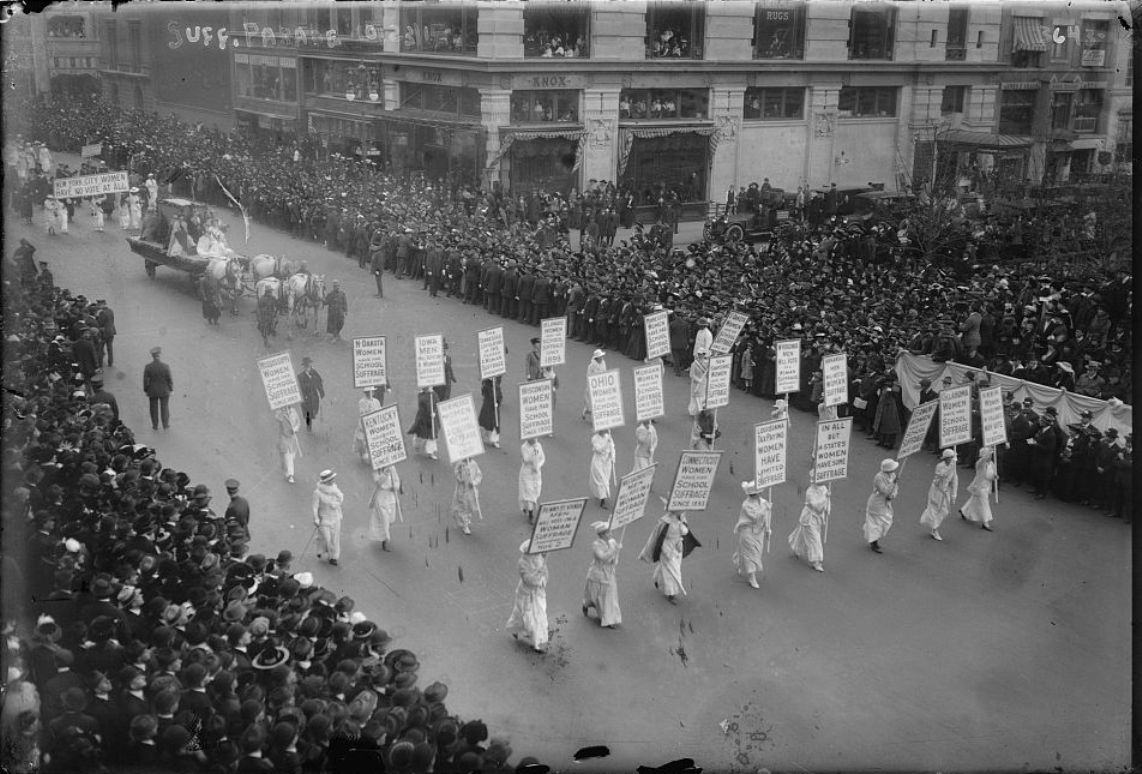
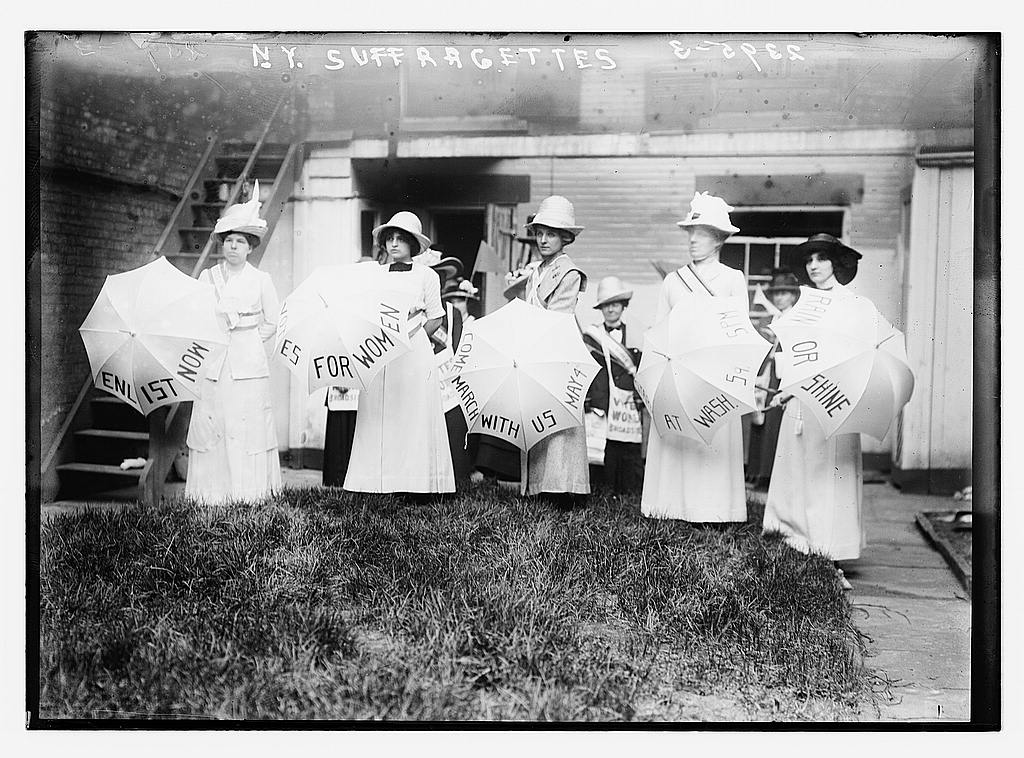
On October 23, 1915, the forces of the women’s suffrage movement mobilized to create the most ambitious gathering to date, a parade of thousands to force the issue into the consciousness of New Yorkers and American at large. 

Here are some clips from newspaper articles of the day, celebrating their efforts, chastising and trivializing in part, but recognizing that a corner had been turned and that the right to vote for American women was now an inevitable (if not immediate) outcome:
2

“The latest, biggest and most enthusiastic of suffrage parades, and the one which, according to the leaders of the suffrage forces, will be the last ever needed to plead their cause in New York, marched up Fifth Avenue from Washington Square to Fifth-Ninth Street yesterday afternoon, blazoned the whole city with the yellow of its banners, and brought out what seemed to be the larger part of the population of Manhattan to look at them.”
New York Times, October 24, 1915

“It was a three mile argument for equal rights — a dignified, splendid argument — and every vantage point along the gay colored way was covered with men and women who saw its force.  Through the chill of a windy afternoon, though the sun shone on the mighty host, the great army of women passed, the white costumes of many glittering in the sunlight, defying the cold wind that the onlookers felt to their spines as they stood to see it all.”
New York  Sun, October 24, 1915

1

“Some whose names are to be found all through the Social Register marched side by side with working mothers with babies in their arms. A large proportion of the marchers were young girls who would not be old enough to vote were they enfranchised. They made up in beauty what they lacked in years and were cheered all along the crowded Fifth Avenue sidewalks.”
New York Evening World, Late Edition, October 23

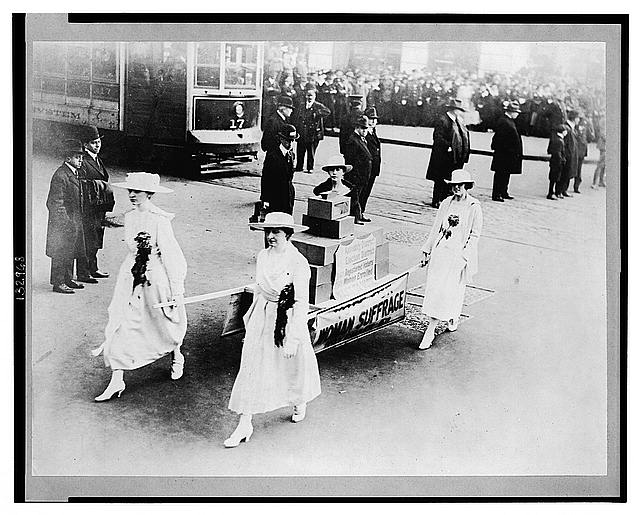
“Old women, as old as suffrage, marched. Often beside them were little girls barely in their teens. And there were even tiny babies in carts, making their appeal for their mothers’ votes.

There was little applause all along the route for the women marchers. But this was not strange, for it could be seen that the spirit of the parade had made itself felt on the sidewalks. It was no laughing matter, this parade. The women in it did not smile or giggle. They were serious and determined. And this mental characteristic was contagious.”
New York Tribune, October 24

1
8

Above: Four women carrying ballot boxes on a stretcher 

“Is Dame Nature a suffragist? At any rate, she was kind yesterday. In golden sunlight and keen air the great parade went its triumphal way, to the satisfaction of participants and spectators. With no disrespect to the men in it, the female marchers and riders, as always, showed the hopeless feminine superiority in grace, decorative effect, art of representation.”
editorial, New York Times, October 24

“The spectators laughed in good natured sympathy with the struggles which the wind caused the marchers.

Unruly skirts demanded attention from those who bore the militantly inscribed banners.

Nearly all the flag carriers had to call for help upon heir companions and sometimes four or five women struggled with brave laughter with a single standard to keep it from being swept to the street.”  — NY Evening World
1

“[S]igns were a cardinal feature of the parade. One which attracted attention everywhere and appealed significantly to the male onlookers was, “We talk with you, we eat with you, we dance with you, we marry you, why can’t we vote with you?” Another read: “Oh, men, please do give us the vote.” — NY Tribune

“King Albert of Belgium favors votes for women,” “Australian women have the ballot,” “Queensland women vote,” “Bohemia was the first in the world to pass a law for women’s suffrage in 1861,” “Oestreichischer Komite fur Frauenstremrecht” were some of the inscriptions on the banners. In all the languages of the earth they proclaimed the advance women have made in the various countries in gaining the vote, and scattered through the division were banners asking: “Women vote in Australia, why not in New York?” and “Women vote in twelve Western States, why not in New York?” — NY Sun
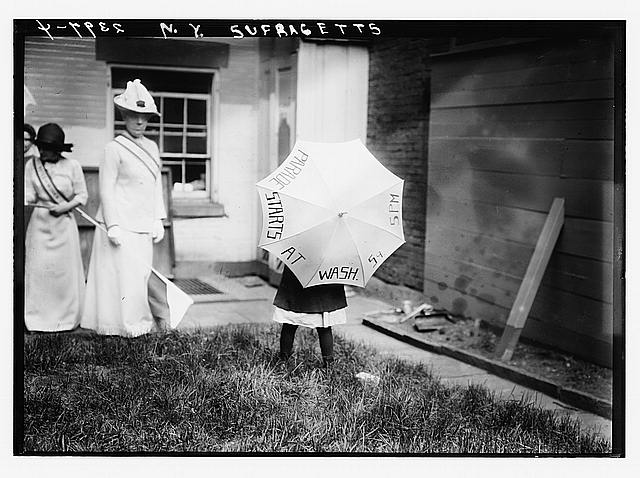
1
4

“It was a long parade — begun in mid-afternoon and finished by moonlight. And while thousands had drifted away, the avenue was still packed with onlookers when the men’s brigade — some thousands this time in place of the valorous ninety-two who were jeered in the first parade only four years ago — came along just in front of the army of automobiles that ended the procession.” – NYT

“The parade ended with a concert of thirty bands and a giant chorus singing patriotic songs at the Central Park Plaza.  There were several battalions of men in sympathy with the cause which were noisily greeted by the people along the curb.” — Evening World

Graphic from the New York Times, October 24
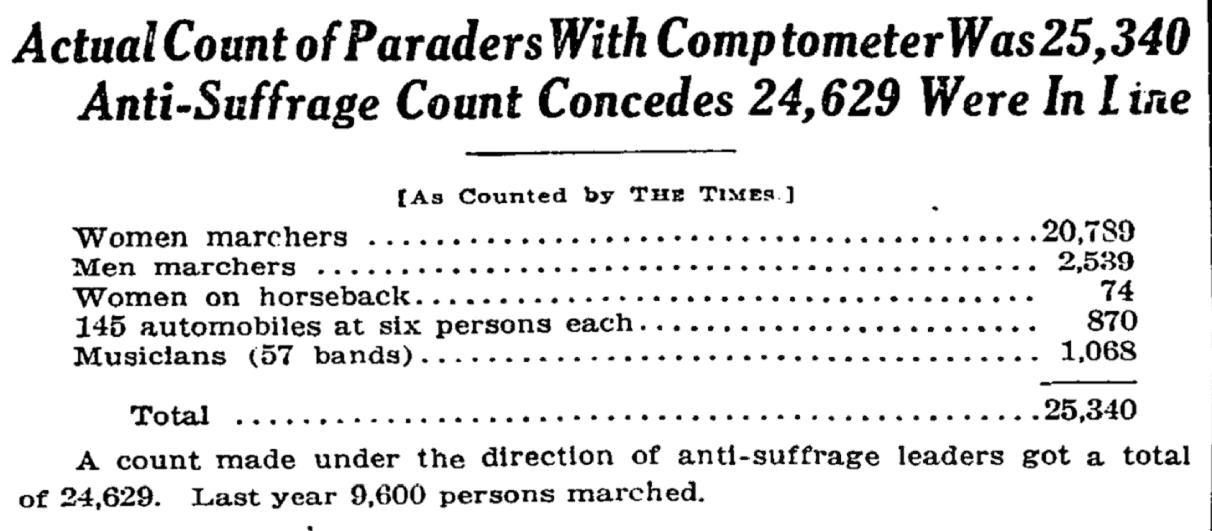
1
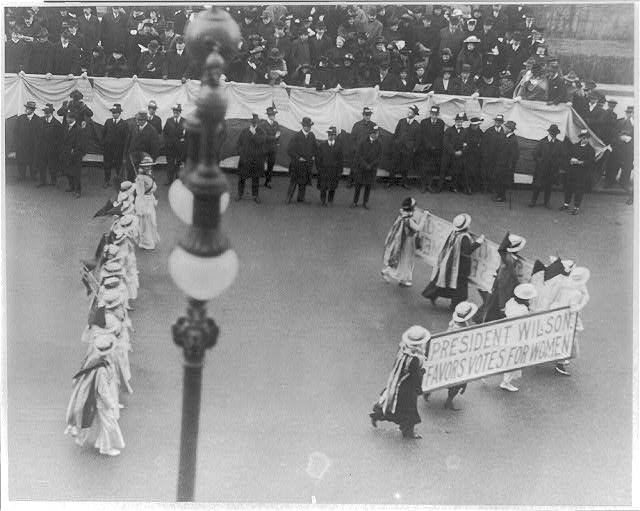
wilson

Margaret Vale, niece of President Woodrow Wilson, at the Suffrage parade. Alaska had granted women the right to vote in 1913.
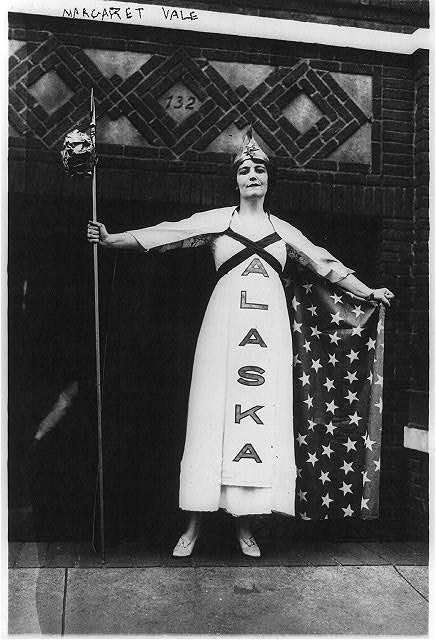
2

The appearance of Mayor John Purroy Mitchel (‘the boy mayor of New York‘) was considered a big boost for the marchers although it certainly would have been a major snub if the mayor has skipped such a major parade!
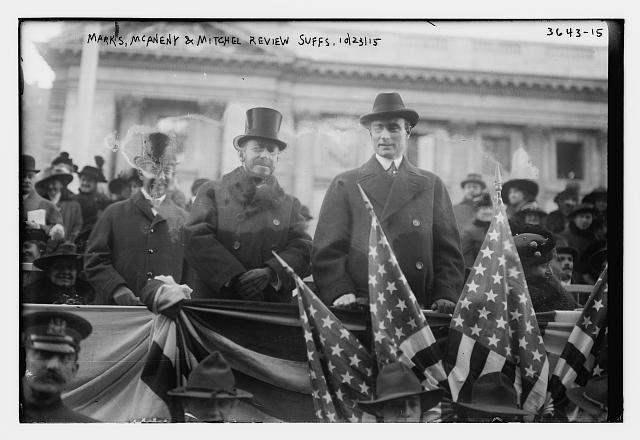
mayor

Absent from all of the news coverage (at least the articles I reviewed) was the participation of African-American suffrage advocates. They played an active role in the movement but were most likely absent from the parade.

Despite this grand parade, New Yorkers defeated a referendum on suffrage the following month. A little over two years later — on November 6, 1917 — the women of New York state would win the right to vote.

The Nineteenth Amendment, ensuring the vote for all American women, was ratified on August 18, 1920.

All photographs on this page courtesy Library of Congress
Categories
Amusements and Thrills

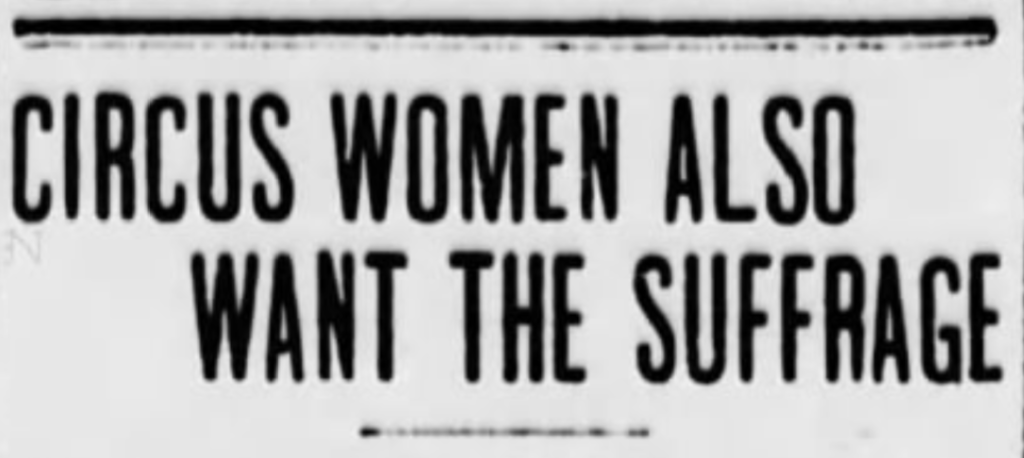
Circus activism: Barnum’s female stars demand right to vote

Women received the right to vote 100 years ago today with the ratification of the Nineteenth Amendment to the U.S. Constitution.

Tens of thousands of women from all walks of life spent hard-fought decades working for this moment. Many of the most prominent suffragettes were wealthy white women of the Fifth Avenue set.

It was their influential voices — added to those of long-time activists, women and girls from the labor movement and women of color from all backgrounds — that convinced the nation that its institutionally ingrained discrimination should end.

Even circus women got into the act.

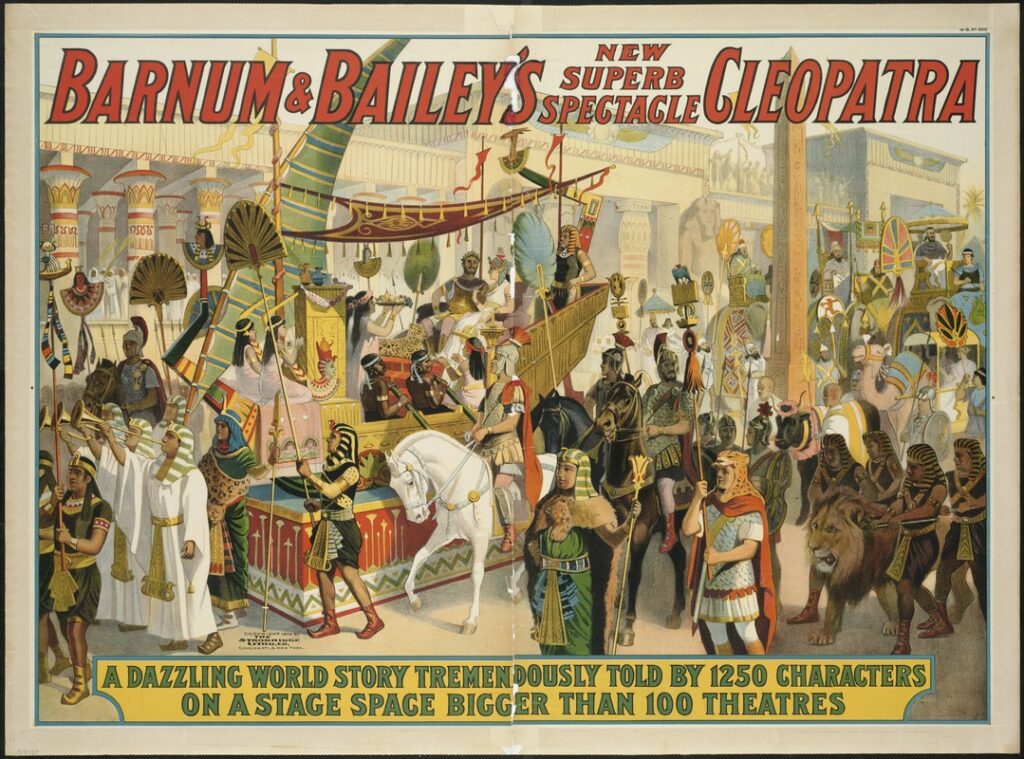
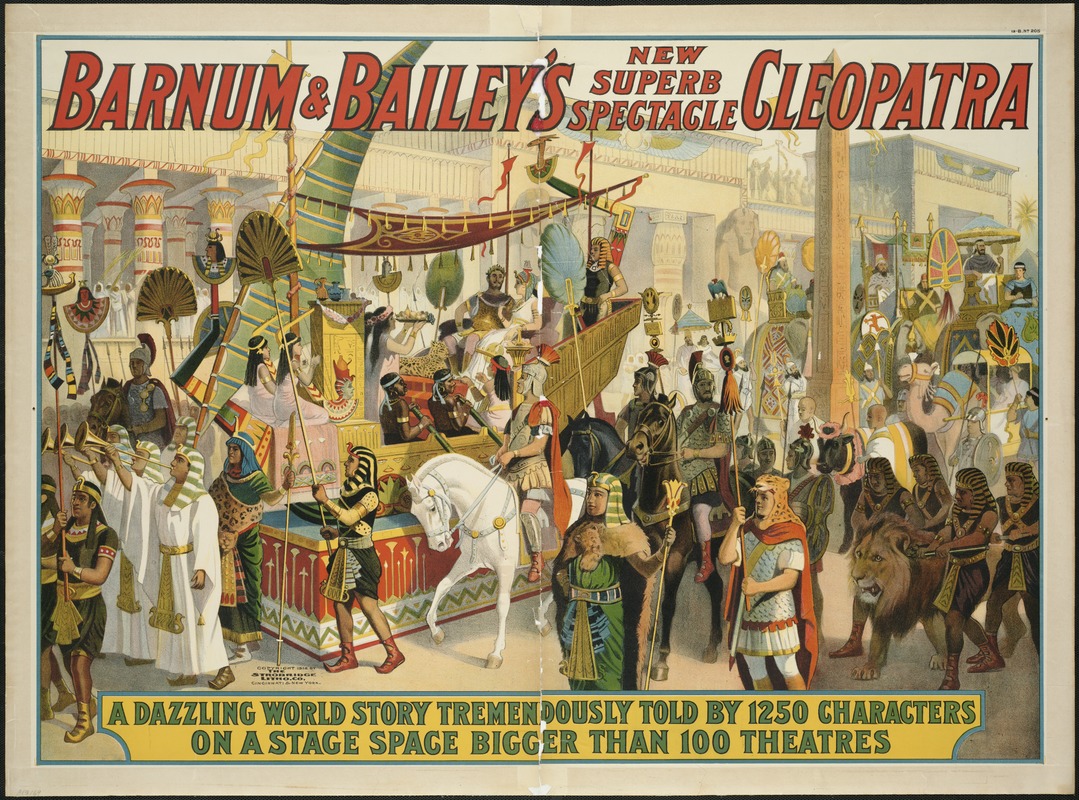
The famed Barnum & Bailey’s presented an elaborate Cleopatra-themed stage show during its 1912 season, featuring over 1,500 performers. The show had debuted just the week before at Madison Square Garden. Certainly some of its stars — perhaps Cleopatra herself? — participated in the March 1912 suffrage event. 

On March 31, 1912, members of the Barnum & Bailey circus troupe, in town to perform at Madison Square Garden (back in its Madison Square location), decided to put on a very different show.

The female stars of Barnum’s traveling show decided to throw their support behind the suffragist cause. Unfortunately they were not greeted with the praise they deserved — by either the newspapers or the other suffragists.

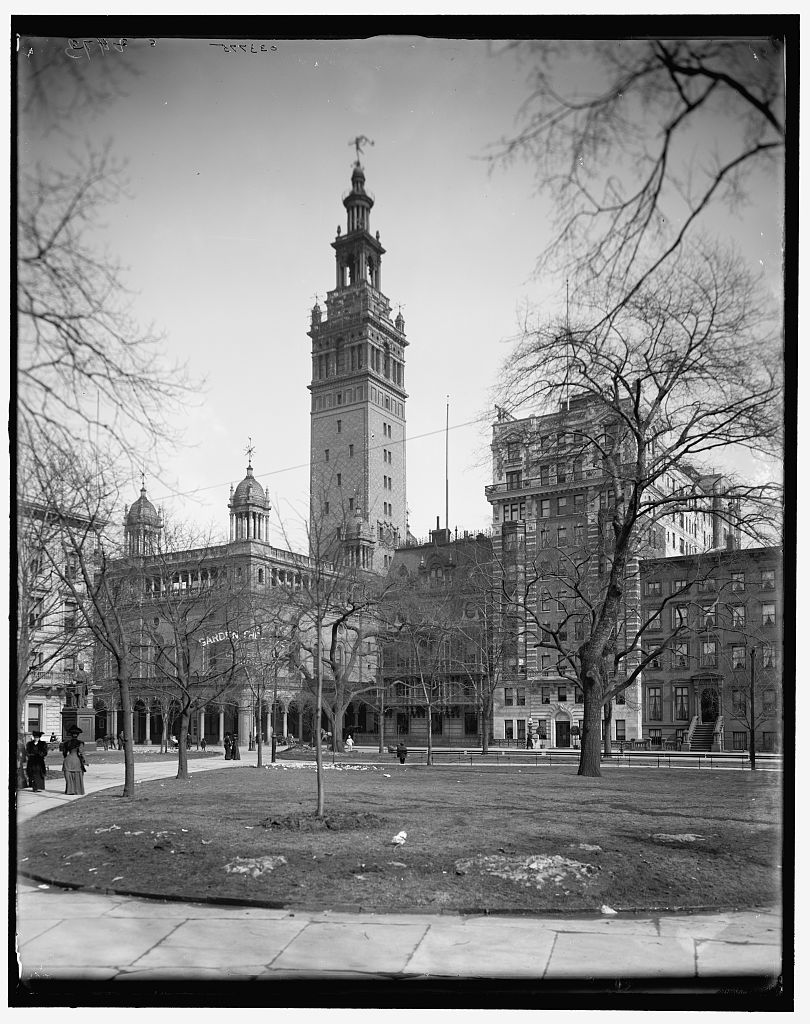
Madison Square Garden, 1910 (Courtesy Library of Congress)

Modern women activists of the day were happy to see any headlines relating their cause, as long as the environment was a respectable one. The circus was not one of those environs.

Then consider that most newspapers were operated by men and read by men. While some progressive sheets supported suffrage, several chose to cast the cause in a satirical light where possible. The ladies of Barnum & Bailey gave reporters a particularly ripe opportunity for a little spoofing.


On March 31, seventy-five women employed by America’s most famous circus organized an afternoon suffrage rally and invited the press to the world’s first ‘circus suffrage society‘.

How indeed could reporters resist a group of daredevil acrobats and horse wranglers, presenting their cause on the site of caged animals?

It was meant as a solemn pronouncement; reporters mocked it. “They Organize As Man-Eating Hyena Grins, Elephants Trumpet‘, went the Tribune headline, as the circus’s publicity agent “solemnly swore last night with a hand on his heart that the meeting was a real, honest-to-goodness suffrage meeting.” [source]  

This was Barnum territory, after all. Although the great showman had died many years earlier, perhaps after decades of chicanery and misdirection, nobody could take a Barnum photo opportunity with a straight face.

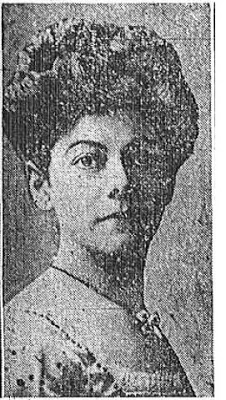
But it was a serious endeavor, led by petite circus rider Josie De Mott (pictured above) and acrobat Zella Florence.

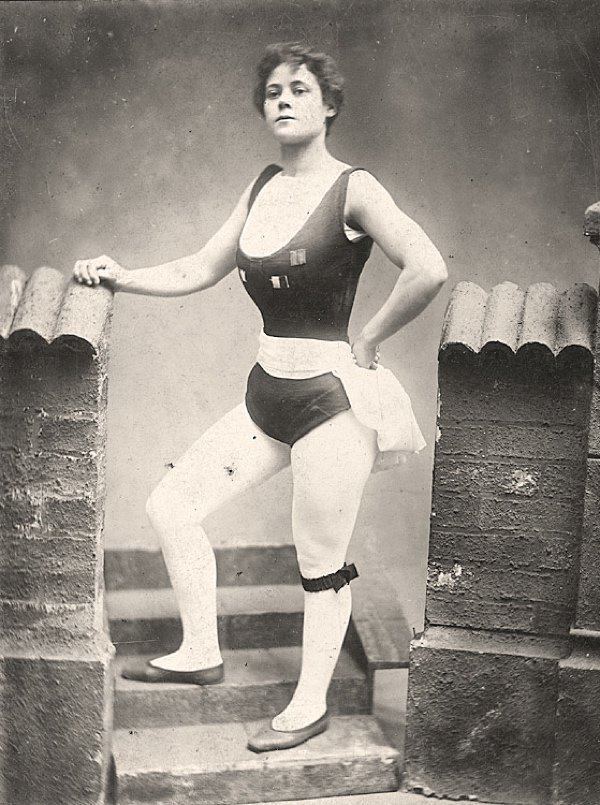
Included in the audience were animal trainers, wire walkers, ‘hand balancers’, dancers, acrobats and even a few strong ladies, including the renown Katie Sandwina, ‘the female Hercules’ (pictured below).

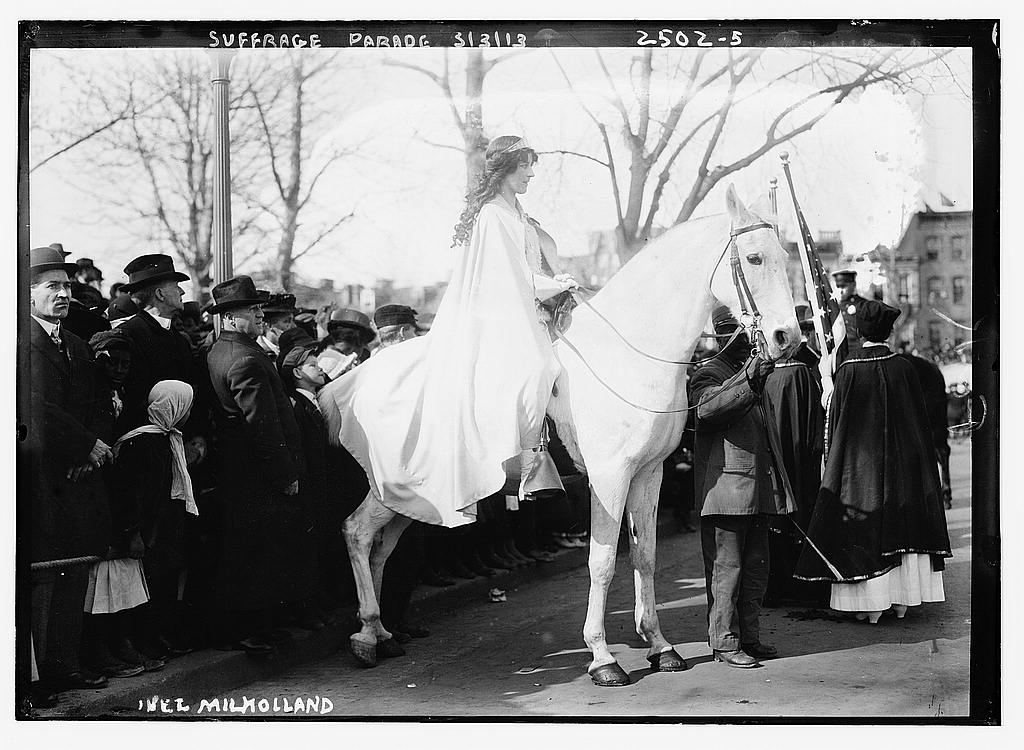
Not in attendance, however, were key members of the mainstream suffrage movement — notably Brooklyn socialite Inez Millholland and the movement’s de facto leader Harriet Stanton Blatch, the daughter of Elizabeth Cady Stanton.

Mrs. Blatch, the New York Times noted, was having tea with her fellow esteemed suffragists at their 46 East 29th Street headquarters. (It should be noted they were only a block away from Madison Square Garden!) However, perhaps recognizing the value of a traveling suffragist show, they did deign to send a representative named Beatrice Jones.


Inez Millholland at a Washington DC suffrage event in 1913. Given her dramatic display on horseback, one might have thought she’d be delighted to entertain the circus women. (Library of Congress)

Clearly flustered by the appearance of the press — the society ladies of the suffrage movement did not consider a circus ring an appropriate political venue — Jones repeatedly asked the ladies if they were serious, then dispensed advice on how to conduct themselves as standard-bearers of the roving suffragist cause.

At one point, the male half of Barnum’s husband-and-wife riding act stormed in and dragged his partner from the meeting. The crowd assailed the interloper with boos and hisses.

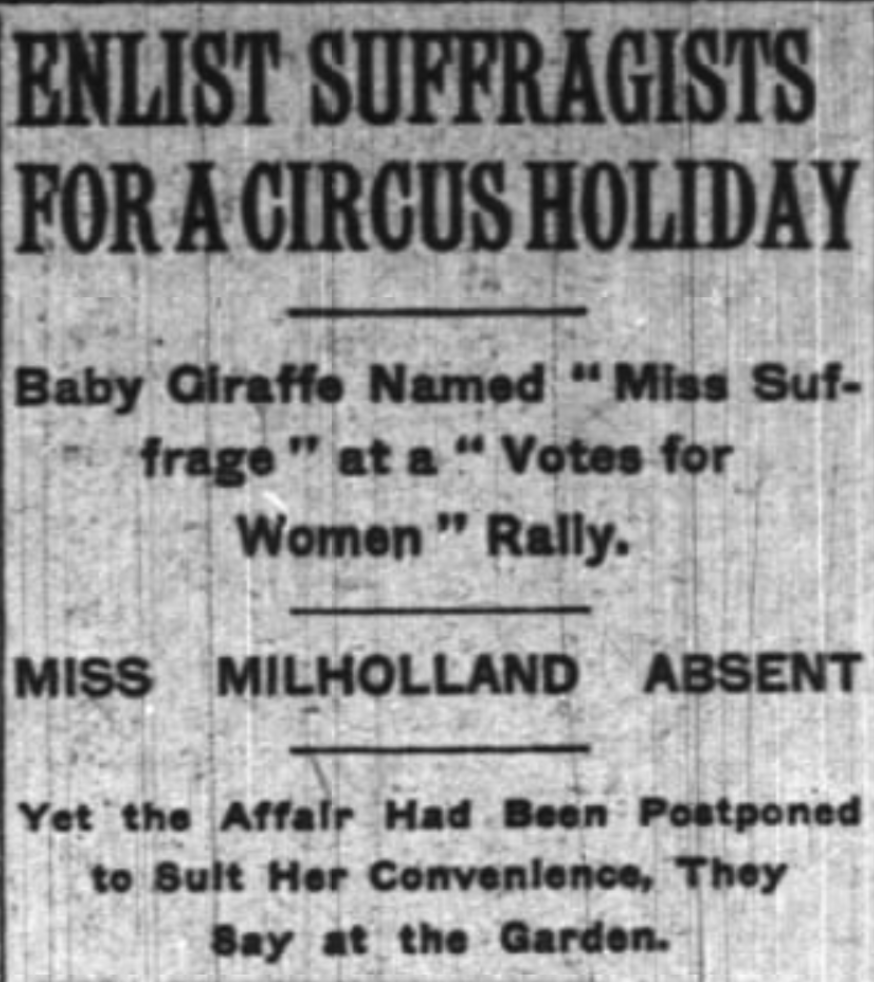
After the meeting, De Mott and the other circus suffragists created a dandy of a photo op, moving to a cage and presenting the name of ‘Miss Suffrage’ to a young baby giraffe. The Times coyly suggested the animal was male: “[B]y nightfall he couldn’t abide even the sight of a suffragette.”

The ‘proper’ suffragists acquiesced and eventually did meet with their more flamboyant sisters over tea the following week. The society activists marveled at the vigor of the Barnum ladies.

“It is because they have so much exercise,” one exclaimed, all the while “looking envious at the at the smooth skins and rosy cheeks,” the Times condescendingly added.

Eight years later, however, all these women would earn the right to vote.

Categories
Wartime New York

The Women’s Peace Parade, a moody anti-war protest in 1914

Give Peace A Chance: Women take to the streets in a stunning parade of mourning

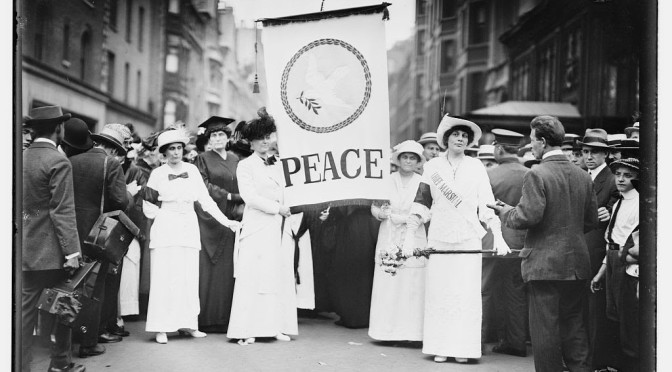
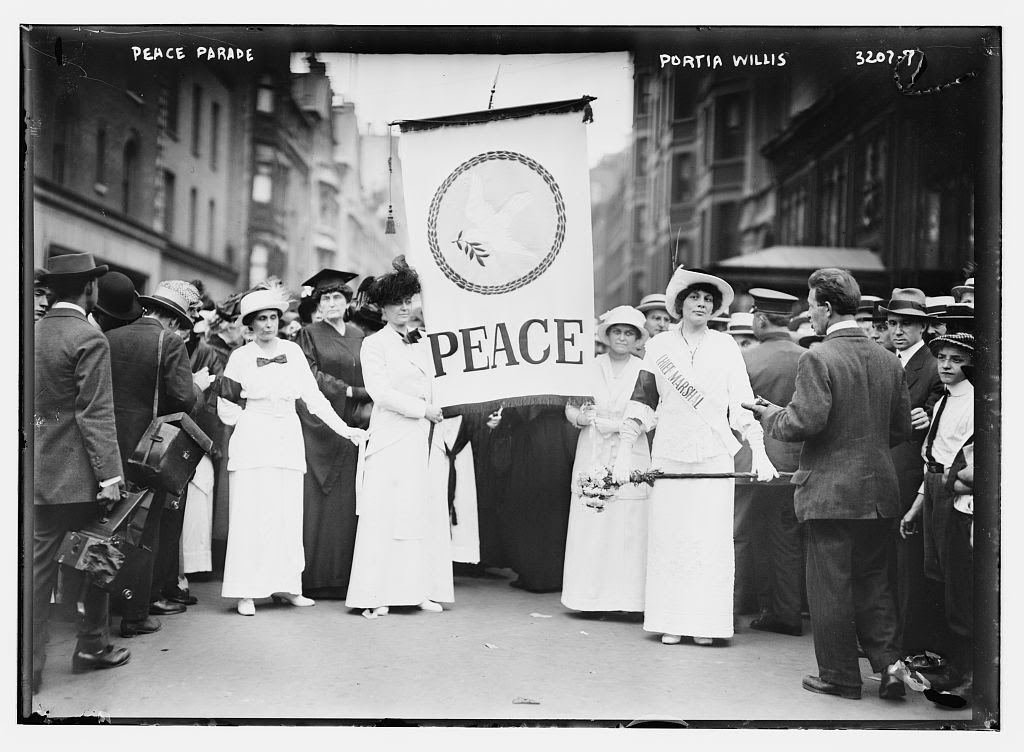
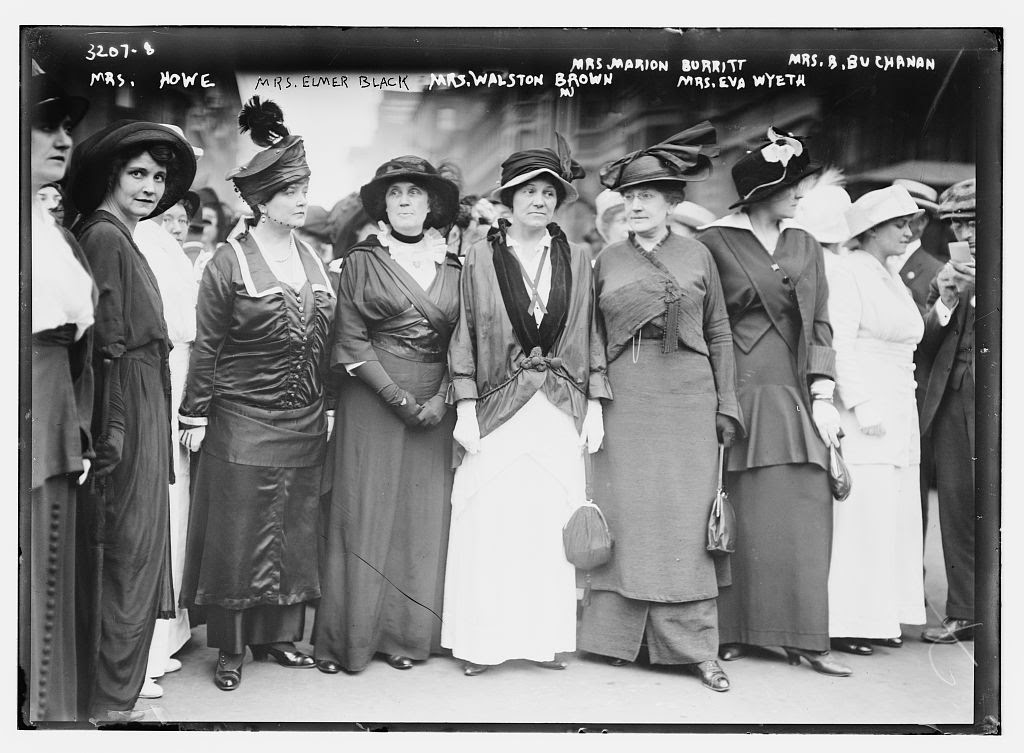
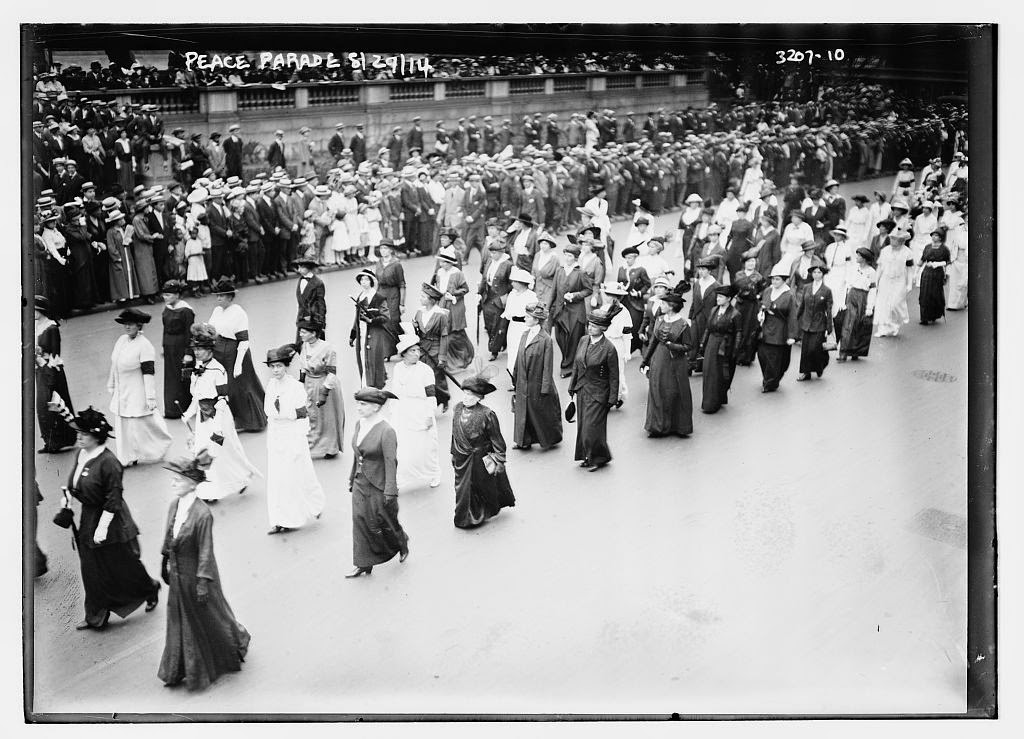
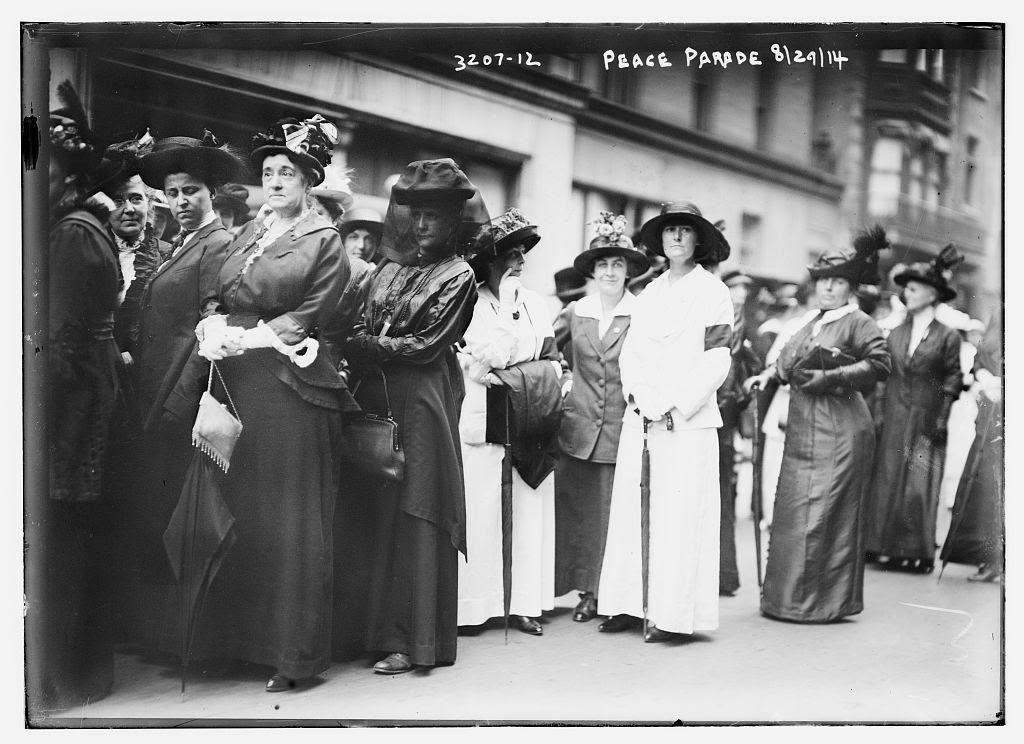
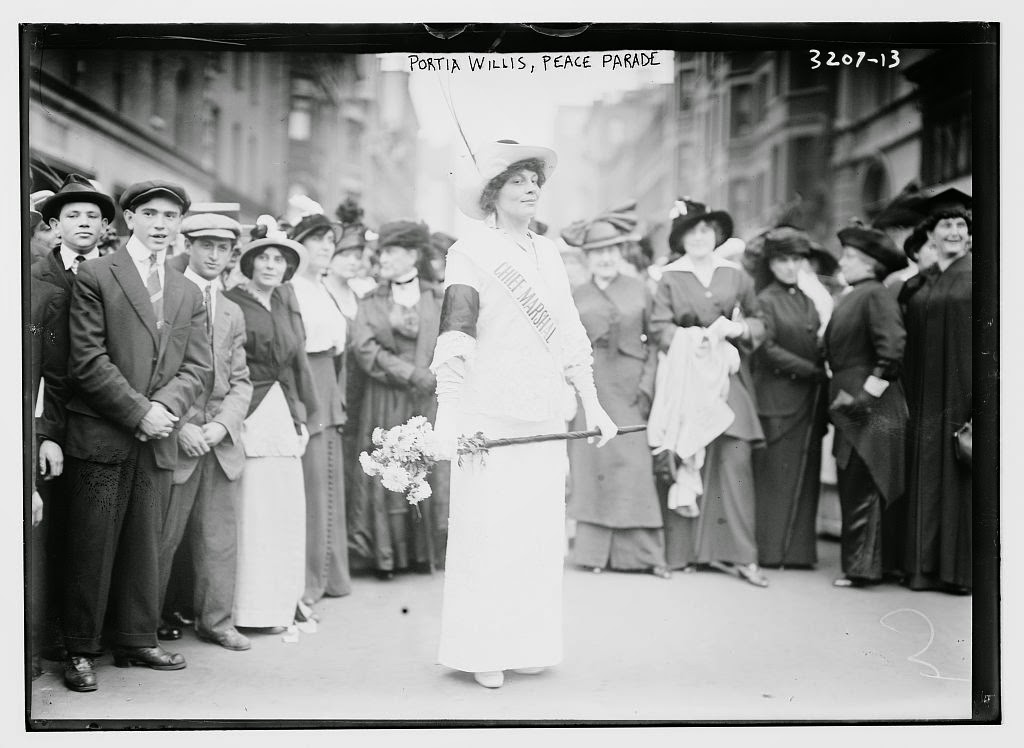
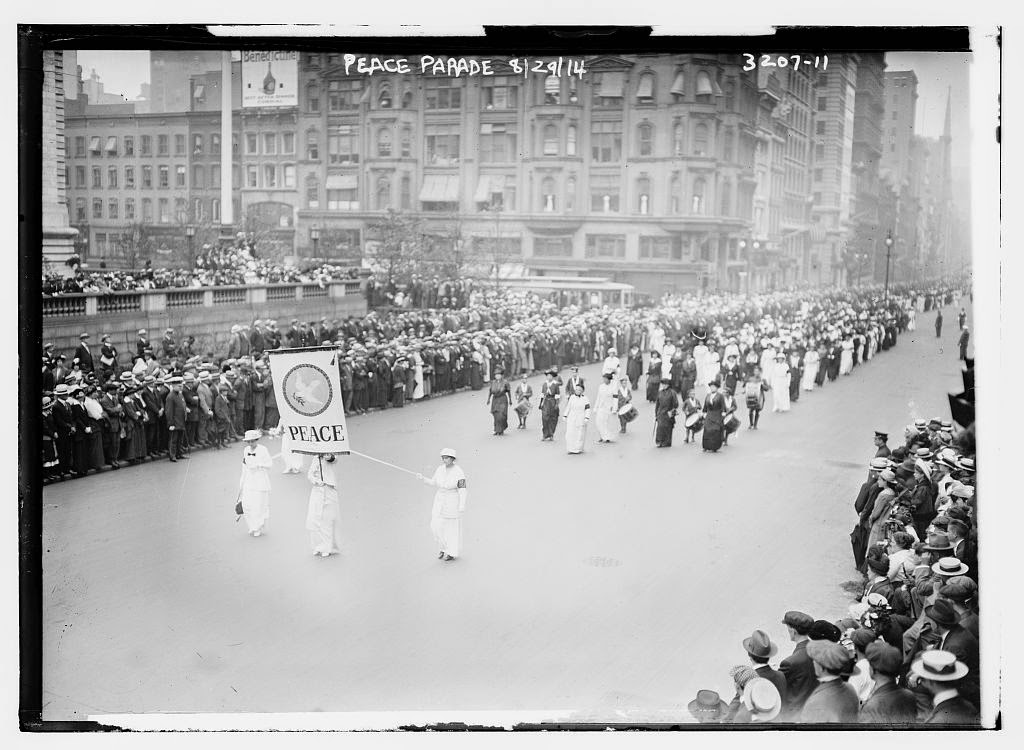
Below are some pictures of what’s possibly New York City’s first anti-war protest organized by women, on August 29, 1914.

War had erupted that summer in Europe, sparked by the assassination of Archduke Franz Ferdinand in late June and unfurling into a continent-wide catastrophe, as countries entered the fray on either side of the conflict.  Within weeks of the conflict, New Yorkers with strong ties to individual nations were raising money and even boarding ships to fight alongside their distant countrymen.

In other cities with sizable European populations — such as Montreal — people were already marching, calling for an end to the conflict.  And leading this call were women already involved in social organizations, in particular, suffragists with networks that reached into high society.

Protesting war has been a touchy issue in New York City. [See the Civil War Draft Riots for such a protest gone wrong.]  The mayor had expressly forbade parades in support of individual nations on New York streets lest a microscopic version of the European conflict erupt here.  Anti-war was often associated with socialist organizations and indeed, that August, several did march in Union Square.  But these were comprised largely of men.

Which makes the Women’s Peace Parade so unusual.  Prominent women met at the Hotel McAlpin in mid-August to plan what was essentially a mourning parade, with its participants — from all walks of life — dressed in black as though in a funeral procession. (As you can see in the pictures, many women also chose to wear white in a symbol of peacetime, garnished with black accessories.)

Many people didn’t quite understand what a peace protest even meant, seeing it as a wasted effort. One letter writer to the New York Times asked. “Will any of the women who intend to parade in protest of the war explain what they mean to accomplish by such a demonstration?”

While the parade drew from prominent individuals in the suffrage movement, others were simply not convinced.  Carrie Chapman Catt, one of America’s most famous suffragists, remarked, “If anybody thinks that a thousand, or a million, women marching through New York or talking about peace in the abstract will have any effect on the situation in Europe, it is because they don’t know the situation in Europe.”

But, in fact, there was a motivation.  One of New York’s leading activists Harriet Stanton Blanch — daughter of Elizabeth Cady Stanton — was very succinct about their motivation. “This is a movement for actual work. We intend to do something definite. We wish to have a meeting at The Hague Peace Conference called.”

The parade began in the afternoon, marching down Fifth Avenue from 58th Street down to Union Square. Women who either lived or shopped along the avenue now marched in formal procession down it, accompanied by the “ominous beat of muffled drums.”  There was occasional applause but otherwise “the general silence of the great gathering was considered the best evidence of understanding.” [source]

Among the marchers were Lillian Wald and the nurses of Henry Street Settlement.
The skies were appropriately gray.  Some participants hoped for rain actually.  “Every woman in the slow-moving line wore some badge of mourning, either a band of black around her sleeve or a bit of crepe fluttering at her breast, as a token of the black death which is hovering over the European battlefields.” [source]

The parade marshal was the young Portia Willis, a magnetic lecturer on the suffragist circuit. .

While the organizers announced there was to be only one flag on display in the parade — the flag for peace — one other crept into the proceedings.  “The smallest Boy Scout was Alfred Greenwald, 4 years old, who … attracted much attention.  Little Alfred unknowingly broke the most stringent rule of the parade by carrying a flag.  He carried a United States flag but it was furled.” [source]

Unfortunately I was not able to locate any pictures of the second half of the parade — with 250 African-American women in solidarity, followed by “a number of Indian and Chinese women” and carloads of elderly women and babies.

Those who witnessed the parade would not soon forget it, especially in the following months as the conflict that would become known as World War I grew to eventually encompass the United States.

Tammany Hall hosts the city’s first Democratic Convention: Susan B. Anthony, the KKK, and a reluctant nominee

Many of you may remember New York’s sole Republican National Convention, held in 2004 at Madison Square Garden, celebrating the re-election bid of George W. Bush. Some may recall any one of New York’s three recent Democratic National Conventions — two (1976, 1980) for Jimmy Carter, and a rather memorable one in 1992 that placed Bill Clinton on the ticket.

Oh, but that’s modern politics! Conventions of the past — stodgy, contentious, male — are more fascinating artifacts, gentlemanly in tone, chaotic and raw in execution, and dominated by a mix of issues both eternal (war, debt, taxes) and outdated (slavery, territorial expansion).

Of New York’s five Democratic nominating conventions, the most infamous is certainly the 1924 gathering at Madison Square Garden — the old Garden, Stanford White’s palace on 26th Street — distinguished by rancor, the significant influence of an energized Ku Klux Klan and an exhaustive trek through 103 ballots only to settle upon a weak compromise candidate, West Virginian politician John W. Davis, who was crushed in the general election by Republican Calvin Coolidge. Within two years, the Garden would be closed and promptly demolished, as though in embarrassment.

But I find the first national convention, held in 1868, to be the most intriguing and telling of New York life in the mid-19th century, a convention so unusual that the eventual presidential nominee actually recoiled from accepting the nomination.

Four years prior, in 1864, a splintered Democratic Party had tried to replace Abraham Lincoln in the White House with his former Union general George B. McClellan. In New York, former mayor and now-Congressman Fernando Wood led a drive for new national leadership — even though he loathed McClellan — and called for an end to the Civil War with their ‘Southern brethren’. But opposition quickly withered after a series of Union victories, and Lincoln was re-elected.

Flash forward to 1868. Lincoln was dead, the Civil War was over and slavery was abolished. The current president Andrew Johnson aligned with Democrats over Southern inclusion, eventually leading to his impeachment and a serious damaging of the national Democratic brand.

To bring glory back to the White House, the Republicans hoisted forth as their nominee the hero of the war, Ulysses S. Grant. Perhaps the most famous man in America, Grant would eventually prove to be a mediocre president. But his reputation and charm were so great in 1868 that the Democrats knew they stood little chance to defeating him.

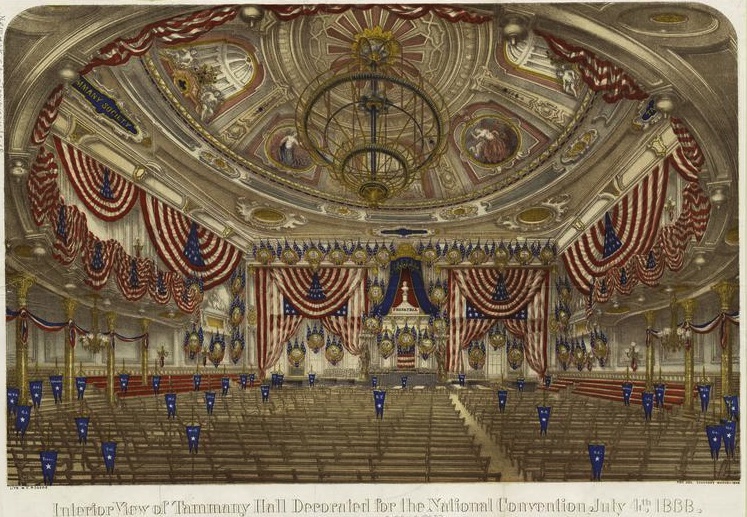
New York’s Democratic contingent — in particular, the political machine Tammany Hall and its leader William ‘Boss’ Tweed — controlled the national committee during this period and steered the convention to New York for the very first time in July 1868.

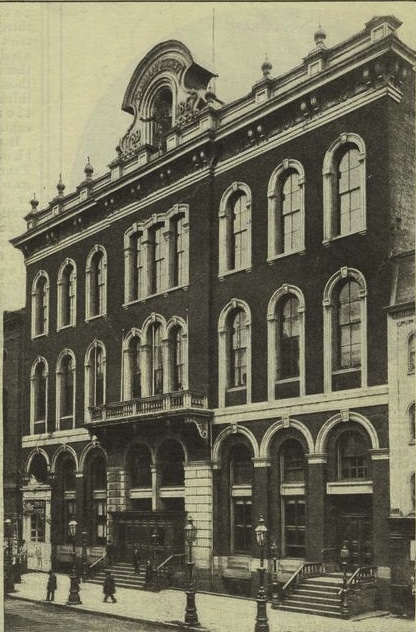
Their headquarters at 141 14th Street (at left) was sparkling new, ‘fresh from the builder’s hands,’ a lush multi-use venue with auditoriums, clubrooms and even a basement cafe, situated next door to New York’s poshest destination, the Academy of Music.

The convention was especially notable as it featured several Democrats from Southern states for the first time since the war.

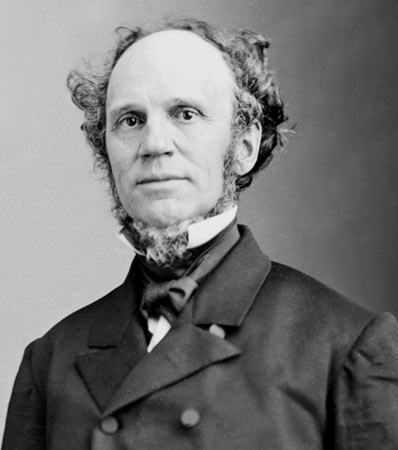
Delegates crowded into the main hall on July 4, and a roar of support greeted Democratic power player (and horse breeder) August Belmont, who gaveled in the proceedings. “I welcome you to this good city of New York,” Belmont declared, “the bulwark of Democracy.”  Nearby smiled former New York governor Horatio Seymour (pictured below), president of the convention. Five days later, there were be far less formality and Seymour, in particular, would not be smiling.

On July 5th, the Democrats unfurled their official platform, embracing the return of the Southern states and harshly criticizing the Republican-dominated Congress:  “Instead of restoring the Union, it has, so far as in its power, dissolved it, and subjected ten States, in time of profound peace, to military despotism and negro supremacy.”  Certainly pleased with this particular inclusion was Tennessee delegate Nathan Bedford Forrest, grand wizard of the Ku Klux Klan.

But the Democrats made room for the consideration of progressive causes too, such as a call for women’s suffrage.  Seymour read aloud a plank from the Women’s Suffrage Association written by Susan B. Anthony and co-signed by Elizabeth Cady Stanton.

Anthony appealed to their quest for dominance. “It was the Democratic party that fought most valiantly for the removal of the ‘property qualification’ from all white men, and thereby placed the poorest ditch-digger on a political level with the proudest millionaire. And now you have an opportunity to confer a similar boon on the women of the country … a new talisman that will ensure and perpetuate your political power for decades to come.”

The request was greeted warmly by the room before being respectfully dismissed altogether.

Things grew less harmonious when the balloting for president began.  Several candidates were submitted, even the disgraced Andrew Johnson. For several arduous ballots, the leader was George H. Pendleton, who had been the vice presidential hopeful under General McClellan. But it immediately became clear that the factions within the party were in no mood to settle quickly.

Pendleton’s lead had weakened by the 13th or 14th ballot, leaving two key candidates — Thomas Hendricks, an Indiana politician, and Winfred Scott Hancock, a Union general that seemed an attractive challenger to Grant.  But neither could approach the two-thirds needed to snatch the nomination.

A stalemate called for a third candidate, somebody that all could agree with, while at the same time, an individual that was absolutely nobody’s top choice.  It was at the podium that delegates found their man — Horatio Seymour.

He was horrified. Seymour wanted to retire and had previously rejected calls to run for national office. Privately he must have considered the pitiful chances of running a lengthy campaign against Grant. But delegates greatly respected the former governor, a bastion of cool Democratic leadership who had been an opponent to the federal draft during the war.  He had also been partly responsible for the Draft Riots, emptying the city of federal militia days before the draft was to begin that July.

Still, their were few ready options for the Democrats. When a delegate from Ohio suddenly declared “against his inclination, but no longer against his honor” to put forth Seymour as a suitable compromise, the room followed suit. On the 22nd ballot, Seymour was enthusiastically declared the Democratic nominee for president.

The only one not enthusiastic about it was Seymour. “I said to them that I could not be a candidate [and] I meant it.” [source]  He left the convention in a huff, only to begrudgingly accept the nomination back at Tammany Hall the following day.

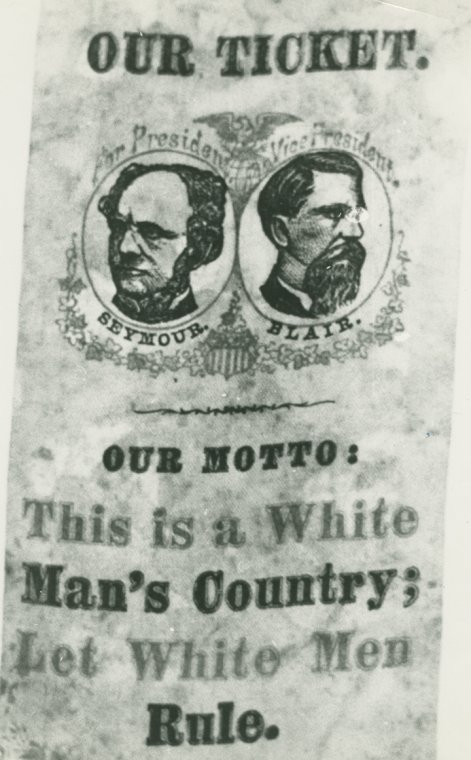
Seymour threw himself into the campaign with vice presidential choice Francis Blair Jr. (whom Seymour barely knew and hardly liked). As evidenced by the campaign poster above, they weren’t afraid to use the Southern racial divide to appeal to voters. But no matter; they lost soundly in the electoral vote to Grant and vice president Schuyler Colfax.

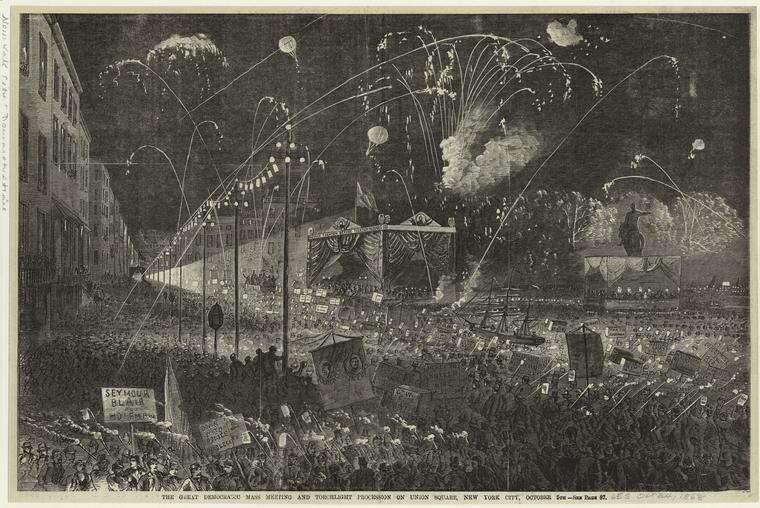
Perhaps the real objective of the convention wasn’t to sway a national crowd, but to energize New Yorkers. Democrats swept into local and state offices, including Boss Tweed’s own choice for governor John T. Hoffman.

Below: Democrats rally in Union Square in support of Seymour and other local candidates, October 5, 1868

Pictures courtesy of New York Public Library

Categories
Brooklyn History

Ten fabulous facts about 70 Willow Street, Brooklyn Heights, aka ‘the Truman Capote house’

The strange, yellow Brooklyn Heights mansion best known as the home where Truman Capote wrote ‘Breakfast At Tiffany’s’ has finally been sold for $12 million, after many months of humbling markdowns from its original hefty pricetag.
Located in the heart of old Brooklyn, the new owners will be winning more than a literary prize. The house has a rather unusual past full of influential inhabitants and has been used in some curious ways:
1) 70 Willow Street, in the popular Greek revival style of the day, was built in 1839 by Adrian Van Sinderen, the descendant of original Dutch settlers in New Amsterdam and a fiery Revolutionary War-era reverend from Flatbush, Ulpianus Van Sinderen. Van Sinderen’s lavish urban villa — it has almost a dozen fireplaces — is one of the oldest houses in the neighborhood, but not the oldest. There are a few neighboring houses that are older, including 24 Middagh Street, just a couple blocks away and built in 1824.
2) The house passed to his son Adrian Jr., a prominent New York lawyer, who fell spectacularly from grace when he mishandled the family trust. He died nearly penniless and alone in New Lots, far outside the sphere of wealth, in 1864. (There’s an avenue near that east Brooklyn neighborhood named for the Van Sinderen family.) His descendants appear to have done better. Another Adrian Van Sinderen has an annual book-collecting competition named for him at Yale University.
3) The ‘estate of Van Sinderen’, as it was often called then, was built for a single family, but by the late 1860s, the roomy floors were being split up for several tenants. From an October 1869 classified ad in the Brooklyn Eagle:”One large, handsomely furnished second floor room for gentleman and wife or gentlemen willing to room together.”***

4) The primary resident during the late 19th century was the banker William Putnam, better known as a significant trustee for the Brooklyn Museum in its early years. He betrothed to the museum paintings by Rembrandt and Monet, as well as some ‘Royal Copenhagen  porcelain’ that rivaled that of European rulers, according to the Times.

5) The house was a pivotal location for the women’s suffrage movement. Scratch that, the anti-women’s suffrage movement. The newly married lady of the house, Caroline Putnam, and her sister Lillian joined other local ladies of means in organizing protests against granting women the right to vote or, in the words of their 1894 petition, to protest “the obligations of the ballot upon the women of the state.” Mrs. Putnam also hosted French conservation classes and literary salons from her parlor here. [source]
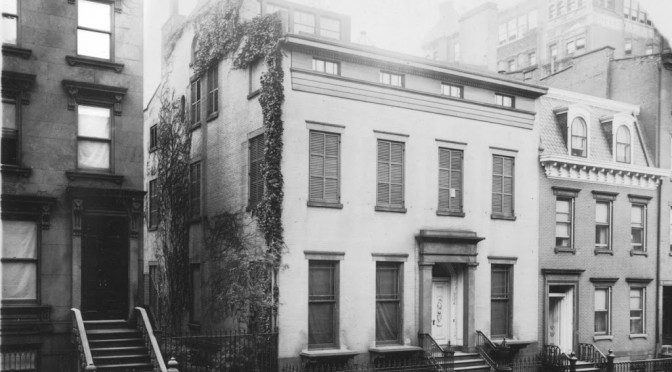
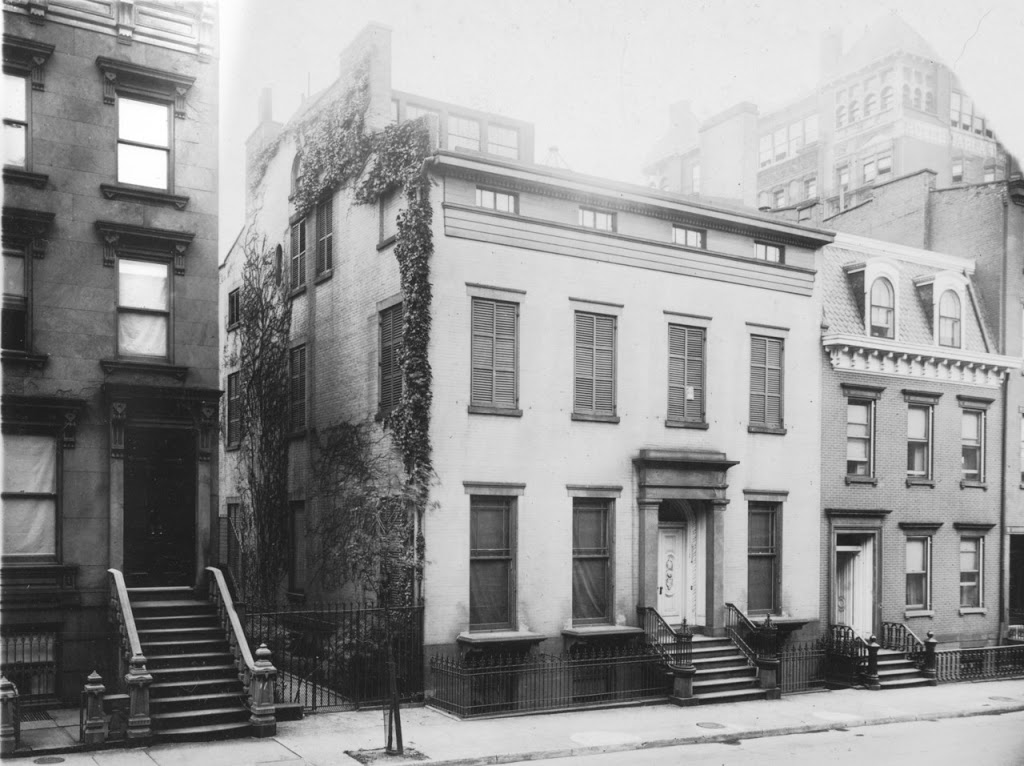
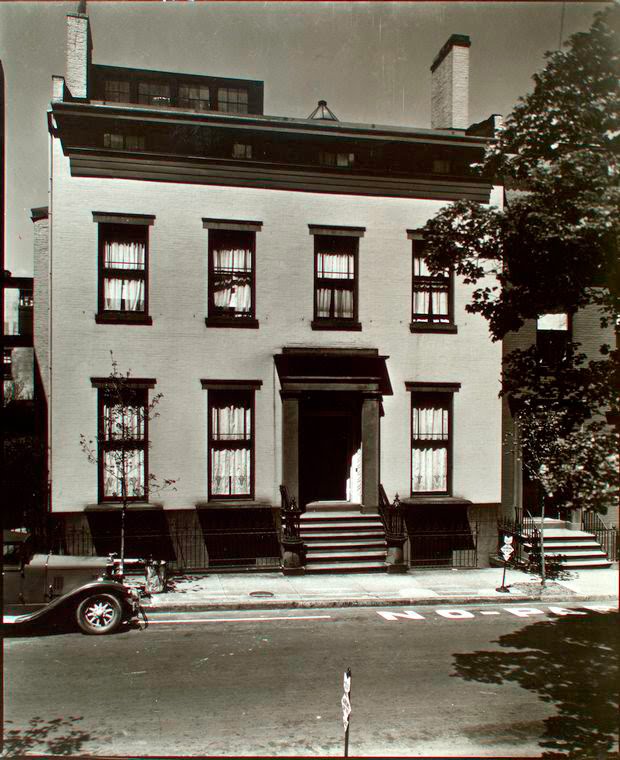
The picture at top shows the house as it looked in 1922. At right, the home in 1936. (Pictures courtesy New York Public Library.)
6) After Mrs. Putnam died in 1940, the house sat entirely vacant until 1944, when it was donated to the Red Cross. They used the house as a classroom, teaching arts and crafts, Braille to the blind and cooking classes to the wives of returning soldiers from World War II.

7) In 1953, the old house landed in the hands of renown Broadway stage designer Oliver Smith, responsible for the original scenery from great American musicals like Oklahoma!, Guys and Dolls and West Side Story. In his lifetime, he was nominated for 25 Tony Awards. With some of his earnings from the musical On The Town, Smith bought 70 Willow Street and lived here until he died in 1994.

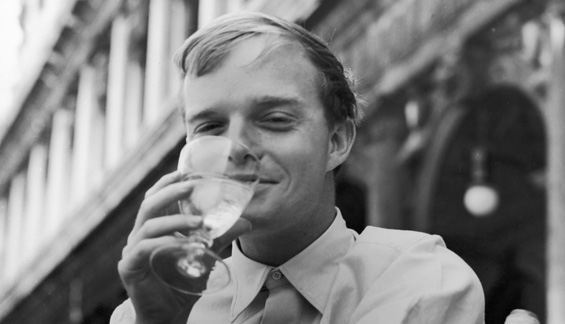
8) From 1955 to 1965, he lent the basement apartment to his friend Truman Capote. The blond Southern writer was simply wild about Brooklyn Heights and basically charmed himself into a permanent room on Willow Street. From his essay ‘A House on the Heights,‘ Capote describes, “We [Smith and Capote] sat on the porch consulting Martinis — I urged him to have one more, another. It got to be quite late, he began to see my point; yes, twenty-eight rooms were rather a lot; and yes it seemed only fair that I should have some of them.”

9) Decked out in green wallpaper and odd knickknacks, “an atmosphere of perpetual Christmas,” the house would prove a place of great inspiration for Capote. He wrote part of ‘Breakfast At Tiffany’s‘ here. Perhaps more notably, it was here that he picked up a New York Times are read about the brutal slaying of a Kansas family. Capote set about working on what became ‘In Cold Blood‘ the next day.

10) I can’t leave the tale of 70 Willow Street without mentioning one of its most famous lunch guests — Jackie Kennedy. Capote conveniently left out the fact that the house was Smith’s, not his. “She laughed about it, because suddenly in the middle of lunch she got the idea that it wasn’t his,” Smith recalled later. “I suppose I acted as if it were mine.”

And here’s some literary bonus points — it’s just down the street from the old home of Arthur Miller (155 Willow Street)

***A reader emailed me to say that the addresses for Willow Street were differently numbered before 1865 and that this ad probably refers to a neighbor of 70 Willow Street. In that case, I’ll replace that fact with one I should have mentioned in the lede of this article — as reported by Brownstoner, the $12 million final price tag for 70 Willow Street makes it the most expensive house purchase in Brooklyn history. Does this mean that nobody has yet bought my dream apartment in DUMBO?