Categories
Amusements and Thrills Podcasts Writers and Artists

Truman Capote’s Black and White Ball: The Absurd Story of a Marvelous Party

PODCAST Your ticket to Truman Capote’s celebrity-filled party at the Plaza.

This month FX is debuting a new series created by Ryan Murphy — called Feud: Capote and the Swans — regarding writer Truman Capote‘s relationship with several famed New York society women.

And it’s such a New York story that listeners have asked if we’re going to record a tie-in show to that series. Well, here it is! Tom and Greg recorded this show back in November of 2016 but, likely, most of you haven’t heard this one.
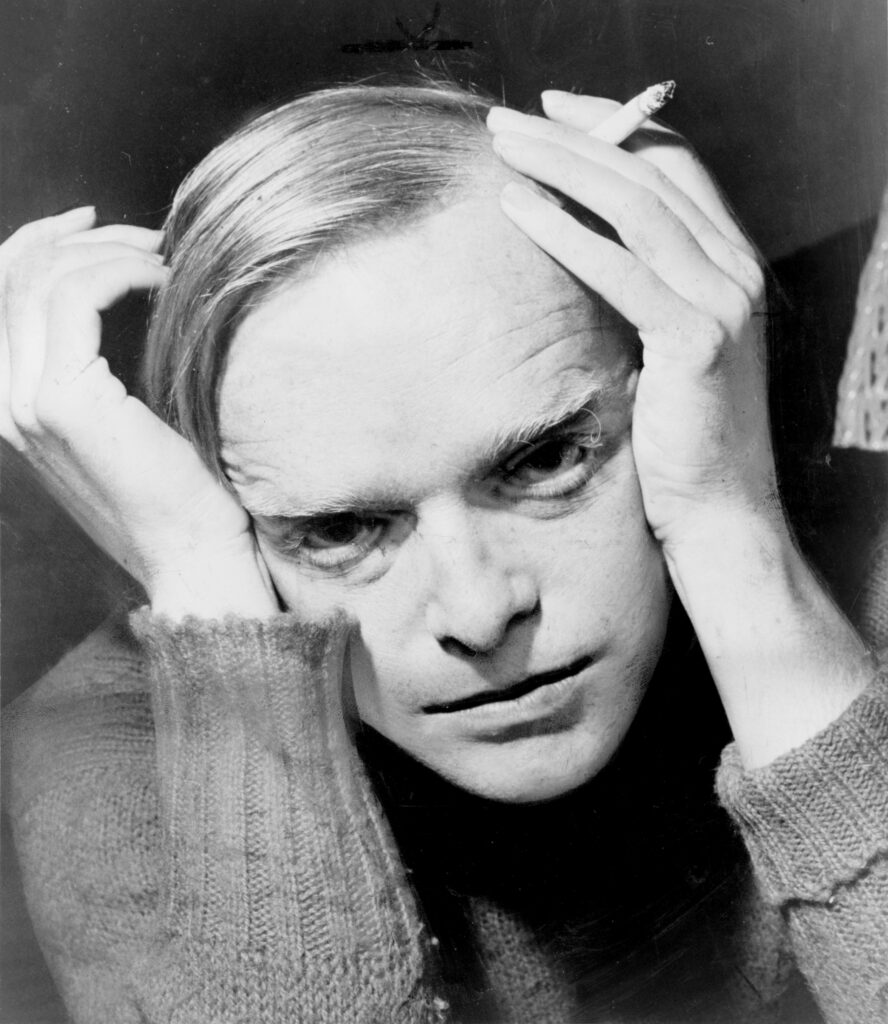
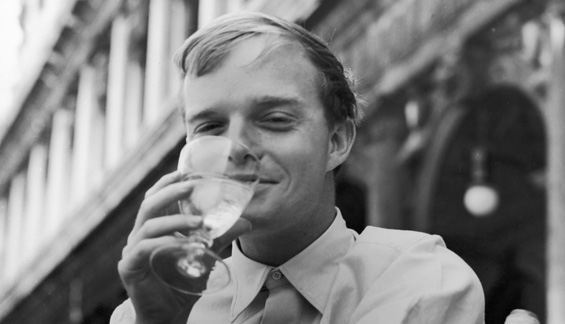
Capote in 1959 / Library of Congress Prints and Photographs Division. New York World-Telegram and the Sun Newspaper Photograph Collection.

Capote is a true New York character, a Southern boy who wielded his immense writing talents to secure a place within Manhattan high society. Elegant, witty, compact, gay — Capote was a fixture of swanky nightclubs and arm candy to wealthy, well-connected women.

One project would entirely change his life — the completion of the classic In Cold Blood, a ‘non-fiction novel’ about a horrible murder in Kansas. Retreating from his many years of research, Truman decided to throw a party.

But this wasn’t ANY party. This soiree — a masquerade ball at the Plaza Hotel — would have the greatest assemblage of famous folks ever gathered for something so entirely frivolous. An invite to the ball was the true golden ticket, coveted by every celebrity and social climber in America.

Come with us as we give you a tour of the planning of the Black and White Ball and a few glamorous details from that strange, glorious evening.

FEATURING: Harper Lee, Lauren Bacall, Frank Sinatra, Robert Frost, Lillian Hellman, Halston, Katharine Graham and a cast of thousands (well, or just 540)


Truman Capote in 1945
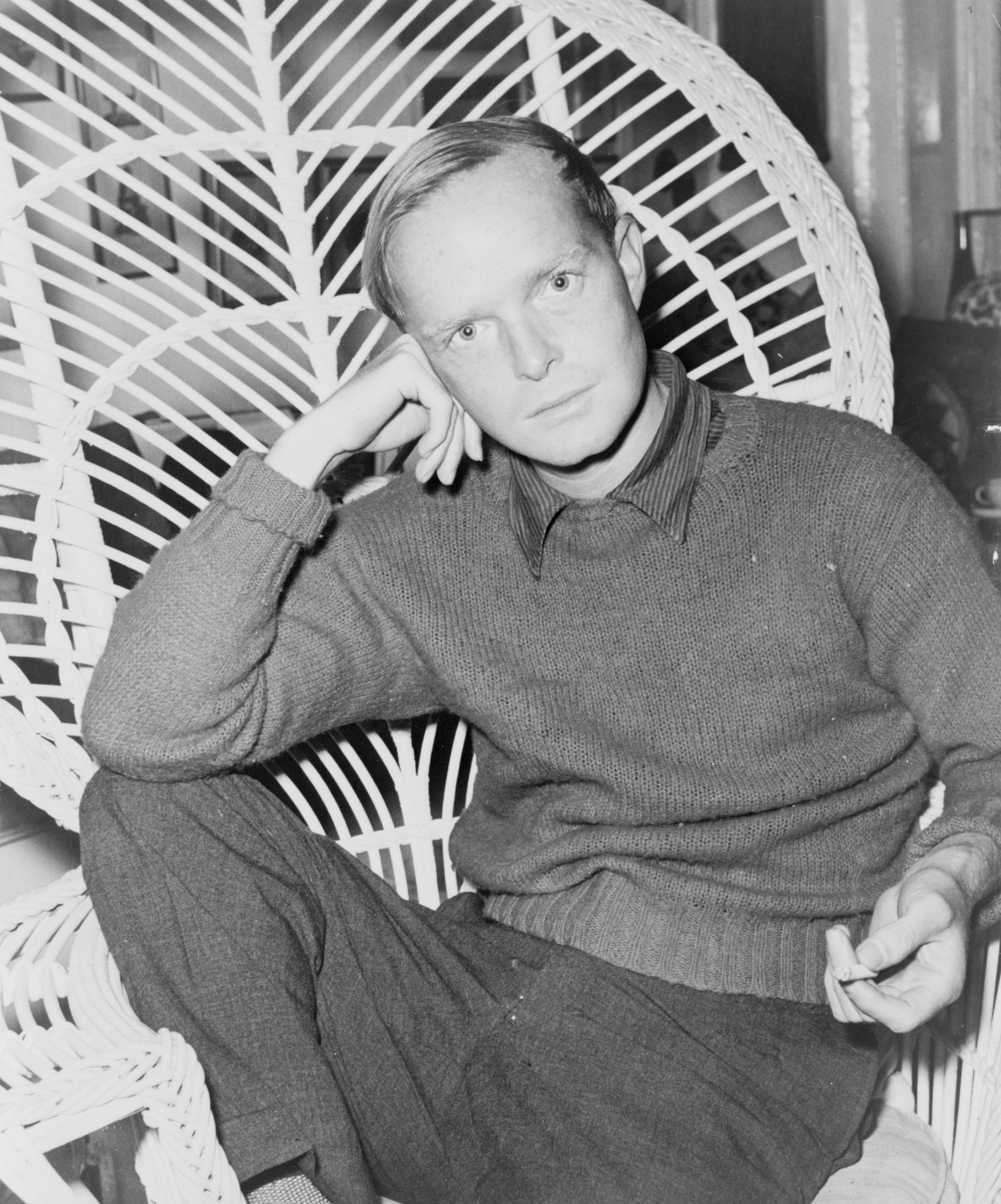
capote-truman-1945

From the unusual book jacket of Other Voices, Other Rooms, 1948
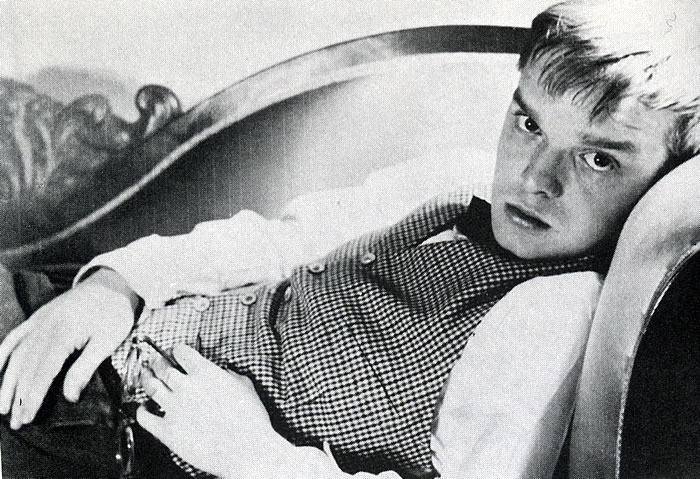
1477405059645

Babe Paley with Truman Capote in Capri, early 1960s
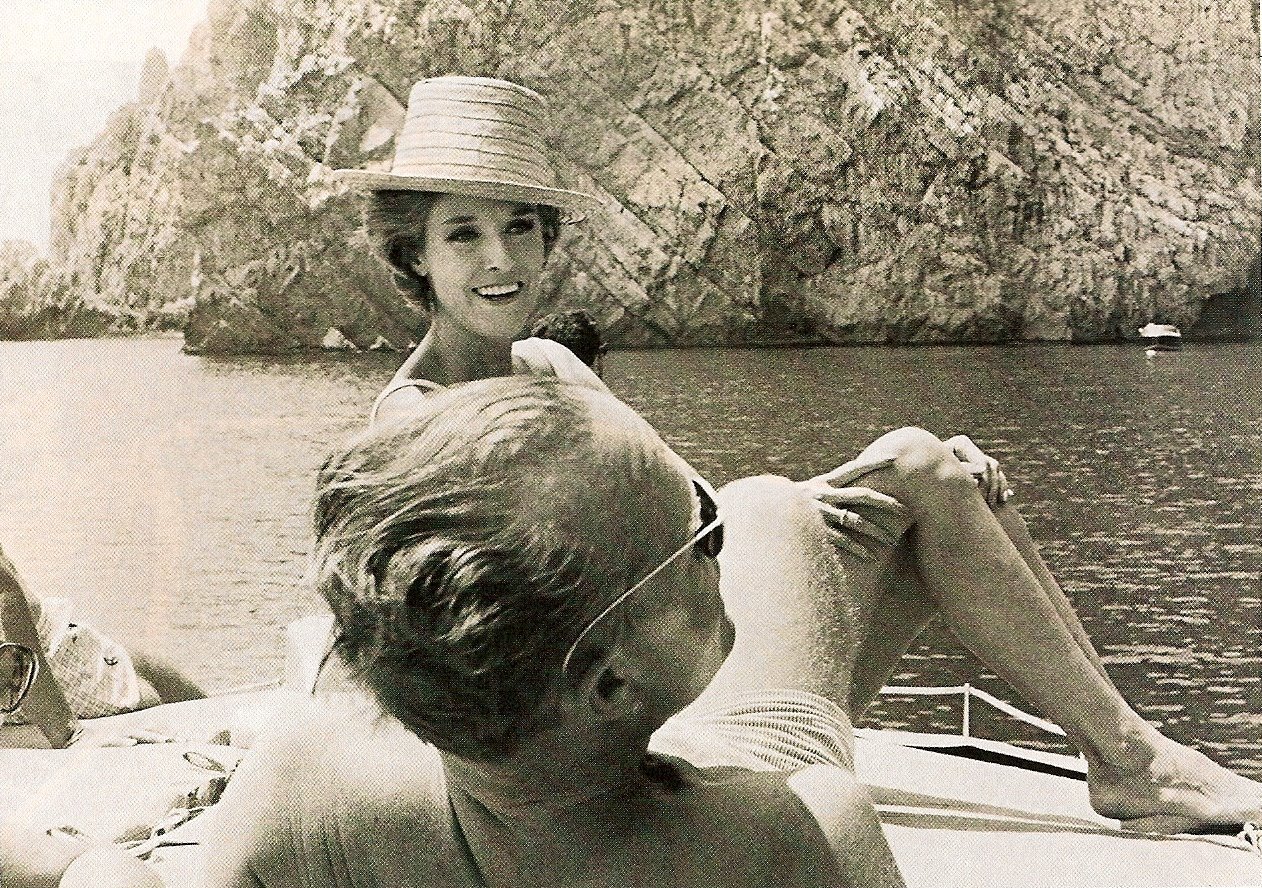
Courtesy the Red List

Capote in Kansas, at the grave of the Clutter family, their murder being the inspiration for his book In Cold Blood.
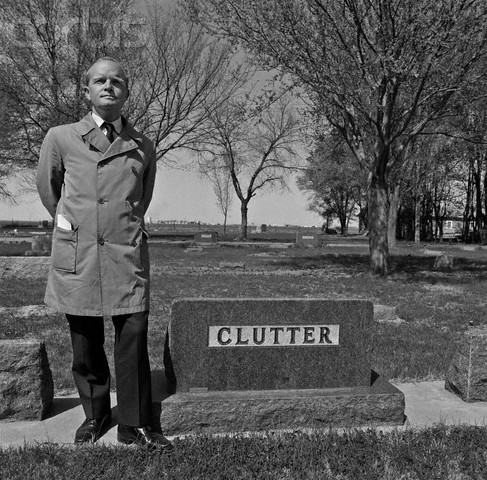
1967, Holcomb, Kansas, USA --- Author Truman Capote poses at the grave of the murdered Clutter family, made famous in his novel and in the film . --- Image by © Bob Adelman/Corbis
1967, Holcomb, Kansas, USA — Author Truman Capote poses at the grave of the murdered Clutter family, made famous in his novel and in the film.  — Image by © Bob Adelman/Corbis

Just a few days before the party, this is what New York City looked like — draped in a toxic smog.
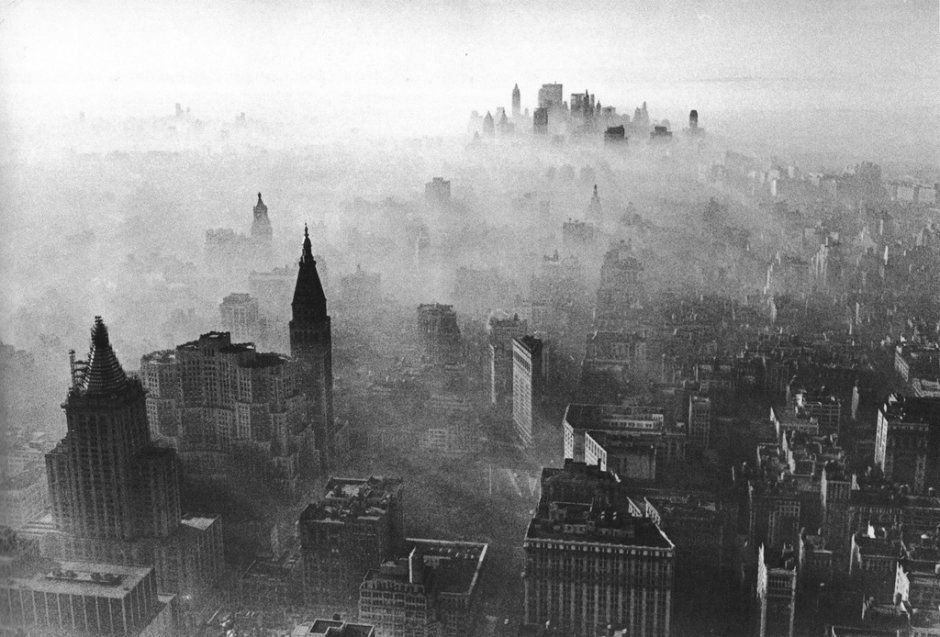
manhattan-smog

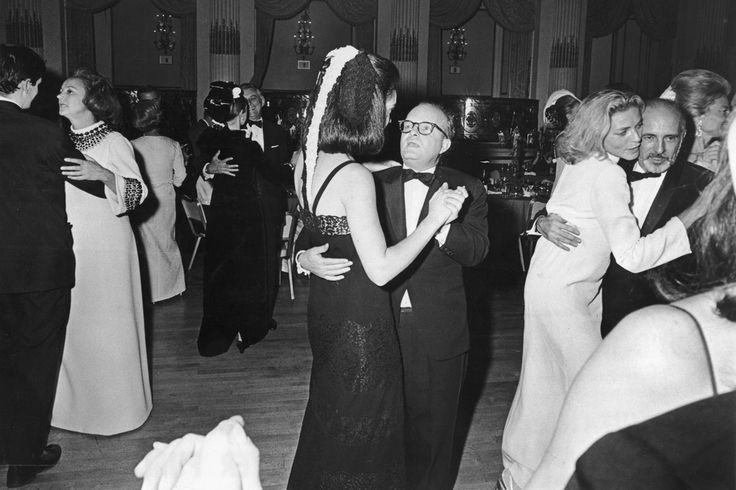
Truman Capote with his guest of honor — Katharine Graham
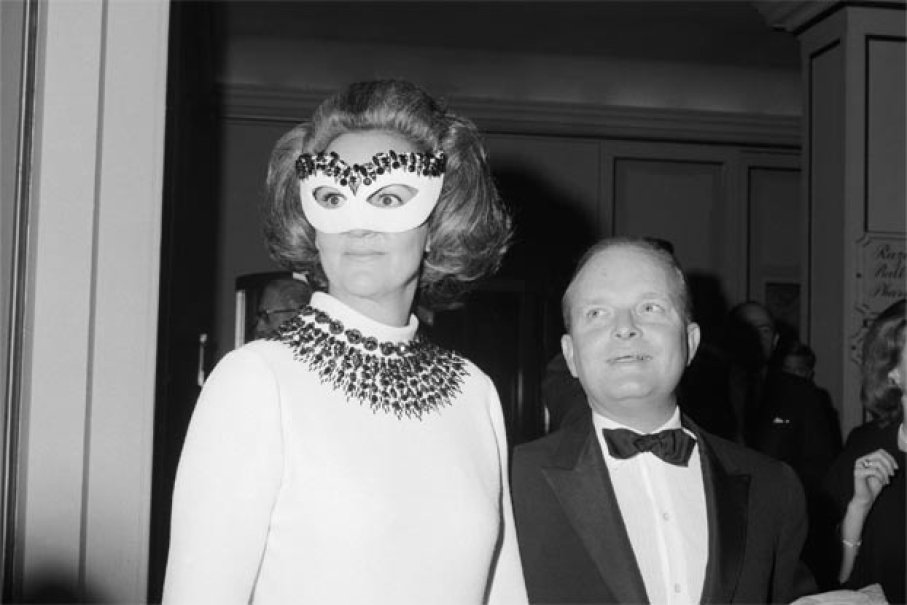
 BETTMANN/CORBIS
BETTMANN/CORBIS

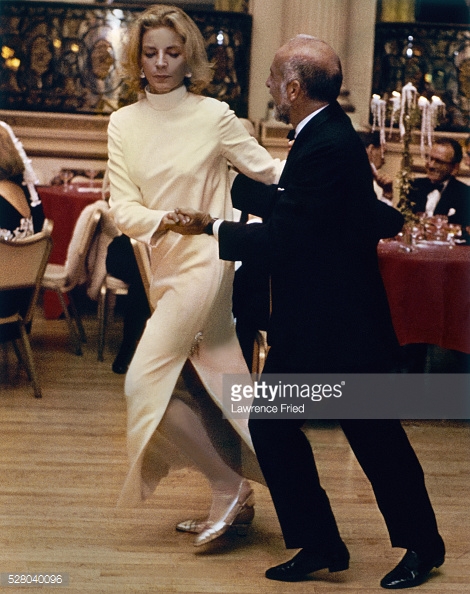
Graham is on the left and Capote is front and center, but the real action is Lauren Bacall and Jerome Robbins at right.
b4c4827ad282c89b6bf712cb6be26a5a
Mrs. Jason Robards Jr. dancing with Jerome Robbins at Truman Capote's party *** Local Caption *** Lauren Bacall;Jerome Robbins;

©Lawrence Fried or photo by Lawrence Fried. 

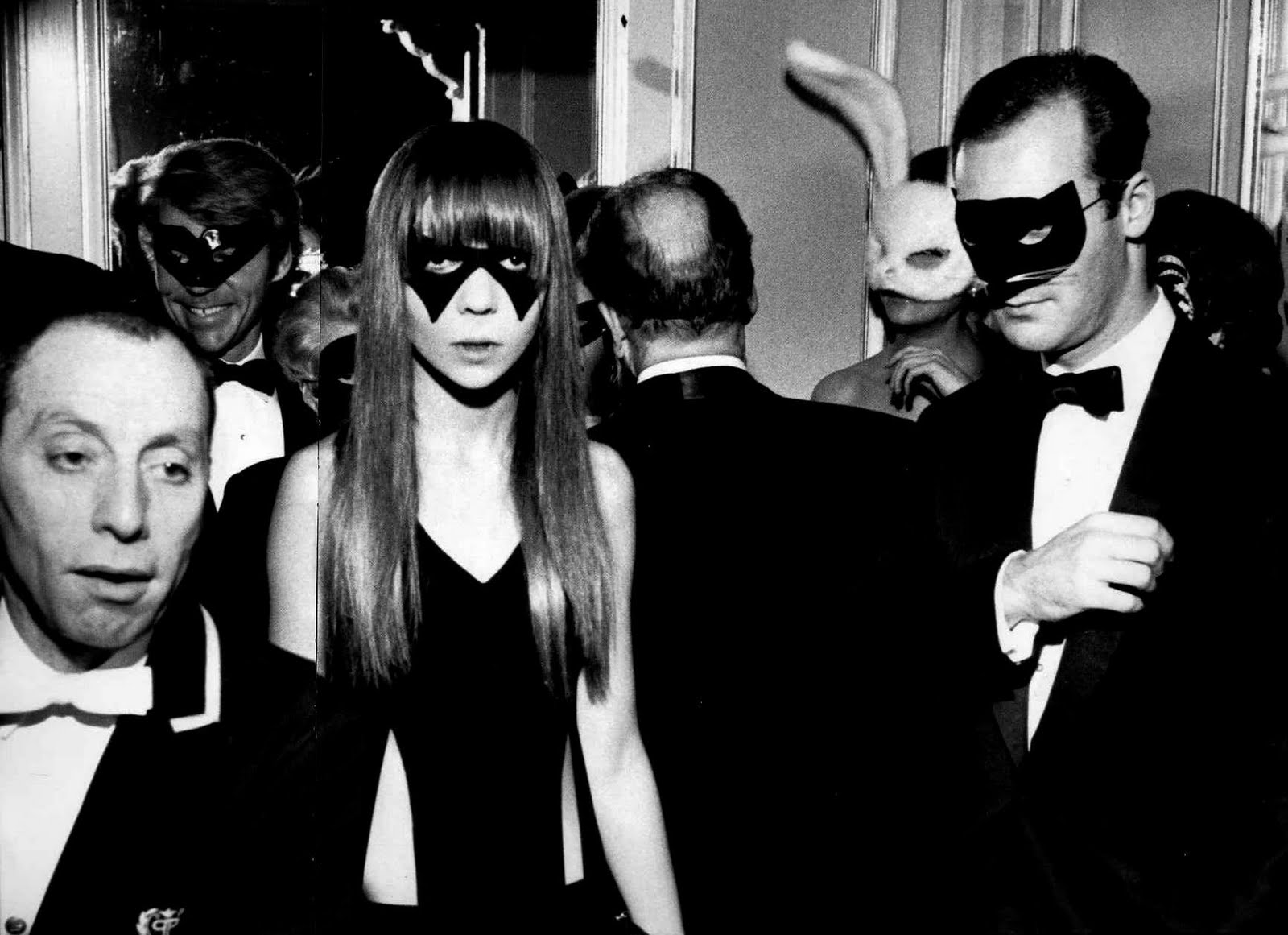
Supermodel Penelope Tree looks a little bit like Batgirl here.
024_penelope_tree_theredlist

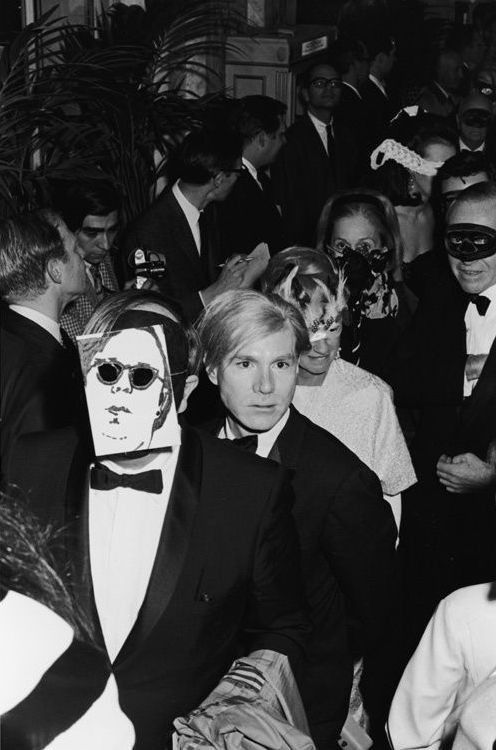
Andy Warhol came to the party without a mask.
661156045889f5e9c50f92a012952ebc

Norman Mailer and an unidentified guest.
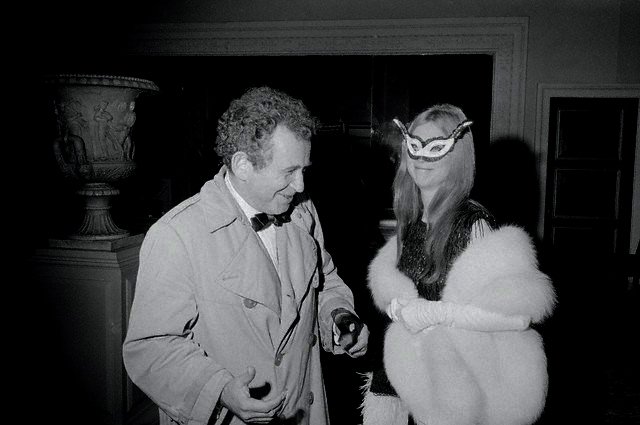
norman-mailer-and-guest-in-costume

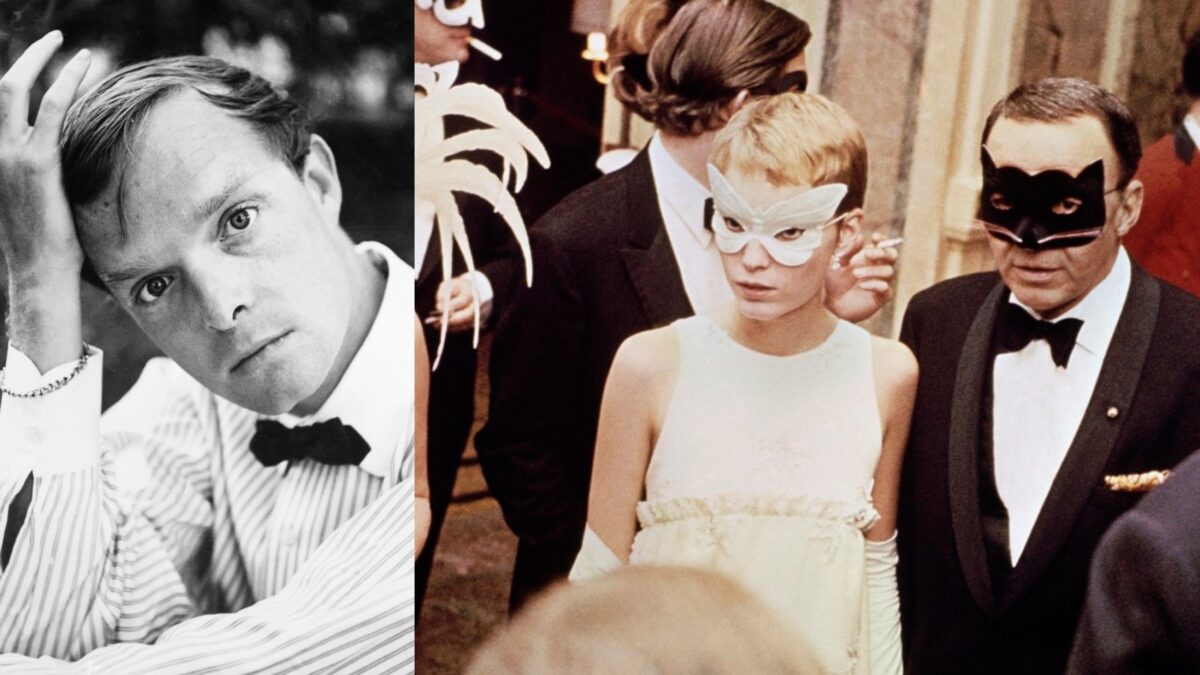
One of the most talked about couples of the evening — Frank Sinatra and his new bride (with a new haircut) Mia Farrow.
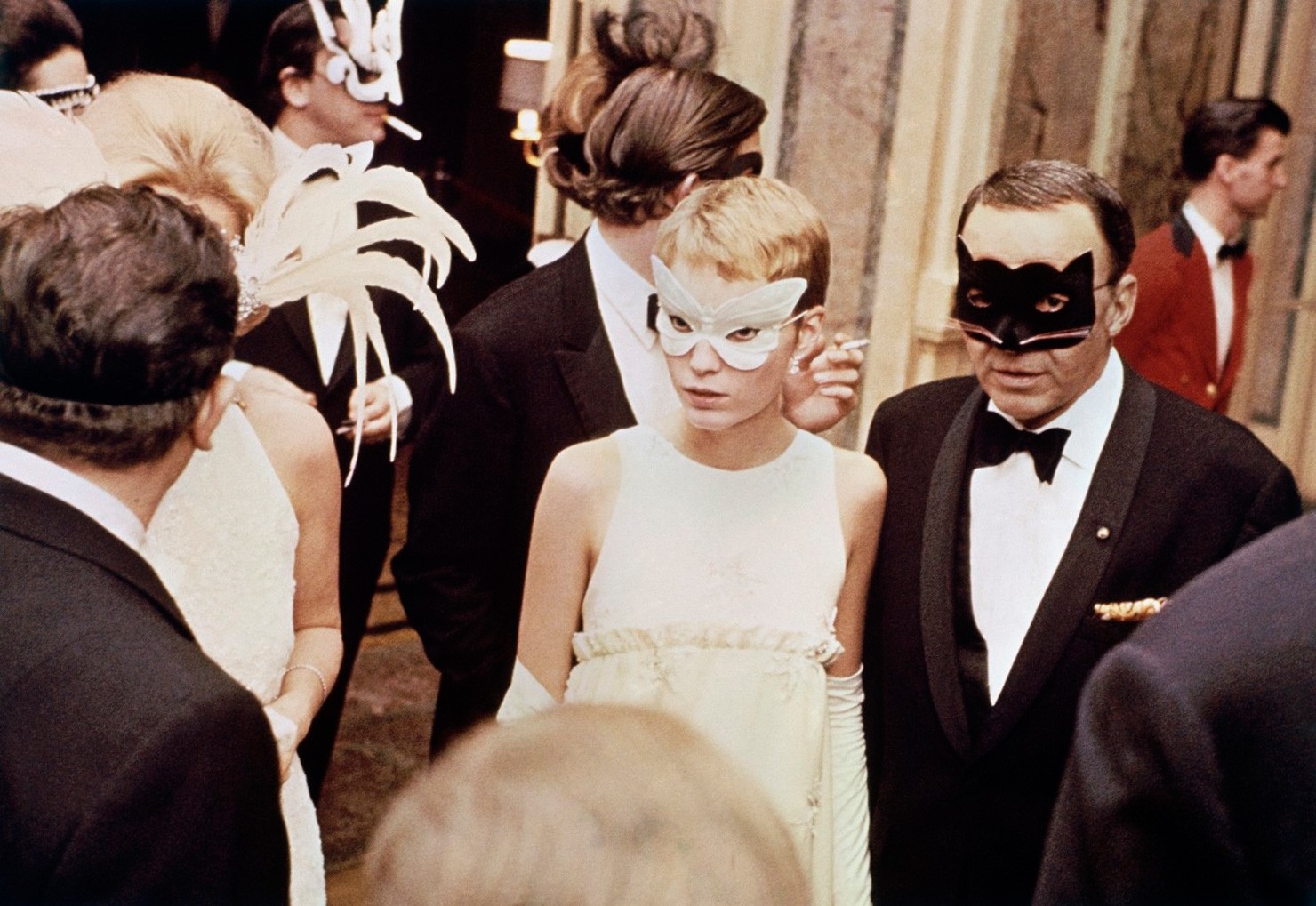
Conde Nast Archive / Corbis / East News.
Photo courtesy ©Lawrence Fried

FURTHER LISTENING

Two other New York cultural icon — who happened to be invited to Capote’s dance:

Some context on the New York ball/society scene, courtesy The Gilded Gentleman

FURTHER READING

Truman Capote / Breakfast at Tiffany’s
Truman Capote / In Cold Blood
Truman Capote / Other Voices, Other Rooms
Truman Capote / “La Côte Basque 1965” and Answered Prayers
Deborah Davis / Party of the Century: The Fabulous Story of Truman Capote and His Black and White Ball
George Plimpton / “Was Truman Capote’s Black-and-White Ball the Greatest Party Ever?” Esquire 1991
Guy Trebay / “50 Years Ago, Truman Capote Hosted the Best Party Ever,” New York Times, 2016
Ralph Voss / Truman Capote and the Legacy of “In Cold Blood”
Categories
Landmarks

The Plaza Hotel: From the Champagne Porch to the Black and White Ball

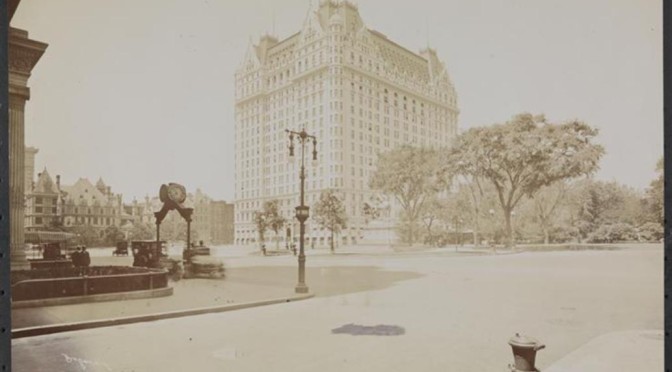
PODCAST REWIND  The Plaza Hotel has become one of the most recognizable landmarks in New York City, a romantic throwback to the last days of the Gilded Age. It epitomized the changes that were arriving on Fifth Avenue, steering away from the private mansions of the moneyed class and towards a certain kind of communal living that was increasingly being seen as acceptable and even preferable.

We take a look at the Plaza’s unusual history, from its days as an upper class “transient hotel” to a party place for celebrities.

Starring: John ‘Bet-a-Million’ Gates, Eloise, Truman Capote and of course the unflappable Mrs. Patrick Campbell.

NOTE: This show was originally recorded in November 2008. The Plaza is currently owned by Sahara India Pariwar.

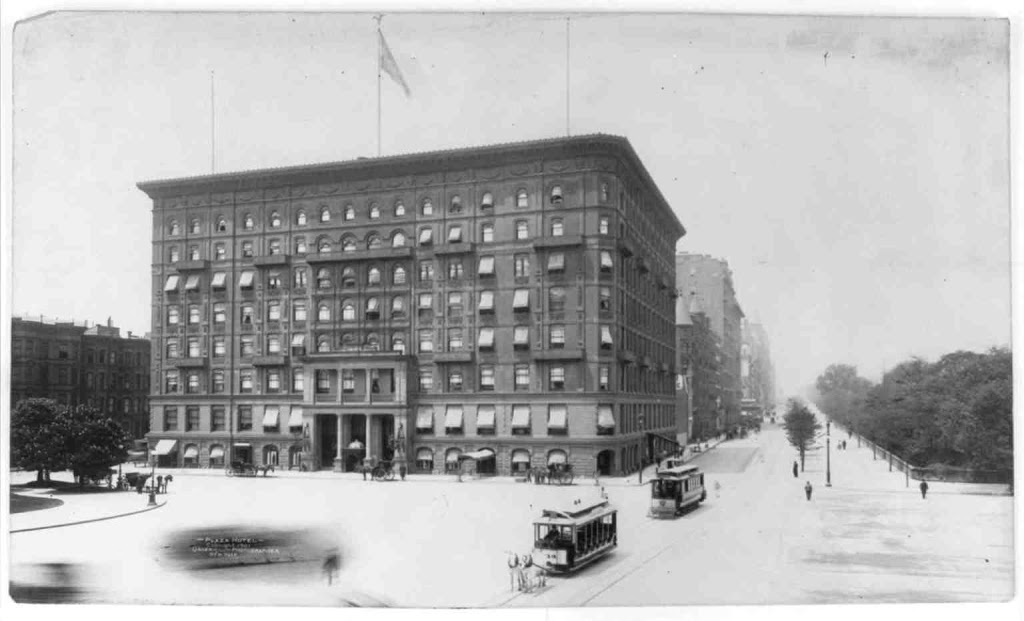
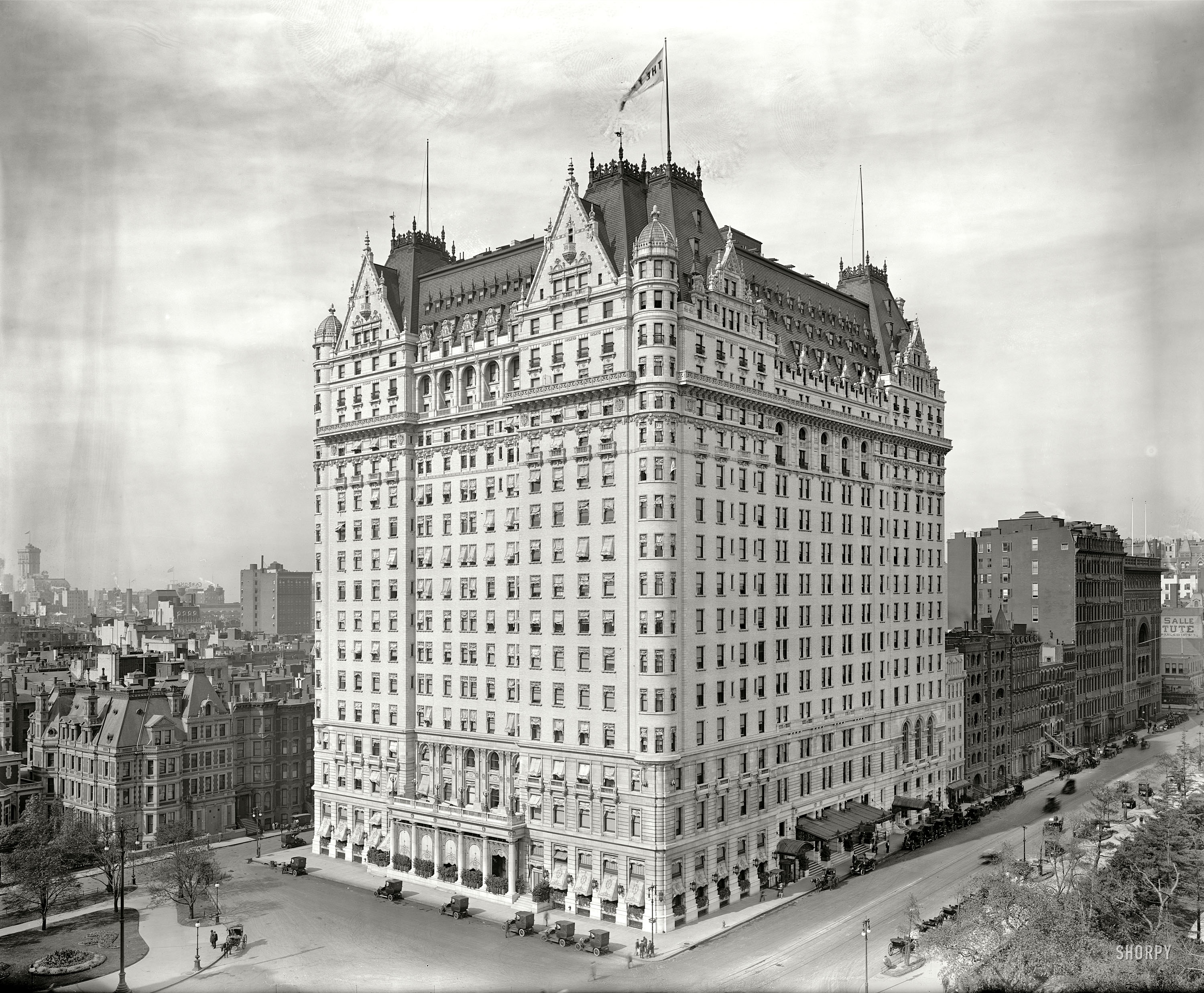
The Plaza Hotel in 1912. Its romantic exterior and sumptuous rooms eased New York's wealthiest class into the habit of hotel living. (Cleaned-up picture courtesy Shorpy)
The Plaza Hotel in 1912. Its romantic exterior and sumptuous rooms eased New York’s wealthiest class into the habit of hotel living. (Cleaned-up picture courtesy Shorpy)
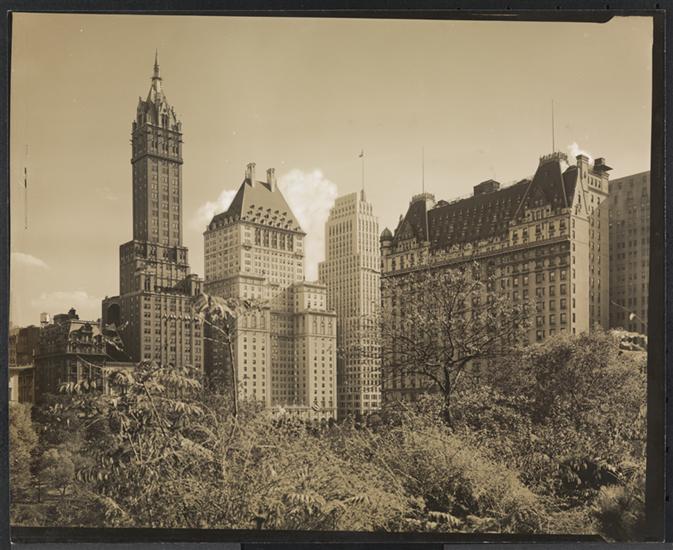
By the 1930s, the Fifth Avenue mansions below 59th Street were gone, and the Plaza was joined by other luxury hotels. (Picture courtesy Museum of the City of New York)
The first Plaza Hotel was deemed out of fashion and indeed looks quite plain in comparison to the building which would replace it.
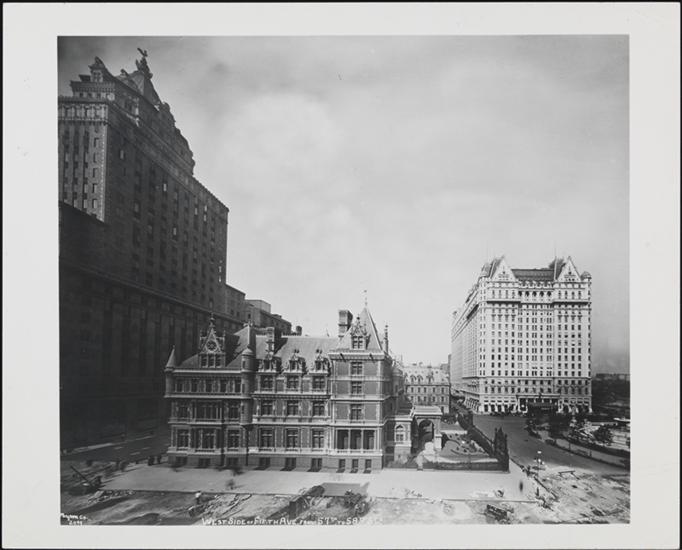
We're so used to the Plaza being surrounded by department stores and office buildings. But in fact its first neighbors were mansions as illustrated in this photograph from 1923 (Courtesy the Museum of the City of New  York)
We’re so used to the Plaza being surrounded by department stores and office buildings. But in fact its first neighbors were mansions as illustrated in this photograph from 1923 (Courtesy the Museum of the City of New York)
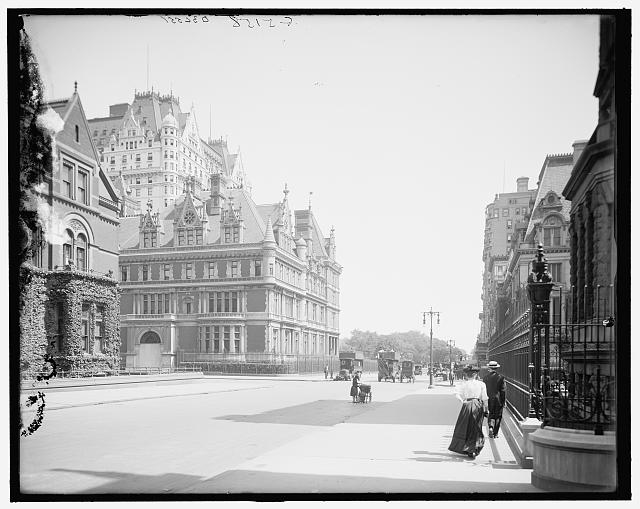
Looking up Fifth Avenue, taken sometime after 1907.  The Plaza peaks over the mansion of Cornelius Vanderbilt. (Courtesy Library of Congress)
Looking up Fifth Avenue, taken sometime after 1907. The Plaza peaks over the mansion of Cornelius Vanderbilt. (Courtesy Library of Congress)
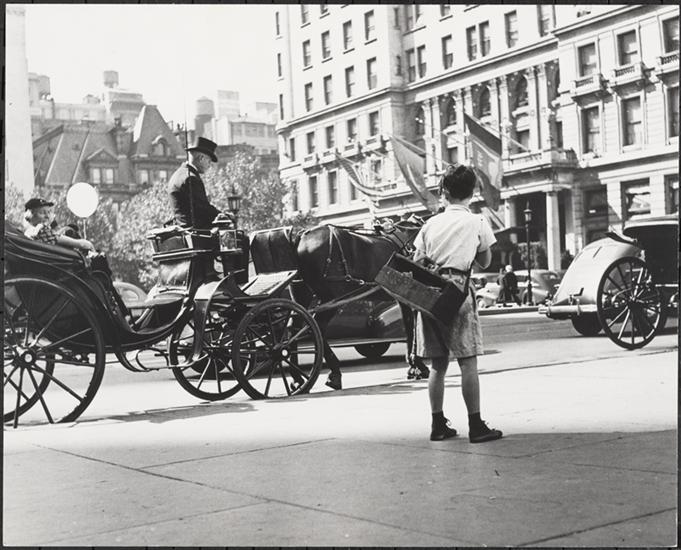
This picture was taken in 1940. Except for the shoe-shine boy and the automobile, it could have been taken yesterday. (Photograph by Roy Perry, courtesy the Museum of the City of New York)
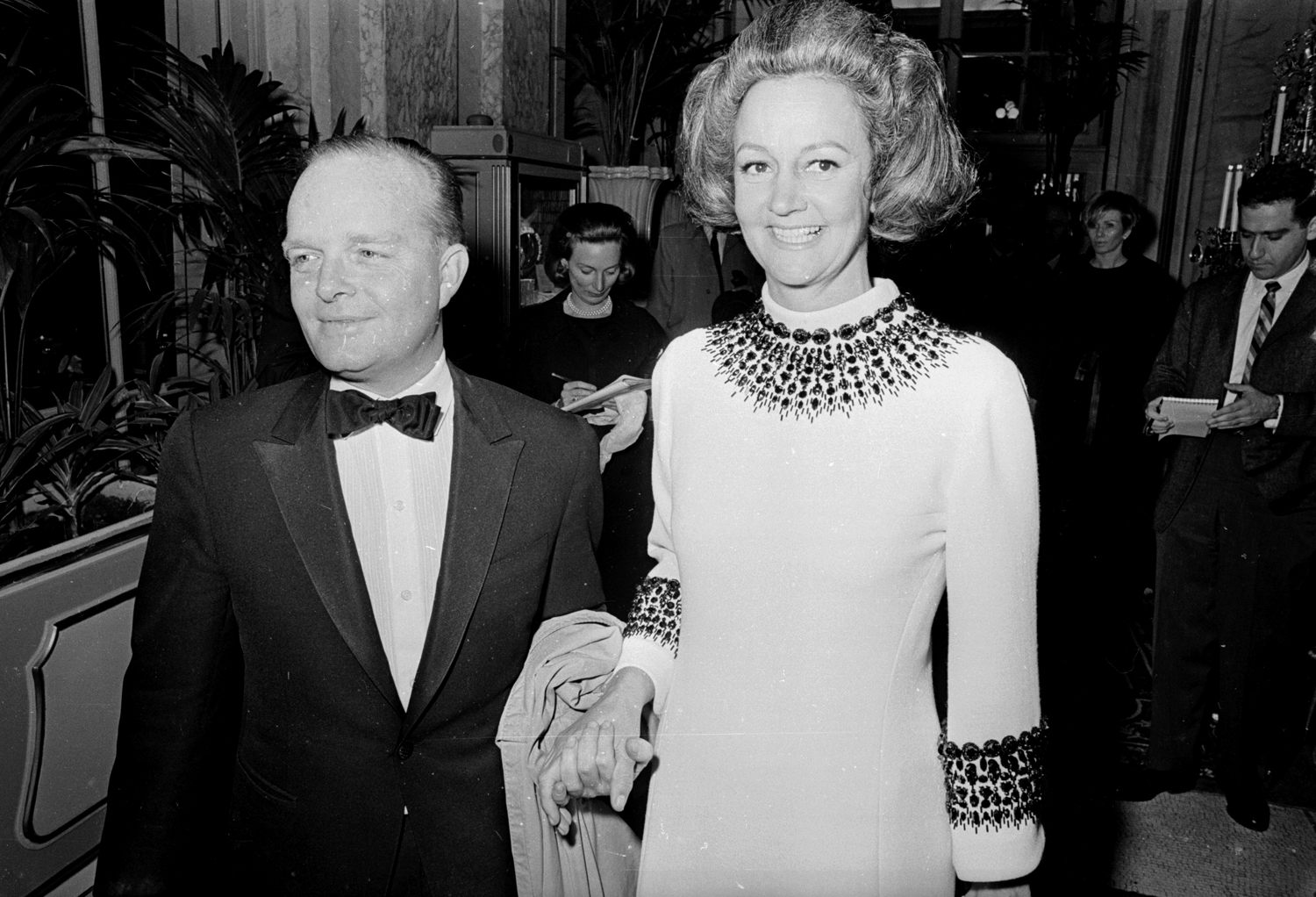
Truman Capote and Katherine Graham at the Black and White Ball, 1966
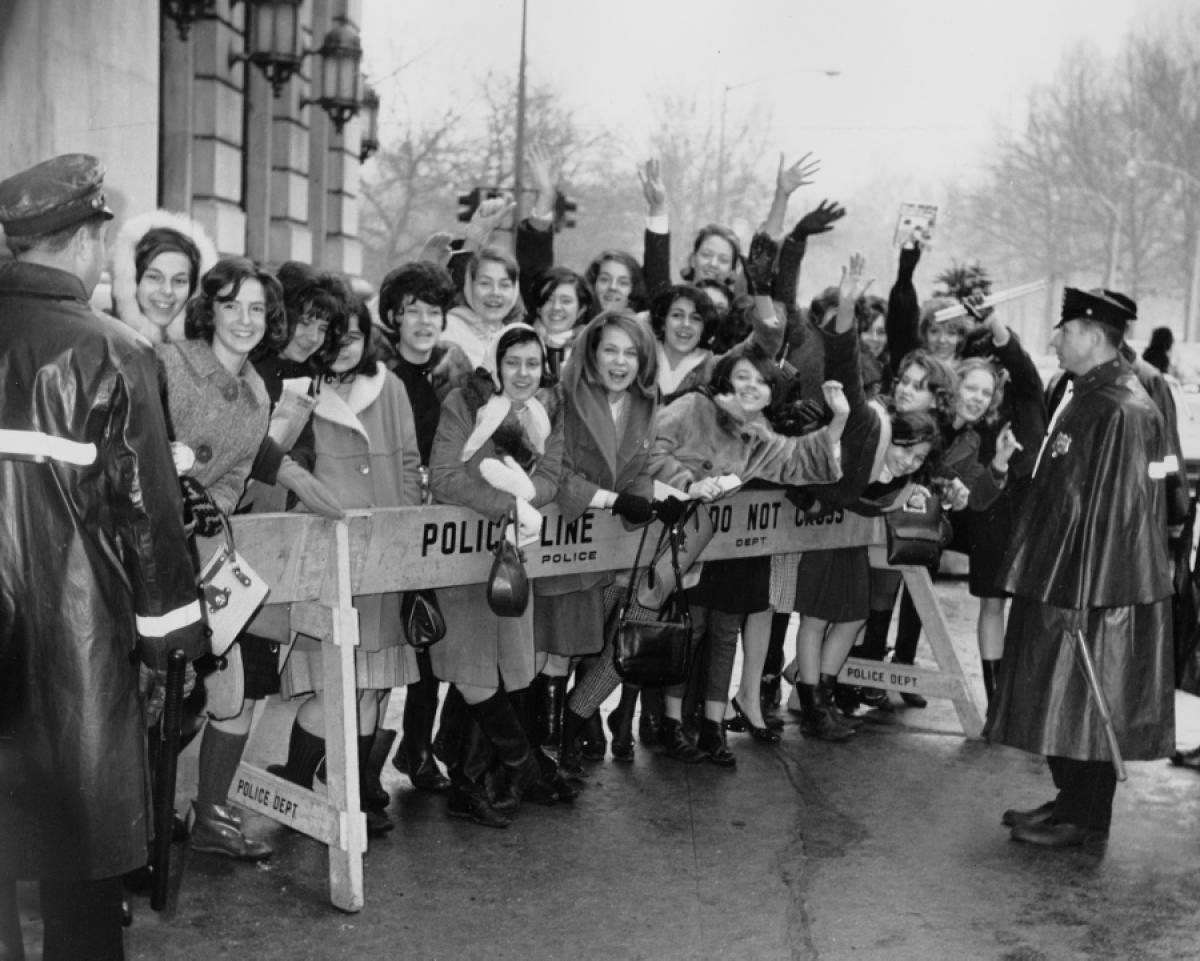
Fans await the Beatles outside the Plaza Hotel 1964 (Courtesy New York Daily News)
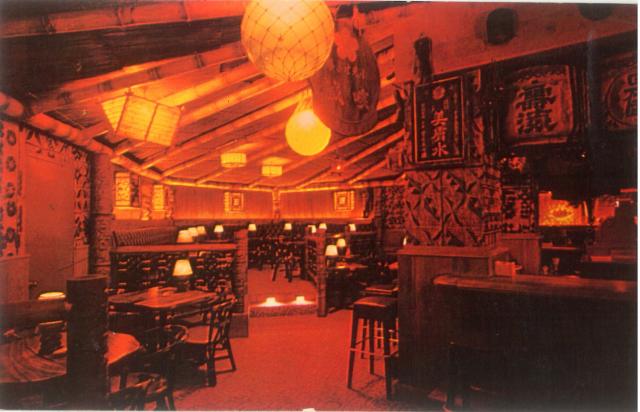
Trader Vic's in the basement of the Plaza (courtesy the blog TikiRoom)
Trader Vic’s in the basement of the Plaza (courtesy the blog TikiRoom)
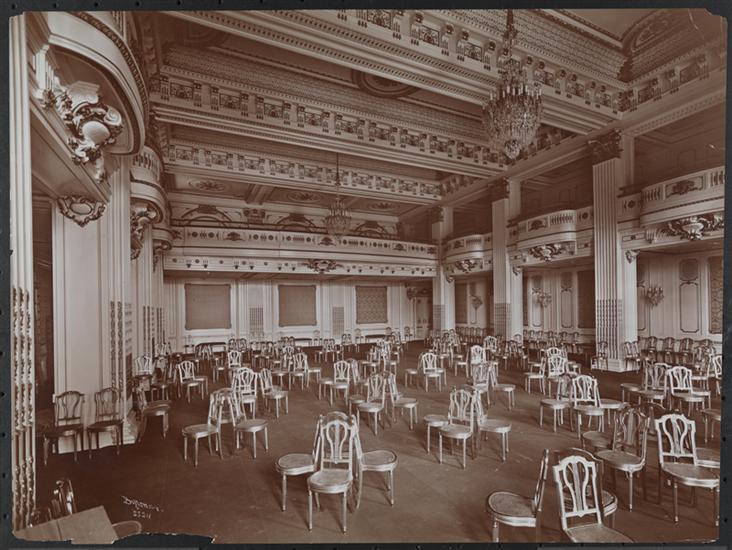
The ballroom of the Plaza, 1907 (Courtesy Museum of the City of New York)
Categories
Brooklyn History

Ten fabulous facts about 70 Willow Street, Brooklyn Heights, aka ‘the Truman Capote house’

The strange, yellow Brooklyn Heights mansion best known as the home where Truman Capote wrote ‘Breakfast At Tiffany’s’ has finally been sold for $12 million, after many months of humbling markdowns from its original hefty pricetag.
Located in the heart of old Brooklyn, the new owners will be winning more than a literary prize. The house has a rather unusual past full of influential inhabitants and has been used in some curious ways:
1) 70 Willow Street, in the popular Greek revival style of the day, was built in 1839 by Adrian Van Sinderen, the descendant of original Dutch settlers in New Amsterdam and a fiery Revolutionary War-era reverend from Flatbush, Ulpianus Van Sinderen. Van Sinderen’s lavish urban villa — it has almost a dozen fireplaces — is one of the oldest houses in the neighborhood, but not the oldest. There are a few neighboring houses that are older, including 24 Middagh Street, just a couple blocks away and built in 1824.
2) The house passed to his son Adrian Jr., a prominent New York lawyer, who fell spectacularly from grace when he mishandled the family trust. He died nearly penniless and alone in New Lots, far outside the sphere of wealth, in 1864. (There’s an avenue near that east Brooklyn neighborhood named for the Van Sinderen family.) His descendants appear to have done better. Another Adrian Van Sinderen has an annual book-collecting competition named for him at Yale University.
3) The ‘estate of Van Sinderen’, as it was often called then, was built for a single family, but by the late 1860s, the roomy floors were being split up for several tenants. From an October 1869 classified ad in the Brooklyn Eagle:”One large, handsomely furnished second floor room for gentleman and wife or gentlemen willing to room together.”***

4) The primary resident during the late 19th century was the banker William Putnam, better known as a significant trustee for the Brooklyn Museum in its early years. He betrothed to the museum paintings by Rembrandt and Monet, as well as some ‘Royal Copenhagen  porcelain’ that rivaled that of European rulers, according to the Times.

5) The house was a pivotal location for the women’s suffrage movement. Scratch that, the anti-women’s suffrage movement. The newly married lady of the house, Caroline Putnam, and her sister Lillian joined other local ladies of means in organizing protests against granting women the right to vote or, in the words of their 1894 petition, to protest “the obligations of the ballot upon the women of the state.” Mrs. Putnam also hosted French conservation classes and literary salons from her parlor here. [source]
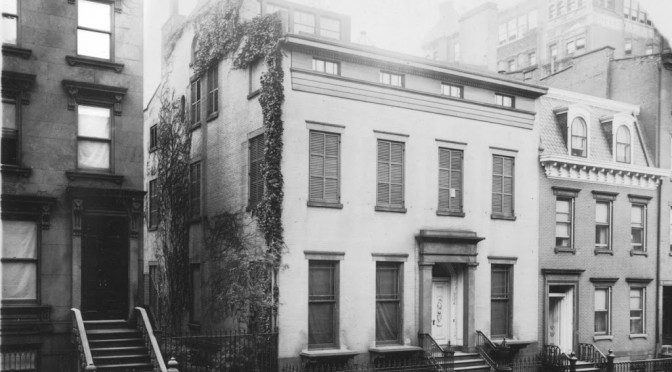
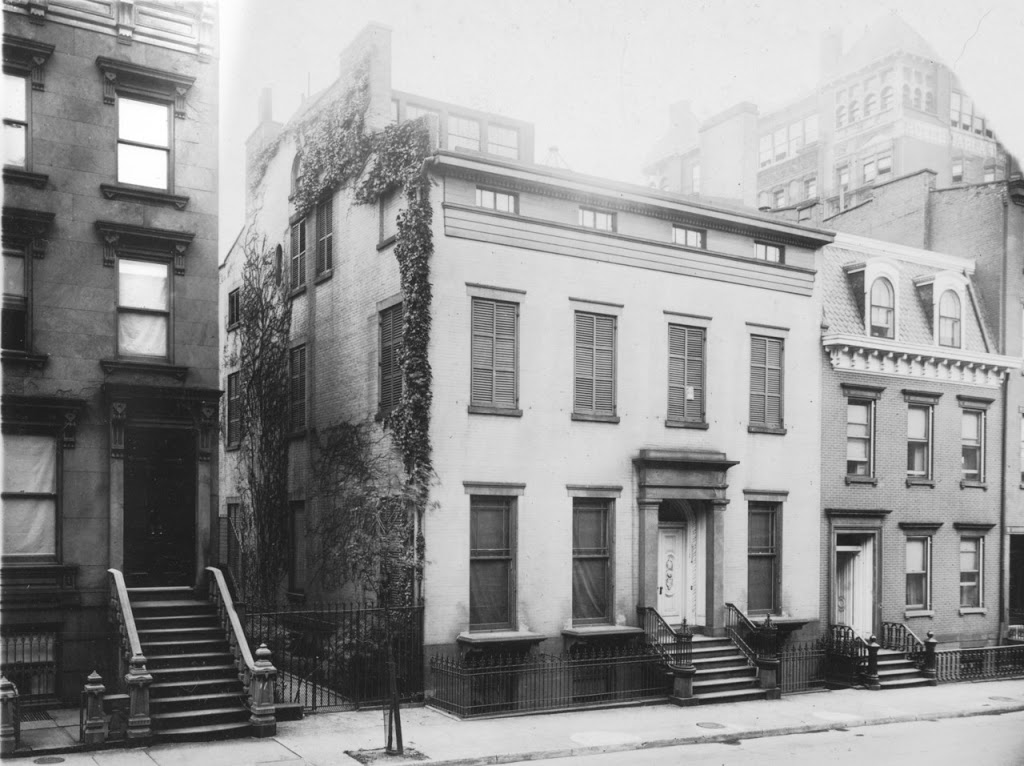
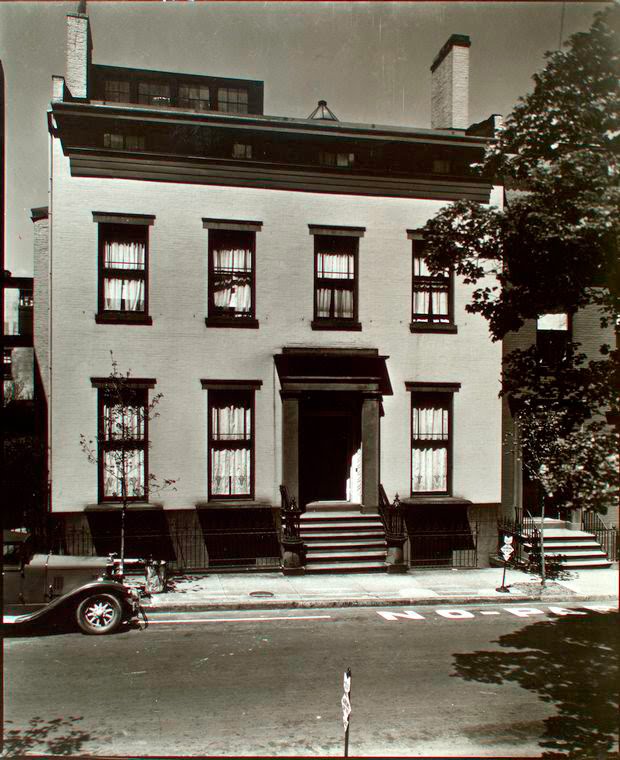
The picture at top shows the house as it looked in 1922. At right, the home in 1936. (Pictures courtesy New York Public Library.)
6) After Mrs. Putnam died in 1940, the house sat entirely vacant until 1944, when it was donated to the Red Cross. They used the house as a classroom, teaching arts and crafts, Braille to the blind and cooking classes to the wives of returning soldiers from World War II.

7) In 1953, the old house landed in the hands of renown Broadway stage designer Oliver Smith, responsible for the original scenery from great American musicals like Oklahoma!, Guys and Dolls and West Side Story. In his lifetime, he was nominated for 25 Tony Awards. With some of his earnings from the musical On The Town, Smith bought 70 Willow Street and lived here until he died in 1994.

8) From 1955 to 1965, he lent the basement apartment to his friend Truman Capote. The blond Southern writer was simply wild about Brooklyn Heights and basically charmed himself into a permanent room on Willow Street. From his essay ‘A House on the Heights,‘ Capote describes, “We [Smith and Capote] sat on the porch consulting Martinis — I urged him to have one more, another. It got to be quite late, he began to see my point; yes, twenty-eight rooms were rather a lot; and yes it seemed only fair that I should have some of them.”

9) Decked out in green wallpaper and odd knickknacks, “an atmosphere of perpetual Christmas,” the house would prove a place of great inspiration for Capote. He wrote part of ‘Breakfast At Tiffany’s‘ here. Perhaps more notably, it was here that he picked up a New York Times are read about the brutal slaying of a Kansas family. Capote set about working on what became ‘In Cold Blood‘ the next day.

10) I can’t leave the tale of 70 Willow Street without mentioning one of its most famous lunch guests — Jackie Kennedy. Capote conveniently left out the fact that the house was Smith’s, not his. “She laughed about it, because suddenly in the middle of lunch she got the idea that it wasn’t his,” Smith recalled later. “I suppose I acted as if it were mine.”

And here’s some literary bonus points — it’s just down the street from the old home of Arthur Miller (155 Willow Street)

***A reader emailed me to say that the addresses for Willow Street were differently numbered before 1865 and that this ad probably refers to a neighbor of 70 Willow Street. In that case, I’ll replace that fact with one I should have mentioned in the lede of this article — as reported by Brownstoner, the $12 million final price tag for 70 Willow Street makes it the most expensive house purchase in Brooklyn history. Does this mean that nobody has yet bought my dream apartment in DUMBO?

Categories
Uncategorized

FRIDAY NIGHT FEVER: El Morocco


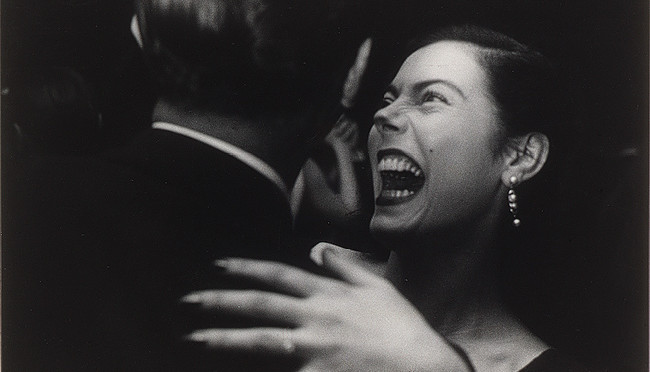
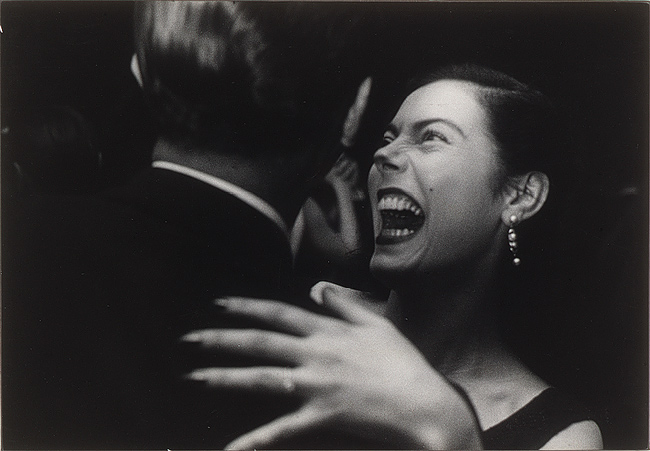
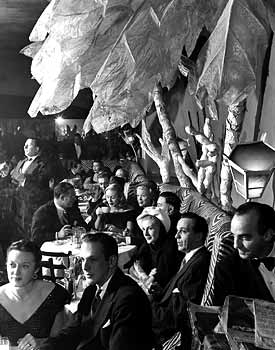
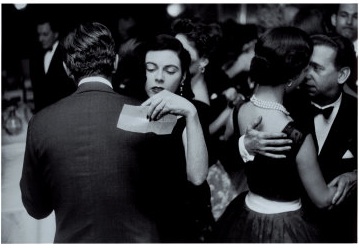
(Top and bottom photos: Garry Winogrand – taken on the El Morocco dance floor – 1955)

To get you in the mood for the weekend, every Friday we’ll be celebrating ‘FRIDAY NIGHT FEVER’, featuring an old New York nightlife haunt, from the dance halls of 19th Century Bowery, to the massive warehouse spaces of the mid-90s. Past entries can be found here .

Has there ever been a place in Manhattan more glamorous than El Morocco? Probably not.

John Perona opened El Morocco as a speakeasy at 154 East 54th Street, moving down the street to 307 East 54th Street in its later days. (Both locations have been destroyed; the Citicorp building stands where the original once stood.) “Elmo”, as the socialites would utter it, transitioned into post-prohibition losing none of its glamour or appeal.

Along the way, it set the standard by which all other nightclubs of the 30s through the 50s were to be judged. (Only the Stork Club and possibly the 21 Club would rival it.) It was the first to use a velvet rope. The ruler of the rope, Angelo Zuccotti, was so revered that the New York Times ran his obit when he died in 1998, a doorman
“who wielded the velvet rope at El Morocco with such authority and finesse that he helped define the very line between cafe society and social Siberia.”

And via Perona’s official photographer Jerome Zerbe (who also worked the Rainbow Room), this midtown speakeasy turned celebrity hotspot was one of the first to employ photographers to snap candids of its famous clientele. Yes folks, you can actually trace the scandalous club photos of Lindsey Lohan and Britney Spears back to their less shameless beginnings at El Morocco.

According to an account by Zerbe, “From 1935 until 1939, I was at the El Morocco and I invented a thing which has become a pain in the neck for most people. I took photographs of the fashionable people and sent them to the papers.”

One key element was Elmo’s signature blue and white zebra-striped banquettes, which popped from the corners of every snapshot. Photos running the next day would easily be recognized.

The other, of course, was the who’s-who list of stars that would traipse through. And who exactly showed up at El Morocco’s doorstep? I can throw some names at you — Clark Gable, Cole Porter, Ingred Bergman, Truman Capote, Audrey Hepburn, Marilyn Monroe. Humphrey Bogart, God bless him, was banned from the club for life. (The story is so incredible, I’m saving it for the end.)

But I think Zerbe says it best: “They were really the top, top social — and what you mean by society, that’s difficult again to define. These were the people whose houses one knew were filled with treasures. These were the women who dressed the best. These were the women who had the most beautiful of all jewels. These were the dream people that we all looked up to and hoped that we or our friends could sometimes know and be like.”

Scour any recollections of Elmo, and you’re bound to spend half the night picking up all the dropped names. “Errol Flynn would either sit at Perona’s table or cruise the room,” says Taki Theodoracopulos. “On a normal night Aristotle Socrates Onassis would be there, more often than not without his wife, Tina, who would come in later with the then young Reinaldo Herrera.”

And from Nannette Fabray: “One entered, and there was a hierarchy of where one sat. The first table on the right was the best; the second was reserved for the owner, John Perona. You didn’t dare go unless you were perfectly turned out.”

Human beings were not allowed in El Morocco. It was the place where film stars mixed with European royalty, where a poor Southern girl could be wooed and courted, as long as that poor Southern girl was Ava Gardner.

Sadly, like an aging film actress long past her prime, El Morocco lasted well into the 90s, dissolving into less alluring variants until it took the final step of becoming a topless bar in the mid 90s, under the name Night Owls.

Celebrity hotspots these days rarely have the elegance or the prestige. I can only imagine if Britney Spears turned up at Angelo’s velvet rope, that he would turn her away.

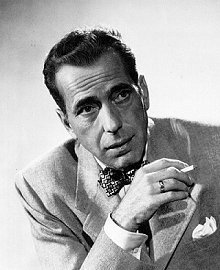
Oh, and why was Humphrey banned from El Morocco? Well, one night in 1950, Bogart dropped off his wife Lauren Bacall at home, and he and a friend went out for the evening. Heavily inebriated, Bogart thought it would be funny to bring two 22 lbs. stuffed panda bears into Elmo as their ‘dates’ and proceeded to prop them up on a chair.

Two drunk young women attempted to pick up the pandas, but, depending on who you believe, were either pushed by Bogart or tumbled to the floor by the shear weight of the heavy toys. Later, in a flurry of half-truths, it was believed Humphrey and his friend violently assaulted the young women for attempting to steal the panda bears. Not helping matters — the boyfriend of one of the women then began throwing plates at Bogart.

The next day Bogart received a summons to appear in court. The man who would become the greatest movie star of all time, on that day, had to convince a judge that it was his excessively large stuffed pandas, and not his fists, that had felled the young women. The judge eventually threw it out of court.

When asked by reporters if he was drunk that night, Humphrey replied, Who isn’t at 3 o’clock in the morning? So we get stiff once in a while. This is a free country isn’t it? I can take my panda any place I want to. And if I want to buy it a drink, that’s my business.