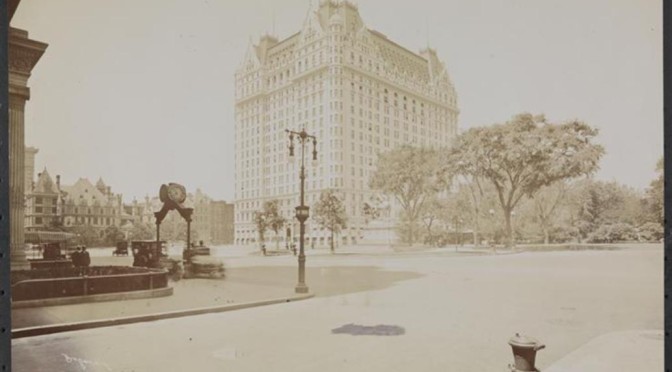
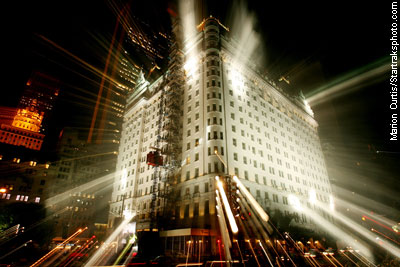
The Paris Theater, as glamorous and as eccentric as any film it’s ever played, has the benefit of having the Plaza Hotel and Central Park to ensure it never goes out of style.
But the history of this romantic and occasionally radical movie house, the longest running single-screen movie theater in New York, is as cinematic as its photo-friendly neighbors.
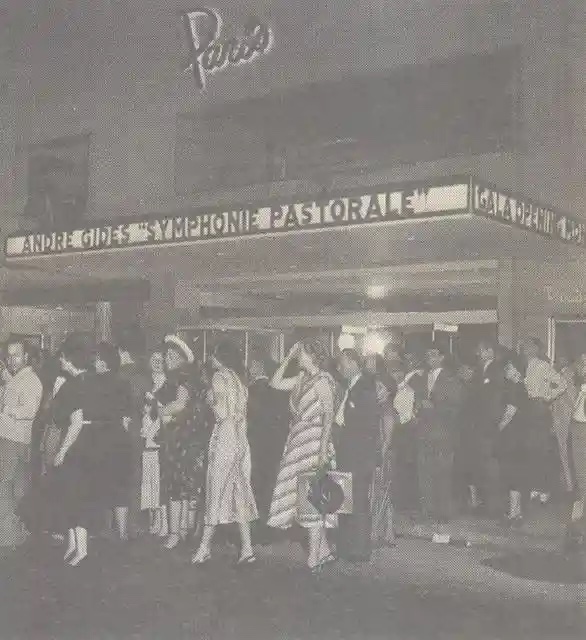
No less than Marlene Dietrich cut the ribbon on opening day of the Paris in September 13, 1948.
Gerald A. DeLuca
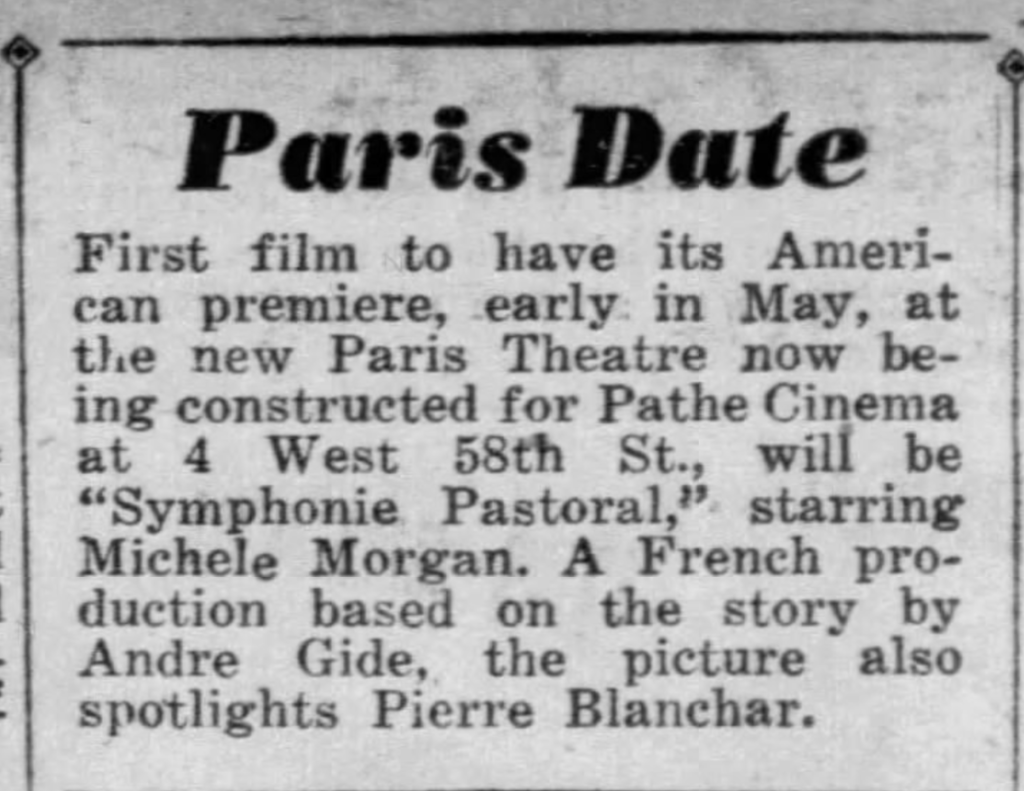
Opened by the French film distributor Pathè Cinema, the old-style 586 seat theatre with balcony — billed as “the first new moving picture theater to be built in New York since before the war” — was intended to debut significant achievements in foreign film, an ambition it still mostly retains today, along with re-issues of classic movies.
New York Daily News, April 11, 1948 (courtesy Newspapers.com)
Its first film was Symphonie Pastoraleby the almost-forgotten French director Jean Delannoy. And the cinema might have continued to enjoy quiet renown among foreign film aficionados if it wasn’t for Roberto Rossellini and Federico Fellini.
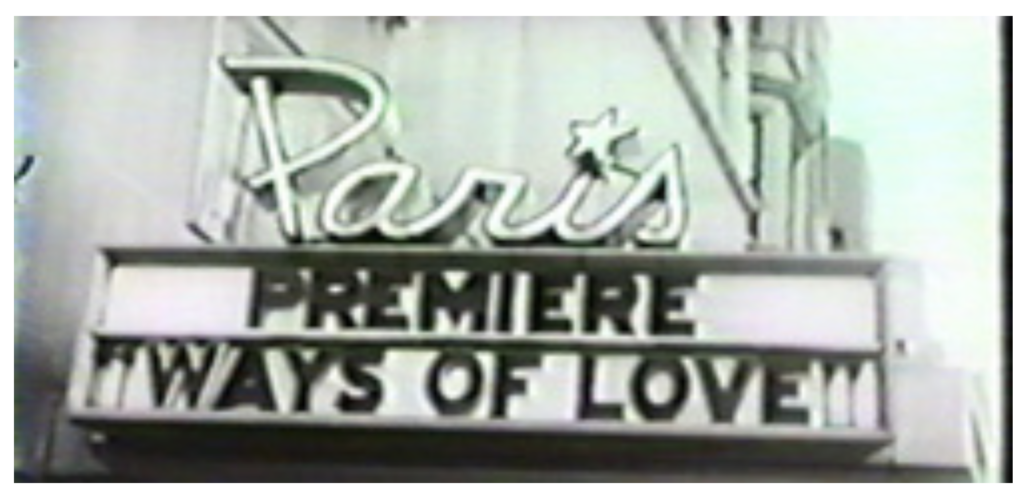
In December 1951, the Paris decided to show three films under an umbrella title Ways of Love.
One of these was a forty-minute piece entitled The Miracle, directed by Rossellini and starring Anna Magnani as a pregnant woman who’s convinced she’s carrying the Christ child after meeting a shepherd (played by Fellini) whom she believes is St. Joseph.
Its subject matter enraged the Catholic Church, and the theatre was assaulted with hundreds of protesters for weeks, orchestrated by Cardinal Spellman from his pulpit at St. Patrick’s Cathedral.
Eventually the Paris was ordered to stop showing the film, a decision Paris manager Lillian Gerard, along with the film’s distributor, appealed in court.
The case eventually went all the way to the U.S. Supreme Court who ruled the banning a violation of free speech.
No other film at the Paris would draw as much international attention, but the theater would affect cinema history in other ways, helping build the reputations of foreign directors on American soil.
Courtesy the Paris Theatre
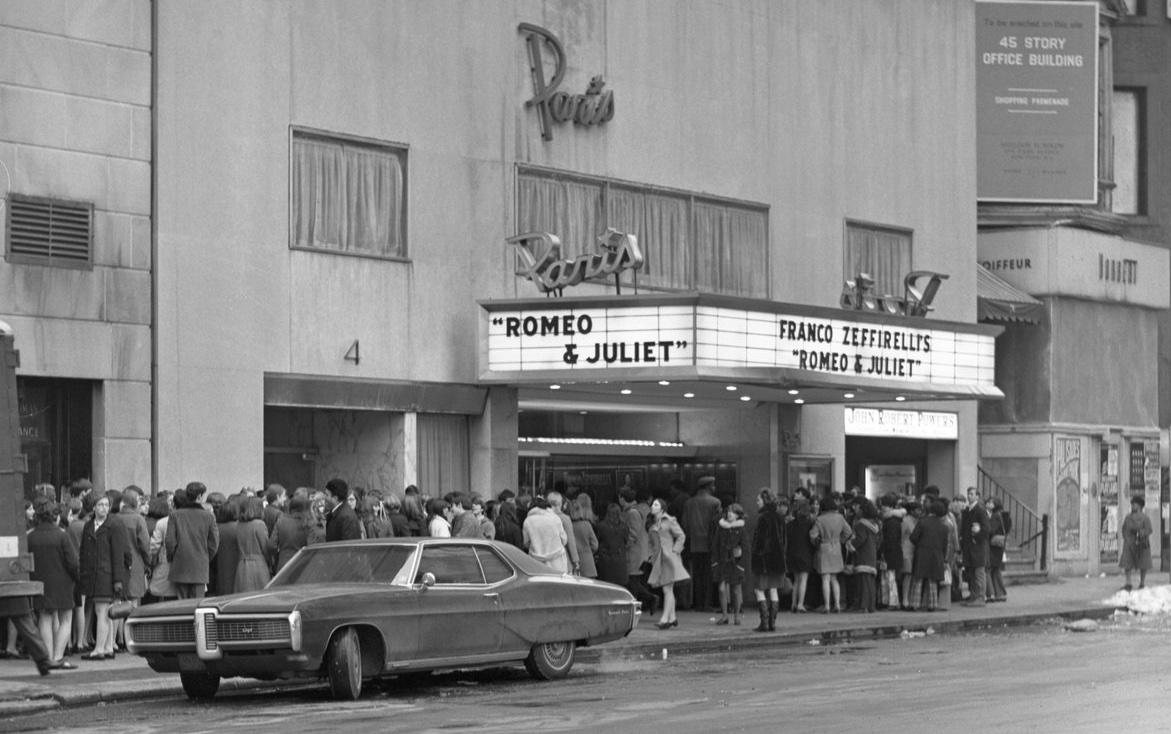
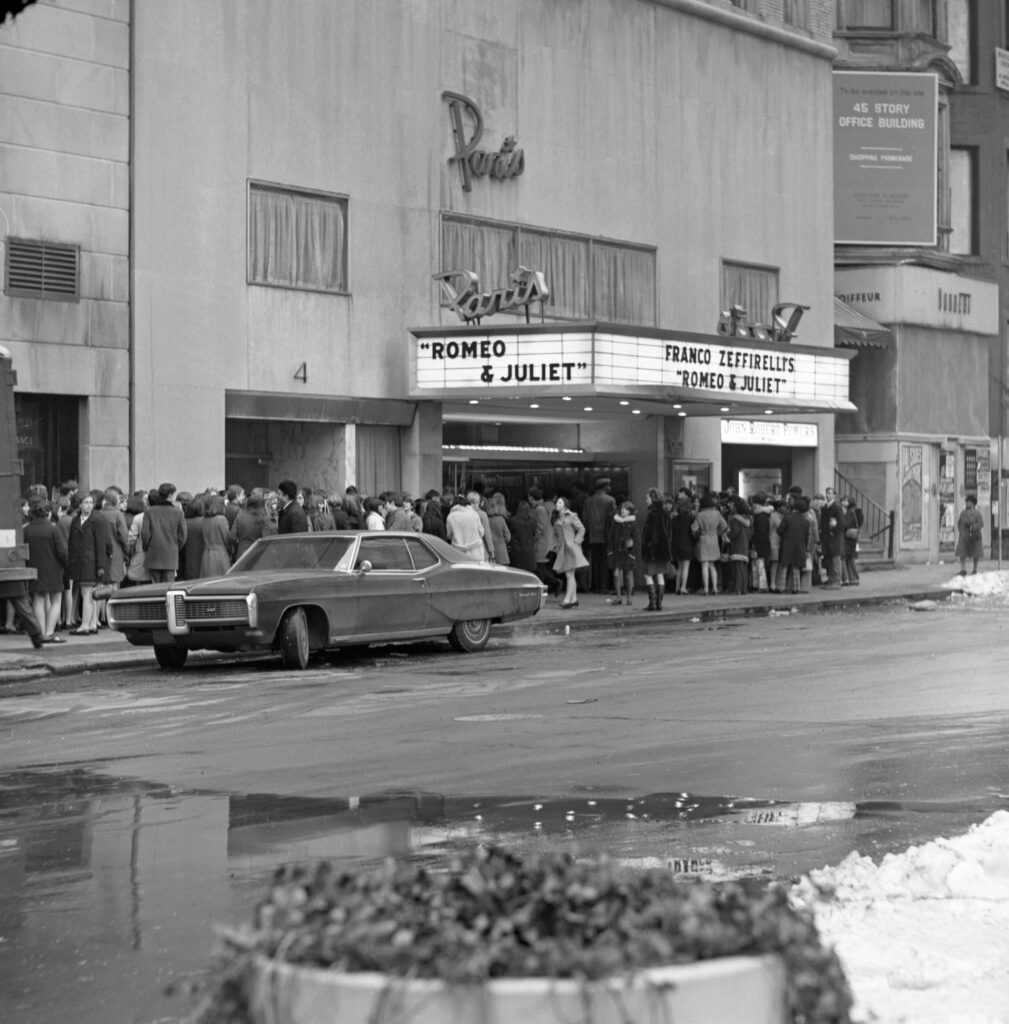
Franco Zeffirelli’s Romeo and Juliet ran for almost an entire year from 1968-69. Director Claude Lelouch’s A Man And A Woman and the Marcello Mastroianni comedy Divorce Italian Style would play for over a year.
Merchant and Ivory preferred to debut all their films here; A Room With A View played almost nine months, Howard’s End seven.
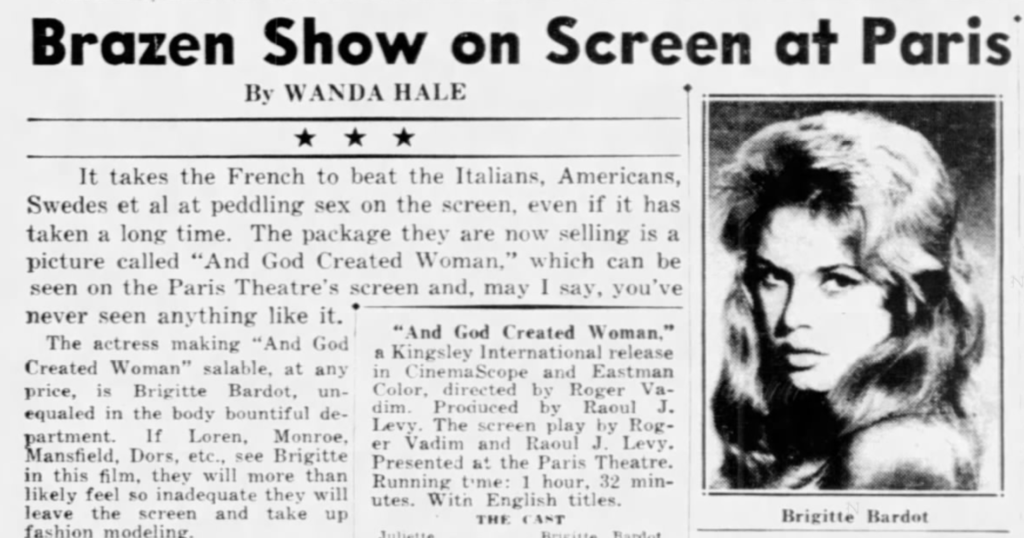
Below: The Paris, no stranger to sex and scandalous screenings
It’s had equally grand success with revival screenings as well, most notably Luis Buñuel’s 1968 drama Belle De Jour starring Catherine Deneuve which re-debuted in theaters in 1995 with the highest single-screen gross for a foreign film ever.
(I saw Lawrence of Arabia for the very first time here in 1997. Anytime the Paris shows a great film like that, I highly recommend you cancel all your plans and go.)
Pathe pulled out of the Paris Theatre in 1990 with intentions of opening another screen in New York. (It never did, but Pathe is still in business, and you can find their film on most art-house screens in New York.)
Loews operated the theater as the Fine Arts Theatre before the landlord bought them out and renamed it back to the Paris.
Courtesy Wikimedia Commons/DavidSchwartzNetflix
Cut to modern day and the threat movie theaters face from at-home streaming services.
Hundreds of theaters across the country have closed in the past ten years, and many have had upgrade interiors and food and drink offerings in order to survive.
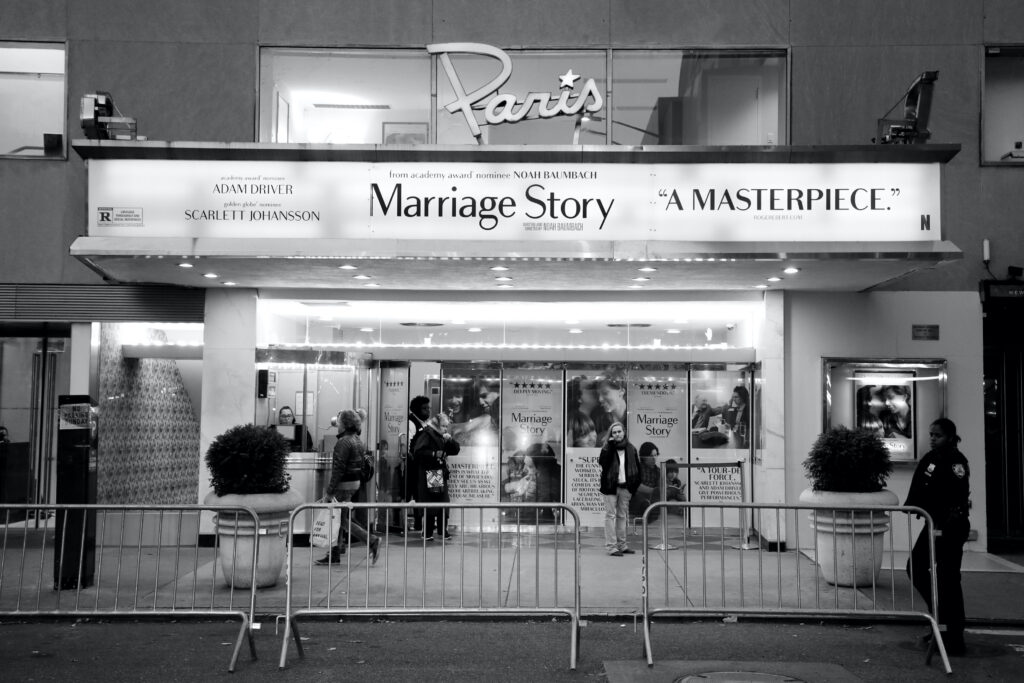
The Paris, however, was actually saved by a streaming service — Netflix. The popular streaming service purchased the theater in 2019 and began launching some of its films there — most with awards-season potential.
From the Paris’ website: “Since opening an engagement of Marriage Story on November 6, 2019, Netflix operates the theater, giving new life to a landmark of New York moviegoing. The Paris is New York’s movie palace, and Netflix will honor the theater’s history while offering the finest in contemporary cinema, introducing the theater to a new generation of film lovers.”
You can find a lot of fun personal recollections by former ushers and managers at Cinema Treasures.
PODCAST REWIND The Plaza Hotel has become one of the most recognizable landmarks in New York City, a romantic throwback to the last days of the Gilded Age. It epitomized the changes that were arriving on Fifth Avenue, steering away from the private mansions of the moneyed class and towards a certain kind of communal living that was increasingly being seen as acceptable and even preferable.
We take a look at the Plaza’s unusual history, from its days as an upper class “transient hotel” to a party place for celebrities.
Starring: John ‘Bet-a-Million’ Gates, Eloise, Truman Capote and of course the unflappable Mrs. Patrick Campbell.
NOTE: This show was originally recorded in November 2008. The Plaza is currently owned by Sahara India Pariwar.
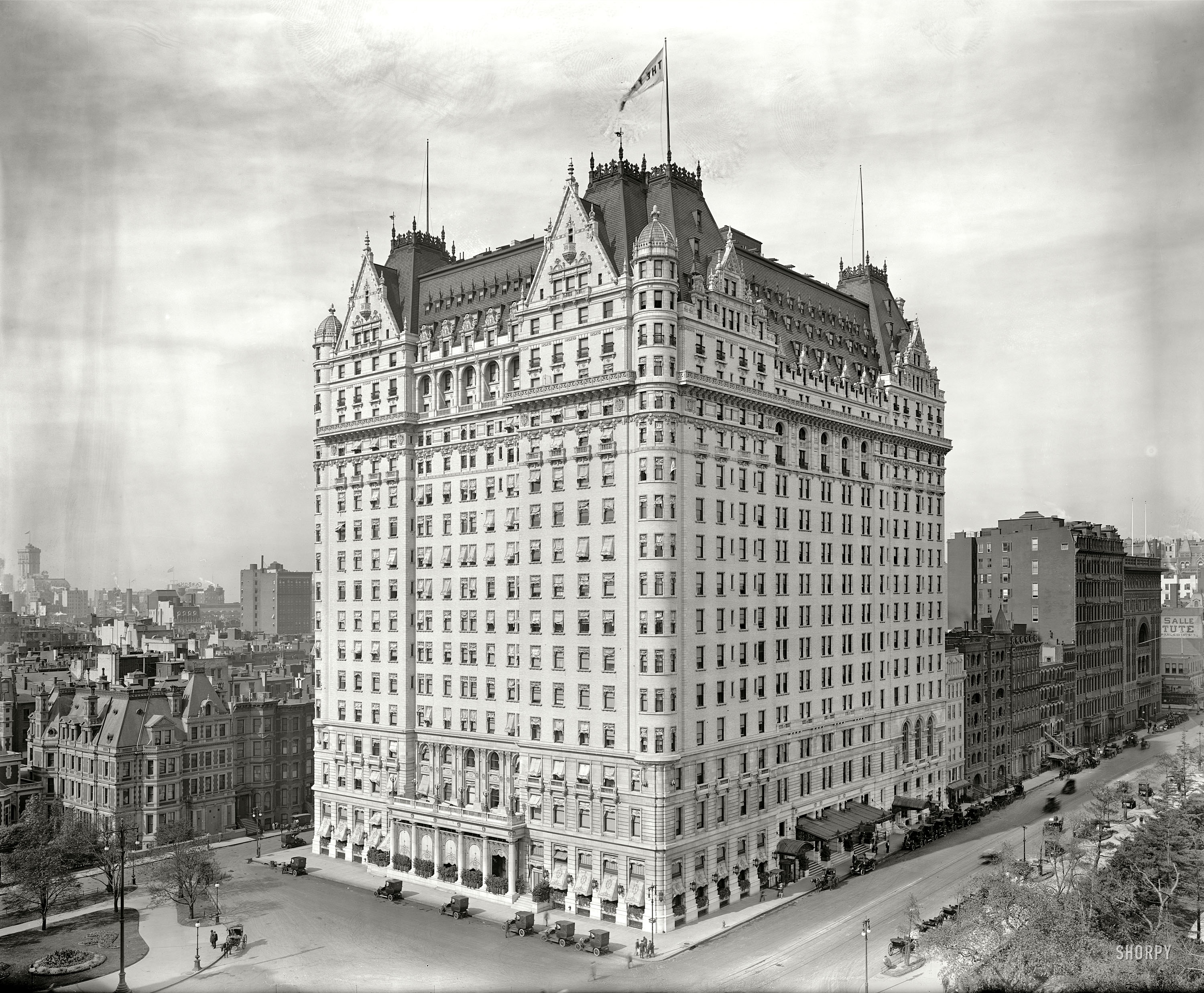
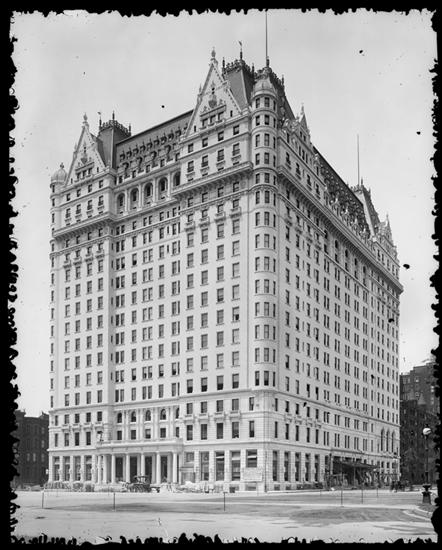
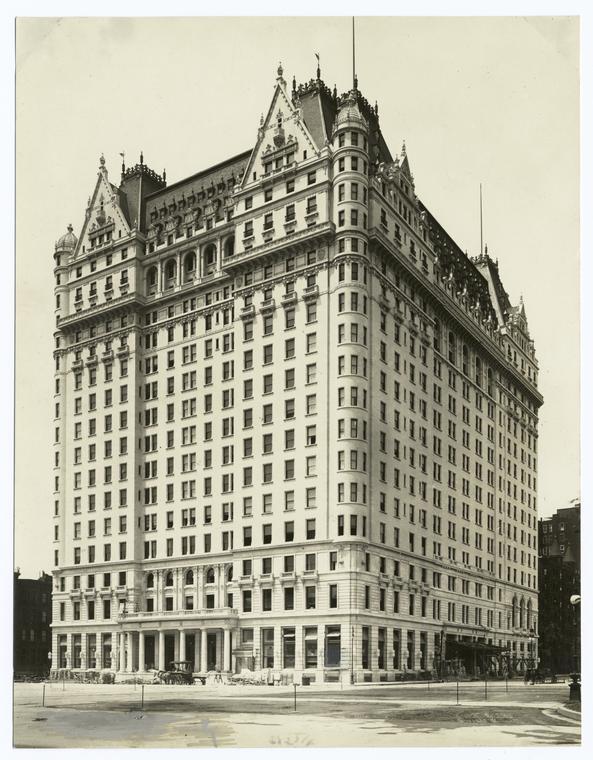
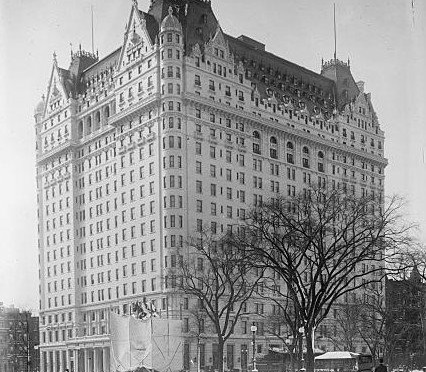
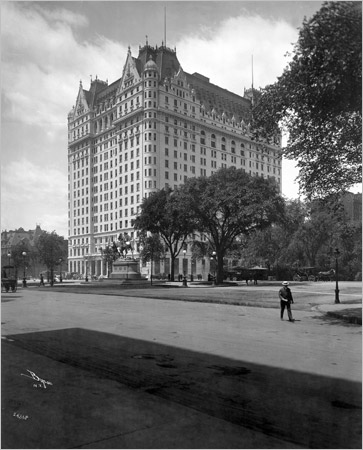
The Plaza Hotel in 1912. Its romantic exterior and sumptuous rooms eased New York’s wealthiest class into the habit of hotel living. (Cleaned-up picture courtesy Shorpy)
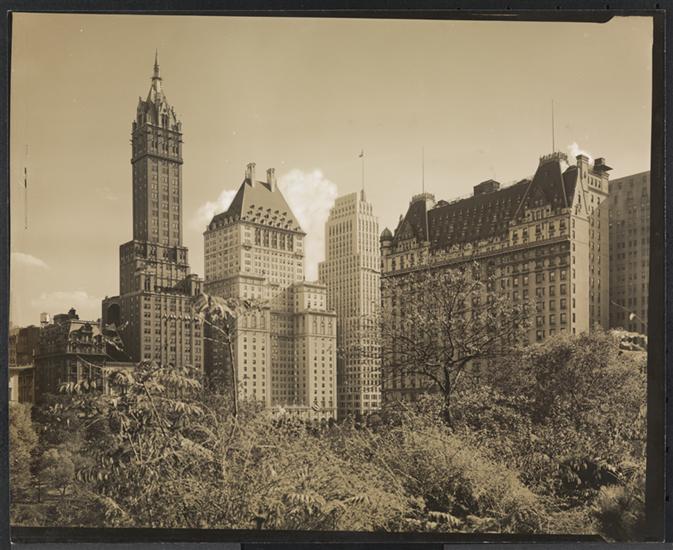
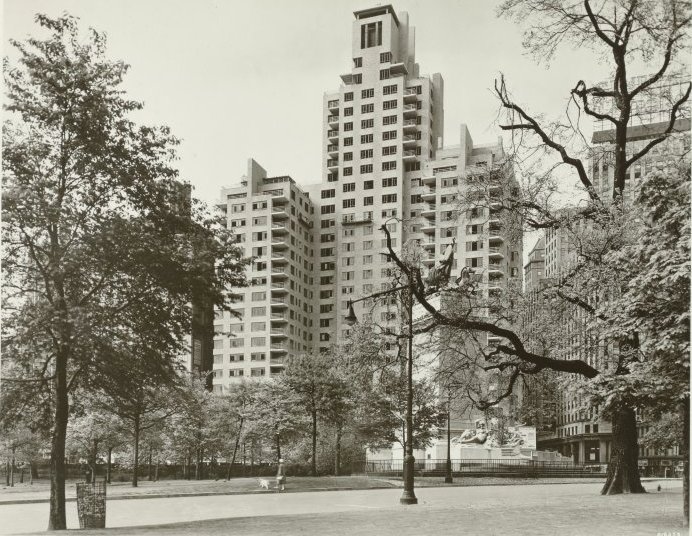
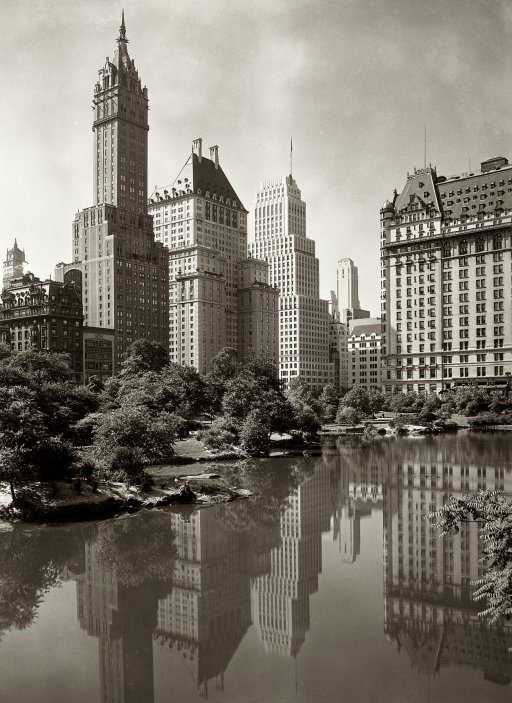
By the 1930s, the Fifth Avenue mansions below 59th Street were gone, and the Plaza was joined by other luxury hotels. (Picture courtesy Museum of the City of New York)
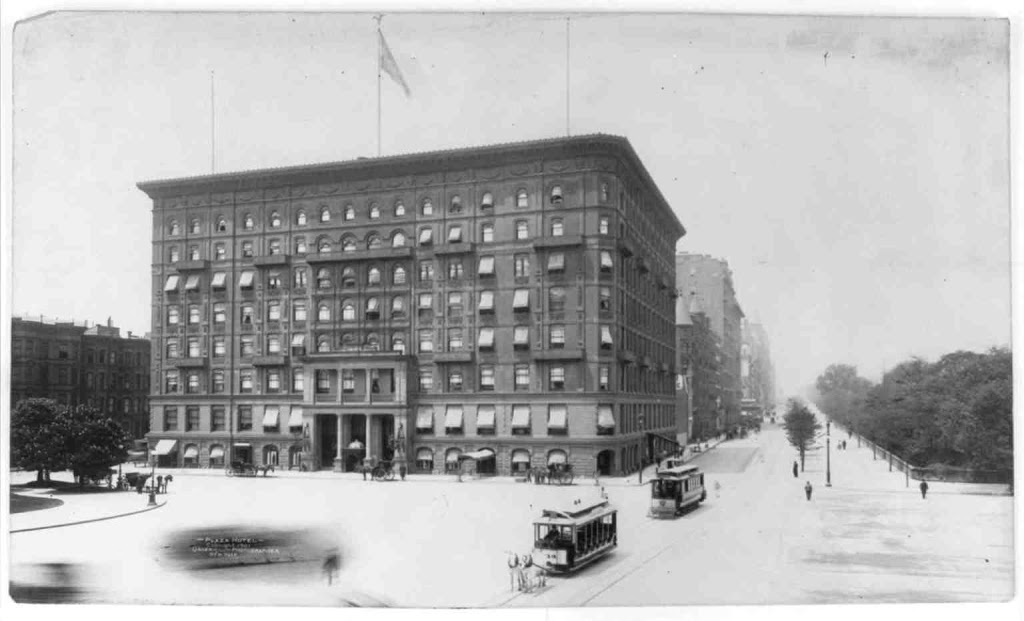
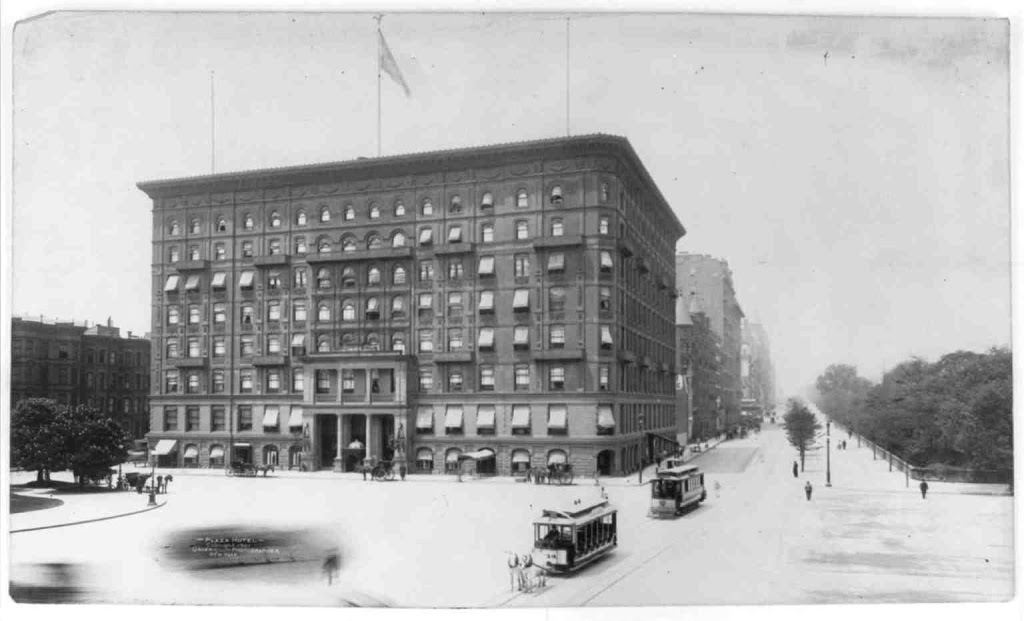
The first Plaza Hotel was deemed out of fashion and indeed looks quite plain in comparison to the building which would replace it.
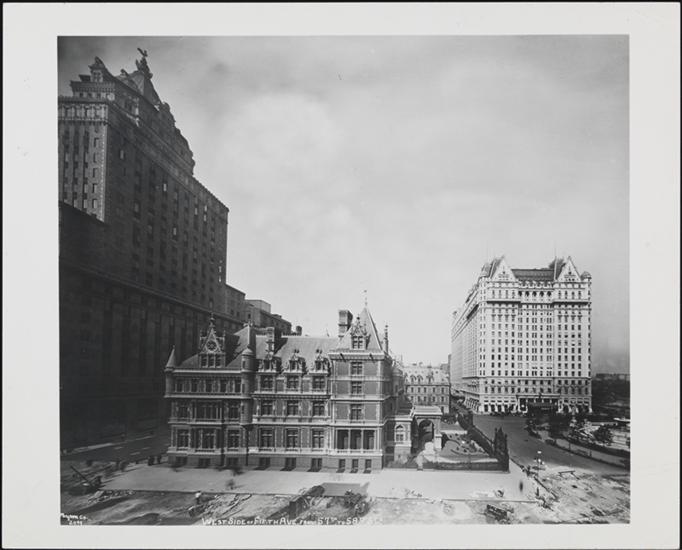
We’re so used to the Plaza being surrounded by department stores and office buildings. But in fact its first neighbors were mansions as illustrated in this photograph from 1923 (Courtesy the Museum of the City of New York)
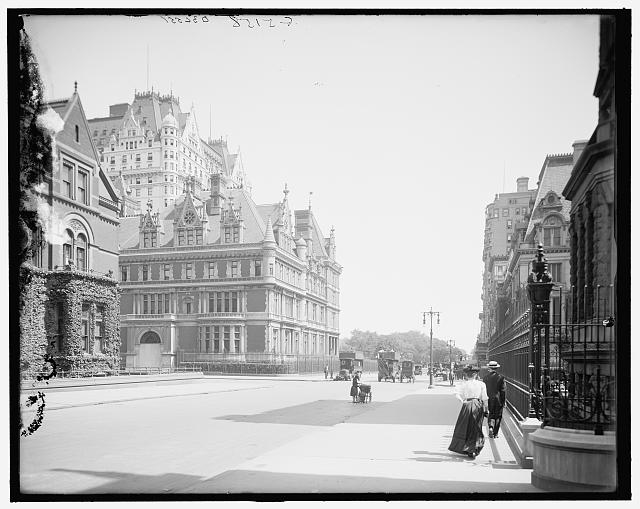
Looking up Fifth Avenue, taken sometime after 1907. The Plaza peaks over the mansion of Cornelius Vanderbilt. (Courtesy Library of Congress)
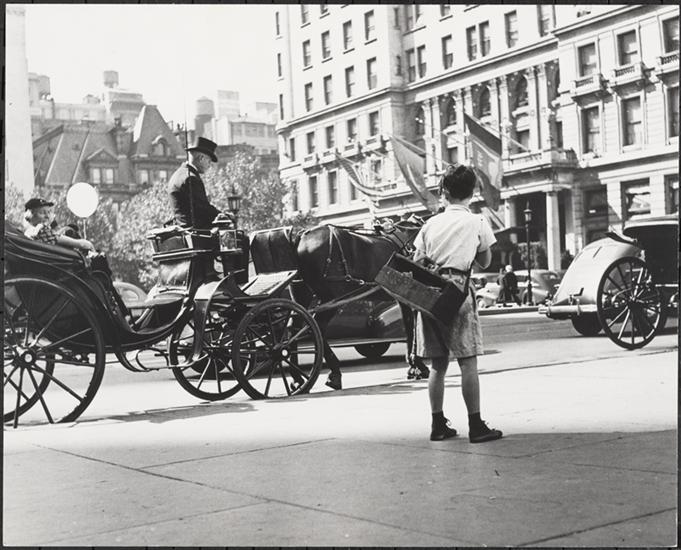
This picture was taken in 1940. Except for the shoe-shine boy and the automobile, it could have been taken yesterday. (Photograph by Roy Perry, courtesy the Museum of the City of New York)
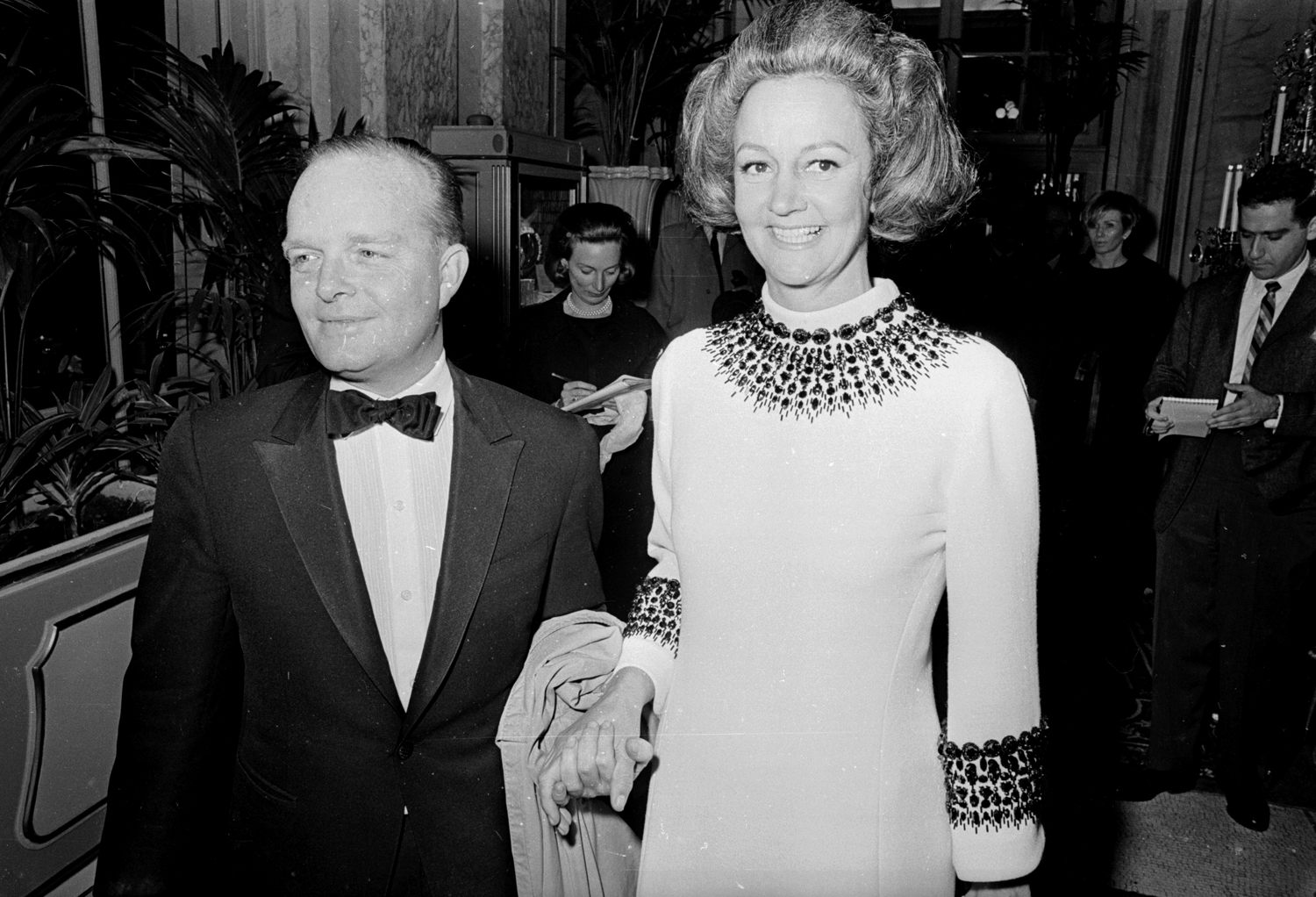
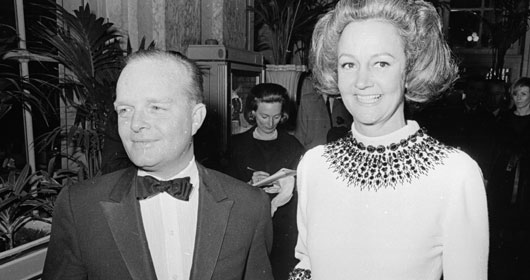
Truman Capote and Katherine Graham at the Black and White Ball, 1966
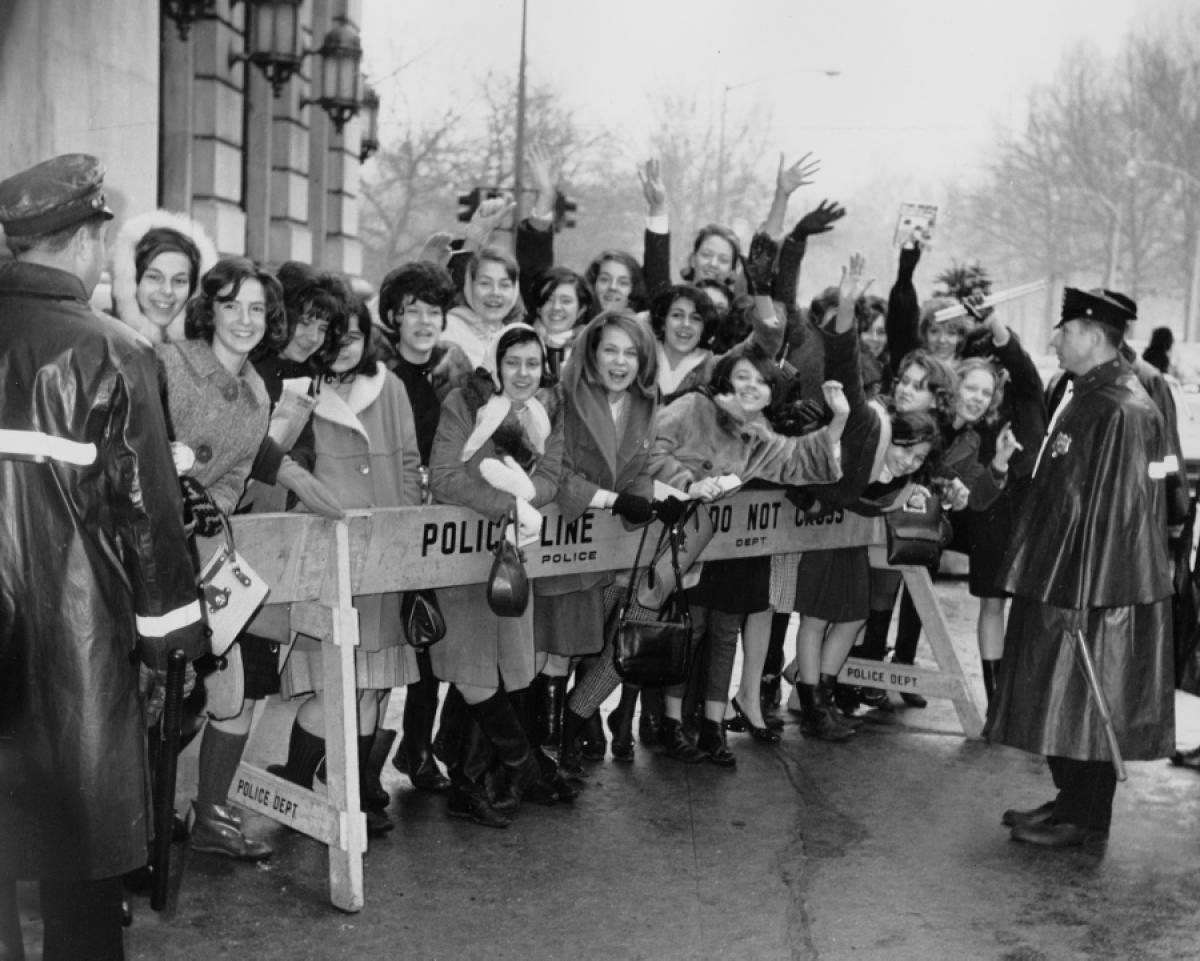
Fans await the Beatles outside the Plaza Hotel 1964 (Courtesy New York Daily News)
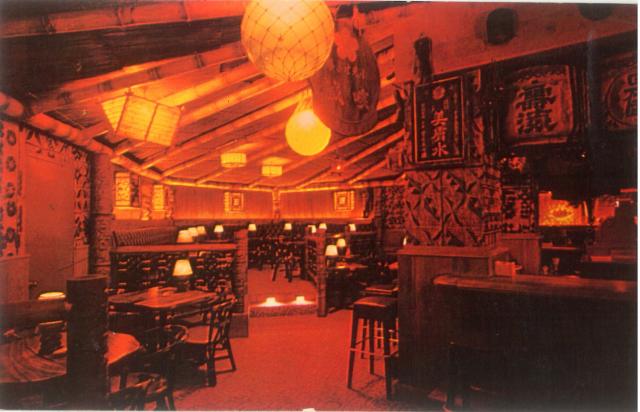
Trader Vic’s in the basement of the Plaza (courtesy the blog TikiRoom)
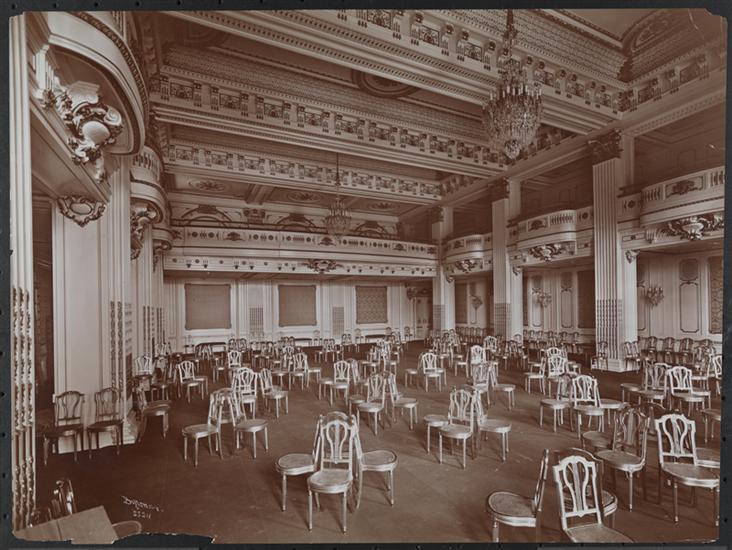
The ballroom of the Plaza, 1907 (Courtesy Museum of the City of New York)
BOWERY BOYS BOOK OF THE MONTH Each month I’ll pick a book — either brand new or old, fiction or non-fiction — that offers an intriguing take on New York City history, something that uses history in a way that’s uniquely unconventional or exposes a previously unseen corner of our city’s complicated past. Then over the next month, I’ll run an article or two about some of the historical themes that are brought up in the selection.
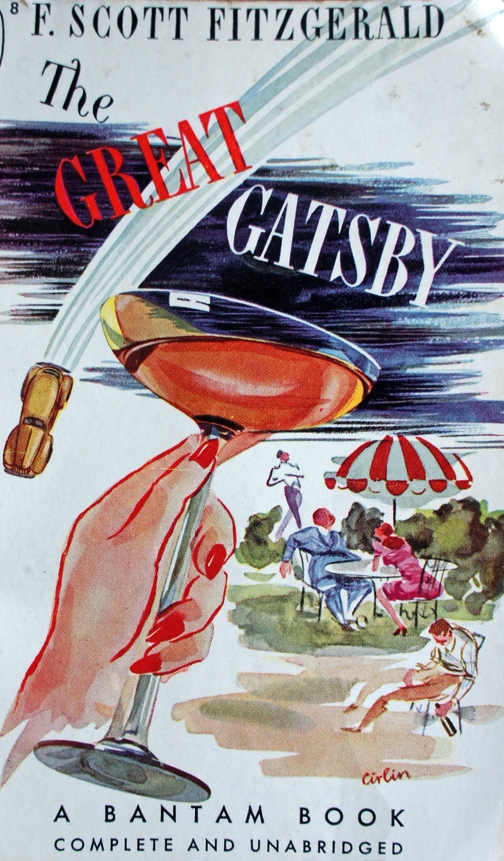
The Great Gatsby by F. Scott Fitzgerald
I re-read The Great Gatsby a few weeks ago on purpose, not because I had a school assignment. Unlike my first experience with Gatsby at age 14, I actually read it, without the signposts of Cliff’s Notes to tell me what I was supposed to be getting from it.
Of course the impetus for re-discovering F. Scott Fitzgerald‘s masterpiece is the flashy new Baz Luhrmann film coming out this weekend, which uses the text as an excuse to throw an expensive 3-D party, starring Leonardo DiCaprio, Beyonce, large champagne bottles, fifty shades of pink, the ghost of Mae West and a whole host of other drunk guests.
Few works of American literature have been as comprehensively analyzed as The Great Gatsby, by which I mean, of course, over-analyzed. One reason I’m excited about the film, with all its superficial decadence on display, is that it seems to discard several decades of nine-dimensional analyses that have settled upon the book like a thick shroud of dust. Maybe that’s wearing white to a funeral, so to speak, but true masterpieces can weather an occasional glare.
The Great Gatsby deserves to be savored for many reasons that I had forgotten or never noticed through the filter of creating a B+ term paper in my teenage years. It’s one of the most economic stories of the 20th century, an exercise of graceful control, an epic with powerful restraint. In comparison, try reading Fitzgerald’s The Beautiful and the Damned— an embittered New York book twice as long with half as much to say– to appreciate the brevity of Gatsby.
Fitzgerald uses the locales of 1922 New York City so precisely — jetting around Long Island and over the bridge to Manhattan — that it seems almost possible to map the characters’ every move.
There are three principal types of locations in The Great Gatsby. About half the novel’s actions take place on either East Egg or West Egg, fictional northern Long Island villages still graced with the mansions of Gilded Age millionaires. Characters escape to Manhattan, big and glittering, either to entertain their mistresses or to dine with gentlemen of suspicious occupation. And then, of course, there’s the wasteland in between, where secrets are laid bare and burnt to ash. Welcome to Queens!
Fitzgerald paints a very lush, cockeyed view of New York City in the early 1920s. Here are some of the more interesting city locations you’ll visit as you read along, and some of the words he used to describe them:
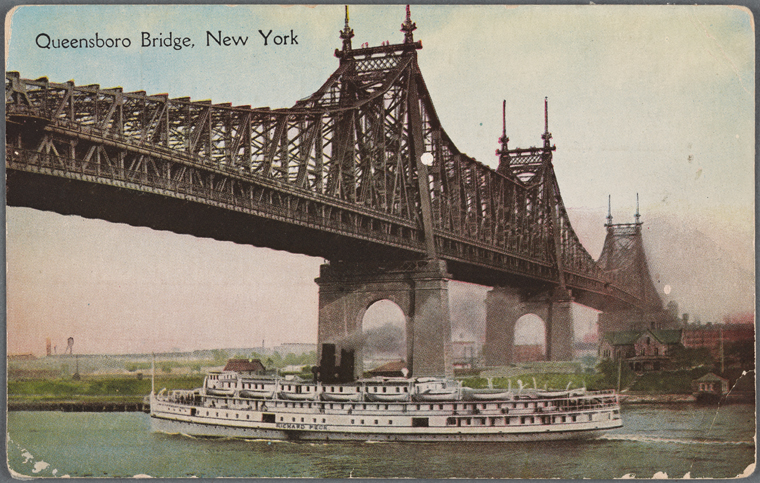
Queensboro Bridge “The city seen from the Queensboro Bridge is always the city seen for the first time, in its first wild promise of all the mystery and the beauty of the world.” ‘Anything can happen now that we’ve slid over this bridge,’ I thought; ‘anything at all….’ Even Gatsby could happen, without any particular wonder.” The 1920s were more than just a decade of speakeasies and spendthrifts. It was the decade of immense growth for Manhattan’s outer boroughs, none more so than Queens, thanks mostly to the opening of the Queensboro Bridge in 1909 and a connection to New York’s new subway system.
The IRT Astoria line “[W]e sped along toward Astoria at fifty miles an hour, until, among the spidery girders of the elevated, we came in sight of the easy-going blue coupe.”
Astoria’s elevated subway train opened in 1917, at the time servicing only cars from the IRT. (The trains of the BMT are a little too wide to use the stations.) So as Gatsby, Nick Carraway and the gang race underneath it to get onto the Queensboro, they’re really experiencing something quite new, a symbol of New York’s expansion into Queens.
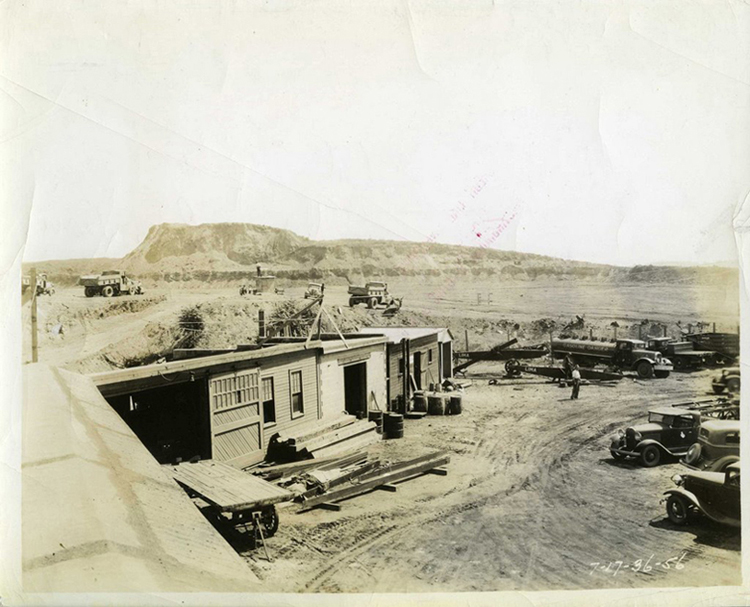
Corona Ash Dumps “We passed Port Roosevelt, where there was a glimpse of red-belted ocean-going ships, and sped along a cobbled slum lined with the dark, undeserved saloons of the faded-gilt nineteen-hundreds. Then the valley of ashes opened out on both sides of us.”
Once the place where New York and Brooklyn dumped their ash from coal-burning furnaces, the old ash dumps of Corona turned a bit of Queens into a gloomy and unpleasant landscape. It would take Robert Moses and dreams of a World’s Fair to transform the ashen landscape into Flushing Meadows-Corona Park in the 1930s. (Picture courtesy the Queens Museum)
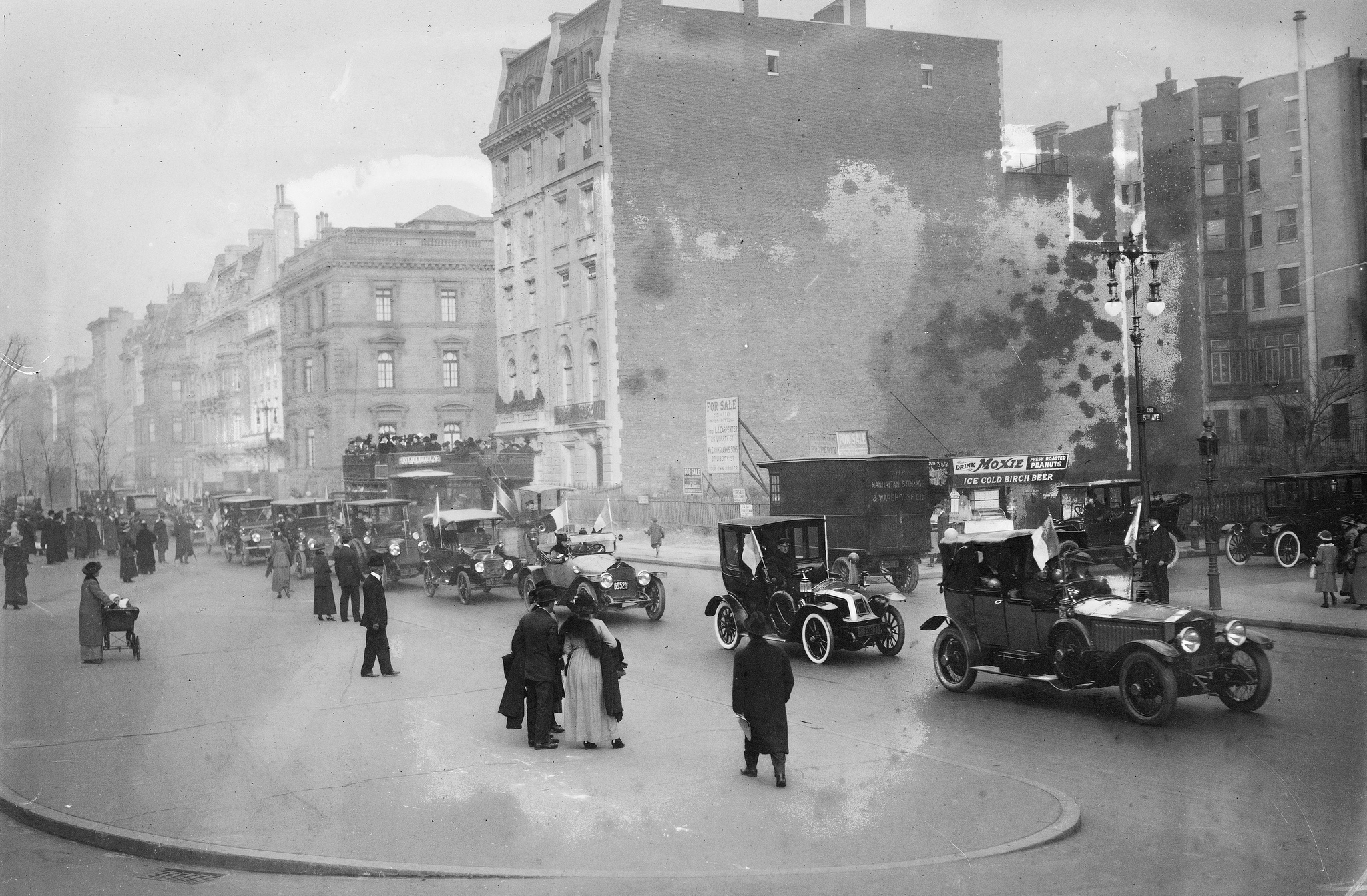
Automobile parade on Fifth Avenue, approx. 1915 (Courtesy LOC)
Upper Fifth Avenue “We drove over to Fifth Avenue, so warm and soft, almost pastoral, on the summer Sunday afternoon that I wouldn’t have been surprised to see a great flock of white sheep turn the corner.” This was not as bizarre as it sounds, for nearby Central Park actually had sheep grazing in it until 1934. Granted, they would have been on the other side of the park, in today’s aptly named Sheep Meadow.
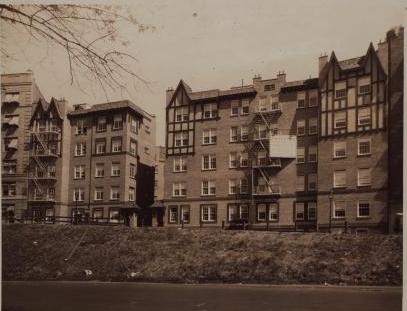
Above 158th Street and Riverside Drive, 1921 (NYPL)
Washington Heights “We went on, cutting back again over the Park towards the West Hundreds. At 158th Street the cab stopped at one slice in a long white cake of apartment-houses. Throwing a regal homecoming glance around the neighborhood, Mrs. Wilson gathered up her dog and her other purchases, and went haughtily in.”
Once the respite of wealthy manors in the 19th century, the upper reaches of Manhattan gave way to middle-class housing at the start of the new century. Myrtle’s perch here in Washington Heights would have been appropriately out of the way in the 1920s.
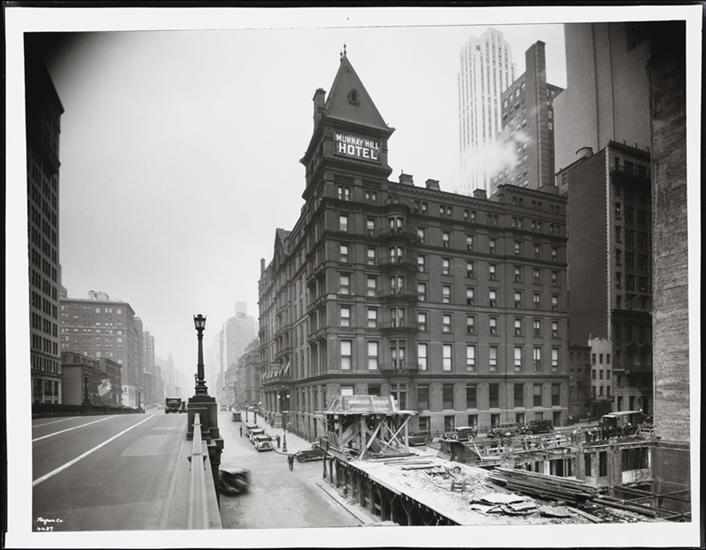
The Murray Hill Hotel on Park Avenue, 1931, courtesy Museum of the City of New York
The Murray Hill Hotel
“After that, if the night was mellow, I strolled down Madison Avenue past the old Murray Hill Hotel and over 33d Street to the Pennsylvania Station….I liked to walk up Fifth Avenue and pick out romantic women from the crowd and imagine that in a few minutes I was going to enter into their lives, and no one would ever know or disapprove.”
Opening in 1884 to serve the needs of those arriving from Grand Central Depot, the Murray Hill Hotel kept its halls fully occupied until its demolition in 1946. The Daytonian In Manhattan blog has a wonderful tale of the hotel’s colorful history.
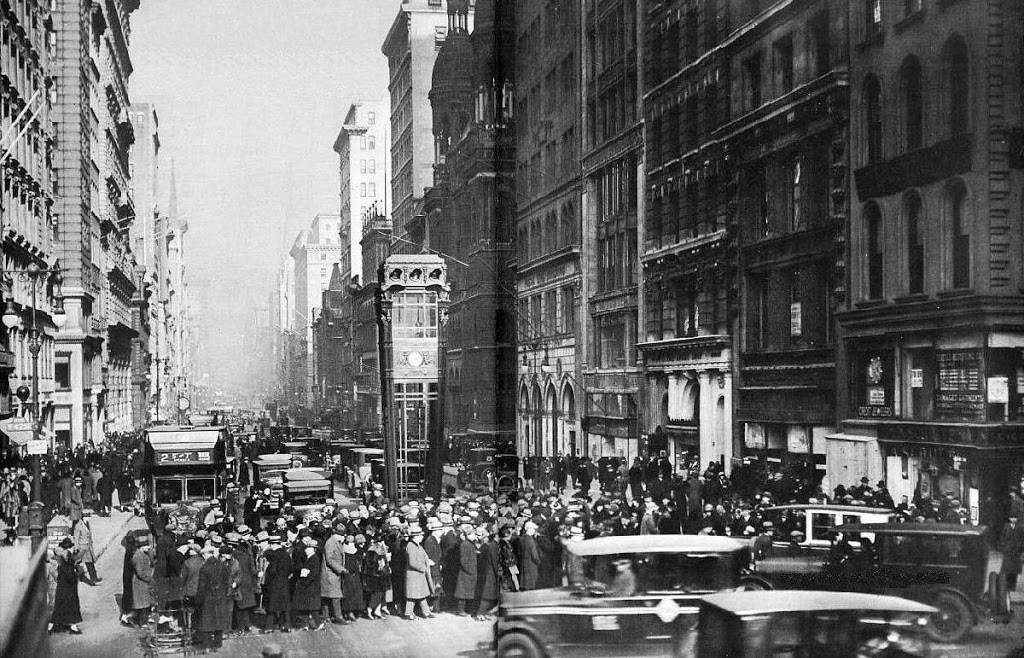
Above: 42nd Street in 1926 (Courtesy Kings Academy)Forty-Second Street
“Roaring noon. In a well-fanned Forty-second Street cellar, I met Gatsby for lunch. Blinking away the brightness of the street outside, my eyes picked him out obscurely in the anteroom, talking to another man.”
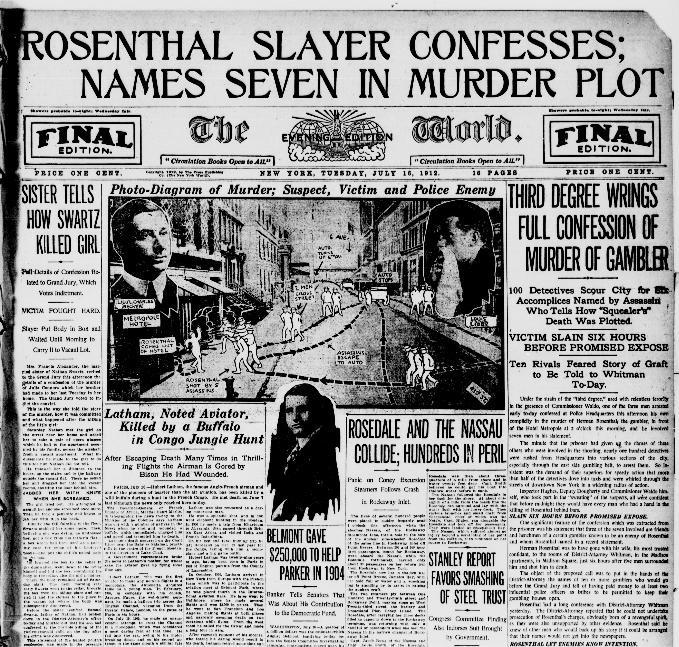
From the July 16, 1912 edition of the New York Evening World Hotel Metropole “The old Metropole,” brooded Mr. Wolfsheim gloomily. “Filled with faces dead and gone. Filled with friends gone now forever. I can’t forget so long as I live the night they shot Rosy Rosenthal there.”
The Hotel Metropole was a swanky Times Square hotspot located at 147 W. 43rd Street. Mr. Wolfsheim (himself a stand-in for gangster Arnold Rothstein) spends a moment recounting the assassination of Herman Rosenthal, gunned down by the mob. Charles Becker, who was accused of orchestrating the murder, became the first police officer to ever be given the death penalty.
Above: The southwest corner of Central Park, photo by the Wurts Brothers (NYPL)
Central Park “When Jordan Baker had finished telling all this we had left the Plaza for half an hour and were driving in a victoria through Central Park. The sun had gone down behind the tall apartments of the movie stars in the West Fifties, and the clear voices of little girls, already gathered like crickets on the grass, rose through the hot twilight. We passed a barrier of dark trees, and then the facade of Fifth-ninth Street, a block of delicate pale light, beamed down into the park.”
“And we all took the less explicable step of engaging the parlor of a suite in the Plaza Hotel. The room was large and stifling, and, though it was already four o’clock, opening the windows admitted only a gust of hot shrubbery from the Park.”
The Plaza Hotel The beginning of a string of violent acts in the book begins here at The Plaza, at perhaps the epitome of class in the early 1920s. It was only open about 15 years when the events of the book take place here.
I re-read The Great Gatsby a few weeks ago on purpose, not because I had a school assignment. Unlike my first experience with Gatsby at age 14, I actually read it, without the signposts of a Cliff’s Notes to tell me what I was supposed to be getting from it.
Of course the impetus for re-discovering F. Scott Fitzgerald‘s masterpiece is the flashy new Baz Luhrmann film coming out this weekend, which uses the text as an excuse to throw an expensive 3-D party, starring Leonardo DiCaprio, Beyonce, large champagne bottles, fifty shades of pink, the ghost of Mae West and a whole host of other drunk guests.
Few works of American literature have been as comprehensively analyzed as The Great Gatsby, by which I mean, of course, over-analyzed. One reason I’m excited about the film, with all its superficial decadence on display, is that it seems to discard several decades of nine-dimensional analyses that have settled upon the book like a thick shroud of dust. Maybe that’s wearing white to a funeral, so to speak, but true masterpieces can weather an occasional glare.
The Great Gatsby deserves to be savored for many reasons that I had forgotten or never noticed through the filter of creating a B+ term paper in my teenage years. It’s one of the most economic stories of the 20th century, an exercise of graceful control, an epic with powerful restraint. In comparison, try reading Fitzgerald’s The Beautiful and the Damned— an embittered New York book twice as long with half as much to say– to appreciate the brevity of Gatsby.
Fitzgerald uses the locales of 1922 New York City so precisely — jetting around Long Island and over the bridge to Manhattan — that it seems almost possible to map the characters’ every move.
There are three principal types of locations in The Great Gatsby. About half the novel’s actions take place on either East Egg or West Egg, fictional northern Long Island villages still graced with the mansions of Gilded Age millionaires.
Characters escape to Manhattan, big and glittering, either to entertain their mistresses or to dine with gentlemen of suspicious occupation.
And then, of course, there’s the wasteland in between, where secrets are laid bare and burnt to ash. Welcome to Queens!
Fitzgerald paints a very lush, cockeyed view of New York City in the early 1920s. Here are some of the more interesting city locations you’ll visit as you read along, and some of the words he used to describe them:
Queensboro Bridge “The city seen from the Queensboro Bridge is always the city seen for the first time, in its first wild promise of all the mystery and the beauty of the world.” ‘Anything can happen now that we’ve slid over this bridge,’ I thought; ‘anything at all….’ Even Gatsby could happen, without any particular wonder.” The 1920s were more than just a decade of speakeasies and spendthrifts. It was the decade of immense growth for Manhattan’s outer boroughs, none more so than Queens, thanks mostly to the opening of the Queensboro Bridge in 1909 and a connection to New York’s new subway system.
The IRT Astoria line “[W]e sped along toward Astoria at fifty miles an hour, until, among the spidery girders of the elevated, we came in sight of the easy-going blue coupe.”
Astoria’s elevated subway train opened in 1917, at the time servicing only cars from the IRT. (The trains of the BMT are a little too wide to use the stations.) So as Gatsby, Nick Carraway and the gang race underneath it to get onto the Queensboro, they’re really experiencing something quite new, a symbol of New York’s expansion into Queens.
Corona Ash Dumps “We passed Port Roosevelt, where there was a glimpse of red-belted ocean-going ships, and sped along a cobbled slum lined with the dark, undeserved saloons of the faded-gilt nineteen-hundreds. Then the valley of ashes opened out on both sides of us.”
Once the place where New York and Brooklyn dumped their ash from coal-burning furnaces, the old ash dumps of Corona turned a bit of Queens into a gloomy and unpleasant landscape. It would take Robert Moses and dreams of a World’s Fair to transform the ashen landscape into Flushing Meadows-Corona Park in the 1930s. (Picture courtesy the Queens Museum)
Automobile parade on Fifth Avenue, approx. 1915 (Courtesy LOC)
Upper Fifth Avenue “We drove over to Fifth Avenue, so warm and soft, almost pastoral, on the summer Sunday afternoon that I wouldn’t have been surprised to see a great flock of white sheep turn the corner.” This was not as bizarre as it sounds, for nearby Central Park actually had sheep grazing in it until 1934. Granted, they would have been on the other side of the park, in today’s aptly named Sheep Meadow.
Above 158th Street and Riverside Drive, 1921 (NYPL)
Washington Heights “We went on, cutting back again over the Park towards the West Hundreds. At 158th Street the cab stopped at one slice in a long white cake of apartment-houses. Throwing a regal homecoming glance around the neighborhood, Mrs. Wilson gathered up her dog and her other purchases, and went haughtily in.”
Once the respite of wealthy manors in the 19th century, the upper reaches of Manhattan gave way to middle-class housing at the start of the new century. Myrtle’s perch here in Washington Heights would have been appropriately out of the way in the 1920s.
The Murray Hill Hotel on Park Avenue, 1931, courtesy Museum of the City of New York
The Murray Hill Hotel
“After that, if the night was mellow, I strolled down Madison Avenue past the old Murray Hill Hotel and over 33d Street to the Pennsylvania Station….I liked to walk up Fifth Avenue and pick out romantic women from the crowd and imagine that in a few minutes I was going to enter into their lives, and no one would ever know or disapprove.”
Opening in 1884 to serve the needs of those arriving from Grand Central Depot, the Murray Hill Hotel kept its halls fully occupied until its demolition in 1946. The Daytonian In Manhattan blog has a wonderful tale of the hotel’s colorful history.
“Roaring noon. In a well-fanned Forty-second Street cellar I met Gatsby for lunch. Blinking away the brightness of the street outside, my eyes picked him out obscurely in the anteroom, talking to another man.”
From the July 16, 1912 edition of the New York Evening World Hotel Metropole “The old Metropole,” brooded Mr. Wolfsheim gloomily. “Filled with faces dead and gone. Filled with friends gone now forever. I can’t forget so long as I live the night they shot Rosy Rosenthal there.”
The Hotel Metropole was a swanky Times Square hotspot located at 147 W. 43rd Street. Mr. Wolfsheim (himself a stand-in for gangster Arnold Rothstein) spends a moment recounting the assassination of Herman Rosenthal, gunned down by the mob. Charles Becker, who was accused of orchestrating the murder, became the first police officer to ever be given the death penalty.
Above: The southwest corner of Central Park, photo by the Wurts Brothers (NYPL)
Central Park “When Jordan Baker had finished telling all this we had left the Plaza for half an hour and were driving in a victoria through Central Park. The sun had gone down behind the tall apartments of the movie stars in the West Fifties, and the clear voices of little girls, already gathered like crickets on the grass, rose through the hot twilight. We passed a barrier of dark streets, and then the facade of Fifth-ninth Street, a block of delicate pale light, beamed down into the park.”
“And we all took the less explicable step of engaging the parlor of a suite in the Plaza Hotel. The room was large and stifling, and, though it was already four o’clock, opening the windows admitted only a gust of hot shrubbery from the Park.”
The Plaza Hotel
The beginning of a string of violent acts in the book begins here at The Plaza, at perhaps the epitome of class in the early 1920s. It was only open about 15 years when the events of the book take place here.
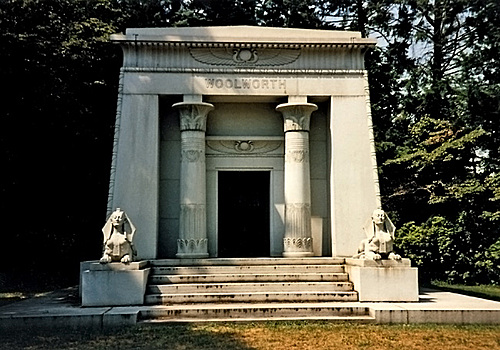
The dramatic Woolworth mausoleum in Woodlawn CemeteryÂ
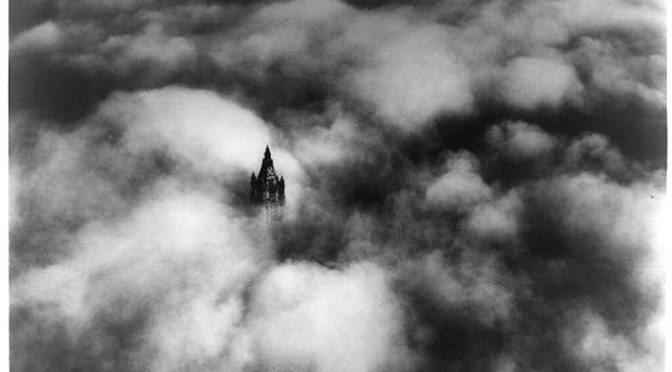
With completion of the Woolworth Building in 1913, the leader of the five-and-dime retail craze Frank W. Woolworth had his grand declaration of success in New York, widely feted and proclaimed.
His hundreds of stores would go on to define the shopping experience around the world over the coming decades. Â (Their lunch counters would also unfortunately typify racial segregation in the 1960s.) While there are no more Woolworth stores in America today*, you can still find many outlets with that brand as far away as Germany and South Africa.
But life took a few unexpected, frequently tragic and often bizarre twists for the Woolworth family over the next few decades following the completion of the Woolworth Building:
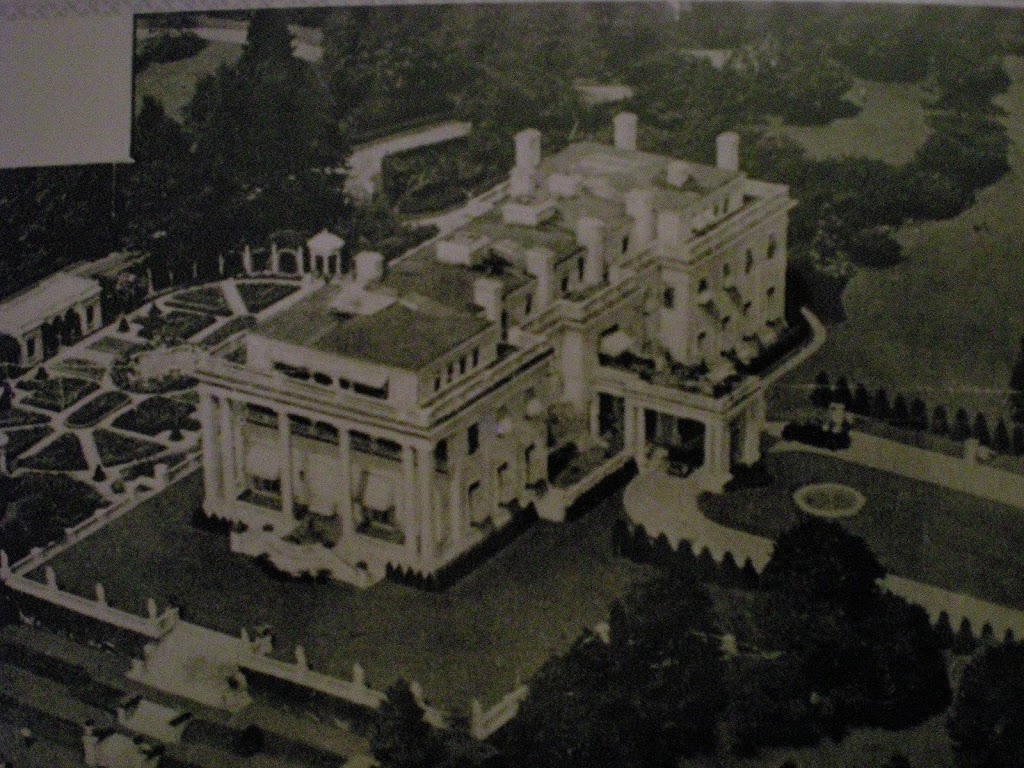
Above: The ‘new’ Winfield Hall in 1925. Courtesy Old Long Island
1) Fire at Winfield Hall: While the family enjoyed a very luxurious residence at Fifth Avenue and 80th Street across from the Metropolitan Museum of Art, his wealth was better displayed in the mansion out in Glen Cove, Long Island, where his wife and daughters lived most of the time.
But this house — a wooden, columned manor named Winfield Hall — mysteriously burned down in November 1916.
And just as oddly, Woolworth had almost instantly on hand new plans for a colossal marble palace, more in keeping with the many gigantic homes along Long Island’s Gold Coast.
Think The Great Gatsby of the five-and-dime; in fact, Glen Cove is just a few minutes over from Manhasset, fictionalized by F. Scott Fitzgerald as ‘East Egg’.
The estate is reportedly haunted due, according to sources, to Woolworth’s interest in the occult.
2) Single White Mogul: In 1892, in the early days of Woolworth’s business, he hired a young Brooklyn man, Hubert Parson, as a bookkeeper.
By the 1910s, Parson was Woolworth’s right-hand man, thought of as a part of the family and as the son Frank never had. In 1916, Woolworth shocked many by promoting the relatively young assistant to the role of general manager.
It then appeared that the notoriously vain Parson was attempting to actually outdo his boss, first building a bigger Fifth Avenue mansion than his boss, then, in 1918 purposefully buying a house in Long Branch, New Jersey — named Shadow Lawn — that was far larger than Woolworth’s own Winfield Hall!
“If Woolworth bought a brand new automobile,” writes author Karen Plunkett-Powell, “then Parson would, too — complete with uniformed chauffeur.”
After Frank’s death, Parson would become president of the company. Later in life, he would be criticized for his “extravagant personal lifestyle” during the Great Depression and was eventually forced to retire.
3) Death at the Plaza: Woolworth’s daughter Edna was a tragic and very tormented woman, marrying an associate of her father’s who ended up drinking heavily and cheating on her. In 1917, at the Plaza Hotel, after reading a letter confirming yet another mistress, Edna put on her loveliest lace dress, sat by a window and ingested a lethal dose of poison. Â Unfortunately, her body is discovered several hours later by her daughter Barbara.
4) Why You Should Go to the Dentist: Frank Woolworth had an absolute hatred of going to the dentist, a prejudice that led to his death in April 1919, when he died suddenly due to a tooth infection. Unbelievably, he died with his will unsigned, and all the money (about $30 million) went to his wife Jennie.
However, Jennie was having problems all her own, having been declared ‘mentally feeble‘ and legally incompetent by this time. Of the will, “DEMENTED WIFE GETS ALL,” said an unsubtle New York Times headline.
It’s not clear to me from the reporting of the day, but it appears from description that Mrs. Woolworth was suffering from Alzheimer’s when her husband died.
5) Gem Theft at the Plaza: In 1926, the youngest Woolworth daughter Jennie, living the good life at the Plaza, had over $683,000 worth of jewels stolen from her room while she was in the bathtub.
“The thief displayed a shrewd knowledge of pearls,” said the Times. “Alongside the genuine ones in the drawer were four ropes of imitation pearls …. [T]he robber scorned them.” The crime kept the Woolworths in the paper for an entire month. The jewels mysteriously reappeared a week later and the man who purloined them — a private detective! — was arrested.
Five years later, Jennie’s husband would then poison himself (another suicide) and die in his office at the Woolworths’ Fifth Avenue residence.
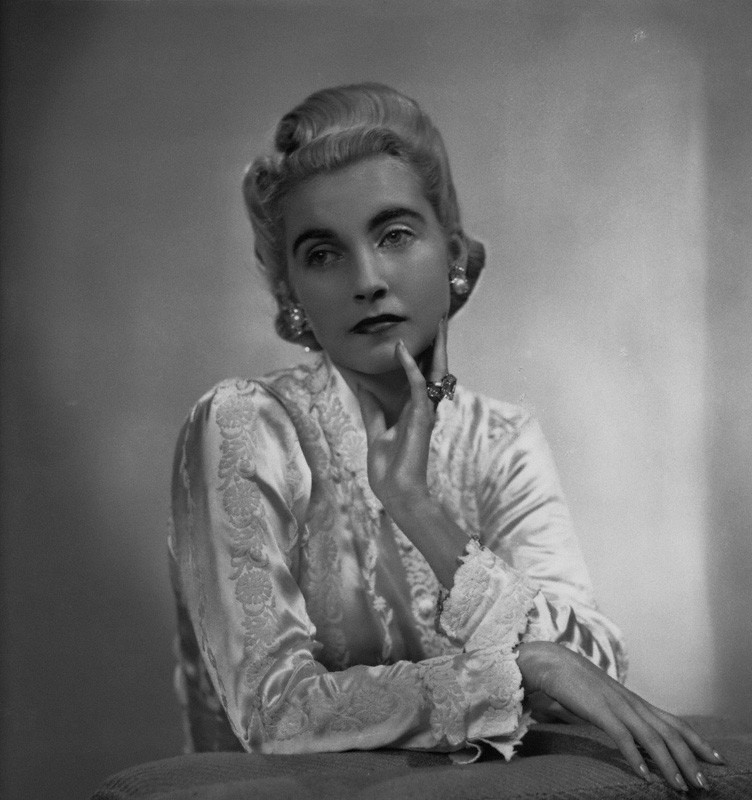
6) Poor Little Rich Girl: Barbara Hutton (above), who had discovered her mother dead in the Plaza, grew up to become something of an infamous party girl, thanks to an over-the-top debutante ball held in her honor during the Great Depression. She was dubbed the ‘poor little rich girl’, fodder for gossip columns and, later, made-for-TV movies. The heiress, never shying from an extravagant lifestyle, married seven times — most notably to Cary Grant in 1942 — in a life often marred by tragedy and physical abuse.
Most of the people mentioned above are buried in the ornate Woolworth Mausoleum in Woodlawn Cemetery in the Bronx. The mausoleum is a tribute to vast wealth and self-importance, designed like an Egyptian temple by John Russell Pope, best known for designing the Jefferson Memorial in Washington D.C.!
*The remnants of the Woolworth company are now organized as Foot Locker Inc.
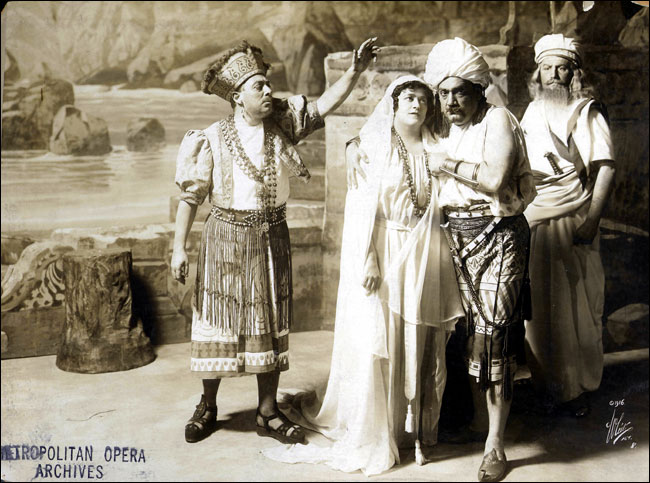
Caruso, wearing the big white turban, during the 1916-17 performance at the Met
The Plaza Hotel might have been built on the fortunes of a barbed-wire magnate, but its continued existence throughout the years partially stems from its popularity amongst the bold-print set. Celebrities, however, come with a drawback. Along with their famous name and the press and attention that comes with it, so too comes the occasional diva behavior, the irrational requests, the vituperative red-faced conniption.
This famous hotel has seen its share, but none more famous than the one thrown by its first superstar guest — Enrico Caruso.
At the beginning of the century, there were few more famous than Caruso, an internationally-renown Italian tenor and the world’s first recording star. He performed with the Metropolitan Opera for 17 years. And at least at the very beginning would stay at the Plaza. (Over time, he would prefer the late Knickerbocker Hotel in Times Square instead.)
One night after a performance at the Met in 1907, Caruso returned to his luxurious corner room at the Plaza to sleep. However, throughout the evening he was kept awake by the sound of ticking electric Magneta clock on the mantel. Tormented by the device’s rhythmic tick-tock, he erupted in the middle of the night and attacked the clock, in some accounts with a knife, in others, destroying the timepiece with his own shoe.
The problem with this particular tantrum, however, was that the entire hotel was fitted with these Magneta clocks, and all the clocks were wired to each other. Caruso had not only taken out his own clock, but effectively broke every clock in the hotel.
According to Curtis Gathje, the hotel managers responded with extraordinary restraint, instead sending Caruso complimentary champagne as an apology for inconveniencing him. Certainly, this would not become the model for handling later tempestuous musicians who trash their hotel rooms.
By the way, did you know the Enrico Caruso museum is in Brooklyn?
It got off to a rocky start, but the Plaza Hotel has become one of the most recognizable landmarks in New York City. We take a look at its kooky history, from its days as an upper class ‘transient hotel’ to a party place for celebrities. Starring: Henry Hardenberg, Eloise, Truman Capote and of course the unsinkable Mrs. Patrick Campbell.
The first “Plaza,” as redesigned by McKim, Mead and White, was also a hotel, but it didn’t last long. Opened in 1890, it was demolished in 1905 to make way for the far grander vision of Henry Hardenbergh.
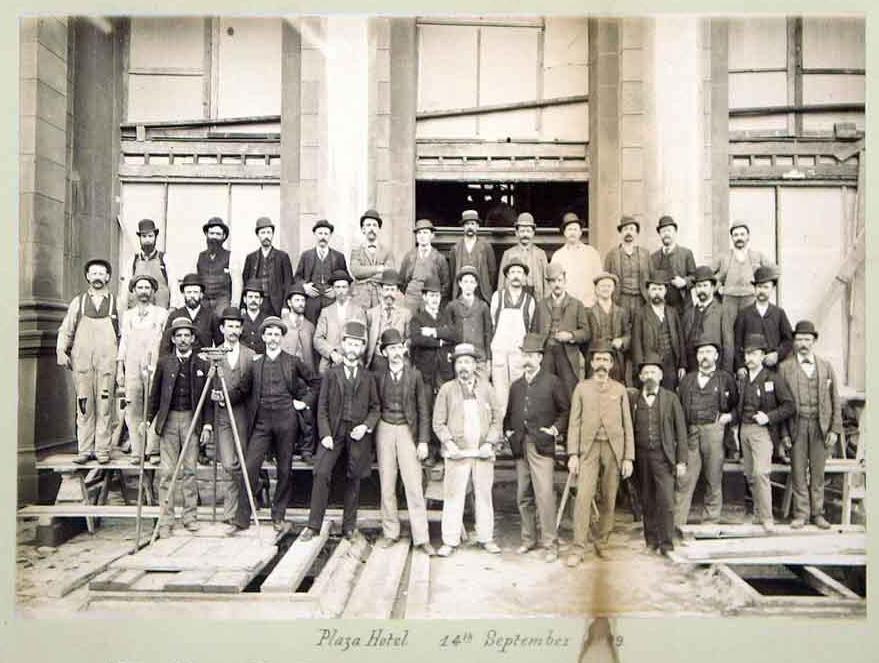
Workmen pause to stand in front of the first Plaza in 1889. Eventually the foundation of the building would not support the lofty plans for the new Plaza, so it had to be entirely torn down.
Believe it or not, here’s The Plaza in the year it opened, 1907! It looks like it’s in the countryside. Note the General Sherman equestrian statue in the foreground.
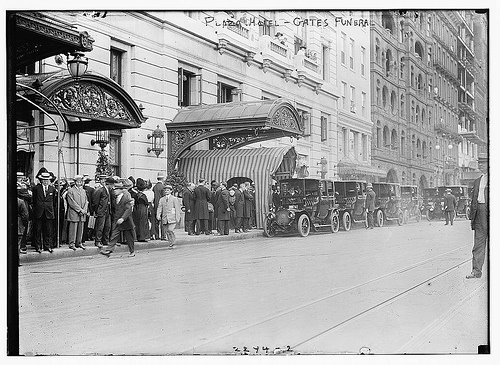
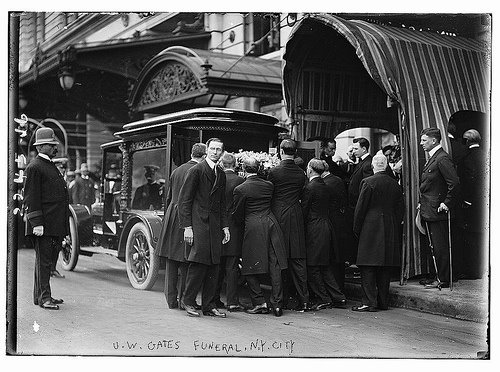
Two shots of the funeral of John “Bet-a-Million” Gates — who basically bankrolled the construction of the Plaza — pulls up to the entrance (on 59th street) of his famous hotel. It’s particularly interesting to see the development of buildings further west next to the Plaza. (Photo from Flickr, Library of Congress)
One of the Plaza’s immediate appeals was its proximity to both Central Park and the tony residents and luxury hotels of Fifth Avenue. (Picture courtesy of my favorite website Shorpy.)
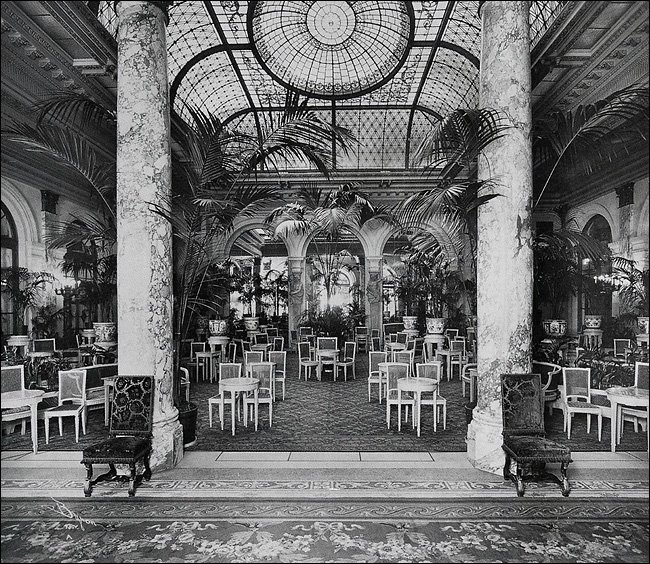
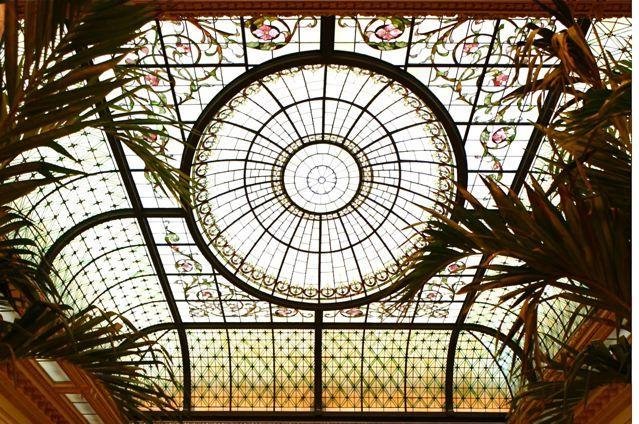
The elegant Palm Court, site of countless afternoon teas and the smoking rebellion of Mrs. Patrick Campbell. The ornate stained-glass dome would be removed in 1944, replaced with an air conditioning unit.
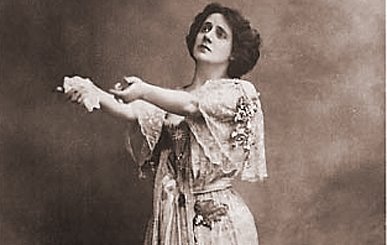
Mrs. Patrick Campbell, poster child for smokers and women’s rights everywhere
The fabulous Oak Room, probably the most unchanged of the Plaza’s public room, is festooned with Hardenburgh humor in the form of alcohol-related carvings. It was a popular drinking spot for the likes of F. Scott Fitzgerald, George M. Cohen, Bill Clinton and Harrison Ford.
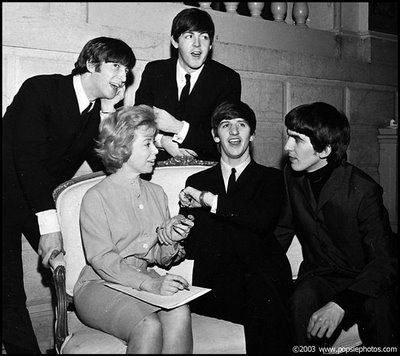
The Beatles and the Dr. Joyce Brothers enjoy a campy moment during an 1964 press conference at the Plaza.
Truman Capote and Katharine Graham greet guests at the totally outrageous Black and White Ball.
Kay Thompson, later the author of the Eloise books, performs here at the Persian Room:
The Palm Court’s stained glass ceiling has returned in the modern renovation.
Check out the wonderful book At The Plaza: An Illustrated History of the World’s Most Famous Hotel by Curtis Gathje with many more details on the Plaza’s different and extraordinary rooms. And look below a couple posts for a picture of Barack Obama with the Plaza Hotel in the background!