Categories
Landmarks

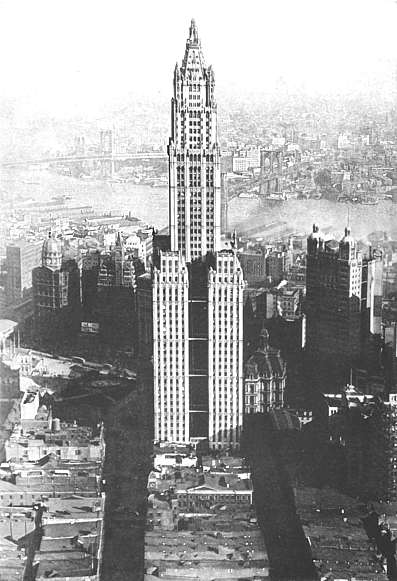
The Woolworth Building at 110: How they partied in 1913, with the “highest dinner ever held in New York”

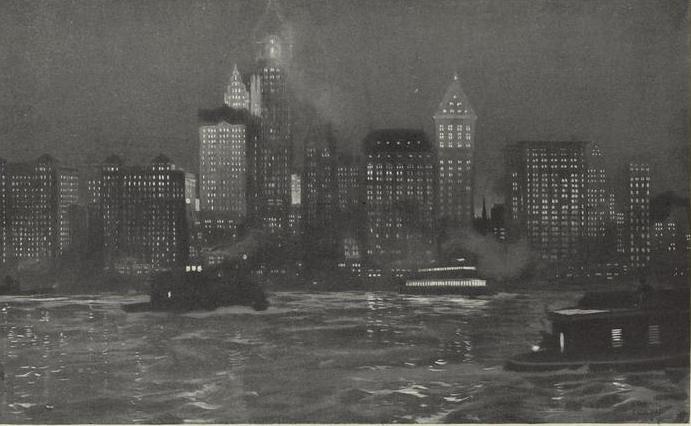
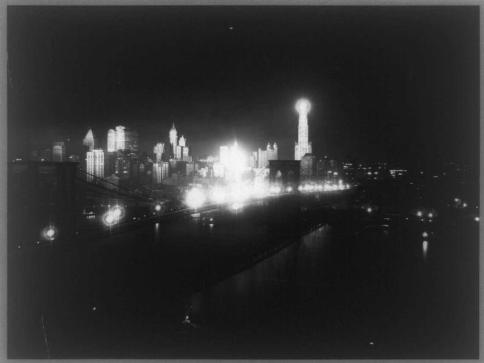
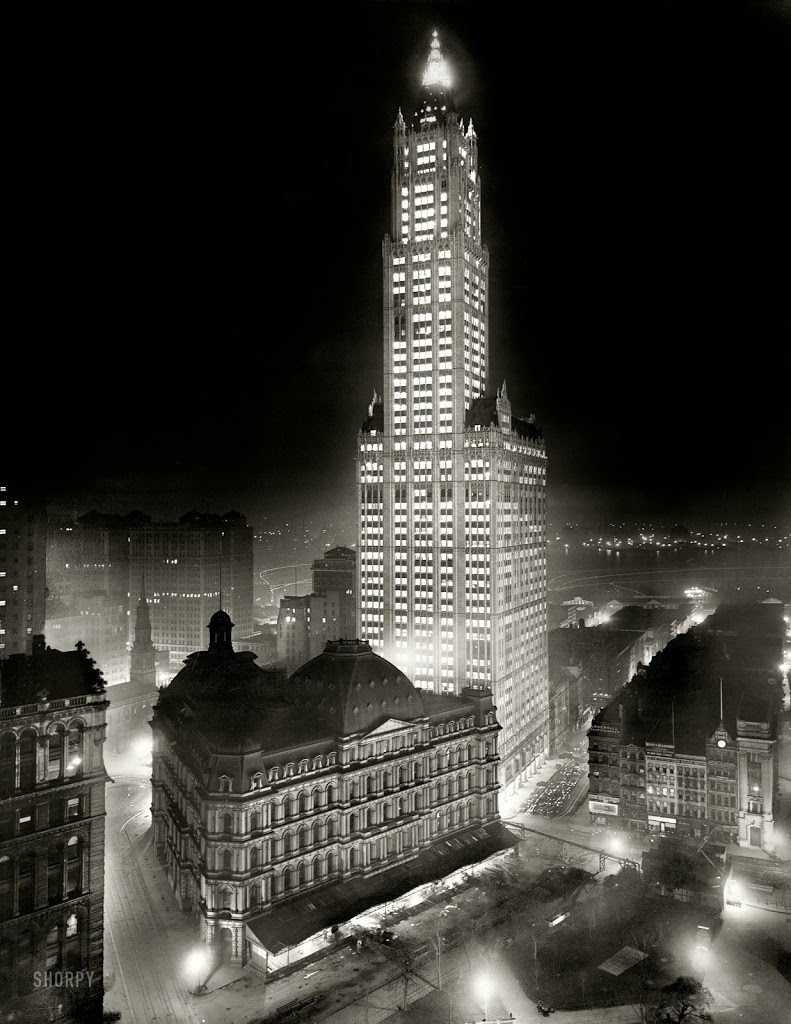
This is how they turn on the lights at the tallest building in the world in 1913:

At some time after 7 pm, on April 24th, according the New York Sun the following day, “President [Woodrow] Wilson pushed a button in Washington last night, a bell tinkled in the engineer’s quarters far below the street level in the Woolworth Building and thousands of lights [80,000, by contemporary accounts] flashed out … to signal that New York’s newest heaven kissing tower was opened formally for service.”
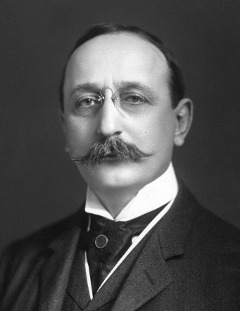
As normal New Yorkers stared up in wonder at this glowing candle near City Hall, an electric vision that lorded over the dark hulk of the unloved Post Office across the street, a collection of wealthy men were gathered up on the 27th floor for a lavish banquet in honor of the building’s architect, Cass Gilbert (at right).

The Tribune called it “the highest dinner ever held in New York.” (The building is 57 floors; dinner could have been much higher but for tenants who had already moved in.)

Holding court this evening was, of course, Frank W. Woolworth, the man whose retail empire inspired the building’s construction.

Also presiding over the gala was Francis Hopkinson Smith, a close friend of Gilbert’s who, several years earlier, just happened to built the foundation for the Statue of Liberty.

People toasted a true American entrepreneur. They toasted his visionary architect and his world-class achievement. Many toasted the fact that both men, after years of arduous work, were still talking to each other.
1

The Woolworth Building at night in 1913. This extraordinary photo is courtesy of Shorpy, my favorite website of all time. Click here to see the whole spectacular version and to search their their archive of cleaned-up vintage photos. (You can find the original picture at Library of Congress.)

It was a celebration of the filthy rich, possibly one of the most indulgent dinners of the Gilded Age.

In attendance were governors, dozens of congressmen and military men, judges, the police commissioner and at least seven of Woolworth’s early business partners. A letter from William Howard Taft, a month into his post-presidency, elicited enthusiastic applause.

But nothing like the reaction when Gilbert stood up to honor his benefactor, who paid for the entire building from his lucrative retail profits. “I asked his bankers about it and they told me that the Woolworth Building is a structure unique in New York, since it stands without mortgage and without a dollar of indebtedness.”

At this, the 37th floor erupted into “the big noise of the celebration.” Gilbert was then presented with a bronze foot-high cup — a literal trophy earned for building one for Frank Woolworth.

Following the dinner, Boy Scouts — patient ones, apparently — then raced downstairs ten floors to the Marconi wireless station, where an honored greeting was sent back to President Wilson.

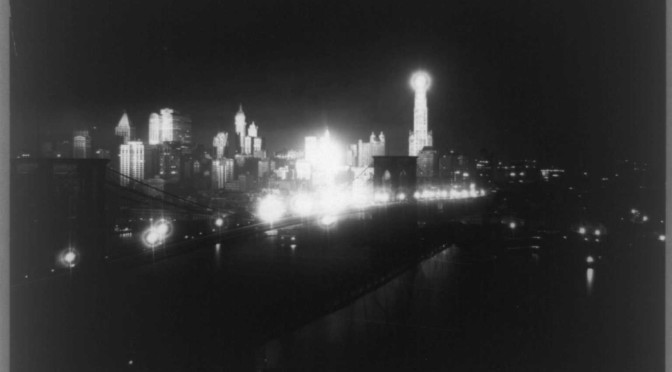
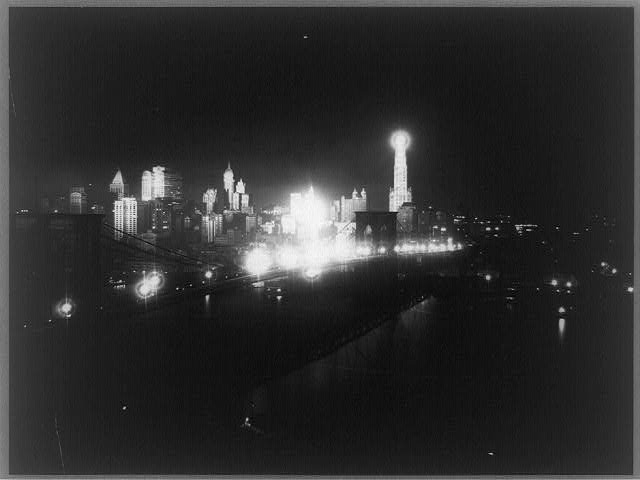
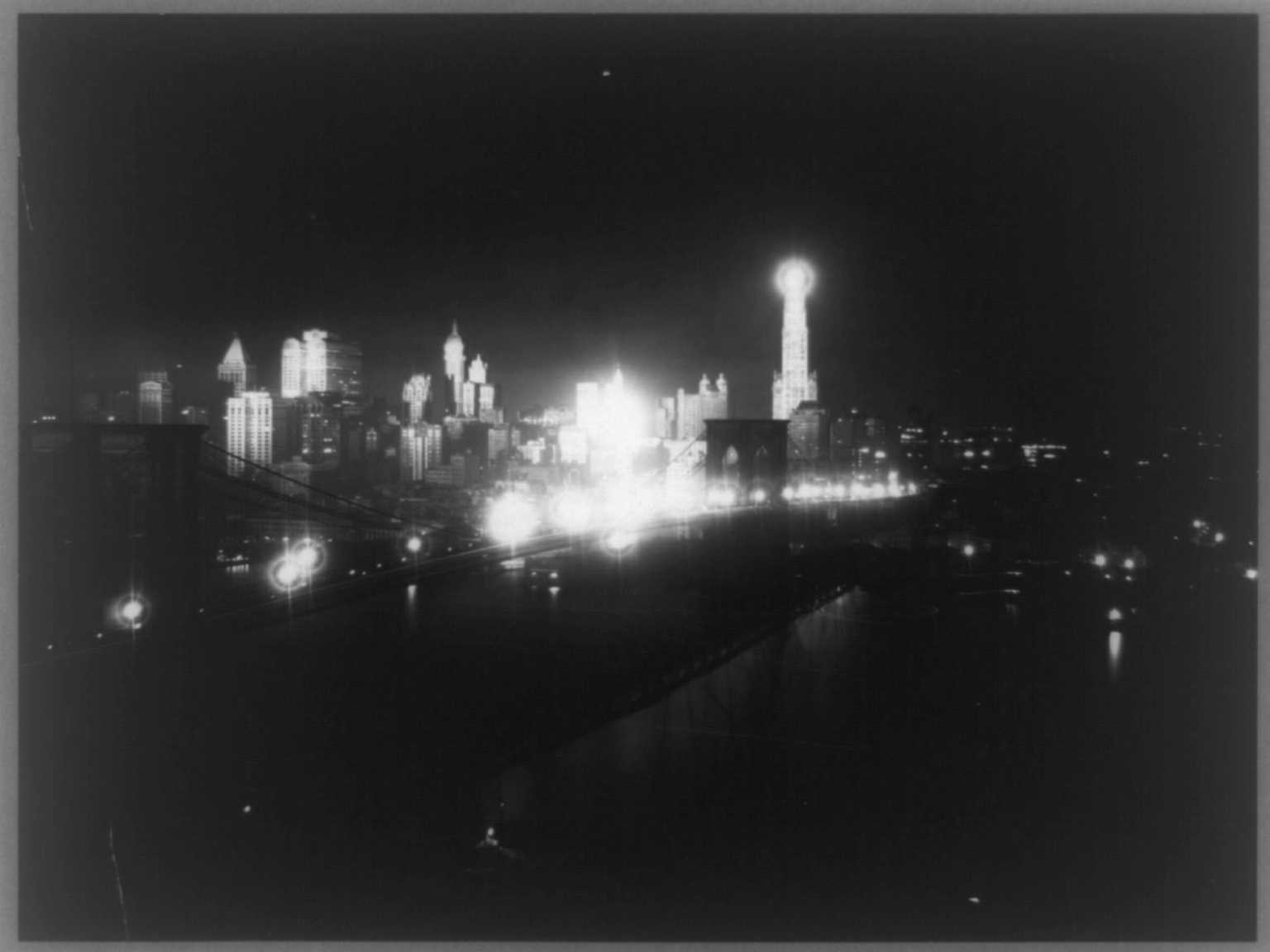
Below: The Woolworth and lower Manhattan in 1919, lit from a building in Brooklyn.  Specifically this was the Sperry Spotlight. You can read my article on ‘the world’s most powerful searchlight’ here. (Picture courtesy Library of Congress)
1
 

The Woolworth Building was an achievement of American capitalism and a fabulous symbol of limitless New York real estate. Its technical achievements, impossible to imagine a decade prior, only reinforced the themes of the day — money could defy gravity.

On the day of the official opening, the following ad ran in the Evening World (While April 24th was the ceremonial first day, May 1st was the beginning of the building’s leases.):
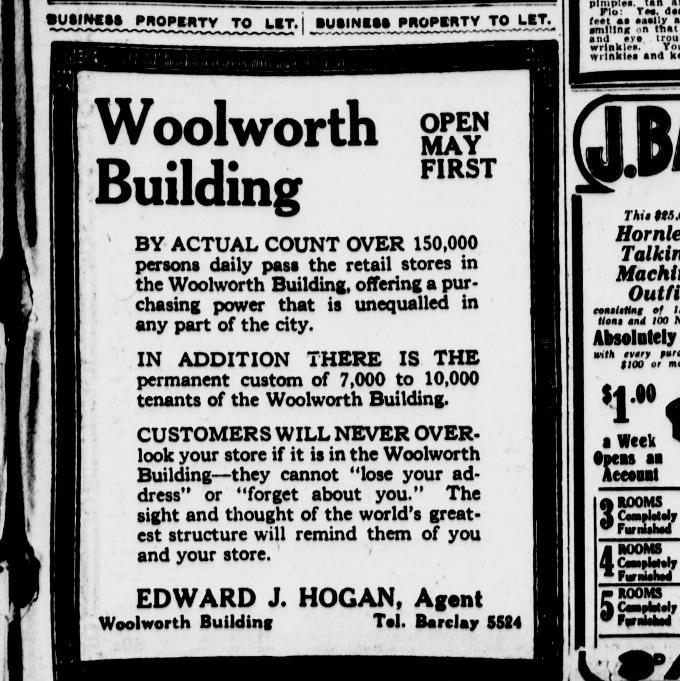
Nobody would “forget about you” — provided you took out a lease at the Woolworth — but most importantly they certainly wouldn’t forget the name affixed to this building. The Woolworth continued the trend of business owners who created skyscrapers as a show of business dominance.

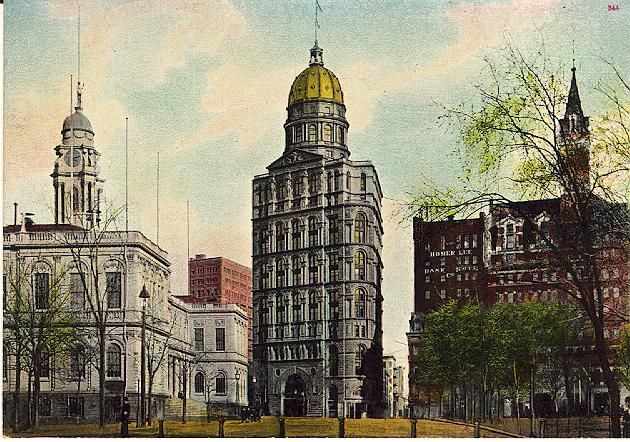
Newspapermen popularized the trend — for instance, The World Building, offices for Joseph Pulitzer‘s New York World, was also a world’s-tallest at one point — and insurance companies and retailers would perfect it.

In fact, three decades later, the crown for world’s tallest building would be taken by a structure in midtown Manhattan named for a car company — The Chrysler Building.

The Woolworth was considered a vertical super-city, in an era before anybody ever dreamt of Rockefeller Center.

“You can deposit and draw money at the bank on the first floor; in the basement there are barber shops and a swimming pool, one of the largest in New York …. There is an arcade lined with attractive shops whose fronts are entirely of plate glass. Then there is a luncheon club, library and gymnasium on the 28th floor and an observatory station on the roof.”

Woolworth’s own businesses took up only two floors. The rest were filled with such premiere tenants as Fordham University (its law school and dean’s offices were here), Irving National Bank and even Columbia Records.

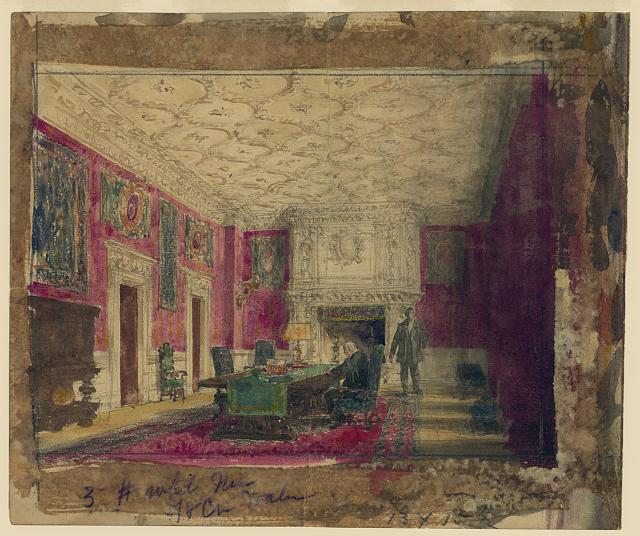
Below: A study for Woolworth’s private office in the Woolworth Building. Frank Woolworth was obsessed with the life of Napoleon Bonaparte, and his office was fashioned on a room from Napoleon’s castle in Compaigne, France.  (Pic courtesy LOC)
Today, we might consider the Woolworth Building to be a rather elusive monument. You can’t regularly tour it, and its style, before New York’s zoning laws, makes it a unique stranger within New York’s skyscraper population. You can’t interact with it like Grand Central, and it doesn’t have the personality of the art-deco Chrysler or the Flatiron.

But even if its nightly mystical posture on the skyline somehow fails to ensnare you, the Woolworth Building stands alone as an influence to almost every skyscraper that has come afterwards, from the Empire State Building to the Woolworth’s old neighbor the World Trade Center.

Of the many grand visions born in New York before the 1910s — the Erie Canal, Central Park, the Croton Aqueduct, the Brooklyn Bridge — the Woolworth Building is easily the most effortless in execution. And arguably the most duplicated.

Or as the Sun prophesied a week after the building opened: “The Woolworth Building is unique, it was explained. Its style of architecture is original in office buildings and there were no precedents or rules upon which to go. The proportions have now been ascertained and will be available for the guidance of architects in the future.”
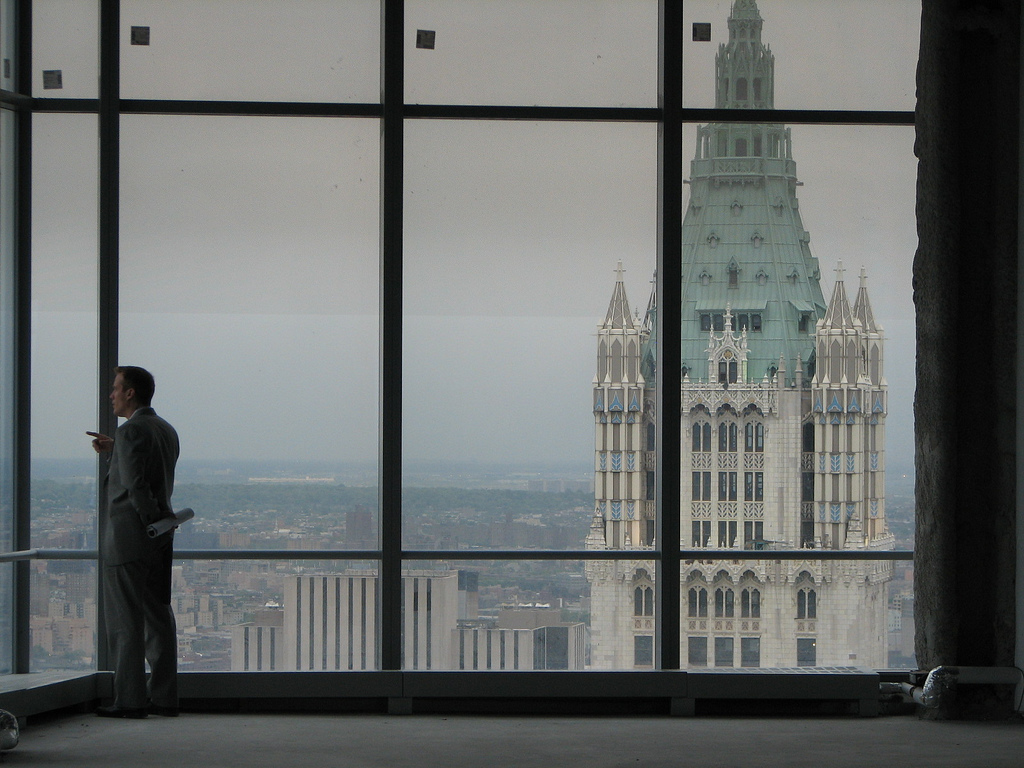
Photo by Alan Miles/Flickr

————-
A couple other Woolworth Building themed posts in the past week: Cass Gilbert’s three stunning prequels to the Woolworth Building and Before Woolworth: The early towers of lower Broadway at the birth of the skyscraper boom.

Interested in learning about the history of the Woolworth Building? It’s our Episode 76. You can download it from here, find it on iTunes, or just play it below!

__________________

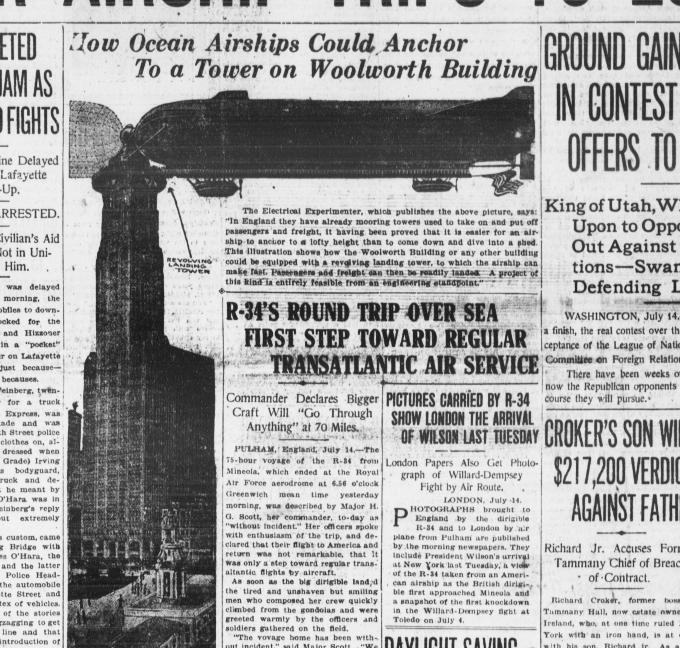
And finally, I found this in a July 1919 copy of the New York Evening World — the Woolworth Building as a possible air dock for dirigibles! (This never happened of course.)
This article originally ran on the Woolworth Building’s 100th anniversary.
Categories
Skyscrapers

The Big Wind of 1912: New York skyscrapers in peril, as monster gales hurl “men and women down city streets”

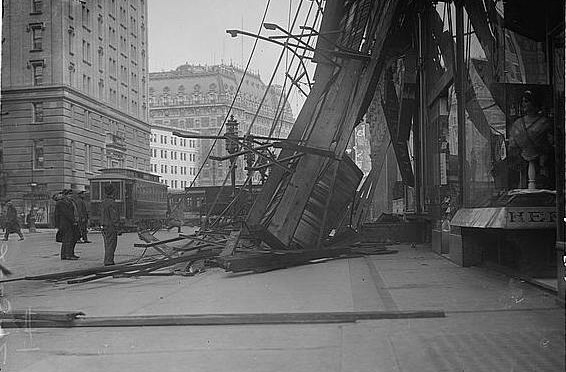
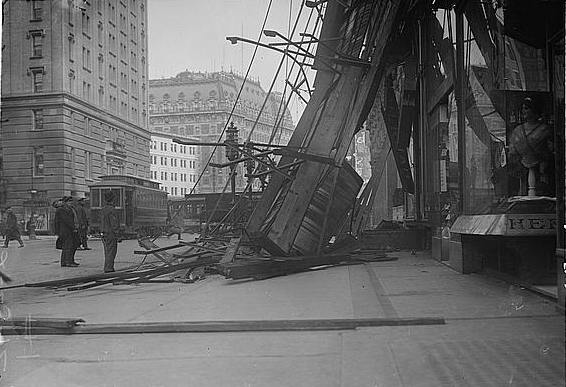
Trauma in Times Square: An electrical sign destroyed by the massive windstorm of February 22, 1912. One Times Square sits to the left, and the Hotel Astor is in the distance. [LOC] Shorpy has an another angle of this damaged storefront.

“The great gale that blew in with Washington’s birthday will not soon be forgotten. It was the biggest New York ever knew.” — New York Evening World, Feb. 23, 1912

 On February 22, 1912, a catastrophic weather anomaly occurred in New York City, an event the New York Times referred to as ‘The Big Wind’.

This particular day has also been called “a significant day in the history of tall buildings,” although I doubt anybody today will be celebrating this rather vicious and sudden test of architectural endurance.

New Yorkers thought it might be worse. The storm system began the previous day as a blinding Midwestern blizzard, paralyzing the railroad and killing cattle. St. Louis received its greatest snowfall ever up to that time from this churning storm, and Chicago reported winds of up to 50 miles per hour.

If it held this pattern by the time it hit the East, New Yorkers feared another storm of the level of the Blizzard of 1888, which buried the city in snow, rendered transportation useless, and killed more than 200 people.

In one respect, the city was fortunate that snowfall was relegated to upstate New York. The grim meteorological trade off, unfortunately, was a day of powerful, otherworldly wind gusts, almost double the strength of those during the infamous 1888 storm.

The worst of it came after midnight, when a terrifying frozen bluster “swooped down on the city with all its length and breadth” at speeds of 96 miles per hour.

At one point, devices in Central Park registered an unthinkable 110 miles per hour. By morning it had settled to 70 miles per hour and held that speed steady for much of the day. [source]

Some called this “giant among gales” a day-long cyclone, and it certainly acted like one — uprooting trees, destroying rooftops and even depositing whole houses into the river. People were blown off their feet, carts went flying and pedestrians dodged falling telephone poles in terror.

Most leaving home wearing hats ran back inside without them.  If any of those women from yesterday’s Astor Place post were trekking through the plaza with their home-work today, they most likely lost it to the wind.

Foremost on the minds of most New Yorkers was the fate of its skyline. In 1888, during the last harsh storm, there were no skyscrapers. In 1912, there were several over 30 floors, including the city’s tallest, the 50-floor Metropolitan Life Insurance Tower off Madison Square.

Although most buildings were designed to withstand significant wind trauma, none of them were prepared for winds above 70 miles per hour. And the building slated to become the next tallest in New York — the Woolworth Buildingwas still under construction, its metal skeleton now a potential arsenal of deadly debris.

Panes of glass shattered throughout the city, but it appears most of New York’s tallest structures survived without significant damage. In fact, it was the shorter, older structures that fared worst, many of them designed with little protection from powerful winds.

Below: the downtown Manhattan skyline in 1912. Most of these buildings survived the ‘Big Wind’ with only damage to their windows. [pic]

Not that modern invention came away unscathed that day. The electrical signs of Times Square, many no more than a few months old, were no match for the powerful gusts. Several were destroyed, including a one provocative sign at 47th Street, featuring “two scantily clad electric boys who box nightly in Summer underwear.” [source]

Next to the Hotel Knickerbocker, a 200-foot electric sign crumbled to the sidewalk below in front of Hepners Hair Emporium, a police officer racing into the establishment a minute before the sign crashed into the plate glass window of the railroad ticket office next door.

Across the street, at the Times Building, a drug store window exploded, and “many bottles of perfume and drugs” were hurled at passers-by.

Most boats all along the waterfront were either damaged or untethered. Predictably, beach houses on Rockaway Beach and other quieter locales fared the worst. The luckiest structures survived with nary a window remaining; those less fortunate were found floating offshore. In Astoria, Queens, the roof to the jail was taken off, to the fright of the occupants inside.

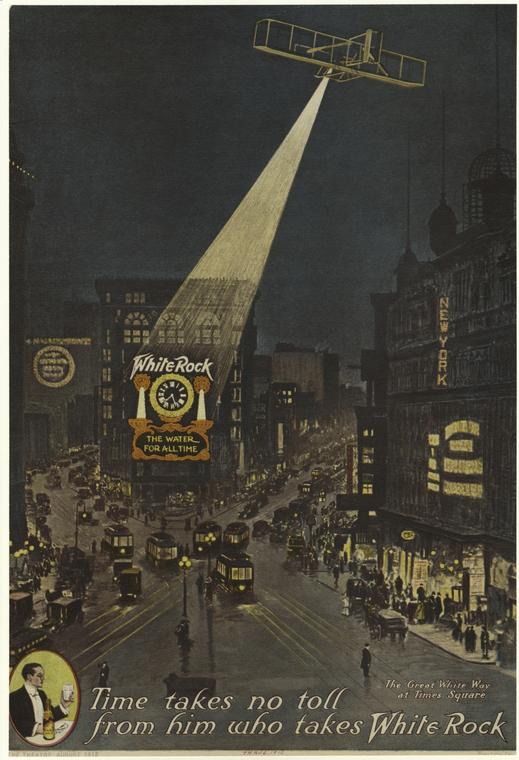
At right: Times Square in August 1912. The White Rock sign was probably not around for the February wind storm. The ‘electric boys’ sign described above sat at this intersection.

In Red Hook, Brooklyn, turbulent winds kept a raging fire alive at a brick manufacturing plant, distributing flaming pitch shrapnel to several buildings across the street, including a hay and horse feed dealership! (One of many reasons they don’t keep hay dealerships in crowded cities today.) The brick factory, which took several hours to control, was about three blocks from the location of today’s IKEA store.

February 22, 1912, happened to be the 180th anniversary of George Washington‘s birth, and hundreds of veterans tried marching from Jefferson Market to Union Square. Flags raised aloft in celebration were torn to ribbons. Nobody was injured, although the gusts caused major inconvenience, “Salvation Army object lessons and banner bearers bowled over by the wind.”  [source]

Others were not as fortunate. The Times attributed at least one death to the storm and over a dozen concussions from flying debris, messenger boys and seamstresses blown into windows or railings or hit by signs or dislodged cornices.

One man, waiting for his wife at St. Patrick’s Cathedral, had his neck slashed by flying glass. Where physical harm was avoided, humiliation took its place. A society woman on Riverside Drive, wearing “superabundantly costly furs,” was picked up and thrown into a horse.

Meanwhile, down at the Battery, Frank Coffyn was preparing for another takeoff off the water on his pontoon-equipped airplane. The wind had other plans, ripping the wings off the plane and spoiling Coffyn’s flight. Later that day, Coffyn wired his old boss Wilbur Wright for replacement parts. (See my previous post for more information of Coffyn’s harbor flights..)

By the late evening, winds had died down to a mere 44 miles per hour. (For comparison, New York City’s average wind speed today is just 12.2 miles per hour.) In the morning, things were back to normal — except for huge mess of metal and glass left scattered on the streets.

Categories
Know Your Mayors Politics and Protest

Mayor Aaron Clark: New York’s lottery king

New York City has a new mayor — Eric Adams! So we think it is time that you Know Your Mayors, becoming familiar with other men who’ve held the job, from the ultra-powerful to the political puppets, the most effective to the most useless leaders in New York City history.

This longtime feature of this website is being rebooted with new articles and newly researched and refreshed earlier entries in this series. Check back every other week for a new installment. Read past articles here.

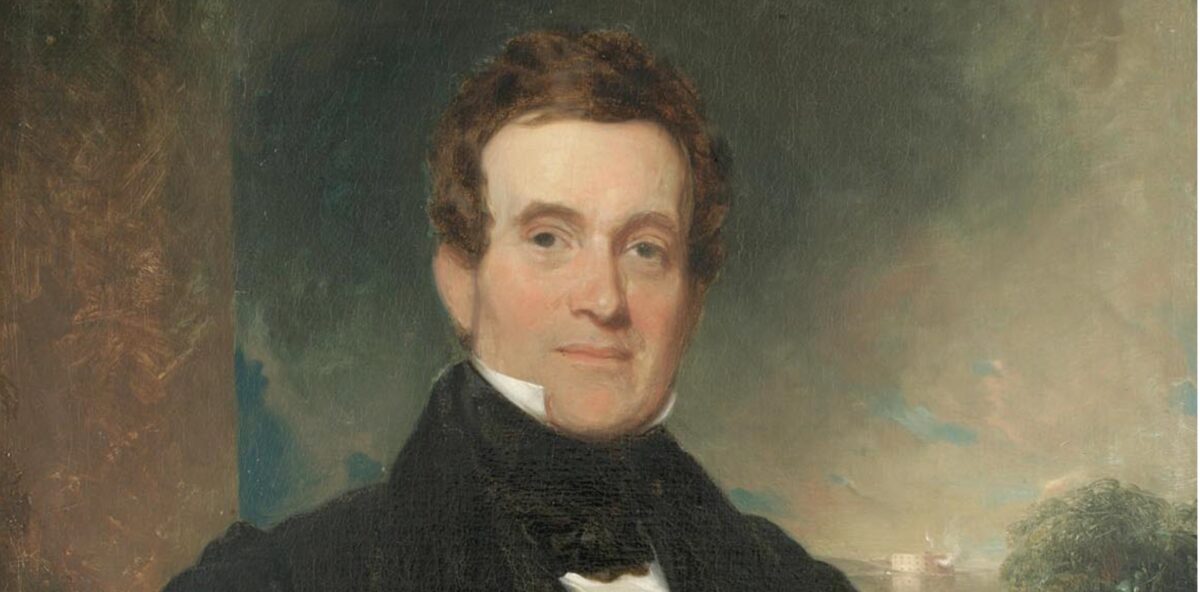
Mayor Aaron Clark
1837-1839 (two one-year terms)

Aaron Clark has many claims to fame in New York City history, none of them really things that recommend him as a defining leader of our city. His most defining characteristic was that he was often very lucky.

Clark is the first mayor ever elected representing the anti-Democrat, anti-Andrew Jackson Whig Party — a political party abolished less than 20 years after Clark’s victory.

He was known as the ‘Dancing Mayor’, which was not an accomplishment but a mockery.

He called himself the New York’s most prestigious lottery operator, which he considered an accomplishment but was perceived by some as a disqualification.

And finally he was elected amidst one of the worst financial crises in its history– the Panic of 1837.

Previously on ‘Know Your Mayors’

Clark, perhaps more honorably, was also the second man to ever be popularly elected as mayor of New York, i.e. chosen directly by the people of the city.

Previously, the position was selected by the Common Council (city council), district representatives who often chose men beholden to their whims.

When the state finally changed mayoral selection to one of popular election in 1834, the result caused violence at the polls and mass pandemonium. (See the last installment.) Cornelius Lawrence would come out ahead for three consecutive one-year terms.

Lawrence had been a candidate of Democratic machine Tammany Hall — with their influence, who else would be the first mayor? — but Democrats were facing strong opposition from an ascendent Whig party.

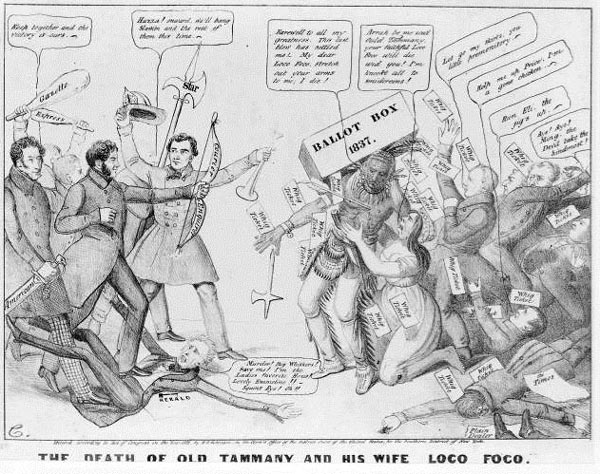
A rather dramatic illustration from 1837 of the Tammany Hall split. The Loco-Focos, in this case, are the wife. (Edward Williams Clay, The Death of Old Tammany and His Wife)

The Whigs and the Locos

In fact, the Whig candidate in 1834, Gulian Verplanck, very nearly won; the animosity between the Democrats and Whigs was so contentious that right before the election, Tammany thugs stormed their opponents headquarters, destroyed everything inside and even killed a man.

During Lawrence’s tenure, the Whigs remained strong as the Democrats got weaker.

In a situation which certainly has some reflection in current national events, Tammany was split between conservative and liberal factions (an ‘Equal Rights’ faction, as they called themselves).

During a Tammany meeting in 1835, the Equal Righters stormed a Tammany committee meeting loaded with conservative members and threw them out.

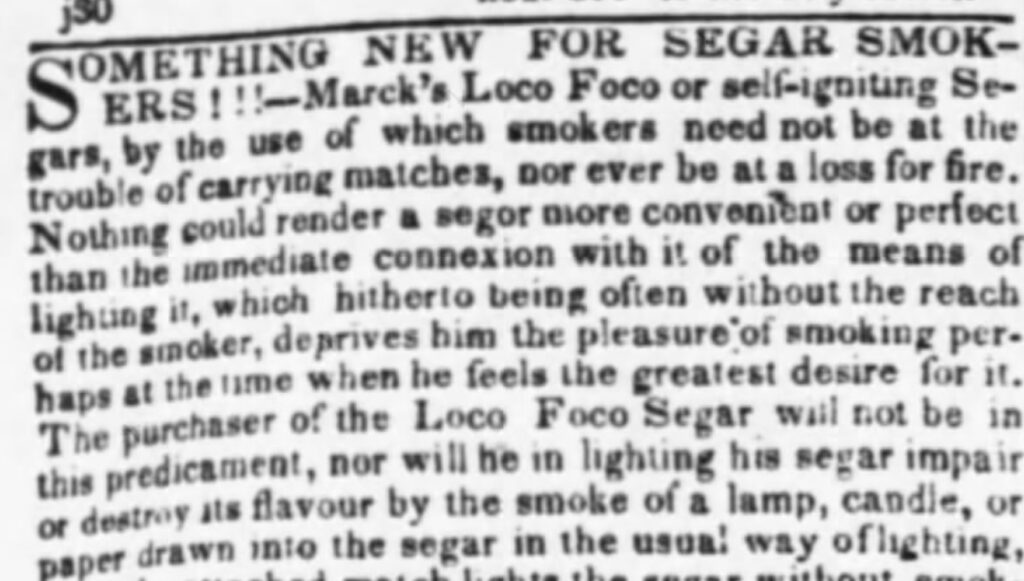
When the lights were turned out on the party-crashers, they lit Spanish matches or ‘loco-focos‘ and continued. The opposition, which would eventually run the conservatives right out of the party, would forever be known as the Locofocos. (For more on their particular beliefs, read here.)

How Luck Elected A Whig Mayor

So what does this have to do with Whig man Aaron Clark? At another period in history, Mr. Clark might never have gotten to experience life in City Hall.

But the dissention within the Democrats opened the door for the fleeting Whig party to reign briefly in New York. With that sort of luck, it’s no surprise to learn that Clark’s primary occupation up to then was as operator of a lottery business.

Privately-run lotteries were, believe it or not, quite common in early American history.

King’s College (today’s Columbia University) was founded with a lottery pool. A young P.T. Barnum operated one up in the 1820s. Benjamin Franklin and George Washington both held fund-raising lotteries in their day.

Even Alexander Hamilton opined that “everybody … will be willing to hazard a trifling sum for the chance of considerable gain.”

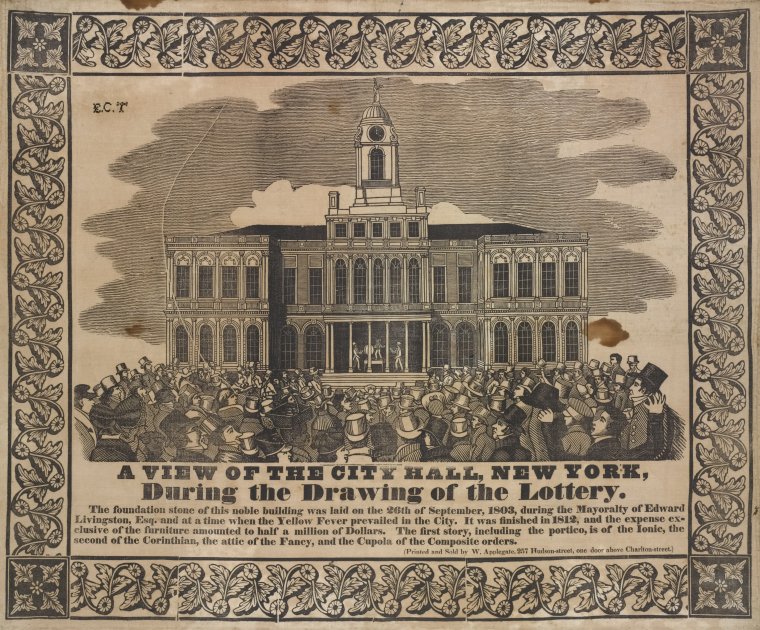
A view of the City Hall, New York, during the drawing of the lottery, New York Public Library

By the mid 19th century, private lotteries would be associated with more disreputable elements and would be abolished at the end of the century. Clark was thus a successful operator of an industry in the 1830s that would soon be looked upon as scandalous and unseemly.

However, in 1837, it was a highly regulated but legal trade. In Charles Haynes Haswell’s classic Reminiscenses of New York by an Octagenarian, Mr. Haswell writes:

As lotteries, under certain regulations as to the drawings, which were had upon the esplanade in front of the City Hall, in the presence of an alderman, were authorized by law, there were many offices in the city, notably one at the southwest corner of Broadway and Park Place* kept by Aaron Clark, a much reputed citizen.

*The Woolworth Building now stands on the spot where Clark’s business once stood.

“He was a great lottery seller and made a fortune of it,” says one source. A recollection from an 1890s New York Times article shortlists Clark as one of the “best known rich men” at the time.

Huzza for Clark, Fortune’s Favorite!

Clark was born in 1787 in Massachusetts, a veteran of the War of 1812, and spent his early years as a clerk of Albany state assembly.

He moved to New York to pursue banking and eventually fell into his lottery endeavors, becoming wealthy and, by extension, highly suitable for early 19th century public office. Clark was soon elected to an alderman’s seat, typically a neat launching pad into the mayor’s chair.

The Whigs announced him as their candidate in 1837 against the intensely split Democrats. Conservative Tammany ran John Jordan Morgan, while the Loco-Focos put up the interestingly named Moses Jacques, considered “the patriarchal leader of the Loco-Focos.”

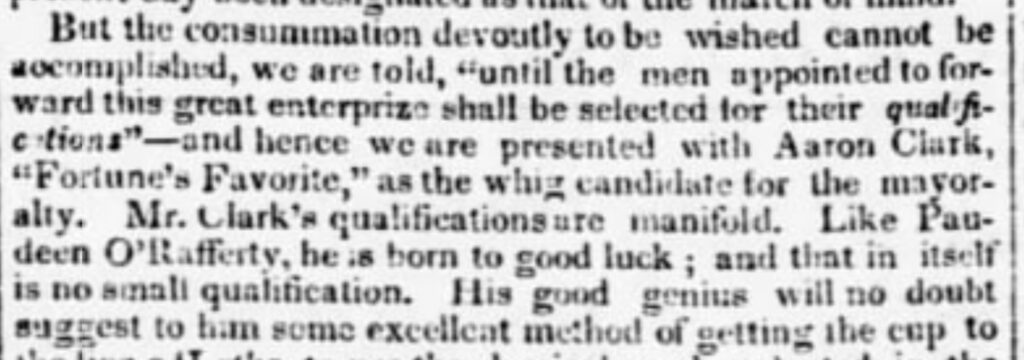
Clark’s opponents certainly tried to use his occupation against him. Wrote William Leggett : “If we elect Aaron Clark for Mayor who knows but he may get up some ‘splendid scheme’ and insure ‘a grand prize’ to everyman who assisted in making him manager of the municipal lottery. Huzza for Clark, Fortune’s Favorite!”

The Evening Post repeated this nickname — Fortune’s Favorite — March 1837.

However Morgan and Jacques cleaved the opposition in two, and for the first time in New York history, on April 11, 1837, a Whig became mayor.

He then would be re-elected in 1838 when Tammany’s conservatives threw their support to him out of spite towards their liberal LocoFoco brethren. (There was apparently a shocking amount of fraud going about that year, which also helped matters.)

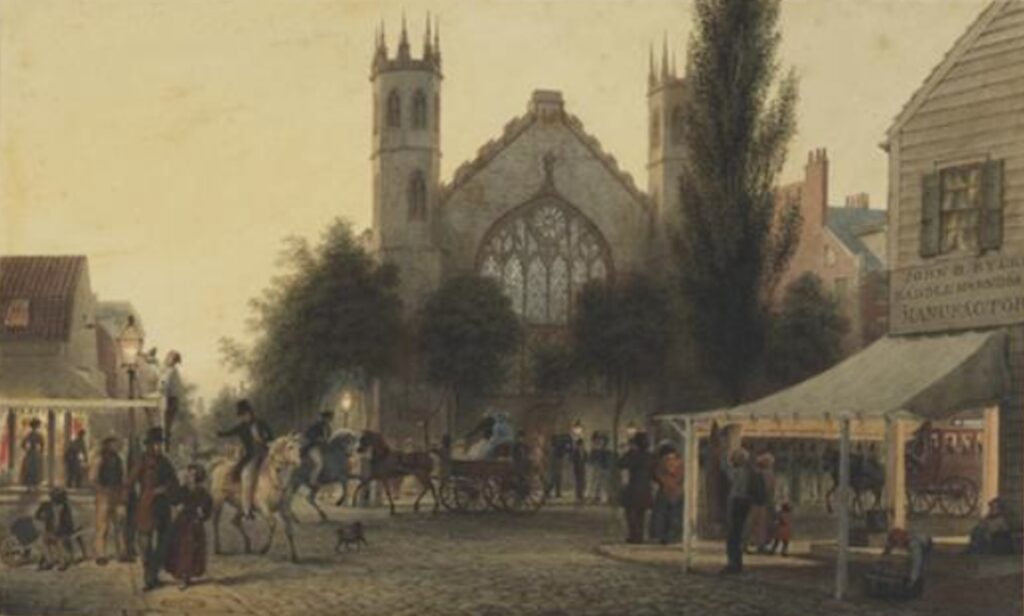
Night-fall. St. Thomas’ Church, Broadway, New York, a beautiful painting by George Harvey from 1837. (The Museum of the City of New York)

Fortune’s Favorite?

Clark was certainly the wrong mayor for the moment. He was an ardent Native American, meaning he generally despised the boatloads of Irish emptying into New York slums, driving “the native workmen to exile,” he said in a meeting to the Common Council.

His campaign was openly hostile to ‘clannish’, ‘untrustworthy’ Irishmen, and his tenure as mayor only stirred up xenophobic sentiments. He advocated for keeping new immigrants on ships, directing them away from city and charging them ‘commutation fees’ of $10.

Clark aimed his racial paranoia at the lower classes at large, fearing that the charity organizations already in place were turning the city “into a rendez-voux of beggars, paupers, vagrants and mischievous persons,” according to the book Gotham.

One general benefit of this alarming hysteria was an improvement to the system of nightwatchmen and security patrols throughout the city, a “military arm” to assuage rioting and general chaos. Clark was no light-weight; he would frequently lead these local militias through the city himself, breaking up rabble-rousing groups.

The Unfortunate Fop

Most unfortunately, however, Clark’s charms were limited. His attempts to woo over New York’s elite in a series of parties at his home on Broadway and Leonard Street fell flat.

This type of social governance was a winning recipe for mayors like the honorable Philip Hone. As mentioned in a prior installment of this column, Hone’s parlor “hosted a nightly gallery of political and foreign dignitaries mixing it up with New York’s social strata.”

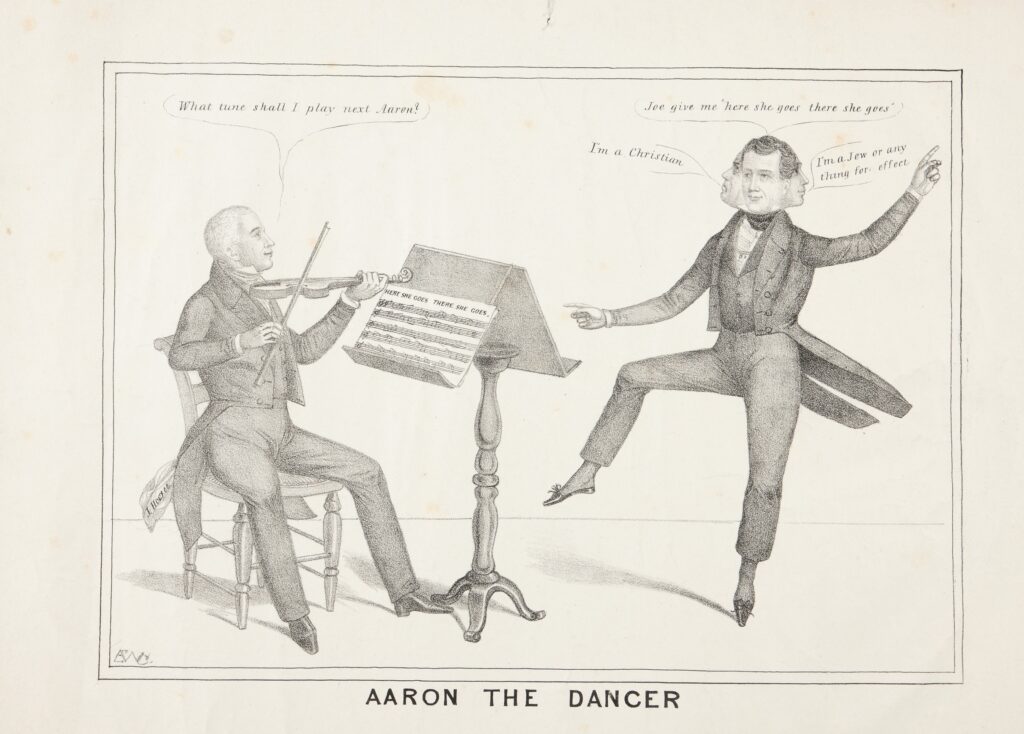
Clark, however, was roundly ridiculed for attempting such grand ‘entertainments’. In fact, in an early form of political snark, Clark was ironically called ‘the Dancing Mayor’, not for his graces assumably or even the class of his “splendid patent leather pumps” but for his pretensions of trying too hard.

Also on his watch, the Croton Aqueduct continued apace although its workers went on strike not once but twice in 1838 for better wages.

The Great Embarrassment

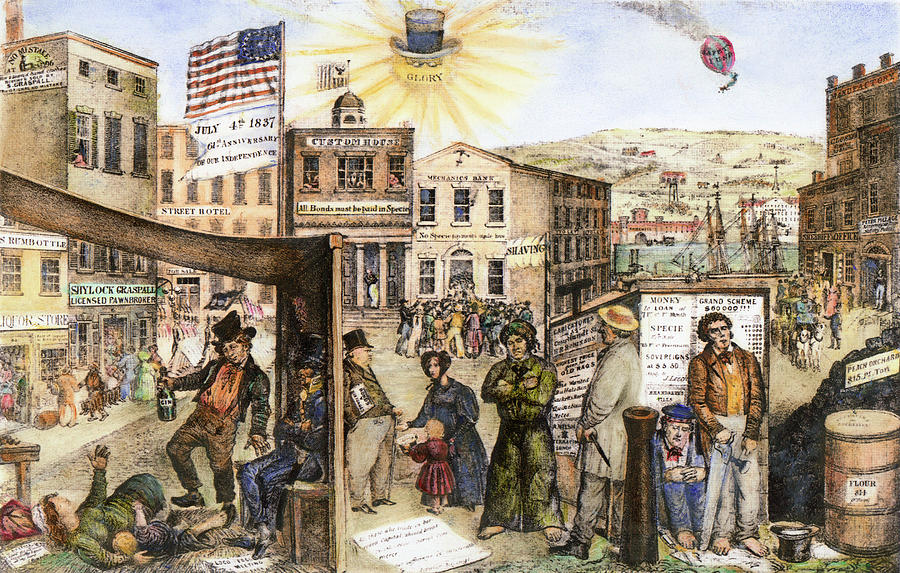
He also governed the city through the beginning of a grueling financial crisis, known today as the Panic of 1837.

Not even a month into Clark’s first term, on May 10, 1837, New York City banks ran out of gold and silver, having loaned out too much due to months of high inflation. President Jackson had hollowed out the central bank and refused to recharter it, leading to bank collapses across the country.

“During the Panic of 1837, approximately ten percent of U.S. workers were unemployed at any one time. Mobs in New York City raided warehouses to secure food to eat. Prominent businessmen, like Arthur Tappan, lost everything.” [source]

The Panic froze real estate developments across the city. Construction projects in Union Square and Gramercy Park sat unfinished.

“A deadly calm pervades this lately flourishing city,” wrote former mayor Philip Hone in his diary. “No goods are selling, no business stirring, no boxes encumber the sidewalks of Pearl Street.”
A Different Kind of Prize

It became clear that Clark was out of his depth. Two years of a Whig in office — with the tide of immigrants hardly abating — was quite enough.

In the election of 1839, Tammany put up Isaac Varian, who had been defeated the year previous by his political machine’s fractious split. Despite the usual cries of fraud, in this round Varian was the victor. Clark’s luck, if that’s ever what it was, had run out.

Clark left public life afterwards, dabbling in real estate and insurance enterprises, most notably becoming a supporter of Hamilton College in Clinton, New York. Since 1859, the school has presented an oratory prize in his name.

During its first year, The Clark Prize had eight competitors. “It is expected that the exercises will be unusually interesting and attractive,” claimed one article.

When Clark died in 1861, he was buried right here in the city, at the old New York Marble Cemetery in the East Village. The gates to this historic burial ground are occasionally opened to the public so I recommend bringing a lottery ticket to his headstone.

Categories
Planes Trains and Automobiles

A city of bridges: One century ago, Scientific American predicted a future of elevated sidewalks

sci

Imagine a city where the High Line isn’t just a novel park, but the primary form of urban conveyance.

In 1913, with the proliferation of the automobile, it seemed humans were being crowded out at ground level.  People were beginning to think of themselves as removed from the street.  Daredevils were experimenting with flight, and small, single-man crafts began appearing over the skies of Manhattan.  The world’s tallest building, the Woolworth Building, had been completed a few months before.  Perhaps the streets themselves could elevate, granting pedestrians a space of their own?

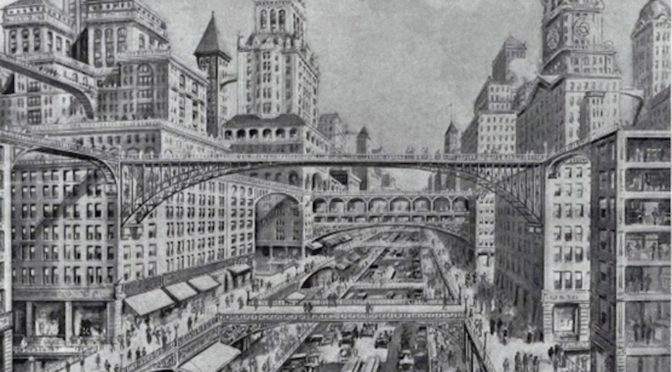
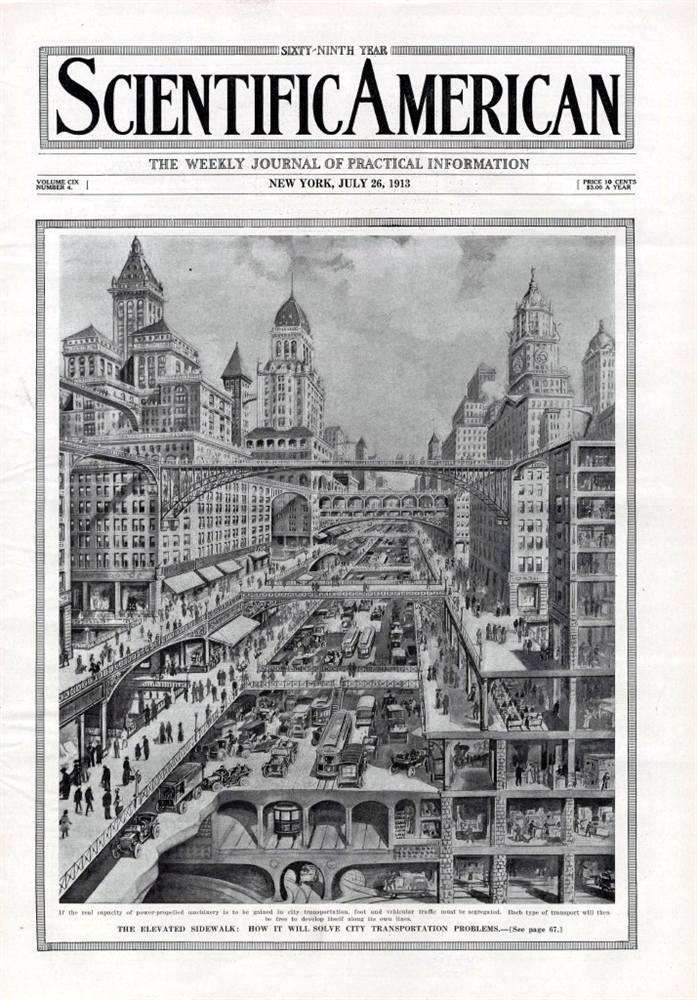
Scientific American suggested the possibilities of a city of elevated layers in its July 26, 1913 issue. “The Elevated Sidewalk: How It Will Solve City Transportation Problems,” written by engineer and science writer Henry Harrison Suplee, posits that humans and automobiles are simply incompatible and opposing engines upon ground level, and that one will have to give way to the other.

“One of the greatest impediments to city transport today is the continuance of the obsolete method of attempting to conduct foot and vehicular traffic upon the same highways.”

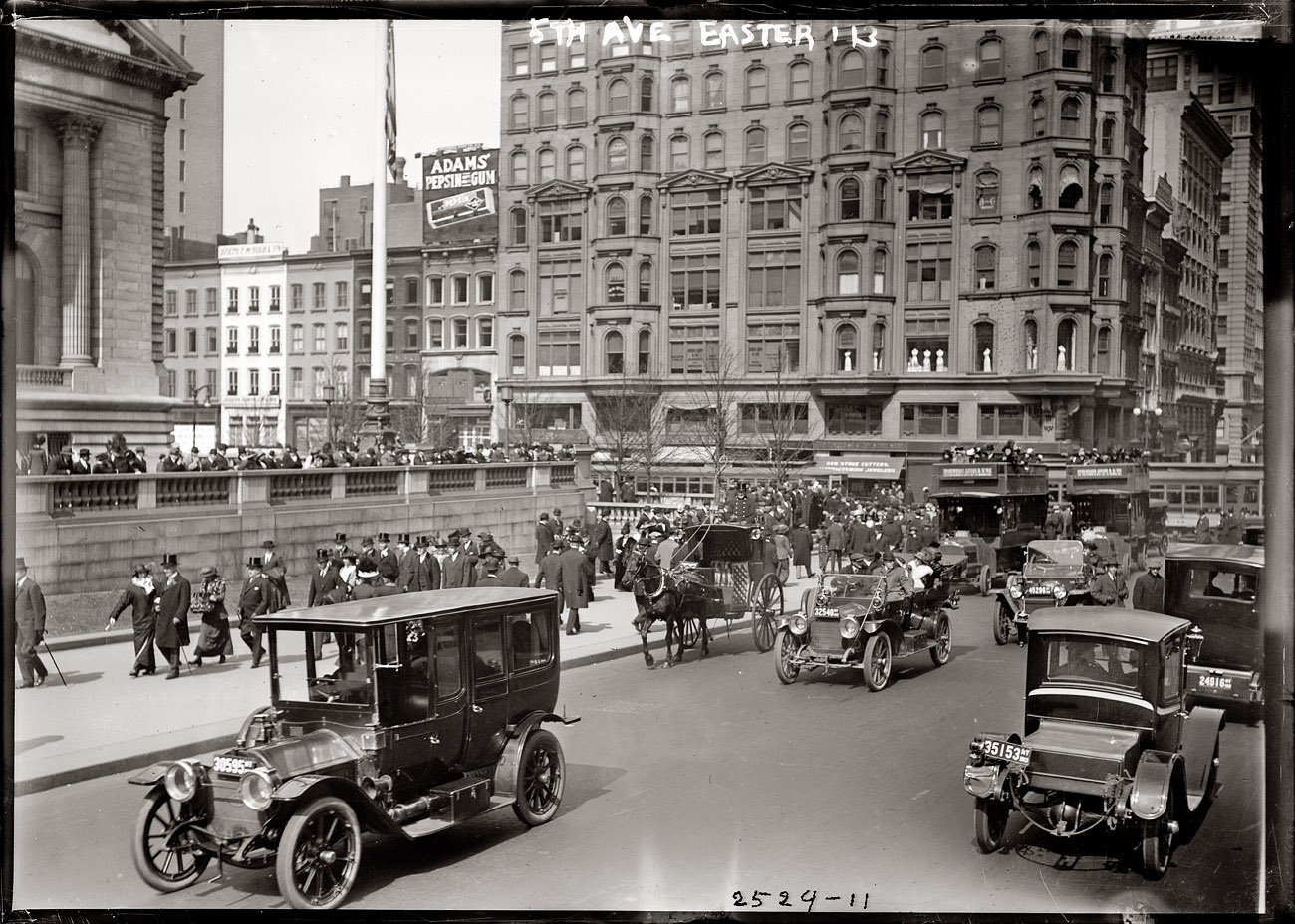
Below: Cars and people seem to co-exist peacefully on Fifth Avenue (pictured here in 1913). But, darn it, automobiles are meant to go fast! 

Courtesy Shorpy
Courtesy Shorpy

After all, cars are meant to go fast.  “In nearly every large city today there appears a tendency to enforce traffic regulations intended to permit the most conflicting elements to be operated together and the result is naturally the impeding of the very traffic which it is desired to help.”

By keeping people and automobiles on the same plane, one risks lives, sure, but more importantly, it slows progress by keeping the potential of auto motion on a short leash.

Suplee’s solution: “Take the foot passengers off the surface of the street entirely, and leave the highways solely for vehicles!”

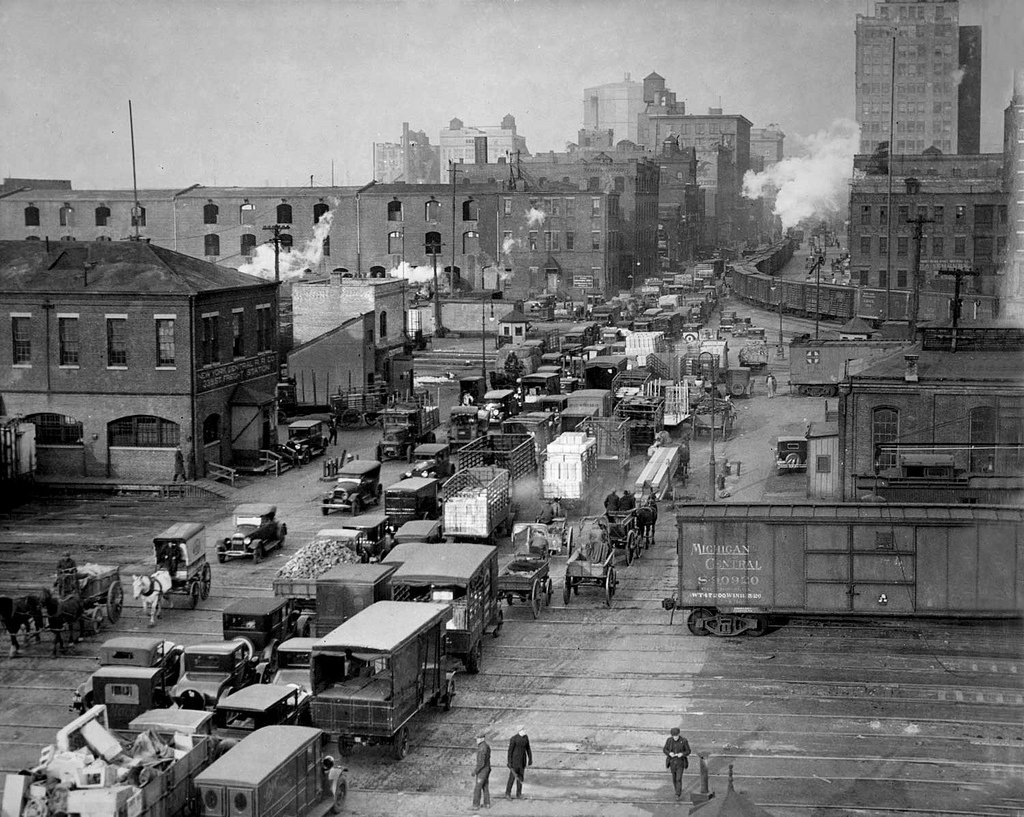
Below: Evidence of the incompatibility of foot and automobile was being amply displayed all over New York City, most notably on “Death Avenue,” the trecherous tangle of roads on Manhattan’s West Side. Eventually the elevated freight railroad today known as the High Line was built to relieve this issue.

death-ave-thehighline-org


New York had many precedents for this.  The great passages over the East River (the Brooklyn, the Williamsburg and Manhattan bridges) had all been completed with elevated pathways for pedestrians, situated over or alongside those paths for vehicular traffic.  Trains were either elevated overhead along the avenues, or buried underneath the ground.

Suplee doesn’t imagine a world were pedestrians become smarter, or any type of place with sophisticated traffic lights or crosswalks.  Instead, elevated sidewalks would hover over the major thoroughfares; “[S]uch sidewalks might be built on Broadway from the Battery to Union Square, there sloping down to the surface level until further extensions were required,” he writes.

In a city of skyscrapers, bridges could be constructed several stories above the street.  Store fronts would appear on the second or third floors, while the ground floor would be exclusively used for delivery and store.  Life would essentially reside many feet above the ground.

Bicycles figure nowhere in his model, but he does carve out one exception to his pedestrian only level.  “The power vehicles should be kept absolutely to the surface, and there given unrestricted facilities for speed, weight, and numbers; and the foot levels maintained for absolute freedom for pedestrians, with the possible exception of carriages for small children.”

As commenter Boris mentions below, while New York City never adhered to this suggestion, other cities certain did — to a certain extent.

You can read Mr. Suplee’s article here.

(A shorter version of this blog post originally ran June 2013)

Categories
Landmarks Podcasts

Battle for the New York City Skyline: How Tall Can It Go?

PODCAST The story of growing tall in New York City and the two pivotal laws that allowed for the city’s dynamic, constantly evolving skyline.

This year is the 100th anniversary of one of the most important laws ever passed in New York City — the 1916 Zoning Law which dictated the rules for building big and tall in the city. So we thought we’d take this opportunity to ponder on the many changes to New York’s beautiful skyline via the unique technical changes to construction rules.

Why are areas of lower Manhattan darkened canyons, and why are there huge public plazas inside buildings in Midtown? Why do older buildings have graceful and elegant set-backs but newer structures feel like monoliths from 2001: A Space Odyssey? This is a layman’s history of building tall — our apologizes to architects for simplifying such sophisticated concepts — and the important laws that changed the face of NYC forever.

PLUS: This is our craziest podcast yet. We’ve decided — as our 199th episode — to hit the road! This entire show is recorded outside in front of the very spots that have most affected the city’s decision. From downtown Manhattan and the Equitable Building to a surprising corner of Hell’s Kitchen.


The Bowery Boys: New York City History podcast is brought to you …. by you!

We are now producing a new Bowery Boys podcast every two weeks. We’re also looking to improve the show in other ways and expand in other ways as well — through publishing, social media, live events and other forms of media. But we can only do this with your help!

We are now a member of Patreon, a patronage platform where you can support your favorite content creators for as little as a $1 a month.

Please visit our page on Patreon and watch a short video of us recording the show and talking about our expansion plans. If you’d like to help out, there are five different pledge levels (and with clever names too — Mannahatta, New Amsterdam, Five Points, Gilded Age, Jazz Age and Empire State). Check them out and consider being a sponsor.

We greatly appreciate our listeners and readers and thank you for joining us on this journey so far. And the best is yet to come!


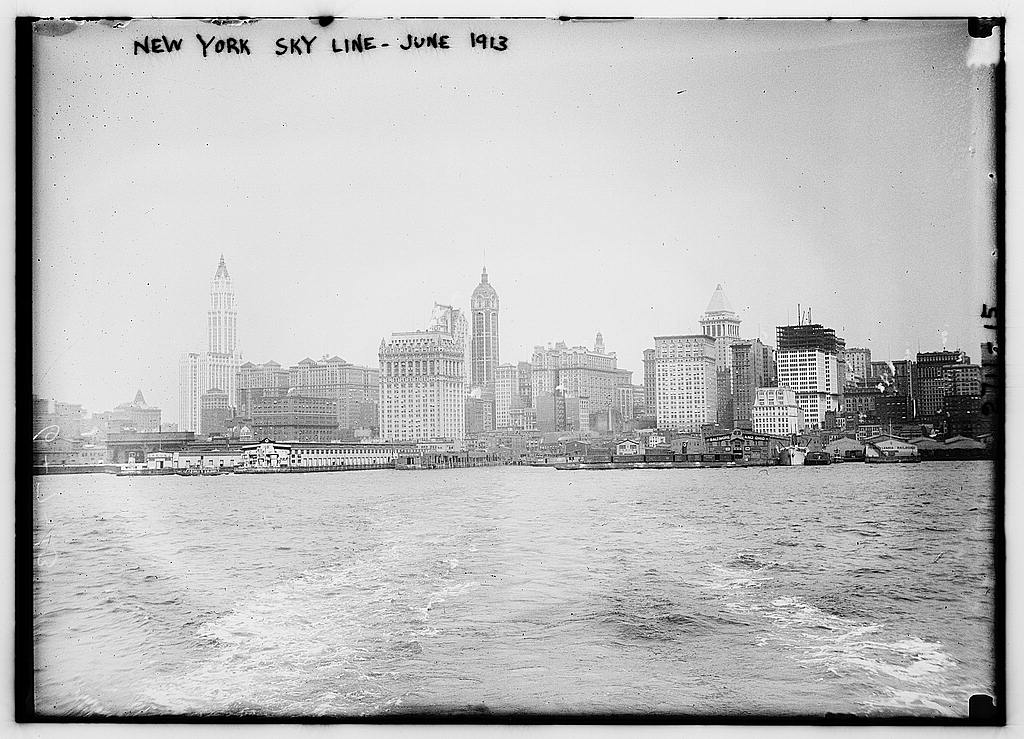
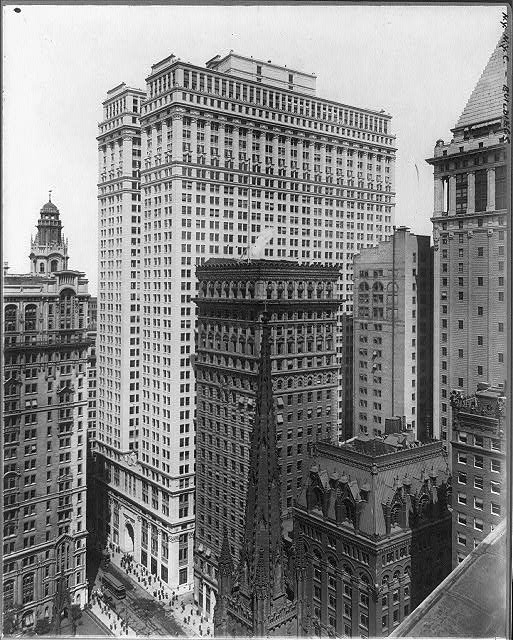
The New York skyline circa 1913 with the newly built Woolworth Building. None of these structures were constructed with a mandated setback.

Library of Congress
Library of Congress

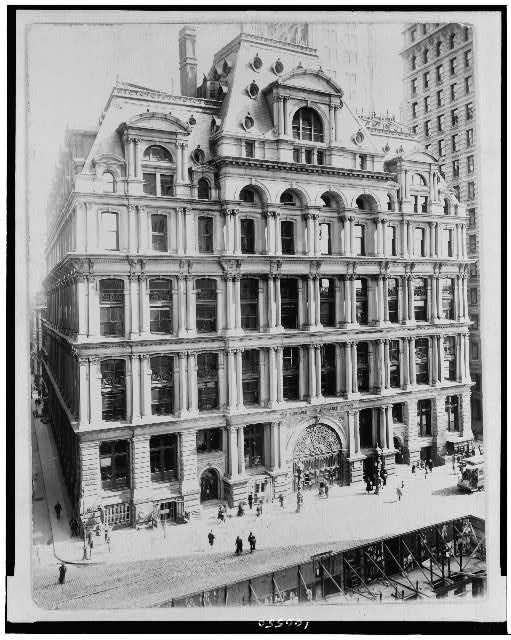
The first Equitable Building, constructed in 1870 (and seen here in 1906), considered New York’s first skyscraper.

Library of Congress
Library of Congress

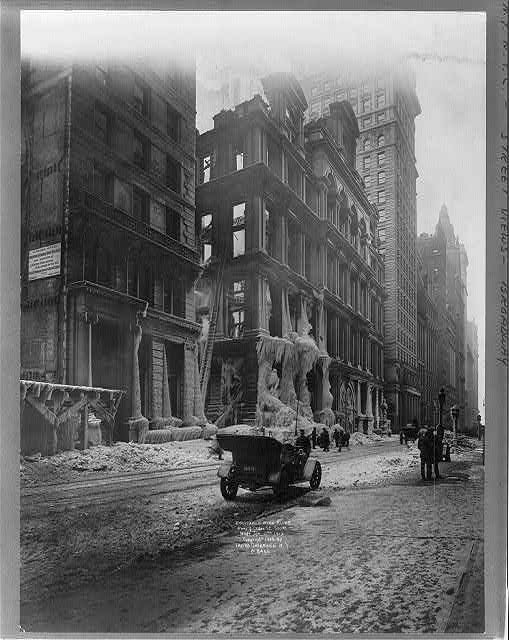
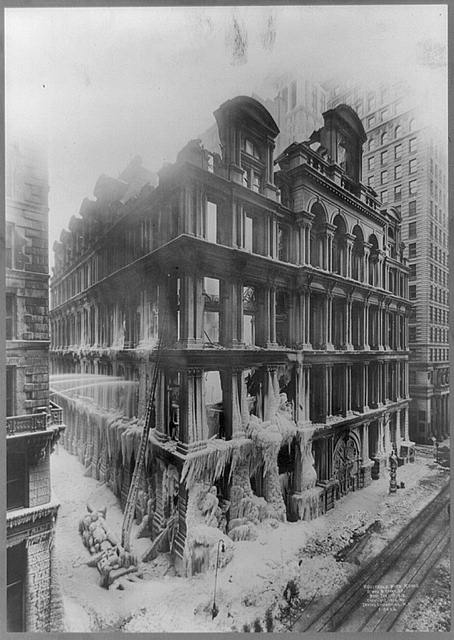
The Equitable was destroyed in a dramatic fire on a cold January 9, 1912.

Library of Congress
Library of Congress

3

The new Equitable Building was a monster of a bulky skyscraper, casting dark shadows onto the surrounding buildings.

Library of Congress
Library of Congress

This image is the property of The New York Public Library. For each use, you must contact: The New York Public Library, Photographic Services & Permissions, Room 103, 476 Fifth Avenue, New York, NY 10018; 212-930-0091, fax: 212-930-0533, email: permissions@nypl.org. Using an image from The New York Public Library for publication without payment of use fees and official written permission is strictly prohibited.
Courtesy The New York Public Library.
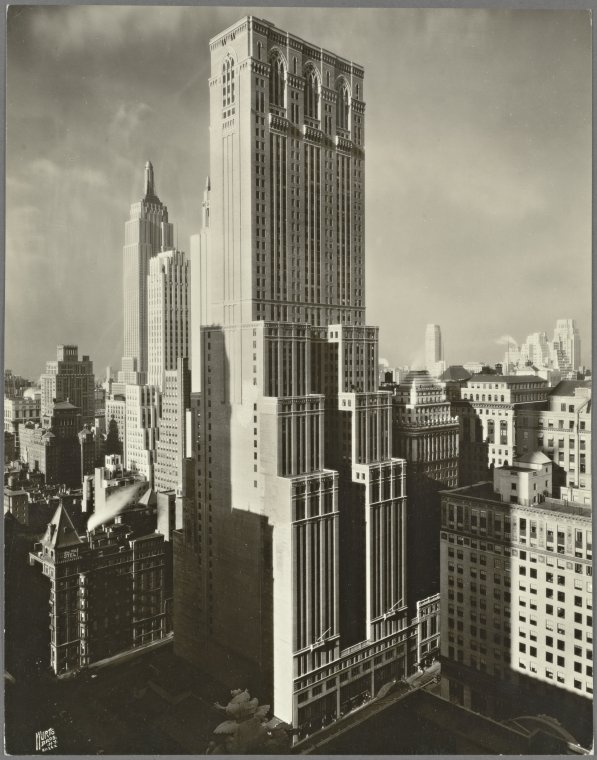
Midtown Manhattan was a sea of setbacks by the late 1930s. (Photo by the Wurts Brothers)
New York Public Library

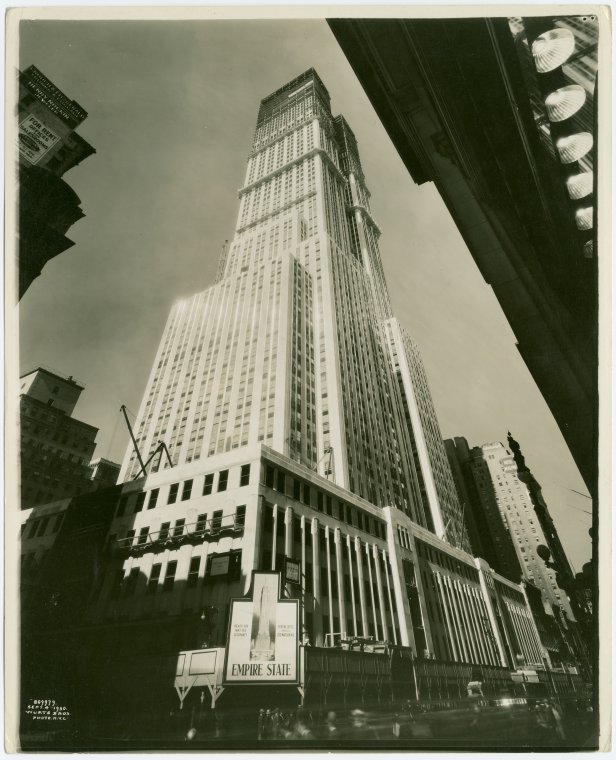
The Empire State Building under construction. From this angle, the dramatic effect of the setbacks can be seen. (Photo by the Wurts Brothers.)

NYPL
NYPL

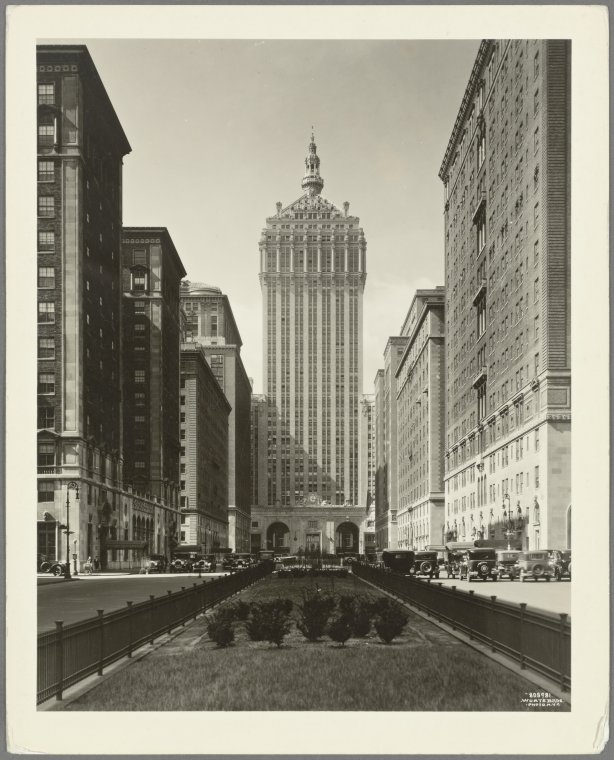
How Park Avenue looked before the arrival of the Lever House. Photo by the Wurts Brothers

NYPL
NYPL

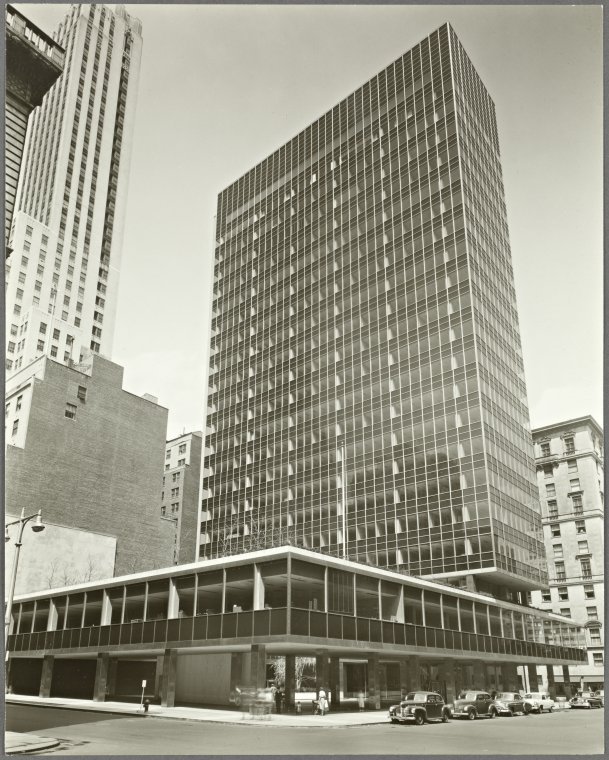
The Lever House transformed the area of Park Avenue with its unique approach to the 1916 zoning laws. (Photo from 1952)

NYPL
NYPL

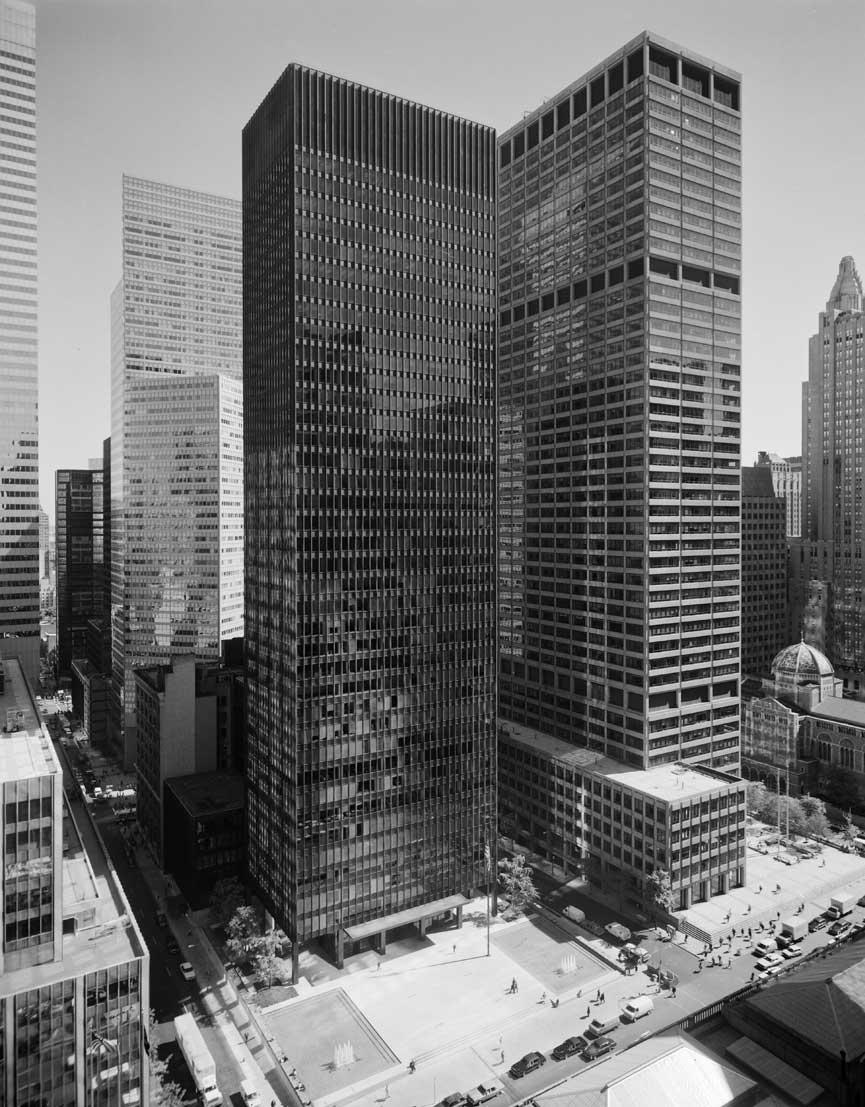
The Seagram Building, completed in 1958, is the very best example of the glass-curtain style monolith, More excellent pictures of this classic skyscraper at their website.

Courtesy 375 Park Avenue

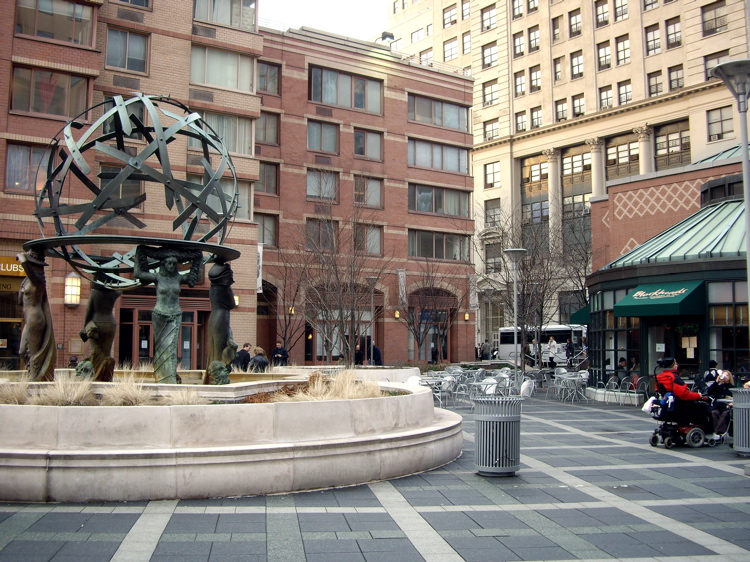
The courtyard at Worldwide Plaza, a massive office/residential complex completed in 1989.

Courtesy Wikimedia
Courtesy Wikimedia
Categories
Podcasts Skyscrapers

The Tallest Building In New York: A Short History


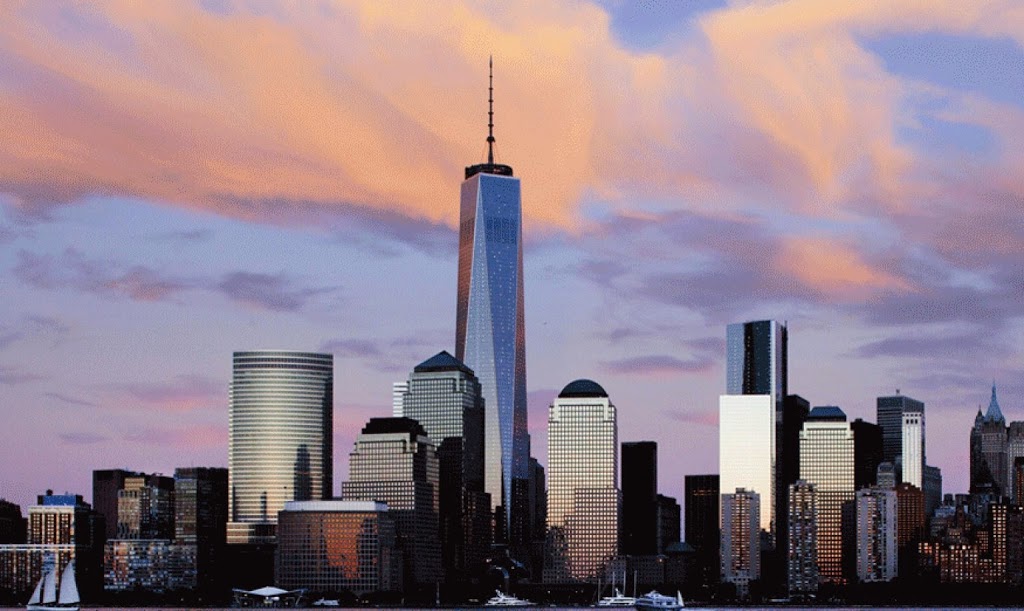
PODCAST One World Trade Center was declared last year the tallest building in America, but it’s a very different structure from the other skyscrapers who have once held that title. In New York, owning the tallest building has often been like possessing a valuable trophy, a symbol of commercial and social superiority. In a city driven by commerce, size matters.

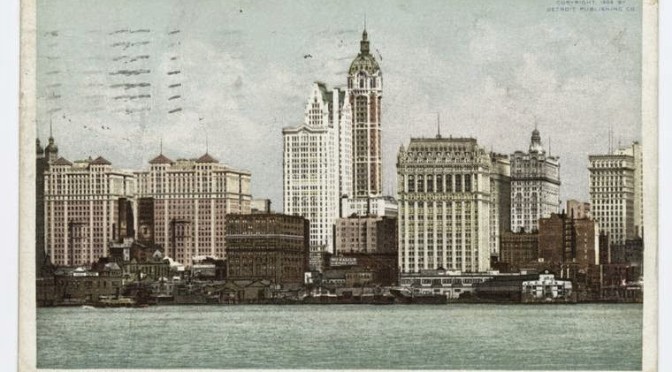
In this special show, I give you a rundown of the history of being tall in New York City, short profiles of the 12 structures (11 skyscrapers and one church!) that have held this title.  In several cases, these weren’t just the tallest buildings in the city; they were the tallest in the world.

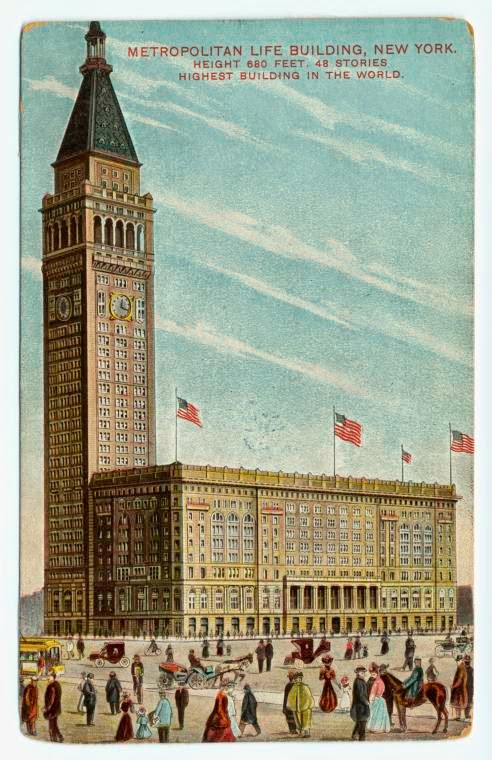
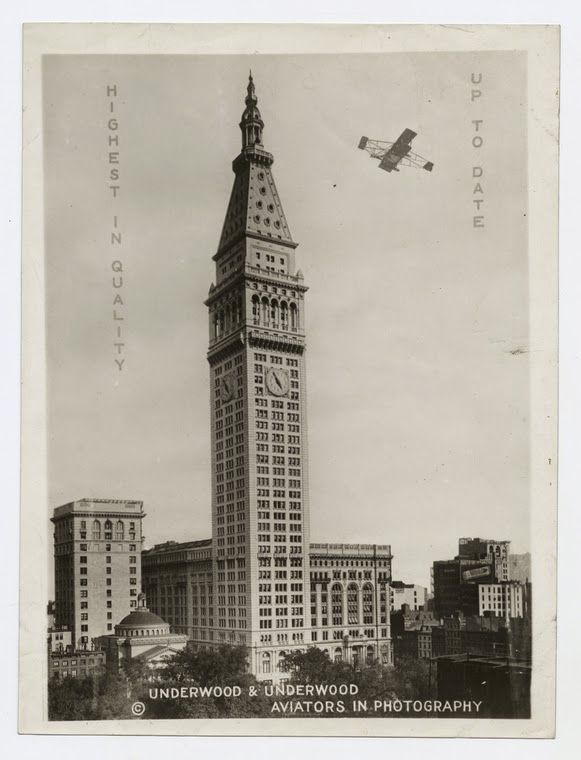
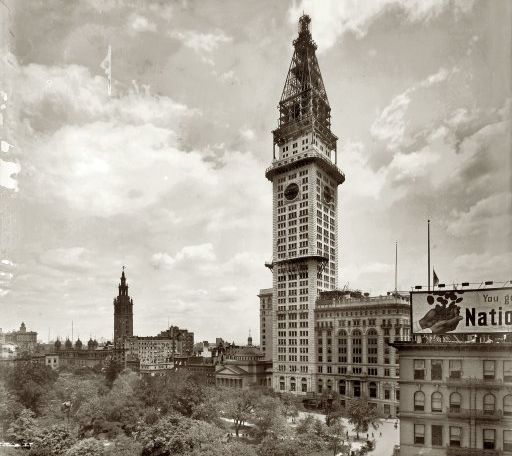
At right: The Metropolitan Life Building, the tallest building in the world in 1909

Skyscrapers were not always well received.  New York’s tallest building in 1899 was derisively referred to as a “horned monster.”  Lower Manhattan became defined by this particular kind of structure, creating a canyon of claustrophobic, darkened streets.  But a new destination for these sorts of spectacular towers beckoned in the 1920s — 42nd Street.

You’ll be familiar with a great number of these — the Woolworth, the Chrysler, the Empire State.  But in the early days of skyscrapers, an odd assortment of buildings took the crown as New York’s tallest, from the vanity project of a newspaper publisher to a turtle-like tower made for a sewing machine company.

At stake in the race for the tallest is dominance in the New York City skyline.  With brand new towers popping up now all over the five boroughs, should be worried that they’ll overshadow the classics? Or should the skyline always be in a constant state of flux?

ALSO: New York’s very first tall buildings and the ominous purpose they were used for during the Revolutionary War!


Photo courtesy Huffington Post

The current tallest buildings in New York City (as of 2020) are

1) One World Trade Center — 1,776 feet
2) Central Park Tower (225 West 57th Street) — 1,550 feet
3) 111 West 57th Street — 1,428 feet
4) One Vanderbilt — 1,401 feet
5) 432 Park Avenue — 1,394 feet
6) 30 Hudson Yards — 1,268 feet
7) Empire State Building — 1,250 feet
8) Bank of America Tower — 1,200 feet
9) Three World Trade Center — 1,171 feet
10) 53W53 (MoMA Tower) — 1,050 feet
11 tie) Chrysler Building — 1,046 feet
11 tie) New York Times Tower — 1,046 feet
12) One57 — 1,005 feet

Statistics courtesy Property Nest


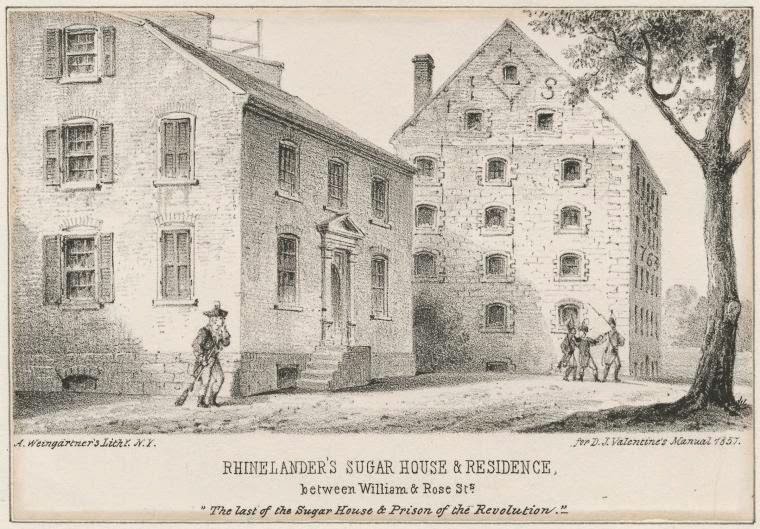
The sugar houses owned by the Rhinelander family. Others owned by the Van Cortlandts and the Livingstons would have all been the tallest structures in the city.

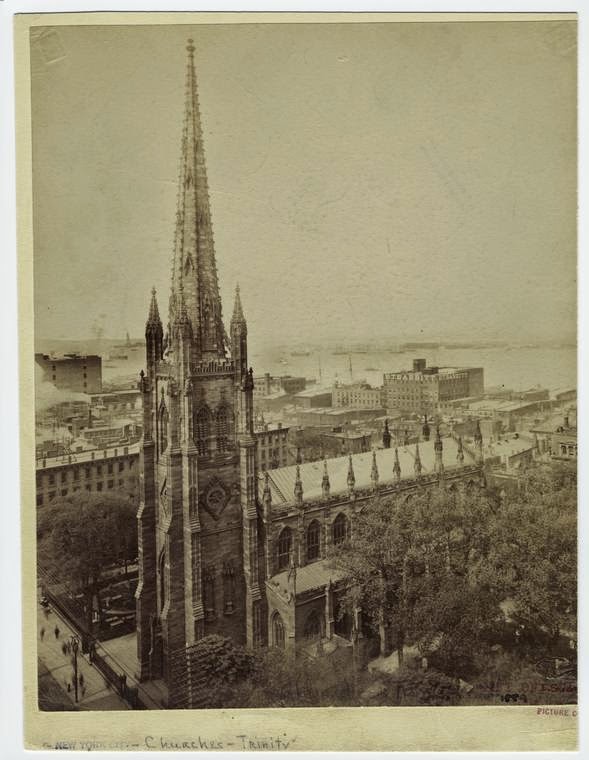
Trinity Church in 1889, the final year that it was the tallest permanent structure in New York City. (NYPL)

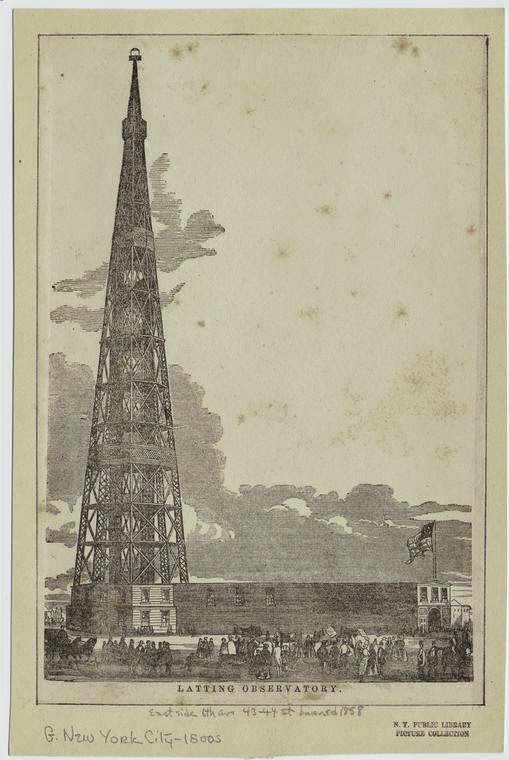
Trinity would be unparalleled in the New York skyline by any permanent buildings for almost 46 years.  But the Latting Observatory at the Crystal Palace Exhibition for a short time allowed New Yorkers the highest vantage on the island.

Joseph Pulitzer’s New York World Building, in context with its surroundings, including its proximity to the Brooklyn Bridge. This location would be its undoing, as the building was demolished later to make way for an automobile ramp. (Courtesy Rotograph Project)

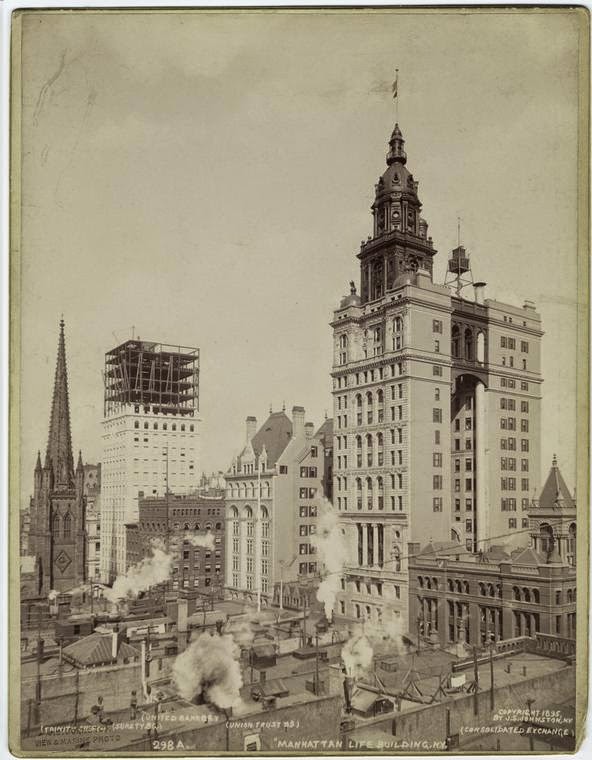
The Manhattan Life Insurance Building became a new neighbor for Trinity Church in 1894.  Its lantern top served as a lighthouse and an office for the New York Weather Bureau. (NYPL)

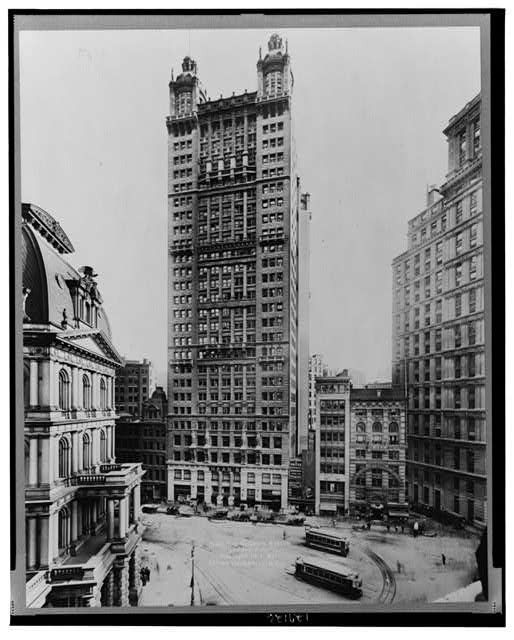
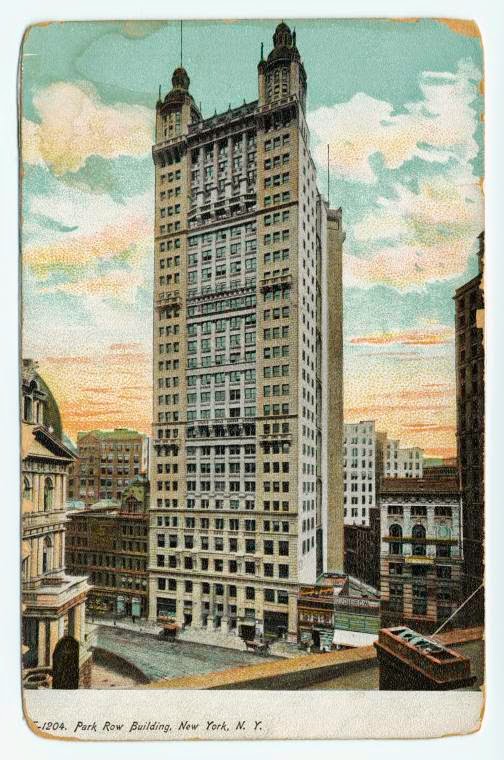
The Park Row Building, the original ‘twin towers’ of lower Manhattan, was criticized for its two-dimensional design but it’s managed to survive into modern times.  It used to host J&R Music World on its ground floor until that business closed last year.

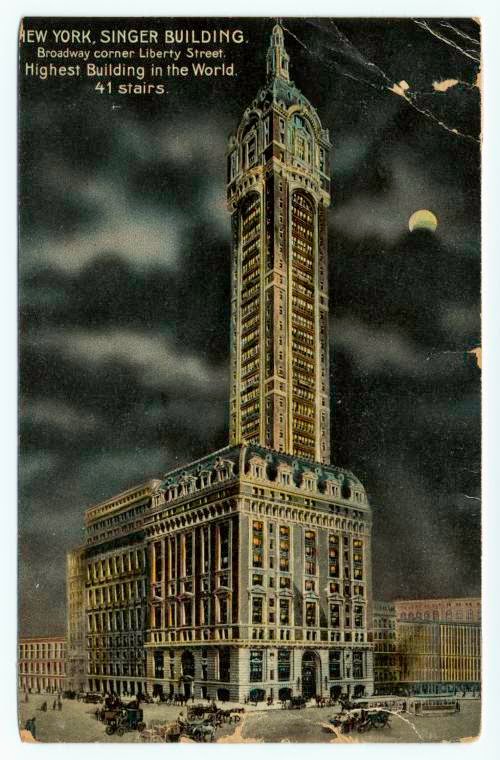
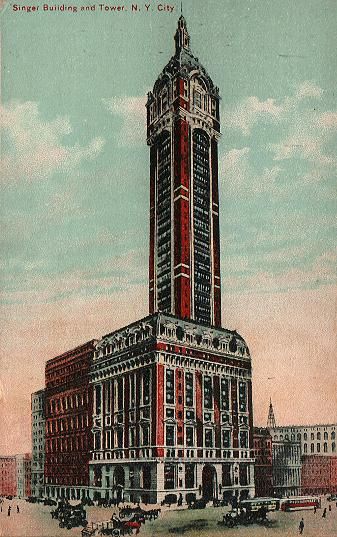
The extraordinarily unusual headquarters for the Singer Sewing Machine Company.  The Singer Building has the rare distinction of being the tallest building every purposefully torn down when it was demolished in the 1960s.

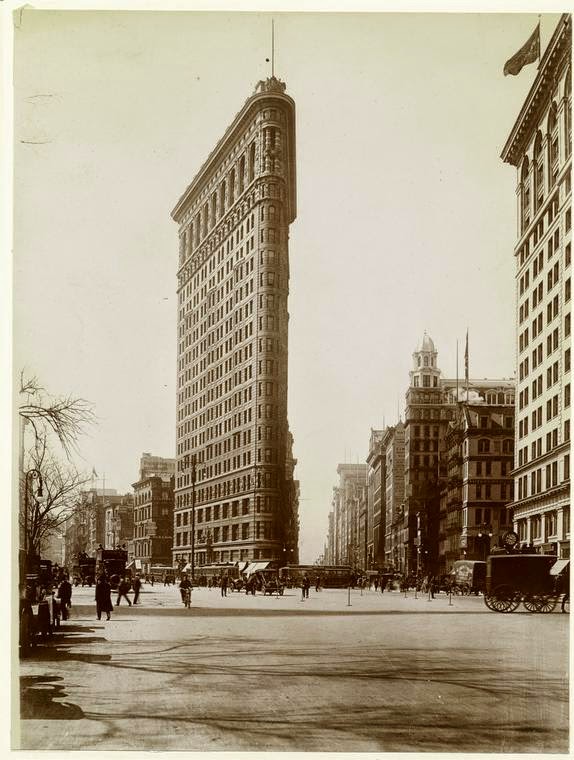
Madison Square was already graced with both the Flatiron Building (below) and Madison Square Garden when it finally got its tallest skyscraper….. (NYPL)

…the Metropolitan Life Insurance Tower, pictured here with an early airplane above it, in a postcard produced by Underwood & Underwood. (NYPL)

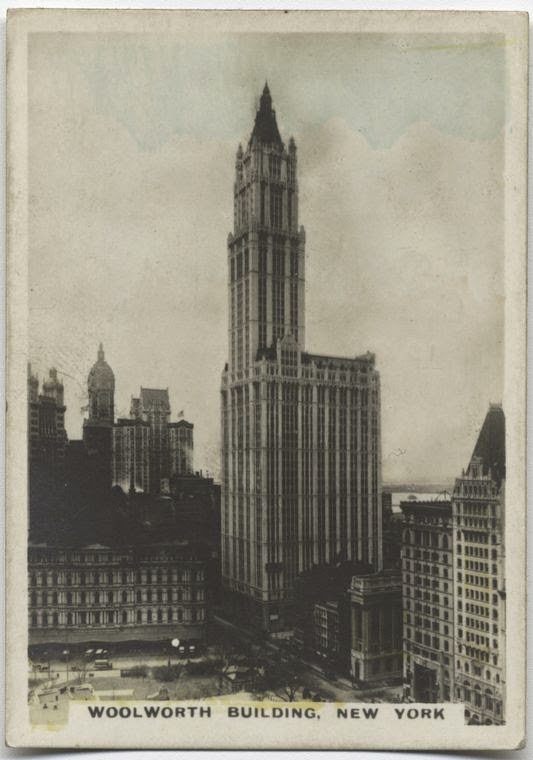
The Woolworth Building (featured here on a cigarette card) is one of the greatest extant examples of pre-zoning law construction with no setbacks along the front side.

 
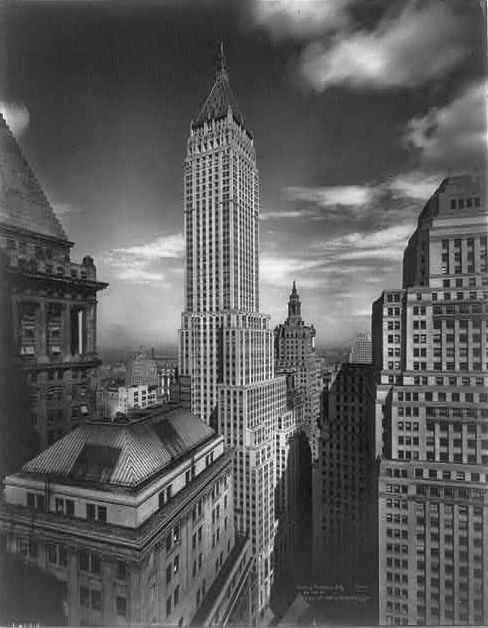
The Manhattan Company Building (or 40 Wall Street) sat among a host of other skyscrapers and was only briefly the city’s tallest building until Walter Chrysler and William Van Alen debuted their surprise uptown.
 

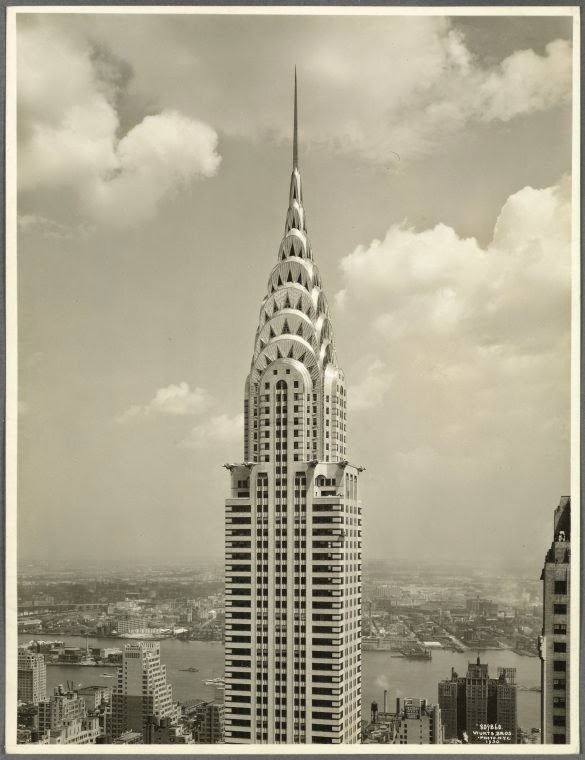
The Chrysler Building in 1930 with its spire freshly attached to the top, making it (for a little over a year) the tallest building in the world.

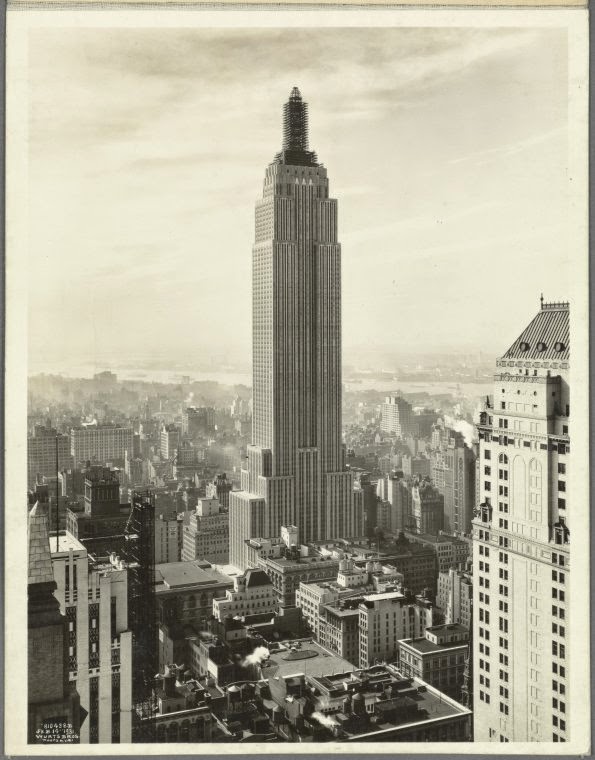
The Empire State Building became the tallest building — and the defining symbol of New York City — thanks to a determined executive from General Motors and Al Smith, the former governor of New York.

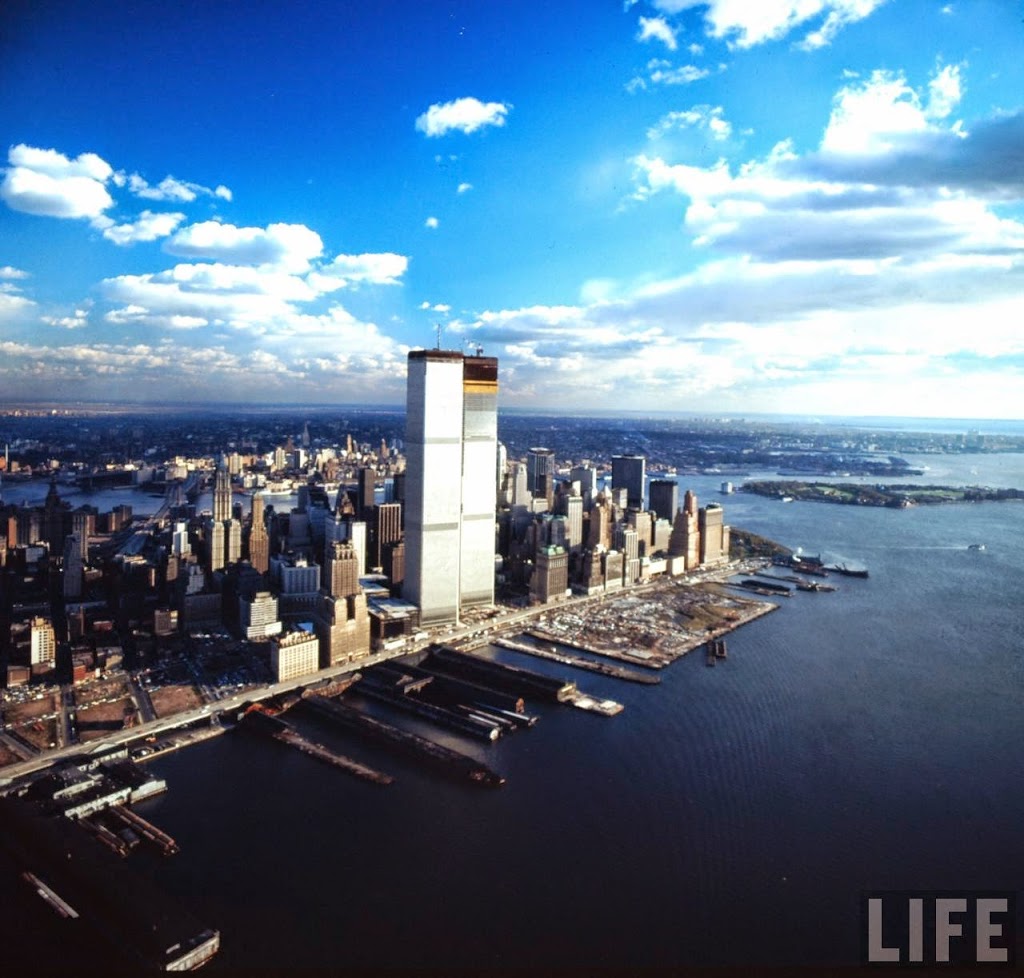
The World Trade Center returned attention to lower Manhattan and set a new record for height, literally leaving other former record holders in its shadow. (Photo courtesy Life Magazine)

SOURCES and RECOMMENDED READING

AIA Guide To New York City 2014
Empire State Building: The Making Of A Landmark — John Tauranac
Higher: A Historic Race to the Sky and the Making of a City — Neal Bascomb
Manhattan Manners — M. Christine Boyer
Pulitzer: A Life In Politics, Print and Power — James McGrath Morris
Rise of the New York Skyscraper — Sarah Bradford Landau
Skyscrapers:A Social History of the Very Tall Building In America — George H. Douglas
Supreme City — Donald Miller
and resources from the Landmark Preservation Commission and the New York Skyscraper Museum

Pictures courtesy New York Public Library

Categories
Landmarks

The Astor House came tumbling down one century ago

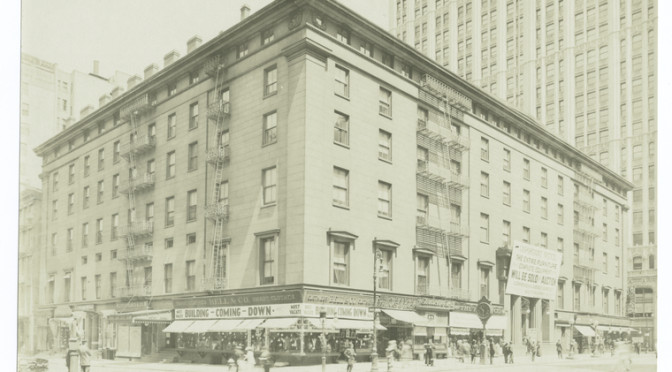
The Astor House was New York City’s first great hotel, opened in 1836 by John Jacob Astor himself, a premier accommodation for the city throughout the 19th century.  But by 1913, it was time to tear it down.

It was a symbolic moment for many older New Yorkers.  As you can tell from the image above, the ancient hotel had a new neighbor:  the Woolworth Building, a symbol of the ‘new’ New York City.  As dozens of more modern hotels opened uptown, the old Astor was greatly reduced, with whole sections partitioned for other uses.

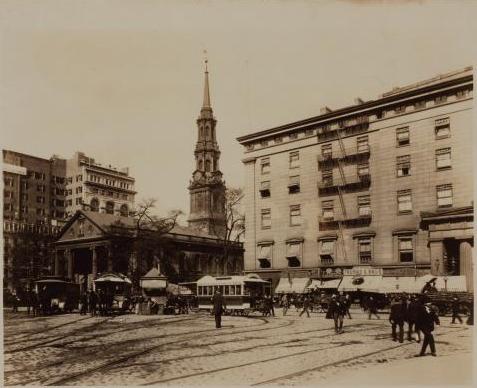
For a little comparison, here’s how the building looked in the 1890s, already minimized in its appearance:

Hotels were now flocking to the Times Square area. In fact, so to did the Astor name, with the beautiful Hotel Astor opening there in 1904.

The hotel might have survived a little longer if not for new subway construction in the area, endangering the foundation of the old building.  On May 29, 1913, the hotel closed its doors, and over the next few weeks, the southern section of the Astor House was torn down.  But not without a bevy of reminiscences from old New Yorkers, and a little teeth-gnashing too of a colder, modern city overtaking the gentle comforts of the old.

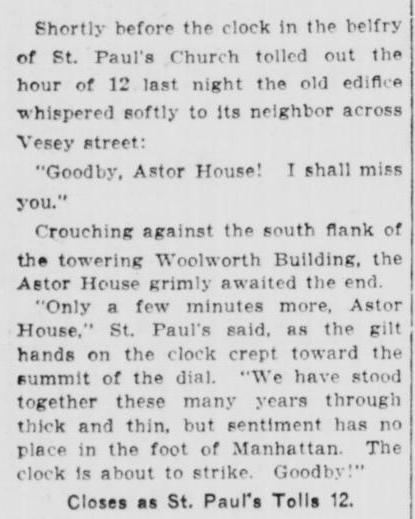
And then, there’s this dramatic article from the New York Tribune, depicting a literal farewell between the Astor and its neighbor to the south, St. Paul’s Church:

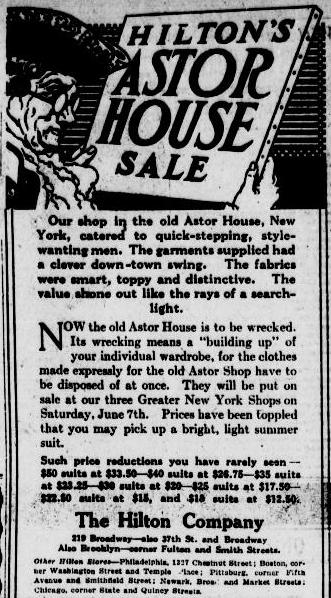
While this spelled doom for a certain memory of New York, those who liked firesales of sorts could take comfort in liquidation sales from famous shops which operated from the old Astor Hotel, such as the Hilton Company:

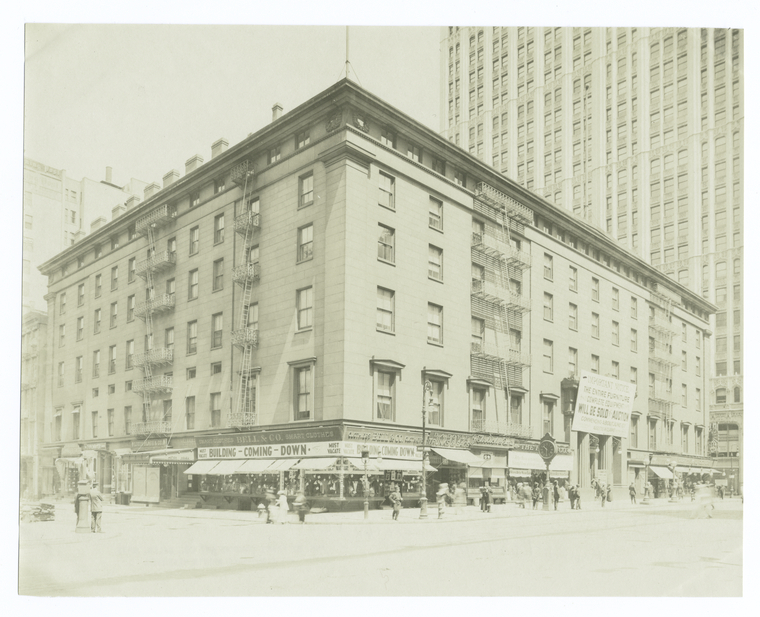
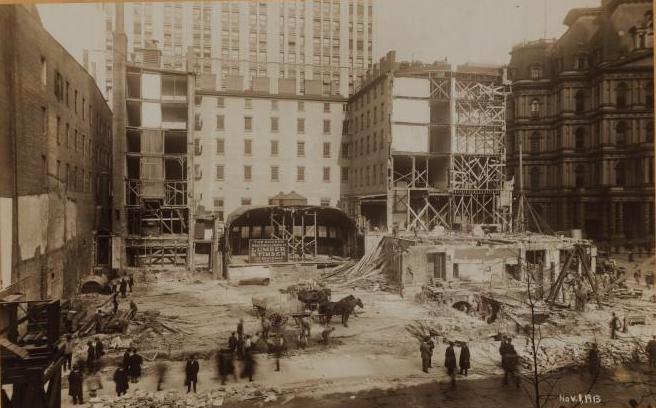
This is what the space looked like within a couple months.  By the way, that’s the old Post Office to the right of the picture, a structure that would last another quarter century before it too was demolished in 1939:

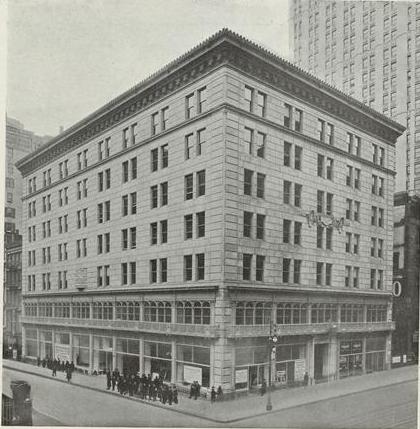
In 1915, it was replaced with the Astor House Building, a small suite of office spaces that remains on that street corner to this day.  It’s where the Staples store is

All pictures courtesy New York Public Library. By the way, have you check out their incredible new search function?

Categories
Landmarks

The many mysterious events that befell the Woolworths after constructing the Woolworth Building

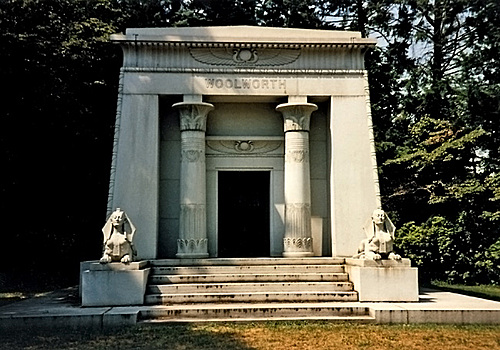
The dramatic Woolworth mausoleum in Woodlawn Cemetery 

With completion of the Woolworth Building in 1913, the leader of the five-and-dime retail craze Frank W. Woolworth had his grand declaration of success in New York, widely feted and proclaimed.

His hundreds of stores would go on to define the shopping experience around the world over the coming decades.  (Their lunch counters would also unfortunately typify racial segregation in the 1960s.) While there are no more Woolworth stores in America today*, you can still find many outlets with that brand as far away as Germany and South Africa.

But life took a few unexpected, frequently tragic and often bizarre twists for the Woolworth family over the next few decades following the completion of the Woolworth Building:

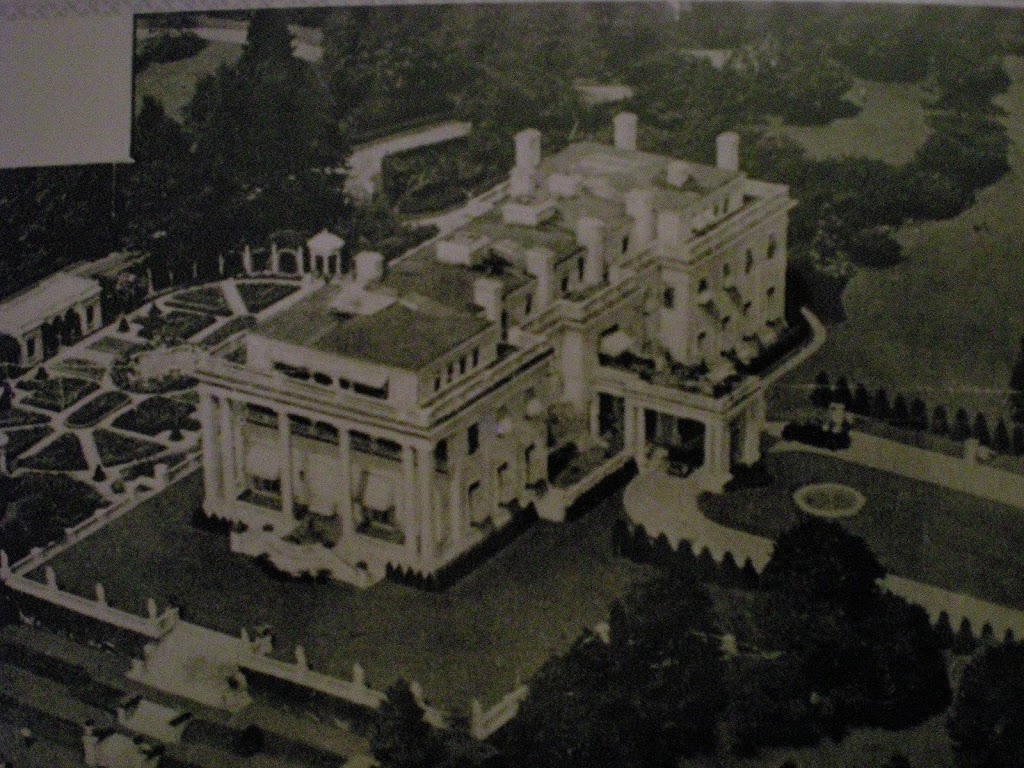
Above: The ‘new’ Winfield Hall in 1925. Courtesy Old Long Island

1) Fire at Winfield Hall: While the family enjoyed a very luxurious residence at Fifth Avenue and 80th Street across from the Metropolitan Museum of Art, his wealth was better displayed in the mansion out in Glen Cove, Long Island, where his wife and daughters lived most of the time.

But this house — a wooden, columned manor named Winfield Hall — mysteriously burned down in November 1916.

And just as oddly, Woolworth had almost instantly on hand new plans for a colossal marble palace, more in keeping with the many gigantic homes along Long Island’s Gold Coast.

Think The Great Gatsby of the five-and-dime; in fact, Glen Cove is just a few minutes over from Manhasset, fictionalized by F. Scott Fitzgerald as ‘East Egg’.

The estate is reportedly haunted due, according to sources, to Woolworth’s interest in the occult.

2) Single White Mogul:  In 1892, in the early days of Woolworth’s business, he hired a young Brooklyn man, Hubert Parson, as a bookkeeper.

By the 1910s, Parson was Woolworth’s right-hand man, thought of as a part of the family and as the son Frank never had. In 1916, Woolworth shocked many by promoting the relatively young assistant to the role of general manager.

It then appeared that the notoriously vain Parson was attempting to actually outdo his boss, first building a bigger Fifth Avenue mansion than his boss, then, in 1918 purposefully buying a house in Long Branch, New Jersey — named Shadow Lawn — that was far larger than Woolworth’s own Winfield Hall!

“If Woolworth bought a brand new automobile,” writes author Karen Plunkett-Powell, “then Parson would, too — complete with uniformed chauffeur.”

After Frank’s death, Parson would become president of the company. Later in life, he would be criticized for his “extravagant personal lifestyle” during the Great Depression and was eventually forced to retire.

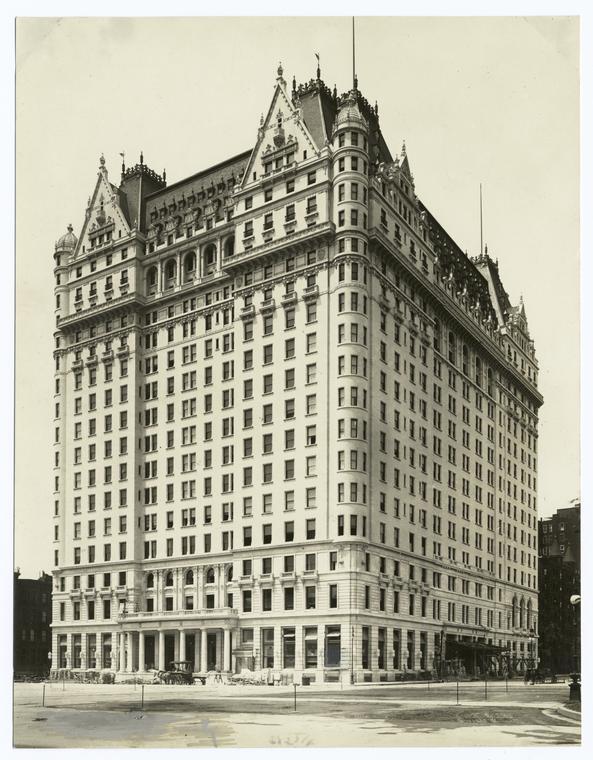
3) Death at the Plaza:  Woolworth’s daughter Edna was a tragic and very tormented woman, marrying an associate of her father’s who ended up drinking heavily and cheating on her. In 1917, at the Plaza Hotel, after reading a letter confirming yet another mistress, Edna put on her loveliest lace dress, sat by a window and ingested a lethal dose of poison.  Unfortunately, her body is discovered several hours later by her daughter Barbara.

4) Why You Should Go to the Dentist: Frank Woolworth had an absolute hatred of going to the dentist, a prejudice that led to his death in April 1919, when he died suddenly due to a tooth infection. Unbelievably, he died with his will unsigned, and all the money (about $30 million) went to his wife Jennie.

However, Jennie was having problems all her own, having been declared ‘mentally feeble‘ and legally incompetent by this time. Of the will, “DEMENTED WIFE GETS ALL,” said an unsubtle New York Times headline.

It’s not clear to me from the reporting of the day, but it appears from description that Mrs. Woolworth was suffering from Alzheimer’s when her husband died.

5) Gem Theft at the Plaza: In 1926, the youngest Woolworth daughter Jennie, living the good life at the Plaza, had over $683,000 worth of jewels stolen from her room while she was in the bathtub.

“The thief displayed a shrewd knowledge of pearls,” said the Times. “Alongside the genuine ones in the drawer were four ropes of imitation pearls …. [T]he robber scorned them.” The crime kept the Woolworths in the paper for an entire month.  The jewels mysteriously reappeared a week later and the man who purloined them — a private detective! — was arrested.

Five years later, Jennie’s husband would then poison himself (another suicide) and die in his office at the Woolworths’ Fifth Avenue residence.

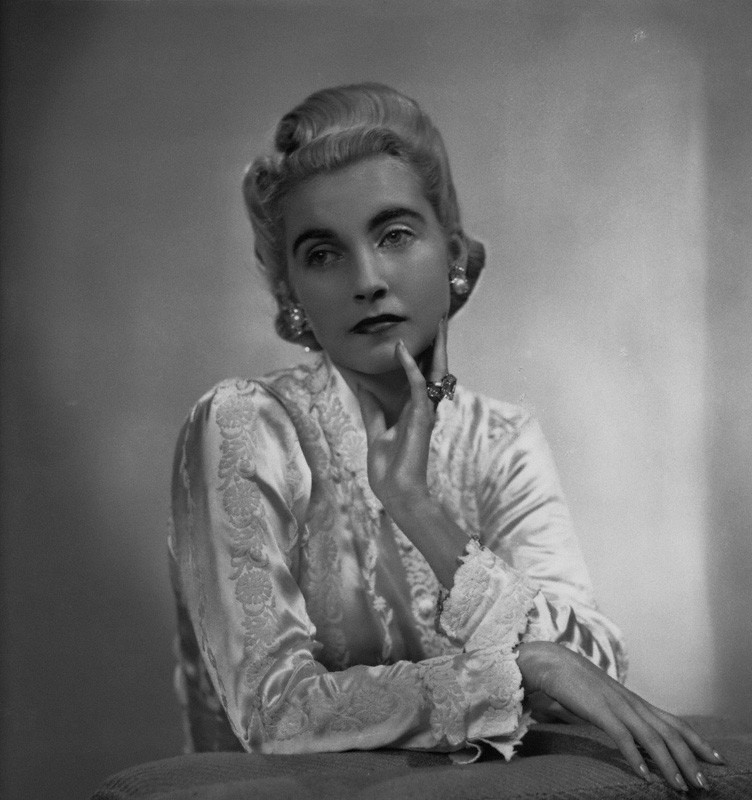
6) Poor Little Rich Girl: Barbara Hutton (above), who had discovered her mother dead in the Plaza, grew up to become something of an infamous party girl, thanks to an over-the-top debutante ball held in her honor during the Great Depression. She was dubbed the ‘poor little rich girl’, fodder for gossip columns and, later, made-for-TV movies.  The heiress, never shying from an extravagant lifestyle, married seven times — most notably to Cary Grant in 1942 — in a life often marred by tragedy and physical abuse.

Most of the people mentioned above are buried in the ornate Woolworth Mausoleum in Woodlawn Cemetery in the Bronx.  The mausoleum is a tribute to vast wealth and self-importance, designed like an Egyptian temple by John Russell Pope, best known for designing the Jefferson Memorial in Washington D.C.!

*The remnants of the Woolworth company are now organized as Foot Locker Inc.

Categories
Landmarks

What a resume! Cass Gilbert’s three stunning prequels to the Woolworth Building


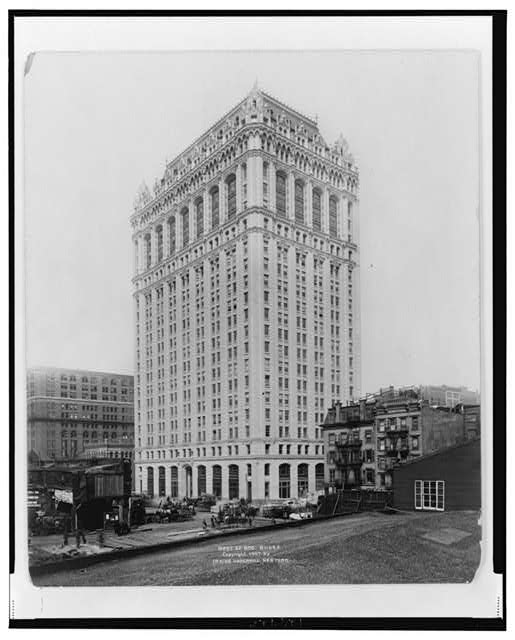
From this angle, you can see two of Cass Gilbert’s creation, the West Street Building and the Woolworth under construction.  View of his Broadway-Chambers Building is obscured by the building to the left. (LOC)

It’s Woolworth Building week here in New York City!  The lights of Frank Woolworth‘s treasured office tower were turned on in an official ceremony on April 24, 1913, and the building opened for business on May 1.

The five-and-dime mogul reached for one of America’s leading architects in planning his namesake tower. Cass Gilbert had distinguished himself in Minnesota before arriving in New York City in 1899 where he immediately went to work transforming the skyline.

Why was he given such a prestigious assignment to create the world’s largest building?  Judging from his work in New York prior to the Woolworth job, there would have been few more qualified than Gilbert to create on a grand scale something so innovative, distinctive to Woolworth’s vision and in keeping with Beaux-Arts values of the day.  Unlike another great architect of the day like George Post — whose greatest works have almost all completely vanished — all three of Gilbert’s early New York buildings survive.

Here’s the three buildings that helped him snag the commission for the Woolworth headquarters:

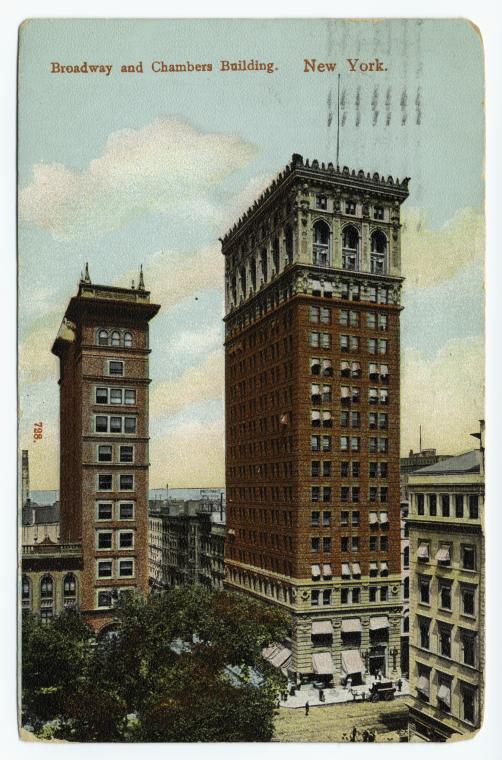
The Broadway-Chambers Building
277 Broadway
1899-1900

Gilbert’s designs for this sturdy tower with a lovely copper top (now, of course, oxidized to green, just like Lady Liberty) featured a mix of brick and terra-cotta, some polychrome, a rarity for its day.

The building’s new tenants required changes to Gilbert’s original plans. The Domestic National Bank on the second floor, who happened to employ a great number of women, required an increase of accessible women’s bathrooms.  And the United States Life Insurance Company demanded several large safes be transported to upper floors and installed.  Despite the changes, the structure was completed in a staggering four months.

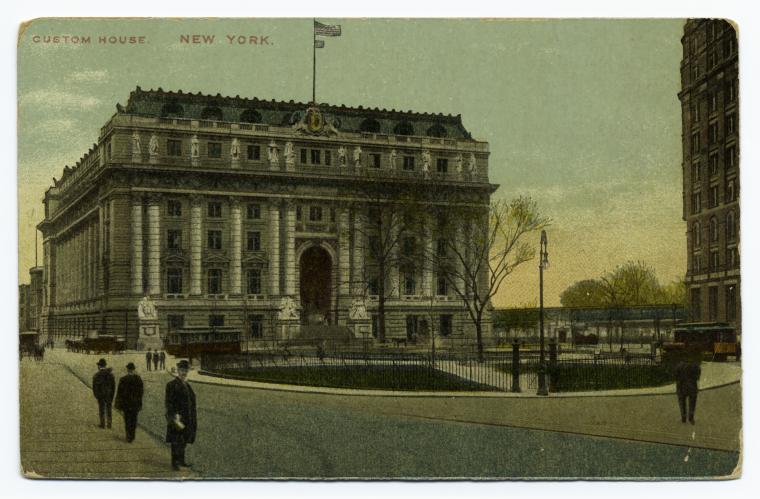
Alexander Hamilton Custom House
One Bowling Green
1902-07

The competition to replace the old Custom House at 55 Wall Street was the impetus that brought Gilbert to New York to create one of America’s finest examples of Beaux-Arts architecture.  He was a heavily contested choice, as his designs beat those of New York firms like Carrere and Hastings (later to create a similar building for the New York Public Library).

The seven-story office — more like a monument, really — sits atop the location of old Fort Amsterdam, giving the location a sense of import with its four representative sculptures (by Daniel Chester French) of Africa, America, Asia and Europe.  Today the structure houses the Smithsonian’s National Museum of the American Indian.

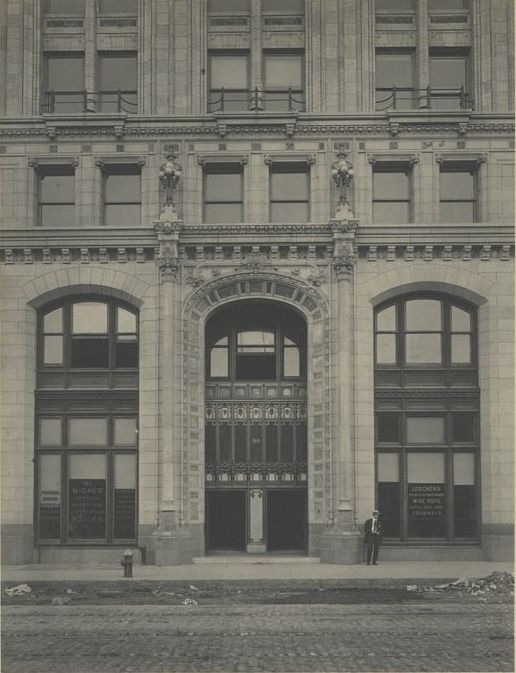
West Street Building 
90 West Street
1905-07

But it may have been his 1905 commission to design a waterfront office building on West Street for ferry operator and asphalt king Howard Carroll that secured his reputation as a virtuoso of the skyscraper age.  The building, to serve port and railroad industries of lower Manhattan, had Manhattan’s highest restaurant on its top floor.  At the time, this was shorefront property; today it stands across from Battery Park City.

Gilbert would dabble in themes and styles with the West Street Building that would be further explored with the Woolworth Building.  No other building shares as many features with the Woolworth Building as this one.   Former rival John Carrere admitted, “If my opinion counts for anything I think it is the most successful building of its class.”

Below: the West Street Building, the side facing into Manhattan. 

Pictures courtesy NYPL.

Categories
Newspapers and Newsies

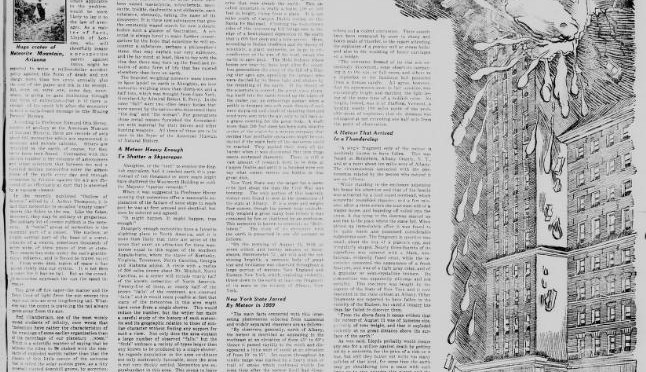
What if? Meteors over Manhattan, 1922

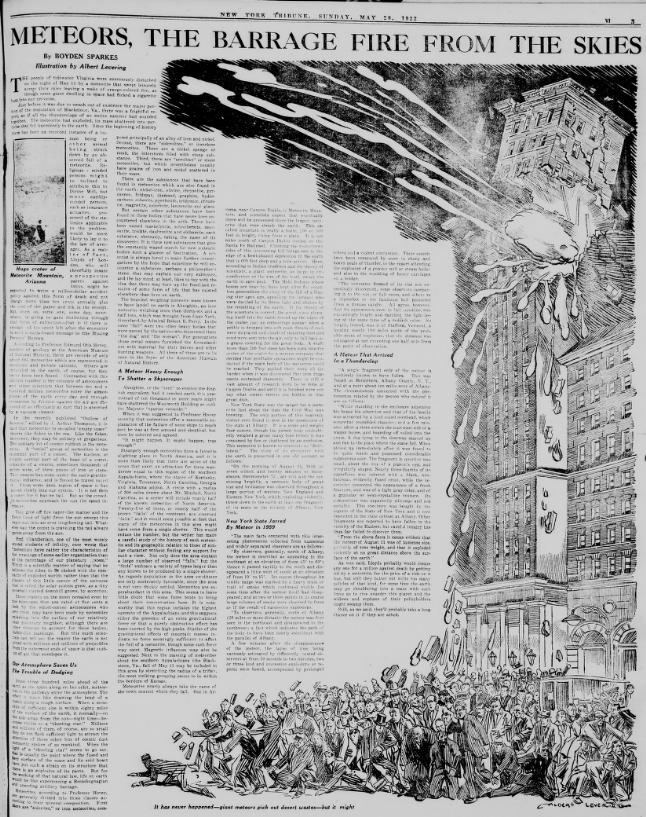
In 1922, the New York Tribune envisioned what it would be like if a meteor hit downtown Manhattan. 

The article is a real scare piece on the potential of meteors destroying life on Earth.  It references the American Museum of Natural History‘s own meteor, Ahnighito, brought to the institution by Robert Peary in 1904.  As I mentioned in my post from 2010, that famous rock was of no particular threat and in fact was itself pummeled by the jackknifes of rowdy young children.

“Ahnighito … had it reached Earth this year instead of ten thousand or more might have shattered the Woolworth Building,” writes Boyden Sparkes in the Tribune article.

Unfortunately, as you’ve probably noticed, this image also accidentally recalls other, more recent tragedies. You can find the original image at the Library of Congress (read it here)

Just in case you think the recent meteor in Russia is somehow an aberration and a true sign of the times, you should remember that meteors have already landed much closer to home  here.   For instance, in 1922, a meteor almost crashed into Asbury Park, NJ!

Four New York City landmarks turn 100 years old this year

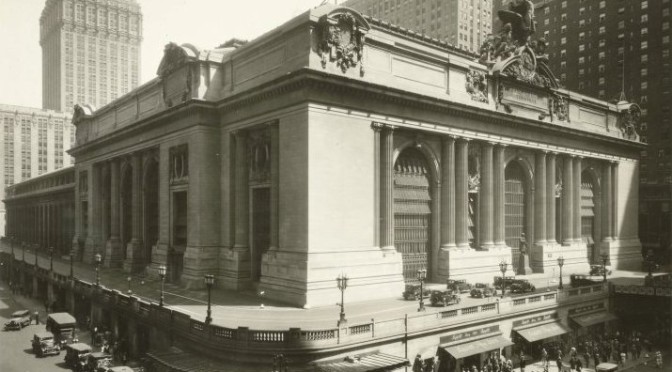
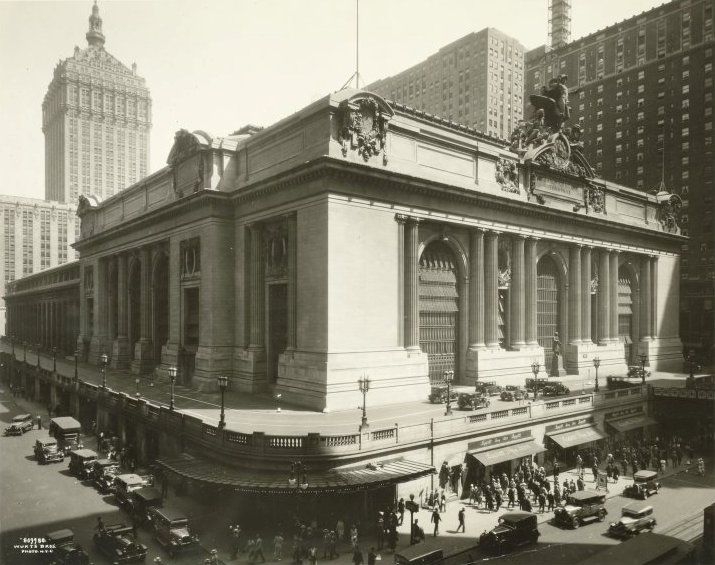
1) Grand Central Terminal
The Grand Central Depot was first built at 42nd Street in 1871 as a hub for Cornelius Vanderbilt’s railroad operations. It was greatly expanded at the turn of the century. and by this time, the tracks headed north were electrified and buried, creating Park Avenue.

The present terminal was conceived in 1903 by two teams of architects and took a decade to construct. Meanwhile, the tracks heading north, now sunken and electrified, were covered with a new street and its air rights sold to become Park Avenue.

The ne plus ultra of Beaux-Arts New York opened in February 1, 1913, and its first train, the Boston Express, left the station two days later.

For more information, listen to our podcast on Grand Central Terminal (Episode #45)

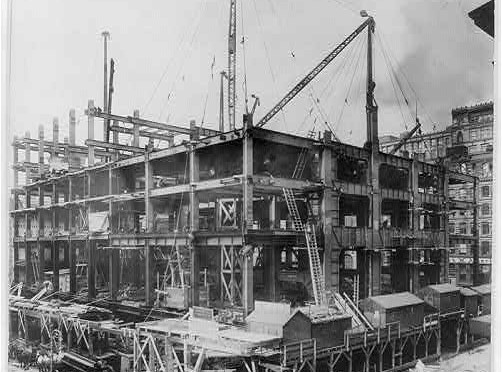
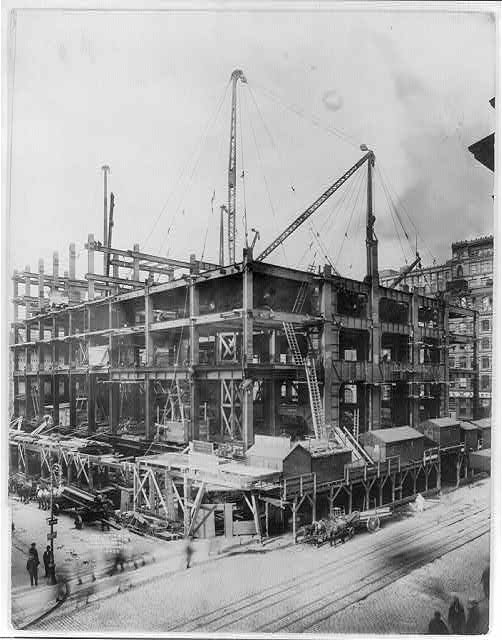
2) Woolworth Building
The Woolworth Building and the current One World Trade Center are separated by a couple blocks — and one century. Just as New Yorkers marveled last year at what will be the city’s tallest building as it began to tower over downtown Manhattan, so too did the New Yorkers of 1912, at the ornate Cass Gilbert structure rising near City Hall. In January of 1912, newspapers were already proclaiming Woolworth the crown of “:the world’s greatest construction era.”

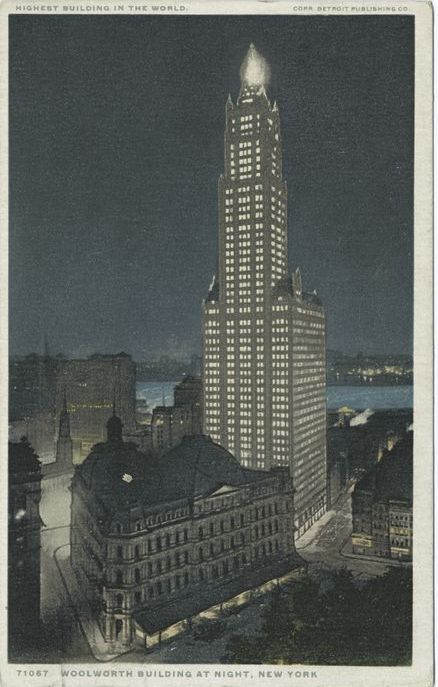
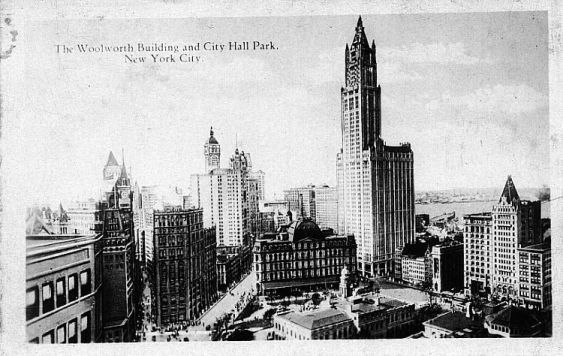
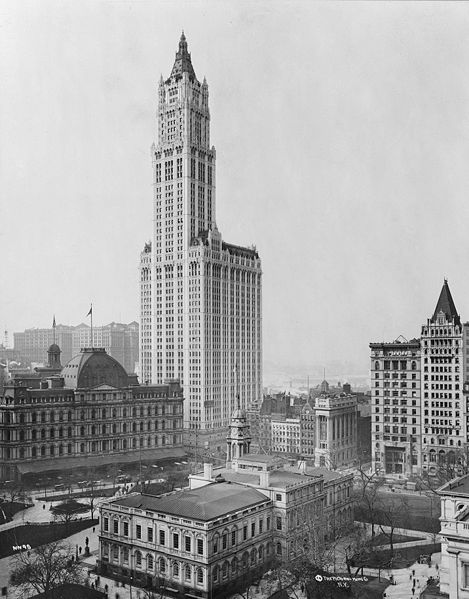
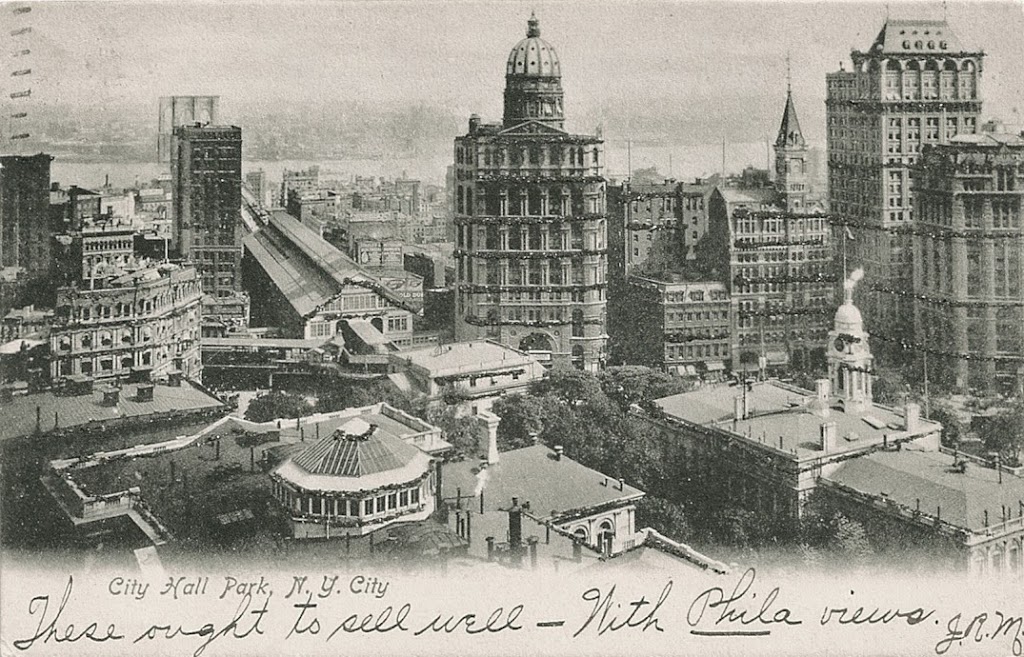
One World Trade Center will open later in 2013. The Woolworth opened on April 24, 1913 as New York’s tallest building until 1930. As you can tell from the 1910s postcard above, it rose next to the garish old New York Post Office at the foot of City Hall Park.

For more information, listen to our podcast on the Woolworth Building (Episode #76)

3) The Apollo Theatre
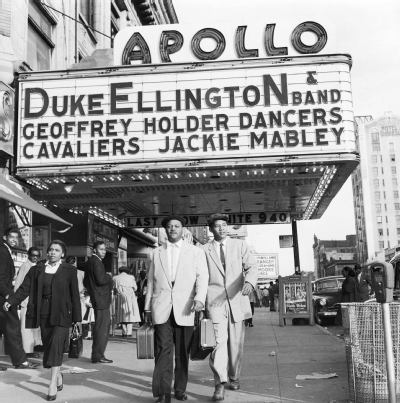
The theater that eventually became one of America’s top spotlight for new entertainers was constructed in 1913 — its architect, George Keister, designed many great theaters of the day, including the Belasco — and quickly became a home for Harlem burlesque acts under the name Hurtig and Seamon’s New Burlesque Theater.  While far from Times Square’s Broadway district, its stage has actually outlasted most of the theaters there.

It reopened in 1933 as the 125th Street Apollo Theater. It was around this time that the doors were opened to African-American entertainers.  Its ‘amateur nights’ would soon become world-famous for discovering major talent.

For more information, listen to our podcast on the Apollo Theatre (Episode #15)

4) Hotel McAlpin
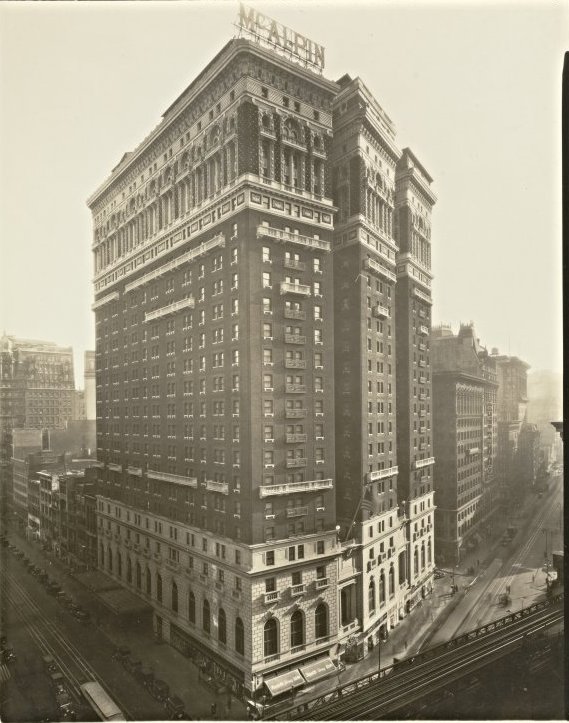
New Yorkers got a look at Herald Square’s Hotel McAlpin — the tallest hotel in the world at the time — in a lavish open house on December 29, 1912.  Thousands marveled at its almost absurd size, suitable for 2,500 guests and 1,500 employees.  It was ready to welcome guests with the new year.

“The McAlpin has many features peculiar to it among hotels,” proclaimed the New York Times. “For one thing there is a woman’s floor to which no men are permitted and where even the clerks are women …The twenty-second floor is devoted exclusively to men.” And the 16th floor was known as the ‘Sleepy Sixteenth’, the silent floor.

Today the Hotel McAlpin is an apartment complex, the Herald Towers.

For more information, listen to our last podcast on the history of Herald Square (Episode #146)

Note: I don’t think the McAlpin is officially landmarked, only one in the historical sense.

Courtesy 1) Wurts Brother/NYPL; 2) NYPL; 3) Long Wharf Theatre; 4) NYPL

Categories
Skyscrapers

A century ago, excitement builds as the Woolworth ascends

The Woolworth Building, as it appeared on January 20, 1912 (Courtesy LOC)

The Woolworth Building was the biggest story in real estate one hundred years ago, long before it was even completed.

By the waning moments of 1911, something finally began to rise out of the belching smoke and clutter collecting at the northwest corner of Broadway and Barclay Street . The building’s architect Cass Gilbert was busy at work drafting the details of the interior, and as the tower rose, so too did the cost. Luckily, retail king Frank W. Woolworth would eventually pay the entire bill ($13.5 million, from an original project cost of $5 million) in cash.

In a Jan 7, 1912 article, the New York Times assessed the state of real estate in the city, observing that the greatest developments for the year were in ‘apartment houses and lofts’, particularly on the Upper West Side and the neighborhoods west of Broadway between 14th Street and 42nd Street. While residential property was the hot commodity, they made note of seven ‘purely office structures’ that were also debuting. Of those listed, the clear standout was the new office building being designed for Woolworth.

The New York Sun was also dazzled by the Woolworth’s construction that month, announcing its construction as the crown of the ‘world’s greatest building construction era’. Any firm hired for the project promptly touted its involvement in full-page advertisements. Otis Elevators boasted of its ‘Marvelous Vertical Railways … That Are to “Whiz” the Army of Workers Up With Lightning Speed.’

It would take over fifteen months from that moment for the Woolworth Building to be completed, and what a game-changer it was when it officially opened on April 24, 1913. The tallest building in the world until 1930, the Woolworth is also distinctive to this day for its monolithic surface of terra cotta, built before the requirements of setbacks turned future skyscrapers into virtual ‘wedding cakes’.

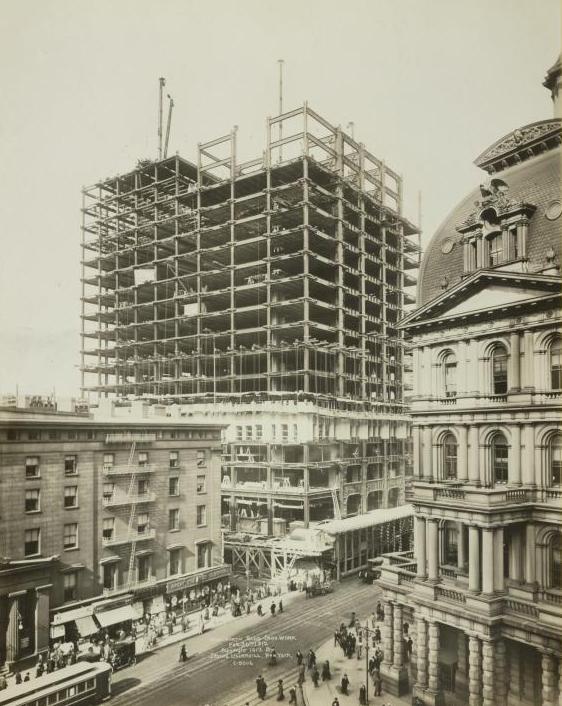
But back in January 1912, as you can see, it rose on a few floors from street-level, not even as high as the City Hall Post Office which sat across the street. The picture below (from NYPL), taken over a month later, indicates its proximity to the post office:

(As for the picture at top, the Library of Congress dates it as January 20, 1912, while the New York Public Library has it as December 28, 1911. You get the idea. Regardless, it’s a photo by favorite photographer Irving Underhill.)

Categories
Brooklyn History

Let There Be Light: Brooklyn illuminates Manhattan with a spotlight that ‘will burn your skin at three hundred feet’


That Gotham glow: The powerful Sperry searchlight drapes the dark city in light. The Woolworth Building is lit up like a candle.

A thin, bright streak of light brushes across the sky and dances off the clouds above. With few buildings over fifteen stories and the city’s electrical lights at a fraction of the intensity that they are today, the white piercing beam would have awakened the night sky, the most powerful illumination in the sky with the exception of the moon.

It was March of 1919, and the device creating this expressionistic Gotham nightscape was the Sperry Searchlight.

Since the first arc lights installed along Broadway in 1880, New Yorkers had grown accustomed to electric light. In fact, Times Square and the stretches of Broadway had become New York’s entertainment capital because of it. But searchlights were still a bit of a novelty, devices more associated with wartime. Innovations in electrical light changed how wars were even fought; combatants in World War I aimed spots to the skies to search for enemy zeppelins and scoured the grounds below for encroaching forces.

New Yorkers would have been used to seeing searchlights atop the city’s newest, tallest buildings. The first New Year’s celebration at One Times Square used a searchlight to blanket stunned crowds below. Both the Flatiron Building and the Metropolitan Life Tower in Madison Square were equipped with searchlights during elections. They were an effective way to present information. For the 1908 presidential election, the New York Herald announced that a searchlight atop the Met Life building would swing north if William Howard Taft won and south if the victory went to William Jennings Bryan. That night, the beam turned north.

But the Sperry Searchlight was different. The powerful device, created in the mid 1910s, was described by a science journal of the day in 1917 as ‘the world’s most powerful searchlight’ and as bright as ‘the fiercest sunlight’. “The heat of its focused beam is so intense that it will set paper afire at a distance of two hundred and fifty feet …. It will burn your skin at three hundred feet.’

This intense searchlight was the product of Brooklyn innovator Elmer Ambrose Sperry, whose greatest invention, the gyrocompass, was quickly adopted by the United States Navy and almost immediately changed sea travel forever.

From the Sperry Gyroscope Companythe ten-floor building still stands at 40 Flatbush Avenue Ext. by the Brooklyn entrance to the Manhattan Bridge — the inventor and his team created a host of new items, many for the military. (Did you know that the Sperry Company created the first airplane autopilot?)

In 1919, one version of his new and improved searchlight made a test run, presumably atop the roof of the Sperry building. If you look at where the building is on a map, you can almost trace the beam from the roof along the line of its projection.

Over the Brooklyn Bridge, bouncing off the first line of buildings along the east of Manhattan, and illuminating three of New York’s tallest and best known buildings of the day — the Singer Building (center left), the Park Row building (center right), and the majestic Woolworth Building (the tallest beacon-like structure, center right).

Images like this one weren’t just documents of technological success. (Although good night photography itself was a pretty nifty trick, even in 1919.) They helped build the mythology of the city, which in 1919 was about to go down the rabbit hole of Art Deco and inspire new architects to populate the skyline with more ambitious and futuristic towers.

Categories
Podcasts

PODCAST: The Woolworth Building

When this classic photo was taken in 1928, the Woolworth Building was still the tallest in New York

F.W. Woolworth was the self-made king of retail’s newfangled ‘five and dime’ store and his pockets were overflowing with cash. Meanwhile, in New York, the contest to build the tallest building was well underway. The two combine to create one of Manhattan’s most handsome buildings, cutting a Gothic profile designed by America’s hottest architect of the early century. So what exactly does it all have to do with sneakers and gym clothes?

Listen to it for FREE on iTunes or other podcasting services. Or click this link to listen to the show or download it directly from our satellite site.

Frank Winfield Woolworth was an upstate New York who worked in general stores in his youth before branching out into his own unique ‘five and dime’ retailers — places where customers could interact with the merchandise directly, without a store clerk.

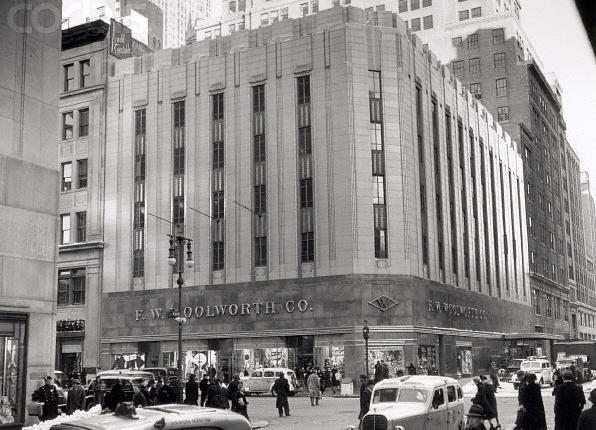
Frank’s stores changed the way people shopped for everyday items. This fancy Woolworth location even had a lofty address — 5th Avenue and 39th Street (courtesy Corbis)

The tallest structure in New York for many years was the spire of the Trinity Church, on Broadway, at the foot of Wall Street. In 1890, its height was finally topped with the completion of the World Building by the influential publisher of the New York World newspaper, Joseph Pulitzer.

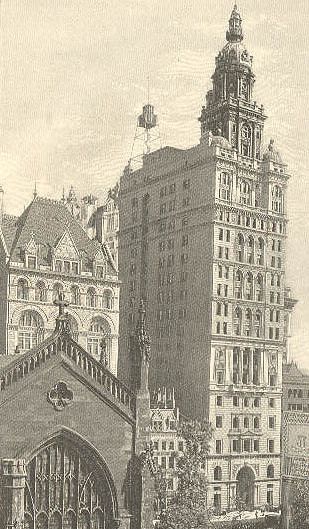
In 1894, Pulitzer lost the tallest building title with the completion of the Manhattan Life Building, a clever structure with two sides that top out with an iron bridge and a towering lantern at 348 ft. It was across the street from Trinity Church (today occupied by the domineering Bank of New York Building).

The Park Row Building came next, completed in 1899. It still stands today, with the Woolworth looking down on it. J&R Music World still occupies many of its floors today.

Perhaps the strangest building to become New York’s tallest was the Singer Building, built in 1908 at a then-staggering 612 feet. It has the very dubious distinction of being the tallest building in history ever to be purposefully demolished (in 1968, making way for the frustratingly bleak One Liberty Plaza).

In order for Frank to build New York’s tallest structure, he need to beat the Metropolitan Life Tower, completed in 1909, still a beauty next to Madison Square Park.

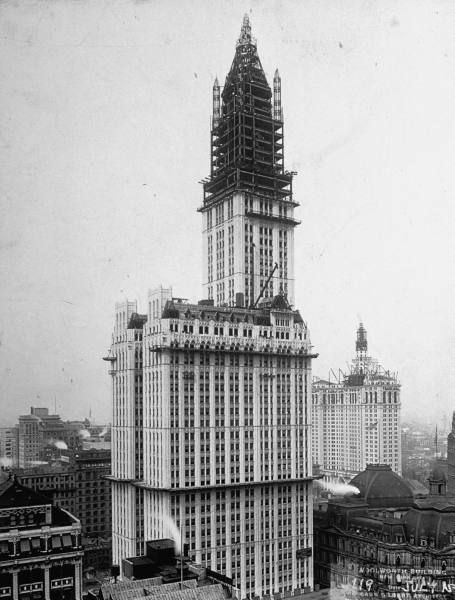
The Woolworth, nearly complete in this picture from 1913 (courtesy the Life archives)

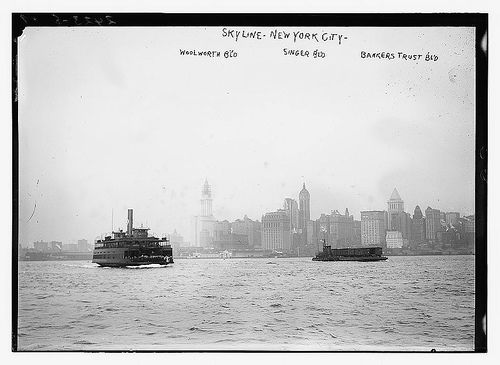
View from the Hudson, mid 1910s: three tallest buildings are the Woolworth Building, the Singer Building and the Bankers Trust Building (built in 1912) Pic courtesy Library of Congress

From this old postcard and photograph below, you can see the Woolworth’s proximity to City Hall and the old Post Office (later demolished to expand City Hall Park)

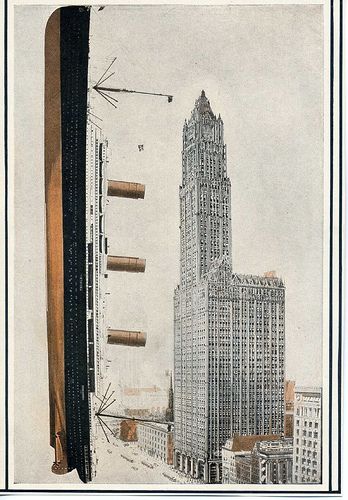
It’s height was enough of a marvel that this rather odd comparison was made in the book Our Wonder World Vol. IV, Geo. L. Shuman & Co., 1914 (Courtesy Flickr)

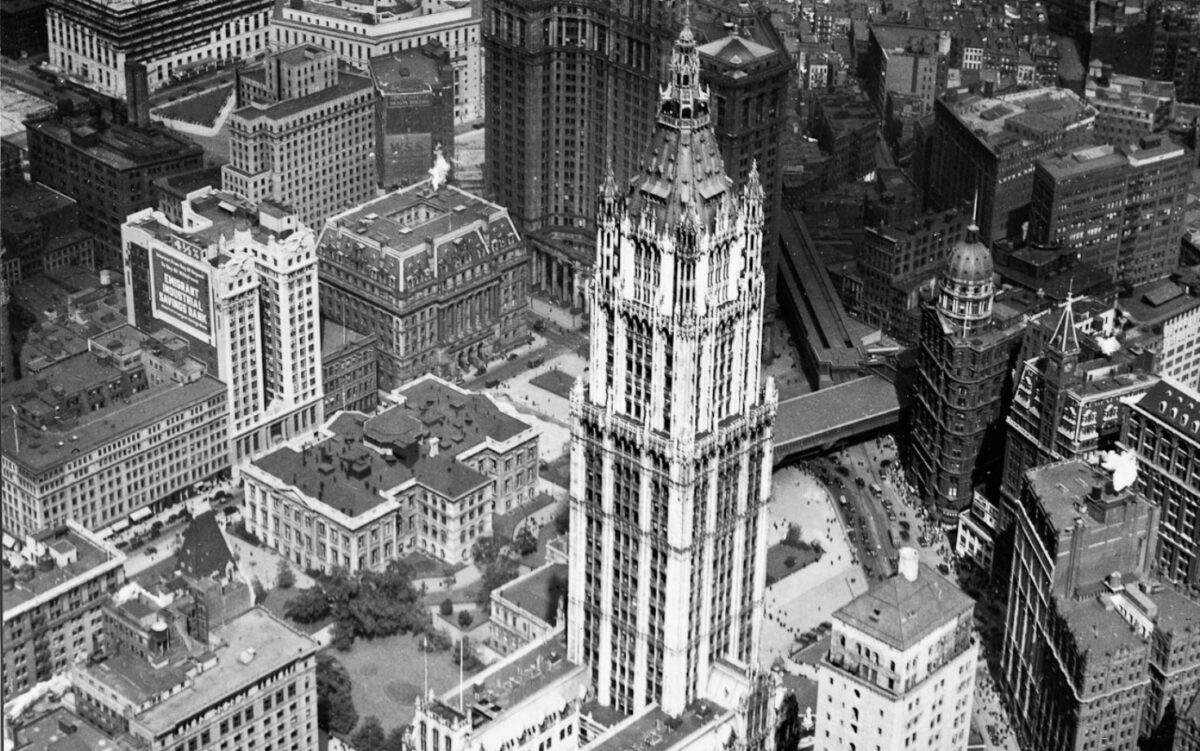
A view from the other side of the Woolworth, taken in 1920, reveals two other buildings that were once considered ‘the tallest building in New York’: the domed World Building to the left, the Park Row Building to the right.

A remarkable and rather dreamlike nighttime shot of Manhattan in 1919, with the Woolworth building gleaming like a candle

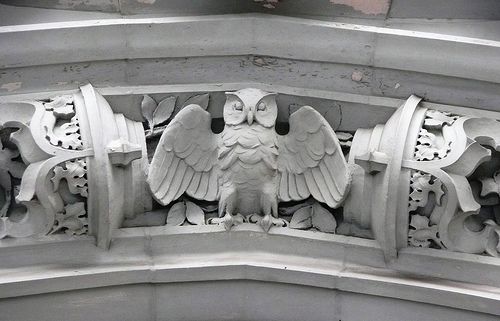
An owl ‘gargoyle’, one of many playful details Cass Gilbert incorporated into the building’s massive terra cotta face.

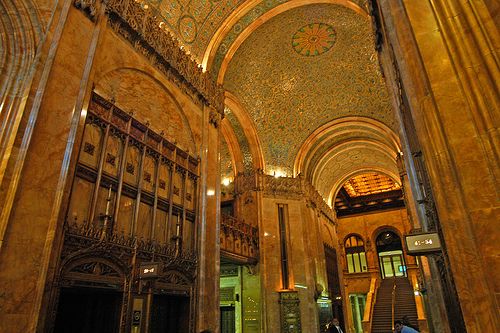
Inside the vaulted, gold-drenched lobby (courtesy Flickr)

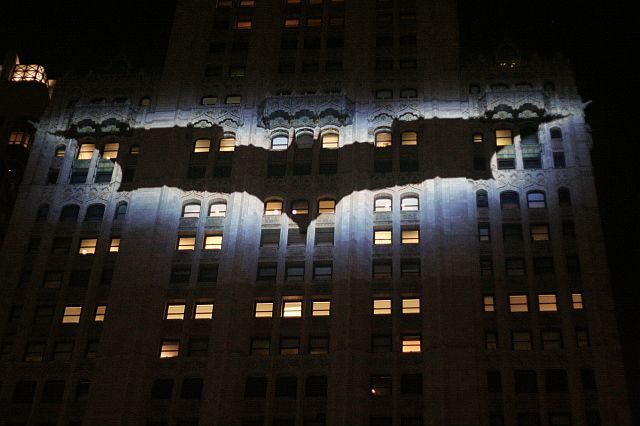
To promote the most recent Batman film The Dark Knight, the Bat Signal was projected onto the Woolworth Building.