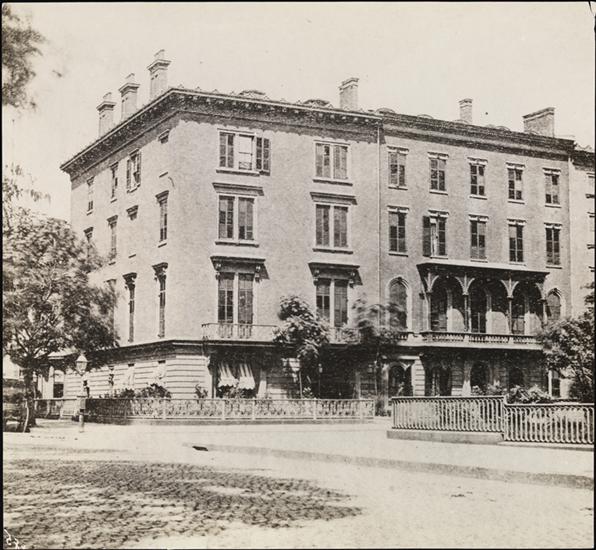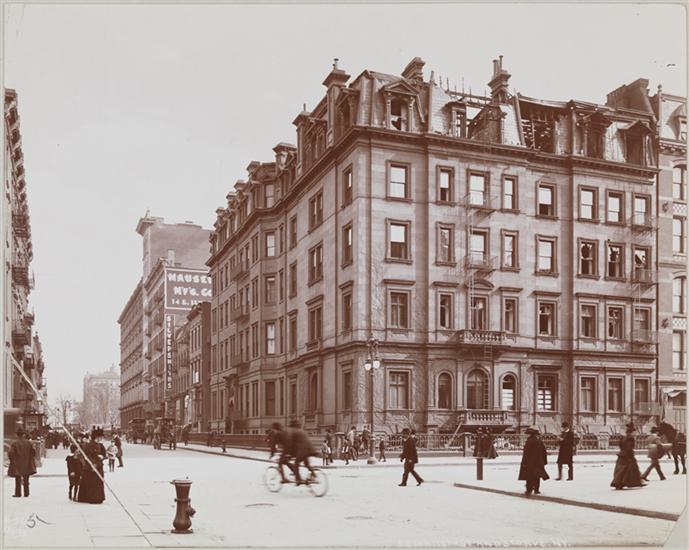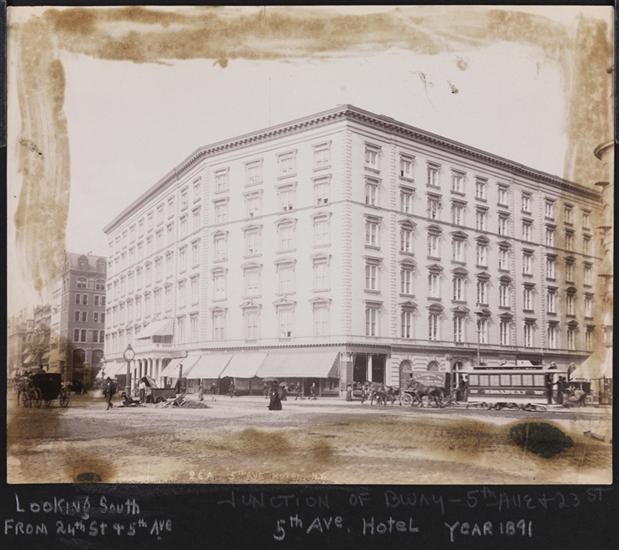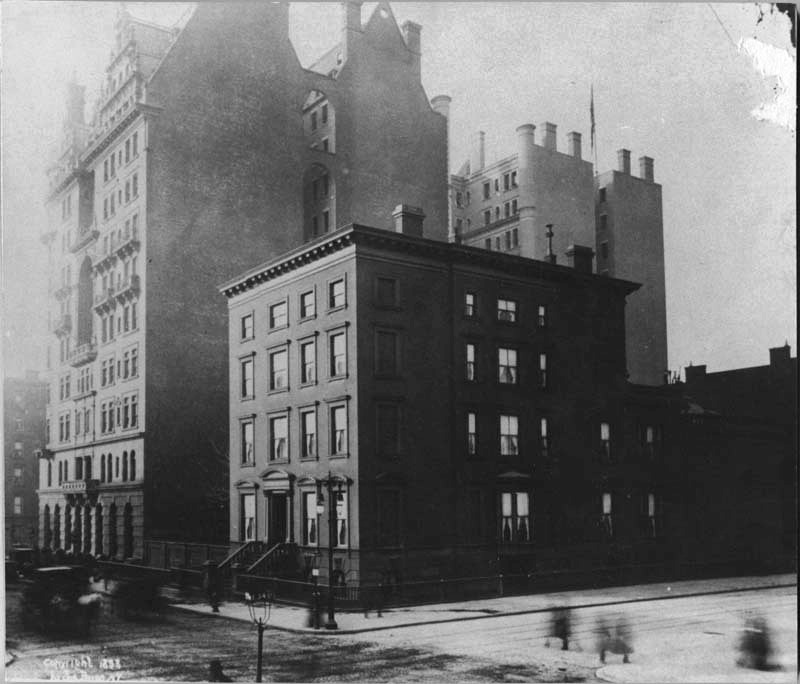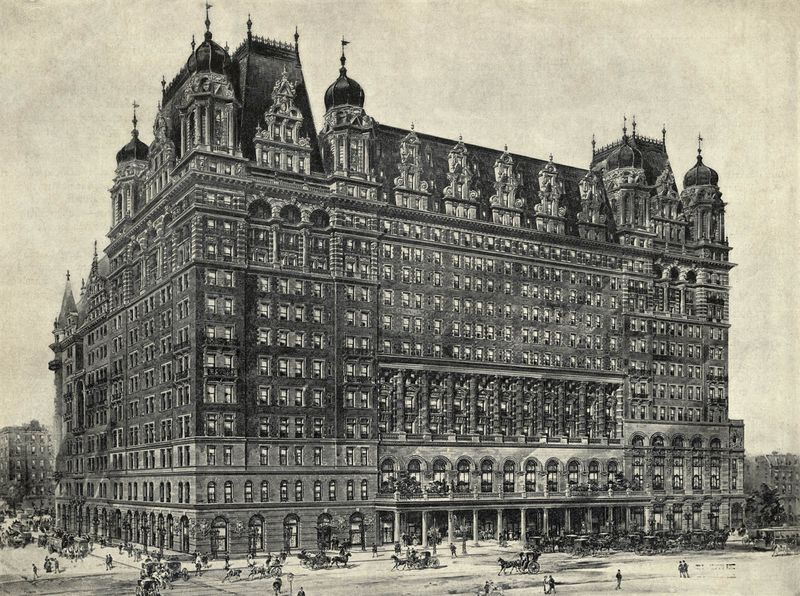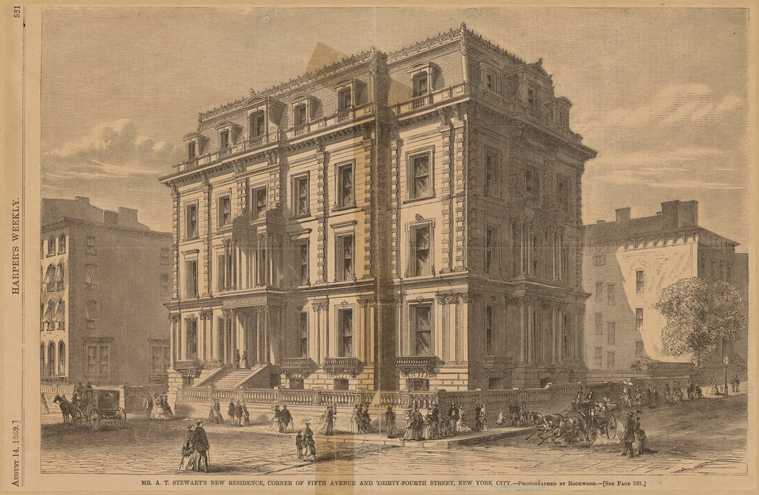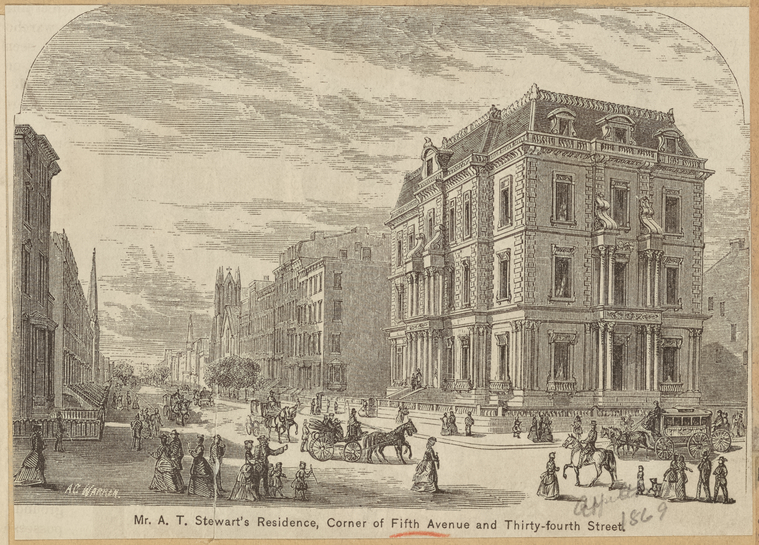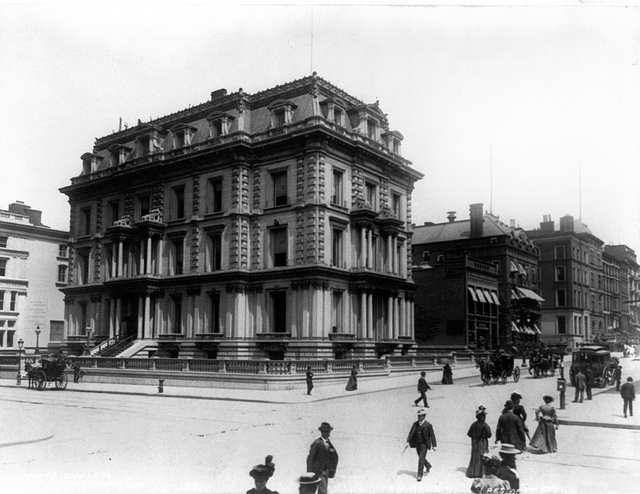
Categories
Gilded Age New York Podcasts

The Gilded Age Mansions of Fifth Avenue: At Home with the Astors and Vanderbilts

So we don’t know if you’ve heard, but New York City is an expensive place to live these days. So we thought it might be time to revisit the tale of the city’s most famous district of luxury — Fifth Avenue.  

For about a hundred years, this avenue was mostly residential— but residences of the most extravagant kind.

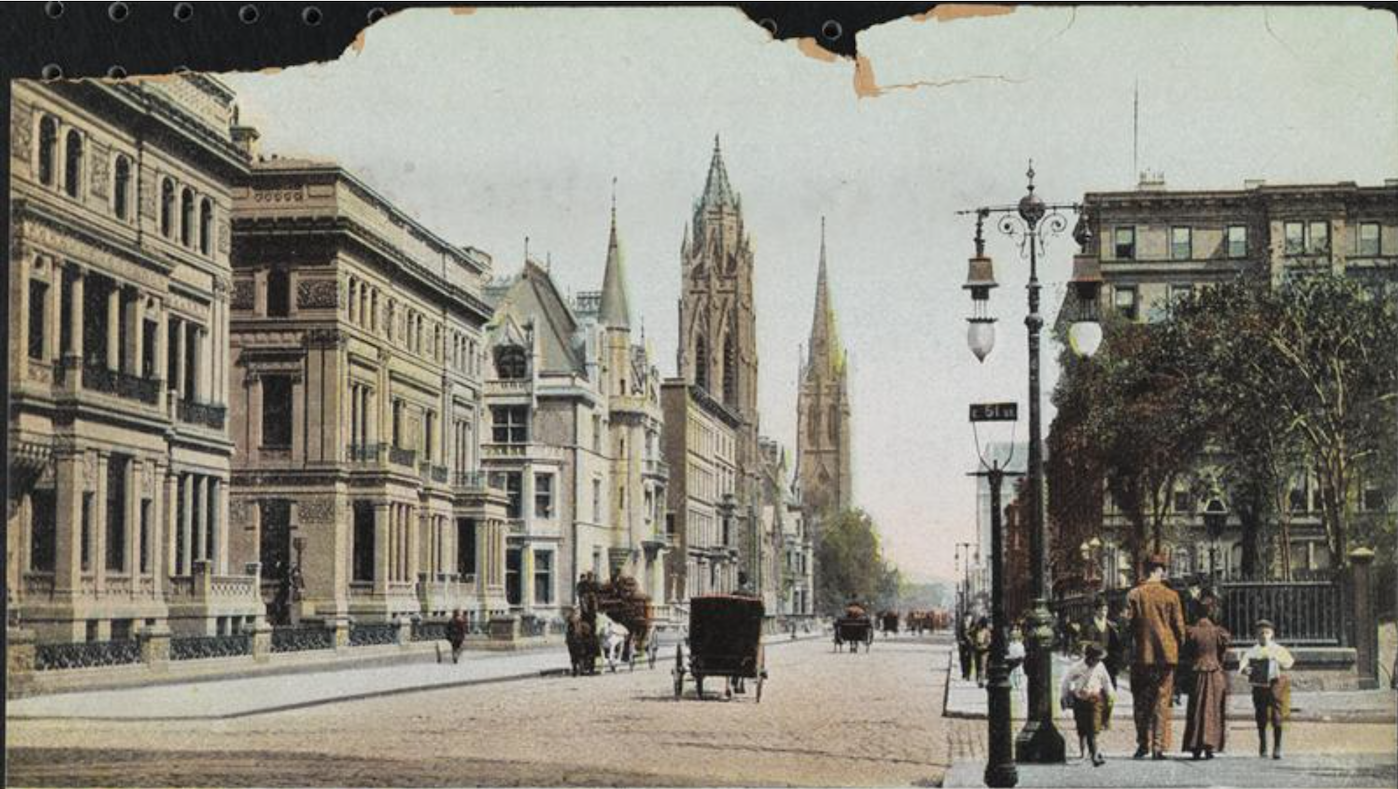
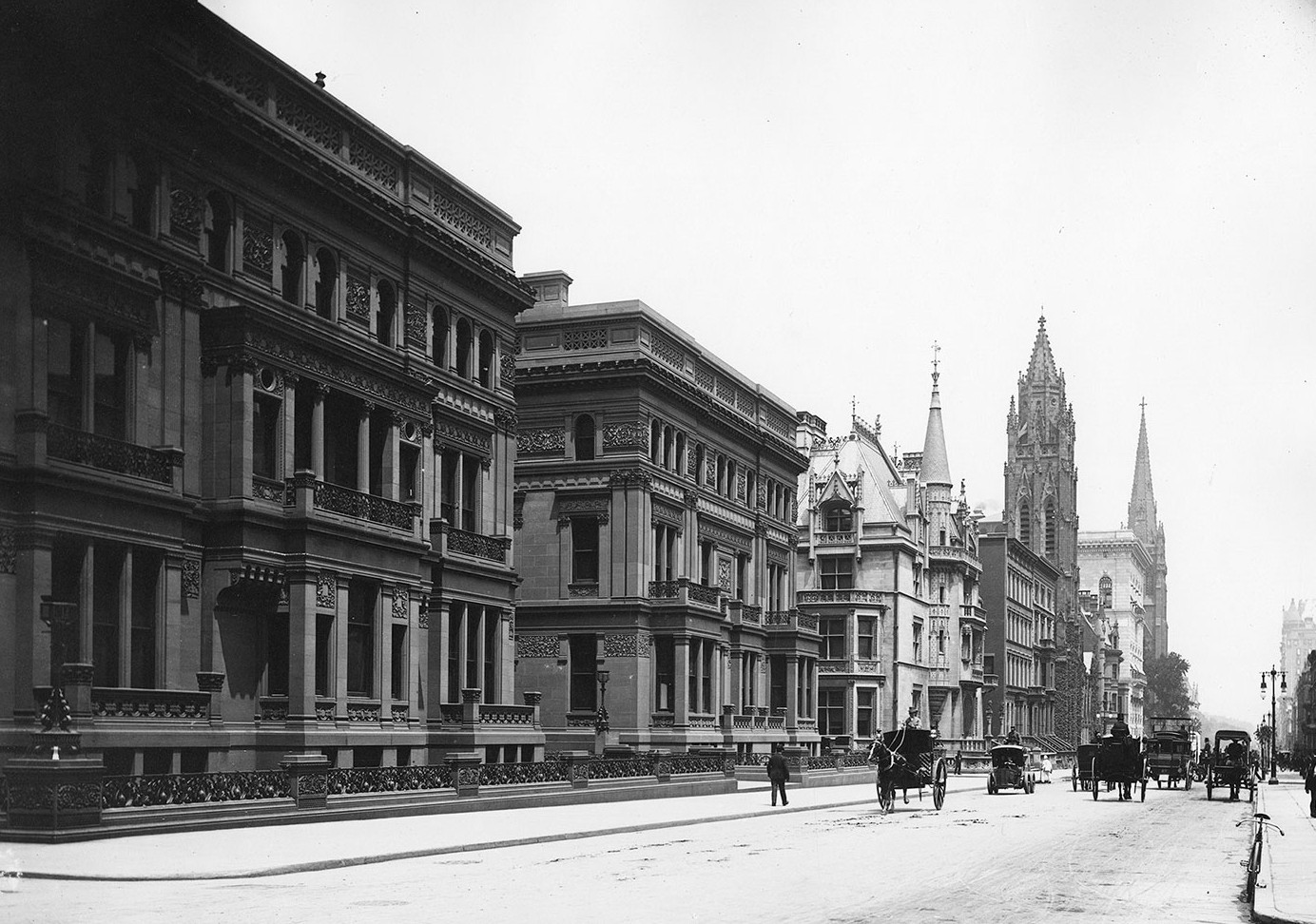
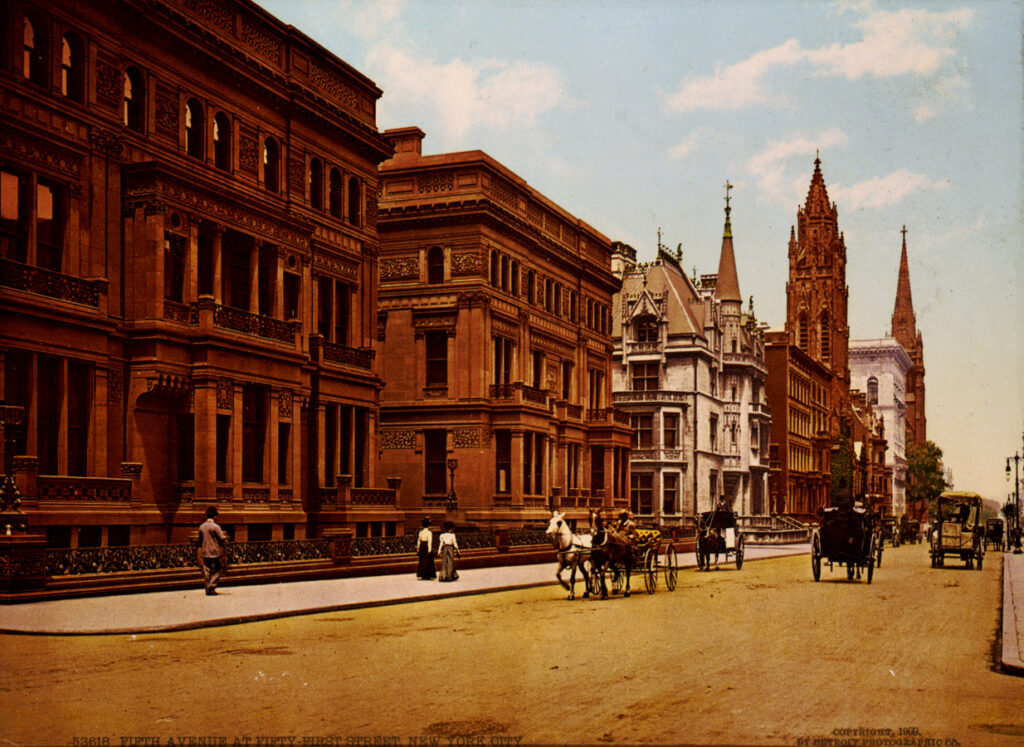
Fifth Avenue at Fifty-first Street in the year 1900. Image courtesy Library of Congress

At the heart of New York’s Gilded Age — the late 19th-century era of unprecedented American wealth and excess — were families with the names AstorWaldorfSchermerhorn, and Vanderbilt, alongside power players like A.T. StewartJay Gouldand William “Boss” Tweed.

They would all make their homes — and in the case of the Vanderbilts, their great many homes — on Manhattan’s Fifth Avenue.

The image of Fifth Avenue as a luxury retail destination today grew from the street’s aristocratic reputation in the 1800s. The rich were inextricably drawn to the avenue as early as the 1830s when rich merchants, anxious to be near the exquisite row houses of Washington Square Park, began turning it into an artery of expensive abodes.

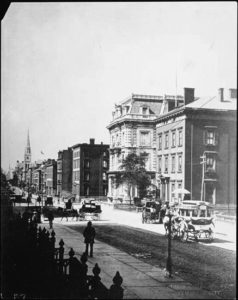
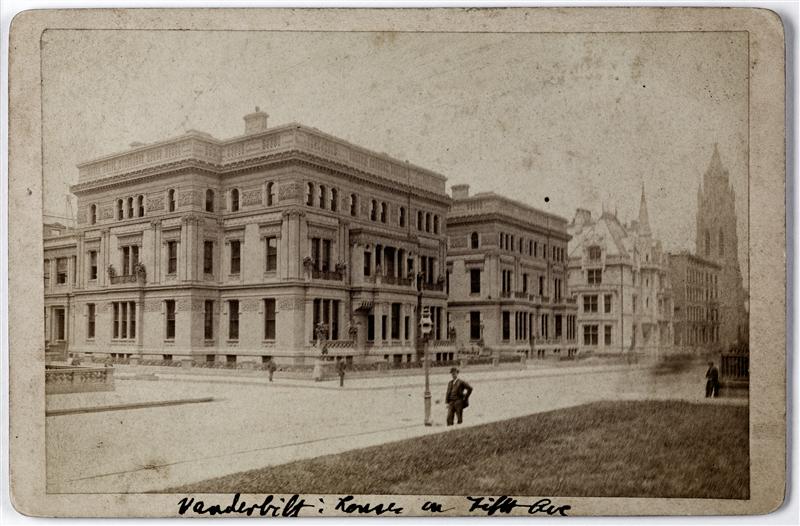
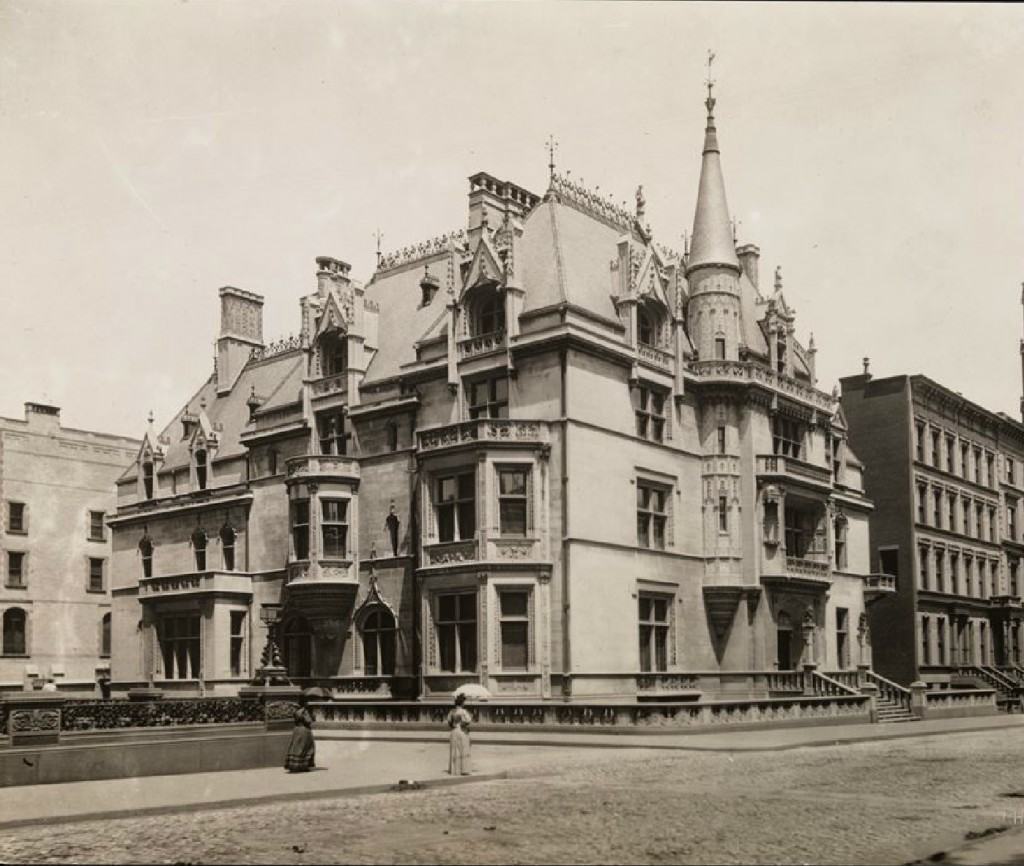
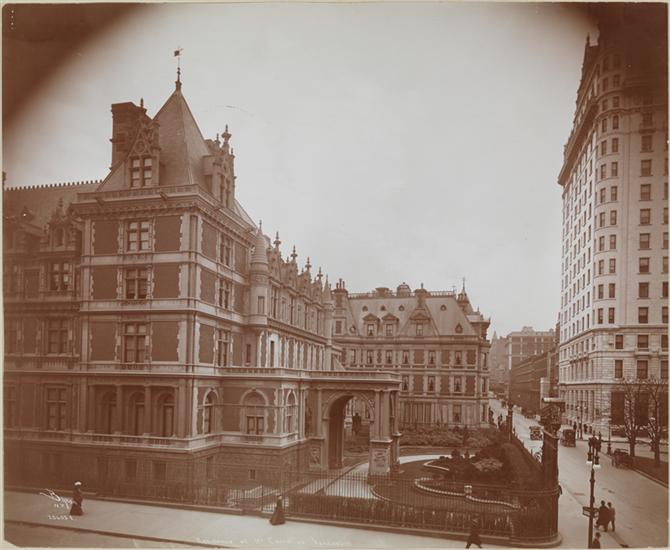
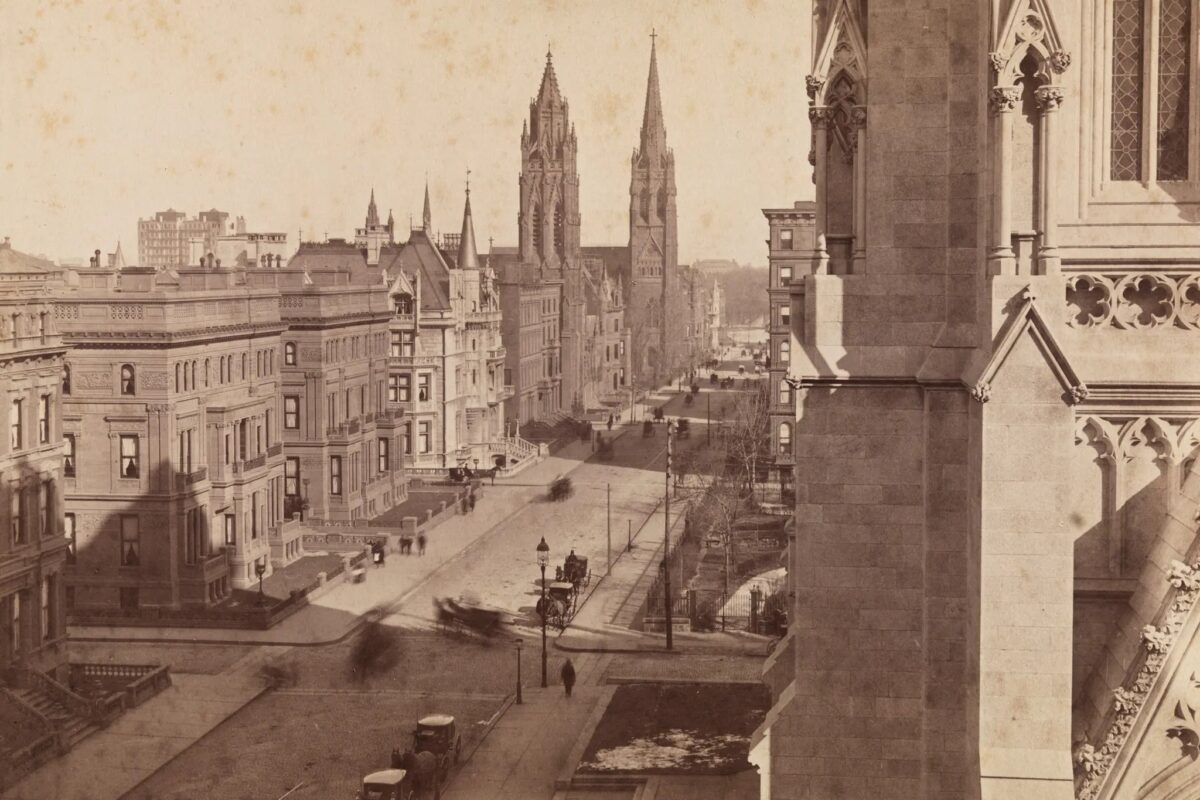
The Vanderbilt Mansion at 660 Fifth Avenue in 1885, Library of Congress

In this podcast, Tom and Greg present a world that’s somewhat hard to imagine — free-standing mansions in an exclusive corridor running right through the center of Manhattan.

Why was Fifth Avenue fated to become the domain of the so-called “Upper Ten”? And what changed about the city in the 20th century to ensure the eventual destruction of most of them?

The following is a re-edited, remastered version of two past Bowery Boys shows — the Rise and Fall of the Fifth Avenue Mansion. Combined, this tells the whole story of Fifth Avenue, from the initial development of streets in the 1820s to its Midtown transformation into a mecca of high-end shopping in the 1930s. 

LISTEN NOW: THE GILDED AGE MANSIONS OF FIFTH AVENUE


This could also serve as a primer to the HBO series The Gilded Age. Tom Meyers is currently co-hosting The Official Gilded Age Podcast for season three. Now on YouTube as well.

1.90.4-L6LHK2FGP3X7WNXO7W4RMZ4FAE.0.1-0

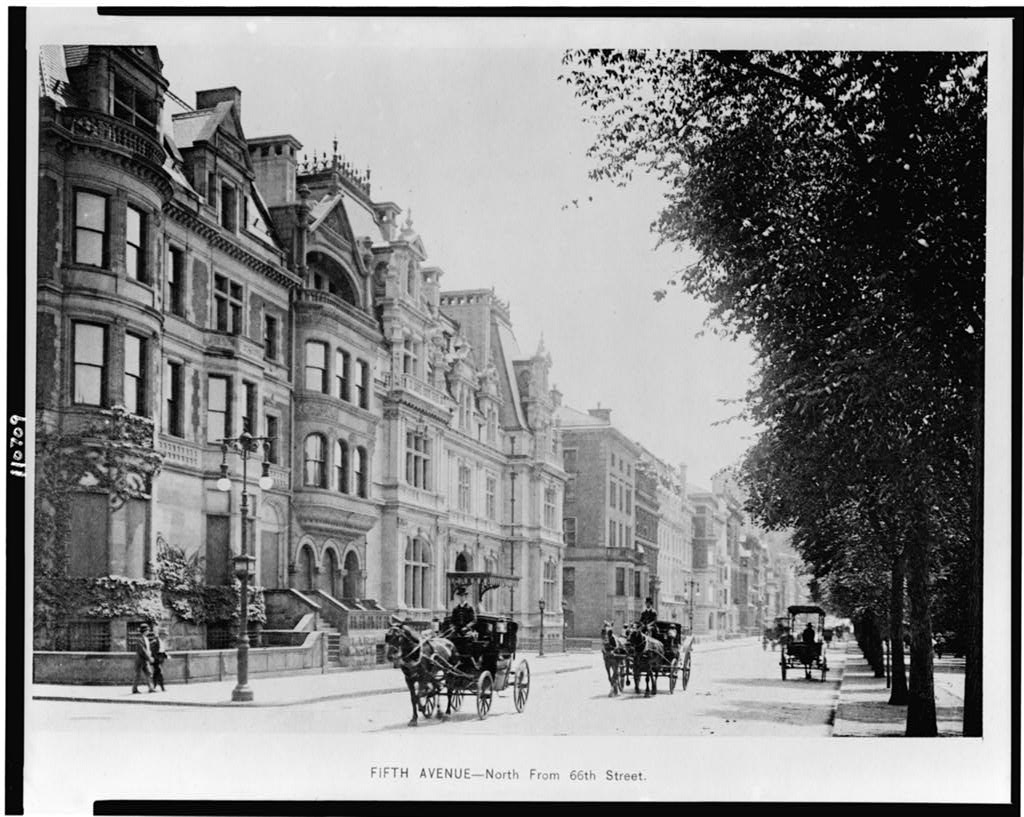
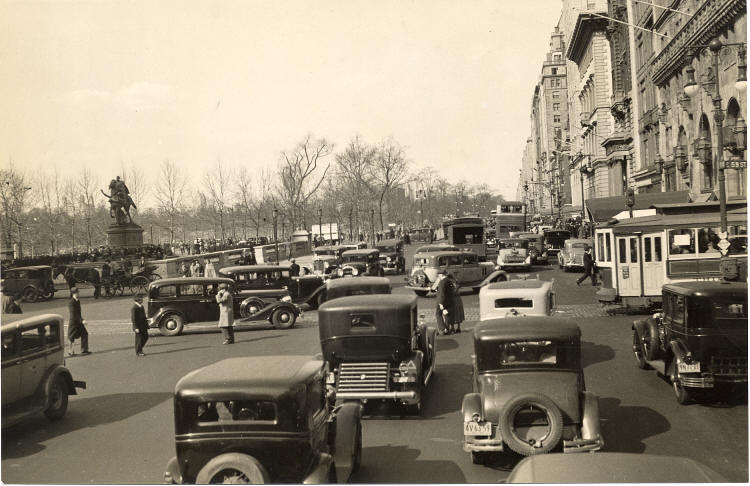
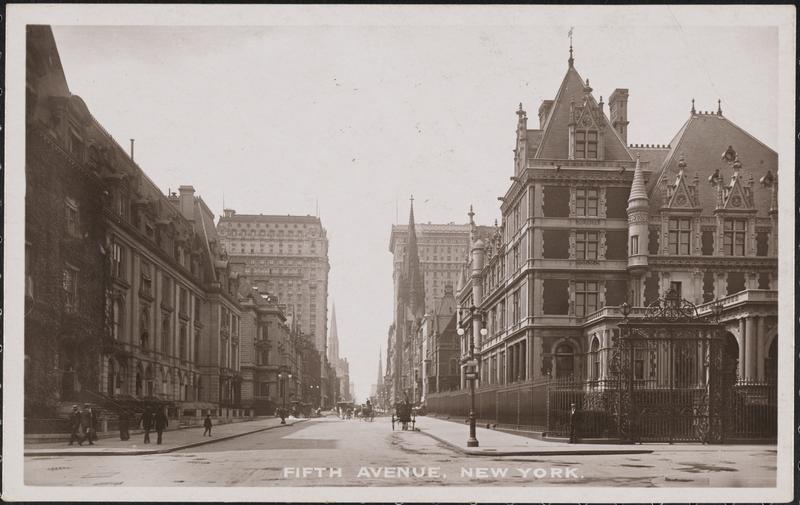
Fifth Avenue – north from 66th Street from the year 1900. LOC
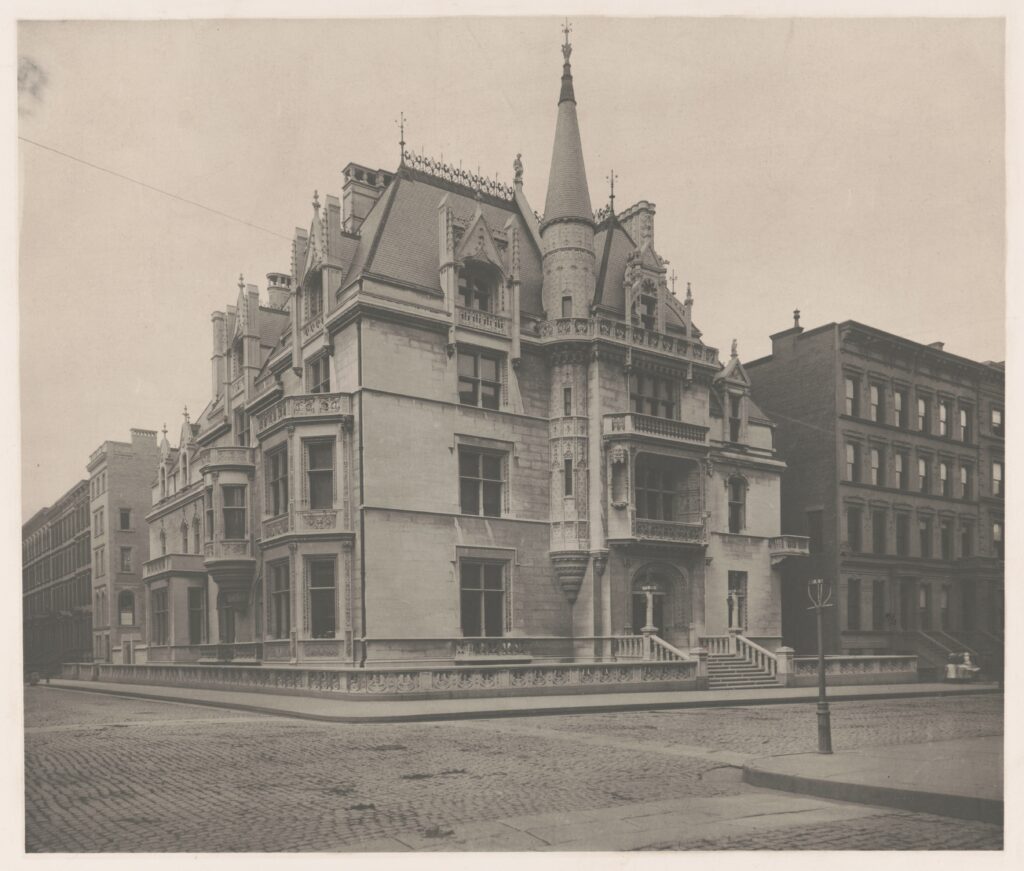
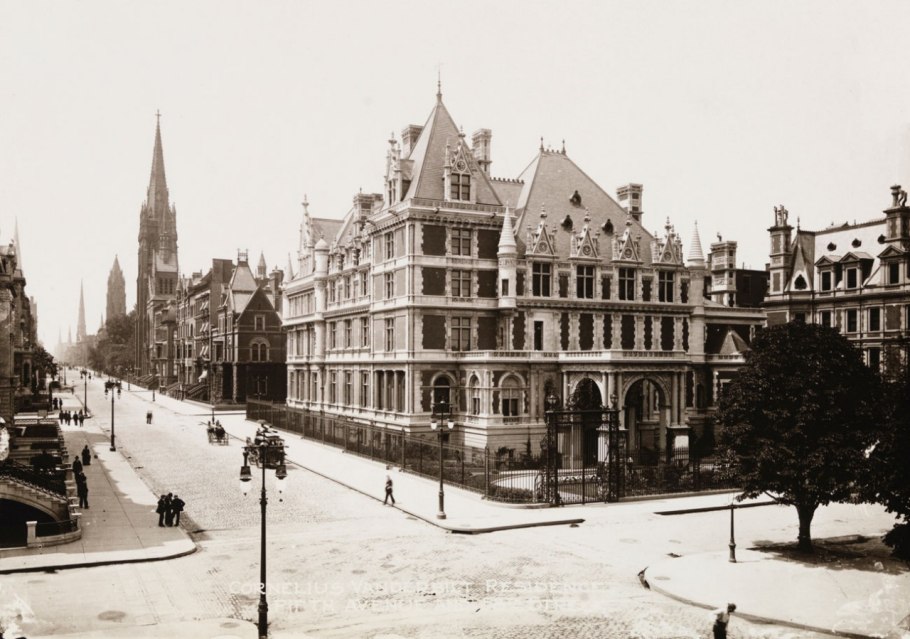
The Cornelius Vanderbilt Mansion

FURTHER LISTENING

Check out episodes of The Gilded Gentleman for all your Gilded Age needs. Here are a few episode that might intrigue you:

And these recent Bowery Boys episodes would make good companion to this episode as well:

Categories
American History True Crime

Insanity: Congressman Daniel Sickles shot and killed the son of Francis Scott Key

On the 160th anniversary of the killing of Phillip Barton Key, I’m reposting this article from 2014 which originally ran on the 100th anniversary of Daniel Sickle’s death.

We don’t have large, parade-like funeral processions marching up the avenues as they once did during the Gilded Age and in the early years of the 20th century.

These events were times of public mourning and a bit of festivity.  Most often they involved the passing of a well-connected political leader or a popular entertainers.  They were somber and reverent affairs; afterwards the saloons along the side streets benefited graciously, tributes and toasts into all hours of the night.

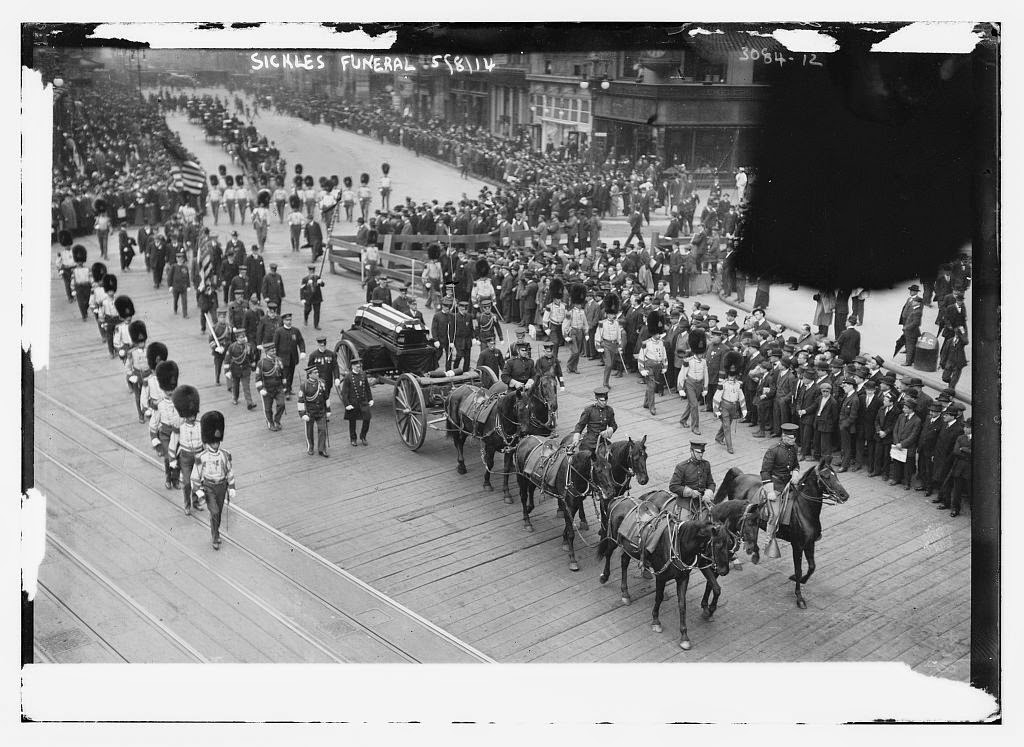
Library of Congress

1914

On May 8, 1914, New Yorkers filled the streets — from Fifth Avenue up to St. Patrick’s Cathedral — to mourn the passing of Daniel E. Sickles, one of the city’s most heralded war veterans.

Having marshaled up volunteers in New York in the early days of the Civil War, Sickles distinguished himself as a bold and commanding general, gathering military promotions through sheer ambition. (He was one of the few commanders in Abraham Lincoln’s army without a West Point education.)

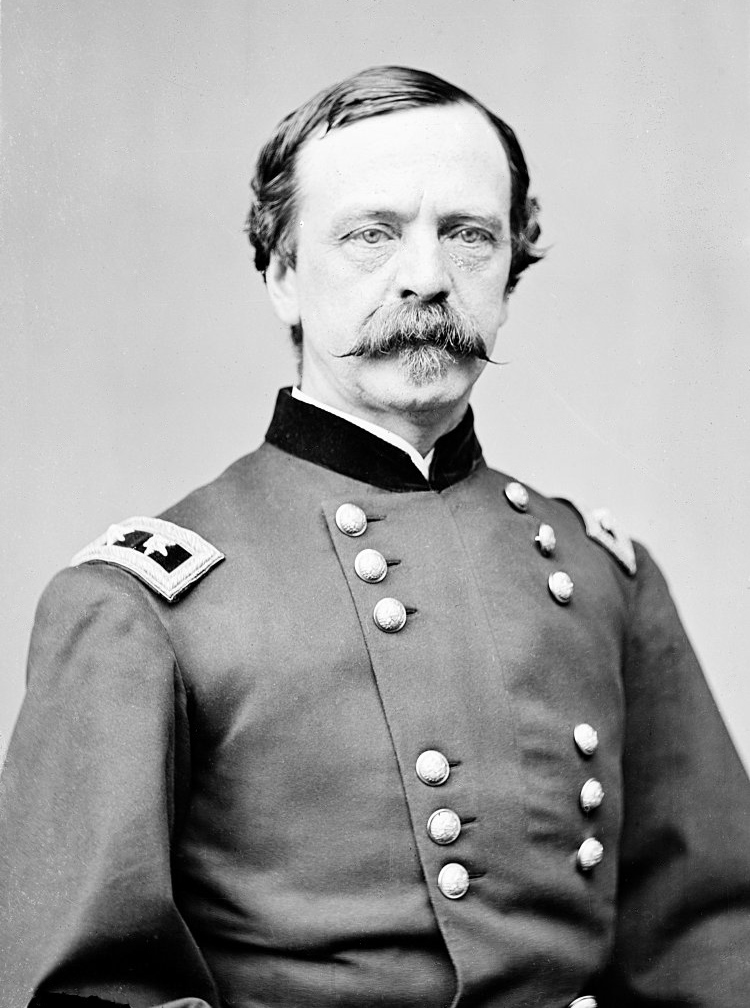
During the Battle of Gettysburg, Sickles was severely injured and had his right leg amputated. (Below: Sickles in 1862.)

He spent his years after the war polishing his war credentials and maneuvering from one political appointment to another.  Sickles belatedly received the Medal of Honor and, situated from his home at 23 Fifth Avenue, was acclaimed in later life in one of New York’s greatest living veterans.

Sickles’ military career, however, was built as an exercise in reputation rehabilitation.  When the war with the South arrived, he saw an opportunity to change the conversation about himself.  His bravery in service to the Union, never questioned, served a dual purpose for Sickles.  Today we might call this “re-branding.”

For in the years preceding the Civil War, the young politician was also known as a cold-blooded murderer who held a unique distinction in the history of legal proceedings.

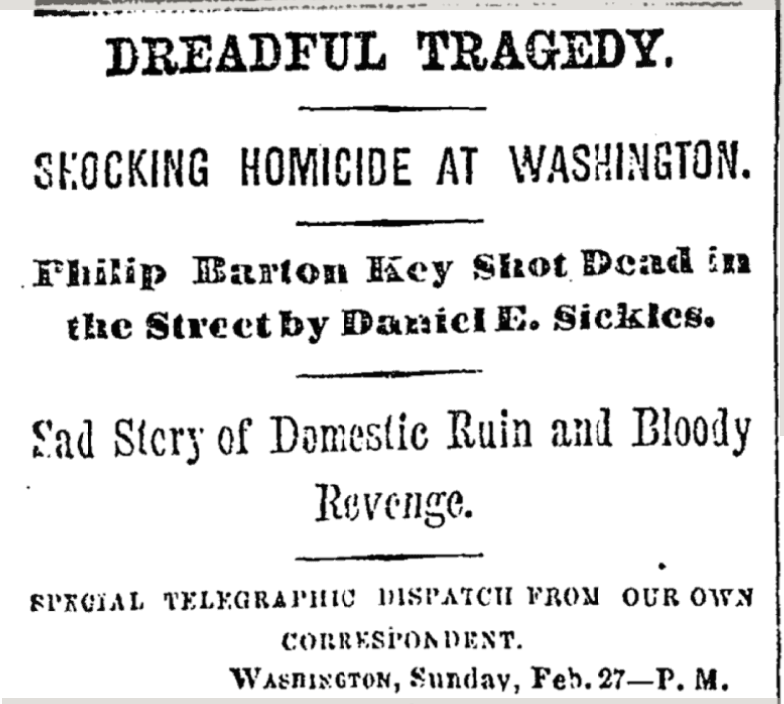
From the New York Times, February 28, 1859

1859
In April of 1859, New York Congressman Daniel Sickles became the first person in history to ever be acquitted of a crime due to temporary insanity.

The crime in this case was the February murder of Philip Barton Key II, the son of Francis Scott Key, author of “The Star-Spangled Banner,” the national anthem of the United States.

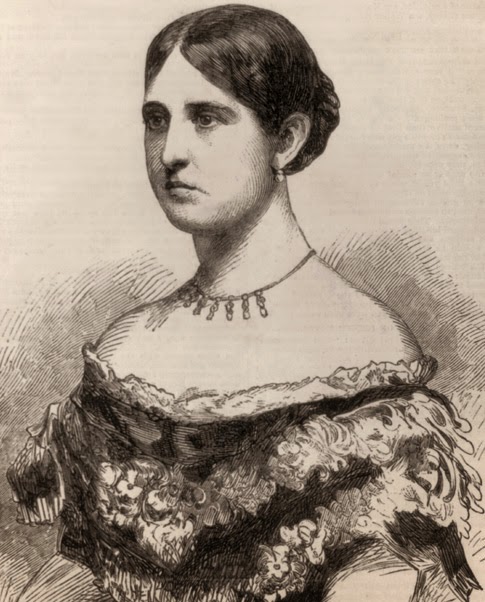
Their lives almost resemble an episode of House of Cards.  Key had been having a very open affair with Sickles’ wife Teresa. (Pictured below)

Daniel, however, was something of an epic rake himself.  With no thought to his own or his wife’s reputation, Sickles was once passionately obsessed with the New York prostitute Fanny White, going so far as to take her into the Albany assembly chamber for a tour.  There were even rumors that some of Sickles’ campaign election costs were covered by White.

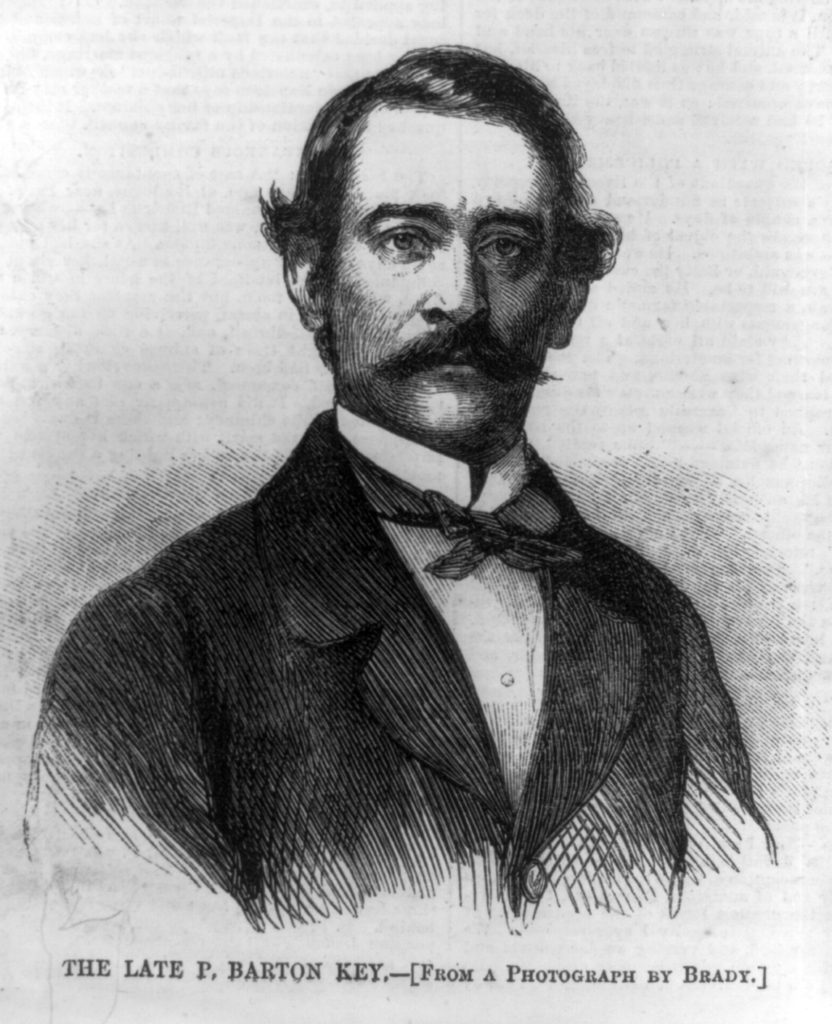
But Key was hardly a wallflower; the famous son was a charming widower who bewitched the women of Washington DC with his intelligence, elegance and wealth.  He and Teresa met in 1857 and began their affair soon after, meeting often once a day and openly flirting with each other at a society balls. (Below: An illustration of Key which ran in Harper’s Weekly in 1859.)

When Sickles did finally discover the affair, he was distraught and sickened, before turning violently angry.  

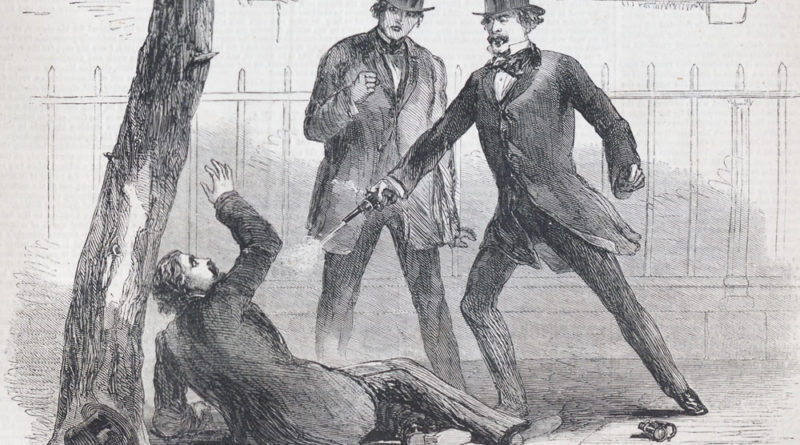
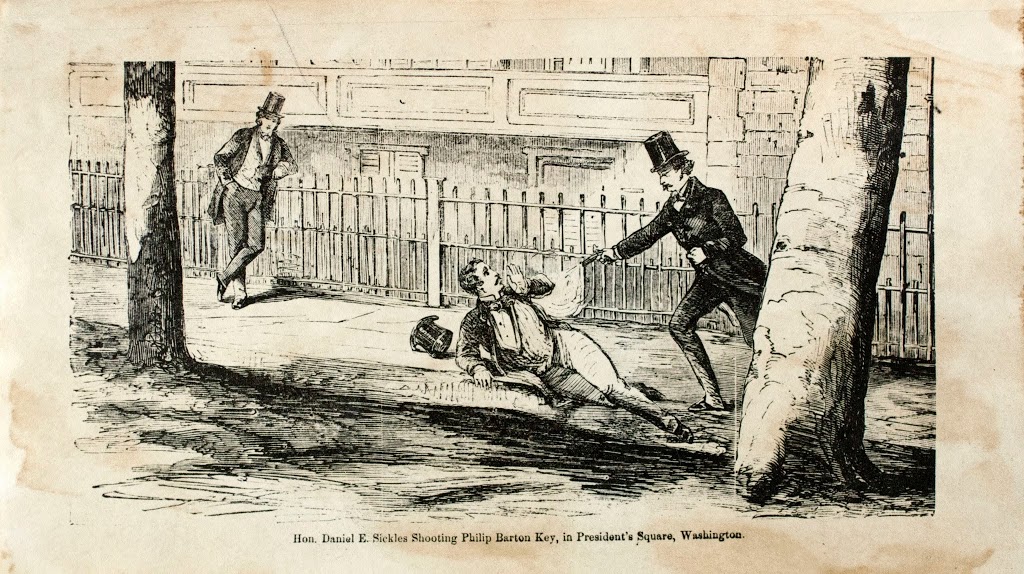
On February 27, 1859, Sickles approached Key in DC’s Lafayette Square — a short distance from the White House –and shot him in the groin.

“You villain, you have dishonored my house, and you must die!” Sickles reportedly said.

He shot Key again in the chest and would have shot him directly in the head had the gun not misfired.

Said the New York Times the following day, “The vulgar monotony of partisan passions and political squabbles has been terribly broken in upon to-day by an outburst of personal revenge, which has filled the city with horror and consternation.”

Above: An illustration of the Sickles trial, courtesy Library of Congress

The condition of Sickles’ mental state during and following the murder would be closely dissected in court. A colorful swath of testimony described Sickle as everything from disturbingly serene to a raging lunatic.

According to authors Michael Lief and H. Mitchell Caldwell, “These conflicting stories may be exaggerations on the part of creative witnesses, or they may be evidence that Sickles was driven to the edge, past the breaking point, entirely out of his mind.”

One of the lawyers who helped craft the insanity defense was Edward M. Stanton, later to be Abraham Lincoln’s Secretary of War.  Their defense of temporary insanity — never successfully tried in a U.S. court — was sprung upon the jury, nested within an extravagant bed of prose, classical quotations and moral quandary.

“It is folly to punish a man for what he cannot help doing?” asked associate defense attorney John Graham.  Apparently so, it seems, for in April, a jury acquitted Sickles, taken with the plight of a man wronged by his unfaithful and deceitful wife. (His attorneys did a spectacular job of burying Sickle’s own unfaithfulness and deceit.)

Above: 23 Fifth Avenue, the home of Daniel Sickles and the location of his death on May 5th, 1914 (images courtesy New York Public Library)

1914
Fifty-five years later, Sickles’ many legitimate accomplishments (and, let’s be honest, his relentless self-promotion) assured that this unusual crime was rendered a footnote when he died on May 5.

His New York Times obituary is an extraordinary bit of word play:  “Philip Barton Key … paid attention to Mrs. Sickles, and Sickles shot and killed Key on the street in Washington D.C. on February 27, 1859.”

The focus then turns on Sickles’ “gracious” forgiveness of his wife: “I am not aware of any statute or code of morals,” said Sickles to his critics, “which makes it infamous to forgive a woman….I shall strive to prove to all that an erring wife and mother may be forgiven and redeemed.”

In reality, the two never reconciled.  Teresa died in 1867 at age 31, her reputation destroyed.  A few years later, Sickles became the ambassador to Spain, returned to his legendary womanizing and eventually married a well-connected daughter of a Spanish official.

He spent his final years at his Fifth Avenue home nearly bankrupt, his only means of support coming from his children and his now-estranged second wife.  “[S]everal attempts were made to seize the art treasures  in his Fifth Avenue home because of debt,” noted the Times.

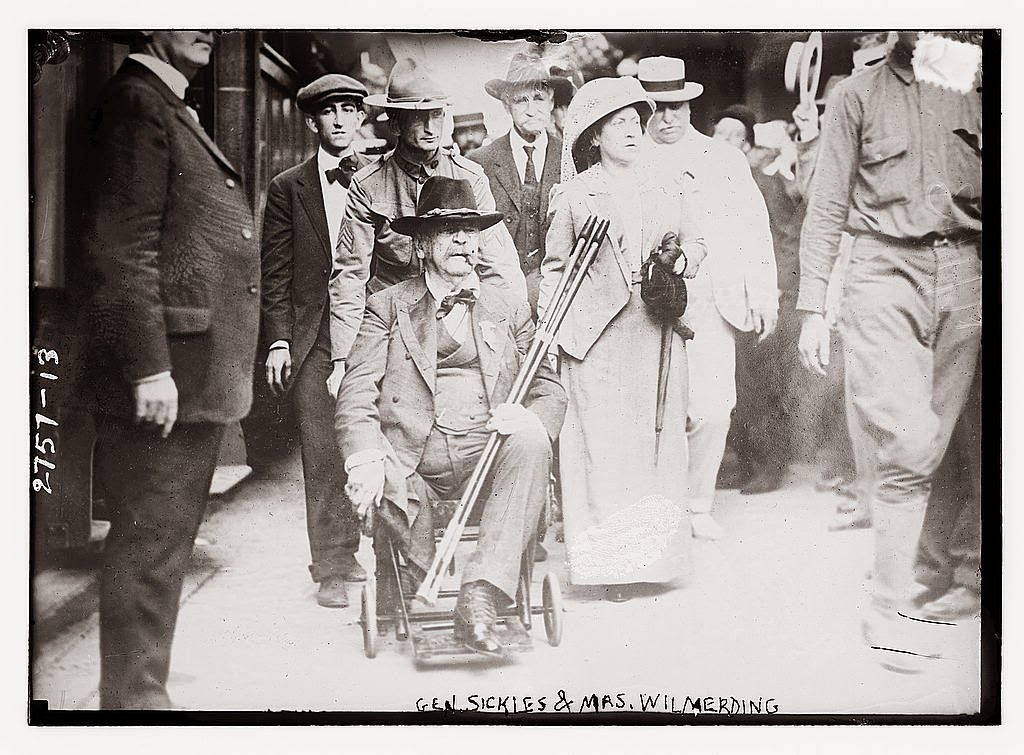
Below: Daniel Sickles at a 1913 Gettysburg reunion, accompanied by his live-in secretary Eleanora Wilmerdirg

Categories
Gilded Age New York Landmarks

The Fifth Avenue Hotel: Opulence, glamour and power on Madison Square

The double-breasted, cigar-chewing gentlemen who gathered in the sumptuous rooms of the Fifth Avenue Hotel were occasional connoisseurs of New York City history, and in particular, these amateur historians spoke of the very street corner where their hotel stood.

Before Madison Square, when the area was a barren parade ground, one Corporal Thompson opened a roadhouse and stagecoach station in the area that was to become 23rd Street and and Fifth Avenue.

Many spoke fondly of Thompson’s establishment, called Madison Cottage, because they remembered the place as young boys. They recalled the area’s rural quality, with carved rectangular blocks carved into the land and a dirt-road Broadway meandering north.

But that was the 1840s.
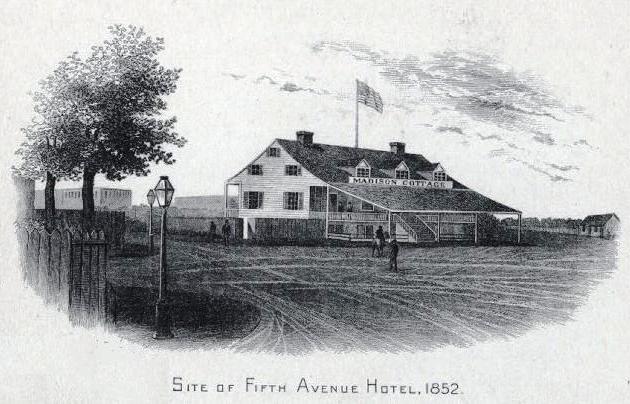
Madison Cottage, Hitchcock, Darling & Co.

Forty years later, Madison Square Park was the center of New York, a focal point of class, business and luxury that stretched south to Union Square, through that attractive collection of fine stores known as Ladies Mile, and up Fifth Avenue into the fabulous mansions of the rich.

And dead center of all that activity was the Fifth Avenue Hotel, not only the “finest [hotel] in this metropolis”, the “leading hotel of the world ,” but quite simply one of the most surprising stages for American politics of the mid and late 19th century.

New York’s Hotel Revolution

Hotels were fast becoming the center of New York life from at least the days of the Astor House, located near City Hall, in the 1830s. Within two decades, trendy new hotels (such as the St. Nicholas and the Metropolitan) spread up along Broadway and eventually clustered around Union Square.

By the Civil War, the thrust of New York society was so defined by them that Confederate conspirators tried setting fire to a several of them.

The Fifth Avenue Hotel opened in 1859, the venture of wealthy merchant Amos Richards Eno, who accurately gambled that the center of city commerce would soon settle at 23rd Street. So confident a speculator was Eno that he moved from his brownstone at 74 Broadway (the first New York brownstone, he claimed) to a massive home nearby the hotel.

Some thought it unwise to build so far north, and when workers unearthed dozens of skeletons during construction — the area once being a potter’s field — the corner was even considered cursed. Eno defied the naysayers, pouring his wealth into the hotel to make it the most modern, most luxurious accommodation of the day.
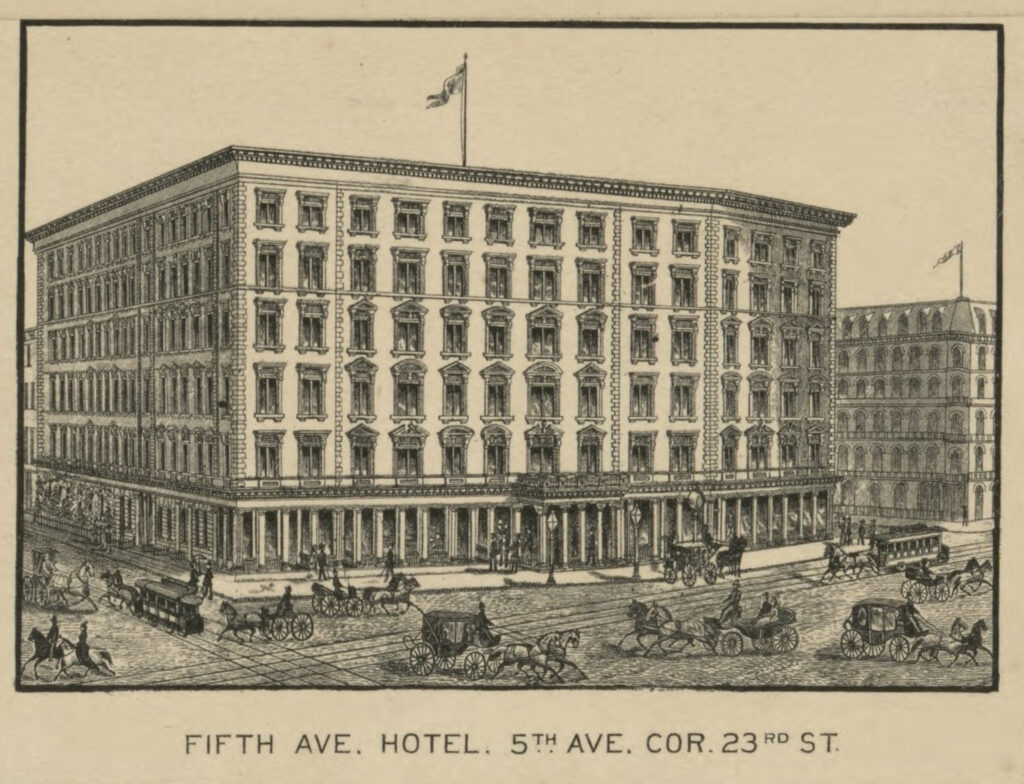
The Fifth Avenue Hotel, 1879. Courtesy Wikimedia Commons
A Gilded Age Confection

The Italian exterior was awash in five stories of imported marble, while austere, carpeted interiors of French design drew comparisons to European palaces.

Guests enjoyed reading rooms, a luxurious bar, a barber shop, a dedicated telegraph office, and a variety of dining and drawing rooms, not to mention the first passenger elevator ever built in the United States, a steam-powered monstrosity whisking passengers to their floor.  

The private quarters were soundproofed, fixtured with the modern innovations in plumbing, and lavishly decorated, becoming to many “the safest, the most healthy and most comfortable hotel in the world.

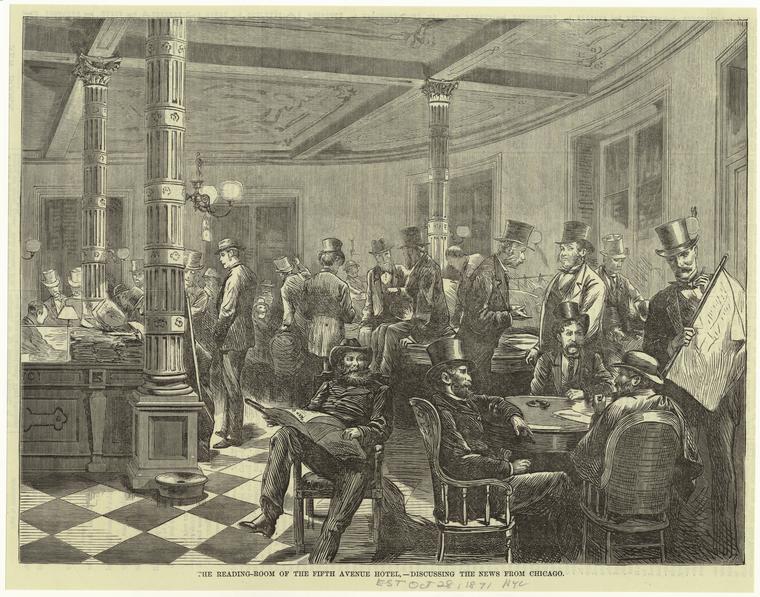
The Fifth Avenue Hotel reading room, busy every weekend. (Boston: Fields, Osgood & Co.,)
Wheeling and Dealing

As the finest hotel in the city in the post Civil War years, it naturally became a magnet for politicians and financiers. Of all the ‘backrooms’ of American politics, none were as gleaming as the Fifth Avenue.

Bankers huddled in the legendary ‘parlor D. R.’ during the tense days of the financial panic of 1873. In particular, the hotel became a de facto headquarters for New York Republicans.

While often secondary to the city’s Democrats — this being the era of Tammany Hall‘s swelling power — Republicans were frequently in control of state government, and the Fifth Avenue Hotel became a smoky center of political wheeling and dealing.

During the 1870s, New York republicans became national power brokers and frequently hashed out crises here at the Fifth Avenue.

In the years before the Waldorf-Astoria, presidents and dignitaries all stayed here during visits. Seamier political maneuvers took place in the chambers of prominent politicians who held court here, including the inimitable Roscoe Conkling (at left), senator of New York and leader of the Republican faction known as the Stalwarts.

National Influence

When fractured Republicans at their convention in 1880 nominated non-Stalwart James Garfield for president, the nominee had to basically grovel for their support by symbolically ‘kissing the ring’ of the Stalwarts during a visit to the Fifth Avenue Hotel, partially agreeing to their system of patronage and taking Conkling ally Levi Morton as a member of his cabinet. (Garfield later backed out on this arrangement.)

Another frequent guest here was Chester A. Arthur, Garfield’s eventual vice president. When Arthur became president after Garfield’s assassination by Charles Guiteau (who had himself wandered the hotel’s hallways in delusion), he would set up his entire administration here during visits to his adopted city.

By the 1890s, a corridor of the hotel known as the ‘Amen Corner‘ was a famous congregation spot for Republican political bosses and reporters. As they frequently powwowed here on Sundays, gatherers would caustically shout ‘Amen!’ during heated discussions.
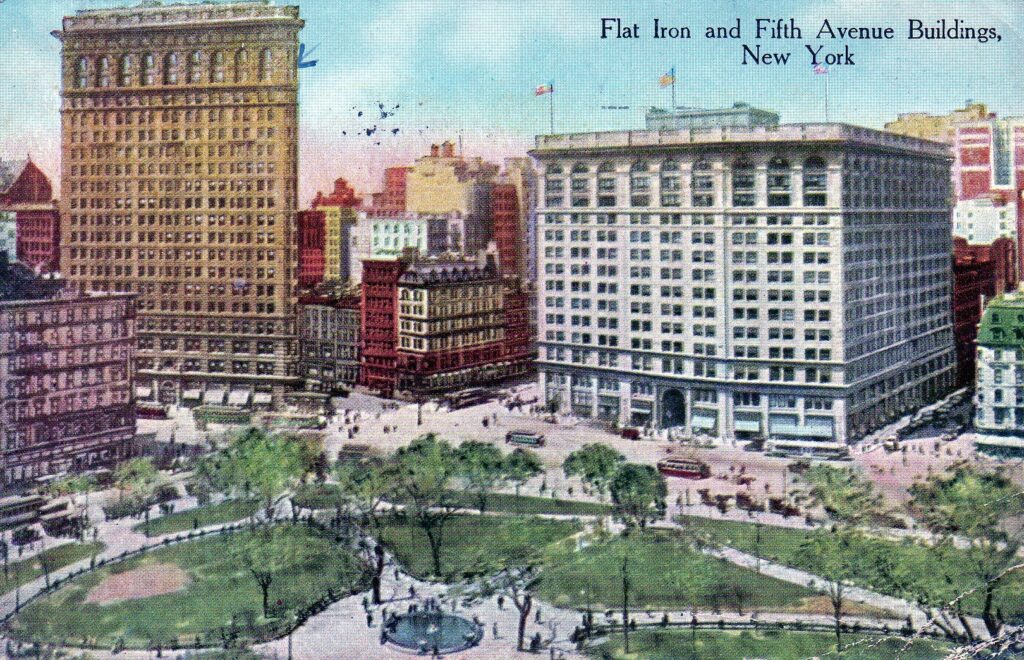
The Fifth Avenue Hotel in relation to the Flatiron Building
Checking Out

The hotel became a magnet for shenanigans of all varieties. In 1893, a couple hundred proponents of a U.S. monetary silver standard erupted into a riot that included two U.S. senators.

The bank robber Robert Montague was arrested here in 1896 thanks to a tip-off from a chambermaid. An early vestige of baseball’s National League met here annually, and the national pool competitions were held in the hotel’s billiard room.

By the new century, of course, the locus of New York activity was hastily moving uptown, and the Fifth Avenue Hotel was deemed a relic, even as a brand new structure across the street — the Flatiron Building — was being proclaimed the finest building in the city.

In 1908 the Fifth Avenue Hotel was torn down and replaced by the 16-story Toy Center (called the Fifth Avenue Building back in the day), the epicenter of toy manufacturing for much of the 20th century.
Categories
Health and Living Podcasts

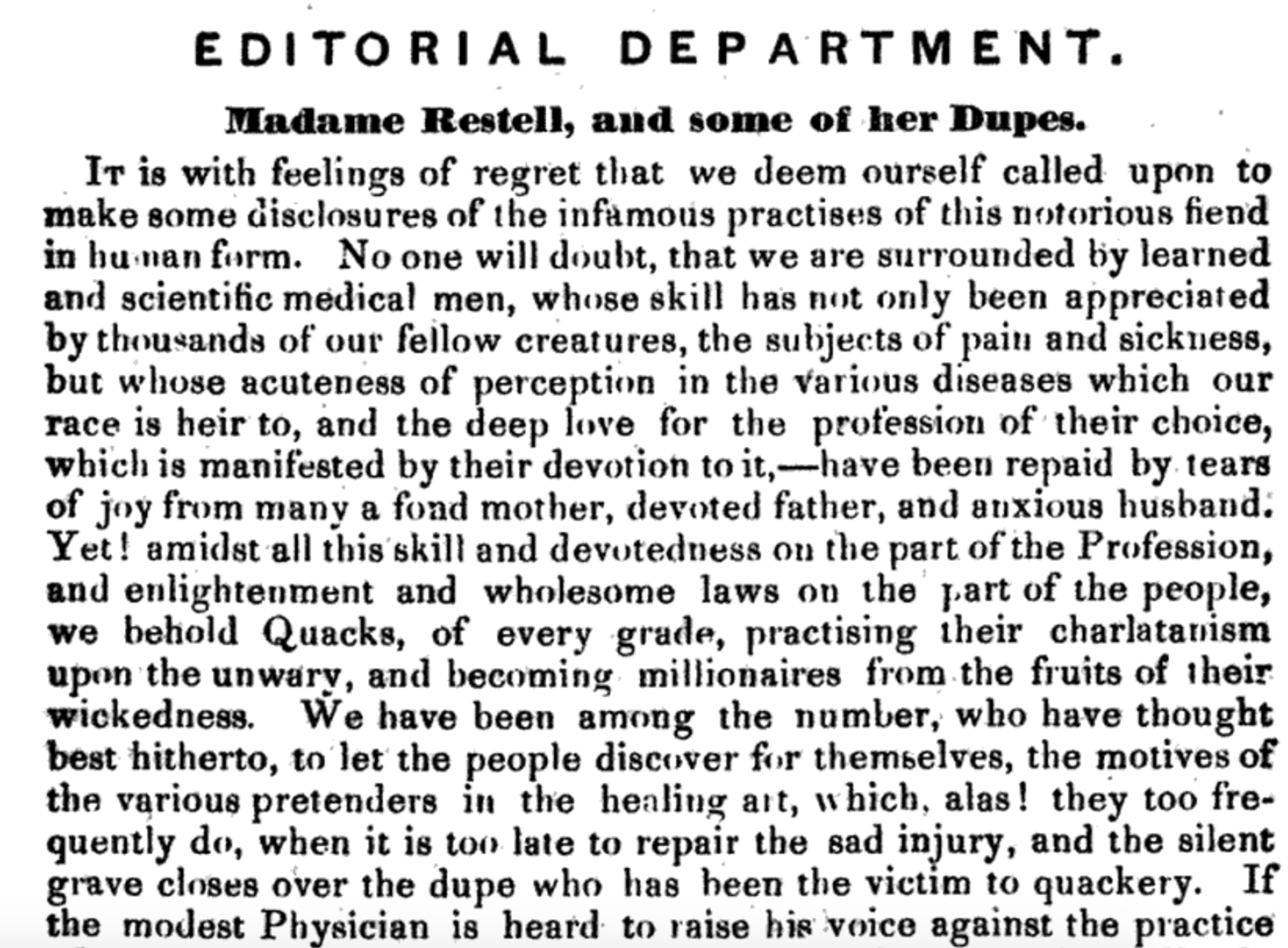
The Notorious Madame Restell: The Abortionist of Fifth Avenue

The story of New York’s most prominent abortionist of the 19th century and the unique environment of morality and secrecy which accommodated her rise on the fringes of society.

Ann Lohman aka Madame Restell was one of the most vilified women of the 19th century, an abortion practitioner that dodged the law to become one of the wealthiest self-made women in the Gilded Age. But is her wicked reputation justified?

Thoughts on abortion and birth control were quite different in the 1830s, the era in which Madame Restell got her start. It was societal decorum and marital morality — not science and religion — that played a substantial role in New Yorkers’ views on the termination of pregnancy. Restell and countless imitators offers a wide range of potions, pills and powders to customers, provided for in veiled wording in newspaper advertisements.

By the 1860s Restell was insulated from serious interrogation and flaunted her unique position in society by planting her Fifth Avenue mansion in a very controversial place. But she soon became a target of New York’s most dogged reformer, a man who considered her pure evil and the source of society’s most illicit sins.


The Bowery Boys: New York City History podcast is brought to you …. by you!

We are now producing a new Bowery Boys podcast every two weeks. We’re also looking to improve the show in other ways and expand in other ways as well — through publishing, social media, live events and other forms of media. But we can only do this with your help!

We are now a member of Patreon, a patronage platform where you can support your favorite content creators for as little as a $1 a month.

Please visit our page on Patreon and watch a short video of us recording the show and talking about our expansion plans. If you’d like to help out, there are five different pledge levels (and with clever names too — Mannahatta, New Amsterdam, Five Points, Gilded Age, Jazz Age and Empire State). Check them out and consider being a sponsor.

We greatly appreciate our listeners and readers and thank you for joining us on this journey so far. And the best is yet to come!


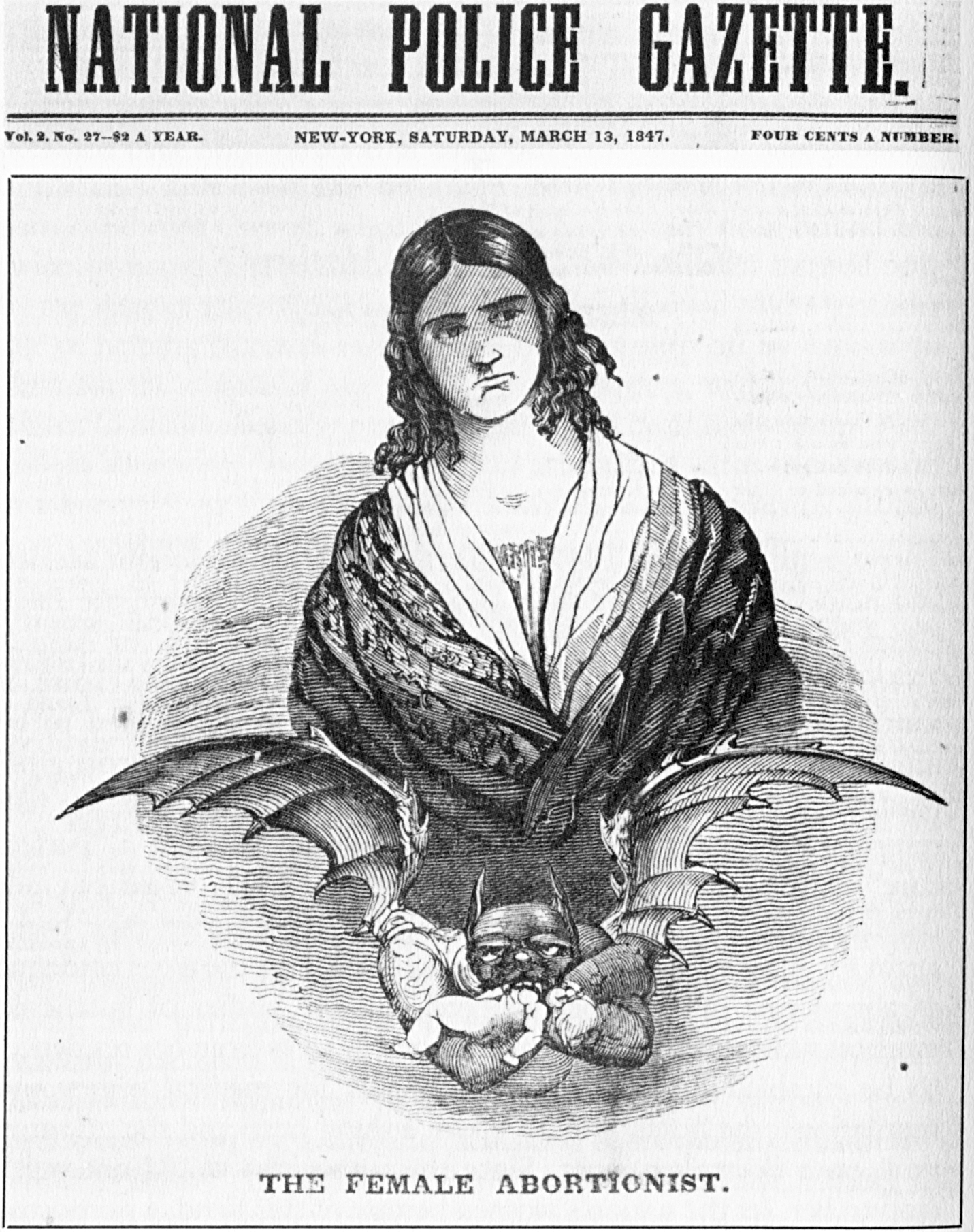
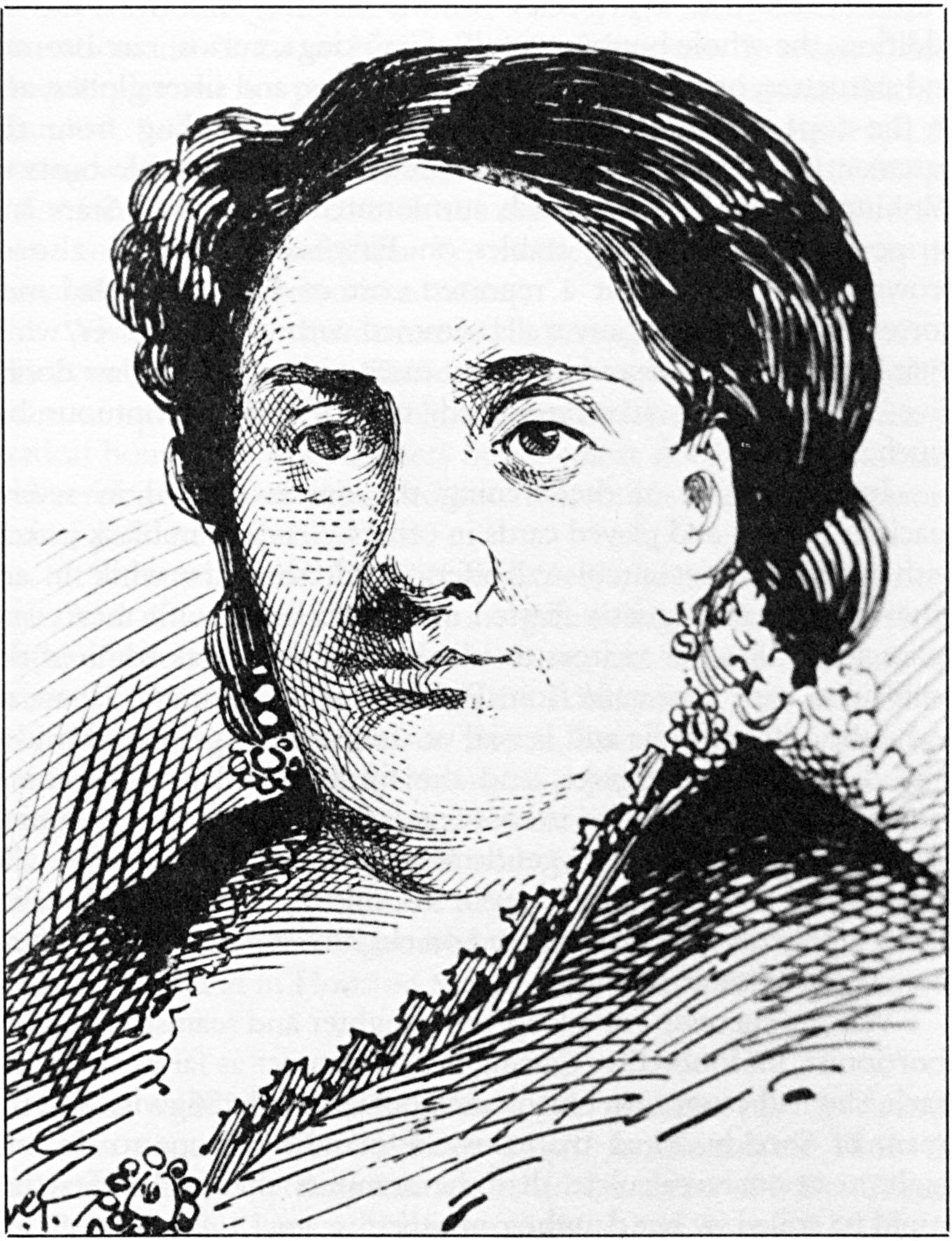
Ann Lohman aka Madame Restell, featured in the National Police Gazette for the crime that would get her sent to Blackwell’s Island, March 13, 1847

National_Police_Gazette_Restell

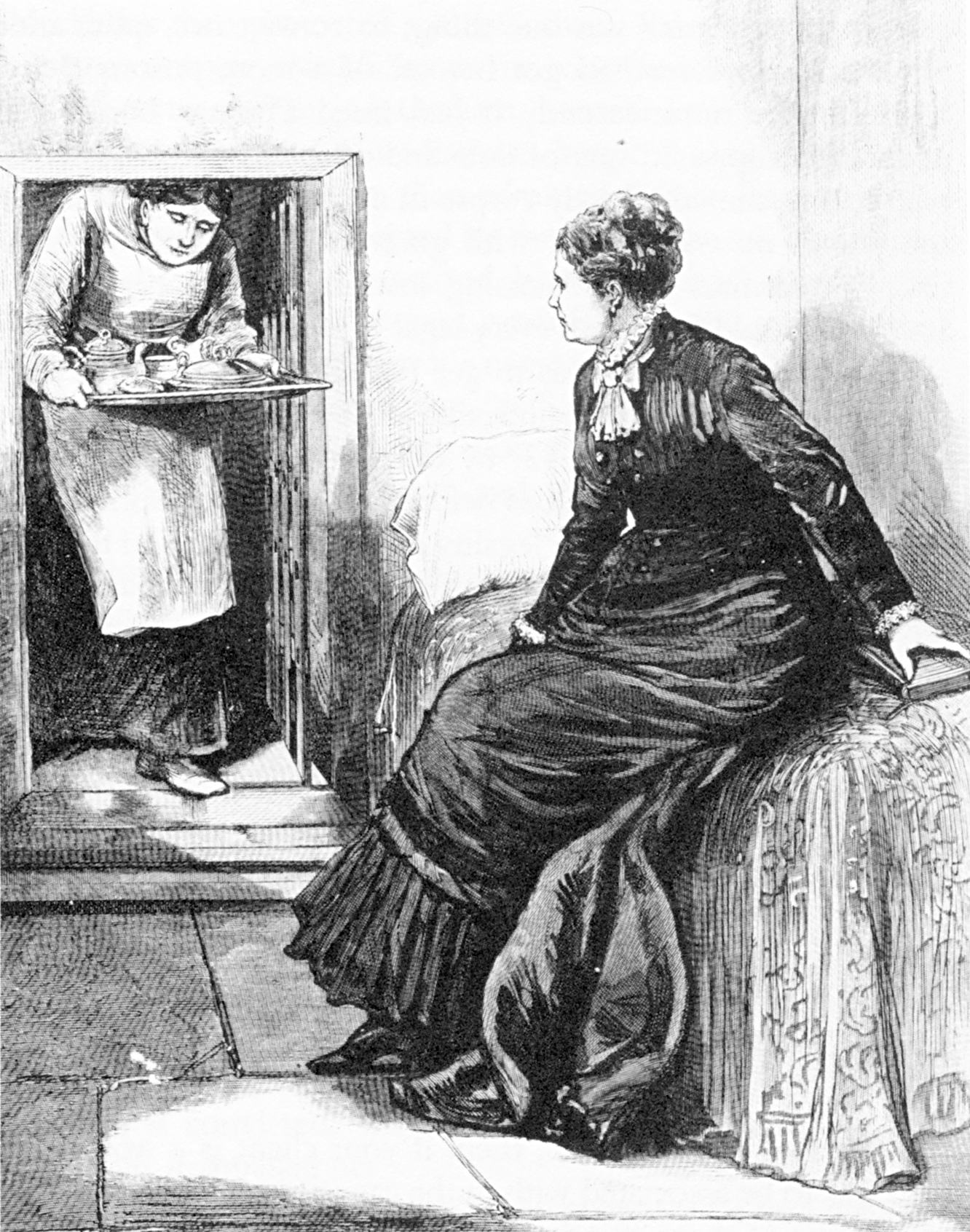
A drawing of Madame Restell made in 1888, long after her death.

Madame_Restell,_1888

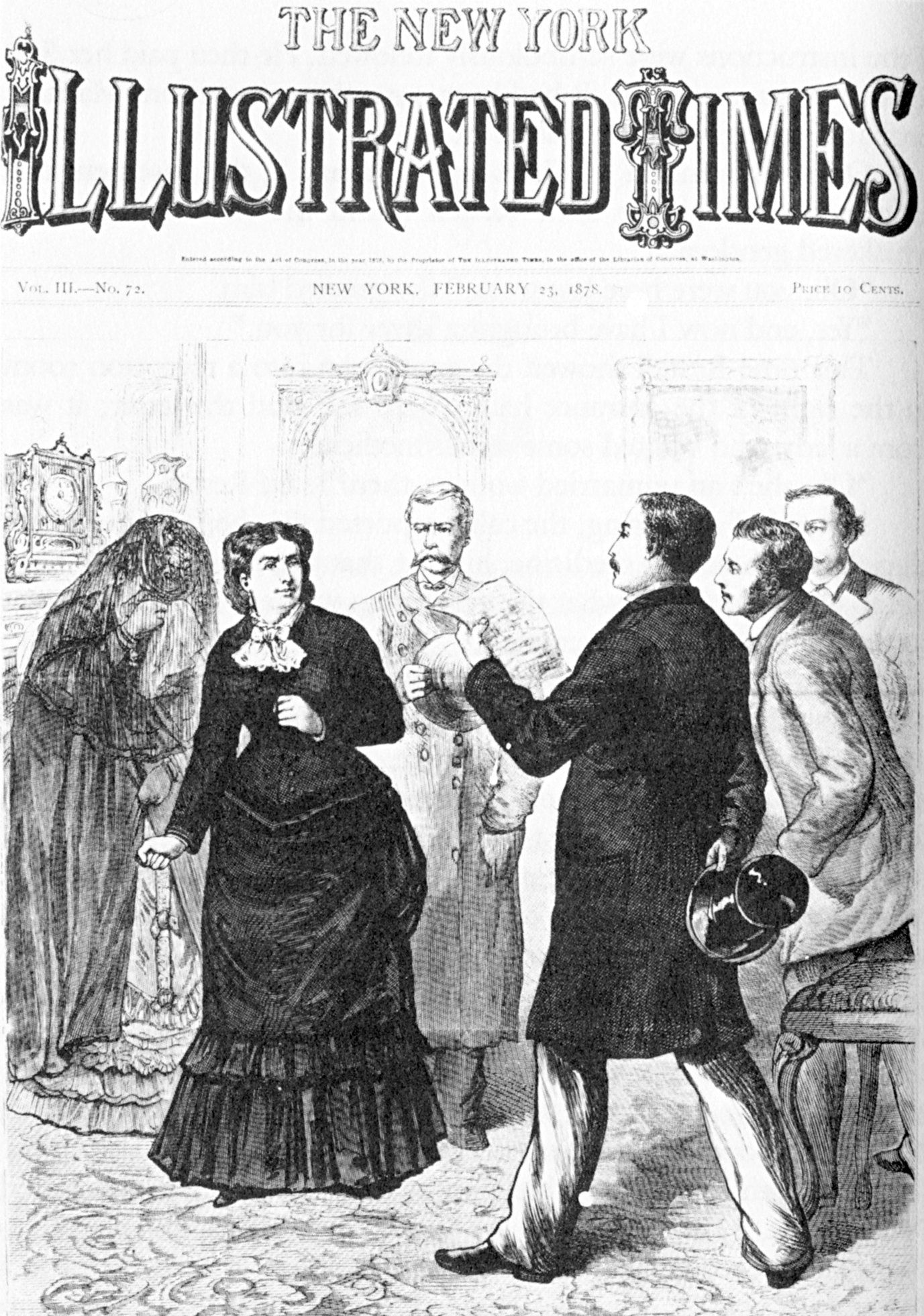
The New York Illustrated News, 1878, heralding the arrest of Madame Restell by Anthony Comstock (and, later in the issue, Restell in the Tombs):

Madame_Restell_arrested_by_Comstock

Thanks to Victorian Gothic for this image!

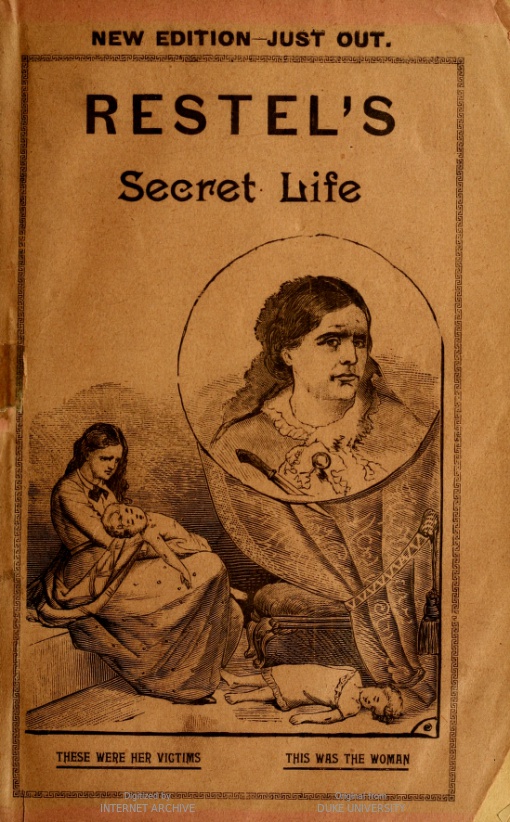
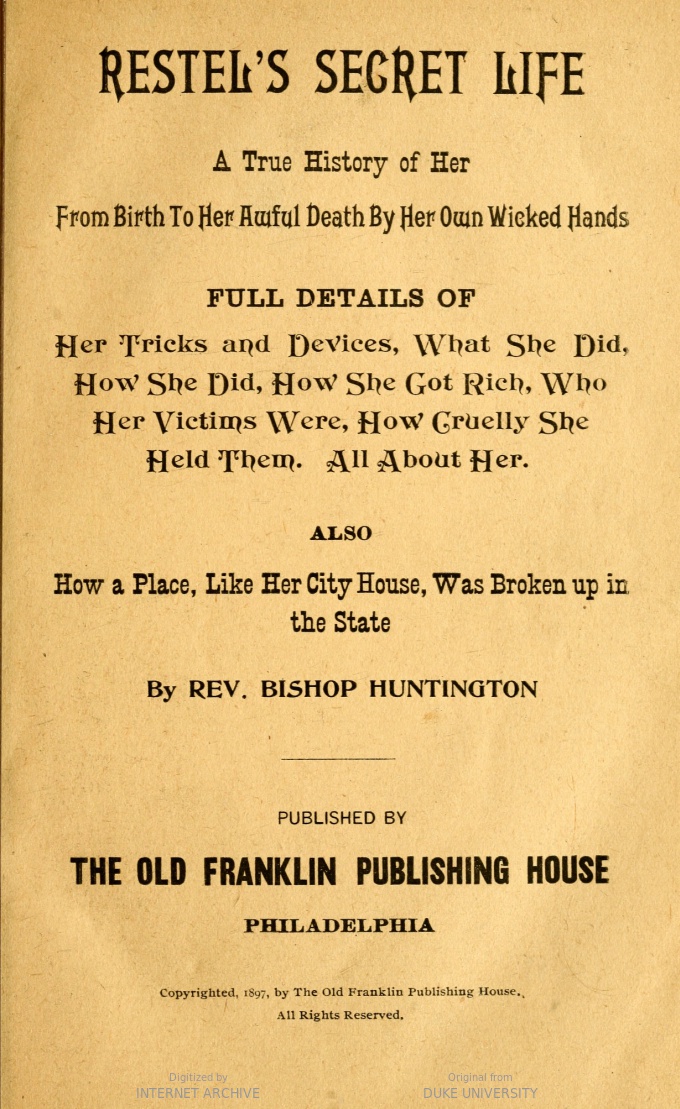
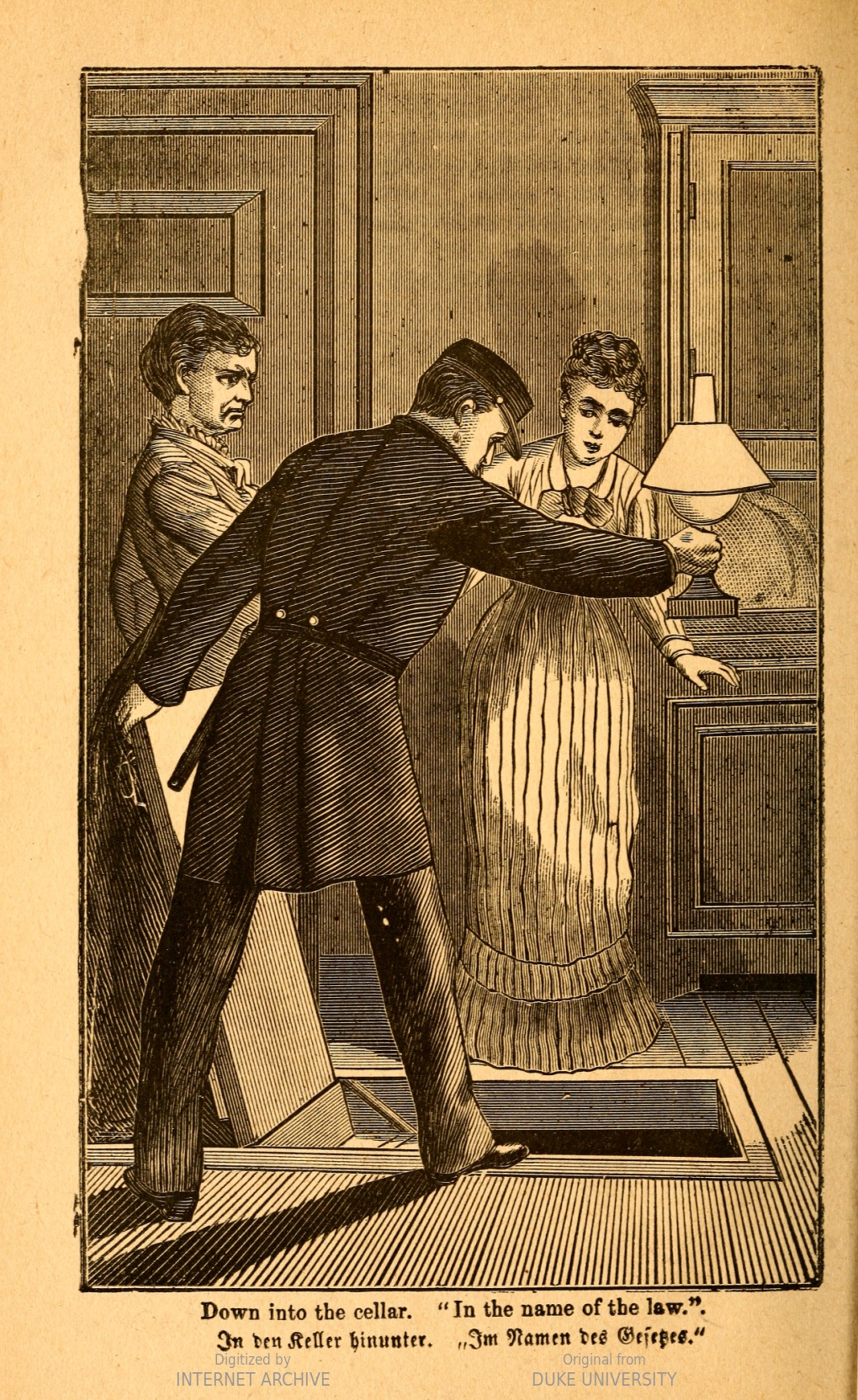
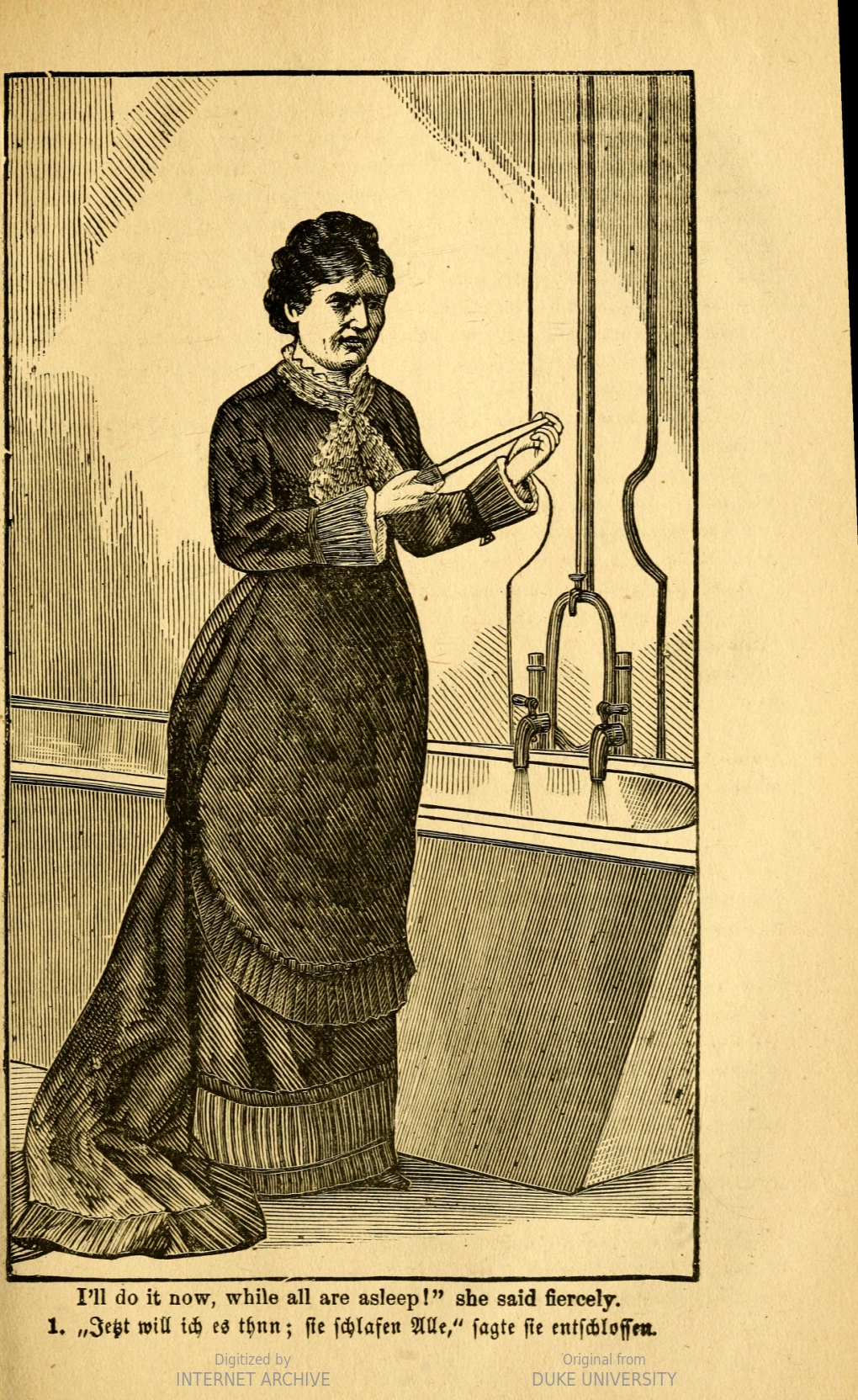
A few choice pages from an 1896 scandal novelization about the life of Madame Restell by Rev. Bishop Huntington:

Courtesy Hathi Trust

image-1

image-2

image-3

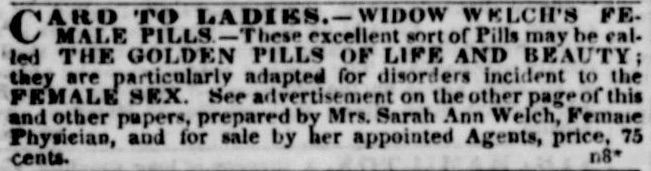
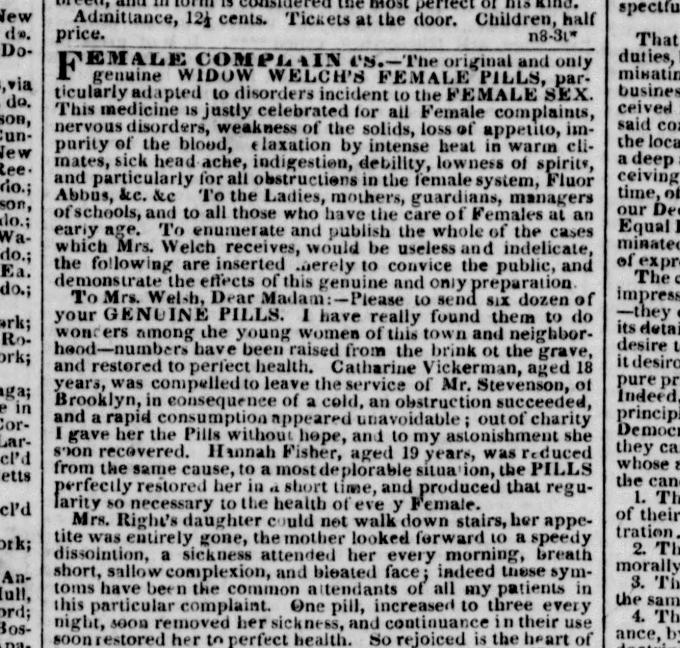
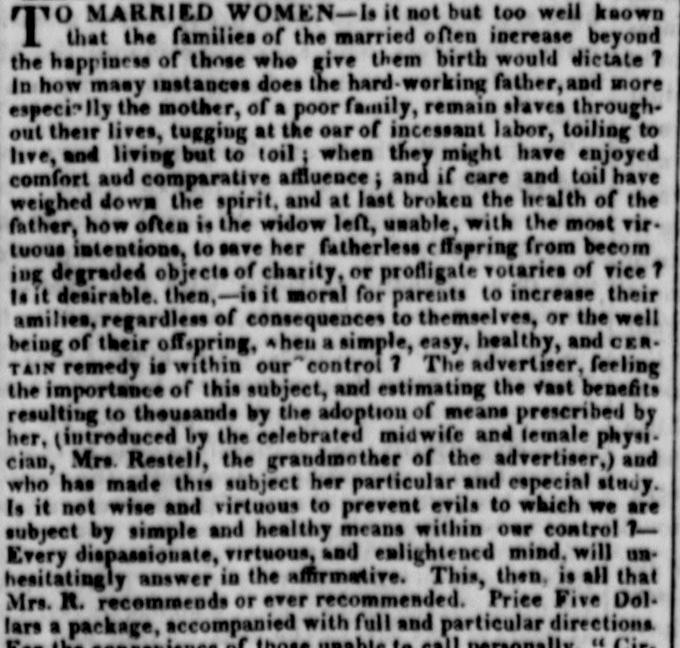
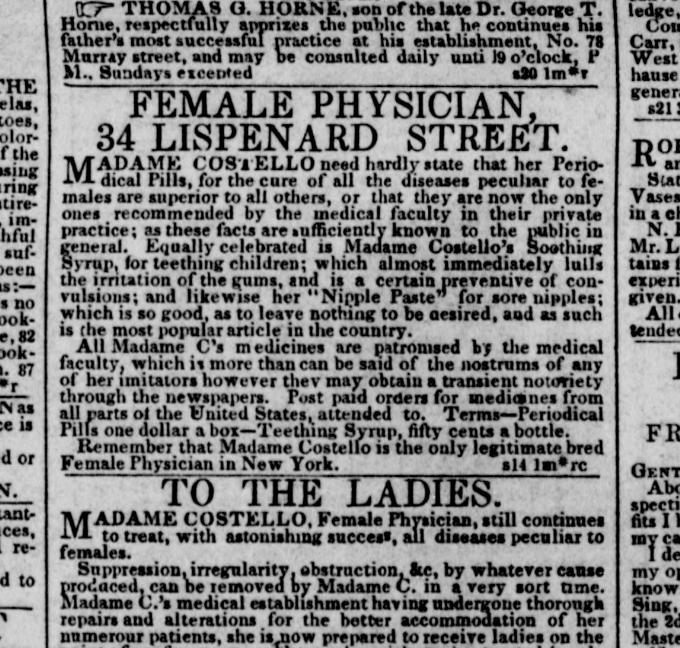
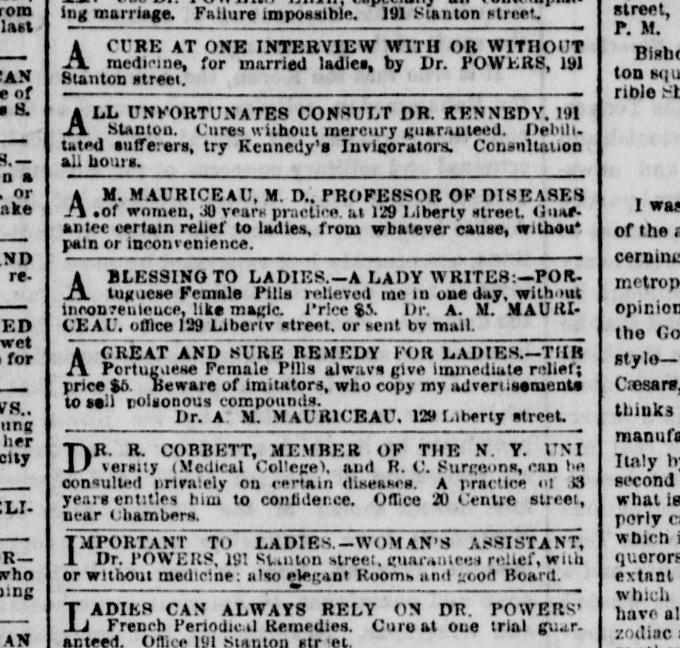
A sampling of ‘abortion pill’ advertisements from the late 1830s and early 1840s, from Madame Restell and her impersonators. NOTE: It’s hard to discern if these so-called medicines were for abortions or for other “female issues” given the vagueness of language:

Even before Madame Restell, there was the ‘Widow Welch’s Female Pills’. Both these ads ran in the New York Morning Herald on November 8, 1837:

Library of Congress
Library of Congress

image_681x648_from_1257,810_to_2591,2081

An early Madame Restell advertisement, New York Morning Herald, December 9, 1839:

image_681x648_from_3490,6778_to_4579,7815

A successful rival of Madame Restell was Madame Costello who worked off of Lispenard Street. Her ad from the Herald, October 10, 1842:

image_681x648_from_2138,4382_to_3285,5475

A series of advertisements for an assortment of female ‘solutions,’ New York Herald, August 4, 1867:

image_681x648_from_2992,2053_to_4154,3159

From the New York Medical and Surgical Reporter, 1846

Screen Shot 2016-08-18 at 12.13.32 PM

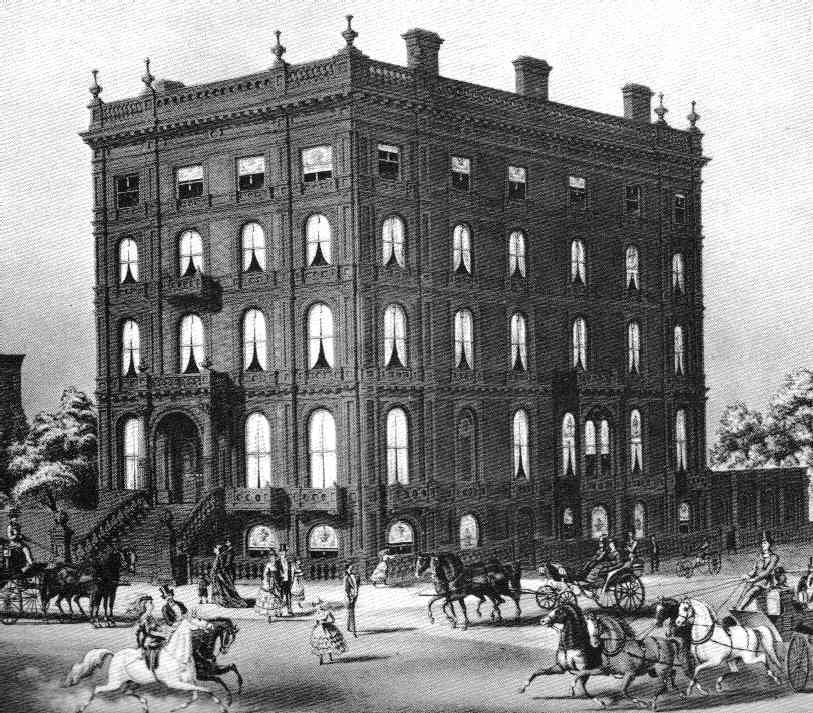
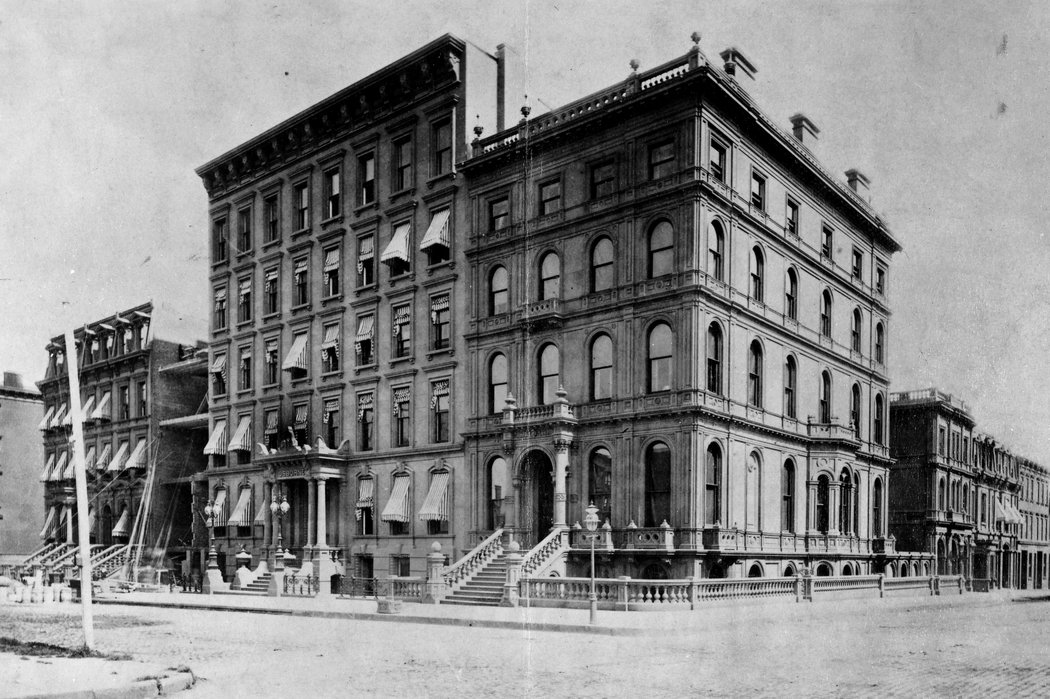
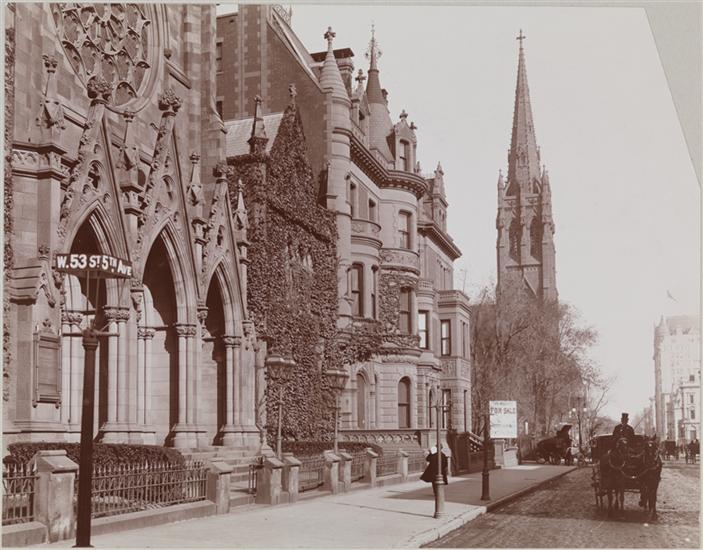
Madame Restell’s Fifth Avenue mansion (at 52nd Street), an area so newly developed in 1857 that there was nothing else around — except for the construction site of St. Patrick’s Cathedral.

et_tour_restell

The mansion in later years after Restell’s death. The apartment building next to the mansion was also commissioned by Restell because nobody else would buy the property!

13SCAPES_SPAN-master1050-v2
Courtesy NYPL

An illustration of the death of Madame Restell as imagined in Recollections of a New York Chief of Police by George P. Walling.

Madame_Restell's_suicide

A big thanks to our special guest — author Nicholas Syrett, Associate Professor of History at the University of Northern Colorado!

His newest book American Child Bride: A History of Minors and Marriage in the United States comes out in October. And we forgot to mention his fantastic first book on the history of fraternities — The Company He Keeps: A History of White College Fraternities.

He’s in the process of researching his upcoming book on the life and legacy of Madame Restell.

Categories
Gilded Age New York Podcasts

Electric New York: Illuminating the shadows, re-visualizing the night

This classic episode of the Bowery Boys: New York City History podcast (originally released in December of 2021) is featured in this week’s episode of the History Channel podcast HISTORY This Week.

Since 2011 the Bowery Boys Podcast has revisited a few of the themes featured in this show. After listening to this episode, give these installments a try:

A more in-depth look at the life of Nikola Tesla:
Edison’s role in the creation of the moving picture:
The second half of this show features the history of Christmas lights:

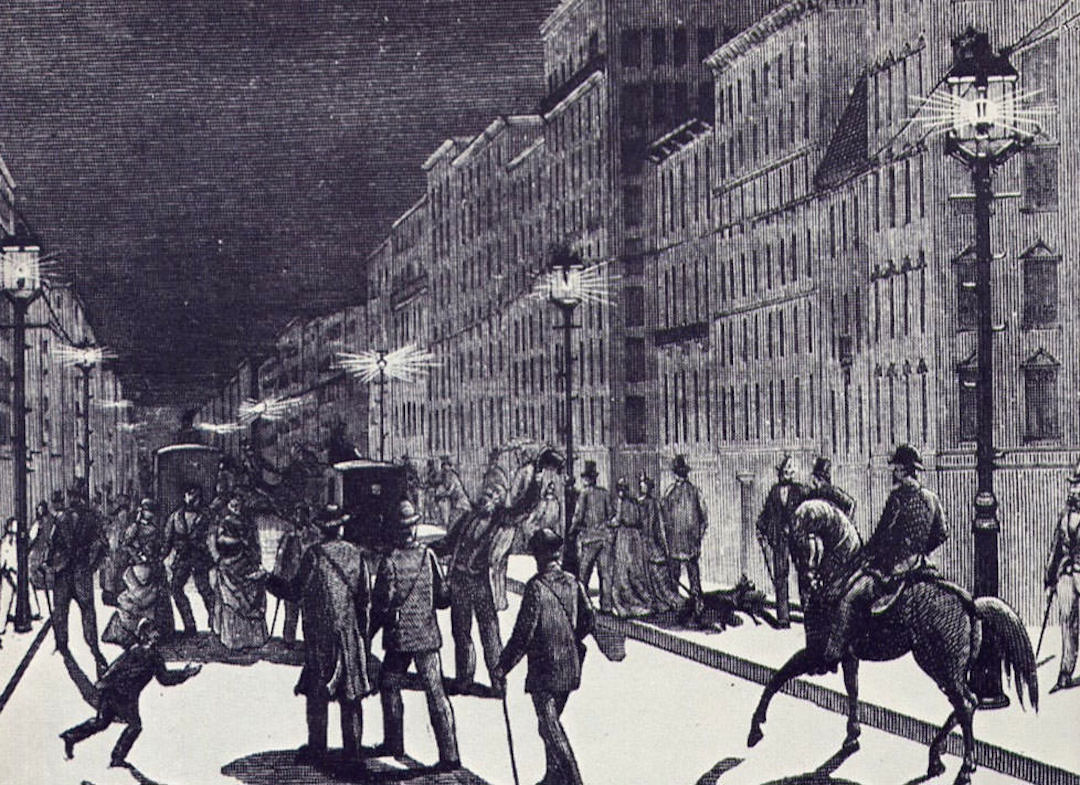
PODCAST The streets of New York have been lit in various ways through the decades, from the wisps of whale-oil flame to the modern comfort of gas lighting. With the discovery of electricity, it seemed possible to illuminate the world with a more dependable, potentially inexhaustible energy source.

First came arc light and ‘sun towers’ with their brilliant beams of white-hot light casting shadows down among the holiday shoppers of Ladies Mile in 1880.

But the genius of Menlo Park, Thomas Edison, envisioned an entire city grid wired for electricity. From Edison’s Pearl Street station, the inventor turned a handful of blocks north of Wall Street into America’s first area entirely lit with the newly invented incandescent bulbs.

ALSO: It’s the War of Currents, the enigmatic Nicola Tesla and the world’s first electric Christmas lights.


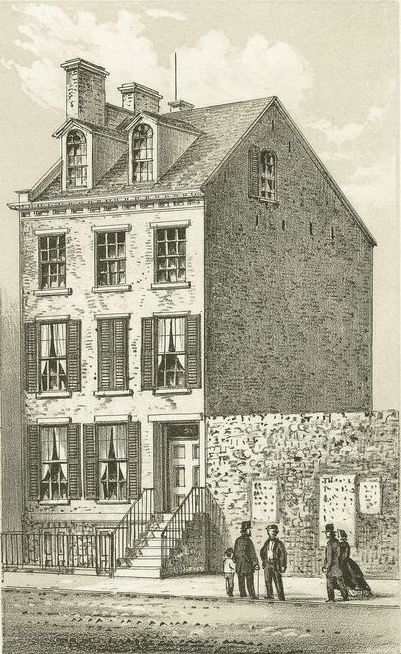
The home of Samuel Leggett, the first to be illuminated with gas lighting, at 7 Cherry Street. This home stood  just a few blocks from the location of Edison’s Pearl Street Station (255-7 Pearl Street), which would also change the way people consider lighting their city. (NYPL)

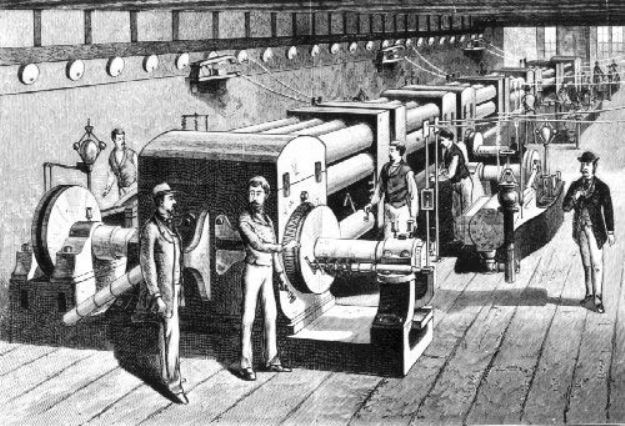
Inside the Pearl Street Station: Direct current surged through Edison’s generators to the neighboring blocks.

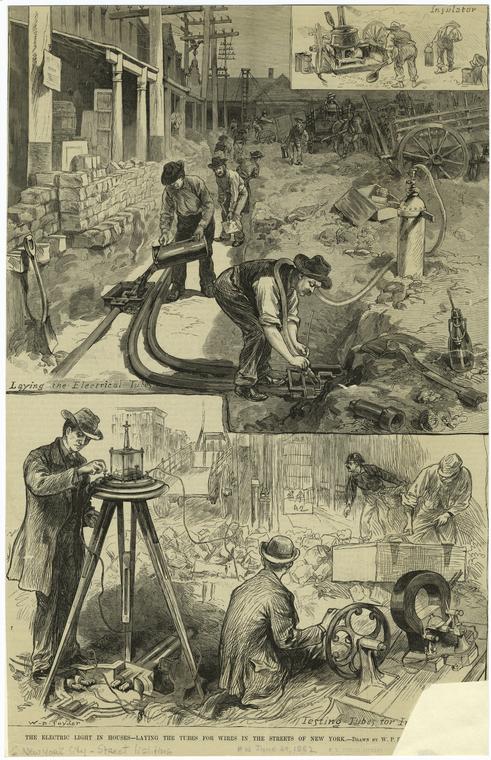
Laying the electrical wires under the streets of the blocks surrounding the Pearl Street station was an arduous, potential dangerous task. It took well over a year to complete the job. (Courtesy NYPL)  

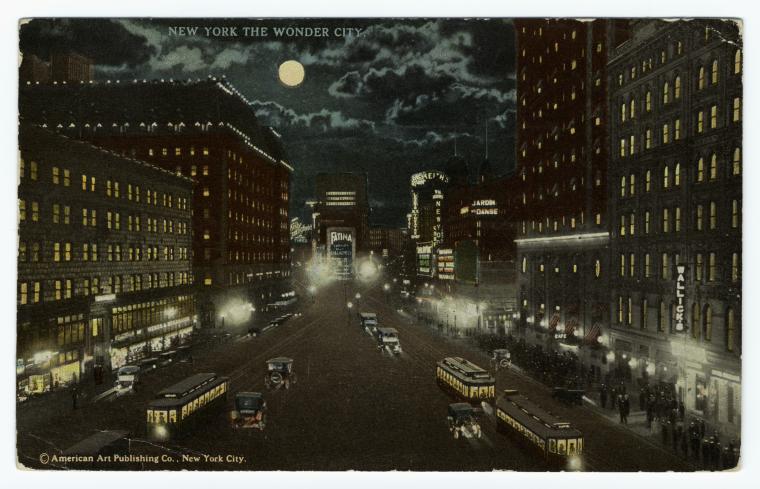
‘New York The Wonder City‘, and indeed it was, thanks to electricity. Whole neighborhoods, like Times Square and Coney Island, were defined by it. Landmarks like the Brooklyn Bridge, thoroughfares like the Bronx’s Grand Concourse and even Broadway itself were transformed at night by electric power. (NYPL)

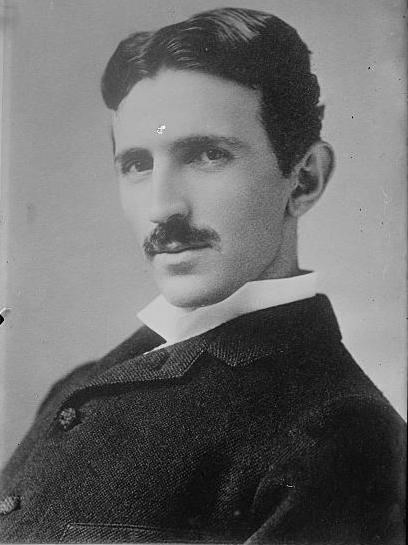
Nikola Tesla, the brilliant Serbian inventor who spent his final decades in New York living at the Hotel New Yorker.

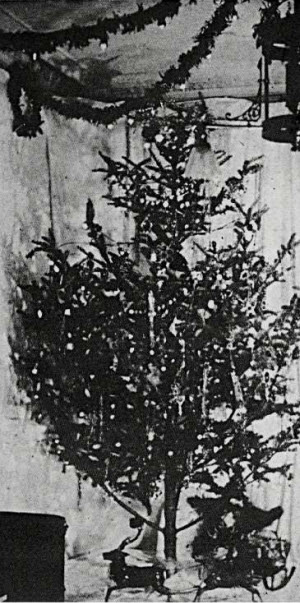
Behold! The first Christmas tree with electrical lighting, courtesy Edison employee Edward Hibberd Johnson. This tree glittered and twirled from Johnson’s home in Murray Hill. (Courtesy Jim on Light)

On the fiftieth anniversary of the invention of the lightbulb, an elderly Thomas Edison ‘reinvents’ it in 1929 at a reconstructed laboratory in Dearborn, Michigan, to the delight of Henry Ford and newly elected President Herbert Hoover.

Categories
Those Were The Days Women's History

The New York Monkey Fad of 1907

In an absolutely inhumane and totally unwise moment in New York City history, wild and exotic animals were once considered pets, roaming around the city streets with their owners.

The wealthiest classes collected all sorts of unusual beasts for their amusement during the 19th century.  So many in fact that the Central Park Zoo — or Menagerie, as it was called then — was created as a repository for all those unusual creatures abandoned by their owners.

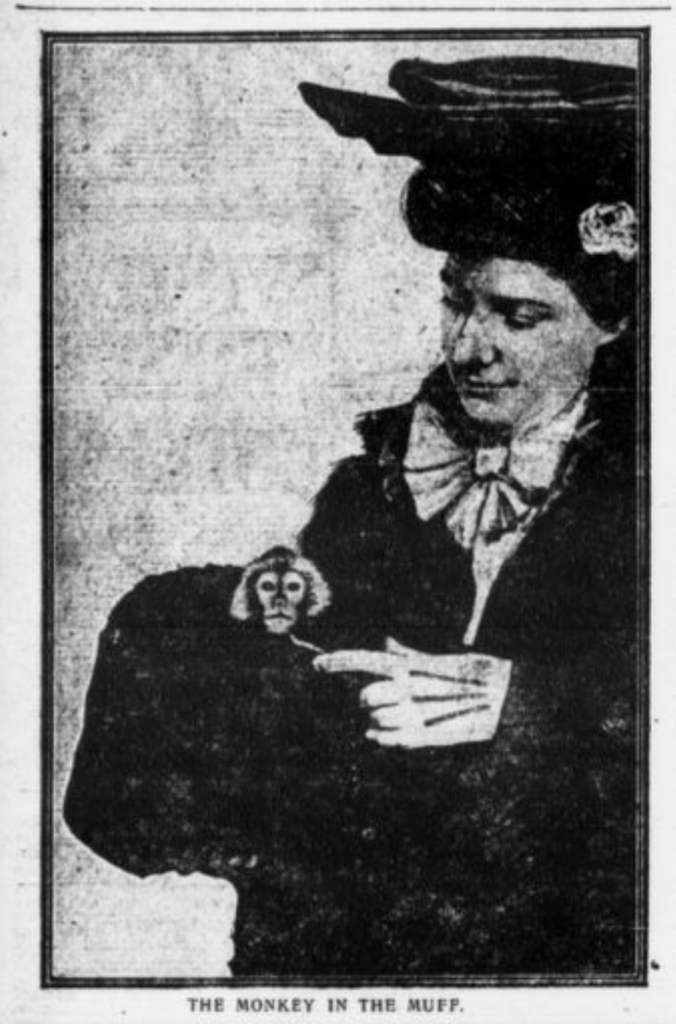
From the 1907 Sun article, a lady with her pet monkey (courtesy LOC)

Primal Luxury

A bizarre New York Sun article from March 1907 found an interesting correlation between elegant women and their companion monkeys. They were such hot commodities with finer New York ladies that year that the animals were almost considered luxuries.

Monkeys rode snugly amid the elegant furs and finery of a modern woman. “Out of ermine muffs, carried by smartly dressed women along Fifth Avenue, hideous grinning little faces peep out of you.”  

The best examples of woman-monkey companionship were the talk of the town; one New York lady had her monkey trained to “manicure himself, don the right clothes at the right hour, eat daintily with his fork, pretend to smoke his after dinner cigarette and go to bed in a little iron bedstead.”

“It is impossible to import enough monkeys to fill the present demand,” one animal importer told the Sun. “An installment of marmosets or ringtails no sooner reaches port than they are shipped to women all over the country.”

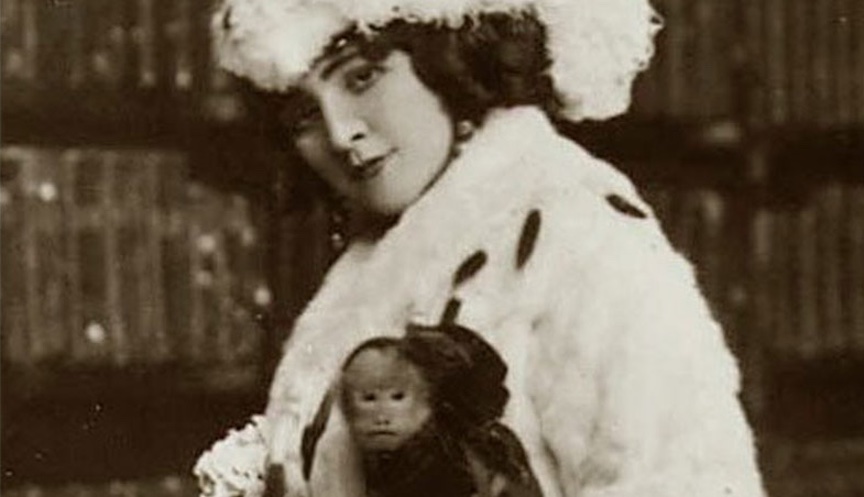
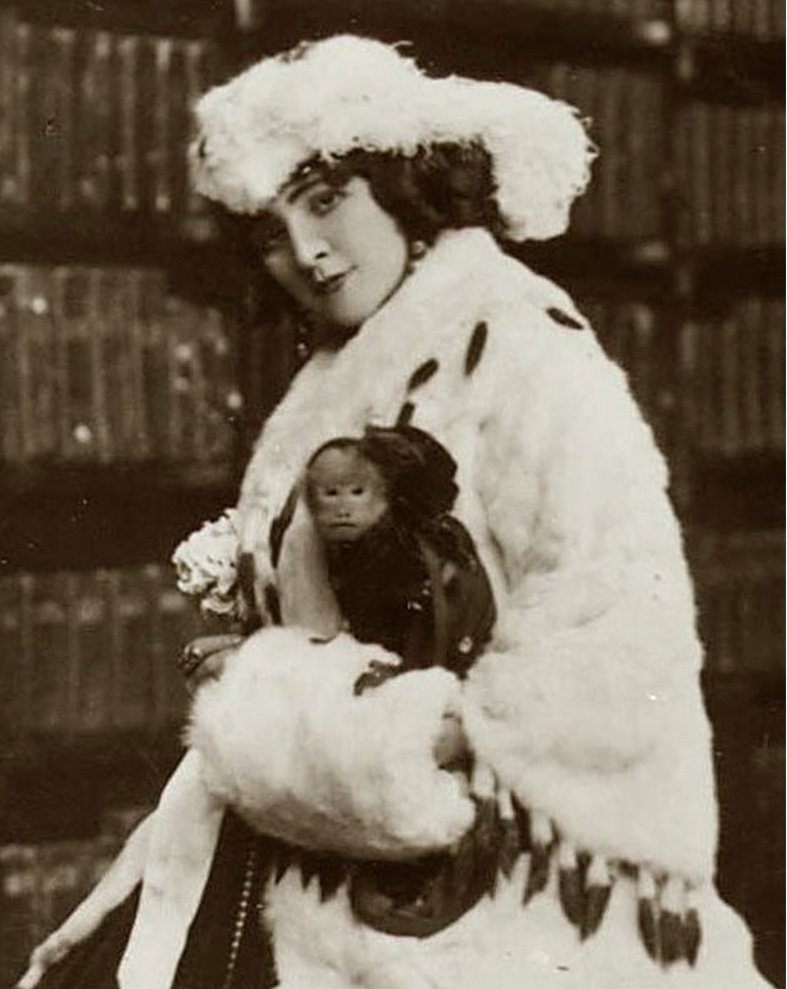
Actress Doris Keane with her pet monkey (Courtesy Wiener Museum)

Monkey See, Monkey Do

It was an unorthodox but very charismatic choice, popular with actresses, princesses and rich ladies of a certain progressive bent.  

The pet monkey was prepared to do the unthinkable in 1907 — replace the yapping dog as the woman’s preferred companion.  

From the same article: “To those who do not like monkeys, the popularity of the beast seems more objectionable than any other recent fad. The horse fad, the dog fad, the cat fad, the automobile fad, the ping pong fad, the bridge fad, the chameleon fad are more excusable to such people.”

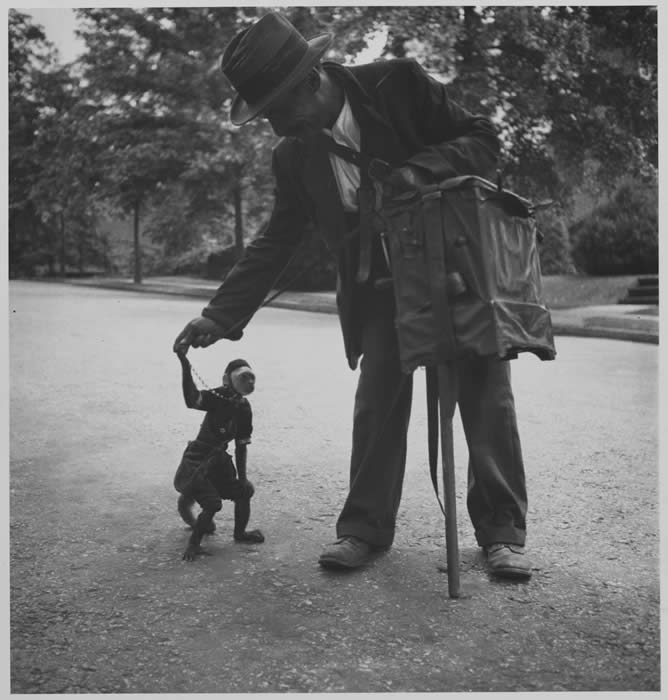
The popularity of the pet monkey, once associated with immigrant organ grinders on the streets of Five Points in the late 19th century, arose from increased scholarship on the animal, from stories of African safaris, and from seeing them in action at the House of Primates in the Bronx Zoo.

Organ grinder and monkey in 1935. Mayor LaGuardia outlawed organ grinders shortly after this picture. Photograph by Samuel H. Gottscho. Courtesy Museum of the City of New York

The Monkey Business

The animals were brought over on trading ships, basketfuls scooped up off the coasts of South America or even as far away as South Africa. A boatload of 1,000 monkeys arrived in New York in 1909, a cargo which also included hundreds of exotic birds and a couple dozen pythons.

 If they survived, they were given to importers throughout the city or sometimes sold right of the dock.

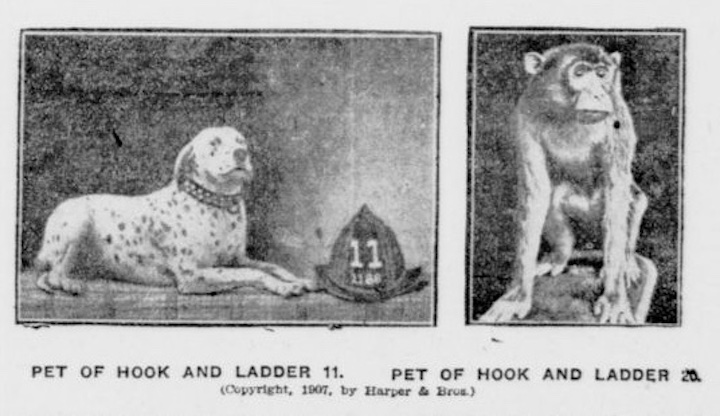
Monkeys even found themselves in the service of New York area fire departments. In 1907, a Mercer Street crew enjoyed the alertness of a monkey named Jenny (pictured below), who once warned her fellow firefighters of a blaze by tossing pool balls down an iron stairway.

And a fire crew in Rockaway Beach was well-known for their monkey mascot Jocko (pictured at left, with fellow mascot, kitten Minnie) who occasionally attacked Italian peanut vendors.

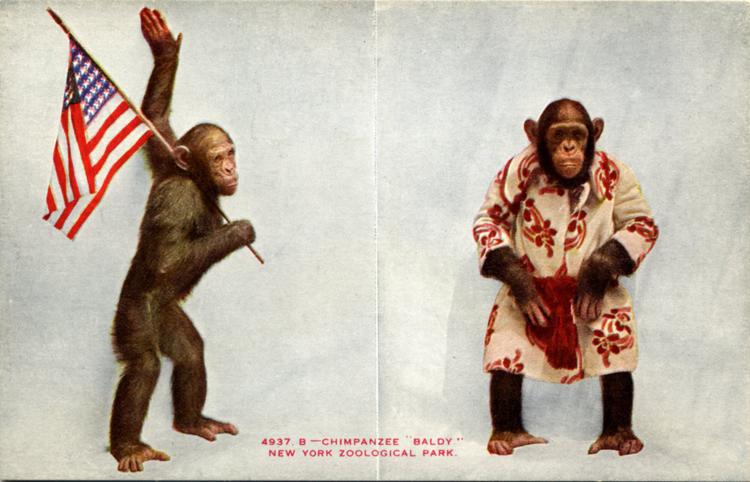
Chimpanzee in a patriotic pose, 1910, Bronx Zoo postcard

Swingers

It seems impossible to comprehend how nonchalant pet owners were regarding disease and injury.

 The Sun article runs through some helpful hints about how to personally select your monkey from a writhing litter right off the boat:  “If the skin is yellow do not invest your money, for you may be quite sure that the monkey has tuberculosis. If the skin is black the monkey has blood poisoning.”

Inevitably, the more untamed of these creatures did cause mayhem. In just one example from 1907, a Sixth Avenue monkey named Pete hurled flower pots at pedestrians, almost killing a woman.  On July 4, 1908, a Brooklyn, monkey named Nimbo set a house on fire by lighting fireworks.

And sadly, the monkey too soon fell victim to the inevitability of a passing fad.  By 1908, the New York Times was already proclaiming the Pomeranian as the new “hot” pet.

Below: From the Nov. 17, 1907 New York Tribune, Jenny the pool ball-hurling monkey mascot of the Mercer Street fire crew.

A version of this article first appeared on this website in November 2012.

Categories
Long Island Podcasts

Long Island Gothic: A Journey to Grey Gardens

PODCAST The historical backstory of one of the most famous documentaries ever made – Grey Gardens.


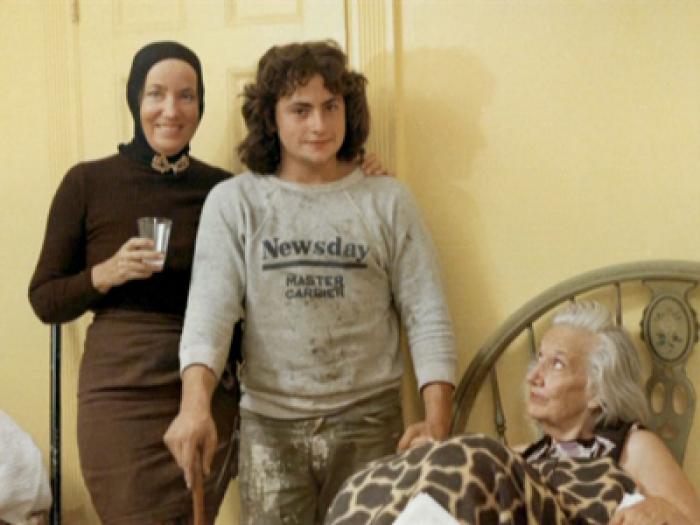
The classic film Grey Gardens, made by brother directing team Albert and David Maysles, looks at the lives of two former society women leading a life of seclusion in a rundown old mansion in the Hamptons.

Those of you who have seen the film – or the Broadway musical or the HBO film inspired by the documentary – know that it possesses a strange, timeless quality. Mrs Edith Bouvier Beale (aka Big Edie) and her daughter Miss Edith Bouvier Beale (aka Little Edie) live in a pocket universe, in deteriorating circumstances, but they themselves remain poised, witty, well read.

But if our histories truly make us who we are, then to understand these two extraordinary and eccentric women, we need to understand the historical moments that put them on this path.

And that is a story of New York City – of debutante balls, Fifth Avenue, Tin Pan Alley and the changing roles of women. And it’s a story of the Bouviers, who represent here the hundreds of wealthy, upwardly mobile families, trying to maintain their status in a fluctuating world of social registers and stock market crashes.

This is story about keeping up appearances and the consequences of following your heart.

FEATURINGA very special guest! The Marble Faun himself — Jerry Torre, who swings by the show to share his recollection of these fascinating women.

Listen Now: A Journey to Grey Gardens

_________________________________________________________

The Bowery Boys: New York City History podcast is brought to you …. by you!

We are now producing a new Bowery Boys podcast every other week. We’re also looking to improve and expand the show in other ways — publishing, social media, live events and other forms of media. But we can only do this with your help!

We are now a creator on Patreon, a patronage platform where you can support your favorite content creators.

Please visit our page on Patreon and watch a short video of us recording the show and talking about our expansion plans. If you’d like to help out, there are six different pledge levels. Check them out and consider being a sponsor.

We greatly appreciate our listeners and readers and thank you for joining us on this journey so far.

________________________________________________________

The Bouvier family did indeed have ‘French genes’, connected to cabinetmakers who immigrated to the United States in the 1810s.

NYPL

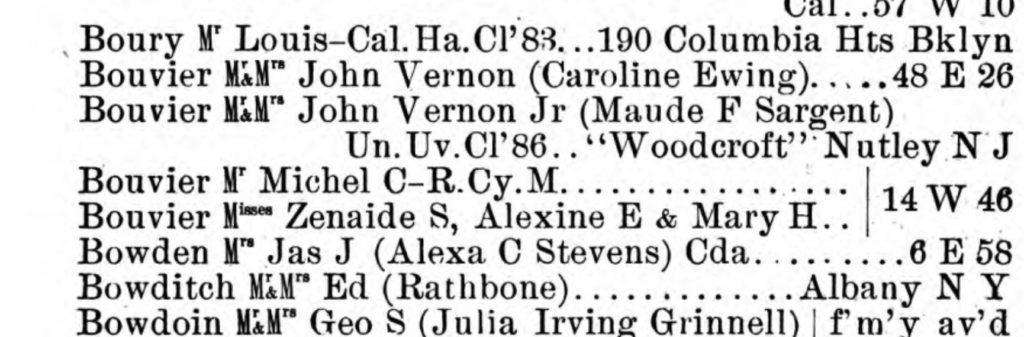
The Bouvier family’s listings in the 1899 New York Social Register.

Big Edie’s great uncle Michel Charles ‘M.C.’ Bouvier and her three unmarried great aunts Zenaide, Alexine and Mary all lived in a fine brownstone at 14 W. 46th Street.

Edith Ewing Bouvier Beale

Grey Gardens Official

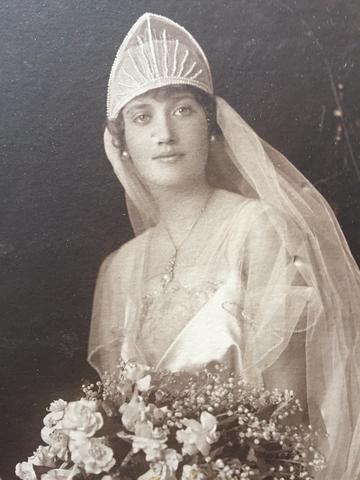
The wedding photo of Edith Ewing Bouvier Beale.

Grey Gardens Official

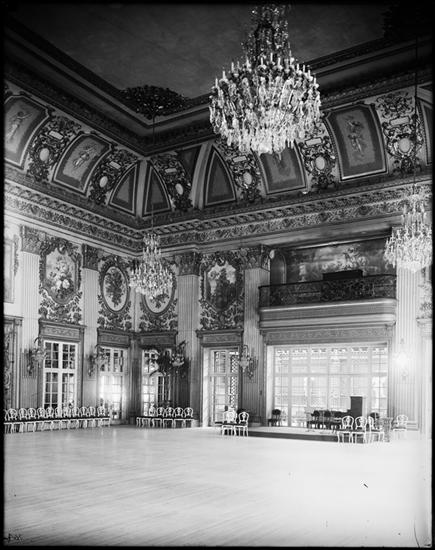
The ballroom of Sherry’s (44th and 5th Avenue) where Edith had her debutante ball.

MCNY

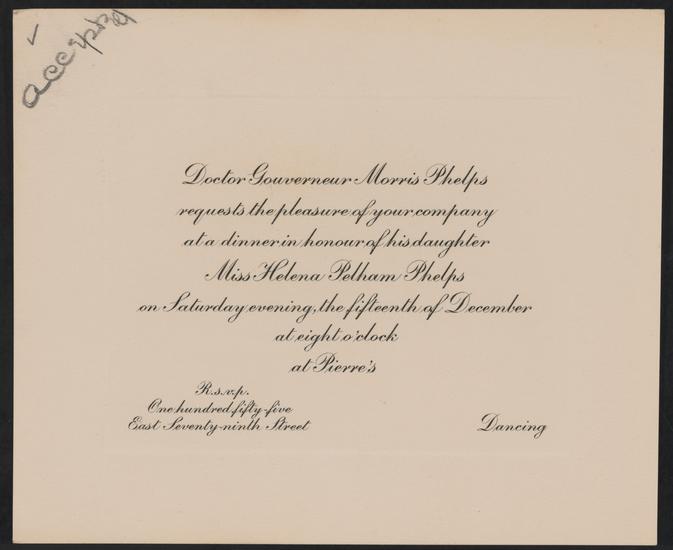
An invitation for a 1928 debutante ball at the Hotel Pierre (where Little Edie would have her own fête).

Museum of the City of New York

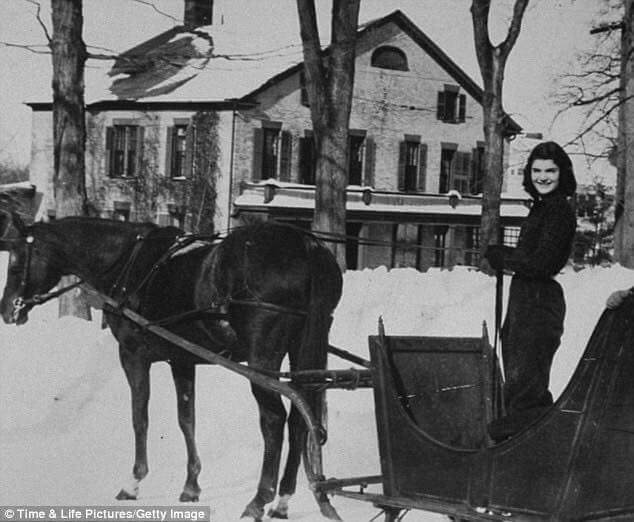
Sixteen year old Jacqueline Bouvier attending Miss Porter’s finishing school in Farmington, Connecticut. Both Big Edie and Little Edie went here as well.

East Hampton was the first English settlement in the area that would eventually become New York state.

NYPL

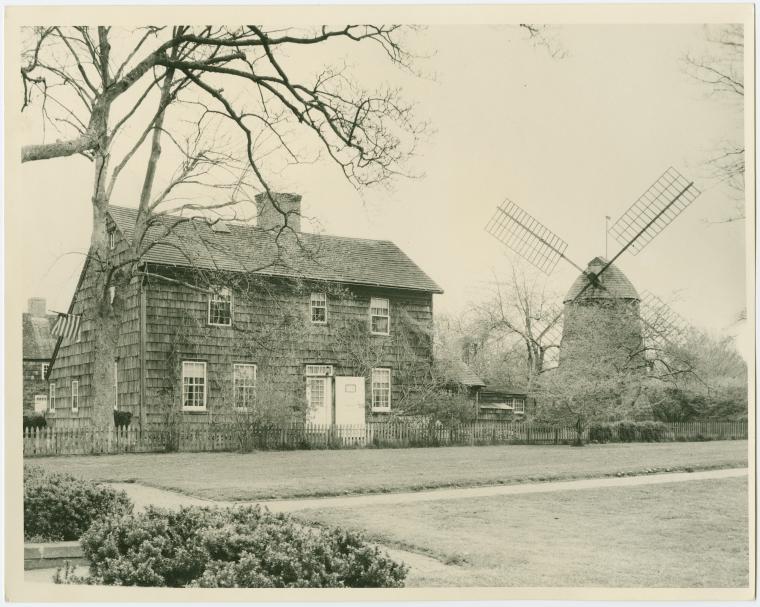
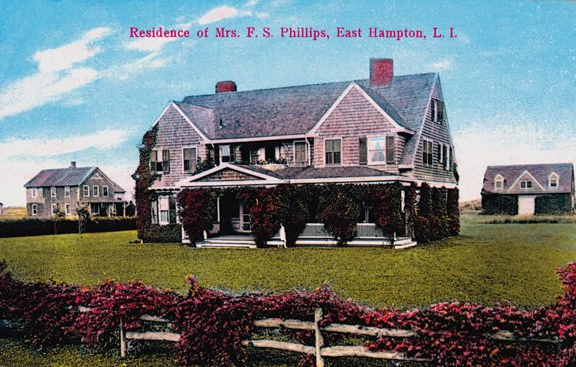
An early image of Grey Gardens mansion.

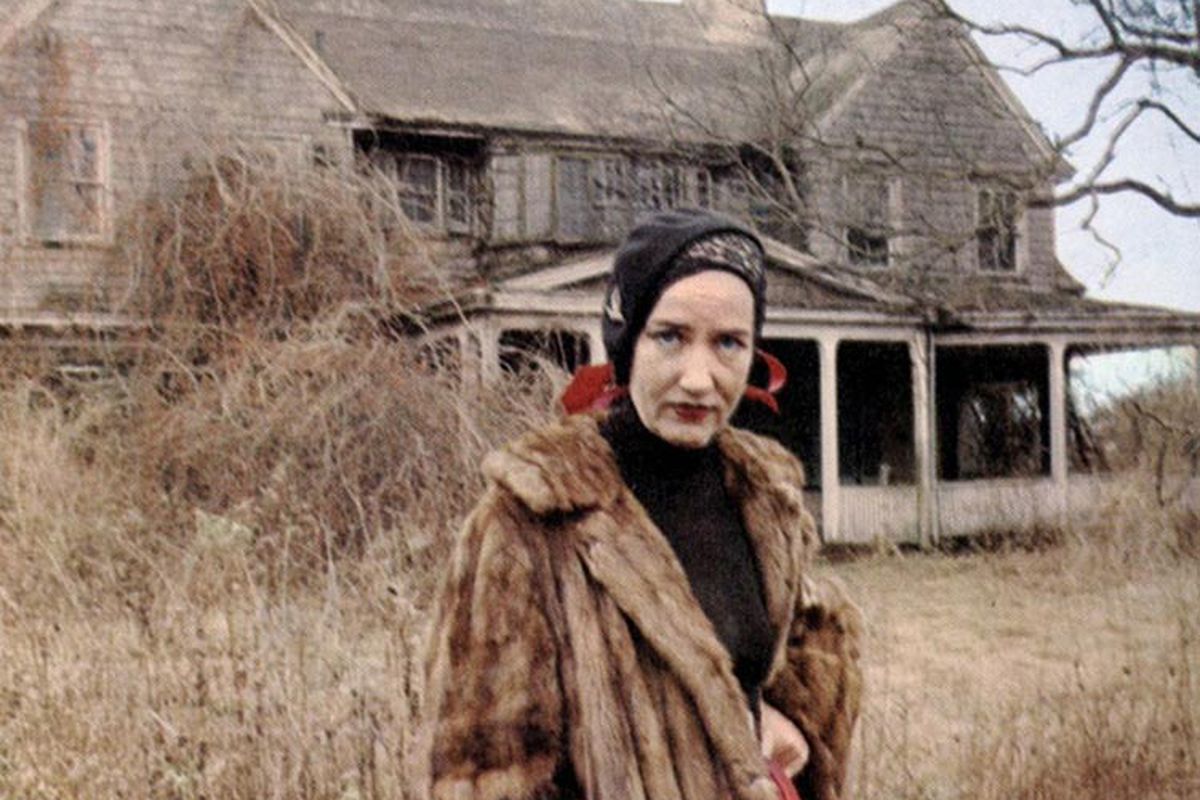
Little Edie posing in front of the house in the film Grey Gardens.

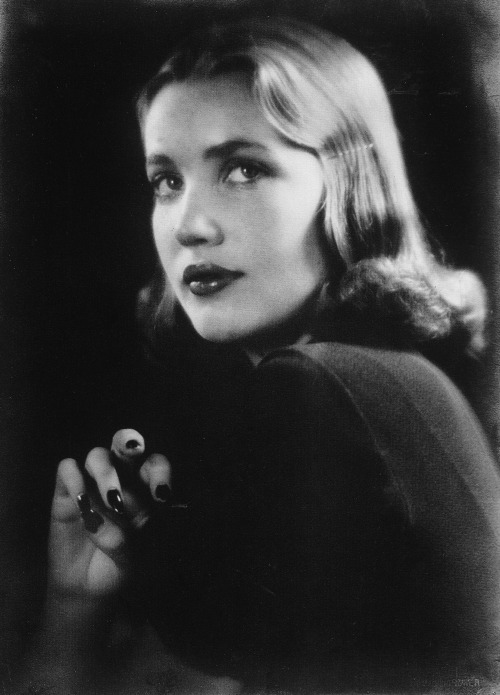
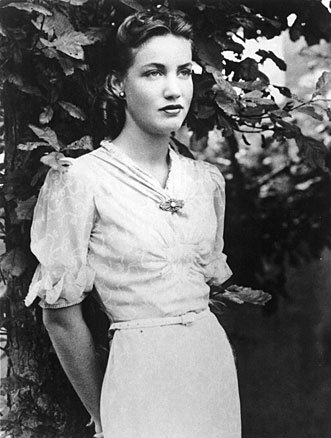
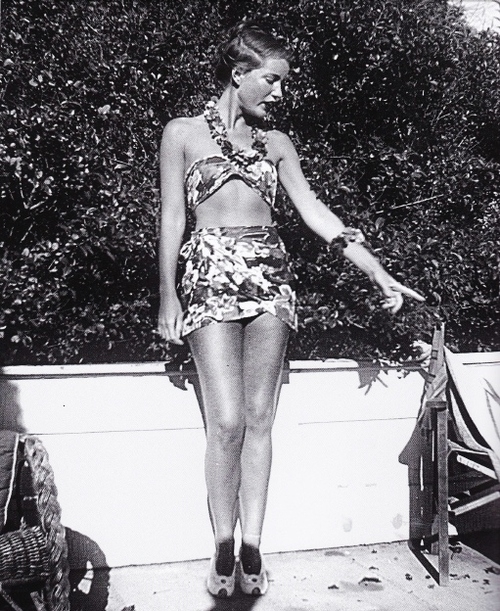
Images of Little Edie in her youth, a beautiful, confident young woman who echoed her mother’s love of music and performance. The two retreated into a reclusive life even as their family become national prominent.

Grey Gardens Official

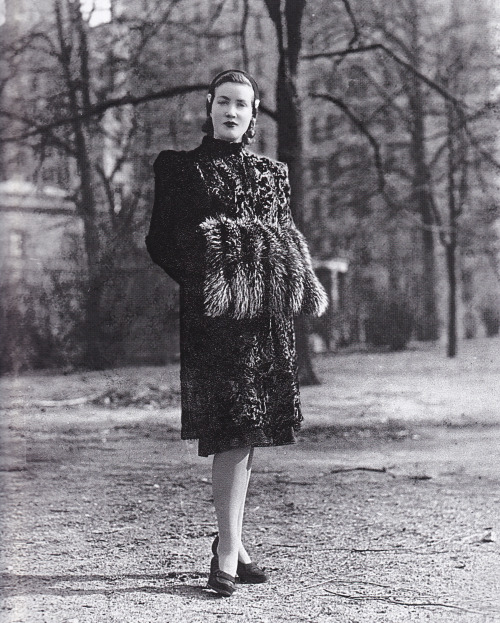
Little Edie in New York, possibly from the period of the late 40s/early 50s.

Grey Gardens Official

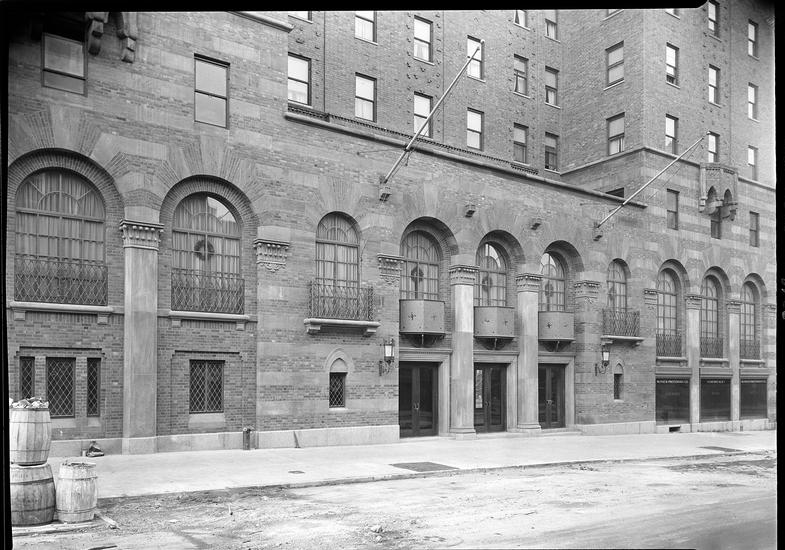
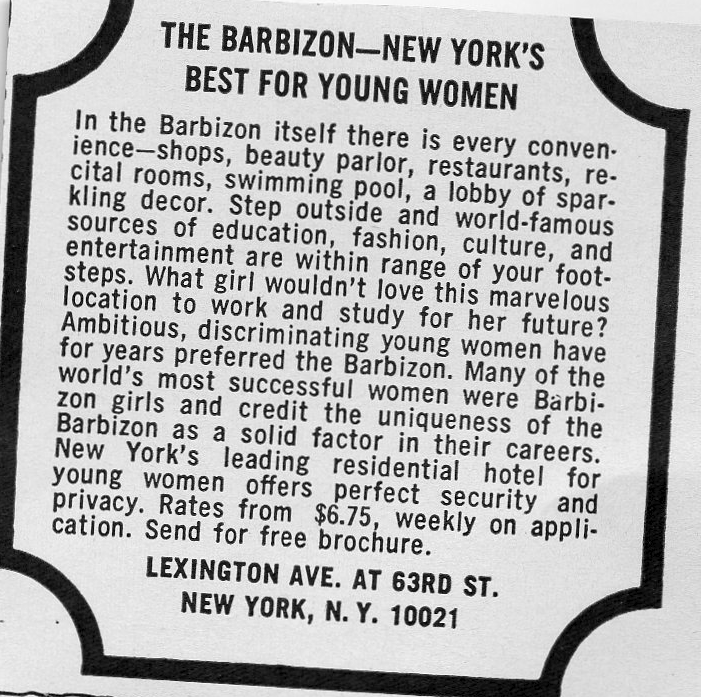
Little Edie’s big-city refuge for a time — the Barbizon Hotel for Women:

Museum of the City of New York/Samuel Gottscho

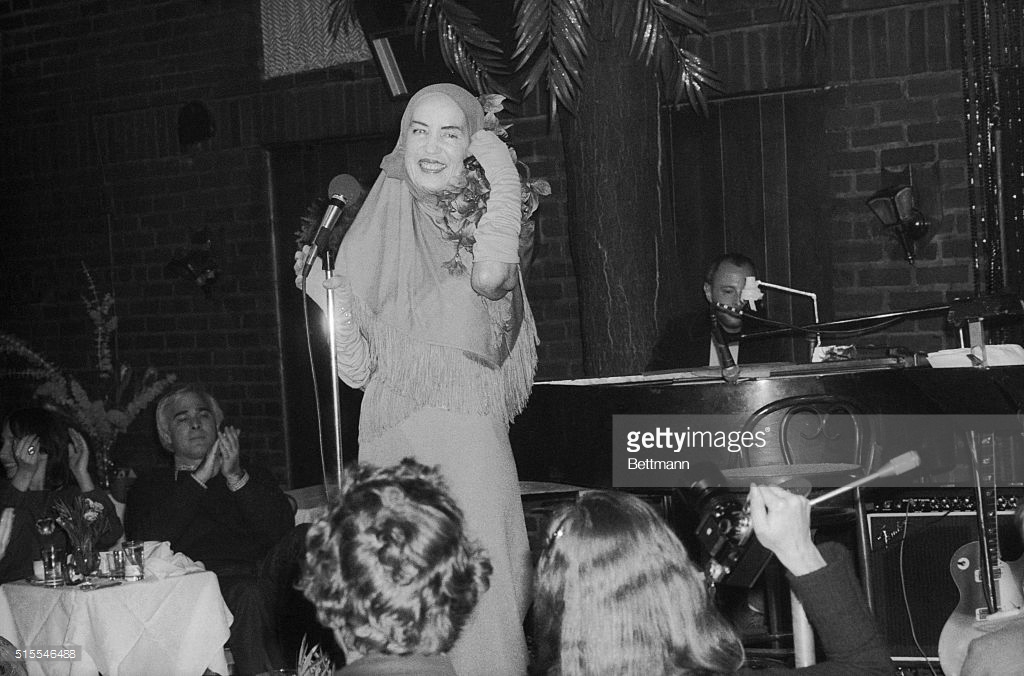
Little Edie performing at Reno Sweeney in the West Village.

Getty

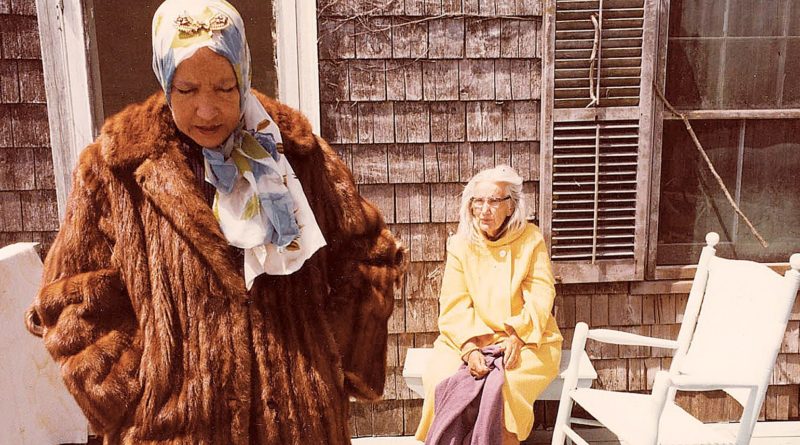
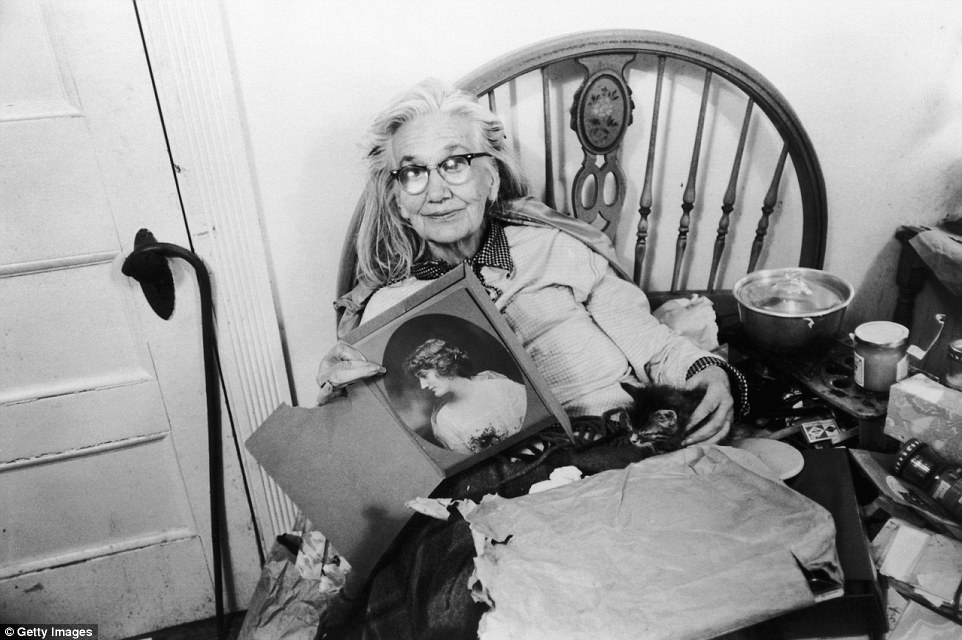
Big Edie in her familiar perch, flanked with kittens and memories.

Getty

Many thanks to Jerry Torre for stopping by the studio to chat!

CORRECTION TO THE SHOWThe Great Gatsby is set in 1922, but the book was released in 1925.

FURTHER READING
The Marble Faun of Grey Gardens by Jerry Torre and Tony Maietta
The Bouviers: Portrait of an American Family by John H. Davis
Gail Sheehy’s New York Magazine profile from January 1972 — The Secrets of Grey Gardens
Grey Gardens Online — “The one-stop source for all things Grey Gardens”

FURTHER LISTENING
Some of the themes and subjects referenced in this episode have been spoken about in past shows. After you’ve finished listening to Journey to Grey Gardens, give these a try.

And if you enjoyed the show, you might enjoy the soundtrack! Here’s a Spotify playlist of songs from the show and inspired by this story:

Categories
Holidays Those Were The Days

Bowlers and Bonnets: A History of the New York Easter Parade

For almost 150 years, budding fashionistas have been prancing up and down Fifth Avenue on Easter Sunday, displaying elaborate bonnets, hairdos and colorful outfits.

Library of Congress

Given that modern holiday celebrations are often relatively new (for instance, trick-or-treating has only been a common activity on Halloween since the 1950s), this decorative practice located at this particular spot in Manhattan enjoys a commendable longevity.

In fact, this indulgent fashion parade is far older than most of the buildings in midtown. After all, people have been dressing up and going to church — and doing so with vanity — since the city was born.

Old Fashioned Trends

According to this 1905 article in Harper’s Weekly, the display of Easter finery may have begun as early as the Dutch days along the streets of the most fashionable churches. When the British came along, that tradition continued along Broadway around Trinity Church in lower Manhattan.

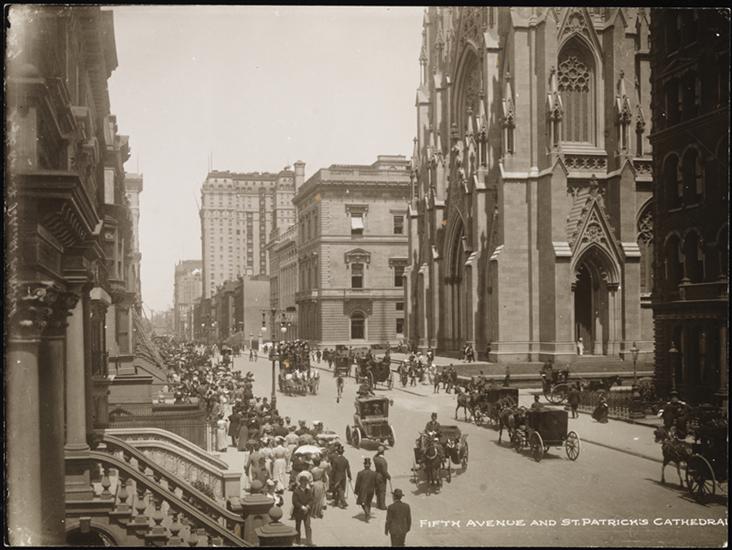
By the time St. Patrick’s Cathedral was finally opened in 1879, the wealthiest New Yorkers were already on Fifth Avenue in their lavish townhouses. The cavalcade naturally migrated here, whether the costumed were congregants there or not.

With the addition of Saint Thomas Church on 53rd Street (built in 1914), Fifth Avenue became even further inundated with Easter elegance.

Flocking in fashion

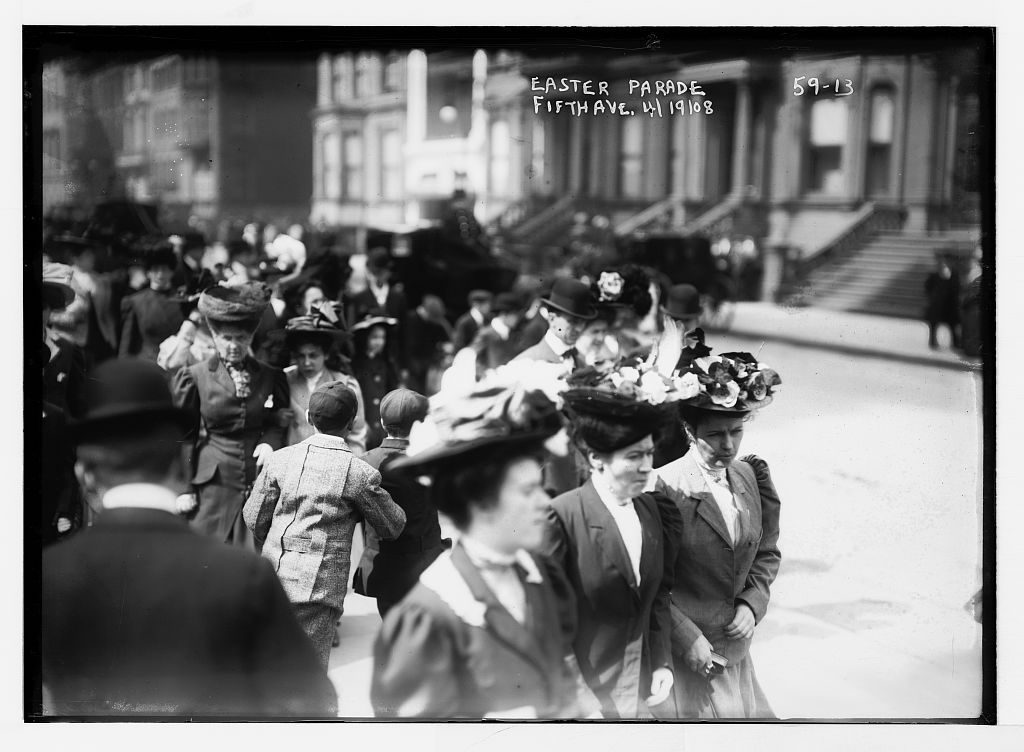
Even by 1905, the Easter bonnet parade had become an overwhelmingly popular and even cumbersome affair, equatable to weekday rush hour:

Such a vast number of people come on Easter to see the Fifth Avenue churchgoers walk home from the church that the Avenue, in the Fifties, begins at noon to feel like Park Row at 5 o’clock, when the Brooklynites begin to feel for the Brooklyn entrance.”

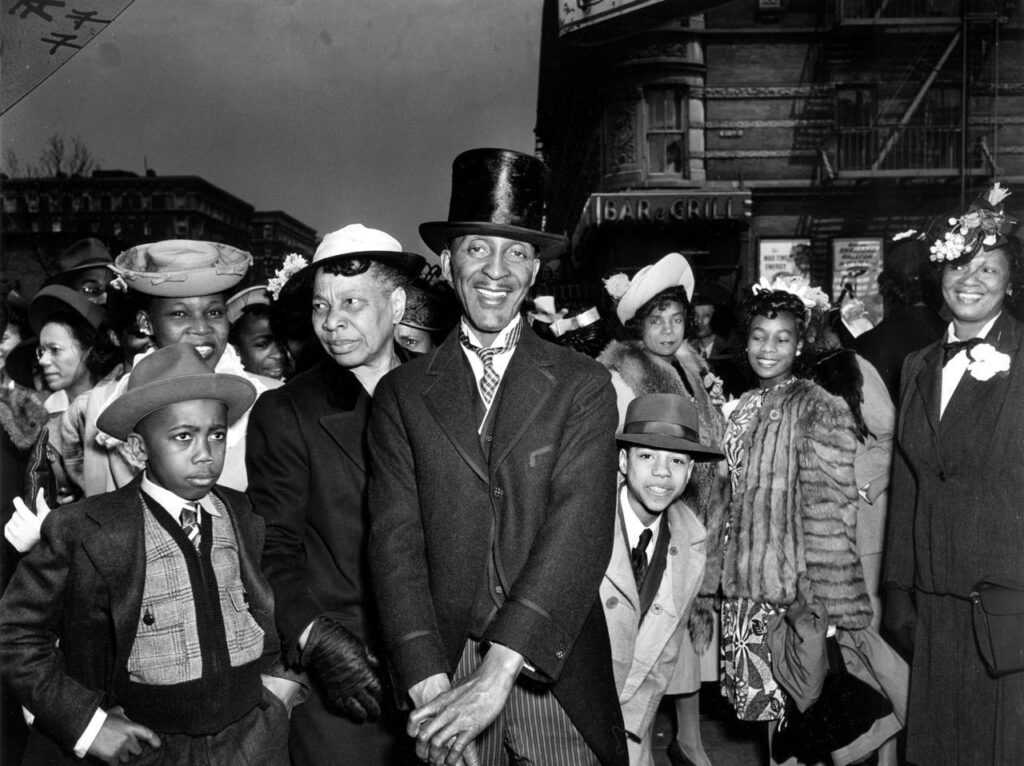
A similar Easter tradition was developing in Harlem by the 1910s. Legendary photographer Weegee captured this moment in 1943.
Parading Influence

The annual Fifth Avenue hat show existed before Saks Fifth Avenue department store, before Rockefeller Center, before any tony Fifth Avenue shops. The affair even influenced fashion for the rest of the year.

According to author Nathan Silver, designers and illustrators would flock to the bonnet show for inspiration. “Sketches were copied by garment makers on the Lower East Side and photos were circulated to newspapers all over the country.”

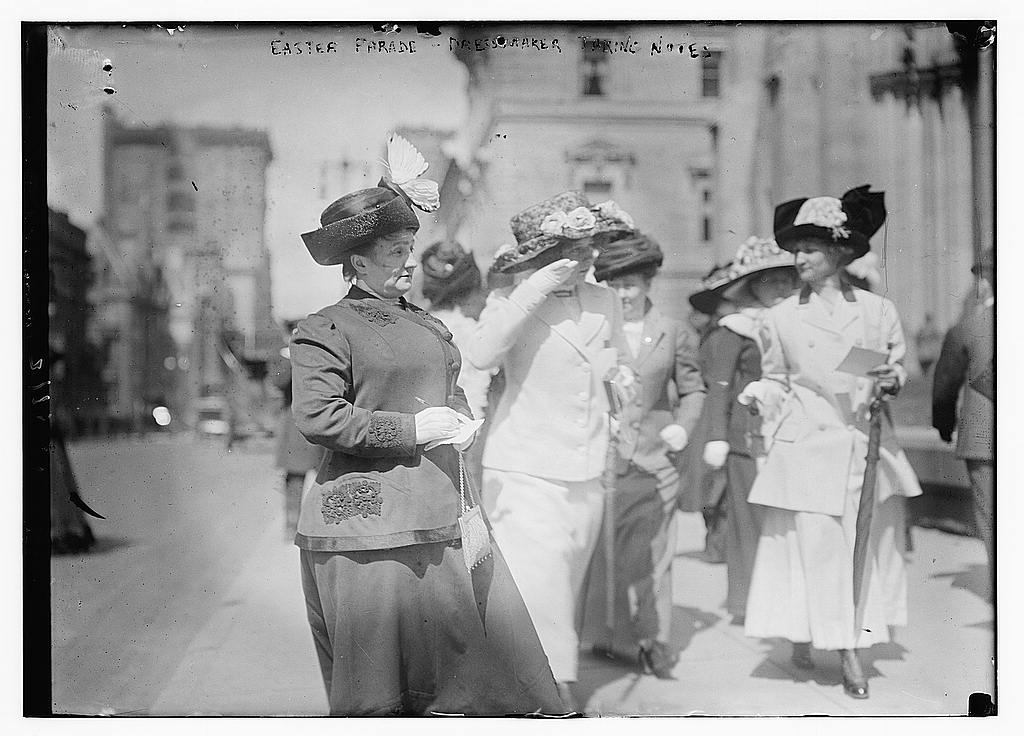
Taking arduous notes at the 1900 Easter Parade. Library of Congress.

Even when the mansion of Fifth Avenue were replaced with luxury retail and department stores, budding peacocks and fashionistas continued to grace the avenue’s houses of worship.

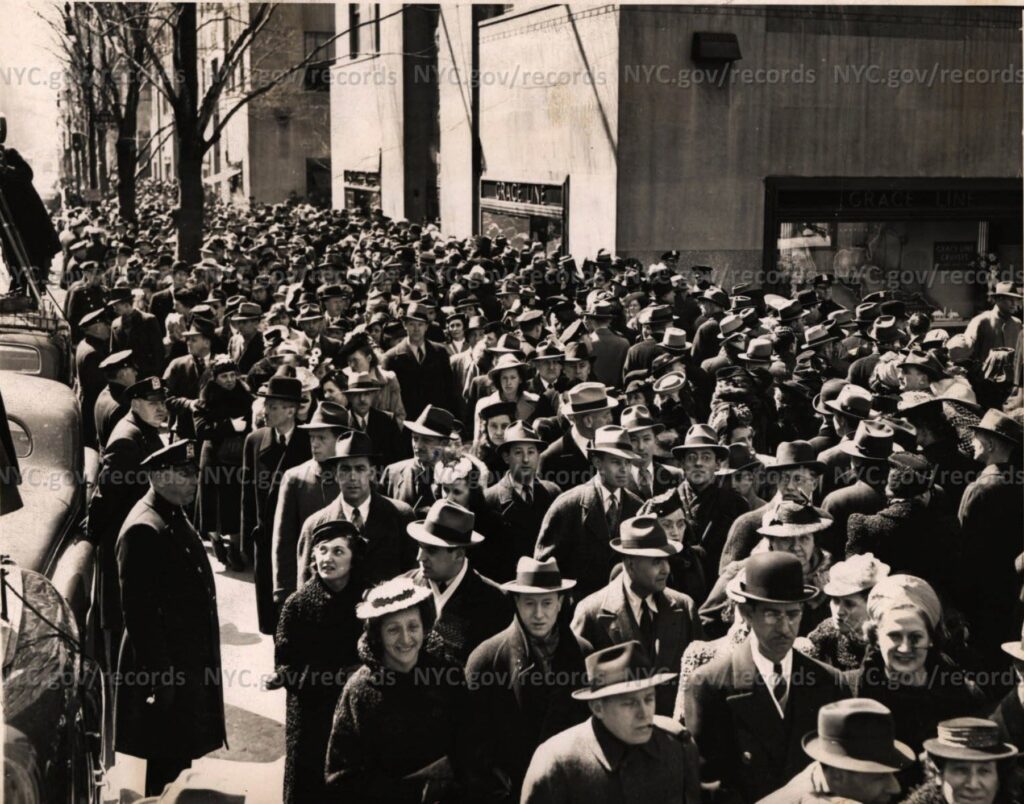
In the 20th century, as the midtown Fifth Avenue mansions were torn down and their wealthy residents moved uptown, the Easter Parade became more tourist-friendly. Not many bonnets here in this New York City Department of Records photo from the mid 1930s!

The Sunday procession was such an ingrained tradition that it’s referenced in one of Irving Berlin’s most famous songs — “Easter Parade” — when later became a colorful Hollywood musical of the same name.

Parading During a Pandemic

This year’s Easter Parade will be online only — but you can win a prize (if you post yourself in a fabulous frock on Instagram and use hashtag #EasteronFifth). Follow @fifthavenue there and visit their website for more information.

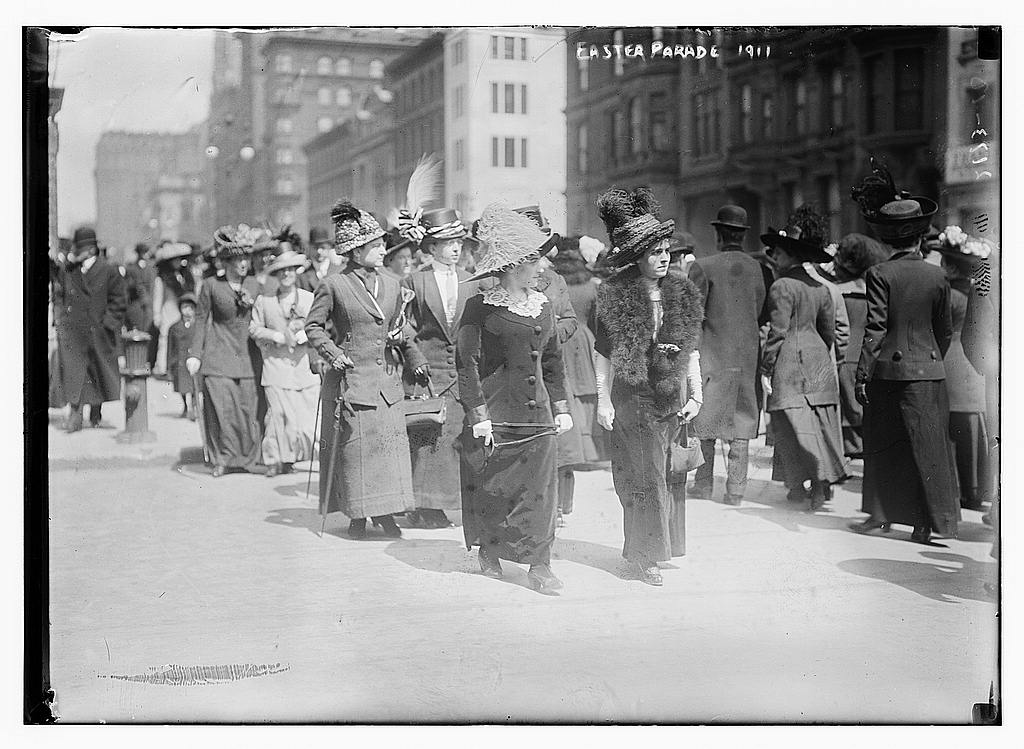
OR just sit back in your commons clothes and enjoy these images of Easter Parades gone by, courtesy the Bain Collection/Library of Congress:

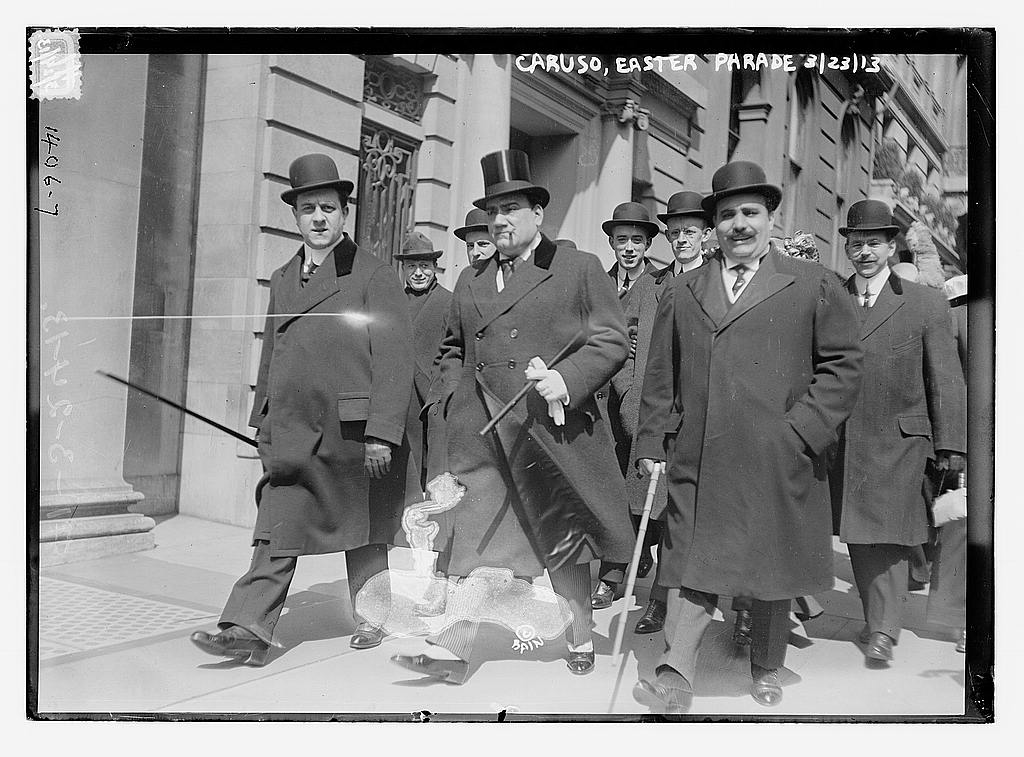
Even famous folks got in the act! Here’s Enrico Caruso on Easter 1913. Library of Congress
I love this ‘action shot’ of the Easter Parade with a couple boys going against the tide. (LOC)
Categories
Neighborhoods

A look back at Lord & Taylor’s splashy move to Fifth Avenue in 1914

UPDATE FOR 2020: It was announced today that Lord & Taylor, America’s first department store, has announced it will go out of business after 193 years. It began in 1826 as women’s clothing store in Lower Manhattan.

In tribute, we are bumping up this article from 1914, framed around its 1914 move to the Fifth Avenue shopping district.

Thank you Lord & Taylor — for the glamour, for the Christmas windows, for legacy that reaches back to the earliest year of New York retail history.


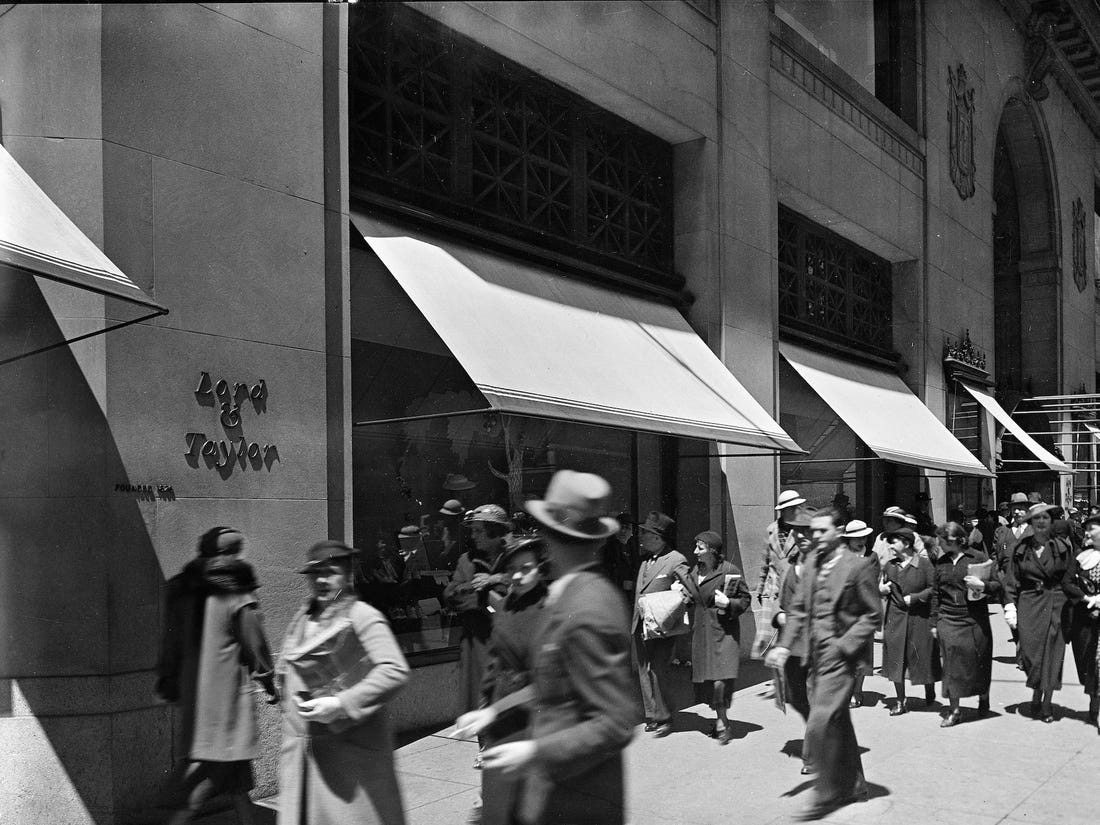
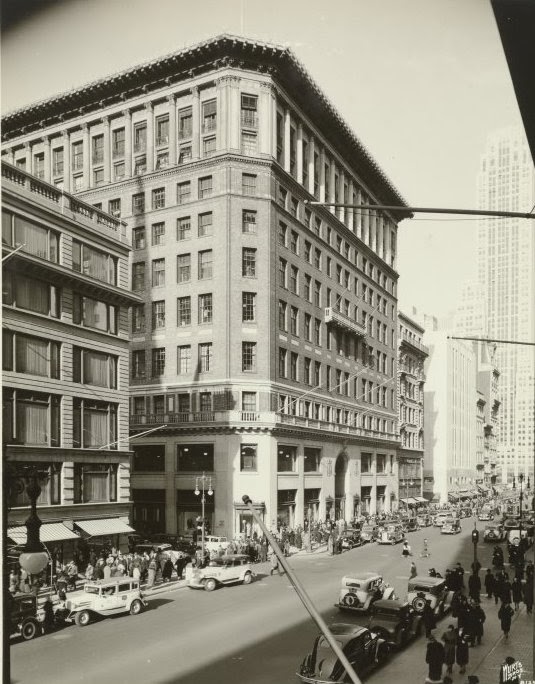
Lord & Taylor’s at Fifth Avenue and 38th Street, in the 1920s, photo by the Wurts Brothers (courtesy NYPL)

Loehmann’s, the once-great Brooklyn-based department store, closes all their locations for good tomorrow, another causality of the changing economy and people’s changing tastes in shopping.

But let’s not dwell on the decline of the department store. Let’s revisit the heyday, shall we?


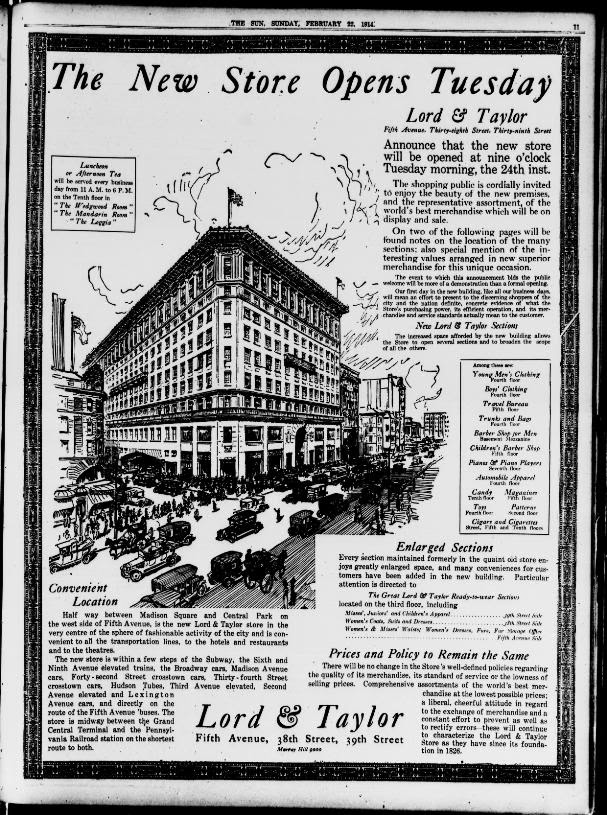
Lord and Taylor Department Store opened the doors to their tony Fifth Avenue address one hundred years ago yesterday, on February 24, 1914.

“Half way between Madison Square and Central Park on the west side of Fifth Avenue, is the new Lord & Taylor store in the very centre of the sphere of fashionable activity of the city and is convenient to all the transportation lines, to the hotels and restaurants and to the theatres.”

The store traces its lineage to a three-story women’s clothing store on 47 Catherine Street, which was opened in 1826 by Samuel Lord and George Washington Taylor.  Nearby, men could find equally fine fashions at the clothier of H & D.H.. Brooks (today Brooks Brothers) at Catherine and Cherry Streets.  Catherine Street is hardly a place where you would look for high-end brands today, located between the Manhattan and Brooklyn Bridges.

Lord & Taylor had subsequent locations in Manhattan at Broadway and Grand Street and, later, at Broadway and 20th Street on Ladies Mile.

Flash forward to 1914 — the new store was an automated wonder, according to the New York Sun, equipped with a system of conveyor belts.  “[T]he human equation has been eliminated wherever possible and machinery performs its part quietly and out of sight.”

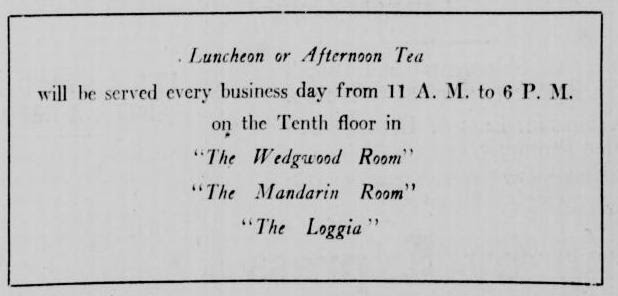
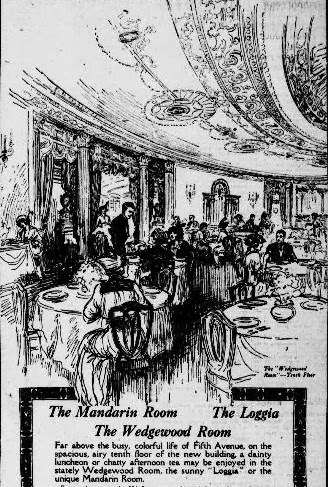
Shoppers could also escape to the tenth floor for “a dainty luncheon” or some afternoon tea:

The building is in the go-to architectural style for department stores — Italian Renaissance Revival — and, apparently, the go-to architectural firm for such places, Starrett and Van Vleck, also known for Bloomingdale’s and Saks Fifth Avenue.

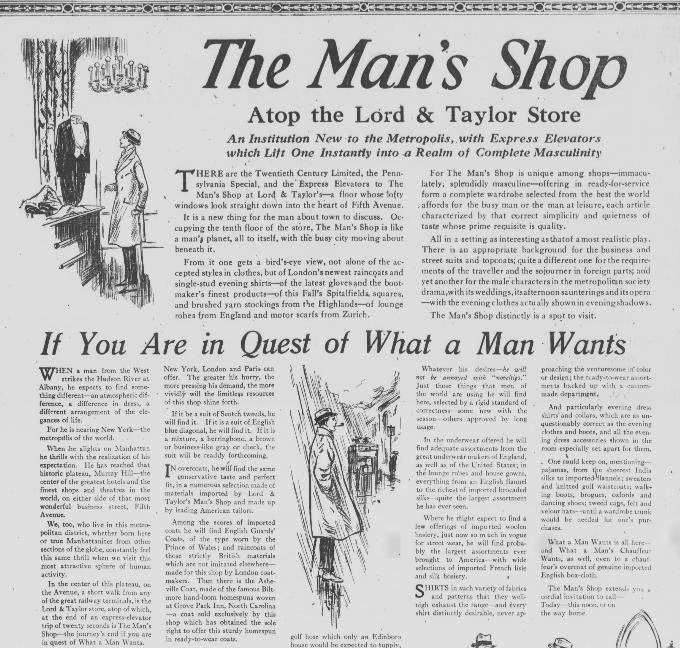
The new store made a unique appeal to the male shopper with its tailored men’s department, “a realm of complete masculinity”.  There was a men’s-only entrance on the 38th Street side where gentlemen could access the Manicuring Parlor.  “[M]ake your purchases, be shaved and manicured, change your clothing, if you like, and leave without passing through any of the departments where women’s goods are sold.”  In addition, the entire fourth floor was “devoted to men’s apparel and accessories for motoring.”

The store also had featured an Equestrienne Section, including “a mechanical horse, duplicating the actual motion of walking, trotting, or cantering.”

In 2007, the Lord & Taylor building was made an official New York landmark.

Categories
Podcasts Politics and Protest

Listening to the Silent Parade of 1917: The Forgotten Civil Rights March

Listen to our podcast on the history of the Silent Parade of 1917 here:


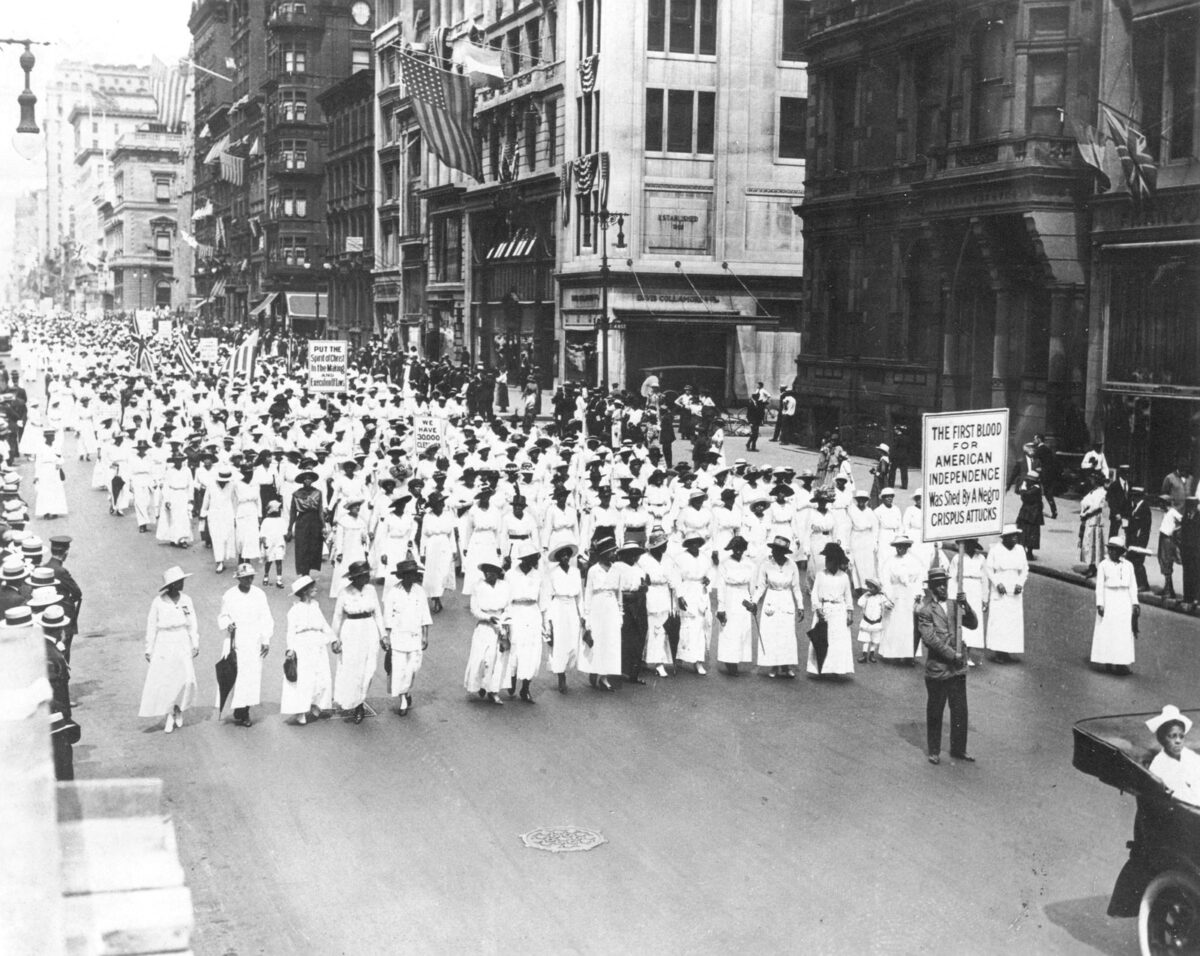
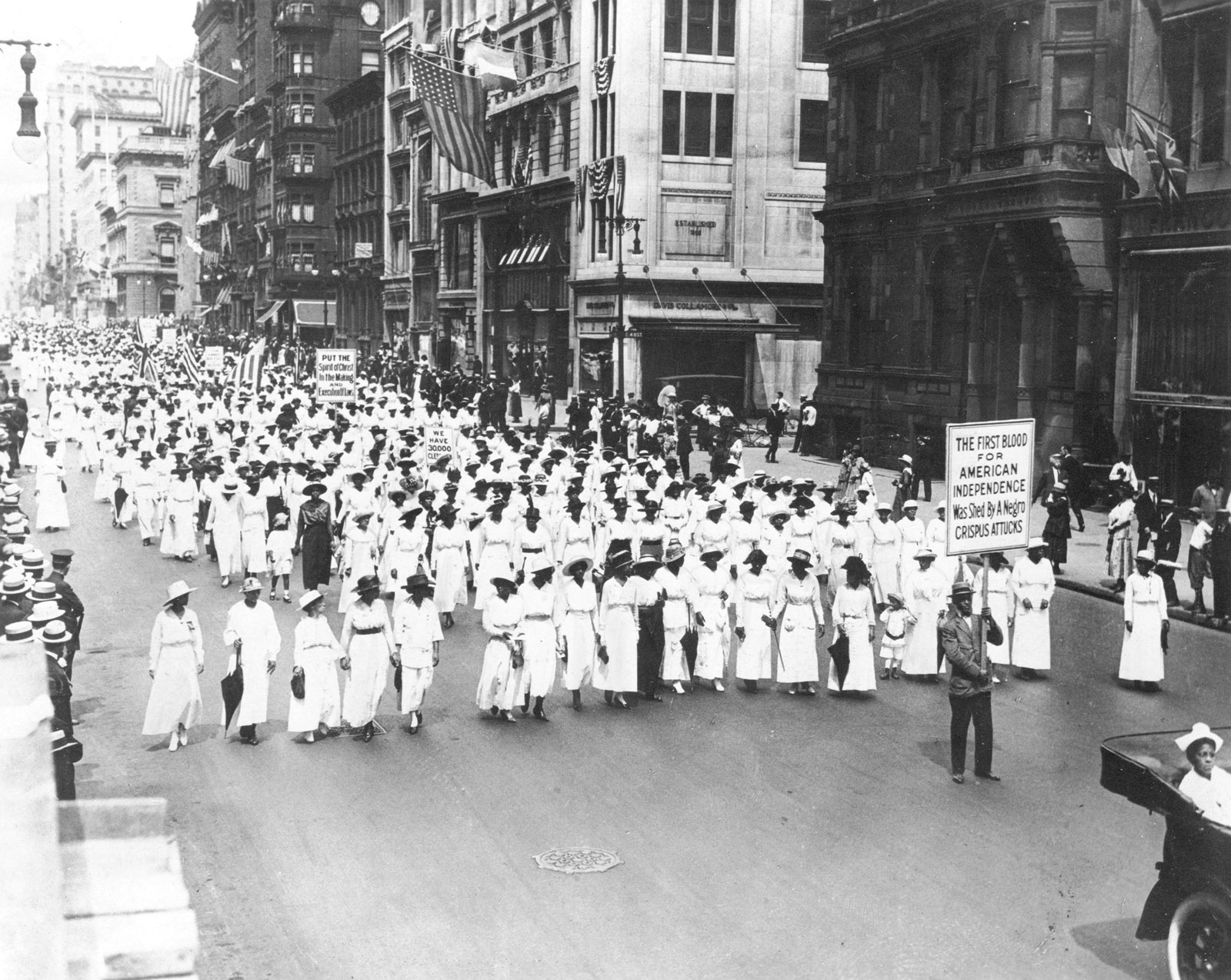
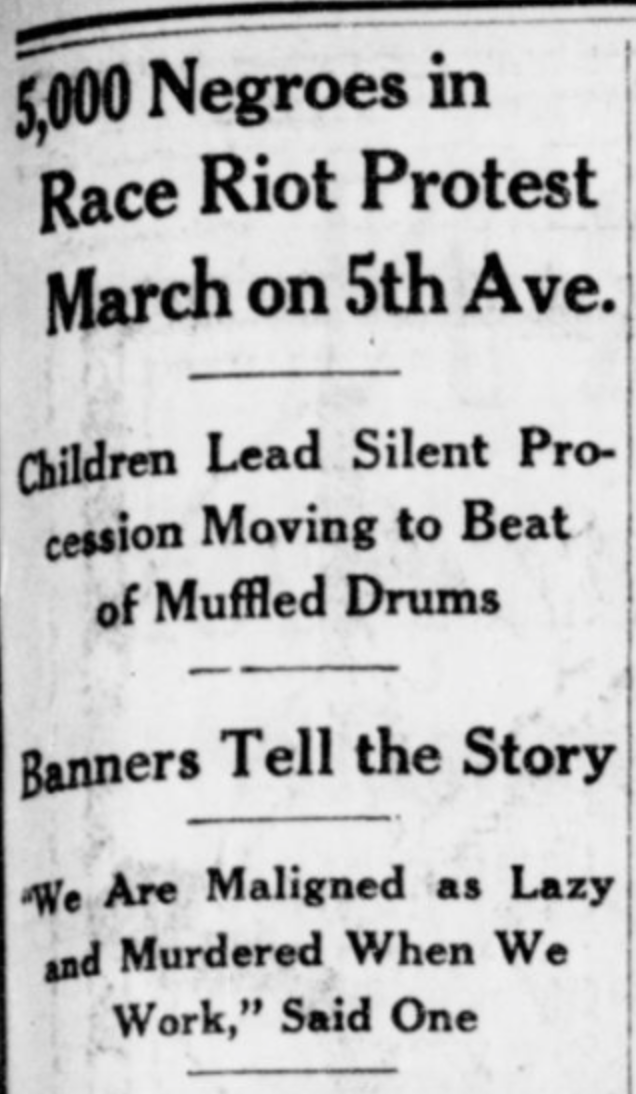
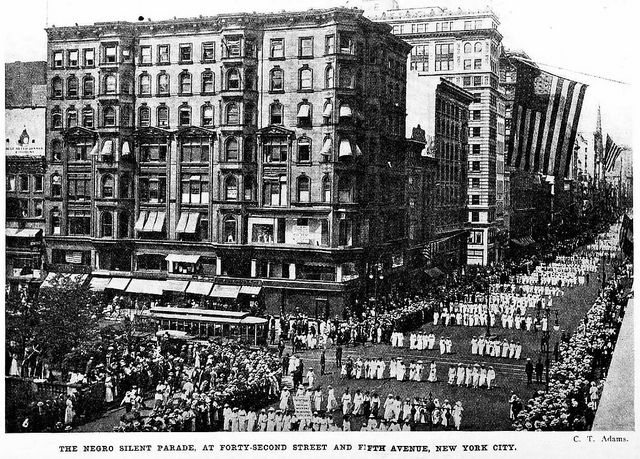
“To the beat of muffled drums 8,000 negro men, women and children marched down Fifth Avenue yesterday in a parade of ‘silent protest against acts of discrimination and oppression’ inflicted upon them in this country, and in other parts of the world. Without a shout or a cheer they made their cause known through the many banners which they carried, calling attention to Jim Crowism, segregation, disfranchisement, and riots of Waco, Memphis and East St. Louis.” — New York Times

The Silent Parade of July 28, 1917, was unlike anything ever seen in New York City. Today it is considered New York’s (and most likely America’s) first African-American civil rights march.

New York had seen its share of protest parades since the start of World War I, but none had featured so prominently the city’s African-American population, gathering in such impressive numbers along New York’s wealthiest street.

This extraordinary procession was organized by the National Association of the Advancement of Colored People (NAACP), a group of concerned black and white activists and intellectuals which had formed less than a decade earlier in New York.

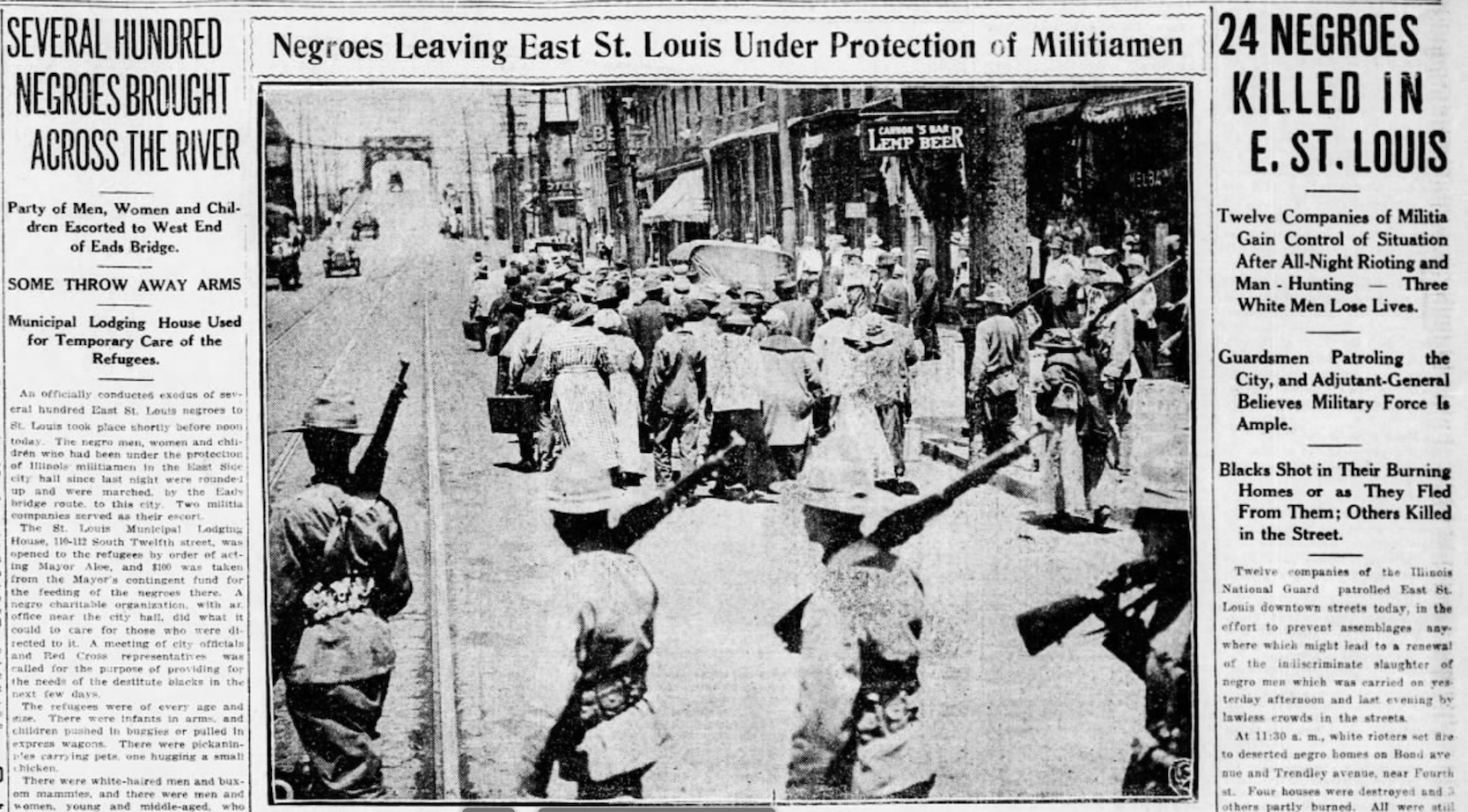
The march was organized in direct response to a horrible plague of violence against black Americans in the 1910s, culminating in the East St. Louis Riots*, a massacre involving white mobs storming black neighborhoods in sheer racial animus.

In Illinois, two sets of riots in May and July 1917 left almost 200 people dead. Rioters burned black neighborhoods, cutting off water hoses and watched as families fled the burning buildings — to be picked off by gunmen.

From the St. Louis Post-Dispatch on July 3:

This massacre was but one of several violent incidents aimed at new black laborers, pointed attacks meant to strike fear in the hearts of black Americans.

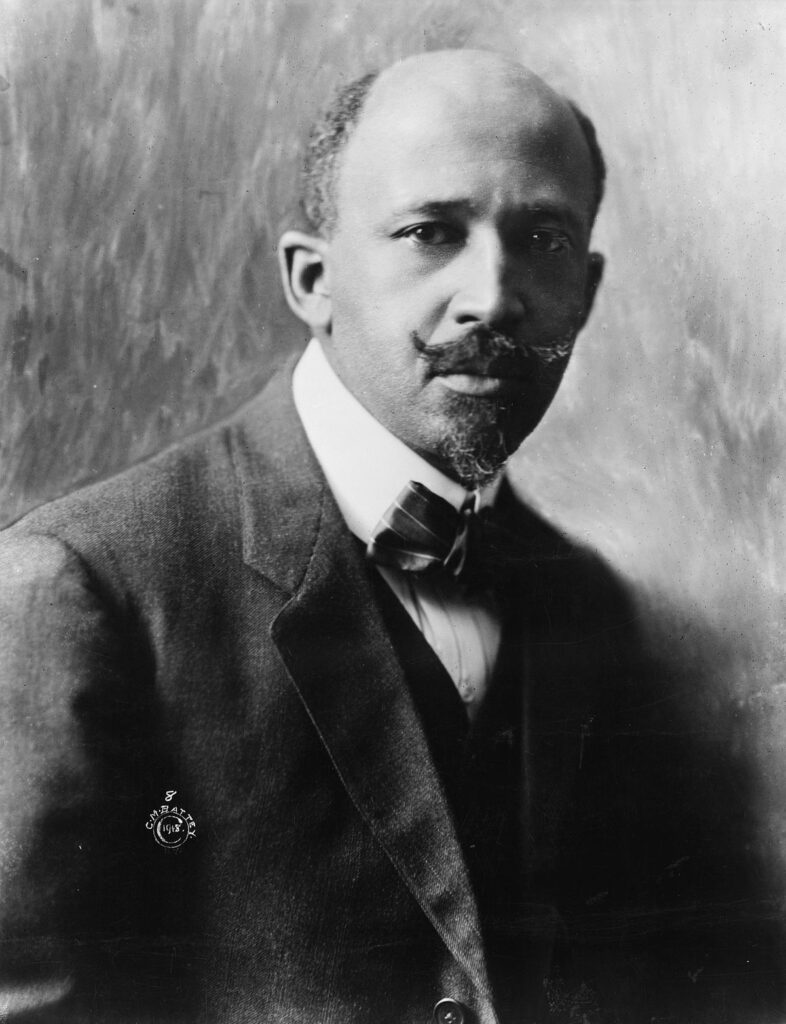
The circumstances of World War I exacerbated an already volatile crisis. As W.E.B. DuBois would explain it,

The Negro, attracted by higher wages in the North and repelled by the menace of lynchinig and caste in the South moves in to fill the new labor demand [caused by the war].  The common laborer in the North is caught between the tyranny of exclusive trade unions and the underbidding of blacks. The rest is murder and riot and unrest…. White Northern laborers find killing Negroes a safe, lucrative employment which commends them to the American Federation of Labor.”

W.E.B Du Bois in 1918.

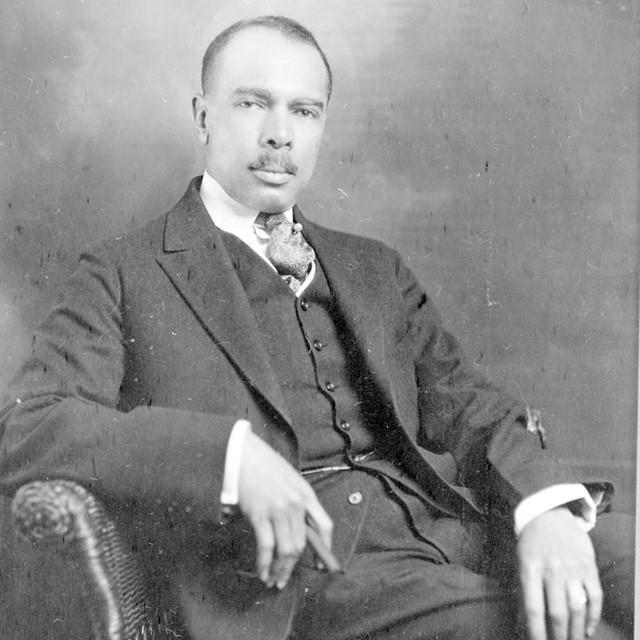
In New York, at a meeting of the NAACP in Harlem, president James Weldon Johnson (at the suggestion of New York Evening Post editor Oswald Villard) proposed an unusual but effective form of protest — an army of marchers along Fifth Avenue, drawing attention to the victims of the East St. Louis riot.

And in an unprecedented decision by the organizers, it would consist only of black marchers.

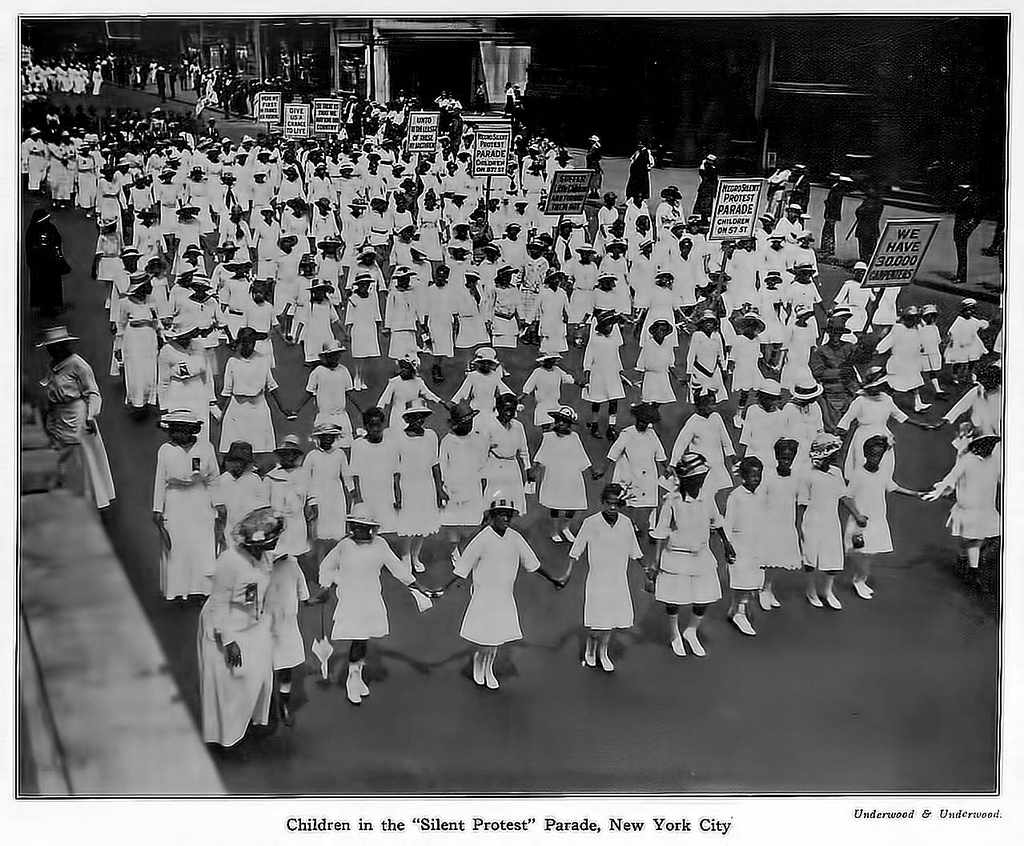
Underwood & Underwood

New York newspaper reports of the riot passively mentioned the tragic cost to the black residents of East St. Louis; a dramatic march down the city’s most prosperous street — comprised of those very people most likely to be victimized in such riots — would jar the delicate sensibilities of insulated New Yorkers.

This was a fairly radical idea for its time. Decades after the Civil War, most Americans, even in the most progressive states, still looked skeptically at organized black movements. Part of the NAACP’s early legitimacy for many was that it was formed by a mixture of black and white activists.

James Weldon Johnson, one of the architects of the Silent Parade

In 1915, the NAACP (in a crusade led by newspaper editor William Monroe Trotter) protested the release of the film Birth of a Nation, the trailblazing film that positively depicted the Ku Klux Klan while demonizing African-Americans. The protests failed to stop the film’s release but this organized resistance galvanized the NAACP and the black community for future battles.

While the East St. Louis tragedy was the focus of the mournful July 28th gathering, the march was intended as a larger protest against civil rights abuses in the United States. One of many flyers passed around during the march declared :

We march because we are thoroughly opposed to Jim Crow cars, segregation, disenfranchisement and the host of evils that are forced upon us. We march in memory of our butchered dead, the massacre of honest toilers who were removing the reproach of laziness and thriftlessness hurled at the entire race. They died to prove our worthiness to live. We live in spite of death shadowing us and ours.”Â

Below: The organizers marched in front of the women and children. At far right are W.E.B. Du Bois and James Weldon Johnson.

Underwood and Underwood

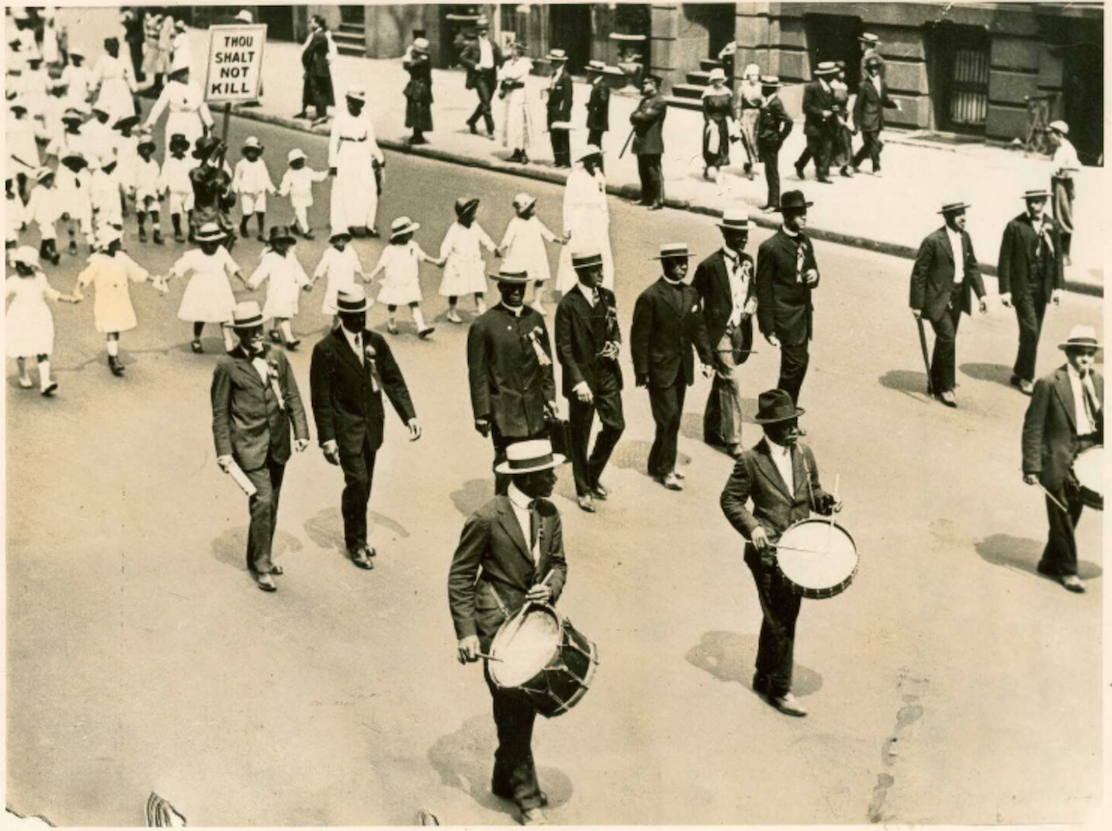
The thousands of people who marched that day came from virtually every African-American church in New York City and the surrounding area. A drum corps and a troupe of black Boy Scouts vibrantly led the parade, with women and children following behind, garbed in white dresses.

The men, some in United States army uniforms, marched last behind a row of flag bearers, holding representative flags from the United States, Great Britain, Liberia and Haiti.

New York Tribune

There were no chants or rallying cries. The throng remained silent during the length of the parade, a common practice for peace parades but one pregnant with meaning here. The black communities in East St. Louis and in the South had little opportunity to engage in such protests.

New Yorkers, in solidarity, would echo that reverberating silence. (It may also have been prudent for large groups of African-Americans marching along the city’s whitest street to keep themselves calcified.)

The marchers were orderly and stone-faced as they walked down Fifth Avenue — from 57th Street to 24th Street, culminating at Madison Square Park.  They were not allowed to gather there; according to the New York Sun, “When the marchers reached Twenty-Fourth Street, they turned west and were dismissed.”

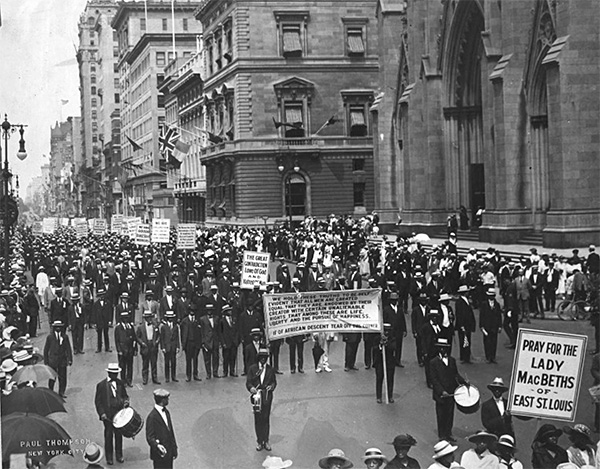
While there were no chants, political intentions were made known via a series of banners interspersed among the marchers:

‘Your Hands Are Full of Blood’

‘Pray for the Lady Macbeths of East St. Louis’**

‘We Are Maligned as Lazy and Murdered When We Work’

‘From  Bunker Hill to Carrizal*** We Have Done Our Duty’

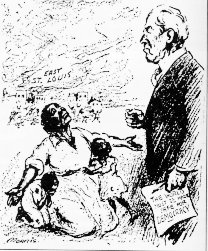
One ‘controversial’ sign was thrown out of the march. According to the Times, the sign “displayed a picture of a negro woman kneeling before President Wilson and appealing to him to bring democracy to America before carrying it to Europe.” The police intervened, and the sign was removed.

Below: A newspaper illustration that was most certainly used in the offending sign

No other incidents surrounding the march were reported that day. Thousands of onlookers had lined the parade route that day out of curiosity, amusement, pride, anger and joy. Some were shaken to the core.

“[T]he streets of New York have witnessed many strange sites, but I judge, never one stranger than this; among the watchers were those with tears in their eyes. — James Weldon Johnson, The Autobiography of James Weldon Johnson, 1937


FURTHER LISTENING

After you’ve listened to this podcast on the Silent Parade of 1917, check out these past episodes of our show that feature topics referenced in the new episode:


NOTE: The number of marchers so widely varies from source to source that I can safely say that it was between 5,000 and 15,000 marchers. Not exactly precise! Judging from all reports, I would guess the actual number is closer to 15,000.

*East St. Louis, on the Illinois side, is about 15 miles away from Ferguson, the St. Louis suburb on the Missouri side.

**According to author Nikki Brown, the ‘Lady Macbeth’ sign references “an alleged incident wherein at least two white women pulled black women off a streetcar, tore off one woman’s clothing and ‘then took off her shoes and beat her over the face and head with their shoe heels’.”

***The Battle of Carrizal had been fought in Mexico a year before the march. Unlike the battles in Europe, African-American soldiers served with American units on the front lines of this engagement.

Categories
Holidays

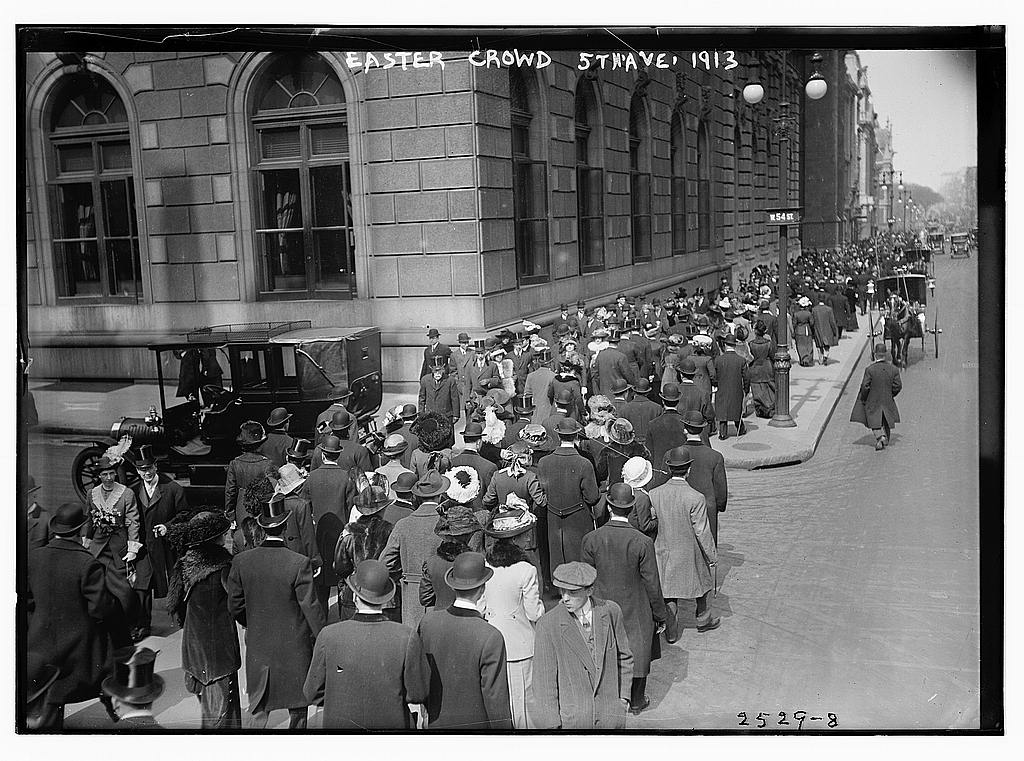
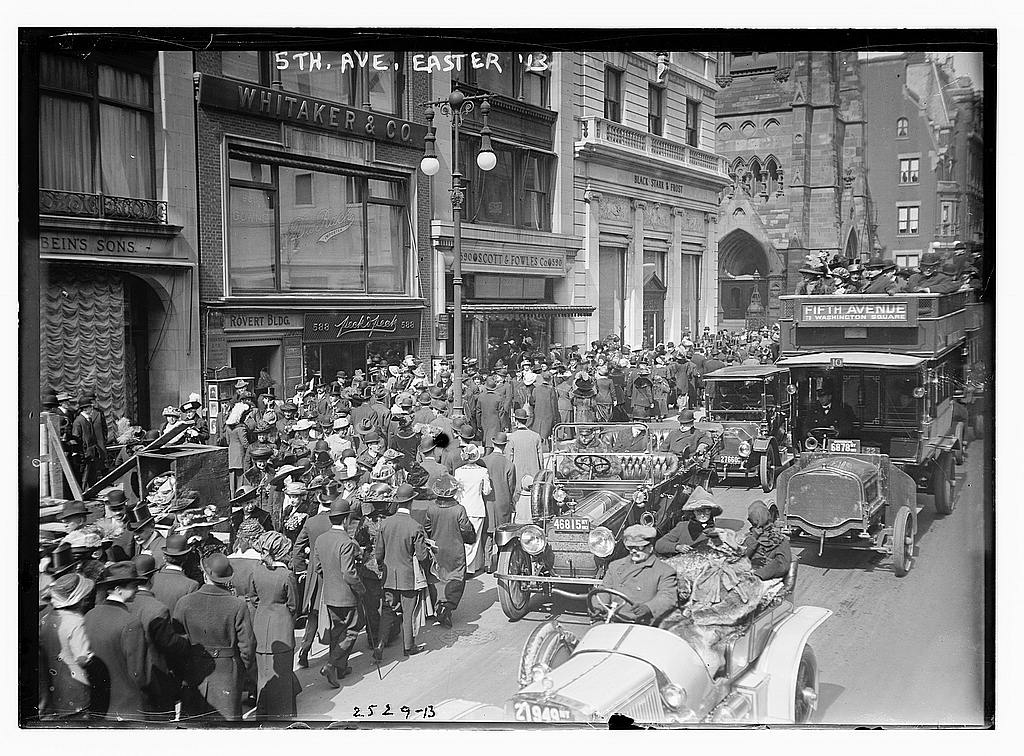
Easter in Old New York: The Fifth Avenue Fashion Stroll

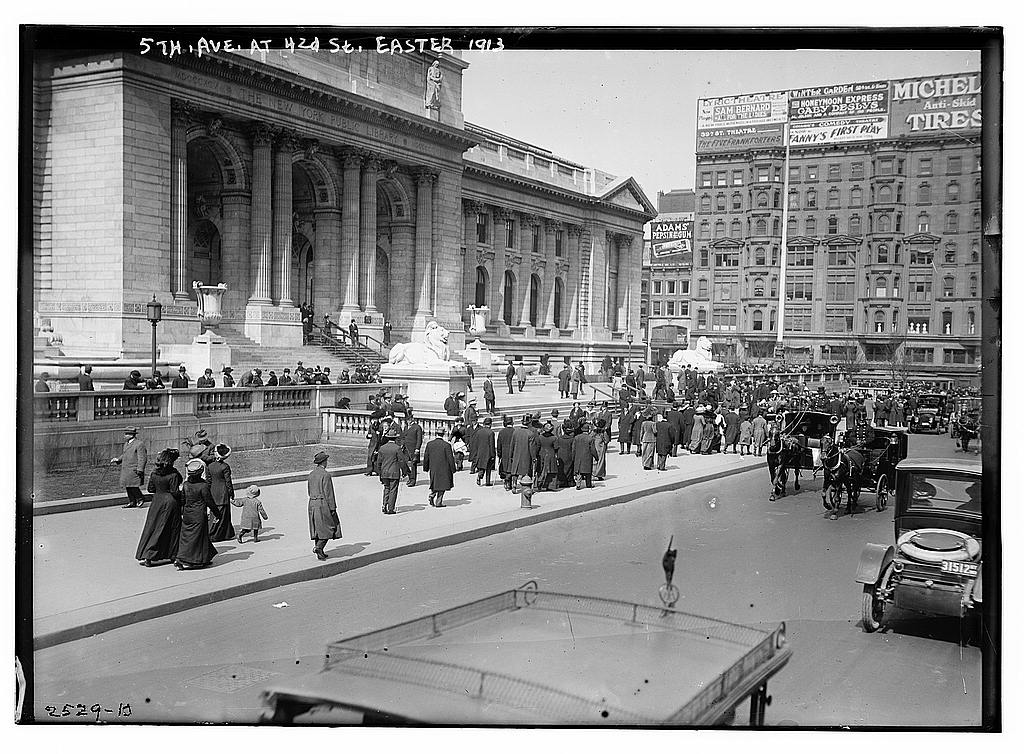
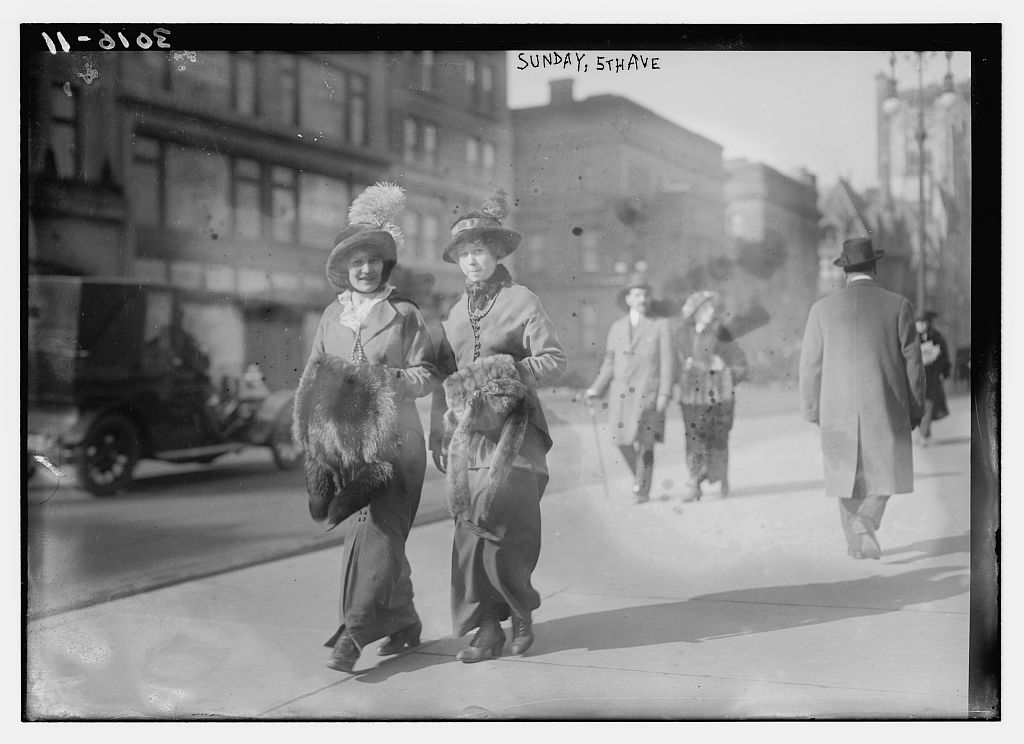
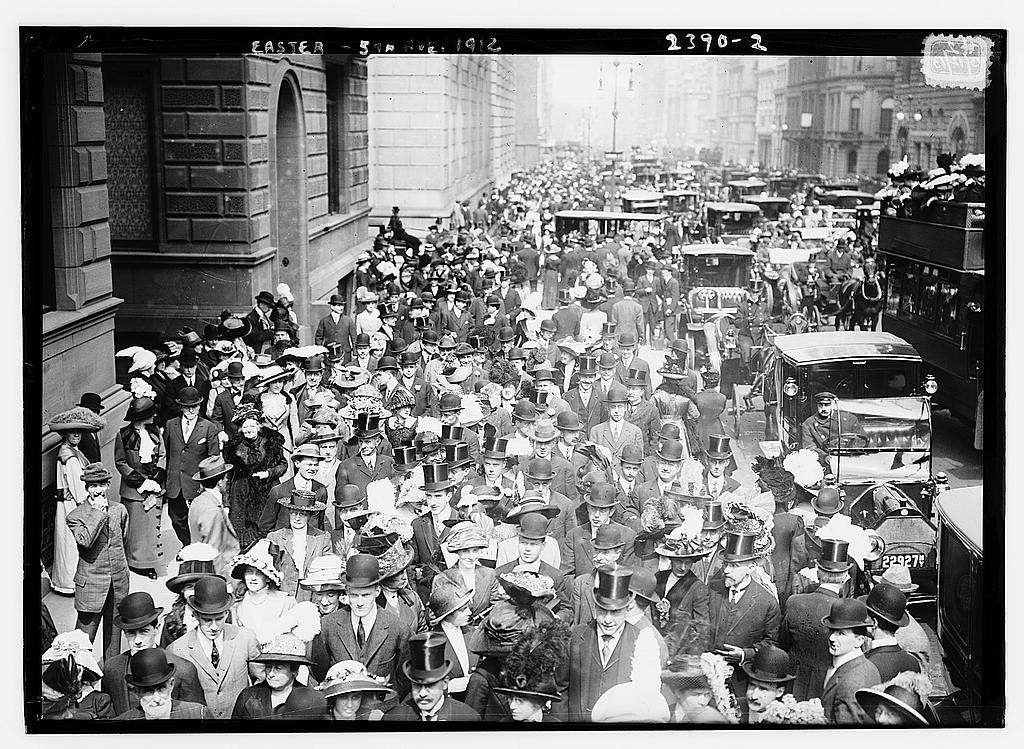
In the picture above: People in Sunday finery stroll past the New York Public Library building. The library had not even been open two years by the time this picture was taken in March 23, 1913.

New York City’s time-honored Easter custom — the Sunday morning Fifth Avenue Easter bonnet stroll — once turned the wealthiest residents of Fifth Avenue into primping peacocks, their Sunday best on display.

The makeshift parade, which some believe traces back to New York’s Dutch days, blossomed into a full-assault of expensive headwear once the upper crust made Fifth Avenue their home.

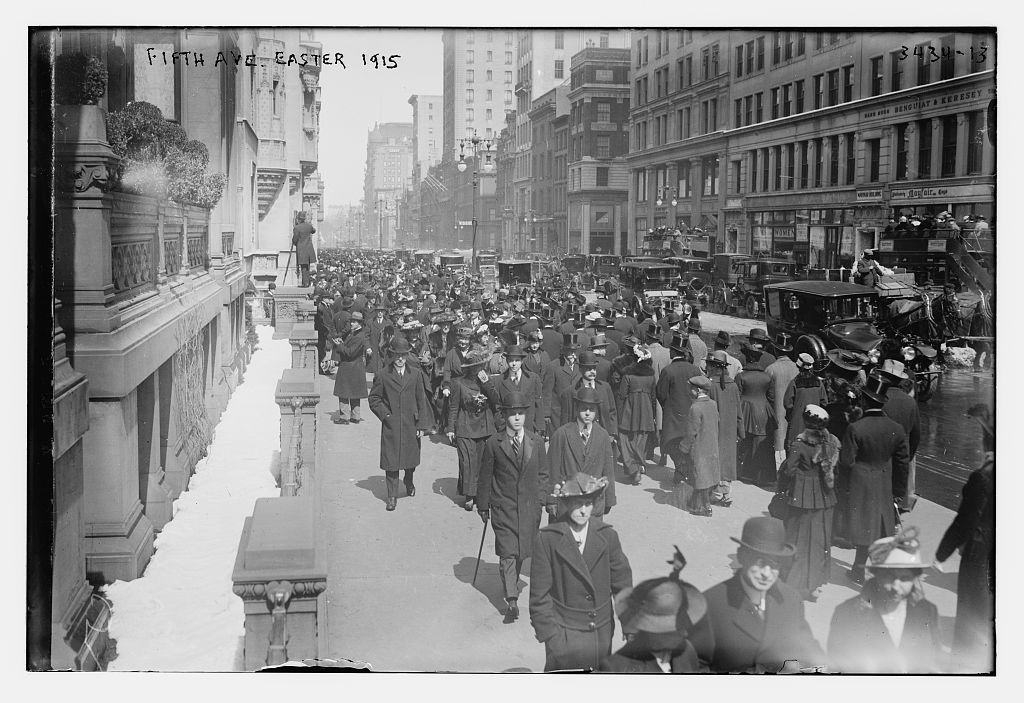
Thousands lined the street, either brandishing their most expensive apparel or else to gawk at those wearing it. It was the closest New York got to a high-end fashion show, with dressmakers parked on the corner, taking notes.

“All the women were slim who could be,” remarked the New York Tribune’s fashion writer, “and a few were who couldn’t.”

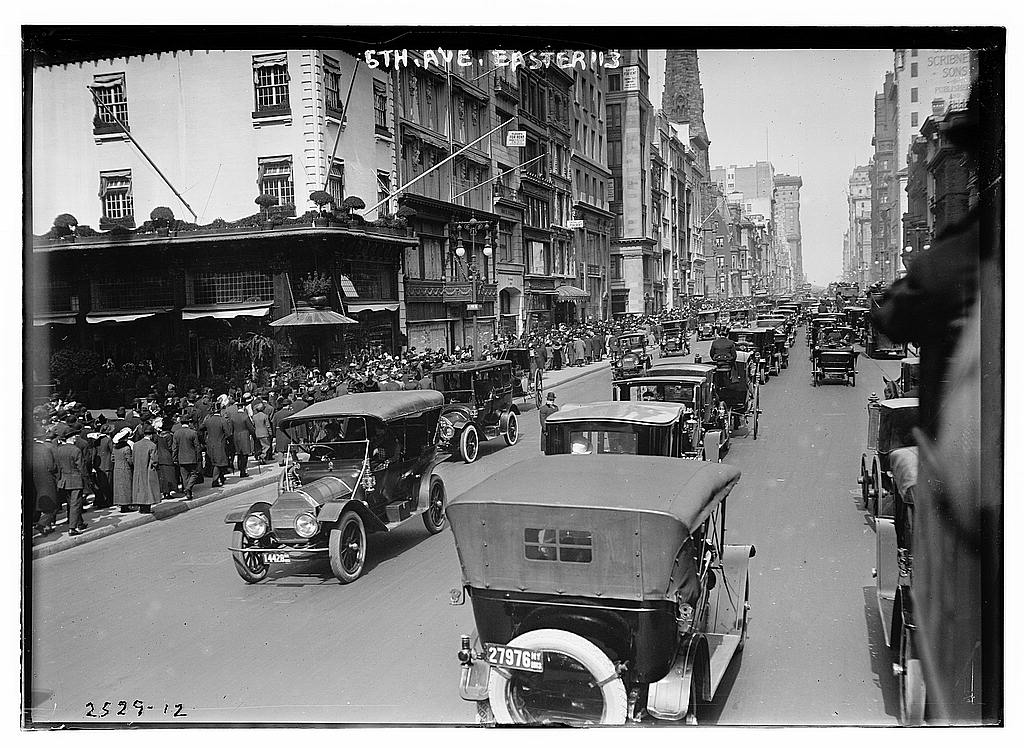
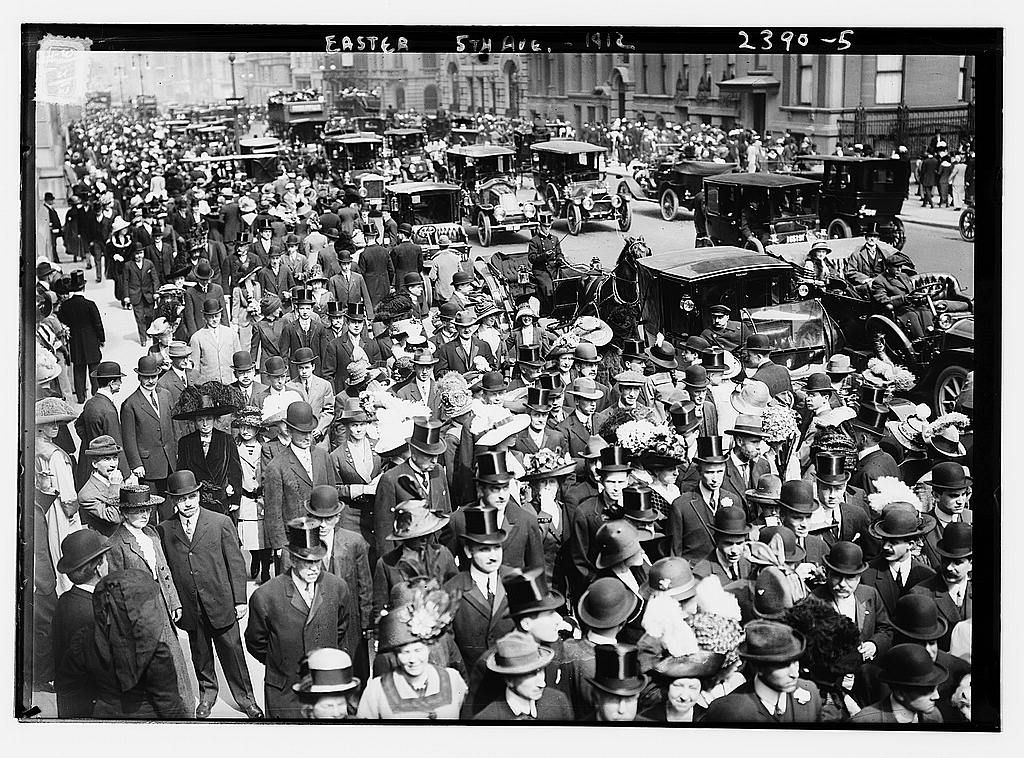
But the 1910s brought a new accessory to the Easter parade — automobiles.

A decade before, there were probably no more than 1,000 automobiles in all of New York City. By 1913, there were enough to create what must have been Fifth Avenue’s very first automobile traffic jam.

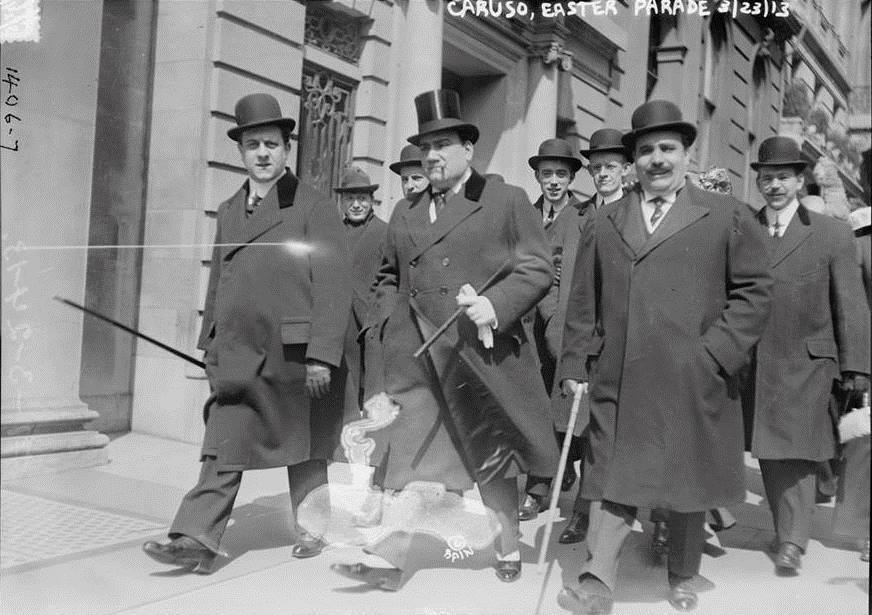
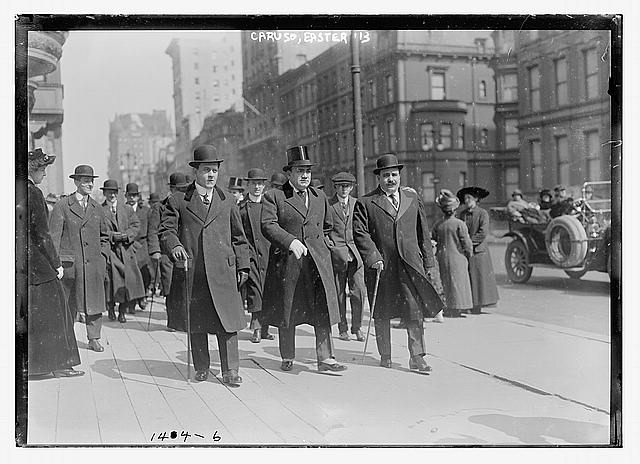
All the photographs featured here are from Easter Sundays, between 1912 and 1915 (images courtesy the Bain Collection/Library of Congress.

The magnificent Enrico Caruso even participated in the Easter stroll. He looks fanciful in his top hat and a bit like Batman villain the Penguin.

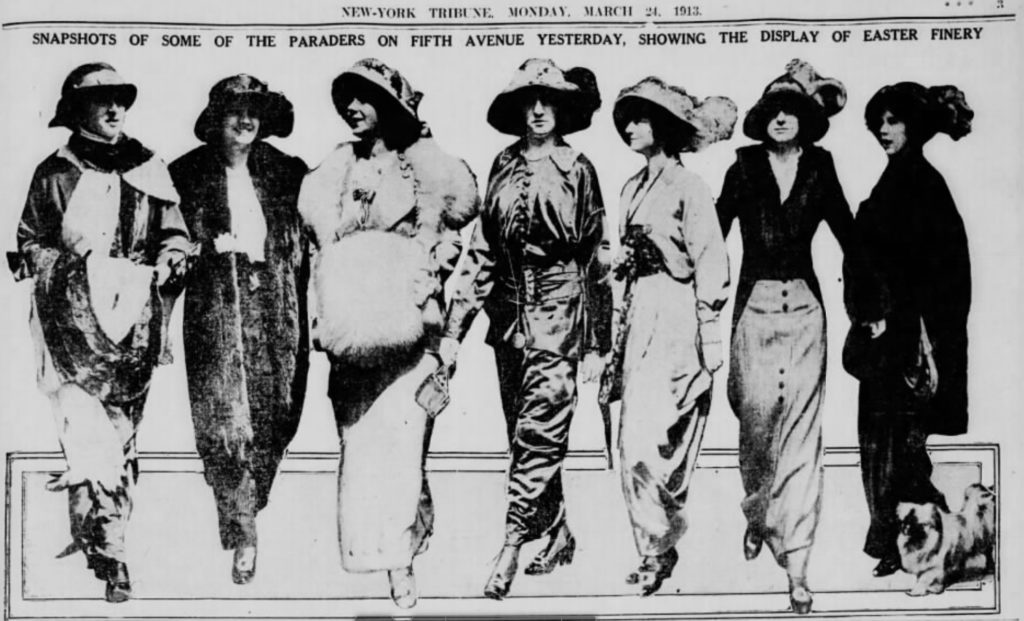
Apparently it was an unseasonably cold day that Easter in 1913 and most society women, braving the chill, wrapped up their fine gowns in heavy wraps and coats of various animal skin.  “Furs and pink noses” was the fashion assessment, according to the Tribune.

Still, in the sea of coats and curious hats, one woman managed to make an impression. “LADY IN VERMILION AN EASTER CUBIST‘ cried the newspaper the following day — on its front page, no less.  “…[W]ho was the young lady in bright vermilion, with lips of a vivid purple, who talked excitedly to hide her shivering as she passed St. Patrick’s Cathedral?”

The New York Tribune ran this banner photograph the following day. (Note the dog in the corner.) Sadly I don’t believe any of these ladies was the aforementioned ‘vermilion lady’:

Of course, there’s still an annual Easter bonnet parade; it’s smaller but far more flamboyant.

Pictures courtesy Library of Congress

Categories
Gilded Age New York Podcasts

The Fall of the Fifth Avenue Mansions: Where to find the remnants of an opulent past

PODCAST The story of how Fifth Avenue, once the ritziest residential address in America, became an upscale retail strip and the home of some of New York’s finest cultural institutions.

LISTEN HERE:

In this episode, the symbols of the Gilded Age are dismantled.

During the late 19th century, New York’s most esteemed families built extravagant mansions along Fifth Avenue, turning it into one of the most desired residential streets in the United States. The ‘well-connected’ families, along with the nouveau riche, planted their homes here, even as the realities of the city encroached around them.

By 1925 most of the mansions below 59th Street were gone, victims of changing tastes and alterations to the city landscape. Clothing manufacturing plants swept through Greenwich Village, and such ‘common’ purposes threatened the identity of Fifth Avenue. To the west, the dazzling delights of Times Square seemed certain to wring any respectability out of Midtown Manhattan’s reputation.

But near Central Park, families of newer wealth filled Fifth Avenue with their own opulent homes — Carnegies, Dukes, Fricks — as though oblivious to the changes occurring down south.

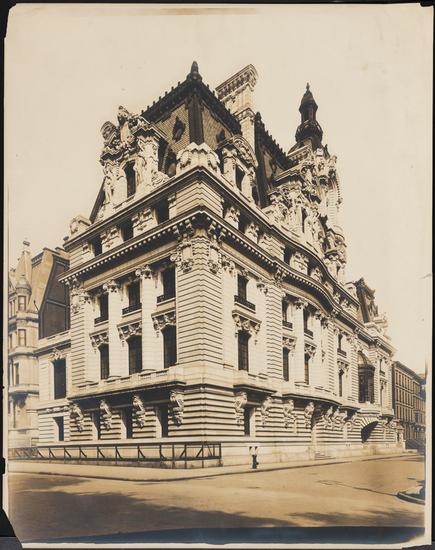
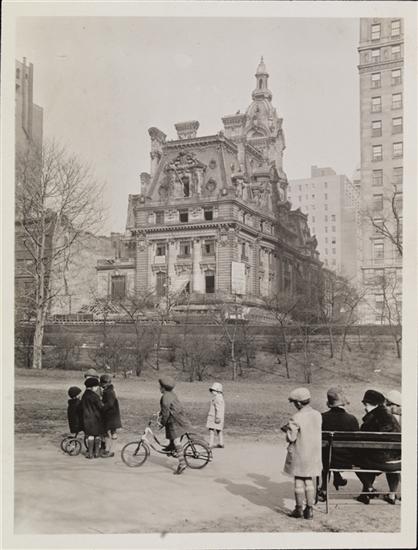
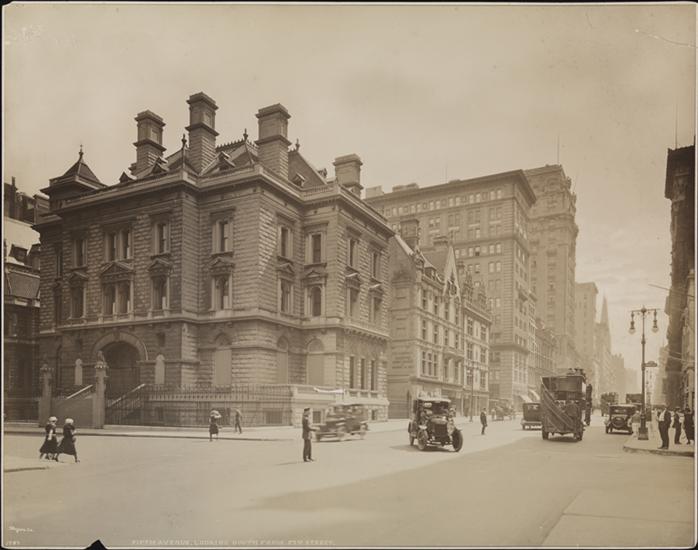
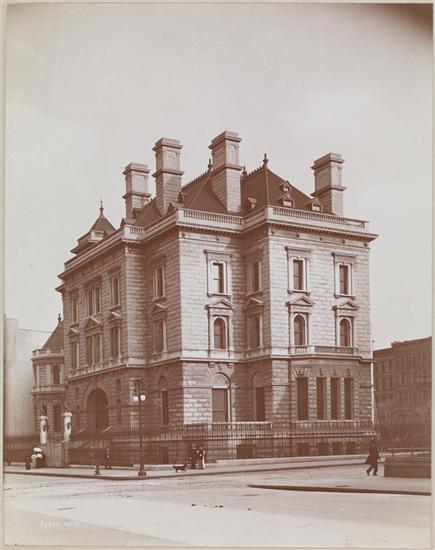
Most of these habitats of old wealth are gone today. There’s no place for a 100-room mansion on one of New York City’s busiest streets. Yet a few of these mansions managed to survive by taking on very different identities — from clothing boutiques to museums.

PLUS: The building that was bought for a necklace!

To download this episode and subscribe to our show for free, visit iTunes or other podcasting services or get it straight from our satellite site.

You can also listen to the show on Google Music, Stitcher streaming radio and TuneIn streaming radio from your mobile devices.

___________________________________________________________________________

The Bowery Boys: New York City History podcast is brought to you …. by you!

We are now producing a new Bowery Boys podcast every week.  We’re also looking to improve the show in other ways and expand in other ways as well — through publishing, social media, live events and other forms of media.  But we can only do this with your help!

We are now a member of Patreon, a patronage platform where you can support your favorite content creators for as little as a $1 a month.

Please visit our page on Patreon and watch a short video of us recording the show and talking about our expansion plans.  If you’d like to help out, there are five different pledge levels (and with clever names too — Mannahatta, New Amsterdam, Five Points, Gilded Age, Jazz Age and Empire State). Check them out and consider being a sponsor.

We greatly appreciate our listeners and readers and thank you for joining us on this journey so far. 

________________________________________________________________________

Artistic representations of a changing Fifth Avenue —

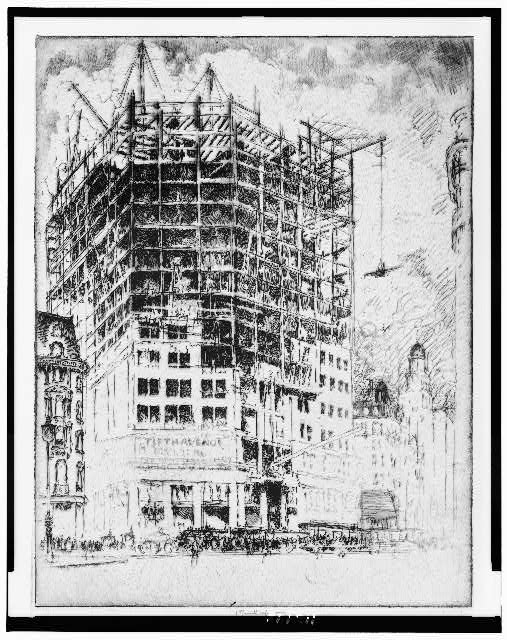
A 1908 illustration by Joseph Pennell titled Rebuilding Fifth Avenue.

Library of Congress

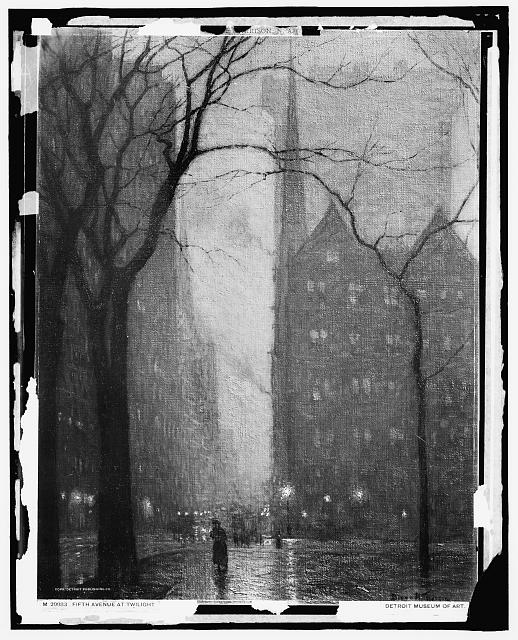
Fifth Avenue at Twilight, an illustration (c. 1910) by artist Birge Harrison, depicting Grand Army Plaza and Vanderbilt’s mansion, with Fifth Avenue Presbyterian and the Gotham Hotel behind it.

Library of Congress

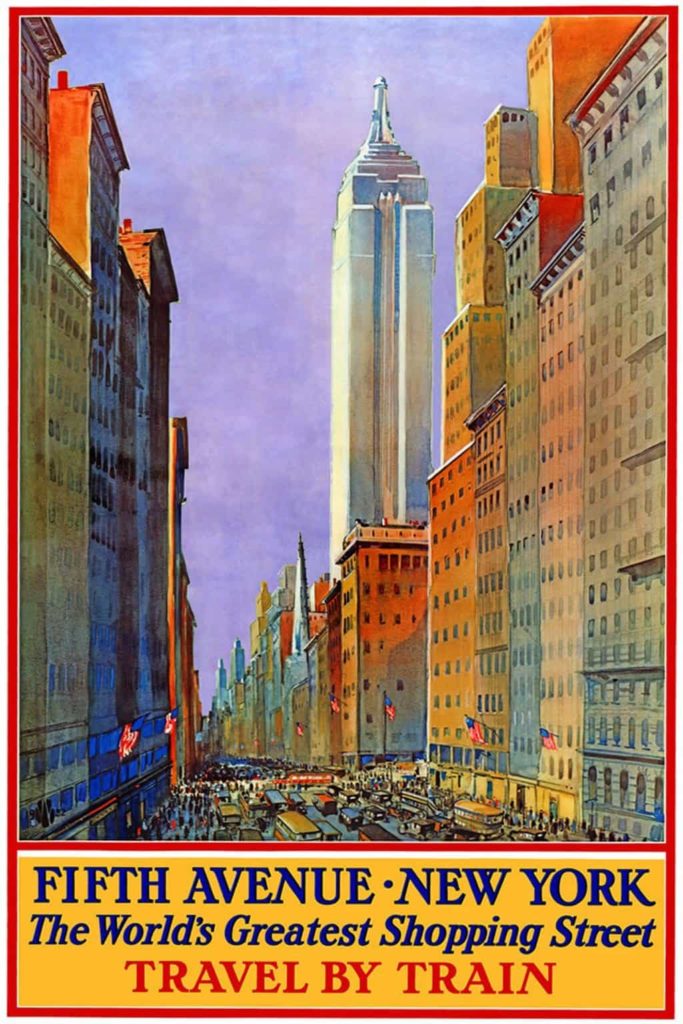
By 1932, the transition to a retail district was virtually complete. Almost no single-family houses remained on Fifth Avenue below 59th Street.

Latham Litho. & Ptg. Co., 1932, Library of Congress

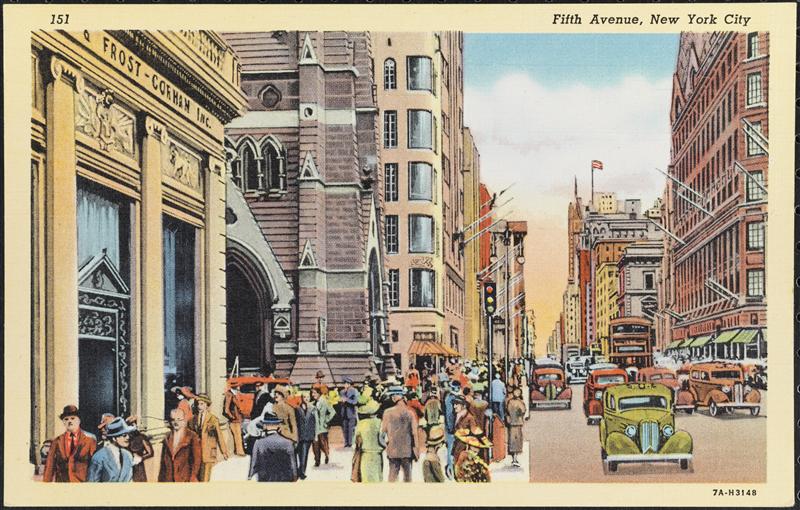
Postcard caption (from 1935): “A view of Fifth Avenue, the parade ground of the nation, looking south from 48th St., famous for its smart shops and double-decked buses.”


The New Century —

The corner of 59th Street and Fifth Avenue. Within 30 years this view would be completely transformed.

Museum of the City of New York


The new mansion ‘bonanza’ sprouted above 59th Street, a row of fine single-family palaces that would help create the ritzy reputation of the Upper East Side.

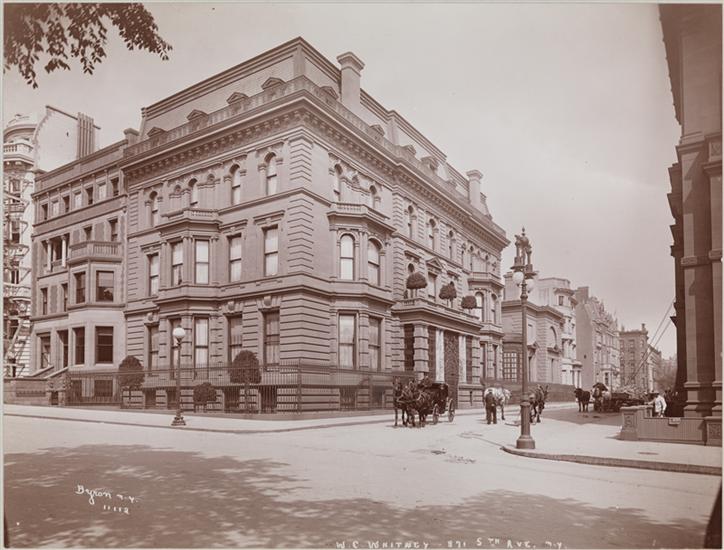
The home of W.C. Whitney (68th Street), 1900:

Museum of the City of New York


The home of George Gould (son of Jay), at Fifth Avenue and 89th Street

New York Public Library


The mansion of William Clark at E. 77th Street — in 1918 and 1927 (note the boarded up windows).

Wurts Brothers/Museum of the City of New York

Phillip Bartlett/Museum of the City of New York


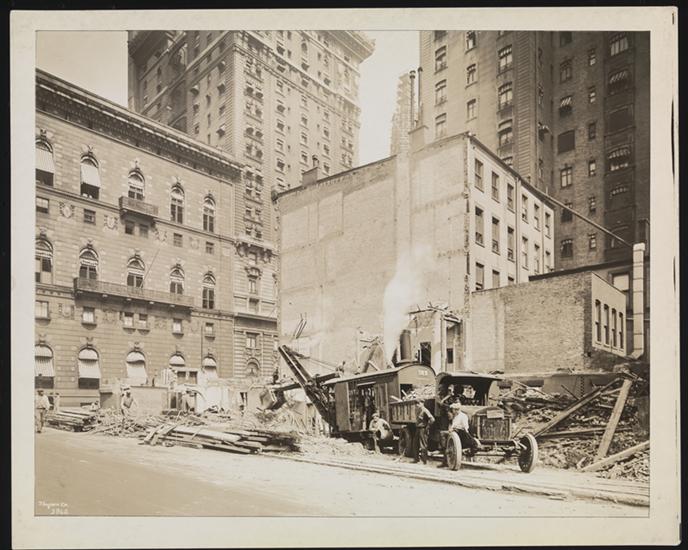
Demolition on Fifth Avenue was an extraordinarily common site in the first quarter of the 20th century.  This is the northeast corner of Fifth Avenue and 54th Street in 1925.
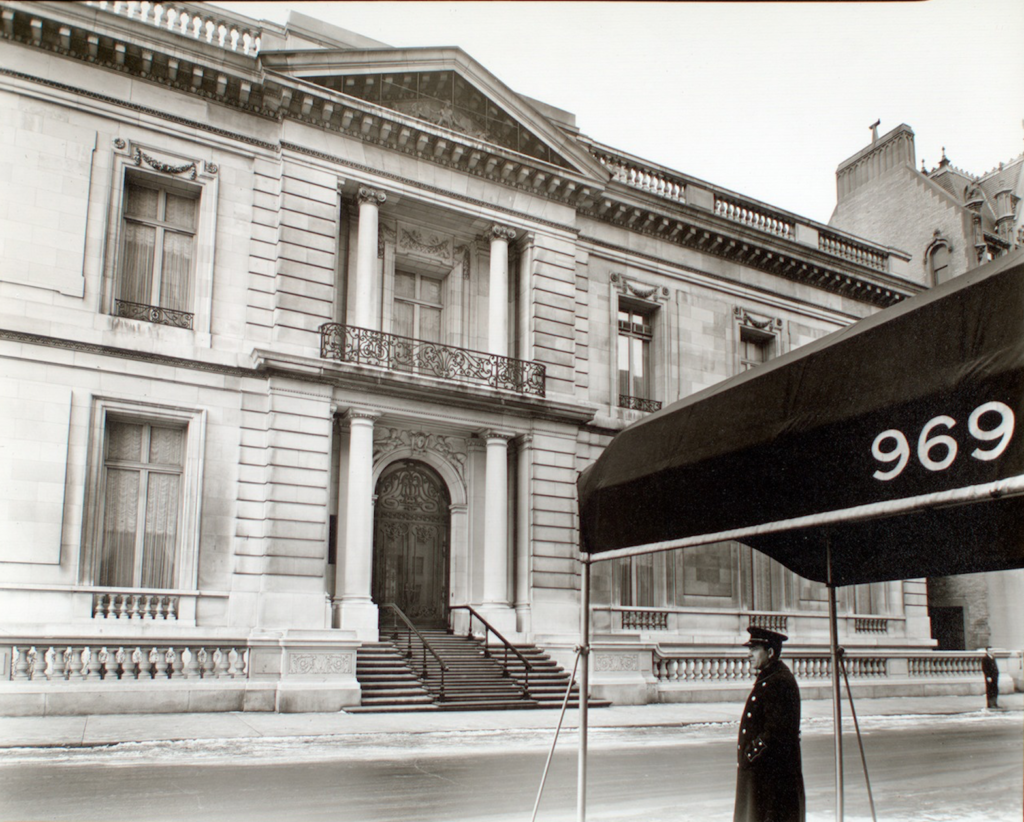
The mansion of James B Duke, 1938. The house still exists, as does the apartment complex (and its awning) across the street.


A confusion of automobile traffic along Grand Army Plaza, 1930

The new Bergdorf Goodman in 1930, replacing the old Vanderbilt mansion.


OTHER PODCAST LISTENING related to this show:

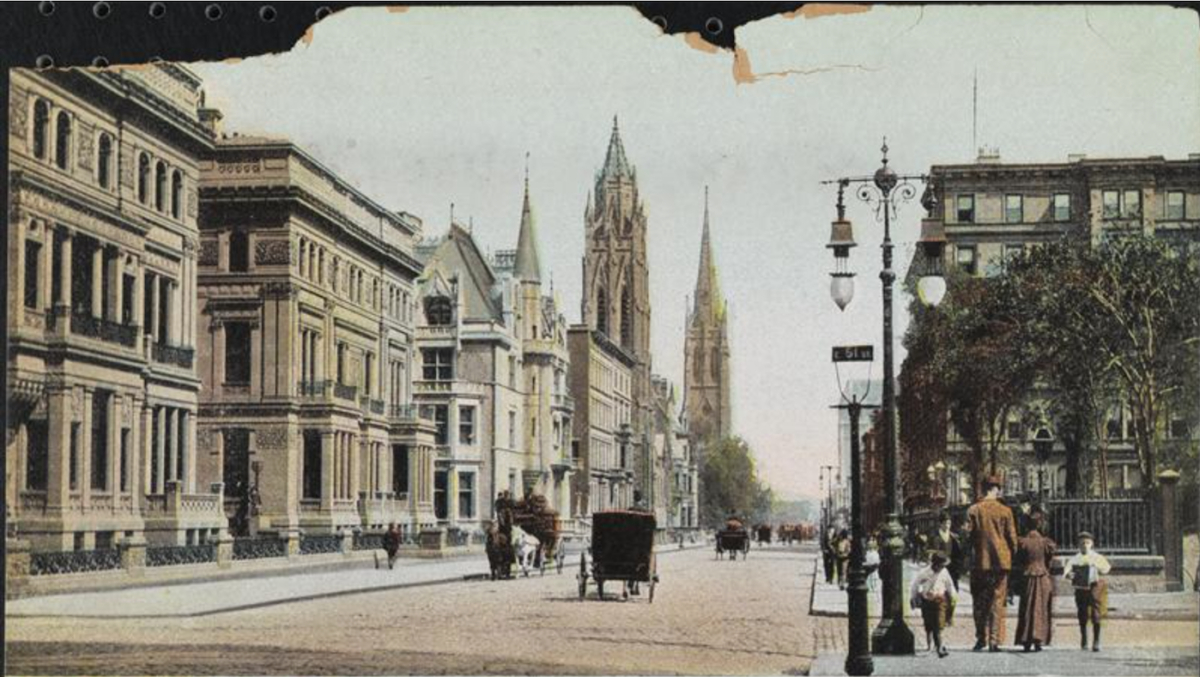
At top: A colorized image of Fifth Avenue from 1908 from Shorpy. Click here to see the original in deeper detail
Categories
Gilded Age New York Podcasts

The Rise of the Fifth Avenue Mansions: Revisiting Forgotten Architecture of New York’s Gilded Age

PODCAST At the heart of New York’s Gilded Age — the late 19th century era of unprecedented American wealth and excess — were families with the names Astor, Waldorf, Schermerhorn and Vanderbilt, alongside power players like A.T. Stewart, Jay Gould and William “Boss” Tweed.
They would all make their homes — and in the case of the Vanderbilts, their great many homes — on Manhattan’s Fifth Avenue.

The image of Fifth Avenue as a luxury retail destination today grew from the street’s aristocratic reputation in the 1800s. The rich were inextricably drawn to the avenue as early as the 1830s when rich merchants, anxious to be near the exquisite row houses of Washington Square Park, began turning it into an artery of expensive abodes.

In this podcast — the first of two parts — Tom and Greg present a world that’s somewhat hard to imagine — free-standing mansions in an exclusive corridor running right through the center of Manhattan. Why was Fifth Avenue fated to become the domain of the so-called “Upper Ten”? What were the rituals of daily life along such an unusual avenue? And what did these Beaux Arts palaces say about their ritzy occupants?

CO-STARRING: Mark Twain, Madame Restell, George Opdyke and “the Marrying Wilsons”.


The Bowery Boys: New York City History podcast is brought to you …. by you!

We are now producing a new Bowery Boys podcast every week. We’re also looking to improve the show in other ways and expand in other ways as well — through publishing, social media, live events and other forms of media. But we can only do this with your help!

We are now a member of Patreon, a patronage platform where you can support your favorite content creators — for as little as a $1 a month.

Please visit our page on Patreon and watch a short video of us recording the show and talking about our expansion plans. If you’d like to help out, there are five different pledge levels (and with clever names too — Mannahatta, New Amsterdam, Five Points, Gilded Age, Jazz Age and Empire State). Check them out and consider being a sponsor.

We greatly appreciate our listeners and readers and thank you for joining us on this journey so far.


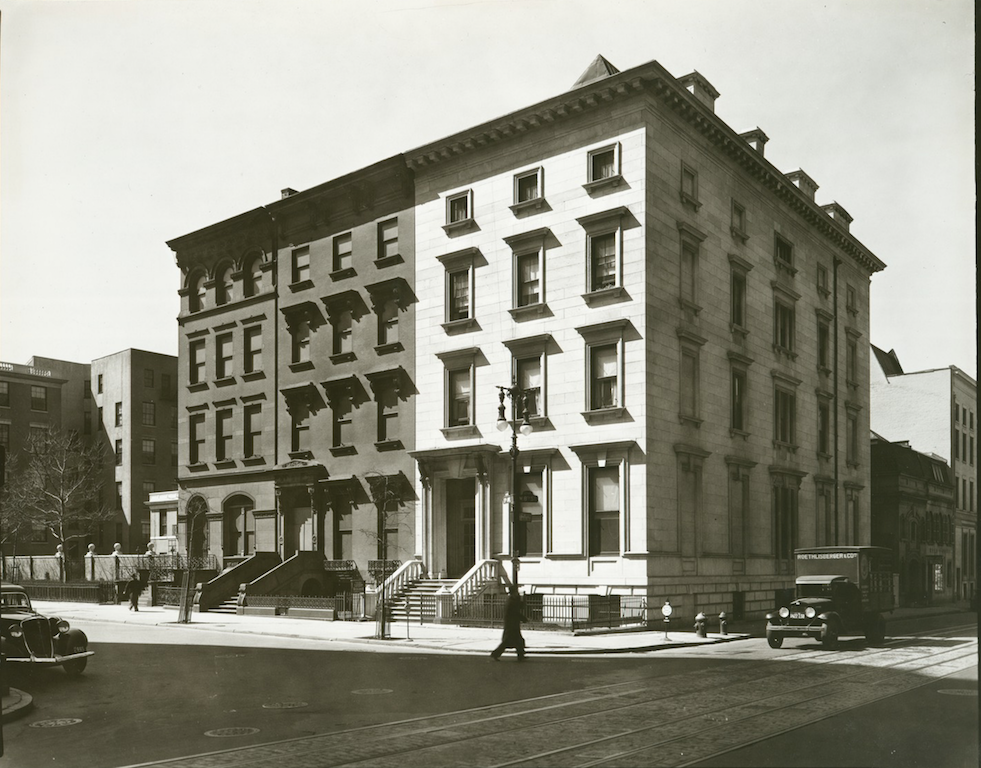
4-8 Fifth Avenue, buildings which were still standing in 1936 for photographer Berenice Abbott.

NYPL

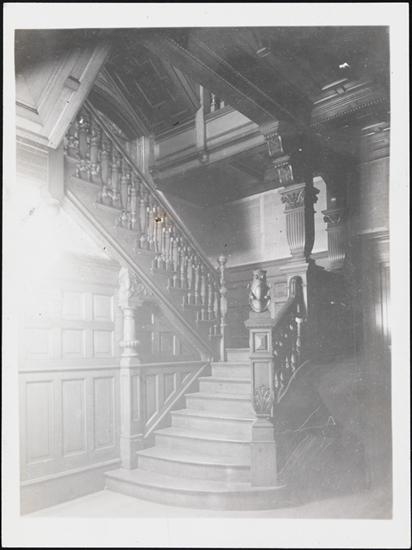
The stairway inside 4 Fifth Avenue, a beautiful relic of old living.

MCNY

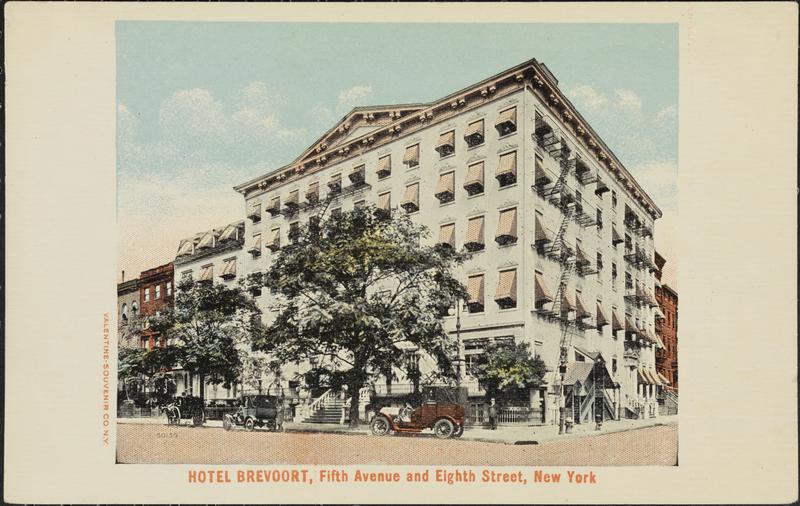
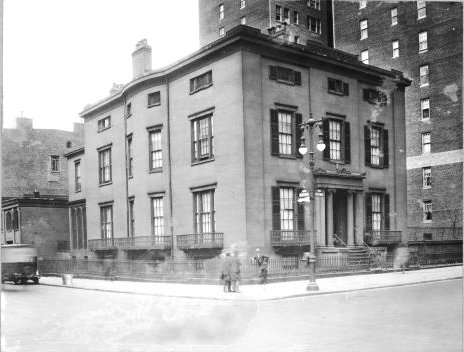
The Brevoort Hotel at Fifth Avenue and 8th Street and the Brevoort Mansion on 9th Street, circa 1925 (the year it was demolished)

NYPL

Delmonico’s Restaurant, pictured here in 1865, moved into an old mansion to serve its wealthy clients.

MCNY

A mansion at the southeast corner of Fifth Avenue and 15th Street. Note that by the date of this photograph (1898), the house has been abandoned and the upper floors are falling in.

MCNY

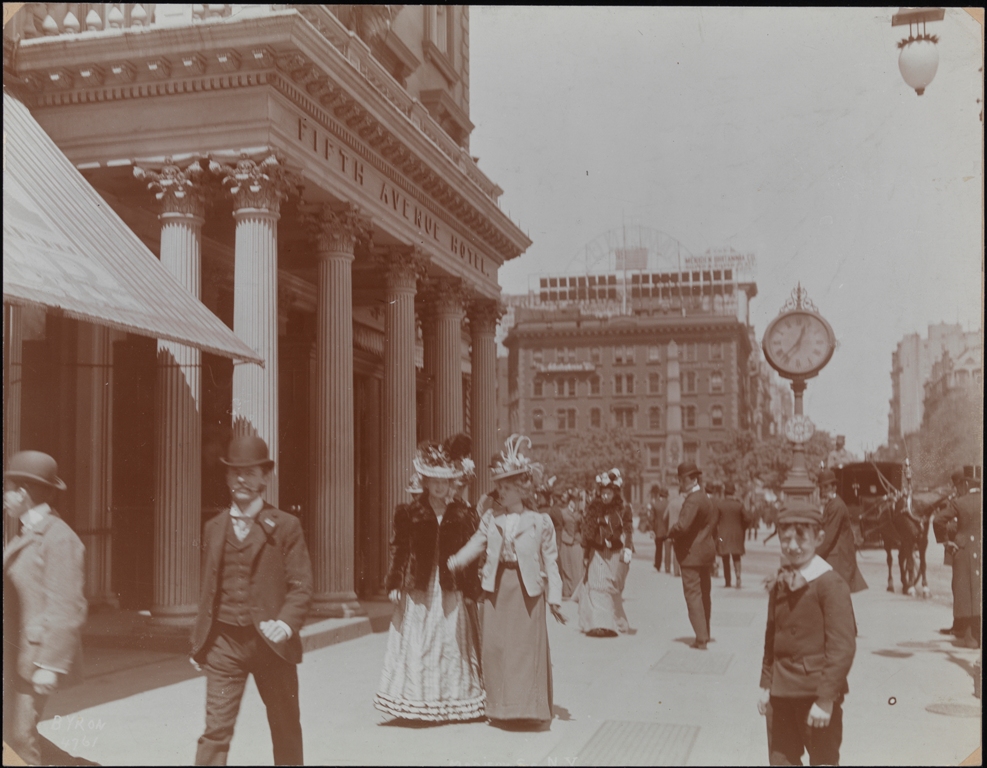
The Fifth Avenue Hotel at 23rd Street and Fifth Avenue, the anchor of the Madison Square area and the spot of great political machinations, especially in the 1870s and 80s.

MCNY

The Waldorf Hotel, rising next to the Astor mansion. Mrs. Astor eventually relented, moving from the house so that it could be demolished and replaced with a companion hotel.

Mina Rees Library, The Graduate Center, CUNY

The combined Waldorf-Astoria Hotel would become the center of high-society entertainment in the Gilded Age.

Library of Congress

The home of A.T. Stewart — “the glorified shop clerk” — at the corner of Fifth Avenue and 34th Street, across the street from the Astors.

NYPL

The home of Jay Gould in later years.

Library of Congress

The home of the notorious Madame Restell.

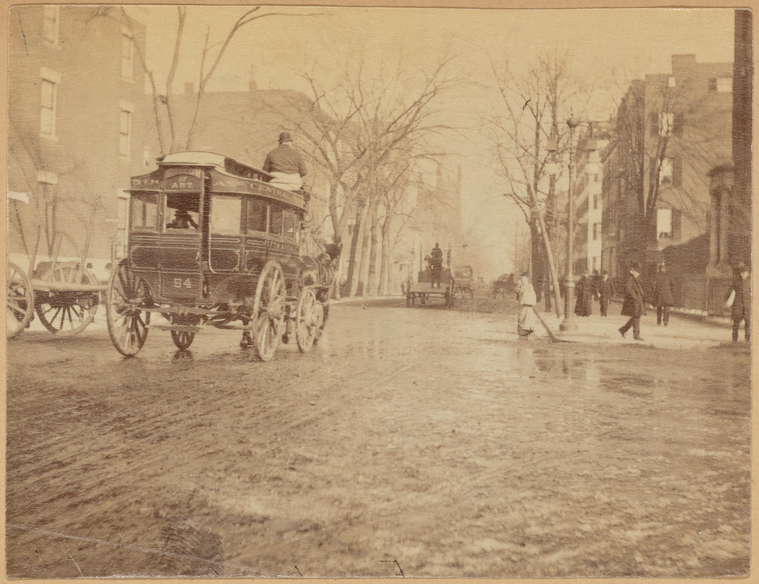
The Fifth Avenue Omnibus, circa 1890, a more elegant alternative to the dirty elevated train which ran just one avenue to the west.

NYPL

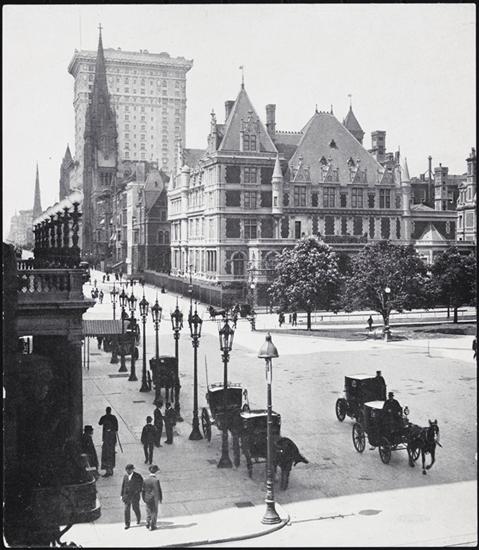
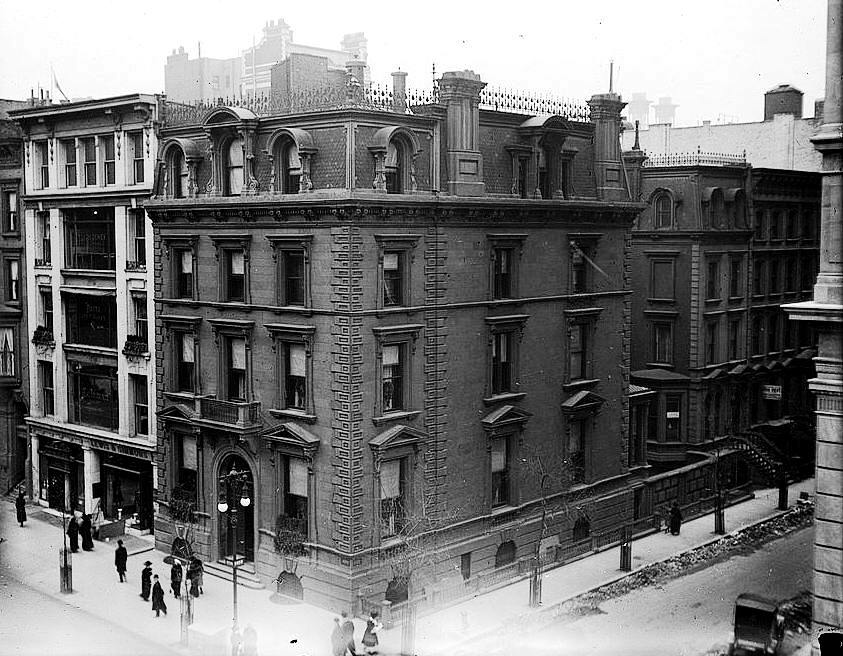
Vanderbilt Row in the 1890s. The family possessed the grandest homes on this stretch of Fifth Avenue from 51st Street to 58th.

NYPL
Vanderbilt University

The mansion known as the Petite Chateau, next door to the Vanderbilt Triple Palace (pictured above)

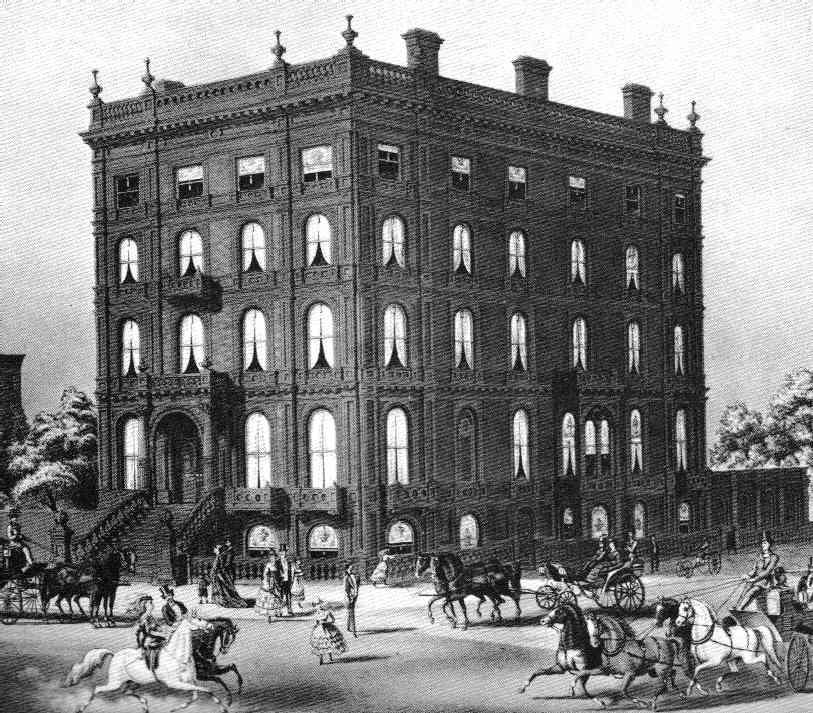
The most insanely lavish of them all — the home of Cornelius Vanderbilt II — at Fifth Avenue between 57th and 58th Streets.

Note in the two images below (from 1901, 1905 and 1906) — both the first and second versions of the Plaza Hotel, in relation to the mansions surrounding it and Grand Army Plaza. All three courtesy Museum of the City of New York

MCNY

Fifth Avenue as seen in 1906, an avenue in transition by this time.

Categories
Pop Culture

‘War Paint’ and ‘Indecent’: Two views of New York City history on Broadway

History has always been a critical component of theater, especially in musicals, where period sets and costumes assist in creating other worlds on stage quite unlike our normal one. But last year, with Hamilton: The Musical, the stage phenomenon which won the Tony Award for Best Musical (and a million other awards), history became a rock star.

Or rather, historical figures, even those with seemingly little contemporary vigor, had the ability to inspire a new generation, if reinterpreted by the right talents.

The musical categories for the 71st Annual Tony Awards, announced on Tuesday, are a bit more competitive this year than last, when Hamilton took home eleven awards.  The Best Musical category is an especially diverse cross-section of subjects in terms of time and place — one contemporary tale (Dear Evan Hansen), one from recent history (Come From Away, set right after September 11, 2001), a European historical fable (Natasha, Pierre and the Great Comet of 1812, based on Tolstoy) and, of course, a musical that is literally about not having any history (Groundhog Day, based on the movie).

Joan Marcus/Polk & Co

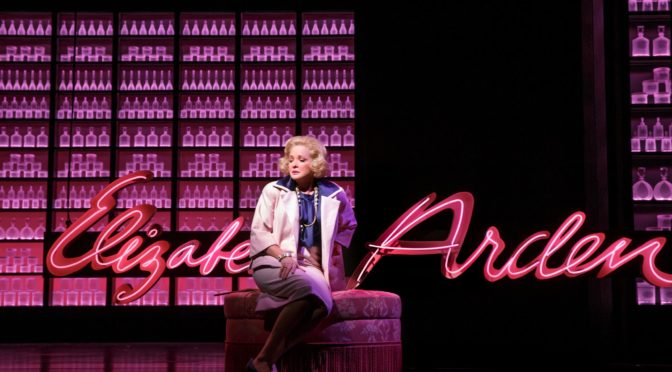
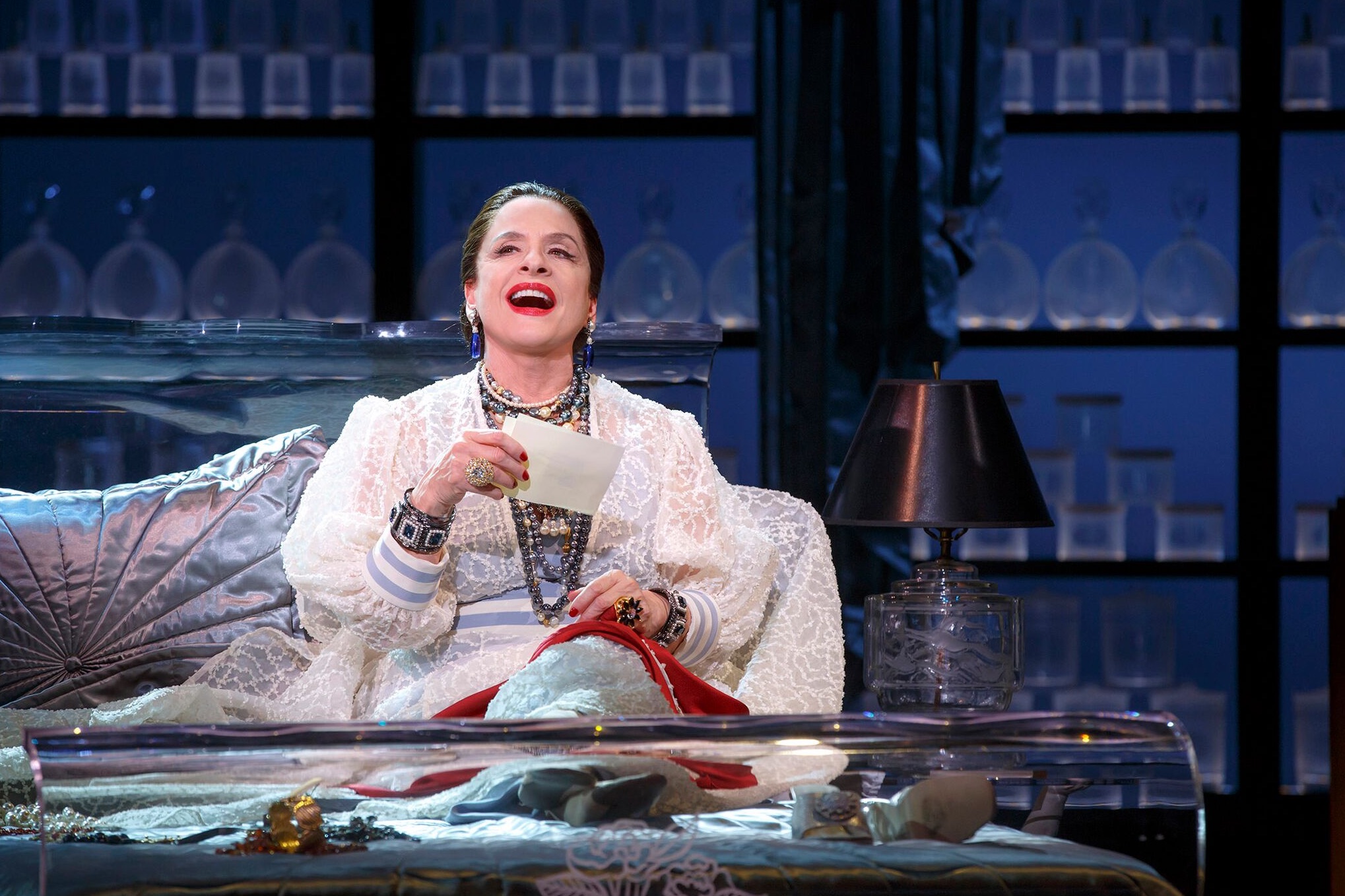
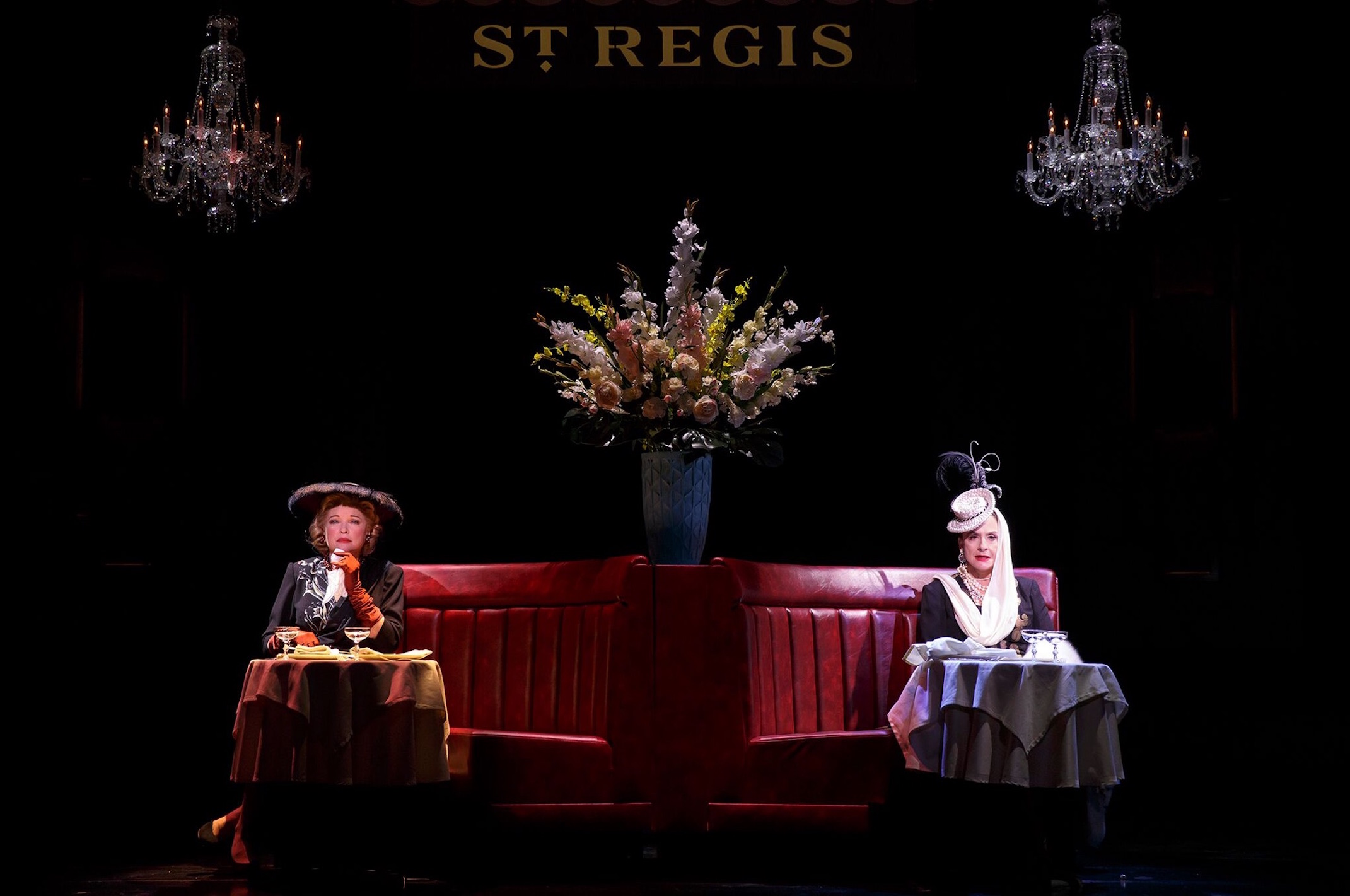
The new musical War Paint is this year’s musical representative of New York City history, replaying the story of Fifth Avenue’s most famous retail rivalry between cosmetics icons Elizabeth Arden and Helena Rubinstein. While War Paint didn’t make the Best Musical cut, its two main stars (Christine Ebersole as Arden, Patti Lupone as Rubinstein) are competing for Best Performance By An Actress In A Musical. Just as Arden and Rubinstein themselves would have wanted!

Arden, arriving from Canada, and Rubinstein, from Poland by way of Australia, set up their companies in New York in the 1910s. But the musical, with book by Doug Wright, music by Scott Frankel and lyrics by Michael Korie, actually starts in the 1930s with their careers firmly established on Fifth Avenue, their competing salons bustling with society women.

Why skip past their origin stories? War Paint is more of a showcase than a show, designed to do something very rare, providing an opportunity for two great female musical stars to take the stage at the same time.  (Quick: Name another musical with two female leads where they are not playing witches.)  Because, practically speaking, you want established stars in your musical, the story must start with Arden and Rubinstein already at the top of their game.

Joan Marcus/Polk and Co

The musical escorts the pair through the mid-century — past the changing roles of women in World War II, past the television revolution — as their once-chic brand names struggle to change with the times. On occasion the story pauses to infuse the grand, sweeping narrative with small biographical details.

If you heard our recent podcast on the subject, you’ll know that Arden and Rubinstein never actually met (at least, as the legend goes). This too works to the musical’s benefit, giving each star separate storylines that veer into each other just enough, never letting one upstage the other.

Lupone and Ebersole are tremendous. How could they not be? Lupone playfully transitions Rubinstein from a slinking figure of sophisticated grace to an irascible curmudgeon whose body language aches with history (and several dozen pounds of jewelry). Ebersole, with superbly fading cheer, slowly transformed Arden’s legendary confidence to wistfulness and then — in a fantasy coda where the two women actually do meet — into a graceful humility.
If you want to hear more about the story of Elizabeth Arden and Helena Rubinstein, listen to our podcast The Beauty Bosses of Fifth Avenue. Most of our show takes place before the events of the musical, so consider it a prequel of sorts.
There’s also a bit of New York City history in contention for the Tony Award for Best Play. Joining Oslo, Sweat and A Doll’s House, Part 2 in the category is an intriguing and unconventional transfer from the Off-Broadway stage — Indecent written by Paula Vogel.

Carol Rosegg/Indedent

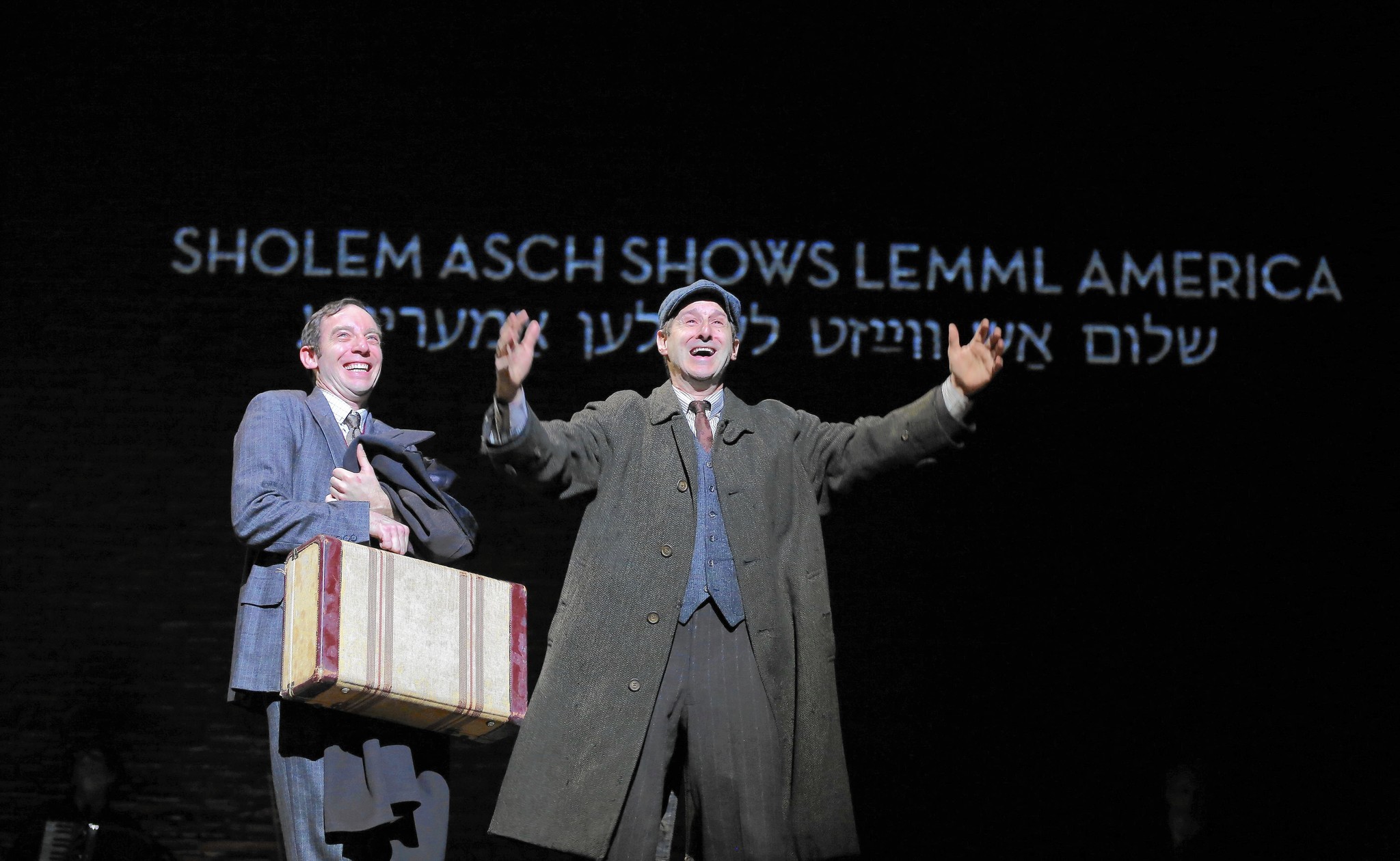
This very musical play recounts the drama surrounding the 1923 Broadway production of God of Vengeance, a controversial Yiddish play that had been well received in downtown New York theaters, but scandalized audiences when it moved uptown. Its cast and crew were charged with obscenity — the show features lesbian protagonists — and its playwright Sholem Asch ostracized. (He spends his time cloistered in Staten Island.)

This artful production feels like a graphic novel brought to life, with projected text hovering over a barren stage and its players sometimes disintegrating into dust. (It’s a weird and spooky stage trick.) Despite feeling very abstract and removed from circumstances at times, Indecent makes a point to root God of Vengeance within Broadway history, vibrantly repeating a couple offending scenes from the play.

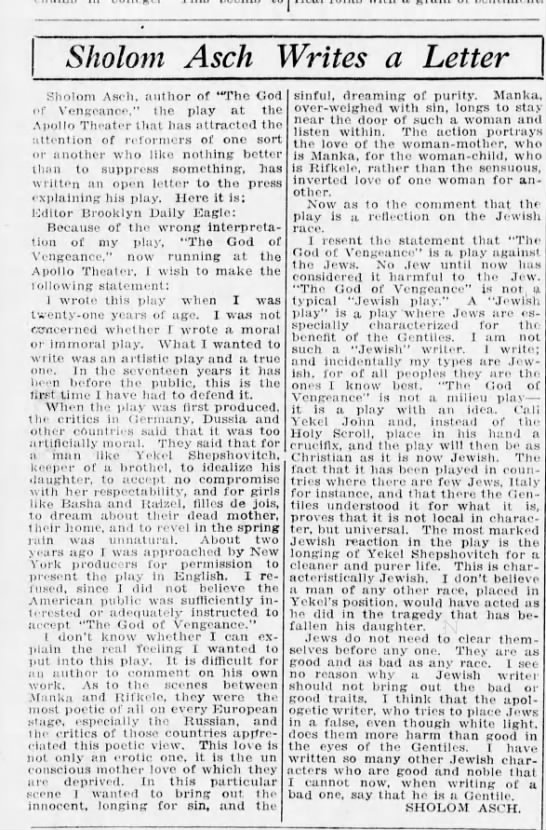
Below: A letter from the playwright which ran in the Brooklyn Daily Eagle on March 11, 1923


Hopefully the point isn’t lost on its audience; the original production was shut down on a similar stage at the old Apollo Theater (at 223 West 42nd Street), just a few blocks south of the Cort Theatre, Indecent‘s present home.  The cast, brilliantly directed by Rebecca Taichman (who scored a Tony nomination for Best Director), flaunts those very moments from Vengeance that proper society once thought offensive.

If you’re in the mood to hear more about scandalous Broadway shows from the 1920s, listen to our podcast Diamond Girl: Mae West — Sex on Broadway. West and the cast of Sex was arrested just a few years after God of Vengeance on similar charges.


Categories
Health and Living Podcasts

The Beauty Bosses of Fifth Avenue: Elizabeth Arden & Helena Rubinstein

PODCAST Fifth Avenue’s role in the ‘revolution’ of beauty, as led by Elizabeth Arden and Helena Rubinstein, New York’s boldest businesswomen of the Jazz Age.

The Midtown Manhattan stretch of Fifth Avenue, once known for its ensemble of extravagant mansions owned by the Gilded Age’s wealthiest families, went through an astonishing makeover one hundred years ago. Many lavish abodes of the rich were turned into exclusive retail boutiques, catering to the very sorts of people who once lived here.

Their products — beauty! Creams, lotions, ointments and cleansers. Then later: eye-liners, rouges, lipsticks, mascaras. On the forefront of this transformation were two women from very different backgrounds. Elizabeth Arden was a Canadian entrepreneur, looking to establish her business in the growing city of New York. Helena Rubinstein, from Poland by way of Australia, already owned an established company and looked to Manhattan as a way to anchor her business in America.

In this episode we observe the growing independence of American woman and the changing beauty standards which arose in the 1910s and 20s, bringing ‘the painted face’ into the mainstream.

And it’s in large part thanks to these two extraordinary businesswomen, crafting two parallel empires in a corporate framework usually reserved for men.

ALSO: Theda Bara, Estee Lauder, Max Factor and a whole lot of sheep and horses!


The Bowery Boys: New York City History podcast is brought to you …. by you!

We are now producing a new Bowery Boys podcast every two weeks. We’re also looking to improve the show in other ways and expand in other ways as well — through publishing, social media, live events and other forms of media. But we can only do this with your help!

We are now a member of Patreon, a patronage platform where you can support your favorite content creators for as little as a $1 a month.

Please visit our page on Patreon and watch a short video of us recording the show and talking about our expansion plans. If you’d like to help out, there are five different pledge levels (and with clever names too — Mannahatta, New Amsterdam, Five Points, Gilded Age, Jazz Age and Empire State). Check them out and consider being a sponsor.

We greatly appreciate our listeners and readers and thank you for joining us on this journey so far. And the best is yet to come!


FURTHER LISTENING — Check out our spin-off podcast The First: Stories of Inventions and their Consequences, in particular, the episode on the invention of the bikini — The Itsy Bitsy Teeny Weeny Revolution

FURTHER READING AND VIEWING: If you liked this episode, you might also like:

Hope In A Jar: The Making of America’s Beauty Culture by Kathy Peiss

Helena Rubinstein: The Woman Who Invented Beauty by Michèle Fitoussi

“The Powder and the Glory” Documentary produced, written, and directed by Ann Carol Grossman & Arnie Reisman

War Paint: Madame Helena Rubinstein and Miss Elizabeth Arden, Their Lives, Their Times, Their Rivalry by Lindy Woodhead


A few images of Fifth Avenue between 50th and 57th, in the years of transition — from residential to retail.

1898

MCNY

1904

Museum of the City of New York

1922 — Fifth Avenue and 57th Street

The Collis Huntington mansion on 57th and Fifth Avenue. Helena Rubinstein moved her salon in here in the mid 1920s.

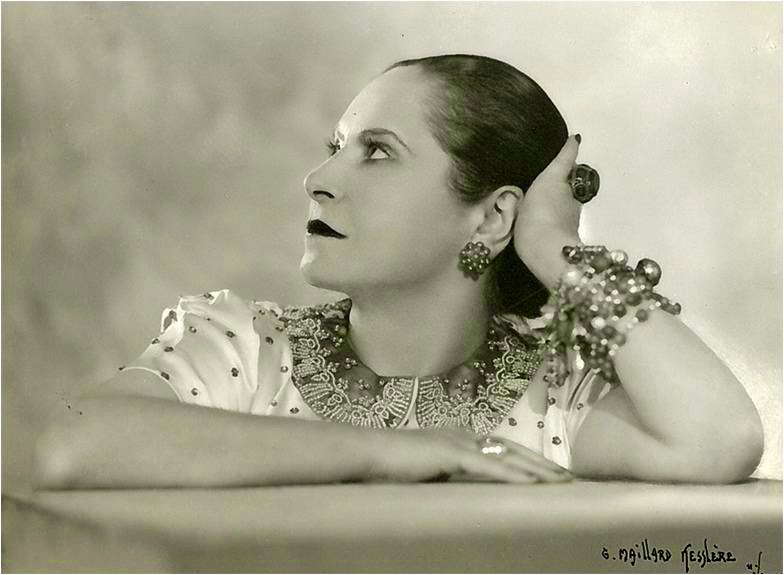
Helena Rubenstein, photo date 1924

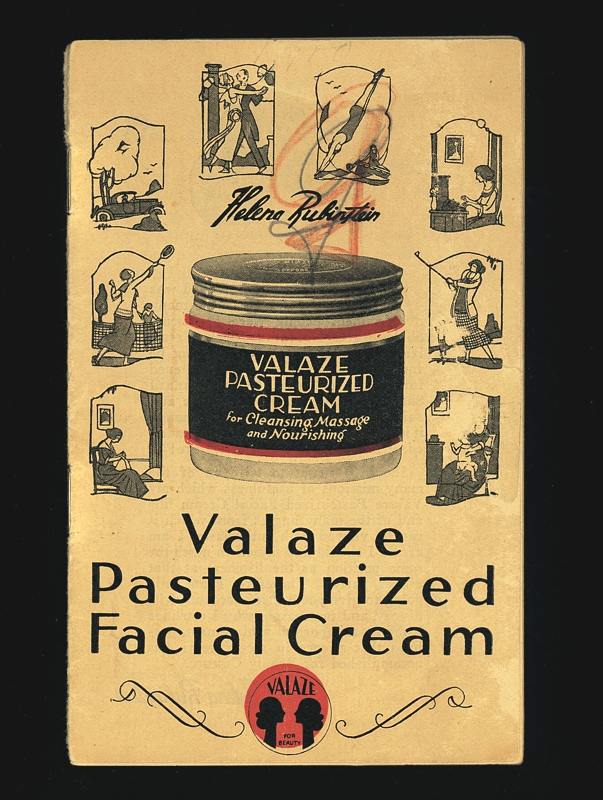
An example of Helena’s Valaze cream, made from lanolin

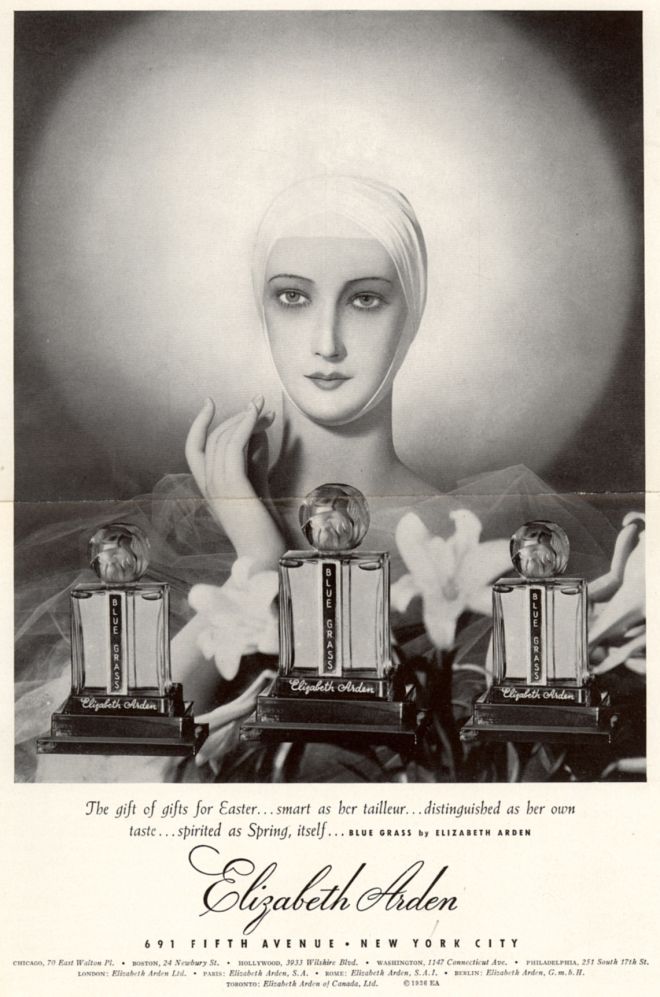
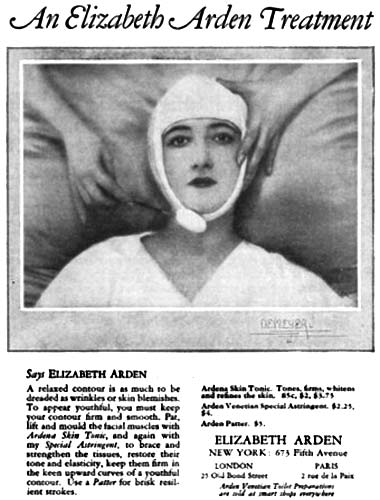
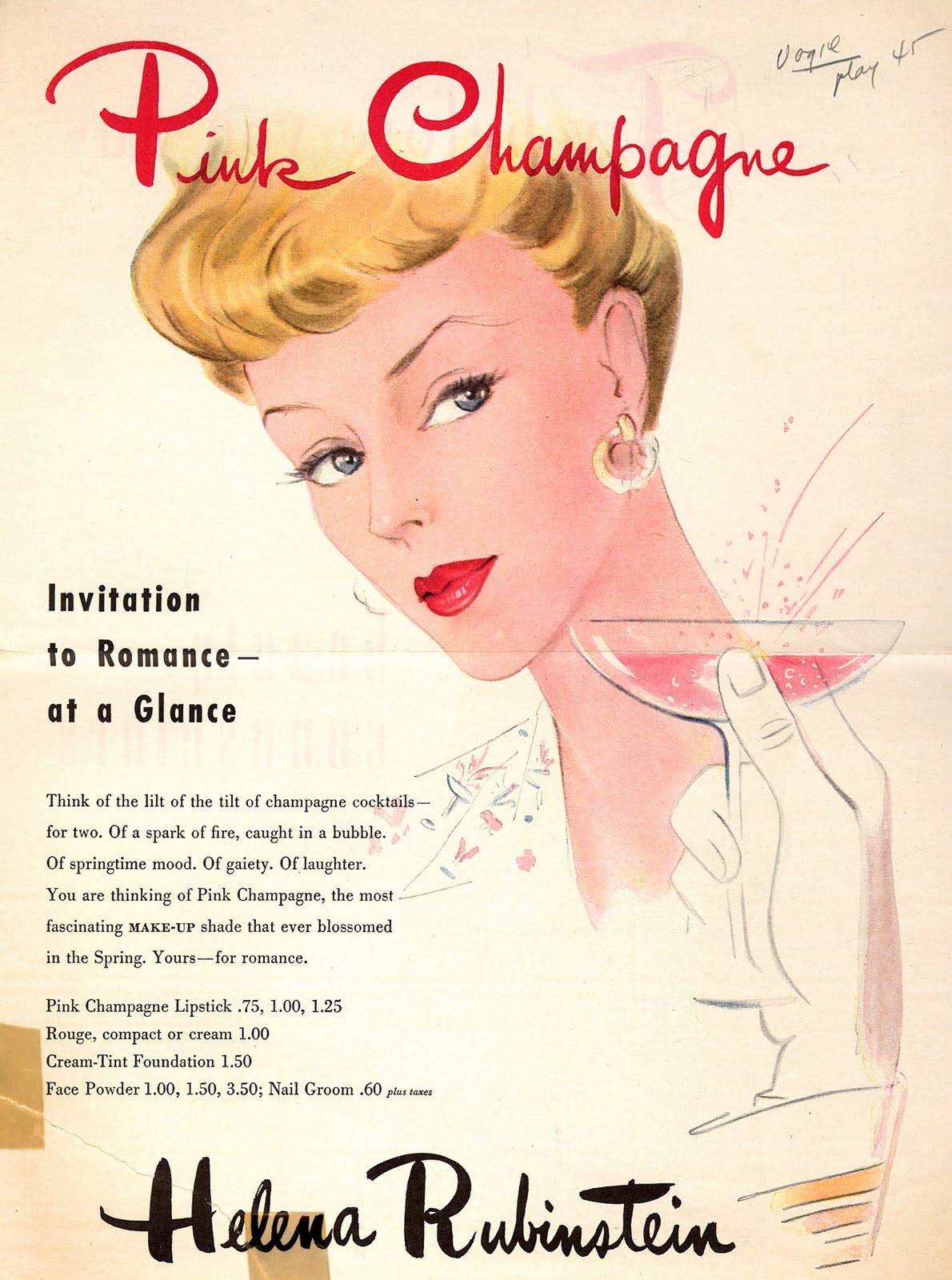
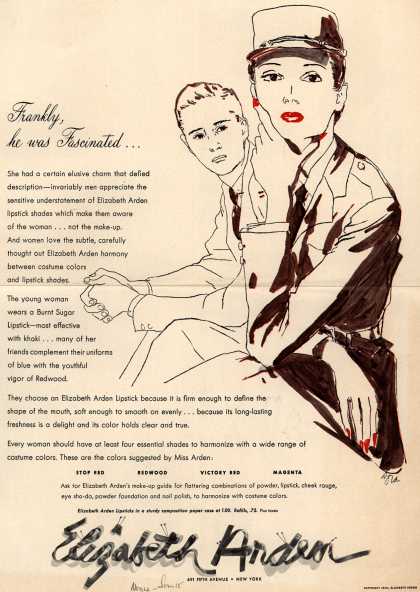
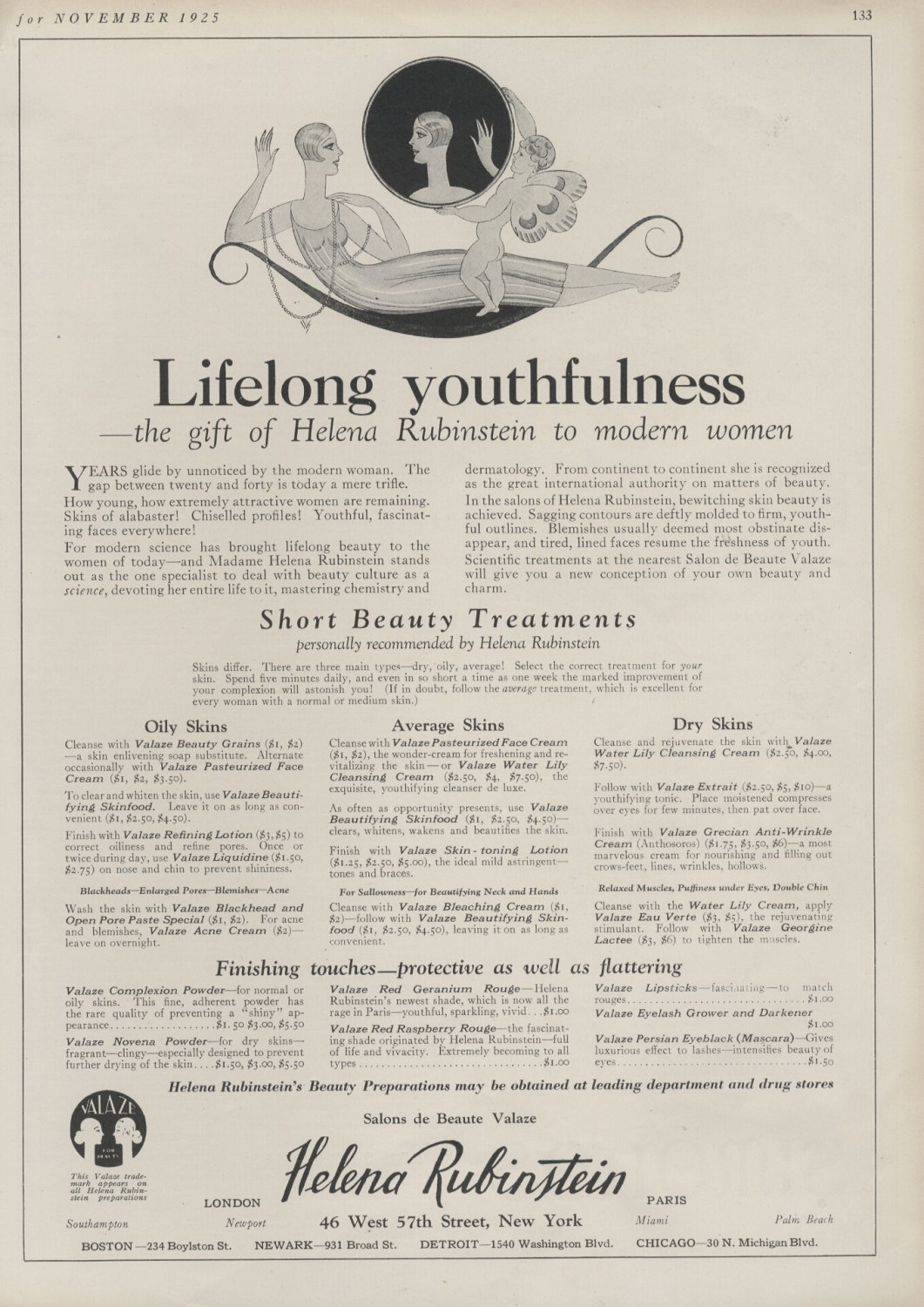
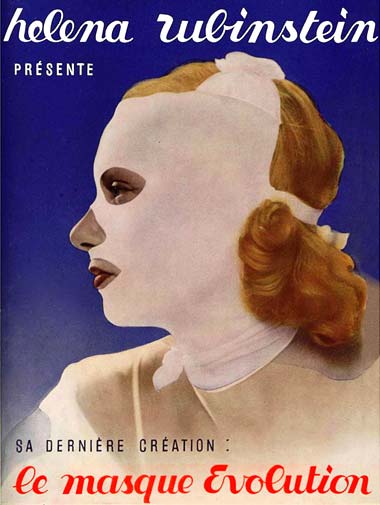
A selection of Elizabeth Arden and Helena Rubinstein vintage ads, courtesy Vintage Ad Browser


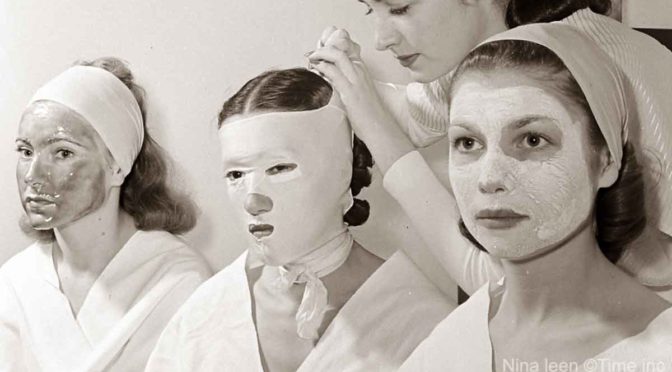
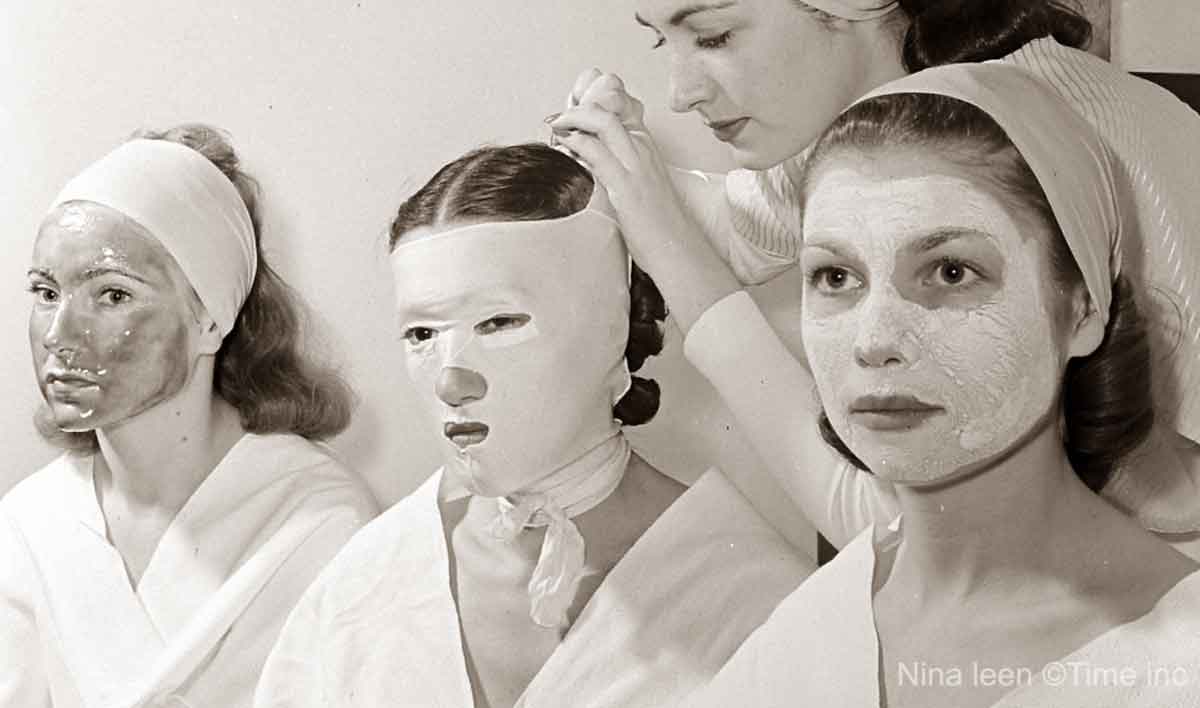
A variety of facial treatments from a Helena Rubinstein salon, circa 1941

Nina Leen/Photography

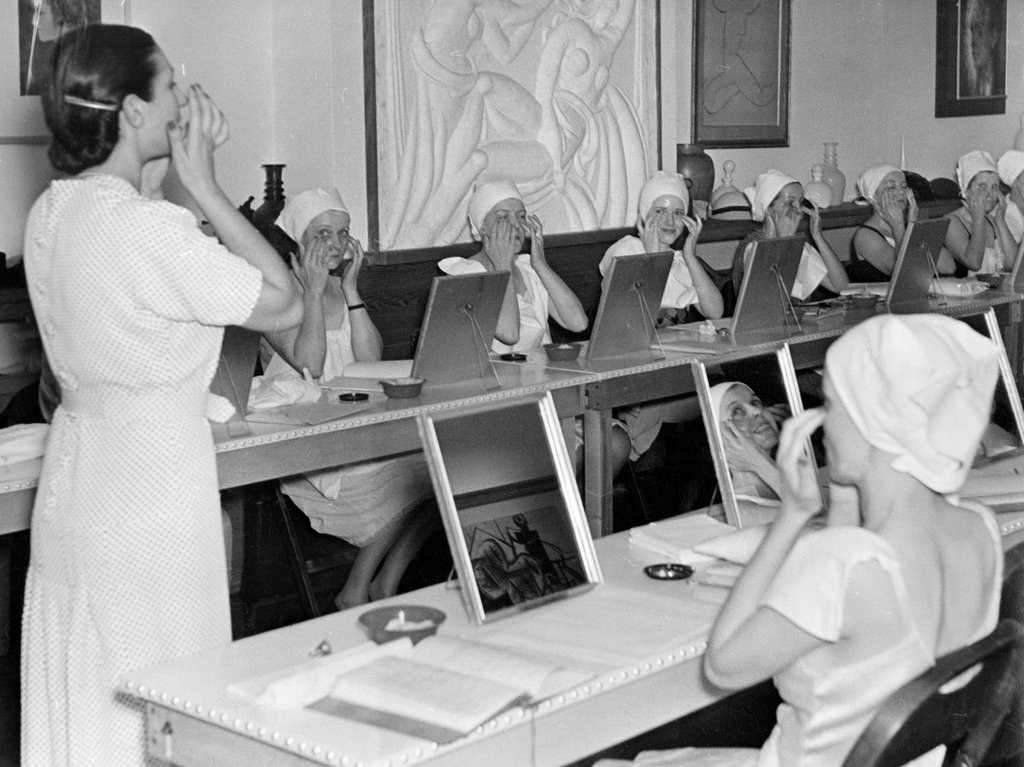
Helena employed many of her family members. Mala Rubinstein, Helena Rubinstein’s niece, shows the ladies how beauty is done at the 715 Fifth Avenue salon

Courtesy NYT Photograph by Bradford Robotham

The commercial featured on this week’s show!

A very affected presentation, but this video does show Rubinstein in action!

The “beauty process” was in vogue by the 1930s as evidenced by this short film starring Hollywood film actress Constance Bennett.

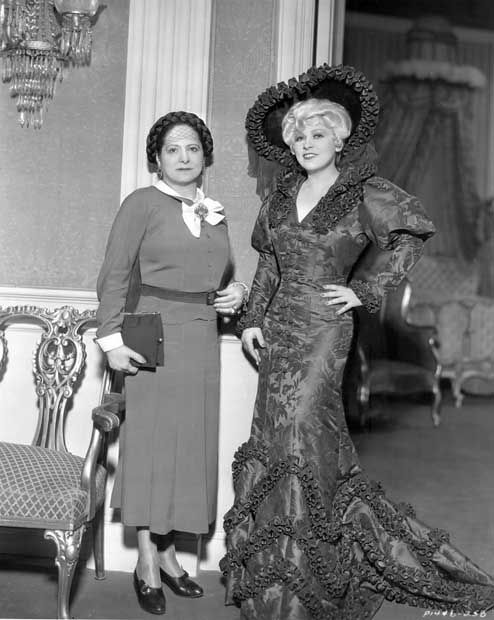
Helena Rubinstein latched onto Hollywood celebrities both as a way to inspire beauty regiment — and, of course, to sell more products.

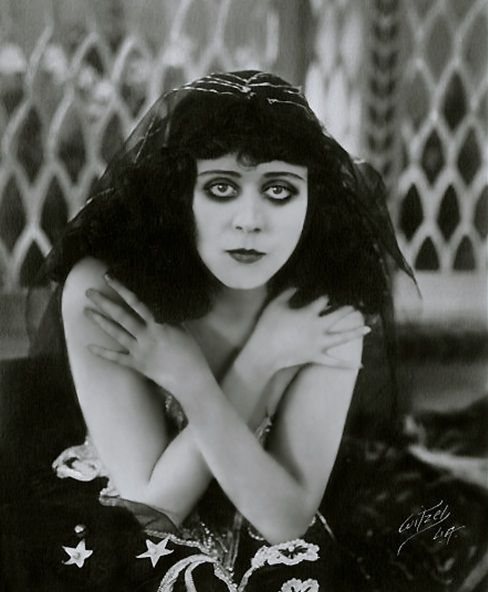
For Theda Bara, Helena even sold a line of ‘vamp’ make-up, tying into her scandalous reputation. (Read more about Theda Bara here.)

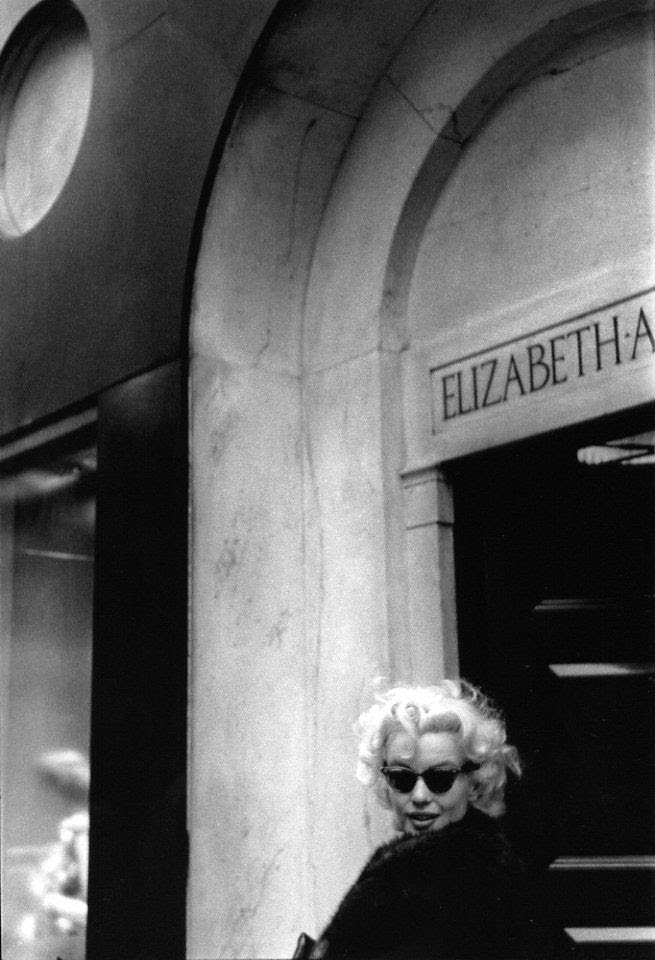
Even Marilyn Monroe was an Elizabeth Arden fan, frequently popping into the New York salon.