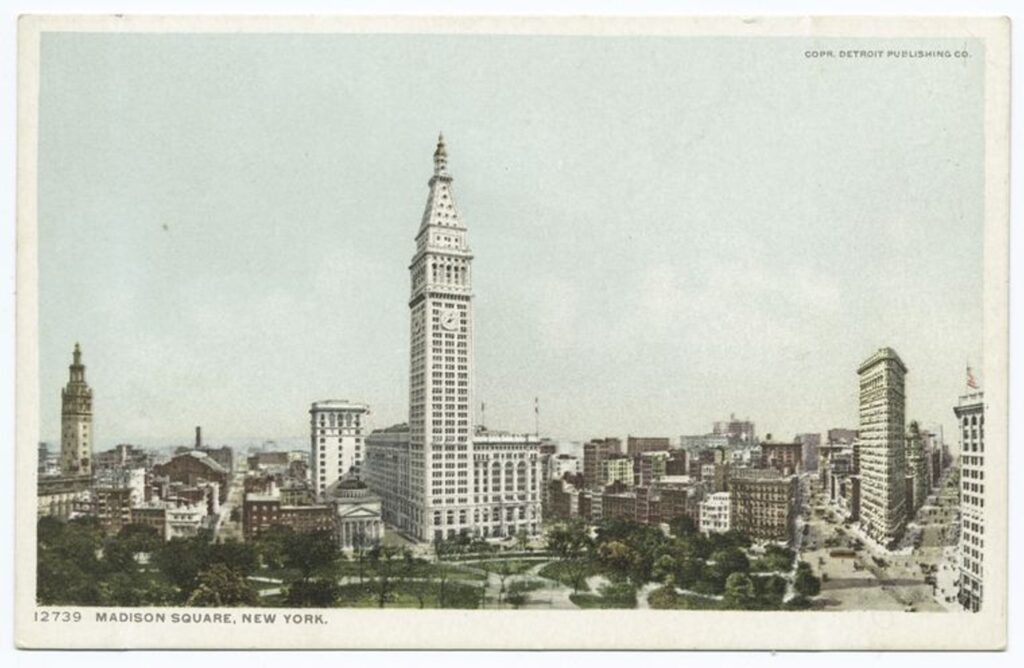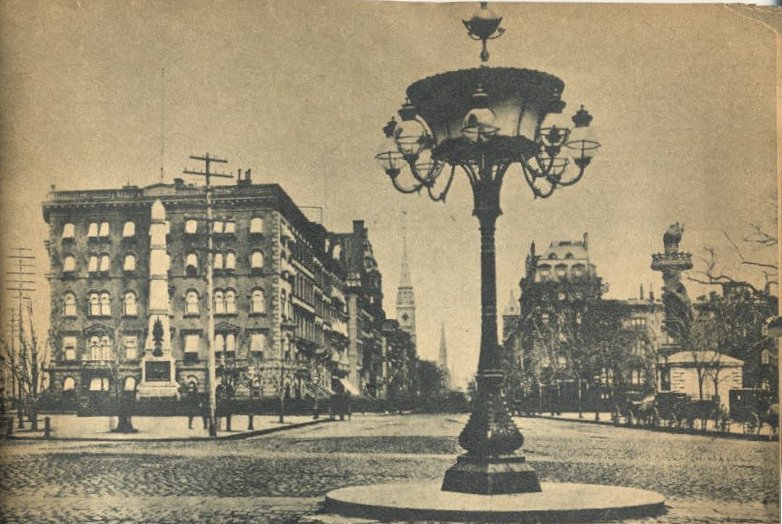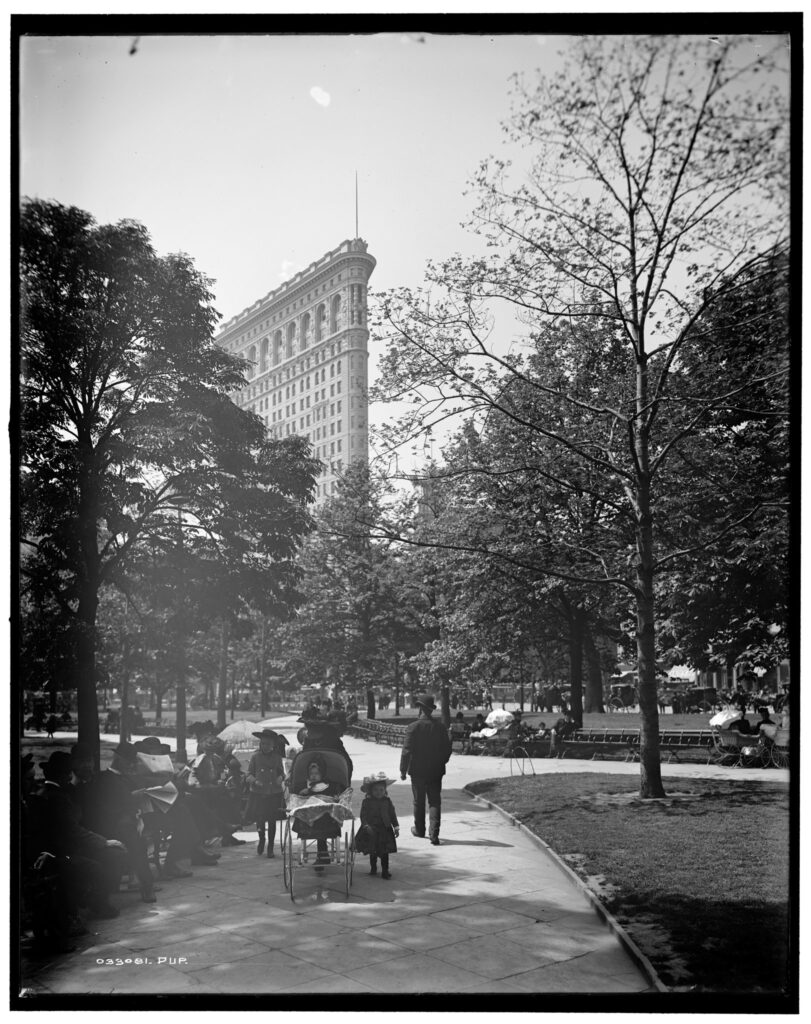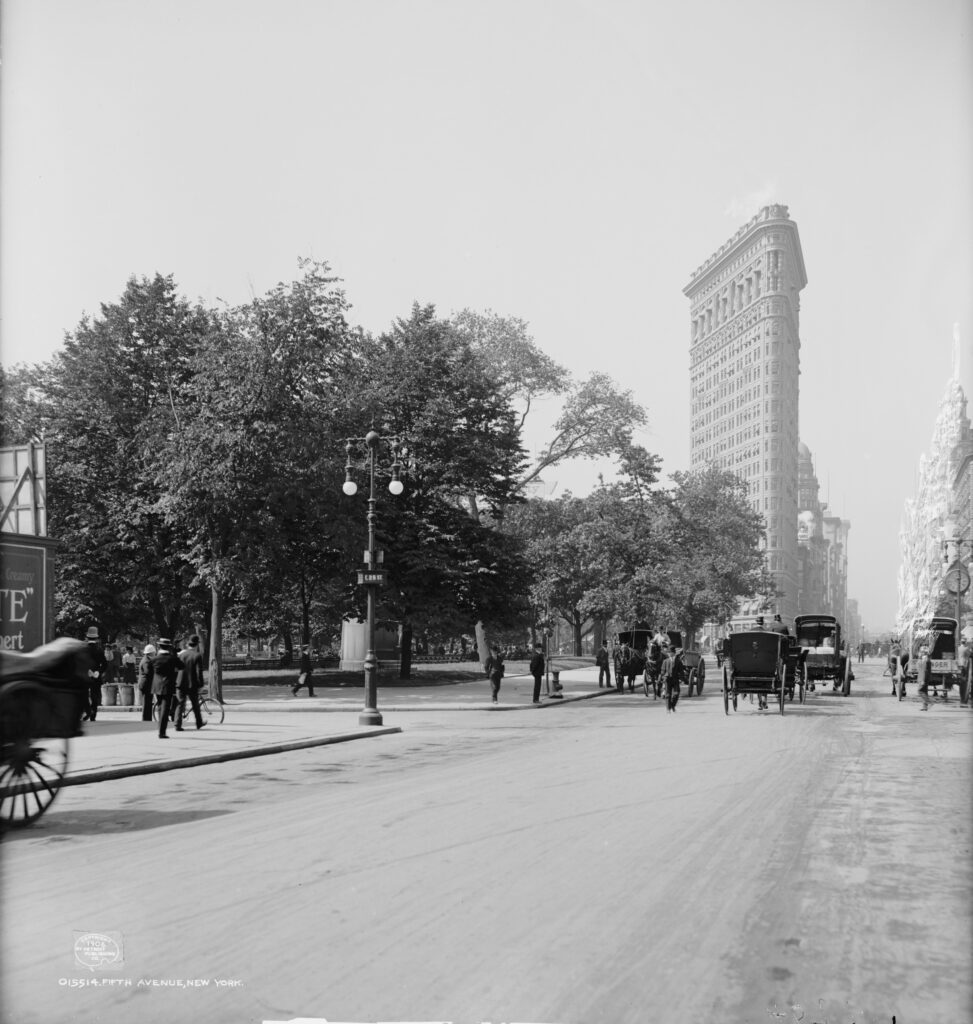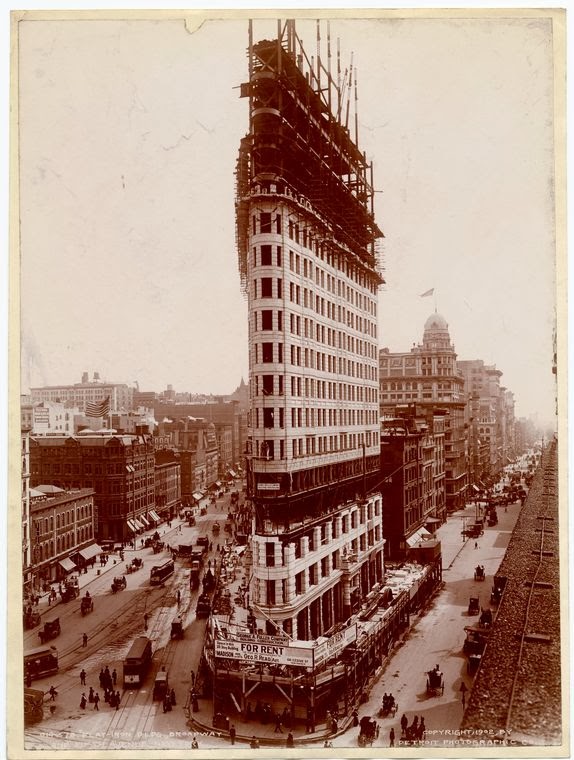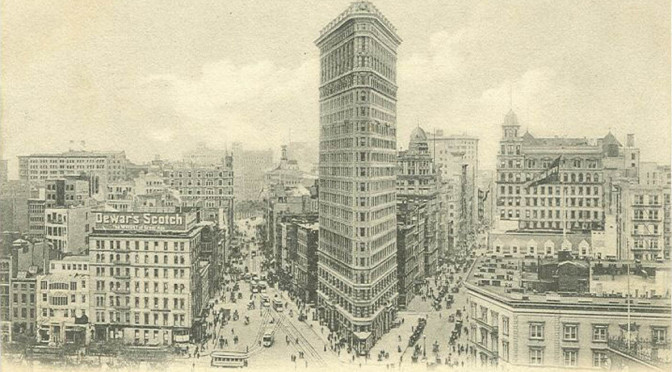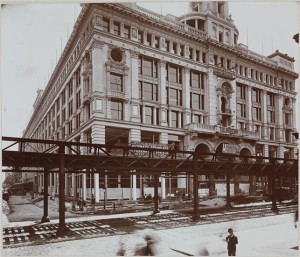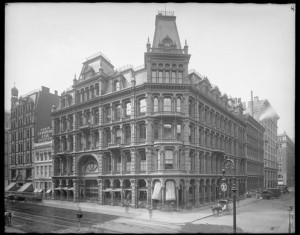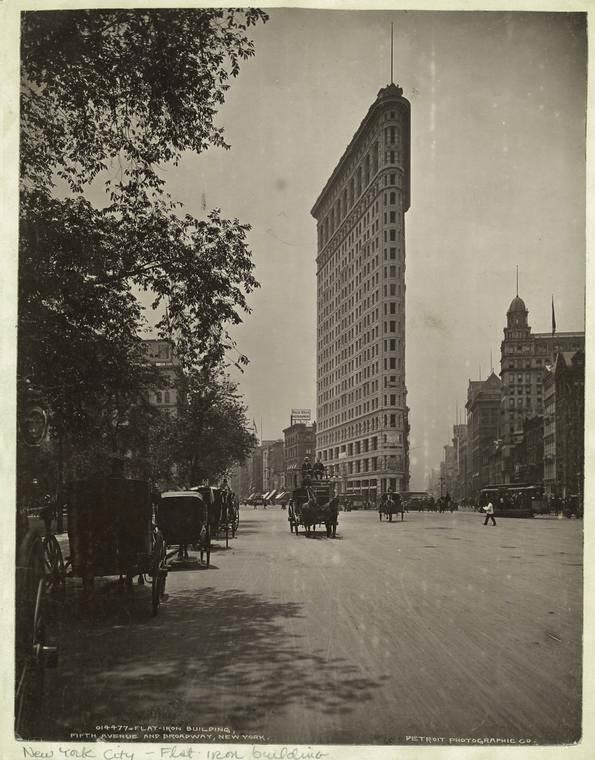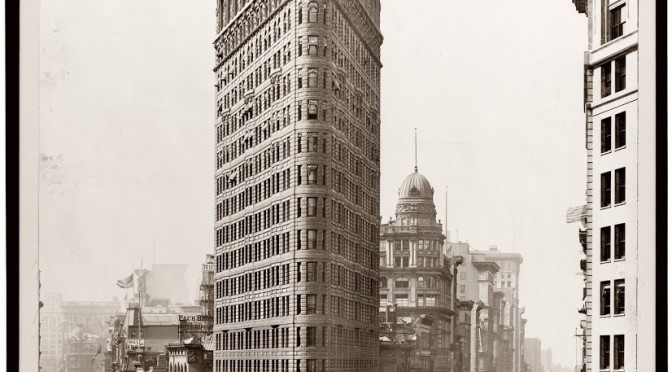
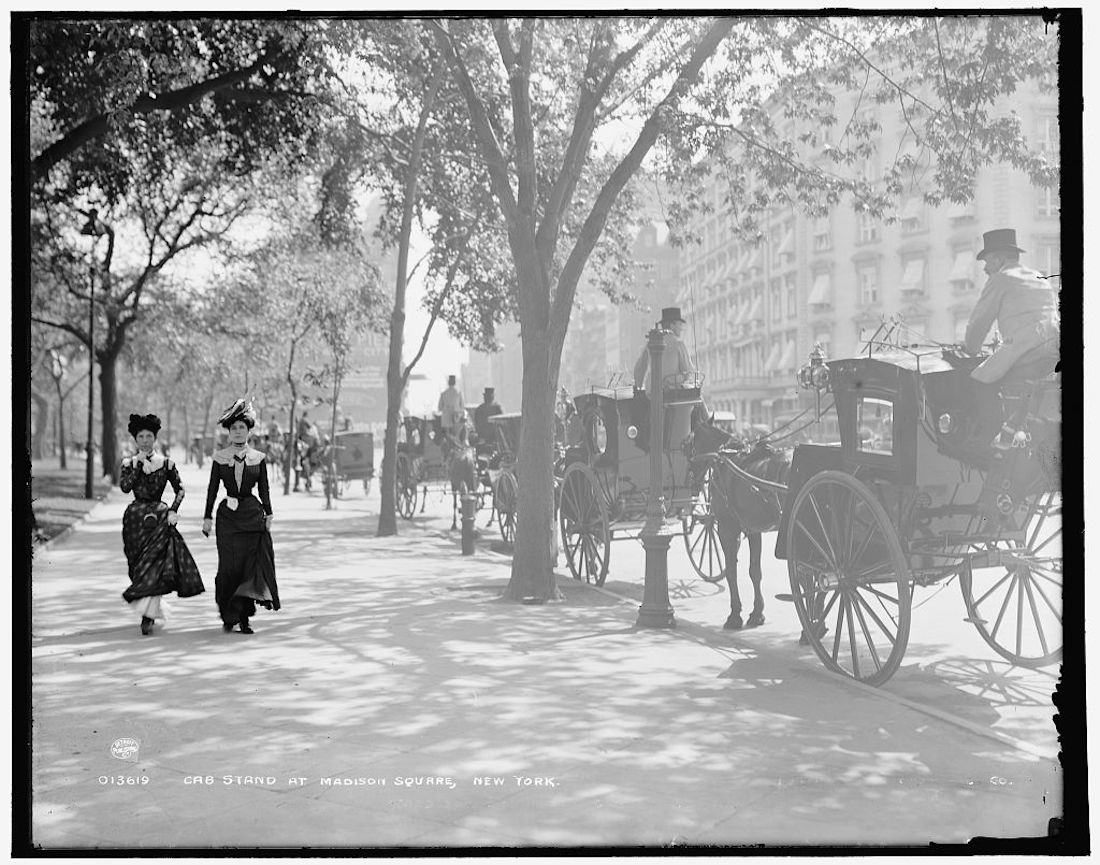
Cab stand at Madison Square, 1900. Courtesy Detroit Publishing/Library of Congress. This image is looking south down the edge of the park. Within two years, the Flatiron Building would be rising in the distance.
So much has happened in and around Madison Square Park — the leafy retreat at the intersections of Broadway, Fifth Avenue and 23rd Street — that telling its entire story requires an extra-sized show, in honor of the Bowery Boys 425th episode.
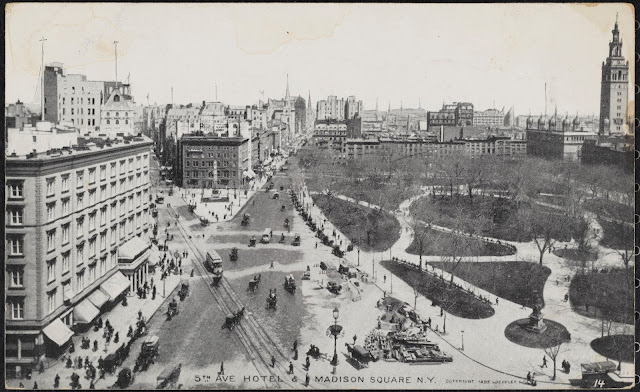
Madison Square Park was the epicenter of New York culture from the years following the Civil War to early 20th century. The park was really at the heart of Gilded Age New York, whether you were rushing to an upscale restaurant like Delmonico’s or a night of the theater or maybe just an evening at one of New York’s most luxurious hotels like the Fifth Avenue Hotel or the Hoffman House.
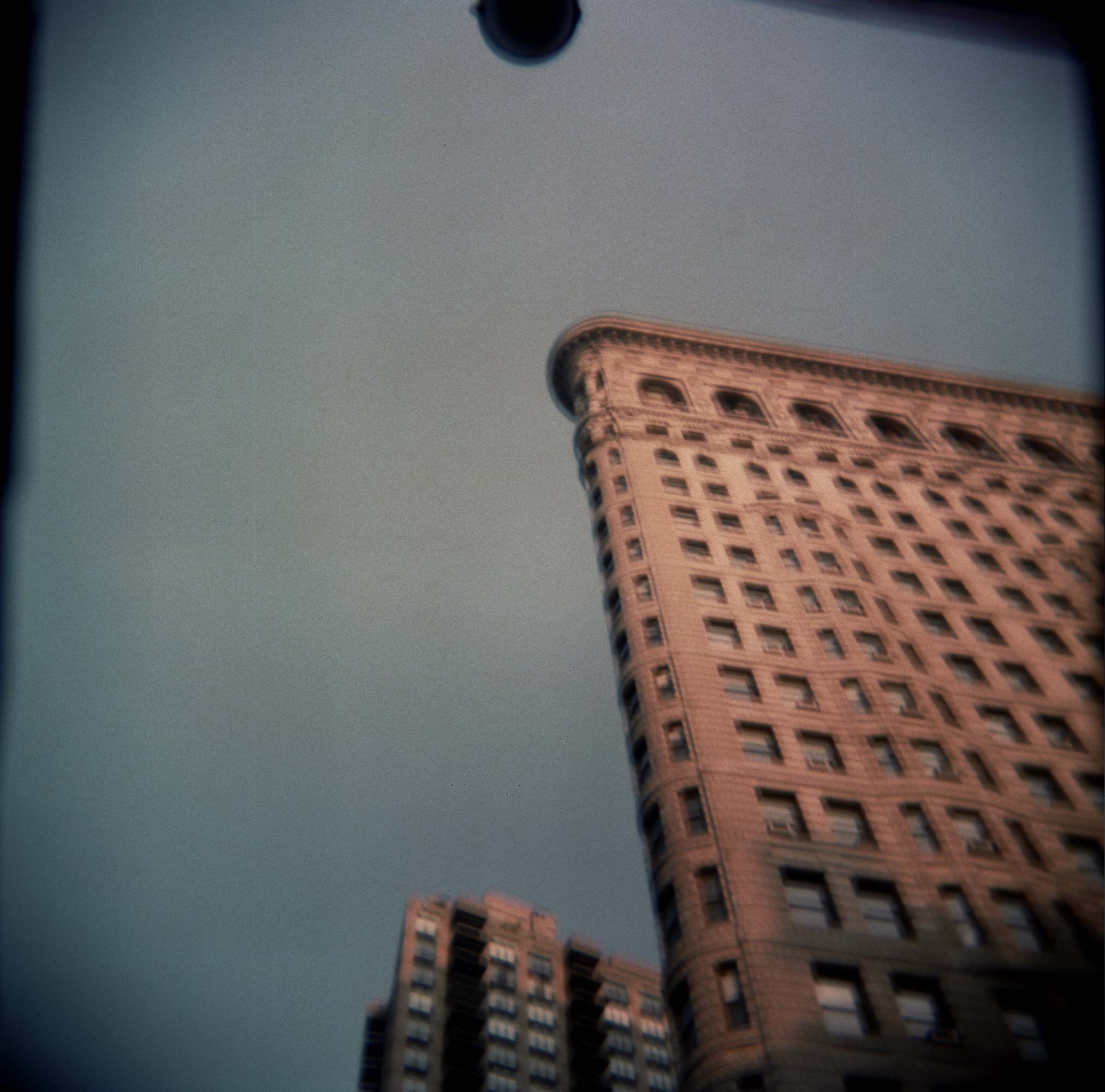
The park is surrounded by some of New York’s most renown architecture, from the famous Flatiron Building to the Metropolitan Life Insurance Tower, once the tallest building in the world.
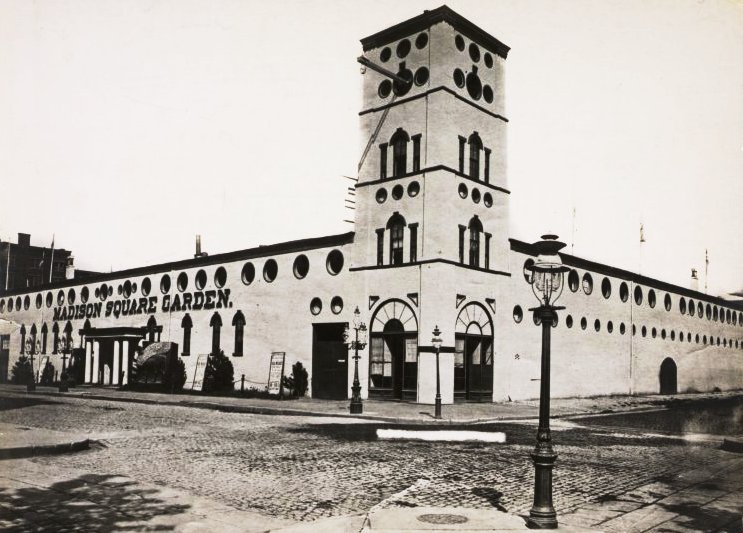
The square also lends its name, of course, to one of the most famous sports and performing venues in the world – Madison Square Garden. Its origins begin at the northeast corner of the park on the spot of a former railroad depot and near the spot of the birthplace of an American institution — baseball.
The park introduced New Yorkers to the Statue of Liberty … or at least her forearm and torch. It stood silently over the bustling park while prize-winning dogs were championed at the very first Westminster Kennel Club Dog Show nearby, held at Gilmore’s Gardens, the precursor to Madison Square Garden.
Today the region north of the park is referred to as NoMad, which recalls life around Madison Square during the Gilded Age with its high-end restaurant and hotel scene.
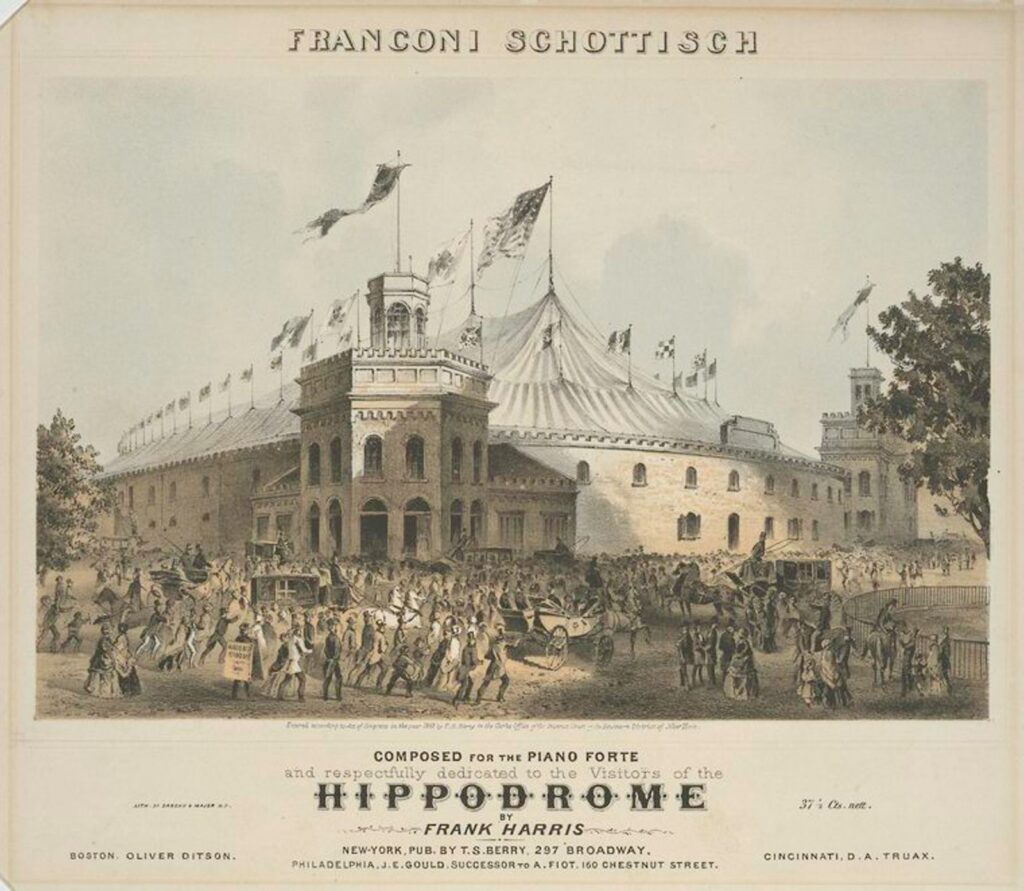
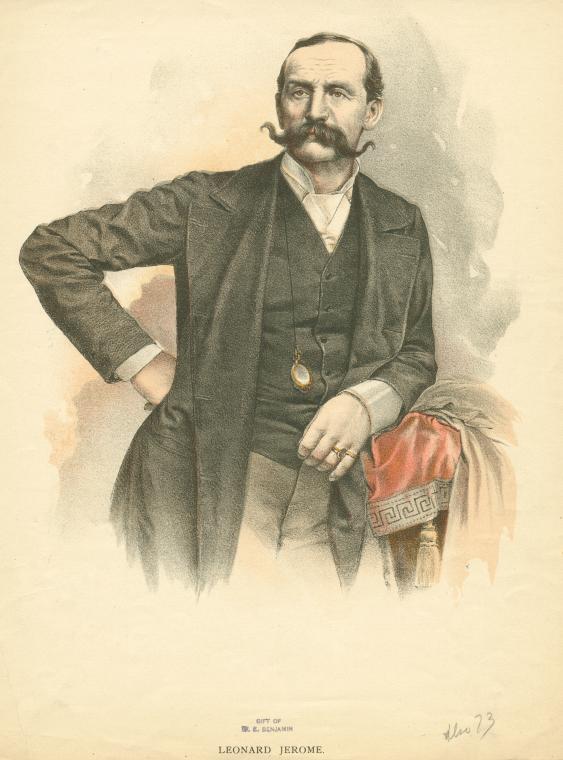
Tom and Greg invite you on this time-traveling escapade covering over 200 years of history. From the days of rustic creeks and cottages to the long lines at the Shake Shake. From Franconi’s Hippodrome to the dazzling colonge fountains of Leonard Jerome (Winston Churcill’s grandfather).
LISTEN HERE: IT HAPPENED AT MADISON SQUARE PARK
This episode’s title pays homage to one of favorite books about park history — It Happened On Washington Square by Emily Kies Folpe.
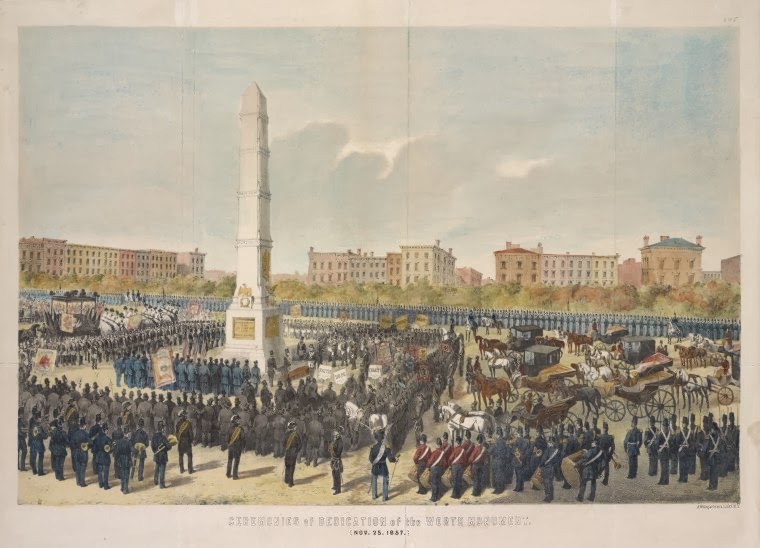
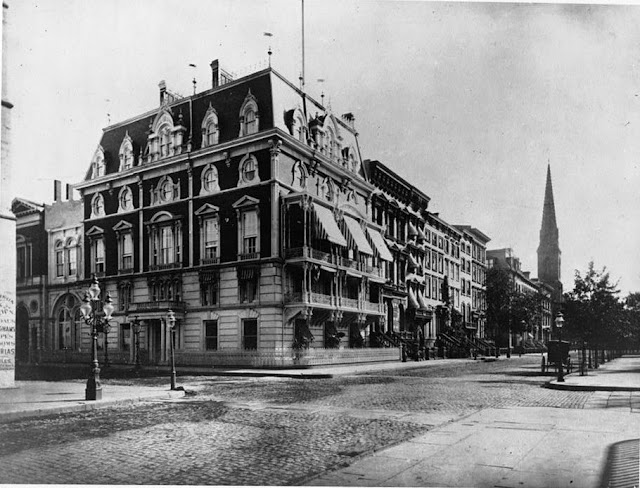
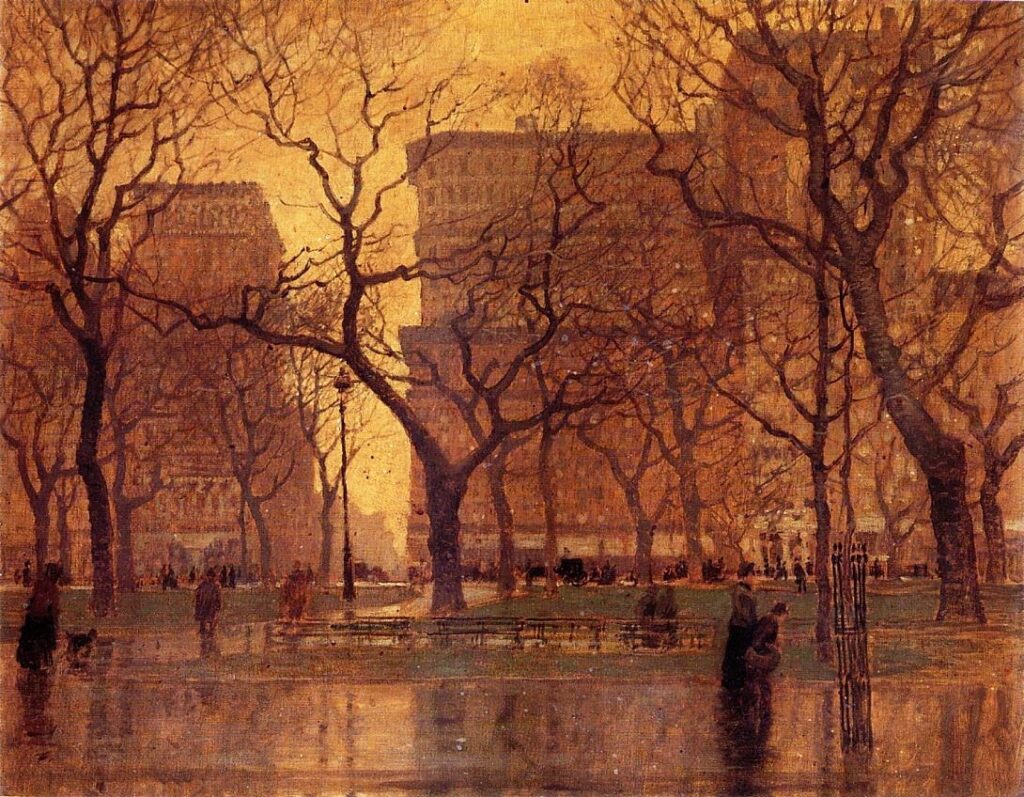
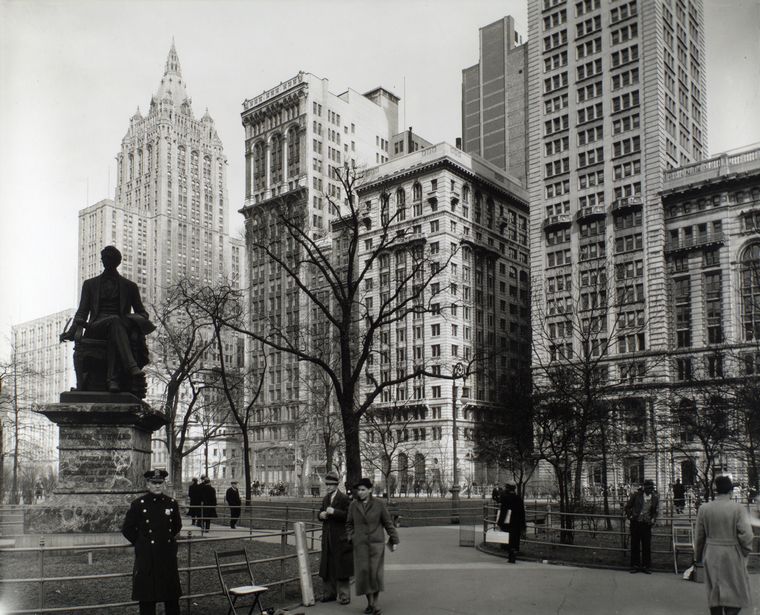
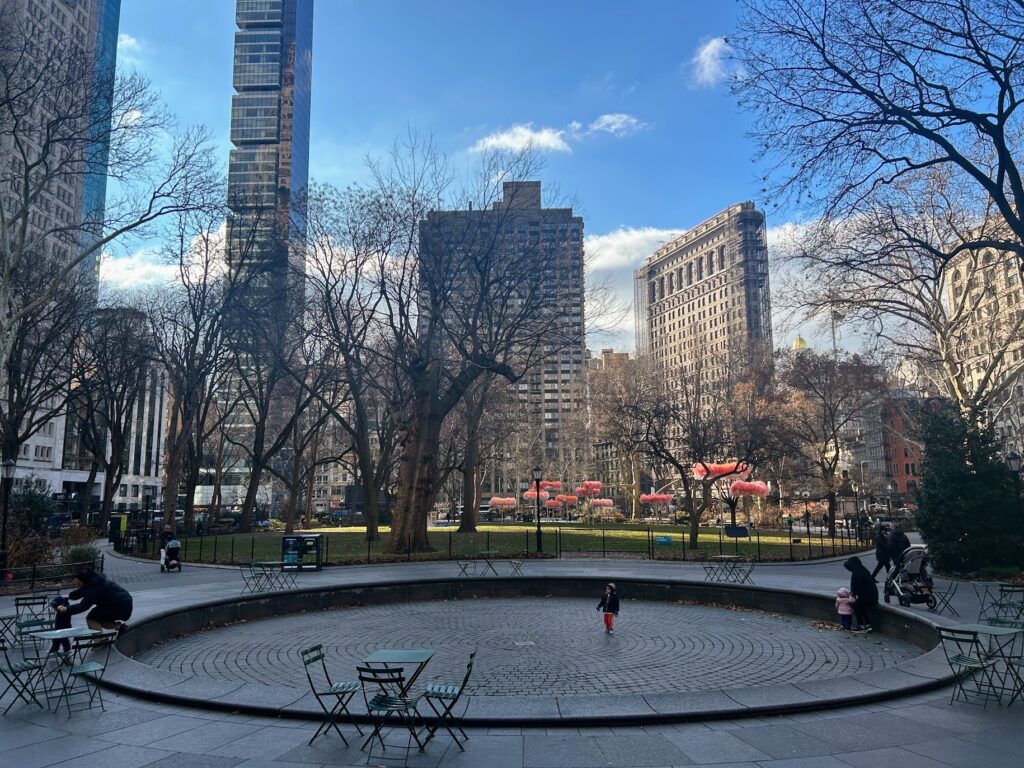
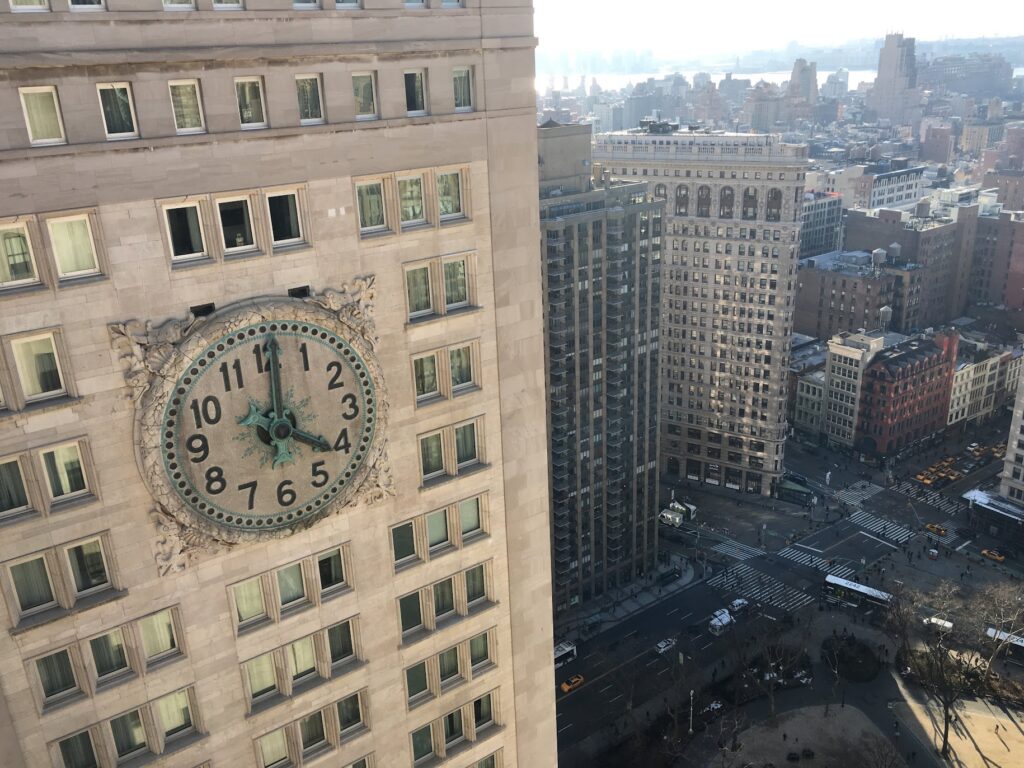
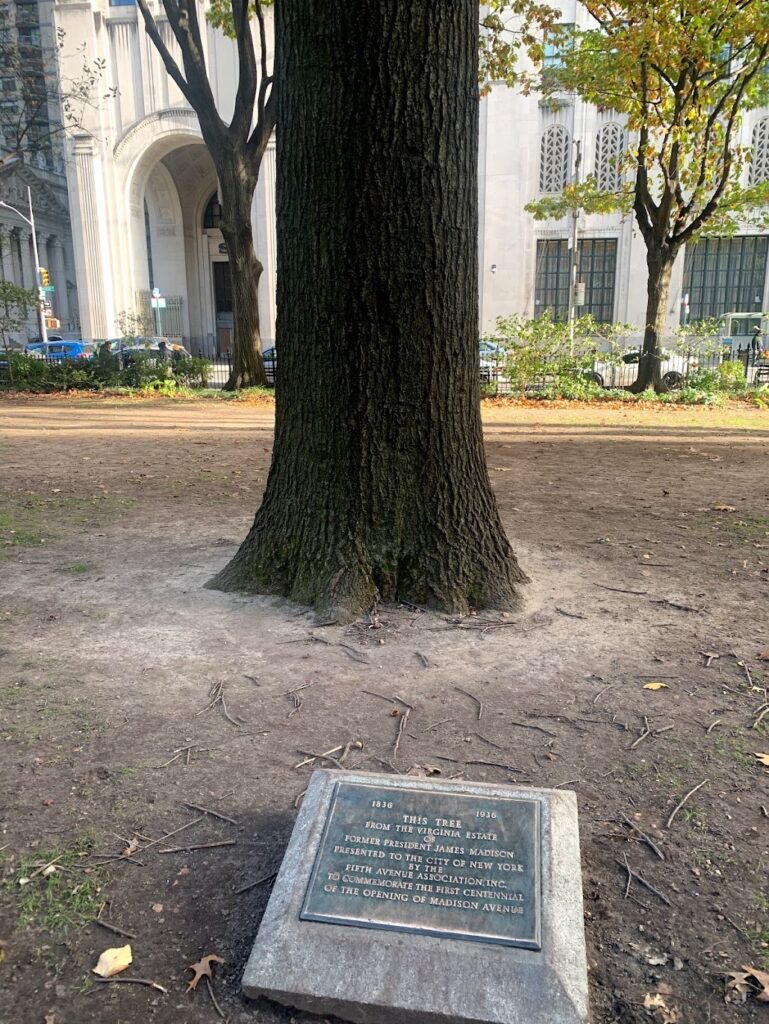
Madison Cottage, courtesy NYPLFranconi’s Hippodrome, 1853, courtesy NYPLDedication of the Worth Monument in 1857. In the background you can see the development of the surrounding areaLeonard Jerome….… and the Jerome Mansion. In the distance is the Madison Avenue Presbyterian Church. The former Gilmore’s Gardens, renamed Madison Square GardenRain on Madison Square, painting by Paul CornoyerCourtesy NYPLMadison Square 1936 , photo by Berenice AbbottNorthern pool in Madison Square Park. Photo by Greg YoungLooking down at the Metropolitan Life Tower and the Flatiron Building. Photo by Greg YoungThe park features a tree from James Madison’s Virginia plantation.
FURTHER READING
A Block in Time: A New York City History at the Corner of Fifth Avenue and Twenty-Third Street / Christiane Bird The Flatiron: The New York Landmark and the Incomparable City That Arose with It / Alice Sparberg Alexiou The Grandest Madison Square Garden: Art, Scandal, and Architecture in Gilded Age New York / Suzanne Hinman Incredible New York: High Life and Low Life from 1850 to 1950 / Lloyd Morris Liberty’s Torch: The Great Adventure to Build the Statue of Liberty / Elizabeth Mitchell Madison Square: The Park and Its Celebrated Landmarks / Miriam Berman Madison Square Garden, 100 Years of History / Joseph Durso
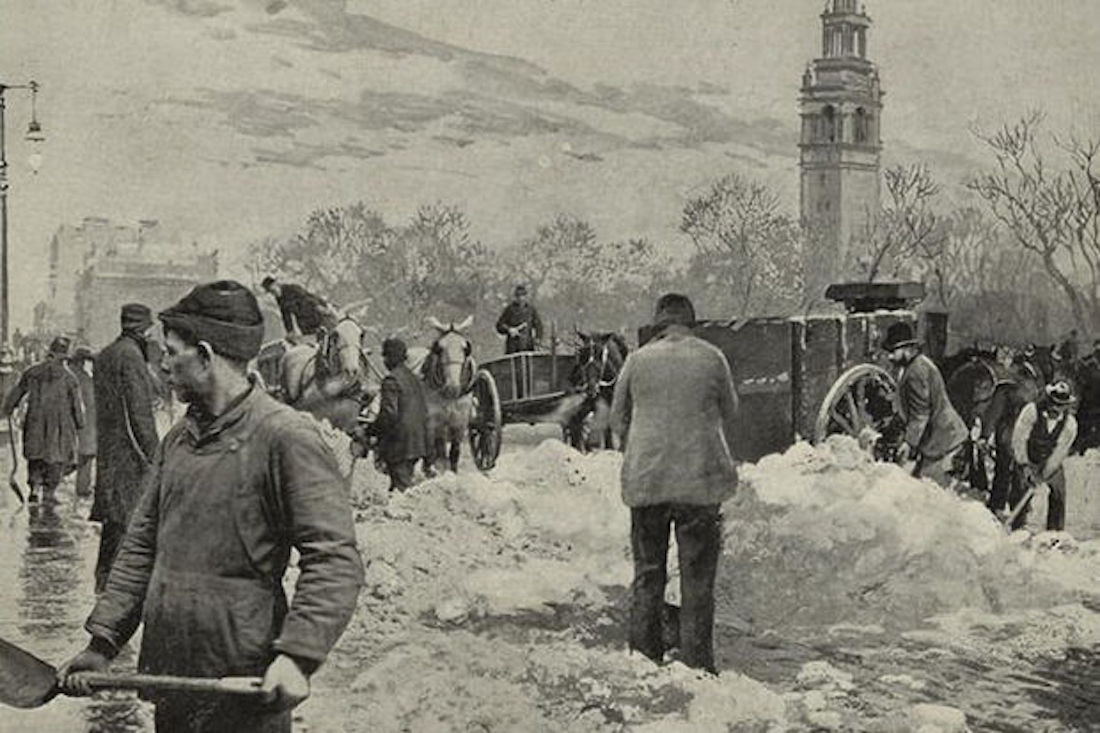
Illustration of Madison Square after a snowstorm, 1899. Courtesy New York Public Library
Missing a good old-fashioned New York City snowfall? Well, then, take in this unusual view from 1902:
What storm is this? The horrific blizzard that hit New York on February 17, 1902. It would be considered the worst snowstorm to hit the metropolitan area since the Great Blizzard of 1888. (Read all about it here.) I assume we’re actually in the aftermath of the blizzard here, as the snow shovels are out, and the kids are playing.
Who made this? Edison Manufacturing Company. Their Manhattan studio was nearby, at 41 East 21st Street.
Who’s the director? The head of Edison’s film division Edwin S. Porter, considered by most to be the first real movie director, inventing basic techniques used by subsequent filmmakers.
What are we seeing? Trolleys, cabs, carriages and other unusual vehicles, braving the icy conditions and dodging pedestrians at the intersection of Broadway, Fifth Avenue and 23rd Street. At one point, you almost see a team of horses slide off the road!
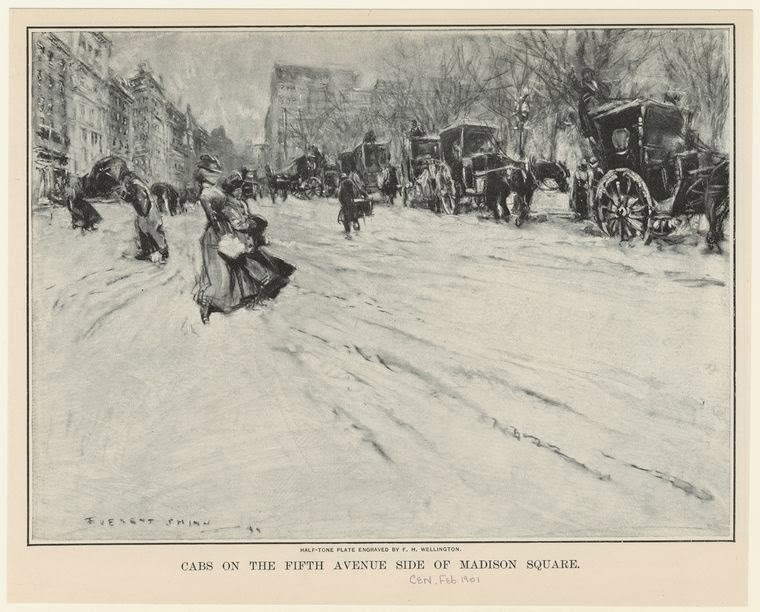
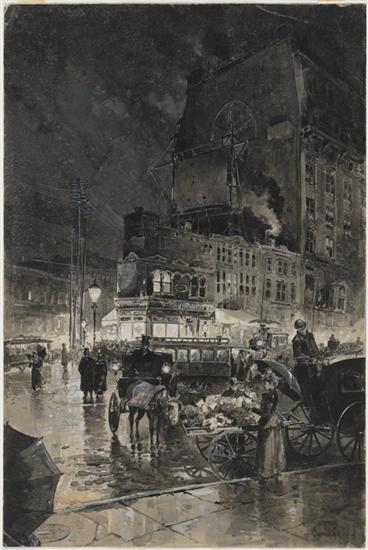
Below: An illustration from 1899, showing cabs parked along Madison Square (courtesy NYPL)
Why aren’t they showing the Flatiron Building? It’s not completed yet! The Daniel Burnham-designed office building would be opened by the summer, to great fanfare. But as an open construction site, it would have been dangerous to linger anywhere around it. I believe the slanted beams you see at the very end are part of the construction site.
This is the first film of a New York blizzard? This is probably the first film of any American blizzard. Primitive film technology had only recently allowed for outdoor filming. Porter and his crew would have been brave indeed dragging Edison’s equipment even two blocks through these conditions.
What’s that statue at the 1:15 mark? The seated, snow-covered figure of William Seward. The statue has sat at that corner since 1876. (More about that here.)
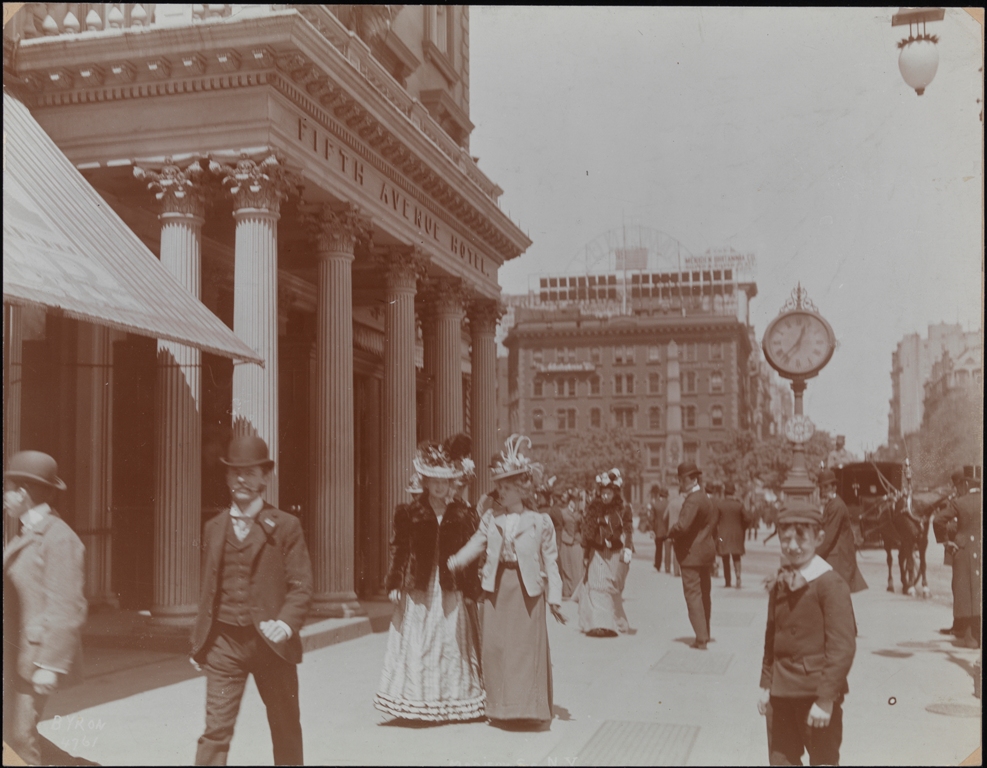
What’s that big building at the end? The Fifth Avenue Hotel, once considered the greatest accommodation in New York City and a headquarters for backroom politics in the 1870s and 1880s. Its glory days are long passed by the time of the blizzard. Six years later, it would be torn down and replaced with the building that stands at that corner today — the International Toy Center.
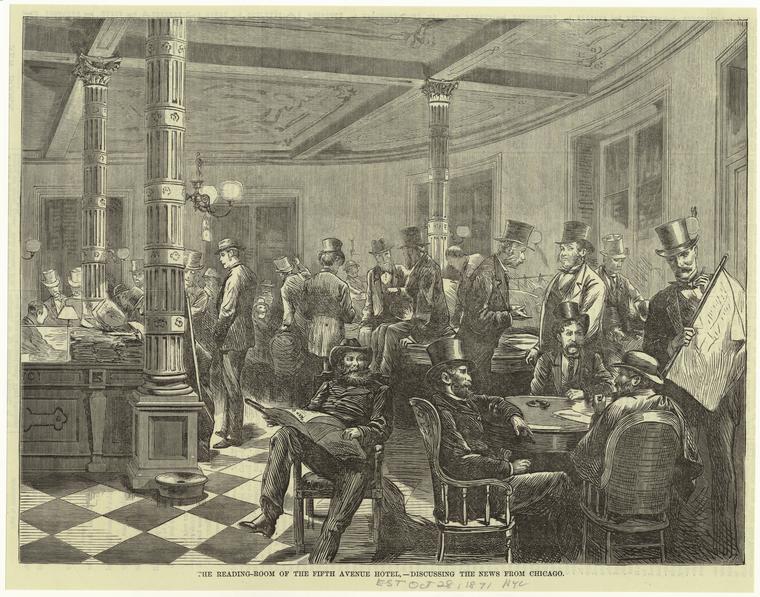
The double-breasted, cigar-chewing gentlemen who gathered in the sumptuous rooms of the Fifth Avenue Hotel were occasional connoisseurs of New York City history, and in particular, these amateur historians spoke of the very street corner where their hotel stood.
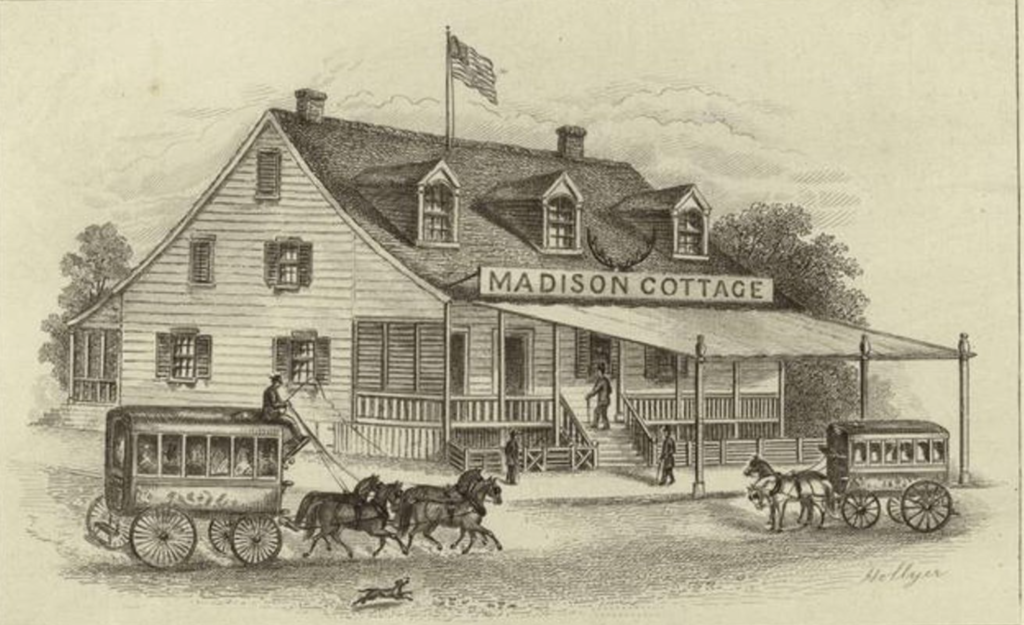
Before Madison Square, when the area was a barren parade ground, one Corporal Thompson opened a roadhouse and stagecoach station in the area that was to become 23rd Street and and Fifth Avenue.
Many spoke fondly of Thompson’s establishment, called Madison Cottage, because they remembered the place as young boys. They recalled the area’s rural quality, with carved rectangular blocks carved into the land and a dirt-road Broadway meandering north.
But that was the 1840s.
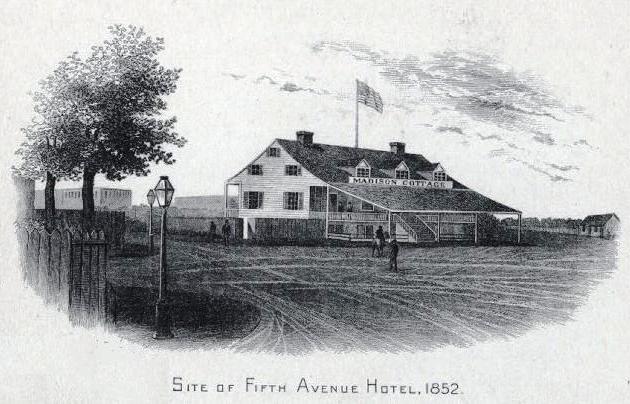
Madison Cottage, Hitchcock, Darling & Co.
Forty years later, Madison Square Park was the center of New York, a focal point of class, business and luxury that stretched south to Union Square, through that attractive collection of fine stores known as Ladies Mile, and up Fifth Avenue into the fabulous mansions of the rich.
And dead center of all that activity was the Fifth Avenue Hotel, not only the “finest [hotel] in this metropolis”, the “leading hotel of the world ,” but quite simply one of the most surprising stages for American politics of the mid and late 19th century.
New York’s Hotel Revolution
Hotels were fast becoming the center of New York life from at least the days of the Astor House, located near City Hall, in the 1830s. Within two decades, trendy new hotels (such as the St. Nicholas and the Metropolitan) spread up along Broadway and eventually clustered around Union Square.
The Fifth Avenue Hotel opened in 1859, the venture of wealthy merchant Amos Richards Eno, who accurately gambled that the center of city commerce would soon settle at 23rd Street. So confident a speculator was Eno that he moved from his brownstone at 74 Broadway (the first New Yorkbrownstone, he claimed) to a massive home nearby the hotel.
Some thought it unwise to build so far north, and when workers unearthed dozens of skeletons during construction — the area once being a potter’s field — the corner was even considered cursed. Eno defied the naysayers, pouring his wealth into the hotel to make it the most modern, most luxurious accommodation of the day.
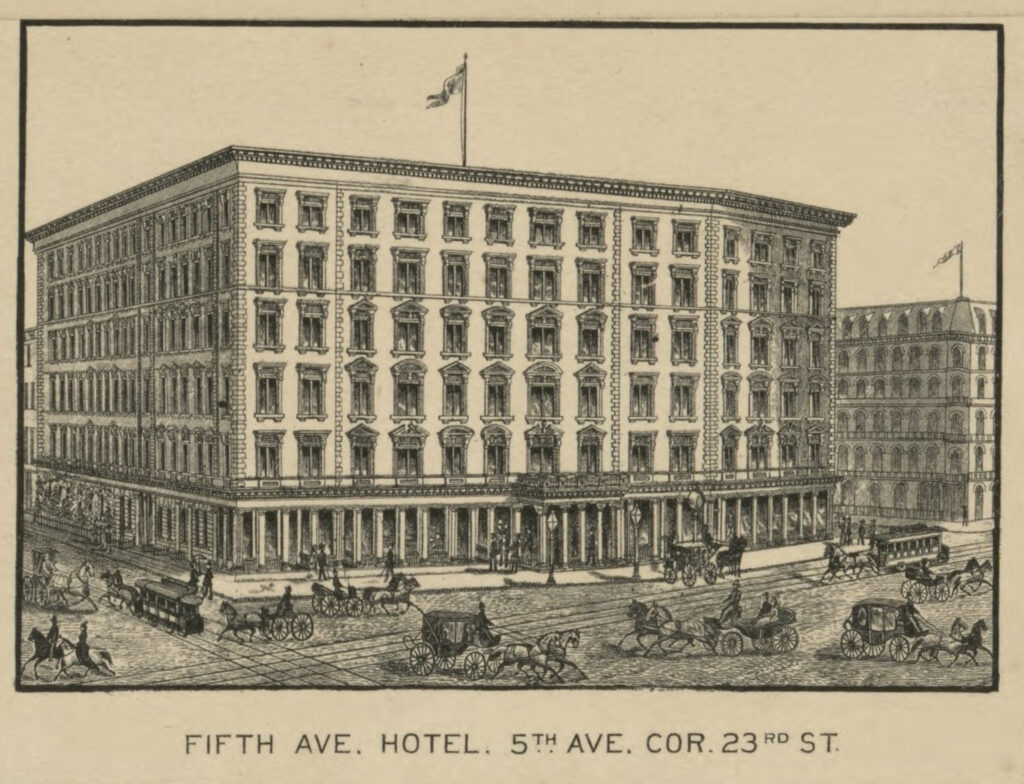
The Fifth Avenue Hotel, 1879. Courtesy Wikimedia Commons
A Gilded Age Confection
The Italian exterior was awash in five stories of imported marble, while austere, carpeted interiors of French design drew comparisons to European palaces.
Guests enjoyed reading rooms, a luxurious bar, a barber shop, a dedicated telegraph office, and a variety of dining and drawing rooms, not to mention the first passenger elevator ever built in the United States, a steam-powered monstrosity whisking passengers to their floor.
The Fifth Avenue Hotel reading room, busy every weekend. (Boston: Fields, Osgood & Co.,)
Wheeling and Dealing
As the finest hotel in the city in the post Civil War years, it naturally became a magnet for politicians and financiers. Of all the ‘backrooms’ of American politics, none were as gleaming as the Fifth Avenue.
Bankers huddled in the legendary ‘parlor D. R.’ during the tense days of the financial panic of 1873. In particular, the hotel became a de facto headquarters for New York Republicans.
While often secondary to the city’s Democrats — this being the era of Tammany Hall‘s swelling power — Republicans were frequently in control of state government, and the Fifth Avenue Hotel became a smoky center of political wheeling and dealing.
During the 1870s, New York republicans became national power brokers and frequently hashed out crises here at the Fifth Avenue.
In the years before the Waldorf-Astoria, presidents and dignitaries all stayed here during visits. Seamier political maneuvers took place in the chambers of prominent politicians who held court here, including the inimitable Roscoe Conkling (at left), senator of New York and leader of the Republican faction known as the Stalwarts.
National Influence
When fractured Republicans at their convention in 1880 nominated non-Stalwart James Garfield for president, the nominee had to basically grovel for their support by symbolically ‘kissing the ring’ of the Stalwarts during a visit to the Fifth Avenue Hotel, partially agreeing to their system of patronage and taking Conkling ally Levi Morton as a member of his cabinet. (Garfield later backed out on this arrangement.)
Another frequent guest here was Chester A. Arthur, Garfield’s eventual vice president. When Arthur became president after Garfield’s assassination by Charles Guiteau (who had himself wandered the hotel’s hallways in delusion), he would set up his entire administration here during visits to his adopted city.
By the 1890s, a corridor of the hotel known as the ‘Amen Corner‘ was a famous congregation spot for Republican political bosses and reporters. As they frequently powwowed here on Sundays, gatherers would caustically shout ‘Amen!’ during heated discussions.
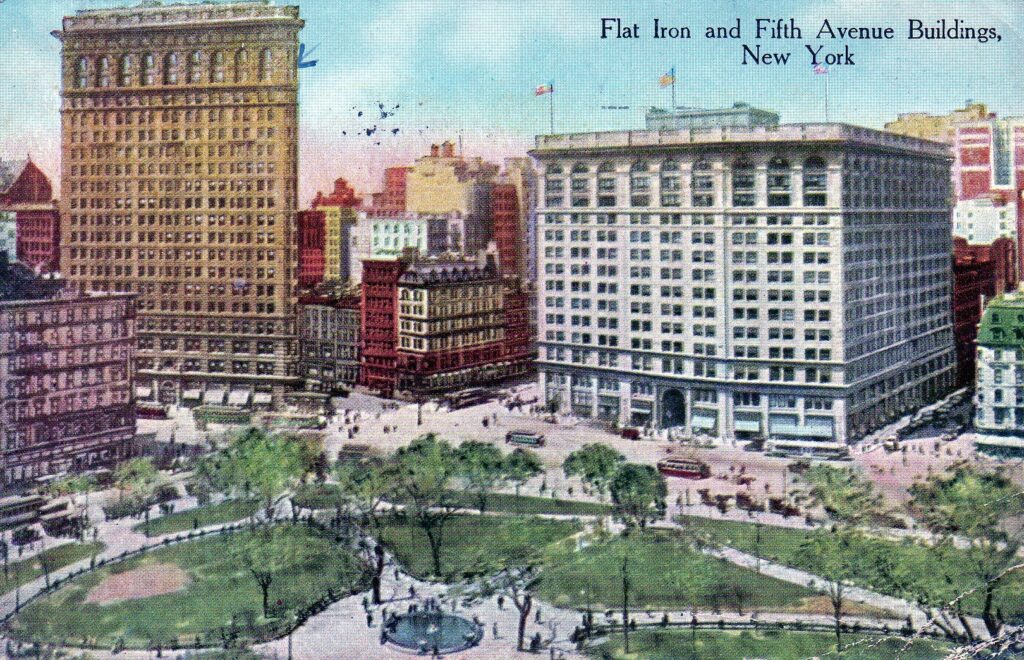
The Fifth Avenue Hotel in relation to the Flatiron Building
Checking Out
The hotel became a magnet for shenanigans of all varieties. In 1893, a couple hundred proponents of a U.S. monetary silver standard erupted into a riot that included two U.S. senators.
The bank robber Robert Montague was arrested here in 1896 thanks to a tip-off from a chambermaid. An early vestige of baseball’s National League met here annually, and the national pool competitions were held in the hotel’s billiard room.
By the new century, of course, the locus of New York activity was hastily moving uptown, and the Fifth Avenue Hotel was deemed a relic, even as a brand new structure across the street — the Flatiron Building — was being proclaimed the finest building in the city.
In 1908 the Fifth Avenue Hotel was torn down and replaced by the 16-story Toy Center (called the Fifth Avenue Building back in the day), the epicenter of toy manufacturing for much of the 20th century.
PODCASTFor our 8th anniversary episode, we’re revisiting one of New York City’s great treasures and a true architectural oddity — the Flatiron Building.
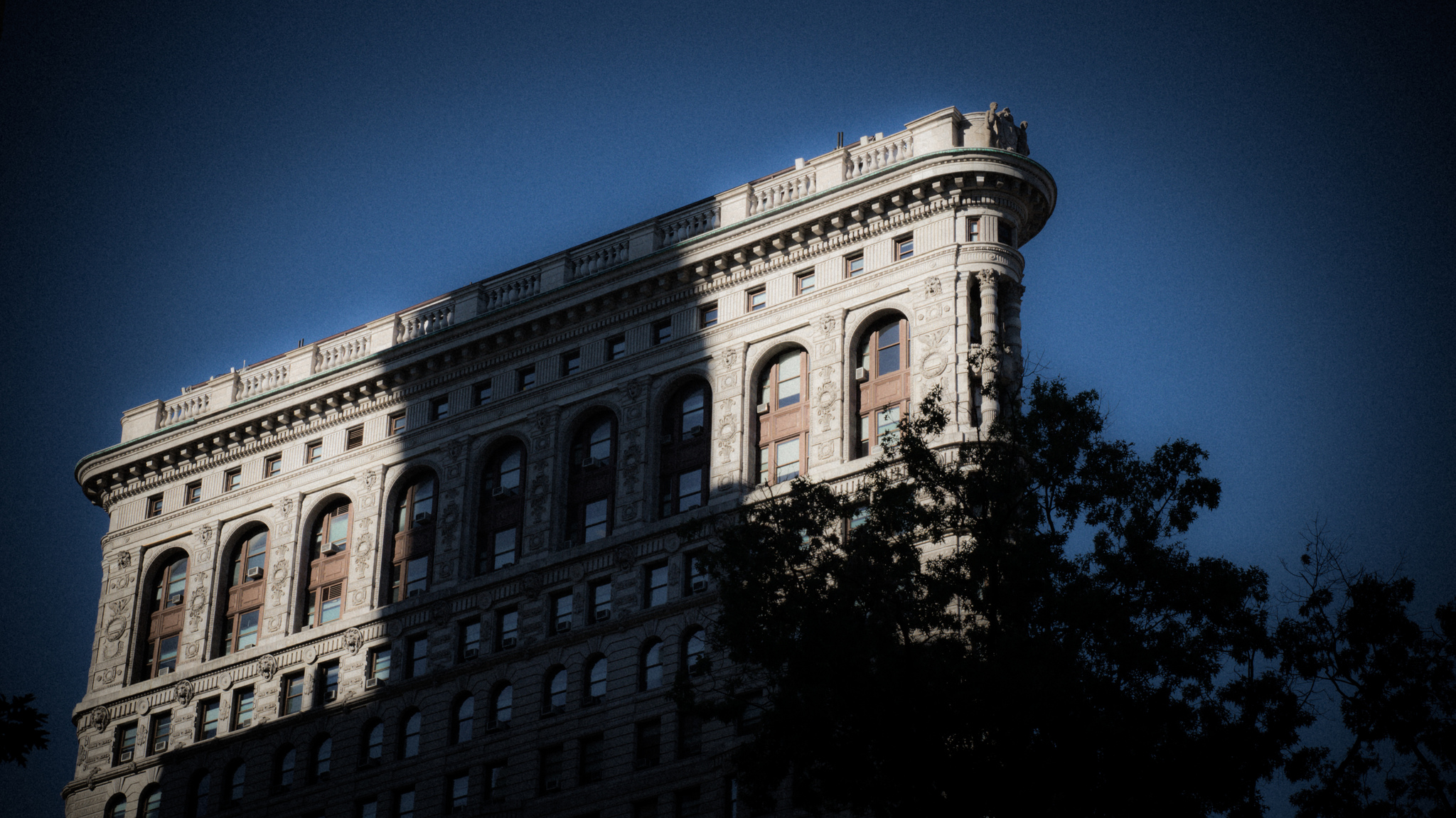
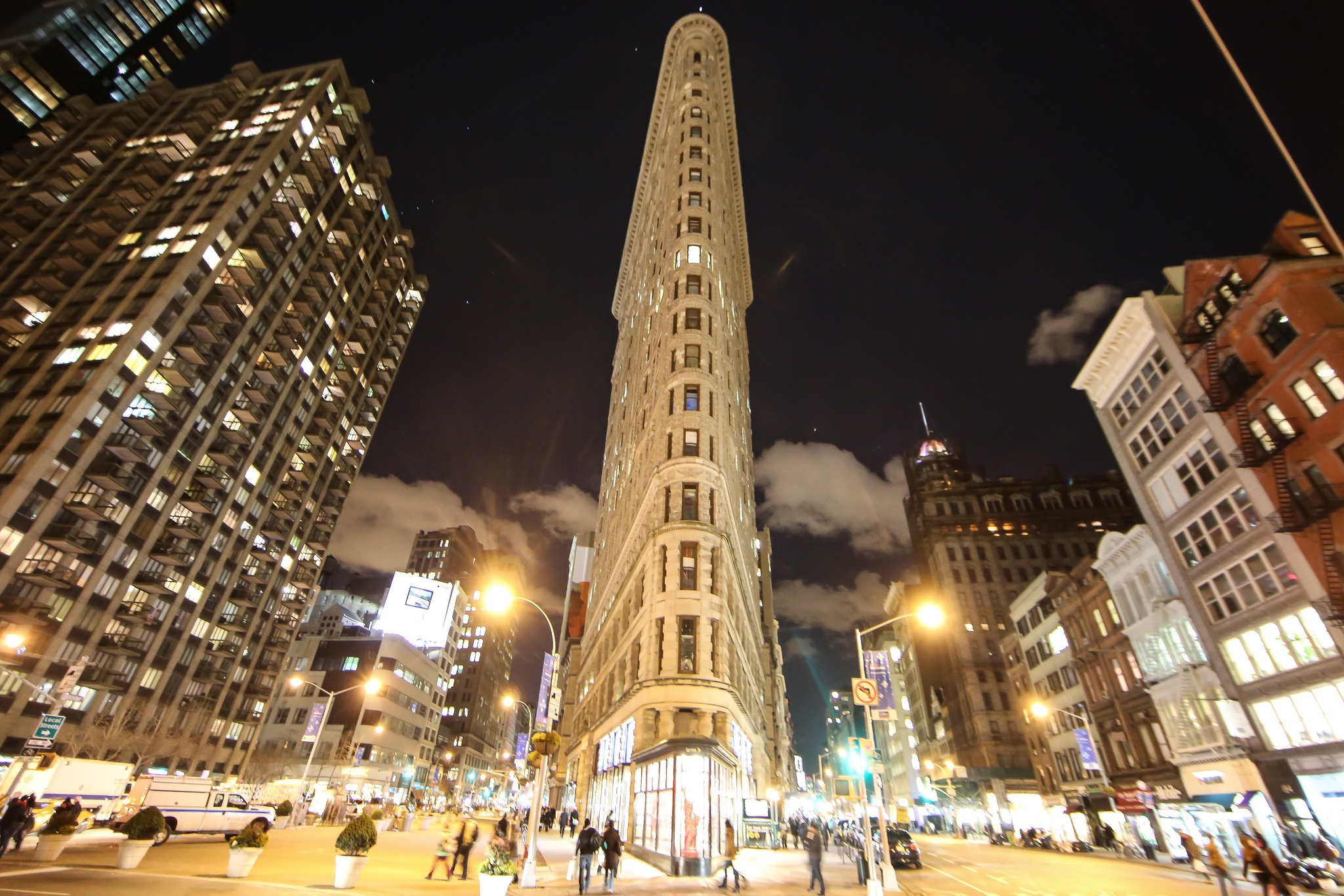
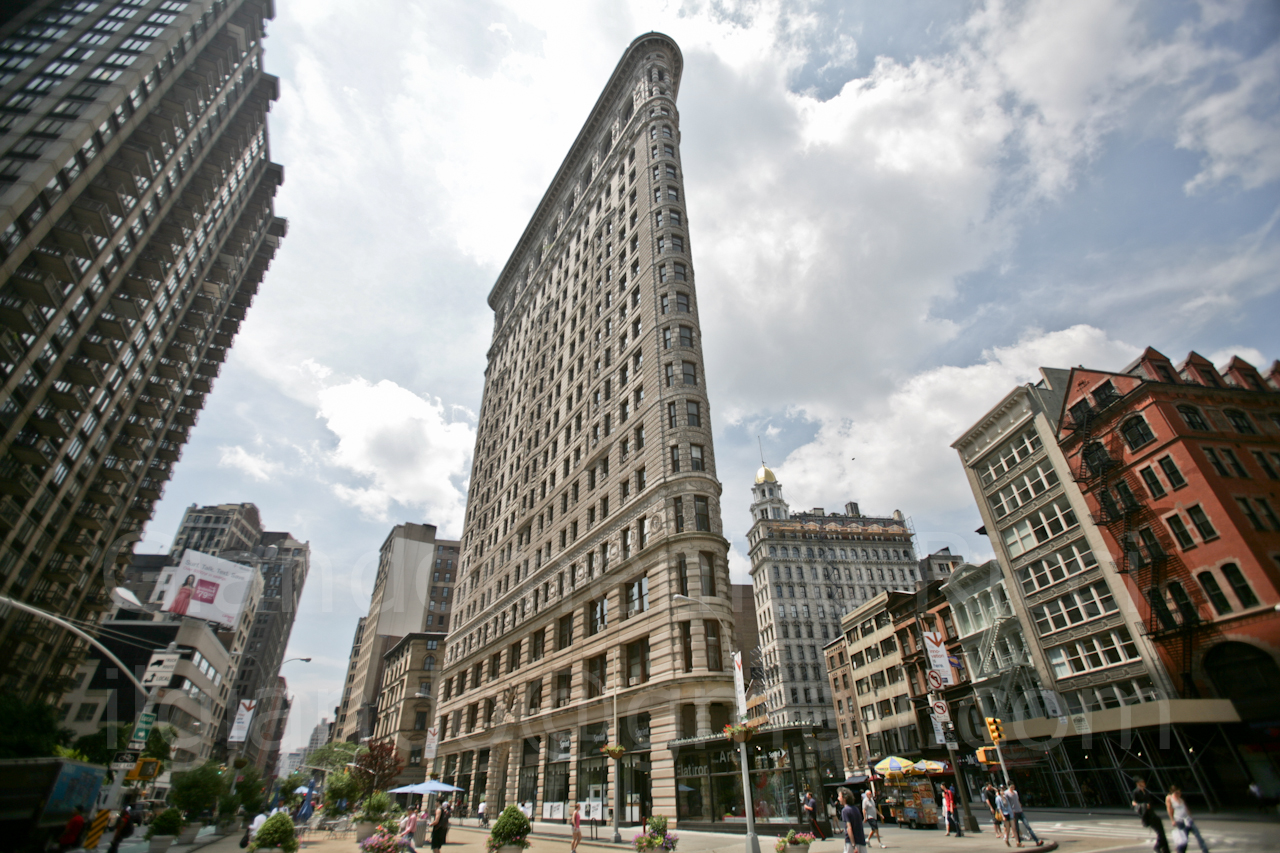
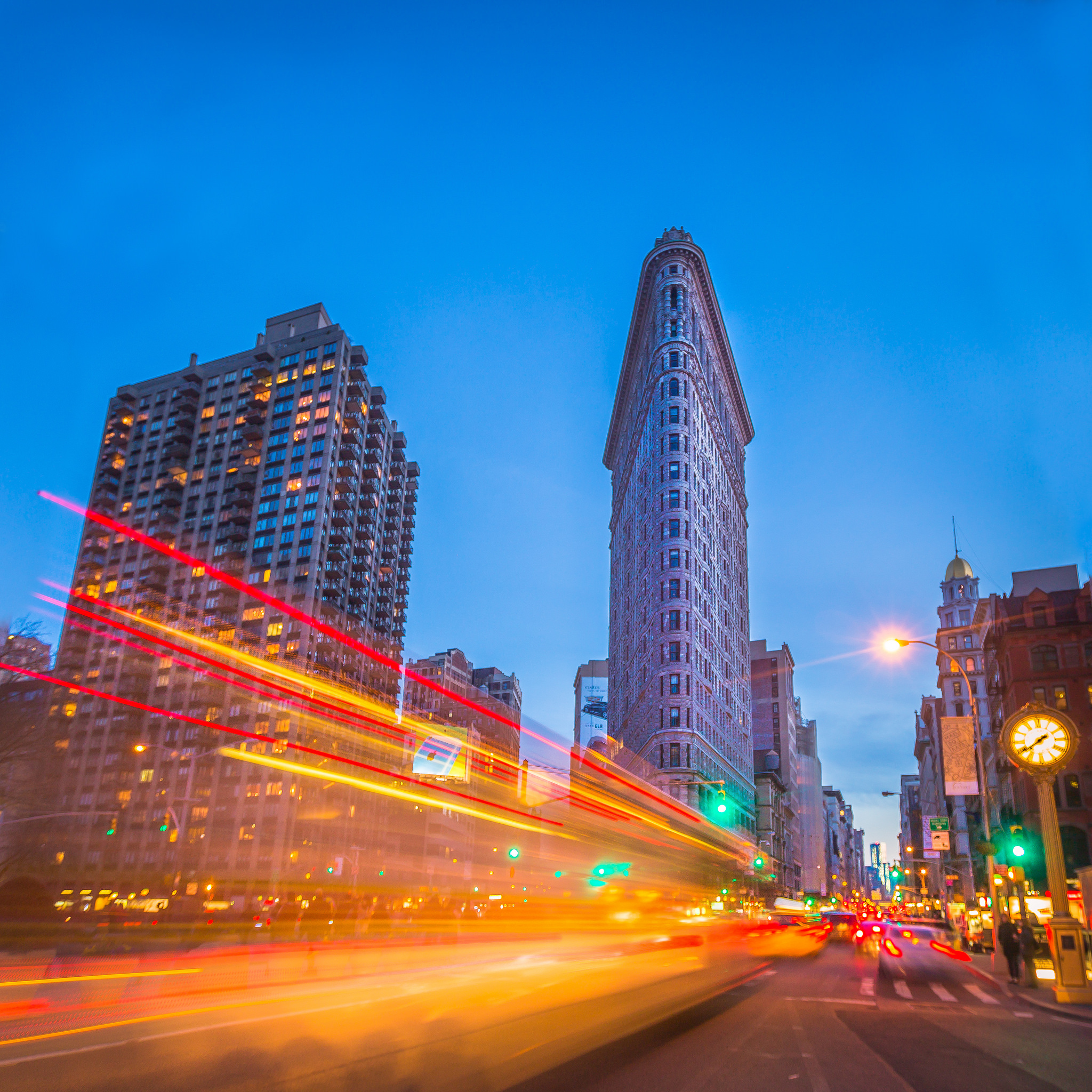
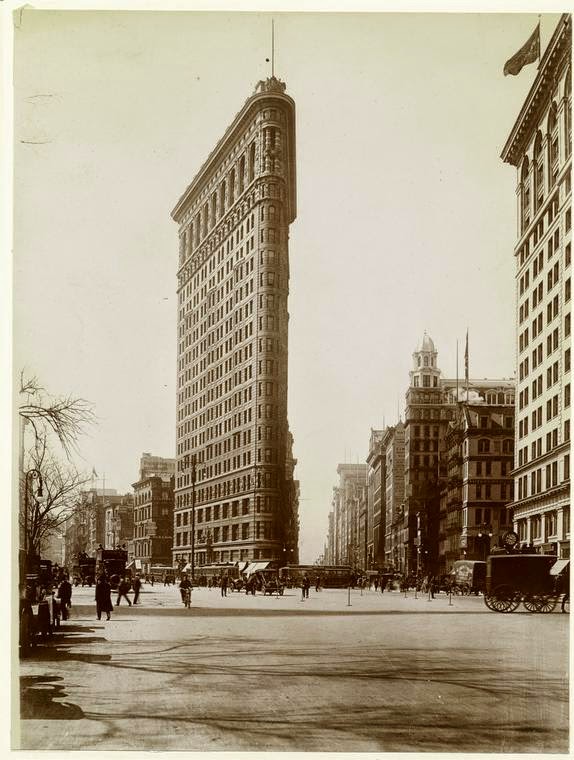
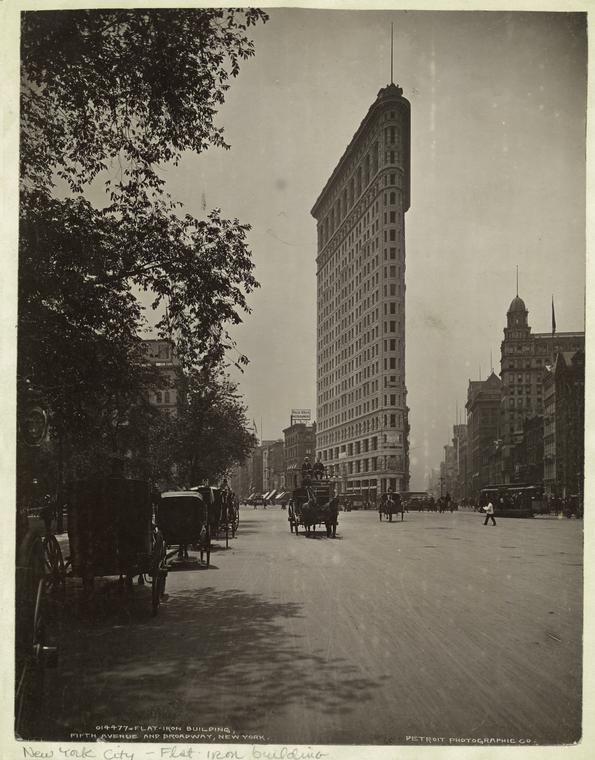
When they built this structure at the corner of Madison Square Park (and completed in 1902), did they realize it would be an architectural icon AND one of the most photographed buildings in New York City?
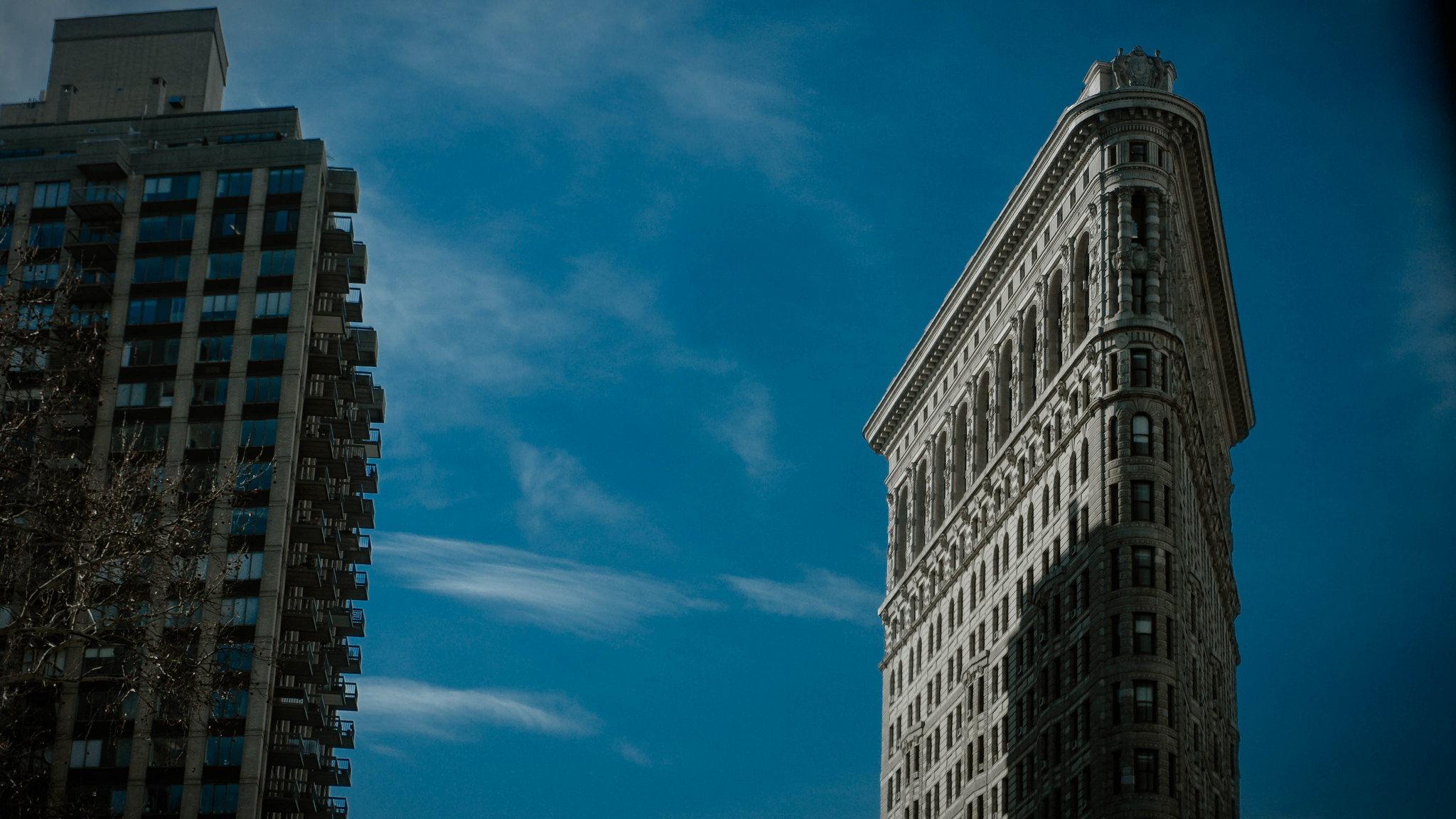
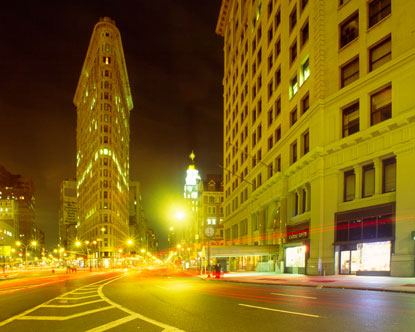
The George A. Fuller Company, one of the most powerful construction firms in Chicago, decided to locate their new New York office building in a flashy place — a neighborhood with no skyscrapers, on a plot of land that was thin and triangular in shape. They brought in Daniel Burnham, one of America’s greatest architects, to create a one-of-a-kind, three-sided marvel, presenting a romantic silhouette and a myriad of optical illusions.
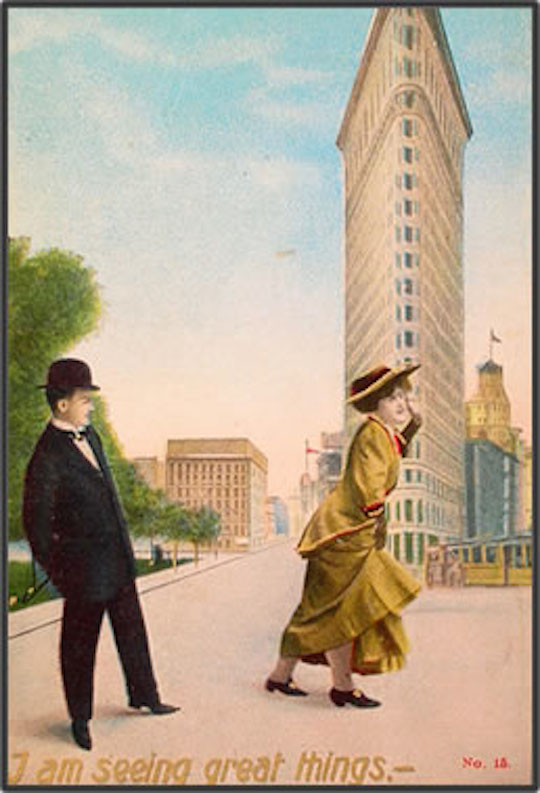
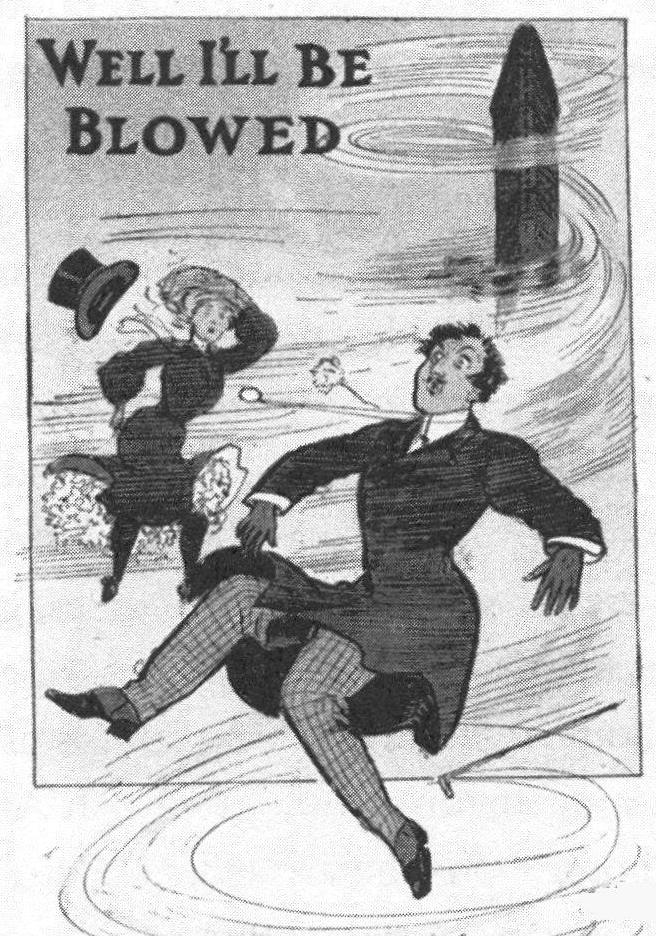
The Flatiron Building was also known for the turbulent winds which sometimes blew out its windows and tossed up the skirts of women strolling to Ladies Mile. It’s a subject of great art and a symbol of the glamorous side of Manhattan.
In this show, we bring you all sides of this structure’s incredible story.
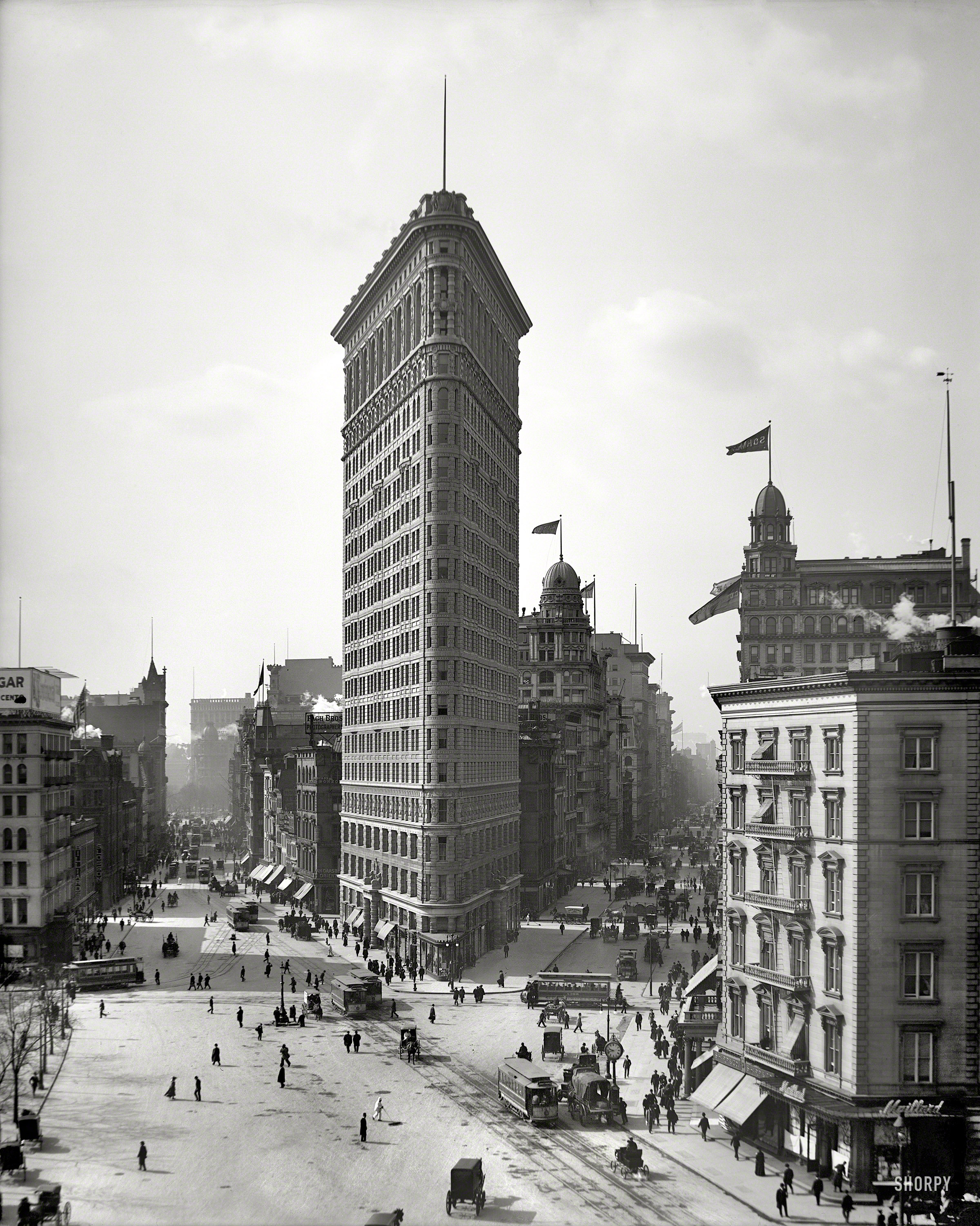
Below: A cleaned up look at the Flatiron Building, courtesy Shorpy. Click here for a look at the details!
Courtesy Shorpy
The Bowery Boys: New York City History podcast is brought to you …. by you!
Starting this month, we are doubling our number of episodes per month. Now you’ll hear a new Bowery Boys podcast every two weeks. We’re also looking to improve the show in other ways and expand in other ways as well — through publishing, social media, live events and other forms of media. But we can only do this with your help!
We are now a member of Patreon, a patronage platform where you can support your favorite content creators for as little as a $1 a month.
Please visitour page on Patreon and watch a short video of us recording the show and talking about our expansion plans. If you’d like to help out, there are five different pledge levels (and with clever names too — Mannahatta, New Amsterdam, Five Points, Gilded Age, Jazz Age and Empire State). Check them out and consider being a sponsor.
We greatly appreciate our listeners and readers and thank you for joining us on this journey so far. And the best is yet to come!
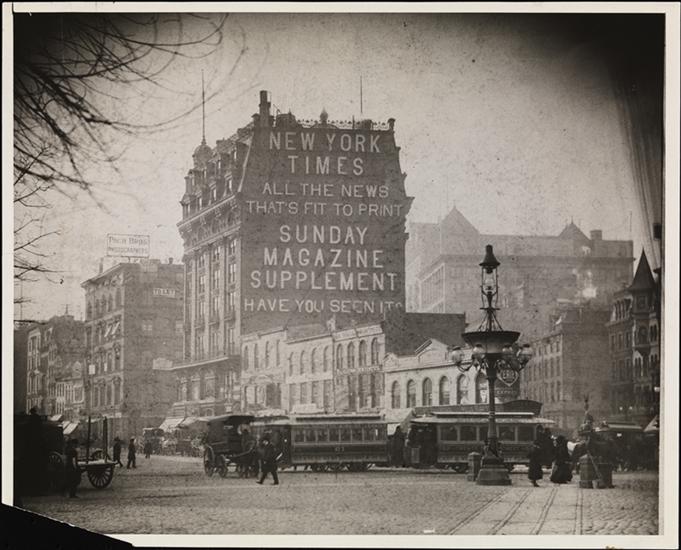
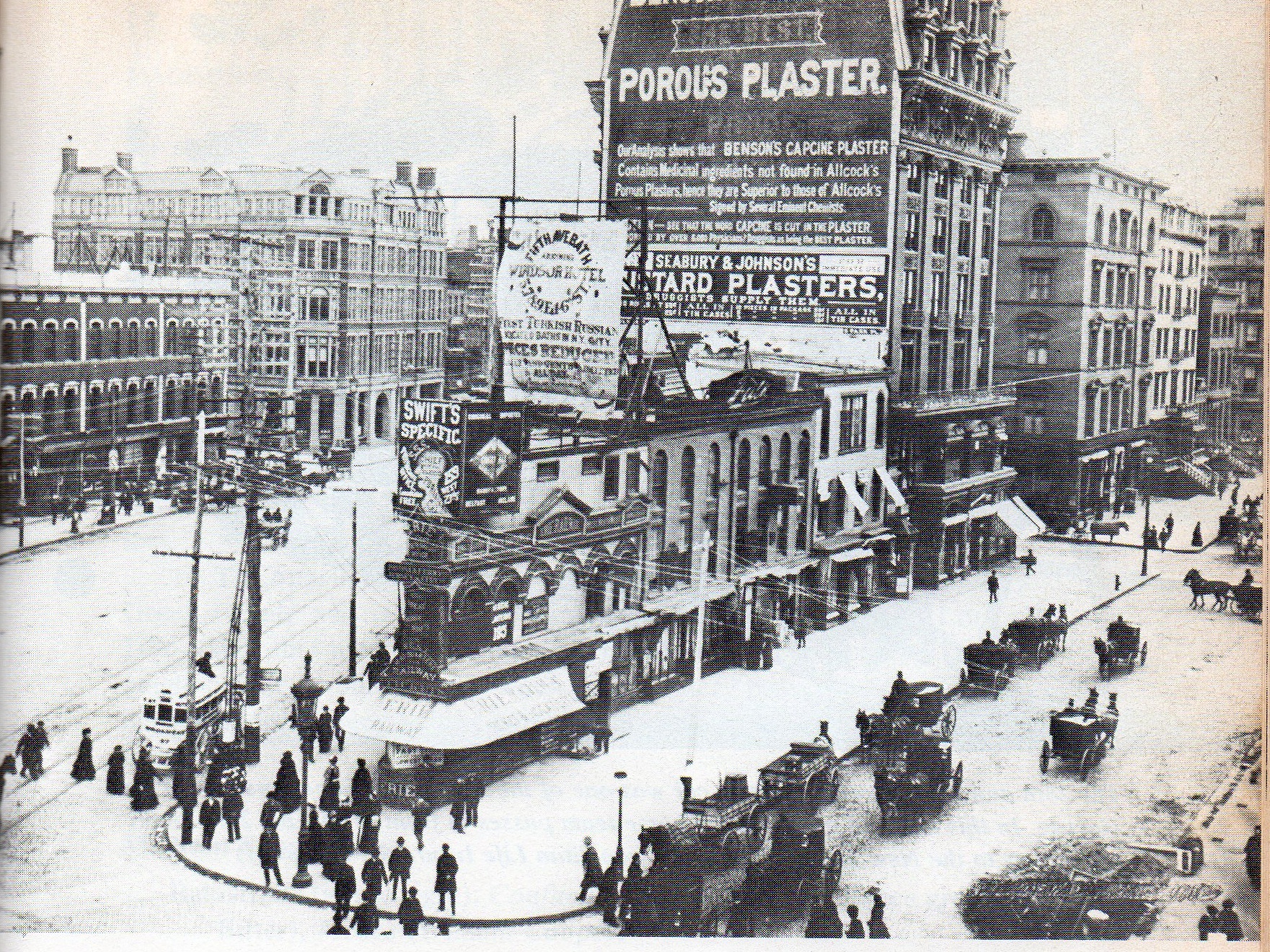
A dramatic illustration of 23rd Street and Fifth Avenue, where the Flatiron Building would soon stand. From here you can see the taller Cumberland building which would be used for billboards.
The structures that pre-dated the Flatiron Building, pictured here in 1897.
Courtesy Museum of City of New York
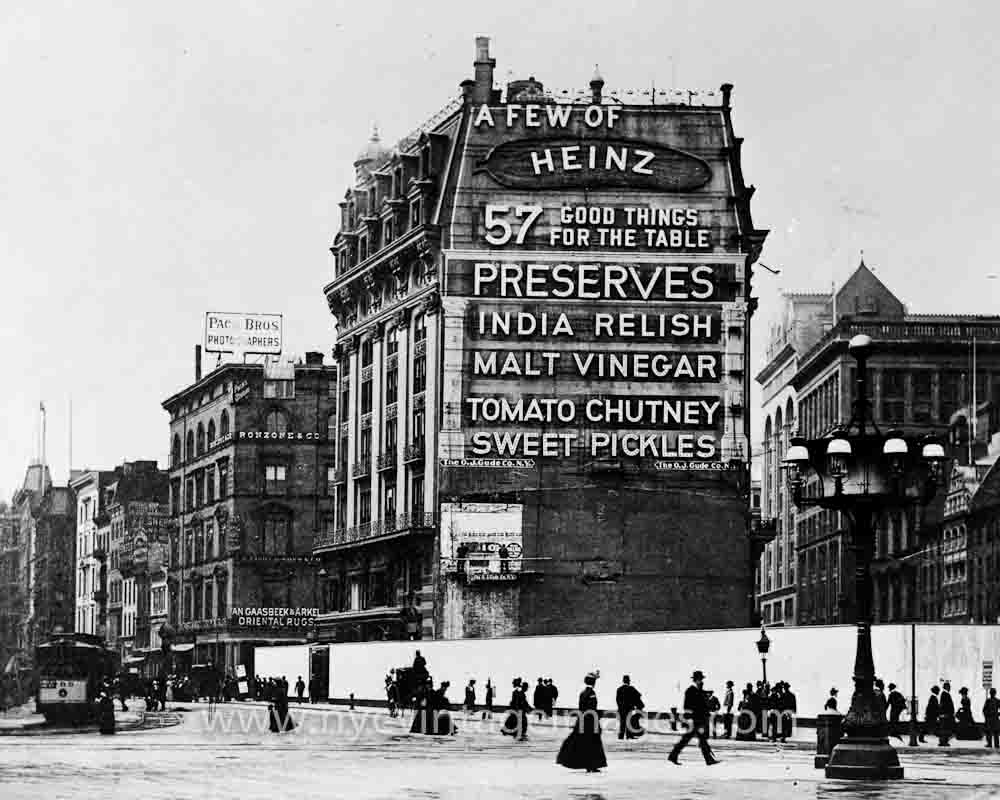
The smaller buildings have already been cleared away for the construction of the Fuller/Flatiron Building, but the taller building remains to some promotion of Heinz products.
Courtesy vintageimages.com
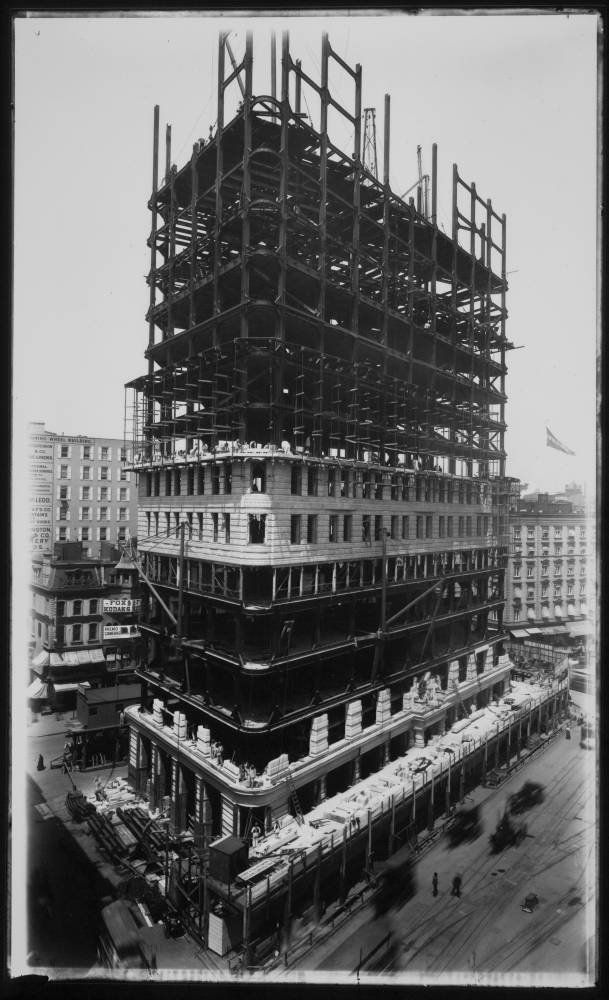
Construction of the Flatiron, picture from late 1901 or early 1902.
Courtesy Library of Congress
From every angle, the Flatiron takes on a new shape…..
Courtesy New York Public LIbrary
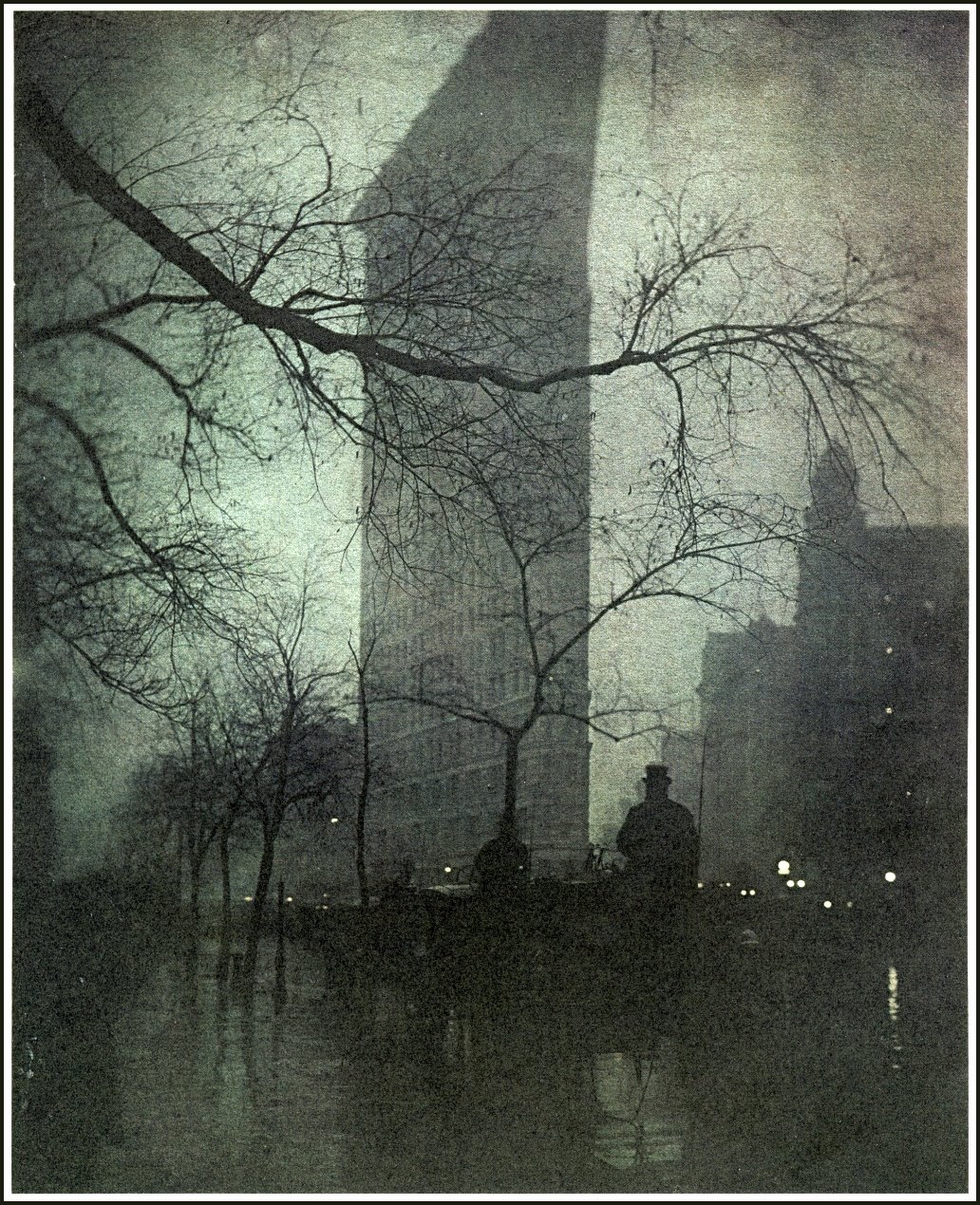
…inspiring artists like Edward Steichen to frame the building in romantic and even mysterious ways (such as his iconic shot from 1904)
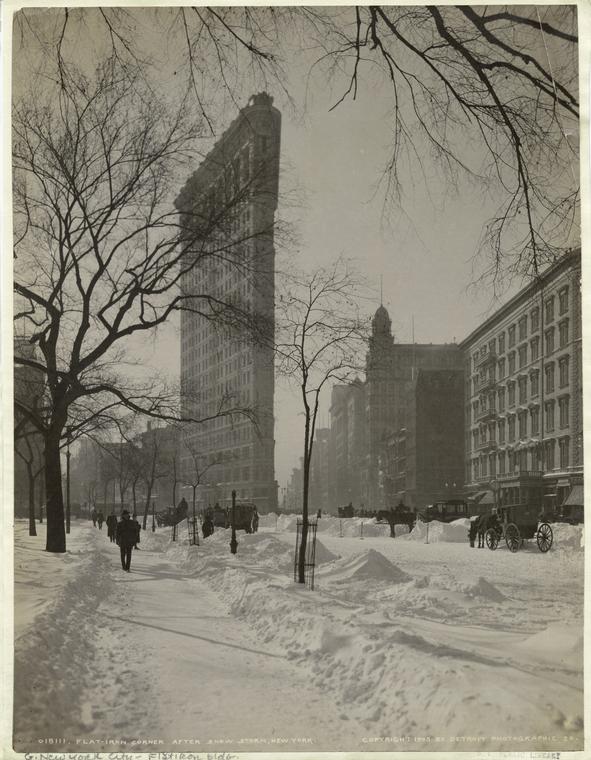
A view, similar to the classic one above, of the Flatiron after a snowstorm in 1905
Courtesy New York Public Library
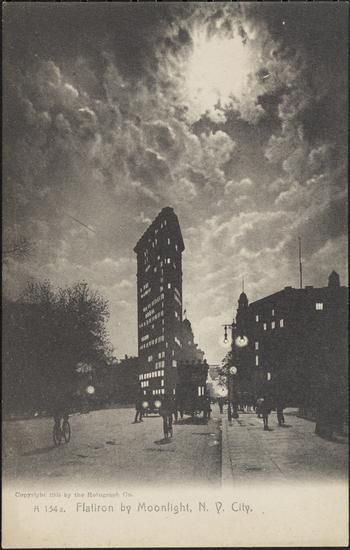
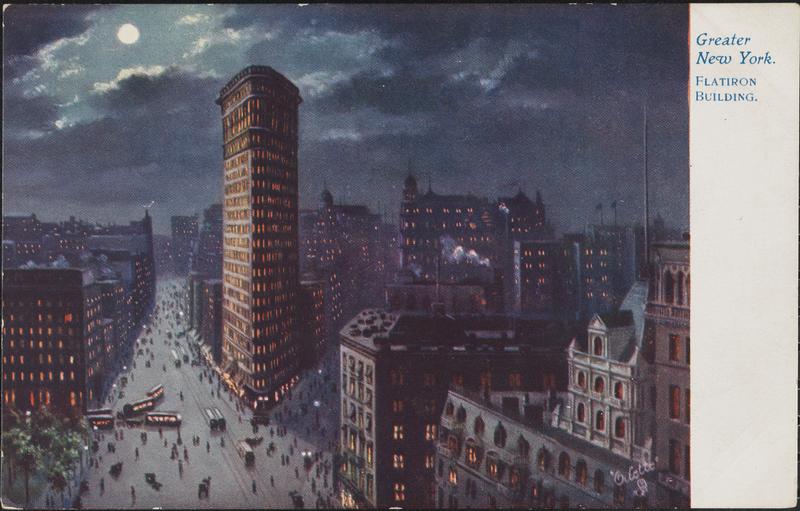
The Flatiron has inspired thousands of photo-mechanical post cards back in the day, highlighting its alluring shape-shifting form upon the changing New  York skyline.
Courtesy Museum of the City of New York
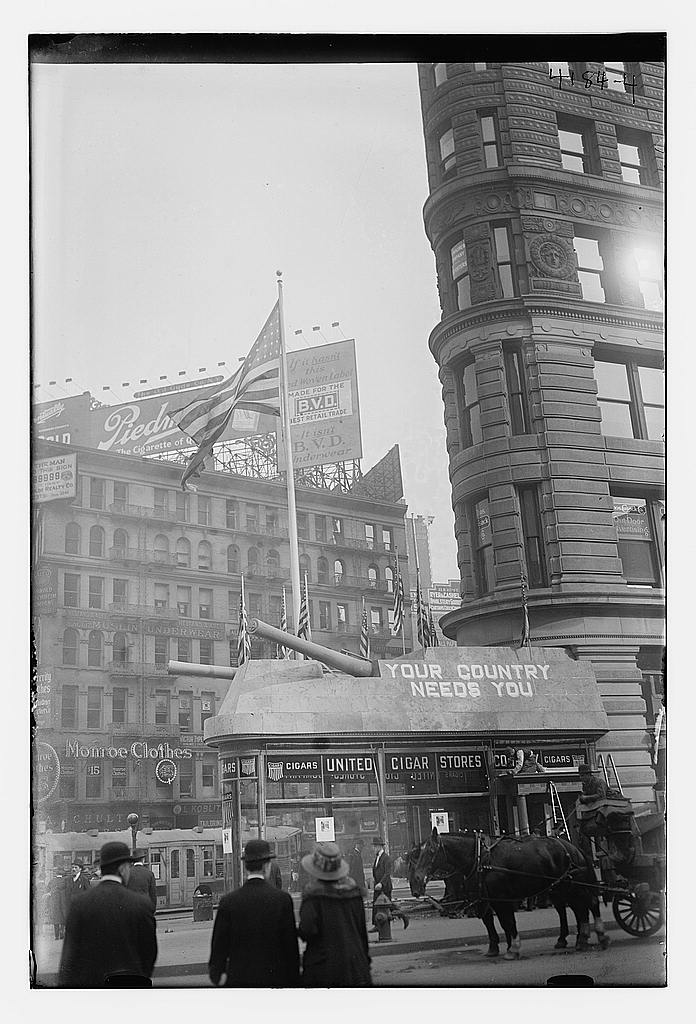
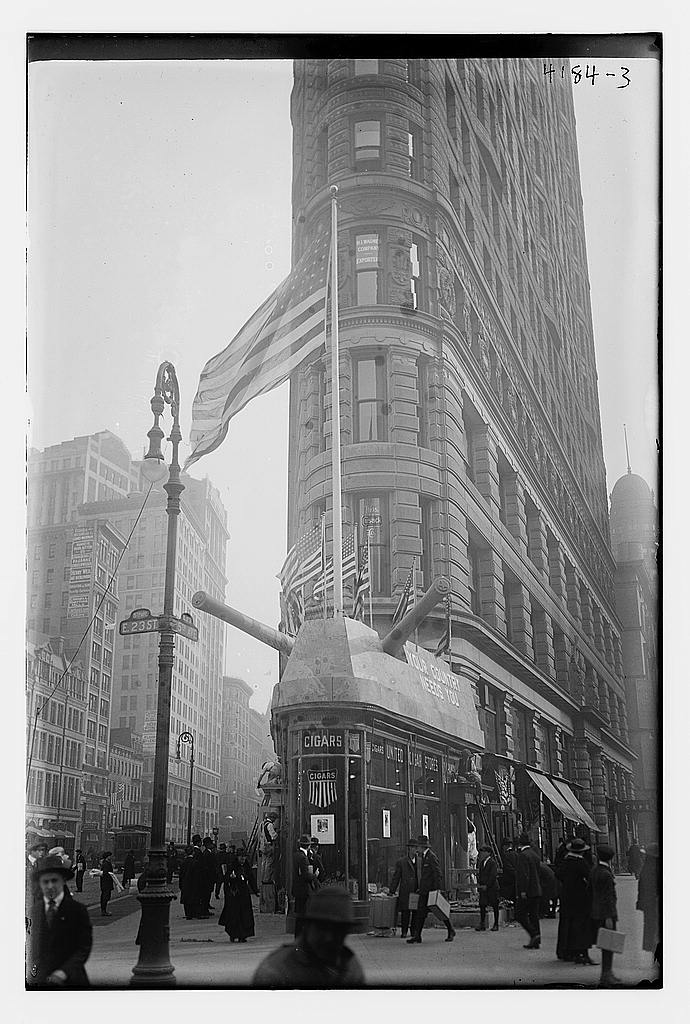
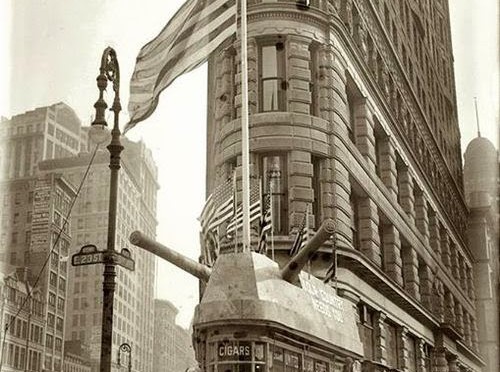
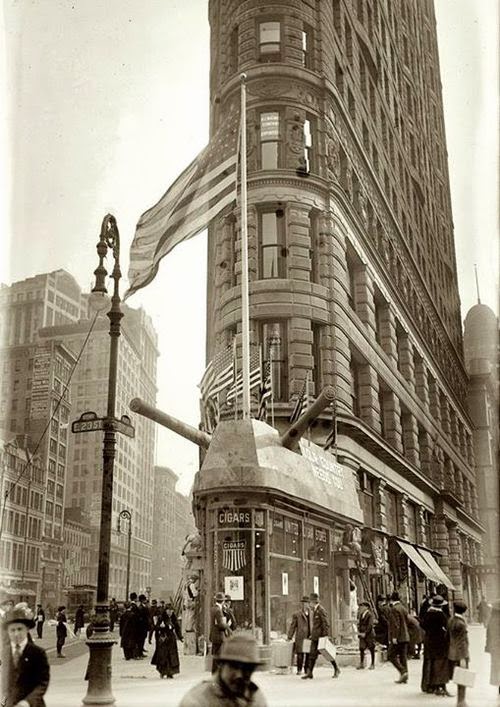
The cigar store in the narrow ‘cowcatcher’ served as a recruitment office during World War I, topped with military weaponry.
Courtesy Library of Congress
Another postcard focused on the Flatiron’s particularly windy properties!
American Mutoscope and Biography Co. filmed this humorous look at ladies in the wind on October 26, 1903:
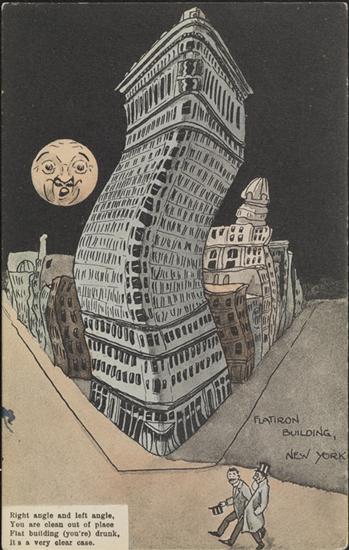
A Max Ettlinger illustration from 1915 — Flatiron, you’re drunk!
Courtesy Museum of City of New York
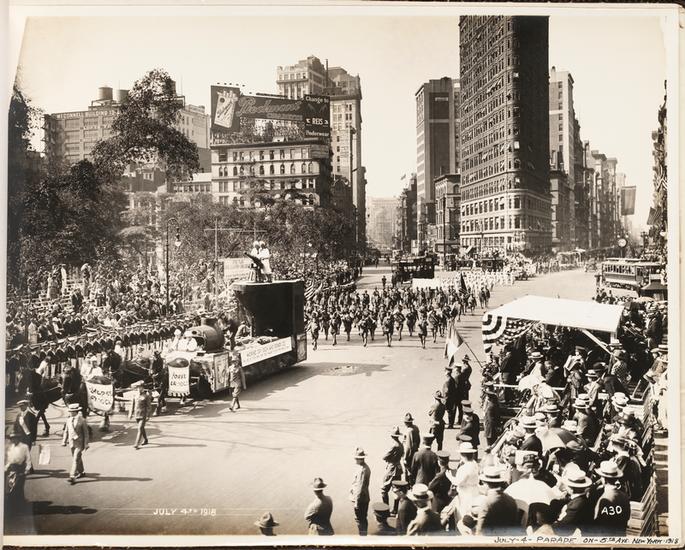
A July 4th parade, passing up Fifth Avenue.
Courtesy Museum of the City of New York
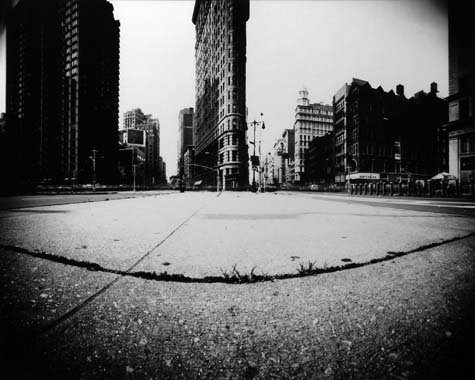
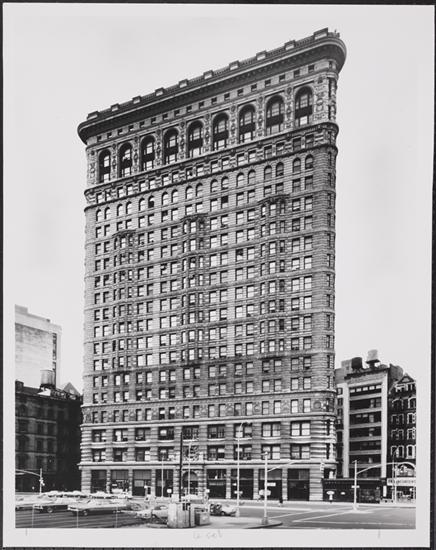
The Flatiron in 1935, from an angle that makes it appear almost two dimensional.
CORRECTION: A small correction to this week’s show. The beautiful Madison Square Garden tower — with the nude Diana statue — is actually in a Spanish style, not an Italian style.
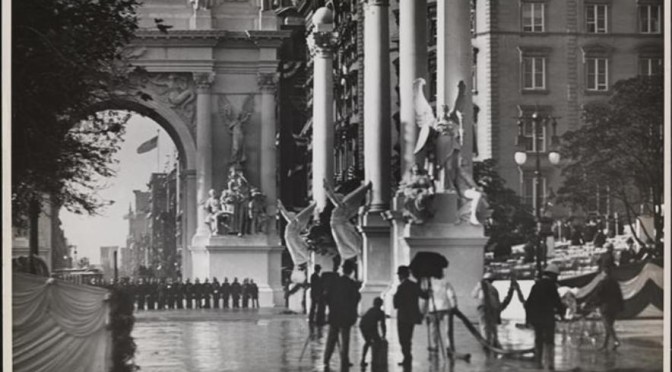
Memorial arches have been a dramatic way to honor military victories, dating back to the Roman times. Naturally, in a city with abundant Beaux-Arts classical-style architecture, New York has erected its share of grand archways. Two spectacular examples exist today — the Washington Square Arch and the Soldiers and Sailors and Sailors Memorial Arch in Brooklyn.
But the area which has been host to the most arches has been Madison Square Park. Sadly the only arches you can find near here are McDonalds Golden Arches on 23rd Street and Madison.
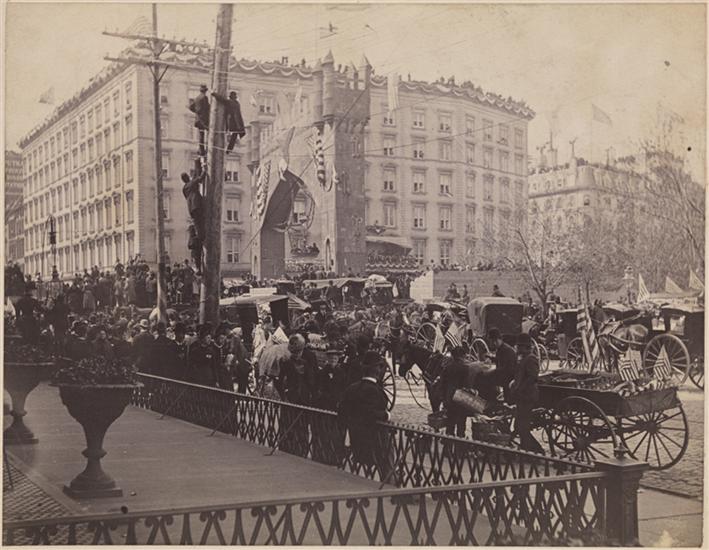
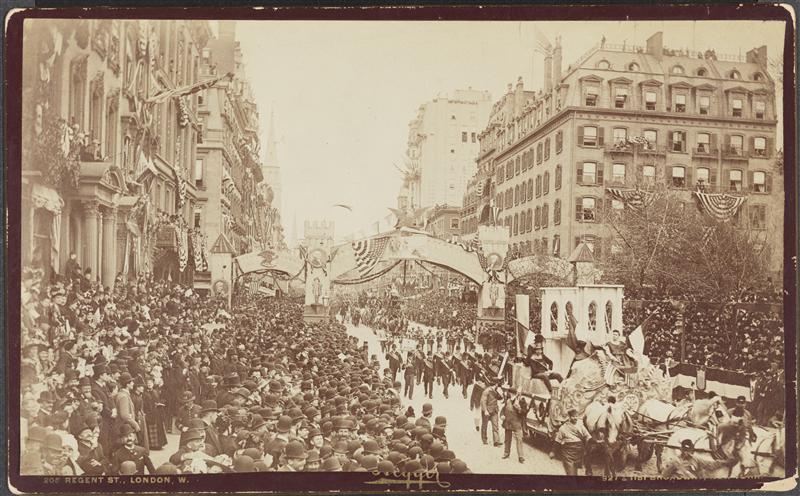
There are been four total arches here, all of them on Fifth Avenue near the park:
The George Washington Arches – 1889
Courtesy the Museum of the City of New York
Two arches celebrating the 100th anniversary of George Washington’s inauguration were on Fifth Avenue — one at 23rd Street at the southern side of the park, and another at 26th Street at the northern side.
These, of course, were accompanied by another arch further down Fifth Avenue at Washington Square Park. That arch, designed by Stanford White, was considerably better received than the Madison Square versions, so much so that White designed a permanent one in 1893.
Below: The 1889 arch up at the northern corner of Fifth Avenue and 26th Street
Courtesy the Museum of the City of New York
Courtesy Museum of the City of New York
The Dewey Arch – 1899-1900
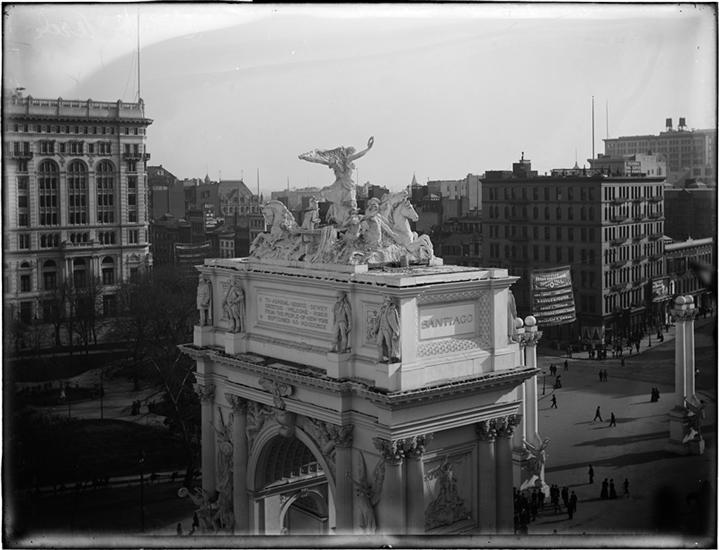
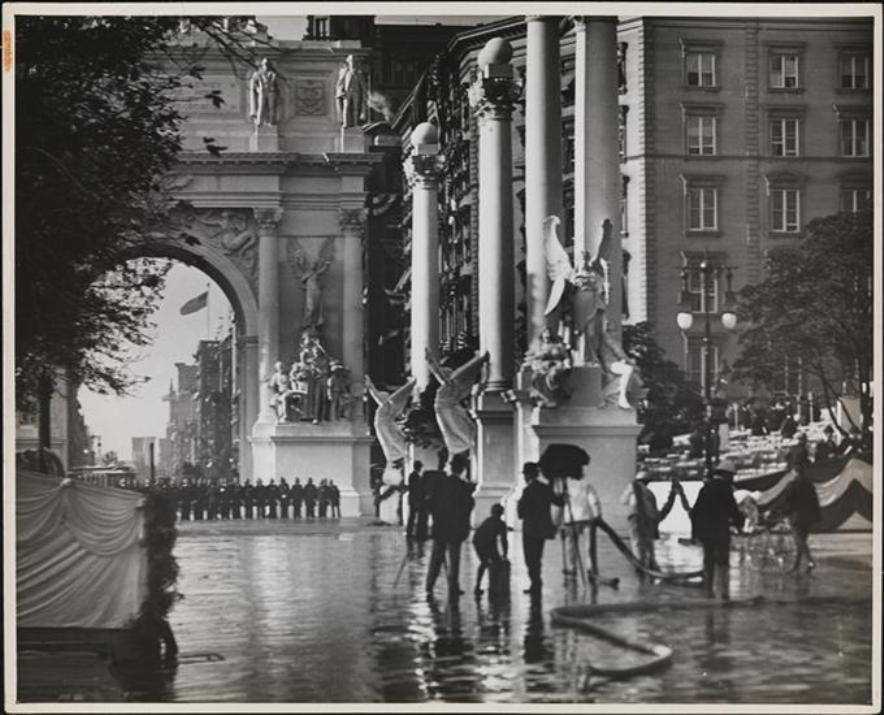
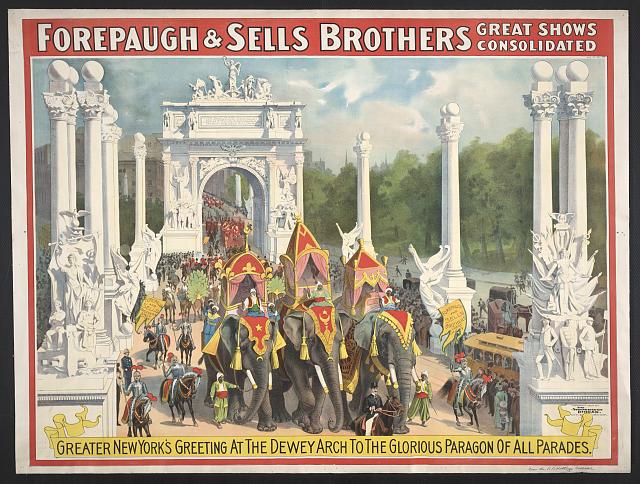
This ornate and exceptionally lavish structure was built to commemorate a then-recent event — the victory of Admiral George Dewey at the Battle of Manila Bay, which took place on May 1, 1898.
The Dewey Arch was far showier than the earlier arches: “The great triumphal arch to be erected in this city in honor of the return of Admiral Dewey will not only be worthy of the occasion, but will be the most elaborate and artistic structure of its kind ever attempted here or in Europe.” [NYT]
Madison Square Garden, just on the other corner of the park, was closed to construct the statue. For Dewey’s triumphant arrival in New York in late September 1899, the entire city was lit up with ‘fairy lamps‘ to greet the procession. The fireworks display for the event would be the greatest the city has ever seen.
It seems, however, that the Dewey Arch was massively rushed, built in “hot haste“ according to reports. Although a great many petitioned for a permanent Dewey Arch in its place that winter, people had moved on by the winter of 1900 when it was unceremoniously torn down.
Courtesy Library of Congress
Courtesy of Museum of City of New York
Victory Arch — 1918-20
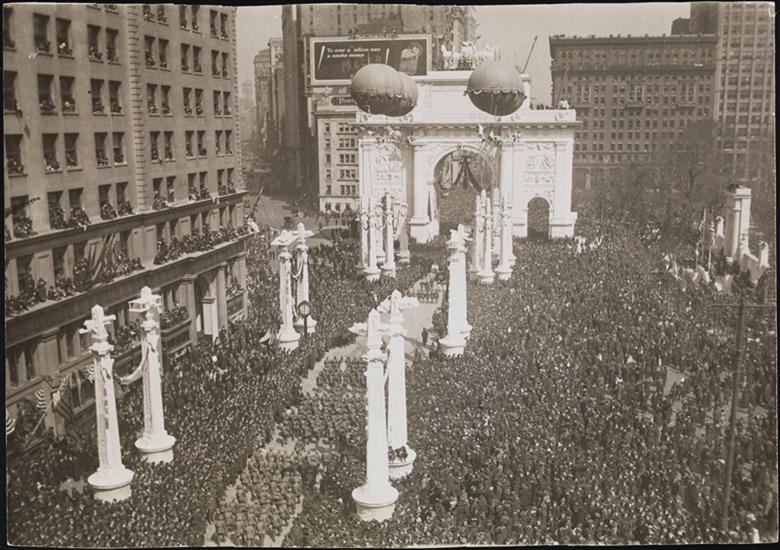
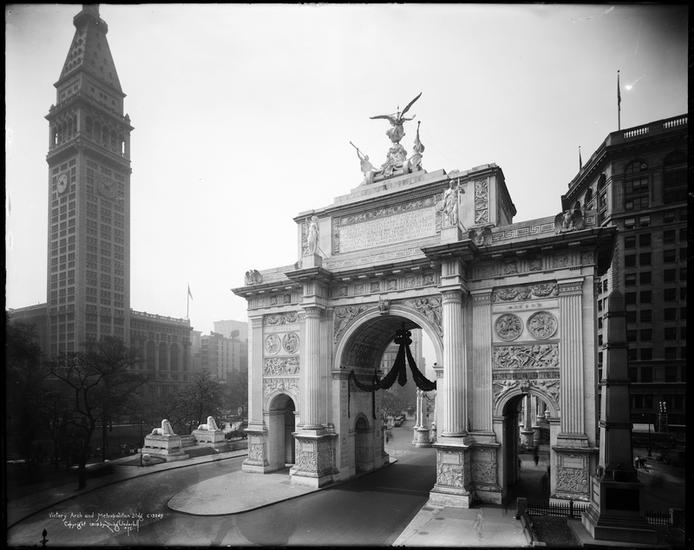
By 1918, the area around Madison Square Park was quite a transformed place with the Metropolitan Life Insurance Company Tower and the Flatiron Building now in attendance to witness the fourth arch, built to honor those in New York who had died thus far in the battles of World War I.
This arch was equally as ornate as the previous arch occupant, designed by Thomas Hastings (co-architect of the New York Public Library). It was built in wood and plaster and also, apparently, in haste.
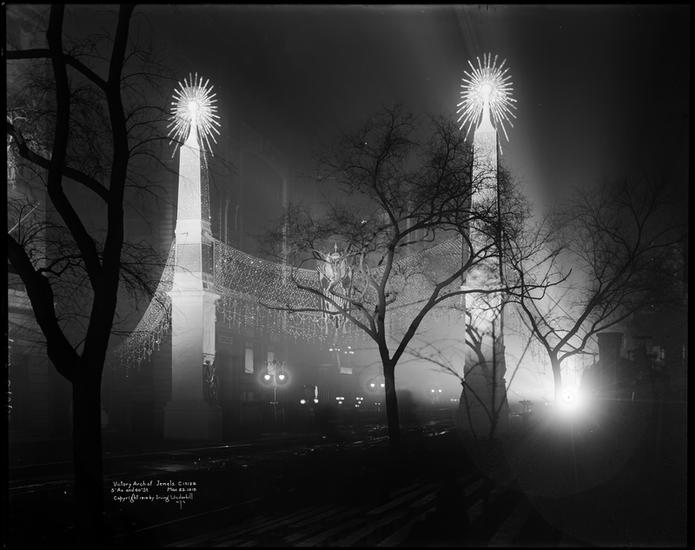
Below: The ‘Altar of Jewels’Â glowing to signal victory
At the completion of the war, It was the focal point of a gigantic parade greeting arriving troops on March 25, 1919, a parade which turned quite rowdy. “The greatest crowd that ever gathered in New York City upon any occasion, and the most difficult to handle,” was how the New York Times described it. “The worst point of disorder was the district around the Victory Arch at Twenty-Third Street, where thousands and thousands fought among themselves or combined against the police in an effort to get a vantage point.” [source]
This arch was not spared either. It was soon villified as an icon of wasteful spending by no less than future mayor Fiorello LaGuardia. “The Altar of Liberty was renamed the “Altar of Extravagance,” the Victory Arch “Wasteful Arch,” and the Altar of Jewels — the “Arch of Folly.”
It was ripped down in the summer of 1920, although the damage to the park would last throughout the year. [source]
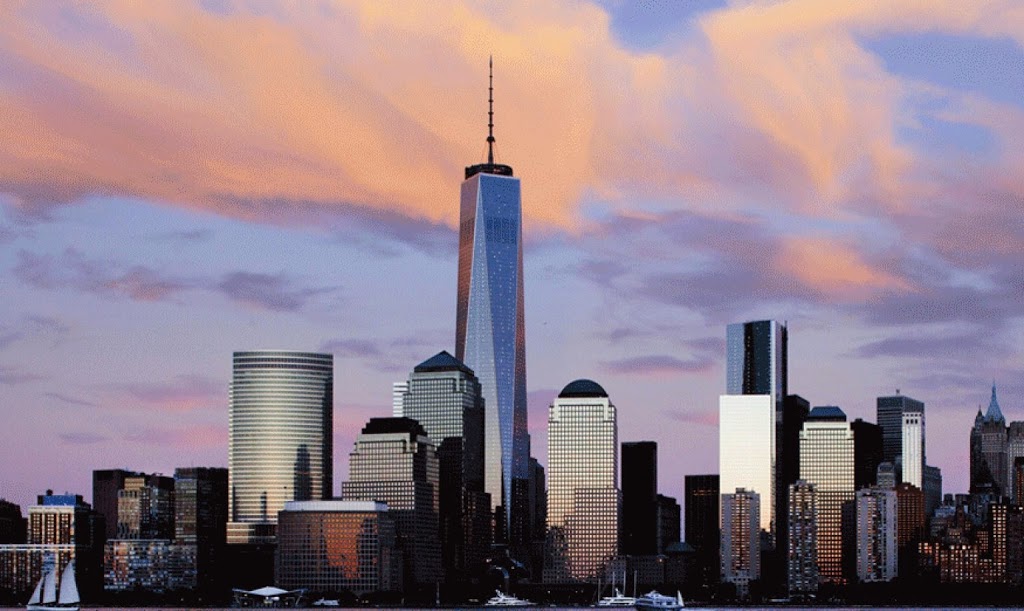
PODCAST One World Trade Center was declared last year the tallest building in America, but it’s a very different structure from the other skyscrapers who have once held that title. In New York, owning the tallest building has often been like possessing a valuable trophy, a symbol of commercial and social superiority. In a city driven by commerce, size matters.
In this special show, I give you a rundown of the history of being tall in New York City, short profiles of the 12 structures (11 skyscrapers and one church!) that have held this title. In several cases, these weren’t just the tallest buildings in the city; they were the tallest in the world.
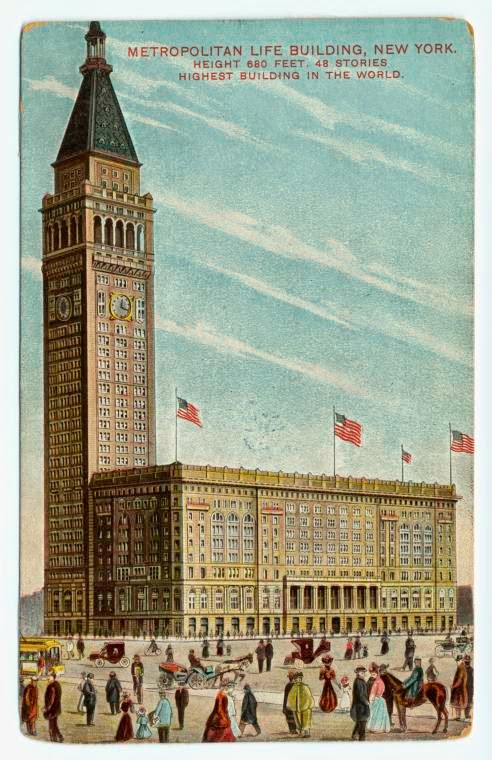
At right: The Metropolitan Life Building, the tallest building in the world in 1909
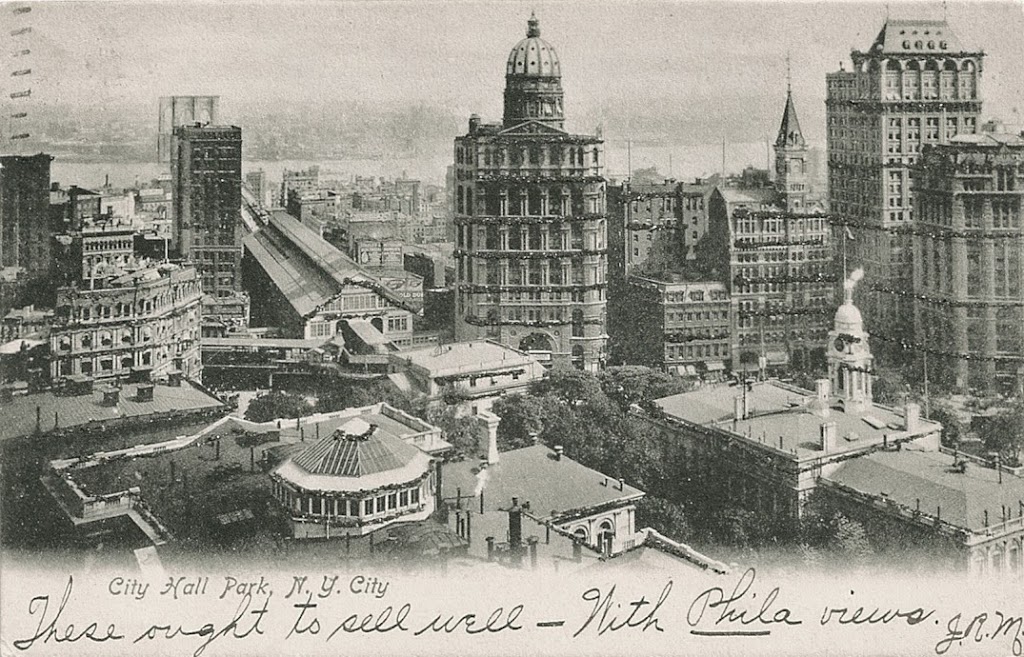
Skyscrapers were not always well received. New York’s tallest building in 1899 was derisively referred to as a “horned monster.” Lower Manhattan became defined by this particular kind of structure, creating a canyon of claustrophobic, darkened streets. But a new destination for these sorts of spectacular towers beckoned in the 1920s — 42nd Street.
You’ll be familiar with a great number of these — the Woolworth, the Chrysler, the Empire State. But in the early days of skyscrapers, an odd assortment of buildings took the crown as New York’s tallest, from the vanity project of a newspaper publisher to a turtle-like tower made for a sewing machine company.
At stake in the race for the tallest is dominance in the New York City skyline. With brand new towers popping up now all over the five boroughs, should be worried that they’ll overshadow the classics? Or should the skyline always be in a constant state of flux?
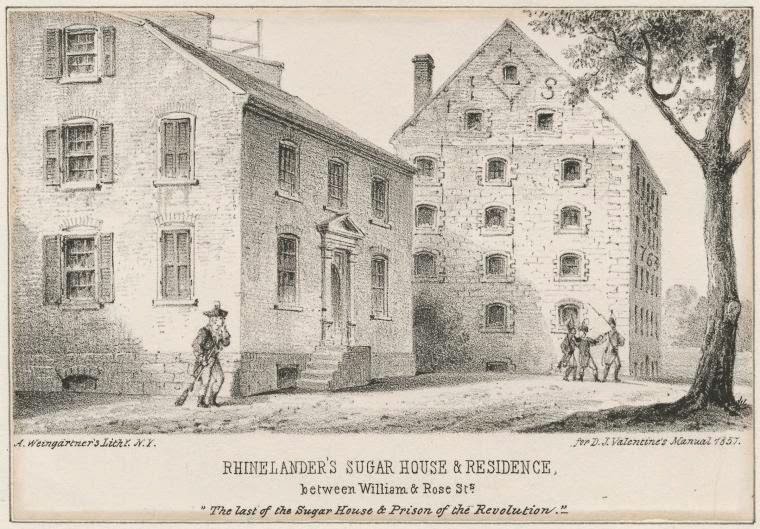
ALSO: New York’s very first tall buildings and the ominous purpose they were used for during the Revolutionary War!
Photo courtesy Huffington Post
The current tallest buildings in New York City (as of 2020) are
1) One World Trade Center — 1,776 feet 2) Central Park Tower (225 West 57th Street) — 1,550 feet 3) 111 West 57th Street — 1,428 feet 4) One Vanderbilt — 1,401 feet 5) 432 Park Avenue — 1,394 feet 6) 30 Hudson Yards — 1,268 feet 7) Empire State Building — 1,250 feet 8) Bank of America Tower — 1,200 feet 9) Three World Trade Center — 1,171 feet 10) 53W53 (MoMA Tower) — 1,050 feet 11 tie) Chrysler Building — 1,046 feet 11 tie) New York Times Tower — 1,046 feet 12) One57 — 1,005 feet
The sugar houses owned by the Rhinelander family. Others owned by the Van Cortlandts and the Livingstons would have all been the tallest structures in the city.
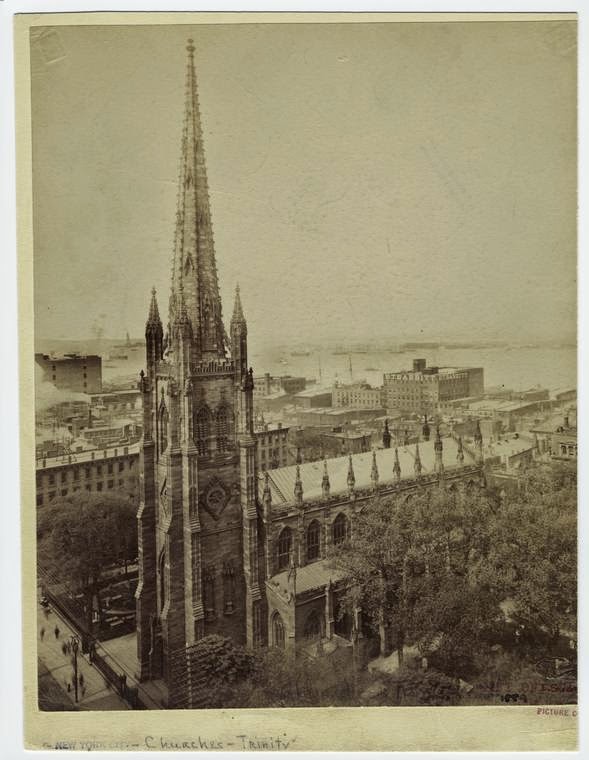
Trinity Church in 1889, the final year that it was the tallest permanent structure in New York City. (NYPL)
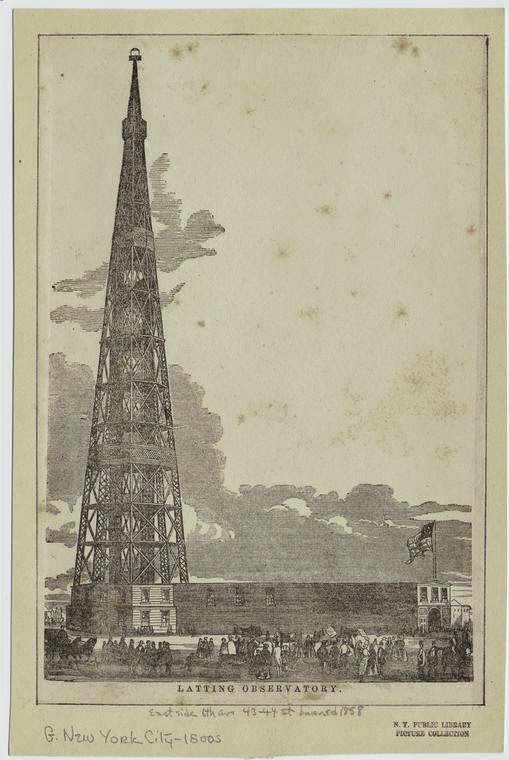
Trinity would be unparalleled in the New York skyline by any permanent buildings for almost 46 years. But the Latting Observatory at the Crystal Palace Exhibition for a short time allowed New Yorkers the highest vantage on the island.
Joseph Pulitzer’s New York World Building, in context with its surroundings, including its proximity to the Brooklyn Bridge. This location would be its undoing, as the building was demolished later to make way for an automobile ramp. (Courtesy Rotograph Project)
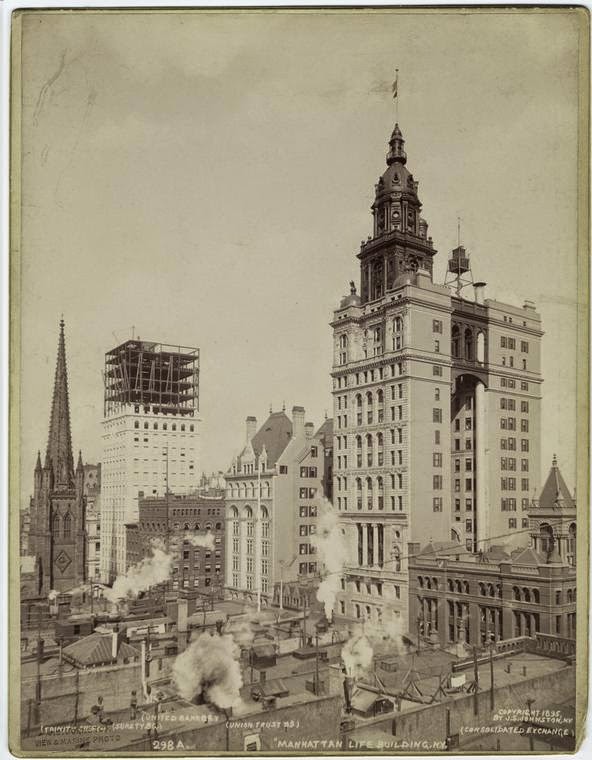
The Manhattan Life Insurance Building became a new neighbor for Trinity Church in 1894. Its lantern top served as a lighthouse and an office for the New York Weather Bureau. (NYPL)
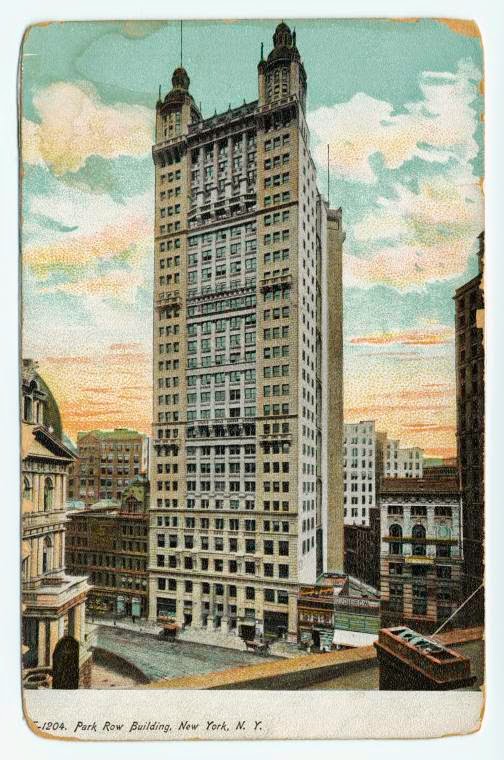
The Park Row Building, the original ‘twin towers’ of lower Manhattan, was criticized for its two-dimensional design but it’s managed to survive into modern times. It used to host J&R Music World on its ground floor until that business closed last year.
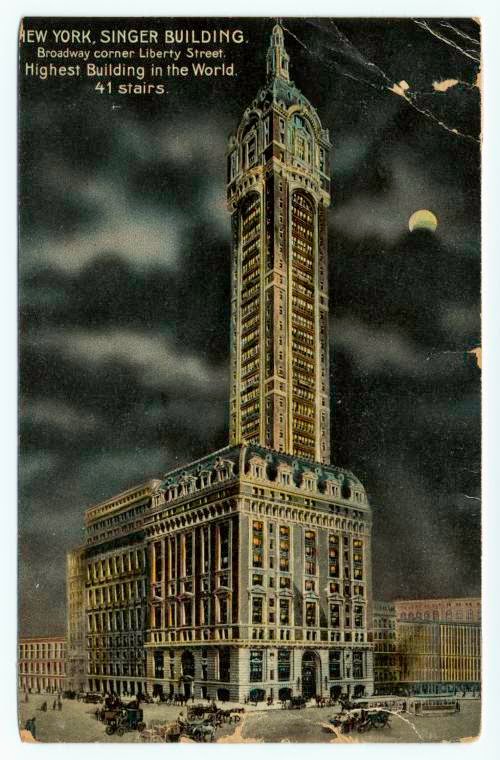
The extraordinarily unusual headquarters for the Singer Sewing Machine Company. The Singer Building has the rare distinction of being the tallest building every purposefully torn down when it was demolished in the 1960s.
Madison Square was already graced with both the Flatiron Building (below) and Madison Square Garden when it finally got its tallest skyscraper….. (NYPL)
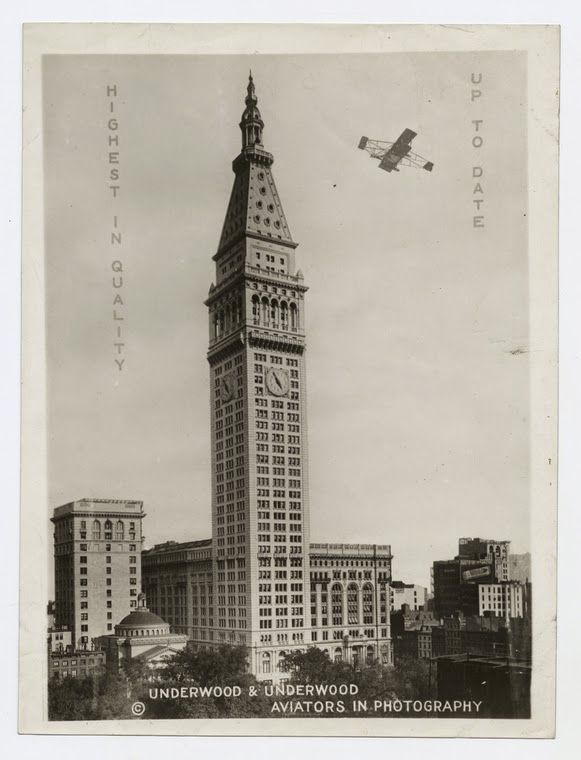
…the Metropolitan Life Insurance Tower, pictured here with an early airplane above it, in a postcard produced by Underwood & Underwood. (NYPL)
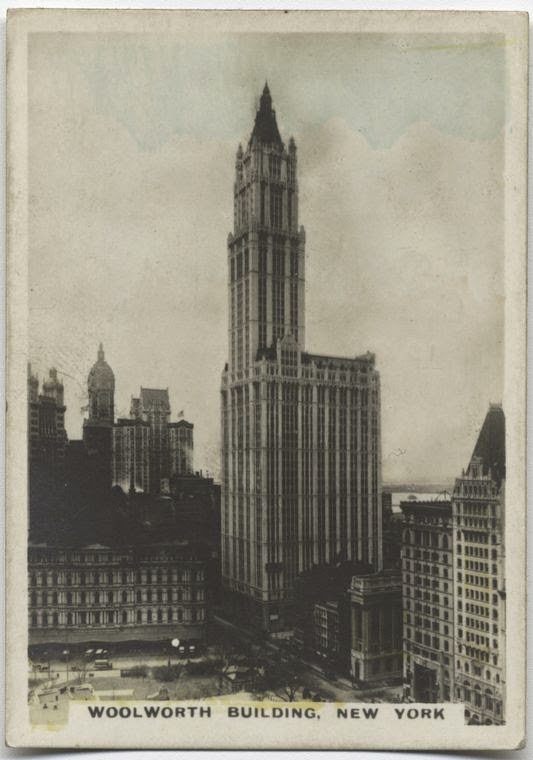
The Woolworth Building (featured here on a cigarette card) is one of the greatest extant examples of pre-zoning law construction with no setbacks along the front side.
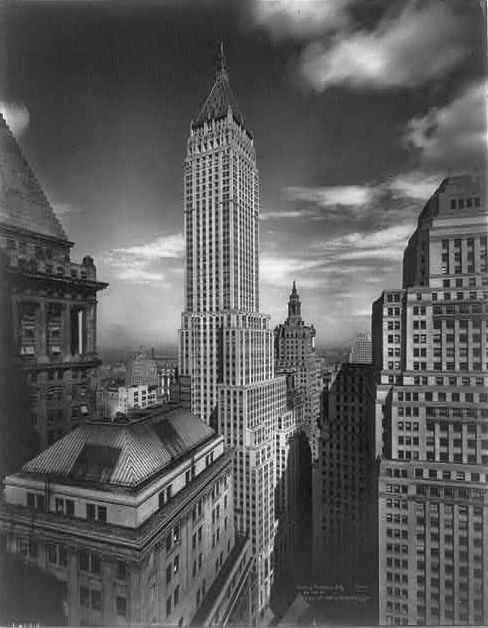
The Manhattan Company Building (or 40 Wall Street) sat among a host of other skyscrapers and was only briefly the city’s tallest building until Walter Chrysler and William Van Alen debuted their surprise uptown.
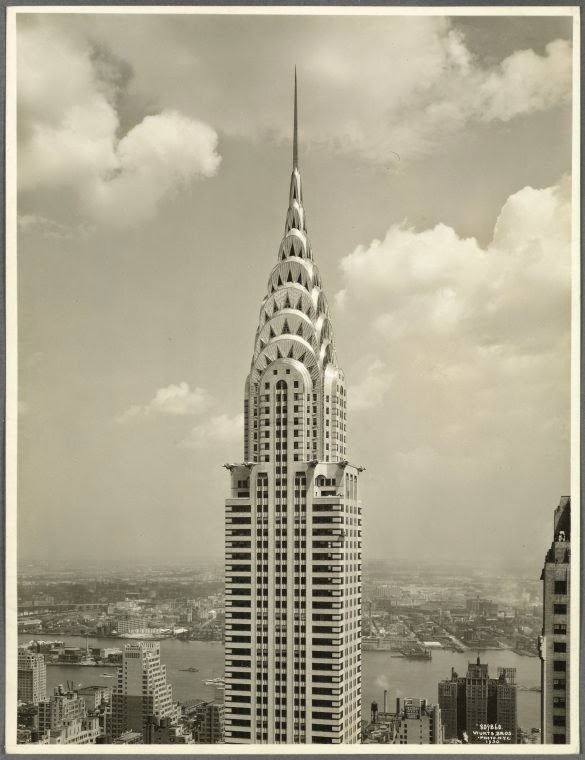
The Chrysler Building in 1930 with its spire freshly attached to the top, making it (for a little over a year) the tallest building in the world.
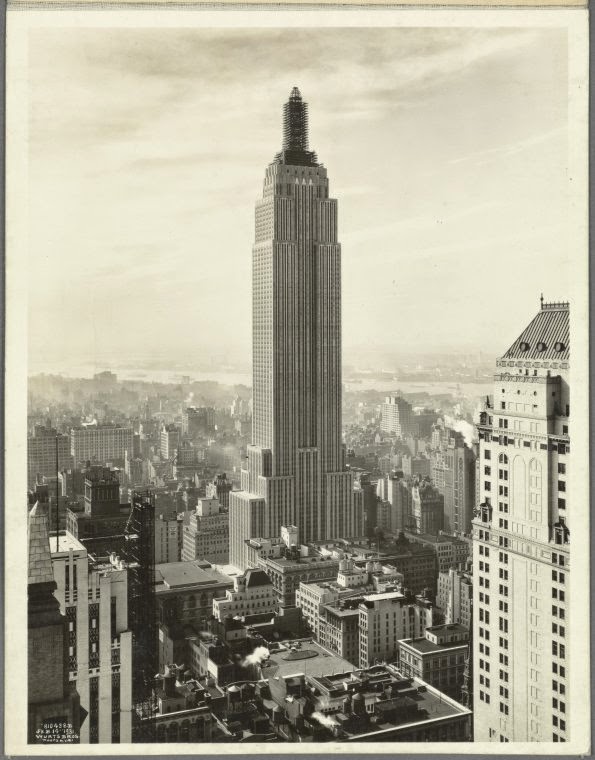
The Empire State Building became the tallest building — and the defining symbol of New York City — thanks to a determined executive from General Motors and Al Smith, the former governor of New York.
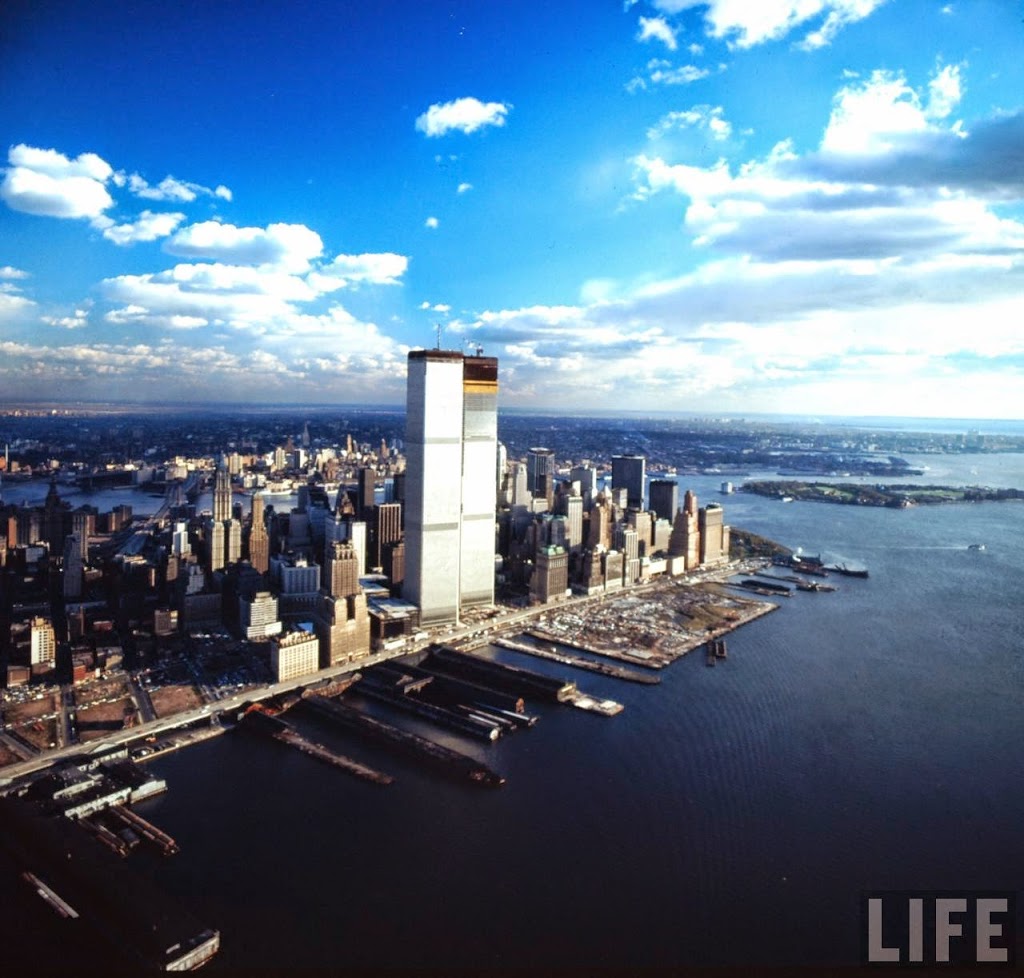
The World Trade Center returned attention to lower Manhattan and set a new record for height, literally leaving other former record holders in its shadow. (Photo courtesy Life Magazine)
SOURCES and RECOMMENDED READING
AIA Guide To New York City 2014 Empire State Building: The Making Of A Landmark — John Tauranac Higher: A Historic Race to the Sky and the Making of a City — Neal Bascomb Manhattan Manners — M. Christine Boyer Pulitzer: A Life In Politics, Print and Power — James McGrath Morris Rise of the New York Skyscraper — Sarah Bradford Landau Skyscrapers:A Social History of the Very Tall Building In America — George H. Douglas Supreme City — Donald Miller and resources from the Landmark Preservation Commission and the New York Skyscraper Museum
The opening of Siegel-Cooper department store, 1896, created one of the great mob scenes of the Gilded Age. Today, TJ Maxx and Bed Bath and Beyond occupy this once-great commercial palace. PODCAST Ladies’ Mile — the most famous New York shopping district in the 19th century and the “heart of the Gilded Age,” a district of spectacular commercial palaces of cast-iron. They are some of the city’s greatest buildings, designed by premier architects.
Unlike so many stories about New York City, this is a tale of survival, how behemoths of retail went out of business, but their structures remained to house new stores. This is truly a rare tale of history, where so many of the buildings in question are still around, still active in the purpose in which they were built.
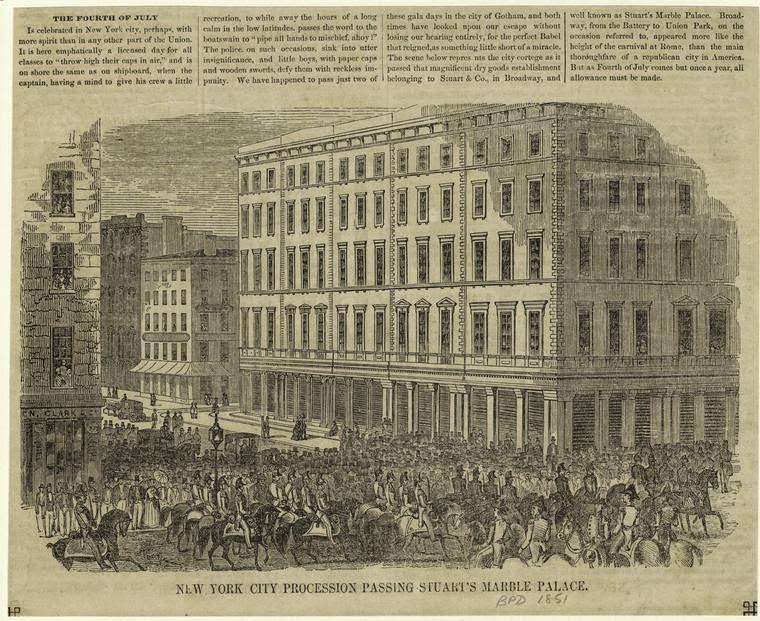
We start this story near City Hall, with the original retail mecca of A.T. Stewart — the Marble Palace and later his cast-iron masterpiece in Astor Place. Stewart set a standard that many held dear, even as his competitors traveled uptown to the blocks between Union Square and Madison Square.
Join us on this glamorous journey through the city’s retail history, including a walking tour circa 1890 (with some role play involved!) of some of the district’s best known buildings.
PLUS: Why is Chelsea’s Bed Bath and Beyond so particularly special in this episode? You’ll never buy towels there the same way again!
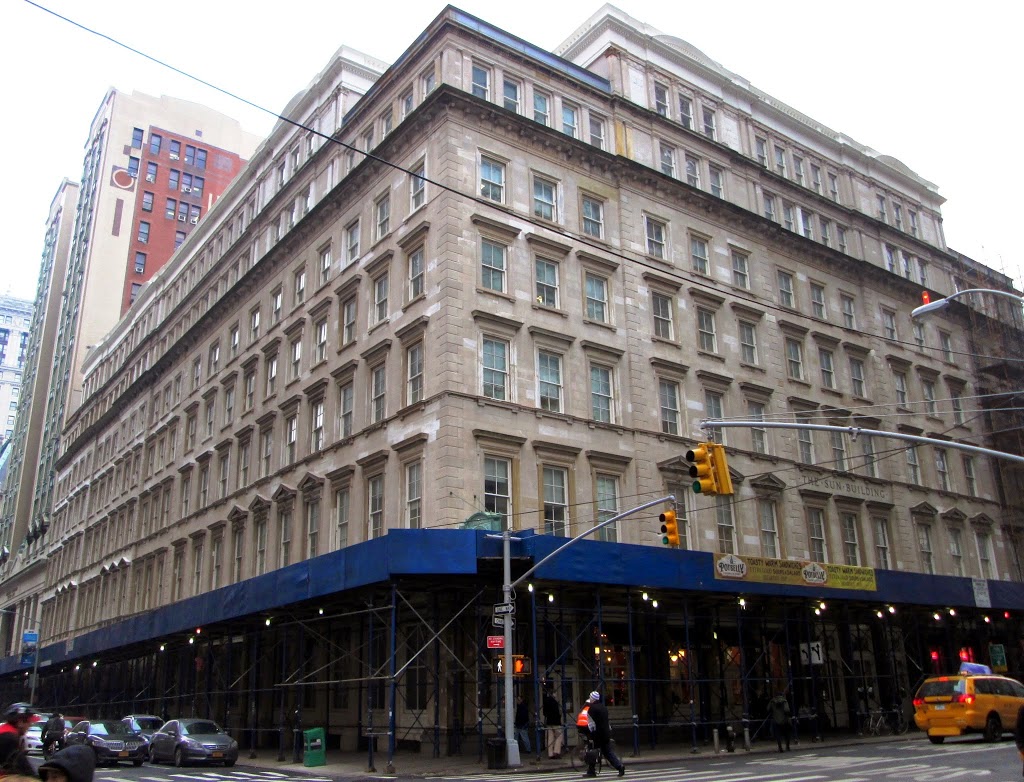
America’s first department store — A.T. Stewart’s Marble Palace, near City Hall. The building is actually still there today! The address is 280 Broadway. (Courtesy NYPL)
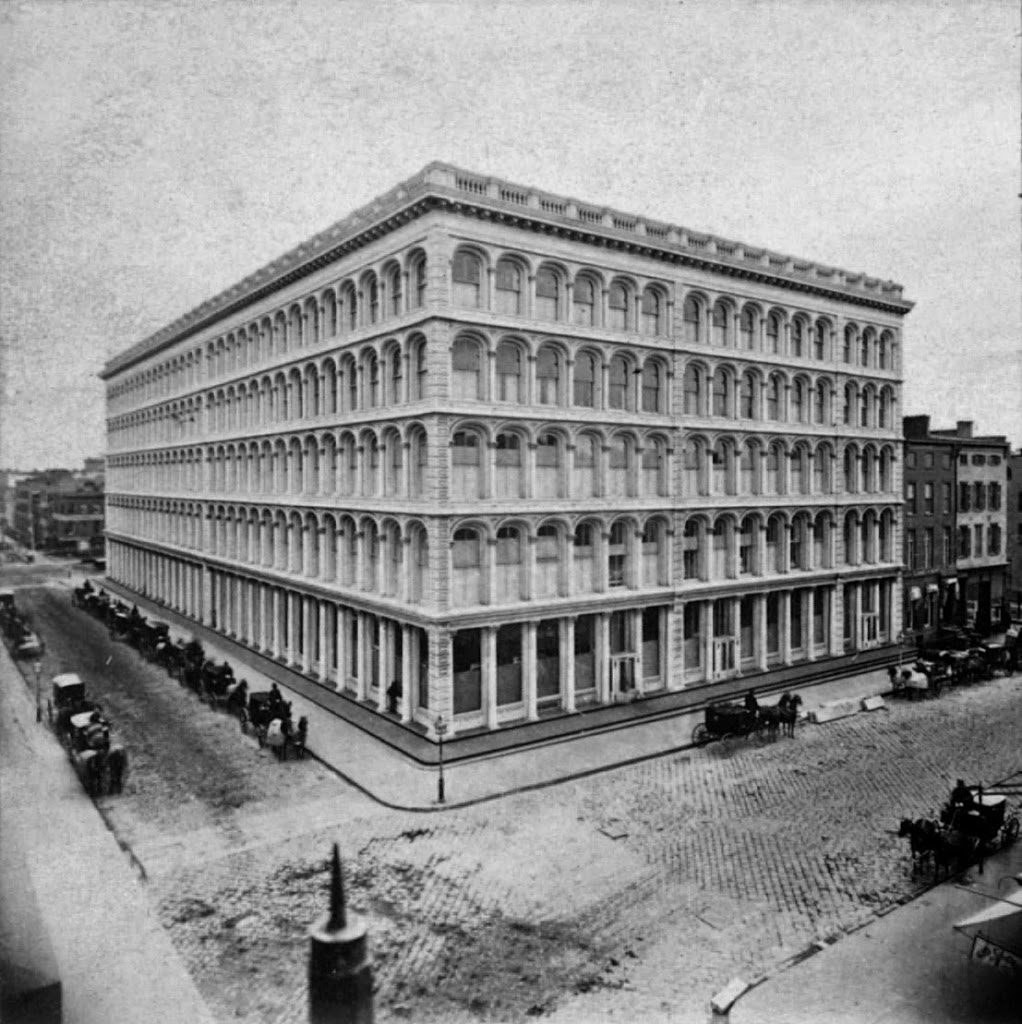
Stewart’s even more celebrated department store at Astor Place, nicknamed the Iron Palace with its cast-iron construction. Unlike Stewart’s first store, this one is no longer there. (NYPL)
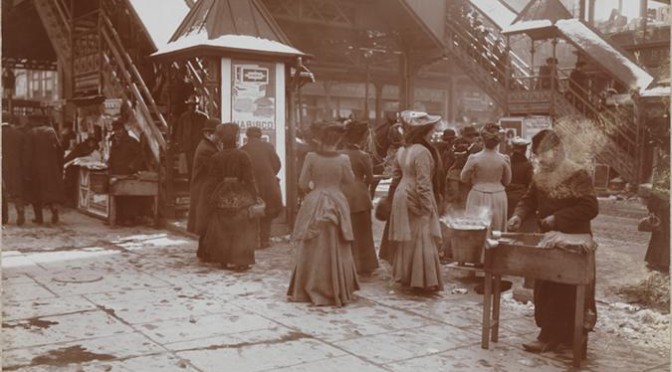
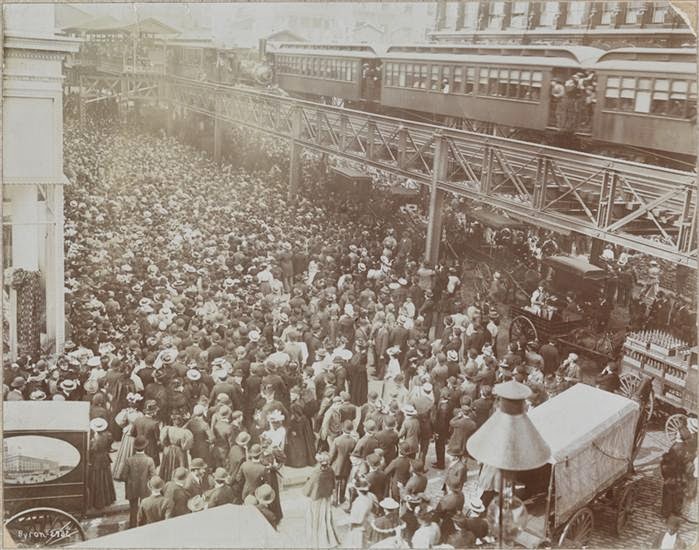
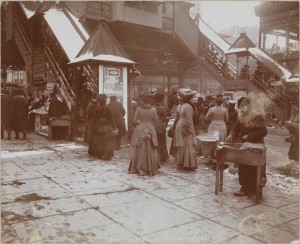
1903: Ladies on a freezing day, surrounding the 23rd Street entrance to the Sixth Avenue Elevated Railroad, placing them just a few blocks from the biggest department stores in the world. (Courtesy Museum of the City of New York)
The entrance to Stein Brothers on 23rd Street. There’s a Home Depot in this building today, but you can still see the SB insignia over the door. And below, the street scene in 1908.(Photo: Edmond V Gillon, MCNY)
Adams Dry Goods, decades after the shop at closed. In later years, it was a Hershey’s plants and a military storage space. Today, on the ground floor, there’s a Trader Joe’s grocery store. (Photo: Edmond V Gillon, MCNY)
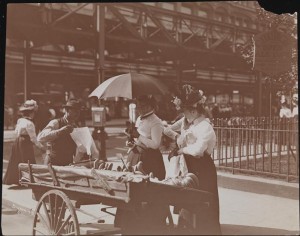
1901: Women in front of the Church of the Holy Communion, the elevated train in back of them. (MCNY)
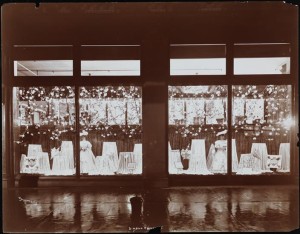
The windows at Simpson Crawford Co. at Sixth Avenue and 20th Street, 1904. (MCNY)
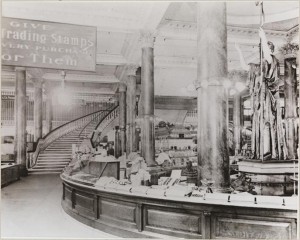
The Siegel-Cooper department store fountain, with a statue of Republic (by Daniel Chester French) and electric lights in a kaleidoscope of colors. And, below it, another view of Siegel Cooper from the opposite side of the tracks. (MCNY)
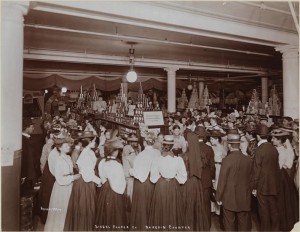
Ladies in the Siegel Cooper canned goods department. The store canned its own food. Very organic! (MCNY)
An overhead shot of Macy’s at 14th Street and the Sixth Avenue elevated railroad station. (MCNY)
Lord & Taylor’s, at Broadway and 20th Street, 1904. (Wurts Brothers, MCNY)
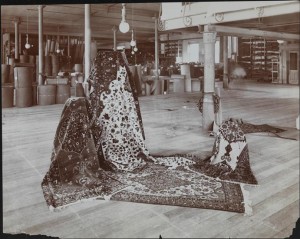
Inside WJ Sloane, Carpets Rugs and Furniture, at Broadway and 19th Street (MCNY)
The Flatiron Building, completed in 1902, is considered part of the Ladies Mile Historic District, even though it was never a department store.
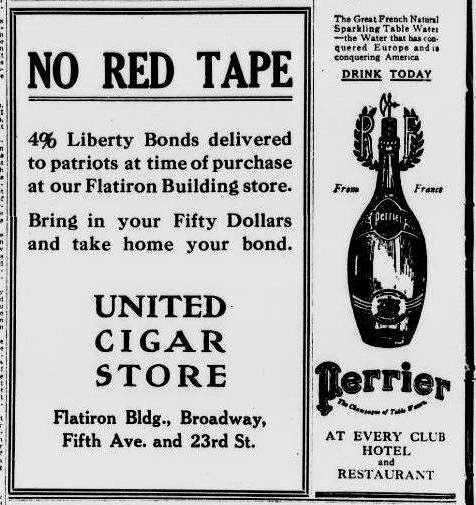
At the very first-floor corner of the Flatiron Building once sat the trusty United Cigar Store. Being so striking a location in such an unusual building, the cigar store was often decorated occasions.
For instance, one hundred years ago today (April 1, 1914), the windows were filled with 7,150 silver dollars as part of a promotion by the New York Tribune for a newspaper quiz.
“The money is in shining, new silver dollars, and the glittering pile possessed marked magnetic qualities, drawing thousands of shoppers and business men. The situation of the window gave Broadway and Fifth Avenue equal and simultaneous opportunities to gaze at the treasure.” [source]
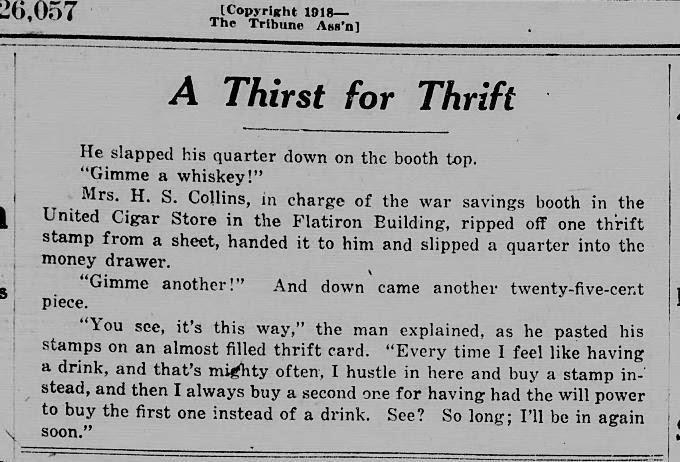
Something more unusual arrived atop the little cigar store a few years later. With America’s entry into World War I, the patriotic owner of the cigar store donated the space for a recruiting center for the U.S. Navy. Atop the store were decorative flags and replicas of naval cannons. A war-stamps salesman would stand astride the cannons and beckon pedestrians to purchases war stamps.
The flamboyant show had a profound effect, as illustrated in this front-page anecdote from March 20, 1918
For a time, the cigar store was one of New York City’s centers for the war effort, an ideal and attractive spot in one of New York’s busiest intersections. During one such campaign drive, society ladies operated the booths inside while the military band played on the roof, between the cannons. During the day, there were various demonstrations on front of the cigar store, including one for the Browning machine gun!
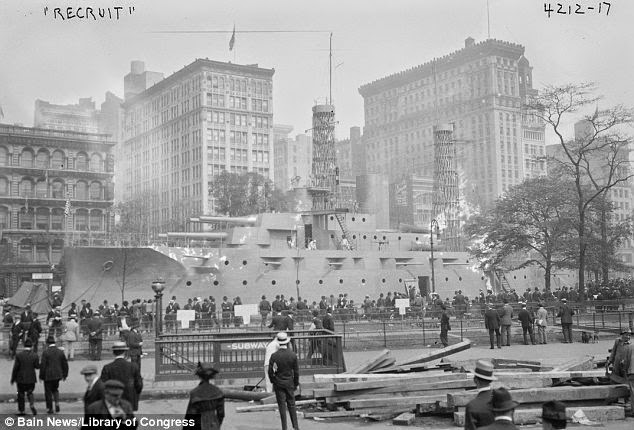
To give you a little bit more context of how dramatic this all was, down the street in Union Square sat a wooden Naval battleship, the U.S.S. Recruit. (Read more about New York’s World War I efforts in my article last year on the history of the wartime doughnut.)
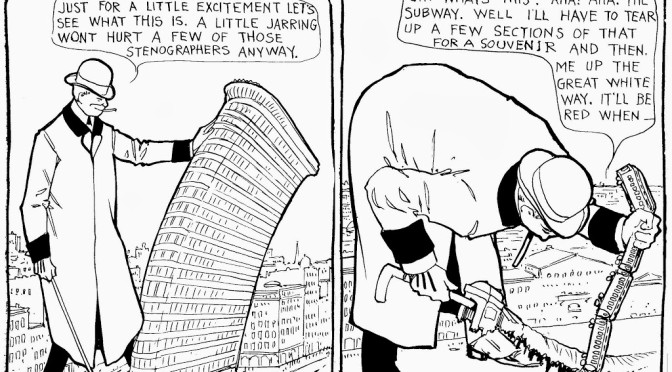
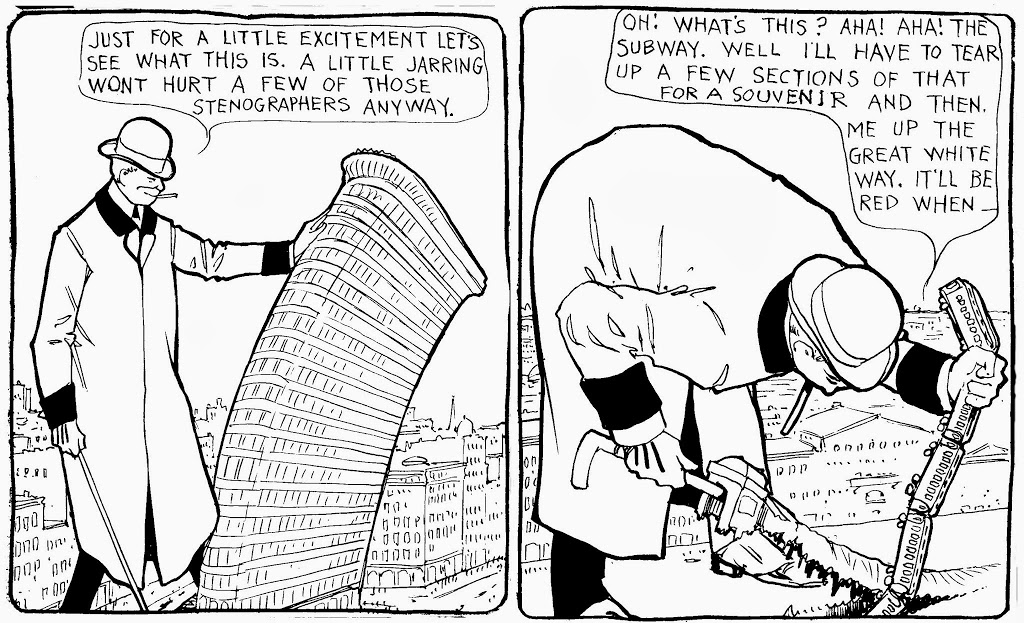
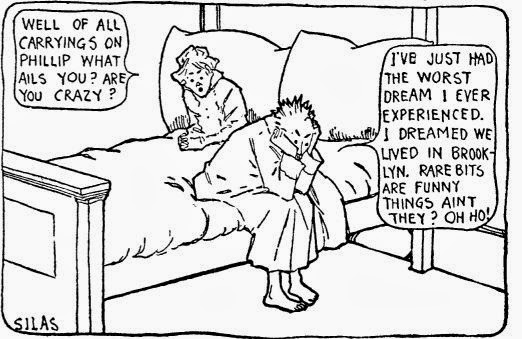
Above: Food can do strange things to you at night: an excerpt from McCay’s January 7, 1905 strip, published two days after the one printed in full below.
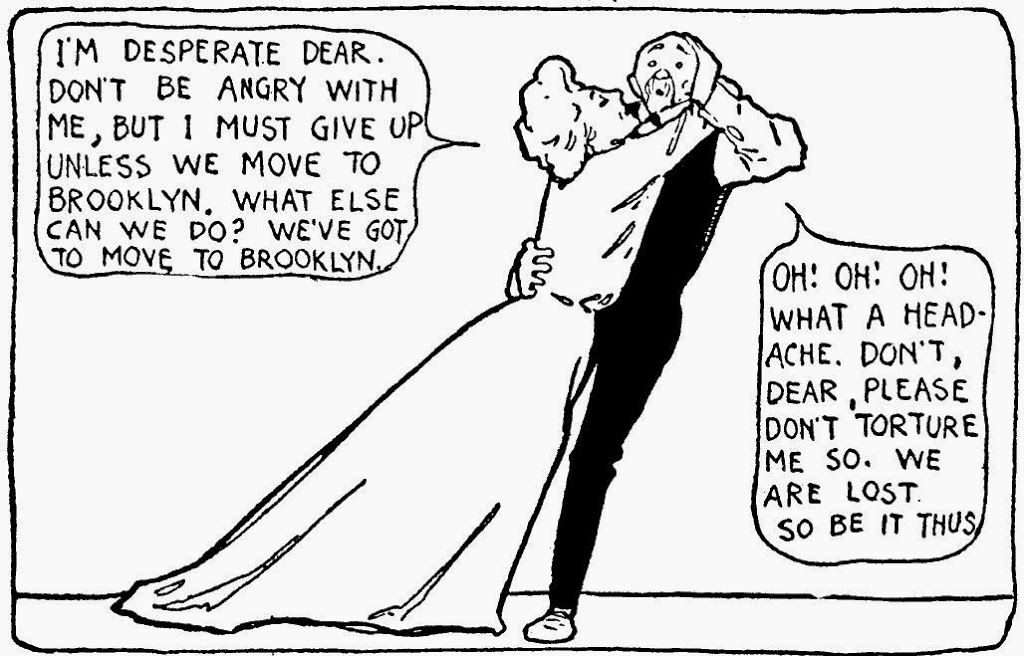
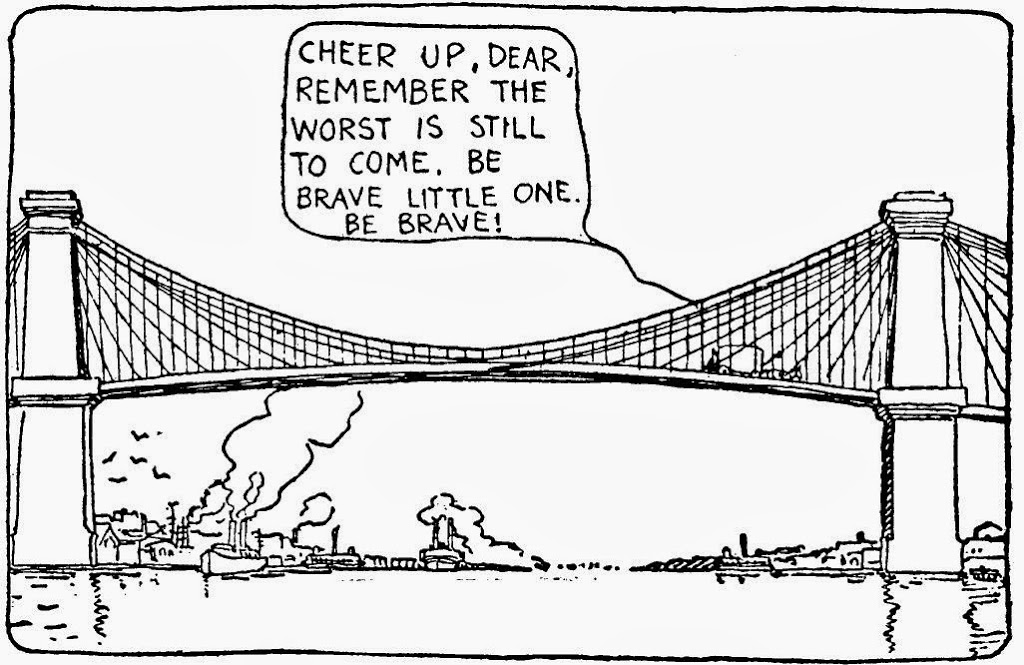
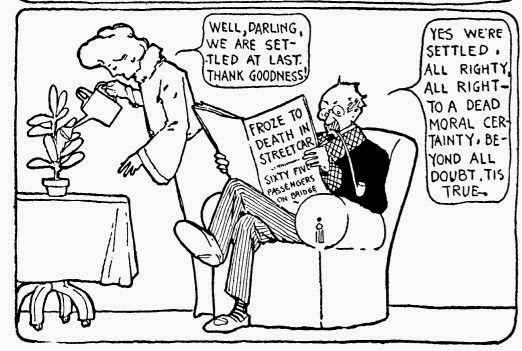
Dream of the Rarebit Fiend was one of America’s first great comic strips and easily one of the weirdest. Each eight-panel or nine-panel strip featured an individual trapped within a situation nightmarish for its day, only to be woken up in the final panel. The cause for the dream was almost always the same — a meal of rarebit the night before.
Written by Winsor McCay (of Little Nemo fame), this extraordinary oddity ran in various New York newspapers starting in 1904, with various spin-offs and revivals well into the 1920s. McCay was a favorite of publisher William Randolph Hearst, who often stifled the illustrator’s unrelated endeavors to keep the popular artist loyal to Hearst’s publications.
You can find the entire collection of these fascinating little adventures here.
Rarebit — a hot cheesy sauce poured over toasted bread — seems to have had profound effects on the subconscious. It was able to vividly extract the fears of New Yorkers at night. While most were magnificently surreal, others touched on modern issues like crowded trains, uncontrollable automobiles and fast streetcars.
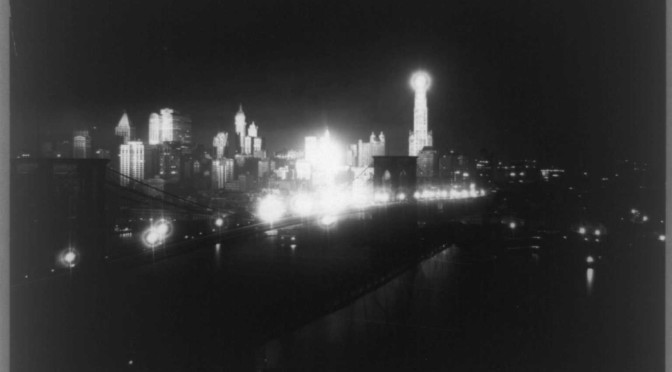
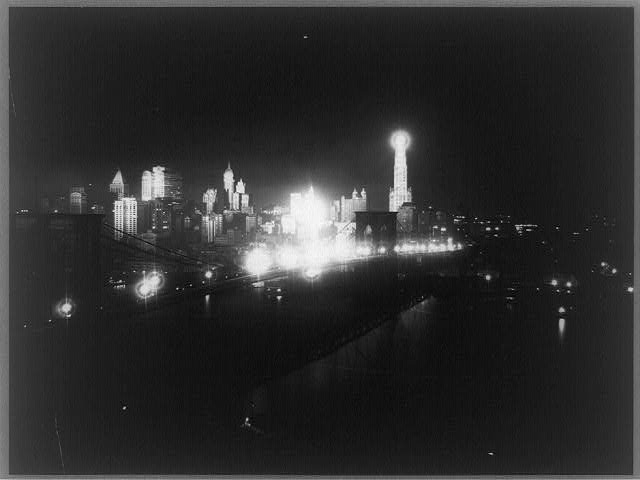
That Gotham glow: The powerful Sperry searchlight drapes the dark city in light. The Woolworth Building is lit up like a candle.
A thin, bright streak of light brushes across the sky and dances off the clouds above. With few buildings over fifteen stories and the city’s electrical lights at a fraction of the intensity that they are today, the white piercing beam would have awakened the night sky, the most powerful illumination in the sky with the exception of the moon.
It was March of 1919, and the device creating this expressionistic Gotham nightscape was the Sperry Searchlight.
Since the first arc lights installed along Broadway in 1880, New Yorkers had grown accustomed to electric light. In fact, Times Square and the stretches of Broadway had become New York’s entertainment capital because of it. But searchlights were still a bit of a novelty, devices more associated with wartime. Innovations in electrical light changed how wars were even fought; combatants in World War I aimed spots to the skies to search for enemy zeppelins and scoured the grounds below for encroaching forces.
New Yorkers would have been used to seeing searchlights atop the city’s newest, tallest buildings. The first New Year’s celebration at One Times Square used a searchlight to blanket stunned crowds below. Both the Flatiron Building and the Metropolitan Life Tower in Madison Square were equipped with searchlights during elections. They were an effective way to present information. For the 1908 presidential election, the New York Herald announced that a searchlight atop the Met Life building would swing north if William Howard Taft won and south if the victory went to William Jennings Bryan. That night, the beam turned north.
But the Sperry Searchlight was different. The powerful device, created in the mid 1910s, was described by a science journal of the day in 1917 as ‘the world’s most powerful searchlight’ and as bright as ‘the fiercest sunlight’. “The heat of its focused beam is so intense that it will set paper afire at a distance of two hundred and fifty feet …. It will burn your skin at three hundred feet.’
This intense searchlight was the product of Brooklyn innovator Elmer Ambrose Sperry, whose greatest invention, the gyrocompass, was quickly adopted by the United States Navy and almost immediately changed sea travel forever.
From the Sperry Gyroscope Company — the ten-floor building still stands at 40 Flatbush Avenue Ext. by the Brooklyn entrance to the Manhattan Bridge — the inventor and his team created a host of new items, many for the military. (Did you know that the Sperry Company created the first airplane autopilot?)
In 1919, one version of his new and improved searchlight made a test run, presumably atop the roof of the Sperry building. If you look at where the building is on a map, you can almost trace the beam from the roof along the line of its projection.
Over the Brooklyn Bridge, bouncing off the first line of buildings along the east of Manhattan, and illuminating three of New York’s tallest and best known buildings of the day — the Singer Building (center left), the Park Row building (center right), and the majestic Woolworth Building (the tallest beacon-like structure, center right).
Images like this one weren’t just documents of technological success. (Although good night photography itself was a pretty nifty trick, even in 1919.) They helped build the mythology of the city, which in 1919 was about to go down the rabbit hole of Art Deco and inspire new architects to populate the skyline with more ambitious and futuristic towers.
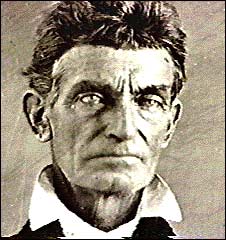
Today is the 150th anniversary of the raid on Harpers Ferry in West Virginia by radical abolitionist John Brown (at left), a failed attempt to free slaves and start a revolution. I recently found this article outlining John Brown’s various visits to New York City. Most notably, Brown met one of his lieutenants here, Hugh Forbes, who fought beside the failed Italian revolutionary Garibaldi.
Brown would often come to Manhattan to visit his son John Brown Jr, who apprenticed at the townhouse office of Fowler & Wells at 131 Nassau Street, near City Hall. (Find a picture of their later office at 27 East 21st Street here.)
What exactly was Fowler & Wells? They were practitioners in the antiquated art of phrenology, an actual 19th century science that gauged a person’s brain capacity, personality and potential based on the size and shape of their skull.
According to the Kings Handbook of New York, the offices of Fowler & Wells featured various phrenology parlors and a lecture room populated with “the casts of heads of people who have been prominent in many ways over the years; also, skulls from many nations and tribes, as well as animal crania, illustrative of phrenology, and constituting a free public museum, and material for instruction in the institute.”
Its founders Orson and Lorenzo Fowler popularized the pseudo-science writing various tomes on the subject like Matrimony, or Phrenology Applied to the Selection of Companions and Phrenology Proved, Illustrated and Applied.
John Brown Sr. actually got his head examined — literally — by Orson Fowler in 1847. His diagnosis? “You have a pretty good opinion of yourself. You might be persuaded but to drive you would be impossible.”
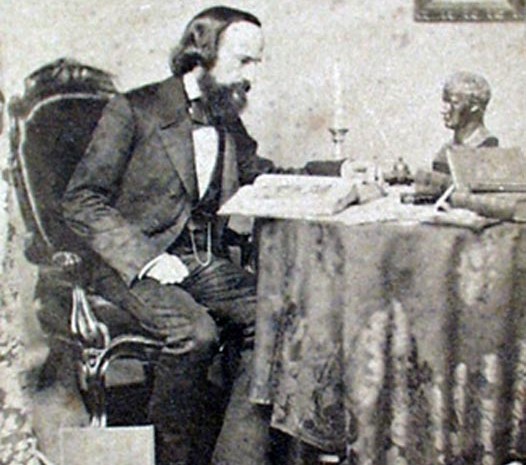
Below: A picture of Lornezo seated in his New York office
Today is primary election day in New York! Locals, have you voted yet? Current mayor Michael Bloomberg is not on the ballot yet — he’ll be on the November ballot — but primary races for City Comptroller, Public Advocate, some city council seats, and the Democratic candidate for mayor are included on today’s ballot
In the past, New Yorkers have celebrated election days with some behaviors and traditions that are no longer with us:
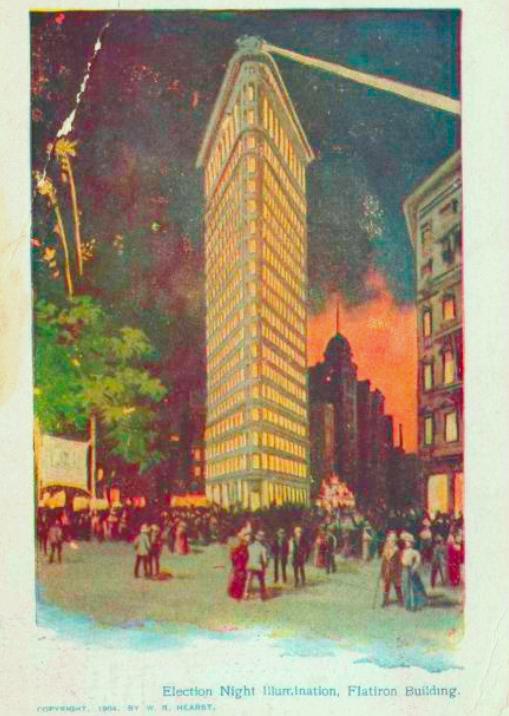
1) Lights and drama at the Flatiron Building I’m unsure of the date of this postcard, however it’s from a time when the Flatiron was one of the city’s tallest buildings. Today we have the Empire State Building to help us celebrate in lights — but the apparent tradition of a swirling spotlight has alas not been replicated.
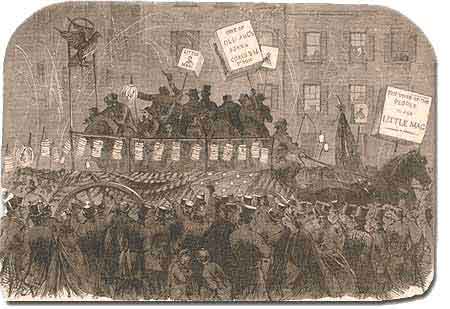
2) Torchlight Parades This image, of one such procession, gathered supporters of George McClellen who tried to wrest the presidency from Abraham Lincoln in 1864. I’ll bet the swillholes of the Bowery were hoppin’ that night.
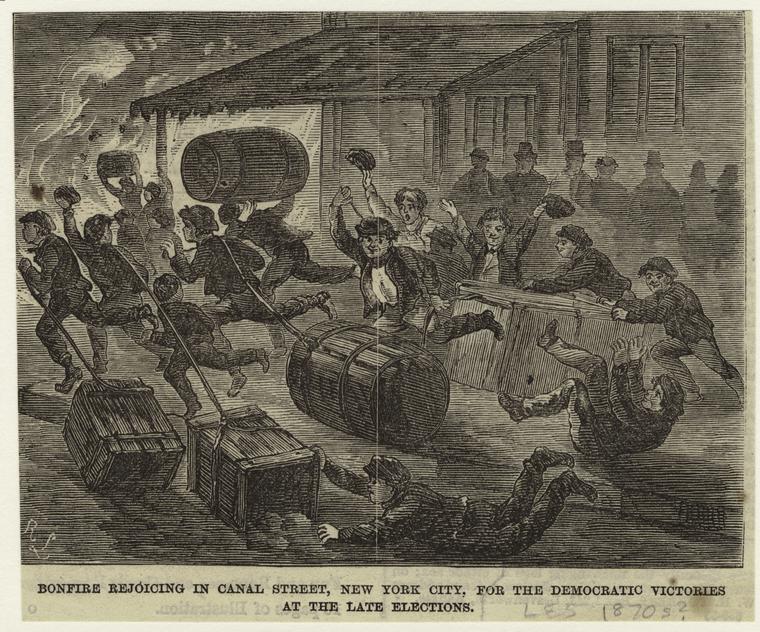
3) Bonfire celebrations on Canal Street In this illustration from Frank Leslie’s magazine, election victory in the 1870s often spawned open fires in the street. Today, candidates are more likely to have a few drinks at the W Hotel than light open blazes on a busy thoroughfare. (Pic courtesy NYPL)
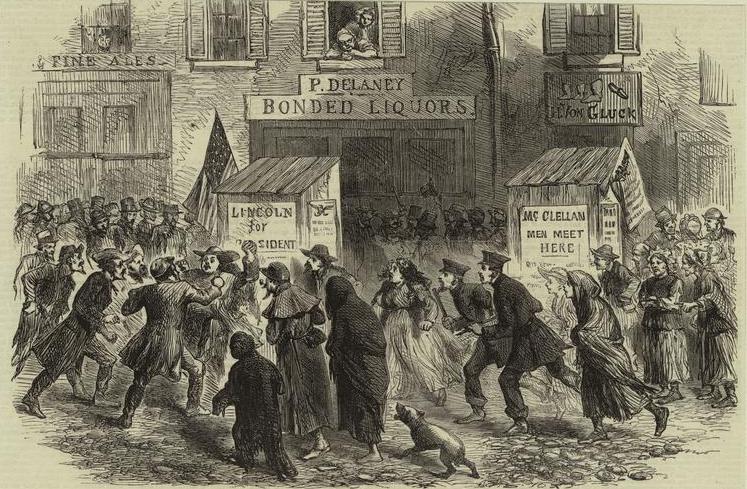
4) Wholesale violence Repeat voting, destruction to polling places and destruction of unfavorable ballots were common practices during more contested elections of the 19th century. The Bowery Boys and other gangs were recruited to create disruption for political parties and create a hostile environment for potential voters. The image below, from the Illustrated London news, lays out the scene during the Lincoln/McClellan faceoff in 1864.
Today, the most hostility you might face are from children fighting past voters to get to their classrooms. (Pic courtesy NYPL)
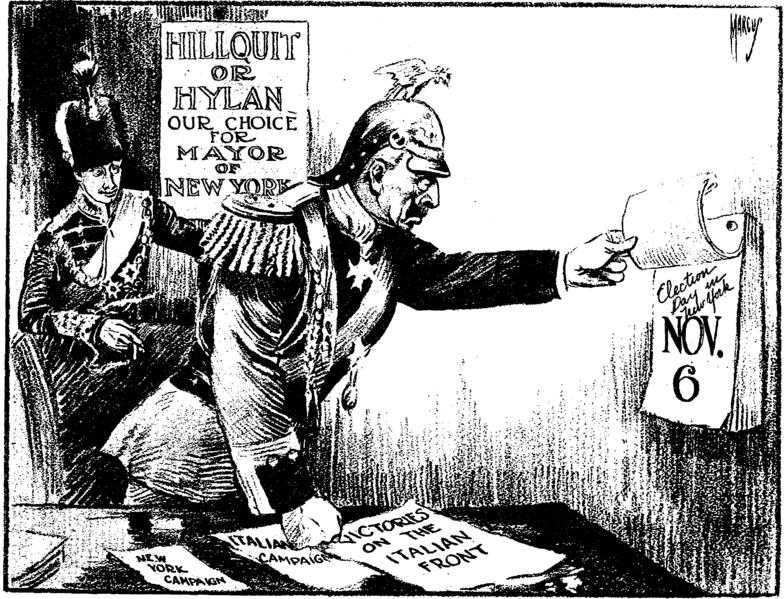
5) Aligning mayoral candidates with World War I emperors This cartoon from the New York Times implies that Kaiser Wilhelm II seemingly supports Democrat John F. Hylan and the Socialist candidate Morris Hillquist. Shudder if that were the case; Hylan ended up winning that election and held the job of mayor for eight years.
Of course, over-dramatic political cartoons and tying leaders to totalitarian regimes is still rather run of the mill in today’s politics. (Pic courtesy Wikimedia)
The Sunday New York Times had an excellent article on the restoration of the film Manhatta, purported to be the ‘first avant garde film’ ever made and one of silent film’s great sightseeing tours of New York City.
The film was a collaboration between photographers Paul Strand and Charles Sheeler, with a little help from Brooklyn-ite Walt Whitman, long dead but represented with pertinent works of poetry on title cards between the images.
Although the restored movie is a whopping ten minutes long, the program, hosted by the Museum of Modern Art, will feature other archival New York footage from the early days, as well as a chat with the restorer and curator Bruce Posner. More details on the viewings of this and other films in the To Save and Project series can be found on their website.
If you plan to go, you’ll probably want to check out what the film looked like pre-restoration:
And since I’m at it, here’s a few views of New York City courtesy of the silent era.
Thomas Edison’s early experiments with film resulted in several shorts capturing New York at the turn of the century, including this one, Skyscrapers of New York
One of my personal favorites from 1903 gives us a look at ‘The Eighth Wonder’, a panorama of the Flatiron Building and its surroundings 105 years ago:
Seven years older and just up the street is this brief glimpse of ‘Herald Square 1986’
And for a little sappy melodrama, why not try this 1912 Mary Pickford weeper, the New York Hat directed by DW Griffith, showing the soothing powers of New York fashion decades before Carrie Bradshaw
What are the Bowery Boys doing in Chicago? Just a little detour in our search for the origins of the Flatiron Building, the wedge shaped, wind producing oddity — built as an office space in a department store neighborhood which grew to become one of the most romantic, elegant buildings in New York City.
This is the place where I usually put up a lot of pictures related to the podcast. However, I don’t think I could do as good a job as NYC Architecture’s great coverage of the Flatiron. Check out their site for a lot of great pictures, including some of the construction.
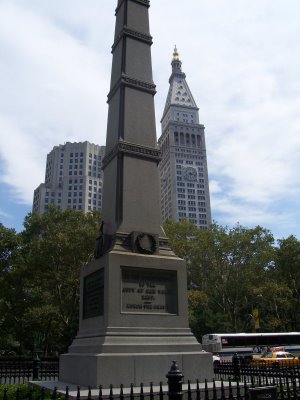
For more information on the Worth Monument — the odd obelisk sitting in the traffic island in front of the Flatiron — read this.
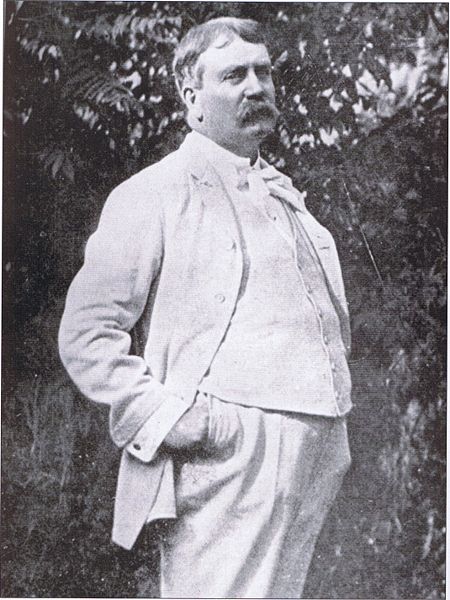
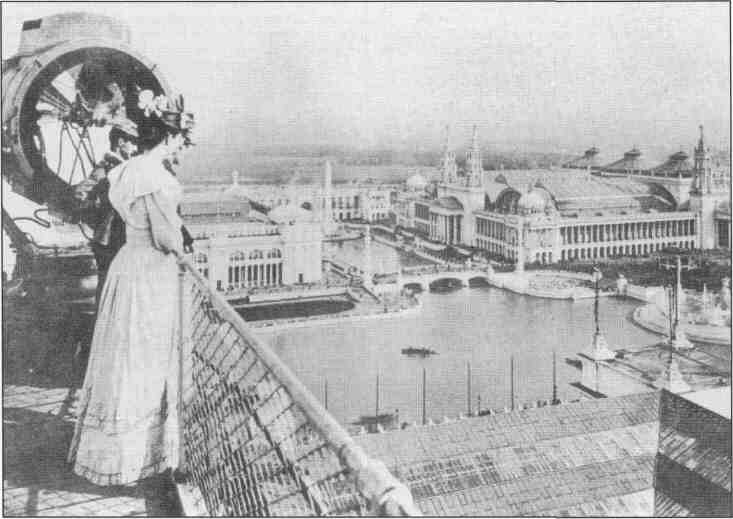
Daniel Burnham, the Flatiron’s architect and planner of Chicago’s White City, among a great many other things.
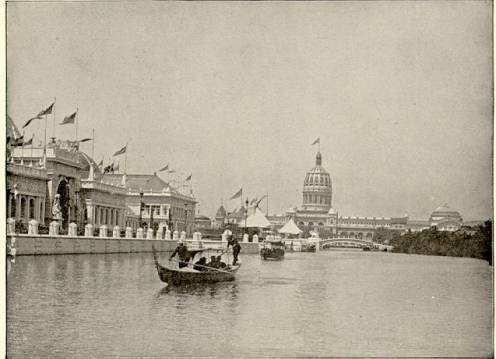
Burnham’s greatest challenge — the World’s Columbian Exposition
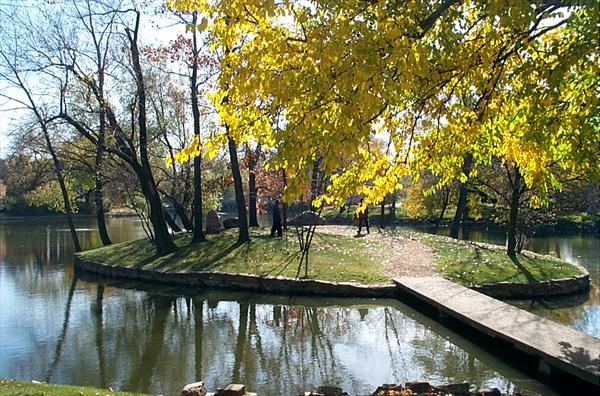
Burnham’s final resting place, at Graceland Cemetery in Chicago:
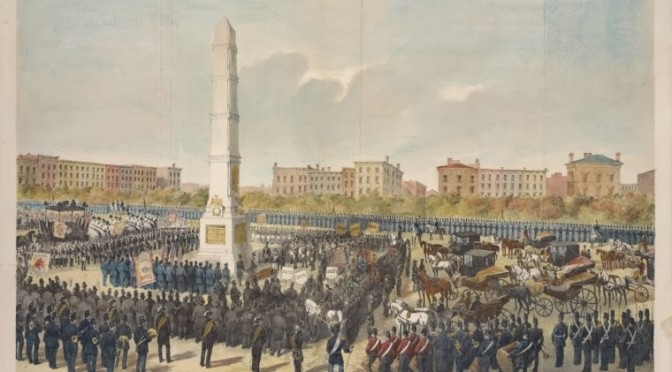
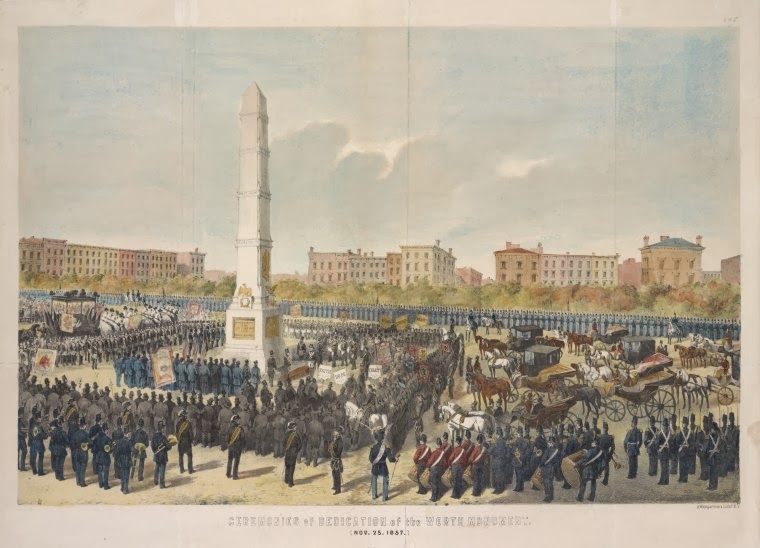
As you can tell from this lithograph of the Worth Monument dedication in 1857, it predates most of the development that surrounds it today. (NYPL)
Few Americans have been so honored by their country that their remains have been buried in the middle of the most famous street in America in their own personal cemetery.
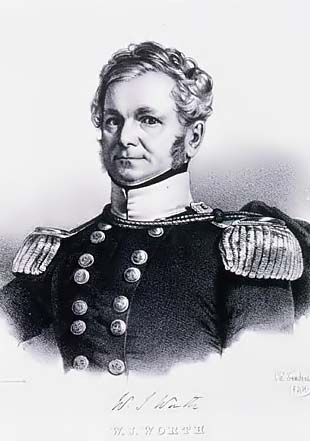
William Jenkins Worth can say that. According to Roadside America, Worth’s is one of only three private graves in all of New York City. Although exactly why he’s been singled out with this particular honor is a bit obscure.
Worth Square, next to Madison Square and just feet from the Flatiron Building, is one of those odd traffic islands that’s hardly a place of peace and repose. Broadway and Fifth Avenue rush by on either side and the traffic of 23rd street hurls by on its south side. But it’s here that a monument stands in honor of Worth, a general in the oft-forgotten Mexican-American War, which won for the United States the state of Texas and, eventually, President George W. Bush.
Worth served admirably in many battles of the conflict, becoming the first general in American military history to engage off the shores of Veracruz in ‘amphibious warfare’ — namely, the strategic usage of approaches from the water to engage in combat on land. In 1847 he also personally hoisted the American flag above the palace in Mexico City after the US’s victorious conquest there.
Within two years he would be dead of cholera, transported to Brooklyn and buried in Greenwood Cemetery, the hotspot for dead celebrities in the 19th century. A few years later, he was dug up, brought to Manhattan, and buried at this unusual spot underneath an impressive obelisk designed by James Batterson (later to be the go-to guy for Civil War monuments). Forgotten NY says that the iron rod gate surrounding this solemn monument is a revered example of iron craftsmanship.
Worth’s remains were placed here in a solemn ceremony on November 25, 1857, involving almost 6,500 soldiers in march. Etched upon the monument is a listing of all the many battle Worth fought in.
Worth was born in Hudson, NY, and briefly moved to Albany, but he has no meaningful connection to New York City. Although I have found no definite conclusion as to why he’s buried here, a couple points to consider don’t make it seem so odd:
— Worth served under then-general Zachary Taylor at the start of the Mexican-American War. By the time Worth died, Taylor was the President of the United States. Certainly some political favoritism was at play.
— The monument’s location was considered peaceful at one time. Adjacent Madison Square opened two years prior and the building boom that would give us Flatiron, the Met Life Tower and the other beautiful buildings surrounding the park wouldn’t occur for decades. The obelisk would have towered over everything. It would have truly been a sincere honor to be placed here.
The respect New Yorkers had Worth extended downtown to Worth Street, which was, incidentally, one of the five streets intersecting to create the notorious Five Points district. Another of the Five Points intersection streets — Baxter Street — is named after Charles Baxter, who died in the Mexican-American War. Another example of a well-meaning gesture of honor distorted by the realities of urban growth.