Categories
Neighborhoods Planes Trains and Automobiles Podcasts

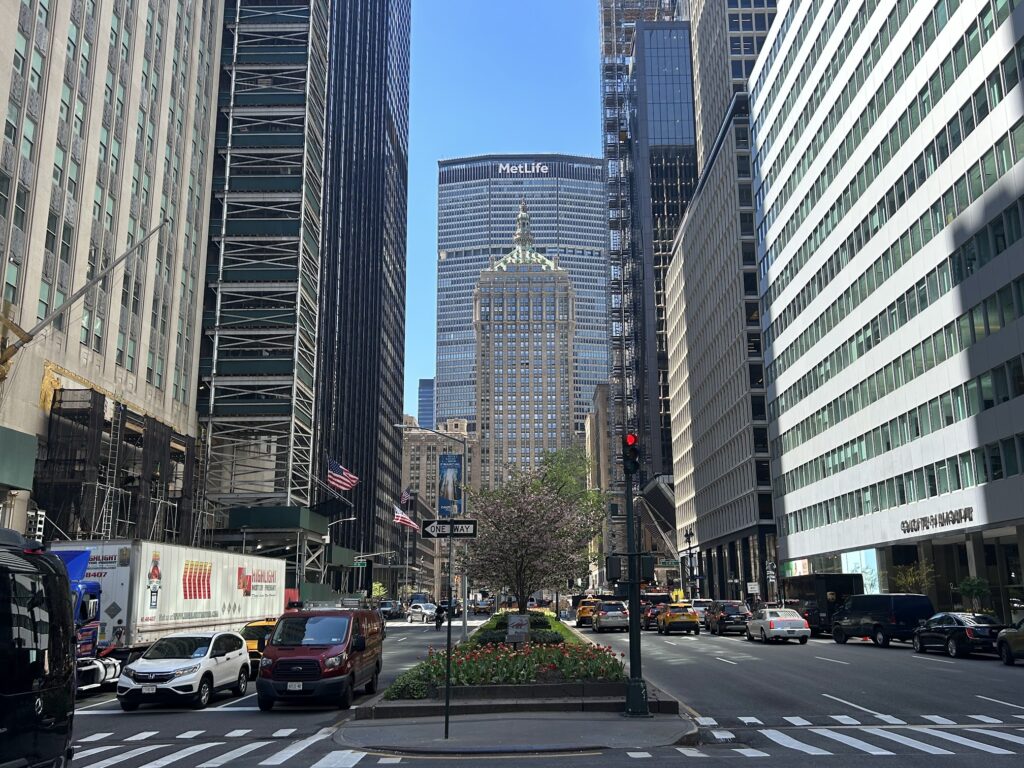
Up and Down Park Avenue: New York City History with a Penthouse View

The story of a filthy and dangerous train ditch that became one of the swankiest addresses in the world — Park Avenue. 

For over 100 years, a Park Avenue address meant wealth, glamour and the high life. The Fred Astaire version of the Irving Berlin classic “Puttin’ on the Ritz” revised the lyrics to pay tribute to Park Avenue: “High hats and Arrow collars/White spats and lots of dollars/Spending every dime for a wonderful time.”

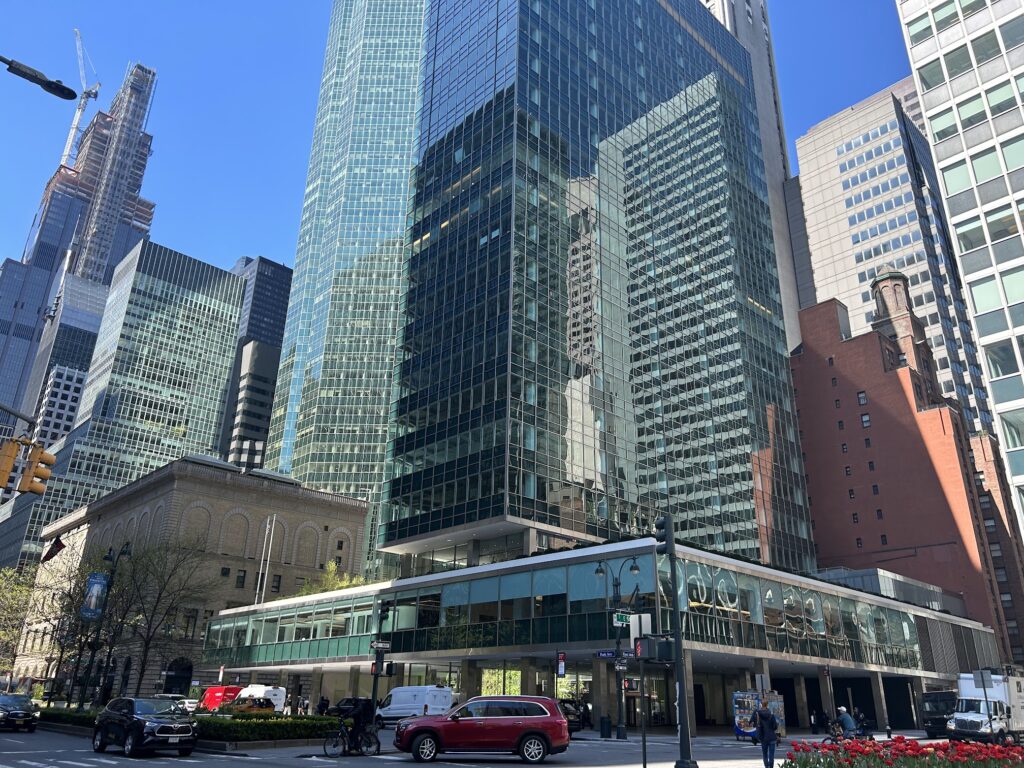
By the 1950s, the avenue was considered the backbone of New York City with corporations setting up glittering new office towers in the International Style — the Lever House, the Seagram Building, even the Pan Am Building. 
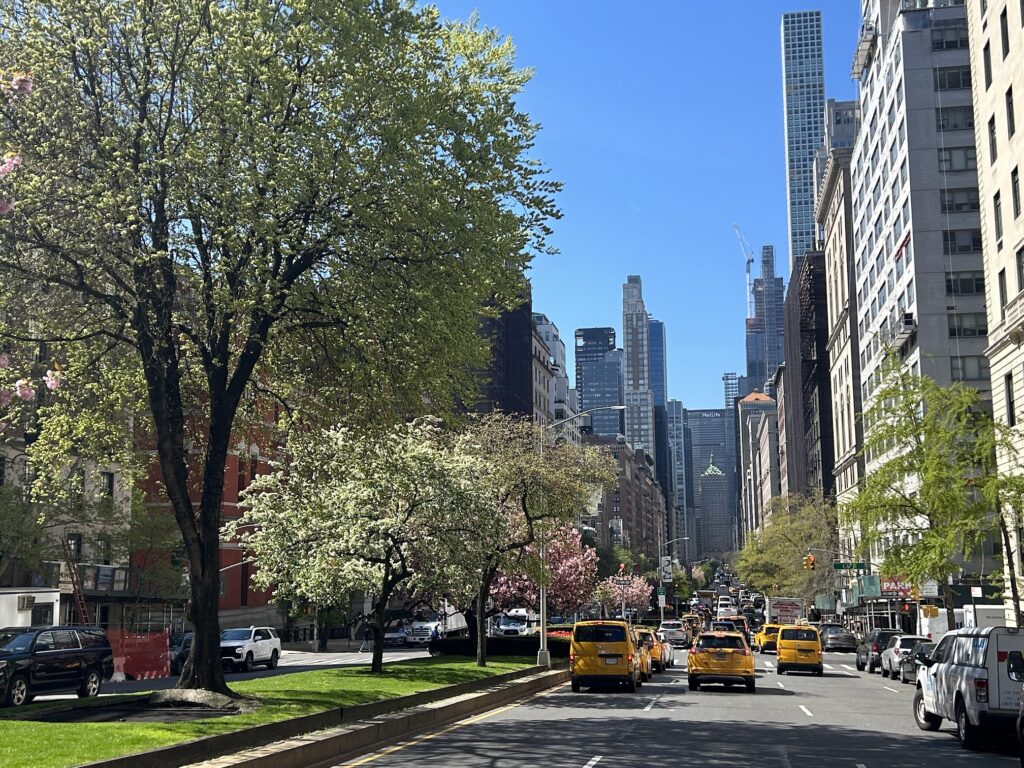
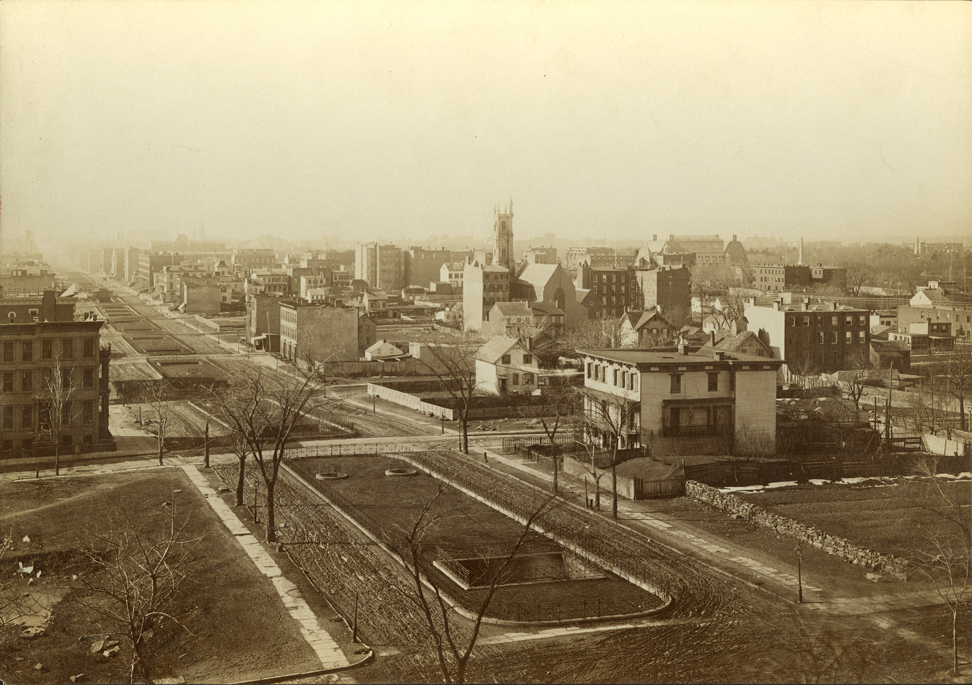
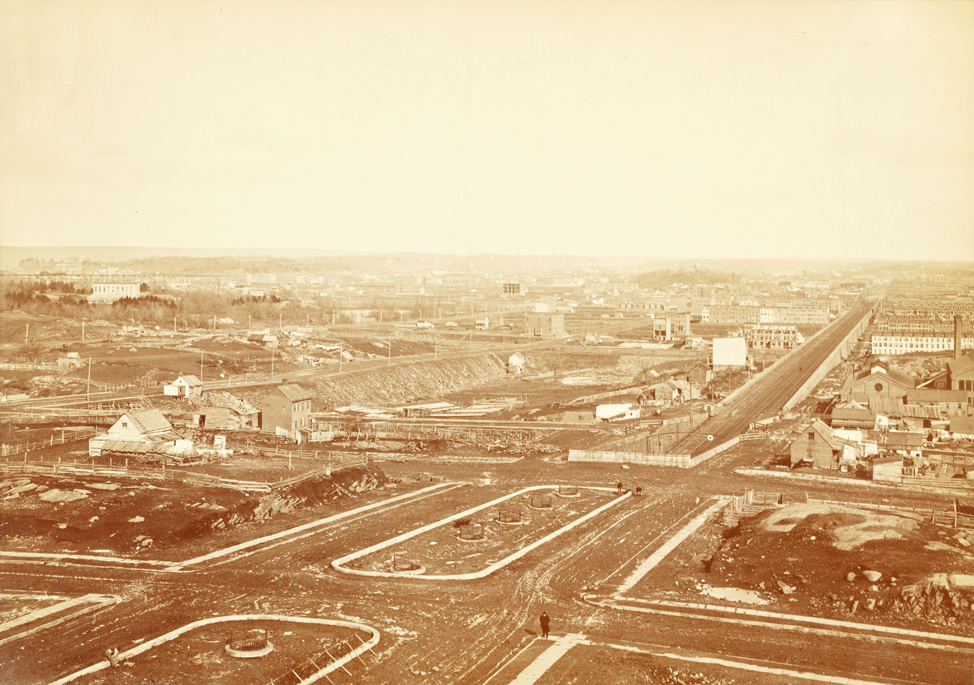
But the foundation for all this wealth and success was, in actually, a train tunnel, originally operated by the New York Central Railroad. This street, formerly known as Fourth Avenue, was (and is) one of New York’s primary traffic thoroughfares. For many decades, steam locomotives dominated life along the avenue, heading into and out of Cornelius Vanderbilt’s Grand Central (first a depot, then a station, eventually a terminal).

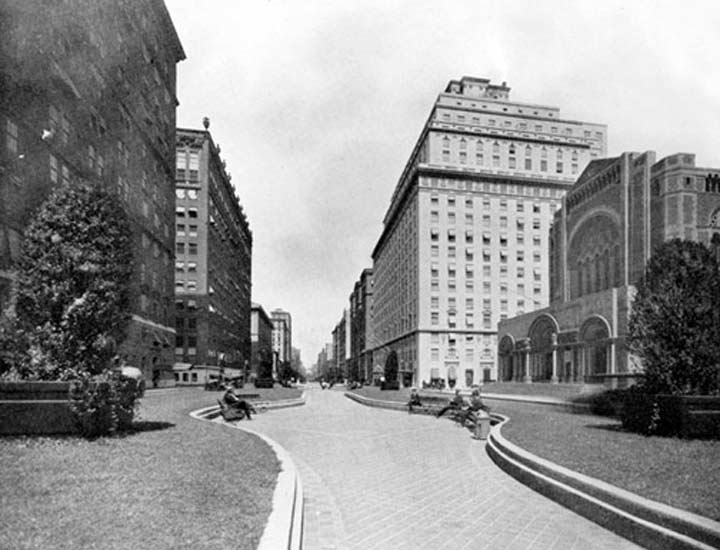
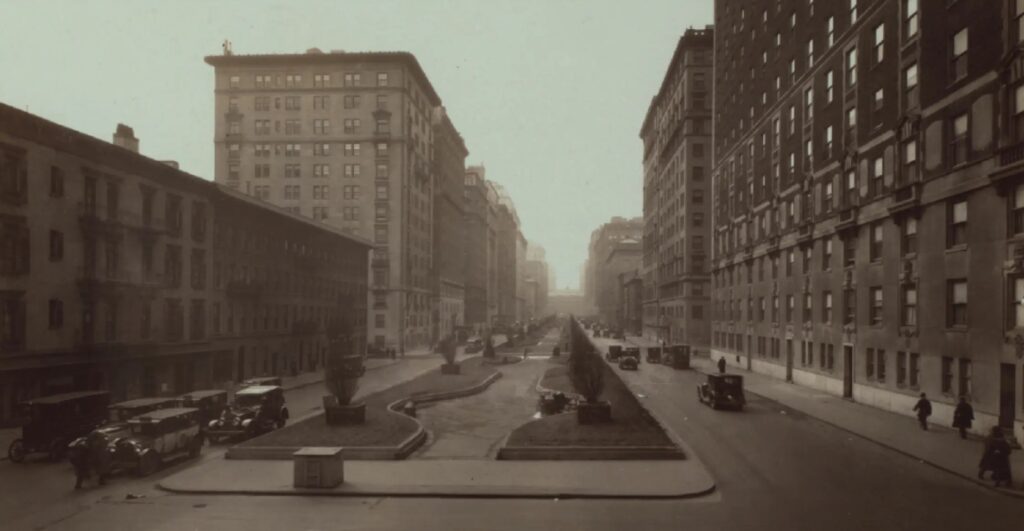
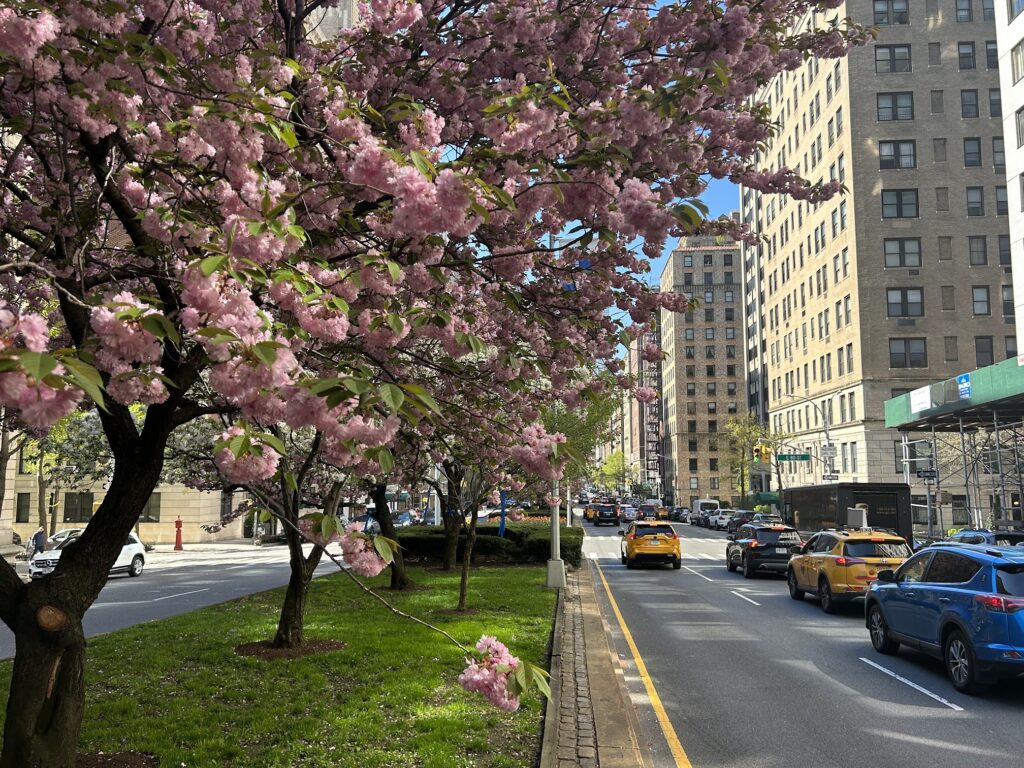
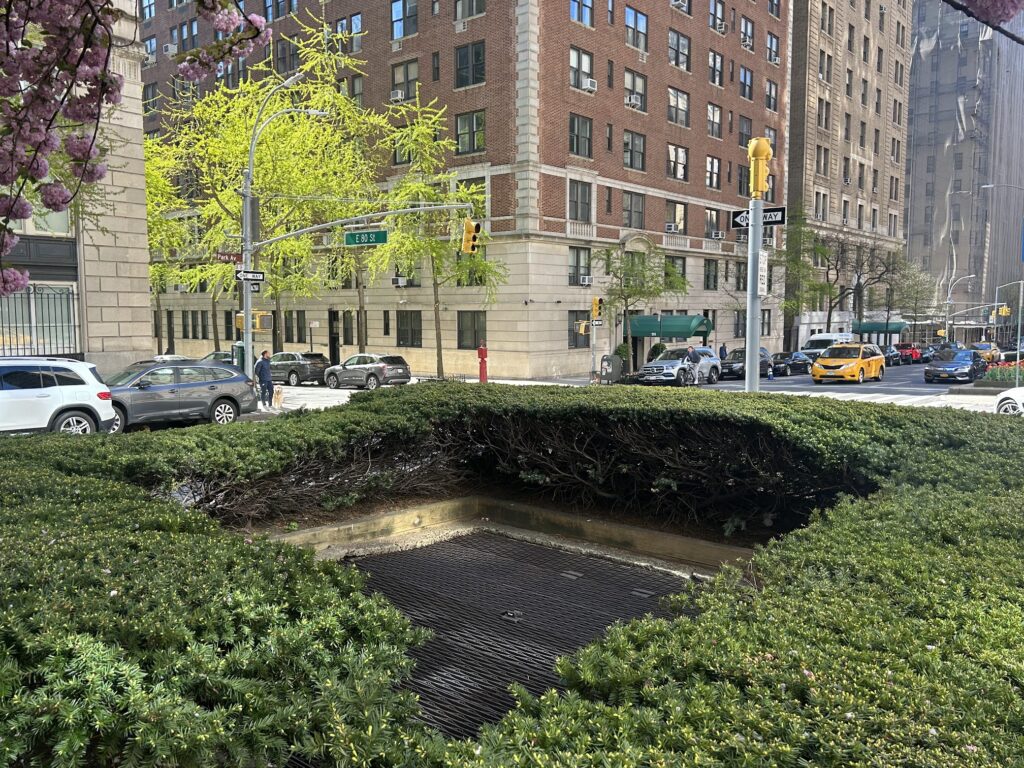
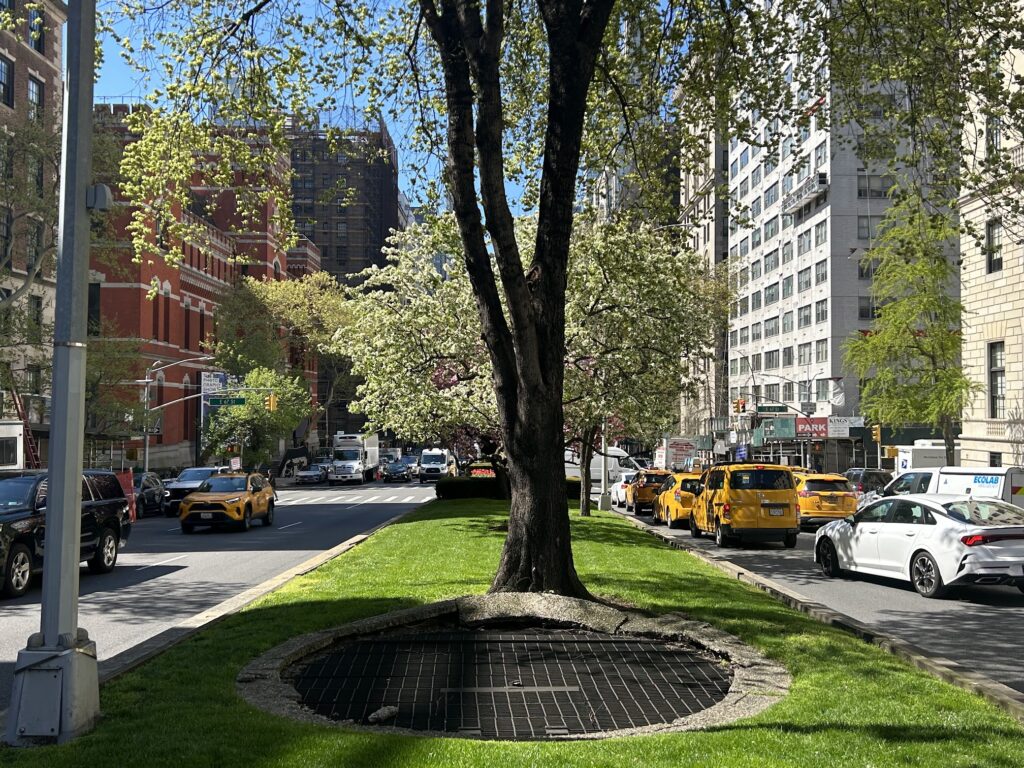
However train tracks running through a quickly growing city are neither safe nor conducive to prosperity. Eventually, the tracks were covered with beautiful flowers and trees, on traffic island malls which have gotten smaller over the years. 

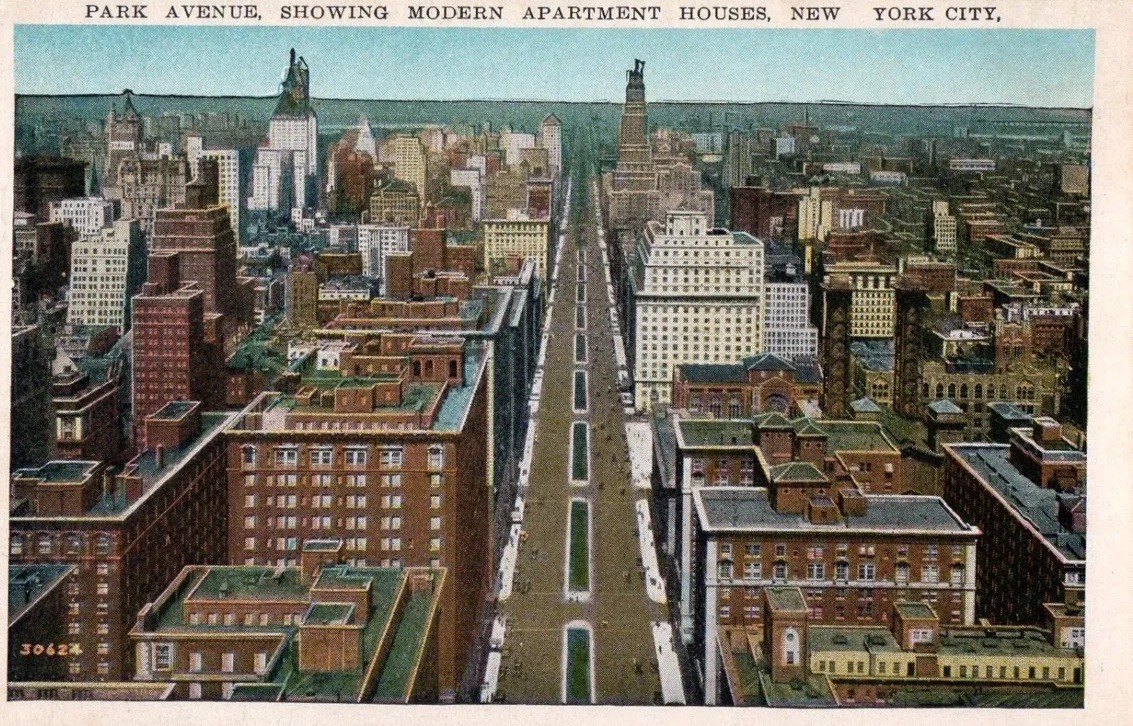
By the 1910s this allowed for glamorous apartment buildings to rise, the homes of a new wealthy elite attracted to apartment living in the post-Gilded Age era. But that lifestyle was not quite made available to everyone. 

In this episode, Greg and Tom take you on a tour of the tunnels and viaducts that helped New York City to grow, creating billions of dollars of real estate in the process. 

LISTEN NOW: UP AND DOWN PARK AVENUE
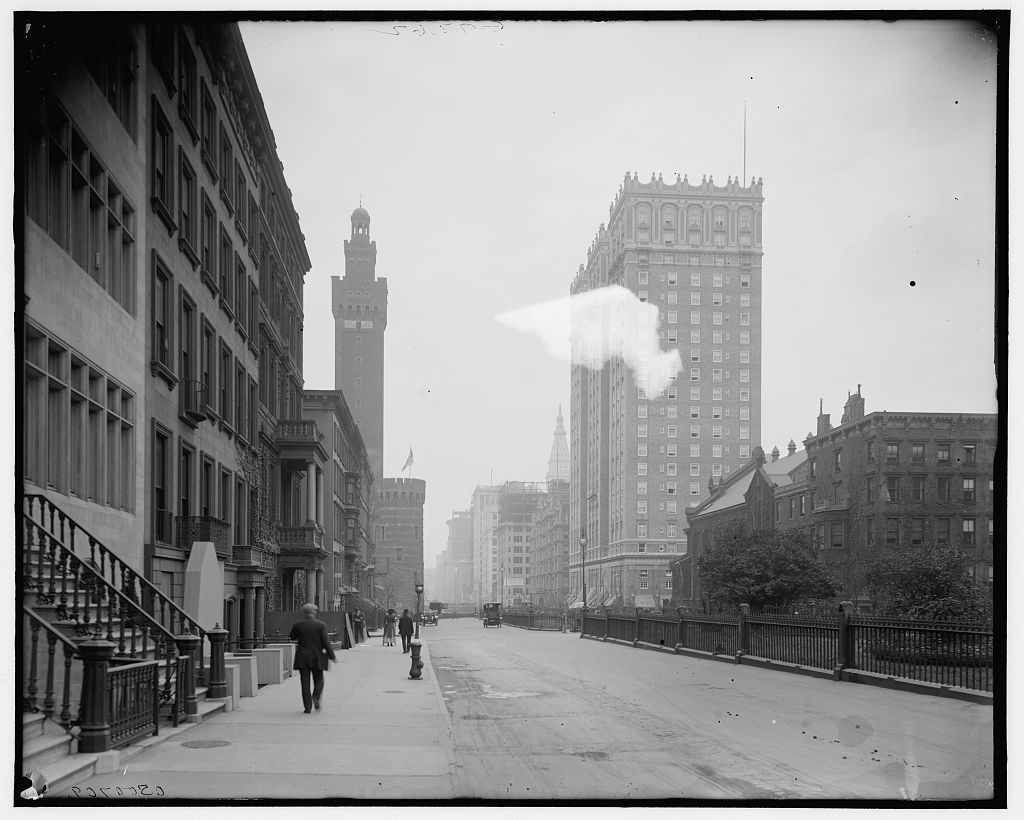

Park Avenue, looking south of 36th Street, 1900-1905 Library of Congress
Park Avenue and 94th Street, Library of Congress
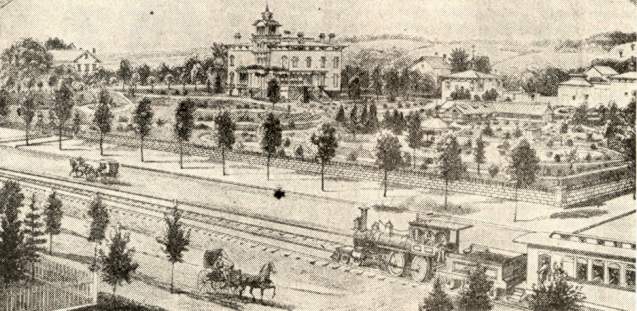
Park Avenue, late 1800s, Musem of the City of New York
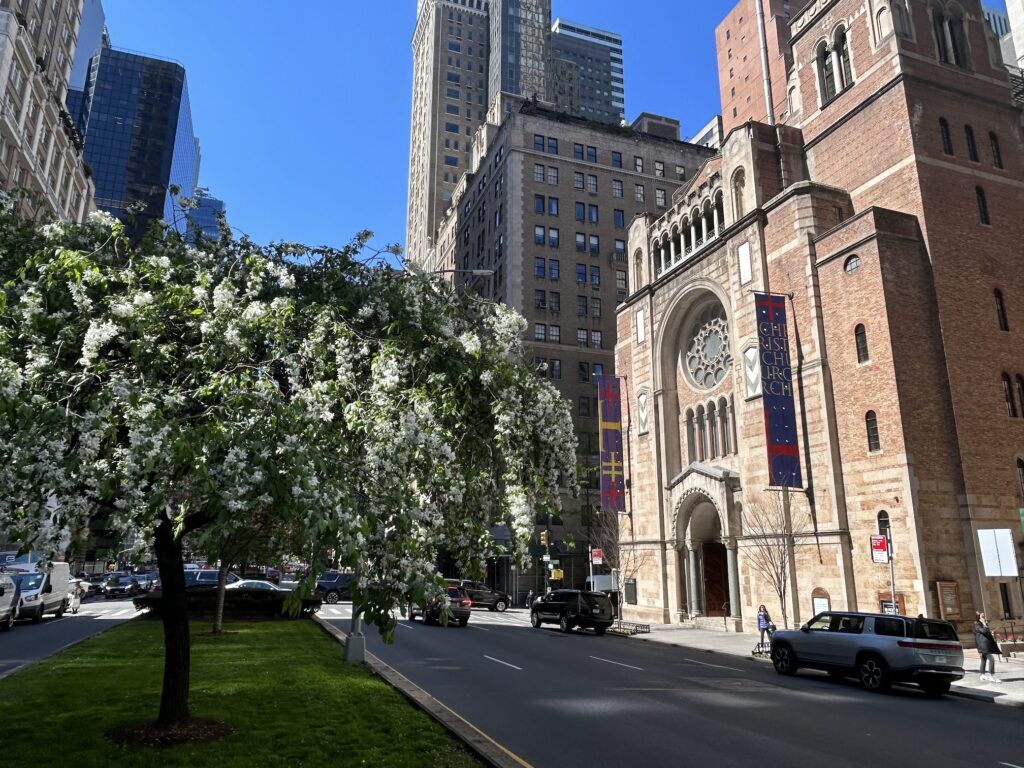
Park Avenue, after St Bart’s came along in 1918 but before these lovely pedestrian areas were destroyed in the late 1920s.
Park Avenue 1927, Department of Transportation
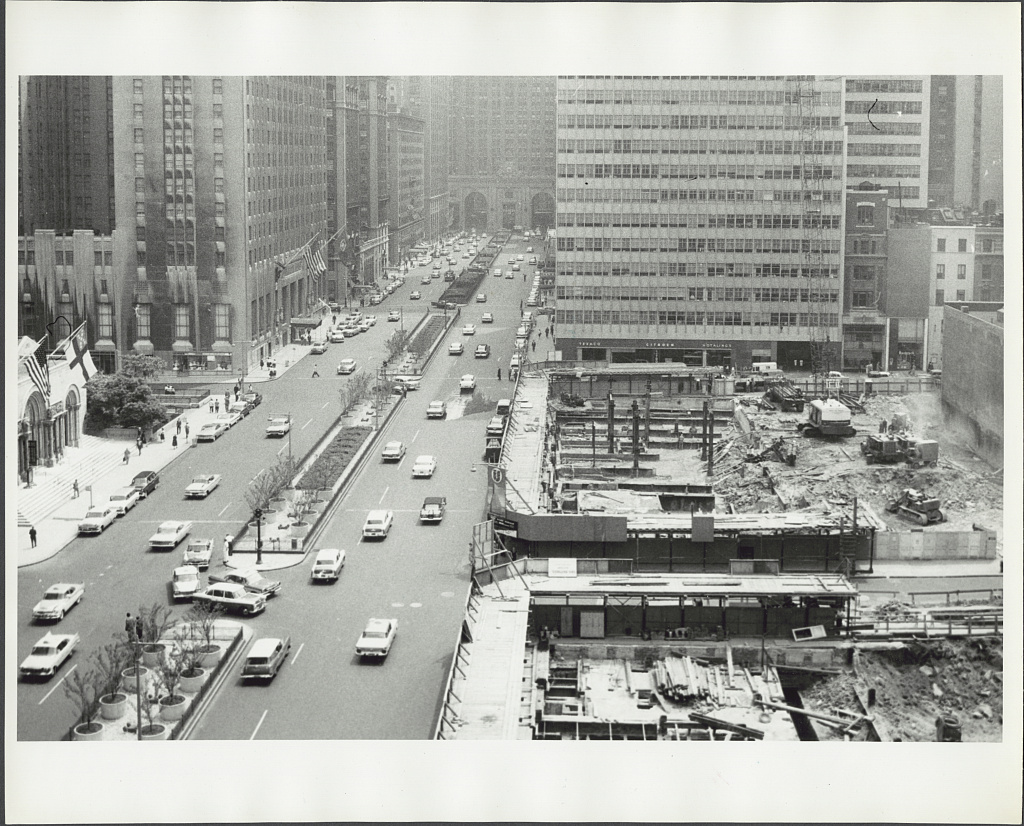
“Photograph shows cars moving along Park Avenue as the road heads towards the tunnels of the Helmsley Building, known then as the New York General Building. Building construction visible to the right. St. Bartholomew’s Church slightly visible on left.” Library of Congress, 1959

Photo by Greg Young
Photo by Greg Young
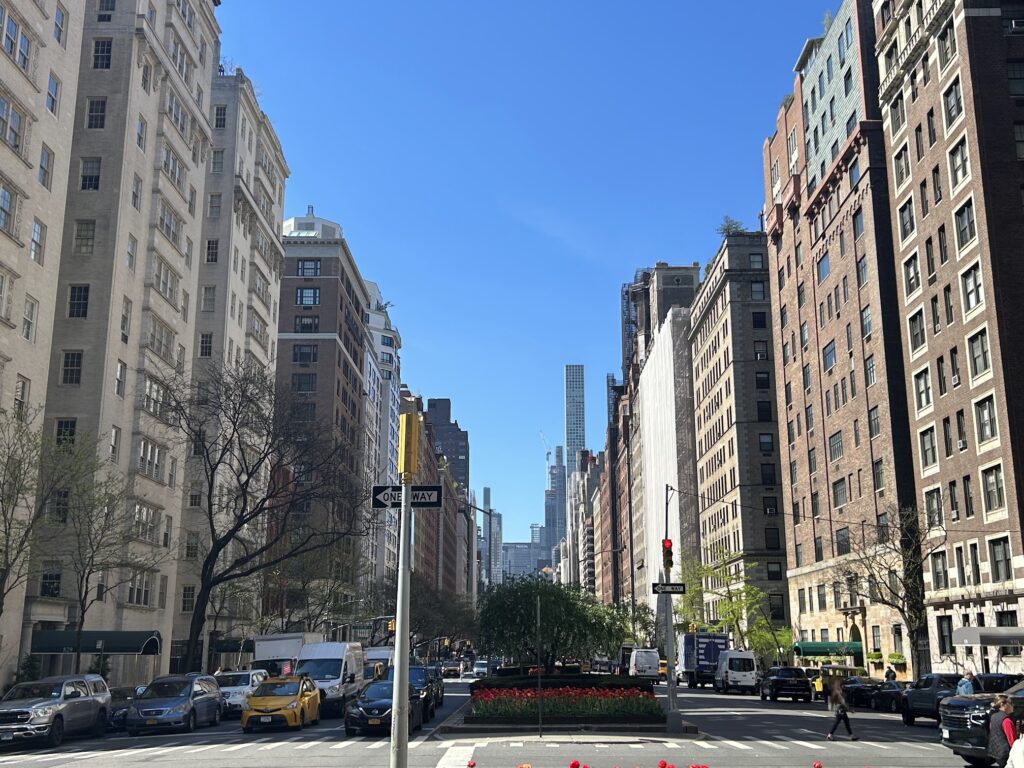
Photo by Greg Young
Photo by Greg Young
Photo by Greg Young
Photo by Greg Young
Photo by Greg Young
Photo by Greg Young

FURTHER LISTENING

Listen to these related Bowery Boys episodes after you’re done listening to the Park Avenue show:


FURTHER READING

This week we’re suggesting a few historic designation reports for you history supergeeks looking for a deep dive into Park Avenue history. Dates indicated are when the structure or historic district was designated

St. Bartholomew’s Church and Community House (1967)

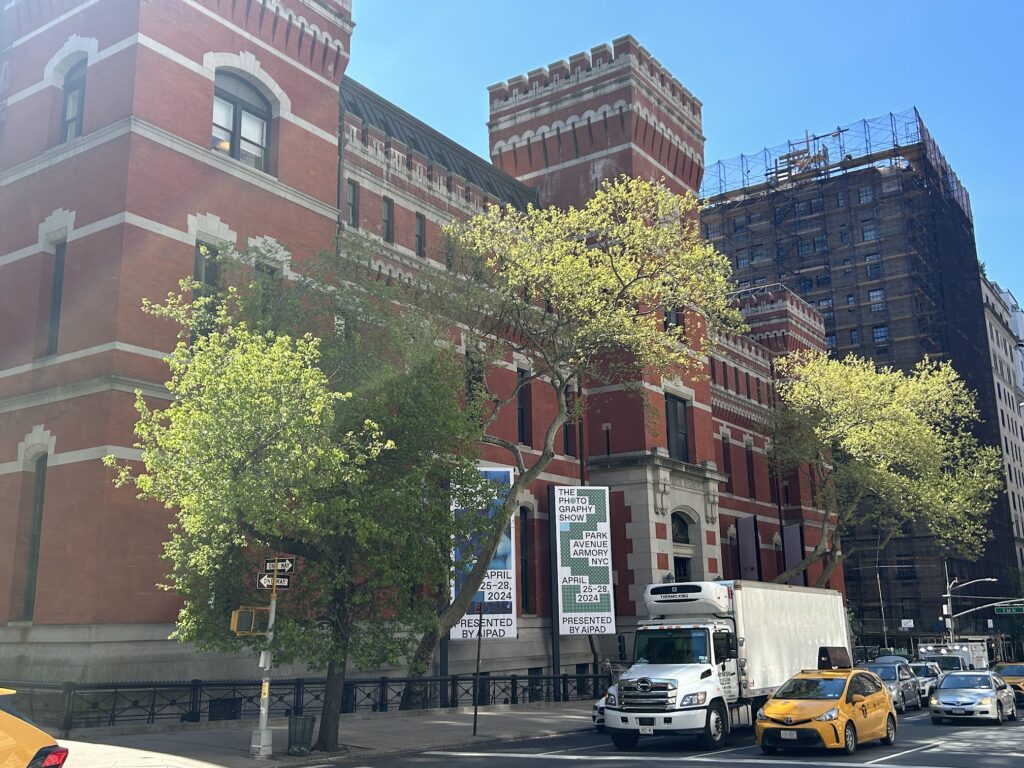
Seventh Regiment Armory/Park Avenue Armory (1967)

Consulate General of Italy (formerly the Henry P. Davison House) (1970)

New World Foundation Building (1973)

Racquet and Tennis Club Building (1979)

Pershing Square Viaduct/Park Avenue Viaduct (1980)

Upper East Side Historic District Designation Report (1981)

Lever House (1982)

1025 Park Avenue Reginald DeKoven House (1986)

New York Central Building (1987)

Seagram Building (1989)

Mount Morris Bank Building (1991)
Expanded Carnegie Hill Historic District Report (1993)

Waldorf-Astoria Hotel (1993)

Pepsi-Cola Building (1995)

Ritz Tower (2002)

2 Park Avenue Building (2006)

Park Avenue Historic District Designation Report (2014)

Categories
Those Were The Days

Madison Square Snow Show: The first-ever film of a New York City blizzard

Missing a good old-fashioned New York City snowfall? Well, then, take in this unusual view from 1902:

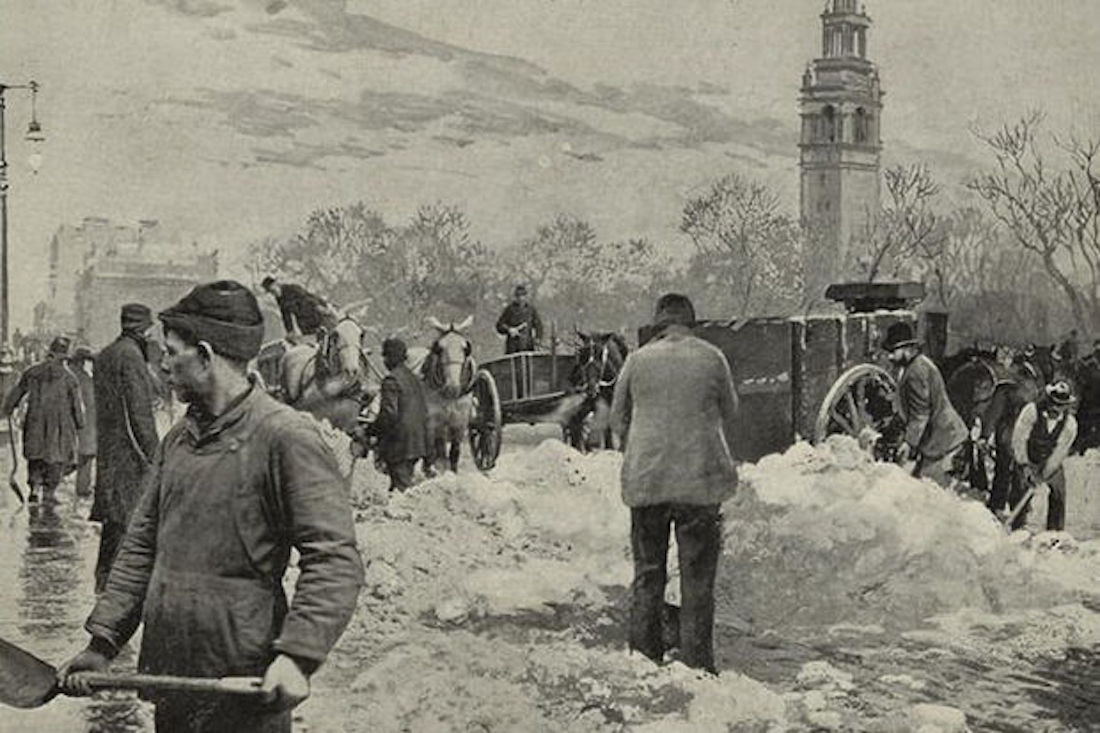
What storm is this? The horrific blizzard that hit New York on February 17, 1902.  It would be considered the worst snowstorm to hit the metropolitan area since the Great Blizzard of 1888. (Read all about it here.)  I assume we’re actually in the aftermath of the blizzard here, as the snow shovels are out, and the kids are playing.

What area is being filmed?  Madison Square Park (near 23rd Street), with the Worth Memorial in the background of some angles

Who made this?  Edison Manufacturing Company. Their Manhattan studio was nearby, at 41 East 21st Street.

Who’s the director? The head of Edison’s film division Edwin S. Porter, considered by most to be the first real movie director, inventing basic techniques used by subsequent filmmakers.

What are we seeing?  Trolleys, cabs, carriages and other unusual vehicles, braving the icy conditions and dodging pedestrians at the intersection of Broadway, Fifth Avenue and 23rd Street.  At one point, you almost see a team of horses slide off the road!

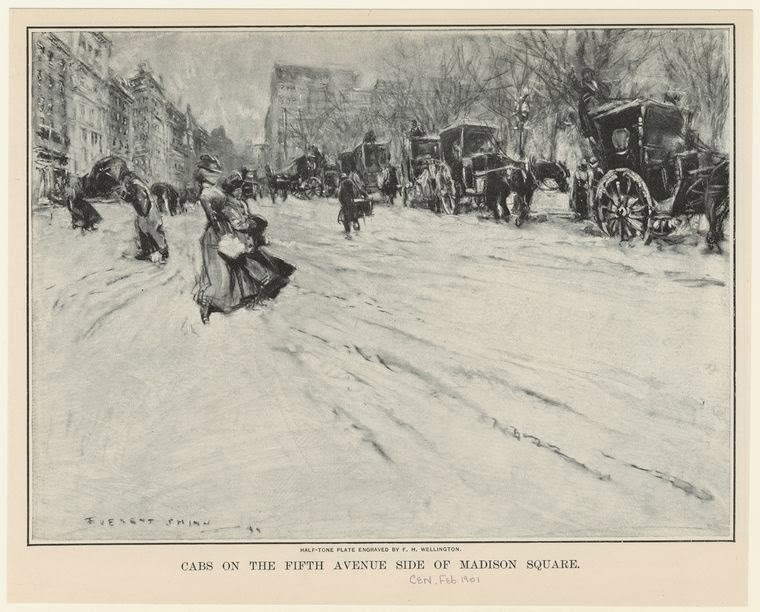
Below: An illustration from 1899, showing cabs parked along Madison Square (courtesy NYPL)

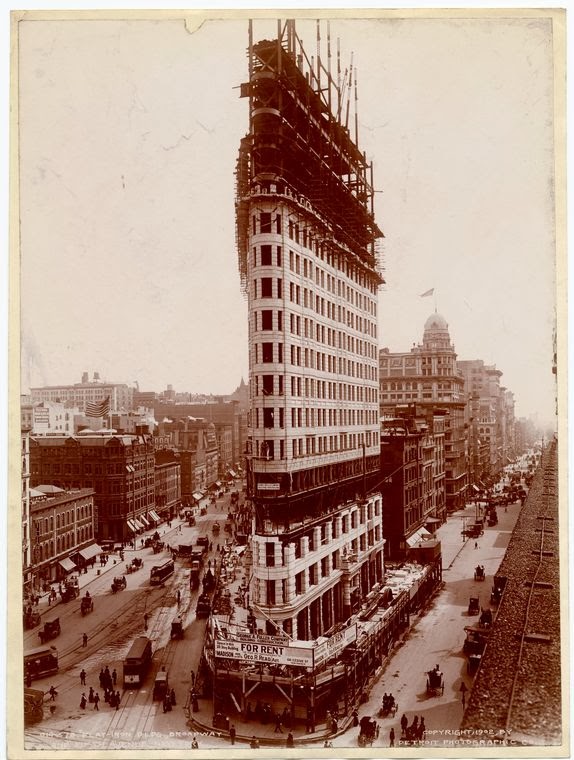
Why aren’t they showing the Flatiron Building?  It’s not completed yet!  The Daniel Burnham-designed office building would be opened by the summer, to great fanfare.  But as an open construction site, it would have been dangerous to linger anywhere around it.  I believe the slanted beams you see at the very end are part of the construction site.

It would have looked something like this (picture courtesy the New York Public Library):

This is the first film of a New York blizzard?  This is probably the first film of any American blizzard. Primitive film technology had only recently allowed for outdoor filming.  Porter and his crew would have been brave indeed dragging Edison’s equipment even two blocks through these conditions.

What’s that statue at the 1:15 mark?  The seated, snow-covered figure of William Seward.  The statue has sat at that corner since 1876. (More about that here.)

What’s that big building at the end?  The Fifth Avenue Hotel, once considered the greatest accommodation in New York City and a headquarters for backroom politics in the 1870s and 1880s.  Its glory days are long passed by the time of the blizzard.  Six years later, it would be torn down and replaced with the building that stands at that corner today — the International Toy Center.

As the camera pans around, you can see the Fifth Avenue Hotel street clock, a replica of which still sits in that very spot.

Is this the first movie ever filmed in Madison Square?  No.  That distinction goes to a boxing match filmed seven years earlier at the top of Madison Square Garden between ‘Battling’ Charles Barnett and Young Griffo.

New York transit system stymied by women’s skirt styles

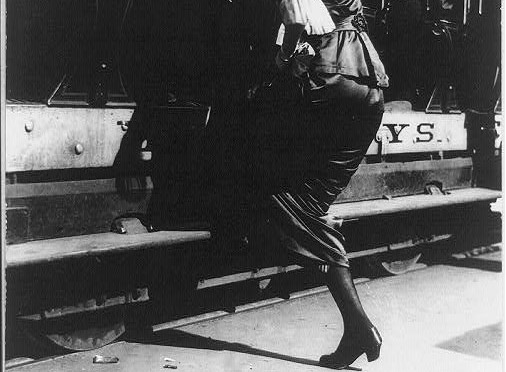
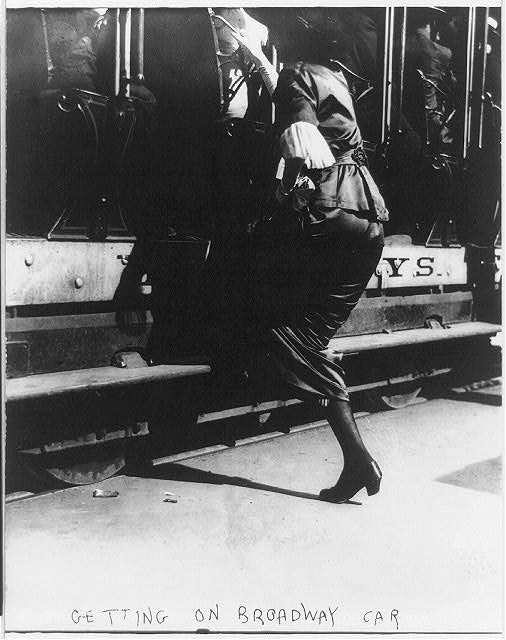
A lady in a relatively normal skirt boards a Broadway streetcar in July 1913. Now imagine trying this in a hobble skirt! (Courtesy Library of Congress)

A serious cry (mostly from men) rang out through the city one hundred years ago about the ever-expanding transit system and the scandalous style of women’s skirts. Were frocks getting caught in doorways? Were dress lengths causing women fall down stairs?

Perhaps, but that wasn’t the issue. The latest fashion trend, the hobble skirt, was slowing the progress of women onto and off of streetcars, causing frustrating delays.

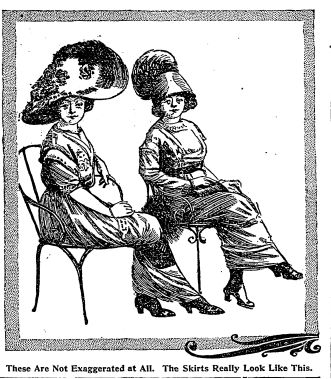
The Parisian-style hobble skirt, with its bunched hem near the bottom to create a mermaid-like appearance, made its appearance on New York streets in the early 1910s. The new gowns required ladies to walk more elegantly and, thus, more slowly, a throwback to the Victorian gait. “[T]he mannish stride of the women of today was taken for granted as a permanent thing. Nobody expected it to change, for nobody saw the hobble skirt on the horizon.” [New York Times, January 1912]

Above: Some sass from the Times fashion pages, June 12, 1910

After a millenia of unfettered skirts, this new silhouette must have seemed positively strange to elder fashionistas.

“‘The hobble’ is the latest freak in women’s fashions,” warned the Times upon their arrival in 1910.  “The hobble skirt suits none. But many, too many, women will wear what the fashion authorities decree.”

Aesthetics aside, the hobble skirt created a practical problem. While measured, graceful walking might be fine on Ladies Mile or strolling along Fifth Avenue, it was an encumbrance upon the ever-moving streetcar system.

An executive of the Interborough Transit System (New York’s first subway operator) grumbled to the Evening World in 1912 about the extra burden the hobble skirt created upon city transportation and called for the fashion trend to be abolished.

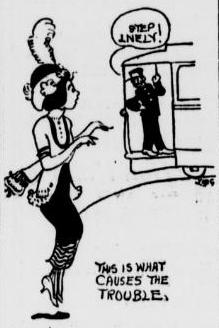
“Often hundreds of people will be forced to stand aside patiently waiting for some women to raise her skirts sufficiently to allow her to step into the car,” said George Keegan, general superintendent.

A special ‘step-less’ car had even been designed with the fashionable lady in mind. The first of these “hobble-skirt, hygenic, fool proof” cars debuted on the streets of New York in the spring of 1912.

Meanwhile, underground, fashionable ladies were finding difficulty clearing the gap between the platform and subway cars. “Nearly all of the accidents in the subway are due to the fact that women wear hobble skirts,” said Keegan, a claim which could not possibly have been true.

The Pennsylvania Railroad, fearful of complaints and potential lawsuits, acted upon the crisis the following year by requiring train conductors to note skirt styles and “height of heel” and report all data to their central office. “If women passengers on the Pennsylvania Railroad insist on wearing such mantraps, or rather womantraps, as hobble skirts and high heels they cannot hold this company responsible for accidents which may happen to them,” claimed the railroad.

But all these railroad executives really needed to do was simply wait — trends subside, to replaced with other, more objectionable wear.

By the time Mr. Keegan was complaining about the hobble skirt, the Evening World fashion section was already clutching its pearls in disbelief about another fashion abomination. “The high note of feminine folly has been struck.  The harem skirt is to succeed the hobbled horror which has made women hideous and ridiculous during the past year.”

But, leaving taste aside, at least you could ride the subway in a harem skirt!

Illustration above is from the August 9, 1912 edition of the Evening World which accompanied the Keegan article

Union Square and the demise of ‘Dead Man’s Curve’

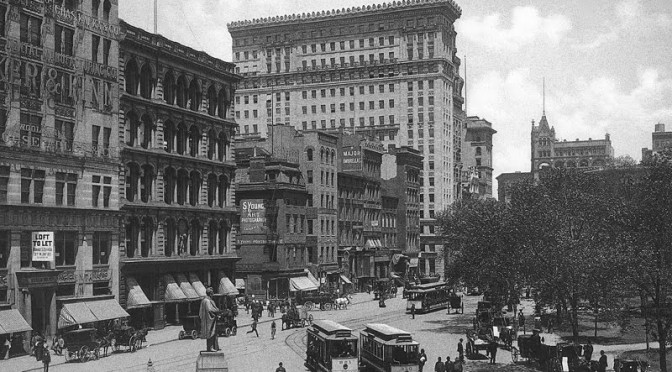
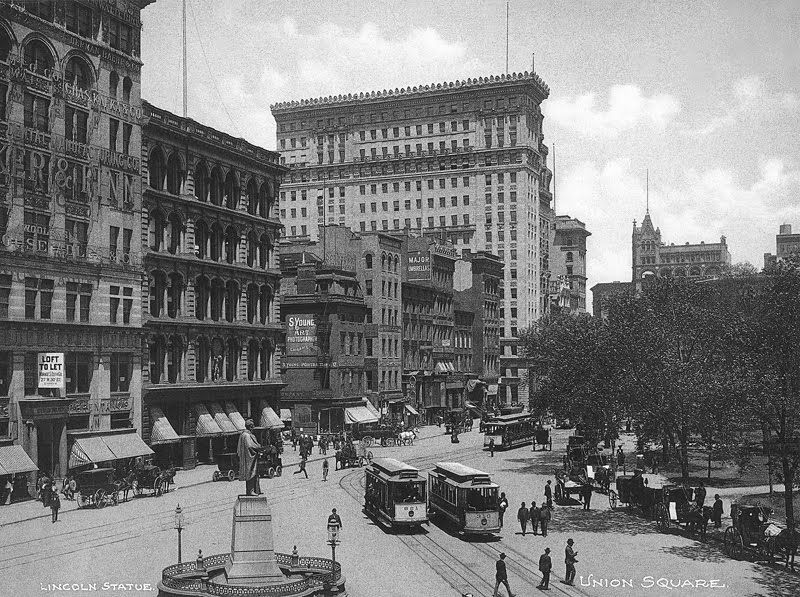
The photo above shows the southwest corner of Union Square in the year 1906. For many years prior, this corner was the scene of several brutal accidents between cable cars and pedestrians. When the Metropolitan Traction Company (now doing business as the powerful New York City Railway Company) ripped out the cable lines and replaced them with streetcar tracks in the early 1900s, New Yorkers hoped that troubles at the so-called ‘Dead Man’s Curve’ would likewise diminish.

Broadway and 14th Street, during the late 19th century, has always been seen as “New York’s Most Dangerous Crossing” (according to a Harpers Weekly article). But even in the new century, this morbid corner could never quite shake its reputation. “McGowan and Keenan Narrowly Escape Death At ‘Dead Man’s Curve” shouted an Evening World headline from February 15, 1906, reporting a serious accident here involving two major city officials, one (Patrick McGowan) the head of the Board of Alderman.

Getting rid of the cable cars reduced — but did not eliminate — the problems posed by the heavily trafficked, sharp corner along New York’s most famous avenue. Grim accidents kept occurring here, such as this one in September 1908: ‘Legs Are Crushed…at Dead Man’s Curve’. One source posits an interesting theory: with the district to the west still considered Ladies Mile, New York’s prime shopping district, male drivers (as they would have mostly been at this time) became distracted at this difficult corner by lively female shoppers.

Fortunately, it seems reputation can be the wonderful deterrent. While other cities would develop their own deadly traffic curves — and apply the nickname ‘dead man’s curve’ to those unfortunate places — New York would see fewer accidents at Broadway and 14th Street in the following decades.

One author in 1917 remarked that the corner’s “perils are now outdone on every street and road since the advent of the automobile.” In 1930, all of Union Square would be redesigned as subway lines were constructed underneath, and traffic was helpfully reduced. Most shopping had moved to Herald Square and Fifth Avenue, so there were fewer alleged distractions anyway.

A witness to all the grim accidents at this corner was, oddly enough, Abraham Lincoln. His sculptural likeness had stood here since 1870, a work by Henry Kirke Brown, surrounded by an austere bronze fence. With the redesign in the 1930s, Lincoln was moved away from the bloody corner and moved into the northern end of the park, where he still stands today.

Photo from the New York Times

Categories
Podcasts

Cable cars, trolleys and monorails: Moving around on New York’s forgotten transit options

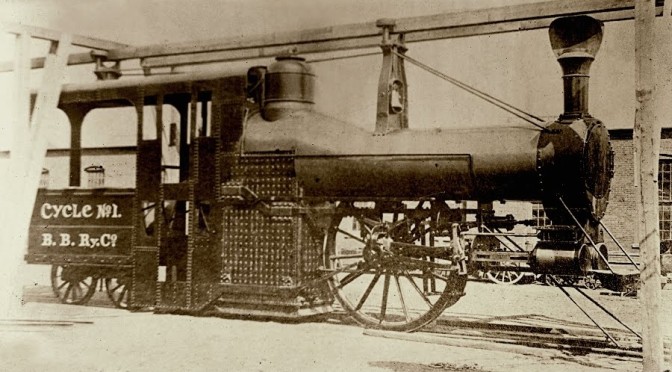
ABOVE: The Boynton Bicycle Railway, combining the best of the locomotive and the spinning wheel. This narrow little hot wheel took riders on a short ride through Coney Island.

For the third part of our Bowery Boys On The Go summer series, looking back at the history of New York City public transportation, it’s a short ride on the long gone, forgotten methods of getting around the city. The streets were mostly dominated by horse-based transport, but this was smelly and slow — not to mention awful on the animals. So the city experimented with new ways of moving the masses: by cable car (exported form San Francisco), the trolley and the monorail.

Along the way, you’ll find out the connection between the cable car and New York’s most famous art-house movie theater, discover the origins behind the name of a classic New York sports team, and hear the contributions of a man known as ‘the black Edison’.

ALSO: Find out about what may be the world’s worst monorail technology!

Click onto photographs for a larger view


Horse Drawn: New York City before the 1870s simply could not have survived without horse power, and the streets were filled with thousands of the animals pulling streetcars, omnibuses, carts and basically everything else that moved. As a result, life for a horse was pretty much appalling. Life span was relatively short. Although the city designated places along the waterfront to dispose of carcasses, it wasn’t unheard of to leave bodies in the street. This classic (but disturbing) photo from 1900, captioned ‘Close of a Career’, illustrates the absurdity. (Courtesy Shorpy)

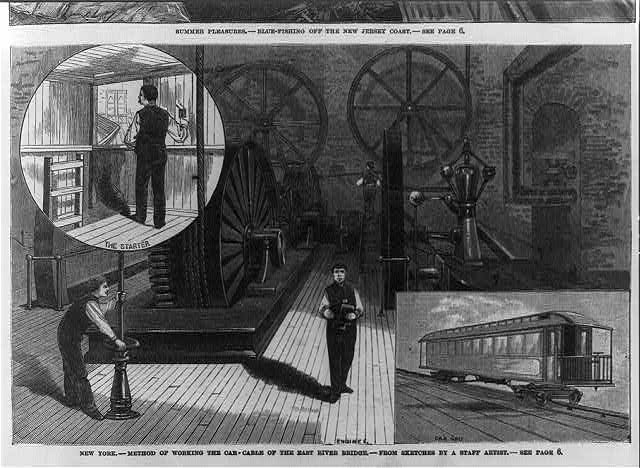
The first cable car system in New York was actually a steam-engine hybrid that ran over the Brooklyn Bridge in 1883. Engineers didn’t believe a regular steam locomotive could travel up an incline to get onto the bridge, so this dual steam/cable method was created. The powerhouses, pictured here, were situated under the approaches. (Read more about it here.)

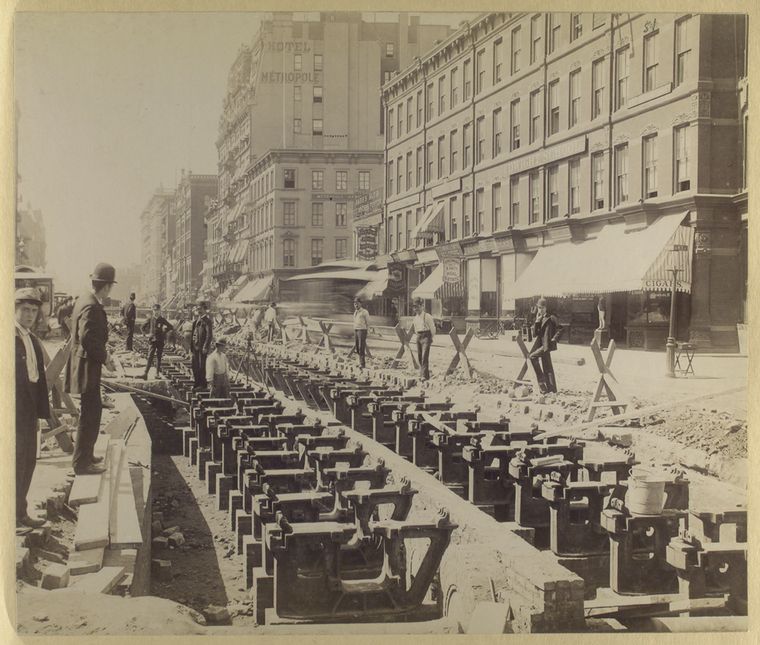
Cable Vision: How many times have the streets around Union Square been dug up? Here’s one of the very first times, in 1891, as workmen install a cable line for New York’s very first cable car system. Notable about this particular stretch is the fact that this would become part of the notorious Dead Man’s Curve, where cars would speed around the northwest corner of the park. (Courtesy NYPL)

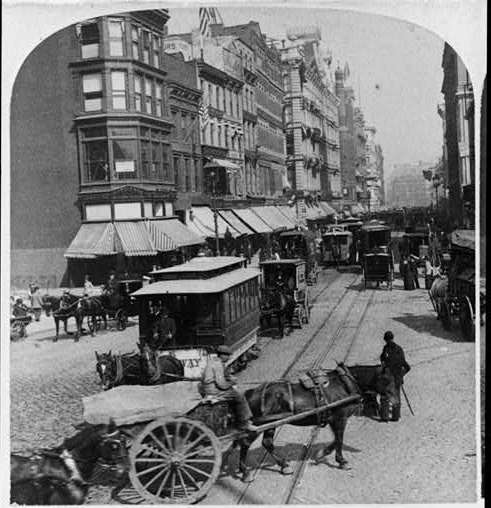
The frequent and frustrating traffic predicament on New York streets, a congested cluster of machines and horses, sometimes at a standstill. This picture, from 1892, depicts Broadway between Union Square and Madison Square.

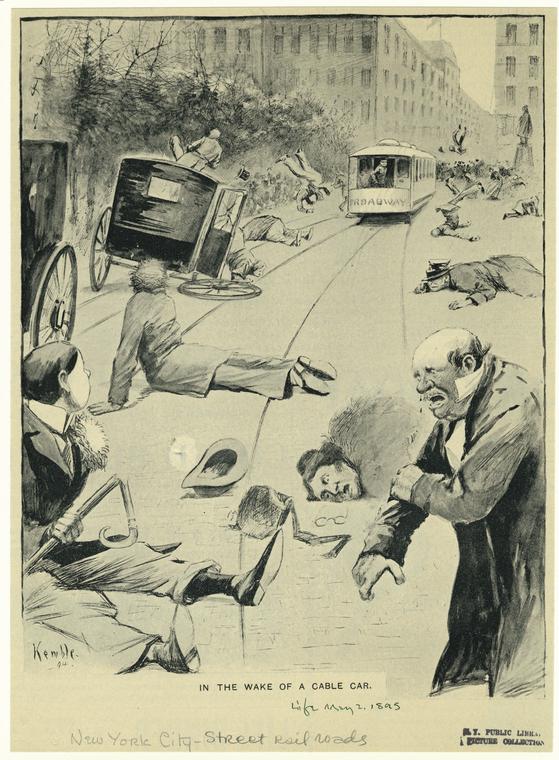
From an 1894 Life Magazine illustration, echoing the public sentiment over New York’s wily, dangerous cable car system. (Courtesy NYPL)

A video look at the Brooklyn trolley system, which by the 1930s had become the standard method of transit for most residents of the borough.

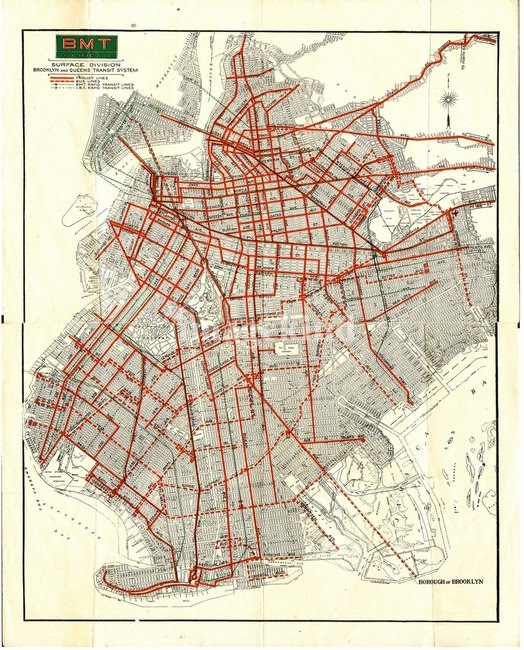
A map detailing the vastness of the Brooklyn trolley system by the 1930s, by this point a component of the Brooklyn-Manhattan Transit Corporation.

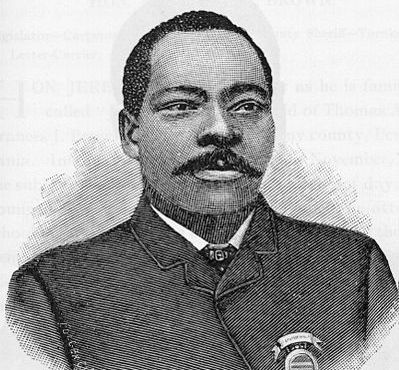
Inventor Granville Woods debuted his ‘multiple distributing station system’ — a sort of ‘wireless’ trolley system using electromagnetic induction — for the American Engineering Company in February 1892. Unfortunately, Woods had to sue the company for any sort of credit. In fact, this article in the Brooklyn Daily Eagle of the trial doesn’t even mention his name.

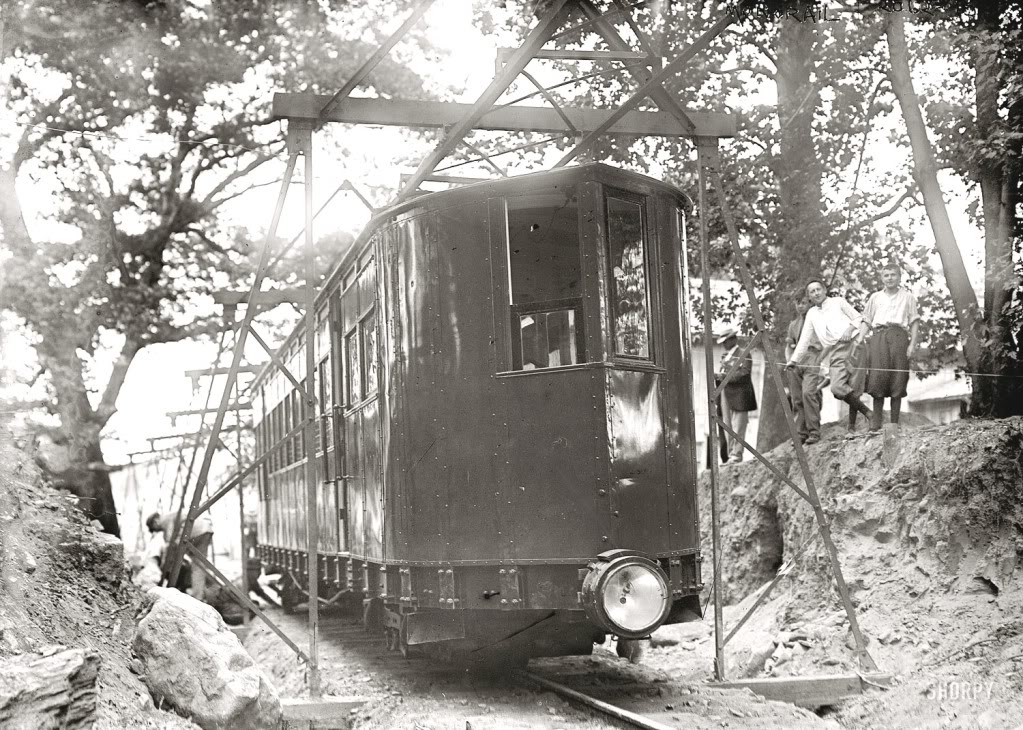
Monofail: The first riders of the monorail system provided by the Pelham Park and City Island Railroad were greeted with a nightmare voyage culminating in the entire car falling over on its side. “Flimsy Structure Supporting It Gives Way and Many Are Badly Hurt,” cries the New York Times. Despite this not insignificant hiccup, the monorail operated for a few years before being replaced with a trolley system.

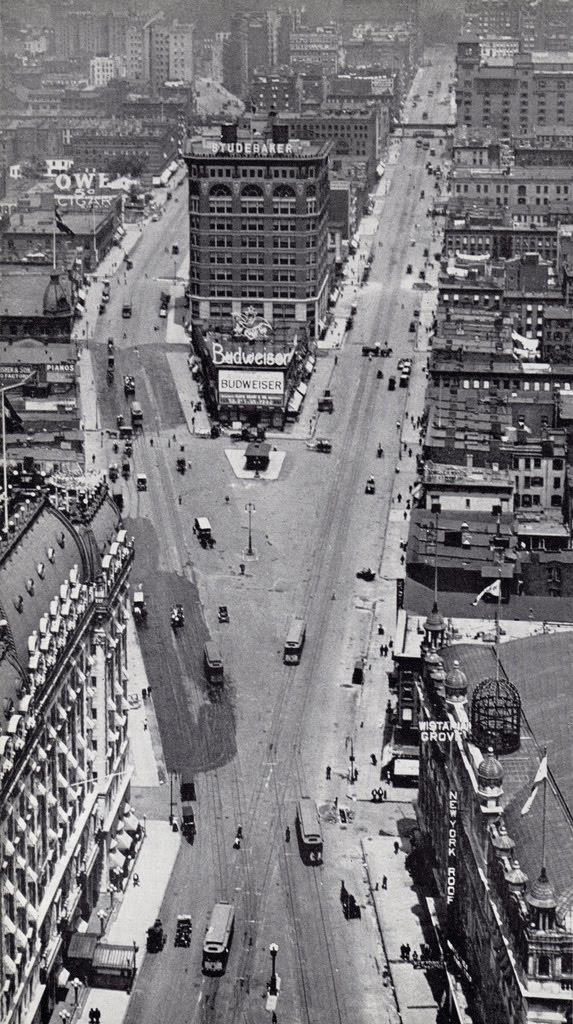
On Track: Looking down on Times Square from 1905, taken from the top of the Times Building. I’m putting this hear for a bird’s eye view on what the streets of New York looked like, grooved with trolley rails. You can still see several horse carts too, although most horses had been taken off of city streets by this time. (Please click on the photo for a close-up view)

Categories
Podcasts

New York City’s Elevated Railroads: Journey to a spectacular world of steam trains along the avenues

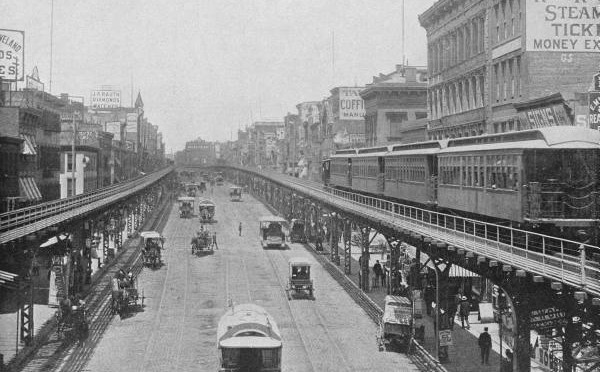
Above: The Third Avenue Line as it looked running along the Bowery, changing the nature of New York street life, even as its innovations helped expand the city.

PODCAST Before there were subways, New York City transported travelers up and down the length of Manhattan by elevated railroad, an almost unreal spectacle to consider today. Steam engines sat high above several avenues in the city, offering passengers not just a faster trek to the northern reaches of Manhattan, but a totally new way to see the city in the 19th century.

Welcome to our second podcast in our series Bowery Boys On The Go, a look at the history of New York City transportation. Before we get to those famous ‘El’ trains, we explore the earliest travel options in the city — the omnibuses and horse-drawn rail cars, the early steam successes of the New York and Harlem Railroad and Hudson River Railroads, and something affectionately nicknamed the one-legged railroad.

What were some of the more peculiar ideas for improving travel? And why was the idea of a subway immediately shot down by the city? Let’s just say — Boss Tweed and Jay Gould are involved.

ALSO: What were the different motivations driving transportation progress in the city of Brooklyn? Well, it has something to do with the beach.


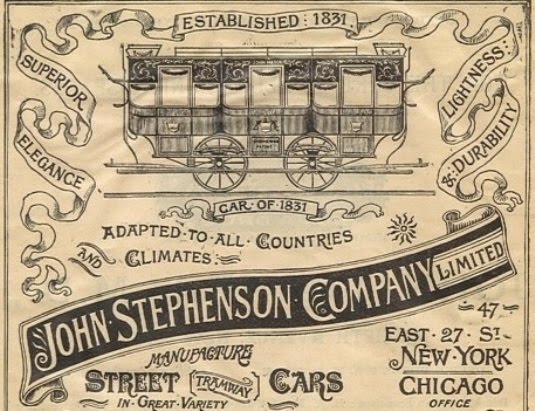
An illustration of the first traincar in the New York and Harlem Railroad system — the John Mason, named for the railroad’s president (Mason was also the president of Chemical Bank). It was designed by master engineer John Stephenson, who customized many of the New York and Harlem’s traincars.

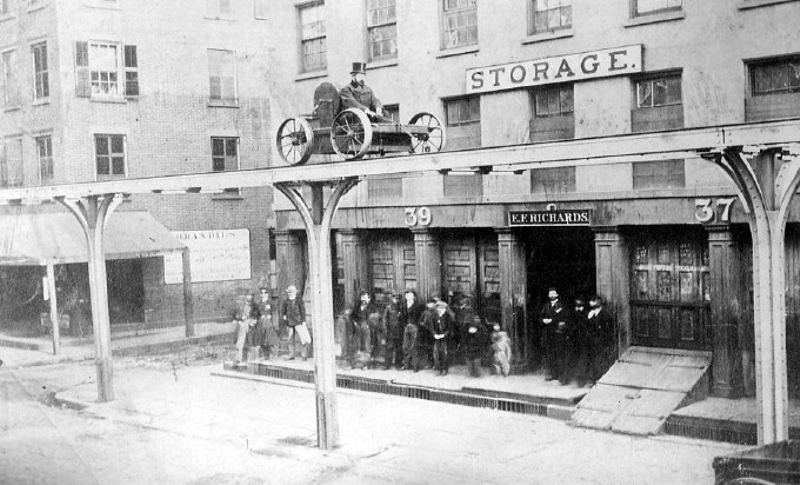
Charles Harvey developed the first elevated system for New York, essentially a cable/pulley system that stretched along the west side from the Battery. Below, Harvey gives his ‘one-legged’ line a tryout in 1867. (Pic courtesy Merritt Island Subway South)

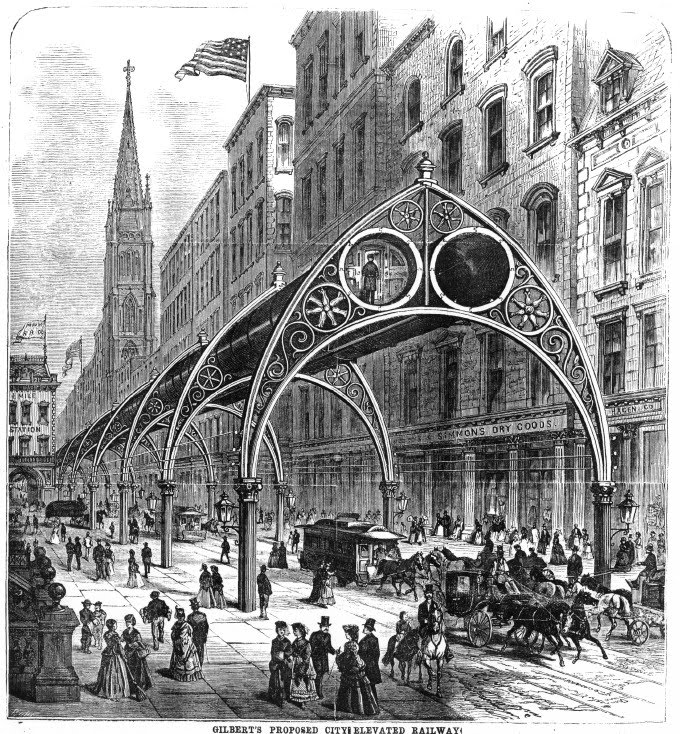
Rufus Gilbert, a Civil War physician, turned to trains after the war and dreamt up an imaginative pneumatic system, to zip passengers above the city in Gothic-themed arches. Gilbert was given the go-ahead to construct this oddity, but the love for steam and a financial crisis transformed the idea into a steam elevated line instead. (Courtesy Columbia U)

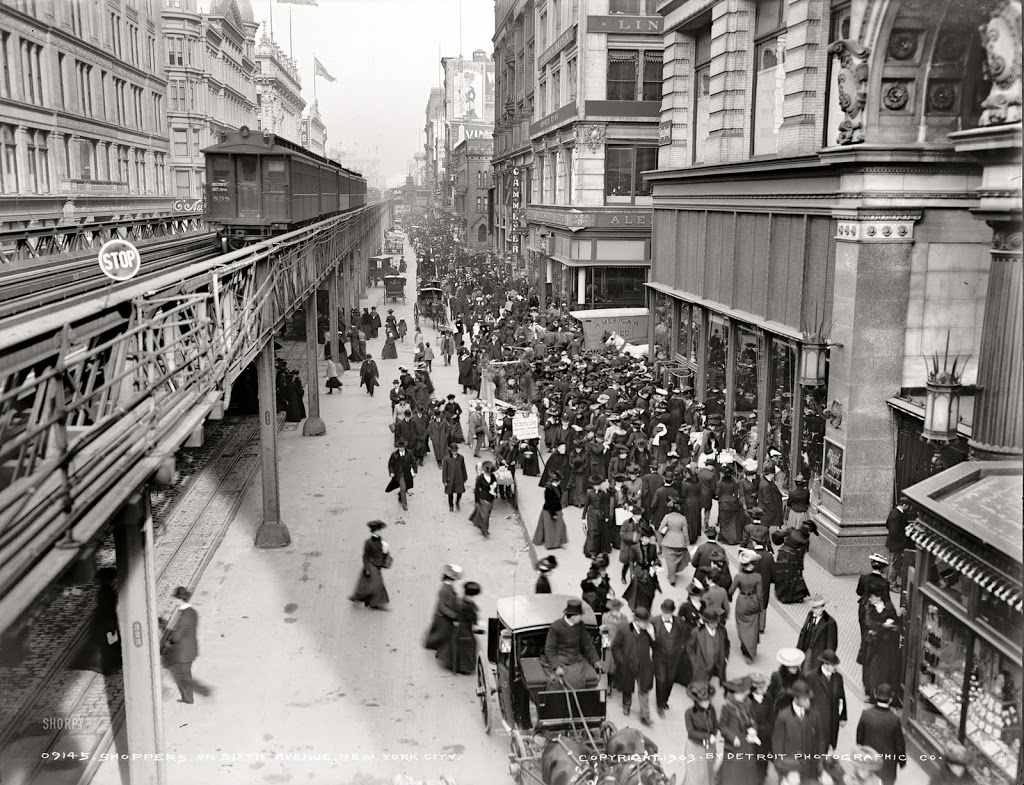
Ladies Mile along the Sixth Avenue elevated line. The trains might have made the city expand outwards, but it also made the streets smaller and darker. (Original pic from Shorpy)

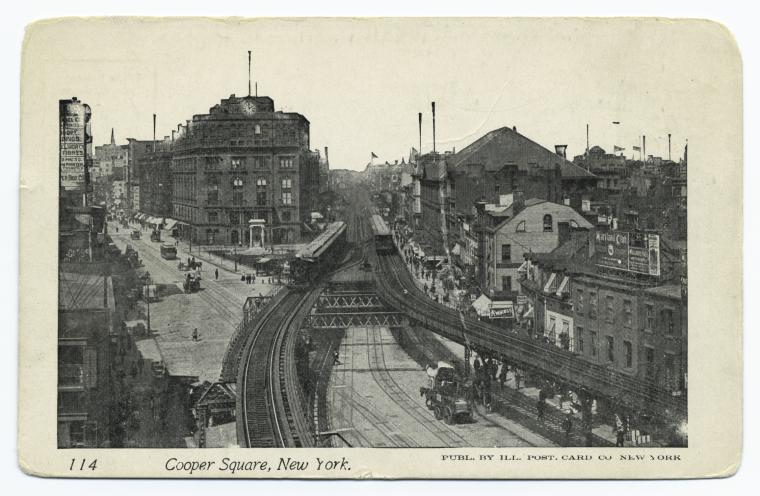
The Third Avenue line, where it ran alongside Cooper Union and traveled south down through the Bowery. This intersectioni today still sits rather wide and empty, a vestige of the days when tracks hovered above the roads. [NYPL]

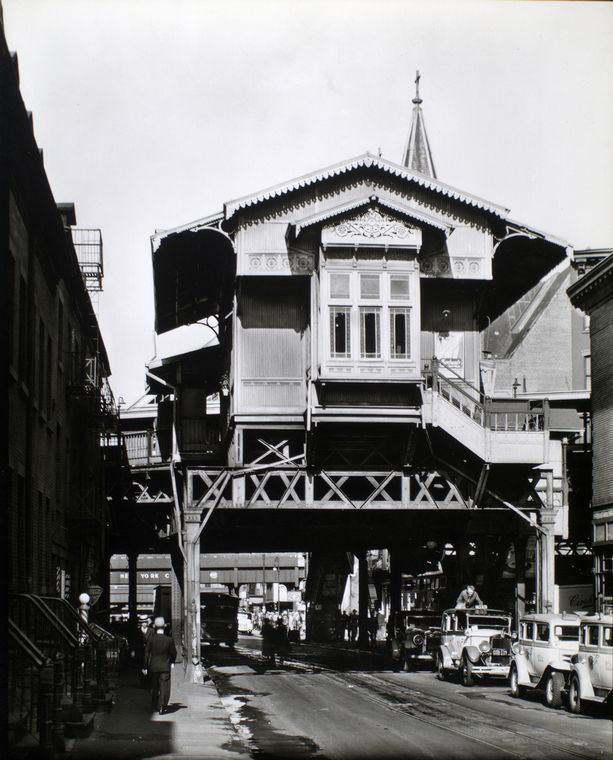
An ornate station for the Ninth Avenue line, at Christopher and Greenwich streets in the West Village.

The Brooklyn and Jamaica Railroad, the precursor to the Long Island Railroad. The section illustrated here is along Woodhaven Boulevard, but much of the line went along Atlantic Avenue.