Categories
Neighborhoods Planes Trains and Automobiles Podcasts

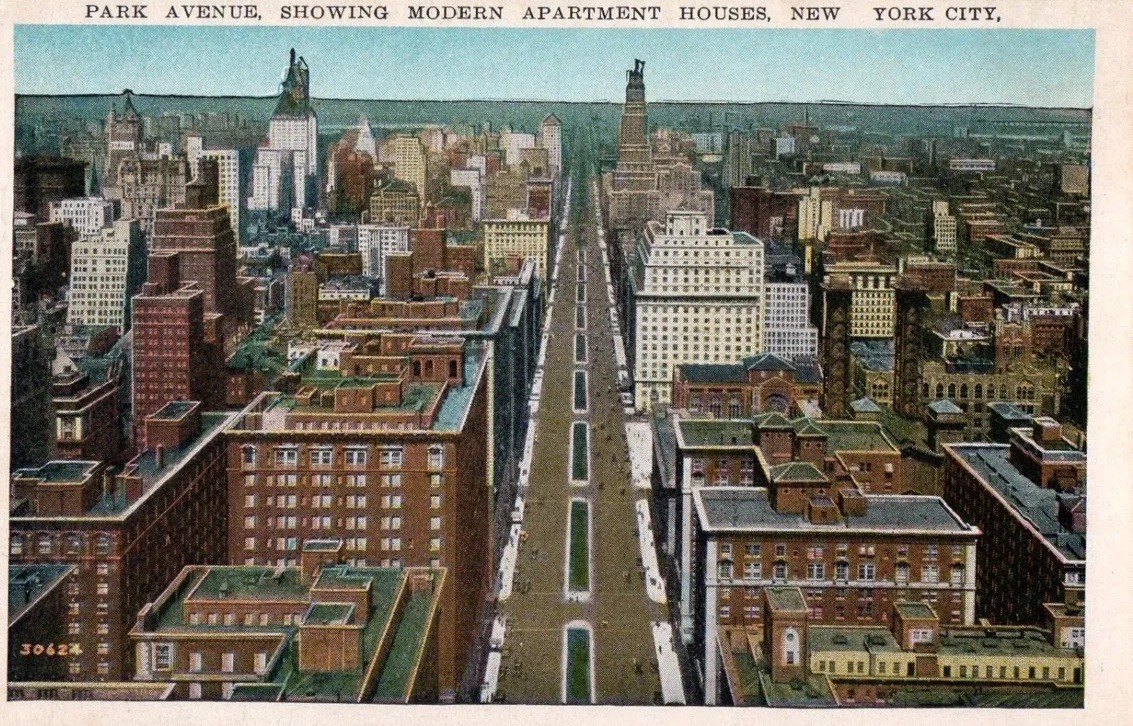
Up and Down Park Avenue: New York City History with a Penthouse View

The story of a filthy and dangerous train ditch that became one of the swankiest addresses in the world — Park Avenue. 

For over 100 years, a Park Avenue address meant wealth, glamour and the high life. The Fred Astaire version of the Irving Berlin classic “Puttin’ on the Ritz” revised the lyrics to pay tribute to Park Avenue: “High hats and Arrow collars/White spats and lots of dollars/Spending every dime for a wonderful time.”

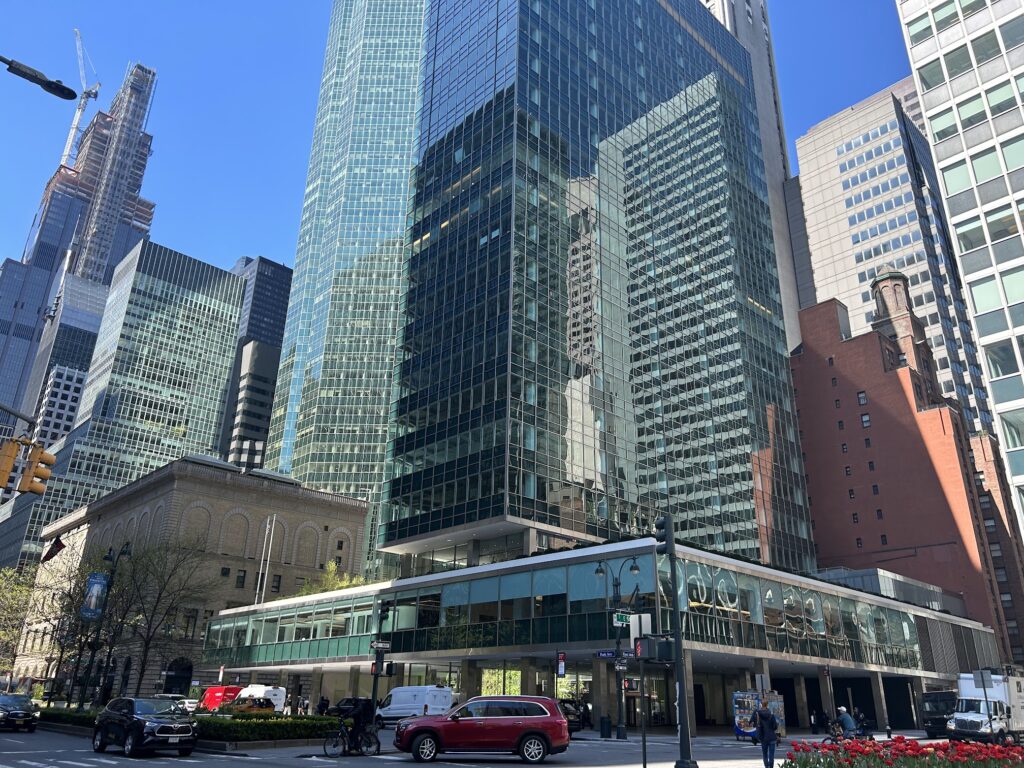
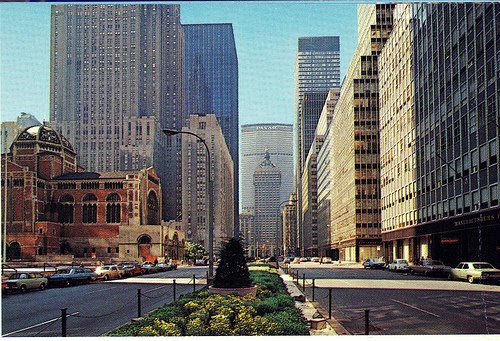
By the 1950s, the avenue was considered the backbone of New York City with corporations setting up glittering new office towers in the International Style — the Lever House, the Seagram Building, even the Pan Am Building. 
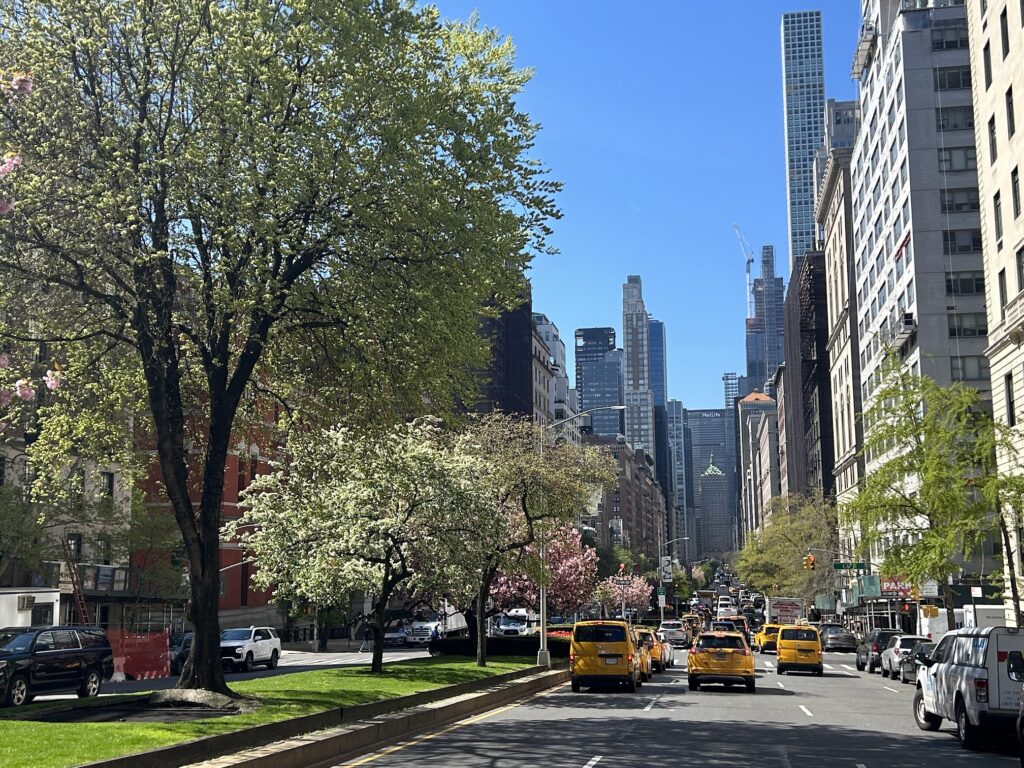
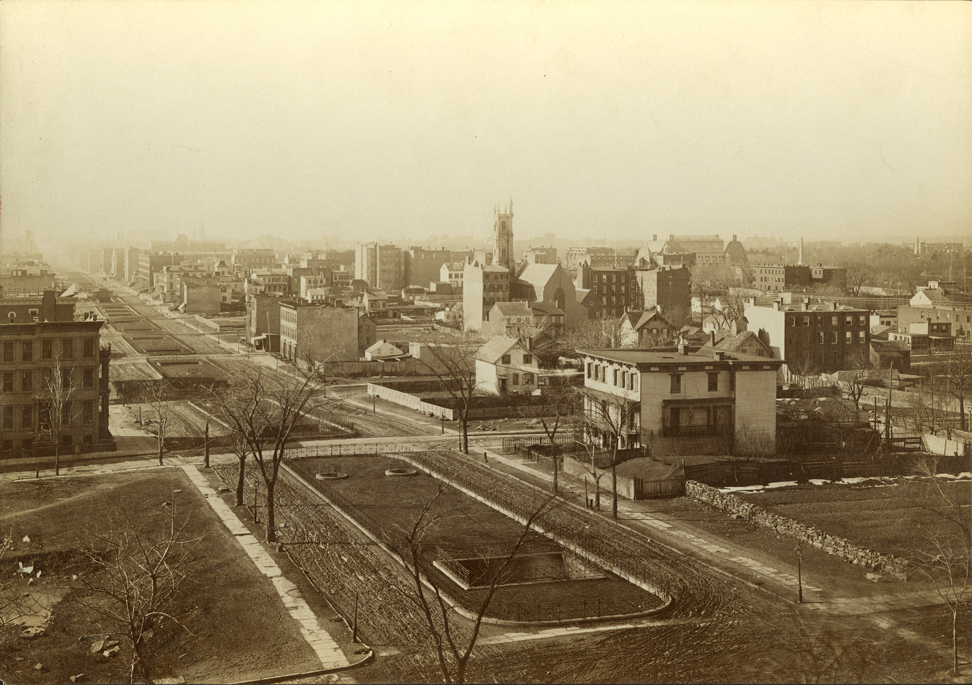
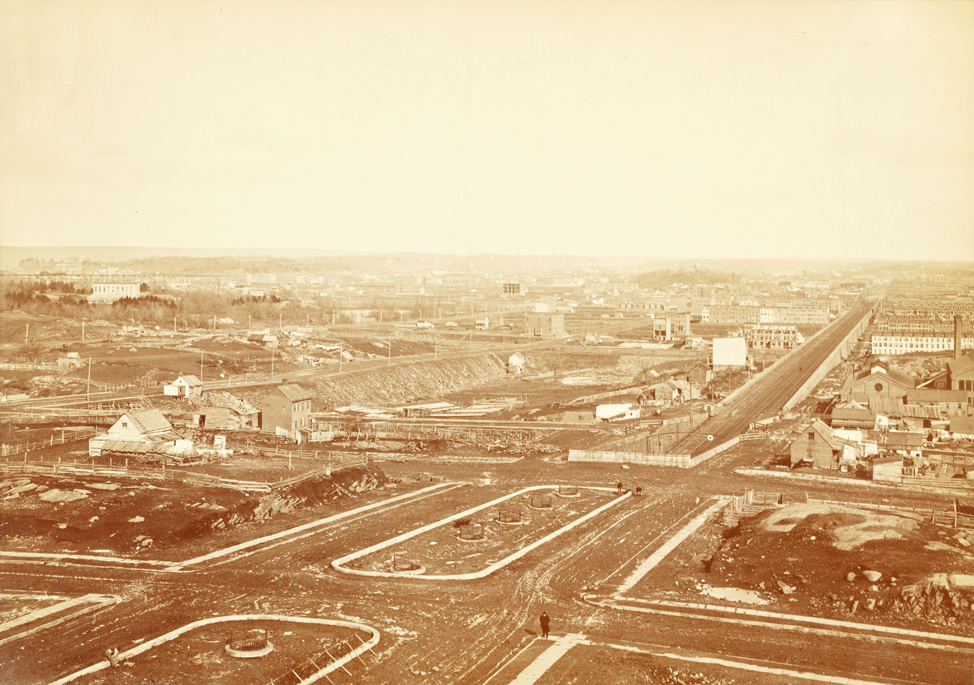
But the foundation for all this wealth and success was, in actually, a train tunnel, originally operated by the New York Central Railroad. This street, formerly known as Fourth Avenue, was (and is) one of New York’s primary traffic thoroughfares. For many decades, steam locomotives dominated life along the avenue, heading into and out of Cornelius Vanderbilt’s Grand Central (first a depot, then a station, eventually a terminal).

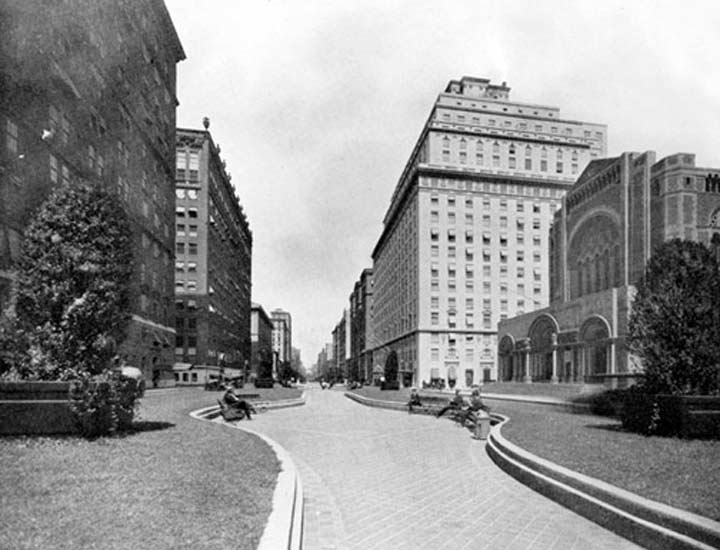
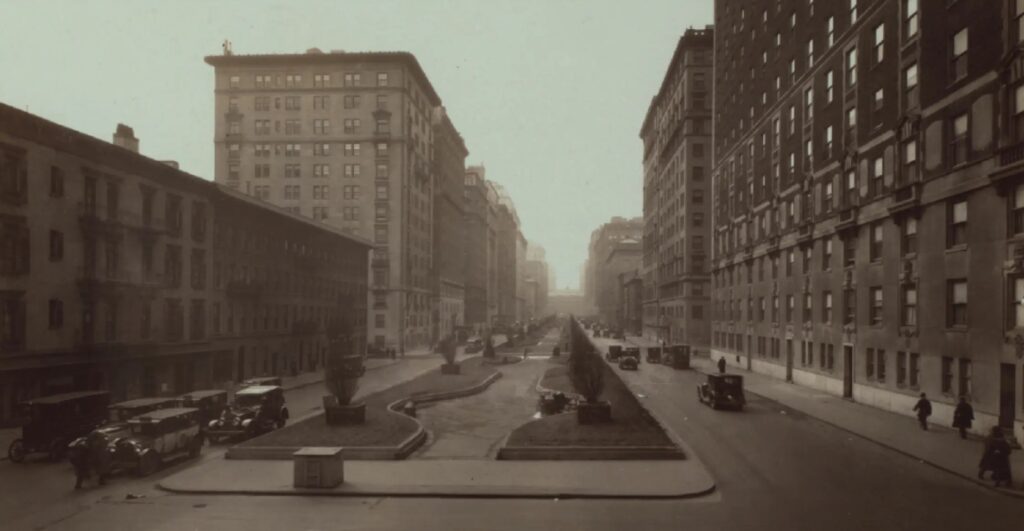
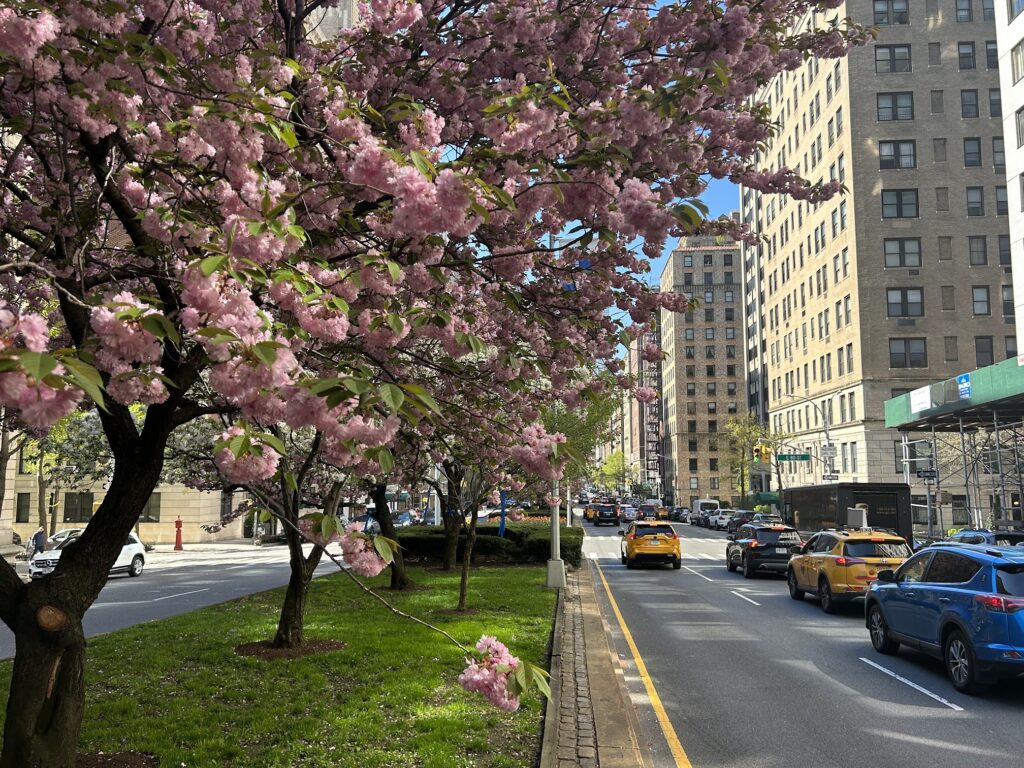
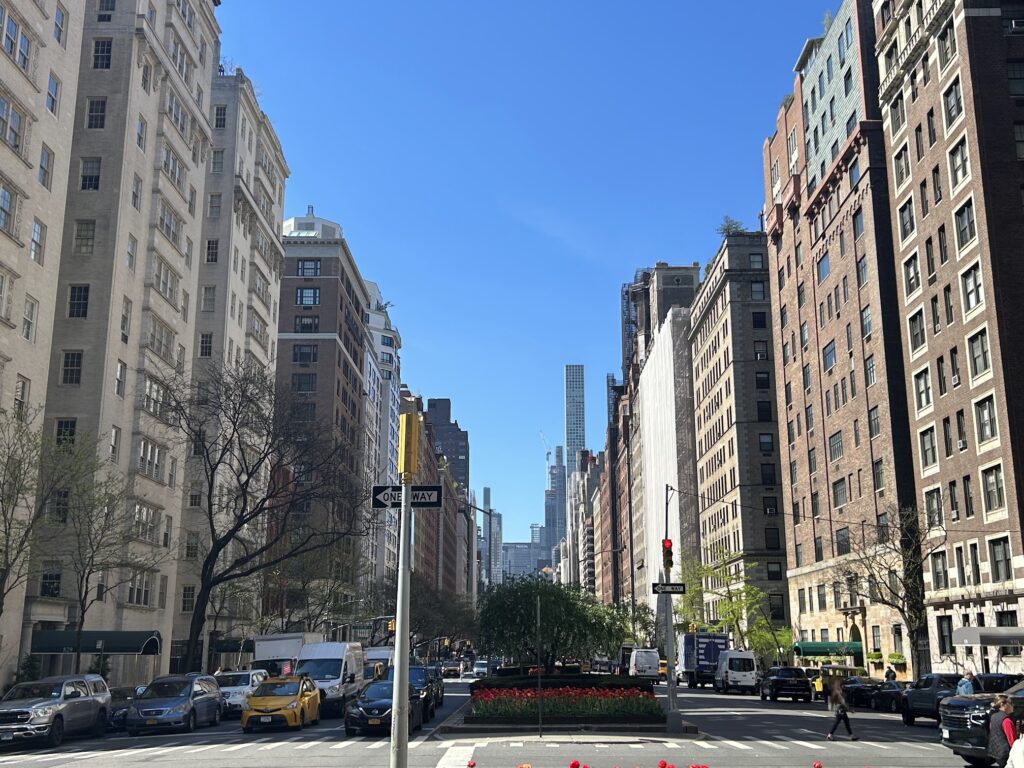
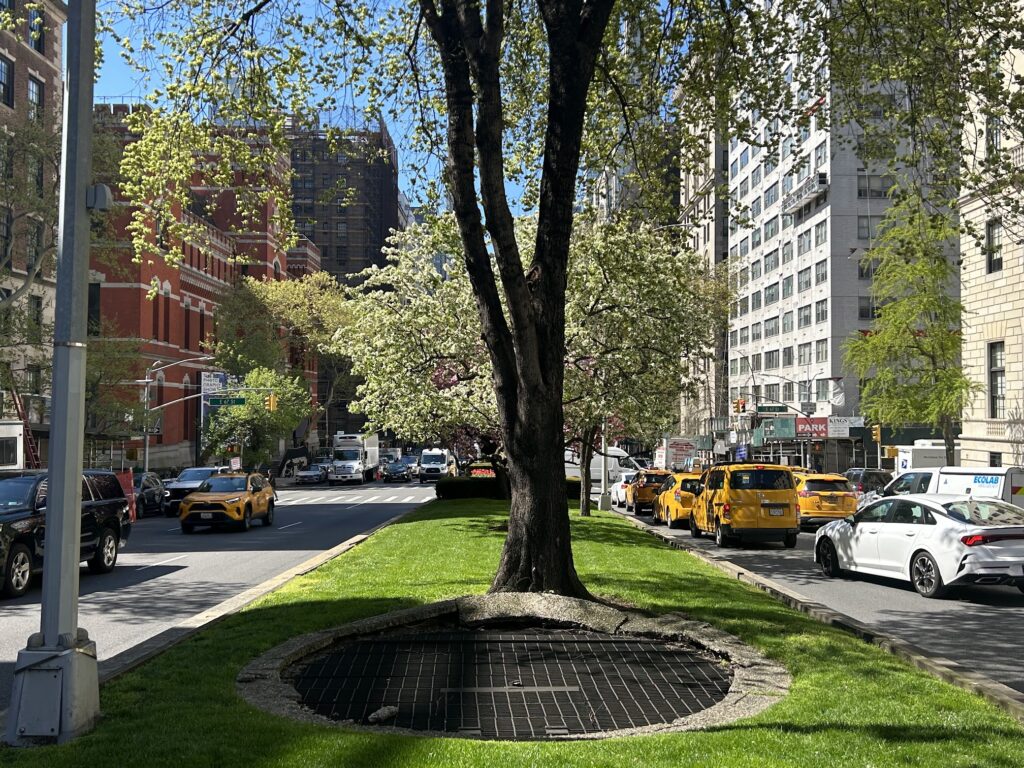
However train tracks running through a quickly growing city are neither safe nor conducive to prosperity. Eventually, the tracks were covered with beautiful flowers and trees, on traffic island malls which have gotten smaller over the years. 

By the 1910s this allowed for glamorous apartment buildings to rise, the homes of a new wealthy elite attracted to apartment living in the post-Gilded Age era. But that lifestyle was not quite made available to everyone. 

In this episode, Greg and Tom take you on a tour of the tunnels and viaducts that helped New York City to grow, creating billions of dollars of real estate in the process. 

LISTEN NOW: UP AND DOWN PARK AVENUE
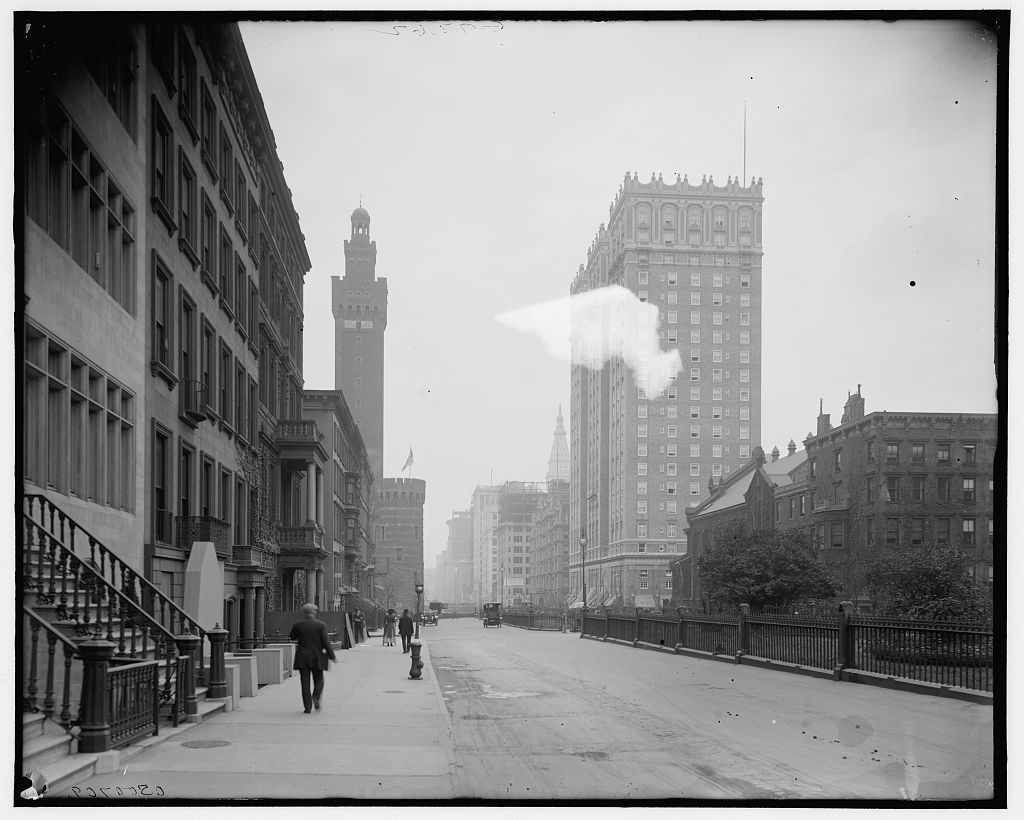

Park Avenue, looking south of 36th Street, 1900-1905 Library of Congress
Park Avenue and 94th Street, Library of Congress
Park Avenue, late 1800s, Musem of the City of New York
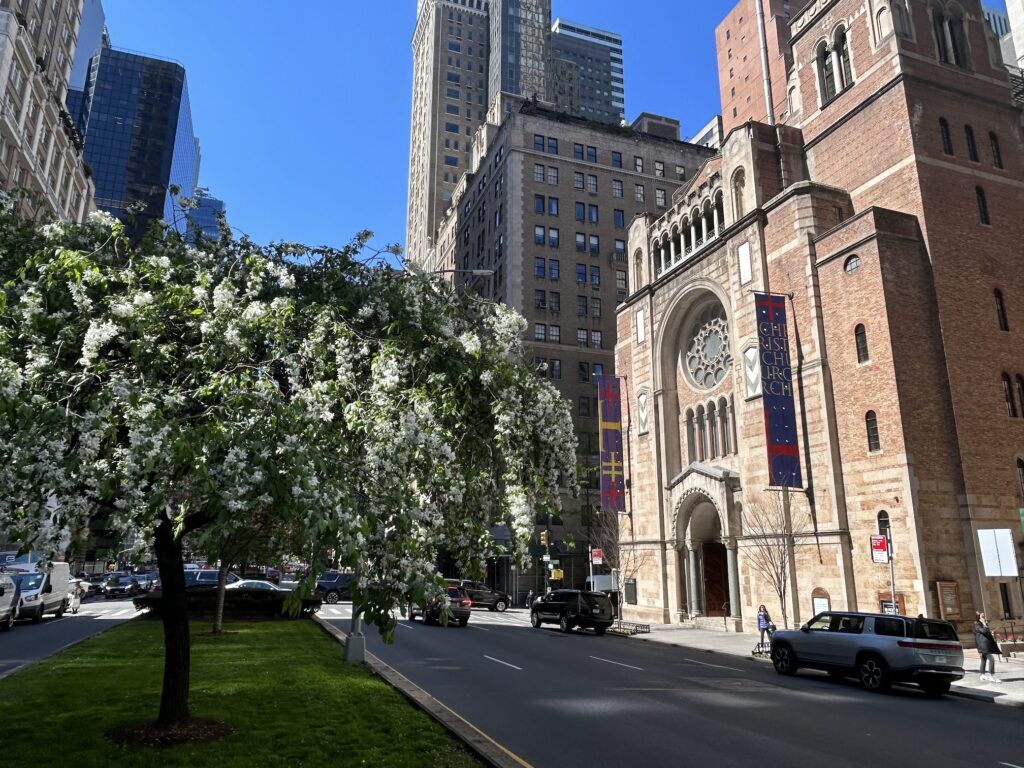
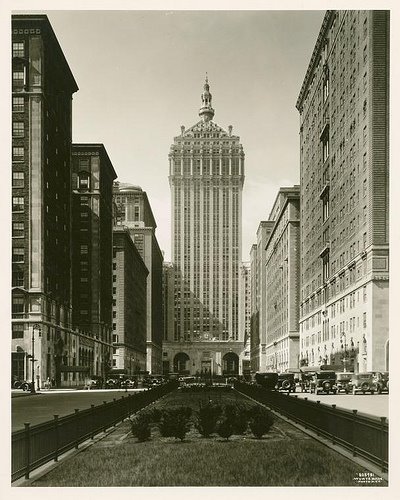
Park Avenue, after St Bart’s came along in 1918 but before these lovely pedestrian areas were destroyed in the late 1920s.
Park Avenue 1927, Department of Transportation
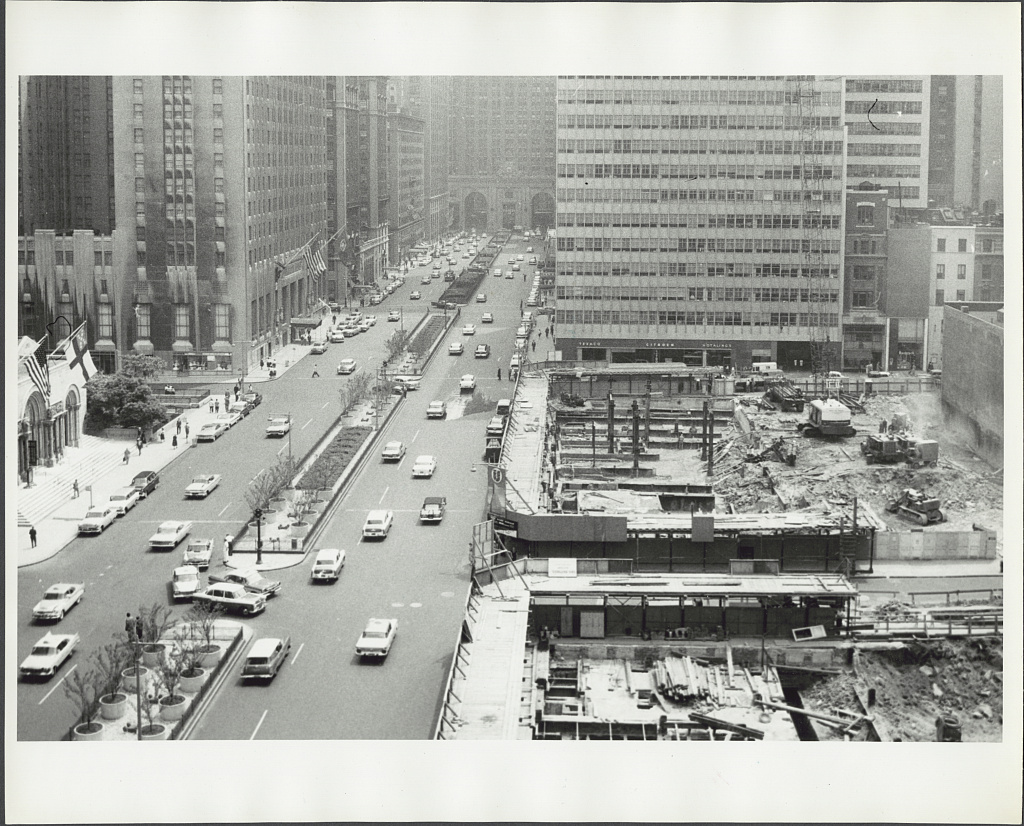
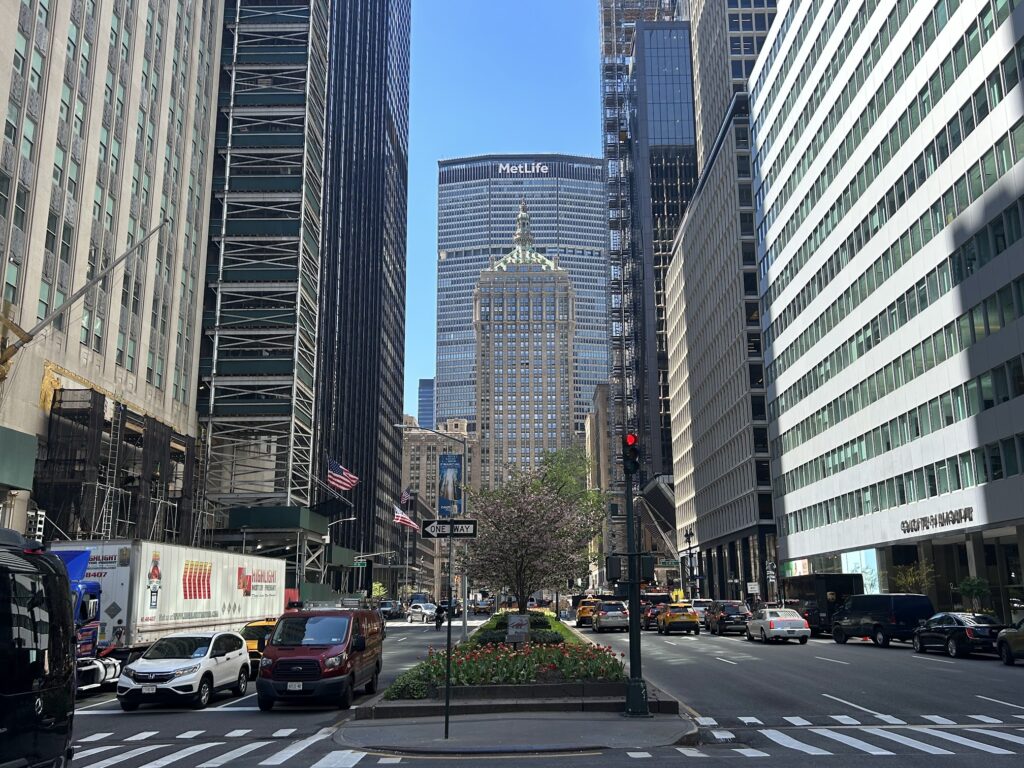
“Photograph shows cars moving along Park Avenue as the road heads towards the tunnels of the Helmsley Building, known then as the New York General Building. Building construction visible to the right. St. Bartholomew’s Church slightly visible on left.” Library of Congress, 1959

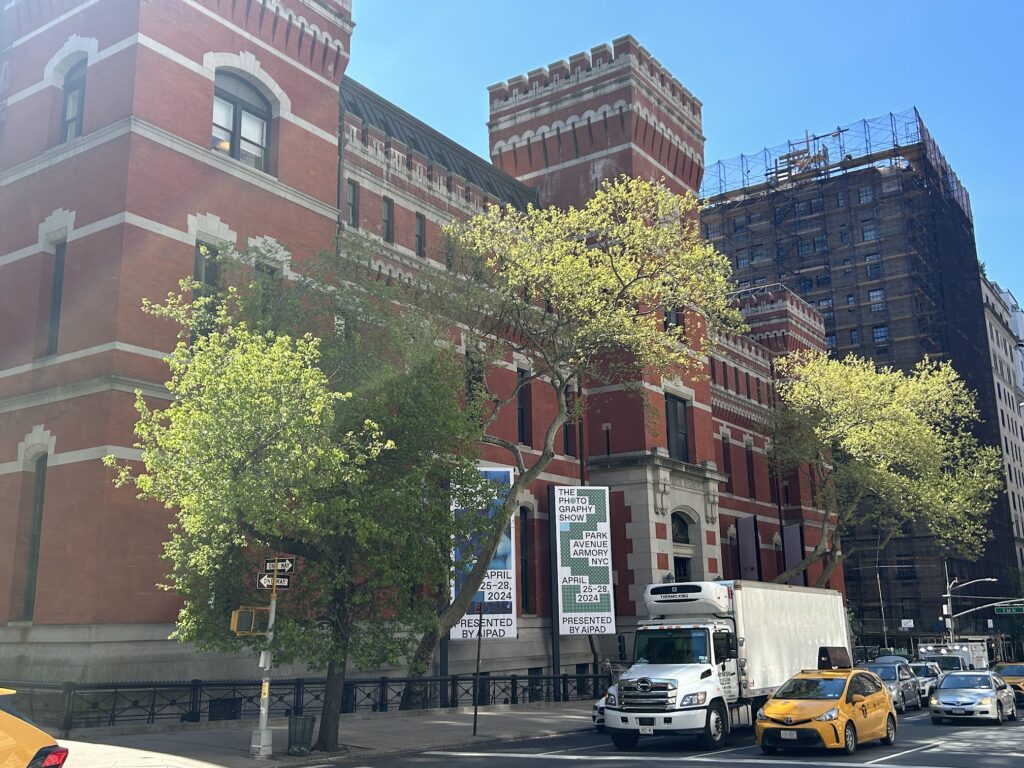
Photo by Greg Young
Photo by Greg Young
Photo by Greg Young
Photo by Greg Young
Photo by Greg Young
Photo by Greg Young
Photo by Greg Young
Photo by Greg Young

FURTHER LISTENING

Listen to these related Bowery Boys episodes after you’re done listening to the Park Avenue show:


FURTHER READING

This week we’re suggesting a few historic designation reports for you history supergeeks looking for a deep dive into Park Avenue history. Dates indicated are when the structure or historic district was designated

St. Bartholomew’s Church and Community House (1967)

Seventh Regiment Armory/Park Avenue Armory (1967)

Consulate General of Italy (formerly the Henry P. Davison House) (1970)

New World Foundation Building (1973)

Racquet and Tennis Club Building (1979)

Pershing Square Viaduct/Park Avenue Viaduct (1980)

Upper East Side Historic District Designation Report (1981)

Lever House (1982)

1025 Park Avenue Reginald DeKoven House (1986)

New York Central Building (1987)

Seagram Building (1989)

Mount Morris Bank Building (1991)
Expanded Carnegie Hill Historic District Report (1993)
Waldorf-Astoria Hotel (1993)

Pepsi-Cola Building (1995)

Ritz Tower (2002)

2 Park Avenue Building (2006)

Park Avenue Historic District Designation Report (2014)

Categories
Long Island Podcasts

Long Island Gothic: A Journey to Grey Gardens

PODCAST The historical backstory of one of the most famous documentaries ever made – Grey Gardens.


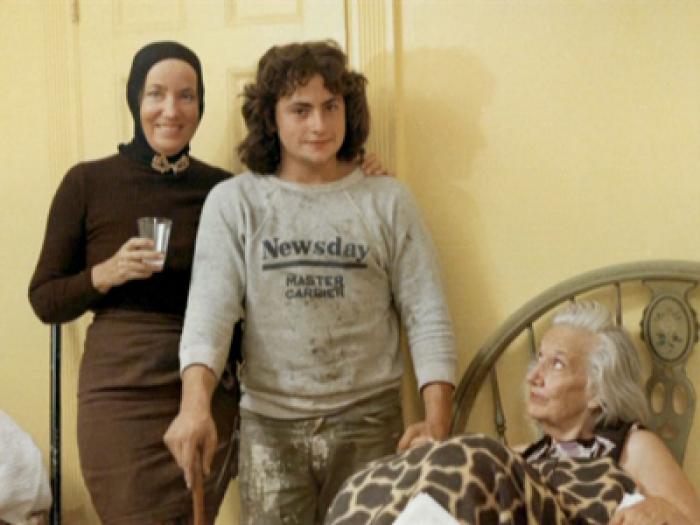
The classic film Grey Gardens, made by brother directing team Albert and David Maysles, looks at the lives of two former society women leading a life of seclusion in a rundown old mansion in the Hamptons.

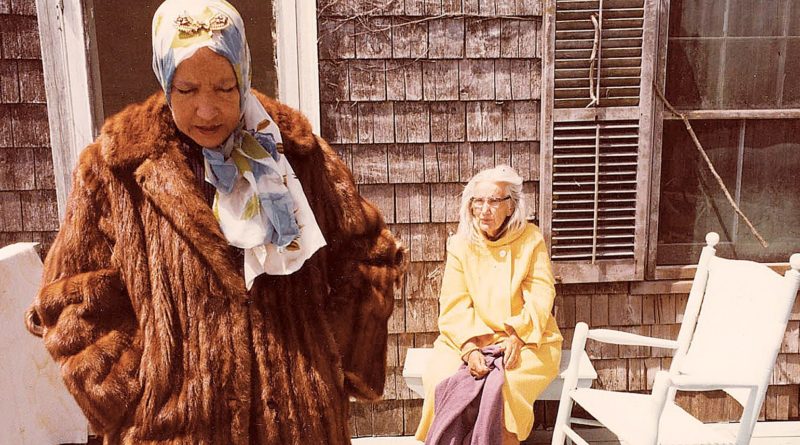
Those of you who have seen the film – or the Broadway musical or the HBO film inspired by the documentary – know that it possesses a strange, timeless quality. Mrs Edith Bouvier Beale (aka Big Edie) and her daughter Miss Edith Bouvier Beale (aka Little Edie) live in a pocket universe, in deteriorating circumstances, but they themselves remain poised, witty, well read.

But if our histories truly make us who we are, then to understand these two extraordinary and eccentric women, we need to understand the historical moments that put them on this path.

And that is a story of New York City – of debutante balls, Fifth Avenue, Tin Pan Alley and the changing roles of women. And it’s a story of the Bouviers, who represent here the hundreds of wealthy, upwardly mobile families, trying to maintain their status in a fluctuating world of social registers and stock market crashes.

This is story about keeping up appearances and the consequences of following your heart.

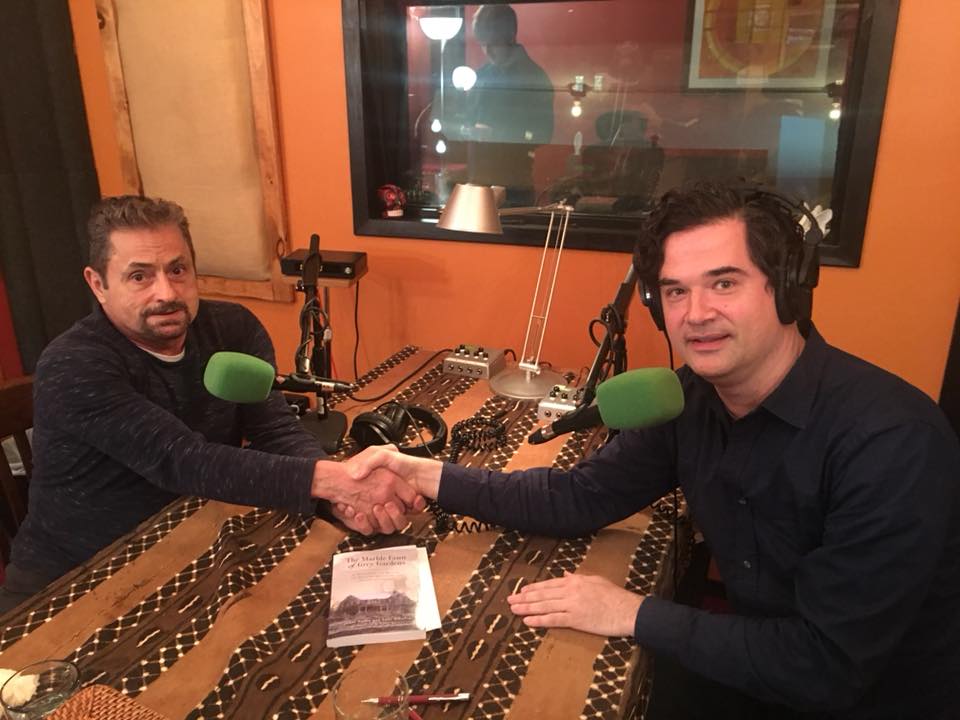
FEATURINGA very special guest! The Marble Faun himself — Jerry Torre, who swings by the show to share his recollection of these fascinating women.

Listen Now: A Journey to Grey Gardens

_________________________________________________________

The Bowery Boys: New York City History podcast is brought to you …. by you!

We are now producing a new Bowery Boys podcast every other week. We’re also looking to improve and expand the show in other ways — publishing, social media, live events and other forms of media. But we can only do this with your help!

We are now a creator on Patreon, a patronage platform where you can support your favorite content creators.

Please visit our page on Patreon and watch a short video of us recording the show and talking about our expansion plans. If you’d like to help out, there are six different pledge levels. Check them out and consider being a sponsor.

We greatly appreciate our listeners and readers and thank you for joining us on this journey so far.

________________________________________________________

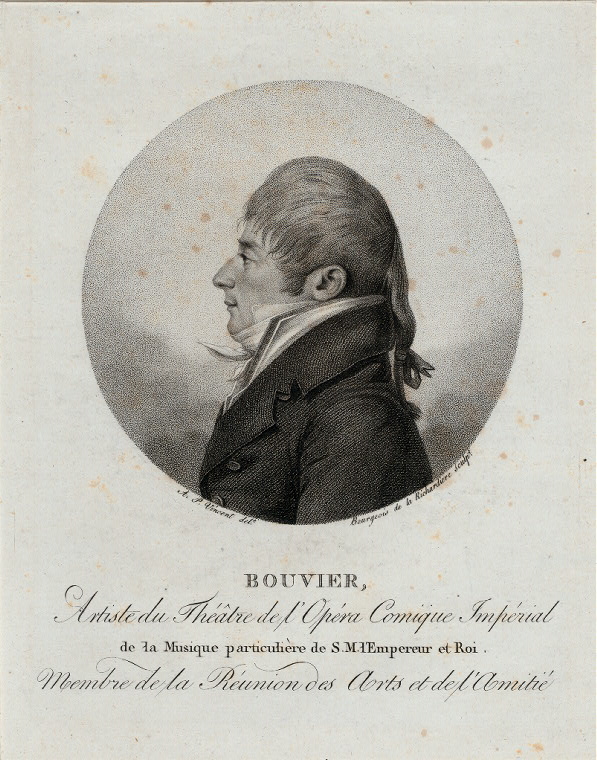
The Bouvier family did indeed have ‘French genes’, connected to cabinetmakers who immigrated to the United States in the 1810s.

NYPL

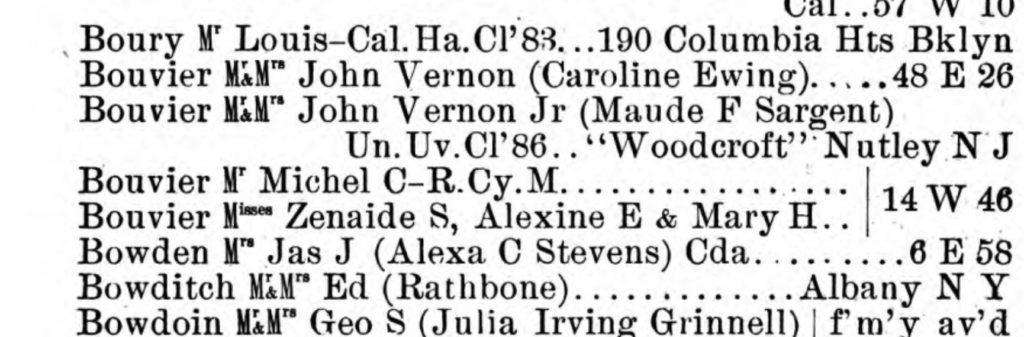
The Bouvier family’s listings in the 1899 New York Social Register.

Big Edie’s great uncle Michel Charles ‘M.C.’ Bouvier and her three unmarried great aunts Zenaide, Alexine and Mary all lived in a fine brownstone at 14 W. 46th Street.

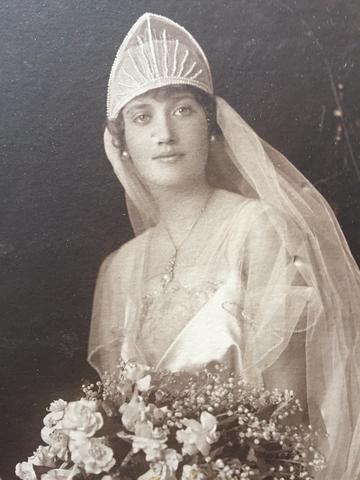
Edith Ewing Bouvier Beale

Grey Gardens Official

The wedding photo of Edith Ewing Bouvier Beale.

Grey Gardens Official

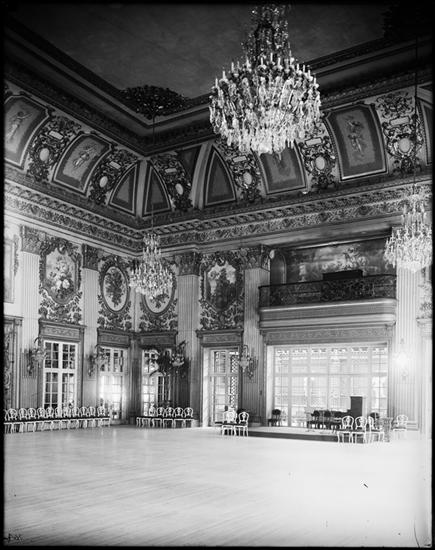
The ballroom of Sherry’s (44th and 5th Avenue) where Edith had her debutante ball.

MCNY

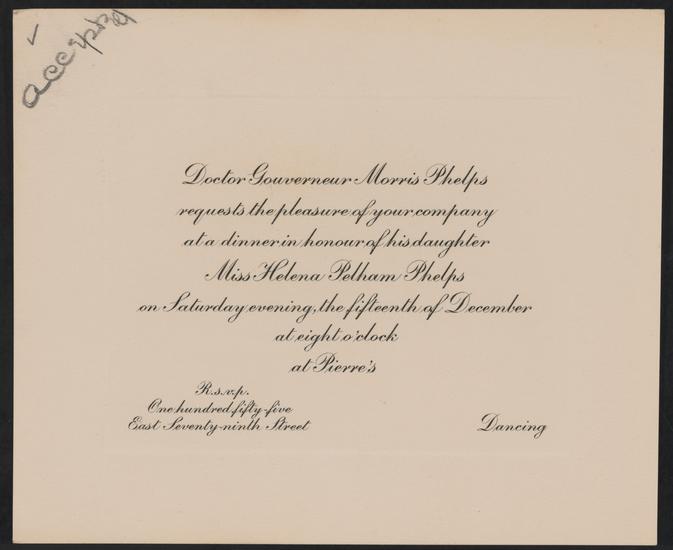
An invitation for a 1928 debutante ball at the Hotel Pierre (where Little Edie would have her own fête).

Museum of the City of New York

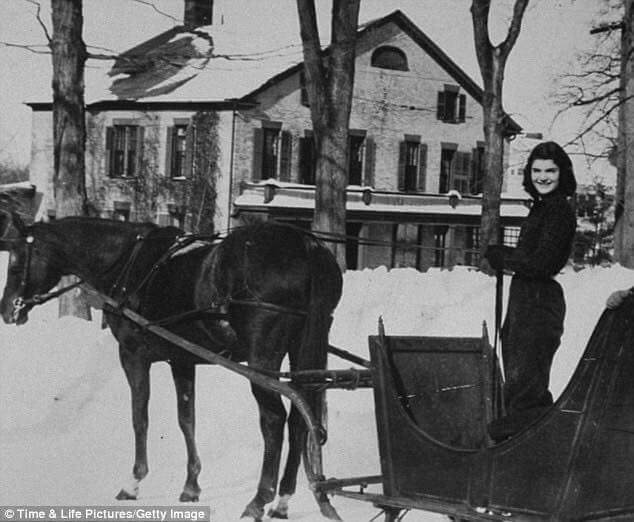
Sixteen year old Jacqueline Bouvier attending Miss Porter’s finishing school in Farmington, Connecticut. Both Big Edie and Little Edie went here as well.

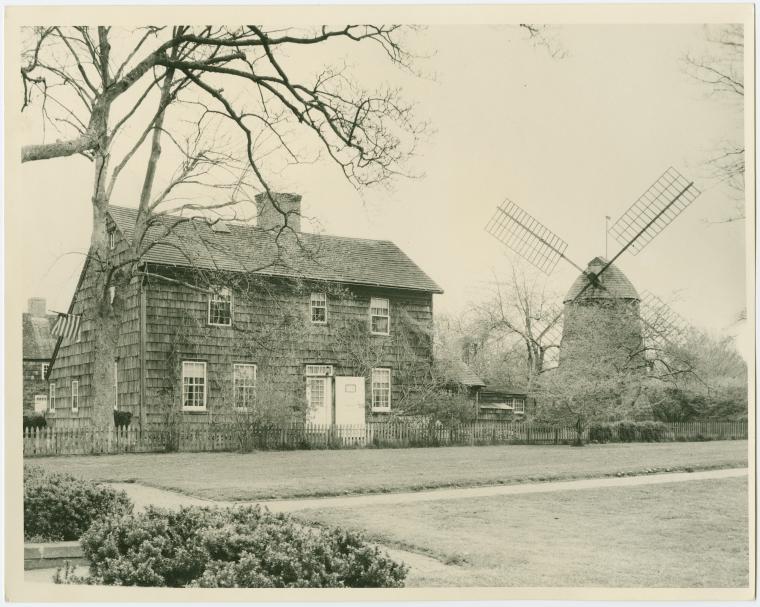
East Hampton was the first English settlement in the area that would eventually become New York state.

NYPL

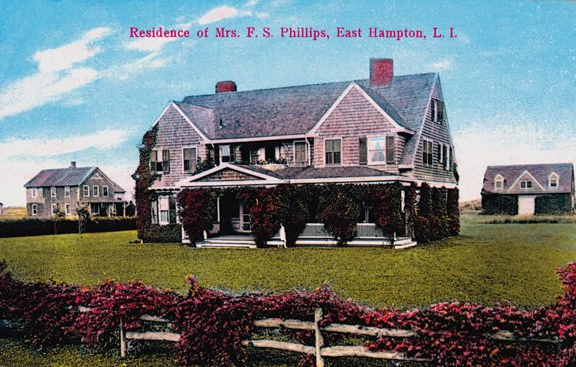
An early image of Grey Gardens mansion.

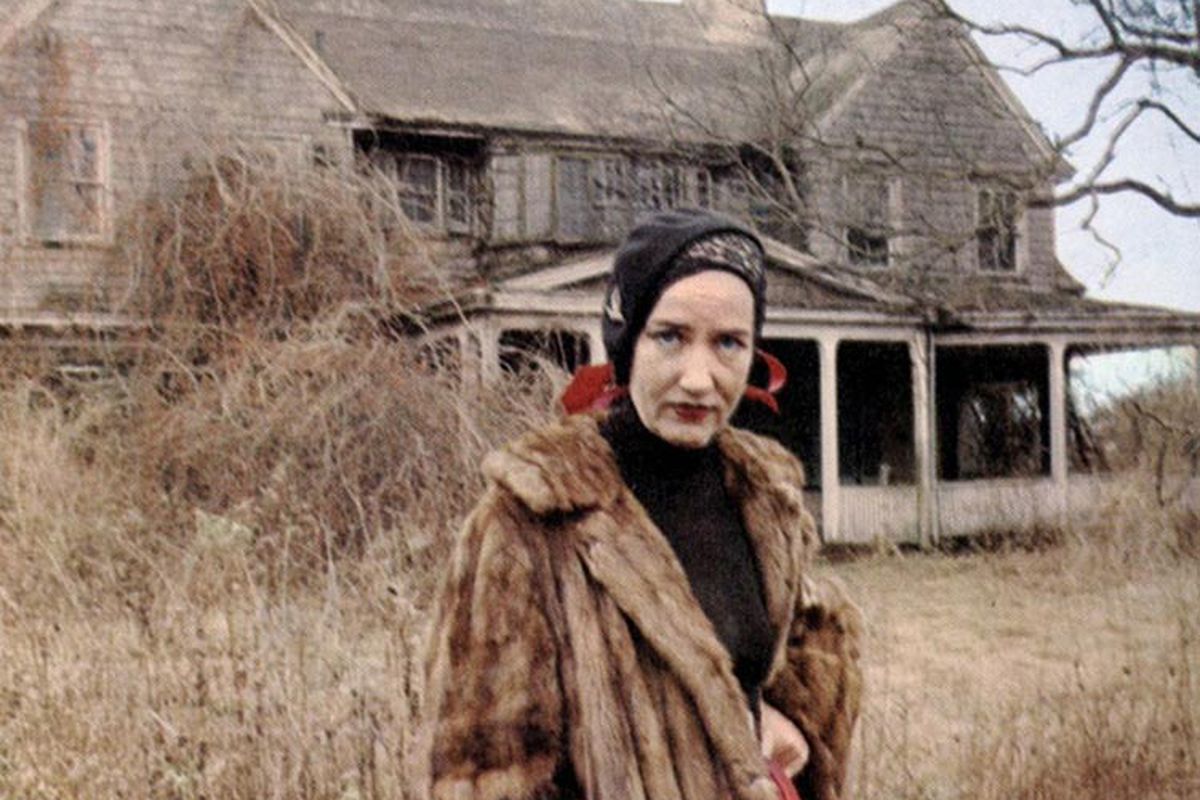
Little Edie posing in front of the house in the film Grey Gardens.

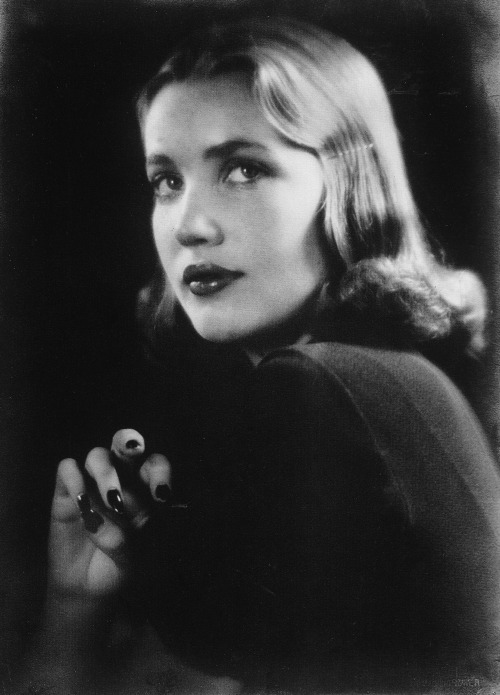
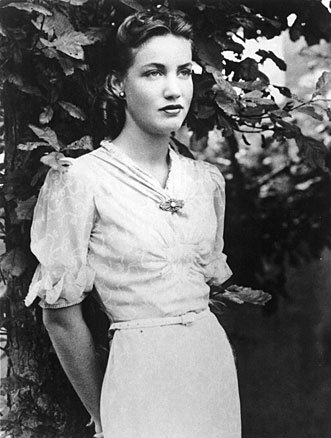
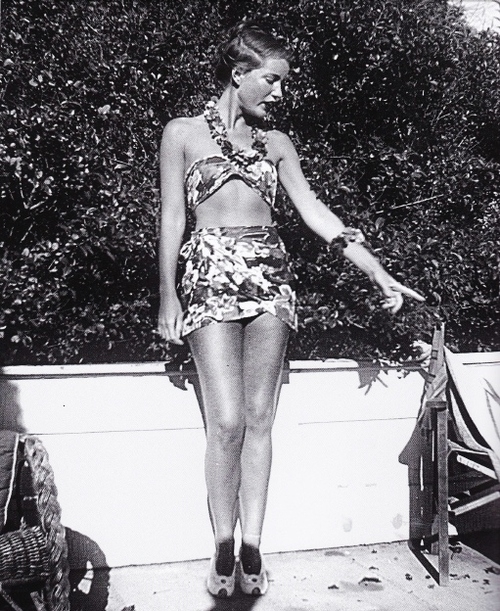
Images of Little Edie in her youth, a beautiful, confident young woman who echoed her mother’s love of music and performance. The two retreated into a reclusive life even as their family become national prominent.

Grey Gardens Official

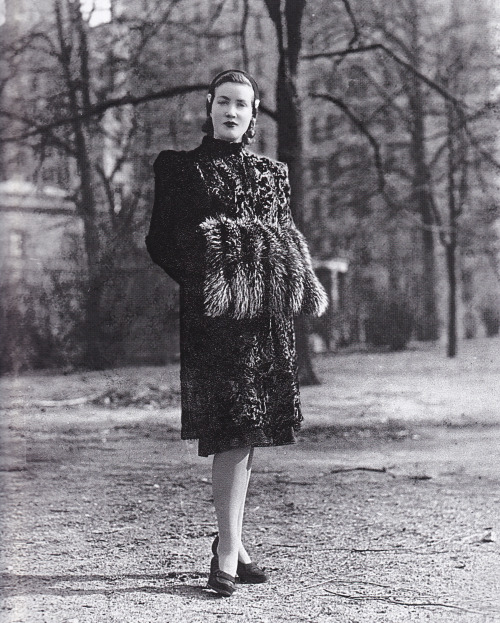
Little Edie in New York, possibly from the period of the late 40s/early 50s.

Grey Gardens Official

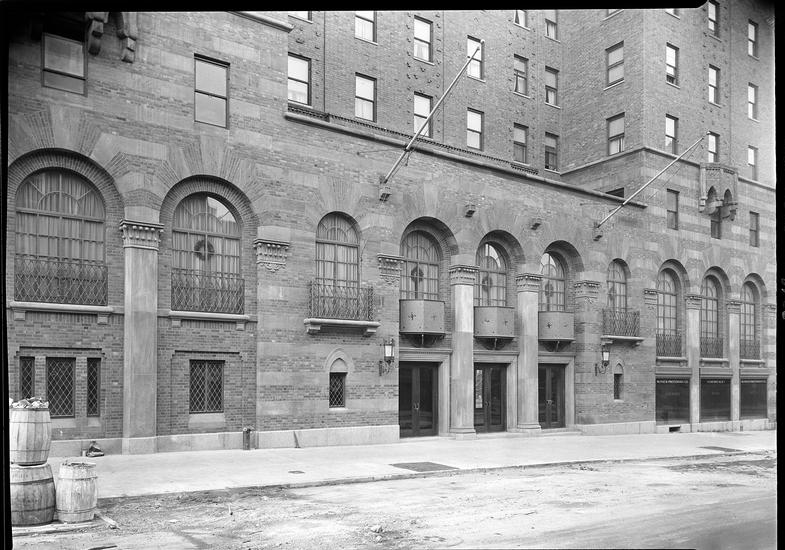
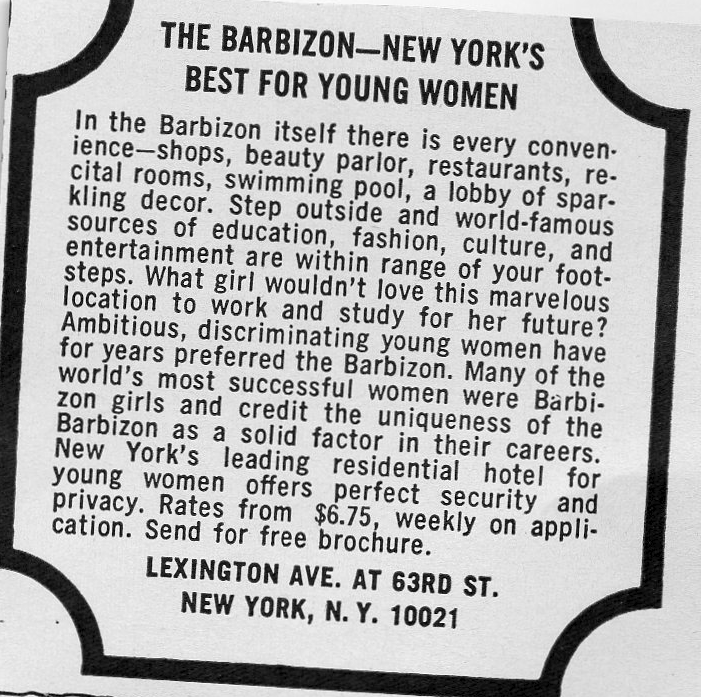
Little Edie’s big-city refuge for a time — the Barbizon Hotel for Women:

Museum of the City of New York/Samuel Gottscho

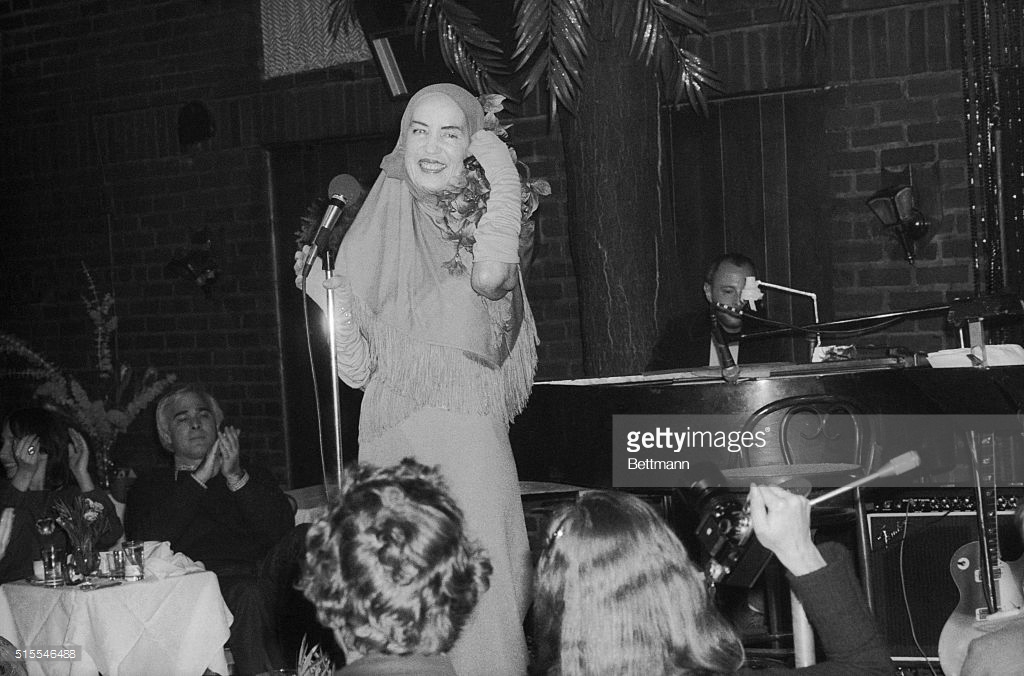
Little Edie performing at Reno Sweeney in the West Village.

Getty

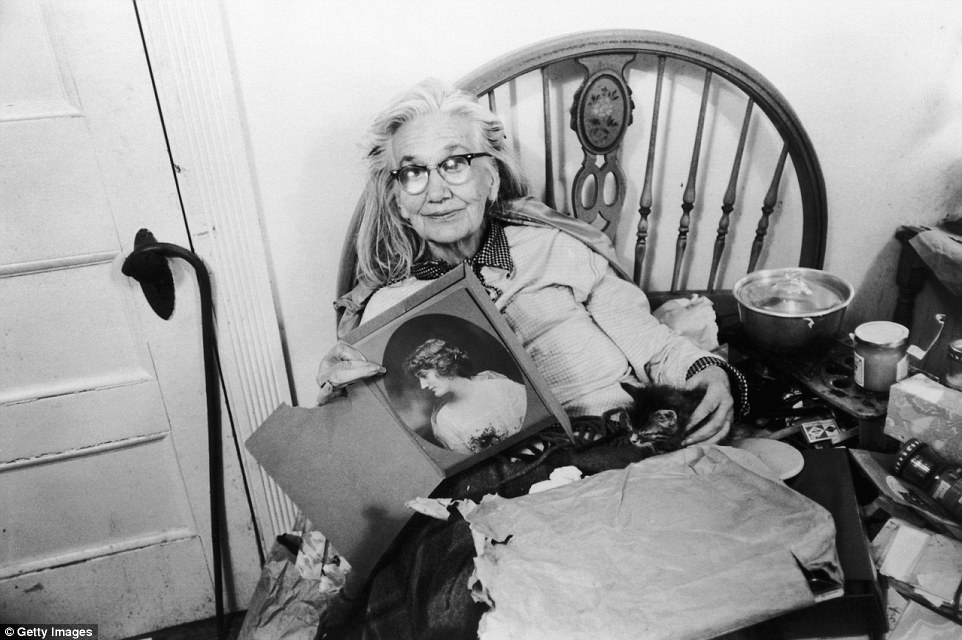
Big Edie in her familiar perch, flanked with kittens and memories.

Getty

Many thanks to Jerry Torre for stopping by the studio to chat!

CORRECTION TO THE SHOWThe Great Gatsby is set in 1922, but the book was released in 1925.

FURTHER READING
The Marble Faun of Grey Gardens by Jerry Torre and Tony Maietta
The Bouviers: Portrait of an American Family by John H. Davis
Gail Sheehy’s New York Magazine profile from January 1972 — The Secrets of Grey Gardens
Grey Gardens Online — “The one-stop source for all things Grey Gardens”

FURTHER LISTENING
Some of the themes and subjects referenced in this episode have been spoken about in past shows. After you’ve finished listening to Journey to Grey Gardens, give these a try.

And if you enjoyed the show, you might enjoy the soundtrack! Here’s a Spotify playlist of songs from the show and inspired by this story:

Categories
Podcasts The Jazz Age

Jimmy Walker, Mayor of the Jazz Age (NYC and the Roaring ’20s Part One)

PODCAST For the first part in our New York City in the Roaring Twenties summer mini-series, we’re hitting the town with “Beau James,” New York’s lively and fun-loving mayor Jimmy Walker.

And the king of it all was Jimmy Walker, elected mayor of New York City just as its prospects were at their highest. The Tin Pan Alley songwriter-turned-Tammany Hall politician was always known more for his grace and style than his accomplishments. His wit and character embodied the spirit (and the spirits) of the Roaring ’20s.

The 1920s were a transformational decade for New York, evolving from a Gilded Age capital to the ideal of the modern international city. Art deco skyscrapers reinvented the skyline, reorienting the center of gravity from downtown to a newly invigorated Midtown Manhattan. Cultural influences, projected to the world via radio and the silent screen, helped create a new American style.

Join us for an after-midnight romp with the Night Mayor of New York as he ascends to the most powerful seat in the city and spends his first term in the lap of luxury. What could possibly go wrong?

LISTEN NOW: KING OF THE JAZZ AGE


The Bowery Boys: New York City History podcast is brought to you …. by you!

We are now producing a new Bowery Boys podcast every two weeks. We’re also looking to improve the show in other ways and expand in other ways as well — through publishing, social media, live events and other forms of media. But we can only do this with your help!

We are now a member of Patreon, a patronage platform where you can support your favorite content creators for as little as a $1 a month.

Please visit our page on Patreon and watch a short video of us recording the show and talking about our expansion plans. If you’d like to help out, there are five different pledge levels (and with clever names too — Mannahatta, New Amsterdam, Five Points, Gilded Age, Jazz Age and Empire State). Check them out and consider being a sponsor.

We greatly appreciate our listeners and readers and thank you for joining us on this journey so far. And the best is yet to come!


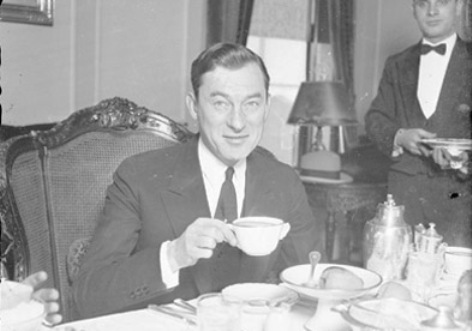
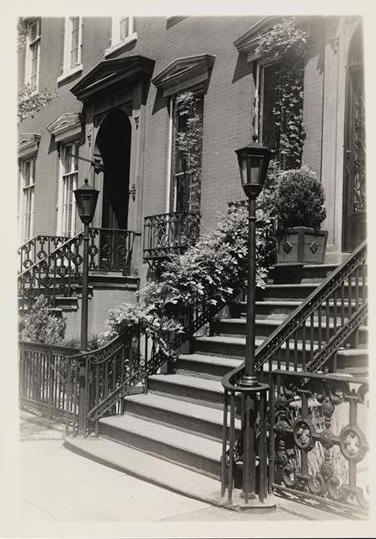
Walker having his morning coffee at his home on 6 St. Lukes Place (pictured below)

Courtesy MCNY

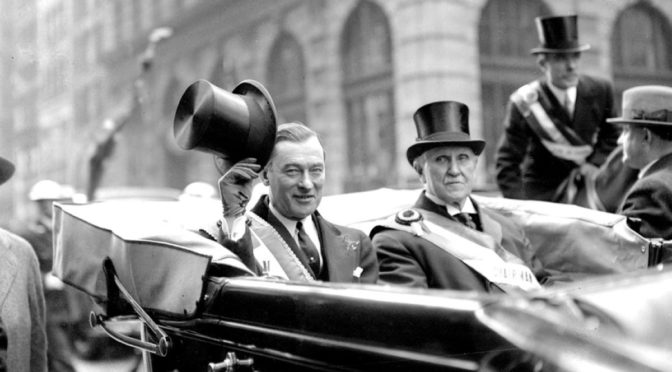
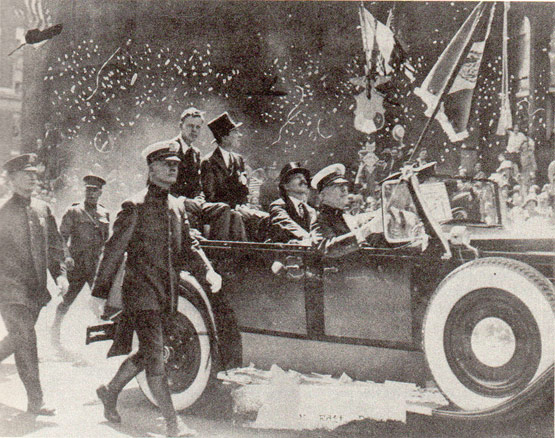
Jimmy Walker with Charles Lindbergh in 1927, in the midst of a ticker tape parade after his non-stop ride from Long Island to Paris.

Courtesy New York Social Diary

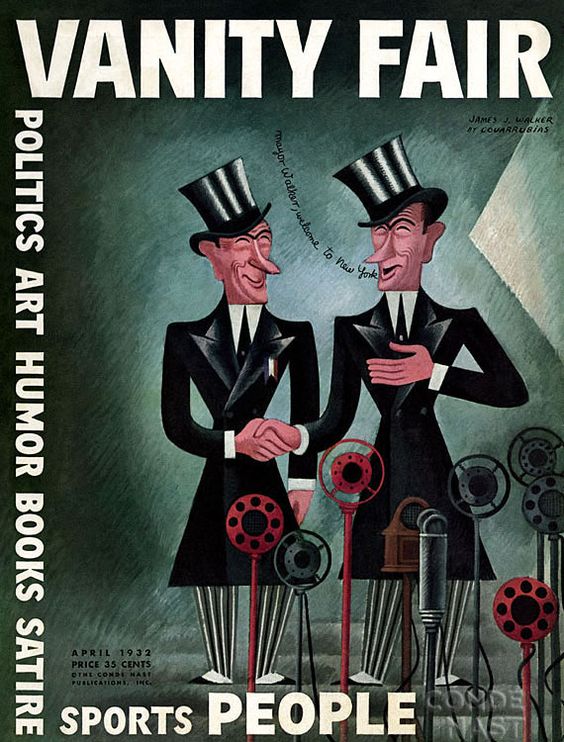
Walker so enjoyed throwing public events for famous people that he was frequently parodied for it. In 1932 Vanity Fair pictured him giving a lavish welcome — to himself.

Conde Nast

Harry McDonough with The Elysian Singers from 1905, singing Walker’s big hit “Will You Love Me In December As You Do In May.”

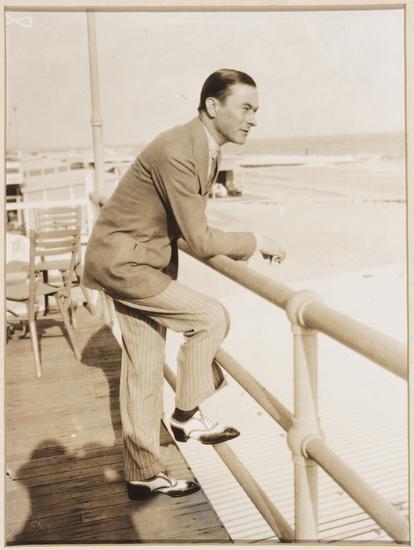
The dashing fashion plate, pictured here most certainly on his way to yet another vacation…..

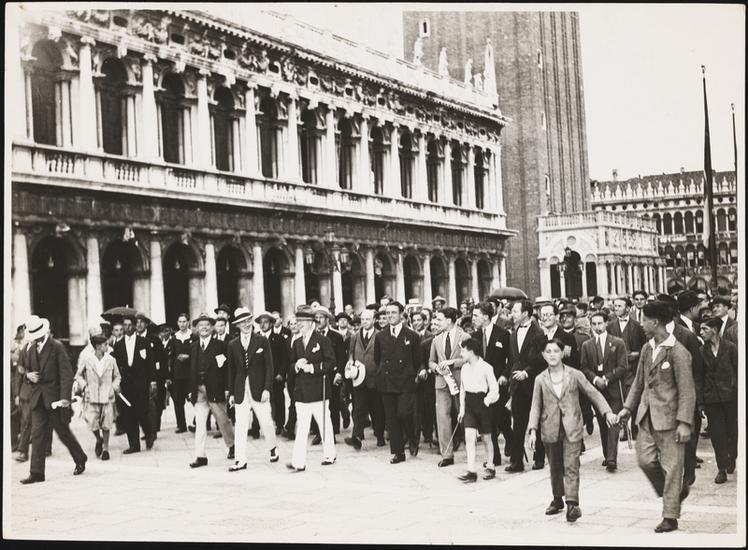
….perhaps his European vacation! He’s pictured here in 1927, strolling the streets of Venice with a few hundred people behind him.

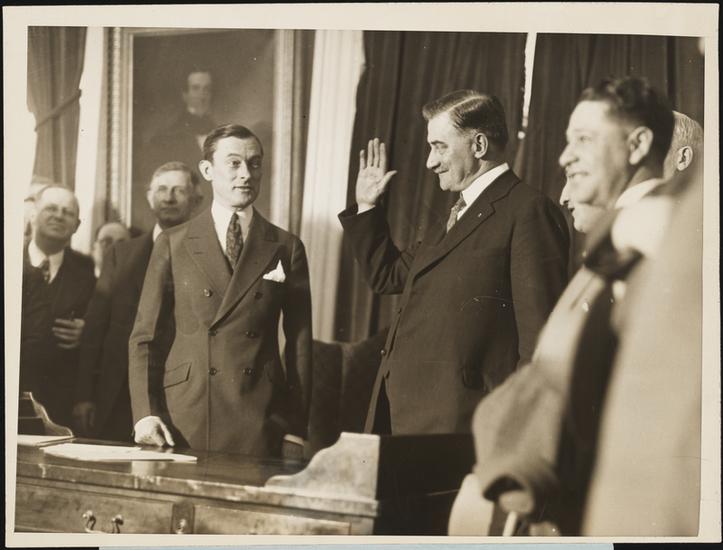
A picture of Jimmy, actually at work! He’s swearing in the new fire commissioner James J. Dorman in 1926.

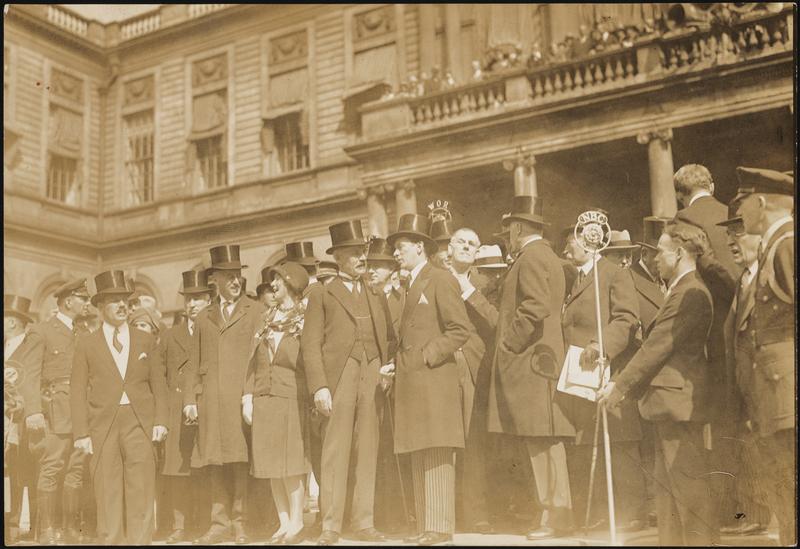
Mayor Jimmy Walker with British Prime Minister Ramsay MacDonald at yet another welcoming ceremony, broadcast on the radio.

MCNY

Another British visit, this time from Mrs Foster Welch, Mayor of Southampton.

In another Pathe video, Jimmy Walker visits Ireland and the former home of his father.

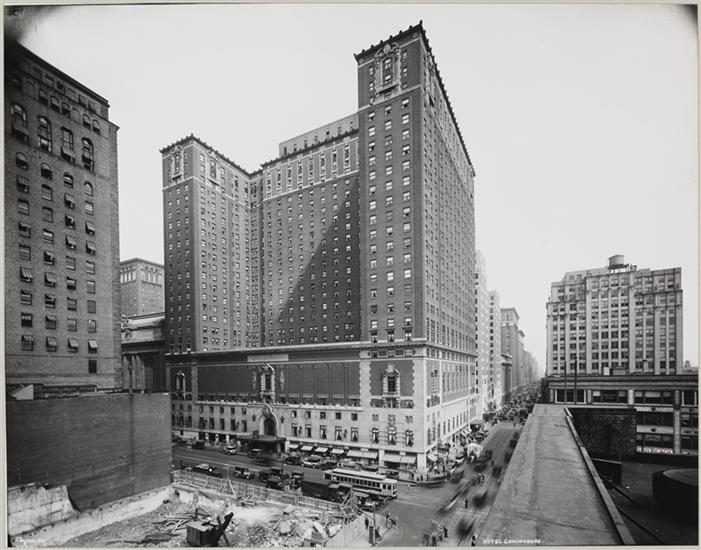
During Walker’s extraordinary rise, New York was becoming an entirely new city in the 1920s with construction projects on virtually on every block. Even in front of the Hotel Commodore (pictured here in 1927), which was, for a time, the home of Jimmy Walker.

Park Avenue (at 50th Street) in 1922.

MCNY

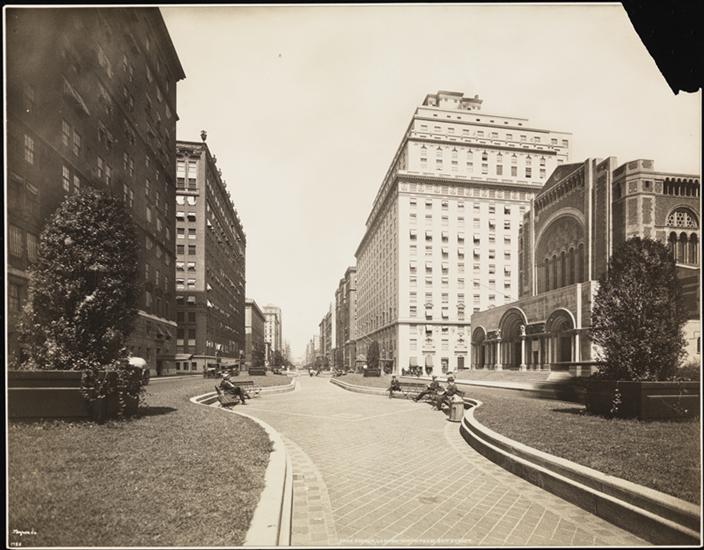
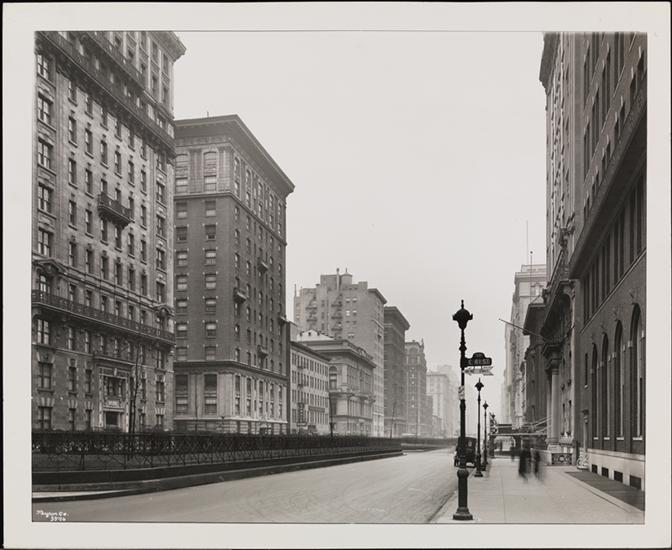
Park Avenue at 61st Street in 1922. The rich flocked to this newly developed street of apartment complexes, making it the new center of wealth.

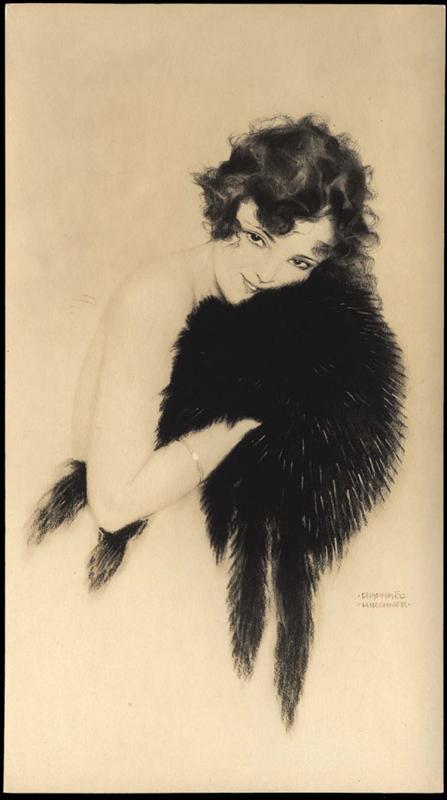
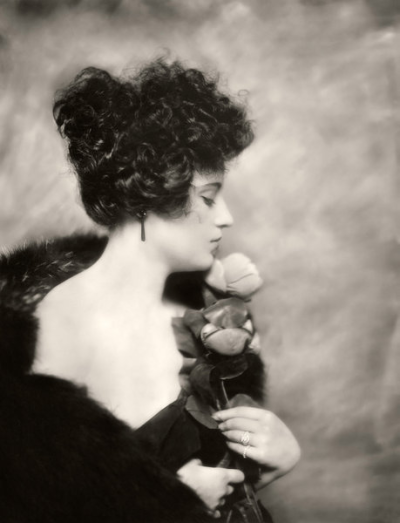
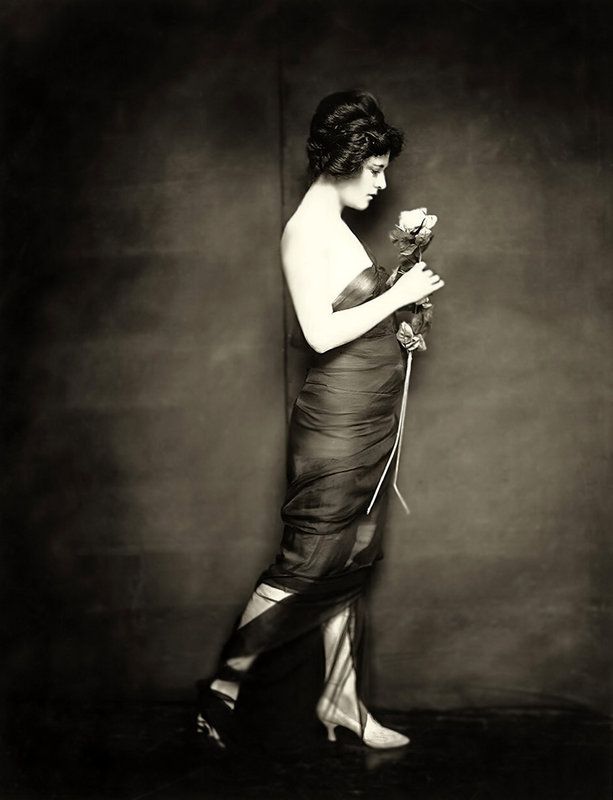
And now, for a little glamour, a few shots of Yvonne Shelton, then Betty Compton, Walker’s two most famous girlfriends (who he wooed while married to wife Janet).

wikiart
Courtesy Historial Ziegfeld
Photographs above by Alfred Cheney Johnston.

She most famously starred in 1927’s Broadway production of Oh Kay! starring Gertrude Lawrence. Here’s Lawrence singing a famous song from that show:

IN TWO WEEKS: Chapter Two of our series on the Roaring ’20s, rewinding back to the beginning of the decade and introducing you to another icon of the Jazz Age. Who will it be?
Categories
Landmarks

Grand Central Terminal: The original plan from 1910

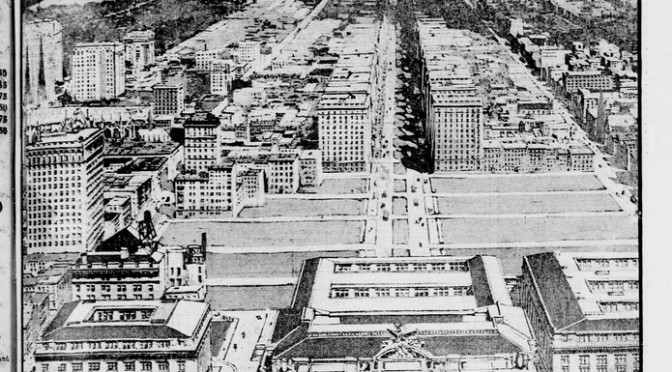
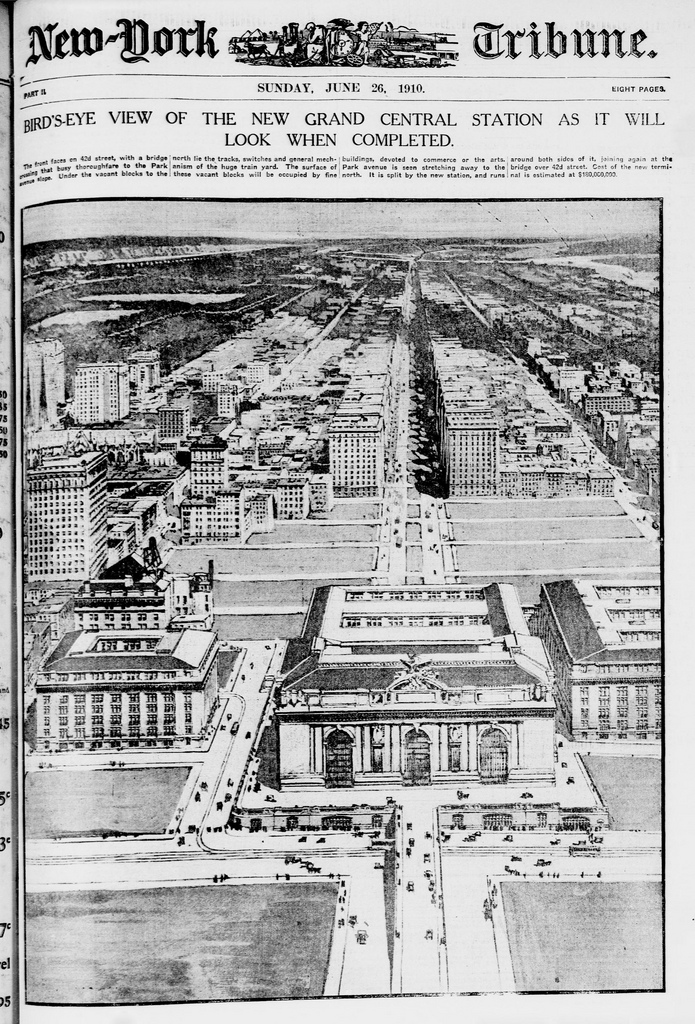
Continuing the celebration of Grand Central Terminal’s 100th anniversary, here’s a look at the proposed street plan which was run in the New York Tribune on June 26, 1910.

“The front faces on 42nd Street, with a bridge crossing that busy thoroughfare to the Park Avenue slope. Under the vacant blocks to the north lie the tracks, switches and mechanisms of the huge train yard. The surface of these vacant blocks will be occupied by fine buildings, devoted to commerce or to the arts.

Park Avenue is seen stretching away to the north. It is split by a new station and runs around both sides of it, joining again at the bridge over 42nd Street. Cost of this new terminal is estimated at $180,000,000.”

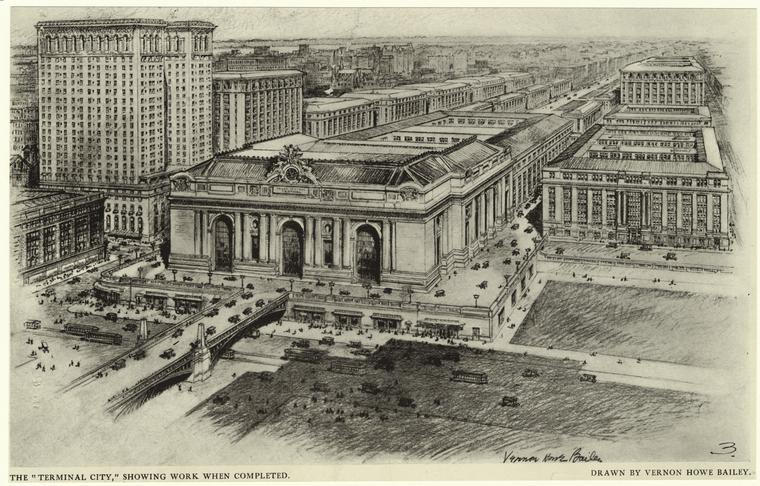
This was the beginning of the ‘Terminal City’ plan, a group of linking buildings with similar design. Sadly, many of those buildings were never built, and those that were have been torn down during the furor of the midtown skyscraper boom.

The plan below shows Terminal City from a different angle, and with new features:

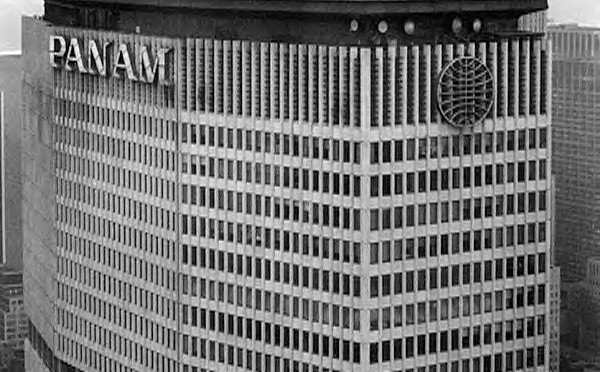
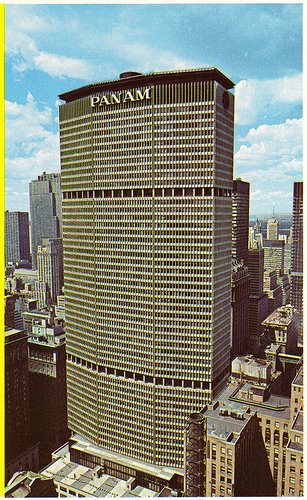
The uniformity intended for Terminal City stands in stark contrast to the multiplicity of towering structures in the area today. In particular, the graceful New York Central Building (today the Helmsley Building) would finally rise to Grand Central’s north in 1929. The decidedly ungraceful Pan Am Building (today the MetLife Building) was planned during the late 1950s, when commuter travel by train decreased and Grand Central was considered an antiquated relic.

But it’s not what you see that New Yorkers marveled at back in 1910. It’s what you didn’t see. “[A]ll of  this machinery of this vast terminal — the signals, the tracks and the hundreds of trains — will never be seen from the street,” proclaimed the 1910 Tribune article. “They will be less in evidence than the engines at the heart of an ocean liner.”

Electric trains afforded such a disappearance from street level, creating an entirely new boulevard from 45th Street to 57th Street.  In some serious understatement, the Tribune continues, “These changes will revolutionize the character of this part of the city. Along the new part of Park Avenue will be constructed a mile and a half of imposing apartment houses.”

Spectacular apartment complexes would appear on Park Avenue, but mostly above 57th Street.  Commerce would eventually fill in the block below, bringing the most innovative skyscrapers of the 1950s, structures like the Seagram Building at 52nd Street and the Lever House at 53rd Street, buildings which toyed with the city’s zoning laws and created new public spaces.

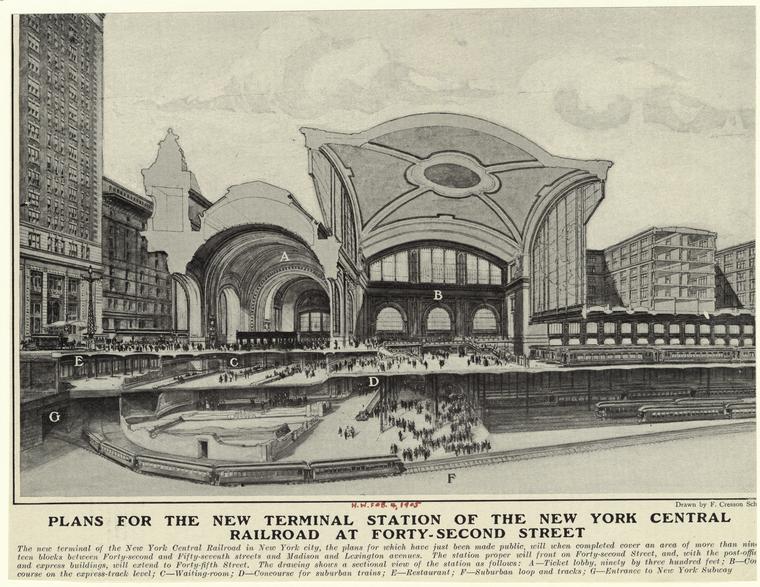
Below: A cross-section plan of the new structure, created in 1905, focuses on what would have focused on the terminal’s most magnificent secret — the buried tracks and public spaces.

Top two images courtesy Library of Congress; bottom image from New York Public Library
Categories
Uncategorized

The Avengers Disassemble the MetLife Building

Fare thee well, you who we once called the Pan Am. We hardly knew thee. Image from Comic Book Movie

Warning: This story contains light spoilers.

Recent fantasy films and TV shows have found ways to alter New York City through the creation of alternate universes.  On Fox’s Fringe, a parallel world features a New York where the World Trade Center wasn’t destroyed, the Department of Defense is in a newly-bronzed Statue of Liberty, and Robert Moses never drove the Dodgers from Brooklyn. (The show also showed us what the skyline might look like with some Antonio Gaudi architecture.)

Comic book movies delight in showing super villains destroying the city — this summer’s ‘The Dark Knight Rises’ blows up bridges and ravages Federal Hall, while ‘The Amazing Spider-man’ will trash Midtown — and sometimes they even re-write history itself.

In ‘Captain America: The First Avenger’, the title character, a resident of Red Hook, discovers underground government laboratories in downtown Brooklyn during World War II.  Elsewhere in this Marvel Comics timeline, Moses’ World’s Fair of 1939-40 was such a smashing success that Tony Stark (aka ‘Iron Man’) turns the site into a year-round glittering expo of technology!

The latest Marvel adventure ‘The Avengers’ takes a more proactive approach to revising the city landscape, as though the entire film was a surly New Yorker architecture critic.

Thanks to the Commissioners Plan of 1811, allowing for a grid striped with long uninterrupted canyons, grotesque alien beings from Asgard can fly down the avenues unabated, wrecking havoc through Manhattan — Park Avenue in particular. Fortunately our heroes gather at Grand Central Terminal‘s traffic overpass, a critical location that they turn into a picturesque battleground. (Honorary Avenger Cornelius Vanderbilt, or at least his old statue from St. John’s terminal, stands resolutely in the background, ready to employ his superpower of acquiring railroads.)

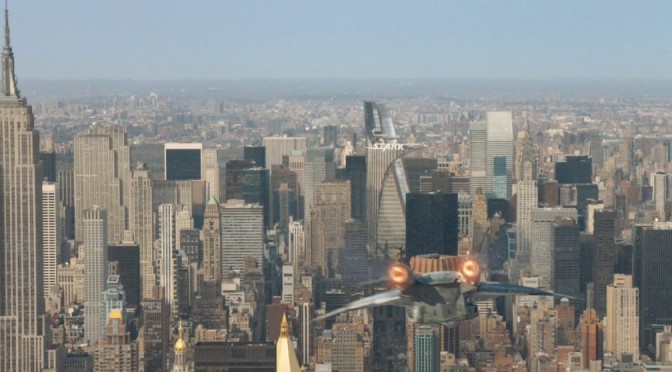
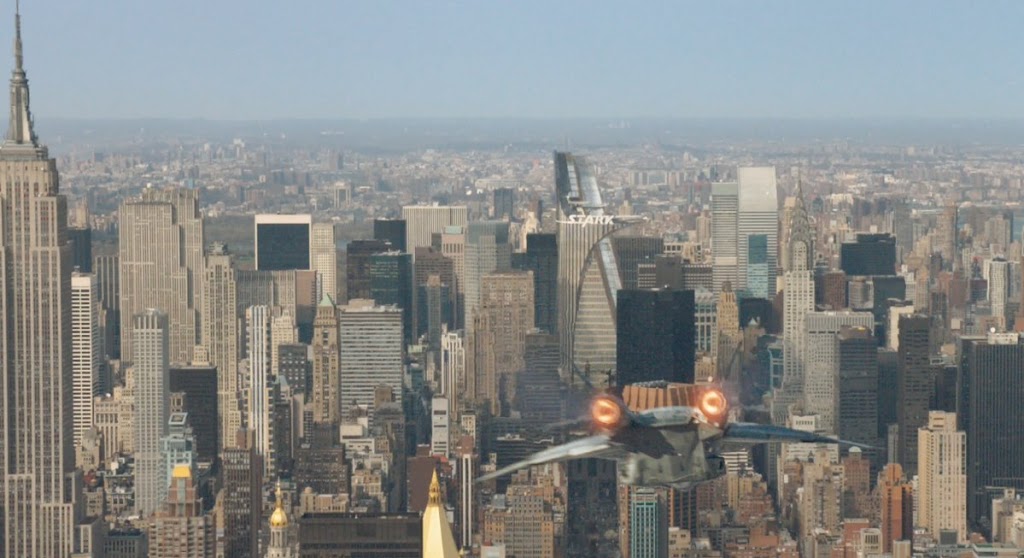
But one famous New York building is notably missing from these shenanigans. Stark, played by Robert Downey Jr., has constructed an energy-efficient new supertower for Stark Industries right on Park Avenue itself. To build this, he has clearly gotten permission from the city to methodically dismantle the MetLife Building (the former Pan Am Building).

The filmmakers have specifically chosen not to merely erase the MetLife Building, but to specifically display it being taken apart. The building is shown greatly reduced in height, decorated with cranes disassembling it like a tinker toy.

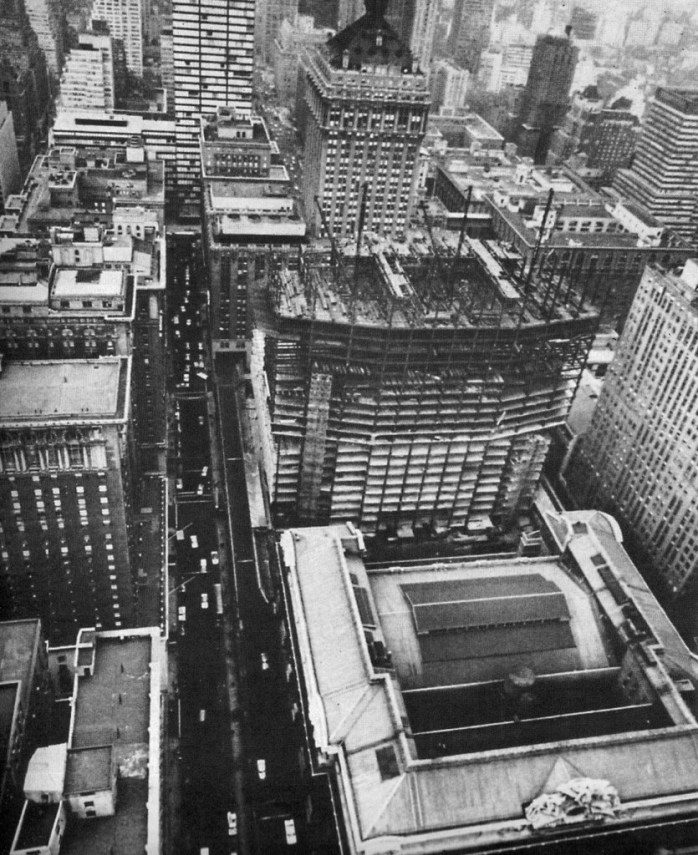
While other buildings enjoy the glamour of being reduced to rubble by gigantic mechanical space fish, the MetLife is ignobly taken apart to be replaced by an even taller, uglier structure. In fact, the dismantling looks a bit like this picture, an image of the Pan Am Building during construction in 1969:

(You can find a few more interesting construction pics here.)

The MetLife Building is easily one of the most disrespected structures in Manhattan and has been almost since the beginnings. Ada Louise Huxtable famously wrote: “A $100 million building cannot really be called cheap. But Pan Am is a colossal collection of minimums.”

According to author Meredith Clausen, “The Pan Am Building and the reaction to it signaled the end of an era. Begun when the modernist aesthetic and the architectural star system ruled architectural theory and practice, the completed building became a symbol of modernism’s fall from grace.”

Its broad-shouldered silhouette calls a halt to Park Avenue in a dated style that hovers between two Beaux-Arts structures (Grand Central to its south, the Helmsley Building to its north). Yet people blame the building for somehow ‘ruining’ Park Avenue — when the two other structures already blocked it — and its sly octagonal shape today makes it one of New York’s more interesting Brutalist-style examples.

Modernism happened, and if you use the same criteria that we might apply to other treasured New York structures, then the MetLife Building is a unique and exemplary building. But can you ever imagine a time when the MetLife Building might ever be landmarked?

This is what I was thinking while Thor and the Hulk were tearing into alien lifeforms.

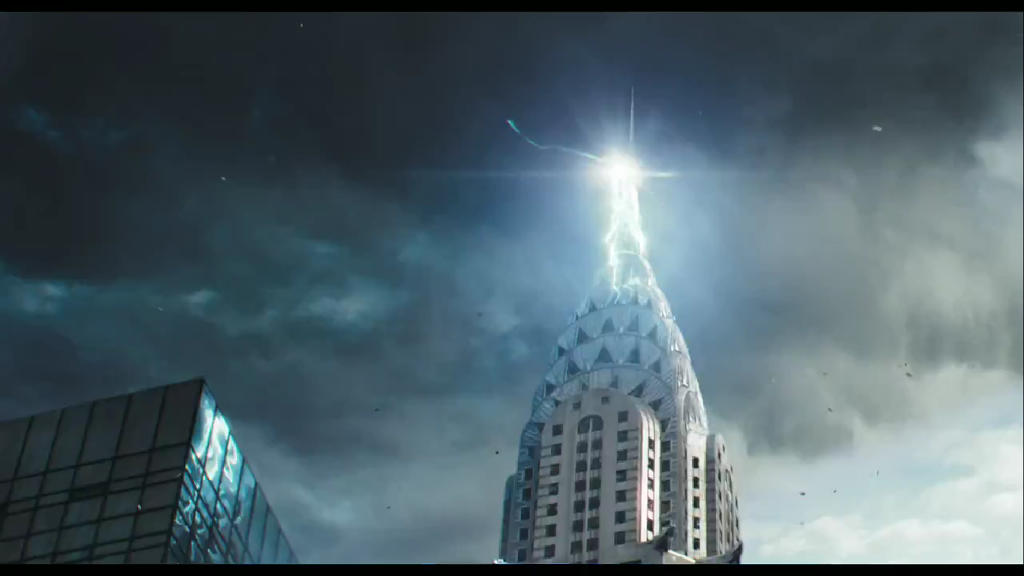
But ‘The Avengers’ isn’t entirely disrespectful of architecture. In fact, the Chrysler Building is practically fetishized as an ideal view from the newly built penthouse of the Stark Building.

Its antenna spire, which makes it New York’s fourth largest building, is even utilized by Thor in the battle to save the Earth. William Van Alen, the building’s architect, would have been quite amused. This very spire was hoisted to the top of the structure from within the building itself in October 1929, a surprise accessory that allowed the Chrysler to take the title of New York’s tallest building from 40 Wall Street.

Pic above courtesy Bleeding Cool

Categories
Podcasts

Steinway and Sons: piano men and kings of Queens

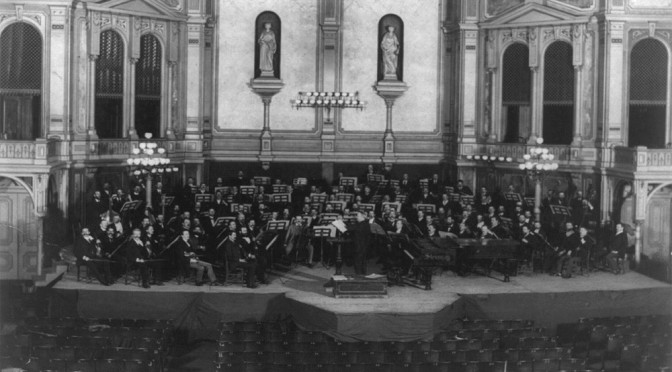
Inside Steinway Hall 1890: the 14th Street concert venue could seat 2,000 and also functioned as a showroom for Steinway pianos

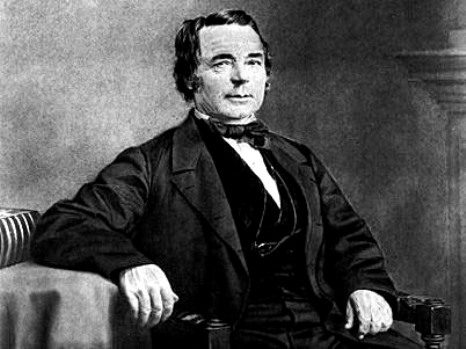
Henry Steinway, a German immigrant who came to New York in 1850, made his name in various showrooms and factories in downtown Manhattan, enticing the wealthy with his award-winning quality pianos. At their grand Steinway Hall on 14th Street, the family turned a popular concert venue into a clever marketing opportunity.

But their ultimate fate would lie outside of Manhattan; the Steinways would graduate from an innovative factory on Park Avenue to their very own company village in Queens, the basis of a neighborhood which still bears their name today. You may not know much about pianos, but you’ve crossed path with this family’s influence in the city. Tune in for this short history of Henry Steinway and his sons.

PODCAST Download this show it for FREE on iTunes or other podcasting services. Click this link to download it directly from our satellite site. Or click below to listen here:

The Bowery Boys: Steinway and Sons

___________________________________
As always, click on pictures for a bigger view

Hello Henry: Heinrich Steinweg made his first piano as a present for his bride. A year later he completed his very first grand piano and began a small manufacturing practice with his sons. They took the show on the road to New York in 1850.

First movement: Within three years of arriving in New York harbor, the Steinways had opened their first workshop on Varick Street, then moved to a larger space on at 82-88 Walker Street (illustrated below).

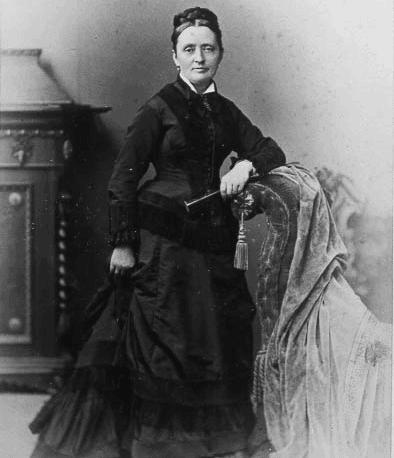
Daughter Doretta Steinway, in her later years. Doretta was key to Steinway’s early success, due to her generous offering of free piano lessons to anyone who purchased an instrument from them.

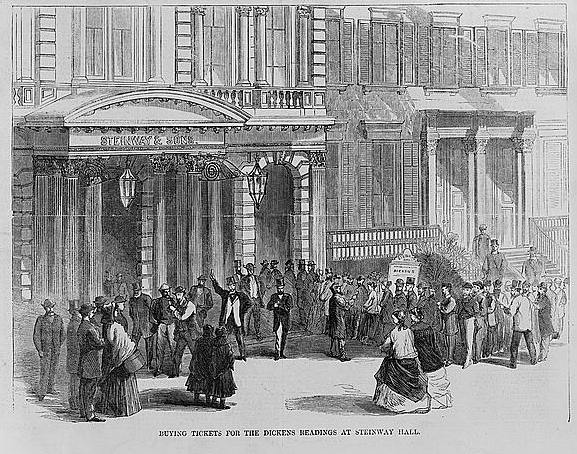
Steinway Hall, built in 1864, was located at 71-73 East 14th Street, right off of fashionable Union Square. The hall hosted a great variety of functions, not just music performances. The illustration below depicts the frenzy outside of a Charles Dickens reading.

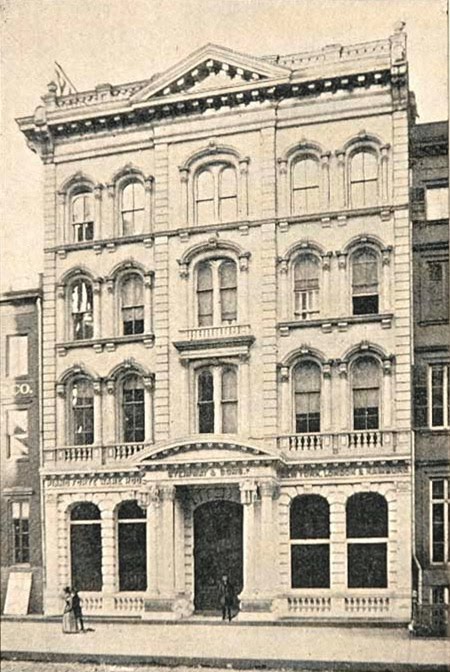
The front of the hall, which also featured a showroom of all the latest Steinway products. The venue was such a smashing success that other halls opened around the world.

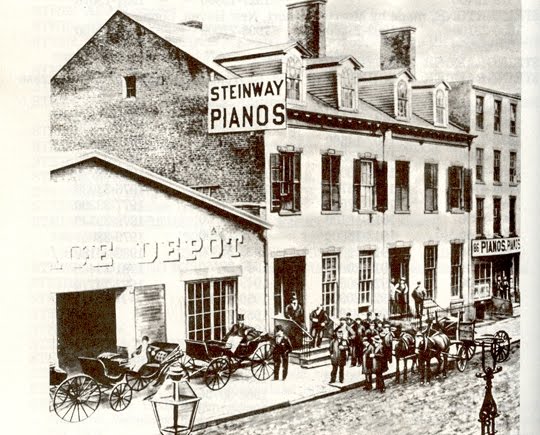
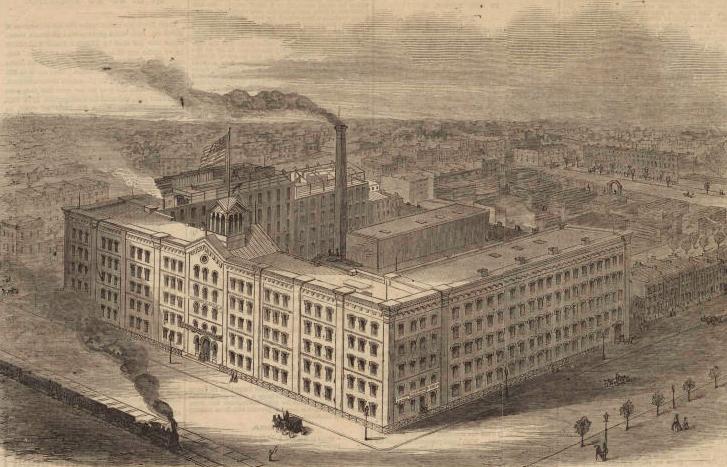
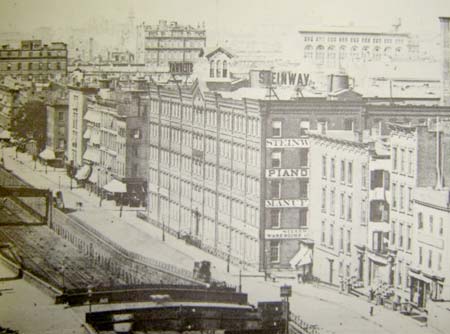
The uptown Manhattan factory opened in 1860 at 52nd and 53rd streets and Fourth Avenue — known as Park Avenue today. The new plant could manufacture up to 1,800 pianos a year. Look what stands there now!

To illustrate how fast the city was moving uptown, this photo shows the same factory just 30 years later. Its dated 1890, although at this time most Steinway operations had moved to their headquarters in Queens. Either they were still doing some work here at this time, or else nobody bothered to rename the building! Note the train tracks in front, rolling their way down to the Grand Central Depot.

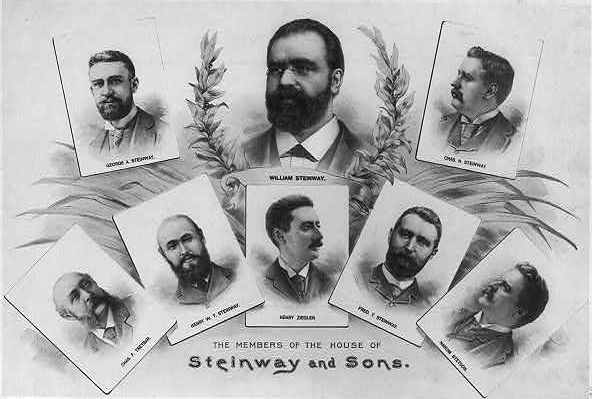
Full house: After Henry’s death in 1871, the Steinway boys would move the company’s operation to Queens. William Steinway would display ambitions far beyond pianos, expanding his pursuits to include public transportation and even automobiles.

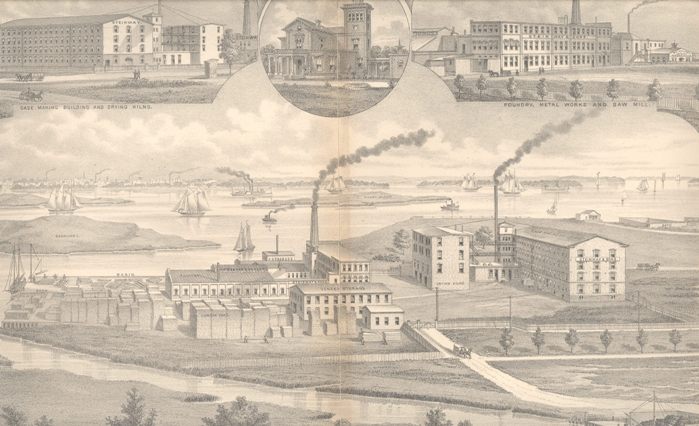
A bucolic illustration of Steinway’s Astoria factory, with river access and company village for their workers. The move allowed the Steinways to expand; it also thwarted labor groups and gave the company more power over its employees.

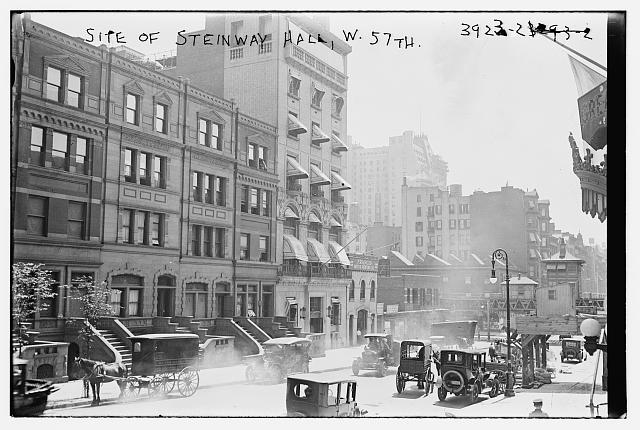
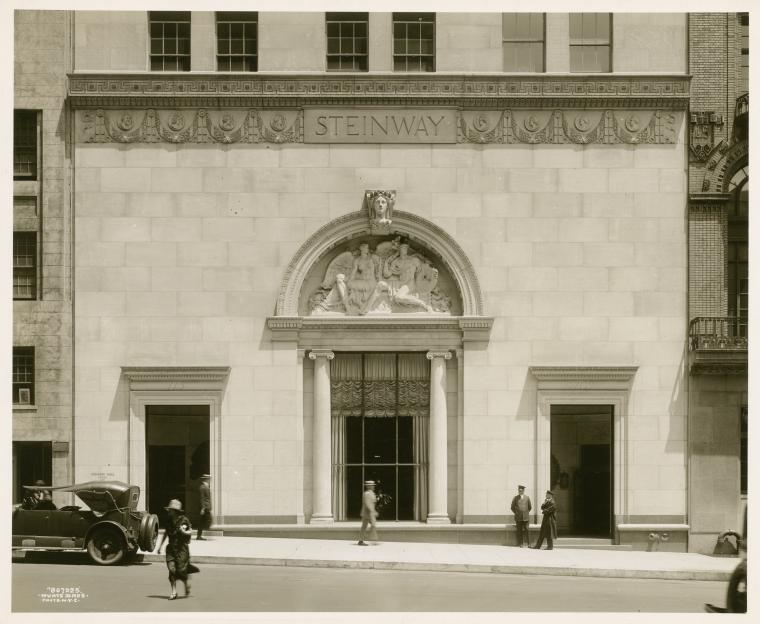
In 1925, Steinway Hall moved uptown to 57th Street, not so terribly far away from their old factory. The sooty, smelly neighborhood had become Park Avenue, and 57th Street was graced with Carnegie Hall. So naturally, the Steinways got out of no-longer-fashionable Union Square and joined the high society ranks accumulating uptown.

The new hall, designed by Warren and Wetmore, was a far smaller venue but still featured a Steinway piano showroom. You can still stroll through it today and peruse their instruments.

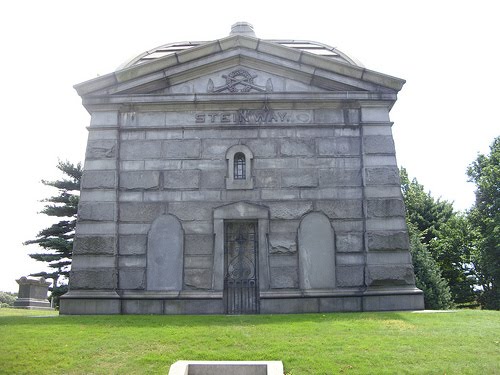
The Steinway vault at Green-Wood Cemetery. I greatly encourage a visit to Green-Wood. And while you’re visiting the Steinway, swing over and say hello to Boss Tweed! He’s buried right nearby.

You can actually tour the Steinway Queens plant. You can find information at their official website.

And did you know that everytime you take the 7 train between Queens and Manhattan, you travel through something called the Steinway Tunnel?

Location of the Steinway factory:

View Larger Map

Categories
Uncategorized

Max’s Kansas City: New York’s celebrity steakhouse

To get you in the mood for the weekend, every other Friday we’ll be celebrating ‘FRIDAY NIGHT FEVER’, featuring an old New York nightlife haunt, from the dance halls of 19th Century Bowery, to the massive warehouse spaces of the mid-90s. Past entries can be found HERE.

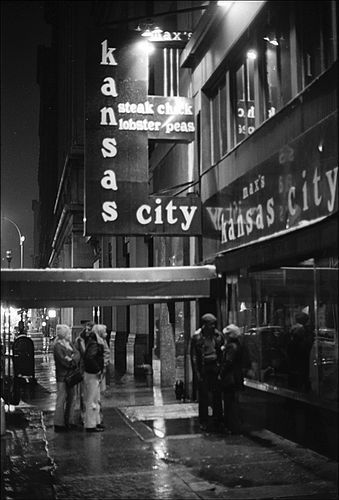
At Max’s Kansas City, there was not a Max, and it wasn’t in Kansas City. What you would find, however, was the birth of celebrity nightlife in New York City, a collision of culture greats before they became cliches, glamour with a tattered cuff.

There were certainly nightclubs in downtown Manhattan that became magnets for revolutionary musicians and artists well before Max’s. But I maintain that no place organized and fetishized its celebrity clientele quite like this little club on 213 Park Avenue South (between 17th and 18th streets), providing canvas aplenty for Andy Warhol’s pop art crowd and underground music’s biggest pioneers. Nights at Max’s begat the culture of Studio 54.

Max’s was actually Mickey’s — Mickey Ruskin that is, a lawyer who opened a string of cafes and bars in the early 60s, eventually cultivating relationships with Greenwich Village artists and writers who would pop in to showcase their talents. His first, the 10th Street Coffeehouse (between 3rd and 4th Aves.), became a poets corner, with standing-room audiences listening to beat and experimental poetry. In another venture, a bar called the Ninth Circle, Ruskin began attracting painters and artists, quickly becoming, in his own words, one of New York’s leading “middle-class beatnik bars.”

Successfully moving from coffee to liquor, Mickey now wanted to try the restaurant business. He bought the failing Southern Restaurant near Union Square, and on December 6, 1965, transformed it into Max’s Kansas City.

The mysterious name purportedly comes from one of Ruskin’s more famous clients from the Ninth Circle, poet Joel Oppenheimer . According to a documentary on Max’s Kansas City, Oppenheimer heard Ruskin wanted to open a steakhouse and claims, “When I was a kid, all the steakhouses had Kansas City on the menu because the best steak was Kansas City-cut, so I thought it should be ‘something Kansas City.'”

Although people have suspected the ‘Max’ comes from fellow poet Max Finstein, Oppenheimer claims a more logical origin. “Wouldn’t you eat at a place called Max’s? I said, ‘Mickey, believe me, it’s Max’s Kansas City.’ Two days later, he called back again and said, ‘I don’t know why, but I mentioned the name to some people, and they all loved it.'”

Whatever the story, the restaurant soon became more known for its crowds than for its simple menu. All of Mickey’s writer and artist friends migrated to Max’s, a loyal crowd but not enough to keep the doors open. Then Andy came.

Ruskin is unsure of the date, but Andy Warhol soon became a regular, and with him came his entourage of geniuses, models and freaks. And with them came reputation and notoriety. The biggest names generally camped out in Max’s backroom, which soon gave way to music and photography, attracted like moths to the nightly absurd mixture of the beautiful and the famous.

“I met Iggy Pop at Max’s Kansas City in 1970 or 1971,” recalled David Bowie. “Me, Iggy and Lou Reed at one table with absolutely nothing to say to each other, just looking at each other’s eye makeup.”

William Burroughs smoking in a corner with Allen Ginsberg. Twiggy and Mick Jagger and Dennis Hopper — dancing to live performances upstairs like the Velvet Underground (performing at Max’s during their last days), Bob Marley or a young Bruce Springsteen on acoustic guitar.

Meanwhile, in the front room gathered artists and writers, many of whom were too broke to pay their checks and occasionally paid for their meals with original art. Imagine having a meal paid for with an original work of art by William de Koonig or minimalist Carl Andre!

A staple of the late 60s, Ruskin weathered the following decade for only a few years before closing its doors in December 1974. But the story was not over.

The name and location was snatched up by club owner Tommy Dean Mills, who revitalized Max’s as a viable punk club, restoring a bit of its prior glamour, booking hot punk banks like Blondie and the Ramones, glam acts like the New York Dolls and before-they-were-famous performers like the B-52s, Devo, and Madonna.

Most notably were the post-Sex Pistol shows by Sid Vicious, messy and unforgettable; three months before his death, Sid attacked Patti Smith’s brother Todd inside the club and was thrown into jail. (Or maybe not; see notes below for a possible correction.)

That incarnation of Max’s closed in 1981. Believe it or not, there have been later, ill-advised attempts to reopen Max’s, but best it remain gone. I would hate to see it become a Las Vegas attraction like that other 70s staple.

Please check out this colorful website tribute to Max’s , as well as Max’s latest incarnation as a non-profit lifeline “to financially distressed individuals in the creative and performing arts for housing, medical and legal aid.”

Categories
Podcasts

PODCAST: The Pan Am Building

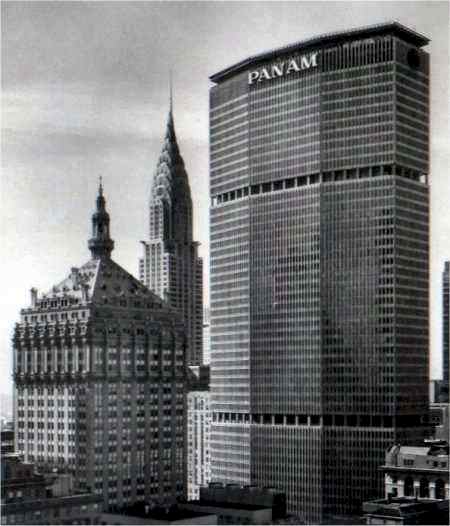
Today it’s the Met Life Building. It’s been called the ugliest building in New York City. It sits like a monolith behind one of the city’s most enduring icons Grand Central Terminal. But it’s got some secrets you may not know about. In this podcast, we scale the heights of this misunderstood marvel of modern architecture.
Listen to it for free on iTunes or other podcasting services. Or you can download or listen to it HERE

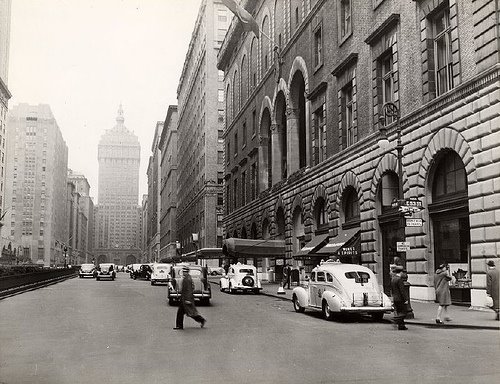
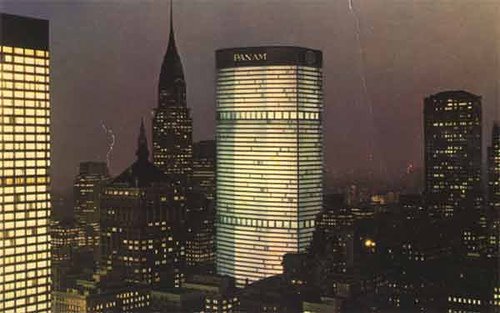
In the days before the Pan Am Building, Park Avenue was lorded over by the ‘dowager queen’ of glamour architecture, the New York Central Building (later the New York General Building, and finally — the Helmsley Building)

Another angle, year of photograph unknown.

In this picture, taken in 1962, the monolith is almost complete.

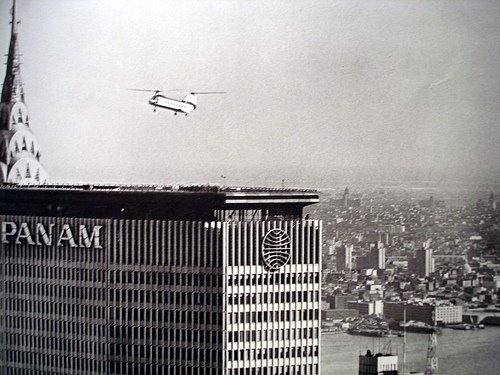
New York Airways once provided helicopter service from the top of the Pan Am in the 1960s. It was briefly revived in 1977, but a tragic accident killing five people ensured it would never be tried again.

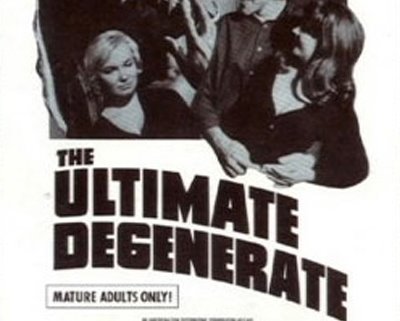
One of those killed in the tragic helicopter blade accident of 1977 was film producer Michael Findlay, creator of such sexploitation classics like the Flesh trilogy and the Ultimate Degenerate. (He also made some films with titles that are bitterly ironic considering his untimely death.)

In 1987

Today

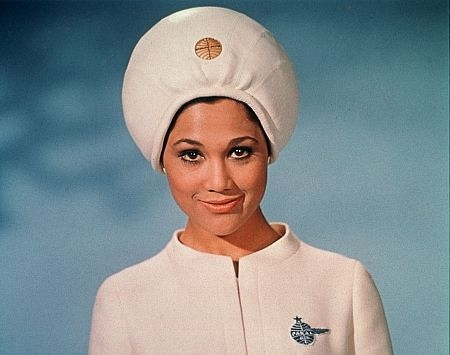
When Pan Am moved into the building in 1962, they were one of the world’s leading airlines, best known for their on-board service and fleet of attentive flight attendants.

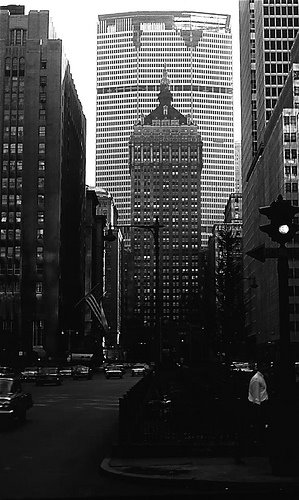
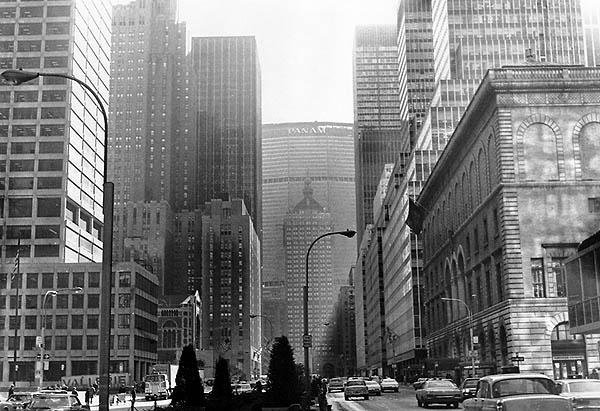
Looking down Park Avenue at the Pan Am in 1970

The same view a few years later

Its relationship to the Helmsley Building has caused great controversy over the years. Some say it’s like hanging a work of art in a cheap frame.

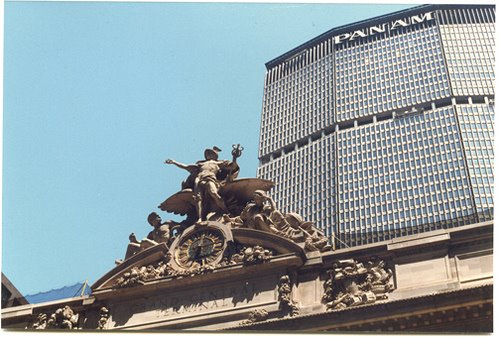
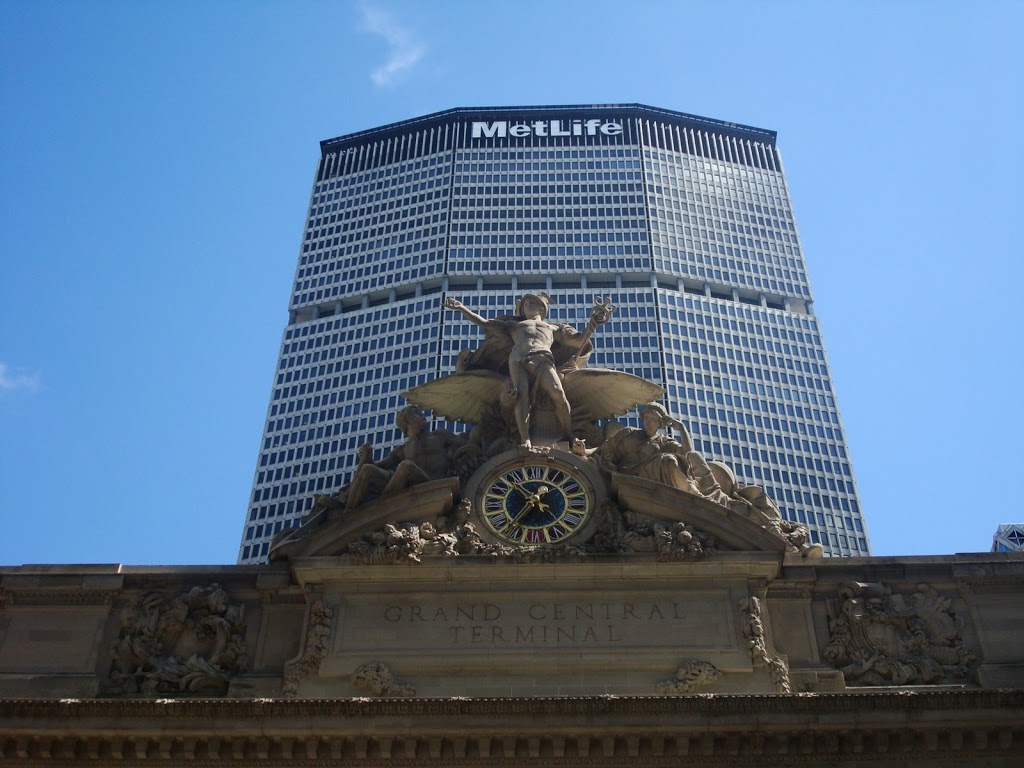
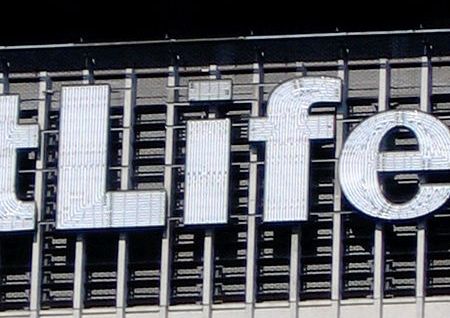
Metropolitan Life replaced the Pan Am logo with its own in 1991

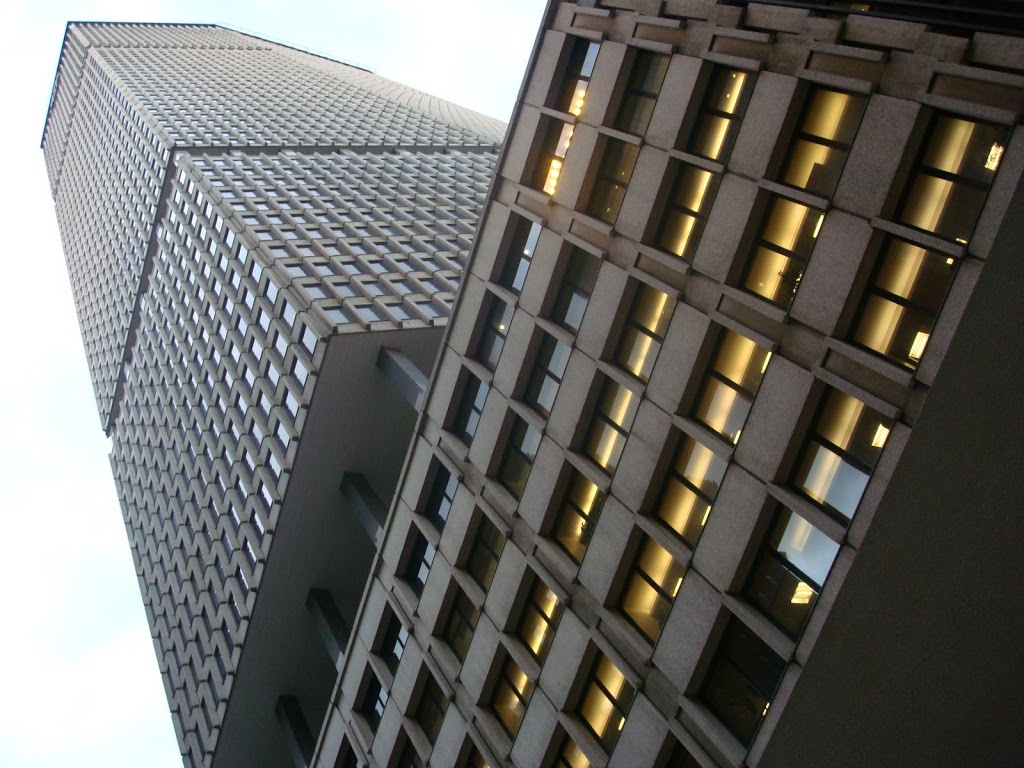
Quite unlike an impressionist painting, the building actually looks more interesting the closer you are to it, revealing some odd angles befitting its imposing proportions and ‘lozenge’ shape

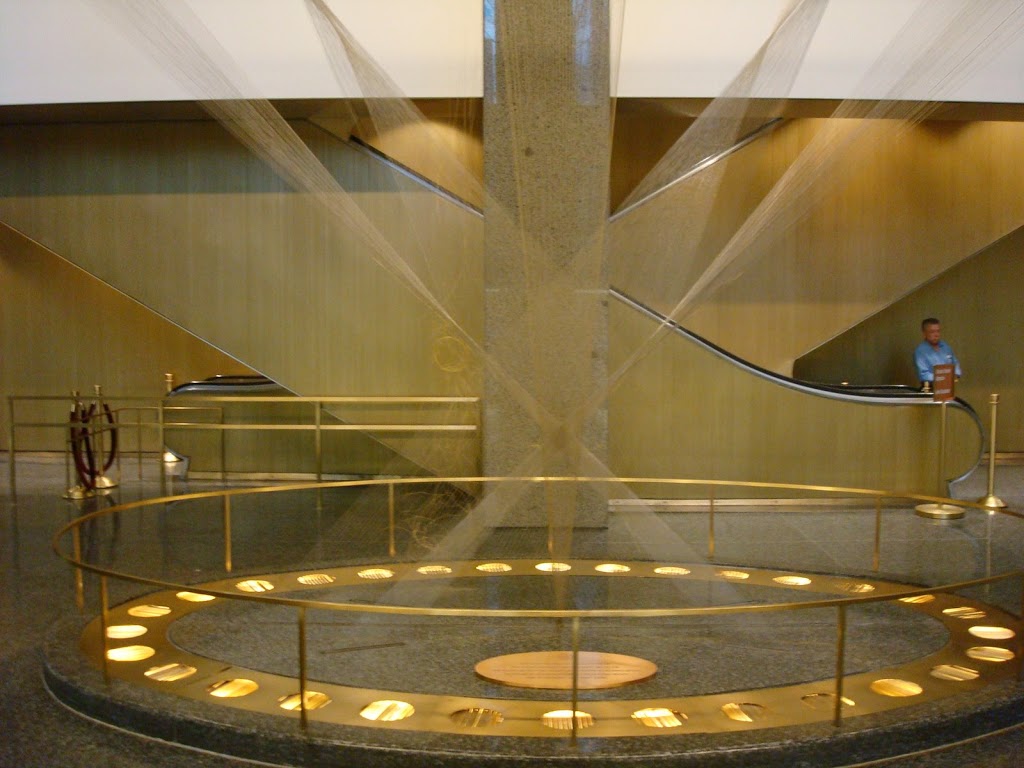
Inside the lobby: Flight, the expressive wire sculpture of Richard Lippold. The lobby once also held a painting by Josef Albers.

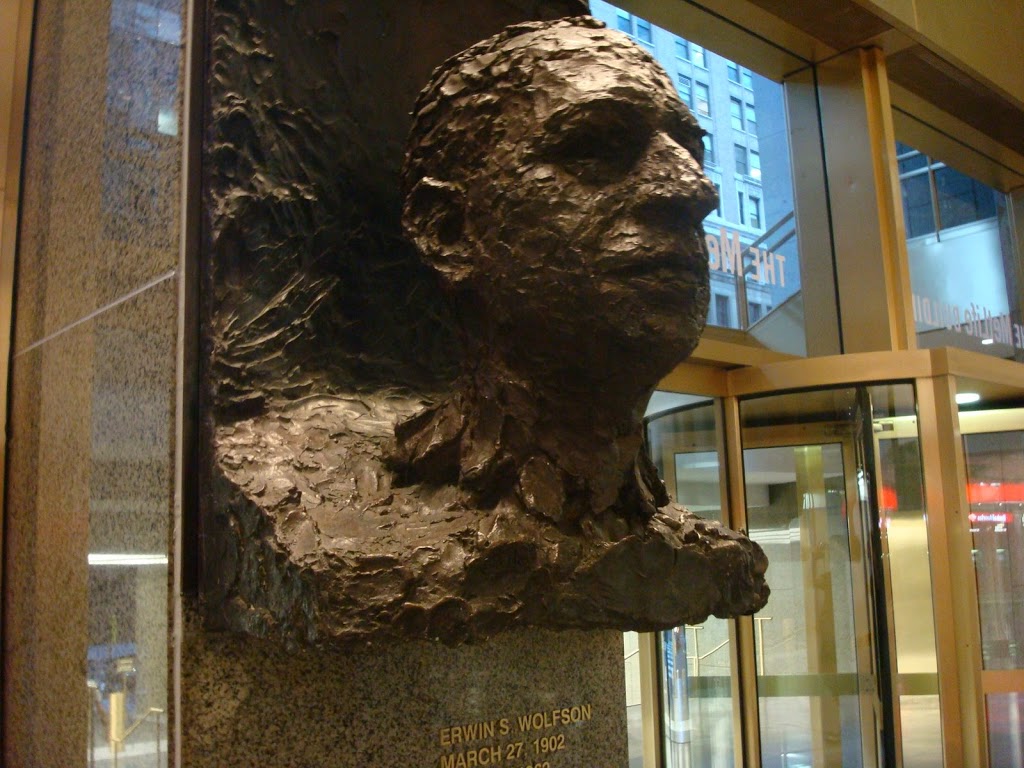
This rather grotesque bronze bust of Erwin Wolfson greets you as you enter the building.

CLARIFICATION: In the podcast, it appears I was a little vague in my description the Metropolitan Life Insurance Tower which is on Madison Square Park. Although the slender clock tower is indeed also topped with gold ornamentation, do not confuse it with Madison Square’s real gold standard — the gilded New York Life Insurance Building