Categories
Neighborhoods Podcasts

Hell’s Kitchen: New York’s Wild West

PODCAST Hell’s Kitchen, on the far west side of Midtown Manhattan, is a neighborhood of many secrets. The unique history of this working class district veers into many tales of New York’s criminal underworld and violent riots which have shaken the streets for over 150 years.

This sprawling tenement area was home to some of the most notorious slums in the city, and sinister streets like Battle Row were frequent sites of vice and unrest. The streets were ruled by such gangs as the Gophers and the Westies, leaving their bloody fingerprints in subtle ways today in gentrified buildings which at one time contained the most infamous speakeasies and taverns.

We break down this rip-roaring history and try to get to the real reason for its unusual name!


The Bowery Boys: New York City History podcast is brought to you …. by you!

Starting this month, we are doubling our number of episodes per month. Now you’ll hear a new Bowery Boys podcast every two weeks. We’re also looking to improve the show in other ways and expand in other ways as well — through publishing, social media, live events and other forms of media. But we can only do this with your help!

We are now a member of Patreon, a patronage platform where you can support your favorite content creators for as little as a $1 a month.

Please visit our page on Patreon and watch a short video of us recording the show and talking about our expansion plans. If you’d like to help out, there are five different pledge levels (and with clever names too — Mannahatta, New Amsterdam, Five Points, Gilded Age, Jazz Age and Empire State). Check them out and consider being a sponsor.

We greatly appreciate our listeners and readers and thank you for joining us on this journey so far. And the best is yet to come!


The mysteries begin over 200 years ago when ordered avenues and streets could scarcely be imagined, and the shoreline was a ragged coast.

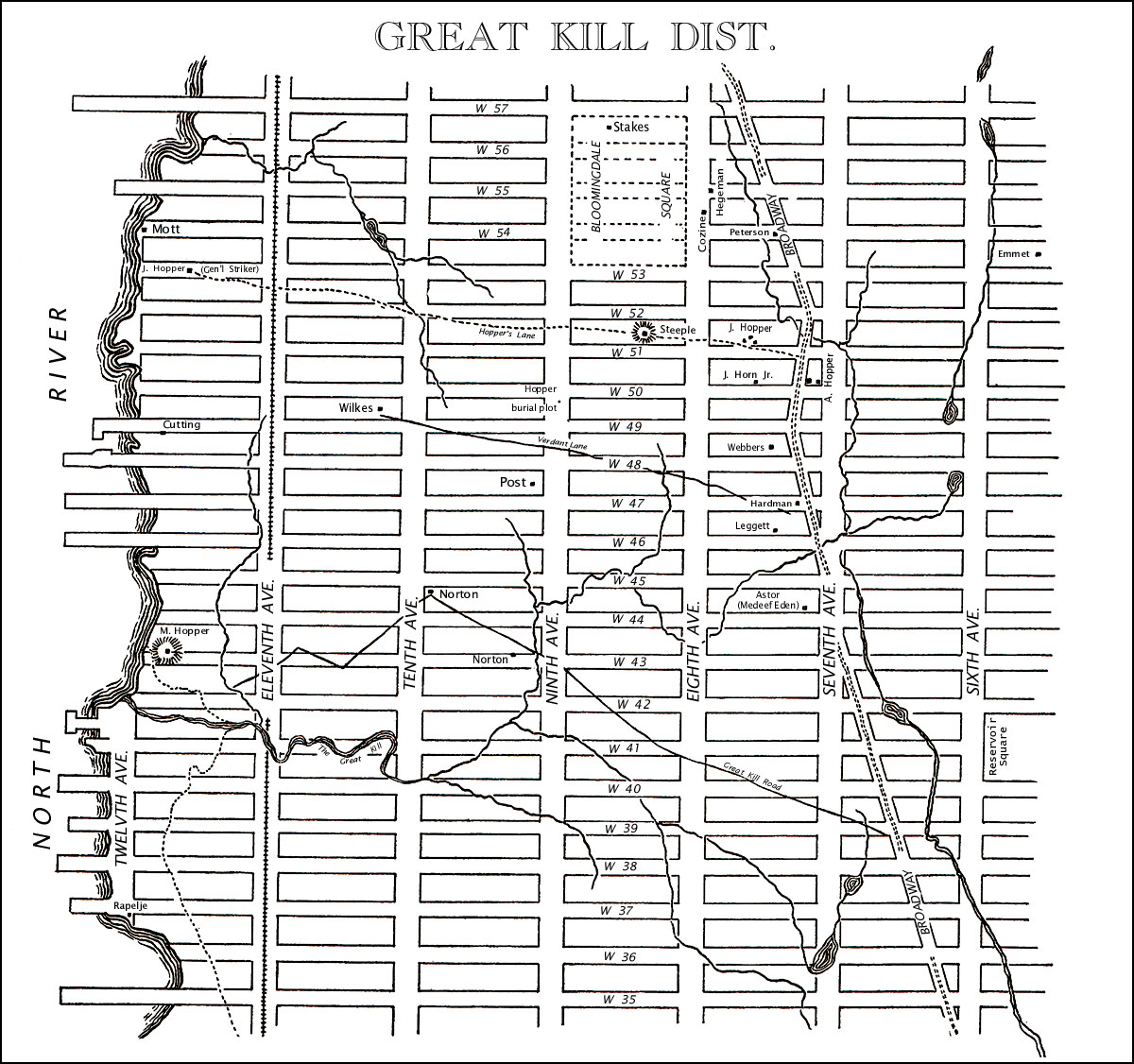
The Dutch later called it the Great Kill District, for the creek which emptied into the Hudson River (North River) at 42nd Street. As you can see from this diagram the shore was evened out with landfill to create 12th Avenue although the inward dip at 43rd Street is still visible on a modern map.
map

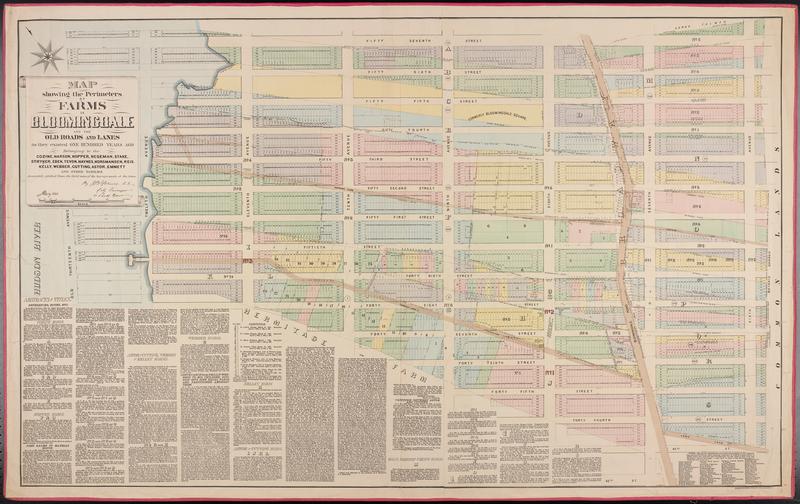
A map (drawn by John Bute Holmes) of the original estate borders of Bloomingdale from the late 18th century. The jagged shore line would later be filled in to make the blocks between 11th and 12th Avenues.
Courtesy Museum of the City of New York

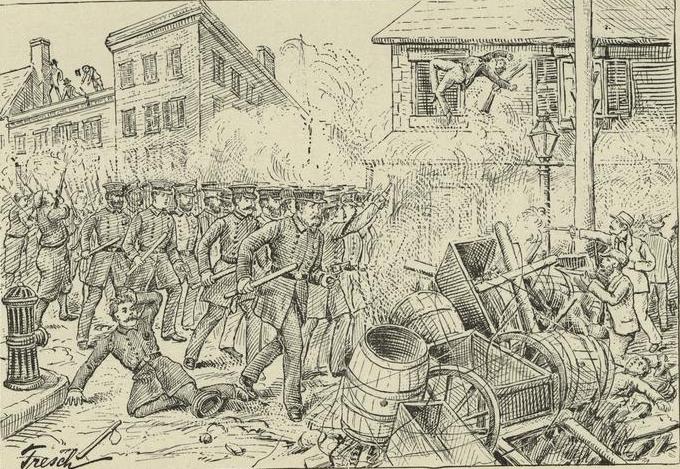
The Ninth Avenue barricades made by rioters in the area of Hell’s Kitchen during the Civil War Draft Riots.
barricades

The Orange Riot of July 12 from Eighth Avenue south from 25th street, an 1871 image from Frank Leslie’s Illustrated Newspaper.
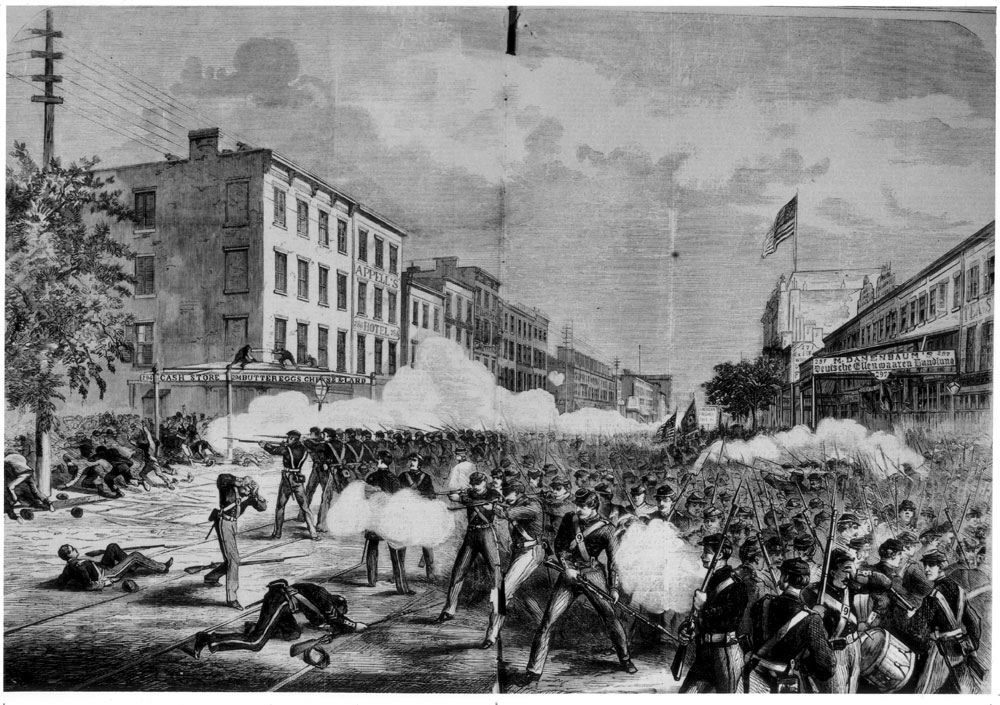
orange

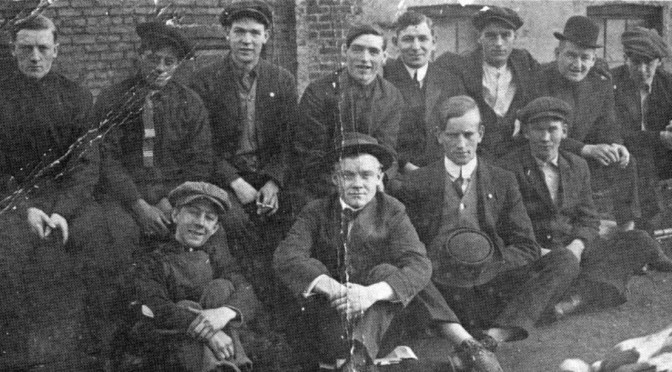
Bad boys: Some Hell’s Kitchen ruffians show Jacob Riis how to rob people who have passed out.
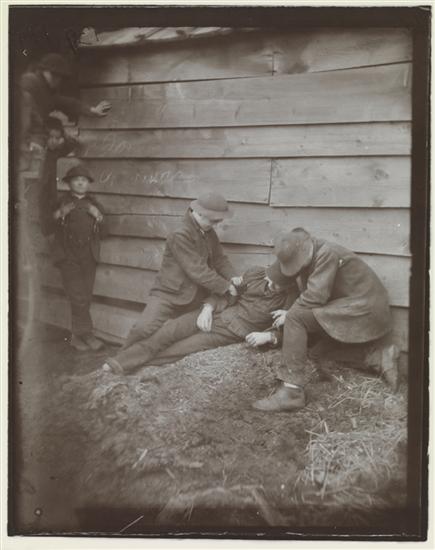
Jacob Riis
Jacob Riis

An intriguing shot of 58th Street between 8th and 9th Avenues
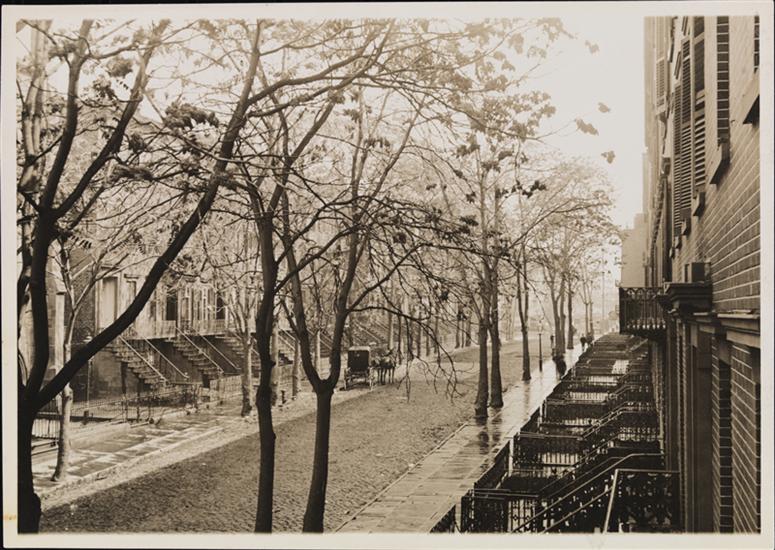
Museum of the City of New York

Jacob Riis’ photograph of the Hell’s Kitchen tenement and the remains of Sebastopol (the rocks), 1890
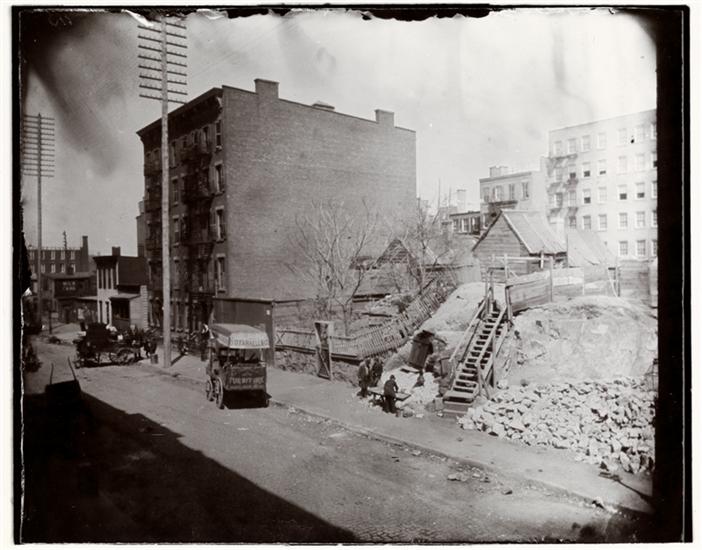
Photo by Jacob Riis
Photo by Jacob Riis

Street vendors under the 9th Avenue Elevated Railroad
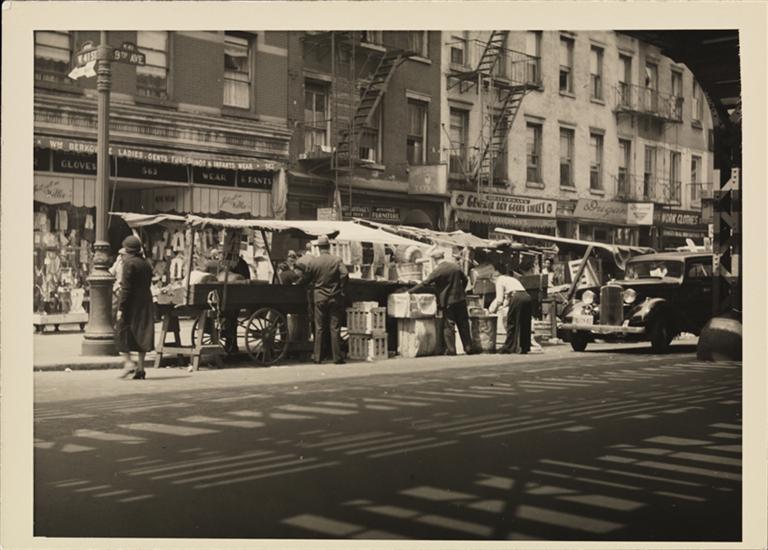
Museum of City of New York

The Hartley House, a settlement house for the Hell’s Kitchen community. on West 46th Street
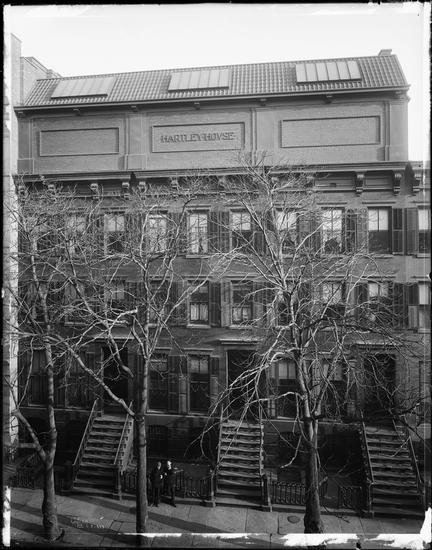
Museum of the City of New York

At the recreation pier — a public swimming hole at West 51st Street and the Hudson River.
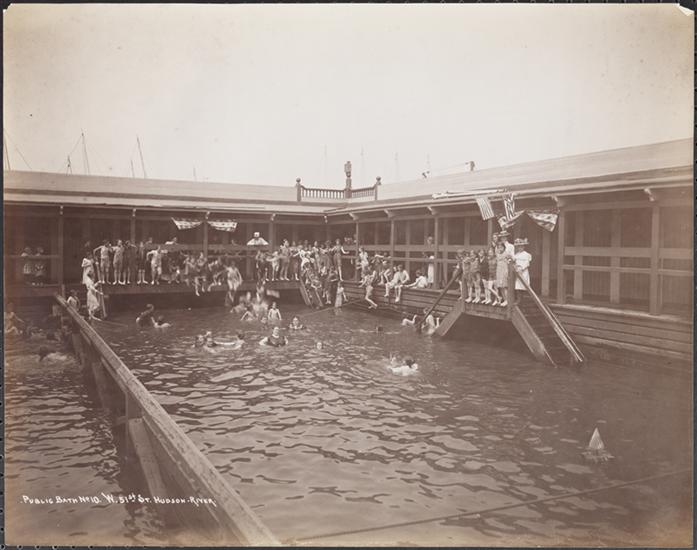
Museum of the City of New York

The later configuration of the Gophers. Owney Madden is on the back row, fourth from the left. A very rough and dangerous gang, but don’t they clean up nice?
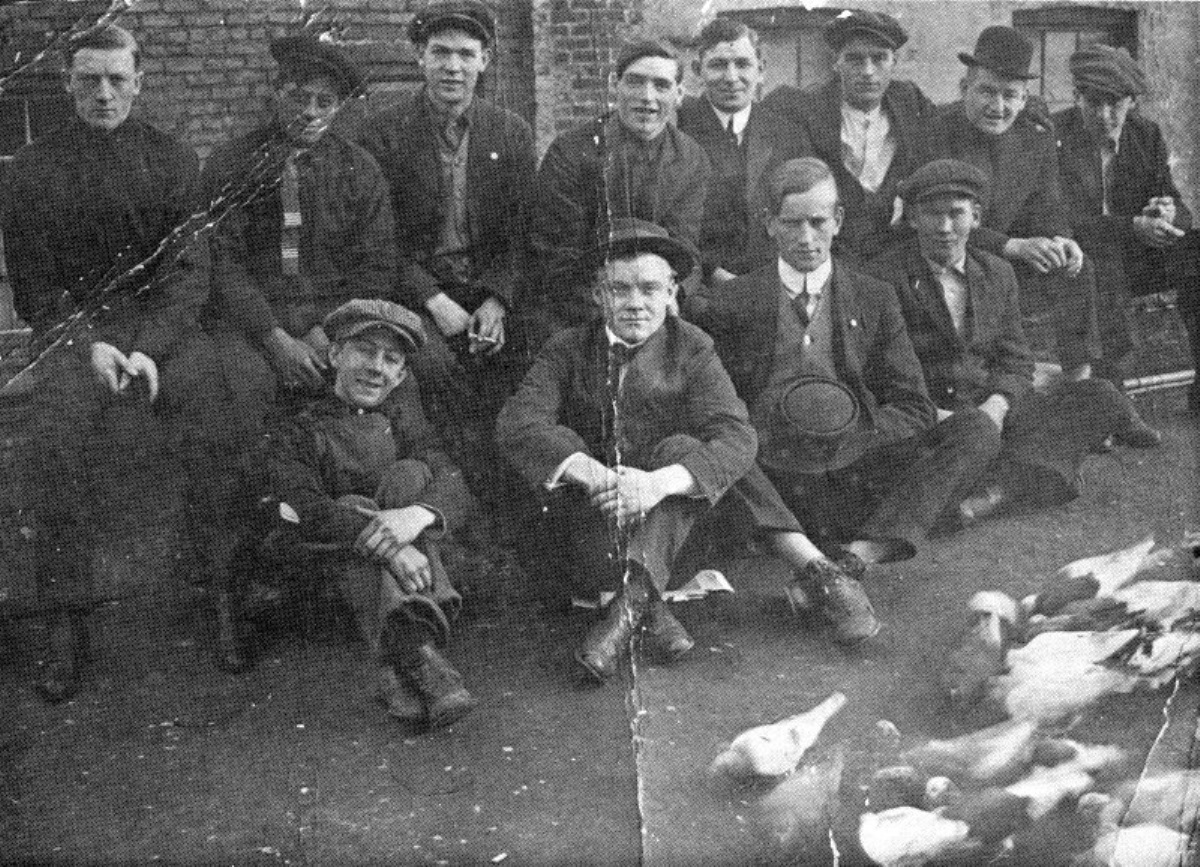
Courtesy of Garland County Historical Society and Butler Center Books

Owney Madden, the king of the Hell’s Kitchen speakeasy racket.
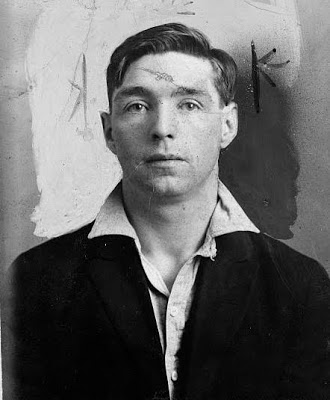
owney

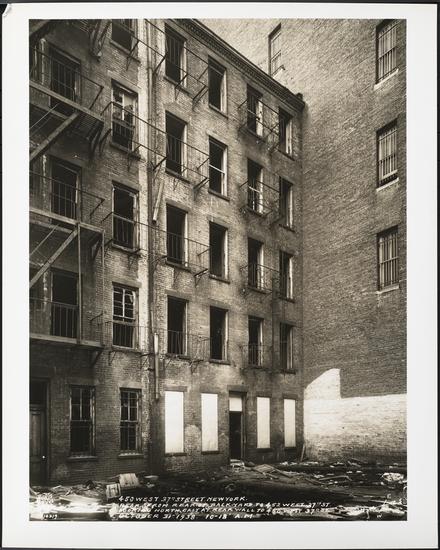
A couple spectacular shots of 1938 slum clearance — eliminating the tenements of 37th Street.
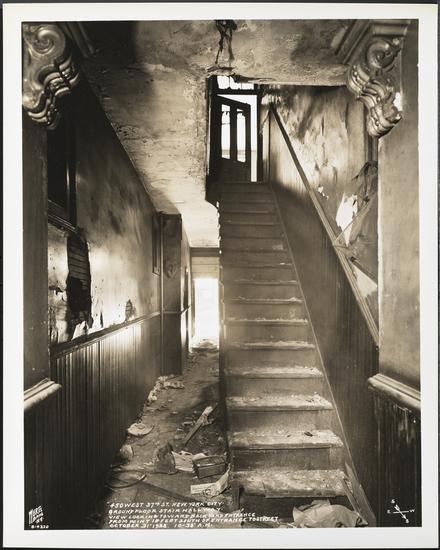
Wurts Brothers. Museum of the City of New York

Businesses on West 52nd Street, facing into DeWitt Clinton Park. It’s likely that William Hopper & Sons Truckmen at no. 626 probably traces itself back to the original Hopper land owners. Photograph by Charles von Urban
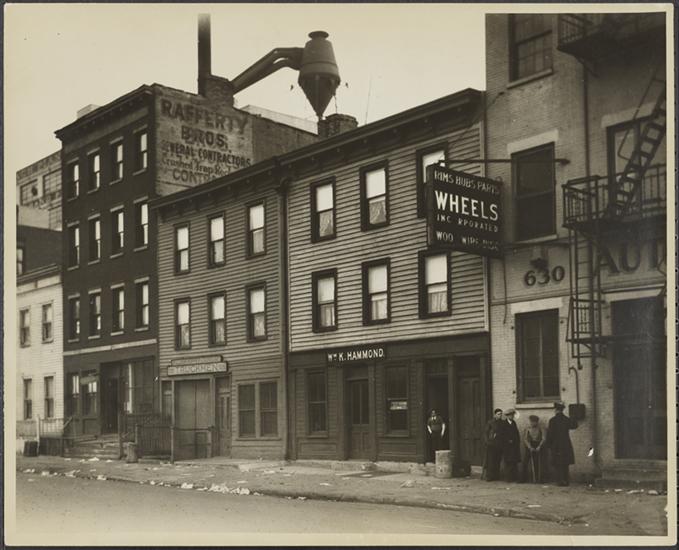
Courtesy Museum of the City of New York

The entrance to DeWitt Clinton Park (at 54th Street) in 1936
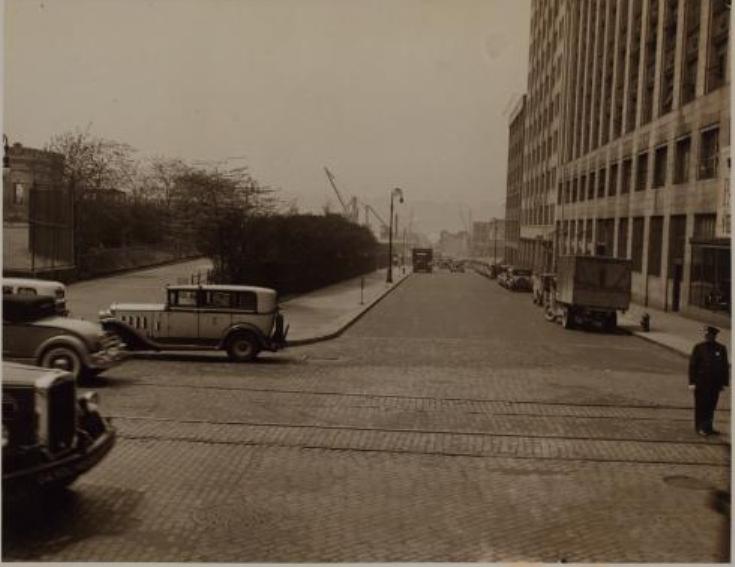
New York Public Library

Most of the pressures faced by the Hell’s Kitchen neighborhood came from its perimeter with dramatic changes to the waterfront to its west, Port Authority/Lincoln Tunnel to its south, Madison Square Garden/Times Square to its east and Lincoln Center/Columbus Circle to its north.

Below: The West Side Highway and piers 95-98, looking west from a roof on West 54th Street
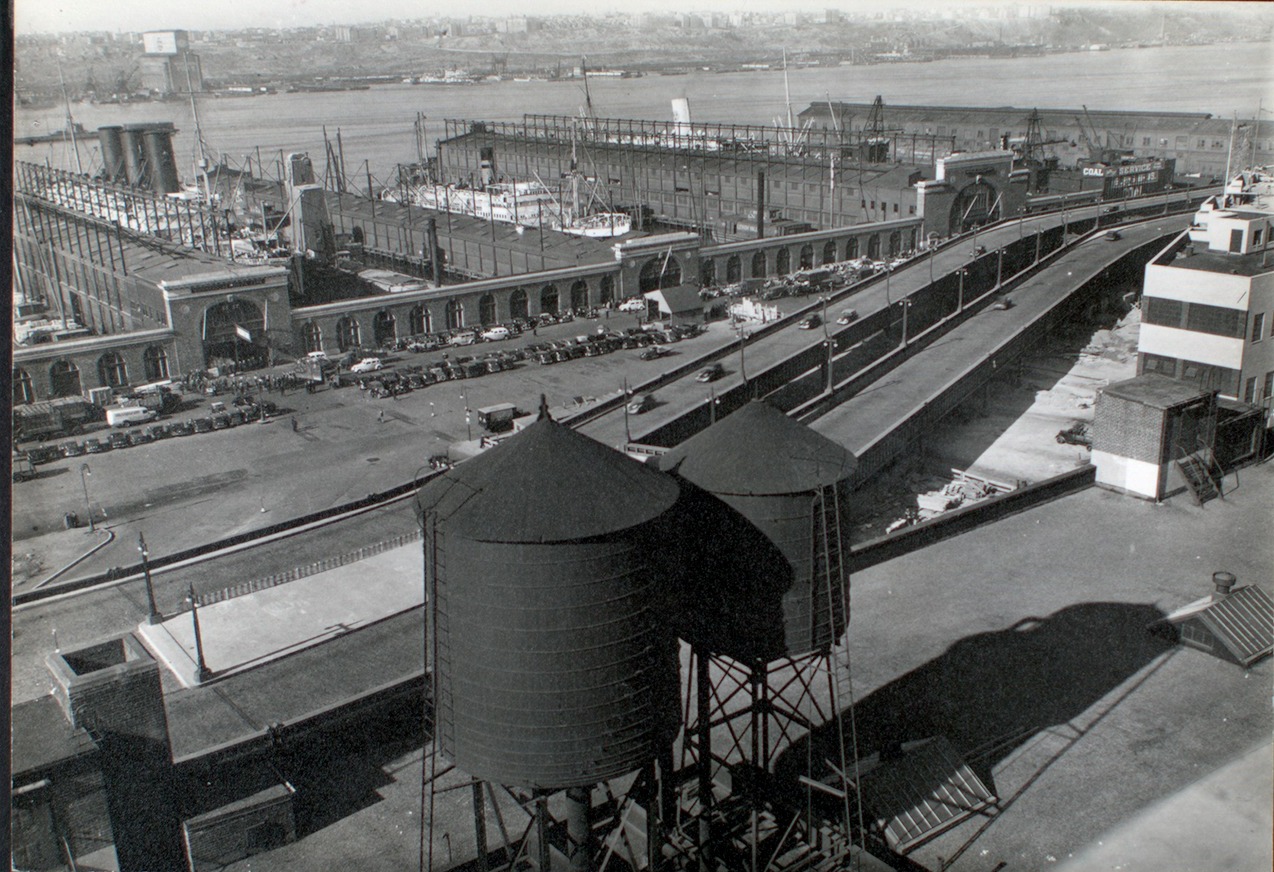
New York Public Library

The Port Authority Bus Terminal in 1950, at West 40th and 41st Streets and 8th Avenue.
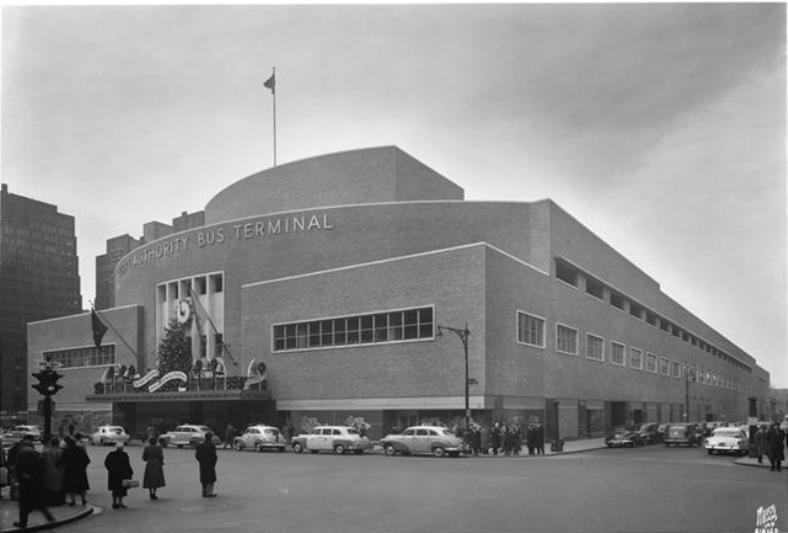
Wurts Brothers, courtesy Museum of the City of New York

The 8th Avenue Madison Square Garden, as seen in 1935.
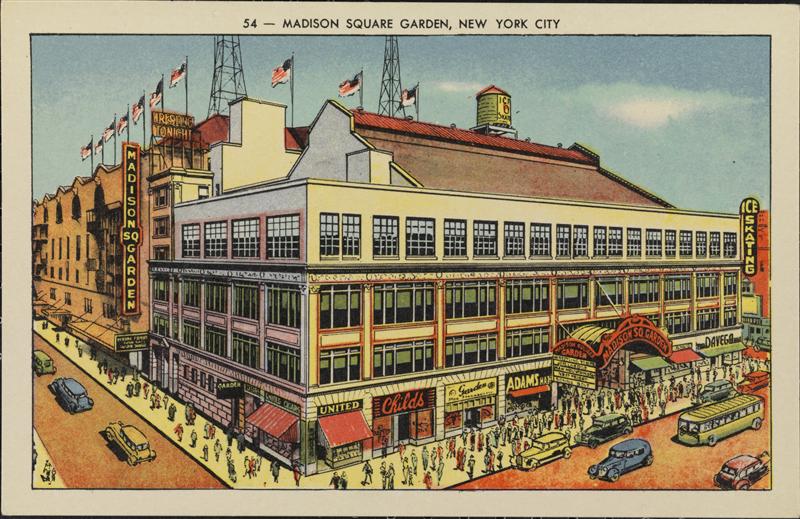
Courtesy Museum of the City of New York

A mural from 1974 — “The Neighborhood Belongs to the People Not Big Business.”
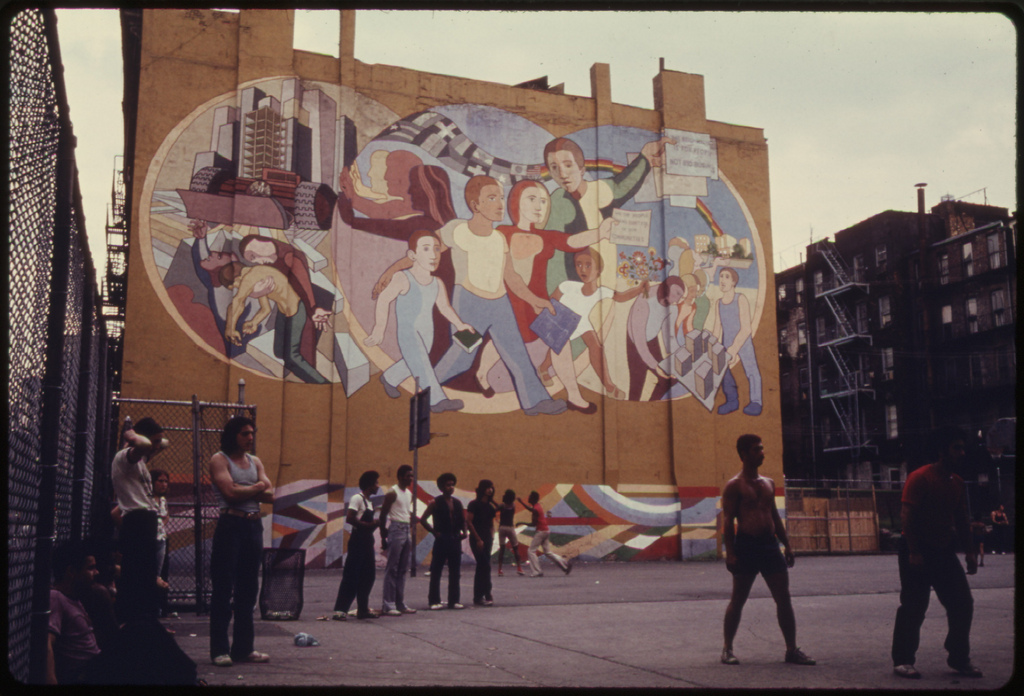
Courtesy US National Archives
Categories
Podcasts

An Evening at Sardi’s: Dinner with a side of Broadway history

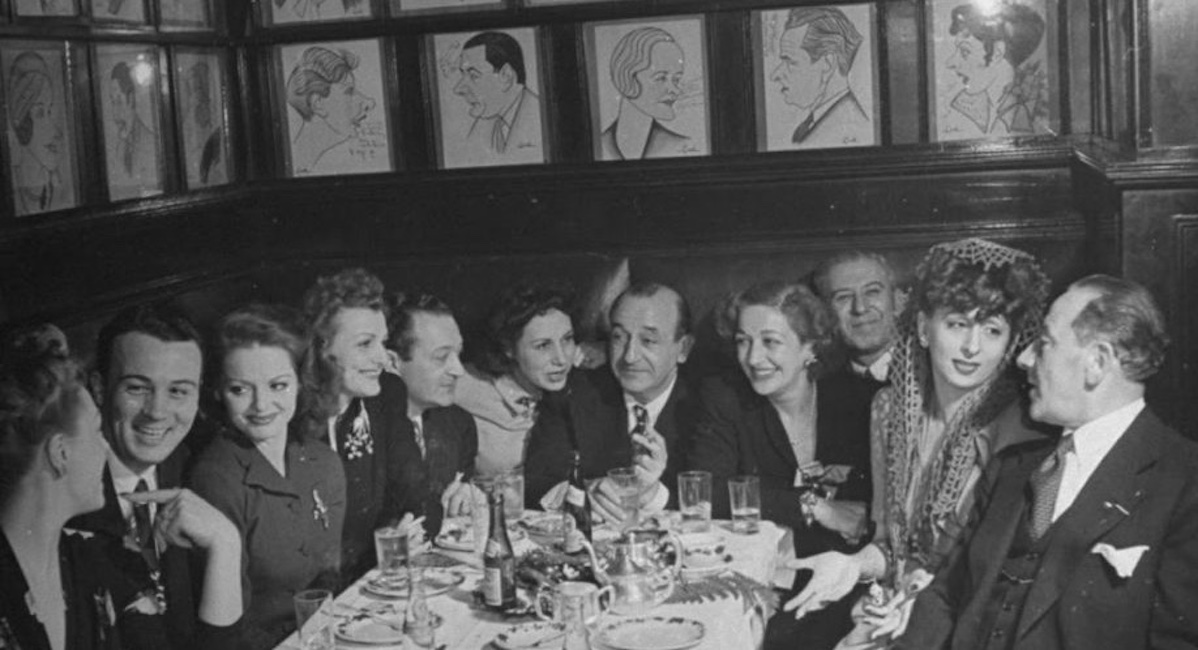
PODCAST REWIND The famous faces on the walls of Sardi’s Restaurant represent the entertainment elite of the 20th century, and all of them made this place on West 44th Street their unofficial home.

Known for its kooky caricatures and its Broadway opening-night traditions, Sardi’s fed the stars of the golden age and became a hotspot for producers, directors and writers — and, of course, those struggling to get their attention.

When Vincent Sardi opened his first restaurant in 1921, Prohibition had begun, and the midtown Broadway theater district was barely a couple decades old.

By the time the Italian-American restauranteur threw open its doors to its current locaton (thanks to the Shuberts) in 1927, Broadway’s stages were red hot, and Sardi found himself at the center of the New York City show business world.

We have some insider scoop from the old days — starring John Barrymore, Tallulah Bankhead, hatcheck girl Renee Carroll and a cast of thousands — and the scoop on those famous (and often unflattering) framed caricatures. So sidle up to the Little Bar, order yourself a stiff drink and eavesdrop in on this tale of Broadway’s longest dinner party.

PLUS: The birth of the Tony Awards!

FEATURING: Some 2022 updates including Sardi’s recent history.

LISTEN NOW: AN EVENING AT SARDI’S

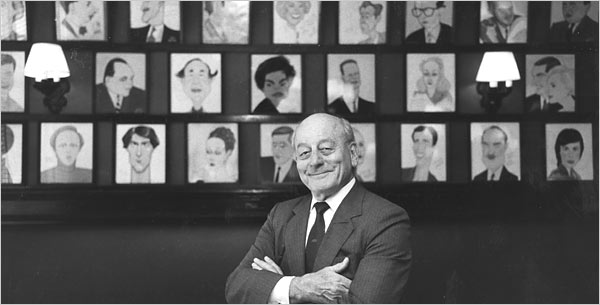
Vincent Sardi and his world-famous wall behind him. (Courtesy NYT)

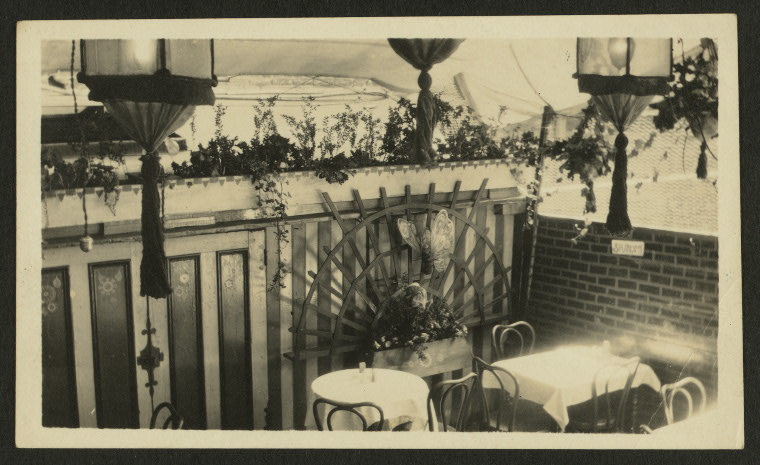
The outdoor garden cafe of the original Sardi’s, which opened in 1921 and was located two doors down from the current location. It was demolished to make way for the St. James Theatre.

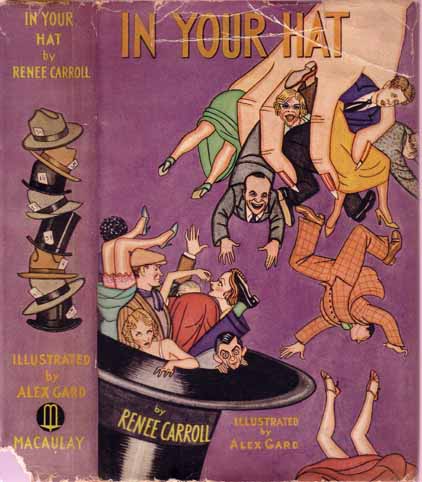
The cover of the tell-all 1933 memoir by famed Sardi’s hatcheck girl Renee Carroll and illustrated by Sardi’s original caricaturist Alex Gard.

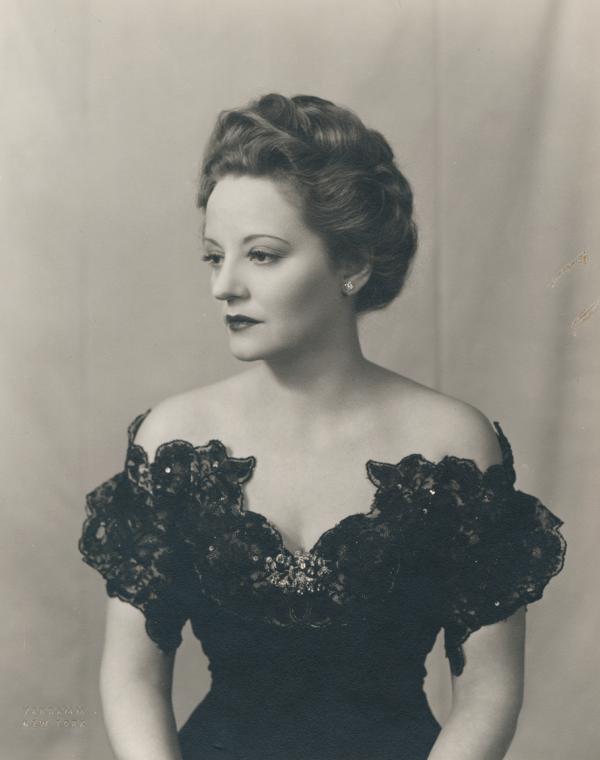
Tallulah Bankhead, Broadway diva and notorious Sardi’s customer. (Courtesy NYPL)

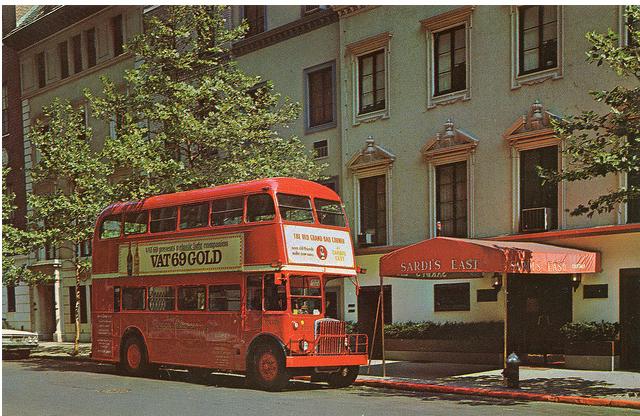
The failed experiment Sardi’s East, instantly problematic due to its distance from the theater district. Sardi Jr. attempted to solve the problem with a fun-filled double-decker bus — often accompanied by Broadway stars — that would zip diners to their shows after dinner. (source Flickr/edge and corner wear)

As we mentioned on the show, it’s difficult doing a history podcast on a private business without it sounding a bit like an advertisement, but hopefully we were able to execute past that. (We came across this odd feeling with other podcasts like Saks Fifth Avenue and The Plaza Hotel.)

We left a few details on the cutting-room floor, including Sardi’s lengthy involvement with the Dog Fanciers Club, which throws a congratulatory breakfast every year for the Best In Show winner of the Westminster Dog Show. Tom also did a rather nice job with reading an excerpt from Renee Caroll’s biography, but some sound problems forced us to cut it.

Tom mentioned the glory of Broadway in 1927. Show Boat is definitely the breakout show of that year, but theatergoers could also choose from one of these show that year — A Connecticut Yankee, Funny Face, Burlesque, Coquette, Hit The Deck, Rio Rita, Dracula and the hit play The Ivory Door, written by A.A. Milne of Winnie-the-Pooh fame. (Find a complete list here.)

Reading Recommendations: The best is Off The Wall by Vincent Sardi Jr. and Thomas Edward West, featuring full color representations of Sardi’s best known caricatures. Worth seeking out a copy at your used book stores. More difficult to find is Vincent Sardi Sr.’s own biography Sardi’s: A Story of a Restaurant, published in 1953 and well out of print. Carroll’s biography In Your Hat is also out-of-print, but you can find excerpts scattered online. You should seek out a physical copy if possible, as it features original artwork by original Sardi’s caricaturist Alex Gard.


Top picture courtesy Life Google images

Categories
Podcasts The Jazz Age

Jimmy Walker, Mayor of the Jazz Age (NYC and the Roaring ’20s Part One)

PODCAST For the first part in our New York City in the Roaring Twenties summer mini-series, we’re hitting the town with “Beau James,” New York’s lively and fun-loving mayor Jimmy Walker.

And the king of it all was Jimmy Walker, elected mayor of New York City just as its prospects were at their highest. The Tin Pan Alley songwriter-turned-Tammany Hall politician was always known more for his grace and style than his accomplishments. His wit and character embodied the spirit (and the spirits) of the Roaring ’20s.

The 1920s were a transformational decade for New York, evolving from a Gilded Age capital to the ideal of the modern international city. Art deco skyscrapers reinvented the skyline, reorienting the center of gravity from downtown to a newly invigorated Midtown Manhattan. Cultural influences, projected to the world via radio and the silent screen, helped create a new American style.

Join us for an after-midnight romp with the Night Mayor of New York as he ascends to the most powerful seat in the city and spends his first term in the lap of luxury. What could possibly go wrong?

LISTEN NOW: KING OF THE JAZZ AGE


The Bowery Boys: New York City History podcast is brought to you …. by you!

We are now producing a new Bowery Boys podcast every two weeks. We’re also looking to improve the show in other ways and expand in other ways as well — through publishing, social media, live events and other forms of media. But we can only do this with your help!

We are now a member of Patreon, a patronage platform where you can support your favorite content creators for as little as a $1 a month.

Please visit our page on Patreon and watch a short video of us recording the show and talking about our expansion plans. If you’d like to help out, there are five different pledge levels (and with clever names too — Mannahatta, New Amsterdam, Five Points, Gilded Age, Jazz Age and Empire State). Check them out and consider being a sponsor.

We greatly appreciate our listeners and readers and thank you for joining us on this journey so far. And the best is yet to come!


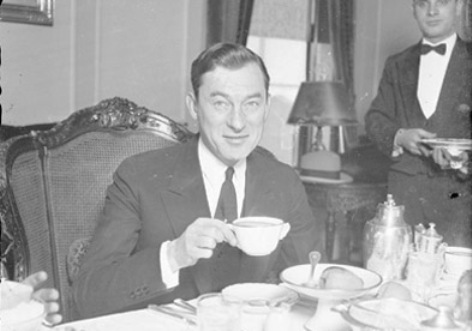
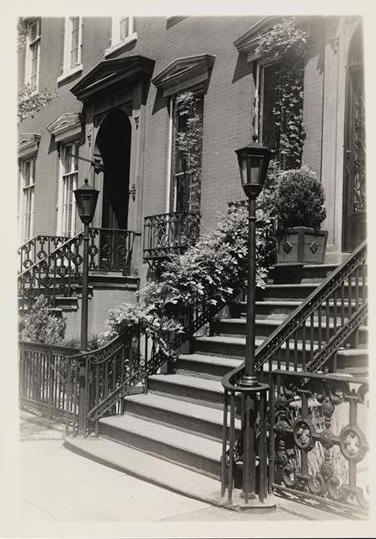
Walker having his morning coffee at his home on 6 St. Lukes Place (pictured below)

Courtesy MCNY

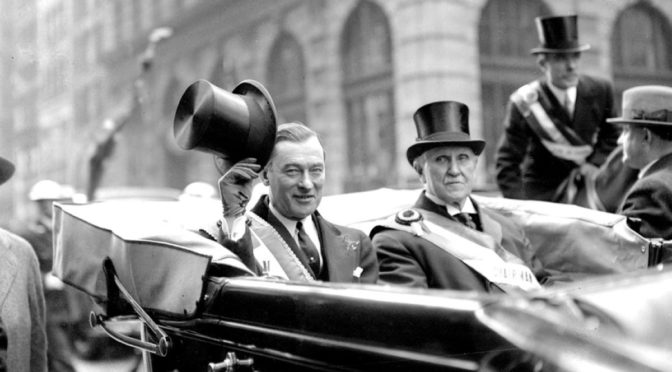
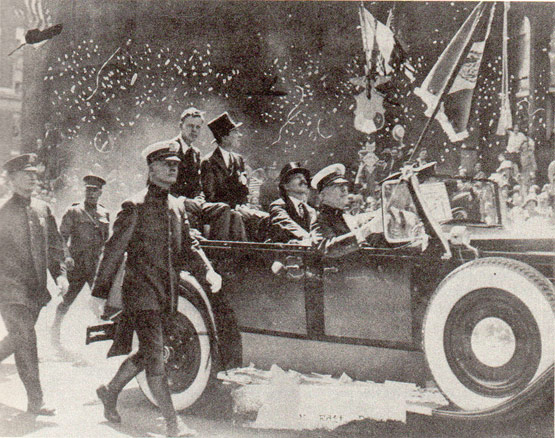
Jimmy Walker with Charles Lindbergh in 1927, in the midst of a ticker tape parade after his non-stop ride from Long Island to Paris.

Courtesy New York Social Diary

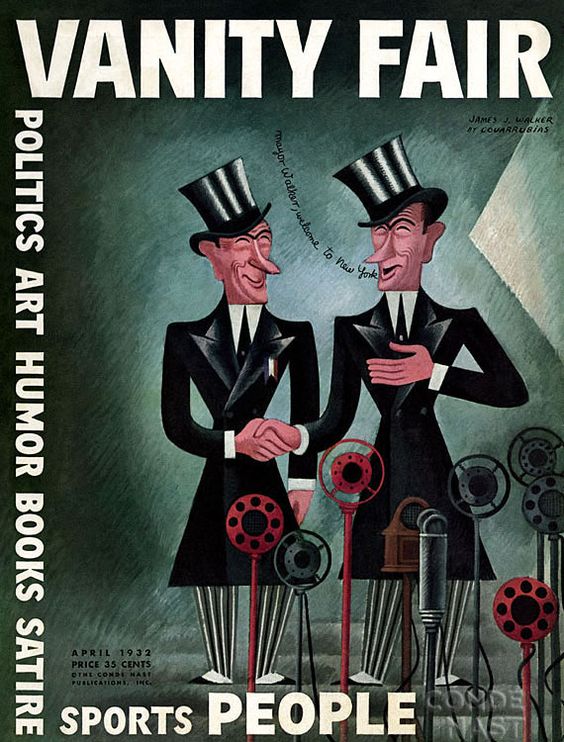
Walker so enjoyed throwing public events for famous people that he was frequently parodied for it. In 1932 Vanity Fair pictured him giving a lavish welcome — to himself.

Conde Nast

Harry McDonough with The Elysian Singers from 1905, singing Walker’s big hit “Will You Love Me In December As You Do In May.”

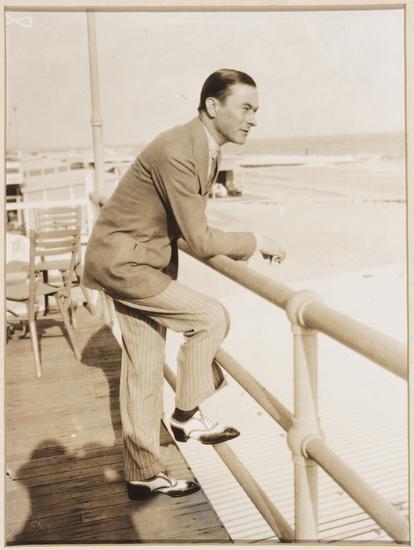
The dashing fashion plate, pictured here most certainly on his way to yet another vacation…..

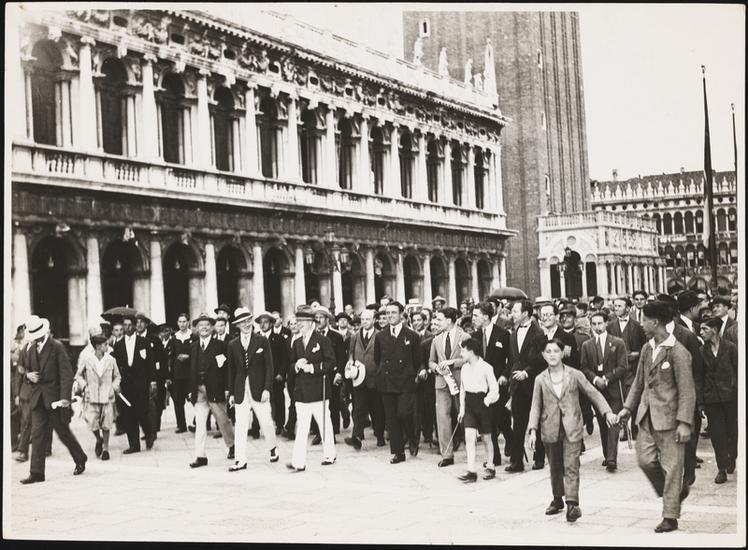
….perhaps his European vacation! He’s pictured here in 1927, strolling the streets of Venice with a few hundred people behind him.

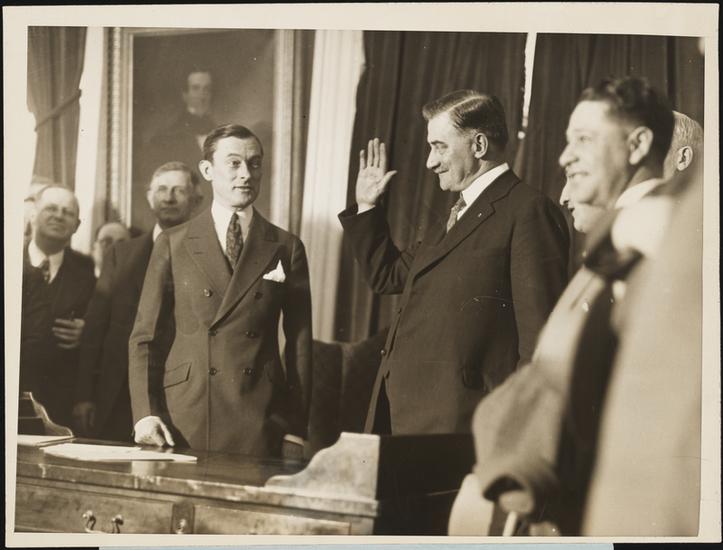
A picture of Jimmy, actually at work! He’s swearing in the new fire commissioner James J. Dorman in 1926.

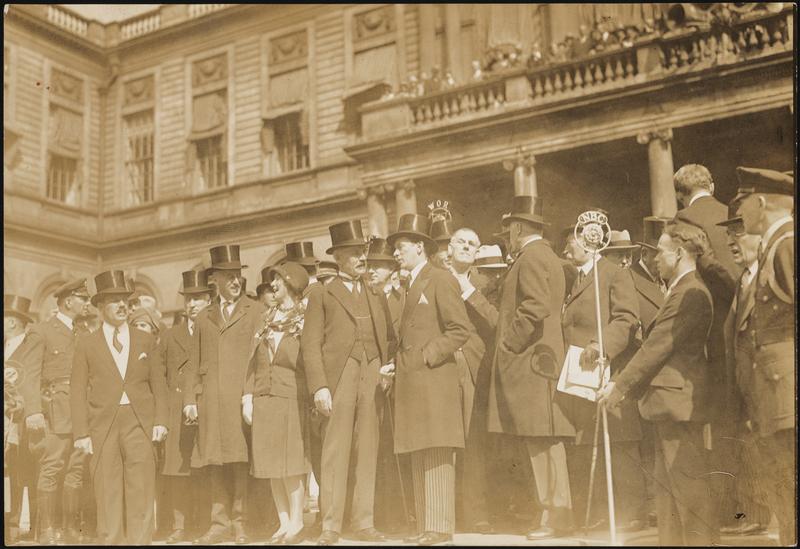
Mayor Jimmy Walker with British Prime Minister Ramsay MacDonald at yet another welcoming ceremony, broadcast on the radio.

MCNY

Another British visit, this time from Mrs Foster Welch, Mayor of Southampton.

In another Pathe video, Jimmy Walker visits Ireland and the former home of his father.

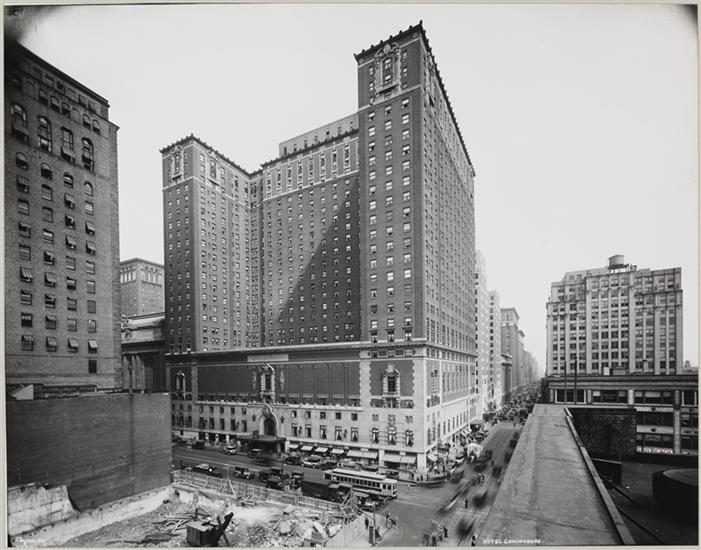
During Walker’s extraordinary rise, New York was becoming an entirely new city in the 1920s with construction projects on virtually on every block. Even in front of the Hotel Commodore (pictured here in 1927), which was, for a time, the home of Jimmy Walker.

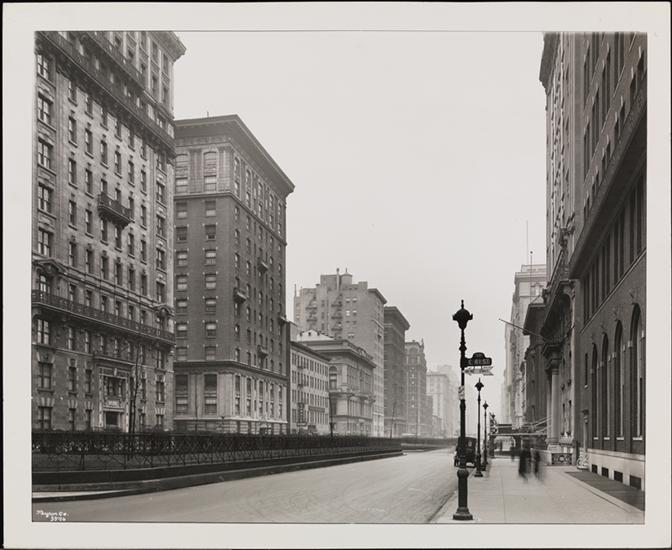
Park Avenue (at 50th Street) in 1922.

MCNY

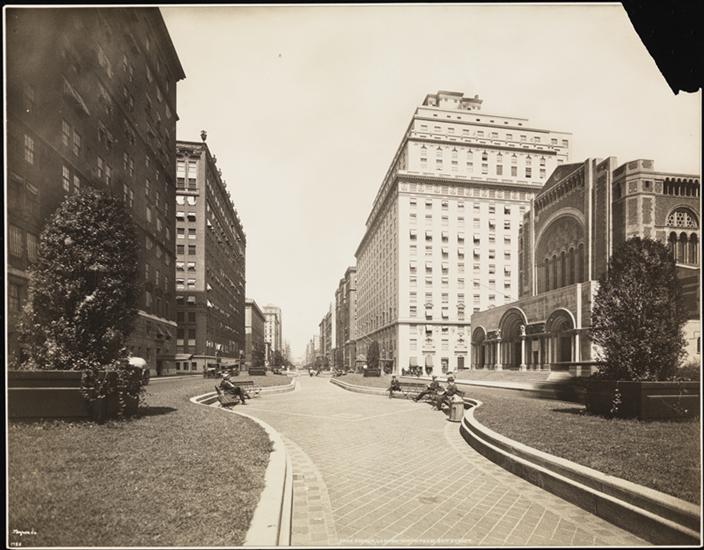
Park Avenue at 61st Street in 1922. The rich flocked to this newly developed street of apartment complexes, making it the new center of wealth.

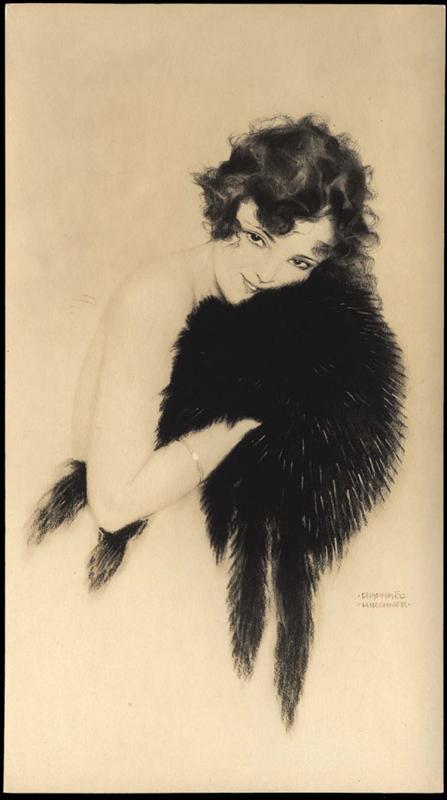
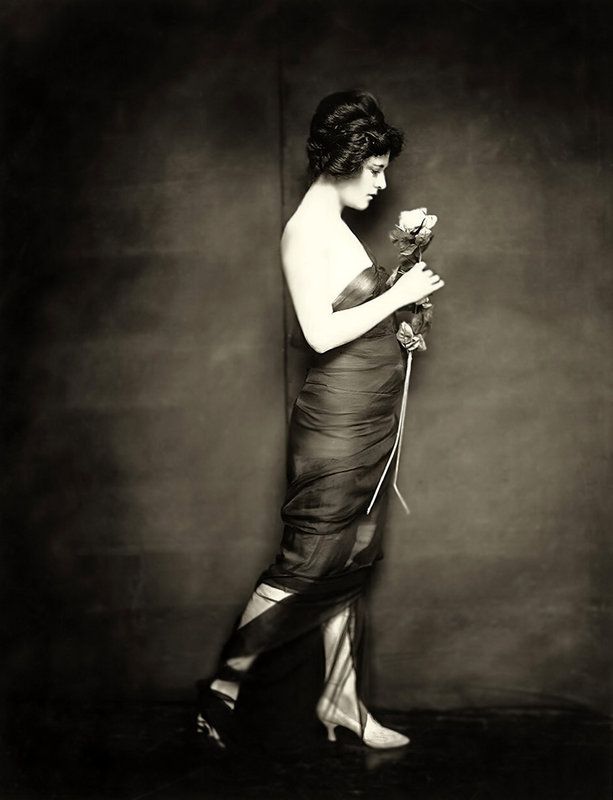
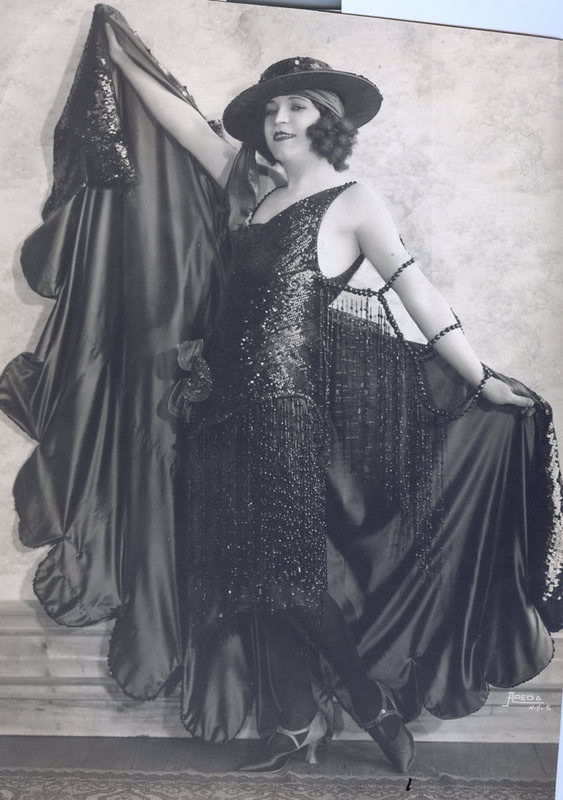
And now, for a little glamour, a few shots of Yvonne Shelton, then Betty Compton, Walker’s two most famous girlfriends (who he wooed while married to wife Janet).

wikiart
Courtesy Historial Ziegfeld
Photographs above by Alfred Cheney Johnston.

She most famously starred in 1927’s Broadway production of Oh Kay! starring Gertrude Lawrence. Here’s Lawrence singing a famous song from that show:

IN TWO WEEKS: Chapter Two of our series on the Roaring ’20s, rewinding back to the beginning of the decade and introducing you to another icon of the Jazz Age. Who will it be?
Categories
Holidays

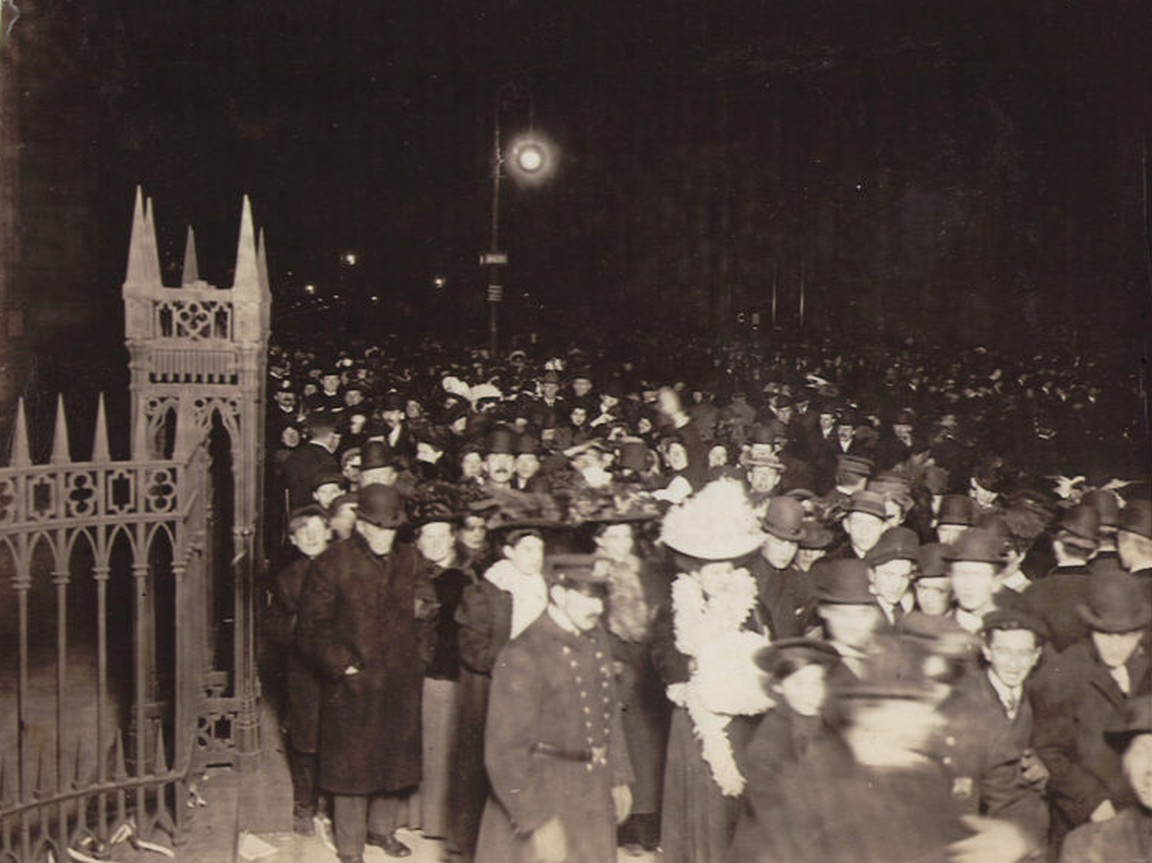
Midnight in Times Square: The history of New Year’s Eve in New York City

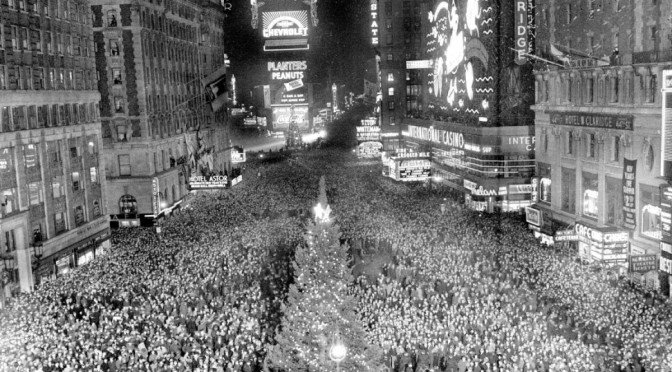
PODCAST The tale of New York City’s biggest annual party from its inception on New Years Eve 1904 to the magnificent spectacle of the 21st century. 

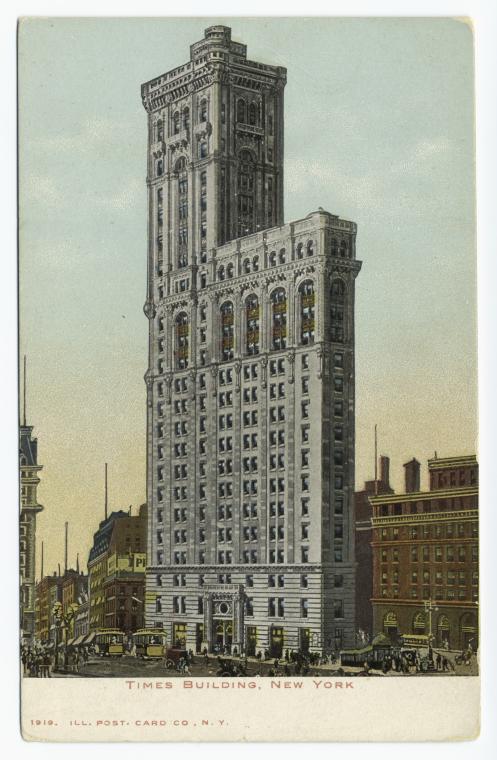
In this episode, we look back on the one day of the year that New Yorkers look forward. New Years Eve is the one night that millions of people around the world focus their attentions on New York City — or more specifically, on the wedge shaped building in Times Square wearing a bright, illuminated ball on its rooftop.

1

In the 19th century, the ringing-in of the New Year was celebrated with gatherings near Trinity Church and a pleasant New Years Day custom of visiting young women in their parlors. But when the New York Times decided to celebrate the opening of their new offices — in the plaza that would take the name Times Square — a new tradition was born.

Tens of millions have visited Times Square over the years, gazing up to watch the electric ball drop, a time-telling mechanism taken from the maritime tradition. The event has been affected by world events — from Prohibition to World War II — and changed by the introduction of radio and television broadcasts.

ALSO: What happened to the celebration which it reached the gritty 1970s and a Times Square with a surly reputation?

PLUS: A few tips for those of you heading to the New Years Eve celebration this year!


The Bowery Boys: New York City History podcast is brought to you …. by you!

We are now producing a new Bowery Boys podcast every two weeks. We’re also looking to improve the show in other ways and expand in other ways as well — through publishing, social media, live events and other forms of media. But we can only do this with your help!

We are now a member of Patreon, a patronage platform where you can support your favorite content creators for as little as a $1 a month.

Please visit our page on Patreon and watch a short video of us recording the show and talking about our expansion plans. If you’d like to help out, there are five different pledge levels (and with clever names too — Mannahatta, New Amsterdam, Five Points, Gilded Age, Jazz Age and Empire State). Check them out and consider being a sponsor.

We greatly appreciate our listeners and readers and thank you for joining us on this journey so far. And the best is yet to come!


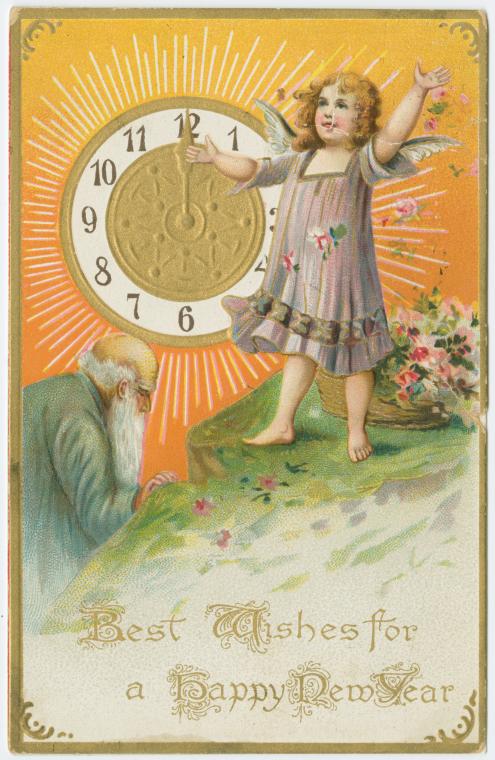
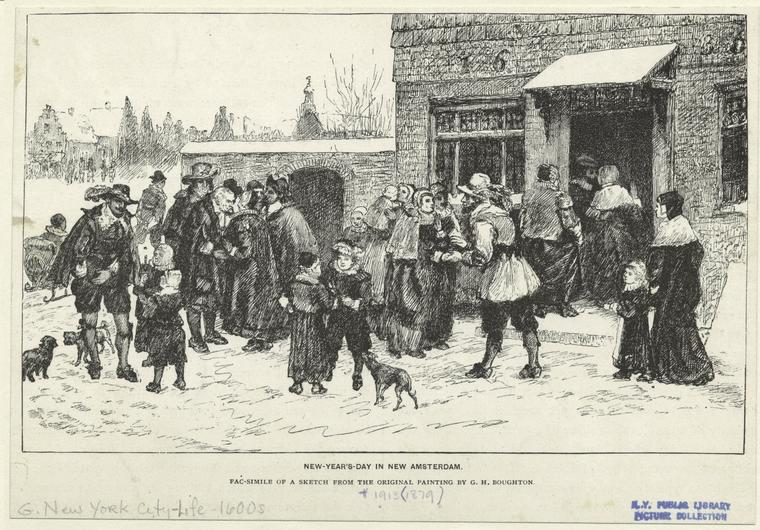
New Years Day celebrations have evolved since the days of New Amsterdam when visitations symbolized a ‘fresh start’ to the year.

Courtesy NYPL
Courtesy NYPL

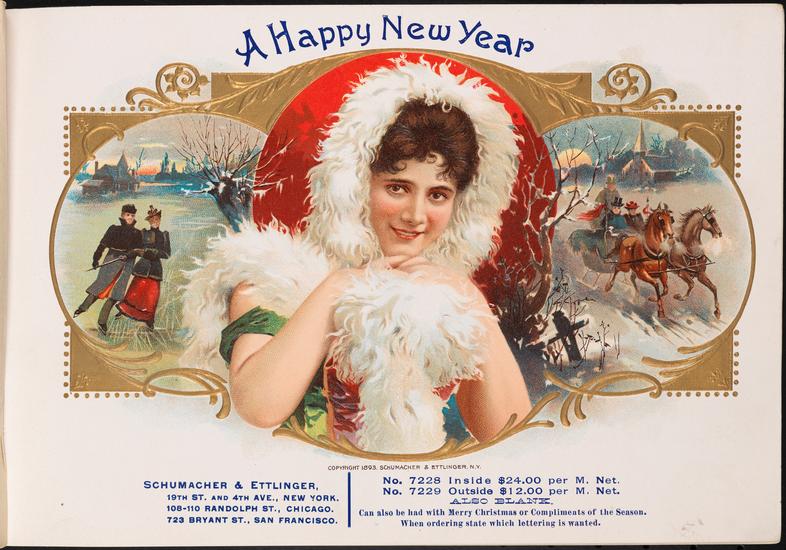
A decorative cigar box from the 1890s, ringing in the new year with a winsome damsel and wholesome scenes of winter beckoning you to smoke a cigar.

Courtesy Museum of the City of New York

The crowds outside Trinity Church on 1906 gathered to usher in the new year. The church was traditionally the place people gathered before the Times Square celebration took off.

1

Fated to be the centerpiece of New Years Eve, One Times Square once wore some beautiful architecture until much of it was ripped off to accommodate a frenzy of electronic signs.

Courtesy NYPL
Courtesy NYPL

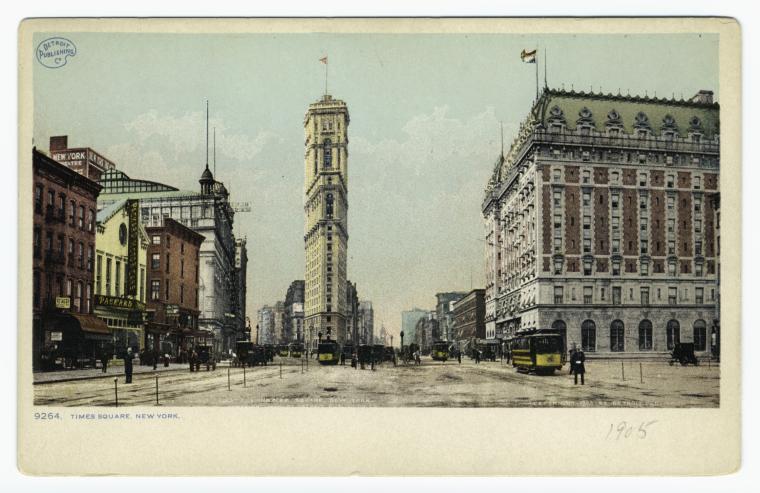
Times Square in 1905 for the very first New Years Eve celebration albeit one with fireworks, not a ball drop.

Courtesy NYPL
Courtesy NYPL

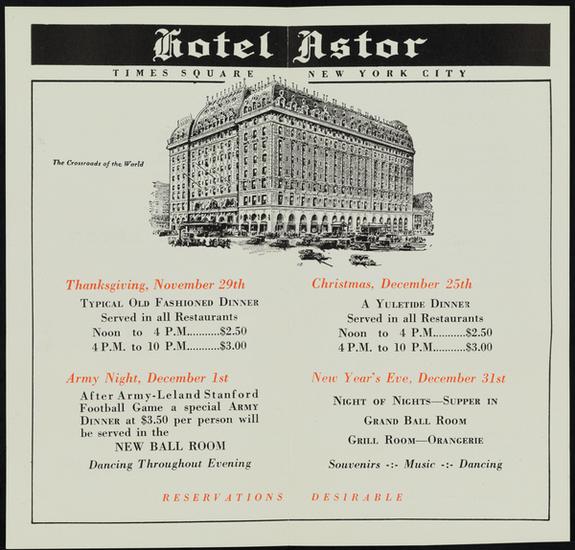
The party offerings at the Hotel Astor in Times Square in 1926.

Courtesy Museum of the City of New York

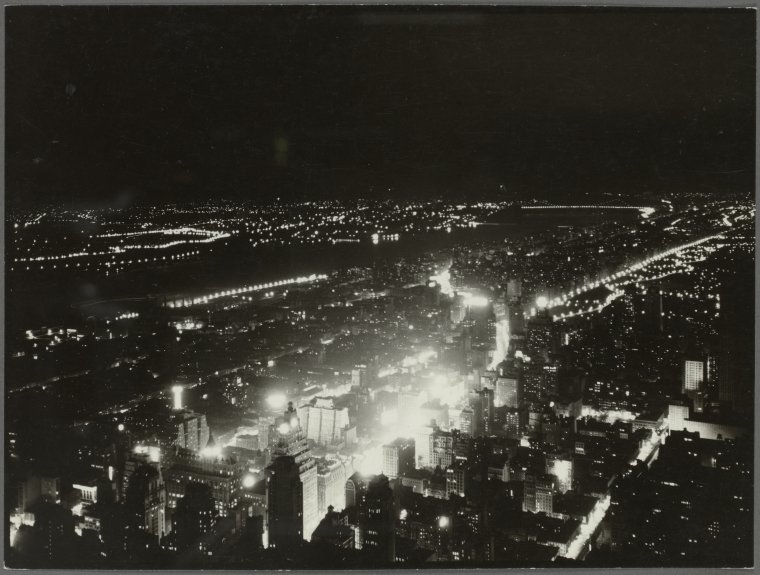
The view of Times Square from the Empire State Building.

Courtesy NYPL
Courtesy NYPL

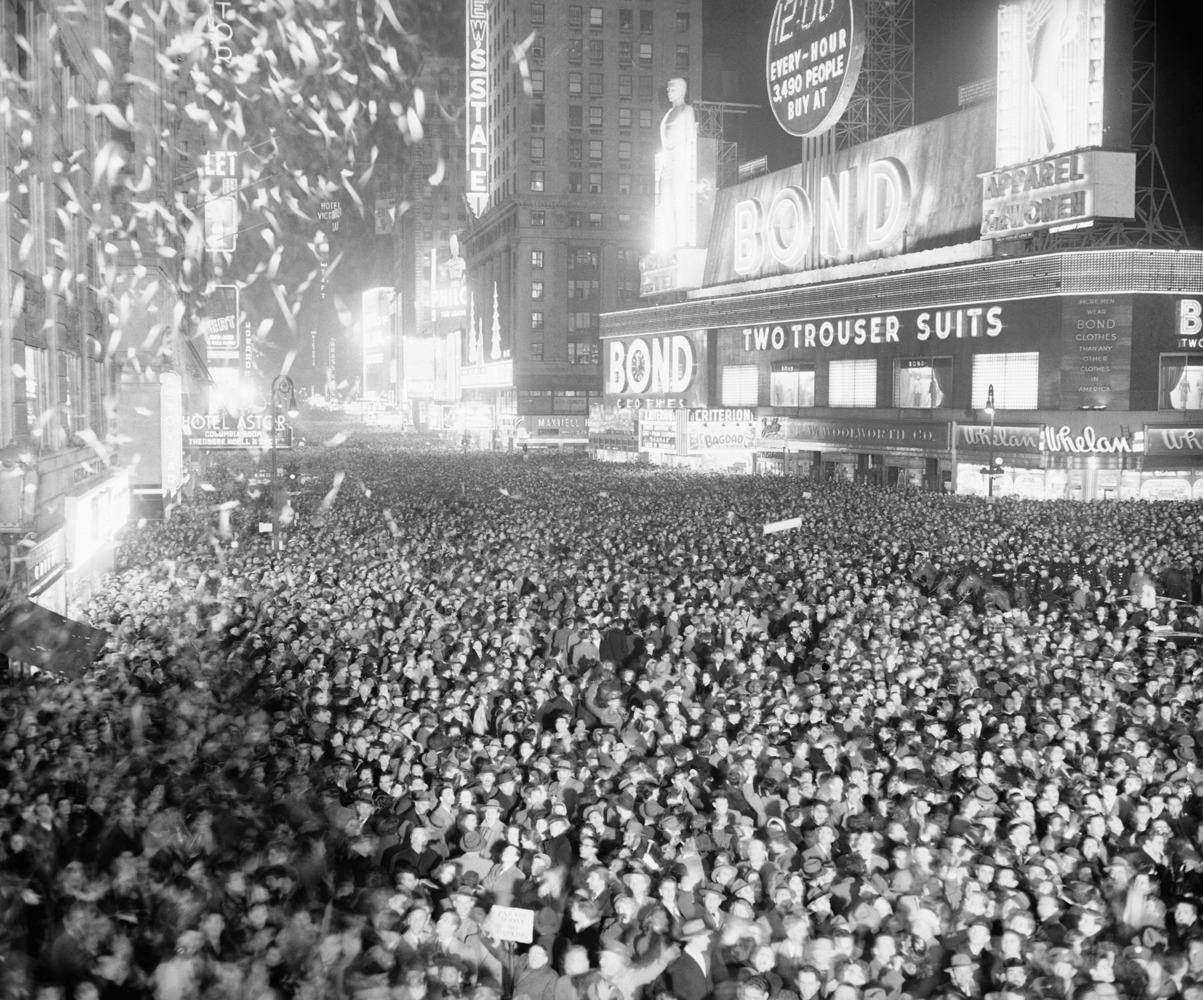
New Years Eve 1938

AP photo
AP photo

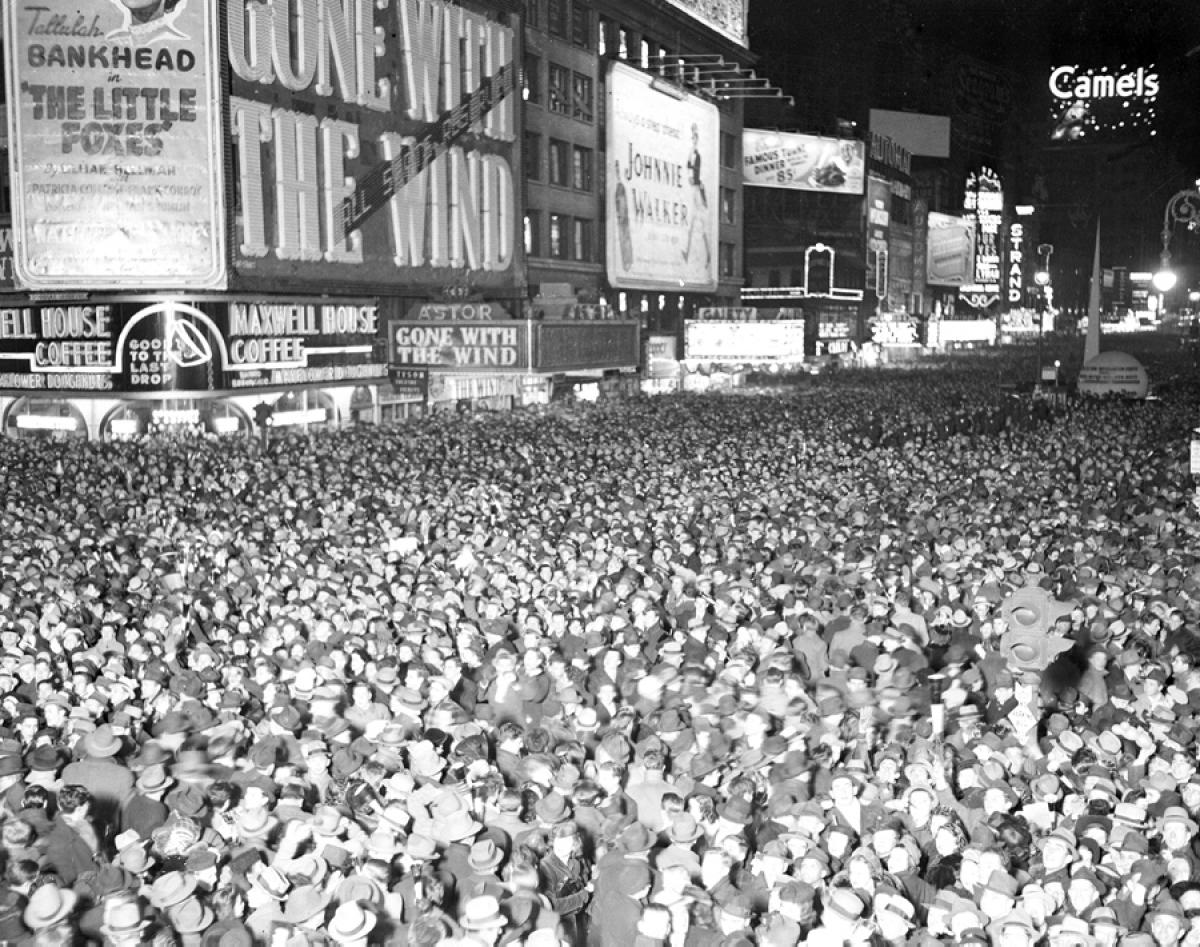
The throngs in 1940 with the Gone With The Wind marquee in the background (not to mention Tallulah Bankhead in the play The Little Foxes!)

Courtesy New York Daily News

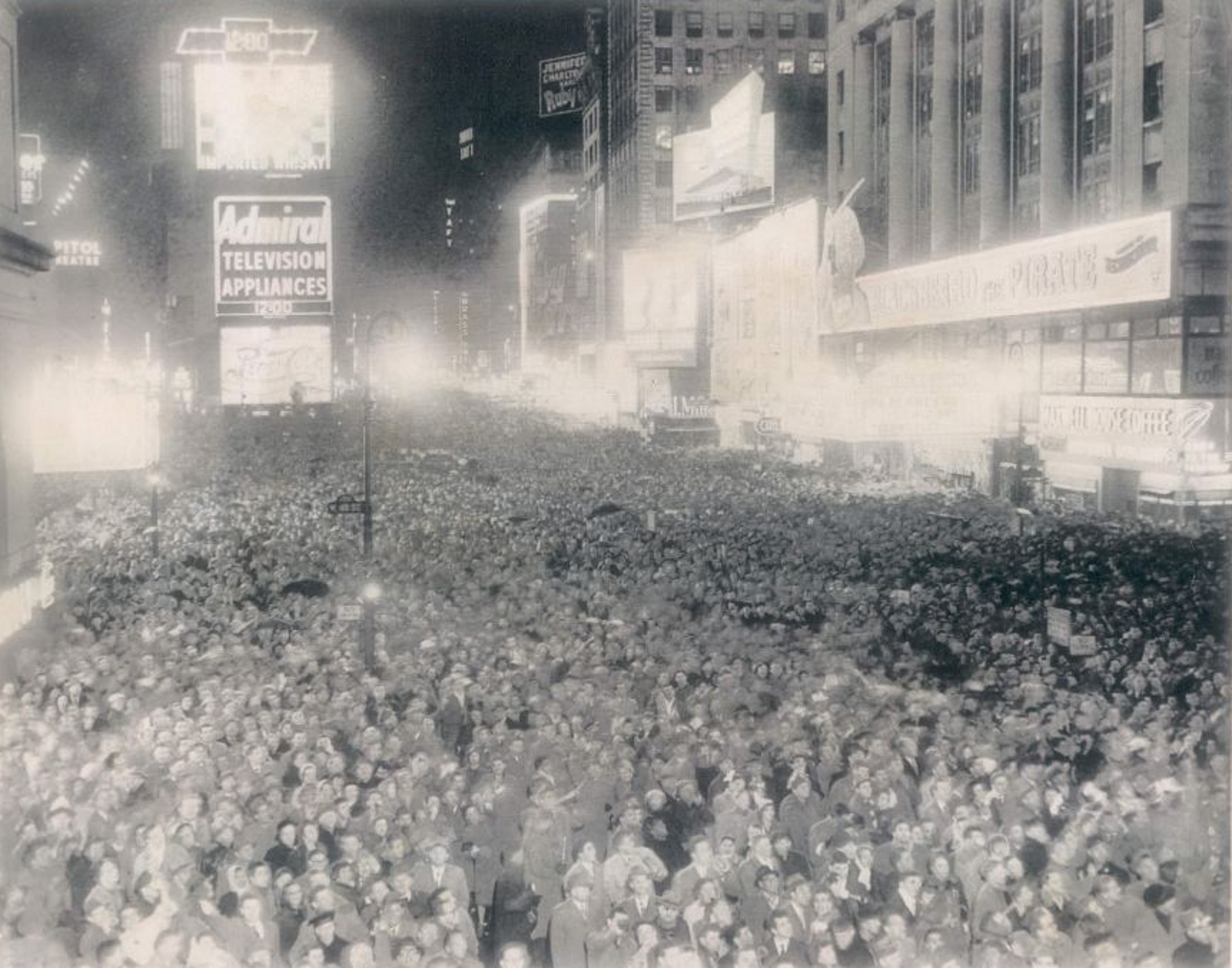
Ushering in 1953:

9

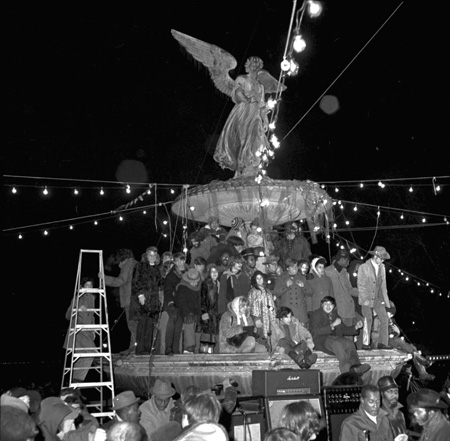
Celebrations were also held for a time in Central Park, like this festive group from 1969:

Courtesy New York Parks Department

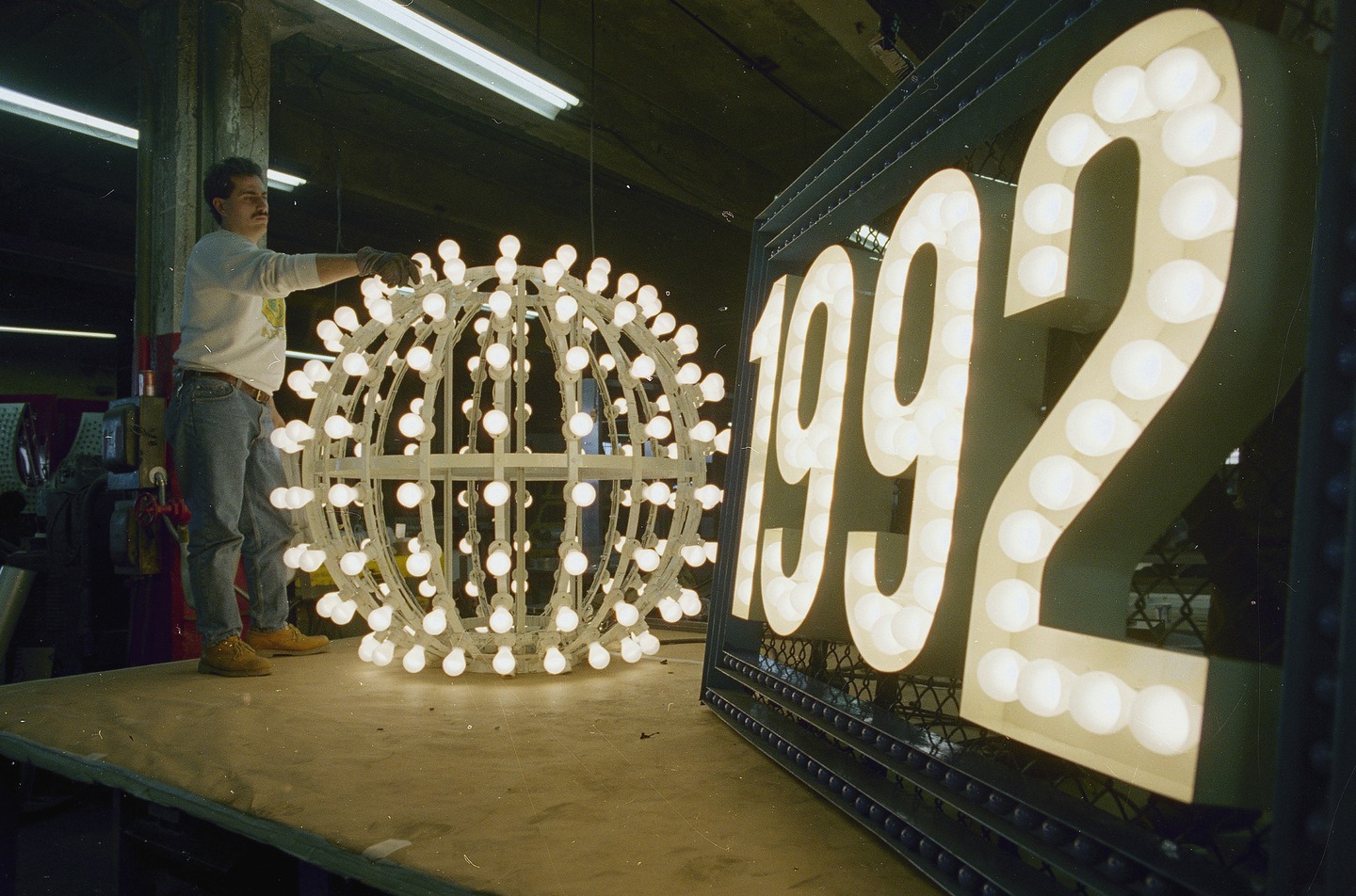
An electrician from the Artkraft Strauss Sign Corporation tests out the lighting effects that will greet the new year in 1992.

MARTY LEDERHANDLER/ASSOCIATED PRESS

And here’s some videos of New Years Eve countdown past!

Mr New Years Eve himself — Guy Lombardo — here at the Roosevelt Hotel, ringing in 1958

From 1965-66:

A clip from Dick Clark’s first appearance in Times Square. It cuts away to Three Dog Night in California!

CBS’s New Years Eve program featuring Catherine Bach from The Dukes of Hazzard.

The absolutely bonkers ball drop for the new millennium.

Last year’s commentary by those wacky cards Anderson Cooper and Kathy Griffin.

Categories
Bowery Boys Bookshelf Skyscrapers

Supreme City: The ascent of Midtown Manhattan in the 1920s


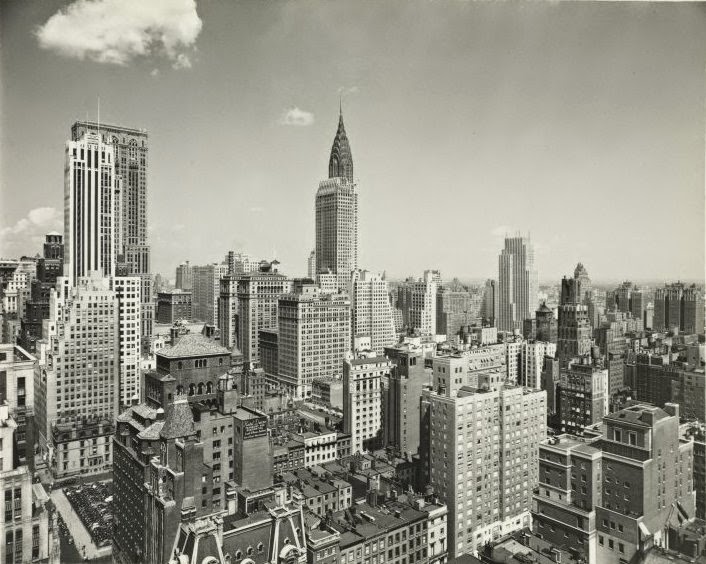
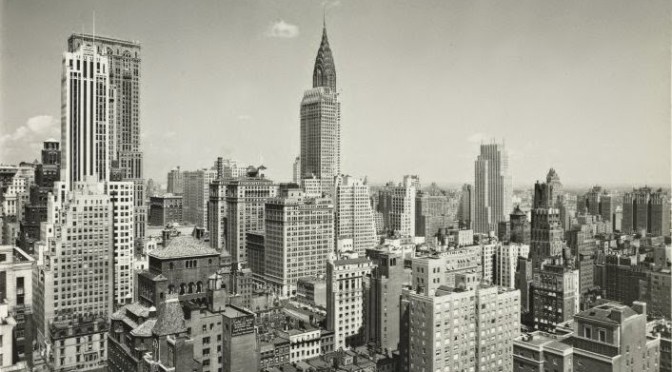
A view of Midtown Manhattan, looking southeast, by the Wurts Brothers (NYPL)

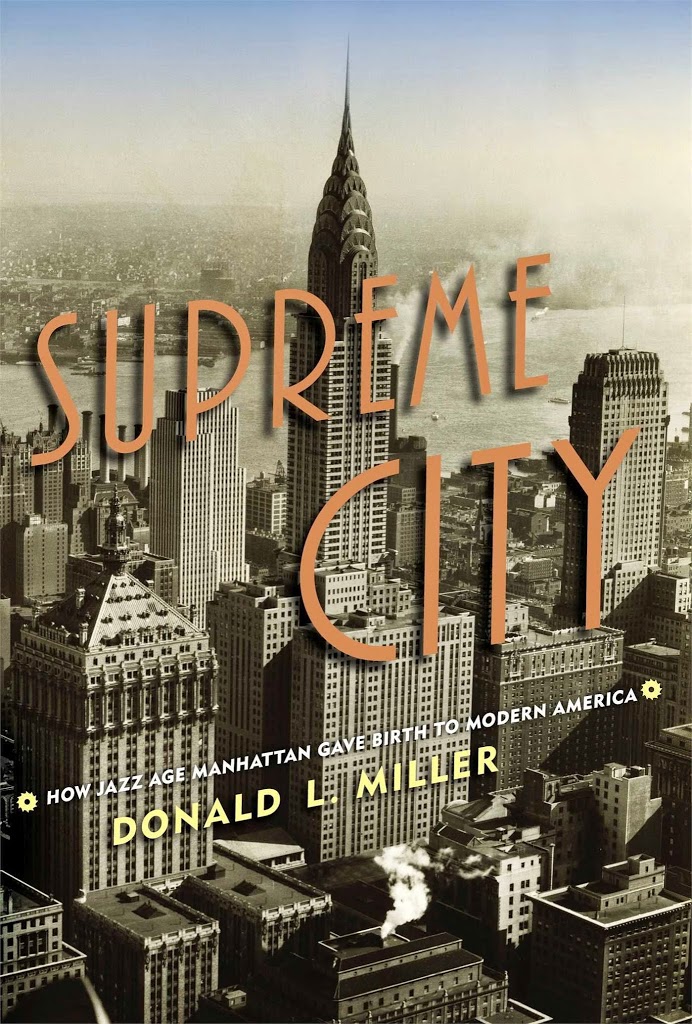
Supreme City
How Jazz Age Manhattan Gave Birth to Modern America
by Donald L. Miller
Simon & Schuster

Supreme City, by Donald L. Miller, certainly one of the most entertaining books on New York City history I’ve read in the past couple years, is also one of the strangest.  Almost as an obligation, New York’s Prohibition-fueled nightlife and the rowdy administration of Jimmy Walker are conjured up front, and colorfully so, only to then be placed aside.

This is not a book about the standard subjects of the 1920s.  This is indeed an epic about New York City in the Jazz Age, but it’s a wildly different tune than the one in which you’re familiar.

This is a tale of architecture and invention, of a boldness and proportion that New Yorkers take for granted today.  Supreme City recounts the invention of Midtown Manhattan, but it’s also about a spiritual shift in urban life.  This is the story of how New York City became not only a supreme city, but a supersized one.

Miller, a professor of history at Lafayette College perhaps better known for his works on World War II, approaches the sprawl of New York’s most ambitious decade almost like a mathematician. He ties this epic — a swirl of large personalities and impossible ideas — into a specific intersection of time and place.

It’s as though a slew of particles (comprised of ambitions and personalities) just slammed into each other one day, creating a new form of urban environment.

Industrial visions and personal journeys alike culminate in the year 1927, a watershed date for New York history, and arrive within the Manhattan grid system, mostly along 42nd Street between Eighth Avenue and Lexington Avenue, the nucleus of a new urban vision.  The story ventures out through the entire city of course but always to the beat of this new Midtown.

From here, Miller brings in the components of growth, the great innovators and personalities, plotted in relation to each other and to the great city blossoming under their feet.

These aren’t just the standard innovators, the expected cast — David Sarnoff, Duke Ellington, Charles Lindburgh. Sure, you get a bit Texas Guinan‘s drunken swagger, a little of Jack Dempsey‘s scrappiness.  But Miller gives equal prominence to perhaps less colorful real estate gurus and planners whose contributions created the playing field of modern New York. While it’s always nice to relive the 1920s through a lens of champagne and The Great Gatsby, Miller’s concern is with the players who actually built the city.

The engineer William Wilgus receives deserved placement in Supreme City for his innovations of covering the unpleasant tracks of Grand Central to create acres of new land, “taking wealth from the air” and inventing New York’s ultimate canyon of wealth — Park Avenue.

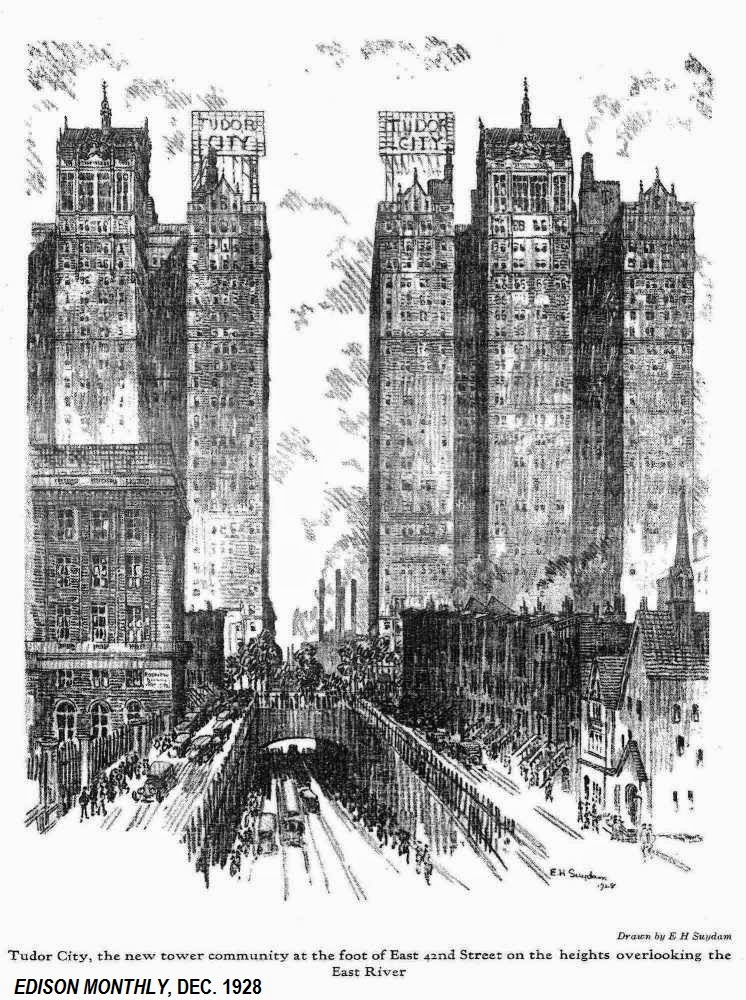
Architect Emery Roth brought the apartment skyscraper to Midtown and practically invented the allure of the penthouse.  The almost faceless Fred French — his section is actually called “Who on Earth was Fred French?” — turned the apartment complex into a swanky, thematic thrill with such Midtown projects as Tudor City (a 1928 illustration pictured at left).

Of course, it took the wealthiest New Yorkers to fuel these changes. New money sparked the new playing field.  The old families hastened their migration up Fifth Avenue, their mansions abandoned, torn down and replaced with the high-end shops in which they would later shop.

While department store masters like Edwin Goodman swept out the socialites to build his Fifth Avenue temple of commerce Bergdorf-Goodman, the pleasant rivalry between Helena Rubenstein and Elizabeth Arden helped generate the avenue’s reputation of social perfection and high glamour.

Sensing the upward surge of Midtown — its almost-amoral infinite rise — impresarios like Samuel “Roxy” Rothefeld, Florenz Ziegfeld and George “Tex” Rickard rose to create venues to corral the masses.  Midtown became home in the 1920s to the industries of entertainment — publishing, radio, television.  Even Seventh Avenue below Times Square found purpose in the swell as America’s Garment District.

As Midtown grew in the 1920s, the instruments of getting there also rose to the challenge, finally conquering the Hudson River, from the Holland Tunnel to the George Washington Bridge.

The story is so big that Miller can’t contain all of it. Supreme City captures that place before the Great Depression, perhaps New York’s single most decadent moment. He does not venture out into the other boroughs and rarely even ventures below 42nd Street. From the vantage of the Chrysler Building — the treasure most indicative of the age — those places are hazy and distant.  By the last page of this heavy tome, Midtown Manhattan creates everything, drives everything, almost entirely is everything.  That energy is certainly infectious, making Supreme City is an rich, propelling read.

Categories
Friday Night Fever

Recalling the opening of Roseland Ballroom at the start of Prohibition, the ‘phantasmal’ atmosphere, the private dancer

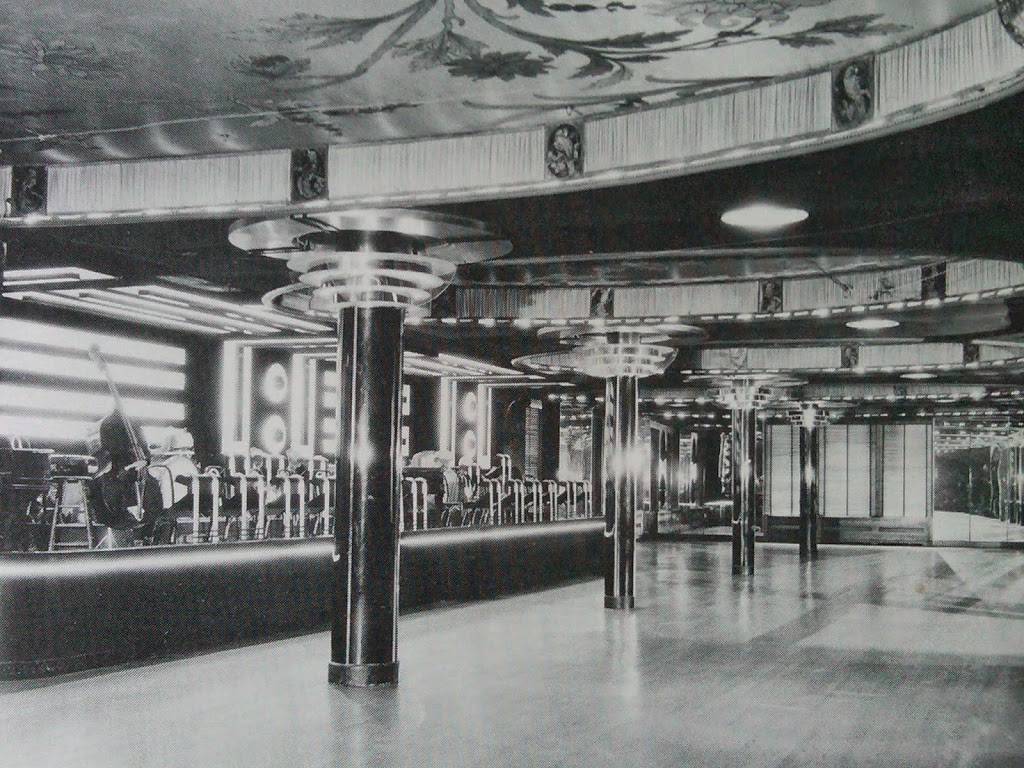
The Roseland Ballroom closes its doors next month on April 7th after a round of Lady Gaga concerts.  The storied big band venue — the ‘world’s foremost ballroom cafe’ — originally opened on December 31, 1919 at 1658 Broadway (at 50th/51st Street).  In the 1950s, it moved to its present location on 52nd Street, a former ice and roller-skating rink.

On the surface, opening a dance club a few weeks before the start of Prohibition doesn’t seem to be especially wise.  But New Yorkers ate it up.  After all, there would eventually be hundreds of speakeasies surrounding it!”

From the January 17, 1920 edition of the New York Evening World, headlined ‘Broadway Finds Joy In Roseland‘:

“The shadow of the camel, i.e. the presence of Prohibition, has not robbed Broadway of all its pleasures.  The dancers still find a way to have a good time, as may be attested by the thousands who attend the sessions at Roseland, the new dancing place at Broadway and 51st Street.

During the ’20s, the Roseland was the scene of many dance marathons for prize money.  In 1923, when the city reminded him that state codes authorized only twelve-hour endurance contests, he arranged for competitors to be whisked away on a boat — called the Roseland — to complete the contest.

The Roseland took aim at dismissing the blues at the height of the Great Depression.   “At Roseland Ballroom, ‘Old Man Depression’ will be tried and found guilty of murdering Prosperity and sentenced to death.  A scaffold will be erected for him and his ‘death’ will be a signal for merry-making.” [from the December 31, 1931, New York Times]

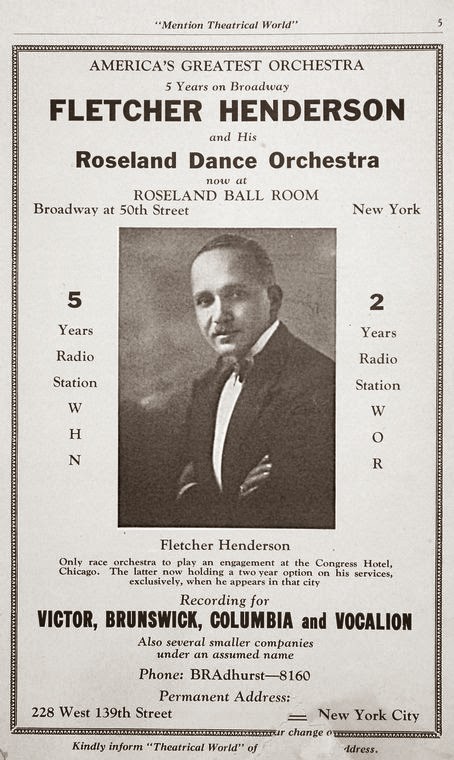
At right: Regular Roseland bandleader Fletcher Henderson (courtesy NYPL)

The Roseland was never the Rainbow Room.  During the 1940s it was nicknamed ‘the poor man’s nightclub’ which apparently didn’t stop it from being “the most famous dance hall in the world,” according to the New Yorker in 1942.  (It was also, back when it opened, a whites-only establishment.)  Always popular, the Roseland of the 1940s was charming and sometimes mysterious, regimental and rarely lewd.  Its owner Louis Brecker always referred to it as “the home of refined dancing.”

People accustomed to night-club life often find the atmosphere slightly phantasmal. The ceiling is hung with dark-blue muslin studded with tiny electric bulbps give a night-sky effect. The roomis lit by neon lamps, graduating in shade from deep pink to lemon yellow. In their dim rays knots of patrons drift to and from the dance floor with a curiously delicate air, fluorescing a bit as they go.” [New Yorker, 1942]

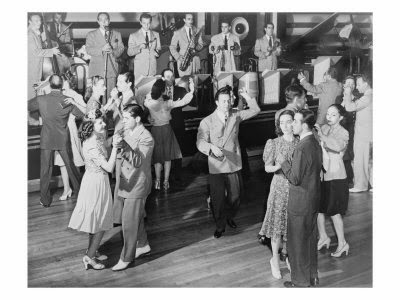
Roseland dancers, 1941 (Library of Congress)

The Roseland was also known for hostesses (or taxi dancers) who would dance with gentlemen for $1.50 per half hour.  They were beautiful and well behaved, never drinking alcohol if their patrons offered. And they never solicited business, sitting politely in a roped-off dias by the dance floor, waiting for an interested man to come along.

“Each hostess tried to build up a clientele by thoughtful attention to masculine interests and hobbies. Many hostesses read books in order to increase their conversational range,” according to the New Yorker. “[E]lderly gentlemen who like to surround themselves with hostesses, sometimes  [bought] out the entire platoon for the evening.”

The hostess/taxi dancer, hugely popular during the World War II era, had mostly faded out by the time the Roseland moved to its present location at 52nd Street.

 Here’s a Henderson tribute to the venue, entitled “Rose Room (In Sunny Roseland)”:


Times Squared: Lovingly nitpicking ‘The Great Gatsby’ trailer

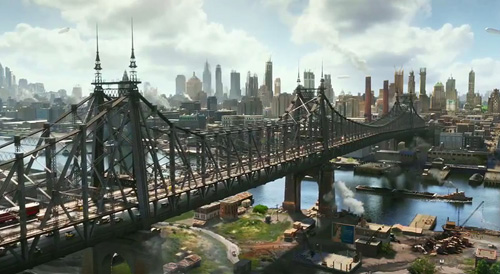
The recent trailer to Baz Luhrmann’s The Great Gatsby, aka ‘Moulin Rouge in Manhattan’, seems to have left everyone in a state of awe (and horror) in its vivid, hyper-electro-glossy depiction of Prohibition-era New York. And it left many feeling slight panic, even apoplexy, especially considering the entire spectacle will be rendered in 3D when it’s released in December. Oh God. Will flappers kick whimsily towards the camera?

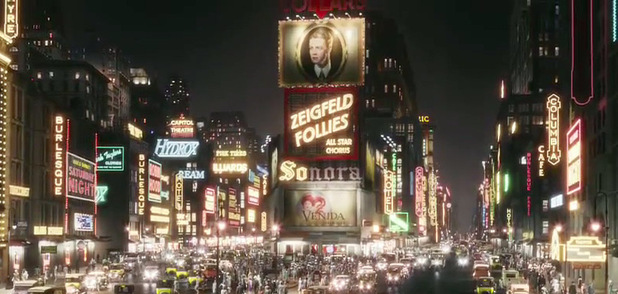
So how accurate was Lurhmann in his glamorous take on Times Square of 1922? How accurate was it supposed to be? Many have already taken note of one glaring and unforgivable error — misspelling the name of Florenz Ziegfeld on the sign for the ‘Ziegfeld Follies’. That ridiculous mistake overshadows a possibly smaller error, that the Follies were actually performed down at the New Amsterdam Theatre on 42nd Street in 1922. However, the Follies from the year before were hosted at the Globe Theater on West 46th Street (today’s Lunt-Fontanne Theatre), quite close to this sign. So perhaps they just kept it up.

Here’s the entire trailer:

Clearly, Luhrmann is interpreting New York, not emulating it. ‘Moulin Rouge’, after all, was Paris through a hazy scrim. He’s filtering the glitz of F. Scott Fitzgerald‘s work through his own dreamlike aesthetic and doesn’t need to fact-check every sign and street corner. Still, the trailer does feature some interesting obscure details, and I can’t help myself.  If you saw a different detail, please post about it in the comments section:

Queensboro Bridge The trailer opens with a spectacular look at the Queensboro Bridge, a potent symbol in the Fitzgerald novel. “Over the great bridge, with the sunlight through the girders making a constant flicker upon the moving cars, with the city rising up across the river in white heaps and sugar lumps all built with a wish out of non-olfactory money.”

The bridge opened in 1909, and it’s a defining image of the Jazz Age, not least of which because the population of Queens almost tripled during the 1920s. There were certainly trains on the Queensboro — it was built to accommodate them — but I’m not sure about that particular train.  Below it sits grimy old Blackwell’s Island, renamed Welfare Island in 1921 and certainly looking the part.

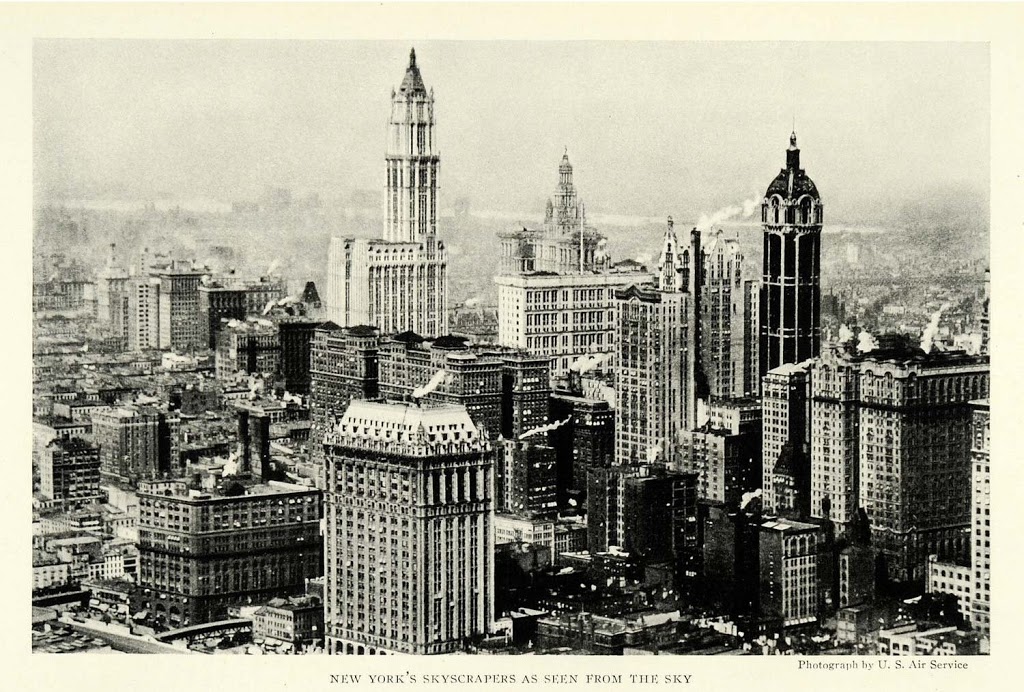
 — Skyscrapers Oh Lord. I don’t think this depicts New York at all but is a composite view of various buildings of the age. Far to the left in the trailer I see structures that look like the Singer Building and the Woolworth Building, but they would not be seen from this angle. Besides, the Woolworth would be taller than the Singer. See below for a size comparison, in a picture from 1922, looking northeast.

There are some vaguely Flatiron Building/Met Life Tower type structures, but they look like they’re on 42nd Street.  And why do I think I can see something that clearly looks like the New York Central Building (later the Helmsley Building) which wasn’t finished until 1929?

Times Square Signs An array of illuminated products logos — in various colorful hues foreign to Times Square in 1922 — gives the Crossroads of the World a mystical glow. The tony Hotel Astor adorned in lights dominates the plaza to the left. Nearby is an ad for Douglas Fairbank‘s ‘Robin Hood’, released in October 1922. It played at the Lyric Theatre. Fairbank’s rival Rudolph Valentino and actress Norma Talmadge created a buzz when they attended the film’s premiere together here.

It’s next to the advertisement for Hydrox (the sandwich cookie which debuted in 1908) and the Capitol Theater, a movie palace which opened in 1919. The tire ad is a nice touch, recalling Times Square’s status as the center of automobile sales and repair during the early 20th century.


Below the Zeigfeld [sic] Follies sign is an advertisement for Sonora, a phonograph company that began producing radios in 1924. Their slogan ‘Clear As A Bell’ harkens back to the company’s original product line — clock chimes.

To the right of those is a sign for the Columbia Theatre, “the royal palace of burlesque” in the 1920s. The theater opened in 1910 with decor of “Roman gold and and French gray, and the hangings and carpets are of rose du Barry.” It became the Embassy movie theaters in the 1970s.

Later on in the trailer, an ad can be seen for Arrow Collars, the detatchable shirt collar company that went on to spawn America’s first male model type, the ‘Arrow Collar Man’, the sort of debonair type who populates the world of Gatsby. Of course, the demand for collared shirts pretty much killed of this industry by the end of the decade.

Grand Central Oyster Bar There appears to be a brief scene at this lush location with its vaulted ceilings. The Oyster Bar would have indeed been a thriving spot in 1922 and an ideal place to mix business with pleasure. A few years later, so goes the legend, David Sarnoff formed RKO Pictures over a few oysters here with Joseph Kennedy. In 1922, Tin Pan Alley lyricist Al Lubin met his music partner Harry Warren here. They went on to create the film musical 42nd Street in 1933.

Yellow Cab Co.? There are many brief glimpses of taxicabs, including those of the Yellow Cab fleet, which would later be purchased by the Checkered Cab company in 1929. In 1922, the Yellow Cab successfully won a ruling barring other paid-ride automobiles from being painted yellow. ‘1,000 Cabs Face Change of Paint.

Blood And Sand A prominent movie marquee is shown near the trailer’s end for Rudolph Valentino‘s ‘Blood And Sand’, a summer box office smash in 1922. This film debuted at the Rivoli, at 1620 Broadway, at 49th Street. From the New York Times film review on its debut: “Mr. Valentino has not been doing much acting of late. He’s been slicking his hair and posing for the most part. But here he becomes an actor again.” Let’s hope the same can be said of Leonardo DiCaprio, who plays Mr. Gatsby.

By the way, the 1974 version of ‘The Great Gatsby’, starring Robert Redford and Mia Farrow, premiered — with attendees in full ’20s regalia — at the Loews State Theater at 1540 Broadway at 45th Street. “The guests, many of them in Teflon or Daisy white, whatever you want to call it, were greeted by hundreds of celebrity gawkers, reporters and photographers.” [source]
Below: A clip from the Valentino film:


As I rewatch the trailer over the next few days, I may amend this article with further information. If there’s something obvious that I’ve missed, please let me know in the comments below!

Thanks to Michael Raisch, whose Tweet to me last night inspired this article.  Screenshots courtesy of Curbed and Entertainment Weekly.

Categories
On The Waterfront

The South Street kidnappings: During Prohibition, did ‘shanghai gangs’ really lurk in the shadow of the ports?

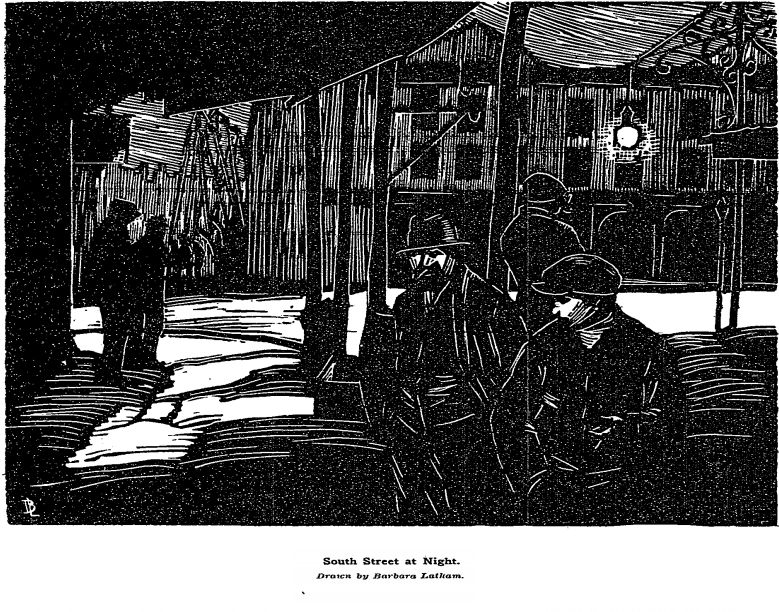
The old port at night was no place to be.

Weathered taverns and boardinghouses sit next to uninhabited warehouses, separated by dimly lit South Street from the shadow of rocking masts and creaking piers that sank into the black water of the East River.

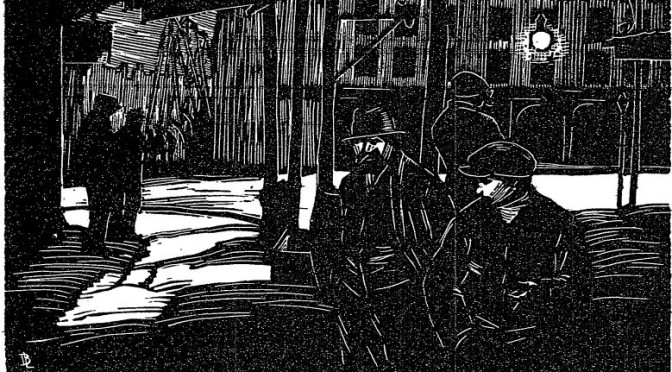
A lonely sailor, soused from the wares of the cheapest Water Street saloon, stumbles down the cobblestone. A figure emerges from the corner. A whistle. Another man steps from behind. And the lonely sailor has vanished.

The fear of ‘disappearing’ in New York kept many awake at night in the 19th century. In a world where everybody was essentially ‘unplugged’ and ‘off the grid’, there was a sense that people could simply vanish, almost as if absorbed into the urban environment without a trace.

Moral crusaders, in a tirade against personal independence, warned parents to keep close watch on their daughters for fear they would be snatched from the street, plied against their will with opium and turned into prostitutes.

Some thought this might have been the fate of ‘cigar girl’ Mary Rogers back in 1841. And as late as 1911, some speculated this was the fate of the socialite Dorothy Arnold, one of the most prominent disappearances of the Gilded Age. [Hear more about her story in our podcast from last May.)

But it was men who were often the victims of street kidnapping. The transient nature of the New York port world mixed with the influx of new immigrants — many of them younger men — fostered a disturbing cottage industry of so-called impressment (or ‘shanghaing’ in the old vernacular), where drunken men were either forcibly taken off the street or taken advantage of in their inebriated state and put to work on a sailing ship.

In 1870, a sailor ‘under the influence of liquor’ was tied up and dragged onto a boat. A Fort Hamilton soldier in 1882 was kidnapped and placed aboard a ship off Staten Island. While his message, thrown overboard in a bottle, was received, officials were unable to rescue him as the boat sailed for its destination: Hamburg, Germany.

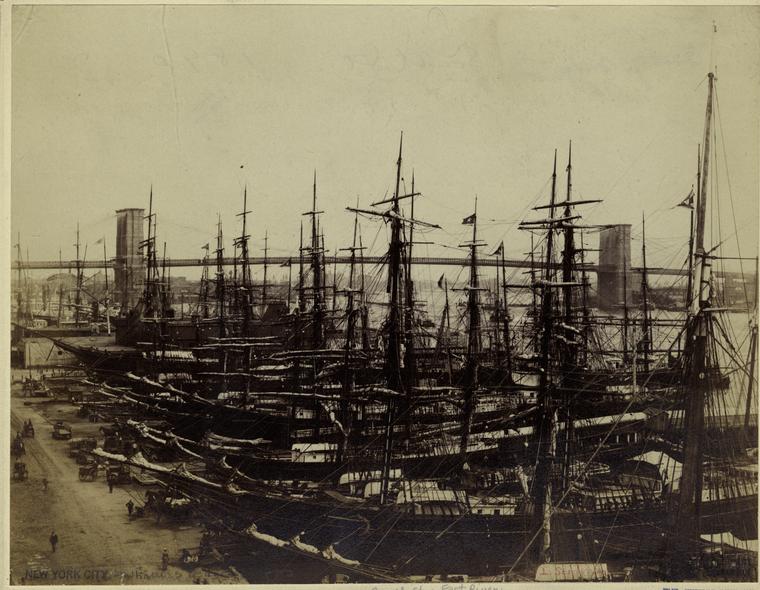
Below: The forest of masts along South Street, 1890

It’s impossible to know exactly how many men were forced onto boats along New York’s port, as the victims were frequently drunk, thrown onto boats that embarked on long voyages and then failed to press charges when they returned. An article in 1910 claims that ‘[h]undreds of sailors were captured [in New York Harbor], usually in the saloons, beaten into insensibility, to awake when the ship was at sea and the Captain an absolute tyrant.”
There would be an actual, near legal version of shanghaiing called crimping where the sailors, still taken at will, would be forced to sign an agreement, paid for their services but not allowed to leave. They would embark on often long voyages, and by the time they got back, “his anger is likely to have died out.”
By the late 1910s, federal laws protected the rights of seamen, and most shanghaiing and crimping practices were abolished. Except, of course, for those in illegal industries, and especially a brand new one created by the advent of Prohibition in 1920.

This type of kidnapping was perhaps the most frightening of all. “South Street Whispers of Shanghaing” announced a rather in-depth New York Times article in 1925. Now, instead of ‘crimps’, who lurked in sailor’s boarding houses, looking for possible captives, it was whole ‘shanghai gangs’ that ruled the shadows of the seaport.

“I have been drugged and held captive on a ship,” claimed one note found in a bottle and mailed to the police. An anonymous shipping master reported hearing of a victim “drugged in one of these newfangled speakeasies that are run as drug stores. They said along the street that a shanghai gang had got him, stole his money and shipped him to sea….The man is gone, and who can trace him?”

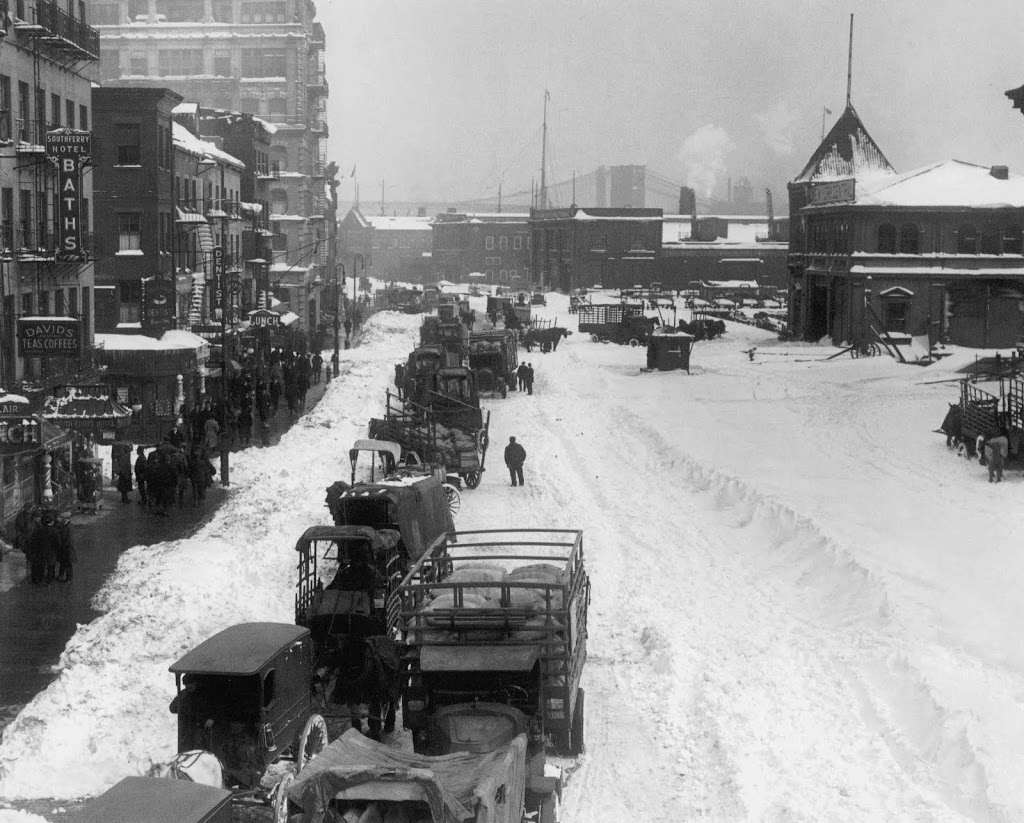
Below: South Street in 1920 in a snowstorm during the first year of Prohibition (Courtesy Flickr/wavz13)

The destination for these unlucky men wasn’t a long-distance voyage but rather a line of near-invisible vessels permanently moored off the American coast. ‘Rum Row‘ facilitated the distribution of alcohol into the United States, with product passing to smaller boats and shady, midnight deals made between mobsters and smugglers. It was an unpleasant and dangerous job, constantly under the fear of capture, betrayal and accident. In an illegal industry with few rules, unwilling men could be discarded.

This also made Prohibition-era impressment a mystery and something of an urban legend. How much forced capture really went on? The Times report interviews several sailors and even a salty South Street bartender, but their names are kept out of the story. Two men, thrown aboard a Rum Row schooner, “were made to work, starve and suffer for water, under threats,” only escaping when the vessel was captured by authorities.

South Street’s changing fortunes may have prevented a widespread problem of the sort which occurred in the 19th century.  The old pubs and grog houses were closed or turned to speakeasies, and heavy shipping had moved on to other ports throughout the harbor, on the Hudson River side, and in Brooklyn and New Jersey. The ports themselves were heavily controlled by mob bosses — and the promise of mob money — which perhaps made such forced recruitment unnecessary. And of course the success of illegal Prohibition industries relied on knowing which laws to abide and which to skirt.

Yet the fear of vanishing kept men on their toes at night as they passed through the neighborhood, keeping in the light as they stumbled down South Street.

At top: Drawing by Barbara Latham courtesy New York Times.  It accompanied the article mentioned above.

Bridge Whist Club: The worst booze your taxes can buy!


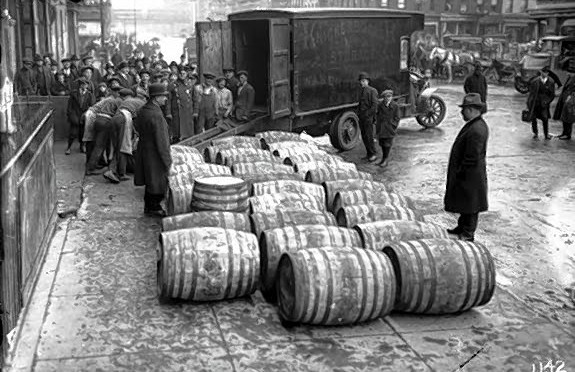
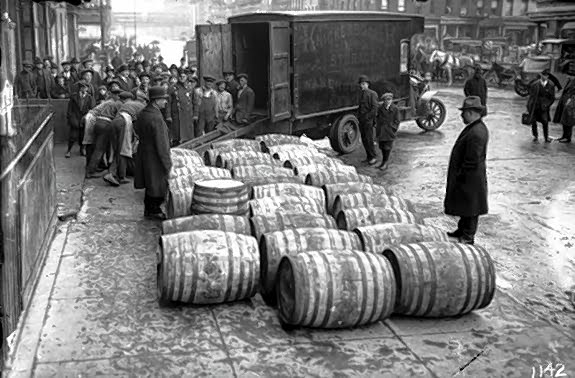
Just a barrel of laughs: Prohibition agents dump illegal containers of wine into the streets.

FRIDAY NIGHT FEVER To get you in the mood for the weekend, on occasional Fridays we’ll be featuring an historic New York nightlife haunt, from the dance halls of the old Bowery, to the massive warehouse clubs of the mid-1990s. Past entries can be found here.

LOCATION: The Bridge Whist Club
44th Street between Madison and Fifth avenues, Manhattan
In operation: 1925-1926

Prohibition in the United States didn’t extinguish the taste for liquor. The Eighteenth Amendment, ratified in 1919, outlawing the sale and transportation of alcohol, merely inspired those who sold it to become more creative.

In New York, prohibition even redefined midtown. Where once nightlife gathered around supper clubs and cabarets in major plazas like Times Square and Columbus Circle, speakeasies now slithered down the side streets and into previously unremarkable buildings. Some of the most famous of these illicit 1920s booze joints were housed in old tenements and small storefronts, down numbered streets off of Times Square and further downtown in Greenwich Village.

Outside the spotlight, a new regime of proprietors, building newfound nightlife empires with mob ties, quenched the thirsts of a populace thirsty for that which they weren’t legally allowed to partake. A great many vied for this business, with a reported “30,000 to 100,000 speakeasy clubs” formed by 1925.

That is an absurd number, reflecting the diversity in establishments — from the gentlemen’s clubs behind secret doors and the high-kicking lounges owned by Larry Fay and Texas Guinan to rundown tenements hastily fashioned with a bar and a few bottles. With no liquor sold there were no liquor licenses required. Everybody could get in the game.

How could the federal government even try and combat such widespread and diverse abuses of a virtually unenforceable law? One tactic manifested in 1925 when, in certainly one of the strangest undercover operation in the history of U.S. law enforcement, the feds got into the speakeasy business themselves. If you can’t beat ’em, drink up and join them.

In the fall of 1925, the United States Bureau of Prohibition sunk a few thousand dollars ($5,576.50, according to official documentation, almost $70,000 today)
to rent a building at 14 East 44th Street to construct its own speakeasy, called the Bridge Whist Club. The dive, called a “plush booze joint” by Herbert Asbury in his history of the Prohibition years, was named for a card game, and it is likely men gathered there to partake in this diversion.

But most were there for the liquor. The undercover agents, meanwhile, used the joint to gather “information concerning the activity of liquor smugglers.” Rubbing elbows with drinkers, agents could theoretically get names of other speakeasies and establish connections to leaders in New York’s underworld. Tables were even equipped with recording devices to pick up incriminating details.

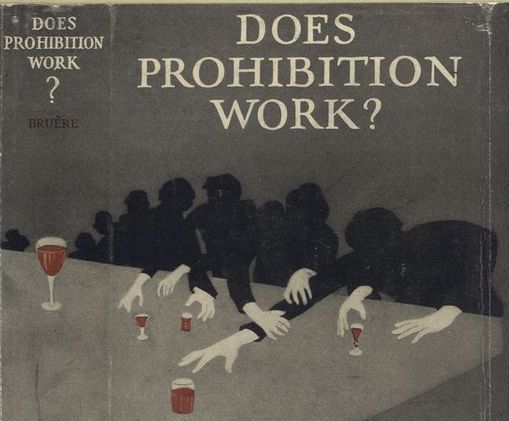
Below: From the jacket of a 1926 book by author Martha Bensley Bruere (courtesy NYPL)

In essence, they were feeding the small fish to draw out the larger ones. The Treasury Department, tasked with enforcing Prohibition by 1925, was well aware of the shifty nature of the enterprise. But an ethical distortion in the philosophy of the Bridge Whist actually put its patrons at risk.

As Wayne Wheeler, head of the Anti-Saloon League, put it, “The government is under no obligation to furnish people with alcohol that is drinkable when the Constitution prohibits it.” So the Bridge Whist served up a mixture containing wood alcohol, also known as Methanol, linked today with causing blindness.

This is not the first time that the U.S. government introduced dangerous substances into illegal drink. Realizing that many bootleggers stole industrial alcohol to make their product, enforcers directed that the industrial stuff be polluted with Methanol, hoping the foul taste and physical illnesses would deter consumption. (Slate Magazine ran an eye-opening article about this last year.)

Some of this toxic mix was sold at the Bridge Whist; other batches infiltrated through speakeasies throughout New York. According to author Deborah Blum, “In 1926, in New York City, 1,200 were sickened by poisonous alcohol; 400 died. The following year, deaths climbed to 700.”

Still, the Bureau claimed such tainted booze was “the most effective denaturant which the government could use, since it was the most difficult denaturant to remove” by bootleggers with their own chemists, tasked with cleaning up the toxic stew.

Having the government in the speakeasy business did not settle well with many in Congress. Anti-Prohibition members equated it to entrapment. Indeed, many arrested due to information gleaned from the Bridge Whist were later set free. Only one “mid-level bootlegger” was ever caught from information gleaned from the speakeasy operation.

New York congressmen Fiorello LaGuardia, ardently against Prohibition, petitioned against the use of ‘under-cover funds’ and extreme measures of enforcement. Ultimately, the Bridge Whist could not weather the scrutiny, and thanks to the efforts of the future mayor of New York, the experiment was officially shut down in May 1926.

Welcome to The Pansy Club: leave your wig at the door

Above: Karyl Norman welcomes you to the Pansy Club!

FRIDAY NIGHT FEVER To get you in the mood for the weekend, on occasional Fridays we’ll be featuring an old New York nightlife haunt, from the dance halls of 19th Century Bowery, to the massive warehouse clubs of the mid-1990s. Past entries can be found here.

LOCATION: The Pansy ClubTimes Square, 48th Street and Broadway, Manhattan
In operation December 1930-31

The moral crusaders who succeeded in banning alcohol sales via the Eighteenth Amendment must have wondered where it all went wrong. Instead of ushering America down a path of productivity and moral fortitude, Prohibition sponsored a decade of unwritten rules, creating a shadow economy and empowering a criminal underworld.

Norms were upended, and the fringes of New York were defined by experimentation and playful risk. Harlem and Greenwich Village became the centers of culture, women found new avenues for empowerment, and black musicians mixed with white to create the sophistication of jazz.

It’s in the light of this churning mix of invention that you have to approach one curious fad of the Prohibition era — the pansy craze, an appreciation of drag-queen worship cultivated in the heart of Manhattan.

I’m not sure a place called The Pansy Club would be popularly received today, but when it opened in late 1930 it was risque and cool. Its location at 48th and Broadway planted it firmly in the theater district where it truly belonged, of course. But given the entertainments it generously offered, it’s amazing to me it was allowed to open at all.

It makes sense that the speakeasy-fueled, white crowds, having fully sampled from black nightclubs of the 1920s, would venture into other subcultures on the fringe of bohemia. There were plenty of places in Greenwich Village for gay and lesbians to meet, and within them came camped-up forms of cabaret, with men in drag emulating the glamorous female stars of the day. It helped that some of those stars, like Sophie Tucker and Mae West, mixed with and borrowed from their costumed admirers.

It all built into a national, urban ‘craze’ in 1930 and 1931 for drag shows in a mainstream cabaret environment.  Why it neatly fit on the nightclub circuit — and what made it somewhat more tolerable for conservative crowds — was partially due to drag’s close association with vaudeville.  Although the term ‘pansy’ was a derogatory one for gay men, for this brief time ‘pansy clubs’ were the hottest ticket in town.

The Pansy Club, at 204 W. 48th, in heart of Times Square (and about where the M&M Store is today) was not the only nightclub of this type, but when it opened the week before Christmas in December 1930, it was the showiest of the lot.

The Pansy Club featured standard-era vaudevillian and cabaret acts, but with a decided gay (read: scandalous) twist — female impersonators, “a bevy of beautiful girls in ‘something different’ entitled ‘Pansies On Parade'” according to a newspaper advertisement, one of the few documents that verify the club’s brief existence.

Mistress of ceremonies was one Karyl Norman, known in drag as the ‘Creole Fashion Plate’. Born George Peduzzi from Baltimore, Norman became a star on the vaudevillian circuits in the US, Europe and Australia in a show that featured him both in and out of drag. As a published songwriter and a favorite of Tin Pan Alley, Norman would have been a big draw in 1930 and as a seasoned vaudevillian star would have brought a touch of credibility to a club with so shocking a theme.

According to Brooks Peters, the club was also “a haven for aging flappers and party-goers who liked “slumming.””

Down the street was an even more popular draw. At Club Abbey (46th and 8th Ave) was a young Jean Malin (at left, courtesy Flickr), a Brooklyn-born wit and sometimes ‘female impersonator’ who hosted drag performances while charming audiences with interludes that made no disguise of his homosexuality.

What distinguished these places is that they were not considered gay and lesbian bars of the sort in the Village. However they did have a similar thread in common with them — ownership by the mob, an association that led to the club’s swift closings.

A gang shooting closed Club Abbey in January, and the police raided the Pansy Club that same month.  While the ‘pansy craze’ would live on in other cities — it made a more lasting impression in Hollywood, naturally — it retreated to the fringes again in New York.

And finally, for your Friday night celebration, here’s a look at Jean Malin, who made a brief appearance in Hollywood films before Malin’s untimely death in 1933. The film is ‘Arizona To Broadway’.

The Roaring Twenties: a boozy old Hollywood bio

BOWERY BOYS RECOMMEND is an occasional feature where we find an unusual movie or TV show that — whether by accident or design — uniquely captures an era of New York City better than any reference or history book. Other entrants in this particular film festival can be found HERE.

New York during the Prohibition was a lot more difficult and less glamorous than the movies have portrayed. But why go there? In The Roaring Twenties, every element of the New York underworld is portrayed in pitch-perfect movie fantasy. What you wouldn’t realize is that this Hollywood gem is based on the true story of Manhattan’s speakeasy king and queen, Larry Fay and Texas Guinan.

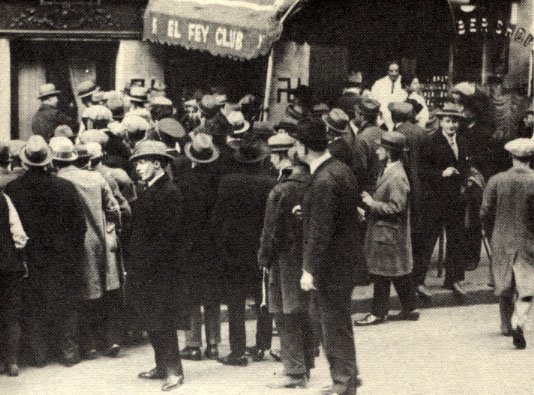
The real Fay was a “taxi racketeer” (runner of several illegal cabs) turned lucrative speakeasy owner during the Jazz Age. His club El Fey, at 105 W. 45th Street (below), with its swastika-adorned doorway, moved poorly made champagne at premium prices, thanks to hiring the personable and sexy Guinan, a former Hollywood Western star turned nightlife doyenne. (I elaborated about her and her 300 Club in an article last year.)

Below: the real El Fey

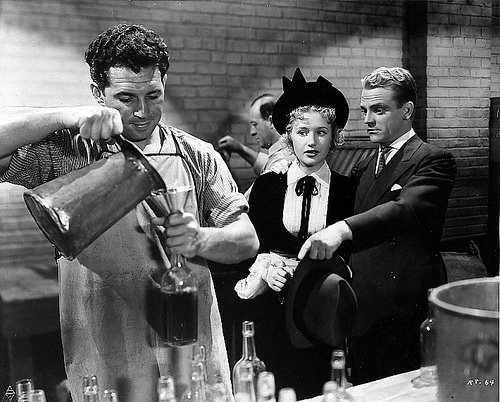
Fay was a notorious enough name that by 1934, the year after his death by the hands of a disgruntled employee, news of the auction of his bullet-proof Excelsior limousine made Time Magazine. Its no surprise that the 1939 big screen adaptation of his life, then, would attract two of Hollywood’s biggest stars — James Cagney and Humphrey Bogart. (In classic early movie tradition, the story is loosely based and all the names are changed.)

Cagney plays Eddie Bartlett (the stand-in for Fay), out-of-luck after returning from World War I and virtually forced into the gangster business. Thankfully he finds that his foxhole partner George Hally (Bogart) has also entered the illegal booze smuggling business. The two uneasily join forces but soon learn that in the New York underground, your friend one day is your enemy the next.

Notable in the cast is Gladys George as Panama Smith the saucy, barely disguised avatar for Guinan. As this is a moralist film, Panama is punished for being a saavy independent business-owner by slowly deteriorating into a needy, washed-up lounge singer that nobody wants.

The director Raoul Walsh would later bring Cagney his most defining screen moments in White Heat, and Bogart a few of his in High Sierra. Six years prior to ‘Twenties’, Walsh directed a film called ‘The Bowery’ about the rough and tumble saloon-clogged street during the 1890s.

Meanwhile, Cagney and Bogart had teamed two years previous in ‘Dead End’, the movie about a New York slum that brought the world the first appearance of the Dead End Kids, later to rename themselves the Bowery Boys.

The Roaring Twenties is currently out on DVD and is probably played on Turner Classic Movies about once a month.

Categories
Podcasts

PODCAST: The Chrysler Building

Ah, the classic Chrysler Building! She’s got style, glamour and all that jazz. But what magical surprise did she spring on New York in October of 1929? Join us as we tell the story of New York’s most beautiful art deco treasure.

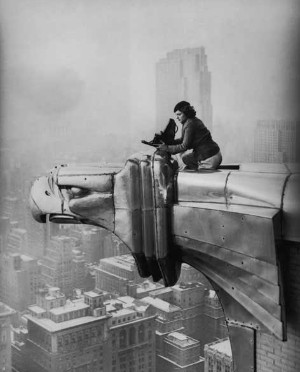
The picture above is of famed photographer Margaret Bourke-White, who had an studio on the 61st floor of the Chrysler. Her iconic photographs of the building helped create the building’s mystique as a sleek, magical tower. Of course later, as a correspondent for Life Magazine, she became one of the most intregal documenters of World War II, particularly the bombing of Moscow.

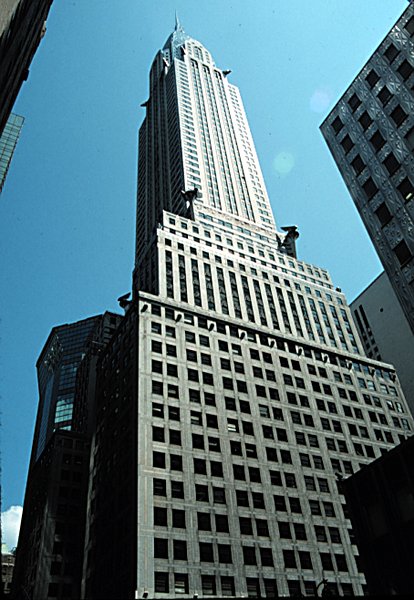
One unusual aspect of the Chrysler building is that it’s ‘something you look up at’. At street level and for several floors up, its a rather drab structure. In fact there are many buildings nearby that exhibit a far more striking art-deco style at street level, including the Chanin Building just across the street, and the Daily News Building a block away.

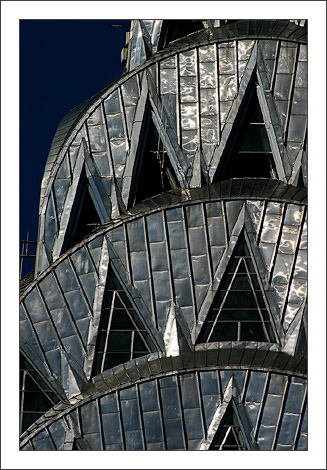
But the top of the Chrysler more than makes up for it, with its silver spire and repetitions of triangular sunbursts draped in silver nickel steel (a specialty metal called Nirosta designed by the German company Krupp). The real punch of the Chrysler at night comes with these triangular windows, with their almost crown-like appearance, which pierce the night and create truly dramatic scenes on foggy evenings.

Photo at right: Courtesy Frank Jermann, Voelzberg, Germany

The Cloud Room, a swanky nightclub and speakeasy in the 30s, occupied the top floors until the 1970s. As with many things in New York at that time, the building fell into disrepair in the 70s and 80s; thankfully much of its luster has been returned thanks to the current owners Tishman Speyer. Given the recent trend of restoring New York landmarks to their former glory, might we see a return of the Cloud Room in the near future?

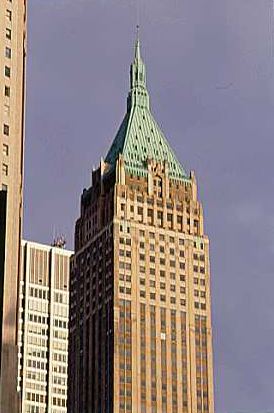
Van Alen was racing to build the Chrysler Building before his former estranged business partner H. Craig Severance finished with the building down at 40 Wall Street. Severance finished first, but Van Alen stole his thunder by erecting the Chrysler spire which pushed its height above 1,000 feet.

The 40 Wall Street building, still impressive but far less ornate, has had a rather rocky history. Referred to as the “Crown Jewel of Wall Street,” it held the title of world’s tallest building for all of four days. At one time known as the Bank of Manhattan Trust Building, it was hit by a Coast Guard plane in 1946, killing four people. In the 90s it was bought by Donald Trump, who funded extensive renovations and turned it all to commercial space. It’s actually called The Trump Building now. The American Express headquarters is housed here. According to Real Estate Weekly, 40 Wall Street is the tallest mid-block building in the world, which I guess has some sort of cache.

Incidentally, a former 40 Wall Street building which stood in its spot was office to the first president of the New York Stock and Exchange Board when it was first organized in 1817.

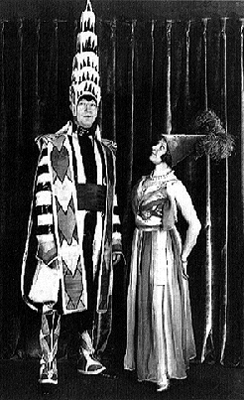
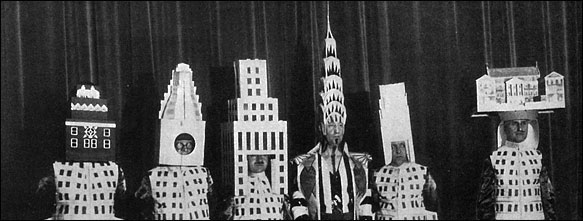
As for the Severance’s former partner, Van Alen did bask in a brief fame as architect of the Chrysler, despite Walter Chrysler’s refusal to pay him the remainer of his commission for the project due to bribery. Perhaps strangely, his most circulated photograph actually has him dressed up as the Chrysler Building. The event was the 1931 Beaux-Arts Ball for the Society of Beaux-Arts Architects. Van Alen was a student in Paris’ École des Beaux-Arts and was a regular attendent at these high-class and often rowdy functions. This New York Times article gives a thorough recap of the event. But just to put it in perspective, many architects came that year dressed as the buildings they created, including William F. Lamb as his newly constructed Empire State Building. The jovial bunch is featured below:

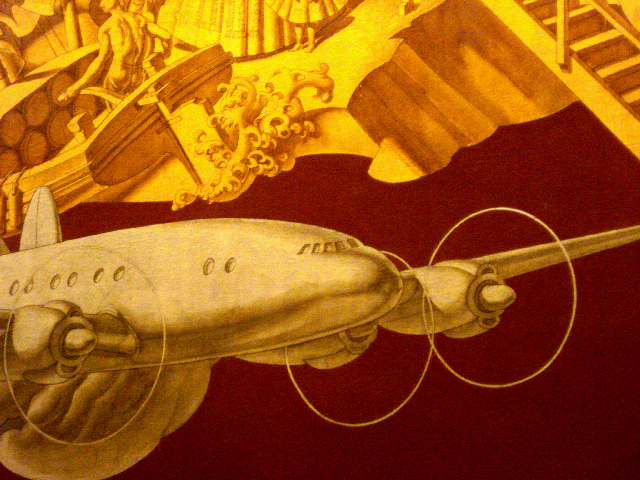
And finally, I apologize for giving short shrift on the podcast to the work of Edward Turnbull, who painted the brilliantly colored ceiling mural in the lobby of the Chrysler Building.

A mixture of Sistine Chapel magnificence and perhaps a bit of prescient Communist-esque propaganda, “Transport and Human Endeavor” is actually one of the largest indoor murals in the world, displaying an enthusiasm for American progress and mechanical ingenuity. Lit in the warm glow bouncing off the marbled wall and oak floor, the mural hides many fascinating details full of blimps, airplanes and automobiles. Just make sure you dont stumble over one of the building security guards as you look upwards.

You can find another lovely picture of it here

All-Blogs.net directory