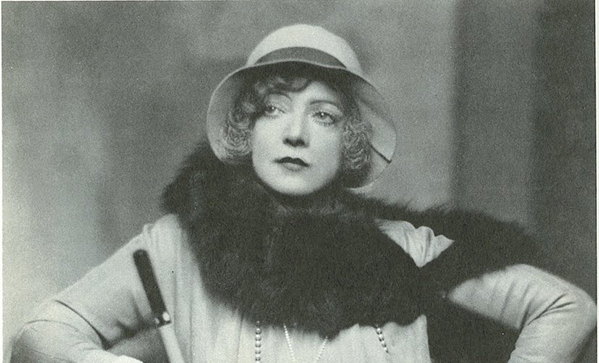
I’ll be bringing this feature back once in a while, because there are dozens more nightclubs, saloons and speakeasies of the past just waiting to be explored. And what a better choice to restart than the dance hall known as the Moulin Rouge of New York, a lively, brightly lit cabaret with debauchery for everyone — the Haymarket.
The Tenderloin district of Manhattan hosted the city’s biggest assortment of vice industries in the late 19th/early 20th century. Sure, Five Points gets all the press, but this vast area — approximately everything between 23rd and 42nd streets, and 6th and 9th avenues — was the more likely destination for regular New Yorkers who wanted to dally in illicit entertainment.
It was at the edge of more fashionable districts (Broadway to its east, Ladies Mile south) and many of its more successful ventures drew respectable gentlemen looking for respite from Gilded Age propriety.
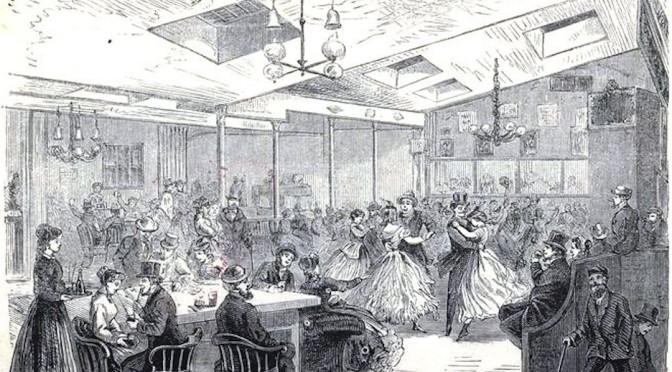
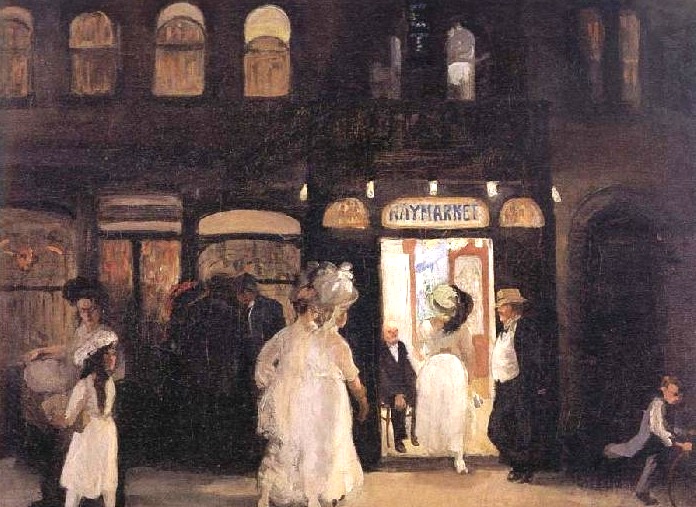
Haymarket was the Tenderloin jewel, a three-story dance hall illuminated (disguised?) like a legitimate Broadway theatre and named for an even more legitimate British theater district. New York’s chief of police in 1887 described it as “animate with the licentious life of the avenue.”
Briefly, it really was a theater, called the Argyle, originally opening in 1872, before its owner got wise and reopened in 1878 as a saucier and more profitable dance hall. Its location, on 66 West 30th Street at Sixth Avenue, placed it just a few blocks from legitimate society, but its bevy of scintillating options were miles outside New York’s traditional morals.
With bands playing and high kicking saloon girls swirling about the floor, owner Edward Corey maintained his club was legally ‘above board’. In a quote from Timothy Gilfoyle’s A Pickpocket’s Tale, “An innocent man and his wife could have wandered into the Haymarket and been entirely unconscious of what was going on around them.”
In fact, those girls were most often prostitutes. Nicknamed ‘the prostitutes’ market’, the Haymarket was a veritable sin shopping mall, ladies luring men to tables to buy them champagne, shower them with presents and quite often making their way to curtained rooms in the balcony and upper floors.
If you preferred male prostitutes, you simply made your way to the back entrance. And although girls and boys were strictly forbidden by management to rob their clientele, the Haymarket nonetheless became a paradise for thievery.
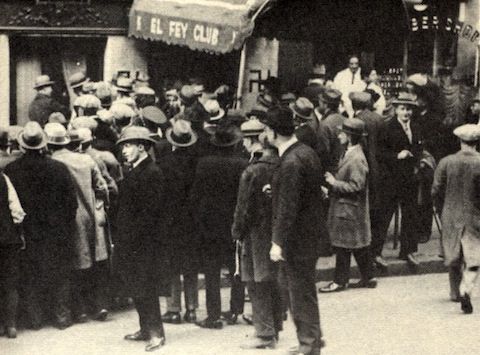
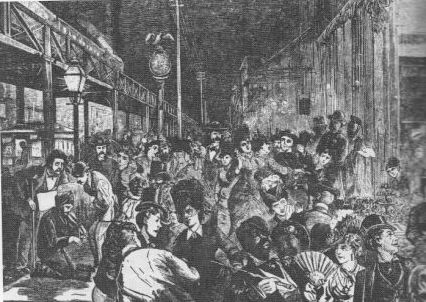
Below: the crowded late night streets of the Tenderloin (picture courtesy Ephemeral NY)
Even still, its reputation grew as New York’s liveliest party in the 1890s, a flashy, fleshy dive thumbing its nose at society. Women drank for free and were allowed to carouse and drink freely with men, who paid a one-quarter entrance fee for the privilege of joining them.
Respectable gentlemen joined riff-raff from local opium dens on the dance floor, their arms around painted, corseted ladies. Naturally, the Haymarket thrived with the help of police corruption and bribery: $250 a week greased the palms of law enforcement who looked the other way. When it actually was closed during rare moments of police reform, it simply re-opened under different names. Its abandon inspired writers like Stephen Crane and even Eugene O’Neill, who wrote of the club:
The music blares into a rag-time tune — The dancers while around the polished floor; Each powdered face a set expression wore Of dull satiety, and wan smiles swoon
John Sloan painted the Haymarket in 1907, still lively in his depiction though in its waning days by the time he put paint to canvas. (The painting currently hangs at the Brooklyn Museum). The hall even became the subject of a 1903 silent film A Night At The Tenderloin.
The Haymarket finally shut down for good in 1911, just as the neighborhood was itself transforming, with the construction of Penn Station and the development of Times Square clearing away much of the Tenderloin’s vice.
Standing at Sixth Avenue and 30th Street today, you’d have no idea that one of New York City’s biggest parties once raged here.
The history of New York City — as told through the stories of its oldest bars.
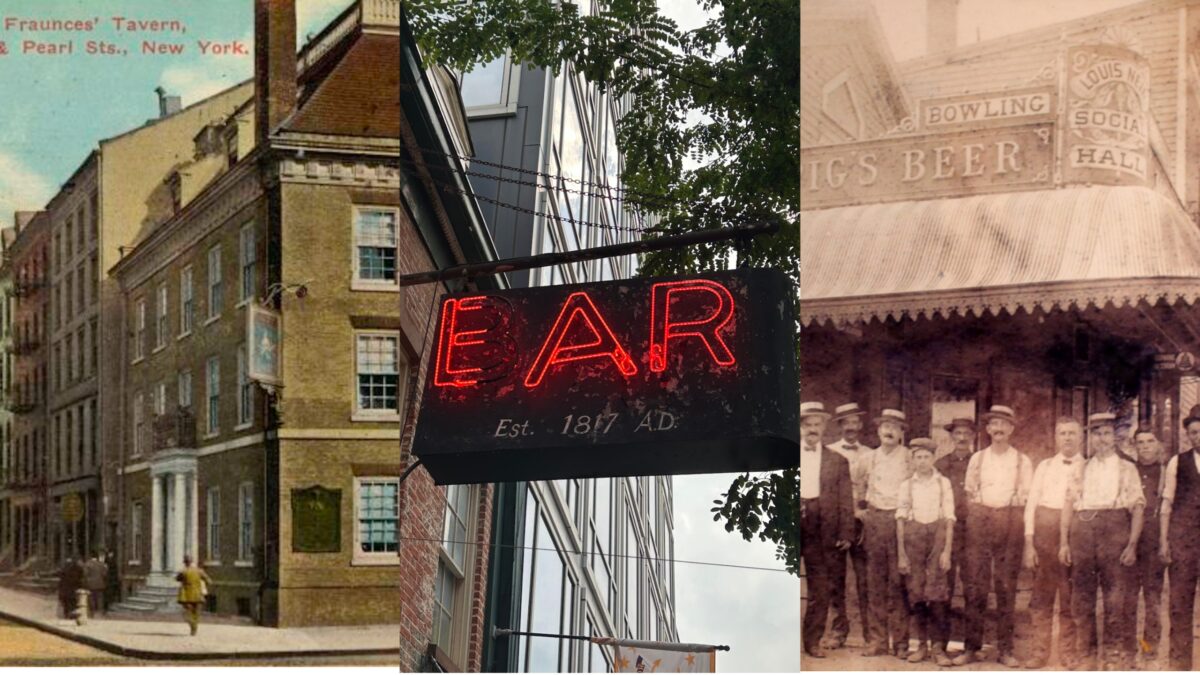
We’ve put together the ultimate New York City historic bar crawl, a celebration of the city’s old taverns, pubs, and ale houses with 18th- and 19th-century connections. And throughout this two-part mini-series, you’ll learn so much about the city’s overall history — from its changing shoreline to the everyday lives of its working-class immigrant populations.
Being an old historic bar isn’t just a novel curiosity for history lovers. It can be good for business and many of the most popular landmark pubs literally wear their stories on the walls — framed newspapers and photographs, memorabilia, old clocks, sailors’ caps and fedoras.
The history of old bars is a little like a ghost story, where a legend has grown up around a historic place, and decades or centuries later, it can be hard to determine the pure truth. In many ways, the myths are as powerful and as interesting as the actual history itself.
In this episode, the first of two parts, Greg and Kieran visit two very different establishments representing the colonial and rustic world of Old New York:
Screenshot
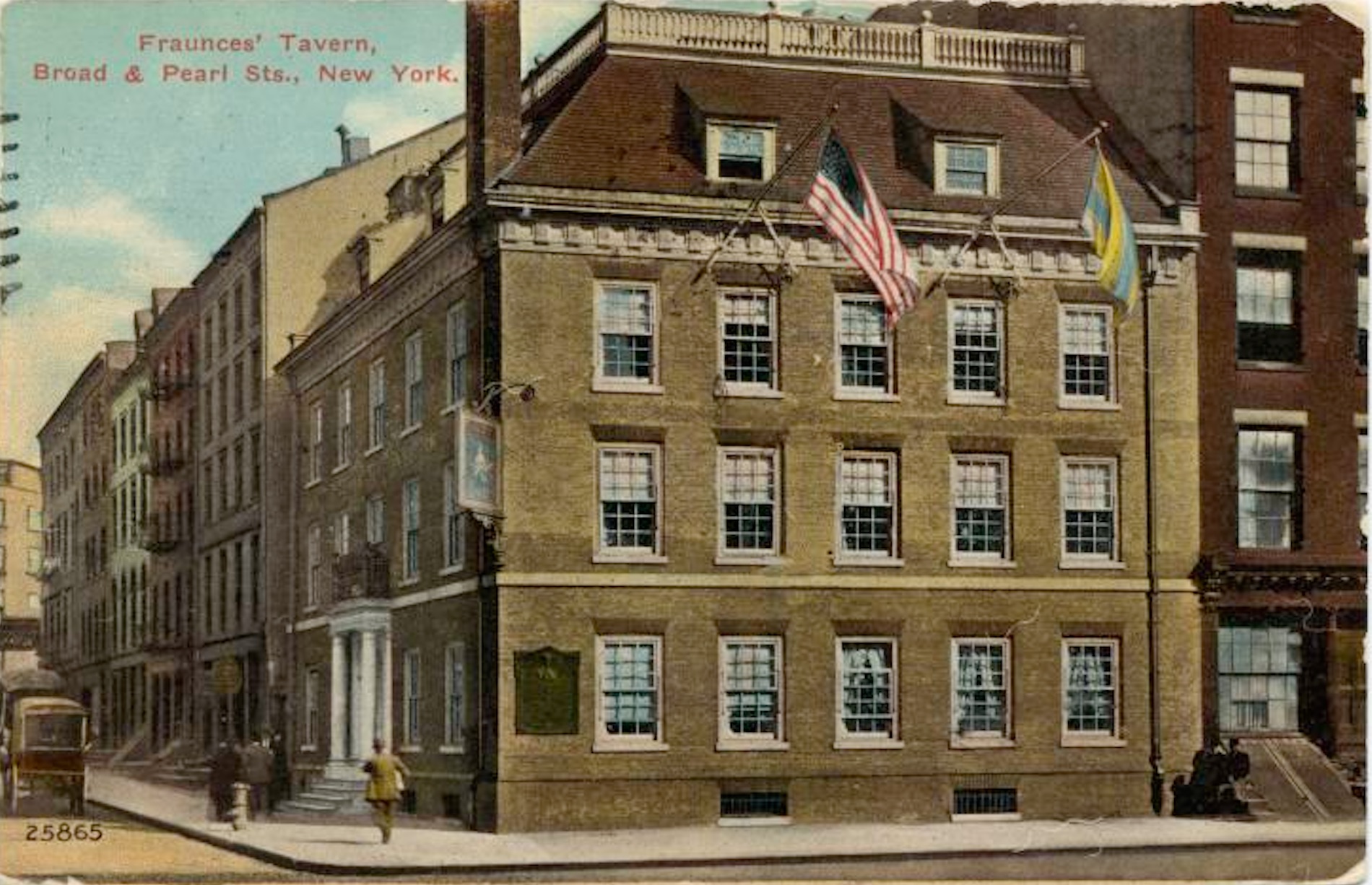
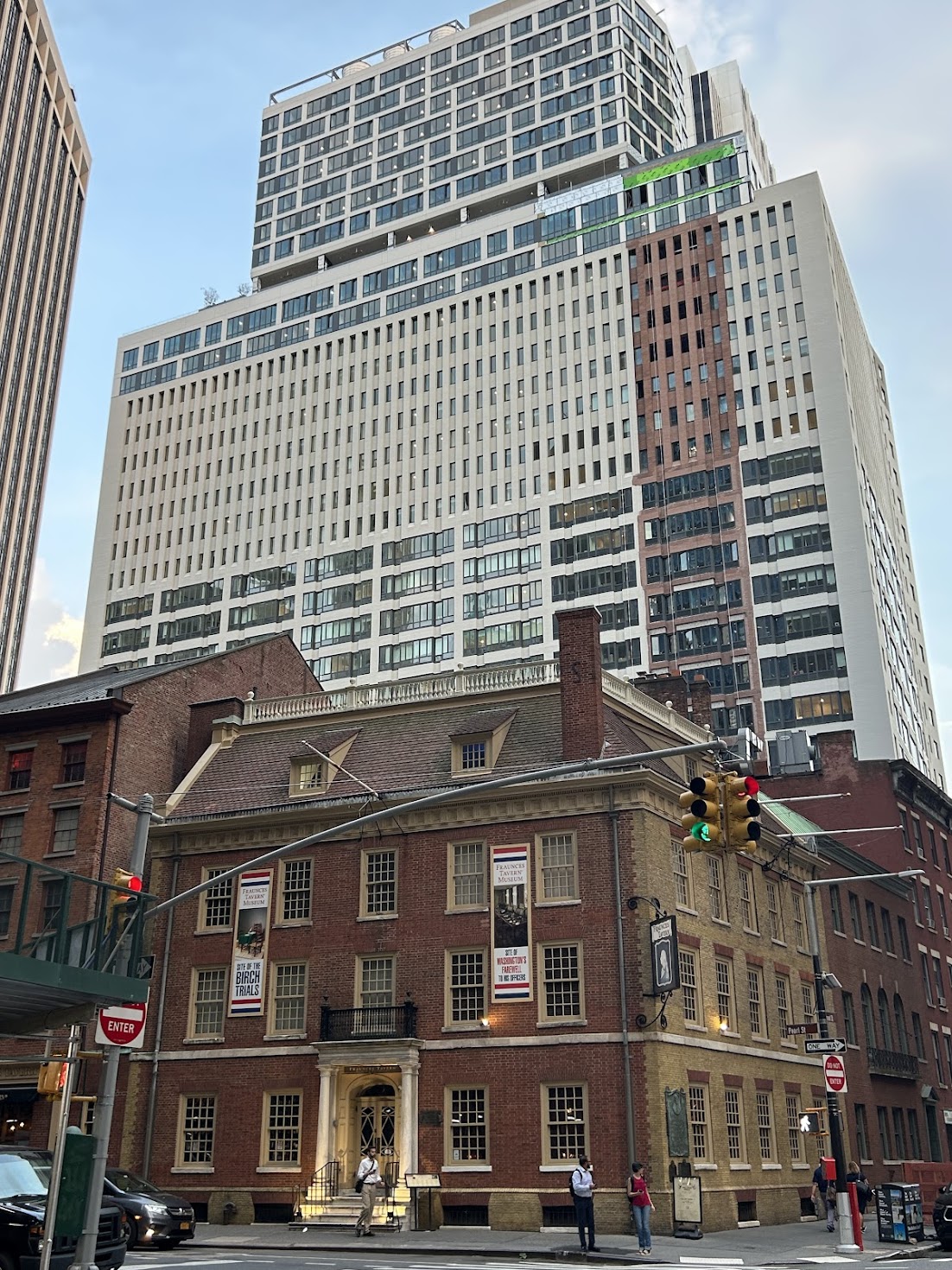
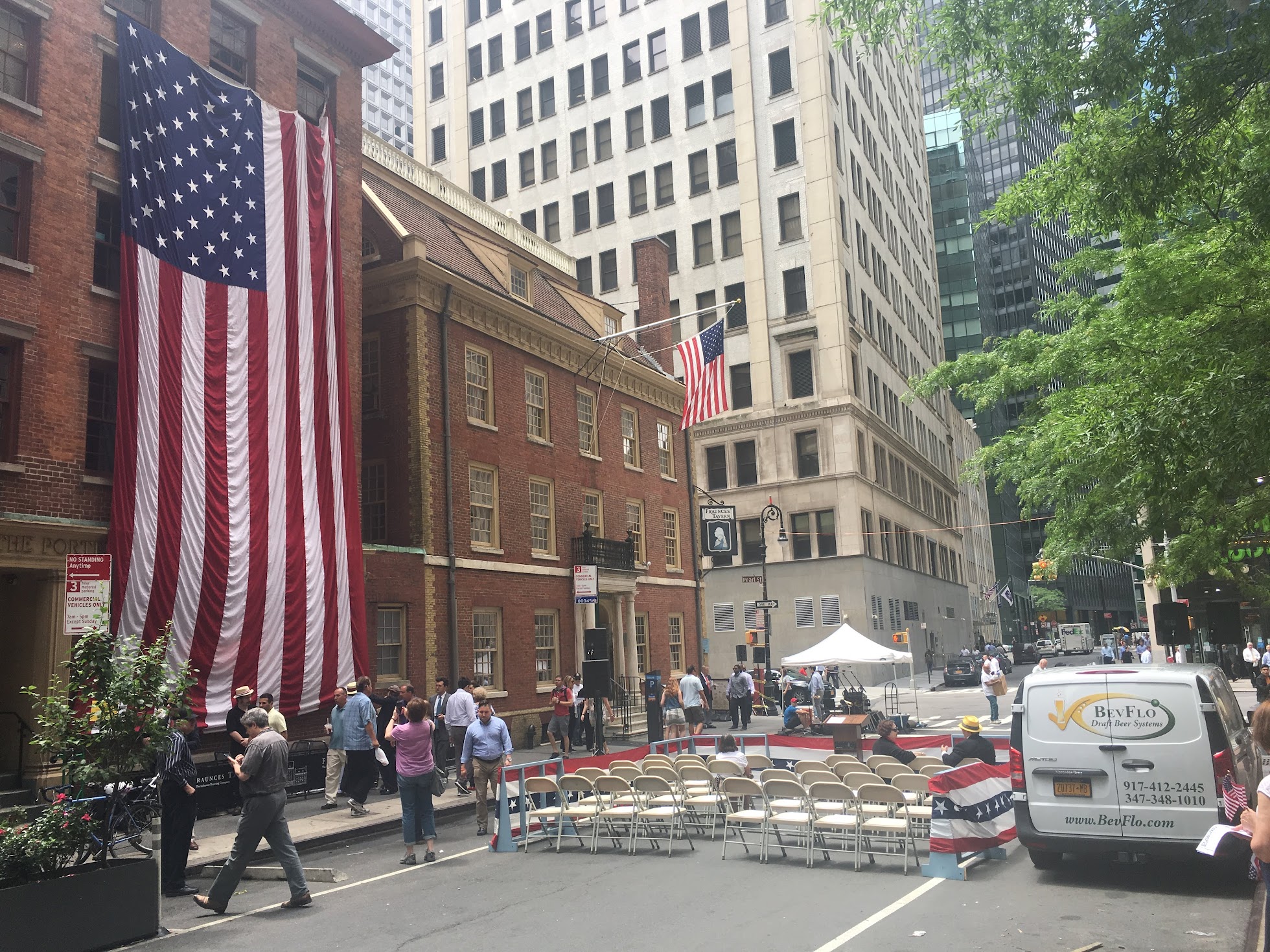
— Fraunces Tavern, one of the most important American landmarks of the Revolutionary War, remains a vibrant spot over 250 years after its stools and tables were occupied with rebellious colonists.
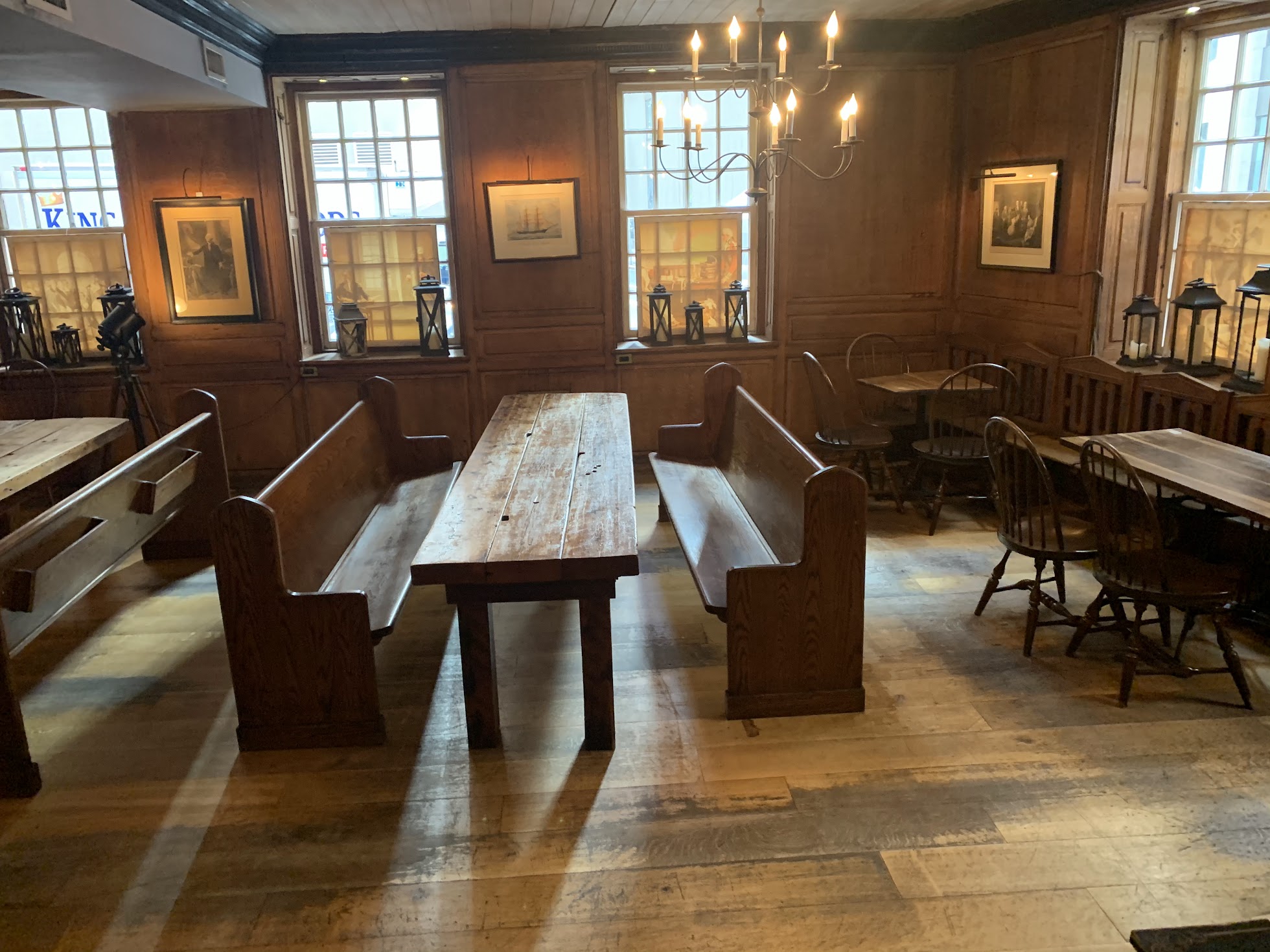
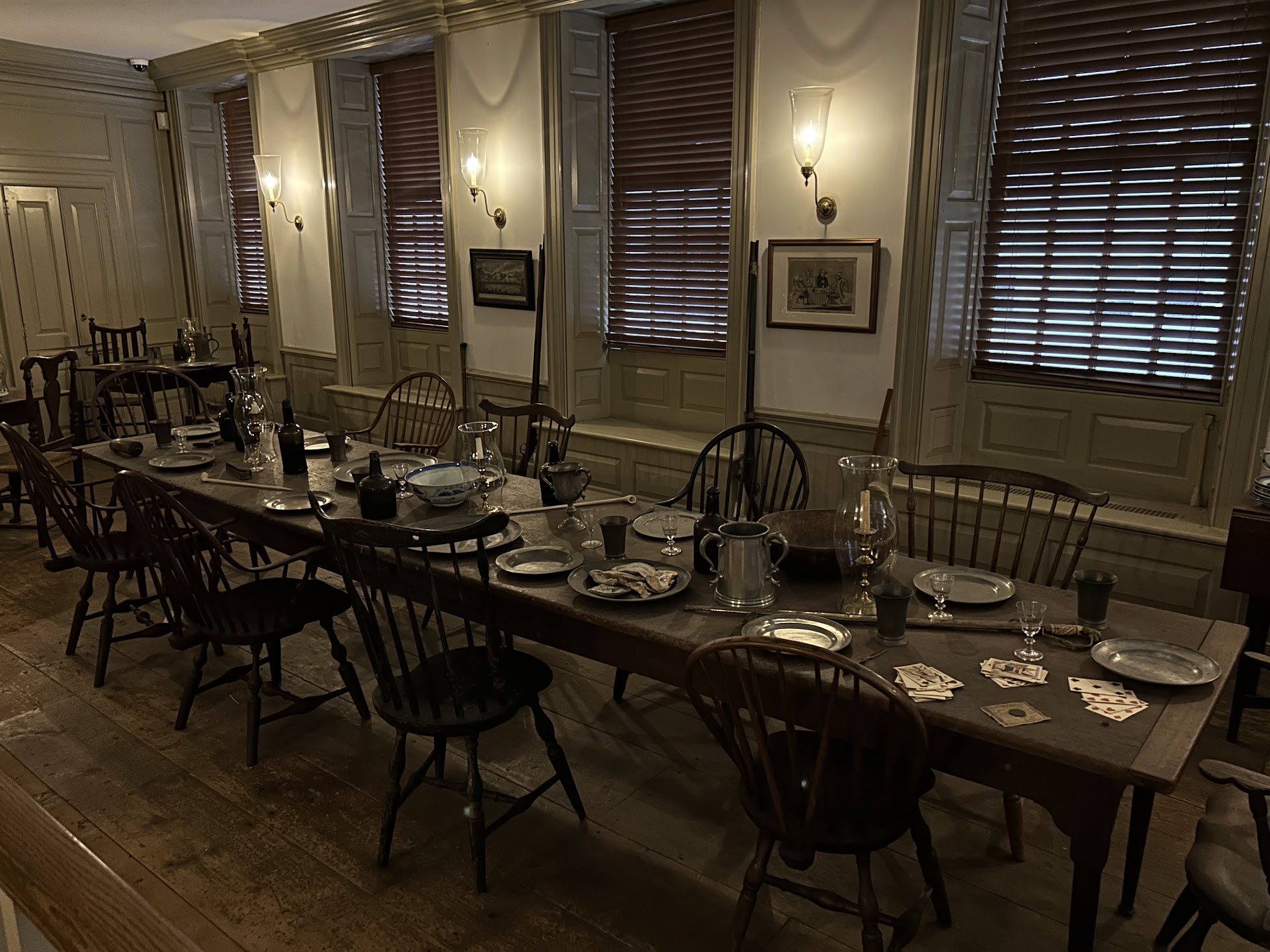
Today, its history lovers and workers from the Financial District who enjoy its labyrinthine bar and dining rooms, while upstairs an impressive museum celebrates the tavern’s many eras of greatness.
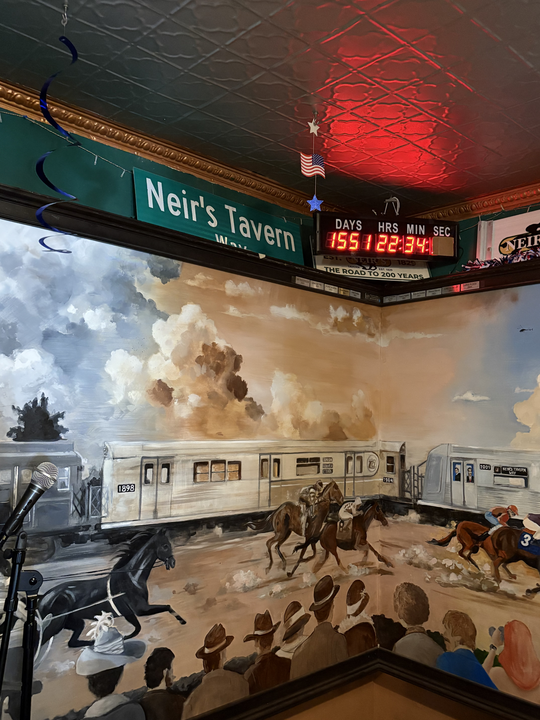
— Neir’s Tavern, in the quiet residential neighborhood of Woodhaven, Queens, once sat next to the popular Union Race Course, one of the key American sports venues of the early 19th century. Horse-racing remains in the bar’s DNA — in its insignia and on its walls.
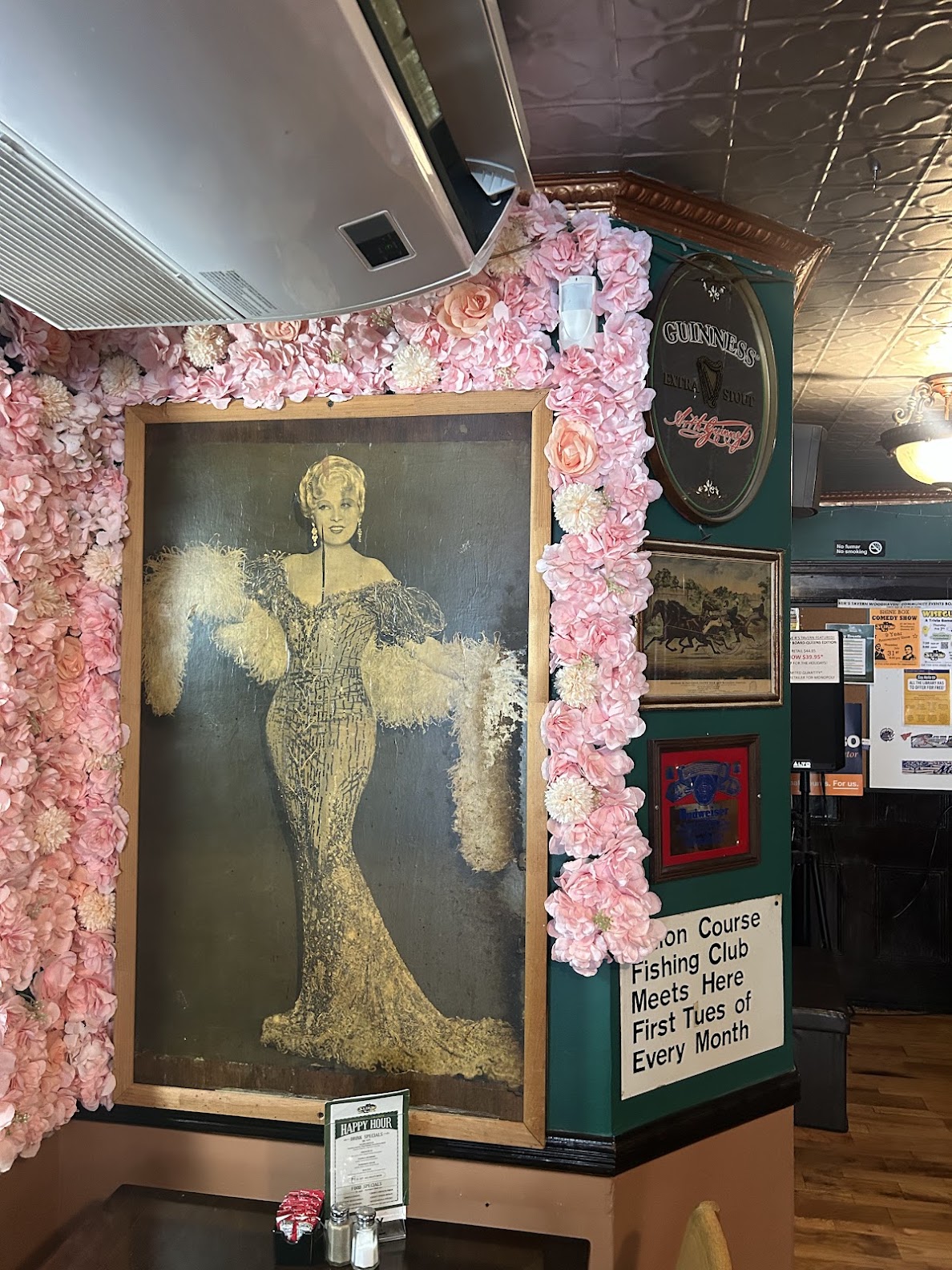
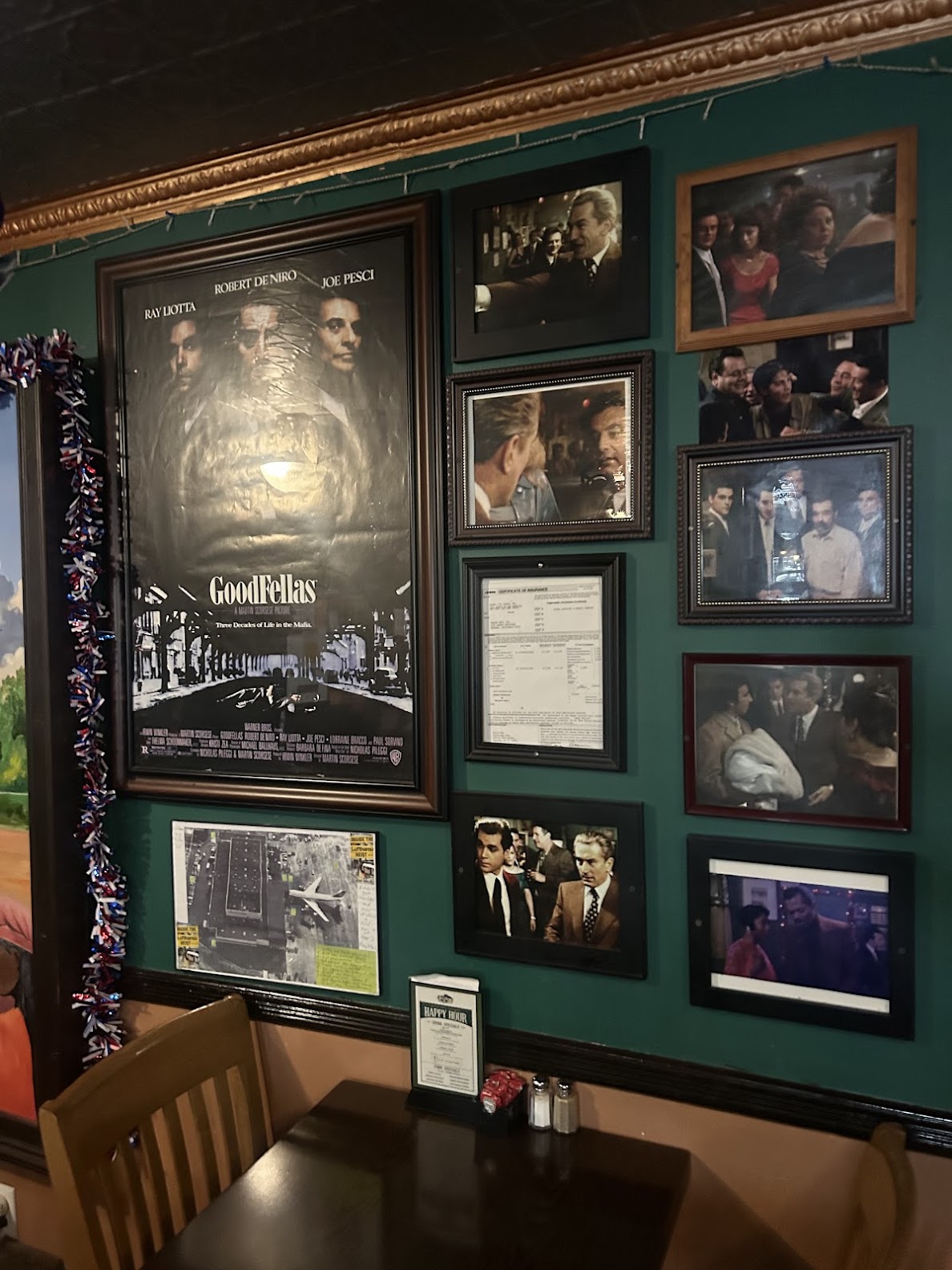
But this surprising spot may be better known for its connections to sassy queen of comedy Mae West and to the iconic Martin Scorsese film Goodfellas, which was filmed here.
PLUS: One of our favorites — the Ear Inn! AND we tell you with absolute certainty the location of the oldest tavern structure in New York City. You can’t drink beer there anymore, but next to it, you can grab a coffee and a croissant.
LISTEN NOW: THE OLDEST BARS IN NEW YORK CITY PART ONE
COMING UP NEXT WEEK: Part Two featuring two mid 19th century drinking establishments beloved by writers. And we fill out the entire list of the oldest bars in New York City
The Bowery Boys Podcast is proud to be sponsored by Founded By NYC, celebrating New York City’s 400th anniversary in 2025 and the 250th anniversary of the United States in 2026.
Read about all the exciting events and world class institutions commemorating the five boroughs legacy of groundbreaking achievements, and find ways to celebrate the city that’s always making history at Founded by NYC.
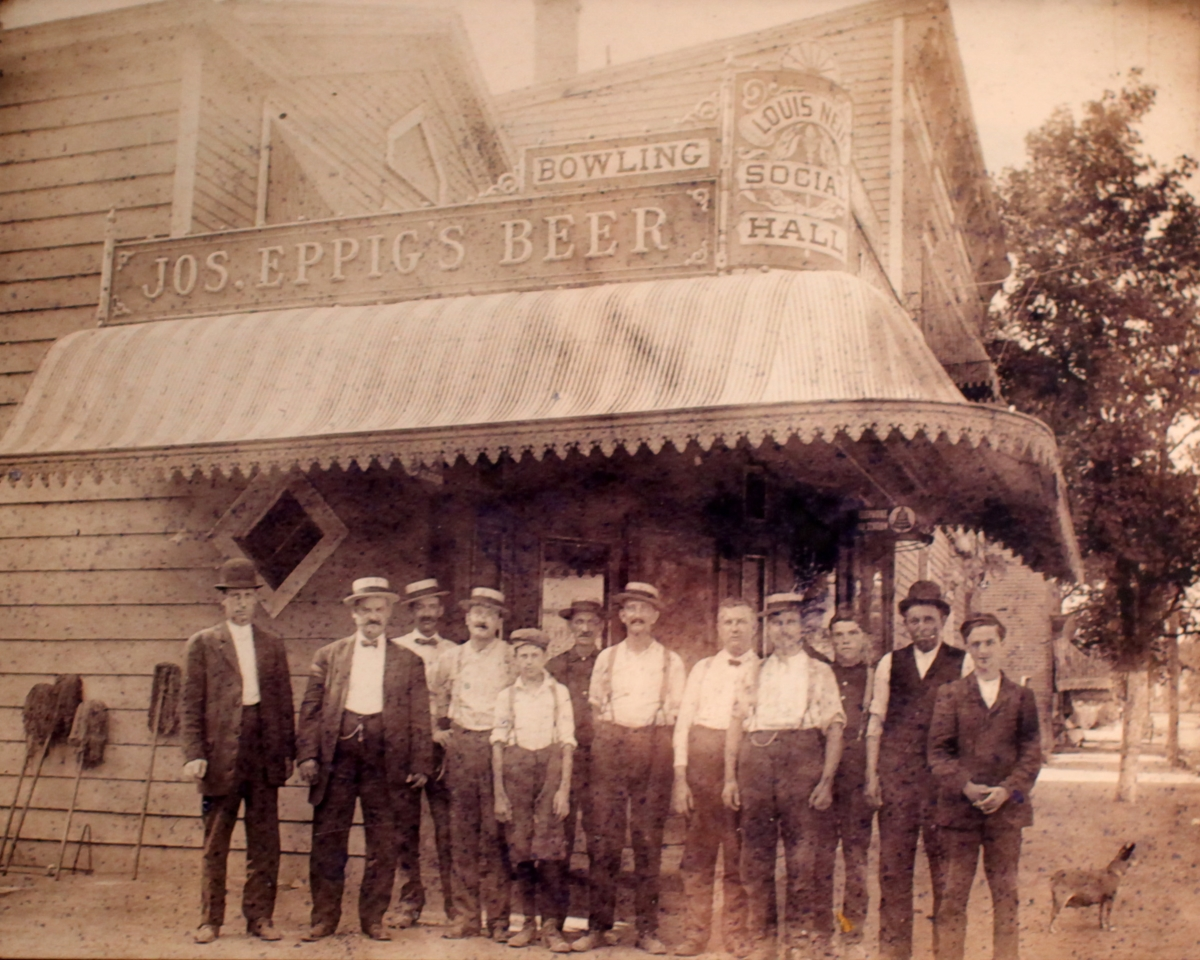
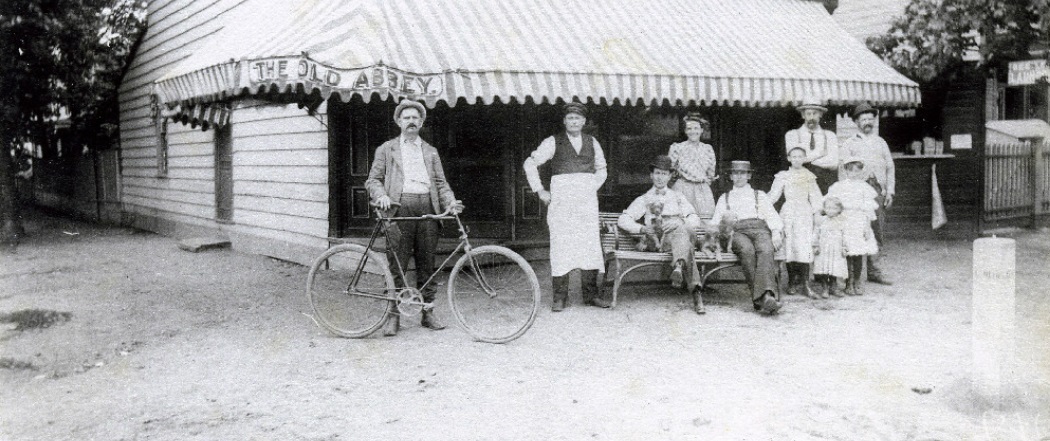
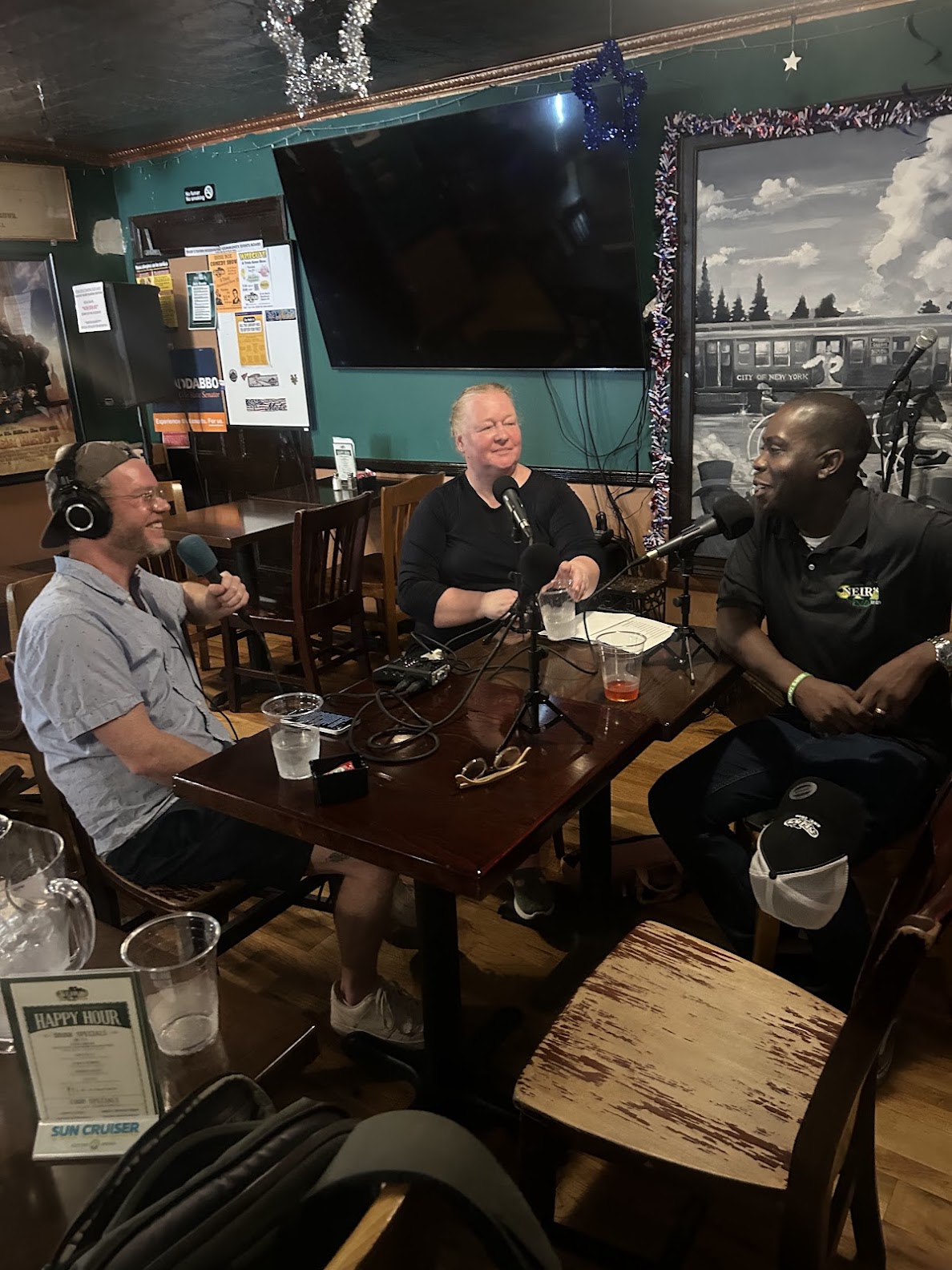
Neir’s, back when it was called the Old Abbey — and back before many streets were paved!Kieran Gannon, Ina Henderson and Loycent Gordon
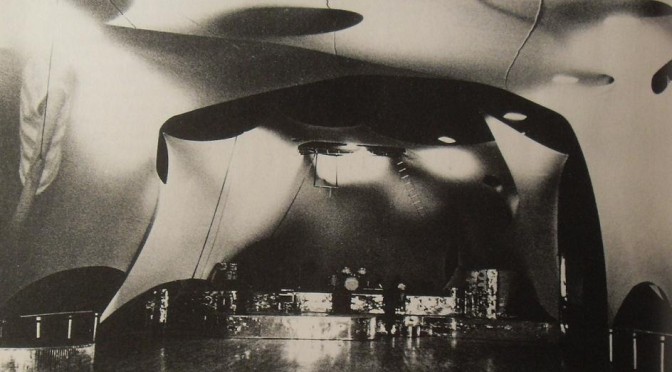
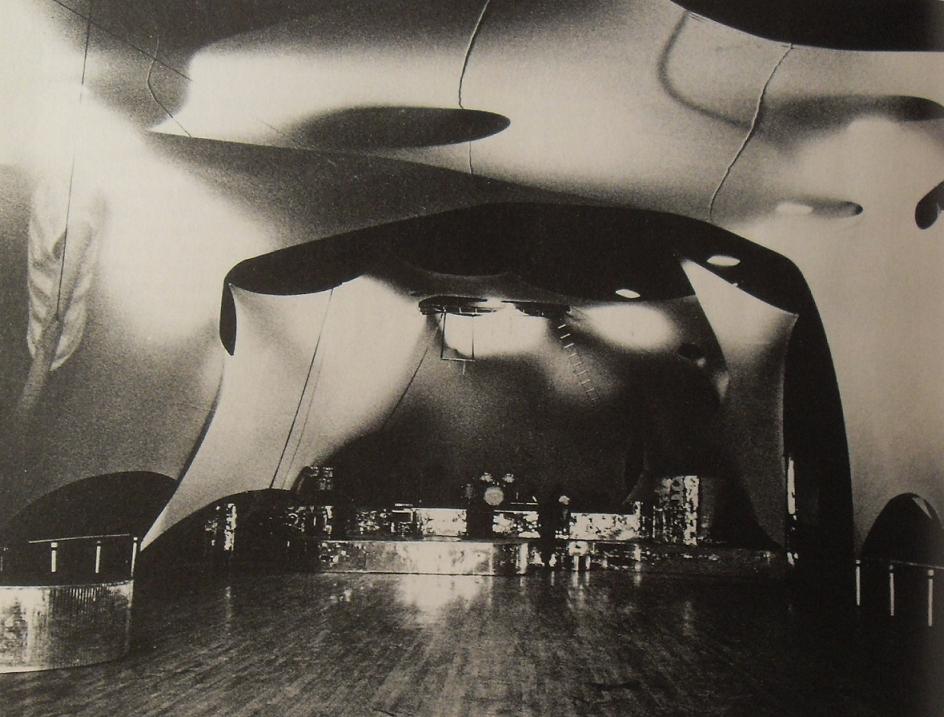
The interior of the Electric Circus on St. Mark’s Place. Pic courtesy Christian Montone/flickr WARNING The article contains a couple light spoilers about last night’s ‘Mad Men’ on AMC. If you’re a fan of the show, come back once you’re watched the episode. But these posts are about a specific element of New York history from the 1960s and can be read even by those who don’t watch the show at all. You can find other articles in this series here.
Almost predictably, a couple characters from ‘Mad Men‘ finally interact with a psychedelic temple of Andy Warhol, in this case the nightclub Electric Circus at 19-25 St. Mark’s Place, today the site of a Chipotle and a Supercuts.
As I wrote back in an article from 2007: “It became the East Village fuse box for Warhol’s talents and those of his entourage, in particular the Velvet Underground and Nico. The dazzling synthesis of psychedelica and glamour, of the Velvet’s strange atmospheric music and Warhol’s performance displays of lights and costumes, immediately attracted the scenesters to this odd little street — according to the New York Times, “everyone from hippies to Tom Wolfe and George Plimpton” — way before St. Marks would make its reputation in the 1970s with the punk scene.”
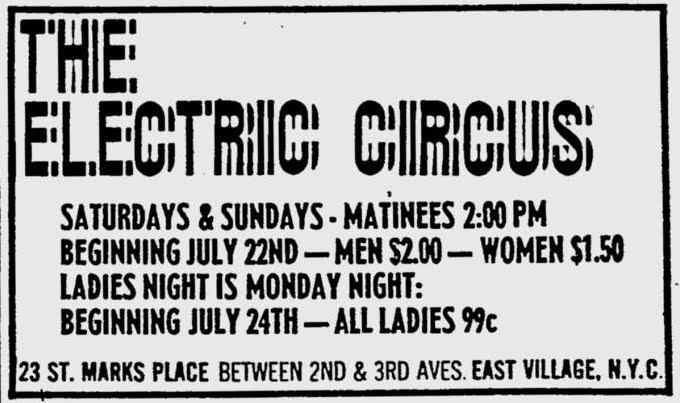
An original ad from the Electic Circus, summer of 1967 (courtesy butdoesitfloat)
Since I wrote that article, many people have chimed in within the comments section to relive their memories of Electric Circus. Here are a few of my favorite comments from those who were actually there:
“What memories. I started working at the E.C. as a ticket taker. I say working, but in reality we didn’t get paid, we got let in for our work. Like Woodstock, if you remembered much of what happened at the E.C. you weren’t really there.” – Being the Best
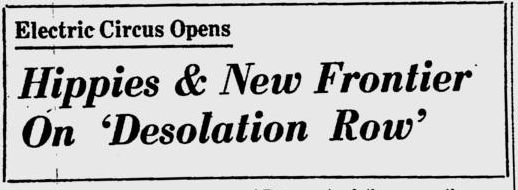
Below: Headline from the Village Voice, July 6, 1967
“I worked at the Electric Circus, 67-68-ish. I was the fire-eater, and mime/clown, working with another mime named Michael Grando. Larry Pizoni was the director of the circus show. We had a trapeze artist named Sandy [Alexander], and security was a biker club called the Aliens (which worked, unlike Altamont).
Everytime I’m in New York, in the East Village, I stop on St Mark’s and bow my head. I wanted to have someone put up a plaque, but nobody in the stores knew who to call.” – Richard Bluejay “I was one of 5 or 6 people who worked at Limbo* for number of years across from the Electric Circus. I was there at the opening night, and then on for a long time I remember we use to give discounts to the Circus employees so we get in free. Can not tell you how many times I was in there but it was a lot!!!! It was great time back then. Fillmore East was around the corner and Max’s Kansas City was not far away. East Village was where it was at back then ” – Anonymous
A freakout-indusing video from Electric Circus, scored to the music of Frank Zappa:
“I remember two things about the electric circus from my one visit in 1969. One was the fact that the walls were not at a right angle to the floor, which combined with the strobe lights and swirling crowd, made for a delightfully disorienting experience. The other was a dark room off to the side where couples — or even strangers I suppose — could sit and smooch. In addition to all kinds of nooks and crannies for this purpose there was a rotating upholstered carousel in the middle of the room, divided into sections, one per couple.” — Anonymous
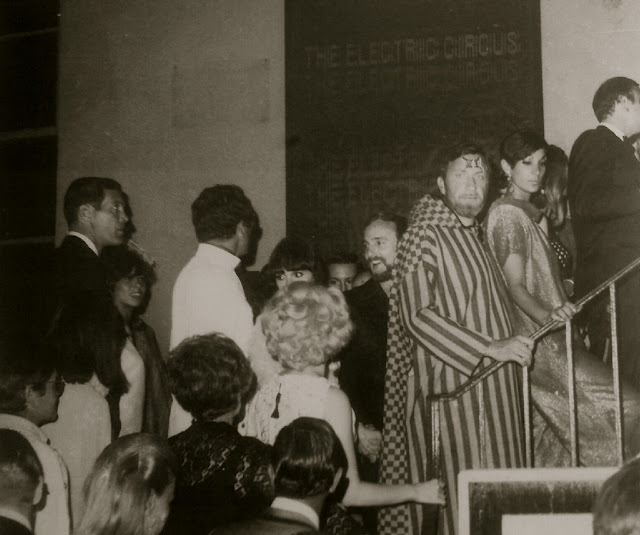
Below: A typical crowd on the stairs outside the Electric Circus (pic courtesy Old New York)
“I’m so excited, after all these decades to hear from people who got to experience the the most amazing Electric Circus, as I did. By far dancing myself into a dazed, psychedelic trance, while absorbing the magical energy of the Chambers Brothers sing ‘Time’, was right up there in my top ten of life altering experiences. I was a runaway, living with new friends in the Village.
I used to panhandle on St. Marks Place, and spend all my money on clothes at the Limbo, pizza, and tickets to hear my fav bands, except for the times I used to get in for free.” — Sonny
Below: Sonny’s jam from the floor of the Electric Circus:
“I can’t remember exactly how I arrived at St. Marks Place that first night. I had never been to St Marks Place and I certainly didn’t know about Electic Circus. I was just following a friend of mine who was interested enough in the new culture to find out where to go and what to do.
There must have been some kind of happening that night because the streets were full of people. People were hanging all over the stairs leading up to the Circus. And, you didn’t have to pay. We just walked in. I still remember it emotionally.
The big room was completely decorated with fabric amorphously draped on walls and spanning corners and cornices. Projectors behind the fabric ran continuous short loops of films. Of course it was dimly lit so as not to wash out the films. People were everywhere and moved mysteriously in the smoky dim light. I was born in Brooklyn and had already lived a few years in Manhattan, but I never saw anything like this before. The next time I saw EC the decor had changed. I never paid to get in because I was a member of the PABLO Light** show.” — Anonymous
* Limbo was a famed ‘hippie clothing’ boutique where today’s Trash & Vaudeville sits today.
** That would be Lights By Pablo, a leading ‘liquid light show’ exhibitor of the late 1960s, frequently here and at Fillmore East.
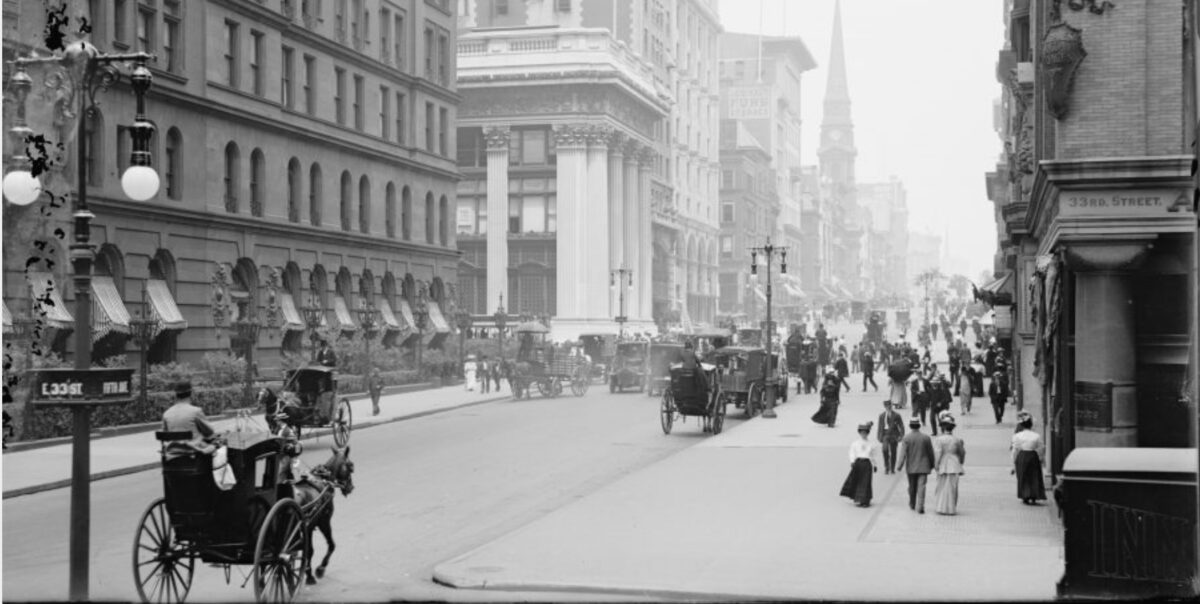
Fifth Avenue and 33rd Street, location of the post gambling den. (Detroit Publishing Company
A tantalizing stretch of New York nightlife history lies in the shadows, illegally operated, often fueled by police bribes — the opium dens of Chinatown and the speakeasies of the Village and midtown.
There were also hundreds of illicit gambling rackets, called ‘poolrooms’, throughout the city in the late 19th century, usually alongside the seediest of taverns, brothels and poolrooms.
Naturally, the pastime was not looked upon lightly by proper society. “The poolroom keeper, like the proverbial worm,” remarked one New York Times article from 1900.
But New York’s wealthy elite liked to gamble as well, and there was no need for them to step into such filthy, disreputable places. The rich had their own houses of vice.
And one, the House with the Bronze Door, which opened in 1891, would have rivaled the great casinos of the day in terms of its lush presentation.
House of Cards
The fine townhouse at 33 West Thirty-third Street sat right around the corner from the Waldorf-Astoria, so close to respectable Fifth Avenue that people certainly strolled by it with no clue of the entertainments within.
Its glorious, defining feature — and where it gets its name — was a $20,000 Italianate Renaissance, 15th century bronze door which gave the building the feel of a classic structure, or perhaps a bank vault.
Luxury greeted those who were fortunate to peer behind that door, imported old school finery, from vases to oil paintings on rich wallpapered walls, along hallways in red velvet carpeting, leading to game rooms with European oak tables hosting games of roulette, poker and baccarat.
In a place where wealth exchanged hands nightly, it was reflected in the imported banisters and marble bathrooms.
High Stakes
And it wasn’t just how it looked, but who designed it to look that way — none other than Stanford White of the city’s most prestigious design firm McKim, Mead and White, a gambling man himself who hired a team of Venician craftsman to give the gambling house its distinctive glamour.
The building next door also belonged to the casino, but was less impressively designed; its sole purpose was as an exit in case of police raids.
The owner Frank Farrell* was New York’s gambling kingpin, using profits from the Bronze Door to fund over 200 illegal gambling houses throughout the city and grease the palms of police officers to ensure they all stayed open.
If that name sounds familiar to sports fans, it’s because of a riskier gamble Farrell made in 1903 with his business partner William Stephen Devery. (Yes, the former police chief. See how it used to work back then?)
The two purchased the Baltimore Orioles, moved them to New York, lost a lot of money, renamed the team as the New York Yankees and promptly sold them to beer mogul Jacob Ruppert.
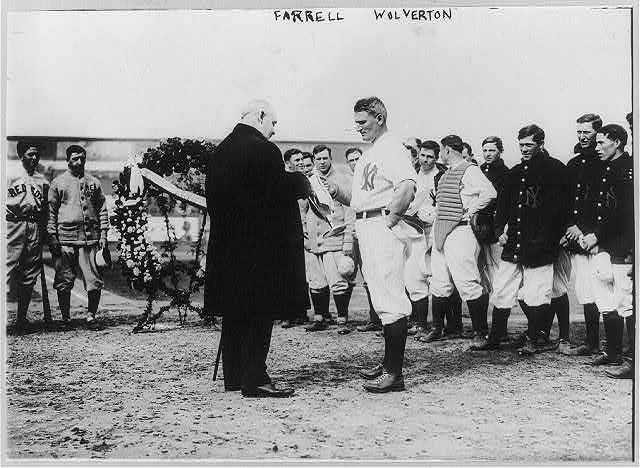
Below: Farrell with a Yankees team member in 1912. He would sell off the losing team a few years later. Courtesy Library of Congress
A Night at the Tables
The only people taking risks at the Bronze Door, however, were the rich and well connected clientele. On any given evening you could find the head honchos of Tammany Hall smoking cigars in the corner, or ‘Diamond’ Jim Brady and his entourage at the upstairs roulette wheel.
According to Lloyd Morris: “The casino was conducted with the quiet decorum of a gentleman’s club.” These men expected the royal treatment, and they got it. A midnight buffet of lobsters and steaks, open bar of the best liqueurs, fine cigars for a $1 apiece. More importantly, Farrell strictly applied a philosophy of ‘the customer is always right’. Unlike many of Farrell’s downtown dive, where the house often rigged games and marked cards, the gambling den behind the Bronze Door was straight.
There was little nickel and diming here. It’s purported that fifty thousand dollars would hit the tables each night.
Gamblers would win, and then lose, vast fortunes each night. As Luc Sante so elegantly states: “… the stories of rich men dropping enormous sums in a single evening kept topping each other, so that the phenomenon almost comes to seem like a version of potlatch, in which wealth is proven by the ability to shed it.”
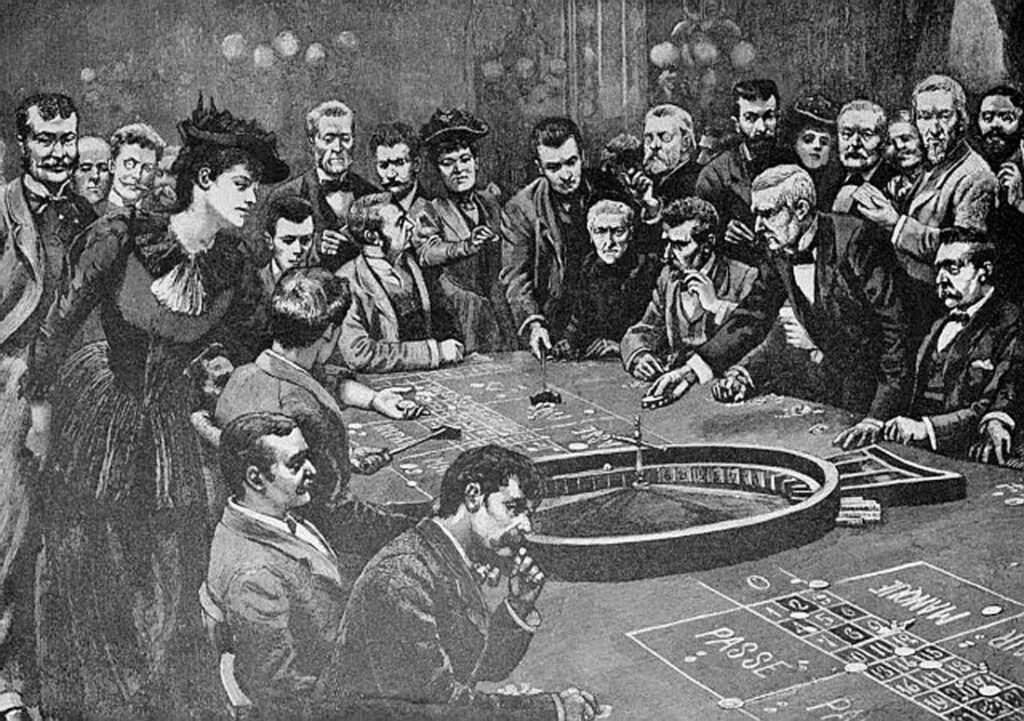
Depiction of a 19th century casino. At the House of the Bronze Door, it was unlikely that women were allowed however.
Luck Runs Out
The casino stood in defiance of the law for almost a dozen years thanks to Farrell’s connections and the reputation of its clientele. However, given the New York’s waxing and waning reform movements, its time would eventually come, and it did so at the hands of one William Travers Jerome, New York’s district attorney with a particular bent for reform.
Jerome shut down casinos and poolrooms throughout the city and didn’t discriminate, successfully breaching that imposing door and raiding the club in 1908.
Although the games were gone, the place remained open for many years afterwards, as a restaurant owned by the Waldorfs according to official sources. What its true nature was in these later years is unknown.
The building is completely gone today, replaced with a condo and the shadow of the Empire State Building.
Below: District Attorney Jerome, 1915
*Farrell had other partners in the casino, including racetrack owner Gottfried Walbaum and Billy Burbridge, who later became a hotelier in Havana, Cuba.
There once was a modest basement nightclub in an old West Village building which opened the door to a revolutionary (and now obvious) idea in New York City music and delivered one of the most significant moments in all of music history.
In the 30s Midtown Manhattan clubs were alight with the bourgeoisie, tuxes and evening gowns, tables and banquettes of rich white people drinking champagne, and often entertained by Black performers borrowed from the Harlem music scene.
It was putting on the ritz, it was dancing cheek to cheek.
It was embodied within the phrase ‘cafésociety‘, coined by the one of the scene’s wittier celebrities Claire Booth Luce, playwright of The Women and a darling toast of Broadway.
But there was also something saccharine and square — and segregated — about those Midtown haunts. Things were wound too tightly.
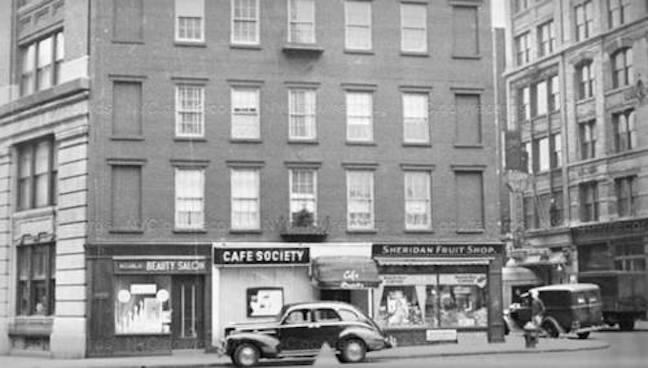
What would become one of the New York music world’s most fertile spots for musical innovation was far, far downtown from the ‘real’ nightlife — at 1 Sheridan Square in the West Village.
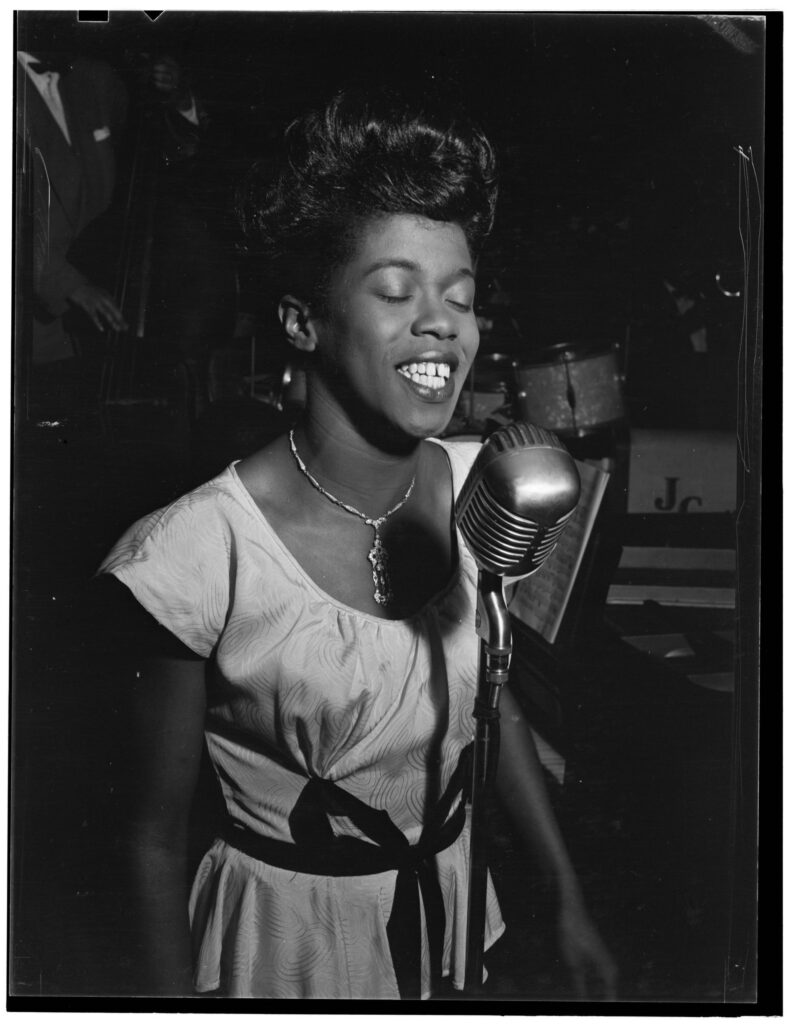
Portrait of Sarah Vaughan, Café Society (Downtown), ca. Aug. 1946], photo by William Gottlieb, courtesy Library of Congress
Café Counter Culture
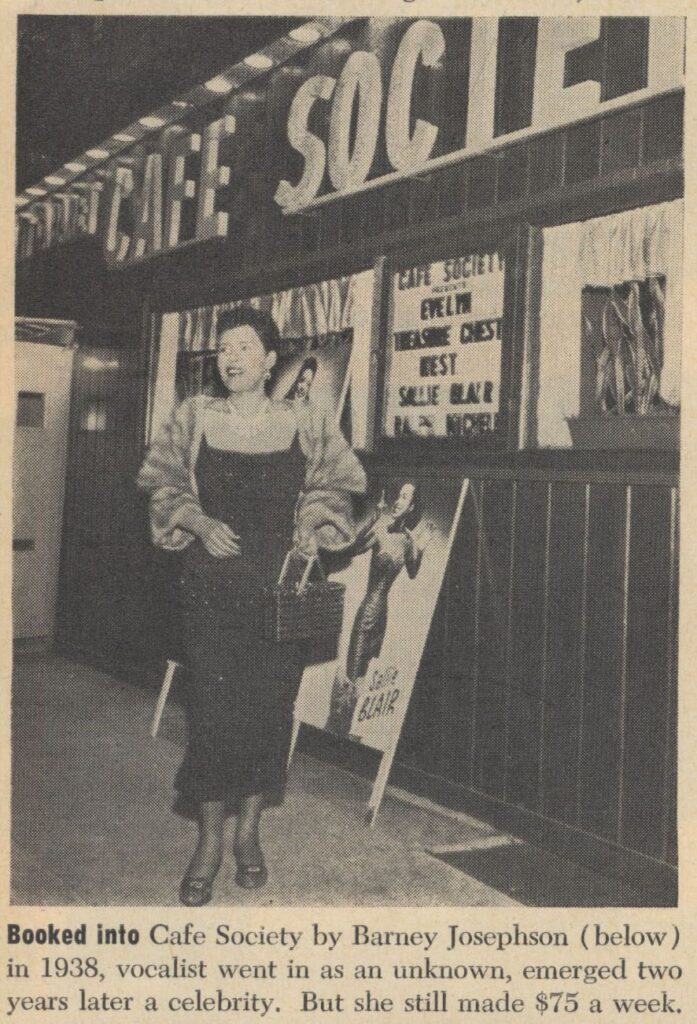
New Jersey shoe salesman Barney Josephson had an affinity for jazz music — partially grown from visiting the bawdy clubs of underground Berlin — but grew irritated at the race segregation, which even occurred in Harlem, at places like The Cotton Club.
Josephson envisioned a venue where musicians of any color could perform — and audiences of any color could enjoy it — but such a notion seemed to fly in the face of modern ‘café society’ culture.
“I wanted a club where blacks and whites worked together behind the footlights and sat together out front. There wasn’t, so far as I know, a place like that in New York or in the whole country.”
So, acquiring his Greenwich Village location, what a better name to call this rather kooky experiment than Café Society?
Luce, knowing good irony when she saw it, even encouraged the bar’s lusty slogan: The wrong place for the right people.
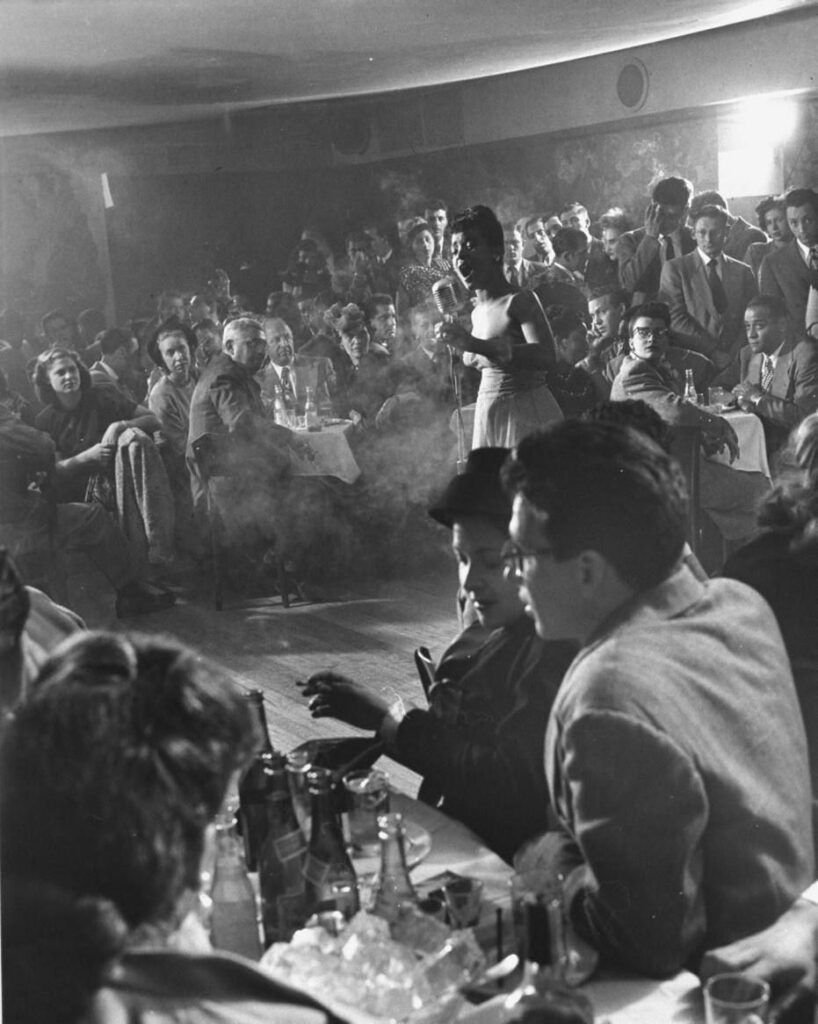
Jon Mili/The LIFE Picture Collection/Getty Images
Open (To All) For Business
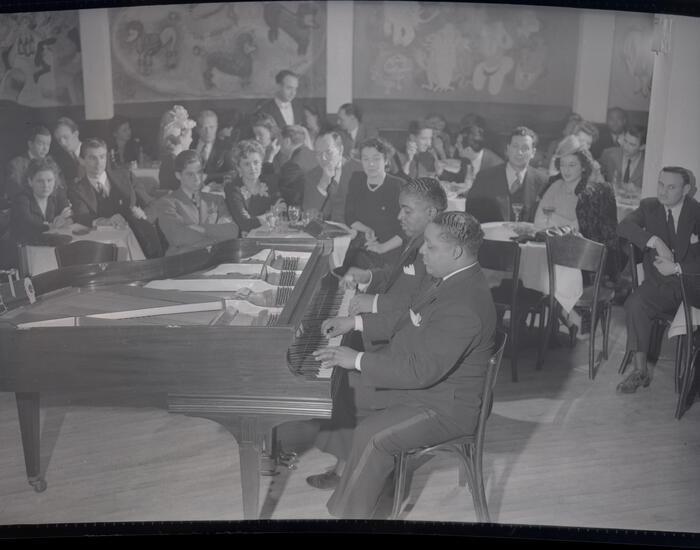
Opening on December 18, 1938,Café Society was festooned in wacky caricatures of music stars, comedians and personalities of the age. Walls were muralled by creations from local artists.
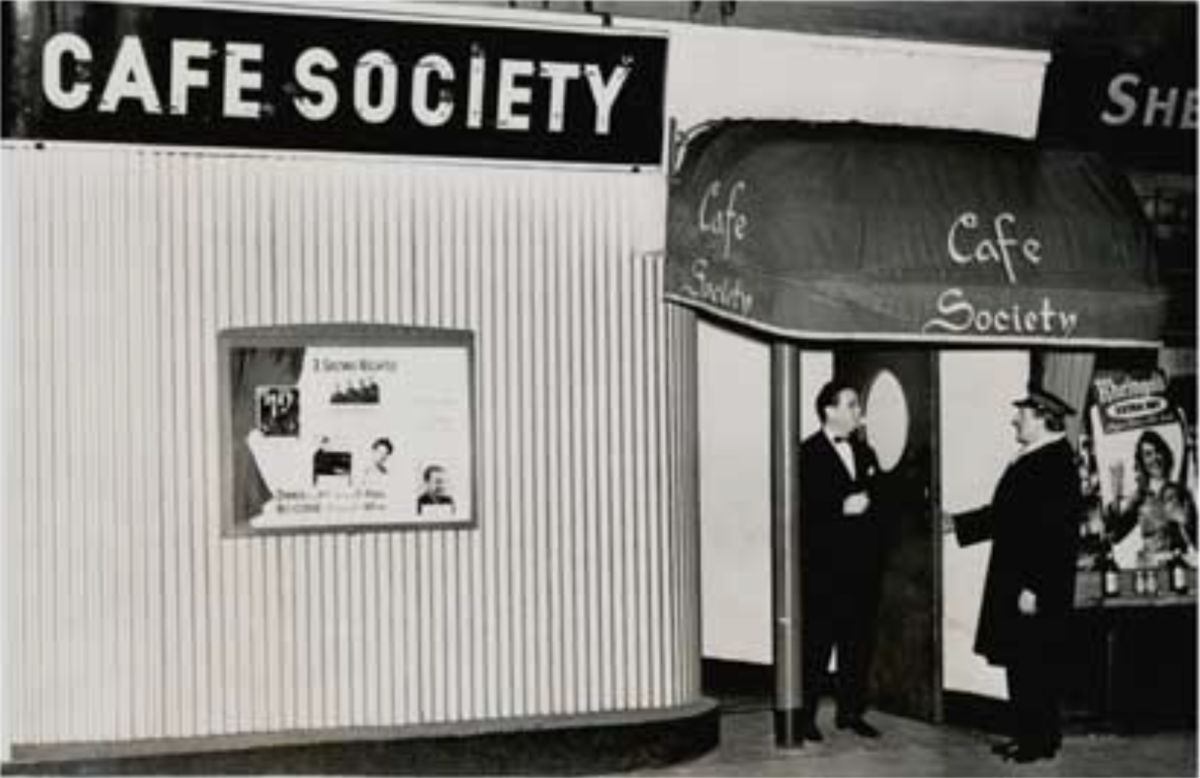
The club doorman played with the notion of informal glamour, wearing a tattered top hat and white gloves with the fingertips ripped off.
Below: The Boogie Woogie pianists, Cafe Society, 1941. Take note of the murals on the walls.
Frank Bauman/Look Magazine — Courtesy Museum of the City of New York
Josephson began hosting performers of all stripes, many taking to a mixed stage for the first time in their careers.
Over the course of its ten-year run — and that of a second location, coyly placed at 58th and Park — Josephson and his partners would host dozens of soon-to-be jazz stars, in many cases paving the way to their success.
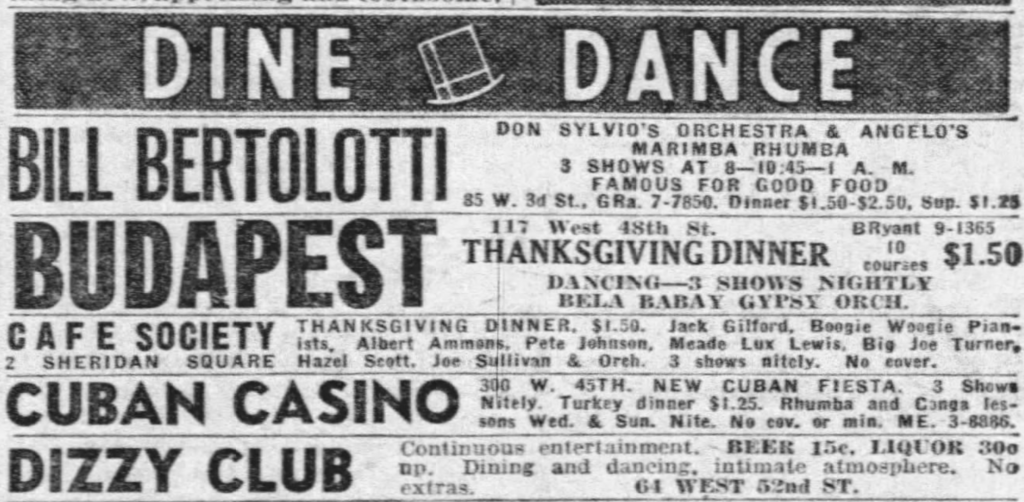
New York Daily News, November 22, 1939 (courtesy Newspapers.com
Art Tatum, Lena Horne, Sarah Vaughn, Mary Lou Williams, Lester Young, Burl Ives, the Golden Gate Quartet, Ella Fitzgerald — in fact its easier to make a list of jazz and pop music icons who didn’t perform there.
But Café Society’s biggest claim was there from the beginning.
On opening night, a young woman took to the microphone. She achieved some success on the New York stage by this point and had even snagged a recording contact with Columbia Records.
But the legend of Billie Holiday would begin here — on opening night.
A Song For Lady Day
To have Holiday as your in-house singer (for nine months!) would have been an honor enough.
To give her — and the world — a defining musical moment, well, that’s New York.
Café Society naturally took on a liberal, left-leaning clientele and with that, a political edge.
Josephson presented a song to Holiday that he had heard at political gatherings, a piercing tune about lynching, one that forcefully reminding listeners that violence and discrimination still very much existed outside the doors of his club.
Billie was originally indifferent to the song, written first as a poem “Bitter Fruit,” by a white Jewish schoolteacher Abel Meeropol; then after contemplating it, considered it too bold.
But she was eventually convinced to sing it, and on three consecutive nights early in 1939, Holliday ended her sets with the song — “Strange Fruit.”
A spotlight tightly focused on her face, she stunned the audience with its searing intensity.
Southern trees bear a strange fruit Blood on the leaves and blood at the root Black bodies swingin’ in the Southern breeze Strange fruit hangin’ from the poplar trees….
And then she left the stage, not returning to hear the thundering applause.
It was theater at its finest; thousands of less talented chanteuses would search to recapture the drama in dozens of Village clubs and cabarets, from then to today.
The Café Society ‘revolution’ would not last long.
Josephson’s brother Leon was being investigated for communist ties, and Barney soon felt the heat of J. Edgar Hoover and his House Un-American Activities Committee.
The FBI even staked out the clubs, photographing patrons, and Hoover soon ‘opened a file’ on Barney himself. Both locations of Café Society were closed by 1950.
But Josephson managed to pick himself up and soon opened another influential downtown jazz club, the Cookery, which stayed opened into the 1980s.
But for a moment, that gritty nightclub became the center of the musical universe.
Most music critics agree that Holiday’s original performances of ‘Strange Fruit’ at Café Society are among the most influential musical moments of 20th century and basically constitute the birth of political activism in popular music.
You can visit the location of the former Café Society simply by taking the subway to Sheridan Square (actually a triangle) and going to its eastern side.
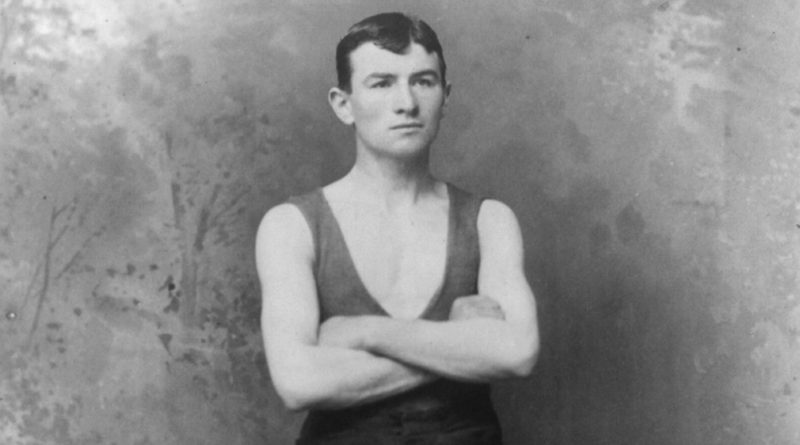
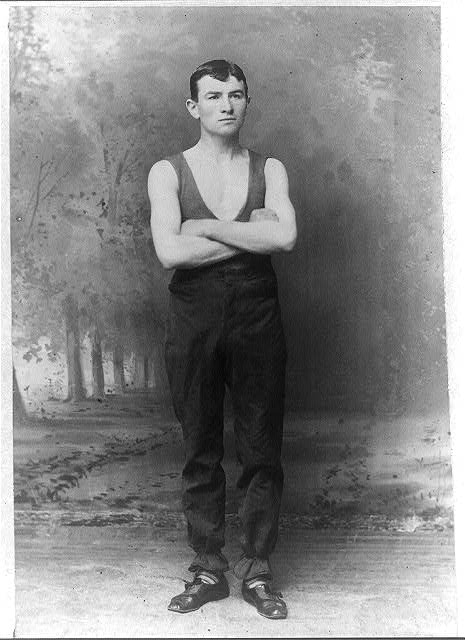
PODCAST A tale of the ‘sporting life’ of the Bowery from the 1870s and 80s. A former newsboy named Steve Brodie grabs the country’s attention by leaping off the Brooklyn Bridge on July 23, 1886. Or did he?
The story of Steve Brodie has all the ingredients of a Horatio Alger story. He worked the streets as a newsboy when he was very young, fighting the bullies (often his own brothers) to become one of the most respected newsies in Manhattan.
He experienced his first taste of adulation and respect as a minor sports celebrity, participating in pedestrian competitions across the country. Back in New York, Brodie started a family and promptly lost most of his money at the race track. He yearned to do something athletic and attention grabbing again.
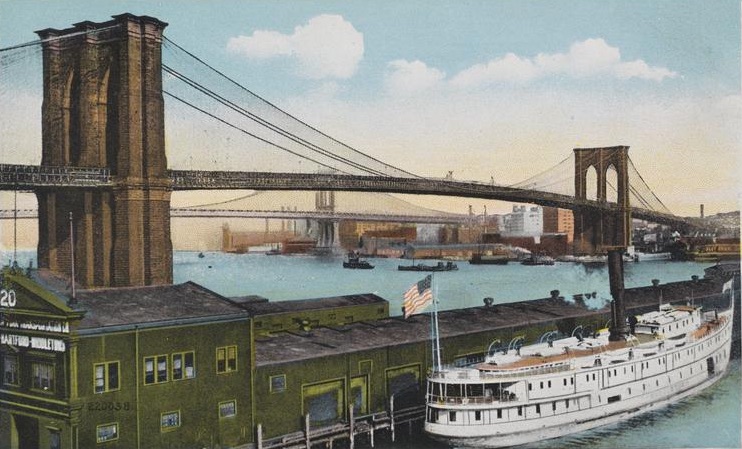
TheBrooklyn Bridge, completed in 1883, was a crowning architectural jewel linking two major cities; Brodie witnessed much of its construction during afternoons diving from East River docks. He now proposed an outrageous stunt that would garner him instant fame and fortune.
He would jump off the Brooklyn Bridge!
Was Steve Brodie a hero or a fool? A daredevil or a con artist? His story provides a window into the ‘sporting men’ life of the Bowery and a look into what may possibly be the greatest hoax of the Gilded Age.
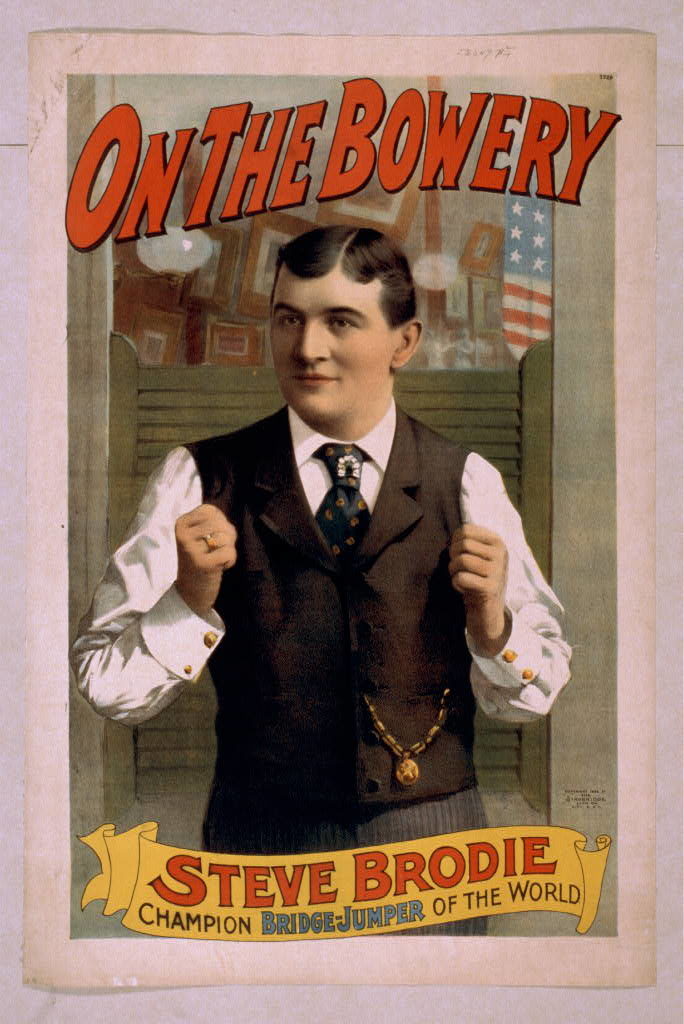
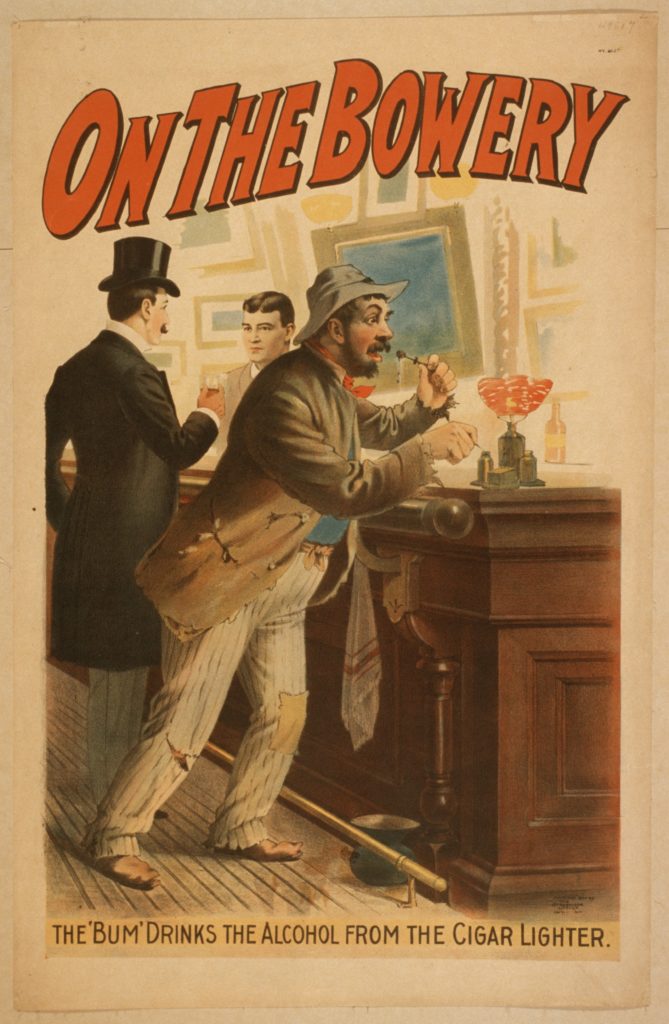
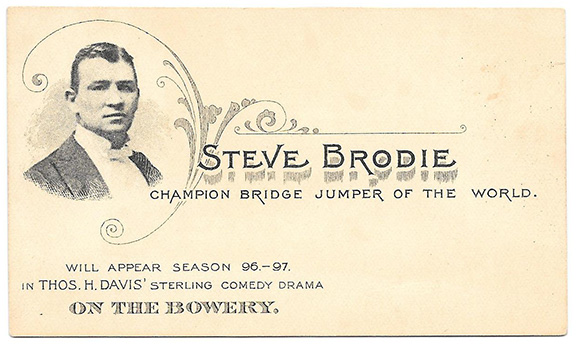
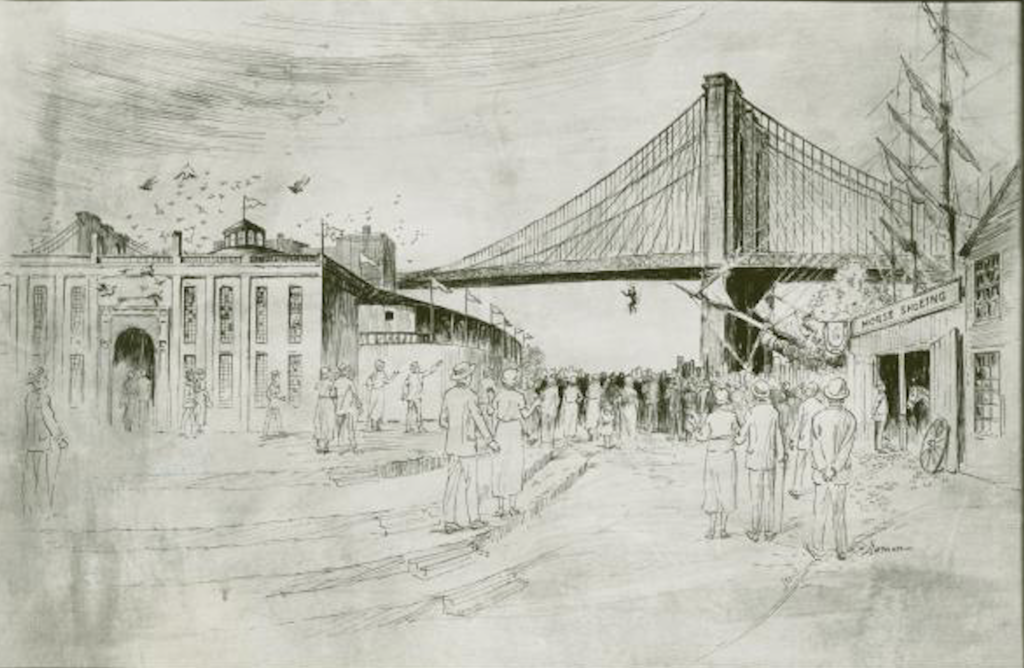
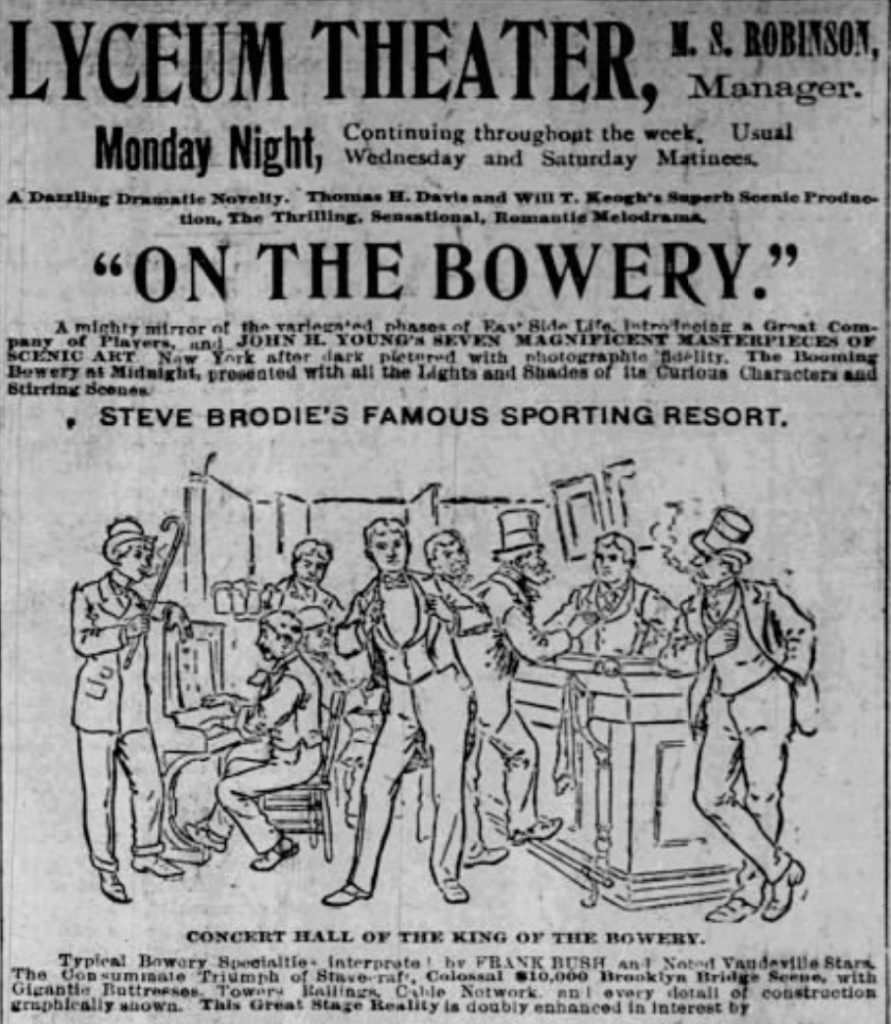
A photograph of Steve Brodie, taken on July 31, 1886, a week after his ‘jump’.Advertisements for the show On The BoweryImages courtesy Library of CongressAn illustration of Brodie’s jump made for the Old New York exhibition at the 1939 New York World’s Fair.
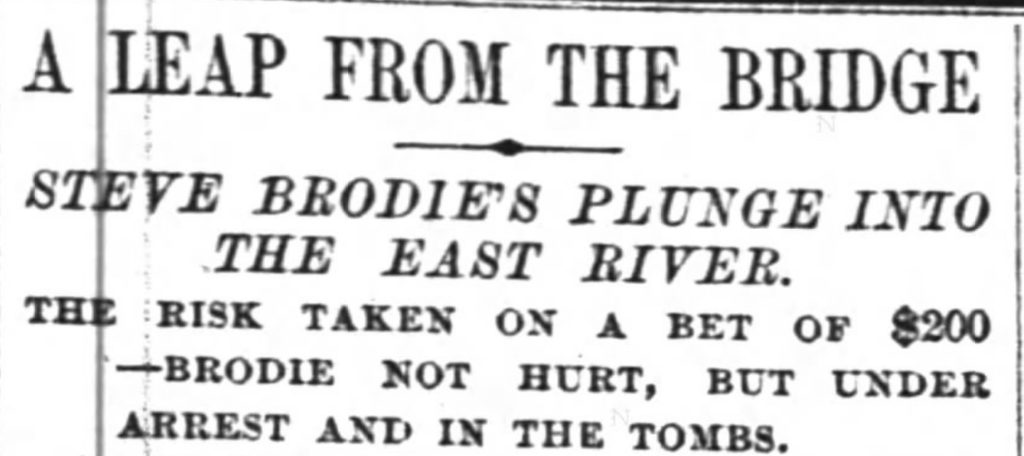
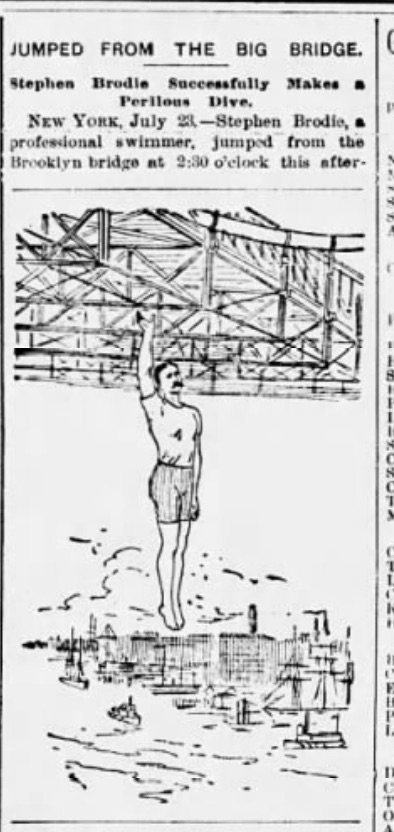
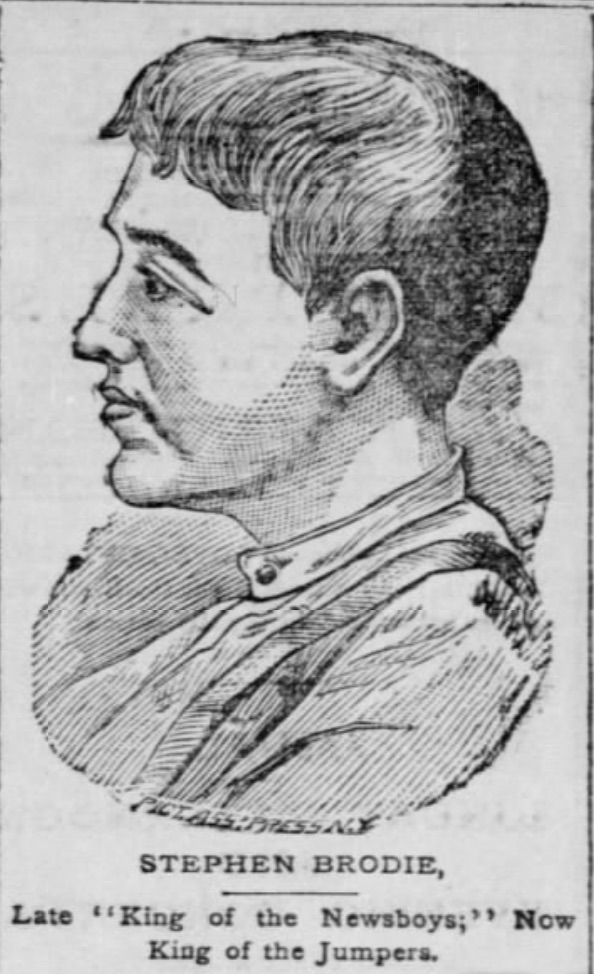
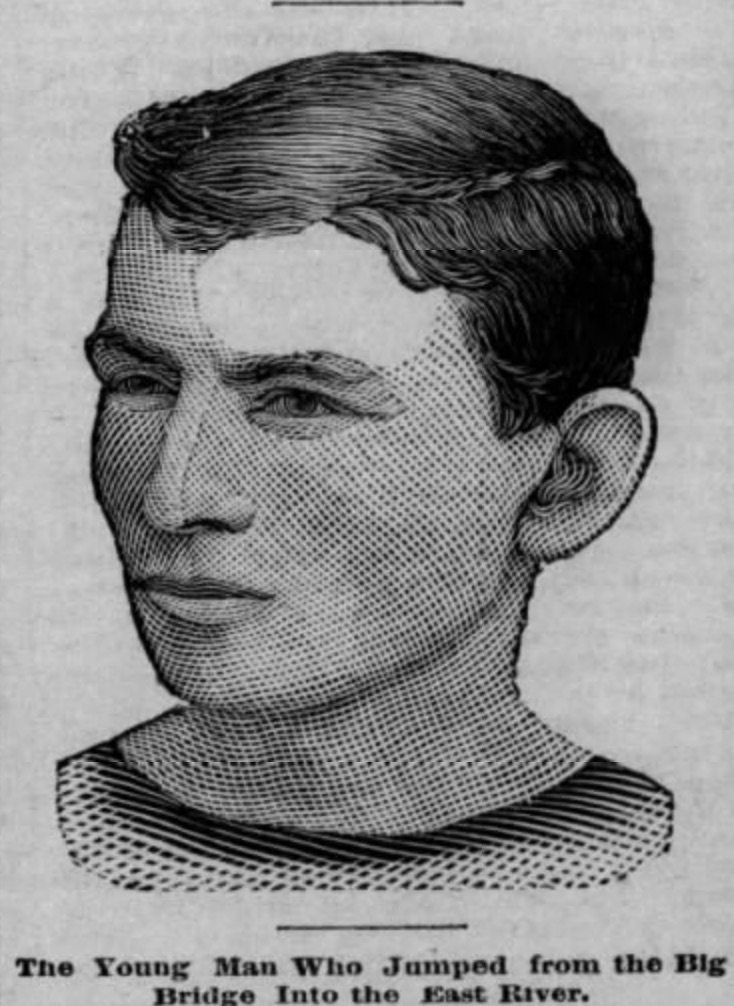
A few of the creative illustrations of Steve Brodie in the days and weeks following his stunt.
Here’s the Bugs Bunny cartoon Bowery Bugs (from 1949), courtesy the Internet Archive.
You can watch the 1933 film The Bowery on streaming services and even get the entire thing — in pieces — on YouTube. Here’s the section of the film featuring Brodie’s ‘brilliant idea’ (at around the 5:30 mark). By the way, this film is riddled with offensive stereotypes so be warned!
The actor Steve Brodie, who made his name in Western films and televisions shows, took his screen name from the Bowery’s Steve Brodie. You can also see Brodie in The Beast from 20,000 Fathoms!
My thanks to Grant Barrett for allowing me to use a clip from A Way With Words. Hopefully you’re all listeners of his excellent show with Martha Barnette about the history of language. Barrett and Barnette have been producing the show since 2007.
And here’s an article I wrote back in 2007 (!) about two saloons on the Bowery — including Brodie’s. This was written for our FRIDAY NIGHT FEVER series about the history of New York City nightlife. Past entries can be found here .
We’re going way, way, way back to New York’s seediest, filthiest and most notorious place — the Bowery in the late 19th century.
The nightlife of the old Bowery could have an entire blog in itself. It has been witness to some of the rowdiest, most shameless and debauched New Yorkers who have ever lived. They filled up dives and flophouses, brothels and saloons, and catered to the poorest of immigrants and the richest of the upper class ‘slumming it’ for a real idea of fun unimagined in the drawing rooms of the elite.
The two saloons from the late 19th century featured here weren’t extraordinary places as we would consider today — they would both fit comfortably in the 20th century sin-den the Limelight — but they were run by extraordinary people, ‘heroes’ of the Bowery brawler set.
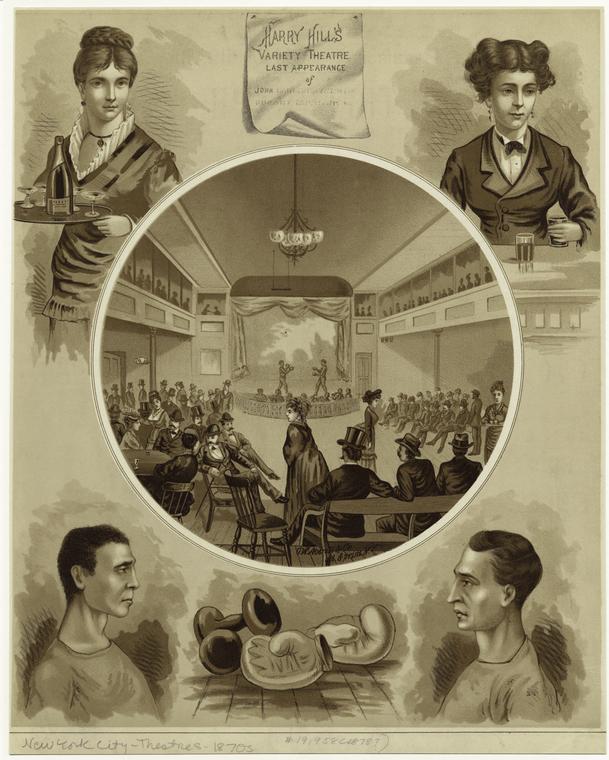
Geoghegan’s at 105 Bowery has been described as “a rendezvous for professional mendicants.” Often called the Bastille of the Bowery, it didn’t just spawn a few fisticuffs; it catered to them. Because this two-floor boiserie featured two boxing rings, and one of the men in the ring was often the bar’s owner.
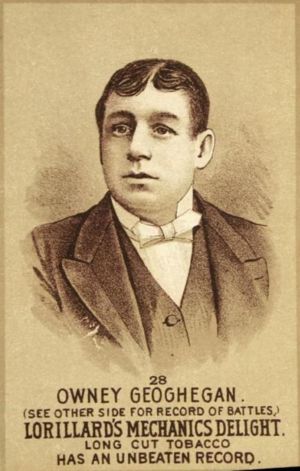
Owney’s boxing card.
Owney Geoghegan held the boxing distinction of Lightweight Champion of America from 1861 to 1964 when he retired to open his tavern/fight palace in the Bowery. His reputation naturally drew the crowds, and Geoghegan encouraged his patrons on to a little pugilism with the help of ample ales and whiskey. In 1891 the ‘Bastille’ even hosted a few rather fierce bouts of women’s wrestling, with the competitors required to cut their hair (to prevent pulling) and costume themselves wearing only tights.
Such a swarthy establishment was bound to attract the lowest elements and the most sinful gangs of New York. One journalist at the time describes it: “The faces around us are worse than those seen in a bench show of pugnacious dogs, and instinct teaches us to have a care for our nickels, for our pockets are in imminent danger.”
But perhaps the person the clientele should have feared the most was Geoghegan himself. A short but powerful Irish man, Geoghegan was known for his impressive, compact strength. And his penchant to cheat when needed.
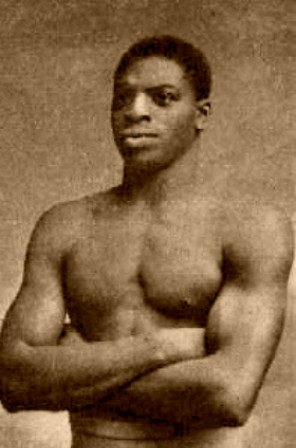
Viro Small, one of the Bowery’s most popular boxers.
Geoghegan was in the ring one night against Viro Small, a very popular black wrestler. Geoghegan was still in his prime but it was clear he was being bested in the ring by Small. The drunken crowd kept catcalling him, and he knew he couldn’t lose in his own establishment. So he had one of his henchmen hold a gun to the referee’s head and call the match for Geoghegan!
(Small didn’t hold a grudge. He later wrestled there again, with a man named Billy McCallum who afterward tried to murder him.)
As Geoghegan flexed his strength to his barflies, another Bowery saloon owner was busy displaying his gifts of agility. In 1886 Steve Brodie, on a bet, jumped off the Brooklyn Bridge, the bridge being only about three years old at the time. What was amazing was not the amount of stupidity that took, but the fact that he survived and claimed his $100 bet money.
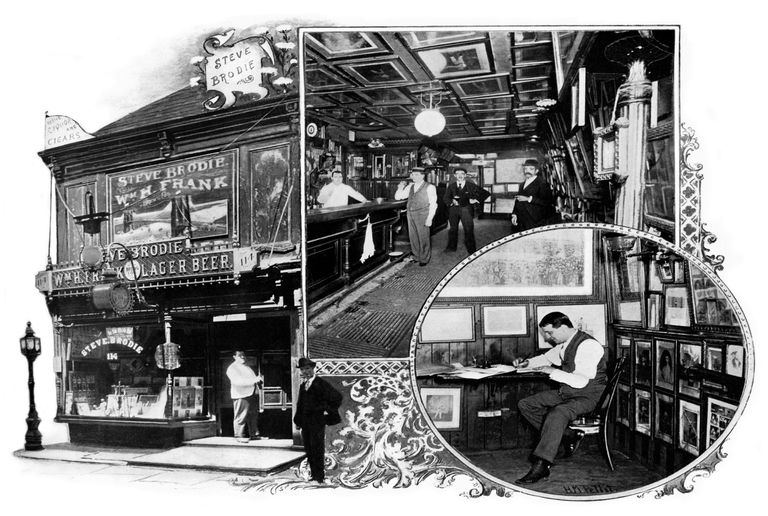
His feat was celebrated at the time and from the fame of this simple act, he was able to open Steve Brodie’s Saloon, 114 Bowery, at Bowery and Grand Street (a couple of doors down from Geoghegan’s place).
Brodie’s saloon. Note the Brooklyn Bridge mural above the bar entrance.
If Geoghegan’s dive was a celebration of his profession, Brodie’s was a celebration of his own personality. Behind the bar was an elaborate oil painting depicting Brodie bravely hurling off the bridge, along with a signed affidavit from the boat captain who fished him out of the water. The floor of the bar was inlaid with silver dollars to give it that wealthy feeling that money had been hurled to the floor.
For the cost of a drink, Brodie would gladly recount his tale. As silly as it seems today, he was able to pack in patrons, perhaps many from Geoghegan’s place, still drunk on booze and bloodletting.
Somehow he managed to turn his feat into a touring autobiographical performance entitled On The Bowery. Eventually, he tried to top his feat with a plunge down Niagara Falls in 1889. (It could never be proven that he actually went ahead with it!) He settled in Buffalo and opened another saloon there, but the enigma of his fame apparently didn’t carry that far. He moved to San Antonio and died at age 39.
Geoghegan had a similar short-lived fate. He lapsed into a severe depression at the death of his father and, traveling to Hot Springs, Ark., to try cure himself of his pain, actually died there, age 45.
As his obituary in the New York Times said: “There is mourning in the Bowery, sorrow on Houston and Bleecker streets, and desolation in the dance halls of the slums….. His career as a prizefighter, ward heeler and dive keeper was that of the typical New York rough, and is only interesting as it illustrates a phase of life little known to respectable people.”
The Bowery Boys: New York City History podcast is brought to you …. by you!
We are now producing a new Bowery Boys podcast every other week. We’re also looking to improve and expand the show in other ways — publishing, social media, live events and other forms of media. But we can only do this with your help!
We are now a member of Patreon, a patronage platform where you can support your favorite content creators.
Please visit our page on Patreon and watch a short video of us recording the show and talking about our expansion plans. If you’d like to help out, there are six different pledge levels. Check them out and consider being a sponsor.
And join us for the next episode of the Bowery Boys Movie Club, an exclusive podcast provided to our supporters on Patreon.
We greatly appreciate our listeners and readers and thank you for joining us on this journey so far.
Our first-ever Bowery Boys book, “Adventures in Old New York” is now out in bookstores! A time-traveling journey into a past that lives simultaneously besides the modern city.
Bowery Boys Walking Tours
Are you ready to walk through time? We’re excited to announce Bowery Boys Walks, our new walking tours developed around our podcast. Join us in the streets — beginning in October 2018!
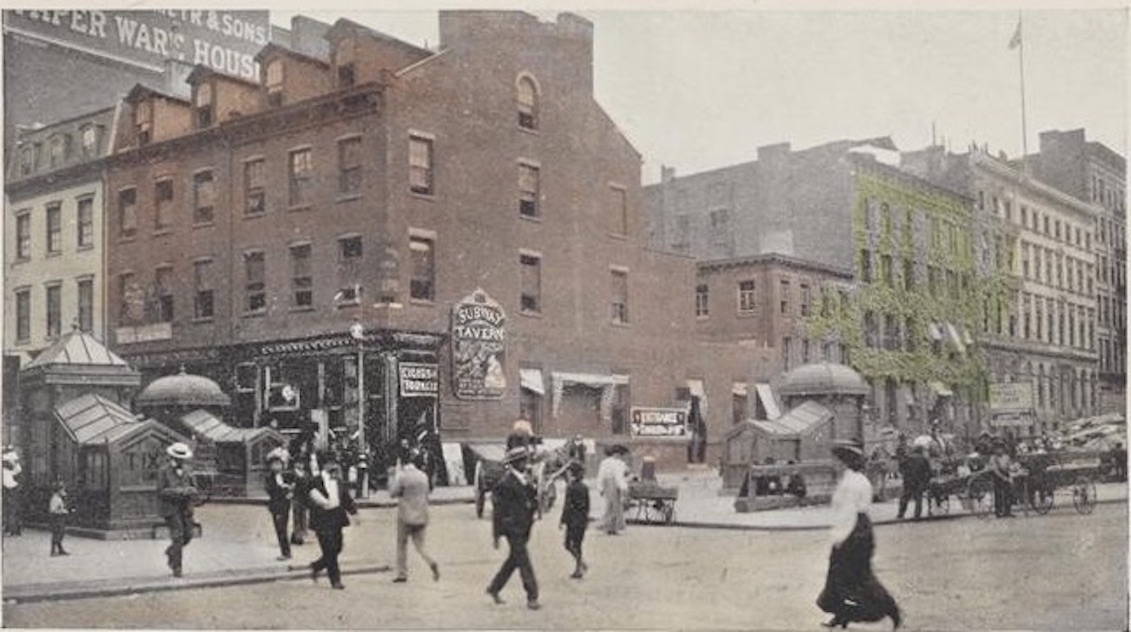
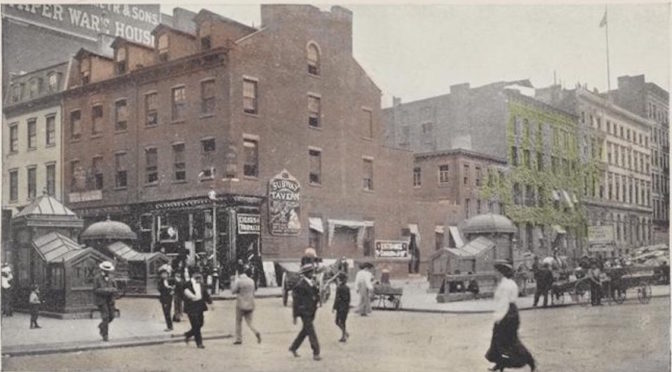
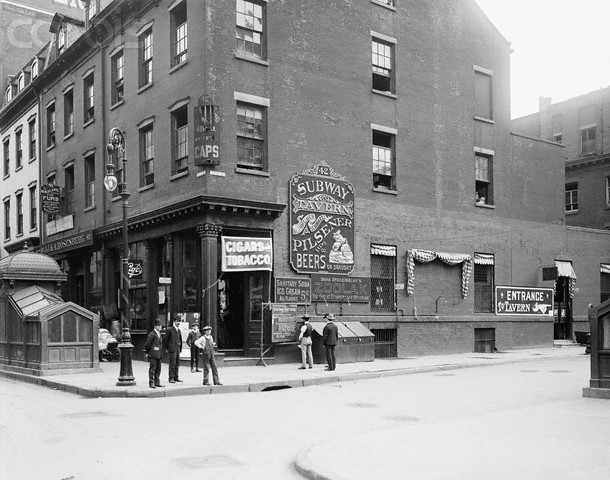
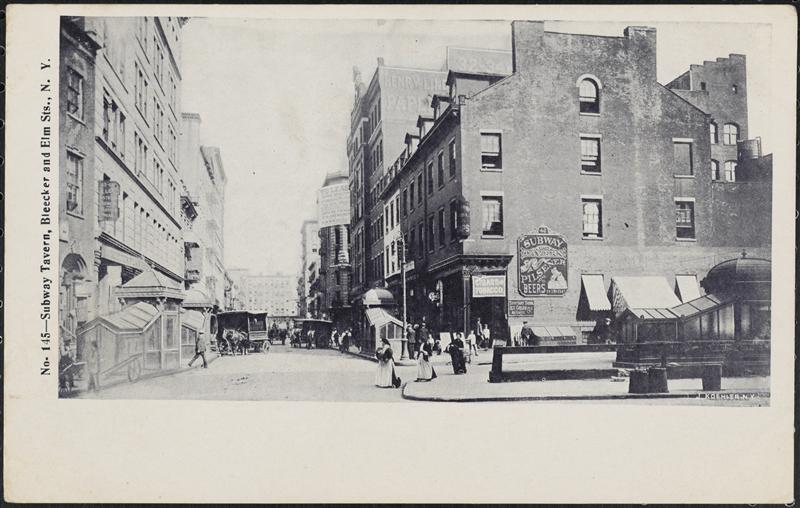
LOCATION:Subway Tavern Bleecker and Mulberry, Manhattan
In operation 1904-05
The early planners of the New York City subway negotiated that very first route through some of the city’s mostly heavily populated areas, those obviously in need of rapid transit. The locations of the first underground stations were based on the amount of available space at key cross streets. If you happened to own property along the route and specifically near a planned station, you would have hit the proverbial jackpot in 1904, the year the subway opened.
And so begins the tale of the Subway Tavern, at the corner of Bleecker and Mulberry, which tried to monopolize on this lottery of suddenly-valuable real estate with the worst idea in the history of New York City nightlife — a moral tavern.
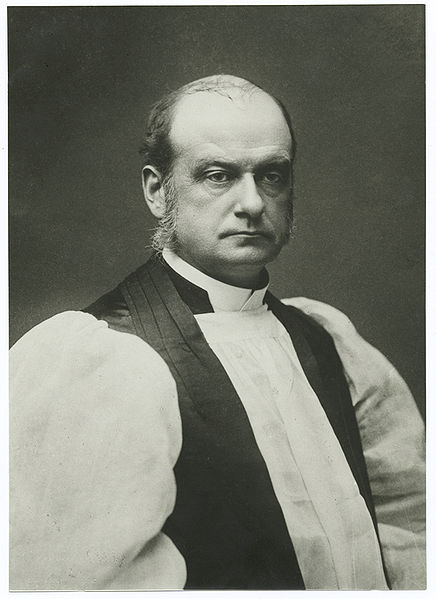
Like all religious leaders, the Bishop Henry Codman Potter of the Episcopal Diocese of New York was gravely concerned with the evils of alcohol upon the poorest classes and the newest arrivals from Ellis Island. Most of the temperance stripe preferred to hit areas most soaked in booze — particularly the Bowery — with bibles in hand and moral example on display. Often to no avail and to the occasional danger to the proselytizers themselves.
Potter (pictured below), a rector at Grace Church, thought outside the box. His own ideas for social reform were radical for the time but some (like daycare in churches) seem standard and even obvious today. Although he lived rather luxuriously — his stately home at 89th and Riverside Drive is still standing — he made a point, even after his ascension to bishop, to work regularly in poor neighborhoods.
He was often a voice for labor groups and consistently berated Tammany Hall for its abuses. Nobody could say the man’s heart was not in the right place. Which made it all the more shocking when he decided one day that the Episcopal Church should open a tavern.
Since it seemed unlikely that people would stop drinking entirely, went his theory, why not found an establishment where proper and gentlemanly drinking would be encouraged? A place where the staff could monitor and guide patrons to more responsible imbibing.
Potter found the perfect location, a former saloon owned by future Fire Commissioner Joseph ‘Oak’ Johnson, at the corner of Bleecker and Mulberry streets and sitting right in front of a new subway entrance. Although the trains would not run for another few months, the new experiment was dubbed the Subway Tavern.
Potter christened the new tavern on August 2, 1904, opened with $10,000 in funds from distinguished citizens, including money from U.S. representative Herbert Parsons and former lacrosse star Elgin Gould. In case anybody was unclear of the intentions of the unusual establishment, a holy doxology was performed to an enrapt, standing-room-only audience.
Courtesy Museum of the City of New York
The Subway Tavern was to operate like a respectable upper-class club, except for poorer folks. “I belong to many clubs which I can go,” remarked the bishop, “but where can the toiler go?” Where, indeed!
Potter honestly believed the Subway Tavern could be jovial and free-spirited without becoming debaucherous. The front room, adored with a sign ‘To The Water Wagon’ playfully overhead, would be open to both sexes “with a ‘sanitary’ soda water fountain where beer will be served to women.” [source] Men would have a private room behind some swinging saloon doors in the back.
As the bar was funded by donations, the ‘evils’ of profit were eliminated. And thus, reasoned Potter, bartenders would not encourage patrons to drink. Men and women could come to converse, read a newspaper and have one — maybe two — drinks. Employees were to closely watch the intoxication levels of customers; if one even looked tipsy — if say, somebody appeared to be enjoying their drink a wee too much — they would be cut off. Healthy food would also be on hand downstairs to soak up any amoral toxins in the belly.
As the New York Times lightly mocked, “The benevolent bartenders … are anguished when they are compelled to serve whisky, and … dimple with joy when sarsaparilla pop is ordered.”
Naturally, many Episcopalians were not too thrilled having their church associated with a tavern just a couple blocks from the Bowery. Many dubbed it ‘The Bishop’s Inn’. The experiment made national headlines and was greeted with remarks like those from Pittsburgh pastor J.T. McCrory: “I supposed the ‘Subway Tavern’ was called that because it is an underground way to hell.” (Several accounts I read seemed to believe the tavern was actually in the subway.)
Another preacher called it a “low down, greasy Bowery saloon.” Shocked clergy flocked from other cities to gander at this oddity and register their opinion to the press. “I do not think it will turn the tide of drunkenness,” said one stunned clergyman, “nor will it solve or diminish the curse of rum.”
The naysayers were right. The Subway Tavern turned out to be a horribly ill-conceived idea, and its flaws were magnified several months after the subway opened in October 1904. When a reporter for the Advance visited the pub in September 1905, they found the exterior covered in ‘tattered’, ‘stained’ advertisements, a main barroom empty and most surfaces covered in flies.
Presumably, patrons quickly grew tired of being stately. As the Advance so plainly stated, “The liquor sold at the Subway does not make men sober. There is no method by which a young man learning the drink habit may not go elsewhere to complete his ruin.”
Within days of the Advance’s visit to the Subway Tavern, the holy drinking establishment closed up and reopened as a no-pretenses ‘out and out saloon’. Bishop Potter died just a few years later with a mostly unblemished record.
Many years later, the structure that once housed the Subway Tavern was ingraciously replaced with this building.
This article originally ran as part of our FRIDAY NIGHT FEVER series entry. Past entries can be found here.
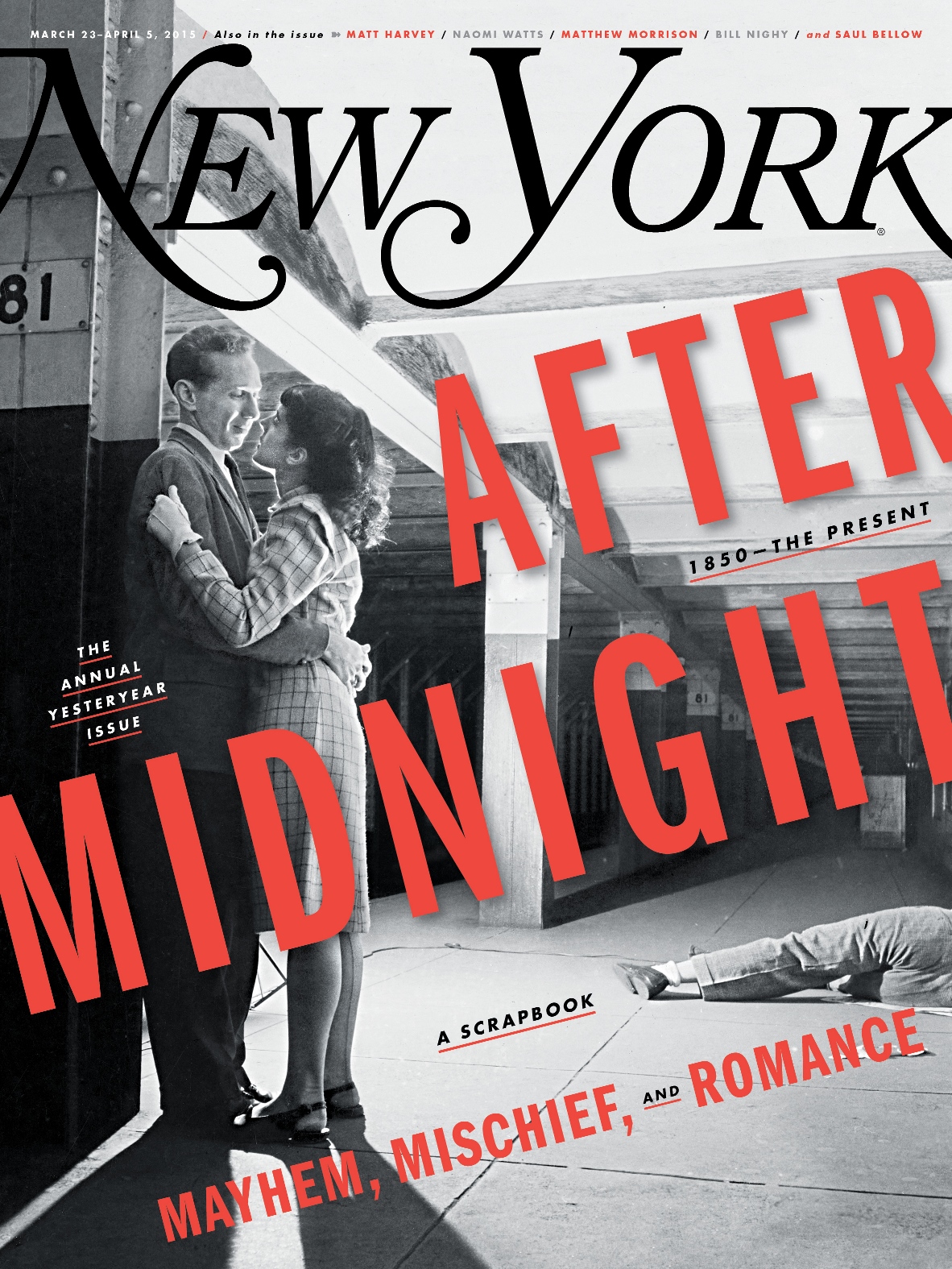
New York Magazine produces an annual buffet of New York City history each year called the Yesteryear Issue. Â It’s probably the biggest celebration of the city’s past in print and usually corrals some of New York’s finest writers and celebrities. Â Last year’s issue featured eight entertainers from New York’s past including Barbra Streisand, Bob Dylan and the Notorious B.I.G.
This year’s fabulous issue is no exception. The theme is After Midnight, a look at history through the years (from the 1850s to today) as it played out in the late-night hours. Â You can read it all right hereor go to your newsstand and pick up one of the three gorgeous covers.
This issue features tales, interviews, reminiscences and asides by the likes of Jay McInerney, Bebe Buell, Sloane Crosley, Colin Quinn, Alec Baldwin, Sarah Jessica Parker and Matthew Broderick, Laurie Anderson, J.B. Smooth, Sarah Silverman, Lydia Lunch, Isaac Mizrahi, Laurie Anderson — and the Bowery Boys!
It’s an absurd argument — how do you really quantify debauchery? — but a wonderful thought experiment and a fine excuse to wallow in genuine New York wickedness.  It was fun to pour over the decades and identify four particular eras of rampant bacchanalian excess — the 1970s, the 1920s, the 1880s-90s and the 1850s.  You can read the article to discover which era I crown the wildest.
Disagree? Â Have a favorite era you’d love to visit? Leave a comment and tell me about it!
And here are a few images of people and places that I mention in the article.
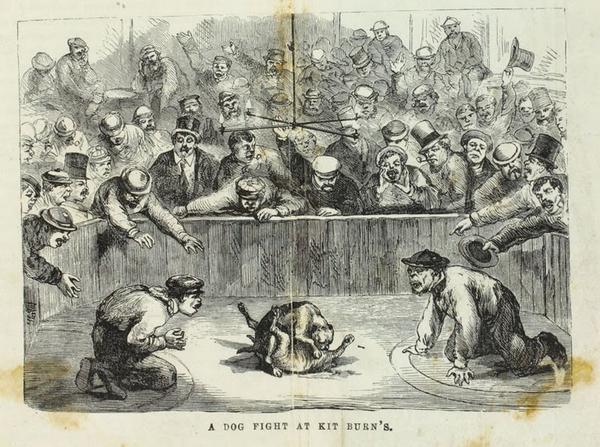
For more information on Kit Burn’s Water Street saloon, check our our podcast on the South Street Seaport.
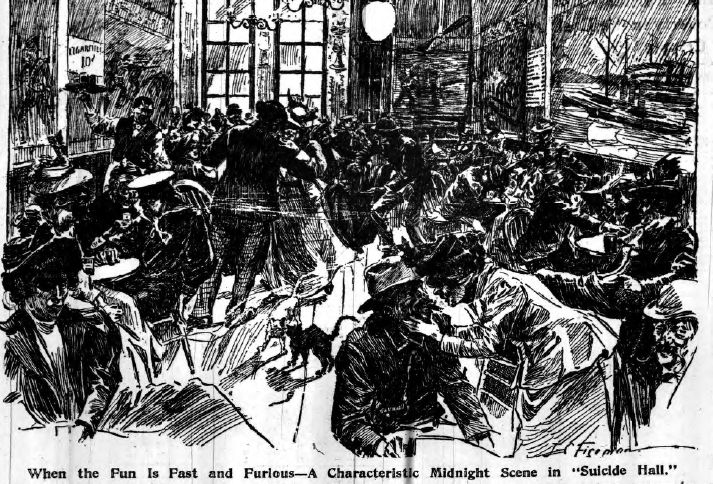
McGurk’s Suicide Hall
For more information on McGurk’s Suicide Hall check out my Bowery Boys profile on this sad and dangerous place on the Bowery. (The article was written all the way in 2007 so the neighborhood has changed greatly since then!)
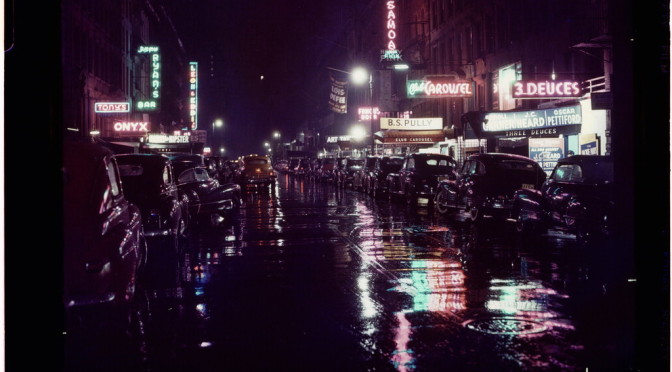
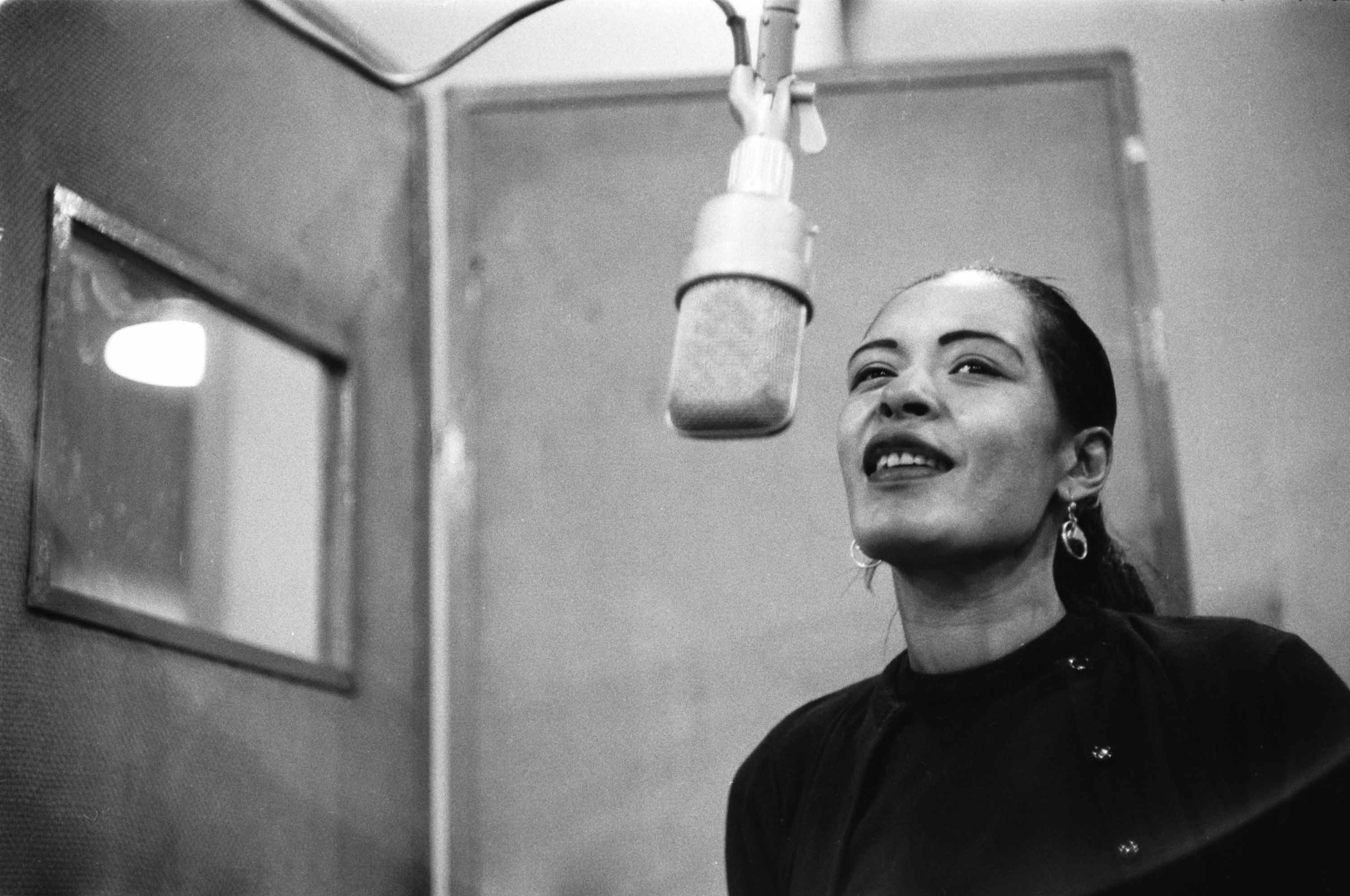
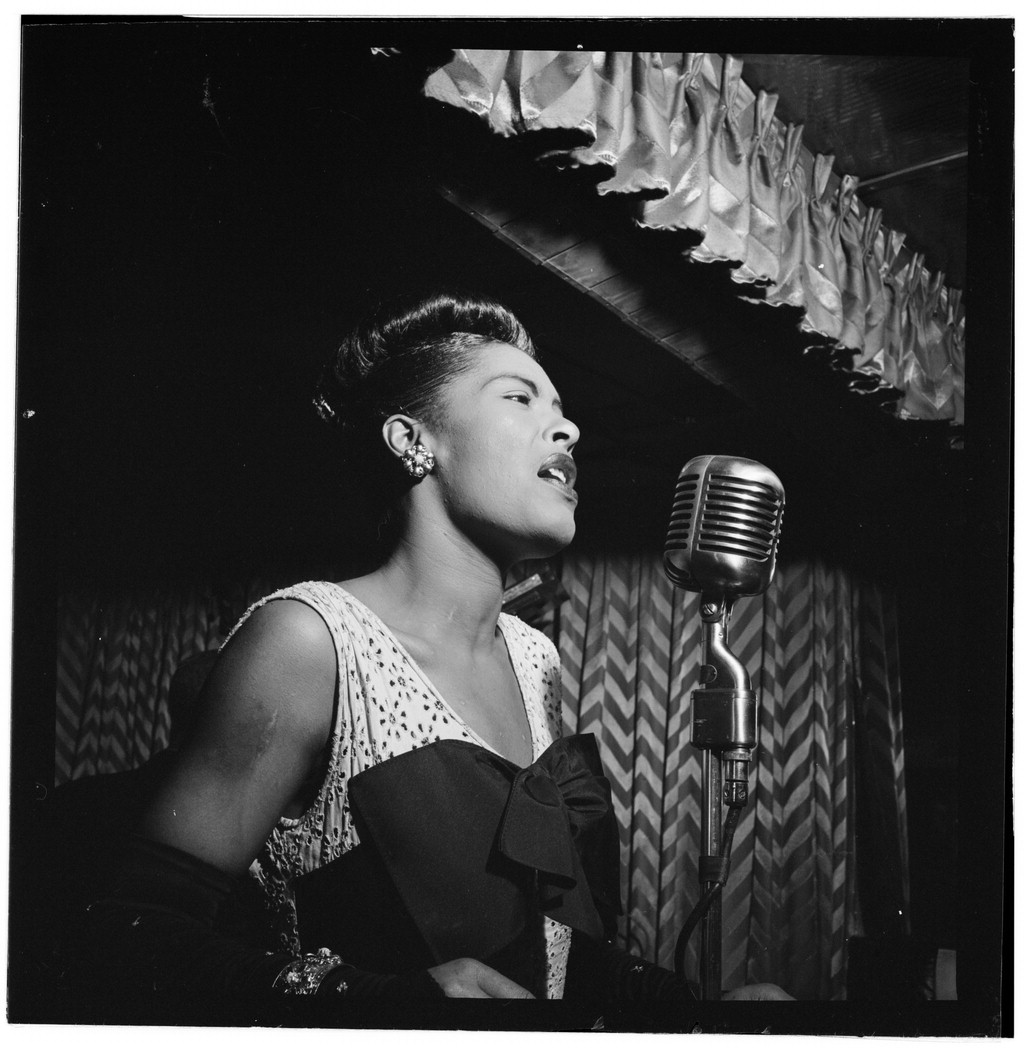
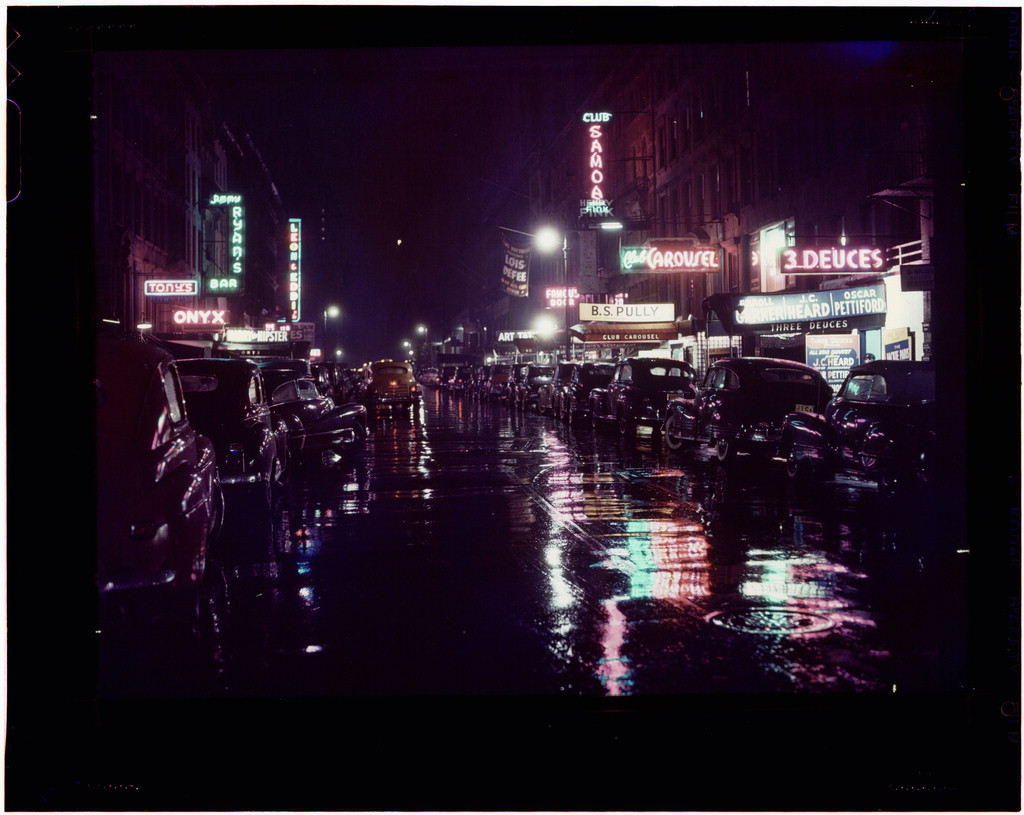
PODCAST Grab your fedora and take a trip with the Bowery Boys into the heart of New York City’s jazz scene — late nights, smoky bars, neon signs — through the eyes of one of the greatest American vocalists who ever lived here — Billie Holiday.
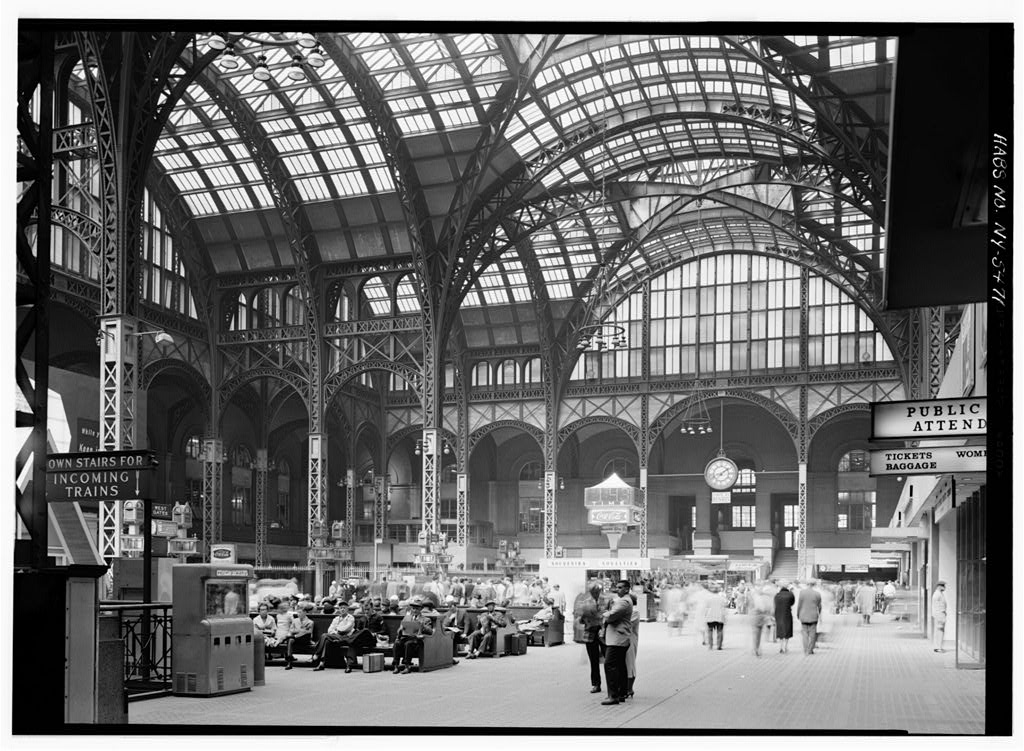
Eleanora Fagan walked out of Pennsylvania Station in 1929 and into the city that would help make her a superstar. Her early years were bleak, arrested for prostitution and thrown into the Welfare Island workhouse. But music would be her savior, breaking out in Harlem first in the nightclubs on 133rd Street, then in the basement clubs of ‘Swing Street’ on 52nd Street.
Her recordings make her an international star, but the venues of New York helped solidify her talents — from the Apollo Theater to Carnegie Hall. But one particular club in the West Village would provide her with a signature song, one that reflected the horrible realities of racism in the mid 20th century.
Billie Holiday at Club Downbeat, 1947
Locations featured in this episode:
1) Pennsylvania Station (circa 1930s-40s)
Courtesy Library of Congress
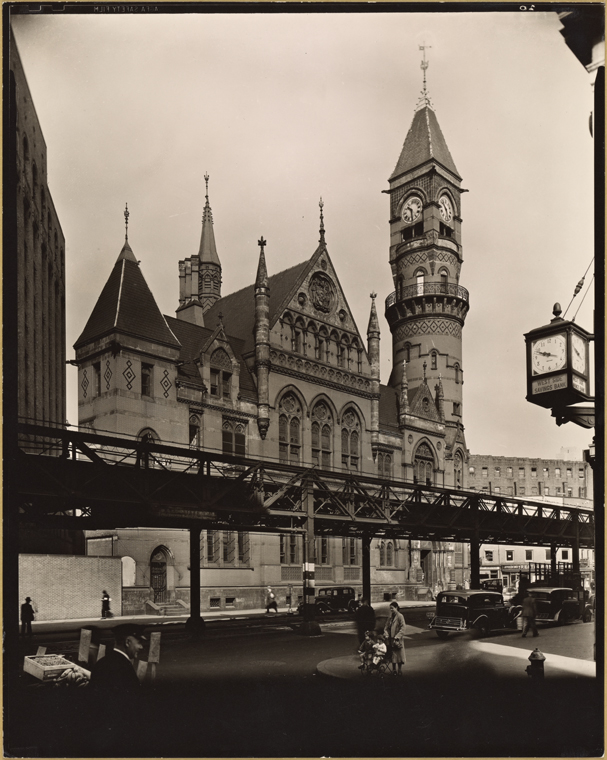
2) Jefferson Market Courthouse, pictured here in 1935
Photographed by Berenice Abbott, courtesy New York Public Library
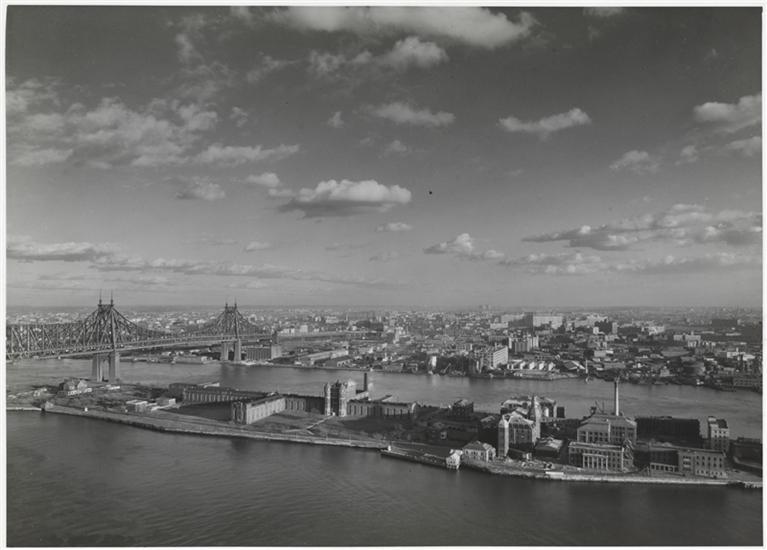
3) Welfare Island, pictured here in 1931
Photographed by Samuel H Gottscho, courtesy Museum of City of New York
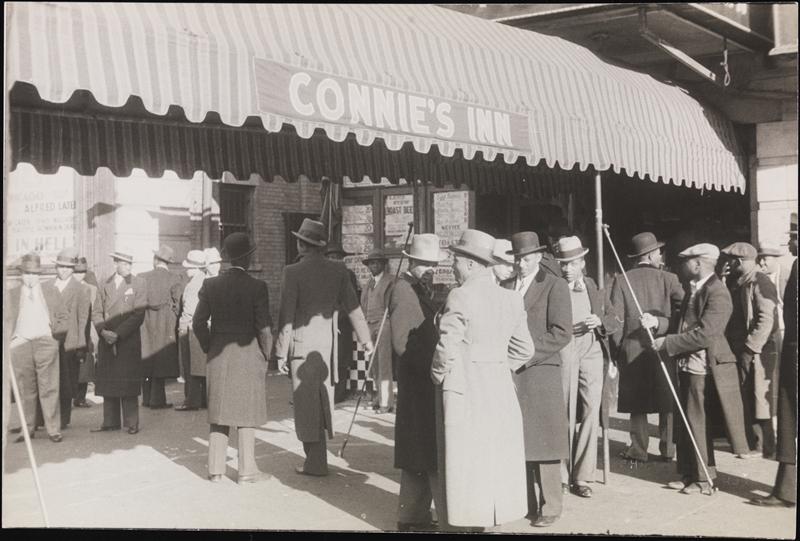
4) 133rd Street — “Jungle Alley” or The Street — outside Connie’s Inn
Courtesy Museum of the City of New York
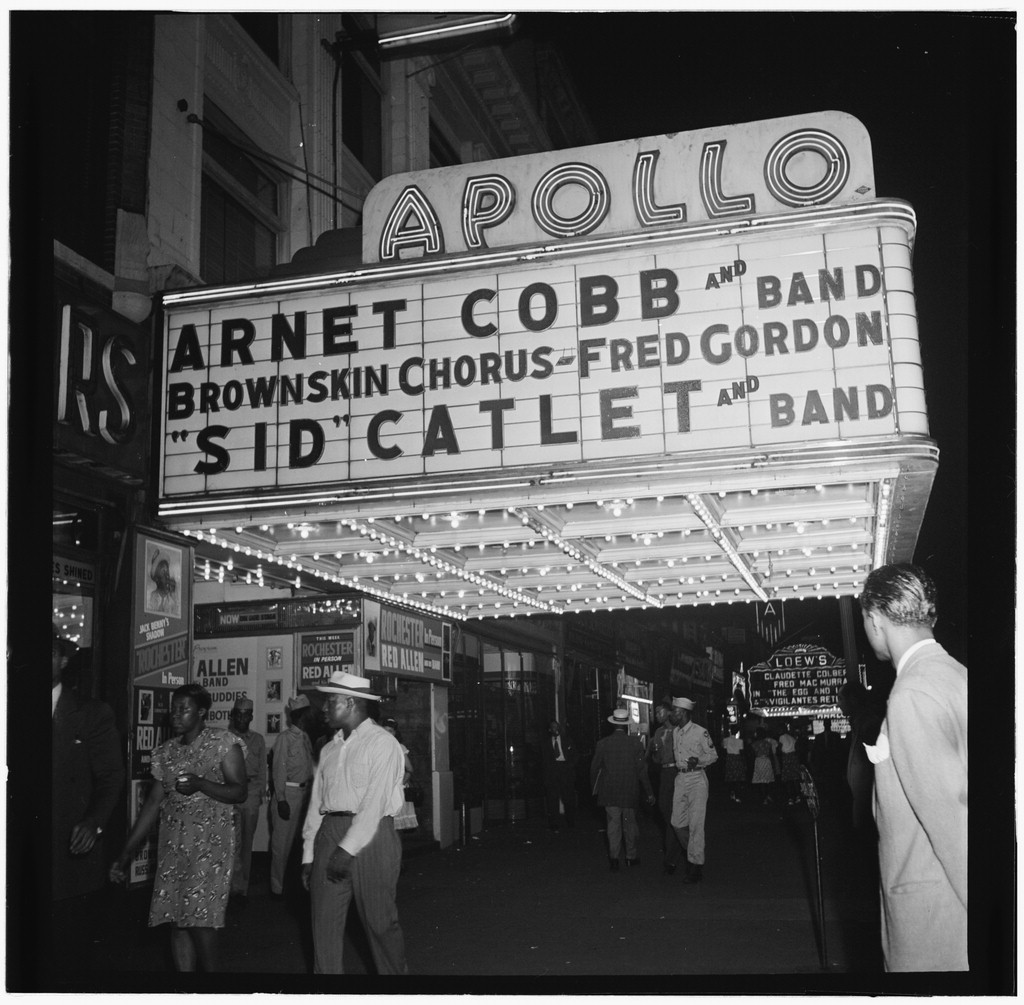
5) Apollo Theater, pictured here in the mid 1940s
Courtesy Library of Congress, photographer William Gottlieb
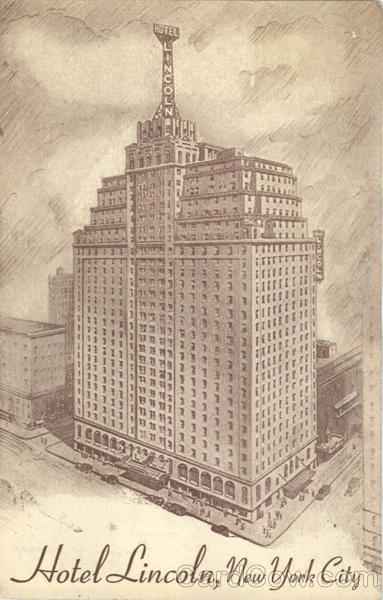
6) Lincoln Hotel
Hotel Lincoln, 44th to 45th Street at 8th Avenue New York City
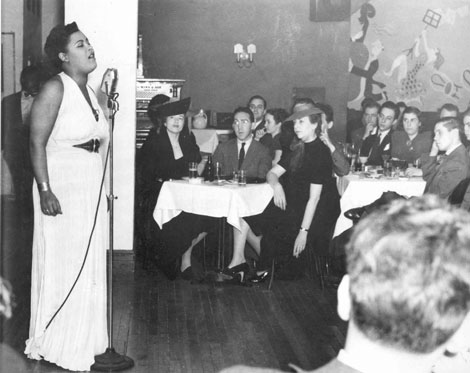
7) Billie Holiday at Cafe Society 1939
Photo by Charles B. Nadell
8) 52nd Street aka Swing Street
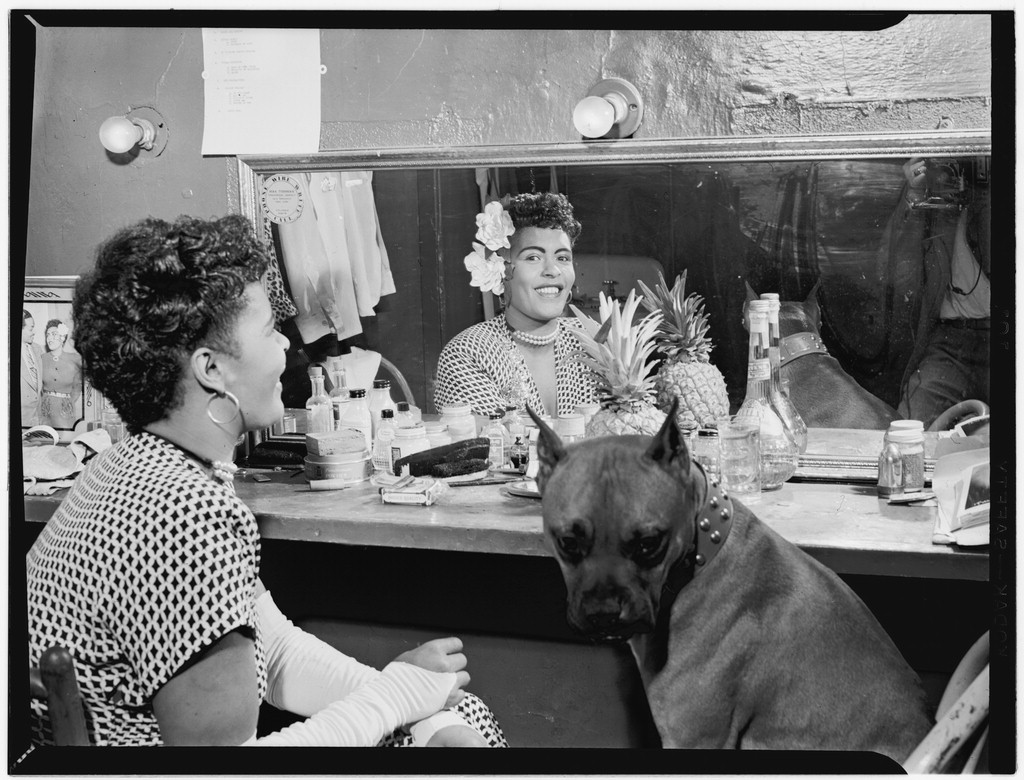
Billie at Club Downbeat (with her dog Mister) — June 1946
Courtesy Library of Congress
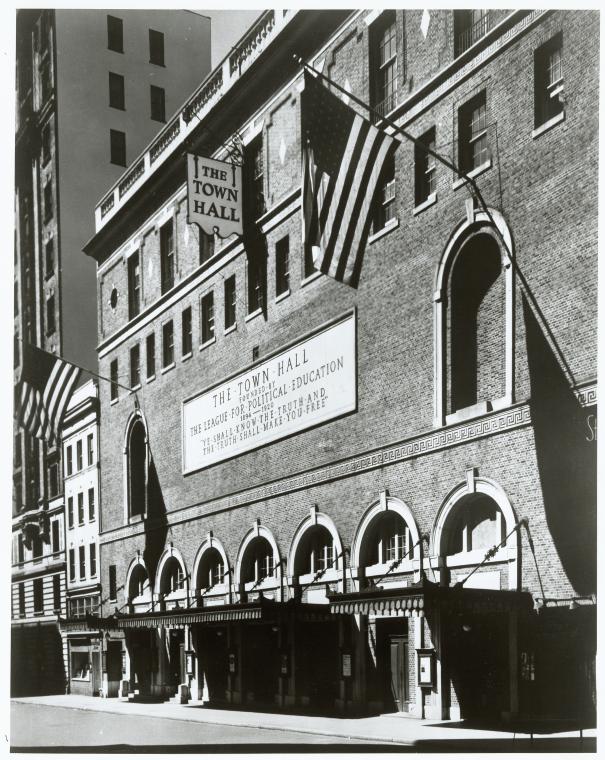
9) Town Hall, sometime in the 1940s
Exterior view of The Town Hall, courtesy New York Public Library
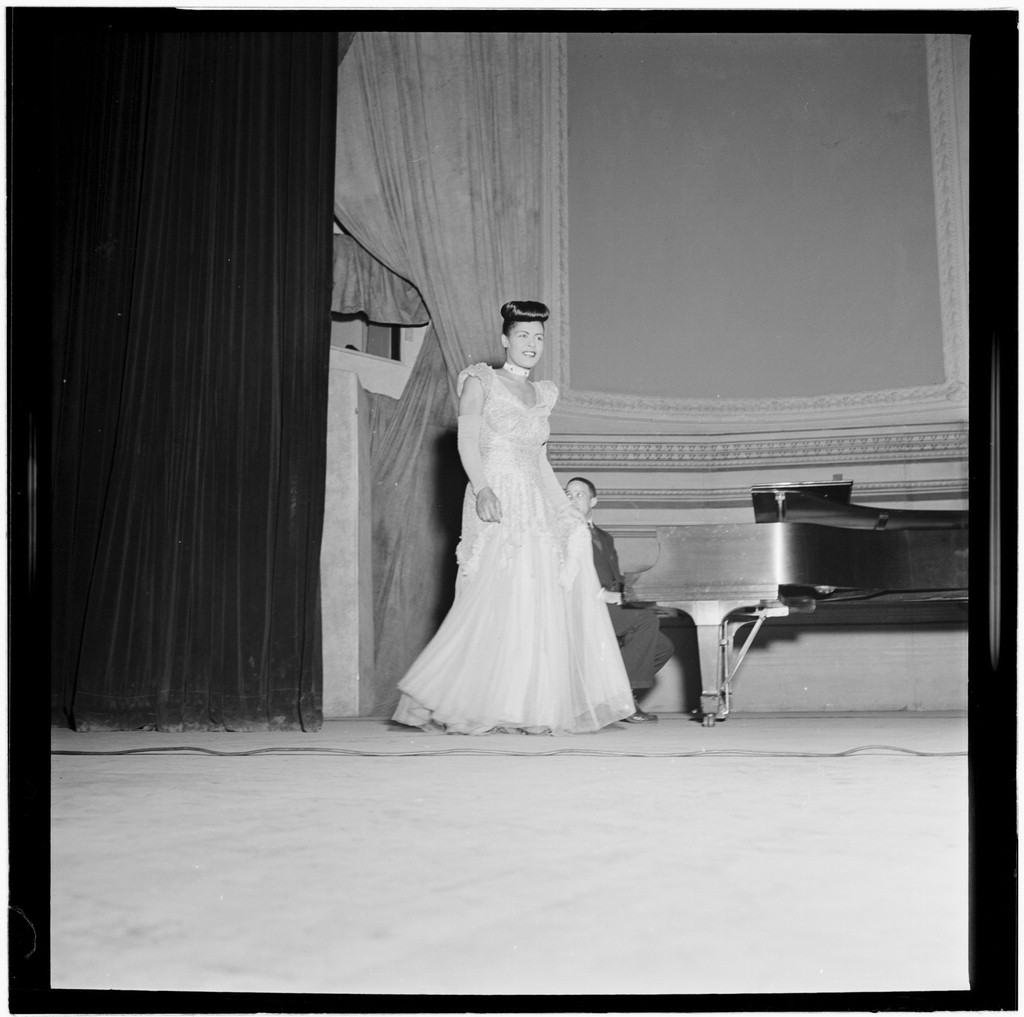
10) Billie Holiday at Carnegie Hall for her rave 1948 concert
Courtesy Library of Congress
An extraordinary performance of ‘Strange Fruit’, performed in February 1959, months before she died. This was recorded for a British television show called ‘Chelsea At Nine’.
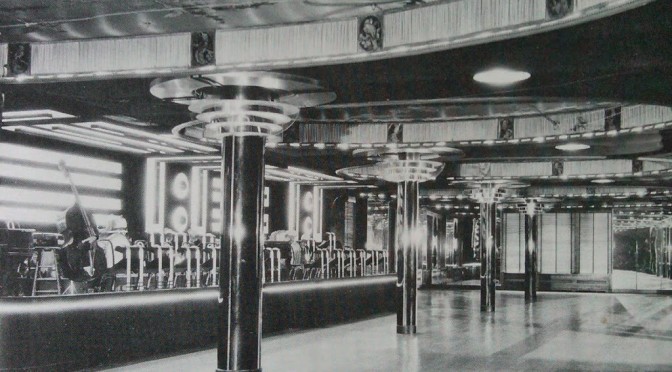
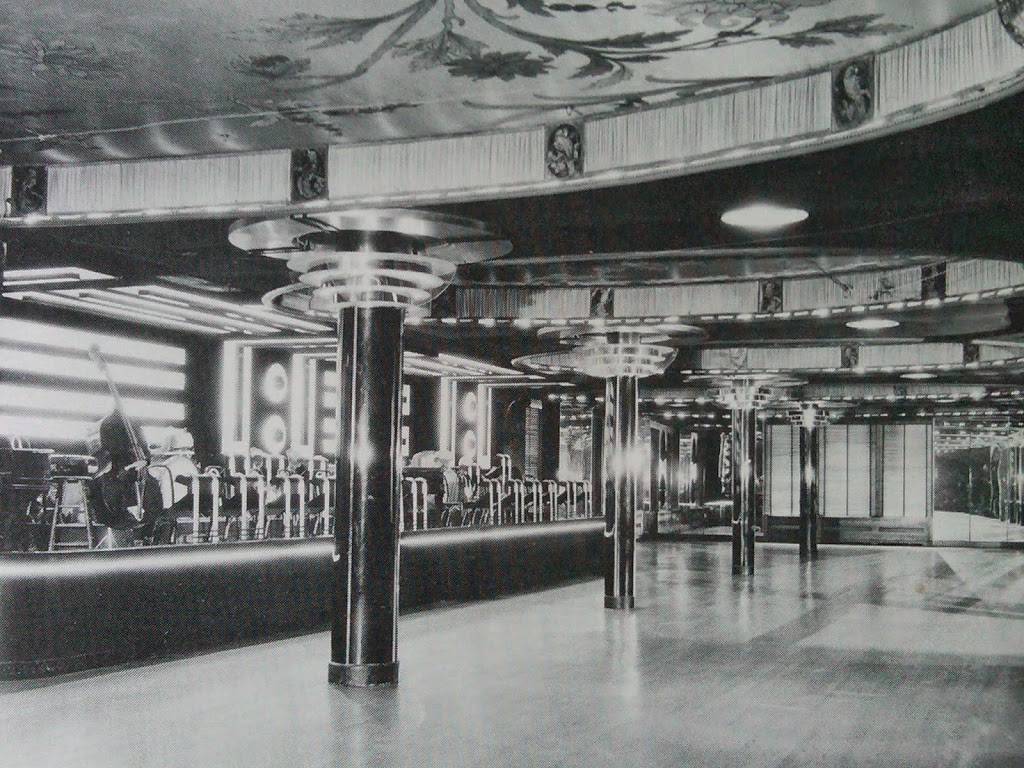
The Roseland Ballroom closes its doors next month on April 7th after a round of Lady Gaga concerts. The storied big band venue — the ‘world’s foremost ballroom cafe’ — originally opened on December 31, 1919 at 1658 Broadway (at 50th/51st Street). In the 1950s, it moved to its present location on 52nd Street, a former ice and roller-skating rink.
On the surface, opening a dance club a few weeks before the start of Prohibition doesn’t seem to be especially wise. But New Yorkers ate it up. After all, there would eventually be hundreds of speakeasies surrounding it!”
“The shadow of the camel, i.e. the presence of Prohibition, has not robbed Broadway of all its pleasures. The dancers still find a way to have a good time, as may be attested by the thousands who attend the sessions at Roseland, the new dancing place at Broadway and 51st Street.“
During the ’20s, the Roseland was the scene of many dance marathons for prize money. In 1923, when the city reminded him that state codes authorized only twelve-hour endurance contests, he arranged for competitors to be whisked away on a boat — called the Roseland — to complete the contest.
The Roseland took aim at dismissing the blues at the height of the Great Depression. “At Roseland Ballroom, ‘Old Man Depression’ will be tried and found guilty of murdering Prosperity and sentenced to death. A scaffold will be erected for him and his ‘death’ will be a signal for merry-making.” [from the December 31, 1931, New York Times]
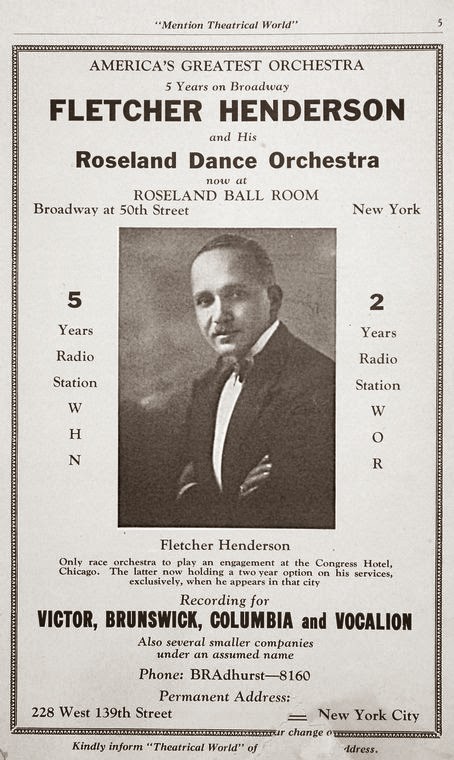
At right: Regular Roseland bandleader Fletcher Henderson (courtesy NYPL)
The Roseland was never the Rainbow Room. During the 1940s it was nicknamed ‘the poor man’s nightclub’ which apparently didn’t stop it from being “the most famous dance hall in the world,” according to the New Yorker in 1942. (It was also, back when it opened, a whites-only establishment.) Always popular, the Roseland of the 1940s was charming and sometimes mysterious, regimental and rarely lewd. Its owner Louis Brecker always referred to it as “the home of refined dancing.”
“People accustomed to night-club life often find the atmosphere slightly phantasmal. The ceiling is hung with dark-blue muslin studded with tiny electric bulbps give a night-sky effect. The roomis lit by neon lamps, graduating in shade from deep pink to lemon yellow. In their dim rays knots of patrons drift to and from the dance floor with a curiously delicate air, fluorescing a bit as they go.” [New Yorker, 1942]
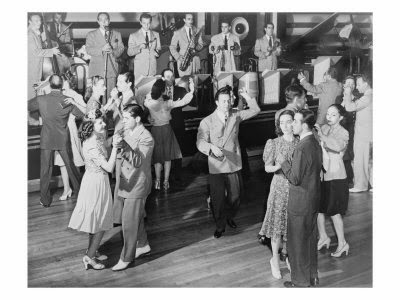
Roseland dancers, 1941 (Library of Congress)
The Roseland was also known for hostesses (or taxi dancers) who would dance with gentlemen for $1.50 per half hour. They were beautiful and well behaved, never drinking alcohol if their patrons offered. And they never solicited business, sitting politely in a roped-off dias by the dance floor, waiting for an interested man to come along.
“Each hostess tried to build up a clientele by thoughtful attention to masculine interests and hobbies. Many hostesses read books in order to increase their conversational range,” according to the New Yorker. “[E]lderly gentlemen who like to surround themselves with hostesses, sometimes [bought] out the entire platoon for the evening.”
The hostess/taxi dancer, hugely popular during the World War II era, had mostly faded out by the time the Roseland moved to its present location at 52nd Street.
Here’s a Henderson tribute to the venue, entitled “Rose Room (In Sunny Roseland)”:
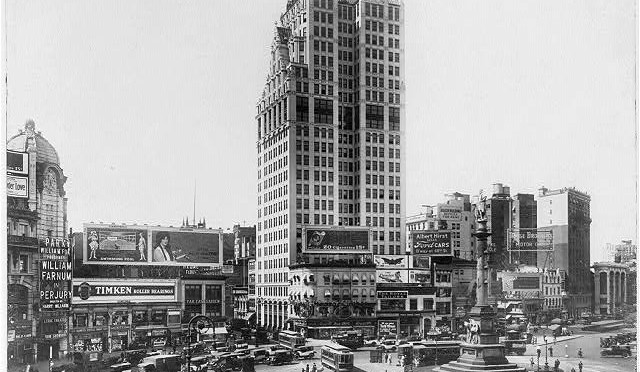
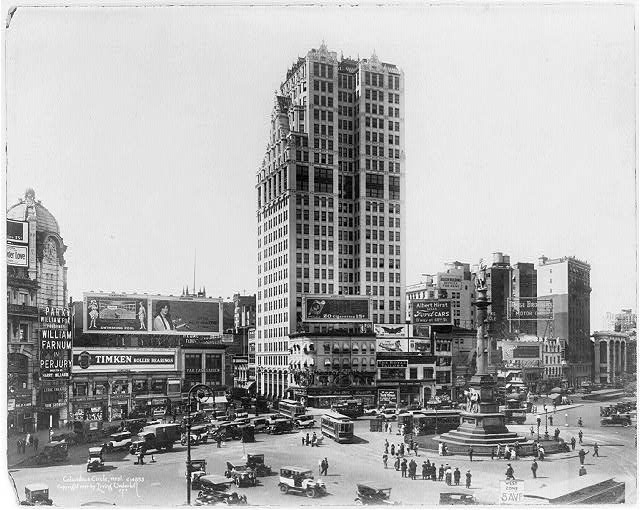
Columbus Circle in 1921, looking west. Healy’s was a few blocks north of this scene.
Many of New York’s most popular restaurants and cafes a century ago were located around Columbus Circle, lively hot spots that drew in the theater and burlesque patrons well into the late hours. Crowds would exit the Park Theaterand head over to Reisenweber’s Cafe to take in some champagne and cabaret, years before it would be associated with bawdy star Sophie Tucker. Others might partake of the beefsteak at the Morgue on West 58th Street or Child’s Restaurant a block over.
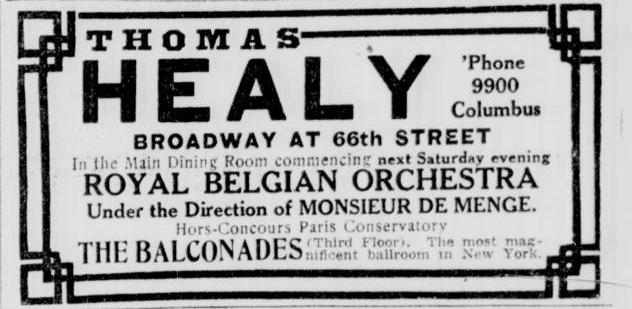
One of the busiest spots was Healy’s (slightly north, at Broadway and 66th Street), a spacious dining and dancing spot, featuring an indoor ice-skating rink and enormous ballroom, among its many indulgences. It was one of New York’s most trendy dining palaces in 1913, the site of a celebratory dinner by artists from the Armory Showjust a few months before.
Below: An advertisement for Healy’s from 1914
But nobody was exactly celebrating at 1 a.m. on August 13, 1913, when the police burst into Healy’s and violently threw out all the patrons. Men were grabbed by their collars and thrown to the sidewalk. Women screamed as they were separated from their tables, “shoved, pushed and dragged” to the doorway. Thousands of people had gathered outside, both curious and perturbed, shouting at the police and cheering on the discarded diners.
So what was the problem exactly? Naturally, it had to do with liquor.
The fun began several days before, whenMayor William J. Gaynor instigated a new ‘cafe curfew’ for the wild lobster palaces and nightclubs that were turning Midtown into an all-night soiree. Establishments holding proper liquor licenses must now close at 1 a.m. unless granted an exemption or extended license (often given to hotels).
This did not make Broadway proprietors happy, as it greatly cut into profits. However most restaurant and cafe owners along the “White Light zone“ planned to comply with the order, fearing fines or police reprisals.
But Thomas Healy was ready to fight the law. His lavish cafe at Broadway and 66th Street thrived on the after-theater, late-supper crowd, a party crew who liked their champagne. Although Healy’s regularly closed at 2 a.m., that one lost hour would have greatly hurt business, Healy claimed.
He also contested the wording of the law. It stated that “any room which liquor is sold during lawful hours must be closed and the doors locked during the prescribed hours, whether for the sale of liquor and foods.” If his bar room was indeed locked up, why couldn’t his patrons stay and enjoy themselves in the dining room?
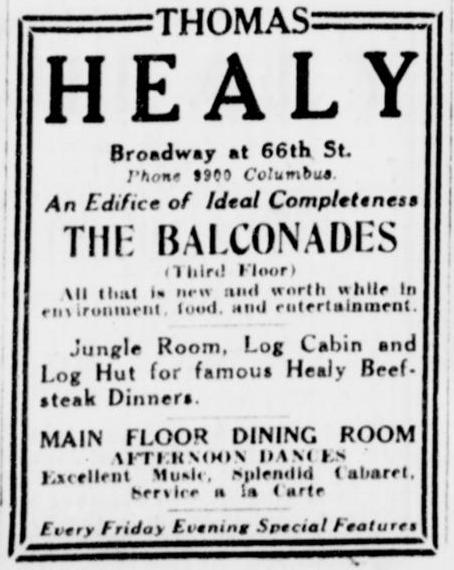
At left: An ad from 1915. Note the ‘Jungle Room, Log Cabin and Log Hut for famous Healy Beefsteak Dinner’
Healy stood ready to combat the mayor, keeping his place open while filing an injunction to keep the law at bay.
For several days, police entered the restaurant and asked patrons to leave at 1 a.m. On Tuesday, August 12, police barricaded patrons in the restaurant, announcing that none of them could leave until 6 a.m. But a defiant Healy removed his remaining diners out a back entrance, foiling the police.
This is certainly explains why the police were especially hostile the following day, August 13. At 1 a.m, police officers mounted the orchestra stage and announced that everybody must leave the restaurant. Drunken patrons laughed and even booed the officer, many proclaiming they had no interest in leaving. Most likely, it was this stubbornness that ignited the rough-handling that followed.
“The recalcitrant guests found themselves enfolded in the uniformed arms, lifted into the air, rushed down the disordered aisles and literally thrown into Columbus Avenue,” reported the New York Times. “In the scramble, tables went over, chairs were smashed, electroliers were damaged, glasses and crockery were broken into fragments. There was pandemonium for a time.”
Violence returned the following night, Thursday, August 14, as rebellious New Yorkers were now insolently dining past the allotted time. Promptly at 1 a.m., an increased force of fifty police officers rushed the restaurant. “Three hundred men and women were led, pushed, shoved, carried, clubbed and thrown out.” [source]
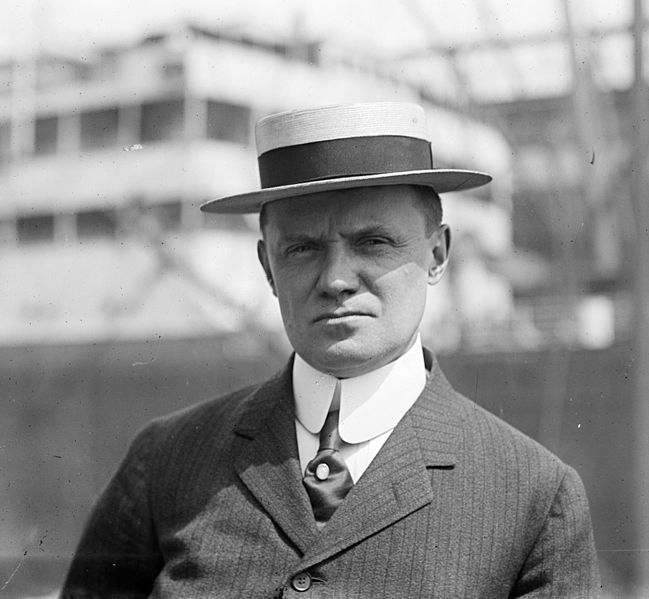
One of those patrons was New York District Attorney Charles S. Whitman (pictured above in 1910), a rumored candidate for mayor and one of the city’s most popular politicians. (In 1916, he would be elected governor of New York.) His appearance at Healy’s was clearly to draw attention. Thousands of people crowded the streets; the nearly elevated train station was filled with people trying to get a better look, and ‘automobile parties’ cruised by, desperate for a peek at the violence inside.
Whitman’s appearance had done the trick. Gaynor backed down, allowing Healy’s to remain open if it wished. In fact, warrants were then issued for police detective John. F. Dwyer and two dozen police officers.
But Healy had created a bit of an unwieldy beast. Crowds gathered the next night and cars lined the street, anticipating more excitement, building uncontrollable mess that the proprietor actually called the police himself! In the end, Healy did end up closing at 1 a.m., just for the protection of his own restaurant and staff.
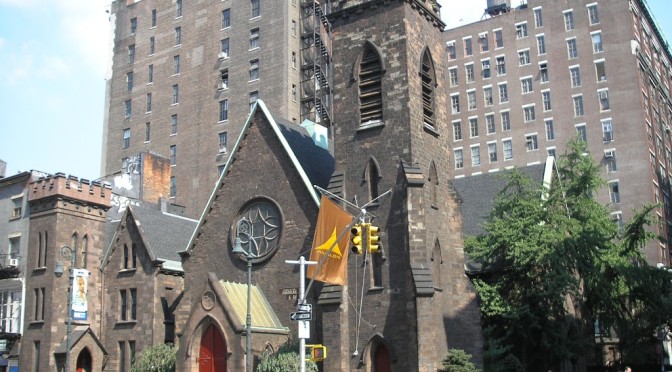
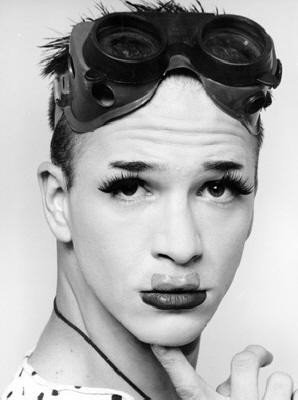
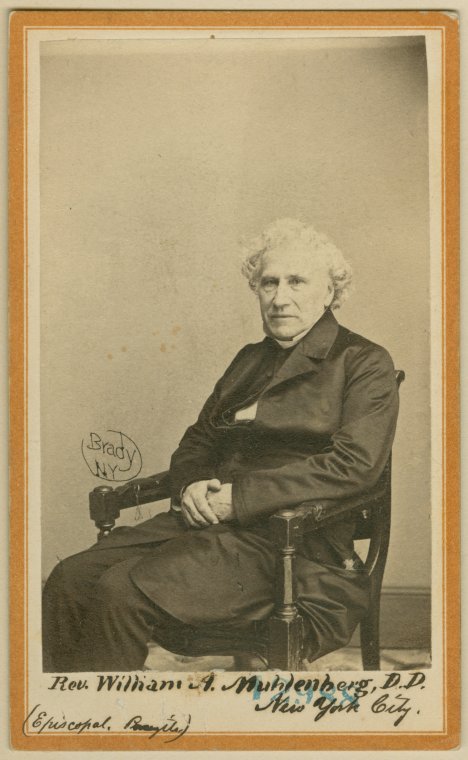
Above: The Church of the Holy Communion — and once the quite infamous nightclub Limelight — as the less lauded follow-up, called Avalon. Within a couple years, the club would be transformed again — into a high-end retail experience. Below: Michael Alig, one of its more notorious nightly residents. (source) PODCAST If you had told 1840s religious leader William Augustus Muhlenberg that his innovative new Church of the Holy Communion, designed by renown architect Richard Upjohn, would become the glittering seat of drugs and debauchery 150 years later, he might have burned it down then and there.
But thankfully, this lovely building is still with us, proving to be one of the most flexible examples of building use in New York City history.
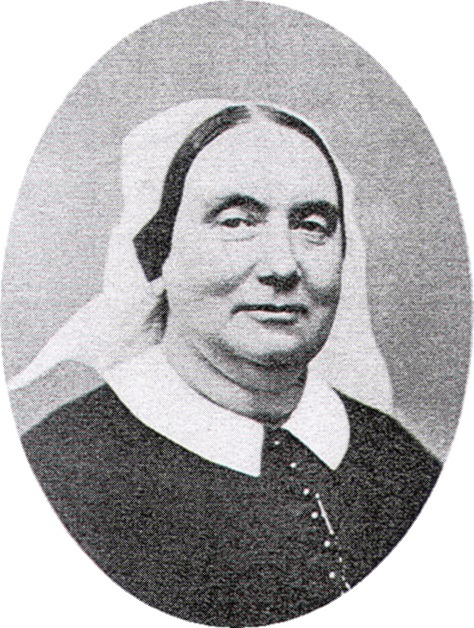
This unusual tale begins with the captivating relationship between Muhlenberg (the grandson of America’s first Speaker of the House) and Anne Ayres, the First Sister in charge of the Sisterhood of the Holy Communion. The two of them helped create one of New York’s great hospital centers. But was something else going on between them?
The Church of the Holy Communion survives the elevated railroad and the fashionable stores of Ladies Mile, and weathers the various fortunes of the neighborhood. When it is finally sold and deconsecrated, it briefly houses an intellectual collective and a drug rehabilitation center before being bought by Canadian club impresario Peter Gatien, who turns it into the Limelight, an iconic and sacrilegious symbol of New York nightlife. And in recent years, the old church has morphed into a rather unique retail experience — shopping mall and department store!
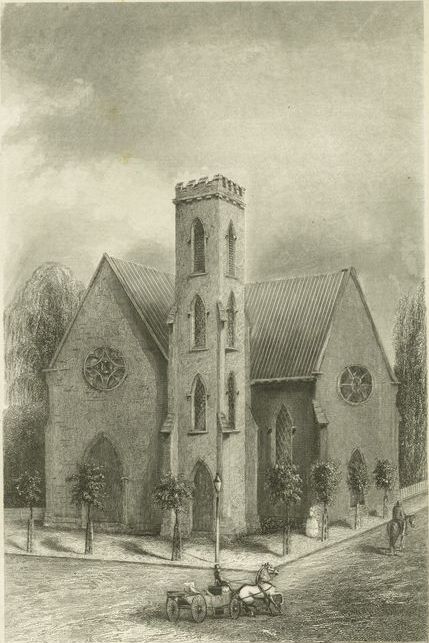
The Church of the Holy Communion in 1846, from an illustration by TD Booth. The asymmetrical shape of the church was innovative for the time, as was the irregular position of the brownstone bricks along its walls. It had every indication of being a medieval country church, but for the fact of it being on a street corner at Sixth Avenue and 20th Street! (NYPL)
William Augustus Muhlenberg, grandson of Frederick Muhlenberg (America’s first Speaker of the House), was a visionary religious leader. He opened Church of the Holy Communion as a way to further his progressive religious views. Pictured below in a carte de visite, probably in the 1860s. (Courtesy NYPL)
Muhlenberg’s reputation was greatly bolstered by Anne Ayres, who became the leading sister as the Reverend’s Sisterhood of the Holy Communion, the first Anglican convent of its kind in America. Ayres helped Muhlenberg with most of the church’s major projects and penned an ecstatic biography after his death. You can read Ayres’ biography of Muhlenberg here.
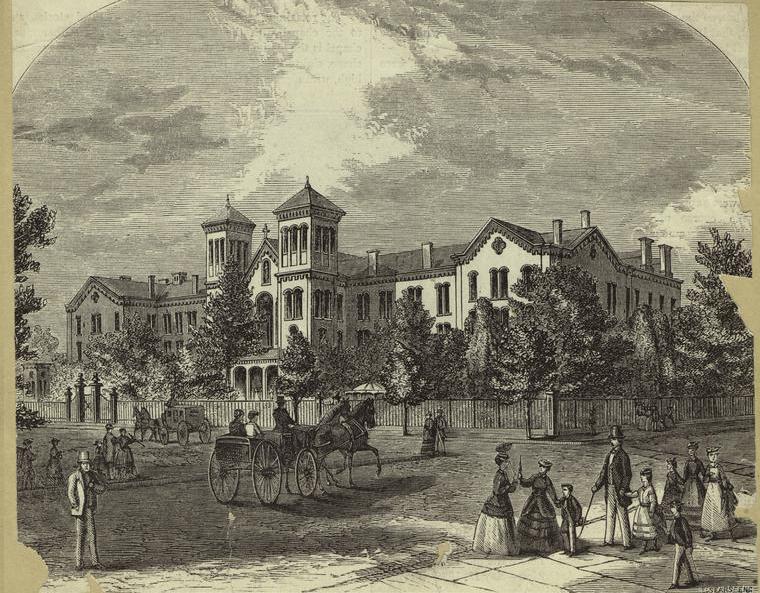
Muhlenberg and Ayres founded a small infirmary near the church, then later expanded it at Fifth Avenue and 54th Street, becoming the first location of St. Luke’s Hospital. As you can tell from the original hospital building, it seems to reflect a bit of the architecture of the Church of the Holy Communion. (Pic courtesy NYPL)
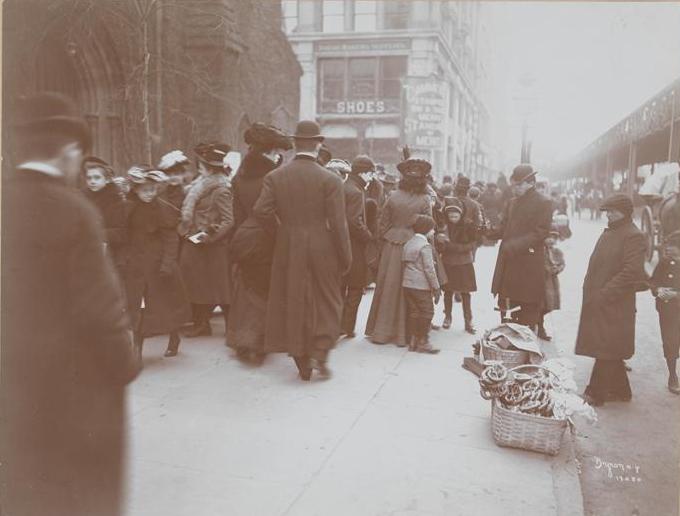
A view from 1895, possibly of a Sunday crowd leaving the church. Vendors like this pretzel seller gathered on the street below, selling treats to shoppers of Ladies Mile. The church would have been in the heart of New York’s major shopping district during the Gilded Age, with grand department stores stretching on either side of the street. (Courtesy the Museum of the City of New York)
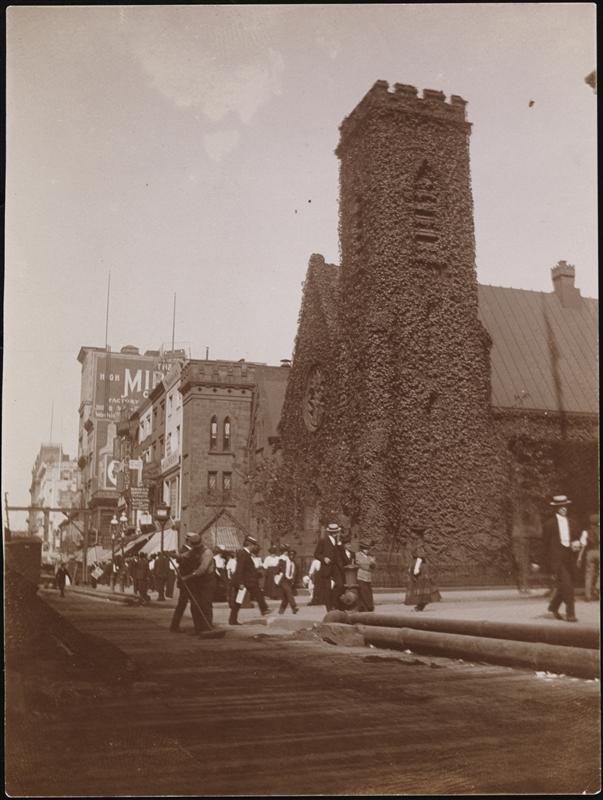
The Church of the Holy Communion, enveloped in thick ivy, as it looked in September 1907. It also appears this photo was taken in the early afternoon, as the shadow of the elevated railroad begins to creep across the street. (Courtesy Museum of the City of New York)
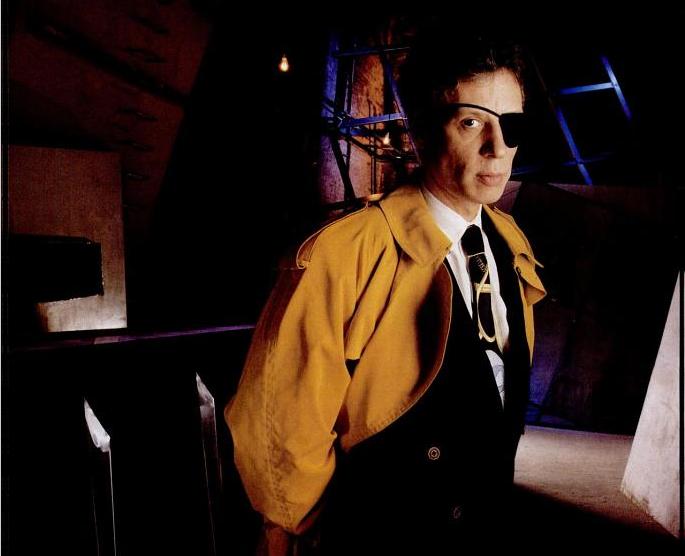
Peter Gatien, pictured here in a 1993 issue of New York Magazine. The Canadian club owner bought the old church and transformed it into a nightclub in 1983.
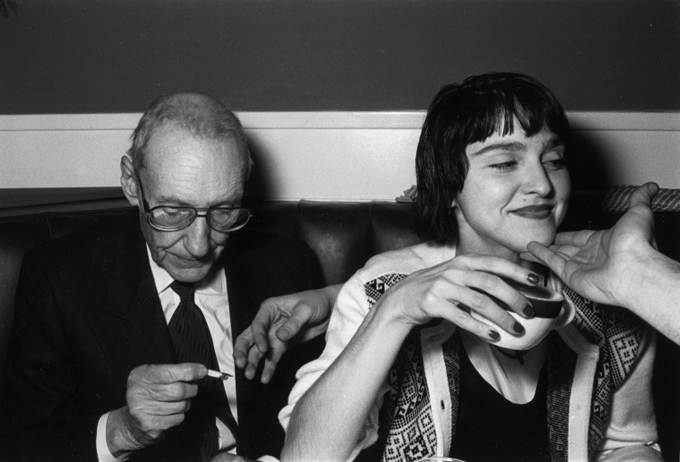
The Limelight was a celebrity hotspot from the very opening in 1983. When William Burroughs had his 70th birthday at the club in 1984, the young new superstar Madonna came by to wish him well. (Photo by Wolfgang Wesener, courtesy here)
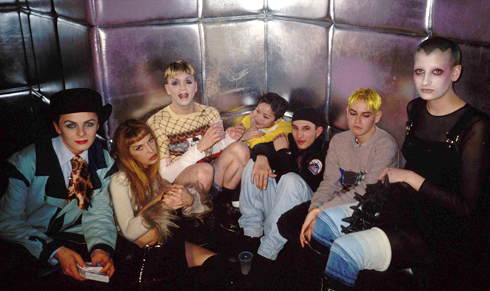
But why conjure real celebrities when you could make some yourself! By the early 1990s, the club kid set the tone for the Limelight, further turning the old church of Muhlenberg into a surreal playground of music and drugs.
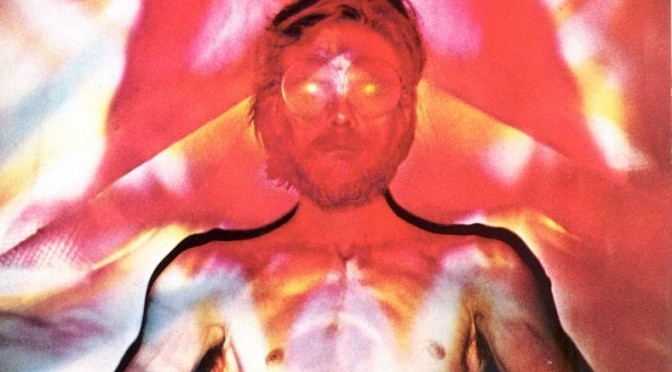
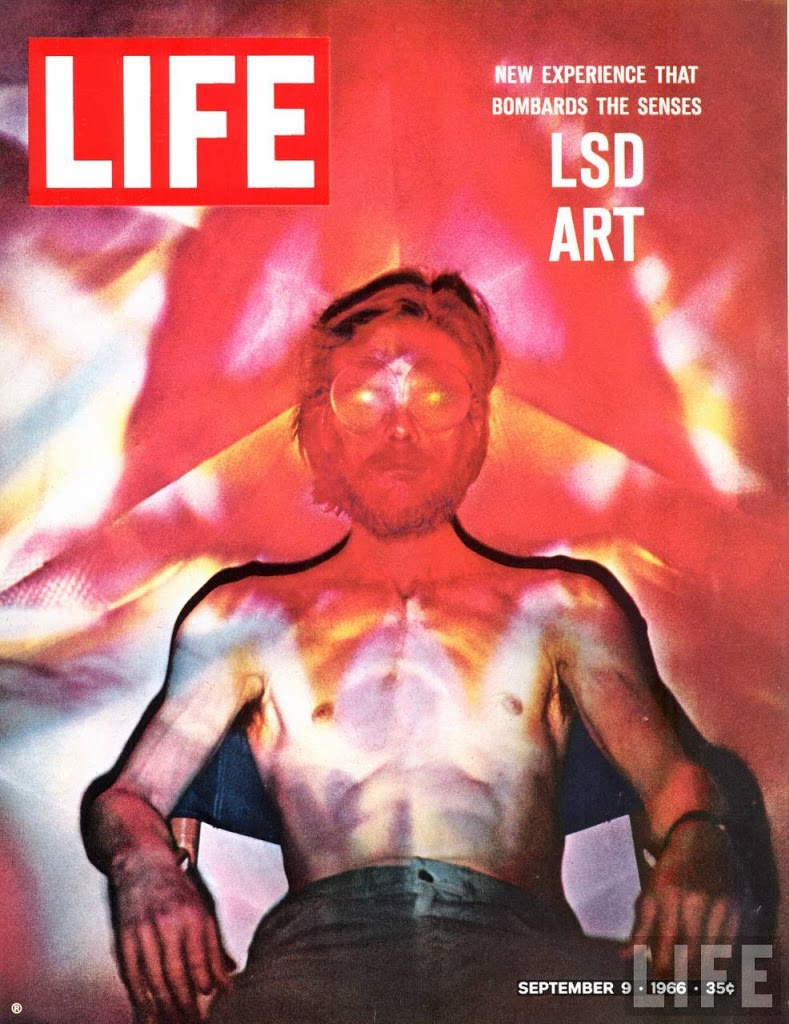
A mind-twisting exhibit at the Riverside Museum, formerly at 310 Riverside Drive/103rd Street, makes it on the cover of a national magazine. But not everybody would enjoy the trip.
WARNING The article contains a couple spoilers about last night’s ‘Mad Men’ on AMC. If you’re a fan of the show, come back once you’re watched the episode. But these posts are about a specific element of New York history from the 1960s and can be read even by those who don’t watch the show at all. You can find other articles in this series here.
Sure, it’s 1966. I thought maybe Peggy Olsen might be the one to trip the light fantastic. (She was otherwise engaged this week.) But I never expected hallucinogenics to materialize as they did on last night’s ‘Mad Men’. After a staggeringly serious dinner party narrated with empty philosophical conversation, Roger Sterling and his wife are invited to take the drug LSD by their host. Far from the dorm rooms and basement clubs of Greenwich Village where one might expect such experimentation, this evening of psychedelia was presented as a drawing-room intellectual exercise, with serene music unspooling from a reel-to-reel and no object more trippy than a mantel mirror.
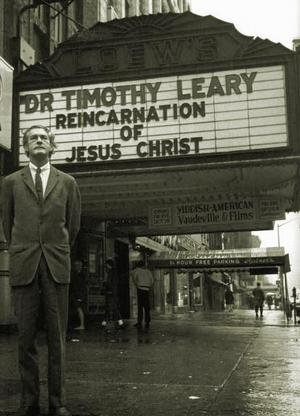
Lysergic acid diethylamide, which I doubt can actually be said while experiencing its effects, was considered a mind-opening tool for some early psychiatrists, laying bare subconscious feelings and forcing the user to confront difficult issues in a surreal environment. By the mid ’60s, its leading advocate was Timothy Leary (below), a psychologist who had studied the benefits of psychedelic drugs to explore the mental capacities. Today we might naturally lump him with the trappings of ’60s counter-culture, but in 1966, with the parameters of psychiatry still in flux, his experiments also appealed to intelligentsia.
The depiction of ‘Mad Men’s after-dinner drug soiree seem to follow Leary’s instruction quite explicitly. In 1966, he advised, “Don’t take LSD unless you are very well prepared, unless you are specifically prepared to go out of your mind. Don’t take it unless you have someone that’s very experienced with you to guide you through it. And don’t take it unless you are ready to have your perspective on yourself and your life radically changed, because you’re gonna be a different person, and you should be ready to face this possibility.”
An article in March 25, 1966, LIFE Magazine laid out the details of the drugs in almost an introductory fashion. “A black market dose costs only $3 to $5. But that’s enough to send a person on a 10-hour ‘trip’.”
The same article also underscored a growing fear: “A few pounds of it dumped into the water supply of a major city would be enough to disorient millions.”
The federal government had been concerned of this supposed conspiracy as early as the 1950s, fearful that Russians might pollute New York’s water and “turn drug-addled American citizens against their own government.” [source] Of course, the CIA itself experimented with LSD during this period with its covert Project MKULTRA, which conducted experiments in New York during the mid-50s, using prostitutes and junkies they found in local bars in Greenwich Village. An experiment performed on CIA operatives themselves led one agent in 1953 to leap from a window at the Statler Hilton, today’s Hotel Pennsylvania. (Or was it murder?)
By the 1960s, the drug had become a virtual entrance exam for New York’s blossoming counter-culture music scene, or so the more hysterical believed. “In New York, San Francisco and Los Angeles, a girl just off the bus from Boise can find it quicker than the YWCA merely by asking around for ‘a trip’,” warned Life Magazine.
The fear of an unwitting populace overtaken with LSD only grew with the 1960s, and this time, some thought it was New York’s counter-culture rebels itself who may be wielding it. A 1967 journal opined on the urban legend with all seriousness. “[A] single ounce will provide fuel for 300,000 trips, reported one periodical, and it is believed that a few pounds dumped into the water supply of New York City would disorient the nearly 8,000,000 residents.”
Perceptions of LSD were slowly divorced from its supposed therapeutic qualities, especially as the drug soon found itself as the subject of films like Roger Corman‘s ‘The Trip‘ and ‘Enormous Midnight‘, where town water supply is poisoned with LSD and turns its citizens into orgiastic zombies. In New York, LSD entered the club world; hallucinogenic mid-60s destinations like Cerebrum and the Electric Circus (which became Andy Warhol‘s preferred spot in 1966) seem almost conceivable without it.
New York legislators quickly vowed to outlaw the new drug. Bellevue Hospital reported over 200 new patients affected by the drug. In April 1966, two local crimes energized the press: a Brooklyn girl accidentally ingested a sugarcube coated with LSD, and a week later, a ex-mental patient killed his mother-in-law, allegedly under the influence of the drug. With the Stagger-Dodd bill in 1968, the possession of LSD became illegal in the United States.
While that effectively ended the living-room therapy sessions such as the one experienced by Roger Sterling, the drug, now underground, would increasingly influence all aspects of New York bohemian culture.
From the Cerebrum club mentioned above:
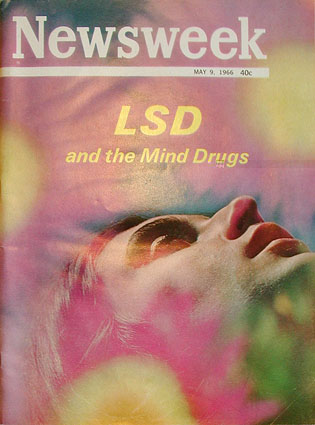
Pictures courtesy Newsweek and Life Google Images. For more information on the CIA’s LSD experiments, you might be interested in watching this video.
If you’re watching ‘Mad Men’ when it broadcasts at 10 PM EST, then follow along with me on Twitter at @boweryboys. I’ll be giving a live fact-Tweeting, dropping little factoids about the events being depicted on the show
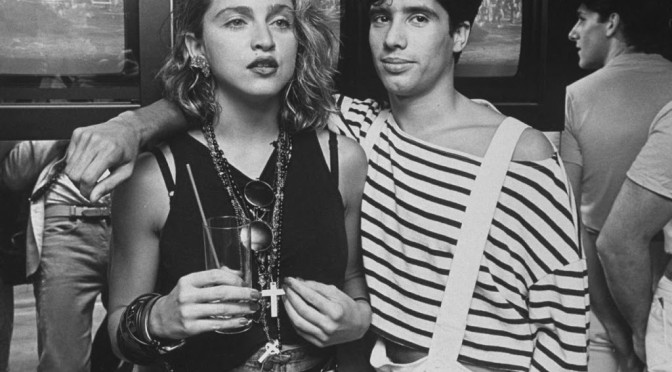
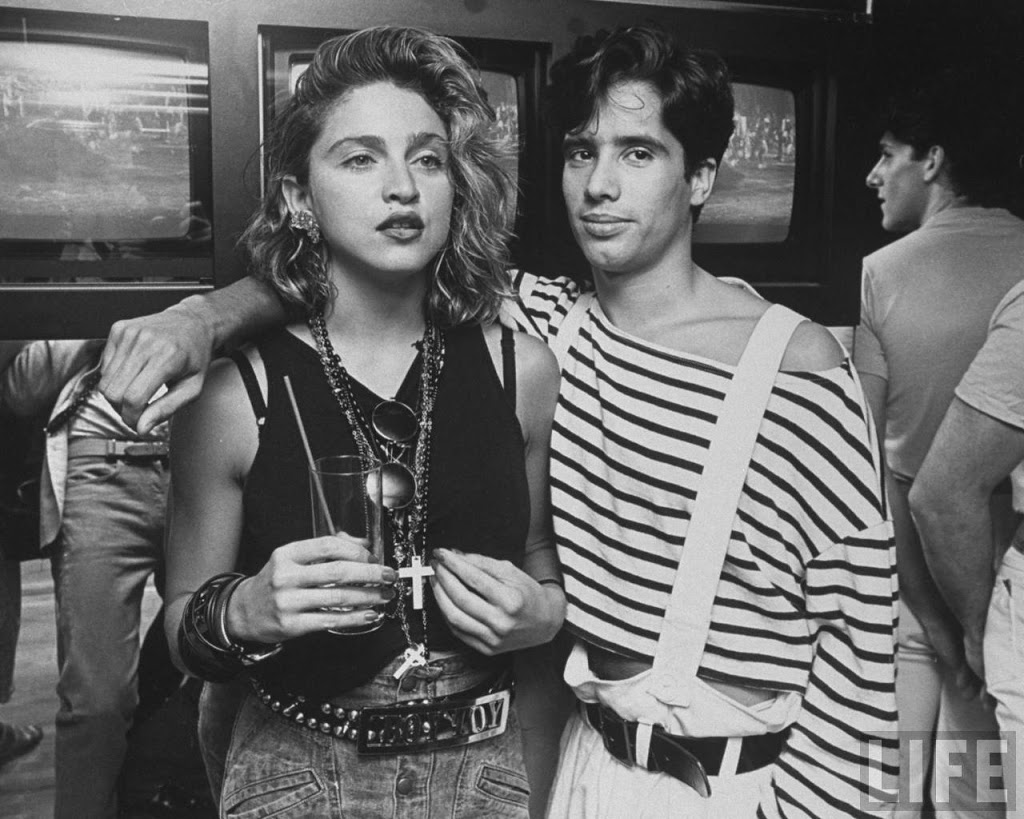
Girl gone wild: Madonna enjoys the video opulence of Private Eyes with former boyfriend and producer Jellybean Benitez, July 17, 1984
It’s 1984, and the hottest trend in American pop culture is the music video . MTV had debuted a channel of non-stop music videos in 1981, and just three years later, most new pop superstars were being defined by them– Michael Jackson, Prince, Duran Duran, Cyndi Lauper, Wham, Culture Club.
One of the more notable New York club opening in the summer of 1984 was Private Eyes, a trendy gay lounge at 12 W. 21st Street, poised to meet the video future with full-on glittery radness. With MTV revolutionizing pop music by the early 80s, nightclubs rushed to incorporate the new trend into their aesthetic. At Private Eyes, clubgoers needn’t have worried about a frenetic disco floor; they were literally invited to be mesmerized. “There is no defined dance area — it’s like a living room with the coffee table pushed aside.” the owner told Billboard magazine in November 1984.
The club was state-of-the-art for its day, with almost three dozen television sets, an immense library of 3/4th inch VHS cassettes and the technology to make “beat-for-beat transitions between videos, as well as wipes, fades and full mix effects for the club’s six tape decks.” New York Magazine listed it among their ‘environment clubs‘ of 1984, “like a department-store television section, except at Private Eyes you can have a beer and you can’t change the channel.”
In its opening months, Private Eyes scored a few appearances by music video’s biggest female star of the day — Madonna.
As a friend of owner Robert Shalom, Madge allegedly swore by the club, sometimes popping in after a day of recording her album Like A Virgin over at the Power Station studios on W. 53th Street*. “I don’t have MTV,” she remarked. “I do see videos, I go to Private Eyes.” Her record label hosted a party in celebration of her new album, released in November that year. Several months later, Madonna was photographed at the club with her rowdy companion Sean Penn on their first date.
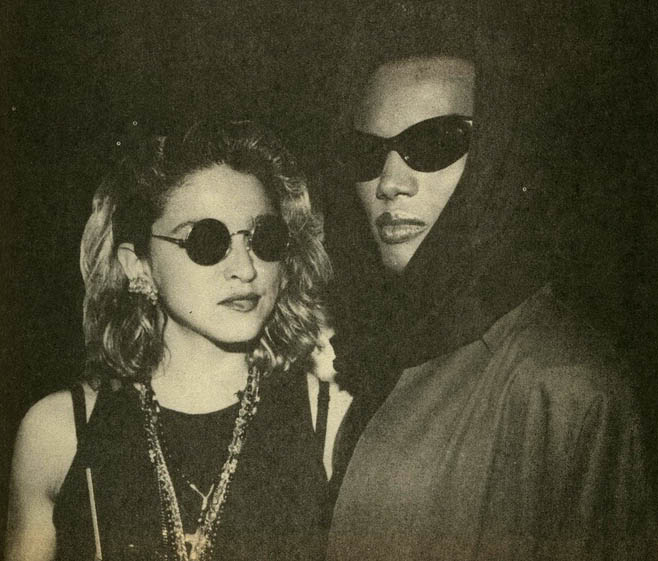
Below: Madonna, inside Private Eyes with Grace Jones, sometime in 1984, perhaps both having difficulty watching music videos with sunglasses on
The strict notion of a ‘video club’ in New York faded when it became cheaper for smaller clubs to install multiple screens and access video material. And, of course, as more common clubs joined the video revolution, the swankier ones eschewed it. Dance clubs that did opt for visual entertainment embraced ambient sets of computer animation by the early 90s, often leaving standard music videos for MTV and other cable networks. (Eventually even MTV left music videos.)
Private Eyes morphed with the times, eventually becoming the Sound Factory Bar in the 1990s, a spin off of sorts to the renown but troubled all-hours club on W. 27th Street, in the shadow of the West Chelsea’s elevated tracks. It refreshed its image a few years later under the name Cheetah.
Madonna, who had starred in five music videos by the time she first stepped foot in Private Eyes in the summer of ’84, has gone on to make a total of sixty-nine of them, including one that was just released this week.
*The year before, Bruce Springsteen recorded portions of ‘Born In The U.S.A.’ in the same studios.
Top picture courtesy Life Google images. Second image courtesy Madonna Scrapbook
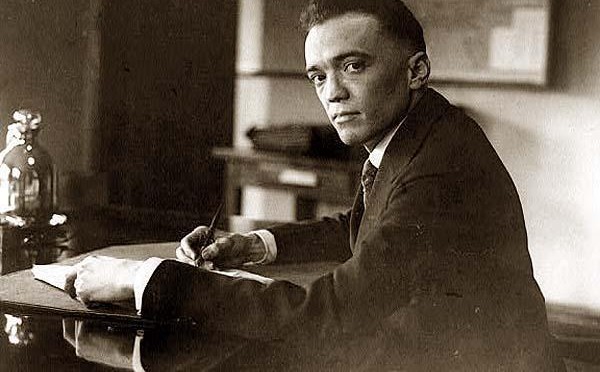
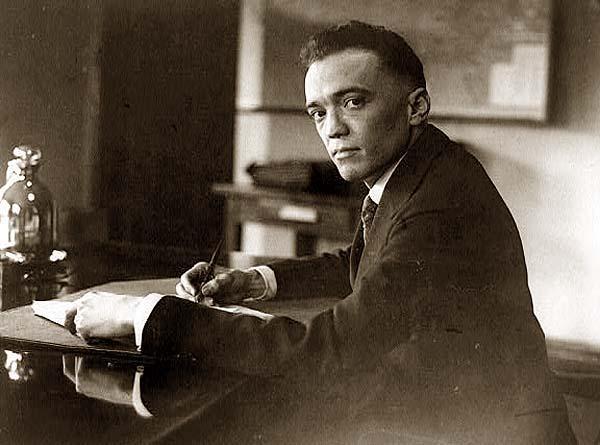
Work hard, play hard: The FBI director in his early days
There are at least three scenes in the new Clint Eastwood-directed J. Edgar Hoover biopic‘J. Edgar’ set in New York, one of which might surprise you.
The first features Hoover on Ellis Island, but he’s hardly there to greet new arrivals. The FBI director’s early career was spent ferreting out and deporting anarchists, and his biggest target was Emma Goldman. On October 27, 1919, Goldman was put on trial at Ellis — in the film, the Statue of Liberty stands at odds in the background — and she was eventually expelled from the United Statues using a tenuous interpretation of the status of her American citizenship.
The second scene, depicting the rural Bronx of 1933, typified Hoover’s career in the 1930s as a stiffly facaded embodiment of law enforcement. Here the movie envisions the arrest of Bruno Hauptmann, accused kidnapper of the child of Charles Lindburgh. Hoover’s interest in the case represented an expansion of federal powers for the agency, even if Hoover’s actual involvement is questionable.
But it’s the third view of old New York that I found more intriguing. Hoover was a teetotaler early in life and demanded his agents aspire to clean, moral living. So its interesting that he — and his companion Clyde Tolson — were regular habitues at New York’s hottest nightclub of the 1930s — the Stork Club.
Sherman Billingsley, a former bootlegger, would have been made Hoover’s enemy list during Prohibition. Instead, he regularly hosted the FBI director as his swanky club at 3 East 53rd Street (at Fifth Avenue).
Hoover schmoozed here with people who were useful to him, journalists like Walter Winchell who assisted with the capture of most-wanted criminals from his banquette in the Cub Room. The unscrupulous columnist was instrumental in the surrender of Louis “Lepke” Buchalter, leader of the mob’s assassination unit Murder Inc., and helped play up the image of Hoover’s G-Men to his millions of readers. In return, Hoover sometimes provided Winchell with FBI employees as bodyguards or drivers.
Winchell and others considered the Stork Club an invaluable nexus of social connections, and Hoover too made it his hangout when he was in town, often downing champagne and chatting with glitterati. The director was so associated with the nightclub in the 1930s, Tolson at his side, that adversaries sometimes called him ‘the Stork Club detective’.
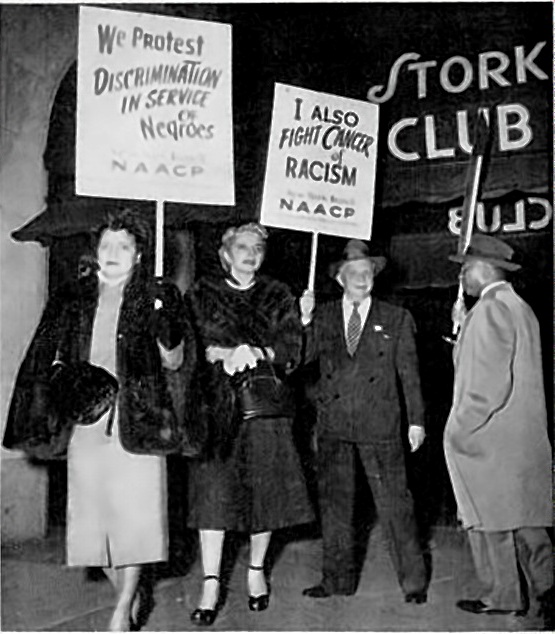
In a telling incident a few years later, in 1951, iconic entertainer Josephine Baker was denied service at the Stork Club. She filed a complaint with the police department, and supporters organized a protest outside the nightclub (pictured at right). When it was recommended that Hoover intervene on the behalf of Baker, he replied, “I don’t consider this to be any of my business.” [source]
Here’s a collection of photos of the Stork Club with musical accompaniment. Mr. Hoover appears in one image around minute 2:40:

 Courtesy Museum of the City of New York