Categories
Landmarks Podcasts

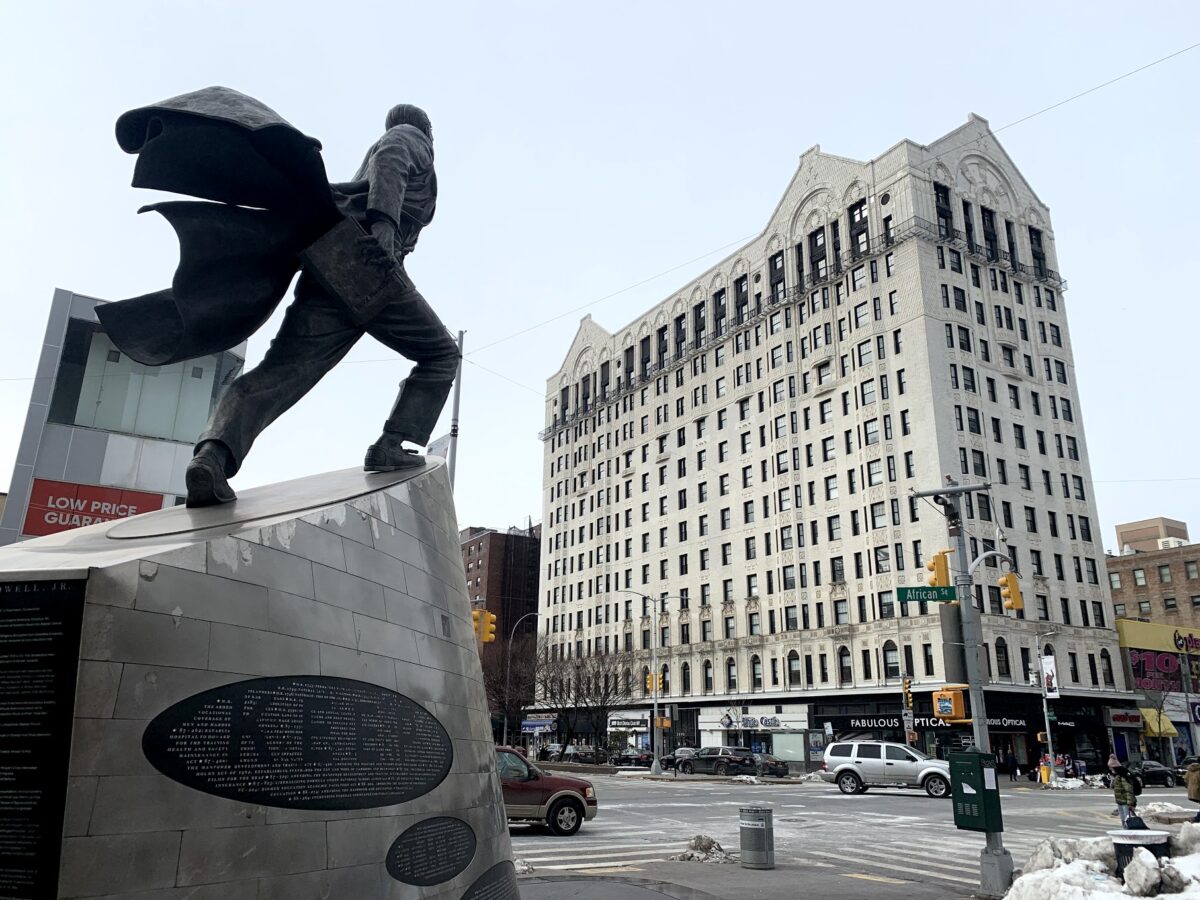
Harlem Nights at the Hotel Theresa

PODCAST The Hotel Theresa was once called the Waldorf of Harlem, a glamorous New York City accommodation known as a hub for Black society and culture in the 1940s and 50s — and for a few eyebrow-raising political moments in the 1960s.

The luxurious apartment hotel was built by a German lace manufacturer to cater to a wealthy white clientele.

But almost as soon as the final brick was laid, Harlem itself changed, thanks to the arrival of thousands of new Black residents from the South.

Harlem, renown the world over for the artists and writers of the Harlem Renaissance and its burgeoning music scene, was soon home to New York’s most thriving Black community.  But many of the businesses here refused to serve Black patrons, or at least certainly made them unwelcome.
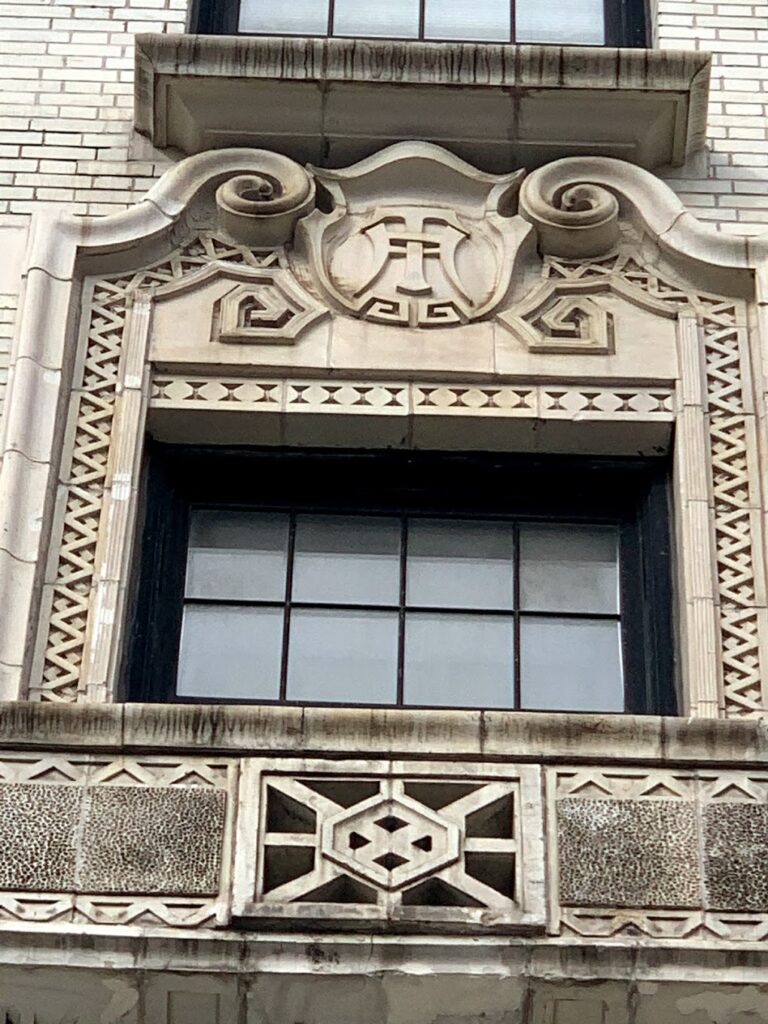
The TH initials over the windows. Photo courtesy Greg Young

The Theresa changed its policy in 1940 and soon its lobby was filled with famous athletes, actresses and politicians, many choosing to live at the Hotel Theresa over other hotels in Manhattan.  

The hotel’s relative small size made it an interesting concentration of America’s most acclaimed Black celebrities. And an almost surreal backdrop for presidents and foreign leaders alike.
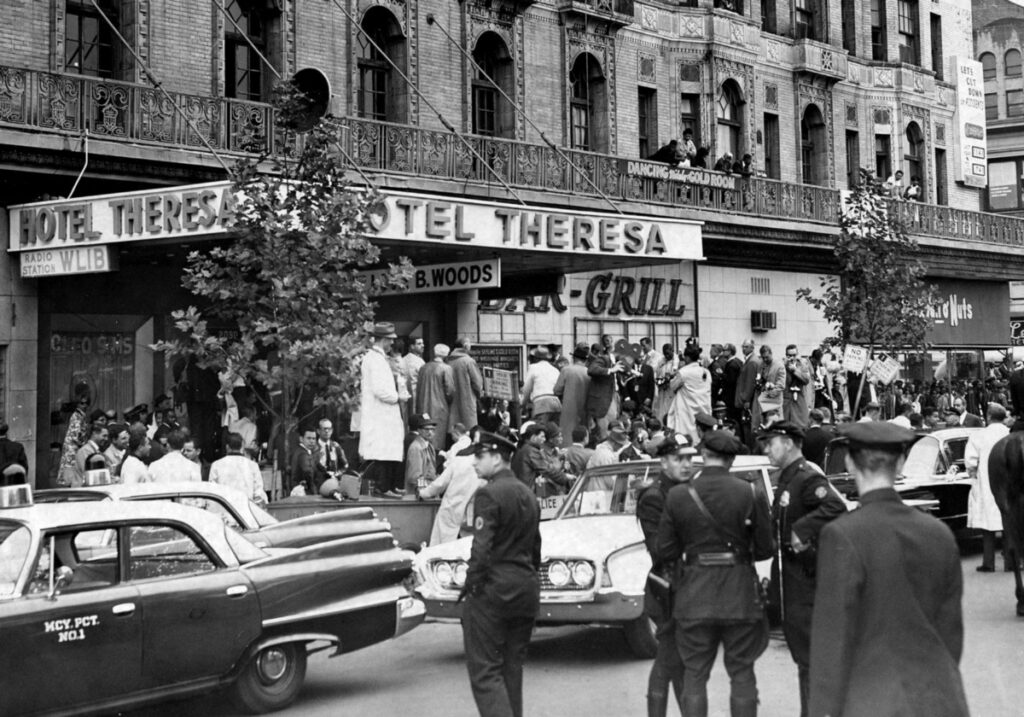
Media frenzy around the Fidel Castro’s stay at the hotel.

In this podcast, Greg gives you a tour of this glamorous scene, from the corner bar to the penthouse, from the late-night coffee shop to the crazy parties of Dinah Washington.

WITH: Martin Luther King Jr, Dwight D. Eisenhower, and Fidel Castro. And music by Sarah Vaughan, Billy Eckstine and Duke Ellington

ALSO: Who is this mysterious Theresa? What current Congressman was a former desk clerk? And what was Joe Louis’ favorite breakfast food?


Listen to Harlem Nights at the Hotel Theresa on your favorite podcast player or from the player below:

The first half of this show was originally released in 2013 (as Episode #158) but has been newly edited for this release. The second half of this show is ALL NEW.

MUSIC FEATURED: “Sophisticated Lady” by Duke Ellington and His Orchestra and “Dedicated To You” by Billy Eckstine and Sarah Vaughan. 

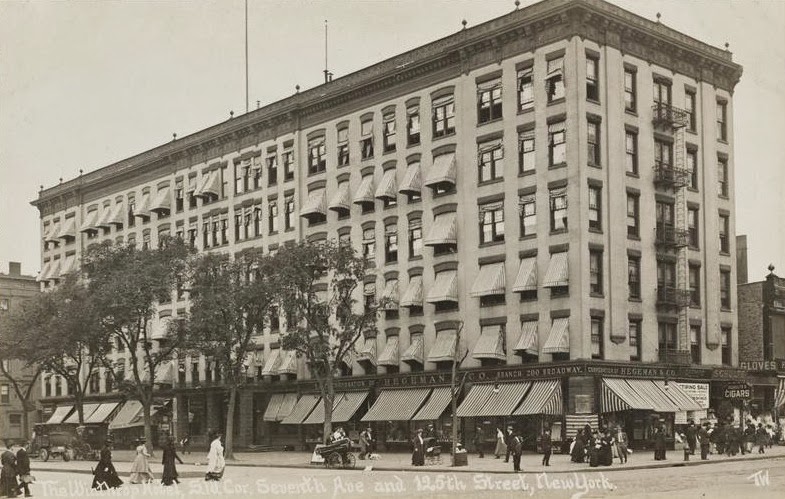
The Hotel Winthrop which sat on the spot of the Theresa before it was torn down in the early 1910s, deemed a bit inadequete for the growing neighborhood.
Museum of the City of New York

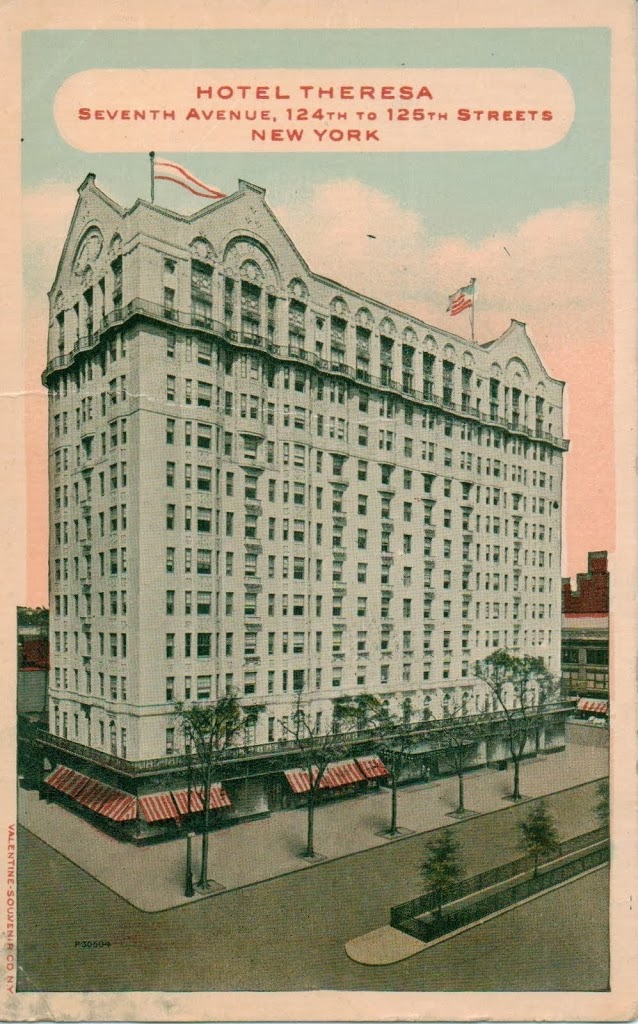
An early glimpse of the Hotel Theresa.
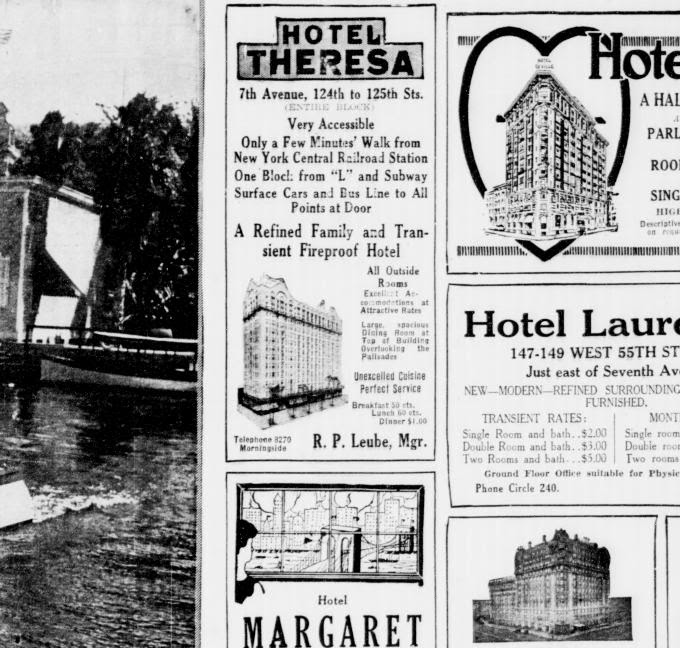
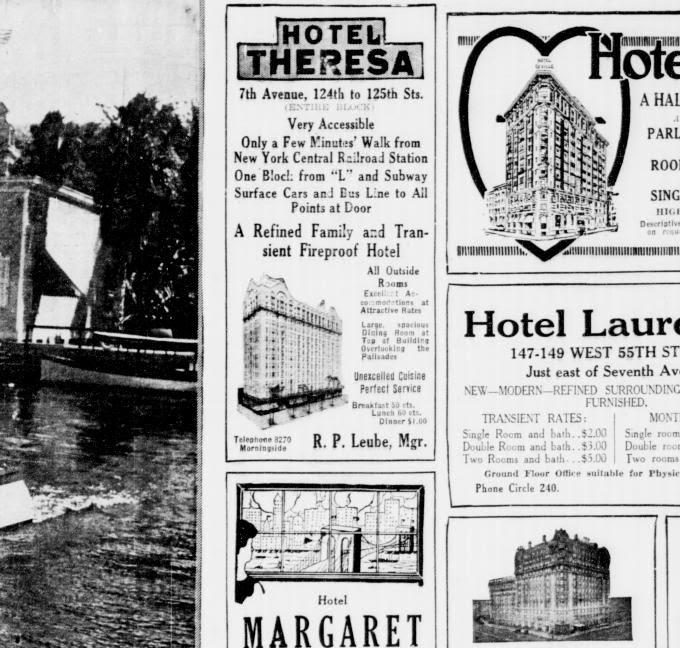
From the February 4, 1917, issue of the New York Tribune, making note of its “large spacious dining room overlooking the Palisades.”
The Hotel Theresa, circa 1915.  Courtesy the Museum of the City of New York
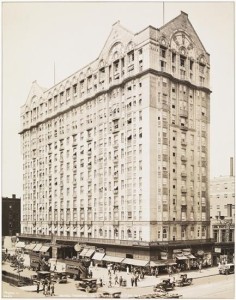
Hotel Theresa, Seventh Ave. & 125th Street.

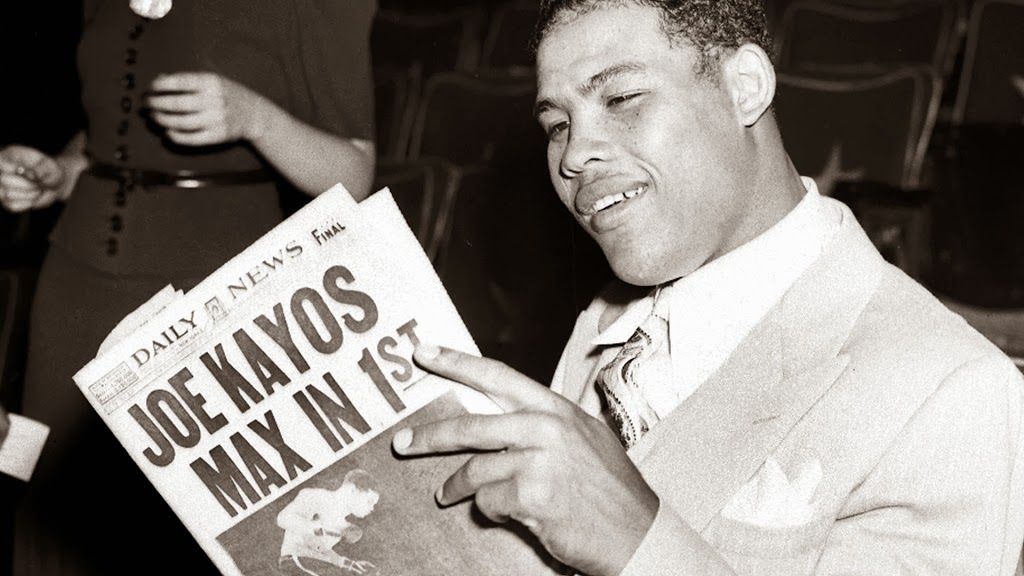
Boxer Joe Louis was one of America’s most famous athletes in the 1940s and a frequent guest at the Teresa.  Joe fought the German boxer Max Schmeling twice, both times at Yankee Stadium.  

Max bested Joe in the first match, but on the second go-around in 1938, Louis knocked out Schmeling in the first round.  

He enjoyed his win that evening at the Theresa, as thousands of fans gathered in front of the hotel and throughout the city in celebration.
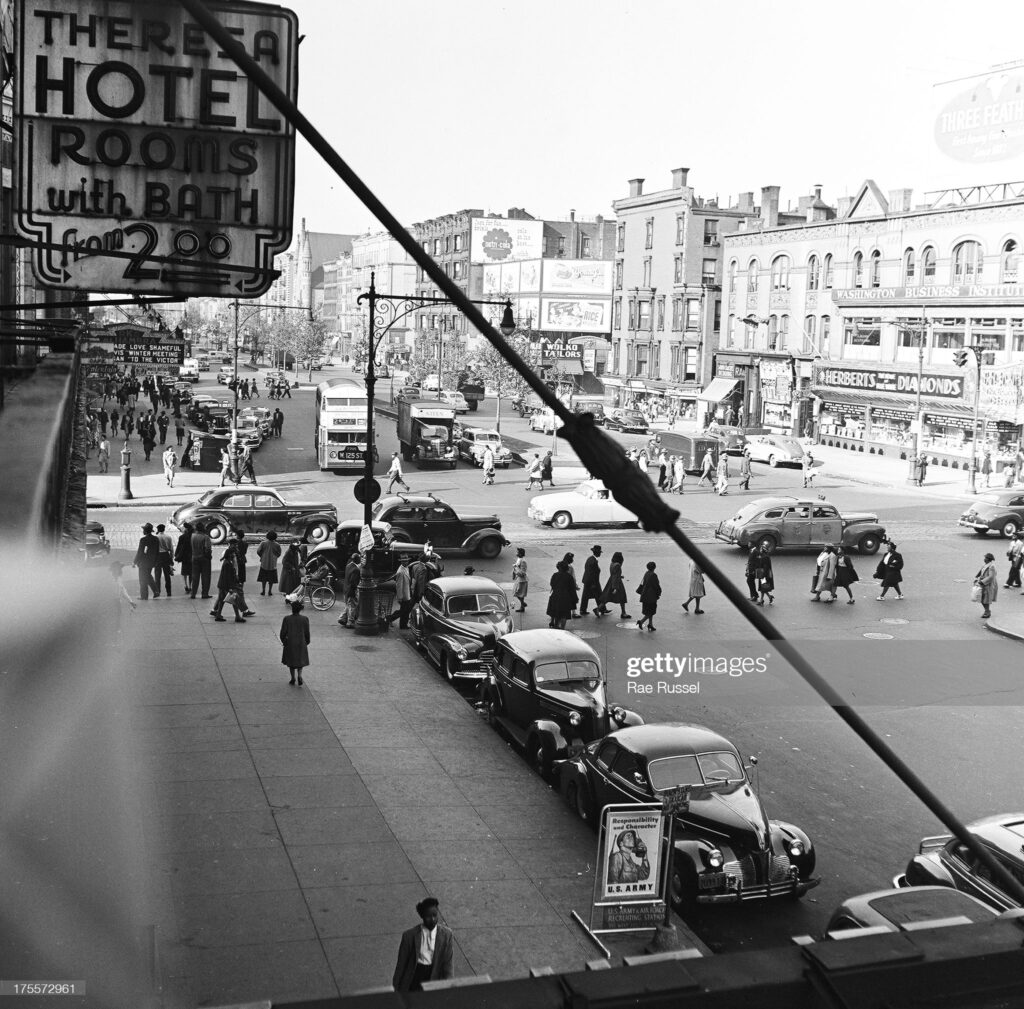
View of pedestrian and vehicular traffic at the corner of 125th Street and 7th Avenue in Harlem, New York, New York, 1948. The sign for the Theresa Hotel is visible on the left. (Photo by Rae Russel/Getty Images)

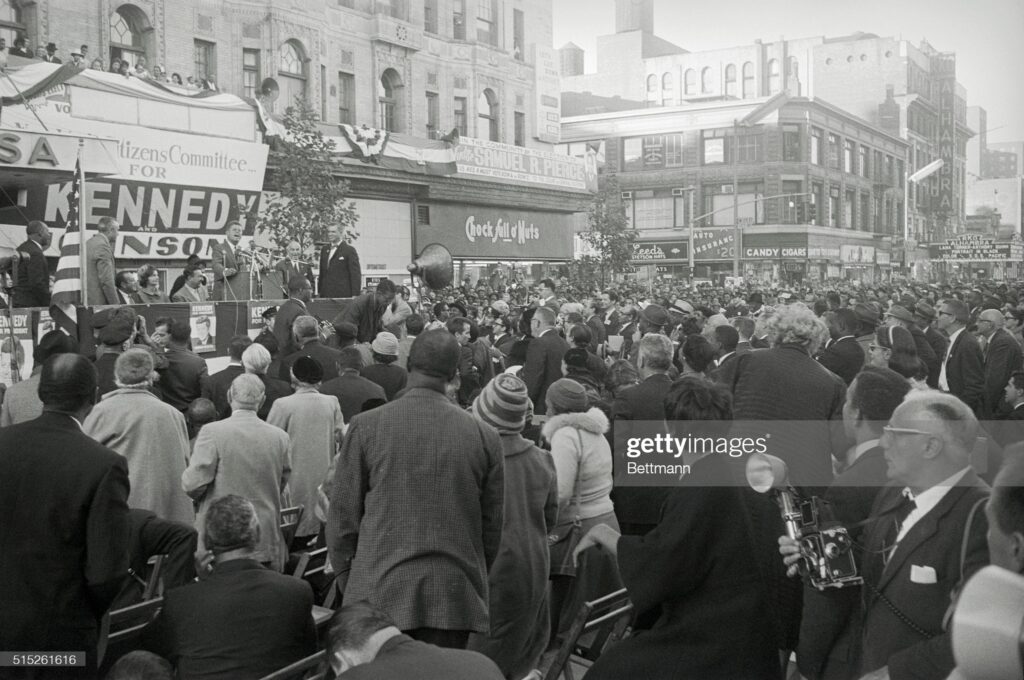
Malcolm X speaking to crowds in front of the Hotel Theresa — back when there was a Chock Full O Nuts on street level! Malcolm would be very associated with the hotel, headquartering here after his split with the Nation of Islam.  
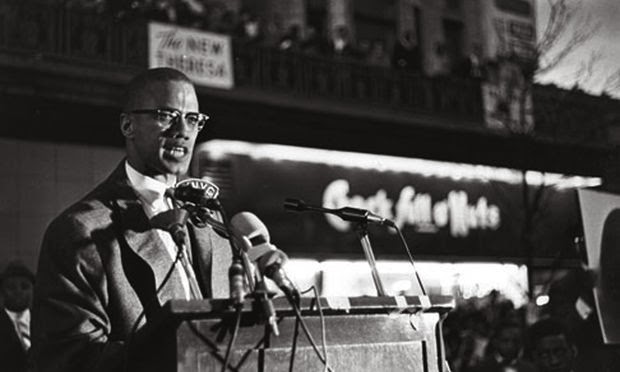
Photo by Larry Fink c/o WNYC
Sen. John F. Kennedy, Democratic presidential nominee, speaks at a rally in front of the hotel Theresa in Harlem. Kennedy made a half dozen speeches or appearances in and around the city during the second of a three-day bid for New York State’s 45 electoral votes. (Getty Images)

Jet Magazine and Ebony Magazine founder John J Johnson conceived the ideas for both magazine at the Hotel Theresa and frequently published articles about the Theresa.
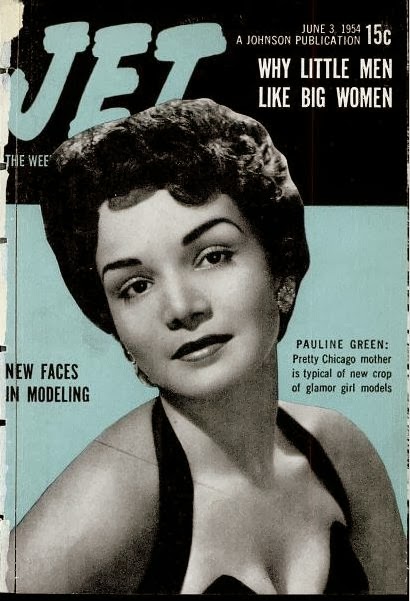
 A notice in a 1954 issue of Jet announcing the opening of the Hotel Theresa ballroom, called the Skyline.
The Bowery Boys: New York City History podcast is brought to you …. by you!

We are now producing a new Bowery Boys podcast every other week. We’re also looking to improve and expand the show in other ways — publishing, social media, live events and other forms of media. But we can only do this with your help!

We are now a creator on Patreon, a patronage platform where you can support your favorite content creators.

Please visit our page on Patreon and watch a short video of us recording the show and talking about our expansion plans. If you’d like to help out, there are six different pledge levels. Check them out and consider being a sponsor.

We greatly appreciate our listeners and readers and thank you for joining us on this journey so far.
Categories
Pop Culture

I Called Him Morgan: The Murder of a Jazz Star in wintry 1970s New York

It was during one of those terrible February nights — blizzard winds with the streets packed tight with snow — at a jazz club in the East Village named Slug’s Saloon, packed with people haloed in cigarette smoke, that a woman named Helen Morgan walked up to one of the performers, her common-law husband, a rising jazz trumpeter named Lee Morgan, and shot him dead.

This tragedy had entered into jazz music mythology. Lee Morgan was a prodigy Blue Note Records recording star of the late 1950s and ’60s who was very nearly waylaid by heroin addiction. But by the early 1970s he was clean. And that was because of Helen.

So why did she kill him?

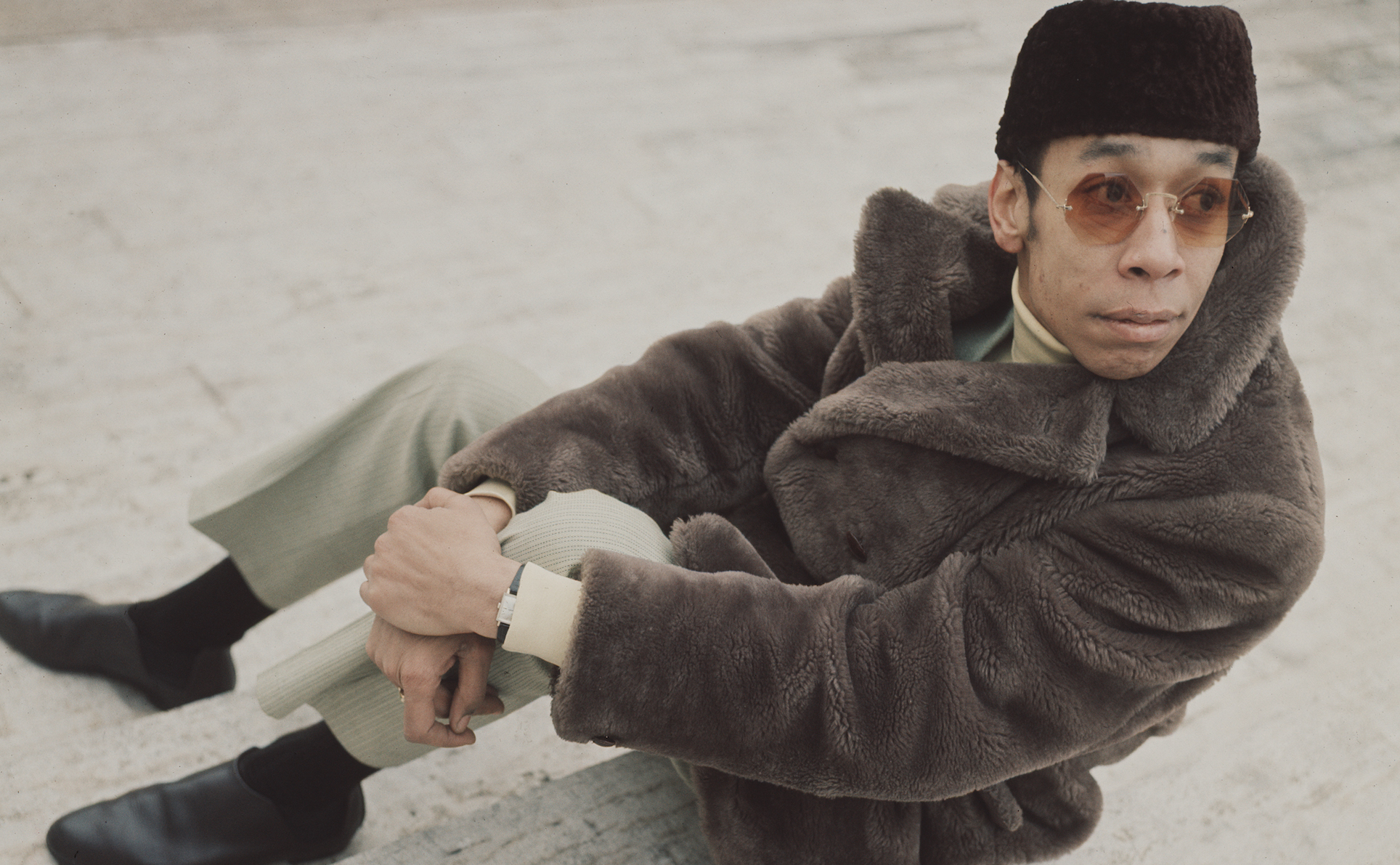
The new documentary I Called Him Morgan, directed by Kasper Collin, is a tranquil and lyrical retelling of Morgan’s bright, brief career and the influences that led to his redemption and death. It also shows off a cool, raw backdrop of 1960s New York grit and shadow, rendered not from acres of stock footage (although there is some) but from abstract re-creation and creative editing. The film itself is very much like a tune Lee Morgan himself would have played.

The film’s driving force is a cassette tape. In the 1990s, Helen Morgan, long released from prison, enrolled in an adult education class in Wilmington, NC, where she met jazz aficionado and former radio host Larry Reni Thomas. Familiar with Morgan’s story, he asked if he could interview her and record the session on cassette tape. She died the following month.

A music documentarian could not dream of a better plot device. Helen talks about her life and her first meeting with the young, impressionable jazz star at her apartment on West 53rd Street, near the legendary Birdland jazz club.

They were an unusual pair — she was older and streetwise, he was an adorable ball of energy and creativity — but they clicked, for a time. She even managed to get him back on his feet after a stint with heroin addiction.

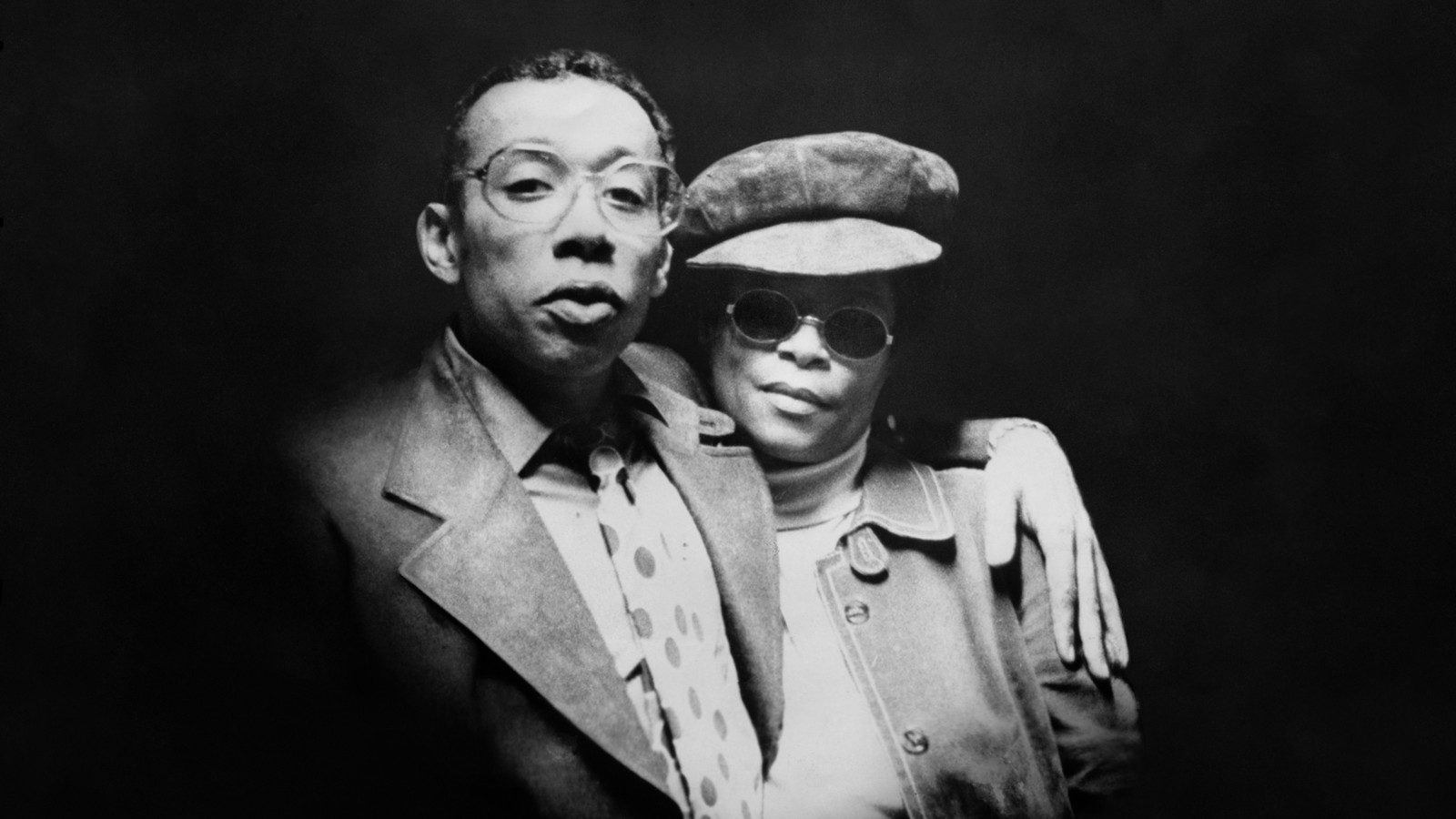
Kasper Collin Produktion AB / Courtesy of the Afro-American Newspaper Archives and Research Center

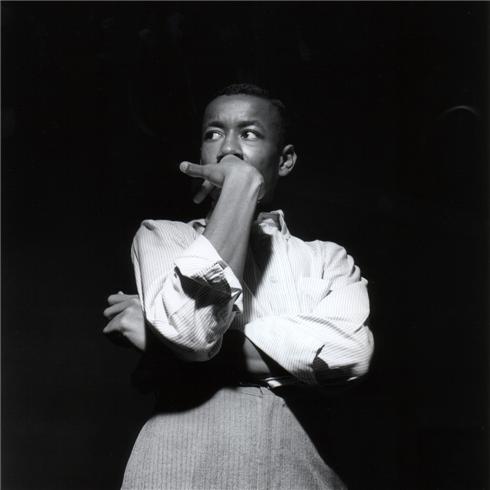
Helen exists in the film only in a few fleeting photographs. She hated getting her picture taken, and in those that exist, she never looks thrilled. Lee Morgan, however, comes alive in archival footage and black-and-white photographs. Yet we hear her voice and never his — only through his forceful and vibrant music, sounding as crisp and present in the film as though it were being heard live.

The film’s dreamlike, filtered quality pairs exquisitely with the music, creating a tight-focused look at New York and the Lower East Side in particular. Slug’s Saloon was at 242 East 3rd Street, between Avenue B and C, and the entire street, clogged with snow, is shot with grainy foreboding.
Morgan’s musician friends avoided walking the street after his death; the club closed many months later. This may be a street you’ve lithely walked down many times in the past. After watching I Called Him Morgan, you may feel a sense of gloom the next time you walk past.

I CALLED HIM MORGAN
Directed by Kaspar Collin

In theaters now — Playing at the Metrograph and Lincoln Center in New York City this week

Check your local listings for showtimes and visit the website for screening dates


Top image courtesy Kasper Collin Produktion AB / Francis Wolff © Mosaic Images LLC


Categories
It's Showtime Podcasts

Billie Holiday’s New York: Here’s to Swing Street, Harlem’s 133rd Street and other landmarks of jazz

Courtesy Columbia Records

PODCAST Grab your fedora and take a trip with the Bowery Boys into the heart of New York City’s jazz scene — late nights, smoky bars, neon signs — through the eyes of one of the greatest American vocalists who ever lived here — Billie Holiday.

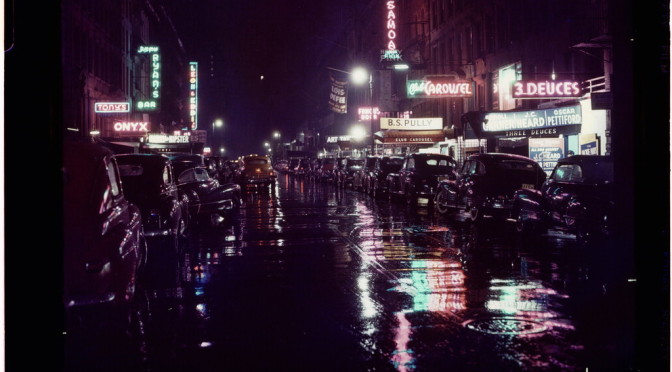
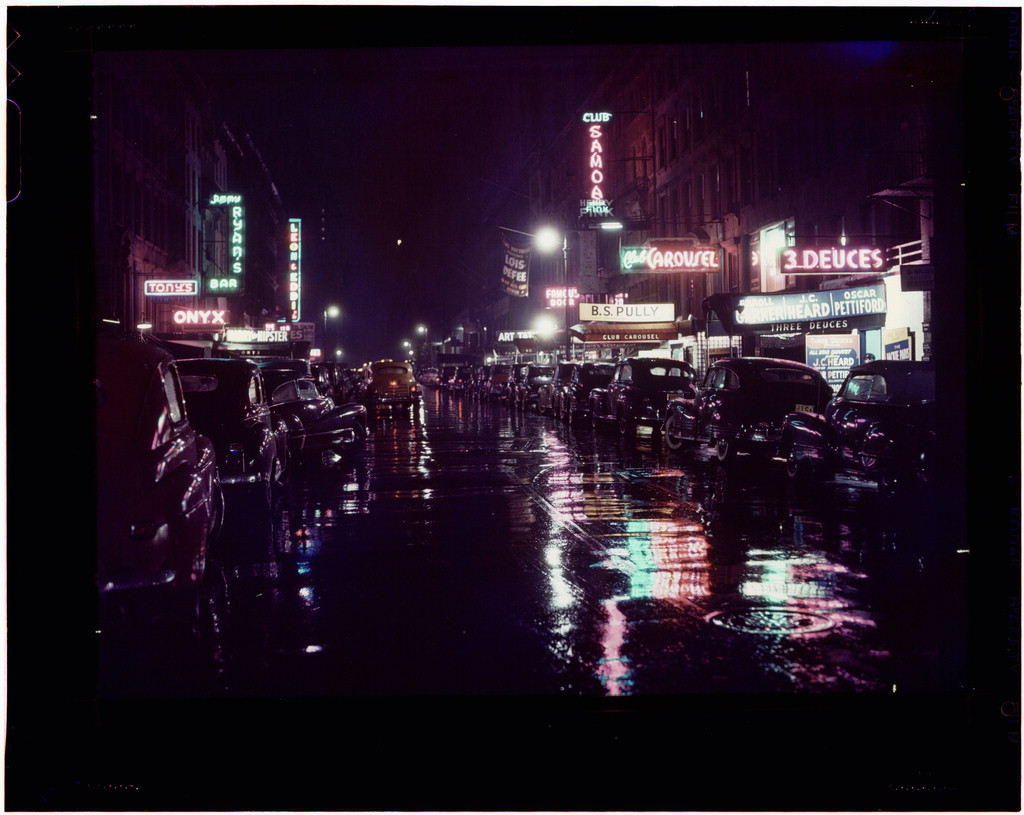
Eleanora Fagan walked out of Pennsylvania Station in 1929 and into the city that would help make her a superstar. Her early years were bleak, arrested for prostitution and thrown into the Welfare Island workhouse. But music would be her savior, breaking out in Harlem first in the nightclubs on 133rd Street, then in the basement clubs of ‘Swing Street’ on 52nd Street.

Her recordings make her an international star, but the venues of New York helped solidify her talents — from the Apollo Theater to Carnegie Hall. But one particular club in the West Village would provide her with a signature song, one that reflected the horrible realities of racism in the mid 20th century.


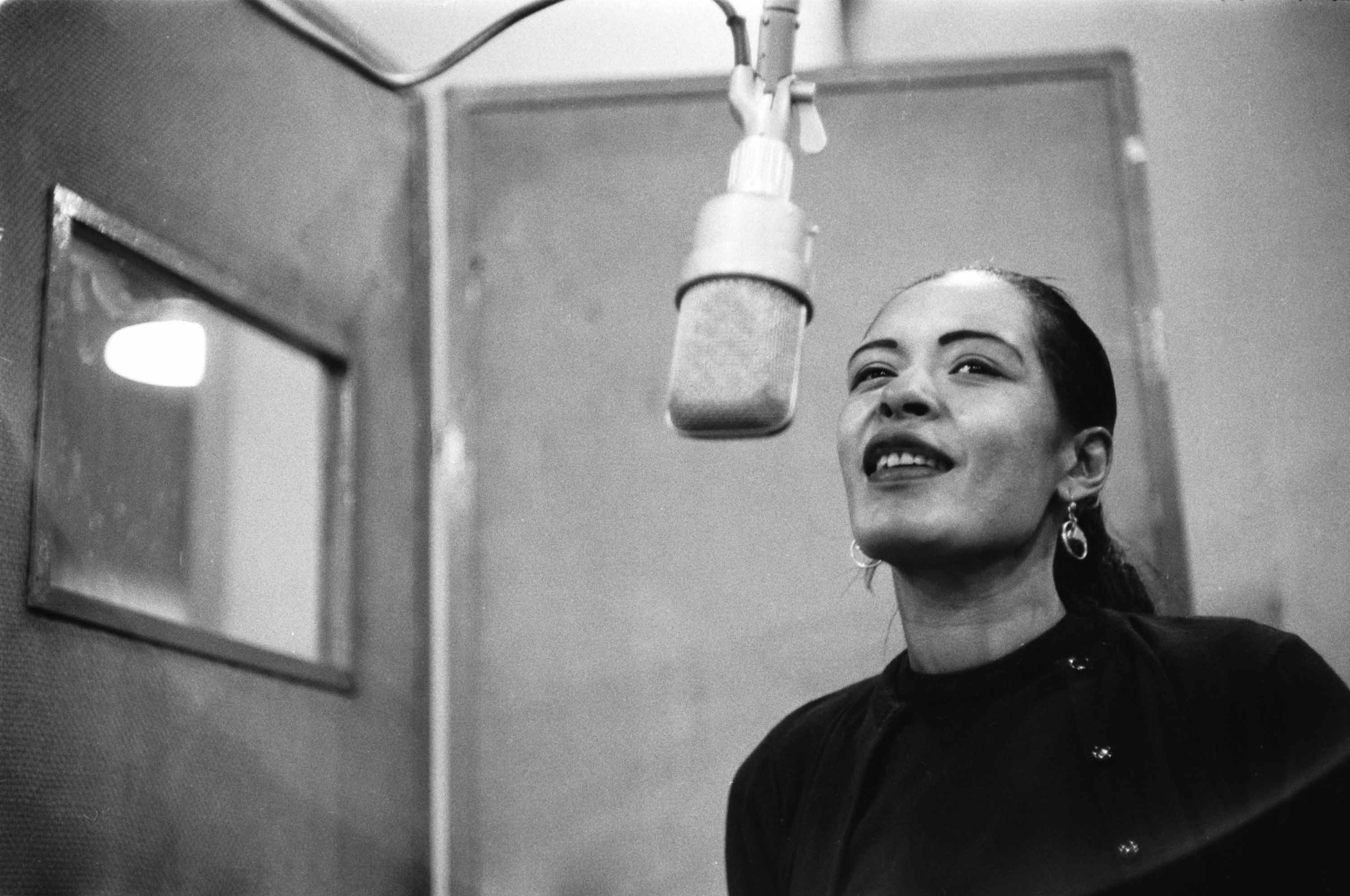
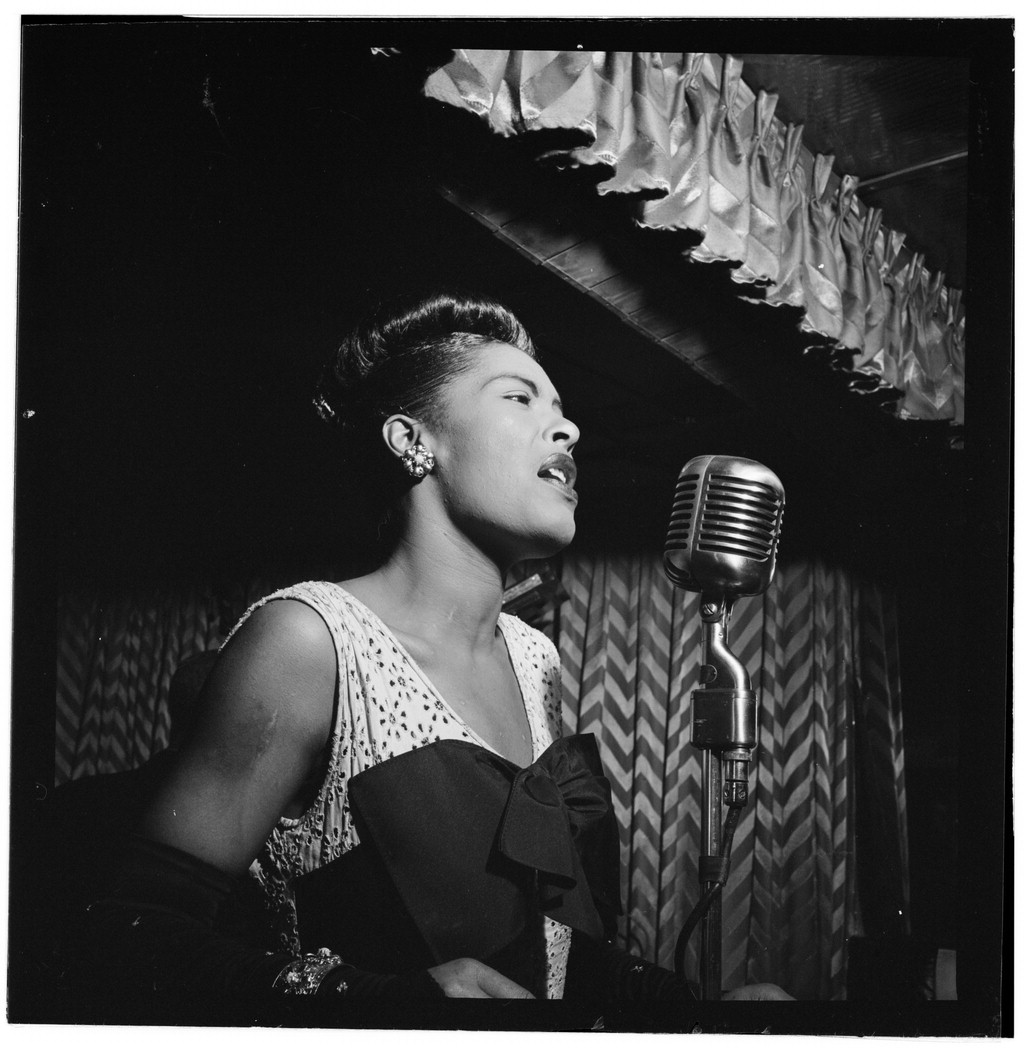
Billie Holiday at Club Downbeat, 1947

5020399920_ccd948ba9c_o

Locations featured in this episode:

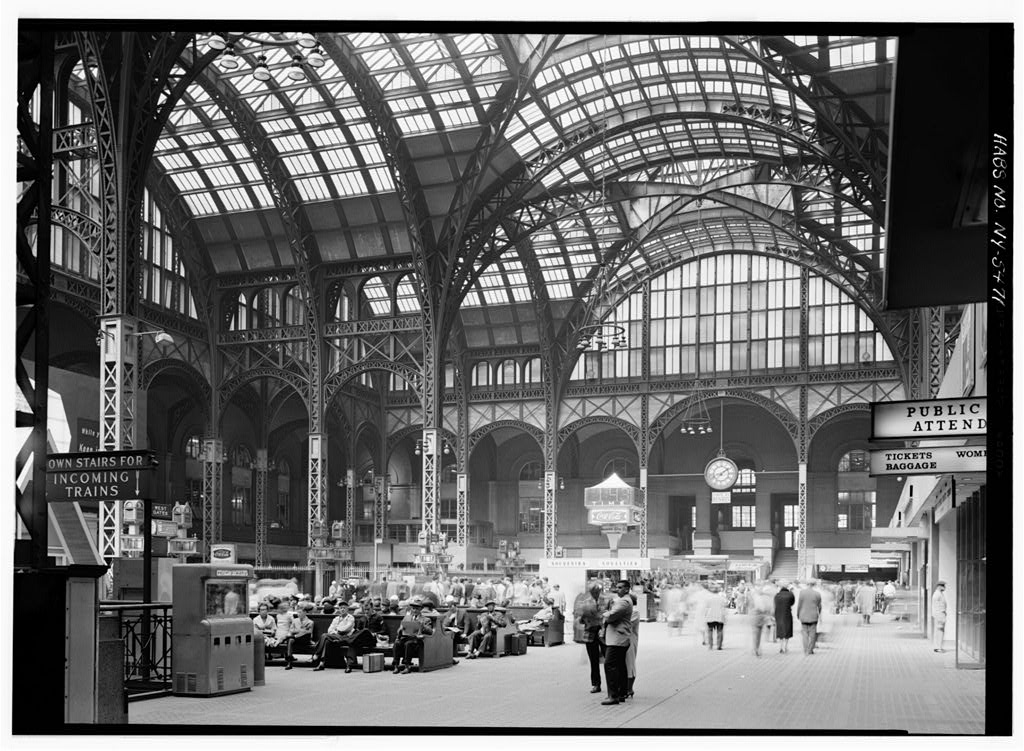
1) Pennsylvania Station (circa 1930s-40s)

Courtesy Library of Congress

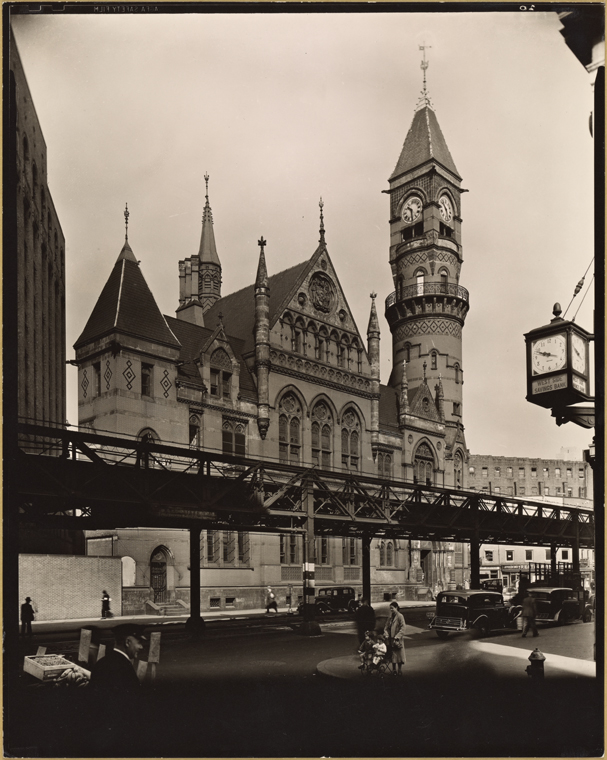
2) Jefferson Market Courthouse, pictured here in 1935

1
Photographed by Berenice Abbott, courtesy New York Public Library

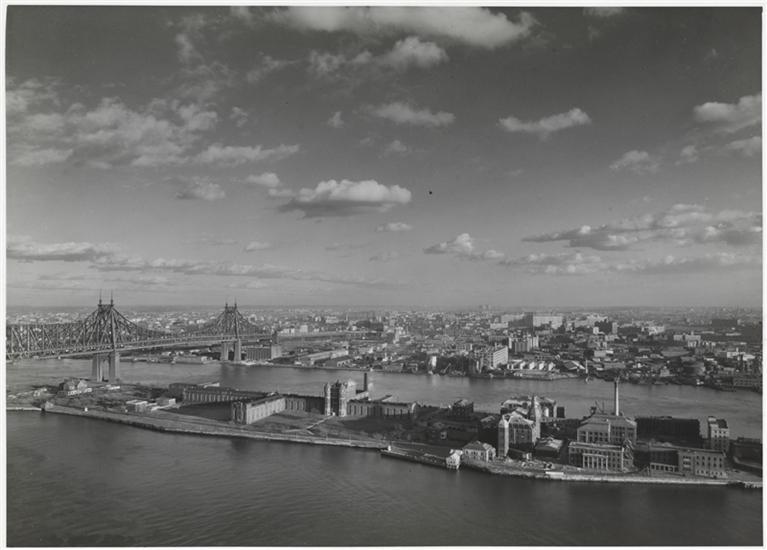
3) Welfare Island, pictured here in 1931

Photographed by Samuel H Gottscho, courtesy Museum of City of New York

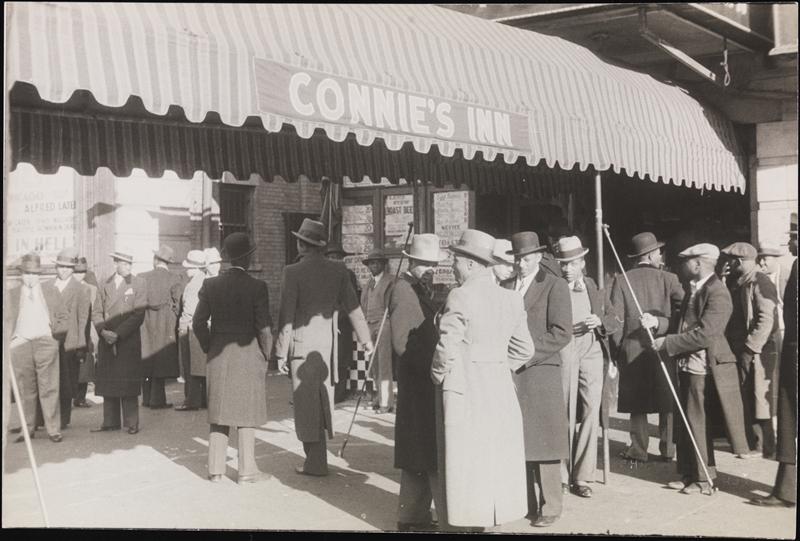
4) 133rd Street — “Jungle Alley” or The Street — outside Connie’s Inn

Courtesy Museum of the City of New York

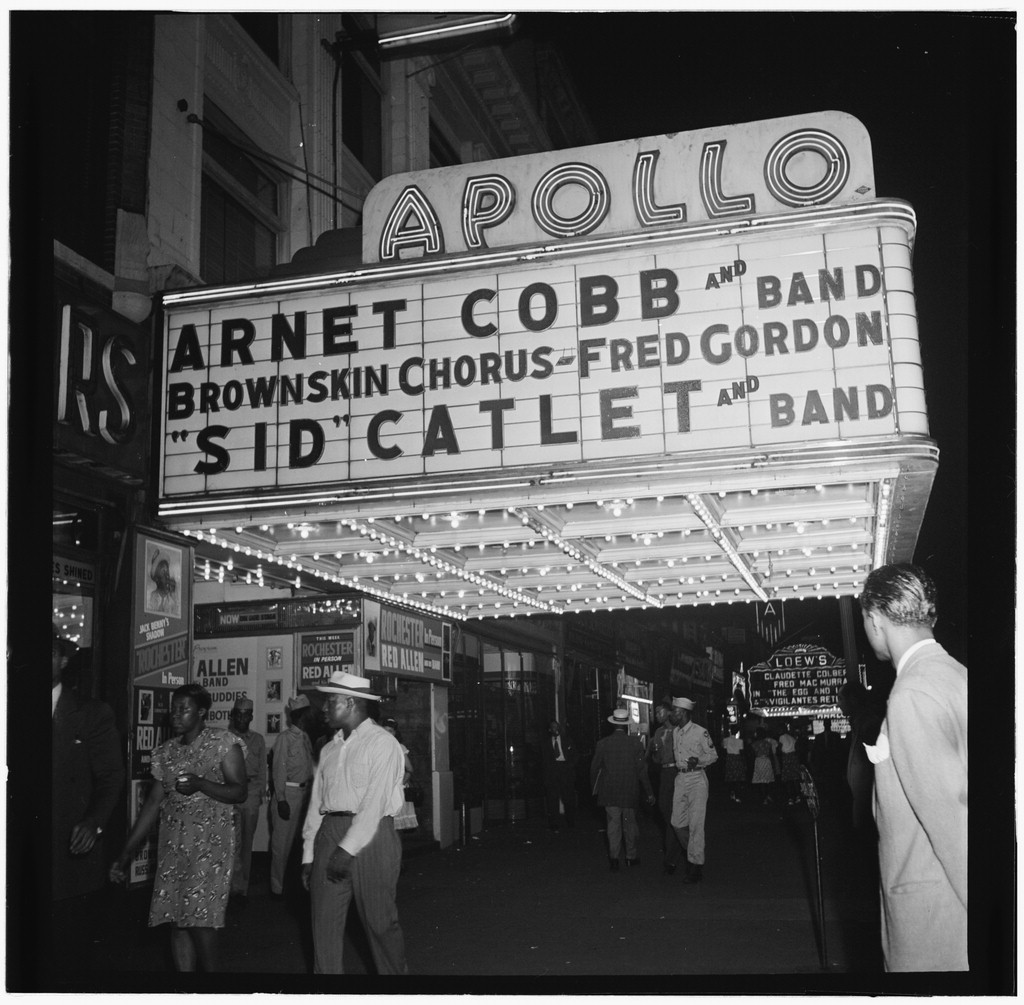
5) Apollo Theater, pictured here in the mid 1940s

Courtesy Library of Congress, photographer William Gottlieb

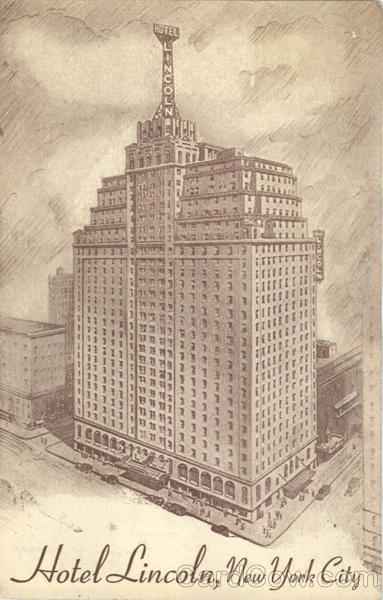
6) Lincoln Hotel

Hotel Lincoln, 44th to 45th Street at 8th Avenue New York City

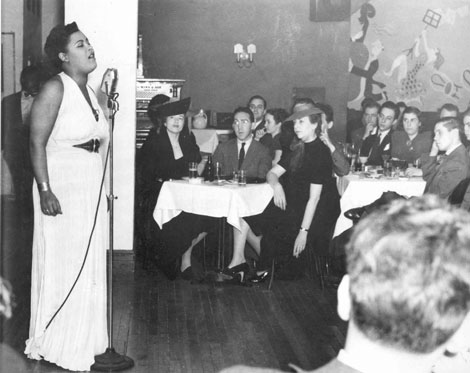
7) Billie Holiday at Cafe Society 1939

Photo by Charles B. Nadell

8) 52nd Street aka Swing Street

5268914553_ca77a01af0_o

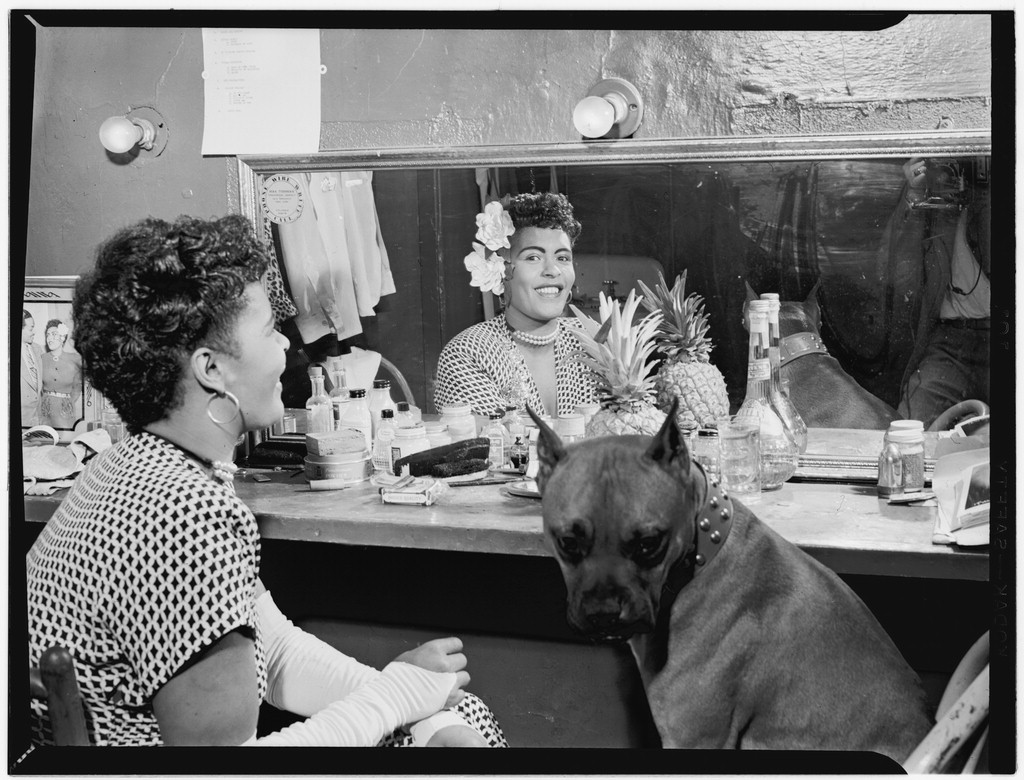
Billie at Club Downbeat (with her dog Mister) — June 1946

Courtesy Library of Congress

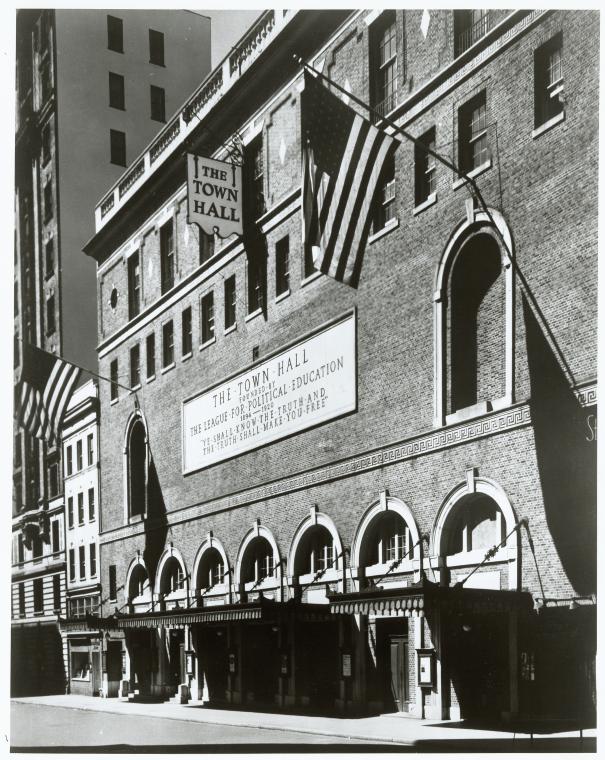
9) Town Hall, sometime in the 1940s

Exterior view of The Town Hall, courtesy New York Public Library

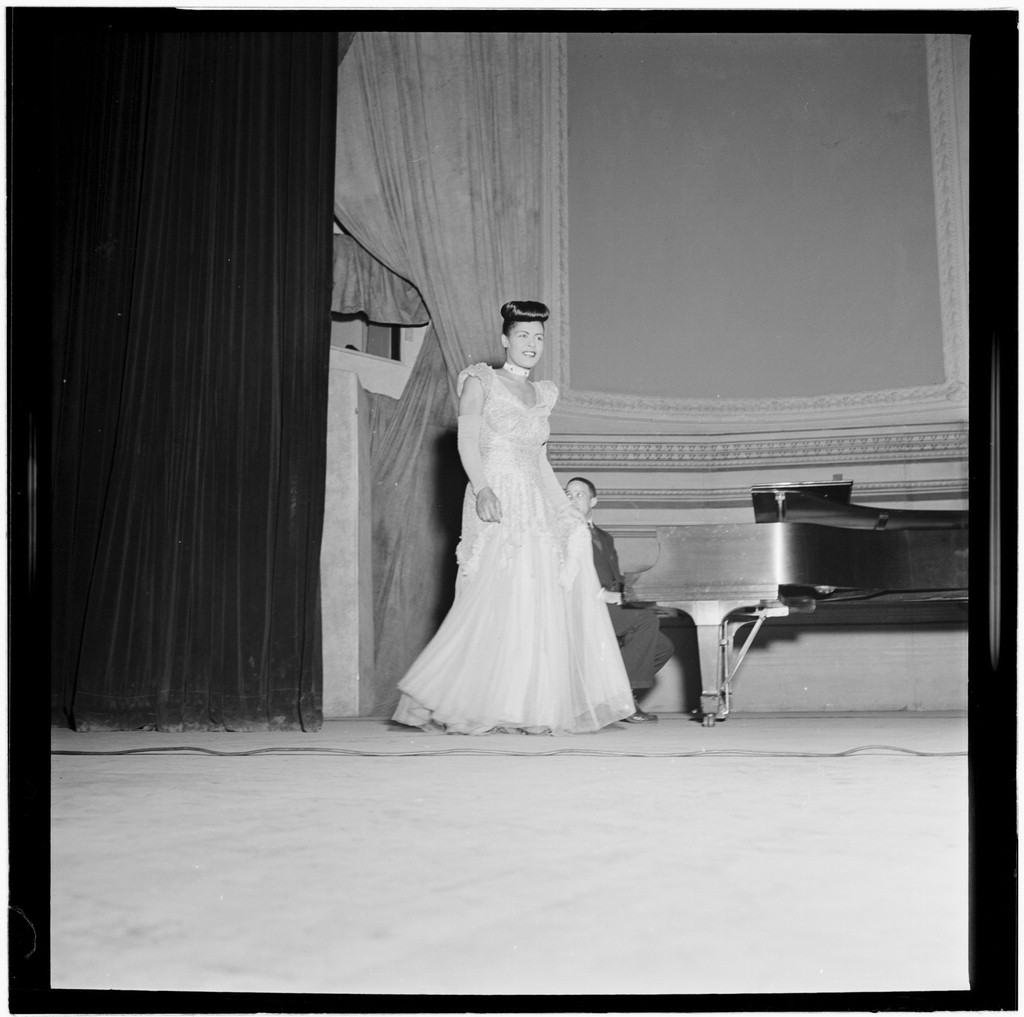
10) Billie Holiday at Carnegie Hall for her rave 1948 concert

Courtesy Library of Congress

An extraordinary performance of ‘Strange Fruit’, performed in February 1959, months before she died. This was recorded for a British television show called ‘Chelsea At Nine’.

https://www.youtube.com/watch?v=h4ZyuULy9zs

Billie Holiday — playing a maid — in the 1947 film New Orleans

And a live performance of one of her greatest songs — well, really, one of the greatest songs — “God Bless The Child”

http://youtu.be/U-3O-X6UUpY

Categories
Amusements and Thrills

Bogie and Bacall meet Basie and Billie

This actually happened.

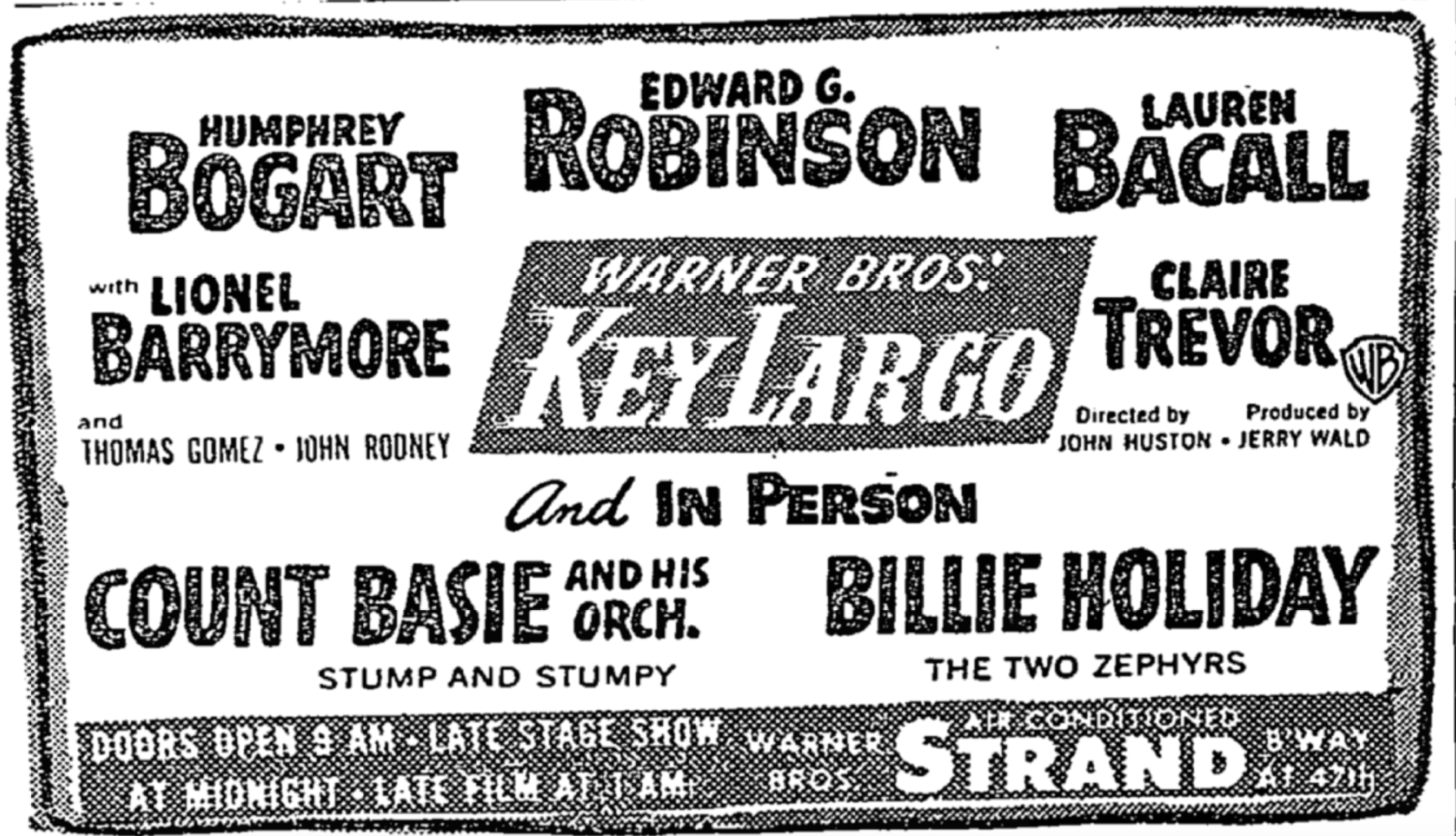
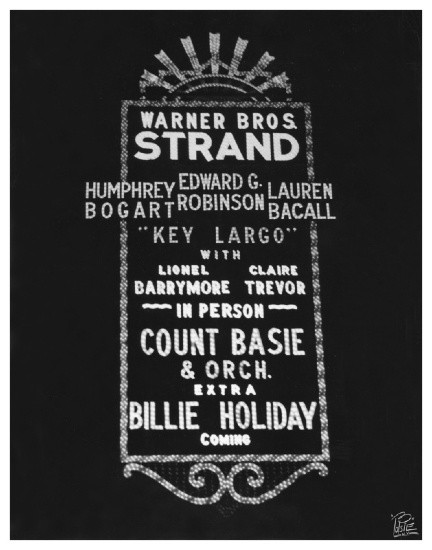
For the debut of the new film Key Largo — starring Humphrey Bogart and Lauren Bacall — the exhibitors at the Warner Strand Theater (at Broadway and 47th Street) has a special treat in store.

from the New York Times, July 17 1943

The Strand Theatre, which opened in 1914, has already made history a few times in New York. Considered the first theater built exclusively for motion picture exhibition, the Strand was the first New York job of Samuel ‘Roxy’ Rothefel (who would move on to his own Roxy Theatre and, then Radio City Music Hall).  On July 6, 1928, The Lights of New York, the first all-talking feature in history, premiered at the Strand.

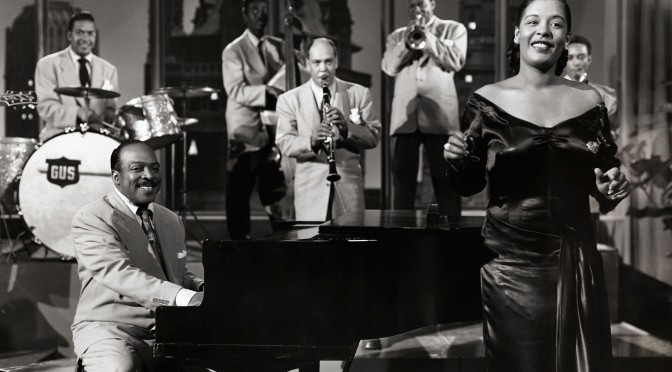
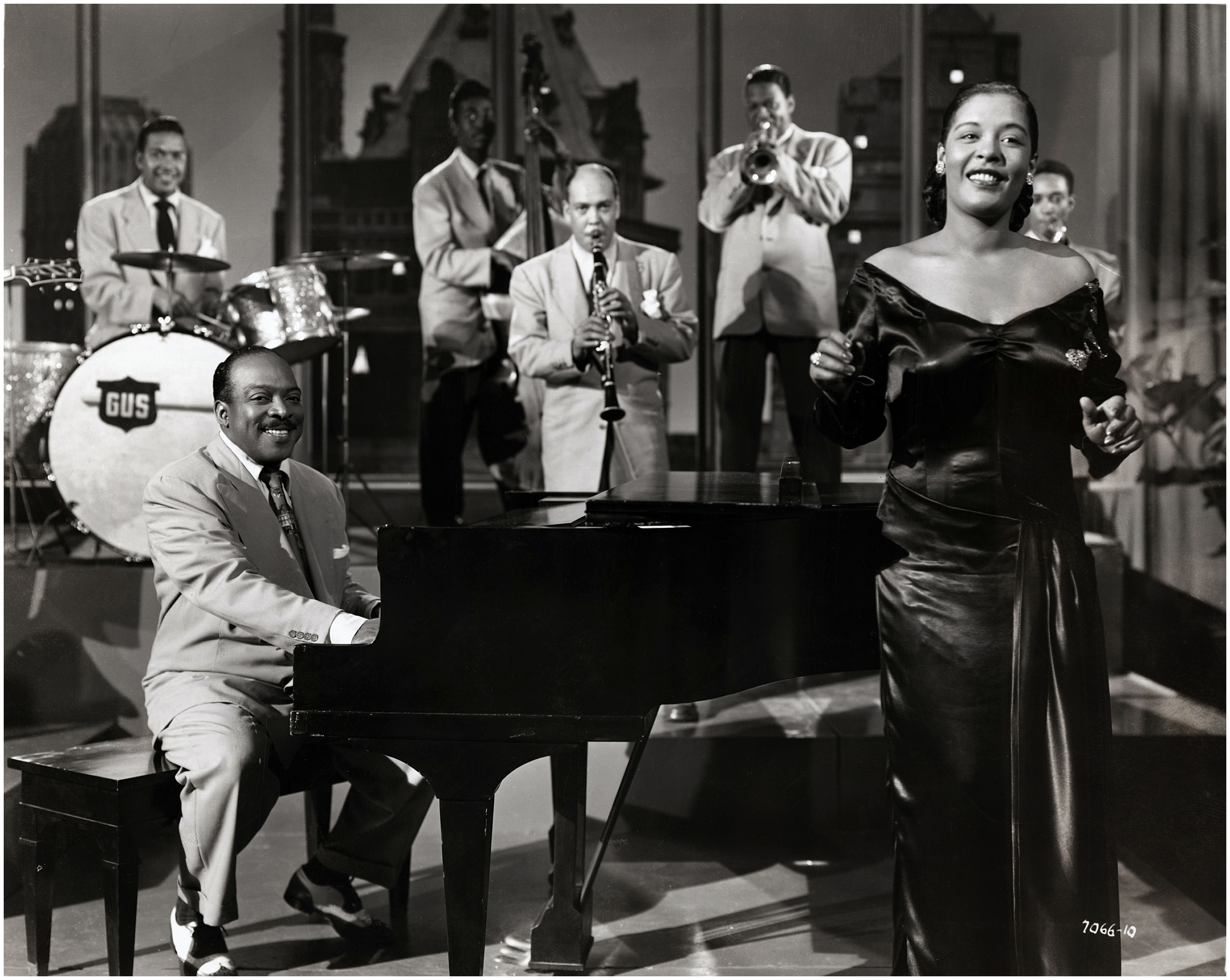
In 1948 came the fourth (and what would be final) movie collaboration between Bogart and Bacall, and its debut on July 16th deserved something out of the ordinary.  For six weeks, the Strand presented the film on an exhaustive bill of music and comedy, featuring two of the biggest stars in jazz music, Count Basie and Billie Holiday.

tumblr_m2af84Jr5g1qb5wa0o1_500

The two greats had recorded and toured with one another a decade previously, but much had changed since then.  Holiday had only been released from prison that March, serving time on a charge of heroin possession.  The big band era was ending, leaving Basie struggling to mold his music to the new styles of bebop, rock and  rhythm and blues.

While both would continue with their celebrated careers into the 1950s, the six-week Key Largo stint would remind many of earlier, more jubilant phases of their careers.

Billie Holiday, Count Basie
Basie and Billie from a film still

It was the longest theater run of Lady Day’s career although she fretted the fact that many were there to see her “get all fouled up,”  according to author Donald Clarke.

As you can imagine, it broke box office records for the Strand. According to Basie’s autobiography, “I think we went in there on a contract for three weeks with an option to extend for another two weeks, and I think they revised it and made it five weeks with options to make it six or seven weeks.”

They were joined by the black comedy team The Two Zephyrs (with legendary comic Slappy White) and tap dancing duo Stump and Stumpy.

I hope that Billie sang “Moanin’ Low,” made famous by the film in a mesmerizing performance by Claire Trevor (who won the Academy Award).


Categories
Friday Night Fever

Reisenweber’s Cafe: glamour, late nights and hot jazz


FRIDAY NIGHT FEVER To get you in the mood for the weekend, on occasional Fridays we’ll be featuring an old New York nightlife haunt, from the dance halls of 19th Century Bowery, to the massive warehouse clubs of the mid-1990s. Past entries can be found here.

LOCATION Reisenweber’s Cafe
Columbus Circle, 58th Street and 8th Avenue, Manhattan
ERA 1856 (as a tavern)-1922

On this day in history, February 26, 1917, the instrumental ensemble Original Dixieland Jass Band recorded the very first usable* jazz recordings in a Victor studio here in New York. I can’t confirm exactly where that studio was, but according to here, Victor’s studios in 1917 were at 46 West 38th Street.

The thick 78 record “Livery Stable Blues” and B-side “Dixie Jass Band One Step” was pressed and released one week later March 6.

And yes, that’s Jass. They changed it to Jazz a year later. (The term was still coming into its own back then.) And though they started in New Orleans in the Dixieland jazz scene, they made their name in Chicago and moved on to New York in 1916. Oh right, and they were a white ensemble who popularized for white audiences a genre created and performed mostly by black musicians.

They were possibly the first white musicians to make jazz fashionable to New York nightlife; as a result, we can thankfully hold them partially responsible for the coinage of the Jazz Age. For from the moment of that first recording, the youth of the late ’10s went wild for the naughty sound of jazz.

Before the release of this recording, the only way to hear the ensemble was live, and the place to hear them live in New York was Reisenweber’s Cafe, one of the most fashionable clubs of the 1910s.

The restaurant/nightclub hybrid — one of the first true ‘entertainment complexes’ –was owned by John Reisenweber, whose father had owned a small tavern at this very corner in 1856. Needless to say, John was far more ambitious plans.

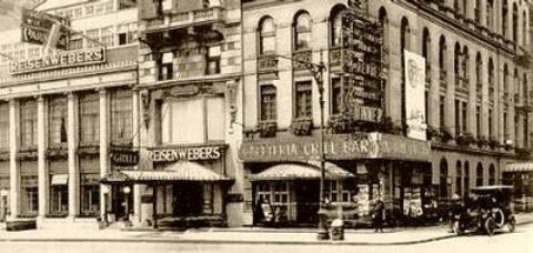
Below: Columbus Circle in the 1900’s. You can see the Reisenweber’s marquee to the left of the picture, on 58th Street.

Reisenweber’s was truly a product of the decade, expanding in 1910, closed by 1922. It held court in Columbus Circle at 58th Street and Eighth Avenue during a time when this corner of Central Park was a popular destination for theater goers, of both the high and low brow varieties. The most famous — and respectable — stage in the neighborhood was the Park Theatre (formerly the Majestic) featuring the hottest names in drama and musical comedy. So, naturally, Reisenweber’s became a magnet for theater stars and their champagne entourages.

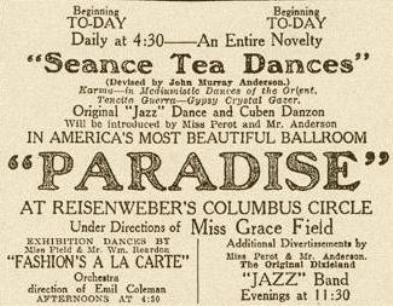
Producers would fete their leading ladies here, in festivities that would begin in the downstairs restaurant, move to the second floor 400 Club cabaret, pause for a dance in the elegant third-floor Paradise Supper Club (featuring the first dancefloor within a restaurant), and settle in either the cheeky Hawaiian Room on the fourth floor or up at the rooftop garden.

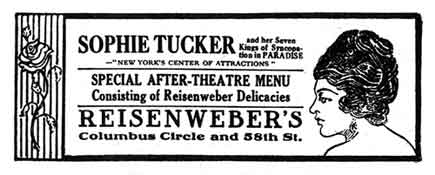
Below: From an advertisement dated March 1917 (thanks to Mule Walk & Talk blog, where there are many more examples)

The Dixieland ensemble hit Reisenweber’s 400 Club in January 1917 (thanks in part to a recommendation from Al Jolson) and were an immediate hit, combining furious, syncopated sound with a comedic touch, perfect for a smoky cafe full of trendy New Yorkers.

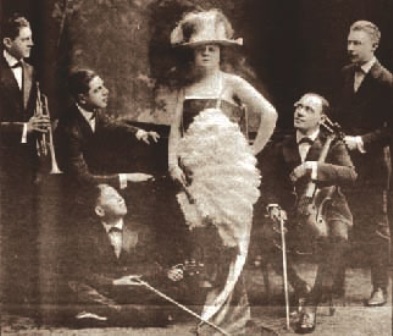
But they weren’t the biggest star at Reisenweber’s. The lady that drew them in 1918 was one of the era’s biggest celebrities and the first star of the Ziegfeld Follies — Sophie Tucker (pictured above).

Tucker was a sassy, vibrant, bawdy performer, hammering out hits loaded with double entendre, inviting starlet pals and even regular cafe patrons on stage to perform with her. Her escapades upstairs to sellout crowds in the 400 room, during her so-called ‘Bohemian Nights’, were so popular that Reisenweber shrugged and remained it The Sophie Tucker Room in 1919.

In fact, Tucker’s regular engagements helped popularize the cabaret form in New York. According the Musicals 101, “Delmonico’s, Reisenweber’s, Palaise Royale and Shanley’s all became legendary night spots. Within a few years, dance floors became a required part of the cabaret environment.”

Reisenweber’s fused together elements that now seem quite commonplace together — music, food, dancing, celebrity, performance — in a way that was both respectable and yet edgy and scandalous for its day. It also introduced a staple of New York nightlife: the cover charge (25 cents).

At its height, Reisenweber’s was one of Manhattan’s best known restaurants, “hous[ing] a dozen dining rooms, employed more than 1,000 in help and seated 5,000 diners at one time” according to the owner’s obituary.

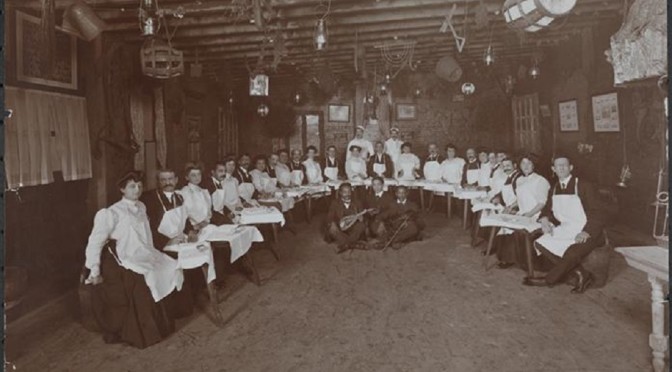
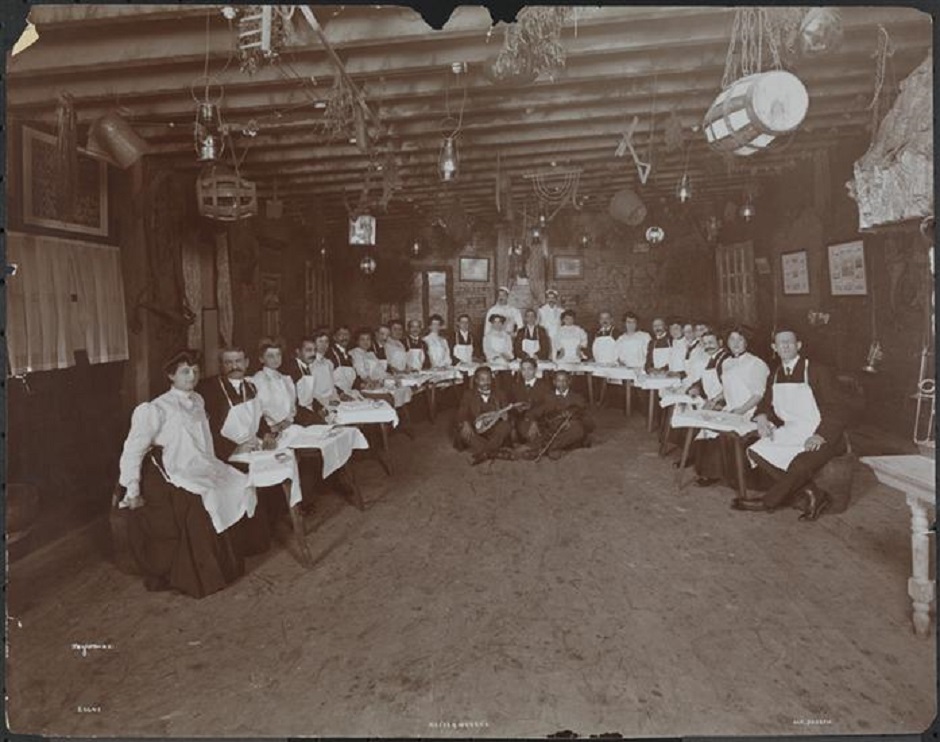
The employees and musicians of Reisenweber’s in 1905 (courtesy Museum of the City of New  York)

MNY40486

In a way, it mirrored the most appealing elements of its neighborhood: the glamour of the theater, the abandon of the taverns, the glitz of the rich, the abandon of the working class. This mix would perfect itself by 1920, the time of Prohibition, when it would go underground.

The modern nightclub would be born there in the shadows; unfortunately Reisenweber’s would not join it. It was an easy target for temperance groups; screamed the headlines in 1922, “CLOSE REISENWEBER’S, DRY OFFICIALS DEMAND“. Crippled by constant police raids — including a bummer of a raid on New Years Eve 1922 — it was closed for good that year.

By 1925, the Original Dixieland Jazz Band would break up. But Sophie Tucker would thrive during the Roaring 20’s, moving on to movies and radio.

Finally, for your listening pleasure, that recording of the “Livery Stable Blues,” a tune which certainly lit up the floors of Reisenweber’s as the champagne flowed….

*A month earlier, they apparently performed for management of the Columbia Gramophone Company and may have recorded for them, but nothing was ever released.

Categories
Friday Night Fever Music History

Birdland: The Midtown Manhattan playground for classic jazz

FRIDAY NIGHT FEVER To get you in the mood for the weekend, every other Friday we’ll be featuring an old New York nightlife haunt, from the dance halls of 19th Century Bowery, to the massive warehouse clubs of the mid-1990s. Past entries can be found HERE.

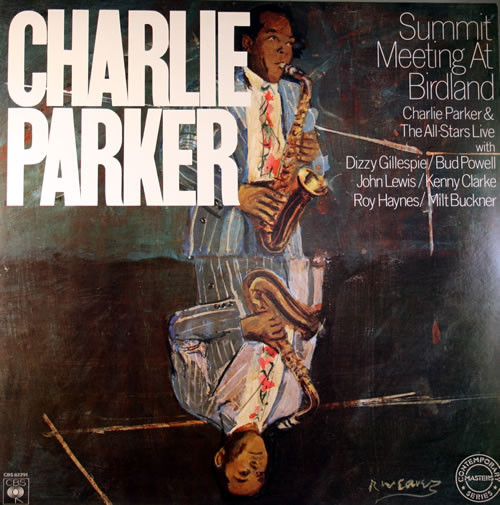
Charlie Parker was the king of the jazz scene, father of bebop, and a figurehead of bohemian New York — the original hipster, before the term moved on to other connotations.

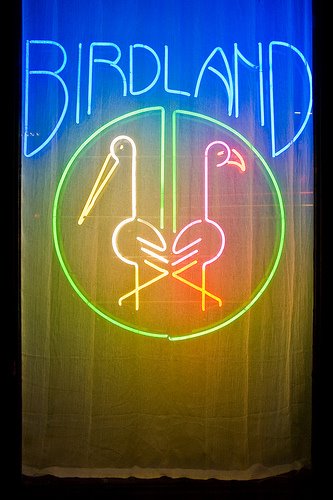
He is also the reason for Birdland, the influential midtown jazz club that’s still with us today.

Parker was born in 1920 in another jazz capital, Kansas City, Mo, and moved to New York at 19 years of age.

He quickly worked his way into jazz’s inner circle, performing saxophone in Harlem and midtown clubs with names that would soon become legendary in the genre — Art Tatum, Thelonius Monk and especially Dizzy Gillespie, Parker’s frequent duet partner.

Through these collaborations, Parker helped create the style of jazz known as bebop, a frenetic, dirty and liberal type of jazz which required a mastery over their instruments along an uncharted, often improvised melody.

By 1949, he was the biggest star in jazz music, defining the sound through dozens of recordings and spectacularly unpredictable live performances. (He was also severely abusing alcohol and drugs by this time, too.)

He had also acquired the well known nickname, the Yardbird. There are multiple theories as to how he obtained that name; by the 40s, it was most popularly shortened to the Bird.

The fan site Bird Lives has a compendium of back stories of how the name came to be.

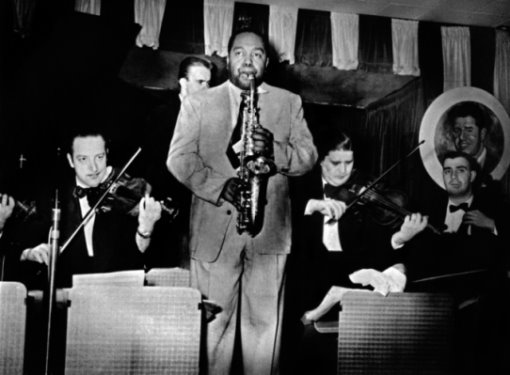
BELOW: Parker performs at Birdland, 1951

Young Bronx-born songwriter Morris Levy, meanwhile, was making his own way through New York’s music scene, most notably in the 40s as manager of Topsy’s Chicken Roost.

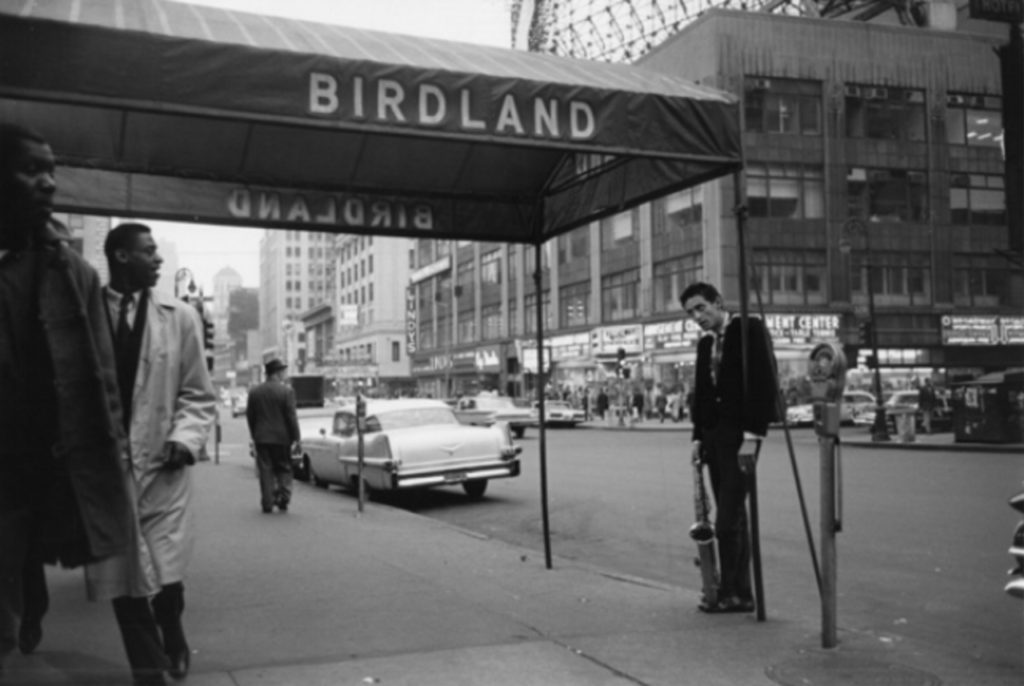
Seizing upon the connections he made there, Levy decided to head out on his own, while promising Parker a club of his own to perform in. And so became Birdland, opening near the end of 1949, at 1678 Broadway on 52nd street.

Bird was very excited about that,” recalled renown jazz drummer Earl Haynes. “I remember on opening night there were lines of people outside, waiting in bad weather.”

The club, the self-proclaimed ‘jazz corner of the world’, sat 400 amidst a cabaret space adorned with actual caged birds and a ‘bullpen’ behind the bar “where penniless college kids and struggling musicians” took their place.

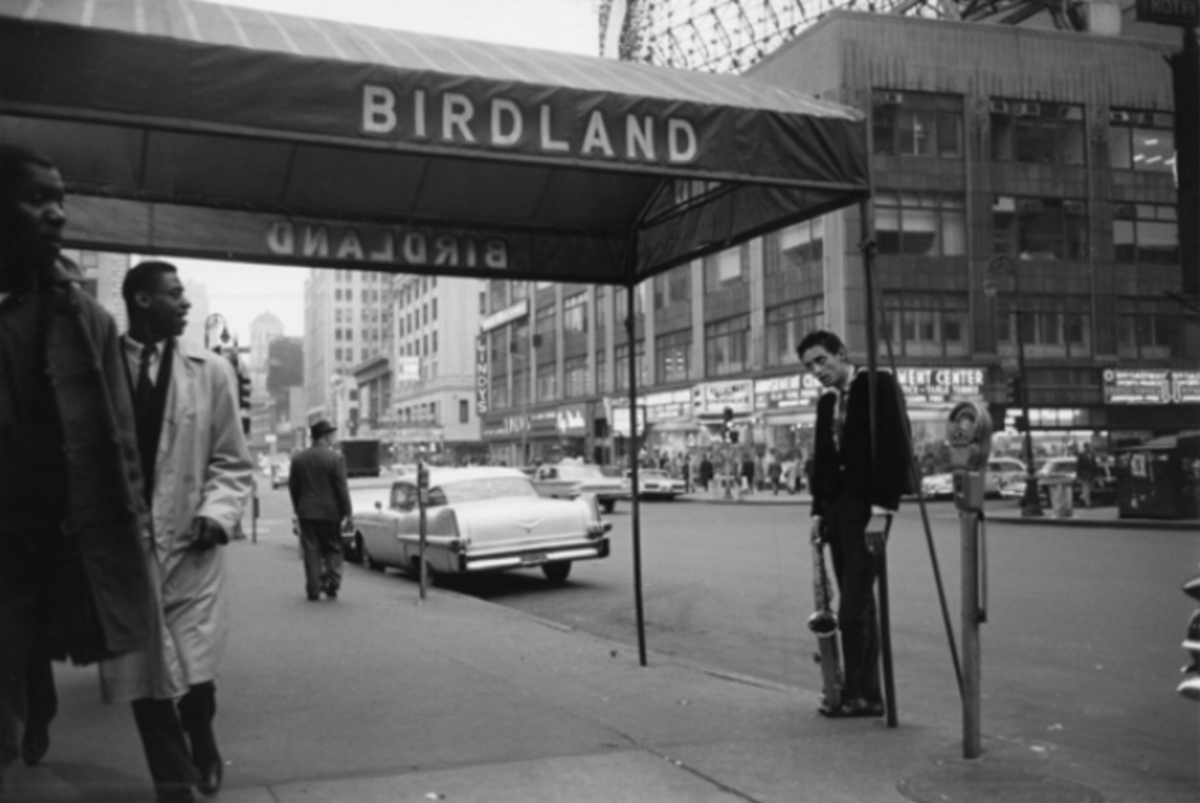
Birdland 4AM, photograph by William Claxton

Birdland quickly took off as New York’s leading jazz club of the 1950s, attracting the genre’s greatest names: Miles Davis, John Coltrane, Lester Young, not to mention Gillespie and Monk.

And of course, Parker would perform there regularly. At one point, he couldn’t acquire a cabaret license because of his substance-abuse problems; as a result, he would actually be barred from performing in any New York club, including his own.

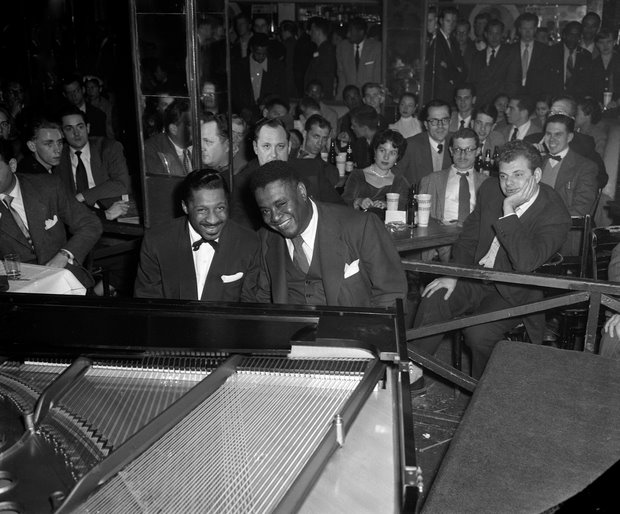
Eroll Garner and Art Tatum perform in 1951. You get a great sense of the room — and the clientele! — in this picture.

As the club became more popular, Birdland’s tables were surrounded by a bevy of glamorous stars on any given night, like Marilyn Monroe, Frank Sinatra, Sammy Davis Jr and Marlene Dietrich.

According to Ebony editor Allan Morrison, “Birdland was both a cultural vantage point and a barometer of trends where all the big names in jazz performed.”

From the successes of Birdland, Levy would go on form Roulette Records and become one of the most unscrupulous music moguls in the rock and R&B era.

He was responsible for some of the biggest R&B hits of the 60s — and also notorious for his mob connections and a penchant for strong-arming recording artists into sharing publishing rights with him. (He also allegedly owned the phrase ‘rock and roll’.) He died in 1990 before he could serve a ten-year jail sentence for extortion.

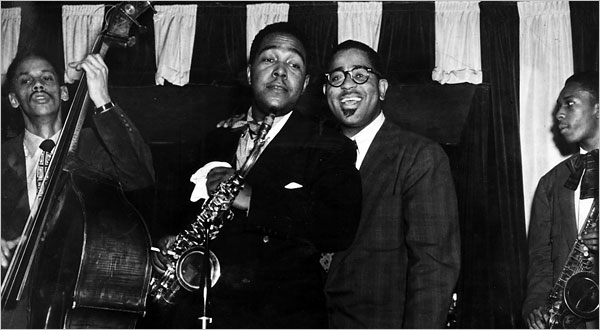
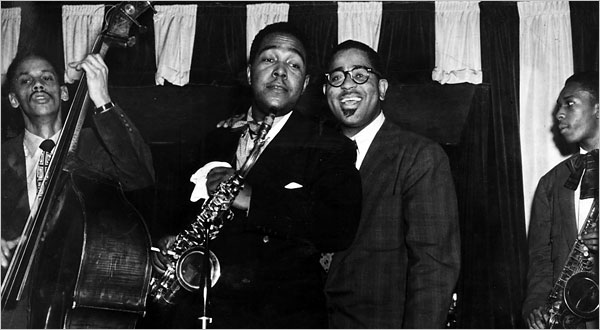
How’s this for a lineup in 1951? From left to right: Tommy Potter, Charlie Parker, Dizzy Gillespie and John Coltrane

Parker meanwhile, had met his tragic end many, many years previous, a victim of rampant substance abuse. His last performance at Birdland was on March 5, 1955, dying in New York one week later.

The Birdland club drifted against the headwinds of the 1960s, where rock clubs like the Peppermint Lounge ruled midtown. “Birdland has gone off the cool,” lamented Oscar Goodstein to Time Magazine. By 1965, the club on 52nd street closed its doors.

With the consent of Parker’s widow Doris, John Valenti reopened Birdland in 1986 on the Upper West Side, 2745 Broadway at 106th Street, in a more intimate, triangular shaped space.

Watching the rebirth of midtown in the 1990s, Valenti decided to move the club back downtown in 1996 to its present location at 315 W. 44th Street, between 8th and 9th avenues.

They get fewer celebrities, but a lot more tourists, sampling the newest crop of jazz stars.

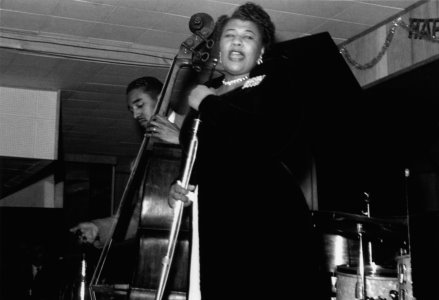
BELOW: Ella Fitzgerald electrifies the room