Categories
Neighborhoods Podcasts

The Garment District: Where New York Fashion Is Made

The history of the New York City fashion industry and how it found its home south of Times Square aka The Garment District.

The Garment District in Midtown Manhattan has been the center of American fashion for almost one hundred years. The lofts and office buildings here still buzz with the business of making clothing — from design to distribution.

But the district has become endangered today as clothing manufacturers move out and the entire industry faces new challenges from online sales and overseas production.

During the mid-19th century, garment production thrived in New York thanks to thousands of arriving immigrants skilled in making clothes. Most clothing in the United States was made below 14th Street, in the city’s tenement neighborhoods, especially the Lower East Side.

As the industry grew more prominent, the residents and merchants of Fifth Avenue feared it would overtake their fashionable street. So, by the 1930s, a new district was born. Hardly a stitch was sewn in the United States without passing through the blocks between 34th Street and 42nd Street, west of Sixth Avenue.

Listen in as we describe the Garment District’s chaotic flurry of activity — from the fabulous showrooms of the world’s greatest designers to the nitty-gritty bustle of its crowded streets.

In celebration of Made In NYC Week, we present our tribute to New York City’s active and thriving garment industry. A version of this show was originally presented in January 2016. Now with a new introduction and ending, this show was reedited by Kieran Gannon.


The Bowery Boys: New York City History podcast is brought to you …. by you!

We are now producing a new Bowery Boys podcast every two weeks. We’re also looking to improve the show in other ways and expand in other ways as well — through publishing, social media, live events and other forms of media. But we can only do this with your help!

We are now a member of Patreon, a patronage platform where you can support your favorite content creators for as little as a $1 a month.

Please visit our page on Patreon and watch a short video of us recording the show and talking about our expansion plans. If you’d like to help out, there are five different pledge levels (and with clever names too — Mannahatta, New Amsterdam, Five Points, Gilded Age, Jazz Age and Empire State). Check them out and consider being a sponsor.

We greatly appreciate our listeners and readers and thank you for joining us on this journey so far. And the best is yet to come!


Fashionable streets: hats in the Garment District, photo by Margaret Bourke White
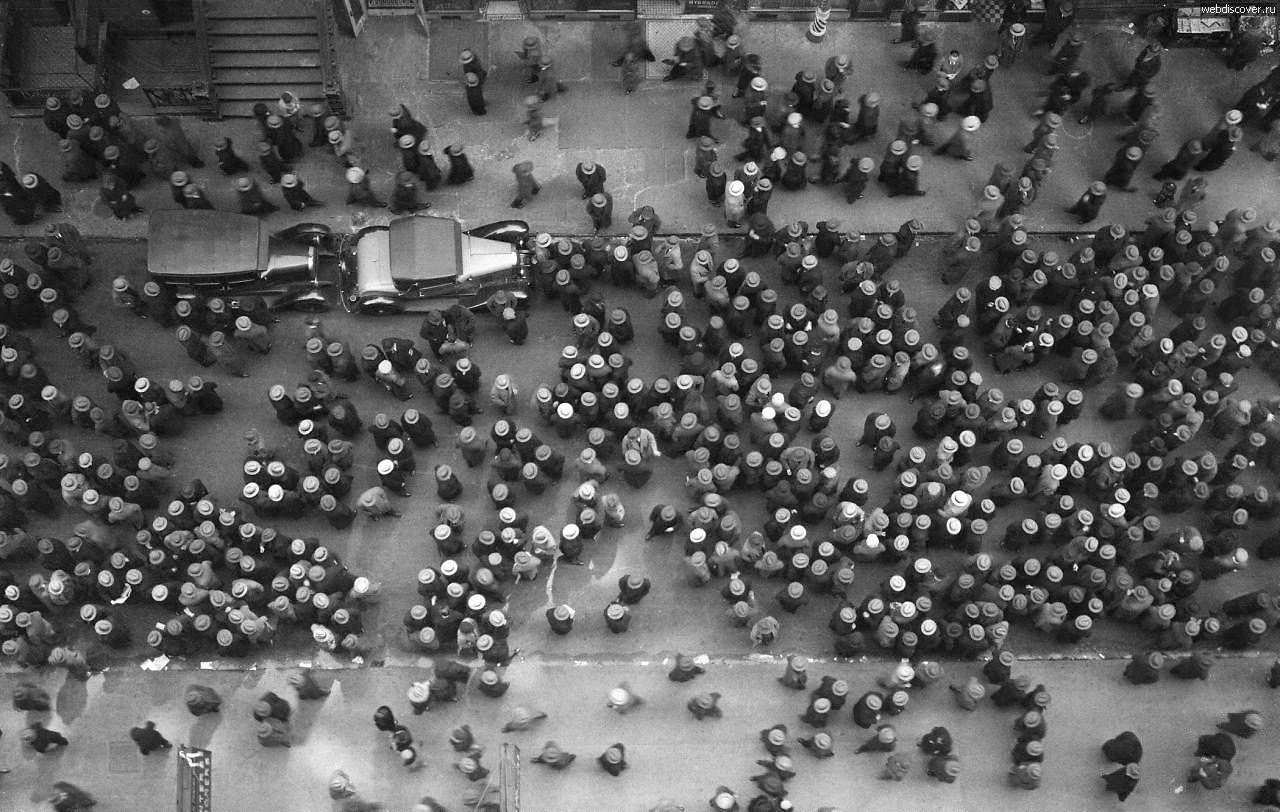
Courtesy Life Magazine

There were as many trucks in the Garment District as models, taking supplies to the busy workshops and finished garments to retailers. Photo is from Nov. 29, 1943.
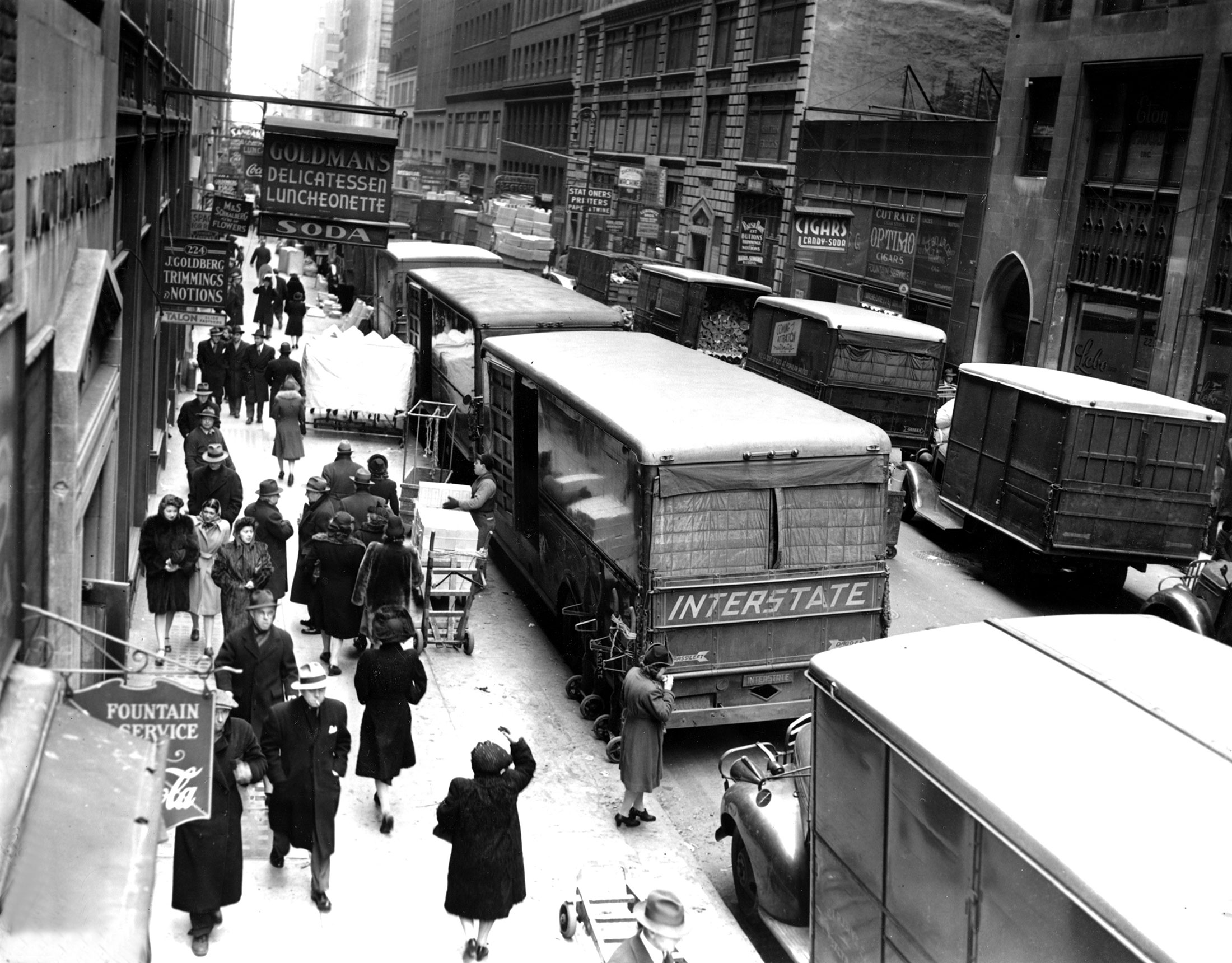
Courtesy AP Photo
Courtesy AP Photo

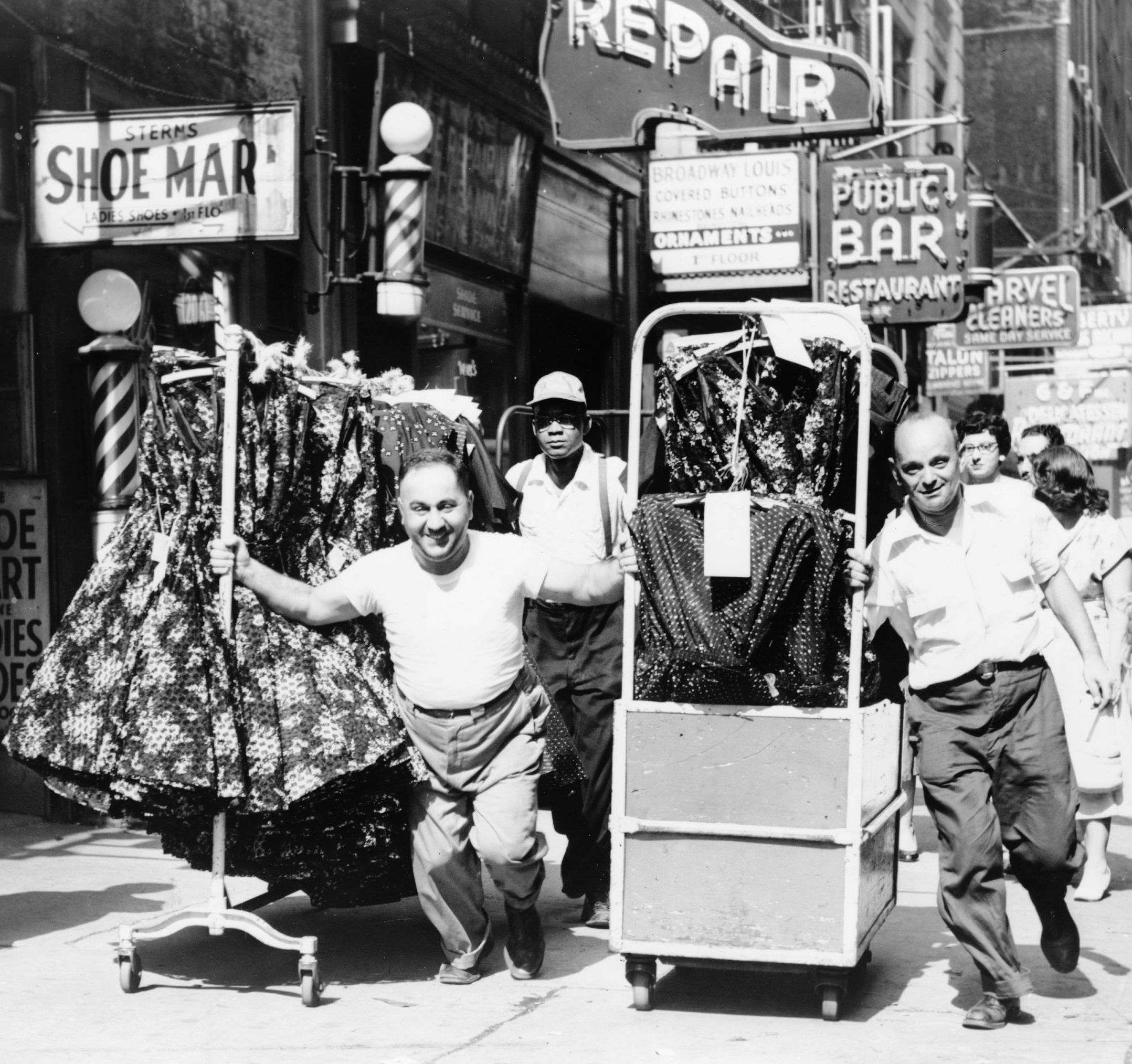
Another common site — racks of clothing being pushed down the street.
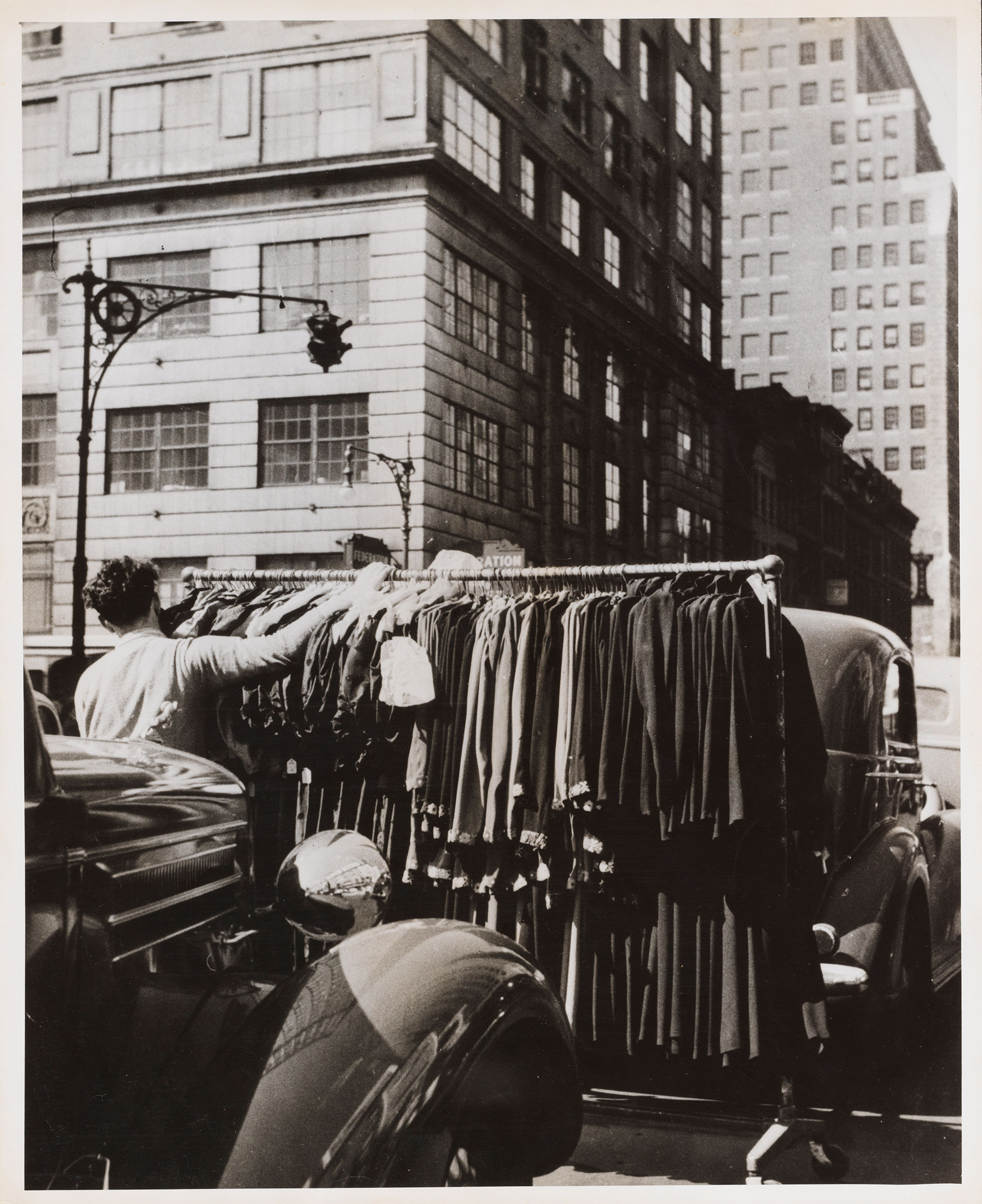
Museum of the City of New York

The Garment District at lunchtime, 1944. We told you it was insane!
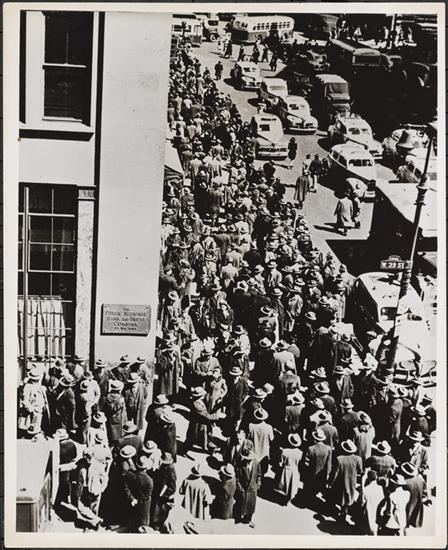
Museum of the City of New York
Museum of the City of New York/US Office of War Information

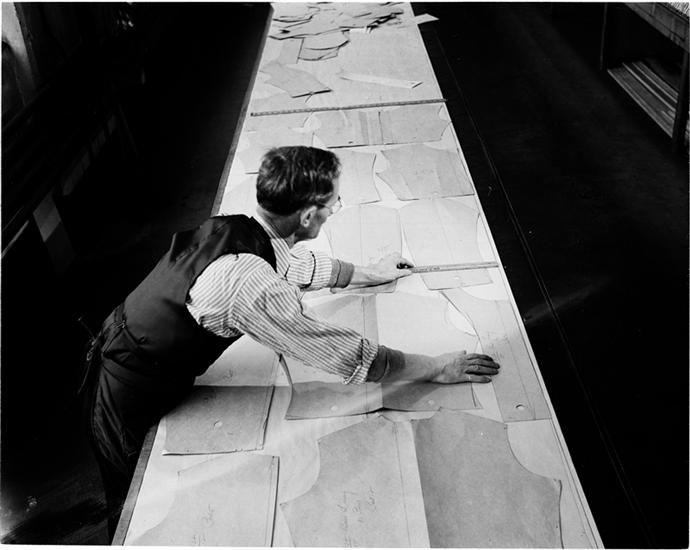
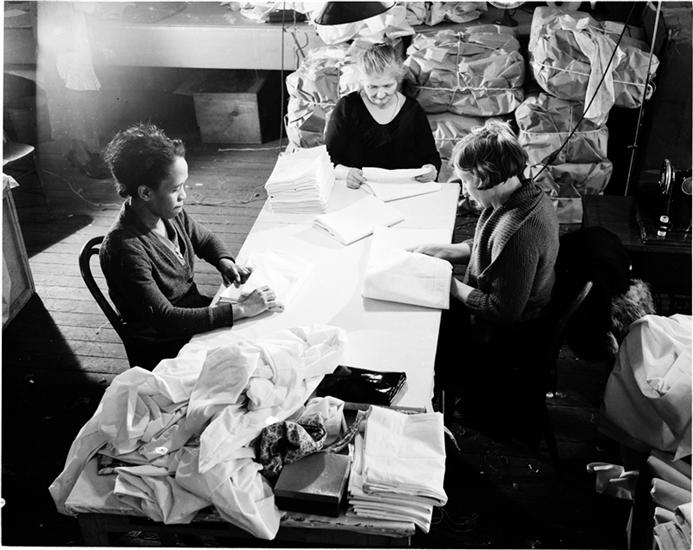
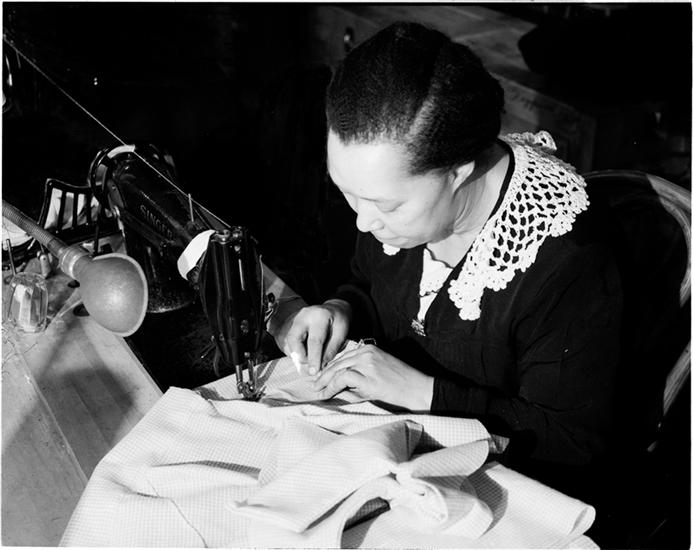
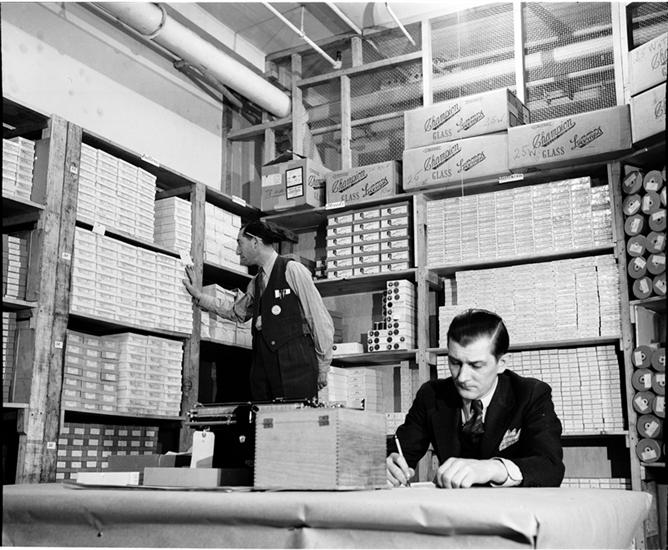
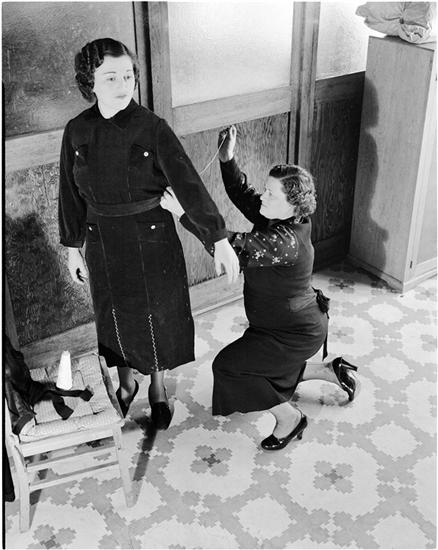
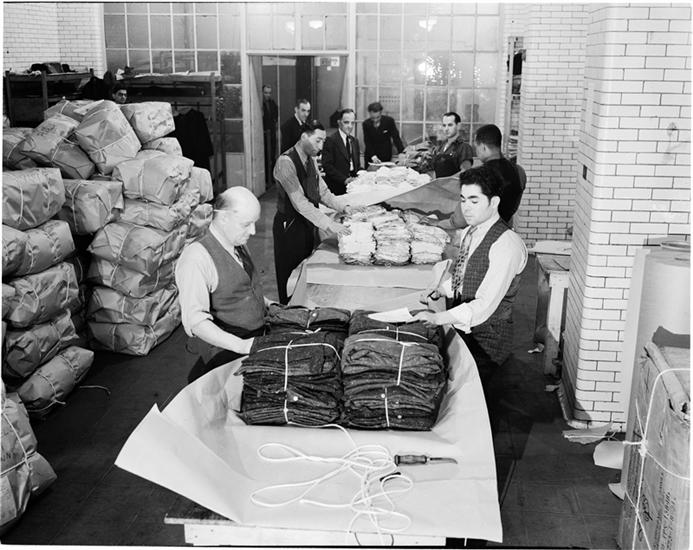
The following are a series of pictures capturing workers in a clothing factory on 36th Street and Tenth Avenue, 1937
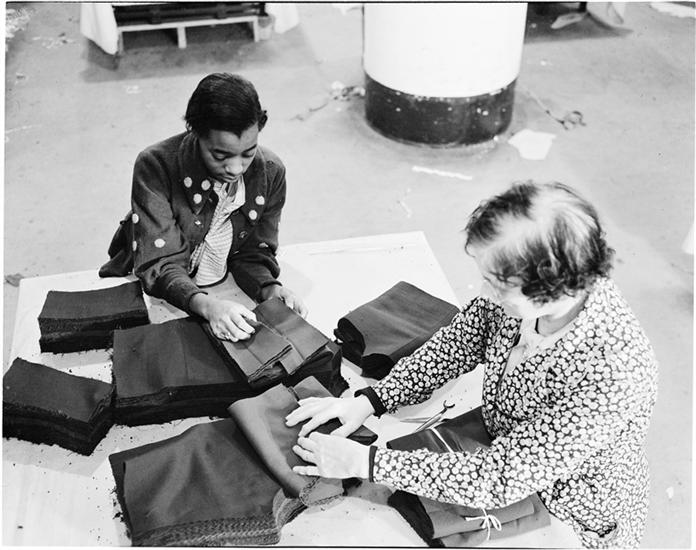
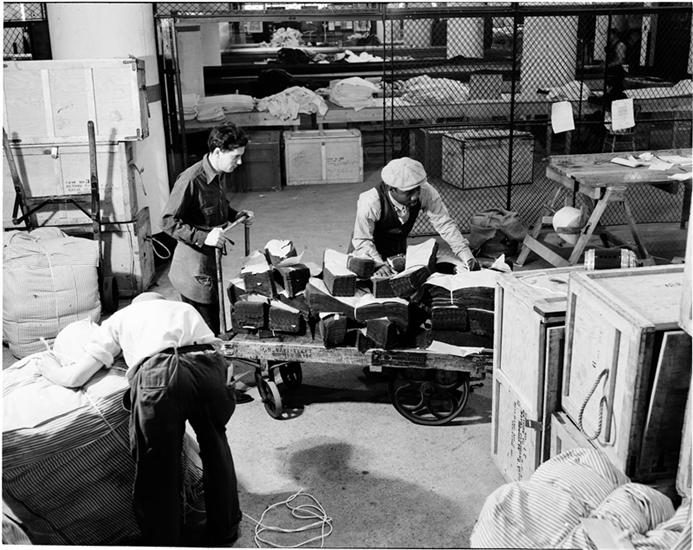
Museum of City of New York/Federal Art Project
4
5
6
7
8
9
10

Behind the scenes at a Gimbels Fashion Show, 1949
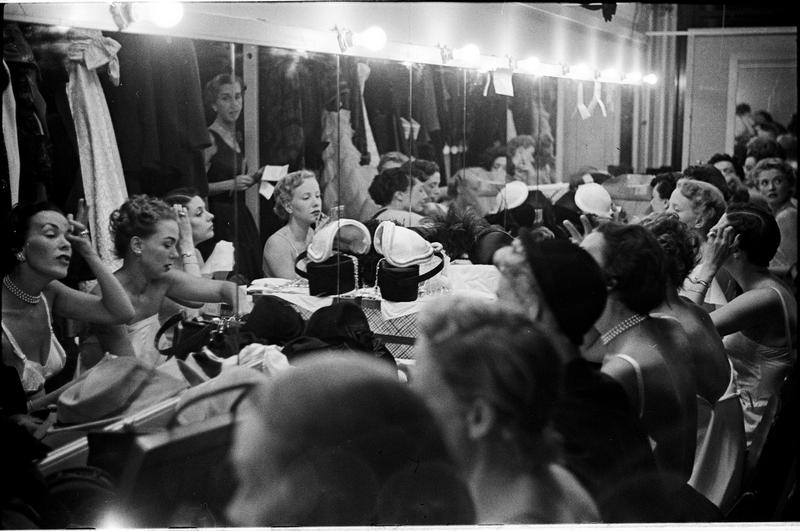
Photo by Stanley Kubrick/Museum of the City of New York

Racks of clothing, 1955

Library of Congress/WikiMedia

The unique brutalist architecture of the Fashion Institute of Technology 1964
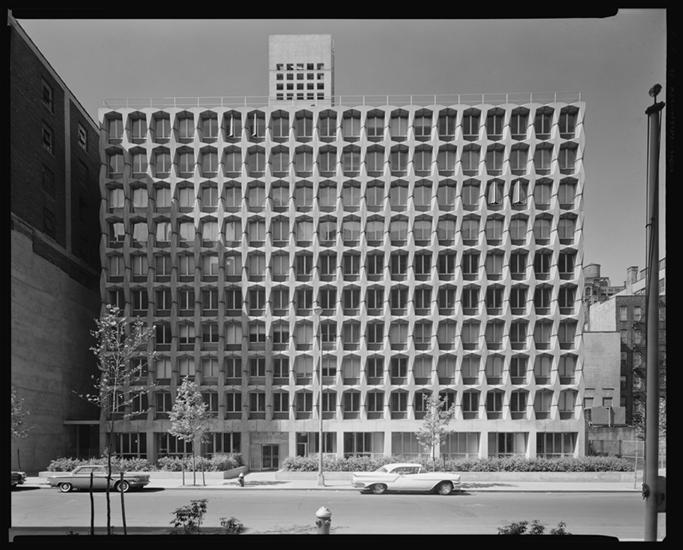
Wurts Brothers/Museum of the City of New York

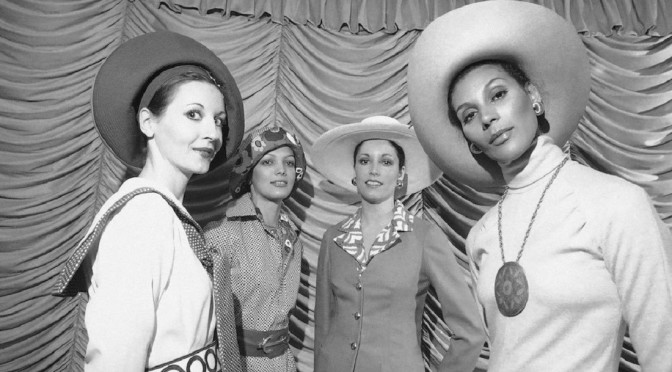
From ‘Press Week’ aka Fashion Week,  Jan. 7, 1972. (AP Photo/Ray Stubblebine)
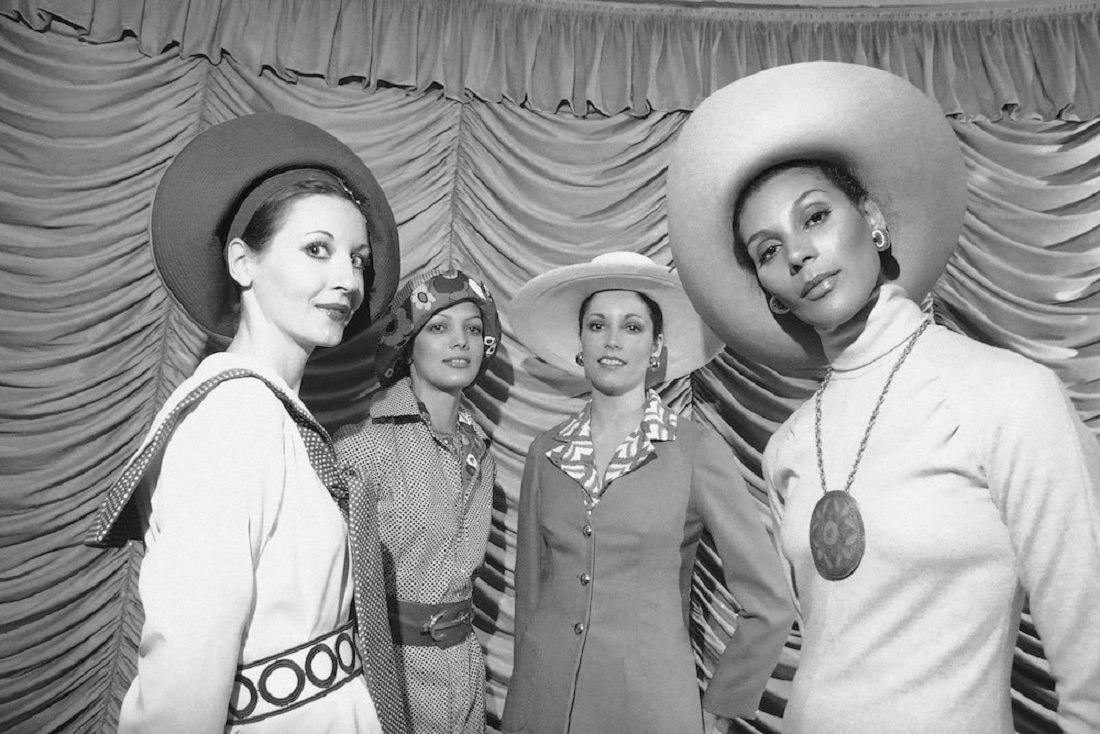
Fashion Hats


The naming of “Project Runway Avenue” 2012
Categories
Amusements and Thrills Podcasts Writers and Artists

Truman Capote’s Black and White Ball: The Absurd Story of a Marvelous Party

PODCAST Your ticket to Truman Capote’s celebrity-filled party at the Plaza.

This month FX is debuting a new series created by Ryan Murphy — called Feud: Capote and the Swans — regarding writer Truman Capote‘s relationship with several famed New York society women.

And it’s such a New York story that listeners have asked if we’re going to record a tie-in show to that series. Well, here it is! Tom and Greg recorded this show back in November of 2016 but, likely, most of you haven’t heard this one.

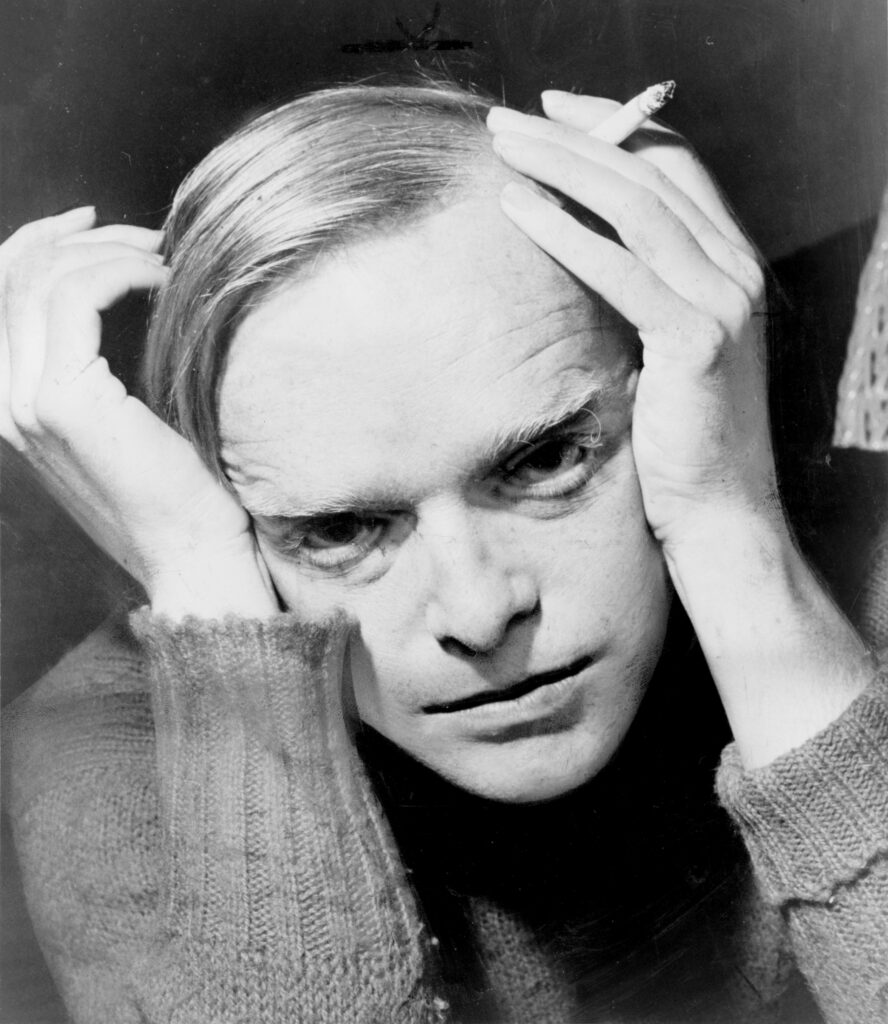
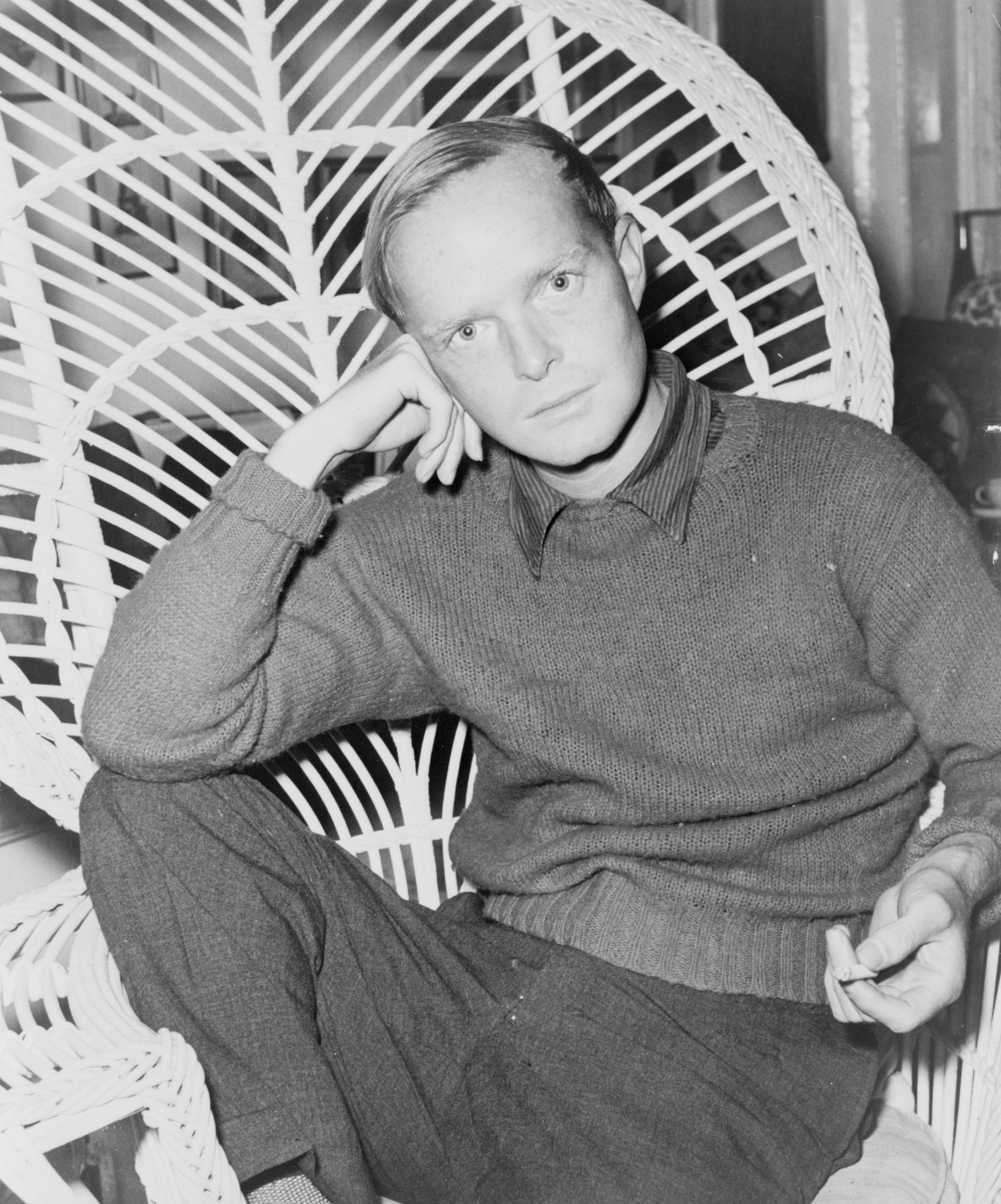
Capote in 1959 / Library of Congress Prints and Photographs Division. New York World-Telegram and the Sun Newspaper Photograph Collection.

Capote is a true New York character, a Southern boy who wielded his immense writing talents to secure a place within Manhattan high society. Elegant, witty, compact, gay — Capote was a fixture of swanky nightclubs and arm candy to wealthy, well-connected women.

One project would entirely change his life — the completion of the classic In Cold Blood, a ‘non-fiction novel’ about a horrible murder in Kansas. Retreating from his many years of research, Truman decided to throw a party.

But this wasn’t ANY party. This soiree — a masquerade ball at the Plaza Hotel — would have the greatest assemblage of famous folks ever gathered for something so entirely frivolous. An invite to the ball was the true golden ticket, coveted by every celebrity and social climber in America.

Come with us as we give you a tour of the planning of the Black and White Ball and a few glamorous details from that strange, glorious evening.

FEATURING: Harper Lee, Lauren Bacall, Frank Sinatra, Robert Frost, Lillian Hellman, Halston, Katharine Graham and a cast of thousands (well, or just 540)


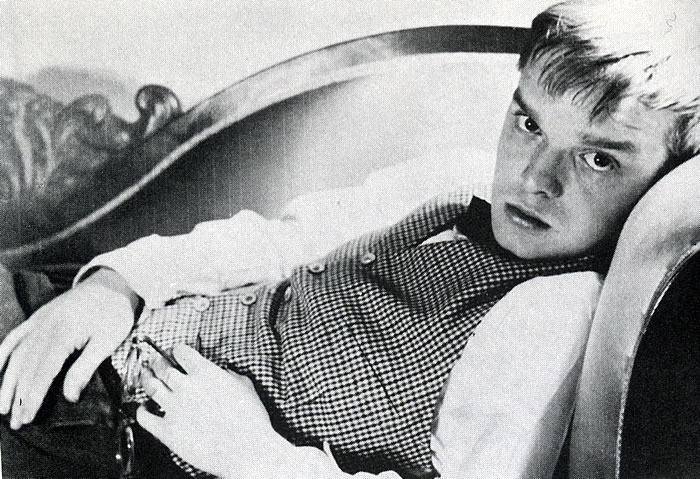
Truman Capote in 1945

capote-truman-1945

From the unusual book jacket of Other Voices, Other Rooms, 1948

1477405059645

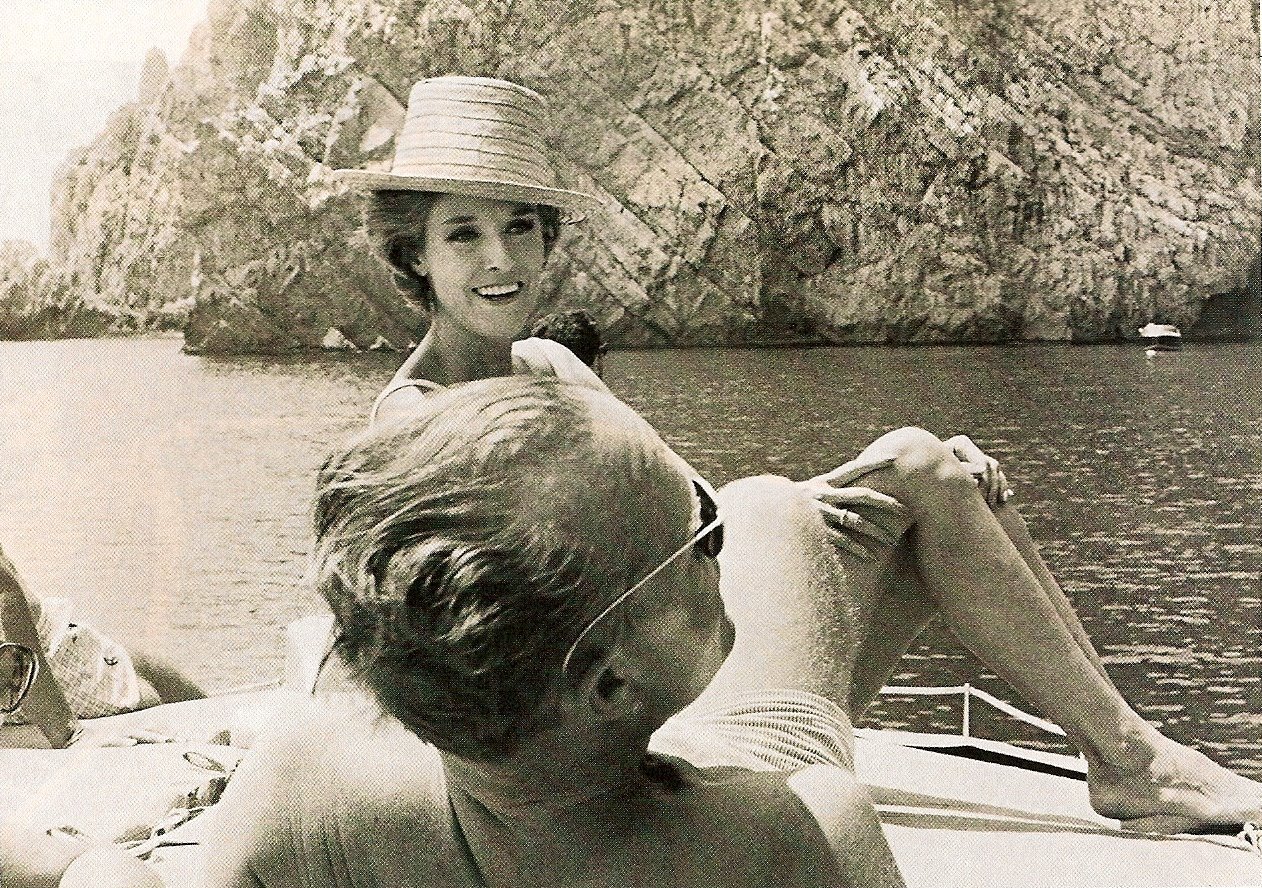
Babe Paley with Truman Capote in Capri, early 1960s

Courtesy the Red List

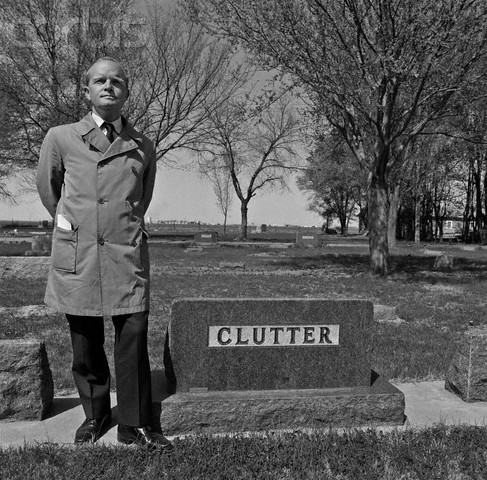
Capote in Kansas, at the grave of the Clutter family, their murder being the inspiration for his book In Cold Blood.

1967, Holcomb, Kansas, USA --- Author Truman Capote poses at the grave of the murdered Clutter family, made famous in his novel and in the film . --- Image by © Bob Adelman/Corbis
1967, Holcomb, Kansas, USA — Author Truman Capote poses at the grave of the murdered Clutter family, made famous in his novel and in the film.  — Image by © Bob Adelman/Corbis

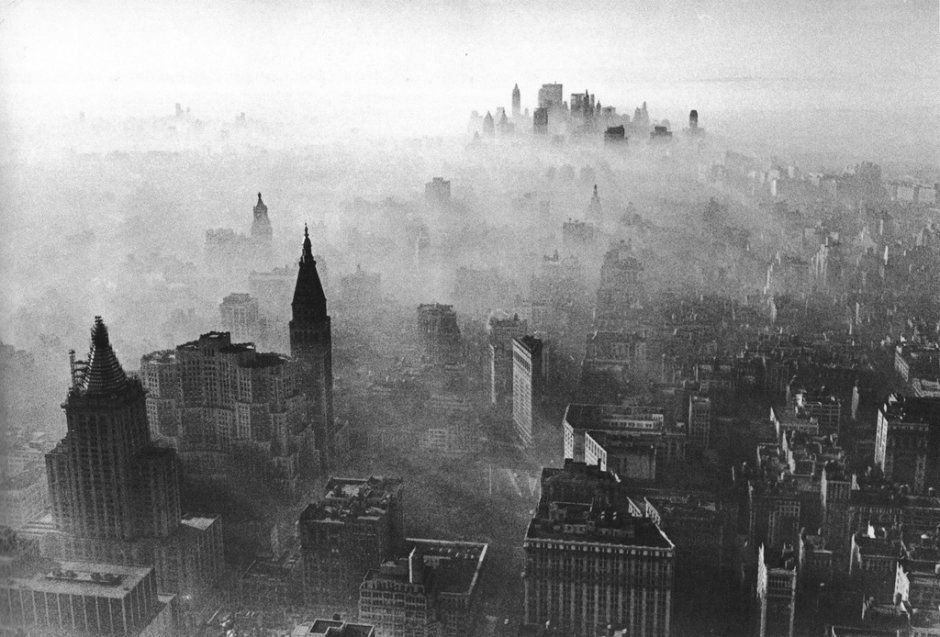
Just a few days before the party, this is what New York City looked like — draped in a toxic smog.

manhattan-smog

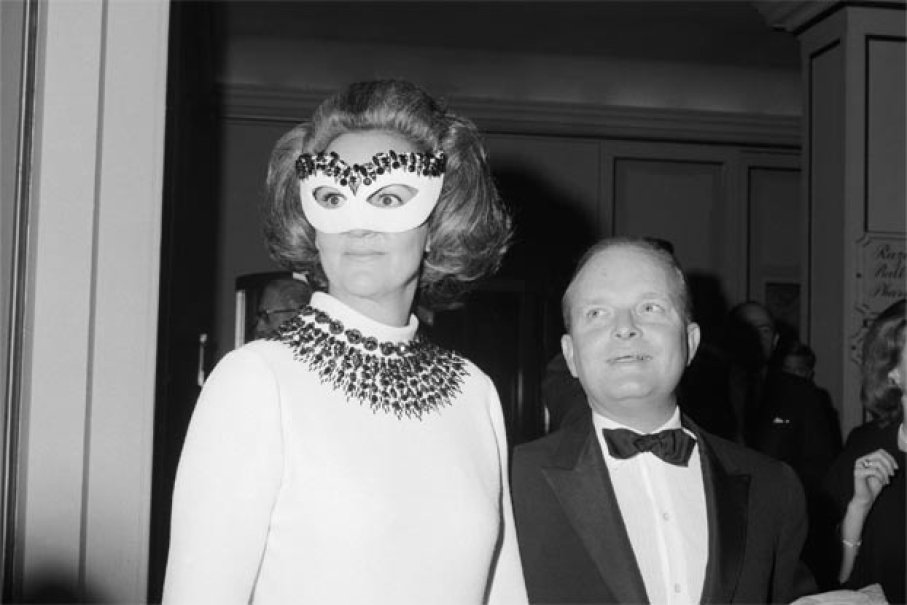
Truman Capote with his guest of honor — Katharine Graham

 BETTMANN/CORBIS
BETTMANN/CORBIS

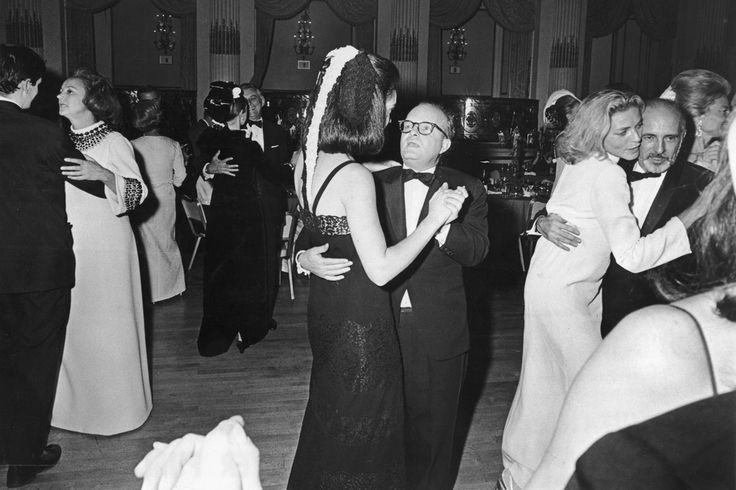
Graham is on the left and Capote is front and center, but the real action is Lauren Bacall and Jerome Robbins at right.

b4c4827ad282c89b6bf712cb6be26a5a
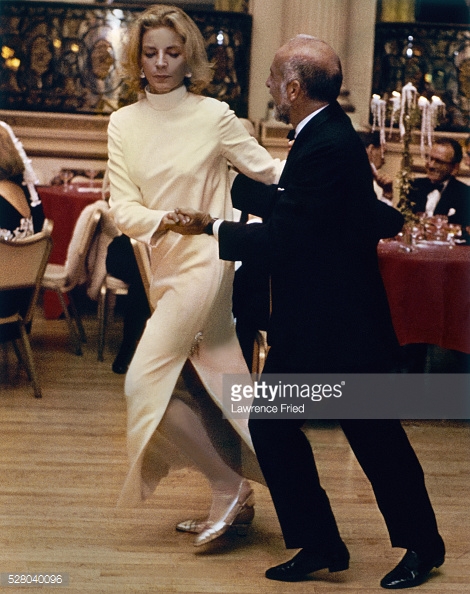
Mrs. Jason Robards Jr. dancing with Jerome Robbins at Truman Capote's party *** Local Caption *** Lauren Bacall;Jerome Robbins;

©Lawrence Fried or photo by Lawrence Fried. 

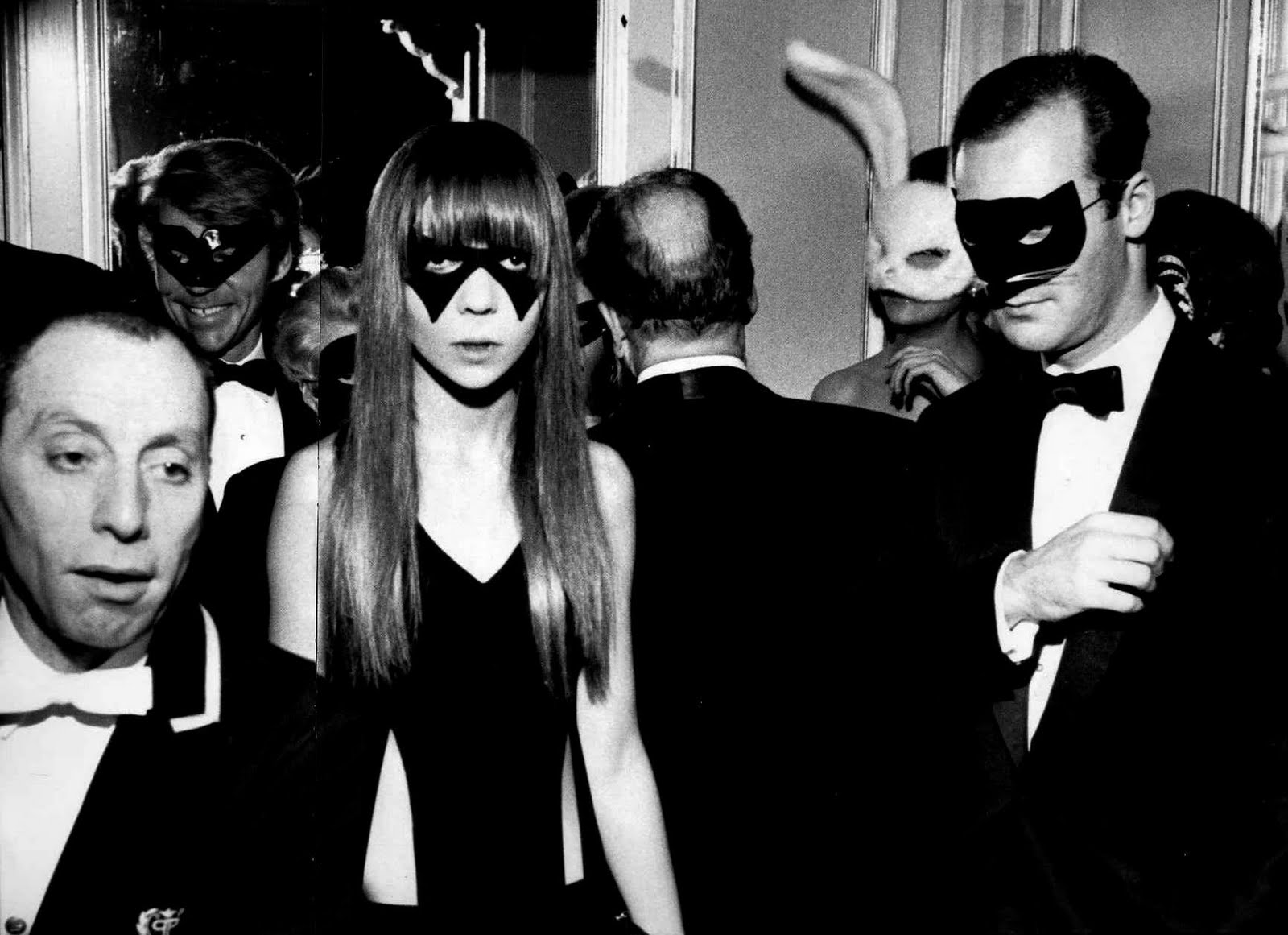
Supermodel Penelope Tree looks a little bit like Batgirl here.

024_penelope_tree_theredlist

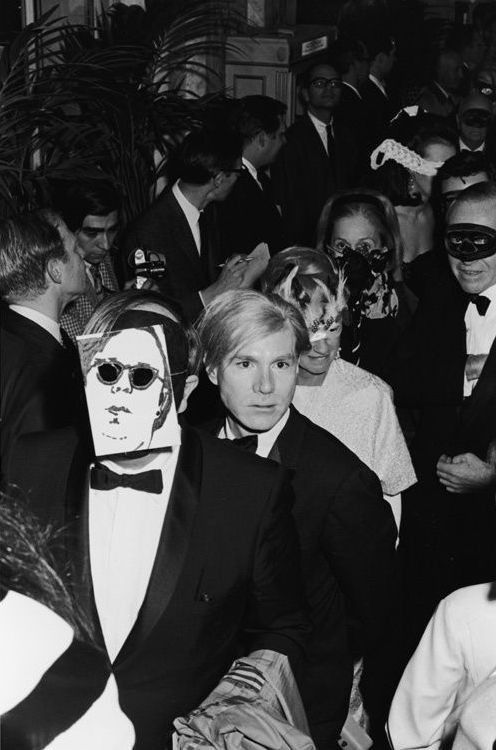
Andy Warhol came to the party without a mask.

661156045889f5e9c50f92a012952ebc

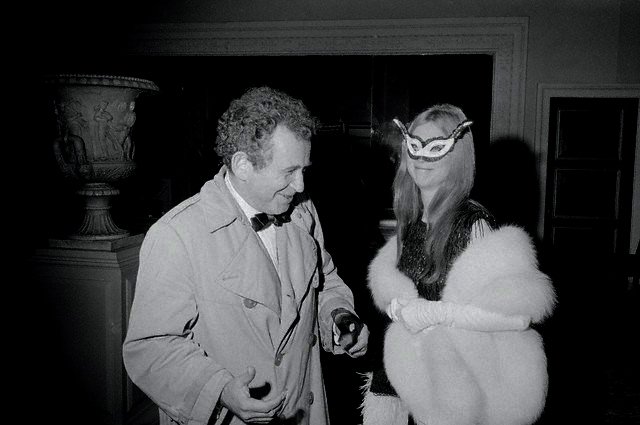
Norman Mailer and an unidentified guest.

norman-mailer-and-guest-in-costume

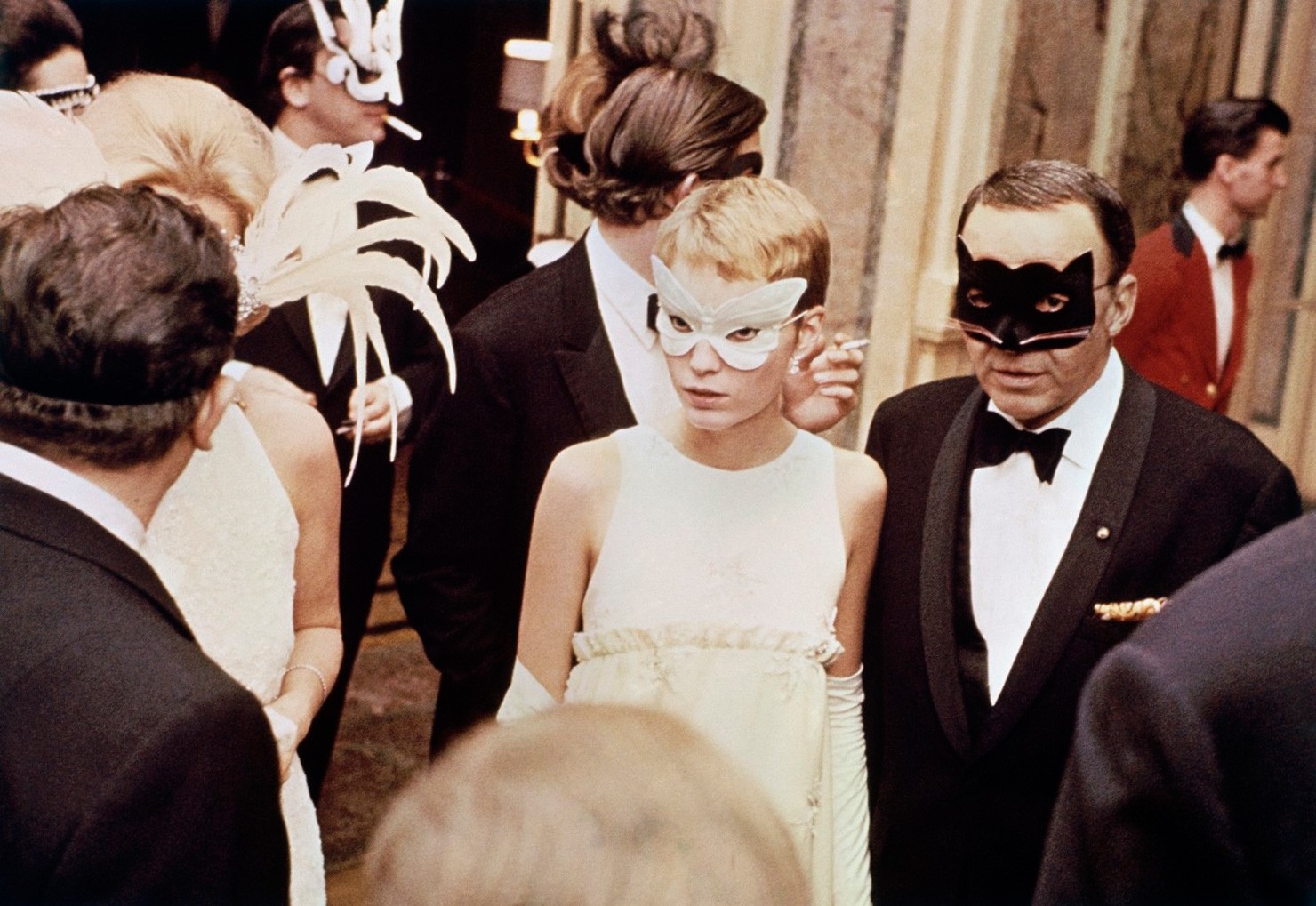
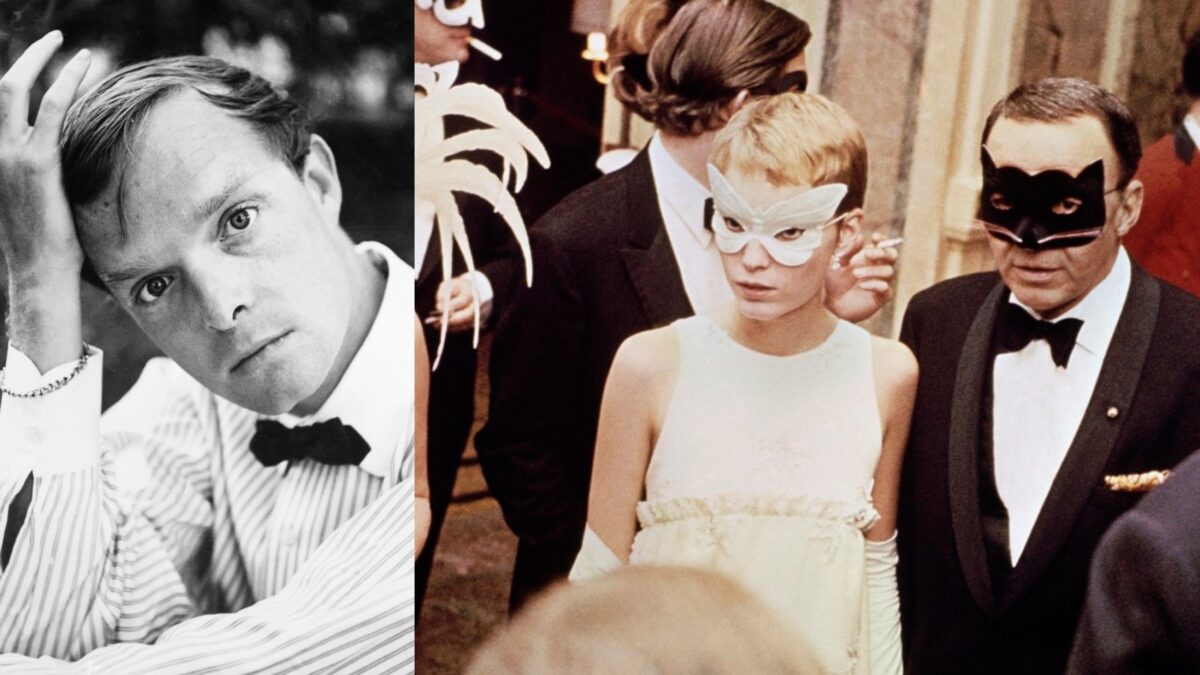
One of the most talked about couples of the evening — Frank Sinatra and his new bride (with a new haircut) Mia Farrow.

Conde Nast Archive / Corbis / East News.
Photo courtesy ©Lawrence Fried

FURTHER LISTENING

Two other New York cultural icon — who happened to be invited to Capote’s dance:

Some context on the New York ball/society scene, courtesy The Gilded Gentleman

FURTHER READING

Truman Capote / Breakfast at Tiffany’s
Truman Capote / In Cold Blood
Truman Capote / Other Voices, Other Rooms
Truman Capote / “La Côte Basque 1965” and Answered Prayers
Deborah Davis / Party of the Century: The Fabulous Story of Truman Capote and His Black and White Ball
George Plimpton / “Was Truman Capote’s Black-and-White Ball the Greatest Party Ever?” Esquire 1991
Guy Trebay / “50 Years Ago, Truman Capote Hosted the Best Party Ever,” New York Times, 2016
Ralph Voss / Truman Capote and the Legacy of “In Cold Blood”

Categories
Amusements and Thrills

Bogie and Bacall meet Basie and Billie

This actually happened.

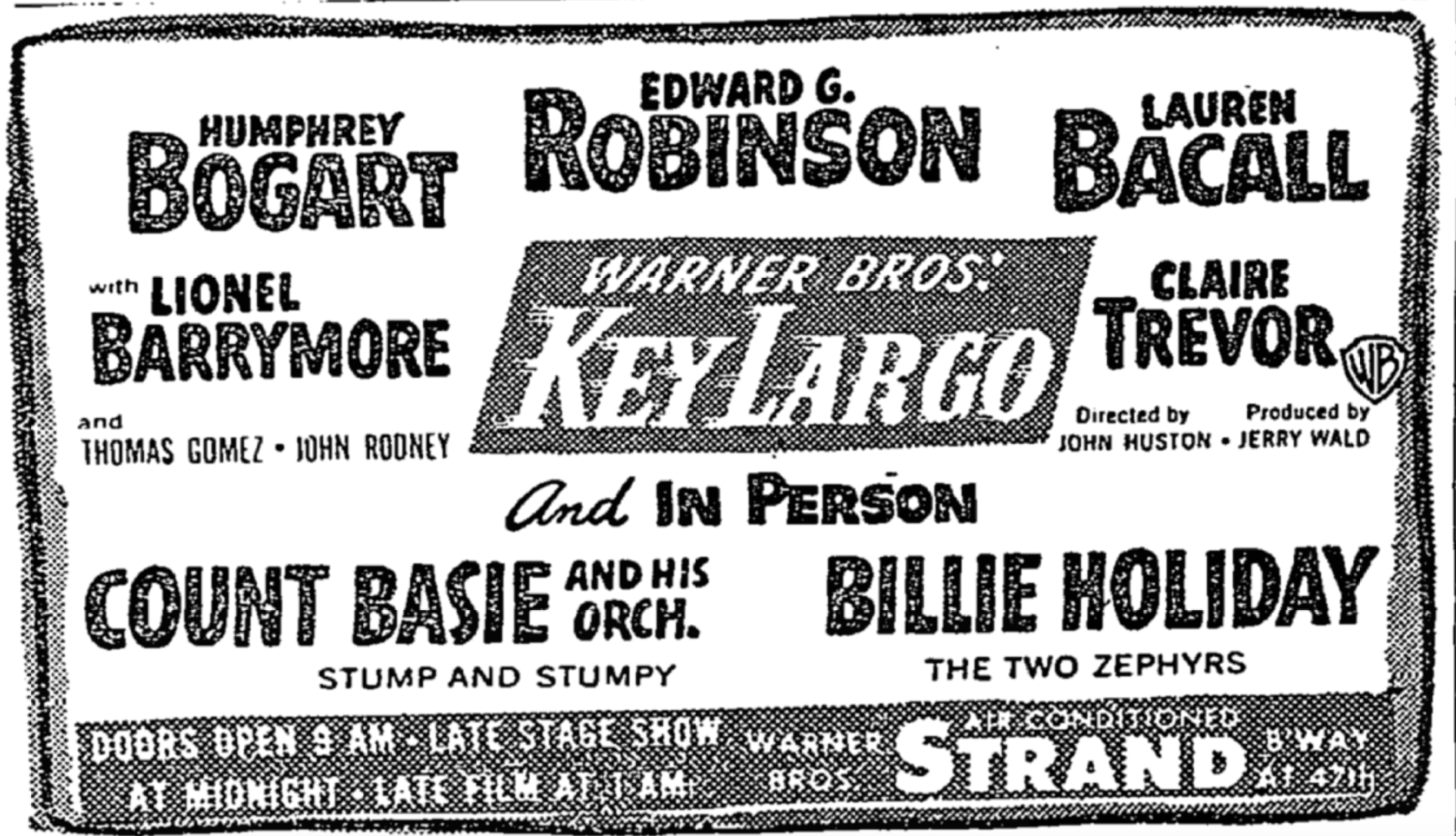
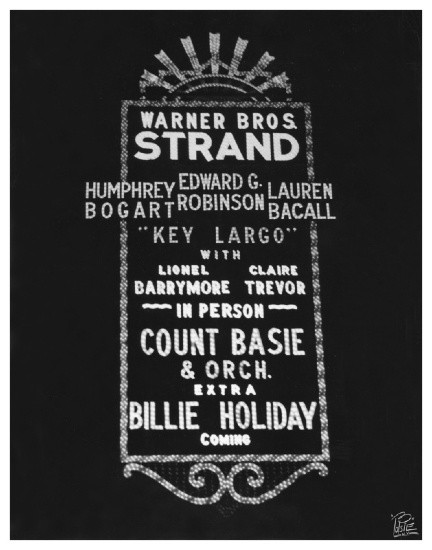
For the debut of the new film Key Largo — starring Humphrey Bogart and Lauren Bacall — the exhibitors at the Warner Strand Theater (at Broadway and 47th Street) has a special treat in store.

from the New York Times, July 17 1943

The Strand Theatre, which opened in 1914, has already made history a few times in New York. Considered the first theater built exclusively for motion picture exhibition, the Strand was the first New York job of Samuel ‘Roxy’ Rothefel (who would move on to his own Roxy Theatre and, then Radio City Music Hall).  On July 6, 1928, The Lights of New York, the first all-talking feature in history, premiered at the Strand.

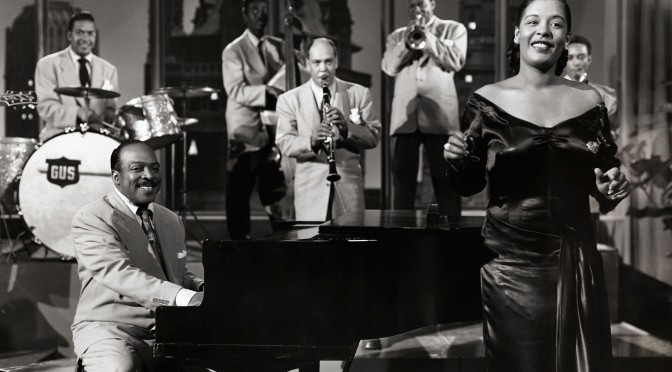
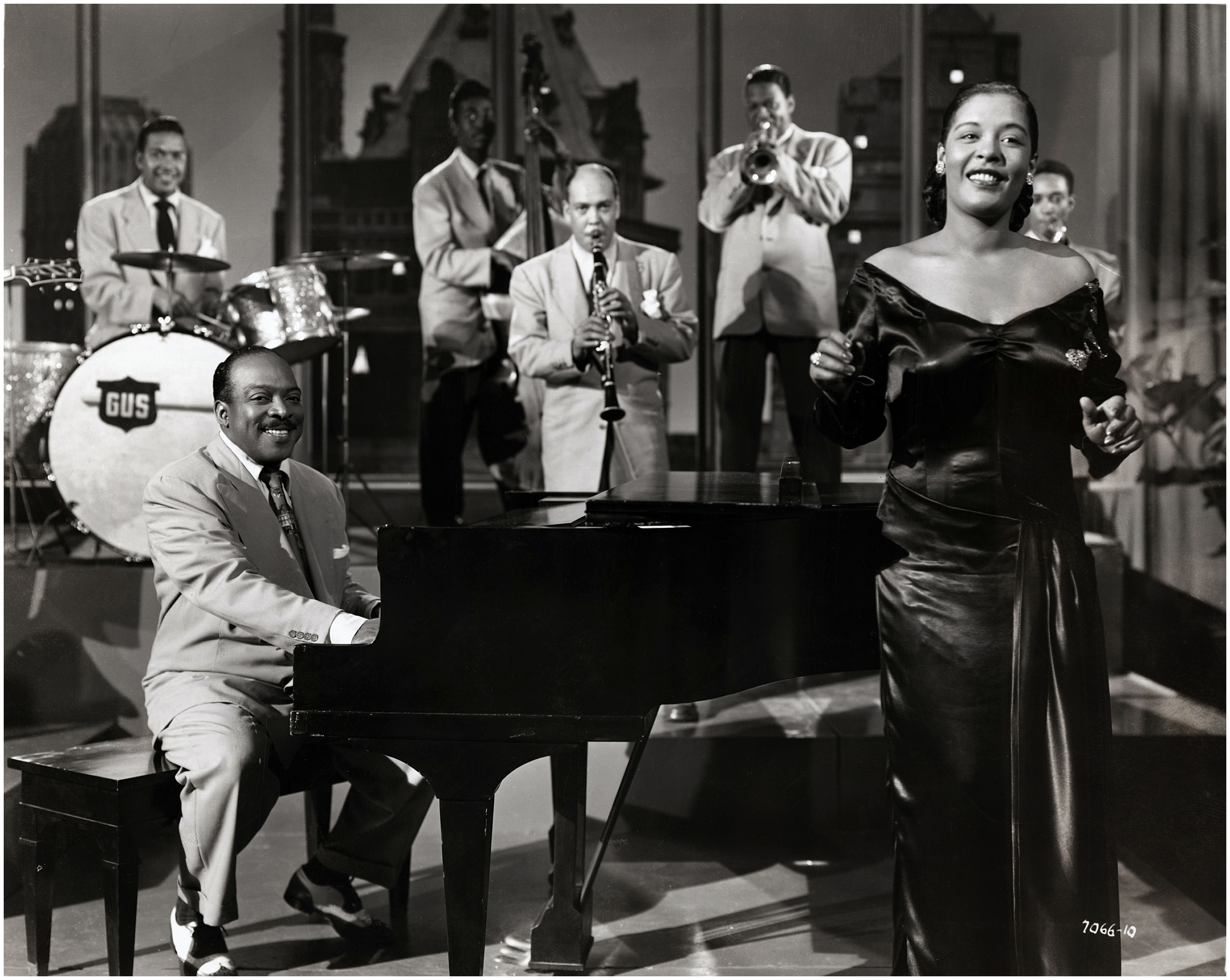
In 1948 came the fourth (and what would be final) movie collaboration between Bogart and Bacall, and its debut on July 16th deserved something out of the ordinary.  For six weeks, the Strand presented the film on an exhaustive bill of music and comedy, featuring two of the biggest stars in jazz music, Count Basie and Billie Holiday.

tumblr_m2af84Jr5g1qb5wa0o1_500

The two greats had recorded and toured with one another a decade previously, but much had changed since then.  Holiday had only been released from prison that March, serving time on a charge of heroin possession.  The big band era was ending, leaving Basie struggling to mold his music to the new styles of bebop, rock and  rhythm and blues.

While both would continue with their celebrated careers into the 1950s, the six-week Key Largo stint would remind many of earlier, more jubilant phases of their careers.

Billie Holiday, Count Basie
Basie and Billie from a film still

It was the longest theater run of Lady Day’s career although she fretted the fact that many were there to see her “get all fouled up,”  according to author Donald Clarke.

As you can imagine, it broke box office records for the Strand. According to Basie’s autobiography, “I think we went in there on a contract for three weeks with an option to extend for another two weeks, and I think they revised it and made it five weeks with options to make it six or seven weeks.”

They were joined by the black comedy team The Two Zephyrs (with legendary comic Slappy White) and tap dancing duo Stump and Stumpy.

I hope that Billie sang “Moanin’ Low,” made famous by the film in a mesmerizing performance by Claire Trevor (who won the Academy Award).


Categories
Pop Culture

Lauren Bacall’s Guide on How To Become A Successful Model in New York City, 1941

Lauren Bacall, the cinema and stage legend who died yesterday at age 89, was once the less enigmatic Betty Joan Perske, a New York girl with a lot of moxie.  As a sixteen year old, she ventured downtown from her home on the Upper West Side (84th Street, under the elevated train) to look for work as a model and actress.

In her great autobiography By Myself, she recounts her experiences as a teen model.  Go back in time and take her valuable advice on how to make it in the cutthroat world of the Garment District in 1941!

Know the finer places: “I asked a couple other girls how to find work modeling clothes on Seventh Avenue.  They said I should … go down to certain Seventh Avenue buildings — nothing really below 500 Seventh Avenue. The best houses were in 550 or 530 and you could squeeze in 495, but that was it — anything below that was tacky.”

Lie a little: At 498 Seventh Avenue, “[a] woman came out, looked at me, asked me about my experience — I told her I had been a photographic model for several years (a white lie), that I was an actress, that I knew how to move and would certainly be a very good model.”

Play act: “I kept telling myself, ‘It’s a part — play it….’  Finally the woman asked me if I would try on one of the model dresses….I walked through the curtains.  Mr. Crystal asked me to turn — I did, without falling down or getting dizzy…”

Dress the part:  “I spent the next week going through my scant wardrobe to make certain I had enough to wear to work.  Then a trip to Loehmann’s in Brooklyn.  Loehmann’s was a large store that stocked clothes from all the Seventh Avenue houses — lower-priced clothes of unknown designers as well as the most expensive…. There were no dressing rooms in the store.  Women ran around in their slips, girdles and bras — all shapes and sizes — grabbing things from saleswomen as they brought them down. A madhouse.”

Watch and learn:  At Crystal’s, her first modeling house, “you undressed and either sat in a slip or put on a cotton smock.  There was a long make-up table with a chair for each of us….I watched [the older models] as they applied their make-up — a base, then full eye make-up.  It didn’t look heavy, but it was there. I did the best I could do with the face confronting me in the mirror.”

Composure: “When I showed a dress and a buyer would ask to see it close to, I’d be motioned forward.  The buyer, male or female, would then feel the fabric, discuss it — I’d stand there until I was dismissed.  An occasional male buyer would feel the goods a bit more than necessary and I never knew what to do.  I was petrified, though no one ever was really fresh, just suggestive — just enough to make me aware that I’d better keep on my toes, protect myself.”

Build from rejection:  She was laid off at Crystal’s for being too thin (can you imagine?) but promptly got a job modeling evening gowns.  “I was much happier at Friedlander’s than at Crystal’s.  He laughed at all my little jokes, the other models were good girls (there were only two of them), the feeling was much cozier.”

Plan your escape route: “The other girls seemed fairly uncomplicated to me — they would keep on modeling until Mr. Right came along and then they’d get married and be all set.”  But Betty wanted to be an actress.  On her lunch breaks, she would go up to Walgreen’s at 44th and Broadway. Then this happened.

After six months she quit — “I was not getting any closer to the stage in the Garment District” — and eventually moved with her mother to 77 Bank Street in the West Village.  This allowed her a full time foray into theater work, first as an usher, then as a extra and bit part player.

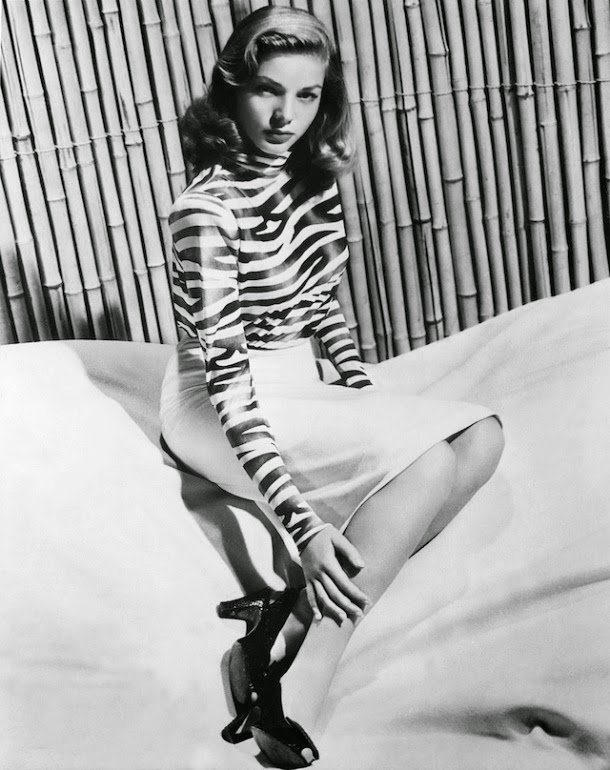
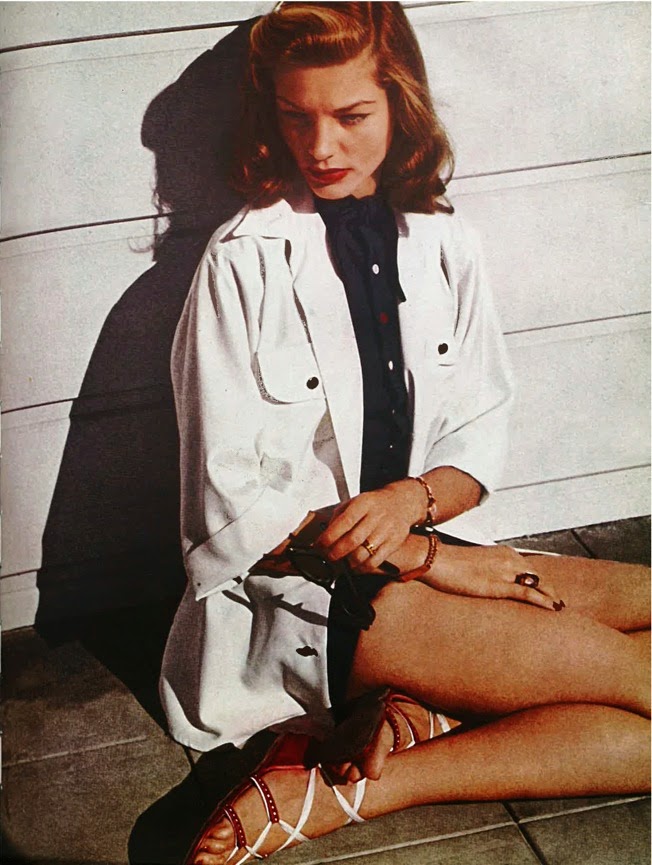
But she still modeled for extra money, including a stint as a Montgomery Ward catalog model.   Although would soon move on to full-time acting, her experience as a model was invaluable once she was put in front of a movie camera.  Her cover work for Harper’s Bazaar even got her noticed by director Howard Hawks.

Her debut in To Have And Have Not with future husband Humphrey Bogart electrified audiences.  Now as Lauren Bacall, she seemed to instantly generate magnetism. “Slumberous of eye and softly reedy along the lines of Veronica Lake,” wrote Bosley Crowther for the New York Times, in her first film review,” she acts in the quiet way of catnip and sings a song from deep down in her throat.”

Or, Bacall might have said, she did the best she could do with the face confronting her in the mirror.

Was Lauren Bacall the world’s most glamorous newsie?

The answer to the question in the headline is absolutely, without a doubt, yes.

This story begins with a Minnesotan named Leo Shull, who moved to New York in the 1930s to become a playwright. He never wrote anything of note for the stage, but he wrote plenty about the stage, various guides to playwriting, “how to break into showbiz” style books, and eventually, directories of entertainment contacts.

In 1941, Shull rented out some mimeograph machines in a basement below a Walgreens at 44th and Broadway to produce a newspaper called the Actors Cue, a daily guide to auditions, agents and producers. (Actor’s Cue was similar to today’s Back Stage. That currently operating publication was spun off by two former employees of Shull in 1960.)

But this was no ordinary Walgreens. According to author John U. Bacon, this was the very first Walgreens in New York, in the basement of the grand Paramount Building.

It opened in 1927, the same year that Sardi’s Restaurant opened its current location just around the corner. Both were associated with the theater business, with show folk. In fact, this Walgreens was often called the ‘poor man’s Sardi’s’. There was even a wall of caricatures, just like Sardi’s, lampooning the most famous faces of Broadway.

In his biography, Eli Wallach called that particular Walgreens a “hangout for actors,” a place for out-of-work actors to spend their last dime on a sandwich at the lunch counter, wiling away time before an audition.

So then, obviously, it made sense for Shull to create his daily directory here. And he not only sold the paper to actors; he often hired them to spread out around the theater district and sell the newspaper on the street.

So who should walk in but an attractive young actress named Betty Joan Perske. She was born in the Bronx and currently lived on a ground-floor apartment in the West Village, making ends meet by modeling and ushering in Broadway theaters. But she hoped to soon be on the stage, not in the aisles.

At some point, she met Shull and began selling his newspaper on her lunch breaks. In her own words:

I spent most of my lunch hours rushing to Walgreen’s to grab Actor’s Cue and look for a job in the theatre. …….  Leo had a table in the basement of Walgreen’s where copies of Actor’s Cue were piled up and sold for ten cents apiece. I prevailed on him to let me sell some. He finally said okay — to get me off his back, I think.

She took her papers to the sidewalk outside Sardi’s, where powerful producers and agents frequently dined. From there, she hocked the paper, not to make money, but to initiate conversations. “I kept my eyes peeled for a recognizable producer, actor, anyone who might help me get a job.” At right: Bacall, actually in Sardi’s Restaurant, courtesy Life Magazine

Her gumption eventually paid off. In 1942, with a slight name change (to Betty Bacall), she made her Broadway debut in the short-lived “novelty melodramaJohnny 2 X 4 at the Longacre Theatre.  However, her fame would be made on the movie screen, cast in 1943 (after yet another name change, to Lauren) opposite her future husband Humphrey Bogart in the Howard Hawks’ classic To Have And Have Not. She never needed an Actor’s Cue ever again.

I wonder if Winchell, a regular at Sardi’s, remembered that when he wrote an entire column that year called “The Bacall of the Wild,” raving about the young starlet.

Actor’s Cue is still being sold today — presumably not in front of Sardi’s — under its more descriptive new name of Show Business.