Categories
Neighborhoods Podcasts

The Garment District: Where New York Fashion Is Made

The history of the New York City fashion industry and how it found its home south of Times Square aka The Garment District.

The Garment District in Midtown Manhattan has been the center of American fashion for almost one hundred years. The lofts and office buildings here still buzz with the business of making clothing — from design to distribution.

But the district has become endangered today as clothing manufacturers move out and the entire industry faces new challenges from online sales and overseas production.

During the mid-19th century, garment production thrived in New York thanks to thousands of arriving immigrants skilled in making clothes. Most clothing in the United States was made below 14th Street, in the city’s tenement neighborhoods, especially the Lower East Side.

As the industry grew more prominent, the residents and merchants of Fifth Avenue feared it would overtake their fashionable street. So, by the 1930s, a new district was born. Hardly a stitch was sewn in the United States without passing through the blocks between 34th Street and 42nd Street, west of Sixth Avenue.

Listen in as we describe the Garment District’s chaotic flurry of activity — from the fabulous showrooms of the world’s greatest designers to the nitty-gritty bustle of its crowded streets.

In celebration of Made In NYC Week, we present our tribute to New York City’s active and thriving garment industry. A version of this show was originally presented in January 2016. Now with a new introduction and ending, this show was reedited by Kieran Gannon.


The Bowery Boys: New York City History podcast is brought to you …. by you!

We are now producing a new Bowery Boys podcast every two weeks. We’re also looking to improve the show in other ways and expand in other ways as well — through publishing, social media, live events and other forms of media. But we can only do this with your help!

We are now a member of Patreon, a patronage platform where you can support your favorite content creators for as little as a $1 a month.

Please visit our page on Patreon and watch a short video of us recording the show and talking about our expansion plans. If you’d like to help out, there are five different pledge levels (and with clever names too — Mannahatta, New Amsterdam, Five Points, Gilded Age, Jazz Age and Empire State). Check them out and consider being a sponsor.

We greatly appreciate our listeners and readers and thank you for joining us on this journey so far. And the best is yet to come!


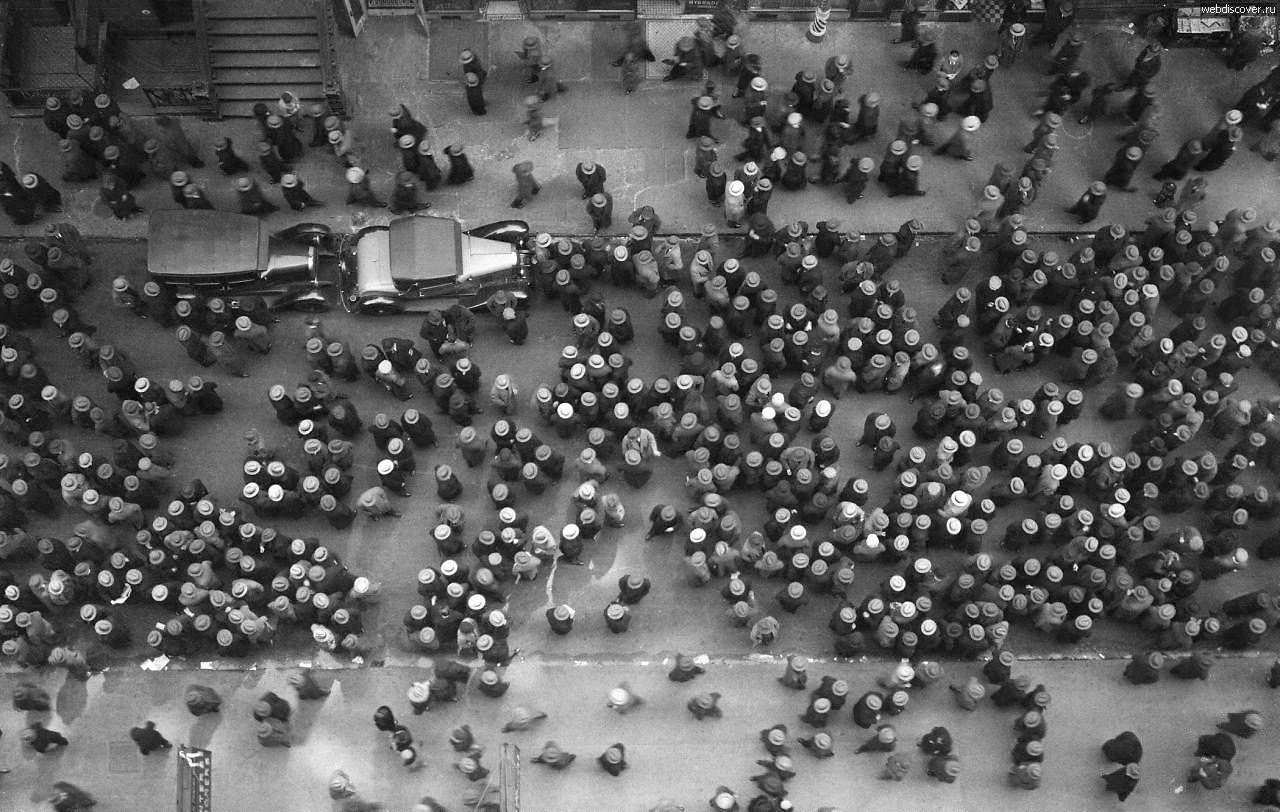
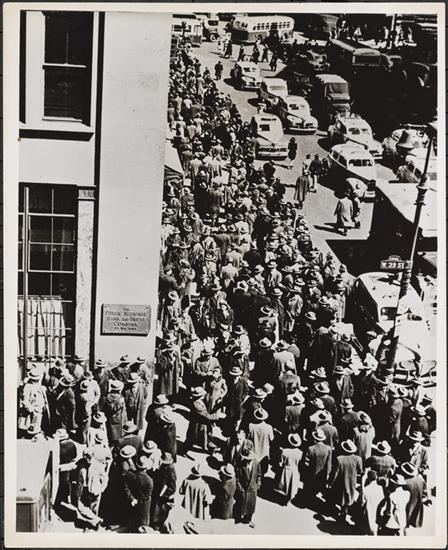
Fashionable streets: hats in the Garment District, photo by Margaret Bourke White

Courtesy Life Magazine

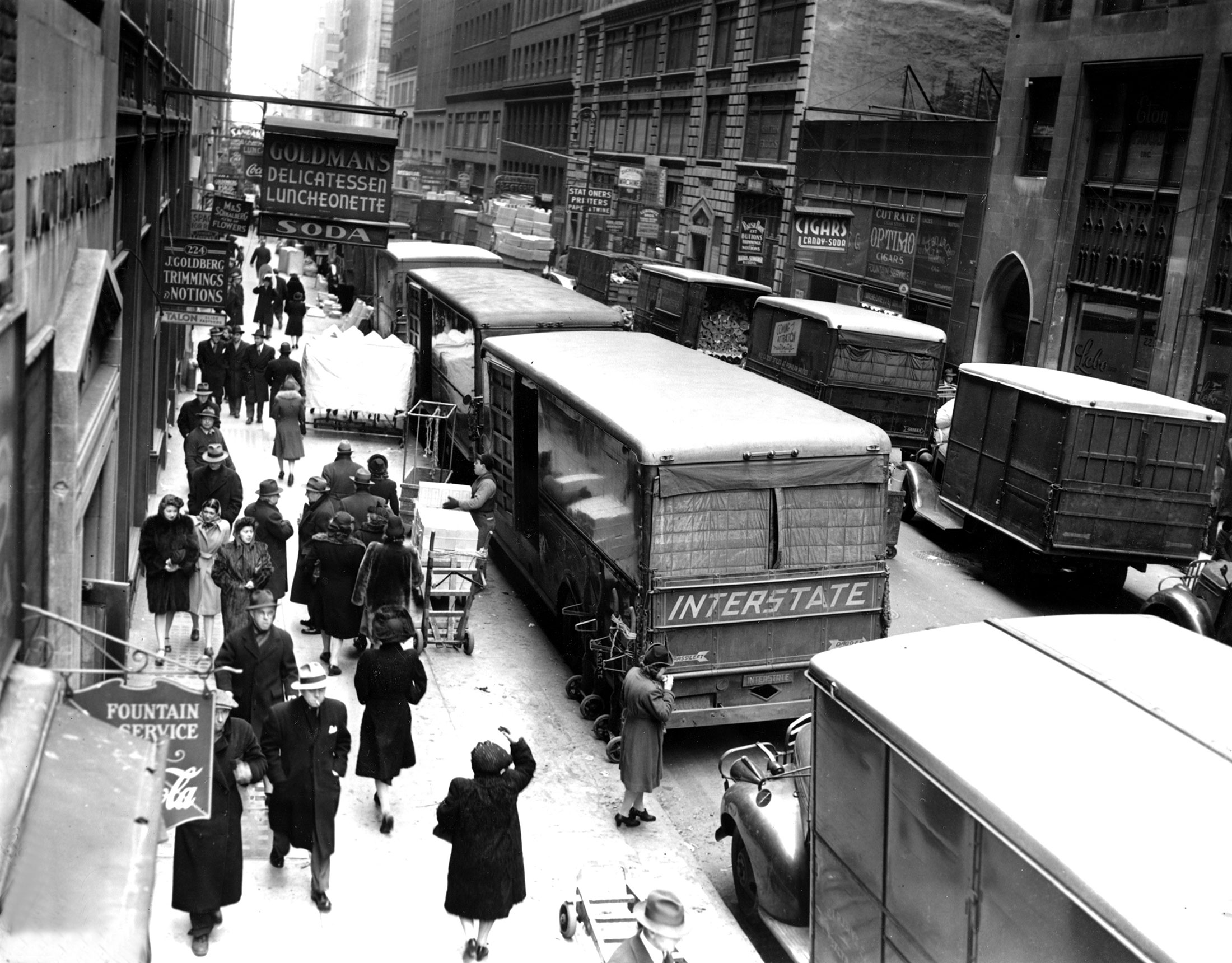
There were as many trucks in the Garment District as models, taking supplies to the busy workshops and finished garments to retailers. Photo is from Nov. 29, 1943.

Courtesy AP Photo
Courtesy AP Photo

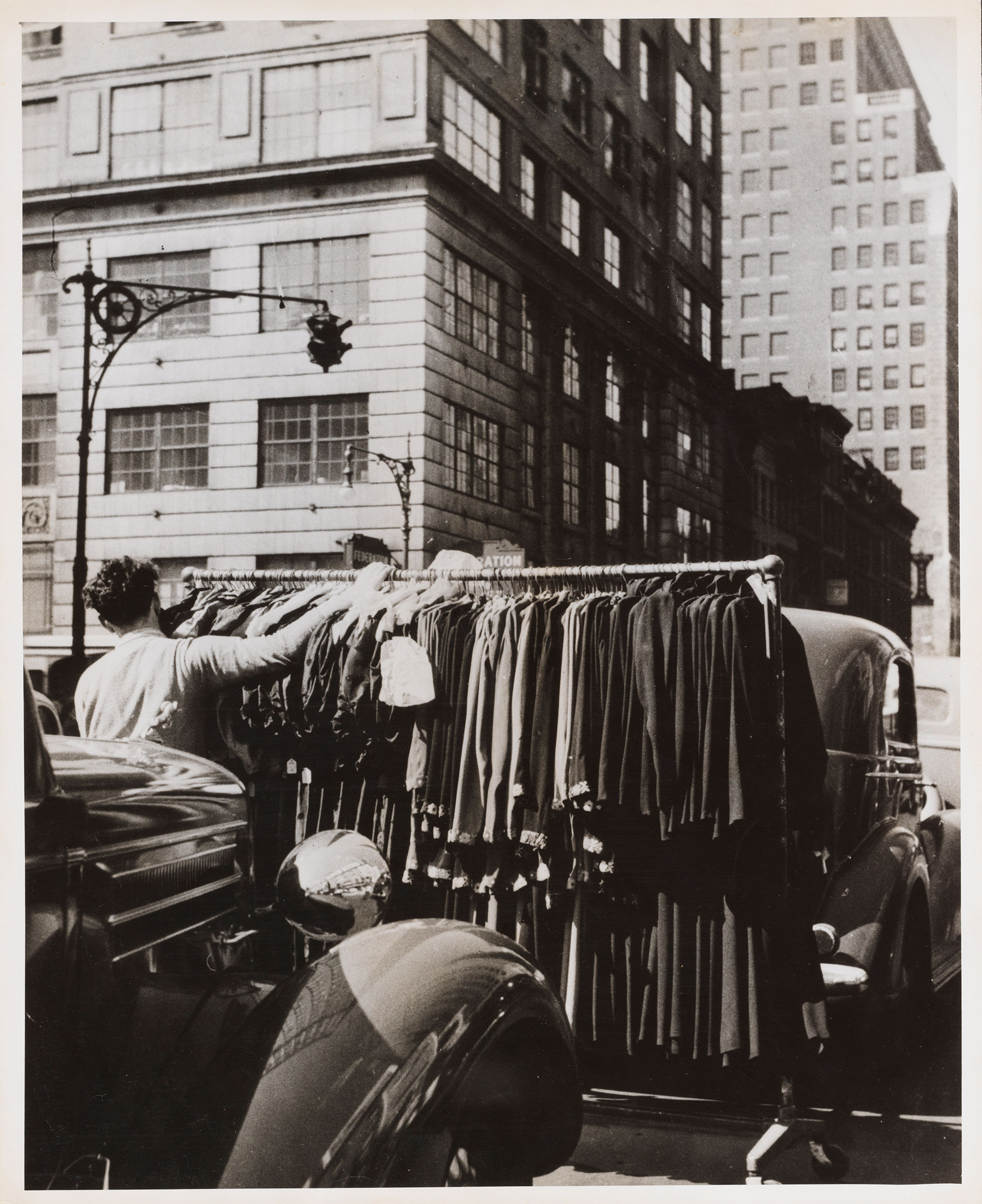
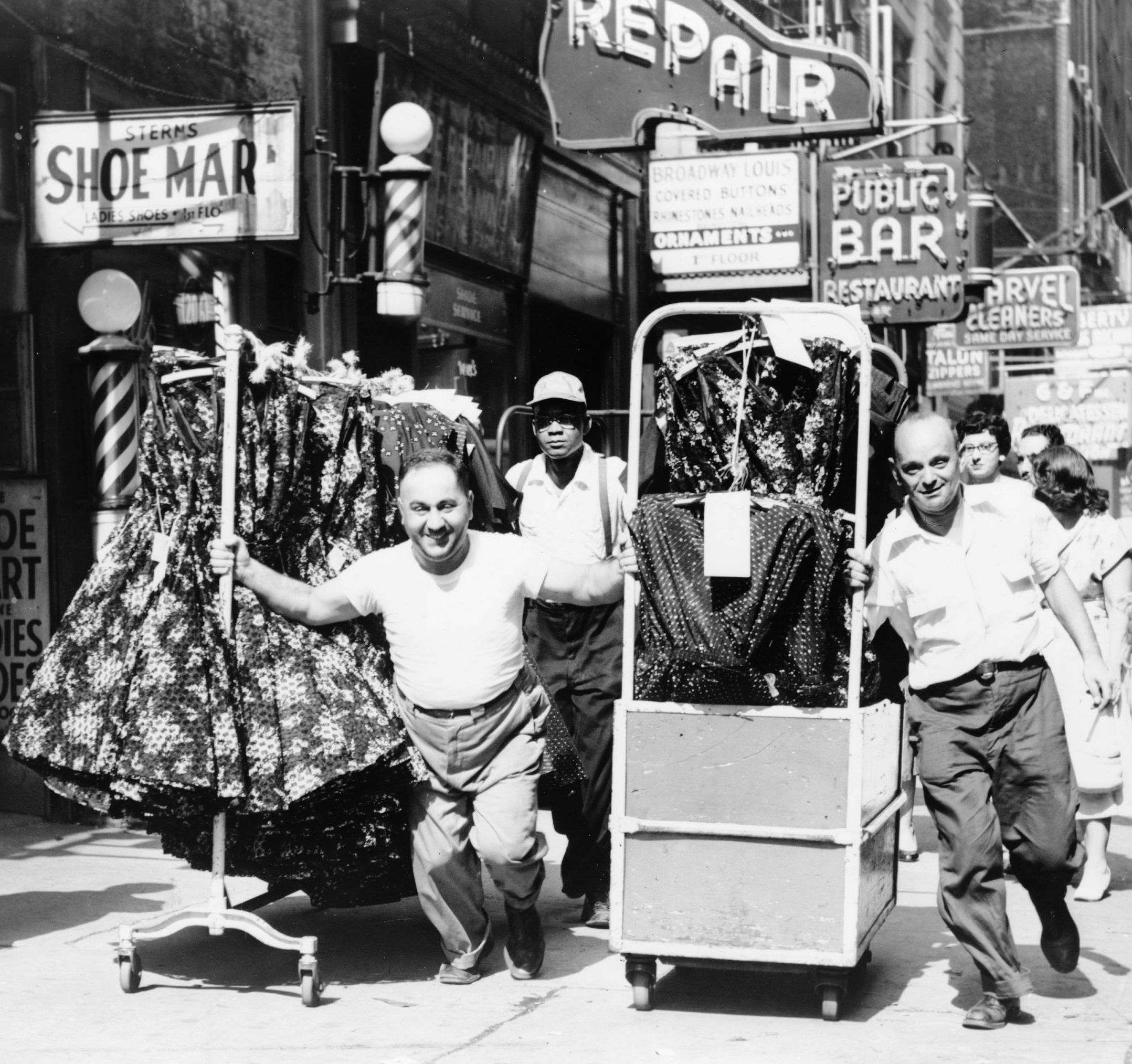
Another common site — racks of clothing being pushed down the street.

Museum of the City of New York

The Garment District at lunchtime, 1944. We told you it was insane!

Museum of the City of New York
Museum of the City of New York/US Office of War Information

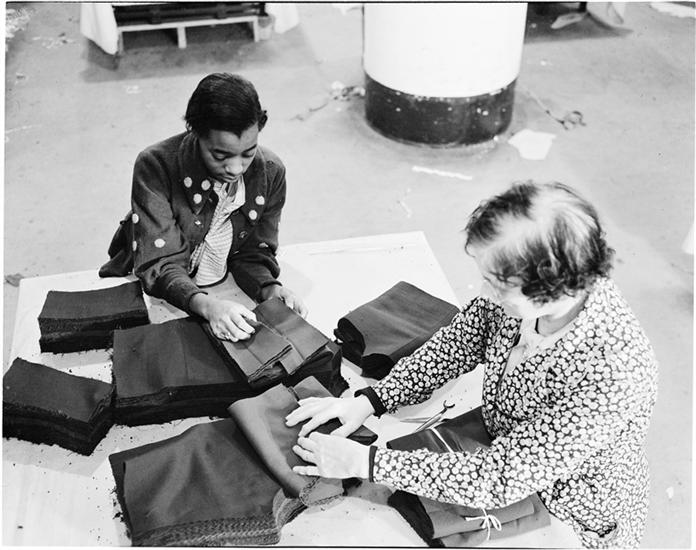
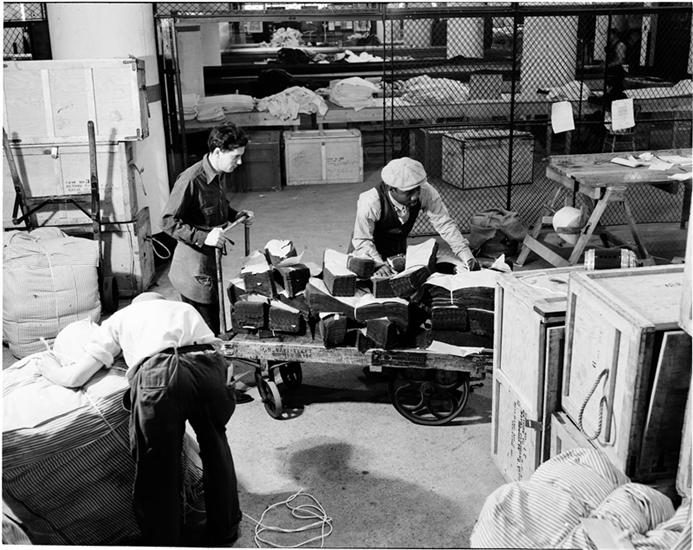
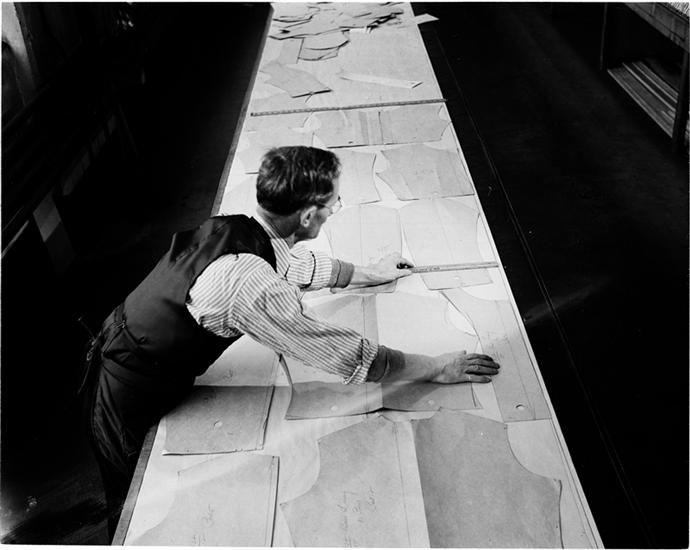
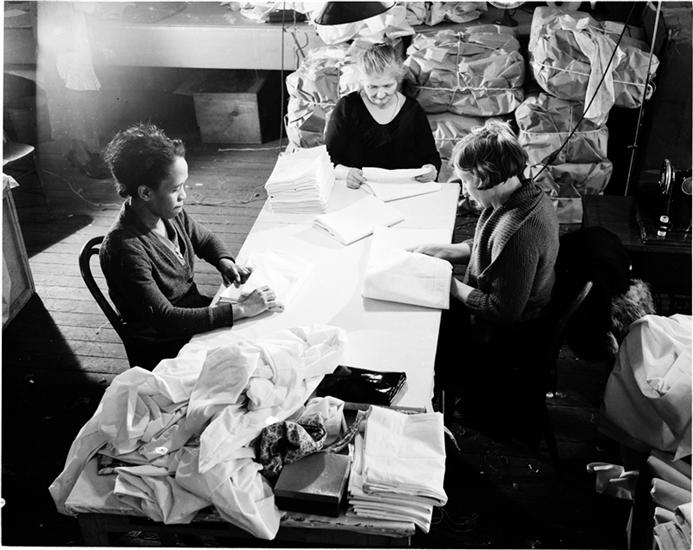
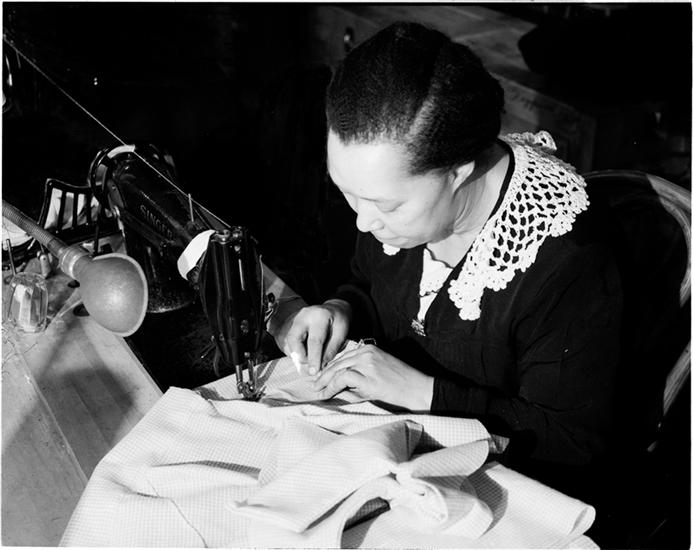
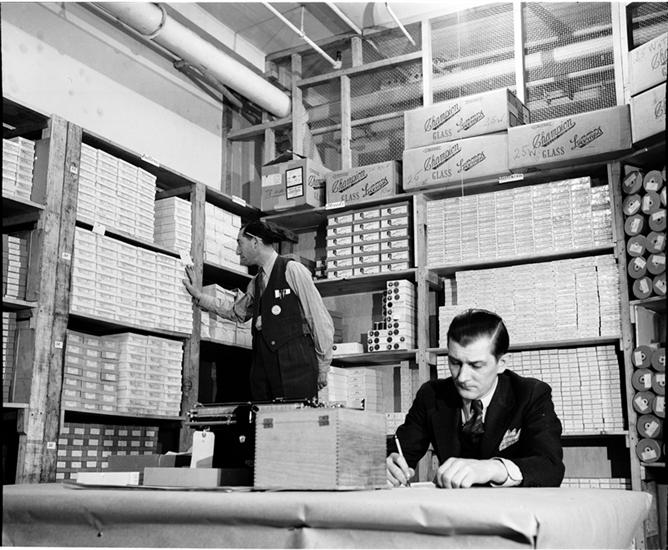
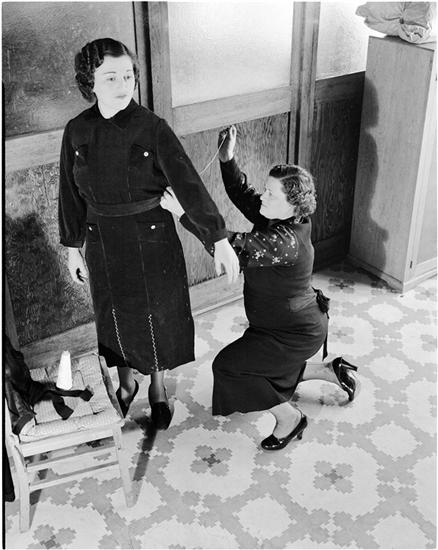
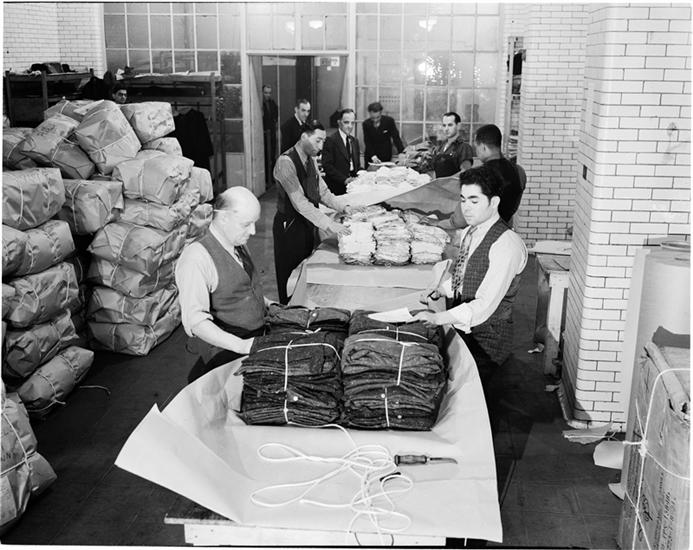
The following are a series of pictures capturing workers in a clothing factory on 36th Street and Tenth Avenue, 1937

Museum of City of New York/Federal Art Project
4
5
6
7
8
9
10

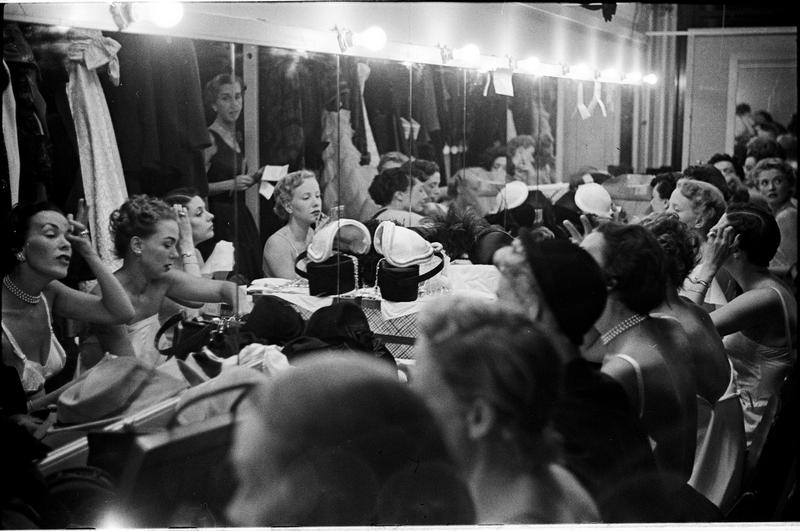
Behind the scenes at a Gimbels Fashion Show, 1949

Photo by Stanley Kubrick/Museum of the City of New York

Racks of clothing, 1955

Library of Congress/WikiMedia

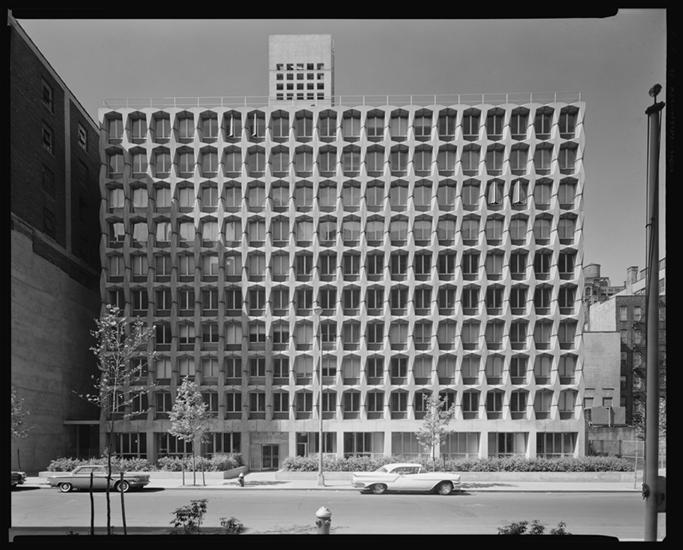
The unique brutalist architecture of the Fashion Institute of Technology 1964

Wurts Brothers/Museum of the City of New York

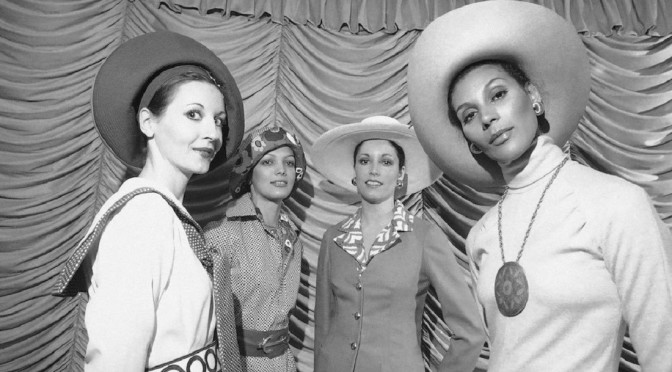
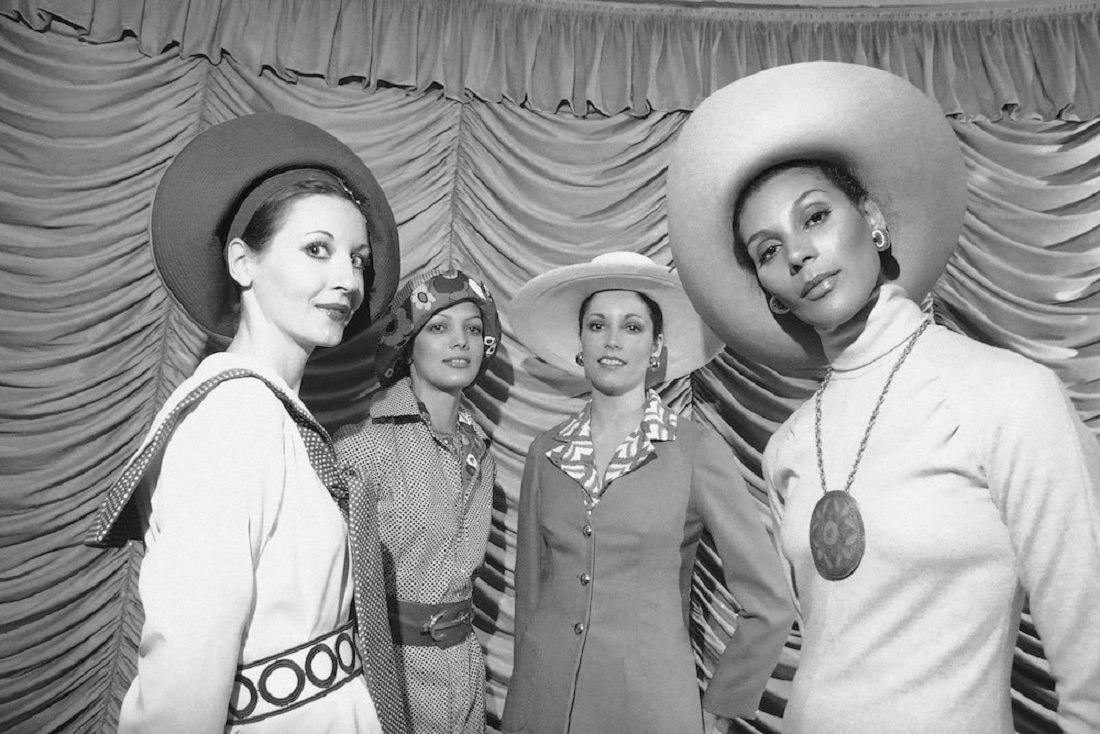
From ‘Press Week’ aka Fashion Week,  Jan. 7, 1972. (AP Photo/Ray Stubblebine)

Fashion Hats


The naming of “Project Runway Avenue” 2012

Categories
Health and Living

Open-air schools and sitting-out bags: Keeping children safe during tuberculosis scares

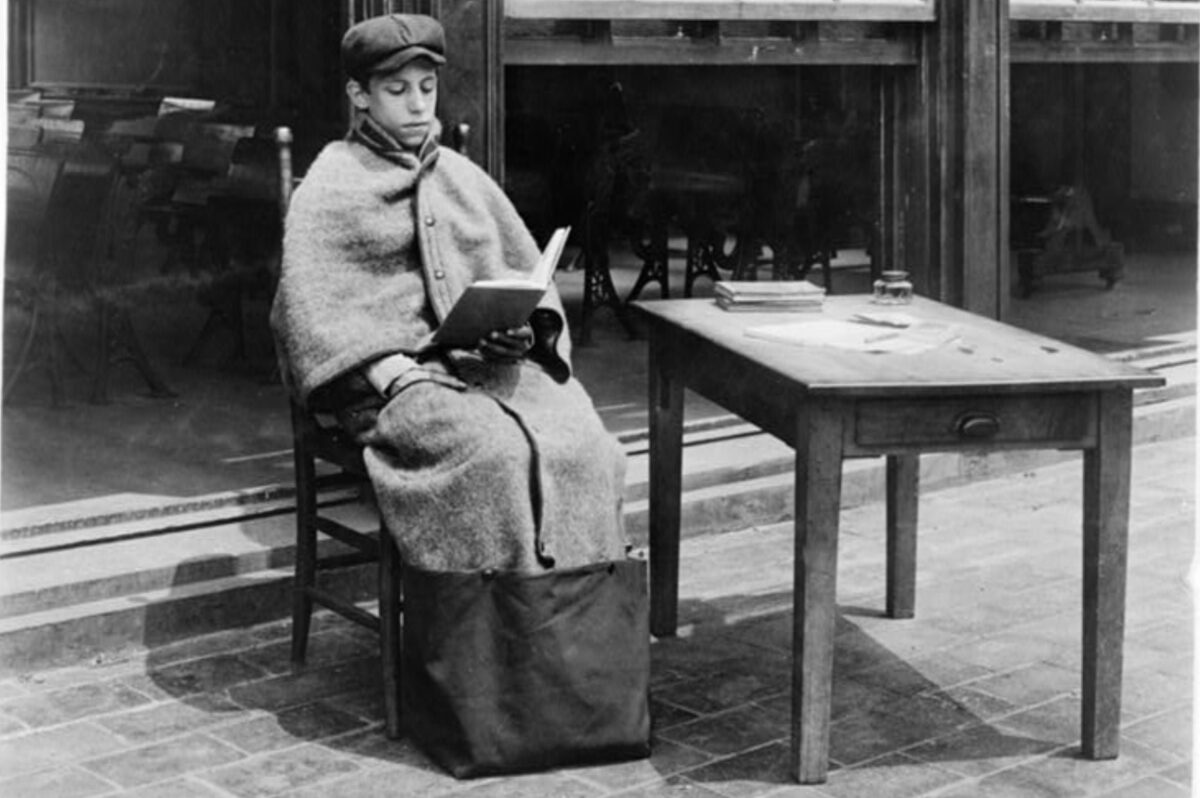
This is a sitting-out bag. No child ever wore one because he wanted to impress his friends.

But this awkward example of outdoor wear was created to save lives and keep students educated during one very concerning health crisis.

Teaching children during perilous moments of disease spread had been a challenge since the invention of public schooling. The educators of the past did not have the option of remote learning. And sometimes the epidemics faced during these moments seemed to specifically target children.

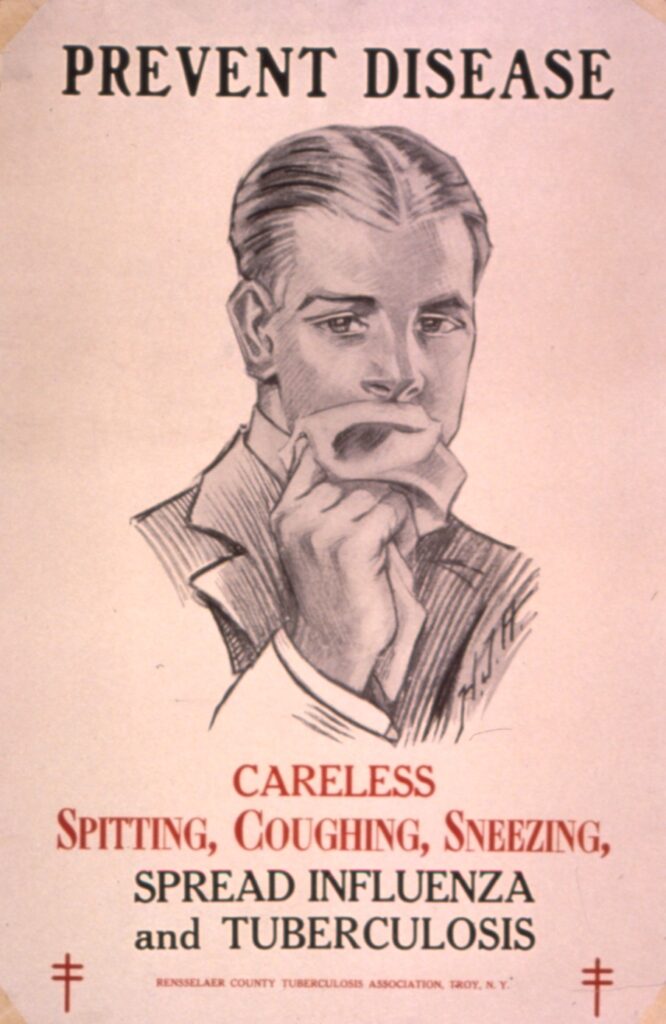
Such was the case of tuberculosis (TB), a constant specter over life in big cities for centuries. Like COVID-19, tuberculosis is spread through aerosol droplets. And like COVID-19, TB is spread through close and continued exposure to an afflicted person.

Tuberculosis was one of the leading causes of death worldwide in the 19th century and would not fully be controlled until the widespread acceptance of vaccines after World War II.

But in densely populated neighborhoods like the Lower East Side, combatting the disease was an uphill battle. Not only were people packed into small spaces, but those spaces were hardly well ventilated.

Where possible, educators chose to heed the advice of experts and hold classes outdoors.

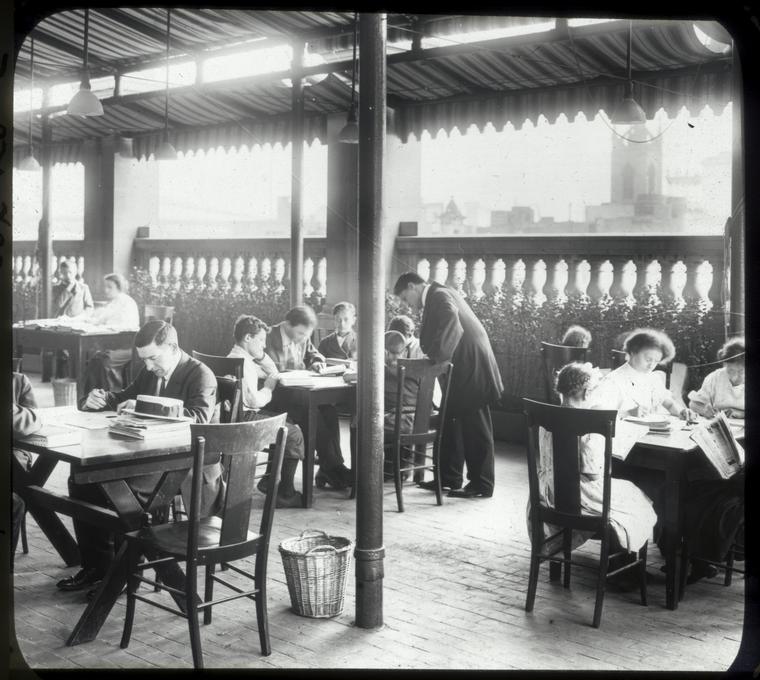
The Seward Park Library opened up its rooftop as a reading room for students, both as a way to beat the heat but also to encourage the flow of air and the prevention of disease. (Courtesy NYPL, date unknown, photographer Lewis Hine)

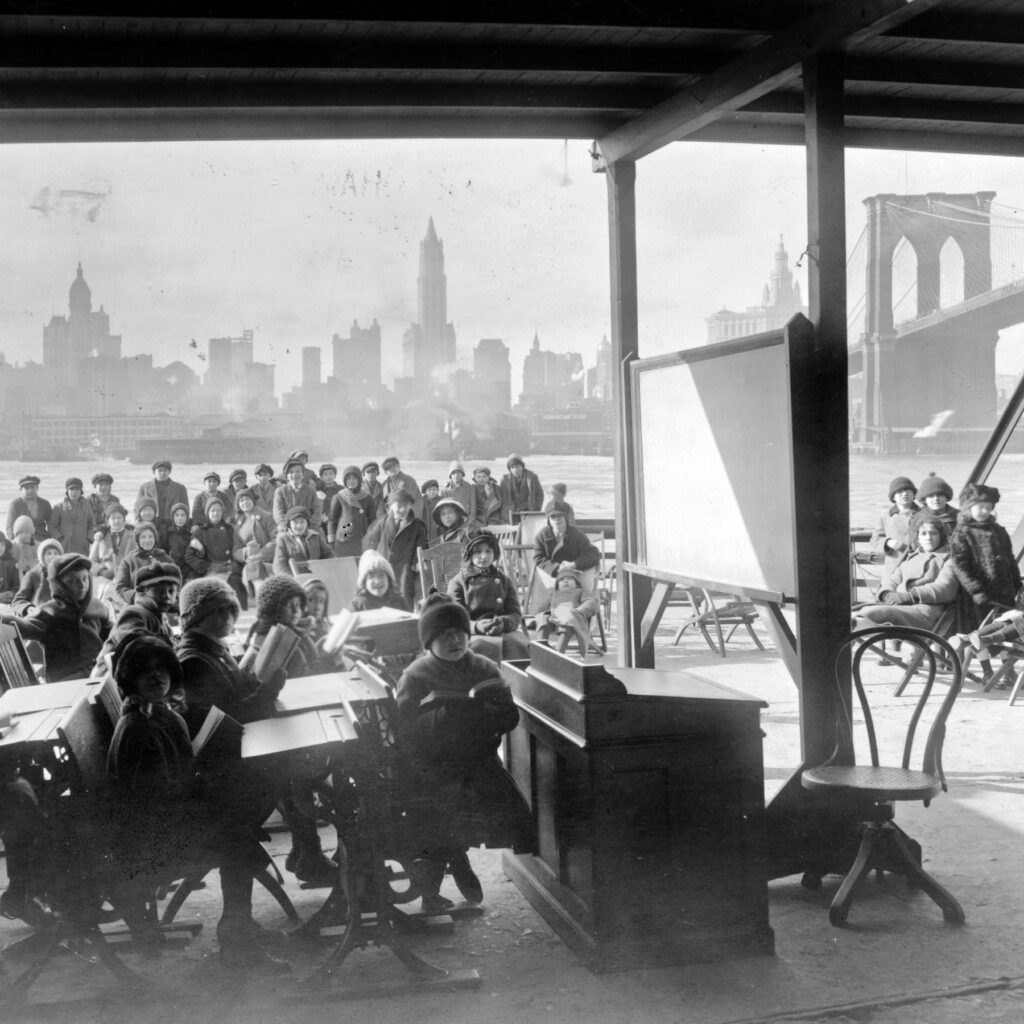
The so-called ‘open air schools’ instructed students in environments with ample ventilation, often on building rooftops or lawns.  

According to a 1916 analysis of the movement, an open-air schoolroom was “fully exposed to the air on one or more sides, providing merely shelter from wind and rain. There is no artificial heating, the temperature of the room always being that of the open air.”

Bureau of Charities, via Library of Congress

The first open-air school in New York opened in 1908 on an “abandoned ferryboat.”  Easily the most notable of New York’s open-air schools — and a model of this unusual form of education — was the Horace Mann School, operated by the Teachers College at Columbia University.

Horace Mann’s students had to meet a certain unfortunate criteria.  “The children who make up the classes were chosen because they were nervous, or irritable, or anaemic, or undernourished.” [source]

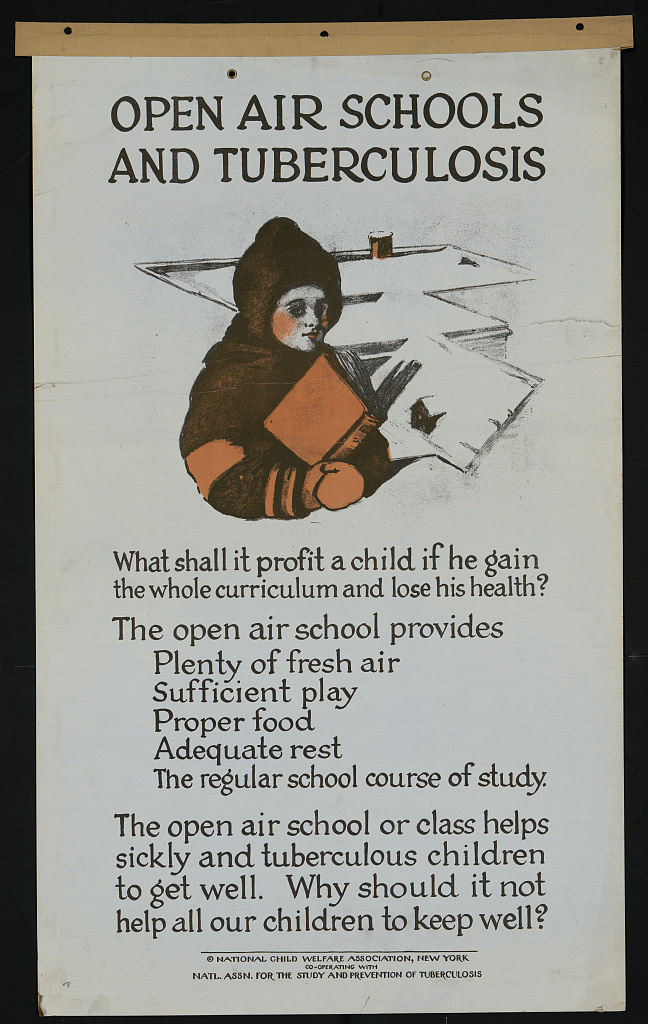
Library of Congress/National Child Welfare Association : Co-operating with Natl. Assn. for the Study and Prevention of Tuberculosis, [between 1920? and 1923?]

But while the open-air school was created for the prevention of one illness, it most likely encouraged another — pneumonia.

And that’s where the sitting-out bag comes in.

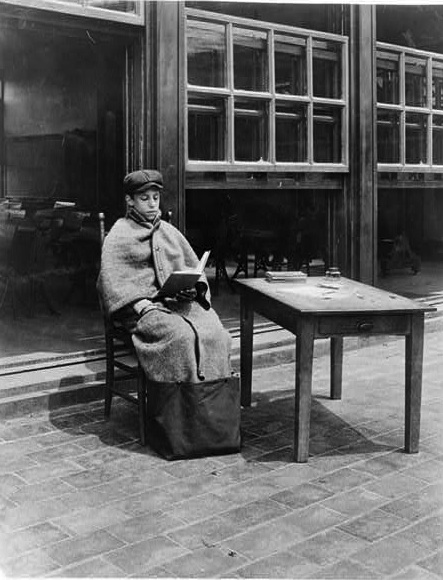
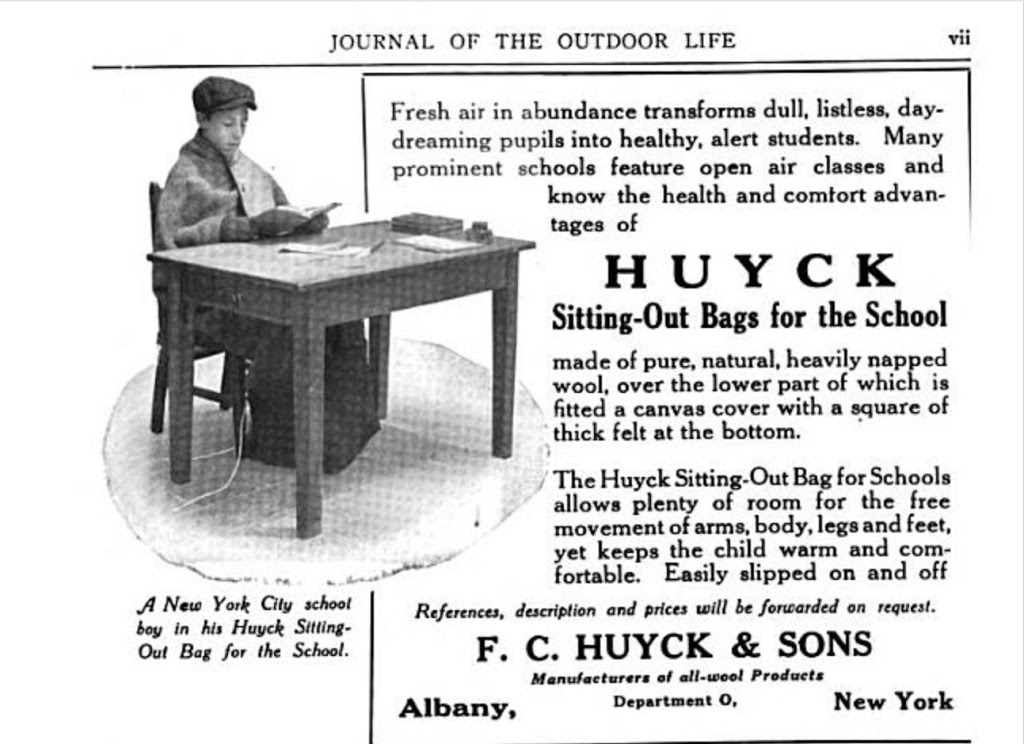
Not cool: “Boy wearing coat with attached bag covering feet, seated at table, outside of classroom, reading, New York City.” Courtesy Library of Congress

The sitting out bag was like a potato sack, a thick sheath of material that allowed the student to study even in freezing temperatures.

The device was basically the sleeping bag for daytime, used to warm the body and keep students alert during open-air classrooms.

Below: An advertisement promoting “fresh air in abundance” featuring the same boy as above

It was by no means a pleasant ensemble.  One guide to open-air schools described the sitting-out bags as “made of a brown, pliable, hairy, felt-like cloth bound with tape and fitted with snap fasteners.”

Because the sitting-out bags were often used by several students — and reused, over many years — parents were encouraged to make their own sitting-out bags at home for their children.  

As with masks today, parents were encouraged to make their own. An article in a 1910 Survey Magazine offered tips to adults on how to make homemade sitting-out bags. (If you’d like to make your own sitting-out bag, find the instructions here, but you’ll need lots of braid and cotton batting.)

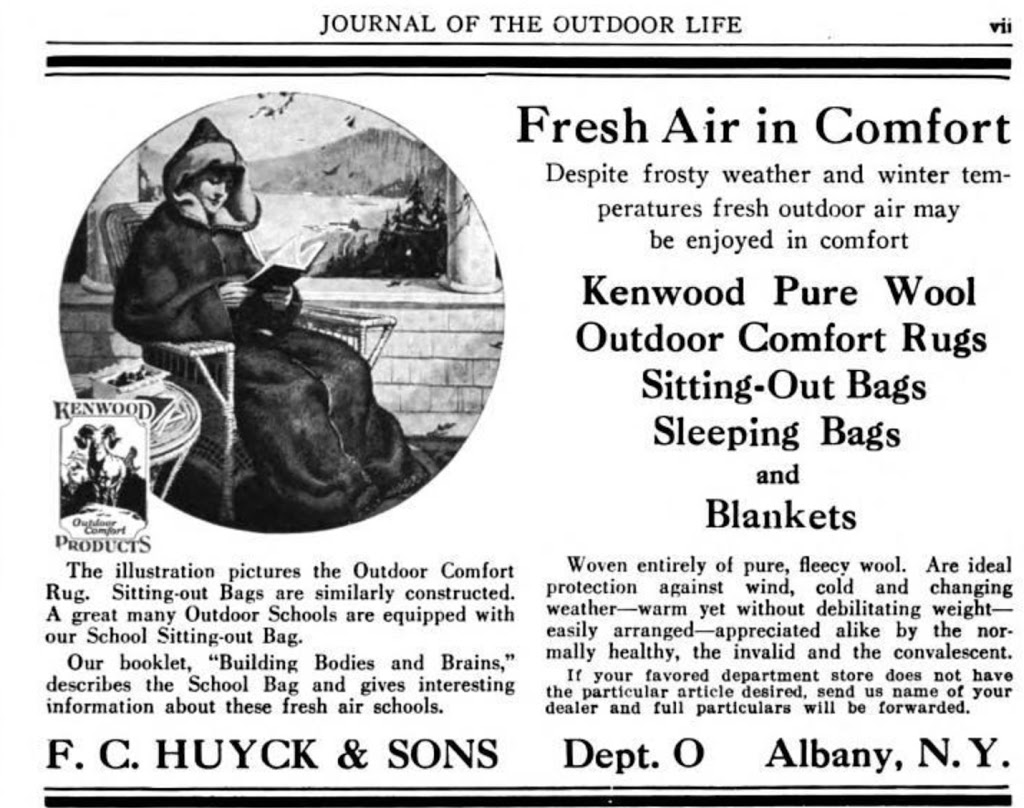
Many sitting-out bags came with hoods, leading to the alarming sight of an entire classroom of hooded children in stiff uncomfortable cocoons.

Below is pictured a hooded version, advertised in the Journal of the Outdoor Life in 1922. A sporting magazine?  Sadly, no. The publisher of this guide to open-air living was the National Tuberculosis Association.

But the sitting-out bag played a small part in keeping children safe during this moment of crisis. Better understanding of the disease and the invention of an effective vaccine would lower the infection rate by mid-century:

“Rates of death from tuberculosis in the United States decreased from 194 per 100,000 persons in 1900 to 40 per 100,000 persons in 1945, in part because the epidemic of tuberculosis in the western world was running its course and in part because of public health initiatives and improved socioeconomic conditions.” [source]

Categories
Museums Podcasts

The Metropolitan Museum of Art: 150 Years of History on Display

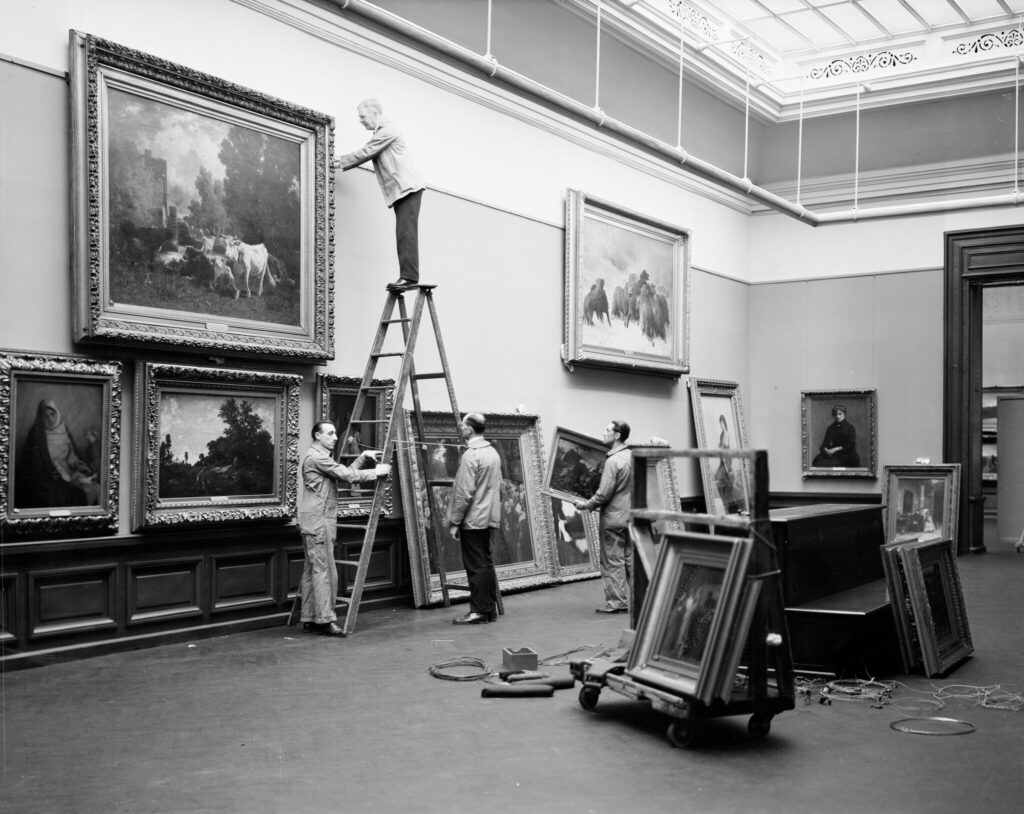
EPISODE 341 Celebrating the history of the Metropolitan Museum of Art in the 150th anniversary year of its founding — certainly one of the strangest years in its extraordinary existence. 


The Met is really the king of New York attractions, with visitors heading up to Central Park and streaming through the doors by the millions to gasp at the latest blockbuster exhibitions and priceless works of art and history. 

And who doesn’t love getting lost at the Met for an afternoon — wandering from the Greek and Roman galleries to the imposing artifacts within the Arms and Armor collection and the treasures of the Asian Art rooms?

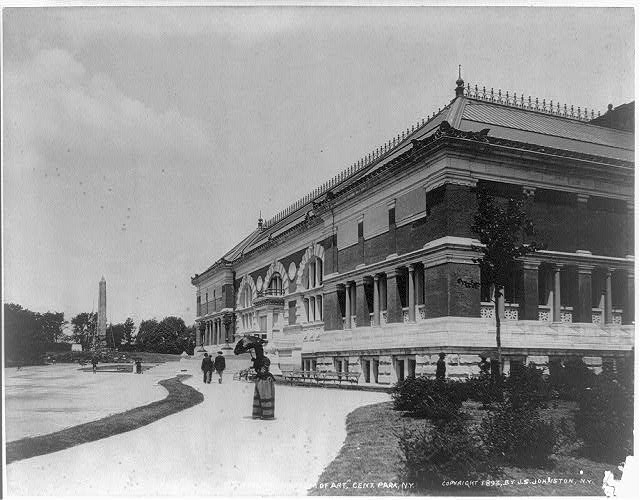
The Theodore Weston addition to the Met 1893, J.S. Johnston, Library of Congress

But this museum has a few surprising secrets in its history — and more than a few skeletons (or are those mummies?) in its closet.

WITH Ancient temples, fabulous fashions, classical relics, Dutch masters, controversial exhibitions and the decorative trappings of the Gilded Age.

November 1928, photo courtesy The Metropolitan Museum of Art

AND Find out how the museum building has evolved over the years, employing some of the greatest architects in American history. 

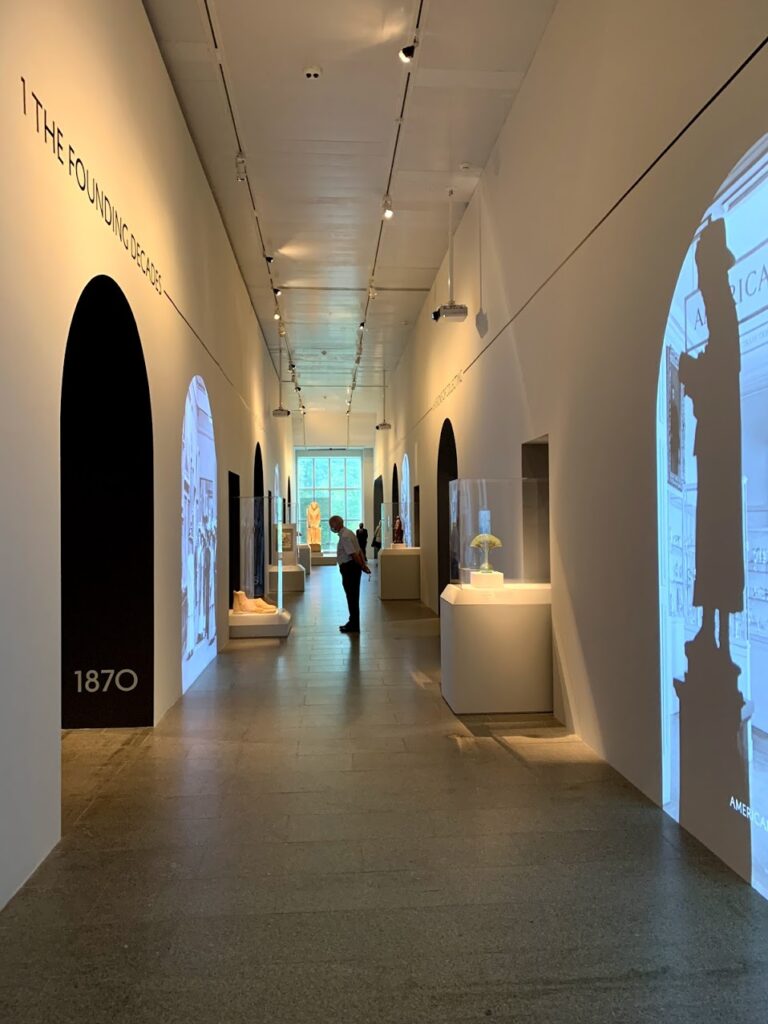
PLUS An interview with the Met’s Andrea Bayer, Deputy Director for Collections and Administration, on the museum’s celebratory exhibition Making the Met 1870-2020

How do you launch an anniversary celebration during a pandemic and lockdown?

Listen today on your favorite podcast player:


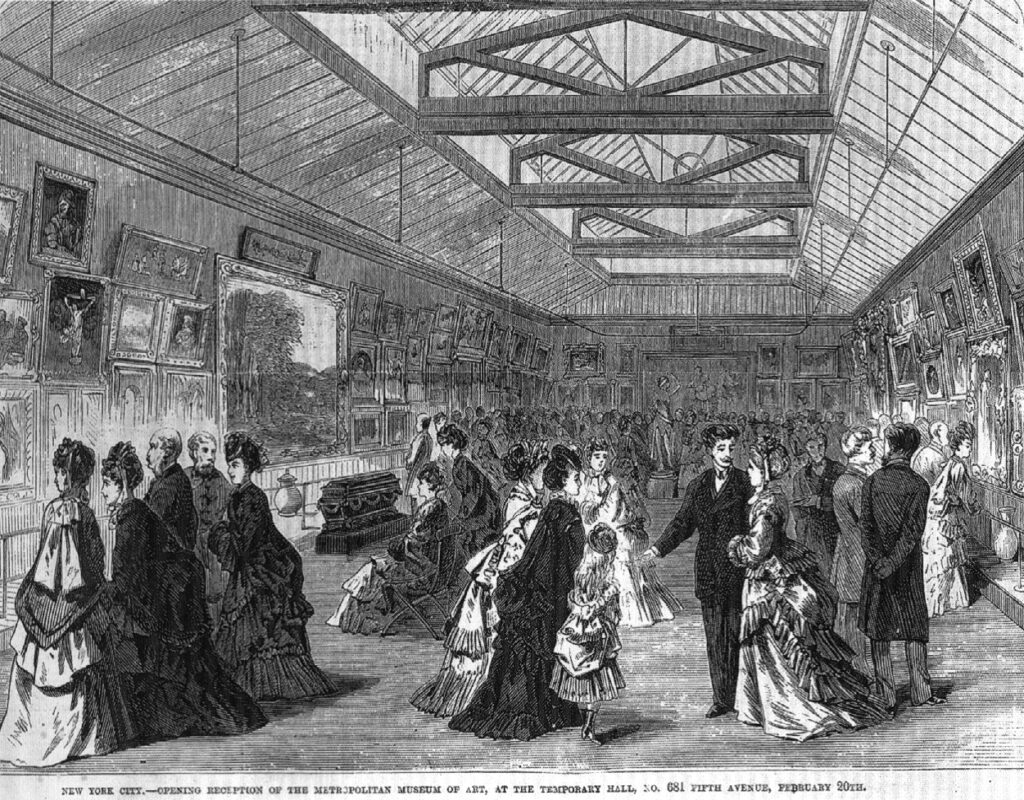
Opening reception in the picture gallery at 681 Fifth Avenue, February 20, 1872; wood-engraving published in Frank Leslie’s Weekly, March 9, 1872
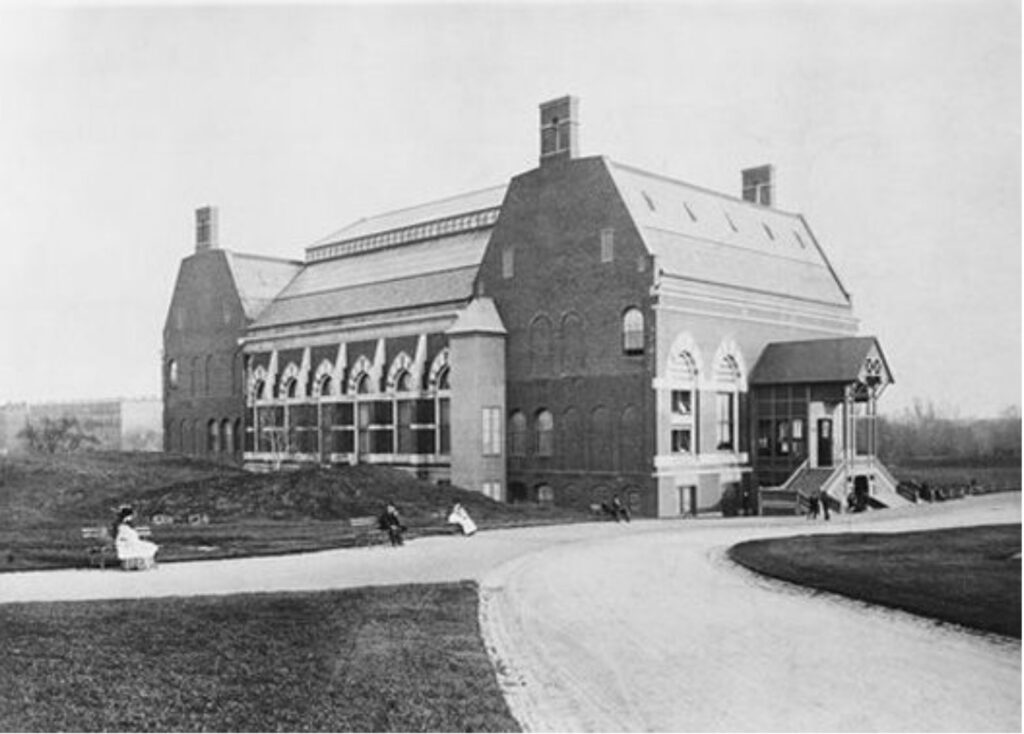
‘The Barn’, the original Met from Calvert Vaux and Jacob Wrey Mould, courtesy the Metropolitan Museum of Art
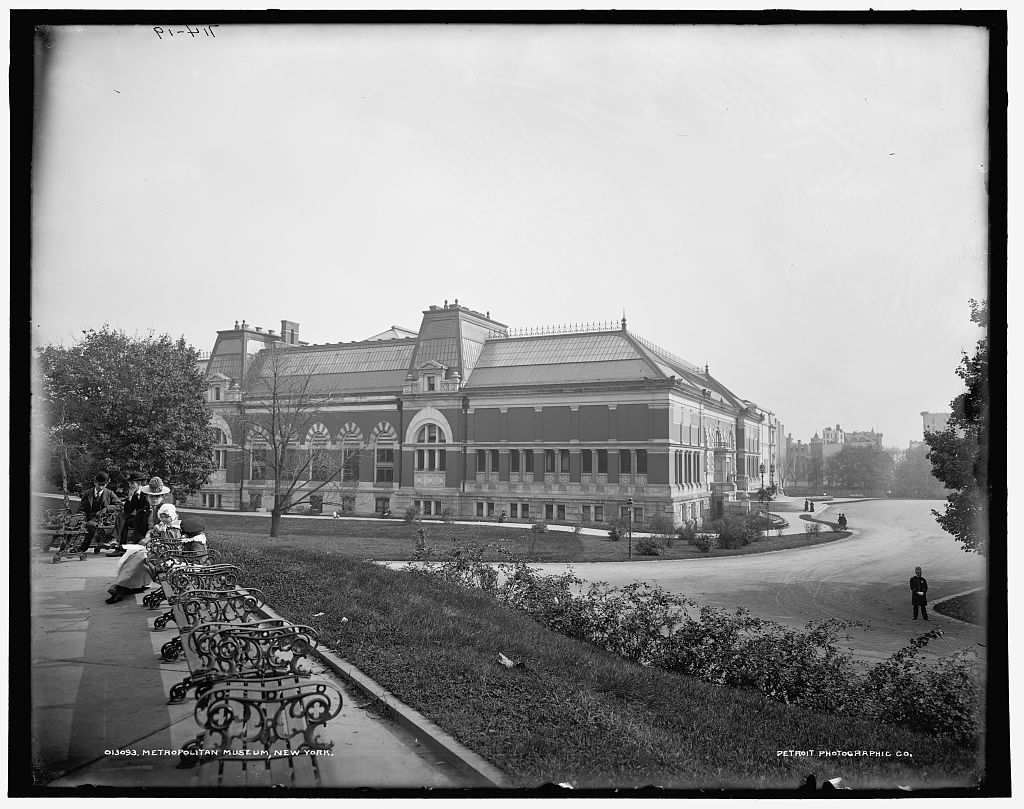
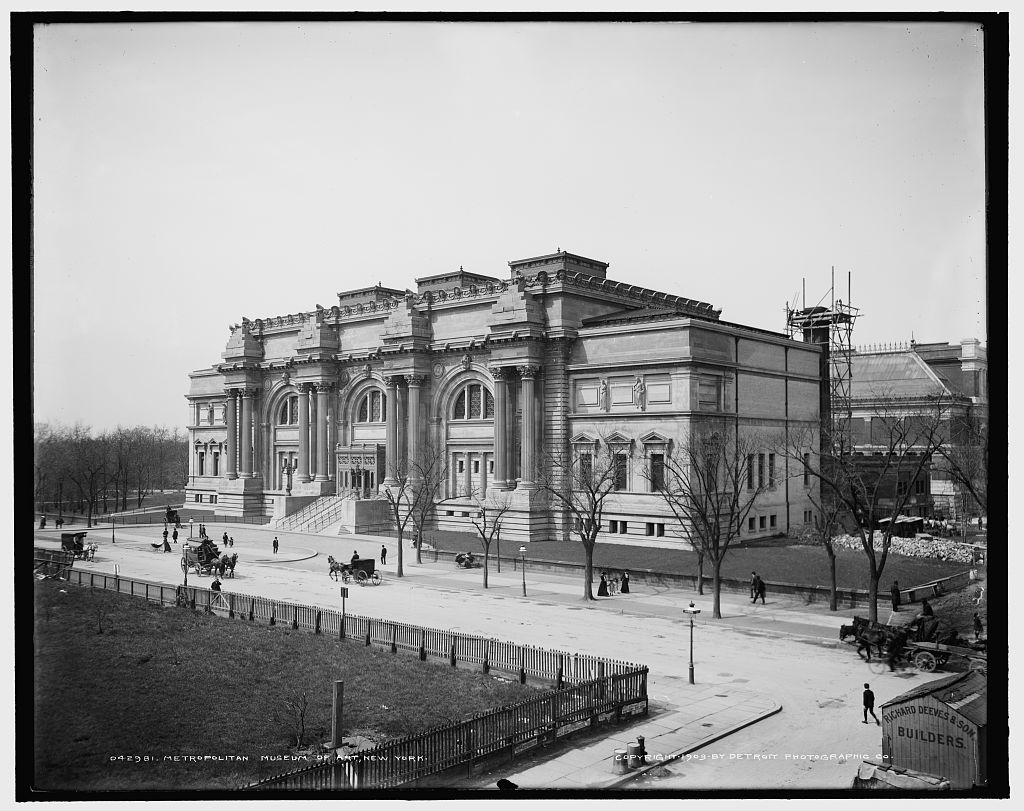
1900, Detroit Pub Co, Library of Congress
The Richard Morris Hunt addition to the Met, 1903, Detroit Pub Co, Library of Congress
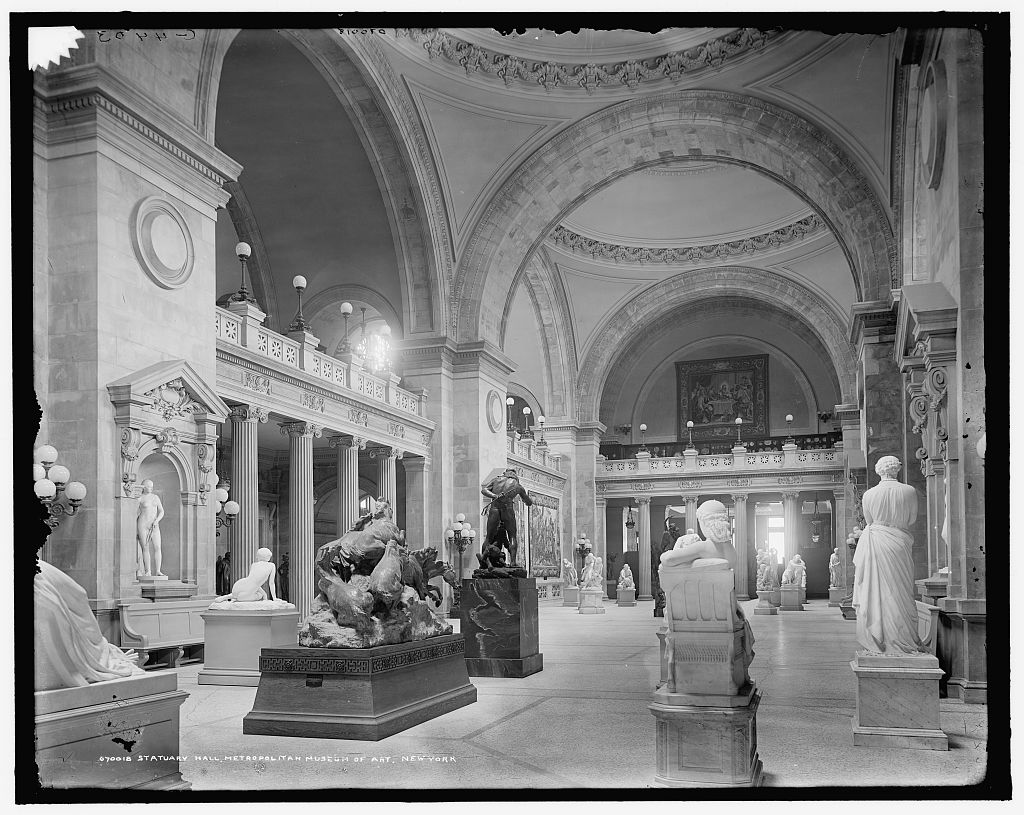
The Great Hall, 1907, Library of Congress
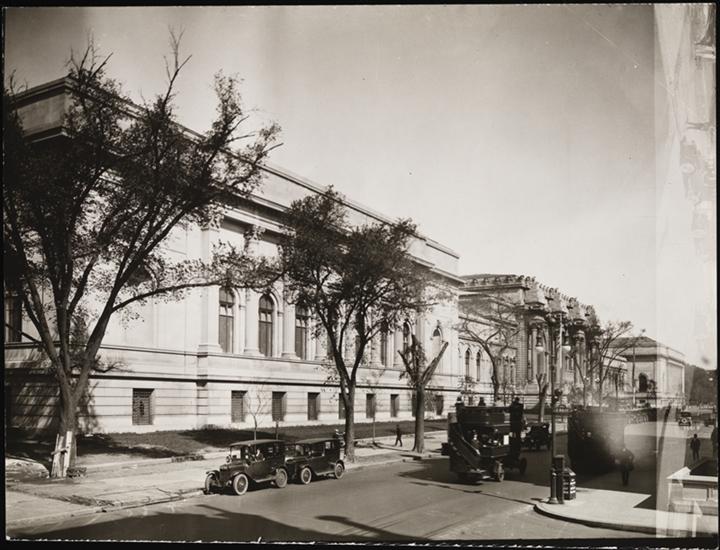
The Met in 1920, with the southern wing in place. Museum of the City of New York
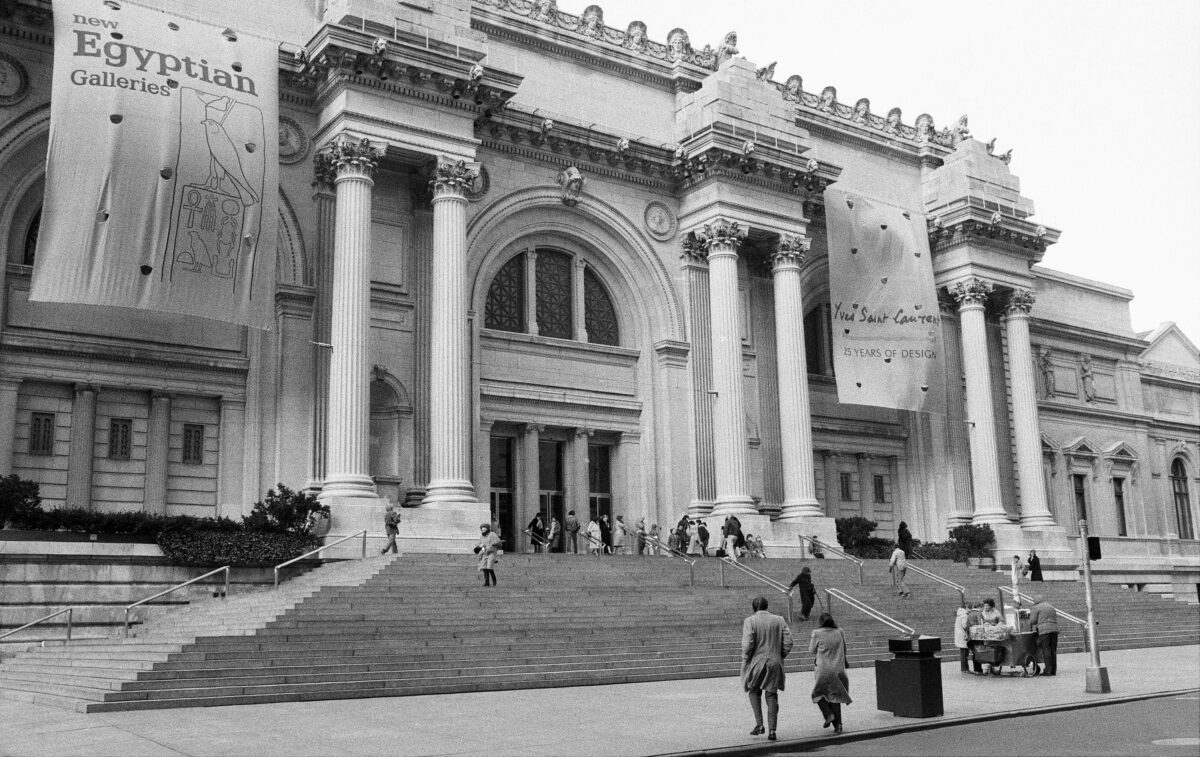
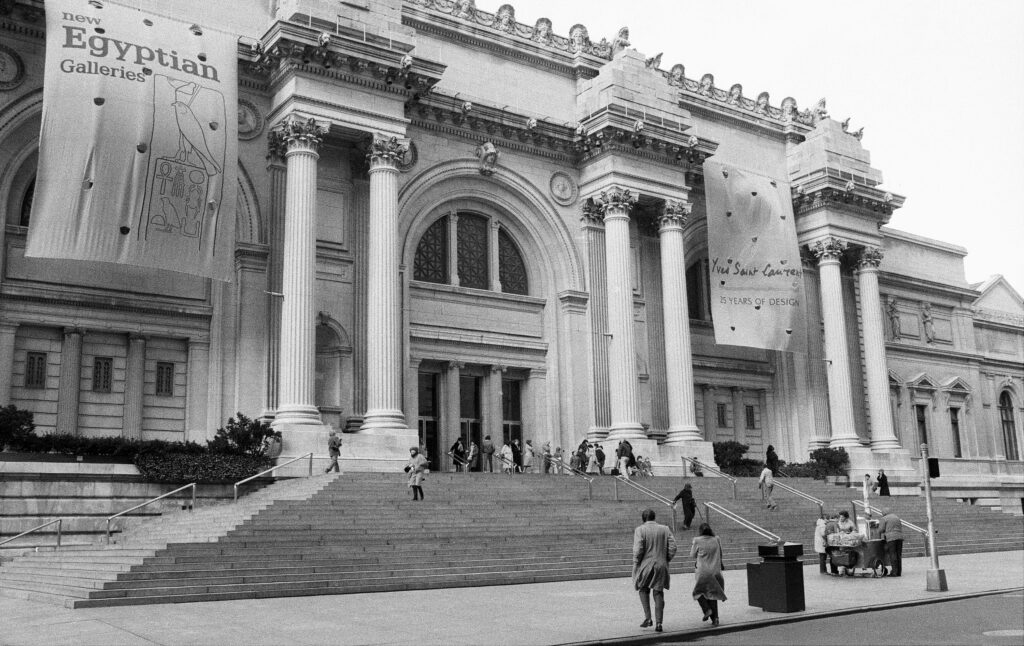
The Met in 1983, Getty Images

Some excellent footage from the 1920s of the Met’s Egyptian excavations

The Temple of Dendur. photo by Greg Young
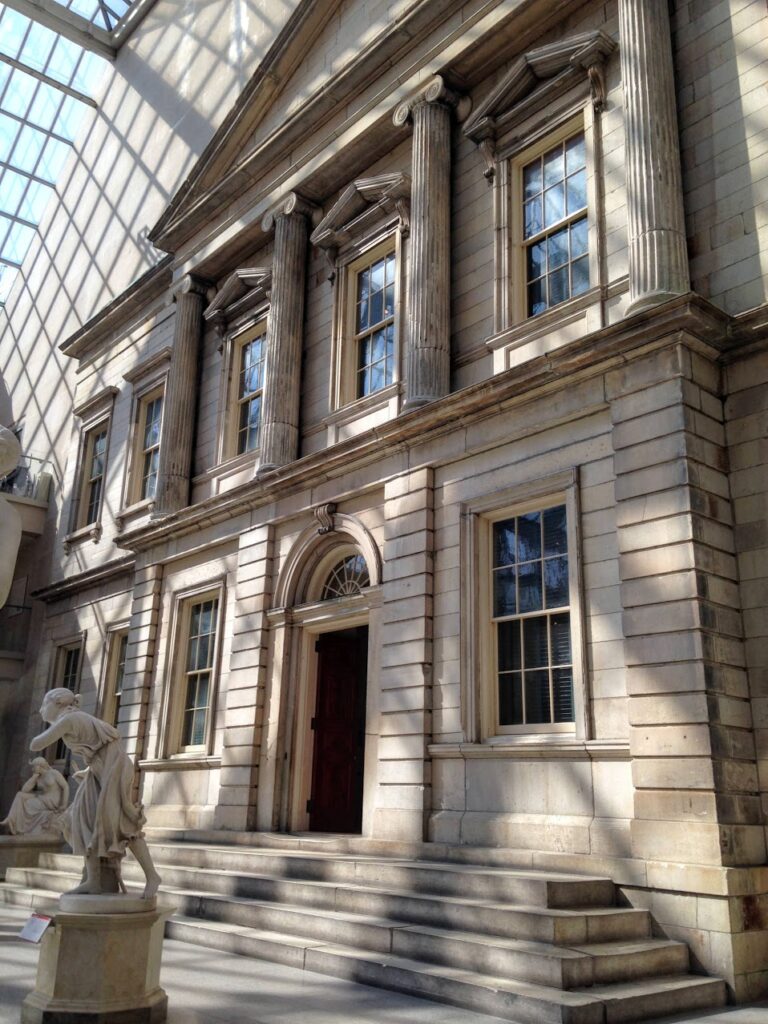
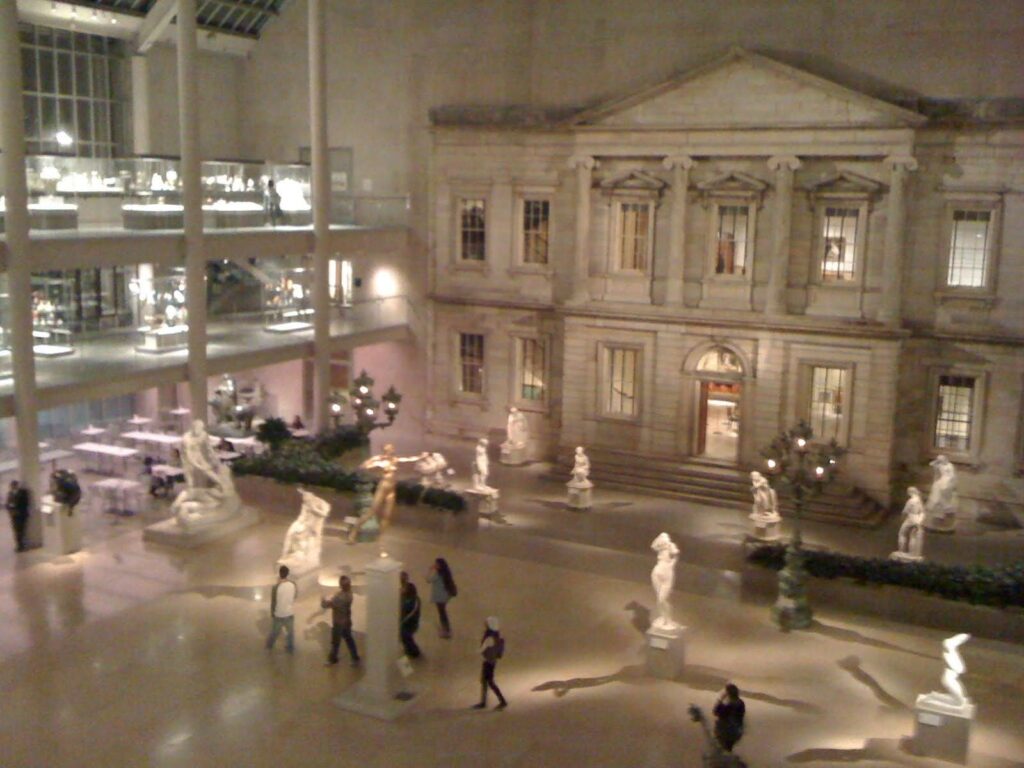
The American Wing sculpture garden at night, photo by Greg Young
Branch Bank entrance, 2012, photo by Greg Young
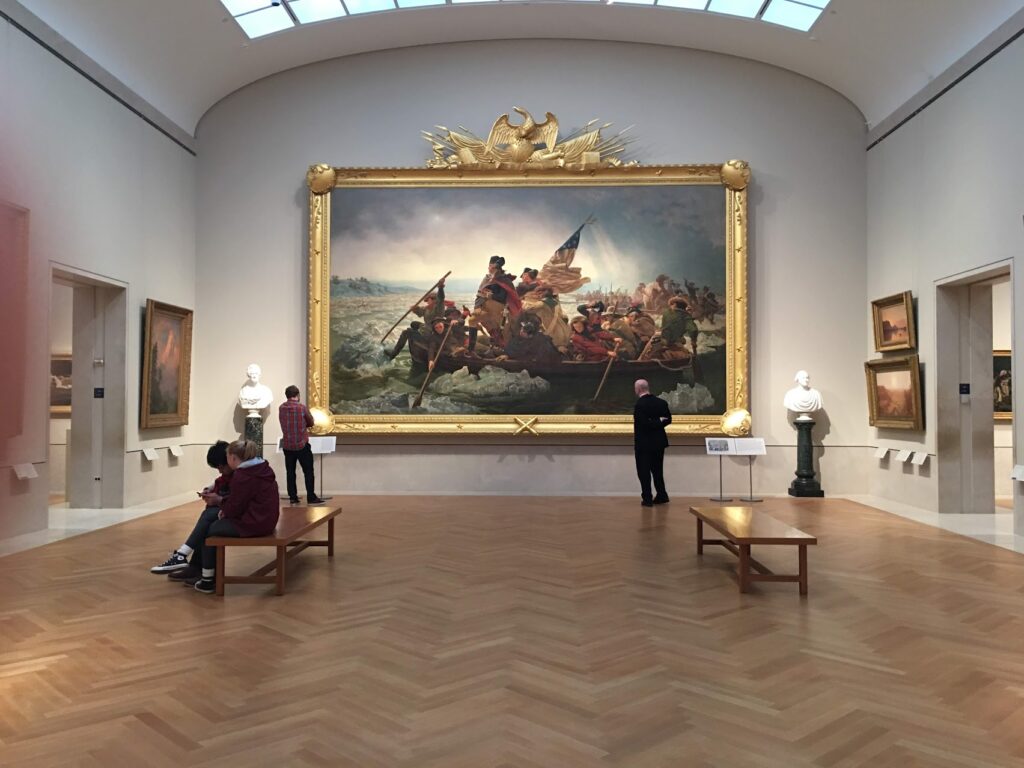
Washington Crossing the Delaware, taken 2017, photo by Greg Young
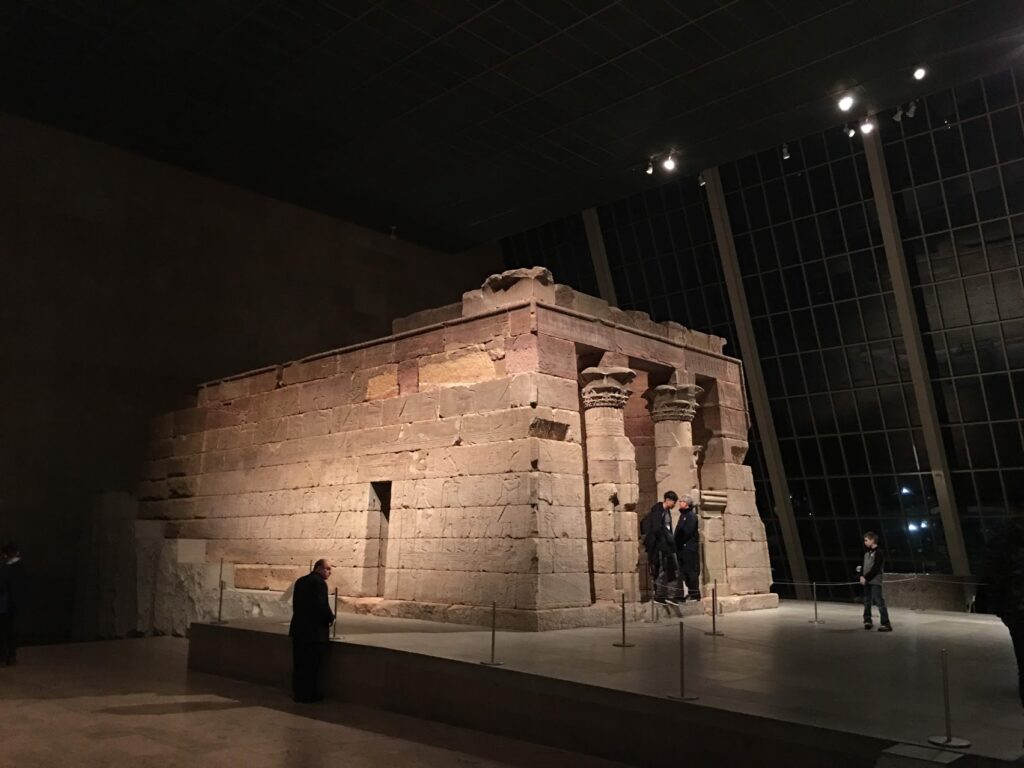
Dendur at night, 2018, photo by Greg Young
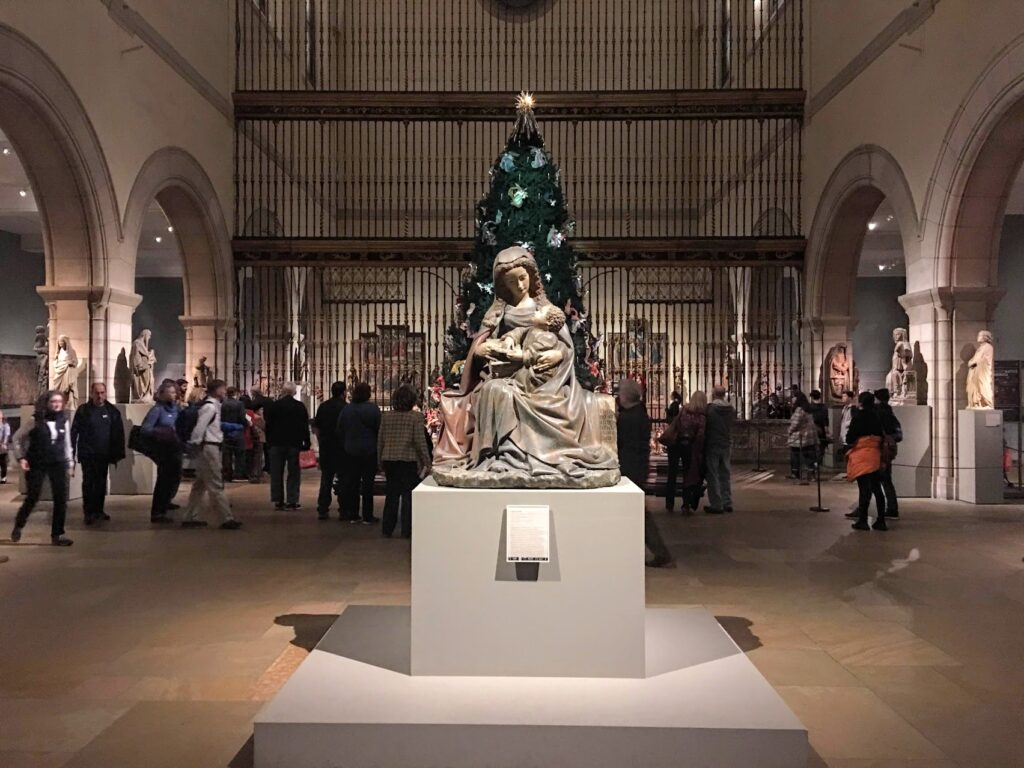
The Met at Christmas, 2018, photo by Greg Young
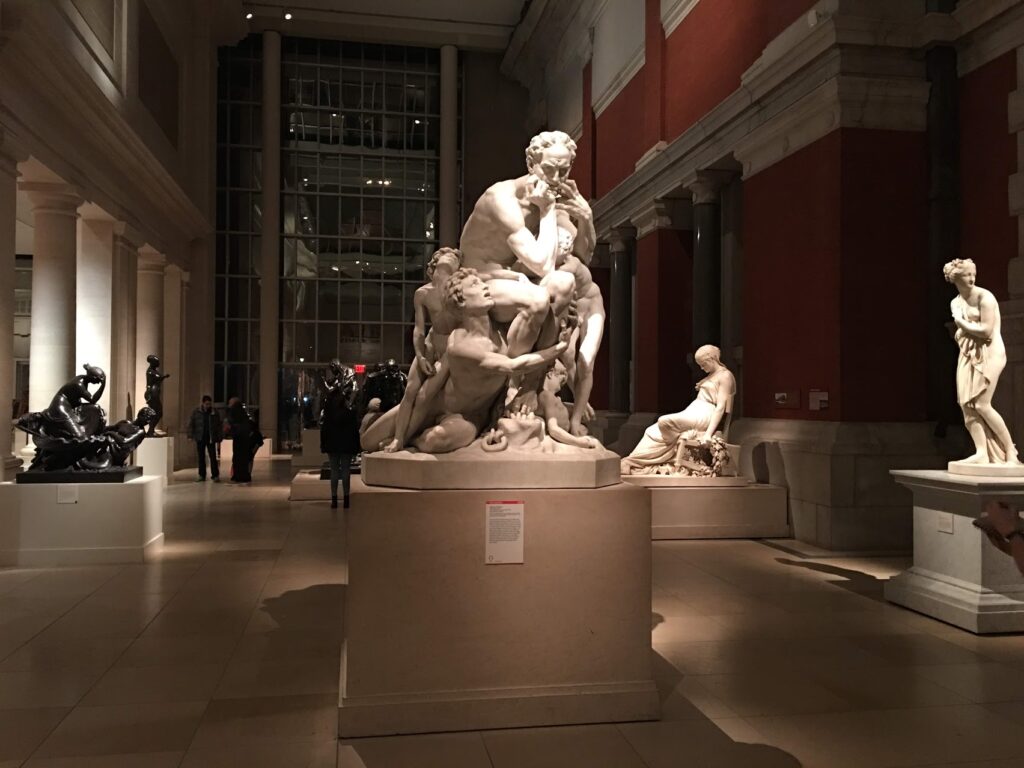
The European sculpture garden at night, with views of the original 19th century facade in red brick. 2018, photo by Greg Young

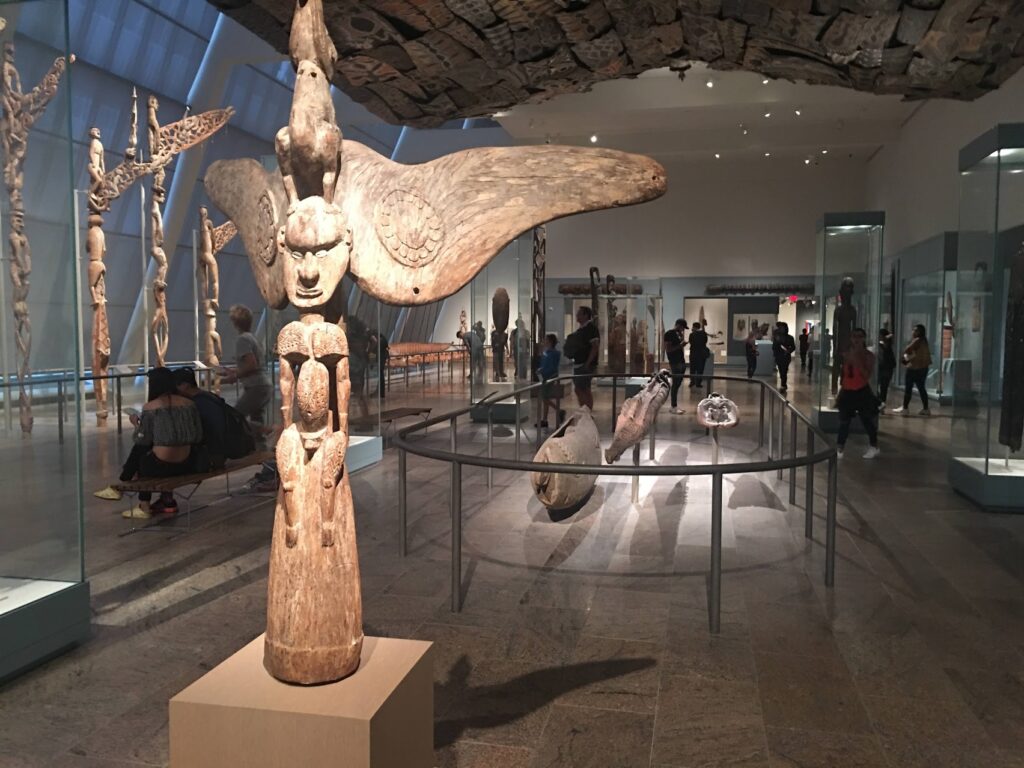
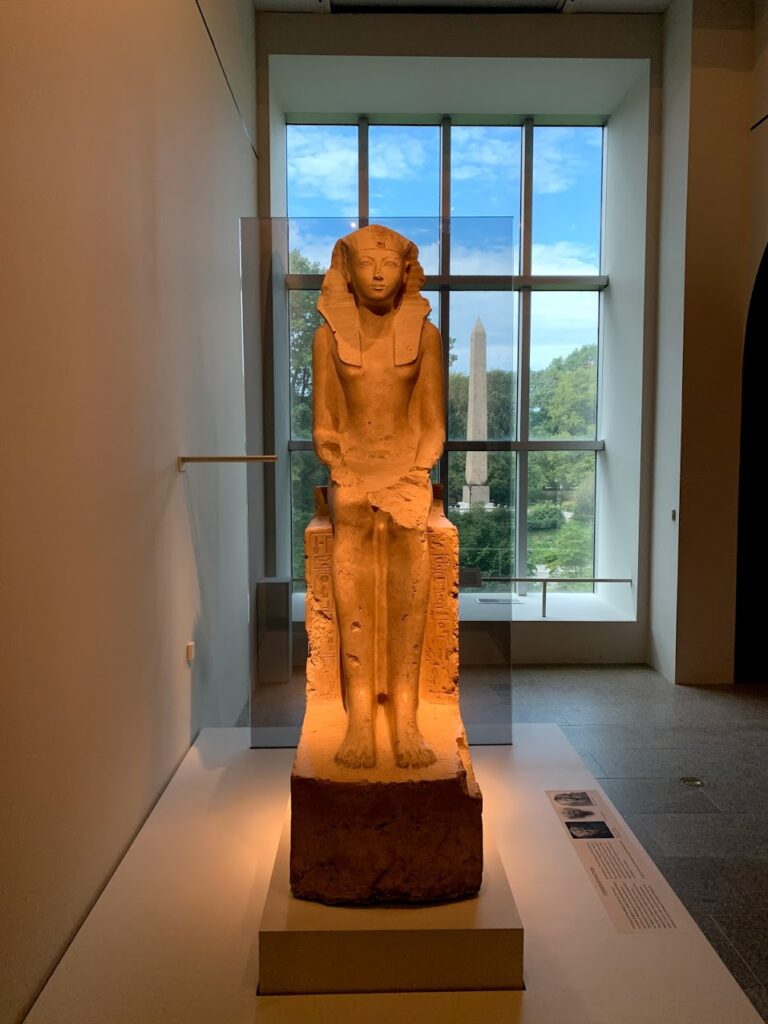
Views from Making the Met (photos by Greg Young):


The Bowery Boys: New York City History podcast is brought to you …. by you!

We are now producing a new Bowery Boys podcast every week. We’re also looking to improve and expand the show in other ways — publishing, social media, live events and other forms of media. But we can only do this with your help!

We are now a creator on Patreon, a patronage platform where you can support your favorite content creators.

Please visit our page on Patreon and watch a short video of us recording the show and talking about our expansion plans.

If you’d like to help out, there are six different pledge levels.Check them out and consider being a sponsor.

We greatly appreciate our listeners and readers and thank you for joining us on this journey so far.


FURTHER LISTENING

The Met was a bit behind the times when it came to celebrating Impressionism but New Yorkers could take a gander at the ‘shocking’ output from Europe — as well as examples from the New York’ Ashcan School — at the Armory Show of 1913.

The Met is a twin institution to the American Museum of Natural History which shares a similar origin story.

In the second half of our Fifth Avenue Mansions series, we look at how the wealthy mansions of Fifth Avenue left midtown and headed to the Upper East Side.


Categories
Holidays

Easter in Old New York: The Fifth Avenue Fashion Stroll

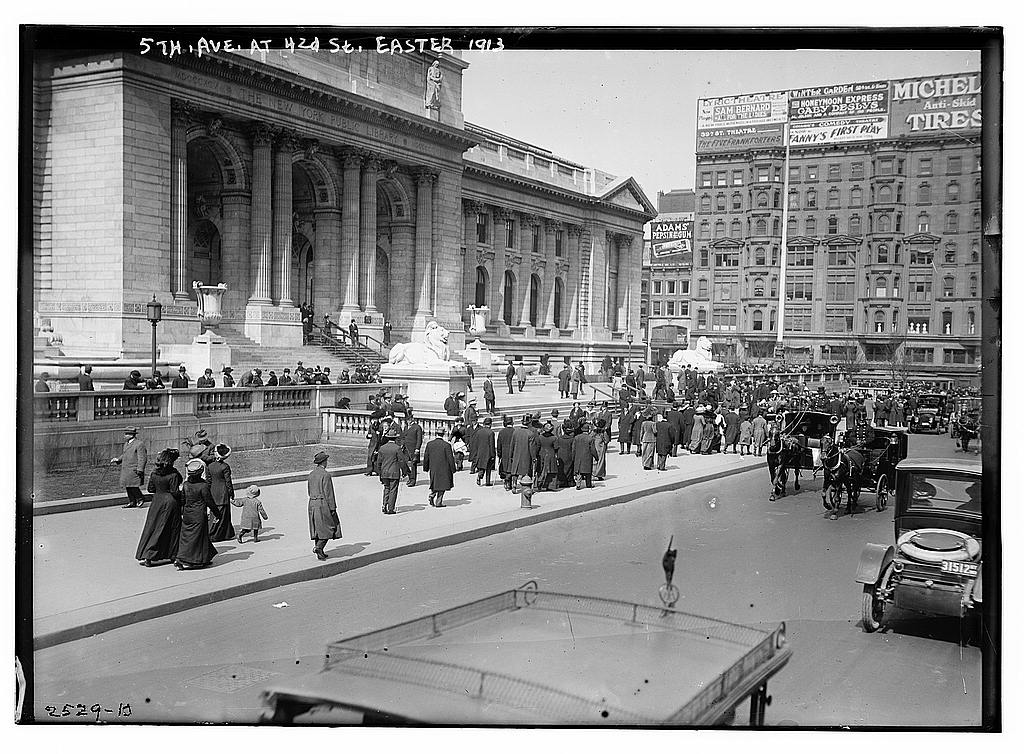
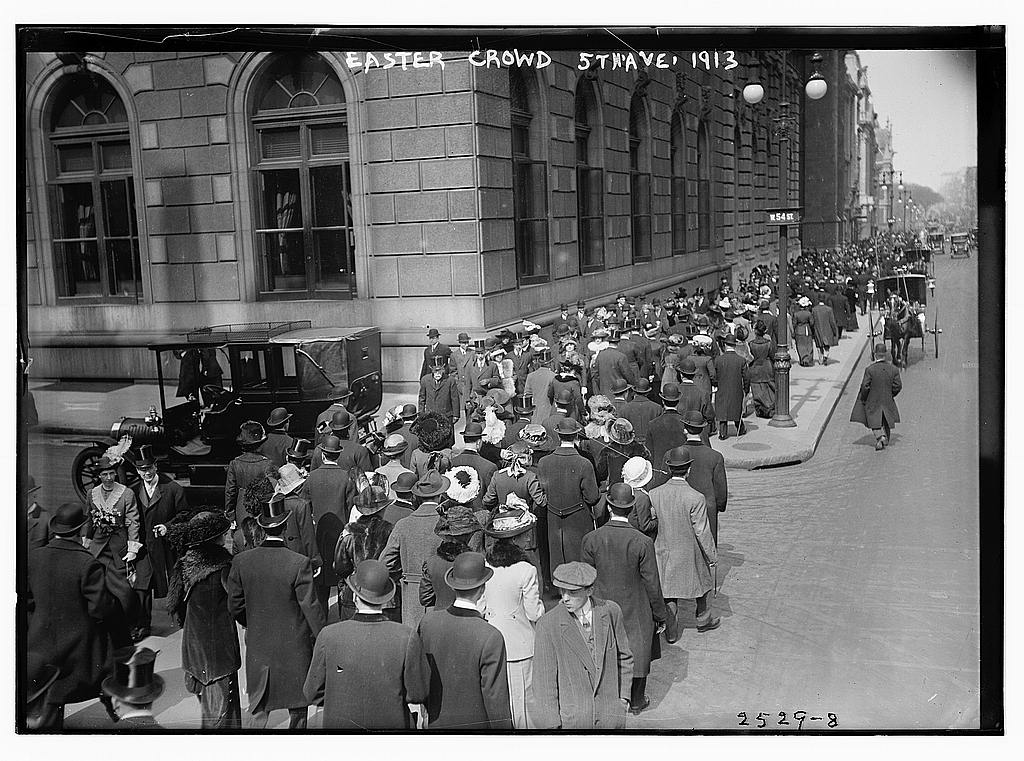
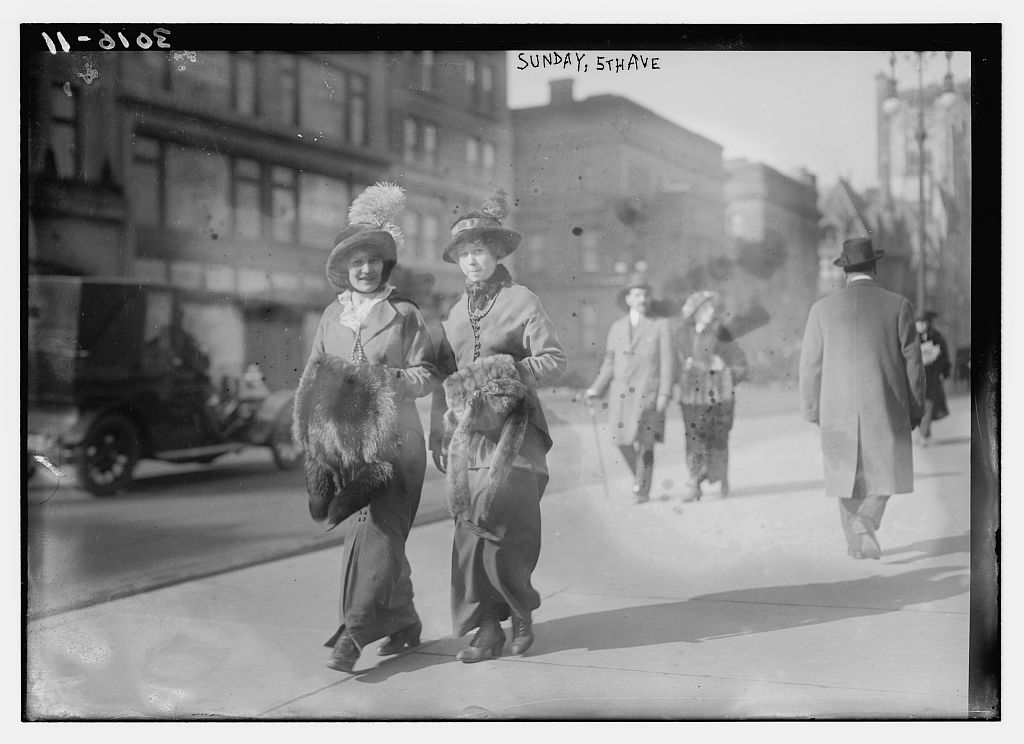
In the picture above: People in Sunday finery stroll past the New York Public Library building. The library had not even been open two years by the time this picture was taken in March 23, 1913.

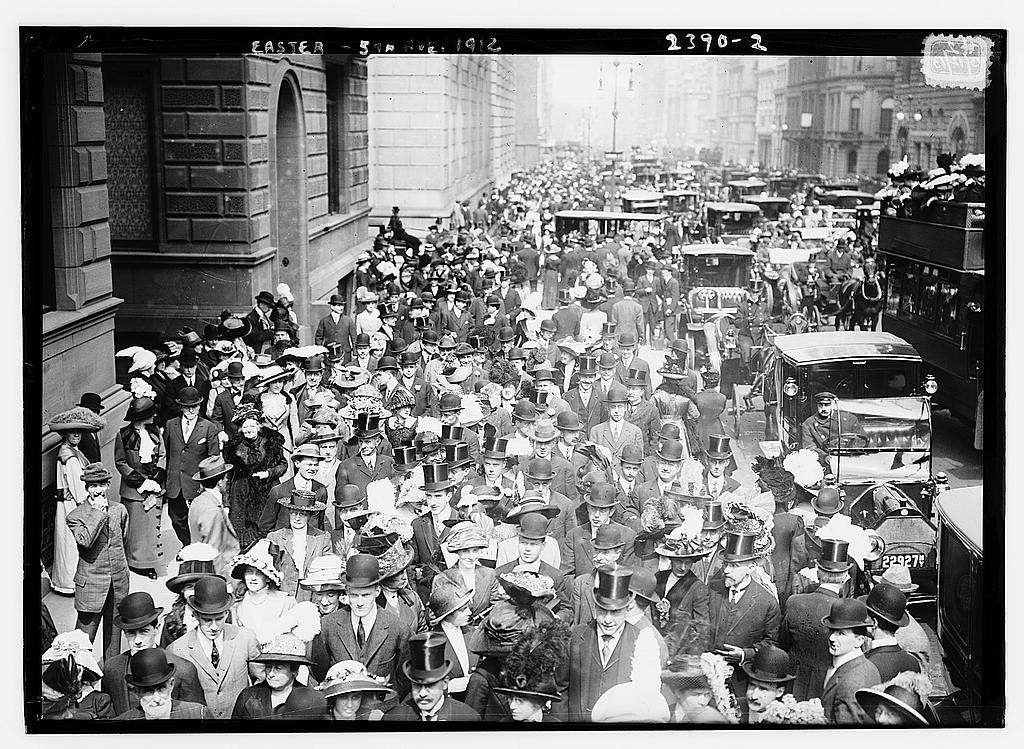
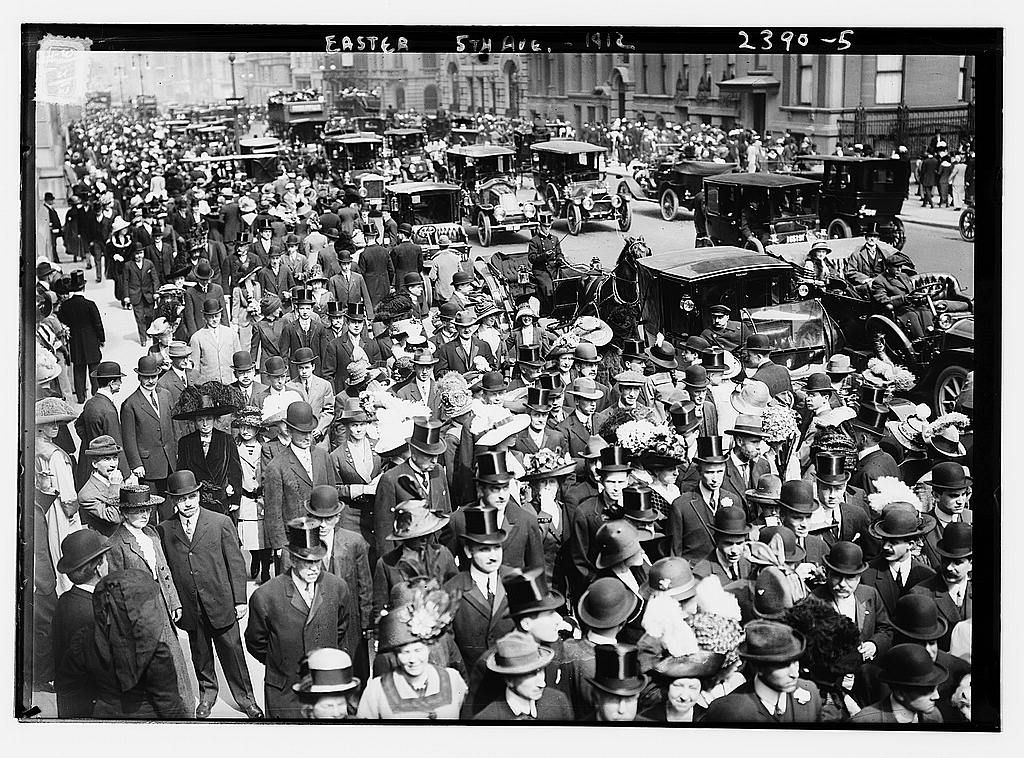
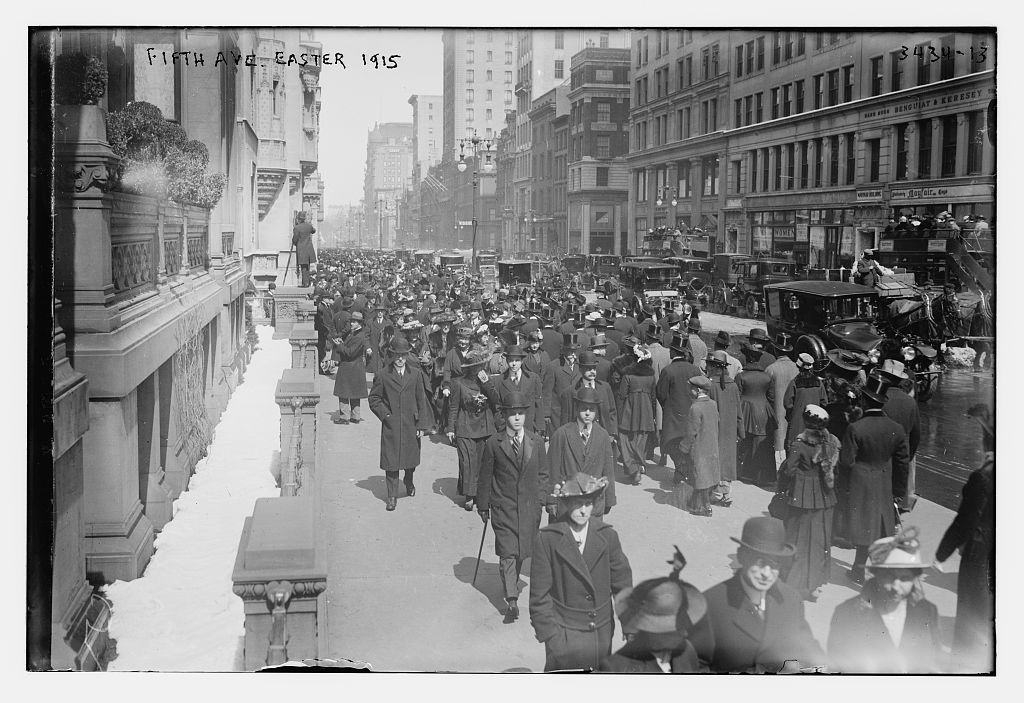
New York City’s time-honored Easter custom — the Sunday morning Fifth Avenue Easter bonnet stroll — once turned the wealthiest residents of Fifth Avenue into primping peacocks, their Sunday best on display.

The makeshift parade, which some believe traces back to New York’s Dutch days, blossomed into a full-assault of expensive headwear once the upper crust made Fifth Avenue their home.

Thousands lined the street, either brandishing their most expensive apparel or else to gawk at those wearing it. It was the closest New York got to a high-end fashion show, with dressmakers parked on the corner, taking notes.

“All the women were slim who could be,” remarked the New York Tribune’s fashion writer, “and a few were who couldn’t.”

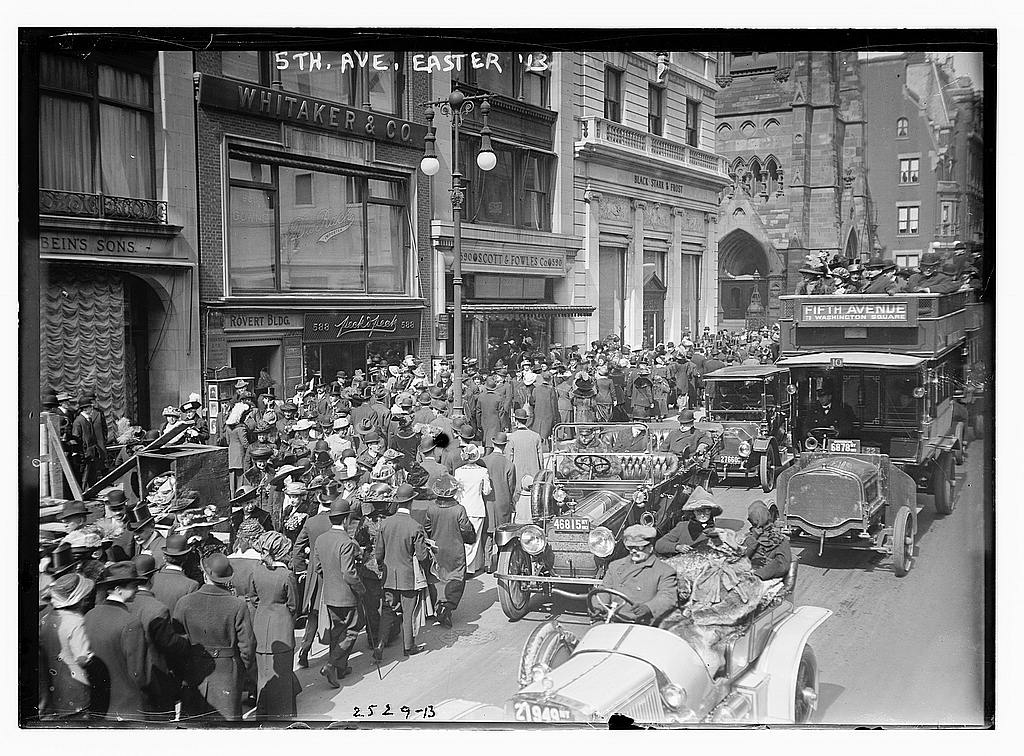
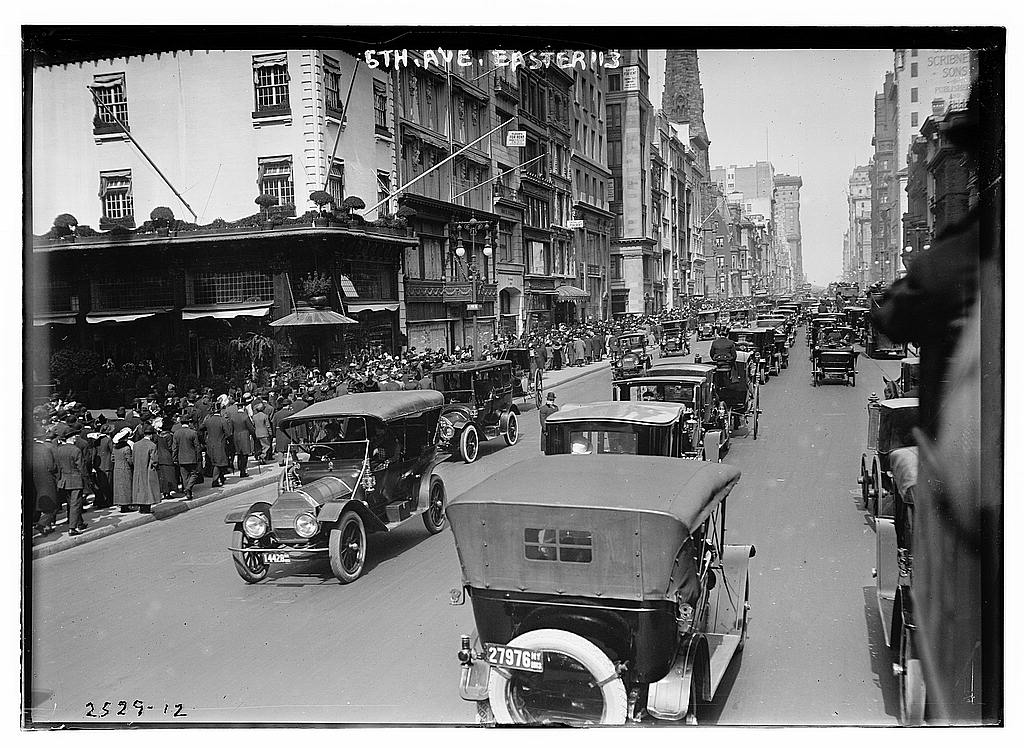
But the 1910s brought a new accessory to the Easter parade — automobiles.

A decade before, there were probably no more than 1,000 automobiles in all of New York City. By 1913, there were enough to create what must have been Fifth Avenue’s very first automobile traffic jam.

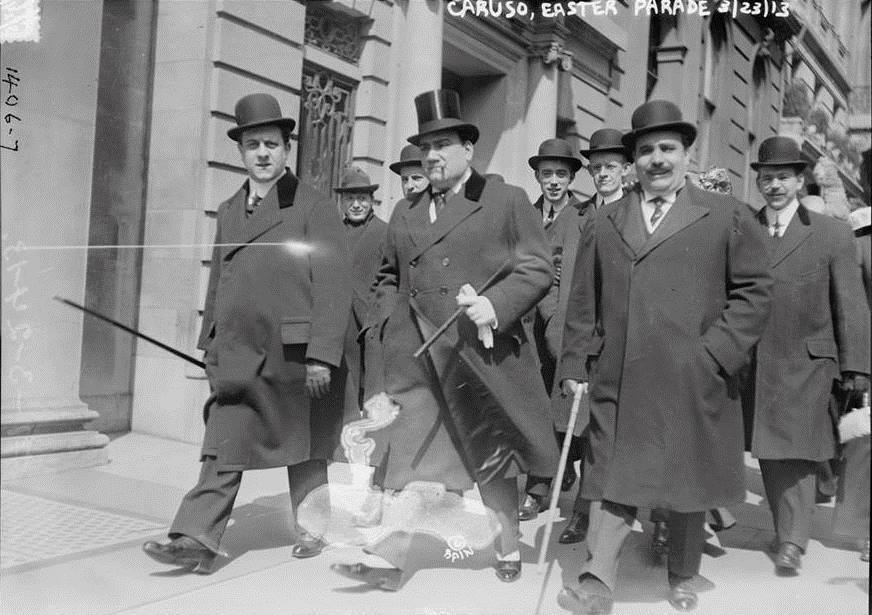
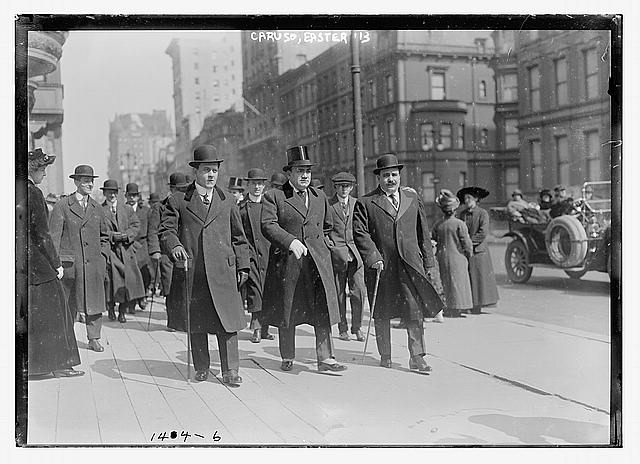
All the photographs featured here are from Easter Sundays, between 1912 and 1915 (images courtesy the Bain Collection/Library of Congress.

The magnificent Enrico Caruso even participated in the Easter stroll. He looks fanciful in his top hat and a bit like Batman villain the Penguin.

Apparently it was an unseasonably cold day that Easter in 1913 and most society women, braving the chill, wrapped up their fine gowns in heavy wraps and coats of various animal skin.  “Furs and pink noses” was the fashion assessment, according to the Tribune.

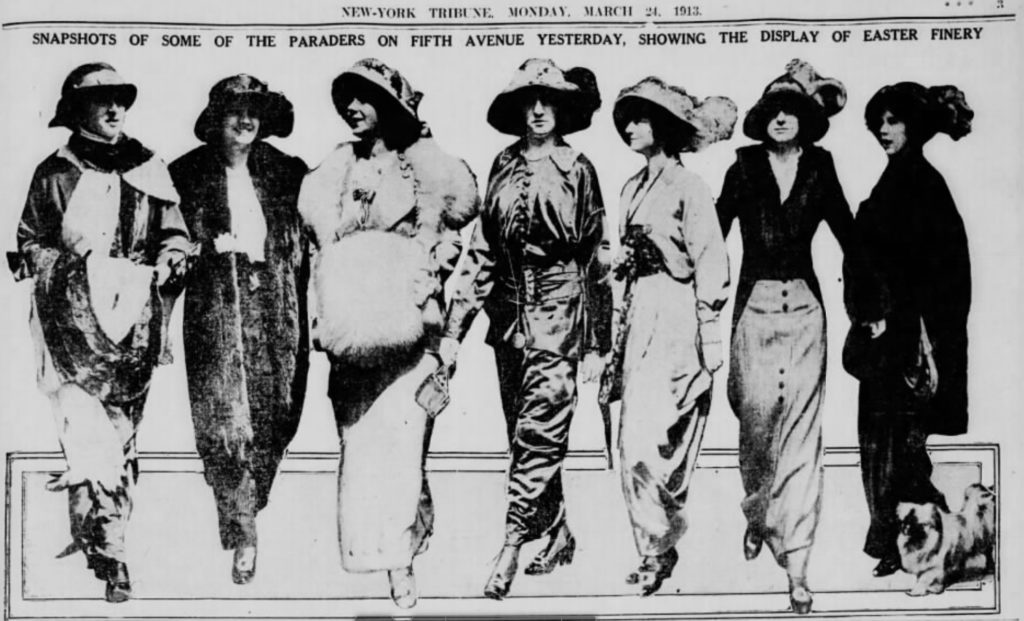
Still, in the sea of coats and curious hats, one woman managed to make an impression. “LADY IN VERMILION AN EASTER CUBIST‘ cried the newspaper the following day — on its front page, no less.  “…[W]ho was the young lady in bright vermilion, with lips of a vivid purple, who talked excitedly to hide her shivering as she passed St. Patrick’s Cathedral?”

The New York Tribune ran this banner photograph the following day. (Note the dog in the corner.) Sadly I don’t believe any of these ladies was the aforementioned ‘vermilion lady’:

Of course, there’s still an annual Easter bonnet parade; it’s smaller but far more flamboyant.

Pictures courtesy Library of Congress

Categories
Those Were The Days

THIS is New York Fashion Week — as it might have been in 1915

New York Fashion Week, the city’s twice-yearly celebration of couture and runway, traces its roots to a 1943 press week event at the Plaza Hotel, organized by publicist Eleanor Lambert.

But there had been a variety of one-off ‘fashion weeks’ or American fashion events in the years between the wars.

In 1934, the Mayfair Mannequin Academy, a local modeling school, even petitioned Mayor Fiorello LaGuardia to declare an official New York Fashion Week as a way to encourage American designers who worked in an industry dominated by Paris.

But well before any of those events, New York’s most famous runway show took place on the street — the Sunday promenades along Fifth Avenue.

It was especially robust during Easter with wealthy women trying to outdo each other in latest styles from Europe. Newspapers covered Easter Sunday with the same fervor as a modern fashion show, noting colors, hem lines, and even the plumage flagrantly bursting from hats.

While there was no dedicated ‘fashion week’ one hundred years ago, there was heightened and excited attention to of-the-moment fashion trends. So here’s a little thought experiment — what would an actual Fashion Week in 1915 look like?

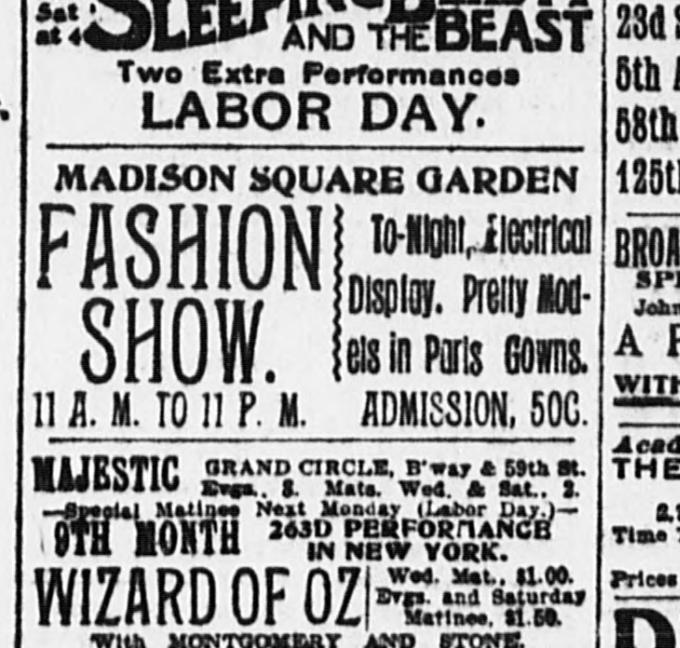
There would in fact be fashion-related events at Madison Square Garden (in its original location off of Madison Square) so let’s put this imaginary Fashion Week there:

from September 4, 1903, New York Evening World

An End to Bondage

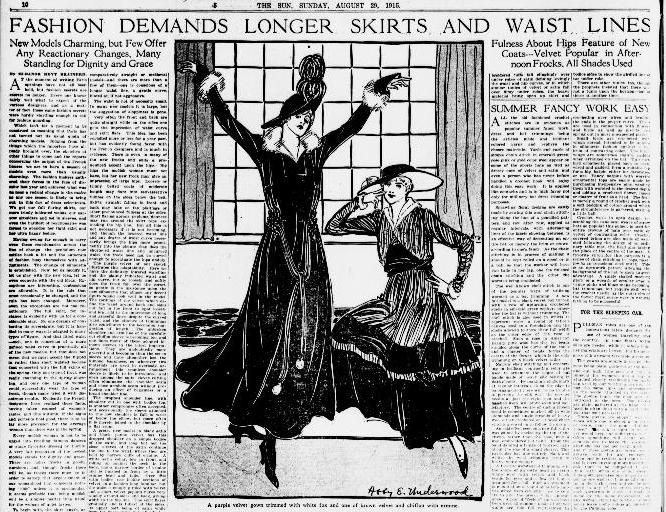
Women’s fashion would be affected by the war in Europe in many ways.  Travel restrictions put an end to the constant flow of fashion queues from Paris. New ideas that were strictly American could begin influencing the way women dressed here.

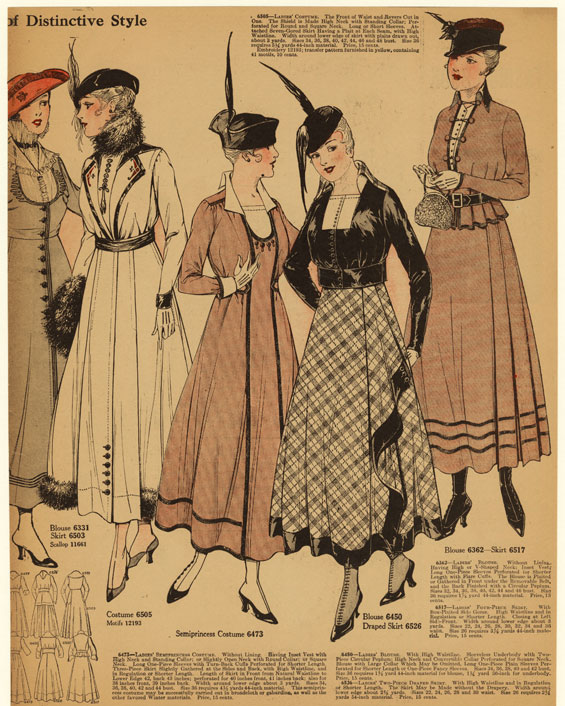
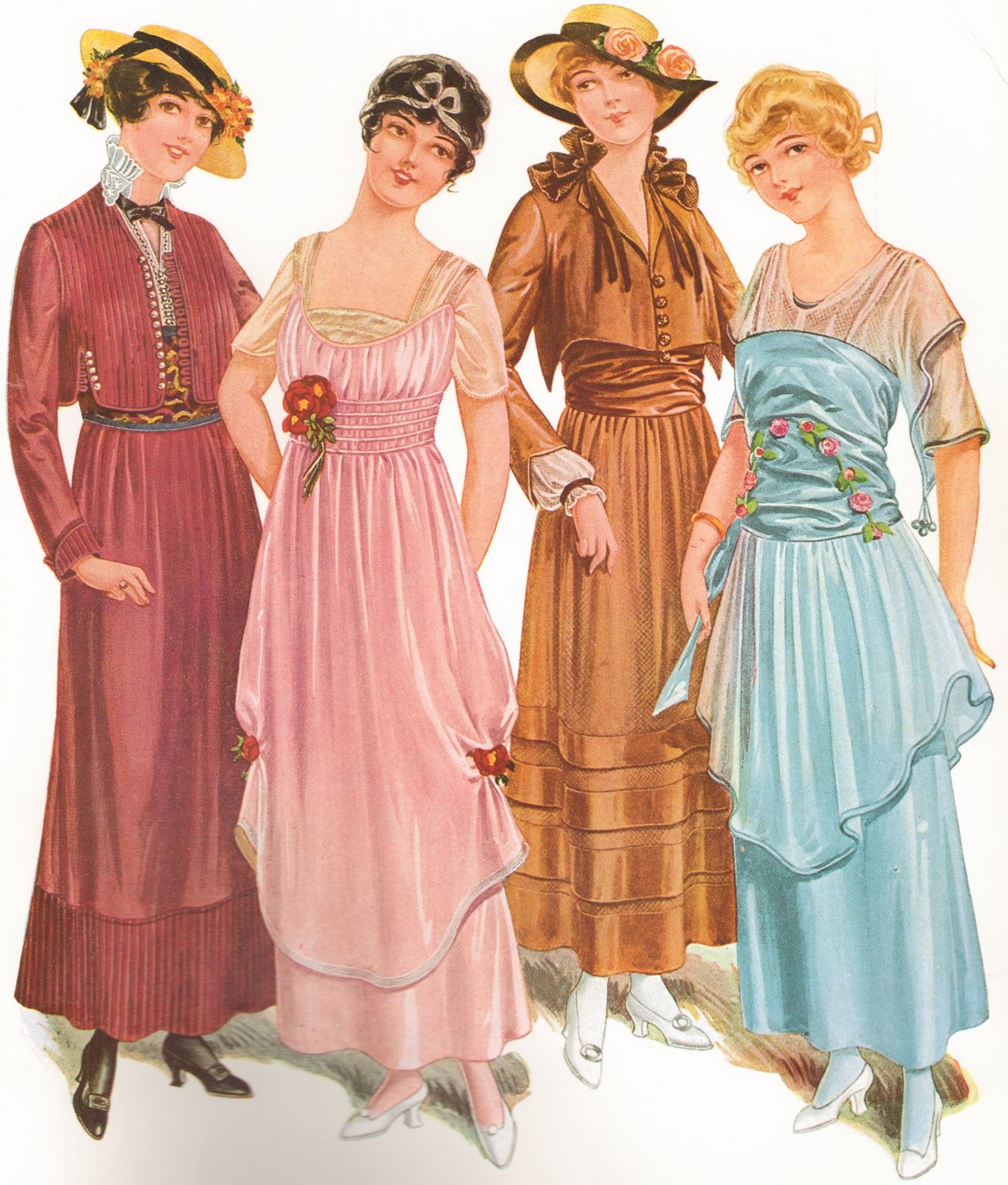
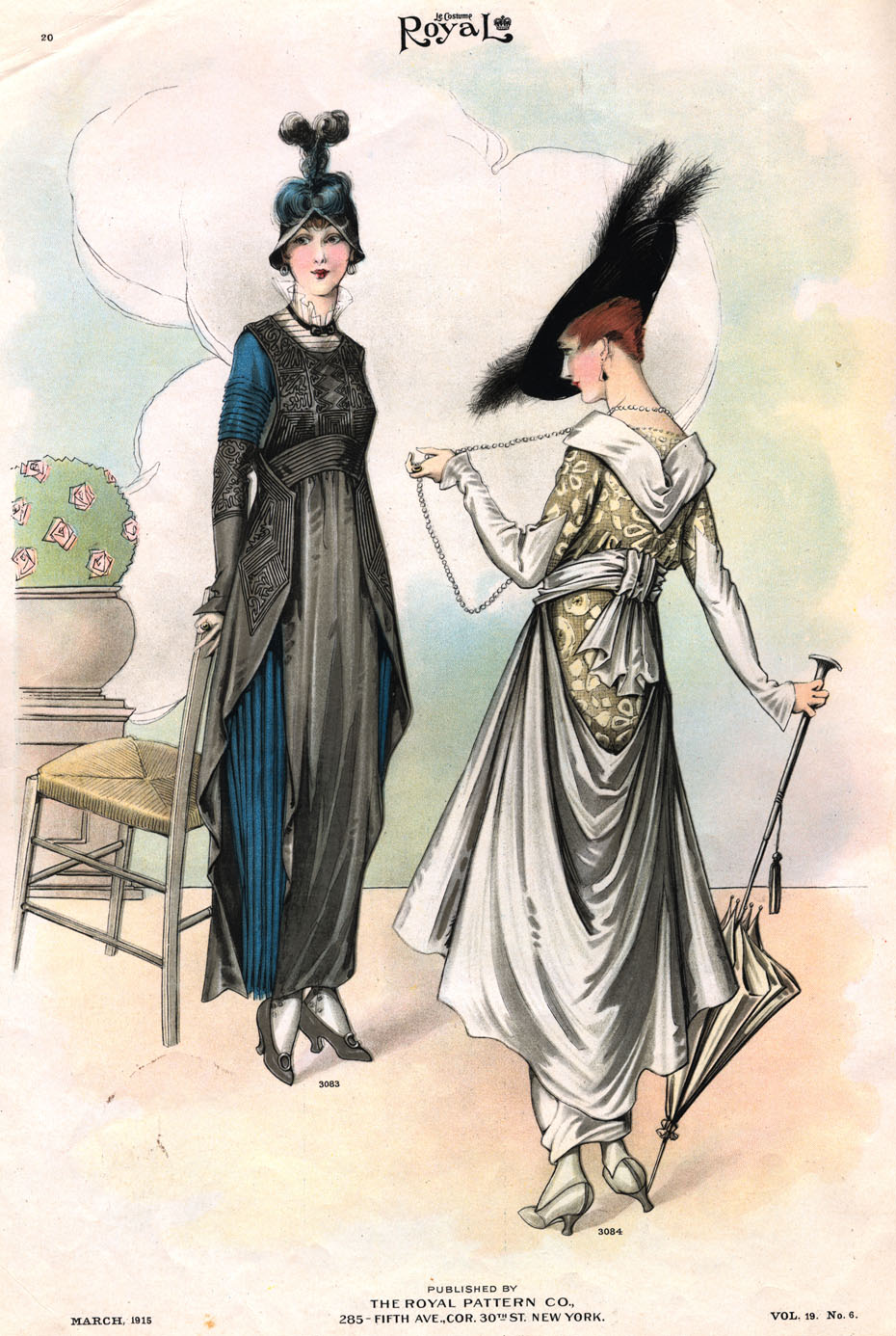
The growing independence of women also allowed for a looser, more comfortable style.  Gone from the streets were the dreaded hobble skirts, limiting the ability of women to take long strides. (Anything for fashion!) What audiences might have seen in 1915 were skirt styles that opened up at the bottom, allowing for freer movement.

Ladies' Costume (6505) ; Blouse (6362) ; Ladies' Four-Piece Skirt (6517) ; Blouse (6450) ; Ladies' Two-Piece Draped Skirt (6526) ; Ladies' Semiprincess Costume (6473) ; Motifs (12193) ; Blouse (6331) ; Skirt (6503) ; Scallop (11661). Courtesy New York Public Library
Ladies’ Costume (6505) ; Blouse (6362) ; Ladies’ Four-Piece Skirt (6517) ; Blouse (6450) ; Ladies’ Two-Piece Draped Skirt (6526) ; Ladies’ Semiprincess Costume (6473) ; Motifs (12193) ; Blouse (6331) ; Skirt (6503) ; Scallop (11661). Courtesy New York Public Library

These would come to be called ‘war crinoline’, essentially a precursor to a modern conservative skirt and described as bell-shaped, a “very full calf-length skirt” requiring extra fabric to attain its flowy, romantic look.

This would seem to be antithetical to wartime thinking — when lifestyles were often pared back — but these larger gowns were touted as practical fashion and thus ‘patriotic’ in their intent.  The role of women in wartime, many thought, was to simply look their best. At least, this was the line many fashion designers took during the era.

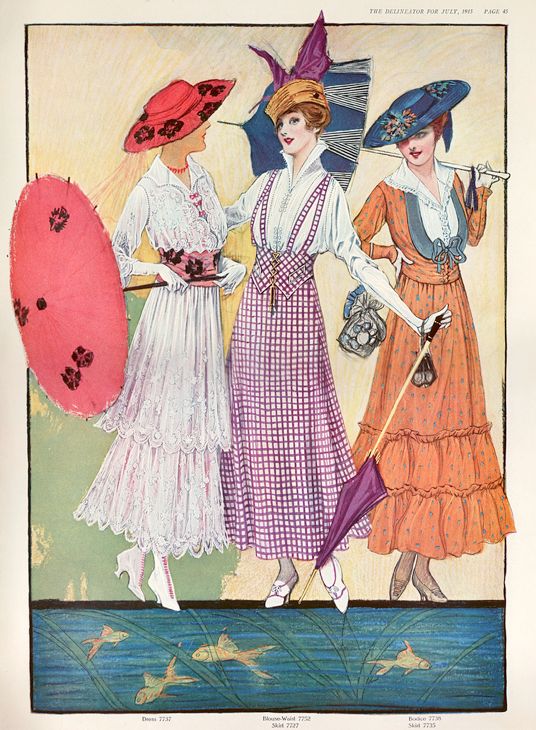
1915 Delineator Spring dresses
New York Sun, August 1915

Revolutionary Undergarments

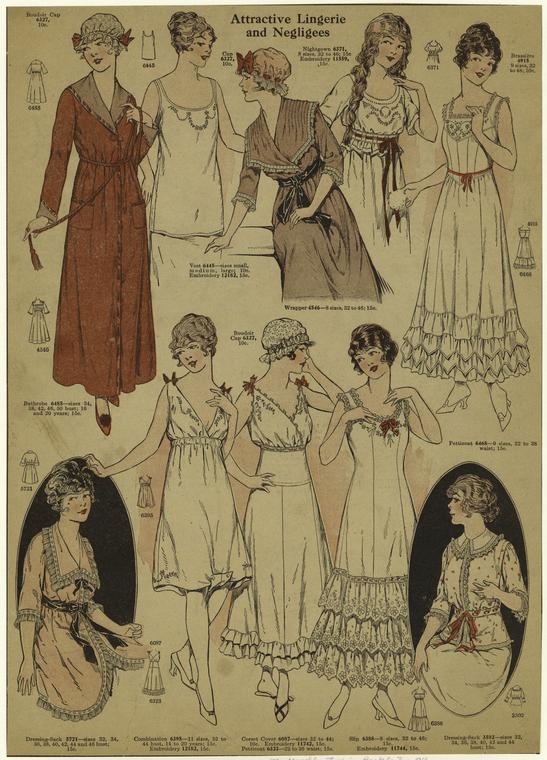
While some women would continue to subject themselves to the corset, the practicalities of life soon led to its unpopularity.  In 1914, Carisse Crosby, a well-connected society heiress from New Rochelle, received the patent for a revolutionary new form of support  — the modern bra.  Called the backless brassiere, the invention further facilitated a departure from stiff and uncomfortable silhouettes.

Crosby (really named Mary Phelps Jacobs) was a well connected society woman and would have been milling about the crowd at Madison Square Garden.  In 1915 she married the Boston Brahmin playboy Richard Peabody and eventually moved to Manhattan when she became pregnant with his child.

Lingerie And Negligees, 1915. Courtesy New York Public LIbrary
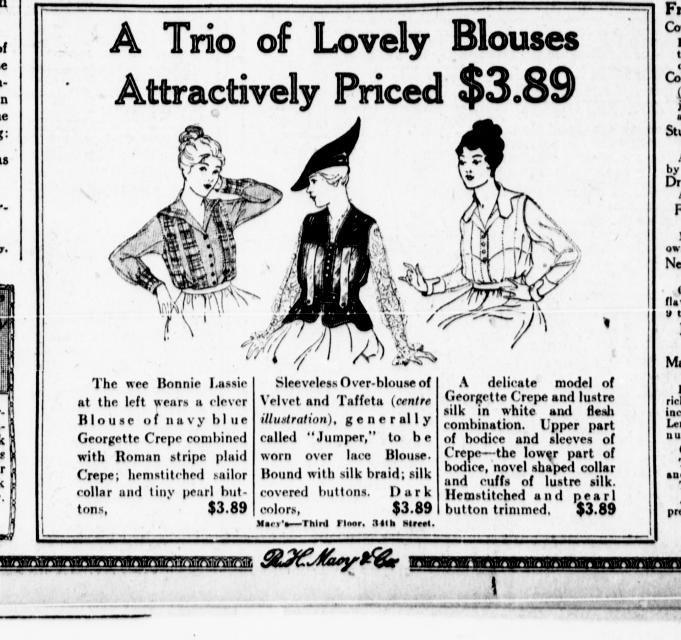
from the New York Evening World, October 21, 1915

The Gradual Straight Line

Perhaps the boldest fashion transition in the 1910s was the subtle shift from curvaceous, hour-glass forms to a straight, shapeless silhouette.  While the war crinoline still required a narrow waist for some of its dramatics, competing styles leaned towards sleekness.   This was an evolution from the Empire waist which had gained a resurgence earlier in the decade.

1

Rise of the Dangerous

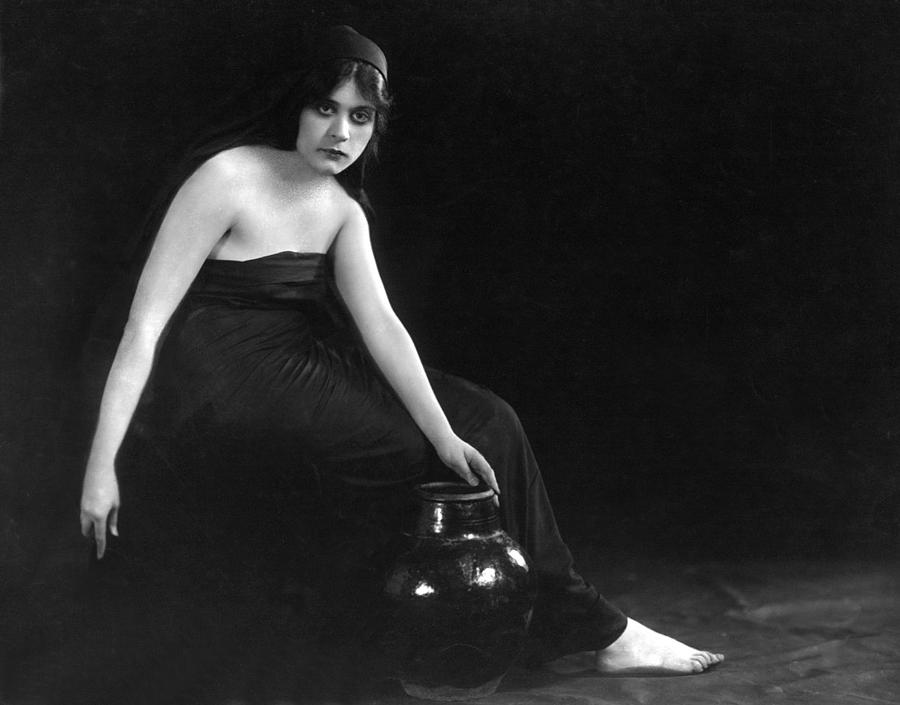
The predominant form of women’s fashion in the 1920s — the boyish flapper with sleek dresses and short hair — would rise from the edgier look of the ‘vamp’, best embodied in the late 1910s by film and stage actress Theda Bara.  This took the reformed instincts of woman’s fashion to its extreme. Sexuality became more overt and stylized, from bold makeup to exposed flesh.  This was certainly not the look of your average lady on the street, but soon slight shades of the vamp style would eventually seep into everyday fashion.

Theda Bara in the 1915 film Sin

The Popularity of Make-Up

It was unseemly of women to paint their faces with too many cosmetics during the late 19th century. But by the mid 1910s, women were influenced by actresses and dancers, and taboos against wearing cosmetics were relaxed.  The natural pale complexion so desired a decade earlier gave way to a kind of democratization that only makeup could provide.  Women were allowed to heighten the drama in their faces and mask the imperfections.

In 1915, two major forces in women’s beauty opened salons on Fifth Avenue — Elizabeth Arden and Helena Rubenstein. Both heavily influenced by the Parisian fashion aesthetic, elite New York women flocked to their shops.   Within a decade, these two entrepreneurs would be the anchors of a burgeoning and highly lucrative beauty industry.

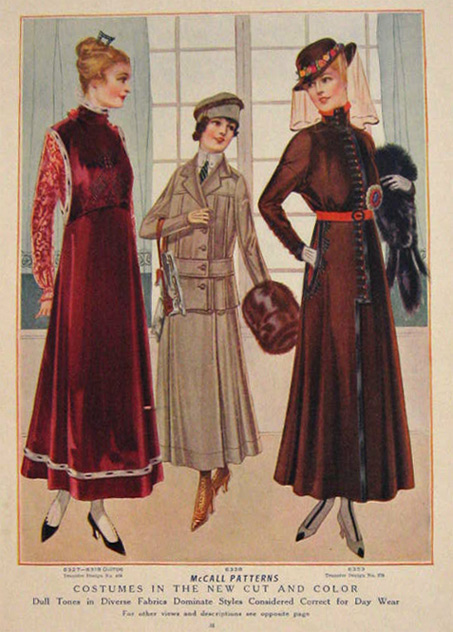
from a 1915 Gimbels fashion magazine, courtesy  the blog Historically Romantic
from a 1915 Gimbels fashion magazine, courtesy the blog Historically Romantic
1

Hints of the ‘Little Black Dress’?

Black was not worn by women of gaiety and glamour.  It was strictly the hue of mourning during the Gilded Age and rarely made an appearance in actual evening wear.  However in an imagined fashion show in 1915, you may have seen a slight hint of it here or there, although not very practical and only as part of bold ‘vamp’ styling of its time.  It might have seemed edgy and even a bit bizarre, something only a worldly woman might have worn.

It would take another decade — and the influence of Coco Chanel — to bring the black dress into fashionable prominence. It would eventually becoming one of the defining looks of the New York woman.

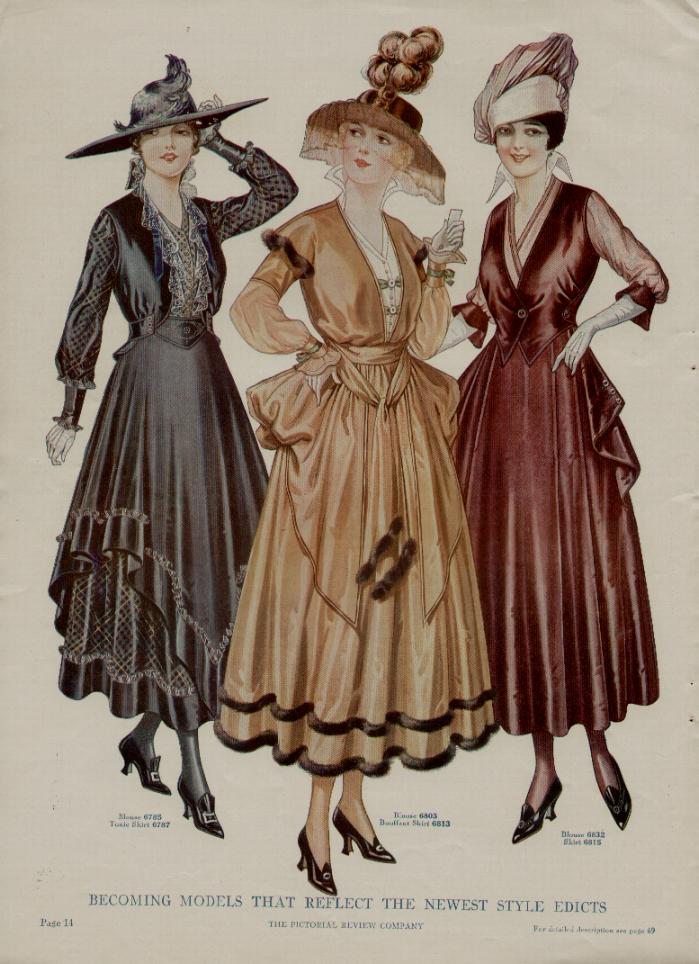
from a 1915 Pictoral Review
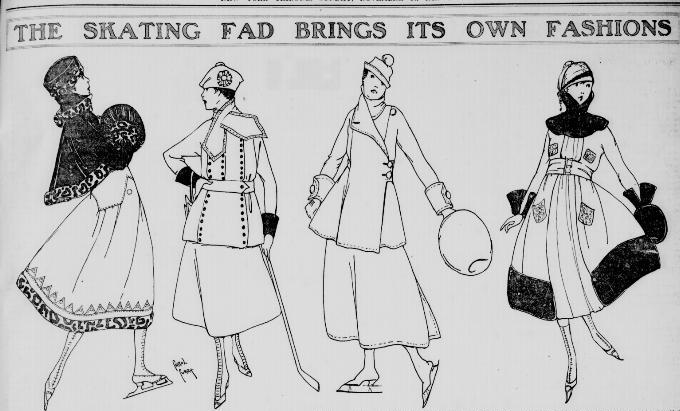
A brief skating fashion fad inspired this spread in the New York Tribune, November 14 1915

Driving Attire

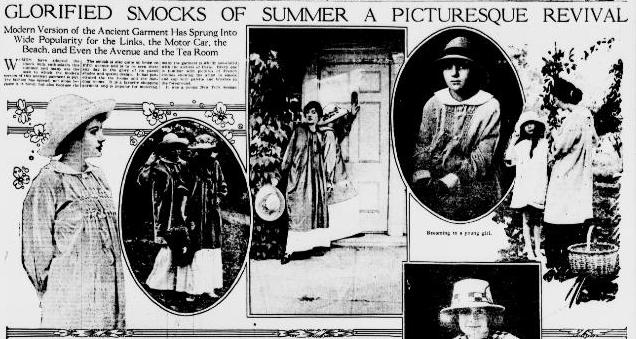
The continued popularity of the automobile required specific sorts of fashion to protect the clothes from dust.  These items found their way into regular wear.  This article from an August 1, 1915, issue of the New York Sun proclaims the return of the smock. “The smock is worn in the garden and on the golf links.”

1

Still A World of Hats

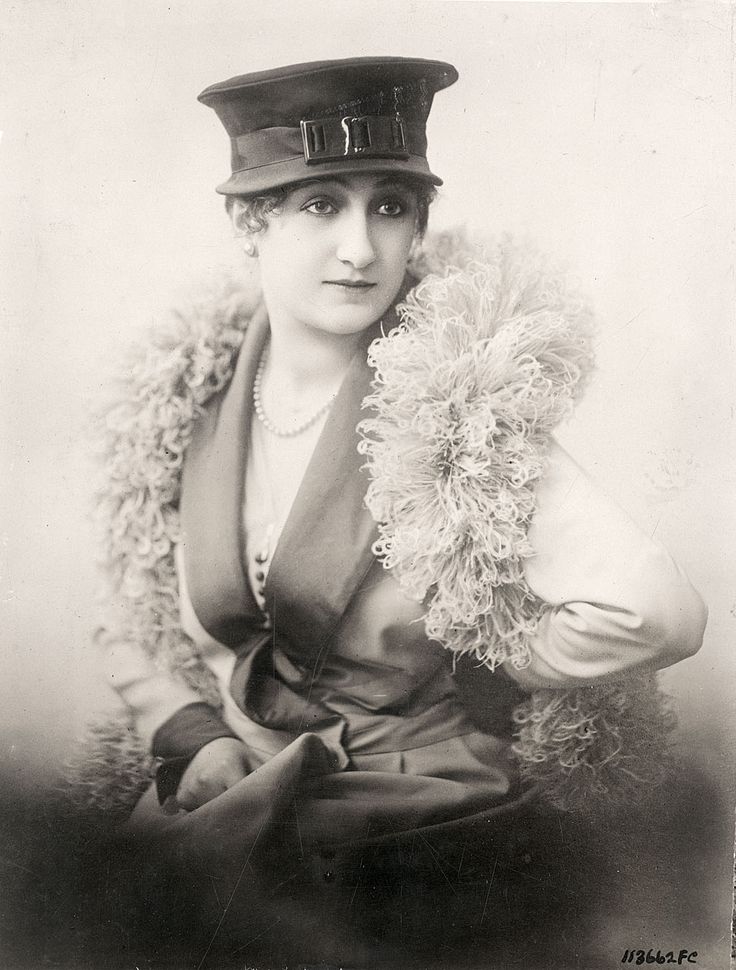
One taste that didn’t wander far was the love of hats. While flamboyant hats still topped many society ladies head, styles eventually became a little serious with nautical and even military influences.

1

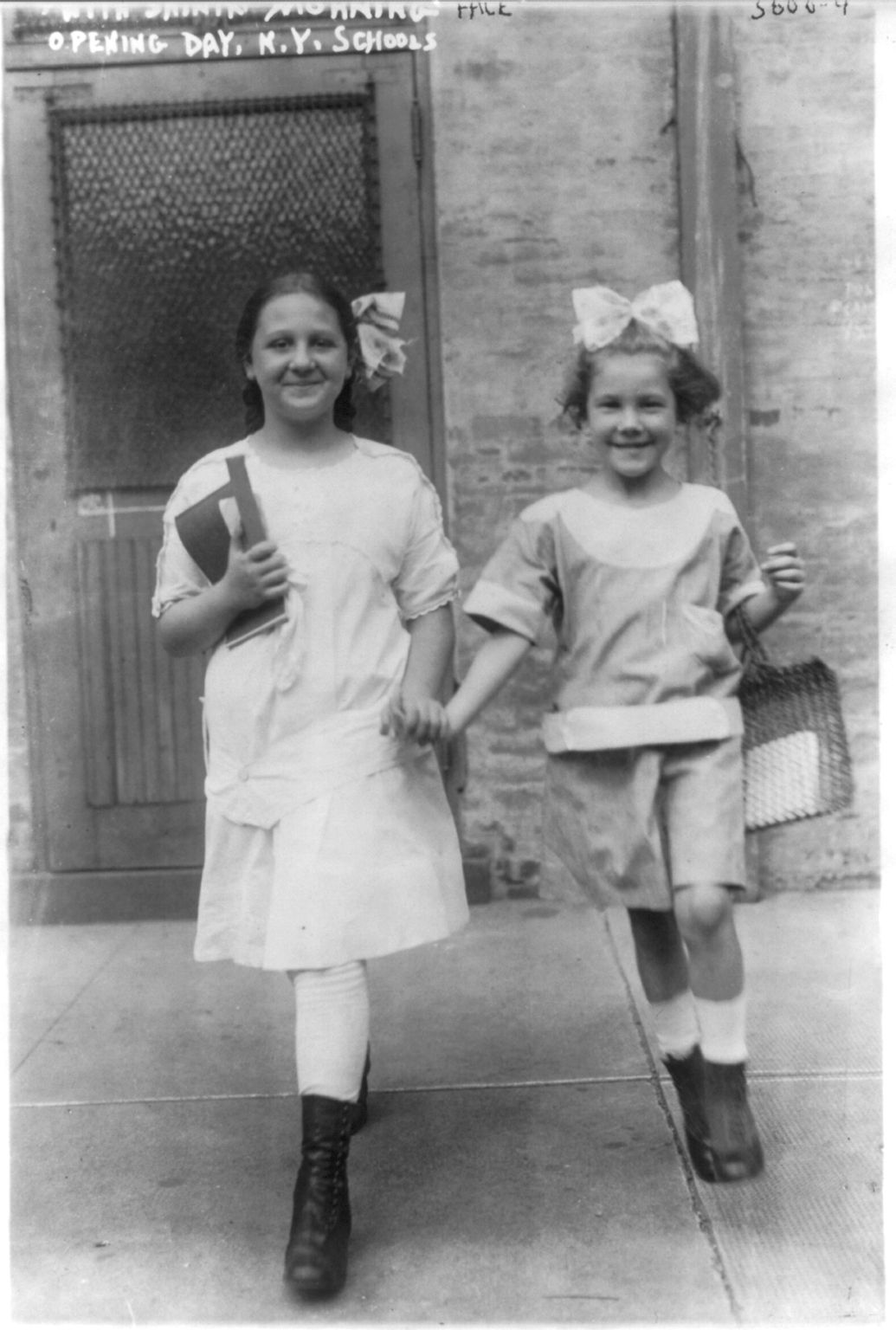
Even the school girls got into the act of fashion!  Here’s a pair from the first day of school in 1915….

1
Categories
It's Showtime

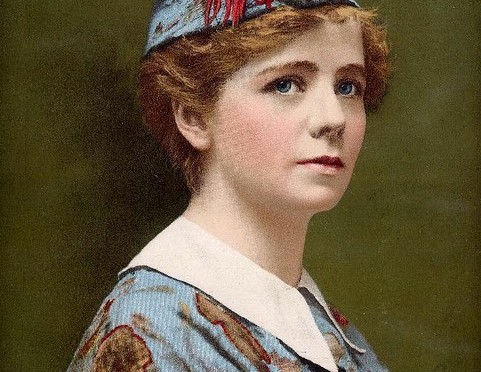
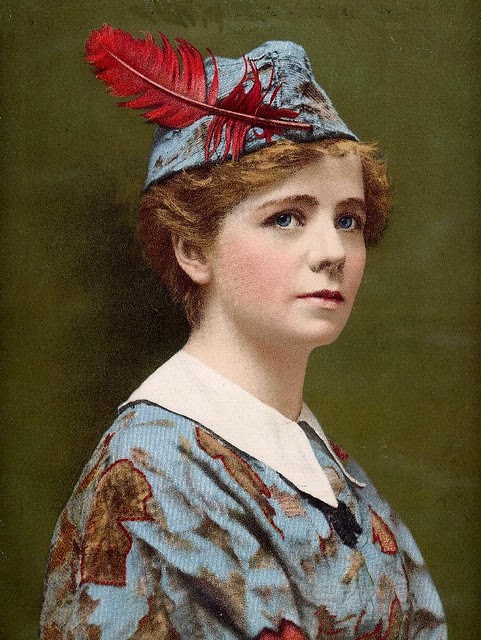
Maude Adams: Fashion icon and America’s first Peter Pan

Tonight NBC’s unveils its live theatrical experiment Peter Pan with Girls star Alison Williams in the cross-dressing role of the boy who never grows up.

We can all have our debates about who’s been the greatest stage Peter Pan in history.  Most will say Mary Martin, a sizable minority will claim Sandy Duncan, and a few smaller voices may even cry the name Cathy Rigby. However the first and most popular woman to ever play the role was most likely the actress who originated the role on the American stage — Maude Adams.  

Her rendition was so popular that it inspired one enduring fashion trend.

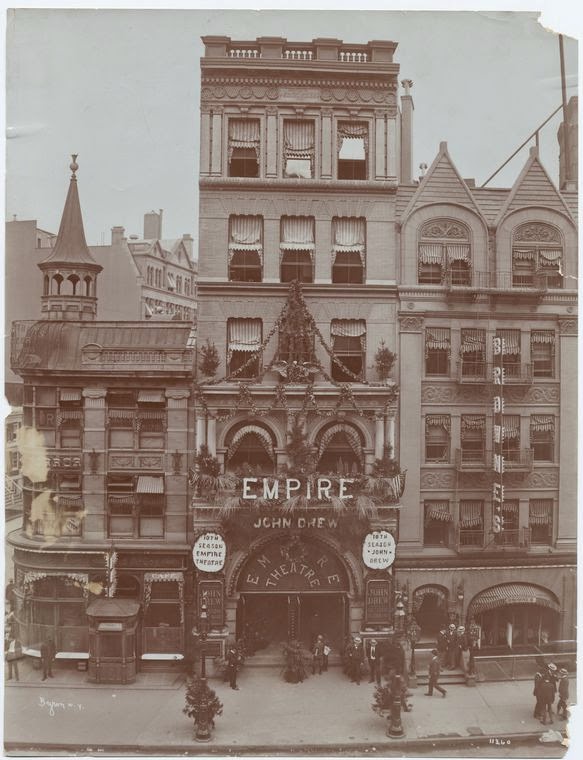
Peter Pan made its New York debut on November 6, 1905 at the Empire Theatre at Broadway and 41st Street.  The theater was owned by one of New York’s most powerful producers Charles Frohman. Adams was one of his greatest finds, casting her in several productions when she was just a teenager.

Adams had played a boy on stage and had even starred in a prior play by Peter Pan’s author J. M Barrie (Quality Street).  Barrie himself came to New York to witness rehearsals with Adams and the show 70-odd cast members.

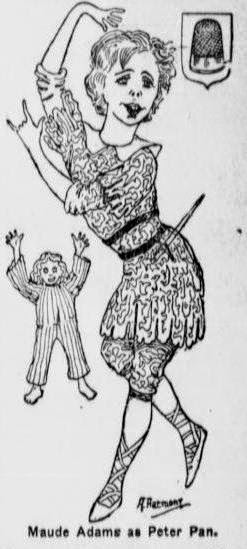
At right: The bizarre visage of Maude Adams as illustrated in the New York World, November 1905

The audiences loved Adams, but not the critics. From the New York Tribune the following day:  “As an actress Miss Adams is incarnate mediocrity — for she possesses neither imagination, passion, power, depth of feeling or formidable intellect and her faculty of expressive impersonation is extremely limited” — OUCH — “but as a personality, she is piquant, interesting and agreeable … she has shown to advantage and she causes the effect of commingled merriment, sentiment and momentary thought.”

Others criticized her physical size, calling her “plump and prancing.” “She was a trifle overweight for a fairy, but she carried herself lightly and gracefully and didn’t scare the children in the least.”

Audiences loved her, however, Adams proceeded to play the role of Peter Pan, off and on, for over a decade. In fact, Maude Adams was the actress most associated with the part for fifty years.  Mary Martin then took the role to Broadway in 1954, won the Tony Award for Best Actress the following year and then became the model for which all subsequent actors have looked to.

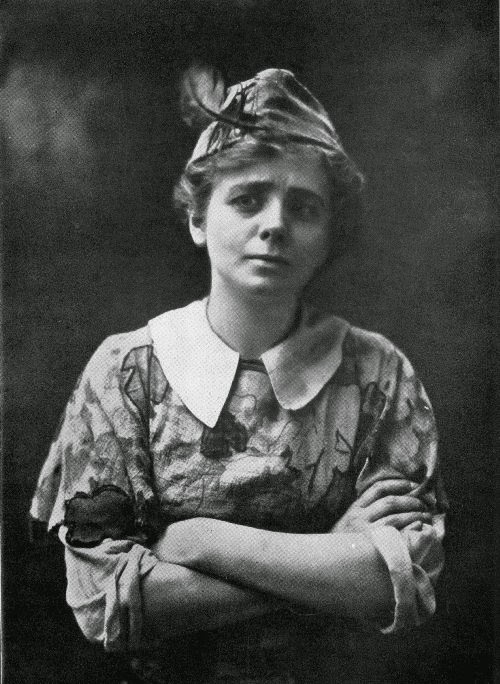
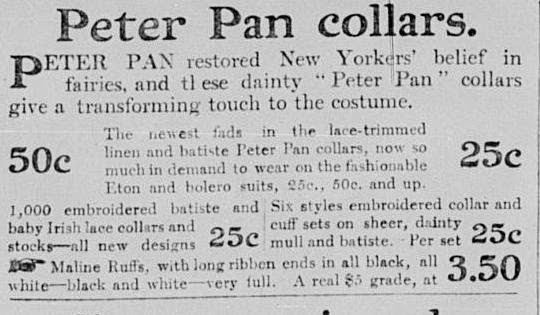
More important, Adams inspired a popular fashion trend — the Peter Pan collar.  Her costume, by John White Alexander, took great liberties with Barrie’s descriptions of Peter’s garments.  Women soon clamored for dresses with a similar floppy collar.  The play was still running at the Empire when the collars soon appeared at department stores.  This ad is from April 1906:

Her belted waist also took the fashion world by storm.  The “Peter Pain waist,” a traditional shirtwaist bound with a thick black belt, was called “decidedly chic,” “particularly becoming and stunning in effect.”

The front of the Empire Theatre, where Peter Pan made its New York debut:

Pic courtesy New York Public Library

Categories
Those Were The Days

Venuses in Fur — New York society ladies in fancy animal skin

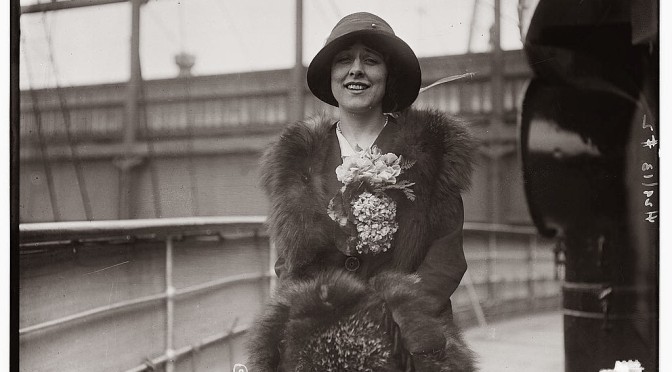
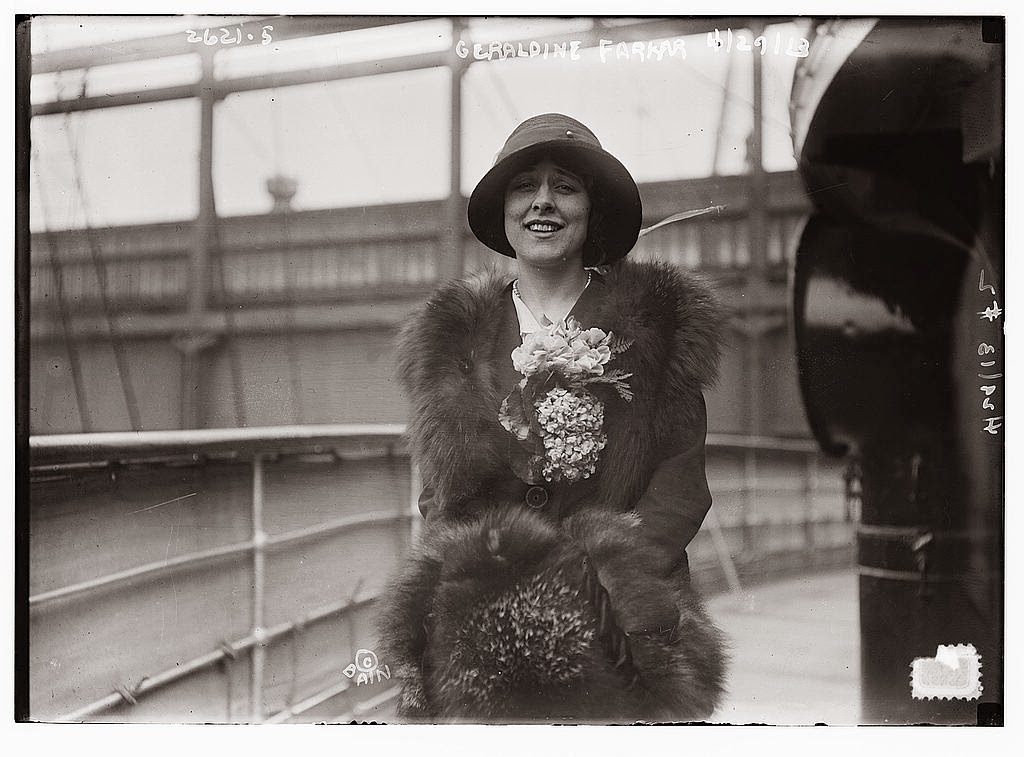
The Metropolitan Opera’s soprano sensation Geraldine Ferrar, photo taken April 1913. I guess fur was never out of season a century ago!

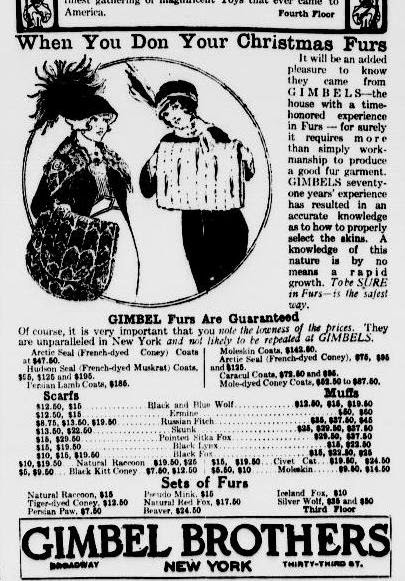
“When You Done Your Christmas Furs — It will be an added pleasure to know they came from Gimbels — the house with the time-honored experience in Furs — for surely it requires more than simply workmanship to produce a good fur garment.  GIMBELS seventy-one years’ experience  has resulted in the accurate knowledge as to how to properly select the skins.”

Some of the furs sold at Gimbels for the holiday season in 1913 — wolf, muskrat, skunk raccoon, lynx, lamb, stoats (otherwise known as ermine), several kinds of fox, beaver and ‘tiger-dyed coney’ or rabbit skins dyed to resemble exotic animals.  You could get coney skins in zebra and leopard prints.

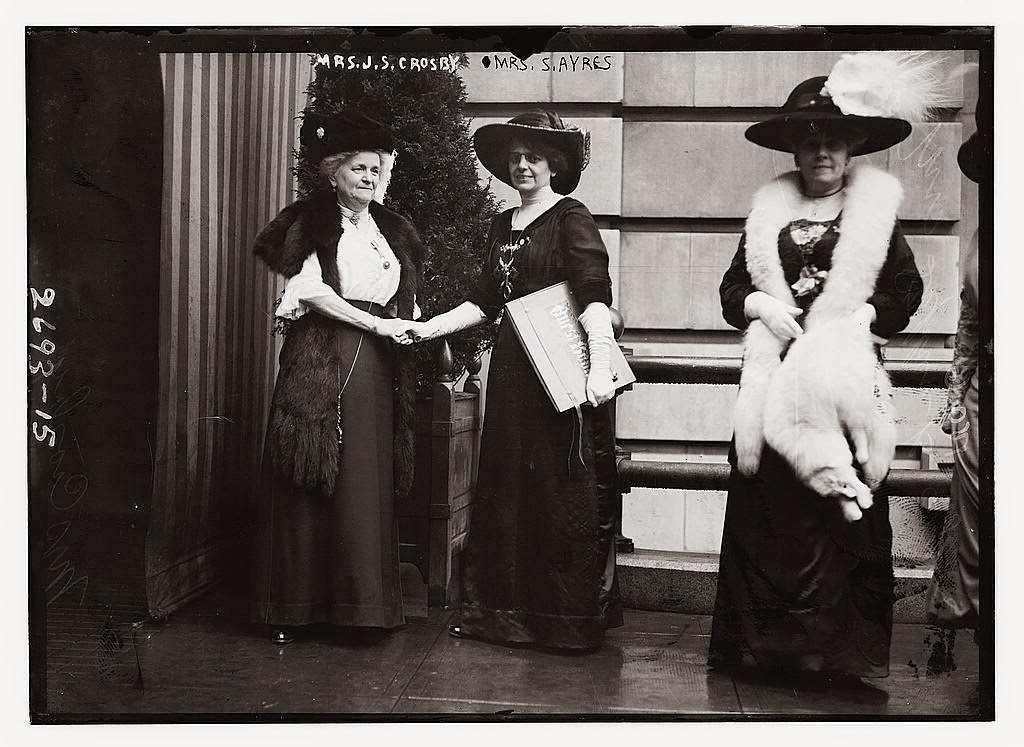
Nellie Fassett Crosby (Mrs. John Sherwin Crosby), president of the Women’s Democratic Club of New York City and founder of the Woman’s National Democratic League, and Mrs. Steven Beckwith Ayres, also active in the WNDL.

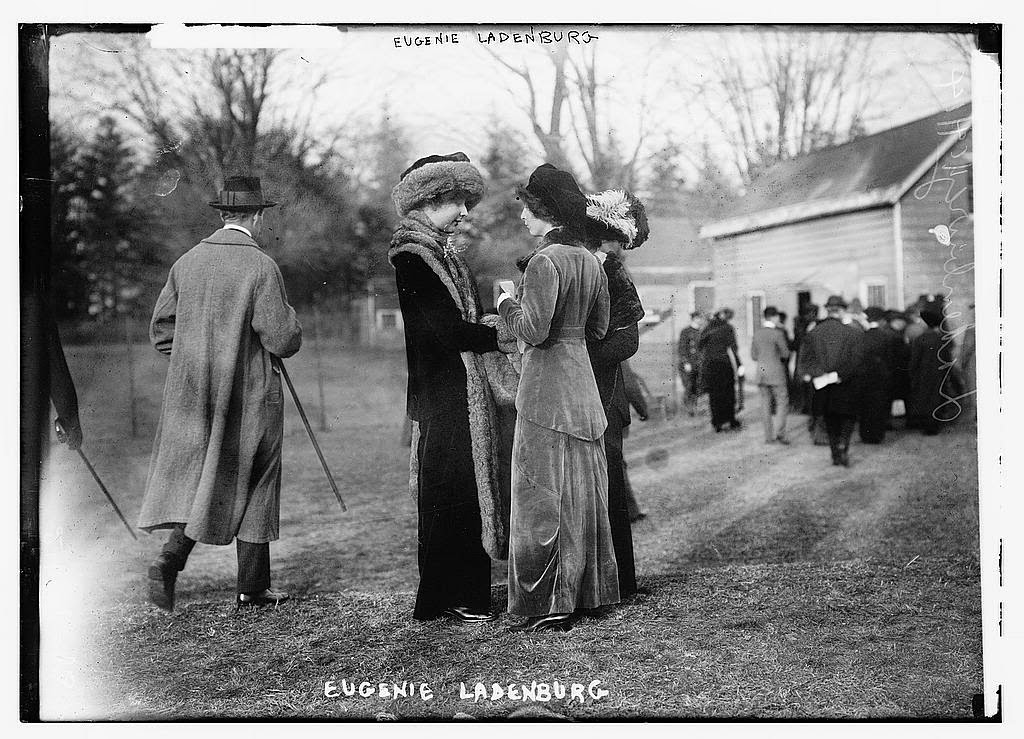
Eugenie Mary “May” Ladenburg Davie, noted Republican activist in New York and a director of the Pioneer Fund.  She was apparently a bit of a political spitfire, even while draped in the latest fashion.
 

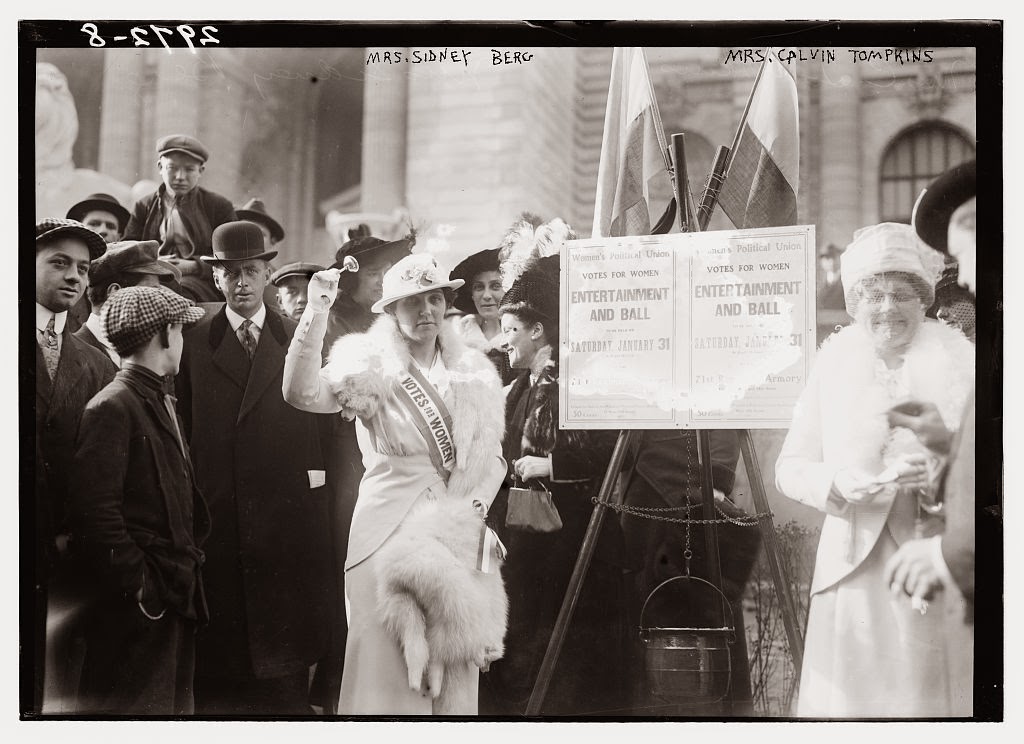
Suffragists at the Armory, January 1914

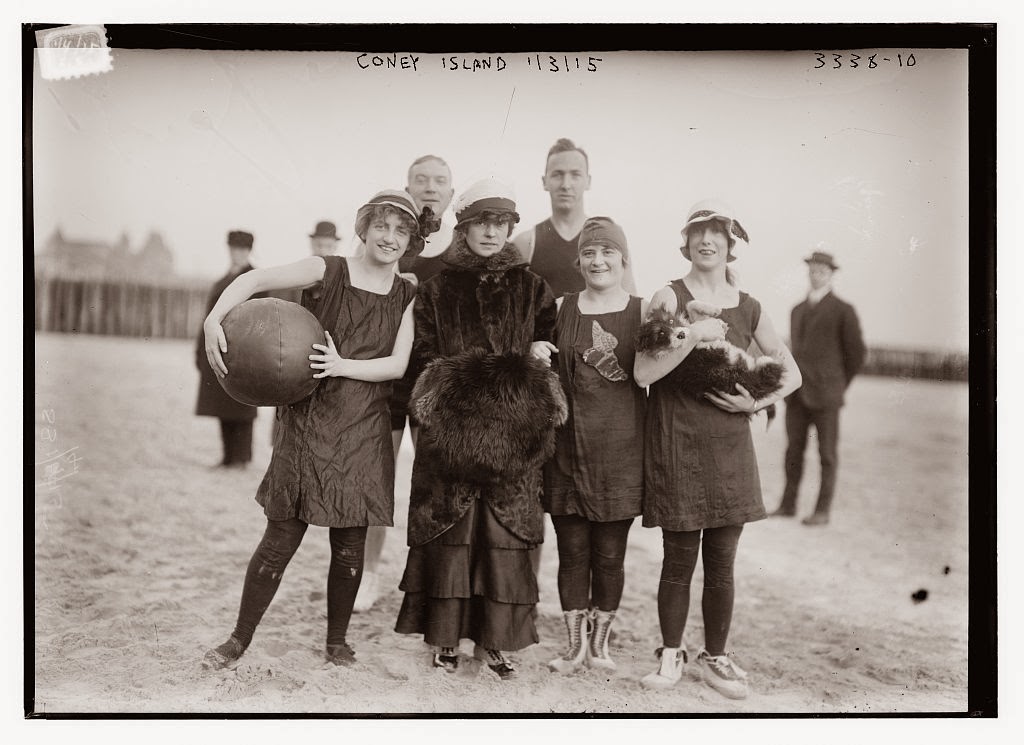
It’s even suitable beach wear! A group of friends at Coney Island, January 1915

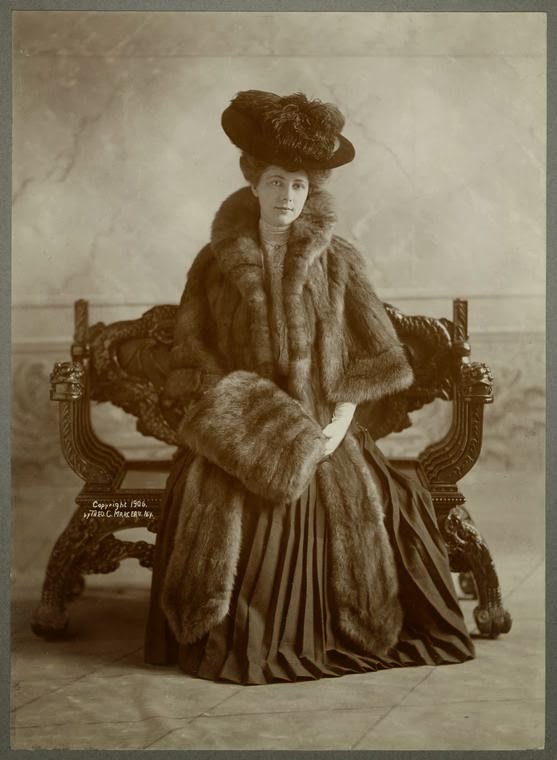
From the studio of New York portraitist Theodore C Marceau, 1906

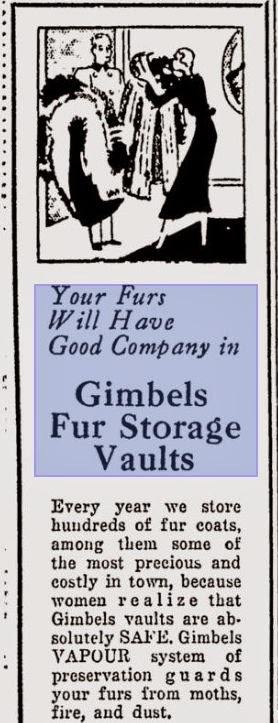
Gimbels not only sold furs; they stored them for you in the summertime. Can’t have a frock made entirely of animal skin just sitting in your closet!


Categories
Those Were The Days

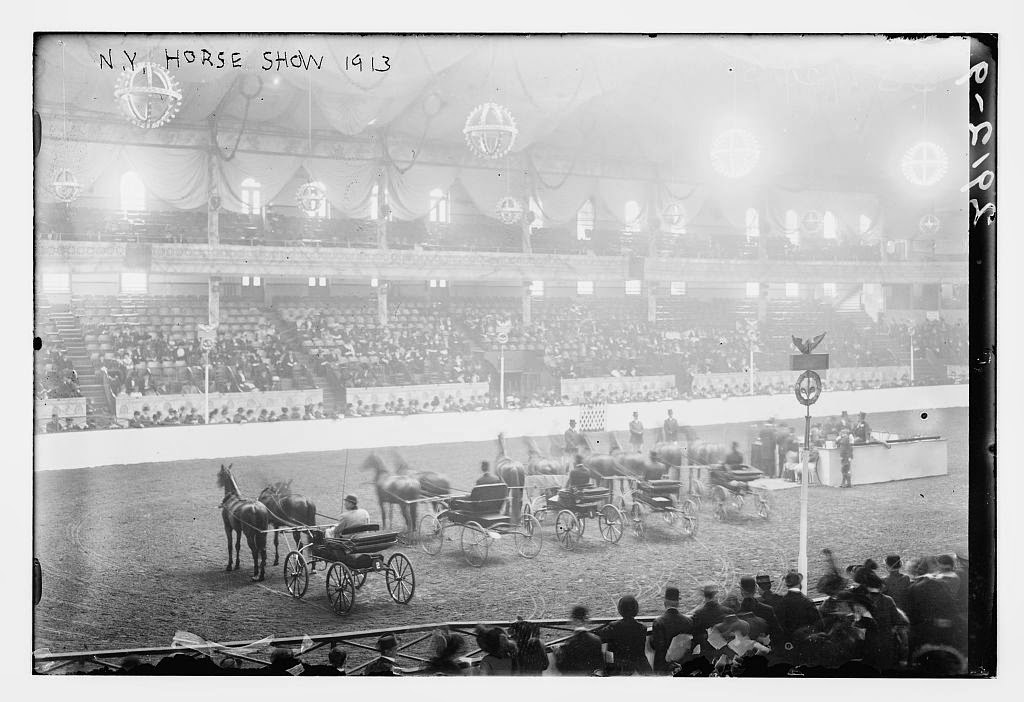
Let’s go see the horses at Madison Square Garden!

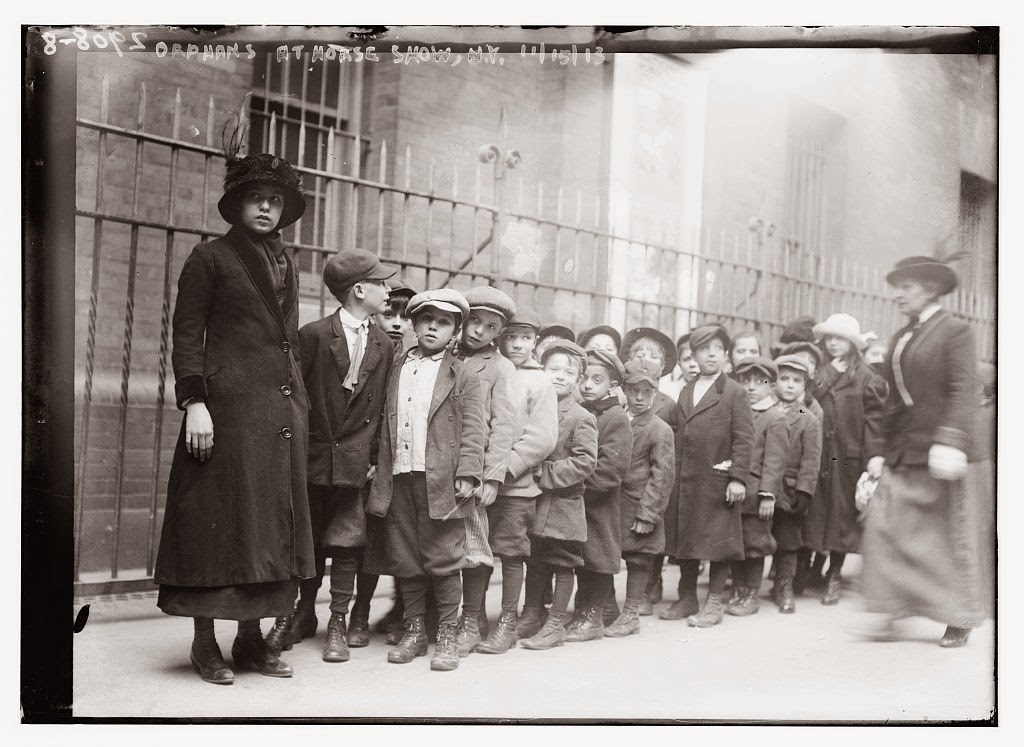
These unbearably cute orphans seen above were lined up to go to the National Horse Show at Madison Square Garden which began on November 15, 1913.  These are of course the days of the Garden down at the northeast corner of Madison Square, the glorious McKim, Mead and White structure topped with a glittering statue of Diana.

Once inside, the children were witness to a marvelous variety of events, including horse racing, pictured here:

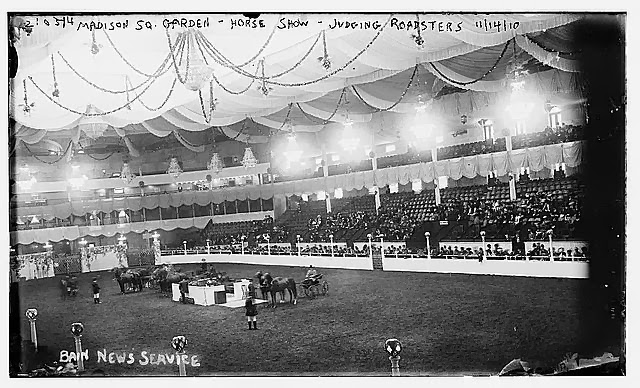
Here’s another view of an earlier event from 1910:

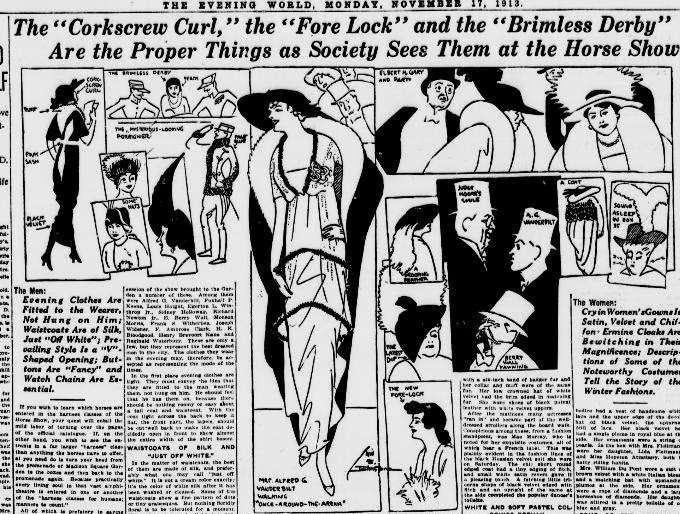
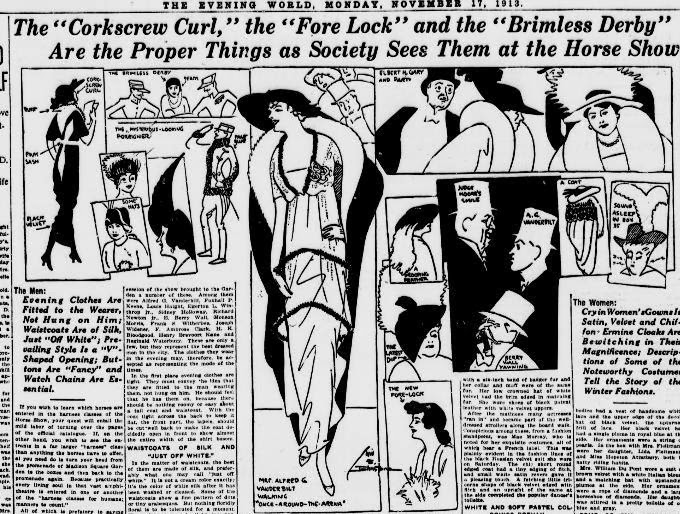
The National Horse Show was one of New York’s big society events, as much a see-and-be-seen spectacle as the opera.  Did anybody care about the dressage, the equestrian excellence?  Perhaps some. But many were just there for the fashion show as society doyennes and big-money mogul strutted the latest styles.

“If you wish to learn which horses are entered in the harness classes of the Horse Show, your quest will entail the mild labor of turning over the pages of the official catalogue.  If, on the other hand, you wish to see the entrants in a far larger “harness” class than anything the horses have to offer, all you need do is turn your head from the promenade of Madison Square Garden to the boxes and then back to the promenade again.”

From the Nov. 17th Evening World

From the Nov. 21st Evening World

So how did a group of poor orphans get invited to high society’s big event? It was a gesture of charity by the Vanderbilt family — Alfred Gwynne Vanderbilt* was president of the horse show — who invited 3,000 orphaned children from around the city to sit in the balconies.

The city’s little wards have looked forward to this occasion for many months.  They always do.  They know Santa Claus Vanderbilt.  After the show each of them will leave the Garden with a substantial present.  It is their Christmas Day.” [source]

* Two years later, Mr. Vanderbilt would die in the sinking of the RMS Lusitania.

Photographs at top courtesy the Library of Congress

Categories
Know Your Mayors

George Opdyke: The mayor during the Civil War Draft Riots and his unsavory connection to New York’s fashion industry

KNOW YOUR MAYORS A modest little series about some of the greatest, notorious, most important, even most useless, mayors of New York City. Other entrants in the Bowery Boys mayoral survey can be found here.

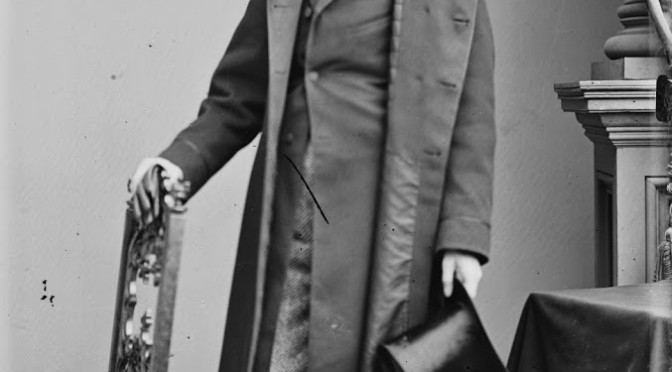
Mayor George Opdyke
In office: 1862-1863

The wealthy merchant and politician George Opdyke died on June 12, 1880, attended to by his family from their lavish home at Fifth Avenue and East 47th Street, just a few blocks from where the violent Draft Riots had ignited back in 1863.
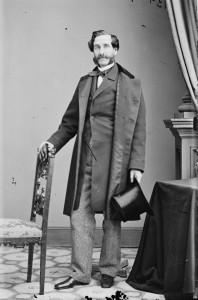
In the 17 years since those terrible days, New York had grown mightier with vast wealth, in an explosion of prosperity that would inaugurate the Gilded Age.  But while the scars of the Draft Riots had faded from the city streets, they never quite faded from Opdyke, who had been mayor of New York during the violent outbreak.

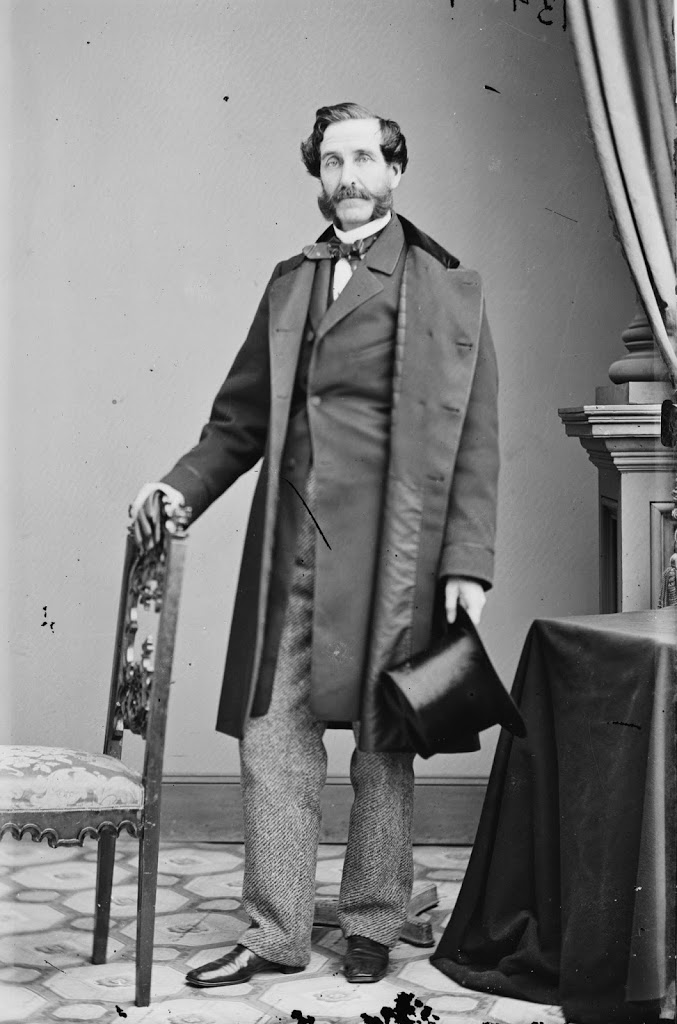
At right: George Opdyke, in a photo taken by Matthew Brady

Some of the violence that week in July had been directed towards Opdyke, one of the most prominent Republicans in a city of Democrats. His former home at 57 Fifth Avenue had been attacked twice by rioters.  He was considered the face pro-Lincoln, pro-war, and, thus, pro-abolitionist forces in New York

Yet had it not been for the institution of slavery in the South, Opdyke might never have even made his fortune.

George Opdyke was born to a large New Jersey farming family in 1805, working his way from the fields to the classroom, becoming a young school teacher at an early age.  Like so many teenagers in the early 19th century, job opportunities out West spoke to his sense of adventure.  With $500 in their pockets, Opdyke and a friend settled in Cleveland, Ohio, opening a clothing store and tailor for workers of the newly constructed Erie Canal.

Opdyke soon found a more profitable application for his young business — the high mark-up manufacturing of cheap slave clothing.  He moved to New Orleans and began an incredibly profitable plant there, making inexpensively produced clothing for the plantations of the deep South.

In fact, Opdyke became so successful that, in 1832, he moved to New York to open a larger clothing factory on Hudson Street.  According to historian George Lankevich, Opdyke “built the city’s first important clothing factory, selling his goods largely to southern plantations and creating the basis of a new industry.”  It was the first large-scale, ready-to-wear clothing establishment in New York, soon employing thousands; so, yes, this is how the New York fashion industry begins.

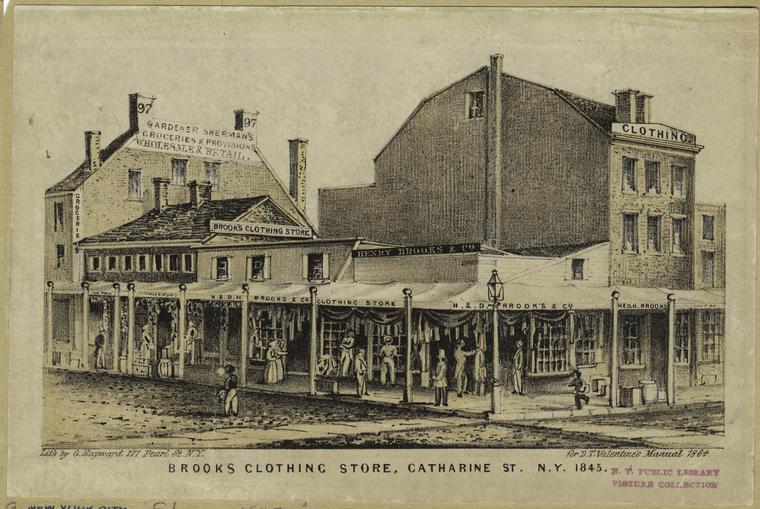
Below: Brooks Clothing Store in 1845, a rival of Opdyke’s clothing business. Opdyke would have some rather controversial connections for Brooks Brothers during the Civil War. (NYPL)

And a successful political career begins as well.  By 1846, Opdyke, now a millionaire and a well-connected member of mid-19th century New York society, entered a life of politics.

Interestingly, he was originally associated with the Free Soil Party, an early anti-slavery effort, illustrating how businessmen often separated certain moral beliefs from their business practices. (Early on, he would become one of Abraham Lincoln’s most ardent supporters.) The Free Soilers were soon be incorporated into the burgeoning Republican Party, and Opdyke’s first appearance in New York state assembly, in 1859, was as a Republican.

That same year, Opdyke became the Republican’s best chance at winning the mayor’s seat in New York. However, he vied for the job with two other seasoned politicians — unscrutable Democrat Fernando Wood and former mayor and sugar king William Havemeyer.  Thanks to machine politics and the uncertainty of war with the South, Wood prevailed that fall, becoming mayor of New York at the start of the Civil War. (I have an entire podcast on Wood’s roller-coaster career in politics.)

But tides would change in Opdyke’s favor.  Pro-Union sentiment surged through the nation and in New York City by the start of the war.  And by the time of the next mayoral election in 1861, situations were ideal for a Republican to take charge.

It helped that Democrats were divided — Tammany Hall went with C. Godfrey Gunther, while Wood formed his own alternative political machine Mozart Hall.  But it was Opdyke that prevailed, although barely.  He beat Gunther by a whopping 613 votes. (But he did beat Wood in Wood’s own ward.  That must have felt good.)

Part of Opdyke’s appeal at that moment was his deep connections to the Lincoln administration. When the flags were waving in New York, Opdyke was an ideal representative, encouraging support for the war, hosting troops in the city, raising money for the effort.  But when enthusiasm for the war withered, so did Opdyke’s reputation.

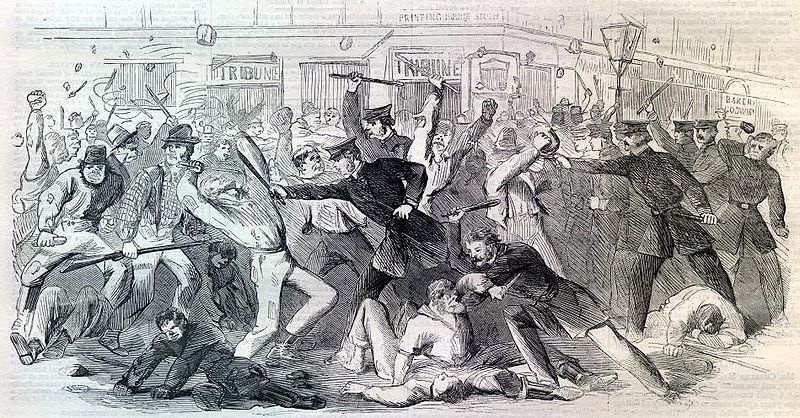
Below: The draft riots, which paralyzed New York in July 1863

Opdyke’s unwavering support for the draft backfired severely in the summer of 1863. When New Yorkers took the street on July 13, 1863, burning the draft offices and taking out their anger on black citizens and prominent Republicans, Opdyke topped the list of most despised New Yorkers.  He had very little power to quell the violence; the police department was placed under state control, and state militia had been called away.

While his home was nearly destroyed, it was his political reputation that took the greatest hit. At first, he had vetoed a plan by the Common Council to pay for substitutes for any drafted New Yorkers. But a month later, working with Tammany Hall, he essentially endorsed a similar bill to avoid more violence.

This saved New York, but it did not save him.  On election day, that December in 1863, he was replaced with the Democrat Gunther, whom he had narrowly beat just two yeas before.

His woes weren’t quite over. A political feud with newspaper editor Thurlow Weed revealed some unpleasant information about Opdyke in the press. “[H]e had made more money out of the war by secret partnerships and contracts for army clothing, than any fifty sharpers in New York,” claimed the irate newspaper editor.

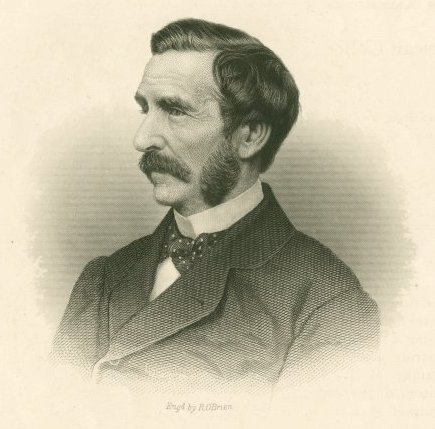
At right: Opdyke in later life (NYPL)

Opdyke had profited handsomely from the war through his own clothing plant and in deals with rival clothing manufacturer Brooks Brothers.  Opdyke took Weed to court for libel in December 1864, but the jury essentially exonerated Weed, delivering an indecisive verdict “as to whether Weed should pay nominal damages of six cents, or be acquitted.” [source]

In later life, Opdyke took up banking with his sons, representing the concerns of various railroad companies. He “retired a few months before his death with a large fortune.” [source]

After his death, the Opdykes would sell their house to railroad tycoon Jay Gould.

New York transit system stymied by women’s skirt styles

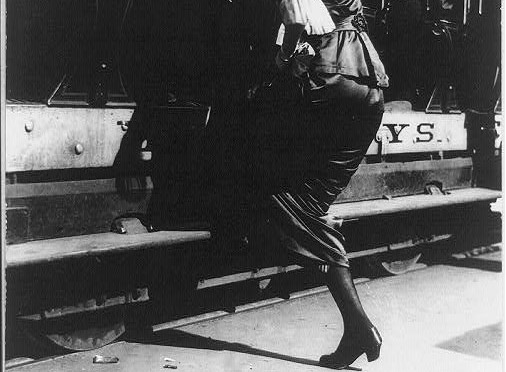
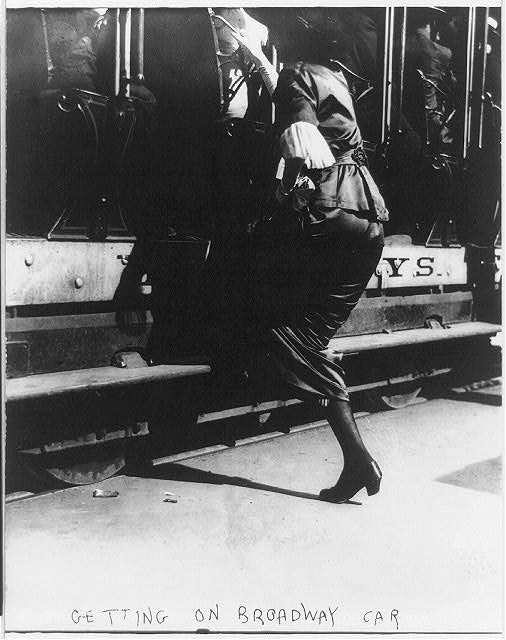
A lady in a relatively normal skirt boards a Broadway streetcar in July 1913. Now imagine trying this in a hobble skirt! (Courtesy Library of Congress)

A serious cry (mostly from men) rang out through the city one hundred years ago about the ever-expanding transit system and the scandalous style of women’s skirts. Were frocks getting caught in doorways? Were dress lengths causing women fall down stairs?

Perhaps, but that wasn’t the issue. The latest fashion trend, the hobble skirt, was slowing the progress of women onto and off of streetcars, causing frustrating delays.

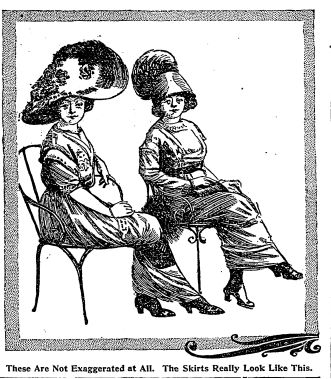
The Parisian-style hobble skirt, with its bunched hem near the bottom to create a mermaid-like appearance, made its appearance on New York streets in the early 1910s. The new gowns required ladies to walk more elegantly and, thus, more slowly, a throwback to the Victorian gait. “[T]he mannish stride of the women of today was taken for granted as a permanent thing. Nobody expected it to change, for nobody saw the hobble skirt on the horizon.” [New York Times, January 1912]

Above: Some sass from the Times fashion pages, June 12, 1910

After a millenia of unfettered skirts, this new silhouette must have seemed positively strange to elder fashionistas.

“‘The hobble’ is the latest freak in women’s fashions,” warned the Times upon their arrival in 1910.  “The hobble skirt suits none. But many, too many, women will wear what the fashion authorities decree.”

Aesthetics aside, the hobble skirt created a practical problem. While measured, graceful walking might be fine on Ladies Mile or strolling along Fifth Avenue, it was an encumbrance upon the ever-moving streetcar system.

An executive of the Interborough Transit System (New York’s first subway operator) grumbled to the Evening World in 1912 about the extra burden the hobble skirt created upon city transportation and called for the fashion trend to be abolished.
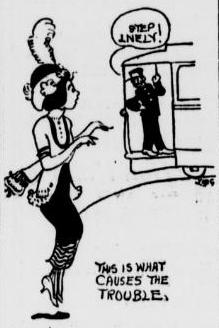
“Often hundreds of people will be forced to stand aside patiently waiting for some women to raise her skirts sufficiently to allow her to step into the car,” said George Keegan, general superintendent.
A special ‘step-less’ car had even been designed with the fashionable lady in mind. The first of these “hobble-skirt, hygenic, fool proof” cars debuted on the streets of New York in the spring of 1912.
Meanwhile, underground, fashionable ladies were finding difficulty clearing the gap between the platform and subway cars. “Nearly all of the accidents in the subway are due to the fact that women wear hobble skirts,” said Keegan, a claim which could not possibly have been true.

The Pennsylvania Railroad, fearful of complaints and potential lawsuits, acted upon the crisis the following year by requiring train conductors to note skirt styles and “height of heel” and report all data to their central office. “If women passengers on the Pennsylvania Railroad insist on wearing such mantraps, or rather womantraps, as hobble skirts and high heels they cannot hold this company responsible for accidents which may happen to them,” claimed the railroad.

But all these railroad executives really needed to do was simply wait — trends subside, to replaced with other, more objectionable wear.

By the time Mr. Keegan was complaining about the hobble skirt, the Evening World fashion section was already clutching its pearls in disbelief about another fashion abomination. “The high note of feminine folly has been struck.  The harem skirt is to succeed the hobbled horror which has made women hideous and ridiculous during the past year.”

But, leaving taste aside, at least you could ride the subway in a harem skirt!

Illustration above is from the August 9, 1912 edition of the Evening World which accompanied the Keegan article

Categories
Mad Men

Mad Men 1966-67: Speculation, context and flashbacks

Our favorite randy, drunken Madison Avenue suits return this Sunday with an extra-special long episode of ‘Mad Men‘ this Sunday. As with prior seasons, I’ll try and follow up most shows on Monday with a little historical commentary.

The wonderful thing about this show is that they’re nothing if not hyper-sensitive about historical accuracy. From hints given by producers, it appears the new season will open sometime late in the year 1966 or perhaps early 1967. Some significant events during that year that may come into play on the show, either in major disruptive ways or in fine, knowing details:

— It’s the first year of the John Lindsay mayoral administration. Although he governs over a metropolis in steep financial crisis and paralyzed by striking workers, he still considers it a ‘fun city’.

Pennsylvania Station is ceremoniously demolished. The fate of the treasured train station has been the subject of prior episodes. Could its final destruction represent something more for the troubled ad agency?

The World Trade Center begins construction. I’ll be very surprised if some mention isn’t made of the envious offices with their magnificent views.

— ‘Cabaret‘ opens on November 20, 1966.  Finally, something opens in New York more debauched than an ad agency Christmas party!

— New York’s most fabulous club is The Electric Circus on St. Mark’s Place, drawing the magnificent and the mod, including the entourage of former advertising illustrator Andy Warhol.

— This is the year of color and camp. New on TV: Star Trek, Batman, The Monkees, Dark Shadows

— In 1966, there 385,000 American troops in Vietnam, of which over 6,000 would be killed that year alone. A massive protest hit the streets of New York in April 1967 and dozens burned their draft cards in Central Park. A Maxwell House coffee can was famous used to burn the cards. A new client for Don Draper?

— Cassius Clay had fans last season at Sterling Cooper Draper Pryce. As Muhammad Ali, will he still have them after he becomes a conscientious objector against the war?

The most important album of 1966 comes from two boys from Forest Hills, QueensPaul Simon and Art Garfunkel.

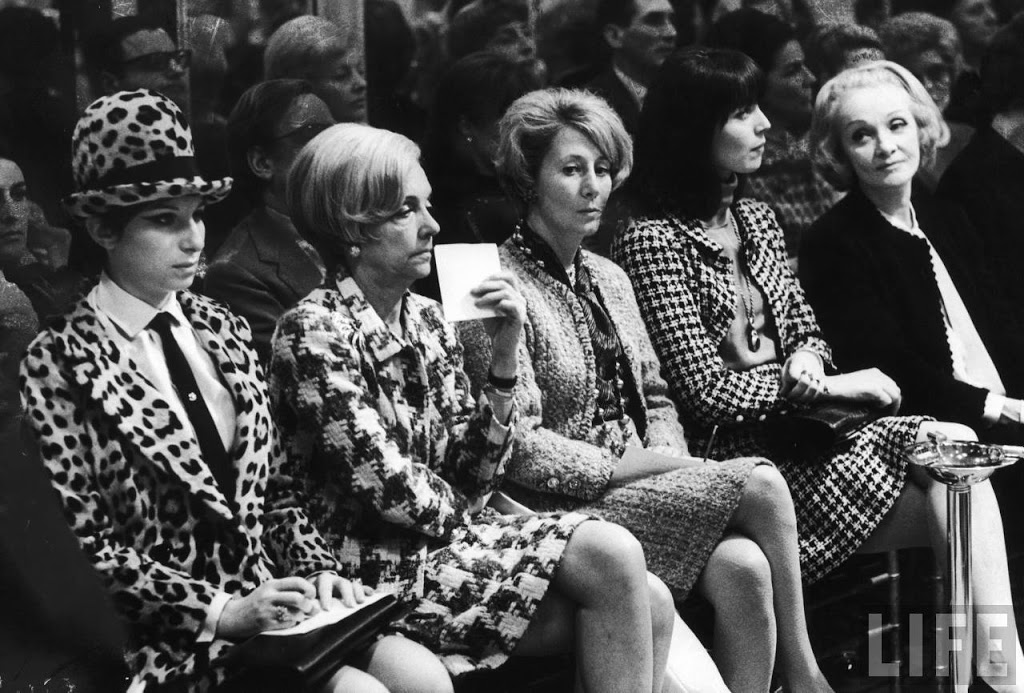
— New York played second-fiddle to the colorful imported fashion trends of London. Fashion became daring, flamboyant and colorful, even the dress suits. Skirt hems elevate. Pictured above: New York’s hottest star Barbra Streisand on one side, Marlene Dietrich the other, and the currency of 1966 fashion in between, at a Paris fashion show. Pic courtesy Life Google images

— A strange year at the movies, the top box office hits were ‘Hawaii‘ and ‘The Bible‘. However the cultural zeitgeist was surrounding the third biggest film of the year — ‘Who’s Afraid Of Virginia Woolf?‘ Can you imagine a time when a stage adaptation was the third biggest film of the year?

— Gay rights protests begin popping up around the Village, including a slightly botched ‘sip-in’ at Julius Bar in April of 1966. Might we see a reappearance of Sal in this context?

— New York gets its first FM rock music station in 1966 — WOR-FM. While I doubt this fact makes the show, expect a soundtrack heavily laced with sweat and reverb. (Or perhaps, laced with something more tangible?)

— On top of color televisions, potential clients for the agency include such newfangled inventions as disposable diaper, the synthetic fiber Kevlar, lawn replacement AstroTurf, the sugar substitute NutraSweet and any product related to the American quest to reach the moon.

Here’s a sampling of some articles I’ve written for the blog on ‘Mad Men’ episodes. You can find them all by clicking on the label ‘Mad Men‘:

‘Mad Men’ returns: a guide to eating (and drinking) options
‘Mad Men’ notes: The once and future Hotel Pennsylvania
‘Mad Men’ notes: A movie theater classic in its final days
‘Mad Men notes: Naked truths about New York nudism
‘Mad Men’ notes: Upscale flowers in a mystery mansion
‘Mad Men notes: Konnichiwa, New York City!