Categories
Friday Night Fever

Recollections of the Electric Circus: “If you remembered much of what happened, you weren’t really there.”

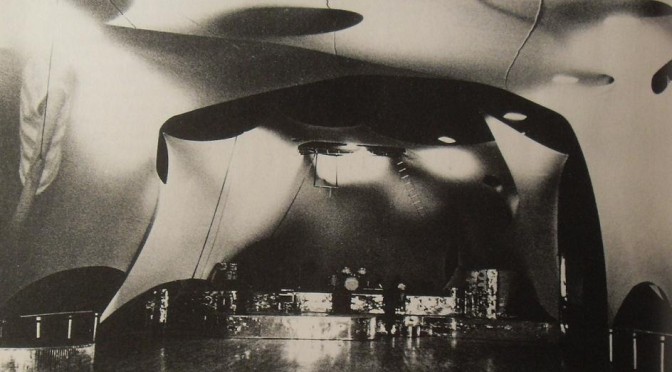
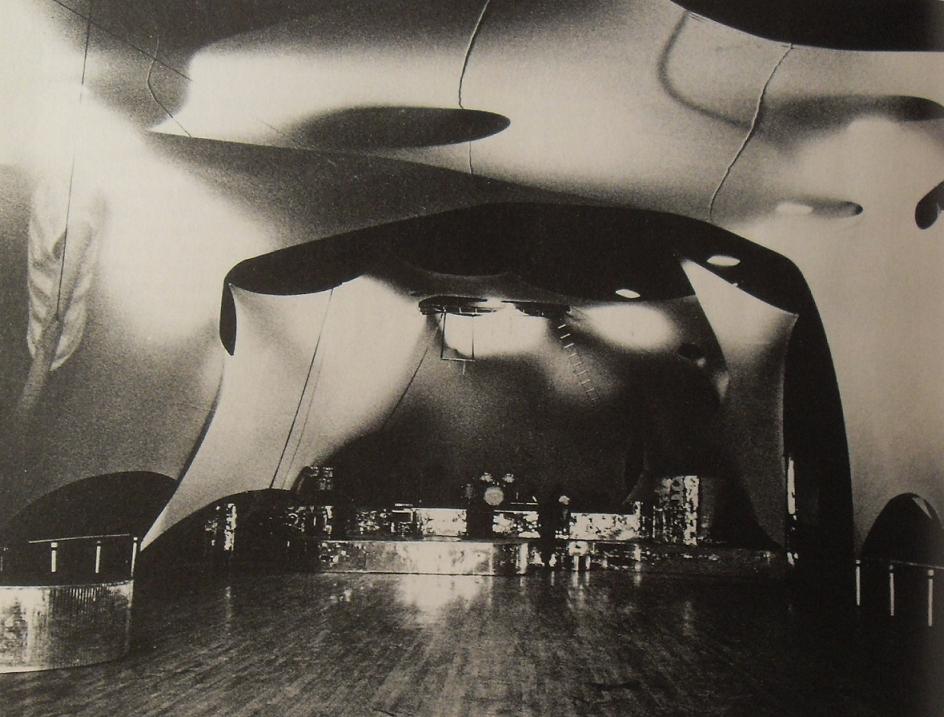
The interior of the Electric Circus on St. Mark’s Place. Pic courtesy Christian Montone/flickr

WARNING The article contains a couple light spoilers about last night’s ‘Mad Men’ on AMC.  If you’re a fan of the show, come back once you’re watched the episode.  But these posts are about a specific element of New York history from the 1960s and can be read even by those who don’t watch the show at all.  You can find other articles in this series here

Almost predictably, a couple characters from ‘Mad Men‘ finally interact with a psychedelic temple of Andy Warhol, in this case the nightclub Electric Circus at 19-25 St. Mark’s Place, today the site of a Chipotle and a Supercuts.

As I wrote back in an article from 2007: “It became the East Village fuse box for Warhol’s talents and those of his entourage, in particular the Velvet Underground and Nico.  The dazzling synthesis of psychedelica and glamour, of the Velvet’s strange atmospheric music and Warhol’s performance displays of lights and costumes, immediately attracted the scenesters to this odd little street — according to the New York Times, “everyone from hippies to Tom Wolfe and George Plimpton” — way before St. Marks would make its reputation in the 1970s with the punk scene.”

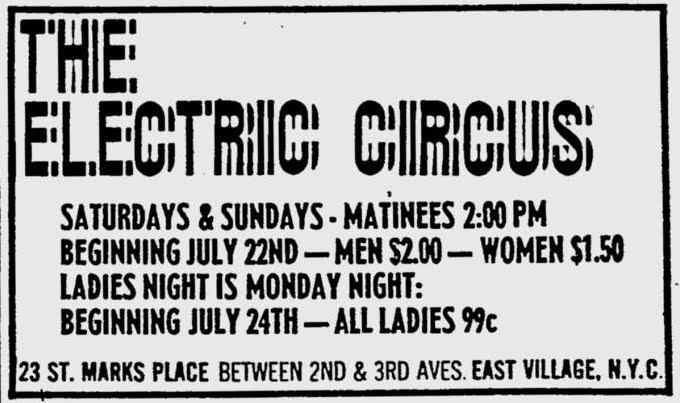
An original ad from the Electic Circus, summer of 1967 (courtesy butdoesitfloat)
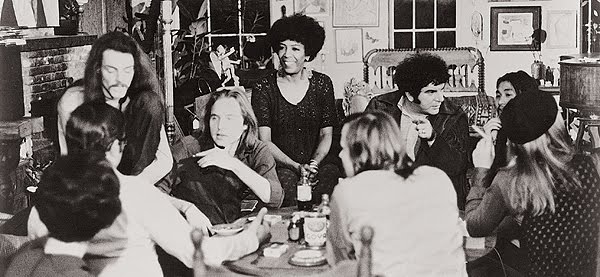
Since I wrote that article, many people have chimed in within the comments section to relive their memories of Electric Circus.  Here are a few of my favorite comments from those who were actually there:

“What memories.  I started working at the E.C. as a ticket taker.  I say working, but in reality we didn’t get paid, we got let in for our work.  Like Woodstock, if you remembered much of what happened at the E.C. you weren’t really there.” – Being the Best

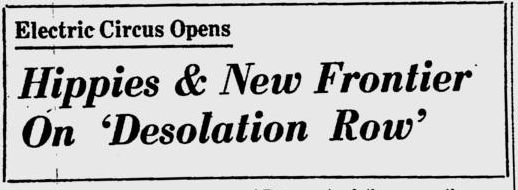
Below: Headline from the Village Voice, July 6, 1967
“I worked at the Electric Circus, 67-68-ish.  I was the fire-eater, and mime/clown, working with another mime named Michael Grando.  Larry Pizoni was the director of the circus show.  We had a trapeze artist named Sandy [Alexander], and security was a biker club called the Aliens (which worked, unlike Altamont).

Everytime I’m in New York, in the East Village, I stop on St Mark’s and bow my head.  I wanted to have someone put up a plaque, but nobody in the stores knew who to call.” – Richard Bluejay

“I was one of 5 or 6 people who worked at Limbo* for number of years across from the Electric Circus.  I was there at the opening night, and then on for a long time I remember we use to give discounts to the Circus employees so we get in free. Can not tell you how many times I was in there but it was a lot!!!!  It was great time back then.  Fillmore East was around the corner and Max’s Kansas City was not far away.  East Village was where it was at back then ” – Anonymous

A freakout-indusing video from Electric Circus, scored to the music of Frank Zappa: 

“I remember two things about the electric circus from my one visit in 1969. One was the fact that the walls were not at a right angle to the floor, which combined with the strobe lights and swirling crowd, made for a delightfully disorienting experience. The other was a dark room off to the side where couples — or even strangers I suppose — could sit and smooch. In addition to all kinds of nooks and crannies for this purpose there was a rotating upholstered carousel in the middle of the room, divided into sections, one per couple.” — Anonymous

Below: A typical crowd on the stairs outside the Electric Circus (pic courtesy Old New York)
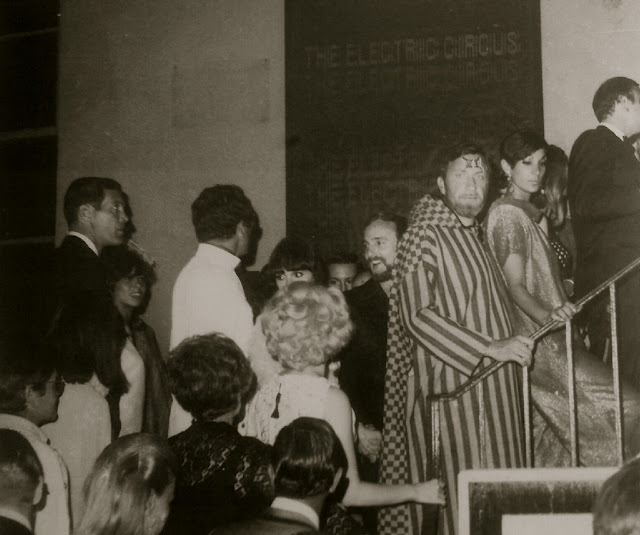
“I’m so excited, after all these decades to hear from people who got to experience the the most amazing Electric Circus, as I did.  By far dancing myself into a dazed, psychedelic trance, while absorbing the magical energy of the Chambers Brothers sing ‘Time’, was right up there in my top ten of life altering experiences.  I was a runaway, living with new friends in the Village.

I used to panhandle on St. Marks Place, and spend all my money on clothes at the Limbo, pizza, and tickets to hear my fav bands, except for the times I used to get in for free.” — Sonny

Below: Sonny’s jam from the floor of the Electric Circus:

“I can’t remember exactly how I arrived at St. Marks Place that first night.  I had never been to St Marks Place and I certainly didn’t know about Electic Circus.  I was just following a friend of mine who was interested enough in the new culture to find out where to go and what to do.

There must have been some kind of happening that night because the streets were full of people.  People were hanging all over the stairs leading up to the Circus.  And, you didn’t have to pay.  We just walked in. I still remember it emotionally.

The big room was completely decorated with fabric amorphously draped on walls and spanning corners and cornices.  Projectors behind the fabric ran continuous short loops of films. Of course it was dimly lit so as not to wash out the films.  People were everywhere and moved mysteriously in the smoky dim light.  I was born in Brooklyn and had already lived a few years in Manhattan, but I never saw anything like this before.  The next time I saw EC the decor had changed. I never paid to get in because I was a member of the PABLO Light** show.” — Anonymous

* Limbo was a famed ‘hippie clothing’ boutique where today’s Trash & Vaudeville sits today.

** That would be Lights By Pablo, a leading ‘liquid light show’ exhibitor of the late 1960s, frequently here and at Fillmore East.
Categories
Mad Men

Timeless: How ‘Mad Men’ changed history on television

In 1972 the Robert Altman film M*A*S*H was turned into a weekly half-hour situation comedy series. In retrospect I’m stunned that anybody thought to make this. The landscape of television comedy was cluttered with novelty premises and perfect families dealing with contrived scenarios which always, always resolved in a happy freeze-frame.

There was no sense of reality to television before 1972. Westerns set in the 19th century had no historical sense to them.  Gunsmoke and Bonanza rarely if ever referenced an understandable place and time. The Ponderosa was somewhere in Nevada, set vaguely in the 1860s.

Television’s M*A*S*H broke both of these molds. It was real life, affected by real history. It was in a recognizable place, and its characters were changed by events that were vividly real. For the first time it felt like a show was operating by the same cosmic rules as its viewers.

The year that Altman’s film was released is the year that the last season of Mad Men, which finishes its run this Sunday, is set.  We know this because creator Matthew Weiner and his writing team make very sure to watermark almost every scene.

Every detail — from the buttons on Joan’s dresses to the brand of cigarette in Betty’s hand — speaks to the show’s obsessive need to plant its coordinates into the narrative.

Mad Men has re-envisioned the historical television show in exactly the same way that M*A*S*H reinvented the sitcom. You can no longer make a television show set in the past without following (or rebelling against) the example set by the adventures of Don Draper and crew.

Cognizant of the harsh mistress of social media, Mad Men has created a flawless timeline, leaving a masterful, rarely obvious path of breadcrumbs that have led viewers through the 1960s. The first episode “Smoke Gets In Your Eyes,” is set in March 1960. The last episode, named “Person To Person,” will be set in either November or (most likely) December 1970. 

Episodes are crammed with historical and pop cultural references, but very rarely are they front and center. Don ate and drank his way through the finest restaurants in New York. Joan made out with somebody at the Electric Circus, while Peggy went to a happening at Washington Market. Kinsey joined the Hare Krishnas!

Shock treatment, LSD, race riots, Weight Watchers, moon landings, assassinations — the entirety of America in the 1960s was fully and richly presented, in far greater volume and diversity than perhaps even a college course would provide.

But not once — not a single time in its seven seasons — did the events of this tumultuous decade overtake the storyline. The characters, their lives, were always front and center.

It has been an extraordinary pleasure the past few years to Tweet along with live viewings of Mad Men on Sunday night. I’m not paid to do it. It’s just a total blast. I just love a good scavenger hunt.
Weiner and the Mad Men production team can infuse entirely new themes, sometimes with traces of irony, that only reside within the borders of an episode. Far from history being a binding and limiting framework, Mad Men has turned it into a set of playground monkey-bars from which to playfully swing.

Setting the show in New York, but not filming it here, seemed, at first, like a troubling and even annoying decision. But it worked because the Manhattan skyline is a dead giveaway, like the rings of a tree.

And Mad Men‘s not the kind of show that uses CGI. (A New York-filmed show might have been tempted to have Don swagger down the street with the under-construction World Trade Center in the background. Thank god Mad Men is not that show.)

History has been a vivid hue on Mad Men, as vivid as one of Pete Campbell’s most flamboyant ties. They don’t just plan episodes “in the spring of 1967.” There are usually clues that accurately pinpoint a scene to an actual day and, sometimes, an actual minute. You never had to be consciously aware of this information. It sits like a juicy footnote at the bottom of the page, waiting to reveal another facet of the story.

Will this formula work for future historically based television programs? Mad Men had the luxury of a cast of fictional characters, so history can coalesce around them with convenience.

Shows like Turn or Boardwalk Empire, on the other hand, have characters based on real-life individuals, and negotiation around historical events is trickier.

I wonder where the Mad Men effect will turn up next. The Knick, set in 1900s New York, makes obvious nods to Weiner’s precise use of historical detail, but understandably, it’s not consistent. (Being set over a century ago, it has a higher degree of difficulty.)

The writers of Downton Abbey love their history, but it’s often an interloper.  It invades more than informs. Outlander would probably not be a good show if characters stopped to wonder what day it was.  Halt and Catch Fire could be a successor to Mad Men if it pulls its storylines together in the next season.  

Farewell Mad Men! And thank you for the best time-traveling adventure on television. Throughout this article is a sampling of a few of my Mad Men Tweets over the past few years to illustrate some of the details that the production team has incorporated into its shows.

You can find the complete list of my Mad Men Tweets right here!  And for other Bowery Boys articles on Mad Men, you can check them out here.


Categories
Pop Culture

The history of NYC in eight pop culture moments from 2014

In our 2014 Year In Review podcast, we didn’t have much time to talk about notable pop cultural events that depicted New York City history.  But here’s a recap a few films and television shows which used the city’s history in their narratives. I’ve arranged them in the chronological order in which they’ve been set:

Courtesy AMC

TURN
Year: 1776
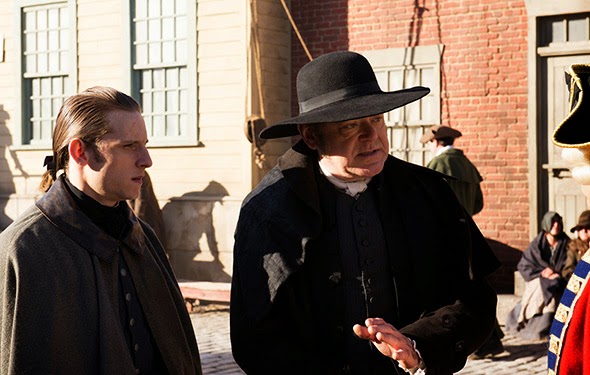
This AMC freshman series, revolving around the early years of the Revolutionary War, depicts Long Island, New Jersey and the cramped port city of New York itself in the year 1776. Its first season was so-so, but the performances were good, and the art direction surely excellent, as in the best episode “Of Cabbage And Kings” when Abe Woodhull (Jamie Bell) takes the boat to downtown Manhattan and ostensibly begins his career as George Washington’s newest spy.


Courtesy HBO/Cinemax

THE KNICK
Year: 1900
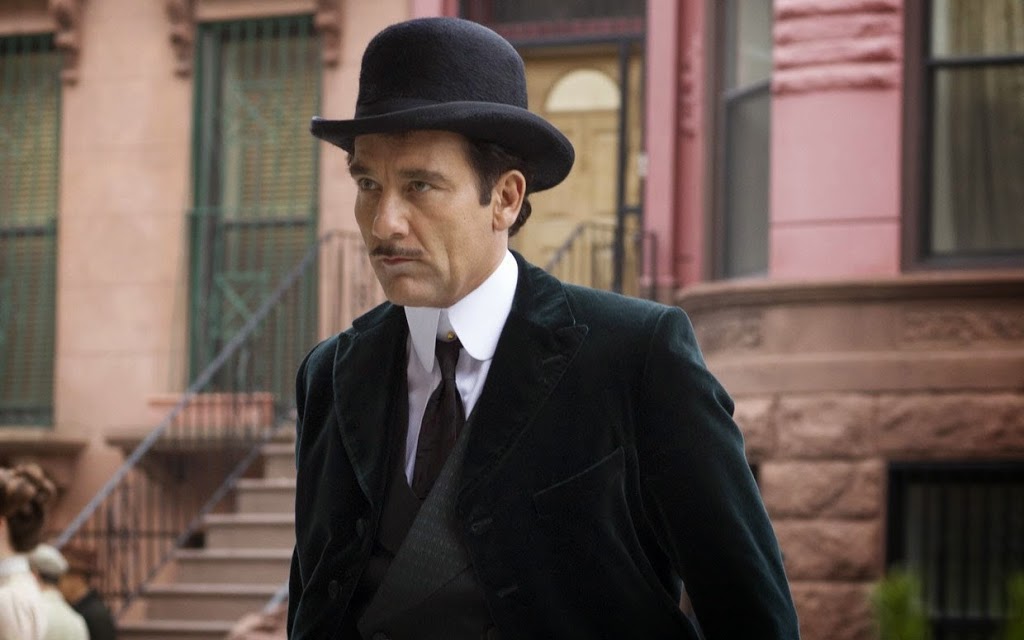
Cinemax’s vivid medical drama was certainly the most atmospheric show on American television (excluding maybe True Detective), illustrating the medical practices of a financially strapped Manhattan hospital as administered by drug addict and genius surgeon Dr. John Thackery (Clive Owen).  The exteriors of Knickerbocker Hospital were shot at Boys’ High School in Bed-Stuy and were most prominently featured in the episode “Get The Rope” when a racist mob violently attacked black passers-by.

Screen shot from On the Set of New York

WINTER’S TALE
Year: 1916
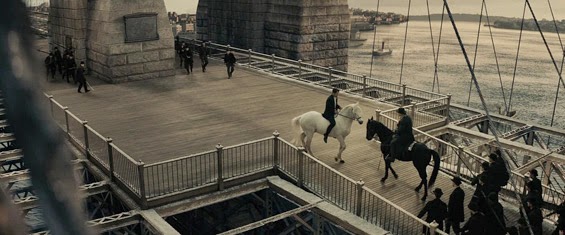
A romantic time-warp fuels this  unsuccessful adaptation of Mark Halperin’s fantasy historical novel.  His writing style is truly enigmatic, proven here when plot is separated from description. However the film is not without its visual charms, including a brief look at the East River waterfront, circa 1916, as Colin Farrell gallops over the Brooklyn Bridge on a white horse.

Courtesy The Weinstein Company

THE IMMIGRANT
Year: 1921
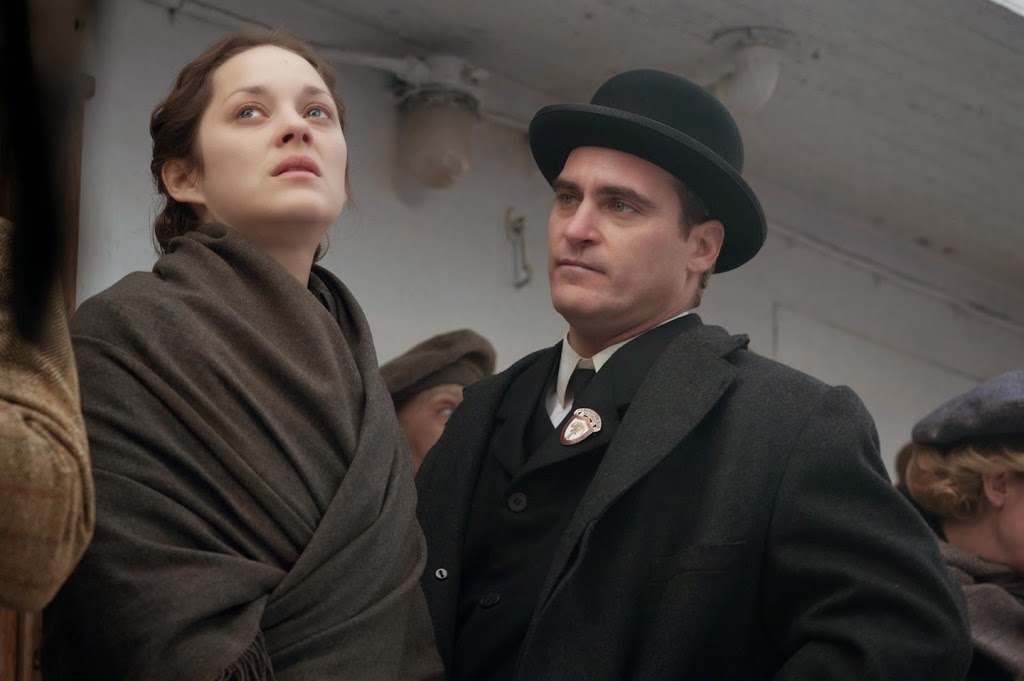
Marion Cotillard, providing an old-school blockbuster performance, is the heart and soul of this film set at the dawn of Prohibition. With her sister Magna is detained at Ellis Island, Ewa (Cotillard) goes to work for a shady impresario (played by Joaquin Phoenix) who then prostitutes her to clients.  The cinematography by Darius Khondji takes inspiration from browned, faded photography, and his views of the Lower East Side in the early scenes are truly breathtaking.

Courtesy HBO
 
BOARDWALK EMPIRE

Year: 1931
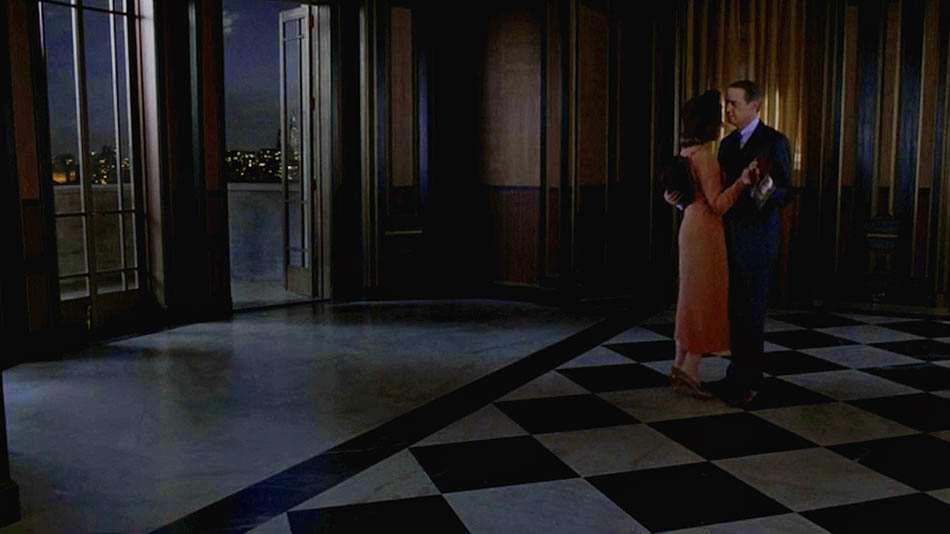
I prefer not to relive the ending of “Eldorado,” the final episode of Martin Scorsese’s Prohibition drama.  So let’s just end it at the lovely scene with Nucky (Steve Buscemi) and Margaret (Kelly MacDonald) dancing in the gorgeous apartment at the Upper West Side apartment complex which gives the episode its bittersweet name.

Courtesy AMC

MAD MEN
Year: 1970
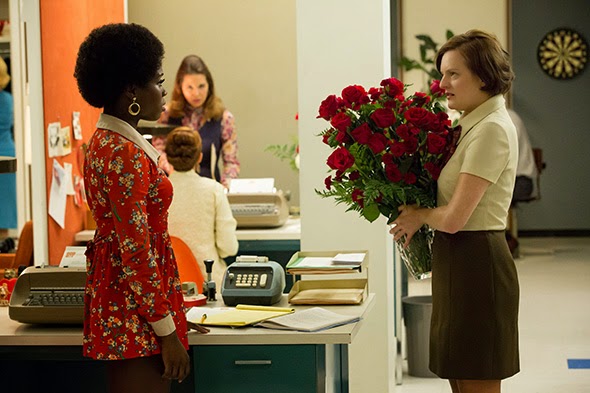
The first half of the final season (can’t believe I’m writing that) saw the beginnings of a redemption arc for Don Draper and general cultural instability for just about everyone else.  The new character Shirley (Sola Bamis) became a bit of a harbinger of the new decade in the episode “A Day’s Work,” bringing out the insane in Peggy (Elizabeth Moss) and the clever side of Joan (Christina Hendricks).

Courtesy A24 FIlms

A MOST VIOLENT YEAR**
Year: 1981
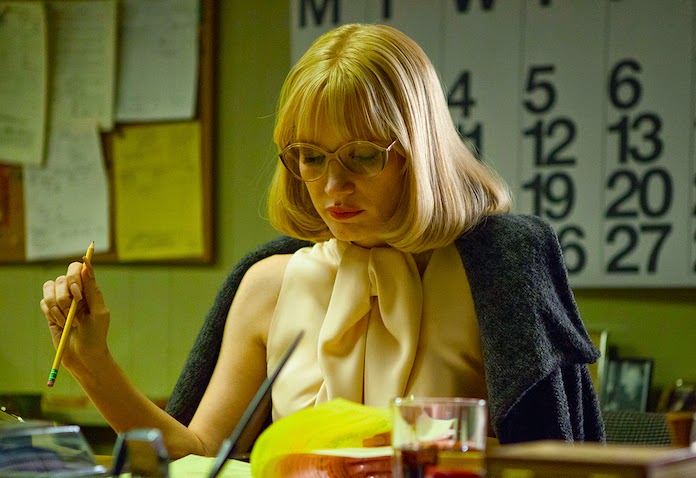
This would be a simple story of an ambitious immigrant businessman Abel (played by Oscar Isaac) just wanting to get ahead in the world, expanding his fuel empire into larger digs in Brooklyn. But this is 1981, and nothing is very simple, least of which his wife Anna (Jessica Chastain) with her familial connections to the mob.

LUCY
Year: Every Year!
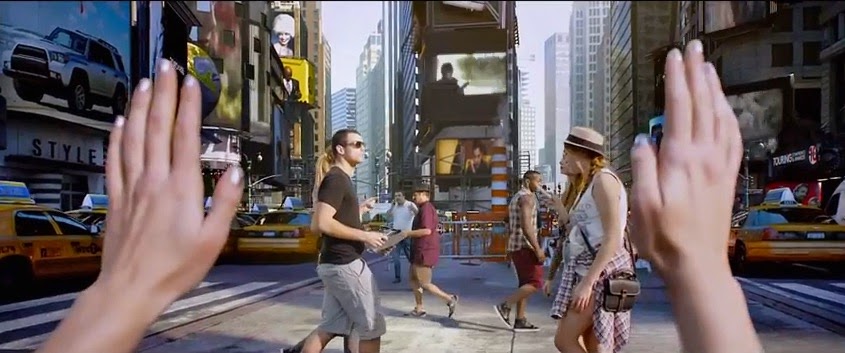
Well, I’m not going to explain why, but let’s just say that La Lucy (Scarlett Johansson) has the ability to both travel through and manipulate time via an extreme overdose of an experimental new drug. It doesn’t matter. What does matter is for about one minute, she finds herself in the middle of Times Square, repeating and rewinding time at that very spot, giving us quick doses of the newly built One Times Square, then of the horse and carriages of Longacre Square.

And then she goes back a couple million more years or so. I cannot confirm the historical veracity of these particular scenes but it looks very pretty.

**For transparency: I’m writing each week at the blog NYC.1981 which is a tie-in into the film.

Categories
Mad Men Pop Culture

‘Mad Men’ ends this Sunday, and ‘Copper’ begins, but war and assassinations unite both

WARNING The article contains a couple light spoilers about the current season ‘Mad Men’ on AMC and a few on last season’s ‘Copper’ on BBC America.  

While 1968 comes to a close on Sunday night with the season finale of ‘Mad Men‘, another version of New York history returns on another channel.

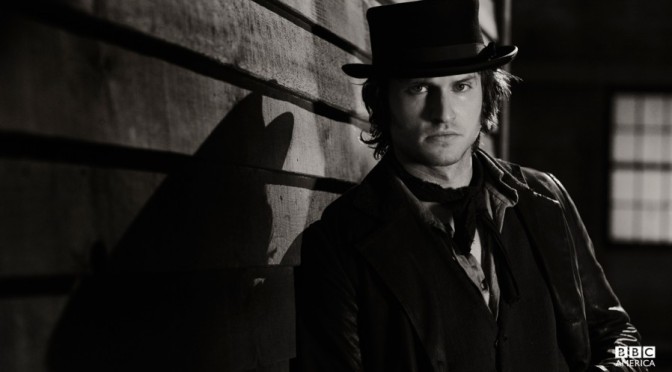
Copper‘, starting season two on BBC America, will open in the early months of 1865, in the wake of a failed attack by Confederates that past November.  Just as in this season’s ‘Mad Men’, set in a year of two assassinations, you can only begin watching a show set in early 1865 with the anticipated dread of one future tragedy.

If it makes you feel better, keep it all in the world of pop culture and imagine the events of Steven Spielberg’s ‘Lincoln occurring simultaneously to those on ‘Copper’.   Abraham Lincoln, fresh into his second term, was only just employing often cynical efforts to get the Fourteenth Amendment passed as the war between the states wound to its eventual completion.

Lincoln was still a divisive figure.  In 1864, New York City, a Democratic stranglehold, had voted to replace him with George B. McClellan.  Indeed, the city has such affection for McClellan Sr. that, fifty years later, they installed his son George B. McClellan Jr. as mayor.  For many in New York, Lincoln represented a strike against common prosperity, flagrantly destroying America’s future — both literally, on the battlefields, and figuratively, with the freeing of slaves, weakening Southern commerce (and New York’s Southern interests).

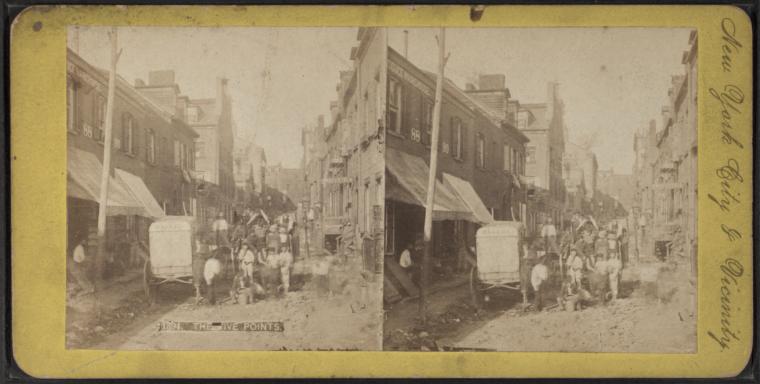
Below: A stereoscope photograph of Five Points in 1865 (NYPL)


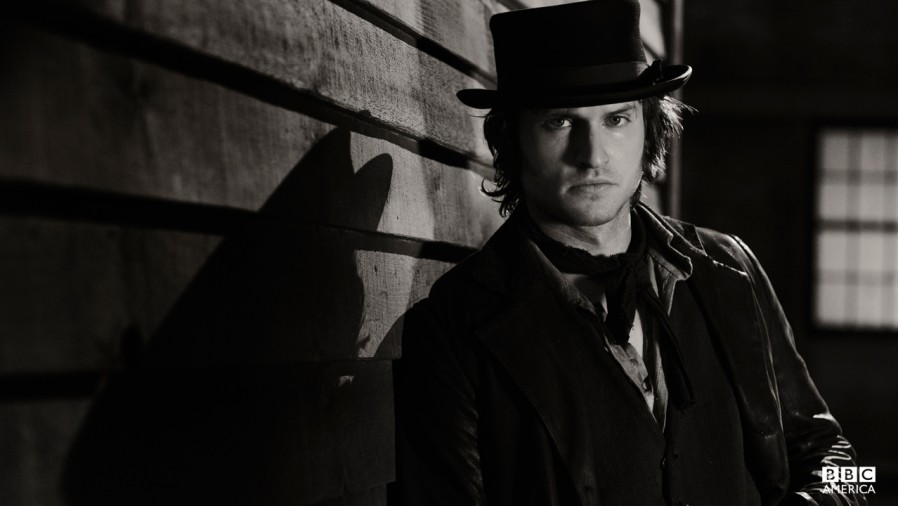
‘Copper’ follows the adventures of streetwise police officer Kevin Corcoran through the streets of Five Points, interacting with both the disreputable characters of that neighborhood (including one sassy brothel owner) and few genteel sorts from Fifth Avenue.  Between thwarting criminals and Confederate plots, Corky also found his amnesiac wife in an asylum.  He also seems to have developed a morphine problem.

What’s might we see in Season Two in regards to New York? 1865 was the year the city got serious about cleaning itself up physically — construction of city sewers was commissioned in this year — even as its government infrastructure was getting ever more corrupt (as in, Tweed was now the ‘Boss‘).

The new episode is set on the date February 5, 1865.  The new New York Stock Exchange opened a few days before that date, reinforcing New York’s real center of power. The consequences of a long war were still ever-present; that February 4th, on Governor’s Island, a Union deserter was even executed.. And there’s still loose ends from that ugly Confederate ‘Greek fire’ business, namely the captive Robert Cobb Kennedy, held in old Fort Lafayette.

But the most tumultuous event of the year came with Lincoln’s assassination, throwing the entire country — and especially the city — into chaos.

Two political assassinations played central roles in this season of ‘Mad Men’, and some professional ones too.

Season Six was a full-on assault on the early ’60s complacency of the show’s initial premise.  In prior seasons, New York City was almost solely depicted via bars and restaurants.  In this season, we got grimy squatters apartments, rat infested walk-ups and allusions to race riots in far-off neighborhoods.

The sky-high haven of  Don and Megan Draper was invaded by imposters, glamorous lesbians and even the encroaching sounds of a dangerous city.  This was a season of menace, the usual bedroom/boardroom operatic antics, scored with the violent tones of the Vietnam War and a cynical presidential campaign forever in the background.

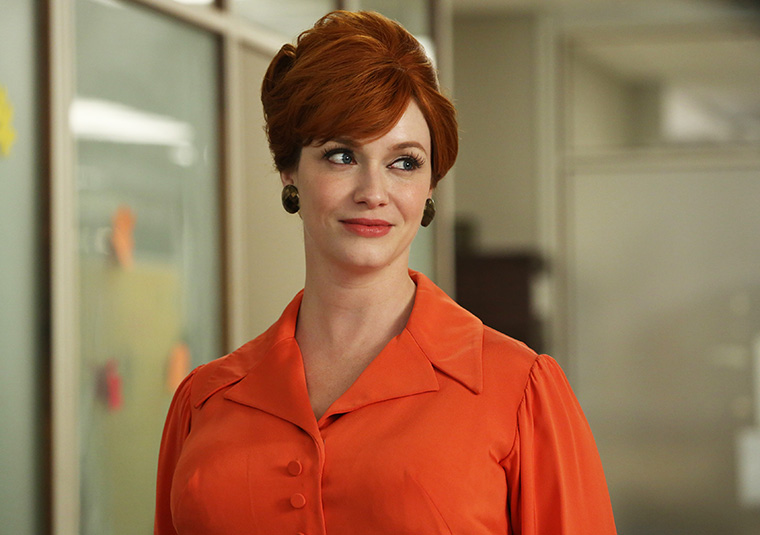
Maybe that’s why some of Don’s storyline this year felt so labored. Why should we care so much about his perpetual indiscretions when the world around him has shifted? How can we keep focused on him?  Characters like Joan Holloway (above, fetching in orange) used the changing times to her seeming advantage.  Pete Campbell, once again, tripped over himself.  Peggy was forever caught between the old and the new, from her lifestyle and career to even her romantic interests.

And then we got an enigmatic new character, one who I fully expect to see hanging out at Stonewall in the summer of 1969, his Greek coffee cups replaced with watered-down cocktails.   I mean, will the creators of ‘Mad Men’ be able to resist it?

As always, you can follow along with me on Twitter at @Boweryboys during the live airing of New York City history-based shows like AMC’s ‘Mad Men’ and BBC America’s ‘Copper’ (along with ‘Boardwalk Empire’, later this year).  As the season finale of ‘Mad Men’ and the season premiere of ‘Copper’ are on at the same time this Sunday (10pm EST), I’ll be Tweeting along with ‘Mad Men’ first, then immediately following with ‘Copper’.

Categories
Mad Men

In Central Park, heated reactions to the assassination of Martin Luther King, while business booms at movie theaters

WARNING The article contains a couple light spoilers about last night’s ‘Mad Men’ on AMC.  If you’re a fan of the show, come back once you’re watched the episode.  But these posts are about a specific element of New York history from the 1960s and can be read even by those who don’t watch the show at all.  You can find other articles in this series here

The 1960s were obviously momentous for American culture and for New York specifically. But that decade was especially strange for Central Park.

Olmsted and Vaux’s urban oasis was a well-trodden destination for protest in the 1960s, a haven for “be-ins” and demonstration (with a little free love thrown in, I imagine).  In December 1967, agitated anti-war protesters even burned a Christmas tree.  Two years later, the first gay pride parade would also culminate here. (Here’s some video of the second pride celebration in Central Park the following year.)

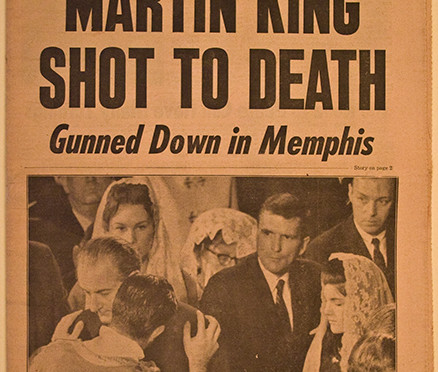
Almost 24 hours after DrMartin Luther King Jr was assassinated in Memphis on April 4, 1968, angered New Yorkers — mostly students — gathered for a rally in Central Park at the Naumberg Bandshell to honor the man’s extraordinary life and to cope with the sudden, inconceivable loss.

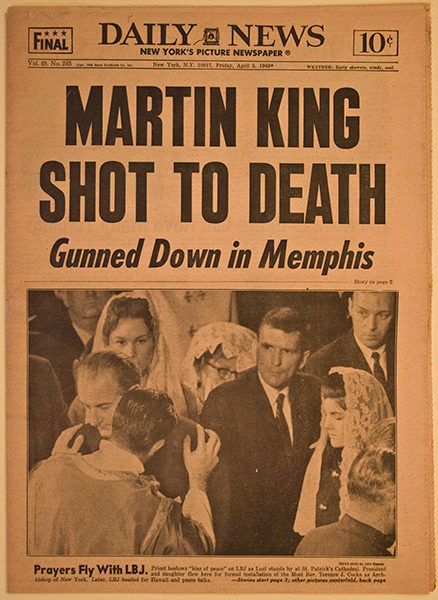
At right: The unusual headline from the New York Daily News. This particular front page popped up on last night’s show. Did you catch it?

The city was in a veritable lock down throughout the day, with many businesses and schools closing early on April 5.  In case you couldn’t make it into the city that evening — and given reports of rioting, many chose to stay home — the ceremonies were actually broadcast by WBAI.  (You can download a recording of the broadcast here, courtesy Pacifica Radio Archives.)

Those invited to speak at the gathering were friends and admirers from a variety of fields.  Looking at the list of speakers, perhaps the most unusual one that jumps out is Dr. Benjamin Spock, the famed pediatrician and best-selling novelist. Spock was an ardent, high-profile protester of the Vietnam War and a friend of Dr. King’s, frequently seen at his side in 1967 at war protest events.
Others who spoke at the rally included actor Ossie Davis and activists Florynce Kennedy and James Forman.  Perhaps the most damning words were spoken by Jarvis Tyner, chairman of the DeBois Clubs of America, who declared that Mayor John Lindsay was poised to send armored tanks to Harlem.

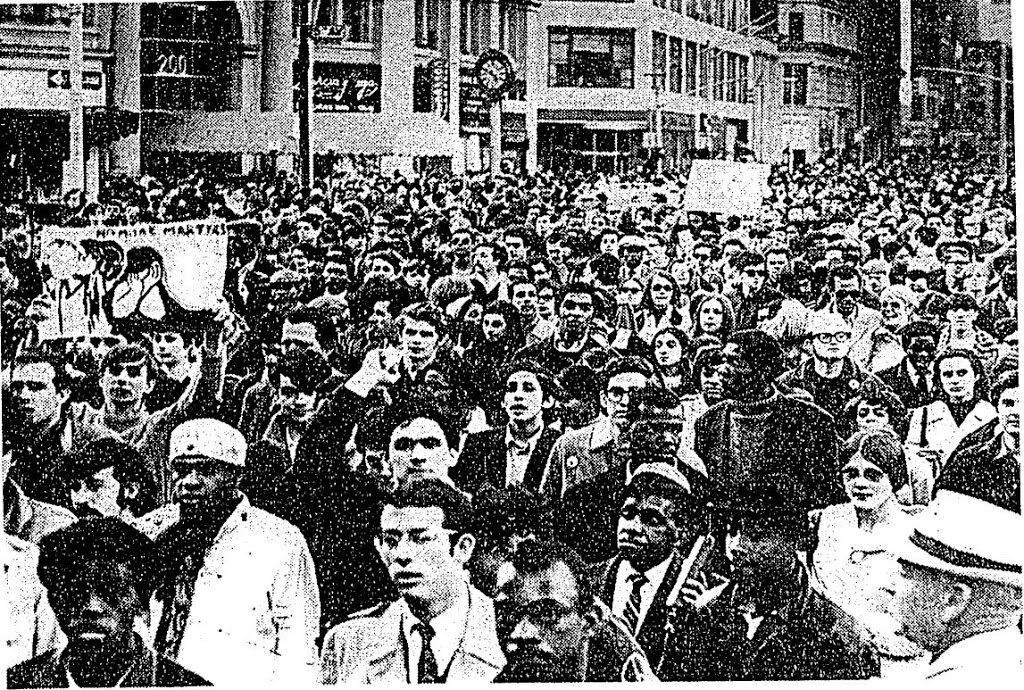
Below: Crowds cross 23rd Street on their way to City Hall. Picture courtesy NYT

Things got rather out of hand once the rally turned into a march down Broadway to City Hall.  According to the New York Times, throngs of students filtered down the streets, occasionally breaking windows along the way.  Trying to stem the violence among their number, others were heard shouting. “Let’s keep order for Martin Luther King.”

The following day, mourners marched from Harlem to an all-faith rally held by local religious leaders in the park.. (It seems likelier that this was the event attended by Megan and her step-children!)

On last night’s episode of ‘Mad Men’, we see Don’s own reaction to the tragedy — going to see ‘Planet of the Apes’ with his son!  According to the same article, this was not an unusual reaction after the tragedy.  While other forms of entertainment saw a notable decrease in attendance, movie theaters saw no such effect, even with fears of a possible riot awaiting moviegoers when they left the theater.  “Times Square movie theaters reported either normal or better than usual crowds and both the Baronet and Coronet Theaters on Third Avenue at 59th Street said they had long lines of people waiting to buy tickets for the early evening shows.”

The April 5th rally for Martin Luther King wasn’t even the most unusual thing to happen in Central Park that day.  That distinction would go President Lyndon B. Johnson, who planned a surprise trip to the United Nations that day and touched down his helicopter in the park!

Categories
Mad Men

‘Mad Men’ notes: New York City on January 31, 1968


A press photo from Hair, the hottest show in town in early 1968, photographer Kenn Duncan

WARNING The article contains a couple light spoilers about last night’s ‘Mad Men’ on AMC.  If you’re a fan of the show, come back once you’re watched the episode.  But these posts are about a specific element of New York history from the 1960s and can be read even by those who don’t watch the show at all.  You can find other articles in this series here

Don Draper and the gang were too busy with their mistresses and their ‘self-immolating’ pitch meetings to properly react to the headlines of the day on January 31, 1968.  Word of the U.S. military’s devastating setback — today called the Tet Offensive — only briefly interrupted dinner conversation; by the time Draper’s dinner companion ordered steak diavolo, the subject had floated to another table.

In the year 1968, it will be become increasingly difficult to tune out the world.  Pete Campbell, with blank eyes, tunes into Johnny Carson, who has devoted his entire show that evening debating New Orleans district attourney Jim Garrison regarding the assassination of JFK.  Garrison was readying a case against Clay Shaw for conspiracy to kill the president (he was acquitted):

The most vibrant movements in the city involved protest and aggravation. The hottest show off-Broadway, Hair, was prepping for its official Broadway opening that April.  Hair was the very first musical to ever transfer from off-Broadway to Broadway.

What else is going on in January 31, 1968?

—  The finishing touches are placed on the new Madison Square Garden which will open a couple weeks later, on February 11. A few seasons ago, the admen of Sterling Cooper took to wooing the organizers of MSG who were prepping the destruction of Penn Station.  All traces were gone by 1968, replaced with the  drab concrete cylinder which presently sits at 34th Street.
— And things were brewing below it as well.  The following day, New York’s two largest train companies — Pennsylvania Railroad and New York Central Railroad — announced their merger to form the eventually-named Penn Central.  This would eventually incorporate other services, including Pete Campbell’s favorite train. And it would all go bankrupt by 1970!
— The number one song that week? The parody number ‘Judy In Disguise (With Glasses) by John Fred and the Playboys.

The number one film that week was the throwback Western Firecreek.  This was a rare lapse into the traditional, as most filmgoers were talking about two other big releases — Planet of the Apes and The Graduate.

— In a sign of protest (and grim foreboding), the head of the city’s anti-poverty programs George Nicolau resigned out of frustration with lack of support from the federal government.  [source]

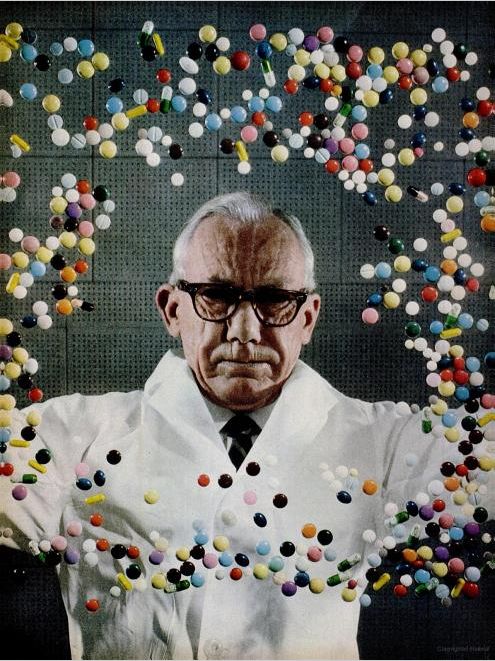
— Has somebody shown this to Betty? The cover of Life Magazine that week presented an expose on dangerous diet pills. The picture below grandly illustrates the problem.  (This issue from the week before is actually seen on a coffee table in this episode.)

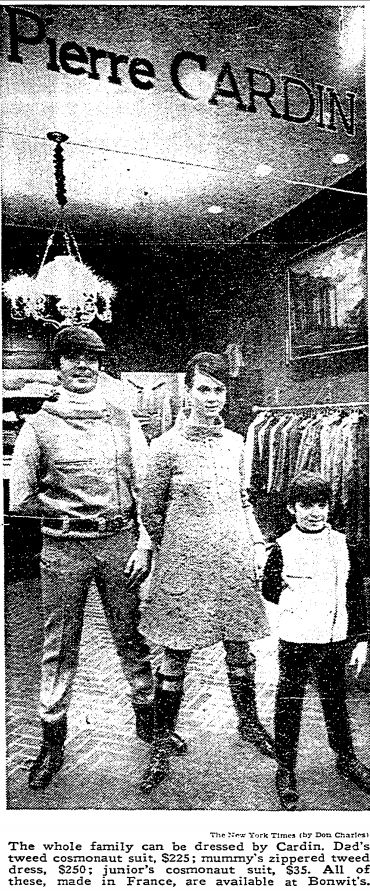
— But never fear. The New York Times fashion section announces a fabulous trend — dress the entire family as cosmonauts, courtesy Pierre Cardin! “The era of the fully fashion-coordinated family is at hands,” they declare.  You could buy this extraordinary set of garments at Bonwit Teller at the corner of Fifth Avenue and 56th Street

(Edit: A prior version of this story listed the address at Fifth Avenue and 38th Street, next to the still-surviving Lord & Taylor. It was indeed there for two decades, but by 1930, it had moved to the tonier uptown address.) [source]

Categories
Mad Men

‘Mad Men’ notes: New York City and electroshock therapy

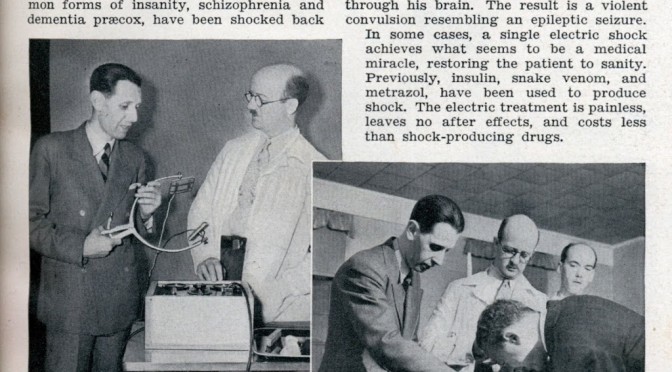
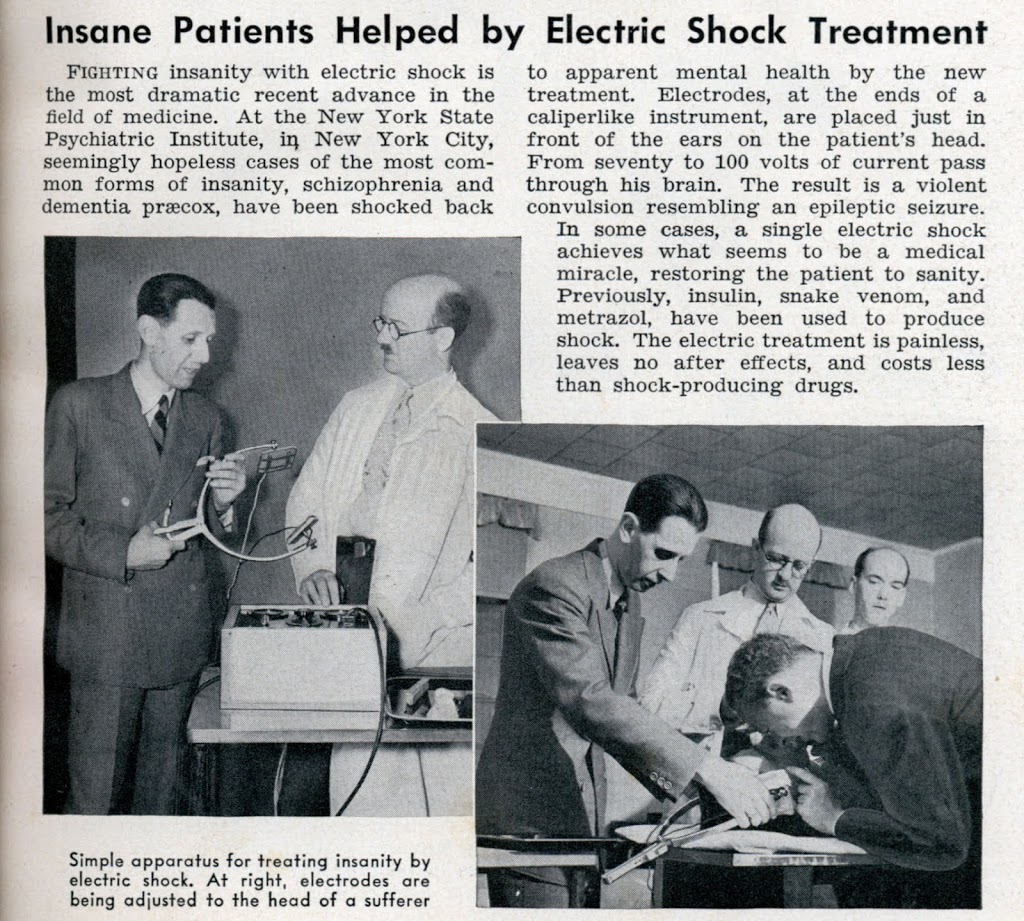
Modern Mechanix celebrates an exciting new use for electricity! (Courtesy the great Modern Mechanix blog)


WARNING The article contains a couple spoilers about last night’s ‘Mad Men’ on AMC. If you’re a fan of the show, come back once you’re watched the episode. But these posts are about a specific element of New York history from the 1960s and can be read even by those who don’t watch the show at all. You can find other articles in this series here. 

And so, in the end, we find that the biggest historical influence within the fifth season of ‘Mad Men’ wasn’t a race riot, a Southeast Asian war, a counter culture movement or a reduced hemline. It was Sylvia Plath.

(This article is so spoiler-y, that I’m placing the rest of it after the jump)
 

The tortured poet is not mentioned a single time in the final episode. (Although she was clearly nodded to in the episode entitled ‘Lady Lazarus‘.) But the themes of her only novel, The Bell Jar, partially set within the publishing world of New York, unfurled throughout this entire season of ‘Mad Men’ in a variety of ways, manifesting in the fragile, even scarred, mentality of several characters. The novel, originally published in 1963 under a pseudonym, was finally released under her own name in the same year the fifth season of ‘Mad Men’ ends — 1967.

The season evokes Plath not only literally (with the suicide of Lane Pryce) but figuratively among the psychic states of the ‘Mad Men’ women, dealing with anxieties brought about by male chauvinism (Peggy), sex (Joan), career (Megan) and body image (Betty). Then there’s the abuses upon Sally Draper, presented with several clumsy introductions to adulthood this season, enough to drive her to the prescription drugs her grandma so inappropriately gave her.

Episodes this season have plunged abstractly through the recesses of the mind — chemical experimentation (with LSD), spiritual enlightenment (with the Hare Krishnas), even feverish hallucinations (Don Draper‘s strange murder evening).  And finally, bluntly, a most surprising cruelty — the submission of one character to electroshock therapy, a drastic antidote to her ‘feeling blue’ that literally leaves her blank.

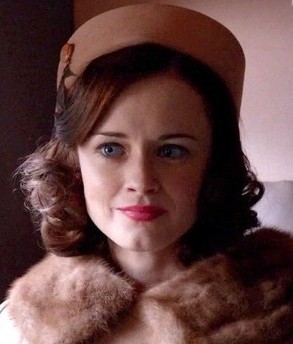
That character, Beth, pines for some reason for Pete Campbell, who’s been stubbornly transplanted to the suburbs, and it’s that attraction that indirectly get her admitted into a mental ward. The actress who plays Beth, Alexis Bledel, is most famous as the character of Rory on ‘Gilmore Girls‘, a character possessed by the work of Sylvia Plath. Of course, Plath also went through electroshock therapy for depression, just like Bledel’s character Beth. A rare pop-culture Mobius strip!

By 1967, submitting a loved one to this sort of treatment would have been considered a form of abuse in the public imagination, if not legally so. (The first lawsuits against shock treatment wouldn’t arrive in the courts until 1975.) But for decades, it was the catch-all treatment for almost any psychological problem.

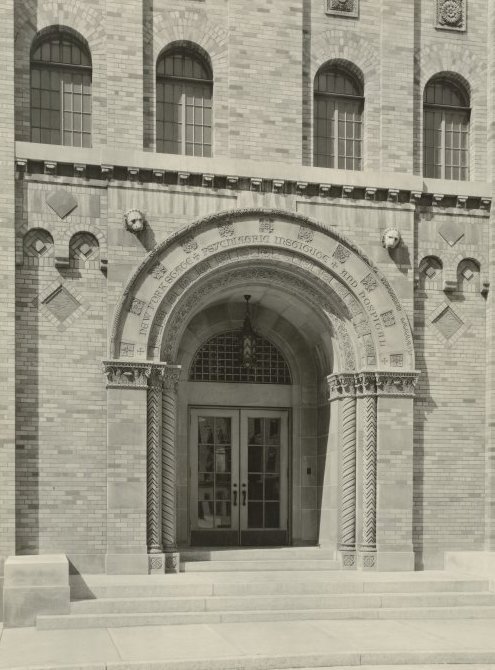
Previously, the hot medical solution in the 1930s for certain mental illnesses was insulin therapy (putting patients in a comatic state), practiced in various hospitals in New York, including Bellevue Hospital. Electroconvulsive therapy (ECT), which debuted in Italy in 1937, made insulin therapy basically obsolete when it was introduced into the United States in 1939 at the New York State Psychiatric Institute (below).

From its patient care facilities on 1051 Riverside Drive, the Institute displayed a technology that seemed to have unlimited application to many mental illnesses thought untreatable. Modern Mechanix heralded its use on insanity, “a single shock achiev[ing] what seems to be a medical miracle, restoring the patient to sanity.” It became “psychiatry biggest fad,” despite such obvious side effects like memory loss.

According to authors Edward Shorter and David Healy, two-thirds of all the patients at the Institute were there to receive ECT. It became a sort of mecca for electroshock, with doctors from around the country coming to observe the treatment.

ECT reigned as the primary form of treatment for depression for almost two decades. However, with the undeniable violence suffered upon a patient who received the treatment — and the fact that well over half of ECT patients were women — most considered it a barbaric practice by the 1960s. Ken Kesey‘s ‘One Flew Over The Cuckoo’s Nest‘, published in 1962, accelerated public distaste with the treatment and was pretty much responsible for its near-elimination by the time the film version, starring Jack Nicholson, was released in 1975.

Electroconvulsive therapy has returned in recent years as a last-ditch therapy for severe depression and certain kinds of catastrophic mental illness. But I’m quite sure that having an affair with Pete Campbell would not have been placed in any of those categories today. What we saw in the season finale was yet another example of the abusive power men sometimes wielded over women, a theme ‘Mad Men’ will most likely continue to visit well into its final season.

Bottom pic courtesy NYPL, Wurts Brothers.

Categories
Mad Men

‘Mad Men’ notes: The 1960s enlightenment of New York’s natural history museum leaves taxidermy in the past


WARNING The article contains a couple spoilers about last night’s ‘Mad Men’ on AMC. If you’re a fan of the show, come back once you’re watched the episode. But these posts are about a specific element of New York history from the 1960s and can be read even by those who don’t watch the show at all. You can find other articles in this series here. 

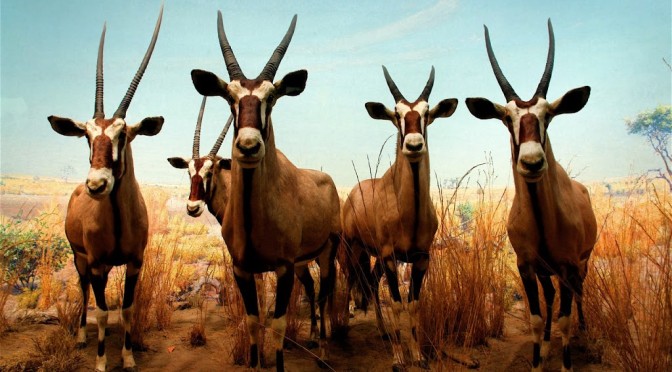
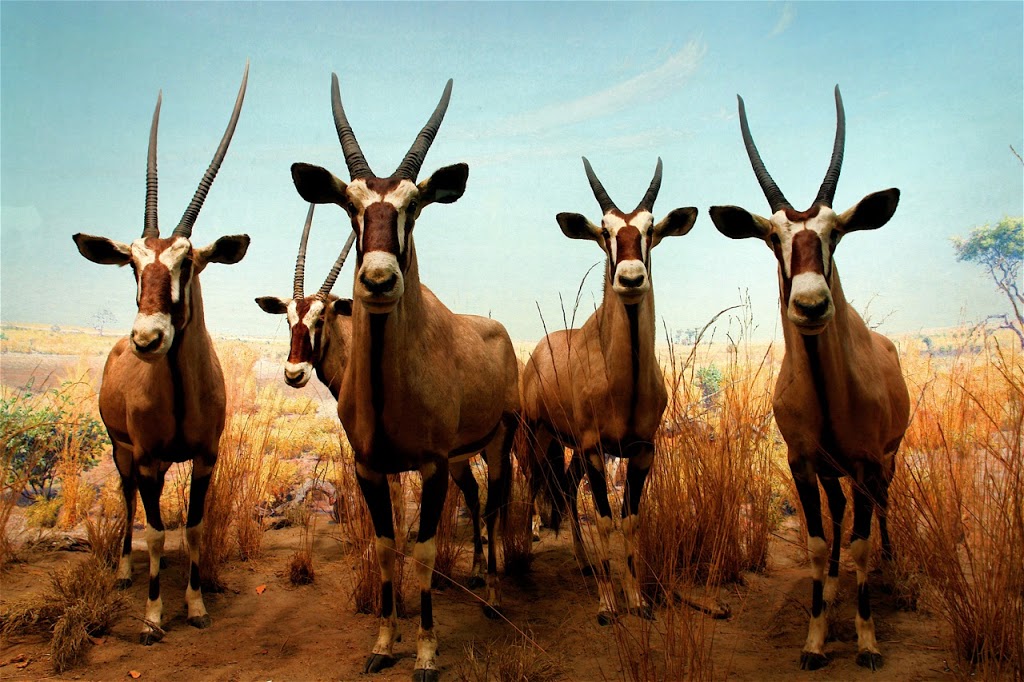
Theodore Roosevelt did not donate all the mounted animals at the American Museum of Natural History, as Glen casually suggested to Sally Draper (below) in last night’s episode. Just a great, great many of them, not least of those prizes from his 1909 post-presidential safari, literally thousands of African specimens captured, killed and presented for display here, at the Smithsonian, and other American museums. New York’s museum even holds the contents of Roosevelt’s ‘natural history cabinet’, his collection of taxonomy which he started at age nine from his home on East 20th Street.

With Roosevelt’s African collection also came expert taxidermist Carl Akeley, who had gone on safari with the former president in 1909 and remained at the Natural History museum to mount and curate its African exhibit. The hall of African mammals is named in his honor and continued to define the museum in the popular imagination.

The early 20th century was a golden era for taxidermy, as greater understanding of natural habitats allowed curators to present their specimens in ‘realistic’ settings and lifelike poses. But such understanding placed a deadline upon classical museum taxidermy; the more one understood the underpinnings of the natural world, the more absurd such displays seemed.

With the 1960s came a greater awareness of the plight of rare animals and their disappearing habitats that rendered the presentation of mounted taxidermic displays into antiquated, often vulgar set pieces. The first federal endangered species act was passed in 1966 and greatly expanded upon with the Endangered Species Act of 1973, ‘the Magna Carta of the environmental movement‘.

The staid animal galleries at the American Museum of Natural History faced other surprising challenges. The museum reached record attendance in 1967, but people weren’t necessarily there for the mounted elephants. The American Apollo missions ignited a public passion for space science, and with the installation of the awe inducing Zeiss projector in 1960, the museum’s Hayden Planetarium easily became its hottest attraction.

Leading up to its centennial in 1969, the museum prepared several new halls (including several of the current anthropology exhibits) and renovated many others; thus Glen and Sally most likely would have seen many ‘Closed for Renovation’ signs during their trip here.  Had Sally not had a certain emergency which sent her from Glen’s side, the pair might have wandered over to the bright, new exhibits in the Hall of the Indians of the Plains, which opened in February 1967.

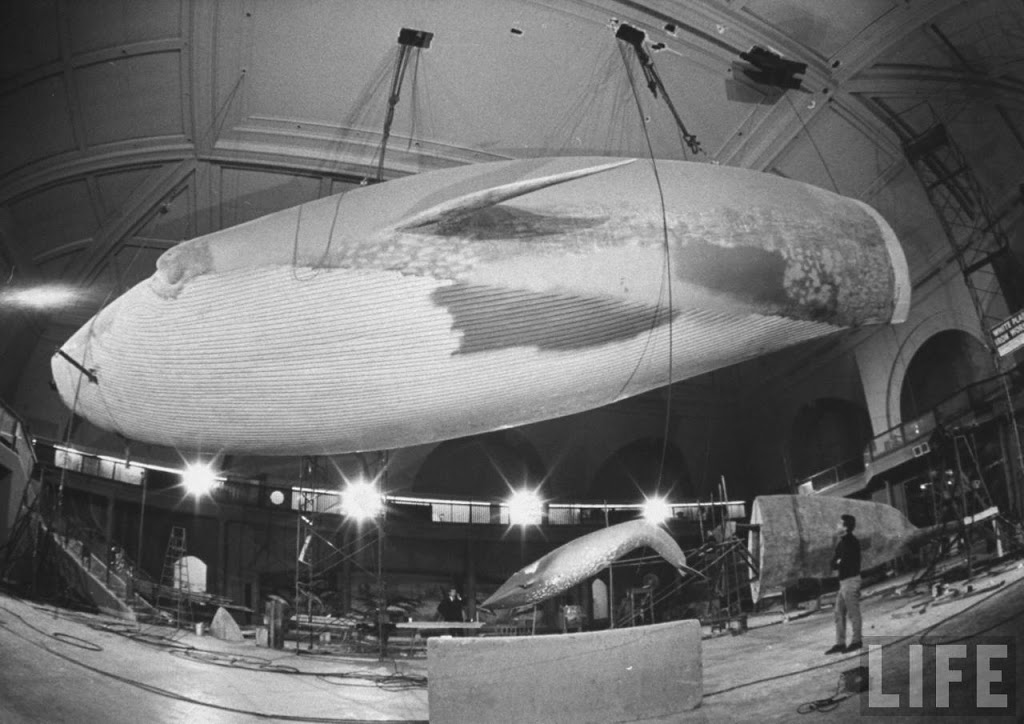
A refreshed Milstein Hall of Ocean Life would dazzle audiences upon its reopening in 1969, and the museum’s trademark blue whale was presented in a new context — the 1966 worldwide ban on hunting the endangered ocean mammal. The extensively revitalized exhibition also presented a new 1960s museum trend — the use of artificial, plastic models over actual animal carcasses.

By 1967, New York’s natural history museum — which once touted a staff of 20 full-time taxidermists — employed only two. “There’s not much left to collect and mount (we don’t say stuff),” lamented staff taxidermist David Schwendeman.

Taxidermy would live on in the worlds of hunting and fishing. One need only take a trip today to the Bass Pro Shops World Headquarters in Springfield, Missouri, to witness a world where the art of taxidermy continues to thrive, as though there was nothing creepy at all about it.

But in the vaunted hallways of the American Museum of Natural History, the elder animal displays serve a new educational purpose — a preservation of science’s evolving views on the natural world.

NOTE: Since ‘Mad Men’ doesn’t film in New York,  Jen Carlson at Gothamist deftly notes that the exhibit displayed in the episode is from Los Angeles’s natural history museum.

Top picture courtesy flickr/Getty Images
Lower picture: Prepping the blue whale in 1968, photo by Yale Joel, Life/Google images

Categories
Mad Men

‘Mad Men’ notes: Hare Krishna blossoms in the East Village

Prabhupada in his early days in New York (Courtesy the Hare Krishna Movement blog)

WARNING The article contains a couple spoilers about last night’s ‘Mad Men’ on AMC. If you’re a fan of the show, come back once you’re watched the episode. But these posts are about a specific element of New York history from the 1960s and can be read even by those who don’t watch the show at all. You can find other articles in this series here. 

An unusual subplot takes Harry Crane, Sterling Cooper Draper Pryce’s smug television liaison, down to Second Avenue and the temple of the Hare Krishnas where he finds new recruit Paul Kinsey, a former agency employee. In his prior existence as a pipe-smoking gadabout, Kinsey always made note of his own hipness, and, in this case, as an acolyte of a religious thought only a few months old, we can confirm that he’s ahead of the curve again.

The Hare Krishna movement, derived from Hindu philosophies and reformatted for the groovy ’60s, was actually fostered and popularized here in the East Village.

A.C. Bhaktivedanta Swami Prabhupada, a Hindu teacher and proponent of Gaudiya Vaishnavism, left India in 1965 to spread his religious teaching. Eschewing material possessions, he arrived in New York in 1966 and gravitated towards the East Village, the nucleus of cultural counter-culture.

His reputation preceded him and soon gathered a small group of followers, including artist Harvey Cohen, who soon set up Prabhupada in an apartment on 72nd Street on the Upper West Side and a small studio for religious practice on the Bowery. From here the swami formed the core of what would become the Hare Krishna movement, aka the International Society of Krishna Consciousness.

Given the location, most of his early followers were young people, fascinated by Hindu imagery in books and music and in particular by Prabhupada’s expressions of religious thought, purifying secular consciousness expanding rhetoric into a simple spiritual regiment.

For many, he was as much a mystery as an answer. One early follower confessed later, “I didn’t know what Prabhupada was about. I mean we understood about one-millionth of what Prabhupada was saying.”

Key to religious practice is the ubiquitous mantra, rhythmically repeating the name of God. Said Prabhupada in a lecture in 2010. “[T]his sound, this Hare Krsna, Hare Krsna, Krsna Krsna, Hare Hare. Hare Rama, Hare Rama, Rama Rama, Hare Hare, is the sound representation of the Supreme Lord.”

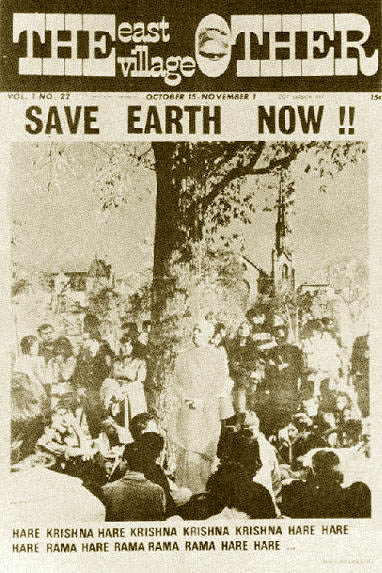
Prabhupada and his followers would frequently be heard chanting their familiar mantra throughout the East Village, but they would be known for one particular destination. On October 19, 1966, Prabhupada led an outdoor chant underneath a elm tree in Tompkins Square Park that lasted for almost two hours, so transcendent that even the New York Times took notice: ‘Swami’s Flock Chants in Park to Find Ecstasy.’ Today that tree (called the Hare Krishna tree) is one of the park’s most popular spots and a mecca for current adherents.

Above: From the late October issue of the East Village Other, in front of the  Hare Krishna tree [source]

By this time, Prabhupada had a new home, a former curio shop at 26 Second Avenue (between First and Second Streets). They kept the old sign ‘Matchless Gifts’ over door, while followers decorated the interior with handmade tapestries. This became the central New York temple and remains central to local worshippers to this day. “[I]n this small room on Second Avenue, guest found themselves transported into another dimension, a spiritual dimension, in which the anxieties and pressures of New York City simply did not exist.” [source]

In that first year, 1966, Prabhupada had only a few dozen followers, but at least one famous one — Allen Ginsberg.


Below: Video of Prabhupada and followers at Tompkins Square Park in 1966


Categories
Mad Men

‘Mad Men’ notes: Between Julia Child and Weight Watchers

WARNING The article contains a couple spoilers about last night’s ‘Mad Men’ on AMC. If you’re a fan of the show, come back once you’re watched the episode. But these posts are about a specific element of New York history from the 1960s and can be read even by those who don’t watch the show at all. You can find other articles in this series here.

This week’s episode was set in the week before Thanksgiving 1966, certainly a moment of great apprehension for many American housewives like the embittered Betty Francis (the artist formerly known as Betty Draper).

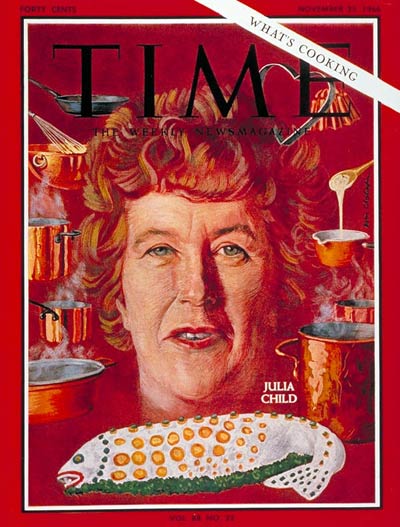
The cover of Time Magazine that week (11/25/66) featured a psychedelic portrait of Julia Child, framed in a chorus of saucepans with some kind of odd,decorated fish below her. Her Boston-based program The French Chef had been on the air over three years by then, bringing rich, savory delicacies into American homes. “Her fingers fly with the speed and dexterity of a concert pianist. Strength counts, too, as she cleaves an ocean catfish with a mighty, two-fisted swipe or, muscles bulging and curls aquiver, whips up egg whites with her wire whisk.” [source]

Child made classic, wholesome dishes with generous portions of high-calorie ingredients. But the 1960s also shoehorned greater artificiality into American kitchens — a barrage of food products loaded with preservatives, in unnatural shapes and presentations. The two food products most substantially featured on this week’s episode were canned whipped cream and Hostess Sno Balls, pink mounds of firmly molded, processed cake coated in a gelatinous frosting of uncertain origins. Even as Child stressed classic meals with fresh ingredients, actual food production was moving further away from easily digestible ingredients.

Made available to American grocery stores between 1965 and 1967: Bac-Os bacon bits, Shake ‘N’ Bake, Doritos, Easy Cheese, SpaghettiOs, Tang, Cool Whip.

If eating patterns in the 1960s set the county on a path of future health problems, they also spawned America’s first significant weight loss regiment. Betty, mortified by her extra pounds and judging herself against the lanky frame of her ex-husband’s new wife, turns to a community group that would grow to become the most successful weight loss program of the 20th century — Weight Watchers, a Queens-based company formed in 1963 that brought weight control to the mainstream.

Founder Jean Nidetch described herself in a 1971 biography as a “fat Brooklyn girl who grew up to be an even fatter Queens housewife.” She graduated from high school in Bedford-Stuyvesant in the 1940s and worked for the Internal Revenue Service before marrying in 1947. By the 1950s, she found herself in the massive garden apartment complex Deepdale Gardens in northeast Queens raising two sons and developing a compulsive eating habit.

Trying every available fad diet to no avail, she eventually visited a city-run obesity clinic in the neighborhood of Kips Bay in Manhattan, where she was advised to eat a so-called ‘prudent diet’: “two pieces of bread and two glasses of milk a day, fish five times a week and a weekly meal featuring liver.” [source] What they didn’t prescribe was camaraderie.

Nidetch took the food plans back to her apartment complex and organized a small cluster of neighborhood women to support each other in their quest to shed pounds. By 1962, she had lost dozen of pounds and had gained valuable insight into the power of group support to control eating habits. Using the ‘prudent diet’ as a rough guideline, she moved her regular meetings into a loft above a movie theater in Little Neck, charging $2 per meeting — the same price as the movie tickets being sold downstairs.

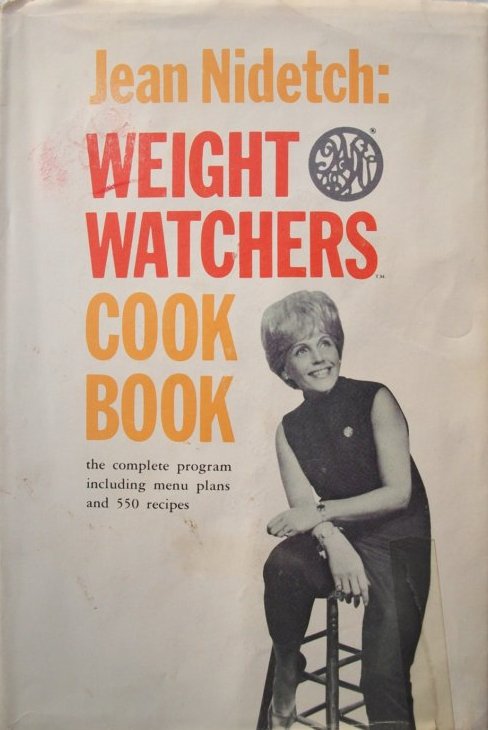
As depicted in this week’s episode, set in November 1966, Weight Watchers was still very much a regional program. Nidetch’s first Weight Watchers cookbook was released earlier in the year, debuting the regimented eating plan and structured point system.
A sampling: “Luncheon: 4 ounces fish or lean meat or poultry, or 2/3 cup cottage cheese or pot cheese or 4 ounces farmer cheese or 2 ounces hard cheese or 2 eggs. All you want of unlimited vegetables. 1 slice bread.”

As she confesses from the back cover: “Weight Watchers began when I invited to my house six overweight friends – have you ever noticed that most fat people have fat friends? – and much to the surprise of all of us we found that there were other people hiding cookies in the bathroom and eclairs in the oven.”

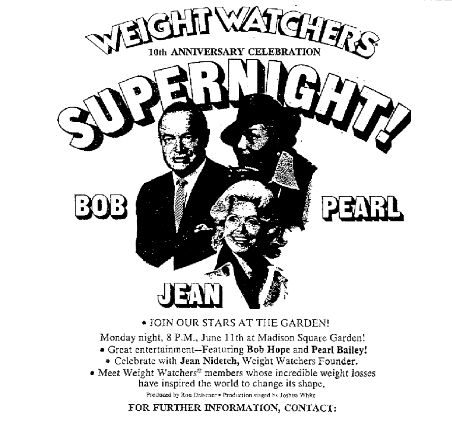
By the end of the decade, Nidetch’s new company — incorporating its famous food-points system and a methodology of daily calorie targets — would go worldwide. By 1972, Nidetch would invite 20,000 national devotees to a tenth anniversary party at Madison Square Garden, featuring guest appearances by Bob Hope and Pearl Bailey. (Ad below from Lubbock, TX, newspaper)

In 1978, Weight Watchers was acquired by the H.J. Heinz Company (which, in ‘Mad Men’ continuity, has been a most frustrating client for our favorite ad staff) who would mass produce Weight Watchers frozen foods.
Categories
Mad Men

‘Mad Men’ notes: The delirious world of Off-Off-Broadway

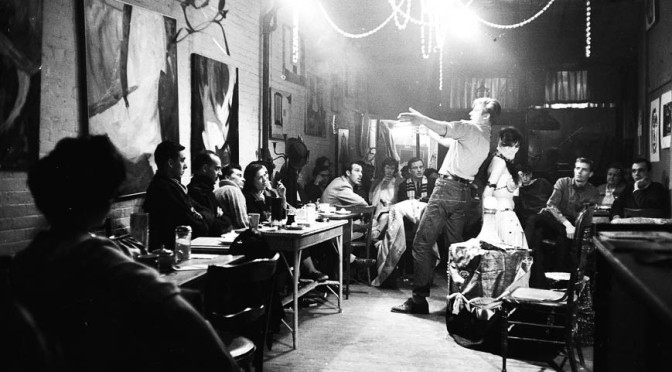
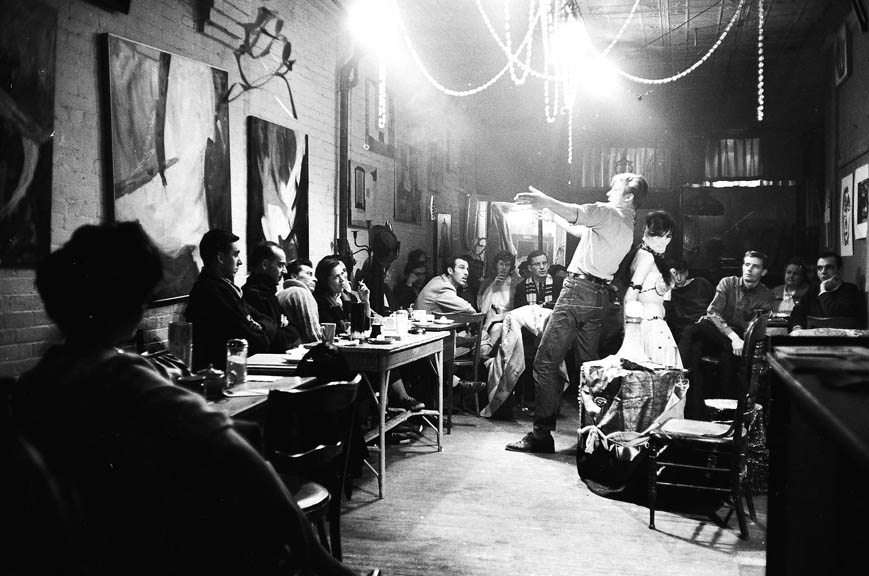
Radical thoughts, limited spaces: a performance at the Caffe Cino. Photo by Ben Martin (from an excellent website by Robert Patrick about this important off-off-Broadway site)

 WARNING The article contains a couple spoilers about last night’s ‘Mad Men’ on AMC. If you’re a fan of the show, come back once you’re watched the episode. But these posts are about a specific element of New York history from the 1960s and can be read even by those who don’t watch the show at all. You can find other articles in this series here.

 Megan might be Sterling Cooper Draper Pryce’s hottest new pitchwoman, but deep in her heart of delicate French extraction, she wants to be an actress. And in last night’s show, she steals away to an audition of an unnamed off-off-Broadway production. She didn’t get the part, but the experience leads her to make a jarring decision.

This wasn’t merely a plot contrivance, but rather another use of New York geography to delineate character. Don Draper was busy at Danny’s Hideaway, a Midtown East restaurant along famed ‘Steak Row‘ shimmering with late 50s — and, by 1966, ever fading — glamour. Megan’s off-off-Broadway audition could only be one place, and that was downtown below 14th Street, in the thriving epicenter of New York counter culture.

Aspiring performers have made New York their destination for fame since the late 19th century with the birth of the Broadway theater circuit. By the 1950s, playwrights and producers who challenged the preconceptions of standard, mainstream theater found homes for their work off Broadway both literally and metaphysically. The art of theater could now be explored for smaller crowds and with smaller budgets.

But even off-Broadway was not immune to financial realities. By the end of the decade, the popularity of off-Broadway created a parallel industry, “a smaller-scale version of Broadway itself.” [source] If you were to look back at the greatest off-Broadway hits of this era (plays by Tennessee Williams and Edward Albee, musicals like Threepenny Opera) you’d notice that most of them have had subsequent Broadway debuts. Indeed, off-Broadway continues to be a sort of a minor league tryout for future Broadway shows.

By the 1960s, unconventional creative voices were emerging that seemed positively alien even in that world. What do you call the alternative to something that was itself the alternative? Although Village Voice critic Jerry Tallmer is credited with coining the phrase ‘off-off-Broadway’, the phrase might have sprung up naturally the first time audiences came in contact with the early works of this field — modest, broken-down, difficult and experimental shows eager to discard every theatrical trapping that had built up for the past four hundred years.

The first ‘true’ off-off-Broadway performance, according to Tallmer’s fellow Voice critic Michael Smith, was a surreal revival of Ubu Roi, performed at a Bleecker Street coffeehouse in 1960. Theatrical experimentation complimented the Village music scene nicely, as even the smallest venues could now host a production. Only in this new creative world could a cramped, smoke-filled coffeehouse like Caffe Cino, at 31 Cornelia Street, become center stage for a new theatrical revolution.

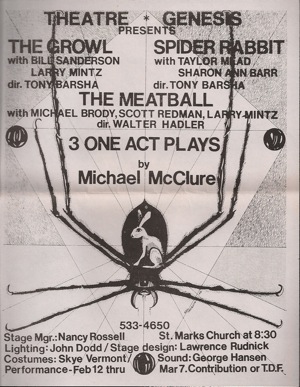
If the art was nontraditional, so too were the venues. Two churches became important homes for alternative theater in the early 1960s and they remain so to this day. Judson Memorial Church, off Washington Square, may seem austere with its elegant Italianate bell tower, turned its meeting room into an off-off-Broadway stage in 1961. And, of course, St. Marks-in-the-Bowery, took a page from its own 1920s radical bohemian past to become home to the Poetry Project and Theater Genesis (performing sometimes sexually explicit plays in the churches parish hall). Above: A poster for Theater Genesis

But just as many pivotal and provocative voices of off-off-Broadway were developing further east, in an area of the Lower East Side heavily influenced by Greenwich Village counterculture idealism and referred to by the mid-60s as the East Village. The chief among these, Ellen Stewart’s mold-breaking La Mama Experimental Theatre, opened in 1961 and rejected most theatrical instincts, featuring only new plays in a stripped-down, almost barren theatrical space. Pictured above: Ellen Stewart in 1970. Picture courtesy TCG

By 1966, off-off-Broadway became a banquet of experimental ideas, spaces for gay, feminist and African-American playwrights and performers. In effect, the opposite of a certain ad agency, where creative flowering is hindered by the whims of client preference and the banality of subject.

Categories
Mad Men

‘Mad Men’ notes: Executive (and bohemian) dining


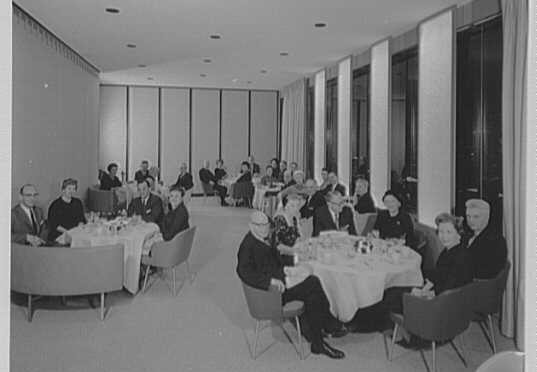
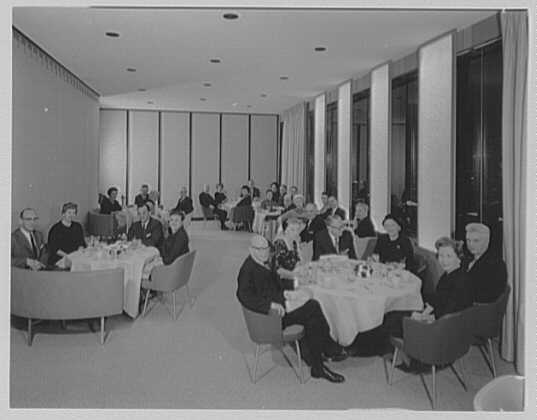
A square meal: The Tower Suite’s packed dining room   


WARNING The article contains a couple spoilers about last night’s ‘Mad Men’ on AMC. If you’re a fan of the show, come back once you’re watched the episode. But these posts are about a specific element of New York history from the 1960s and can be read even by those who don’t watch the show at all. You can find other articles in this series here.

In trying to contrast the life-altering decisions made by two of ‘Mad Men’s central characters, the writers certainly did an excellent job last night in choosing two appropriate and familiar locales.

Don Draper (with Megan in tow) made a last-ditch effort to win over a difficult client by dining at the Tower Suite in the Time & Life Building. (The offices of Sterling Cooper Draper Pryce were actually several floors below.) The restaurant on the 48th floor served as an executive dining room during the day called the Hemisphere Club, one of a number of elevated lunch spots in midtown Manhattan. The destination for businessmen looking to impress — waiters were dressed as butlers  — was opened by George Lang of Cafe des Artistes fame in 1961.

By many accounts however, the Tower Suite was considered a starched and even dreary dining experience. And quickly passe. In 1970, New York Magazine intoned “[T]he Tower Suite is still ideal for enchanting sheltered in-laws, teenagers, the hopelessly in love and out of town clients from Saginaw.”

Peggy Olsen, meanwhile, had a more personal dilemma to attend to downtown in the heart of Greenwich Village where she’s seen much of her personal growth. She’s presented with a decision to make over dinner at Minetta Tavern, a corner Italian restaurant on MacDougal Street at the foot of small Minetta Lane.

This was the former location of The Black Rabbit, one of Greenwich Village’s best known speakeasies, operated by Eve Addams. Her infamous tearoom Eve’s Hangout right up the street was one of New York’s first lesbian hangouts. The Black Rabbit switched to proper Italian cuisine in 1937.

The tavern had been immortalized the previous year in Joseph Mitchell‘s ode to eccentric bohemian Joe Gould, who frequented Minetta’s in his later years. ‘Joe Gould’s Secret’ would become one of Mitchell’s best  known New York tales. (It was also be his last book.)

With the Tower Suite long gone, you can no longer enjoy its faux-butler service, but Minetta Tavern was renovated and reopened in 2009 by restaurateur Keith McNally.

Categories
Mad Men

‘Mad Men’ notes: New York becomes an LSD playground


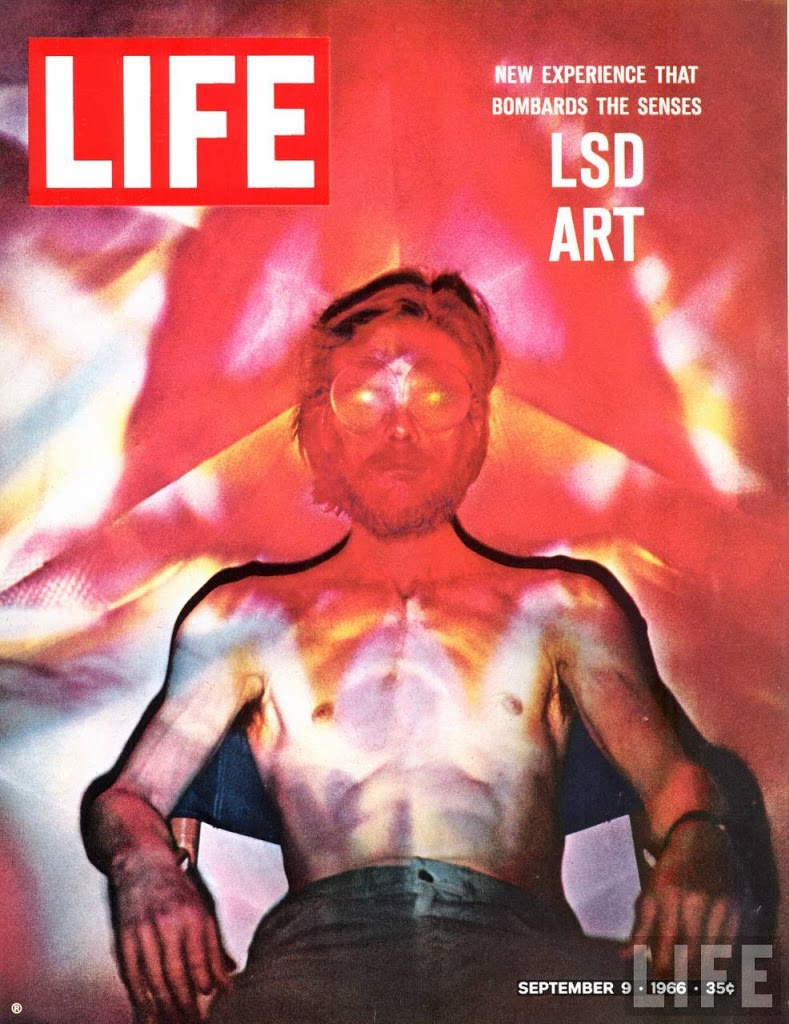
A mind-twisting exhibit at the Riverside Museum, formerly at 310 Riverside Drive/103rd Street, makes it on the cover of a national magazine. But not everybody would enjoy the trip.


WARNING The article contains a couple spoilers about last night’s ‘Mad Men’ on AMC. If you’re a fan of the show, come back once you’re watched the episode. But these posts are about a specific element of New York history from the 1960s and can be read even by those who don’t watch the show at all. You can find other articles in this series here.

Sure, it’s 1966. I thought maybe Peggy Olsen might be the one to trip the light fantastic. (She was otherwise engaged this week.) But I never expected hallucinogenics to materialize as they did on last night’s ‘Mad Men’. After a staggeringly serious dinner party narrated with empty philosophical conversation, Roger Sterling and his wife are invited to take the drug LSD by their host. Far from the dorm rooms and basement clubs of Greenwich Village where one might expect such experimentation, this evening of psychedelia was presented as a drawing-room intellectual exercise, with serene music unspooling from a reel-to-reel and no object more trippy than a mantel mirror.

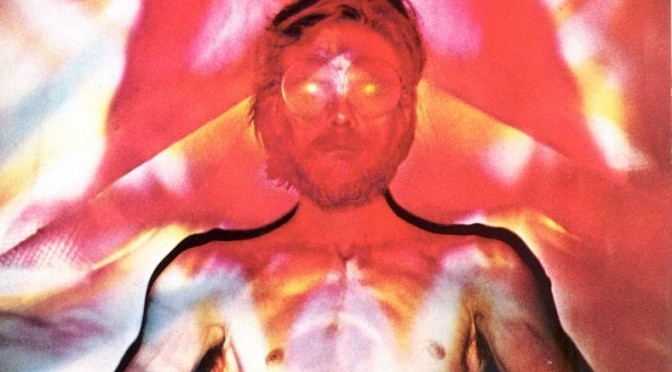
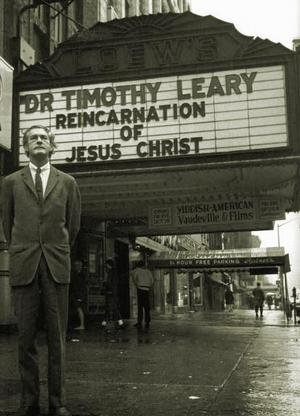
Lysergic acid diethylamide, which I doubt can actually be said while experiencing its effects, was considered a mind-opening tool for some early psychiatrists, laying bare subconscious feelings and forcing the user to confront difficult issues in a surreal environment. By the mid ’60s, its leading advocate was Timothy Leary (below), a psychologist who had studied the benefits of psychedelic drugs to explore the mental capacities. Today we might naturally lump him with the trappings of ’60s counter-culture, but in 1966, with the parameters of psychiatry still in flux, his experiments also appealed to intelligentsia.

The depiction of ‘Mad Men’s after-dinner drug soiree seem to follow Leary’s instruction quite explicitly. In 1966, he advised, “Don’t take LSD unless you are very well prepared, unless you are specifically prepared to go out of your mind. Don’t take it unless you have someone that’s very experienced with you to guide you through it. And don’t take it unless you are ready to have your perspective on yourself and your life radically changed, because you’re gonna be a different person, and you should be ready to face this possibility.”

An article in March 25, 1966, LIFE Magazine laid out the details of the drugs in almost an introductory fashion. “A black market dose costs only $3 to $5. But that’s enough to send a person on a 10-hour ‘trip’.”

The same article also underscored a growing fear: “A few pounds of it dumped into the water supply of a major city would be enough to disorient millions.”

The federal government had been concerned of this supposed conspiracy as early as the 1950s, fearful that Russians might pollute New York’s water and “turn drug-addled American citizens against their own government.” [source] Of course, the CIA itself experimented with LSD during this period with its covert Project MKULTRA, which conducted experiments in New York during the mid-50s, using prostitutes and junkies they found in local bars in Greenwich Village. An experiment performed on CIA operatives themselves led one agent in 1953 to leap from a window at the Statler Hilton, today’s Hotel Pennsylvania. (Or was it murder?)

By the 1960s, the drug had become a virtual entrance exam for New York’s blossoming counter-culture music scene, or so the more hysterical believed. “In New York, San Francisco and Los Angeles, a girl just off the bus from Boise can find it quicker than the YWCA merely by asking around for ‘a trip’,” warned Life Magazine.

The fear of an unwitting populace overtaken with LSD only grew with the 1960s, and this time, some thought it was New York’s counter-culture rebels itself who may be wielding it.  A 1967 journal opined on the urban legend with all seriousness. “[A] single ounce will provide fuel for 300,000 trips, reported one periodical, and it is believed that a few pounds dumped into the water supply of New York City would disorient the nearly 8,000,000 residents.”

Perceptions of LSD were slowly divorced from its supposed therapeutic qualities, especially as the drug soon found itself as the subject of films like Roger Corman‘s The Trip and ‘Enormous Midnight‘, where town water supply is poisoned with LSD and turns its citizens into orgiastic zombies. In New York, LSD entered the club world; hallucinogenic mid-60s destinations like Cerebrum and the Electric Circus (which became Andy Warhol‘s preferred spot in 1966) seem almost conceivable without it.

New York legislators quickly vowed to outlaw the new drug. Bellevue Hospital reported over 200 new patients affected by the drug. In April 1966, two local crimes energized the press: a Brooklyn girl accidentally ingested a sugarcube coated with LSD, and a week later, a ex-mental patient killed his mother-in-law, allegedly under the influence of the drug. With the Stagger-Dodd bill in 1968, the possession of LSD became illegal in the United States.

While that effectively ended the living-room therapy sessions such as the one experienced by Roger Sterling, the drug, now underground, would increasingly influence all aspects of New York bohemian culture.

From the Cerebrum club mentioned above:


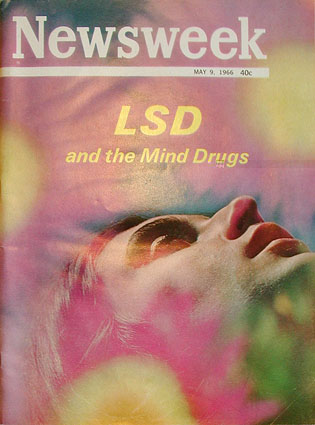
Pictures courtesy Newsweek and Life Google Images. For more information on the CIA’s LSD experiments, you might be interested in watching this video.


If you’re watching ‘Mad Men’ when it broadcasts at 10 PM EST, then follow along with me on Twitter at @boweryboys. I’ll be giving a live fact-Tweeting, dropping little factoids about the events being depicted on the show

Categories
Mad Men

‘Mad Men’ notes: The numbing horror of the New Haven line

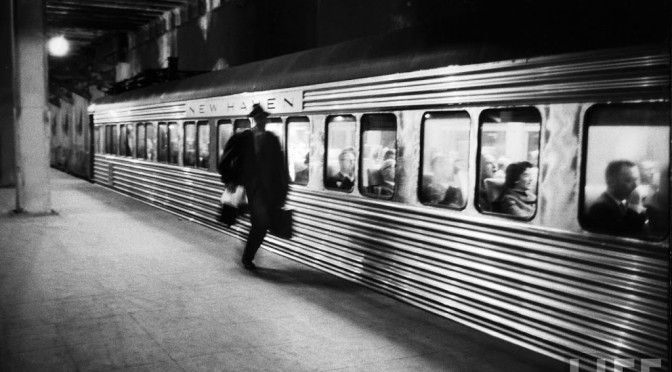
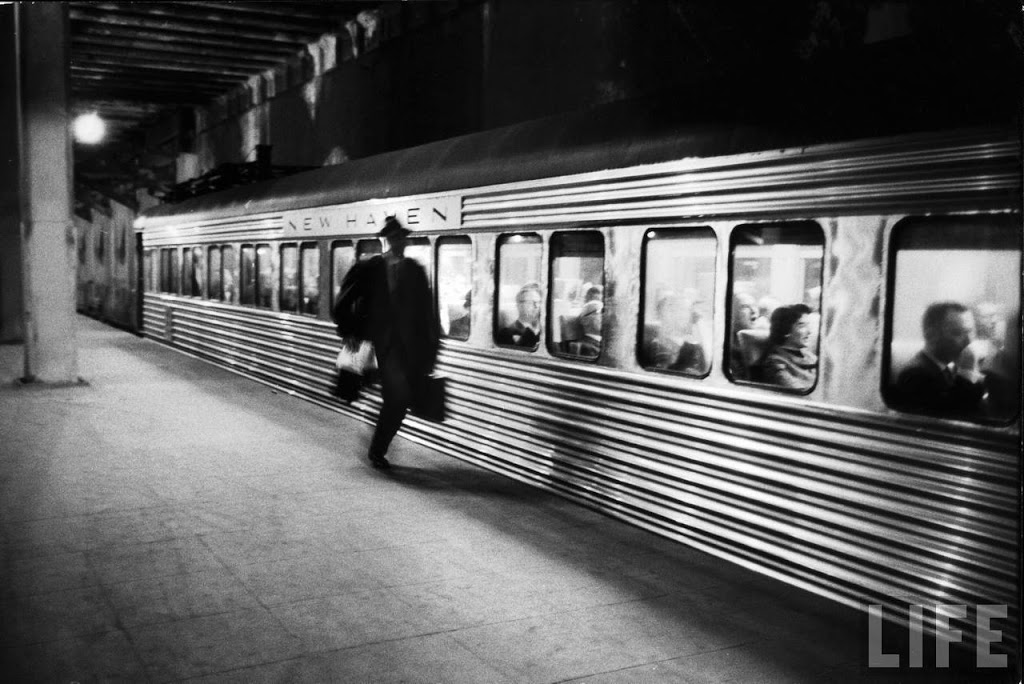
The train gang: Grand Central Terminal, 1961, photo by Alfred Eisenstaedt (LIFE images)

WARNING The article contains a couple spoilers about last night’s ‘Mad Men’ on AMC. If you’re a fan of the show, come back once you’re watched the episode. But these posts are about a specific element of New York history from the 1960s and can be read even by those who don’t watch the show at all. You can find other articles in this series here.

Oh, the mundane ritual of the daily commute! Of all the conformities of modern living, what is it in particular about the commute along the New Haven line — from Grand Central to points of suburbia along the south shore of Connecticut — that must drive the perpetually frustrated Pete Campbell to the edge of insanity?

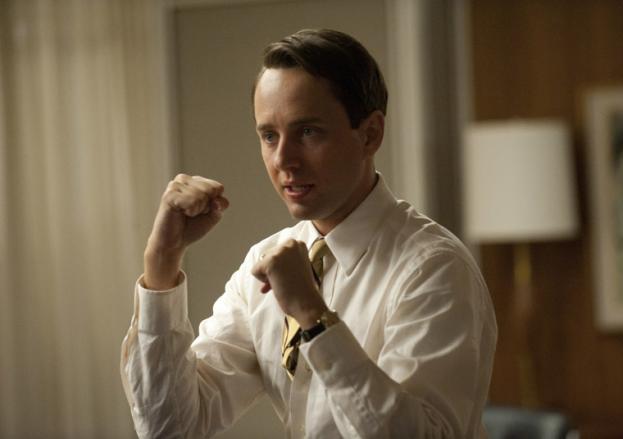
In past ‘Mad Men’ episodes, we’ve seen the eager and ambitious adman strive for the trappings of ’60s urban success. He’s achieved a certain degree of material status, from a beaming, pregnant wife to a small but lovely home in Connecticut, equipped with a monstrous (some might say coffin-shaped) hi-fi stereo console. But the banality of a regular commute, robbed of privacy and forced into polite chatter — with the same insufferable people, day in, day out — has forced Campbell into taking driver’s education courses with teenagers.

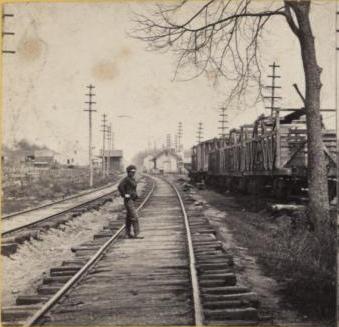
The New Haven line has been a popular transportation route almost since the advent of the railroad itself. First laid and operated in 1848, Appleton’s was proclaiming a decade later that the shoreline railroad was “the most expeditious way between New York and Boston,” linking the Connecticut city with Williams Bridge in the Bronx (pictured at left, from 1865, courtesy NYPL). From there, a connecting track, shared with the Harlem Railroad, took trains directly down to the train depot at 27th Street and Fourth Avenue. When city laws forced the depot up to 42nd Street, that old depot became a storage shed and, later, the first Madison Square Garden.

Few urban professionals attempted daily commutes to and from New York until the early 20th century, when post-war lifestyles, affordable automobiles and an expensive and overcrowded city facilitated an exodus to the surrounding areas. By 1950, the suburbs were such an entrenched place — a lifestyle unto themselves, with unique social requirements — that people even began speaking of the exurbs, communities even further outside the chain of traditional suburbia. “[T]he suburbs are the first 25 miles out; the ‘exurbs’ are the next 25 miles out,” according to author Irving Lewis Allen, and initially appealed to the most wealthy professionals from “advertising, broadcasting and publishing.”

We can thank city planners like Robert Moses for much of this change, obsessed as he was with highway building. But new roads alone couldn’t facilitate the move to suburbia. Mass transit was required to provide a convenient and cost-effective alternative for the ‘second wave’ suburbanites — those aspiring professionals wishing the emulate the lifestyle behaviors of their bosses without the paychecks to secure it. People, say, like Pete Campbell.

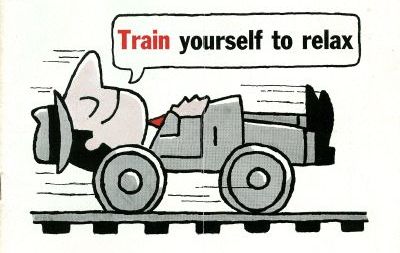
Above: A whimsical graphic from a 1966 New Haven Railroad timetable attempts to distract its passengers.

Unfortunately, the massively unprofitable New York, New Haven and Hartford Railroad, no longer just a long-distance passenger train service, was never fully capable of handling the thousands of commuters traveling to and from the city. Once considered ‘profitable, clean and punctual’ according to Robert Caro, the line was bankrupt by the mid-1960s, operating overcrowded, less-than-comfortable trains solely on federal money by 1965. Some considered it worse than even the crippled, dysfunctional Long Island Railroad.

The New Haven was such an undesirable property that the newly merged New York Central Railroad and Pennsylvania Railroad (aka Penn Central) was literally forced to take possession of the line in 1968 by the Interstate Commerce Commission. New York Governor Nelson Rockefeller was especially concerned that a deterioration of the New Haven line would create an traffic burden which would reverberate through the entire northern New York City-Westchester County corridor.

Oh, things would only get worse for the New York area railroads in the 1970s! So I hope Pete’s taking copious notes in his driver’s education classes and that those gruesome Signal 30 films are hitting home.

Categories
Mad Men

‘Mad Men’ notes: The secrets of the New Yawk accent


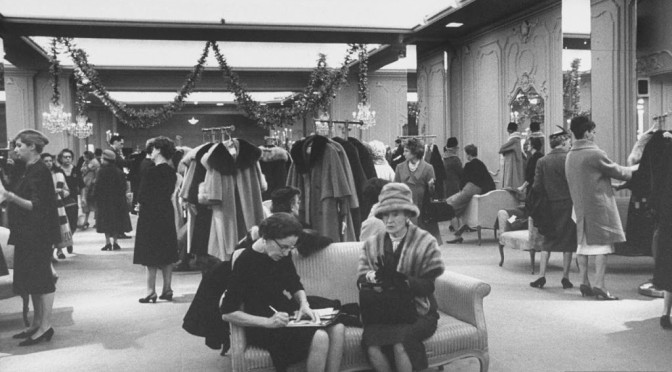
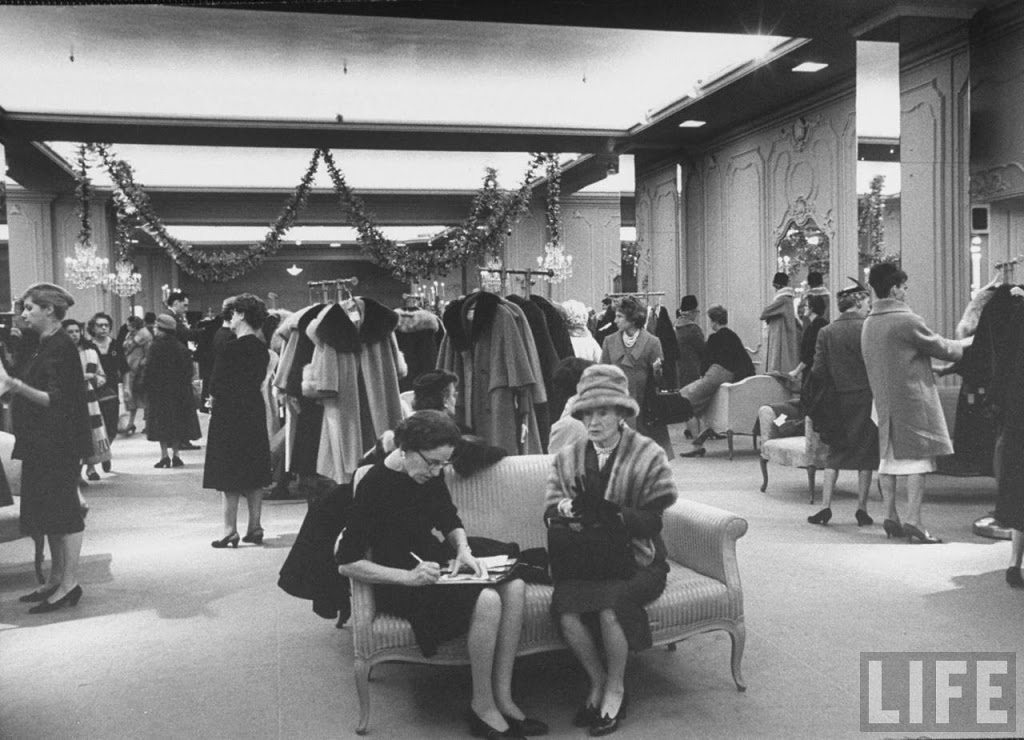
On the upper floor — or flooah? — with the upper crust: Ladies coats at Sak’s Fifth Avenue in 1960, photo by Alfred Eisenstaedt (LIFE)


WARNING The article contains a few spoilers about last night’s ‘Mad Men’ on AMC, so if you’re a fan of the show, come back once you’re watched the episode.

A culture clash between New Yorkers from different races and classes came barreling through the storyline of ‘Mad Men‘ this week. While Peggy Olson had an awkward bonding moment with the new black secretary Dawn, a morbidly ill Don Draper took out his emotional tensions on the new Jewish copywriter Michael Ginsberg.

As revealed last week, Ginsberg is a ‘real’ New Yorker, living in a tiny apartment with his very devout father with a thick Yiddish accent. This week, Draper chastised the casual, Brooklyn-esque tone of Ginsberg voice, possibly implying a dig at the character’s Jewish roots. In response, Ginsberg defended his ‘regional accent’ and pointed out that Don, too, had an accent. The new kid eventually shines at a pitch meeting emulating a presentation style (and even vocal techniques) ripped from the Draper playbook

On a personal note, I’ve been fighting with accents my whole life, born with an Ozarks drawl only to develop the standard Midwestern ‘newscaster’ voice by high school, then living in New York for almost two decades and now slowly beginning to sound like it. So I found Don’s personal affront particularly interesting, as everything about him is a facade, including the voice. (I also went to school with fellow Missourian Jon Hamm, but that’s for another posting.)

Until last night, it never occurred to me that the secret to New York’s modern local tone — the many borough-specific variants of the New Yawk accent, if you will — was actually ‘discovered’, academically speaking, in a published study released in 1966, the year this season of ‘Mad Men’ is set.

Linguist expert William Labov was a Columbia University doctoral student in the early 1960s when he embarked on an extraordinary and influential study of the New York accent, the results of which were released as The Social Stratification of English in New York City in 1966.

The standard New York accent was historically presented as street jargon, whether it be the New York Times writing out the words of newsboys phonetically (“Dere’s tree t’ousand of us and we’ll win sure”) or the broad slang-filled movies of the Bowery Boys acting troupe (“Whadda ya hear! Whadda ya say!”). Upper class New Yorkers from old families frequently carried a New England lilt in their voices.

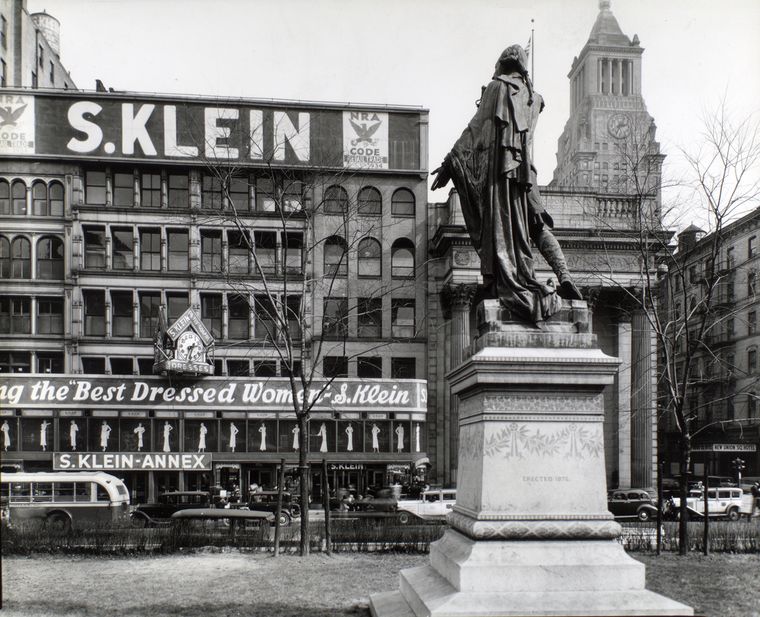
What seems inherent from comparing those two examples was flatly proved by Labov’s fascinating experiments done in three New York City department stores — the affordable S. Klein’s in Union Square, the higher priced Macy’s in Herald Square, and the very exclusive Saks Fifth Avenue — attracting shoppers from different social classes.

Below: Klein’s ‘on the Square’ in 1936, photo by Berenice Abbott.

I would have loved to have assisted Mr. Labov out with his experiments. Throughout the day, he asked employees from each store where the women’s coat department were located. In the case of these three stores, it was on the fourth floor. Or the fowth flooah or even the fowt flooah. When asked to repeat what they said, people would most likely restate ‘fourth floor’ with the -r more carefully said, as though it was their accent that had caused the confusion.

Those employees of S. Klein were far more likely to lose their -r sounds, while those from Saks were least likely. But Labov’s study found an additional quirk. On higher floors, where more expensive items were sold in each case, people more likely kept their -r sounds.

His conclusion found that “rhocity increased with the prestige of the department store” and that it even increased within the store itself. How the words were clearly pronounced and presented did not specifically depend on the geographical origin of the speaker, but on socioeconomic considerations. Labov concluded that New Yorkers of the 1960s generally disliked their own accents and subconsciously chose to mask it. “The term ‘linguistic self-hatred’ is not too extreme to apply to the situation,” he stated in his report. “As far as language is concerned, New York City may be characterized as a great sink of negative prestige.” [source]

Labov’s 1966 study is considered one of the most important linguistic findings of the late 20th century. Today Labov is considered the father of sociolinguistics. Whether his conclusions still apply today is a question for modern researchers. But they add an interesting new context to this burgeoning competition between Draper and Ginsberg, a symbolic competition between the ‘fake’ and the ‘real’.