Categories
Mad Men

‘Mad Men’ notes: The rock gods of Forest Hills, Queens


WARNING The article contains a few spoilers about last night’s ‘Mad Men’ on AMC, so if you’re a fan of the show, come back once you’re watched the episode.

Lusty groupies, ample drug intake, smoky hallways and deafening rock music. One might have thought last night’s ‘Mad Men’ — partially centered around the backstage antics of a Rolling Stones concert — was taking place at Shea Stadium, where the Beatles famously performed to their largest audience in 1965. Or maybe that was Madison Square Garden, the one on Eighth Avenue and 50nd Street, where Marilyn Monroe sang happy birthday to John F. Kennedy in 1962?

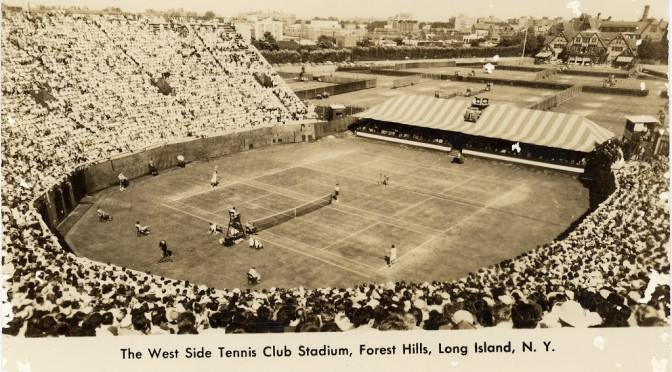
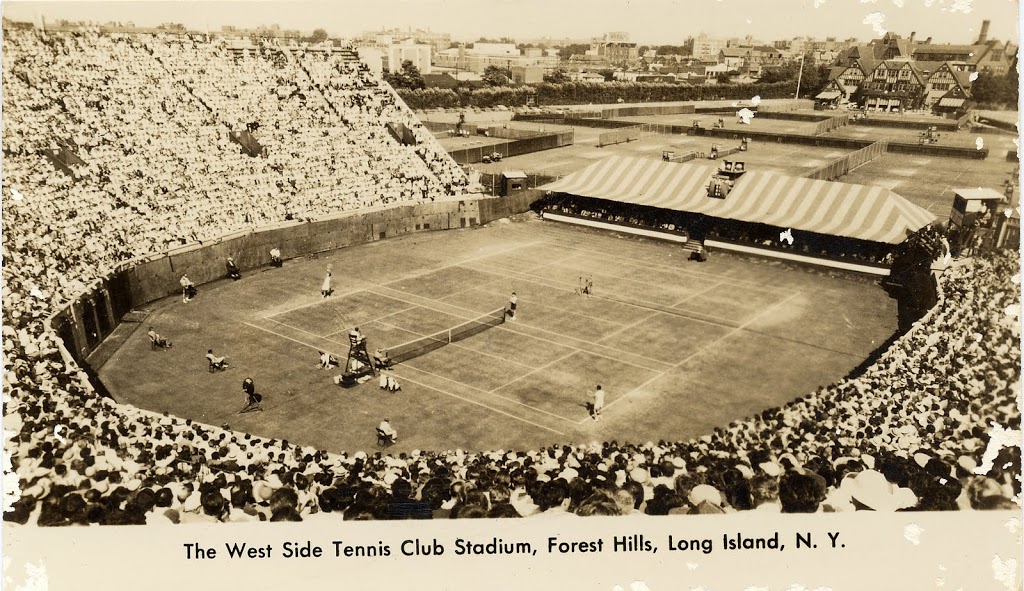
No, that mad, bacchanalian event took place at an esteemed tennis club — the West Side Tennis Club in Forest Hills, Queens.

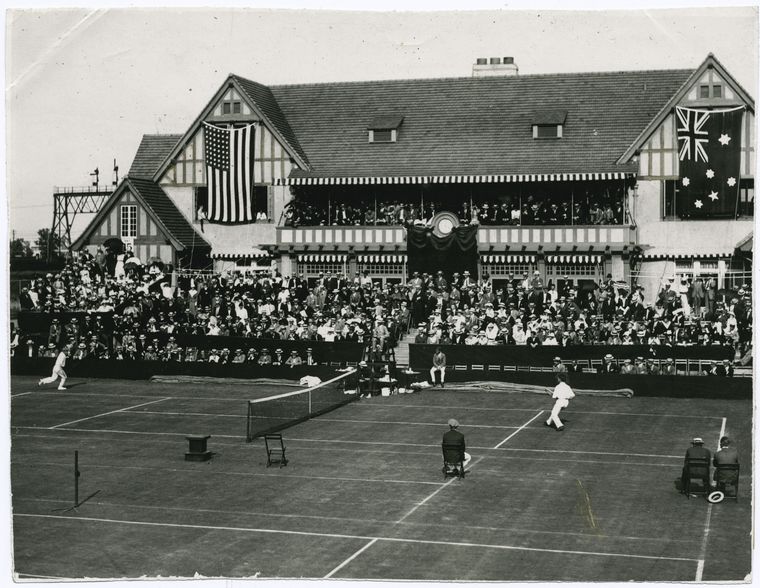
Organized in New York in the 1890s, the tennis organization and social club quickly outgrew various venues in Manhattan and made their way to Queens. The momentary inconvenience of relocating to an outer borough was swiftly forgotten when the venue opened in 1914, a sumptuous series of grand courts, manicured lawns and a spectacular Tudor-style clubhouse designed by Grosvenor Atterbury* and John Almay Tompkins. A later court addition would provide seating for 14,000 spectators.

The clubhouse reflected the style of  homes in nearby Forest Hills Gardens, also planned by Atterbury as a private, upper class community. To this day, the ‘cottage community’ is one of Queens most exclusive neighborhoods.

Below: A vigorous match between Maurice McLoughlin and Norman Brookes in 1914.  The larger court would not be built for several more years. Courtesy NYPL
The grounds were so abundant that it drew the U.S. Open from Newport, Rhode Island, in 1915, and they remained here until 1987. In fact, for most of the 20th century, the tennis club became the American capital for the sport, seeing victories by sports icons like Arthur Ashe, Jimmy Connors, Althea Gibson and Billie Jean King. Alfred Hitchcock even filmed a pivotal scene in ‘Strangers On A Train’ here.

Tying in some of these themes of this season of ‘Mad Men’, there was even a scandal involving the exclusion of black and Jewish members from the club in the 1959, a scandal that involved an under-secretary from the United Nations.

But the appeal of a large and vibrant permanent outdoor venue soon drew, shall we say, less buttoned-up events. The Forest Hills Music Festival was a weekend precursor to New York’s many outdoor concert events today, bringing modern stars to the courtyards and giving this upper crust cloister a taste of counter-culture and teen-fueled rock and roll. One of its organizers was Ron Delsener, later to become a renown concert promoter in the New York area.

Beginning in the late 1950s, concert events were staged on the court itself. At first, the venue drew acts like the Kingston Trio, Frank Sinatra, Harry Belafonte, Barbra Streisand, and even Woody Allen with a stand-up performance. But not of those performers brought the frenzy quite like the Beatles, who played two nights in late August 1964 and drew such passionate crowds that their helicopter had to land on the court itself, their fans separated from the performance area by an eight-foot fence.

Forest Hills was known for its ungainly crowds. Bob Dylan performed there in August 1965 and was booed by audience members outraged that he would deign perform with electric accompaniment, “betraying the cause of folk music,” according to music historian Tony Glover.
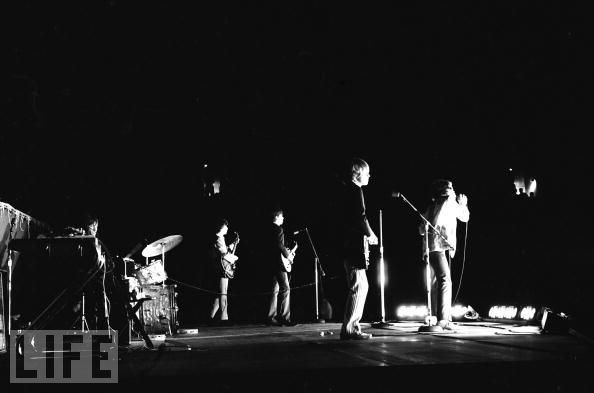
So with all that in mind, imagine the passionate crowds which awaited the shaggy ragamuffins from Dartford, the Rolling Stones, on July 2, 1966, appearing in the United States just as radio stations were buzzing with their number one song, ‘Paint It Black‘.

After three opening acts (including the Trade Winds), the Stones played ten songs at Forest Hills (pictured above), including ‘Lady Jane’, ‘Get Off My Cloud, and of course ‘Satisfaction’, to a crowd of 9,400 people.Yes, believe it or not, they didn’t sell out the venue, but that’s because the most expensive seats (an unheard-of $12.50!) went unsold, and the temperature for the outdoors concert was in the high 90s.

But those that were in attendance were frenzied enough that 250 cops were deployed to the show, armed with tear gas and nightsticks, holding back frothing audiences of young people sent “into peroxsyms” by the British stars. “A dozen youngsters willfully broke through the police line,” according to the Times. “Within seconds the park lights went up and the Rolling Stones’ helicopter took off into the night.”

Far from the maddening crowd, members of the band hit the club circuit in Manhattan, first Cafe Wha? in Greenwich Village, and then Ondine’s at 59th Street, where they were wowed by the energy of a young guitarist named Jimi Hendrix.**

And here’s some further context you should keep in mind. That was the summer of 1966. The biggest American musical artist that year was actually two young sons from Forest Hills, Queens — Paul Simon and Art Garfunkel — and their album The Sounds of Silence would become the biggest album of the year.

Believe it or not, the tennis club lost its bid recently to become a New York landmark.

Top picture courtesy the Rego-Forest Preservation Council

*Mr. Atterbury also played a significant role in the renovation of New York’s City Hall in the early 1900s. We have a ball with Grosvenor in our City Hall podcast from 2009


**There seems to be a little confusion here. Keith Richards bios recall Cafe Wha?, while the diary of Bill Wyman mentions Ondine’s. Hendrix played at both venues a few times, so either (or even both) is possible. Keep in mind, everybody was probably stoned.
Categories
Mad Men

‘Mad Men’ notes: New Jersey invades the Statue of Liberty


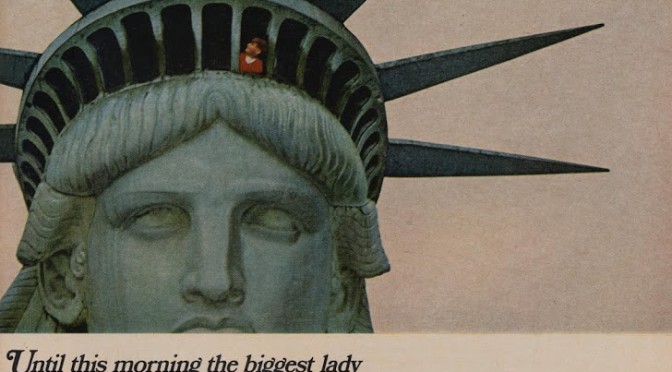
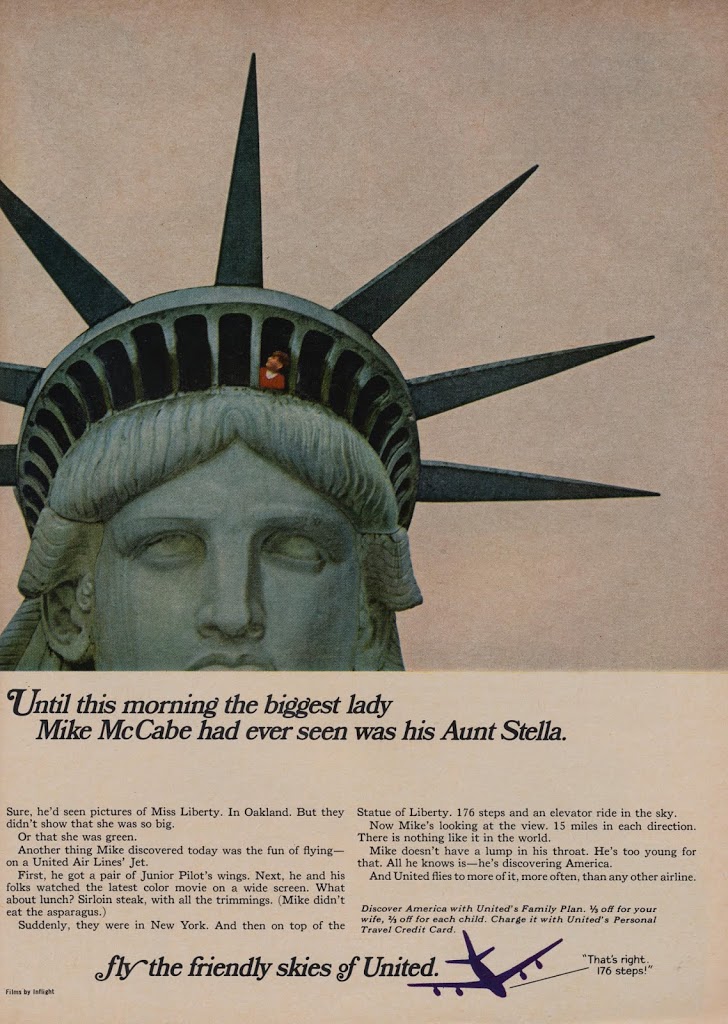
The lady of Liberty Island makes an appearance in a 1965 United Airlines ad campaign. Don Draper, of course, prefers American Airlines. (Courtesy Flickr/What Makes The Pie Shop Tick) 

WARNING The article contains a few spoilers about last night’s show, so if you’re a fan of the show, come back once you’re watched the episode. 


‘Mad Men’ returned to AMC last night, ramping up its regular displays of well-primped, misogynistic Madison Avenue ambition. On Mondays here on the blog, I’ll drill down for inspiration into the smaller details from the show that deal specifically with New York City history. And on Sundays, during the show itself (when possible), I’ll be playing along on Twitter, throwing out little trivia tidbits as quickly and accurately as humanly possible.

Everybody seems to be talking about the slinky performance of Gillian Hill‘s ditty ‘Zou Bisou Bisou — or ‘Zoo Be Zoo Be Zoo’ if you prefer the Sophia Loren version — by Don Draper’s new wife Megan. And civil rights issues finally begin to bubble to the surface when a nasty water-balloon incident by a rival firm (based upon a real event, down to the dialogue!) somehow ends with Sterling Cooper Draper Pryce possibly hiring their first African-American secretary.

But I was struck by a throwaway line uttered early in the episode by Don’s son Bobby Draper — played by yet another young actor, the fourth Bobby in the show’s five seasons. With the children over at Don and Megan’s Manhattan apartment for the Memorial Day holiday, Don emptily suggests this will be the day they go visit the Statue of Liberty. Bobby shrugs and says, “We always say that, but we never do.”

The remark is meant to imply all the cheerful, all-American things that the Draper family never seem to do together anymore. When Don drops the kids off at the home of ex-wife Betty and her new husband, he refers to the couple inside as ‘Morticia and Lurch‘. (Did Don know that ABC had just cancelled The Addams Family the month before?)

Oh, but I do wish the Drapers had gone to the Statue of Liberty at that moment, in late May 1966, as they might have witnessed a rather remarkable sight — the virtual invasion of Liberty Island by stolid representatives from Jersey City!

Once called Bedloe’s Island, the alleged hiding place of pirate’s treasure and the home of Frederic Bertholdi‘s statue since 1886, Liberty Island actually sits within the state line of New Jersey, as does its partner Ellis Island. In fact, some of Ellis Island’s reclaimed land is still considered part of New Jersey. However, Bedloe’s has been within the jurisdiction of New York since a compact between the two state governments was signed in February 1834.

New Jersey has not always been happy with this arrangement. On the afternoon of May 23, 1966, a group of over four dozen Jersey City Chamber of Commerce members stormed across the water and ‘conquered‘ Liberty Island, pressing their contention that the island should be part of their state.

With ‘the Federal Government cooperating as a friendly non-belligerent’, the New Jersey businessmen, joined by Jersey City mayor Thomas J. Whelan in a ‘festive, bloodless invasion’, rattled off their demands, including equal recognition of Jersey City and New York, direct access to Circle Line boat service from the island, and even a change to Liberty Island’s postal address.

Don could have even brought his new bride Megan — of ‘French extraction’ as she might say — as a representative of the French government was also on hand to confirm friendly relations between the two parties. (I assume he meant between America and France.) Afterwards, Air France even provided a box lunch to the Jersey City aggressors!

The event was, of course, mostly for show, for greater plans were already in play. In the previous year, the Statue of Liberty and Ellis Island were enjoined as a national monument under one administrative entity, the National Park Service. By October 1966, they were also listed as inaugural members of the U.S. National Register of Historic Places.

The Statue of Liberty often served as a complicated symbol for 1960s political debate, a touchstone for civil rights activists and an ironic construct for many antiwar protesters embittered by the Vietnam War.

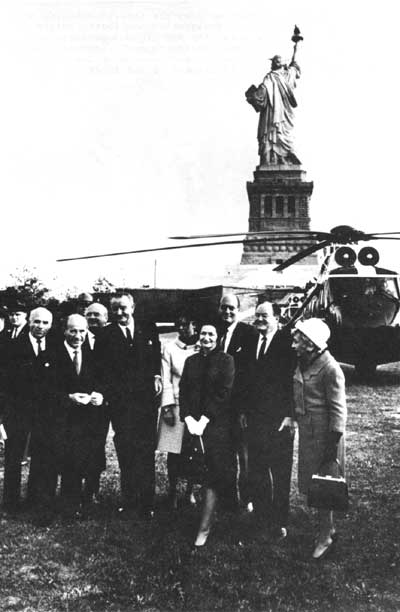
In 1965, the FBI and New York police snuffed out an attempt by the Black Liberation Front to smuggle dynamite onto the island and blow up the statue. That same year, President Lyndon B. Johnson (at right) traveled to Liberty Island to sign into law the Immigration and Naturalization Act, a pivotal and far-reaching change to American policy that essentially eliminated immigration quotas.

A few years later, antiwar activists staged a Christmastime demonstration here, barricaded themselves inside the statue for almost two days. In sad need of disrepair by the late 60s, Lady Liberty even represented a certain dislodging of the American dream to many, a sentiment strongly recognized by the 1970s which led to the statue’s rehabilitation for her 1986 centennial celebration.

Categories
Mad Men

Mad Men 1966-67: Speculation, context and flashbacks

Our favorite randy, drunken Madison Avenue suits return this Sunday with an extra-special long episode of ‘Mad Men‘ this Sunday. As with prior seasons, I’ll try and follow up most shows on Monday with a little historical commentary.

The wonderful thing about this show is that they’re nothing if not hyper-sensitive about historical accuracy. From hints given by producers, it appears the new season will open sometime late in the year 1966 or perhaps early 1967. Some significant events during that year that may come into play on the show, either in major disruptive ways or in fine, knowing details:

— It’s the first year of the John Lindsay mayoral administration. Although he governs over a metropolis in steep financial crisis and paralyzed by striking workers, he still considers it a ‘fun city’.

Pennsylvania Station is ceremoniously demolished. The fate of the treasured train station has been the subject of prior episodes. Could its final destruction represent something more for the troubled ad agency?

The World Trade Center begins construction. I’ll be very surprised if some mention isn’t made of the envious offices with their magnificent views.

— ‘Cabaret‘ opens on November 20, 1966.  Finally, something opens in New York more debauched than an ad agency Christmas party!

— New York’s most fabulous club is The Electric Circus on St. Mark’s Place, drawing the magnificent and the mod, including the entourage of former advertising illustrator Andy Warhol.

— This is the year of color and camp. New on TV: Star Trek, Batman, The Monkees, Dark Shadows

— In 1966, there 385,000 American troops in Vietnam, of which over 6,000 would be killed that year alone. A massive protest hit the streets of New York in April 1967 and dozens burned their draft cards in Central Park. A Maxwell House coffee can was famous used to burn the cards. A new client for Don Draper?

— Cassius Clay had fans last season at Sterling Cooper Draper Pryce. As Muhammad Ali, will he still have them after he becomes a conscientious objector against the war?

The most important album of 1966 comes from two boys from Forest Hills, QueensPaul Simon and Art Garfunkel.

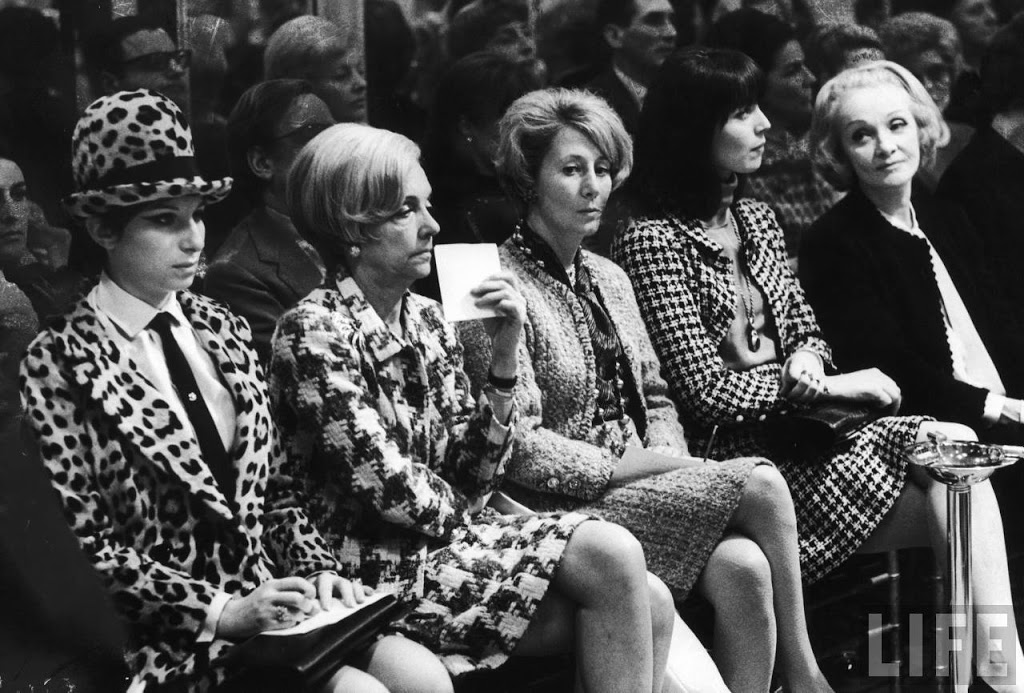
— New York played second-fiddle to the colorful imported fashion trends of London. Fashion became daring, flamboyant and colorful, even the dress suits. Skirt hems elevate. Pictured above: New York’s hottest star Barbra Streisand on one side, Marlene Dietrich the other, and the currency of 1966 fashion in between, at a Paris fashion show. Pic courtesy Life Google images

— A strange year at the movies, the top box office hits were ‘Hawaii‘ and ‘The Bible‘. However the cultural zeitgeist was surrounding the third biggest film of the year — ‘Who’s Afraid Of Virginia Woolf?‘ Can you imagine a time when a stage adaptation was the third biggest film of the year?

— Gay rights protests begin popping up around the Village, including a slightly botched ‘sip-in’ at Julius Bar in April of 1966. Might we see a reappearance of Sal in this context?

— New York gets its first FM rock music station in 1966 — WOR-FM. While I doubt this fact makes the show, expect a soundtrack heavily laced with sweat and reverb. (Or perhaps, laced with something more tangible?)

— On top of color televisions, potential clients for the agency include such newfangled inventions as disposable diaper, the synthetic fiber Kevlar, lawn replacement AstroTurf, the sugar substitute NutraSweet and any product related to the American quest to reach the moon.

Here’s a sampling of some articles I’ve written for the blog on ‘Mad Men’ episodes. You can find them all by clicking on the label ‘Mad Men‘:

‘Mad Men’ returns: a guide to eating (and drinking) options
‘Mad Men’ notes: The once and future Hotel Pennsylvania
‘Mad Men’ notes: A movie theater classic in its final days
‘Mad Men notes: Naked truths about New York nudism
‘Mad Men’ notes: Upscale flowers in a mystery mansion
‘Mad Men notes: Konnichiwa, New York City!

Categories
Mad Men

‘Mad Men’ returns: a guide to eating (and drinking) options

Drama for dinner: ‘Mad Men’ meals go down best with fifteen cocktails

AMC’s ‘Mad Men’ returns for its fifth season this March. Until somebody goes ahead and develops a TV show about Peter Stuyvesant and New Amsterdam, the award-winning Madison Avenue drama is the closest we’ll get to straight-up New York City history TV. The writers cleverly embed the action within very specific 60s locations throughout the city. During the season I try and delve into those locations in our regular ‘Mad Men’ feature


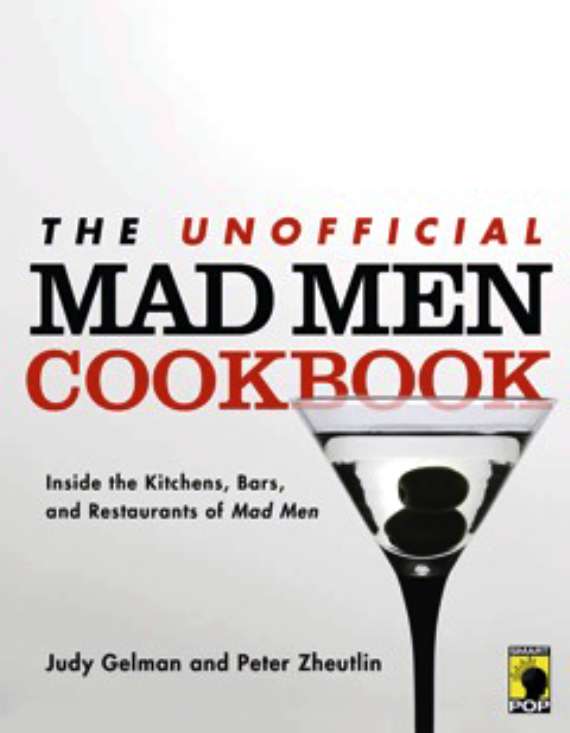
So what, then, to make ofThe Unofficial Mad Men Cookbook: Inside The Kitchens, Bars and Restaurants of Mad Men’, by Judy Gelman and Peter Zheutlin? My first thought, naturally, was, “They eat on ‘Mad Men’?” They certainly flirt over dinners at times. Carla, the Draper’s housekeeper, tortures over hot meals that often get uneaten as Betty sulks and Don swallows down bourbon.

But ‘Mad Men’ is a show of lounges and restaurants, of decorum and indulgence, adrift in a rising stream of booze. It’s also a show of dizzying, if cynical, nostalgia. And that’s the secret of this fun little volume. The particular dishes featured in the book may have been seen or mentioned on the show. But the recipes themselves are straight from the kitchens of New York’s most famous eateries and from original 1960s magazines and cookbooks.

The authors frame each dish within the context of a certain episode. For instance, a recipe on gazpacho and rumaki is prefaced with the description of Season 2, Episode 8, the episode where Betty presents dishes from around the world to her guests (including, you may remember, the at-the-time somewhat exotic Heineken beer.)

The recipes aren’t from Betty’s kitchen, but from actual 1960s magazine articles. Sources include ‘The Kennedy Style’, a 1962 Ebony Magazine cookbook, the 1960’s ‘How America Eats’, among a great many others. Original dishes from New York’s great restaurants make an appearance here too — steak tartar and hearts of palm salad from Sardi’s, fettuccine alfredo from Angelo’s, chicken Kiev from the Russian Tea Room, Caesar salad from Keens Steakhouse, and of course, the original Waldorf salad and sold Amandine from the Waldorf=Astoria.

Betty Crocker, Julia Child, Amy Vanderbilt — all the icons of 60s cuisine and ettiquete are represented. Naturally, this means that few dishes are heart healthy. Butter and red meat are a defining theme.

A more classic selection of original New York recipes has perhaps never been assembled. One might squabble over the fact that most of this has nothing much to do with ‘Mad Men’ itself. But let that slide, relax and have a drink from the guide’s cocktail menu, featuring the how-tos on such classic sips as the Stork Club Cocktail, the 21 Club Bloody Mary and the Classic Algonquin Cocktail (whiskey, vermouth and pineapple juice), all sourced from the original establishments.

I was a sucker for this kind of retro mixology back in the days of the ’90s retro ‘bachelor pad’ craze, and ‘The Unofficial Mad Men Cookbook’ could fit right in with your old Esquivel CDs. But this is an entertaining collection of New York recipes, well-researched, and ready for your weekend soirees and viewing parties..

Categories
Mad Men

‘Mad Men’ notes: Remembering the Times Square HoJo

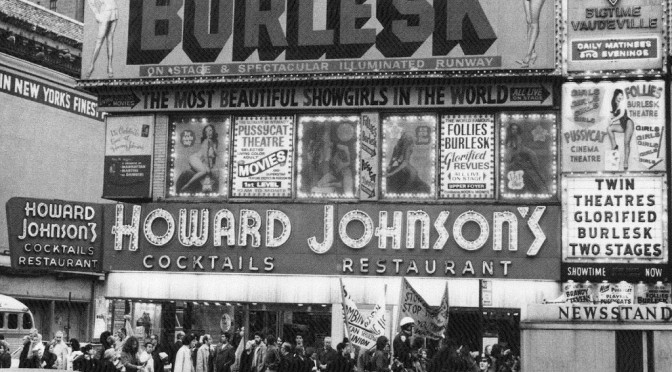
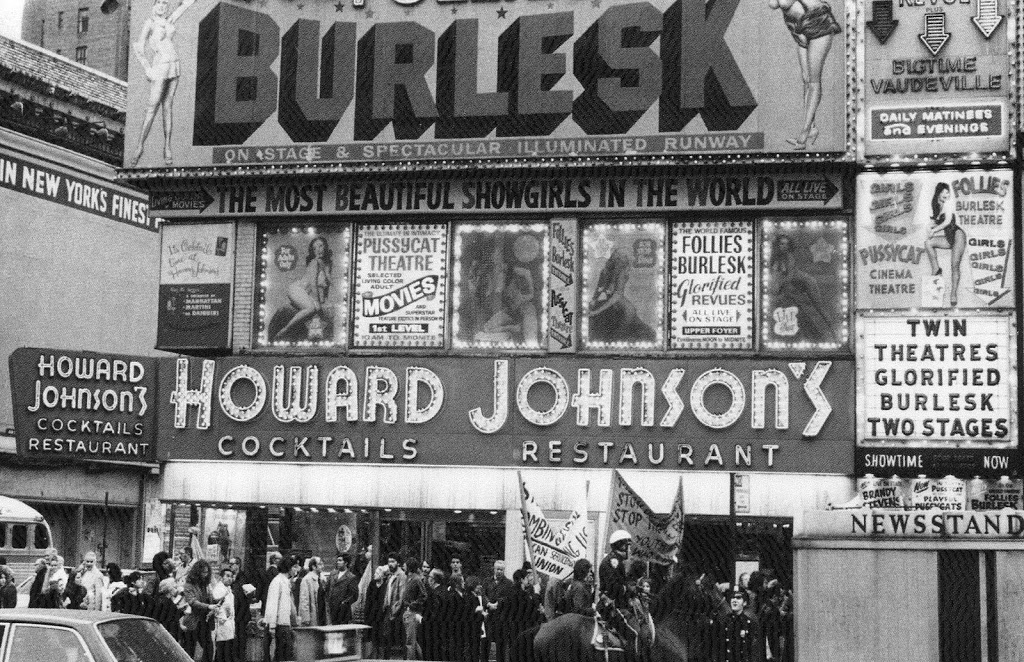
Howard Johnson at 46th Street: Dinner and a movie, all in one corner! There’s even Vietnam war protesters outside. (Photo by Bob Gruen, taken 1972, courtesy Ephemeral New York)

Every Monday I’ll try and check in with the Mad Men episode from the night before and focus in on one or two historical references made on the show. Spoilers aplenty, so read no further if you don’t want to know….

I was disappointed with last night’s season finale of Mad Men, not because of the out-of-nowhere shenanigans of Don Draper, but because a full half of the show took place in Los Angeles, leaving precious little opportunity for historical references. In fact, the two big references were L.A. originals, Disneyland and Whisky-a-Go-Go, which would have been only a year old in 1965.

But thankfully there was a brief mention (via Peggy’s hipster friend Joyce) of a treasured Times Square staple, and a place that most New Yorkers think of with great fondness — the Howard Johnsons restaurant at 46th and Broadway.

Nowhere on the planet could you find a more delicious plate of cheese fries or a dirtier martini. It stood for many years as the last remaining relics of the Times Square’s transitional period between glitz and grit, a stubborn throwback of authentic diner glamour. When it closed in 2005 — replaced with an American Eagle Outfitters — I’m was shocked that Time Square didn’t cave in on itself, as though HoJo’s and its greasy, glorious food were all that was holding it in place.

By the 1950s, the chain of hotels and restaurants founded by Massachusetts entrepreneur Howard Deering Johnson had spread throughout the United States, providing hearty and wholesome sustenance to mainstream, middle-class Americans. It was as ubiquitous and as recognizable with its orange roofs and friendly signage as McDonalds. So much so that Time Square alone had three of them, the first here at 49th and Broadway, a hole in the wall that had once employed up-and-coming actors Lily Tomlin and Gene Hackman. The HoJos here at 46th and Broadway, surviving the others, opened in 1955.

Nothing reflected the changes of Times Square more than this corner. Above the HoJo had been the glorious Orpheum Dance Palace, a once popular and rowdy dance hall that soon offered patrons their very own ‘private dancers’ and was closed down in 1964 for prostitution. It then became a porn theater called the New Parisdescribed as smelling “like decayed flesh in there, a lot of bodily fluids” — and later was later split into two spaces, housing a small legit theater (where A Perfect Crime ran for years) and the Gaiety male strip club.

And all the while, the Howard Johnsons below it retained its glittered-tile elegance, refusing to update their signs or menus. In the 1980s, it was an ideal spot to watch theater-goers and prostitutes. Penn Gillete (of Penn and Teller fame) had Friday night meet-ups here before heading off with a crowd for a weekly midnight movie screening.

In the ’90s, the now beaten but still thriving diner stood in contrast to the changing fortunes of Times Square, dwarfed by the multi-million dollar makeover. Eventually its corner real estate became too valuable for it to survive and it closed in 2005 — one of the last Howard Johnson’s restaurants in America. I miss it very much.

HoJoLand has a lovely tribute — full of photographs — of several former New York HoJos, including the Times Square locations.

ALSO: You might have heard a character mention the name Abe Beame, the city comptroller who ran for mayor in 1965, losing to John Lindsay (who’s also been name dropped on the show). Abe of course would get his chance to rule New York nine years later.

That’s it for Mad Men this year. Please go here if you’d like to go back and read prior articles based on references made on the show.

Categories
Mad Men

‘Mad Men’ notes: The once and future Hotel Pennsylvania


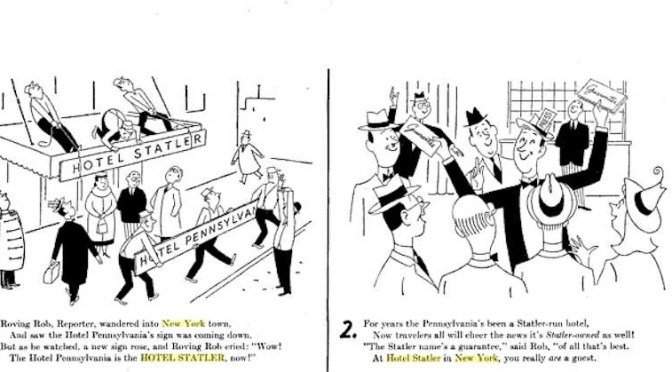
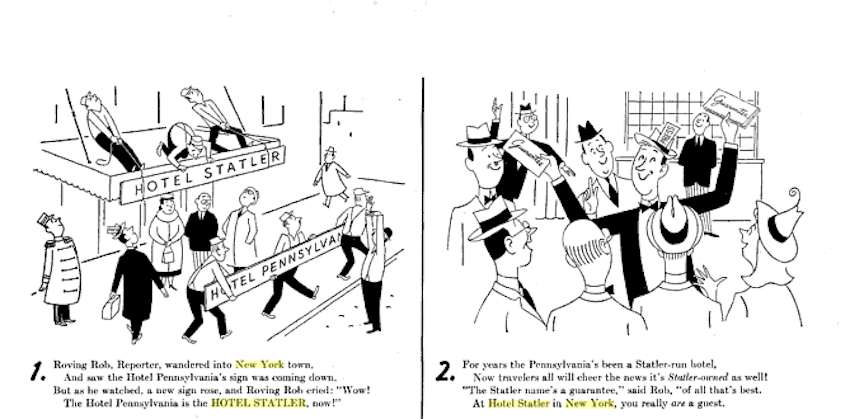
From a Statler Hotel advertisement in Life Magazine, dated January 10, 1949. Click in to the illustration to read the text

Every Monday I’ll try and check in with the Mad Men episode from the night before and focus in on one or two historical references made on the show. Spoilers aplenty, so read no further if you don’t want to know….

The offices of Sterling Cooper Draper Pryce were so busy imploding this episode that the characters barely left their offices. Except of course for Roger Sterling, in the midst of a game-changing lie and scrambling to save face. He was supposed to be in Raleigh, NC, convincing his number one client, Lucky Strike, not to leave the agency. But he knows that conversation is futile, so Roger is literally hiding out in Manhattan, “at the Statler.”

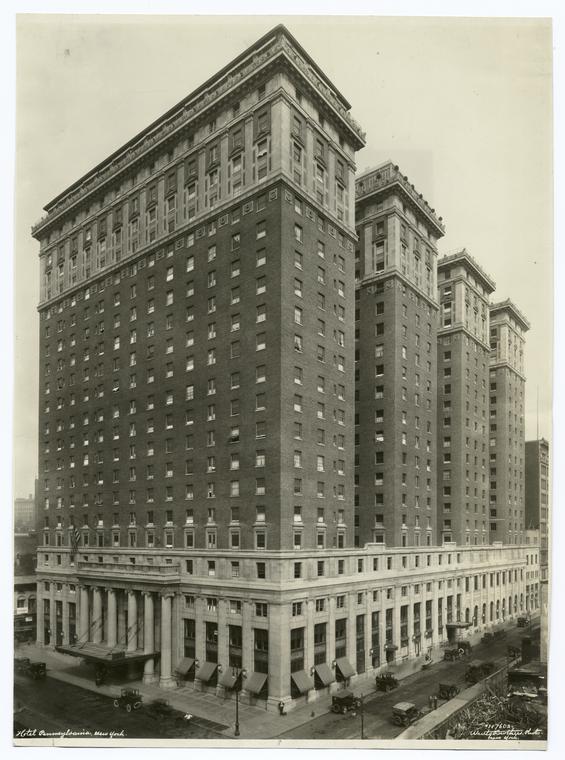
You may know this hotel by its first name — which also happens to be its current name: the Hotel Pennsylvania. The grand, columned 22-floor accommodation was built in 1919 across the street from the newly built Pennsylvania Station and also shared the firm of McKim, Mead and White as its architect.

It was a Statler property from the start. Ellsworth Statler, a hotelier from Buffalo, leased the property from the Pennsylvania Railroad and managed it until his death in 1928. His company kept expanding, however, and in 1948 bought the hotel from the financially ailing Penn Railroad and placed their name over the awning. An easy decision: the Statler brand had built itself a sterling reputation by the 1940s.

Its most valuable asset was certainly the elegant Cafe Rouge ballroom which hosted the very finest in Big Band performers, most famously the orchestras of Glenn Miller and Tommy Dorsey.

By the 1950s, the Statler organization merged with the ascendant Hilton chain. And thus the Hotel Statler became the Hotel Statler Hilton until the 1980s. After a couple more managerial changes, it brought back the Hotel Pennsylvania name in the early 1990s.

Despite its longevity and glamorous reputation during the ’30s and ’40s — its phone number is the subject of the classic song “Pennsylvania 6-5000” — the hotel was rarely considered the highest standard of luxury accommodation.

In 2007, the building’s owner Vornado announced it was ripping down the Hotel Pennsylvania and hoisting up a vast tower that would rival the Empire State Building in the midtown skyline.

You would think that demolishing a McKim, Mead and White creation with the word ‘Pennsylvania’ in its name would rankle preservationists, but it seems there is little interest in saving it.

Preserving that hotel, which has become very seedy, is not anywhere near as important as reusing the Farley building and creating a new rail station. And that’s from an interview with the president of the Municipal Art Society.

The battle for Hotel Pennsylvania’s fate is still ongoing. I would recommend checking out Curbed NY’s coverage for the latest.

Incidentally, the Statler name has been immortalized with a Muppet, namely in the crotchety old men who sit in the theater balcony Statler and Waldorf.

Photo courtesy NYPL Digital, photography by the Wurts Brothers

Categories
Mad Men

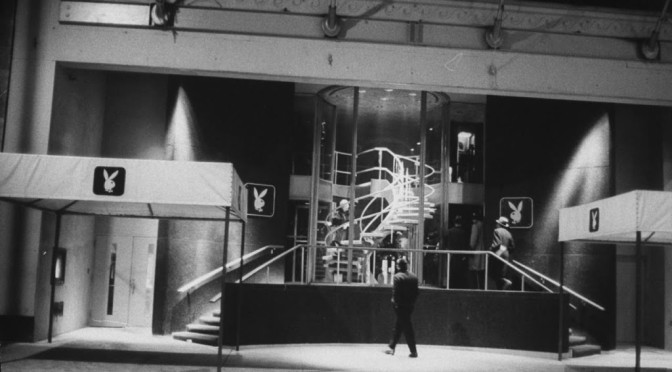
‘Mad Men’ notes: Nights at the New York Playboy Club

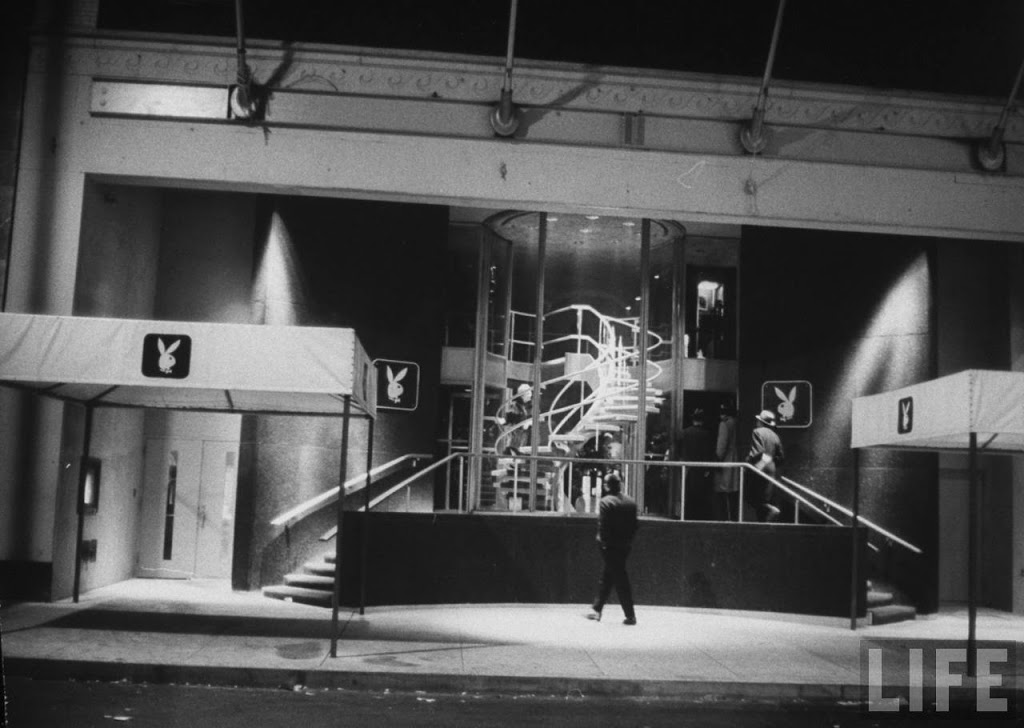
Above: the Manhattan Playboy Club, at 5 East 59th Street

Every Monday I’ll try and check in with the Mad Men episode from the night before and focus in on one or two historical references made on the show. Spoilers aplenty, so read no further if you don’t want to know….

In 1964, a salacious pulp novel was published with the title ‘I Was A Negro Playboy Bunny,” billed with the tagline “The beautiful woman you see on this cover was once a Playboy bunny….read the startling story (in her owns words) of what goes on behind the doors of the wildest sex palace in the world – the New York Playboy club – and behind her own doors!”

This novel might have been an inspiration to the writers of ‘Mad Men’ who featured the New York Playboy Club in last night’s episode, and in particular, an engaging black cocktail hostess formost in the heart (but not the priorities) of one of the partners of Sterling Cooper Draper Pryce.

The author, Anna English, worked at the New York Playboy Club, a Manhattan branch of the successful swanky lounge franchise started by Hugh Hefner in Chicago in 1960. The Manhattan venue was located at 5 East 59th Street (between Fifth and Madison), and, like those in Chicago, Miami and New Orleans, was famously a members-only club; you gained admittance by possession of an exclusive key decorated with the Playboy logo, described by comedian Dick Gregory as “a status symbol, like a Mercedes is now.”

You would think Manhattan would have gotten its own Playboy Club earlier than December 1963, but Hefner had troubles getting his liquor license. “It is a shame that the biggest city in the country should have this sort of problem,” Hef lamented. Due to the political content of the magazine (yes, this was back when people read Playboy), Hefner also had problems with the FBI, which he faced with aplomb, sending J. Edgar Hoover the following letter:

“Dear Mr. Hoover,
Hugh Hefner, Editor-Publisher of Playboy Magazine and President of the Playboy Clubs, has asked me to welcome you back to New York, and to make certain that whenever you wish, the facilities of the New York Playboy Club will be made available to you and your guests.

Therefore, at Mr. Hefner’s request, we are enclosing a special Celebrity Key which will make it possible for you and your friends to visit the Club anytime during your stay. . . .”

(No word on whether Hoover used his gift.)

Like a campy (or campier) version of Hooters, businessmen were greeted by sexy cocktail waitresses, dressed in the trademark Playboy bunny ears and cottontail. A young Gloria Steinem went ‘undercover’ at the New York location for a magazine expose*, revealing some of the more unsavory requirements in the ‘Playboy Club Bunny Manual’. (‘Bunnies are reminded that there are many pleasing means they can employ to stimulate club’s liquor volume’.) You can read the sad, hilarious, thoroughly bizarre article here, featuring the excerpt: “‘My tail droops,’ she said, pushing it into position with one finger. ‘Those damn customers always yank it.'”

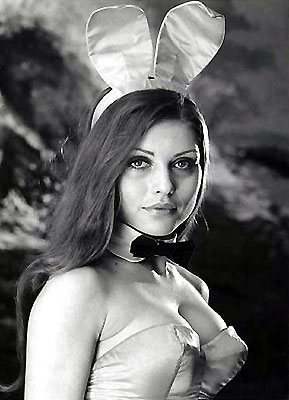
Another notable employee of the Manhattan club? Deborah Harry, making ends meet in a bunny outfit in the late 1960s. Believe it or not, that’s her in the picture, at right.

The shimmery glitz and respectability of the Playboy Clubs (and the misogyny it embodied) faded with the 1970s, and by the following decade, New York’s tattered hotspot was a joke that even People Magazine took a moment to poke fun of: “A large illuminated rabbit’s head glows over the door. It seems impossible now to look at the logo without thinking of an automobile air freshener.” The club closed in 1986.

*Steinem’s article was called ‘I Was A Playboy Bunny’. I believe Ms. English’s book was most likely a play off this title. A 1963 issue of Jet Magazine ran a picture of Anna with a blurb about the club.

Oh, and the major cultural event mentioned in the episode (The Beatles at Shea Stadium)? More on that this Friday….

Top photo courtesy Life Google images; bottom photo from Marlene44

Categories
Mad Men

‘Mad Men’ notes: Here’s to whiskey and Bermuda shorts!

Every Monday I’ll try and check in with the Mad Men episode from the night before and focus in on one or two historical references made on the show. Spoilers aplenty, so read no further if you don’t want to know….

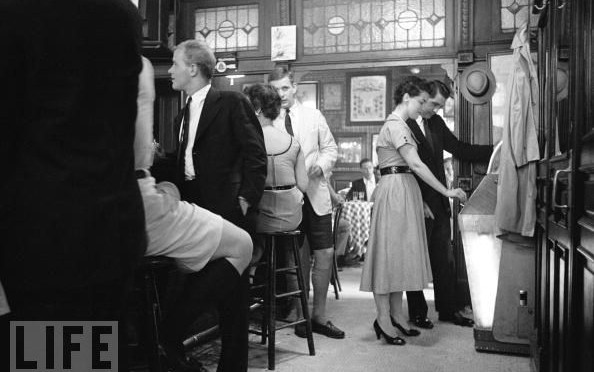
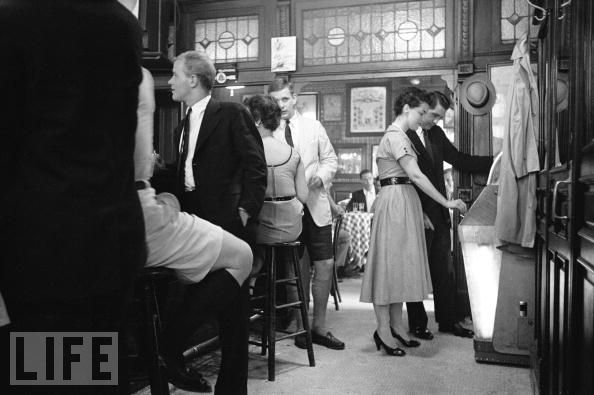
On last night’s episode of ‘Mad Men’, they actually used a tavern that’s still around and kicking — P.J. Clarke’s on Third Avenue. Peggy had a strange altercation with her potential hip cat paramour, leading to her storming out of the bar.

The photo above, by Alfred Eisenstaedt, taken in 1953, demonstrates that the bar has always attracted trendy gentlemen, namely those in Bermuda shorts.

P.J. Clarke’s, a well-preserved example of New York’s Irish heritage, traces its history back to the late 19th century, when the original pub, now shaded by immense skyscrapers, was surrounded by shabby tenements. Its namesake, one Patrick J. Clarke, came along in 1902 and bought the joint from his boss ten years later.

Photo by Alfred Eisenstaedt, Life images

Categories
Mad Men

‘Mad Men’ notes: A movie theater classic in its final days

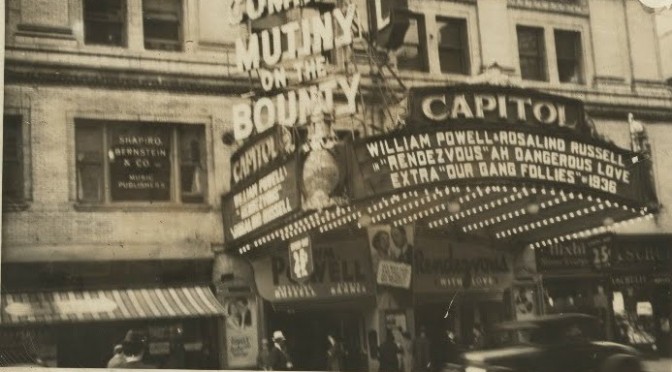
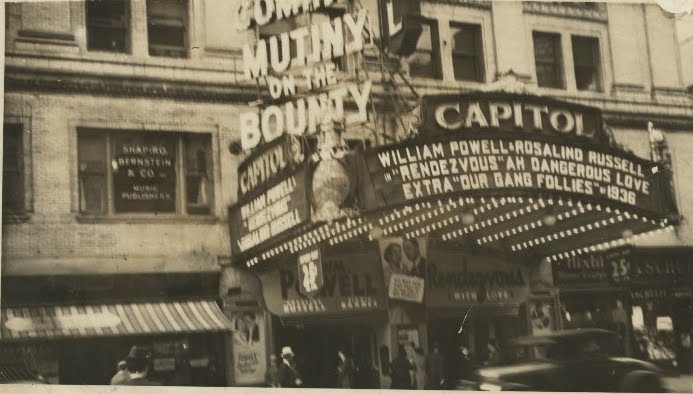
The Capitol in 1935, its feature attraction the spy thriller Rendezvous

Every Monday I’ll try and check in with the Mad Men episode from the night before and focus in on one or two historical references made on the show. Spoilers aplenty, so read no further if you don’t want to know….

While doing some background work on last week’s podcast, I came across an indulgent presentation in the New York Tribune of some elaborate new mural pieces by nearly forgotten painter William Cotton, installed in 1920 on the walls of the Capitol Theater, at Broadway and 51st Street. “The great mural paintings by William Cotton in the Capitol Theater stand to-day unrivaled. There are in America no decorations to compare with them.” (Take a look at these ‘unrivaled’ murals here.)

I crossed paths with the Capitol Theater again in this week’s episode of ‘Mad Men’. Most of the staff of Sterling Cooper Draper Pryce were attending an exclusive screening at the Capitol of the now-infamous Cassius Clay-Sonny Liston prize fight, waged in Lewiston, Maine, in May 25, 1965, a re-match between boxing powerhouses that help solidify the reputation of the future Muhammad Ali.

Like many locations previously featured on the show, the Capitol was past its prime by 1965 and would not make it out of the 1960s.

A movie house designed by architectural wizard Thomas W. Lamb, the Capitol opened in October 1919 and helped establish the template for lavish film palaces, with 4,000 seats, a 25 x 60 feet screen, and a stage large enough to host variety shows, classical music concerts and even radio broadcasts.

Not surprisingly, it was originally managed by Samuel “Roxy” Rothafel, of Radio City Music Hall fame.

By 1965, the stage productions had stopped, but the theater was still hosting spectacular film premieres such as the one on December 22 for ‘Doctor Zhivago’. As the unflappable Bosley Crowther dryly notes in his film review from that premiere: “In the three hours and seventeen minutes (not counting intermission time) it takes to move Robert Bolt’s dramatization of Boris Pasternak’s Doctor Zhivago across the screen, a few rather major things happen.”

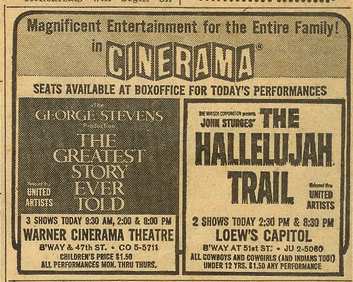
That June, for the now forgotten Burt Lancaster western ‘Hallelujah Trail’, the film studio United Artists threw a promotional barbecue in front of the theater that shut down Broadway.

The theater closed in 1968, but at least it went out memorably: its last two movies were Planet Of The Apes and (starting that April) 2001: A Space Odyssey, both in glorious Cinerama.

So, what’s sitting there now? Mars 2112 (and the Paramount Plaza office tower). It’s too bad they didn’t have Mars 2112 back in the 1960s; I’d love to see Roger Sterling get sloshed on their alien themed cocktails.

Coincidentally, by the way, our ‘Mad Men’ friends were attending a broadcast of a boxing match in a theater that sat only one block from the greatest live venue for boxing in the world — Madison Square Garden, when, in its third incarnation, it sat at 50th Street and 8th Avenue.

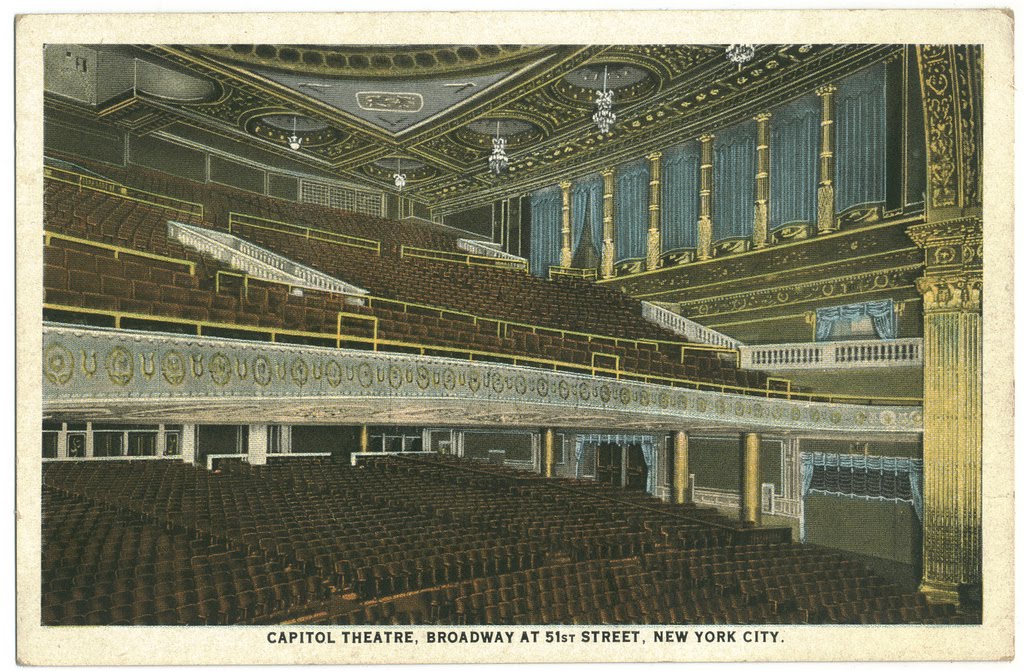
Below: the lush interiors at the Capitol Theatre

Top picture courtesy NYPL Digital Gallery. Movie advertisement courtesy Cinema Treasures You can check out a lovely picture of Times Square in the 1960s featuring the Capitol here

Categories
Mad Men

‘Mad Men’ notes: Naked truths about New York nudism

Every Monday I’ll try and check in with the Mad Men episode from the night before and focus in on one or two historical references made on the show. Spoilers aplenty, so read no further if you don’t want to know….

While the inebriated men of Sterling Cooper Draper Price were accepting Clio Awards at the Waldorf=Astoria, poor Peggy was stuck in a hotel room with a pretentious creative director going over ideas for a campaign for Vicks cough drops. Rizzo, the director, claims to be a nudist, or at least to sympathize with the cause. (Since the impetus of the conversation revolves around looking at a Playboy Magazine, I would say he’s probably a poseur and a faux-nudist.) Goading Peggy, she calls his bluff, strips off her clothes in a sign of liberation and casually settles back to brain storm.

By 1965, the nudism movement (or naturism) was firmly established in America, its proponents gathering in secluded camp grounds for decades, often near urban areas where its philosophies could be more easily disseminated, usually (but not always) among bohemians or extreme practitioners of physical fitness. Rizzo’s casual — but ultimately timid — embrace of a nudist philosophy was certainly not unusual by the mid-1960s and would be popularly corrupted in the practice of campus streaking.

The roots of the American nudist movement start in New York City among a group of German immigrant intellectuals, bringing over a well-established discipline from Europe. Kurt Barthel began the American League for Physical Culture in New York in 1929 as a straight-laced, non-lurid celebration of the human body; as an extreme corollary to the temperance movement, Barthel advocated clean living and eschewed alcohol.

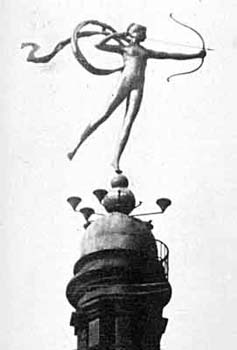
At left: In the days before nudist organizations, even racy sculpture like that atop the old Madison Square Garden could scandalize discreet New Yorkers.

From the little I could find on the early days of this organization, they had their first clothes-off gathering on Labor Day 1929 in upstate New York with seven participants (both men and women), but the organization held meetings in the city, at a Tenderloin establishment called the Michelob Cafe on 28th Street. (NOTE: I can only find evidence of a place called this from various nudist literature and not from any independent source.)

A guidebook to the discipline, called ‘The New Gymnosophy’ (or ‘Nudism In Modern Life’) written by Turkish doctor Maurice Parmelee, could be found in certain bookstores in New York, but was naturally sold behind the counter. Although a dry, philosophical text, the subject would have scandalized book buyers! In ‘Gymnosophy’, Parmelee extolled the virtues of the nude lifestyle, recounting the health risks of clothing and mental strains of bodily shame while being sure to separate these philosophies from common prurient thoughts.

Parmelee writes: “Sex feeling and curiosity…characterize practically all adults who enter the gymnosophic movement. After becoming habituated, sex stimulus through vision usually falls to normal and the initial curiosity is satisfied. [Excerpted in the book ‘Studies in human sexuality’ by Suzanne G. Frayser]

Interestingly, this sociologist and intellectual nudist is perhaps best known as being the author of America’s ‘first criminology textbook’.

Upstate campgrounds were fine (and far away from disapproving eyes) during the summer; but in the winter, the American League for Physical Culture met up a few times a month in a Manhattan gymnasium, and that put its naked aesthetic at odds with New York’s indecency laws. In 1931, one such meeting was raided by the police and Barthel was thrown into jail. In 1932 Barthel founded the Sky Farms nudist colony in Basking Ridge, NJ, the nation’s oldest continually operating nudist facility.

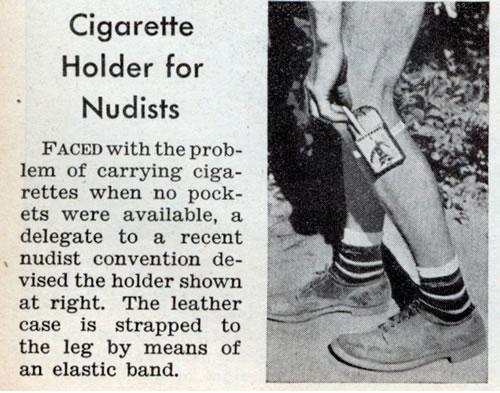
Above: If Don Draper were a nudist. (Photo from Martin Klasch)

By then, nudism philosophies had attracted other New Yorkers, including two librarians from the New York Public Library, Herman and Katherine Soshinski, who started up their own group — American Gymnosophical Association — and their own nudist colony, the Rock Lodge Club in northern New Jersey, still active today. (Who knew there were so many outlets for nudism in New Jersey?)

Categories
Mad Men

‘Mad Men’ notes: Konnichiwa, New York City!

Every Monday I’ll try and check in with the Mad Men episode from the night before and focus in on one or two historical references made on the show. Spoilers aplenty, so read no further if you don’t want to know….

New York’s fascination with Japanese culture has never been because of a particularly large population, especially compared to the city’s other Asian communities. A hearty cluster of Japanese establishments in St. Mark’s in the East Village notwithstanding, there has never been a neighborhood of the size and shape of Chinatown or Koreatown. According to the 2000 census, just over 26,000 people identified as Japanese American, with less than 20,000 foreign-born Japanese residing here.

Instead, Japanese influence in the city has been felt through its wealth and through the success of individual businessmen and women. That’s where wrestler Hiroaki ‘Rocky’ Aoki comes in.

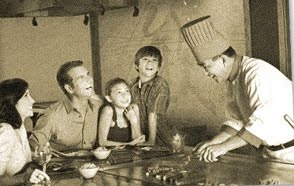
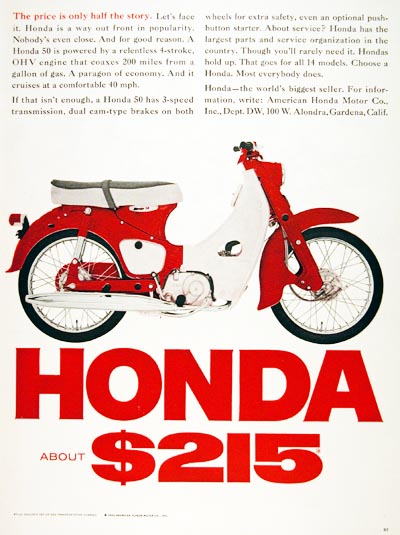
On last night’s ‘Mad Men’, Don Draper must weather some peculiar cultural differences and the prejudices of his own associates to snag a new account, the Japanese motorcycle maker Honda. (See the bottom of this post for an authentic 1965 advertisement for a Honda motor scooter.) In that frame of mind, he takes his date to one particular new midtown restaurant, Benihana, where Japanese food is prepared on grills in front of the patrons by daredevil chefs. A lively and noisy atmosphere, hardly romantic, his date notes.

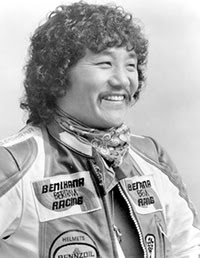
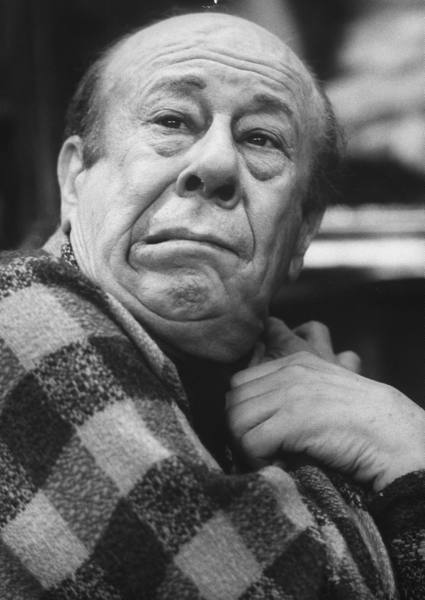
Benihana was the brainchild of Aoki (at right), a wrestler who qualified for Japan’s 1960 Olympic wrestling team (he didn’t compete) and came to America in his early 20s touring the wrestling circuit. He expressed a decidedly entrepreneurial streak, moving to New York in 1963 and he paying his way through business school by, among other jobs, operating a Mister Softee ice cream truck in Harlem.

His curious idea for an eatery — which brought the chef and steel grill into the dining room, preparing steaks and seafood for dizzied diners — was named after his parent’s own restaurant in Tokyo (Benihana, meaning red safflower). He bought out the lease of an unsuccessful Chinese restaurant at 61 West 56th Street* and opened Benihana Of Tokyo on May 1964.

The first restaurant was a tiny affair, much too small — four tables — for the theatricality he envisioned. And New Yorkers were at first confused, even intimidated. Of the few New York Japanese dining spots that existed, they were mainly for Japanese people; the embrace of sushi culture was many years in the future. Here, however, was a bold, dramatic and certainly exotic display of Japanese pomp, serving dishes that seemed somewhat ordinary.
It might had faded like so many midtown culinary novelties if not for the New York Herald-Tribune popular food writer Clementine Paddleford who, late in her career, threw Aoki a rave review. Within months, those four tables were hardly enough to meet demand, and Aoki opened a second location a few blocks east.

Benihana, of course, would be a concept suited for expansion, hitting Chicago and San Francisco before the end of the decade and soon swelling to dozens of locations all over the United States.

Aoki, who died in 2008, was quite an extravagant character, a Lothario (throughout his life, he famously had numerous wives, mistresses and girlfriends) and an avid adventurer, racing speedboats and reportedly even flying a hot air balloon over the Pacific Ocean in the early 1980s. He and Don Draper would have gotten along famously.

*The restaurant moved down the street to its present location at 47 W. 56th Street in 1973.
Pic above courtesy Benihana

For more on New York’s curious history with the Japanese, you might like to check out the brand new exhibit at the Museum of the City of New York called Samurai In New York: The First Japanese Delegation, 1860, taking a look at an entourage of 70 samurai who held court in the city 150 years ago.

And finally, courtesy of ADclassix (visit their page to order a print):

Categories
Mad Men

‘Mad Men’ notes: Swanky steaks and a market soiree


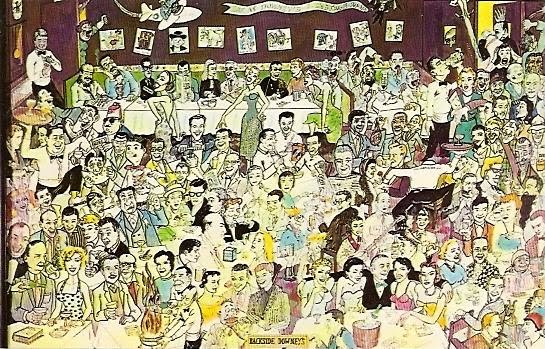
A postcard from Jim Downey’s showing a plethora of theatrical faces who frequented the place.

Every Monday I’ll try and check in with the Mad Men episode from the night before and focus in on one or two historical references made on the show. Spoilers aplenty, so read no further if you don’t want to know….

There were two long-gone destinations used in last night’s episode of ‘Mad Men’ to delineate the old and the new, contrasting the square with the hip.

Two former ad rivals Pete Campbell and Ken Cosgrove bury the hatchet over a meal at Jim Downey’s Steak House, a dapper theater-district hangout at 705 Eighth Avenue (at 44th Street), started in the late 1950s by an Irish immigrant who won big at the horse races one day and decided to open a restaurant (as the legend goes).

Downey’s, very much in the mold of classic midtown eateries like Sardi’s and Toot Shor’s, was considered more a destination for theater crowds than the professional set, so much so that its dining rooms had theatrical names (like the Backstage Room) and you could frequently find a theater star or two having Irish coffees at the bar, possibly standing by writer Brendan Behan, also a regular. Dustin Hoffman and Robert Duvall sat at a booth very much like the one depicted on the show, discussing women and literature.

The restaurant was closed by the early ’80s, taken over by a Cajun restaurant, although Downey’s sons opened steak houses in other parts of the city.

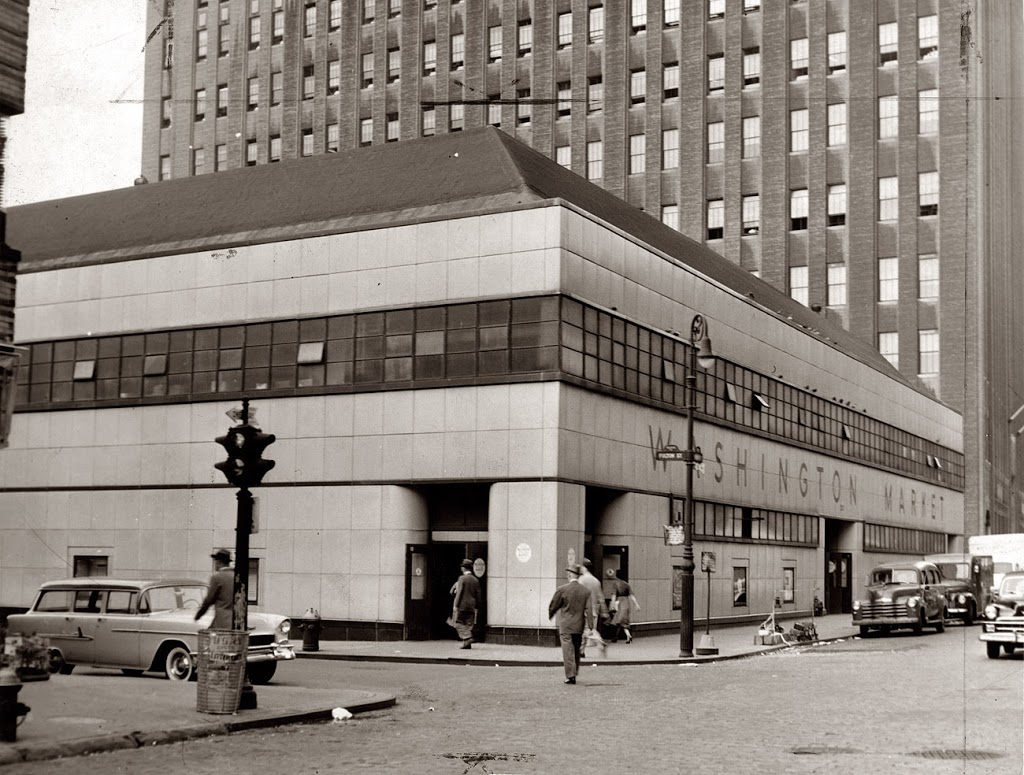
Meanwhile, Peggy Olsen got herself invited to a happening, or rather, an “I don’t even know what to call it” at old Washington Market (pictured below), the once lively indoor marketplace downtown. By 1956, however, the vendors — at one time, over 800 of them — had moved out (most up to the Hunts Point in the Bronx) and the forlorn shell of the building sat abandoned. It was eventually ripped down in 1967 to build the World Trade Center.

(Picture from Shorpy)

Categories
Mad Men

‘Mad Men’ notes: Upscale flowers in a mystery mansion

Every Monday I’ll try and check in with the Mad Men episode from the night before and focus in on one or two historical references made on the show. Spoilers aplenty, so read no further if you don’t want to know….

Last night’s episode of ‘Mad Men’ spent one half of the episode in California and the other half following the two office divorcees (Don Draper and his British partner Lane Pryce) on a raunchy boy’s night out in the Village. Pryce had been victim earlier in the episode of a disastrously slapstick mix-up: his secretary accidentally switched the notes in two boxes of roses, sending a heartfelt card intended to his ex-wife instead to office manager Joan, and vice versa. Joan responds by storming his office, tossing the flowers in his face, then firing Pryce’s befuddled secretary. Wacky!

At least the newly unemployed woman had the good sense to order the flowers from Rhinelander Florists, one of the poshest places to get your bouquets on Madison Avenue in the 1960s.

Rhinelander (867 Madison Avenue) was opened in 1936 by Frank Tomaino, a former gardener for Huntington Hartford, the old-money retail magnate who owned the A&P supermarket chain, and perhaps it was through these connections that Tomaino was able to accumulate a client list that included “the Rockefellers, Astors and Whitneys” (according to his obit).

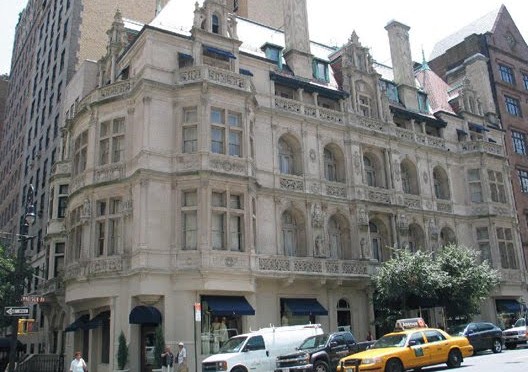
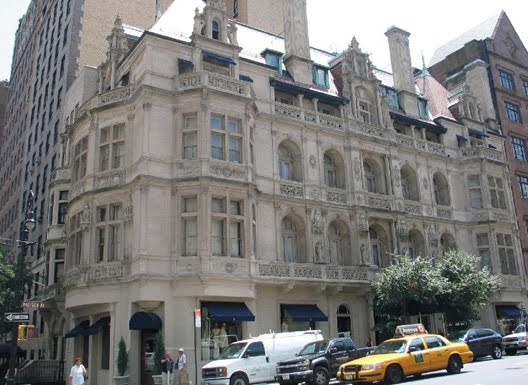
Just as likely however it was the desirability of Tomaino’s choice location and that which he chose to name his business — the mysterious Rhinelander Mansion at 72nd Street. The lushious manor, dripping with old world Beaux-Arts elegance, is notable in that its eccentric owner, Gertrude Rhinelander Waldo*, never bothered to move in when it was completed in 1898.

Mrs Waldo, heavily in debt, didn’t seem to have a knack for real estate. According to historian John Tauranac: “In 1908, a ‘For Sale’ sign hung in front of the building, but there was no sale, as much because of Mrs. Waldo’s price tag as her impetuosity. One broker had practically consummated a sale, but while the papers were being drawn up Mrs. Waldo calmly said, ‘I don’t think I’ll sell,’ and walked out.”

The mansion was left unoccupied — and quite unkempt, to the consternation of neighbors — until 1911, when Gertrude passed it on to her sister, who didn’t want to live here either.

The first floor was made into retail spaces in 1921, and it was fifteen years later, I believe, when Tamaino moved in. His business faced Madison Avenue and would go on to share the building with a corner pharmacy. By the 1950s, the upper floors were finally occupied, and how — by the photographer Edgar de Evia, known for his work in ad campaigns for products like Borden Ice Cream, and for fashion spreads taken here in his very own rustic home, famously transformed into a hazy, Miss Havisham-style set piece.

Rhinelander Florist was well associated with the floral needs of upscale Upper East Side clients. In ‘The Two Mrs. Grenvilles” by Dominic Dunne, he writes, “Babette told her to look up the Grenvilles in the Social Register at Rhinelander Florist on the corner of Madison Avenue and 72nd Street.”

By the 1980s, the florist pops up at a Sixth Avenue location. Tomaino died in 1988, and by then, the Rhinelander Mansion was in the throes of a massive renovation, courtesy Ralph Lauren, who turned the dusty old relic into the retailer’s flagship store in 1986.

*You may know Mrs. Waldo’s son Rhinelander Waldo, who was fire commissioner for New York City during the Triangle Factory Fire, and briefly the city’s police commissioner, famous for promoting officer Charlie Becker to the head of the anti-vice squad. (Listen to our Case Files of the NYPD podcast to hear about Becker’s strange fate.)

ALSO: Don and Lane fill up their flasks and hit a movie theater for some loud, obnoxious heckling. I’m not a big Godzilla fan, but based on chronology, the film they were watching had to be ‘Godzilla vs. the Thing’, more popularly known as ‘Mothra vs. Godzilla’ — unless they were at a revival house watching the original 1954 ‘Godzilla’.
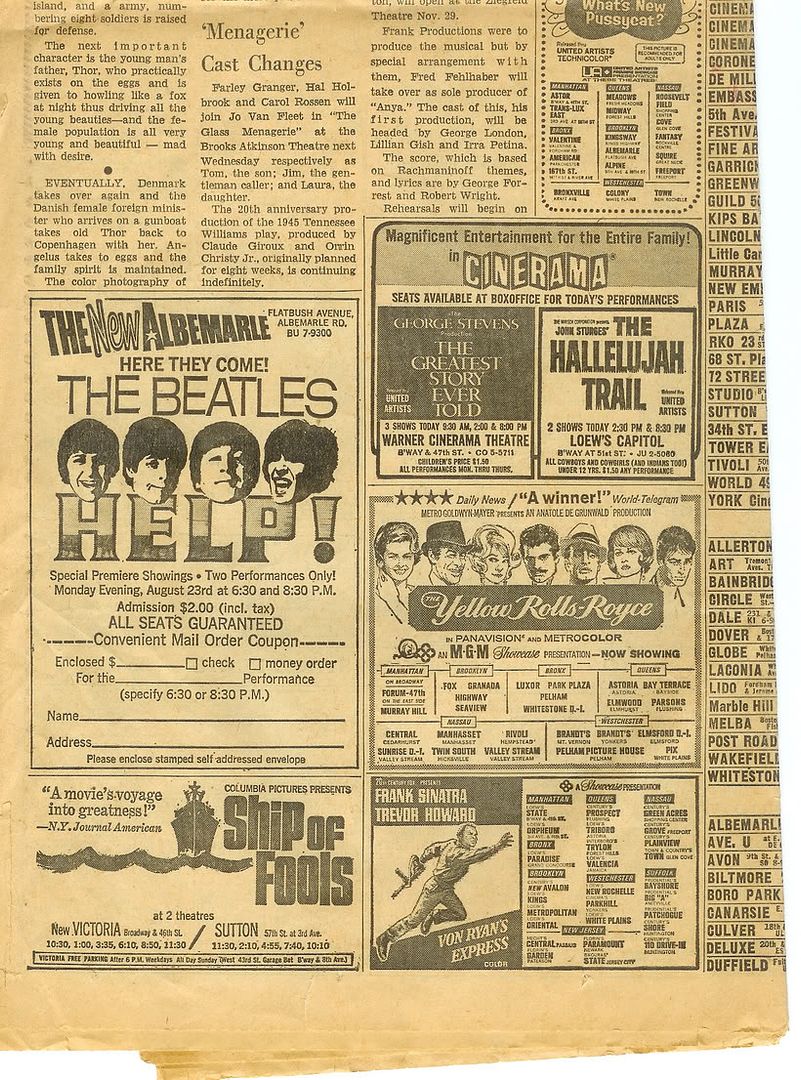
Photo above from Racked

Categories
Mad Men

‘Mad Men’ notes: Swan song for a lion of Broadway

Every Monday I’ll try and check in with the Mad Men episode from the night before and focus in on one or two historical references made on the show. Spoilers aplenty, so read no further if you don’t want to know….

It’s Christmastime, December 1964, and our favorite upstart ad agency, in order to impress their primary client Lucky Strike, throw a wild, boozy office party which, being Mad Men, naturally leads to all sorts of inappropriate work behavior.

Meanwhile, down at Don’s Waverly Place bachelor pad, he meets his neighbor, a nurse from nearby St. Vincents Hospital — a bittersweet mention, as the hospital shut its doors earlier this year.

But it was one of the very first lines of dialogue that caught my attention last night, as Don’s secretary Allison brings in a resume from a young woman (named Violet) whom Don had met — had flirted with, assumably — at the Ziegfeld Theatre. The line is probably a throwaway to set up a shocking hookup between Don and Allison later in the show, but it’s a casual nod to an old theatrical treasure.

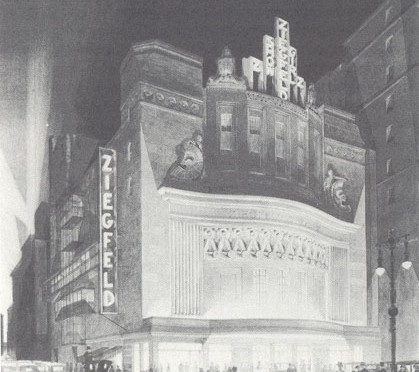
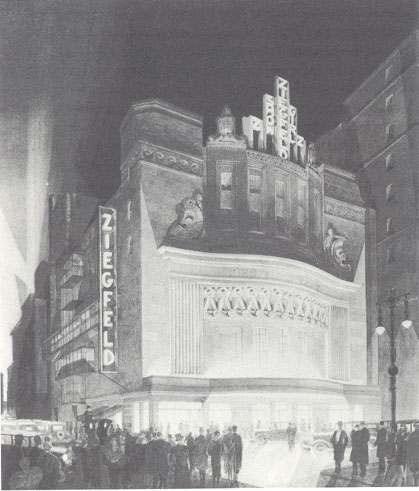
This isn’t the lavish Ziegfeld movie theater at West 54th Street, because that wasn’t built until 1969. Rather, this is a reference to the original Ziegfeld, built by Florenz Ziegfeld himself back in 1927.

The first Ziegfeld was just slightly down the street from today’s Ziegfeld, at Sixth Avenue at W. 54th St. (That would place it just a couple blocks north of Sterling Cooper Draper Price’s offices at the Time & Life Building.) A dazzling palace financed by William Randolph Hearst, the theater was hoisted upon the reputation of one of Broadway’s most successful producers, the creator of the sexy spectacular Ziegfeld Follies. Unfortunately, with the Great Depression around the corner, the theater had few successes under Ziegfeld’s personal direction (Showboat being one) before it transitioned into a movie house in 1933.

It returned to a legitimate Broadway stage in the 1940s, then became a recording studio for NBC’s upstart television operations in the 1950s. However, by 1964, the Ziegfeld was back in a musical state of mind, in the throes of one final attempt to capture the glories of live theater.

That February, producers dusted off the footlights and reopened with a vehicle for one of the old kings of vaudeville Bert Lahr (best known to film buff, naturally, as the Cowardly Lion of ‘The Wizard of Oz’.) In ‘Foxy’, Lahr sang and generally hammed his way through a light musical (by Robert Emmett Dolan and Johnny Mercer) about gold prospectors in the Yukon. Critics loved it, and Lahr went on to grab the Tony Award for Best Actor, his final theatrical award before his death in 1967. Audiences, however, were less enamored; the show closed in April 1964.

At right: Lahr in ‘Foxy’, 1964. Pic courtesy LIFE

I’m not sure if Don Draper would have actually met anybody at the Ziegfeld in December 1964, as there were no shows running. Although perhaps NBC was still using it at this time as a soundstage; certainly Don might latch onto a script girl or production assistant while visiting a client filming a commercial.

The Ziegfeld tried one final time for glory the following year, in November 1965, with Anya, a musical variant of the story of Anastacia, the alleged last surviving member of the Russian royal family. The dowdy show was put out of its misery with a couple weeks, and the theater itself, sadly, was demolished the following year and replaced with s 50-story skyscraper, currently the home of international finance firm Alliance Bernstein.

For more information on Ziegfield and the theaters that bore his name, check out our podcast on the Ziegfeld Follies.

And speaking of coy New York City history references, I hope you caught a remark made on the AMC show ‘Rubicon’ following ‘Mad Men’. Standing on one of the piers south of the Seaport, looking out at the East River, a character remarks: “My great-grandfather Horace started a ferry line between here and Brooklyn. It expanded to New London and south of Baltimore. Did pretty well for himself, until he was gobbled up by that prick [Cornelius] Vanderbilt.”

A TV shout-out to a debonair palace for independent women


postcard from Old New York

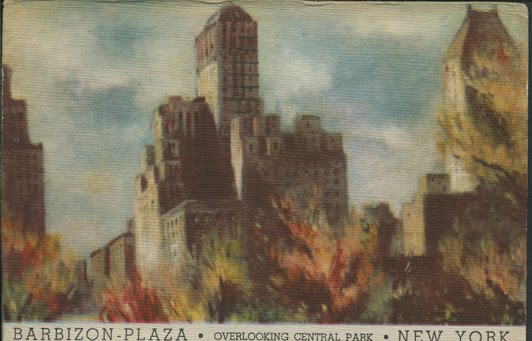
With Mad Men making its return last night on AMC, myself and many other bloggers (like the fabulous Natasha Vargas-Cooper and the folks over at the City Room) are scouring the episodes for fun New York City history references. One of my favorite buildings in the city made an appearance (or at least a notable mention) when, after a blind date, Don Draper drops his actress lady friend off at her home at the Barbizon Hotel for Women at 140 E. 63rd Street.

The Barbizon was a high-end complex for actresses and models, “a combined charm school and dormitory,” “the city’s elite dollhouse” according to Vanity Fair, offering single woman a luxurious address and a home base to pursue career and network. Some of its inhabitants, naturally, would go on to become major stars — Grace Kelly, Lauren Bacall, Cloris Leachman, Liza Minelli. Little Edie, of ‘Grey Gardens’ fame, lived here from 1947 to 1952 while trying to break into show business.

I personally love the dark grown, arch-heavy exterior, which the AIA calls a “romantic, neo-Gothic tawny brick charmer.” The building opened to men in 1981 and, as the Barbizon 63, is still a rather swanky address.

The Barbizon, however, was not known for sumptuous living back in the day. Apparently, a lady was just supposed to be grateful to be admitted here. The rooms were “not luxurious,” according to a biography on Kelly, “and a new girl’s first impression might have been that her austere quarters resembled a convent cell or a house of correction.” Kelly lived here as a teenager in 1947, quietly reading or having tea in the Barbizon’s dining area.

The building was designed in 1927 by the curiously named design firm of Murgatroyd & Ogden, who specialized in brick hotels and apartment complexes with quirky flair. Two years later, their Hotel Governor Clinton opened across the street from Pennsylvania Station.

(New Yorker ad from 1966 courtesy Ephemeral New York)