Categories
Film History It's Showtime ON TELEVISION

When New York hosted the Oscars

Despite the Academy Awards being a celebration of all things Hollywood, New York has actually hosted the Oscar ceremony on more than one occasion. Or rather, they co-hosted the event — from 1953 to 1957 — in a rare and soon abandoned bicoastal ceremony that taxed the mechanics of television’s earliest production crews.

There were two reasons for this complicated arrangement. NBC, who was broadcasting the event, had most of their principal stages in New York. After all, the first NBC studios were at Rockefeller Center, where they still remain today. Even The Tonight Show, perhaps NBC’s first and most famous Burbank production, filmed in Manhattan until the early 1970s.

Just as important, many film stars were in New York, unable to get out of theatrical commitments on Broadway. And frankly, in the years before international television viewership, the Oscars simply did not have the same urgency as they do today. Thus, the award show came to them.

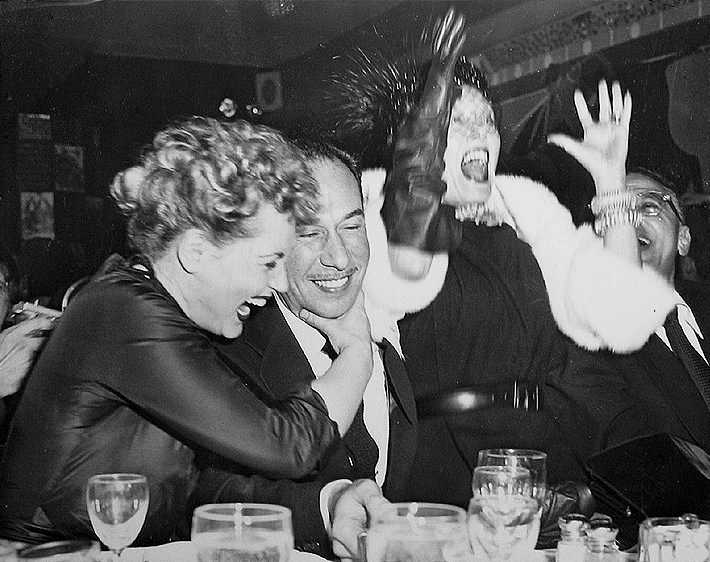
Judy Holliday gives Jose Ferrer a friendly squeeze — and Gloria Swanson bursts with joy — as Ferrer’s name is announced as the winner of Best Actor, at La Zambra in midtown. (Getty Images)

23rd Annual Academy Awards

Best Picture winner: All About Eve
March 29, 1951

Before splitting the broadcast, the Oscars once tried a very strange live radio remote from a New York nightclub.

For the 23rd Annual Academy Awards, held on March 29, 1951, many nominees like Judy Holliday and Gloria Swanson remained in New York. Both Swanson and Jose Ferrer, starring in the Broadway comedy Twentieth Century, were nominated that year.

Instead of disappointing a sell-out theater audience, Ferrer invited all the nominees to an after-theater party at the La Zambra (127 W. 52nd Street), a nightclub owned by Spanish guitarist Vincente Gomez. A live radio link was set up among the tables, and nominees wined and dined waiting for their categories to be announced out in Los Angeles.

The club was hopping that night. Ferrer won Best Actor (for Cyrano de Bergerac), and Holliday won Best Actress (for Born Yesterday), giving their speeches into a radio microphone as champagne corks popped in the background. (Swanson, who thought she might win for Sunset Blvd., was less enthusiastic for Judy’s win.)

It’s appropriate they were in New York, as Ferrer and Holliday both won for film adaptations of Broadway shows in which they had starred. And clearly underscoring the power that the New York stage still had on the film business, Best Picture went to the stage drama All About Eve.


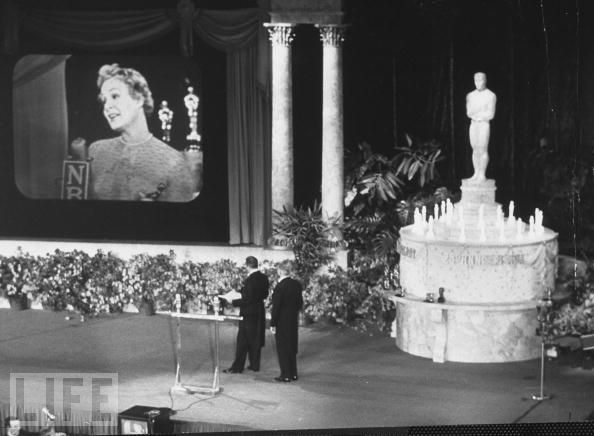
Shirley Booth accepts her Oscar in New York, as the audience in Los Angeles watches on. (LIFE images)


25th Annual Academy Awards

Best Picture winner: The Greatest Show On Earth
March 19, 1953

While the Los Angeles crowd were entertained by host Bob Hope, the attendees to the first official bicoastal New York ceremony were met by co-host Fredrick March, a two-time Academy Award winner. The event was broadcast from 5 Columbus Circle, at the International Theatre.

In 1953, the International was a worn out, tired New York stage, having gone through a host of different owners and renovations since it first opened — as the Majestic Theatre — in 1903. At different periods of time, it was owned by Florenz Ziegfeld and William Randolph Hearst, and its stage played hosts to virtually every form of entertainment, from burlesque to ballet.
Definitely an odd setting for an awards program, especially given that this was also the first Oscar show to be broadcast on television. But the International was owned by NBC, who had agreed to fund the inaugural broadcast. And NBC’s fees to broadcast the program were especially valuable to Academy of Motion Picture Arts and Sciences, as the film studios had refused to fund an elaborate bi-coastal show.

The broadcast began 7pm PST and 10 p.m. here, to accommodate the Broadway stars just stepping off the stage. Due to staggered entrances, many of the seats at the International were empty for much of the ceremony.

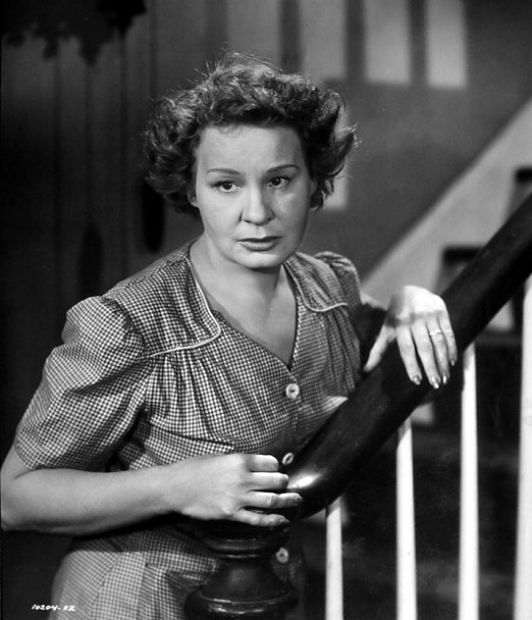
Among the nominees sitting in the Columbus Circle theater was Best Actress nominee Shirley Booth (above), who was starring in the Broadway play The Time Of The Cuckoo on 40th and Broadway at the now-demolished Empire Theatre. She won the Oscar for the film version of Come Back, Little Sheba; she had won a Tony Award for the stage version in 1950.

Given the limitations of early television technology, it’s amazing they were able to broadcast simultaneously between two coasts at all. Glitches did cause a few amusing gaffes for television audiences. When the universally reviled film The Greatest Show On Earth somehow won Best Picture over the favorite High Noon, the camera switched to the New York audience, who sat there not clapping and in mild confusion.

There would not be another Oscar telecast at the International, or anything else for that matter. The very next year, NBC moved out, and the theater was unceremoniously torn down, replaced with one of Robert Moses’ pet projects, the ill-fated Coliseum convention center.


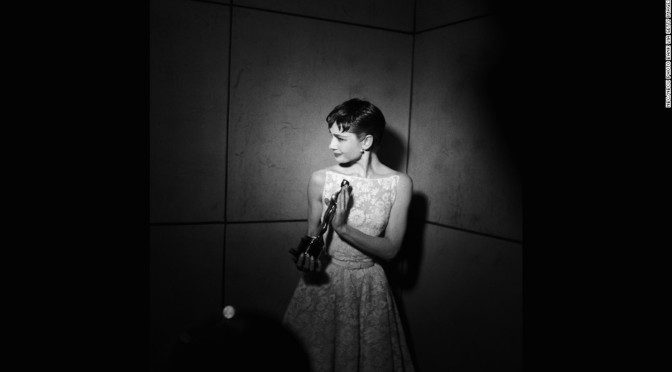
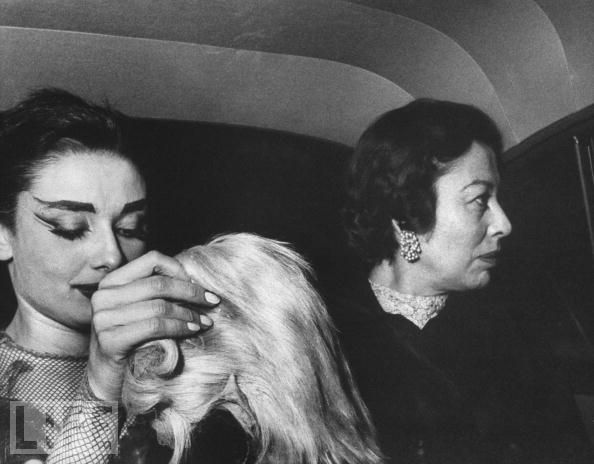
Audrey snatches off her blonde Ondine wig as her limousine races her to the Oscar ceremony uptown.
26th Annual Academy Awards
Best Picture Winner: From Here To Eternity
March 25, 1954

For the remainder of the Oscars’ short stay in New York, they were broadcast from the New Century Theater*, at Seventh Ave. and 58th Street, right off Columbus Circle and best known as the theater that Orson Welles and his spirited cast stormed in 1937 to perform his musical The Cradle Will Rock.

Film fans were set up in bleachers outside, just as they’re popularly done out in Los Angeles. But one New York nominee didn’t get there in time to meet her fans. Audrey Hepburn was down at the 46th Street Theatre performing the play Ondine, costumed in a blonde wig.

After the show, she raced to the Century in a limousine (with police escort, no less), ripped off her wig, rushed to the bathroom to wipe off her stage makeup, then settled into her seat for less than ten minutes before standing again to accept the trophy for Best Actress for Roman Holiday.

Here’s video of Audrey’s win. You can see the ‘switch off’ between the Los Angeles and New York feeds.

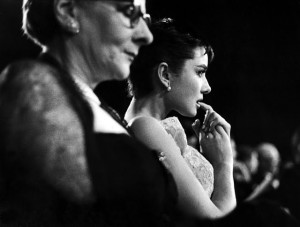
Audrey, off Columbus Circle: Hepburn sits in nervous anticipation at the New Century Theatre, moments before she wins for Best Actress.
The show, hosted in New York again by Fredric March, had another New York icon receiving an Oscar that year — Frank Sinatra, Best Supporting Actor for his role in the Best Picture that year. However, he was in Los Angeles to accept it.

(You can find tons of pictures of Audrey in her post-Oscar glow at the NBC Photo Bank.)

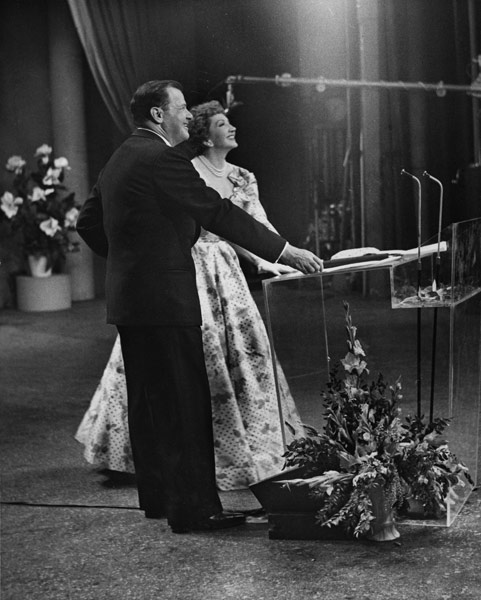
Claudette Colbert and Joseph Mankiewicz presided over a sedate New York audience, while out in Los Angeles, audiences were energized by young comedian Jerry Lewis. (Courtesy Oscars)


27th and 28th Academy Awards

Best Picture Winners: On The Waterfront, Marty
March 30, 1955; March 21, 1956

It became obvious to most viewers that the bicoastal productions were becoming lopsided. After all, it was early evening in Los Angeles, and most of the young, fresh talent was there. In New York, it was post-theater time, and attracted the older stars — some exhausted from stage productions. Nothing exemplifies this more than the 28th Oscar ceremony, hosted in New York by proper Claudette Colbert and Joseph Mankiewicz and in Hollywood by the hot new comedian Jerry Lewis, whose ribald antics made the New York cutaways seem drab.

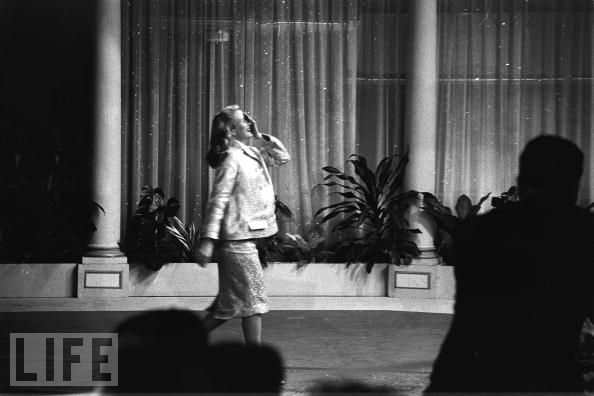
But the awards were all about the East Coast. The Best Pictures these two years were for films set in Hoboken, NJ and the Bronx, respectively. Much of the cast of On The Waterfront were actually at the New York ceremony, including Best Supporting Actress winner Eva Marie Saint (pictured below), her pregnancy concealed by a jacket as she mounted the stage to accept her award. (Here’s the video of her win, again highlighting the difference between the New York and the L.A. ceremonies.) Best Director Elia Kazan was also here to accept his trophy. Marlon Brando, however, was out in Los Angeles, apparently where the fun was.

The following year, this time with Colbert going solo as the East Coast mistress of ceremonies, Best Picture went to Marty, another show originating from New York. But not from a Broadway stage. As a symbolic move towards the importance of the small screen, the Ernest Borgnine vehicle was based on a teleplay from the Goodyear Television Playhouse.

Below: Eva Marie Saint, in shock, approaches the podium to accept her Best Supporting Actress Oscar for On the Waterfront, her tasteful ensemble barely concealing her pregnancy. (Courtesy Life images)

29th Academy Awards
Best Picture Winner: Around The World In 80 Days
March 27, 1957

It was clear by this time that the two coast production was more trouble than it was worth. While Hollywood went with Jerry Lewis again, while New York opted for the elegant but comparatively unexciting Celeste Holm.

The New York Times called it ‘a colossally listless affair.’ One of the few shining moments was an honorary Oscar to New York vaudevillian and Macy’s Thanksgiving balloon inspiration Eddie Cantor.

This would be the last year New York hosted the Oscars. And this would be the last hurrah for the New Century Theatre as well. It would be torn down in 1962 and replaced with the rather sleek, curvy 200 Central Park South co-op.

NOTE: To make this story slightly confusing, New York also had a Century Theatre on the other side of Columbus Circle that was demolished in the 1930s. Hopefully I’ve gotten these theaters all straightened out!

ALSO: You might like to see the Life Magazine photographs of Audrey pictured above in the context of the original Life Magazine article.

This article originally ran in 2011.
Categories
ON TELEVISION Pop Culture

Movin’ On Up: New York City as depicted in the opening themes of 1970s TV shows

In honor of the 100th birthday of television icon Norman Lear (creator of All in the Family, The Jeffersons, Good Times and many, many more) I’ve revised and re-edited this, yes, rather strange round-up originally published in 2013 about New York City and television intros and theme songs.

Please play the TV themes as you scroll through this article. Note that a few of the videos can only be watched on YouTube directly.

And now, on with the show….


The camera zooms over the New York City skyline as an earnest pop tune — usually devoid of any rhythm or edginess, but insanely catchy — descends as though sent from outer space.

The next shot focuses on one particular landmark, a bridge or a park, letting you know, see we’re not in some television studio in L.A., we’re really here, the Big Apple!

Then the scene abruptly changes to an interior of an office or a flat, uninteresting living room, the cheerful face of a person about to embark into a series of adventures in that very city.  

We meet the rest of the cast, a wacky bunch of people, urban people, who find themselves in comedic situations.  The city appears again in the background, but we’re already off with our new friends — the stars of 1970s prime time.

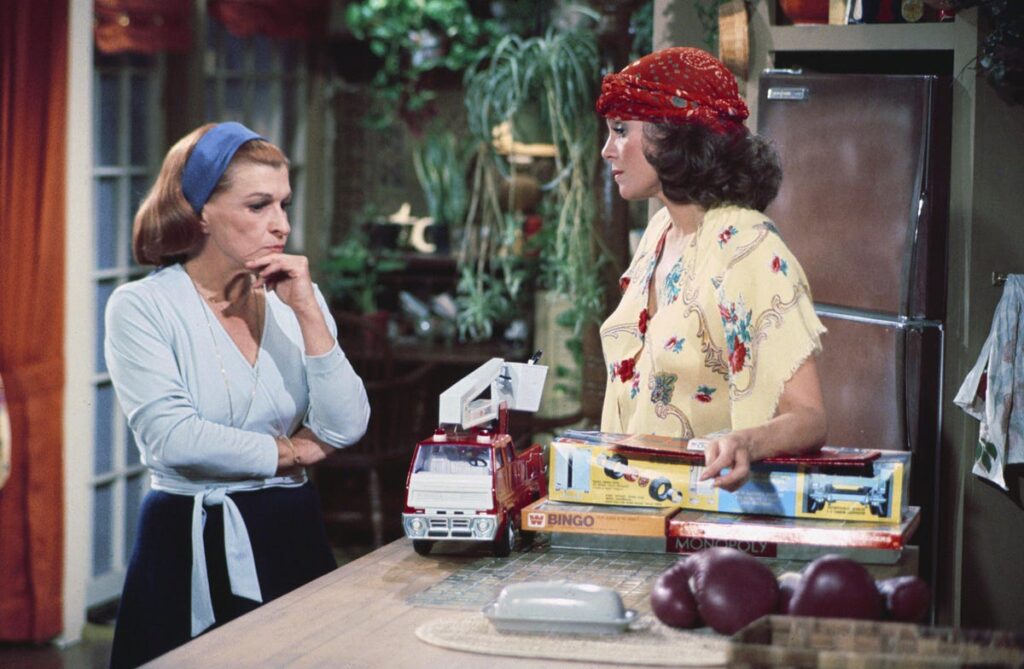
From Rhoda with the great Nancy Walker and Valerie Harper

That’s how a great many television programs began during the 1970s. New York City was heavily represented on television during the decade, an easily identified setting that could be depicted in two or three establishing shots before moving on to introduce the stars.

It popped up in no-nonsense crime dramas and sitcoms alike, an almost singular destination for television characters. After the ‘rural purge‘ of folksy TV shows like Beverly Hillbillies and Green Acres (two shows which lampooned the urban snob), there was little room for small-town America; places like Cincinnati, MilwaukeeChicago and of course Los Angeles filled out the schedule.

In reality, New York was entering a dark period of deteriorating public services, high crime and financial woes. While television news would often dramatically reflect this image out to America, television entertainment would do the opposite.  

Few TV series of the period accurately reflected New York’s troubles outside of a few occasional crime dramas and action shows (like 1977’s Amazing Spiderman).

Of course, most television shows about New York City in the 1970s were actually filmed in Los Angeles. And you couldn’t fault sitcom creators for wanting to eschew real-life troubles that would distract from their clean and cheerful worlds of comic misunderstandings.  

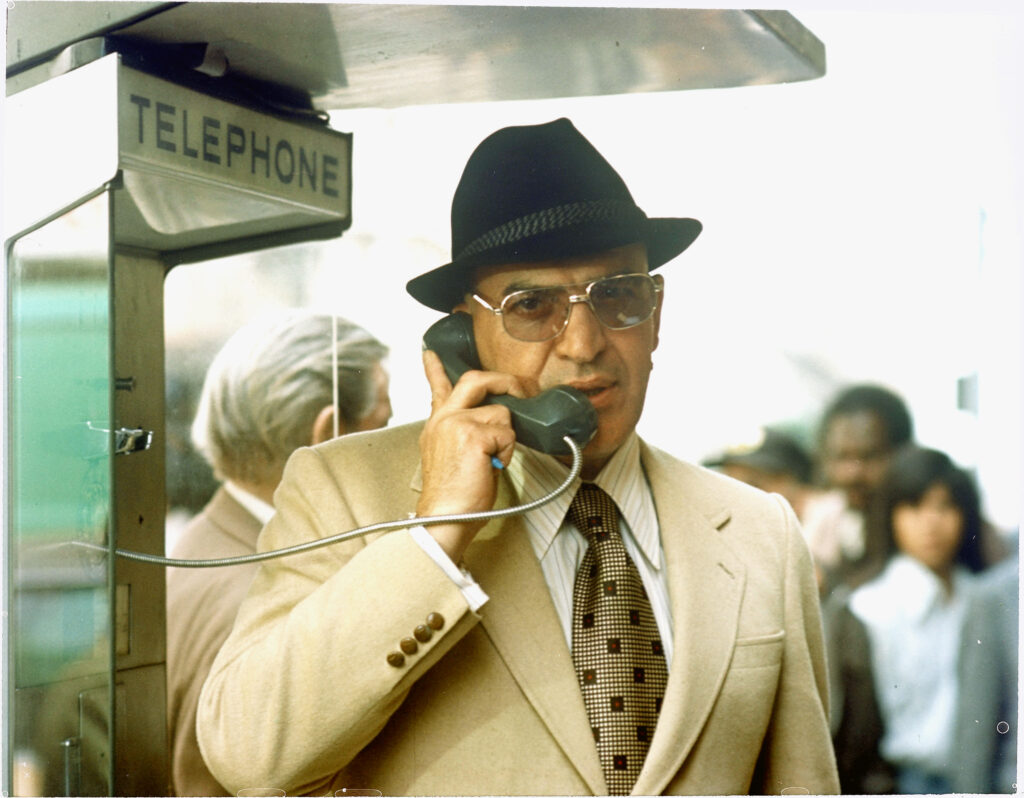
Even great detective shows like Kojak pulled their punches, largely because reality was often too graphic to present in prime time.

That doesn’t look like a New York City public phone.

But an alternate world emerges from watching a series of television intros from the 1970s, pulled from top sitcom and dramas of the period.  New York City is essentially Midtown and Central Park (but for the few shows that ventured into the other boroughs), glamorous and utterly harmless, without edge.

And in those few shows that did exploit the city’s dangerous side, the intros made clear — through artistically rendered graphics — that the danger was merely of the pulp variety.

A Woman’s Playground

Many shows of the decade presented Manhattan as an aspirational destination, especially for women, even as thousands of people in real life fled the city.  Television was finally focusing on the adventures of single women, but to do so, New York had to be depicted as nearly flawless.

The iconic example of this is That Girl starring Marlo Thomas.  In this 1970 opener, New York is nothing but glamour, shopping, Lincoln Center and Broadway.

The lousy sitcom On Our Own, New York’s variant of Laverne & Shirley, opens with a couple of crazy gals heading to their job at an advertising agency.  The intro actually features a bit of physical violence against one woman, played up for laughs!

Not every show was so blind to the rough edges of New York.  But it required a tough lady like Rhoda, a native New Yorker, to maneuver all those sliding locks and tough-talking cabbies. (The third season intro is below, but the first season intro is probably the more memorable one.)

The Hustle-and-Bustle

As with the On Our Own intro, many workplace comedies chose to contrast their wacky interior antics with the frenetic urban rhythms of New York City.  It’s as though the comedy you were about to see generates from walking through the crazy, chaotic streets of Midtown.

The intro to the Garment District comedy Needles and Pins ratchets the enthusiasm of That Girl‘s intro down to a quiet, confident strut. Yeah, I work here.

A variation of the buzzing energy of New York City being a impetus for comedy is seen in the intros for Saturday Night Live, even to this day.

The Taxi City

One identifying symbol of New York is the taxicab or, more specifically, the cabbie. While films like Taxi Driver were putting an ominous spin on this image, television still relied on the cab as shorthand for the modern urban experience.

And if you could somehow combine it with a basketball court — as with Busting Loose — then you know it’s really, really New York.

The taxi is a vehicle of love in the romantic comedy Bridget Loves Bernie.  There’s no way to see this today as anything other than slightly creepy especially in light of Martin Scorsese’s Taxi Driver (which came out a few years later). This extended intro ticks off all the boxes — cabs, school yards, the Queensboro Bridge, Central Park….

Taxis were so representative of the New York experience that one of the era’s greatest sitcoms was centered around the industry. Taxi survived well into the 1980s showing a more realistic version of New York than other shows of the day.

It also features the Queensboro Bridge, a heavily used symbol for the expanse of the city.  Since shows of the period rarely went downtown, the Queensboro could sit in for the Brooklyn Bridge when long vistas of the East River were required.  (Taxi actually did go downtown; it was set in a garage at Charles and Hudson Streets.)

The Outer Borough

Television shows often went to the other boroughs when they wanted to express the clashes of modern life, contrasted against a more suburban backdrop which many Americans could more easily identify.

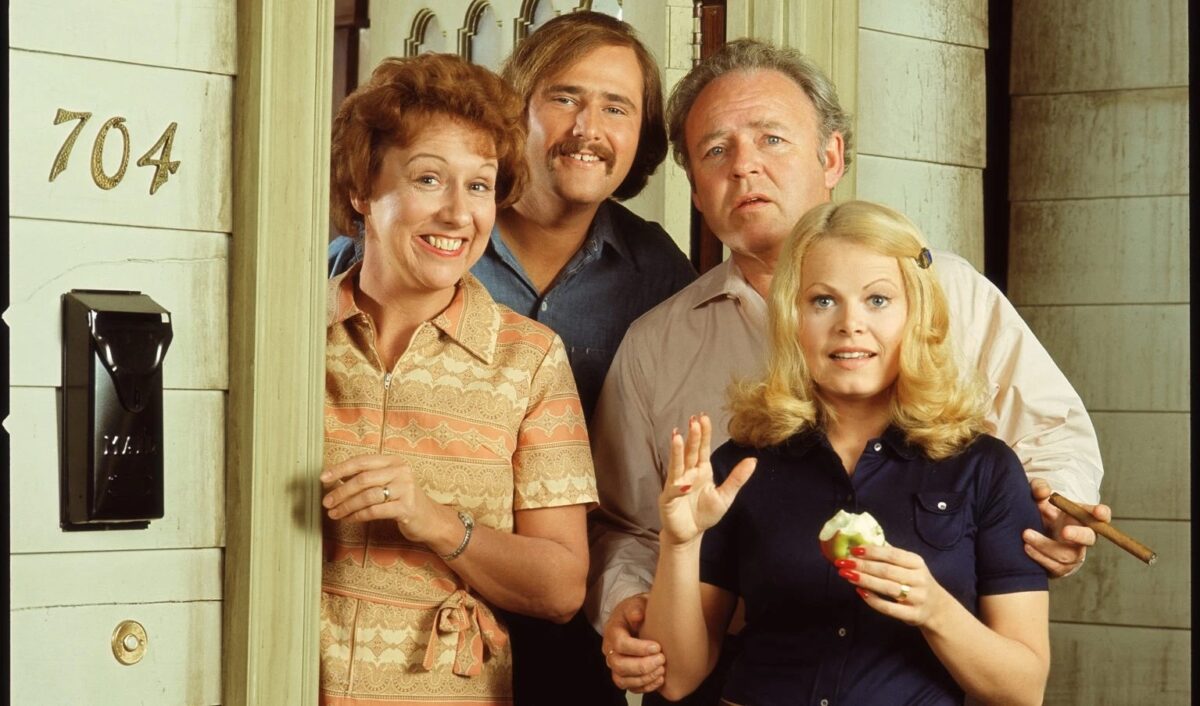
Most everybody knows the iconic theme song from All In The Family as delivered by Carroll O’Connor and Jean Stapleton.  What you may not remember is yet another establishing shot of Manhattan, used to contrast with the rows of Queens homes.  In these few seconds, the intro excellently sets up the conflicts of modernity, a quiet residential present, and a duo that seem stuck in a sheltered past.

The same sort of pull-away from Manhattan is used in O’Connor’s follow-up series, Archie Bunker’s Place, which yanks the viewer away from the skyline, back over the Queensboro Bridge and down Northern Boulevard.  Archie has changed since those years at the piano, and so have his surroundings.  The blocks of uniform homes have been replaced with subway graffiti and bustling street life.

13 Queens Blvd went even deeper into Queens but still relied on the establishing shot of Manhattan to let viewers know how far we are from real urban issues. The show’s situations were driven by the comic misunderstandings within an apartment complex, a little like One Day At A Time (set in Indianapolis) or Three’s Company (set in Santa Monica) perhaps. The show didn’t last long.

Brooklyn was represented in the 1970s by Welcome Back Kotter.  Set in a fictional high school, it is New Utrecht High School that’s used in the opening.  While other sitcoms used a Manhattan establishing shot, Kotter prefers a beat-up sign that announces Brooklyn as the 4th largest city in America.  With its painted trains and lines of laundry, this might be the grittiest depiction of New York in a sitcom, even as its high school students (the Sweathogs) were incredibly unrealistic.

Movin’ On Up

Mostly though, sitcoms preferred the fantasy, Manhattan as an Emerald City. (It was literally depicted as such in the 1970s musical The Wiz.)  No amount of deterioration seemed to supplant the image of Manhattan as having ‘made it’, especially when dealing with African-American television characters.

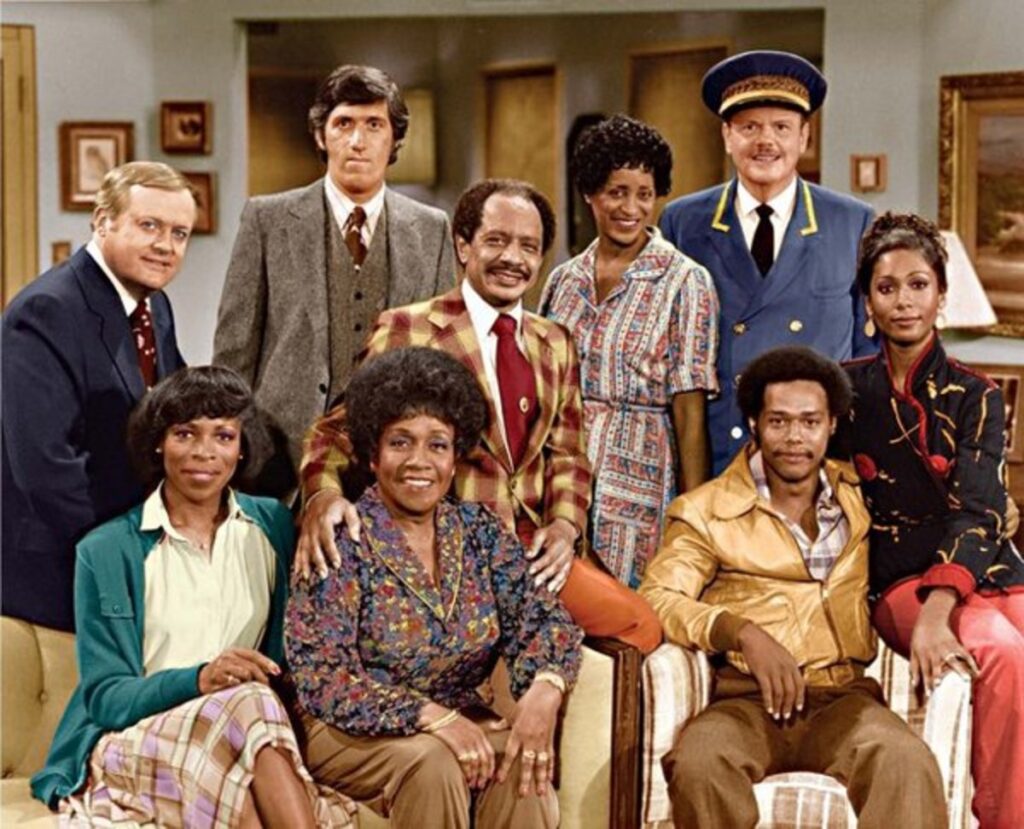
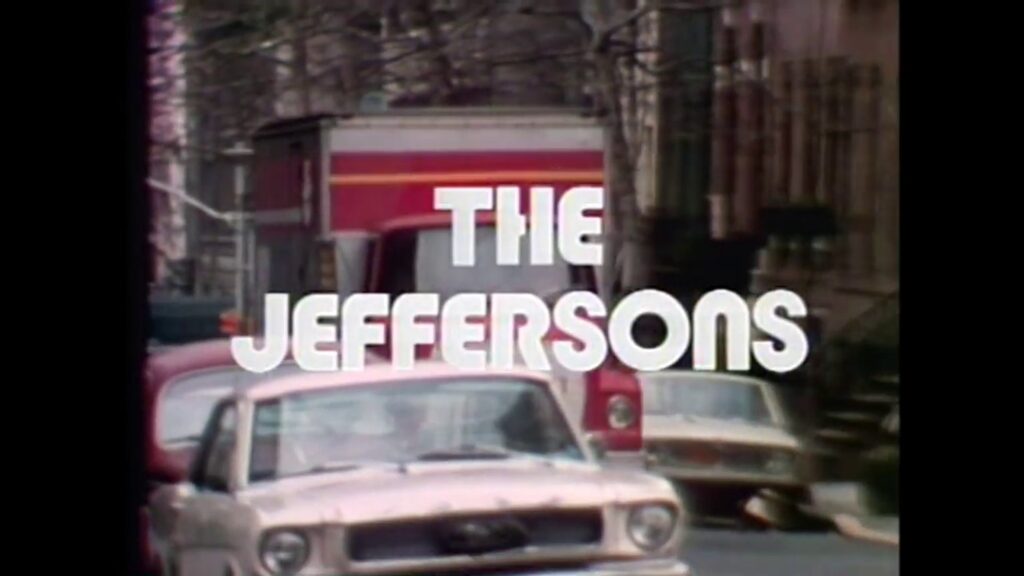
Taxis are again the vehicle of transformation in The Jeffersons, plucking George and Louise Jefferson from the land of Archie Bunker — again, using the Queensboro Bridge — and putting them in a luxury accommodation on the Upper East Side.

Two African-American boys are saved by a wealthy white man in Diff’rent Strokes.  For emphasis in the intro, Arnold and Willis are playing basketball, the de facto symbol in 1970s television of the inner city.

I don’t know if the show was any good, but the intro to the 1970 sitcom Barefoot In The Park seems refreshing in retrospect.  The show, based on the Broadway show, features a young black couple trying to make it though the first years of marriage in Manhattan.  It seems to handle the subject with the same euphoria used in ‘That Girl’.

They’re riding a horse-and-carriage drinking champagne!  It literally does not get cheesier.

Unvarnished New York

There were a few shows that felt embedded within the actual New York experience. Their intros reflect a certain melancholy, a feeling that perhaps the city was not always a whirlwind of breezy excitement. The champagne remains corked.

Barney Miller is one of the few shows actually set in Greenwich Village. Perhaps as a result, its establishing shot of Manhattan is moody, even dreary, a perfect backdrop for a comedy television show about criminal behavior.

In the opening to The Odd Couple, New York is an embodiment of its characters’ anxieties and differences.  There is no establishing shot of Manhattan, no attempt to glamorize the big city.  These two are actually at odds with the city, not each other, as presented here.  The intro ends with a rare pan-up of the two characters with the city looming behind them.

The Wild East

In an opposite reaction to rural shows like Green Acres (where people fled New York), a maverick sensibility came to New York in the 1970s, especially in the detective genre, with iconoclastic characters bringing foreign forms of justice to an ungoverned city.

On McCloud, a New Mexico detective wrangles up a few pimps and car thieves, bringing fun but clumsy cowboy tropes to Times Square.  Unlike sitcoms, detective dramas actually went to 70s Times Square all the time for obvious reasons.  Although most did not bring stagecoaches with them.

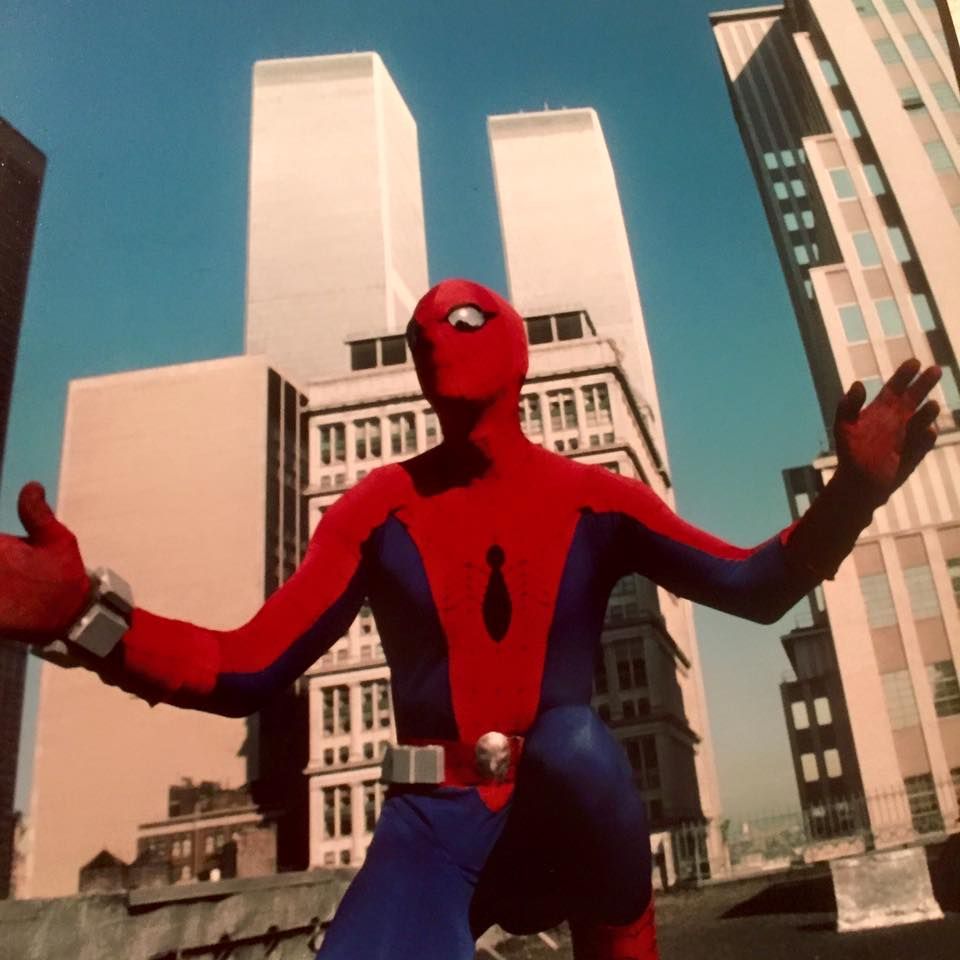
Another bizarre crime-fighter to the New York skyline was the Amazing Spider-Man. We get a Manhattan establishing shot here, comically interrupted by Spiderman’s awful costume.  They spend a great amount of time with Spidey on the Empire State Building; in fact most of the show was filmed in L.A.

You didn’t even need a reason to bring in a cowboy. In the 1970 sitcom Mr Deeds Goes To Town, a folksy newspaper editor takes on the big city. The intro lays it on thick.

Groovy 70s Noir

A few crime dramas of the 1970s were actually filmed in New York City and thus could highlight the city a bit more fully in their intros.

The short-lived television version of Serpico features numerous places throughout the city, from the Battery to Times Square. And, yes, the Queensboro Bridge is again represented here via its subway stop.

New York’s greatest television crime fighter of the 1970s was Kojak, so cool that the city is given a trippy noir vibe, peeking from the nooks of swirling graphics.  Of course most of Kojak was filmed in Los Angeles, but, according to writer Burton Armus, the production crew went to New York on occasion for “surrounding shots, background shots, one or two scenes.”

Taking its cue from Kojak in its tone, Eischied was also a bit of a cowboy, bringing some Southern swagger to the mean streets of Manhattan. Its credit sequence is a confused mess.

Categories
Podcasts Pop Culture

NYC in the modern TV age, from Sesame Street to Seinfeld, as the arrival of cable brings new production to the city


PODCAST
In the third part of the Bowery Boys Summer TV Mini-Series, I give you a grand tour of the New York City television production world from the 1970s to today, from the debut of Sesame Street in the Upper West Side to the new productions which flourished in the 1990s.

Along the way, hear about the debuts of public access, HBO, MTV, NY1 and, of course, the TV show that employed thousands of New Yorkers during its two-decade run — Law and Order.

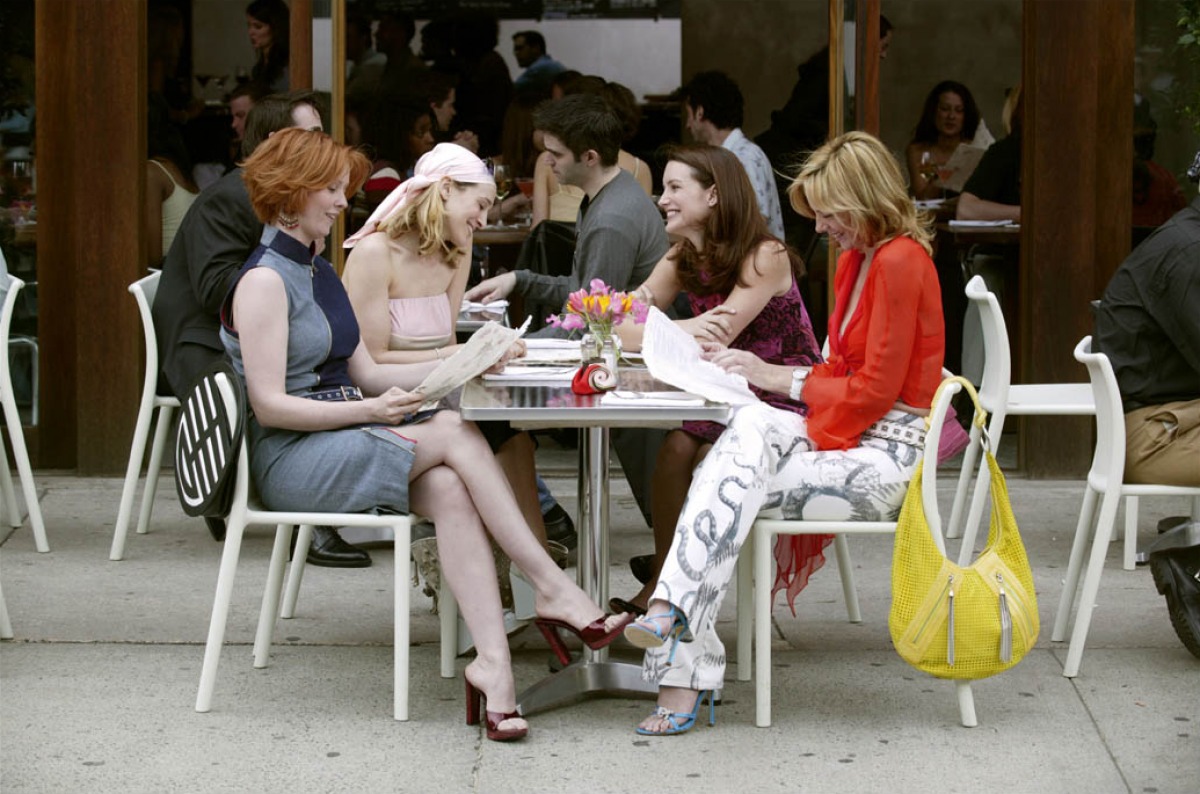
PLUS: A few locations used on Seinfeld, Sex and the City and The Cosby Show!

To get this week’s episode, simply download it for free from your favorite podcast player.

Or listen to it straight from here:
The Bowery Boys #155 New York City in the Modern TV Age

——

A COUPLE CORRECTIONS:  I gleefully went off my notes on a few occasions this show, accounting for some mis-statements. For instance, The Cosby Show is obviously a ‘family comedy’, not a ‘family drama’. And New York cable viewers could get MTV within a month of its debut, not a couple months.

OMISSIONS: To make this a 20-minute show, I did have to lose mentions of a few shows that featured New York City, such as NYPD Blue. But there was no excuse to breeze past the 1975 debut of Saturday Night Live, although it was briefly mentioned in part two in our discussion of 30 Rockefeller Center.  Also: while not as iconic show as the others mentions, many in the industry look to the moment in 2008 when Ugly Betty left Los Angeles for New York as another significant turning point.
—————–

The first episode of Rapid T Rabbit and Friends from 1983, which debuted in February 1983.


When actor Will Lee died in 1982, Sesame Street producers decided to have his character, Mr. Hooper, die on the show.

How Home Box Office looked in the 1970s:

A scene from Seinfeld featuring Keith Hernandez:

The original opening for Law & Order from its debut in 1990:

Carrie Bradshaw’s first encounter with that bus and water puddle from the first season opener of Sex And The City:

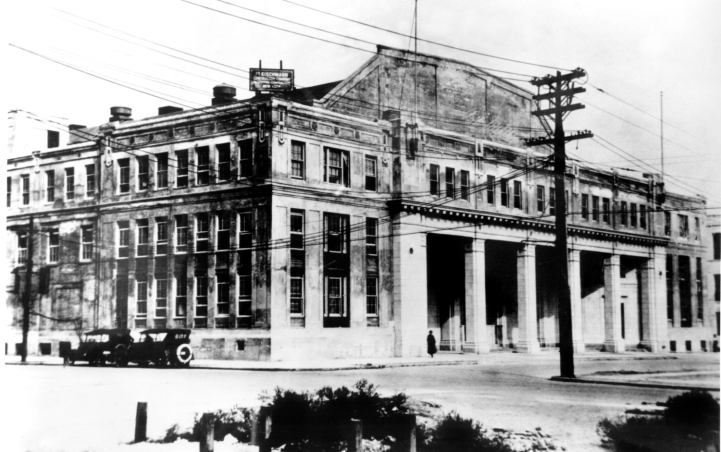
Kaufman Astoria Studios opened in the 1920s as a silent film studio; today it hosts both TV and film productions. It’s also the home of Sesame Street! (Photo courtesy Kaufman Astoria Studios)


Categories
Podcasts Pop Culture

New York City in the Golden Age of Television: Behind the scenes with nine classic TV shows filmed in the city


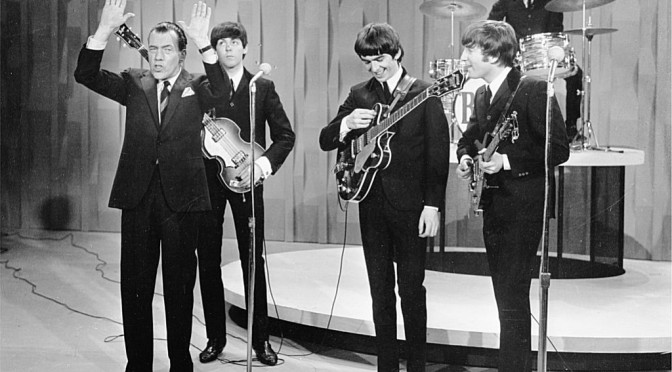
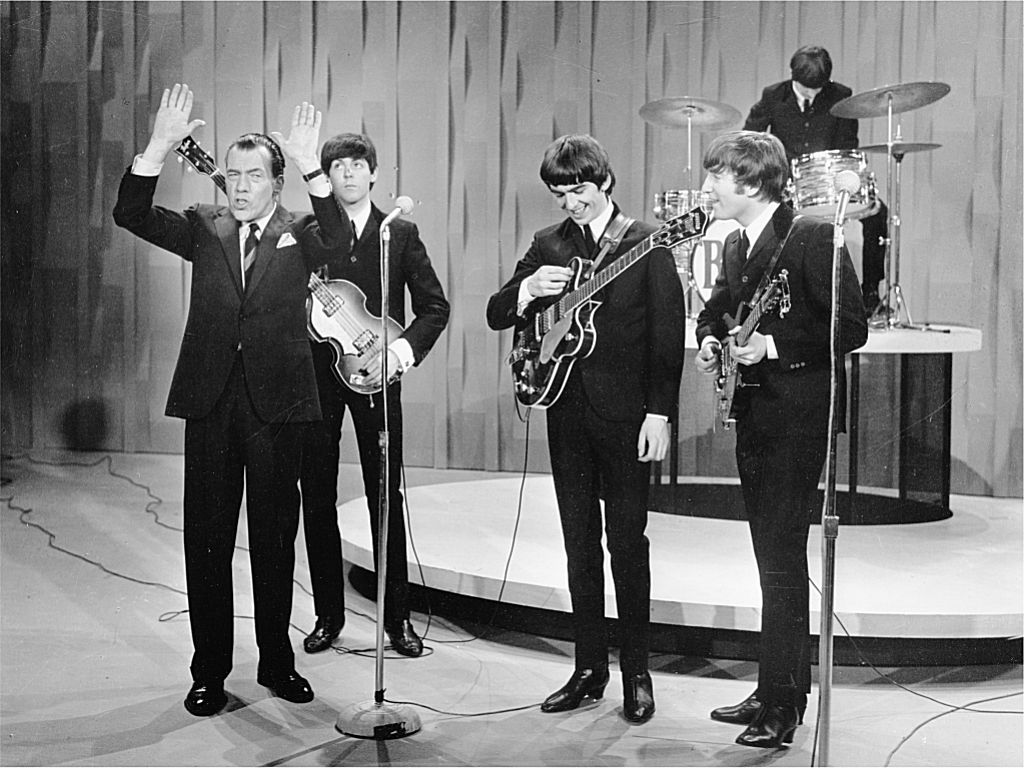
The Beatles in one of their many appearances on the Ed Sullivan Show. [source]

PODCAST This is the second part of the Bowery Boys TV Mini-Series, covering the years of New York City television production from the late 1940s to the 1960s.  Some of the most classic television shows ever made — and many still around today — were filmed from various locations in midtown Manhattan.

The insatiable appetite for television programming in the United States after the war created a new industry out of the roots of radio, with the television networks NBC, CBS, Dumont and ABC trying out almost every conceivable form of entertainment.  Their efforts in the late 40s and 1950s created many standard forms of programming — the morning show, the late show, the situation comedy and the game show.

This podcast is arranged a little bit like a leisurely Midtown walking tour, taking you past four of the greatest locations in NYC television history.  We give you the back story behind nine television shows that were filmed in New York City in this period — Howdy Doody, Texaco Star Theater, the Today Show, the Tonight Show, What’s My Line?, The $64,000 Question, Life Is Worth Living, The Honeymooners and the Ed Sullivan Show.

This show definitely features the strangest cast of characters we have ever discussed — television’s most influential chimpanzee, a regal bishop superstar, a freckled marionette, a buxom blonde, and the father of Sigourney Weaver!

LISTEN HERE: THE GOLDEN AGE OF TELEVISION

 _____________
  CORRECTION: In this week’s show, I say that the Blizzard of 1947 occurred on the exact date as the debut of Howdy Doody (December 27, 1957). The storm actually hit in the two days before that date — December 25-25. But the city was a total mess for days after.
_____________

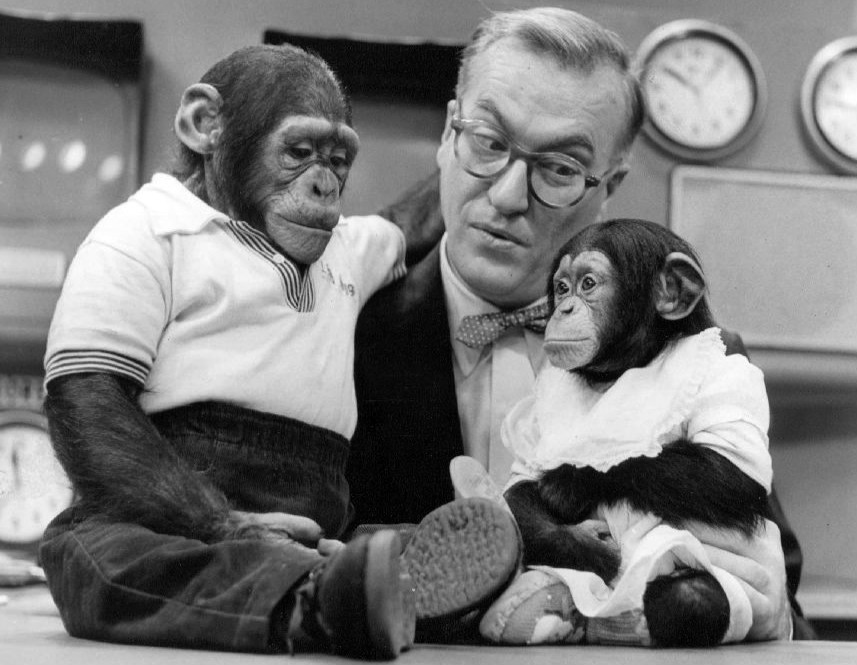
J. Fred Muggs, Dave Garroway and Phoebe B. Beebe on the Today Show. Courtesy NBC Television

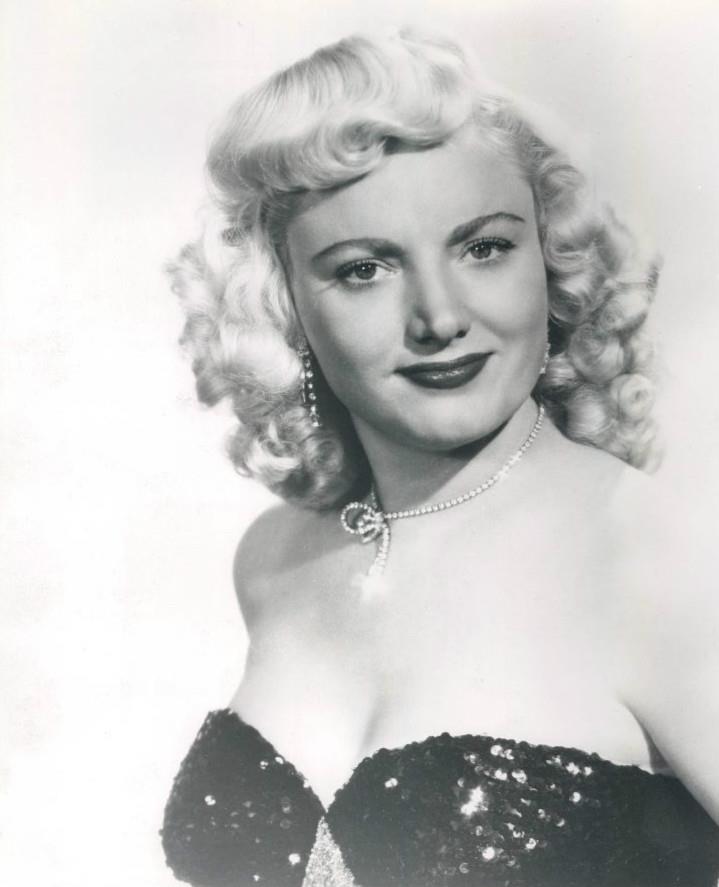
The glorious Dagmar from ‘Broadway Open House’! [source]

A few episodes of some of the show’s we talked about in the podcast:

 The $64,000 Question

 Life Is Worth Living with the Bishop Fulton Sheen

 Texaco Star Theater from November 1949

What’s My Line? — with an episode featuring Eleanor Roosevelt!

The Honeymooners — the episode called “The Bensonhurst Bomber”

Categories
Mad Men

Mad Men 1966-67: Speculation, context and flashbacks

Our favorite randy, drunken Madison Avenue suits return this Sunday with an extra-special long episode of ‘Mad Men‘ this Sunday. As with prior seasons, I’ll try and follow up most shows on Monday with a little historical commentary.

The wonderful thing about this show is that they’re nothing if not hyper-sensitive about historical accuracy. From hints given by producers, it appears the new season will open sometime late in the year 1966 or perhaps early 1967. Some significant events during that year that may come into play on the show, either in major disruptive ways or in fine, knowing details:

— It’s the first year of the John Lindsay mayoral administration. Although he governs over a metropolis in steep financial crisis and paralyzed by striking workers, he still considers it a ‘fun city’.

Pennsylvania Station is ceremoniously demolished. The fate of the treasured train station has been the subject of prior episodes. Could its final destruction represent something more for the troubled ad agency?

The World Trade Center begins construction. I’ll be very surprised if some mention isn’t made of the envious offices with their magnificent views.

— ‘Cabaret‘ opens on November 20, 1966.  Finally, something opens in New York more debauched than an ad agency Christmas party!

— New York’s most fabulous club is The Electric Circus on St. Mark’s Place, drawing the magnificent and the mod, including the entourage of former advertising illustrator Andy Warhol.

— This is the year of color and camp. New on TV: Star Trek, Batman, The Monkees, Dark Shadows

— In 1966, there 385,000 American troops in Vietnam, of which over 6,000 would be killed that year alone. A massive protest hit the streets of New York in April 1967 and dozens burned their draft cards in Central Park. A Maxwell House coffee can was famous used to burn the cards. A new client for Don Draper?

— Cassius Clay had fans last season at Sterling Cooper Draper Pryce. As Muhammad Ali, will he still have them after he becomes a conscientious objector against the war?

The most important album of 1966 comes from two boys from Forest Hills, QueensPaul Simon and Art Garfunkel.

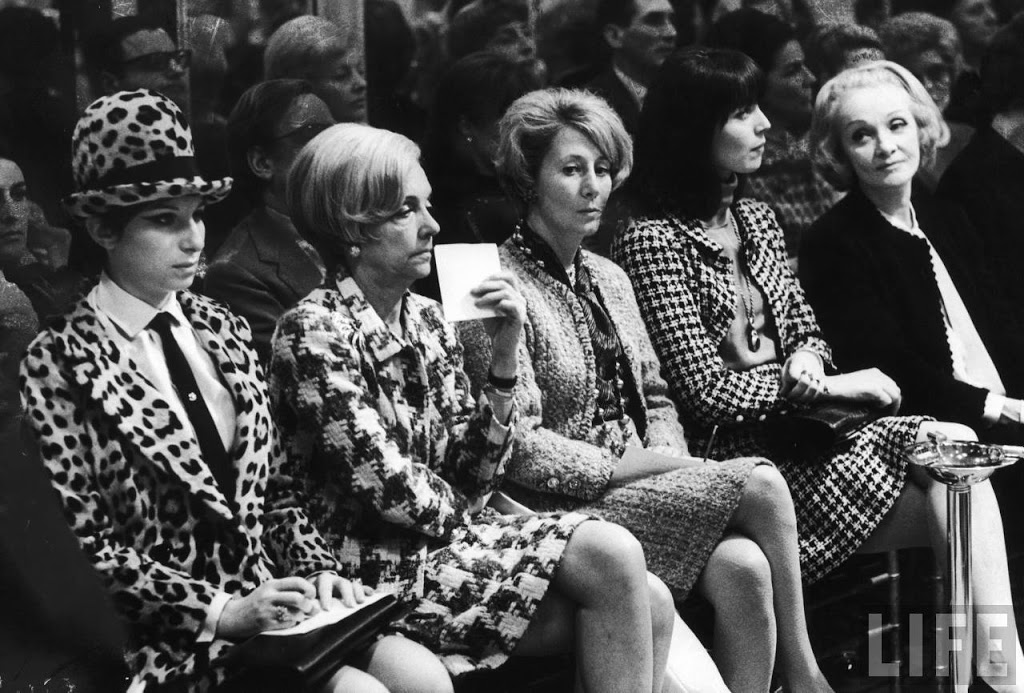
— New York played second-fiddle to the colorful imported fashion trends of London. Fashion became daring, flamboyant and colorful, even the dress suits. Skirt hems elevate. Pictured above: New York’s hottest star Barbra Streisand on one side, Marlene Dietrich the other, and the currency of 1966 fashion in between, at a Paris fashion show. Pic courtesy Life Google images

— A strange year at the movies, the top box office hits were ‘Hawaii‘ and ‘The Bible‘. However the cultural zeitgeist was surrounding the third biggest film of the year — ‘Who’s Afraid Of Virginia Woolf?‘ Can you imagine a time when a stage adaptation was the third biggest film of the year?

— Gay rights protests begin popping up around the Village, including a slightly botched ‘sip-in’ at Julius Bar in April of 1966. Might we see a reappearance of Sal in this context?

— New York gets its first FM rock music station in 1966 — WOR-FM. While I doubt this fact makes the show, expect a soundtrack heavily laced with sweat and reverb. (Or perhaps, laced with something more tangible?)

— On top of color televisions, potential clients for the agency include such newfangled inventions as disposable diaper, the synthetic fiber Kevlar, lawn replacement AstroTurf, the sugar substitute NutraSweet and any product related to the American quest to reach the moon.

Here’s a sampling of some articles I’ve written for the blog on ‘Mad Men’ episodes. You can find them all by clicking on the label ‘Mad Men‘:

‘Mad Men’ returns: a guide to eating (and drinking) options
‘Mad Men’ notes: The once and future Hotel Pennsylvania
‘Mad Men’ notes: A movie theater classic in its final days
‘Mad Men notes: Naked truths about New York nudism
‘Mad Men’ notes: Upscale flowers in a mystery mansion
‘Mad Men notes: Konnichiwa, New York City!

Categories
Health and Living Preservation

Bialystoker Home, a remarkable Lower East Side treasure and home for assisted living–now in need of some assistance

Bialystoker Home for the Aged may not make it into many tourist guides, but this Lower East Side art deco artifact holds an important link to New York’s immigrant history. It was just born on the wrong side of the street, and because of that, it’s an endangered structure.

On the south side of East Broadway, between Canal and Montgomery, stands some of New York’s most important Jewish landmarks, from the towering gleam of the Forward Building to a cluster of surviving 1830s rowhouses and tenement synagogues that held the first critical waves of Jewish immigrants in the mid-19th century.

At right: The Bialystoker building on its opening in 1931 (courtesy the Museum of Jewish Heritage)

On the north side of East Broadway, however, these sorts of historical structures east of the Seward Park Library were knocked down and replaced in the 1950s with an immense cooperative village in the fashion of Stuyvesant Town, a series of housing towers interlocked with open spaces and playgrounds.

The Bialystoker building (228 East Broadway), which opened in 1931, is a relic in comparison to its immediate neighbors, a parking garage (which notably collapsed in 1999) and a banal 1960s medical building known for a chipping mural on its side and to HBO subscribers as ‘the New Zealand consulate’ on the TV series ‘Flight of the Conchords‘. (Full confession: I lived across the street for both the collapse and the filming, so I find the block particularly endearing.)

Its two-toned tannish, art deco facade by architect Henry Hurwit makes an unusual silhouette for the neighborhood, and perhaps that alone should make it a candidate for preservation. But it’s the building’s unique history that makes a necessary keepsake of the Lower East Side.

This and many other structures around here trace to a specific immigrant lineage — the Polish Jews of Bialystok, near the border of Belarus. It’s remarkable to think of thousands of Bialystok immigrants — nearly the entire Jewish population of the city — crossing the ocean, entering Ellis Island, and settling  here, and specifically here, in this area of the Lower East Side.

Around the corner, up two blocks, is the Bialystoker Synagogue, a refitted 1826 Episcopal church that collected various neighborhood Jewish congregations and moved in here in 1905. From a cursory glance at its exterior, you might never know that inside is one of New York’s most stunning synagogues. And hopefully everybody is familiar with the wondrous, doughy bialy, the cousin to the bagel, and its supreme baker Kossar’s Bialys up on Grand Street.

The synagogue is an official historic landmark, and Kossar’s a treasured stop on walking tours. The former Bialystoker nursing home has no such protections.

The elderly home was funded by a Bialystoker aid society in the 1920s as an alternative to standard city institutions. The cornerstone was laid in September 1929, accompanied by a massive parade, 25,000 people carrying “flags and banners with Jewish inscriptions and marched through Canal, Grand and other streets.” [source]

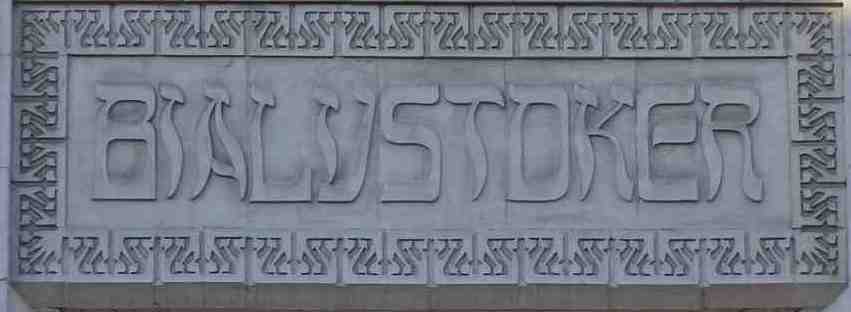
The new arrivals to the neighborhood benefited from the charity of wealthier Jewish immigrants who had arrived earlier and funded projects to ease overcrowding and providing health and education services catering to specific religious customs. The Bialystoker building is perhaps the most striking example of this beneficence. Its design is Moorish Art Deco, of a kind you might see off to a corner in Rockefeller Center. Possibly considered plain in its day, but now seen as beautiful and understated. In particular, its doorway is a marvel; the artfully carved BIALYSTOKER is joined by a dozen medallions representing the twelve tribes of Israel.

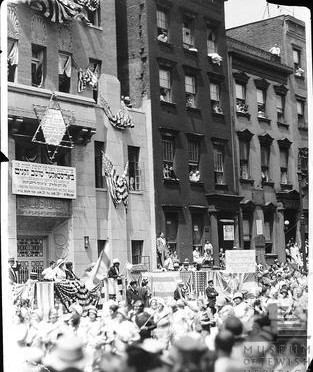
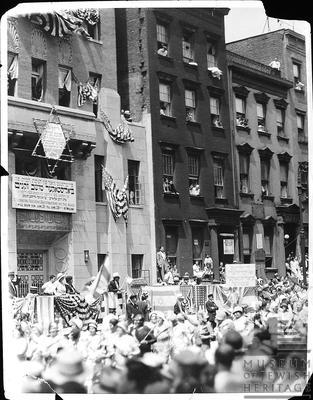
Its grand opening on a hot summer day in June 1931 was a premiere event, with another parade drawing tens of thousands, and people crammed onto rooftops and fire escapes to witness the event. Awaiting inside were rooms for several dozen residents, as well as “auditoriums, dormitories, two synagogues, sun parlors and hospital wards.” [source] The Museum of Jewish Heritage has some remarkable photographs of the opening which you can peruse here.

The nursing home has faithfully and quietly served the community for 80 years. Along the way, its seen some prominent and very, very old residents (like 111-year-old Benjamin Kotlowitz). Last year, due to mounting debts and “inadequate Medicaid reimbursement,” the home was forced to close for good.

The building is currently on the market and, as it has not been landmarked, is a candidate for demolition. You can sign a petition here to help the effort to get this unique building saved. The Friends of the Lower East Side also has more information on this remarkable window on New York’s immigrant history.

‘Fringe’ benefits light up a forgotten New York fort

I’m an unabashed junkie of the sci-fi TV series ‘Fringe’, and the writers (or at one of them) seems to be a fan of New York history.

One of the conceits of the series involves an alternate universe with things are just slightly different from ours. Most notably, the World Trade Center was never attacked. And there are other changes to the skyline, one of which I wrote about last year — the construction of Antonio Gaudi’s comically absurd skyscraper.

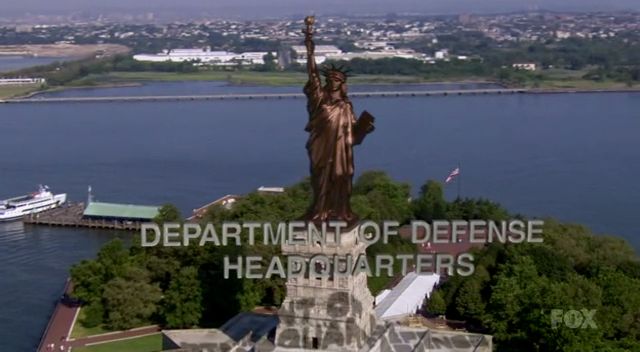
But in this bizarro world where Manhatan is spelled with a single ‘t’, a shining beacon still stands in New York harbor. The Statue of Liberty, ever in stark brown copper, stands in for the ominous “Department of Defense.” And considering that this world is constantly attacked by temporal warps — that’s why Madison Square Garden is encased in amber — this building has an elevated, even sinister purpose.

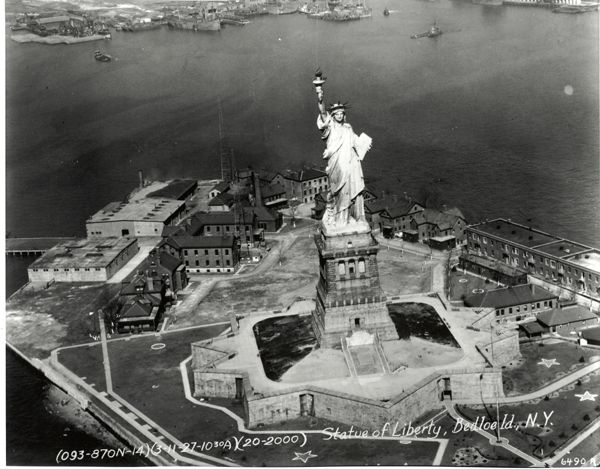
This correlation is a clever nod to the structure on which Lady Liberty currently stands, the star-shaped Fort Wood.

Many of the great forts that dot the New York harbor turn or will be turning 200 years old over the next year or so. Several fortifications, including Fort Wood, Castle Clinton and Castle Williams on Governor’s Island, were construction during the tense build-up of the War of 1812, anticipating that the city would need a tougher coastal defense. Older defenses, such as Staten Island’s Fort Wadsworth, were brought up to speed.

The fort on Bedloe’s Island, the original name of Liberty Island, was constructed like a starburst, a traditional 15th century European design and of the type one might build if your greatest enemy was a cannonball. This dynamic structure must have looked imposing sailing past, one of several a wary vessel would have see on its way into town.

Completed sometime in 1811, it was named after respected fort designer Colonel Eleazer Wood in 1814, the year he died in a battle against British forces near the Canadian Fort Erie.

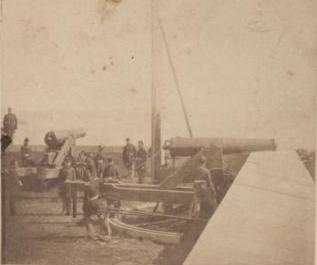
That intense conflict that re-matched the British with its young former colony never drifted into the harbor, and so the forts were thankfully never used. It and the forts on Governor’s Island prepared for battle again during the Civil War, holding ammunition and, on occasion, infirm Confederate prisoners. (At left, from a stereoscopic view of Fort Wood, equipt with manned cannons, most likely during the 1860s, pic courtesy NYPL)

With little need by the 1880s for so many fortifications, Bedloe’s Island prime location in the harbor made it an ideal home for Fredric Bertholdi’s elaborate piece of outdoor art, the Statue of Liberty. The fort was refitted for this new usage, and the statue of officially dedicated in 1886.

However, even after the statue arrived, the military remained on the island in new barracks, believe it or not, until 1937. (You can see them in the black and white photo above.) And in a sense, old Fort Wood has been besieged ever since, with millions of tourists, and has become central to an American icon, at least in our universe.

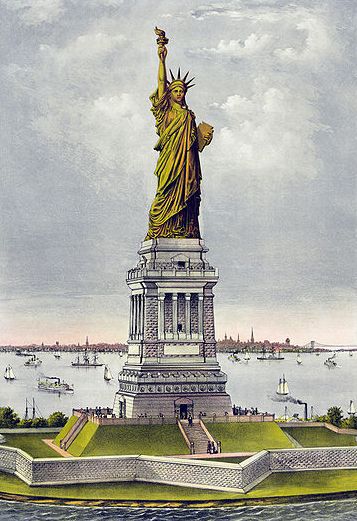
Below: Liberty as rendered by Currier & Ives, years before she went green