Categories
Health and Living Preservation

Bialystoker Home, a remarkable Lower East Side treasure and home for assisted living–now in need of some assistance

Bialystoker Home for the Aged may not make it into many tourist guides, but this Lower East Side art deco artifact holds an important link to New York’s immigrant history. It was just born on the wrong side of the street, and because of that, it’s an endangered structure.

On the south side of East Broadway, between Canal and Montgomery, stands some of New York’s most important Jewish landmarks, from the towering gleam of the Forward Building to a cluster of surviving 1830s rowhouses and tenement synagogues that held the first critical waves of Jewish immigrants in the mid-19th century.

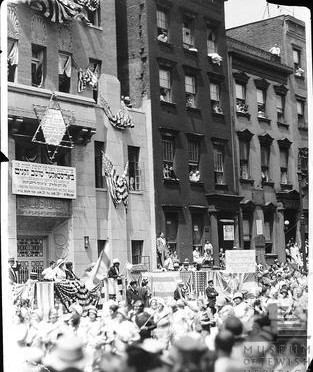
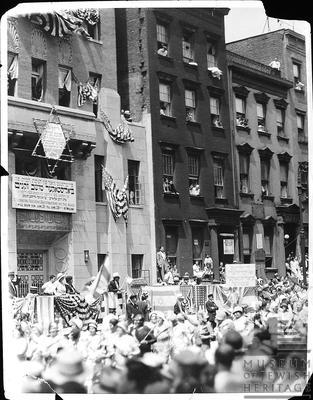
At right: The Bialystoker building on its opening in 1931 (courtesy the Museum of Jewish Heritage)

On the north side of East Broadway, however, these sorts of historical structures east of the Seward Park Library were knocked down and replaced in the 1950s with an immense cooperative village in the fashion of Stuyvesant Town, a series of housing towers interlocked with open spaces and playgrounds.

The Bialystoker building (228 East Broadway), which opened in 1931, is a relic in comparison to its immediate neighbors, a parking garage (which notably collapsed in 1999) and a banal 1960s medical building known for a chipping mural on its side and to HBO subscribers as ‘the New Zealand consulate’ on the TV series ‘Flight of the Conchords‘. (Full confession: I lived across the street for both the collapse and the filming, so I find the block particularly endearing.)

Its two-toned tannish, art deco facade by architect Henry Hurwit makes an unusual silhouette for the neighborhood, and perhaps that alone should make it a candidate for preservation. But it’s the building’s unique history that makes a necessary keepsake of the Lower East Side.

This and many other structures around here trace to a specific immigrant lineage — the Polish Jews of Bialystok, near the border of Belarus. It’s remarkable to think of thousands of Bialystok immigrants — nearly the entire Jewish population of the city — crossing the ocean, entering Ellis Island, and settling  here, and specifically here, in this area of the Lower East Side.

Around the corner, up two blocks, is the Bialystoker Synagogue, a refitted 1826 Episcopal church that collected various neighborhood Jewish congregations and moved in here in 1905. From a cursory glance at its exterior, you might never know that inside is one of New York’s most stunning synagogues. And hopefully everybody is familiar with the wondrous, doughy bialy, the cousin to the bagel, and its supreme baker Kossar’s Bialys up on Grand Street.

The synagogue is an official historic landmark, and Kossar’s a treasured stop on walking tours. The former Bialystoker nursing home has no such protections.
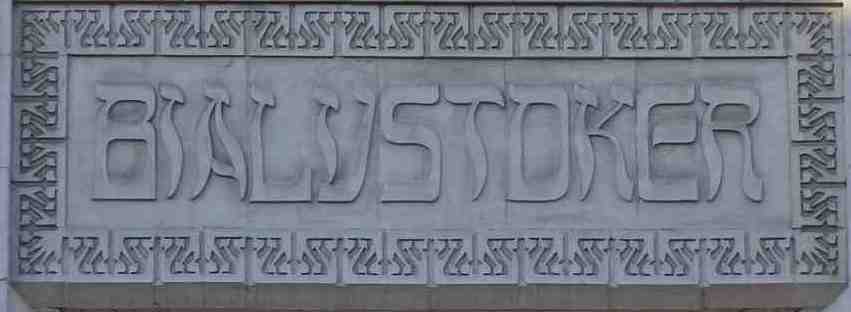
The elderly home was funded by a Bialystoker aid society in the 1920s as an alternative to standard city institutions. The cornerstone was laid in September 1929, accompanied by a massive parade, 25,000 people carrying “flags and banners with Jewish inscriptions and marched through Canal, Grand and other streets.” [source]

The new arrivals to the neighborhood benefited from the charity of wealthier Jewish immigrants who had arrived earlier and funded projects to ease overcrowding and providing health and education services catering to specific religious customs. The Bialystoker building is perhaps the most striking example of this beneficence. Its design is Moorish Art Deco, of a kind you might see off to a corner in Rockefeller Center. Possibly considered plain in its day, but now seen as beautiful and understated. In particular, its doorway is a marvel; the artfully carved BIALYSTOKER is joined by a dozen medallions representing the twelve tribes of Israel.

Its grand opening on a hot summer day in June 1931 was a premiere event, with another parade drawing tens of thousands, and people crammed onto rooftops and fire escapes to witness the event. Awaiting inside were rooms for several dozen residents, as well as “auditoriums, dormitories, two synagogues, sun parlors and hospital wards.” [source] The Museum of Jewish Heritage has some remarkable photographs of the opening which you can peruse here.

The nursing home has faithfully and quietly served the community for 80 years. Along the way, its seen some prominent and very, very old residents (like 111-year-old Benjamin Kotlowitz). Last year, due to mounting debts and “inadequate Medicaid reimbursement,” the home was forced to close for good.

The building is currently on the market and, as it has not been landmarked, is a candidate for demolition. You can sign a petition here to help the effort to get this unique building saved. The Friends of the Lower East Side also has more information on this remarkable window on New York’s immigrant history.
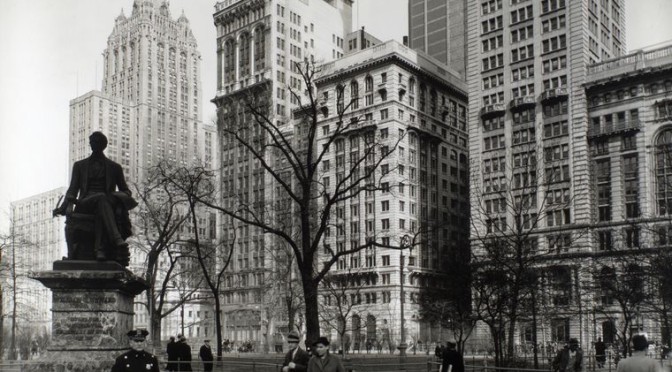
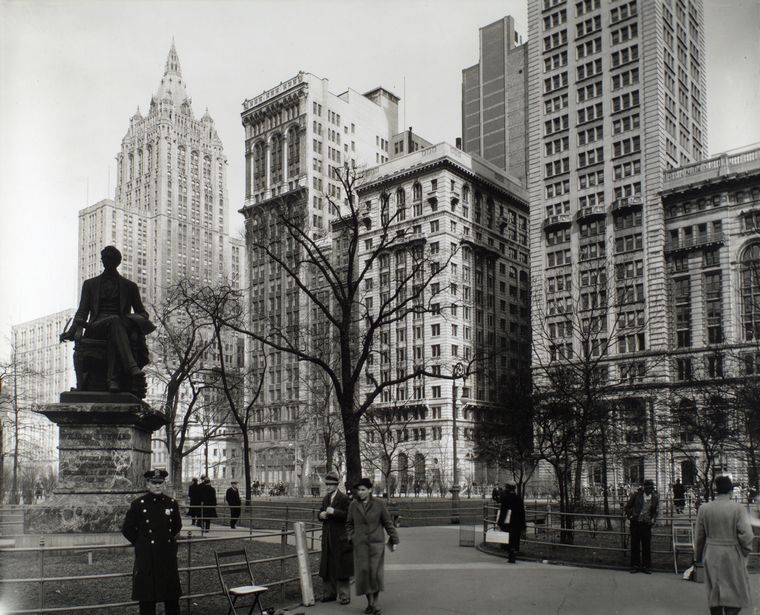
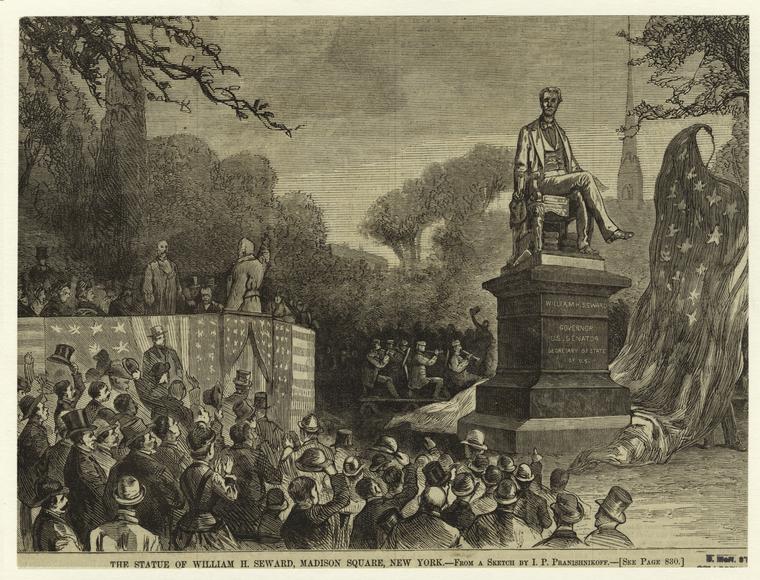
William Seward: a park in his honor, while sitting in another

Mr. Seward, with the best seat in the park in 1934. He does seem awfully thin though, almost like a certain president. (At least, some people thought so.)

This month marks the 135th anniversary of an extraordinary gift endowed to Madison Square Park — the statue of William Seward. the former New York governor and Secretary of State under Abraham Lincoln. Indeed, he’s easily one of the most influential New York politicians ever upon the national stage. A master of backroom politics and a proponent of American expansion (best known for negotiationg the purchase of Alaska from the Russians in 1867), Seward died a revered figure, and monuments to his legacy sprouted up throughout the nation, from shore to shore.

In New York City, there are two key landmarks named after him, and they could not be more different.

The aforementioned bronze statue at the southwest corner of Madison Square Park was presented with the maximum of pomp and circumstance in September of 1876. The work, by Randolph Rogers, depicts Seward in a seated, almost languid pose, with unusual proportions. As has been frequently speculated, Rogers might have adapted an earlier seated statue of his, depicting Abraham Lincoln, and simply slapped Seward’s head onto it. This is unproven, of course, but since Lincoln was Seward’s old boss, it makes for amusing symmetry.

But the gathering admirers on the afternoon of its unveiling scarcely seemed to notice. Present at its debut was future U.S. president Chester A. Arthur, who would be graced with his own statue in Madison Square Park 23 years later.

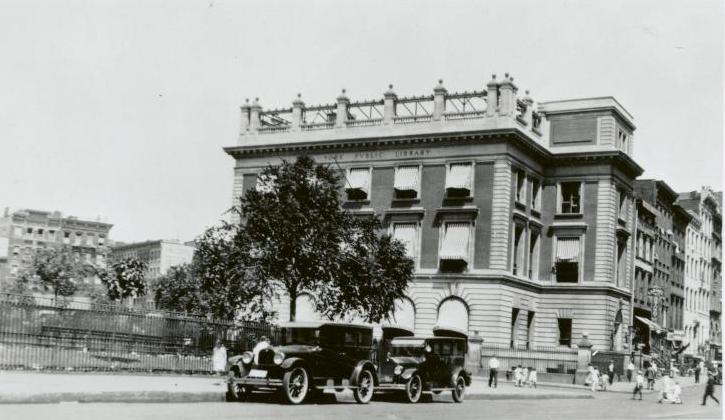
Further downtown, in the Lower East Side, at the convergence of Essex Street, Canal Street and East Broadway, lies Seward Park, also named for the venerated politician. In 1897, in a neighborhood desperate for breathing room, the city condemned a cluster of tenements lining the east side of Essex Street. The fenced-in park was pretty much developed by private groups until the city intervened in 1903, equipping the grounds with a sporting pavilion and leveling areas for a playground.

But the real jewel of this park came in 1909 when the Carnegie Foundation placed one of its most stunning libraries here. By the way, Jefferson Street used to separate the library from the park (as evidenced in the picture above). Today, the road has been closed off and the space has been become part of the park itself.

So the development of this park came well after Seward (or the head of Seward, on Lincoln) was placed uptown. And really, they weren’t going to place so a lavish memorial in the midst of so many tenements, were they?

However, Seward himself might have considered Seward Park the far greater honor. During his years as governor (1839-42) and many years following as a New York senator, he supported many pro-immigration policies that were considered extraordinarily progressive for the day. Naming the park after him was a tip-of-the-hat to these early risky political stances.

Pictures courtesy NYPL. (link to top photo here)

What a view! Library roof gardens in the Lower East Side


Click picture for greater detail

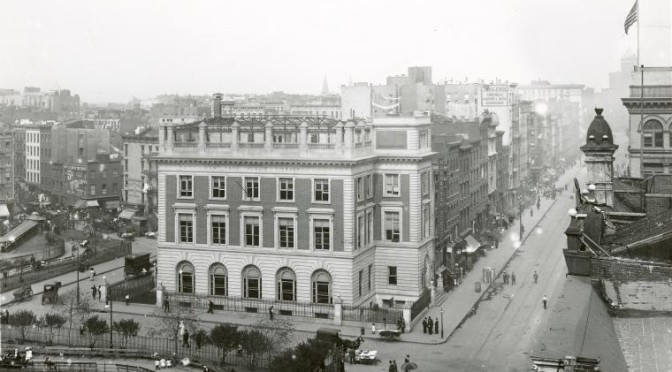
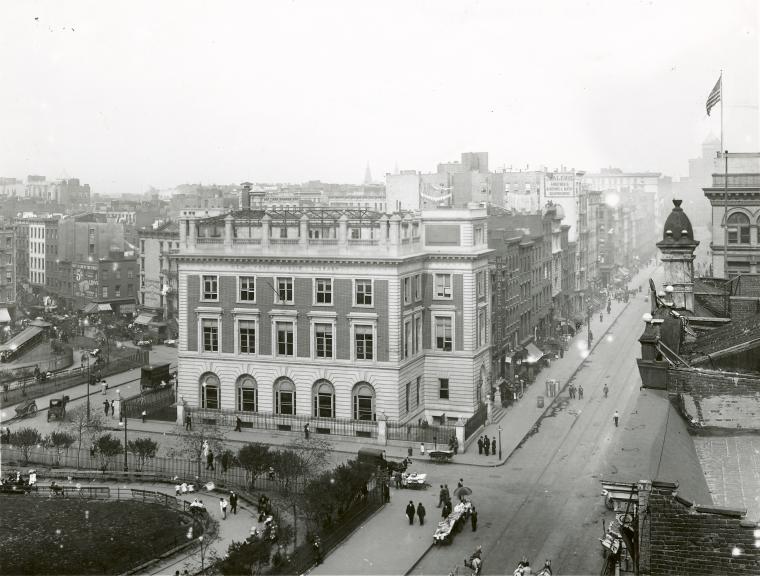
Above is a picture, facing east, of Seward Park Library in the ‘lower’ Lower East Side at 192 E. Broadway (picture taken in 1911). This spectacular branch library, funded by Andrew Carnegie, opened in November 1909, two years before the 42nd Street main branch opened.  All of the housing behind the library to the east has since been demolished.

The nearby park in the foreground is still there, but the small extension of Jefferson Street which separate them has been turned into a paved, closed off pedestrian plaza. The streets seen in the left of the photograph are completely gone.

The library was built by the firm Babb, Cook and Welch, whose accomplishments from the Gilded Age are seldomly still found today. But, in fact, one of the firm’s lead architects William Cook was part of a committee which included Charles McKim (of McKim, Mead and White) and John Carerre (of Carerre and Hastings, who ultimately designed the famous 42nd Street branch) to standardize library designs in the city. Those two better known firms got most of the commissions; however the Seward Park library remains one of Babb, Cook and Welch’s best known remaining public works.

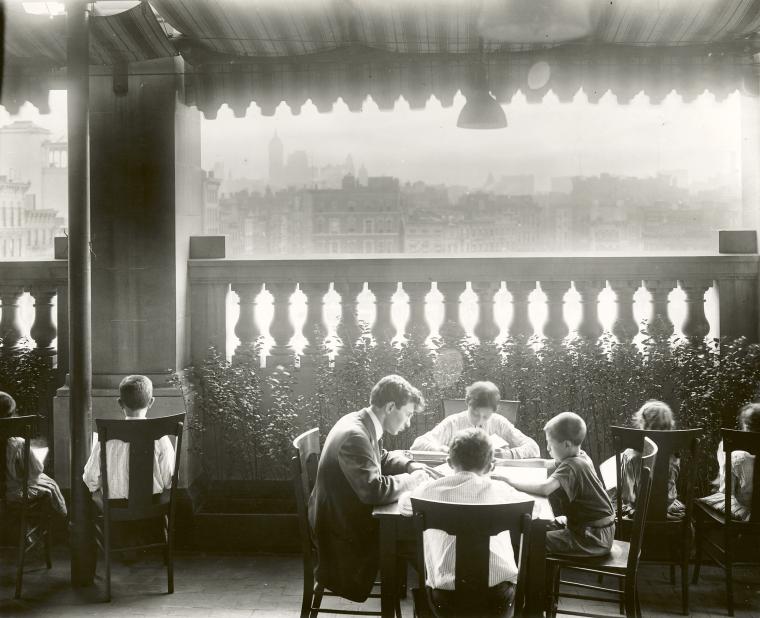
During the library’s first years, readers were actually allowed onto a “roof garden.” According to a New York Times article from 1910, “There will be awnings over the top to shield from sun and the occasional shower; tables around which the readers can congregate, and a network of electric bulbs strung over the top so that there will be plenty of light for the industrious who wish to study.”

Below: children and adults alike on Seward Park’s roof garden

Adults were even allowed onto the roof late into the evening, including “mothers who wish to do their sewing out of doors.”

Although this grand structure was placed here in 1909, it was certainly not the neighborhood’s first library. Once the domain of the private sector, libraries were provided by philanthropic organizations such as the Aguilar Free Library Society, which began offering a reading room for New Yorkers at this very address starting in 1891.

Aguilar’s East Broadway library, “where the readers are nearly all Hebrew,” featured over 140,000 thousands books, the most popular being ‘Uncle Tom’s Cabin’ and ‘Around The World In 80 Days”. This library was sold in 1902 and remade as the building which stands there today.

The Seward Park Library has gone through two major renovations, the most recent in 2004, bringing back most of the building’s original lustre. As evidenced by this photo, little around it remains from its original condition.

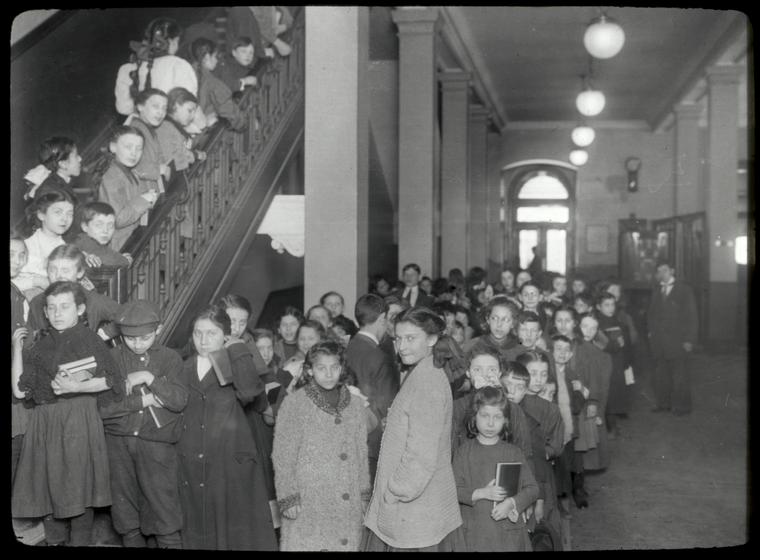
Of course, children have changed as well. Outside of a reading by Stephenie Meyer, can you imagine this mob scene at a library today? (Photo by Lewis Wickes Hine)

Pictures courtesy NYPL