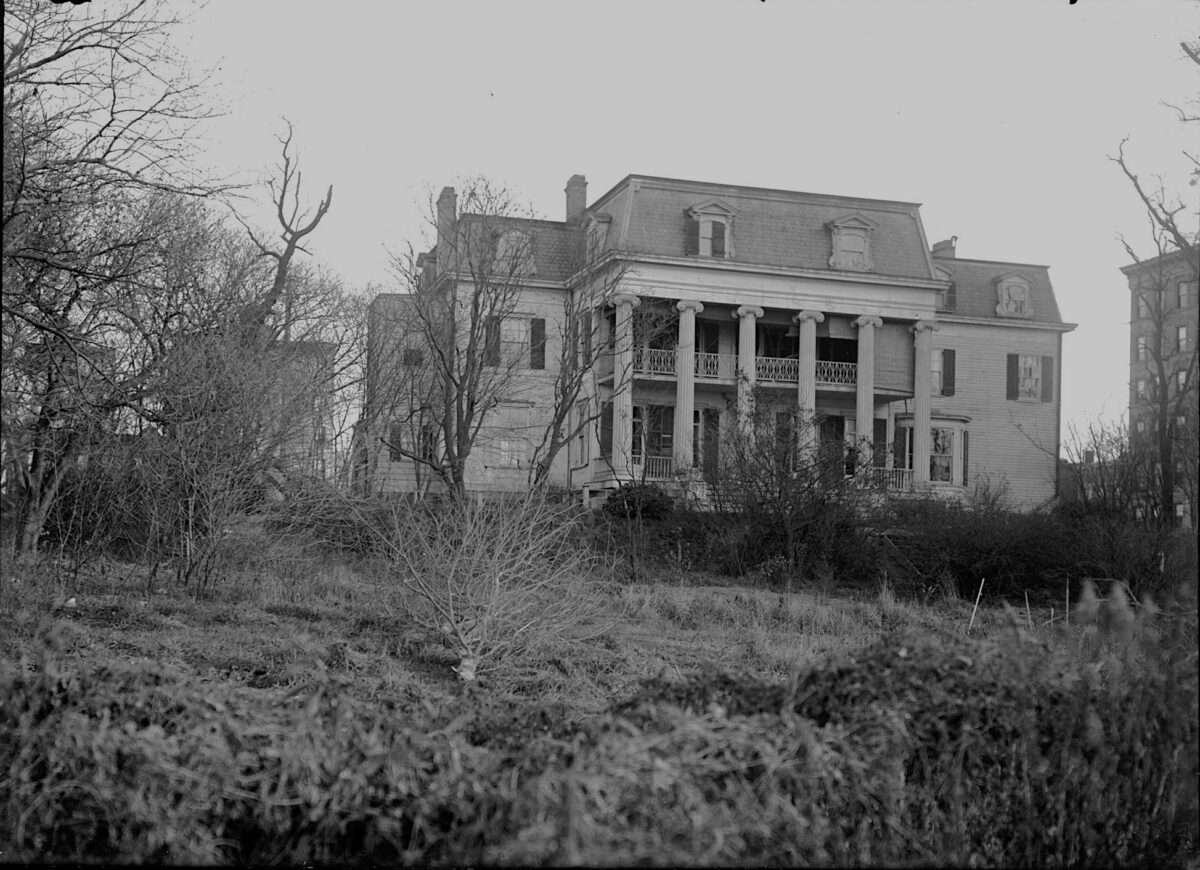
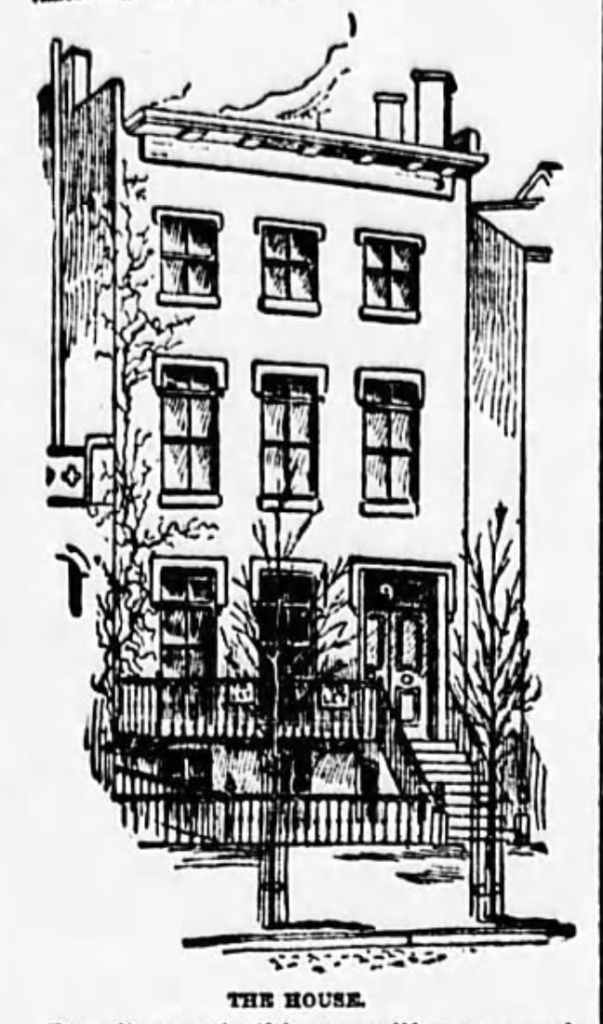
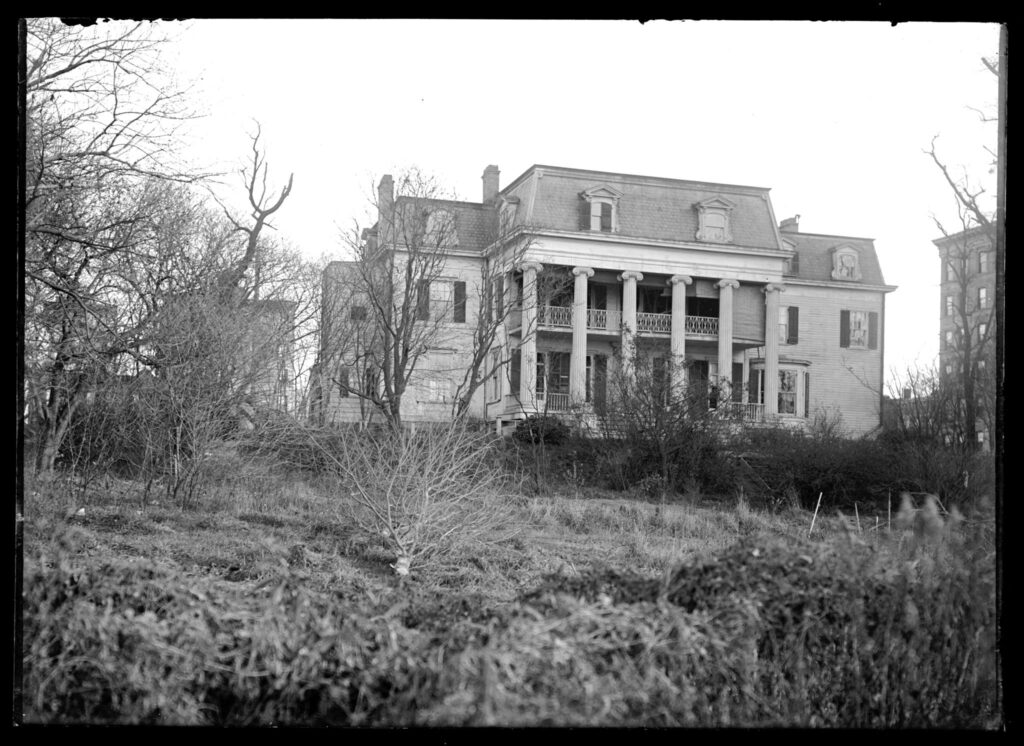
The old Furniss mansion, with its dark secrets literally behind a locked door. (courtesy Ephemeral New York)
A brand new batch of haunted houses and spooky stories, all from the gaslight era of New York City, the illuminating glow of the 19th century revealing the spirits of another world.
Greg and Tom again dive into another batch of terrifying ghost stories, using actual newspaper reports and popular urban legends to reveal a different side to the city’s history.
If you just like a good scare, you’ll enjoy these historical frights. And if you truly believe in ghosts, then these stories should especially disturb you as they take place in actual locations throughout the city — from the Lower East Side to the Bronx. And even in cases where these 19th-century haunted houses have been demolished, who’s to say the spirits themselves aren’t still hanging around?
Featured in this year’s crop of scary stories:
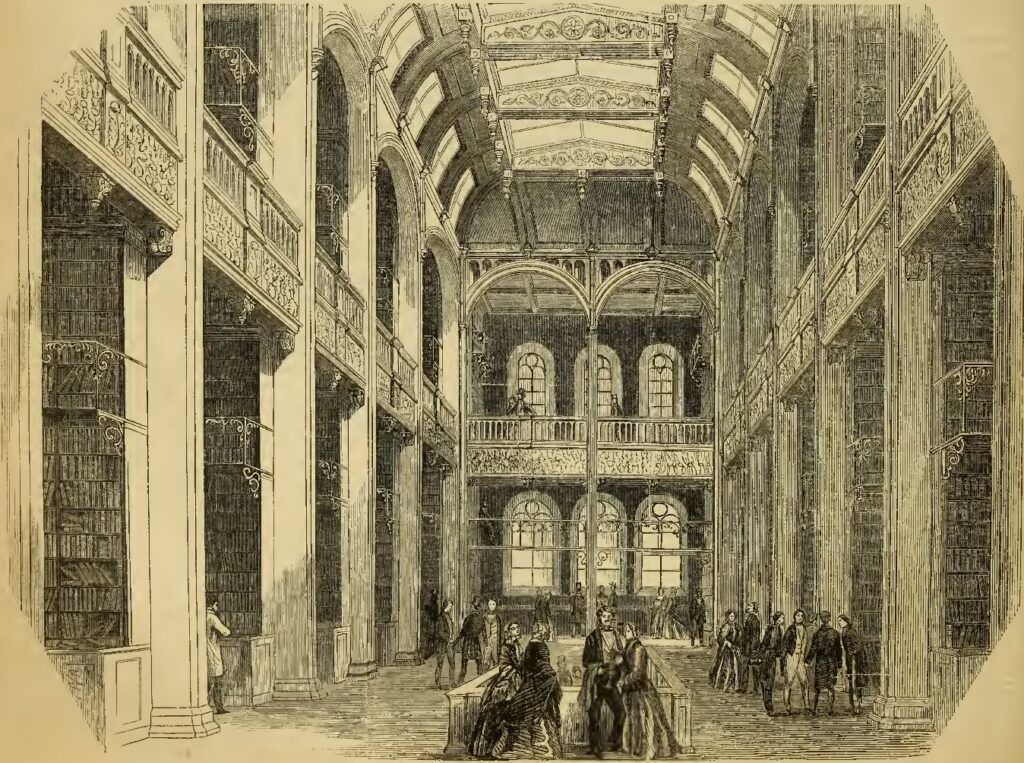
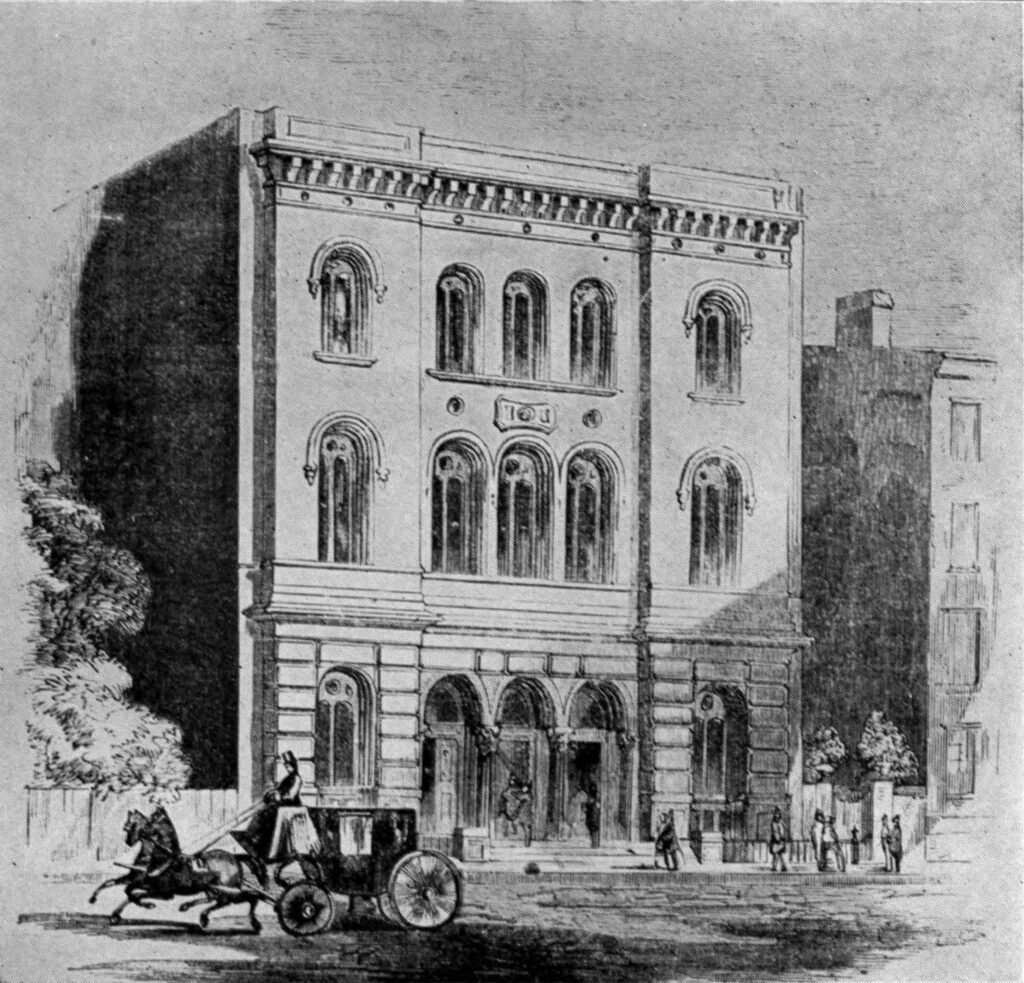
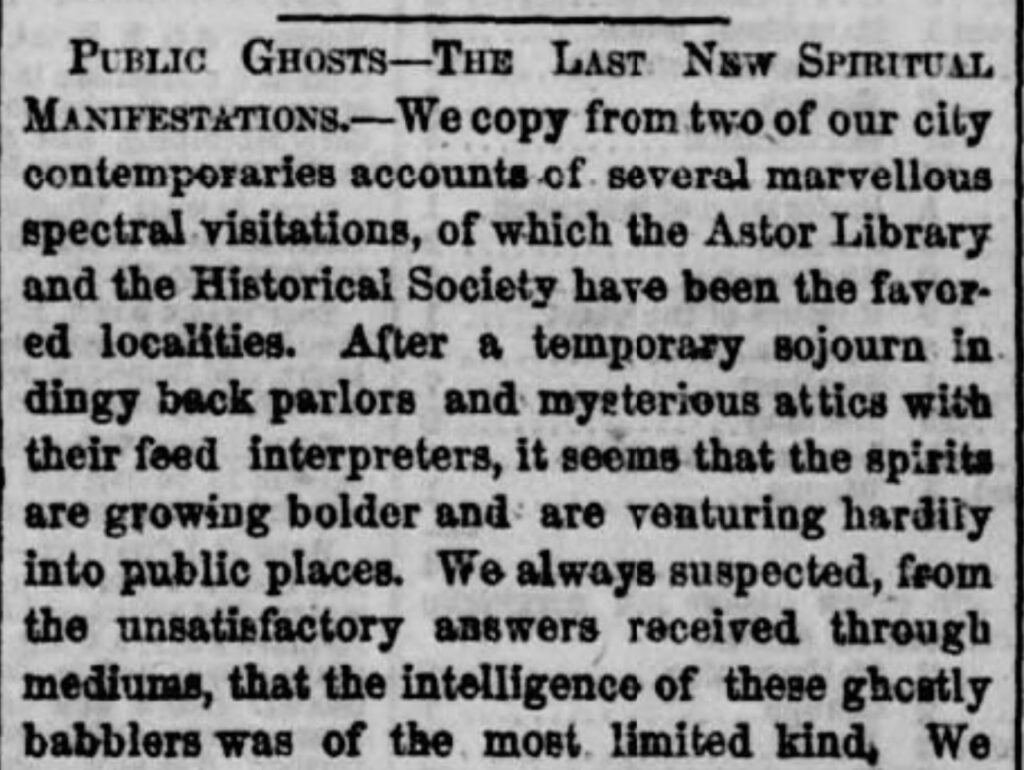
— A ghostly encounter at the Astor Library (today’s Public Theater) involving a most controversial set of mysterious books;
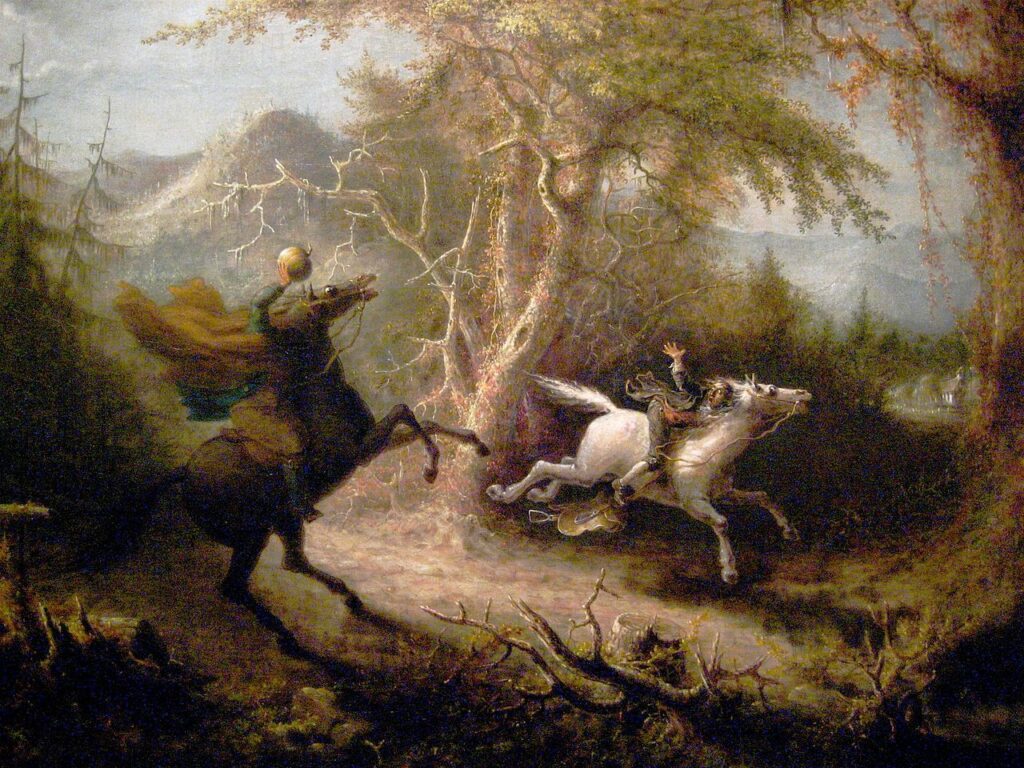
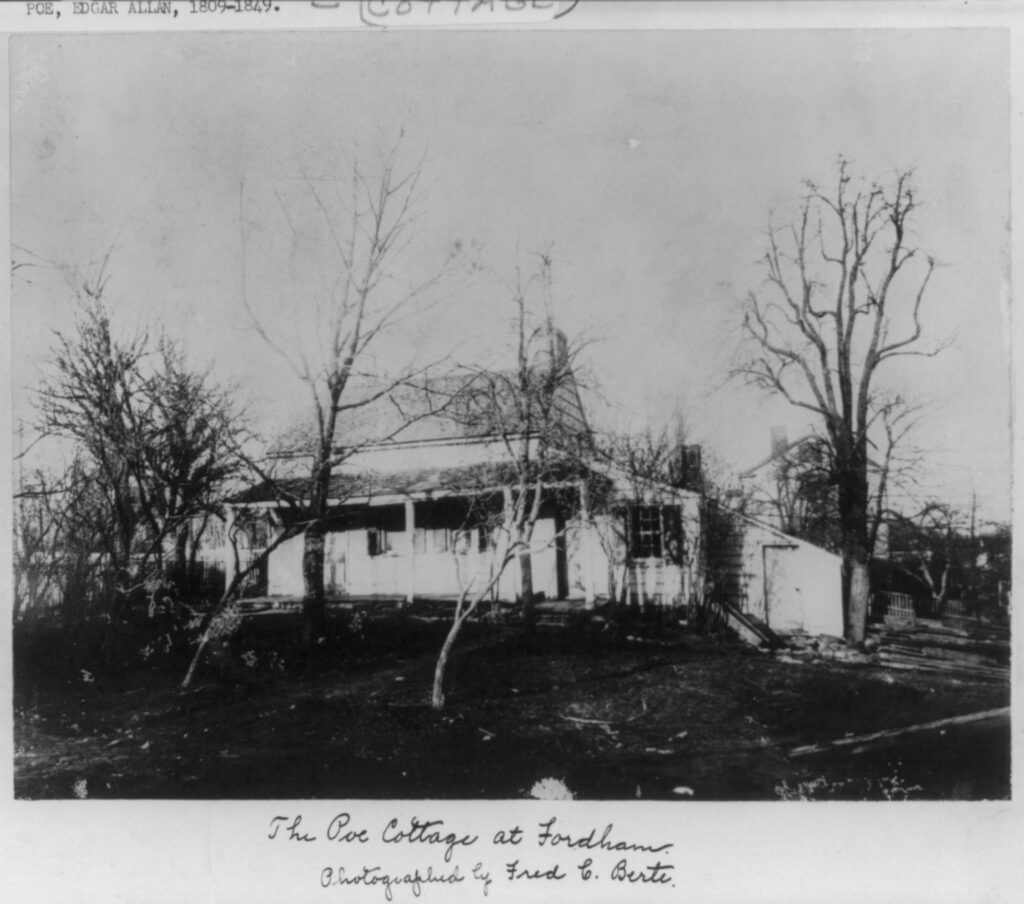
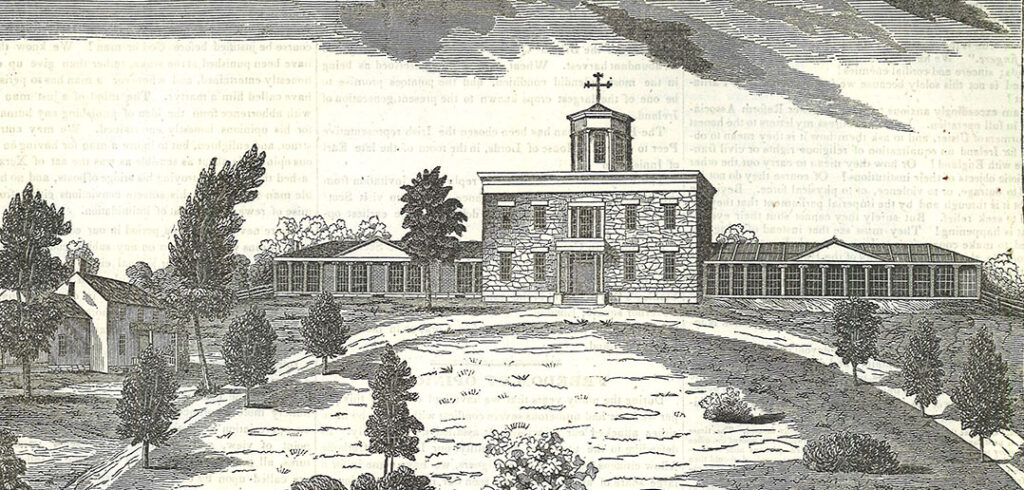
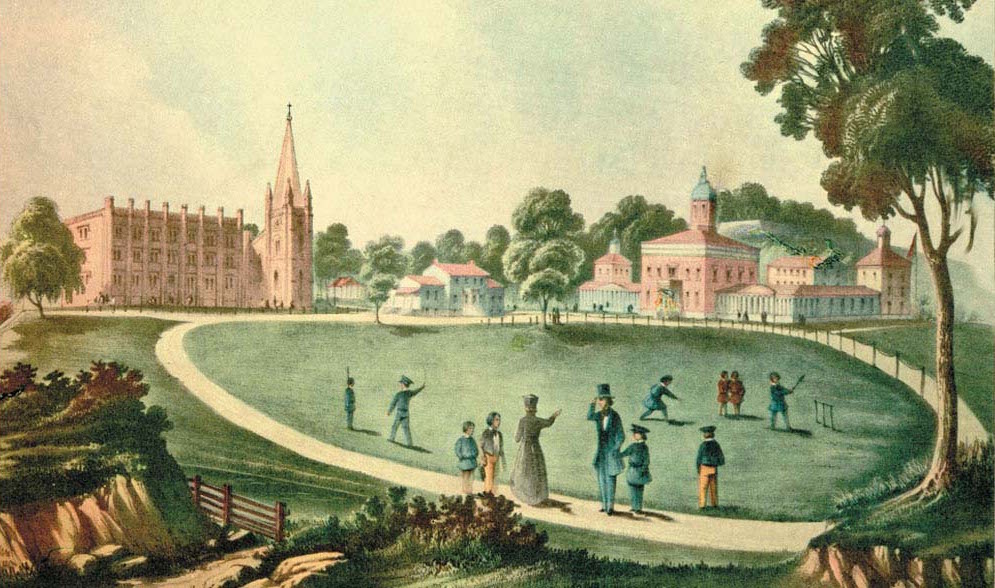
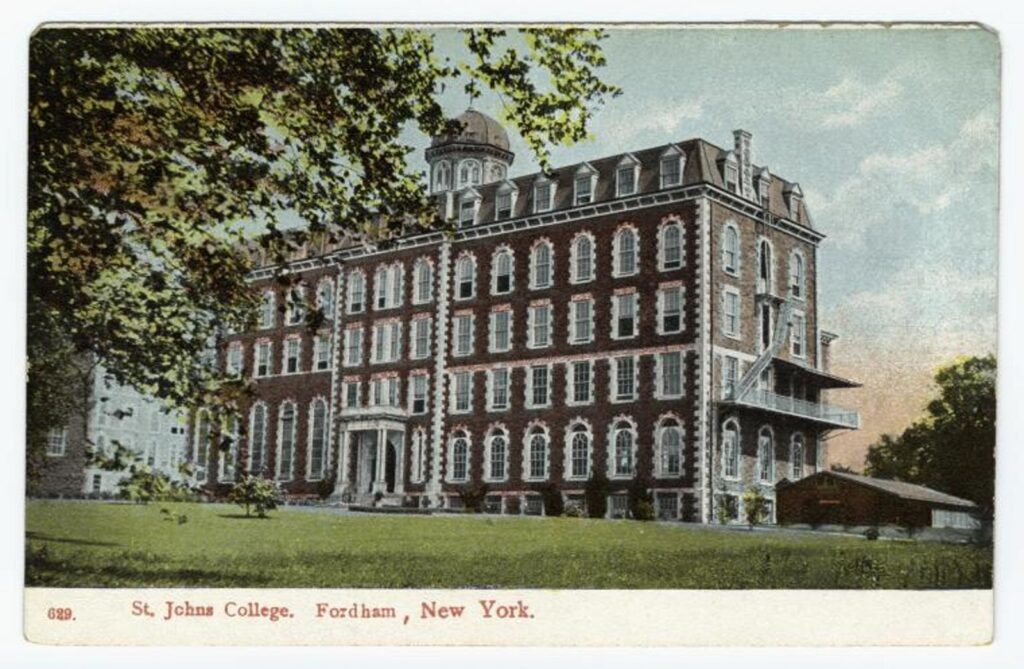
— A whole graduating class of ghosts stalks the campus of the Bronx’s Fordham University, and it may have something to do with either Edgar Allan Poe or the film The Exorcist;
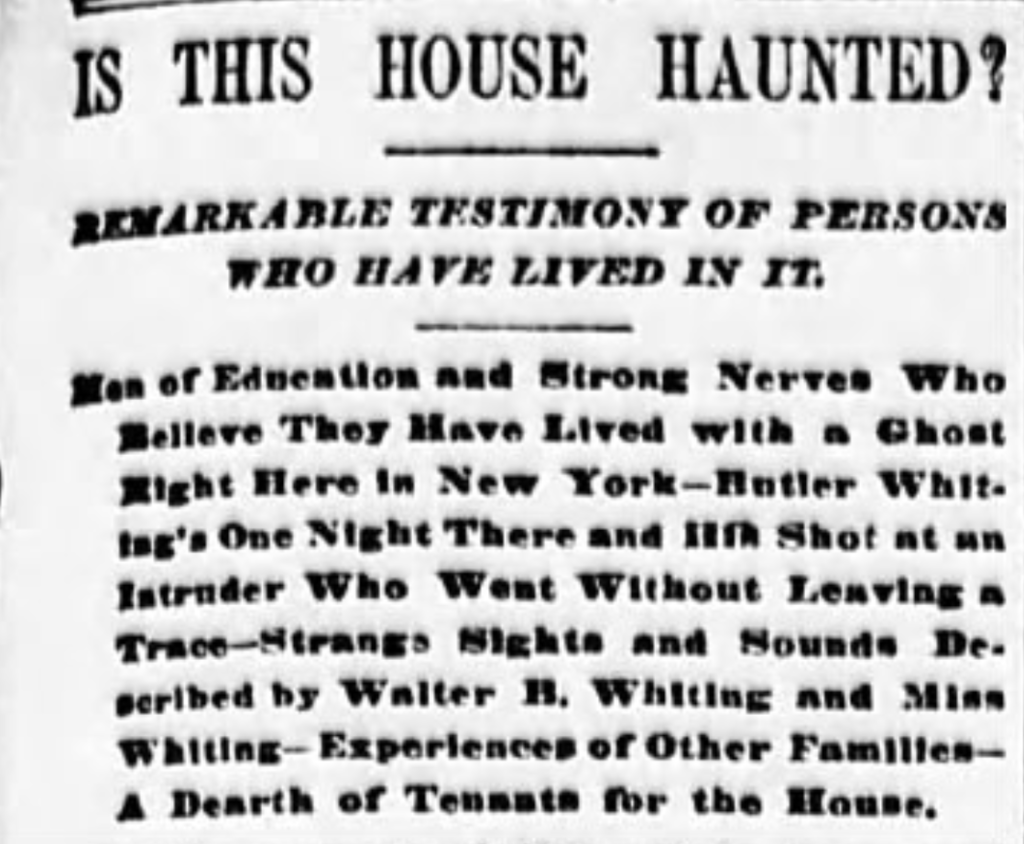
— Just north of Washington Square Park in Greenwich Village, a haunted townhouse vexes several tenants, the sight of a hunched-over man in a cap driving people insane;
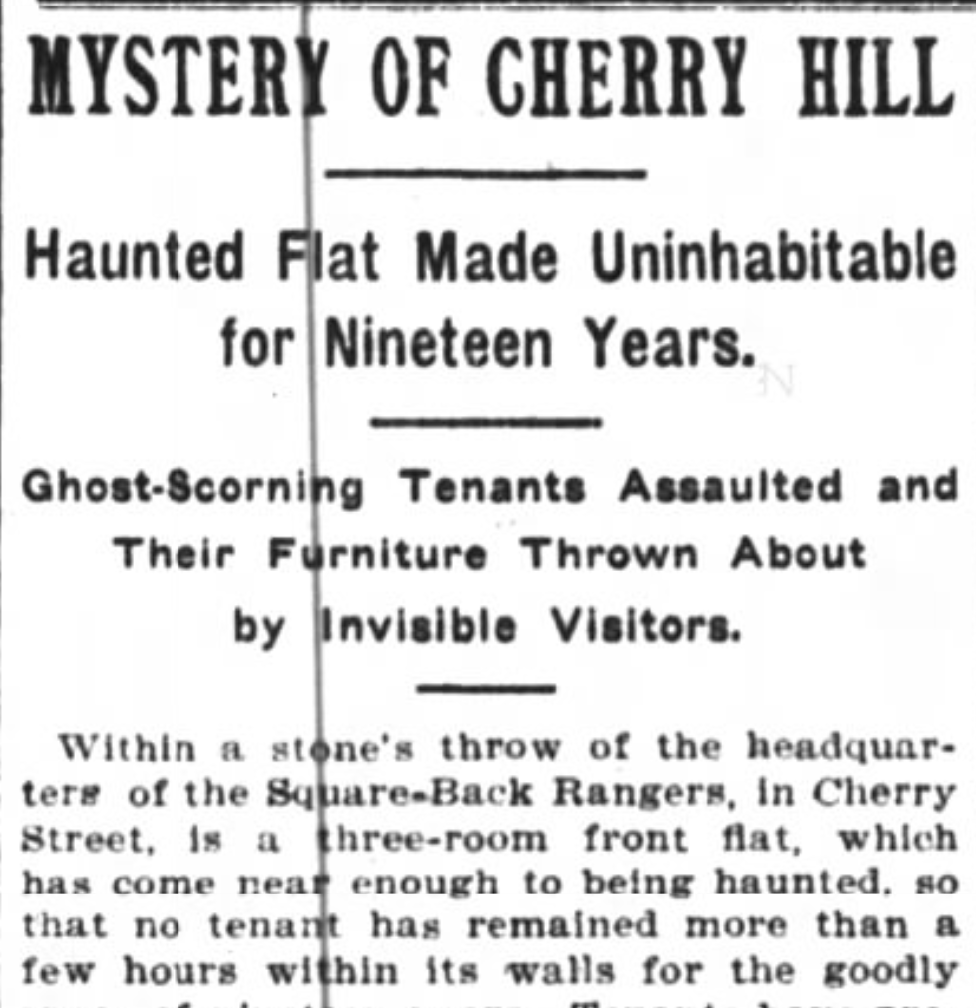
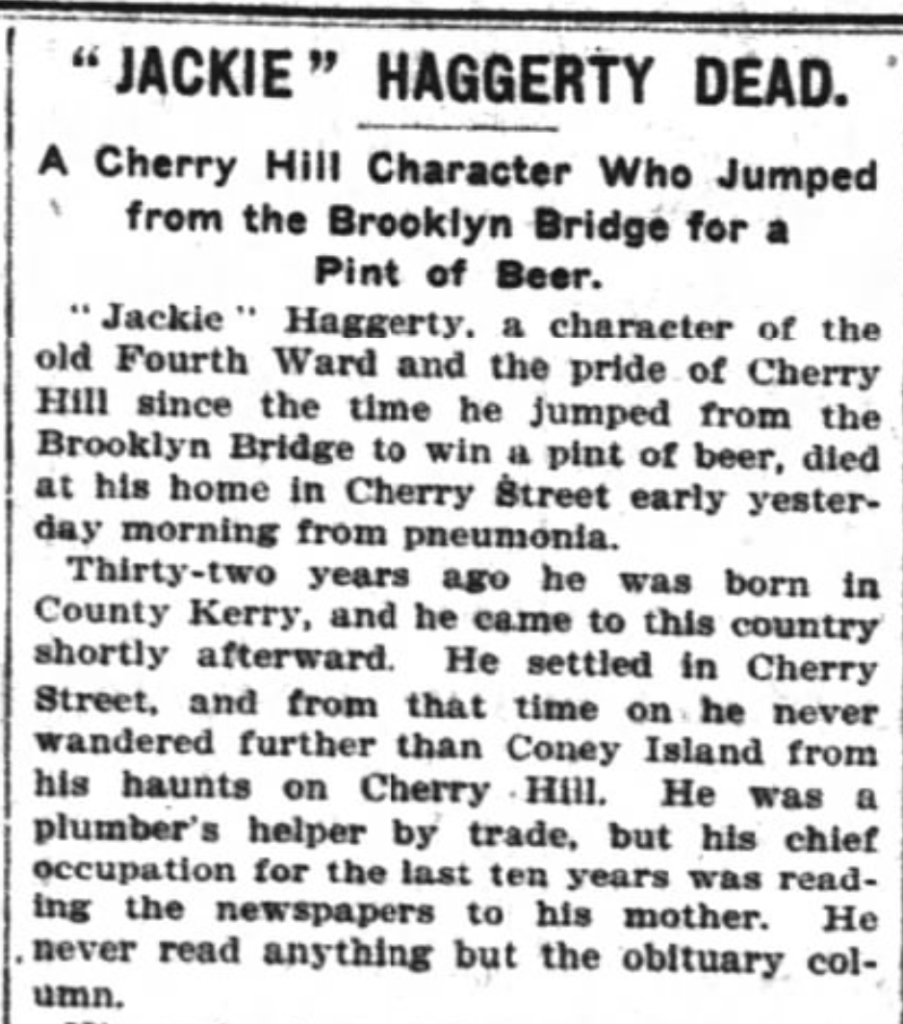
— In the shadow of the Brooklyn Bridge, a small apartment in today’s Two Bridges neighborhood becomes possessed by a poltergeist with a penchant for throwing furniture …. and punches. One vainglorious showoff named Jackie Hagerty learns the hard way;
— And before the days of Riverside Drive, a rustic old mansion once sat on the banks of the Upper West Side, with a mysterious locked room that must never be opened.
LISTEN TODAY: GHOST STORIES BY GASLIGHT
And of course listen to the entire collection of Bowery Boys ghost stories podcast here and in this Spotify playlist:
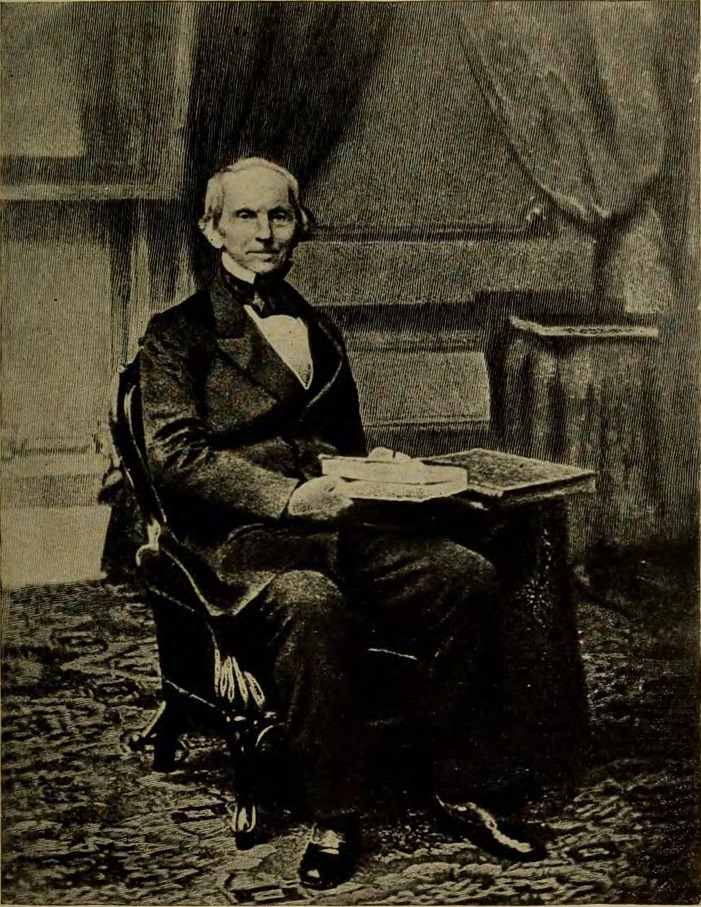
Ghost of the Astor Library
Wikimedia Commons/Internet Archives. Gleason’s Pictorial Vol. 6 No. 8 (February 25, 1854), Boston:124Astor Library 1954. Harry Miller Lydenberg (July 1916). “History of the New York Public Library”. Bulletin of the New York Public Library 20: 570-571.; first published in Gleason’s Pictorial Drawing-Room Companion/Wikimedia commonsThe librarian Joseph Cogswell
The Sorority of Ghosts
Poe Cottage, pictured 1900, Library of CongressThis 1840 image of Cunniffe House by engraver Benson J. Lossing, also includes the original Rose Hill Manor house, at left. (Image courtesy of Catholic Historical Research Center of the Archdiocese of Philadelphia via Fordham)St. John’s Colllege, 1846, courtesy FordhamSt John’s College aka Fordham University, New York Public Library
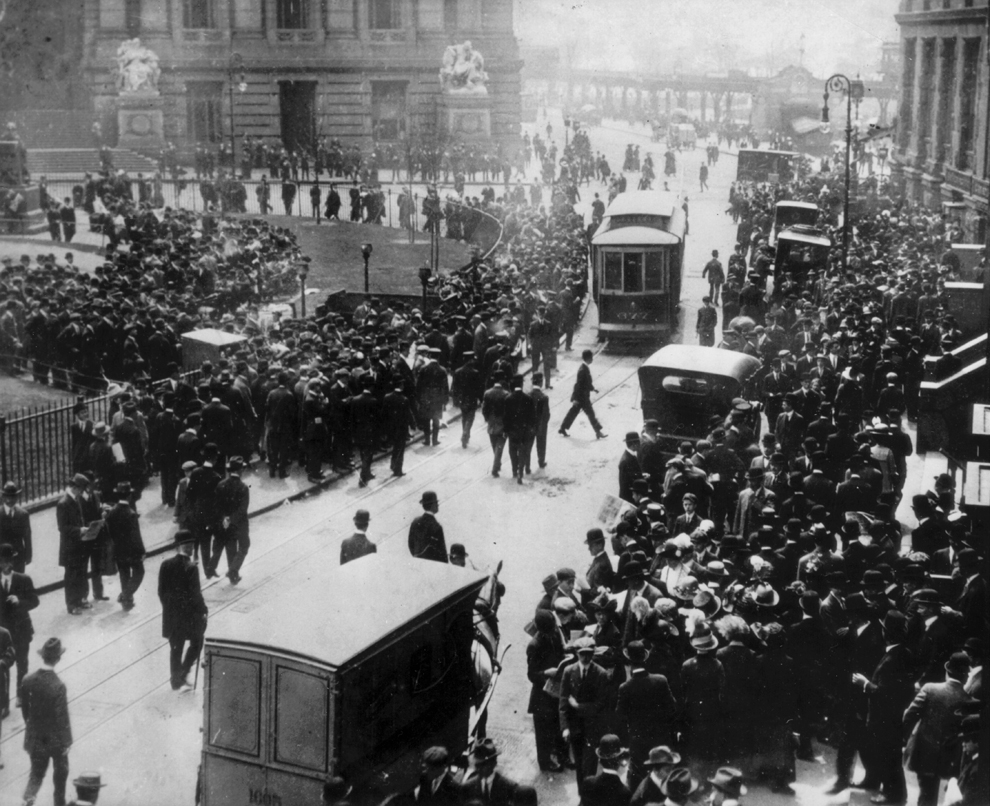
The Waiting Game: Down at the White Star Line's Broadway offices near Bowling Green, anxious New Yorkers line the streets waiting for news about the sunken vessel. 1912
Over fifteen hundred people died the night the Titanic sank, April 14-15, 1912. The early reports from the New York newspapers, of course, spent their time mourning the city’s most connected figures to society.
Even from some of the most obsessive sources on the Titanic, the details on the lives of dozens of men and women who died below deck are sometimes hard to locate.
There’s always been something slightly unsettling about using primary news sources for Titanic research. The bias towards wealthy lives over poor ones — and of American and British lives to all others — can be a little unsettling.
For instance, an anecdote from an April 20, 1912, article in the New York Times: “…[I]t became known among those saved from the Titanic were six or eight Chinamen who were among the steerage passengers on the big liner. It seems that they climbed aboard one of the lifeboats without anybody making objection, despite the fact that many of the women in the steerage of the Titanic went down with the ship.“
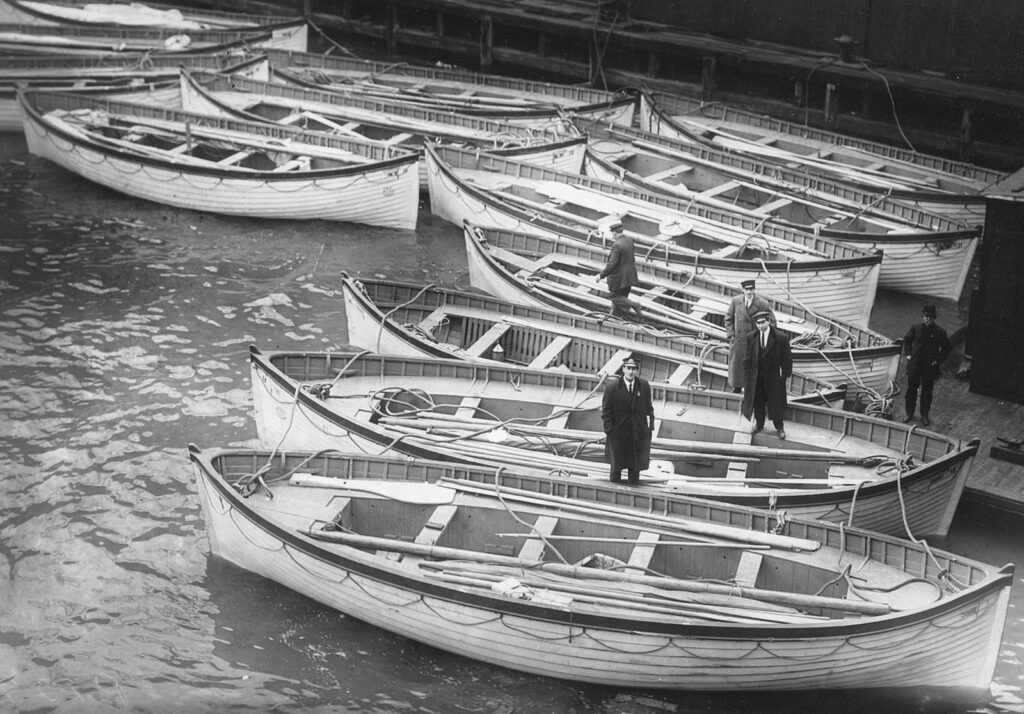
Titanic’s Lifeboats at The White Star Lines Pier 54 in NYC after Sinking. [source]
But this was indeed a tragedy that shook most of the entire world to its core and, in particular, changed the lives of many Americans, from tenements to townhouses.
The old-family names and the wizards of business (Astor, Straus, Guggenheim) have been well documented. But here I present the fates of five well-off but perhaps lesser-known New York women who survived the sinking of the Titanic with intriguing stories of their own to tell:
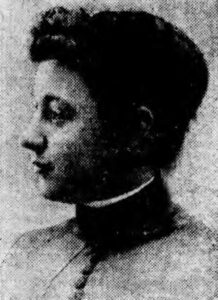
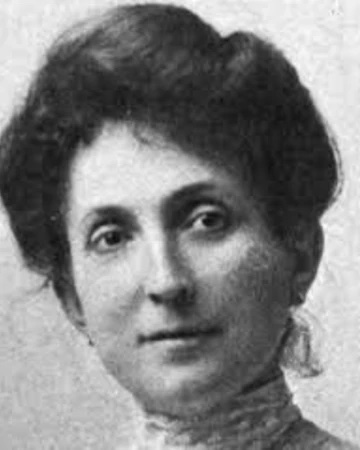
Dr. Alice Farnham Leader Born in New York, May 10, 1862
Alice would have been among the second generation of women trained in medicine, and a career in pediatrics was one of the few that a women of her day could ably progress towards. As late as 1907 she was employed at Bellevue Hospital as ‘a social service nurse‘.
However she wasn’t a practicing doctor by the time she boarded the Titanic; the 49 year old had retired when her husband died in 1908.
She was rescued by lifeboat no. 8, commanded by one of the Titanic’s most famous names: Noël Rothes, the Countess of Rothes. “The countess is an expert oarswoman and thoroughly at home in the water,” Alice told the press, who sadly seemed more interested in the fate of the titled gentry than of this mysterious doctor who appears to have avoided the spotlight for the remainder of her life.
Afterwards: Dr. Leader is mentioned in a Utah newspaper in 1916, discussing the crisis of graying hair. Her solution: “A head exercise for circulation is to lie on the couch with the head projecting beyond the couch. Bend the head forward, backward, to each side, to each side, then rotate.” Died: April 20, 1944
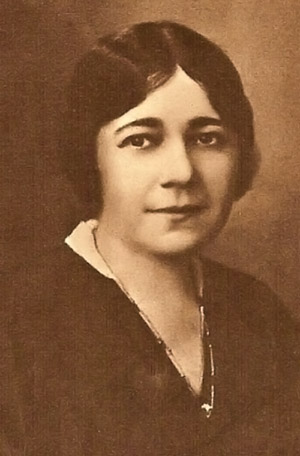
Irene (Rene) Harris Born: June 15, 1876
A New York stage actress with some considerable credits to her name, Harris boarded the Titanic with her husband Henry Birkhardt Harris, the theater impresario and partner (with Jesse Lasky) in the Folies Bergere, which has just opened in midtown the year before.
Irene made it to a lifeboat but her beloved husband perished on the Titanic. The Times recounts her cable to the Hudson Theater: “Praying that Harry has been picked up by another steamer.”
Afterwards: Returning to the New York theater in grief, she sued the White Star Line for a large petition of damages, and perhaps with good reason; she discovered when she got home that her husband was nearly bankrupt from the Folies Bergere venture and other flops.
So she decided to make her own money, soon becoming one of Broadway’s first female producers with such shows as ‘Lights Out’ and ‘The Noose’ and buying a Park Avenue apartment.
But her wealth didn’t make it out of the Great Depression, and she spent her last days living in Manhattan hotels. In 1958, she was subjected to a screening of the Hollywood film ‘A Night To Remember‘. “I think your film title is a mistake,” she said. “It was a night to forget.” Died: September 2, 1969
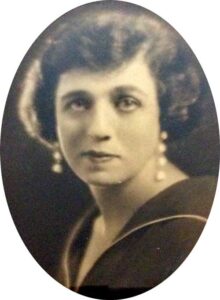
Margaret Hays Born: December 6, 1887
If not for the tragic sinking of the Titanic, Margaret Hays’ fate might have made a charming family comedy. The young woman lived at304 West 83rd Street and had gone to Europe with two school friends Olive and Lily.
And there was another lady with her on the Titanic that fateful night — Margaret’s Pomeranian dog.
All three friends and her little dog too made it to a lifeboat, but Margaret’s story was just beginning.
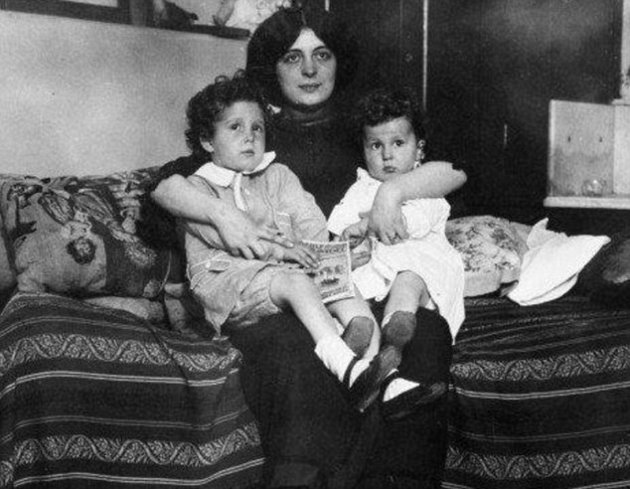
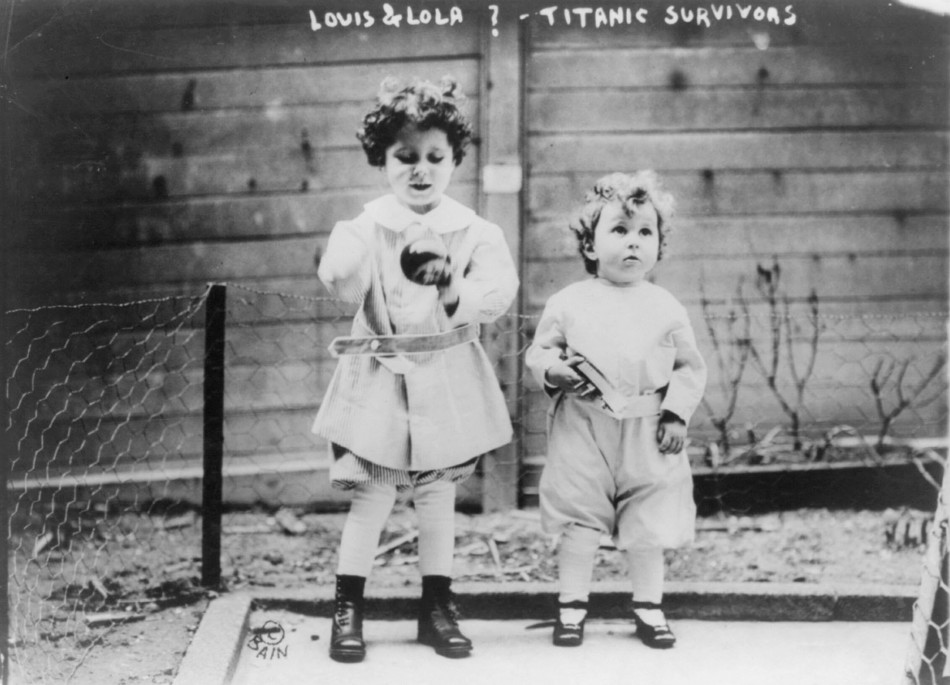
Onboard the rescue ship Carpathia were two small frightened French boys.
The ‘Titanic orphans’, named Michel and Edmond (not Louis & Lola!).
They had been separated from their father Michel who was never found. Hays, who spoke French, took the boys into her care during the somber voyage and well after they arrived in New York. They stayed at her home on West 83rd — she distracted the distraught boys with carriage rides up Riverside Drive — until their mother arrived from France.
On her arrival, it was revealed that their father had taken the two boys against their mother’s will during a bitter divorce battle.
Afterwards: Hays married a Rhode Island doctor and lived in relative comfort, dying during a vacation in Argentina. Died: August 21, 1956
Leila Meyer Born in New York, September 28, 1886
The young socialite and daughter of Andrew Saks (founder of Saks Fifth Avenue) met aspiring Wall Street broker Eugene Meyer and married him in 1909.
While traveling, Leila was wired the tragic news that her father had died. (Later, she discovered that a sizable part of their fortune had been willed to her.) Leila and her husband boarded the Titanic to return home. She made it to a lifeboat; her husband died aboard the ship.
Afterwards: She later remarried and lived the remainder of her life at 970 Park Avenue, rarely speaking to the press about her tragedy, although her spectacular jewelry collection was frequently remarked upon in women’s magazines. Died: November, 27, 1957
Mrs. Charlotte Appleton Born in New York, December 12, 1858
Charlotte was well versed in the thrill of ocean travel. Her father, once a well-known dry goods importer, worked for the firm which operated theBlack Ball Line, one of the oldest shipping companies in New York and no stranger to a few shipwrecks of its own.
She married into the prestigious Appleton publishing family and was on the Titanic with two sisters, returning from a funeral in England.
Afterwards: Mrs. Appleton’s name is familiar with Titanic buffs as she was an acquaintance of Col. Archibald Gracie IV, the great-grandson of the man who built Gracie Mansion and one of the more notable bold-faced names on the Titanic. Mrs. Appleton lived the remainder of her life at 214-33 33rd Road, the oldest house in Bayside, Queens.
Died: June 25th, 1924
Some pictures and many of the birth/death dates above are courtesy Encyclopedia Titanica. Top picture courtesy the Library of Congress.
This story was originally published on the 100th anniversary of the Titanic and refreshed the honor the 110th anniversary.
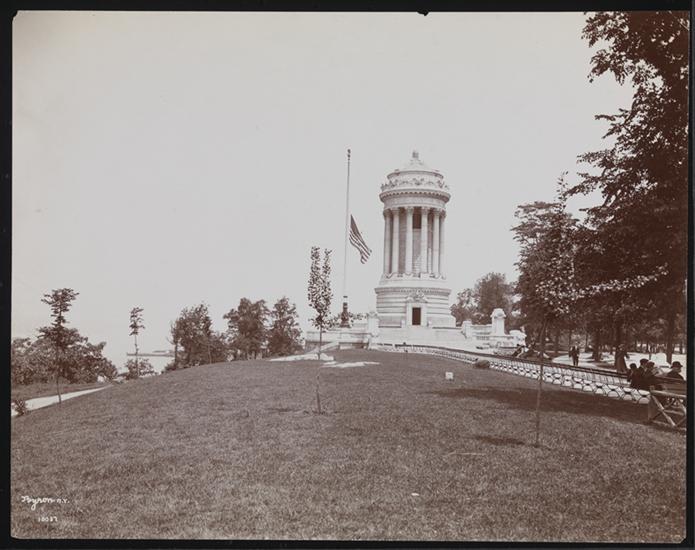
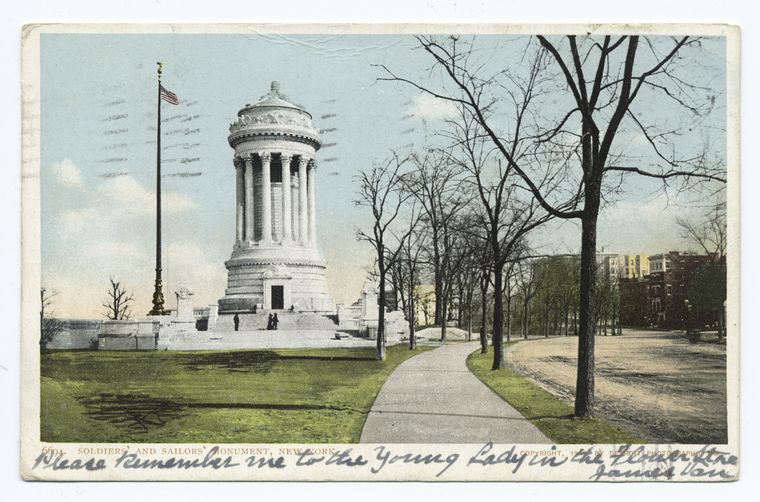
This Monday (May 27, 2019), a Memorial Day observance will be held from 10 a.m to noon at the Soldiers and Sailors Monument in Riverside Park. In honor of the holiday, we’re rerunning this 2015 article on this oft-forgotten monument.
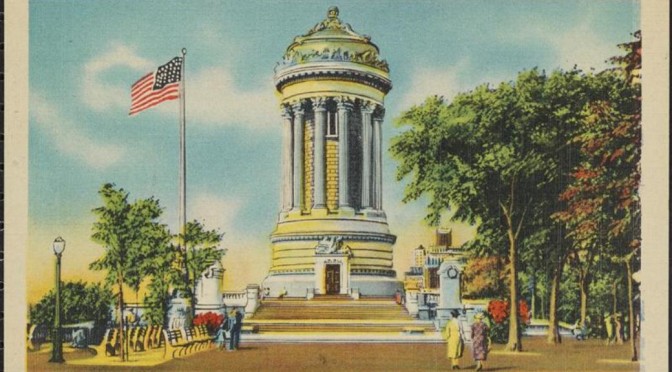
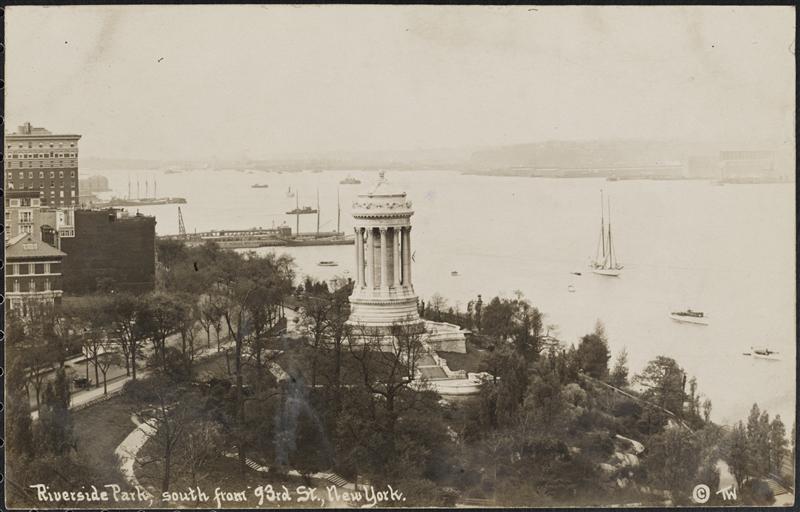
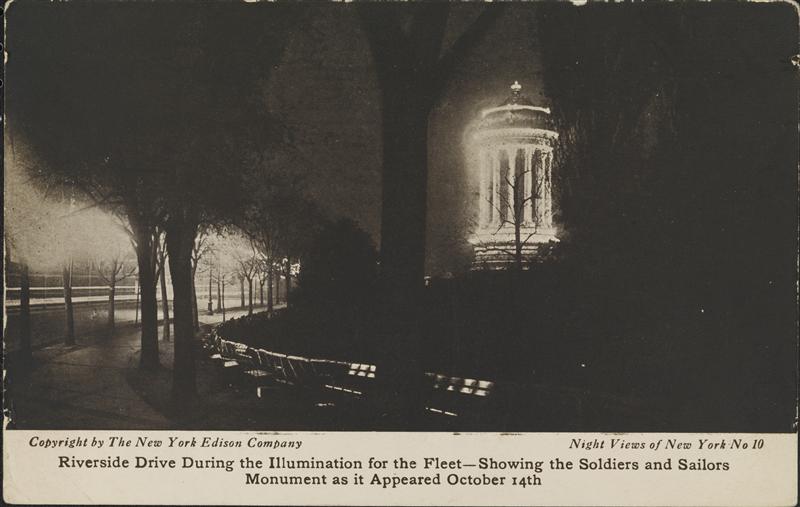
The Soldiers’ and Sailors’ Monument on the Upper West Side has been the centerpiece for Memorial Day commemoration for decades. Unless you actually live by it, you probably have not been there in years, if at all. It’s a vastly under-appreciated landmark, occasionally vandalized and certainly in need of work. [For more on the history of Riverside Park, listen to our podcast episode: Heaven on the Hudson.]
Courtesy the Museum of the City of New York
It owes its form to the great Gilded Age fervor for classical beauty and the aesthetic appeal of Beaux-Arts architecture. Grand war memorials were sprouting up all over New York during this period, most notably he Soldiers’ and Sailors’ Arch in Brooklyn’s Grand Army Plaza (1892) and Prison Ship Martyrs Monument in Fort Greene (1908). Then there’s Grant’s Tomb (1897), which owes its existence more to the General’s military career and not so much his scandal-filled presidency.
And similar monuments of such colossal proportion were erected in other cities including Hartford(1886), New Haven (1887), Allentown (1899) Indianapolis(1902), Baltimore(1909) Syracuse (1910), Pittsburgh(1910), among many others.
Courtesy the Museum of the City of New York
Monuments are dandy indicators of civic pride but many were inspired by practical necessity. Most Union veterans were in their ’50s and ’60s by this time many of these memorials were planned. Those that grew up after the war– the sons and daughters of war heroes — wanted to recognize the achievements of a previous generation. Many of these men (Grant being the notable example) were now prominent citizens in New York.
Its also not a coincidence patriotic feelings were swelling during this period due to conflicts like the Spanish-American War which would later demand their own memorials like the powerful Maine Monument, unveiled in 1913.
1915, courtesy the Museum of the City of New York
Riverside Drive might seem a curious place to put a Civil War monument. In fact, its location inspired a bit of a civic war itself from the moment it was first planned in 1893. “THE MONUMENT FIGHT AGAIN” proclaimed the New York Times in 1895, reporting on a rivalry between members of the Upper East Side Association and the Upper West Side Association.
I mean, in 1895, didn’t it make sense to place it on Fifth Avenue, the most prominent and wealthy street in the world? Proponents chose Fifth Avenue and 59th Street, the entrance to Central Park, as the ideal spot. “It is rather amusing to hear …. grounds for opposition in view of what was said in front of the Commissioners when the west side men wanted to locate the monument on the Riverside Drive and Seventy-Second Street…..[T]hey charged that the Plaza was not suitable because the monument would be surrounded by buildings that would dwarf it.”
Supports of the Riverside site claimed that the foundations would not be sturdy enough near the park, an amusing remark given the skyscraper boom which would take over Midtown Manhattan in the 20th century. In particular, naval officers bristled at the Fifth Avenue site which was almost as far from the site of water that one could get in Manhattan.
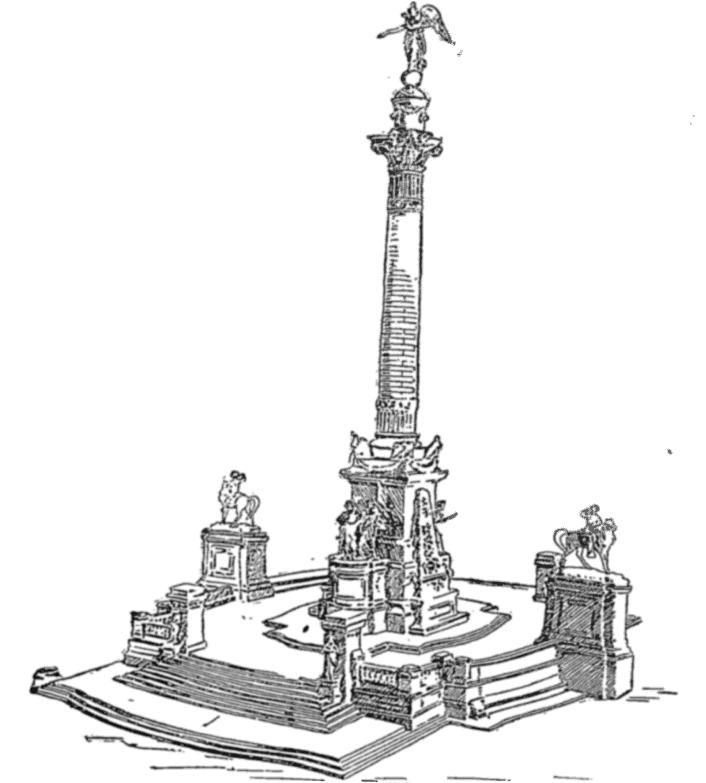
Had the eastsiders won, we would have gotten a Soldier’s and Sailors Monument that looked like this on the spot of today’s Grand Army Plaza:
By 1899, years after the project was conceived, proponents of the west side finally won out. The monument was planned for a spot in the newly developed Riverside Park known as Mount Tom, a “very beautiful little knoll of natural rock,” believed to have been a spot of quiet contemplation for one Edgar Allen Poe (who lived nearby in 1844). That was at Riverside Drive and 83rd Street. Eventually that too was deemed inadequate, and the preparations were then moved to the present location at 89th Street.
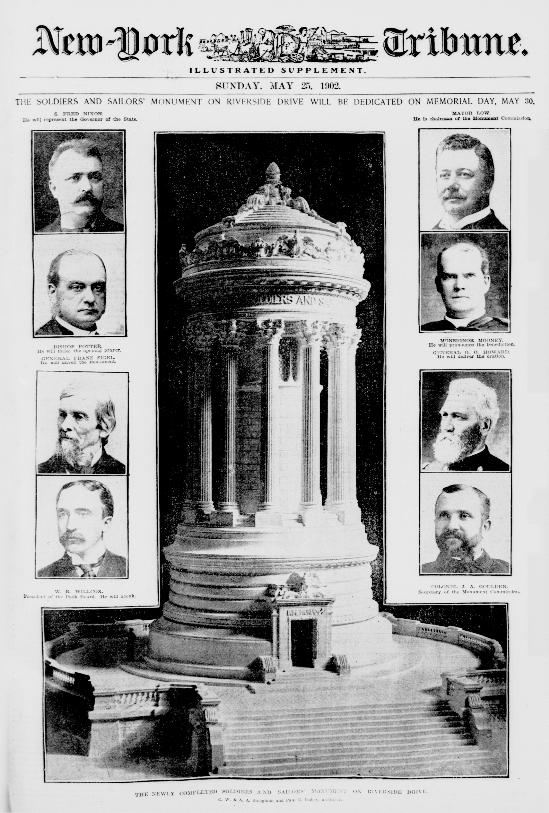
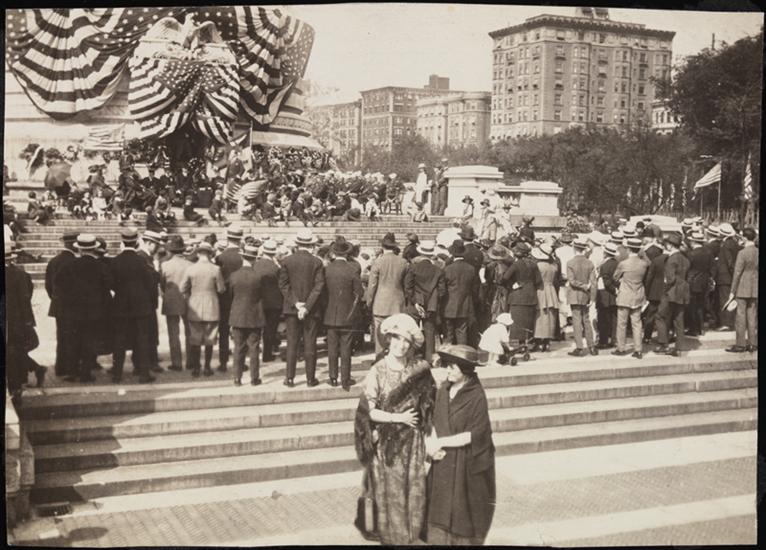
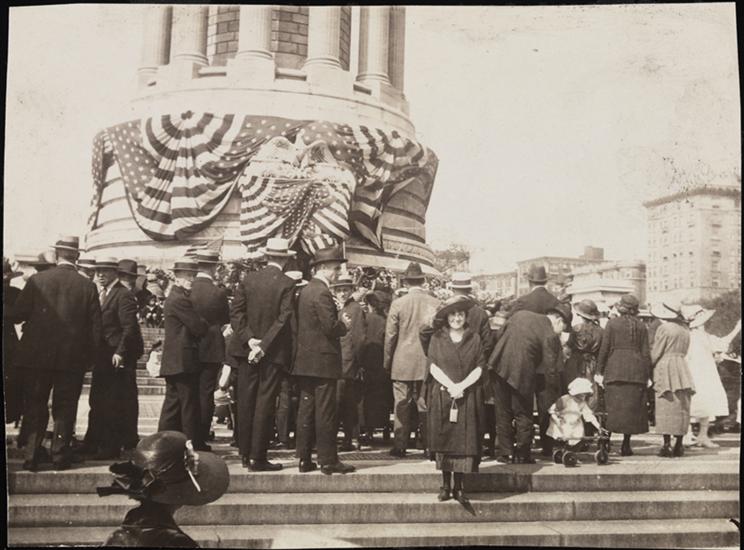
Given the new location, the monument was redesigned by the firm of Straughton and Straughton as a circular temple adorned with Corinthian columns. The Soldiers and Sailors Monument was officially dedicated on Memorial Day 1902:
Here are a couple views of its dedication ceremony in 1902:
Courtesy the Museum of the City of New YorkCourtesy the Museum of the City of New York
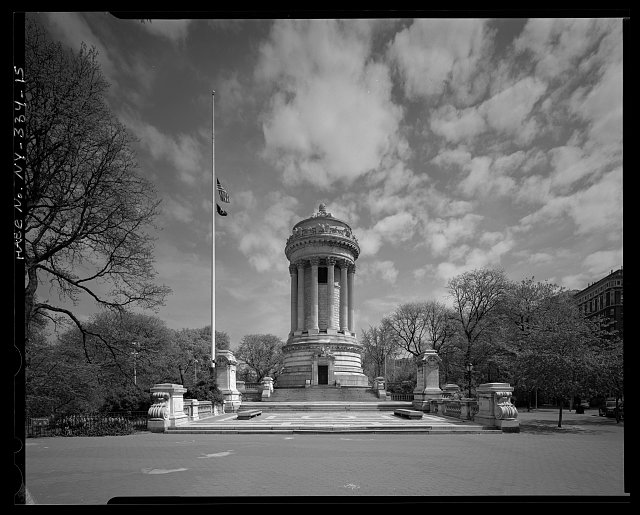
The final monument is absolutely beautiful, of noble design, but was not well constructed. Repairs were necessary less than five years later, and the structure has gone through several alterations. This New York Times article gives you a look inside the monument and reviews some current efforts to rescue the building from further deterioration.
The weather’s supposed to be spectacular this holiday weekend, so make that a good excuse to visit this unusual and charming little memorial.
Photo by Renee Bieretz, courtesy the Library of Congress
And finally, a mysterious post card from the New York Public Library collection. Note the caption:
PODCAST The highs and lows of the history of Riverside Park
In peeling back the many layers to Riverside Park, upper Manhattan’s premier ribbon park, running along the west side from the Upper West Side to Washington Heights, you will find a wealth of history that takes you back to Manhattan’s most rugged days.
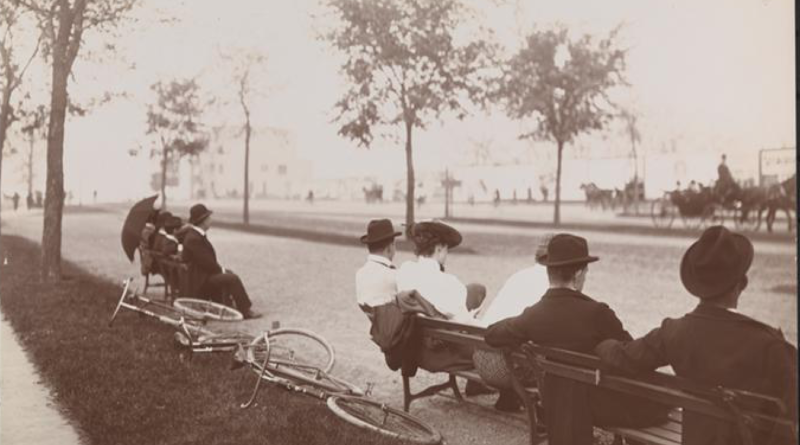
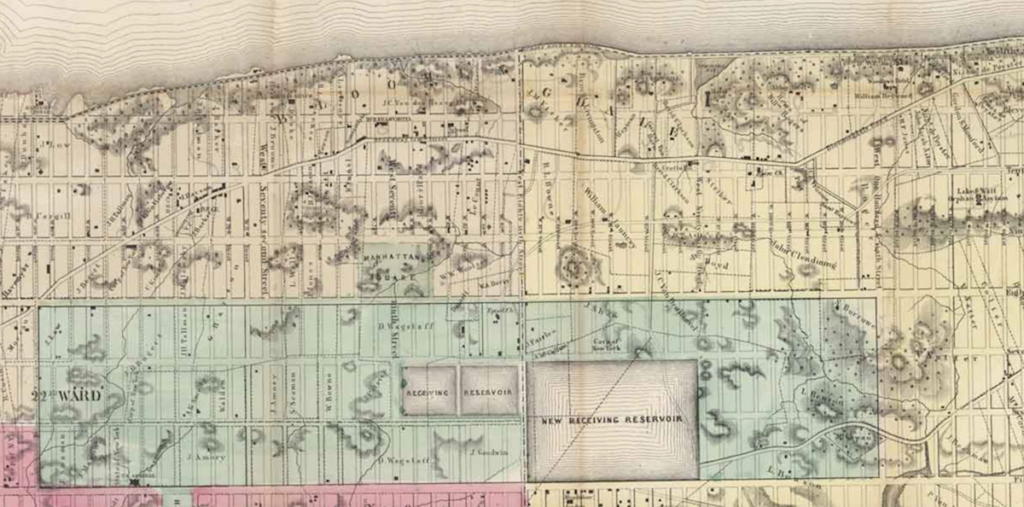
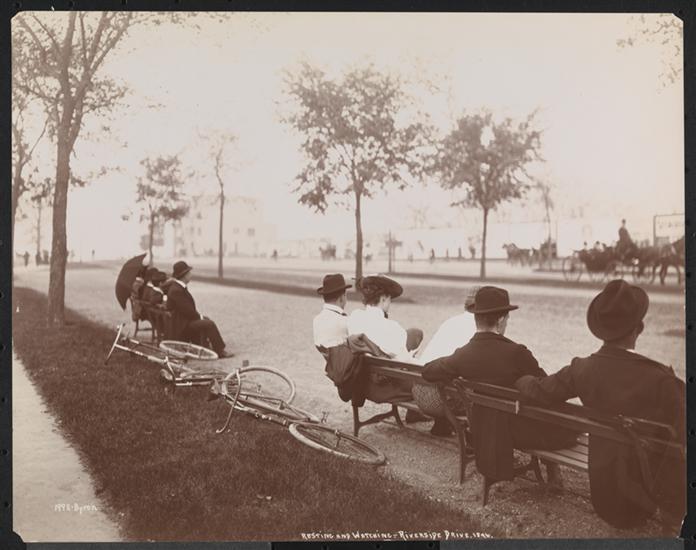
The windswept bluffs overlooking the Hudson River were home to only desolate mansions and farmhouses, its rock outcroppings appealing to tortured poets such as Edgar Allan Poe. But the railroad cleaved the peace when it laid its tracks along the waterfront in the 1840s.
To encourage development, the city planned Riverside Park as a respite with commanding views of the river and a swanky carriage way for afternoon excursions. But the original plan by Central Park designer Frederick Law Olmsted only went so far — right up to those pesky train tracks.
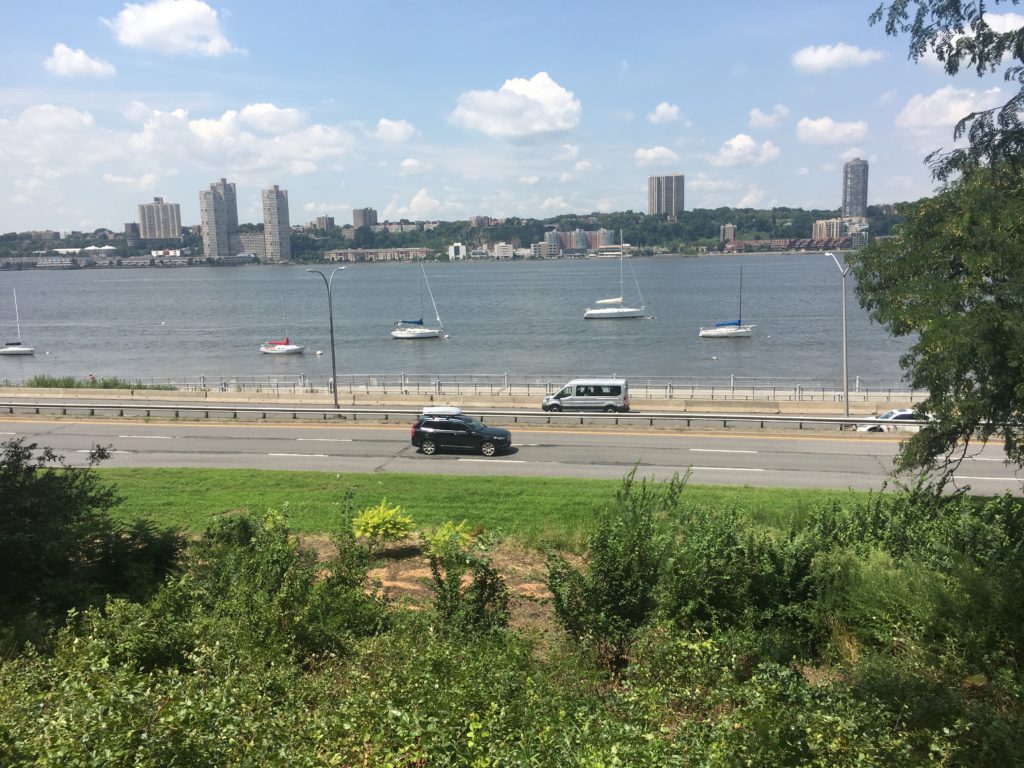
In the 20th century, residents along the newly chic Riverside Drive tired of the smoky mess. It would take the ‘master builder’ himself — Robert Moses — to finally conceal those tracks and create a new spot for recreational facilities. In doing so, he threaded his new park with a new noisemaker — the Henry Hudson Parkway.
We give you the grand overview history of this extraordinary park THEN we visit the park itself to give you the full dynamic sound experience, reviewing Riverside’s most spectacular attractions.
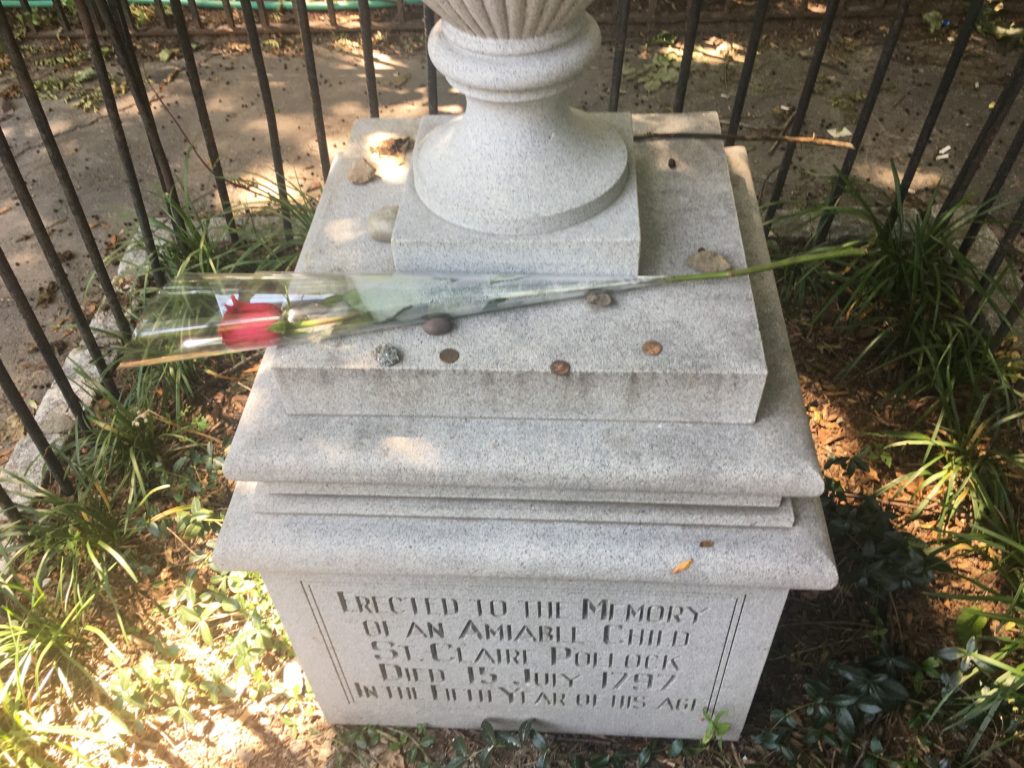
PLUS: The strange story of two great monuments at 125th Street, the final resting place for a great military leader and a five year old boy, whose tragic story has inspired generations of poets.
FEATURING: George and Ira Gershwin, Charles Schwab, Joan of Arc, Hillary Clinton and Donald Trump (in non political capacities!)
The Bowery Boys: New York City History podcast is brought to you …. by you!
We are now producing a new Bowery Boys podcast every other week. We’re also looking to improve the show in other ways and expand in other ways as well — through publishing, social media, live events and other forms of media. But we can only do this with your help!
We are now a member of Patreon, a patronage platform where you can support your favorite content creators for as little as a $1 a month.
Please visit our page on Patreon and watch a short video of us recording the show and talking about our expansion plans. If you’d like to help out, there are five different pledge levels (and with clever names too — Mannahatta, New Amsterdam, Five Points, Gilded Age, Jazz Age and Empire State). Check them out and consider being a sponsor.
We greatly appreciate our listeners and readers and thank you for joining us on this journey so far.
From an 1855 map of Manhattan, showing the still-rugged terrain of the area west of Central Park
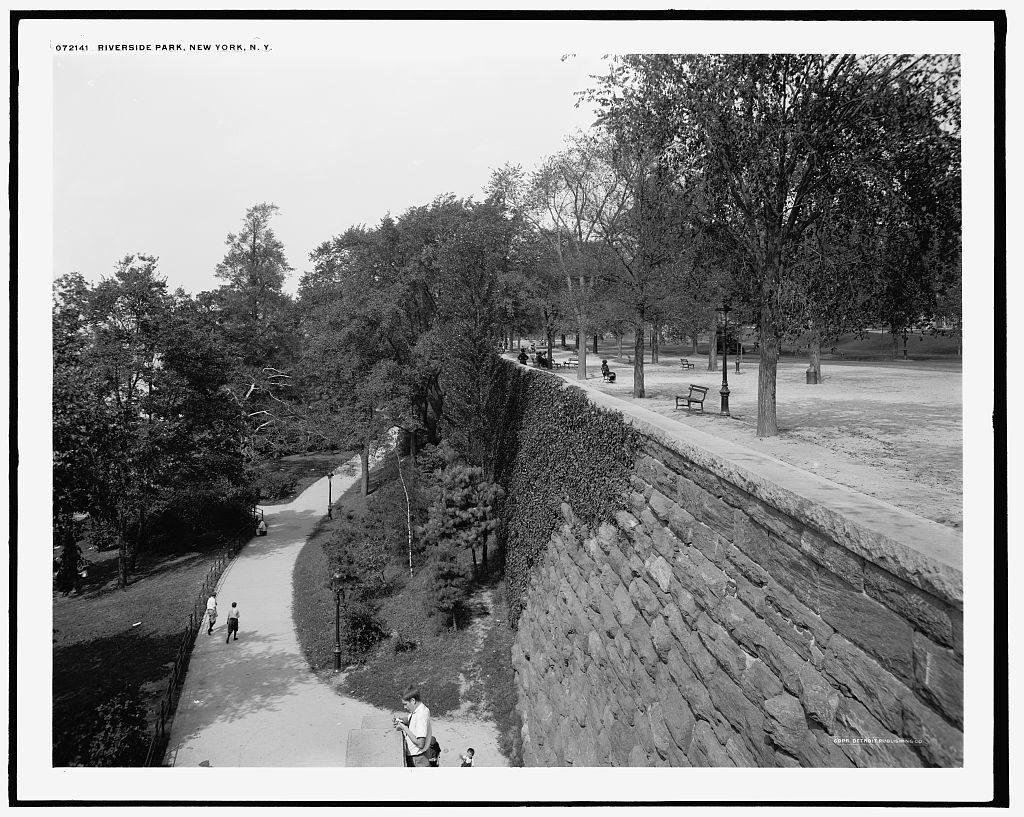
1896, Museum of the City of New YorkDetroit Publishing Co.,Created / Published between 1910 and 1920 / Library of Congress
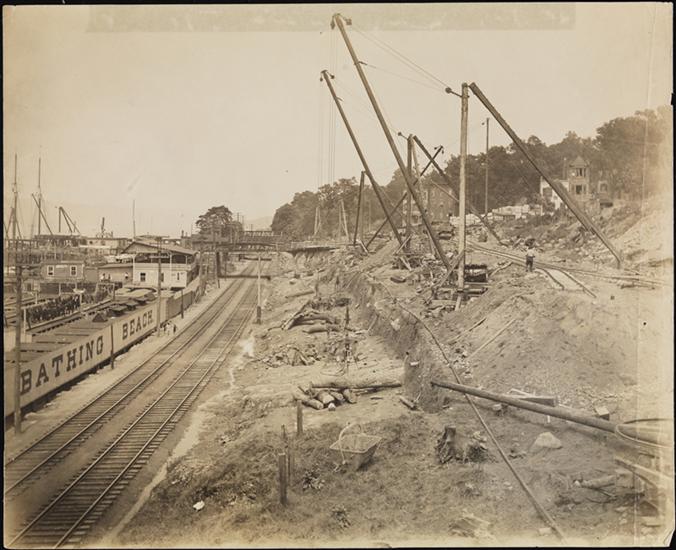
In the early 1900s, the park was extended further north. This depicts the scene near 148th Street, near a ‘bathing beach’ that couldn’t have been very pleasant to visit during construction.
MCNY
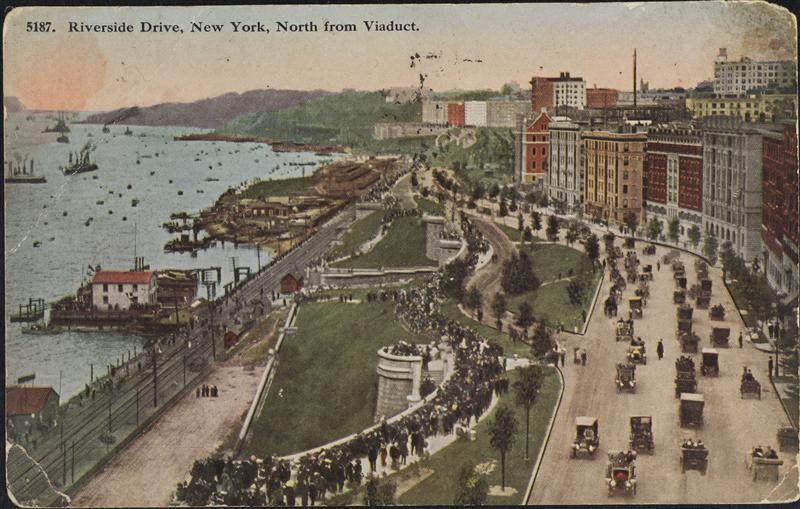
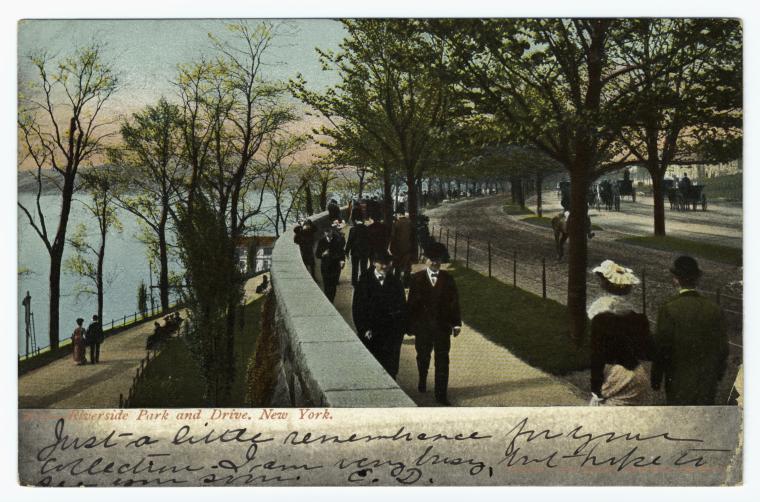
Riverside Park and Drive in the 1920s — the park stops at the tracks.
Another image from 1910, showing the exposed tracks and the waterfront.
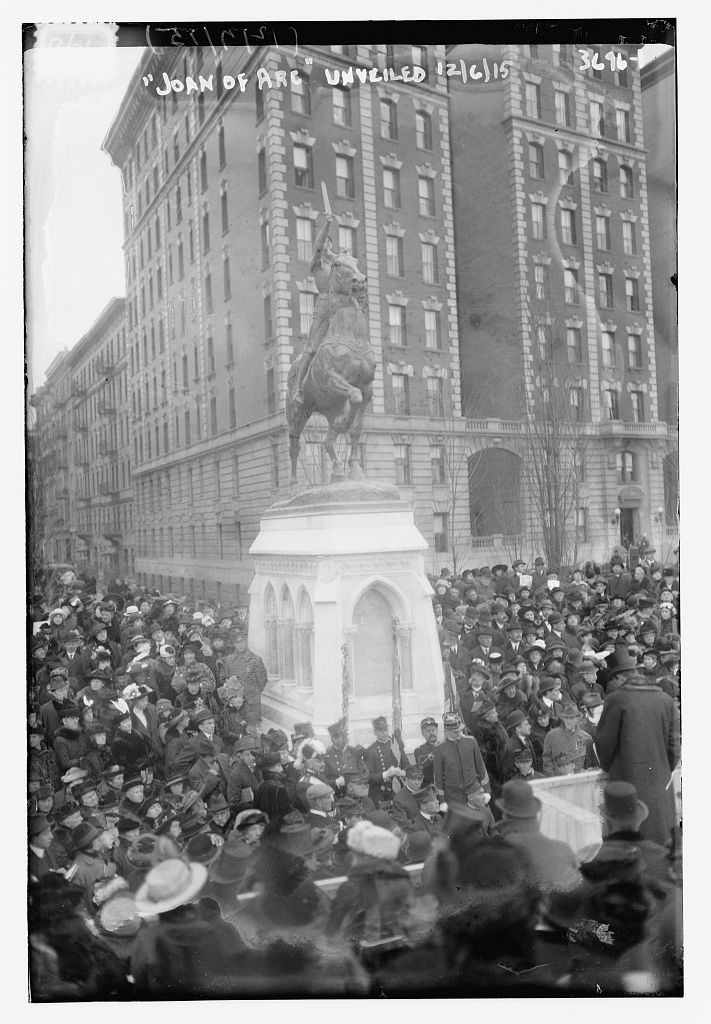
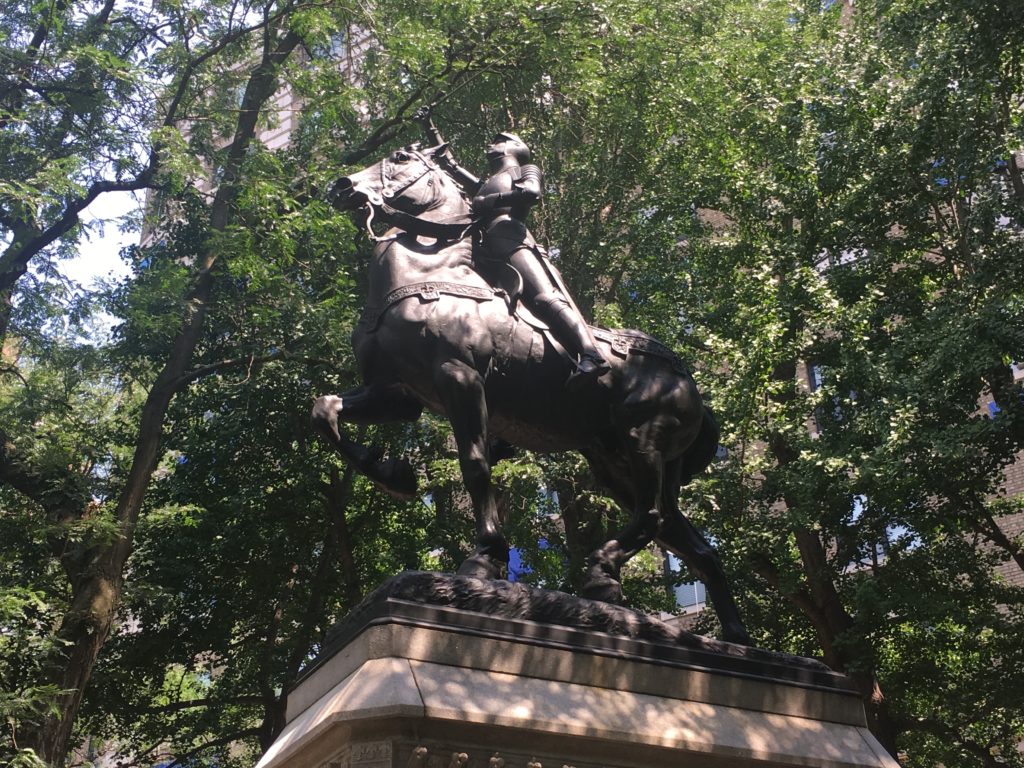
Photograph shows the unveiling of the Joan of Arc statue, Riverside Park, New York City on Dec. 6, 1915. (Source: Flickr Commons project, 2013)
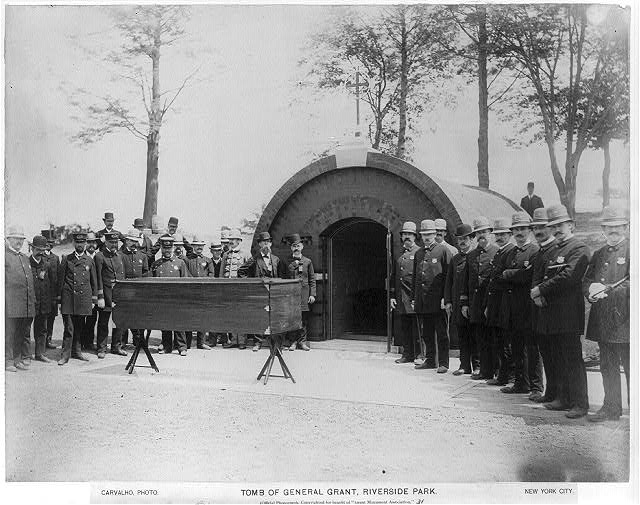
The original tomb of Ulysses S. Grant, circa 1886….
Library of Congress
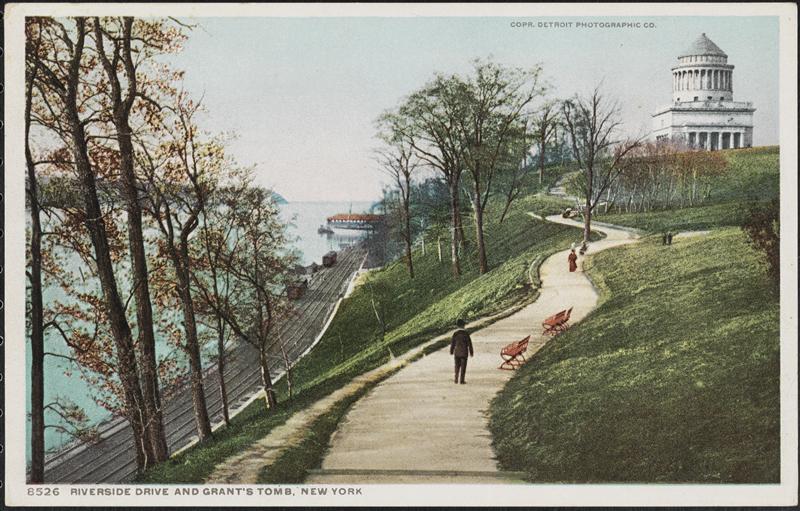
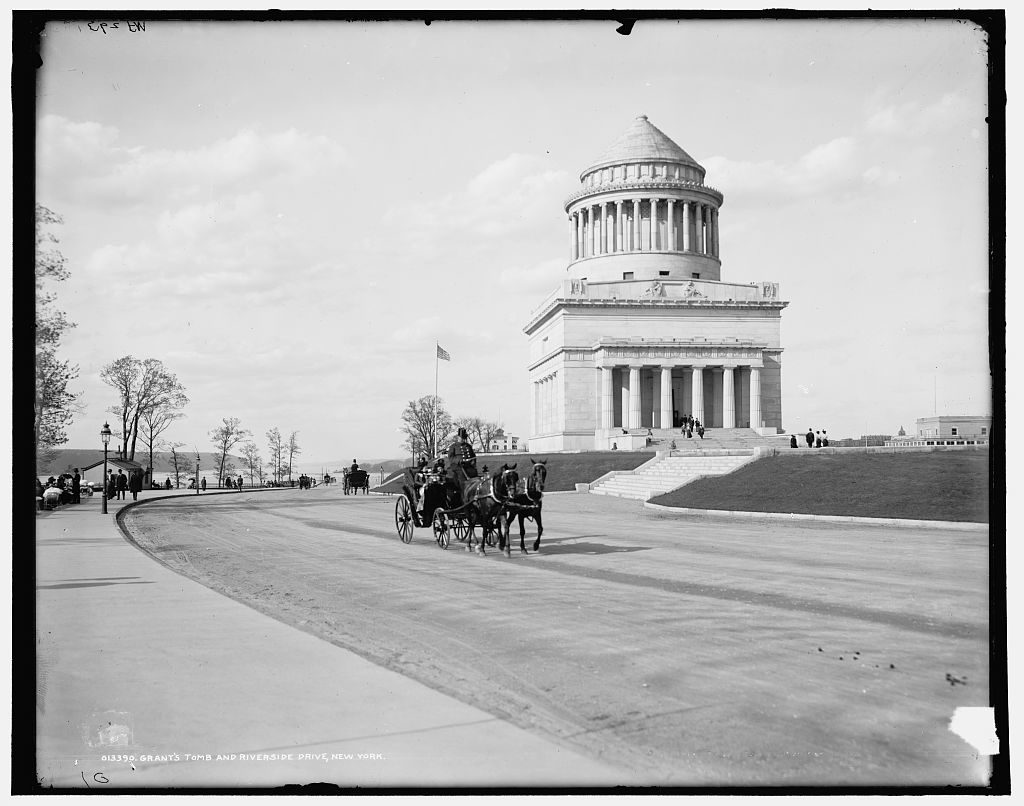
Replaced by his more famous resting place in 1897, in Olmsted’s carriage loop. (Olmsted was no longer associated with Riverside Park or else he might have taken issue with its placement.)
1901/Library of Congress
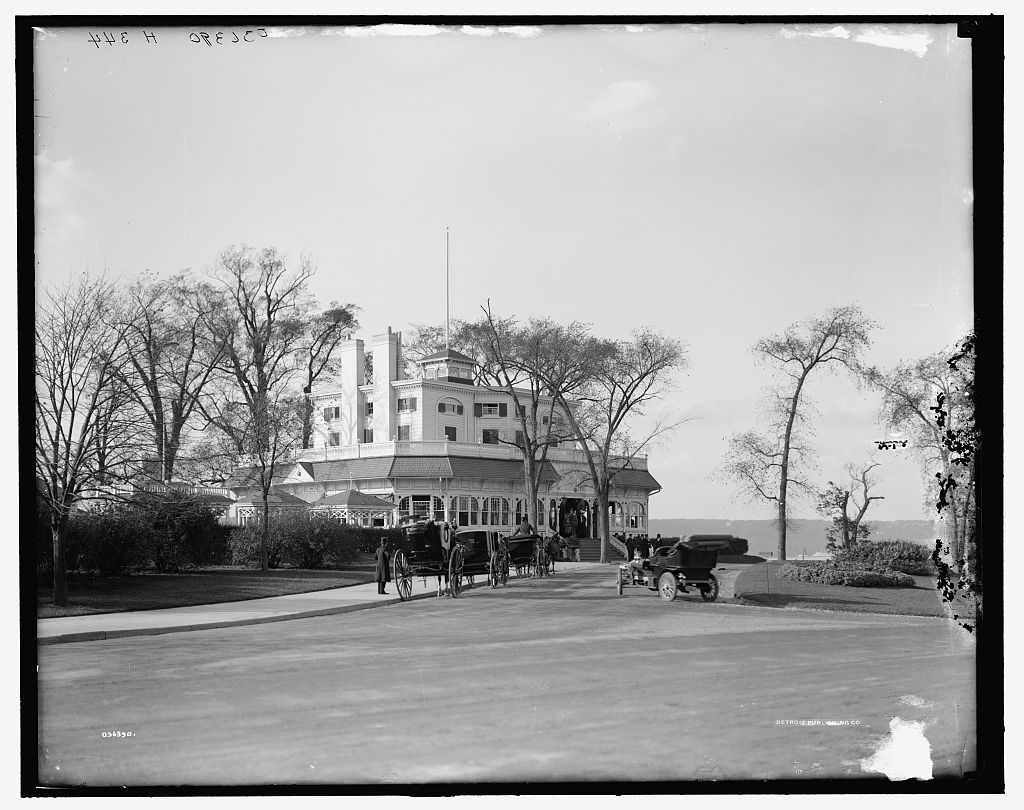
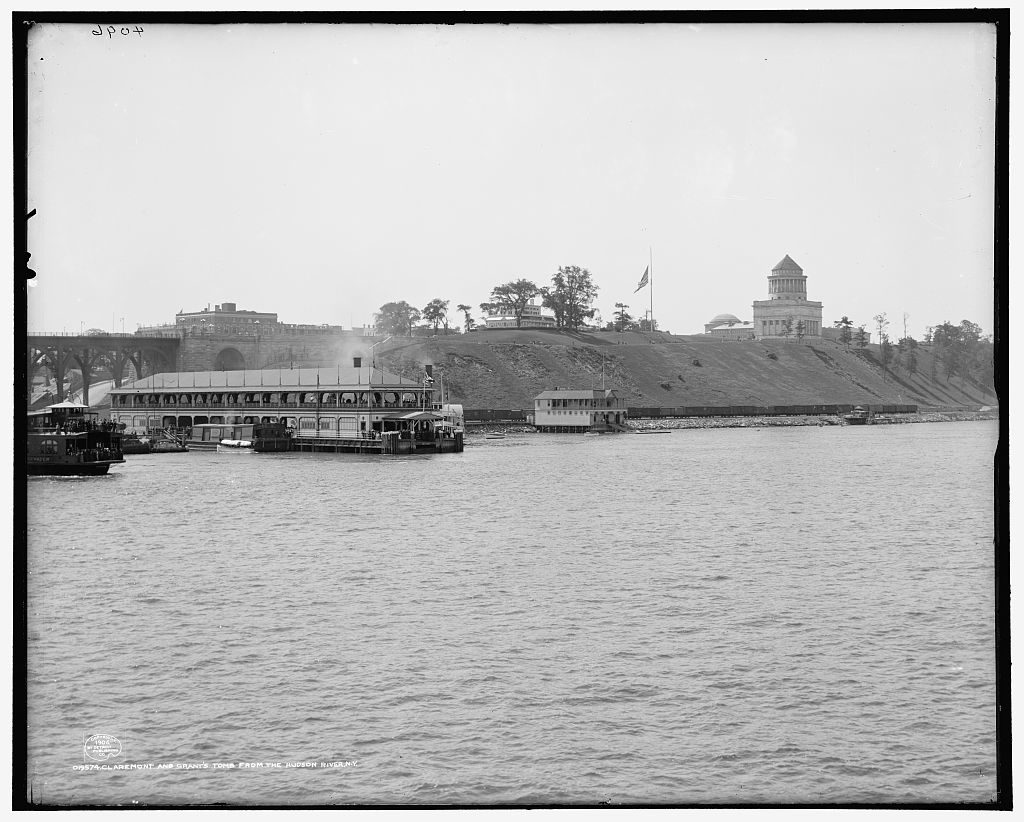
The fabulous Claremont Inn which drew thousands of weary New Yorkers after a long stroll in Riverside Park.
Detroit Publishing Co., 1900/ Library of Congress
A view of Grant’s Tomb, Claremont Inn, the Manhattan Valley Viaduct and a glorious pier structure.
1906/Library of CongressNew York Public Library
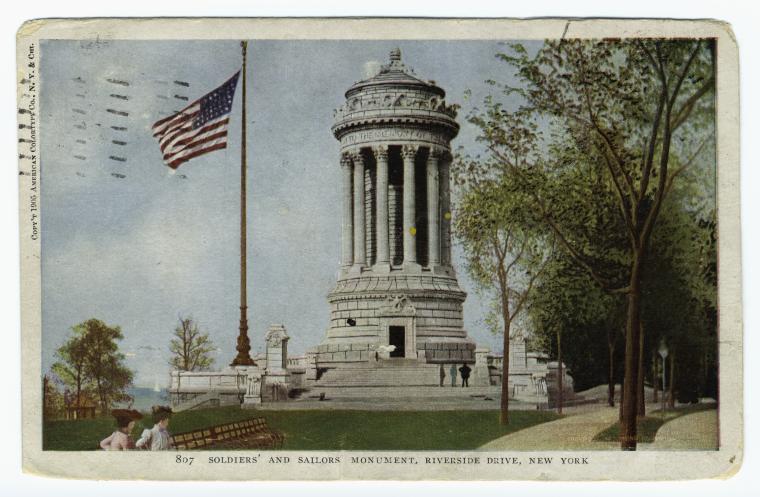
The Soldiers and Sailors Monument. (Read more about it here.)
New York Public Library
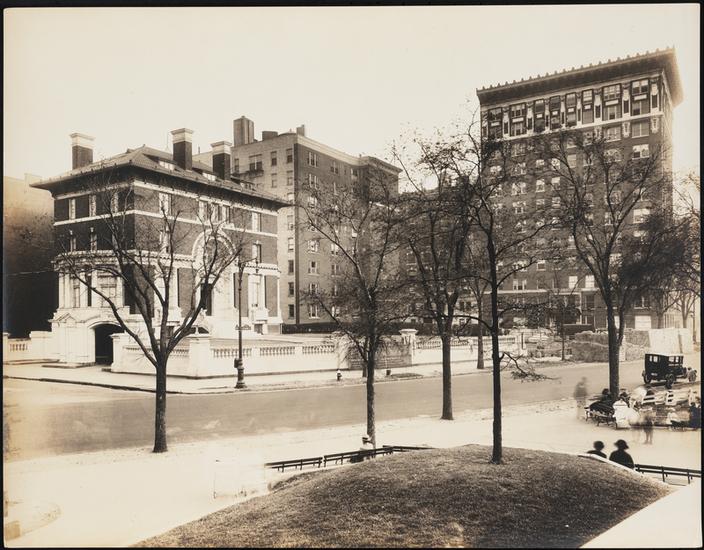
The Rice residence at West 89th Street and Riverside Drive
Wurts Brothers/MCNY
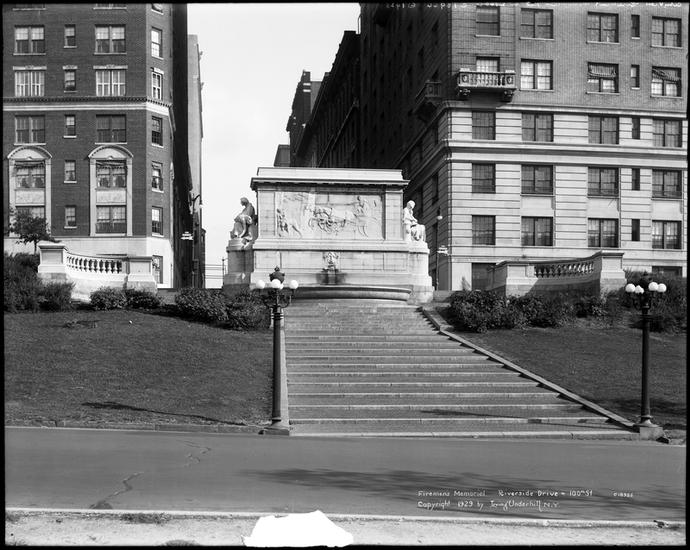
The Firemen’s Memorial, pictured here in 1929
MCNY
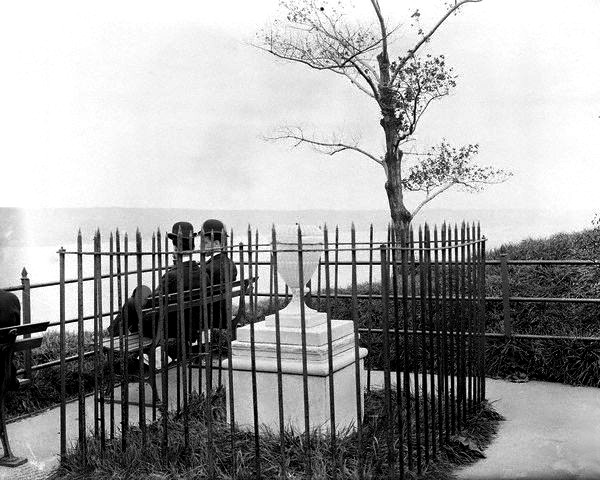
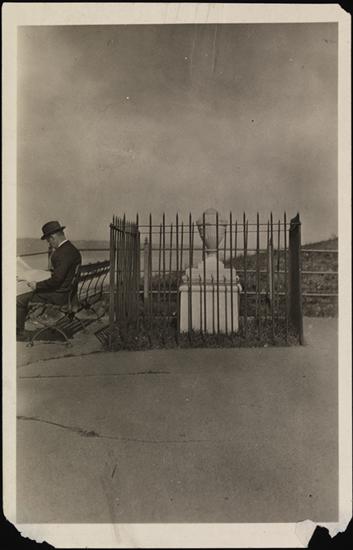
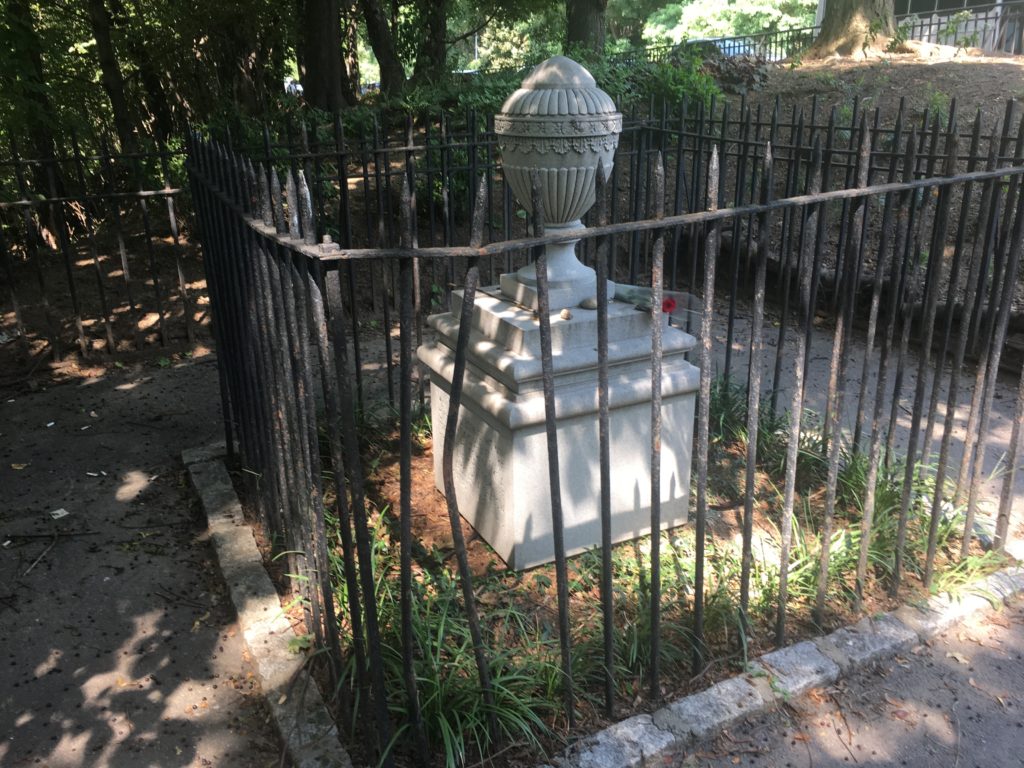
The tomb of the Amiable Child, 1900 and 1925
MCNY
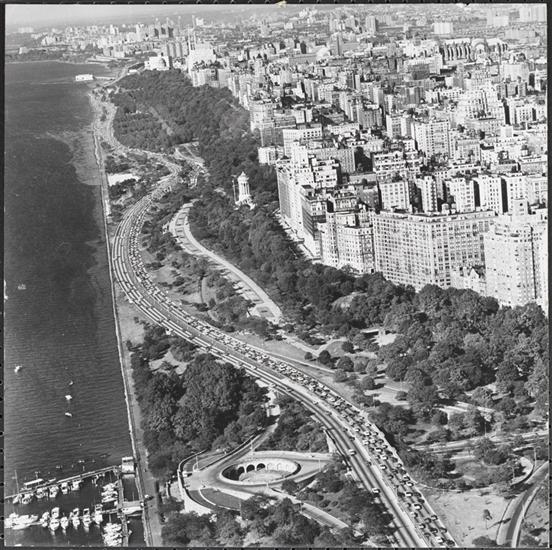
The Henry Hudson Parkway and the Boat Basin, 1975
New York Times/MCNY
A portion of Riverside Park South, developed by Donald Trump.
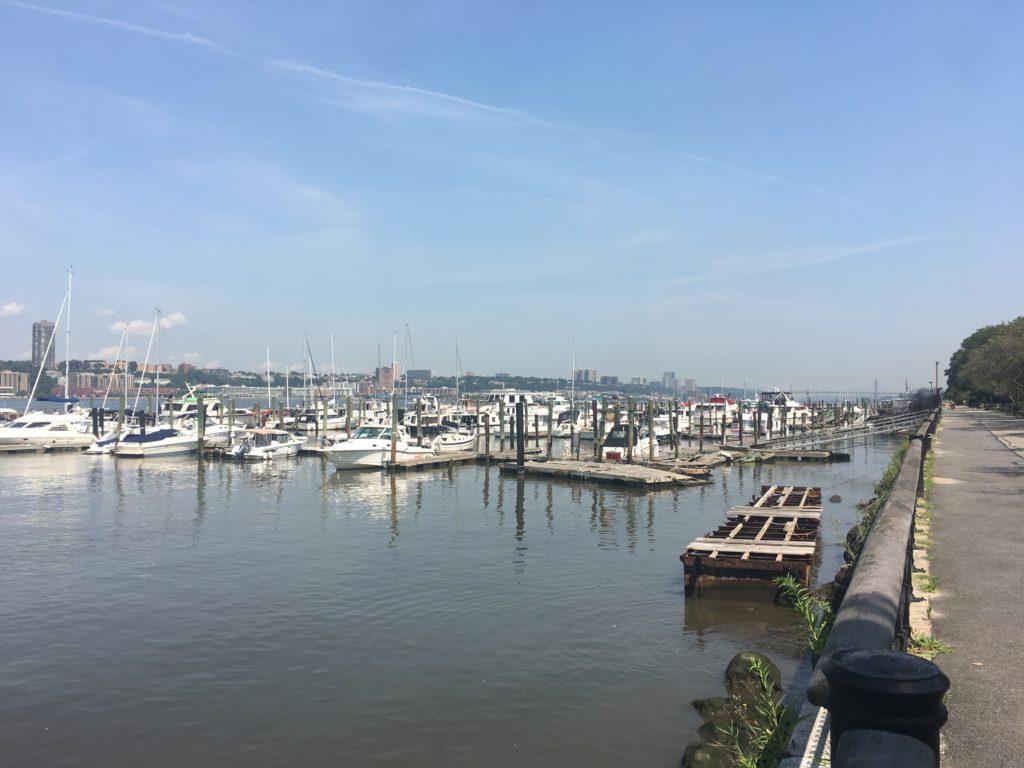
A glorious little marina sits in front of the Boat Basin.
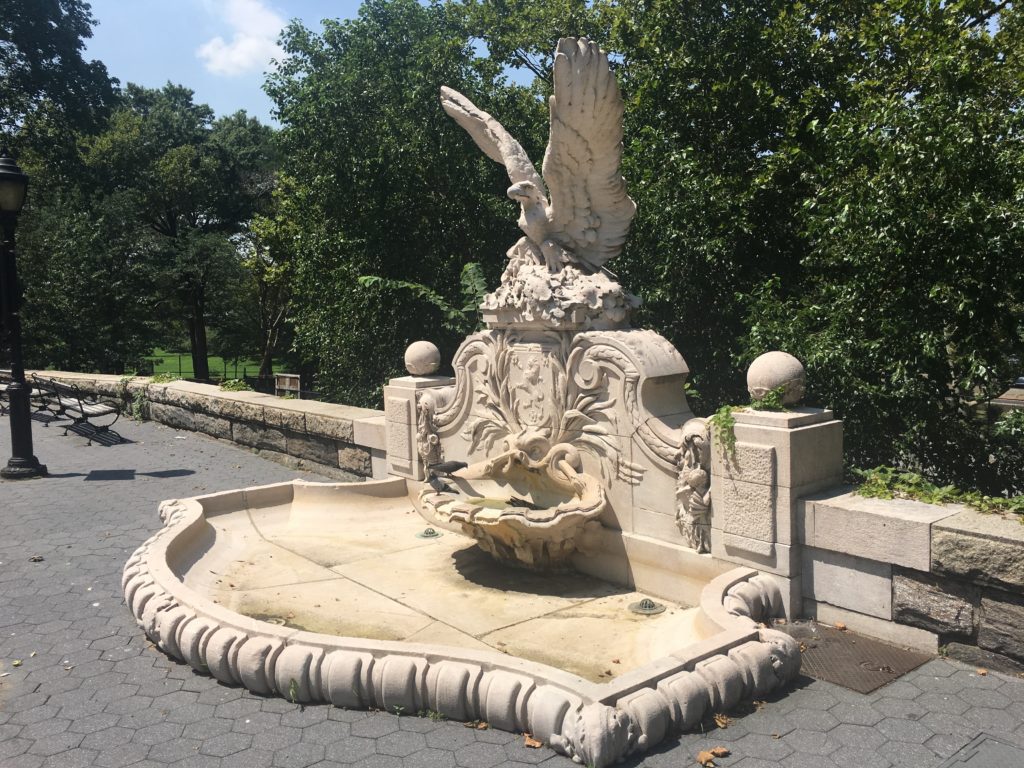
The Hamilton Fountain, at West 76th Street, named for the man who bequeathed it to the city — Robert Ray Hamilton, the great-grandson of Alexander Hamilton and Eliza Schuyler Hamilton.
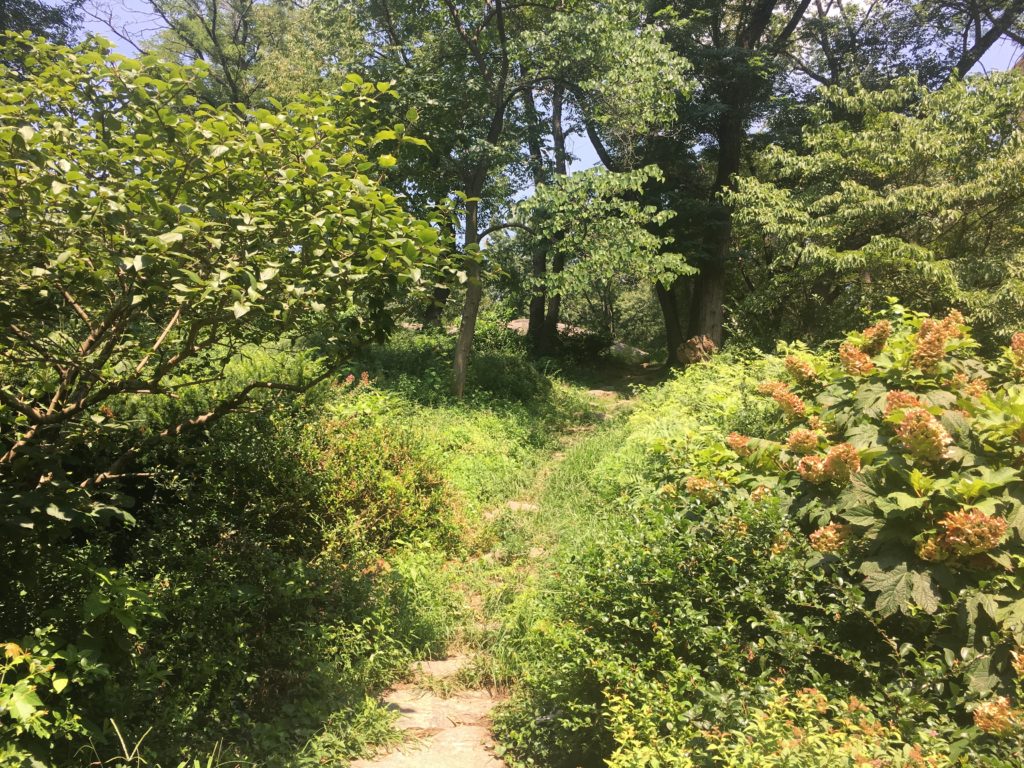
Up the hill and through the trees, you will find the contemplation spot for one of America’s most famous writers.
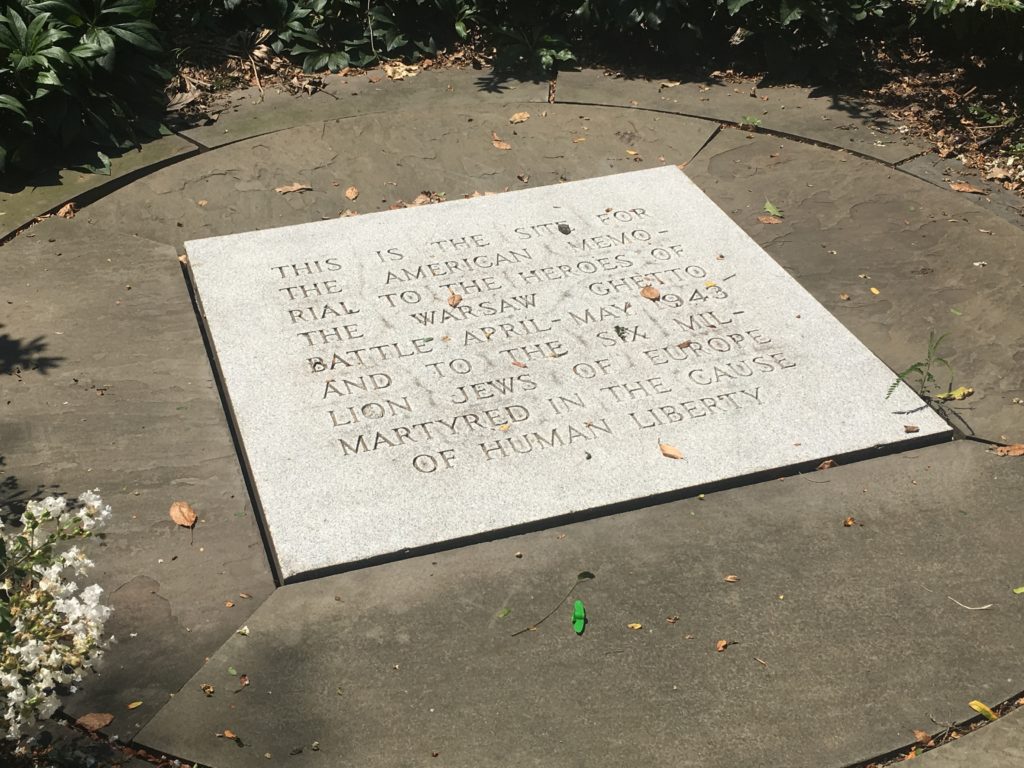
The Warsaw Ghetto Memorial — or rather, where a memorial should be.
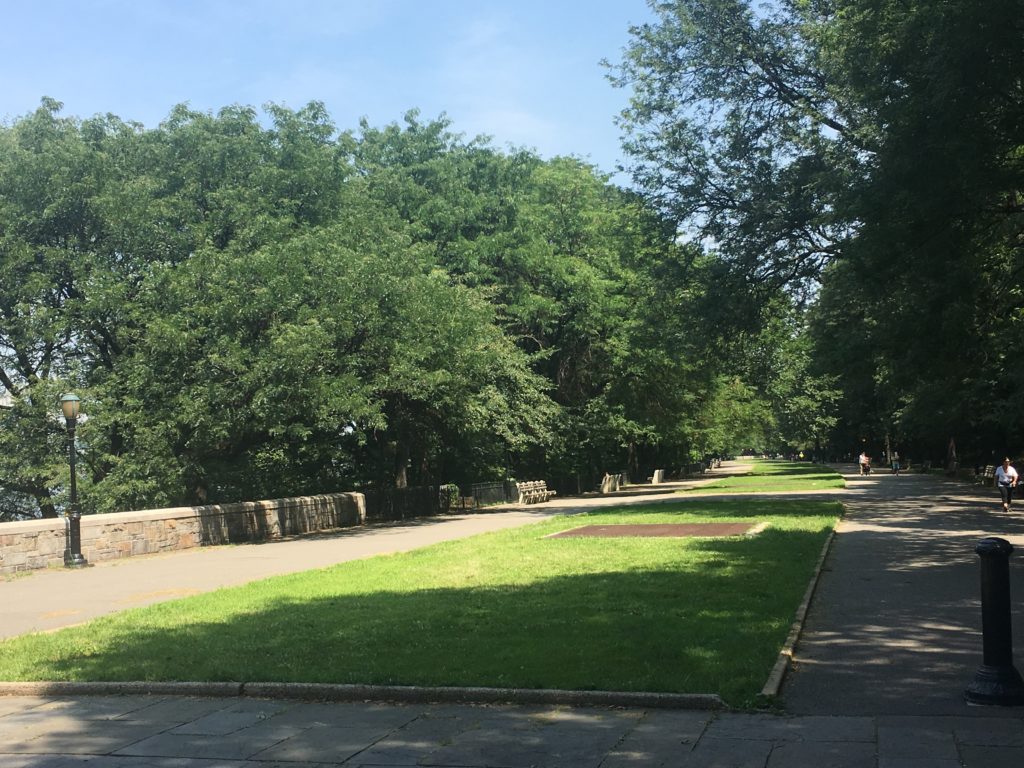
Just west of the peacefulness of Warsaw Ghetto Memorial Plaza:
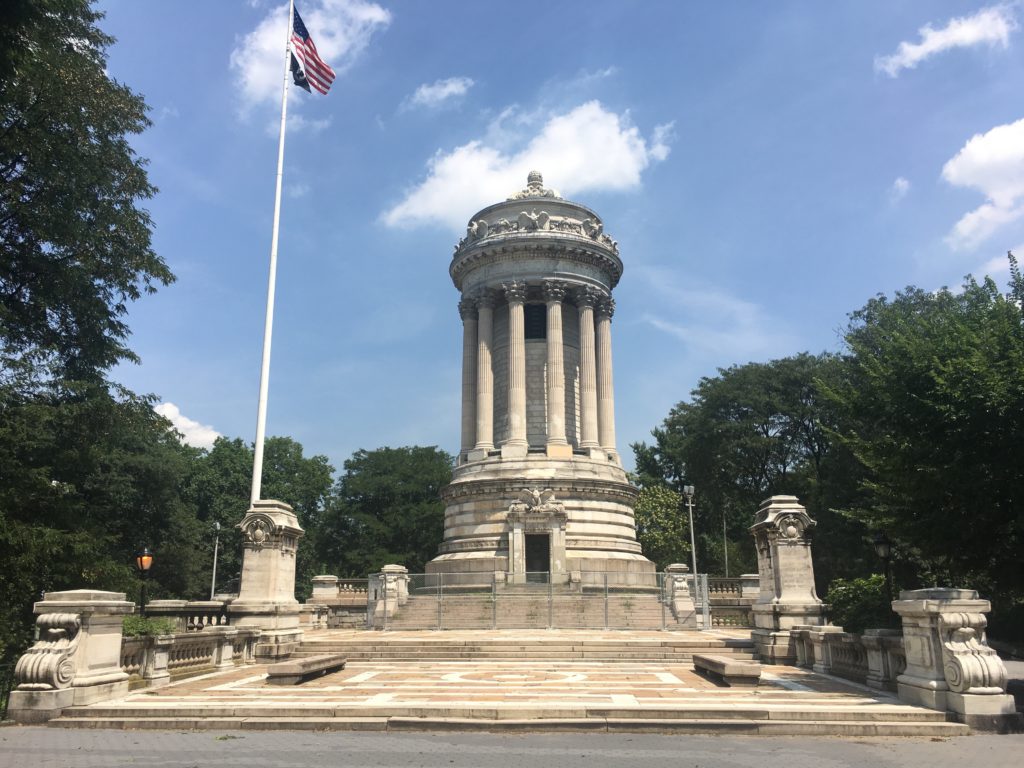
The Soldiers and Sailors Monument, completed in 1902.
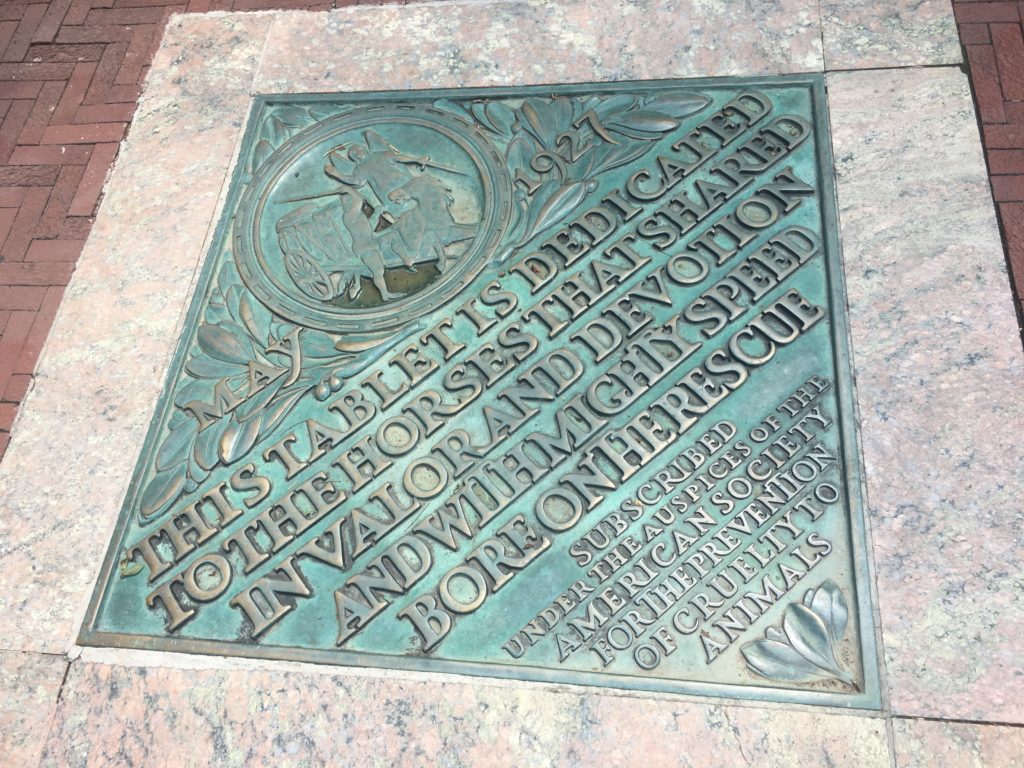
A message of thanks from the ASPCA….
The Amiable Child monument today…..
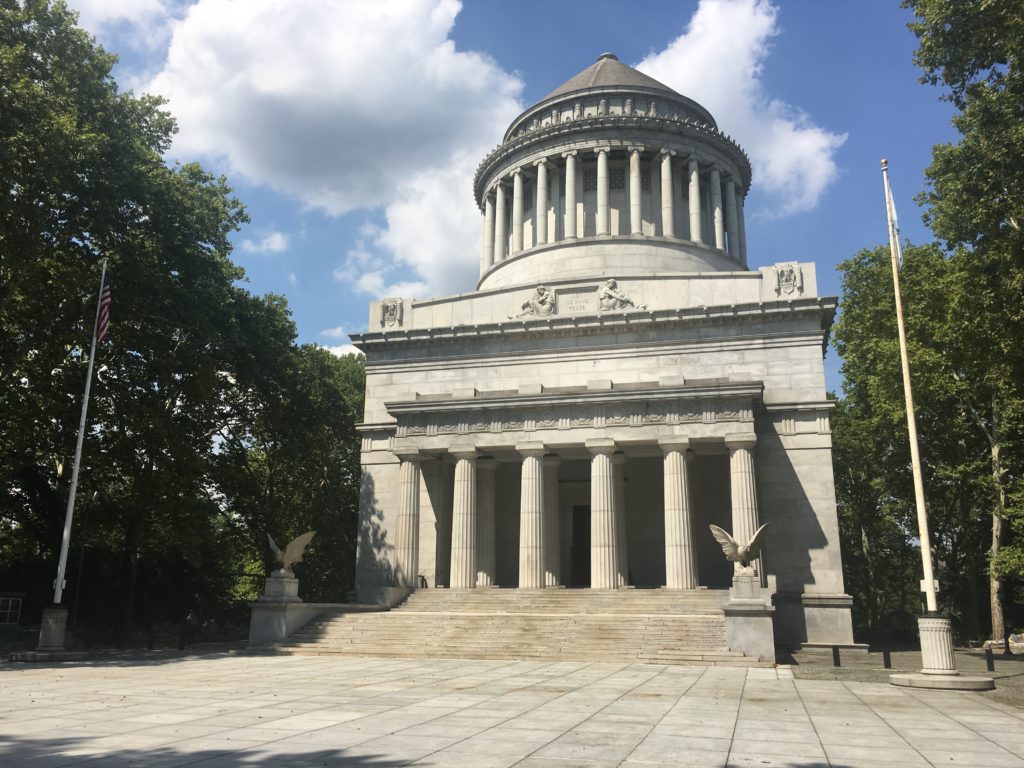
…just steps away from Grant’s Tomb.
All hail Joan!
FURTHER LISTENING
After listening to this story of Riverside Park, check out these related Bowery Boys podcasts —
For more information on Upper West Side development:
Our first-ever Bowery Boys book, “Adventures in Old New York” is now out in bookstores! A time-traveling journey into a past that lives simultaneously besides the modern city.
Bowery Boys Walking Tours
Are you ready to walk through time? We’re excited to announce Bowery Boys Walks, our new walking tours developed around our podcast. Join us in the streets — beginning in October 2018!
WARNING The article contains a couple spoilers about last night’s ‘Mad Men’ on AMC. If you’re a fan of the show, come back once you’re watched the episode. But these posts are about a specific element of New York history from the 1960s and can be read even by those who don’t watch the show at all. You can find other articles in this series here.Â
And so, in the end, we find that the biggest historical influence within the fifth season of ‘Mad Men’ wasn’t a race riot, a Southeast Asian war, a counter culture movement or a reduced hemline. It was Sylvia Plath.
(This article is so spoiler-y, that I’m placing the rest of it after the jump) Â
The tortured poet is not mentioned a single time in the final episode. (Although she was clearly nodded to in the episode entitled ‘Lady Lazarus‘.) But the themes of her only novel, The Bell Jar, partially set within the publishing world of New York, unfurled throughout this entire season of ‘Mad Men’ in a variety of ways, manifesting in the fragile, even scarred, mentality of several characters. The novel, originally published in 1963 under a pseudonym, was finally released under her own name in the same year the fifth season of ‘Mad Men’ ends — 1967.
The season evokes Plath not only literally (with the suicide of Lane Pryce) but figuratively among the psychic states of the ‘Mad Men’ women, dealing with anxieties brought about by male chauvinism (Peggy), sex (Joan), career (Megan) and body image (Betty). Then there’s the abuses upon Sally Draper, presented with several clumsy introductions to adulthood this season, enough to drive her to the prescription drugs her grandma so inappropriately gave her.
Episodes this season have plunged abstractly through the recesses of the mind — chemical experimentation (with LSD), spiritual enlightenment (with the Hare Krishnas), even feverish hallucinations (Don Draper‘s strange murder evening).  And finally, bluntly, a most surprising cruelty — the submission of one character to electroshock therapy, a drastic antidote to her ‘feeling blue’ that literally leaves her blank.
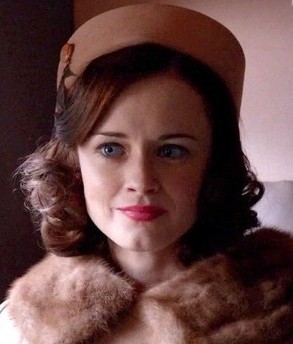
That character, Beth, pines for some reason for Pete Campbell, who’s been stubbornly transplanted to the suburbs, and it’s that attraction that indirectly get her admitted into a mental ward. The actress who plays Beth, Alexis Bledel, is most famous as the character of Rory on ‘Gilmore Girls‘, a character possessed by the work of Sylvia Plath. Of course, Plath also went through electroshock therapy for depression, just like Bledel’s character Beth. A rare pop-culture Mobius strip!
By 1967, submitting a loved one to this sort of treatment would have been considered a form of abuse in the public imagination, if not legally so. (The first lawsuits against shock treatment wouldn’t arrive in the courts until 1975.) But for decades, it was the catch-all treatment for almost any psychological problem.
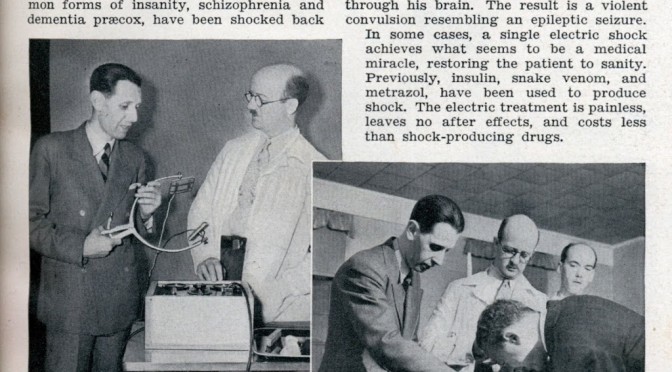
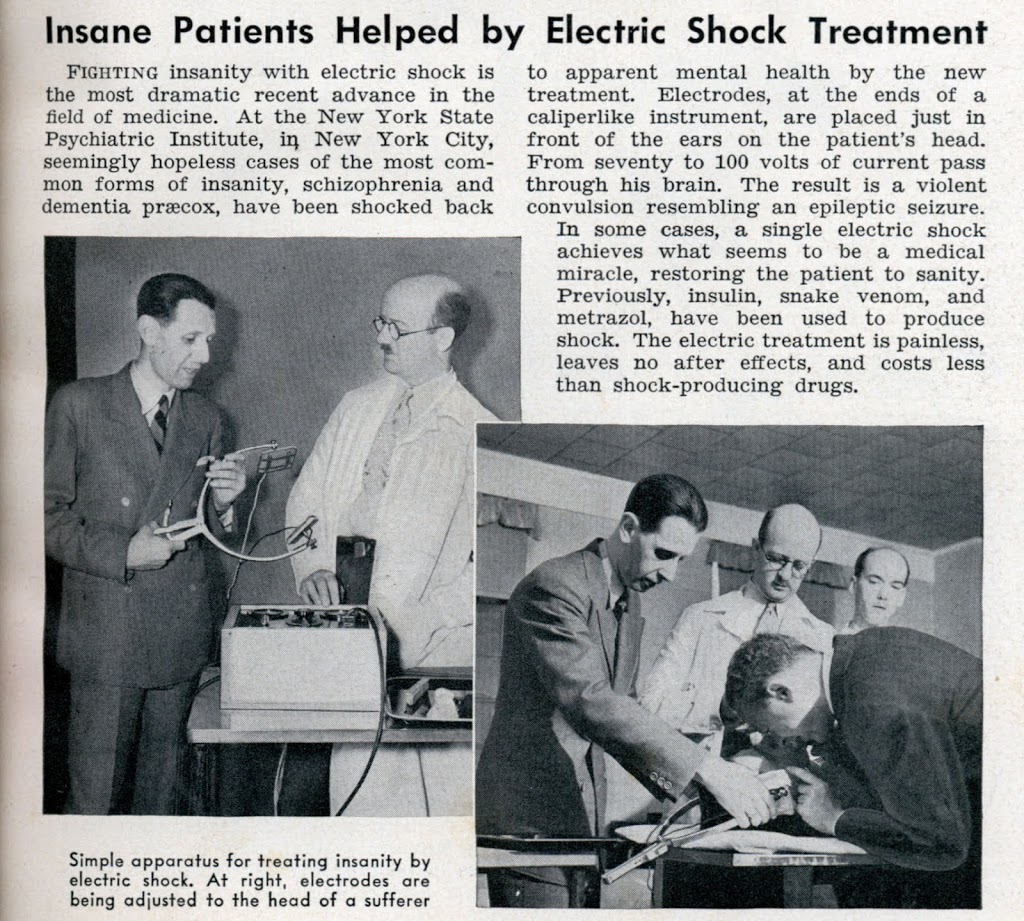
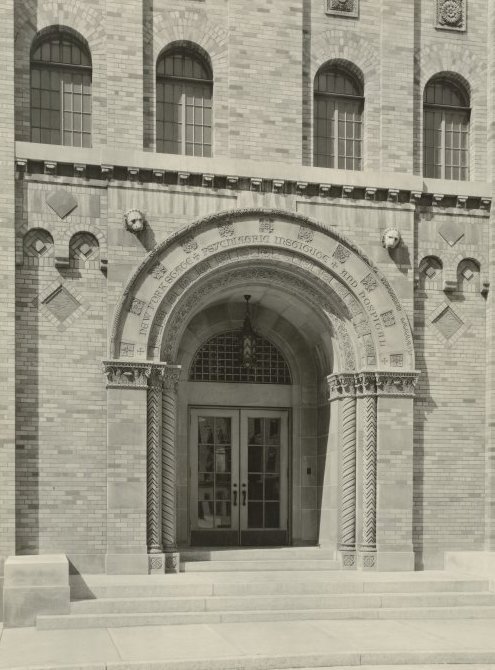
Previously, the hot medical solution in the 1930s for certain mental illnesses was insulin therapy (putting patients in a comatic state), practiced in various hospitals in New York, including Bellevue Hospital. Electroconvulsive therapy (ECT), which debuted in Italy in 1937, made insulin therapy basically obsolete when it was introduced into the United States in 1939Â at the New York State Psychiatric Institute (below).
From its patient care facilities on 1051 Riverside Drive, the Institute displayed a technology that seemed to have unlimited application to many mental illnesses thought untreatable. Modern Mechanix heralded its use on insanity, “a single shock achiev[ing] what seems to be a medical miracle, restoring the patient to sanity.” It became “psychiatry biggest fad,” despite such obvious side effects like memory loss.
According to authors Edward Shorter and David Healy, two-thirds of all the patients at the Institute were there to receive ECT. It became a sort of mecca for electroshock, with doctors from around the country coming to observe the treatment.
ECT reigned as the primary form of treatment for depression for almost two decades. However, with the undeniable violence suffered upon a patient who received the treatment — and the fact that well over half of ECT patients were women — most considered it a barbaric practice by the 1960s. Ken Kesey‘s ‘One Flew Over The Cuckoo’s Nest‘, published in 1962, accelerated public distaste with the treatment and was pretty much responsible for its near-elimination by the time the film version, starring Jack Nicholson, was released in 1975.
Electroconvulsive therapy has returned in recent years as a last-ditch therapy for severe depression and certain kinds of catastrophic mental illness. But I’m quite sure that having an affair with Pete Campbell would not have been placed in any of those categories today. What we saw in the season finale was yet another example of the abusive power men sometimes wielded over women, a theme ‘Mad Men’ will most likely continue to visit well into its final season.