Categories
Mysterious Stories Podcasts

Gotham’s Greatest Ghosts: The Bowery Boys Halloween Specials


Our first ghost stories show was released on October 11, 2007, featuring New York City’s famous haunted tales and urban legends (with historical context). Since that time we have released nineteen Halloween-related shows as well as a recording of our Joe’s Pub live show.

Take a spooky trip down memory lane with a re-listen to all our past Halloween shows.

Listening tip: The episodes do get better with each passing year so start with the newest one and work your way back to 2007.

Creep yourself out while listening to these spooky legends of New York City. From the haunted woods of Van Cortlandt Park to spirits haunting Captain Kidd’s treasure on Liberty Island. Psychics at Carnegie Hall, unsettling spirits in Cobble Hill, undead party animals at Grand Central!

Play them at the links below or find them on your favorite podcast players.

And if you have Spotify, you can find all of our Ghost Stories podcasts in one special playlist: [Listen here]
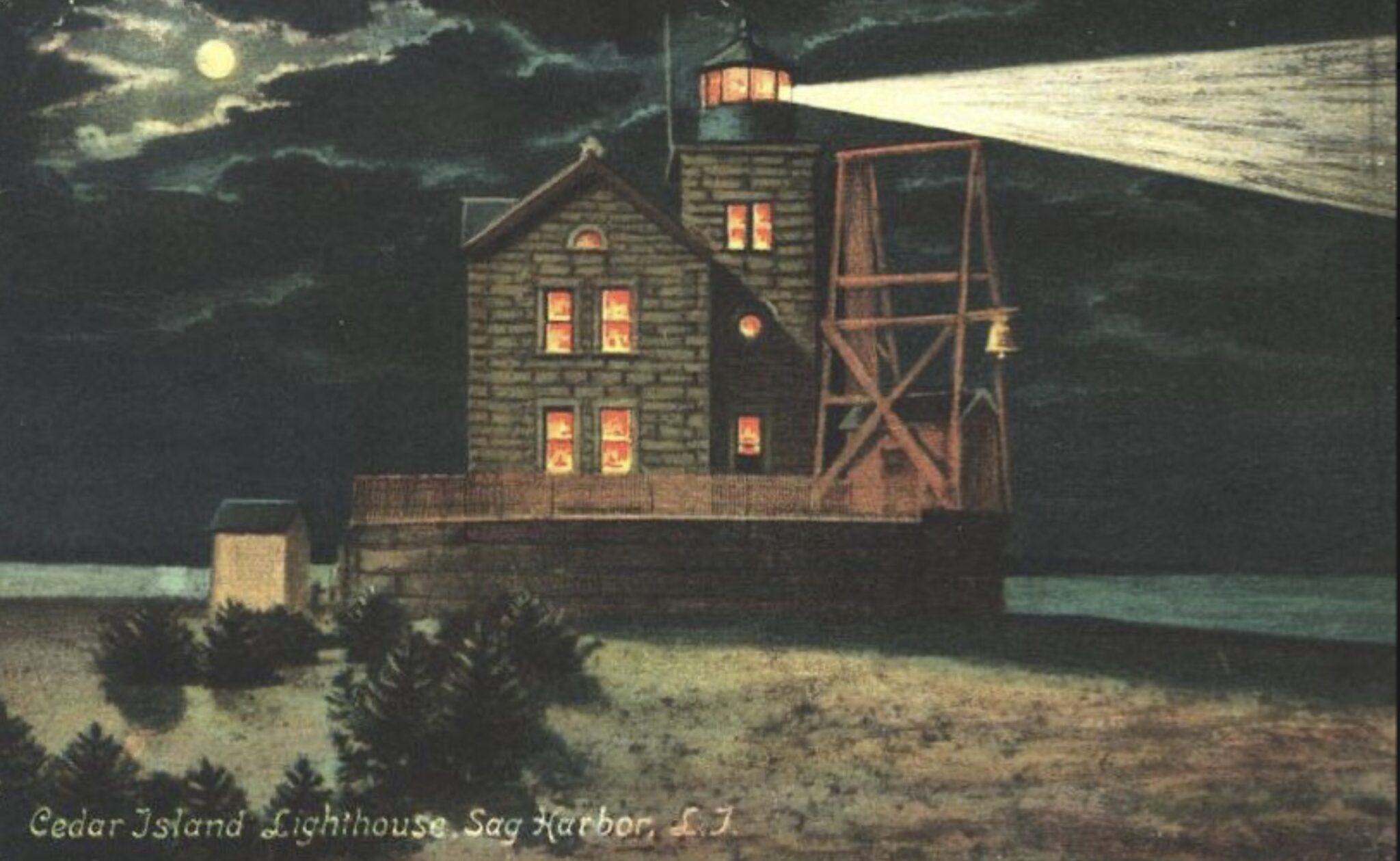

2025 Ghost Stories of Long Island

Greg and Tom take a road trip to Long Island to explore the region’s most famous haunted tales from legend and folklore, ‘real’ reported stories of otherworldly encounters that have shaped this historic area of New York state.

2024 Ghost Stories of the Five Boroughs

Each of New York City’s five boroughs bring their own unique histories and personalities, so we thought we’d give each one the spotlight – or rather the spooklight – to highlight the city’s haunted landscape, from rural escapes to densely populated urban centers.

From a Staten Island cemetery to the Bronx Zoo. From a luxury apartment in Flatbush to the Old Flushing Meeting House in Queens. And what’s the strange light, seen from the Manhattan waterfront, floating in the East River?
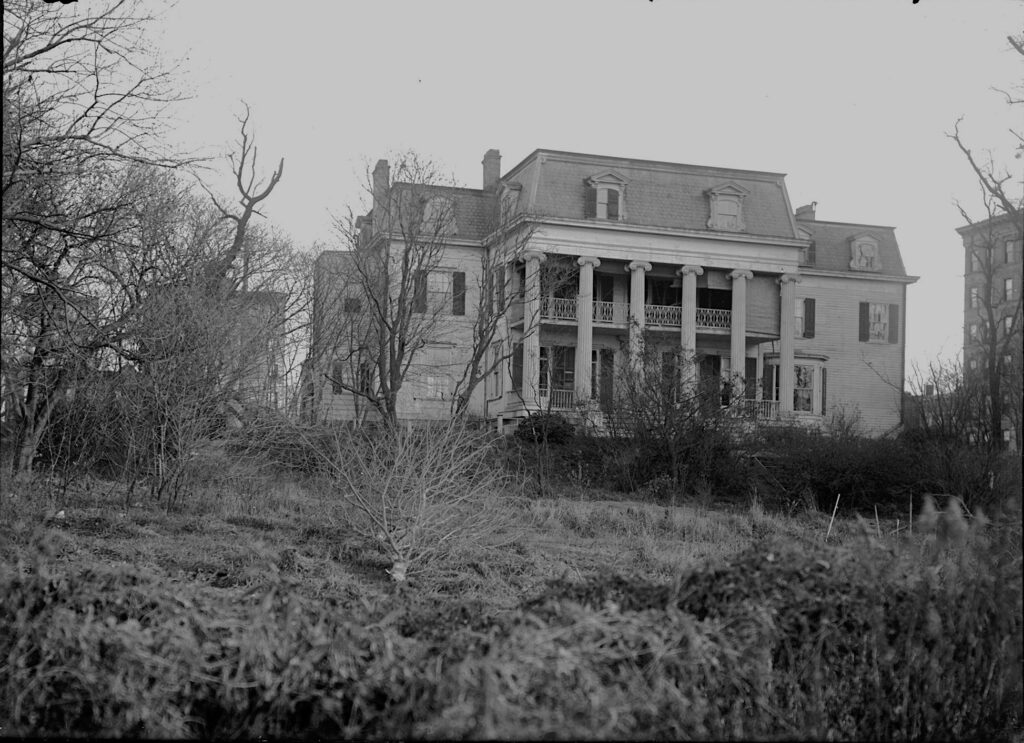

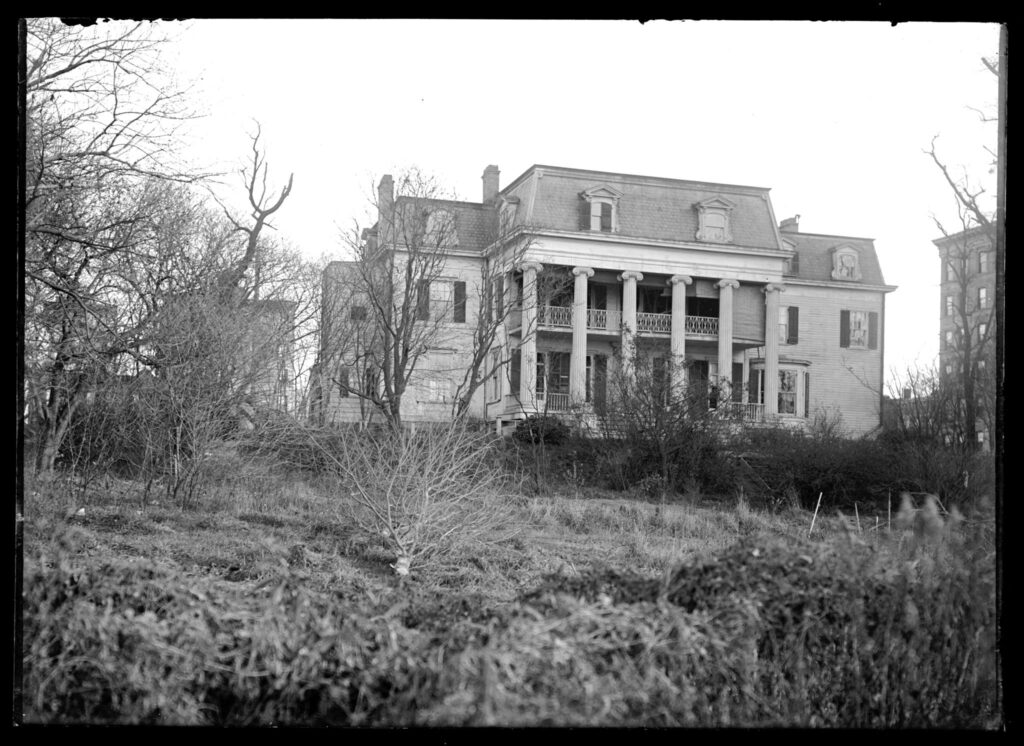
The old Furniss mansion, with its dark secrets literally behind a locked door.

2023 Ghost Stories by Gaslight

Spooky stories from the gaslight era of New York City, the illuminating glow of the 19th century revealing the spirits of another world. Featuring various ghost stories associated with Fordham University, a tale of literary ghosts in Astor Place, a haunted townhouse north of Washington Square Park and a haunted tenement on the East River waterfront.
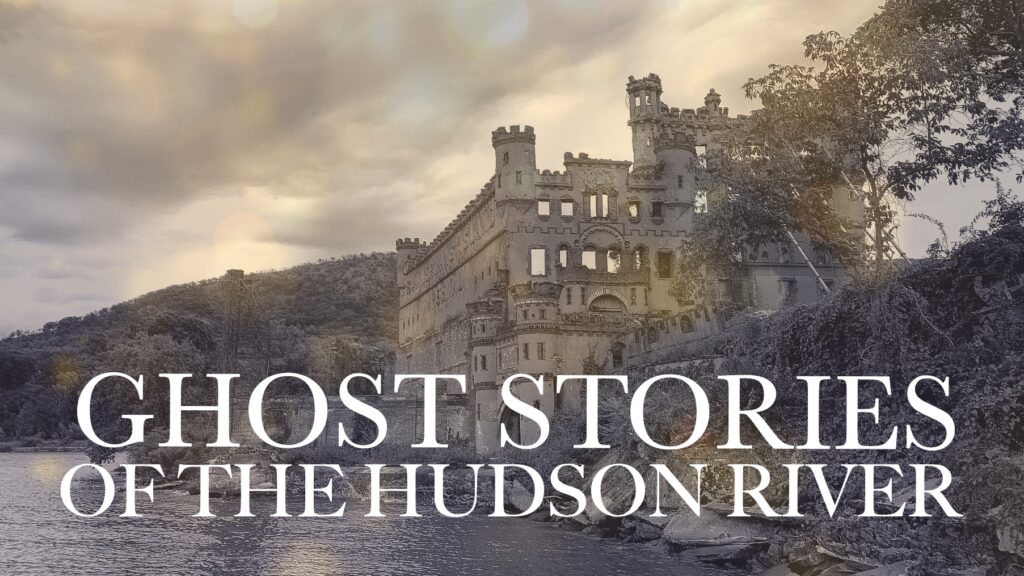

2022 Ghost Stories of the Hudson River

Featuring a ghost-filled mansion in Nyack, New York that holds a unique place among all American supernatural sites; the unsettling tale behind those mysterious ruins known as Bannerman Castle; a ghastly apparition in the Colonial-era Catskills leads to a disturbing life sentence and the secrets of Kingston’s Old Dutch Church with an entity which may trapped beneath its holy steeple.

Cheryl Crow

2021 Gotham’s Greatest Ghosts

For this 15th annual Bowery Boys Halloween ghost story podcast, Greg and Tom taking a look back at their favorites (and yours), the tales which have stayed with us — which have possessed us — like a persistent phantom who refuses to leave.
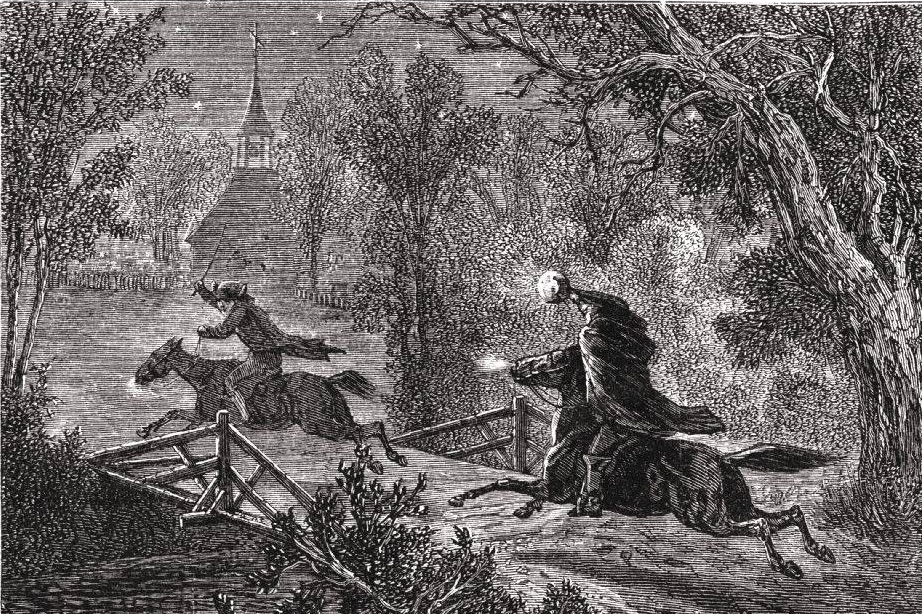
2020 — Literary Horrors of New York City

We present classic tales of the strange and supernatural written by the most famous horror writers in New York City history.

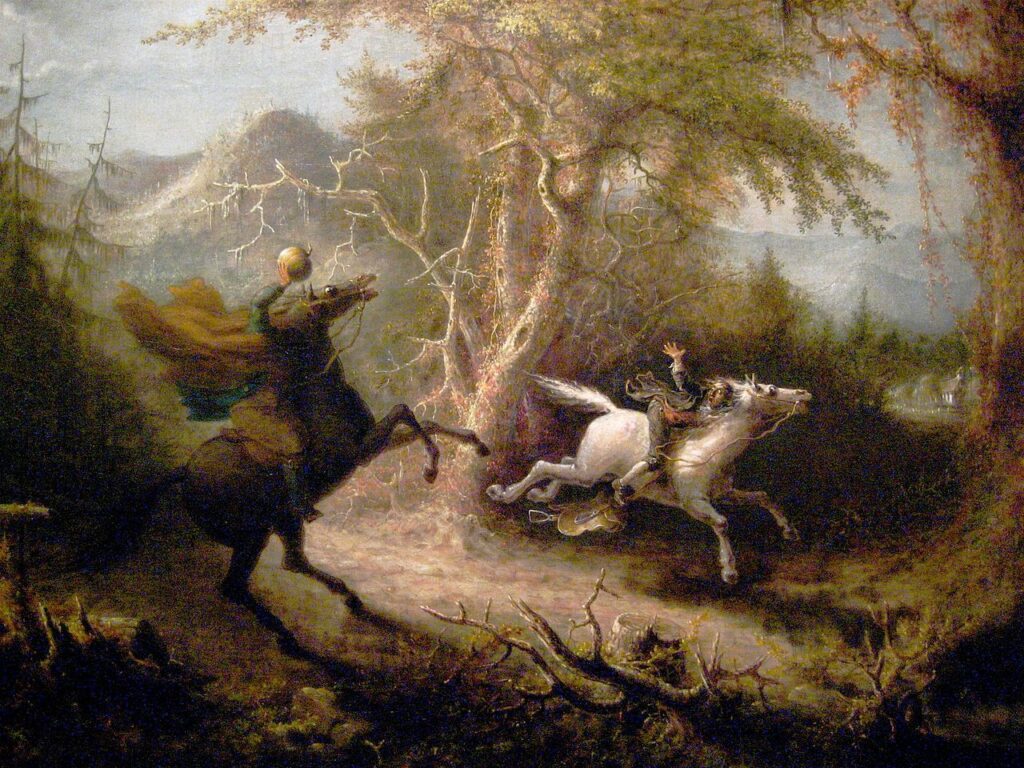
— A celebration of the 200th anniversary of Washington Irving‘s “The Legend of Sleepy Hollow,” featuring the Headless Horseman and the backstory of this classic story’s creation;

— The unsettling nights of H.P. Lovecraft in Brooklyn where his xenophobia, racism and anxiety manifest into a pair of dark, claustrophobic tales, plucked from the waterfront and the West Village;

— A bizarre and allegedly true story (or is it an urban legend?) of an unconventional jewel thief named Fanchon Moncare, made famous by that 20th century purveyor of all things unbelievable — Robert Ripley;

— And a look at the life of Patricia Highsmith — celebrating the 100th anniversary of her birth a bit early — whose nasty little tales of mad murderers have inspired Hollywood and unsettled a new generation of suspense lovers.
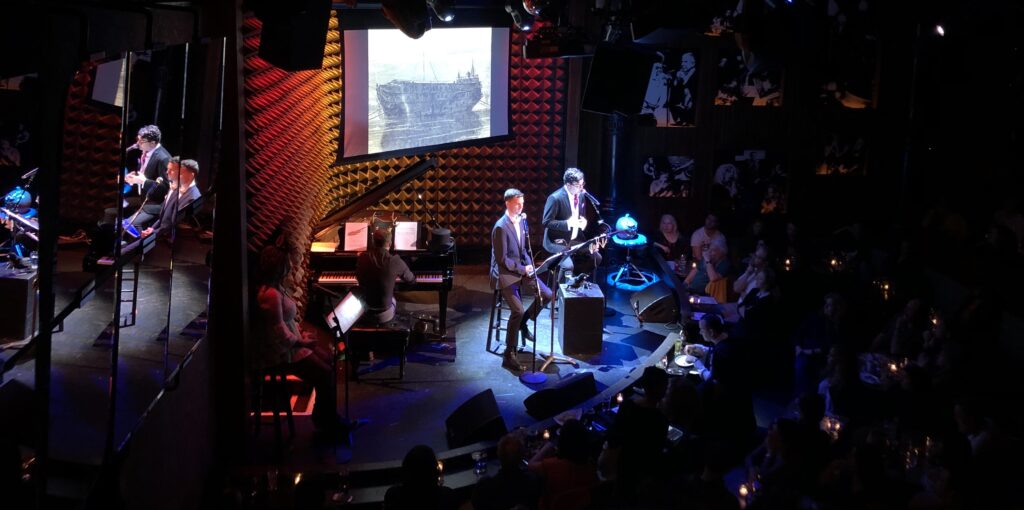

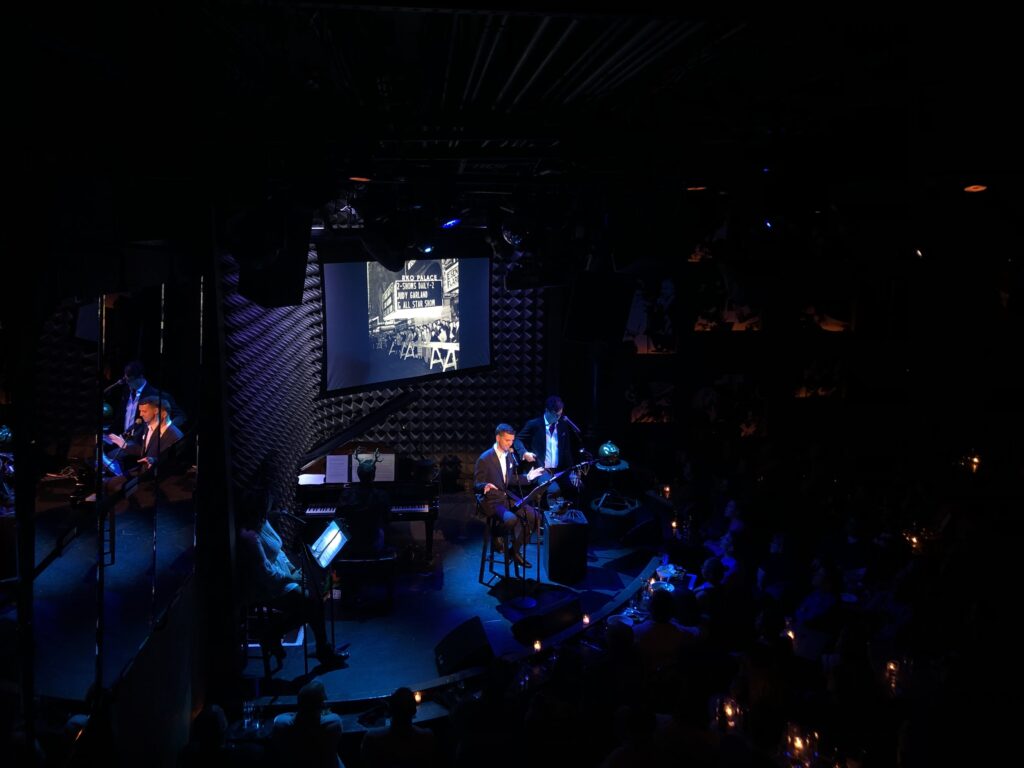
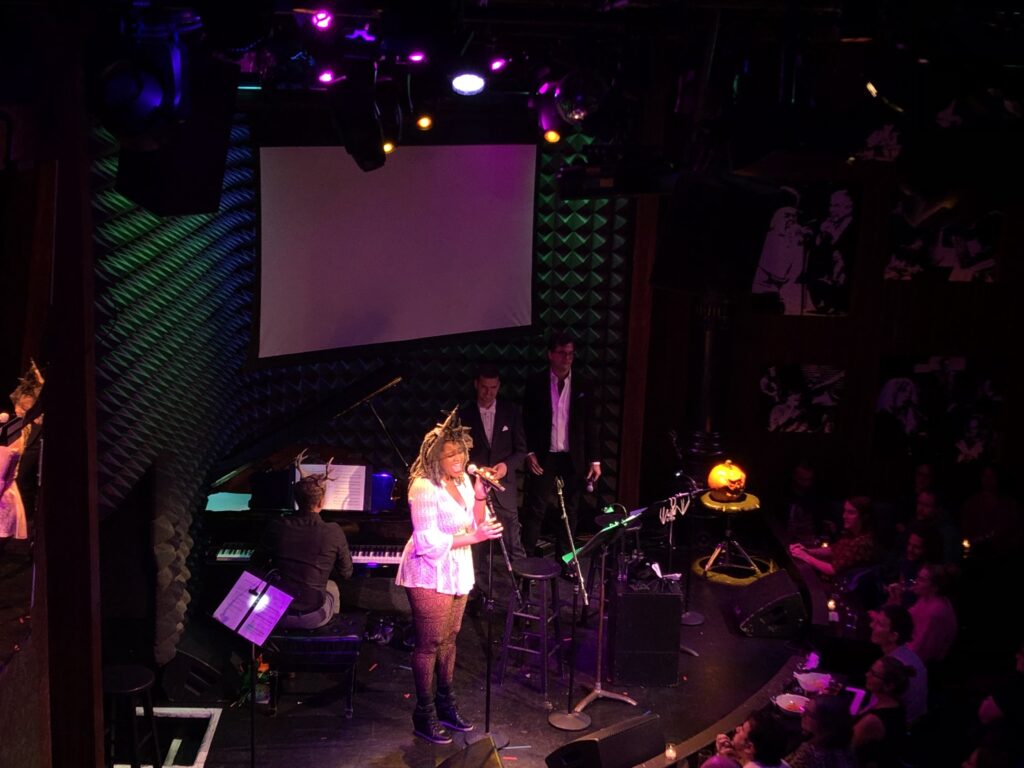
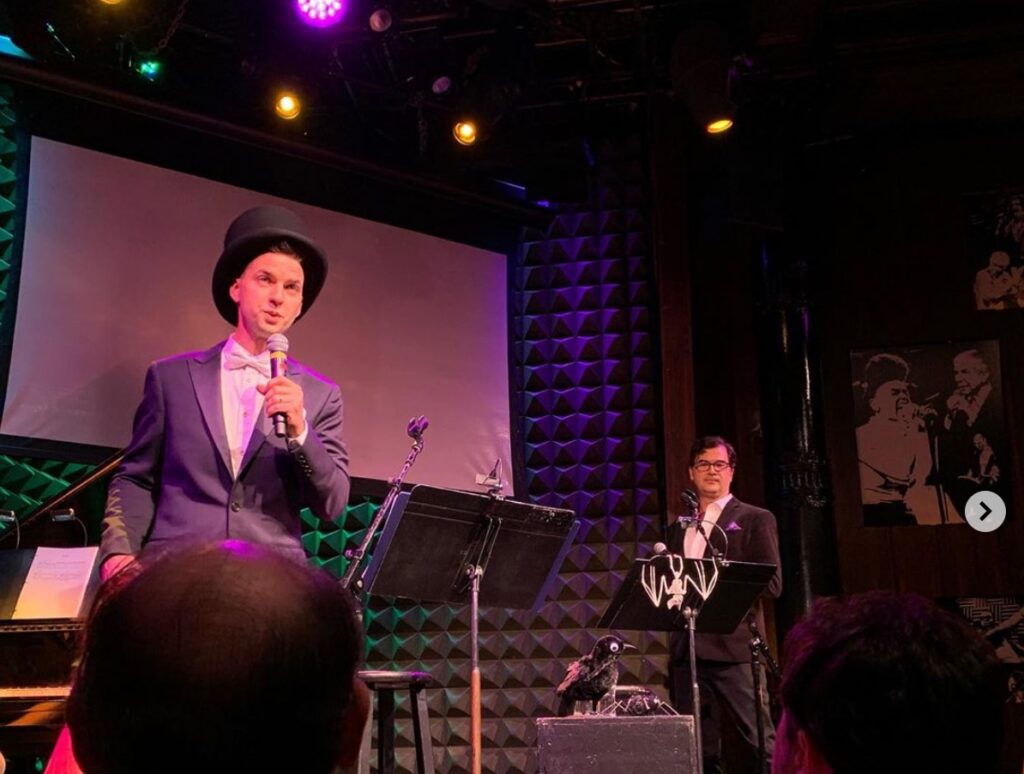
2020 — Ghost Stories of Old New York (ALIVE at Joe’s Pub 2019)

A very special Bowery Boys: New York City History podcast presentation, recorded live on Halloween Night 2019 at Joe’s Pub. Prepare to hear new versions of your favorite ghost stories including:

— A Brooklyn house haunting that may be related to the spirits from a colonial-era prison ship;

— A famous murder trial from the year 1800 and a mysterious well which still stands in the neighborhood of SoHo;

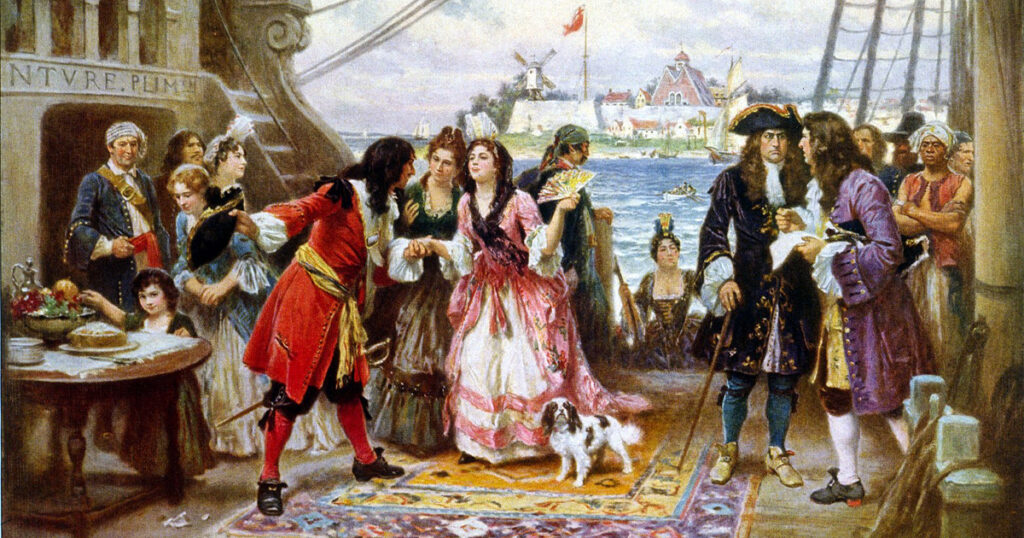
— The ghosts (or other supernatural entities) which guard the treasure of the famous Captain Kidd; and

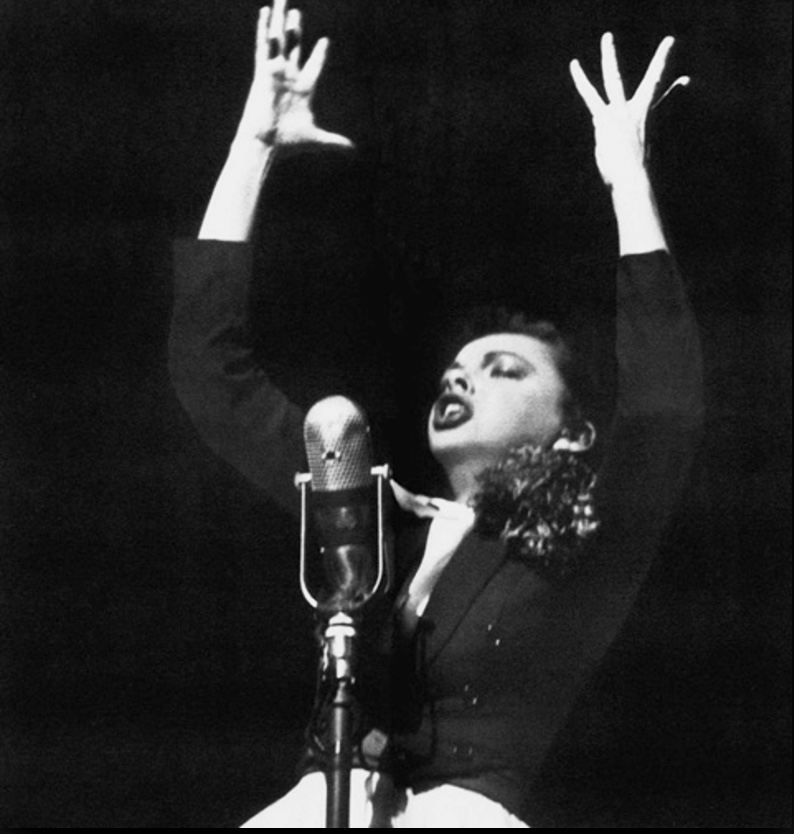
— The mournful secrets of a famed Broadway theater and the inner demons of a Hollywood icon.

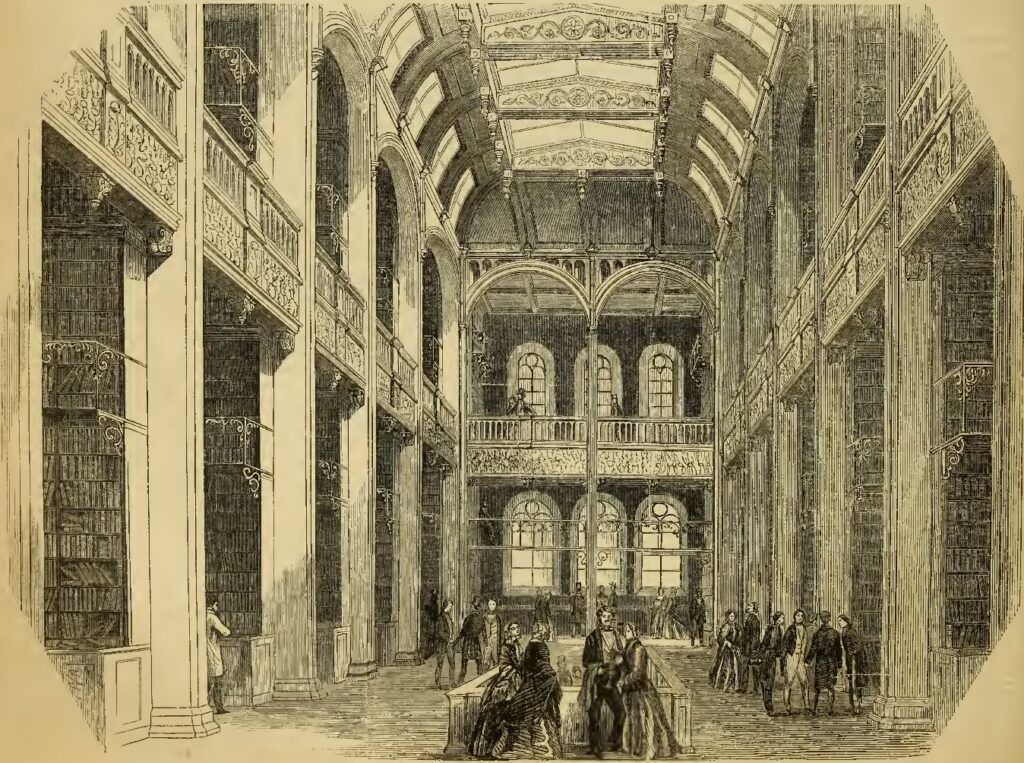
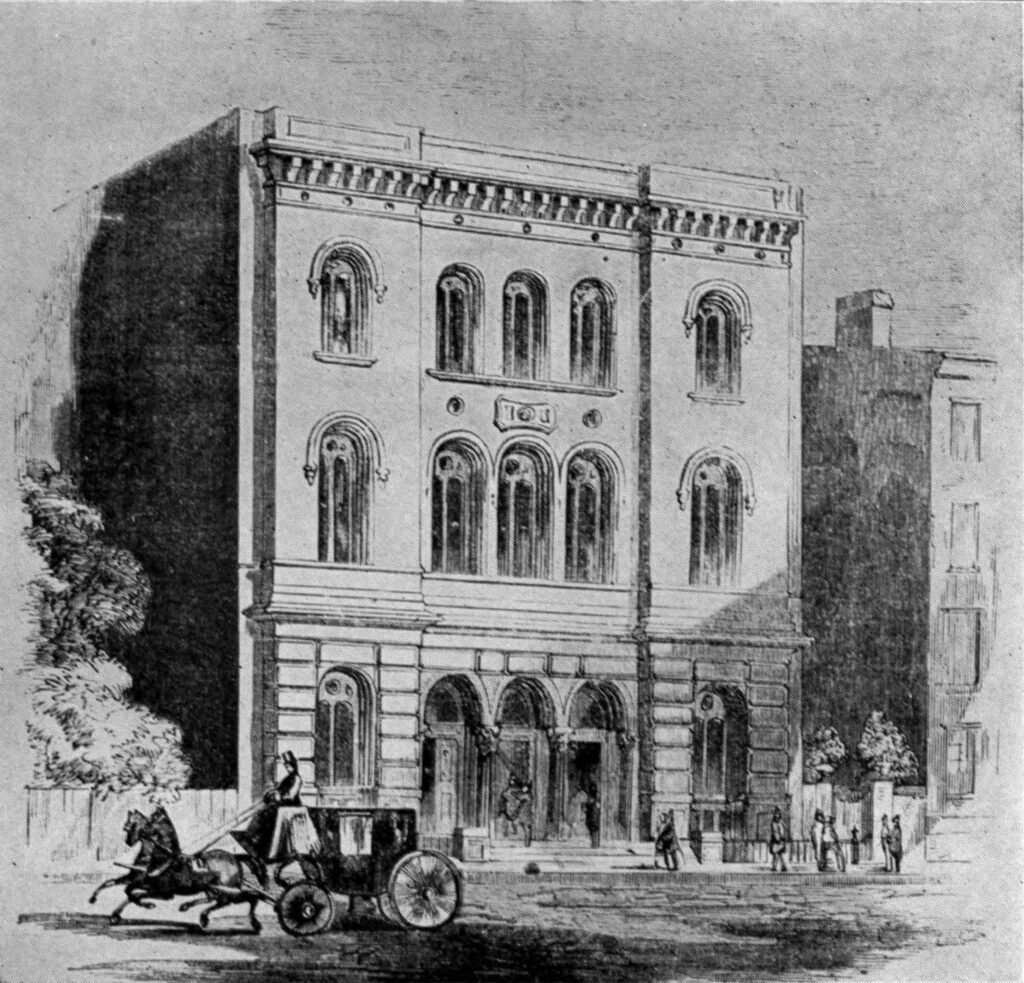
With an ALL NEW GHOST STORY — WHO HAUNTS THE FORMER ASTOR LIBRARY?
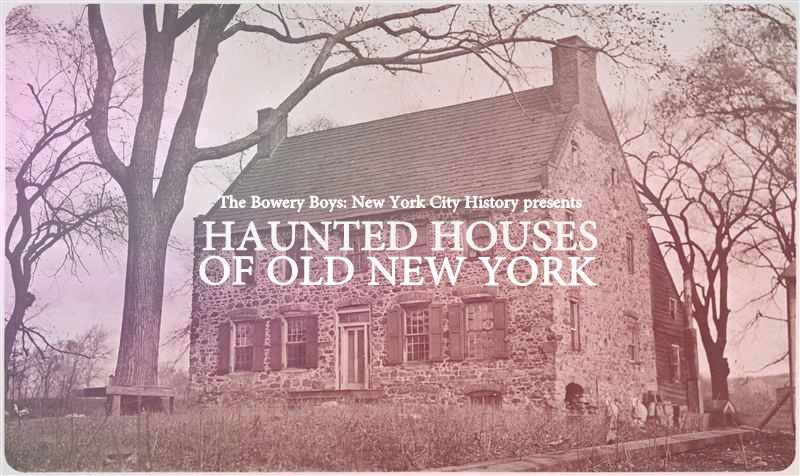

2019Haunted Houses of Old New York

Near Madison Square Park, an eccentric writer posts a classified ad, hoping to rent out an attic room to a prospective subletter. Unfortunately the room already an occupant — a greenish ghost with a troubling Civil War history.

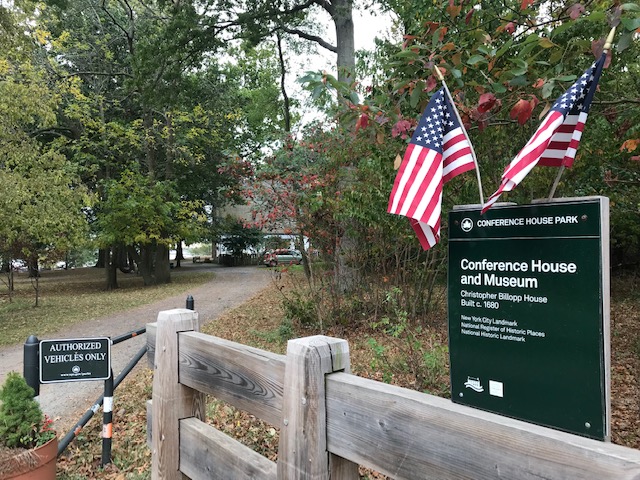
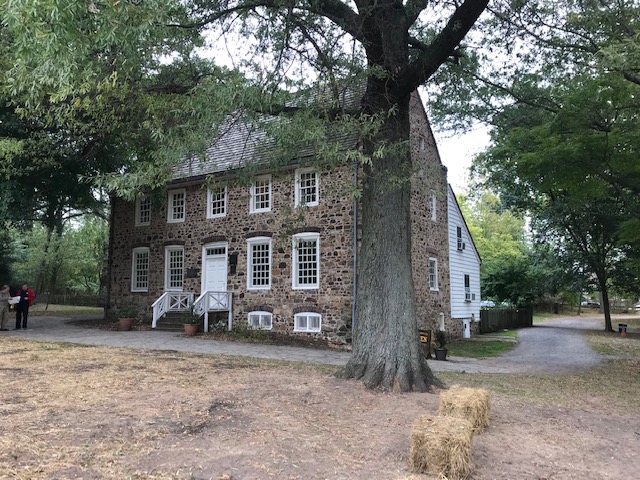
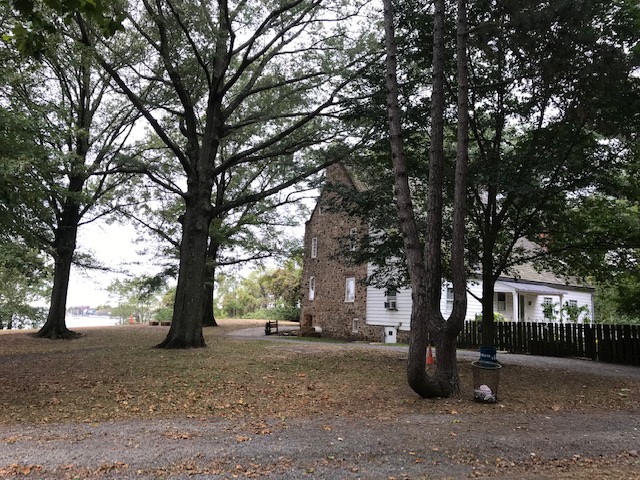
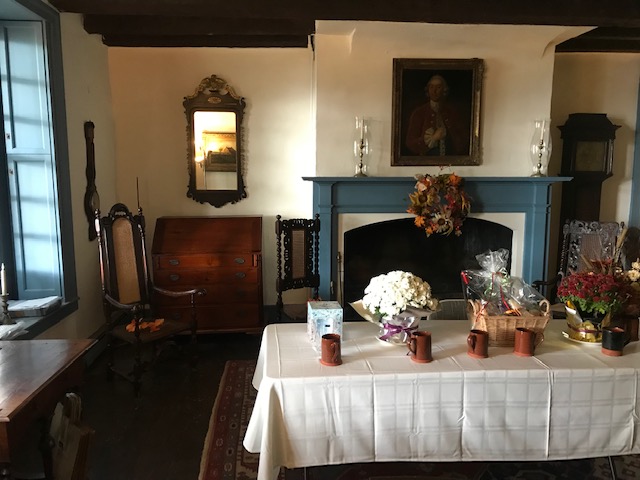
— The Conference House in Staten Island played an interesting role in the Revolutionary War, and some residents from that period may still wander its ancient hallways.

— On the Upper East Side, a lavish penthouse ballroom may be permanently vexed with the ghost of a testy spirit named Mrs. Spencer. Can a legendary funny lady and a Vodou priestess manage to keep the ghoul under control?

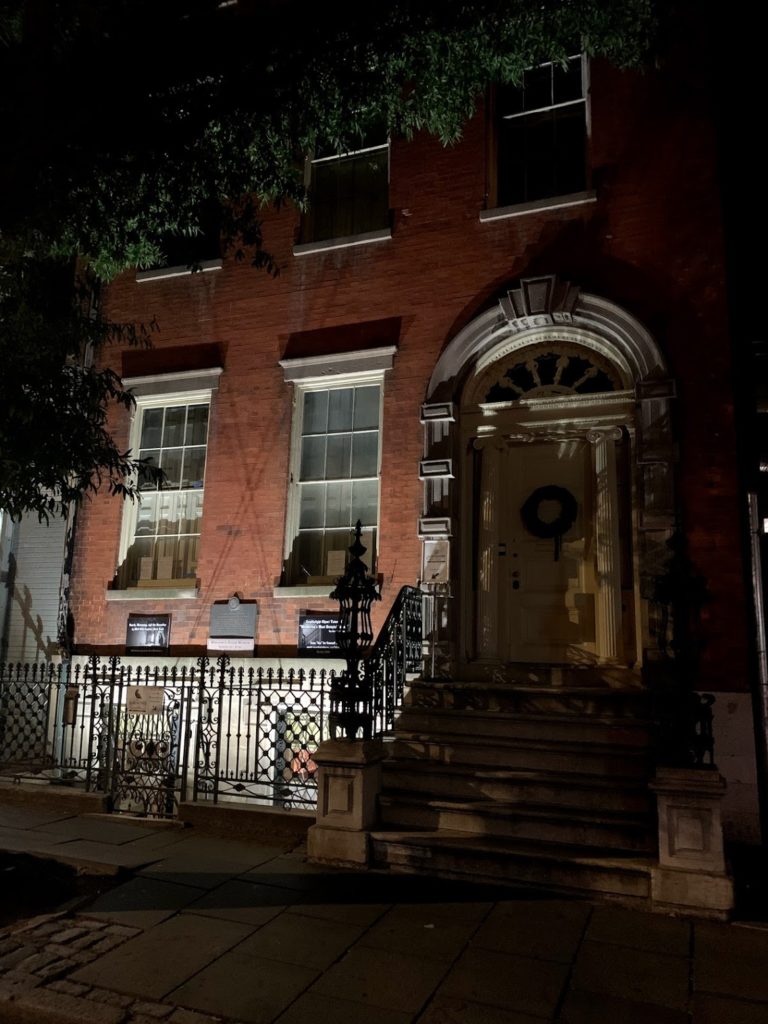
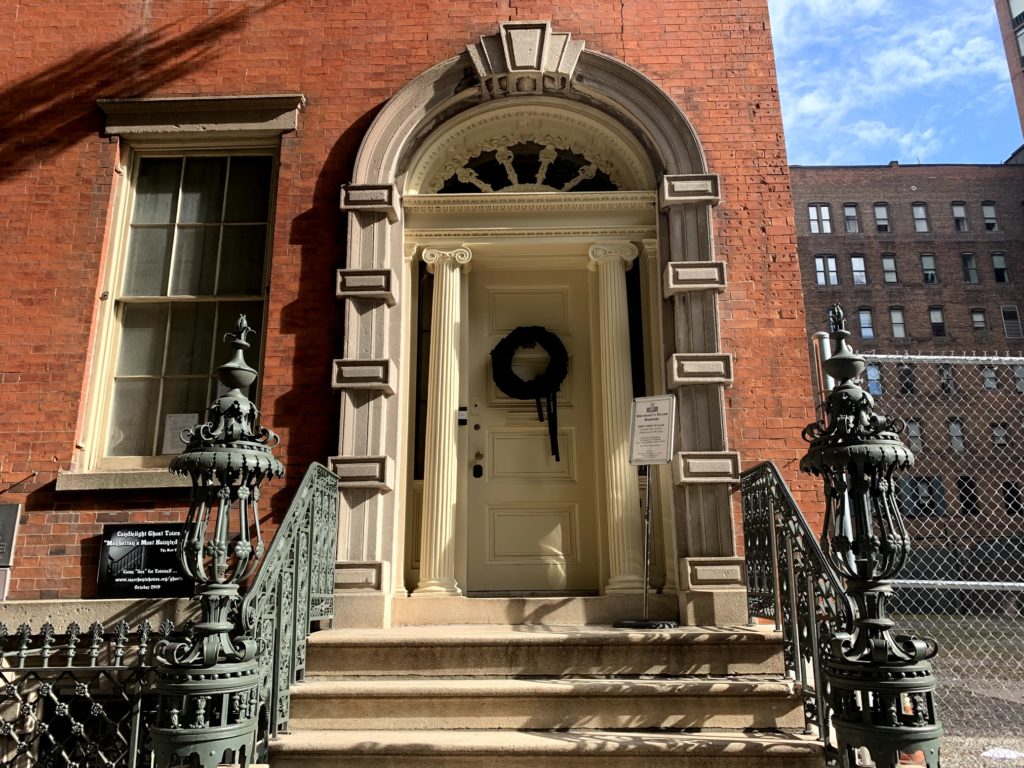
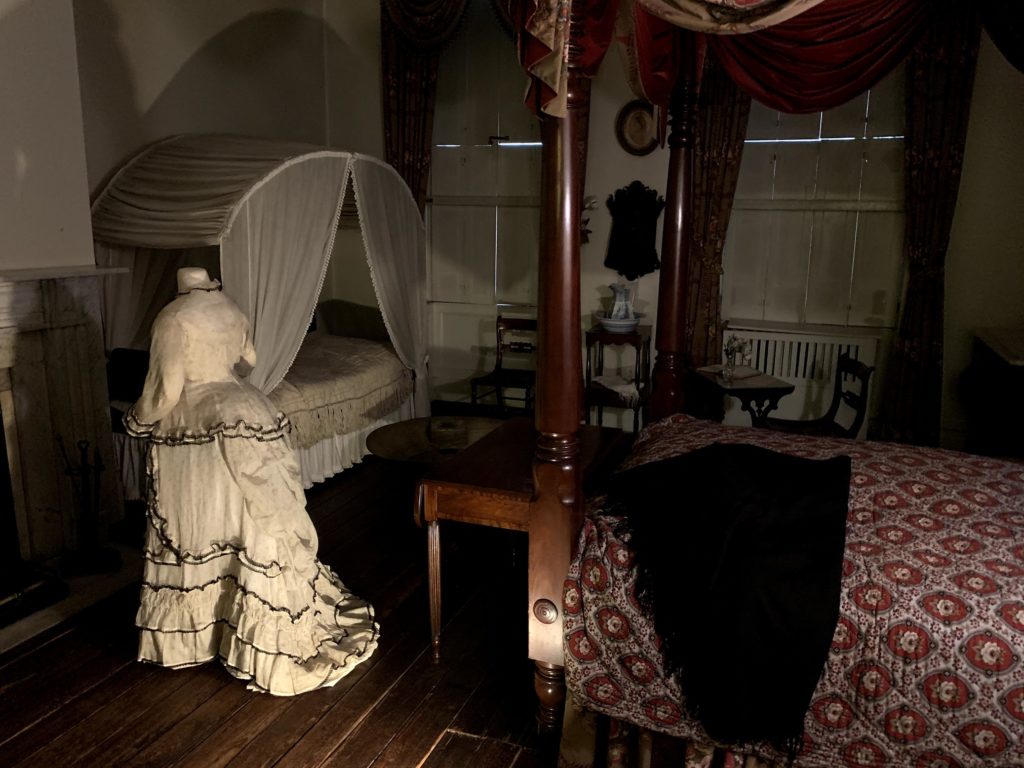
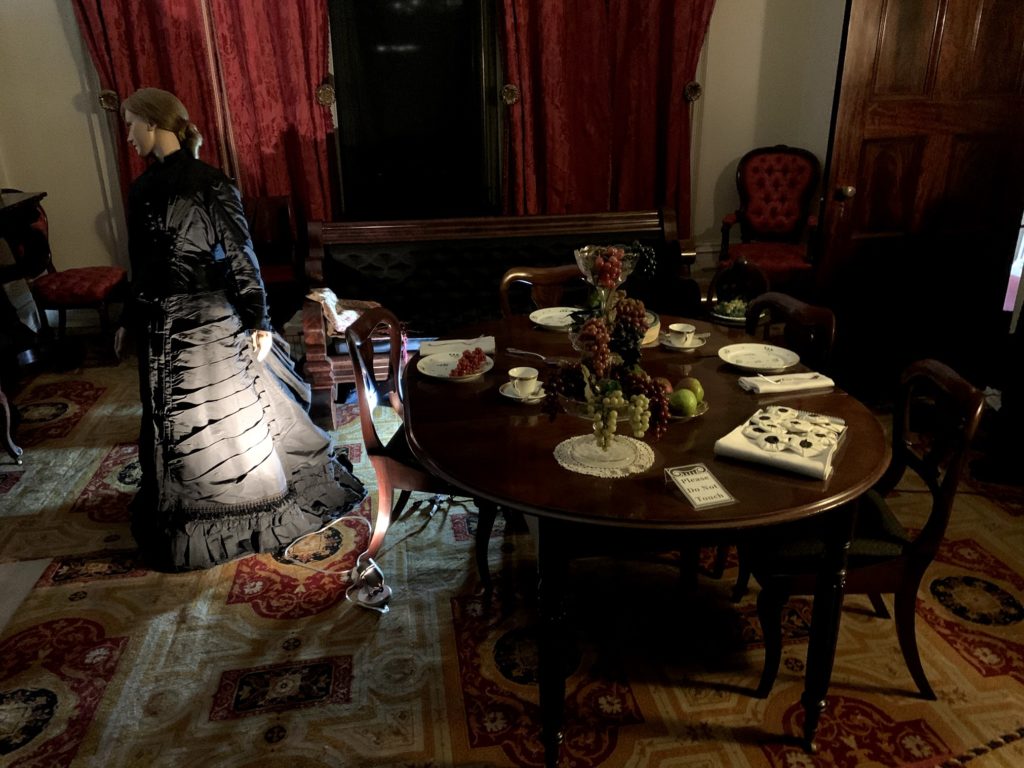
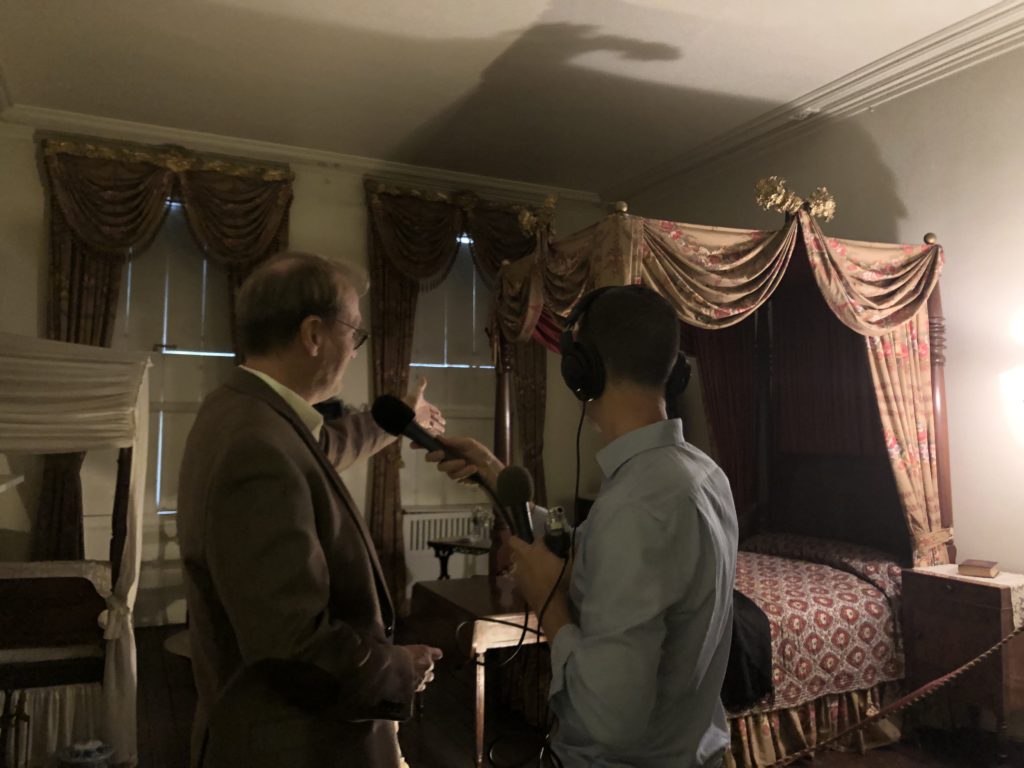
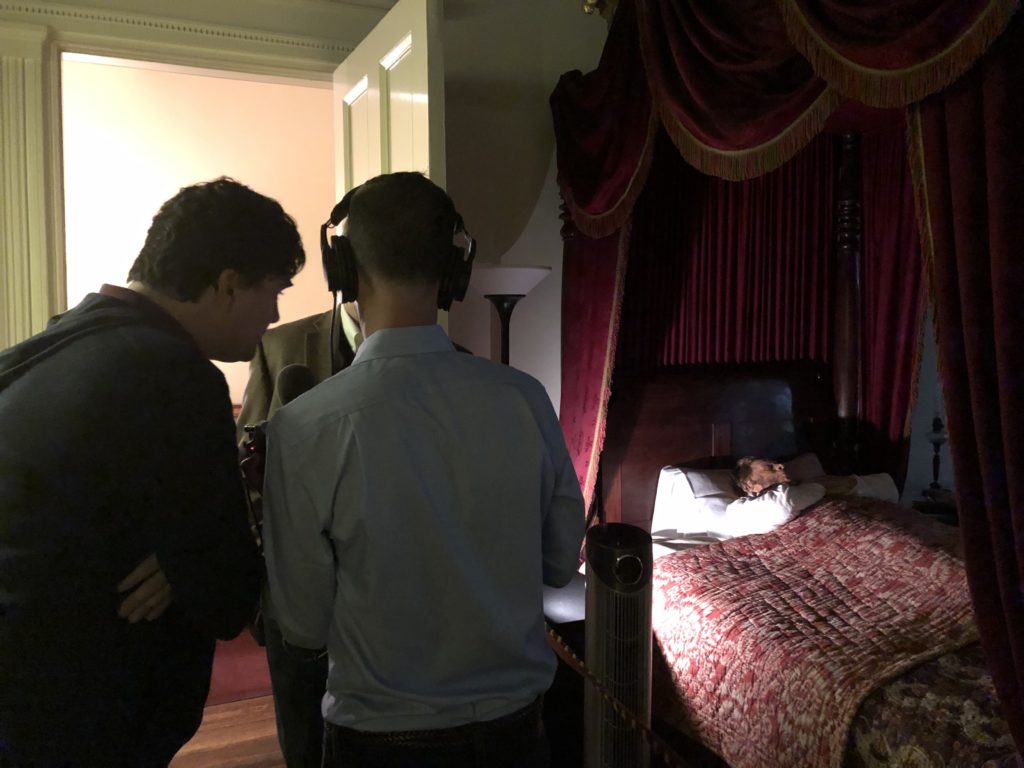
And for the first time in Bowery Boys ghost-stories history, Greg and Tom record a segment of the show — from within an actual haunted house. Merchant’s House docent Carl Raymond joins them for a close look at the life of Gertrude Tredwell and the rooms where she lived and died — and may, to this very day, haunt.
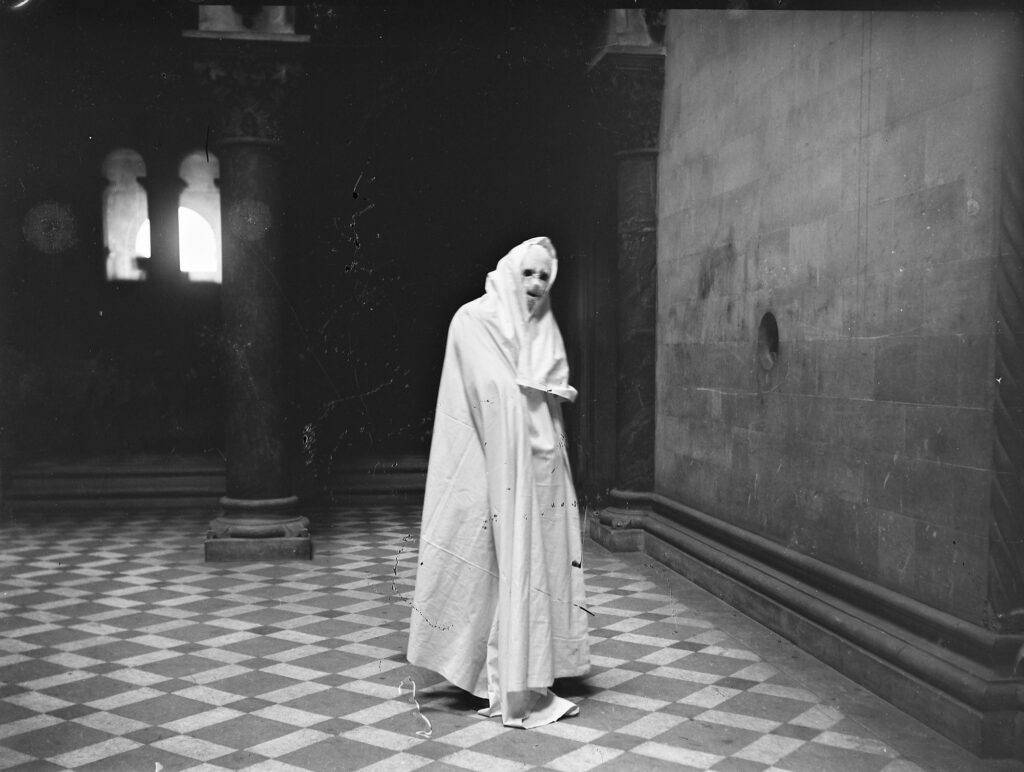

2018The Ghosts of Hell’s Kitchen

The Manhattan neighborhood of Hell’s Kitchen has a mysterious, troubling past. So what happens when you throw a few ghosts into the mix?

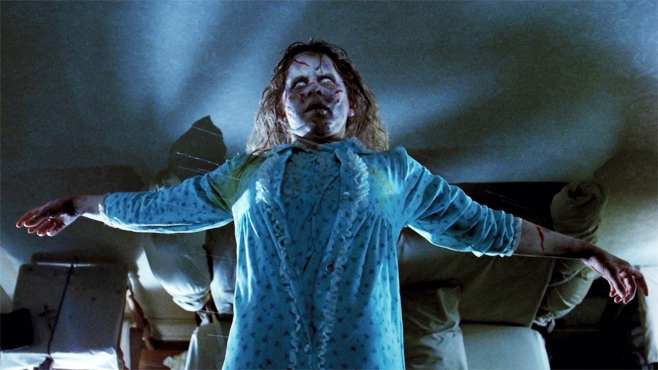
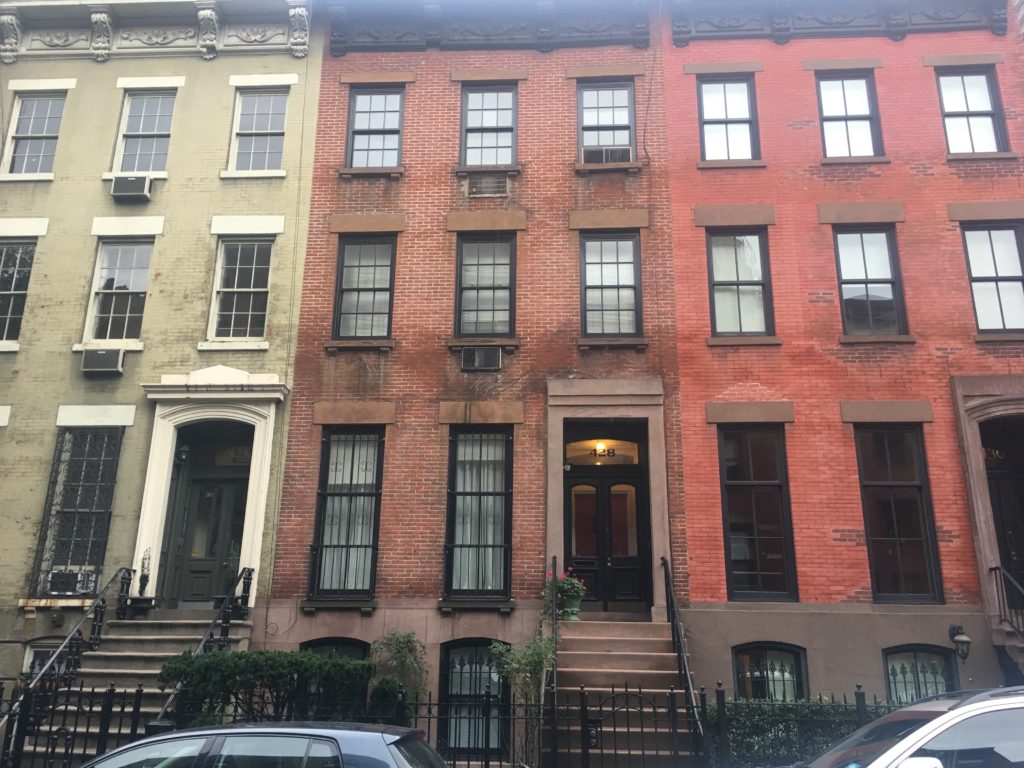
— The troubling tale of a 1970s motion picture classic that may have left a sinister mark on West 54th Street

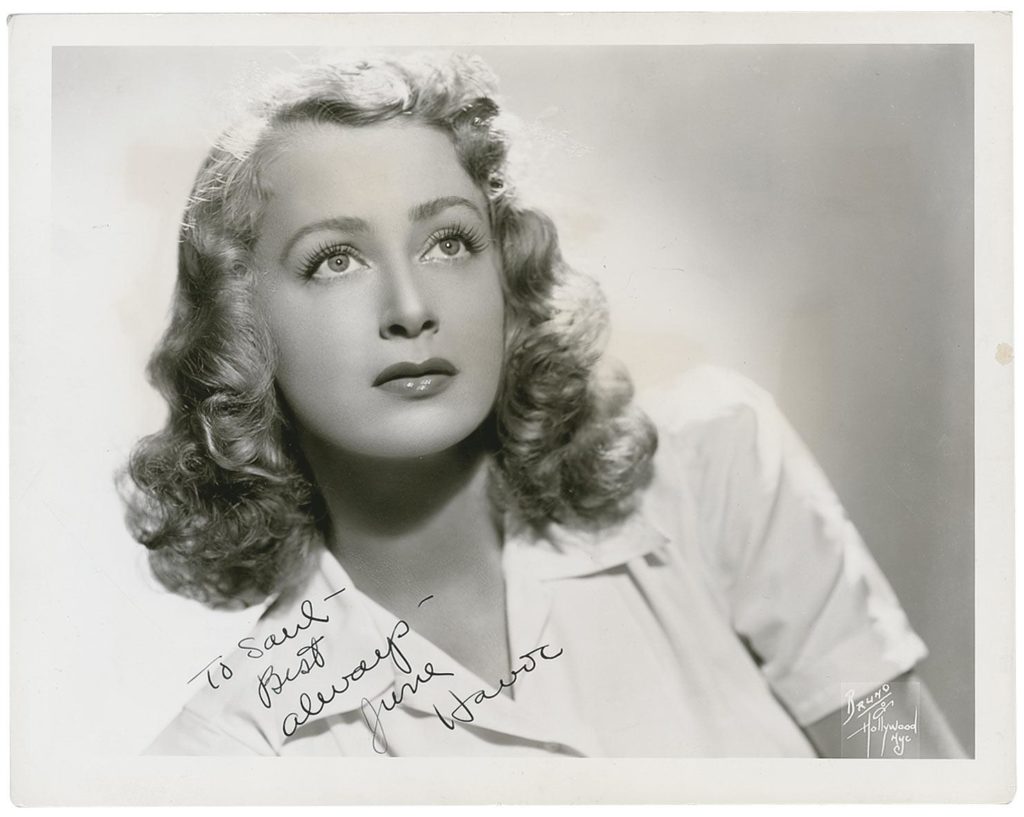
— The haunted home of a popular film and TV actress, possessed with very hungry ghost

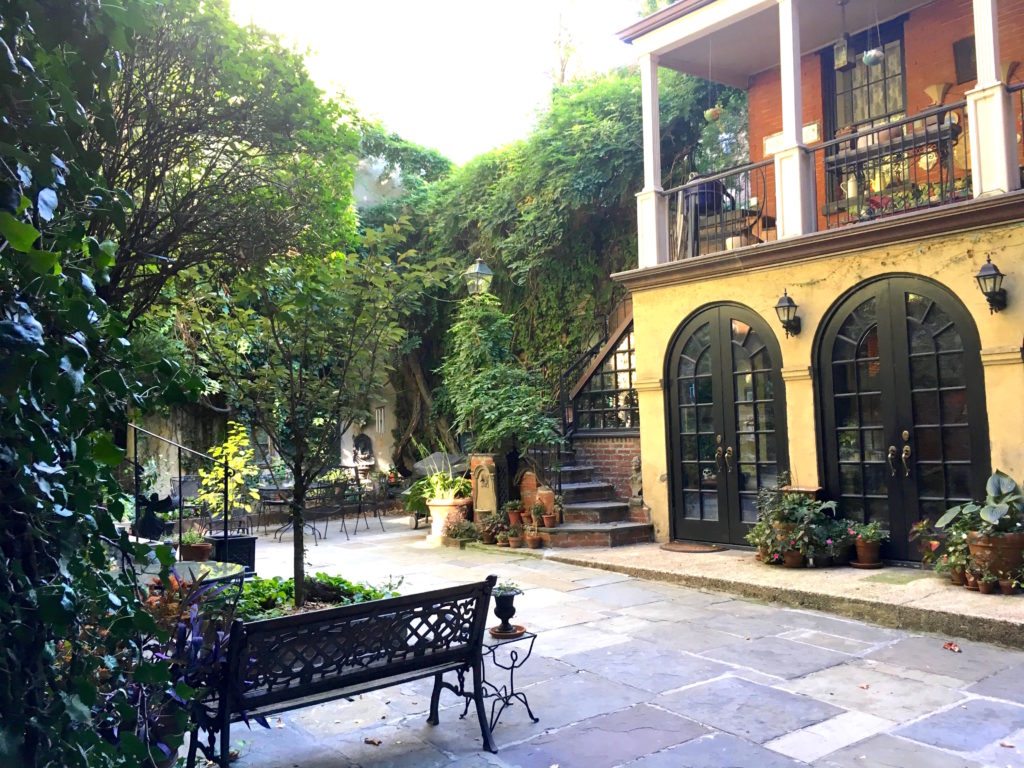
— An enchanting courtyard layered with several horrifying ghost stories

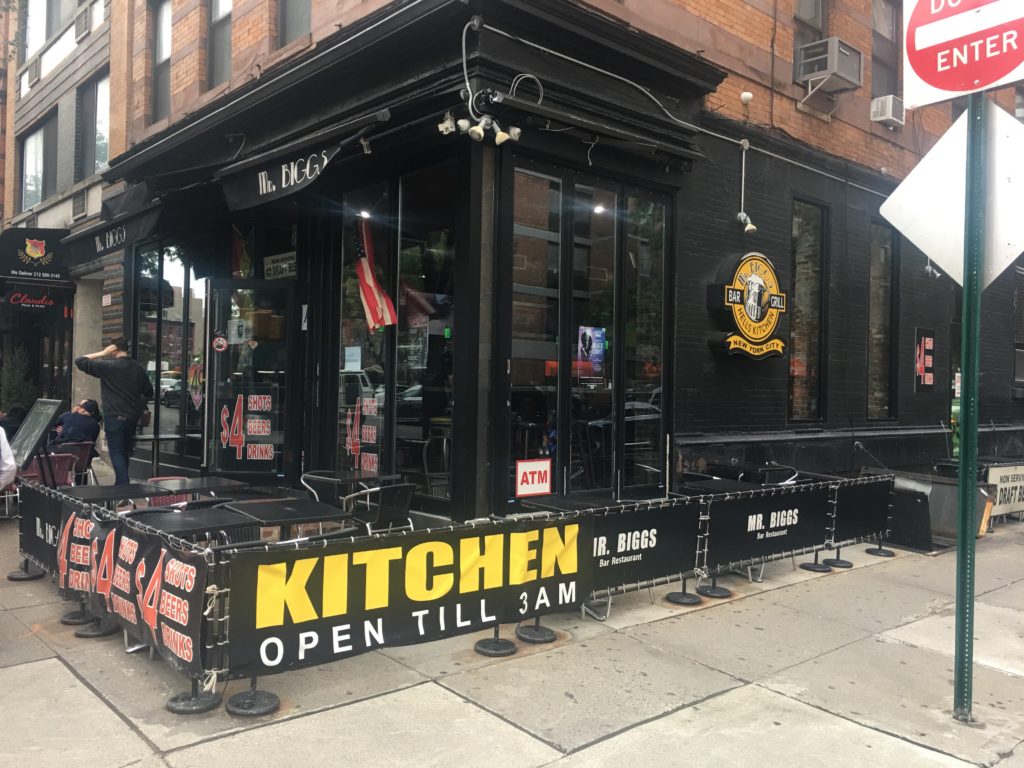
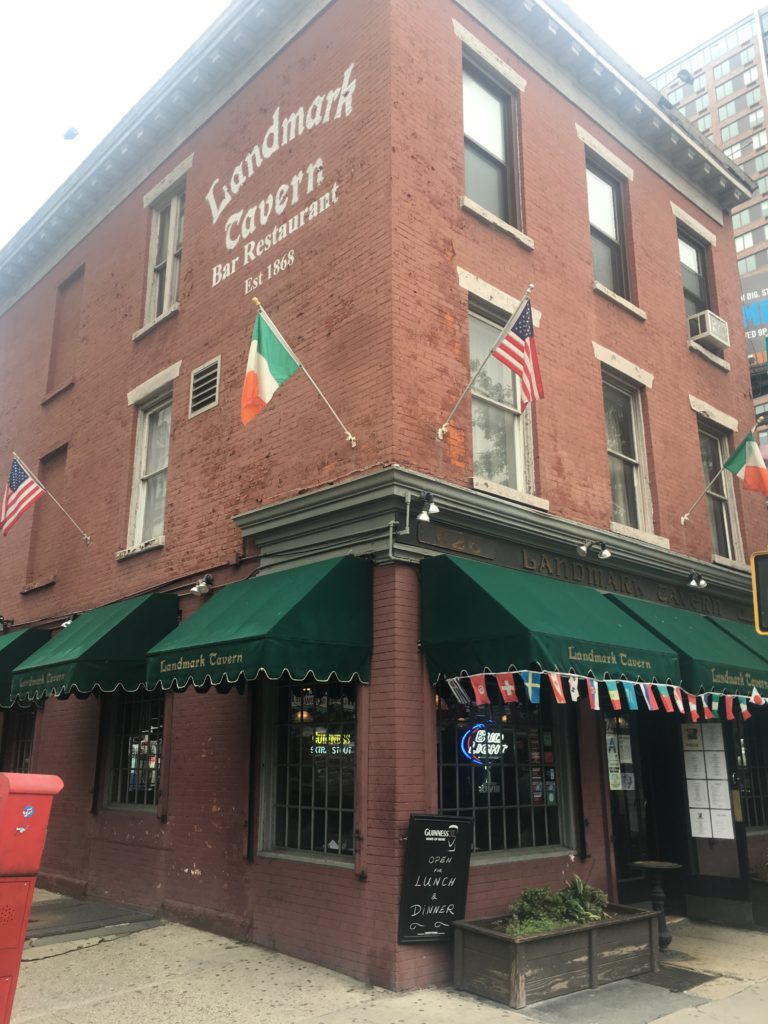
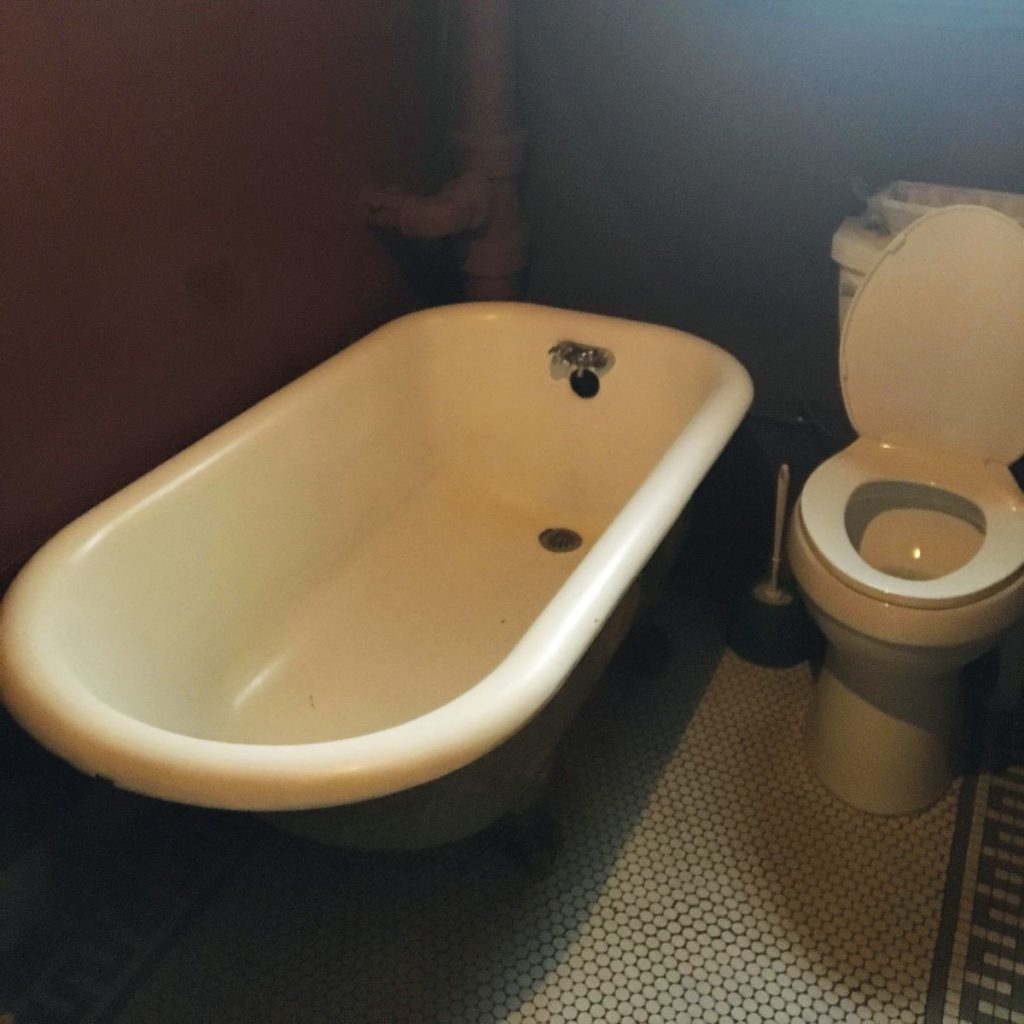
— And the shenanigans at a 150-year-old tavern where the beer and the spirits flow freely.
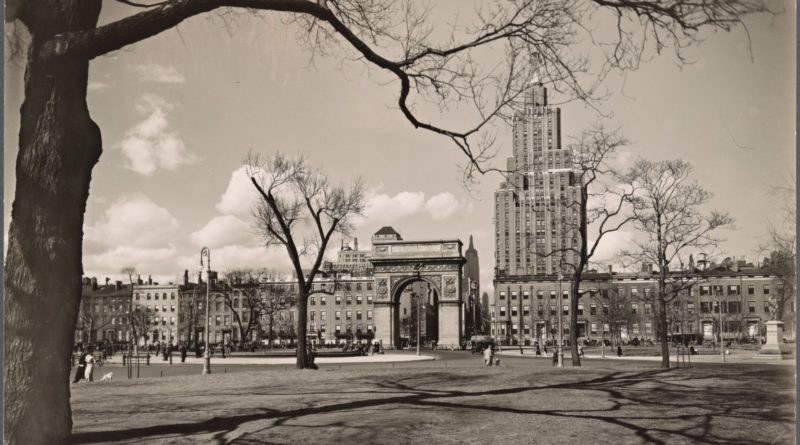

2017 Ghosts of Greenwich Village

We cautiously approach the dark secrets of Greenwich Village, best known for bohemians, shady and winding streets and a deeply unexpected history. You will never look at its parks and townhouses again after this show!

Featuring: The hidden history of Washington Square Park; the Brittany Residence Hall for New York University students; James Walker Park with its secrets underfoot; and an old Bank Street townhouse with a surprise in its ceiling.
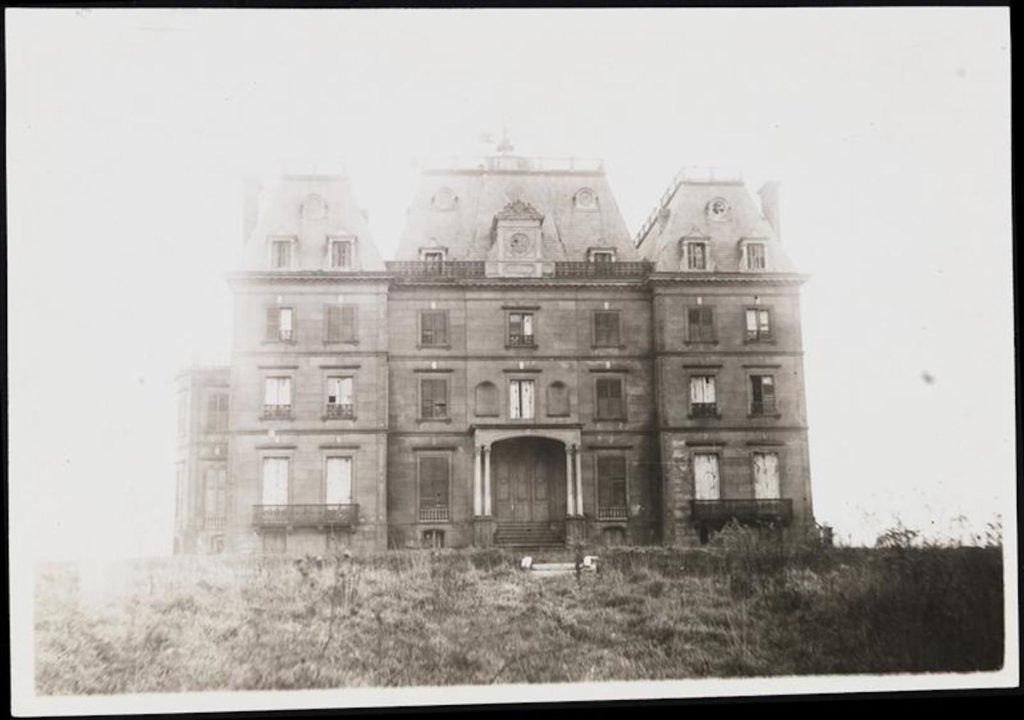

mny221052

2016 Ghosts of the Gilded Age

Highlighting haunted tales from the period just after the Civil War when New York City became one of the richest cities in the world — rich in wealth and in ghosts!

— In the Bronx once stood a haunted house in the area of Hunts Point, a mansion of malevolent and disturbing mysteries.  

— Then we turn to Manhattan to a rambunctious poltergeist on fashionable East 27th Street.

— Over in Queens, a lonely farmhouse in the area of today’s Calvary Cemetery is witness to not one, but two unsettling and confounding deaths.

— And finally, in Staten Island, we take a visit to the glorious Vanderbilt Mausoleum, a historic landmark and a location with a few strange secrets of its own.
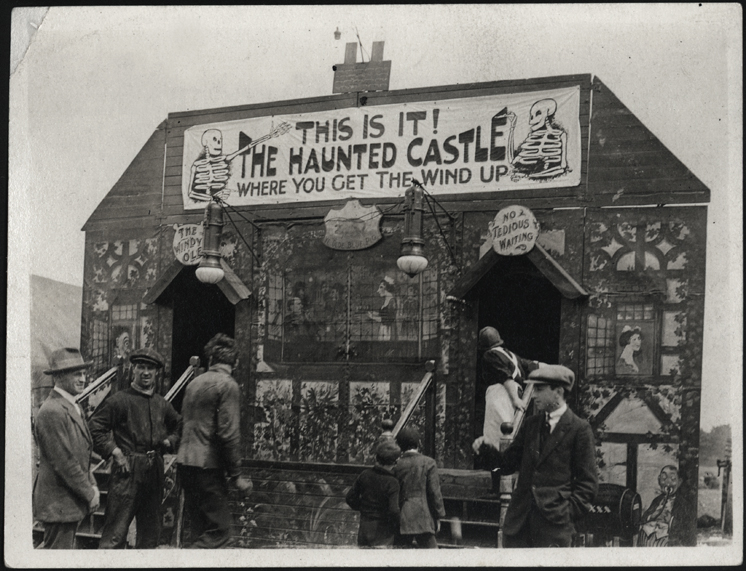

5841855416_661144370a_o

2015 Haunted Landmarks of New York

Ghost stories associated with the city’s most popular and recognizable places from baby-faced spooks at the Dakota Apartments to spirited revelers at Grand Central Terminal.

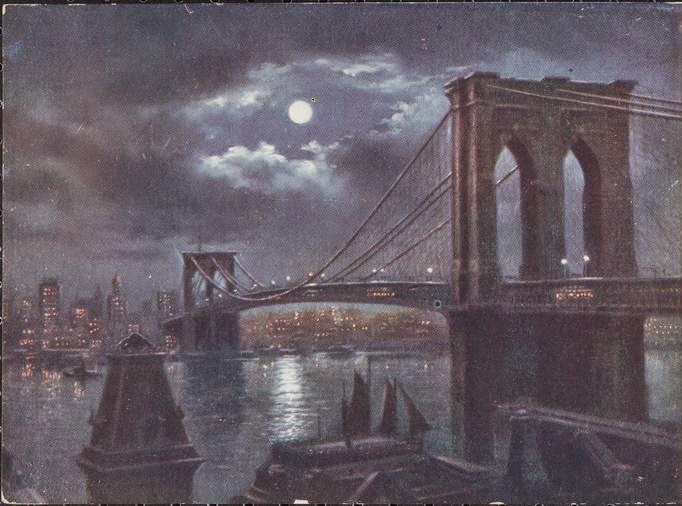
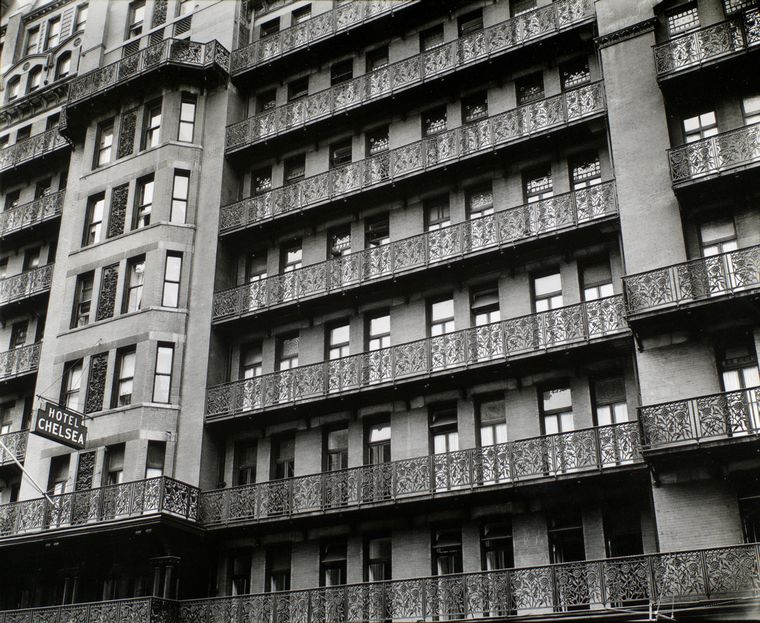
What’s still lurking in the hallways of the Chelsea Hotel? And whatever you do tonight, do not linger too long on the Brooklyn Bridge at night! A figure from the bridge’s past may still be looking for his head.
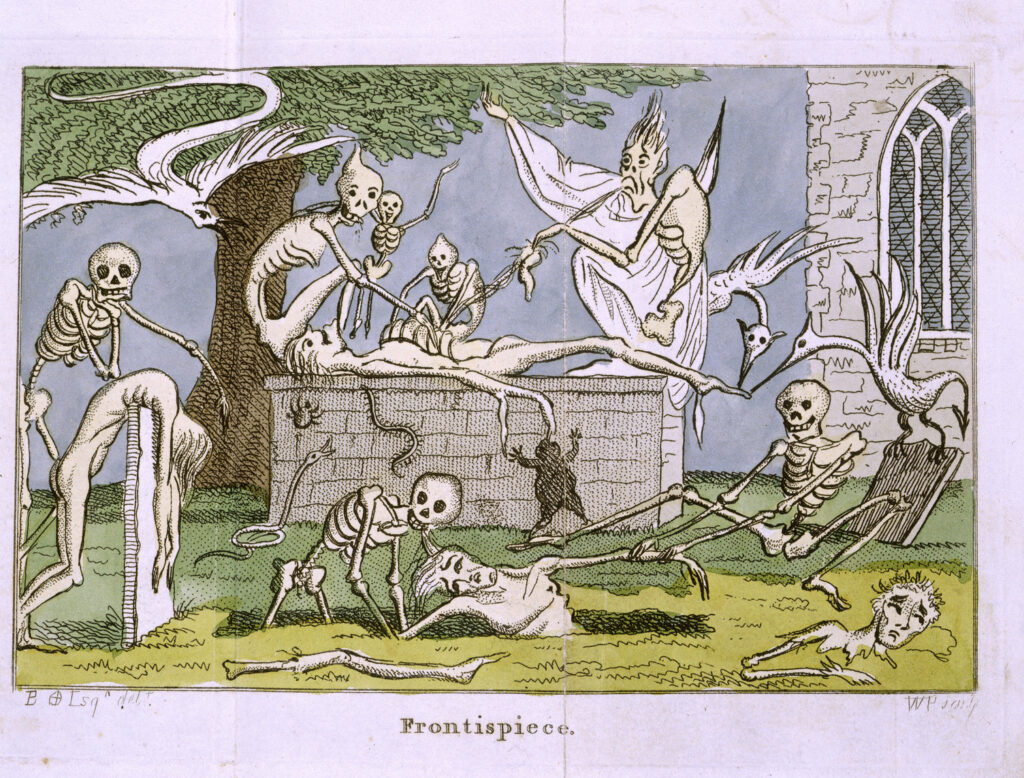

2014 Ghost Stories of Brooklyn

Four tales of spirits haunting Brooklyn back in the 19th century when it was still an independent city. Featuring an horrific gangly ghost on the railroad tracks, a historic Clinton Hill home with an invisible hand that would not stop knocking, a Coney Island hotel in 1894 with a secret in room 30, and the wacky wraiths of Bushwick’s Evergreens Cemetery.

2

2013 Early Ghost Stories of Old New York

Tales set mostly before the 1840s featuring sinister stories of murder, shipwreck and death by fright!

Spirits of dead Lenape Indians may haunt the forest of Van Cortlandt Park.

A romantic West Village restaurant finds its home inside the former carriage house of Aaron Burr. Might the vice president still be visiting?

We bring you the legend of an old Brooklyn fort that once sat in Cobble Hill and terrified those who traveled along on old Red Hook Lane.

And finally, over at St Paul’s Chapel,  a respected old actor wanders the churchyard, looking for his body parts.-
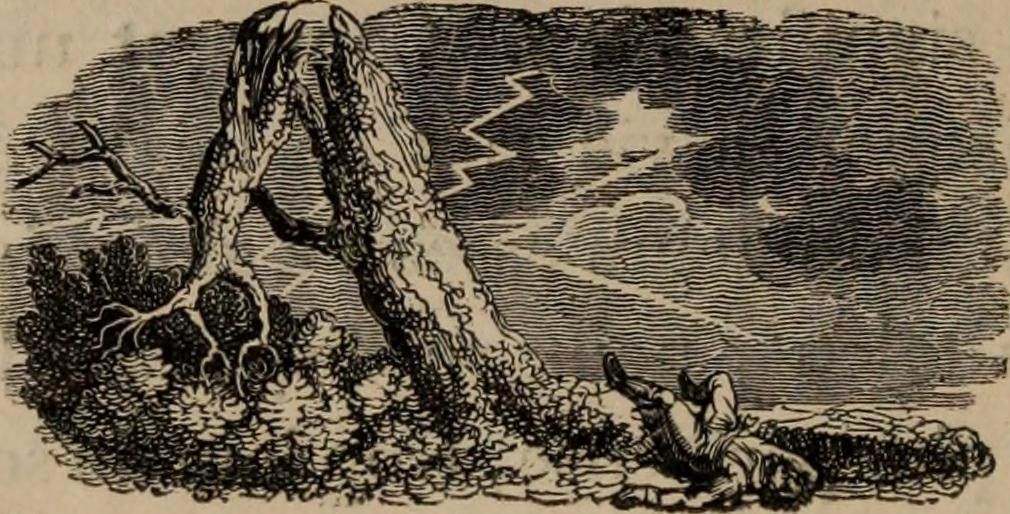
3

2012 Mysteries and Magicians of New York

Grab a drink at the Ear Inn, one of New York’s most historically interesting bars, and you might meet Mickey, the drunken sailor-ghost.

A frightening story of secret love at old Melrose Hall conjures up one of Brooklyn’s most popular ghostly legends.

A woman is possessed through a Ouija board, but while she accept the challenge by one of New York’s first ghostbusters?

And a tale of Harry Houdini, Sir Arthur Conan Doyle, and the line between the supernatural and mere sleight of hand.
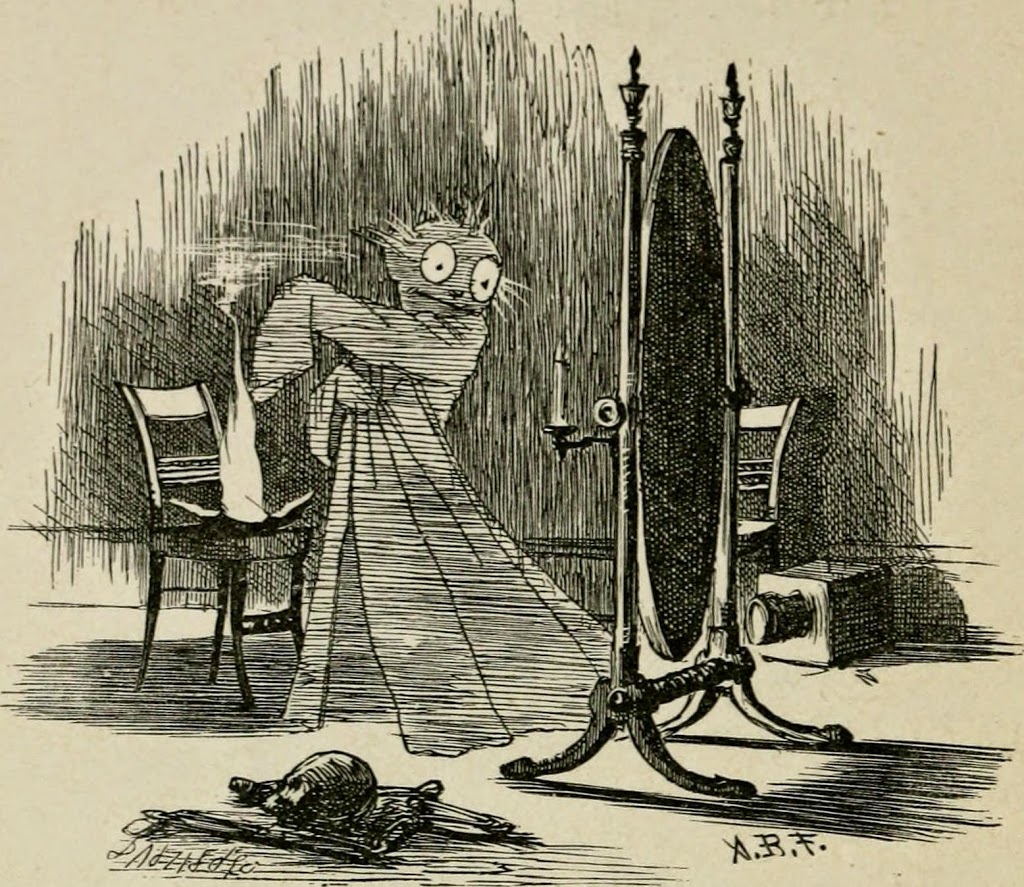
2011 Haunted Histories of New York

What’s horrors are buried at the foot of the Statue of Liberty?

What’s below a Brooklyn Catholic church that makes it so dreadfully haunted?

What ghost performs above the heads of theatergoers at The Palace Theatre?

And what is it about the Kreischer Mansion that makes it Staten Island’s most haunted home?
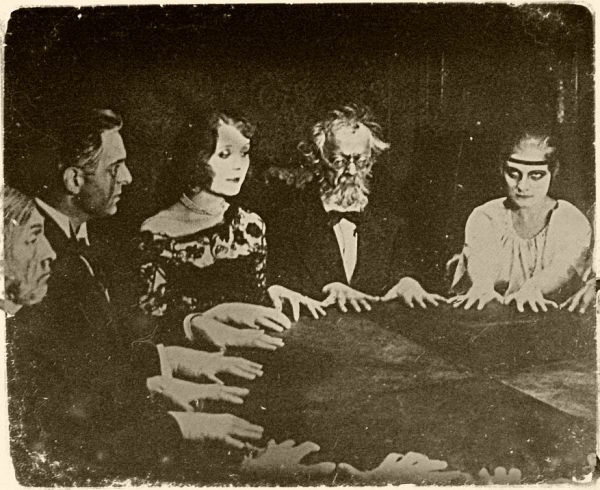

seance

2010 Supernatural Stories of New York

The scary revelations of a New York medium, married Midtown ghosts who fight beyond the grave, a horrific haunting at a 14th Street boardinghouse, and the creepy tale of New York’s Hart Island.
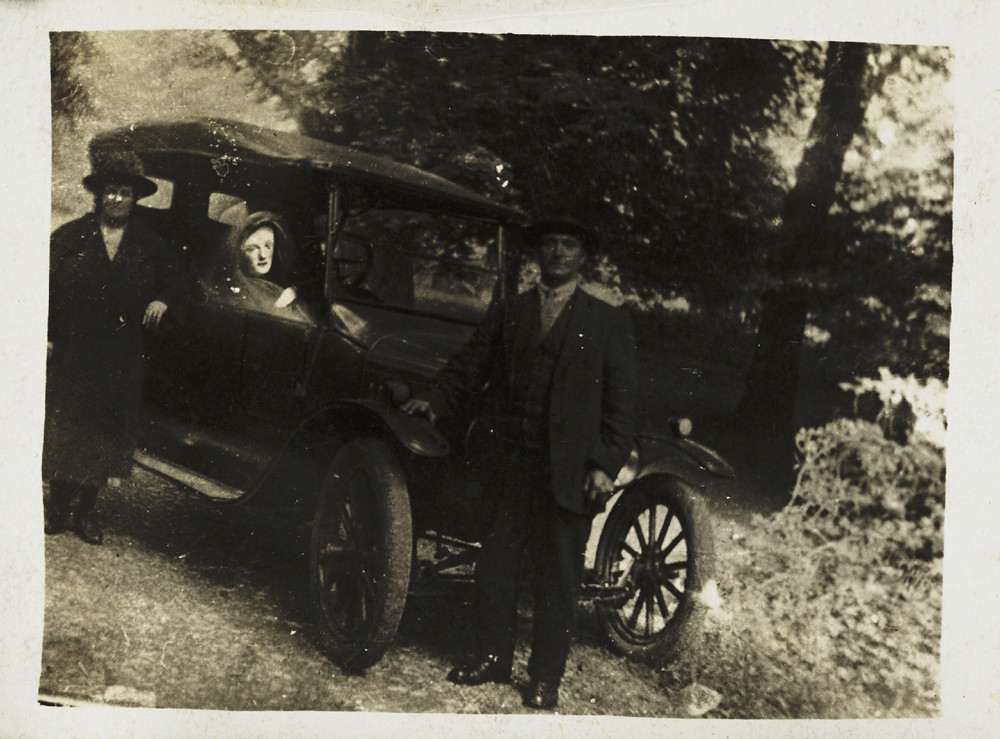

2009 Haunted Tales of New York: Urban Phantoms

The secrets of the restless spinster of the Merchants House, the jovial fright of the Gay Street Phantom, the legend of the devil at Spuyten Duyvil Creek, and the spirit of a dead folk singer.
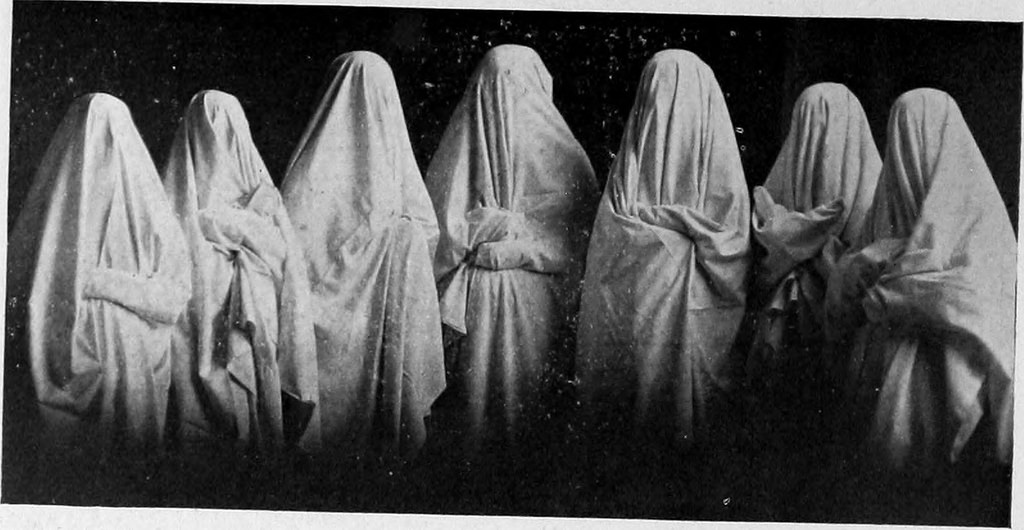

ghost

2008 Spooky Stories of New York

The drunken spirits of the Algonquin, the mysteries of a hidden well in SoHo, the fires of the Witch of Staten Island, and ‘the most haunted brownstone in New York’.
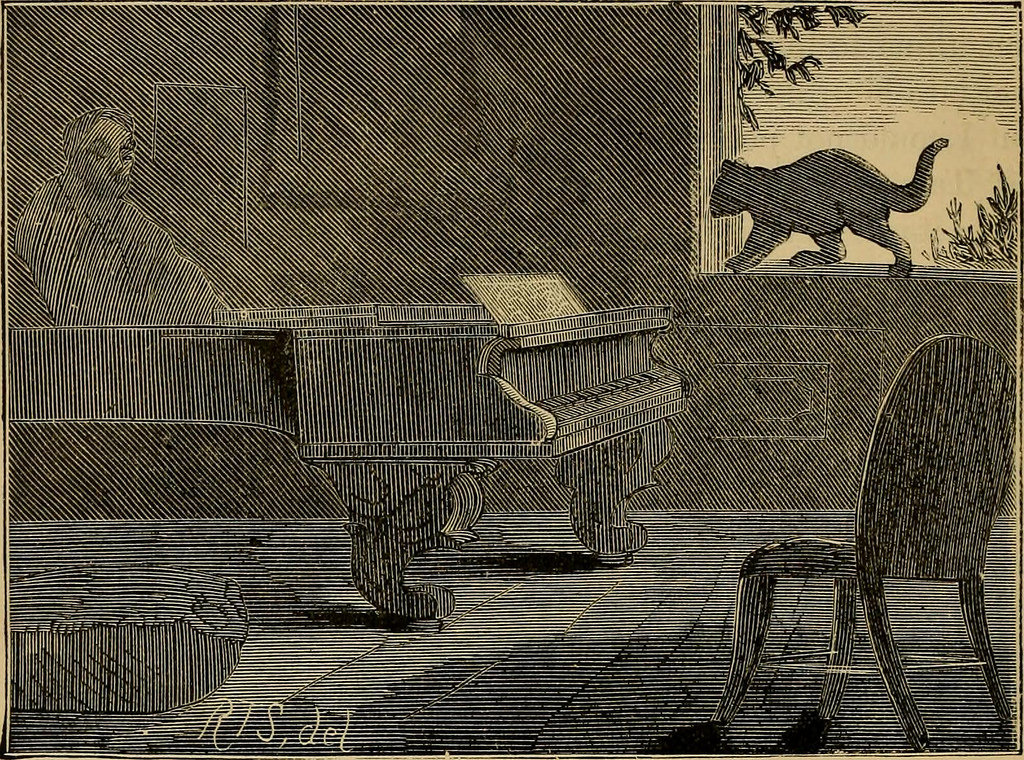

1

2007 Ghost Stories of New York

The ghosts of a tragic Ziegfeld girl, a scandalous doyenne of old New York, a bossy theater impresario and the ghoulish bell-ringer of St. Mark’s-in-the-Bowery.


Here are the locations mentioned in all of our New York City ghost podcasts:

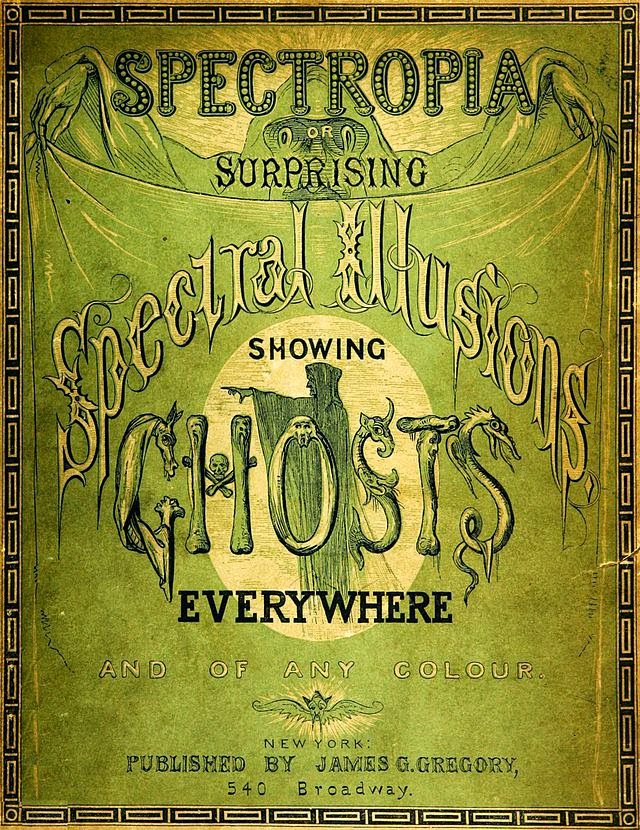
Most of the public domain spooky images in this post come from the Internet Book Archive.
Categories
Landmarks Mysterious Stories Podcasts

Ghost Stories by Gaslight: Hauntings of Old New York

A brand new batch of haunted houses and spooky stories, all from the gaslight era of New York City, the illuminating glow of the 19th century revealing the spirits of another world.

Greg and Tom again dive into another batch of terrifying ghost stories, using actual newspaper reports and popular urban legends to reveal a different side to the city’s history.

If you just like a good scare, you’ll enjoy these historical frights. And if you truly believe in ghosts, then these stories should especially disturb you as they take place in actual locations throughout the city — from the Lower East Side to the Bronx. And even in cases where these 19th-century haunted houses have been demolished, who’s to say the spirits themselves aren’t still hanging around?

Featured in this year’s crop of scary stories:

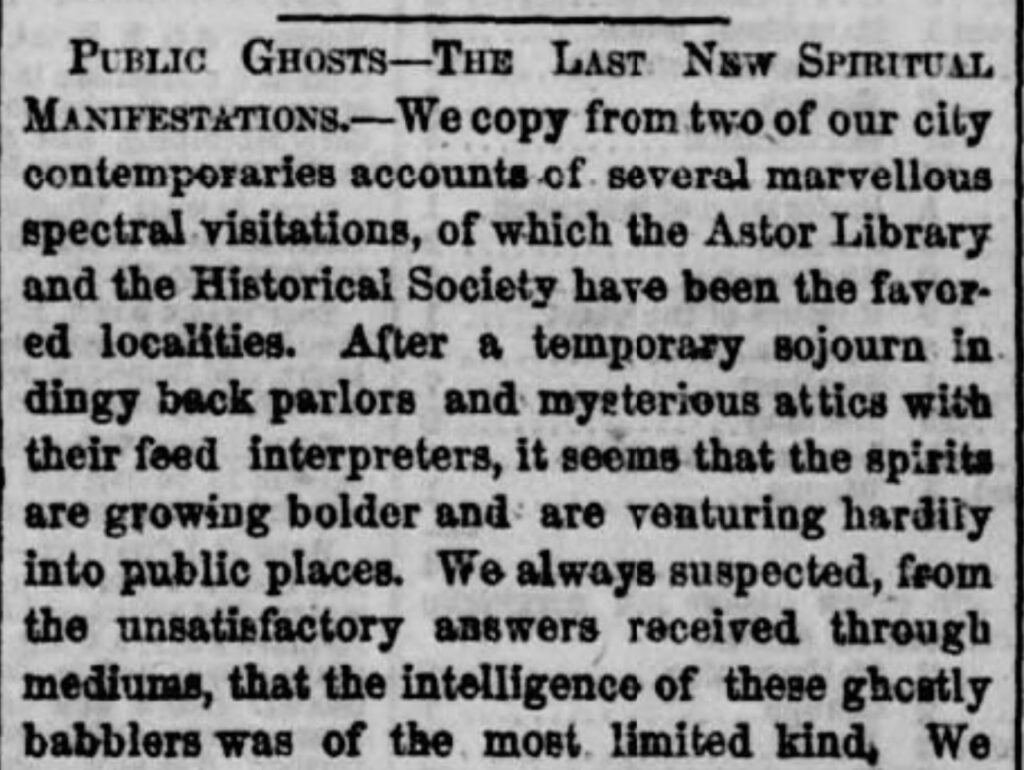
— A ghostly encounter at the Astor Library (today’s Public Theater) involving a most controversial set of mysterious books;

— A whole graduating class of ghosts stalks the campus of the Bronx’s Fordham University, and it may have something to do with either Edgar Allan Poe or the film The Exorcist;

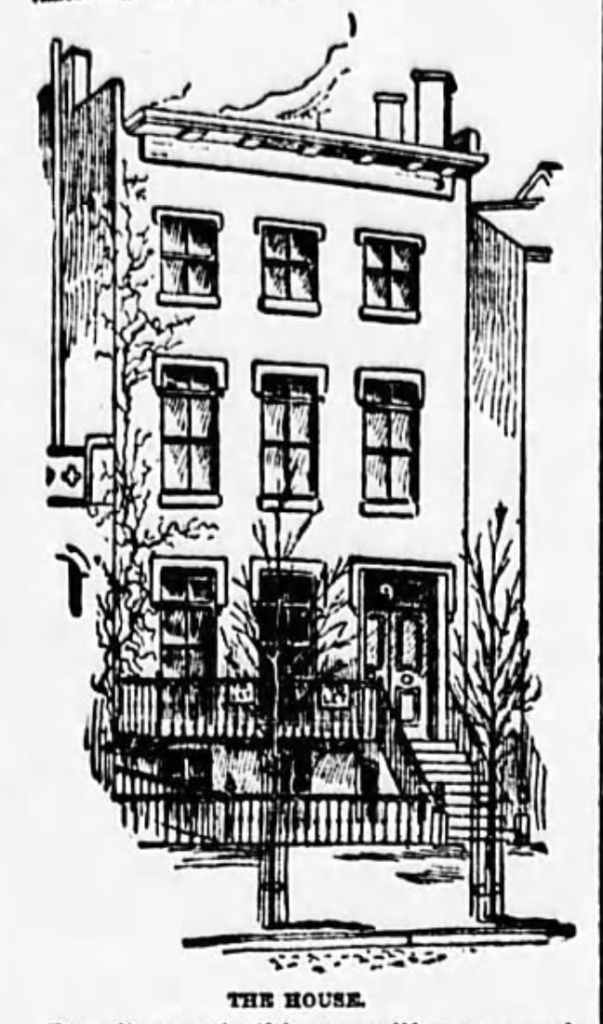
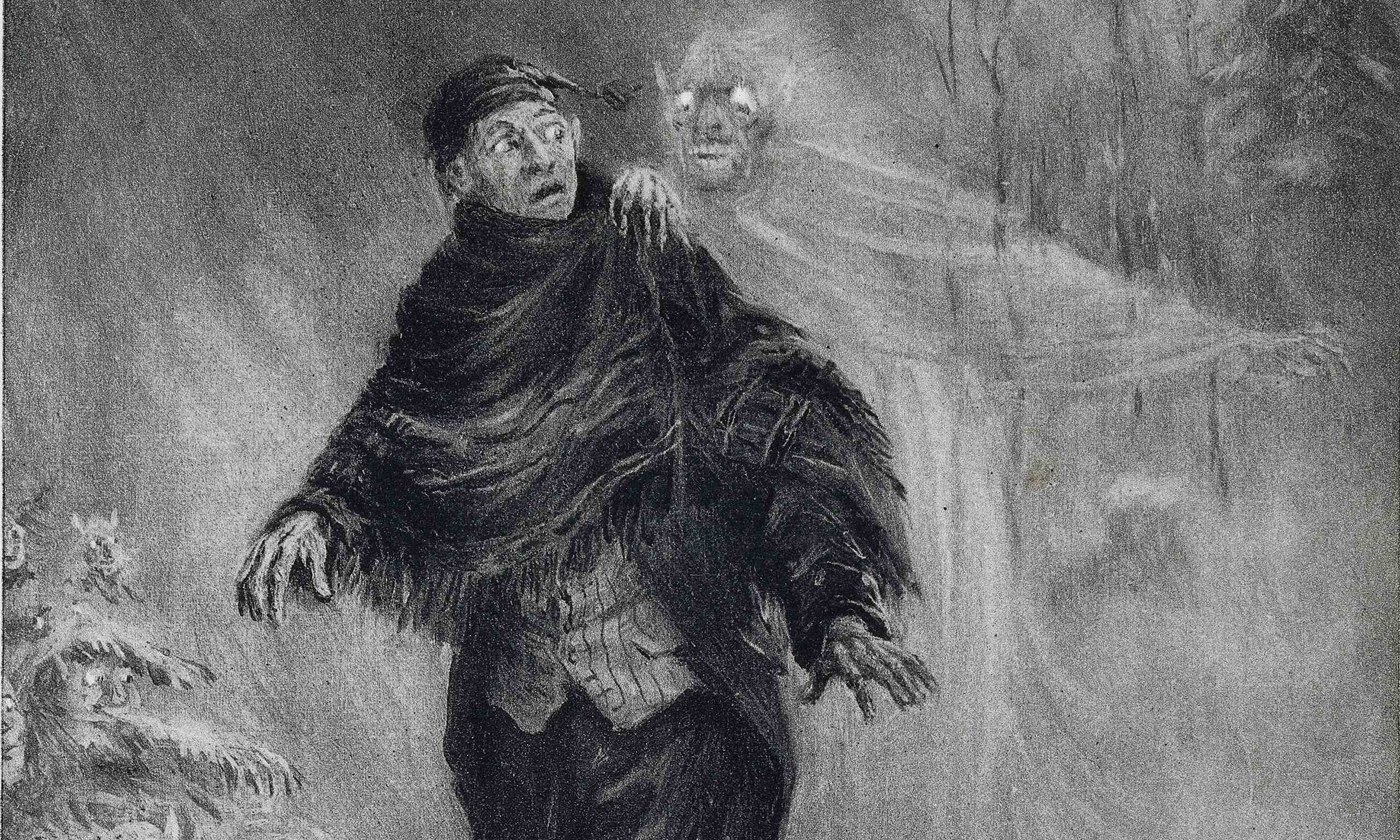
— Just north of Washington Square Park in Greenwich Village, a haunted townhouse vexes several tenants, the sight of a hunched-over man in a cap driving people insane;

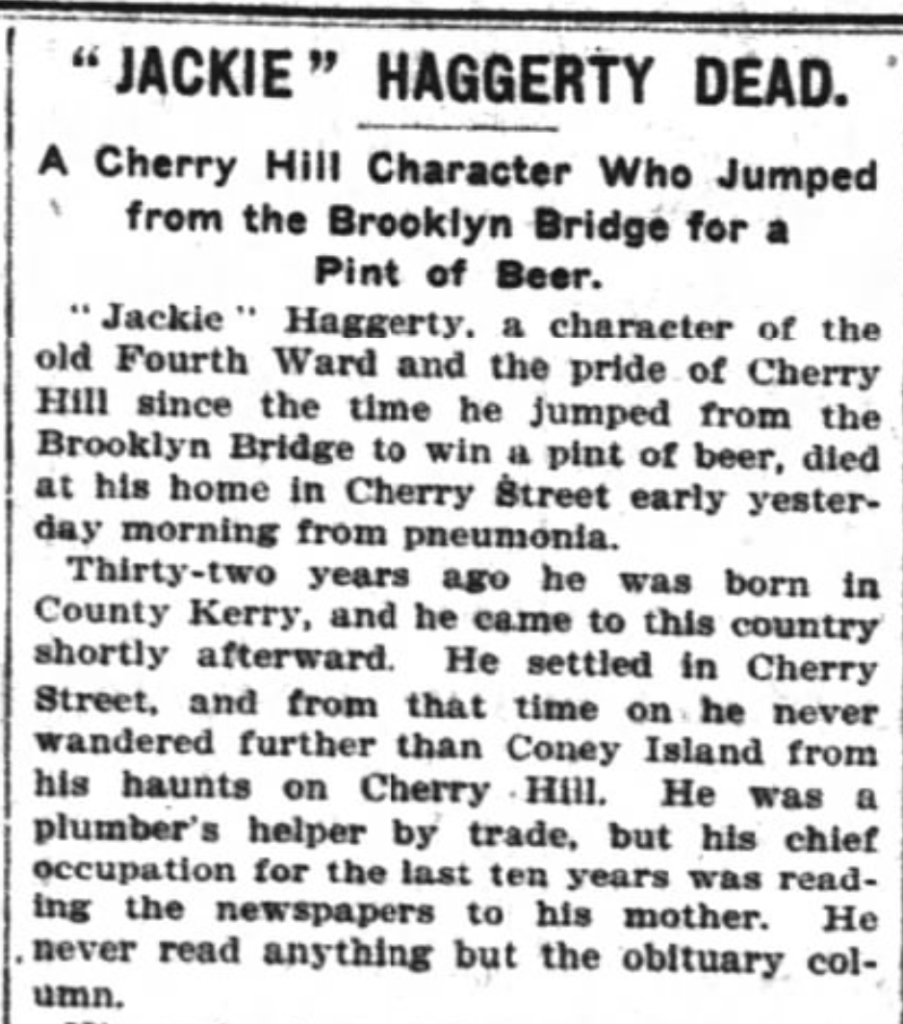
— In the shadow of the Brooklyn Bridge, a small apartment in today’s Two Bridges neighborhood becomes possessed by a poltergeist with a penchant for throwing furniture …. and punches. One vainglorious showoff named Jackie Hagerty learns the hard way;

— And before the days of Riverside Drive, a rustic old mansion once sat on the banks of the Upper West Side, with a mysterious locked room that must never be opened.

LISTEN TODAY: GHOST STORIES BY GASLIGHT


And of course listen to the entire collection of Bowery Boys ghost stories podcast here and in this Spotify playlist:


Ghost of the Astor Library

Wikimedia Commons/Internet Archives. Gleason’s Pictorial Vol. 6 No. 8 (February 25, 1854), Boston:124
Astor Library 1954. Harry Miller Lydenberg (July 1916). “History of the New York Public Library”. Bulletin of the New York Public Library 20: 570-571.; first published in Gleason’s Pictorial Drawing-Room Companion/Wikimedia commons
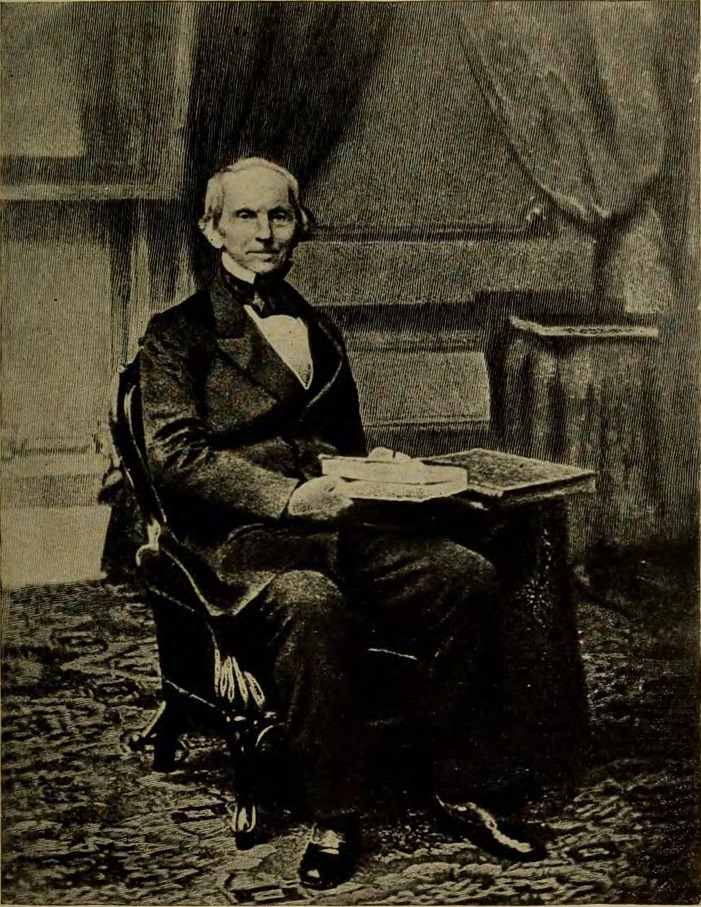
The librarian Joseph Cogswell

The Sorority of Ghosts

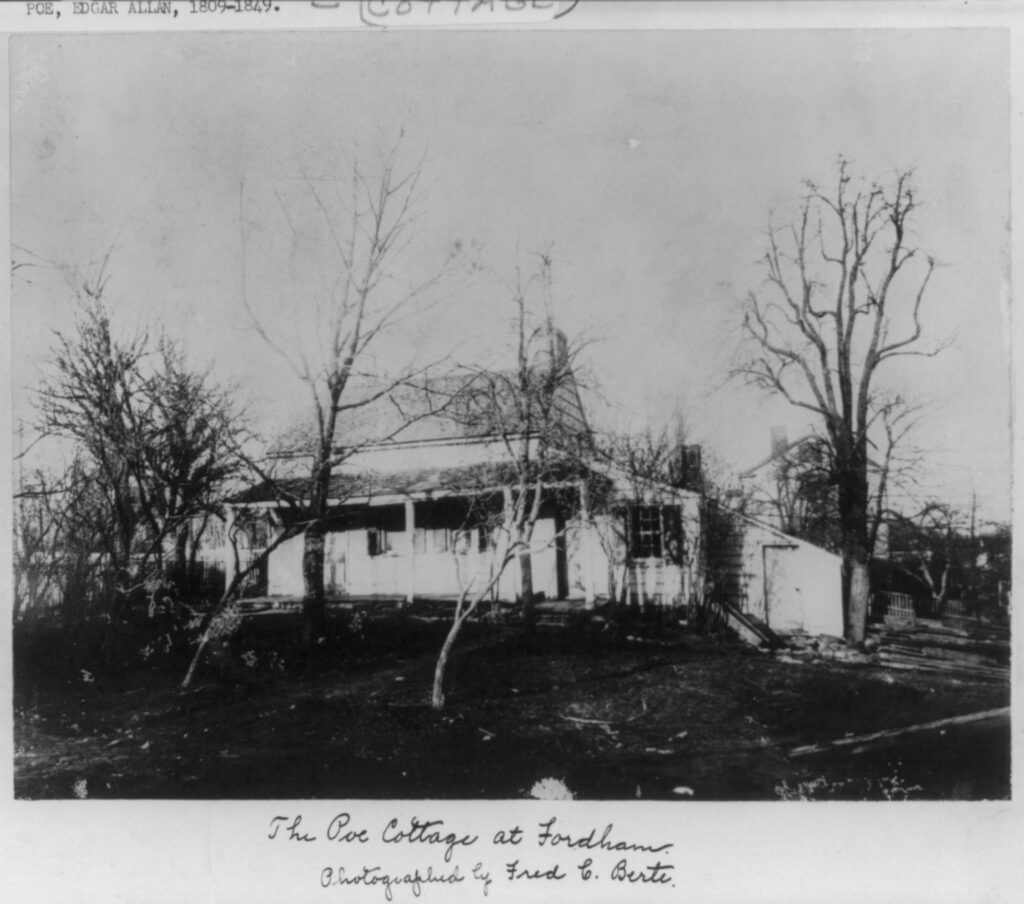
Poe Cottage, pictured 1900, Library of Congress
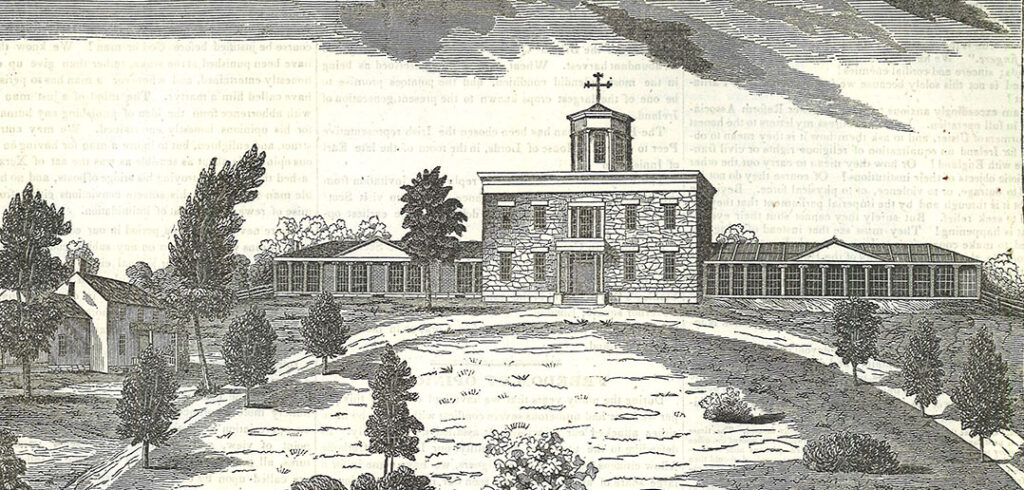
This 1840 image of Cunniffe House by engraver Benson J. Lossing, also includes the original Rose Hill Manor house, at left. (Image courtesy of Catholic Historical Research Center of the Archdiocese of Philadelphia via Fordham)
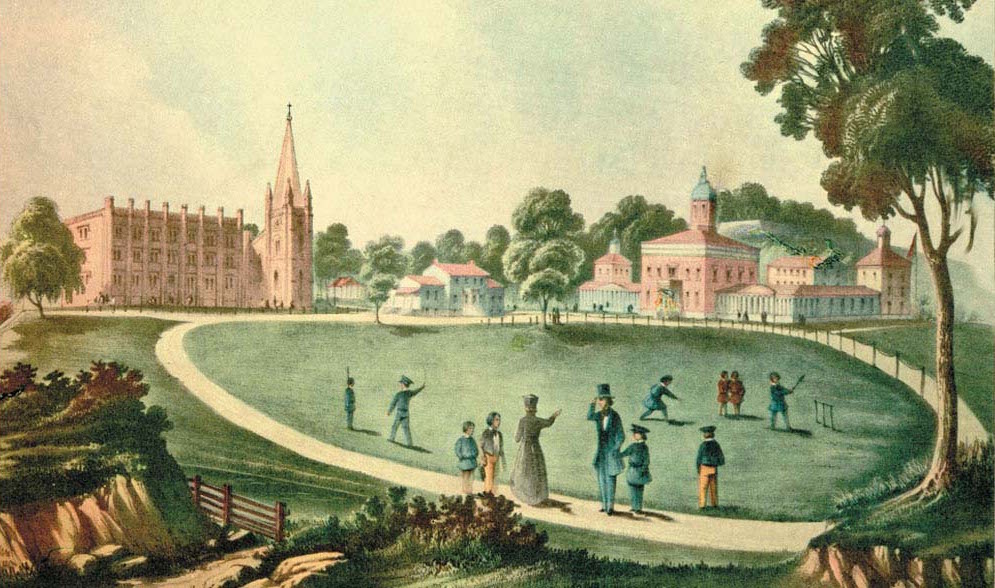
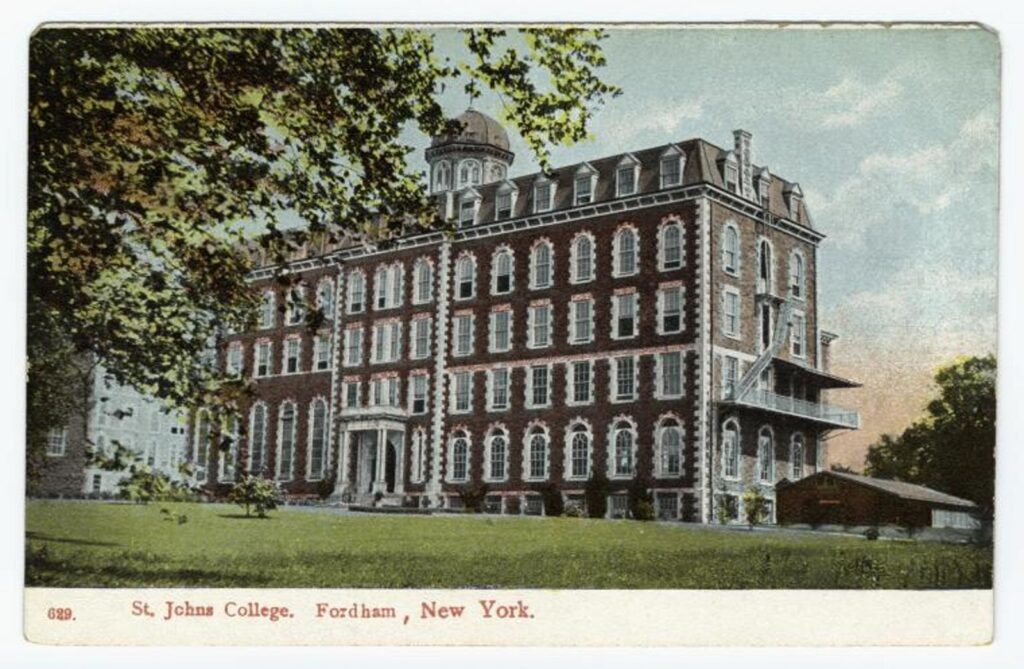
St. John’s Colllege, 1846, courtesy Fordham
St John’s College aka Fordham University, New York Public Library

The New York Sun, February 1892

New York Times, March 25, 1900

New York Times, October 20, 1900

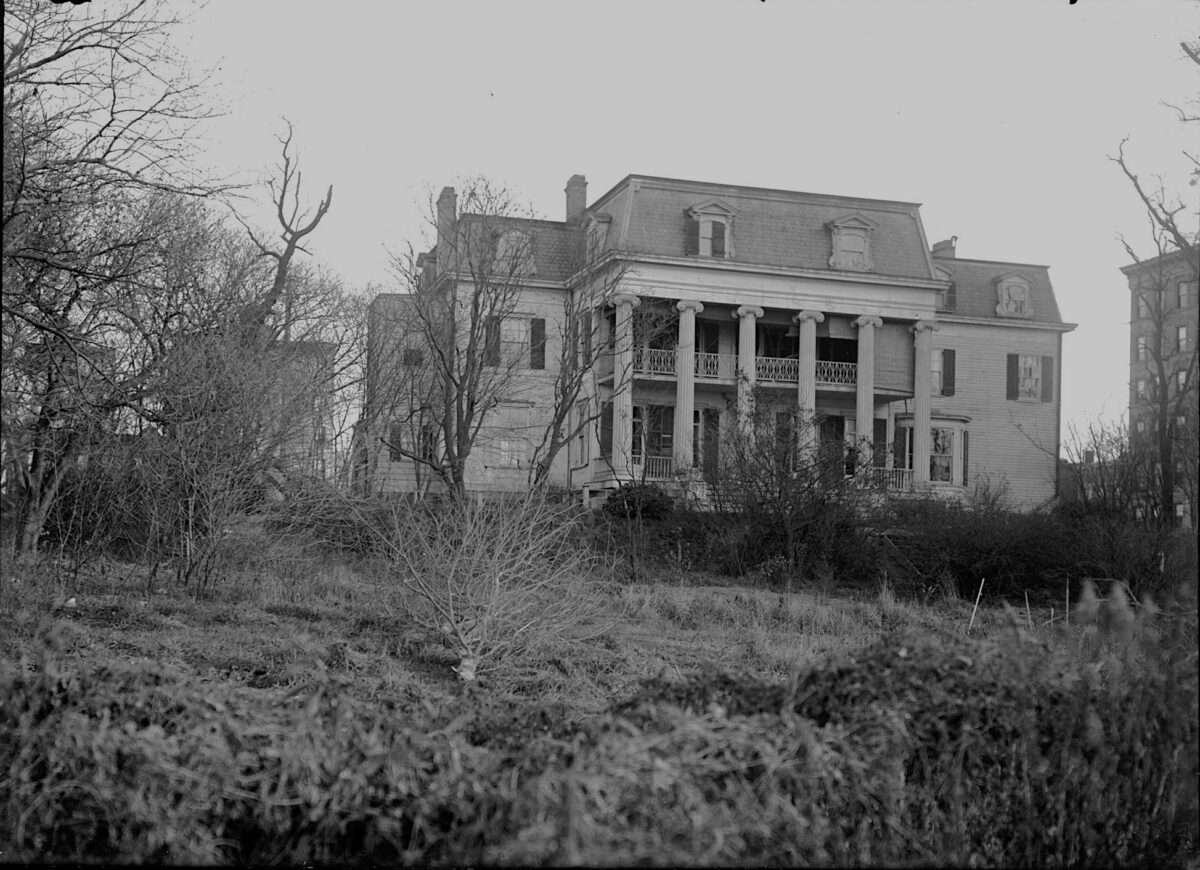
New York Times, 1905 — Furniss Mansion an Interesting Souvenir of Older New York; If Its Walls Could Talk the “Old Colonial White House,” Facing Riverside Drive, Could Tell the Story of a Century’s Progress on This Island — Tale of Its Gentle and Studious Ghost.

Furniss Mansion, image courtesy Ephemeral New York

FURTHER LISTENING

This episode features ghost stories from places in New York City that we have extensively covered over the years. Here’s a few places to start:

Categories
Brooklyn History Mysterious Stories

For Whom The Ghost Tolls: A Haunting in Bedford-Stuyvesant

The Brooklyn neighborhood of Bedford-Stuyvesant is defined by its architectural character, rows of impressive brownstones and ornate apartment buildings which trace back to the late 19th century.  

It was once two separate villages — Bedford and Stuyvesant Heights — combined to appeal to new residents in the ever-expanding city of Brooklyn.  The Bed-Stuy of the 20th century was the heart of African-American residential life; gentrification may alter that definition in the 21st.

Another feature of the neighborhood that may have passed down through the decades are its ghosts.

Simply mix a neighborhood of families full of imaginative children with severe and dramatic old architecture, and voila! You’ve got ghost stories.  

Anybody born and raised in Bed-Stuy probably has one story of a purported haunted house, either a structure uninhabited and boarded up or an old home with a single unseen resident, the yard out front overtaken with neglect.

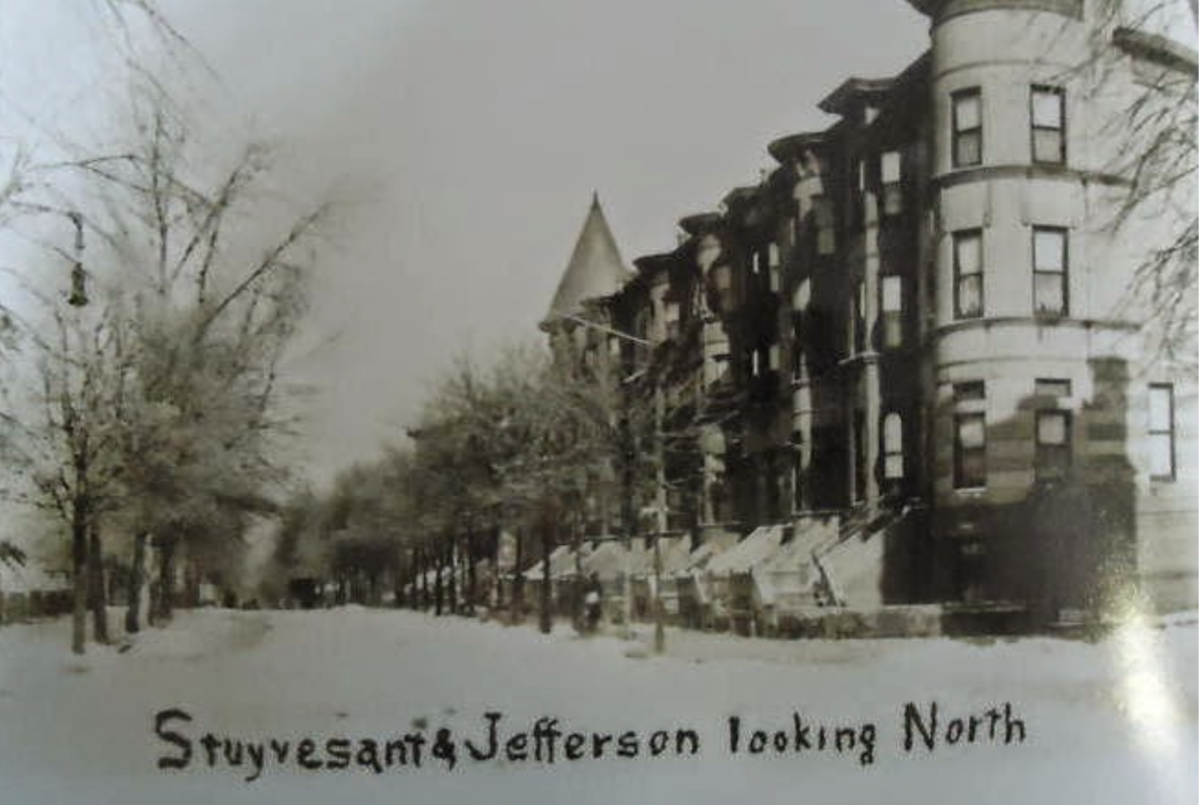
But perhaps one of Bed-Stuy’s most interesting ghost stories comes not from legend but from an actual newspaper report — the haunting of 281 Stuyvesant Avenue in Stuyvesant Heights.

The four-floor building was originally built in 1897 as a small apartment house. Although included in the Stuyvesant Heights Historic District, its modest apperance pales next to its neighbor, Grace Presbyterian Church (today’s Bridge Street AME Church).

On October 23, 1901, the Brooklyn Daily Eagle reported on a disturbing and frankly stressful time had by the building’s first-floor newlyweds Mr. and Mrs. Joseph Griffin.

The school teacher and his wife moved into the flat in July and immediately experienced some truly unusual phenomenon.  At precisely 2 pm every afternoon the new electric doorbell stationed in the vestibule would ring, prompting the lady of the house to open the door.  But nobody would be there.

After a few days of this activity, Joseph naturally assumed it was troublesome kids.  However one day, Griffin stood in the vestibule at precisely 2 pm.  To his astonishment, the bell ring with no human agency present.

This was only the beginning.  The ghost continued to torment the Griffins with “hollow groans, creepy sidesteps on the staircase and unexpected trips from room to room by articles of furniture.”

A haunting so close to Grace Presbyterian were particularly unsettling. “His temerity in operating in a flat, the windows of which look right out on the stained glass panes of a church, is especially startling.”

The Griffins, more irritated than frightened, could not take this disturbing presence in their home any further and immediately moved out.  The skeptical reporter, of course, took note of the fact that nobody else in the building had experienced any particular supernatural phenomenon.

The upstairs neighbor complained of rats and mice and wind gusts with the strength to swing open doors.

The neighbor added, “The pipes groan and the plumbing rattles too, and my husband says its the spookiest house he was ever lived in, but ghosts! — nonsense.”

Categories
Bowery Boys Movie Club Podcasts

Ghostbusters: The Bowery Boys Movie Club explores New York’s slimiest supernatural comedy

EPISODE 344 We’ve now made our Bowery Boys Movie Club episode on the film Ghostbusters available for everyone. Listen to it today wherever you get your podcasts.

This episode is brought to you by those who support the Bowery Boys Podcast on Patreon. Join us there to get additional episodes of the new Patreon-only Bowery Boys Movie Club — including the latest episode on When Harry Met Sally.


This episode is partially based on this in-depth article on the New York City history moments featured in the film, originally written in 2013. Give it a read while you listen along!


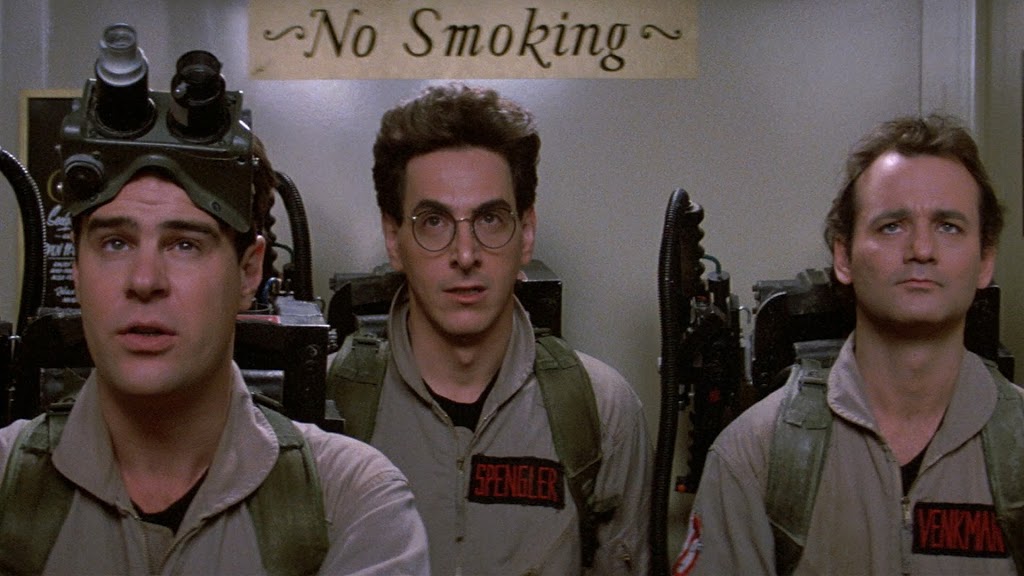
Ghostbusters, the goofy, supernatural tale starring Bill Murray, Dan Ackroyd, Harold Ramis, Ernie Hudson, and Sigourney Weaver, was one of the biggest hits of 1984, a rare blend of wry comedy, special effects and spectacular New York City landscapes.

Despite its preposterous premise — that ghosts look either like oozing fat blobs or Sheena Easton-ish supermodels — the film flawlessly displays the easy comic talents of its stars and reveals a New York City with only monsters as its greatest threat.

But in looking over old tales of mediums, haunted houses and ancient legends for our annual Halloween podcasts, I realized there was a very broad, but legitimate basis of historical spiritual skepticism behind this story, written by Ackroyd and Ramis.

There have been both believers and cynics from New York history who have attempted to prove the existence of supernatural forces and have even tried to purge them from the city.

From there, I took a deeper look into the historical people, places and events depicted in the film, if not only to find evidence of New York’s ghostbusting forefathers, then at least to enjoy the pop culture references of the early 1980s.  

Ghostbusters was a mainstream offering, so it goes very light on its urban commentary of a city picking itself up out of withering debt.

Its ghosts are quite democratic, in fact, terrorizing libraries, public places, ethnic neighborhoods and wealthy condominiums alike.

Here are 25 fascinating pieces of trivia about Ghostbusters, putting the film within the context of New York City history.  Obviously there are a ton of spoilers here, in case you haven’t yet seen it.

But hopefully I’m giving you a good excuse to catch on television this Halloween!

1)  Ghostbusters is set in 1984, late October-early November, judging from the dates on newspapers and magazines which appear midway through the film. But the film’s release date was in June 1984, so technically the film documents future events.

The appearance of Sumerian gods on the Upper West Side and a team of wise-cracking ghost exterminators certainly would have been the top story of the year.

Real life is not as magical. The big story in New York City that year came over a month later, when Bernhard Goetz shot four men who tried to mug him in the subway.

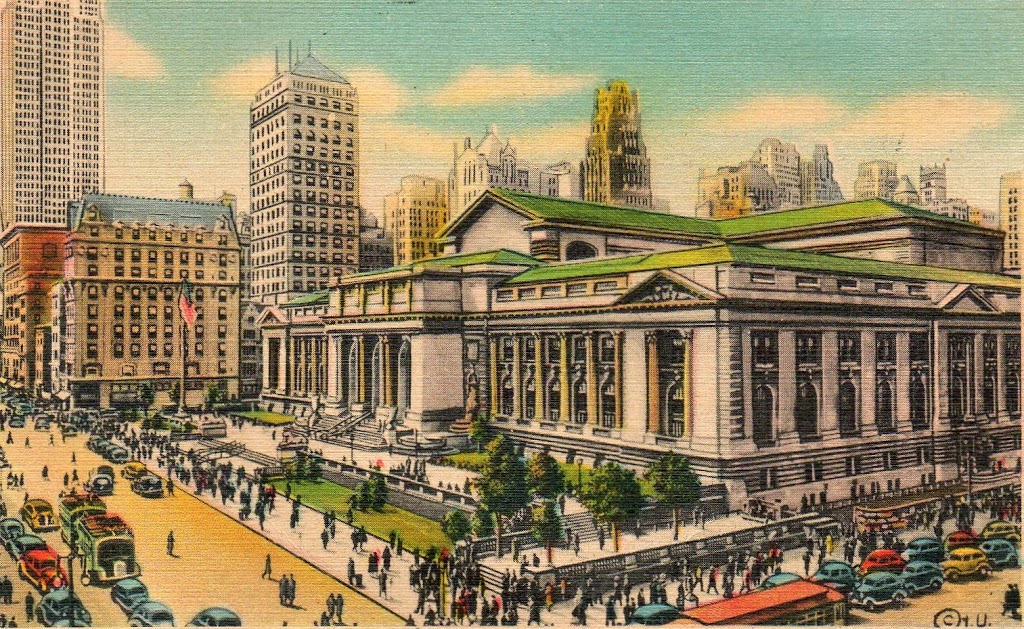
2) The New York Public Library, setting for the delightfully shushy spectre in the opening scene, may actually be haunted. After all, it sits on land that was once a burial ground.

According to historian Charles Hemstreet, writing in 1899, “The ground between Fifth and Sixth Avenues, Fortieth and Forty-second Streets, now occupied by Bryant Park and the old reservoir, was purchased by the city in 1822, and in 1823, a potter’s field was established there, the one in Washington Square having been abandoned in its favor.”

By the way, the two lions (named Patience and Fortitude) are prominently featured in the opening, a sly parallel to the stone monsters which will appear later.

Photo courtesy Bain News Service

3) Our ghostbusting heroes are originally located at Columbia University, in Weaver Hall (actually Havemeyer Hall). Although there is no actual department of paranormal psychology, Columbia does have a connection to one of New York’s earliest institutes of paranormal study.

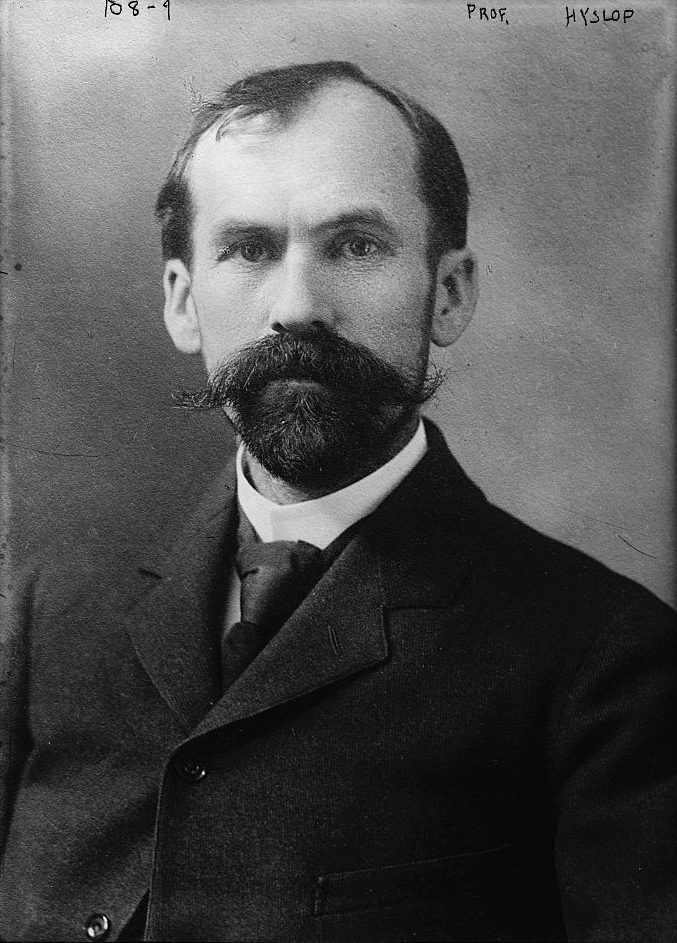
The American Society for Psychical Research was founded in 1884 — exactly one century before Ghostbusters — as a legitimate organization looking to separate spiritualist quacks from actual supernatural phenomena.

Its most prominent leader was James H. Hyslop (above), a former professor of ethics and logic at Columbia University.  His early studies read like a jazz-age X-Files, investigating ghosts, spiritual possession and a strange variety of mental abilities.  (We speak of Hyslop in two of our old ghost story podcasts, investigating a case of spiritual harassment and contact via a Ouija board.)

4) While no hauntings are actually displayed at Columbia University in the film, they certainly could have been.

The campus is located on the site of old Bloomingdale Insane Asylum, where more than a few mentally disturbed individuals met their end.

Columbia bought the facility in the 1880s and demolished most of it to make way for their McKim, Mead and White-designed campus. But one structure still remains — the Macy Villa, a home for mentally-troubled rich gentlemen, in today’s Buell Hall, home of La Maison Francaise.

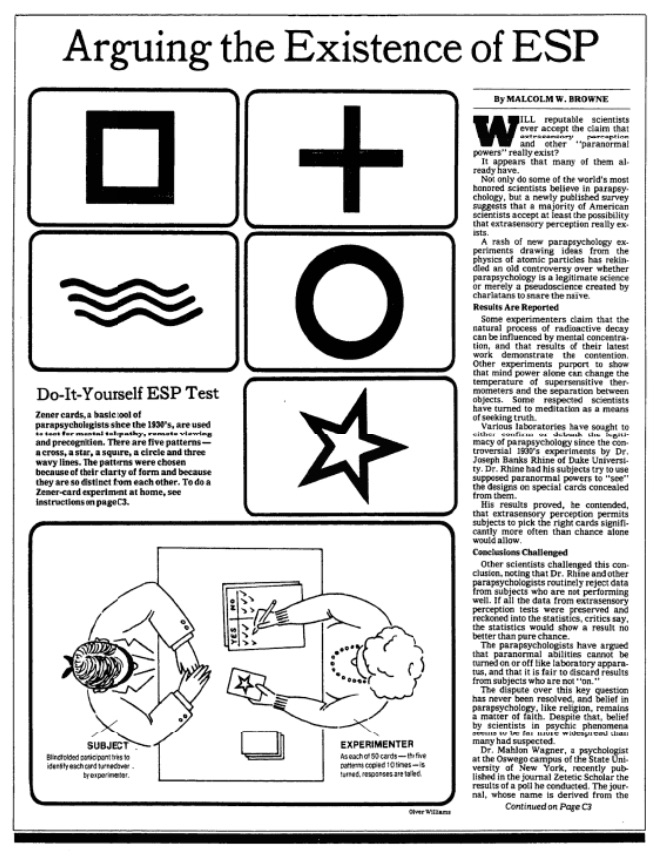
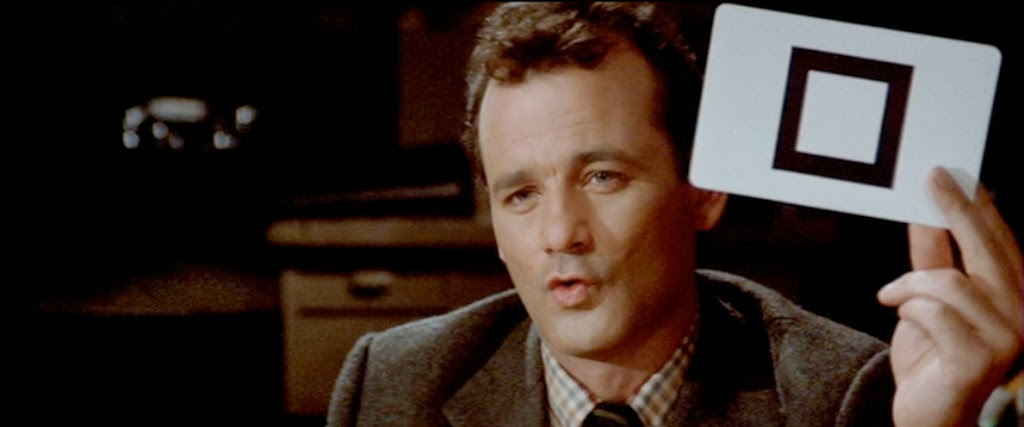
5) The deck of cards used by Dr. Venkman (Bill Murray) to test the telepathic abilities of his patients (and to flirt with the pretty blonde) are called Zener cards, invented by Karl Zener and J. B. Rhine, who was inspired to enter psychical research after listening to a lecture by author and paranormal cheerleader Sir Arthur Conan Doyle.

In 1980, the New York Times printed a set of Zener cards in its January 29, 1980 edition. “The reader may judge for themselves.”

6) Dr. Venkman’s continued skepticism gives Murray a host of excuses to stare at the camera and mug sardonic. But his character probably has the most in common with New York’s original ghostbusters, especially adventurer and conjurer Joseph Rinn.

He and his childhood friend Harry Houdini basked in debunking frauds while keeping alive the illusion of magic and mystery for their acts.

Rinn most famously held a demonstration at Carnegie Hall where he taunted mediums and mystics to exercise their powers for a prize pot of $10,000.  Nobody ever won the money.

7) Manhattan City Bank, depicted in the film, is not real.  Coincidentally, the scene was filmed at another bank directly across the street from the New York Public Library at Fifth Avenue/41st Street. In fact, you can see that the library is surrounded by scaffolding in the movie.

What was the scaffolding for? In 1982, the library embarked a $20 million renovation project. It’s difficult to imagine today, but this classic New York institution had been badly abused over the years.

The 1982 renovation was meant to return the building to its original glory. “It is a restoration in some ways, a modernization in others,” said the Times. “[T]his ambitious plan emerges out of the conviction that this building is as much a part of our cultural heritage as the billions of words that it contains.”

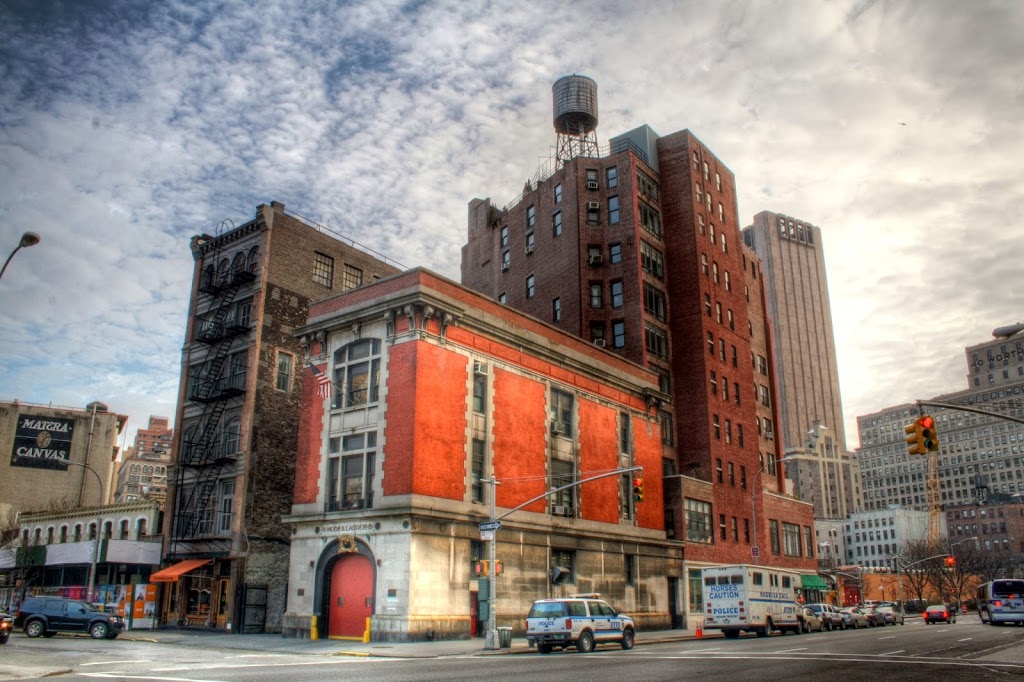
Ghostbusters headquarters — the TriBeCa fire house on North Moore. Pic courtesy Phillip Ritz

8) Perhaps the most beloved New York site from the film is Ghostbusters headquarters, the Hook and Ladder Company No. 8 fire station at the corner of North Moore Street and Varick Street.

If the building looks awkwardly slender to you, there’s a good reason — half the building was demolished in 1914 when Varick Street was widened. Several other buildings, including St. John’s Chapel, owned by Trinity Church, were not so lucky, wiped out entirely by Varick’s expansion.

Spengler (Harold Ramis) says of the firehouse. “I think this building should be condemned….The neighborhood is like a demilitarized zone.”

In fact, the converted lofts and warehouses of TriBeCa (Triangle Below Canal) — the name was slightly over a decade old in 1984 — were a haven for artists, designers and musicians by this time and probably deemed ‘gritty’ by the standards of 1980s American film goers.

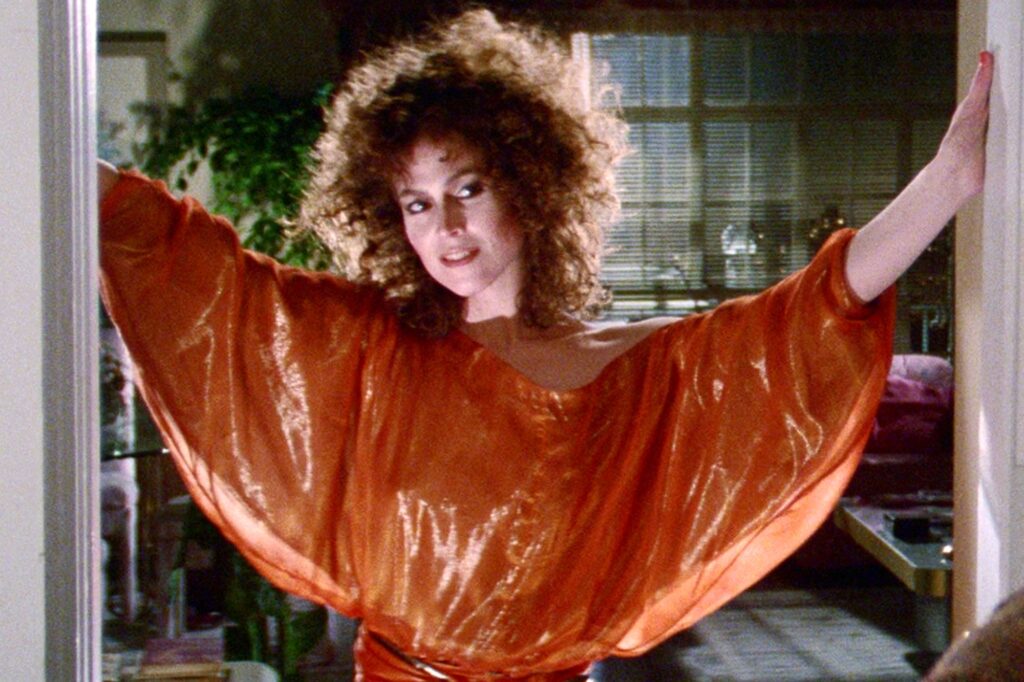
9) Sigourney Weaver is probably the most New York-centric star of Ghostbusters and a perfect choice for the role of Dana, the sophisticated lady possessed by an ancient God. (Dana’s in the New York Philharmonic after all!)

Weaver was a regular on the off-Broadway stage, an offbeat star who once starred in a Christopher Durang play about the Titanic. Her first two film performances are in two 1970s New York film classics — Serpico and Annie Hall.

10) As Sigourney arrives at her apartment building, you can clearly identify Checker Cabs passing on the street, even though that were already a dying breed by this time, the last rolling out from its Michigan plant in 1982.

11) The Sedgewick Hotel, site of the Ghostbusters’ most conspicuous catch, is one of several Los Angeles locations pretending to be in New York.

However, if they wanted a haunted hotel near the New York Public Library, they could have looked no further than the Algonquin Hotel, two blocks north on West 44th Street, notoriously famous for the ghosts of the Round Table.

The Sedgewick is played in the film by L.A.’s Biltmore Hotel, site of several Academy Awards ceremonies and itself haunted by a famous ghost, that of Elizabeth Short, aka the Black Dahlia.

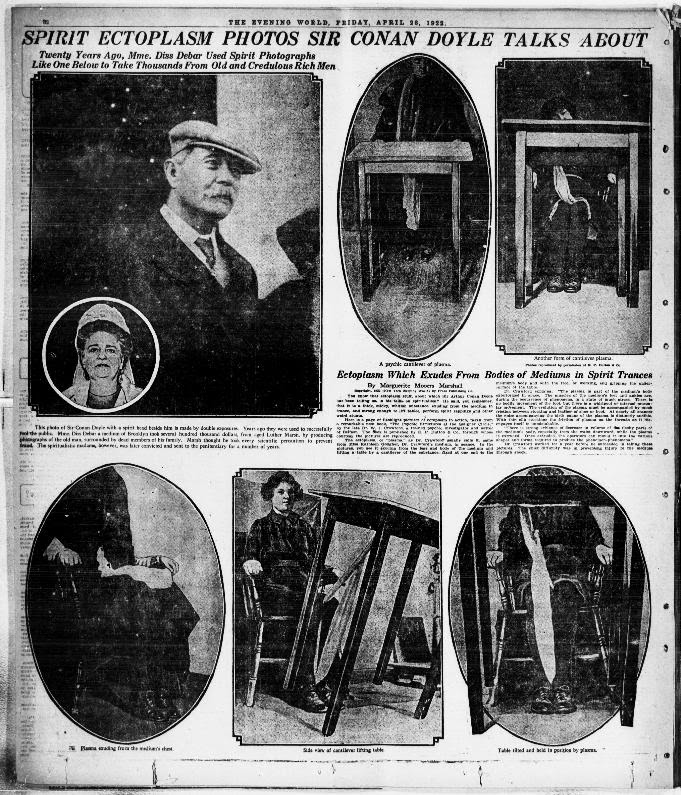
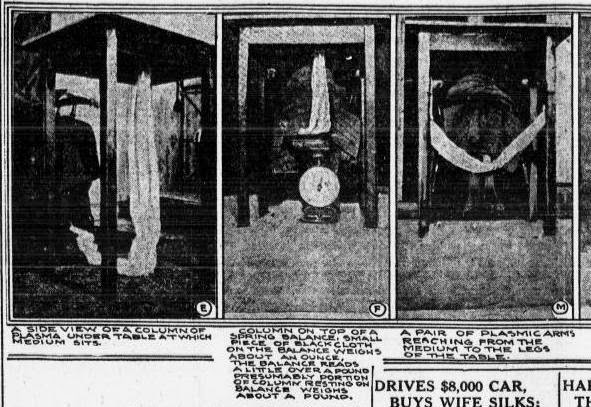
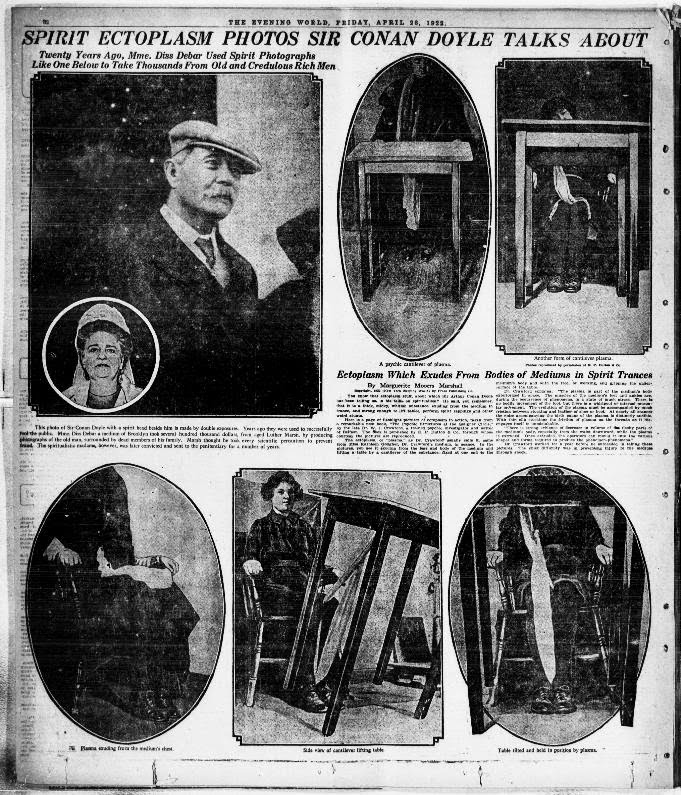
12) Ectoplasm isn’t just a cool word for ‘slime’.  In 1922, the New York Evening World ran photographs of mediums coated in ectoplasm.

Sir Arthur Conan Doyle described it as “thick, sticky, whitish substance exuding from the medium in trance and strong enough to lift tables, perform spirit rappings and other weird stunts.”

13) A New Jersey high school student named Jeff Nichols found momentary fame when he accidentally appeared as an extra in the film, during the brief scene in which Bill Murray and Dan Ackroyd storm through Rockefeller Center.  (Did they not sign release forms back then?) The scene appears in a montage of the crew’s many ghost-exterminating antics.

Nichols’ fame was then compounded by being interviewed by the New York Times in July.

”I got a bunch of phone calls from friends who saw it, saying, ‘Hey, Jeff, you’re in the movie,’ ” said a surprised Jeff last week. ”It’s strange to think that I’m in a movie that’s playing all over the country…… I guess it’s like being part of history.”

No offense to Jeff, but I’m kinda more fascinated in another brief scene during this montage, when the Ghostmobile speeds past Umberto’s Clam House in its original location (the corner of Mulberry and Hester).

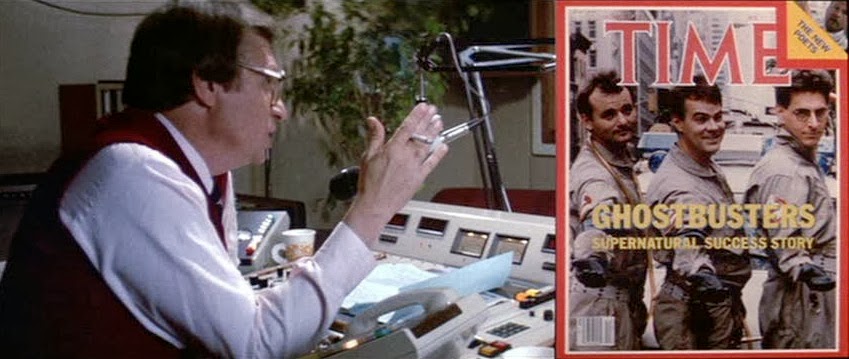
14) Larry King on the radio in Ghostbusters in 1984:

And you can click here to see Larry King actually recording his show in 1984.  The difference? In the real video, he’s smoking a cigarette!

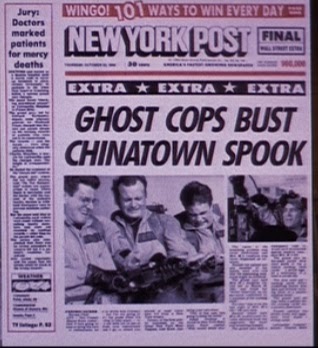
15) There’s a silly montage of 1984 publications that go swirling by. People Magazine touting the trio also reveals “Princess Di Expecting Again!” The magazine (supposedly from October 1984) is a little off — Prince Harry was born on September 15, 1984.

The New York Post also celebrates one off-screen Ghostbusters’ victory: GHOST COPS BUST CHINATOWN SPOOK.

In the early 1980s, the Post gave $50,000 a week in its WINGO! lottery promotion. According to author and former Post reporter Charlie Carillo, the contest illicited some rather mysterious winners:

“One Wingo winner showed up soaked in sweat and literally looking over both shoulders. He wouldn’t even tell me his real name, and he covered his face with his hands when the photographer lifted the camera. ‘No pictures!’ he cried through his fingers. ‘Can’t have my picture in the paper!'”

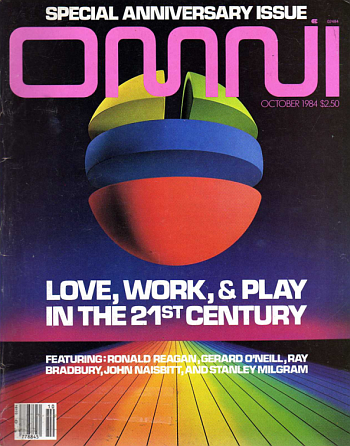
16) Also given credible prominence during this montage is the long-gone OMNI Magazine, a science publication with the unique distinction of being one of the first magazines to simultaneously publish a digital edition (in 1986).

Here’s a copy of the October 1984 issue from the movie, and the actual October 1984 issue:

17) Dana listens to Casey Kasem gab about the Ghostbusters during his Top 40 countdown show. His wife Jean Kasem appears later in the movie as Rick Moranis’ ditzy date.

Had we been privy to the entire broadcast, we would have heard that the top five songs that week were (in Kasem countdown order): 5) “Lucky Star” by Madonna, 4) “Purple Rain” by Prince, 3) “Hard Habit To Break” by Chicago, 2) “Caribbean Queen (No More Love On The Run)” by Billy Ocean, and 1) “I Just Called To Say I Love You” by Stevie Wonder.

18) Veteran New York broadcaster Joe Franklin appears on television, asking Murray, “I’m sure there’s one big question on everybody’s mind, and I imagine you are the man to answer that.  How is Elvis, and have you seen him lately?”

Franklin, presumably recording from WWOR‘s brand-new studios in Secaucus, NJ, was touching on a hot-button issue in 1984.  That year, some believers found proof that Elvis Presley was actually still alive, due to an infamous photograph that emerged in the press of Elvis with Muhammed Ali. A video of that investigation is below:

19) A supernatural upheaval of godlike forces emerges from Dana’s icebox, located in a penthouse at 55 Central Park West. In the film, this building, constructed in 1929, was made with cosmic connections in mind, with a super-conductive antenna, “pulling in and concentrating spiritual turbulence.” Stantz (Dan Ackroyd) adds, “The architect was either a certified genius or a pathetic wacko.”

In Ghostbusters lore, the architect is Ivo Shandor. In reality, the building was constructed by the less immortal architectural firm of Schwartz and Gross, best known before then for their building The Majestic on West 75th Street. 55 Central Park West has been home to Rudy Vallee, Ginger Rogers, Donna Karan and Calvin Klein.

There does appear to be something strange going on with the building. According to the latest AIA Guide: “[I]f the sun seems brighter at the top than the bottom, it is brighter.  A flush of brick from red to yellow rises from the second floor to the sun.” Gozer is impressed.

20) Louis Tully (Rick Moranis) just wants somebody to like him. Although a “nerd” in the classic 1980s nerd style, he’s pretty much a prototype for the modern hipster. In a futile effort to get Dana to his party, he proclaims that they will “play some Twister, do some breakdancing.”

1984 was the year that this form of street dancing went mainstream, with films, fashion and music that year monopolizing on the trend. Breakin‘ was in theaters for a month already when Ghostbusters opened on June 8, 1984. It handily beat a competing film making its debut that same week — Beat Street (see below)

Believe it or not, Beat Street debuted on more screens than Ghostbusters, but lost in the box office battle.

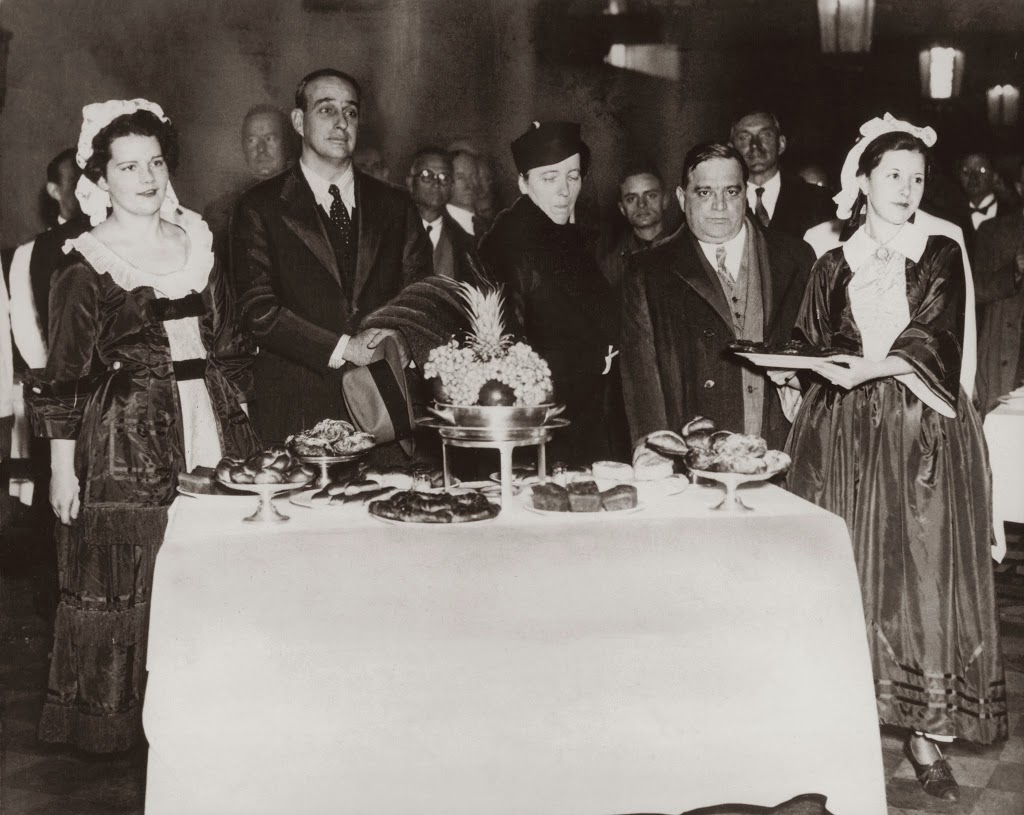
21) Louis runs into Central Park to escapes Gozer’s demon minion but is cornered at Tavern On The Green. It would have been quite a party that Louis and the hellbeast were crashing, as the fancy restaurant was celebrating its 50th anniversary that very month.

Tavern On The Green opened on October 20, 1934, with a lavish dinner attended by Mayor Fiorello LaGuardia and parks commissioner Robert Moses (pictured below, image courtesy New York Times)

22) Later, a possessed Louis (as the Key Master) streaks through Times Square in a demoniacal rage, looking for the Gate Keeper.

It’s a fairly nondescript early 80s midtown landscape, but look for the curious chain restaurant WienerWald in the background.

The German franchise had several locations throughout the United States but was unable to turn Americans on to its menu — mostly chicken, despite the name.

One intrepid Ghostbusters fan has successfully located the precise block on Seventh Avenue where this WienerWald was located.

23) With the city in crisis, the Ghostbusters are invited to City Hall for a meeting. As they enter the building, you can clearly see the banner for an exhibit in the rotunda called “Furnishing the Streets: 1902-1922.”

This was an actual exhibit which opened on September 22, 1983, featuring antique street decorations — from fire posts and old subway signs to even an old horse trough.

Because the banner could not be removed for some reason, the filmmakers cleverly obscure the exhibition’s date with a flagpole. However you can still make out that it says 1983.

24) The Stay Puft Marshmallow Man in his deliciously savage rage stomps up Central Park West from Columbus Circle. The most significant landmark destroyed by this sugary-sweet demon spawn is Holy Trinity Lutheran Church which sits next to 55 Central Park West.

The picturesque Gothic building has been a magnet for chaos from the very beginning. Over 3,000 people filled the street when its cornerstone was laid in November 1902, causing a traffic meltdown.

According to the New York Tribune, “It was as much as the police could do for a time to prevent people from being run down by trolley cars and automobiles, as many people were compelled to stand in the middle of the street.”

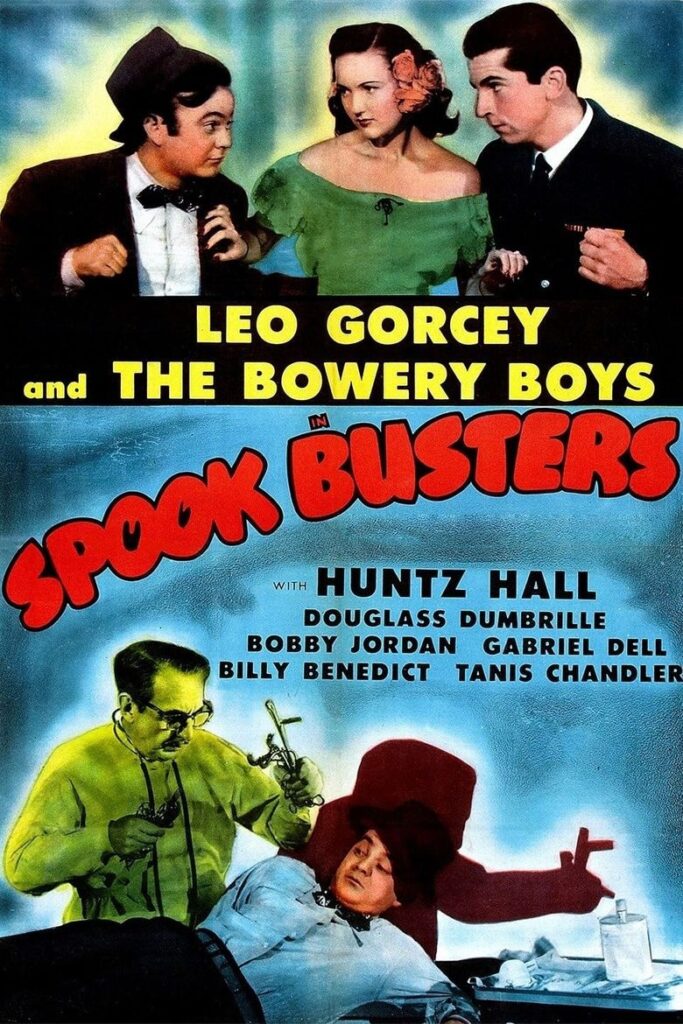
25) Our brave heroes vanquish Gozer and return to the street, greeted to the applause of grateful New Yorkers. I would be remiss, however, if I didn’t mention another set of Ghostbusters who once scoured Manhattan of its supernatural nuisances: the 1940s wacky Bowery Boys comedy troupe made a film in 1946 called Spook Busters.

Instead of a fire station, these exterminators of unwanted phantoms set up shop in a candy store.

If you like this article, you might also want to check out my ‘historical trivia’ story on Midnight Cowboy and some interesting New York City trivia on The Muppets Take Manhattan.

Categories
Mysterious Stories Podcasts

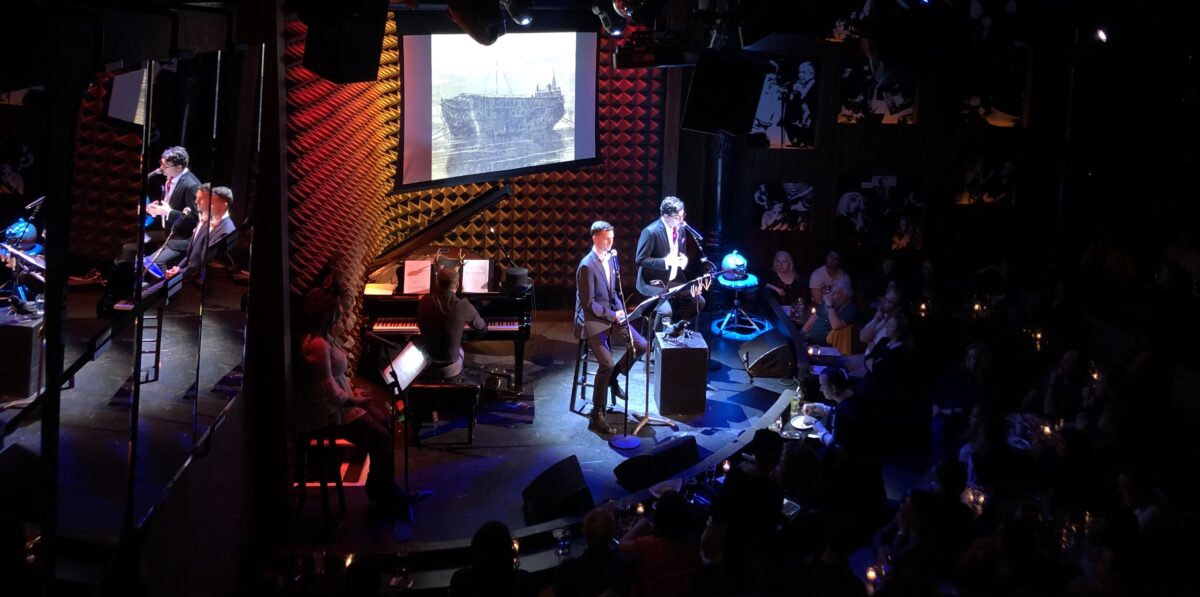
Ghost Stories of Old New York: ALIVE at Joe’s Pub

EPISODE 342 A very special Bowery Boys: New York City History podcast presentation, recorded live on Halloween Night 2019.


For the past couple years we have put on a LIVE cabaret version of our annual Ghost Stories podcast at Joe’s Pub at the Public Theater.

For reasons related to the fact that it’s the hellish year of 2020, we cannot bring you a live performance this year.

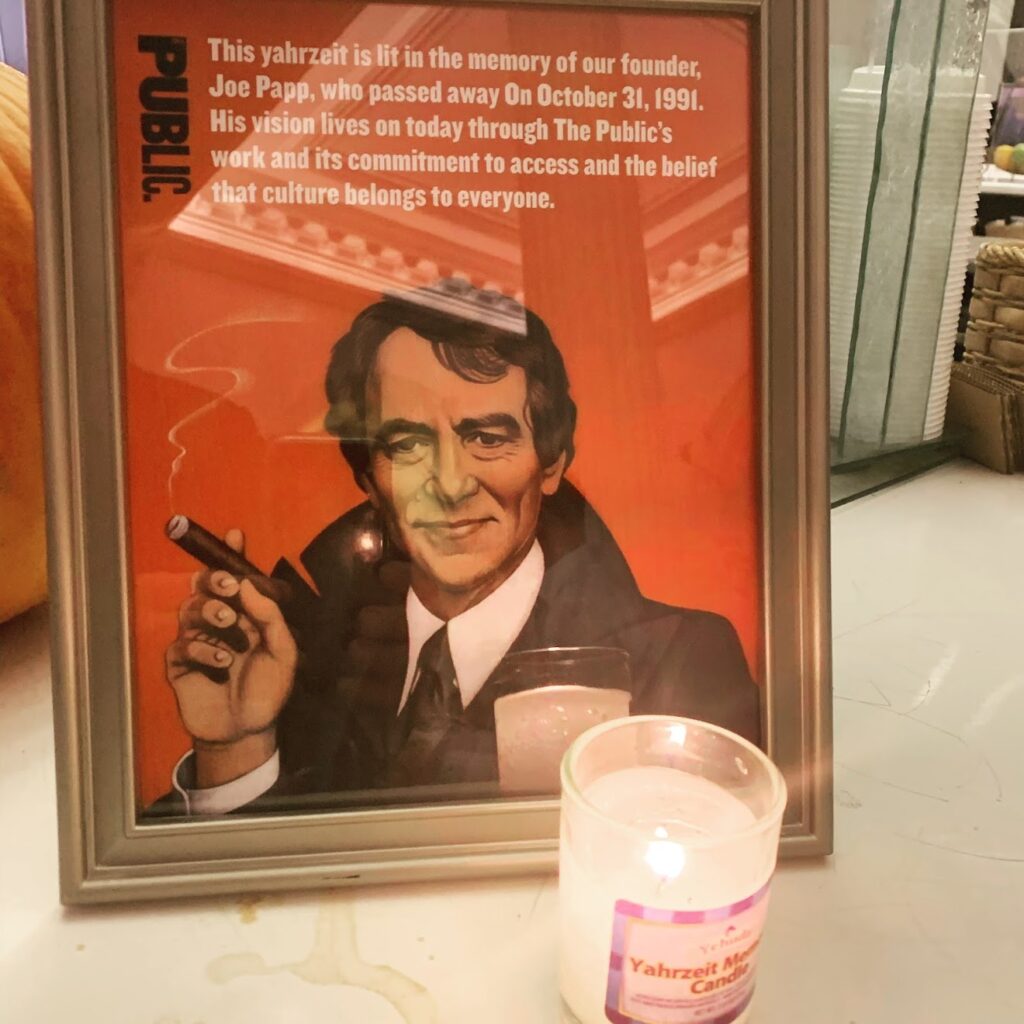
Every Halloween night, a candle is placed in the lobby of the Public Theater in honor of its founder Joseph Papp.

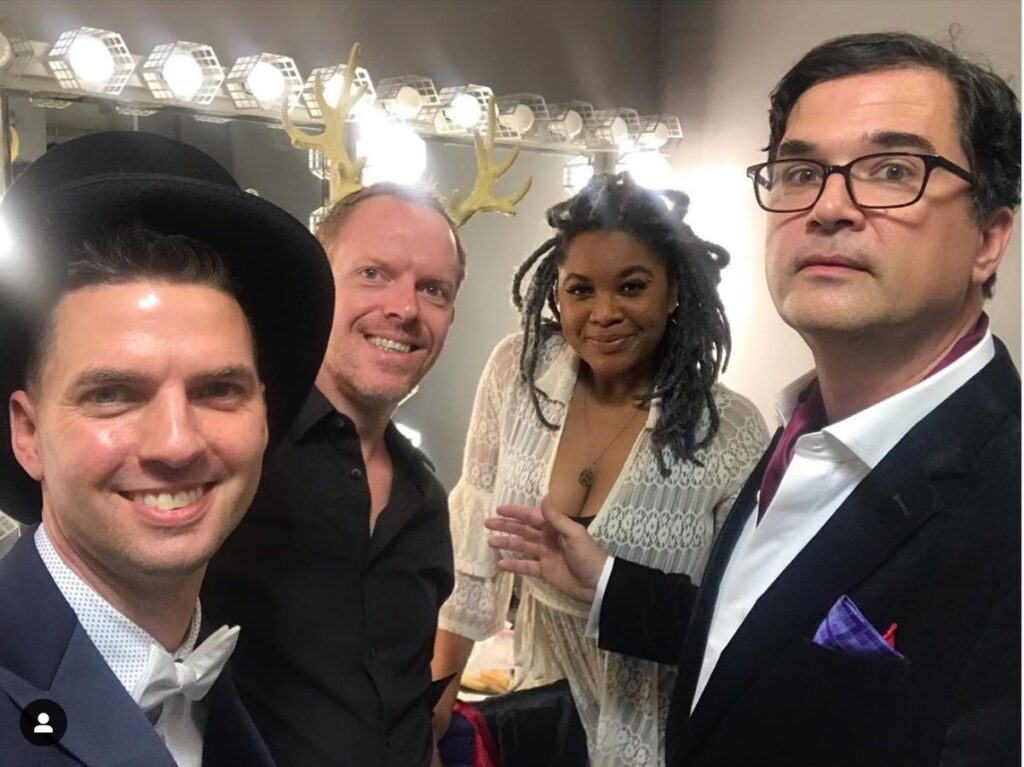
But we miss the wonderful Joe’s Pub so much – and we miss being with our listeners in a cabaret setting with cocktails – that we’re presenting to you a live recording of our last show at the storied venue, recorded on Halloween night 2019, featuring pianist and composer Andrew Austin and vocalist Bessie D Smith.

Prepare to hear new versions of your favorite ghost stories including:

— A Brooklyn house haunting that may be related to the spirits from a colonial-era prison ship;

— A famous murder trial from the year 1800 and a mysterious well which still stands in the neighborhood of SoHo;

— The ghosts (or other supernatural entities) which guard the treasure of the famous Captain Kidd; and

— The mournful secrets of a famed Broadway theater and the inner demons of a Hollywood icon.

With an ALL NEW GHOST STORY — WHO HAUNTS THE FORMER ASTOR LIBRARY?

Listen today on your favorite podcast player:


Photos by Julia Press
136 Clinton Avenue in Brooklyn back when it was very, very close to the shoreline.
The remainder of old Manhattan Well. (Image courtesy Scouting NY)
Captain Kidd in early New York, depicted in a 1920 painting by Jean Leon Gerome Ferris
Judy Garland at the Palace Theater
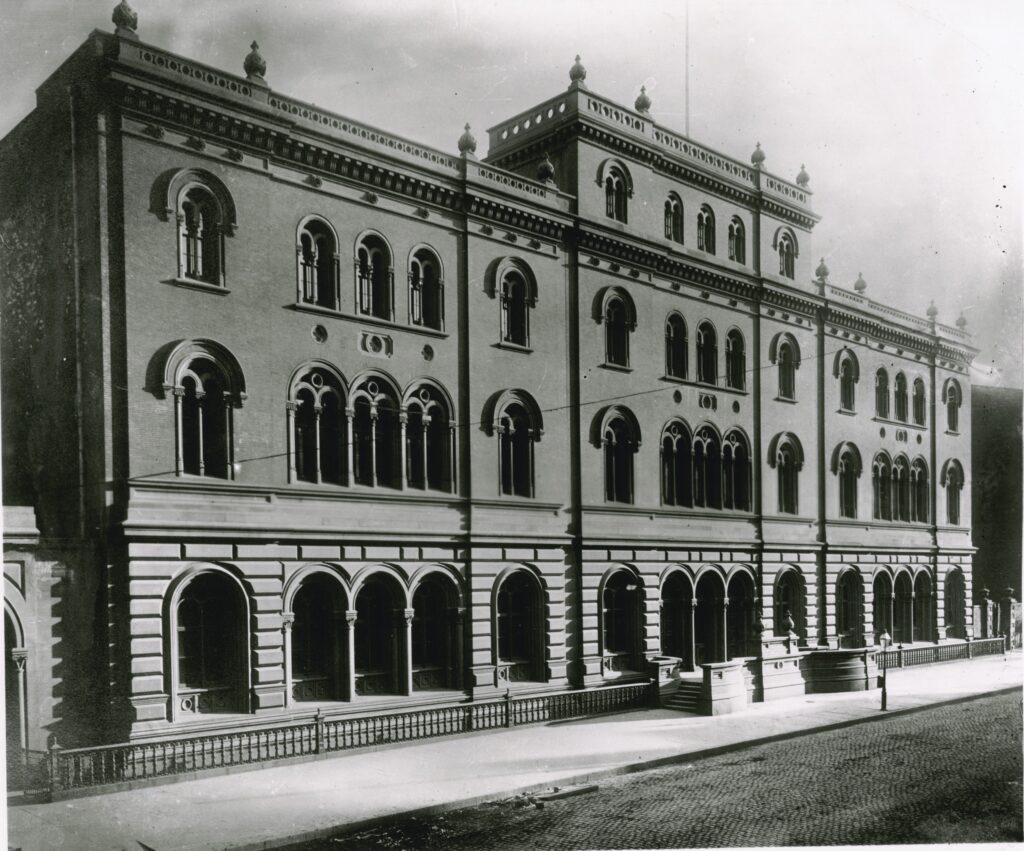
Astor Library, later the Public Theater. Courtesy New York Public Library

The Bowery Boys: New York City History podcast is brought to you …. by you!

We are now producing a new Bowery Boys podcast every week. We’re also looking to improve and expand the show in other ways — publishing, social media, live events and other forms of media. But we can only do this with your help!

We are now a creator on Patreon, a patronage platform where you can support your favorite content creators.

Please visit our page on Patreon and watch a short video of us recording the show and talking about our expansion plans.

If you’d like to help out, there are six different pledge levels.Check them out and consider being a sponsor.

We greatly appreciate our listeners and readers and thank you for joining us on this journey so far.


Categories
Neighborhoods

H.P Lovecraft’s very bizarre hatred of Red Hook and Brooklyn Heights

Howard Philip Lovecraft — aka H.P. Lovecraft — was born 130 years ago this week (on August 20, 1890) in Providence, Rhode Island.  

The pulp-fiction storyteller, known for claustrophobic tales of the occult, lived for a time in Brooklyn. He did not enjoy it.

In 1924, he moved to  259 Parkside Avenue in Flatbush, Brooklyn, close to Ebbets Field and Prospect Park. When his new wife relocated for work in Cincinnati, Lovecraft moved from the pleasant Flatbush neighborhood to a small flat at 169 Clinton Street in Brooklyn. He only lived here until 1926 but during his stay, possessed of anxiety and neurosis, he practically starved himself.

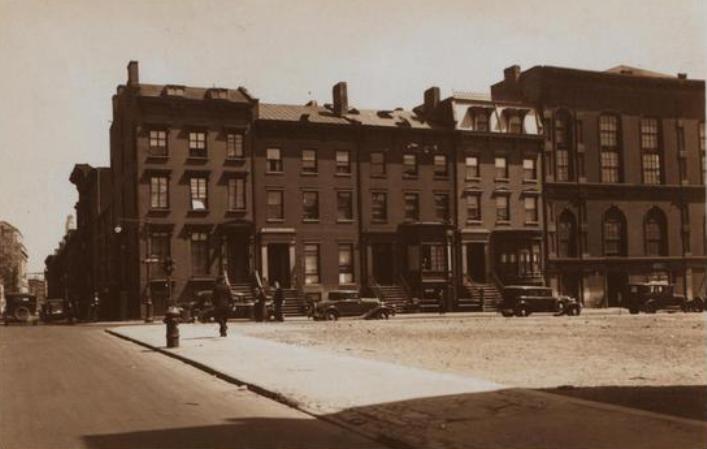
Below: The boardinghouse at 169 Clinton Street, pictured here at left, from 1935. The first four buildings still exist. The building at the far right is the old Brooklyn Athenaeum.

Courtesy New York Public Library

Lovecraft had contempt for New York’s thriving immigrant population and those workers who sustained Brooklyn waterfront in the 1920s.  In particular he negatively interacted with the residents of Brooklyn’s so-called “Little Syria” on Atlantic Avenue.

I find his invective ugly and even a little obsessive, but it illustrates that occasional truth that the culture of New York City is simply not for everybody, especially if you have certain racist dispositions mixed with a little mental instability.

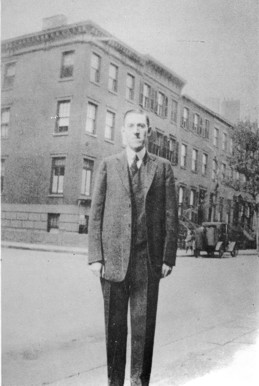
Below: Lovecraft in Brooklyn Heights in 1925. The house behind him may be his Clinton Street boarding house. Compare to the image above and the current view here. (Photo courtesy HPL.com)

1925-C

In a comparison with Philadelphia, Lovecraft wrote “[Philadelphia has] none of the crude, foreign hostility and underbreeding of New York — none of the vulgar trade spirit and plebian hustle.” He further described New York as “an Asiatic hell’s huddle of the world’s cowed, broken, inartistic, and unfit.” [source]

According to author Donald Tyson, “when [H.P.’s wife Sonia] and Lovecraft were walking the streets of New York and encountered a group of immigrants, Lovecraft would become so animated and enraged that she feared for his sanity.”

The renovated, wealthy houses of today’s Brooklyn Heights were often working-class housing in the 1920s, many turned into affordable boarding houses. Lovecraft disliked his ethnic neighbors and held particular scorn for his Irish landlady. “Only later was I to learn of her shrewish tongue, desperate household negligence, miserly watchfulness of lights and unwatchfulness of repairs, and reckless indifference to the class of lodger she admitted.” [source]

He would have lived with mostly single men of differing ethnicity, many employed along the congested docks that lined the waterfront all the way down to Red Hook, culminating in two self-contained shipping areas — the Atlantic and Erie basins. Back in the 1920s, it was the busiest freight port in the entire world.

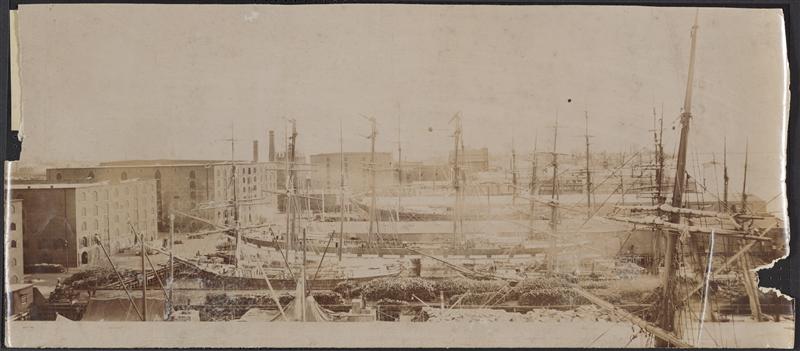
Below: Ships along the waterfront heading towards Red Hook, circa 1890

Courtesy Museum of the City of New York

He seemed to filter all his untethered anxiety into the very building at 169 Clinton Street. “I conceived the idea that the great brownstone house was a malignly sentient thing — a dead, vampire creature which sucked something out of those within it and implanted in them the seeds of some horrible and immaterial psychic growth.”

Yet Lovecraft saved his greater fantasies for the neighborhood south of here. He eventually funneled all this tortured and deranged hysteria into his horror writing with the publication of “The Horror at Red Hook,” a story that literally depicts the neighborhood as a gateway to Hell. Naturally he wrote it over a two-day period from the Brooklyn Heights boardinghouse.

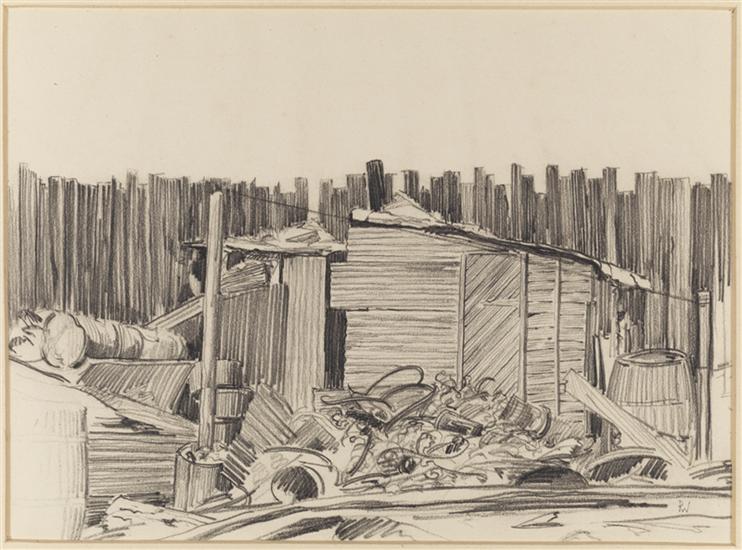
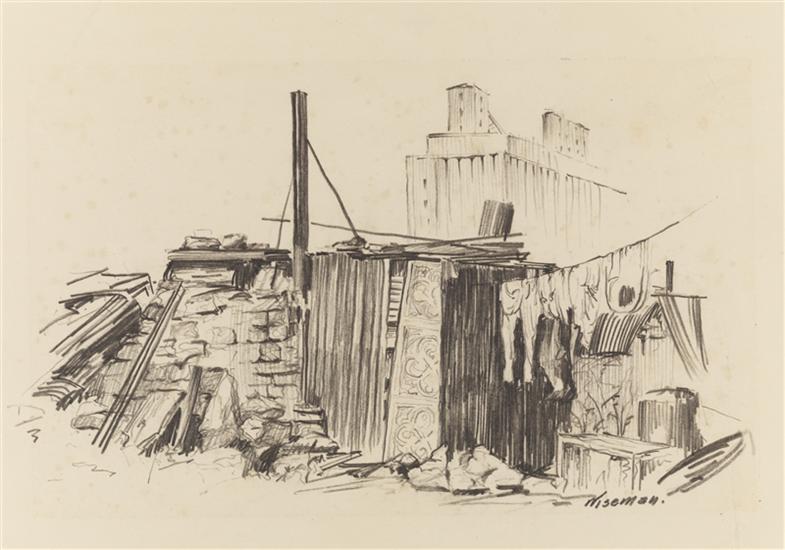
Below (the next two pictures): Some striking illustrations by Robert Cummings Wiseman of shanties around the Atlantic Basin in 1930, courtesy the Museum of the City of New York

MNY118666

The short story, one of his best known, is an amusing curiosity to read today.  Its a muddled, sometimes incomprehensible work with some occasional flashes of creepy description. Clearly the story is self-therapy as much as it is an actual story, an early 20th century entry in the field of conspiratorial fiction. It’s undeniably haunting if you manage to forgive the vast amount of virulent, anti-immigrant description:

“Red Hook is a maze of hybrid squalor near the ancient waterfront opposite Governor’s Island, with dirty highways climbing the hill from the wharves to that higher ground where the decayed lengths of Clinton and Court Streets lead off toward the Borough Hall. Its houses are mostly of brick, dating from the first quarter to the middle of the nineteenth century, and some of the obscurer alleys and byways have that alluring antique flavour which conventional reading leads us to call “Dickensian”.

The population is a hopeless tangle and enigma; Syrian, Spanish, Italian, and negro elements impinging upon one another, and fragments of Scandinavian and American belts lying not far distant. It is a babel of sound and filth, and sends out strange cries to answer the lapping of oily waves at its grimy piers and the monstrous organ litanies of the harbour whistles.”

Courtesy Museum of the City of New York

I won’t spoil any of the plot points of the story. (If you’re interested in reading ‘The Horror At Red Hook’, you can check it out here. ) But let’s just say the author confirms his suspicions — the street gangs and liquor rackets of the Prohibition era are really just dens of age-old evil:

“The soul of the beast is omnipresent and triumphant, and Red Hook’s legions of blear-eyed, pockmarked youths still chant and curse and howl as they file from abyss to abyss, none knows whence or whither, pushed on by blind laws of biology which they may never understand. As of old, more people enter Red Hook than leave it on the landward side, and there are already rumours of new canals running underground to certain centres of traffic in liquor and less mentionable things.”

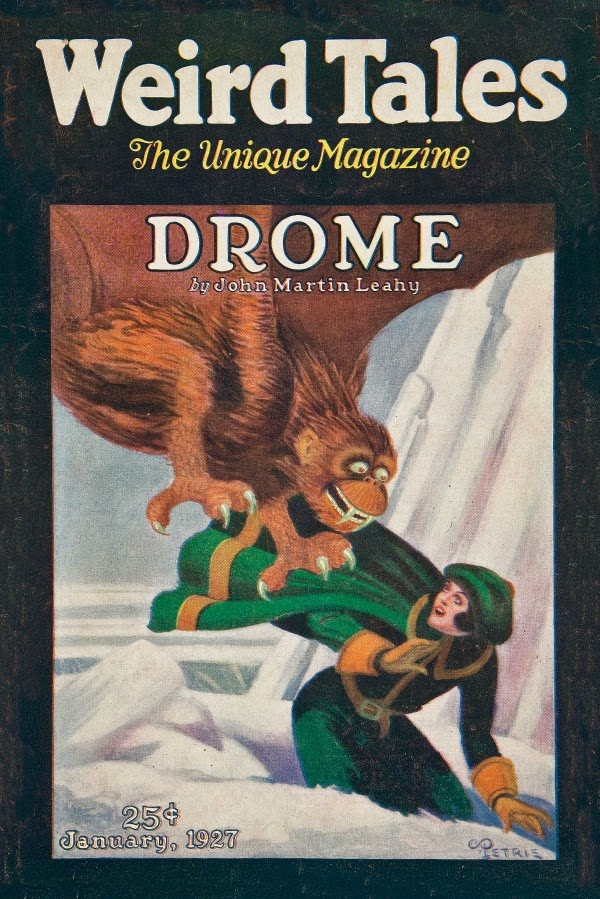
The story would be published in 1927 in the pulp magazine Weird Tales. Notably, their offices were in Chicago, not in New York

1

Once he left New York, he pursued some of his more famous writing projects, using his anxiety to more disturbing effect in runic, terror-filled stories of the occult. He died in 1937, revered by many as a truly boundary-breaking writer, greatly inspiring writers like Stephen King.

It would be almost fifty years before an author attempted to look at south Brooklyn with similar monstrous intent — in the 1970s horror novels The Sentinel and The Guardian by Jeffrey Konvitz.

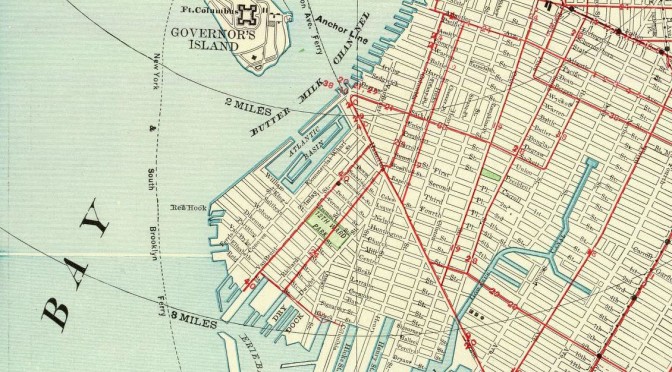
Top picture: Detail from a 1897 Rand McNally map of Brooklyn

Categories
Mysterious Stories Podcasts

Haunted Houses of Old New York: Four historical tales of ghosts and ghouls who never left home

PODCAST Welcome to the unlucky 13th Annual Bowery Boys ghost stories podcast, where history combines with folklore for a bone-chilling listening experience.

In this year’s Halloween-themed special, Greg and Tom take you into some truly haunted private residences from throughout New York City history. These rowhouses, brownstones and mansion all have one thing in common — stories of restless spirits who refuse to leave.
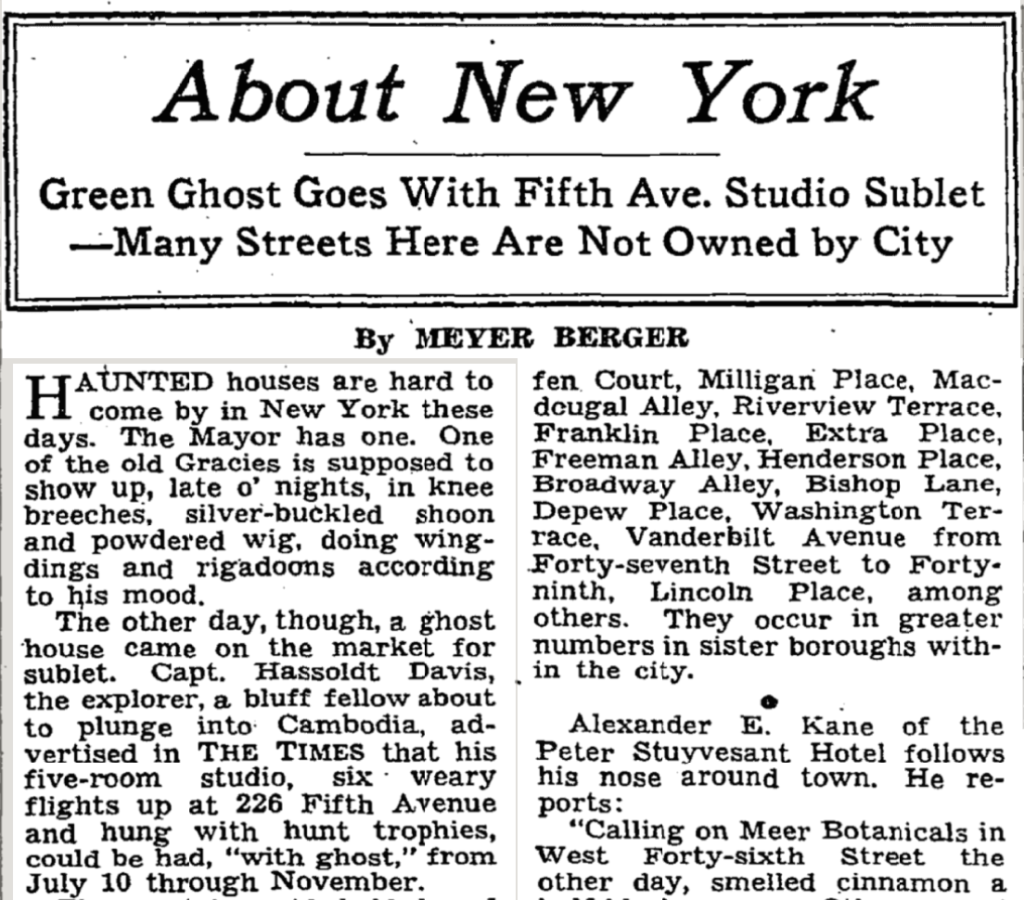
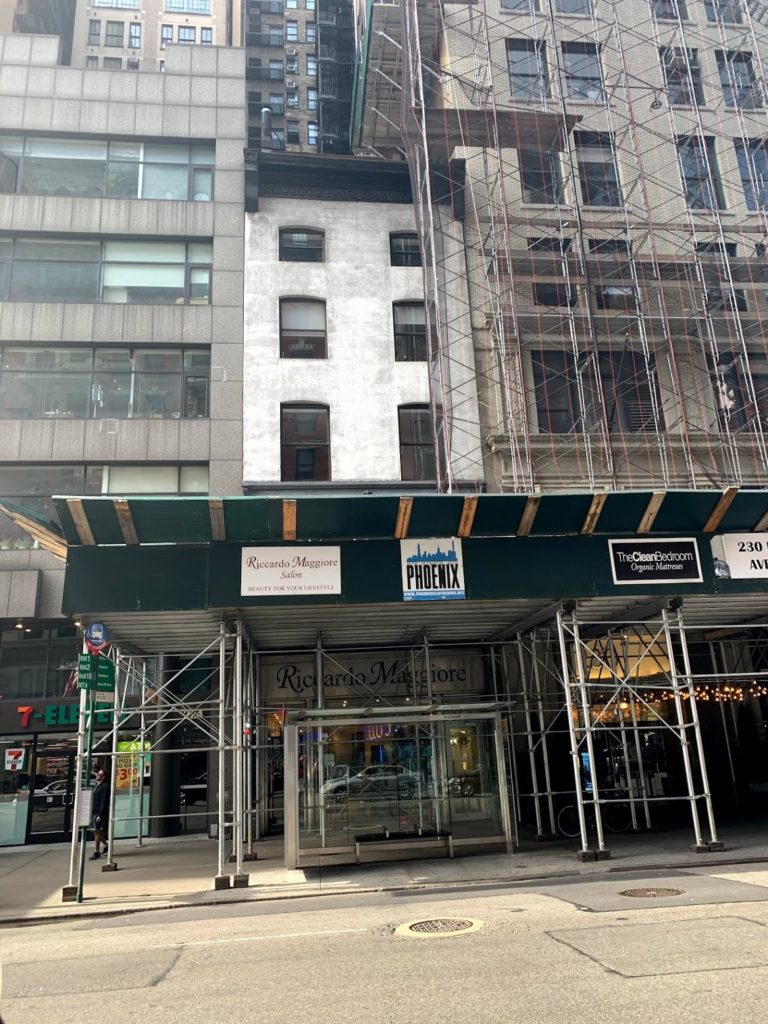
— Near Madison Square Park, an eccentric writer posts a classified ad, hoping to rent out an attic room to a prospective subletter. Unfortunately the room already an occupant — a greenish ghost with a troubling Civil War history.

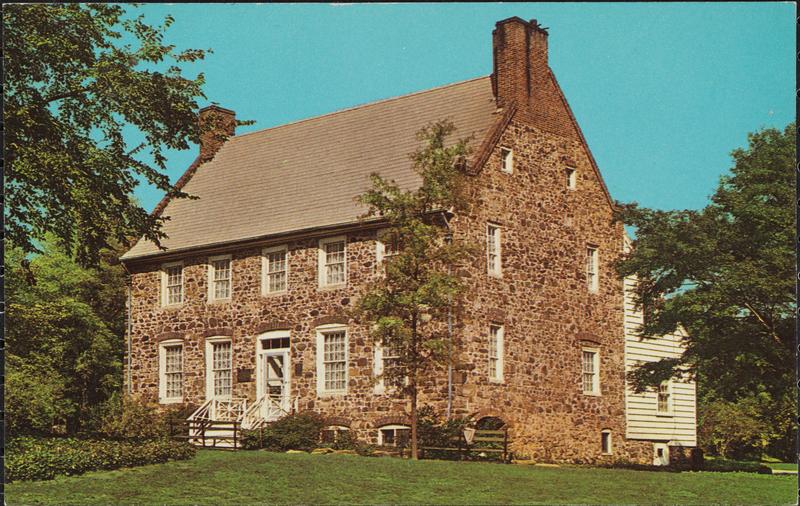
— The Conference House in Staten Island played an interesting role in the Revolutionary War, and some residents from that period may still wander its ancient hallways.

— On the Upper East Side, a lavish penthouse ballroom may be permanently vexed with the ghost of a testy spirit named Mrs. Spencer. Can a legendary funny lady and a Vodou priestess manage to keep the ghoul under control?

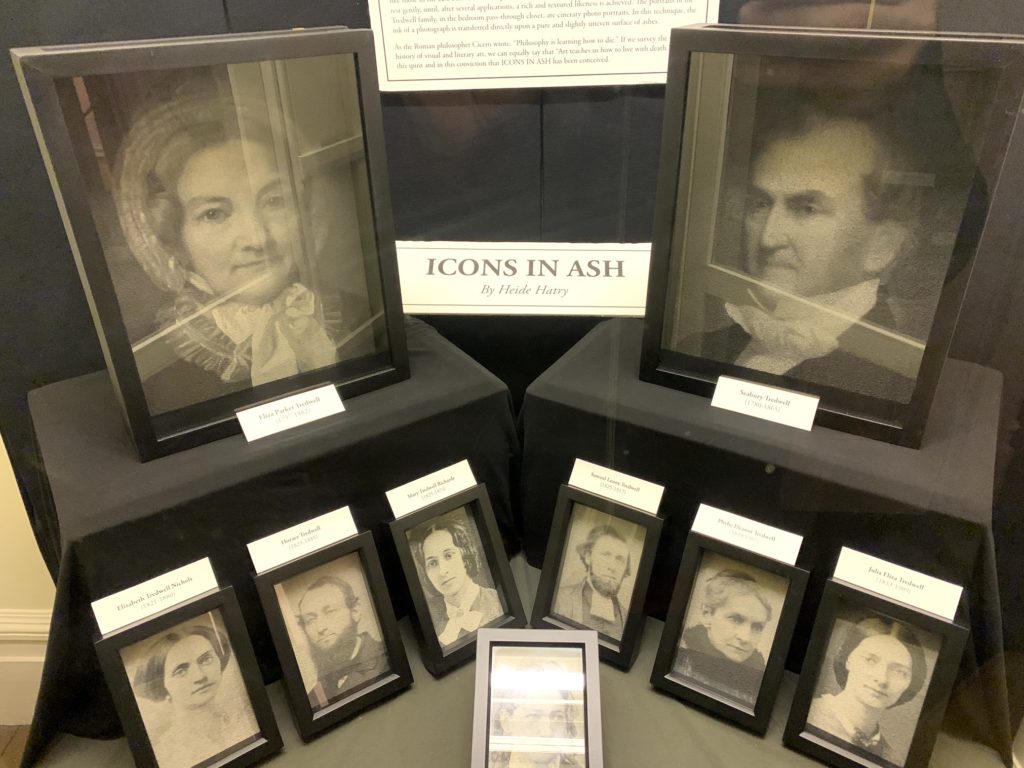
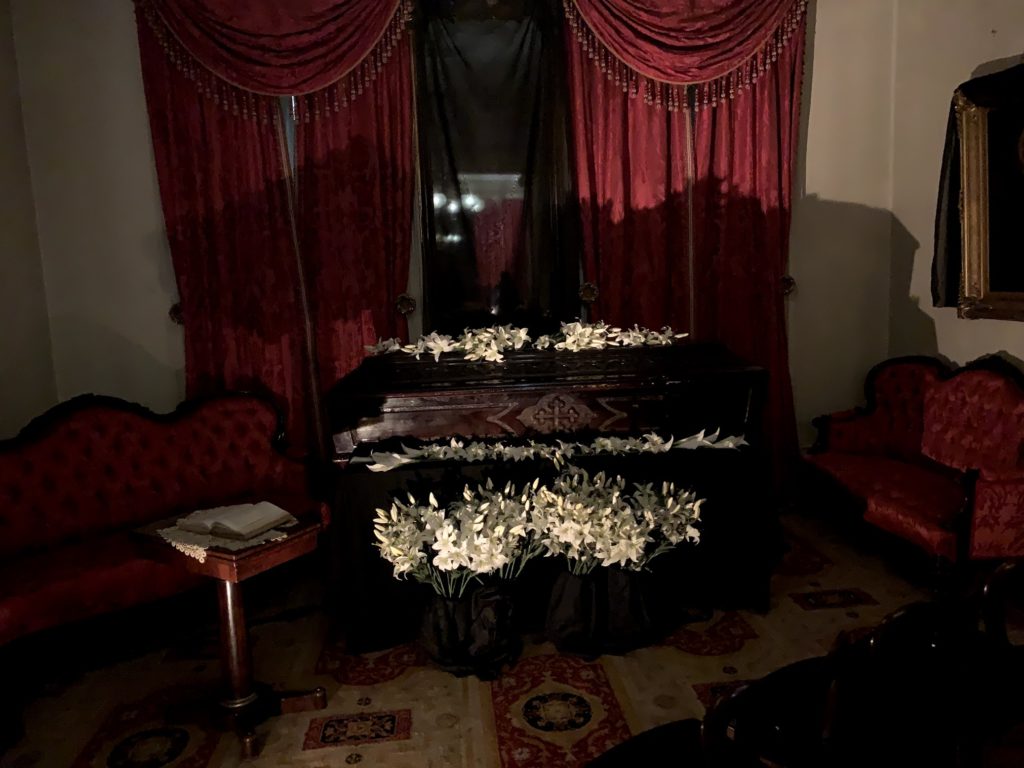
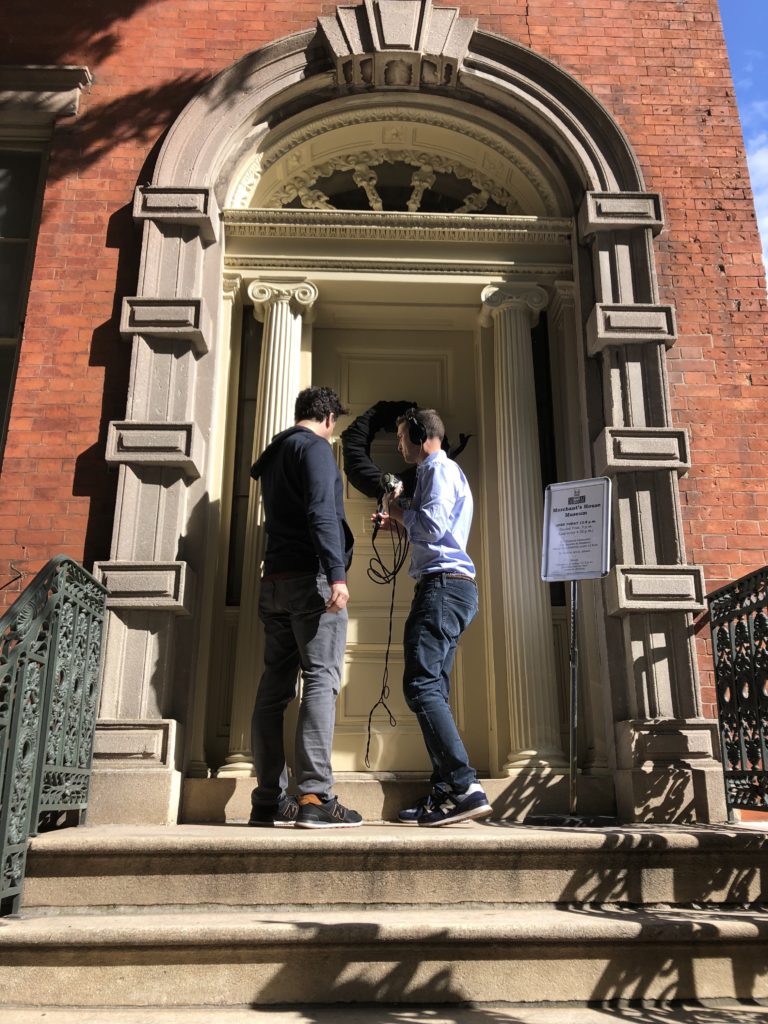
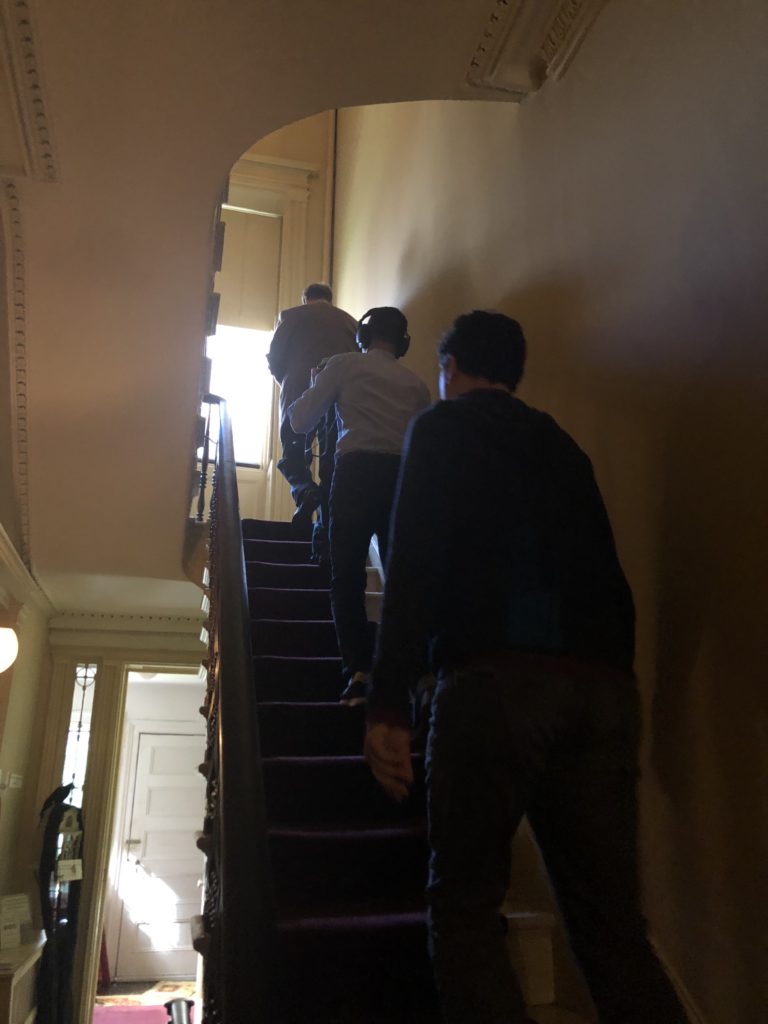
And for the first time in Bowery Boys ghost-stories history, Greg and Tom record a segment of the show — from within an actual haunted house. Merchant’s House docent Carl Raymond joins them for a close look at the life of Gertrude Tredwell and the rooms where she lived and died — and may, to this very day, haunt.
LISTEN NOW — HAUNTED HOUSES OF OLD NEW YORK


A very special thanks to Carl Raymond, docent at the Merchant’s House Museum, for guiding us through the museum as they prepare for their October programming. You can find out more about the Merchant’s House by visiting their website. Book a candlelight ghost tour and check out their exhibition “Death, Mourning, and the Hereafter in Mid-19th Century New York.”
Thursday, October 17 – Saturday, October 19

Wednesday, October 23 – Saturday, October 26

Monday, October 28 – Wednesday, October 30

60-minute tours begin on the half hour, 6:30 to 9:30 p.m.
ALL tours include 4th Floor Servants’ Quarters!

And for more from Carl Raymond, check out his two tours with Bowery Boys WalksEdith Wharton’s New York and Glamour, Greed, Money and Murder in 19th Century NoHo


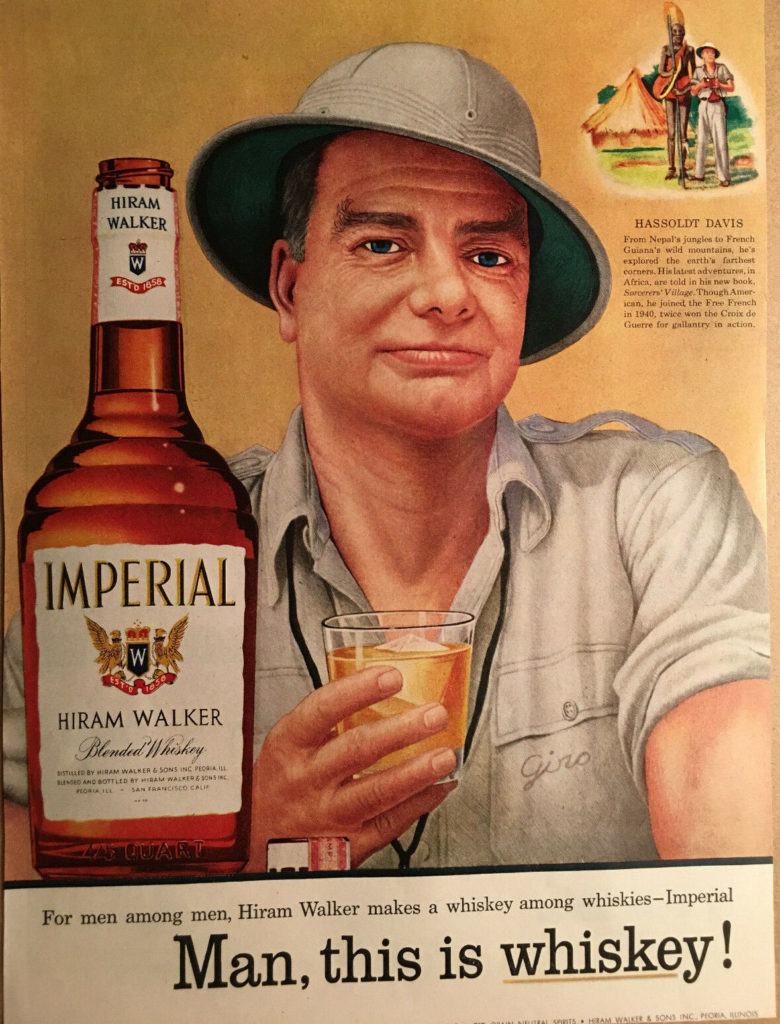
Captain Hassoldt Davis, occupant of the haunted house on Fifth Avenue near Madison Square Garden.

From Meyer Berger’s 1953 column about the ‘green ghost’:

The house of the green ghost.

The Conference House in 1965, looking much the same as it did 250 years before.

Museum of the City of New YorkTom MeyersTom MeyersTom MeyersTom Meyers

Tom Meyers

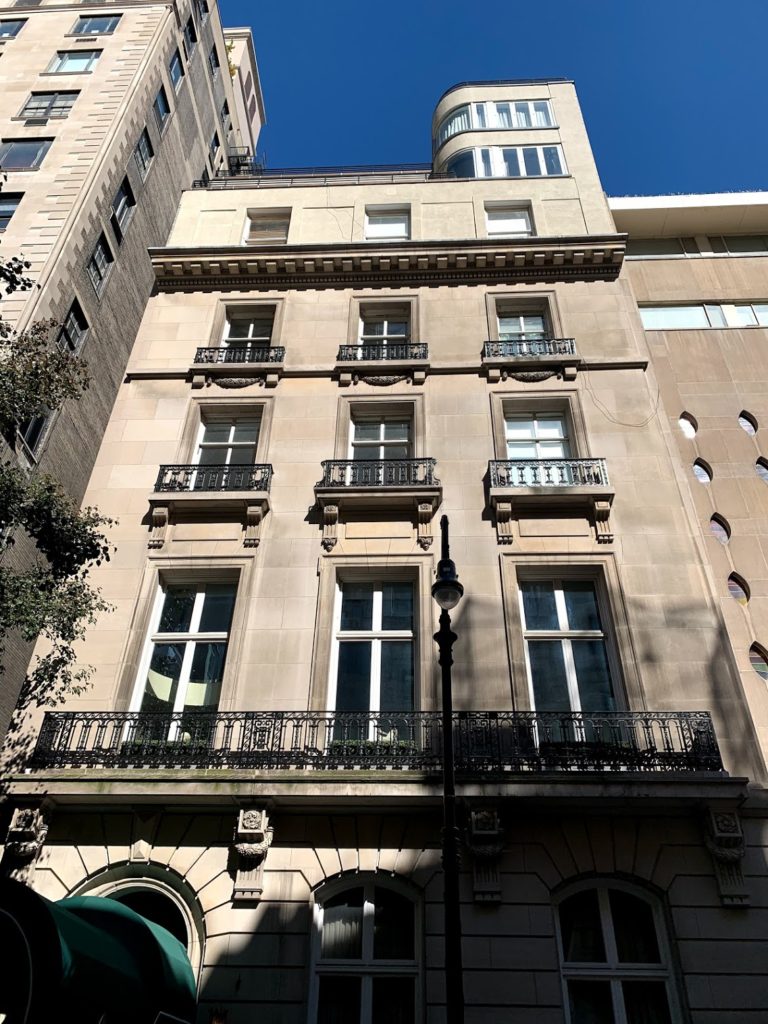
The former mansion of the Drexel family at 1 East 62nd Street, later the home of Ernest Hemingway and Joan Rivers.

Greg Young

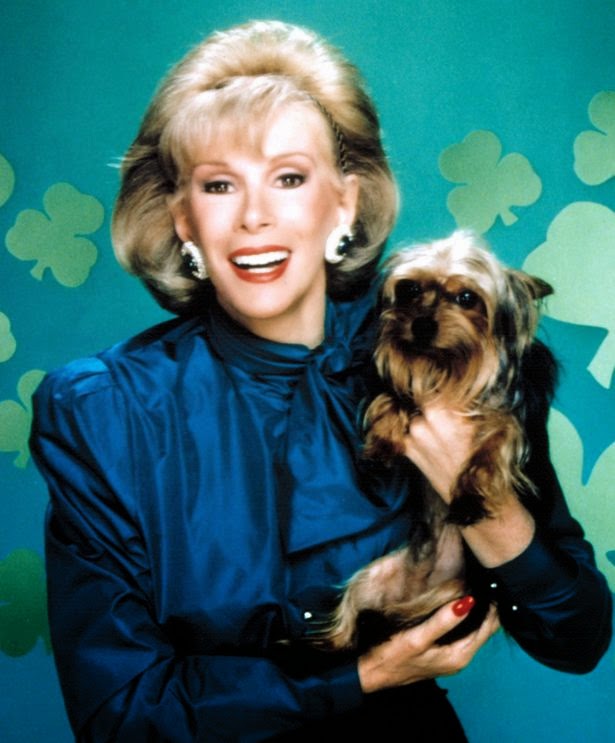
Rivers and her dog repeatedly experienced ghostly phenomena from her refurbished French-inspired ballroom.

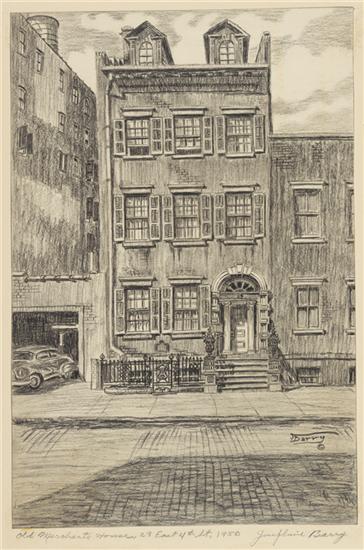
The Merchant’s House, circa 1950, in an illustration by Josephine Barry.

Museum of the City of New York

The Merchant’s House at night, taken last week.

Greg YoungGreg YoungGreg YoungGreg YoungGreg YoungGreg YoungJulia PressJulia PressJulia PressJulia Press

__________________________________________________________________________

The Bowery Boys: New York City History podcast is brought to you …. by you!

We are now producing a new Bowery Boys podcast every other week. We’re also looking to improve and expand the show in other ways — publishing, social media, live events and other forms of media. But we can only do this with your help!

We are now a member of Patreon, a patronage platform where you can support your favorite content creators.

Please visit our page on Patreon and watch a short video of us recording the show and talking about our expansion plans. If you’d like to help out, there are six different pledge levels. Check them out and consider being a sponsor.

And join us for the next episode of the Bowery Boys Movie Club, an exclusive podcast provided to our supporters on Patreon. This month’s film — Moonstruck starring Cher and Nicholas Cage.

We greatly appreciate our listeners and readers and thank you for joining us on this journey so far.

Categories
Mysterious Stories Podcasts

Ghost Stories of Hell’s Kitchen: Tales of haunted houses, creepy courtyards and spirited taverns

PODCAST The Manhattan neighborhood of Hell’s Kitchen has a mysterious, troubling past. So what happens when you throw a few ghosts into the mix? Greg and Tom find out the hard way in this year’s ghost stories podcast, featuring tales of mystery and mayhem situated in the townhouses, courtyards and taverns of this trendy area of Midtown West.

This year’s Ghost Stories of Old New York show features:

— The troubling tale of a 1970s motion picture classic that may have left a sinister mark on West 54th Street

— The haunted home of a popular film and TV actress, possessed with very hungry ghost

— An enchanting courtyard layered with several horrifying ghost stories

— And the shenanigans at a 150-year-old tavern where the beer and the spirits flow freely.

Listen Now: Hell’s Kitchen Ghosts Podcast

To download this episode and subscribe to our show for free, visit iTunes or other podcasting services or get it straight from our satellite site.

You can also listen to the show on OvercastGoogle Music and Stitcher streaming radio.

Or listen to it straight from here:

___________________________________________________________

The Bowery Boys: New York City History podcast is brought to you …. by you!

We are now producing a new Bowery Boys podcast every other week. We’re also looking to improve the show in other ways and expand in other ways as well — through publishing, social media, live events and other forms of media. But we can only do this with your help!

We are now a member of Patreon, a patronage platform where you can support your favorite content creators for as little as a $1 a month.

Please visit our page on Patreon and watch a short video of us recording the show and talking about our expansion plans. If you’d like to help out, there are five different pledge levels (and with clever names too — Mannahatta, New Amsterdam, Five Points, Gilded Age, Jazz Age and Empire State). Check them out and consider being a sponsor.

And join us for the next episode of the Bowery Boys Movie Club, an exclusive podcast provided to our supporters on Patreon. This month’s selection — Ghostbusters!

We greatly appreciate our listeners and readers and thank you for joining us on this journey so far.

_________________________________________________________

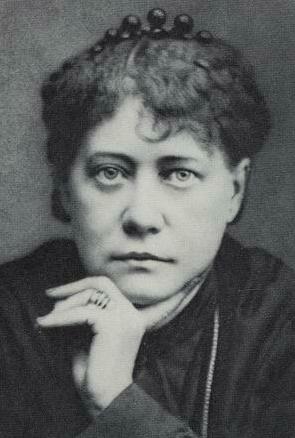
The location of Madame Blavatsky’s home off Eighth Avenue.

The former site of the 596 Club, a notorious hangout for the Westies.

Some of the Exorcist‘s most frightening scenes were filmed in Hell’s Kitchen.

The former home of both film star June Havoc — and a restless spirit named Lucy.

The mysterious, tucked-away oasis known as Clinton Court.

Courtesy Ephemeral New York

The neighborhood institution known as the Landmark Tavern today, a tavern which has been in business since 1868.

The infamous bathtub. Does the ghost of a Confederate veteran still rub-a-dub in this tub?

Courtesy W42ST

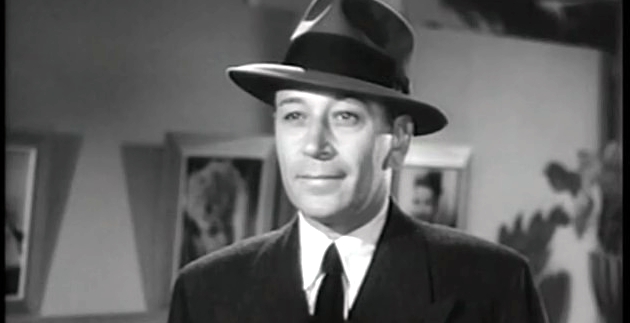
The film star George Raft, a regular at the Landmark Tavern …. to this day.

FURTHER LISTENING:

For a ‘regular’ look at the history of Hell’s Kitchen, listen to this show:

Last year’s ghost story episode on Greenwich Village plays a small role in this year’s episode as well.

Categories
Landmarks Mysterious Stories

The Ghost of Peter Stuyvesant May Still Haunt the East Village

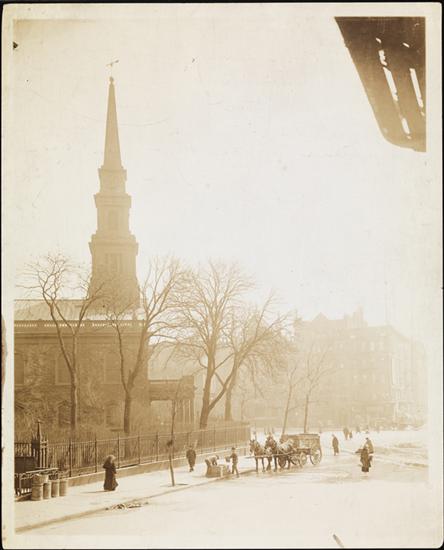
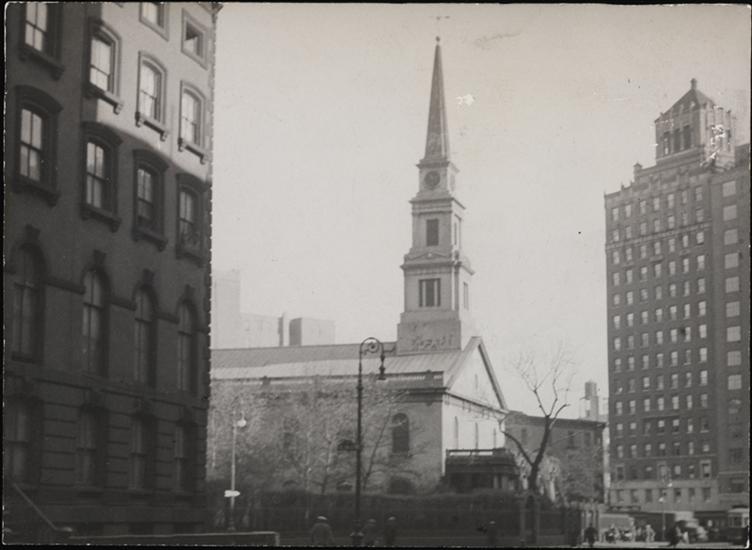
St. Mark’s Church-in-the-Bowery is the oldest standing structure in the East Village. Upon seeing it, you’re almost forced to reevaluate where you are.

It’s intriguing even to those who pass by it everyday. It’s mysterious even to those who work and worship here.

Built in 1799 by the Stuyvesant family, St. Mark’s chapel and cemetery conformed to a street grid plan unique to their farmland. Today the only street that exists from the old Stuyvesant plan is Stuyvesant Street, running diagonally through New York’s standard street grid.

The Stuyvesants planned the street on a true east-west access.  It’s the rest of the island that’s askew with the compass.

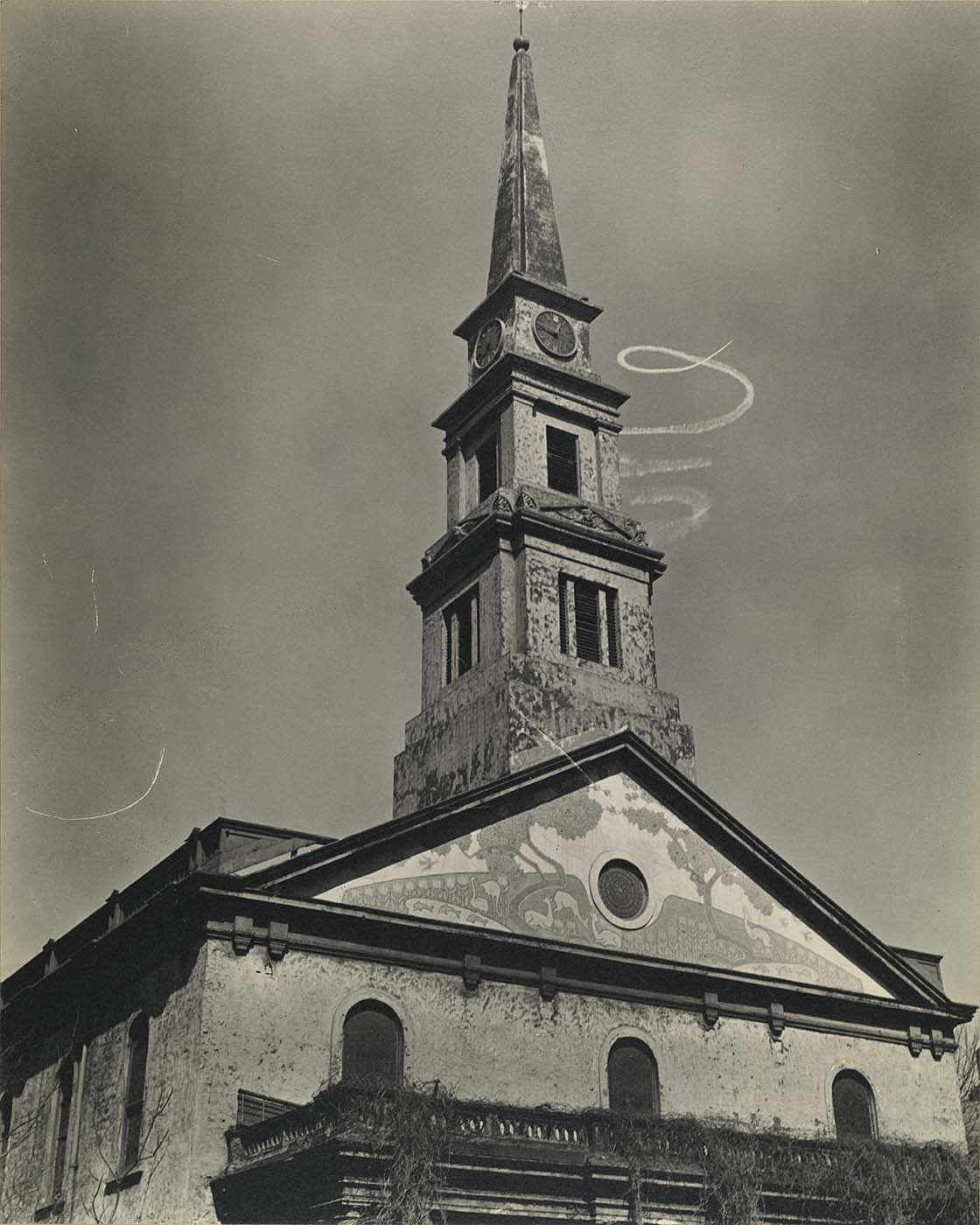
Photo by Berenice Abbott

Buried under the church ground are vaults of some of New York’s greatest civic leaders and social notables. Daniel D Tompkins, Vice President under James Monroe, is here, although the park that bears his name Tompkins Square Park is a couple avenues over. The department store king A.T. Stewart used to be here before his remains were stolen in a bizarre ransom attempt.

Philip Hone, the so-called ‘party mayor’ of New York, is interred in a vault here. From my profile of the mayor a few years ago:  “Mostly, he’s remembered as a cultural ambassador, even commissioning artwork for City Hall, approving of a developing theater district in the not-yet-seedy Bowery and encouraging the city’s growth as an American capitol of arts and sciences.”

Courtesy Museum of the City of New York

But of course the most famous individual beneath St. Mark’s is that of the original Stuyvesant — Petrus Stuyvesant, the director-general of New Amsterdam whose farms comprised much of today’s East Village and give the Bowery (Bouwerij) its name.

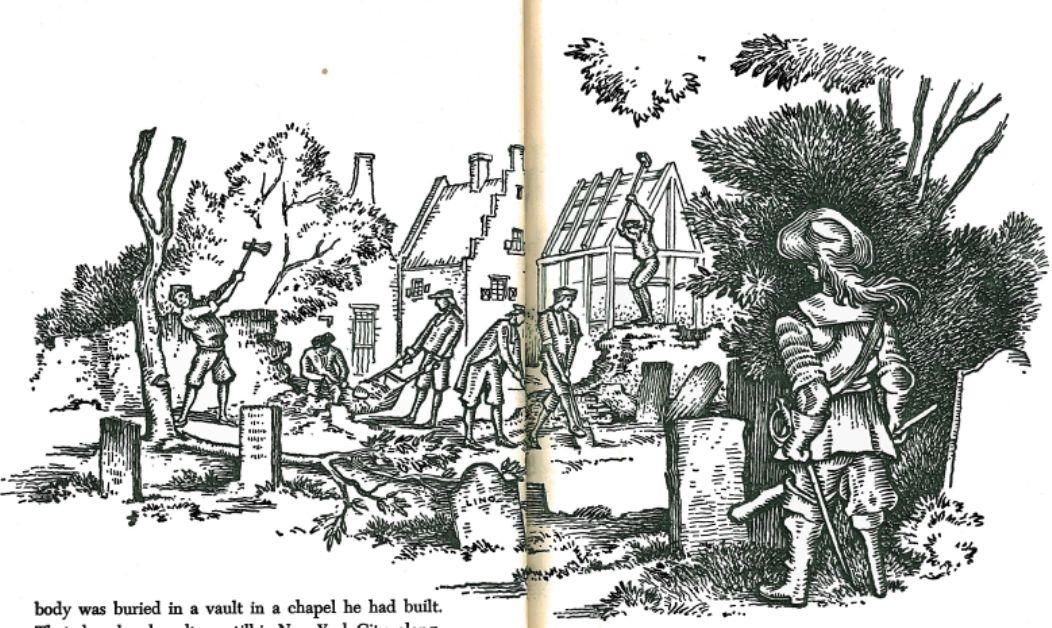
Stuyvesant died in 1672 in the British controlled colony of New York. From an 1893 history on Stuyvesant: “His remains were interred in a vault beneath the chapel which he had built near his house.  When the present St. Mark’s Church was erected, on the site of the old chapel, the vault was preserved, and a commemorative stone was placed upon its wall.”

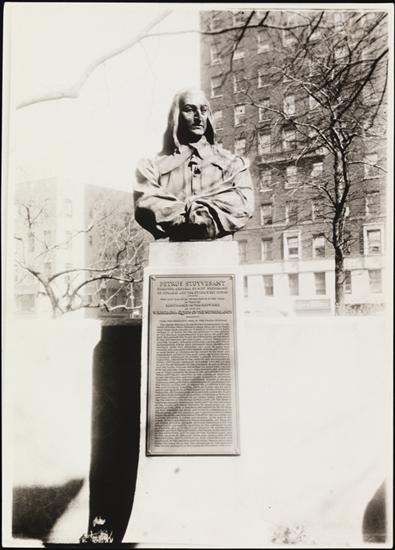
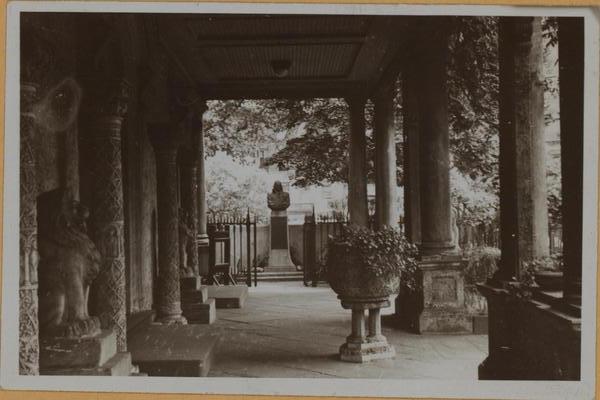
Today his vault marker can be easily seen along the side of the church, and a bust of Petrus sternly greets visitors into the church yard.

Courtesy Museum of the City of New York

The bust by Dutch sculptor Toon Dupuis is 100 years old, placed at St. Mark’s on December 6, 1915. Speaking at the ceremony, oddly enough, was General Leonard Wood, chief of staff of the U.S. Army. “Peter Stuyvesant was a headstrong, positive character with intolerance of lack of interest in the welfare of his company or colony.”

So headstrong that he’s still around perhaps? Legends of the ghost of Peter Stuyvesant have been associated with St. Mark’s since the 19th century.

Courtesy New York Public Library

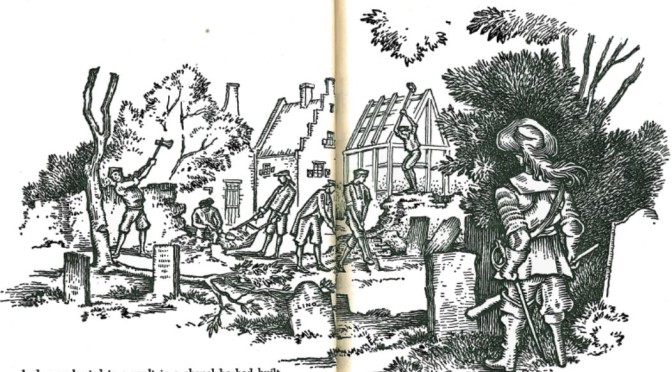
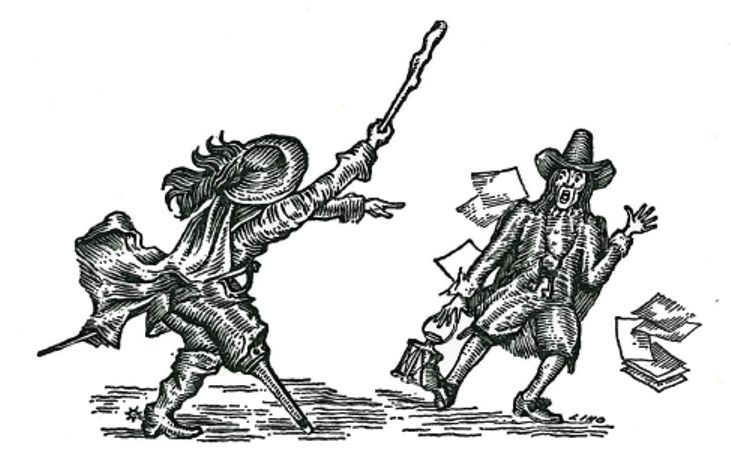
One version of his ghost story recounted in the 1966 children’s book The Ghost of Peg-Leg Peter by M.A. Jagendorf, with illustrations by Lino S. Lipinsky (reprinted here):

“His body had been put into a closed vault.  But that did not stop the ghost of the governor from stomping around on black or moonlit nights in his old haunts; his farm and the city hall where he had once reigned.  Folks heard his stomping peg leg with the silver band, and saw him — and ran away in fear. That pleased him, particularly if they were English. He wanted no one around his grave, least of all the enemy who had robbed him and the Dutch Government.”

st marks

The growth of New York up Manhattan island so that it soon included all of Stuyvesant’s farm apparently enraged his spirit to such an extent that his apparition was reported in locations surrounding the church.

One fateful night a sexton entered the church late at night to fetch something for the rector.

The moon was only half full, but bright enough to show church, trees … and ghost.

When the ghost saw the sexton, he raised his stick threateningly. The sexton raised his eye, took one look and ran off.

1

“The governor-ghost looked after the fleeing fellow with contempt and then stomped to the locked church door. He walked through it into the church and stomped up to the hanging bell rope. Taking it in his hands he began pulling it savagely. “

Ringing a church bell two hundred years ago meant an emergency — a fire in the region, perhaps, or a major announcement. According to legend, when neighbors ran to the church to inspect the sound, they found nobody inside. The bell rope had been torn off and its lower section was completely gone.

Over the years stories of his ghost crop up, usually tied with tales of a rapidly changing city.

One can only imagine how he’s taken to the  gentrification of the East Village!

Sometimes the ghost of the governor still comes out again and looks around sadly. But he never rings the bell any more, for he knows it will be of little use.”

Courtesy Museum of the City of New York

Another disturbing event occurred at the church in 1903 although the resolution to this mystery was a bit more mundane.

One day the old clock atop St Mark’s began to act very mysteriously. “Churchgoers and others noticed last Sunday that the clock was acting in a manner befitting neither its age nor its position as hour marker over the historic graveyard. Not only was its course unreliable, but its actions were positively skittish, the minute hand having been seen to wiggle in a most undignified manner.” [source]

After several days of peculiar operation, a repairman climbed to the tower to fix the clock, only to find the culprit — “a kite string and pigeon were found to be responsible for the charges of horological misconduct lodged against the ancient timepiece.”

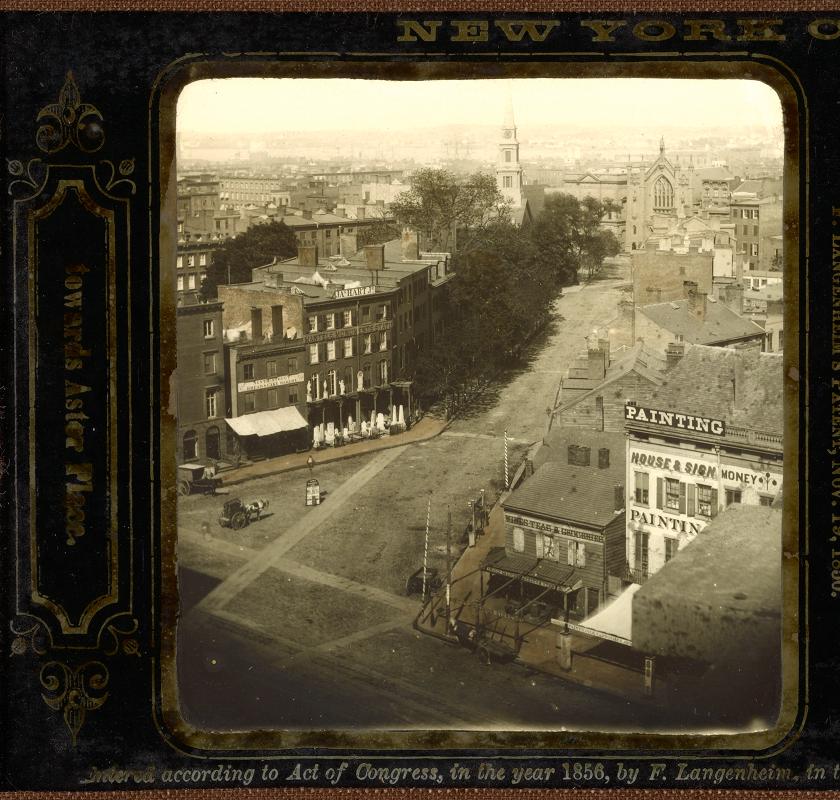
Below: Stuyvesant Street in 1856, an aberration to the city grid plan thanks in part to the presence of St. Mark’s Church and its well-established churchyard

1

For more information on St. Mark In-The-Bowery, check out our podcast on its amazing history.  And the ghost of Peter Stuyvesant pops up in our very FIRST ghost stories podcast.

Categories
Mysterious Stories Podcasts

Haunted Landmarks of New York : Tourist Terrors in the Big Apple

PODCAST It’s the ninth annual Bowery Boys ghost stories podcast, our seasonal twist on history, focusing on famous tales of the weird and the disturbing at some of New York’s most recognizable locations.

Don’t be frightened! We’re here to guide you through the back alleys … OF TERROR!

In this installment, we take a look at the spectral lore behind some of New York City’s most famous landmarks, buildings with great reputations as iconic architectural marvels and locations for great creativity.

But they’re also filled with ghost stories:

Who are the mysterious sisters in colorful outerwear skating on the icy pond in Central Park? And why are there so many uninvited guests at the Dakota Apartments, one of the first and finest buildings on the Upper West Side?

Meanwhile, at the Chelsea Hotel, all the intense creativity that is associated with this great and important location seems to have left an imprint of the afterworld upon its hallways.

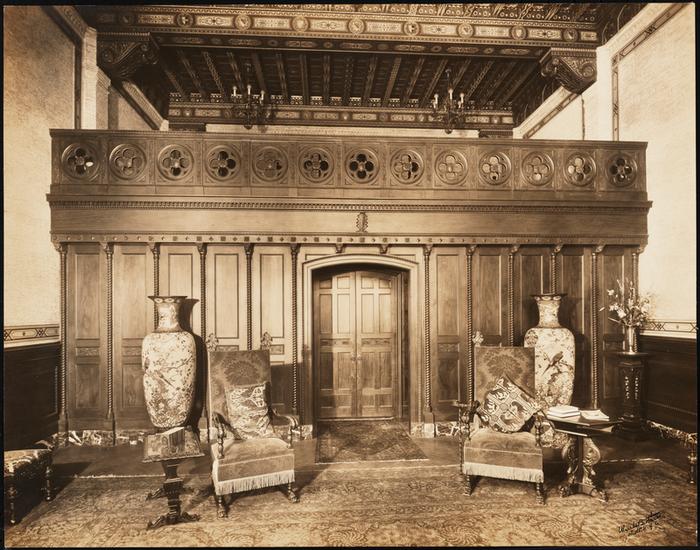
Over at Grand Central Terminal, the Campbell Apartment serves up some cocktails — and a few unnatural encounters with Jazz Age spirits.

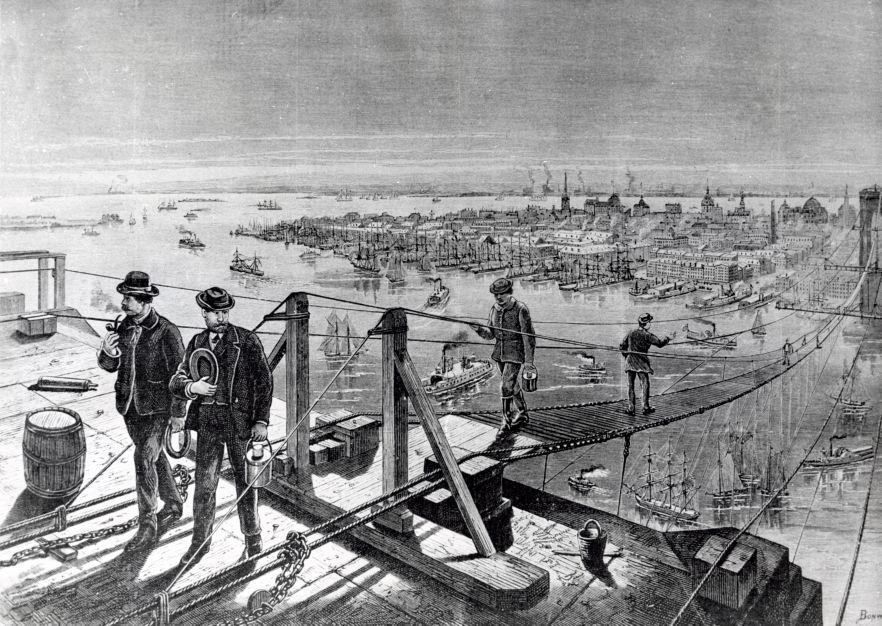
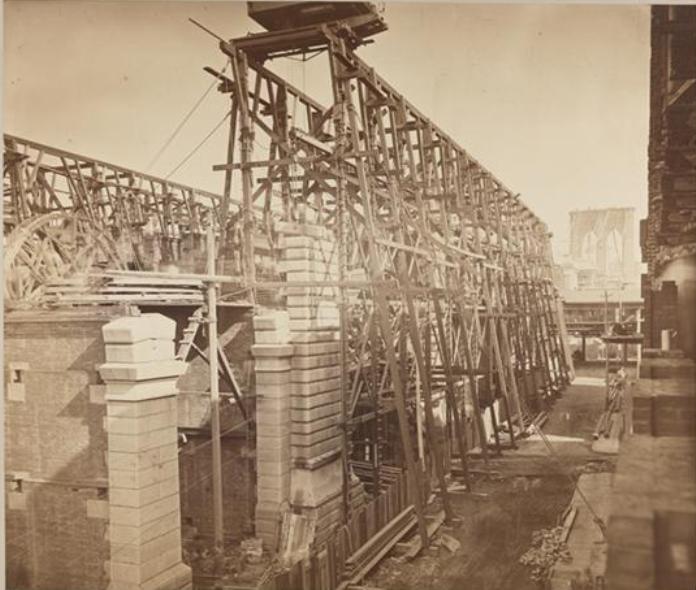
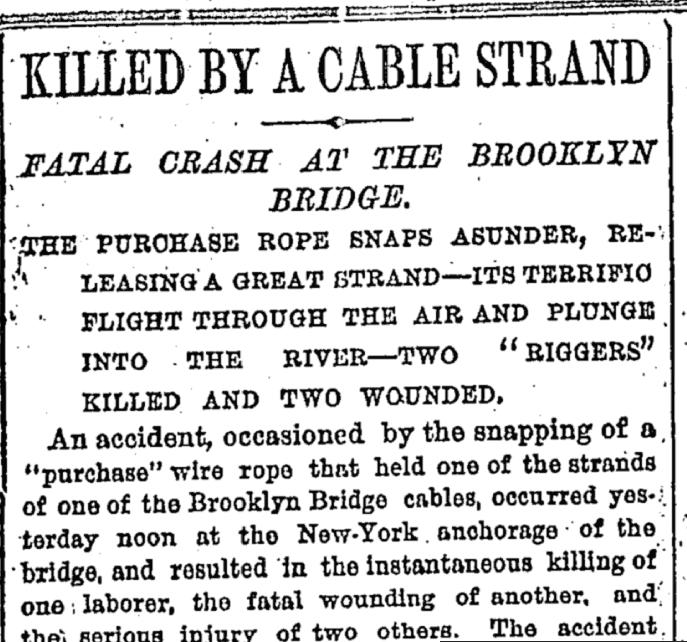
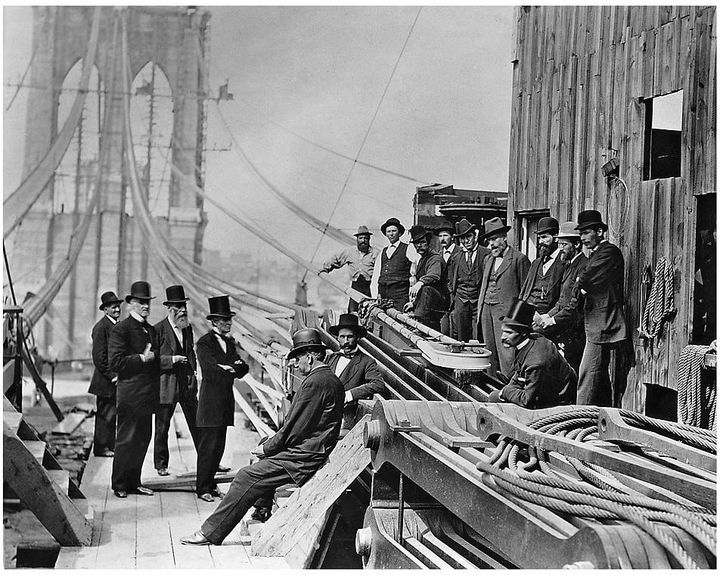
Finally, on the Brooklyn Bridge, a tragedy during its construction has left its shadow upon the modern tourist attraction. Who’s that up ahead on the pedestrian pathway?

A little spooky fun — mixed with a lot of interesting history — and a few cheesy sound effects!


The Bowery Boys: New York City History podcast is brought to you …. by you!

We are now producing a new Bowery Boys podcast every two weeks. We’re also looking to improve the show in other ways and expand in other ways as well — through publishing, social media, live events and other forms of media. But we can only do this with your help!

We are now a member of Patreon, a patronage platform where you can support your favorite content creators for as little as a $1 a month.

Please visit our page on Patreon and watch a short video of us recording the show and talking about our expansion plans. If you’d like to help out, there are five different pledge levels (and with clever names too — Mannahatta, New Amsterdam, Five Points, Gilded Age, Jazz Age and Empire State). Check them out and consider being a sponsor.

We greatly appreciate our listeners and readers and thank you for joining us on this journey so far. And the best is yet to come!


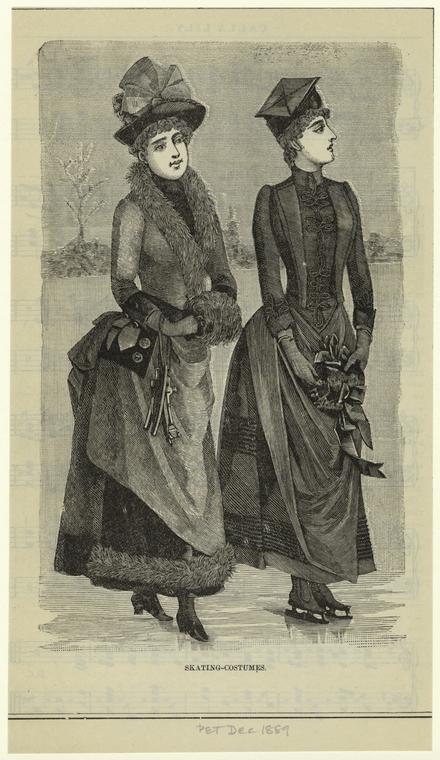
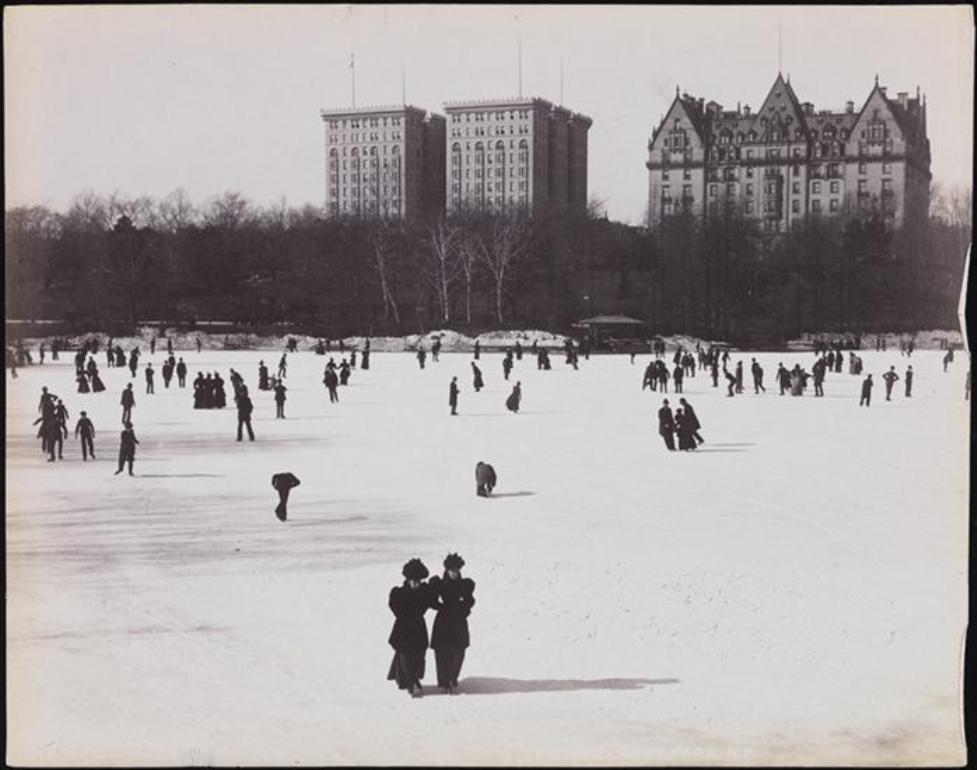
Two women in fashionable skating garments 1889. Perhaps similar to the ensembles worn by Janet and Rosette Van Der Voort during their ghostly figure eights in Central Park.

New York Public Library


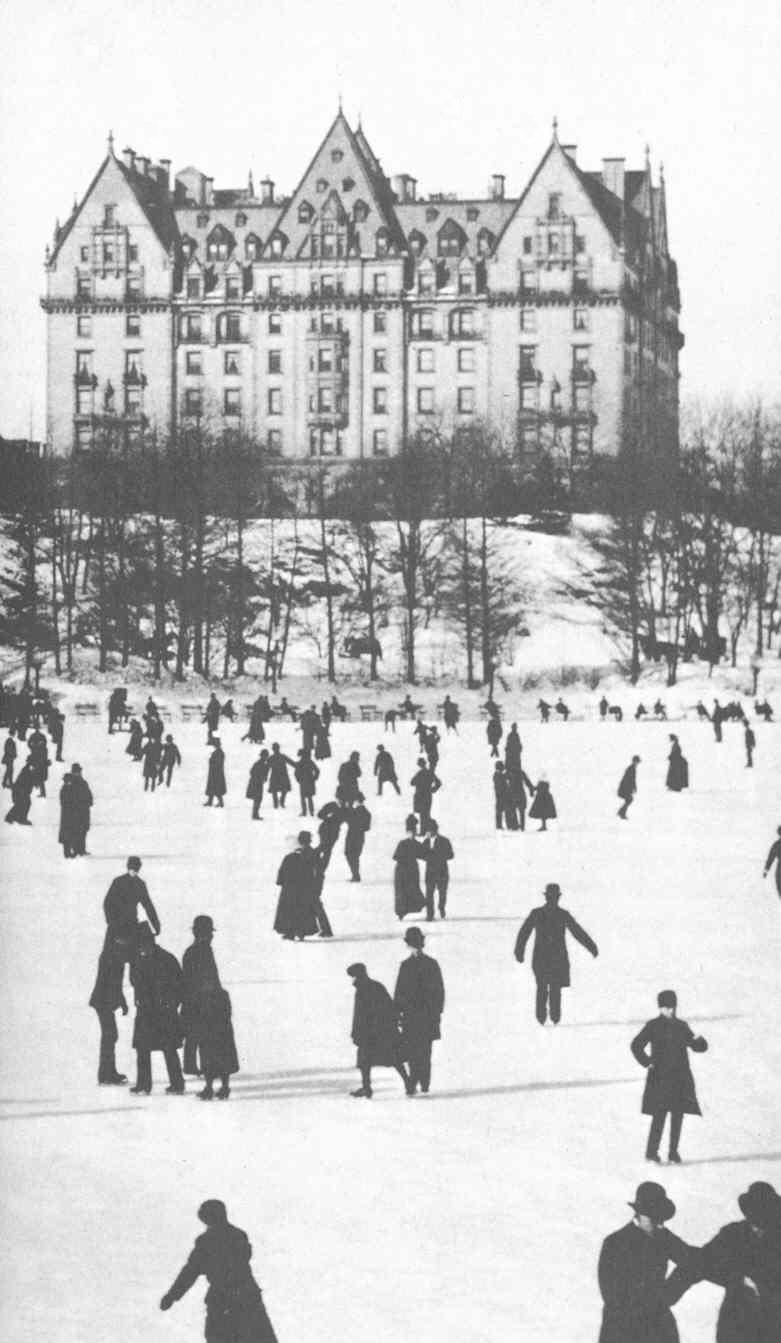
A famous image of the Dakota Apartment — all alone on the Upper West Side landscape — with skaters enjoying the frozen pond on a cold winter’s day.
The_Dakota_1880s

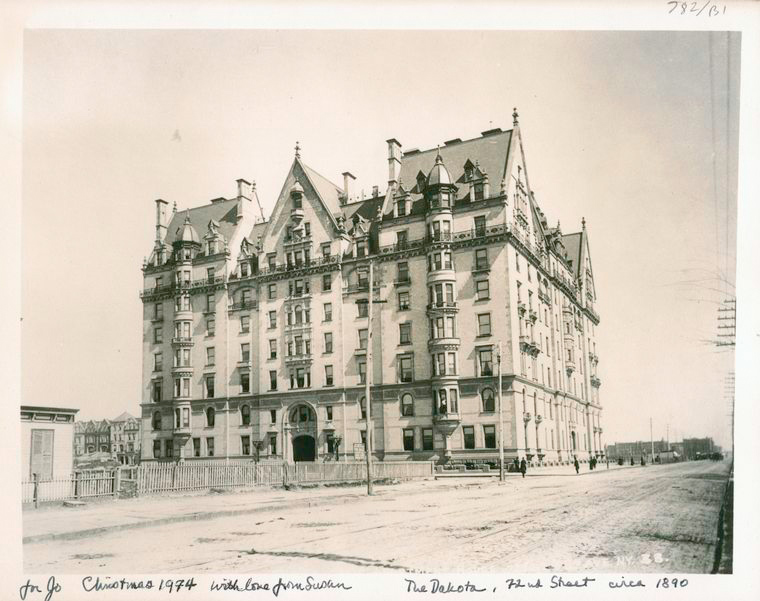
The Dakota photographed in 1890/

Courtesy New York Public Library


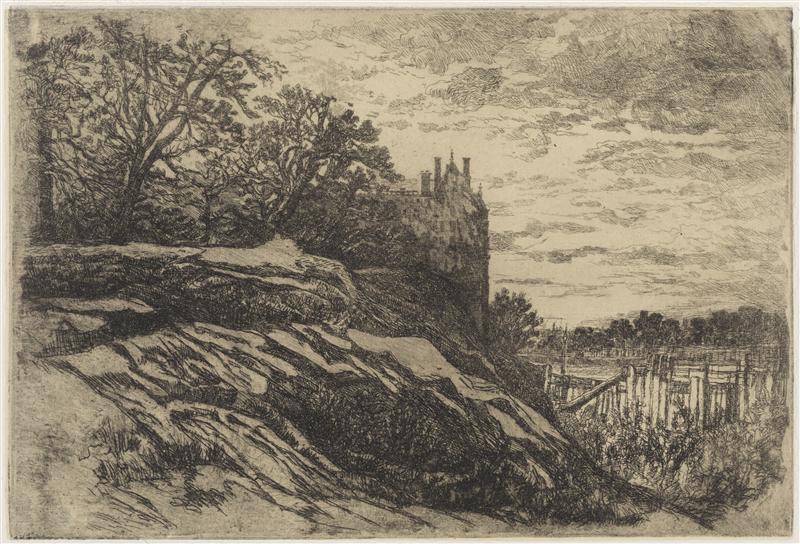
A haunting illustration by Eliza Greatorex from 1885 showing “The Dakota behind a rock at 72nd Street and Bloomingdale Road.”

1
Courtesy Museum of the City of New York


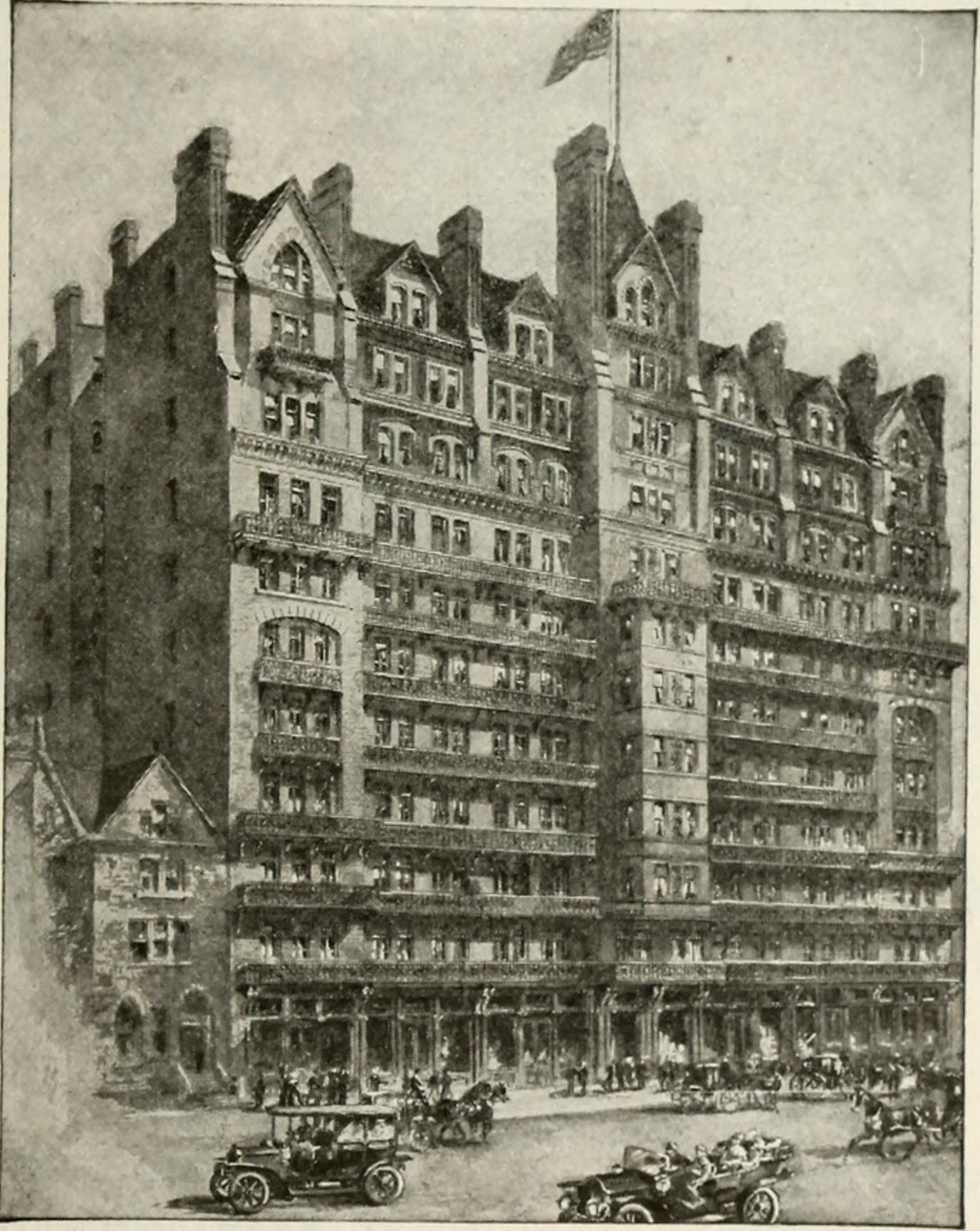
The Chelsea Hotel in 1903, one of the premier apartment houses in New York City which eventually became a destination (both short and long-term) for the city’s artistic circles. It also attracted its share of eccentric and even disturbed individuals over the decades.

Internet Book Archvies

Oh what these floors have seen! The Chelsea in 1936.

Courtesy Berenice Abbott

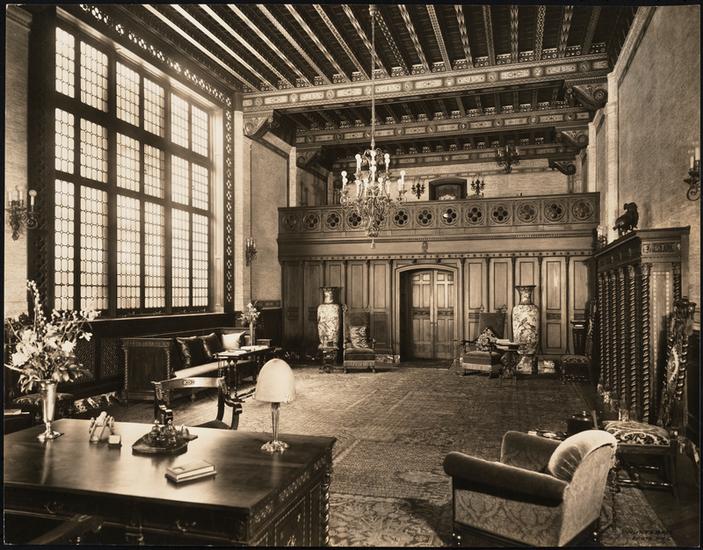
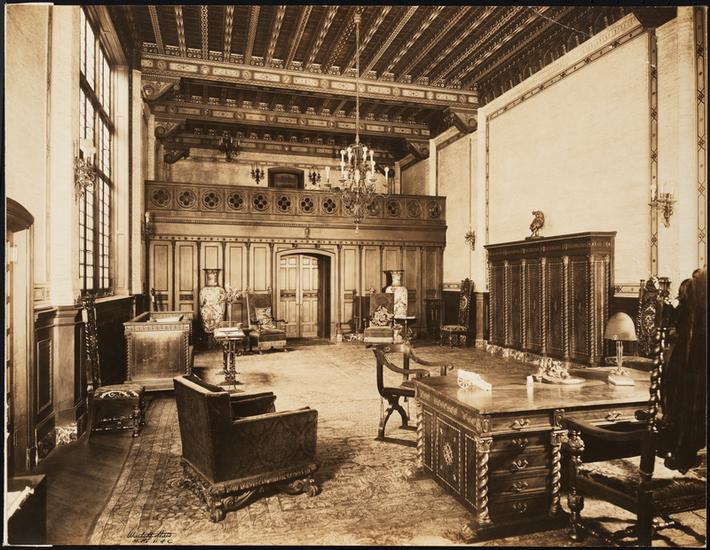
The interiors of the Campbell Apartment, back when it was an actual office. Are the ghosts of former party guests still enjoying the room’s luxurious trappings? More information at this blog post at the Museum of the City of New York. All photos, taking in 1923, by the Wurts Brothers.

Courtesy Museum of City of New York


2
Courtesy Museum of City of New York


Courtesy Museum of the City of New York

Workers upon the Brooklyn Bridge, a dangerous work environment where dozens of men were injured over the course of its construction.

1

Construction of the approach to the bridge on the New  York side.

MNY146544
Courtesy Museum of the City of New York


From the New York Times article regarding the unfortunate tragedy on the Brooklyn Bridge. Read the whole article here.

Courtesy New York Times

The scene at the bridge a few months after the accident — October 1878.

Courtesy New York Times


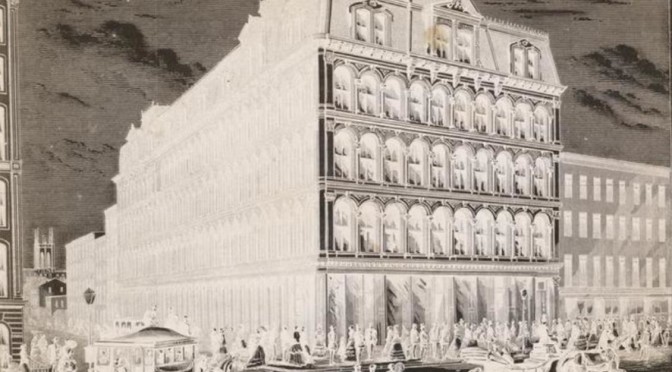
The picture at top is a reversed negative of the Methodist publishing and mission buildings, corner of Broadway and 11th Street, New York. [source]

Categories
Mysterious Stories

Nine Years of New York Ghost Stories!

Here is the complete collection of Bowery Boys Halloween specials. Creep yourself out while listening to these spooky legends of New York City. From the haunted woods of Van Cortlandt Park to spirits haunting Captain Kidd’s treasure on Liberty Island. Psychics at Carnegie Hall, unsettling spirits in Cobble Hill, undead party animals at Grand Central!

Download them at the links below or from these two Bowery Boys pages on iTunes: [Main feed] [Archive feed]


2015 Haunted Landmarks of New York
Ghost stories associated with the city’s most popular and recognizable places from baby-faced spooks at the Dakota Apartments to spirited revelers at Grand Central Terminal. What’s still lurking in the hallways of the Chelsea Hotel? And whatever you do tonight, do not linger too long on the Brooklyn Bridge at night! A figure from the bridge’s past may still be looking for his head.
Episode #192 Download it here
Haunted Landmarks of New York: Tourist Terrors In The Big Apple

1

2014 Ghost Stories of Brooklyn
Four tales of spirits haunting Brooklyn back in the 19th century when it was still an independent city.  A horrific gangly ghost on the railroad tracks, a historic Clinton Hill home with an invisible hand that would not stop knocking, a Coney Island hotel in 1894 with a secret in room 30, and the wacky wraiths of Bushwick’s Evergreens Cemetery.
Episode #172: Download it here
Haunted Hipsters: Four Ghost Stories of Brooklyn blog post

2

2013 Ghost Stories of Old New York
Tales set mostly before the 1840s featuring sinister stories of murder, shipwreck and death by fright!  Spirits of dead Lenape Indians may haunt the forest of Van Cortlandt Park. A romantic West Village restaurant finds its home inside the former carriage house of Aaron Burr. Might the vice president still be visiting?  We bring you the legend of an old Brooklyn fort that once sat in Cobble Hill and terrified those who traveled along on old Red Hook Lane.  And finally, over at St Paul’s Chapel,  a respected old actor wanders the churchyard, looking for his body parts.
Episode #157:  Download it here 
Ghost Stories of Old New York:  Tales From The Revolution, Restless Indians, Haunted Forts and a Headless Actor

3


2012 Mysteries and Magicians of New York 
Grab a drink at the Ear Inn, one of New York’s most historically interesting bars, and you might meet Mickey, the drunken sailor-ghost.  A frightening story of secret love at old Melrose Hall conjures up one of Brooklyn’s most popular ghostly legends.  A woman is possessed through a Ouija board, but while she accept the challenge by one of New York’s first ghostbusters?  And a tale of Harry Houdini, Sir Arthur Conan Doyle, and the line between the supernatural and mere sleight of hand.
Episode #144:  Download it here 
Mysteries and Magicians of New York: Whimsical Spirits, Scary Legends, Strange Magic and the Original Ghost Busters


2011 Haunted Histories of New York 
What’s horrors are buried at the foot of the Statue of Liberty? What’s below a Brooklyn Catholic church that makes it so dreadfully haunted? What ghost performs above the heads of theatergoers at The Palace? And what is it about the Kreischer Mansion that makes it Staten Island’s most haunted home?
Episode #130: Download it here
Haunted Histories of New York: What Horrors Lie Beneath The Foundations of the City’s Treasured Landmarks?

seance

2010 Supernatural Stories of New York 
The scary revelations of a New York medium, married Midtown ghosts who fight beyond the grave, a horrific haunting at a 14th Street boardinghouse, and the creepy tale of New York’s Hart Island.
Episode #114: Download it here
Supernatural Stories of New  York: Spooky Seances, Violent Jazz Age Ghosts and an Island of Despair


2009 Haunted Tales of New York
The secrets of the restless spinster of the Merchants House, the jovial fright of the Gay Street Phantom, the legend of the devil at Spuyten Duyvil Creek, and the spirit of a dead folk singer.
Episode #91: Download it here
Haunted Tales of New York: Urban Phantoms

ghost

2008 Spooky Stories of New York 
The drunken spirits of the Algonquin, the mysteries of a hidden well in SoHo, the fires of the Witch of Staten Island, and ‘the most haunted brownstone in New York’.
Episode #65: Download it here
Spooky Stories of New York

1

2007 Ghost Stories of New York
The ghosts of a tragic Ziegfeld girl, a scandalous doyenne of old New York, a bossy theater impresario and the ghoulish bell-ringer of St. Mark’s-in-the-Bowery.
Episode #16: Download it here

Here are the locations mentioned in all of our ghost podcasts:


  1. Mark Twain’s Sketches, New and Old, 1887 (Internet Archive Book Images)
  2. The Bells, 1920 (Internet Archive Book Images)
  3. Mémoires récréatifs, scientifiques et anecdotiques du physicien-aéronaute E.G. Robertson (Internet Archive Book Images)
  4. “Rhyme and Reason” (1901) (Internet Archive Book Images)
  5. Seance, source unknown
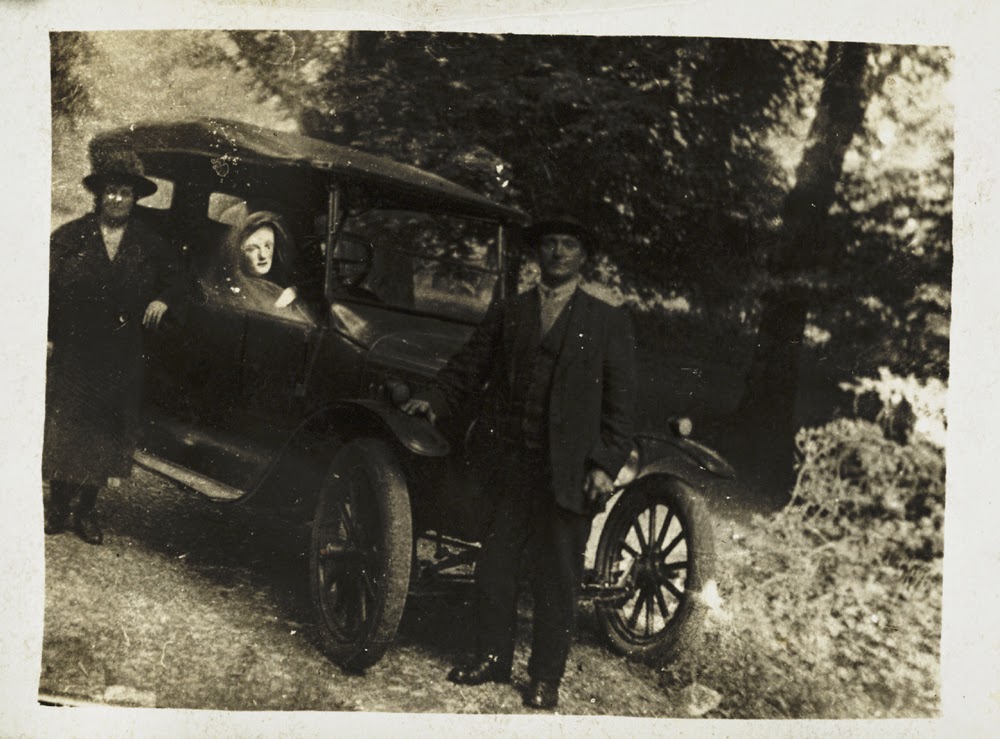
  6. “Two of William Hope’s friends lean on their motor car whilst a figure – the couple’s deceased son – is revealed at the wheel.” Photo by William Hope (1920) (National Media Museum)
  7. Ghosts, The Oracle (1919) (Internet Archive Book Images)
  8. The funny side of physic : or, The mysteries of medicine, presenting the humorous and serious sides of medical practice. An exposé of medical humbugs, quacks, and charlatans in all ages and all countries” (1874) (Internet Archive Book Images)

TOP PHOTO: Source here


Categories
Neighborhoods

H.P Lovecraft’s very bizarre hatred of Red Hook and Brooklyn Heights

Howard Philip Lovecraft — aka H.P. Lovecraft — was born 125 years ago today in Providence, Rhode Island.

The pulp-fiction storyteller, known for claustrophobic tales of the occult, lived for a time in Brooklyn. He did not enjoy it.

In 1924, he moved to  259 Parkside Avenue in Flatbush, Brooklyn, close to Ebbets Field and Prospect Park. When his new wife relocated for work in Cincinnati, Lovecraft moved from the pleasant Flatbush neighborhood to a small flat at 169 Clinton Street in Brooklyn. He only lived here until 1926 but during his stay, possessed of anxiety and neurosis, he practically starved himself.

Below: The boardinghouse at 169 Clinton Street, pictured here at left, from 1935. The first four buildings still exist. The building at the far right is the old Brooklyn Athenaeum.

Courtesy New York Public Library

Lovecraft had contempt for New York’s thriving immigrant population and those workers who sustained Brooklyn waterfront in the 1920s.

In particular he negatively interacted with the residents of Brooklyn’s so-called “Little Syria” on Atlantic Avenue.

I find his invective ugly and even a little obsessive, but it illustrates that occasional truth that the culture of New York City is simply not for everybody, especially if you have certain racist dispositions mixed with a little mental instability.

Below: Lovecraft in Brooklyn Heights in 1925. The house behind him may be his Clinton Street boarding house. Compare to the image above and the current view here. (Photo courtesy HPL.com)

1925-C

In a comparison with Philadelphia, Lovecraft wrote “[Philadelphia has] none of the crude, foreign hostility and underbreeding of New York — none of the vulgar trade spirit and plebian hustle.” He further described New York as “an Asiatic hell’s huddle of the world’s cowed, broken, inartistic, and unfit.” [source]

According to author Donald Tyson, “when [H.P.’s wife Sonia] and Lovecraft were walking the streets of New York and encountered a group of immigrants, Lovecraft would become so animated and enraged that she feared for his sanity.”

The renovated, wealthy houses of today’s Brooklyn Heights were often working-class housing in the 1920s, many turned into affordable boarding houses. Lovecraft disliked his ethnic neighbors and held particular scorn for his Irish landlady. “Only later was I to learn of her shrewish tongue, desperate household negligence, miserly watchfulness of lights and unwatchfulness of repairs, and reckless indifference to the class of lodger she admitted.” [source]

He would have lived with mostly single men of differing ethnicity, many employed along the congested docks that lined the waterfront all the way down to Red Hook, culminating in two self-contained shipping areas — the Atlantic and Erie basins. Back in the 1920s, it was the busiest freight port in the entire world.

Below: Ships along the waterfront heading towards Red Hook, circa 1890

Courtesy Museum of the City of New York

He seemed to filter all his untethered anxiety into the very building at 169 Clinton Street. “I conceived the idea that the great brownstone house was a malignly sentient thing — a dead, vampire creature which sucked something out of those within it and implanted in them the seeds of some horrible and immaterial psychic growth.”

Yet Lovecraft saved his greater fantasies for the neighborhood south of here. He eventually funneled all this tortured and deranged hysteria into his horror writing with the publication of “The Horror at Red Hook,” a story that literally depicts the neighborhood as a gateway to Hell.

Naturally he wrote it over a two-day period from the Brooklyn Heights boardinghouse.

Below (the next two pictures): Some striking illustrations by Robert Cummings Wiseman of shanties around the Atlantic Basin in 1930, courtesy the Museum of the City of New York

MNY118666

The short story, one of his best known, is an amusing curiosity to read today.

Its a muddled, sometimes incomprehensible work with some occasional flashes of creepy description. Clearly the story is self-therapy as much as it is an actual story, an early 20th century entry in the field of conspiratorial fiction. It’s undeniably haunting if you manage to forgive the vast amount of virulent, anti-immigrant description:

“Red Hook is a maze of hybrid squalor near the ancient waterfront opposite Governor’s Island, with dirty highways climbing the hill from the wharves to that higher ground where the decayed lengths of Clinton and Court Streets lead off toward the Borough Hall. Its houses are mostly of brick, dating from the first quarter to the middle of the nineteenth century, and some of the obscurer alleys and byways have that alluring antique flavour which conventional reading leads us to call “Dickensianâ.”

The population is a hopeless tangle and enigma; Syrian, Spanish, Italian, and negro elements impinging upon one another, and fragments of Scandinavian and American belts lying not far distant. It is a babel of sound and filth, and sends out strange cries to answer the lapping of oily waves at its grimy piers and the monstrous organ litanies of the harbour whistles.”

Courtesy Museum of the City of New York

I won’t spoil any of the plot points of the story. (If you’re interested in reading ‘The Horror At Red Hook’, you can check it out here. ) But let’s just say the author confirms his suspicions — the street gangs and liquor rackets of the Prohibition era are really just dens of age-old evil:

“The soul of the beast is omnipresent and triumphant, and Red Hook’s legions of blear-eyed, pockmarked youths still chant and curse and howl as they file from abyss to abyss, none knows whence or whither, pushed on by blind laws of biology which they may never understand. As of old, more people enter Red Hook than leave it on the landward side, and there are already rumours of new canals running underground to certain centres of traffic in liquor and less mentionable things.”

The story would be published in 1927 in the pulp magazine Weird Tales. Notably, their offices were in Chicago, not in New York

1

Once he left New York, he pursued some of his more famous writing projects, using his anxiety to more disturbing effect in runic, terror-filled stories of the occult. He died in 1937, revered by many as a truly boundary-breaking writer, greatly inspiring writers like Stephen King.

It would be almost fifty years before an author attempted to look at south Brooklyn with similar monstrous intent — in the 1970s horror novels The Sentinel and The Guardian by Jeffrey Konvitz.

Top picture: Detail from a 1897 Rand McNally map of Brooklyn

Categories
Mysterious Stories

Ghost Bluster: Arthur Conan Doyle and his wacky ectoplasm

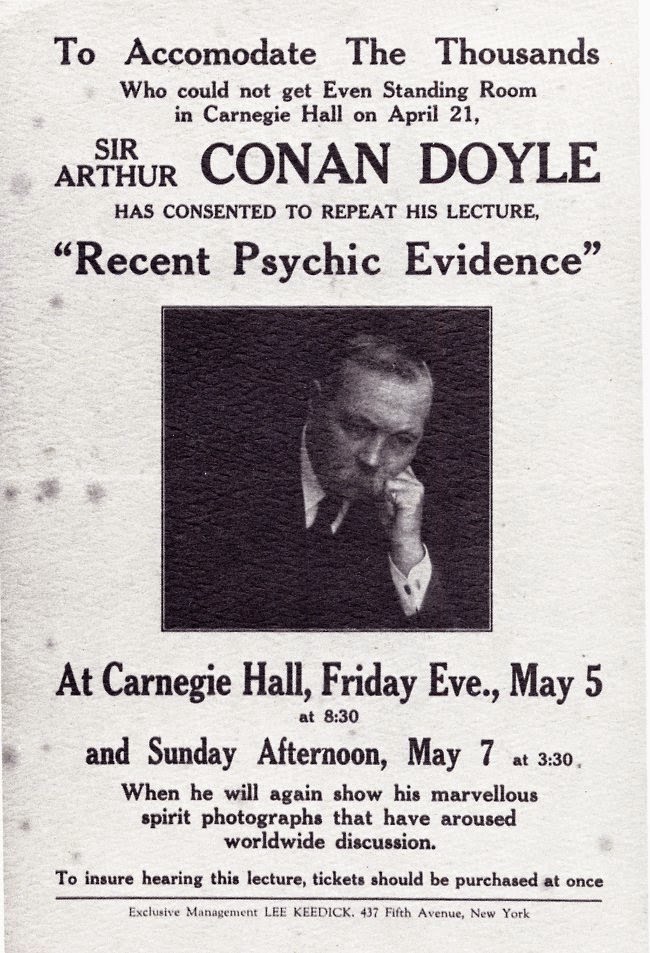
A flyer for one of the author’s many Carnegie Hall lectures. (Courtesy Carnegie Hall archives)

Sir Arthur Conan Doyle made a startling announcement in April 1922. Known for his beliefs in communicating with the afterlife, the famed creator of Sherlock Holmes announced an extraordinary discovery — the existence of ectoplasm, the ghostly goo that emits from mediums possessed with the spirits of the dead.

“Ectoplasm is a thick, vapory, slightly luminous substance which exudes from some materializing mediums,” Conan Doyle told the author Marguerite Mooers Marshall in an interview with the New York Evening World. “Immediately there comes from her body this vaperous substance which surrounds her like a fog. As the ectoplasm increases it becomes more dense. It coalesces, becomes sticky. It can be felt. It can be photographed.”

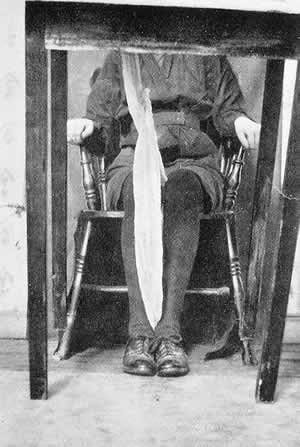
To prove the existence of this viscous residue, the Evening World published photographs of alleged ectoplasmic events on April 26, 1922.

The root of all this sudden interest in bizarre supernatural events during the spring of 1922 was a series of lectures Conan Doyle gave at Carnegie Hall and the Brooklyn Academy of Music, shaking proper society to the core with Spiritualist talk of mediums and psychic planes far outside those commonly prescribed by Western religion.
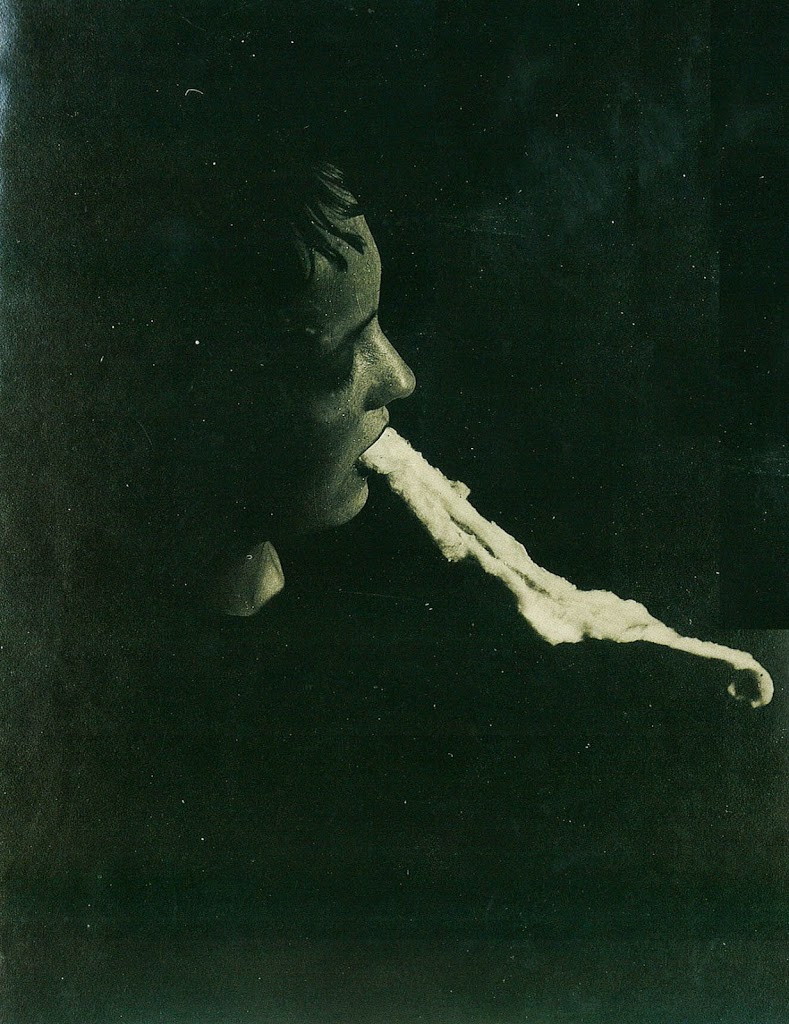
Among the spirit photography he displayed in the legendary Carnegie stage were several examples of ectoplasmic events, thick wisps of ghostly material issuing from the bodies of entranced mediums.
His lectures were received with great interest and much mockery. In reference to the author’s peculiar views of the afterlife and days before run the odd photography posted above, the Evening World intoned in a headline, “ALL WOMEN PRETTY AND 25, MEN 30, IN DOYLE’S HEAVEN.

Others blamed a series of mysterious murders and suicides in New York City during this time period on Conan Doyle’s disturbing lectures.

It was in May of that year that Conan Doyle met with Harry Houdini, magician and famous spiritualist skeptic.  (We speak of the results of this encounter in our podcast Mysteries and Magicians of New York.) Among their lengthy debates regarding the spiritual realm were discussions on the existence of ectoplasm.

Below are some of the more disturbing photographs of alleged ectoplasmic activity.  It was similar photos to that that Conan Doyle displayed at Carnegie Hall in 1922.

1913 — The medium Stanislawa emitting ghostly ectoplasm (Courtesy Univ of Sydney)


Katherine Goligher, subject of the Evening World photographs, issuing ectoplasm that looks suspiciously like regular fabric


Sometimes the ectoplasm came out in the form of little people, as in this photo of Annie Mellon and an entity named ‘Cissy’, c. 1890 (Univ. of Sydney)


Conan Doyle himself could even expel ectoplasm, especially in front of a camera!  This was taken in 1922, possibly while he was in New York


Below: Video evidence of ectoplasm and creatures made from the substance 


(If you’re in a Ghostbusters mood, read my exhaustive breakdown from last year of all the fun New York trivia from the 1984 film classic.)

Categories
Mysterious Stories Podcasts

Haunted Hipsters: Four Ghost Stories of Brooklyn

Dark skies over the Brooklyn Bridge, from a 1905 postcard (courtesy MCNY)

PODCAST  Brooklyn is the setting for this quartet of classic ghost stories, all set before the independent city was an official borough of New York City.  This is a Brooklyn of old stately mansions and farms, with railroad tracks laid through forests and large tracks of land carved up, awaiting development.  These stories also have another curious resemblance — they all come from local newspapers of the day, reporting on ghost stories with amusement and more than a little skepticism.

1)  The Coney Island and Sea Beach Railroad took passengers to and from Brooklyn’s amusement district.  But nobody was particularly amused one evening to be stopped by a horrific, gangly ghost upon the tracks near Mapleton.

2)  In Clinton Hill, a plantation-style house built in the early years of the Brooklyn Navy Yard has survived hundreds of unusual tenants over the years, but certainly the scariest days in this historic home occurred in 1878 with a relentless, invisible hand that would not stop knocking.

At right: Death will not deter this Brooklynite from ordering a great craft beer. (courtesy Powerhouse Museum)

3)  The Oceanic Hotel was one of Coney Island’s first great hotels, an accommodation for almost 500 near the increasingly popular beaches of Brighton Beach.  But in 1894, the hotel was virtually emptied out and reportedly haunted.  Did it have something to do with the murder upstairs in Room 30?

4) And finally, the area of Bushwick nearest the Queens border are populated with various burial grounds like the Evergreens Cemetery, borne of the rural cemetery movement which transplanted thousands of previously buried bodies from Manhattan to Brooklyn.

In 1894, with Bushwick prepared for a spate of new development, the sudden appearance of an oddly dressed spirit threatens to disrupt the entire neighborhood.  During one evening, a drunken party of 300 ghost hunters, brandishing swords and revolvers, come across one terror that proved to be very real indeed.

ALSO: Secrets of The Sentinel, a 1977 horror film set in an old house along the Brooklyn Promenade.


10 Montague Terrace, setting for the 1970s horror film The Sentinel, sits at the end of this elegant block on the Brooklyn Promenade.

[Looking west from Brooklyn Bridge Park to the houses on Montague Terrace.]

The theatrical trailer to The Sentinel

1) MIDNIGHT TRAIN TO TERROR
Phenomena reported August 1894 in several publications, including the New York Evening World

The incident in question occurred near the Mapleton station along the Coney Island and Sea Beach Railroad (Map of Brooklyn railroad lines courtesy The Weekly Nabe who has more information on the early days of Mapleton.)


2) WHO’S KNOCKING AT MY DOOR?
Phenomena reported December 1878 in several publications, including the New York Sun
 
A view of Wallabout Bay and the land which became the Brooklyn Navy Yard, circa 1830s.  That would appear to 136 Clinton Avenue (the oldest house in the area) however the general proportion of the region looks a bit off.  Below it, two pictures of the house on Clinton Avenue, including a close-up of the infamous door. (Pics courtesy Flickr/sjcny and Long Island Historical Society)


3) THE GHOSTLY GUEST IN ROOM 30
Phenomena reported August 1892 in several publications, including the Brooklyn Daily Eagle

The haunted Oceanic Hotel, located at Neptune Avenue and W. 6th Street. Perhaps this looks surprising for a 500-room hotel, but out of frame are bungalows and other adjoined buildings.  But you can see how this sort of accommodation went out of fashion rather quickly.

[First hotel at Coney Island, Oceanic Hotel.]
http://timesmachine.nytimes.com/timesmachine/1930/07/01/98307449.html?pageNumber=18

4) THE GHOST OF KNICKERBOCKER AVENUE
Phenomena reported November 1894 in several publications, including the New York Times

1924 — A view of the tracks which separate Bushwick from a cluster of cemeteries. Buildings to the left sit in the vacant lots which were mentioned in this story.  The cemetery nearest this photograph is Most Holy Trinity Cemetery.  You may remember the name Most Holy Trinity for it was this Bushwick congregation that was featured in a ghost story a couple years ago in the show ‘Haunted Histories of New York.’

Opposite Trinity Cemetery.


Categories
Bowery Boys Bookshelf Mysterious Stories

Spectropia, or How to Make Ghosts in Your Home

Above: The cover of the New York edition of Brown’s optical illusion book

One of the hottest books in New York City in the fall of 1864 was an optical illusion collection that conjured ghosts through a simple trick of the eye.

Spectropia, or surprising spectral illusions showing ghosts everywhere and of any colour was both a parlor amusement and picture-filled chapbook written and illustrated by J. H. Brown, an early skeptic of the spiritualism movement.

From the books introduction: “It is a curious fact that, in this age of scientific research, the absurd follies of spiritualism should find an increase in supporters; but mental epidemics seem at certain seasons to affect our minds, and one of the oldest of these mental afflictions — witchcraft — is once more prevalent in this nineteenth century, under the contemptible forms of spirit-rapping and table-turning.”

To counter the phonies, Brown presents readers with a nifty optical illusion that will allow its readers to create their own ghosts at home.

According to advertisements for the book:

The directions are very simple.  You have merely to hold the volume so that the strongest possible light will fall upon the engraved plate; look at it steadily without blinking for nearly a minute; then turn and look steadily for the same length of time at any white surface which is in part shadow, and the object or specter will presently appear.”

“The effect is best by gaslight.” My goodness, what isn’t?

Here’s a sampling of the illustrations.  See if they work for you! And yes, definitely try these out if your home is equipped with gaslight….

The book was produced in New York by publisher James Gregory at 540 Broadway in today’s SoHo area. (It’s the building where the Steve Madden shoe store is today.).

Believe it or not, Spectropia was a hot gift under the tree that Christmas. The New York Times lists it that year in their recommended holiday gift list. “The publications of Mr. JAS. G. GREGORY, of No. 540 Broadway, are characterized by good taste and fine execution.”  Mr. Gregory kept the book in publication for several years afterwards or at least until the novelty wore off.

You can read the book here.  And here’s a PDF.

Below from the New York Daily Tribune, September 13, 1864