Categories
Brooklyn History On The Waterfront Podcasts

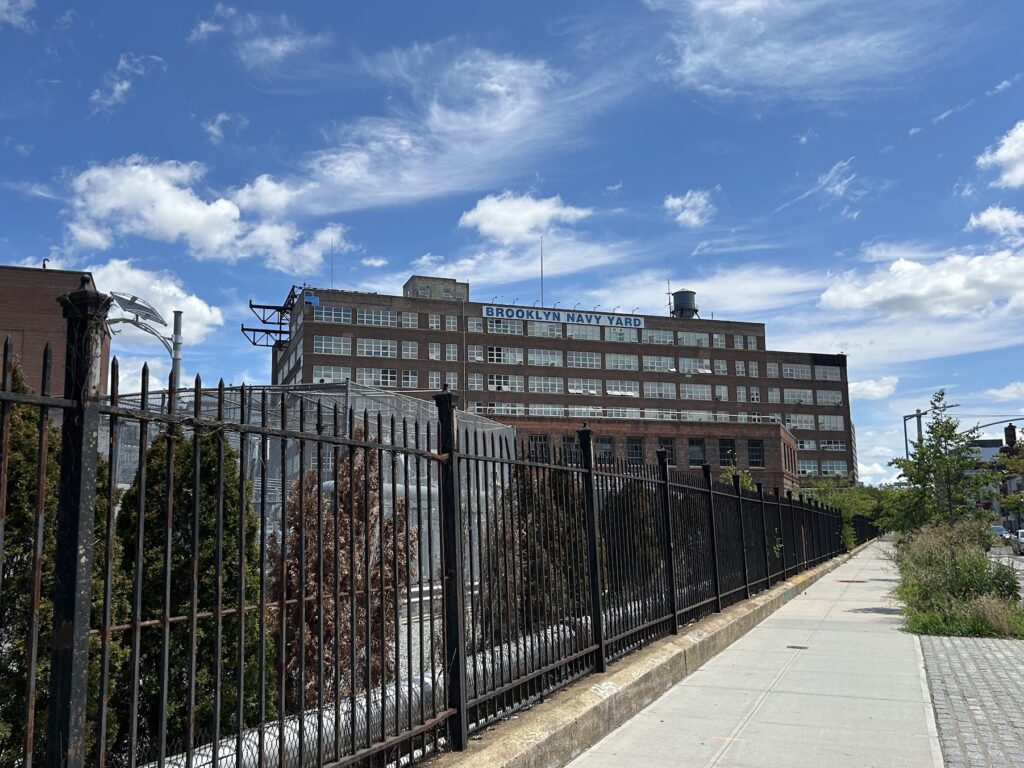
The Brooklyn Navy Yard and Vinegar Hill: Where American History Meets the Waterfront

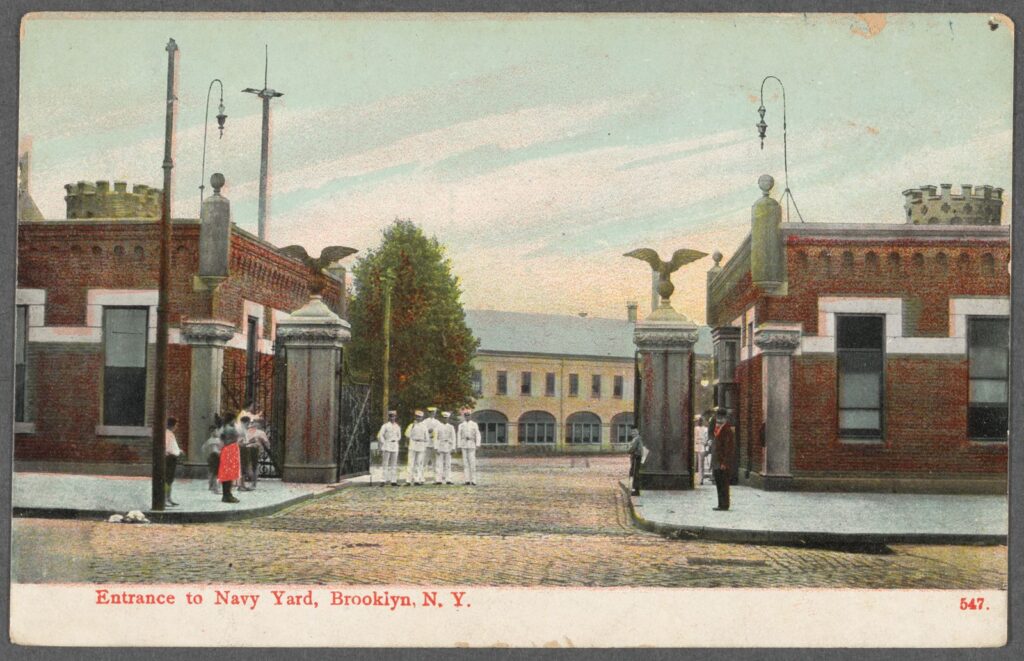
The tale of the Brooklyn Navy Yard is one of New York’s true epic adventures, mirroring the course of American history via the ships manufactured here and the people employed to make them.

The Navy Yard’s origins within Wallabout Bay tie it to the birth of the United States itself, the spot where thousands of men and women were kept in prison ships during the Revolutionary War. 

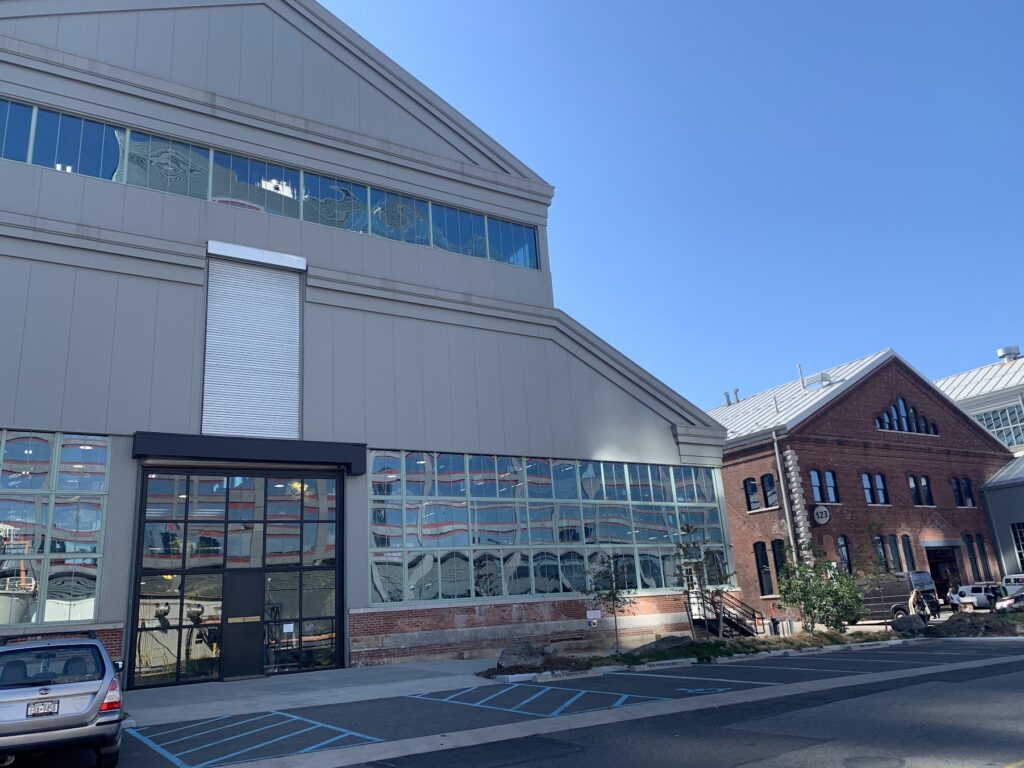
Within this bay where thousands of American patriots died would rise one of this country’s largest naval yards. It was built for the service and protection of the very country those men and women died for. A complex that would then create weapons of war for other battles — and jobs for hundreds of thousands of New Yorkers.

In this episode, Greg is joined by the amazing Andrew Gustafson from Turnstile Tours who unfurls the surprising history of the Navy Yard — through war and peace, through new technologies and aging infrastructure, through the lives of the men and women who built the yard’s reputation.

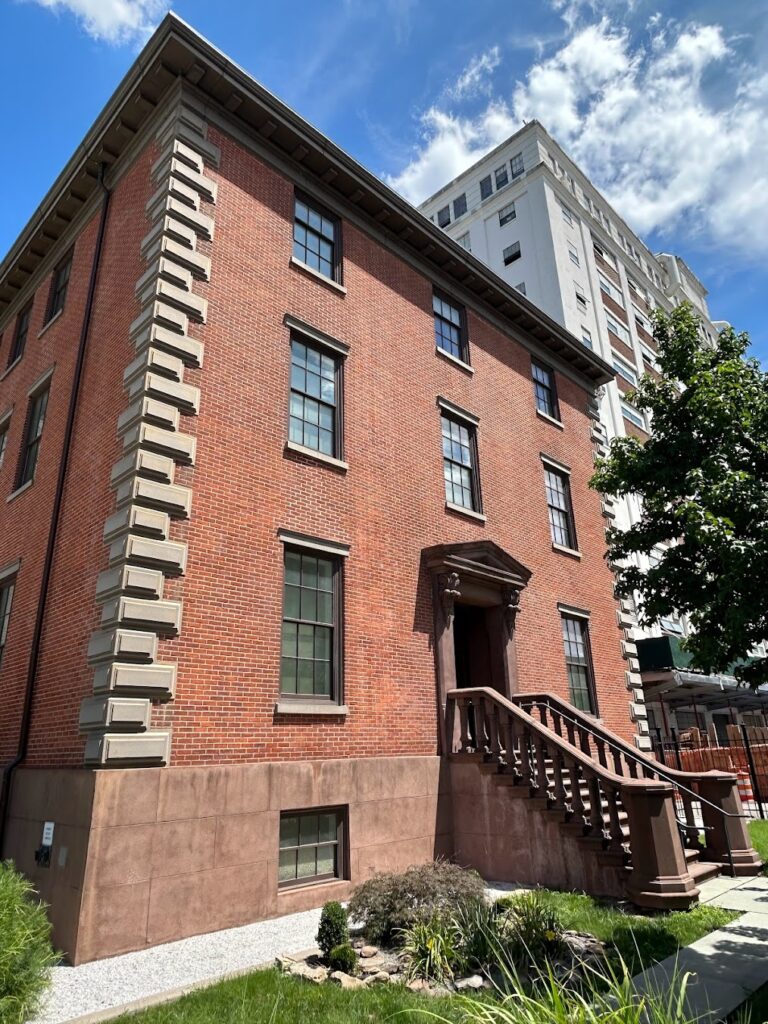
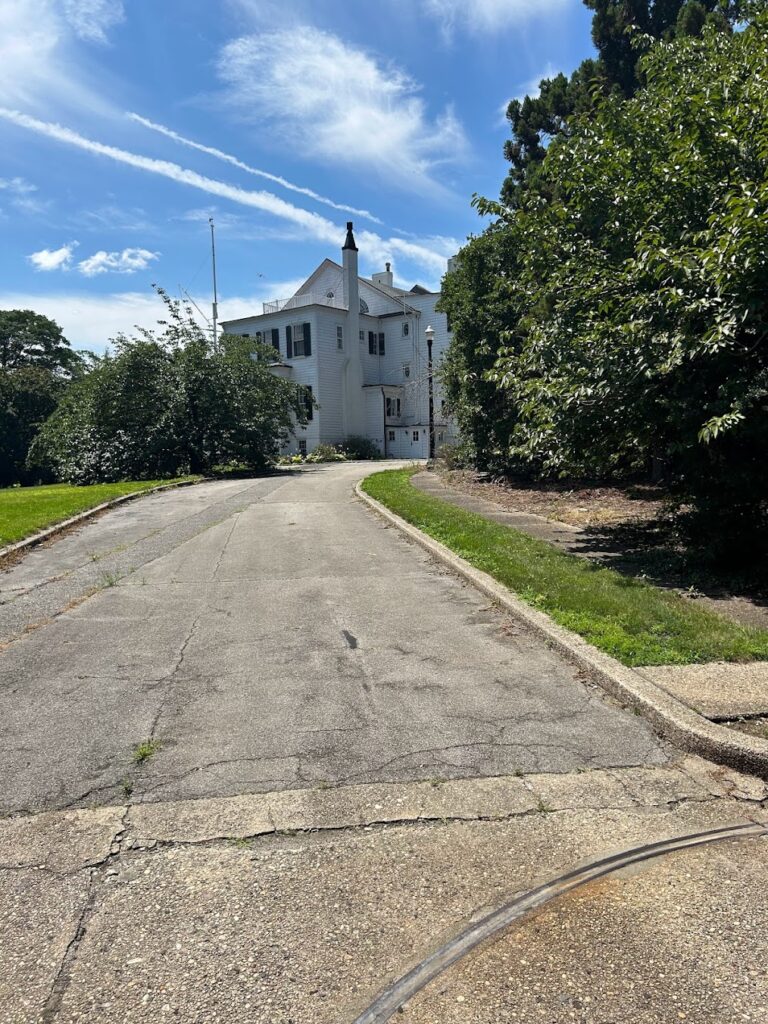
And the story extends to the tiny neighborhood of Vinegar Hill, famed for its early 19th-century architecture and the mysterious mansion known as the Commandant’s House.

FEATURING the origin story of Brooklyn’s most sacred public monument — at home not in Vinegar Hill (at least not anymore) but in Fort Greene.

WITH Matthew C. Perry (not the guy from Friends), E. R. Squibb, Robert F. Kennedy and … The Marvelous Mrs. Maisel?

LISTEN HERE: The Brooklyn Navy Yard


Have you ever worked in the Brooklyn Navy Yard or do you have relatives or descendents who worked there during its naval shipbuilding years? Leave your stories in the comments section.

Our sincere thanks to Andrew Gustafson and the gang over at Turnstile Tours. Visit their website to book a tour, not only of the Navy Yard, but also Brooklyn Army Terminal and Prospect Park, as well as a Food Cart Tour.

Turnstile Tours operates tours at the Navy Yard in partnership with the Brooklyn Navy Yard Development Corporation.
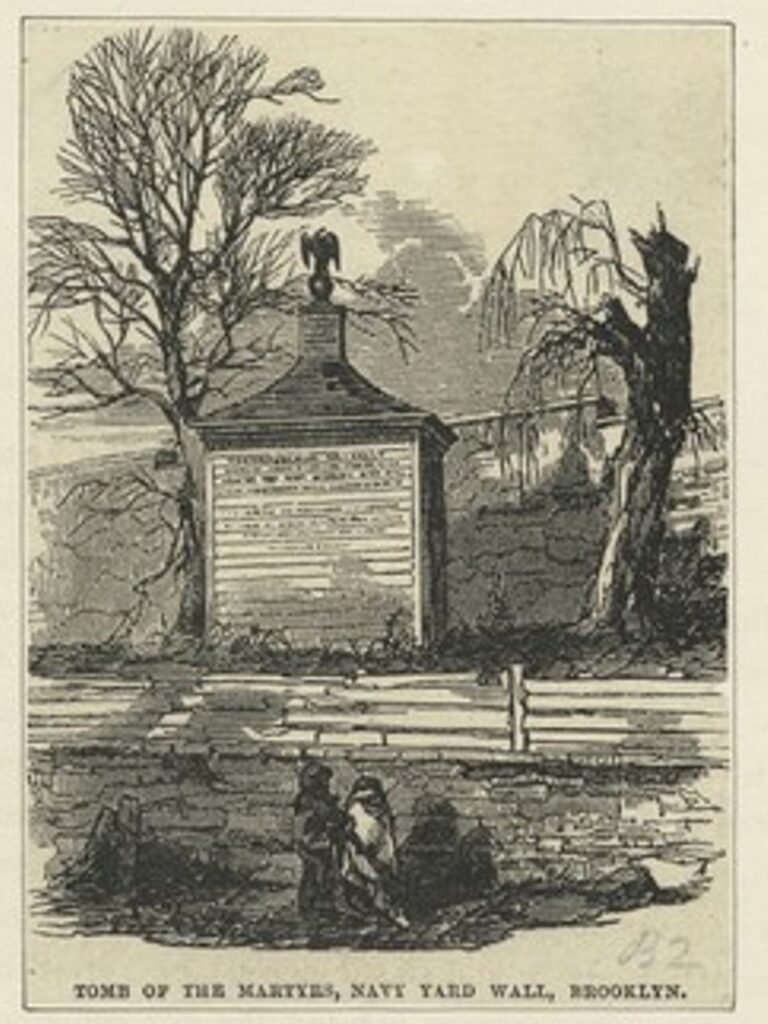
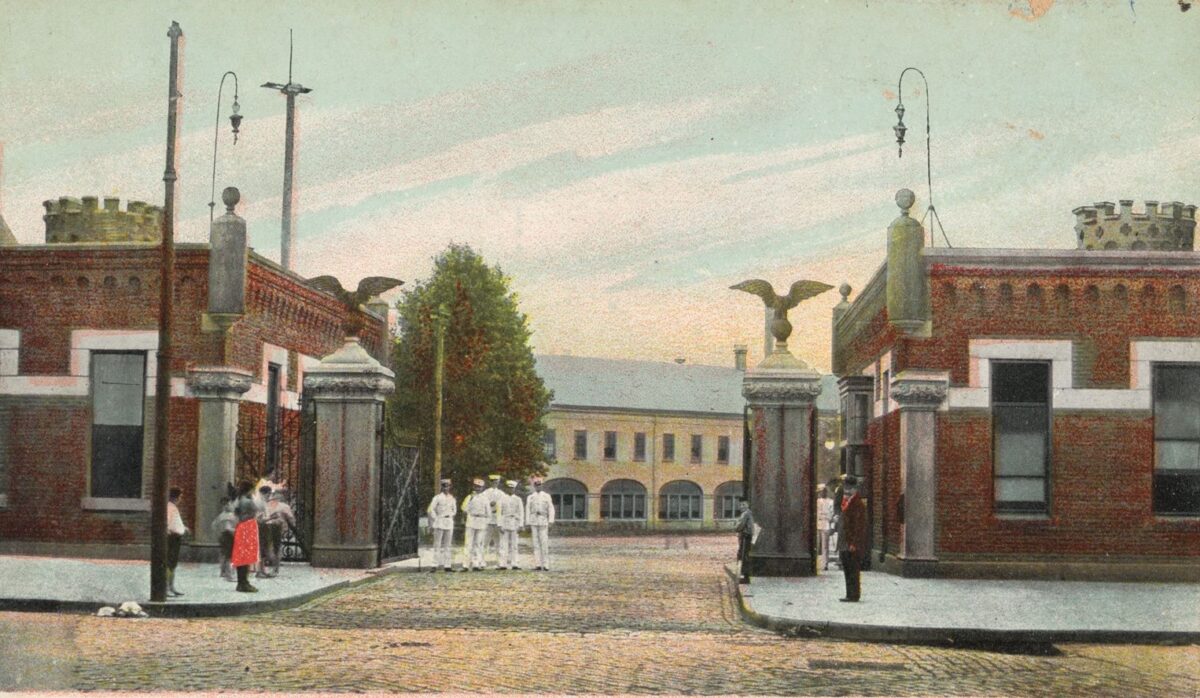
The original Martyrs Tomb on Hudson Avenue, image courtesy NYPL
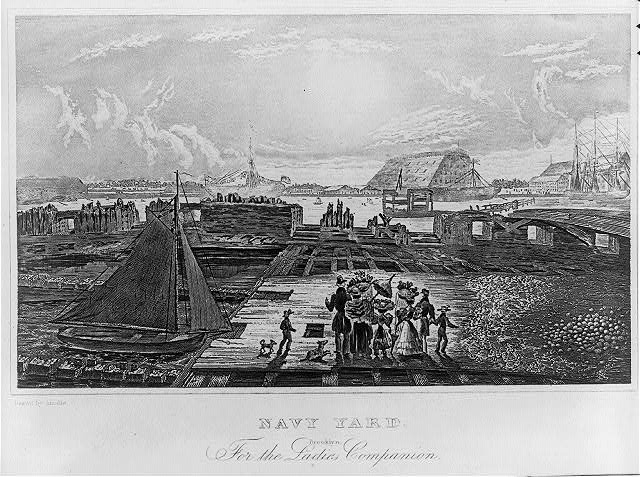
Lithograph of the Navy Yard in 1836, Library of Congress
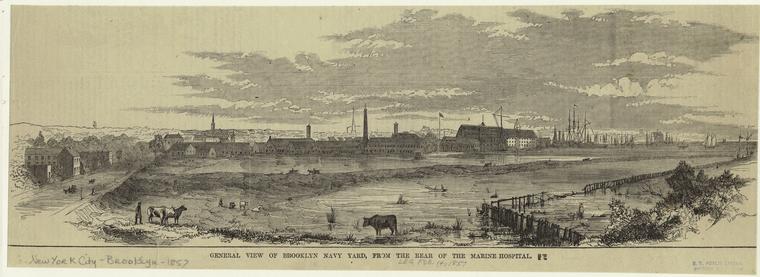
The Navy Yard, 1857, courtesy NYPL
NYPL
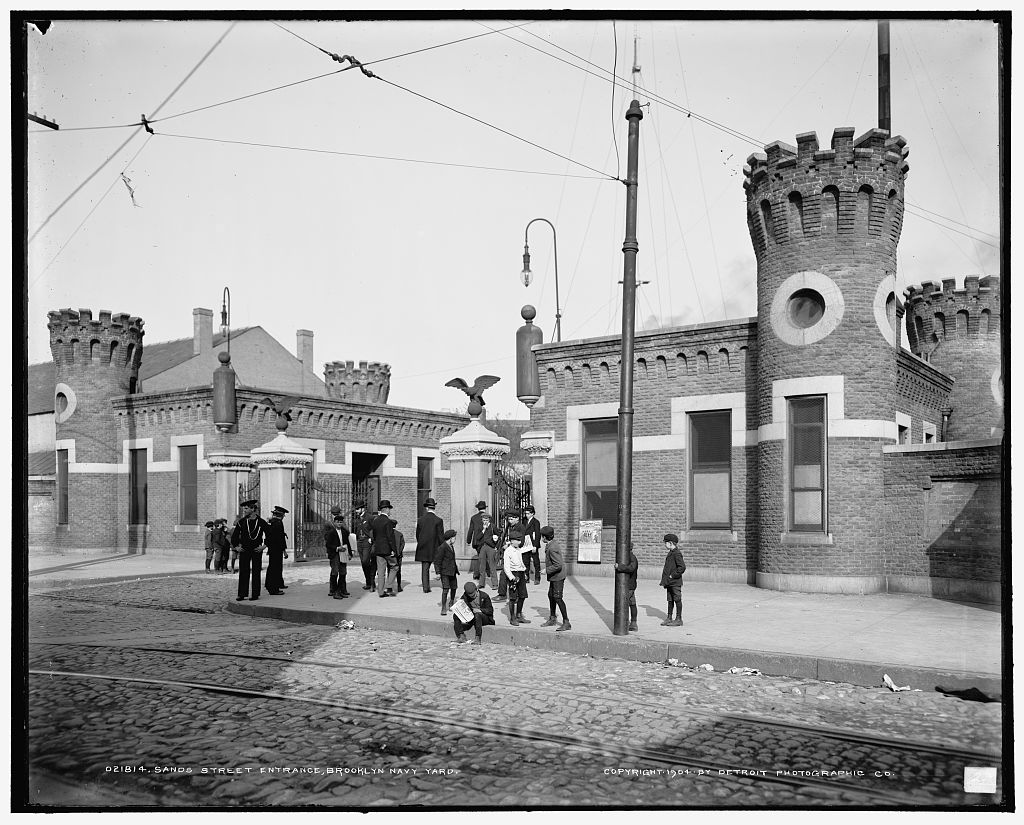
1904, Sands Street entrances to the Navy Yard/Library of Congress
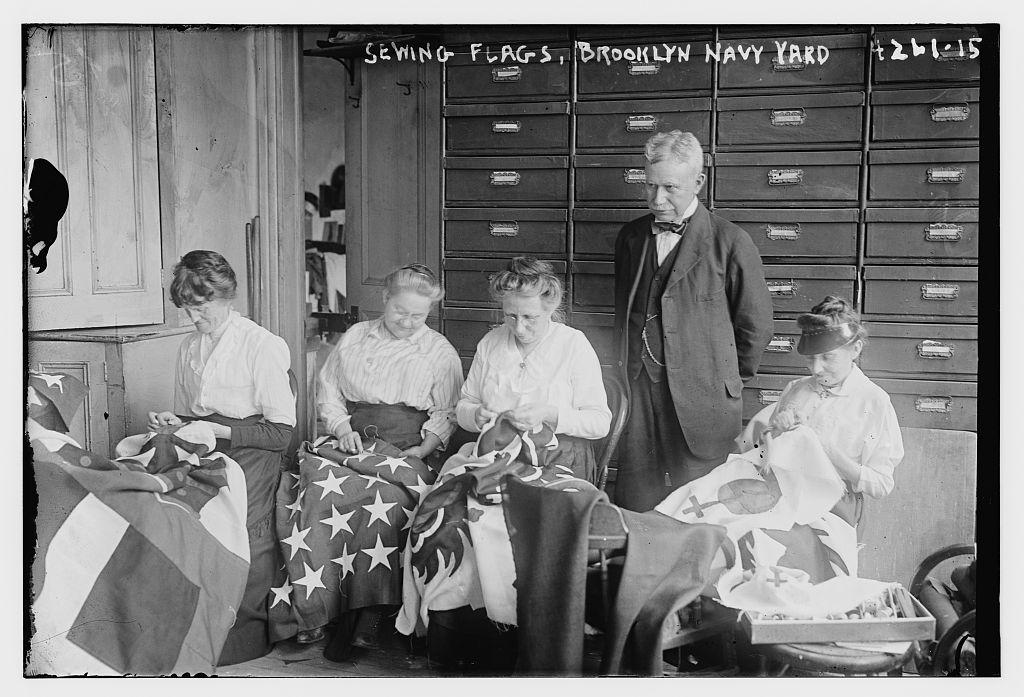
July 1917, Bain News Service/Courtesy the Library of Congress
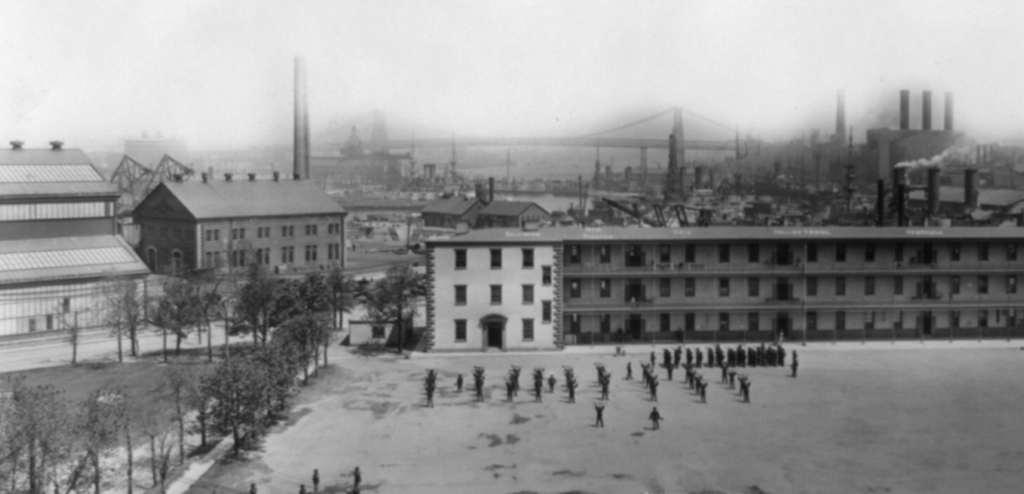
Bird’s-eye view showing barracks and men doing exercises; harbor in background. 1909/Library of Congress
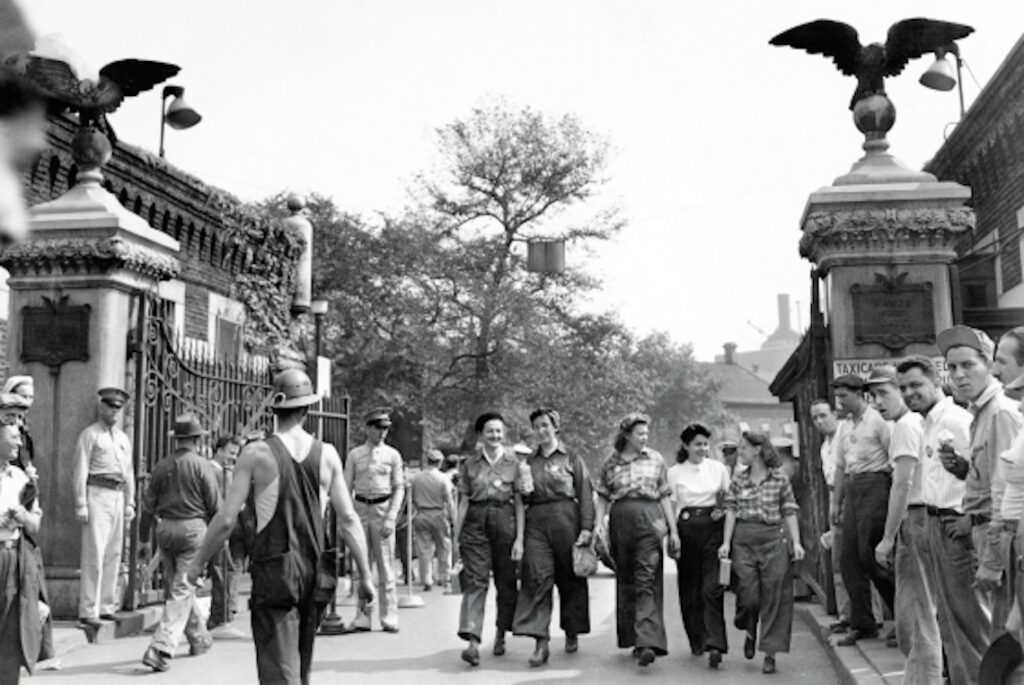
Women exit the Brooklyn Navy Yard, September 19, 1942 – (Photo by the New York Times/Redux)

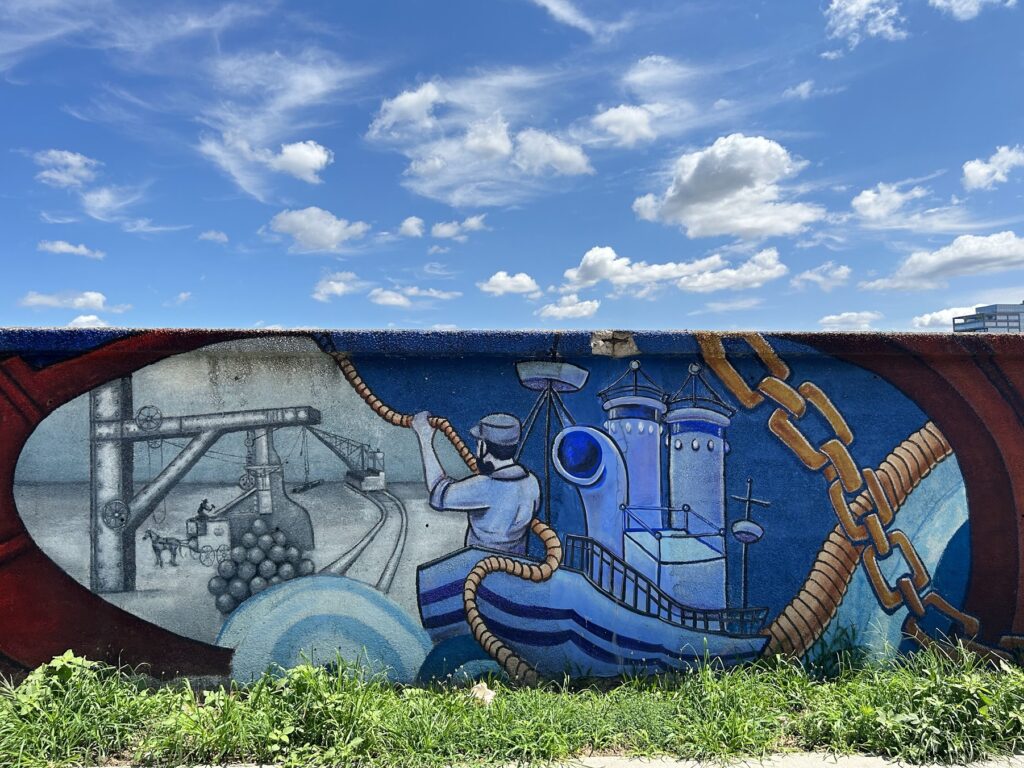
A wall mural on Navy Street celebrates the Navy Yard’s history. Courtesy Greg Young
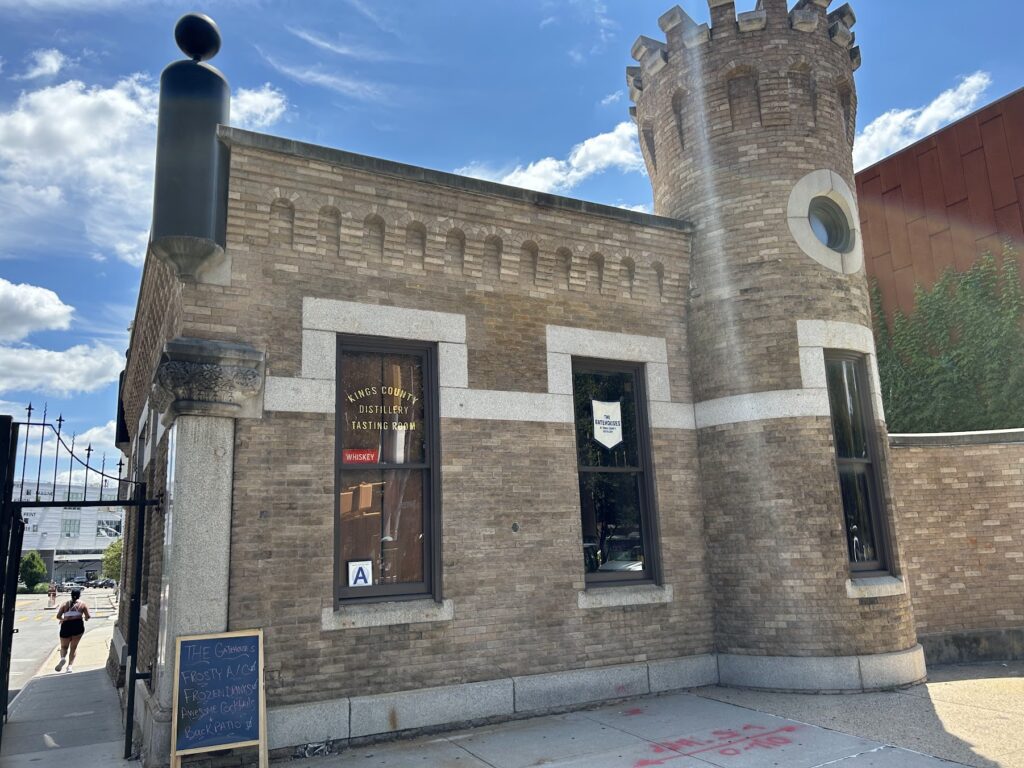
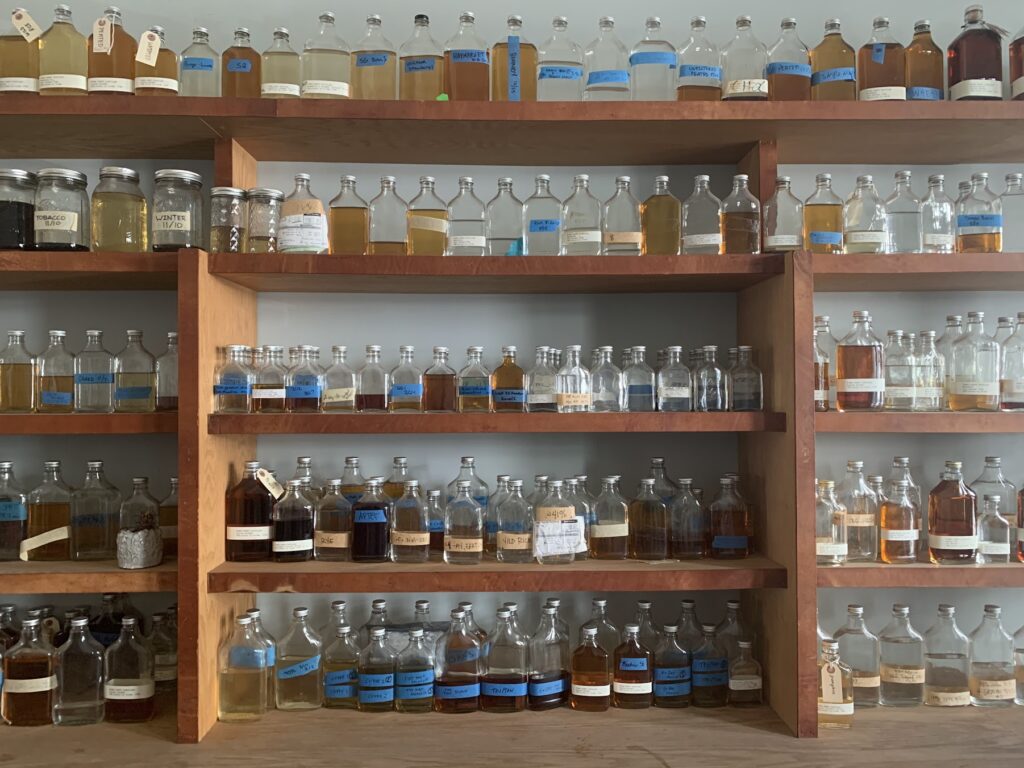
Sands Street Gatehouse, today a tasting room for Kings County Distillery. Courtesy Greg Young
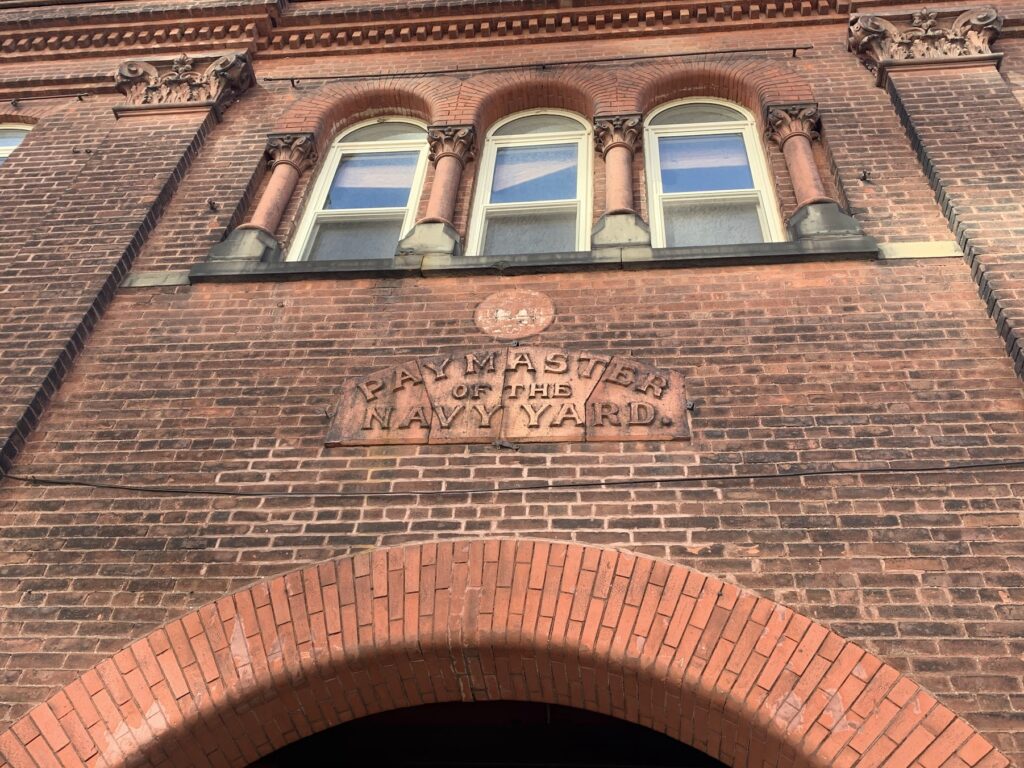
King County Distillery finds its home in a 19th century paymaster building… Courtesy Greg Young
This is what’s inside today! Photo courtesy Greg Young
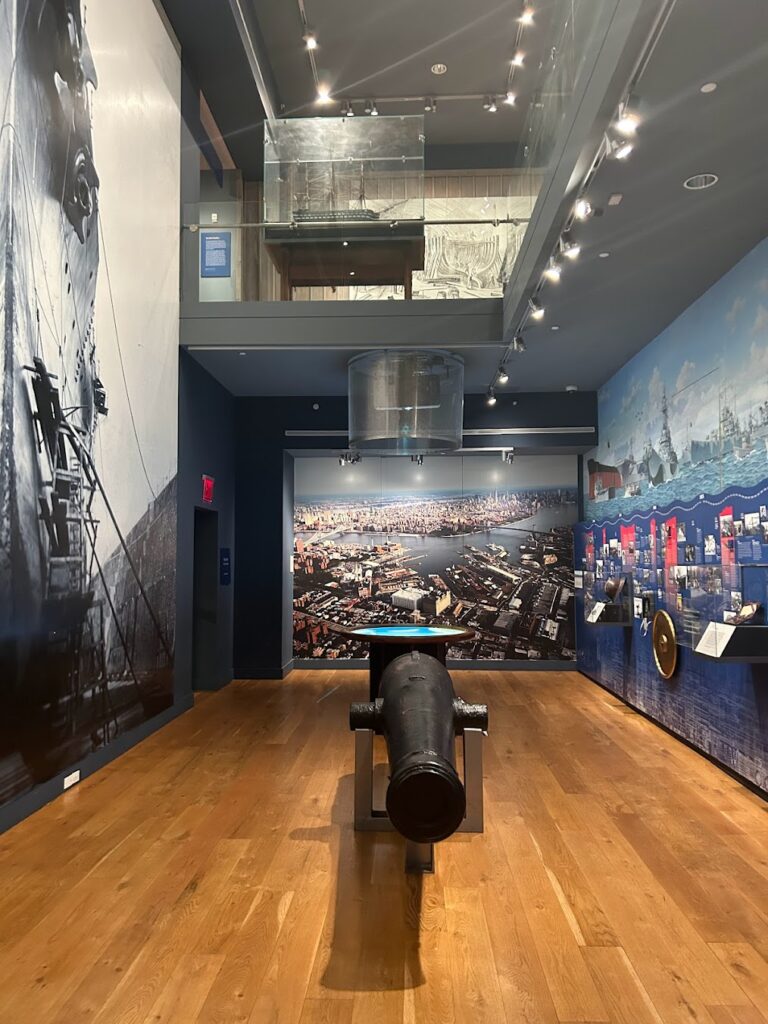
Building 92
Just one room in Building 92’s thorough museum to the Navy Yard’s history.

The paths of the Naval Cemetery Landscape, the site of the old Naval Hospital cemetery.

Peering through the gate to Quarters A, the Commandant’s House.
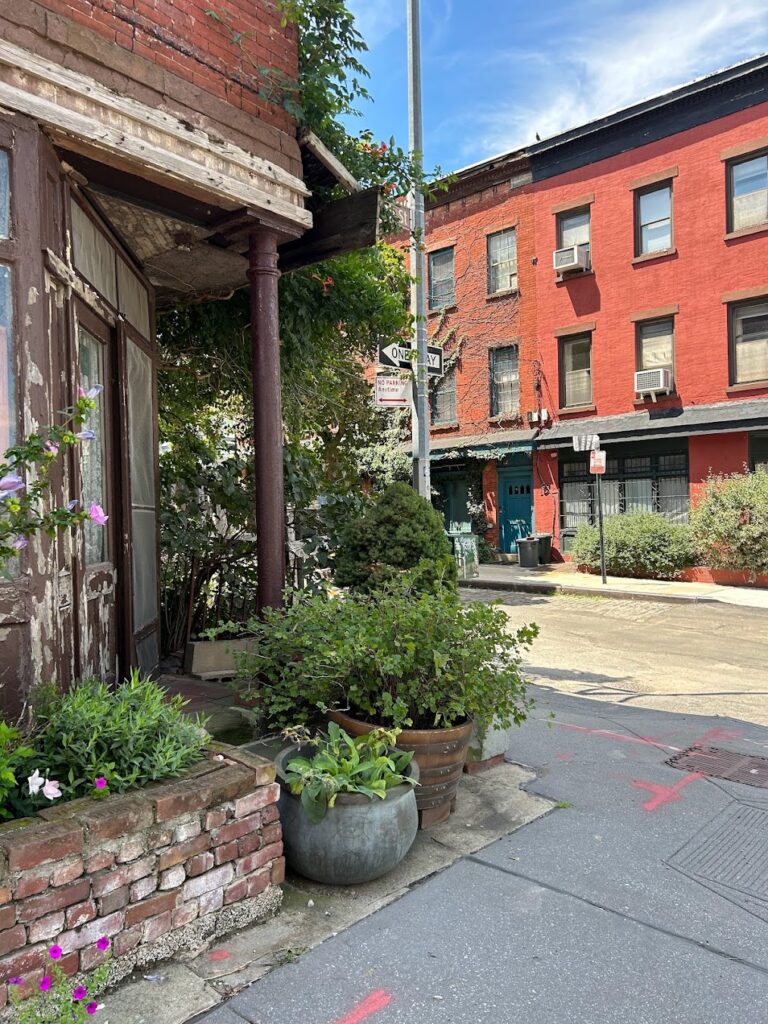
Enchanting Vinegar Hill

FURTHER READING

The Brooklyn Navy Yard / Thomas F. Berner
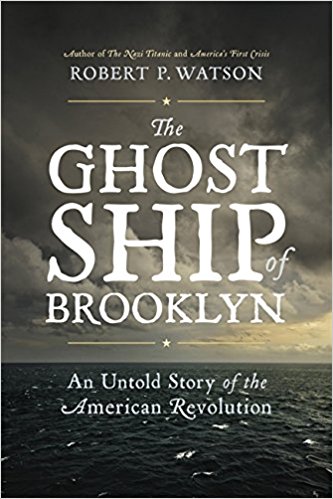
The Ghost Ship of Brooklyn / Robert P. Watson
Six Frigates: The Epic History of the Founding of the U.S. Navy / Ian W. Toll
U.S. Navy: A Complete History / M. Hill Goodspeed

List of Ships Constructed at the Brooklyn Navy Yard
Brooklyn Navy Yard Website: History
Naval History and Heritage Command
NYC Parks — Prison Ship Martyrs Monument
Old United States Naval Hospital Landmark Designation Report
Dry Dock #1 Landmark Designation Report
Quarters A, Commandant’s House Landmark Designation Report
Vinegar Hill Historic District Designation Report

Also visit the Turnstile Tours website for many fascinating articles about the Navy Yard
FURTHER LISTENING

Categories
Bowery Boys Bookshelf Revolutionary History

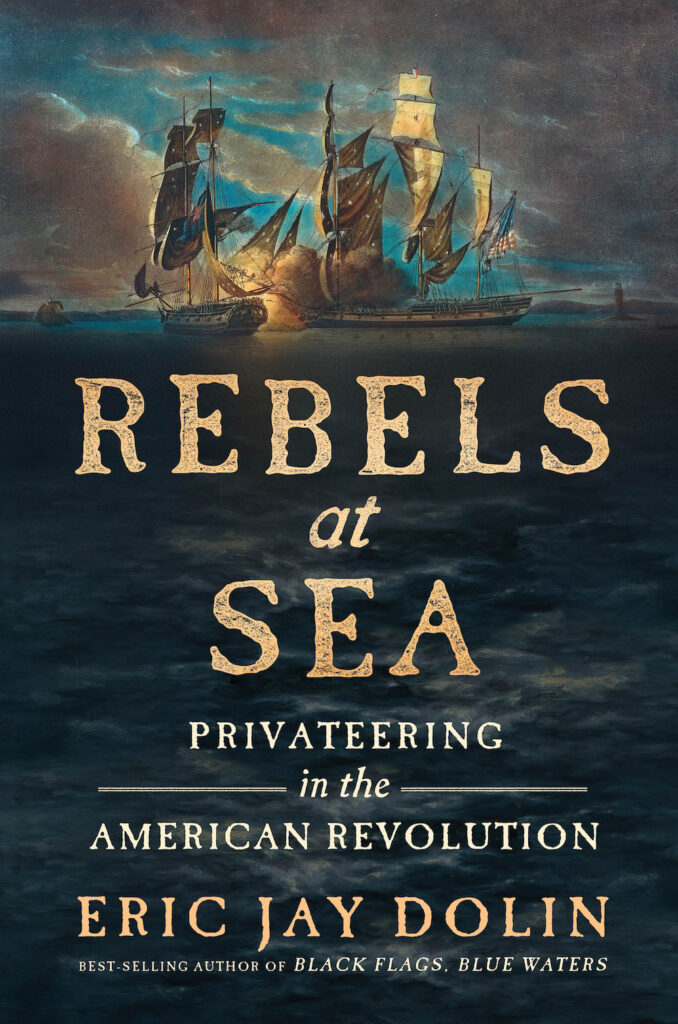
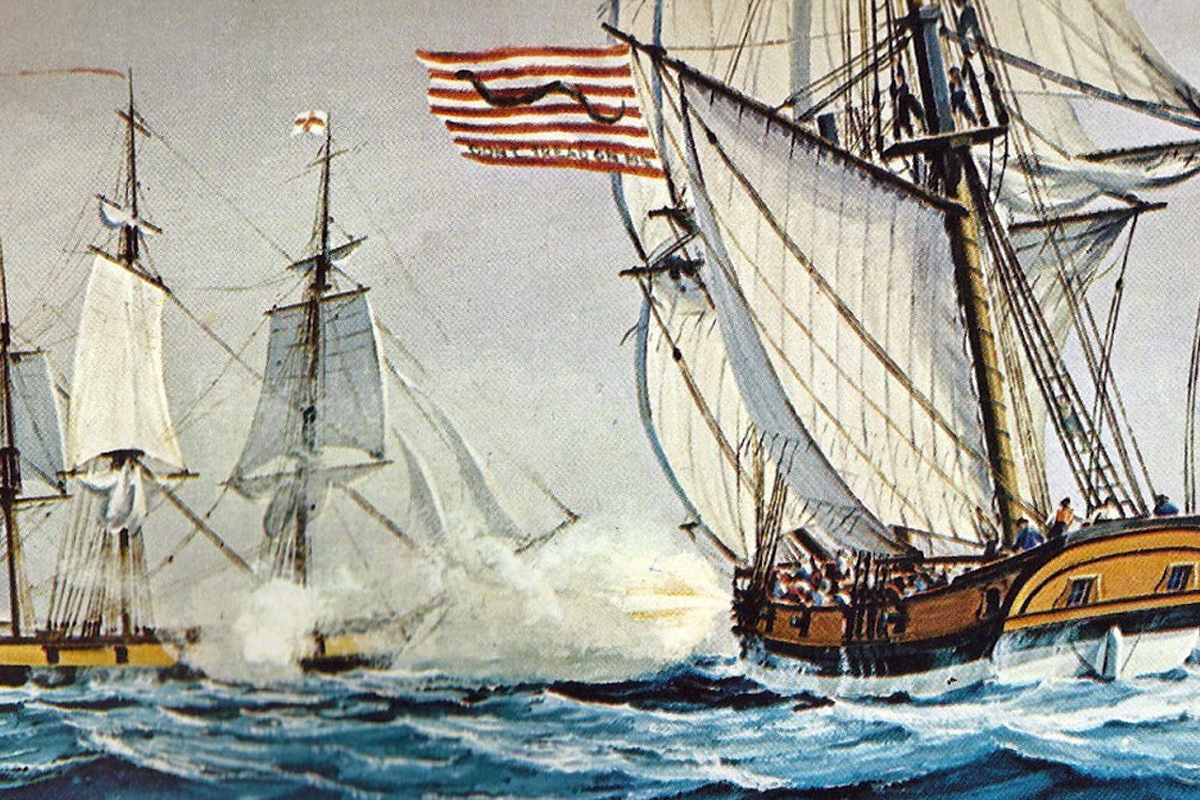
‘Rebels at Sea’: How Privateers Helped Win American Independence

Privateers have been much maligned in history, so much so that perhaps you didn’t realize their important role in gaining America its independence from Great Britain.

If your first image of a privateer is a sinister, blood-thirsty madman with a knife in his teeth and a skull on his sails, you’re probably thinking of a culturally exaggerated version of a pirate.

But if your next image of a privateer is a tanned and tattooed sailor with a sword and a ship full of stolen treasure — well, now you’re getting closer to the reality of a privateer’s life.

REBELS AT SEA
Privateering in the American Revolution
Eric Jay Dolin
Liveright/WW Norton

There may be no better read for an American Revolution history lover this summer than Eric Jay Dolin‘s latest Rebel At Sea, a look at the forgotten role of the privateer during America’s battle for independence.

Because of their similarity with pirates — criminals who scoured the sea to pillage for personal and malevolent gain — privateers are often ignored in the annals of history, especially in events that have been heavily sanitized of uncomfortable truths like the American Revolution.

As Dolin reveals, privateers were a bit like a shadow navy; indeed they existed in the colonies before there was an actual American naval force.

What set them apart was an authorized letter of marque, a license from the government to capture vessels from enemy nations and take their possessions. The haul would then be sold and, generally speaking, split between the crew and the letter’s issuer.

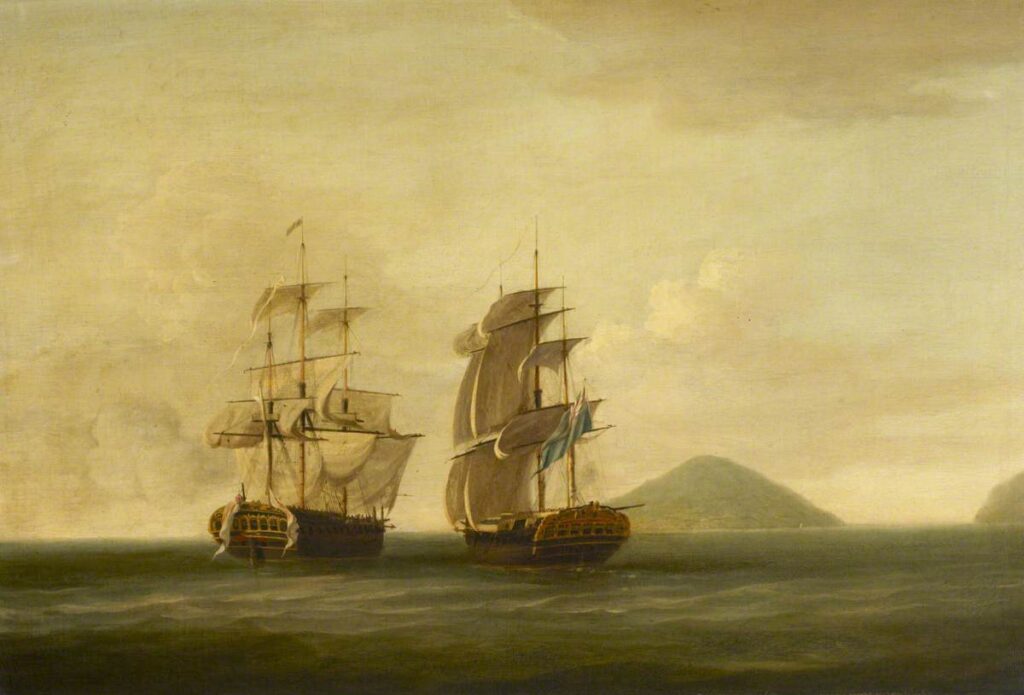
Dominic Serres; HMS ‘Pearl’ Capturing the ‘Esperance’, 30 September 1780; National Maritime Museum

At first a tool for defense by individual colonies, the American Congress soon passed a resolution employing privateers — months before the signing of the Declaration of Independence. “Privateers were free to capture any British vessel,” Dolan writes, “not just those that were delivering supplies to British forces in America. (Later, neutral ships carrying good bound for British use were also deemed acceptable targets).”

Revolutionaries like John Adams were enthusiastic proponents of privateering. “Thousands of schemes for privateering are afloat in American imaginations,” he wrote his wife Abigail. “Out of these speculations many fruitless and some profitable projects will grow.”

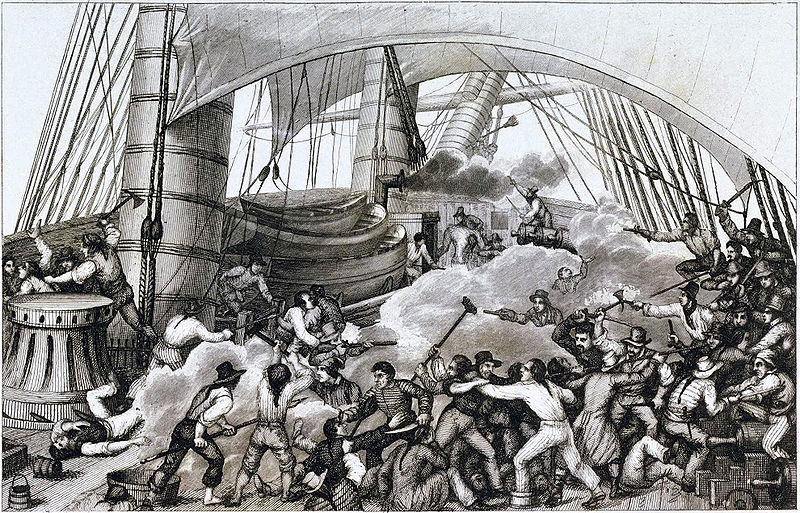
“Boarding of Triton by the privateer Hasard (ex British pilot ship Cartier), captained by Robert Surcouf” (by Ambroise Louis Garneray, 1783–1857)

Dolin describes the life of the average privateer as far less glamorous than that which we might normally prescribe a swashbuckler. Rebels at Sea does highlight some of the privateering triumphs of the Revolution — from John Greenwood, a young privateer who later became George Washington’s dentist, to the many privateering whaleboats.

In a dark local angle, British-occupied New York launched their own counter privateering vessels “with the most fervor and success” and thousands of captured American privateers were imprisoned in the loathesome holds of Wallabout Bay prison ships.

There are men whose sacrifices should also be remembered during Independence Day celebrations this year. And Dolan’s Rebels at Sea presents a great introduction to this hidden corner of American history

Categories
Bowery Boys Movie Club

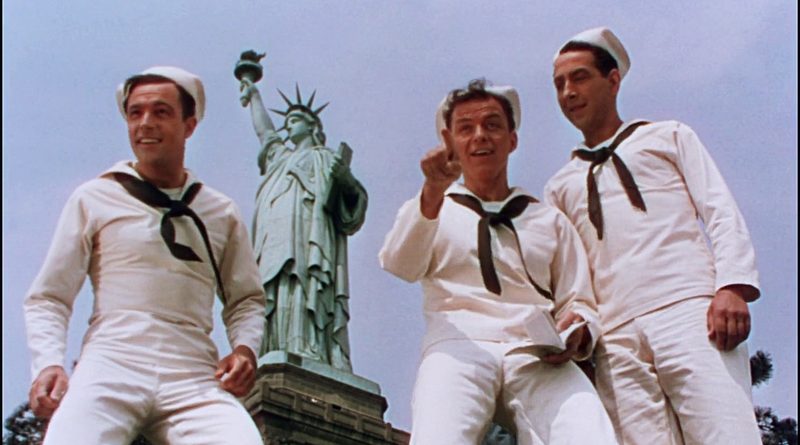
On The Town: Three sailors on a New York escapade in the latest Bowery Boys Movie Club

Join the Bowery Boys Movie Club! Support us on Patreon at any level and get these Patreon-exclusive, full-length and ad-free podcast. Each month we talk about one classic (or cult-classic) film that says something interesting about New York City.

In the new Bowery Boys Movie Club, Tom and Greg disembark at the Brooklyn Navy Yard and spend a breathless 24 hours in New York City — with Gene Kelly, Ann MillerVera-Ellen and Frank Sinatra.

On The Town, with lyrics by Betty Comden and Adolph Green and (some) music by Leonard Bernstein,puts a fairytale spin on post-War 1940s New York City as it follows three sailors on a big-city adventure — knocking down dinosaurs, finding love, singing their hearts out. This screen musical classic mixes both studio and on-location film shoots, offering extraordinary views of Times SquareRockefeller Center and Coney Island

On The Town is not simply a movie about New York City, but about being a tourist in New York City. And musical lovers! You will especially appreciate Tom’s deep dive into the lyrics of songs like “Come Back To My House,” chock-full of references from New York City’s past.

Listen in as Greg and Tom set up the film’s backstory — highlighting the many changes made in the transition from stage to screen — then give a joyful spoiler-filled synopsis through the film’s breezy story. (Not every aspect of this film ages well!)

Should you watch the movie before you listen to this episode? This podcast can be enjoyed both by those who have seen the film and those who’ve never even heard of it.  

We think our take on On The Town might inspire you to look for the film’s many fascinating (but easy to overlook) historical details, so if you don’t mind being spoiled on the plot, give it a listen first, then watch the movie! Otherwise come back to the show after you’ve watched it. 

The film is available on iTunes, Amazon, among other streaming services.

To get the episode, simply head to Patreon and sign up to support the Bowery Boys podcast at any level.

Categories
Bowery Boys Bookshelf Revolutionary History

The Ghost Ship of Brooklyn: Uncovering New York’s darkest secrets of the Revolutionary War

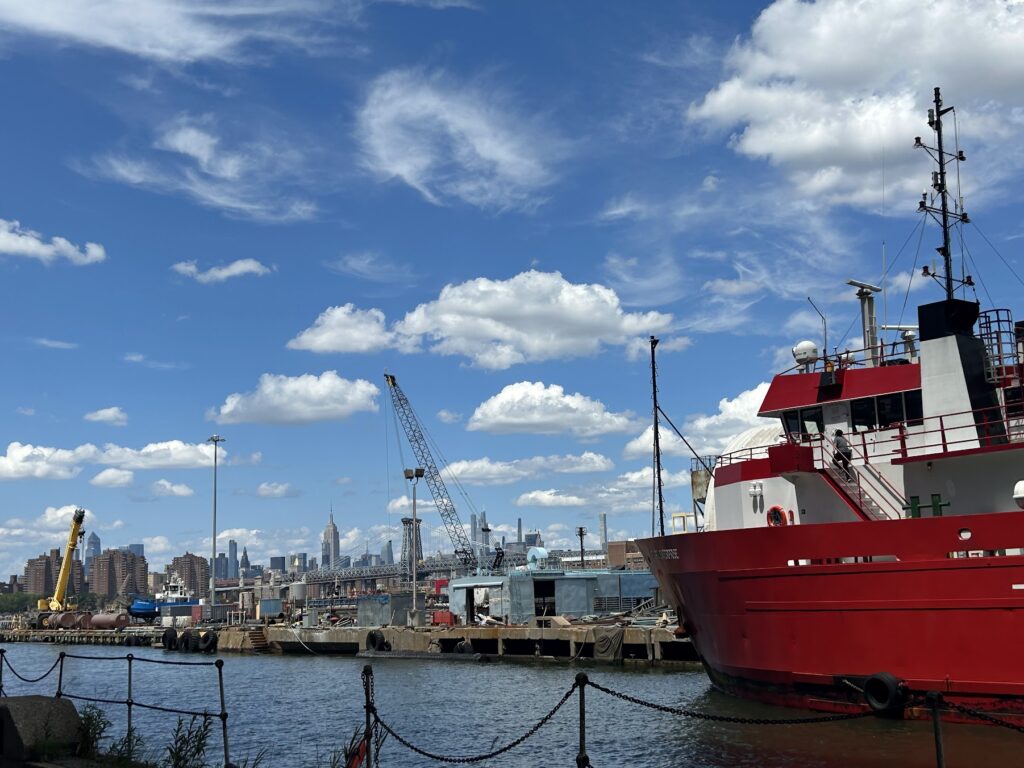
The Brooklyn Navy Yard, no longer a bustling shipyard, lives on as a vibrant commercial compound of movie studios, bourbon distilleries and organic rooftop farms. Its waterfront, facing into Wallabout Bay, is relatively peaceful today. There are no remnants of its genuinely disturbing past.

During the Revolutionary War, New York was a British stronghold, and prisoners associated with George Washington and the Continental Army were often sent here for detainment. Soon the city’s make-shift prisons — sugar houses turned into decrepit jails — became too crowded, and the British needed to look for alternatives.

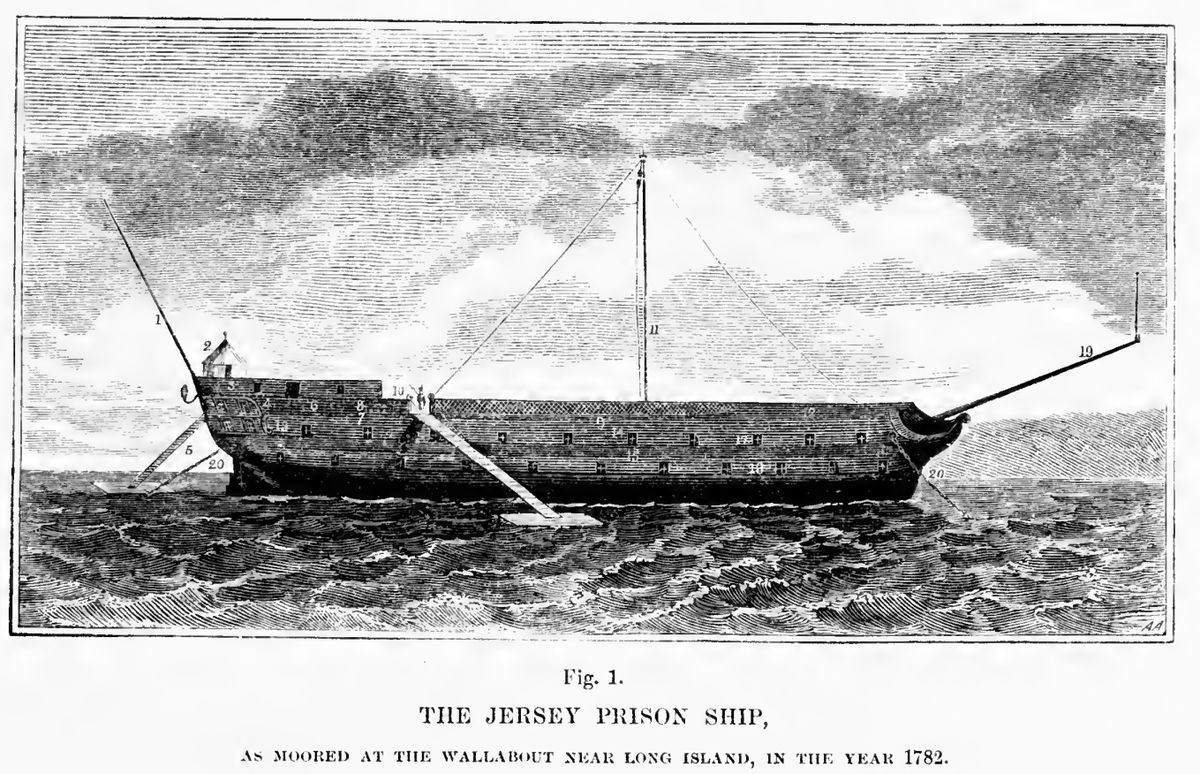
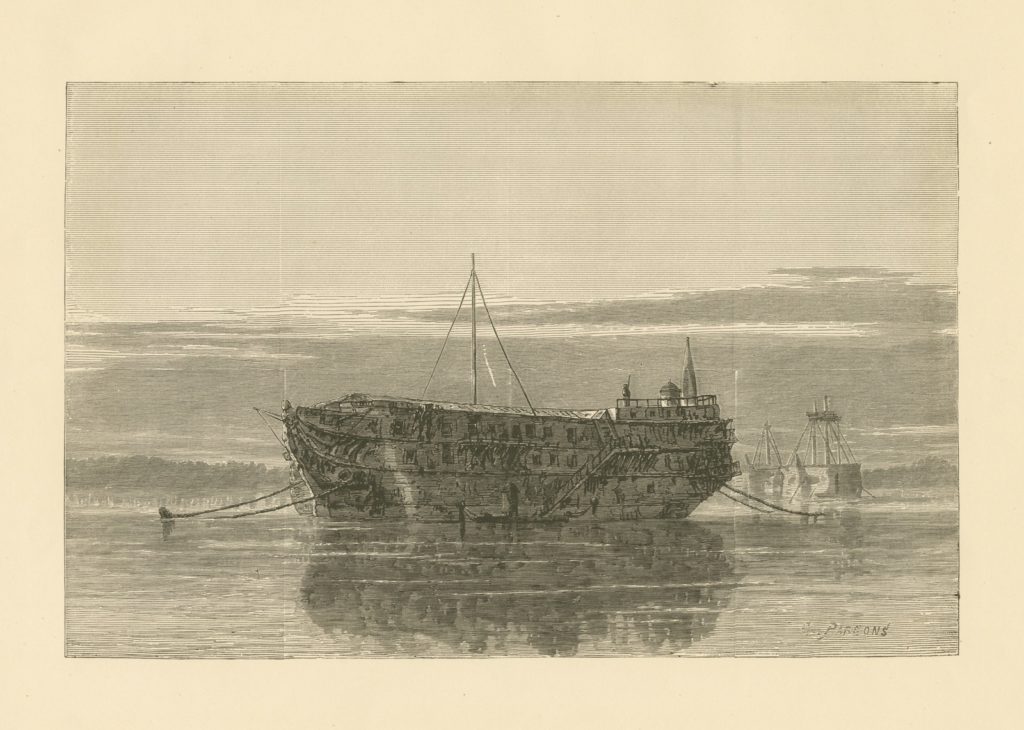
The answer arrived in the form of old naval vessels, previously used to transport supplies, that were moored off the coast of Brooklyn and turned into prison ships. For the duration of the war, hundreds of men and boys were thrown onto these wretched ships, forced to endure a litany of conditions so brutal and dire that they seem like tortures designed for a modern horror film.

And the worst of all of these was the HMS Jersey.

THE GHOST SHIP OF BROOKLYN
An Untold Story of the American Revolution
by Robert P. Watson
Da Capo Press

In Robert P. Watson‘s sharp and incisive new book, the author isolates the grim tale of the prison ships, often deemed a footnote in most Revolutionary War histories, from the actions of the conflict at large. It’s vividly narrow in scope, allowing the reader to experience the ship’s macabre trials in a sort of narrative entrapment. The prisoners themselves experienced the Jersey in such a way, trapped below deck with only the fleeting glimpse of New York across the water. For the damned, Wallabout Bay became an inescapable hell.

Watson weaves several first-hand accounts into the narrative, the tales of the lucky few who managed to escape. There’s a dash of Robert Louis Stevenson in the stories, plights regularly associated with swashbuckling tales of pirates. Except these horrid events took place just meters from the Brooklyn shoreline.

In fact, most prisoners who perished aboard the ship were buried on that shoreline, placed into the shallow ground by fellow prisoners, volunteering for burial duty as a way to say a final goodbye. Many days later, those bodies would be caught in the tide to eventually float out into the river.

But perhaps like a good swashbuckler, Ghost Ship of Brooklyn showcases several stories of impossible survival, daring prison breaks and even a couple surprising rescues. For every grim statistic, there’s a moment of desperate bravery. One of the most inspiring feats comes from the recollections of prisoner Thomas Dring who, seeing men around him dying of smallpox, decides to self-inoculate himself and others.

Several men managed to flee the death holds of the Jersey to later recount these thrilling escapes in memoirs. They were the lucky ones; according to reports of the day, 11,500 people died aboard the Jersey. As Watson notes, “over twice as many Americans were lost on that single, cursed than died in combat during the entirety of the long war!”

NYPL from Booth’s History of New York

(Today the city honors those who died in the bay with Prison Ship Martyr’s Monument, the central feature of Fort Greene Park.)

Categories
Mysterious Stories Podcasts

Haunted Hipsters: Four Ghost Stories of Brooklyn

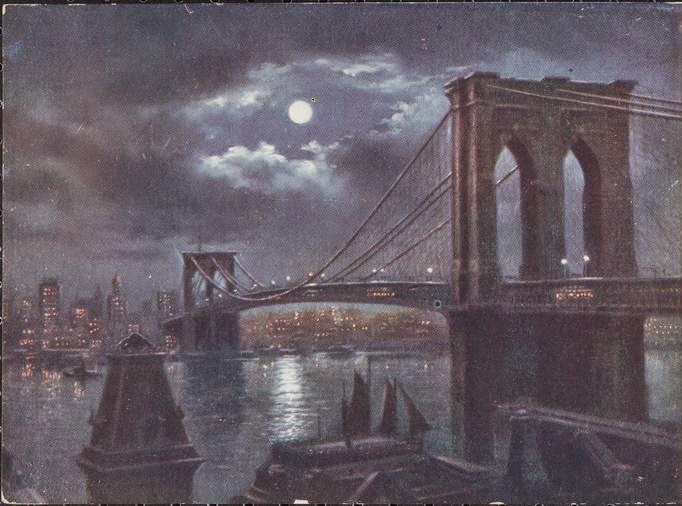
Dark skies over the Brooklyn Bridge, from a 1905 postcard (courtesy MCNY)

PODCAST  Brooklyn is the setting for this quartet of classic ghost stories, all set before the independent city was an official borough of New York City.  This is a Brooklyn of old stately mansions and farms, with railroad tracks laid through forests and large tracks of land carved up, awaiting development.  These stories also have another curious resemblance — they all come from local newspapers of the day, reporting on ghost stories with amusement and more than a little skepticism.

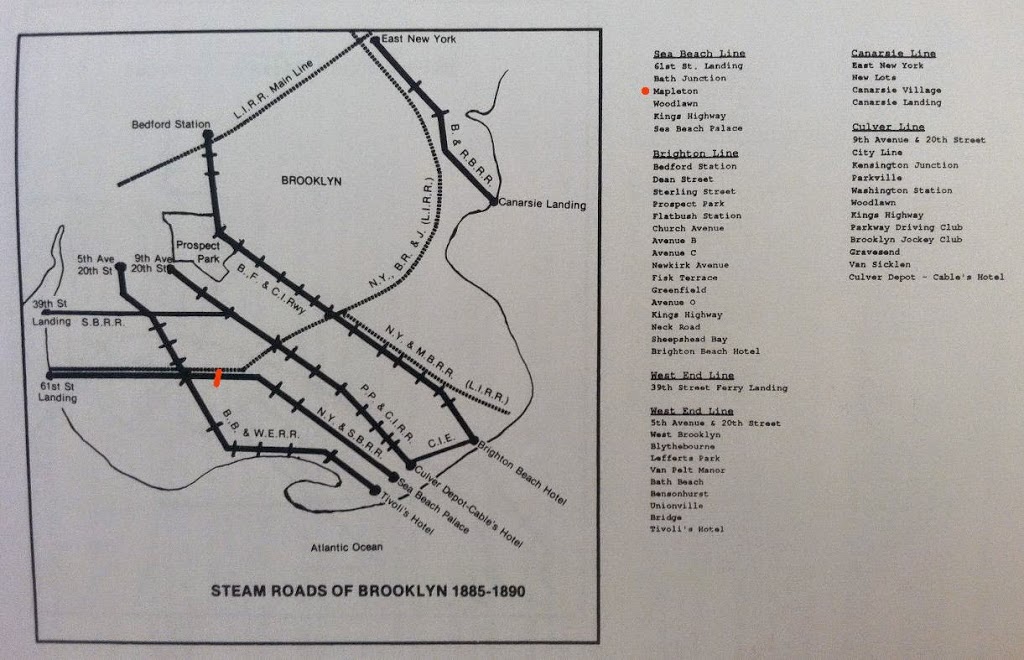
1)  The Coney Island and Sea Beach Railroad took passengers to and from Brooklyn’s amusement district.  But nobody was particularly amused one evening to be stopped by a horrific, gangly ghost upon the tracks near Mapleton.

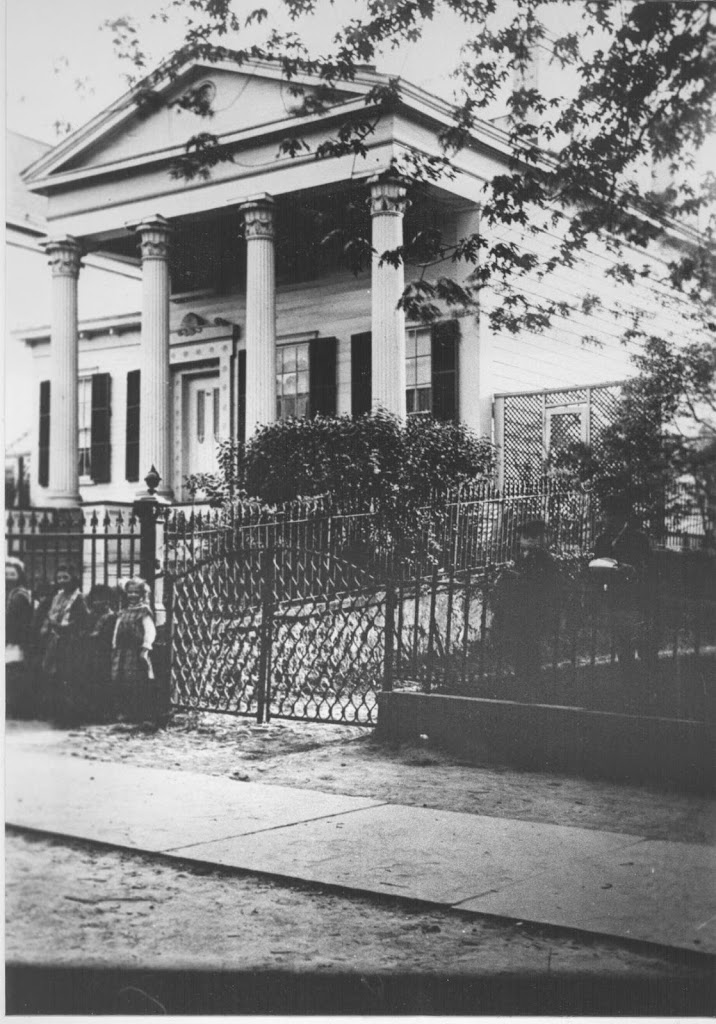
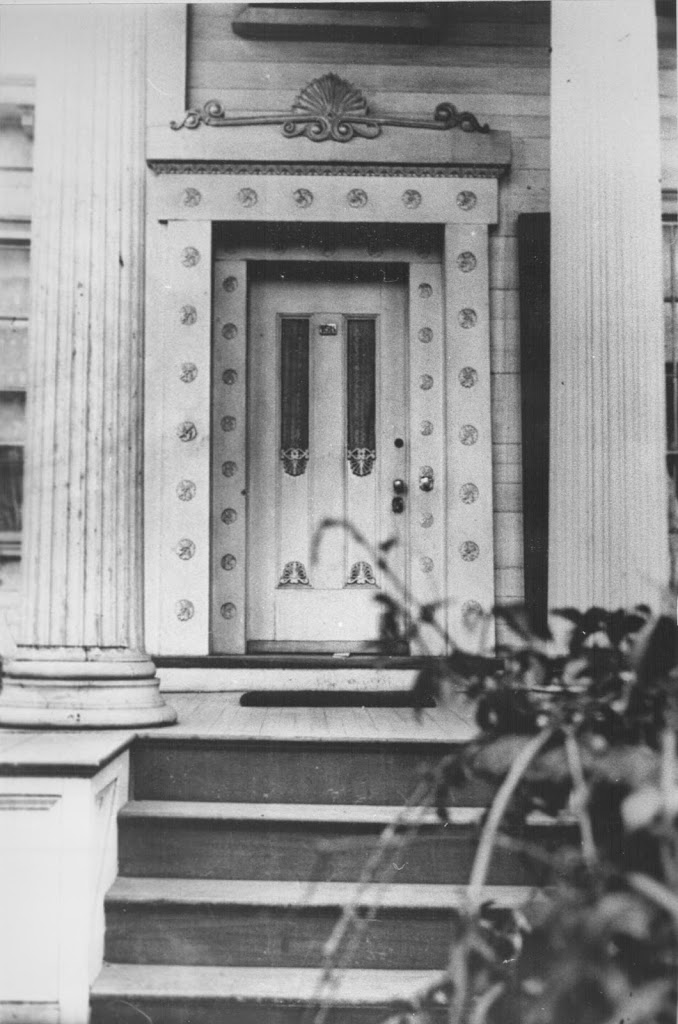
2)  In Clinton Hill, a plantation-style house built in the early years of the Brooklyn Navy Yard has survived hundreds of unusual tenants over the years, but certainly the scariest days in this historic home occurred in 1878 with a relentless, invisible hand that would not stop knocking.

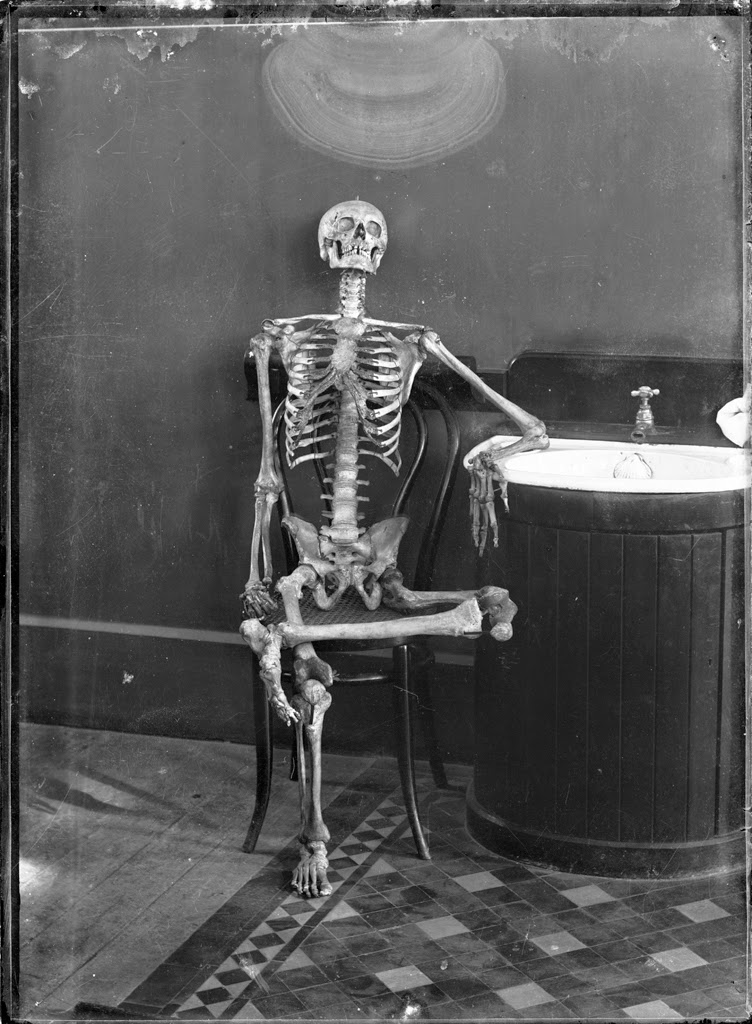
At right: Death will not deter this Brooklynite from ordering a great craft beer. (courtesy Powerhouse Museum)

3)  The Oceanic Hotel was one of Coney Island’s first great hotels, an accommodation for almost 500 near the increasingly popular beaches of Brighton Beach.  But in 1894, the hotel was virtually emptied out and reportedly haunted.  Did it have something to do with the murder upstairs in Room 30?

4) And finally, the area of Bushwick nearest the Queens border are populated with various burial grounds like the Evergreens Cemetery, borne of the rural cemetery movement which transplanted thousands of previously buried bodies from Manhattan to Brooklyn.

In 1894, with Bushwick prepared for a spate of new development, the sudden appearance of an oddly dressed spirit threatens to disrupt the entire neighborhood.  During one evening, a drunken party of 300 ghost hunters, brandishing swords and revolvers, come across one terror that proved to be very real indeed.

ALSO: Secrets of The Sentinel, a 1977 horror film set in an old house along the Brooklyn Promenade.


10 Montague Terrace, setting for the 1970s horror film The Sentinel, sits at the end of this elegant block on the Brooklyn Promenade.

[Looking west from Brooklyn Bridge Park to the houses on Montague Terrace.]

The theatrical trailer to The Sentinel

1) MIDNIGHT TRAIN TO TERROR
Phenomena reported August 1894 in several publications, including the New York Evening World

The incident in question occurred near the Mapleton station along the Coney Island and Sea Beach Railroad (Map of Brooklyn railroad lines courtesy The Weekly Nabe who has more information on the early days of Mapleton.)


2) WHO’S KNOCKING AT MY DOOR?
Phenomena reported December 1878 in several publications, including the New York Sun
 
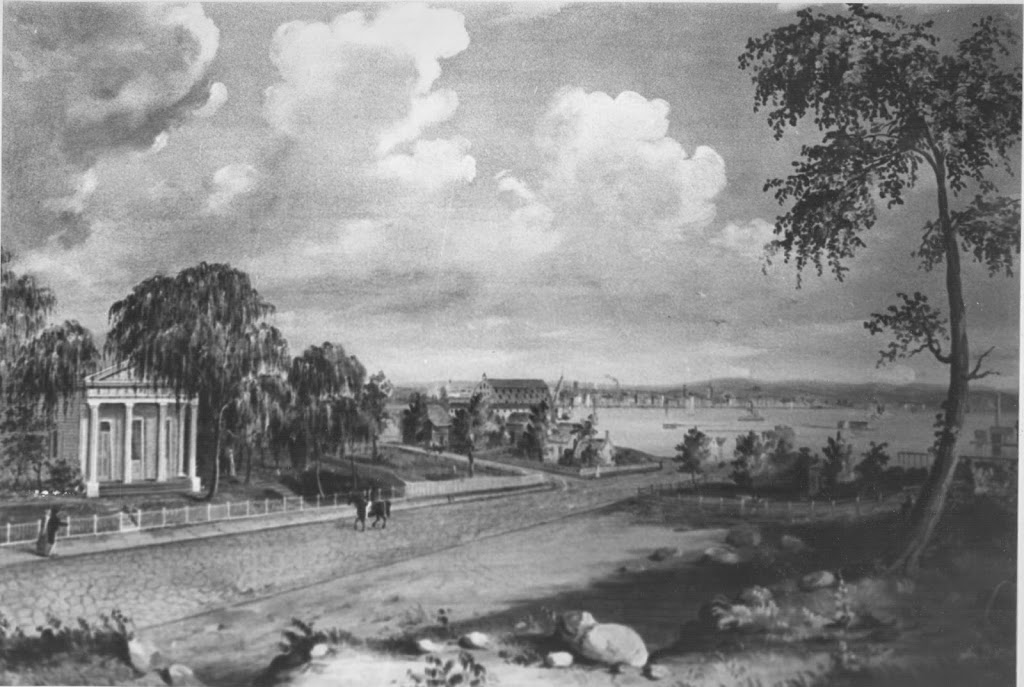
A view of Wallabout Bay and the land which became the Brooklyn Navy Yard, circa 1830s.  That would appear to 136 Clinton Avenue (the oldest house in the area) however the general proportion of the region looks a bit off.  Below it, two pictures of the house on Clinton Avenue, including a close-up of the infamous door. (Pics courtesy Flickr/sjcny and Long Island Historical Society)


3) THE GHOSTLY GUEST IN ROOM 30
Phenomena reported August 1892 in several publications, including the Brooklyn Daily Eagle

The haunted Oceanic Hotel, located at Neptune Avenue and W. 6th Street. Perhaps this looks surprising for a 500-room hotel, but out of frame are bungalows and other adjoined buildings.  But you can see how this sort of accommodation went out of fashion rather quickly.

[First hotel at Coney Island, Oceanic Hotel.]
http://timesmachine.nytimes.com/timesmachine/1930/07/01/98307449.html?pageNumber=18

4) THE GHOST OF KNICKERBOCKER AVENUE
Phenomena reported November 1894 in several publications, including the New York Times

1924 — A view of the tracks which separate Bushwick from a cluster of cemeteries. Buildings to the left sit in the vacant lots which were mentioned in this story.  The cemetery nearest this photograph is Most Holy Trinity Cemetery.  You may remember the name Most Holy Trinity for it was this Bushwick congregation that was featured in a ghost story a couple years ago in the show ‘Haunted Histories of New York.’

Opposite Trinity Cemetery.


Categories
Newspapers and Newsies

Before ‘Newsies’: The Brooklyn Newsboys Strike of 1886

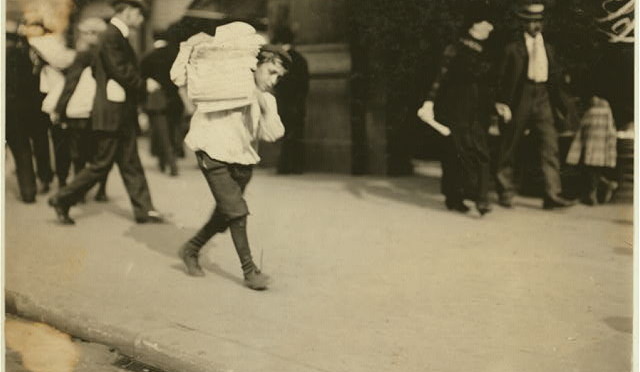
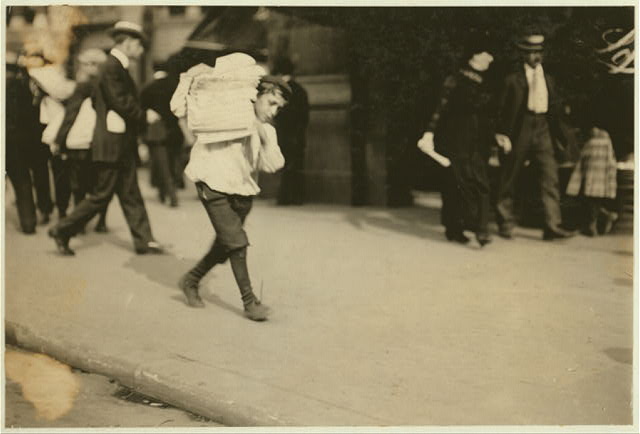
The grueling life of a Brooklyn newsboy, taken by Lewis Hine, 1910 (Library of Congress)

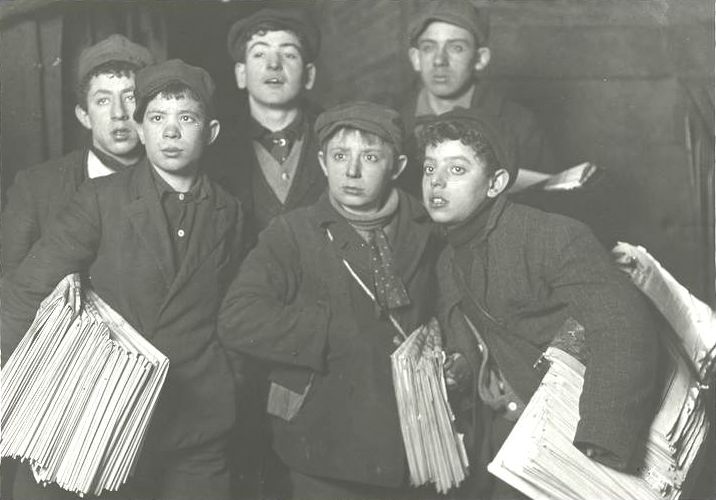
The new Disney-produced Broadway musical ‘Newsies‘ puts melody to the events surrounding the Newsboys Strike of 1899. For one week that summer, young newspaper sellers fought back against their employers’ unfair pricing schemes, turning their former street corners into places of mass protest. [You can hear all about in our 2010 podcast on The Newsboys Strike of 1899.]

But did the producers of the Broadway show realize they’re opening their new musical on the anniversary of another significant strike?

The organized disobedience of 1899 was only the grandest of New York’s newsboy strikes. Despite their youth and inexperience, newsies fought back on several occasions throughout the late 19th century. While the image of the street-smart, scrappy whelp was a stereotype often relayed by the newspapers themselves, in some cases, journalism’s youngest workforce used its hot-blooded pluck to great advantage.

With the growth of New York after the 1850s came a fierce competition among its many dozens of newspapers, leading to lamentable and unfair business practices aimed at those who actually sold their product. After all, selling newspapers was a grueling job with low financial reward. Adults looked elsewhere for higher paying work, so in the era before substantial child labor laws,  newspapers often employed younger New Yorkers, mostly boys. And children, cynical publishers believed, were a pliable workforce.

The independence the job required initially appeared to discourage any kind of organization, and newspapers felt they could systematically underpay their ‘freelance’ sellers, often pitting groups of newsboys against each other. A newspaper across the East River, in the pre-consolidation city of Brooklyn, made just such a mistake in March of 1886.

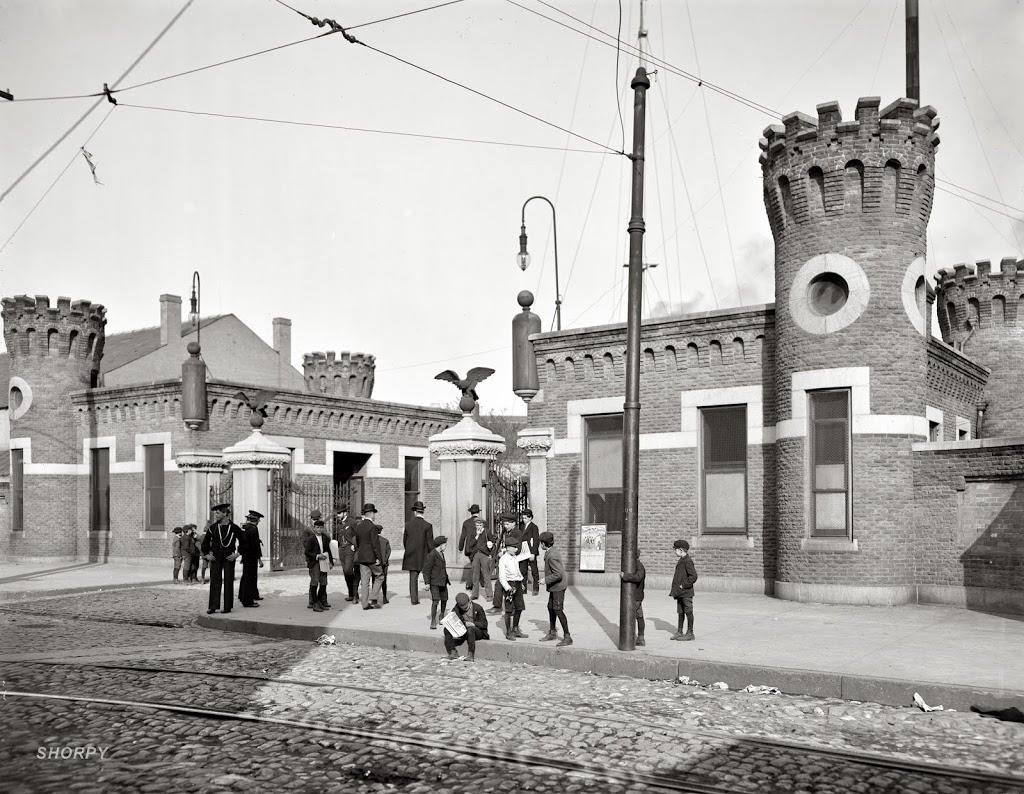
Above: Determined Brooklyn newsies hang around the Brooklyn Navy Yard (at Sands Street) looking for potential buyers. 1903 Picture courtesy Shorpy 

Brooklyn Takes Sides
The Brooklyn Times employed newsboys all throughout the city of Brooklyn, a fast expanding metropolis by the mid-1800s. Originally just the area we consider Brooklyn Heights and the Fulton Ferry, the burgeoning city grew to absorb many Long Island towns along the bay. In 1854, it also expanded to include the independent city of Williamsburgh (today’s neighborhood drops the -h) and Bushwick. These new additions were often referred to as the Eastern District.

However, the city of Brooklyn had a good deal more expansion ahead of it and would eventually swell to include many towns south and southeast of its original borders, an area referred to back then as the Western District, including areas like Bay Ridge, Red Hook, and many others. (This is a tad confusing today as many of these areas were later called South Brooklyn; the Eastern/Western distinction makes sense of you orient it with ‘true north’.)

In an effort to expand sales into the newer regions of Brooklyn, the Times made a unique deal to Western District newsboys. They would receive stacks of newspapers at a lower cost (one cent per paper) than those sold to Eastern District newsboys (one-and-a-fifth cent per paper). The Times publishers believed this would boost sales by encouraging the Western District newsies to “push sales vigorously in new directions.”

Above: Newsies gathered near the Brooklyn Bridge. Courtesy NYPL

Riot on South Eighth Street!
Oh, but when the Eastern District newsboys found this out the following day! On March 29th, according to a report by the Brooklyn Daily Eagle, a hundred newsboys, armed with sticks and stones, stormed the Times distribution offices at South Eighth Street and tried to prevent two wagons of newspapers from heading to the Western District. A whip-wielding wagon driver and arriving police officers thwarted the boys, but one of the trucks was later overturned at the area around today’s Brooklyn Navy Yard.

Many Williamsburg newsies refused to sell the Times, even defying orders of older, more compliant newsboys. Wagons filled with papers were continually attacked on their way south. Any regular newsboy caught selling the Times was set upon by other boys, often roving bands “backed by a number of roughs.” The Daily Eagle reports of some young newsies hiding newspapers in their jackets, selling them to customers in secret, for fear of reprisal.

The Brooklyn newsboy strike lasted for a couple days. Like the later newsboys strike of 1899, the key to success came from adult newspaper sellers at regular newsstands. Once a few of them joined the boycott, the Times agreed to lower their wholesale cost to just one cent per paper for newsboys in both areas of Brooklyn.

By April 1, 1886, newsies returned to their street corners, their hands stained with the ink of the Times and glowing with the satisfaction that their efforts might reward them with a little extra money that day.

SIDE NOTE: It’s probably a good guess to say that many of these young workers lived at the Brooklyn Newsboys Lodging House at 61 Poplar Street, which opened its doors in 1884, one year before the opening of the Brooklyn Bridge.

Museum mania: the refurbished New York Historical Society, and a stunning debut at the Brooklyn Navy Yard

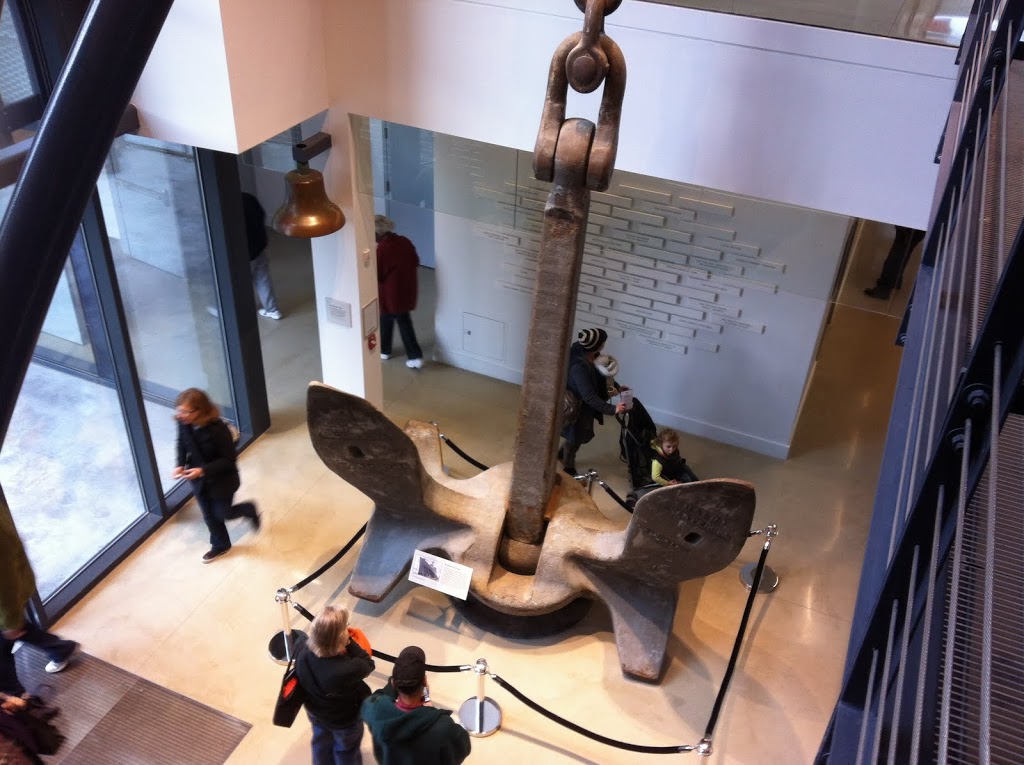
Anchors Aweigh: A museum finally opens in one of Brooklyn’s most restricted outposts

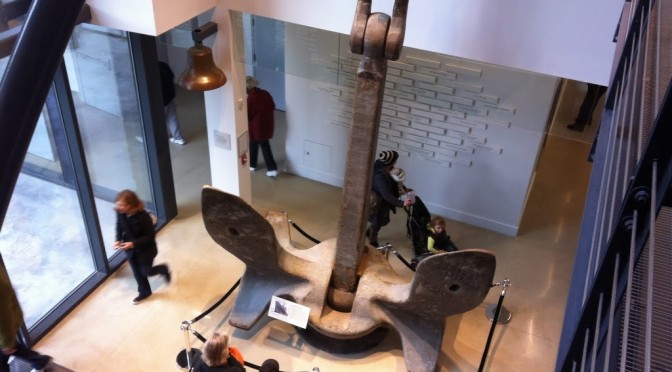
The Brooklyn Navy Yard finally got the museum it deserves this past weekend with the opening of BLDG 92: Brooklyn Navy Yard Center, a badly needed introduction to this long-restricted yet important component of New York history.

The environmentally-friendly new center is affixed to the 1858 Marine Commandant’s residence in one of the city’s better old-new hybrids, and visitors are constantly and playfully reminded of the building’s forward-thinking approach. (Bathrooms supplied with rainwater!) But it’s the history of the Navy Yard — within the context of Brooklyn’s own history — that’s the main attraction here.

The first floor provides an exhaustive but well-spun timeline, weaving the Navy Yard’s beginnings into the context of America’s own naval history. On opening weekend, there was a sailor and a Rosie the Riveter-type on hand, and even they seemed delighted to play around with the interactive consoles. The second floor further describes the day-to-day workings, with kooky artifacts (old whiskey bottles!) and curious trivia (the Yard was once overrun with cats!) mounted to the walls.

On the third floor is a display on the Navy Yard in wartime, its closure in the 1960s and its transformation into an enclosed industrial park. While I hardly found its first-floor displays of modern products produced at the Yard to be awe inspiring, it’s balanced by a moving, even disquieting display of photography on the third floor. The show ‘War Photographers’, is in memory of Tim Hetherington, the photojournalist (and co-director of the film Restrepo) killed in Libya several months ago. Both he and the gallery’s curator Christopher Anderson have a unique connection to the Navy Yards that reinforces this once mysterious place as a vital part of the city today.

Given that admission is free (I believe for the next few weeks, but possibly longer, check their website for more info), this is pretty much a must-see for history buffs and a seamless blend of displays for adults and children. Imagine what this kind of ingenuity could do for the nearby Admirals Row?!

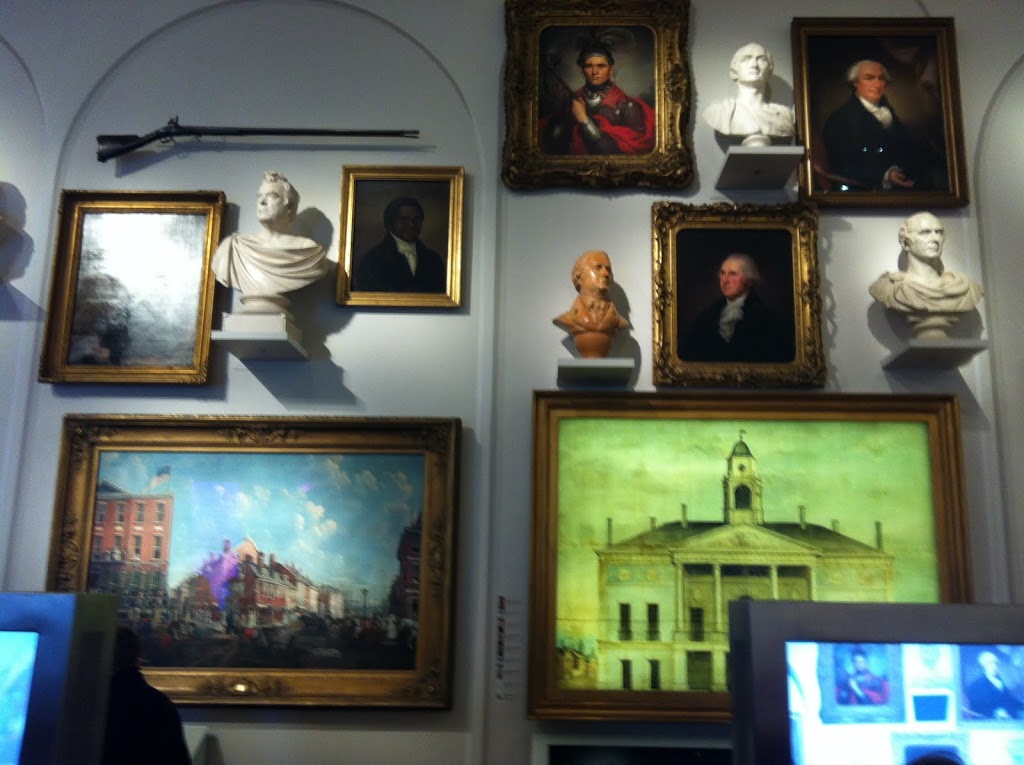
If any place needed a thorough renovation, it was the New York Historical Society. The museum, one of the city’s longest enduring cultural institutions, contains New York’s greatest treasures. Until recently, however, it’s been a tad unpleasant to enjoy many of them.

Not that the Historical Society hasn’t put on spectacular exhibits and lectures in the past. For instance, I consider Alexander Hamilton show from 2004 one of my inspirations for creating this podcast and blog in the first place. But the exhibit spaces were often stuffy with a lack of open space, with oversized exhibits twisting down corridors. The museum’s prized artifacts were often hard to find or dimly presented.

The lavish new first-floor renovation dispenses with any further obscurity. Here in plain day are all the greatest hits of the museum, boldly presented on the wall or within nooks under foot. In fact, one modern treasure — Keith Haring’s whimsical ceiling from the Pop Shop — hangs above the ticket booth. To find this just several feet from Gouverneur Morris’s wooden leg and the dueling guns of Hamilton and Aaron Burr makes for a grand and  innovative statement.

Finally, the NYHS makes a hard turn for the modern. The Robert H. Smith Auditorium now shows ‘New York Story’, whisking through New York history with lighting effects, constantly moving screens and a projection of almost IMAX-like proportions. (I was genuinely surprised we didn’t get those 4-D effects like rain mist and soap bubbles, but then that would ruin the fancy new auditorium seating.)

A new ‘sculpture court’ showcases a spectacular rarity (a Revolutionary-War era Torah) while the children’s museum downstairs has been heavily revised and seems a genuinely fun experience. A scarlet-hued first-floor gallery presents the NYHS’s greatest paintings more accessibly than before.  Upstairs are three new exhibitions, and of course, still on the fourth is the quirky, oddly charming Henry Luce III Center for the Study of American Culture, essentially the most meticulously arranged attic in the city.

For more information visit their website: New York Historical Society. The museum is open until 8pm on Friday nights and now you can dine at a Stephen Starr restaurant there, Caffe Storico.

A meteorite’s biggest enemy? Crazy boys with jackknives.


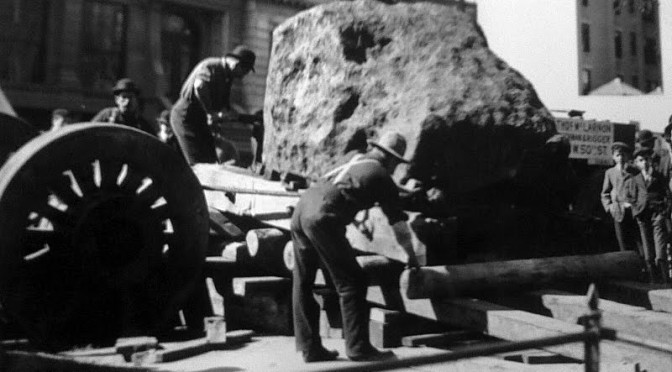
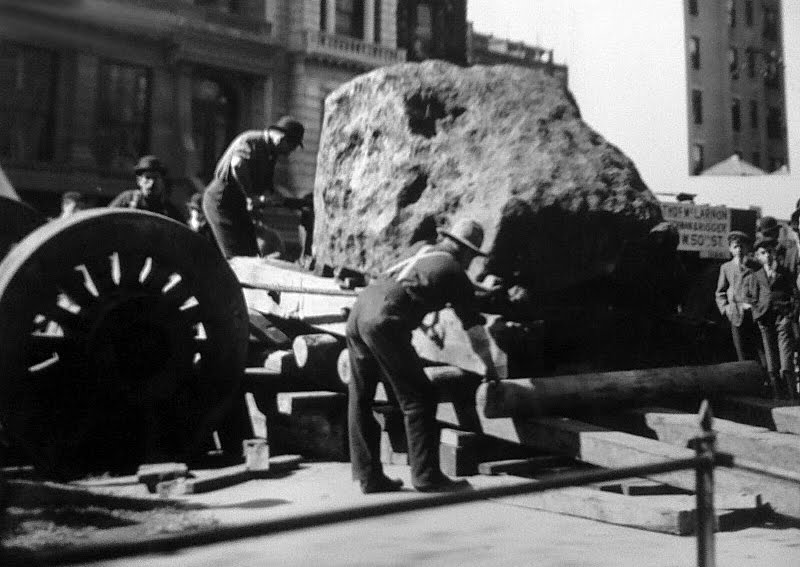
Rock of ages: The meteorite is lifted off its wagon for removal into the American Museum of Natural History. I wonder if those ragamuffins to the right in the photograph have their jackknives ready? (Pic courtesy JFGryphon/Flickr)

As mentioned in last week’s podcast, one of the great treasures of the American Museum of Natural History is the Cape York meteorite — in fact, three separate pieces, the largest being called Ahnighito (Inuit for ‘tent’). Explorer Robert Peary discovered the rock in Greenland and brought it back to New York (along with six unfortunate Inuit companions) in 1897.

The extremely heavy rock — at 31 metric tons — sat at the Brooklyn Navy Yards for many years before Peary’s wife sold the interstellar stone to the museum in 1904. The museum hired a wrecking company to carefully transport the meteorite through New York Harbor to a pier on West 50th Street. From there, it was lifted onto a wagon pulled painfully by 30 hard-working horses, up Eighth Avenue and Central Park West to the museum on 77th Street.

From there, however, the poor unsettled stone, far from home, received its most vicious attack. According to the Tribune: “Hardly had the truckman unhitched their horses when the heavenly body was covered with ambitious boys, all eager to dig out a piece of the metal as a souvenir. Jackknives were broken by the dozen.”

The Cape York meteorite is one of the few items displayed in the museum — may, in fact, be the only item — to appear on an international postage stamp (Greenland, 1978).

Less than a couple years later, the museum bought their second largest stone — the Williamette meteorite — from the widow of Bronx philanthropist William E Dodge.