Categories
Podcasts The Gilded Gentleman Writers and Artists

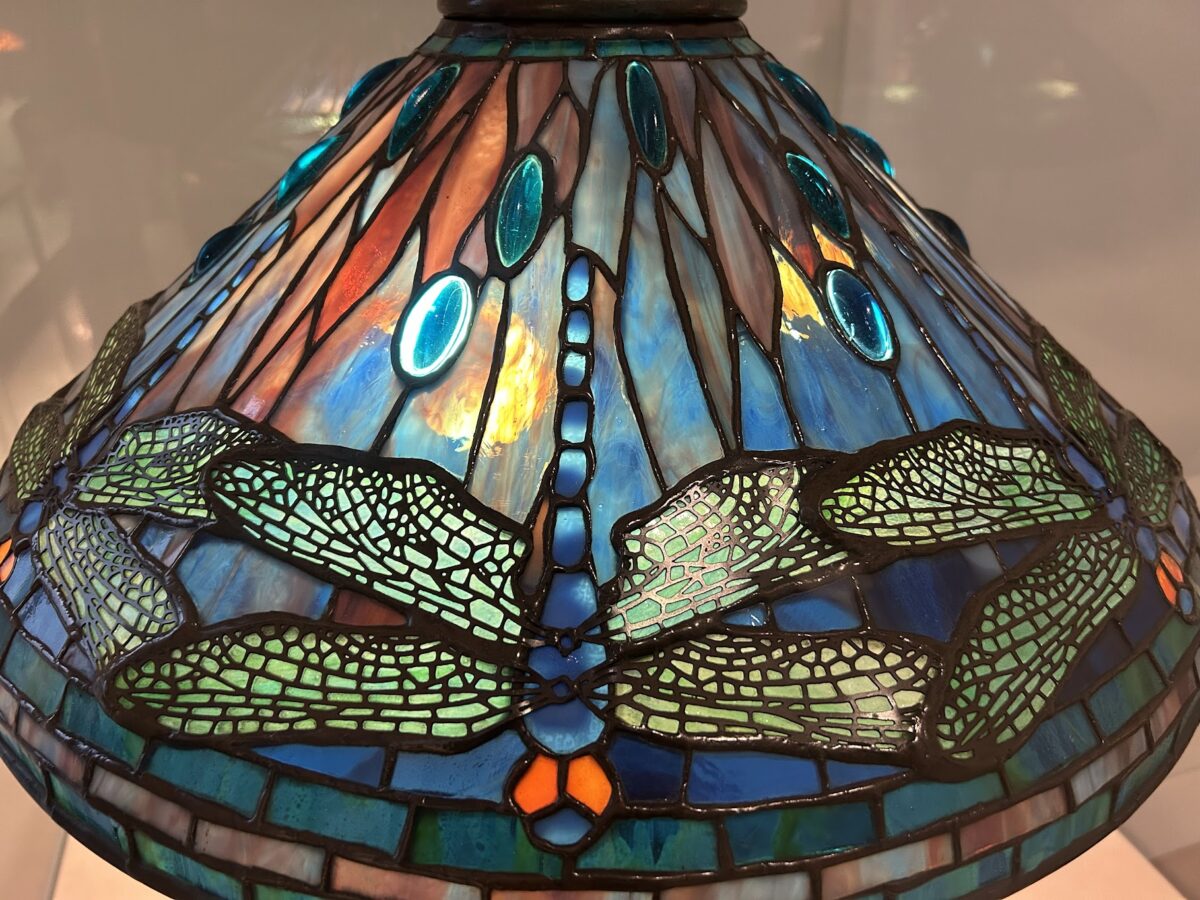
The World of Tiffany Glass: Lighting the Gilded Age

Lets start the new year with something beautiful shall we?

The latest in the Bowery Boys podcast feed — join Carl Raymond, host of The Gilded Gentleman podcast, and Lindsy Parrott of the Neustadt Collection of Tiffany Glass at the Queens Museum, as the luxury and elegant behind the name — Tiffany. 

Just the name “Tiffany” evokes the glamour and elegance of the Gilded Age. But there is much more to the story than just the eponymous retailer who continues to sell fine jewelry and decorative objects today.

In this episode, Carl is joined by Lindsy Parrott, the Executive Director of The Neustadt Collection, one of the country’s most important collections of Tiffany glass and archival materials. 

Lindsy and Cal discuss the two Tiffanys — Charles Lewis Tiffany who began the original retail silver and jewelry and his son Louis Comfort Tiffany who created revolutionary designs in stained glass. 

Notes from the podcast: (#141) New York Beer History

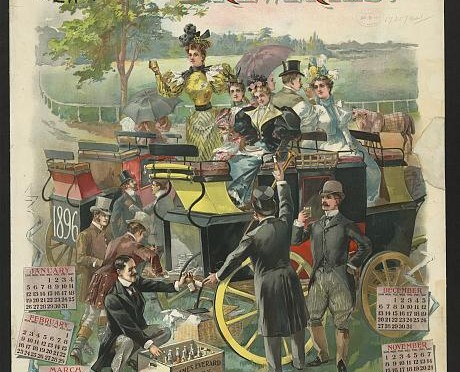
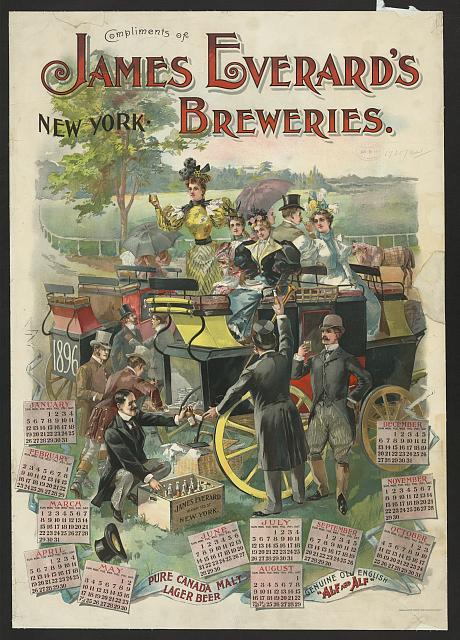
Year-Round Brews: This calendar from 1895 celebrates the Harlem breweries of James Everard. An older Everard brewery building on W. 28th Street was converted into a Turkish bathhouse in 1888. It became the location of a variety of notorious activities during the 20th century. Everard’s breweries became the plaintiff in a Prohibition-era Supreme Court case regarding the use of alcoholic beverages for medicinal purposes. (Pic courtesy the Library of Congress)

Piels:  We completely skipped one major New York brewer, one that still maintains a presence in New York, if in name only. Three German brothers opened the Piels Brewery in East New York, on the same day as the opening of the Brooklyn Bridge— May 24, 1883. They too had their own beer garden to enjoy the brews manufactured inside. Called the Summer Garden, this festive place adorned with electric lights and a shaded seating area was known for its determined wait staff.

From the Brooklyn Daily Eagle: “The waiters in the summer garden competed to see who could carry the most seidels of Piels Beer from the bar to their customers tables. In 1904 one waiter carried 16 seidels (eight in each hand).” [source]

Piels is still manufactured in Milwaukee by the Pabst Brewing Company.

Five-Borough Beer: In its heyday, you could find breweries in all five boroughs. Brewers were particularly attracted to Staten Island thanks to its spring water. In Stapleton, near the ferry piers, sat two of the largest — George Bechtel‘s brewery (which opened in 1853) and Rubsam & Hormann’s Atlantic Brewing Co.

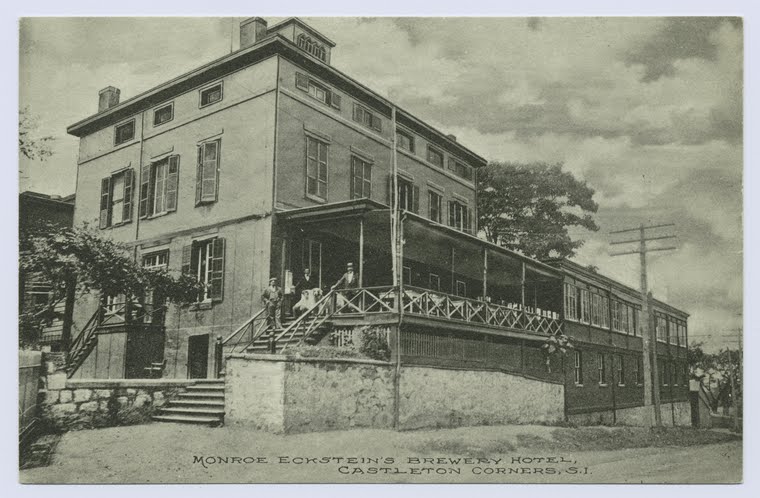
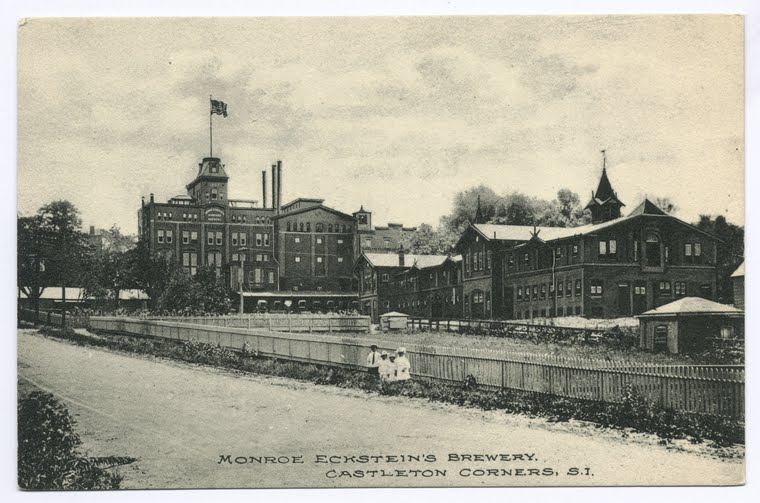
And then, of course, there’s a place we all want to stay — Monroe Echstein’s Brewery Hotel and adjoining brewery on Manor Road in Castleton Corners. (Pics courtesy NYPL)

College Point in Queens County attracted a large German population, thanks in part to rubber industrialist Conrad Poppenhausen, who set up his factories here in the 1850s. His workers and daytrippers to the region enjoyed a line of small breweries and beer gardens here. A couple decades later, Henry Steinway would set up his own factory town to the west and with it an assortment of beer gardens and even an outdoor amusement park called North Beach.

Today’s Bohemian Hall in Astoria is not far from Steinway’s factory. Read about the history of one of Queens’ oldest drinking establishments here.

For More Information: The New-York Historical Society exhibit ‘Beer Here: Brewing New York’s History is on display until September 2, 2012. I was particularly interested in the Society’s collection of ice carving equipment used by early brewers and the very cheeky collection of mid-20th century advertising and media.

For a general history on American beer, I recommend Maureen Ogle’s ‘Ambitious Brew: The Story of American Beer’ and also Gregg Smith’s ‘Beer In America: The Early Years’. And there is no shortage of History-Channel style documentaries on the subject. Also, for some general information on Bushwick, I highly recommend exploring the Bushwiki, with lots of history about the neighborhood.

There’s now a New York Beer and Brewery Tour with stops at brewers in three different boroughs. And it takes you down ‘Brewer’s Row’ after having a couple rounds of beer elsewhere. You can catch a tour of the Brooklyn Brewery of course; visit their website for more information.

Thanks again to Scott Nyerges for helping me out with this one! Please visit his website for more information on his upcoming gallery show in Bushwick. And also my thanks to the Bodega Bar in Bushwick where I was going to pull together the Bowery Boys’ very first real ‘on location’ recording at a bar. Unfortunately I was not able to work that out, but I thank them for opening their door to the show anyway.

Museum mania: the refurbished New York Historical Society, and a stunning debut at the Brooklyn Navy Yard

Anchors Aweigh: A museum finally opens in one of Brooklyn’s most restricted outposts

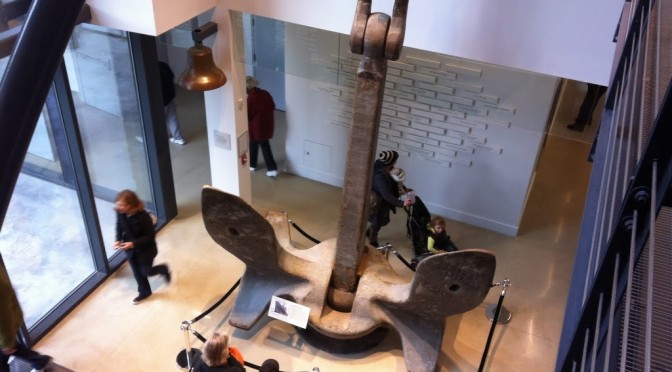
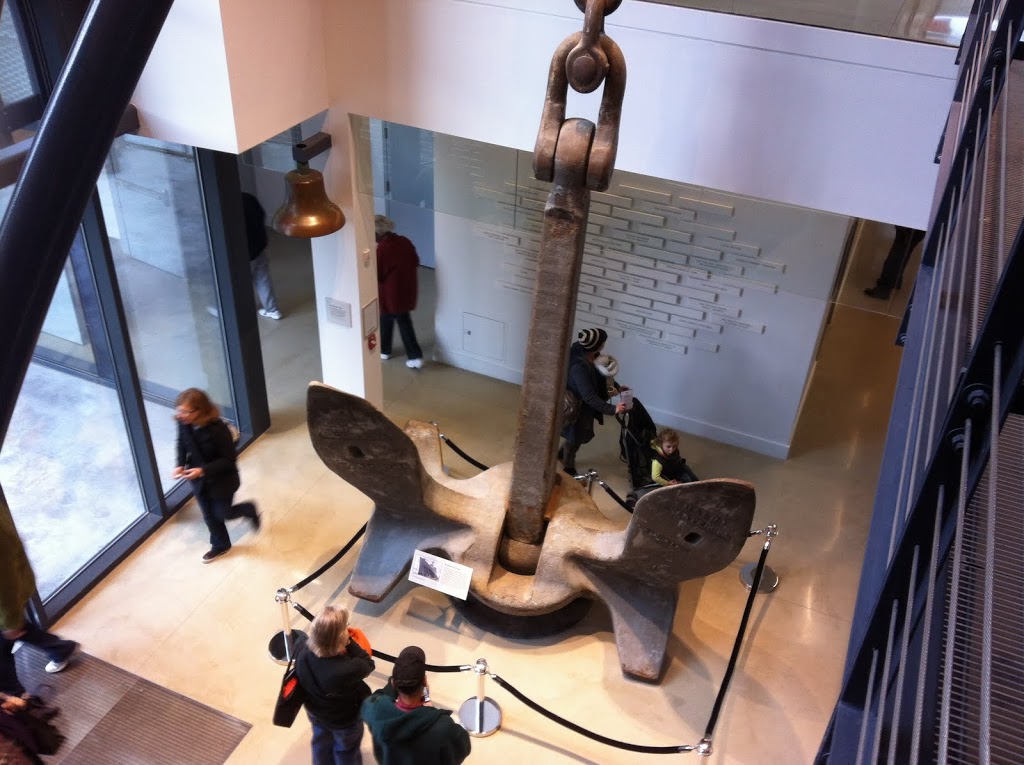
The Brooklyn Navy Yard finally got the museum it deserves this past weekend with the opening of BLDG 92: Brooklyn Navy Yard Center, a badly needed introduction to this long-restricted yet important component of New York history.

The environmentally-friendly new center is affixed to the 1858 Marine Commandant’s residence in one of the city’s better old-new hybrids, and visitors are constantly and playfully reminded of the building’s forward-thinking approach. (Bathrooms supplied with rainwater!) But it’s the history of the Navy Yard — within the context of Brooklyn’s own history — that’s the main attraction here.

The first floor provides an exhaustive but well-spun timeline, weaving the Navy Yard’s beginnings into the context of America’s own naval history. On opening weekend, there was a sailor and a Rosie the Riveter-type on hand, and even they seemed delighted to play around with the interactive consoles. The second floor further describes the day-to-day workings, with kooky artifacts (old whiskey bottles!) and curious trivia (the Yard was once overrun with cats!) mounted to the walls.

On the third floor is a display on the Navy Yard in wartime, its closure in the 1960s and its transformation into an enclosed industrial park. While I hardly found its first-floor displays of modern products produced at the Yard to be awe inspiring, it’s balanced by a moving, even disquieting display of photography on the third floor. The show ‘War Photographers’, is in memory of Tim Hetherington, the photojournalist (and co-director of the film Restrepo) killed in Libya several months ago. Both he and the gallery’s curator Christopher Anderson have a unique connection to the Navy Yards that reinforces this once mysterious place as a vital part of the city today.

Given that admission is free (I believe for the next few weeks, but possibly longer, check their website for more info), this is pretty much a must-see for history buffs and a seamless blend of displays for adults and children. Imagine what this kind of ingenuity could do for the nearby Admirals Row?!

If any place needed a thorough renovation, it was the New York Historical Society. The museum, one of the city’s longest enduring cultural institutions, contains New York’s greatest treasures. Until recently, however, it’s been a tad unpleasant to enjoy many of them.

Not that the Historical Society hasn’t put on spectacular exhibits and lectures in the past. For instance, I consider Alexander Hamilton show from 2004 one of my inspirations for creating this podcast and blog in the first place. But the exhibit spaces were often stuffy with a lack of open space, with oversized exhibits twisting down corridors. The museum’s prized artifacts were often hard to find or dimly presented.

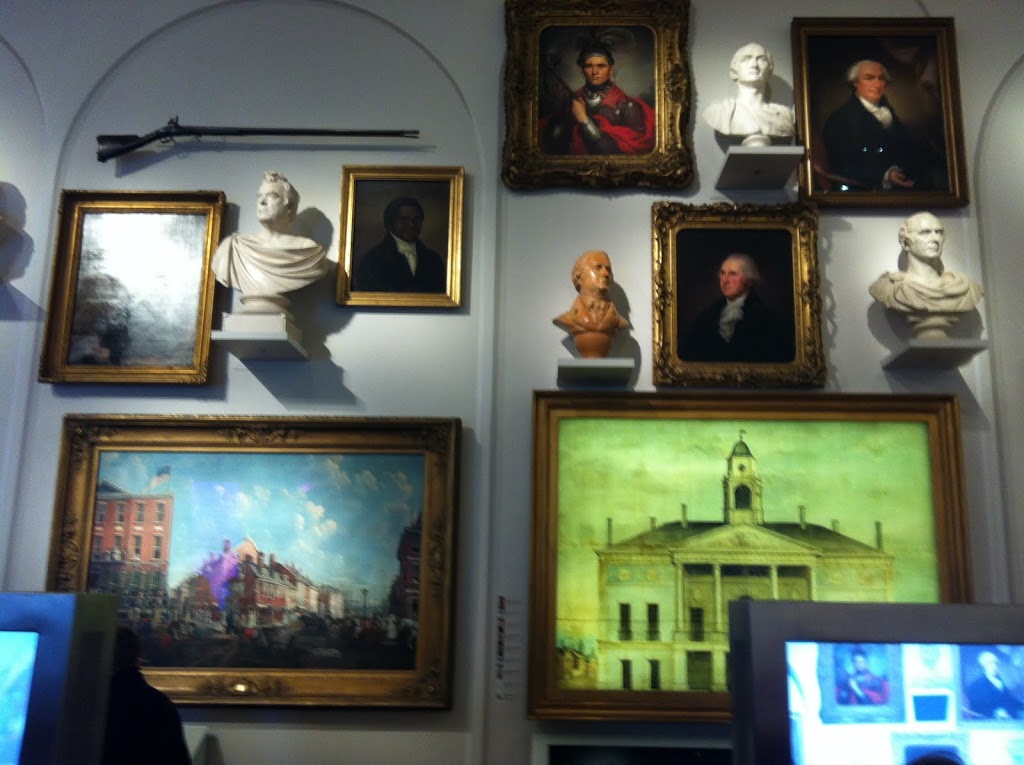
The lavish new first-floor renovation dispenses with any further obscurity. Here in plain day are all the greatest hits of the museum, boldly presented on the wall or within nooks under foot. In fact, one modern treasure — Keith Haring’s whimsical ceiling from the Pop Shop — hangs above the ticket booth. To find this just several feet from Gouverneur Morris’s wooden leg and the dueling guns of Hamilton and Aaron Burr makes for a grand and  innovative statement.

Finally, the NYHS makes a hard turn for the modern. The Robert H. Smith Auditorium now shows ‘New York Story’, whisking through New York history with lighting effects, constantly moving screens and a projection of almost IMAX-like proportions. (I was genuinely surprised we didn’t get those 4-D effects like rain mist and soap bubbles, but then that would ruin the fancy new auditorium seating.)

A new ‘sculpture court’ showcases a spectacular rarity (a Revolutionary-War era Torah) while the children’s museum downstairs has been heavily revised and seems a genuinely fun experience. A scarlet-hued first-floor gallery presents the NYHS’s greatest paintings more accessibly than before.  Upstairs are three new exhibitions, and of course, still on the fourth is the quirky, oddly charming Henry Luce III Center for the Study of American Culture, essentially the most meticulously arranged attic in the city.

For more information visit their website: New York Historical Society. The museum is open until 8pm on Friday nights and now you can dine at a Stephen Starr restaurant there, Caffe Storico.

Categories
Revolutionary History

What’s your favorite Nathan Hale death spot?


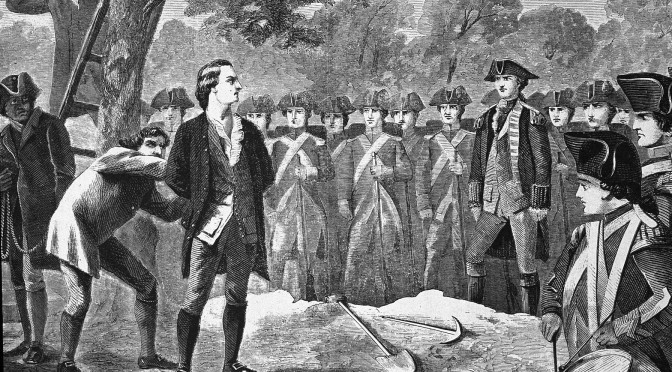
Nathan Hale was a 21 year old Connecticut native who volunteered for George Washington’s Continental Army and stayed behind in New York after the Army’s retreat in September 1776 in order to gain intelligence from the British. Hale was unfortunately caught — in Flushing Bay, Queens — brought to Manhattan and hanged, though not before delivering his elegant last words, “I only regret that I have but one life to give for my country.”

He may have had only one life, but he appears to have three separate locales in Manhattan which claim to be the spot he died.

— A plaque at 65th and 3rd Avenue placed by the New York Historical Society seems to be pretty definitive, being the most recent and shining with that NYHS seal of approval. (The plaque indicates Hale was hung at a place actually on 66th Street.)

— The Daughters of the American Revolution, however have a plaque at the Yale Club on 44th and Vanderbilt Avenue, proclaiming the same thing

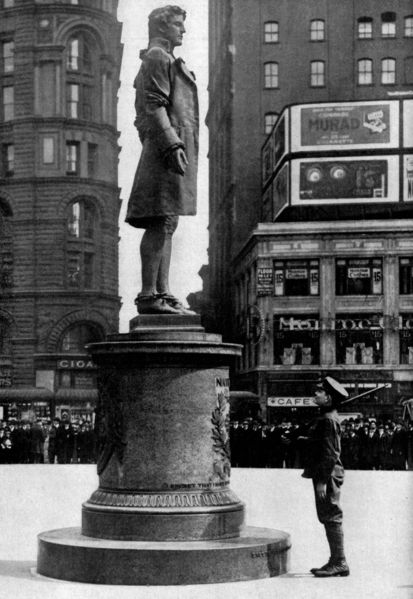
— Meanwhile, a statue of Nathan Hale standing right in front of City Hall was once proclaimed to be the spot. Back in Revolutionary War days, this was a grassy commons where many public displays were held, so on the surface it seems a possibility

And those are just the theories that haven’t been dismissed. Previous speculation to Nathan’s hanging spot have include East Broadway on the Lower East Side, the intersection of Madison and Market streets, and somewhere along “the Brooklyn shore.”

Pictured: In 1917, a soldier in World War I regalia salutes Hale’s statue in City Hall