Categories
Bowery Boys Bookshelf Revolutionary History

‘Rebels at Sea’: How Privateers Helped Win American Independence

Privateers have been much maligned in history, so much so that perhaps you didn’t realize their important role in gaining America its independence from Great Britain.

If your first image of a privateer is a sinister, blood-thirsty madman with a knife in his teeth and a skull on his sails, you’re probably thinking of a culturally exaggerated version of a pirate.

But if your next image of a privateer is a tanned and tattooed sailor with a sword and a ship full of stolen treasure — well, now you’re getting closer to the reality of a privateer’s life.
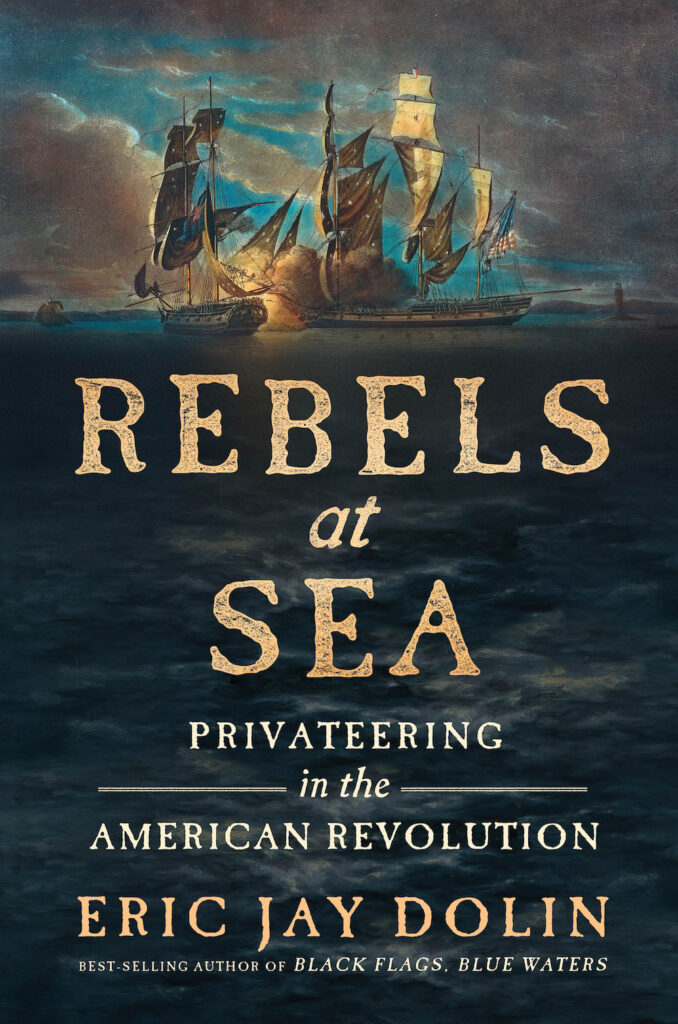
REBELS AT SEA
Privateering in the American Revolution
Eric Jay Dolin
Liveright/WW Norton

There may be no better read for an American Revolution history lover this summer than Eric Jay Dolin‘s latest Rebel At Sea, a look at the forgotten role of the privateer during America’s battle for independence.

Because of their similarity with pirates — criminals who scoured the sea to pillage for personal and malevolent gain — privateers are often ignored in the annals of history, especially in events that have been heavily sanitized of uncomfortable truths like the American Revolution.

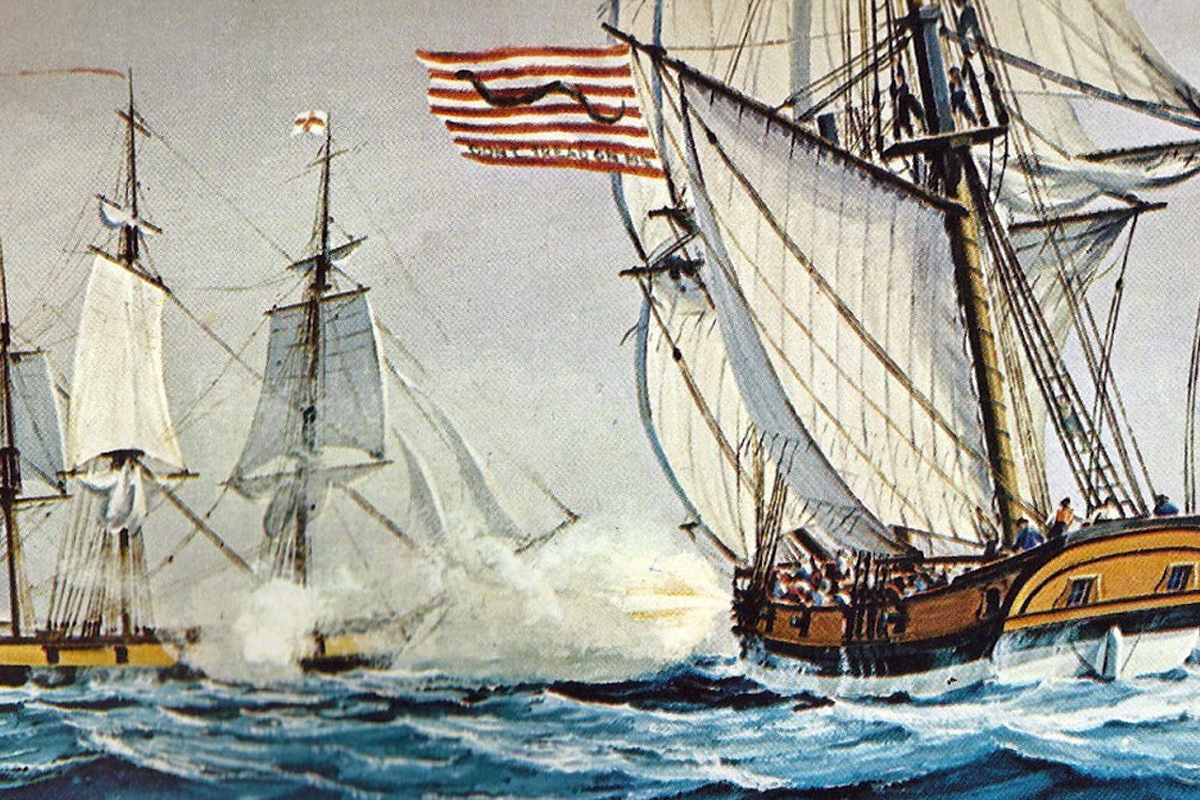
As Dolin reveals, privateers were a bit like a shadow navy; indeed they existed in the colonies before there was an actual American naval force.

What set them apart was an authorized letter of marque, a license from the government to capture vessels from enemy nations and take their possessions. The haul would then be sold and, generally speaking, split between the crew and the letter’s issuer.
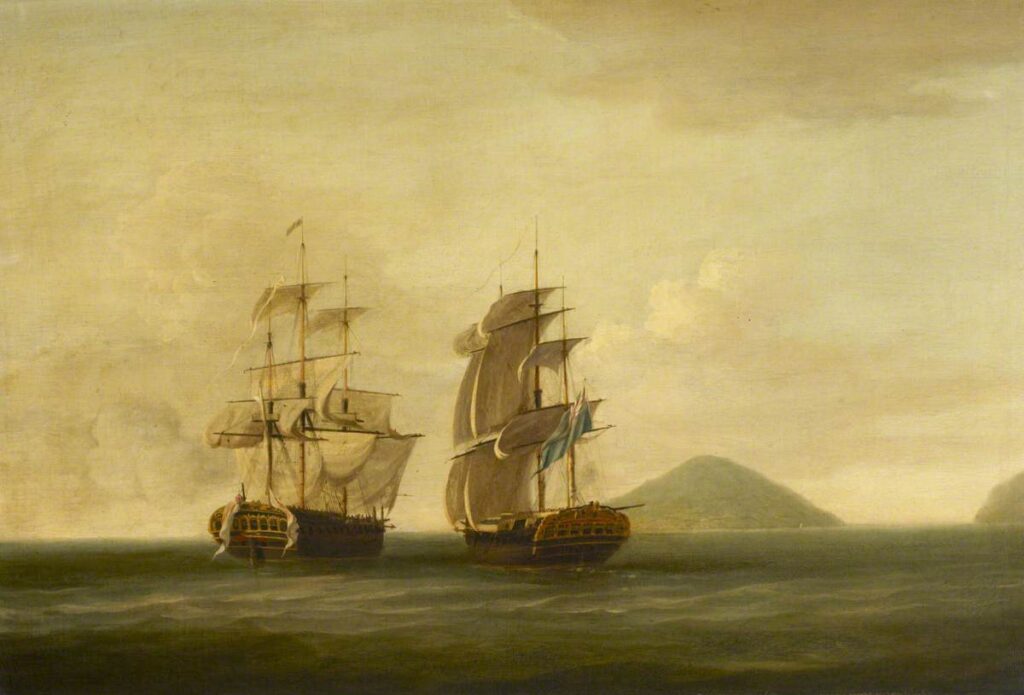
Dominic Serres; HMS ‘Pearl’ Capturing the ‘Esperance’, 30 September 1780; National Maritime Museum

At first a tool for defense by individual colonies, the American Congress soon passed a resolution employing privateers — months before the signing of the Declaration of Independence. “Privateers were free to capture any British vessel,” Dolan writes, “not just those that were delivering supplies to British forces in America. (Later, neutral ships carrying good bound for British use were also deemed acceptable targets).”

Revolutionaries like John Adams were enthusiastic proponents of privateering. “Thousands of schemes for privateering are afloat in American imaginations,” he wrote his wife Abigail. “Out of these speculations many fruitless and some profitable projects will grow.”
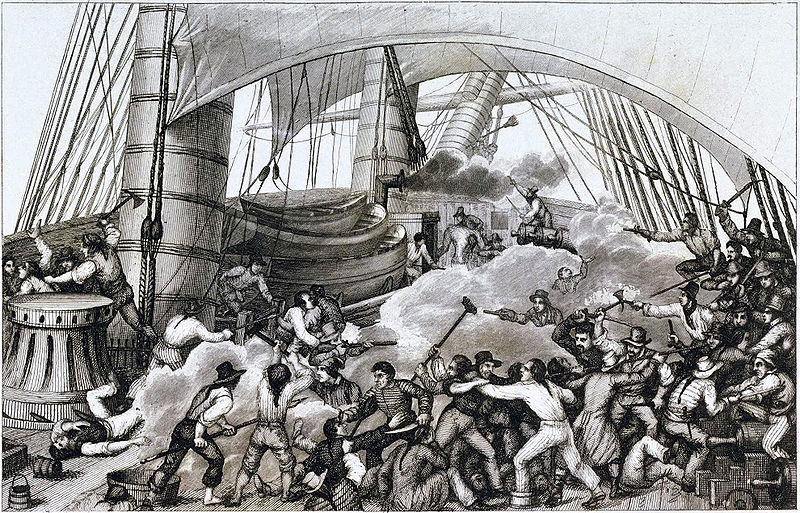
“Boarding of Triton by the privateer Hasard (ex British pilot ship Cartier), captained by Robert Surcouf” (by Ambroise Louis Garneray, 1783–1857)

Dolin describes the life of the average privateer as far less glamorous than that which we might normally prescribe a swashbuckler. Rebels at Sea does highlight some of the privateering triumphs of the Revolution — from John Greenwood, a young privateer who later became George Washington’s dentist, to the many privateering whaleboats.

In a dark local angle, British-occupied New York launched their own counter privateering vessels “with the most fervor and success” and thousands of captured American privateers were imprisoned in the loathesome holds of Wallabout Bay prison ships.

There are men whose sacrifices should also be remembered during Independence Day celebrations this year. And Dolan’s Rebels at Sea presents a great introduction to this hidden corner of American history
Categories
Adventures In Old New York On The Waterfront Podcasts

The Pirate of Pearl Street: The All-True New York Adventures of Captain Kidd

PODCAST The tale of Captain William Kidd, a respectable New York citizen and landowner, and his transformation into the ruthless pirate of legend.

The area of Lower Manhattan below Wall Street is today filled with investment bankers, business people and tourists. But did you know, over 300 years ago, that the same streets were once crawling with pirates?

In the early decades of the British colony of New York, the city was quite an appealing destination for pirates and their ships filled with stolen treasure. After all, the port of New York was far away from the supervision of the crown, providing local merchants with ample temptations to do business with the high sea’s most notorious criminals.

Captain William Kidd is a figure of legend, the most ruthless and bloodthirsty pirate on the planet. And yet, for many years, he was a respectable New York gentleman, with connected friends, a wealthy wife and a sumptuous home on Pearl Street near the original wall of Wall Street.

But Kidd sought adventure as a privateer and made a deal with prominent New Yorkers to scour British trading routes for pirates. This is the tale of how a dashing New York sea captain became branded (perhaps unfairly) as one of the most evil men of the ocean.

PLUS: Captain Kidd’s startling connection to New York’s Trinity Church! And where in New York City might one find some of Captain Kidd’s fabled treasure today?


The Bowery Boys: New York City History podcast is brought to you …. by you!

We are now producing a new Bowery Boys podcast every two weeks. We’re also looking to improve the show in other ways and expand in other ways as well — through publishing, social media, live events and other forms of media. But we can only do this with your help!

We are now a member of Patreon, a patronage platform where you can support your favorite content creators for as little as a $1 a month.

Please visit our page on Patreon and watch a short video of us recording the show and talking about our expansion plans. If you’d like to help out, there are five different pledge levels (and with clever names too — Mannahatta, New Amsterdam, Five Points, Gilded Age, Jazz Age and Empire State). Check them out and consider being a sponsor.

We greatly appreciate our listeners and readers and thank you for joining us on this journey so far. And the best is yet to come!


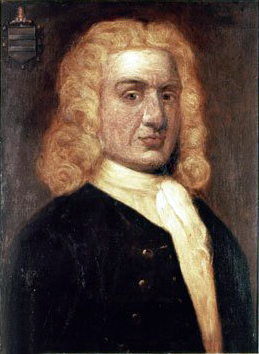
The Captain William Kidd of real life (painted by Sir James Thornhill), a respectable gentleman using his years in New York who hobnobbed with the wealthiest families in town.

The Captain Kidd of legend, a figure whose not-so-noble exploits on the seas have helped masked the real story of this would-be privateer.

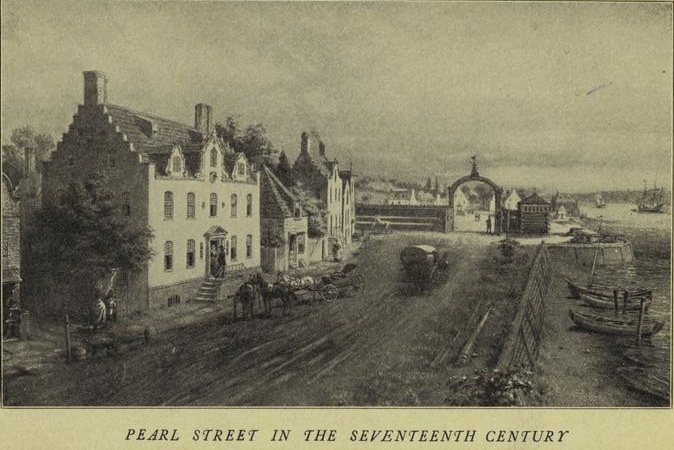
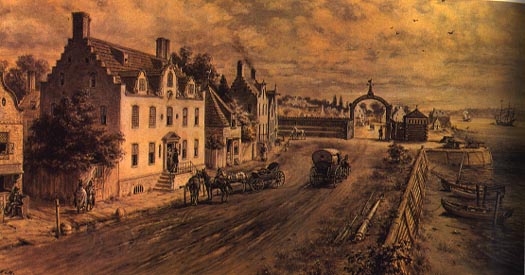
The residence of Captain William Kidd and his wife Sarah Oort Bradley Cox Kidd, at the corner of Pearl Street and Hanover Square. It was built during the Dutch period and located just a few steps from the gate to the city.

Kidd also owned several other New York properties according to the New York Times, including “56 Wall Street, 86-90 and 119-21 Pearl Street, 52-56 Water Street and 25, 27 and 29 Pine Street.”

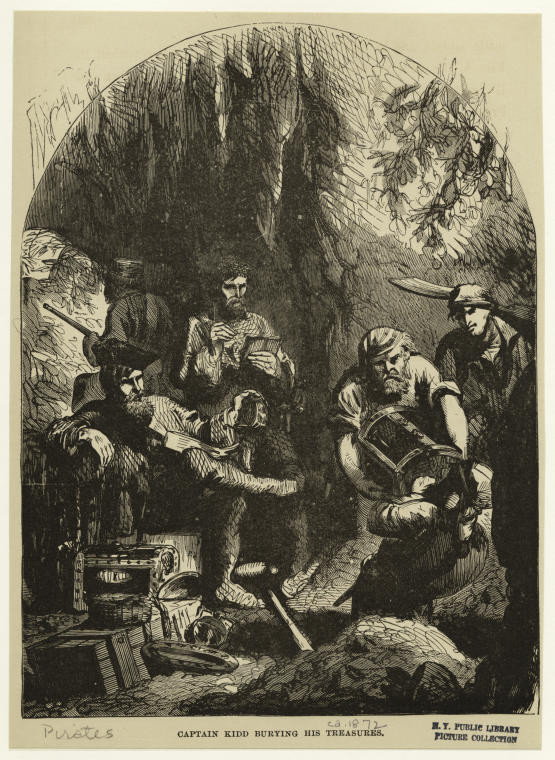
Captain Kidd, burying his treasure (from an illustration circa 1872)

Courtesy NYPL

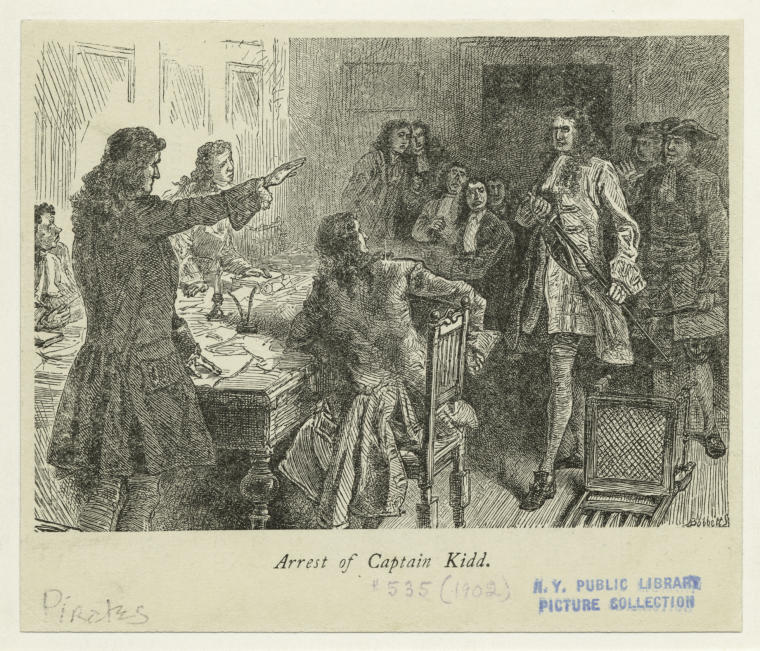
The arrest of Captain Kidd in Boston (from an 1872 illustration)

NYPL

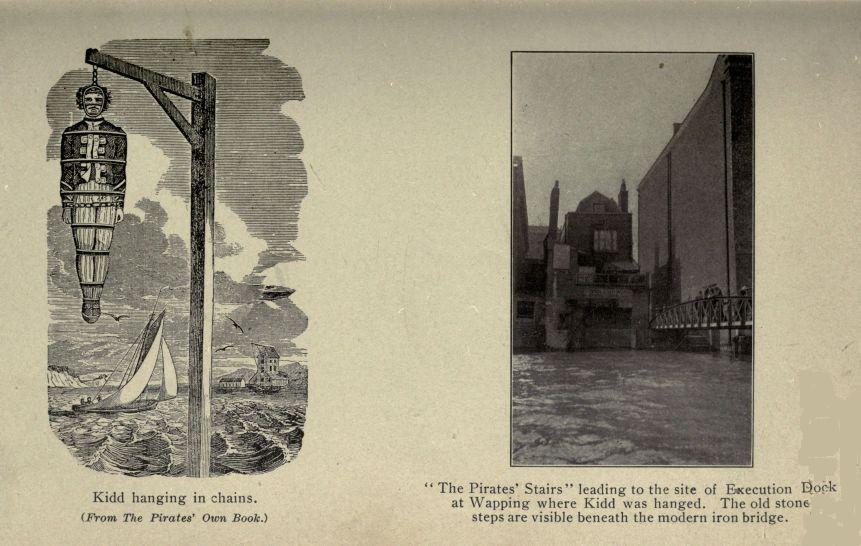
A horrifying image of Kidd gibbeted and displayed along the River Thames and the site of the ‘pirates’ stairs.’

NYPL

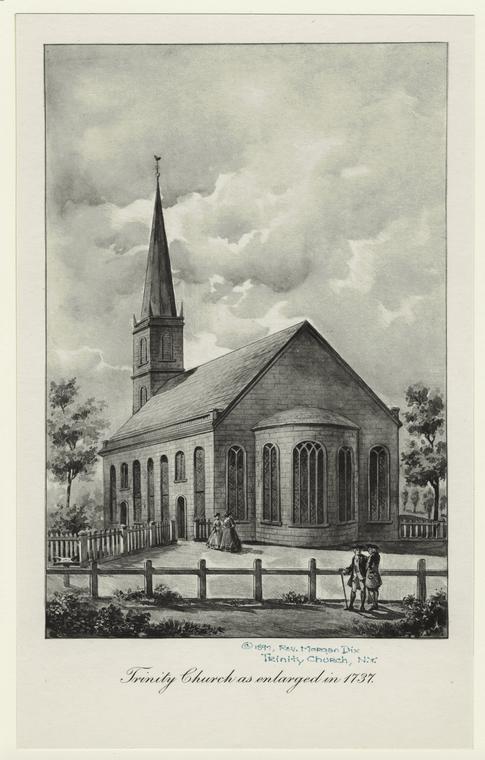
Kidd had a hand in the construction of Trinity Church as he was in New York at the time.

From the Trinity Church website: “In 1696, a small group of Anglicans (members of the Church of England) petitioned the Royal Governor Benjamin Fletcher of New York, then a mercantile colony, for a charter granting the church legal status. Fletcher granted the charter in 1697 and the first Trinity Church was erected at the head of Wall Street facing the Hudson River. Although Anglican services had been held in the colony’s fort chapel, the building was the first Anglican Church on the island of Manhattan.”

NYPL

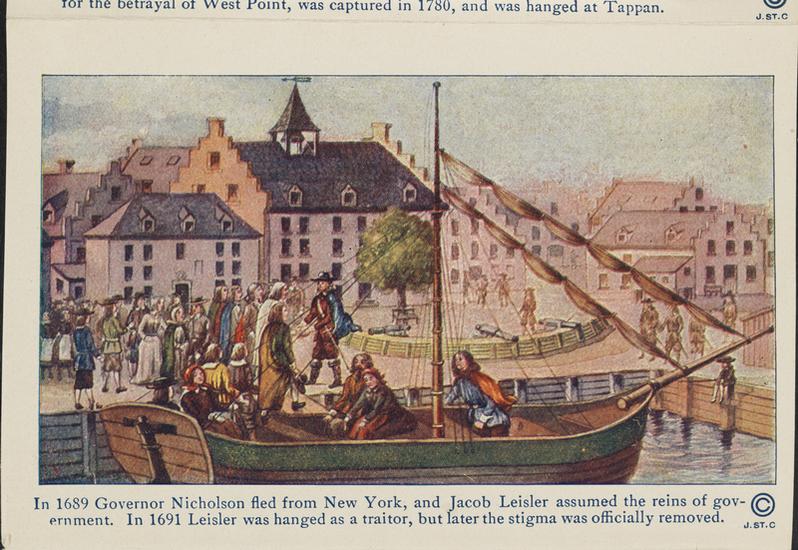
The Leisler Rebellion — Drama in 1689 as Jacob Leisler and his followers sweep supporters of King James out of power. Kidd would contribute in overthrowing Leisler just a couple years later.

Courtesy Museum of City of New York

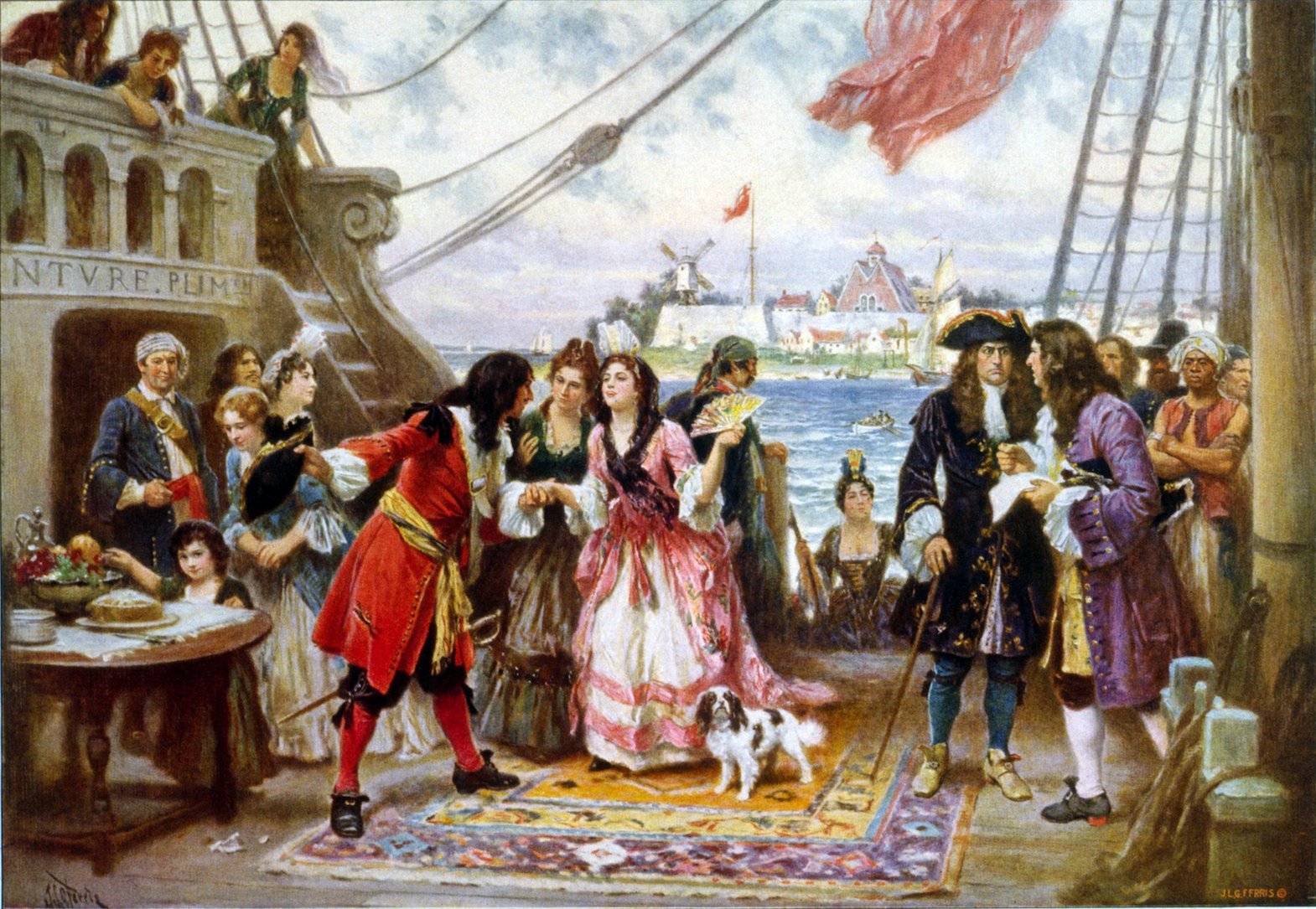
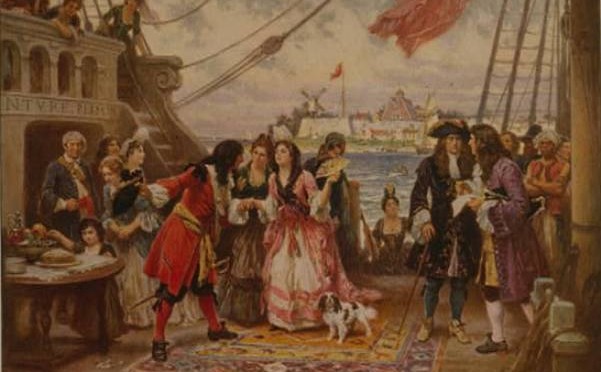
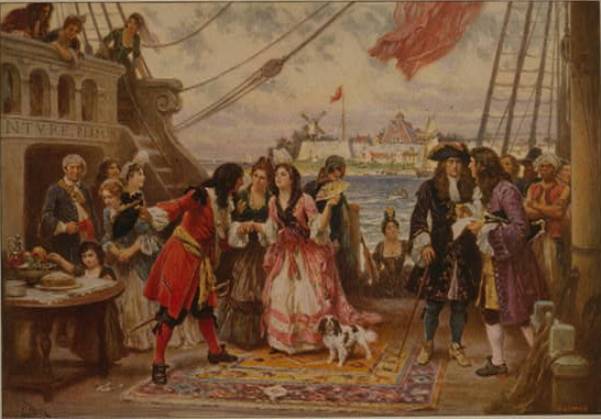
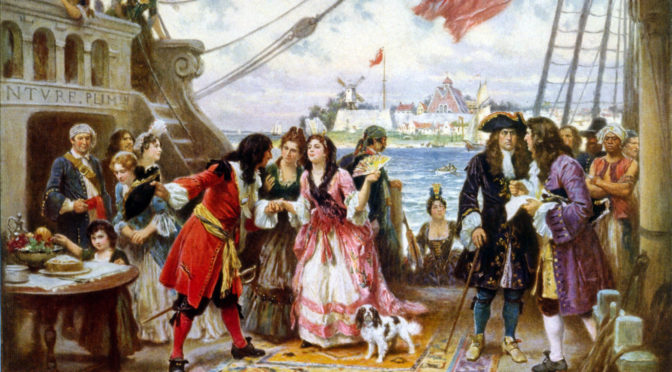
A fanciful reimagining of Captain Kidd in New York Harbor, presumably following the expulsion of Leisler, painted by Jean Leon Gerome Ferris.

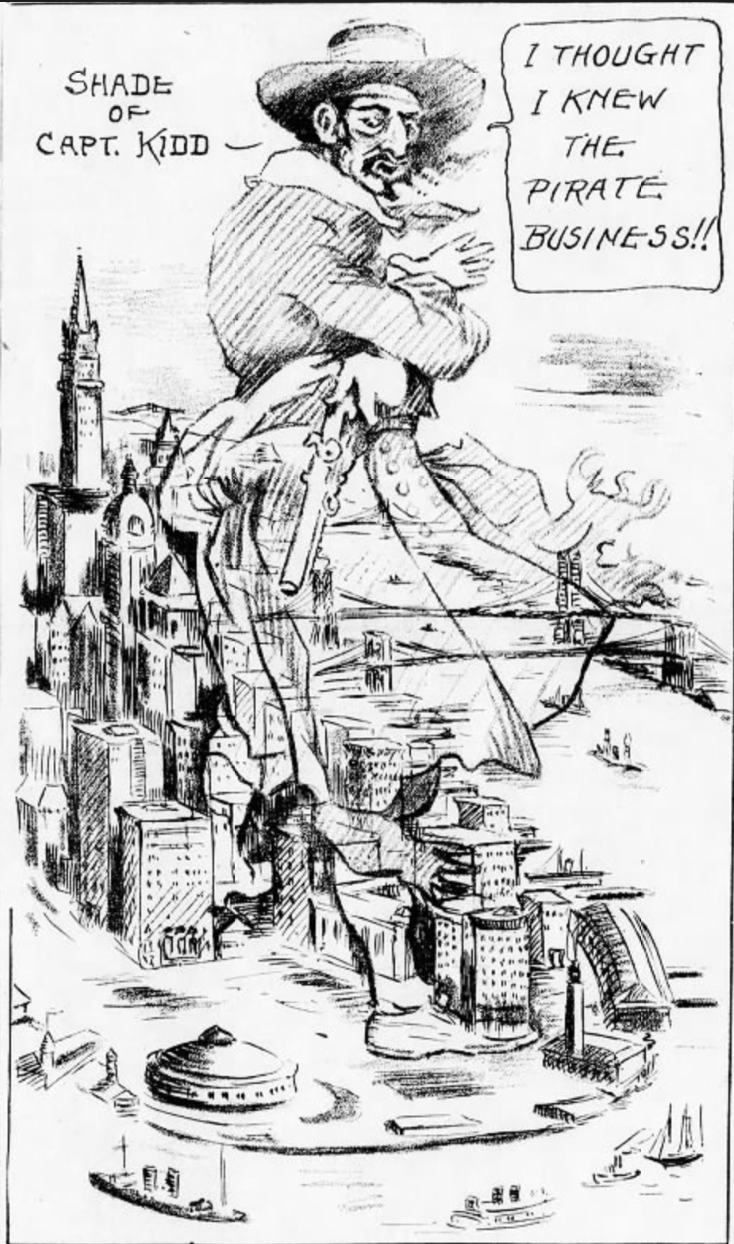
Courtesy NYPLThe Brooklyn Daily Eagle has been quite enamored of Captain Kidd over the years. Here’s an illustration of Kidd’s ghost hovering over New York (a city still filled with ‘modern’ pirates, or so claims the article).

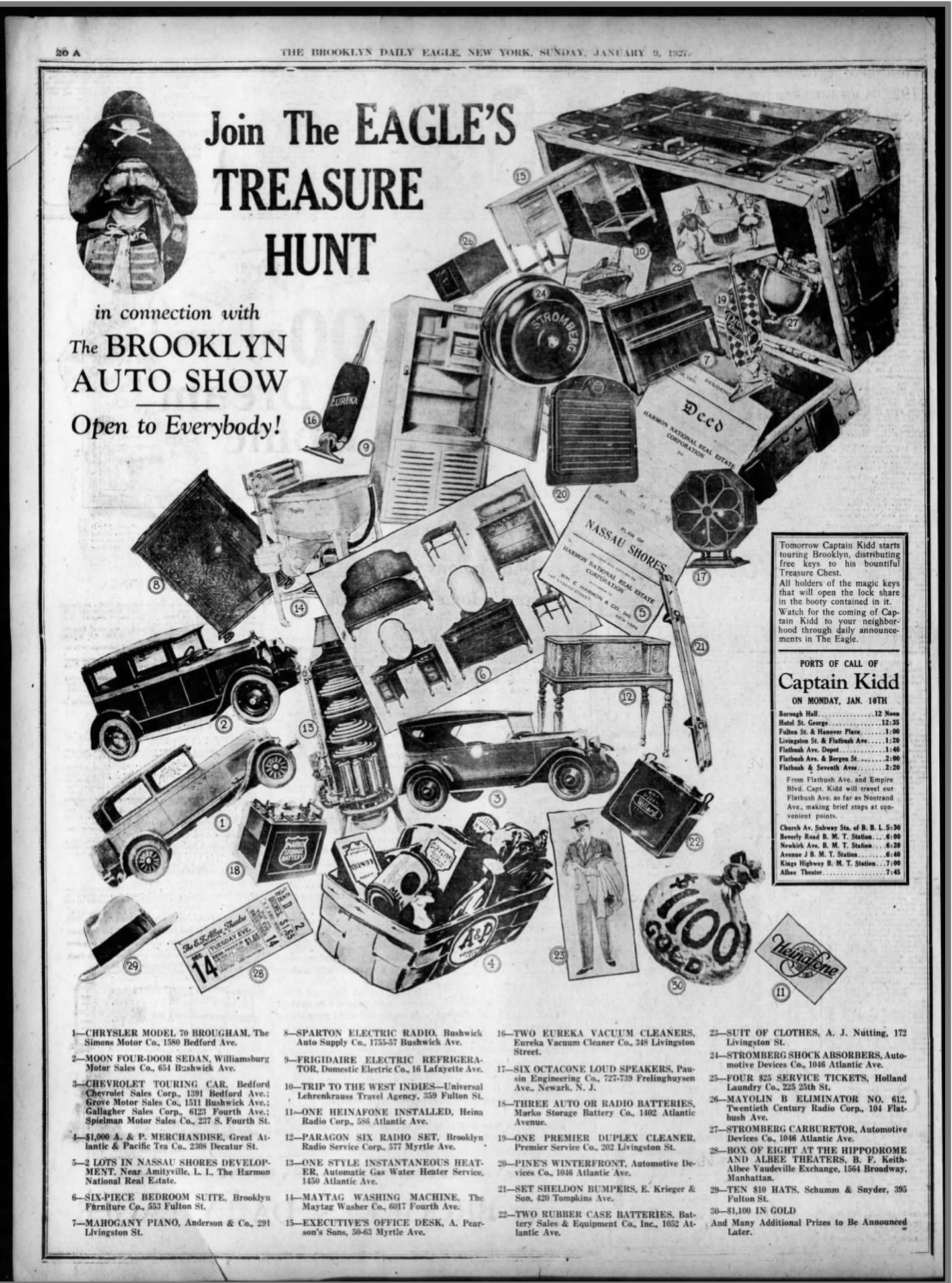
From the Brooklyn Daily Eagle’s ‘Treasure Hunt’ for its readers, a promotion of the Brooklyn Auto Show.


Captain Kidd has been dramatized in several Hollywood films over the years. Here’s one with Abbott and Costello!

Captain Kidd in a Saturday matinee serial:

And the well-regarded film version with Charles Laughton as Captain Kidd:

CORRECTION: My misspeaking strikes again! From the final section — it is Blackbeard the pirate, not Bluebeard the pirate, who is made an example of by the English in 1718. (This has been changed in new versions of the show.

Captain Kidd and his swanky New York waterfront home

Above: A fanciful painting of Captain Kidd in New York Harbor, by Jean-Leon Gerome Ferris, 1911. Notice Fort James (former Fort Amsterdam) and the adjoining windmill in the background

In this week’s podcast, I refer to New Yorker and Trinity Church benefactor William Kidd as one of the most notorious pirates of the Atlantic Ocean. Now I feel that might have been a bit of slander.

It is true that Kidd, forever known to generations of seafarers as Captain Kidd, was vilified by the British for illicit profiteering and eventually hanged in London on May 23, 1701. But Kidd himself fought off the charges voraciously, and today historians believe Kidd was scapegoated and was himself following orders of the governor of the New York colony himself — Richard Coote, the Earl of Bellomont. Yes, the man who tried to annul the charter of Trinity Church!

I’ll save the details of Kidd’s exploits for various pirate-themed blogs. Kidd may have been prosecuted unfairly, but the legend that arose around his real or imagined exploits makes him one of New York City’s most notorious residents of the 17th century. Not only was Kidd one of early New York’s most wealthy residents, but almost without question he had one of the best views in the city from his bedroom.

According to historian Richard Zacks, New York was “the pirate port of choice in the English colonies in North America” in 1690s, with its rich harbor and its relatively multi-cultural port. Still a volatile colony amongst England’s land possessions, it was easy to walk around without harassment and recruit other like minded scallywags for upcoming jobs.

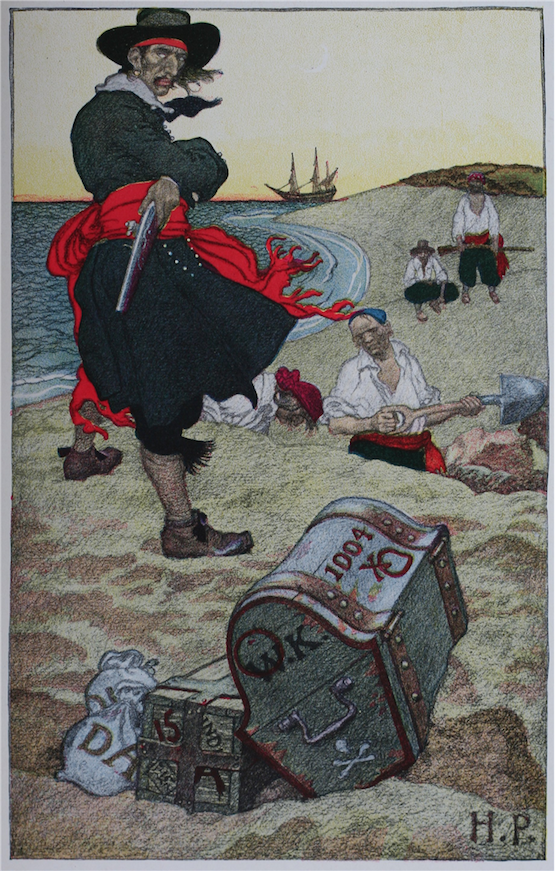
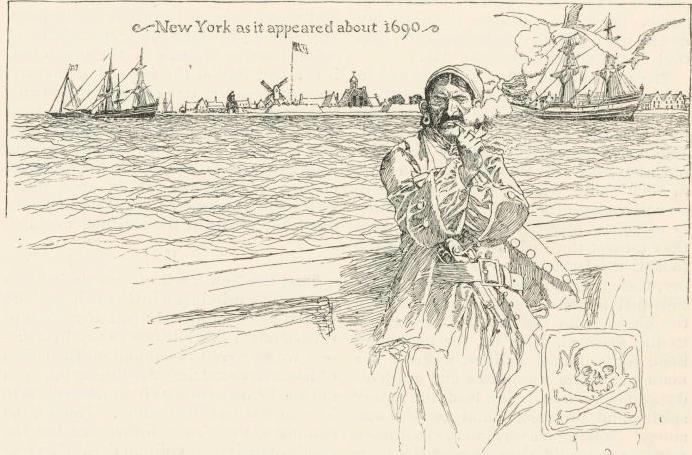
Below: A fanciful sketch by artist Howard Pile (dated Nov. 1894) for Harpers Magazine, with fort and windmill also in background [source NYPL]

Kidd was an employee of the Crown, a privateer essentially hired to capture pirates and any foreign vessels that got in England’s way. He was based in New York for many of the same reasons more illicit sea captains were here — opportunities, money and a suitable harbor for his vessel (Kidd’s was called the Adventure Galley).

He came to New York in 1691 and soon married Sarah Oort, a woman with extraordinary bad luck. Her first two husbands had died, one at sea, and after Kidd’s execution, she would then marry a fourth time. William and Sarah would have two daughters who would marry well into New York society despite their father’s notoriety.

Despite his career, Kidd was considered a respectable New York gentleman — much, I imagine, because of his wife’s standing from her prior two marriages. Also, their digs weren’t bad. Although the Kidds owned several properties (again, thanks to Sarah), their primary residence was at the 119 Pearl Street, at the corner of Hanover and Pearl streets, a location which would have been waterfront property back in the day. It was also closely situated to Hanover Square, New York’s retail district and later home of the colony’s first newspapers.

The sizable home was located next to New York’s old wall, a fortification that would be ripped down within the decade and replaced with the street named after it. Kidd’s home is pictured below (i.e. the big white one):

The Kidds home was especially lavish for the time, with “104 ounces of silverware,” a healthy wine cellar and the biggest Turkish carpet in the city. Their wealth would have made them candidates for a pew at the newly built Trinity Church in 1696. Although Kidd provided equipment to help build the church, it appears Kidd himself never worshipped there. (His wife Sarah most likely did.)

Virtually no traces of this era exist in downtown Manhattan today, and the land extension east and the skyscrapers built there eradicate the view the Kidds would have had from their home.

Over a hundred years later, at the same address lived a man named Jean Victor Marie Moreau who would also influence world history: he’s best known as one-time right-hand-man of Napoleon Bonaparte, banished for betrayal in 1804 and sent to America, where he lived for a time at 119 Pearl.

You can read a nice, lengthy piece about Kidd and his New York connections here at Maritime History.